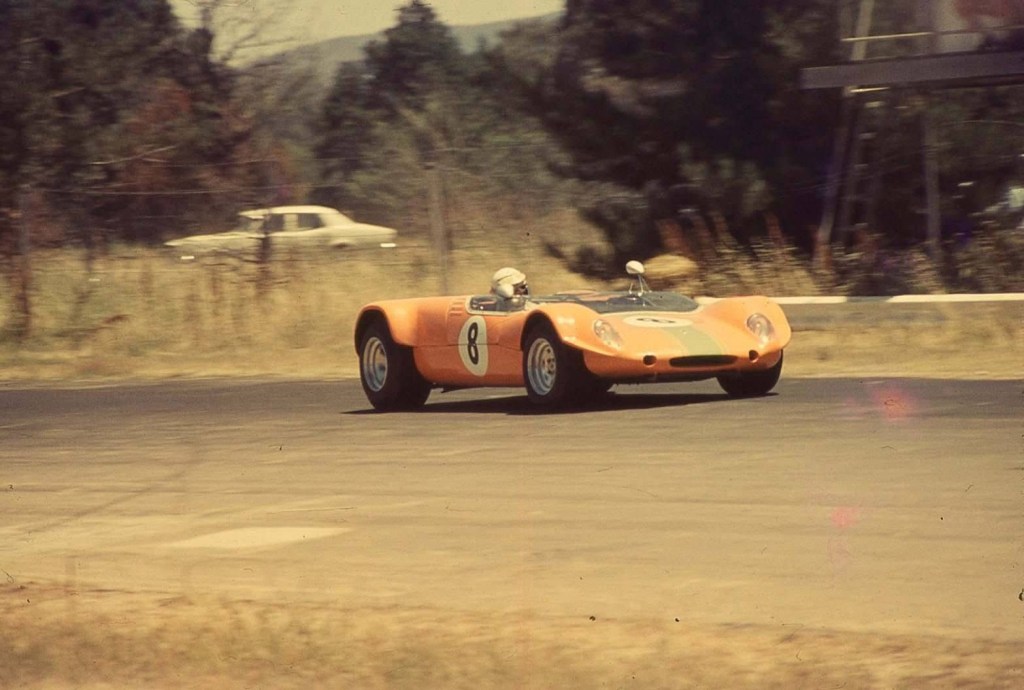
Peter Macrow gives a row of poplars a fright as he runs wide at Newry during the March 1968 Longford Tasman Cup weekend, Argo Chev V8.
The Argo is a special built from the bones of an uncompetitive Cooper T53 by Ray Gibbs, a Melbourne racer/mechanic who had a stint at Cooper in his CV, for grazier/racer/car owner Tony Osborne.
With a long gestation period, it was first raced by Ian Cook in 1967. When Ian bagged an Elfin 400 drive with Bob Jane Racing, another Melbourne up and coming single seater pilot, Peter Macrow got the ride.
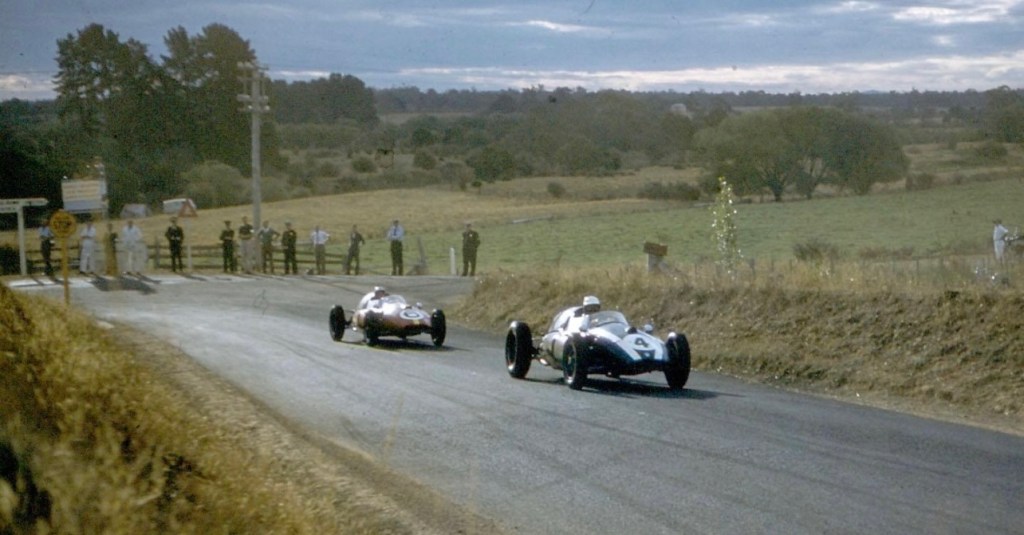
Look how those trees have grown! They were saplings when Jack Brabham and Bib Stillwell raced each other on the same stretch of road out of Newry, in the Longford Trophy eight years before.
The freshly minted World Champion won there in 1960 aboard a Cooper T51 Climax 2.5 FPF, from the similar chassis of Alec Milden and Stillwell: Alec’s car was powered by a Maserati 250S four, Bib’s by a 2.2-litre Climax FPF.
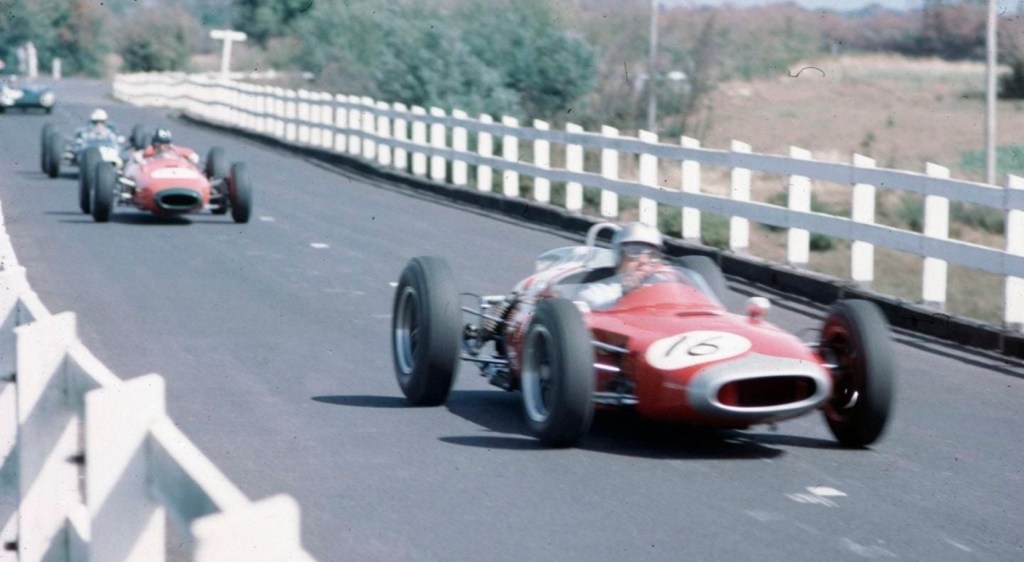
Macrow eases Argo into the viaduct at Longford, on wet race day. The aluminium body was built – very slowly – by Murray Carter in Moorabbin, a legendary racer of all manner of things, mostly touring cars.
I wrote a feature on the Argo Chev, now owned by my good friend, Peter Brennan, a while ago. Have a read of it, it’s an intriguing tale of twists and turns: https://autoaction.com.au/2023/11/05/argo-chev-v8
Etcetera…
(G Fluke)
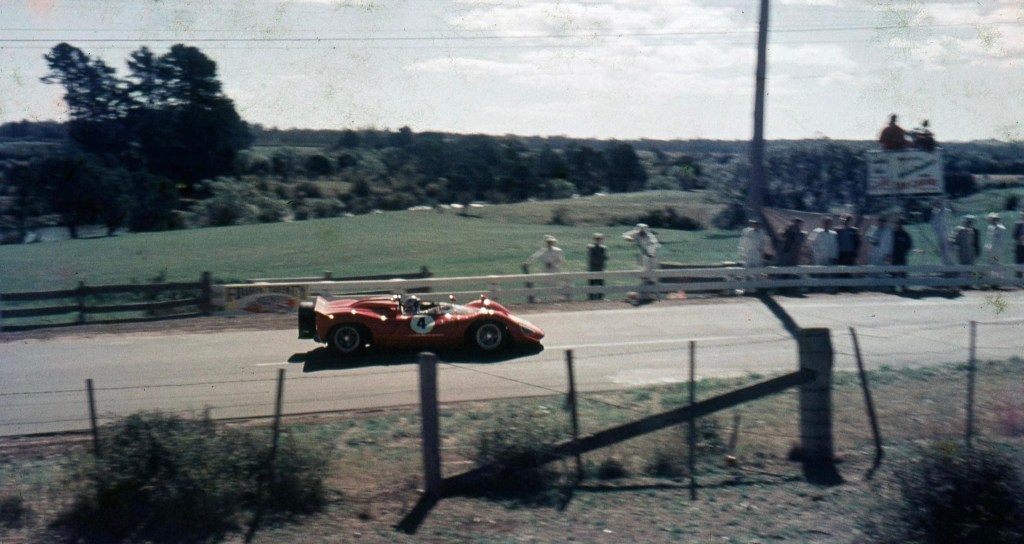
Chris Amon tips his ex-works/Scuderia Veloce Ferrari P4/350 Can Am into the uphill apex of Newry during the 1968 weekend, Chris won the sportscar races. He is about 50 metres behind the spot where the Argo is in the first shot.
(G Fluke)
Pedro gives us another look at the Newry poplars and his 2.5-litre BRM P126 V12 during the very soggy ’68 South Pacific Trophy race. He nicked second from Frank Gardner’s Brabham BT23D Alfa Romeo in the event’s final stages. The race was won in ballsy fashion by Piers Courage’s McLaren M4A Ford FVA F2 car.
Credits…
Osborne Family Collection via oldracephotos.com, Lin Gigney, Guy Fluke
Tailpiece…
(L Gigney)
Tony Osborne, Cooper T53 Climax leads Graham Hill, Brabham BT4 Climax – race winner – off Long Bridge during the March 2, 1964 South Pacific Trophy weekend.
This car, T53 #F2-17-60, ex-Brabham/Lex Davison provided some of the parts to build Argo. Both Argo and the Cooper exist and are occasionally raced in historic events.
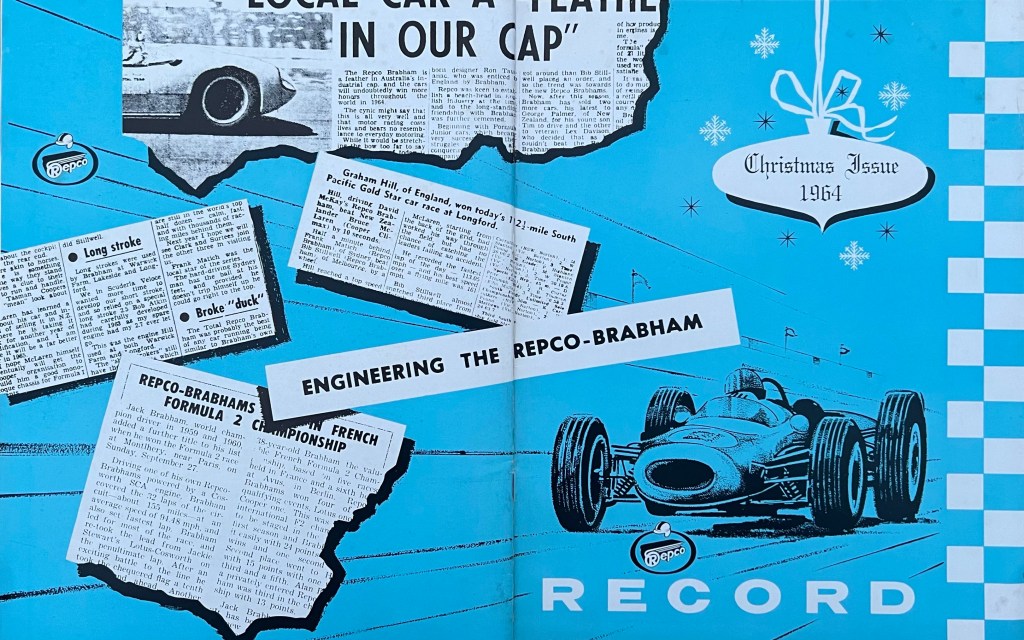
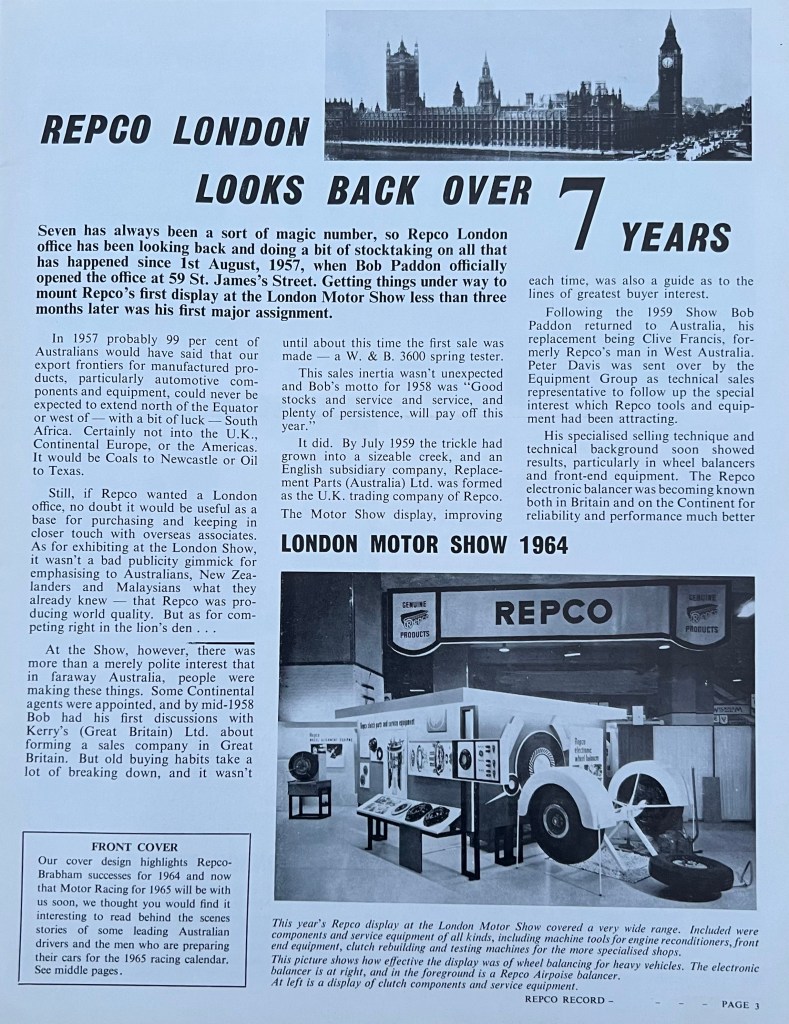
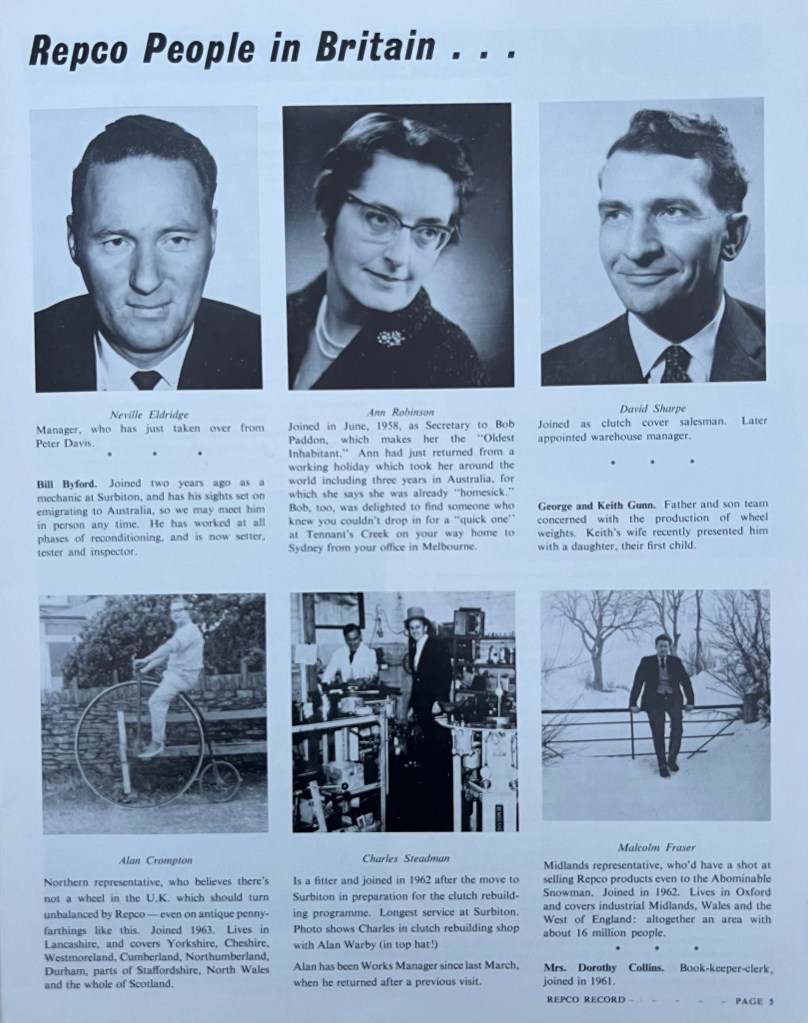
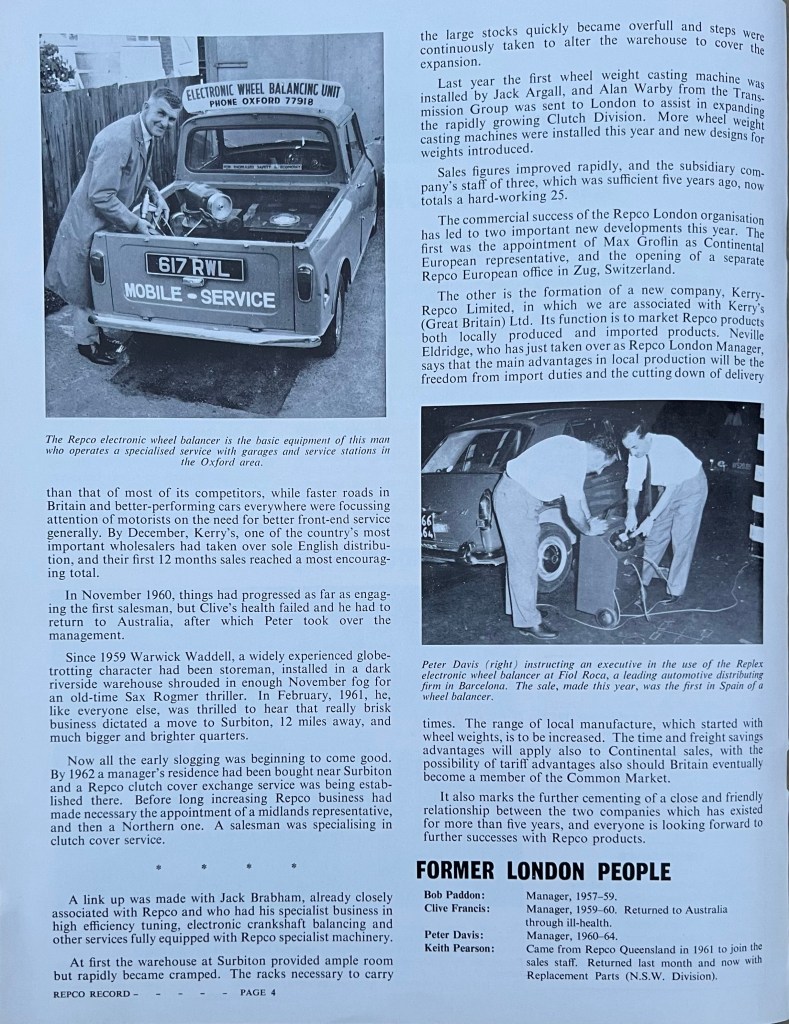
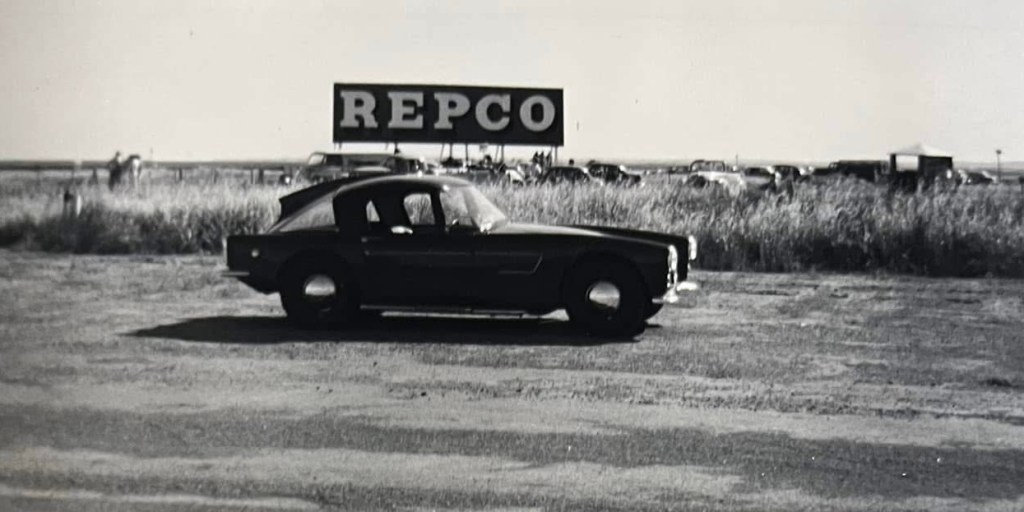
Not that it’s about racing at all. These pages from the Christmas 1964 issue of Repco Record, Repco Ltd’s in-house staff magazine, make it crystal clear exactly when Repco commenced their European operations in London on August 1, 1957.
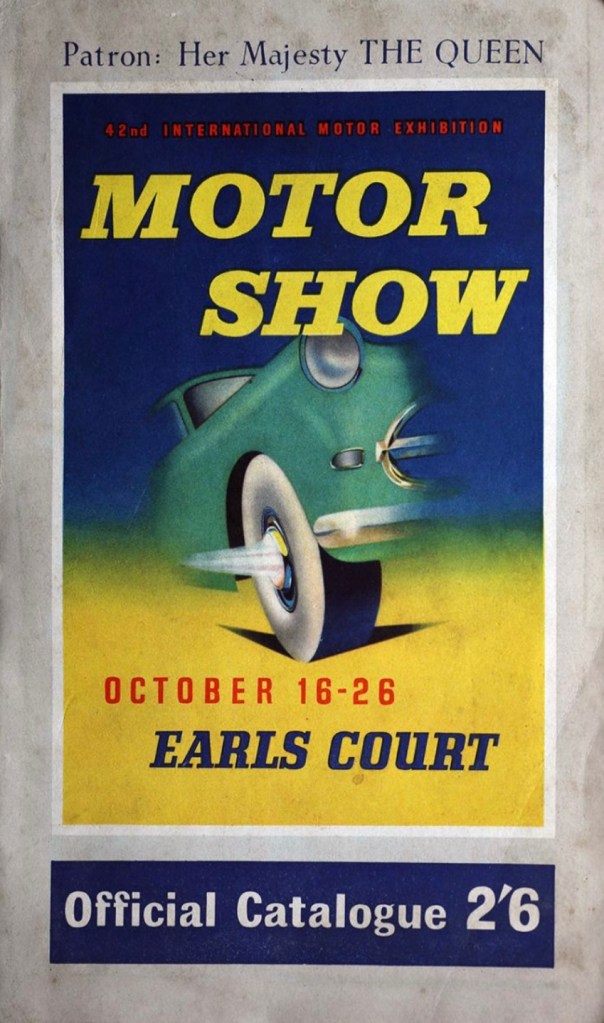
Mind you, that might not be correct. The History of Repco records that Rob Paddon first hung up a shingle at 59 James Street in the West End in 1954. ‘That started with the bold move of joining the UK’s Society of Motor Manufacturers and Traders that year. Membership enabled Repco to exhibit at the earls Court Motor Show from 1957.’
(1957)
I’d always thought Repco’s arrival in the UK was ‘hand in glove’ at about the time the Repco-Brabham branding of Motor Racing Developments Ltd’s racing cars occurred circa-1963. Not so, Repco popped a stake in the ground much earlier.
The global expansion dealt with on the published pages indicates the good marketing sense of the tie-up with Jack Brabham and Ron Tauranac given the international nature of motor racing and therefore the brand-building available to Repco by hitching themselves to Brabham’s coat-tails.
A little later still, Repco’s engineering skills were laid bare – revealing that they weren’t just a sponsor’s name on the nose of Brabham racing cars – for all to see when Repco’s family of 2.5-5-litre racing V8s took to the circuits from January 1966.
So, this stuff is contextual, not racing as such, and is popped up here to be on the public record.
Vern Schuppan had plenty of excitement towards the end of his victorious run at Le Mans in 1983. With two hours to go he sped down the Mulsanne in Porsche 956 #003) – shared with Al Holbert and Hurley Haywood – when the left-hand door flew off.
He kept circulating while a replacement door was readied, but the engine began to overheat as air was no longer being forced into the radiator on that side by the duct built into the door.
(T Walker)
After four laps a non-opening door was fitted. After rejoining, the car was ordered to return to the pits to have an operational door fitted on safety grounds. This meant the second-placed Bell/Ickx (005) above was able to make up its three-lap deficit with the cars on the same lap as the final circuit began.
Holbert’s overheated engine was now smoking, and Bell was closing rapidly – having been twelve seconds quicker in practice – but despite gaining on the lead car, the order remained the same at the finish.
(T Walker)
As usual, I found these photos by accident, researching something else, and up popped the ‘Porsche Pictures Past’ website porschepicturespast.com, which is fantastic, do have a look.
(T Walker)
That’s the 934 shared by John Goss (#9306700153) with car owner, Belgian ‘Jean Beurlys’ (Jean Blaton) and Nick Faure in 1976.
They started 27th and were still running at the finish but were too far behind the winner (181 laps completed) to be classified.
The story goes that the car was delivered to Blaton just before the race in Belgian racing yellow, but a last-minute sponsorship deal with Citizen Australia and Harley Davidson resulted in the car being hurriedly repainted into the colour scheme seen here, apparently with aerosol cans!
#69 was a Swiss entry for Claude Haldi/Christian Vetsch, DNF engine on lap 219 of 350, while car #17 was the Joest 908/3 (#008) driven by Ernst Kraus/Gunter Steckkonig; the 1970 Targa Florio-winning chassis was seventh on its Le Mans debut from grid 23.
(T Walker)
Tim Schenken shared this Georg Loos-GELO Racing 934 (#9306700175) with Toine Hezemans (driving) in 1976; they looked set for a GT category win until a transmission problem intervened.
After this setback, they were 16th outright and second in class after starting 15th. Tim competed at Le Mans five times, this was his sole finish.
Tim first raced for Gelo in 1974 and did full seasons in Georg Loos Porsches in 1975-76 with his best results as follows: 1975 – first in the Euro GT round in a 911 Carrera, and in the ETCC round at Zandvoort and 200 Km Jarama, while his wins in a fearsome Porsche 917/10 in the Zandvoort, Nurburgring Supersprint and Hockenheim Interserie round puts him am an elite group of drivers who won a race in these challengine cars.
And in 1976 aboard 934s, first in the DRM Hockemheim Preis der Nationen and the DRM Nurburgring Supersprint, while he shared the victory in the Monza 6-Hours with Toine Hezemans and Klaus Ludwig.
(T Walker)
The marshal pauses as the Charles Ivey Porsche 956 (#110) races past during 1984.
Crewed by Chris Craft/Alain de Cadanet and Allan Grice, the ex-John Fitzpatrick Racing machine had a DNF engine only two hours from the end when in 13th place.
Gricey returned to Le Mans in a works-Nissan R88C, finishing 14th, sharing with Win Percy and Mike Wilds.
(fotoracing.co.uk)
Larry Perkins had a crack at Le Mans in a Charles Ivey-entered car too. His 911 Carrera RSR (#9114609064) was having its second of two attempts at Le Mans in 1978.
After retirement the year before, it finished 14th from grid 47 in the hands of Perkins/John Rulon-Miller/Gordon Spice and was second in its class. Above, the winning Alpine-Renault A442B of Didier Pironi and Jean-Pierre Jaussaud prepares to pass the Porsche again, eventually finishing 91 laps ahead.
(T Walker)
There was no shortage of Australian drivers in the 1984 race including the Peter Brock/Larry Perkins Team Australia (John Fitzpatrick Racing) 956 #102.
The car was running 28th from Q18 when Larry ran off the road in a ‘he zigged when I zagged’ high speed passing move, ended its race after 145 laps.
(T Walker)
And yes, I know some other Australians also raced Porsches at Le Mans.
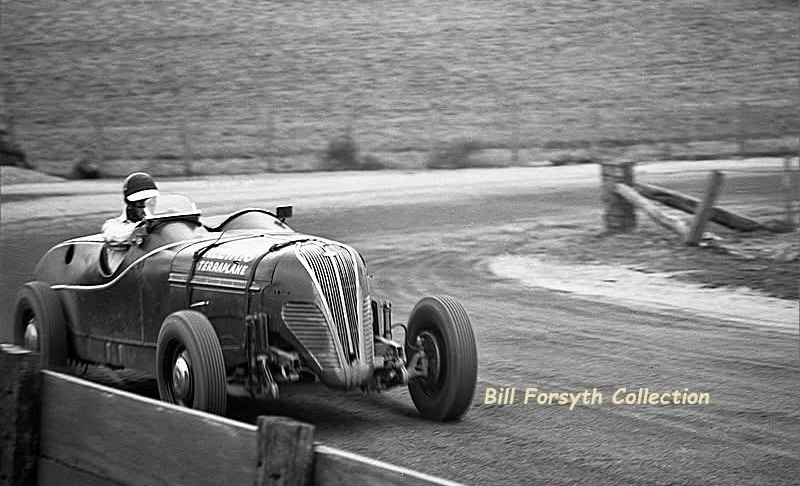
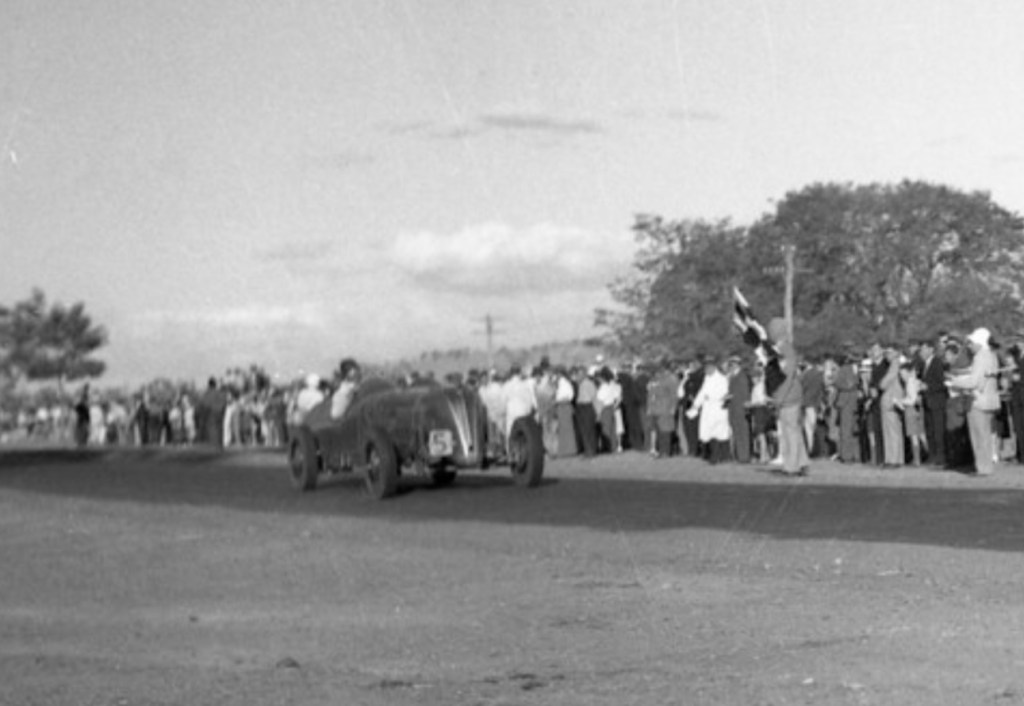
George Bonser’s Terraplane Special during the 1938 Australian Grand Prix at Bathurst.
He was tenth in the 3.5-litre straight-six powered machine in the race won convincingly by Peter Whitehead’s ERA B-Type on April 18.
This car was raced pre-War at venues such as Wirlinga, where the duo placed second in the 1938 Interstate GP behind Jack Phillip’s Ford V8 Special, and at Penrith, where Bonser won the All Powers Car Championship of Australia on Anzac Day that same year.
Bonser’s Terraplane finishes the Interstate Grand Prix at Wirlinga in 1938, second behind the Jack Phillips/Ted Parsons Ford V8 Special (J Dallinger)Bonser aboard a Midget pre-war (B Darby Collection)
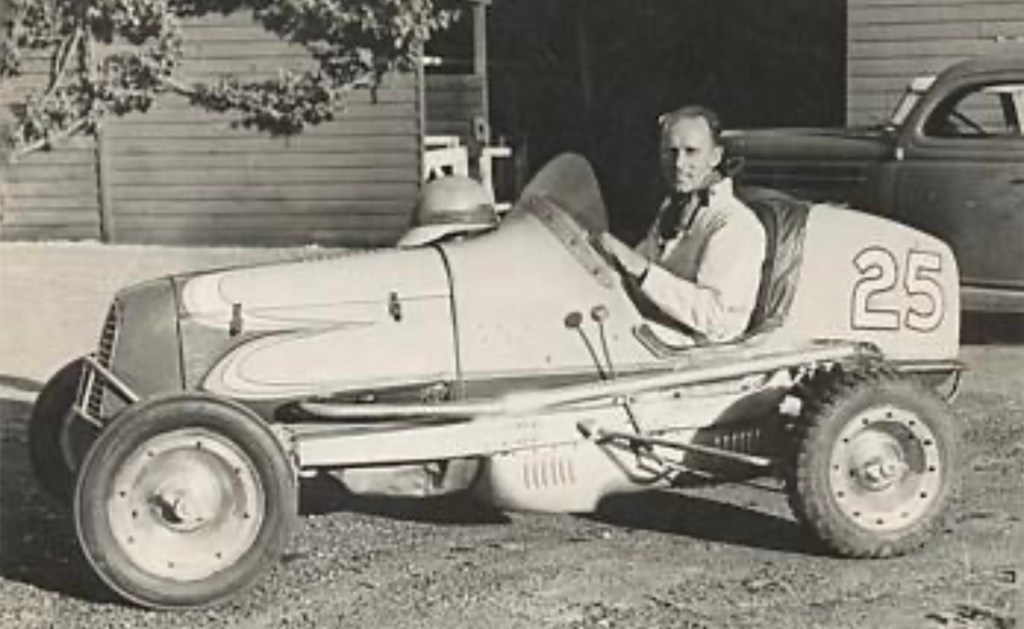
Bonser commenced racing midgets in 1940, served in the RAAF during WW2 then announced his return to Midget racing in 1945 and soon became one of the sports’ stars.
By May 1946 he was regarded as the fastest speedcar driver in Brisbane after winning two races in the third Test between New Zealand and Australian drivers at the Exhibition track. He also raced his Alta Ford on the circuits, at Strathpine in August 1946 for example.
He retired in 1950 then returned in ‘52 and was still competitive in 1953 in an Edelbrock V8 powered car having won the NSW Speedcar Championship at the Speedway Royale Sydney in February. In May the following year, he looked to have won the Australian title in Brisbane until piston failure in his Ford V8 ’60’ intervened.
During the lead-up to the ’54 AGP at Southport, Bonser and Clive Gibson worked with Frank Kleinig on the final, slim, monoposto variant of the Kleinig Hudson Special (DNS electrical short) but what became of George Bonser after this folks?
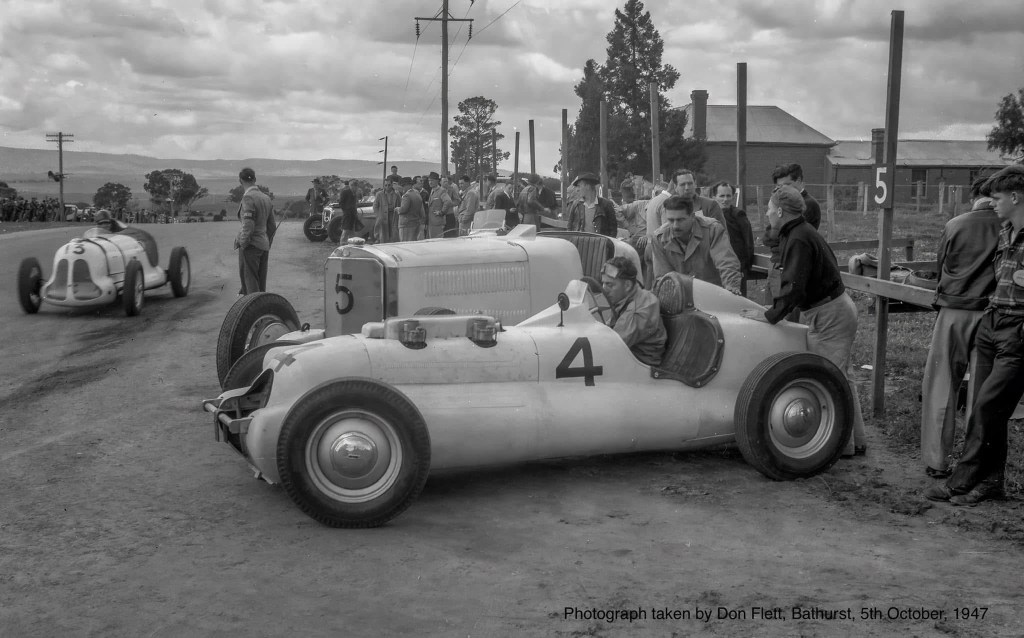
George Bonser (right), winner of the All Powers Championship of Australia on Anzac Day, Penrith in 1938 in his Terraplane Spl. It’s Frank Kleinig aboard his Kleinig Hudson Spl alongside (The Western Weekender)Australian GP, Bathurst October 6, 1947. #13 Bill McLachlan, MG TA Spl, #5 Lex Davison’s Mercedes Benz SSK and #4 Ron Ewing’s Buick Spl (D Flett)
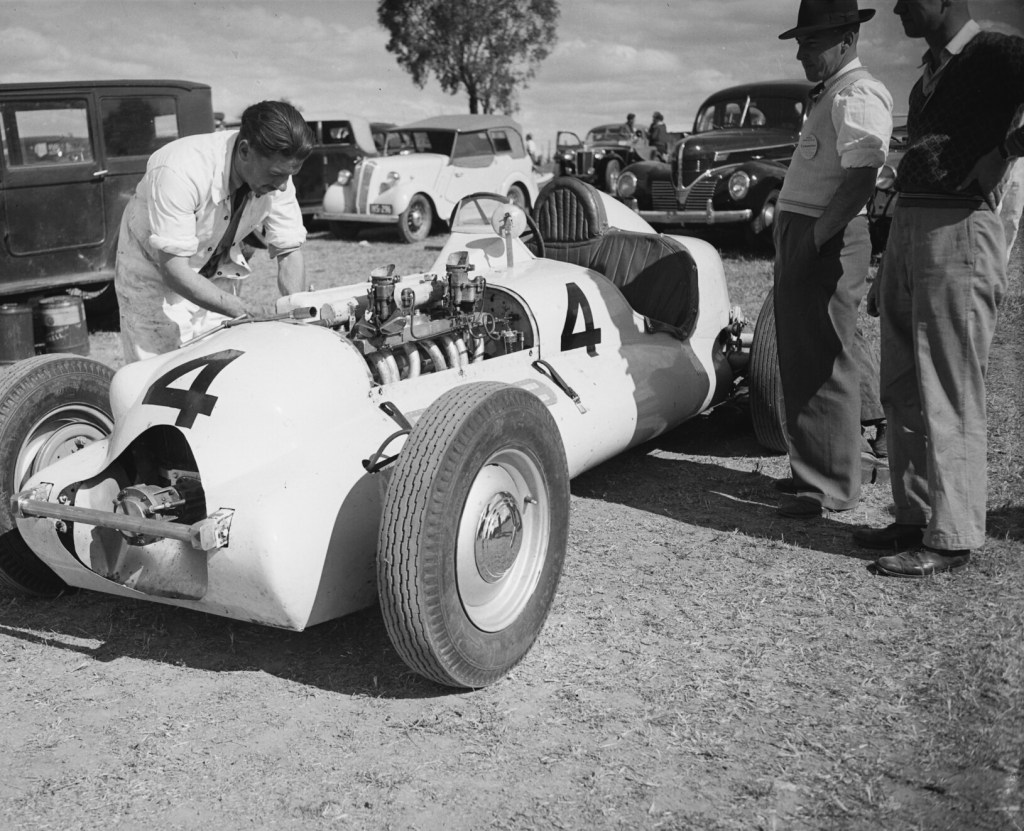
Bonser’s Terraplane beast survived into the post-war era but gave up its life – its chassis and wheels at least – to form the basis of the (Ron M) Ewing Buick Special, which was famously built by Ewing, an ambulance worker, in the backyard of the Summer Hill, Sydney ambulance station!
Other ingredients of the car included an ‘aircraft-type cooling system’, Lancia gearbox, ‘some parts collected in Malaya where Mr Ewing was a war prisoner, including dashboard instruments from a crashed Japanese plane’, while Bugatti bits comprised the steering wheel, box, and column.
An MG and the Ewing Buick Special at Marsden Park, date unknown
With its Buick 40 straight-eight engine, the ‘League of Nations Special’, as one wag christened it, was considered a strong contender for line honours in the October 1946 New South Wales GP at Mount Panorama, but the car blew its clutch.
He set FTD at the Mona Vale hillclimb in April 1947 and returned to Bathurst for the AGP that October but again failed to finish. By March 1948, Ewing entered the New South Wales Hundred at Bathurst in the Spike Special, where he was again unsuccessful, completing only 13 of the 25 laps won by John Barraclough’s MG NE Magnette.
Ewing sold the car in late 1949 or early 1950 and planned to build another ‘over 200 horsepower’ Buick-powered special with a tubular chassis and independent front suspension. Did he realise that aspiration folks?
Ewing Buick Spl, NSW GP, Bathurst, October 1946 (ACP-SLNSW)
Etcetera…
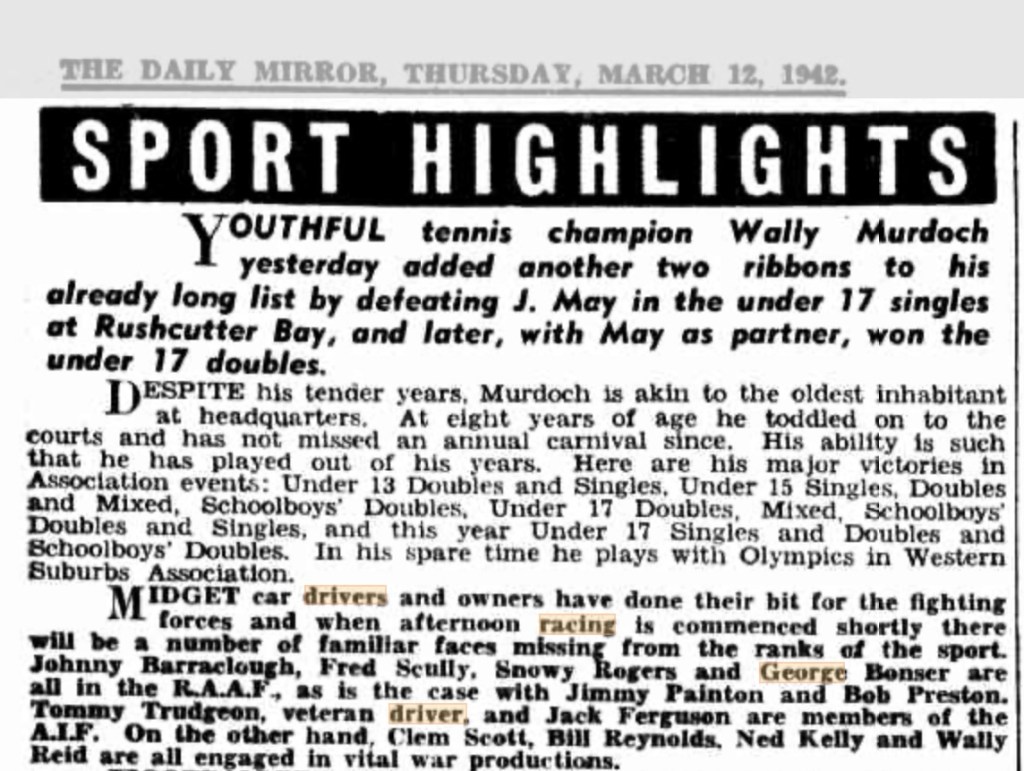
Midget car drivers and owners have done their bit for the fighting forces and when afternoon racing is commenced shortly, there will be a number of familiar faces missing from the ranks of the sport. Johnnny Barraclough, Fred Scully, Snowy Rogers and George Bonser are all in the R.A.A.F, as is the case with Jimmy Painton and Bob Preston. Tommy Trudgeon, veteran driver, and Jack Ferguson are members of the A.I.F. On the other hand, Clem Scott, Bill Reynolds. Ned Kelly and Wally Reid are all engaged in vital war productions.
This article by Les Vowles in The Telegraph, Brisbane, was published on October 11, 1947.
To young and old speedway enthusiasts, George Bonser is a bonser driver. No one took his racing more seriously than Bonser: last season, he had more than his share of misfortune, but this season he has taken up quarters in his garage, so that, in the pursuit of still more power and speed, he will always be on the spot to carry out any improvement to his car that may come to mind.
Its not unusual for a driver-mechanic to stay up all night working on his car in preparation for Saturday night’s racing, and then it’s a decided advantage to have one’s sleeping quarters adjacent to one’s work
No other driver admired the American cars more than Bonser when Niday and Grimm were here earlier this year. Their cars were parked with Bonser’s, and he made a careful study of them. Since then, Bonser has incorporated many parts he obtained from the visitors and also altered the design of parts of his car.
One of these necessitated the abandonment of a starting clutch, which is considered obsolete in America but which is a necessity if a driver is to get away smartly in our clutch start handicaps. However Bonser’s car now is so fast that he partly makes up for the necessity to use a push start.
George Bonser #2 alongside British comedian Tommy Trinder after a handicap match race at Brisbane Exhibition Speedway in 1947 (SLQ)
Bonser came into the car racing game via motorcycles. He and another motorcyclist figured in a remarkable pair of accidents that put one out of the racing game but Bonser kept going and is today ranked in the first flight of Australian drivers.
It was at a motorcycle road racing circuit that Bonser and a rider named James were having a duel for supremacy. Lap after lap they tore around and as the finish approached, the crowd encroached on the course. Dashing down to the line, Bonser’s bike got into a wobble and became uncontrollable. It crashed into the crowd with fatal results for one spectator.
After that race, Bonser decided to take to car racing. It was at Penrith, a wide dirt track, that the remarkable sequel to the original accident occurred.
The motorcyclist with whom Bonser had been racing when the earlier fatal accident occurred, also had graduated to motorcar racing and was a competitor at Penrith in the same race as Bonser.
Many parties picnicked at the all-day meetings at Penrith (Monday June 13, 1938) before the war. At the top of the track was a shallow drain to prevent seepage onto the track, and then came the safety fence. Spectators had strict instructions to remain outside the fence, but on this occasion, a family party, unobserved by the officials, settled at the edge of the drain while a race was on.
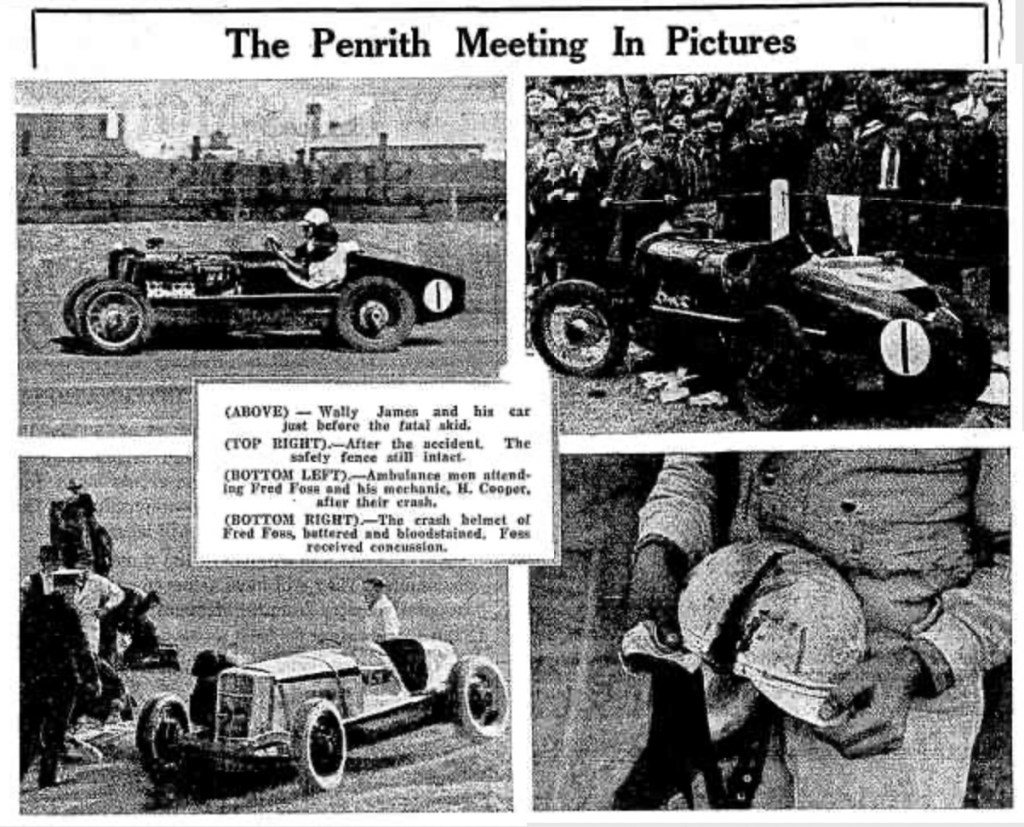
Frank Kleinig, (Kleinig Hudson Spl, one of the outstanding pre-war and immediate post-War Australian drivers on any surface), who raced at Strathpine last year, was having a tussle with (Wally) James (MacKellar Ford Spl aka the ex-Bill Thompson Bugatti T37A Ford V8 Spl s/c chassis 37358) and Bonser when James’ car spun, skidded off the track into ‘no man’s land’ and crashed into the family party with fatal results for three persons.
James went out of the racing game but Bonser went on with it, though these days he has been racing the small speedcars.
Brisbane Exhibition Speedway in 1946. From left, Max Hughes and Jack Malcolm NZ, Ken Wylie Vic, Doug McDonald Qld, Fred Barker, Belf Jones, Jimmy Read, Jimmy Cross, Bob Playfair NSW, George Bonser, Ray Revell NSW (B Darby Collection)
George now has a plan to race a big car (a road racing car) again, and when I stepped through a collection of vegetables and fruit which George was packing fpr the weekend I saw a partly finished ‘three-quarter’ car. This car had a full-size V8 engine. The chassis was a modified Bugatti. The whole car looked resplendent with chrome plating. This car is to be used at Strathpine, Penrith and Bathurst.
One of Bonser’s narrowest of escapes occurred in an Alpine reliability trial from Sydney to Kosciusko, returning via Canberra. One of his team bet Bonser four bottles of beer that he could not get to Kosciusko first – he started near the end of a field of 22.
In the mountains the windscreen iced up and the road became extrememy slippery with the result that the car left the road at a bend, rolled over several times and came to rest upside down with Bonser and his party trapped in the car.
Petrol, oil and acid leaked on them before they were able to attract help by flashing the lights on and off. No one was injured, and the car sustained only a bent gear lever. And he did not even win his beer, complained George.
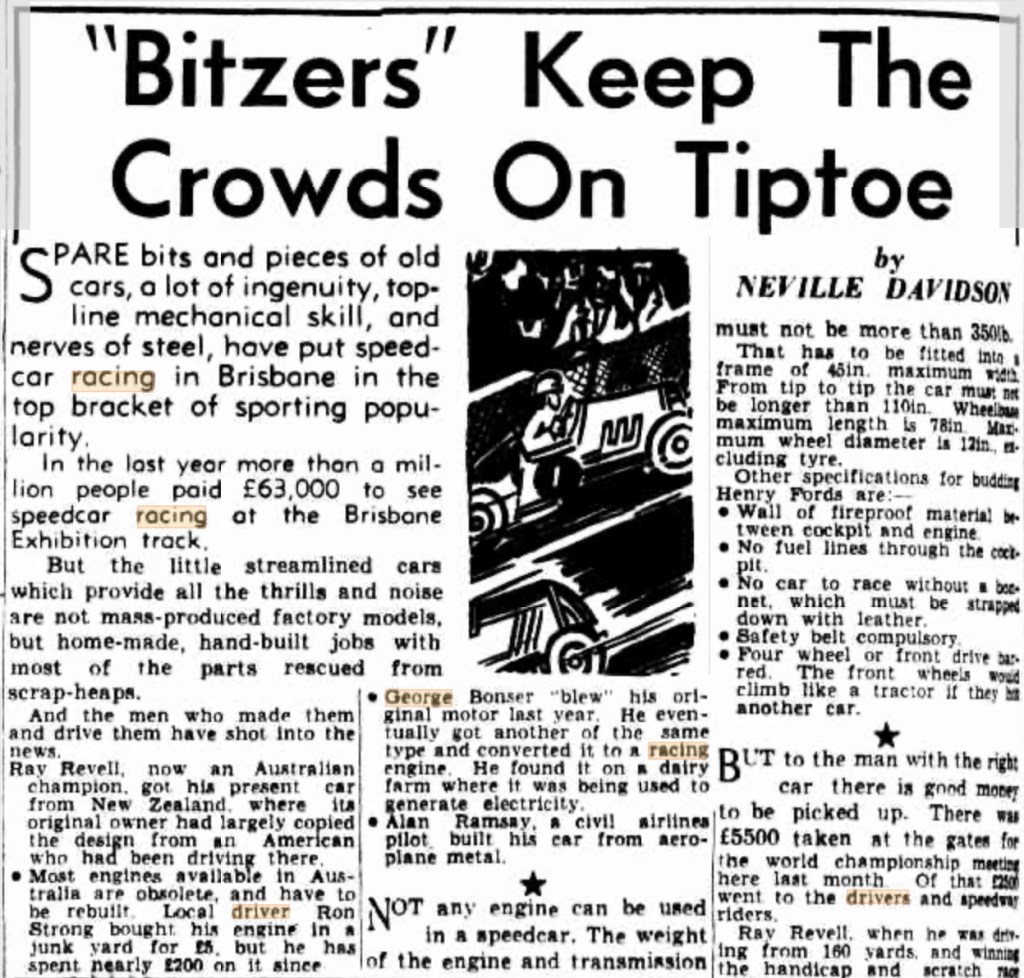
Bitzers Keep The Crowd on Tiptoe, by Neville Davidson in The Courier Mail, Brisbane on May 23, 1947.
I found this piece on the state of the Australian speedcar art in 1947 interesting in its economics and summary of car specifications.
Spare bits and pieces of old cars, a lot of ingenuity, top-line mechanical skill, and nerves of steel have put speedcar racing in Brisbane in the top bracket of sporting popularity.
In the last year more than a million people paid £63,000 to see speedcar racing ot the Brisbane Exhibition track.
But the little streamlined cars which provide all the thrills and noise are not mass-produced factory models, but home-made, hand-built jobs with most of the parts rescued from scrap-heaps.
And the men who made them and drive them have shot into the news. Ray Revell, now an Australian champion, got his present car from New Zealand, where its original owner had largely copied the design from an American who had been driving there.
Ray Strong’s Midget probably at Brookfield Showground circa-1947, as is the shot of Australian Champion, Ray Revell, Ford-A Midget Speedcar below (SLQ)(SLQ)
Most engines available in Australia are obsolete and have to be rebuilt. Local driver Ron Strong bought his engine in a junk yard for £5 but has spent nearly £200 on it since. George Bonser blew his original motor last year. He eventually got another of the same type and converted it into a racing engine. He found it on a dairy farm where it was being used to generate electricity.
Not any engine can be used in a speedcar. The weight of the engine and transmission must not be more than 350 lb (really!?). That has to be fitted into a frame of 45 inches maximum width. From tip to tip, the car must not be longer than 110 inches. The wheelbase maximum length is 78in. The maximum wheel diameter is 12in, including the tyre.
Other specifications for budding Henry Fords are: a wall of fireproof material between the cockpit and engine. No fuel lines through the cockpit. No car to race without a bonnet, which must be strapped down with leather. A safety belt is compulsory. Four-wheel or front drive is banned; the front wheels would climb like a tractor if they hit another car.
But to the man with the right car there is good money to be picked up. There was £5500 taken at the gates for the World Championship meeting here last month. Of that £2500 went to the drivers and speedway riders. Ray Revell, when he was driving from 160 yards, and winning the handicap and scratch double, frequently made up to ?£ (sorry folks can’t fuggin read the number) on an average night.
One legged American Ace, Cal Niday in his Edelbrock Ford V8 60 powered Speedcar during practice at the Brisbane Exhibition Speedway in 1947 (SLQ) American Perry Grimm aboard the state of the art Kurtis Kraft Edelbrock-Ford V8 60 at the ‘Brisbane Ekka’ in 1947 (SLQ)
But £2 or £3 a night is all the front markers get when they cannot finish near the front of the field. And Frank Arthur, the manager here, says that Brisbane has just had the greatest motor racing track season ever in Australia both in attendance and money takings.
Apart from cricket and football (rugby) tests, Brisbane had never tasted anything of world championship flavour till the car derby. Many people still shrug and do not believe that the race was a world championship. They say the field was two Americans and the rest Australians.
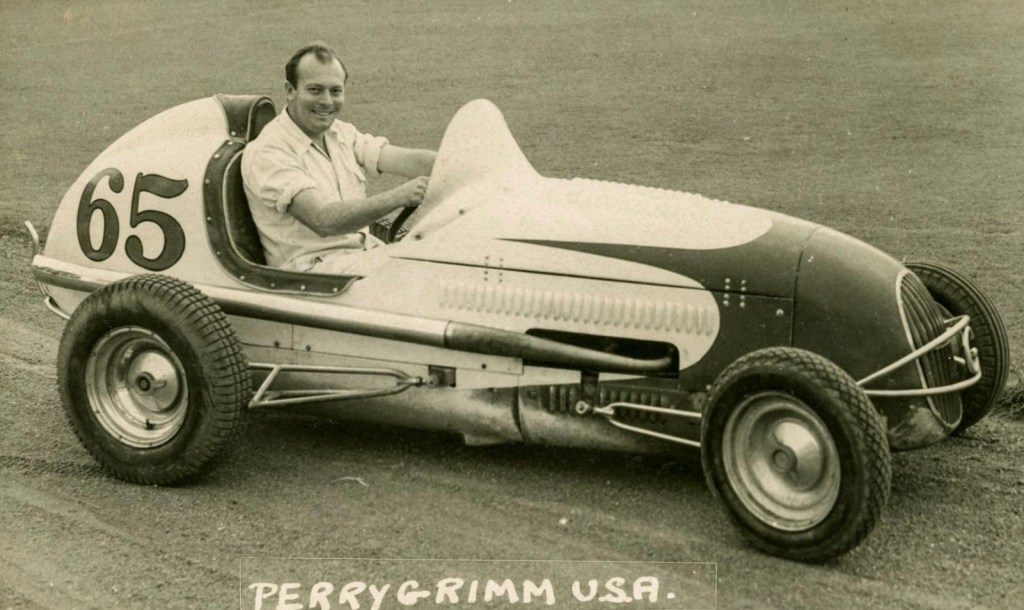
But Perry Grimm and Cal Niday, the Americans, were officially sent by the United Racing Association of America. Grimm was the leading stakewinner in the States last year with $US25,000. There is scarcely any speedcar racing in England. European road racing is done by big cars and comes under a different heading.
Who is who in Australian speedway in 1946, Brisbane Speedway. Back L-R Ray Revell, unknown, Fred Allen, Bob Playfair, Max Hughes NZ. Front, George Bonser, Lew Murphy, Jack Malcolm NZ, Ken Wylie, unknown (SLQ)
Penrith Speedway Tragedy, Monday June 13, 1938…
This report was published in The Referee, Sydney on June 16, 1938
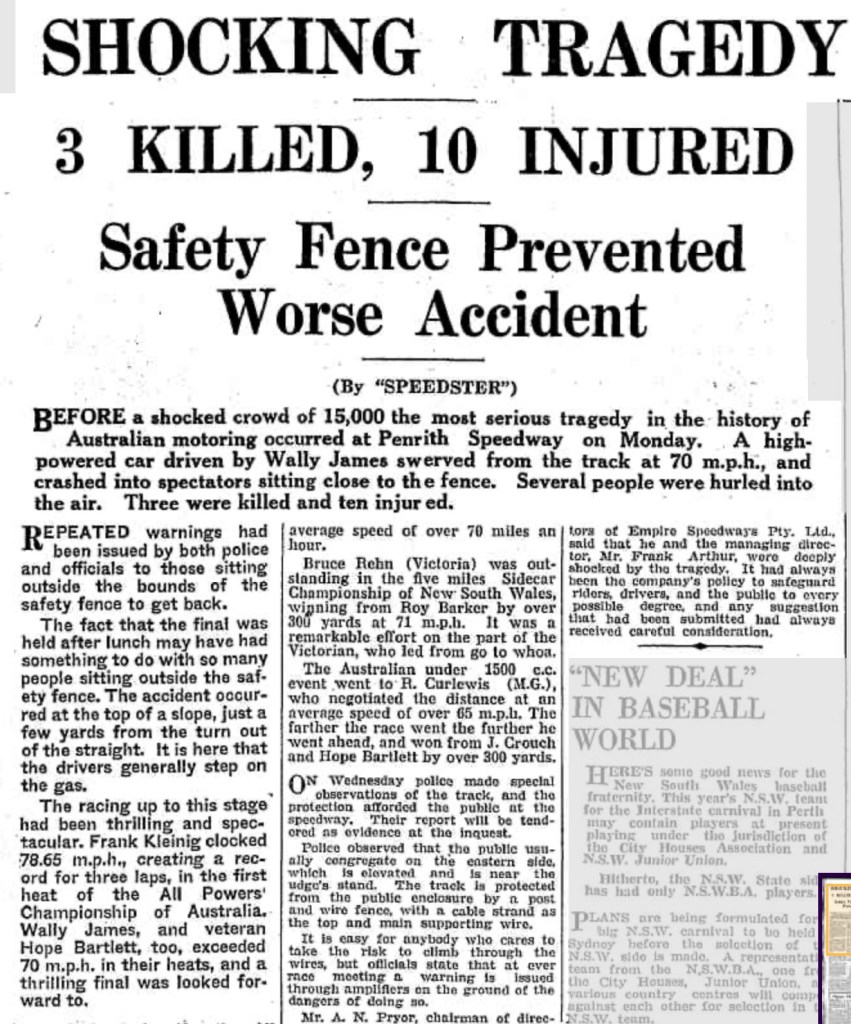
‘The final of the 10-mile All Powers Car Championship had a line-up of five of Australia’s fastest cars and finest drivers. Frank Kleinig (Kleinig Hudson Spl), Fred Foss (Ford V8 Spl), Hope Bartlett (Bugatti Brescia), Wally James (MacKellar Ford V8 Spl s/c, and George Bonser (Terraplane Spl). They got away to a perfect start, and for practically a lap kept together.
Almost simultaneously, Kleinig and James roared out of the straight doing the fastest time of the day. Practically neck and neck, they hurtled up the track, when, suddenly, to the horror of the thousands packed around the track, James’ car got out of control. It swerved off the track straight at a group of onlookers sitting outside the protection of the safety fence. They had no chance of escaping. The car cannoned into the safety fence and bounced back.
AMBULANCE MEN’S WORK
Those on the other side of the safety fence, moved instinctively back, and then came forward when the car, after hitting the wire strands, stopped four feet from the fence. The fence had done its job, and those behind it were safe. Ambulance men did heroic work.
In the re-run, Frank Kleinig won the event from George Bonser and Hope Barllett. Kleinig gave a polished display to win with an average speed of over 70 miles an hour.
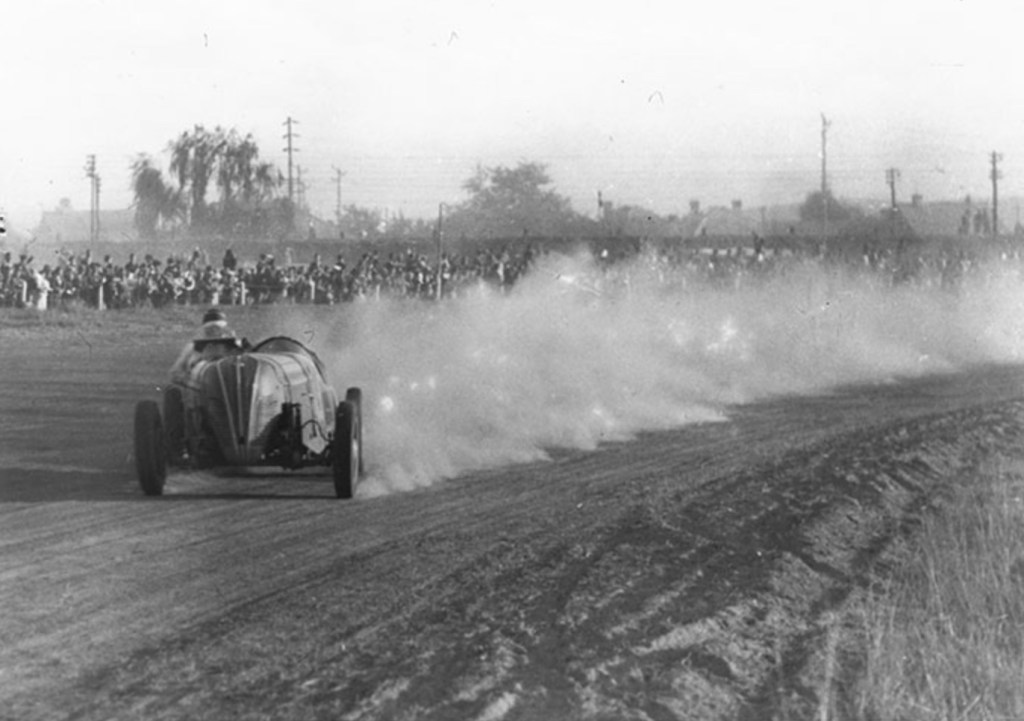
Penrith Speedway panorama (Penrith Library)George Bonser and Terraplane Spl at Penrith in 1938 (Penrith Library)
Bruce Rehn (Victoria) was outstanding in the five miles Sidecar Championship of New South Wales, winning from Roy Barker by over yards at 71 m.p.h. It was a remarkable effort on the part of the Victorian, who led from go to whoa. The Australian under 1500 c.c. event went to R. Curlewis (M.G.), who negotiated the distance at an average speed of over 65 m.p.h. The farther the race went the further he went ahead, and won from J. Crouch and Hope Bartlett by over 300 yards.
On Wednesday, police made special observations of the track and the protection afforded to the public at the speedway. Their report will be tendered as evidence at the inquest. Police observed that the public usually congregates on the eastern side, which is elevated and is near the judges’ stand. The track is protected from the public enclosure by a post and wire fence, with a cable strand as the top and main supporting wire. It is easy for anybody who cares to take the risk to climb through the wires, but officials state that at every race meeting, a warning is issued through amplifiers on the ground of the dangers of doing so. Mr. A. N. Pryor, chairman of directors ot Empire Speedways Pty. Lid., said that he and the managing director Mr Frank Arthur were deeply shocked by the tragedy. It had always been through the company’s policy to safeguard riders, drivers, and the public to every possible degree, and any suggestion that had been submitted had always received careful consideration.’
(The Referee June 16, 1938)
Photo and Reference Credits…
Bill Forsyth Collection, Australian Consolidated Press-State Library of New South Wales, John Dallinger, various newspapers via Trove, State Library of Queensland, Rick Marks Collection, Brian Darby Collection, Penrith City Library
Steve Holmes’ wrote that Jim Richards’ Holden Monaro HT GTS 350 not only towed his ex-Willment Racing Group 2 Ford Escort Twin-Cam up and down New Zealand’s two islands but also doubled up at some meetings as a production racer, as above at Levin circa-1970, date folks?
Jim’s Escort aerobatics below at Wigram in 1972, three-wheeling out of Hangar en route to Control Tower.
(T Marshall
This wonderful history of Jim’s Escort is courtesy of the NZ Historic Muscle & Saloon Cars Facebook site, slightly paraphrased.
‘The Jim Richards twin-cam Mk I Escort famous in NZ motor sport, we are very thankful to Rayden and Irene Smith for saving the car and returning it to the track. Mike Crabtree raced the car in the UK and he and his family have helped piece together its early UK history.
Technical Specs: 1968 Escort Twin Cam racing car built by Willment Racing, England. Engine 1700 cc Lotus Twin Cam 180 bhp. Brakes: Disc front, drum rear. Gearbox: Ford 4 speed with LSD.
The car started life as one of the first Twin Cam Escorts made at Ford’s competition plant in Boreham, England. Ford’s public relations chief, Walter Hayes, gave the car to John Willment for race development. Willment’s facilities were south of London, and they campaigned various cars throughout the 1960s, including single seaters, Cortinas, Ford Galaxie, Cobras, GT40s and the Mk I Escort Twin Cams development, which resulted in quite a unique suspension and chassis setup.
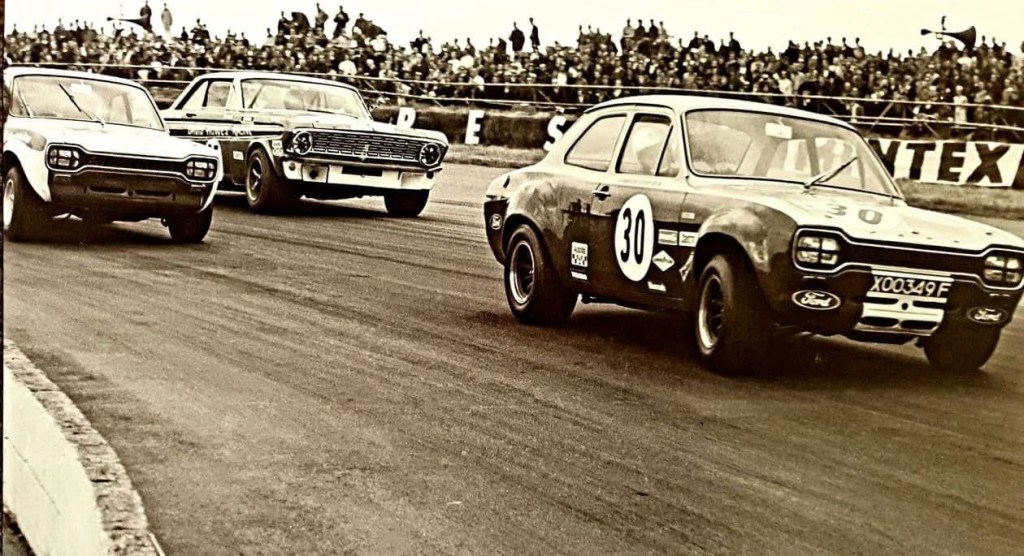
Mike Crabtree worked for Willment and raced the car to win the 2-litre class of the 1969 British Saloon Car Championship, competing alongside the Alan Mann Escort X00349F of Frank Gardner, Roy Pierpoint’s WJ Shaw Falcon Sprint and the works Britax Downton Mini Cooper S of Gordon Spice.
Mike fondly remembers driving it on three wheels and maintains it was a very forgiving racer, something subsequent drivers have mentioned. Mike and his wife Joan have travelled to New Zealand to see the car and are delighted it is still being used as intended 50 years on.
Jim and Mary Carney of Whangarei purchased the car from Willment Racing in late 1969 and imported it to New Zealand for Jim Richards to race in the New Zealand Saloon Car Championship. Running with “Radio Hauraki” and “Carney Racing” liveries, Jim produced some great racing against much larger and more powerful machines in the golden era of NZ saloon racing. It was also used as the bridal car for Jim and Faye when they married in 1972.
Subsequent owners include Lin Nielsen and John Beattie, both racing in the OSCA series in the 1970s. Lin had the car repainted following a paint shop blaze in a bright “Fairmonte Motor Court” colour scheme. Power plants over the years have been Lotus-Ford Twin-Cam, Ford Pinto, Mazda 13B rotary, Ford BDA and back to a Twin-Cam in the 1990s.
Rayden and Irene Smith have been the car’s custodians for 30 years, and Rayden continues to use it competitively. As with many old original race cars, it is no concours “silk purse”. It wears a battle-scarred patina of 50 years of racing with several layers of old paint schemes beneath its Willment livery, and still has the bog and panel repairs from Mike Crabtree’s battles with Pierpoint, Spice and Gardner in England in 1969.
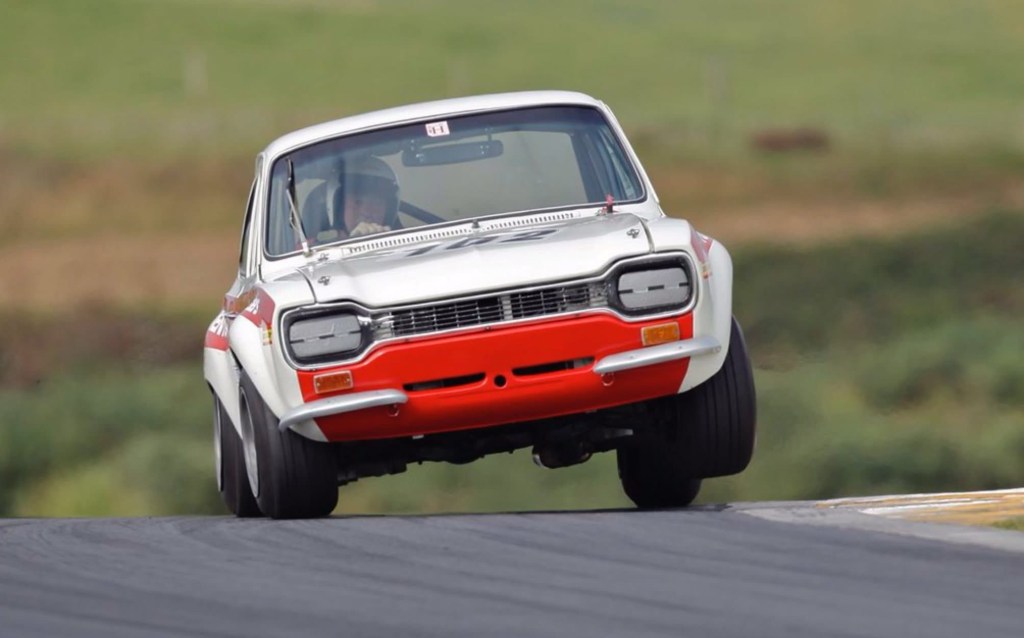
Great action shot of Rayden Smith thru turn 3 at Hampton Downs cocking the inside front wheel just as Mike Crabtree - and other Escort components – in the day (NZ Hist Muscle & Saloon Cars)
Credits…
Steve Holmes-The Roaring Season, Garry Simkin, Terry Marshall, NZ Historic Muscle & Saloon Car’s Facebook site
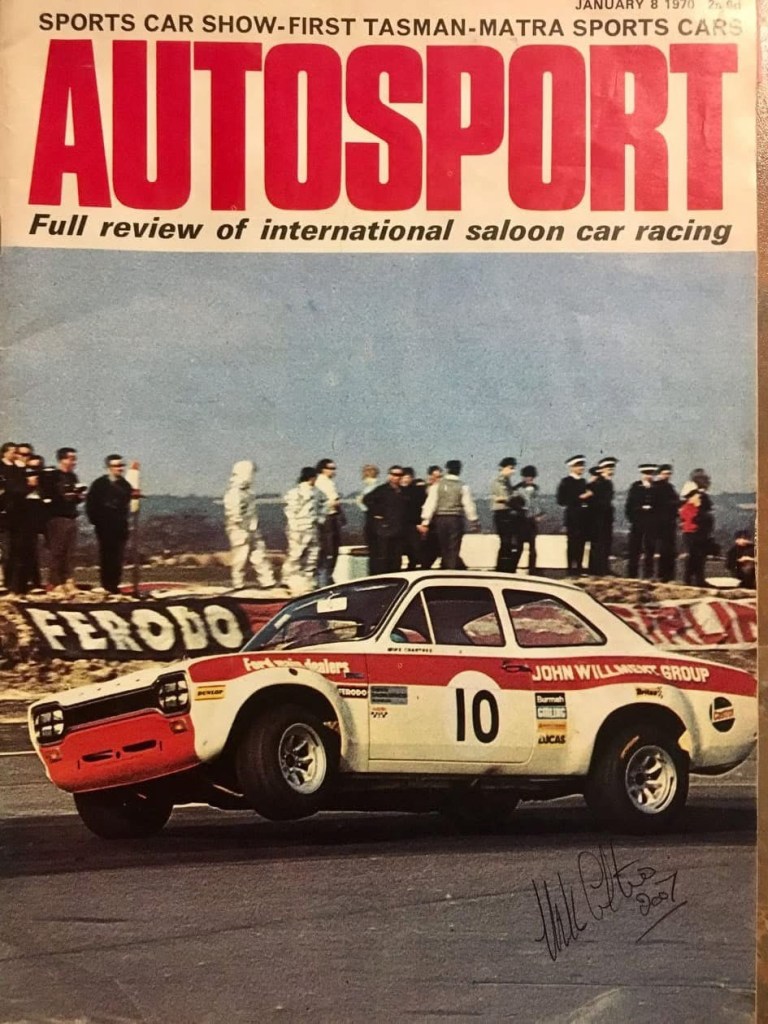
It’s the first shot of this car I ever saw. It was in Bryan Hanrahan’s ‘Motor Racing The Australian Way’, an Xmas preso to me from good ole’ Santa in 1971 or so. Now, 50 years later, I know who took it, Peter Bakalor, the wonders of Facebook!
If my memory isn’t playing tricks, I’m sure Ray Bell told me Peter covered the Tasman for Autosport, Ray got in touch the day I posted this piece.
(R Bell)
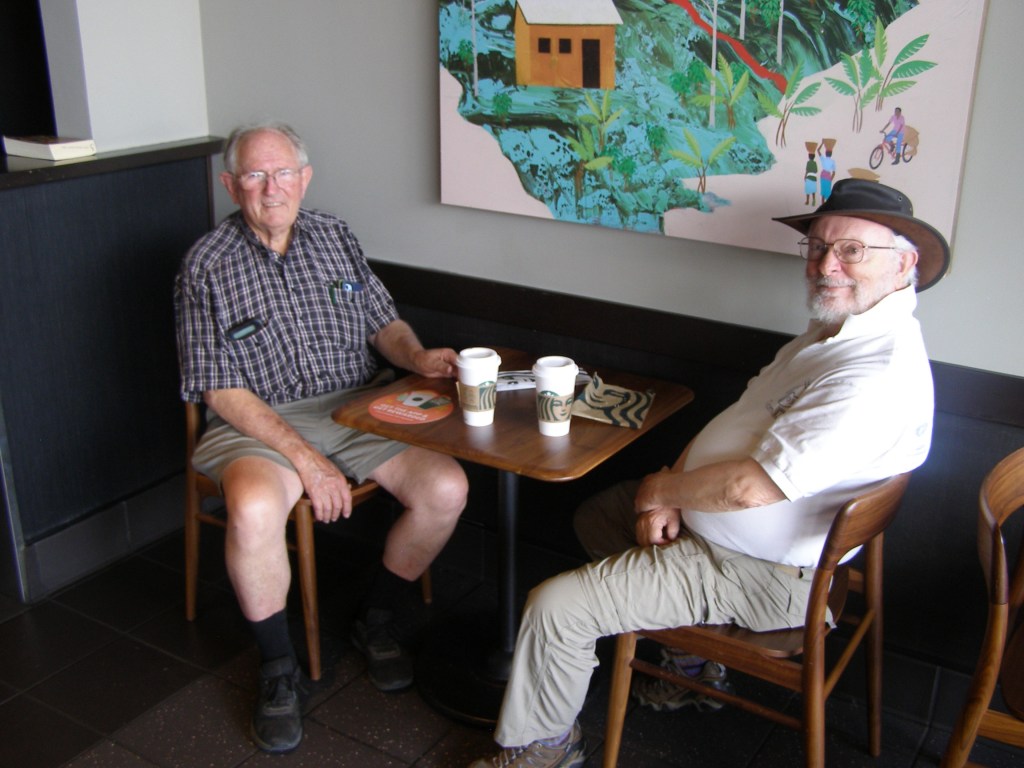
Here is Australian author/historian Ray Bell (right) with Peter Bakalor in a Seattle coffee shop in September 2024. Ray first caught up with him stateside in 2014, having not seen him circa 1967. ‘He was for a few years Autosport’s Australian reporter, I got to meet him frequently in those days, we discussed the fact that many we knew back then neither of us sees any more. Mostly for the usual reason…’
‘Peter was most recently Head of Global Technology Service Delivery and Security for a major media company, with earlier roles in product strategy, systems architecture and product marketing in technology and information companies. He was in New York for a long time but has been in Seattle for over 15 years.’
(Museums Victoria)
Rovers of different kinds!
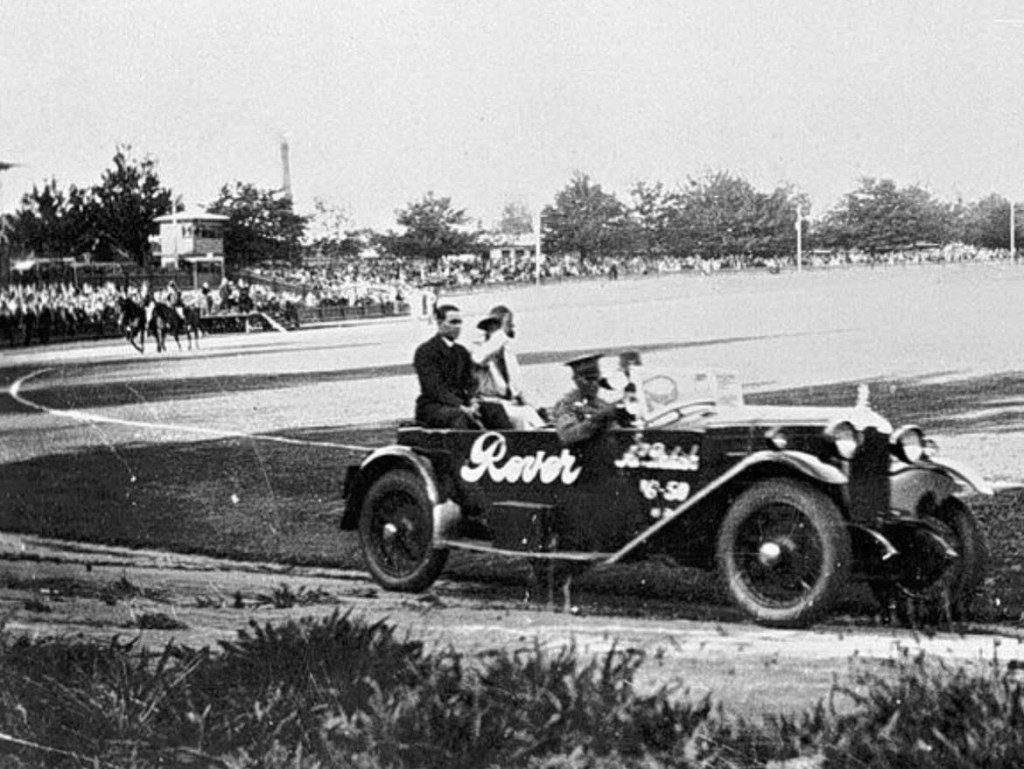
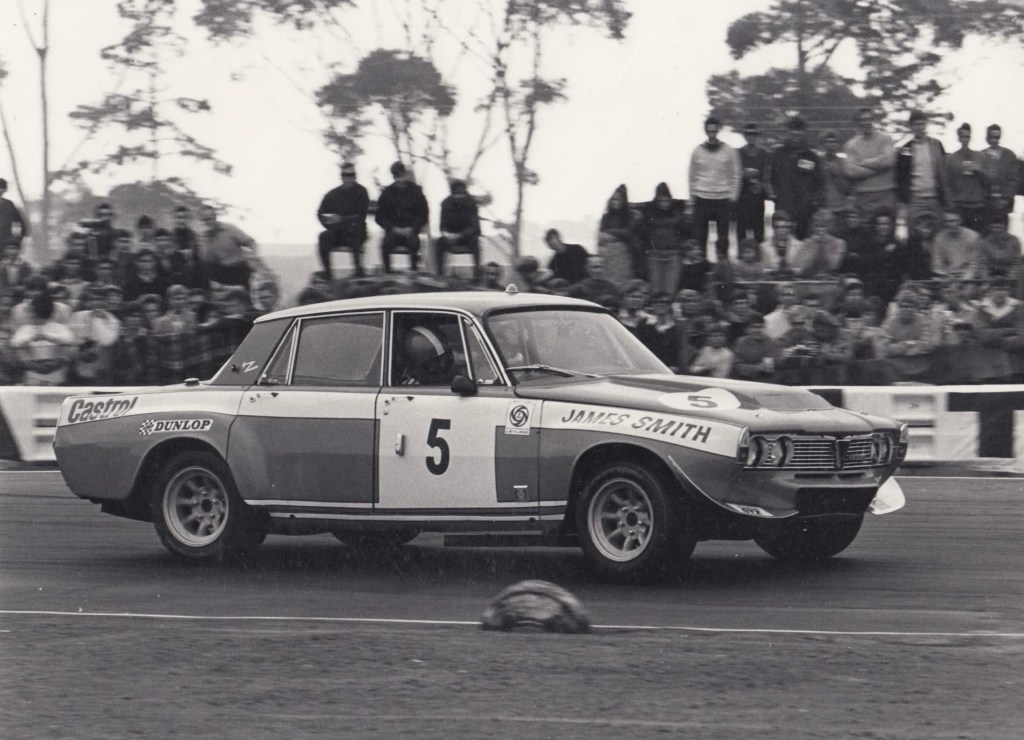
The Duke and Duchess of York circumnavigate City Oval, Ballarat, on April 29, 1927. He was later King George VI, what model Rover is it folks? While below, Jim Smith blasts around Calder in the vice-regal Rover 3500 Sports Sedan in 1971, at this stage in pretty much ex-works UK specs.
(B Williamson Collection)(R Taylor)
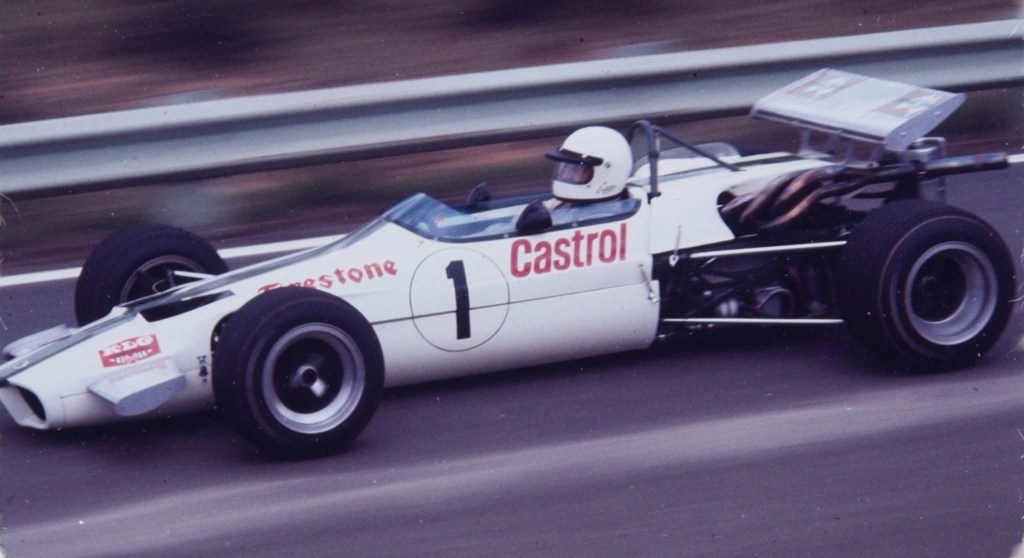
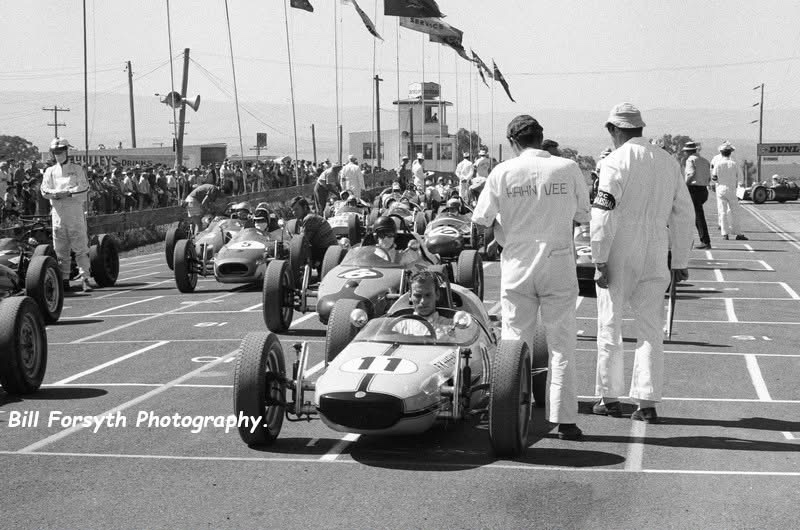
Leo Geoghegan in his 1970 Australian Gold Star Championship winning Lotus 59B Waggott 2-litre TC-4V at Warwick Farm in 1971, and below getting to grips with the handling peculiarities of Bernie Haehnle’s Rennmax Mk1 Formula Vee at Catalina Park in 1968 below. More about the Lotus 59 here:https://primotipo.com/2018/09/17/leos-lotus-59b-waggott/
(L Ruting)
Peter Finlay wrote that Pete Geoghegan raced Peter Clarke’s Rennmax in this ‘stars in Vees race’ at Catalina, so too did Kevin Bartlett, in Frank Kleinig’s Mako.
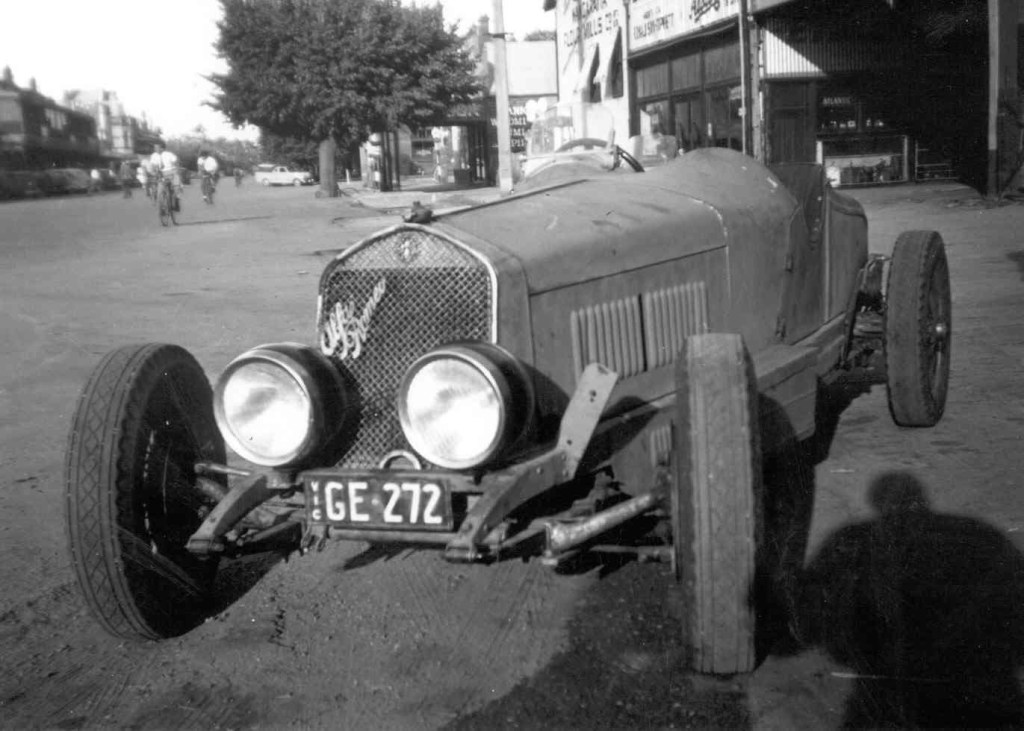
John Cox wrote, ‘My father and Ted Gray were partners in a garage in Wangaratta after the end of World War 2 when Ted came out of the army. They were involved in midget cars before the war with Harry Shaw.’
Ted’s Alfa Romeo 6C1750 Ford V8 – the ex-JAS Jones machine – is shown below, after a rollover near Yarrawonga – it was in a state of repair. The photo was taken in Murphy St., Wangaratta, about 1947.’
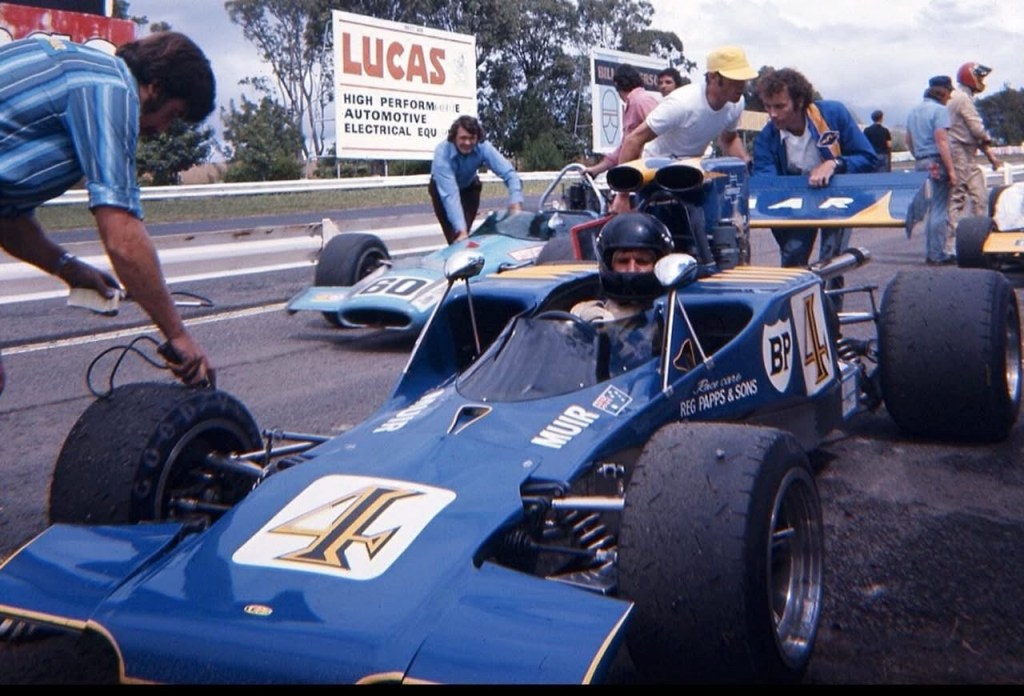
Battle of the Lola T300 Chevs during the 1972 Warwick Farm 100 Tasman Cup round; Frank Gardner in the red works-entry, and Bob Muir’s brand new concours machine prepared by Reg Papps.
FG is at the very end of his single-seater racing career with Muir at the start of his 5-litre adventure. Gardner was third on the grid, Muir fourth, with Frank second behind Frank Matich’s victorious Matich A50 Repco-Holden; Bob was out thanks to battery failure.
The lanky chap behind Bob’s left-rear is Max Stewart, the yellow wing belongs to Max’s Elfin MR5 Repco-Holden, #60 is later Australian Touring Car Championship winner, Kiwi, Robbie Francevic’s McLaren M10A Chev.
(Stupix)(A Patterson)
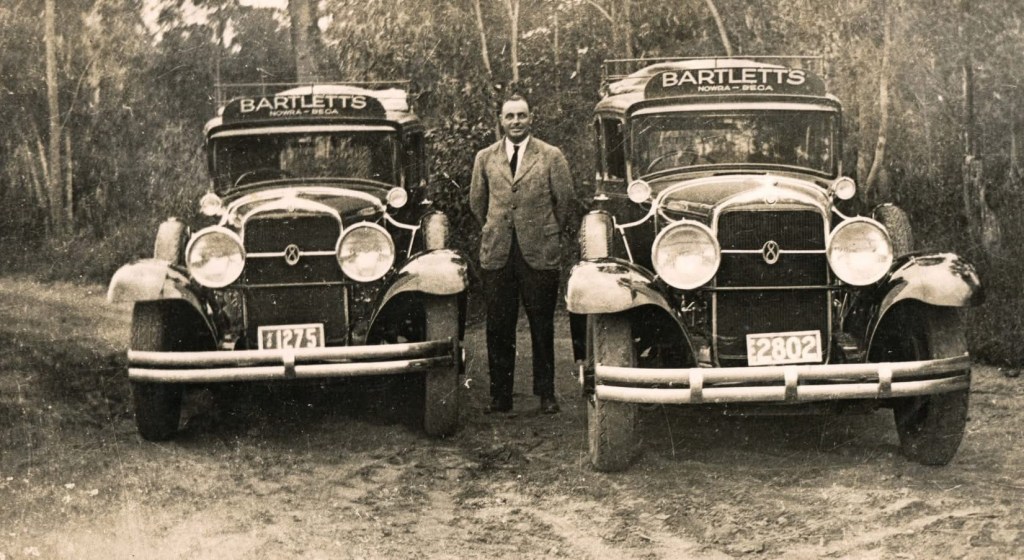
Hope Bartlett was one of the stars of Australian motor racing in the Maroubra and Phillip Island Australian Grand Prix era.
His prodigious thirst for expensive and exotic racing cars and boats was funded by his bus line, two of which are shown here. I’ll take your advice as to make.
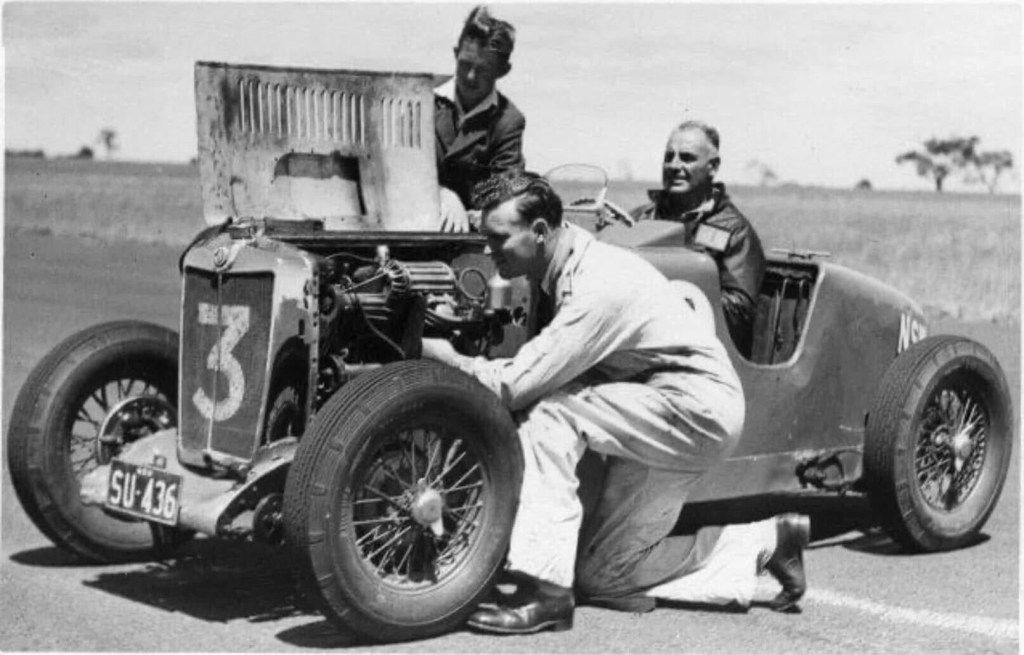
‘Bartlett is shown below at Ballarat. Leaning over the ex-Allan Tomlinson MG TA Spl s/c 1939 AGP winning car is Frank Gardner’s brother, and that’s Frank standing behind. It’s 1949. I got all that from Frank when I did a bio story,’ wrote Les Hughes. A bit more about Hope here:https://primotipo.com/2020/11/27/australian-racing-random-5/
(R Townley Collection)(D Oliver)
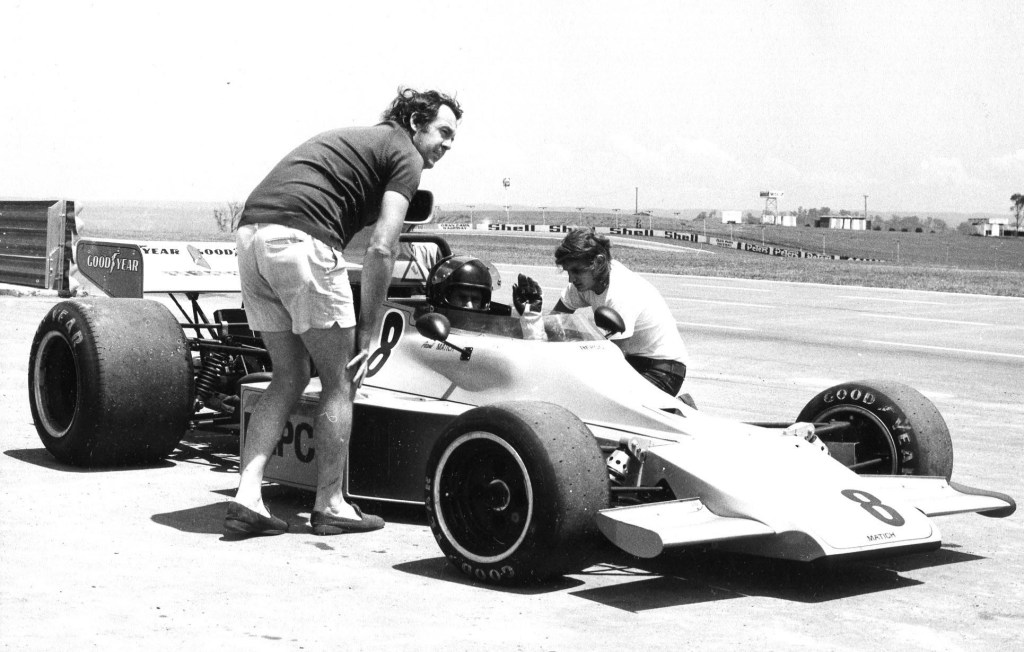
It’s not often you see Frank Matich engineering a car for another driver but here he is attending to Bob Muir’s needs in FM’s brand new Matich A53 Repco-Holden at Oran Park in the Summer of ‘74.
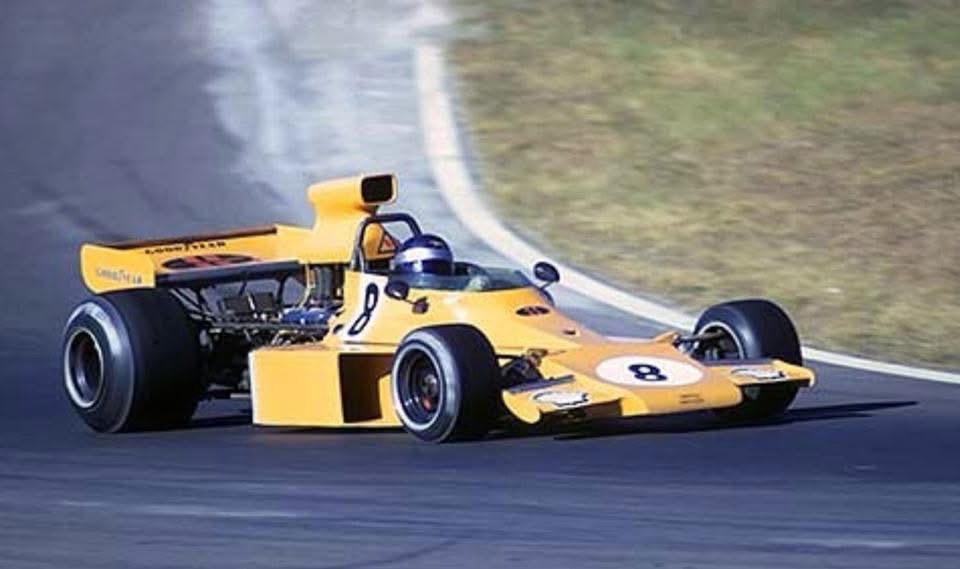
The same car – A53-007 – with John Goss at the wheel during his first race weekend with it during the August 1974 Gold Star weekend, again at Oran Park.
(oldracephotos.com)(G Ruckert)
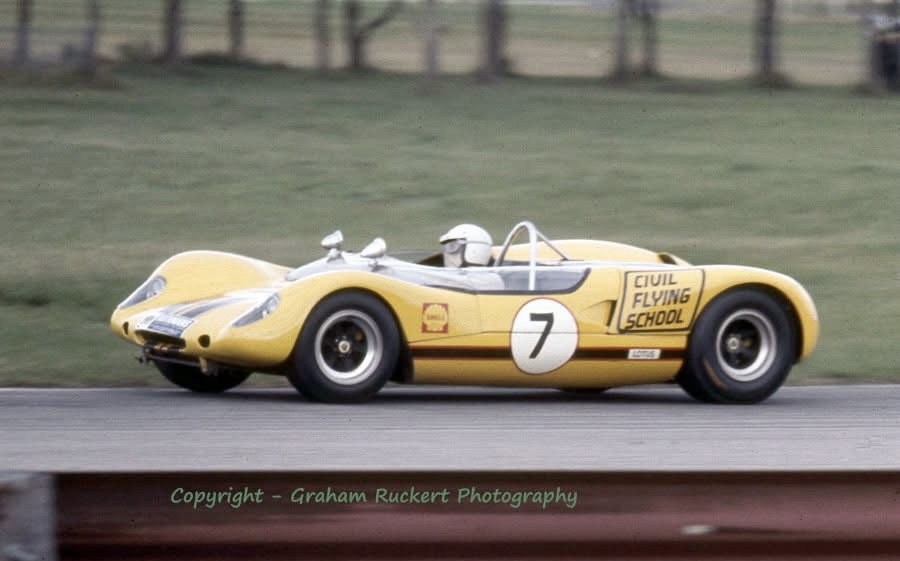
Sticking with the Muir Theme a bit longer…Here Bob Muir is chasing Bob Beasley’s Lotus 47 at Surfers Paradise in 1969 aboard his Lotus 23B Ford, both of Graham Ruckert’s shots were taken at Repco Hill. More about Bob M here:https://primotipo.com/2019/12/09/bob-muir/
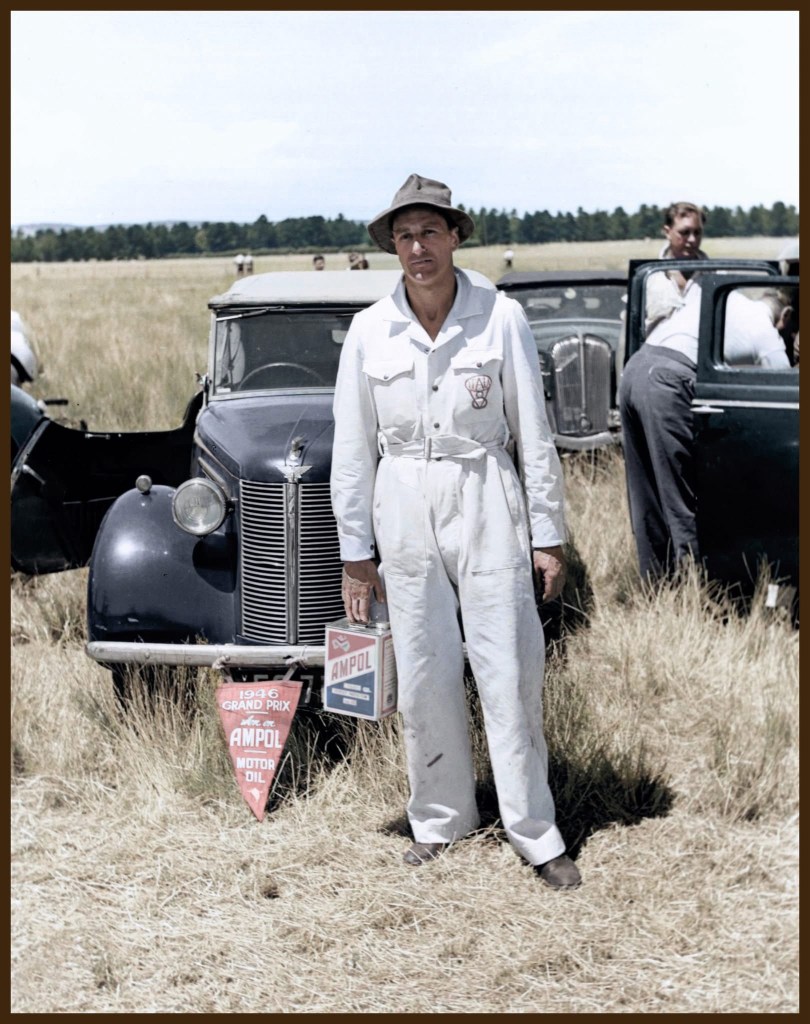
Great colourised shot of Ern Seeliger during the Victoria Trophy weekend at Ballarat Airfield in January 1947.
Ern raced Lex Denniston’s Itala Ford V8 Spl at that meeting, the car and driver are shown below at Lobethal in January 1948 during the South Australian 100 weekend during which the local geography smote the car, but not Ern, a fatal blow. See here:https://primotipo.com/2021/03/24/itala-v8-special/
The 1946 Grand Prix Ampol banner refers to the New South Wales Grand Prix won by Alf Najar’s MG TB Spl, there was no ’46 AGP.
(SAMotor)(Fairfax)
Engineer/driver Seeliger and Stan Jones after Jones victory in the 1953 Victoria Trophy at Fisherman’s Bend aboard Maybach 1, with Stan aboard that car below at Parramatta Park in 1952 ahead of David McKay‘s MG TC Spl. More on Maybach 1 here:https://primotipo.com/2024/01/15/maybach-1-technical-specifications/
(D Eagar)
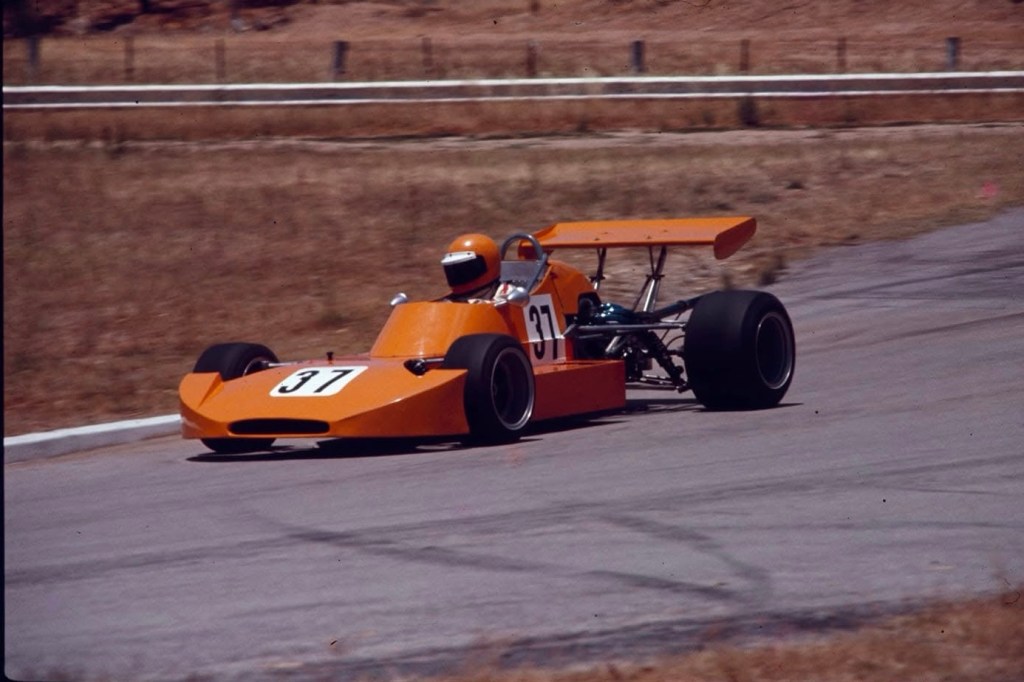
Darryl Pearsall racing the one-off Cheetah Mk4E Lotus-Ford 1.6 ANF2 (chassis 42-1) at Hume Weir on December 28, 1974.
This machine lives on in wonderfully restored and prepared form in the hands of current custodian, John Ellery. More about the Cheetah Mk4 here: https://primotipo.com/2021/11/16/cheetah-mk4/
(Police Victoria Historical Society)
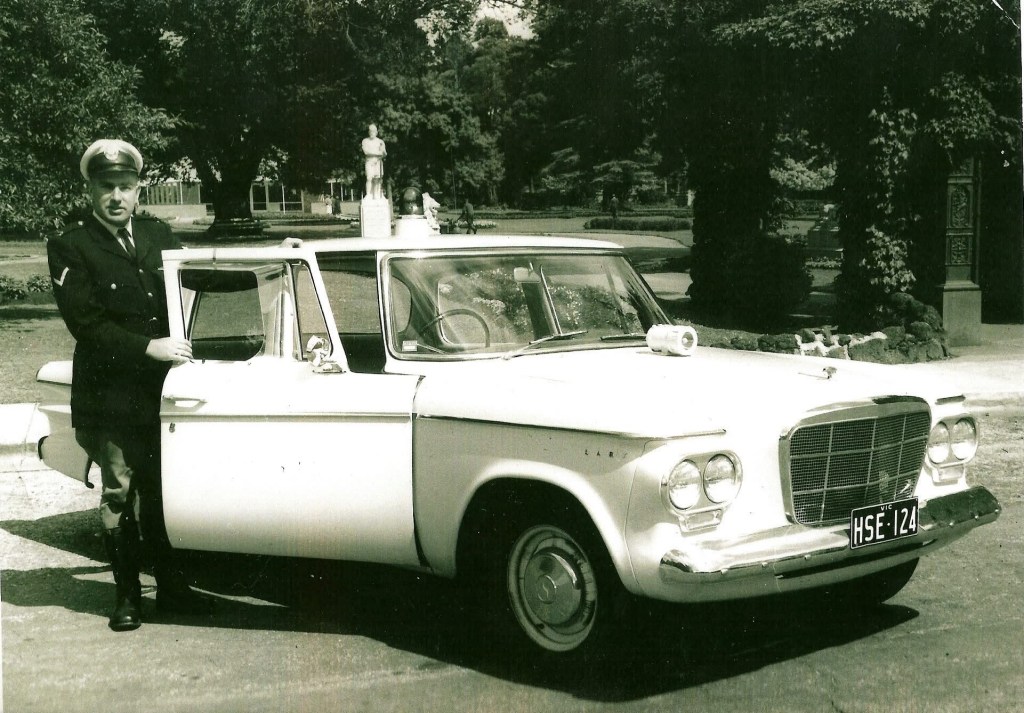
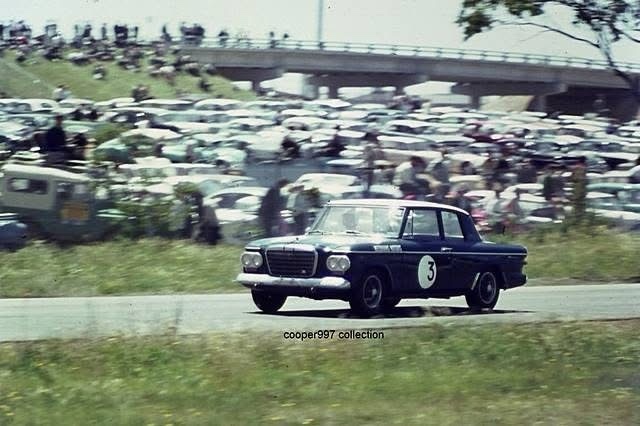
Studebaker V8s seem to have been popular both with Australian wallopers and racers in the 1960s
Above is First Constable Mal Waterhouse of the Ballarat Mobile Traffic Section with a 1962 Lark, and below, the Warren Weldon/Bill Slattery Lark contests the Sandown International 6 Hour Touring Car Race won by Frank Gardner/Kevin Bartlett’s Alec Mildren Racing Alfa Romeo Ti Super.
The Lark was 15th with 207 laps; the winners did 231. Were the trick alloy wheels kosher, or did CAMS do the Sergeant Schultz thing!? They were popular outright ‘Series Production’ cars with Weldon/Bert Needham winning their class at Bathurst in 1964
(I Adams)
A feel the vibe shot rather than whinge about the quality one OCDers…
Great post on Bob Williamson’s Old Motor Racing – Australia Facebook page by former Lola T330 F5000 racer, Ian Adams in 2019.
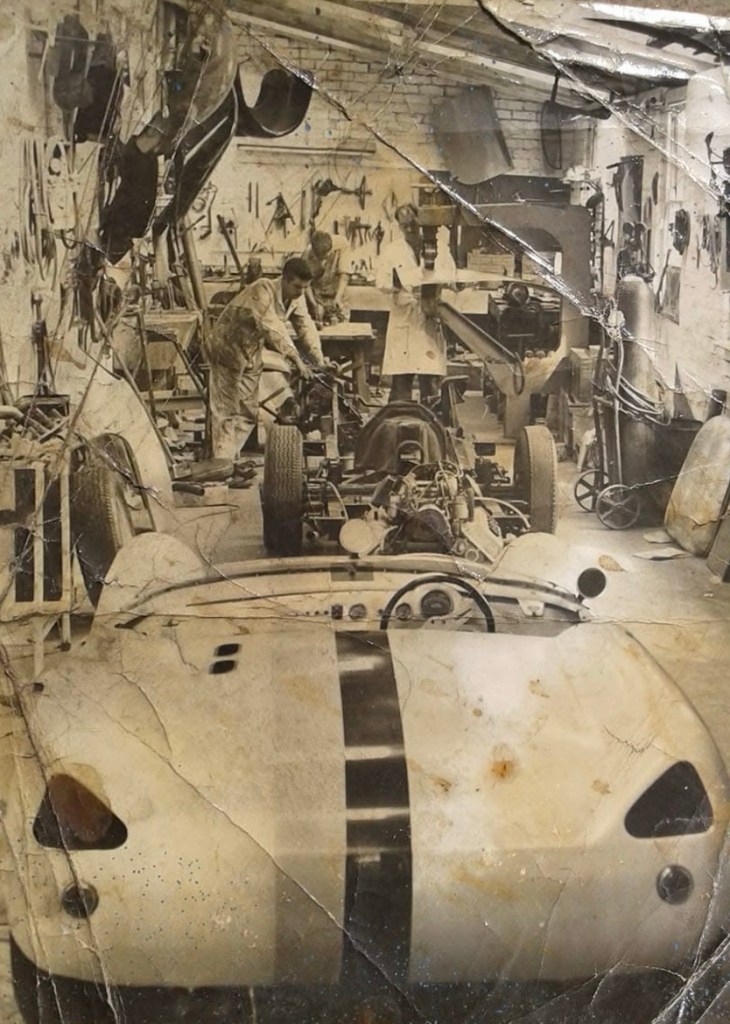
‘The late Stan Brown’s Cremorne Junction workshop in the early 1960s. In the foreground is a Sterling racer (Lotus 23 copy), Stan, wheeling a panel, and me, an apprentice working on a Daimler SP250.
Terry Hook (later too a Lola F5000 exponent), also an apprentice, is at the rear. Terry was a great mate. I got him off the beach and into the workshop. He joined my pit crew for the Lotus Super 7. I’m proud to have planned his racing career with him, starting in touring cars, then sports cars and finally F5000.
Both of us raced together in Formula 5000’s. Terry passed away, I still miss him.’
Ian Adams’ Lotus 23B Ford at Hume Weir in 1970 (T Webber)(P Mahon)
The Repco Record Holden on tour in South Australia, at Port Wakefield racetrack in the late 1950s.
The Record has been back in Repco’s ownership for quite a few years now. It was one of the star exhibits at their centenary at Jeff’s Shed in Melbourne a few years back. Since then, the Repco Hi-Power headed engine has been rebuilt and is awaiting installation. Tim Fergus is its guardian angel and fettler. See here:https://primotipo.com/2015/06/26/repco-record-car-and-repco-hi-power-head/
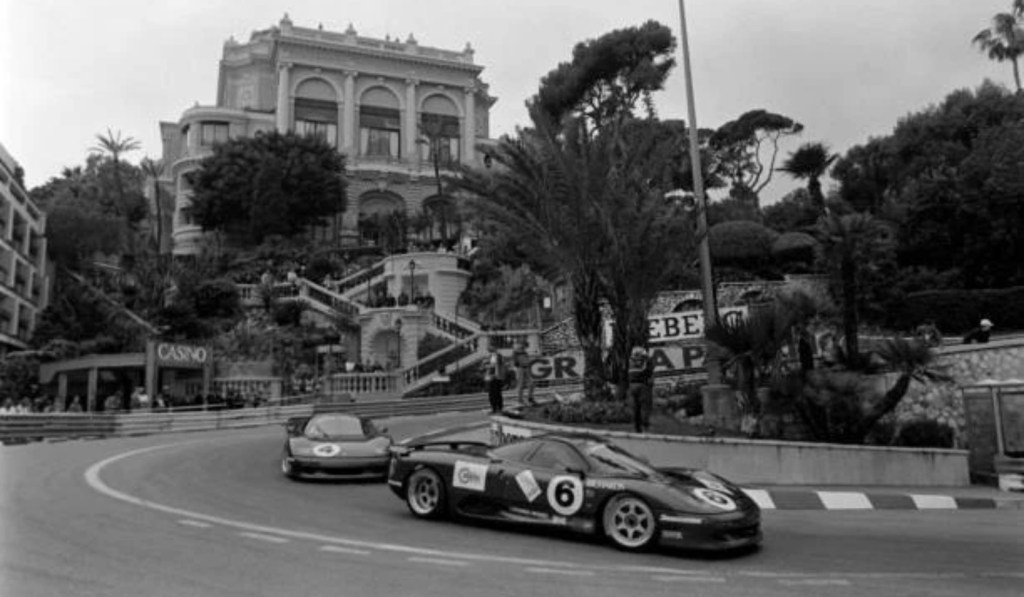
Jim Richards in front of Bob Wollek on the Saturday of the 1991 Monaco GP weekend, Jaguar XJR-15s (unattributed)
I had a great time a couple of months back writing a long Auto Action feature on Jim Richards’ Murray Bunn built Ford Falcon Hardtop XC 351 sports sedan. He is wonderful to work with, no doubt someone has a list of all of the cars he raced in his 60-year, or thereabouts, career.
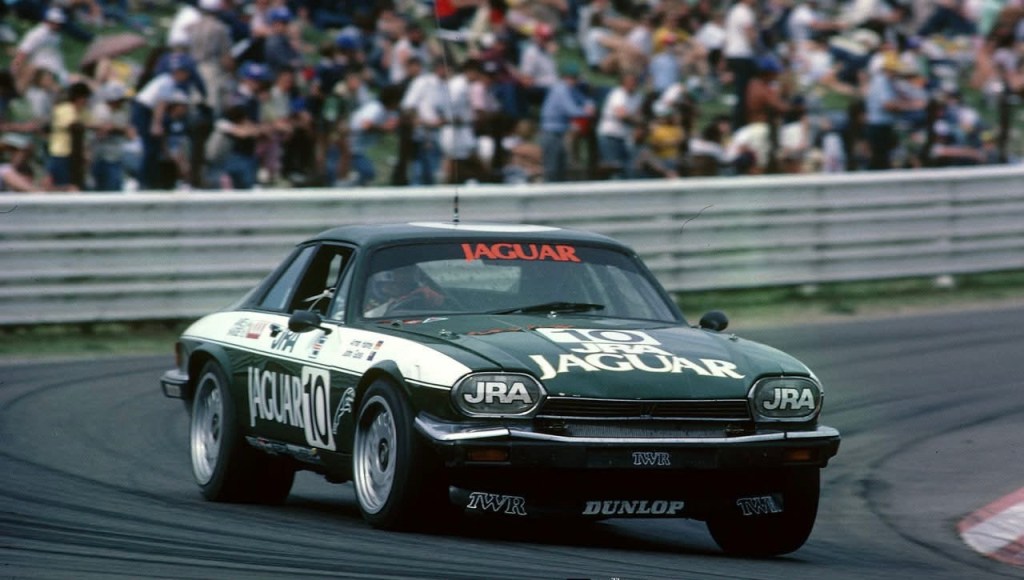
Perhaps one of the lesser-known is his two races in a Jaguar XJR-15 6-litre V12 in the 1991 Jaguar Intercontinental Challenge.
Pitted against some of the GP stars of the day, Jim was Q3! and eighth at Monaco, then Q14 and tenth at Spa three months later; both races were F1 GP support events. Armin Hahne won at Spa and the title, while Derek Warwick was victorious at Monaco and Juan Manuel Fangio 2 at Silverstone, the other round.
Richards from Jeff Allam at Spa, Belgian GP weekend 1991 (unattributed)
Credits…
Peter Bakalor, Ray Bell, Museums Victoria, Richard Taylor, Lance Ruting, Bill Forsyth, Adrian Patterson, Richard Townley Collection, Dean Oliver, oldracephotos.com, Graham Ruckert, SA Motor, Fairfax Publications, Doug Eagar, Police Victoria Historical Society, Stephen Dalton Archive, Ian Adams, Phil Mahon, Teddy Webber, Peter Finlay-Colin Piper
Tailpiece…
‘Boys Just Want To Have Fun’ to grab and twist a Cyndi Lauper line!
Peter Finlay wrote, ‘Colin Piper, who worked with Peter Windsor at the Australian Automobile Racing Club office and at the (Warwick Farm) circuit, looked after the two club Nota Vees which were housed in the garage at the homestead at Warwick Farm.
Mary Packard asked me to supervise the lively pair for a private run in the cars on the Creek Corner section of the track. This is probably my photo with Colin’s camera, of the pair that day. Piper at left, Windsor right and Cortina Mk2 GT in the middle. Photo via Colin Piper.’
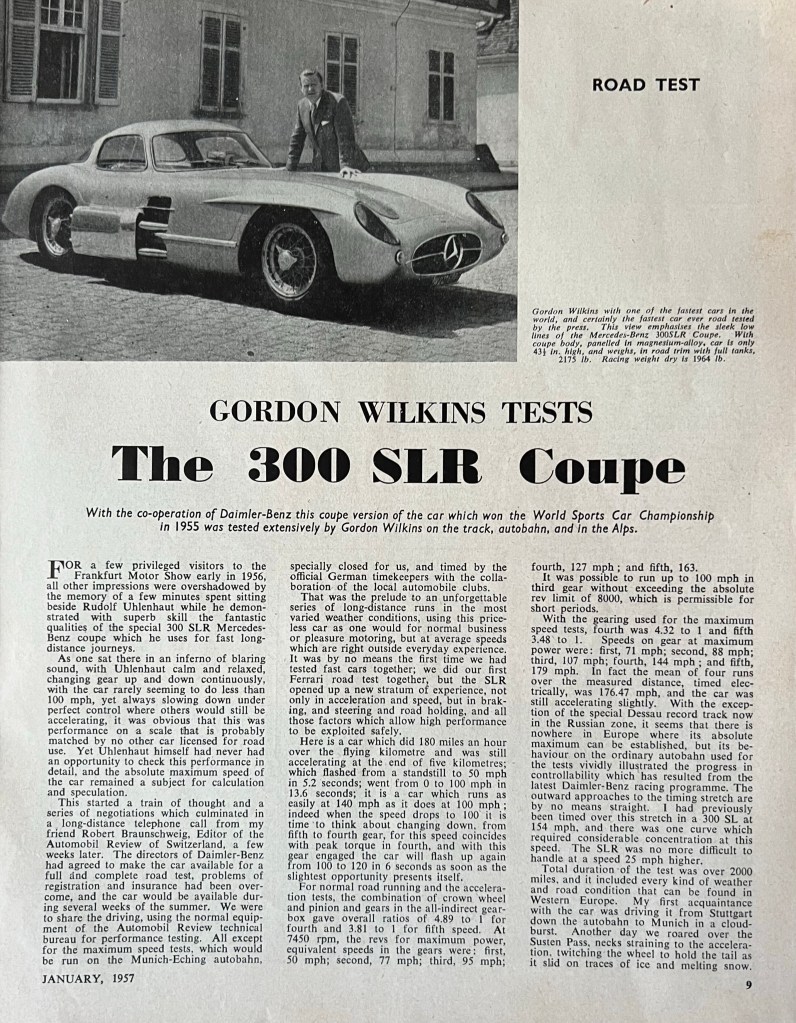
Comprehensive road tests of the 300 SLR Uhlenhaut are rather thin on the ground, so this article, written by Gordon Wilkins and published in the January 1957 issue of Motor Racing, seems like a good one to share. Gordon explains the circumstances surrounding the test in the opening paragraphs, so here it is.
Etcetera…
What I hadn’t realised until reading the spiel about these two cars on Mercedes Benz’ fantastic website, is that the first of the cars built was the very first W196S – 300 SLR – built, in November 1953.
Because Benz were running behind completion of the W196R Grand Prix car, resources being devoted to the sports car were redeployed to ensure the W196 race debut at Reims in July 1954 could be met.
Mercedes had planned to build a mix of 300 SLR coupes and spyders to driver preference, but when it became clear to Alfred Neubauer that most of the drivers preference was to race an open car – noise inside the car was the perceived issue – the build program was amended accordingly with the first of the open cars finished in June 1954.
(Mercedes Benz)(Mercedes Benz)
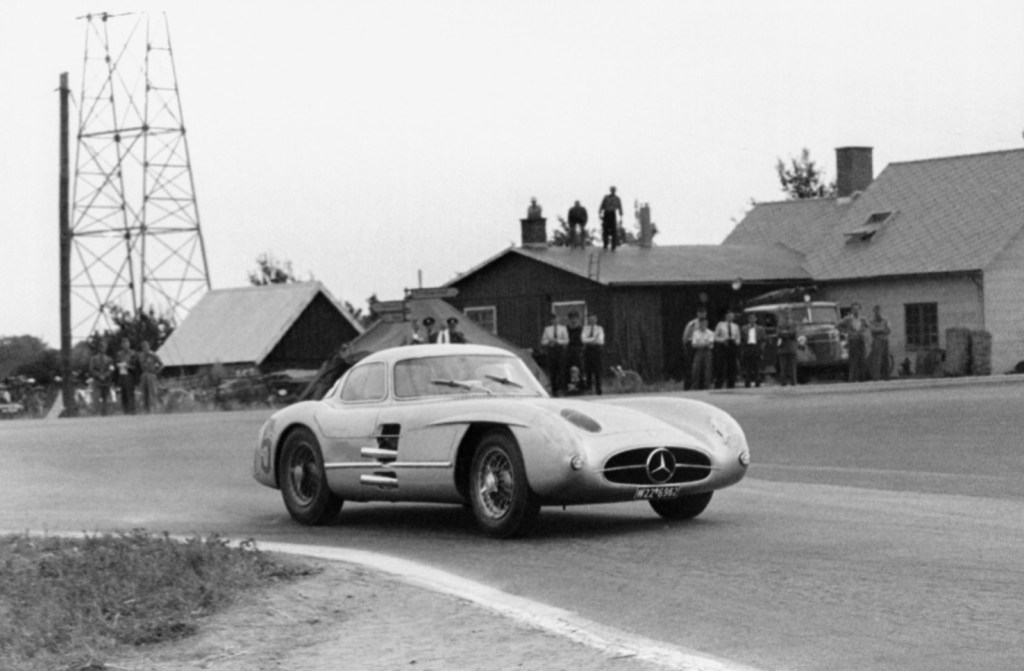
The 300 SLR Coupé made its first public appearance in August 1955, with Rudolf Uhlenhaut at the wheel during practice for the Swedish Grand Prix in Kristianstad.
By then 300 SLR spyders had already clinched a spectacular one-two in the Mille Miglia and in Sweden. The 300 SLR build program was completed in late summer 1954 after the successful start of the Formula 1 season.
In the 1955 World Sports Car Championship, which began for Daimler-Benz with the Mille Miglia on 30 April-1 May in Brescia, only the open-top version initially appeared.
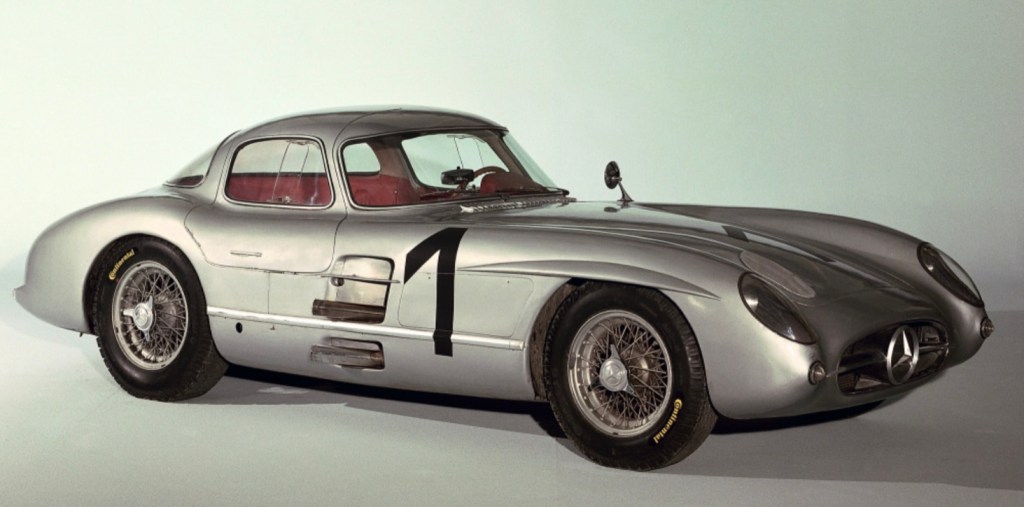
(Mercedes Benz)Carrying #1 as the car did during practice during the Targa weekend in 1955 (Mercedes Benz)
Mercedes planned to race in the Carrera Panamericana in Mexico in November 1955 and in 1956, and therefore reactivated production of the coupé version in the summer of ’55 when two cars were completed.
For long-distance races, the aim was to give drivers the option of open or closed cars, but the two exotic machines weren’t raced after the Daimler-Benz Board withdrew from motorsport on October 11, 1955 after the Le Mans disaster.
As a consequence the 300 SLR Coupé’s motorsport outings were limited to practice and test drives at the Swedish Grand Prix, at Monza, the Tourist Trophy in Ireland and the Targa Florio.
Mercedes Benz, ‘The first completed coupé covered more than 10,000 kilometres; Rudolf Uhlenhaut was mainly at the wheel; Wolfgang Graf Berghe von Trips, a newcomer to the Mercedes-Benz racing team, was given the opportunity to familiarise himself with the 300 SLR on the trip to the Tourist Trophy in Ireland. With a third place, which he achieved in a team with André Simon in the open-top version, the talented young driver contributed to the Mercedes-Benz one-two-three victory in this race.’
(Mercedes Benz)(Mercedes Benz)
Uhlenhaut, a master test driver, had already demonstrated the reliability and suitability of the 300bhp racer for everyday use with his extensive journeys across Europe and thought it sensible to make the spectacular car available to the press for an extensive test.
‘In July 1956, journalists from the Swiss Automobil Revue magazine, led by its editor-in-chief Robert Braunschweig, subjected the 300 SLR Coupé to a long-distance test covering a total of 3500 kilometres. One concession to road traffic was the huge exhaust silencer on the right-hand side of the vehicle, which reduced the deafening background noise to a more bearable level. At the beginning of July and in mid-September, high-speed test drives and top speed measurements were carried out with both examples of the coupé in the presence of Rudolf Uhlenhaut.’
From the left: W196S Uhlenhaut, 300SL-W198, 300SL-W194, 300SL-W194-011. Ditto below (Mercedes Benz)(Mercedes Benz)
‘The “Uhlenhaut Coupé”, as the car has been called by car enthusiasts since the late 1980s, is considered one of the most important icons of the Mercedes-Benz brand and also the most valuable car in the world. In May 2022, one of the two vehicles built in 1955 was sold to a private bidder for 135 million euros at an auction in the Mercedes-Benz Museum. The proceeds are used to finance the “Mercedes-Benz Fund” – a global scholarship program that aims to encourage a new generation of schoolchildren and students to develop new technologies, in particular for decarbonisation and resource conservation. The second vehicle has been on display at the Mercedes-Benz Museum for many years and is one of the most spectacular exhibits there.’
Credits…
Bob King Collection, Motor Racing January 1957, Mercedes Benz























 primotipo...