Archive for the ‘F1’ Category

(S5000)

Stan Jones in typical press-on style aboard his Maserati 250F #2520 during the 1958 Melbourne Grand Prix at Albert Park on 30 November- Stan The Man often wore these super short shirts when he raced, his tensed muscles were always a good indication that the cars of this era had a physicality about them the nimble mid-engined cars which followed did not quite so much.
A couple of those nimble machines were up front of this race- the Stirling Moss and Jack Brabham 2 litre Cooper T45 Climaxes finished first and second, Stan was a DNF after loss of oil pressure having completed 19 of the 32 laps- 100 miles in total.
The ‘John Comber Collection’ piece aroused plenty of interest- in particular from enthusiasts who remembered it racing at Sandown that November 1963 sans bonnet.
A volley of emails followed including this one from David Zeunert, a Melbourne Maserati enthusiast and historian – here ’tis for all to enjoy – and shortly thereafter, Stephen Dalton, Rob Bailey and Bob King chipped in with comments/and/or photographs. It was all great stuff which should be shared as there is some gold amongst the silver and bronze, where ‘the bronze’ is defined as stuff which is pretty well known amongst older Australian enthusiasts at least.
‘I was very fortunate to buy the Stan Jones Maserati cylinder head in a Jeff Dutton auction many years ago, from memory he had owned it for a long time, he held an auction in a large factory in Cremorne Street, Richmond, not his famous car store in Chapel Street, South Yarra. At the time he was closing this and moving to a new outlet in Cromwell Street, South Yarra, and was raising capital for that venture.’
‘There was spirited bidding and it got close to $1,000 but hey the money is forgotten later and it is a Very Special Maserati Memory of “Stan The Man”- I have seen other original 250F pieces around, once again I think when Stan sold out there were spares that Colin Crabbe, who bought the car, did not get hold of. When Bill Leech sold his Cisitalia and Maserati 300S to Steve Forristall (Texas Wheeler racing car dealer) in the late 1980s I am pretty sure he got a spare Maserati 3 litre engine as part of the deal. Forristall only had the Maserati 300S – chassis #3055/Behra’s car back in the USA a short time before he flogged it.

Stan Jones, 250F at Sandown, St Vincents Hospital charity historic meeting during practice- look carefully and you can see the bonnet does not appear to be seated properly on its leading edge- on Sunday raceday he ran sans bonnet as shown below where Melbourne’s cooler weather kicked in- note the natty v-neck jumper (J Comber)

(R Bell Collection)

‘The Maserati Team brought a heap of spares with them for the 1956 Australian Grand Prix and Tourist Trophy races. Being short of money, Team Manager Nello Ugolini sold the two 300S Maseratis soon after the race. Chassis #3059 went to Reg Smith – the father of Gary and Warren Smith – Melbourne car traders and much later a Maserati Bi-Turbo agent’s in Oakleigh. Chassis #3055 was sold to Doug Whiteford and then in the late 1950’s early 1960s to Bill Leech.’
‘I still have fond memories of Bill Leech driving the road registered 300S – WL333 – down at Pearcedale, Bill at this stage lived in Humphreys Road, Mt Eliza, I had the pleasure of visiting Bill and viewing his Bugatti, Cisitalia and Maserati 300S all together in his garage.’
‘Another piece of Maserati trivia, for years I believed the visiting Maserati Team (two mechanics – team manager – head mechanic plus Stirling Moss and Jean Behra) had stayed at the Esplanade Hotel in St Kilda but found this to be incorrect. I speak regularly with Adolfo Orsi in Modena, Adolfo is the grandson of the owner of Maserati from 1939 – 1968. I exchanged some rare photographs of the team in Melbourne and surprise-surprise, he told me he has receipts of their stay in Melbourne at The Brighton Club Hotel, then owned by the Sierakowski family, now Dan Murphys in Brighton just 300 metres from Reg Hunt’s garage where all the team’s racing cars, plus Hunt’s and Ken Wharton’s were fettled prior to Albert Park.’
Bob King, ‘Maserati Chief Mechanic and Test Driver, was, needless to say, Guerino Bertocchi, I think another was Ermanno Lotti, who later returned to Australia to look after Reg’s 300S and then worked for my mate Ron McCallum as a machinist, very good he was too. Ron, 96 today, re-metalled one big-end bearing on the Moss 250F, which involved pulling the engine down overnight.’
Zeunert, ‘As is well known, Bertocchi and the mechanics drove the cars along Brighton Road and the Nepean Highway from Reg’s workshop to Albert Park, exactly as they often did in Europe. I believe BP UK stumped up the money to enable the Maserati team – six people, five cars and a whole heap of spares, to come to Australia – BP’s local subsidiary was the Commonwealth Oil Refinery.’
‘Ken Wharton was a close friend of Reg Hunt and was the driver who suggested to Reg that he approach Maserati to buy a racing car – he ended up buying two from the Orsis in the 1950s (2.5-litre A6GCM and 250F) and the rest is history…Ken was killed in early 1957 in New Zealand’ racing a Ferrari Monza in a support sportscar event immediately prior to the NZ GP at Ardmore.

Albert Hunt admires his son’s new 250F, chassis #2516  prior to rolling it off the trailer in Elsternwick (B King Collection)

Leech 300S at Pearcedale on a Maserati Owners Club run circa 1988/9 (D Zeunert/B King Collection)

Maseratis as far as the eye can see! Reg Hunt’s Elsternwick garage- from left, a box of spares, Moss’ 300S #3059, Behra’s 300S #3055, team spare short nose 250F, Behra 250F long-nose #2521, Moss long nose 250F #?, Hunt’s short nose 250F #2516 with Hunt’s Cooper T23 Bristol at far right. DZ ‘Probably a BP PR shot, there was a cocktail party @ Hunts to welcome the team to Melbourne and one @ ‘Killara’ the Davison family farm near Lilydale- a traditional Aussie BBQ’ (R Hunt via D Zeunert Collection)

Adolfo also has the 1956 Australian Grand Prix cup awarded to Stirling Moss for his win in the 250F, I have asked him to email me pics, the Maserati 250F head is as light as a feather, the Italians were masters of the dark art of light weight foundry production, this goes right back to 1926 when Isotta Fraschini did all the special casting for the Maserati brothers for their emerging racing cars.’

‘Reg Hunt and his wife and son Graeme arrived in Australia circa 1948, Reg’s grandparents had been involved in the motor industry around Manchester in the 1890’s. I believe his grandmother raced motor bikes even back then, Reg was introduced to the family business, a motorcycle shop in Salford Road, Manchester, almost from birth running errands for pocket money before the 1930s, his parents taught him very early the good habits of thrift and saving for a rainy day.’

‘Reg was also involved in racing motor bikes however the second world war put an end to that. Reg told me he worked on tanks in England during this time of war, afterwards Reg was married with a son and was looking for a better place than the danky-cold Manchester where he grew up. He considered going to Canada but saw some motoring magazines from Australia and decided to bring the three of them ‘Down Under; no he was not a “Ten Pound Pom” to the best of my knowledge.’

‘He brought with him the bare bones of a special in suitcases to form the Hunt Special or “Flying Bedstead”, he then honed his skills and basically went on from there. I believe his parents came out after Reg settled here in Melbourne – Bert and Edna – his brother also made the journey and became an employee of Reg Hunt Motors.’

‘Reg  then bought some better race cars and eventually the two Maserati racing cars in 1954 and 1955 to race the following seasons here and in NZ, there are a million stories with Reg and I am gradually working thru his photographs and digitising them for all to see.’

‘In terms of his business, Reg started selling used cars from his first home in Noble Park, then a friend advised him to move closer to the city so he bought in Elsternwick and again did very well. He then thought he needed more exposure to the moving traffic so he rented the car park of the Church of England on the corner of the Nepean Highway and Glenhuntly Road, Elsternwick, it’s now a Zagame used car outlet.’
‘Reg being Reg, he decided, as time moved on to move further down the road and gradually bought up space to create the “Golden Mile of New and Used Cars” in the 1950s, Reg told me he knocked down over 300 houses to create his various dealerships there. He is an amazing man and still with us, my wife and I have dinner with he and his long term partner, Julia Hunt as often as we can – 97 years old this May just gone,’ David concluded.

Who is the pretty boy then!? Reg Hunt looking very cool and dapper with sports jacket, flat-hat and Raybans, near the old army drill hall where the swim/basketball stadium is today, Albert Park. DZ suspects this is a pre-event AGP PR shot by ‘The Argus’ newspaper (D Zeunert Collection)

Moss’ works Maserati 250F, 1956 AGP weekend at Albert Park with Guerino Bertocchi tending. Bob King thinks it may be Sil Massola by the car’s tail (B King)

Whiteford trailer after restoration by Kerry Manolas (R Bailey)

Stephen Dalton chips in, ‘Reg Smith was indeed Garry and Warren’s father. He originally had Smith’s Radios in Smith Street Fitzroy, but branched into the car trade as ‘Reno Auto Sales’, his race entries can be found with either of those business names as the entrant.’
‘Before the 300S he had a pair of air cooled Coopers and Jack Brabham’s 1955 AGP-winning Cooper Bristol T40 – the rear engine ‘Bobtail’ type car. He only had the 300S for about six months before trying to move it on. I’m (currently) aware of adverts in the July 1957 AMS and the June 1957 Rob Roy programme.  There was obviously no takers, until Bob Jane came along in late September/early October 1958. The sale is recorded in the 15 October 1958 Australian Motor News – a fortnightly late 1950s Auto Action type publication.’
‘Bob got the 300S after Reg had purchased a new Ford Thunderbird, then at the following weekend Jane ran the 300S at Fishermans Bend. Reg Smith was one of many to lose his life on Conrod Straight at Bathurst, driving a Porsche 356 during the October 1960 meeting. Graham Hoinville once stated to me that at Reg’s funeral there was talk of his generosity to the needy around his business area.’
‘My understanding is that the Leech brothers took over ownership of the Doug Whiteford 300S in or around August 1961. The car was run at the 27/8/61 Geelong Speed Trials by old and new owners. It’s recorded in the Nov 1961 AMS within the 10/9/61 Rob Roy report that Doug was having his second run in the 300S after the change of ownership.’
Now Rob Bailey, note that we all terribly biased Stan Jones fans here…’A long term family friend Don McDonald (Black Mac) who raced in the 1953 AGP at Albert Park always told me that Jones was the best racer of the period and would have made it overseas, Peter Brock even mentioned that Jones was one of the period drivers that “Straight lined” or “line drove”.
Regarding Rice trailers, Glenn Coad had in storage, up to a few years ago the Whiteford one all restored  sitting in a factory behind Izy Hertzog’s business in Port Melbourne, whilst the sister trailer was owned till his passing by that very fine gent John Best who would park it  around the corner from Barkers road Hawthorn East, his son Roy had it for sale several years ago.’
Derek Rice owned Rice trailers (no relation to the UK Rice trailers) was a man of taste who acquired  from Bernard Down the Rolls Royce Phantom #lll 3AZ158 the Gurney Nutting three position sedanca; for many the most magnificent  Rolls-Royce or Bentley to have ever reached these shores. Rice hit hard times in the 1960s. As a child I can remember being with my father going to his home in the Murrumbeena area when he purchased the Phantom…’
‘Its interesting how Walter Baumer’s Maserati 300S book notes that the Moss/Jane car #3059 was raced in the 1956 Mille Miglia by Taruffi for second place and the same years Targa Florio (Taruffi) and also won the 1956 1,000 km Nurburgring – such a wonderful reference book…’

Bob Jane 300S- where/when folks? (unattributed)

Etcetera…

(S Dalton Collection)

Australian Motor Sports piece on the occasion of the arrival of Stan Jones’ 250F in Australia and spare 3- litre 300S engine.
Moss exits Jaguar Corner on the way to a most impressive demonstration of high speed car control during the AGP.
Credits…
Many thanks to David Zeunert, Stephen Dalton, Rob Bailey and Bob King
S5000 Facebook page, Rob Bailey, David Zeunert Collection, Reg Hunt, Bob King Collection, Ray Bell Collection, John Comber, Bill Leech Collection
Tailpiece…

(B Leech/COR via D Zeunert Collection)

Stunning shot of the visting Officine Maserati team to Australia for the Melbourne Olympic Albert Park race meetings, again at Reg Hunt’s Elsternwick garage.
From the left-Nello Ugolini, Team Manager, Emmore Manni, Mechanic usually associated with JM Fangio, Guerino Bertocchi, Chief Mechanic and Test Driver, Jean Behra, Beppe Console, Mechanic and Stirling Moss. Then Dennis Druitt, BP UK head, funds from BP allowed the Maserati entourage to Australia in full force, Ken Wharton and Reg Hunt on the far right. The 250F is Jean’s #2521.
Finito…

(Bonhams)

A couple of months ago, fifty years back Jack Brabham lost the Monaco Prix on the last corner of the last lap when he goofed his braking point for the Gasometer Hairpin- harried as he had been by Jochen Rindt who had been in ‘cruise and collect mode’ for a good percentage of the race until misfortune outted many of the dudes in front of him.

At that point, with a sniff of victory, he tigered in an amazing way- fastest bloke on the planet as he undoubtedly was at the time. Up front Jack’s comfortable cushion was whittled back by his former teammate aided and abetted by some unintended baulks by other drivers.

It is a well known story i have ventilated before, here; https://primotipo.com/2018/05/24/jochens-bt33-trumped-by-chunkys-72/ and here about Jack’s last season of racing; https://primotipo.com/2014/09/01/easter-bathurst-1969-jack-brabham-1970-et-al/

The two blokes alongside Jack in the shot above are his teammate Rolf Stommelen and on the outside the V12 Matra MS120 of Henri Pescarolo- Rolf did not qualify whilst Henri finished a splendid third, one of my most popular articles is a piece on the Matra here; https://primotipo.com/2014/07/06/venetia-day-and-the-1970-matra-ms120/

Love those ‘knock on’ hubs- a carry over from BT25 perhaps? BT33 a sexy and very quick jigger which was still very competitive in Tim Schenken’s hands in 1971 (Official Brabham)


Nice look at Ron Taunanac’s second monocoque chassis, Jack aboard BT33 at Monaco, the first being the 1968-1969 BT25 Repco ‘760’ 4.2 V8 engined ‘Indycar’

I wouldn’t have bothered with another article on BT33 but a couple of these photographs popped up lately and are too good not to share. The other thing which intrigues me a bit are the ‘Jet Jackson’ United States Air Force fighter pilot type crash helmets Jack, Jackie Stewart and Piers Courage experimented with in the earlier months of 1970 during the Spanish, Monaco and Dutch Grand Prix weekends that year, and in other events the drivers contested.

We are only, at the start of the 1970 season, nearly three years down the path since David ‘Swede’ Savage first used the first ‘Bell Star’ in motor cycle competition in mid-1967. The design was a great step forward in driver safety, Jackie Stewart was a safely crusader as we all know, it’s interesting that he chose to trial these open style of helmets which on the face of it , pun intended, seems a retrograde step.

Jackie Stewart- who else could it be with his distinctively branded USAF helmet in early 1970. March 701 Ford (Getty)


Piers contemplating the next change to be made by Gianpaulo Dallara to his De Tomaso 505 during early 1970 (Getty)

Most sadly, Piers put his to the ultimate test, he was wearing it when he crashed to a most gruesome death at Zandvoort on 21 June 1970- in no sense am i suggesting a Bell Star would have saved his life I might add.

When he went off on the flat or nearly flat out curves at the back of the circuit and into the catch fencing his helmet was wrenched off with both Adam Cooper and Jackie Stewart writing that he was probably dead before the conflagration which susequently engulfed the De Tomaso 505 Ford.

After some basic research i cannot find who made these helmets, i am intrigued to know the answer to that question if any of you know it.

After Monaco Brabham and Stewart do not appear to have worn the helmets again in Grands Prix.

(B Cahier)


(unattributed)

Jack thinks about an inside run at Jackie during the March 1970 South African GP- Kyalami.

At this stage of the season, the first championship round of course, they are both Bell equipped- Stewart in a ‘Star’ and Brabham a ‘Magnum’- Jack won the race with the reigning World Champion back in third aboard a machine which was not one of his favourites but far from the worst GP car he ever drove.

Brabham used three helmet types that season, two Bells- a Magnum and Star plus the USAF fighter helmet.

He was a busy boy in 1970 running the full GP season, selected F2 races in a John Coombs owned Brabham BT30 Ford FVA and five or so endurance events with Matra, plus the odd one-offs, here he is jumping out of his MS650 during the 1000 Km of Brands Hatch in April still wearing the fighter helmet, but a slightly different one to that he used in Monte Carlo.

Car #3 is the Scueria Filipinetti Ferrari 512S raced to thirteenth place by Herbie Muller and Mike Parkes


Jack shared the car with Jean-Pierre Beltoise , the pair finished twelfth in the race won by the JW Automotive Porsche 917K raced by Pedro Rodriguez and Leo Kinnunen, this being the race in which the Mexican Ace mesmerised the drenched crowd with his car control of the 450bhp machine as he flicked the big car frm lock to lock as though it was a nimble Formula Ford.

Wind the clock forward a month and Brabham had his last crack at Indianapolis in a Brabham BT32 Offy- this car was one of the BT25 Repco ‘760’ 4.2 V8 chassis modified by fitment of the turbo-charged four cylinder Offy motor- note the Bell Star in use at Indy.

This is during qualifying on 9 May, Jack was classified thirteenth from Q26, he retired with engine problems having completed 175 of the 200 laps, the race was won by Al Unser’s ‘Johnny Lightning Spl’ Colt Ford V8

Jack all ready to boogie with his Sunday best shoes on, no less. Same knock off hubs as the BT33 by the look of it


(Brabham Family)


(unattributed)

The Charade circuit just outside Clermont Ferrand was another French Grand Prix course which sorted the roosters from the feather dusters- I nearly made it there two years ago having first promised myself I would visit the place when falling for it with my nose buried in Automobile Year 18 in 1971. Drat.

Jack leads here from Jochen Rindt and Henri Pescarolo- Jochen won that day from Chris Amon and Jack with Henri fifth.

Brabham has his Bell Star on as does Henri but Jochen has swapped the full-race Star he used in 1970 more often than not for one of his old Magnums as the nature of the challenging course through the Auvergne-Rhone Alps countryside made him feel motion sickness which was solved with a change of helmet

Jochen was wearing a Bell Star on that fateful day at Monza in September but the crutch-straps of his Willans six-pointer were not items the great Austrian used- on that particular day in that particular accident he needed them badly, and divine intervention.

(Flickr)

‘It turns in ok but as I apply throttle…’ two great mates doing wonderful things together discussing the next chassis change at Zandvoort in 1970- Frank Williams and Piers Courage, note the helmet.

The car was not too flash at all in Kyalami but with each race Courage, the car’s designer Gianpaulo Dallara and Williams were improving it- expectations of both Williams and Courage were high for 1970 as the second-hand Brabham BT26 Ford they raced in 1969 had proved Piers’ place was right up front.

At Zandvoort Courage was running seventh from Q9 ahead of John Miles in a works Lotus 72 (below) when the accident occurred on lap 23- there was not enough of the wreck intact to determine whether the cause was cockpit/component/tyre.

(Twitter)

Pretty enough car which was progressively ‘getting there’, that oil cooler locale is sub-optimal, some revs lost perhaps in top speed. Dallara did get the hang of this racing car thing didn’t he?

In Australasia we had three visits from Piers and Sally Courage aka Lady Curzon, Earl Howe’s daughter, the couple and Piers pace and personality endearing them to all.

In 1967 the #1 BRM Tasman P261 2.1 V8 seat was occupied by Jackie Stewart (apart from Teretonga) with Richard Attwood, Courage and Chris Irwin sharing the second seat, the seasoned Attwood performing best.

In fact that year was a character building one for the Courage Brewing scion, it was said he was ‘over driving’ and despite John Coombs supposedly advising he get out before he killed himself the plucky Brit bought the McLaren M4A Ford FVA he had raced for Coombs that season and headed off south with a couple of FVAs funded by savings, some sponsorship from Courage, a loan from his father and a deal with Coombs which deferred payment for the car until the end of the series.

He had a brilliant 1968 summer with the Les Sheppard prepared 205 bhp car amongst the 2.5s, demonstrating all the speed which had been always apparent but with a much bigger dose of good judgement in the series of eight races over just as many weekends. He blotted his copybook at Pukekohe on the first day of practice but after Les ‘read the riot act’ his performances were very good to brilliant.

Teretonga 1967, BRM P261 2.1 V8, DNF engine after 53 laps- Clark won in his Lotus 33 Climax FWMV 2 litre from Attwood in the other BRM  (Ian Peak Collection)


Piers third and Chris Amon fourth with a deeply appreciative and enthusiastic Warwick Farm crowd at the end of the 1968 Warwick Farm 100- McLaren M4A Ford FVA and Ferrari 246T. Up front were the Team Lotus duo of Clark and Hill in Lotus 49 Ford DFWs (B Thomas)


Teretonga 1969- Derek Bell, Ferrari 246T from Graham Hill, Lotus 49B Ford DFW and Piers, Brabham BT24 Ford DFW. Piers took a splendid win that day from Hill and Amon (Steve Twist Collection)

Whilst fun in the sun is part of Tasman lore- and fact, there was plenty of pressure on a small equipe such as the Courage outfit to prepare the equipment and race it weekly, for the most part on unfamiliar circuits all of which were well known to his main competition- Clark, Hulme, Gardner, Hill to name a few.

His season ending win at Longford is still spoken about in reverential tones by those who were there- it literally pissed down with Piers legendary bravery coupled with a deftness of touch on one of the most daunting road circuits by then still in use in the world- whilst noting it was sadly the last time the circuit was used too.

In many ways the campaign ‘re-launched’ his career. Adam Cooper wrote ‘Thanks to the extensive press coverage his exploits received, Piers’ reputation was in better shape than he could have predicted. He was a failure (not entirely fair in that he was fourth in the 1967 European F2 Championship behind Ickx, Gardner and Beltoise despite pinging off too many bits of real estate) who had made himself into a hero. Those who had paid closer attention noted that his solo campaign also reflected an incredible determination and a hitherto unrecognised ability to organise. Even before Longford he’d been approached by Tim Parnell about renewing his relationship with BRM. Tim had seen the Courage revival at first hand, and was impressed.’

Back in at Slough Frank Williams was readying the Brabham BT23C FVA for the 1968 Euro F2 Championship, in addition he had his BRM ride and a personal retainer with Dunlop, he was away…

Rather than prattle on now about his Tasman exploits lets do ‘Piers in The Pacific’ soon- his Tasman Cup runs in 1967-1969 in BRM P261, McLaren M4A Ford FVA and Brabham BT24 Ford DFW respectively.

Bell Star…

Dan, Nurburgring 1968 as seen by (P-H Cahier)


There was no shortage of interest in Dan Gurney’s fancy-schmancy new Bell Star over the German Grand Prix weekend at the Nurburgring over the 4 August 1968 weekend, understandably so- mind you, he used the helmet at Indy that year too- May of course so it was already’out there’.

Dan was ninth in his Eagle Mk1 Weslake, doubtless his head was a bit more dry than the competition- up front it was Stewart from Hill and Rindt, Matra MS10 Ford, Lotus 49B Ford and Brabham BT26 Repco in a day of challenging rain.

But the first Bell Star use credit seems to go to David ‘Swede’ Savage in his motor cycle racing days, here is below at Santa Fe in 1967 so equipped- 9 June to be precise.

Perhaps the first life saved by the technology was that of Evel Knievel who came terribly unstuck upon landing when attempting a motorcycle jump over the Caesar’s Palace Casino Las Vegas fountains (43 metres) that 31 December, breaking and crushing countless of his bodies bones- but not his head!

If Swede’s 9 June use of the Bell Star is not ‘the first’ i am intrigued to know who has that honour and its date.

(Forever Savage)


(Forever Savage)


It was a pretty happy month of May for All American Racers when three Eagles filled the top four places of the Memorial Day classic, Bobby Unser won from Dan Gurney (above) with Denny Hulme fourth, the interloper was Mel Kenyon’s third placed Gebhardt Offy.

Of historic interest to we Eagle buffs is that the three Tony Southgate designed Eagle Mk4’s were powered by quite different engines- Unser’s used an Offy Turbo four, whilst Dan used a pushrod fuel injected Gurney-Weslake V8 whereas Denny in the other works car used the Ford DOHC ‘Indy’ V8- the options were certainly well covered, were it not for a rear tyre puncture minutes from the end of the race which befell Hulme, it would have been a clean sweep of ‘the podium’ placings.

Oh yes- Dan’s Bell Star, first use of the helmet in car racing.

Photo and Reference Credits…

Official Brabham/Brabham Family Collection , Automobilsport, MotorSport, LAT, ‘Piers Courage: Last of The Gentleman Racers’ Adam Cooper, ‘Forever Savage’ Facebook page, Ian Peak and Steve Twist Collections on The Roaring Season

Tailpiece…

(LAT)

Another one that got away.

Brabham exits Druids Hill with millimetre precision during the 1970 British Grand Prix- he had passed and was driving away from Jochen to what seemed a certain win but for a shortage of fuel hundreds of metres short of the chequered flag. Oh yes, Bell Star equipped.

Finito…


(L McGrath Collection)

The photographer, Mr McGrath, has composed and executed a brilliant oh-so-wide format shot of the battle for outright honours between Alec Mildren’s leading Cooper T51 Maserati and his pursuer, Lex Davison in his new but old-school, glorious front-engined Aston Martin DBR4/250 3 litre during the 1960 Australian Grand Prix.

The shot really has drama doesn’t it?

The action is framed by the crowd in both the foreground and background, half of them are sun-smart- love the ‘coolie-hats’ (am I allowed to say that these days?) but my favourite headgear is the ‘Cockie’ to the left in the worn Akubra. Checkout the two ‘thrill-seekers’ atop the Castrol sign filming the action- hopefully there was no involuntary swan-dive before the end of the race. Marvellous shot despite the flat as a tack ex-airfield terrain McGrath had to work with.

The other shots herald the death of Lotus 12 Lycoming ‘351’ aka ’Sabakat’ in a preliminary event after the fearless Ern Tadgell lost control of one of the biggest piles of merde ever allowed through a scrutiny bay in this country.

The inspecting fellas must have misplaced their guide dogs that day even if I try to apply the standards of the day which were far less risk averse than in the litigious lilly-white politically correct world in which we live today.

(L McGrath Collection)


(AAA)

Crop duster pilot/entrepreneur Tadgell had wedding tackle of porn-star proportions to drive the Lycoming aero-engined monster he created from the delicate little flower imported from England, but in the end the laws of physics got the better of him- either a rear hub broke or the car ran wide on a corner, it then rolled, throwing Ern clear whereupon the whole lot burned to death in a conflagration Guy Fawkes would have been happy with. Tadgell, thankfully and luckily, lived to fight another day in an exciting life lived to the absolute full.

(AAA)


(L McGrath Collection)

‘Far-canal, what are we going to do with it now!?’ seems to be the issue at hand.

Digger at right awaits instructions, which are just about to be provided by the ‘fog-horn’ wielding Queensland Racing Drivers Club official in blazer and tie (must have been hot in that). The lean fella at left in the white overalls appears to be a crew-member, he is holding a cast iron brake rotor which has survived as has the steel spaceframe chassis, or parts of it anyway.

You can see the rear of the chassis frame- it is upside down with the rear facing us. There are a couple of driveshafts and remains of wheels, a fuel tank at right, a coil spring and the remains of some of the torn fibreglass bodywork. The Lycoming 7.86 litre six cylinder engine was constructed mainly of light alloy, so it, and the Cheshunt made cast components melted in what was a decent old bonfire.

Whilst the wreck was deemed beyond economic repair back then many a modern ‘rebuild’ has started with far less than this, a nose badge or vinyl decal will do. As you will see from the Sabakat story attached Graham Howard would have been delighted to have had these discarded, very well heat-tempered chassis parts when he chased the remains of this car in the early seventies before building the faithful replica we all know and love today; https://primotipo.com/2019/08/22/just-add-lightness/

(L McGrath Collection)


(AAA)

Mildren and Davison race to the line- in the end the 2.5 litre Maserati four triumphed over the brawny 3 litre Aston Martin six in that final sprint, a well deserved win for Alec, this time Davo’s famous AGP luck did not not quite hold by half cars length, with the epitome of a sportsman gallant and generous in defeat. Click here for a full report of the race towards the end of this feature on Mildren’s Cooper; https://primotipo.com/2018/06/08/mildrens-unfair-advantage/

Credits…

Lindy McGrath Collection, ‘AAA’- Aussie Automotive Archives

Race Footage (no sound)…

Tailpiece…

(L McGrath Collection)

It burned and burned, famously, the start of the AGP was delayed so much that Alec Mildren was able to repair his Cooper’s broken driveshaft in time to take the start- and subsequently win the race.

Ernie was a very lucky boy that day but that car…

Finito…

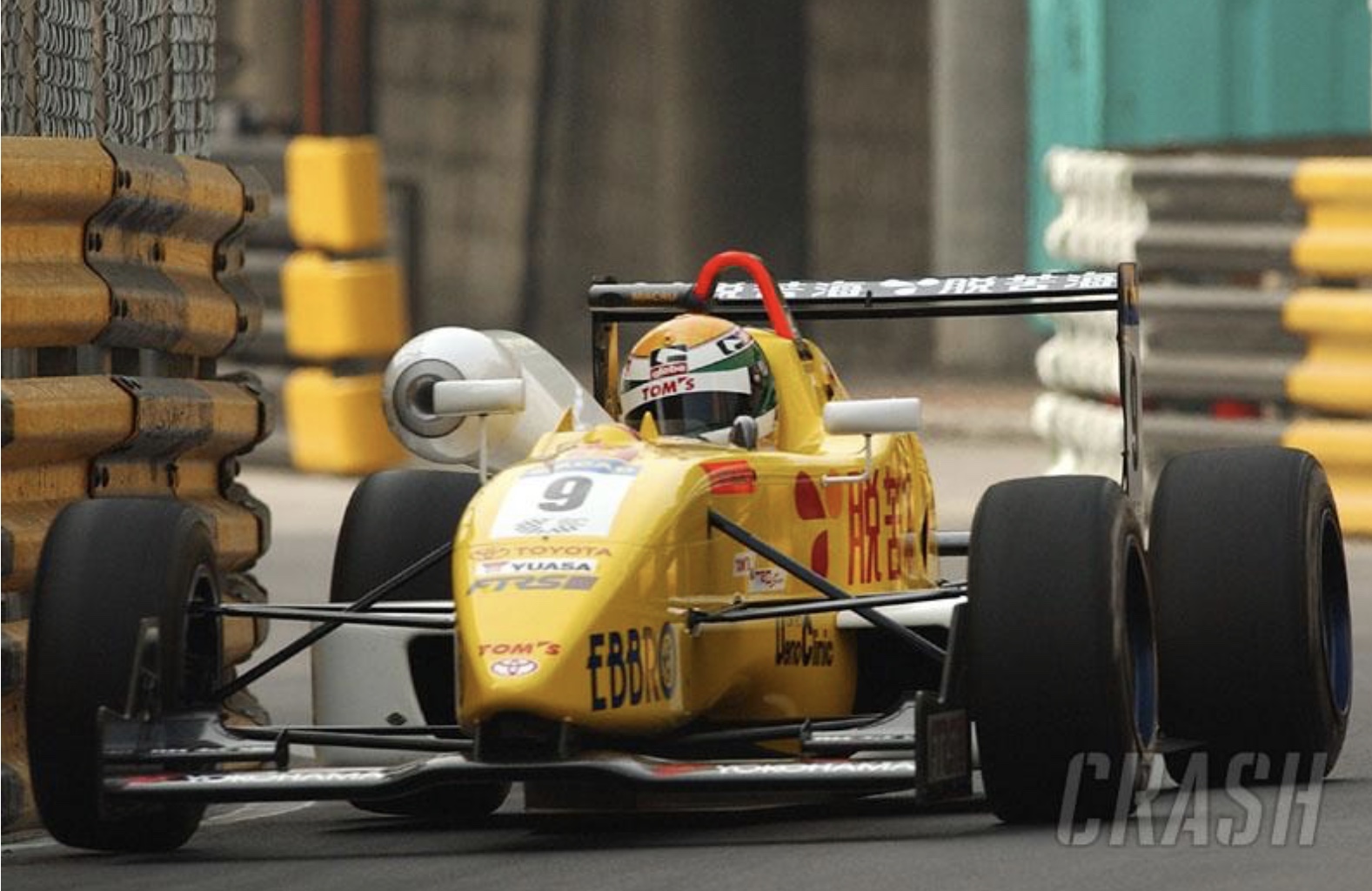
James Courtney’s Dallara F302 Toyota-Toms races to a good win in the first leg of the Fiftieth Macau Grand Prix on 16 November 2003…

He also led the second leg, and set the weekend’s fastest lap until a puncture eliminated him on the races eleventh lap, Nicholas Lapierre won, and having finished second in the contest’s earlier race won the GP overall- the field included later F1 drivers/test pilots Nico Rosberg, Lewis Hamilton, Nelson Piquet Jnr, Robert Kubica and Ryan Briscoe, a total of thirty contestants in all.

One of the British F3 Championships top runners in 2001 and 2002, James was rebuilding his career after a massive, very high speed shunt at Monza aboard an F1 Jaguar R3 Cosworth came close to ending his life.

That year he was mixing an F3 campaign in Jaguar’s team with Grand Prix car test duties- his F3 season started with a bang- he won the first round of the British F3 Championship.

Courtney, Jaguar R3 Cosworth at Silverstone in 2002 as is the shot below. Malcolm Oastler designed car was launched on 4 January that year

Race drivers for Jaguar in 2002 were Eddie Irvine and Pedro de la Rosa, the cars designated R3/R3B were powered by Cosworth CR-3 and CR-4 3 litre 72 degree V10s.

The team were testing at Monza on July 2- the circuit at which James made his F1 test debut the year before when he suffered a rear suspension failure at 10.14 am-  he was on the brakes at 330 kmh when a wishbone pulled away from its gearbox mounting, pitching him into the barriers at 306 kmh- the machine hit the fence so hard that it bounced away from the wall at 70 kmh- the impact was estimated to have a force of 67G, an incredible impact for the body to absorb.

Unconscious, his first sight was Michael Schumacher who was testing his Ferrari at the same time- James freaked out when he found he could not move the right side of his body and was bleeding from his eyes.

He later said ‘It took me a year to recover, i couldn’t walk without getting a migraine- which anything would set off.’ He also said that he could not see for weeks after the accident, and that he decided at that point never to be scared of having a crash again, stating ‘Its over if you are scared. Its all or nothing’ in an amazing exercise of mind over matter.

He did test again the following year but his F1 chance was gone.

The young Australian, born in Penrith between Sydney and the Blue Mountains on 29 June 1980 was amongst the brightest of young kids with the most prodigious of raw ability amongst his generation and the steepest of career trajectories.

In Karting he won locally before finishing second in the 1994 Australian National Kart Championship, at 15 he moved to Italy to pursue a racing career winning the World Junior Karting Championship and CIK International Championship in 1995 and was World Formula A champion in 1997.

Into 1999 he shifted from Italy to England to race cars becoming a member of the works Duckhams Van Diemen Team finishing fifth in the British FF Championship, in fourth was fellow Aussie Marcos Ambrose, the title won by Nicholas Kiesa’s Mygale. In addition he was second in the Formula Ford Festival- he went all the way in 2000  winning the championship aboard a works Van Diemen.

A veritable youth or kid- date and Kart spec welcome? (Aaron Noonan/an1images.com)

Courtney’s skills and Allan Gow’s management bagged him a place in the Jaguar Junior Team for 2001 contesting the British F3 Championship driving a Dallara 301 Mugen-Honda.

Whilst he won at the Silverstone season opener it was consistency which placed him fourth in the title chase won by Taka Sato from Anthony Davidson and Derek Hayes. In a year of dominance Sato won twelve of the twenty-six races- all three of the drivers raced Dallara 301 Mugen Hondas.

British F3 Championhip, last round- Silverstone, 29 September 2001, Dallara F301 Mugen-Honda. A pair of fourths that weekend, Taka Sato the winner of the race and championship (P Spinner-Getty)

Into 2002 Courtney again raced for Carlin Motorsport racing a Dallara 302 Mugen-Honda as did title winner Robbie Kerr- Courtney won four races whilst Kerr won nine and finished ahead of Courtney and Heikki Kovalainen.

The gruelling championship which has produced so many talented drivers down the decades comprised two races at each of thirteen venues, a format which tests prospective future F1 stars thoroughly.

Courtney circa 2002 (Getty)

2003 ended up being a rebuild year noting the physical aspects the Monza accident inflicted upon the young charger.

James chose to do the Japanese F3 Championship racing a Dallara F302 with punchy Toms Toyota 3S-GE engine- Mugen-Honda and various Toyota tuners engines were the most common in Japan with Three Bond Racing using Nissan SR20VE motors.

In another year of dominance James won thirteen races in the ten circuit tour finishing in front of Paolo Montin and Tatsuya Kataoka.

If there were any doubts about the loss of Courtney’s raw pace in ‘that shunt’ it was well and truly dispelled when all of the stars of the year met at Macau for the F3 ‘Grand Final.’

Macao GP 2003 Dallara F302 Toyota, #32 is Hiroki Yoshimoto

None of the 2002 F3 brigade got F1 seats in 2003- James Courtney, Nico Rosberg, Lewis Hamilton, Nelson Piquet Jnr, Robert Kubica and Ryan Briscoe- all would get their chance of course and two of them did, and still do rather well!

Toyota continued to support his career in 2004 and 2005, he contested the All Japan Grand Touring Car Championship for sixth and second places respectively aboard Toyota Team TOM’s Supras.

His first appearance ‘back home’ in quite a while was with the Holden Racing Team in 2005  he contested the endurance races partnered by Jim Richards who was perfectly placed to assist the Supercar ‘newbee’ with the nuances of these powerful, heavy, demanding cars.

Courtney aboard the Toyota-Toms Supra during the All Star 200 at Fontana in December 2004, he shared the car with Tatsuya Kataoka (L Miller-LAT)


Courtney at the 2010 Sydney 500- James won the title whilst Jonathon Webb and Lee Holdsworth took the round race wins. Ford FG V8 Supercar- 5 litre pushrod V8 circa 465Kw @ 7,000rpm, 6 speed manual sequential gearbox, 1355Kg (Getty)

Courtney raced for the Stone Brothers Ford operation from 2006 to 2008 taking his first round win at Queensland Raceway in 2008- he won the title aboard a Dick Johnson Racing Ford FG Falcon in 2010 taking five wins and finishing ahead of 2009 champ Jamie Whincup.

In recent Covid 19 times he has been in the news with a shift of team- probably the last spin of the Supercar Roulette Wheel for the soon to be forty year old.

Still, this article isn’t about V8 Supercars- i think its great that a young fella from out west has forged a career of his passion for the better part of thirty and a bit years- his lifestyle on the Gold Coast would be splendid but man what couldaa been but for that testing accident, at that speed, at that circuit- i always thought at the time he really was the goods and looked a good bet to go all the way towards the top of the pyramid…

Etcetera…

(unattributed)

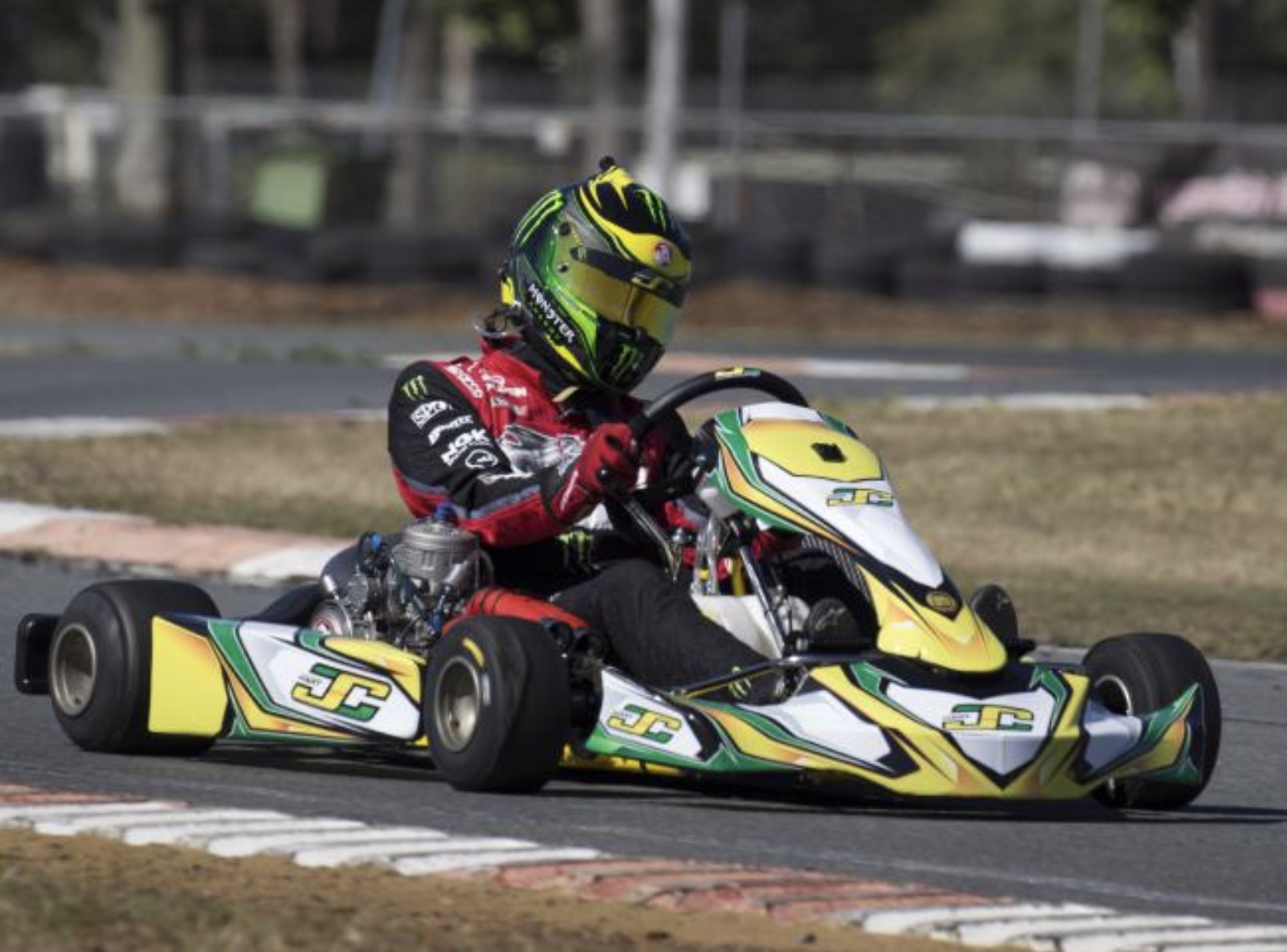
James Courtney back to his roots at Queensland Raceway in 2015 aboard one of the Karts he had commenced to manufacture and market that year.

Photo Credits…

Aaron Noonan and an1images.com, Getty Images, P Spinner-LAT, Crash, L Miller-LAT, motorsport.com,

Tailpiece…

The broken rear wing element of the R3 with Courtney aboard earlier in the year is almost a portent of rear end of the car things to come soon after- Silverstone 2002.

Finito…

(M Bisset)

I got a chuckle when I came upon this harvester on Albert Park Lake last Tuesday morning, I thought my farmer brother in law had taken a wrong turn at San Remo and somehow ended up in the lake…

My run or walk is usually well before dawn, this craft and the waste truck into which it loads its haul of reeds and weeds has been moored near The Pavilion for a couple of weeks, it was the first time I’d seen it in action.

It moves along too, its not likely to set any speedboat course records mind you.

(Parks Victoria)
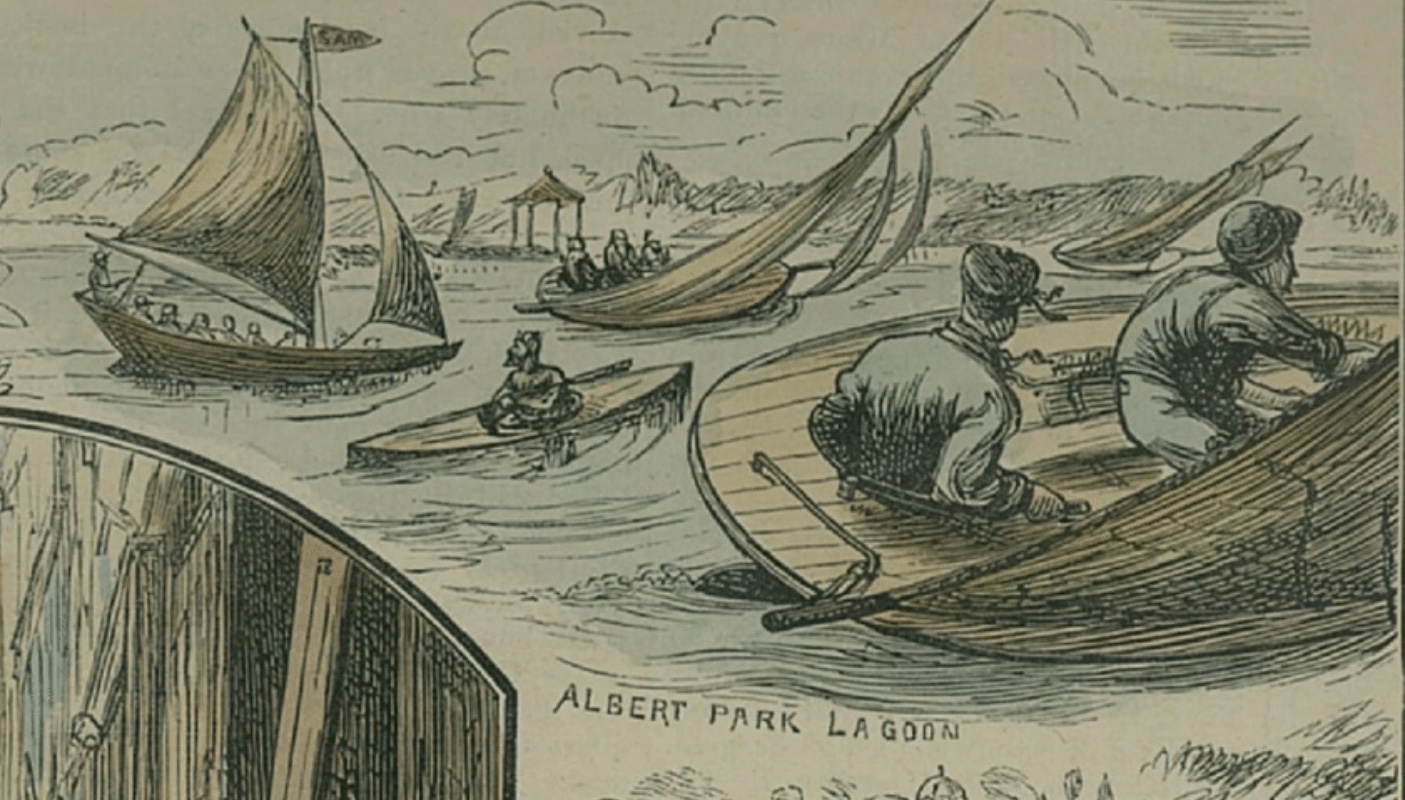
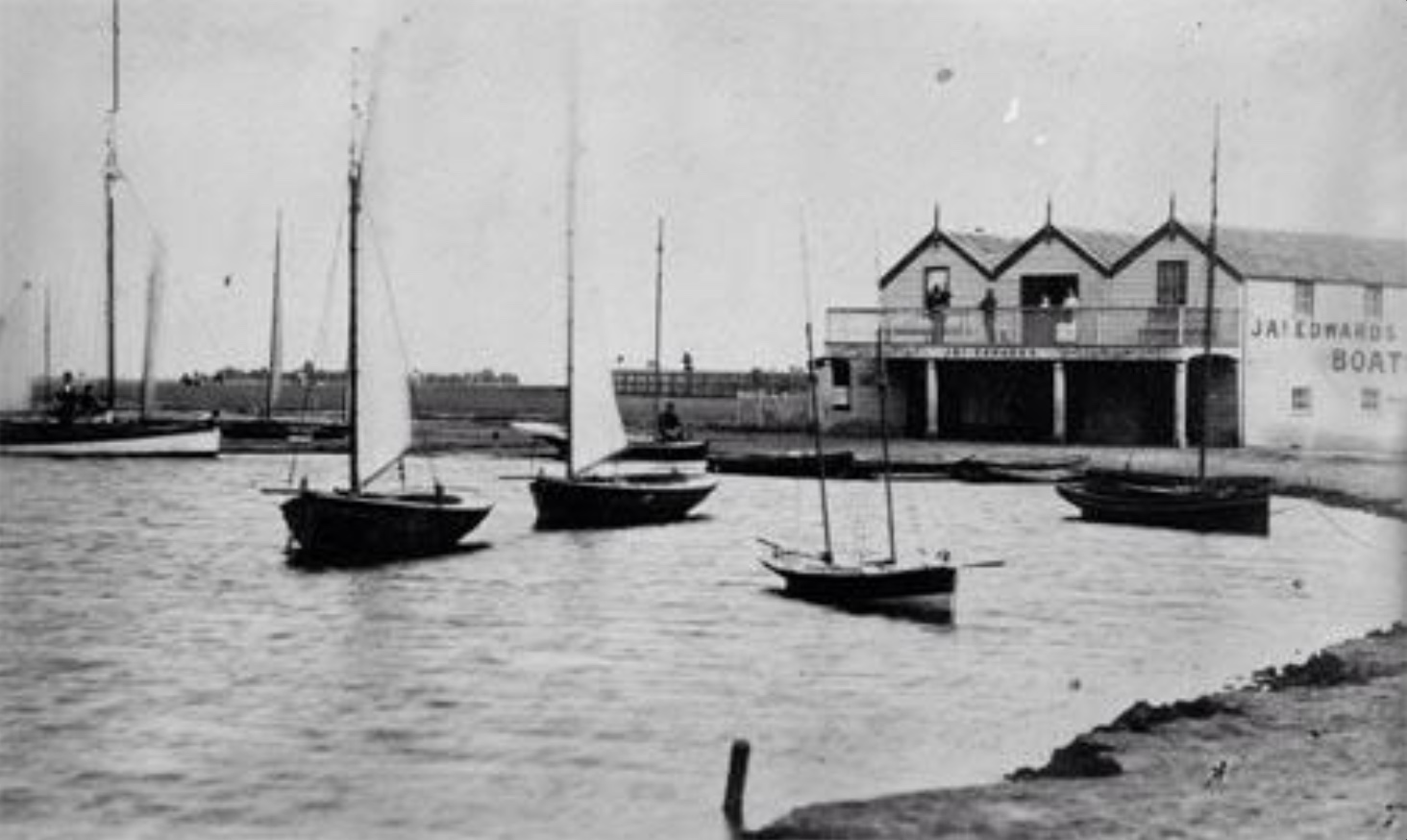
Yachts racing on the Albert Park Lagoon (The Illustrated Australian News 5 July 1879)
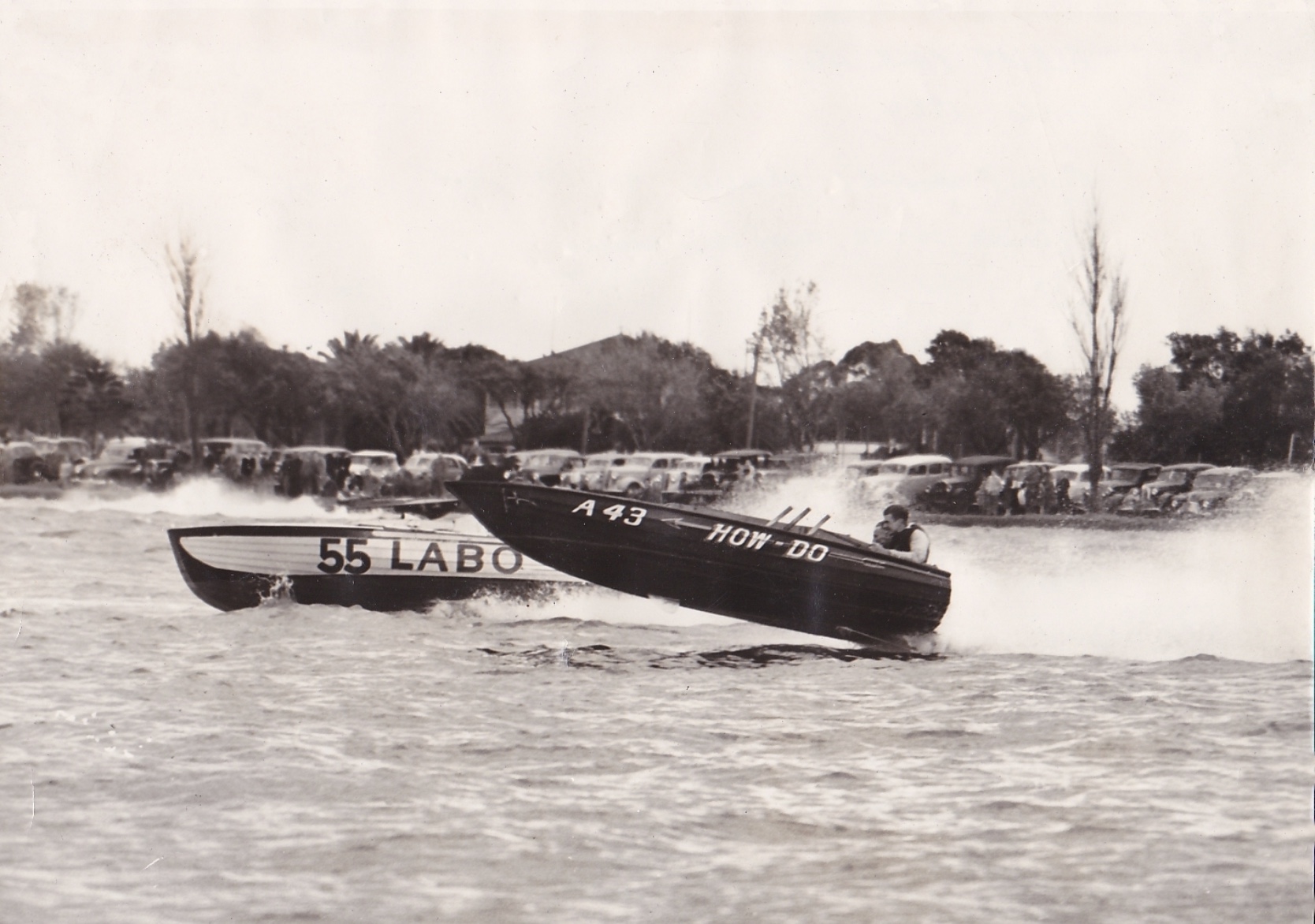
Les Maloney’s ‘How-Do’ skiff on the lake in 1954 (L Maloney)
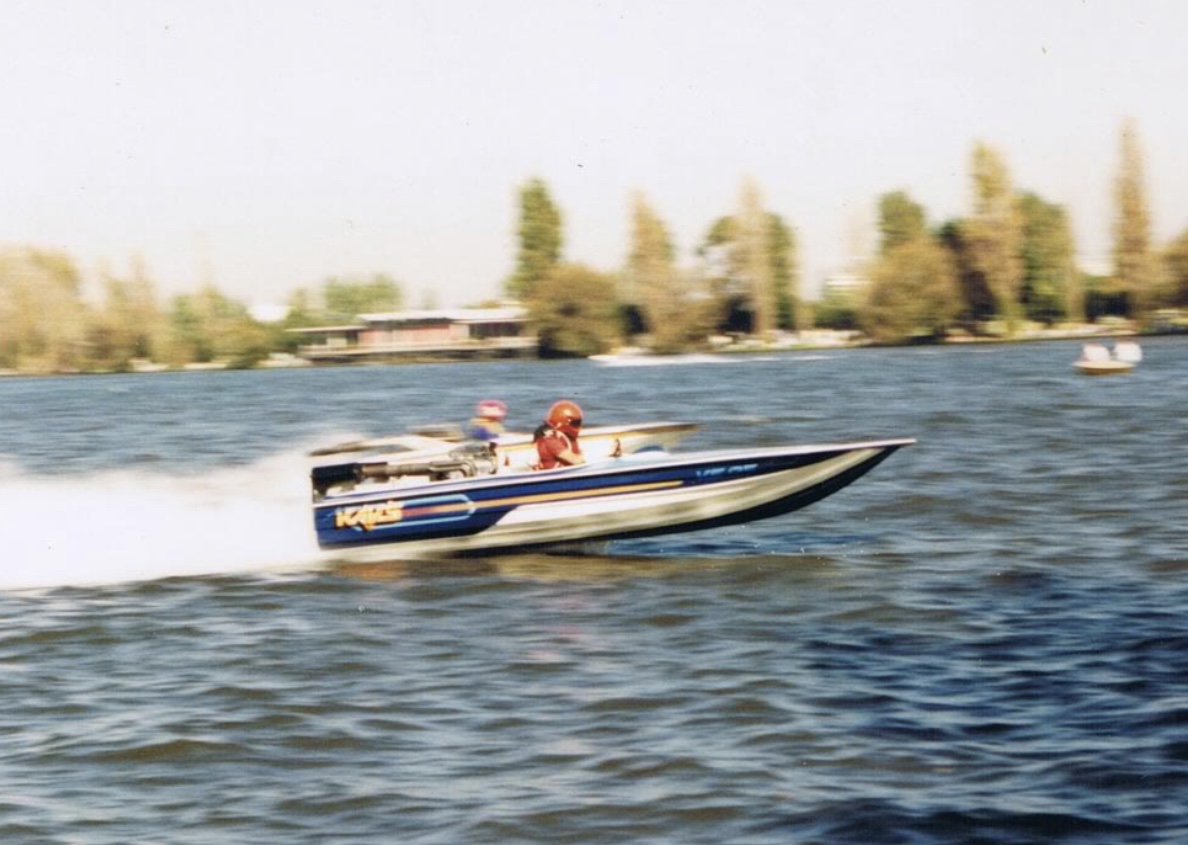
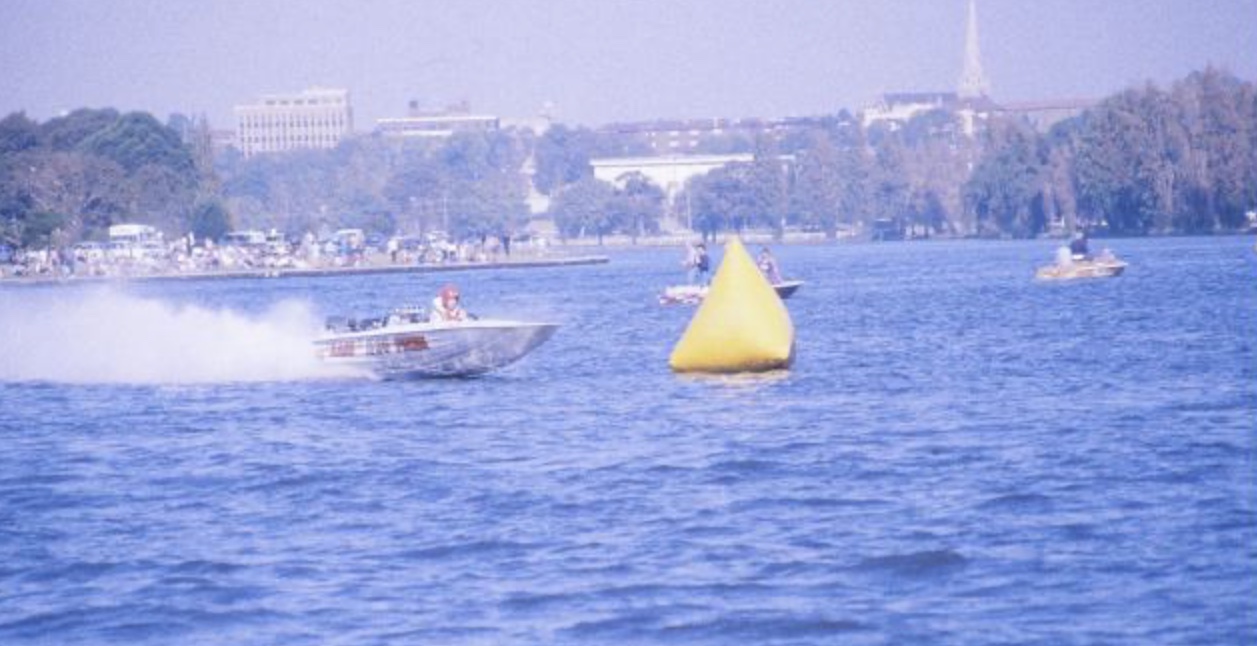
‘Darren Muir Bad Influence Blown Lites Team’ Albert Park Lake 1970s at a guess (paranoid)
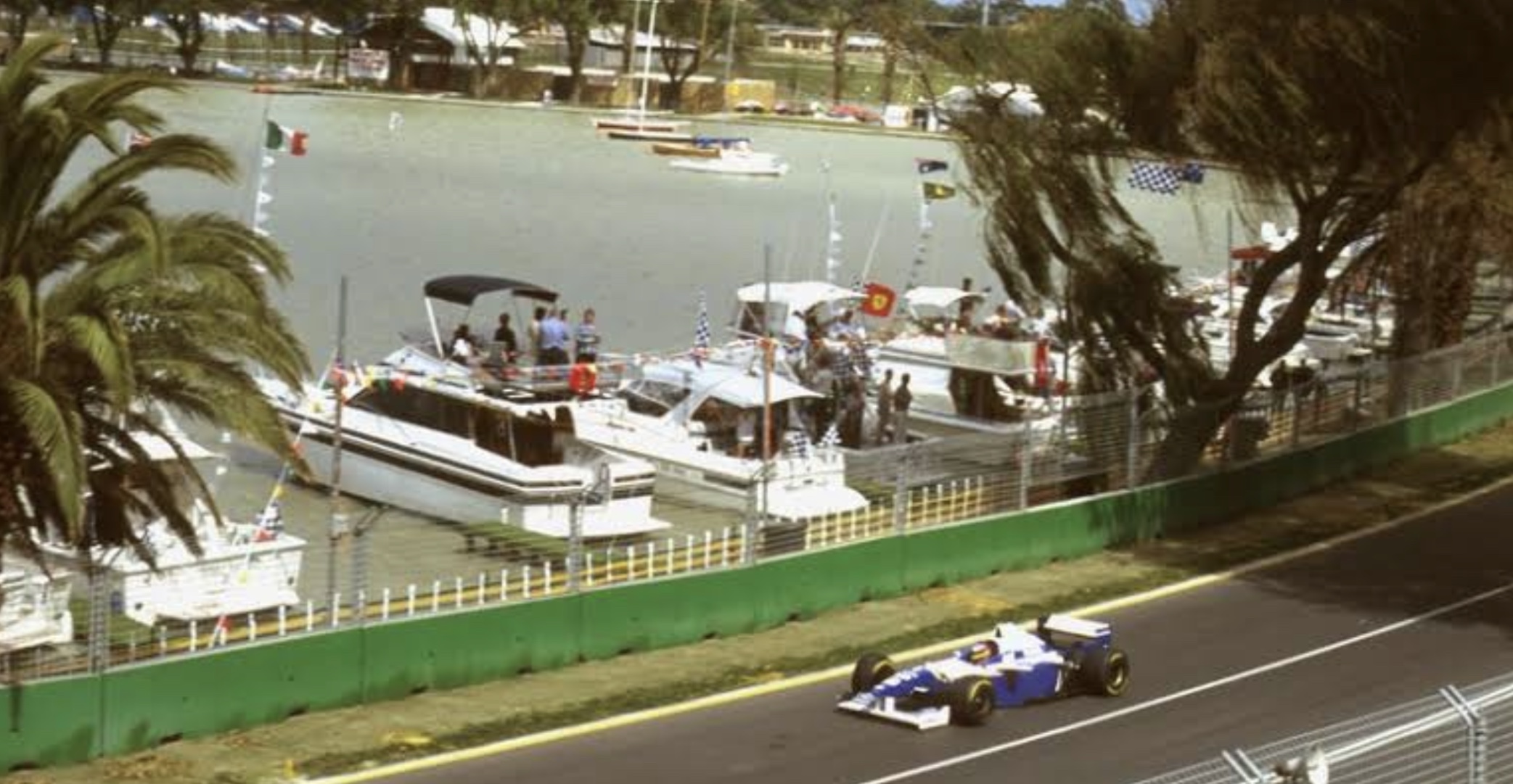
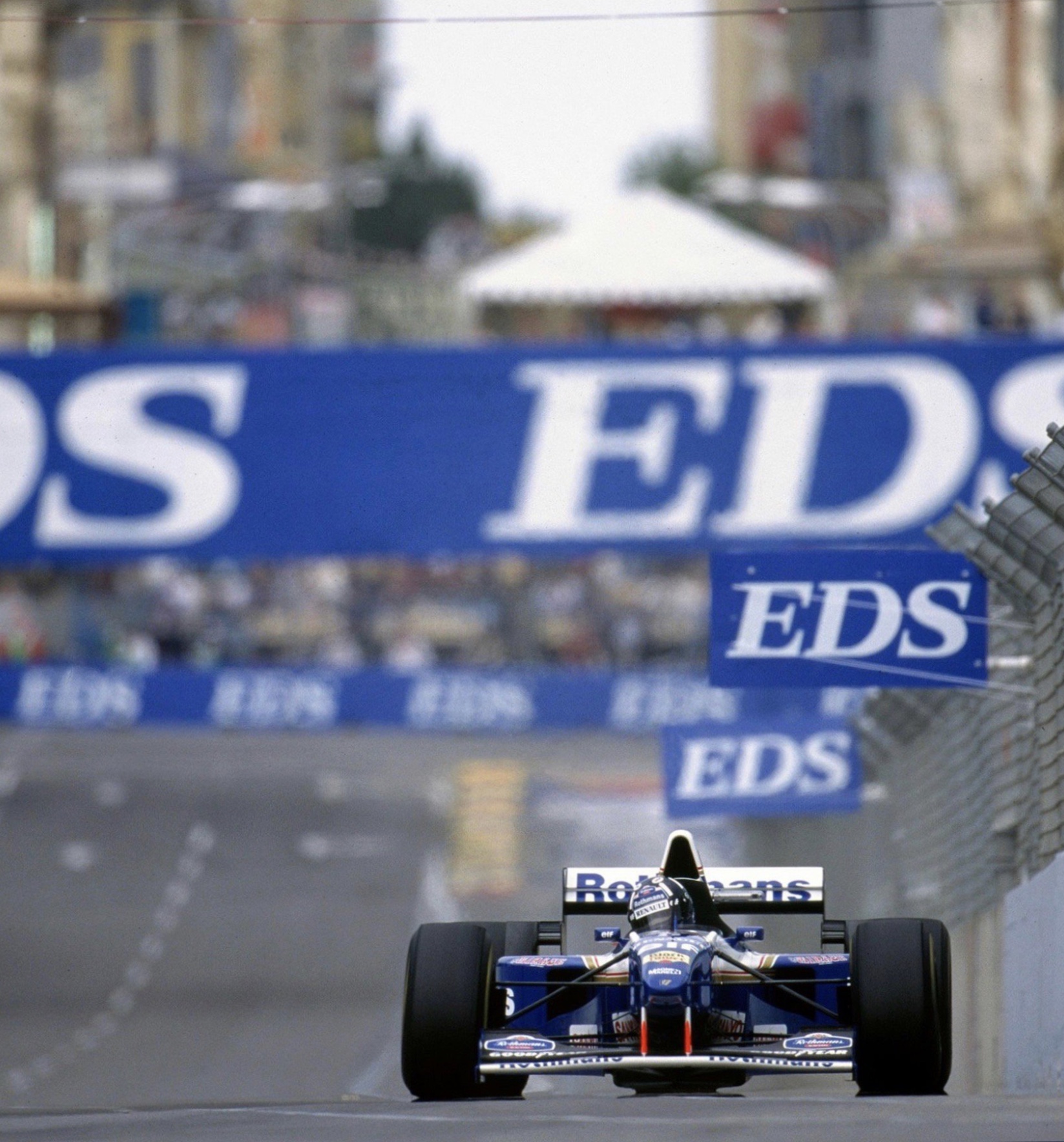
Jacques Villeneuve ’rounds up a few Bertrams’ in his Williams FW18 Renault during the first Albert Park AGP weekend in March 1996 (AGPC)

The Lake was home to yachts and speedboats long before racing cars were let loose for the first time in 1934, and then officially in 1953, click here for a brief history of early racing at Albert Park: https://primotipo.com/2014/10/01/1956-argus-trophy-albert-park-reg-hunt-and-lex-davison-maserati-250f-and-a6gcm-ferrari-tipo-500/

On my many laps of the place I’ve often thought an elite level boating event run over the GP weekend made sense, it seems plans were afoot to do just that in 1996 until the greedy eff-wun pericks stepped in the way. Bob Carter wrote on OzBoatRacers that ‘The real story about the demise of Albert Park Lake (as a speed boating venue) has nothing to do with water depth.’

‘I promoted the Aussie F1 Series for five years and ran a round on Albert Park Lake and what is now Docklands. I was closely involved with Melbourne Major Events (the people who run the GP F1 race and bikes at Phillip Island) to run a round of the F1 powerboat series in Melbourne at either Albert Park Lake or Docklands.’

‘Docklands was really too small a venue so Albert Park Lake was the choice. The concept was to run at Albert Park in conjunction with the first F1 car race in Melbourne (in 1996).’

‘We brought Nicolo di San Germano (world UIM (Union Internationale Motonautique) F1 promoter) to Melbourne to check the Albert Park venue and met the people from Major Events. We were on track from the Melbourne end but the deal fell over when the F1 car people said no to the boats as a support event. I understood they felt a bit threatened by the spectacle of the F1 boats. Never before has there been a World F1 car GP and a World F1 boat GP staged at the same venue on the same weekend’. How good would that have been on an ongoing basis!? And yes, i know, the pedestrian pontoon across ‘The Neck’ could not have been put in place, big deal.

Carter finishes his piece in tapatalk.com by observing ‘The knockback ended any chance of ever running an F1 boat GP on Albert Park Lake. The Act of Parliament that underscores the GP at Albert Park specifies that there can only be one motorsport event in the Albert Park parkland precinct each year. This restriction was intended to prevent the venue becoming a motorsport track for cars and bikes and no doubt power boats.’

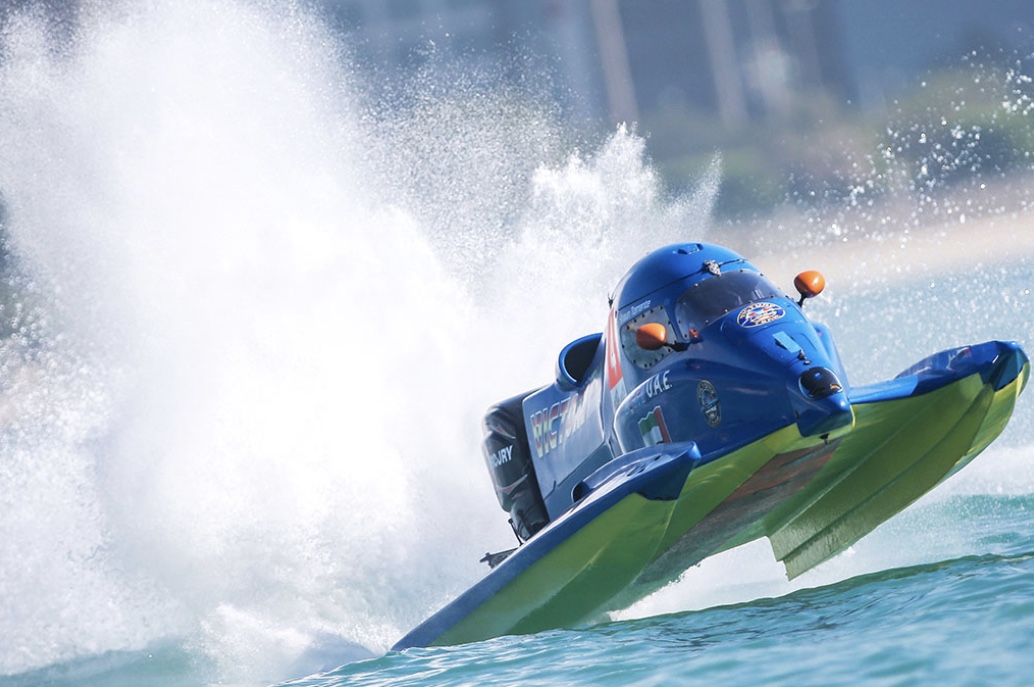
A current F1 boat (unattributed)
Adelaide Festival Centre launch of the 1985 AGP event by South Australian Premier John Bannon. He is aboard Jack Brabham’s 1966 World Championship winning Brabham BT19 Repco (unattributed)
Adelaide AGP 1985, the end of lap 1 with Patrick Tambay’s Renault RE60B chasing Marc Surer’s Brabham BT54 BMW, an Arrows A8 BMW, McLaren MP4/2C TAG-Porsche and Ferrari 156/85 (unattributed)
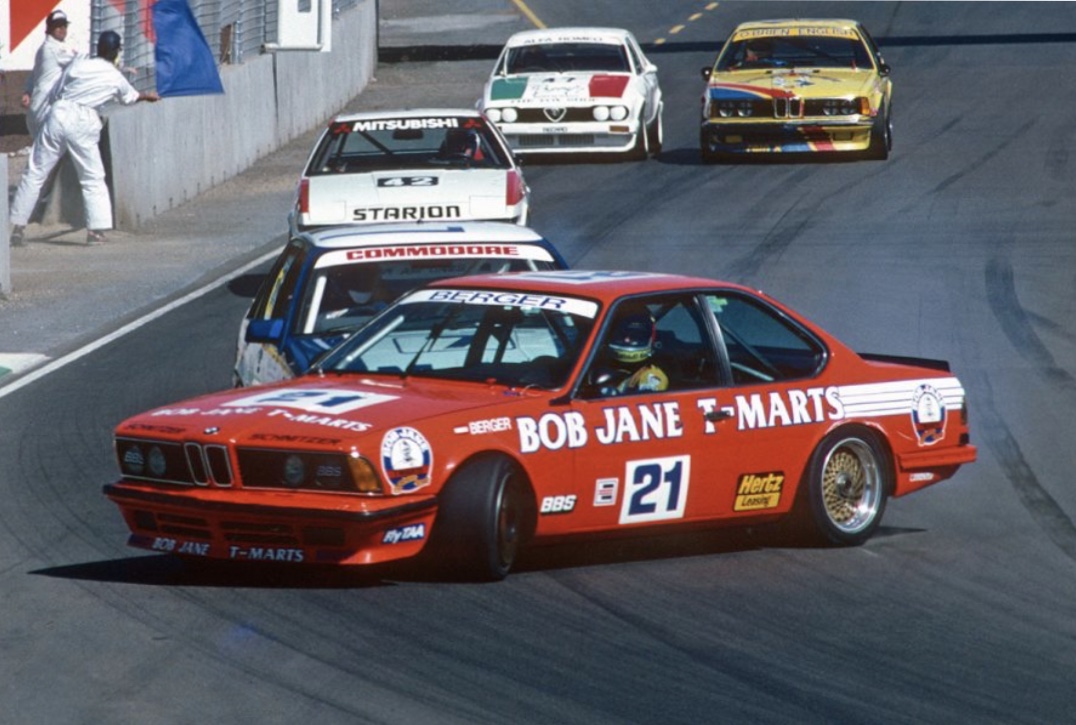
Longtime former Bob Jane racer John Harvey giving current Bob Jane racer Gerhard Berger some good old fashioned Aussie hospitality in one of the Group C support races in 1985. Kevin Bartlett in the Mitsubishi Starion ? and who else is back there in the Alfa  GTV6 with Charlie O’Brien in the other BMW 635 CSi? What happened there Harves? (unattributed)
Who could forget Niki’s last GP, McLaren MP4/2C TAG-Porsche- he did two AGP’s back to back, the 1984 F Pacific event in a Ralt RT4 Ford BDD, DNF after a prang with a back marker and DNF in the race won by Keke Rosberg’s Williams FW10 Honda (unattributed)

The signing of Albert Park as the host venue for the F1 Australian Grand Prix split both the motorsport community and Melburnians within a bulls-roar, or rather a Vee-Ten scream of Albert Park down the middle.

We all loved the Adelaide AGP. Full stop.

The Victoria Park venue, the road circuit created thereon using a mix of existing roads and bespoke bits, the carnival weekend with ‘yer mates away from the little sabre-toothed tigress and the kiddy-wids, the fantastic variety of support events, the way Big Country Town Adelaide embraced the F1 Circus. It was just sensational, no other word does it justice.

But the cost of the race, in a democracy at least, can be, and often is a political football.

South Australian Labour Government (our progressive party) Premier John Bannon achieved a political coup when he secured Bernard Charles Ecclestone’s signature on a contract to stage an F1 race in Adelaide from 1985. Race fans were orgasmic with delight at finally having a world championship event here, the last truly F1-esque Tasman Series was run in 1969, it was a very long time since current F1 drivers and cars had raced in Australia.

Bannon ran an expansionary, imaginative administration, but, like Labour’s Victorian Premier John Cain, the push to make their State Banks more entrepreneurial was to their, and taxpayers considerable cost when the lack of sufficient oversight and due diligence of the enterprises investments meant the banks had to be re-capitalised or bailed out after unbelievable clusterfucks of political and management incompetence.

By mid 1992 Bannon was well and truly in the political merde to such an extent that he had to resign as Premier that September. In Victoria similar problems impacted both John Cain and his successor, Joan Kirner, and so the unthinkable seemed possible, Liberal (our conservative party) leader, Jeff Kennett, who had already lost two Victorian elections and was pretty much regarded as a bit of a joke, seemed half a chance in the next state poll.

Ecclestone and Bannon, apart from their business relationship also had good personal rapport, but South Australia’s budget problems meant the future contract to retain the AGP had still not been finalised.

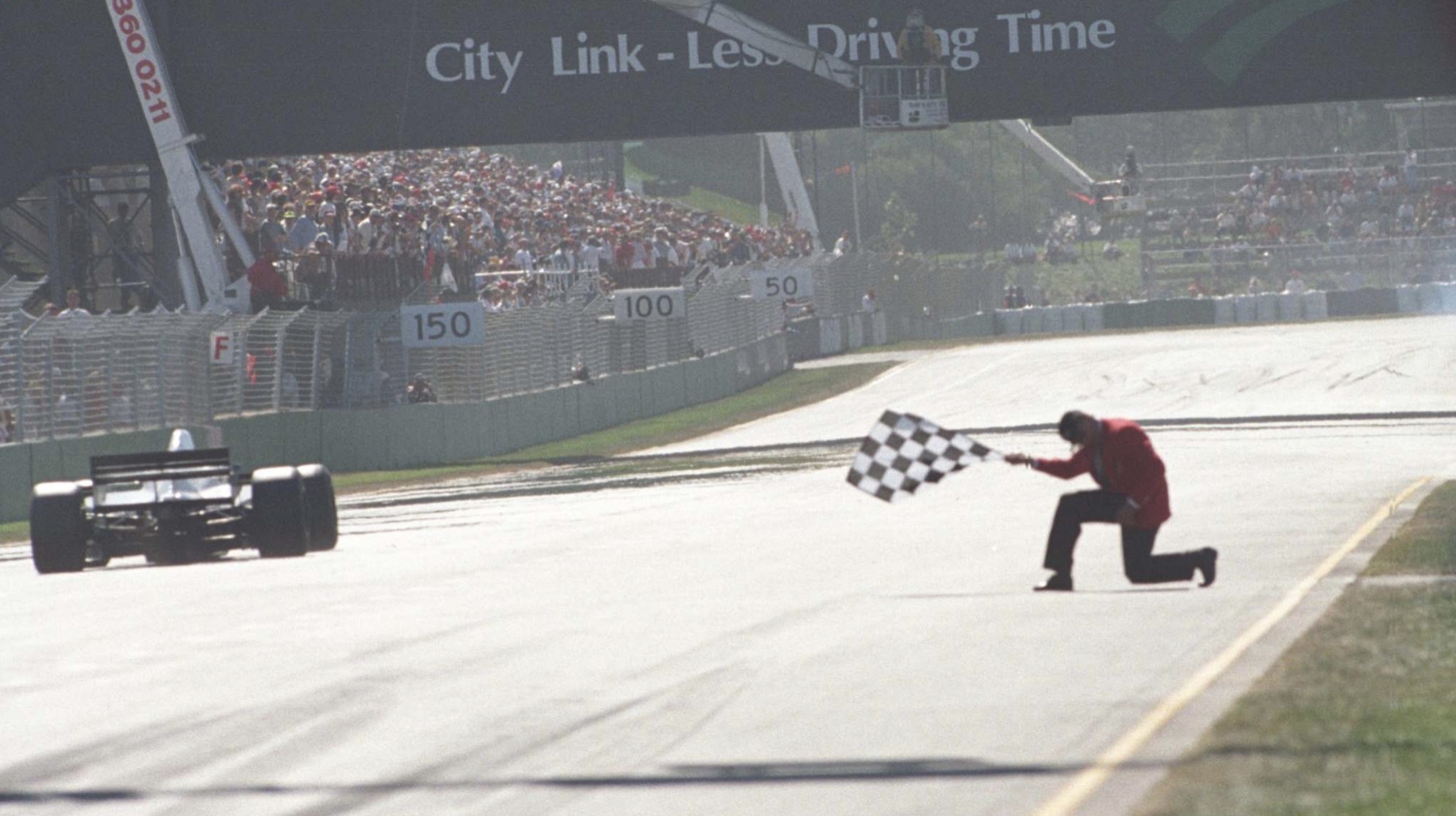
By the reaction of Judith Griggs, CEO of the Australian GP Corporation and Ron Walker, Jeffrey Kennett has just given the chequered flag to a Save Albert Park cyclist, June 1994. Kennett was and is a character, he ran a successful advertising agency in Burwood before entering politics, so he innately understood the needs of business unlike most of our ‘political elite’. Refreshingly he wasn’t the Australian politician stereotype either. That is, a ‘St Fondles’ educated, narcissistic ex-lawyer permanently physically aroused by their own ongoing pointless cunning linguistics which never deliver any policy substance or outcome. Kennett was the real deal, an absolute goer who marshalled a very effective Cabinet and got the state moving again with sound economic management and sensible investment in infrastructure which still serves the joint well a couple of decades on (J Lamb)
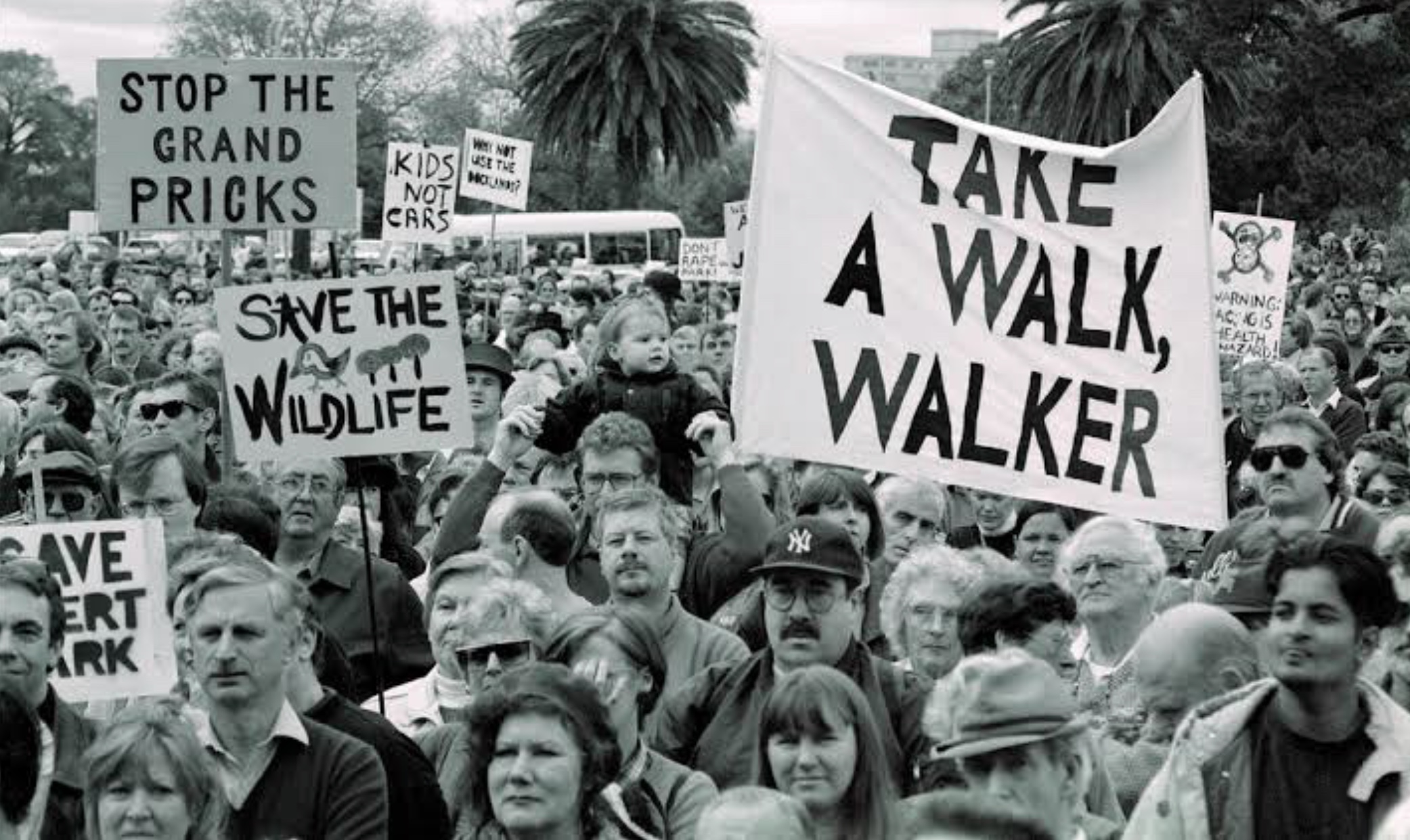
Grand Prix enthusiasts gather in support of Albert Park circa 1994. The biggest of these anti-Albert Park AGP rallies attracted over 20,000 people, the SAP were still generating a monthly newsletter twenty years after the first race- they may well still do so (unattributed)
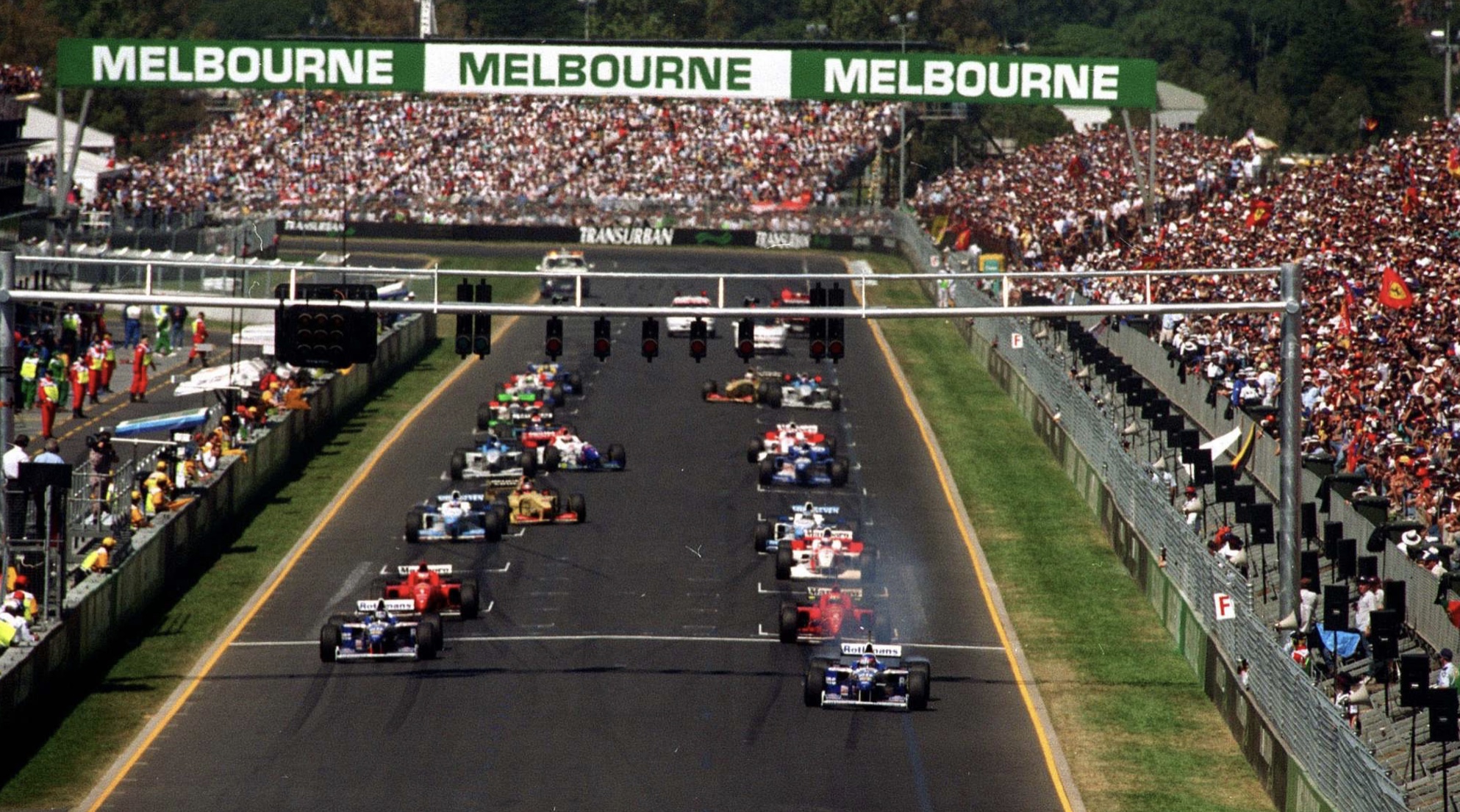
AGP start 1996 with Jacques Villeneuve getting the jump over teammmate Damon Hill- Williams FW18 Renault and the two Ferrari F310s of Michael Schumacher and Eddie Irvine (J Atley)
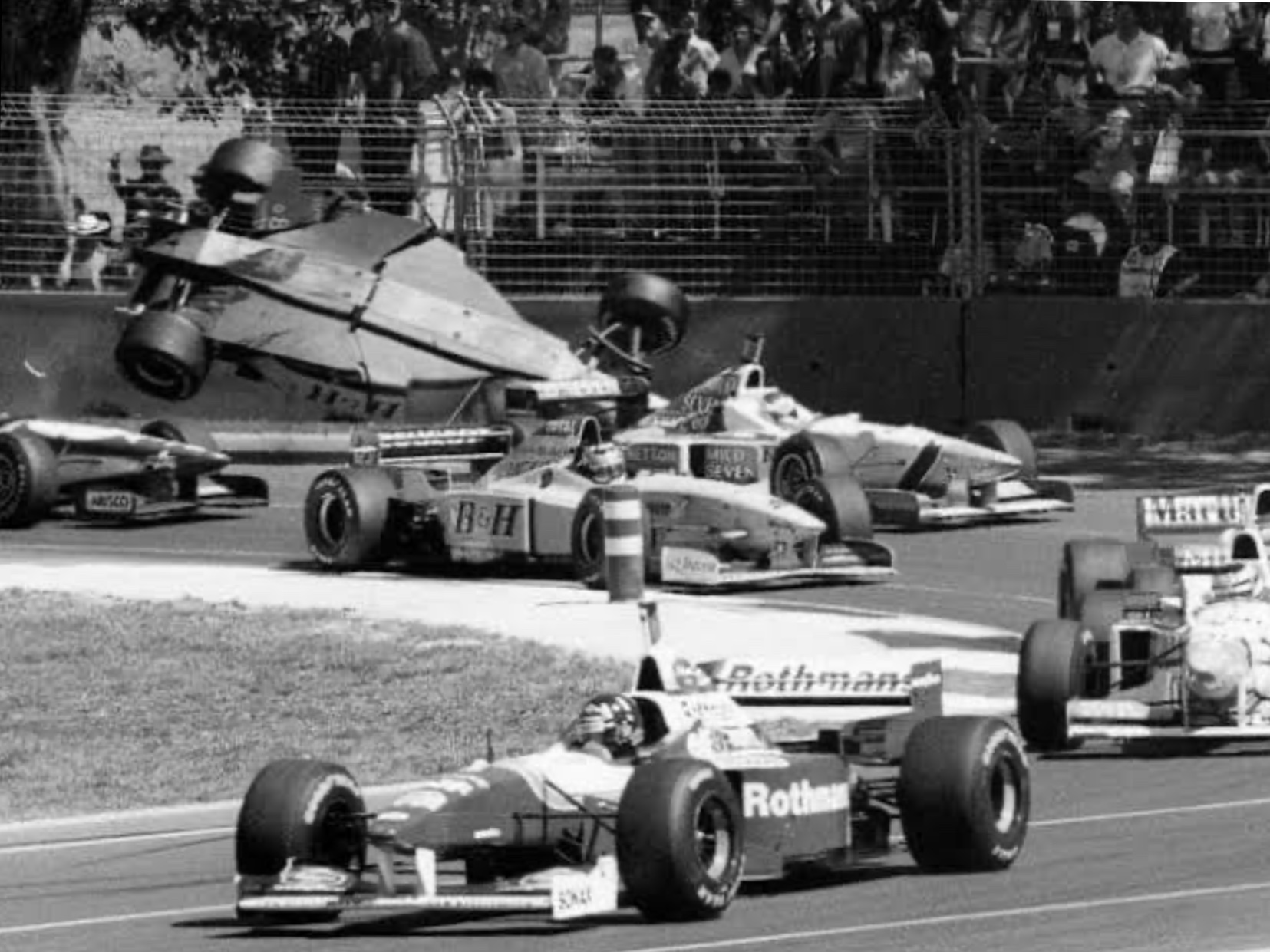
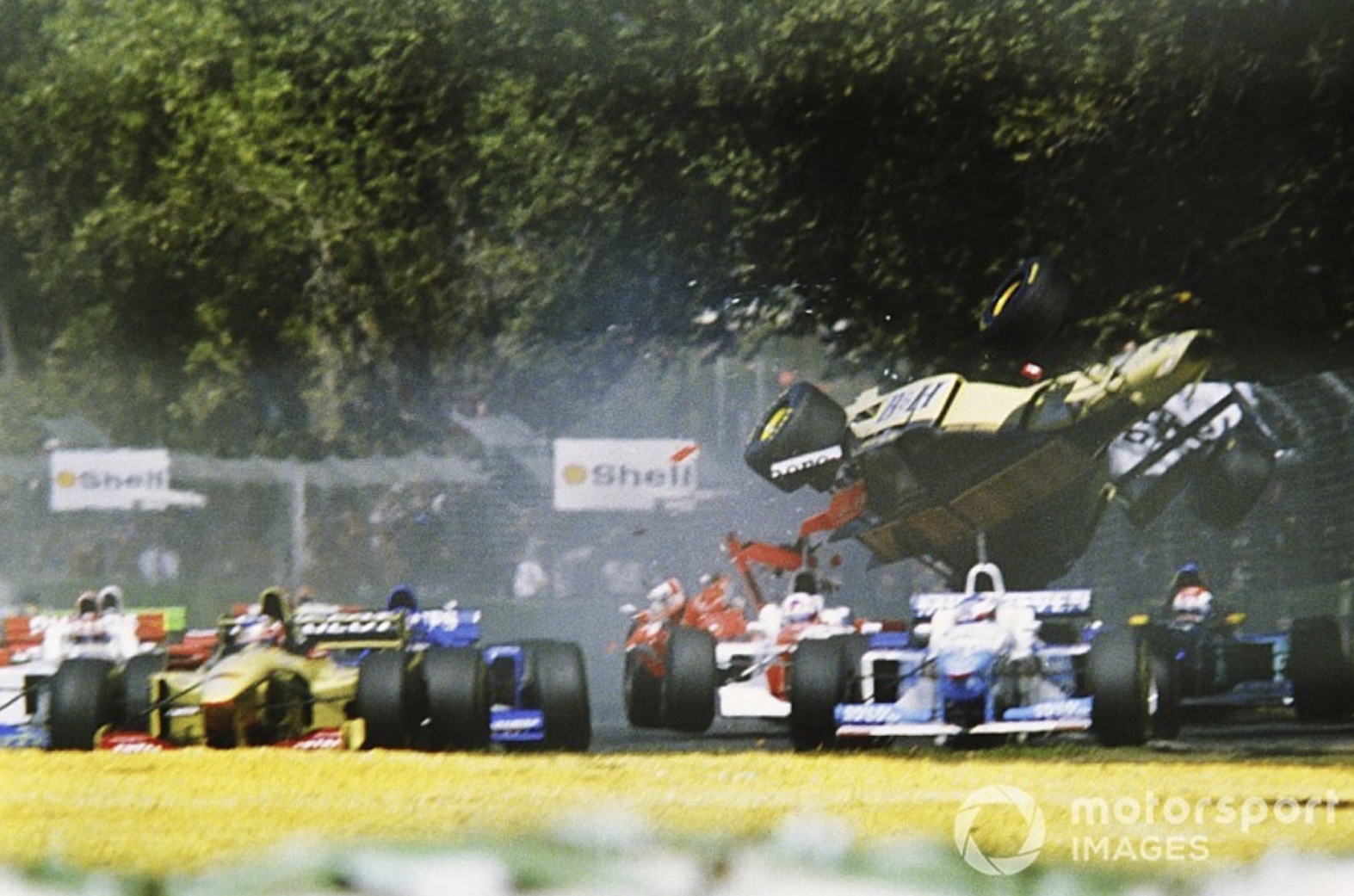
Hill, one of the Bennettons, a Ferrari wing, Rubens Barrichelo’s Jordan 196 Peugeot on the ground and the similar airborne car of Martin Brundle indulging in a spot of lap 1, turn 3 Jordan aerobatics which did not do the car much good but fortunately left the plucky, popular Brit unharmed. The other Bennetton on the outside, and the rest (Herald Sun)

Former Lord Mayor of Melbourne, partner in local builder/developer Hudson Conway, Federal Treasurer of the Liberal Party, head of Melbourne Major Events, friend and ally of Jeff Kennett, Ron Walker, sniffed an opportunity. Bannon was marginalised in the sin-bin, so he renewed his regular onslaughts upon Bernie to shift the race from Adelaide to Melbourne, and so it was, over a period of months, a contract was negotiated and signed, and then kept secret for a year, at Bernie’s request.

By that time (from October 1992) Kennett was Premier of Victoria, a job he did brilliantly for two three year terms, only bulk hubris cost him another one or two terms, and his Liberal Party buddy, Dean Brown headed a government in South Australia. Ron Walker’s terrible ‘kiss of death’ the day after Brown’s election win on 14 December 1993 was to inform him the Vics had knocked off Adelaide’s tourism jewel in the crown; his devastation and that of South Australians generally was complete. Poor ‘ole Jeffrey was button-holed in the streets of Adelaide for decades by antsy South Australians, the fact that he was President of the Hawthorn Football Club didn’t help his cause of course!

Both South Australia’s and Victoria’s economies at the time were in dire trouble. The AGP was important economically but also symbolically to both states, whilst anger raged in South Australia about the loss of the Grand Prix even greater passion was being vented in Melbourne about its win.

Amongst the best places to live in Melbourne are parts of South Melbourne, Albert Park and Middle Park. The trouble for Jeffrey was that the good citizens of these suburbs all vote for the Liberal Party, they were Jeff’s own supporters many of whom were well connected and rather vocal using about it. The poor bastard couldn’t go to a Dribble Party gig – the most dull, shit-boring gatherings on the planet mind you, having done my share in the cause of commerce – without being bailed up by some well nourished chappie in tan trousers and blue blazer whinging about that ‘bloody race in my park oulde boy’.

Even angrier of course were the self-righteous left wing, arty-farty, commo, poofter bastard, tree-hugging whale kissers (to use a Sir Les Patterson descriptor in part) living in St Kilda, Prahran, Windsor and Port Melbourne. Jeffrey didn’t give a rats about this mob mind you as these nasty folks voted Labour, or even worse were the flower pot mob living in Pixie Land at the bottom of the garden, who, of course, voted Green.

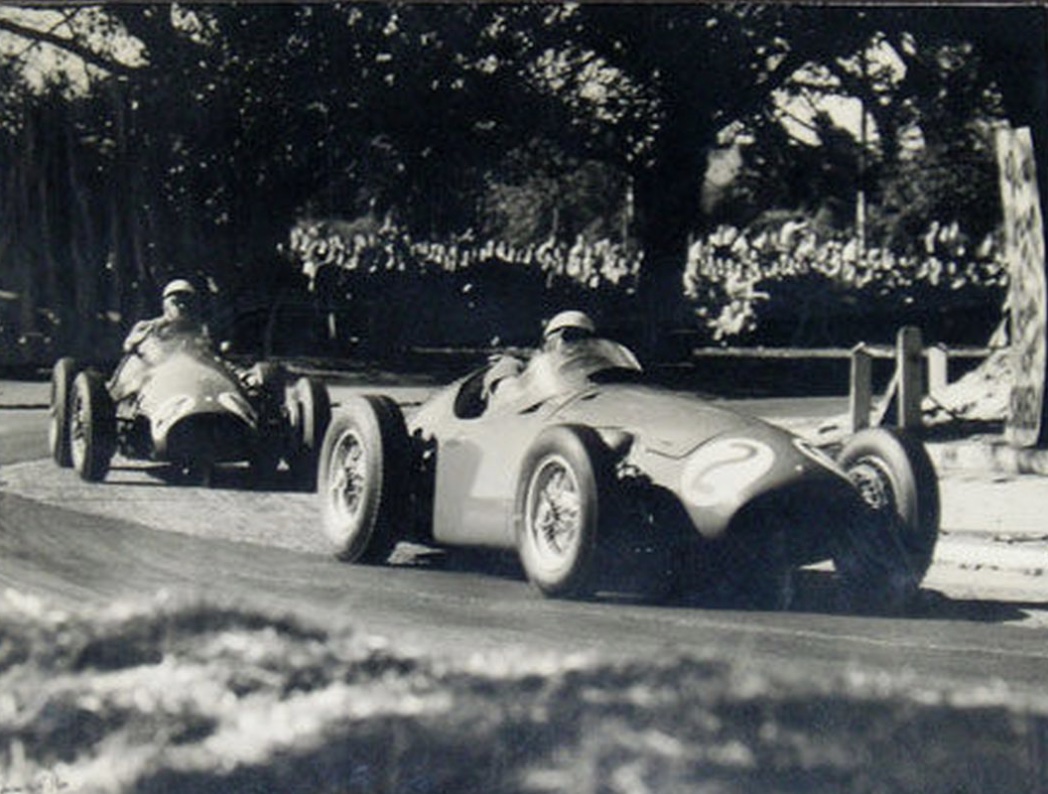
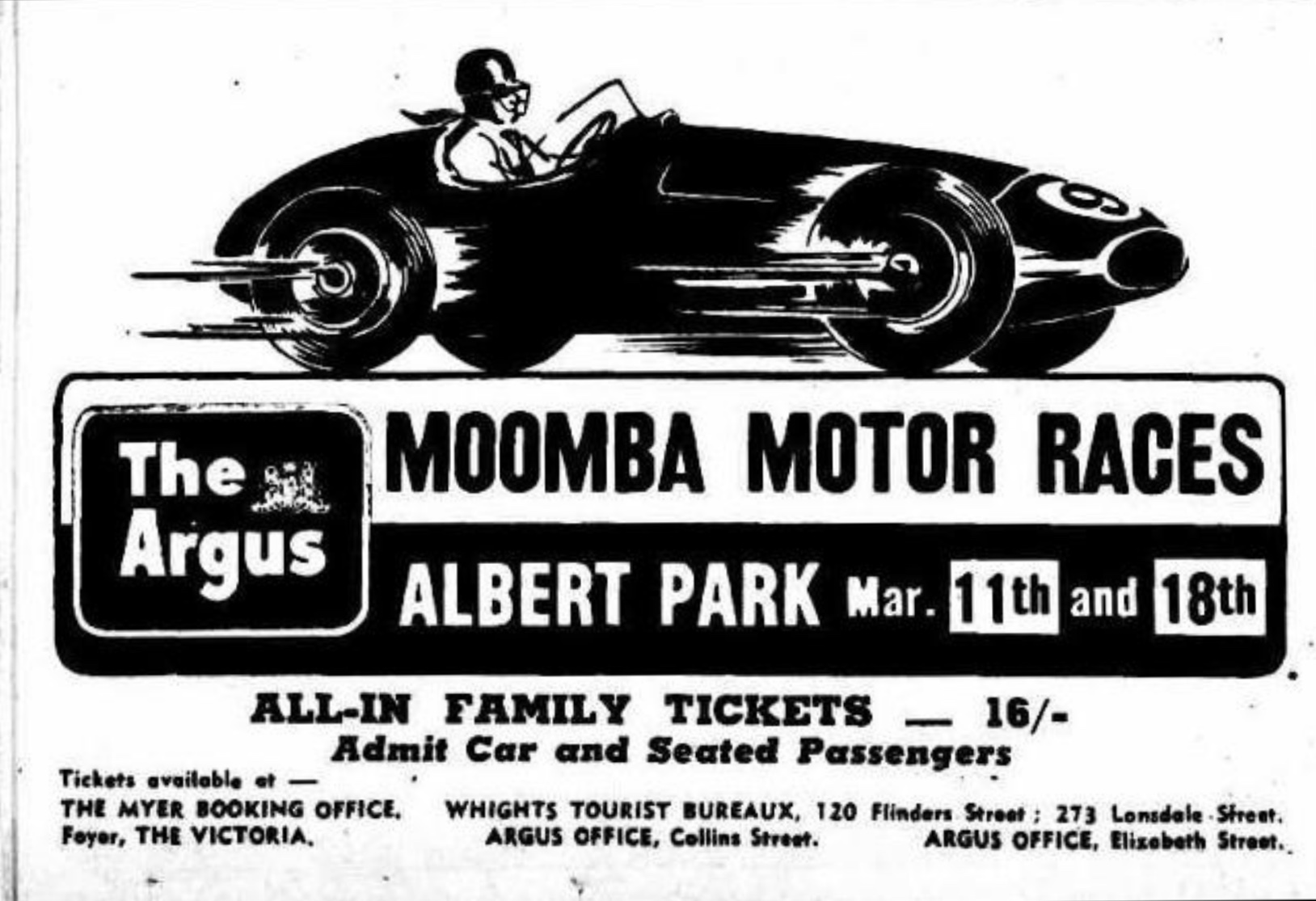
Reg Hunt, Maserati 250F leads Lex Davison, Ferrari 500/625 during the 48 lap 150 mile March 1956 ‘Argus Trophy’ at Albert Park won by Hunt from Davo and Kevin Neale in the Maserati A6GCM 2.5 litre Hunt raced throughout 1955 – tickets available for this meeting as below (unattributed)
Stirling Moss winning the 1958 Melbourne Grand Prix aboard a Rob Walker Cooper T45 Climax in the final weekend of racing before the modern era, in November 1958. Concerned citizens living closely to the park in the mid-nineties, other than old-timers, could quite reasonably argue they bought in the area to enjoy the peace and serenity of the park not the complete opposite…(unattributed)
(T Johns Collection)

And so it was that the Save Albert Park (SAP) group was formed by February 1994 of a very large unholy alliance of people with absolutely nothing in common and completely opposite political views but who were united in their hatred of any change to their park including a race week which was going to impact upon the normal progress of their Mercedes four-wheel-drive or wheezy Peugeot 504 as the case may be, in and around their lovely bayside suburbs.

Some of the SAP public rallies were anti-Vietnam War in size for chrissakes, the Save Albert Park nutbags endurance and commitment had to be admired though as they maintained a DAILY vigil with a couple of folks sitting at a table knitting Melbourne Footy Club scarves whilst sipping lots of Earl Grey tea surrounded by anti-GP posters near the corner of Queens Road and Albert Road for well over a decade after the race commenced.

The amazing thing is that despite the fairly dubious economic net benefits of the Gee Pee to the state, which even I struggle to justify, the race has bi-partisan support. Every now and again some pollie gives it a bit of a slap but the race, thankfully is with us and as a Windsor dwelling tree-hugging nuffy I am very thankful for that!

The park is a wonderful communal resource made better by Jeff’s investment in many improvements as part of the quid pro quo with the locals including regular harvesting of the reeds which otherwise cause sclerosis of da lake, said harvester is about where I came in with this strange piece of boats, cars and politics.

The ever entertaining Glen Dix does his thing as Damon Hill crosses the line to win the first Albert Park F1 AGP in his Williams FW18 Renault 3 litre V10- the venue having hosted Formula Libre AGPs in 1953- won by Doug Whiteford’s Talbot-Lago T26C and 1956- the victor Stirling Moss, Maserati 250F (J South)
Damon Hill had the unique experience of winning the last AGP in Adelaide in November 1995- the last race of the season, and the first AGP at Albert Park in March 1996- the first race of the season, here he is in Dequetteville Terrace in Adelaide, Williams FW17B Renault V10 3 litre (unattributed)
(Gay Dutton poster art)

Due process and managing the punters expectations…

The politics and management of nudging public opinion back in the direction of racing in the park started in February 1993 with the ‘Back To The Lake’ public event in which 250-300 ‘classic cars’ did some laps of a circuit created by roads on the west side of the lake- not the full ‘old circuit’ using perimeter roads mind you.

I had an Elfin NG Formula Vee and ASP 340 Toyota Clubman at the time and ran the latter in this event about which I remember very little, other than that track time was minimal. It was a beautiful day which attracted lots of spectators and plenty of ‘wotizzit mister’ questions about one’s car which was nice.

The public policy or political point is that the gig wasn’t about the competitors but was rather an important step in the process carefully constructed by Melbourne Major Events with ‘Field Marshall Walker’ and his small band of Lieutenants at the helm heading in the direction of a prize – racing in Albert Park which was made slightly easier to achieve thanks to a confluence of political events in North Terrace and Spring Street.

More practically in this process, in mid 1994, the new government commissioned a ‘Master Plan for Albert Park’ from The Hassell Group (town planners and architects) and Melbourne Parks and Waterways, who had administrative responsibility for Albert Park as to it’s redevelopment in the future.

It would only be of interest to locals but shows the professionalism which was deployed to make the precinct a vastly superior community resource for all than it was before the hundred million dollars was spent.

(unattributed)

Sydney. Where did you say? Really…

Every now and again the Sydney Morning Herald runs a story about the Harbour City lifting the race from Melbourne, but I’m not so sure that will ever happen.

These pissant GPs which have popped up in the last decade or so in places nobody has heard of or wants to visit has kept the price of having a GP very high. Perhaps in a post Covid 19 world some GPs will choose to not renew their contracts which may create, say again, may, create some competitive tension in Australia, and let’s not forget the good ‘ole Melbourne/Sydney rivalry which is never too far below the surface.

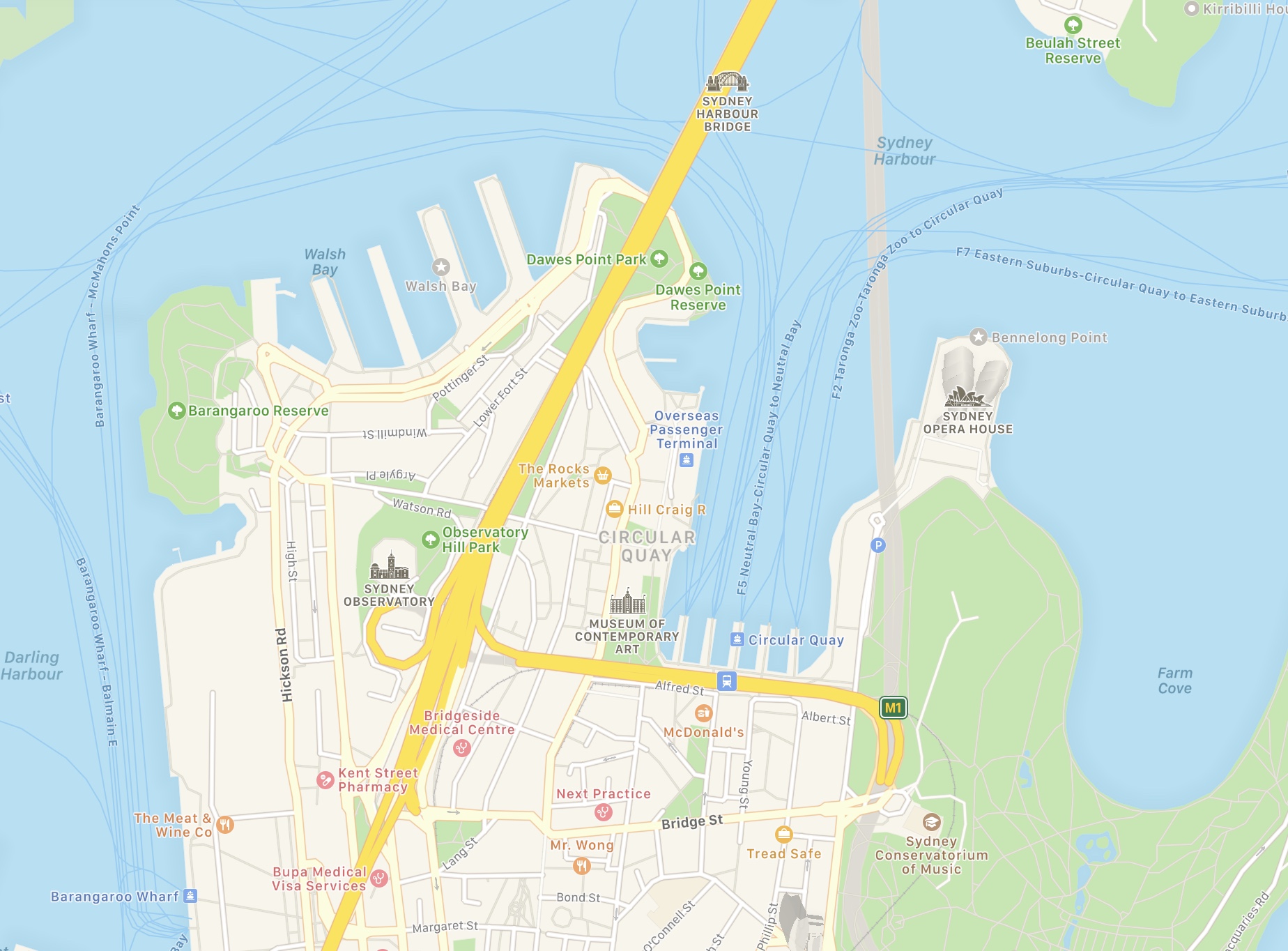
The last bit of nonsense about a Sydney GP speculated in 2015 about a race using the bridge, the Cahill Expressway and Bridge Street before jumping onto York Street and back across the bridge. I thought it was completely bonkers taking as it would, a big chunk of the track away from spectators, the bridge that is.

But, ever constructive and helpful, here is the best GP track on the planet. Walk it the next time you are in Sydney and tell me what you think. I lived in Millers Point for a decade from 2003 and this was my every other day early morning run route, it is a locals layout with backdrops which simply cannot be bettered.

The start of the race will on ‘The Hungry Mile’ on Hickson Road, a nice bit of local history as it is the place unemployed dock workers queued for a days work to load a ship during The Depression, hence ‘The Hungry Mile’ epithet.

We then have a straight run between the Barangaroo Parklands towards town on the right with the steep stone escarpment to the drivers left as they jostle for ‘Napoleons’ – a medium sharp left hander into Napoleon Street which rises gently straight for 100 metres to a tight left-hander at ‘Kents’.

Kent Street continues to rise gently as the drivers have tall apartment and office buildings on the left and open space on the right as they head north back towards the harbour, the road flattens as they pass Stamford Apartments on the left and Observatory Tower on the right.

On the approach to Observatory Hill Park on the high escarpment to the right the cars pass The Rocks Fire Station on the right and my old apartment building ‘Highgate’ on the left before doing a sharp left- and then right into High Street before heading downhill gently and up the other side again- this stretch is open to the drivers left with Barangaroo below and has Harbour Trust housing on the right side of the street- this stretch is about 400 metres long before turning right into Argyle Street for a 1 km run past the Lord Nelson on the left and again Observatory Hill park on the right towards Circular Quay in the distance.

This section of the track is very open – there is heaps of space for spectators and stands to the left and natural vantage points from Observatory Hill down to the track – with the Hero of Waterloo an easy stroll for a quick ale, it’s one of Sydney’s oldest pubs.

Argyle Place is straight and flat for the first 500 metres and starts to drop gently downhill towards Circular Quay at Cumberland Street- the sound of the cars going through The Argyle Cut will be unbelievable – now we are in the heart of The Rocks, braking hard and going gently downhill to turn left into George Street. The drivers will have a glimpse of the blue-green Quay waters and a Manly Ferry perhaps, after the left the road is straight for 500 metres before jinking right onto Hickson Road and then what will be a very fast open right-hander parallel with Campbells Cove – there are heaps of ‘money shots’ along this stretch – across to the Opera House, Bridge and North Sydney.

The road then sweeps open left, fast past Dawes Point itself and then runs along close to and parallel with the Harbour before turning left at Pier One. There is a hotel on the right and heaps of open space to the left for spectators and high above on the escarpment from the bottom of Lower Fort Street looking down. Plum, stunning viewing actually, my seat might be somewhere here.

The drivers are now onto the last third of the track, which comprises a 500 metre straight, opening to a flat gentle right past the Walsh Bay wharves on the right and the Hickson Road eateries and Sydney Theatre Company on the left before a medium fast left at the Towns Place intersection – we are still on Hickson Road – and then a fast blast through the short tunnel with the Palisade Hotel high above us and then 500 metres before hitting the start finish line and commencing another lap.

Walk it folks and then let me know if that isn’t potentially the best city road circuit on the planet. Ok then second best after Monaco.

(reddit.com)

Mark Webber’s Williams FW26B BMW during its 2005 Sydney Harbour Bridge runs the week before the AGP. https://primotipo.com/2015/08/29/mark-webbers-sydney-harbour-bridge/

Etcetera…

Circa 1970’ish i guess with the Arts Centre spire in St Kilda Road in the background- the water never looks that blue to me.

One for you many aircraft nutters.

RAAF Westland Wapitis from Point Cook, site of the 1948 AGP BTW- formation flying over Albert Park Lake circa 1930- planes used for, amongst other things Forests Commission of Victoria, aerial bushfire reconnaissance.

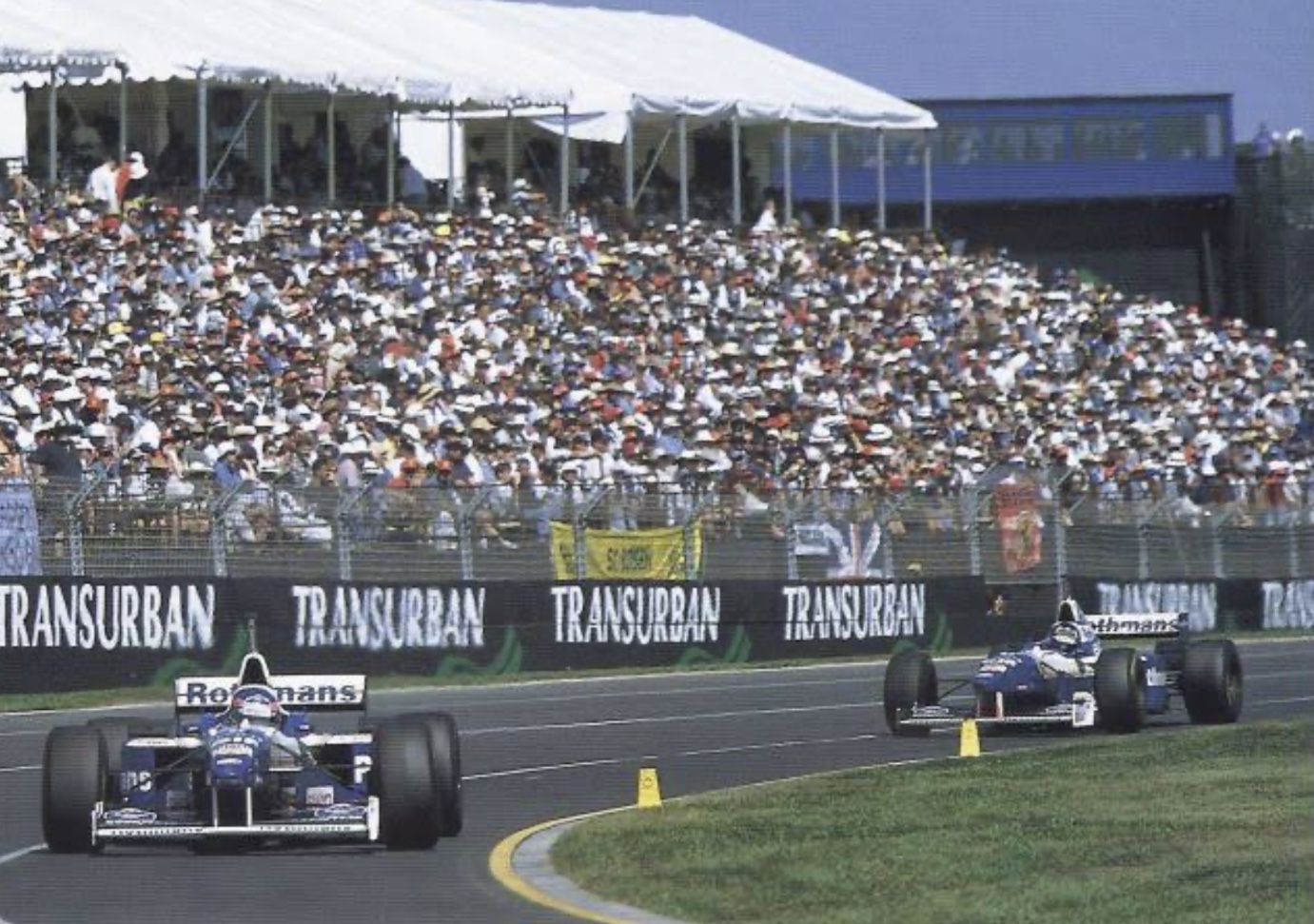
Villeneuve from Hill in 1996- exit of Pit Straight and beyond- didn’t he take to GP racing from Indycars in a way i wished Michael Andretti had done so a few years before- the BAR era took him backwards didn’t it.

(The Age)

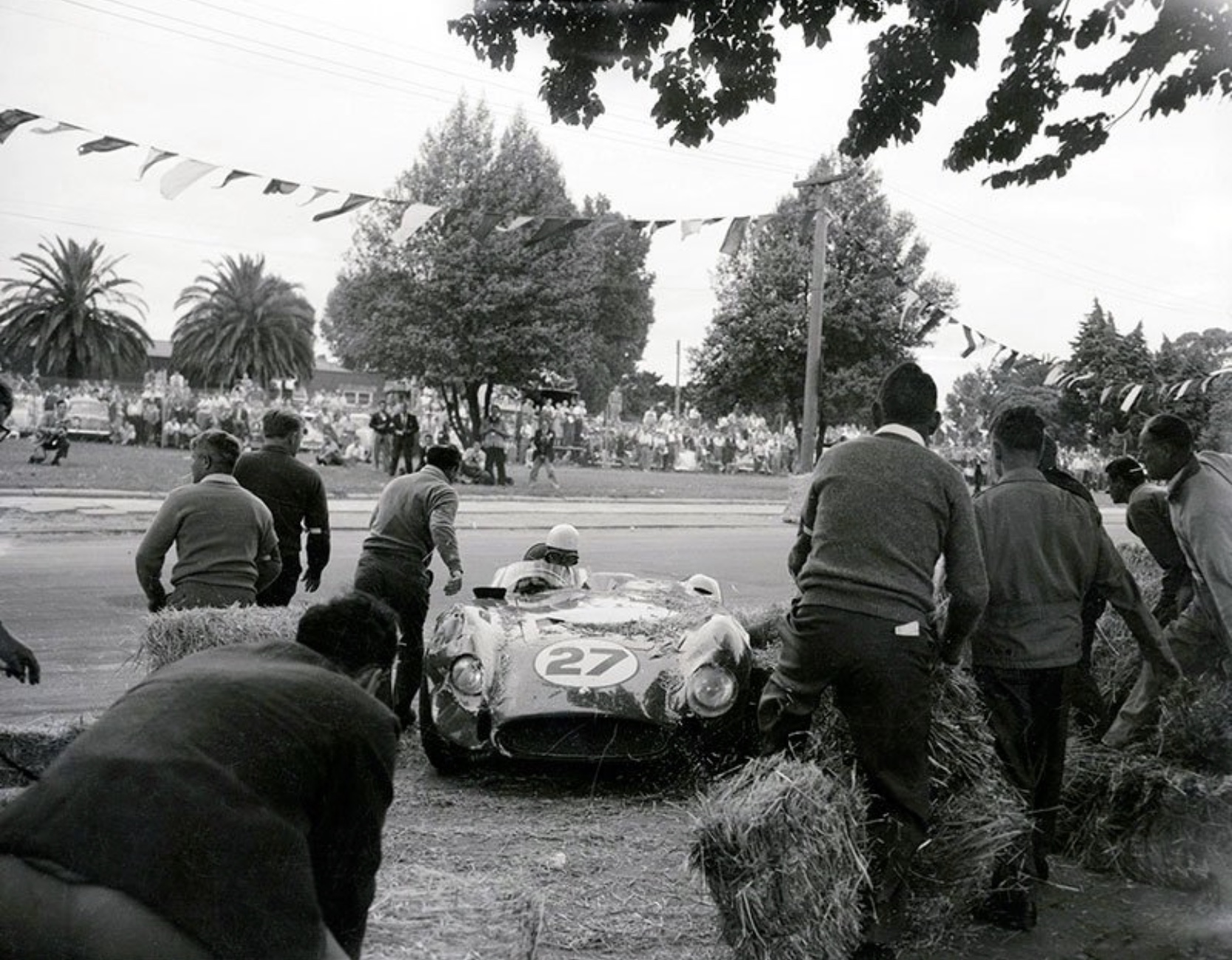
Janey in trouble trying to do a three point turn during the November 1958 meeting. Bob Jane, Maserati 300S. That eye-talian coachwork is looking slightly the worse for wear, he did eventually get the hang of this motor racing caper. Check out chummy to the right with the fag in his mouth, all ready to set the hay bales alight.

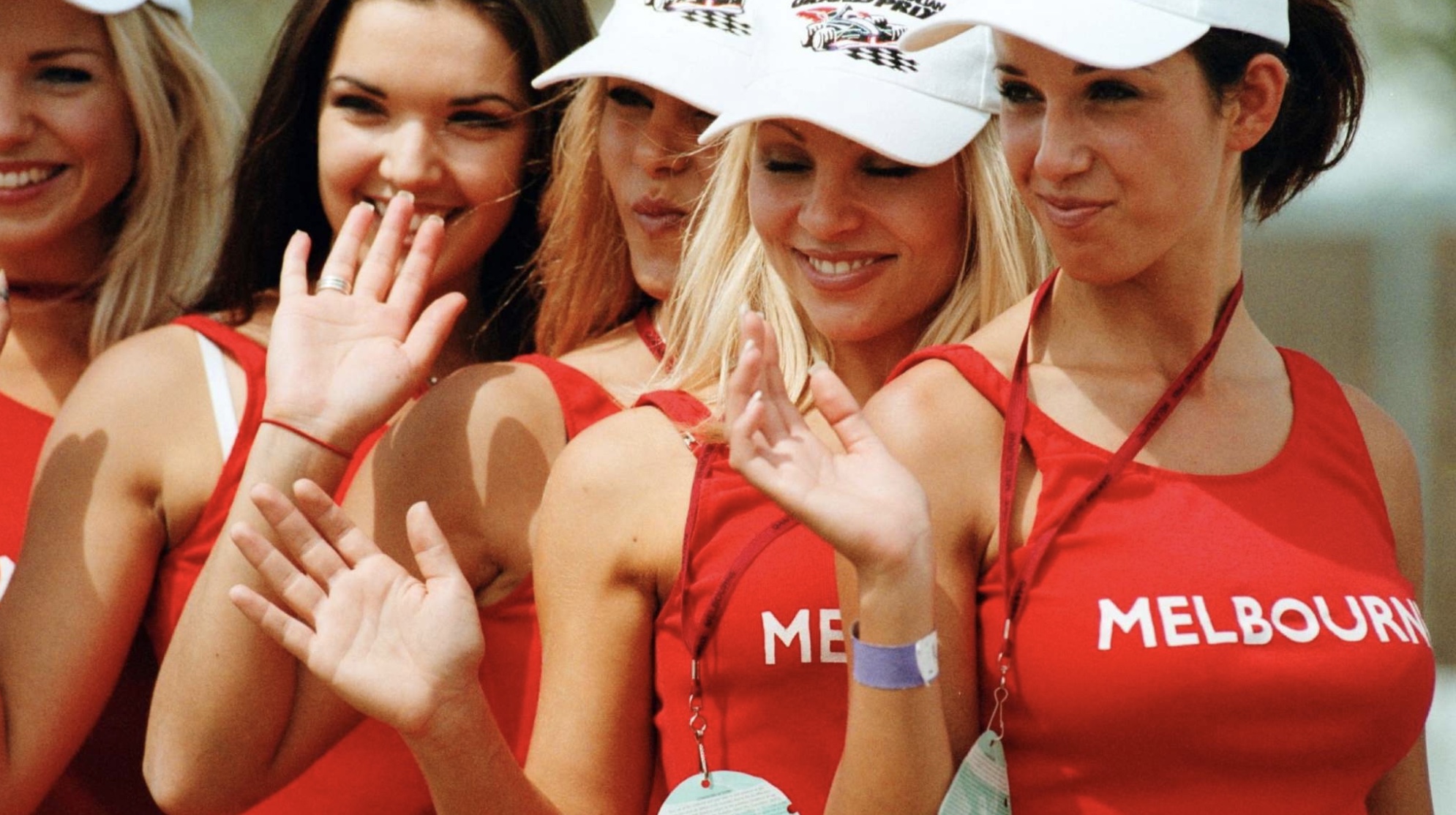
Some attractive young ladies if you like that sort of thing, in these politically correct times I should even the score with some blokes, hmmm, maybe not.

Bugger off and go home for gods sake – enough is enough like. Labour’s John Thwaites addresses a sea of angry SAP ants in 1994.

Thank the big fella up above than Martin Brundle was hunky-dory after this lot, it really would not have been a good look to lose a driver first up, not that it was the last of Albert Park’s involuntary aerobatic performances.

(unattributed)

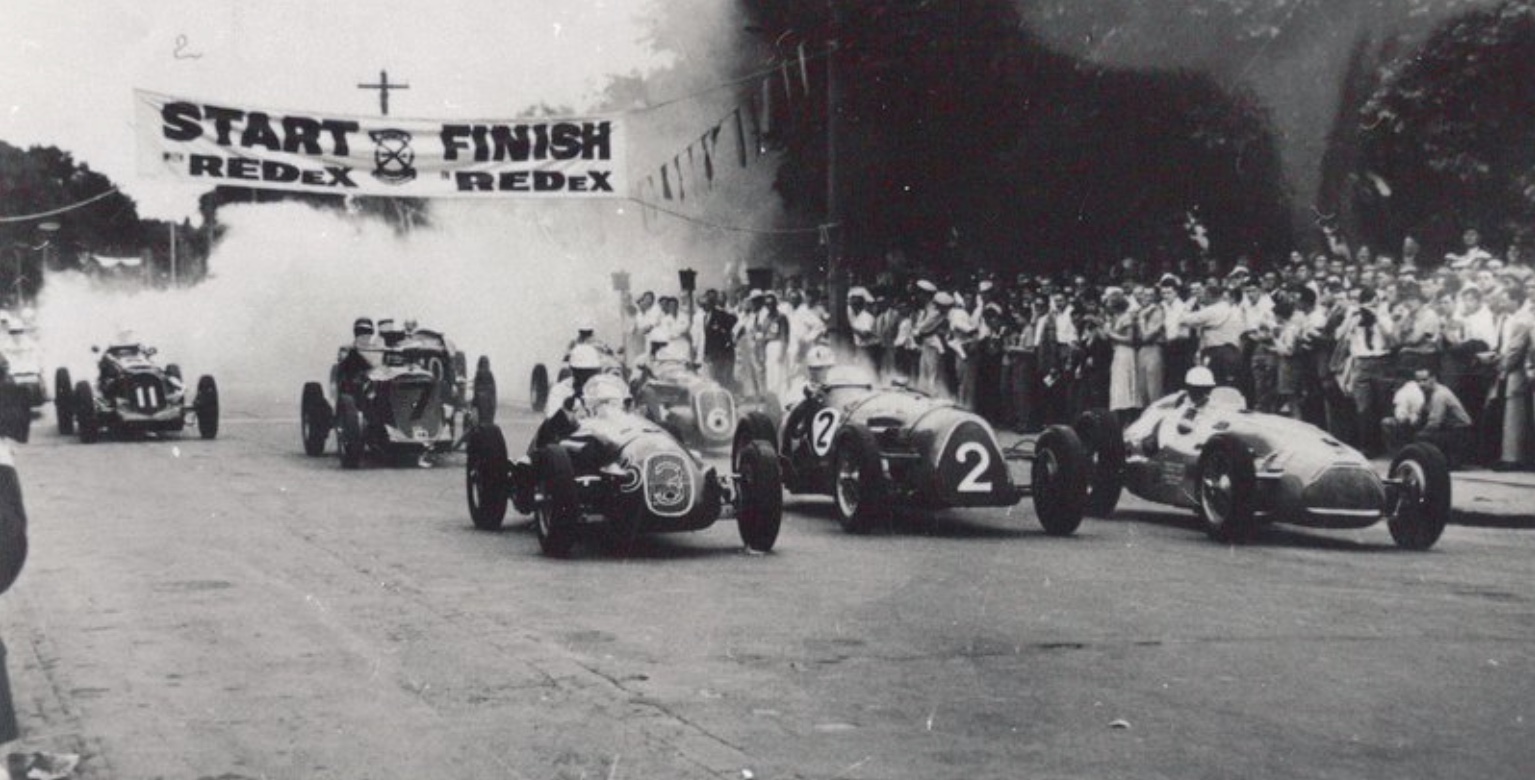
AGP start 1953, Albert Park’s first race meeting on the 21 November weekend.

Lex Davison, HWM Jaguar, Stan Jones in Maybach 1 and Doug Whiteford in his Talbot-Lago T26C on the right. #11 is Ted Gray, Alta Ford V8, #7 Frank Kleinig’s Kleinig Hudson Spl, #20 back a bit is Jim Gullan in an MG K3 and #6 is the Peter Vennemark dariven Maserati 4CL.

Doug Whiteford won from Curley Brydon’s MG TC Spl and Andy Brown in a MG K3.

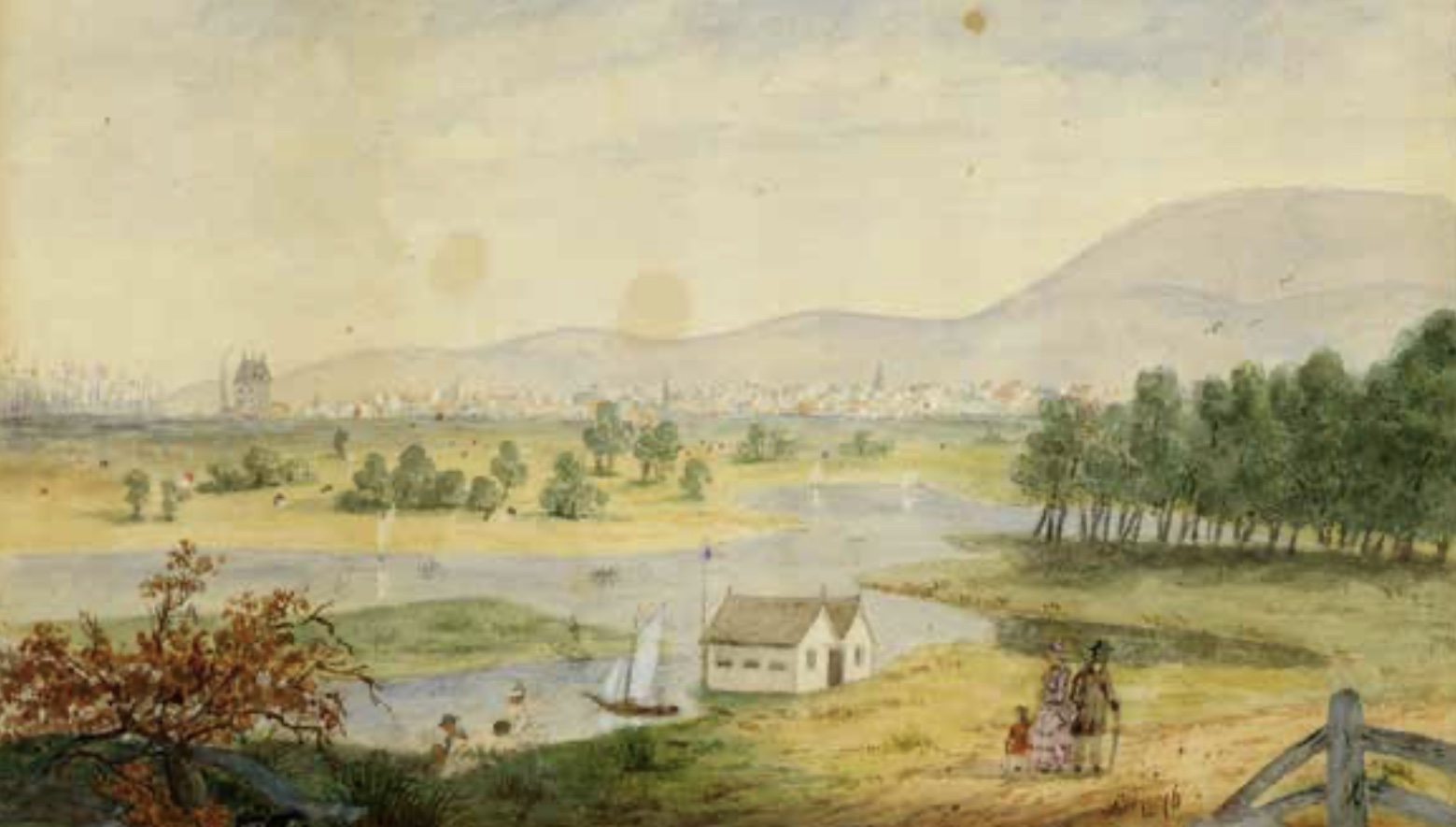
St Kilda Swamp aka Albert Park Lake in 1876 (St Kilda History)

Arcane, barely relevant but just because its down the road from me…

The aboriginal Kulin tribe who first inhabited the area 40,000 years ago were the first users of an enormous salt lagoon which formed a part of the delta where the Yarra met the sea. Hunting and fishing, they caught eels and fish in conical shaped nets watched by over 130 different species of water birds including ducks, swans, grebe, coot, cormorants as well as possums, bats and reptiles.

The area to the south of what became known as the Yarra River, its low sides skirted with marshes covered with luxuriant reeds, wild grass and herbage comprised a series of brackish lagoons and low lying marsh formed by the flow of the Yarra to the Bay near St Kilda. Early settlers reported on the area’s beauty and abundance of wildlife.

Emerald Hill ‘a gum and wattle tree forest’ was the name given to the high point of the land in South Melbourne. Some early geographers queried whether the Yarra was really a river and characterised it as a tract of marsh or swamp drawing a parallel with the fens of Lincolnshire which were drained, a model that ‘the Yarra and other Melbourne wetlands were doomed to follow.’

What was known as the South Melbourne Swamp was low lying land around Emerald Hill which was formed into Albert Park Lake during the 1930s Great Depression years. In so doing the marsh was drained and built over for domestic housing, the only reminder of the area as it was before European settlement is Albert Park Lake.

The Park originally extended to St Kilda Road, but the land was sold in 1874, the St Kilda Cricket Club was the first of many sporting clubs to be given permission to use the land, the Junction Oval is well known to Melburnians.

The Lake itself is about two kilometres long north to south and about one kilometre wide, the site was permanently reserved as a park of 230 hectares in honour of Queen Victoria’s Prince Consort in 1876

Bibliography…

Bob Carter on tapatalk.com, ‘Lost and Found Wetlands of Melbourne’ Rod Giblett

Illustration and Photo Credits…

The Illustrated Australian News July 1879, Les Maloney Photo Collection, Australian Grand Prix Corporation, John Lamb, Jack Atley, Herald Sun, Parks Victoria, Jason South, Tony Johns Collection

Tailpiece: Albert Park Lake, 1893…

(unattributed)

Finito…

(P D’Abbs)

Beautiful Peter D’Abbs photograph of Lex Davison’s Aston Martin DBR4/250, chassis #1 3-litre with Austin Miller, Cooper T51 Climax in the background, Phillip Island, 23 October 1960…

Lex became famous for his retirements from racing and Dame Nellie Melba type returns to the grid. His 1958 AGP win at Bathurst was the final time he raced the marvellous ex-Ascari/Gaze Ferrari 500/625. He took a break from racing, but heading into 1960 he planned to take a holiday in Europe with his wife Diana, and to acquire a new racer.

He had watched the ‘Cooperisation’ of Australian racing from the sidelines and decided that a modern incarnation of his (ex-Moss 1954 AGP winning) HWM Jaguar would be competitive with the growing number of mid-engined cars.

Lex pitched the idea of a DB4 3.7-litre engine fitted to a DBR4 GP chassis to Aston Martin Racing Manager John Wyer. Wyer assured him the motor wouldn’t readily fit and that the David Brown five-speed transaxle, already marginal, would be pushed beyond its limits.

After plenty of argy-bargy Lex did a deal to buy DBR4 chassis #1 fitted with a 3-litre DBR1 sportscar engine, and a DB4GT road car. A rather nice combination of roadie and racer!

After the cars rebuild in March 1960 it was tested at Goodwood by Jack Fairman, and Roy Salvadori over two days before shipment to Port Melbourne. Davison drove the car on the second of the days to within a fraction of a second of Fairman’s best.

Chassis 1, unsurprisengly the first of the DBR4s built, was raced by Salvadori during the 1959 and four times in 1960.

After an initial test session with Allan Ashton and the AF Hollins crew at Phillip Island Lex raced it to THAT missed-a-win-by-a-bees-dick Australian Grand Prix at Lowood on 12 June. There, Alec Mildren’s Cooper T51 Maserati led Davo home by an official margin of one half of a second after a little over an hour of Grand Prix motor racing of the first order- click here for a feature on Mildren inclusive of a full race report on the AGP; https://primotipo.com/2018/06/08/mildrens-unfair-advantage/

Davison in his new car, Aston DBR4/250-1 during the 1960 AGP at Lowood, Queensland (B Thomas)

Davison and Mildren hard at it at Lowood. The flaggies are absorbed in the battle, not sure if it’s Glynn Scott or Jon Leighton’s Cooper Climax behind (B Thomas)

Lex and the boys made the long trip back to Queensland in September and ran again at Lowood in another Gold Star round for third place behind Alec and Bib Stillwell, both T51 mounted, then at the non-championship meeting at Phillip Island in October. Davo then raced in the soggy Warwick Farm opening meeting on 18 December where he was fourth behind the T51s of Stillwell, John Youl and Austin Miller having started from the front row.

Famously these Aston Martins were at least two years late to be competitive in Grand Prix racing. Honours as the successful front-engined GP cars go to the Ferrari Dino 246 and Vanwall, winners of the 1958 drivers and manufacturers respectively. While handing out gongs, perhaps the most sophisticated front-engined GP car was the Lotus 16 Climax, if not the most reliable.

Two of the magnificent Aston Martins came to Australia in 1960. Davison’s ‘DBR4/250 (1) and Bib Stillwell’s ‘DBR4/250 (3)’.

Unlike Lex, Bib had an each way bet, his Kew, Melbourne Holden dealership was spitting out wads of cash so he had a Cooper or three in his garages as well as the Feltham beastie. Lex’ eggs were in one basket, until he borrowed one of Stillwell’s Cooper T51s and nicked the 1961 AGP at Mallala, South Australia from under the noses of the established water-cooled Cooper aces.

I say that as Lex had been winning races and hillclimbs in two Phil Irving fettled Vincent engined Coopers for years, he was hardly unfamiliar with the handling characteristics of these small, light mid-engined missiles.

Ain’t she sweet our friend is thinking. Ballarat 1961 (P Skelton)

Davison’s DBR4-1 in the Ballarat paddock with Warwick Cumming at the wheel, and perhaps Allan Ashton doing the pressures. I’m not sure whether #4 or 14 is correct but both shots are at the Ballarat Airfield (P Coleby)

Into 1961 Lex raced the Aston in the late January Warwick Farm 100- Q11 and DNF oil leak,  the race was won by the Walker/Moss Lotus 18 Climax. Davison then contested the Victorian Trophy at Ballarat Airfield on 12 February- the colour photo taken above by Phillip Skelton at that meeting could almost be a BP PR shot!

This time the car was out after completing nine laps with gearbox dramas, the hot and dusty race was won by Dan Gurney from Graham Hill in BRM P48s. It was the only international win for these cars.

Three weeks later, Davison and Stillwell took the cars to Longford. While Bib practiced the Aston he raced his Cooper whereas Davo raced to the finish of the 24 lap 100 miler, finishing in fifth behind Roy Salvadori, Bill Patterson, John Youl and Austin Miller in 2.2-litre and 2.5-litre Coventry Climax engined Cooper T51s.

Davison howls off Kings Bridge during the 1961 Longford Trophy, Aston DBR4/250-1 (oldracephotos.com.au/JSaward)

Dunlop HQ at Longford in 1961. Doug Whiteford’s Maserati 300S and Bib Stillwell’s Aston Martin DBR4/250-3 in attendance. This car was built to a later spec than Davo’s DBR4/250-1. In fact it was of the same specs of Davo’s new in 1961 chassis 4 inclusive of Maser transaxle and 80-degree engine (R Lambert)

Davison, during practice at Longford in 1961, DBR4-1 (G Smedley)

After Longford Lex shipped the car back to the UK. It needed a major rebuild as “the chassis was breaking up” wrote Graham Howard. The AF Hollins crew had repaired chassis tubes and added strengthening gussets to the machine in their Armadale, Melbourne workshop between the Ballarat and Longford meetings.

Lex’ plan was to race an Aston Martin at Le Mans and contest a number of Intercontinental Formula races in 196. In the event, after ongoing discussions with John Wyer, Aston Martin provided Davison a later chassis, “the sister car to Stillwell’s later model DBR4”, chassis 4 which was built but unraced in 1959, for Lex to use at Silverstone in July and Brands Hatch in August.

It was equipped, as was chassis 1 with a five speed Maserati transaxle instead of the heavy, recalcitrant David Brown unit, the latest cylinder head design which had valves arranged at an included angle of 80 degrees rather than the earlier variants 95 degrees. In 3-litre form it was good for circa 296bhp @ 6,700rpm, a good deal more mumbo than the 230 or so bhp of an FPF 2.5, but of course the chassis was no svelte nymph.

This article tells a bit of Bib and Lex’ 1961 European Adventures; https://primotipo.com/2015/09/22/aston-martin-db4gt-zagato-2vev-lex-davison-and-bib-stillwell/

(TC March)

Davo above having his first race in the second Aston DBR4/250-4 3-litre at Silverstone during the July 8 1961 British Empire Trophy Intercontinental Formula race. DNF gearbox quill-shaft after 17 laps, up front after 245km was Moss and Surtees in Cooper T53 Climaxes.

Davison had a busy weekend as he also contested the GT race in John Ogier’s Aston Martin DB4GT, “a bit of an old nail” and finished third behind the Ferrari 250 GTs of Stirling Moss and Graham Whitehead.

The Australian’s DBR4 drive received good press coverage, but Graham Howard wrote that it added to confusion for later historians as to which car Davo raced. The Motor described the machine as an ex-works DBR4 Grand Prix car fitted with a much modified 3-litre sportscar engine, while Autosport added to the confusion by noting that “a new chassis was fitted.”

Aston Martin themselves didn’t help either. In a late 1961 letter to Lex about a variety of things including shipment of the car to Australia, Wyer advised “the Aston had now been shipped, although there had been a mix-up with chassis numbers and it had been stamped DBR4-1 rather than DBR4-4”.

To be clear on this point, Graham Howard makes no comment about the chassis number of Lex’ first Aston, nor does Doug Nye, while Anthony Pritchard – his book was published later – says that the car is generally accepted to be DBR4-1. John Blanden in the second edition of his book simply lists one car and applies two chassis numbers to the “one entity”.

The correct position seems to be that the two cars were quite separate. Lex raced DBR4-1 in Australia, returned it to Feltham in early 1961, then raced DBR4-4 (the unused 1959 built chassis) in the UK and then later in Australia. The chassis, body and engine were different, built to a later spec. Whether the Maserati gearbox and other componentry fitted to chassis 1, which was interchangeable, was carried over to #4, who knows.

What is clear is that Lex was unhappy with his new car after Silverstone, Autosport quoted Lex as saying its “handling was nothing like the original car.”

A month later Davison contested his second and last Intercontinental race, the Guards Trophy at Brands Hatch on 7 August. This time, in dry, sunny conditions he brought the “new dinosaur” home in sixth place, ‘bruising’ the nose of the car; up front, four laps up the road in fact, Jack Brabham headed Jim Clark home in Cooper T53 Climax and Lotus 18 Climax respectively.

The relative size of the Aston Martin is put into context by Lorenzo Bandini’s Centro Sud Cooper T51 Maserati going underneath Davison into Surtees at Brands. The Italian was seventh and last of the finishers, and several months later was a popular contestant in our 1962 summer internationals (Getty)

Davison cruising through the Silverstone paddock during the July 1961 International Trophy meeting, his first race in DBR4/250-4 (unattributed)

A week or so after Brands the family headed home to Australia with the Aston Martin left behind at the factory for further work. This included repair of the panel damage sustained at the Kent circuit and to fit 12.5:1 pistons to suit the alcohol based fuel Lex used in Australia.

Howard reports that Davison was still unhappy with the handling of the car. He quotes from a letter written by Lex to Brian Josceleyne of the Aston Martin Owners Club, “My Grand Prix car is still at the works, where they are endeavouring to sort out some of the handling bugs, for the new chassis proved rather twitchy, unlike my earlier one which was a superb handling car and could be thrown about in a rather flippant way.”

Davo returned home via America including Hawaii, in time to win the AGP in South Australia on 9 October in one of Stillwell’s Cooper T51s. It was a car he rented from Bib after it became clear the DBR4 wouldn’t arrive in Australia on time for the race, that story is here; https://primotipo.com/2018/03/29/the-naughty-corner-renta-gp-winner/

Pat Hawthorn in the second of the Davison DBR4/250 Astons, chassis 4. The eagle eyed will note that the induction and exhaust ports of this car/engine are the reverse of the earlier machine (P Hawthorn)

There was still life in the old design though, Davison raced the Aston Martin to second place in the Victorian Trophy at Calder behind Stillwell’s Cooper T53 Climax in late February 1962. Not too far from home, at Sandown’s opening meeting he contested the Sandown Park International on 12 March where he was eighth behind a swag of Climax engined Coopers and Lotuses as well as the Chuck Daigh driven Scarab RE Buick 3.8-litre V8, it too was a mid-engined machine.

By that stage Lex had got-with-the-strength and was racing a Cooper T53 Lowline which famously met its maker in a huge accident at Longford on March 4. A gust of wind caught the car while airborne on the hump in the road before the Longford pub, it was a very lucky escape. The Yeoman Credit Cooper was geared for 170mph @ 6,700rpm that weekend, Davison described the accident, raconteur as he was, to John Wyer in one of the many letters they exchanged.

“I was managing to lap at 110 to 112 mph, some three seconds faster than Brabham’s lap record of the year before, when I became airborne over a hump some 200 yards prior to a 90-degree corner in the middle of a little town. A gust of wind caught me and I landed in a drain beside the road. I motored along this at some 140 mph causing some uneasiness to the police, radio announcers, officials, television cameramen and various others cluttering up the entrance to the escape road. I regained the road again but the heavy rear-engined end slid in the gravel and I shot down the road sideways. I hit a tree with the nose, which plucked everything forward of the soles of my feet off the car and spun the car around in the process. It then shot along a hotel wall at window height, demolishing the floral display, pot plants etc, then a 360 degree spin around the entrance porch of the hotel and back up the wall again. The car then fell off the hotel wall and back into the road and shot across the road backwards into a grain mill. I shook what was left from me and went back into the pub and ordered a brandy. They even made me pay for it, which was the cruelest blow of all.”

After the international visitors returned home Lex ran the Aston at Sandown in May 1962, winning a race for front engined racing cars. He didn’t run it again until February 1963 when he gave it a gallop at Calder, in part to demonstrate it to potential purchasers. In the process he provided five thrilling laps for spectators in a three car match race with Bryan Thomson’s supercharged Cooper T51 Climax and Frank Matich’s new, works, Elfin Catalina Ford pushrod 1.5.

The Aston Martin was advertised for sale in Australian Motor Sports during 1962 and was soon acquired by garage proprietor and Calder Raceway part owner, Pat Hawthorn. He is photographed above proudly showing off his new acquisition at his Clayleigh Service Station in Clayton, not too far at all from Sandown where, by March 1963, he was mixing it with the heavies in the Sandown Park International.

Pat Hawthorn on the way to fourth place in the Advertiser Trophy, 1963 Mallala Gold Star round. And kids just want to have fun below!, circuit uncertain, Winton perhaps. Aston Martin DBR4/250-4 (P Hawthorn)

(P Hawthorn)

Hawthorn raced the car through until 1966 in Victoria and South Australia. Perhaps the last championship points the car scored were in the 14 October 1963 Advertiser Trophy, Mallala Gold Star round. There he was fourth among the mid-engined hordes, behind the Cooper T55 of John Youl, Bib Stillwell’s Brabham BT4 and Wally Mitchell’s MRD (aka Brabham BT1) Ford Formula Junior.

Pat sold the car to UK historic racer Neil Corner in 1966, there he was a consistent race winner, the Calder Raceway signed Rice Trailer cut quite a dash on UK Motorways! DBR4-4 of course still exists.

Aston Martin DBR4/250 cutaway drawing, 95 degree engine spec (conceptbunny.com)

Chassis numbers and development of the Aston Martin GP cars in summary…

My standard reference for all things chassis numbers is Allen Brown’s great site, oldracingcars.com (ORC). I say great in the sense that most of the standard texts were written in the pre-internet days before it was possible to debate the merits of ‘what is what’ and ‘which is which’ amongst knowledgeable enthusiasts to land on generally agreed positions based on facts which have been often vigorously debated.

Using ‘Howard’ (see bibliography) published in 2004, ‘Nye’ in 1993, ‘Blanden’ in 2004, ‘Pritchard’ in 2006 and ‘ORC’ as my source material the Aston Martin Grand Prix cars built are as follows and their destiny, I think and hope is as follows…

Reg Parnell does all the work as Peter Whitehead and Tony Gaze share a joke. Aston Martin DP155/1 at the Dunedin Wharf rail head, New Zealand, January 1956 (T Selfe)

1. DP155 and the DBR4/250

Aston’s first toe in the water GP exercise was the DB3S based DP155 I wrote about a while ago. Its most significant racing was with Reg Parnell at the wheel during the 1956 New Zealand Internationals, click here; https://primotipo.com/2019/09/05/the-gp-aston-martin-dp155/

‘Its bones’ were converted back into a DB3S albeit there is a car doing the rounds in the UK ‘sorta in the style’ of DP155. It has none of the original car’s core componentry.

Getting more serious, in the summer of 1956 – at the same time they started development of the DBR1 – Aston Martin’s engineers commenced the design of the DBR4/250 GP car.

The spaceframe chassis was fitted with a short-stroke version of their 3-litre sportscar RB6 engine. This 2493cc DOHC, two valve, 50DCO Weber fed engine produced 250bhp @ 7,800rpm on the Avgas which was mandatory from 1958.

The design was period typical in having upper and lower wishbone suspension at the front, with torsion bars and co-axial shock absorbers, and De Dion rear suspension with torsion bars again the springing medium. The axle was located by a Watts linkage and radius rods. Armstrong provided the shocks front and rear.

A transaxle was used at the rear – the unpopular with drivers – David Brown CG537 five-speeder. Girling provided the brakes, Borrani the wire wheels. Initially Morris Minor rack and pinion steering was used, later the DB4 rack and pinion was adopted.

Roy Salvadori in practice aboard DBR4-1 during practice at Zandvoort, 1959 Dutch GP weekend. DNF overheating after 13 laps. Jo Bonnier won in a BRM P25, it was BRM’s first championship GP win (Getty)

2. DBR4/250 chassis number 1

‘This prototype’ was built in time for testing by Reg Parnell and Roy Salvadori at MIRA in December 1957. It was further testing again there in February 1958 before being put to one side as sportscar racing was prioritised.

Stirling Moss won the Argentinian GP in a Rob Walker Cooper T45 Climax in early 1958. Time was of the essence with the DBR4/250. The oh-so-sexy-beast, was, in effect obsolete by the time of its launch in April 1959.

By then the car was fitted with modified DB4GT coil and wishbone front suspension which was more practical than the torsion bar arrangement, but was 15 pounds heavier – in a car which was already a pork-chop.

Salvadori’s second place in the BRDC International Trophy at Silverstone flattered to deceive. Initial problems were an engine at the wrong end of the car (cheap shot), too much weight, and, most critically engine bearing lubrication issues which meant revs had to be kept down to an uncompetitive level.

Aston Martin won at Le Mans in 1959, Salvadori and Carroll Shelby took a splendid win in the DBR1. Poised to win the World Sportscar Championship, the F1 program, rightfully, took second place in the allocation of scarce corporate resources.

In the winter of 1959/1960 chassis 1 and 2 were modified. After surgery they were two inches slimmer and some 55lb lighter. ‘”Merely replacing Brown’s own heavy and baulky CG537 transaxle with one from Maserati (Type 5M-60) saved 50lb. The Aston gearchange, reliable, but heavy and slow – tolerable in a sportscar, was out of place in Formula 1″ Doug Nye wrote.

After negotiations between Davison and Wyer DBR4 1 was fitted with engine number RB6/300/1 from sportscar chassis DBR1-1 and shipped to Australia, John Blanden wrote.

DBR4 1 was returned to the UK by Davison in early 1961 and was eventually bought by Neil Corner, to use as a spare for his DBR4-4 he ran in historic racing with chassis 1 built into a complete car by Geoffrey Marsh in the early eighties.

Front and rear suspension of Trintignant’s DBR5-1, British GP weekend, Silverstone 1960. Upper and lower front wishbones, torsion bar, roll bar, Armstrong shock, Girling solid disc brakes. The major difference to the DBR4 is the use of a torsion bar instead of a coil spring. De Dion rear suspension, Armstrong shock and radius rods – same as DBR4 (Getty)

Carroll Shelby during the 1959 Portuguese GP at Monsanto Park, eighth in DBR4-2. Moss won in a Cooper T51 Climax (LAT)

3. DBR4/250-2

Was Carroll Shelby’s chassis in 1959, and like #1 contested only the Dutch, British and Portuguese GPs that year. 1959/1960 winter modifications as above. DBR4-2 was scrapped.

Bib Stillwell susses his equipment, DBR4-3 in the Ardmore paddock, NZ 1962 (E Stevens)

4. DBR4/250-3

This car was lighter than the first two built by virtue of a stressed skin body centre section, one piece De Dion tube and lighter Maserati gearbox. Its race debut was at Monza in September 1959.

Salvadori retired it while running sixth, Moss won in a Rob Walker Cooper T51 Climax. Front engined Ferrari 246 and BRM P25s filled six of the top eight places so a good front-engined machine could still do well, on fast circuits at least!

Stillwell bought the car on a bit of a whim, frustrated as he was by not being able to buy a 2.5-litre Coventry Climax FPF engine for his Cooper T51 at the time. The motors were in short supply, allocation preference was to the works favoured or contracted Cooper, Walker and Lotus teams.

In the event, no sooner had Bib committed to the Aston Martin, he was able to buy the Cooper T51 Jack Brabham raced in Australia that year…fitted with a 2.5-litre FPF.

In fact the Kew, Melbourne Holden Dealer had possibly fallen out of love with the Aston before its arrival in Australia. Bib raced his new 2.5-litre T51 to first at Port Wakefield in October, then second at Caversham, and third at Phillip Island on consecutive December weekends. He topped off his late season form by winning the (non Gold Star) Warwick Farm Trophy on 18 December, back in fourth place was Lex’ DBR4 surrounded by a sea of Cooper T45/51s.

Fitted with 3-litre RB6/300/7 sportscar engine, DBR4/250-3 arrived in Australia in late 1960 and was almost immediately shipped to New Zealand to contest the NZ GP at Ardmore, Auckland in early January 1961. He placed fifth in a heat and was classified twelfth in the GP, Jack Brabham won in a Cooper T53 Climax.
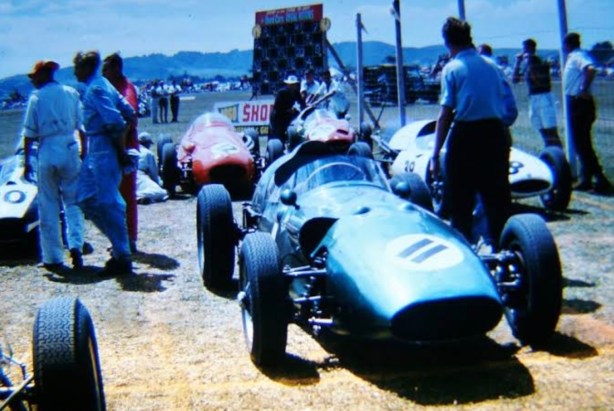
Bib Stillwell’s Aston DBR4-3 in the Ardmore paddock during the January 1961 NZ GP weekend. Jo Bonnier’s Cooper T51 Climax right rear, David McKay’s Stan Jones owned Maserati 250F #12, and the #38 Cooper is uncertain. Denny Hulme drove a car with that number in this race but the car shown is not the dark coloured Yeoman Credit T51 Denny raced (TRS)

A nice compare and contrast shot. Stan Jones’ Cooper T51 Climax alongside Stillwell’s DBR4-3 before practice at Longford in March 1961

Back In Australia, he practiced the car for the Warwick Farm 100 in late January but didn’t race it. Running the T51, he finished third behind the Moss and Innes Ireland Lotus 18 Climaxes. Bib’s crew then took the car across Bass Straight to Longford in early March, Bib practiced it, but the engine burned a piston so he raced his Cooper T51, retiring with plug problems in the Longford Trophy won by Roy Salvadori’s Ecurie Vitesse (Jack Brabham) Cooper T51 Climax.

Bib continued to race his T51 but returned with the Aston Martin to Warwick Farm in May. He won the (non Gold Star) 10 lap Racing Car Scratch from Alec Mildren’s Cooper T51 Maserati 2.9 and Noel Hall’s Cooper T51 Climax 2.2. Was this the only race win of a DBR4 in-period anywhere?

And that was it. Bib displayed the car at Jim Abbott’s Melbourne Racing Car show in August before racing it again in the 1962 NZ GP, doubtless, given his flotilla of Coopers, with a view to selling the car in New Zealand. He was tenth in the sopping wet race won by Stirling Moss – having qualified seventh – inclusive of a mid race plug-change.

Bay of Islands driver Lionel Bulcraig acquired the car after the race, running it in NZ through to 1965, his time in the car is covered here; https://primotipo.com/2019/09/02/waimates-aston-martin-dbr4-250/

Bulcraig advertised it in Car and Driver, the American international magazine, in late 1965. It was acquired by Peter Brewer who dominated Historic Racing in the UK in the late sixties with it. Bought by Tom Wheatcroft’s Donington Collection in 1970, it was “a collection of horrible bits”, as Doug Nye described it, for restoration to original 1959 specifications.

Stillwell, DBR4-3 during the 1962 NZ GP, site of a Stirling Moss Lotus 21 Climax wet weather master-class. Stillwell was tenth, 6 laps in arrears (Ardmore)

DBR4-3 chassis in recent times in the Hall & Hall workshop. Rare chassis photograph (H&H)

Plug change for Salvadori’s IRS “diabolical handling” DBR5-2 during the 1960 British GP weekend, nice cockpit shot. Trintignant’s de Dion DBR5-1 is in front (Getty)

5. DBR4/250-4

This chassis built at the same time as #3 but was unraced in F1 in 1959 and 1960.

After DBR4-1 was returned by Davison to Feltham in early 1961, DBR4-4 was built to ultimate spec; De Dion rear, Maserati gearbox, 80 degree cylinder head and magnesium alloy block RB6/300 engine specifications for use in the Intercontinental Formula in the UK. Then limited use in Australia before its sale to Pat Hawthorn in early 1963.

Later to Neil Corner in 1966, who also acquired DBR4-1 which was eventually built up as an historic car.

Trintignant’s DBR5/250-1 being unloaded from Aston Martin’s AEC transporter at Silverstone during the July 1960 British GP weekend at Silverstone- a poor eleventh was the result (LAT)

Cars 6. and 7. DBR5/250-1 and 2- sometimes also referred to as DP201

For 1960 Aston Martin designed a new car – still front engined mind you – the DBR5/250 was 3 inches shorter than the DBR4 with a wheelbase of 7 ft 3 inches and used torsion bar independent front suspension.

Two cars were laid down, DBR5/250-1 which was built with a De Dion rear and chassis 2 which was fitted with independent rear suspension by torsion bars.

Both DBR5s were scrapped after unsuccessful performances in the International Trophy, at Zandvoort and in the British GP.

Doug Nye wrote that “The new rear end merely made the cars handle worse, so following the British GP, David Brown wisely withdrew his team from the dying Formula”,- the 2.5-litre F1 ended on 31 December 1960.

In summary, Aston Martin built seven Grand Prix cars; one DP155, four DBR4s and two DBR5s with three now extant – DBR4 1, 3 and 4.

Zandvoort 1960, two cars for Roy Salvadori. DBR4-3 at left was brought along as the practice hack and DBR5-1 is at right, the racer. DNS along with the Scarabs when the Dutch GP organisers reneged on the start money deal. The cars were rumbling back towards the Channel by the time the race commenced. It’s a nice side by side shot, the only obvious difference is the 95-degree engine in the DBR4 and 80-degree exhaust on the left motor in the DBR5 (D Friedman)

DBR5-1 with Lucas fed 80-degree twin-plug 2.5-litre six – 245bhp @ 7,500rpm. Zandvoort 1960 (D Friedman)

Anthony Pritchard wrote that “By this time (Zandvoort) Aston Martin realised the hopelessness of their position.”

Team Manager Reg Parnell asked Stirling Moss to try the car, the best that he could manage was a 1:40 compared to 1:33.2 in his Lotus 18 Climax. Trying his very hardest, Salvadori achieved 1:37 seconds.

Zandvoort, (D Friedman)

British GP July 1960. Nice compare and contrast of the Weber DCO and Lucas injected engines. The independent rear suspension shot is Salvadori’s DBR5-2 which handled atrociously; upper and lower wishbones, roll bar, Armstrong shock and two radius rods, torsion bar (Getty)

Etcetera…

(Michael Oliver Collection)

After publication Lotus historian and author Michael Oliver got in touch and sent these two marvellous shots of Lex during the Brands Hatch Guards Trophy meeting taken by his father, and his dad’s mate, below.

Whilst Lex damaged the nose of the car during practice he also knocked off the right-front corner of the Aston. The shot captures the damage and is a rare colour image of the suspension.

(Michael Oliver Collection)

(K Harley)

Ecurie Australie at Longford in 1961.


Photo Credits…

Peter D’Abbs via Mark Ellery Collection, Pat Hawthorn Collection via Russell Hawthorn, Phillip Skelton via the Tony Johns Collection, Getty Images, Ron Lambert, oldracephotos.com.au/JSaward, Peter Coleby Collection, Tony Selfe, David Friedman Collection, LAT, E Stevens, Brier Thomas, Hall & Hall, TC March, conceptbunny.com, Michael Oliver Collection, Kim Harley

Bibliography…

‘Lex Davison: Larger Than Life’ Graham Howard, ‘History of The Grand Prix Car 1945-65’ Doug Nye, ‘Aston Martin: A Racing History’ Anthony Pritchard, ‘Historic Racing Cars in Australia’ John Blanden, oldracingcars.com

Tailpieces…

(P D’Abbs)

The opening shot of Lex again but cropped a tad tighter to focus that little bit more on the car- DBR4/250-1. While below is the same car eighteen months before in the Dutch sand dunes rather than the Australian ones, Roy Salvadori at Zandvoort during the 29-31 May weekend in 1959.

(LAT)

Finito…

(autopics.com.au)

Bruce McLaren, Cooper T70 Climax, Australian Grand Prix, Sandown Park 1964…

Its an unusual angle, Bruce is thinking about brakes as he passes the end of the pit counter and heads towards the tight ‘Peters’ left-hander before the blast up the back straight- unusual in that the shot is taken from outside the circuit, between the Armco fence and access road, a prohibited area for spectators and ‘snappers for most of the tracks life.

Click here for the ‘first McLaren’ Cooper T70 story; https://primotipo.com/2016/11/18/tim-mayer-what-might-have-been/

(J Lay)

This one is also at Sandown but a year later, 1965, as the drivers listen intently to the Clerk of The Course before the off.

Roy Billington is on the rear wheel of Jack’s Brabham BT11A Climax- the winning car, then the tall Tyler Alexander, Bruce is in the ‘Persil’ white Firestone overalls, Bib Stillwell behind him, Jim Clark, Jack Brabham and David McKay playing with his iPhone. Jack won from Jim and Phil Hill’s Cooper T70.

Jack posing patiently for Paul Stephenson in his victorious BT11A- Sandown pitlane.

(P Stephenson)

(unattributed)

Back to the 1964 Sandown Australian Grand Prix.

Bruce takes a glimpse in his Cooper T70 mirror before lining up for the Shell Corner left hander, Jack Brabham in close attendance- Brabham BT7A Climax. Over to the right alongside the fence Jim Palmer is giving them plenty of room in his Cooper T53 Climax, he was sixth. Jack won whilst Bruce was out with engine problems.

Credits…

autopics.com.au, Jeffrey Lay, Paul Stephenson, Graham Rhodes in Australian Autosportsman

Tailpiece…

(Graham Rhodes photographer)

I chuckled when randomly coming across this photo because it is taken within 20 metres or so of the first one but is taken from under the Armco on the outside of Peters rather than the opening shot from outside Pit Straight towards the braking area into Peters.

Just to add to the date confusion, this one is the year before mind you- Bruce is in the Cooper T62 he raced that 1963 summer inclusive of the 1962 AGP at Caversham in November, Lex Davison acquired it at the end of that summer- lengthy piece on that car here; https://primotipo.com/2016/05/20/bruce-lex-and-rockys-cooper-t62-climax/

Finito…

Moss, Lotus 21 Climax, Warwick Farm 100 practice 1961 (Mal Simpson)

Father Time waits for no-one, not even ‘the immortals’, sadly the great man’s time had come- Stirling Moss, 17 September 1929 to 12 April 2020.

What an extraordinary life of achievement.

To me he personified grace, sportsmanship and fairness despite being a fierce competitor, a certain clever conservatism but with an impish naughty streak and sense of humour. He was everything that is great about Britain and the essence of what to me it is to be a Brit.

Without doubt he was the living embodiment of motor racing, his passing deprives the sport of its greatest global spokesman and ambassador.

I can’t remember if I was aware of Stirling before seeing the Chrysler Valiant ‘Hemi’ ads as a kid on Australian telly circa 1970 (remember those?) or whether it was after my interest in the history of the sport commenced a couple of years later.

Whatever the case he has been a constant in Australia since he first raced here in 1956 through the 1961 internationals, then into the Tasman years after he had retired from the cockpit when more often than not he travelled with the circus, and from 1985, first in Adelaide and now Melbourne was a regular in F1 historic support parades and events.

I have a photo of him with my youngest son taken in the Albert Park historic tent, even though it was the five-millionth time he had done that, he still exchanged a few pleasantries with Nick- he still remembers it despite being six at the time, twenty years ago.

RIP from all your Australasian friends Mr Moss, we salute your achievements, applaud the way you conducted yourself and thankyou for all the entertainment and pleasure you gave us…

Behra, Moss, Albert Park, AGP 1956 (unattributed)

Credits…

Mal Simpson, Stephen Dalton Collection, John Ellacott

Etcetera: ‘For All The Right Reasons’…

For international readers the Chrysler, Valiant factory shown in the first ad was on a 65 acre site named ‘Tonsley Park’ at Clovelly Park, 12km south-west of Adelaide. The beach scenes will be closeby to that facility on one of the Fleurieu Peninsula beaches.

Etcetera…

A couple of Australian motor magazine covers from Stephen Dalton’s Collection with Stirling on the cover- as he so often throughout the world was!

This photo taken by John Ellacott posted on The Noatalgia forum by Ray Bell is of Stirling giving Paul Samuels’ Lotus 18 Ford Formula Junior a whirl at Warwick Farm in 1961.

His Rob Walker Racing Cooper T53 and Lotus 21 (car in the first photo) were late arriving in Sydney from New Zealand so he jumped into a couple of cars to do some familiarisation laps of the new, quite technical Warwick Farm layout.

(J Ellacott)

Finito…


(R Croston)

The wonders of social media…

Richard Croston popped onto that internet thingy some amazing factory data on the 1955 Ferrari Super Squalo ‘555-2’ raced by the factory in Grands Prix that season, and then acquired by Reg Parnell for modification to Formula Libre specifications by fitment of a Monza 860 3.4 litre engine where a 2.5 litre Gee Pee jobbie once nestled.

He and Peter Whitehead, in ‘555-1’, raced the cars in the 1956 Australian Grand Prix at Albert Park and then did the New Zealand internationals in January/February 1957 before selling the cars locally and then high-tailing it back to Europe. Suss this ’56 AGP piece; https://primotipo.com/2018/01/16/james-linehams-1956-agp-albert-park/

I’ve substantially added to an earlier article on ‘555-2’- its grown from 500 words to 2600 in a couple of separate additions, so worth a look, its a bonus if you speak Italian… https://primotipo.com/2015/08/25/arnold-glass-ferrari-555-super-squalo-bathurst-1958/

Credits…

Richard Croston Collection, George McKaige from ‘Beyond The Lens’

(unattributed)

The black nose-banded Parnell 555 Ferrari takes centre stage in the Albert Park paddock during the 1956 Australian Grand Prix weekend- the car behind is Whitehead’s identical machine.

Car #5 is the nose of Reg Hunt’s Maserati 250F, the #8 Ferrari Monza is I think Stan Coffey’s albeit he raced with number 9- it isn’t Ken Wharton’s who raced with #10. Theory folks?

Who is the short, burly driver standing behind Whitehead’s car?- it isn’t slight Peter or burly but balding Reg.

(G McKaige)

Reg and the boys push 555-2 onto the Albert Park grid- Stirling Moss won in a works 250F that day from Jean Behra’s sister car, then Whitehead in 555-1 and Parnell in 555-2.

(G McKaige)

Rare colour shot of Reg on the move during the race from George and Chester McKaige’s wonderful book ‘Beyond The Lens’. Many pundits are of the view that Parnell- who had a great career, was potentially one of Britain’s best Grand Prix drivers but he was one of the generation who lost a chunk of time by virtue of WW2.

A analytical racer with outright pace in single-seaters and mechanical understanding and sympathy in endurance events.

Tailpiece…

From Australian Motor Sports Review 1958-1959

Arnold Glass and 555-2, I wonder how big a seller ‘Bardahl’ was in Australia in the day?- plenty of competition amongst the various oil companies to have the better drivers on their books in those pre-advertising on cars days.

The third place in the 1959 AGP touted was achieved in Glass’ ex-works/Hunt/Stillwell Maserati 250F not the 555 Super Squalo shown mind you.

Finito…

(Getty)

HRH Prince Phillip during a ‘cooks tour’ of Coventry Climax Ltd, Widdrington Road, Coventry on 21 June 1966…

I tripped over these photographs searching for shots of the FWMV four-valve heads- that 1.5 litre V8 was the engine Jim Clark used to win his 1963 and 1965 F1 titles in the rear of Lotus 25 and 33 chassis, the second of his cups was won using the four-valver.

Unsuccessful as i was in my search for an image of one of the final iterations of this lauded engine, i did find this beauty of a ‘normal’ two valver with HRH alongside- who are the technicians exchanging cam timing details with the chief i wonder?

(Getty)

The one below of the Prince wandering towards the 1.5 litre, still-born, FWMW Flat-16 made me chuckle as it reminded me of a DC Nye anecdote which goes along the lines of the Climax hierachy showing off the ultimate expression of their design and precision engineering capabilities- which was singing its supreme song on the test bed, but conversation was impossible, so Climax Managing Director Leonard Lee instructed revs to be cut back- a fatal mistake as 5000rpm or more was needed, below that critical number savage torsional vibration caused the quill shaft to break with plentiful mechanical mayhem following shortly thereafter- which it did. Whilst not an engineer the royal understood that something was amiss, making soothing sounds of sympathy, he wandered further along the corridors.

Check out the engines below- FWMV show engine, FWMW 16 in the right foreground, an outboard to the left of Lee, but what is the Amal fed four in front of the Prince?

Coventry Climax MD, Leonard Lee, HRH, Wally Hassan with hands in suit pockets behind and others- any clue folks? (Getty)


Prince Phillip sussing a CC dyno before sixteen cylinder carnage sets in (Getty)

None of the four FWMW engines laid down ever found their way into the cars designed for them- oil drainage, pumping and windage losses and time pressures ensured that- the 1.5 litre formula ended and Climax decided not to continue in racing so the Lotus 39, Brabham BT19 and Cooper T80 never raced with the sixteen cylinder engine for which they were designed but with a 2.5 Climax FPF four, 3 litre Repco Brabham 620 V8 and 3 litre Maserati V12 instead.

Theoretical advantages of higher revs, greater piston area and better breathing of the sixteen were never realised, but that FWMV four valve V8 delivered the goods even if its advantage over its more conventional sibling was marginal, mind you, in 1.5 litres 5 bhp makes a difference particularly if Clark J was behind the wheel of the car to which said engine was fitted.

(MotorSport)

What a jewel of a thing and what might have been had the 1.5 litre formula lasted another year? FWMW 16 on the test bed in 1965.

The antecedent engine of the Flat-Sixteen conceived by Climax Technical Director Wally Hassan and Chief Designer Peter Windsor-Smith was the 38hp ‘Featherweight’ 1020cc, SOHC four- from little things do big things grow. The two men set about design and construction of a 1.5 litre, twin-cam, two-valve, fuel injected sixteen cylinder engine with central power take off with projected power of circa 240-250bhp @ 12,000rpm after extrapolating the power of the best of the FWMV’s to the greater piston area of their proposed new engine.

Whilst twelve and sixteen cylinder engines were considered, the sixteen modelled best using the bore/stroke ratio of the successful Mk3 FWMV of 0.76:1- this provided for a bore and stroke of 54.1mm by 40.64mm giving a piston area of 23cm. Using the previously achieved 4.5bhp per square inch of piston area gave the 250bhp projection.

Lets not forget competitive pressures were the cause of this exciting engine’s birth- both Ferrari and Honda were racing twelves which showed promise, but 1964 ended up a battle of V8’s- Ferrari, BRM and Coventry Climax of course, with John Surtees’ Ferrari 158 taking the titles by the narrowest of margins.

The design influence of the Ferrari Flat-12 engine showed in that Climax contemplated the motor being used as a stressed member so chassis mounting points for the combined crankcase and cylinder block were provided on the crankcase and heads, of which there were four- four sets of four cylinders.

The crankshaft had central take off to minimise the torsional vibrations of such a long piece of exotic metal- the crank was laid out as two, four-throw single plane-units running in five main bearings but turned through 90 degrees to each other with their inner ends shrunk onto a central spur-gear. The spur gear passed power to an output shaft running below the crank at 80% of engine speed to suit the gearing of the ZF and Hewland transmissions used contemporarily.

1954 ad for the Coventry Climax Featherweight powered firepump unit. In 1951 the prototype 1020cc OHC, two valve, single carb, inline four produced 36bhp @ 3500rpm and delivered twice as much water as an existing unit which weighed double the weight of the Climax FW


Vic Berris cutaway showing the elegant simplicity…of the Climax FWMW Sixteen- oh what mighta been! Specifications as per text

The heads, as described above, used two valves and a single plug- the included angle between the valves was 48 degrees with inlet tracts designed for the port type Lucas fuel injection with which the designers were well familiar- Lucas also provided the transistorised ignition system.

Trains of spur gears running off the central power takeoff drove oil pressure and scavenge pumps down below and and the twin overhead camshafts and auxiliaries above the takeoff. Auxiliaries were located outta the way atop the crankcase comprised twin fuel injection pumps, the distributors and alternator- whilst the motor sounds huge it was small- only one inch longer than the FWMV at 30.9 inches and 22.6 inches wide.

Design commenced in 1963 with the first run on the dyno in late 1964- the major problem, as Prince Phillip will attest, was severe torsional vibration at low revs. A stronger replacement took too long and also failed- the best seen on test was 209bhp, none of the problems were insurmountable but the 1965 season was underway with developments of the good ole FWMV good enough to do the job.

Richie Ginther’s Honda RA272 V12 win at Mexico City in the very last Grand Prix of the marvellous 1.5 litre Formula in late October 1965 was perhaps a portent of what may have been an amazing battle between the Ferrari and Honda twelves and Climax sixteen in 1966 had the Formula run one more year, ignoring the small matter of Climax’ withdrawal from racing of course…

Etcetera…

(M Hewitt)

Further research- not exactly the shot of the heads I was after but a great view of the four-valver’s camshafts, plugs and gear driven cams which were characteristic of this Mk6 engine used by Clark and the Mk7 allocated to the Brabham Racing Organisation- the two only 1.5 litre FWMV four valve engines.

The mechanic (who is it folks?) got the Lotus 33 back together in time for Jim to win the Dutch Grand Prix the following July 1965 day from Jackie Stewart’s BRM P261 and Dan Gurney’s Brabham BT11 Climax.

(MotorSport)

Denis Jenkinson eliciting information on the specification of the three Lotus 33’s at Spa in June 1965.

The #17 machine is Jim’s race car fitted with the four-valve engine- note the low level exhausts fitted to his two cars whereas the #18 Mike Spence 33 has a much earlier spec Climax fitted with two-plane crank and crossover exhaust.

Jim won come raceday from Stewart and McLaren’s Cooper T77 Climax with Mike seventh on a circuit where the extra 10bhp or so would have made a hellluva difference.

(unattributed)

Still in the Spa paddock, note the distinctive ribbing on the cam covers of the four valve engine compared with the two valve motor shown in the drawing below. Low level exhausts, Lucas fuel injection- output of this FWMV Mk6 was quoted as 212bhp @ 10,300rpm and 119 lb/ft of torque at 8,900rpm.

ZF five speed transaxle, rubber donuts at the driveshaft inner ends, outboard non-ventilated disc brakes and rear suspension comprising single top link, inverted lower wishbone, two radius rods, coil spring/damper unit and magnesium upright- period typical and oh-so-effective, the rear end bite, traction of the 25/33’s was said to be one of the performance differentiators compared with the BRM P261.

Lotus 25 and early FWMV Weber carbed Mk1 or 2 V8 drawn (unattributed)

Credits…

Getty Images, Doug Nye, M Hewitt, MotorSport, Vic Berris, Coventry Climax, ‘1 1/2 Litre Grand Prix Racing: Low Power, High Tech’ Mark Whitelock

Tailpiece…

(Getty)

A capable pilot, Prince Phillip about to leave Coventry, no doubt he had promised the Queen he would be back in London before afternoon tea- Westland Wessex ‘chopper?

Finito…