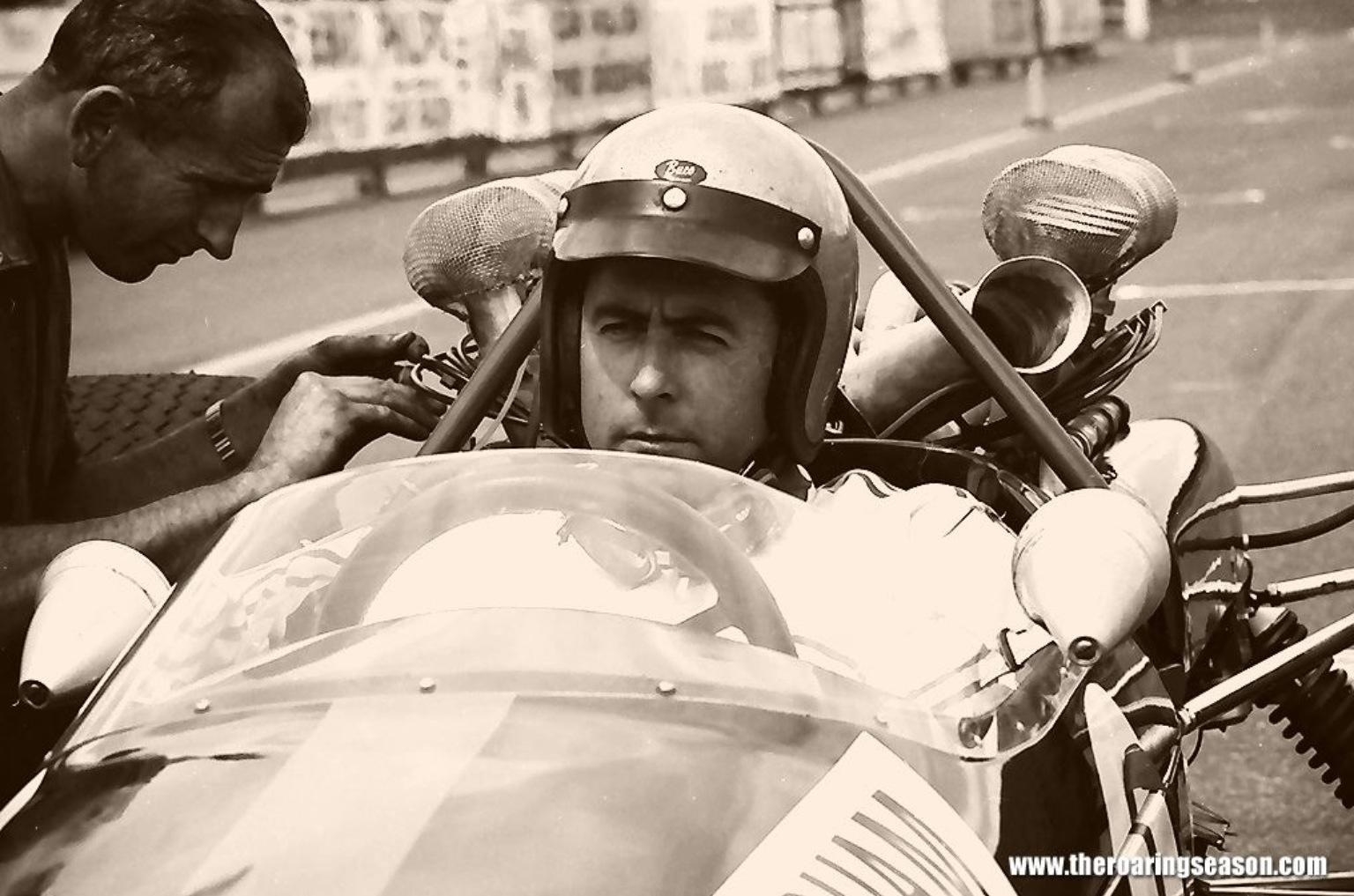
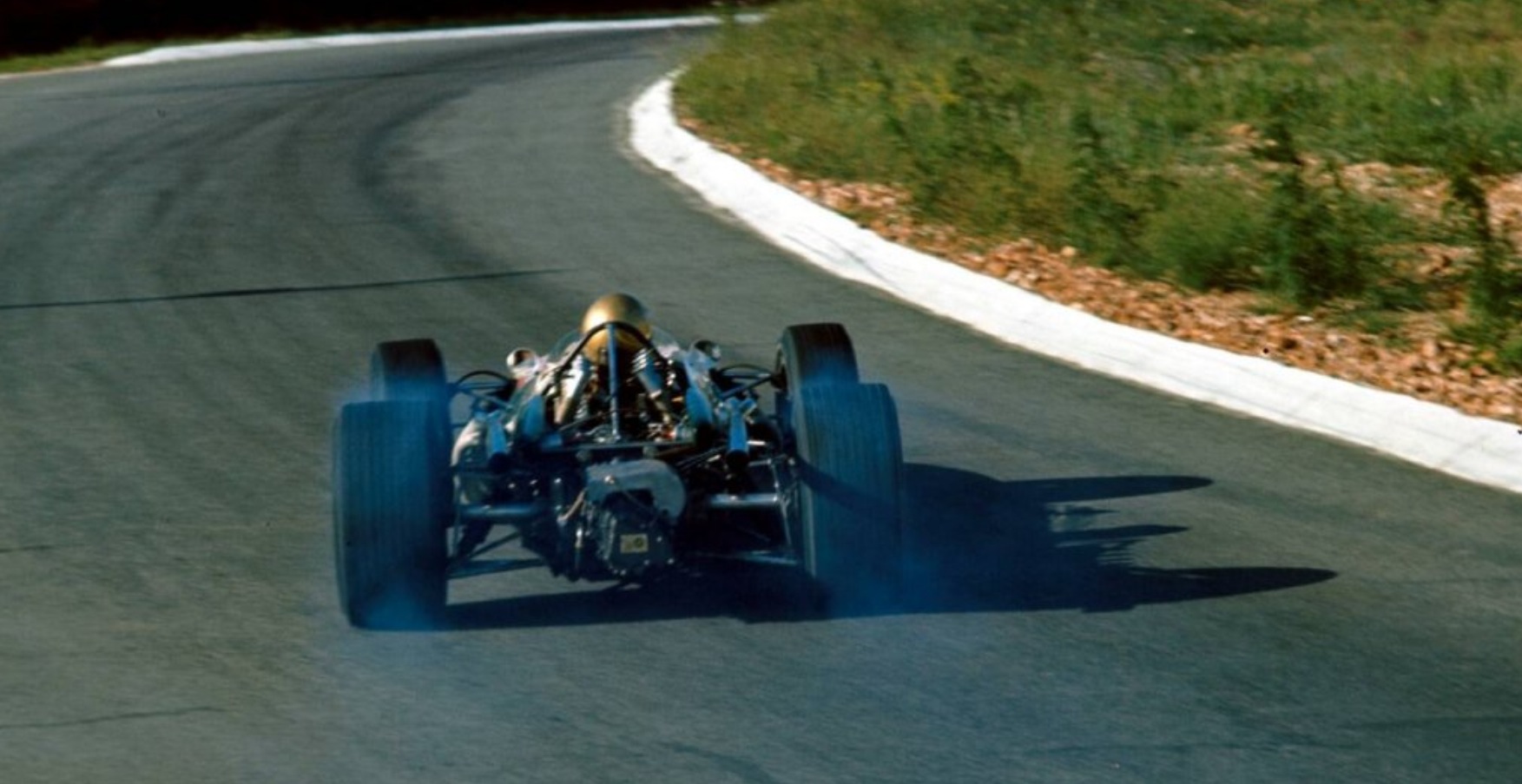
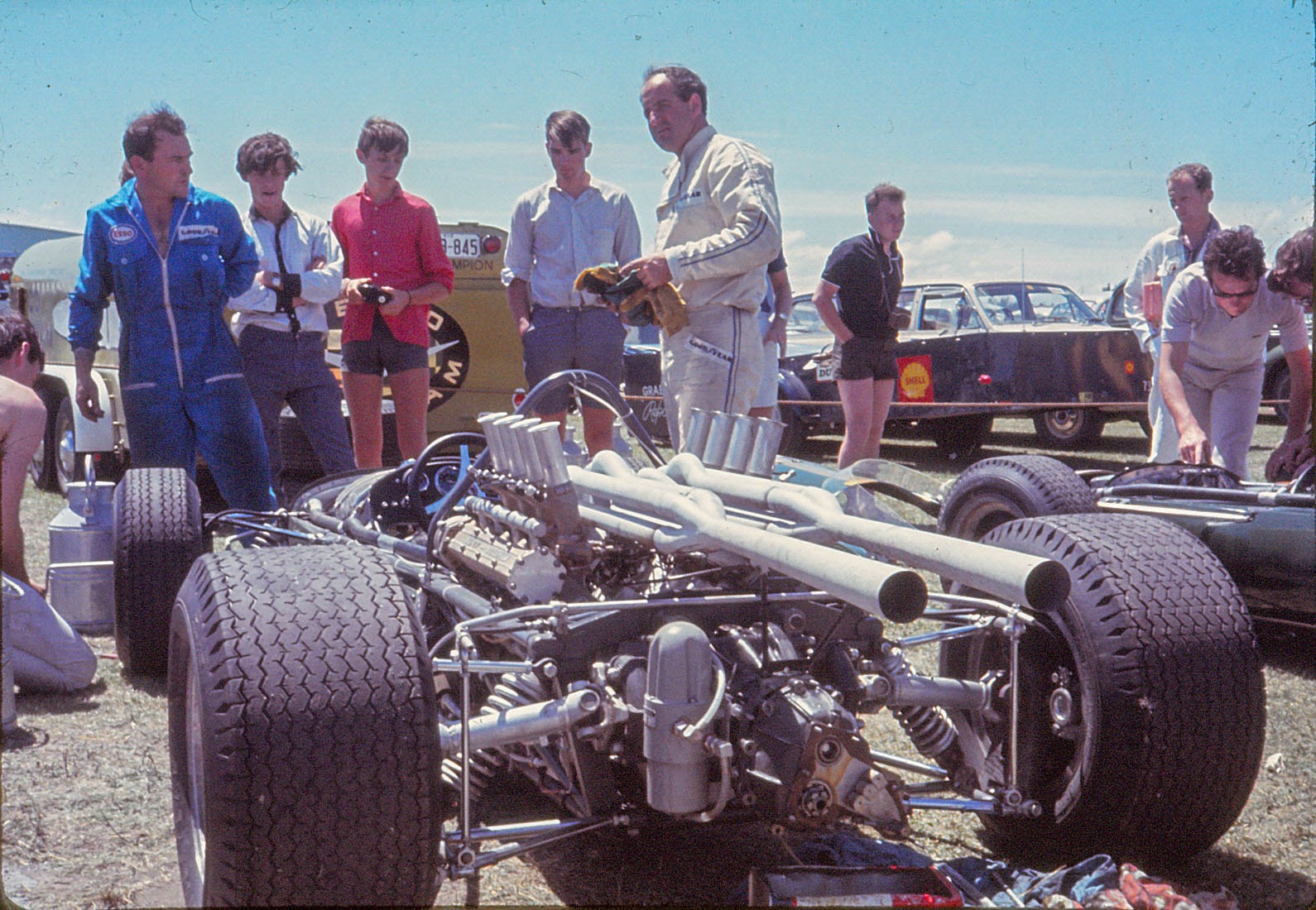
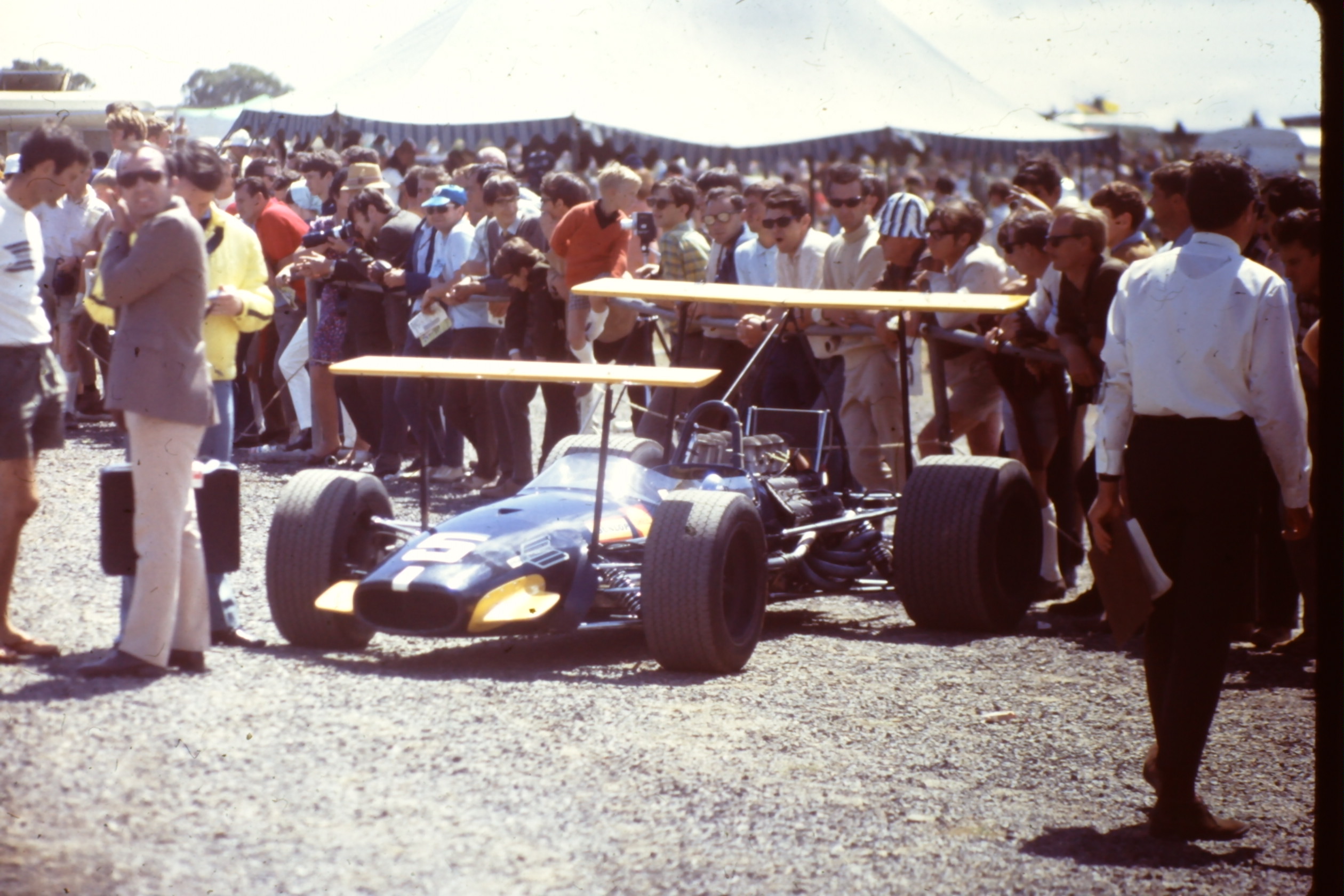
Jack Brabham ponders wing settings on his Brabham BT26 Repco during the Canadian Grand Prix weekend at Mont Tremblant, 22 September 1968…
I blew my tiny mind when Nigel Tait sent me the photo, neither of us had any idea where it was. A bit of judicious googling identified the location as Mont Tremblant, Quebec, a summer and winter playground for Canadians 130km northwest of Montreal.
Regular readers will recall Nigel as the ex-Repco Brabham Engines Pty. Ltd. engineer who co-wrote the recent Matich SR4 Repco article (a car he owns) and has been helping with the series of articles on Repco’s racing history I started with Rodway Wolfe, another RBE ‘teamster’ a couple of years ago.
When Nigel left Repco in the ACL Ltd management buyout of which he was a part, he placed much of the RBE archive with his alma mater, RMIT University, Melbourne. Its in safe hands and available to those interested in research on this amazing part of Australian motor racing history. The archive includes Repco’s library of photographs. Like every big corporate Repco had a PR team to maximise exposure from their activities including their investment in F1. The Mont Tremblant shot is from that archive and unpublished it seems.
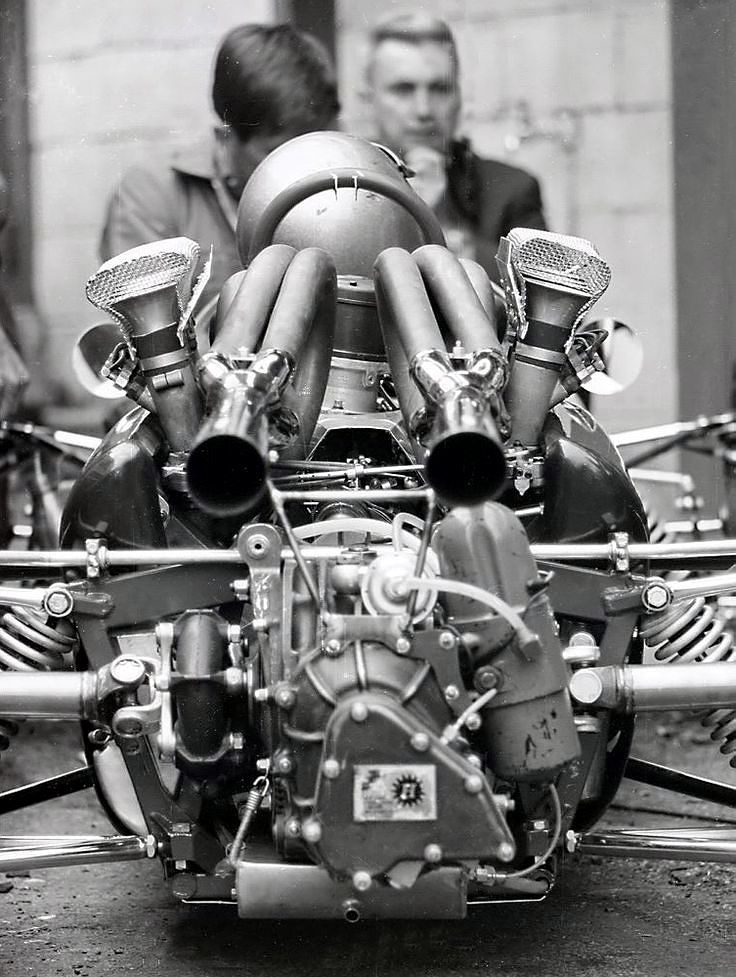
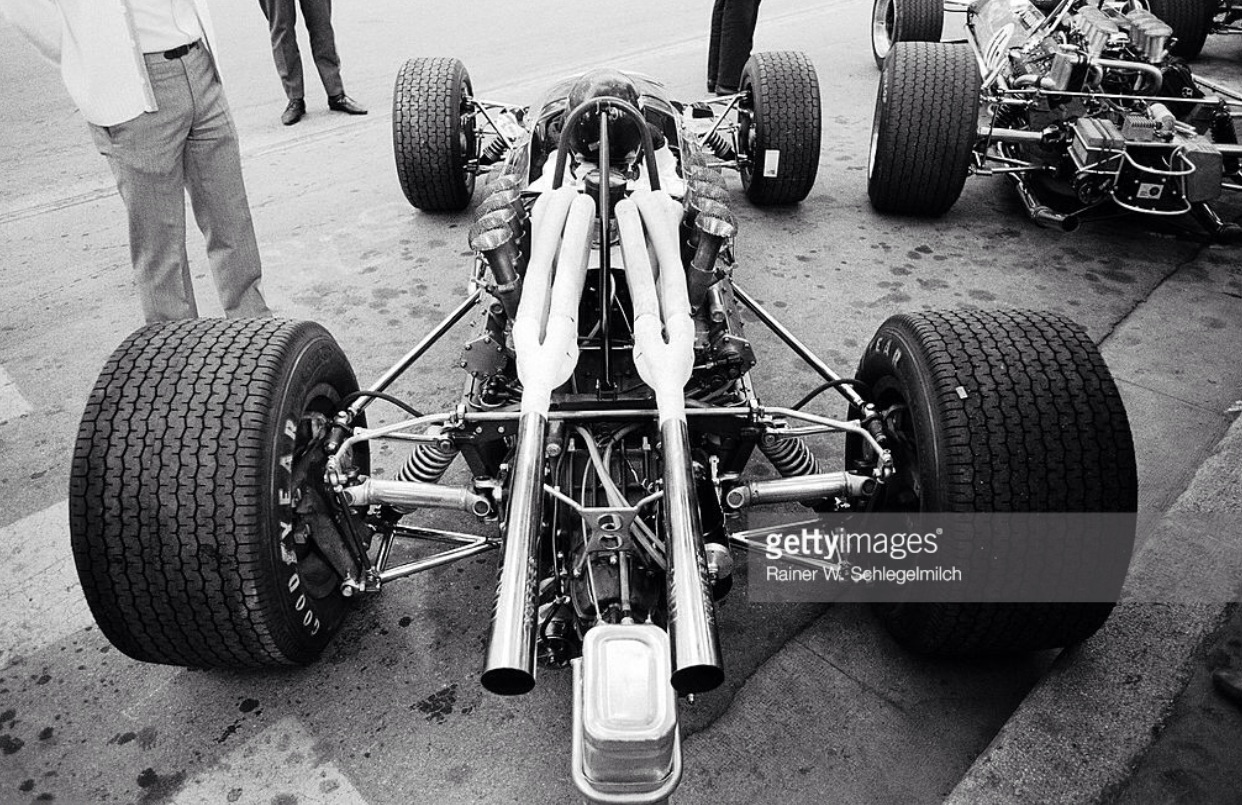
Its one of those ‘the more you look, the more you see’ shots; from the distant Laurentian Mountains to the pitlane activity and engineering of the back of the car which is in great sharpness. It’s the back of the BT26 where I want to focus.
The last RBE Engines article we did (Rodway, Nigel and I) was about the ’67 championship winning SOHC, 2 valve 330bhp 740 Series V8, this BT26 is powered by the 1968 DOHC, 4 valve 390bhp 860 Series V8. It was a very powerful engine, Jochen plonked it on the front row three times, on pole twice, as he did here in Canada in 1968. But it was also an ‘ornery, unreliable, under-developed beast. Ultimately successful in 4.2 litre Indy and 5 litre Sportscar spec, we will leave the 860 engine till later for an article dedicated to the subject.
Check out the DG300 Hewland 5 speed transaxle and part of the complex oil system beside it to feed the 860. Also the big, beefy driveshafts and equally butch rubber donuts to deal with suspension travel. It’s interesting as Tauranac used cv’s in earlier designs, perhaps he was troubled finding something man enough to take the more powerful Repco’s grunt, the setup chosen here is sub-optimal in an engineering sense.
The rear suspension is period typical; single top link, inverted lower wishbone, radius rods leading forward top and bottom and coil spring/damper units. It appears the shocks are Koni’s, Brabham were Armstrong users for years.
The uprights are magnesium which is where things get interesting. The cars wings that is, and the means by which they attach to the car…
See the beautifully fabricated ‘hat’ which sits on top of and is bolted to the uprights and the way in which the vertical load of the wing applies it’s force directly onto the suspension of the car. This primary strut support locates the wing at its leading edge, at the rear you can see the adjustable links which control the ‘angle on the dangle’ or the wings incidence of attack to the airflow.
I’ve Lotus’ flimsy wing supports in mind as I write this…
Tauranac’s secondary wing support elements comprises steel tube fabrications which pick up on the suspension inner top link mount and on the roll bar support which runs back into the chassis diaphragm atop the gearbox.
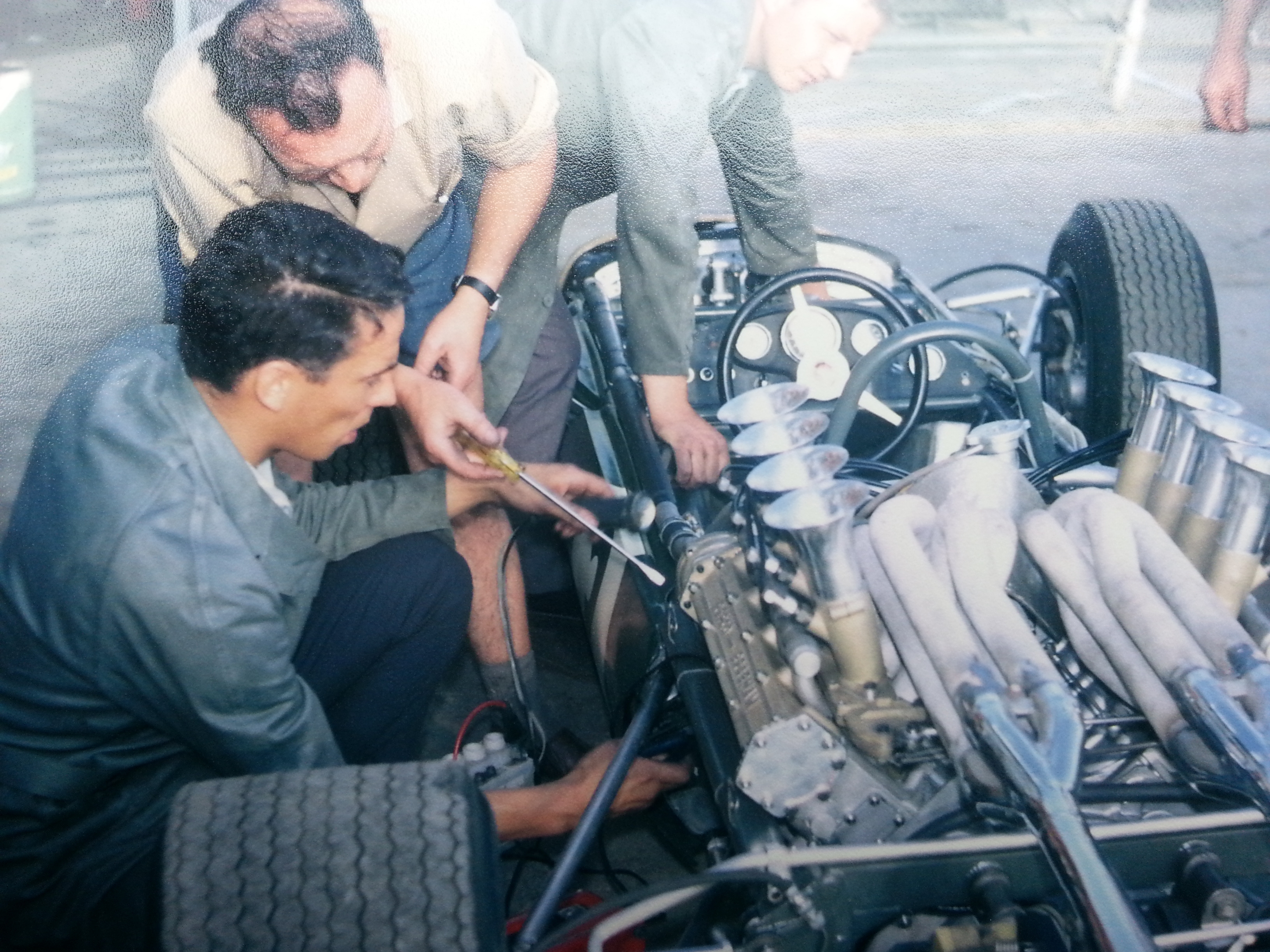
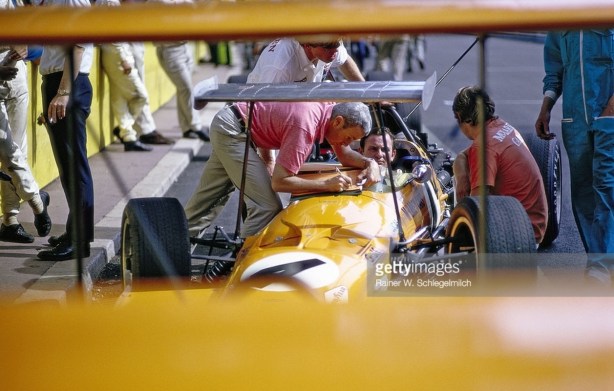
The shot above shows the location of the front wing and it’s mounts, this time the vertical force is applied to the chassis at the leading front wishbone mount, and the secondary support to the wishbones trailing mount. This photo is in the Watkins Glen paddock on the 6 October weekend, the same wing package as in use in Canada a fortnight before. The mechanic looking after Jack is Ron Dennis, his formative years spent learning his craft first with Cooper and then BRO. Rondel Racing followed and fame and fortune with McLaren via Project 4 Racing…
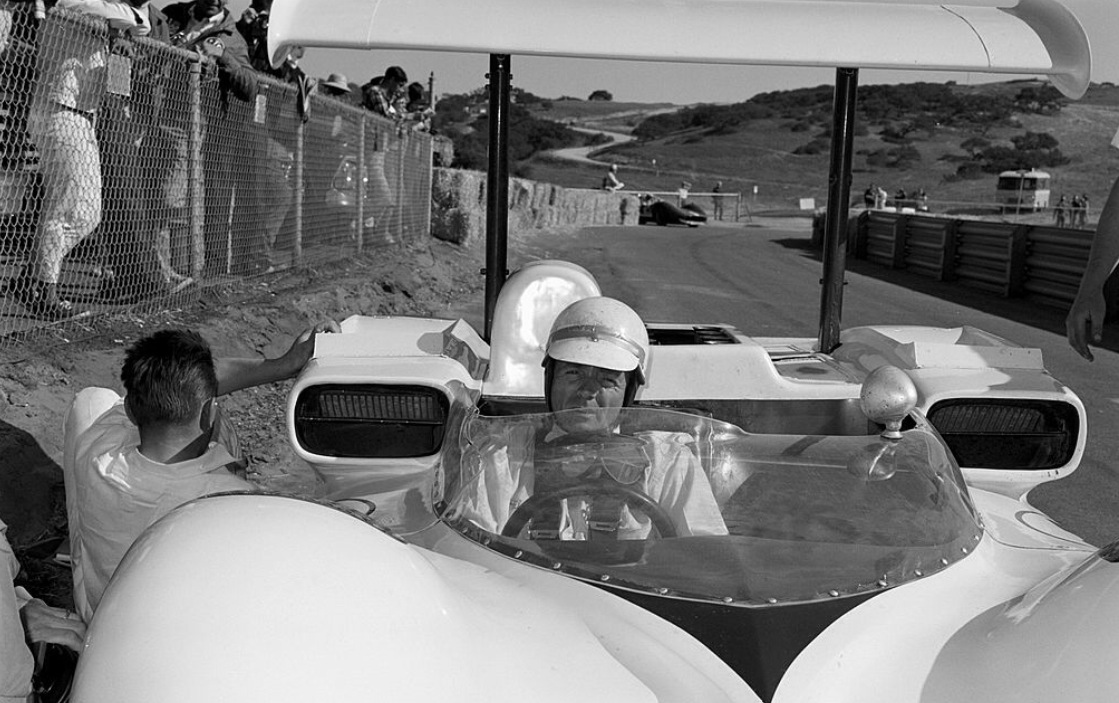
Jim Hall and Chaparral 2G Chev wing at Road America, Wisconsin 1968 (Upitis)
The great,innovative Jim Hall and his band of merry men from Midlands, Texas popularised the use of wings with their sensational Chaparral’s of the mid sixties. Traction and stability in these big Group 7 Sportscars was an issue not confronted in F1 until the 3 litre era when designers and drivers encountered a surfeit of power over grip they had not experienced since the 2.5 litre days of 1954-60.
During 1967 and 1968 F1 spoilers/wings progressively grew in size and height, the race by race or quarter of a season at a time analysis of same an interesting one for another time.
In some ways ‘who gives a rats’ about the first ‘winged Grand Prix win’ as Jim Hall pioneered ‘winning wings’ in 1966, the technology advance is a Group 7 not F1 credit; but Jacky Ickx’ Ferrari 312 win in the horrific, wet, 1968 French Grand Prix (in which Jo Schlesser died a fiery death in the air-cooled Honda RA302) is generally credited as the first, the Fazz fitted with a wing aft of the driver.
But you could equally mount the case, I certainly do, that the first winged GeePee win was Graham Hill’s Lotus 49B Ford victory at Monaco that May.
Chapman fitted the Lotus with front ‘canard’ wings and the rear of the car with a big, rising front to rear, engine cover-cum-spoiler. Forghieri’s Ferrari had a rear wing but no front. The Lotus, front wings and a big spoiler. Which car first won with a wing?; the Lotus at Monaco on 26 May not the Ferrari at Rouen on July 7. All correspondence will be entered into as to your alternative views!
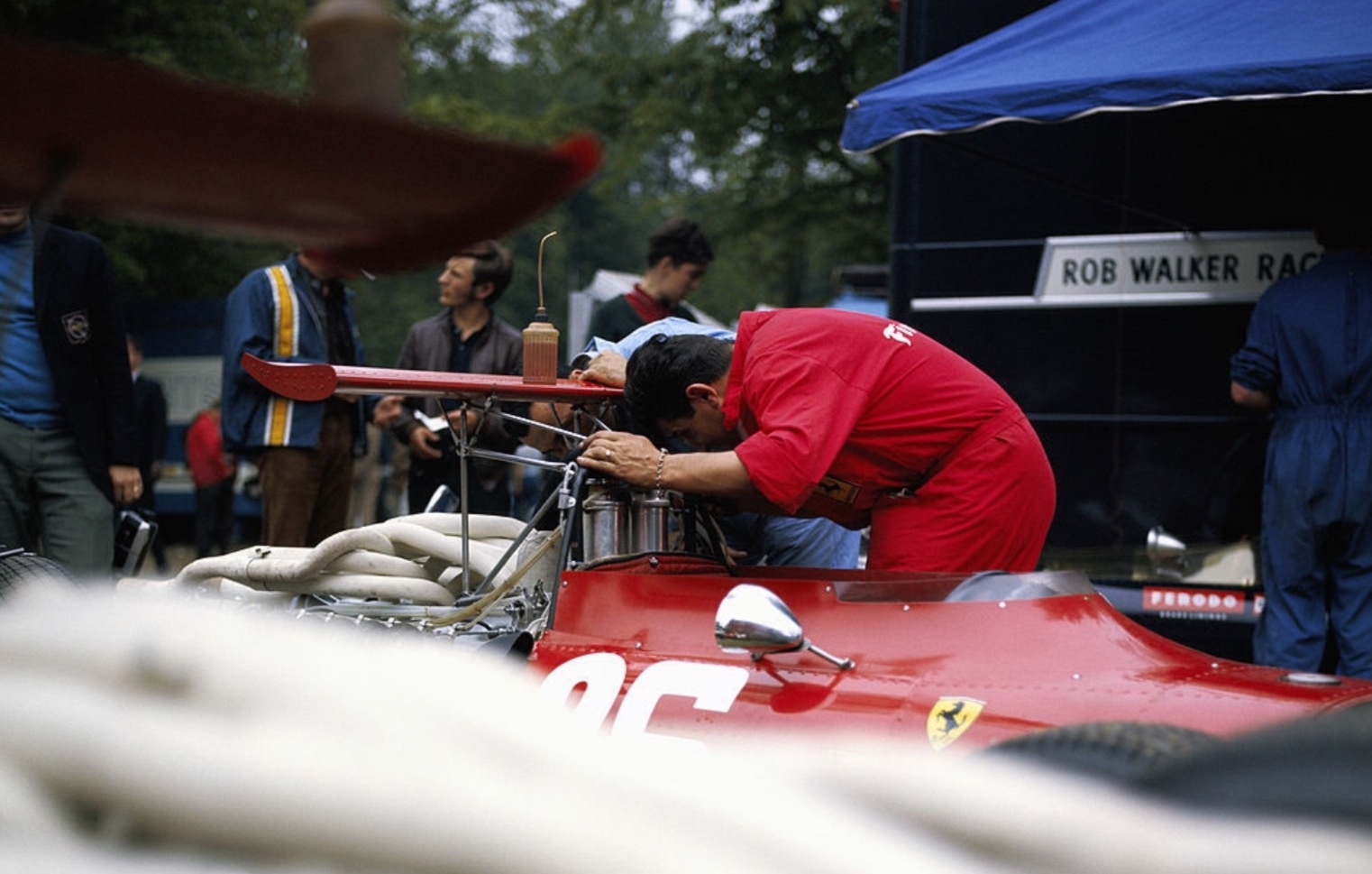
Jacky Ickx’ winning Ferrari 312 being prepared in the Rouen paddock. The neat, spidery but strong wing supports clear in shot. Exhaust in the foreground is Chris Amon’s Fazz (Schlegelmilch)
Lotus ‘ruined thehi-winged party’ with its Lotus 49B Ford wing failures, a lap apart, of Graham Hill and then Jochen Rindt at Montjuic in the 1969 Spanish GP.Both drivers were lucky to walk away from cars which were totally fucked in accidents which could have killed the drivers, let alone a swag of innocent locals.
A fortnight later the CSI acted, banning high wings during the Monaco GP weekend but allowing aero aids on an ongoing basis albeit with stricter dimensional and locational limits.
Mario Andretti has just put his Lotus 49B on pole at Watkins Glen in October 1968, Colin Chapman is perhaps checking his watch to see why regular drivers Hill and Jackie Oliver are being bested by guest driver Andretti who was entered at Monza and Watkins Glen at seasons end! Andretti put down a couple of markers with Chapman then; speed and testing ability which Chapman would return to nearly a decade later. More to the point are the wing mounts; direct onto the rear upright like the Brabham but not braced forward or aft. Colin was putting more weight progressively on the back of the 49 to try and aid traction, note the oil reservoir sitting up high above the ‘box. Stewart won in a Matra MS10, Hill was 2nd with both Andretti and Oliver DNF (Upitis)
Chapman was the ultimate structural engineer but also notoriously ‘optimistic’ in his specification of some aspects of his Lotus componentry over the years, the list of shunt victims of this philosophy rather a long one.
Lotus wing mounts are a case in point.
Jack Oliver’s ginormous 125mph French GP, 49B accident at Rouen in 1968 was a probable wing mount failure, Ollie’s car smote various bits of the French countryside inclusive of a Chateau gate.
Moises Solana guested for Lotus in his home, Mexican GP on 3 November, Hill won the race whilst Solana’s 49B wing collapsed.
Graham Hill’s 49B wing mounts failed during the 2 February 1969 Australian Grand Prix at Lakeside, Queensland. Then of course came the Spanish GP ‘Lotus double-whammy’ 3 months after the Lakeside incident on 4 May 1969.
Faaaarck that was lucky one suspects the Lotus mechanics are thinkin’!? The rear suspension and gearbox are 200 metres or so back up the road to the right not far from the chateau gate Ollie hit. It was the first of several ‘big ones’ in his career (Schlegelmilch)
For the ‘smartest tool in the shed’ Chapman was slow to realise ’twas a good idea to finish races, let alone ensure the survival of his pilots and the punters.
I’m not saying Lotus were the only marque to have aero appendages fall off as designers and engineers grappled with the new forces unleashed, but they seemed to suffer more than most. Ron Tauranac’s robustly engineered Brabhams were race winning conveyances generally devoid of bits and pieces flying off them given maintenance passably close to that recommended by ‘Motor Racing Developments’, manufacturers of Ron and Jack’s cars.
The Brabham mounts shown earlier are rather nice examples of wings designed to stay attached to the car rather than have Jack aviating before he was ready to jump into his Piper Cherokee at a race meetings end…
Hill P, ‘Stardust GP’ Las Vegas, Chaparral 2E Chev 1966
Now you see it, now you don’t; being a pioneer and innovator was the essence of the Chaparral brand, but not without its challenges! Phil Hill with 2E wing worries at Las Vegas in 1966, he still finished 7th. Jim Hall was on pole but also had wing problems, John Surtees’ wingless Lola T70 Mk2 Chev won the race and the first CanAm Championship (The Enthusiast Network)
The 13 November 1966 ‘Stardust GP’ at Las Vegas was won by John Surtees Lola T70 Mk2 Chev, CanAm champion in 1966. Proving the nascent aerodynamic advances were not problem free both Jim Hall, who started from pole and Phil Hill pictured here had wing trouble during the race.
The Chaparral 2E was a development of the ’65 2C Can Am car (the 2D Coupe was the ’66 World Sportscar Championship contender) with mid-mounted radiators and huge rear wing which operated directly onto the rear suspension uprights. A pedal in the cockpit allowed drivers Hall and Hill to actuate the wing before corners and ‘feather it’ on the straights getting the benefits in the bendy bits without too much drag on the straight bits. A General Motors ‘auto’ transaxle which used a torque converter rather than a manual ‘box meant the drivers footbox wasn’t too crowded and added to the innovative cocktail the 2E represented in 1966.
Its fair to say the advantages of wings were far from clear at the outset even in Group 7/CanAm; McLaren won the 1967 and 1968 series with wingless M6A Chev and M8A Chev respectively, winning the ’69 CanAm with the hi-winged M8B Chev in 1969. Chaparral famously embody everything which was great about the CanAm but never won the series despite building some stunning, radical, epochal cars.
Phil Hill relaxed in his 2E at Laguna Seca on 16 October 1966, Chaps wing in the foreground, Laguna’s swoops in the background. Phil won from Jim Hall in the other 2E (TEN)
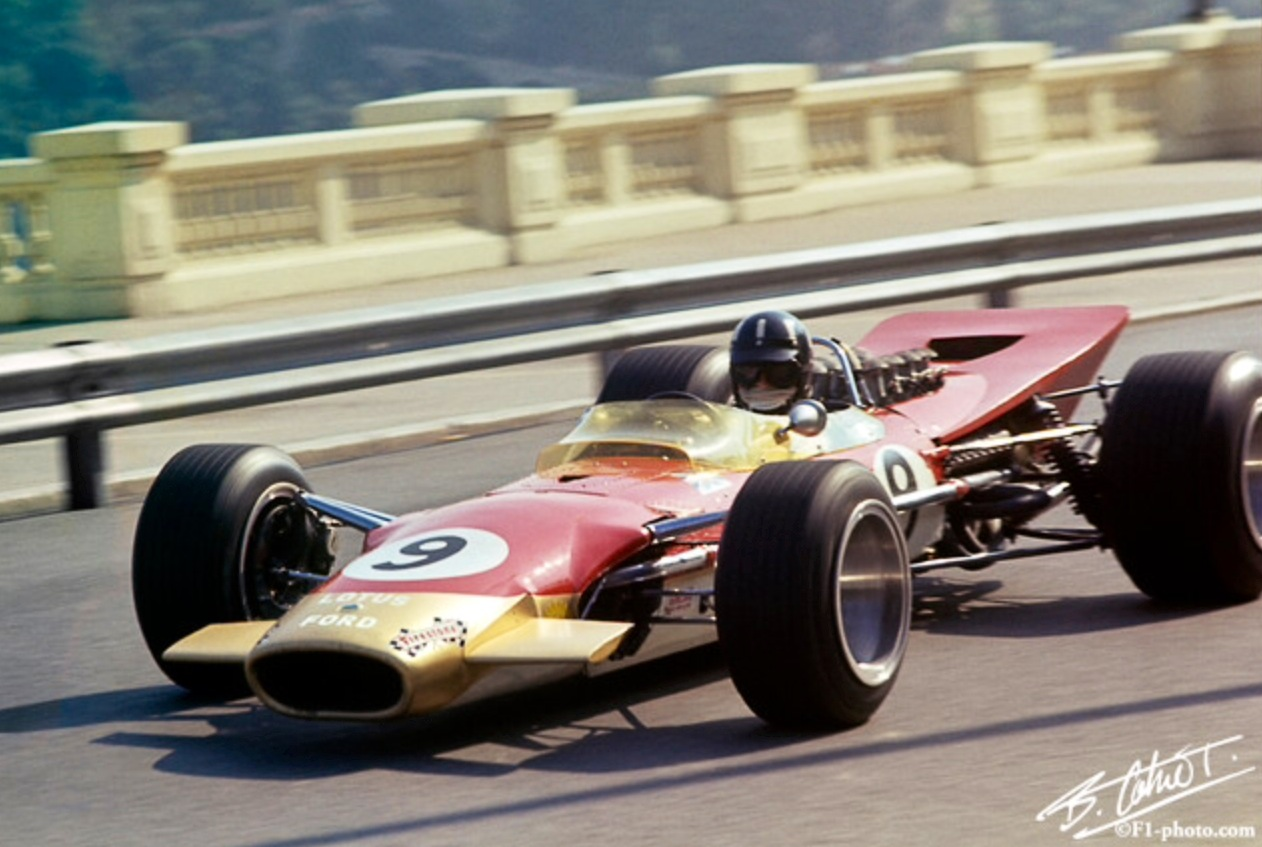
Hill G, Monaco GP, Lotus 49B Ford 1968
Interesting shot of Hill shows just how pronounced the rear bodywork of the Lotus 49B was. You can just see the front wing, Monaco ’68 (unattributed)
Hill taking a great win at Monaco in 1968. Graham’s was a tour de force of leadership, strength of mind and will. Jim Clark died at Hockenheim on 7 April, Monaco was on 26 May, Colin Chapman was devastated by the loss of Clark, a close friend and confidant apart from the Scots extraordinary capabilities as a driver.
Hill won convincingly popping the winged Lotus on pole and leading all but the races first 3 laps harnessing the additional grip and stability afforded by the cars nascent, rudimentary aerodynamic appendages. Graham also won the Spanish Grand Prix on 12 May, these two wins in the face of great adversity set up the plucky Brits 1968 World Championship win. Remember that McLaren and Matra had DFV’s that season too, Lotus did not have the same margin of superiority in ’68 that they had in ’67, lack of ’67 reliability duly noted.
Hills 49B from the front showing the ‘canard’ wings and beautifully integrated rear engine cover/spoiler (Cahier)
Ickx, Rouen, French GP, Ferrari 312 1968
Mauro Forghieri, Ferrari’s Chief Engineer developed wings which were mounted above the engine amidships of the Ferrari 312. Ickx put them to good use qualifying 3rd and leading the wet race, the Belgian gambled on wets, others plumped for intermediates.
Ickx’ wet weather driving skills, the Firestone tyres, wing and chaos caused by the firefighting efforts to try to save Schlesser did the rest. It was Ickx’ first GP win.
It looks like Rainer Schlegelmilch is taking the shot of Jacky Ickx at Rouen in 1968, note the lack of front wings or trim tabs on the Ferrari 312 (Schlegelmilch)
Tailpiece: The ‘treacle beak’ noting the weight of Tauranac’s BT26 Repco is none other than ‘Chopper’ Tyrrell. Also tending the car at the Watkins Glen weighbridge is Ron Dennis,I wonder if Ken’s Matra MS10 Ford was lighter than the BT26? If that 860 engine had been reliable Jochen Rindt would have given Jackie Stewart and Graham Hill a serious run for their money in 1968, sadly the beautiful donk was not the paragon of reliability it’s 620 and 740 Series 1966/7 engines generally were…
James Hunt dives for the inside line in his March 713S Ford, AJ and his Brabham BT28 Ford has left a gap way bigger than he ever did when they slugged it out in GP racing…
It’s 1971, the BRSCC MCD Shell Super Oil British F3 Championship at Brands Hatch on 1 March 1971 and both drivers are trying hard to jump up to the next level, the road for Hunt would be easier than Jones, James a coming star with the Hesketh March 731 in 1973 and Jones an F1 ‘occasional’ from 1974.
The ‘facts’ are from the photo caption, the cars and drivers are correct but the date/Brands event don’t accord with the ‘F2 Register’ record of that event, my F3 race resource. It appears AJ didn’t race with #69, a number with obvious appeal to him at all during ’71.
As Brabham, Tauranac and Denny Hulme scanned the competitive landscape as 1966 unfolded they formed the view that a similar formula to ’66 stood a good chance of success in 1967. A small, light, responsive chassis, this time designed around the engine. Remember that Jack’s successful ’66 mount, BT19 was an adapted, unraced 1965 GP car Tauranac designed around the stillborn Coventry Climax Flat-16. Ron’s ’67 BT24 was and is a superb car, its race record we shall review in an article about Brabham Racing Organisation’s (BRO) successful ’67 season.
In terms of the engine, keeping it simple and light had paid big dividends for Repco Brabham Engines Pty. Ltd. (RBE) in the first year of the 3 litre formula.
The fortunes of Ferrari, BRM, its H-16 engine the antithesis of the Brabham Repco’s in terms of weight and complexity and the Maserati V12 were well covered in my article on the ’66 season. Dan Gurney’s Weslake V12 engine showed promise but reliability continued to be an issue. The Ford Cosworth DFV didn’t race until the Dutch GP in June 1967. Brabham’s needed more power of course, too much power is rarely an issue, but they figured they needed less power than most others on the grid. If Jack and Denny started the season with a reliable, just quick enough package BRO could retain their title as others sought to make what were ultimately potentially quicker, more sophisticated multi-cylinder, multi-cam cars reliable. Click here for my article on Jack’s successful 1966 season; https://primotipo.com/2014/11/13/winning-the-1966-world-f1-championships-rodways-repco-recollections-episode-3/
The beautifully fast, light, forgiving championship winning Brabham BT24 Repco 740 ahead of Chris Amon’s Ferrari 312 at Le Mans during the ’67 French GP. Denny 2nd to Jacks winning sister car, Amon DNF with throttle linkage failure (Automobile Year)
They were an intensely pragmatic group of racers in this Brabham/Repco senior mix…
Repco’s Charlie Dean, Phil Irving, Norman Wilson (designer of the ’67 RBE740 Series V8) Brabham and Tauranac all built winning cars (and bikes in Phil’s case) themselves, as in built with their own hands. Dean created the extraordinary series of Maybach Grand Prix cars, look at my Stan Jones article for much detail about this series of racers built by Charlie and initially raced by him, and then later by Stanley with much success. Norman Wilson built a Holden engined special in his youth covered in brief at the end of this article. Tauranac and his brother Austin built and raced the ‘original’ Ralts before Ron joined Jack in the UK in 1961.
Dean, Wilson, Tauranac and Brabham had been/were drivers. They knew what it took to win races. They understood winning was as much about torque as power. Handling was essential, the circuits then were all far from just requiring top end power, what was needed at Monza was different to the blend of corners and contours at Brands. All had driven cars and lost races due to unreliability. They understood a balanced package was critical, that whatever power they had needed to be put to the road. The point I make is that these guys were practitioners not theorists on ‘an engineering jolly’.
The RB group were about the application of sound pragmatic engineering practice, they didn’t have to think deeply about this stuff it was part of their DNA given the ‘build and develop it yourself’ school from whence they came. These guys weren’t ‘university engineers’ (which is not to say they lacked formal qualifications) but very practical chaps. Let the others chase ‘engineering perfection’ as they saw it, ‘an evolution of what we have is probably enough to do the trick’ was the correct thinking.
It was a whole different ballgame they confronted at the same time in ’68, but this was mid-’66, the game-changing DFV was still a distance away…
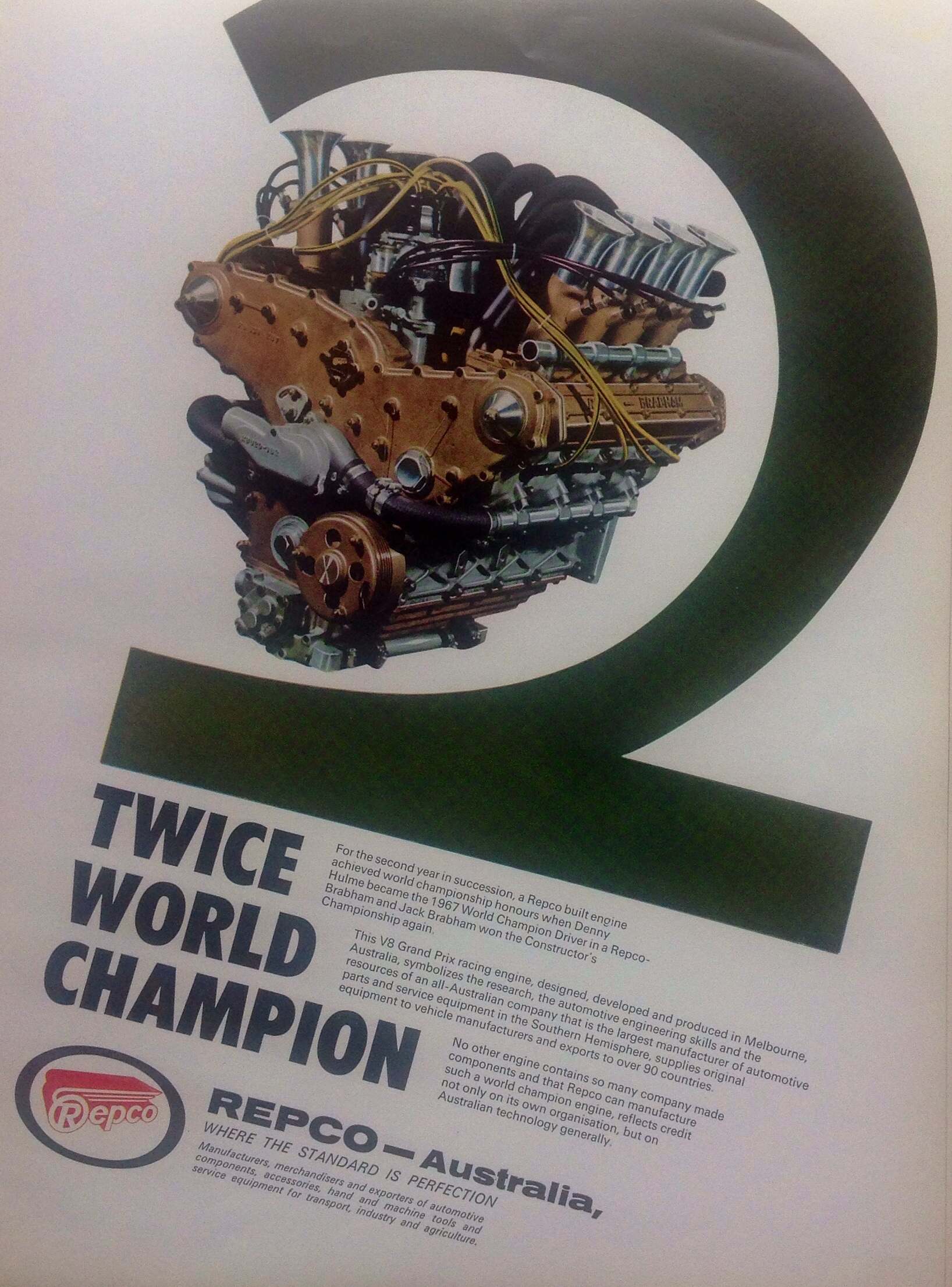
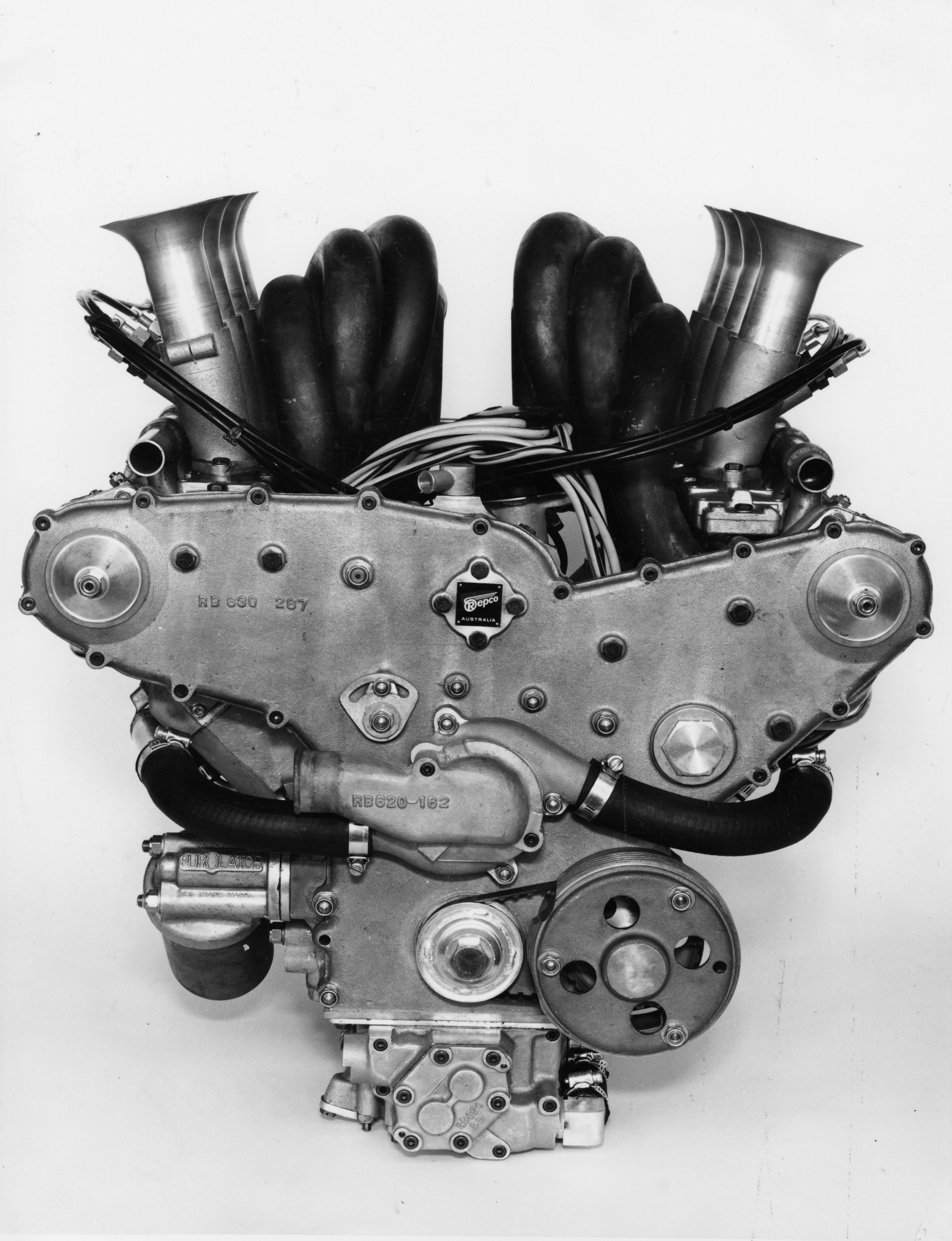
Repco studio shot of the front of the amazingly compact ’67 championship winning ‘RBE740’, SOHC, 2 valve ‘between the Vee exhaust’, circa 330bhp V8. The ‘mix and match’ of engine parts described in the text is proven by use of 620 water pump, 630 chain timing cover, oil filter American ‘Purolator’, note oil pump below the dry sump pan, and up top the ends of aluminium water cooling rails, Bosch distributor and Lucas fuel injection trumpets (Tait/Repco)
1967 Engine Design Deliberations…
Ex RBE Engineer Nigel Tait; ‘By July 1966 the World Titles had already been ‘wrapped up’ for the year so the team were already thinking about the engine for 1967. Phil, Jack and Ron were all keen on the idea of getting the exhausts out of the airstream to clean up the car in terms of better aerodynamics and also for ease of plumbing the exhausts which otherwise had to negotiate the tubular chassis frame’. The 1966 BT19 championship winning chassis did not present a very effective frontal profile, its exhausts well out in the breeze.
Colin Chapman was far from the first chassis man to be prescriptive about design elements of an engine, as he was to Keith Duckworth in relation to the Ford Cosworth DFV, particularly in relation its integration with ‘his’ chassis.
Between the Vee exhausts had been raced successfully by BRM with its P56 1.5-2 litre family of V8’s in recent years. Ferrari also chose the same approach with its ’67 3 valve V12, its fair to say it was an F1 design trend of the time. In some ways Ferrari’s approach was better than Brabham’s as Ron maintained outboard springs and shocks on both the front and back of his ’67 BT24 chassis. Ferrari, as they did in 1966, used a top rocker and inboard front spring/shock presenting less resistance to the air at the front of the car at least. Ferrari went outboard at the back like Brabham. (and the rest of the grid)
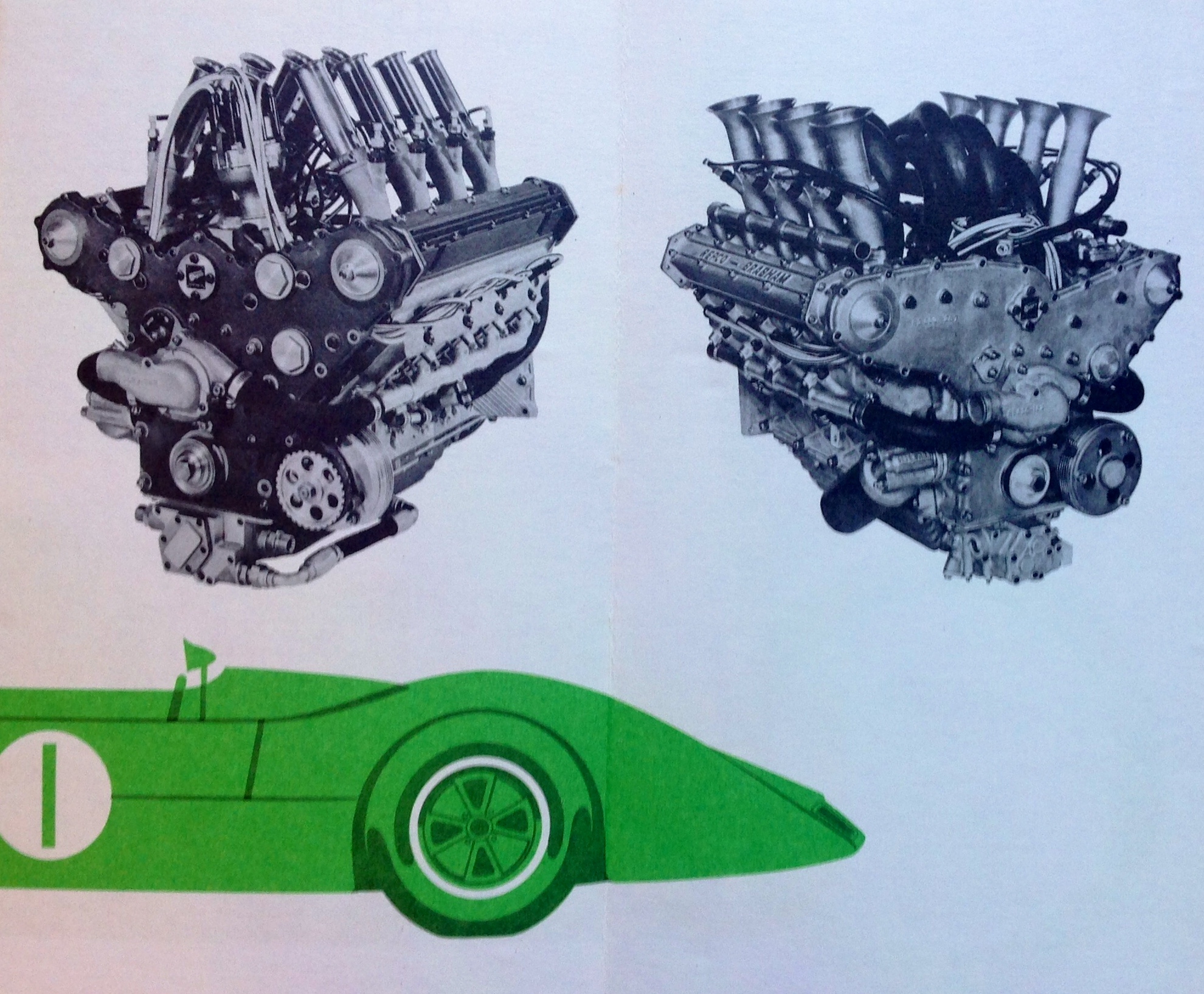
Old and new; ’66 RB620 305 bhp V8 left and ’67 RB740 330 bhp V8 right, F1 champions both. 740 was 3 inches shorter, 4 inches wider across the heads and 15 lbs lighter than 620. Dimensions otherwise the same; 25.5 inches long, 17.25 inches wide across the bellhousing (Repco)
Conceptual Design of the Heads…
RBE Chief Engineer Norman Wilson; ‘ It would have been Jack’s idea to put the exhausts in the centre (of the Vee). Jack asked if it could be done. I remember when i started designing them i spent a lot of time, probably 3 or 4 days, just drawing one cylinder up to try and prove that you could fit everything in. See you have got a whole row of head studs, you have got to have water passages between the port. The whole idea was to prove that you could get the inlet port in, exhaust port and all the head studs. That was a giant task to figure out in a way’.
‘It meant putting the outer row of studs underneath the exhaust ports. I don’t think i have the layout now but i remember spending a huge amount of time and finally i went to Frank Hallam (RBE General Manager) and said i think we can do it. And thats how the 40 Series heads started’. ‘To manage to get everything on one side and the thing is unlike most engines we built as we wanted big ports. So to fit all these big ports in plus the port wall, plus the bolt bosses was a major task. I think it took about three days work for me to fit everything in a rough layout’.
Jack’s BT24 Repco 740 being fettled during ’67, circuit unknown. ‘Box is 5 speed Hewland DG300 transaxle, note rubber ‘donuts’, Lucas injection ‘bomb’ or fuel pump to the right of the box, also rear spaceframe chassis diaphragm. Getting the exhausts outta the airstream shown to good effect in this shot (unattributed)
The ’40 Series’ Between the Vee 1967 Cylinder Heads Design Detail…
‘…the new cylinder heads retained parallel valves but they were now in line with the cylinder axis (instead of at 10 degrees to the axis as on the ’66 20 Series heads and were flush to the head face’ said Wilson. ‘The 40 Series heads used the Heron head design. In this design the cylinder head is flat and the piston has the combustion chamber in the top of the piston (a bowl in piston arrangement). The other feature of the 40 Series head is that it had a tall inlet port. It had a fairly long, relatively straight section there on Jack Brabham’s suggestion. He had received some highly secret information from Honda that this was the way to go. In hindsight i don’t think so. All these things are better in hindsight, but that’s how we did it’
‘The Heron head, i think everyone agreed, had to be the way to go because the Cosworth SCA (F2 engine) was 1000cc and was putting out 120bhp. At the time in F2 it was winning everything. I think it put out 123bhp. Now if you are looking at a 3 litre engine, thats 369bhp. And at that time that would have been been looking for us a fairly exciting sort of figure. The other point about the Heron head is it allowed us to have a single camshaft which we wanted to have the low weight, simplicity and ease of manufacture’.
‘The 40 Series head was purely made for the car. No other reason. It put the exhausts down the centre of the Vee…thats what Ron wanted, he made the car so why not get what he wanted’.
‘The highest output of the 740 Series 3 litre was only a bit over 330bhp. This horsepower rivalry between the different engine manufacturers at the time, the horsepower numbers were really irrelevant. At the time Maserati claimed about 500bhp, but they were adding on about 100bhp to make up for the exhaust gas pollution in the test cell. But really its about the area of horsepower curve’. ‘If they had 500bhp they would be leaving us behind a lot quicker than they are leaving us behind!’ was a quip Rod Wolfe recalls Jack making to the boys in the RBE engine assembly area on one of his trips to Australia in 1967.
‘One of the philosophies was for the engine to always have a wide power range and good power at the bottom end of it which suited the light car. So if ours was 330bhp there was no way other cars had 400-500bhp claimed. Our power was distributed much more evenly across a wider range of revs. Thus Denny Hulme would say it was great to drive a Repco Brabham because he could overtake competitors in the corners as if they were ‘tied to a fence’.
There were some problems with 40 Series head porosity during ’67 as ex-RBE machinist/storeman Rodway Wolfe recalls; ‘Norm did a fantastic job to even succeed with the casting and it proved to be a great engine in larger capacity too, bigger valves etc…we were able to fit very large valves without too many seat problems. The 40 series did have a lot of porosity problems with the ports, some we scrapped as the ports actually broke through when we were porting them and there was not the welding equipment available that we have nowadays to repair them. Porosity, a big drama, as i say, one of my jobs was to send the castings to ‘Nilsens Sintered Products’ in Richmond where they placed the heads in a vacuum and impregnated them with hot resin. Vacuum impregnation solved some of these problems’.
Brabham on the Warwick Farm grid, WF Tasman round in 1967. In relation to the cooling duct feeding the engine Rodway Wolfe comments ‘There were a few heat problems in the valley of the engine with the 40 series as the fuel metering unit was also located in the valley but small heat shields seemed to correct this problem and it was not an issue once the car was on the track of course’. It seems these ducts were used in the ’67 Tasman rounds on the 640 engines used by Jack and Denny and subsequently sporadically on the 740 engines, Le Mans for example (Bruce Wells)
A typically pragmatic decision to the heads was made in relation to the 1967 Repco block…
Remember that the ’66 engine used a heavily adapted version of the Oldsmobile F85 aluminium block. Repco still had a swag of unused blocks sitting in Rod Wolfe’s Repco store at Maidstone. The blocks had been successful, a world title proof enough of their effectiveness, but the machining and adaption required to make them an effective race tool meant they were expensive but still sub-optimal. But it wasn’t all plain sailing with the block however much it may have seemed so from the outside, Tait; ‘For much of 1966 we had serious blowby issues due to distortion of the dry sleeves and it was not until almost the end of that year that we went to wet sleeves. The F85 Olds blocks came with dry sleeves in situ’.
Repco’s race engine commercial ends were to be served by building and selling engines for Tasman use and for Group Seven sportscars, burgeoning at the time globally; 2.5 litres was the Tasman Formula capacity limit, the F85 ‘maxxed out’ at 4.4 litres which was the capacity used for the sportscar engines. Repco’s first sale of a customer engine was the 4.4 litre 620 Series unit sold to Bob Jane for his Elfin 400.
So Repco decided to ‘have their cake and eat it too’. The new bespoke ‘700 Series’ block would allow all of the F85 ‘600 Series’ bits and bobs to attach to it; heads, timing case, sump the lot. So Repco could gradually use its stock of F85 blocks for Tasman and sportscar use whilst ‘700 Series’ blocks were used in F1 for 1967 and more broadly in capacities up to 5 litres subsequently. As engines were rebuilt the 600 blocks were replaced progressively by 700 series units, 600 blocks ceased to be used when there were none left. Typically practical, sensible and parsimonious Repco!
Whilst the ‘700 Series’ block design decision, to allow 600 hardware to be attached was a ‘functional’ pragmatic decision the aluminium block itself was also improved being redesigned to increase rigidity. The new block design was commenced by Irving, he and others say, prior to his departure from RBE, but the completed block is his replacement as Chief Design Engineer, Norman Wilson’s design.
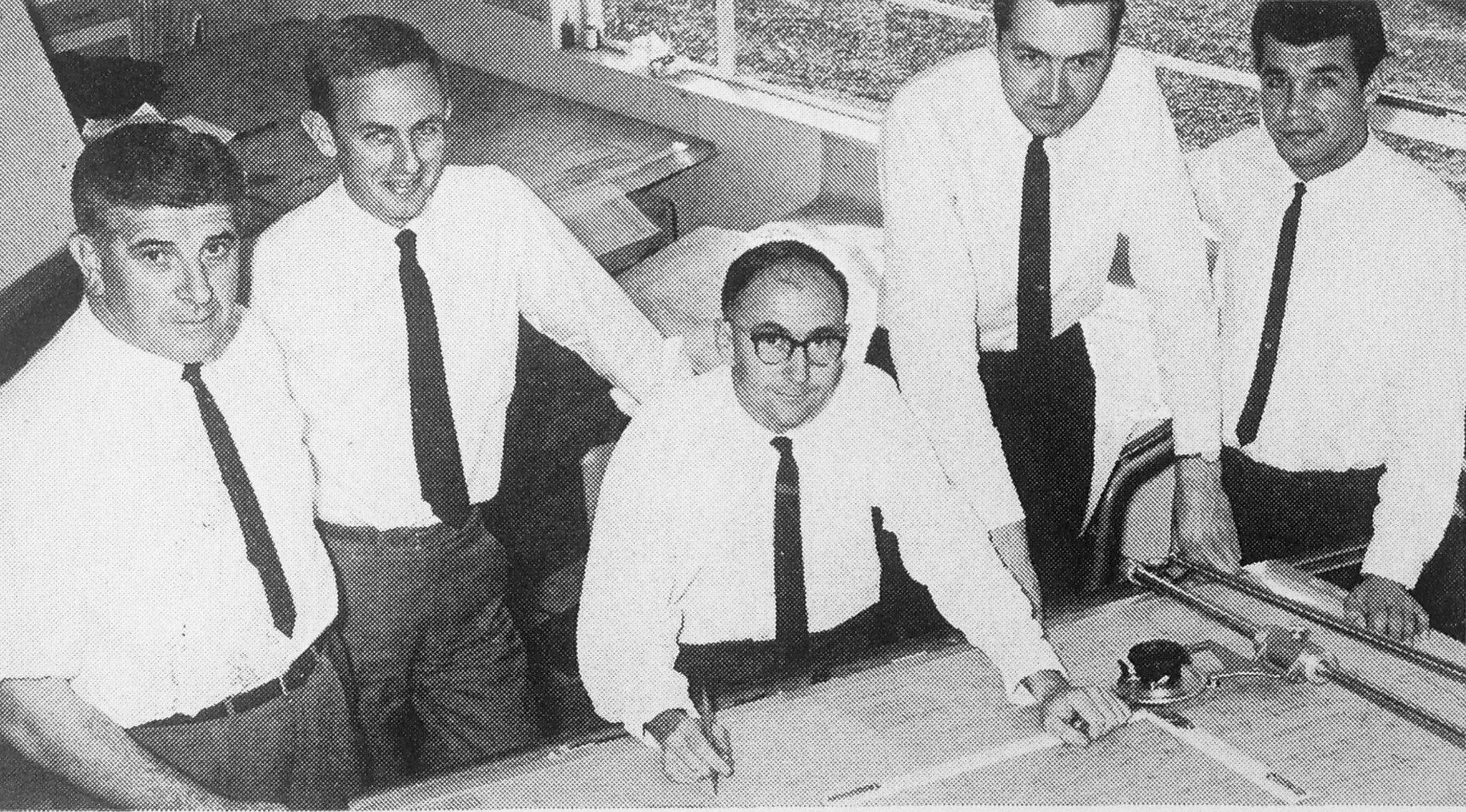
The post Phil Irving RBE design team; L>R GM Frank Hallam and Engineers Norman Wilson, Lindsay Hooper, John Judd and Brian Heard (Repco)
Phil Irving’s departure by resignation or sacking by RBE GM Frank Hallam is an important part of the RBE story and will be dealt with in a separate article. I explore not just the difficult relationship between these two characters but also the broader issues of the leadership of Repco, CEO Charles McGrath’s key enduring support of the RBE program and the appointment of Bob Brown as the Director responsible for RBE instead of alternatives including Charlie Dean at the projects outset. The antipathy between Hallam and Irving was partially about personality but also about politics and legacy in terms of who is responsible for what of the RB620 design and build. More on this topic very soon.
For now lets just focus on the RB740 engine which in no way shape nor form was negatively impacted by Irving’s departure…whilst noting that their probably would have been no 740 had it not been for the success of Jack and Phil’s RB620, JB as the engines conceptual designer and PI as its detail designer and draftsman…
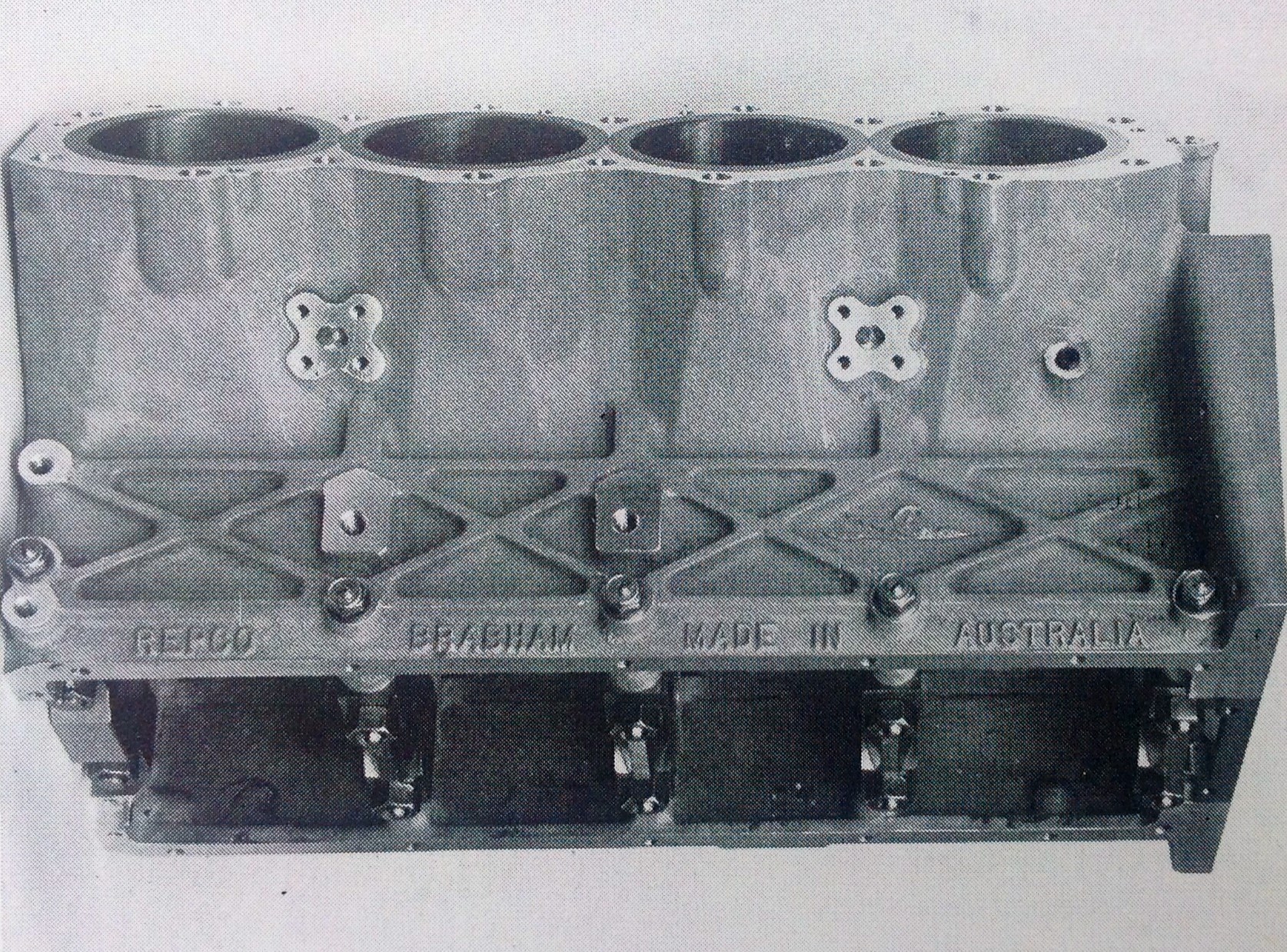
Machining the RB700 block, note the stiffening ribs referred to in the text (Wolfe/Repco)
Norman Wilson; ‘When i went there (to RBE from Repco Research) John Judd (who had been seconded to Repco by BRO in the UK) had done a new crankcase. So i asked to look at it and John showed it to me and i said we can’t make it. It was impossible because it was the basis of a whole new engine. It became a mutual decision (by the design team) that we make a crankcase that went underneath, on top of and behind exactly what we had’. ‘We couldn’t have made a crankcase, head and timing case all at once. So we made a crankcase and then we did the 40 series heads. We had to have a timing case with the heads but it meant we didn’t have too much to do at once and we just kept progressing’.
Wilson;’The new crankcase was designed from scratch but was also designed so it could accommodate the 20 series cylinder head if we wanted to. It was critical being a fairly small outfit that we had the maximum amount of interchangeable flexibility between all the components that we made. So the 700 series crankcase was designed to overcome the problems that we had seen or experienced with the Oldsmobile F85 600 series crankcase. It had wet liners, that in part was due to the fact that it was easier to cast the cylinder block with a wet liner design in that it simplified dramatically the coring required for the casting of the block’.
‘The Oldsmobile engine showed it had main bearing problems so we altered the main bearing arrangement to be much more rigid. We extended the studs up through into the centre of the Vee with nuts on top to take some of the load up through to the top of the block. The unfortunate part of that was the design was right but people would always do the nuts in the top up tight. And of course what would happen was the cylinder block being aluminium would expand more than the stud and would eventually break it. What they should have done, and no one would listen, was do them up at a much lower torque so when the engine got hot it would put the right load on the stud’.
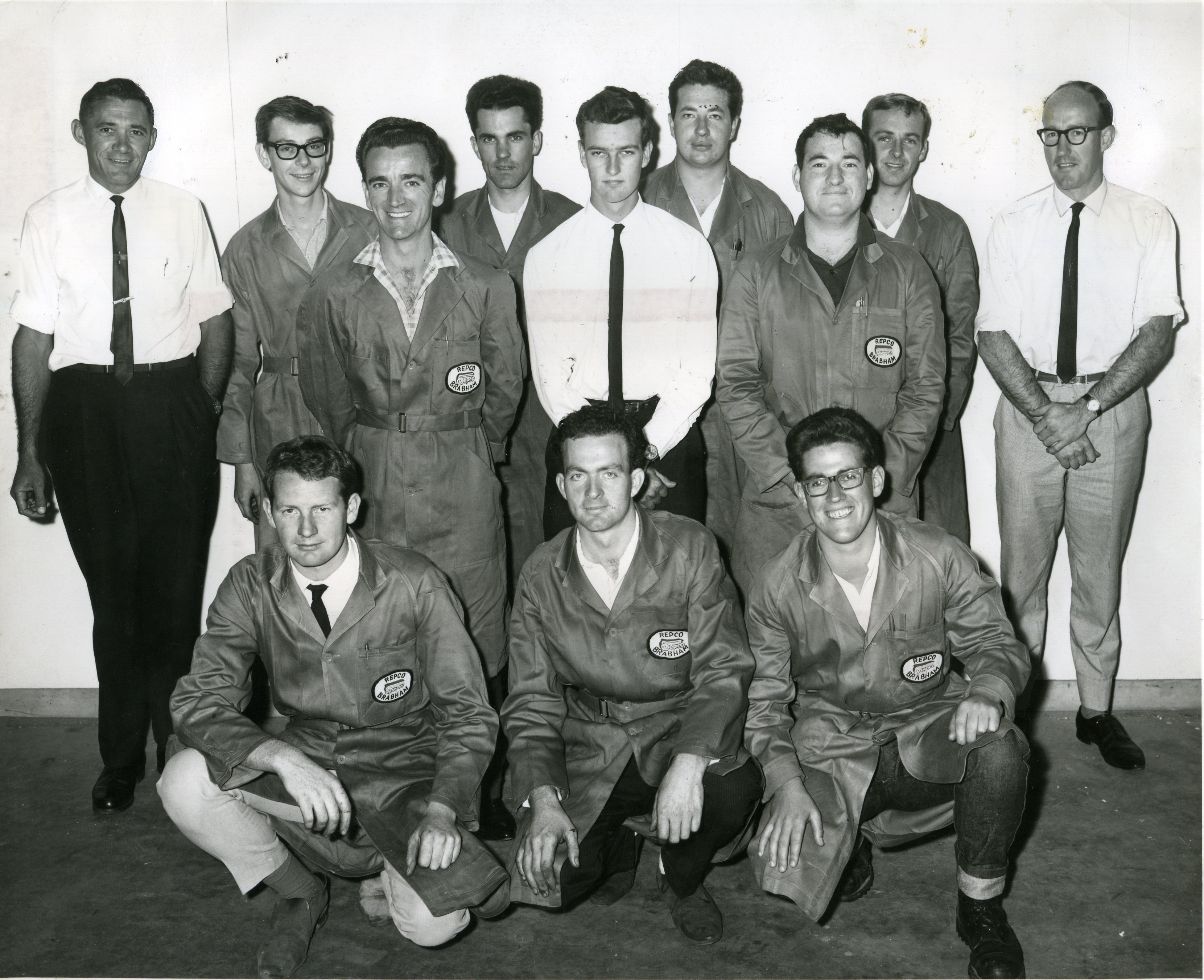
RBE Boys, Maidstone, undated but circa 1966/7. Back L>R Kevin Davies, Eric Gaynor, Tony Chamberlain, Fred Rudd, John Mepstead, Peter Holinger. Middle; Vic Mosby, Howard Ring, Norman Bence. Front; David Nash, Rodway Wolfe, Don Butler (Tait/Repco)
‘The front bearing panel of the block was made stronger because this had proved to be a weakness with the Oldsmobile block. The back of the block was made with the same stud pattern as the Olds block so that all the existing gearbox adaptors could be used. The block was made with the idea of making it as light as possible and that was one of the critical things in design. In the end Frank suggested we put some diagonal ribbing on the 700 series crankcase walls to strengthen them’. ‘The sidewalls of the crankcase were actually bolted to the main bearing caps…cross bolting (and strengthened the crankcase considerably). So i felt the diagonal ribbing was really quite irrelevant. …Frank wanted it and, you know, he was a pretty good boss to work for, so thats what we did’.
‘The other thing about the block was that later when we made the 4.2 litre Indianapolis engines (760 Series DOHC, 4 valve V8 in 1968/9) we could alter the sealing arrangements, in fact the later F1 engines (’68 860 Series) were the same, so we used Cooper rings instead of head gaskets. Cooper rings sealed the combustion chamber and O rings sealed the water passages. But we also then had a groove around the outside of the Cooper ring joined with a shallow slot to the edge of the head so if one Cooper ring leaked slightly there was no way it would pressurise the cooling system’.
RBE700 Series block, note the cross bolted 5 main bearings (Repco)
‘With the Indianapolis engine (760 Series 4.2) those grooves came out of the inside of the Vee. So you could run your engine in the pits and you could put your finger over the end of each groove and you’d know if any of the Cooper rings were leaking slightly. The 700 block was the same height as the Olds F85 block. And the 800 block (860 F1 and 830 Tasman 2.5) was a (1.5 inches) lower one to make the engine smaller.’
The 700 Series block apart from being stronger was also 15 Kg lighter than the F85 ‘600 Series, Norman Wilson again; ‘The F85 block was designed to be diecast on a diecasting machine, it was perhaps a bit thicker in spots just to make it easier to cast. We got rid of a considerable amount of aluminium around each cylinder…The Repco block didn’t have all the bosses down the centre along the block for the cam-followers. It didn’t have the cam-bearings for the centre camshaft (of the F85) We didn’t have the stiffener plate on the bottom. The bearing caps were bigger but they were done a bit better and they were probably no heavier than what was there. And in all the places where strength was not required we just skinned them down as much as we could’.
(Wolfe/Repco)
Most of the components for the engine were made by Repco subsidiary, Russell Engineering, few were contracted out.
Wolfe; ‘Most of the RBE engine components were made at the Maidstone factory. The pistons and rings however were other Repco companies and the crankshafts Laystall in the UK but no other F1 engine constructor made their own pistons and rings in 1966, even Ferrari used Hepolite pistons so Repco were unique’.
Harold Clisby’s engineering business in South Australia cast many of the heads. Kevin Drage, the senior engineer at Castalloy, the Clisby subsidiary who made the heads recalled that around 120 cylinder heads of four types’ 30,40, 50 and 60 Series were cast by the company over the period of the RBE program.
The 30 Series head was detailed by John Judd and was two valve with inlet and exhaust ports on either side of the head, ‘crossflow’ inlets between the Vee and exhausts out the side. 40 Series (the ’67 championship winner) heads were detailed by Norman Wilson which had inlet and exhaust ports on the same side of the head, between the Vee exhausts.
Drage recalls that; The two valve 30 and 40 Series heads were soon followed by the four valve 50 and 60 series designs. John Judd drew these up with the 50 Series design having diagonally tangentially ported inlet and exhaust valves resulting in 16 inlet trumpets and 16 exhaust pipes, the 60 Series design having siamesed inlet and exhaust ports’. The 50 Series heads which were built and dyno tested and the 60 Series 1968 F1 4 valve, DOHC design are a subject of a future article. The fact that RBE persevered so long, at GM Frank Hallam’s insistence with the 50 Series heads delayed development of the 60 Series design, to RBE and BRO’s cost during the ’68 F1 season.
The Commonwealth Aircraft Corporation at Fishermens Bend, not too far from RBE’s Maidstone factory made the alloy crankcases and timing covers, note that Wilson went to double-row timing chains with RB740 compared with the single chain of RB620.
Ex-Repco engineer George Wade is often given credit for the camshafts but Rod Wolfe says; ‘we made the camshafts for all of the engines, George Wade profiled them to various specs but we turned the billets with a mimic tracer on our Tovalieri lathe. The very first 620 cams were cast iron but were changed to steel in 1966’.
Lucas fuel injection was of course again used, as well as a Bosch distributor.
Summary of RBE740 F1 3 litre engine specifications/suppliers…
Bore/Stroke; 3.5X2.55 inches, capacity 2996cc. Power 330bhp@ circa 8400rpm, weight 350 pounds
Pistons, rings and main bearings by Repco, big end bearings supplied by Vandervell
Lucas fuel injection, Bosch coil and distributor, Champion plugs, Esso fuel and oil and Borg and Beck clutch
Denny Hulme DNF ignition and Jackie Stewart 2nd in their ‘between the Vee’ exhaust Brabham BT22 ‘640 Series’ Repco and BRM P261 respectively Levin, NZ 14 January 1967 (Digby Paape)
Racing the 640: 1967 Tasman Series…
The first race of the 1967 GP season was the South African GP at Kyalami on January 2, Jack and Denny raced 620 Series V8’s, the 740 was running late due to delays in patterns being made for the 700 crankcase. Its an interesting observation given that Hallam told Brabham by letter dated 23 September that the 700 patterns were half finished. In any event, the engine was late so made its debut in the Tasman Series, or more specifically 640 Series engines did; the new heads atop the 600 Series/F85 Olds blocks.
Brabham giving his 620 engined BT20 some welly at Kyalami during the South African GP at Kyalami on 2 January 1967, he was 6th from pole with Denny 4th from grid 2. Pedro Rodriguez won in a Cooper T81 Maserati (unattributed)
RBE staff numbers during the Christmas/New Year 1966/7 period swelled to 37, 23 engines being assembled during this period. Frank Hallam records that due to the great amount of dismantling, assembly and experimentation that took place only four 2.5 litre motors raced in the Tasman Series. The 640 series 2.5 litre Tasman engines gave circa 265bhp@8500rpm.
Brabham’s full ’67 F1 season i will cover in a separate article, here we look at the Tasman races for the 640 and early season F1 races of the 620 and 740.
RBE’s Michael Gasking and BRO’s Roy Billington and another mechanic prepare Brabham’s ‘RB640’ 2.5 V8 engined BT23A before the Sandown Tasman round on 26 February 1967, DNF ignition. Repco Maidstone factory (Wolfe)
If you take the view that the ’67 Tasman was a warm up for the ’67 World Championship then it was a success for Brabham and RBE. The 40 Series heads were thoroughly race tested during the annual Australasian summer contest.
Equally important was Jacks mount, his car designated BT23A was an adaptation of Ron Tauranac’s very successful new 1967/8 BT23 F2 design, which won dozens of races in Ford Cosworth FVA 1.6 litre F2 spec. The Tasman BT23A was effectively the prototype of the BT24 which went on to win the ’67 titles, so the Tasman ‘blooded’ both the chassis and engine well before the F1 season. The reliability which flowed from this development process won RBE and BRO the ’67 championships, the Lotus 49 Ford Cosworth DFV was well quicker but had not had the development miles the Brabham Repco’s had…
Jim Clark took the 1967 Tasman title in an F1 Lotus 33 fitted with a stretched to 2 litre Coventry Climax FWMV V8 engine, a quick, reliable, well proven combination. Clark took 3 wins, Jackie Stewart 2 in a similar F1 BRM P261. But the stretched to about 2.1 litres P56 V8 stressed the BRM transmission to its limits, the ‘tranny its weakness that summer. Jack was equal 3rd on the points table to JYS with 1 win.
Jim Clark Lotus 33 Climax, Levin International winner, 14 January 1967 (Digby Paape)
Jack and Denny contested all rounds of the championship with the exception of Teretonga, the last Kiwi event. Jack took a win at Longford and Denny 3rd at Wigram his best. Brabham had a lot of unreliability but the problems weren’t in the main engines; for Denny a radiator hose at WF, gear selector at Sandown and electrical problems at Longford and for Jack a driveshaft breakage at Teretonga and ignition dramas at Sandown.
At that stage Repco hadn’t sold customer Tasman 2.5 engines of any type, the engines were made available later in the year in time for commencement of the domestic Gold Star series (640 & 740 Series 2.5 V8’s) in the meantime the more important business of getting the 3 litre ‘740 Series’ V8’s into Tauranac’s exquisite little BT24 was the priority.
Jack from Denny in BT20’s; Jack’s 740 engined and Denny’s 620, Denny won both heats and Jack the final giving the 740 the first of its many wins in 1967. Oulton Park ‘Spring Cup’, 15 April 1967 (Brian Watson)
The first F1 event of the European ’67 season was the Race of Champions at Brands Hatch on 12 March.
Dan Gurney won both heats and the final in his Eagle T1G Weslake, Jack was 9th a ’66 spec 620 engined BT20 with Denny DNF, similarly equipped.
The ‘Daily Express Spring Cup’ at Oulton Park followed on 15 April, Brabham ‘cleaned up’ in BT20’s; Denny won both heats and Jack the final taking a great race win for the new 740 3 litre V8 with Denny 2nd in a 620 engined ’66 chassis.
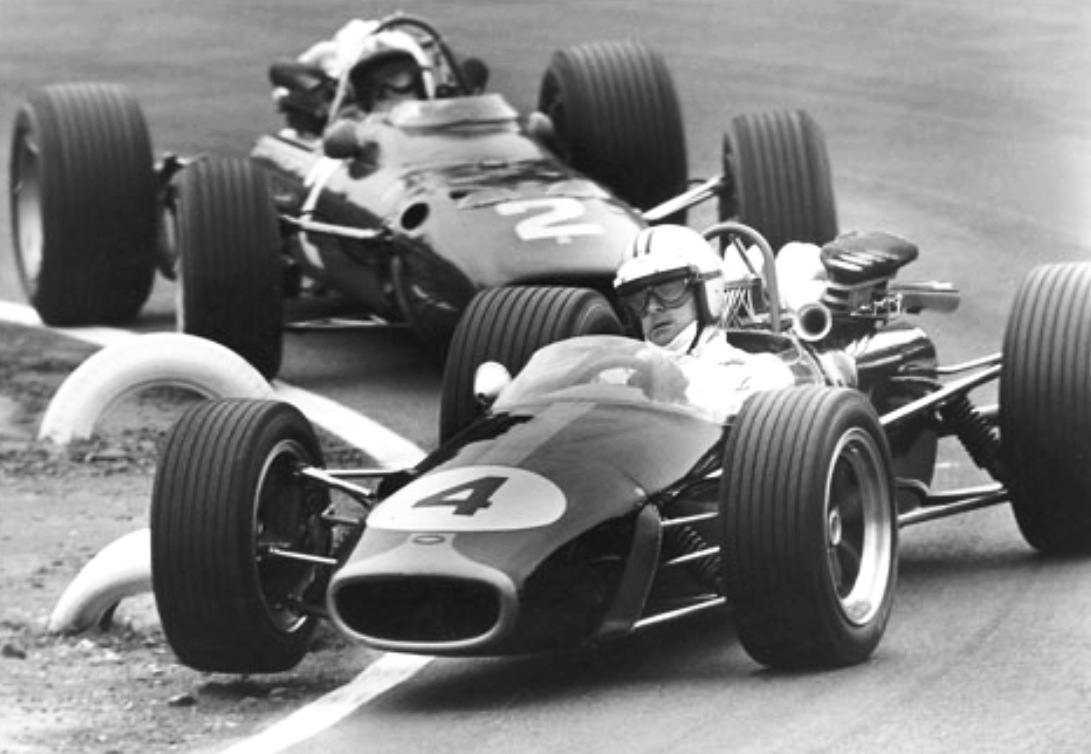
Jack proved the speed of the new RB740 V8 at Monaco, its championship race debut, plonking it on pole but it went bang with a broken conrod in the races 1st lap, car is Jack’s beloved ‘old nail’ Brabham BT19, his ’66 championship winning chassis. Denny won in ‘last years’ quick and reliable BT20 Repco ‘620’ (unattributed)
BRO fitted its first 740 Series engine just in time for the Monaco GP on May 7.
Apart from the delays caused by late patterns for the blocks, Repco Die and Tool Co forged conrods developed faults. After being unable to establish why the Repco rods were failing the team went the Carillo route, the team using these tried and true products…despite not being made in Oz! Rod Wolfe; ‘We did discover that the champfer at the bolt heads did not match the bolt radius under the head of the bolt and even when tensioned correctly they were not seating properly resulting in a couple of failures’.
The definitive RB ‘740 Series’ engined Brabham BT24 didn’t appear until Jack gave the chassis/engine combination its championship debut at the Belgian GP, Spa on June 18. This was 2 weeks after the Ford Cosworth DFV V8 took the first of 155 GP wins, the 1967 successful Brabham GP season a Repco story for next time…
‘Black Jack’ at La Source during the ’67 Belgian GP. Both he and Denny retired with engine problems in BT24 and BT19 respectively. Dan Gurney took a famous and well deserved win in his Eagle T1G Weslake V12, 18 June. Compact nature of the F2 derived BT24 clear (unattributed)
Repco 1966/7 promotional film…
Check out this great footage, the first half covers Brabham’s victorious 1966 F1 season, the other bit the ’67 Tasman season, the debut of the 640 Series V8’s including some factory footage of the engines build.
Etcetera…
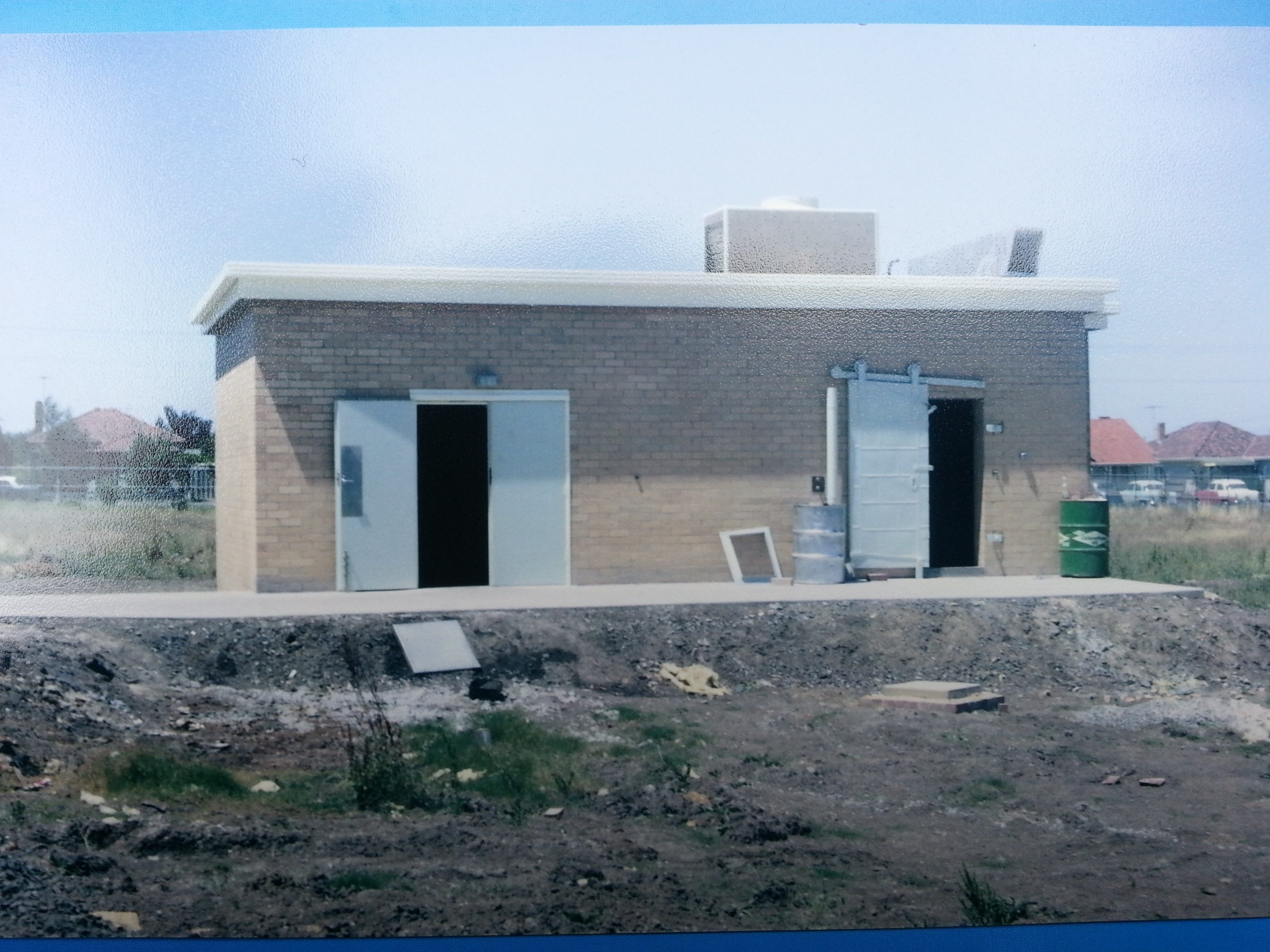
Rodway Wolfe ‘The dyno test house at the rear of the Repco Maidstone factory. The silver drum on the side was the fuel tank which was changed when needed. The walls of the building were very thick…when the engines were running at full noise you could hold your hand against the wall and get a massage! Fascinating!’ (Wolfe)
Roy Billington and Denny Hulme in the middle of a ratio change in the Wigram paddock. Note the Brabham BT22 Hewland gearbox, high pressure Lucas ‘bomb’ fuel pump and 640 engine of course (J Manhire)
Repco 640 2.5 V8 power; Jack all cocked up in Warwick Farm’s Esses during the AGP, Warwick Farm 19 February 1967. Brabham was 4th in his BT23A, Stewart won from Clark and Frank Gardner in BRM P261, Lotus 33 Climax and Brabham BT16 Climax respectively (unattributed)
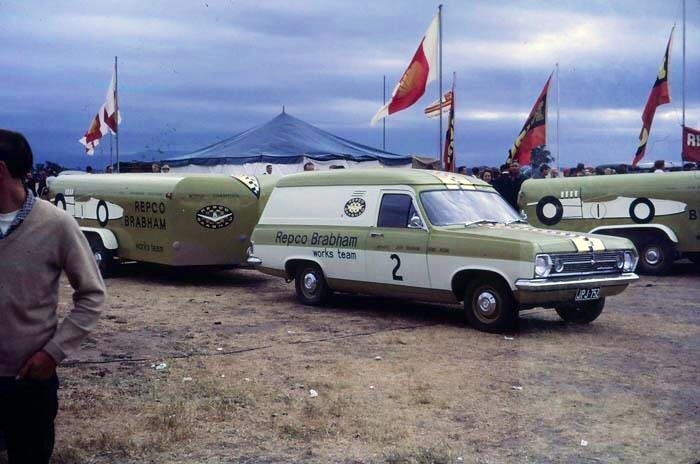
Repco works Brabham Repcos’ on the move, Tasman Series, Longford, Tasmania 1967. ‘Rice Trailers’ the ducks guts at the time, tow cars are Holden ‘HR’ Panel Vans, 3 litre straight OHV 6 cylinder engines and ‘3 on the tree’ column shift manual ‘boxes (Ellis French)
Sandown Tasman, 26 February 1967, Brabham, Brabham BT23A Repco, Stewart BRM P261 and Hulme on the outside, Brabham BT22 Repco, all DNF! Jack with ignition, Stewart crown wheel and Hulme gear selection problems. Clark won in a Lotus 33 Climax. You can see the ducts directing cooling air between the Vee shown in an earlier shot (unattributed)
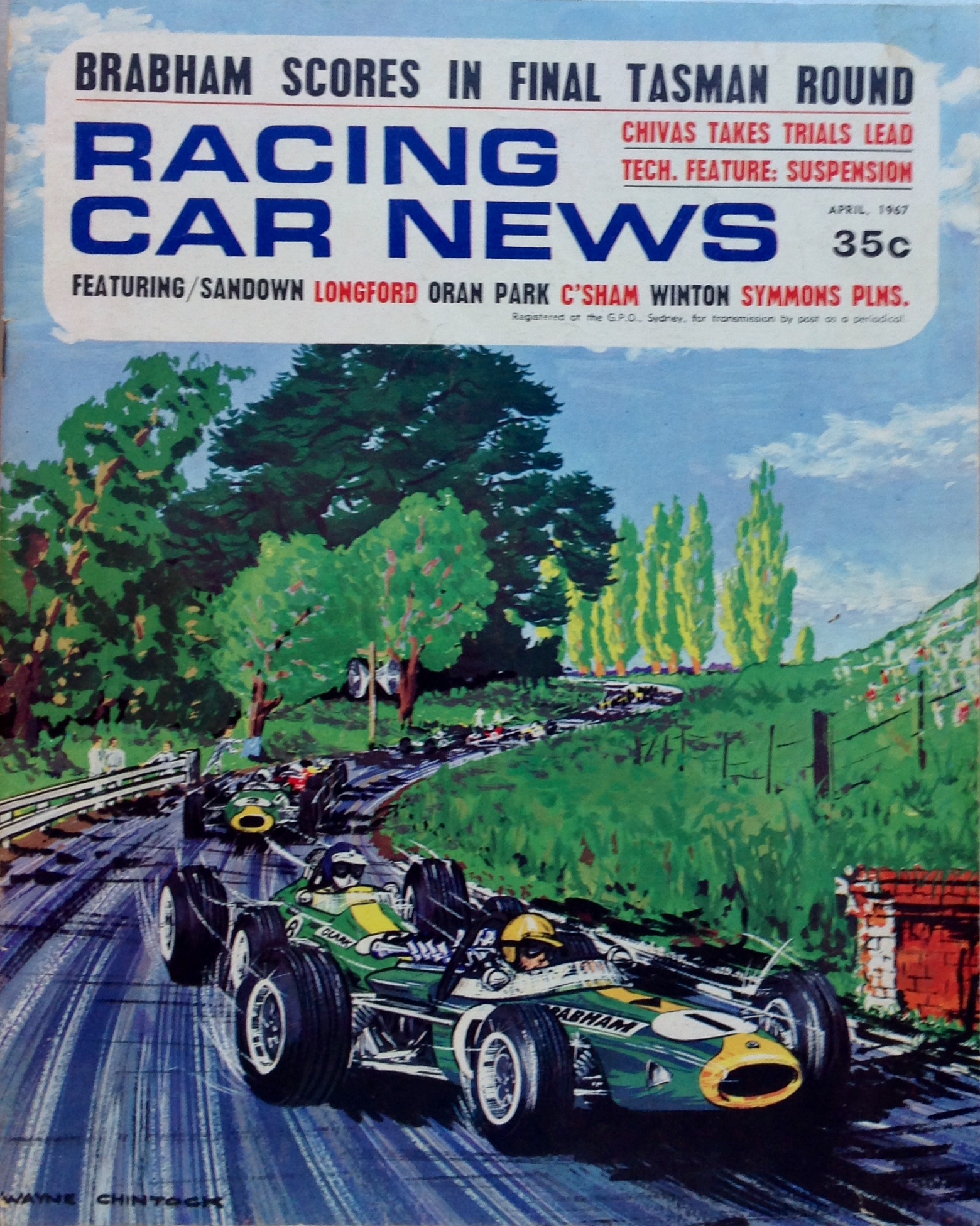
Jack hooks into the Viaduct ahead of Jim and Denny in David Chintock’s impression of the ’67 Longford Tasman round which Brabham’s BT23A won (Wolfe/Racing Car News)
Etcetera: Norman Wilson RBE740 Chief Designer…
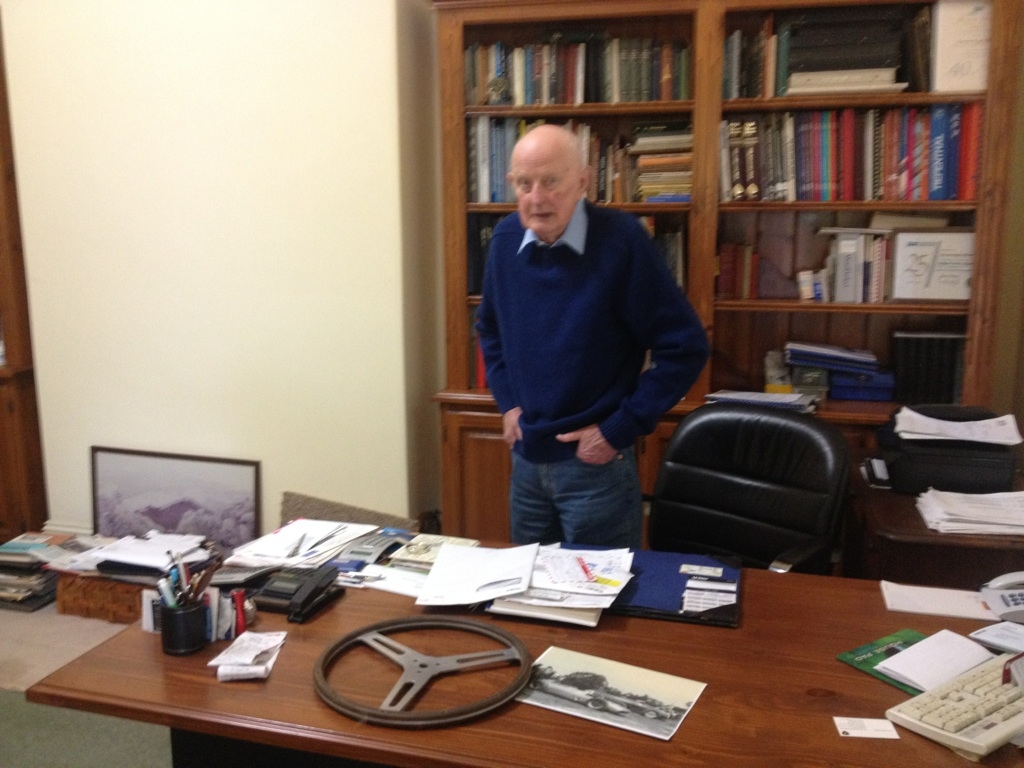
Norman Wilson in the study of his St Kilda, Melbourne bayside home in early 2016 (Greg Smith)
Its interesting context to Wilson’s work at Repco Brabham Engines to look at the car he built as a ‘youngster’ before his ‘glory years’ as part of the Maidstone team. The car is both innovative and practical in its adaptation of proprietary parts, a combination applied in his later work.
As the cars current owner Greg Smith observes ‘the Norman Wilson Special is a beautiful study of a late fifties racing car with its Mercedes’ styling and layover engine, side vents and knock-off wire wheels’
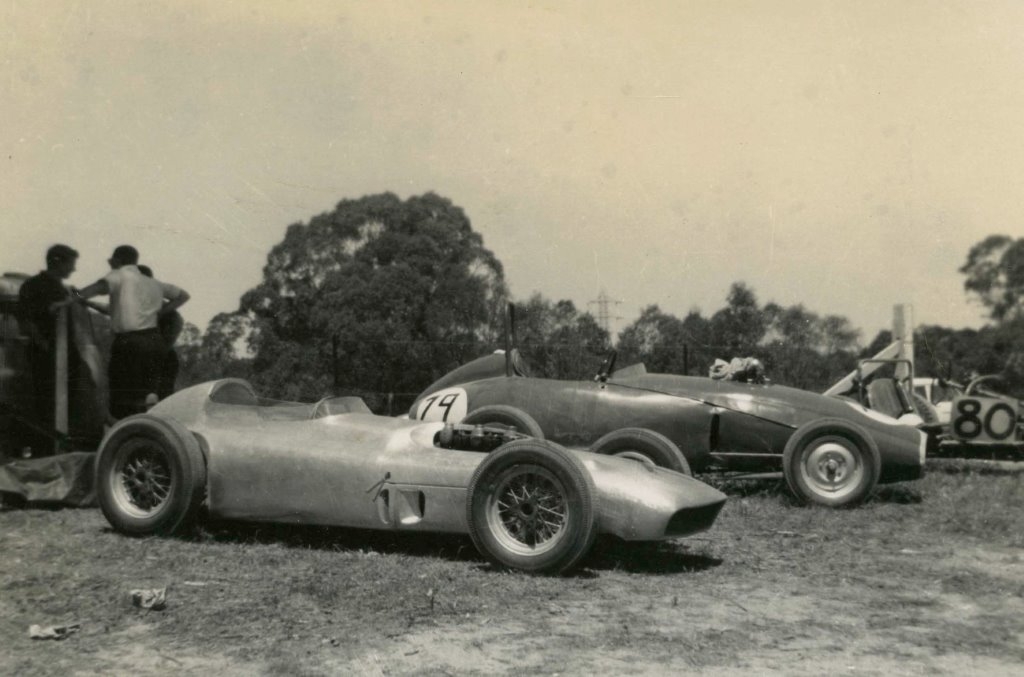
‘Norman Wilson Spl’ in the foreground at Templestowe Hillclimb in then outer eastern Melbourne. Pat Hawthorne’s Lycoming Spl behind. The carbs are Webers, sidedraft right angle alloy castings (Greg Smith)
Norman started his 6 cylinder Holden engined ‘Norman Wilson Spl’ around 1956 aged 29/30. The chassis is a spaceframe, front suspension Wilson’s using inverted Holden uprights and wishbones, his own cross member and geometry. Steering is rack and pinion. The rear end is a ‘cut and shut’ Holden with an offset diff to lower the driver, springs are quarter elliptics with some neat locating links.
The clever bit was laying the Holden engine over at 30 degrees to the horizontal to both lower both the centre of gravity and bonnet line. By the time the car was finished Norman had moved to Repco, where it was completed and furnished with 3 large, single throat Webers Charlie Dean bought for Maybach but never fitted to it when that car was fuel injected. The ‘box was Jaguar, the beautiful aluminium body built by Barry Hudson who also did the Ian Mountain (Peugeot) Spl.
Norman raced the car, mainly in Victoria from 1960-63, it passed through several hands before being ‘chopped up’ in the late ‘60’s. With the interest in historic racing growing, and knowing the historic significance of the car and driver, reconstruction was commenced by Graemme Brown in Adelaide in the mid 1980’s, its first run in 1997. The car is currently being rebuilt by Victorian racer, engineer and raconteur Greg Smith to its precise period spec from whom this history and photos were provided. There is a whole lot more to this incredibly clever car built by Wilson in his youth, we will do a feature on it when Greg is close to its completion, I’ve seen it, the thing is sensational, Smithy will race it during 2017. I also plan to write more about Norman Wilson’s career, too little is known about this fella, now 91. so important in the Repco story.
Bibliography…
Recollections of Rodway Wolfe and Nigel Tait
Norman Wilson quotes from Simon Pinder’s ‘Mr Repco Brabham’, Doug Nye ‘History of The Grand Prix Car’, ‘Phil Irving: An Autobiography’
Kevin Drages comments from ‘The Nostalgia Forum’
Greg Smith’s photos and details of Norman Wilson and the ‘Norman Wilson Spl’
Photo Credits…
Rodway Wolfe and Nigel Tait Collections, Repco Ltd archive
Autocourse, Digby Paape, David Keep, Bruce Wells/The Roaring Season, David Keep/oldracephotos.com, Automobile Year, Ellis French, David Nash, John Manhire
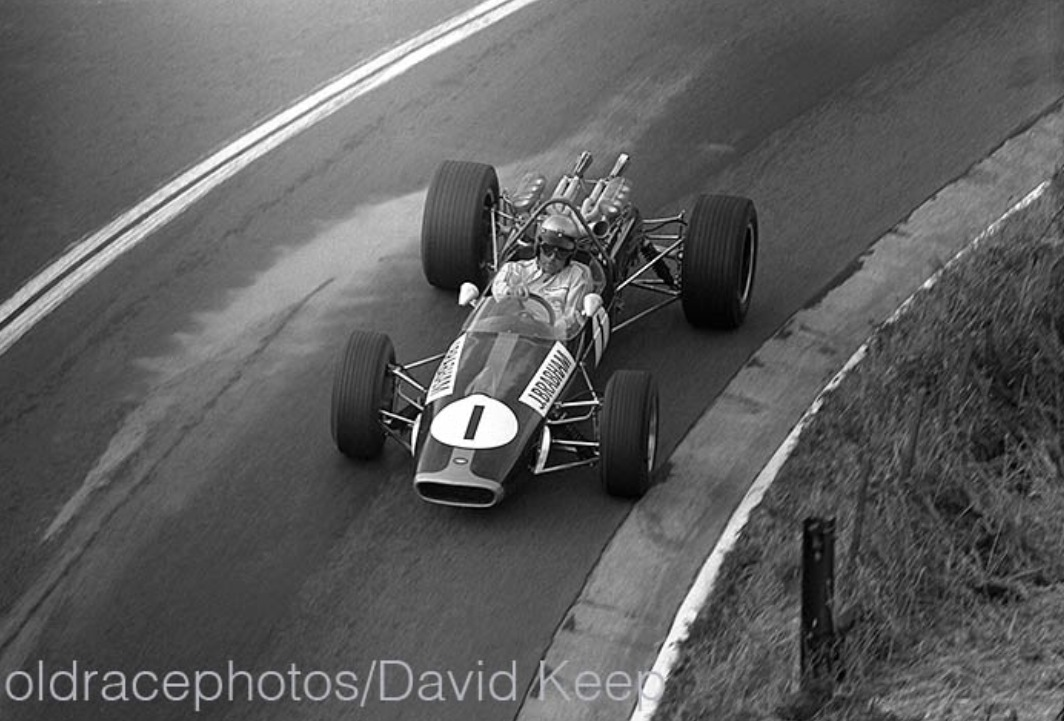
Tailpiece: Jack Brabham guides his Brabham BT23A Repco into the Viaduct on his way to victory in the ‘South Pacific Trophy’, Longford 5 March 1967. He takes the first of many ’40 Series’ Repco 1967 wins…
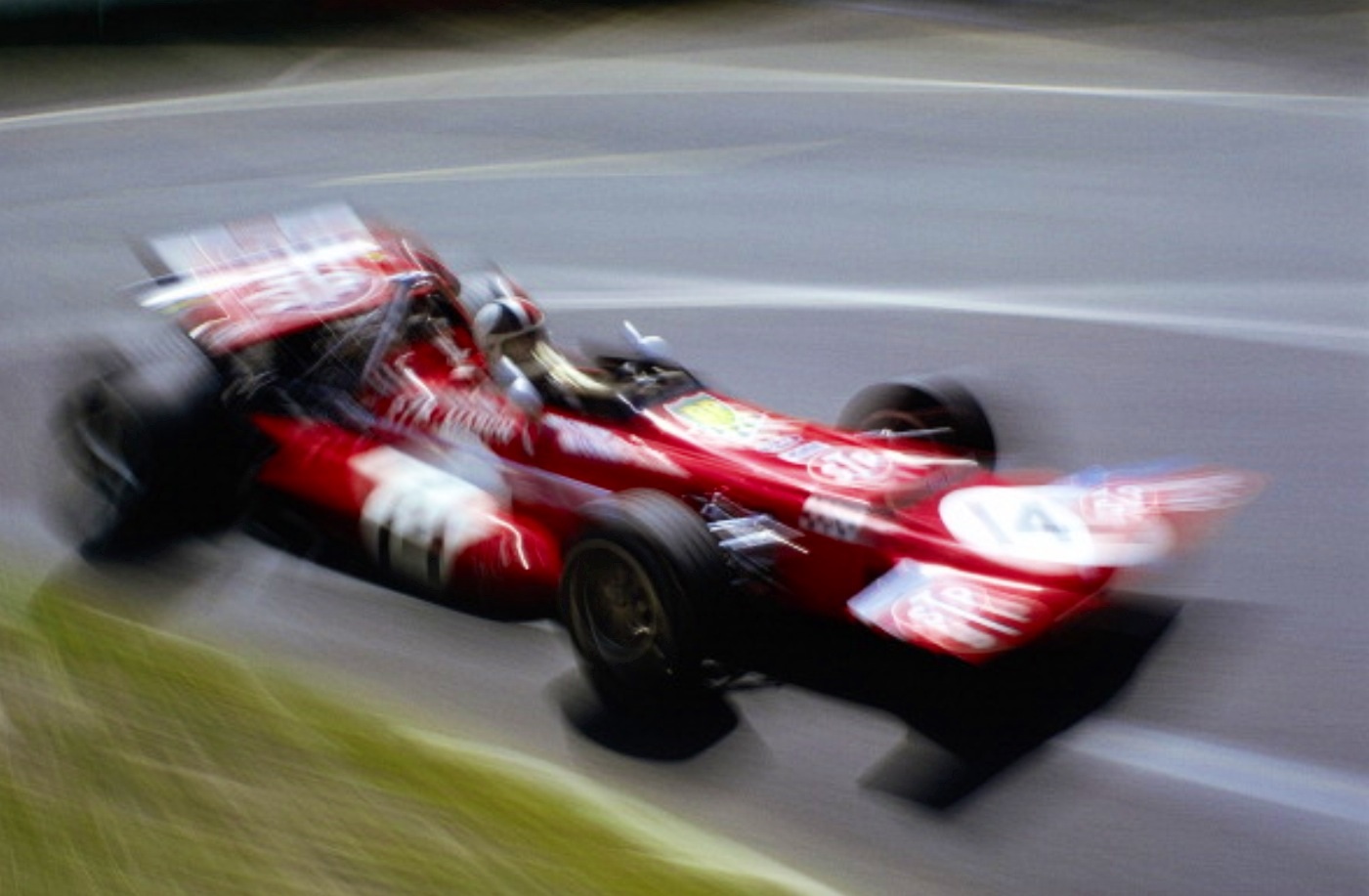
Chris Amons STP March 701 Ford, at Clermont Ferrand, French GP weekend 4 July 1970, reflected in the gals ‘sunnies’,this is a signature Rainer Schlegelmilch shot but I never tire of them!…
Amon, French GP, Clermont Ferrand 1970, ‘works’ March 701 Ford (unattributed)
Chris qualified the car well in 3rd, one slot in front of Jackie Stewart in Ken Tyrrell’s similar, albeit Dunlop, rather than Firestone shod car. Chris raced the car into 2nd behind Rindt’s winning Lotus 72 and in front of Brabham’s Brabham BT33, all cars Ford Cosworth powered.
Amons March 701 at Clermont in 1970. he won the Non-Championship BRDC International Trophy at Silverstone in April in it but no championship Grands Prix despite a very close 2nd to Pedro Rodriguez’ BRM P153 in a Belgian GP Spa, slip-streaming thriller (Cahier)
John Surtees ‘P3’ at this point but his Ferrari gearbox failed in the race won by Stewart’s BRM P261…
(David Phipps)
Surtees in his big Ferrari 312, a new F1 car built to the 3 litre formula introduced that year leads Jackie Stewart in his light, nimble BRM P261, a 1.5 litre F1 car bored to around 2.1 litres and shortly to be victorious over ‘Big Johns’ heavy and not so powerful Ferrari.
It may have been different if he had driven the light, nimble Ferrari Dino 246 allocated to teammate Bandini, but that was not to be and so the pressures mounted which lead to Surtees departure from the Scuderia shortly thereafter. And with it any chance Ferrari had of winning the title that year. Brabhams year of course.
Wonderful drawing of Fangio’s 1954/5 Mercedes W196 cockpit. Was there ever a more complex GP car than this in the context of ‘its time’!? A very successful one mind you…
Teddy Mayer and Bruce McLaren, McLaren M7C Ford fifth, at Monaco on 18 May 1969, the hi-wings disappeared overnight. Hill G won in a Lotus 49B Ford (R Schlegelmilch)
McLaren ‘owned’ the color papaya and having created brand recognition many marketers can only dream about walked away from the distinctive orange hue…
Bruce McLaren Motor Racing broke through in the 1967 Can-Am Series where Bruce and Denny crushed the opposition with the fabulous M6A Chev, a joint McLaren and Robin Herd design collaboration.
Bruce and his M14A Ford before the ‘Race of Champions’ at Brands Hatch, 22 March 1970, DNF after an accident, Jackie Stewart won in a March 701 Ford (Fox)
Bruce at Las Vegas in 1967, McLaren M6A Chev, it may be a blur but you knew what it was because of the colour, right! John Surtees won in a Lola T70 Mk3B Chev, both McLaren’s DNF with engine failure (Getty)
Modern marketing started in the US. In trying to create cut through or pop on then new colour telly the McLaren hierarchy, Teddy Mayer in particular is credited with choosing the distinctive shade which defined the marque until the Yardley McLaren era of 1972.
Denny Hulme, Kyalami 1972, on the way to a South African GP win in the ‘Yardley’ McLaren M19A Ford (unattributed)
The M6A gave its sponsors a fair crack of the whip, the 1967 colour stuck and was subsequently adopted on the factory Can-Am, F1, F2, F5000 and Indycars until the early seventies.
The photo below is of more significance than I first realised, my friend Derek Kneller recalls. ‘I joined McLarens as a fabricator having worked in the experimental department of Hawker Siddeley on the P1127 (Hawker Harrier vertical take off fighter) on 26 March 1968. One of my first tasks was to prepare this car for its first tests with the ‘ally big block 7-litre Chev. I worked through the weekend with Wally Willmott and and Gary Knutson to get the car ready. We essentially hacked the back off the M6 and grafted the rear of the proposed 1968 M8 onto the car.’
‘The photo shows, left to right, Denny, Gary Knutson partially obscured, Teddy Mayer, Phil Kerr and Bruce. Wally is in the blue shirt and Jo Marquhart to the right in the suit with overcoat. They are supervising the mule M6A/2 at Goodwood on 24 April 1968. Gary Knutson and Colin Beanland built the engine at Al Bartz’ shop in Los Angeles, it’s losing oil which is the reason for the concerned faces.’ George Begg, McLaren confidante and Kiwi racer/car builder took the photo.
The papaya M6 rather contrasts with the dull, rolling Sussex hills in the background and the flash pit-counter in the foreground!
(G Begg)
David Hodges records in his Profile Publications article on the McLaren M8, that after this chassis was used in these tests and later aerodynamic work, it was returned to M6 specification and then sold.
Jody Scheckter’s works McLaren M21 Ford BDF F2 car during the BARC 200 Euro F2 Championship round at Thruxton, 3 April 1972. Jody DNF with overheating, race won by Ronnie Peterson’s March 722 Ford BDF (M Hewitt)Andrea De Adamich’s McLaren M14D Alfa Romeo at Mont Tremblant Canada in 1970. DNF engine in the race won by Ickx’ Ferrari 312B (R Schlegelmilch)
Until Yardley’s arrival on the side of the M19 a swag of sponsors logos sat comfortably on McLarens against the gorgeous, distinctive from afar, shade.
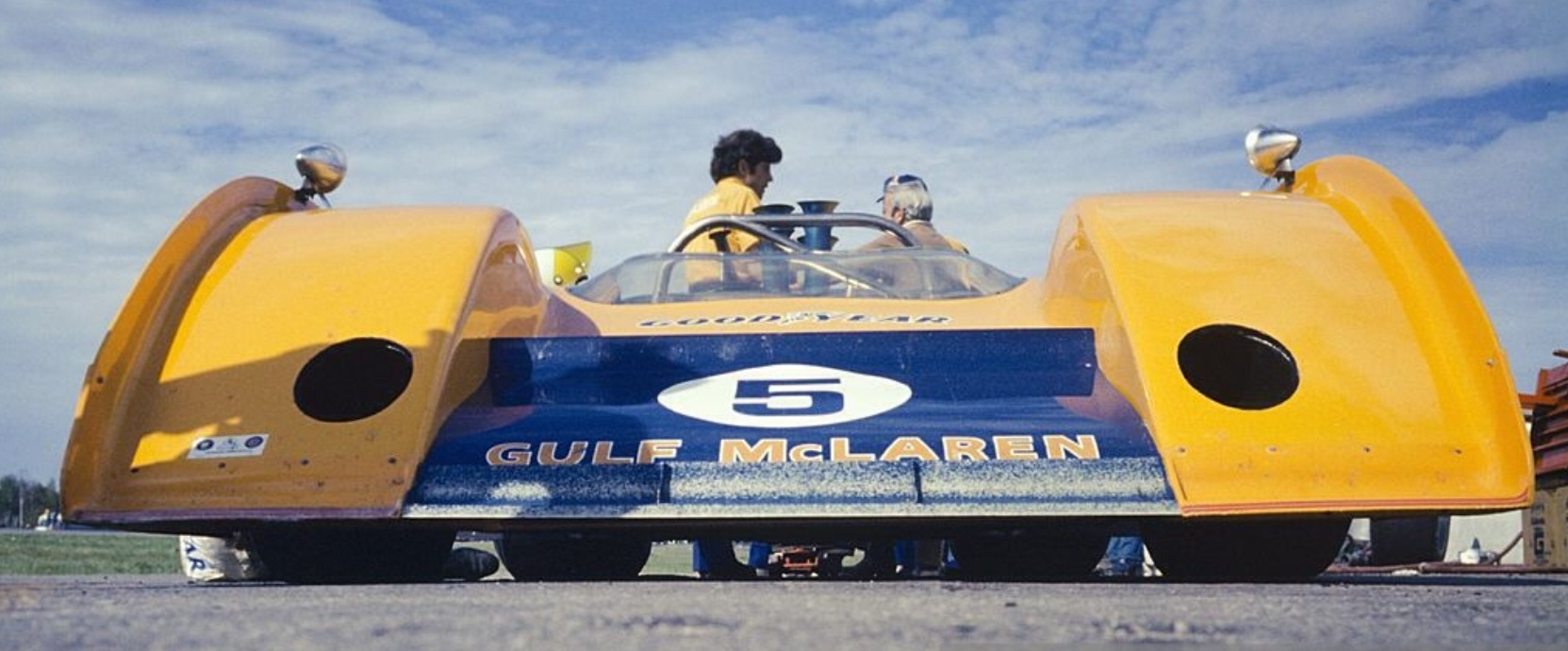
#5 Denny Hulme and Peter Revson’s McLaren M20 Chevs at Donnybrooke, Minnesota , 17 September 1972 (A Upitis)
Lotus, the leader in so many aspects of racing showed the power of wholistic F1 brandingof a racing car with the fag packet livery Gold Leaf Team Lotus, Lotus 49s which first appeared in the Wigram, New Zealand round of the Tasman Series on 20 January 1968. Jim Clark raced – just – in the early months of the year in the ‘modern advertising era’.
Jim Clark in the Teretonga paddock, Lotus 49 DFW, his GLTL Lotus freshly painted car finished second to Bruce’s works BRM P126, painted traditional green! 27 January 1968 (I Peak)
Of course the Americans had refined the art (advertising on racing cars) for 50 years before the rest of the world caught up, or regressed, depending upon your view of it. You cannot imagine Cadbury abandoning purple yet McLaren walked away from a signature colour which defined their cars in a most distinctive way. I’m not suggesting Bruce and the boys had as much brand equity in papaya as Cadbury in purple but you get my drift.
Ferrari of course are the prime example of a marque who ‘own red’. Their sponsors have always obtained the coverage sought against a red background rather than Ferrari adopting the packaging of their corporate partner of the season or decade!
Denny Hulme on his way to winning the 1968 Canadian GP at Mont Tremblant, Bruce was second in a great day for the team. McLaren M7A Ford (unattributed)Peter Revson, Indy qualifying 17 May 1972, McLaren M16B Offy. Peter started from grid 2 but DNF with ‘box failure after five laps. Mark Donohue won in Roger Penske’s customer M16B (B D’Olivo)Hulme’s McLaren M20 Chev at Donnybrooke in 1972, Francois Cevert won in an ex-works M8F, both McLarens DNF with popped Chevys (A Upitis)
In more recent times papaya has staged a comeback appearing on the McLaren F1 GTR LeMans car, occasionally as an F1 testing colour and as a favoured choice on its exotic road cars…
Pedro de la Rosa and Mika Hakkinen in early 1997 testing of their McLaren MP4/12 Mercedes at Jerez, they raced in boring silver of course (reddit.com)McLaren M20 Chev in 1972, almost a Can-Am signature, the staggered injection trumpets used from 1970 (Getty)
Credits…
Rainer Schlegelmilch, Alvis Upitis, Getty Images, Fox Photos, Bob D’Olivo, Michael Cooper, reddit.com, George Begg, Ian Peak Collection/The Roaring Season, Duncan Fox, Derek Kneller, David Hodges ‘The McLaren M8 Series’
Tailpieces…
(M Cooper)
McLaren F1 GTR set against the Dunlop Bridge at Le Mans in 1996.
(R Schlegelmilch)
Victorious papaya blur, Bruce on his way to a win at Spa in 1968, McLaren M7A Ford. While the model may be in doubt, the marque is not…
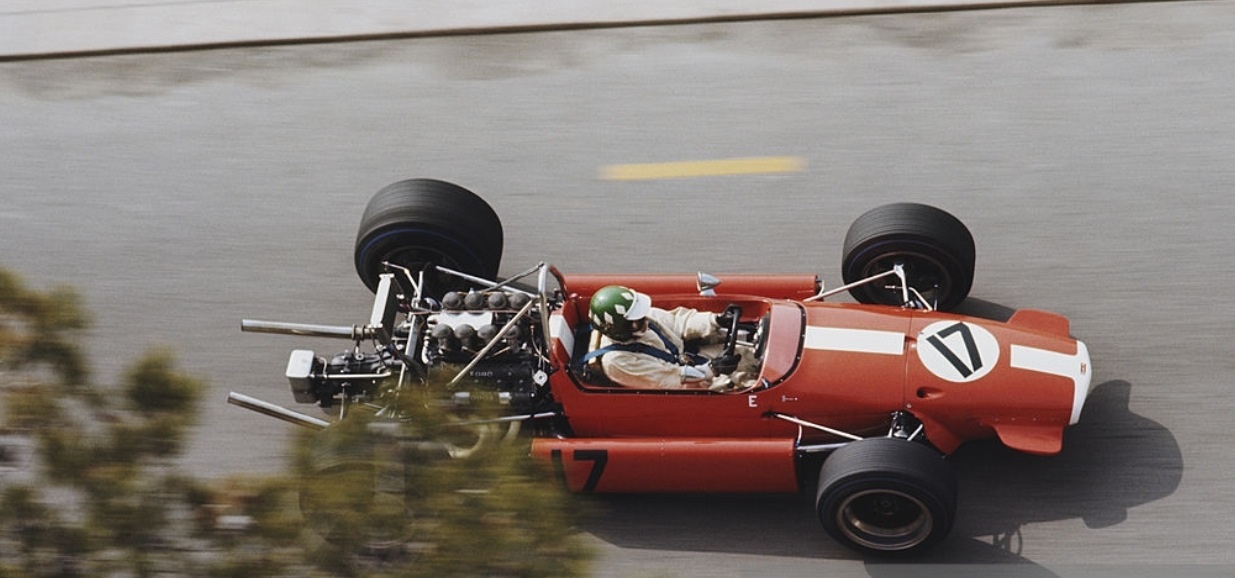
Silvio Moser’s Brabham BT24 Ford racing with Lancia D50 style pannier tanks during the 1969 Monaco Grand Prix…
He retired from the race won by Graham Hill’s Lotus 49B, Moser is one of those privateers who so enriched GeePee racing in the days when such things were allowed, encouraged even.
Silvio was keen on Brabhams, he raced an ex-works BT20, Denny’s chassis ‘F1-2-66’ in 1968 before buying the car above, BT24/3 after Piers Courage raced it in the 1969 Tasman Series.
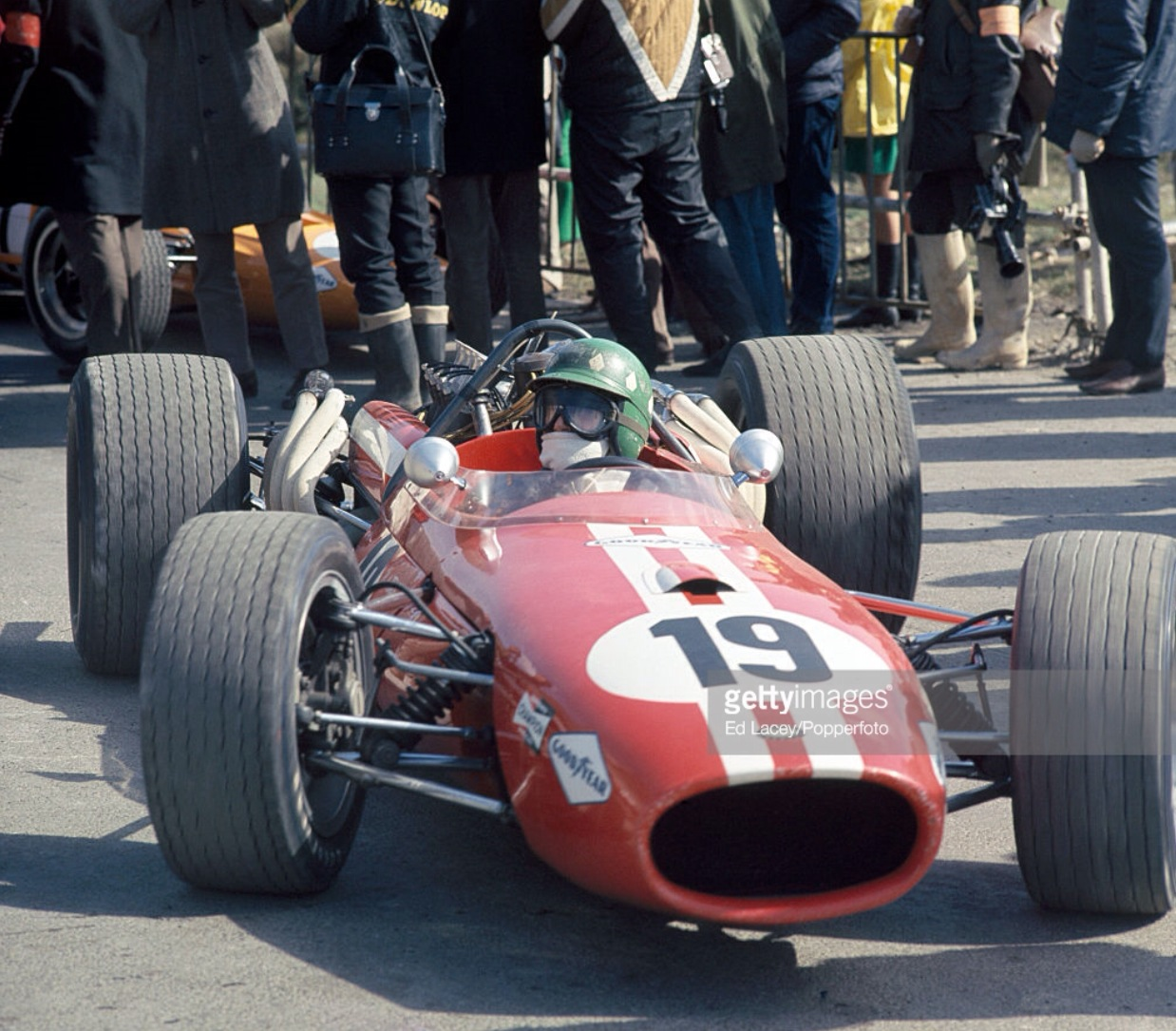
Silvio is his Charles Vogele Racing Team Brabham BT20/2 Repco. DNF, Daily Mail Race of Champions meeting, Brands Hatch, 17 March 1968. Bruce McLaren won in his M7A Ford (Ed Lacey)
It was the last of the BT24’s built, Jochen Rindt raced the 1967 championship winning design during early season 1968 Grands Prix whilst Jack tried to coax some reliability from the quad cam, 32 valve, powerful but problematic ‘860 Series’ Repco V8 engined BT26.
Jochen Rindt’s Brabham BT24/3 Repco, his ’67 spec ‘740 Series’ Repco SOHC V8 powered car beside Jack’s new BT26 powered by the ‘860 Series’ DOHC, 32 valve V8, DNF for both, Monaco 1968. Hill won in a Lotus 49 B Ford (R Schlegelmilch)
Dan Gurney also had a steer, the lanky Californian crammed himself into the car at Zandvoort (below) then Kurt Ahrens raced it to twelfth in the German GP, the cars only GP finish in 1968.
(R Schlegelmilch)
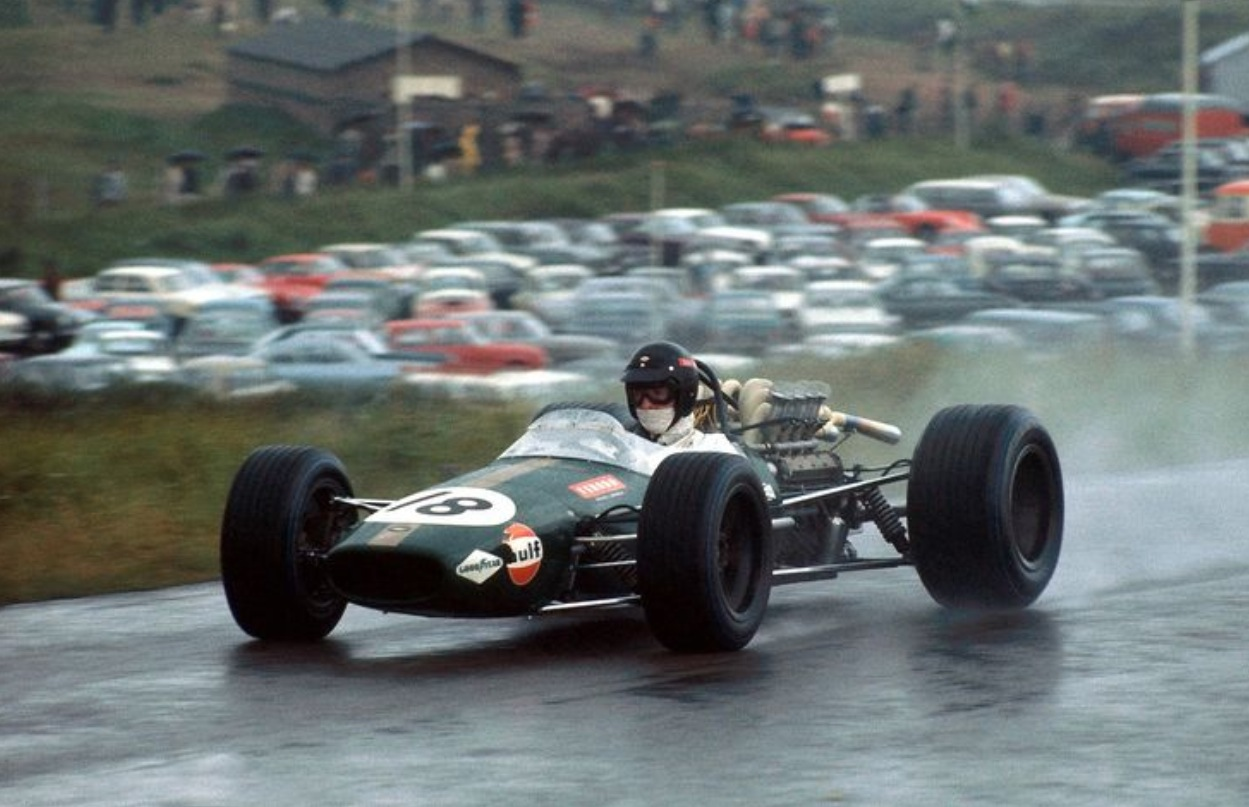
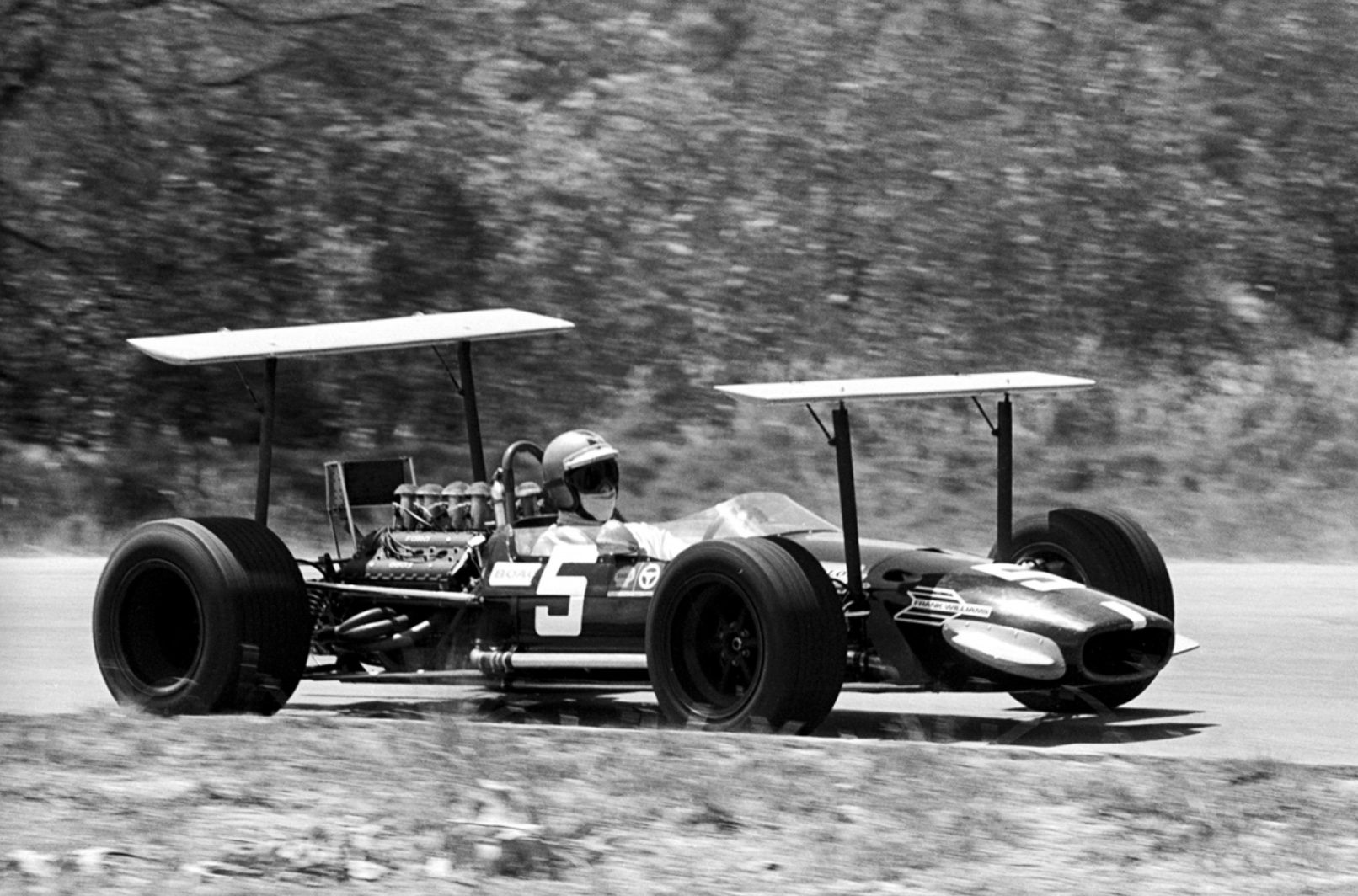
Kurt Ahrens (below) in BT24/3 during the awfully wet German GP at the Niuburgring, Jackie Stewart triumphed in his Matra MS10 Ford aided by some trick Dunlop wets that day. Kurt was on Goodyears, finishing in a one off drive on home turf.
The cars spec was ever evolving, check out the wing package, the same as that used on the factory 1968 BT26’s, Nurburgring was the only race of the year in which both Jack and Jochen finished a race in the fast but unreliable BT26. Kurt’s cars wing has ‘Fosters Flop’, it’s in full droop mode, the simple support bracket came adrift on the bumpy Eifel Mountains course.
(Unattributed)
Frank Williams then bought the car and converted it to Tasman spec by fitting a Ford Cosworth DFW V8,the 2.5 litre variant of the famous DFV. Piers did well in it in the Antipodes, his best result a win at the Teretonga International on 25 January 1969.
Here (below) he is behind Jochen Rindt’s Lotus 49 DFW and the Ferrari 246T twins of Chris Amon and Derek Bell, the ‘flash’ grandstands are nicely juxtaposed against the cars. This must be the warm up lap as Jochen’s driveshaft failed on the line, the cars are in grid order.
(Ian Peak)
And below Bell’s Ferrari 246T from Hill’s Lotus 49B and Courage’s BT24/3. Courage won from Hill and Amon. Variety of approaches to wings is interesting, checkout that crowd and the el-casual vantage points.
(Ian Peak)
Courage had a prophetic summer to a sensational F1 season driving another ex-works Brabham, a BT26 adapted to accept a DFV, he established himself as an Grand Prix front runner in 1969, second at Watkins Glen to Jochen Rindt the seasons highlight.
Frank Williams then popped the BT24 into the ‘Autosport’ classifieds after the Tasman to sell it, Silvio was the eager purchaser. All the hard work had been done, he bought a DFV and slotted it into the spaceframe whence the DFW had been. He needed more fuel tankage though, Tasman races were 100 miles, GP’s were 200 miles and the DFV was a good deal more powerful and less fuel efficient than the Repco 740 around which the car was designed, hence the pannier tanks- ok for 1969 but no-go in 1970 when ‘bag tank’ rules came into being.
BT24/3 still exists in Switzerland, owned by the Moser family, there is also a replica tagged 24/3.
Silvio’s Brabham BT24 DNF engine, about to be swallowed by Amon’s Ferrari 312 3rd, Hulmes McLaren M7A Ford 4th and Brabham’sBrabham BT26 Ford 6th, Zandvoort, Dutch GP June 1969 (unattributed)
Etcetera…
(unattributed)
A nice close-up of BT24/3’s Tasman specification during the Australian Grand Prix weekend at Lakeside on the 2 February 1969 weekend.
The DFV was not mounted as a stressed member in this spaceframe chassis. Two big, tall wings- note the lack of endplates and front winglets, perhaps the wings were made by the factory- Motor Racing Developments.
Piers went like a jet in practice, popping the hybrid second on the grid to Amon’s AGP winning Ferrari. In the race he had a difference of territorial opinion with Graham Hill attempting an outside pass on the Lotus 49 at BMC Corner- they touched, Piers retired with bent front suspension.
It was all a pointed to a great season for the plucky, popular but sadly, ill-fated Brit.
Credits…
Rainer Schlegelmilch, Ed Lacey/Popperfoto, Ian Peak Collection/The Roaring Season, Denis Lupton
Tailpiece: Silvio Moser on his way to a great sixth place in his Brabham BT24/3 Ford at Watkins Glen during the 1969 USGP, he is being passed by Jacky Ickx’ latest, works Brabham BT26A Ford, DNF. Jochen Rindt won in a Lotus 49B Ford…
The workplace to which so many aspire but so few ascend!…
Lucky, talented bastards those who do! In this case it’s the cockpit of Niki Lauda or Clay Regazzoni’s Ferrari 312T during the 1975 Italian GP weekend at Monza.
Niki and Ferrari took the drivers and constructors titles that year in these superbly designed and built cars. The Momo leather bound steering wheel and Veglia Borletti instruments are about as good as it gets for many of us and oh-so-period perfection…


















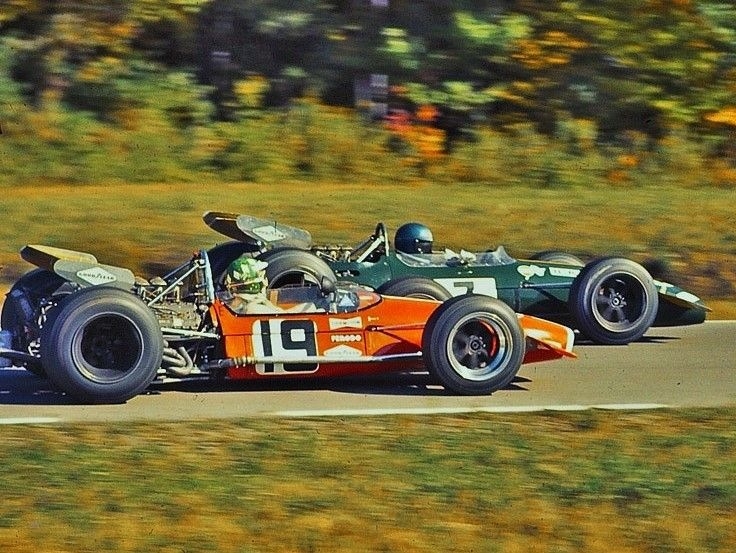

 primotipo...