Archive for the ‘F1’ Category

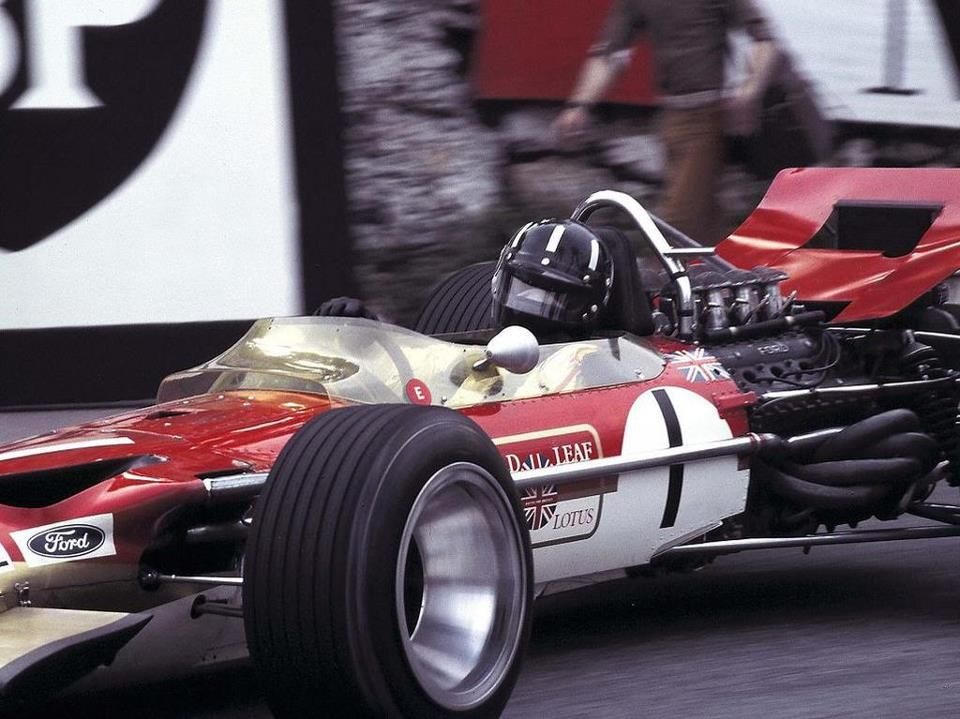
hill hi wing

Graham Hill in his hi-winged Lotus 49 during practice for the 1969 Monaco Grand Prix, he went on to win the last of his five Monaco victories on Sunday May 18 1969…

‘Twas his last Grand Prix win as well but his competitiveness was still there, wins were to come in F2 and in endurance racing. His ’72 Le Mans Matra victory with Henri Pescarolo made him unique in our sport as the only winner of ‘Motor Racing’s Triple Crown’; victories in the Drivers World Championship, (BRM 1962 Lotus 1968) Indy (Lola 1966) and Le Mans.

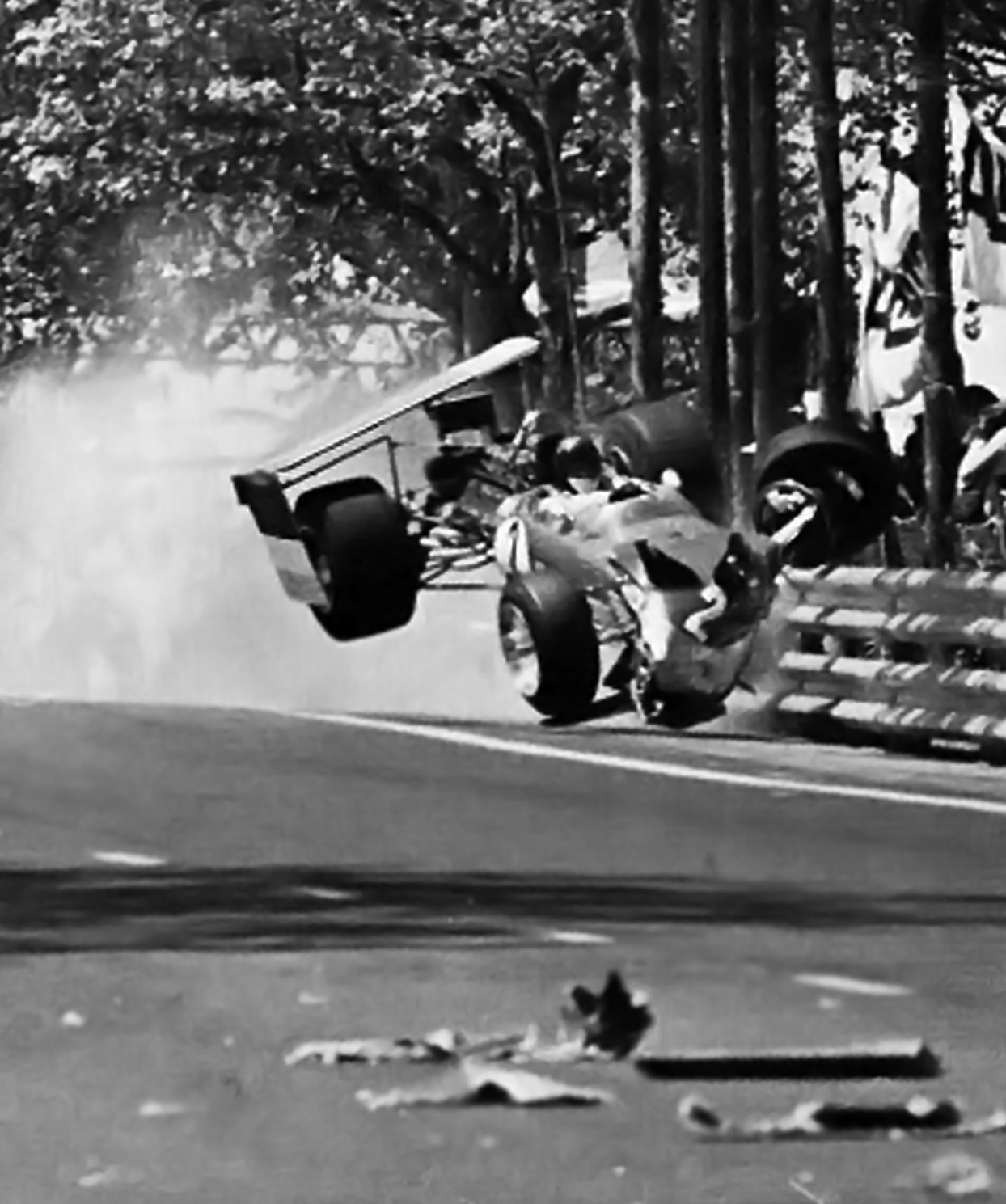
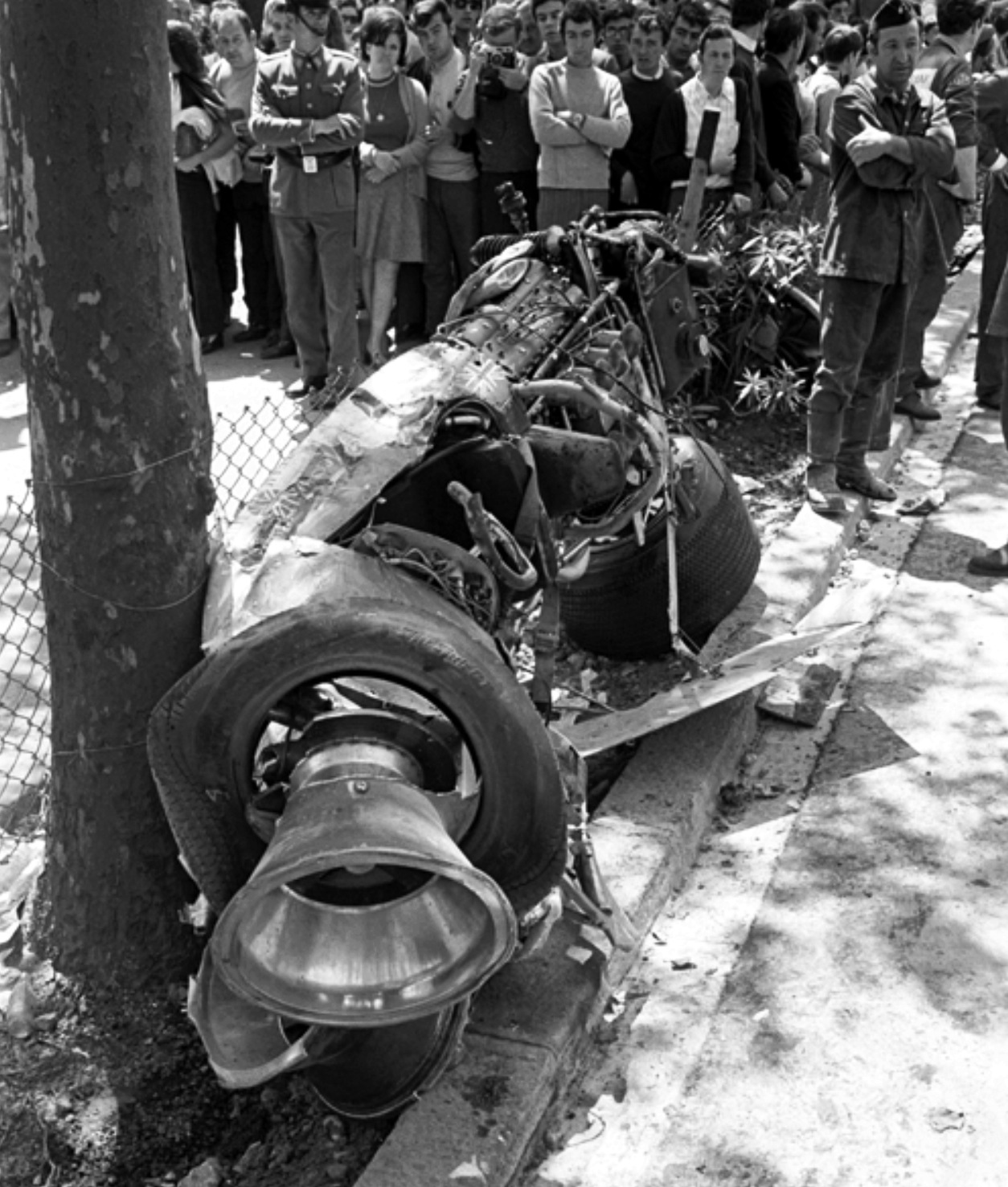
The story of the weekend was all about wings. There had been some big failures as engineers battled with forces they did not fully understand, notably the collisions, fortunately without serious injury to both Hill and Jochen Rindt at Barcelona on May 4, the race before Monaco.

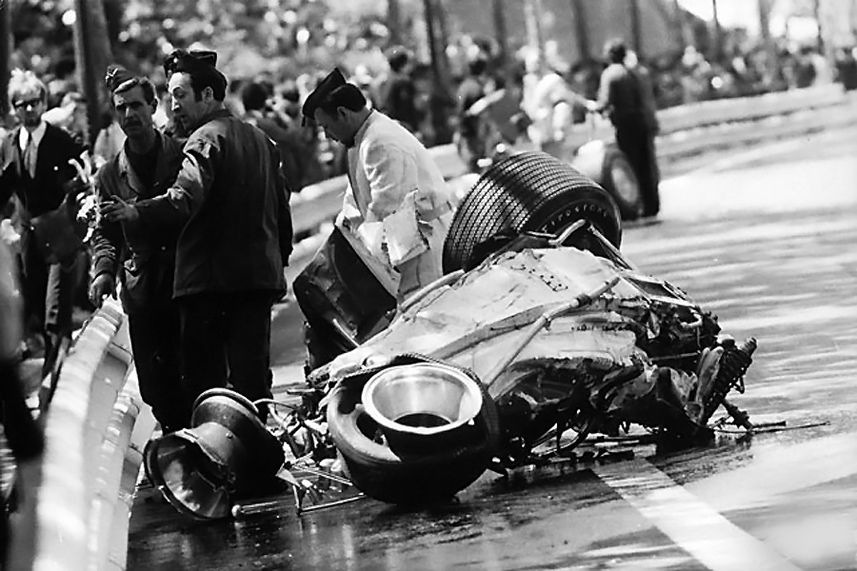
Hill’s rear wing failed on lap 9 as he crested the rise after the Montjuic Park pits, he crashed heavily but was uninjured. Eleven laps later Rindt’s leading Lotus 49 suffered the same failure, collided with Hill’s abandoned car and overturned. He emerged with cuts, bruises and a broken nose. The wing on Ickx’ Brabham BT26 fell apart during the race as well.

There had been other failures in the recent past, the authorities needed to act before someone was killed.

rindt rooted lotus

Rindt’s rooted Lotus 49, Montjuic Park Barcelona 1969. Jochen was a very lucky boy to escape withour serious injury after a wing support failure, Hill’s car into which Rindt collided is just down the road. (unattributed)

The CSI met in Monaco and acted after first practice by banning high wings forthwith, times were scrapped and the process of qualifying recommenced.

The sport was made safer as a consequence, some remain of the view that wings should have been banned then. Full stop.

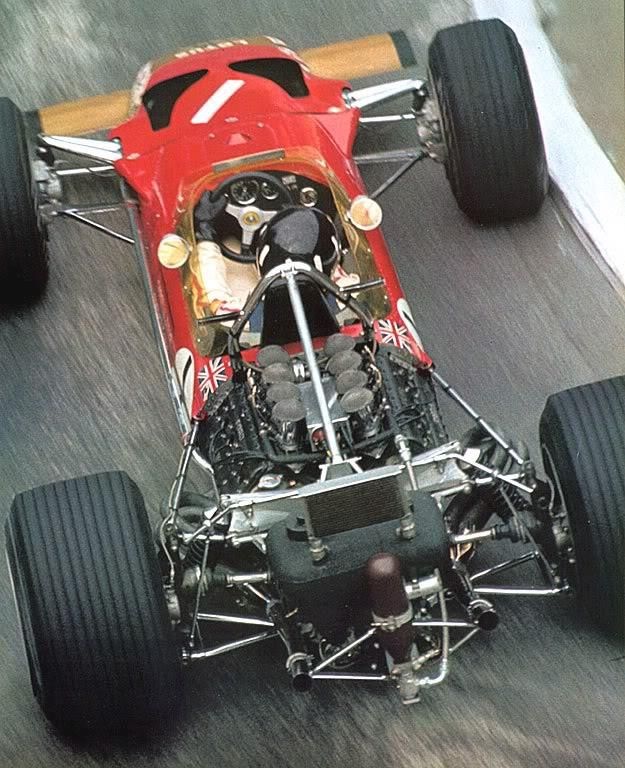
hill monaco interim

Wonderful overhead shot of Hill in qualifying post the wing ban; Chapman chose to keep the front wings, meanwhile the tin-snips were being put to work…3 litre Ford Cosworh DFV, big rear oil tank, external extinguisher the first thing to leave the car in the event of a major rear impact (handy for the driver in need of foam!), and Aeroquip brakelines running along the radius rods all clear to see. You can just about read the Smiths tach and chassis plate! (Automobile Year 16)

Stewart took an early lead from Amon’s Ferrari 312 in the race, Hill moved into third shortly after the start and after differential failures to both Amon and Stewart’s Matra MS80 Ford gained the lead he never lost. He took victory from Piers Courage’ Brabham BT26 Ford and  Jo Siffert’s Lotus 49B.

hill low level spoiler

By the time of the race’ start Chapman and his team had fashioned this neat spoiler…not as nice as the 49 used at Monaco in ’68 but that was built at the factory, this was not bad overnight and ‘ in the field’. (unattributed)

Winners are grinners, Hill ‘The Mayor of Monaco’ was always a popular victor in the Principality…

hill victory

Hill victorious in Lotus 49 ‘R10′, first debut’ by Jochen Rindt at Wigram NZ in January 1969. Victories in the Tasman Warwick Farm 100 in Rind’ts hands and Hill at Monaco. 49’s much raced by many drivers this chassis also raced by John Miles. Alex Soler-Roig and Emerson Fittipladi, Emmo raced it in its final GP, Austria in August 1970. Car still exists in the UK. (unattributed)

Etcetera…

montjuic

All those hi-wings in the Montjuic dummy grid, soon to be a thing of the past. #7 Jackie Stewart with teammate Jean Pierre-Beltoise behind, both Matra MS80 Ford, Graham Hill Lotus 49 Ford beside Stewart, #6 Bruce McLaren McLaren M7A Ford, #15 Chris Amons Ferrari 312 and #4 Jacky Ickx Brabham BT26A Ford (unattributed)

rindt barcelona

Rindt’s Lotus 49B and its broken wing supports clear in this shot of the ‘unguided missile’. Spectators and Rindt fortunate. Montjuic Park 1969. (unattributed)

rindt spain

49 ‘R9’ decidedly second-hand, Jochen was so lucky to ‘walk away’ from this accident (Getty Images)

rindts letter to chapman

Rindt’s 9 May 1969 letter post Spanish prang to Chapman is widely circulated and a classic! Prophetic sadly. (Jochen Rindt Archive)

Credits…

oldracingcars.com chassis research, Automobile Year 16, Getty Images

Hamilton-Rosberg

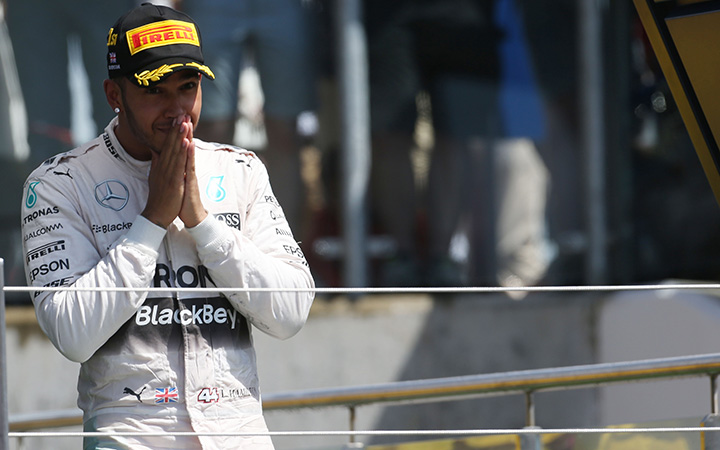
Lewis Hamilton from Nico Rosberg. Mercedes Benz F1 W06. (Motorsport/LAT)

Mark Hughes report of the race for Motorsport…

‘It was a time for keeping your nerve, when the British weather was holding the crowd’s race-leading favourite Lewis Hamilton hostage to fortune. The rain had arrived on around lap 35 of the 52-lap race – after Mercedes’ raw pace had got Hamilton ahead of the faster-starting Williams that ran much of the first stint in a tense, internally stressed 1-2 with the Mercs tight in their wake – but awkwardly it was only falling at selected parts of the track…Was Hamilton lucky in the timing of a new, heavier rainfall just as he had pitted to avoid being devoured by Rosberg? With the whole track suddenly wet just as he’d stopped, leaving Rosberg consigned to a slow in-lap on slicks, it was the winning of the race for Hamilton. Just as the weather had put what would otherwise have been an assured victory in jeopardy, so it ultimately rescued him from the dilemma it had created.’

http://www.motorsportmagazine.com/f1/reports/2015-british-gp-report/

Lewis-Hamilton

Lewis Hamilton, winner of the 2015 British GP. (Motorsport/LAT)

Stewart and Clark Dutch 1965

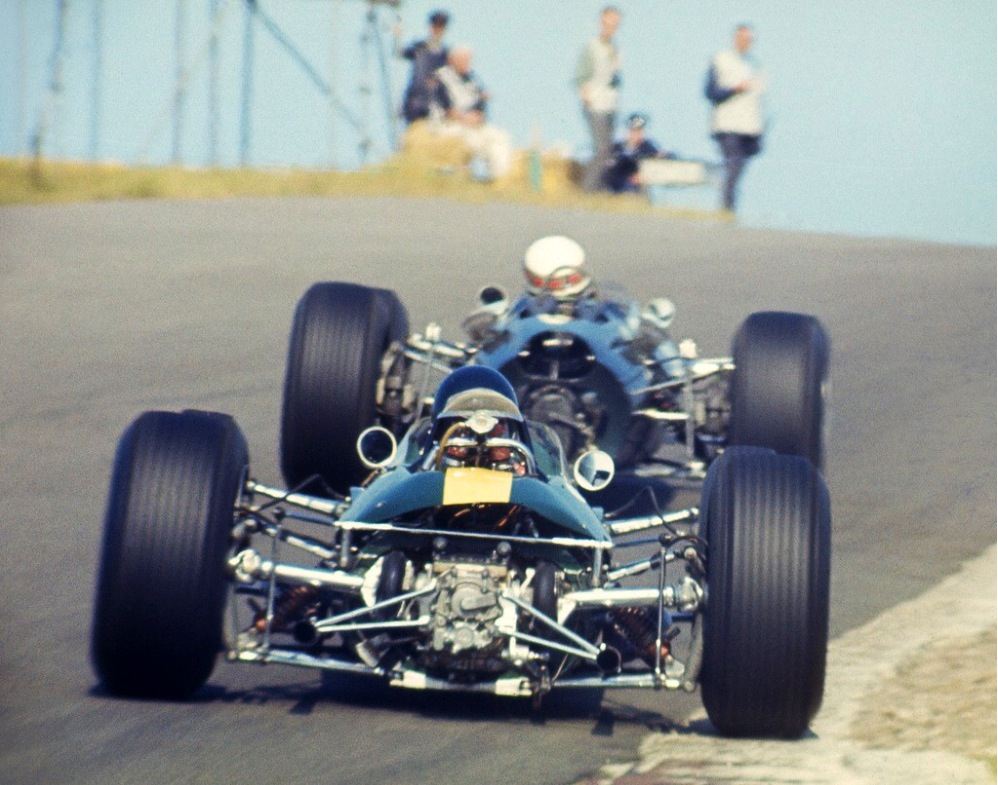
Jim Clarks’ Lotus 33 Climax chasing Jackie Stewarts’ BRM P261 through the Dutch sand-dunes…

Jackie had his first F1 drive with Lotus in the non-championship, late 1964 Rand Grand Prix in South Africa, but made the intelligent decision to join BRM for 1965 where he felt he would have the support and time to develop as a driver. Lotus would have been tougher, Clark was the established ace, and Chapmans track record with ‘number 2’s wasn’t good.

Stewart had great relationships with both his countryman Clark and his teammate Graham Hill who mentored and guided him well, that and Stewarts’ natural ability saw him take his first win in Italy later in 1965.

One of racings great ‘mighta beens’ are the potential duels between he and Clark as JYS matured as a driver and finally got a competitive F1 car with the Matras he drove from 1968…

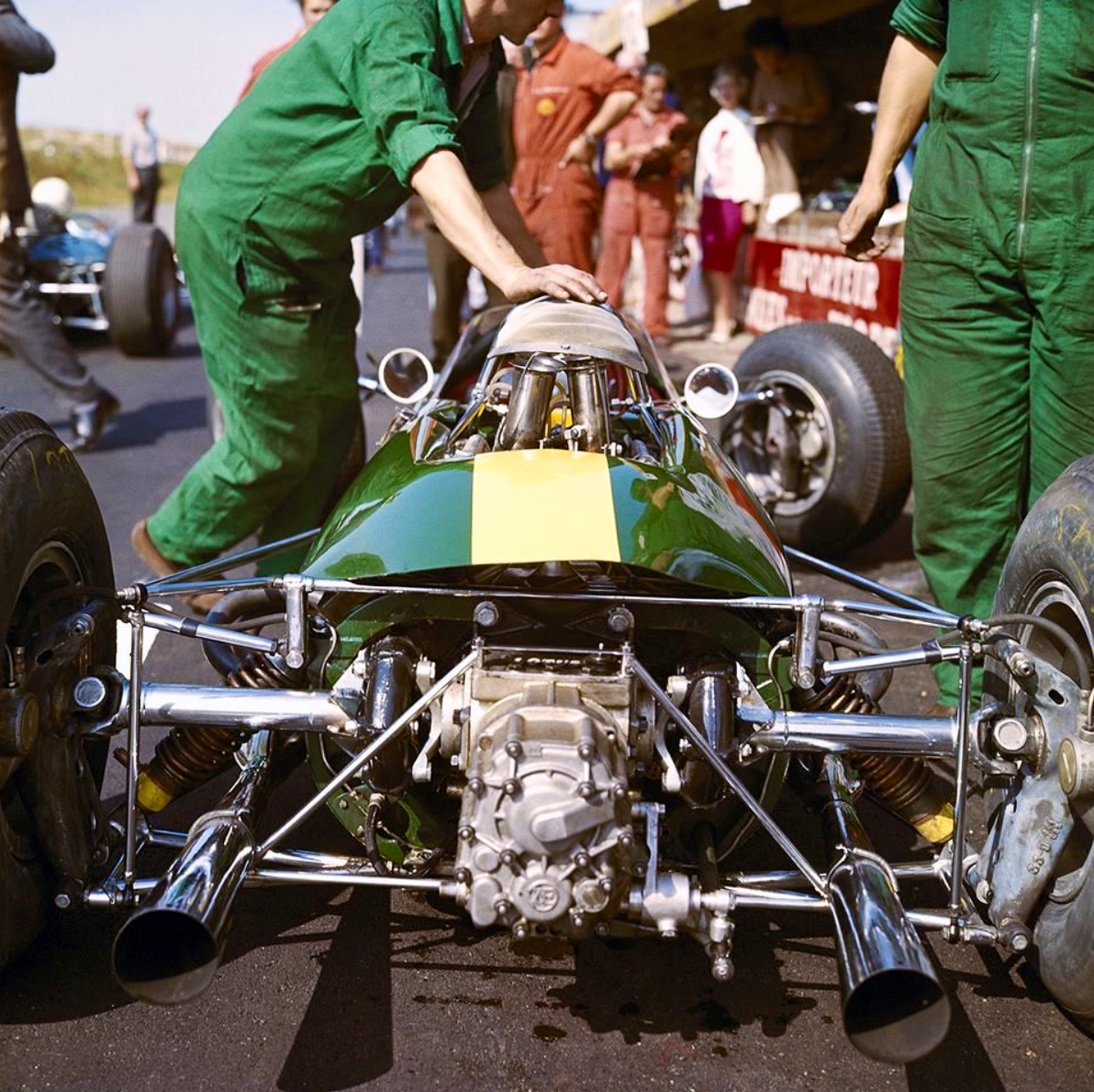
The Lotus 33 rear view…is an interesting study in suspension design and aerodynamics of the mid ’60s GP car. Fully faired cigar shaped body of the BRM in contrast with the naked Lotus. The clutter of the outboard rear suspension and its impact on the airsteam is marked relative to the rocker arm, inboard approach at the front…

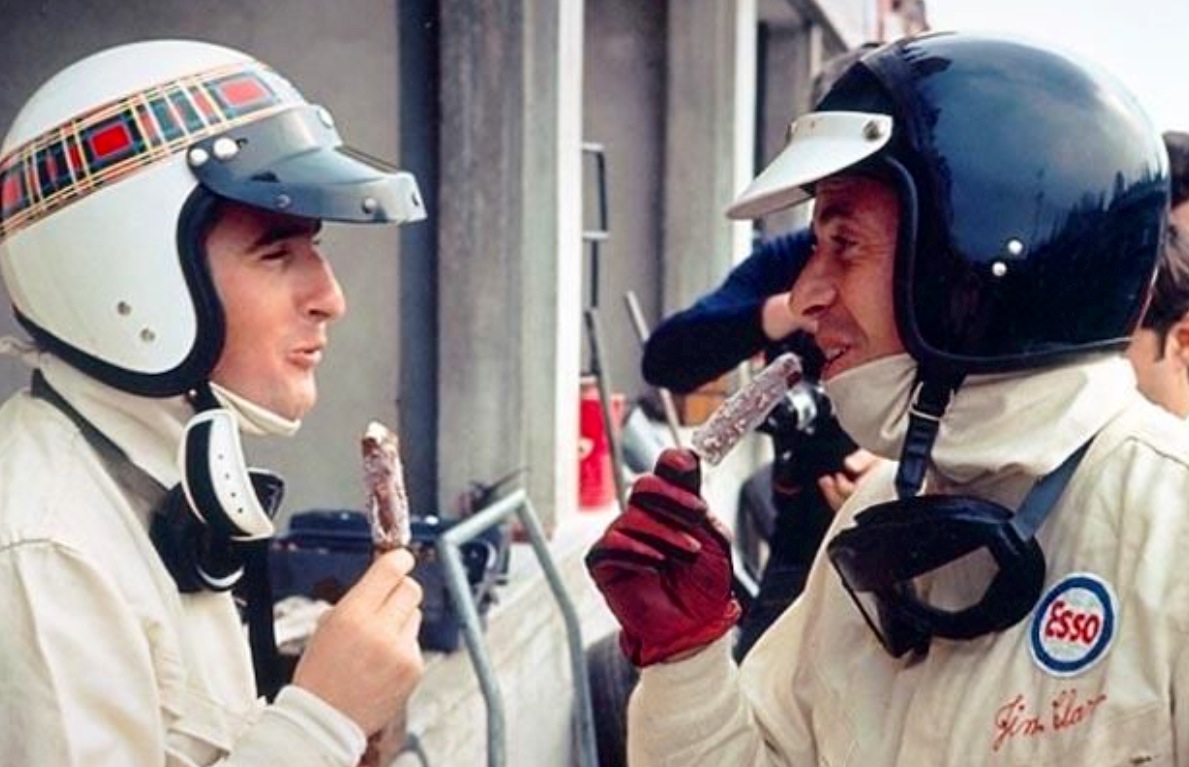
Stewart and Clark icecream

Lotus 33 rear

Lotus 33 Climax, Dutch Grand Prix 1965. Close up…ZF gearbox, later series 32 valve Coventry Climax FWMV 1.5 V8, rubber donuts on driveshaft, suspension single top link, inverted lower wishbone, twin radius rods for location fore and aft, cast magnesium uprights, coil spring/damper units and adjustable sway bar, oh so period and gorgeous!  (unattributed)

Photos unattributed…


lauda mclaren mp4 cockpit

Niki Lauda at rest and awaiting qualifying set-up tweaks, staying ahead of ‘Frenchy’ Alain Prost the challenge of the year…

Experience, cunning, speed and consistency won him his third and final title with McLaren in 1984 but Alain prevailed in 1985, Nikis’ last season of racing and Prosts’ first title.

Click on this link for an interesting, short visual comparison of the evolution of McLaren steering wheels down the decades, as good as any an indicator of ‘progess’! http://www.motorsportretro.com/2014/11/mclaren-f1-steering-wheels/

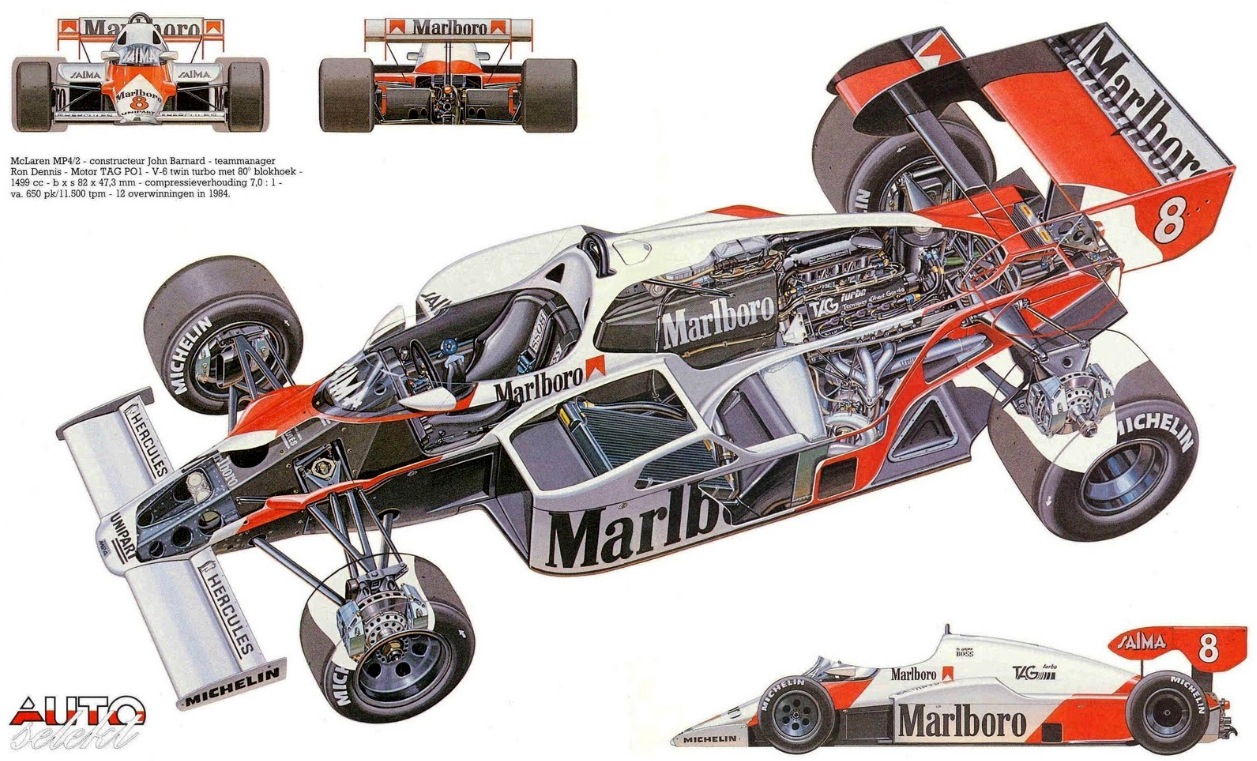
mclaren mp4 2 cutaway

1984 McLaren MP4/2 Porsche: carbon fibre honeycomb chassis, double wishbones and pushrod suspension front and rear, carbon fibre brakes, 540Kg. TAG/Porsche 1499cc DOHC twin turbo V6, circa 750bhp in ’84 spec. McLaren/Hewland FGB 5 speed transaxle

(Unattributed)

Red Bull Ring, Spielberg, Austria. Sunday 21 June 2015. Sebastian Vettel, Ferrari SF-15T, leads Felipe Massa, Williams FW37 Mercedes. World Copyright: Alastair Staley/LAT Photographic. ref: Digital Image _R6T5991

Red Bull Ring, Spielberg, Austria.
Sunday 21 June 2015.
Sebastian Vettel, Ferrari SF-15T, leads Felipe Massa, Williams FW37 Mercedes.
World Copyright: Alastair Staley/LAT Photographic. 

Lewis Hamilton did one lap all weekend that was quicker than Nico Rosberg – that which secured him pole. Other than that, Rosberg was just slightly quicker and better over the three days. Even his start was superior – and that made his race. From there it was just a matter of converting his superior pace into the result, and that’s how it unfolded’.

Read on for Mark Hughes’ race report;

http://www.motorsportmagazine.com/f1/reports/2015-austrian-gp-report/

Red Bull Ring, Spielberg, Austria. Sunday 21 June 2015. The Safety Car leads the field as Marshals clear the scene of the crash between Kimi Raikkonen, Ferrari SF-15T, and Fernando Alonso, McLaren MP4-30 Honda. World Copyright: Alastair Staley/LAT Photographic. ref: Digital Image _R6T5880

Red Bull Ring, Spielberg, Austria.
Sunday 21 June 2015.
The Safety Car leads the field as Marshals clear the scene of the crash between Kimi Raikkonen, Ferrari SF-15T, and Fernando Alonso, McLaren MP4-30 Honda.
World Copyright: Alastair Staley/LAT Photographic. 

lago in servo (nat library oz)

Doug Whiteford was one of Australia’s racing greats, he won the Australian Grand  Prix thrice- in 1950 aboard ‘Black Bess’ his Ford Spl and in 1952/53 in this Talbot-Lago T26C ‘110007’ here on the forecourt of his ‘BP Servo’, 200 Burwood Road, Hawthorn, Melbourne in 1957…

I tripped over the photograph in the National Library of Australia archive, it’s clearly a BP promotional shot, the ‘Snapper’ was Wolfgang Sievers. ‘COR’, the other brand on the pump, is the acronym of the ‘Commonwealth Oil Refineries’, which was acquired by BP some years before, the pumps were co-branded for a while as part of the evolution of one brand to the other.

These establishments are all of an age aren’t they? The owner operated service station with generalist mechanics working on all makes and models is sadly a thing of the past. The ‘counter jumper’ in the average ‘Mega Servo’, if you can make yourself understood at all, is unlikely to know a dipsticks location let alone anything of real use.

The shot didn’t make sense actually.

By 1957 Doug had well before sold this car to Owen Bailey who owned and raced it at the time, Doug had acquired an older, but more advanced in specification T26C, chassis ‘110002’.

Owen’s son Rob is a fellow racer/Alfista, he and Stephen Dalton have helped with the facts or a theory anyway… we think the car is at Doug’s ‘Temple of Speed’ for fettling, Whiteford was the expert on these cars in this part of the world.

‘110007’ is in BC Ecclestones’ collection, ‘110002’ still in Oz. I am beavering away on an article about these two fabulous Lagos which should be finished soon…

whiteford lago

(Clem Smith via Ray Bell)

Doug Whiteford’s T-L ‘110007′ leads Stan Jone’s Maybach onto the main straight at Woodside, the Adelaide Hills road circuit in October 1951, Whiteford won the race with Stan second.

Just look at the nature of the place- ‘Stobie’ telephone poles, fence posts, railway crossing etc. A tragic accident in a motor-cycle handicap race where an early starter completed his first lap before the scratchmen had gotten away and killed two people in the starting area gave rise to police and State Government concern causing the imposition of a ban on racing on public roads in South Australia.

owen bailey fishos 1958

Owen Bailey, Lago Talbot T26C ‘110007’, Fishermans Bend, Melbourne 1958. (autopics)

Etcetera…

I wrote an article about Whitefords’ Black Bess Spl: https://primotipo.com/2015/05/05/doug-whiteford-black-bess-woodside-south-australia-1949/

Credits…

Wolfgang Sievers, autopics.com.au, Clem Smith/Ray Bell. Stephen Dalton and Rob Bailey for research assistance

SNE20652

Mark Hughes ‘MotorSport’ coverage of Grands’ Prix is my favourite, ’twas not the greatest of contests, victory for Lewis Hamilton’s Mercedes…

Hughes…’Long straights, slow corners, the tiny rear discs of the hybrid cars, degrading rubber that cannot be pushed for the full distance, the absence of safety cars giving no margin on fuel and brakes: on this occasion these things combined to neuter one of the calendar’s traditional highlights’.

Click on this link for Mark Hughes’ race report; http://www.motorsportmagazine.com/f1/reports/2015-canadian-gp-report/

X0W6816

capelli cg 901 LH

Ivan Capelli in his Leyton House CG901 Judd, 1990…

It’s been interesting to learn about and admire the careers of the sports’ outstanding contemporary engineer/designers and those of the decades which pre-date my interest in the sport.

It’s the ones who have enjoyed enduring success I have been most drawn to. Janos’ and Chapmans’ contributions over 30 years truly amazing.

Dr Porsche, Vittorio Jano and Jim Hall predate my period of interest but Colin Chapman, Mauro Forghieri, Gordon Murray, John Barnard and Adrian Newey i have followed since 1972.

image

CG901 monocoque inside the teams autoclave, Bicester 1990 (Pascal Rondeau)

Newey has been ‘the man’ in F1 for the better part of 25 years with ten constuctors titles for three teams; Williams, McLaren and presently Red Bull.

Like the others he is degree trained and his practical experience is rooted in time spent as a race engineer. He is different though, in that his primary degree is in Aeronautics and Astronautics. It was the application of the science of aerodynamics, increasingly important in the overall F1 design package as regulations progressively became more restrictive in other areas, at March nee Leyton House in 1988-1991 which first brought him to the attention of Patrick Head, Frank Williams and others.

image

Race prep of 3 CG901 chassis in June 1990 (Pascal Rondeau)

The overall pace of the March 881 and it’s successors top speeds at different circuits made it clear they slid through the air rather nicely, better than many other cars with the same engine or considerably more grunt.

That the cars ‘batted above their weight’ made it clear he could do more with greater resources, as has been proven the case.

The 1988 March 881, powered by John Judds’ 3.5 litre V8 finished 6th in the constructors championship, in 1989 the March 891 Judd  finished 12th, drivers Mauricio Gugelmin and Ivan Capelli retiring from most of the races.

hutton cg901 LH cutaway

Drawing of the LH CG901 Judd…engine 3.5 litre V8 not 3 litre…(Peter Hutton)

In 1990 March F1 morphed into ‘Leyton House’…the Japanese company acquired the team it had previously sponsored. Neweys’ Leyton House CG901 Judd was quick in the hands of its two drivers after a mid year update of the aero package to correct ‘erroneous wind tunnel data’. Capelli lead the French Grand Prix for many laps before being passed by race winner Alain Prost. The team finished 7th in the Constructors Championship, Newey was fired and quickly hired by Williams all the same.

And the rest, as they say, is history. The 1991/2 Williams FW14 Renault, Neweys’ first Williams won 17 Grands’ Prix and Leyton House, amid allegations of financial misdemeanours and the arrest of its CEO disappeared without trace in early 1993 having changed it’s name back to March F1 for the 1992 season…

capelli from prost

Ivan Capelli LH CG 901 Judd leads Alain Prosts’ Ferrari 641 during the 1990 French GP. Wonderful 2nd place for the Italian ahead of victor Prost. (Unattributed)

capelli Lh suzuka 1990

The gorgeous lines of Capellis’ LH CG901 at Suzuka, Japanese GP 1990. Q13, DNF with ignition dramas on L16. (Unattributed)

image

Leyton House workshops in June 1990 (Pascal Rondeau)

cg 901 designey stuff

LH CG901 design elements. Carbon fibre chassis, suspension double wishbones, pushrod and rocker actuated coil spring/dampers front and rear. Judd EV 3496cc 76 degree DOHC 4 valve N/A V8, 660bhp. March 6 speed manual transaxle. carbon ceramic brakes. 520Kg. (Unattributed)

image

Estoril 21 September 1990, a practice Judd V8 engine change during the Portuguese GP weekend (Pascal Rondeau)

Credits…

Peter Hutton, Pascal Rondeau

Tailpiece: Ivan Capelli, Leyton House CG901 Judd at the Allsport Studios on 15 May 1990…

image


Jim Clark Room 01

The name Jim Clark is synonymous as one of motor racing’s greats, whether dancing a Border Reivers D Type in his early career through to the brilliance soon established with Colin Chapman’s Team Lotus. Tasting success with the marque’s many facets of motor racing – be it Elite, Elan, Lotus Cortina, Formula Junior, Tasman, Indy and Formula One & Two.

This man was born to race, despite his humble Scottish farming background and quiet demeanour. His talents took him racing all over the world be it for Formula 1 or Tasman Series in far off New Zealand or Australia during his own northern hemisphere’s cold and miserable winter period. It all came to a very abrupt ending on April 7, 1968 when despite the known dangers of the sport, the unthinkable became reality that Jim Clark was dead.

A huge talent lost at 32 years of age. News Services weren’t as instantaneous as they now are. So it took a little while to filter the news of his passing around the motor racing globe. It would have been a shock to a young enthusiast listening to a transistor radio or one of Jim’s contemporary drivers’ having a News Service thrust a microphone in front of them for a comment on his passing for their news broadcast.

Jim Clark Room 02

The modest Duns building home of ‘The Jim Clark Room’

Testimony to Jim’s greatness is that despite the passage of 47 years he’s still remembered so fondly. Not least in Duns, in the Berwickshire district of Scotland where ‘The Jim Clark Room’ displays many trophies, photos and memorabilia of the district’s World Champion farmer…

Scarily it is approaching 21 years since I made the journey to Duns to pay homage to the great Jim Clark. It was late August 1994 and with the growth of technology you can do a virtual viewing of the room here. http://www.itv.com/news/border/update/2015-05-15/celebrating-the-life-of-racing-legend-jim-clark/
With there being Jim Clark celebrations in Duns, over the weekend of May 16 and 17 2015.

See this footage of the event including Jackie Stewart and Alan McNish comments.  http://www.itv.com/news/border/update/2015-05-17/remembering-jim-clark/

However in the olden days of 1994 I took some photos. The gent who was minding Jim’s treasures that day was keen to show me that another great of the sport had been to Duns to pay his respects. That great, was fellow F1 World Champion, Ayrton Senna. Who had at that time of my visit, been killed just under 4 months earlier at Imola.

Maybe just a bit too ironic…

Jim Clark Room 03

Artwork of a great motor racing champion

Jim Clark Room 04

A selection of photos and trophies depicting Jim’s many successes adorn the walls and cabinets within the room

Jim Clark Room 05

The JCR vistors’ book – Ayrton Senna visited on February 23, 1991

Jim Clark Room 06

Credits…

Article written by and photos from the collection of Stephen Dalton

baghetti lotus 49

Giancarlo Baghetti relaxes during the Italian Grand Prix weekend, he had a ‘one off’ drive of the Team Lotus spare ’49, backing up Jim Clark and Graham Hill…

He qualified well back on the grid, 17th, and retired on lap 50 whilst running 6th with an engine failure. John Surtees took a fabulous last corner win from Jack Brabham, winning Hondas’ first Grand Prix since Ginthers’ victory in the last race of the 1.5 Litre Formula in Mexico, 1965.

Baghettis’ career started with immense promise, famously winning his first championship Grand Prix, the French in a great dice with Dan Gurney (Porsche) in a Ferrari 156 in 1961….

Baghetti French GP 1961

The stone chips on the nose of Baghettis’ 156 bear witness to the closeness of the race, third place went to Jim Clarks’ Lotus 21 Climax. (sutton images)

French GP finish 1961

Toto Roche waves the chequered flag for Baghetti, winning a famous victory over Dan Gurneys’ Porsche 718, French GP Reims 1961, his championship race debut. (Unattributed)

Baghetti started racing in 1956 in an Alfa Romeo 1900Ti and built a solid reputation as he moved into Formula Junior in 1959. In early 1961 he was selected to drive for the Italian FISA team, an organization formed to promote young Italian drivers by entering them in Non-Championship Grands’ Prix.

FISA struck a deal with Scuderia Ferrari to run a 1960 F2 Ferrari Dino 156 (in effect the prototype of the 1961 F1 car) in the first non-championship races of 1961. The results were amazing, Baghetti, not necessarily the best credentialled candidate won on his GP debut in Syracuse in front of Gurney, Surtees, G Hill, Brabham, Moss, Salvadori, Ireland and Bandini.

syracuse GP baghetti

Giancarlo Baghetti ahead of Dan Gurney Syracuse GP April 1961. Ferrari Dino 156 from Porsche 718. The first of Giancarlos’ wins against stong opposition. (Unattributed)

He followed up with another win in the Napoli GP in May beating Ashmore, Lotus 18 Climax and Bandini Cooper T53 Maserati 2nd and 3rd as well as Roy Salvadori, Andre Pilette and Tim Parnell.

FISA persuaded Ferrari to hire them a 1961 ‘Shark Nose’ for their driver to make his championship GP debut at Reims, he was allocated the car which was to be driven by Equipe National Belge driver Olivier Gendebien, the car quickly repainted from yellow to red.

Phil Hill took pole from Ferrari teammates Von Trips and Ginther, Baghetti 12th fastest. The 3 works Ferrari’s disappeared at the start, only Moss managed to stay near them. Even a quick spin by Ginther dropped him behind the Lotus, but he was soon able to re-pass Moss such was the Ferraris’ power advantage.

Baghetti had made his way to the front of the chasing pack. When Moss was forced to pit with brake problems, the four Ferrari’s lead, this didn’t last as Von Trip’s engine died in the heat.

Hill spun on the melting road surface. The American lost over 2 laps as he tried to restart his hot engine. This left Ginther in the lead with Baghetti fighting the Porsches of Dan Gurney and Jo Bonnier to hold on to second place, a battle that became even more significant a couple of laps later as Ginther pulled off the track with no oil pressure.

Baghetti recounts the last laps …’It was a very hard race. It was hot. The asphalt was melting, the radiator was blocking up and I saw the temperature starting to soar. Luckily I was behind the two Porsches of Gurney and Bonnier and relied on getting a tow along the straights. What you must remember is that this was my first Grand Prix and both Gurney and Bonnier were trying to frighten me by running on either side of me, but I thought that if they could do things like that and get away with it, then I could do it too.

Three laps from the end Gurney and I were fighting for the lead and I realized that to finish first I needed to be in the perfect position to slipstream. Going into the last corner I was right behind Gurney so that as we came out I was on his tail. He sat right in the middle of the track because he obviously knew what I was going to try to do. I waited and when I saw him glance in his mirror when I was on his left, I quickly switched to the right and got past him to win the race.’

Giancarlo Baghetti became the first man in history to win his debut World Championship Grand Prix.

ferrari 156 cutaway

James Allingtons’ cutaway drawing of the 1960 Ferrari 156 F2 car, chassis ‘008’ the car used by Baghetti at Syracuse and Naples was the prototype 1960 car fitted with ’61 ‘Sharknose’ body. Multi-tubular spaceframe chassis, suspension by upper and lower wishbones front and rear. 1476cc 65 degree DOHC 2 valve Weber carbed V6, 185bhp@9200rpm. 5 speed ‘box. Later spec ’61 cars had the 120 degree V6 190bhp@9500rpm. (James Allington)

Baghetti qualified mid-grid for the British GP, spinning off the wet Aintree circuit during the race. For his home GP at Monza he qualified 6th, the other four Ferrari’s were faster. This was the day that von Trips was expected to win the world title, but it was not to be, ‘Taffy’ crashed to his death after contact with Clarks’ Lotus 21, the car flew into the crowd killing 11 spectators on lap two. Baghetti raced at the front until his engine blew on lap 14 and Phil Hill won the race to seal the first World Championship for an American driver. Giancarlo set the fastest lap.

His season ended with his 4th and last GP win, he took victory in a little known event to decide the ‘Prima Coppa Italia’ (Italian Championship for Drivers) at Vallelunga, Baghetti won the 2 heats in a Porsche 718 when his Ferrari was not available for the event. Lorenzo Bandini and Baghetti were tied for the Championship , this event was organised to decide the winner.

What a debut GP season!

ferrari 156 drawing

1961 spec Ferrari 156. (Scuderia Ferrari)

For 1962 Baghetti joined Phil Hill, the ’61 champion in the works Ferrari team (Rodriguez driving a third car occasionally). Enzo rested on his laurels thinking that the 156’s didn’t require evolution to continue their dominance but the Brits had caught up.

BRM, Lotus and Cooper produced cars to beat the Ferrari’s. Lotus debuted the epochal monocoque chassis Lotus 25 at Zandvoort and Coventry Climax produced their FWMV 1.5 V8 in quantities, the BRM team also built a V8, the Type 56 available to customers as well as the ‘works’ BRM P57’s. The British teams shortcomings in 1961 were their engines, the relatively old 1.5 litre variant of the Climax FPF not ‘man enough’ for Ferrari’s powerful V6. It was different in 1962 when their engine power was equivalent to their chassis mastery…

Baghetti scored points at Zandvoort and Monza, but Ferrari was in total turmoil and for 1963 he joined Hill in the mass exodus to Carlo Chiti’s ATS team, an unmitigated disaster for all involved, it effectively destroyed his F1 career. Baghetti drove Centro Sud’s old BRM P57 in 1964, he returned to race in F2, F3 and sports and touring cars, also making an annual apperance at the Italian GP, his last in the Lotus 49 in 1967.

baghetti spa

‘Hitchin a ride’: Baghettis’ BRM P57 gives Phil Hill and Bob Anderson a lift at the end of the 1964 Belgian GP, Spa. Giancarlo was 8th in the race won by Clarks’ Lotus 25 Climax. Hill raced a Cooper T73 Climax and Anderson a Brabham BT11 Climax (G Clayton)

baghetti brabham 65 italian

Brabham entered a third car for Giancarlo at the 1965 Italian GP. He qualified the BT7 Climax poorly in 19th, the engine failed on lap 12 in the race won by Stewarts’ BRM P261. (Unattributed)

baghetti targa 1965

Baghetti at the wheel of a factory Ferrari 275 P2 during Targa 1965, DNF with Jean Guichet. (Unattributed)

After a huge accident at Monza in a Ferrari Dino 166 F2 car in the ‘Monza Lottery GP’ in June 1968 he retired from driving, working as journalist and photographer. He succumbed to cancer in 1995 age 60.

No-one has ever repeated the feat…a quasi factory Ferrari drive on the results of a ‘journeyman’, won his first 3 GP’s, 4 for the year, one of them a championship event and then so rapidly disappeared from sight…

baghetti italian gp 1966

Baghetti at the wheel of a Ferrari Dino 246, Monza, Italian GP 1966. Q16, raced Spences’ Lotus for 5th until the car failed in the race won by Scarfiottis’ Ferrari 312. Car was lent to him by Scuderia after his Parnell  Lotus BRM failed in practice. (Unattributed)

Baghetti Ferrari 156 1962

Giancarlo Baghetti, Ferrari 156 1962. The class of the field in 1961 were at best also-rans in 1962. He is smiling so it must be at the seasons commencement… (Unattributed)

Photo and other Credits…

Mel Turbutt, motorsportretro.com, Sutton Images, James Allington, Scuderia Ferrari, The Auto Channel

Finito…