Archive for the ‘Features’ Category

(B Young)

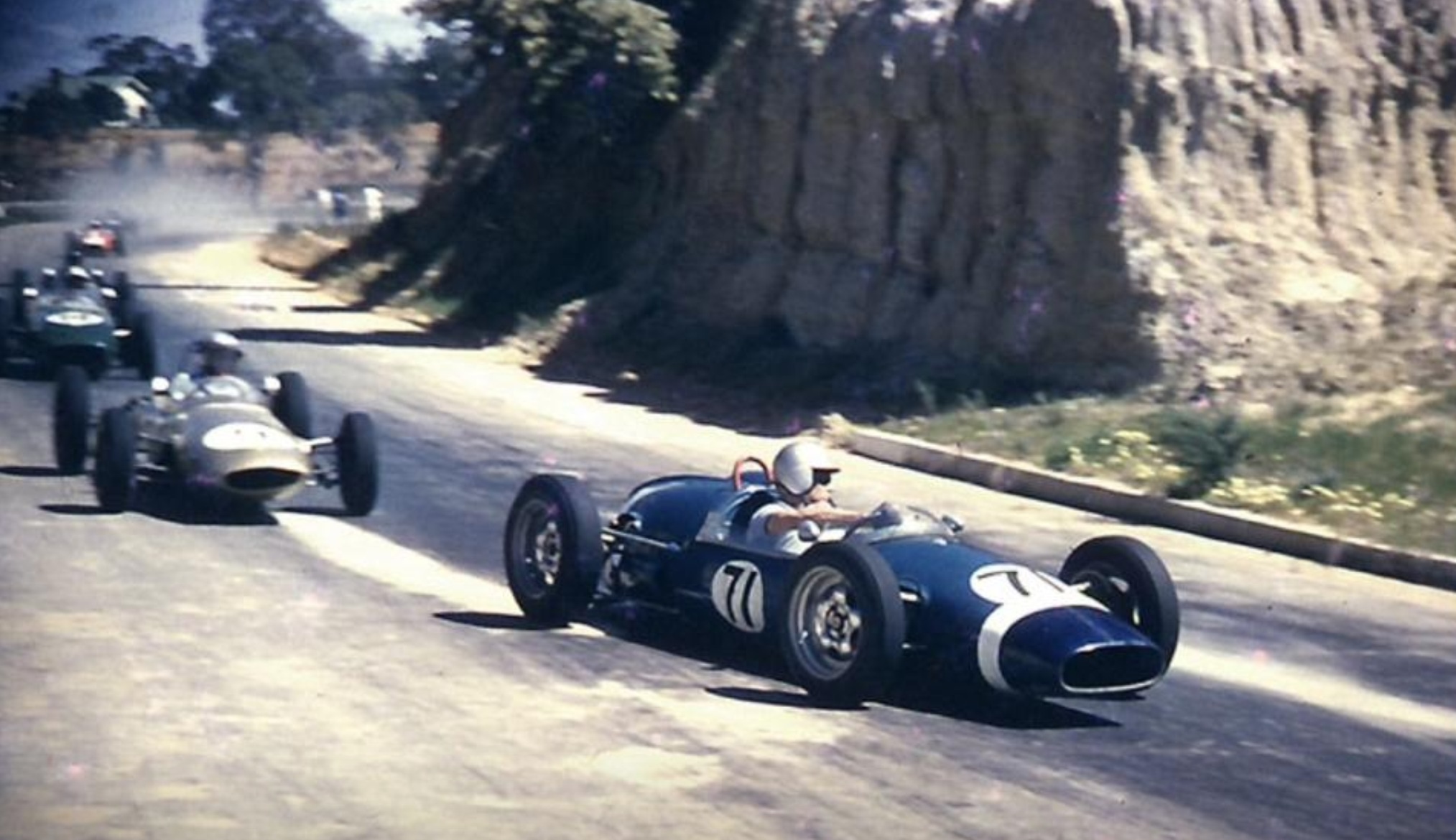
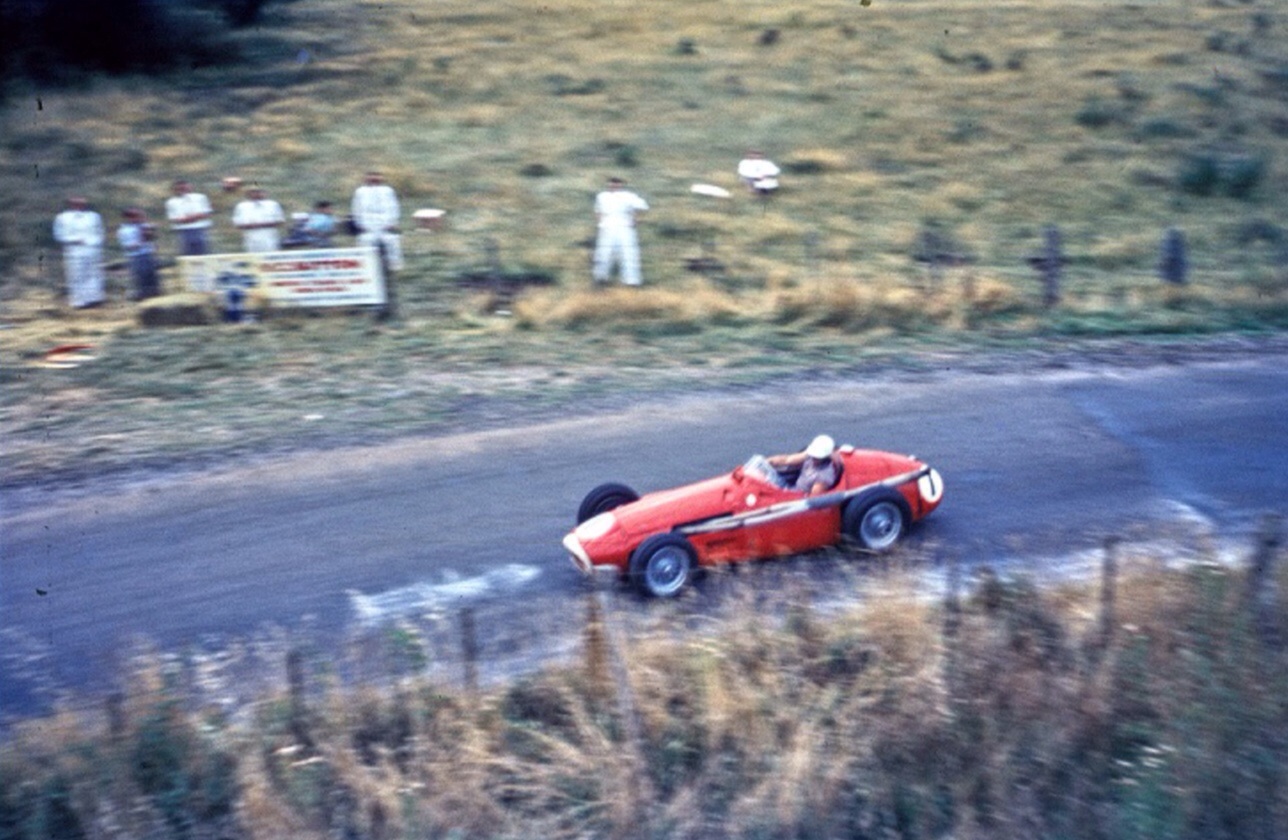
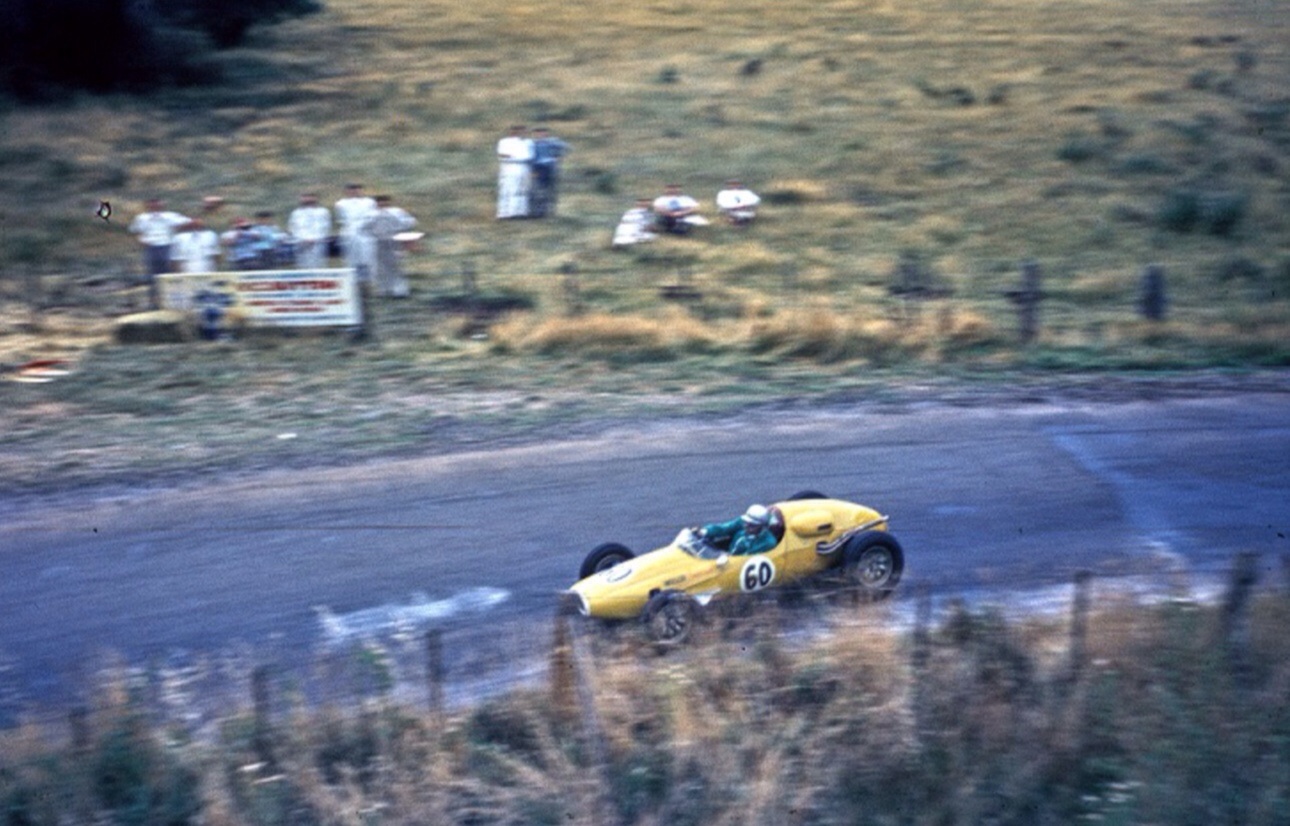
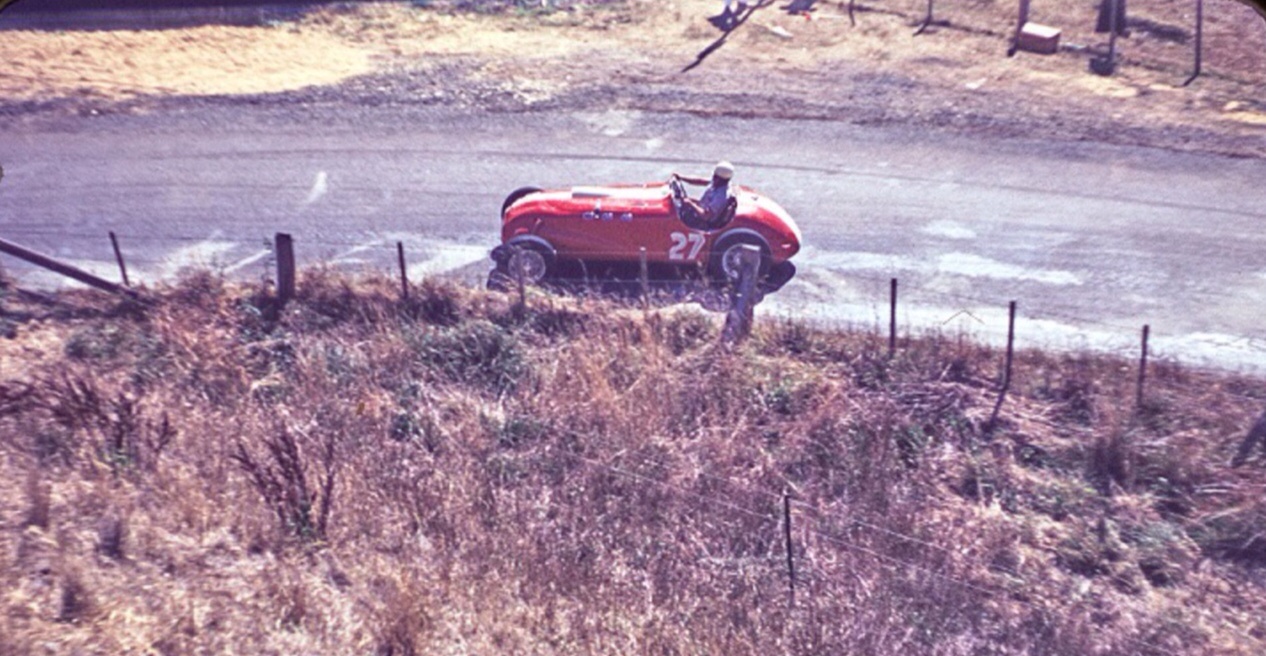
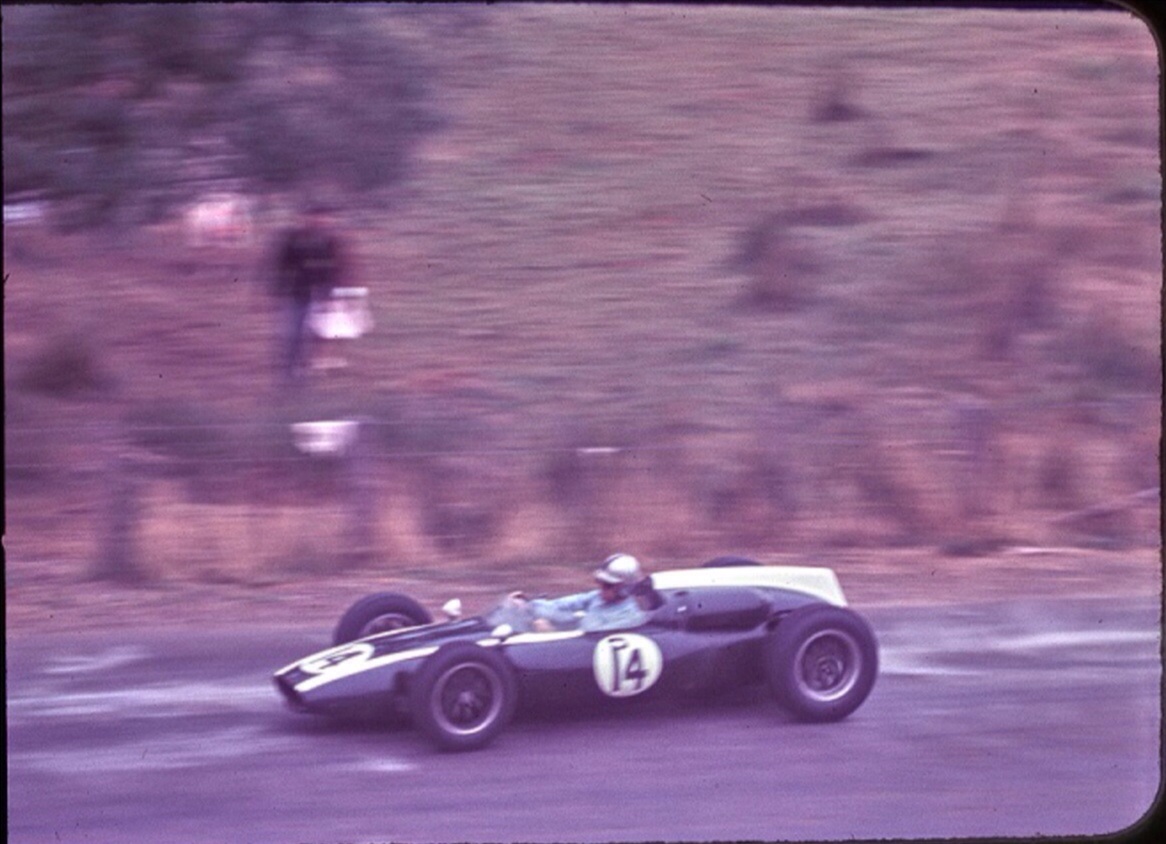
Stan Jones, Maser 250F and Bib Stillwell Cooper T43 Climax joust into Mountford Corner during the 1958 ‘Longford Trophy’ Gold Star round, 3 March…

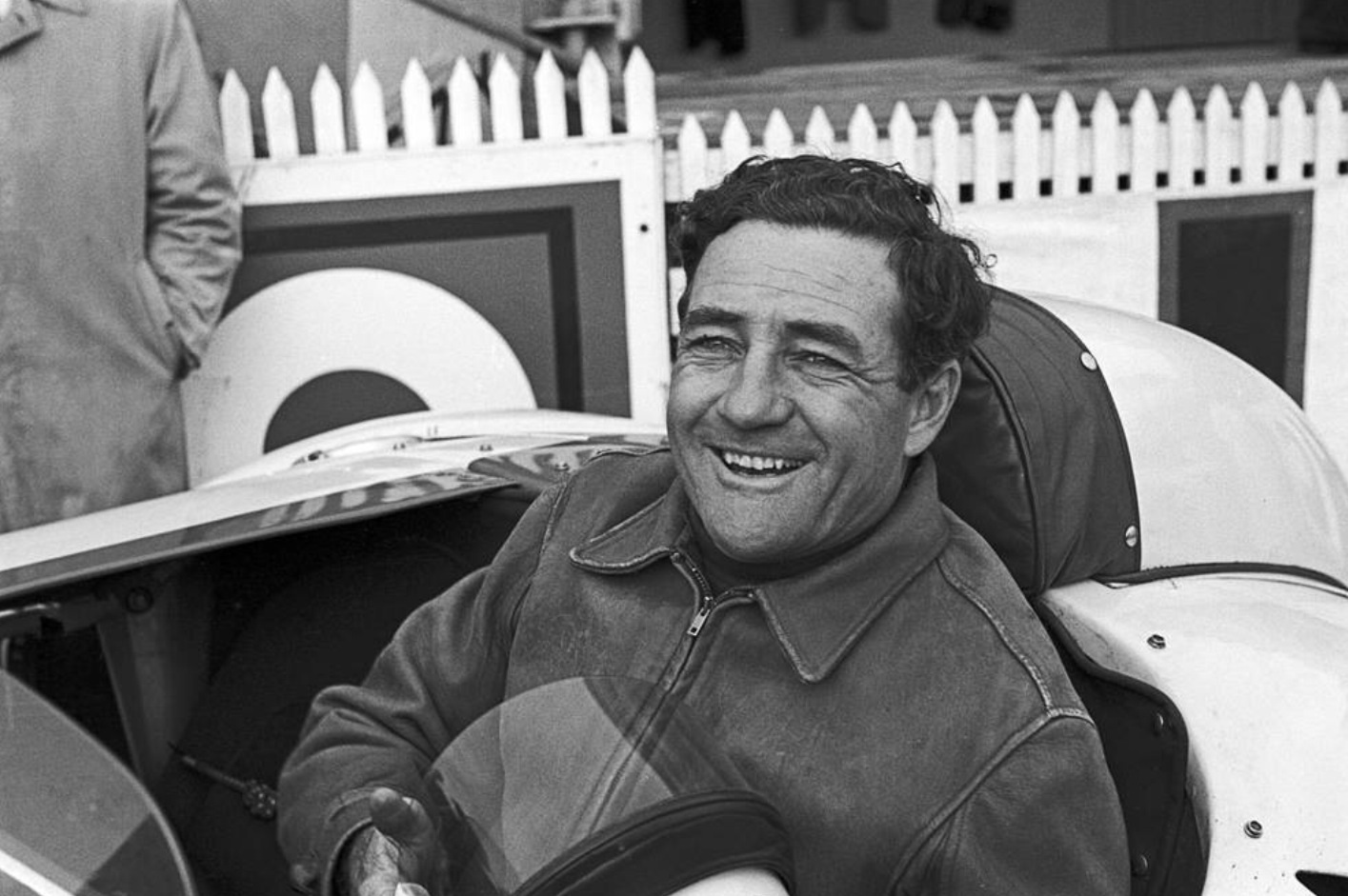
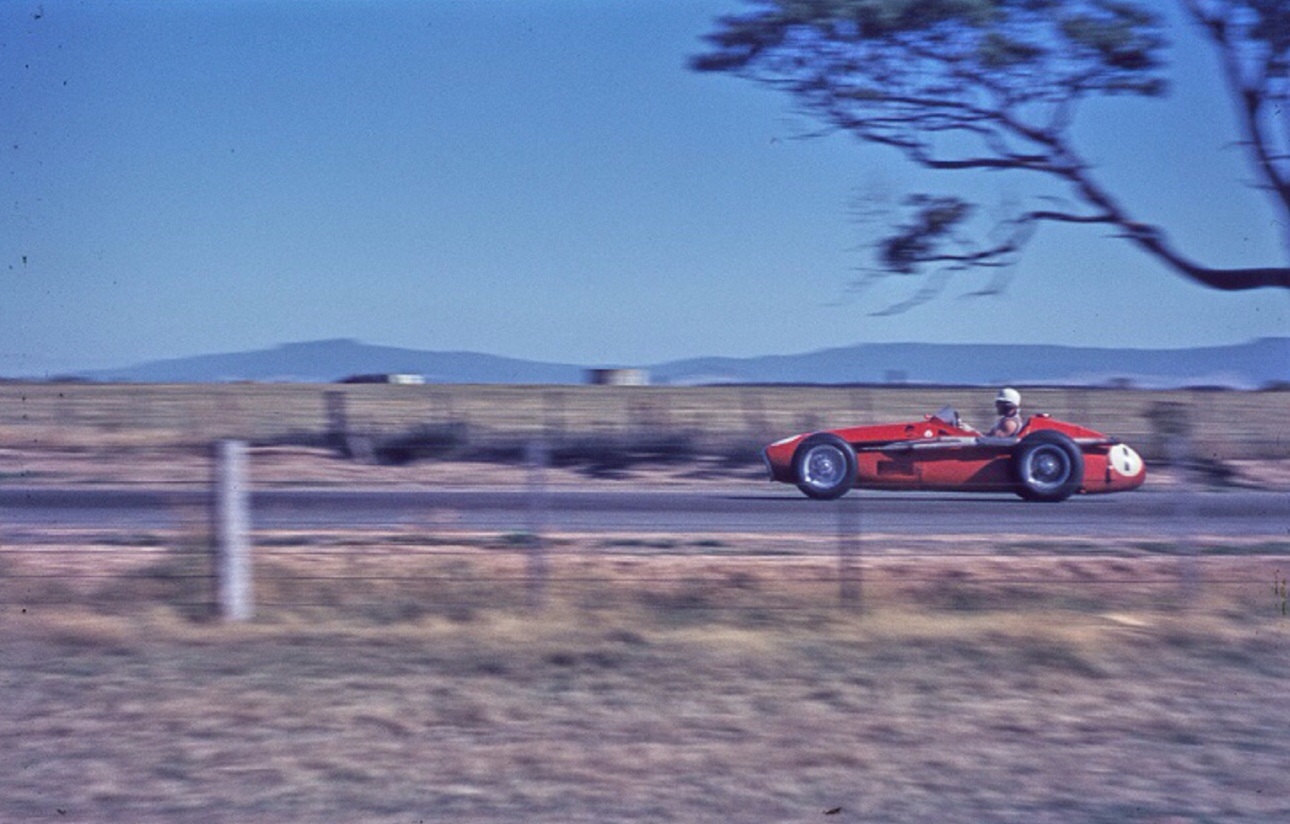
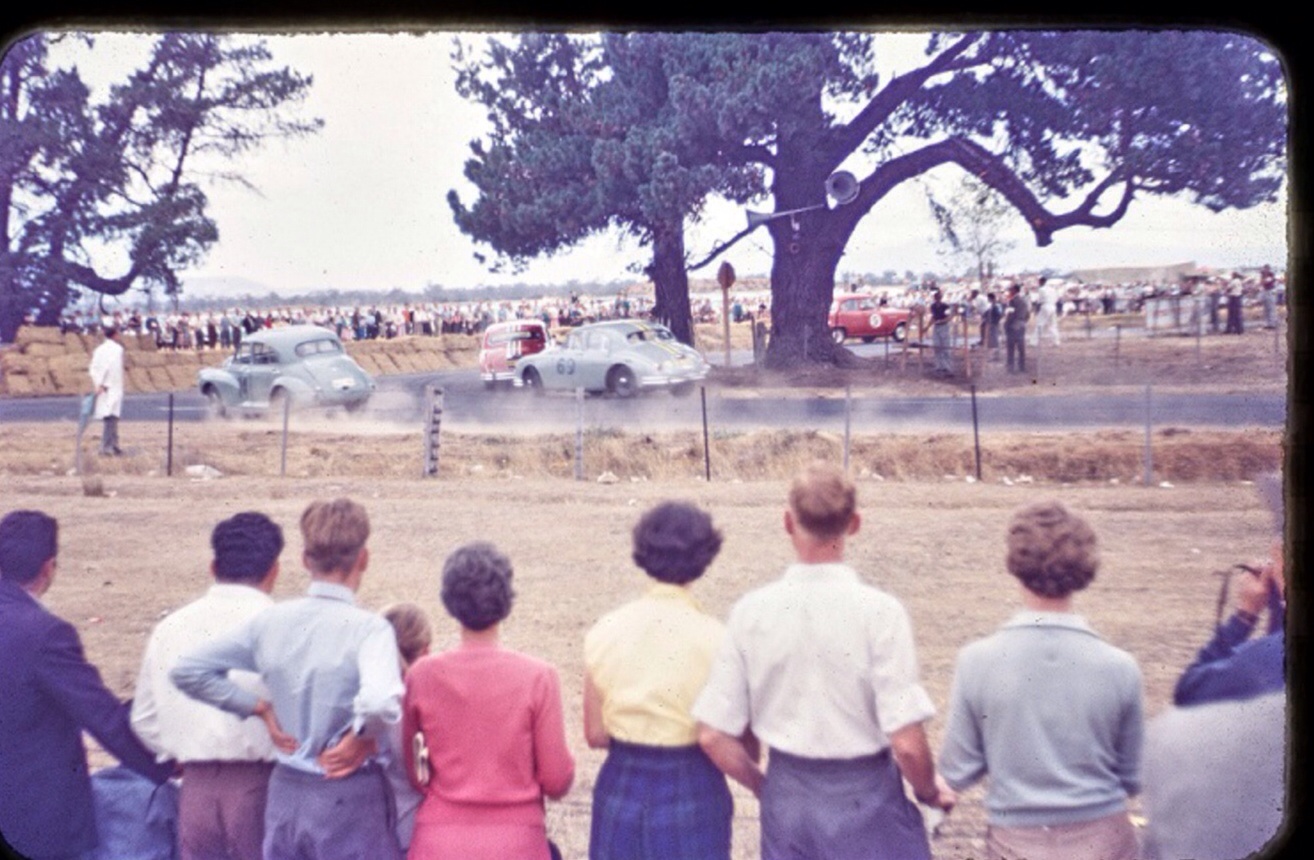
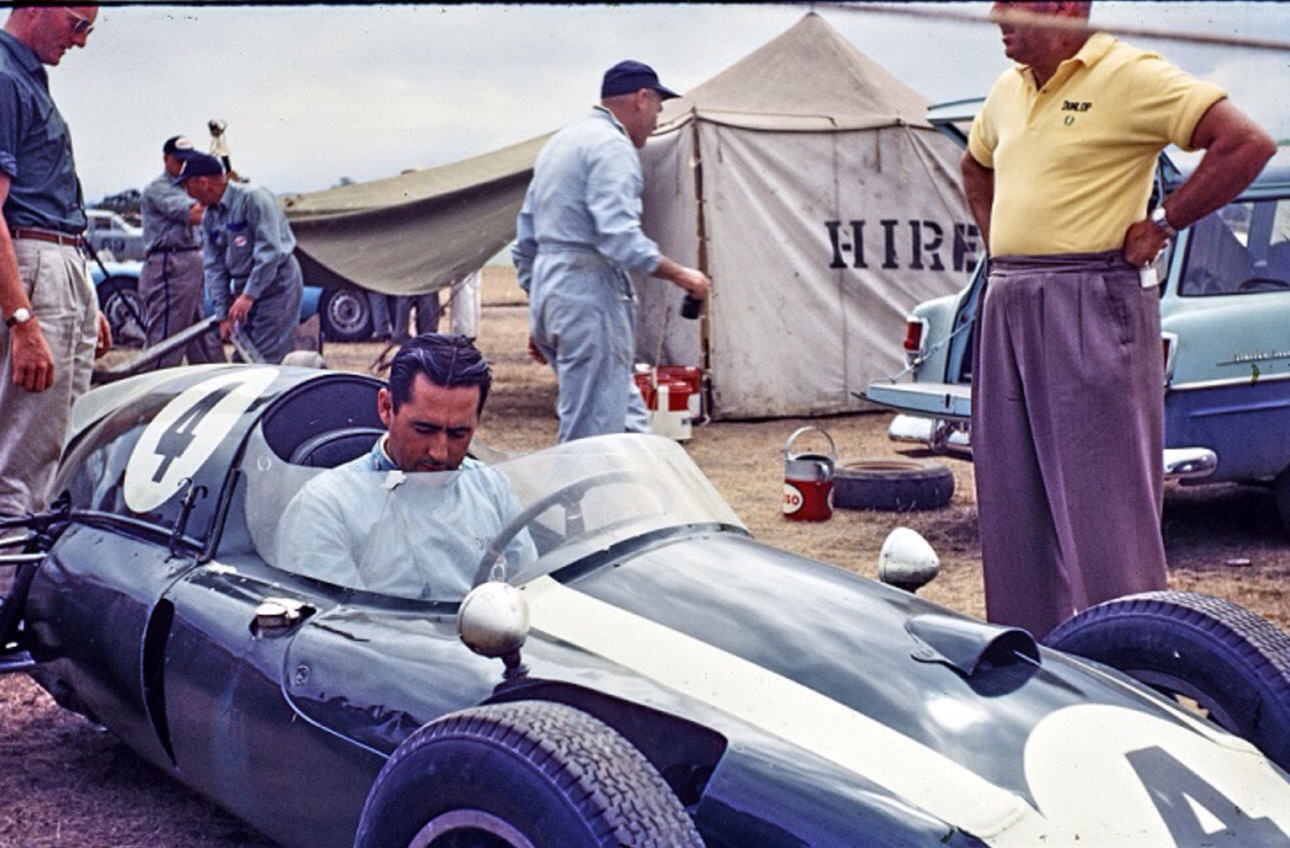
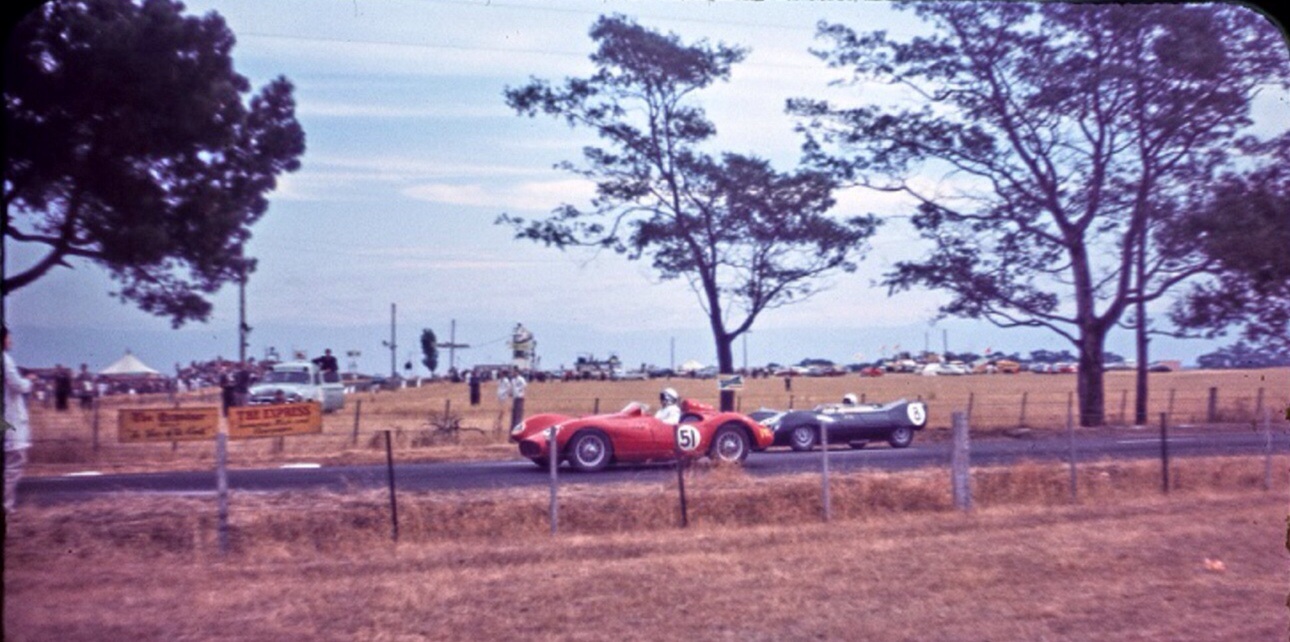
It was the first time the great Tasmanian circuit hosted a round of the national drivers championship, the locals turned out in droves, including enthusiast/photographer Bob Young who took these remarkable, crisp oh-so-clear, evocative photographs.

Colour photos of this quality are so rare of Australian racing then. Each one in some ways deserves to be posted on its own but in the end I decided it was better to do a short article around them as a group. They are not the only shots he took on the day mind you- others have already been posted on the Historic Racing Car Club of Tassie Facebook page and filched by me! See the links at the articles end to view some of them.

I wonder whether Stan is having a shot down the outside of Bib or is Bib plunging down the tiny- but just big enough gap Jones left for his fellow Melbourne motor dealer buddy/competitor. Whatever the case, i suspect Stan The Man- and he was very much one of them at the time, gathered Bib up on the long run out of the tight right-hander, gently rising and then steeper towards the Water Tower- 2.5 litres of Maser six having a bit more grunt than a 1.7 litre Climax FWA four.

Otto Stone steering, Stan and John Sawyer, 250F, Longford 1958. Racer/engineer Stone’s counsel and car preparation were key factors, with perhaps Jones growing maturity as a driver, in Stan’s well deserved success. Pirelli Stelvio tyres BTW- photo is that sharp! It’s early in the weekend, the team have not applied the real race number decals to the car yet (B Young)

Bib sold his ex-Hunt 250F to Arnold Glass and jumped into the first of many water-cooled Coopers with the T43 (F2/9/57 according to John Blanden) whereas Stan, who changed racing cars more often than he did his Jocks- and had a long history of Cooper air-cooled and T23 experience, hung onto the 250F (chassis ‘2520’) and profited from the decision rather than jump into a Cooper just then. He did of course buy T51’s in time, with which he was very fast.

Stan won the 1958 Gold Star with two victories at Fishermans Bend and Phillip Island- book-ending his season with wins and returned to Longford twelve months hence and finally won the AGP he so richly deserved aboard the 250F from Len Lukey.

By that stage Lukey had switched from the Cooper T23 Bristol shown below to an ex-Brabham Cooper T45 Climax Jack raced in Australasia in late 1958 and over the summer races of 1959 before heading back to the UK and a World Championship aboard factory Cooper T51’s.

Len jumped from Ford Customline Touring Cars into this Cooper Bristol and an evolved Lukey Bristol in a relatively too brief racing career, his ‘Lukey Mufflers’ business funded his racing efforts- he was a friend to motor racing via Phillip Island and other means for the rest of his life. Another mighty shot, Len has just started his turn-in to Mountford, car looks just superb, as indeed it was-well prepared and driven (B Young)

Lukey’s Cooper Bristol was the ex-Tom Cole-Reg Hunt-Kevin Neal machine, chassis ‘CBR/2/9/53’ with which he did so well in 1957-8, but the reality was the car wasn’t an outright winner, hence the upgrade to the then, very much latest available, Cooper T45. With this he pursued Gold Star 1959 success in a year of speed, consistency, good preparation and perseverance- at twelve rounds it was the longest ever Gold Star championship.

Late in its ‘in period’ Australian life the front engined T23 was fitted, as all of the Australian Cooper Bristols were, with a Holden ‘grey’-six or Chev small-block V8, in the case of this car a Holden engine. The racer eventually passed to the Donington Collection in the early seventies and later still back into private hands.

The Man in Red- Lukey nattily dressed with his wife holding a serious camera. Long chromed exhaust said to be unique to this ex-Cole-Gibson-Hunt-Neal-Lukey et al car (B Young)

There is little doubt a 2.5 litre Coventry Climax FPF powered Cooper would have very comfortably won the 1959 AGP and Gold Star but them things were like hens teeth- 2.5 FPF’s were issued only to works and favoured teams in Grand Prix racing until the Climax lads could keep pace with global demand which in practical terms meant during 1960.

Ted Gray won the Longford Trophy on this clear but chilly Tasmanian weekend, to have heard the big, booming fuel-injected Chev V8 engined Tornado blasting its way around Longford would have been really something!  This car does sound just like an F5000, imagine that in 1958!

It’s showtime. Raceday. Just love this shot, atmosphere plus.

Len Lukey’s and Lou Abrahams’ boys push their steeds to the form-up area. That beautiful, clever beastie to the left is Tornado 2 Chev 283, the yellow Cooper in the background is Aussie Millers T41. Note the Repco service van- its chilly too, 3 March is still summer’ish but most of the chaps are well rugged up against Tasmanian cool.

(HRCCT)

Business end of the Tornado 2 Chev in the Longford paddock. GM Corvette ‘small block’ 283 CID V8 with lots of goodies from the US including Vertex magneto and home grown fuel injection using some Hilborn Travers components, circa 380bhp (B Young)

As you would have surmised from the foregoing descriptions of the cars, Australian National F1 at the time (until the end of 1963) was run to Formula Libre, hence the presence of Doug Whiteford’s ex-works Maserati 300S below.

I have bemoaned the fact that Doug bought a sportscar from the Officine Maserati team at the end of the 1956 AGP weekend at Albert Park, rather than one of the three 250F’s they had with them.

Whilst Douggie was no spring-chookin’ by then- he started racing pre-War and won his first AGP aboard his Ford V8 Spl ‘Black Bess’ back in 1950, he still would have given his contemporaries a serious run for their money in his always beautifully prepared and driven cars.

Doug sold this car in the early-sixties to Bill Leech, the racer and pillar of the Victorian Light Car Club who used the car both on the road- it was a familiar sight on Beach Road jaunts from Brighton, and at historic meetings in the early years of such racing in Australia. It was a sad day when this ‘mobile Monet’ left our shores.

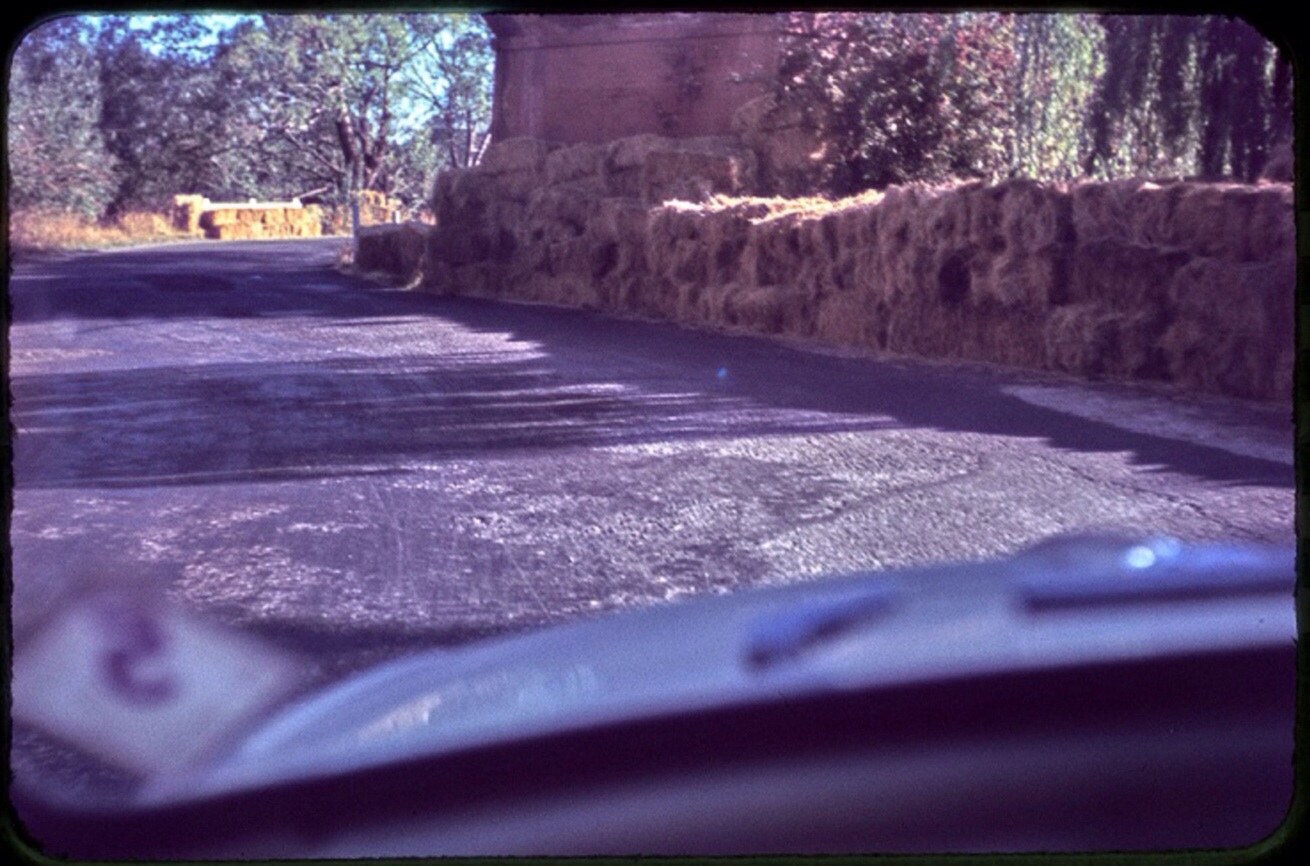
Ooh-la-la. Sex on wheels and what a backdrop- the vivid red Maser 300S ‘3055’ contrasted against the dark shadows and green Mountford Pine- it’s still there by the way (B Young)

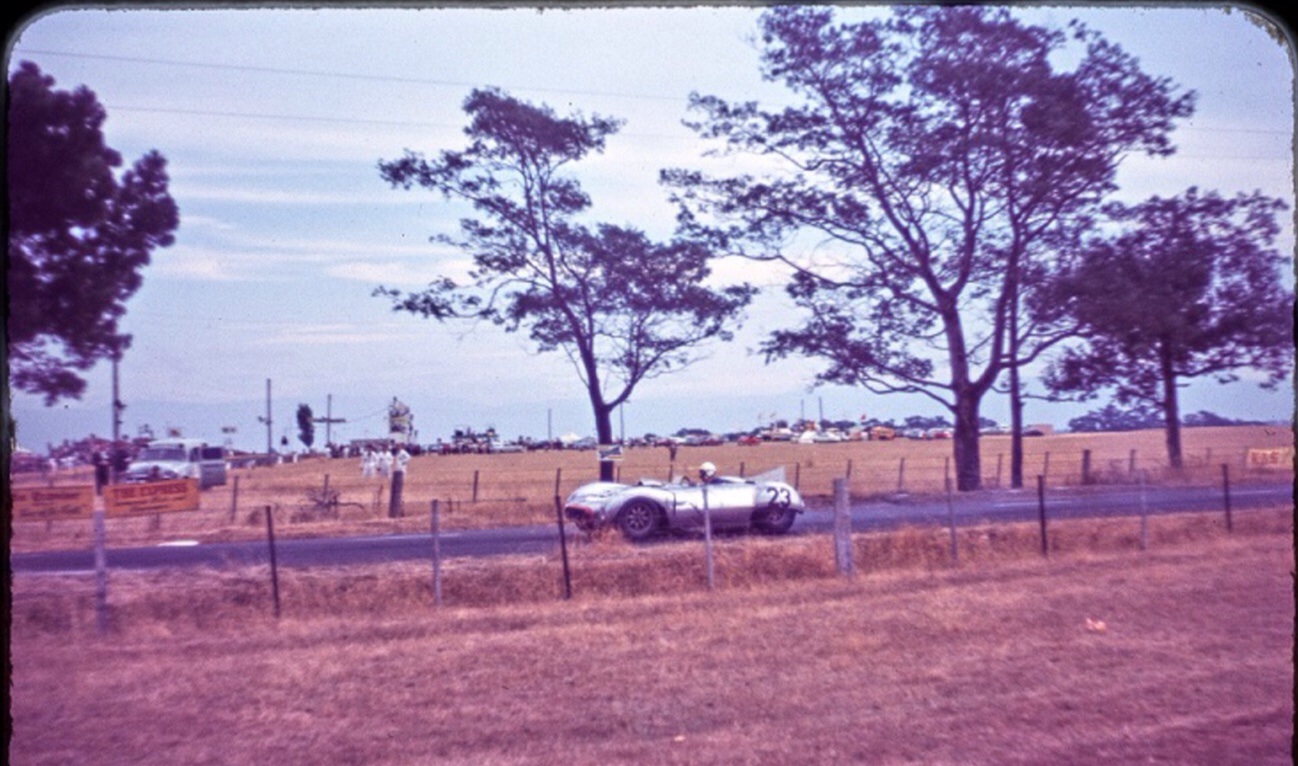
It was another batch of Bob Young’s photos which inspired an article I wrote a little while back on Norman Hamilton’s Porsche 550 Spyder, which on this weekend was driven by Melbourne Hillclimb ace Bruce Walton in the sportscar events.

(B Young)

The photo below is of the A Edison entered 1250cc MG TF Spl- I know nothing about the car or driver, who can fill us in?

(B Young)

Article Links…

Longford Trophy and Tornados; https://primotipo.com/2015/11/27/the-longford-trophy-1958-the-tornados-ted-gray/

Porsche 550 Speedster; https://primotipo.com/2018/06/28/hamiltons-porsche-550-spyder/

Longford in detail; https://primotipo.com/2018/07/05/longford-lap/

Stan Jones; https://primotipo.com/2014/12/26/stan-jones-australian-and-new-zealand-grand-prix-and-gold-star-winner/

Doug Whiteford; https://primotipo.com/2015/05/05/doug-whiteford-black-bess-woodside-south-australia-1949/

Etcetera…

(B Young)

Constabulary ensuring the Course Car- Clerk of The Course perhaps, leaves the circuit to make way for the racers.

(B Young)

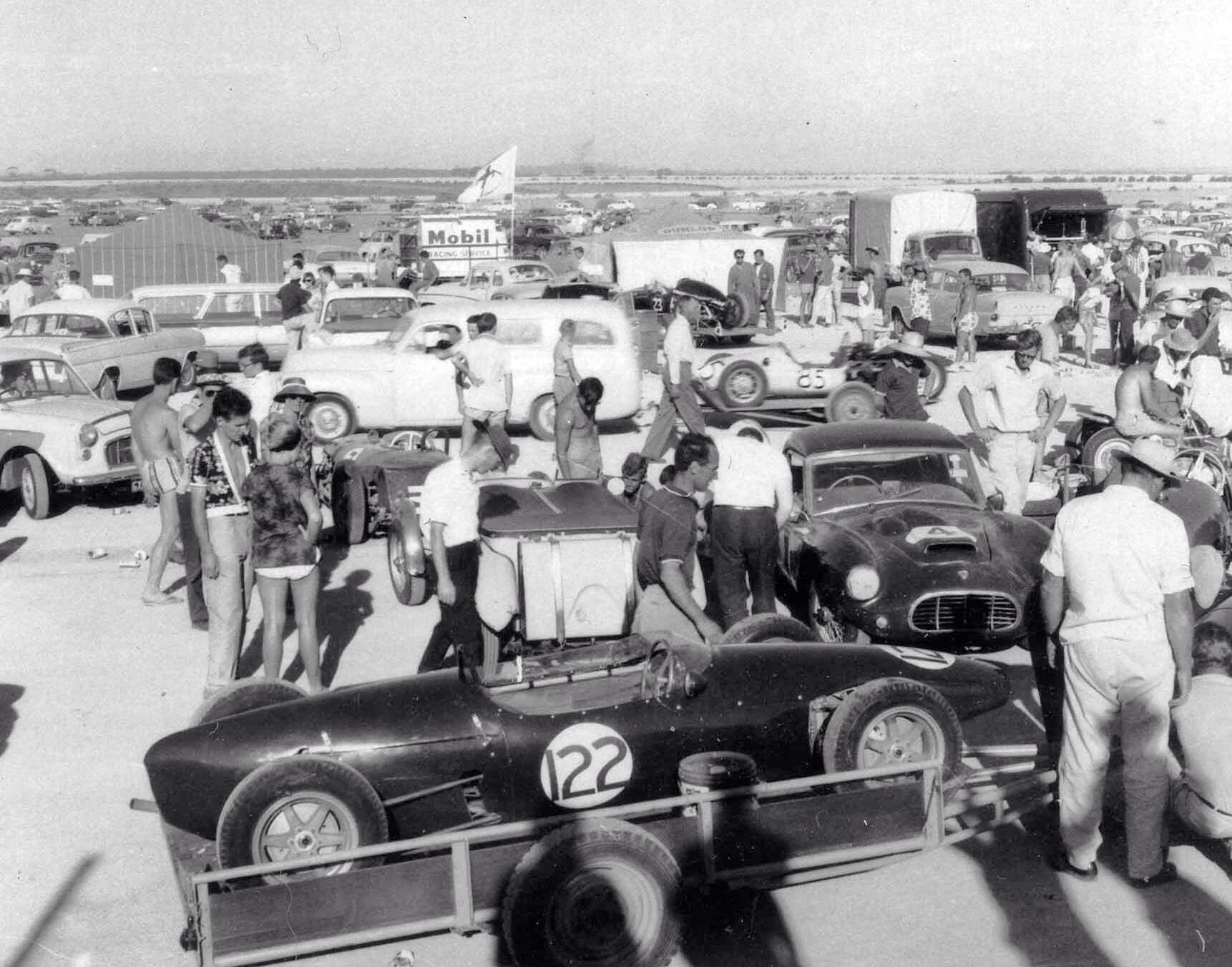
Paddock scene may be the 1959 AGP meeting.

(L Lukey)

The Lukey Cooper Bristol again.

Credits…

Bob Young on Historic Racing Car Club of Tasmania Facebook page, ‘Historic Racing Cars in Australia’ John Blanden

(B Young)

Tailpiece: The ‘Tasmanian Tyre Service’ Handicap…

It’s a bit of a puzzling photo really- the handicap grid sort of makes sense but Doug Whiteford belongs up the back with Stan as ‘scratch- men’ rather than at front left. John Youl’s red Porsche 356 stands out, other drivers and cars folks?

By the way, they are in the original starting line area, on The Flying Mile, just a way back from Mountford Corner, clearly Bob Young stuck to this part of the track and the paddock- to the right of the racing cars.

Cropped version of the above photo, the focus Stanley, ‘2520’ and the lads (B Young)

John Sawyer is leaning on the tail, Otto Stone is on the right approaching, Stan readies himself in the cockpit, I wonder who the fella in the neato Maserati overalls is, and in the MG TF up the road to the right is Charles Button, still active in the Historic Racing Car Club of Tasmania today Grant Twining tells me.

Finito…
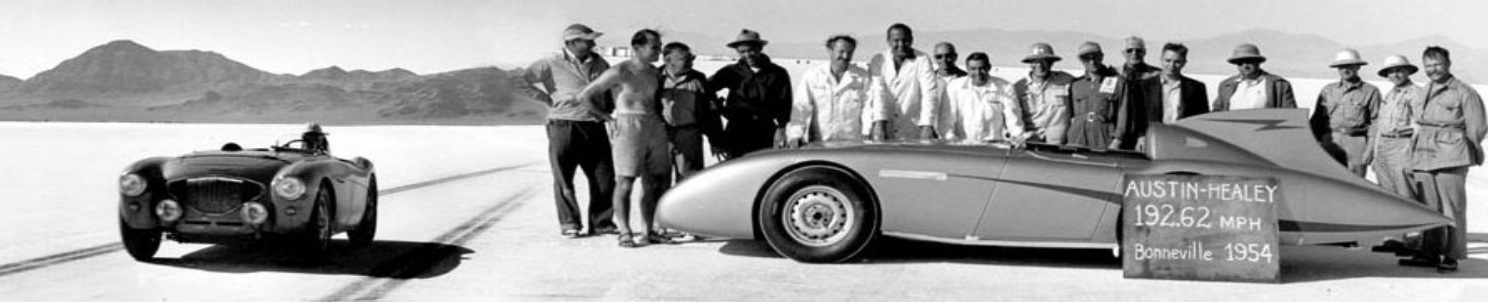
‘Australian Stock Car Road Championship’ race, Lobethal 1939 (SLSA)

The first official ‘Australian Touring Car Championship’ was held at Gnoo Blas, Orange, New South Wales on 1 February 1960, the one race title was famously won by David McKay’s Jaguar Mk1 3.4.

I wonder whether the first Australian Touring Car Championship is not that ‘Official’ as in CAMS sanctioned event at all- but rather the ‘Australian Stock Car Road Championship’ race held during the January 2 1939 Australian Grand Prix meeting at Lobethal in the Adelaide Hills won by Tom Bradey’s Singer Bantam?…

The racing of ‘run-what-you-brung’ production cars goes all the way back to the dawn of racing in Australia- to Intercontinental City to City record breaking, the ‘Car Trials’ run out of major towns and the speed events held within them, on dirt ‘speedways’ and ‘Around the Houses’ racing in Western Australia.

‘Stock Car’ or touring car racing at Applecross, Perth during the 1940 Patriotic GP meeting- the Bill Smith Humber chases a Chevrolet (K Devine)


Steamin’: More Applecross action, gas producers Stock Car race!, with one competitor boiling on the line, magic shot (K Devine)

The Monday 2 January Lobethal 1939 AGP event program comprised a 10.45am ‘curtain-raiser’- the 75 mile South Australian Grand Prix, and then ‘an innovation, the Australian Stock Car Road Championship, in which all manner of stock car models, from sedans to tourers, and small engine roadsters have been entered’ over 50 miles held at 1pm. Finally the blue riband Australian Grand Prix contested over 150 miles of the ultra challenging, dangerous, demanding Lobethal road circuit commenced at 2.30pm.

These races, consistent with Australian motor racing practice well into the sixties were run to handicaps- I’m not suggesting that all races into the sixties were handicaps, but some were. The last handicap AGP was the 1948 Point Cook, Melbourne race won by Frank Pratt’s BMW 328.

The entry for the Lobethal stock car title race was diverse and comprised, as suggested above both ‘touring cars’ and ‘sports cars’. This too was the case in Australia until well into the fifties, ‘Sportscars were still seen as a natural part of a production car field, although the arrival of the Jaguar XK120 tended to stretch the friendship’…’The combination of sports and sedan cars to make up production car fields plus the frequent resort to handicapping, meant there were very few predictable winners amongst the touring cars of the early 1950s…’according to HATCC (The Official History of The Australian Touring Car Championship).

John Snow in his Hudson 8, a roadie as well as a car he competed in- inclusive of hillclimbs and at Mt Panorama, Bathurst (N Howard)

The ‘Geoghegans, Brocks and Lowndes’ of that 1939 day were Frank Kleinig in Bill McIntyre’s Hudson 8 and the similarly equipped John Snow, with Jock McKinnon, J McGowan and Ted Parsons in Ford V8’s. In amongst the ‘heavy metal’ were cars such as the Austin 8 raced by local ace of that marque Ron Uffindell, K Brooks’ Wolseley, D Hutton in a Morris 8/40 and Tom Bradey in a Singer 9 Bantam.

The sportscars comprised MG T Types of Owen Dibbs and S Osborne, the MG ‘Tiger’ of Selwyn Haig and the fast Jaguar SS100 of G Brownsworth- he was off scratch as were Kleinig and Snow, the latter two blokes aces in the ‘Grand Prix’ machinery also racing that day. The winner of the AGP was Allan Tomlinson, the prodigiously quick and superbly prepared Perth ace aboard a supercharged MG TA, a wonderful story for another time. Soon actually, it’s completed.

G Brownsworth Jaguar SS100 (B King)

The Adelaide Advertiser’s reporter was not particularly impressed with the touring cars in practice. ‘The entrants in the Australian Stock Car Championship had trouble at almost all of the corners on the course, as the cars, not built for racing, swayed and threatened to overturn with the heavy loading imposed on the bodies imposed by the racing speeds’.

Despite that, Kleinig lapped in 7:32 min/secs, Snow 7:35 and Phillips in 7:45- by way of comparison the lap record was held by Lobethal-Meister Alf Barrett in a 2.3 litre supercharged straight-eight Alfa Romeo Monza in 5:41- so in relative terms they were not too shabby.

Perhaps modern comparisons are instructive. The F1 lap record at Albert Park is Schumacher’s 2004 Ferrari time of 1:24.125, the V8 Supercars record is Scott McLaughlin’s Ford FG X Falcon’s 1:54.6016. Kleinig’s time as a percentage of Barrett’s is 73%, McLaughlin’s of Schumacher’s is 80%- and so it should be, the V8 Supercar is a racer whilst the Hudson 8 was very much a production car. The point is that the relative production lap time of the Hudson relative to a Grand Prix car of the period is not too bad at all.

Lobethal crowd taking in the stock car race 1939 (SLSA)

The Advertiser reported the race as follows…

‘Chief interest in the Australian stock car championship centred on the possibility of J McKinnon Ford V8 (3 mins) catching the leader, TM Bradey who was off 11 minutes in the little four cylinder Singer. The speed of the race was very slow in comparison to the SA Grand Prix’ the Advertiser’s reporter ‘Differential’ observed.

Bradey went into the lead from the Uffindell Austin 8 on the third time around with Hutton, Morris 8/40 a long way back in third. Brook’s Wolseley, Mrs Jacques MG T (Owen Gibbs driver) and the Osborne MG T retired at Kayannie after about three laps each, and McKinnon and Parsons in Ford V8’s moved up into fourth and fifth places respectively’.

Jock McKinnon’s second placed Ford V8, his handicap was 3 minutes (unattributed)


Ron Uffindell’s Austin 8 placing is unclear but he had a good weekend winning the South Australian GP in his Austin 7 Spl (B King)

‘Brownsworth with his low-slung racing type car (Jaguar SS100) was the best of the scratch men, and he left them to chase the other five. Lapping consistently at more than 70 miles an hour he moved up several places in successive laps and was gradually overhauling the leaders.

Bradey, however maintained his lead to the finish’.

Tom Bradey was a motor mechanic from Barmera in South Australia’s Riverland, he and his mechanic, Charlie Sheppard, who owned the car, towed it the 200 Km to Lobethal.

Tom Bradey and Charlie Sheppard on their way to a Lobethal Oz Stock Car Championship win’ locally bodied Singer Bantam (unattributed)


Tom Bradey and Charlie Sheppard after their historic win, Singer 9 Bantam. It is fair to say that the (non-championship) Group A Touring Car race held as a support event at the first Adelaide F1 GP held just down the road in 1985 was a higher profile race than this one! (J Redwood)

In a weekend of surprises for the Bradey family, James Redwood, Tom’s grandson wrote that ‘Uncles Peter and Don Bradey say he may not have told his wife (my grandmother) the whole truth about about his intention to race at Lobethal’.

‘Tom had set off with the family under the assumption that he was part of the support crew. The race was broadcast on the radio and it wasn’t until mention of Bradey on the call that the family realised he was the driver’.

Bradey returned to Lobethal the following year and raced a Bugatti Brescia in the 1940 ‘South Australian 100′, but failed to finish the race won by Jack Phillips’ Ford V8 Spl. Years later, in 1958, he bought the ex-Bira/Colin Dunne MG K3 which won the Junior GP at Lobethal in Colin’s hands in 1938 and failed to start the ’39 AGP that weekend with engine troubles. Many Australian enthusiasts will recall the Bradeys ownership and use of the K3 for decades.

In a nice bit of symmetry, Tom Bradey was approached by a North Adelaide man with the offer of sale of a Singer 9 in similar specification to his winning 1939 title car, that car passed to James Redwood in 1972 and in restored condition is still used regularly- the Bradey family-Singer connection lives on.

D Hutton’s fifth place Morris 8/40 (B King)

Race Results

1st TM Bradey Singer 9 Bantam in an actual race time of 54:08 minutes. 2nd J McKinnon Ford V8 . 3rd Ted Parsons Ford V8. 4th G Brownsworth Jaguar SS. 5th DE Hutton Morris 8/40.

The placings below Hutton are unrecorded in both the Advertiser’s contemporary race report published on 3 January 1939 and in more modern reference sources. The fastest lap fell to Brownsworth- 7 min 27 sec at ‘just over 71 miles an hour’.

Most results listings of the race have Jack Phillips as the driver of the third placed Ford V8. Whilst entered by him the car was raced by Ted Parsons according to The Advertiser. Jack and Ted were partners in a Ford service and sales agency at Wangaratta in northern Victoria.

Phillips drove, and Parsons was riding mechanic in the Ford V8 Special the pair owned and raced so successfully in this period- inclusive of third place in the AGP held later in the day and wins at the Interstate Grand Prix at Wirlinga, Albury that March and in the 1940 South Australian 100 at Lobethal.

It was 101 degrees Fahrenheit in the shade that scorching hot South Australian day- perhaps Phillips made a late call early in the sweltering weekend to preserve his energies for the AGP which immediately followed the stock car race, and allowed his partner to race in the support event.

Phillips was one of the aces of the period, it does make you wonder what Jack could have done with the car had he been the driver- and also whether Parsons raced with Phillips’ handicap, which would have been tougher than that applied to him given his level of racing experience, or whether he was given a different handicap.

I wonder if the Ford V8 raced by Parsons was off the Phillips/Parsons dealership floor in Wangaratta or supplied to them by FoMoCo?!

Surely this isn’t the first factory racing Ford entered in an Australian Touring (Stock) Car Championship race?! Harry Firth where are you?

Jack Phillips and Ted Parsons, Ford V8 Spl during the ’39 AGP. No doubt Parsons was a tad weary when he climbed into the the Big Henry’s passenger seat after his 3rd place in the Stock Car Championship race which preceded this event (N Howard)

The interesting thing is why the Lobethal race isn’t regarded as the first Australian Touring Car Championship given both the race’s name- the ‘Australian Stock Car Road Championship’, the ‘national’ entry list (Victoria, NSW and SA?) and that the race was run in a manner consistent with common practice right through to the end of the late-fifties- that is, a mix of touring and sports cars in a handicap event…

The ‘HATCC’ devotes several paragraphs to the race in its introduction but the emphasis of that part of the book is more about the rules of the time, ‘the race (the 1939 Lobe race) the programme explained was “open to standard touring or sportscars fitted with standard equipment and operating on standard first-grade fuel. The only alterations allowed will be raised compression ratio and alterations to the suspension in the interests of safety. In some cases, alterations to the suspension will be insisted upon”.

Then the much respected authors of the book moved on to a discussion about racing after the war.

Selwyn Haig’s MG ‘Tiger’, placing uncertain (B King)


Tom Bradey’s Singer being rounded up by Frank Kleinig’s Kleinig 8 Spl during the 1939 Lobethal weekend. This is Kleinig’s outright Hudson 8 MG chassis special he raced in the AGP, not the road car in which he contested the stock car race (J Redwood)


Bradey and Sheppard again (J Redwood)


Surely you missed the point blokes?!

Which was or is a debate about the merits of Lobethal as the first Australian Touring Car Championship race rather than Gnoo Blas- which held the CAMS created ‘Australian Touring Car Championship’ title race under the then new ‘Appendix J’ rules which commenced on 1 January 1960.

It is intriguing that HATCC authors Graham Howard, Stewart Wilson and David Greenhalgh didn’t debate the topic in their book’s introduction, in the early 2000’s Australian Motor Racing History was being re-written after all…

The honour of the first Australian Grand Prix was reallocated from the 31 March 1928 ‘100 Miles Road Race’, a race for cars of under 2 litres held on the original, rectangular, 6.5 mile gravel road course at Phillip Island, to the 15 January 1927 ‘Australian Grand Prix’, a six lap, 6 miles and a bit race between two cars around an oval, dirt, 1 mile 75 yards horse racing course at Goulburn, NSW’s second largest city.

To be clear, the Phillip Island event was two races, the cars split into classes based on engine capacity, consisting of a total of seventeen starters from several states, with the quickest time winning- Captain Arthur Waite in an Austin 7 s/c was famously the victor. The Goulburn contest was amongst seven competitors from New South Wales- two heats and then a final amongst the quickest pair over 6 laps- the victor was local racer, Geoff Meredith in a Bugatti T30.

My point is that if the attribution of ‘the first’ AGP can be reallocated on such debatable grounds- that the two-contestant Goulburn 6 minute 14.8 second race is an AGP in name only- then surely it is far from tenuous to assert that the first ATCC was the 2 January 1939 Lobethal race amongst competitors from two or three states won by Tom Bradey’s Singer 9 Bantam over 50 miles of the toughest ever race track in Australia, to rules or practices of the time which prevailed until the end of 1959?

Don’t get me wrong, I agree- just, depending upon the number of Coopers ‘Reds’ consumed on the night, that the first AGP is the 1927 Goulburn race, but it is very easy to argue the other way given the entire nature of the event other than its name.

1939 Lobethal program (S Dalton)

John Blanden in his 1981 ‘A History of The Australian Grand Prix 1928-1939’ writes in his introductory comments about the Lobethal meeting that ‘Immediately preceding the Australian Grand Prix were two other events, the 75 mile South Australian Grand Prix and the Australian Stock Car Championship which in later years would have had the title of Australian Touring Car Championship’.

Whilst on this jolly I rather suspect that had a Ford V8 won the Lobe race there would have been agitation from Ford/Ford fans/enthusiasts/historians to appropriate the 1939 championship as their first ATCC win but given the victor was a Singer- a long gone marque, there has been no such pressure applied.

Then of course there is my conspiracy theory, there always has to be one of those surely!?

The CAMS view of the world started with their existence in 1953, with all due respect to the serious historians spread across the CAMS Historic Commission, what happened in the past pre-1953 does not matter to the CAMS mainstream hierachy much.

‘The Official 50 Year History of The Australian Touring Car Championship’ published in 2011 to celebrate 50 years of the ATCC from the 1960 Gnoo Blas race has CAMS fingerprints all over it.

A CAMS promo banner appears on the cover, a Foreword by V8 Supercars CEO Martin Whitaker tells how wonderful that mob are and there is a second Foreword from CAMS President Andrew Papadopoulos (don’t mention Formula 4 folks, I did once and I think I got away with it…) ole’ Papa points out in his homily that ‘The ATCC is the second longest running national touring car championship in the world…’, include the ’39 Lobethal event and you have the oldest in the world matey…

I can’t help but wonder that even if the HATCC authors thought their was merit in recognising the 1939 Lobethal race as the first such title, and I’m not saying that is what they think/thought- I rather suspect the CAMS view is that the ATCC started with ‘their’ title in 1960- the ‘Official’ one, whereas the Lobethal race wasn’t an ‘Official’ championship but rather a concoction of the Sporting Car Club of South Australia, the organisers of the Lobethal meeting and is therefore ‘Unofficial’ rather than ‘Official’.

So, there you go, it’s all a CAMS conspiracy not to recognise Lobethal 1939 as it suits their dialogue and view of the world not to- even if the recognition of ’39 would make ’em the big swingin’ dicks of the touring car world by instantly giving them the oldest such title on the planet.

But let’s move on from CAMS, it’s always best to move on from CAMS. Quickly and with plenty of distance.

(S Dalton)

It’s just as easy to come up with reasons why the Lobethal meeting isn’t and wasn’t the first ATCC of course.

Just like a good lawyer, I can argue the case either way depending upon who is paying me the most. And no, I am not a lawyer, I’m not cursed by the misplaced sense of superiority which afflicts those poor souls.

So here are the arguments against Lobe ’39 first ATCC recognition, and rebuttals in relation thereto.

1.The race wasn’t called ‘The Australian Touring Car Championship’, if it wasn’t literally called just that, it doesn’t count as that.

Rebuttal.

Well yep, ya got me sunshine.

However, in Australia we happily call the 1928 ‘100 Miles Road Race’ at Phillip Island the 1928 AGP and the 26 December 1936 ‘South Australian Centenary Grand Prix’ the 1937 AGP (WTF, LOL, go figure etc) so calling the ‘Australian Stock Car Road Championship’ the ‘Australian Touring Car Championship’ is consistent with our flexibility in flicking around titles as and when it suits us.

2.A 50 mile race isn’t championship distance.

Rebuttal.

Bugger off! The ’61 and ’63 ATCC’s at Lowood and Mallala were both 50 miles and they were tracks for ‘girl guides’ compared with the rigours and perils of Lobethal.

3.Thirteen starters isn’t championship numbers.

Rebuttal.

Nah not really. Longford in ’62 only had only 14 cars and Sandown in ’65 only had 18- far fewer per head of population than Lobethal managed in ’39.

4. It wasn’t a touring car race with all those lid-less cars?!

Rebuttal.

Well, sorta, maybe but not really. Since 1960 the ATCC has been held to numerous sets of rules- Appendix J, Group C, Group A, V8 Supercars etc. In 1939 touring cars included those with lids, what we now call a convertible and sportscars. ATCC rules have evolved over time, what happened in 1939 is consistent with changes along the journey made by CAMS.

CAMS get confused every now and then too, about individual cars- for example, the Porsche 911, which most of us call a GT Coupe was ATCC eligible for a couple of years, then became a Sports Sedan and another two or so years later a Production Sportscar. Dimensionally during that period the car didn’t change but CAMS view of it did. Go figure. Don’t actually, because you will never figure it.

5.But Lobe was a handicap race, come on, surely not?!

Rebuttal.

Yeah, well maybe. But what is the difference between the class structure used for 20 years or so to give everybody a fair go and handicaps? Don’t even talk about CAMS rule changes here and there in every other year as their tummies were tickled by the politically powerful to create ‘equalisation’ or ‘parity’ between cars. Good try but that argument doesn’t knock us out of the ring either.

6. You are just trying to knock off the ‘first’ ATCC from New South Wales and give it to those undeserving South Australians.

Rebuttal.

I’m no more thieving a race from you mob than theft of the first AGP from the poor, smug, self righteous Victorians! My motives are as pure as any Canberra politicians.

Here endeth the diatribe.

And so my friends, I put it to you that the one race, 50 mile 1939 Lobethal ‘Australian Stock Car Road Championship’ contested by thirteen or so cars and won by Tom Bradey’s Singer Bantam are indeed the first ATCC champion driver and car- official or otherwise.

As many of you know I am not in the slightest bit interested in touring car racing of any sort so my impartiality in relation to all of this is absolute.

Let’s hear your views!

In the meantime i look forward to a reprint of the ‘History of The Australian Touring Car Championship’ and a letter from CAMS in confirmation forthwith…

Tom Bradey and Charlie Sheppard, Singer 9 Bantam, Lobethal 1939 (B King)


Bob Lea-Wright and Jack Kennedy on lap 30, on the way to a 1934 AGP win, they had their difficulties as the car was jammed in top gear for much of the race (S Aspinall)

Etcetera: Singer in Australia…

The marque is largely unknown in Australia today but had plenty of competition success in period, Bob Lea-Wright and Jack Kennedy won the 1934 Australian Grand Prix at Phillip Island in a Singer 9 Le Mans, as below. This car is currently being restored by Nathan Tasca and his father in Victoria and may break cover at Motorclassica shortly.

(S Aspinall)

Sue Asinall, Bob Lea-Wright’s daughter recalls; ‘Dad and Jack Kennedy are outside the Singer dealership he managed in Melbourne after winning the ’34 AGP.

It was an incredible achievement given during practice the engine blew up. Dad and Jack took the car back to Melbourne and worked all night to instal a new one. They wearily drove back to the ‘Island where they had to “run the engine in” over 8 hours around the track on the Sunday and then race on the Monday!

My father also brought back other engine parts needed by fellow competitors! A true gentleman and genuine sportsman/competitor’.


Lets not forget Noel Campbell’s win at Lobethal the year before, below.

The Adelaide youngster won the 1938 South Australian Grand Prix at Lobethal in the circuit’s first car racing meeting that January driving his self built and modified Singer Bantam Special.

Not too long after the win he moved to Sydney where the car provided daily transport after conversion back to more standard form, it too, most of it, is in Nathan Tasca’s hands.

There is much, much more to the marque’s history in Australia but these two wins are just a couple of snippets to remember.

(N Howard)

Photo Credits…

Norman Howard, State Library of South Australia, Nathan Tasca Collection, Bob King Collection, James Redwood Collection, Sue Aspinall, Stephen Dalton Collection

Special Thanks…

To Singer enthusiasts and owners Nathan Tasca and James Redwood for research material, photographs and anecdotes

Bibliography…

Various Adelaide Advertiser newspaper articles, ‘The Official History of The Australlian Touring Car Championship’ Graham Howard, Stewart Wilson, David Greenhalgh, ‘A History of The Australian Grand Prix 1928-1939’ John Blanden

Tailpiece: No Lightweight in Performance: Singer Bantam, winner of the first Australian Touring Car Chanpionship…

(N Tasca)


Finito…


The only ugly Elfin body ever built wasn’t constructed in Conmurra Avenue, Edwardstown in Adelaide but by Vern Schuppan’s crew in the US, or was it?…

Here Vern is on the way to ninth place in his Elfin MR8A-C Chev during the Road Atlanta Can-Am round on 14 May 1978, the race won by Alan Jones far effective Lola T333CS Chev.

There were some fairly vestigial conversions of F5000’s to single-seat Can-Am cars in that post 1976 period but Schuppan’s must be one of the most thinly disguised of them all?!

By way of comparison, below, is Elfin MR8B-C Chev ‘8783’ F5000 at Sandown Park in Februay 1978, a far prettier, ‘more resolved’ design in terms of its body. In a mixed weekend Vern put his Ansett Team Elfin car on pole but then blew an engine after 5 laps of the Sandown Park Cup, the race won by Warwick Brown’s Team VDS Lola T333CS Can-Am car converted to T332C F5000 specs. Amusing that, a Can-Am Lola reverting to F5000 spec rather than the other way around.

(Ian Smith)

Schuppan first tested an Elfin MR8 at Adelaide International raceway several days after winning the 1976 Australian Rothmans International Series in Teddy Yip’s Theodore Racing Lola T332 Chev. Together with Garrie Cooper they sorted the car which Vern raced in Australia throughout 1976 as his international commitments allowed.

Despite not being a fan of the SCCA’s decision to cease F5000 at the end of 1976 in favour of a single-seat 5 litre Can-Am class- in search of the unlimited Can-Am’s spectator appeal as the sanctioning body and the circuit promoters were, Vern decided to compete in 1977.

Schuppan at Riverside with ‘8772’ dressed in its original aluminium John Webb bodywork, the shape of which will be somewhat familiar to Elfin MS7 Repco enthusiasts (L Roberts)


Garrie Cooper races the John Webb bodied Elfin MS7 Repco Holden F5000 engined sportscar for the first time at Adelaide International in August 1974. Likeness to the Can-Am MR8 clear (R Davies)

Rather than buy a Lola T333 or the T332CS conversion kit to turn a T332 F5000 into a T332 Can-Am machine he decided to take an Elfin MR8 to the ‘states.

Elfin’s renowned sheet metal worker and body builder John Webb, together with Garrie Cooper built an all enveloping aluminium body based on that Garrie had used in his one-off MS7 Repco Holden sportscar which first raced in 1974.

The body was fitted to Elfin MR8A-C chassis ‘8772’ which Vern first raced as part of Ansett Team Elfin in the 1977 Australian Rothmans Series. He was 5th with an overheating engine, 7th after a tyre deflation and change, DNF pushrod, DNF oil leak at Oran Park, Surfers Paradise, Sandown and Adelaide International respectively.

That car Elfin MR8 ‘8772’ was despatched by sea to the US with the Can-Am body built in Edwardstown, using Garrie’s MR8 as the ‘slave’ upon which it was formed. When completed it was shipped across the Pacific and fitted and fettled to suit Vern’s car, slightly different in shape to GC’s.

Due to Vern’s Surtees F1 commitments and loss of his Can-Am sponsor he delayed the debut of the Elfin until the October 1977 end of season Riverside round.

The Adelaide driver qualified the new machine a good ninth- the team having only the three practice days to do all their sorting. He finished 22nd, 5 laps short of race and series winner Patrick Tambay’s Lola T333CS Chev after sustaining body damage.

Love the Brian Byrt Ford sponsorship- he shared Dick Johnson’s Falcon GT at Bathurst so supported didn’t he. MR8A-C Riverside 1977


Heading into 1978 the team planned a full assault on the title won by Alan Jones in the Carl Haas Lola T333CS Chev.

Perhaps the nearly two second gap between Vern and pole-man Jones at the opening round at Road Atlanta was indicative of the year to come. Schuppan was 5th and finished 9th with Jones first- the first five cars were Lolas.

At Charlotte in May he was 5th but Vern thought the car ‘wasn’t strong or light enough. We broke the rear suspension at Charlotte and had K&A Engineering in Adelaide design a new suspension and I had a lighter fibreglass body built. Still we were not as fast as the Lola’.

The ‘Elfin bible’ says that ‘Vern commissioned John Webb to fabricate lightweight bodywork…He despatched the panels to the USA where they were added to the basic MR8-C open wheeler body…’ I wonder if the (other) Webb bodywork is the ‘cycle-guard configuration’ or the more substantial final Can-Am body the car used in 1979? Or both.

The team missed Mid Ohio, Mont Tremblant and Watkins Glen before reappearing at Road America in late July- Vern was sixth having qualified ninth. Jones again won from Warwick Brown and Al Unser, both in Lola T333CS.

Schuppan, Road America 1978 (D Hutson)

The interim bodywork (interim in the sense it was the second of three bodies used on the Can-Am configuration of the car) of the car was developed by Boxx and his team in the US- whilst it was undeniably light it gave away much in both drag and downforce as other teams evolved their Lolas.

Off to Canada later in August Vern qualified and finished sixth at Mosport, this time with roughly 2.5 seconds between Vern and Jones on pole. Alan won from fellow Aussie Warwick Brown’s Team VDS Lola T333CS and similarly mounted Al Holbert.

Schuppan, Mosport 1978 (zoompics.com)

At the celebrated Grand Prix de Trois-Rivieres in Quebec Vern qualified fourth and finished seventh. Elliot Forbes-Robinson won for a change in the Spyder NF-10 Chev.

Mosport 1978 (unattributed)

In the two end of season October California races Vern was Q7 and DNF at Laguna Seca- a week later he qualified fifth but failed to finish after popping an engine at Riverside.

Riverside 1978

Jones won the championship taking five wins from the nine races he contested- all from pole. Warwick Brown was second and Al Holbert third, all of the guys aboard Lola T333CS.

The 1979 season started at Road Atlanta in May, with Vern missing that event, Charlotte, Mosport and Mid Ohio before making the race debut of the car with its new, all-enveloping, fibreglass bodywork at Watkins Glen in early July.

Schuppan, Elfin MR8A-C Chev, Watkins Glen 1979

He was six seconds shy of Keke Rosberg’s Spyder NF-11 Chev on pole but in a race of attrition finished a gritty third behind Keke and Geoff Lees VDS Lola T333CS Chev.

Road America 1979 (G Snyder)

Road America, Wisconsin, 22 July 1979, Vern was 5th in the race won by Jacky Ickx in the Haas-Hall Lola T333CS Chev from Geoff Lees T333 and Al Holbert’s Hogan HR-001 Chev.

At Brainerd Vern qualified tenth but popped an engine after completing 19 laps, Ickx won.

Vern chases Bobby Rahal’s Prophet Chev in the MR8A-C Riverside 1979 (C Nally)

Schuppan missed Trois-Rivieres but raced both the California season-enders.

He was Q9 and seventh at Laguna Seca with Bobby Rahal taking the win in his Prophet Chev. For the season ending Riverside meeting on 23 October- his last Can-Am race in the Elfin, Vern finished where he started in terms of the outright speed of the car, he was about two seconds off pole- Keke Rosberg’s Spyder NF-11 Chev on this occasion. He finished five laps down with mechanical problems, Jacky Ickx’ Lola T333 was the victor of both the race, and with five wins, the series.

‘8772’ in the Riverside paddock. Aluminium monocoque chassis and 525bhp AAR 5 litre, injected Chevy clear. Schuppan rated the MR8 F5000 a better car than a T332 Lola- not that the Can-Am variant was quicker! (G LaRue)

In an effort to become more competitive in the 1980 Can-Am Vern acquired two F1 McLaren M26’s with a view to having Howden Ganley’s Tiga Cars convert them into Can-Am machines, but then changed tack buying a bespoke Tiga CA80 instead.

The car, based on Tigas’s F2, ‘F280’ appeared in the last two rounds of the season at Laguna Seca and at Riverside (below) with the plucky Aussie unable to qualify the cars in the top-ten. He was classified sixteenth at Laguna after a water leak, completing only 37 laps and fourteenth after an engine failure on lap 41 at Riverside- after that the car was not raced again.

Vern, Tiga CA-80 Chev, Budweiser GP, Riverside 1980 (unattributed)

The McLaren’s were on-sold to Porsche Cars Australia chief Alan Hamilton.

In Alf Costanzo’s hands one of the Tiga converted ‘ground effect’ M26 Chevs became the ‘jet of the field’ in the dying days of F5000 in Australia.

Vern leaving Turn 6 during the very smoggy 1979 Riverside meeting (G LaRue)

But the Elfin Can-Am adventure was over, perhaps the results of the under-funded and resourced little team were unsurprising against the bigger teams at the head of the field.

‘8772’ survived the ravages of its ‘in period’ racing fairly well, and was ultimately converted back to F5000 specifications. It’s owned by Bill Hemming and can usually be seen on display at his Elfin Heritage Centre in Melbourne.

Schuppan, Riverside 1979 (K Oblinger)

Credits…

Larry Roberts, Glenn Snyder, David Hutson, Gerry LaRue, Ian Smith, Robert Davies, Wayne Ellwood, John McCollister, Chris Nally, Lynn Haddock, oldracingcars.com, ‘Australia’s Elfin Sports and Racing Cars’ John Blanden and Barry Catford, Kurt Oblinger

Tailpiece: Schuppan, Riverside 1979…

Finito…

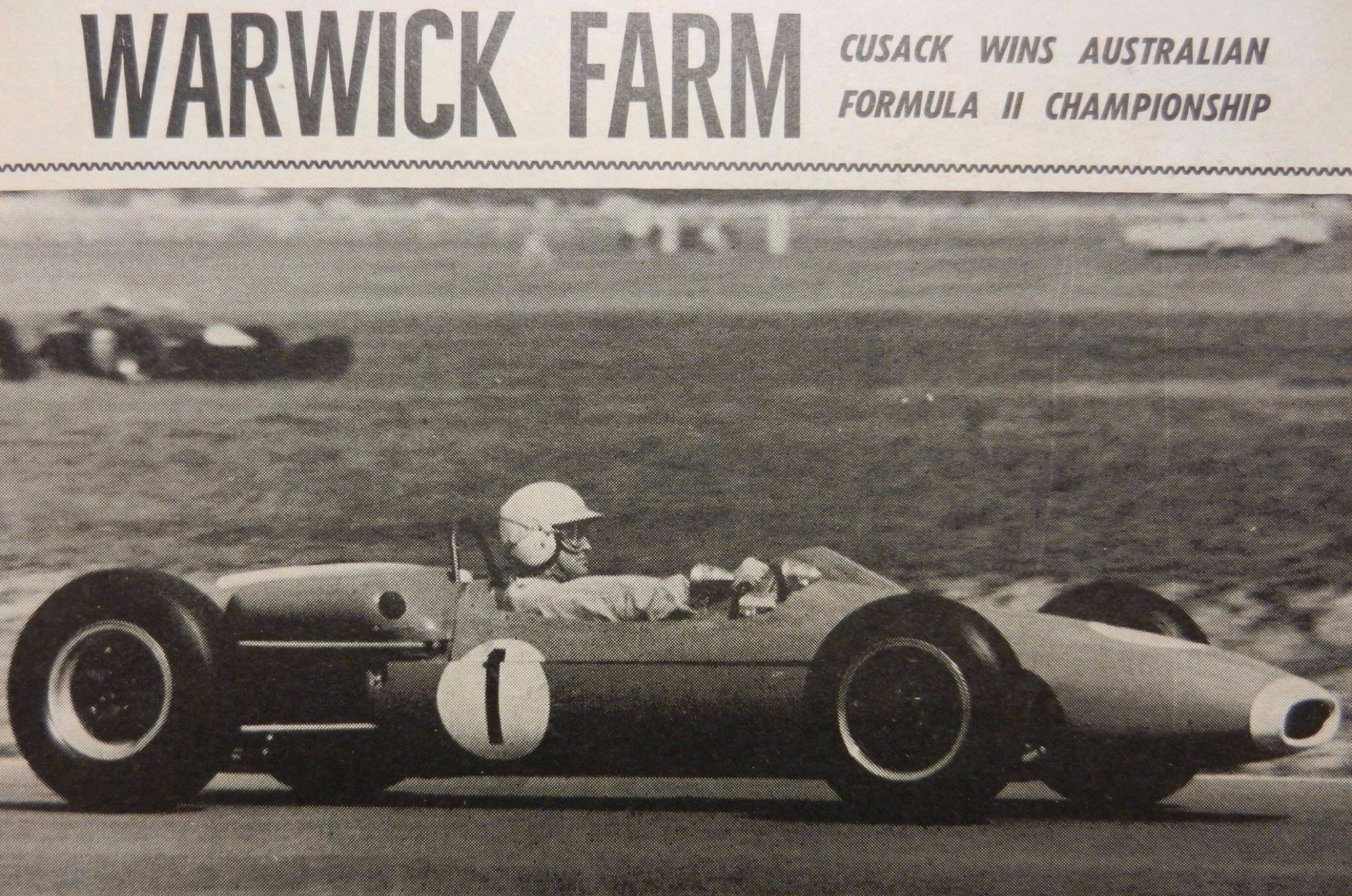
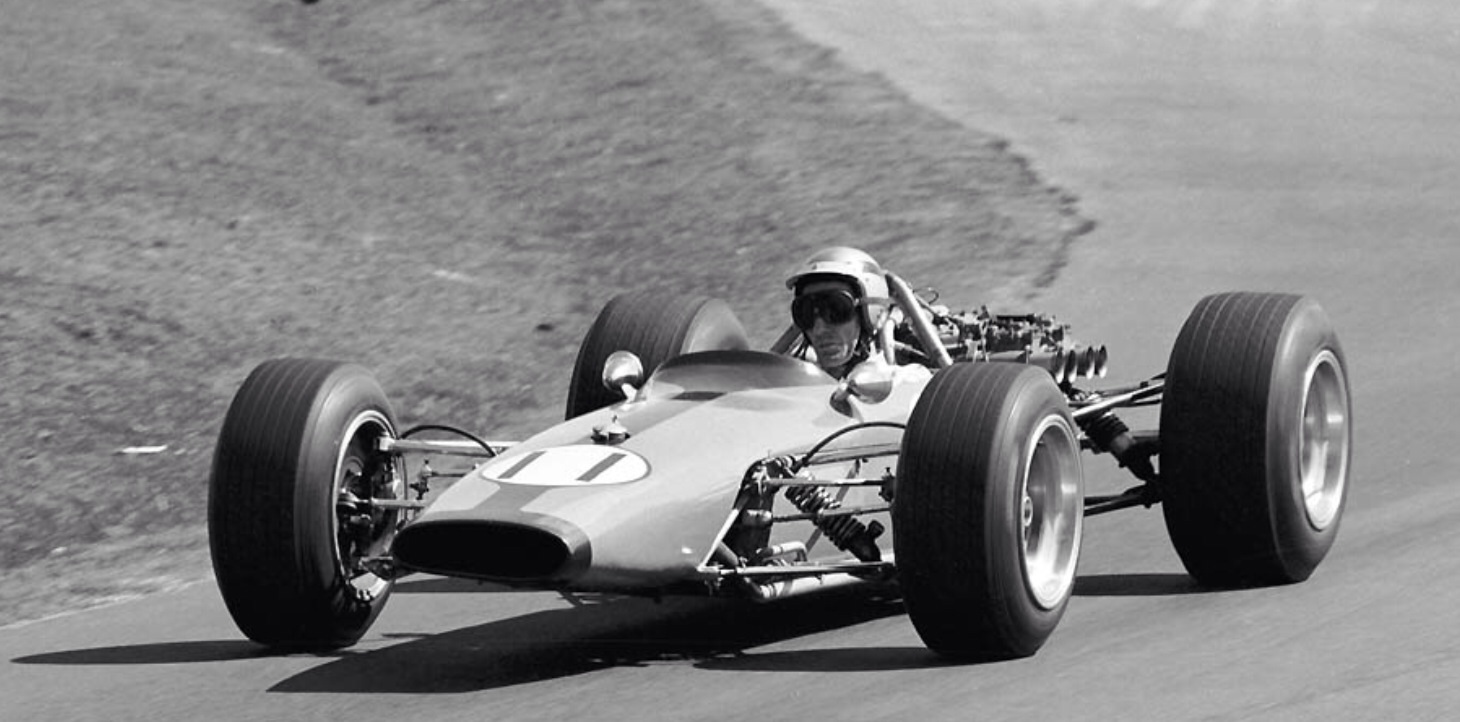
‘My signature shot, Jim Clark Lotus 49 Ford DFW and Chris Amon Ferrari Dino 246T. Two of the best drivers of their time. Taken early in my photography journey. Not only is it a record of the 1968 Surfers Tasman race, the pic is pretty well balanced and shows the scenic aspect of the old Surfers Paradise track. I describe in the Tasman book, the trauma experienced in getting to and from the race’ (R MacKenzie)


I finally bought the Tasman Cup bible at Sandown a while back, what a ripper book it is!…


There are some heavy dudes involved in it. Publisher Tony Loxley has assembled a swag of ‘in period’ talent- journalists, photographers and drivers to contribute, forty in all. I blew my tiny mind when I got it home and penetrated the thick plastic, protective cover to unveil content rich words and images. That Sunday afternoon was completely shot.

At $A95 it’s a snip, nearly 500 pages of beautifully printed and bound hardcover with about ninety percent of the (900’ish) images unfamiliar to me. Mucking around with primotipo I’ve seen plenty of shots in the last four years or so- it was awesome to view a vast array of unseen images, some from the archives of ‘snappers ‘I have met online’ who have kindly allowed me to use their work on my ‘masterpiece’.

Which brings me to Rod MacKenzie’s work.

I’ve used his images before but the material in the Tasman tome is sensational for its compositional artistry. So I gave him a yell and said you choose two photos (Clark and Muir) and I’ll choose two (Gardner and Walker) to showcase the work and support this article. The photo captions are Rod’s, his ‘artists notes’ if you will. We plan some occasional articles going forward, many thanks to Rod.


‘Frank Gardner, Brabham BT23D Alfa Romeo negotiates Newry Corner at Longford, Tasmania 1968. Perhaps one of the wettest races i have attended. At least i was taking photos, not driving! This pic has its own appeal, i just pressed the button. Frank’s skills were tested and you can see the race was on public roads with spectataors in the most unsafe areas. Fences were barbed wire, no run-off and badly cambered roadway.’ (R MacKenzie)


Rod writes about his work…

‘We all have favourites.

In over fifty years of motor racing photography some of my earlier photos remain dear to me.

However, the photos were not quite as important as the spectacle of close racing between highly skilled ‘pilotes’ in competition with their cotemporaries.

They at the time were the source of income to attend the many race circuits and were sold to magazines in Australia and overseas.

Now the photos have become most important.

These photos are now historical records of these men and some women whose exploits have been written about and add reality to reports and clarity to memories.

I also endeavoured to photograph many of the competitors ensuring not only ‘the stars’ were captured.

Without the photos, memories become clouded and distorted. Not by intent, but by the passage of years.

My photos of several Tasman Series spent some time in the proverbial shoebox during a period of having a new family to bring up.

They were revisted to be included in two books (so far) from Tony Loxley of ‘Full Throttle Publishing’ about Formula 5000 and The Tasman Cup and have been included in many other books now. I have released some of the photos on social media and they are still appreciated judging from some of the comments received.

I take pride in my photos as i try to add ‘something’ above and beyond a picture ‘of a car on asphalt somewhere’. A good black and white photo in my view is more difficult to produce than a colour photo and just suits the history of races.

My photos should convey the ‘atmosphere’ of motor sport- the drama, the commitment, the excitement, the humour, the unusual, and the extraordinary when that is possible.

Consequently my shots can be moody and dark, bright and clear, or show incidents capturing moments of drama.

They generally also have content to ensure recognition of the location of the subjects. The content may be from background, the cars, the weather or the occasion.

Together, Mark Bisset and i plan a small series of ‘favourites’ chosen between us from my vast collection.

These random photos will continue to appear as time and subject allow, and i also invite you to sample a few more from my http://www.rodmackenziecollection.com/ website and Facebook Group.

Until the next offering, enjoy the photos here’.

Rod MacKenzie


‘One of those shots that work even when most things are not right for composition. The car is too far away, the foreground is irrelevant, the background does not relate to much. BUT John Walker, Matich A50 Repco, in a 1973 wet Tasman race came undone at the Warwick Farm Causeway, and used the short circuit to recover. The pic shows how lost he seemed to be!’ (R MacKenzie)


This weighty addition to my shelves got me tangentially thinking about what ‘The Essential Library of Books on Australian Motor Racing History’ comprises. I reckon its these works, in no particular order…

.‘The Official 50 Race History of The Australian Grand Prix’ Graham Howard (and others)

.‘Bathurst: Cradle of Australian Motor Racing’ John Medley

.‘Lex Davison: Larger Than Life’ Graham Howard

.‘David McKays Scuderia Veloce’ David McKay

.‘John Snow: Classic Motor Racer’ John Medley

.‘As Long As It Has Wheels’ James Gullan

.‘Phil Irving: An Autobiography’

.‘Jack Brabham Story’ Brabham and Doug Nye

.‘Tasman Cup 1964-1975’ Tony Loxley (and others)

.‘History of The Australian Touring Car Championship’ Graham Howard and Stewart Wilson

.’Historic Racing Cars In Australia’ John Blanden

The above books don’t cover the Repco Racing story in anything remotely approaching full. Two that sorta do are Malcolm Preston’s ‘Maybach to Holden‘ and Frank Hallam’s ‘Mr Repco Brabham’ but both have warts. Malcolm’s is good, mind you, my Repco Brabham Engines buddies say it has quite a few errors. Hallam’s book is 70% insight and 30% arrant bullshit, but you need a fair bit of Repco knowledge to separate, page by page, the gold from the crap. I’ve stayed clear of marque specific books- Catford on Elfin and King on Bugatti for example, as I’m trying to get spread of topics from a small number of books not a long list of works…

I’m really interested to hear from you all on additions or deletions to the list.

The debate isn’t ‘my favourite books on Australian motor racing’ but rather the minimum number of books which most thoroughly tells the history of Australian motor racing. What books should a young enthusiast with limited funds buy is perhaps the filter to apply to your thinking?

Whilst the biographies listed may seem specific- they are, but they also cover heaps of related racing stuff over the period of the subjects life, so have great breadth.

Pre-war Oz racing books are thin on the ground, few were written- in that sense Medley’s and Gullan’s books are gold. So too are the relevant chapters of the ‘History of The AGP’ which provide lots of context in addition to the race reports themselves.

Howard, McKay and Medley were/are enthusiasts/racers who have wonderful historic perspective and deep insight that only masters of subject matter have. Bringing all of the threads about a topic together and drawing conclusions is hard, all have that ability.

All of the books listed are out of print except ‘John Snow’ (Medley still has copies) ‘History of the AGP’ and ‘Tasman Cup’, but all can be obtained with patience on eBay. The only one which is a bit on the exy side is Phil Irving’s book, the prices of which are high given huge global Vincent enthusiast demand in addition to us car guys.

In any event, all debate on the topic is invited, and yes, lets hear of your favourite books as well…

Credits…

Rod MacKenzie Collection

Tailpiece: Bob Muir, Lola T300 Chev, Warwick Farm 1972…


(R MacKenzie)

‘Action! Getting close to Bob Muir’s Lola T300 in the Esses at Warwick Farm in 1972. This remains my favourite Warwick Farm location although getting it right was really difficult. There were only a few places that were close enough to warrant an uninteresting background.

So we have the best location, best looking Lola, and a great photo that shows Muir’s speed and commitment at the most difficult section of the ‘Farm’.

Finito…

(M Bishop)

Geoff Brabham gets the jump from Grace Bros Racing team-mate Andrew Miedecke, and Alfie Costanzo at the Hume Weir, Australian F2 Championship round on 15 June 1975…

Birrana 274 Ford Hart, Rennmax BN7 Ford Hart and Birrana 274 again- Costanzo won that day, but Geoff won the series.

In the black helmet at far right on the second row is Ray Winter in the Mildren ‘Yellow Submarine’ still a winner seven years after it first raced in Frank Gardner’s hands in the Summer of ’69 Tasman Series.

The high water mark of Australian National Formula 2 racing (1.6-litre, DOHC, two-valve- which effectively mandated the Lotus Ford twin-cam engine- the duck’s guts version was the Hart 416B circa 205bhp injected variants) was in 1974 when an infusion of sponsorship dollars from shirt manufacturer Van Heusen resulted in an influx of drivers stepping up to the class and/or acquiring new cars.

Geoff Brabham during wet Oran Park practice in 1975. Birrana 274 Ford/Hart. No F2 championship round was that year held at OP (oldracephotos.com.au)
Dad lends a hand…Jack Brabham steers the Birrana in the Amaroo paddock (?) with Peter Nightingale on the wing at left and AN Other, who? (J Amos)

Guys like Leo Geoghegan, Enno Buesselmann, Bruce Allison, Ken Shirvington, John Leffler, Chas Talbot, Wolfgang Prejawa, with Sonny Rajah jetting in from Malaysia, and Graeme Lawrence did a round or two from NZ. In some cases, drivers stepped down from F5000: Bob Muir, John Walker, Kevin Bartlett and Max Stewart, to name a swag. For the sake of clarity, Leo was an established ace, having finally won the Gold Star, the national drivers’ championship he deserved in 1970. He retired and then did a Nellie Melba and returned to drive Malcolm Ramsay and Tony Alcock’s new Birrana 272 in mid-1972.

An absolute corker of a 1974 series was won by Leo in the ‘works’ Grace Bros sponsored Birrana 274 Ford-Hart in a closely fought battle with the Bob and Marj Brown owned Birrana 273 raced by Bob Muir and Leffler’s ‘tricky-dicky’, superb, variable rate suspension Bowin P8.

Sex on Wheels. John Leffler’s John Joyce designed Bowin P8 Ford-Hart at Sandown’s Dandy Road during the 1975 Tasman meeting, DNF suspension (B Keys)

Predictably, in some ways, the Van Heusen money ended up supporting taxis in 1975 despite the great show put on by the F2s in 1974. All the same, the 1975 championship was a good one, given all the newish cars still about.

In late 1974 or early 1975, Costanzo bought Leo’s championship-winning car, and in that ’75 season, he gave his career the shot in the arm it needed after running around in an old Elfin 100 Mono F2 for way too long. I think Alfie did travel to Italy seeking a drive in the late 1960s, without success. Imagine if he had popped his bum into the right car back then, rather than a decade later at the end of the 1970s when Alan Hamilton’s Porsche Cars Australia finally gave him the drive he deserved in the ex-VDS/Brown Lola T430 Chev F5000 and subsequently the McLaren M26 Chev and Tiga Formula Pacifics into the early eighties.

Miedecke, Rennmax BN7 Ford/Hart in the Calder paddock 1975. It was a small, neat bit of kit, conventional but for the chassis as per the text. Uncertain if this is the first or second of the two Calder rounds won by Miedecke and Costanzo, respectively (oldracephotos.com.au)
Miedecke at Oran Park during 1975. Note the Griffin helmet, a rare beast in Australia (J Bondini)

Brabham and Miedecke stepped up from Formula Ford -a Bowin P6F and Birrana F73 respectively – retaining their Grace Bros support, which helped fund far more sophisticated and expensive cars than their FFs.

Geoff took the obvious choice in acquiring a Birrana 274-018, a low-mileage, late-build car from Neil Rear in Western Australia, whilst Andrew sought the ‘unfair advantage’ with a new Rennmax BN7 from Bob Brittan’s Sydney workshop.

In fact, it wasn’t that edgy a choice really, as his car was a refinement of Doug Heasman’s BN6, which hit the track about 12 months before, the speed of which was proven by Bob Muir in one or two races before he got the B & M Brown Birrana ride at Enno Buesselmann’s expense.

This photograph shows clearly the middle monocoque and front spaceframe sections of the ex-Miedecke BN7 recently (via R Bell)
Apropos the above, chassis front section (via R Bell)

The BN7 design was different to the paradigm of the era in having a monocoque centre-cockpit section and spaceframes both front and rear. The more usual approach was an aluminium mono from the front ending in a bulkhead aft of the driver’s shoulders with an A-frame tubular structure at the rear to carry the engine and suspension.

Both the P8 Bowin and Rennmax were wedge-nosed designs with side radiators, whereas the Birranas and Elfins (works 622 as raced by Walker and 630) followed the ‘Tyrrell’ bluff-nosed approach with a front radiator.

Amaroo Park 1975. Brabham, Birrana 274, Winter, Mildren Sub, Miedecke, Rennmax BN7 and Hong Kong’s John McDonald’s Brabham BT40. Brabham won from McDonald and Winter (unattributed)
Paul King in the foreground beside his Birrana 374 Toyota F3, whilst Ray Winter strides across the track. His car is the famous Mildren ‘Yellow Submarine’ Ford-Hart ex-Gardner/Bartlett/Muir. The guys had a territorial dispute after Paul got a blinder of a start and Ray attempted to assert F2 superiority into the first corner. Hume Weir 1975 (M Bishop)

In a year of strong competition between Brabham, Costanzo and Miedecke, Geoff took the title with three wins, at Amaroo, Symmons and Phillip Island, from Alfie with two wins, Hume Weir and Calder and Andrew, who won the first Calder round in May. Arguably, the quickest of the trio was Costanzo, but reliability was a little lacking on both his and Miedecke’s part.

With my new driver’s licence, I no longer had to rely on my reluctant Dad to cart me around to race meetings. I saw the Calder, Sandown and Phillip Island rounds that season and well recall a chat with Geoff and Peter Nightingale, his mechanic/engine builder, after the final ‘Island round in late November, which Brabs won in fine style.

He had his tail up in his modest way and was looking forward to taking on the world in Europe.

Doug Heasman, Rennmax BN6 Ford from Peter Macrow, Cheetah Mk6 Toyota, Hume Weir, date uncertain (M Bishop)

Interest was added to the series with lady racer Sue Ransom doing some events in Leffo’s Bowin P8 Ford/Hart. I pissed myself with laughter watching him pop her Willans six-pointer on at Calder, he was far more judicious with the crutch straps than he would have been with a fella.

In those days, the two lady-quicks were Ransom and Christine Cole/Gibson. I always thought it a shame Sue didn’t race the Bowin for longer than she did. Leffler himself did a round or two in Paul England’s Brabham BT36/Dolphin in amongst his Bowin P8 Chev F5000 commitments. The Brabham/Dolphin was also raced a couple of times by Tony Stewart, a talent lost.

Other drivers who added colour were Ken Shirvington, Chris Farrell, Enno Buesselmann, Doug MacArthur in the Lola T360 Bartlett and Lawrence had ‘guested in’ the year before when it was imported and owned by Glenn Abbey, with Ray Winter still pluggin’ away in The Yellow Sub, albeit substantially modified by Mawer Engineering.

Brian Shead, Cheetah Mk5 Toyota ANF3- Mk5, the prettiest and one of the most successful Cheetahs of all. Amazing what Shead produced from that little ‘shop in White Street, Mordialloc (M Bishop)

The quicker of the 135bhp ANF3 cars (1-3 litre, SOHC or pushrod engines on carbs) could always give an average driven 205bhp F2 a run for its money, dudes like the two Brians- Shead and Sampson, Paul King, Peter Macrow and Dean Hosking to name several who extracted all these little cars had to give.

(M Bishop)

I’ve no idea who the ace felling a ‘pine plantation’ at Hume Weir is, I’m intrigued to know? Ditto the car.

(M Bishop)

What about the career trajectory of the 1975 F2 protagonists you ask?

Miedecke did another F2 year in the BN7 in 1976, Costanzo acquired a Lola T332 Chev F5000 and was immediately quick in it against the established 5-litre aces, whilst Brabham headed off to Europe for a couple of Ralt RT1 Toyota F3 seasons before launching his pro-career via his Ralt RT1 Super Vee performances in the US.

Etcetera…

(oldracephotos.com.au)

Geoff Brabham Birrana 274 leads a group of cars up the Calder return to the paddock road, remember that setup? Peter Macrow’s Mk5 Cheetah and Paul King’s Birrana 374 behind. Geoff’s chassis, ex-Neil Rear, was 274-018. It was then bought by Ray Winter to replace the Sub, but if memory serves, he had a huge accident in it, Lakeside maybe? Now in the Holmes family collection.

(B Williamson)

Ray Winter in the Mildren Ford Hart ‘Yellow Submarine’ at Oran Park circa 1975

Photo Credits…

Mark Bishop, oldracephotos.com.au, Bruce Keys, Ray Bell on The Nostalgia Forum, Bob Williamson, Jay Bondini, Julie Amos

Tailpiece…

(M Bishop)

Graeme Crawford, Birrana 273 Ford F2, he won the national title in this car in 1976, from Brian Shead’s self-built Cheetah Mk5 Toyota F3, Hume Weir.

Finito…
Arthur Wylie, Javelin Spl/Wylie Javelin, Rob Roy, date uncertain, possibly 1952 (L Sims)

Bruce Polain, a prominent Australian historic-racer, historian and restorer wrote this tongue in cheek piece about how Arthur Wylie’s radical Javelin Special/Wylie Javelin could have changed the face of motor racing history. Bruce’s full ‘bio’ is later in this article…

‘In addition to my personal motor sport participation, I had for some years been a contributor to the motorsport media and one of the monthly contributions I made actually took over from an old acquaintance, Mike Kable who had moved to a full-time position with the Murdoch Press.  My new task was to assemble ‘Spotlight’ for the first magazine of its type in the country – ‘Australian Motor Sports’. Initially edited and published by Arthur Wylie, a well known driver and enthusiast, it is a collector’s item these days.

I also took photographs such as this cover shot of Ray Kenny driving Barry Collerson’s Lago Talbot T26C at Castlereagh Airstrip.


 Spotlight was fun as I made it my business to collate about forty snippets of information for each monthly edition of the magazine.  This meant my phone was often busy as I chased up the same number of informants.


My association with both Jowetts and Arthur Wylie was the catalyst that created an interest by me to purchase a racing car built by Arthur some fourteen years prior with support from the importers of Jowett. It used a Jowett Javelin engine that was supercharged but it was far more innovative than that, as the construction placed the engine behind the driver.  This was in the period when the only other post war race cars with a rear engine, used motor cycle engines. However, while the Wylie project was quite different to local thoughts, it was not in contravention to that permitted within Grand Prix car rules.  Furthermore, the rules at the time allowed engines up to 4500cc normally aspirated.  Or if supercharged, the engine capacity was limited to 1500cc – this latter was the concept that Wylie used. As it eventuated I purchased the supercharged Wylie Javelin in March 1963 and retained ownership until September 1997 and during that period it was actively used with many successes.

Bruce Polain with Arthur Wylie in his creation at Amaroo Park in 1976 (Polain)


However, it was at the 1988 Australian Bi-Centennial Meeting at Oran Park where the s/c 1500cc Wylie Javelin, built in 1950, had its first encounter with a Grand Prix Ferrari with an engine capacity of 4500cc. The latter being the actual car that won the British GP in 1951 when driven by the Argentinian driver Jose Froilan Gonzalez and it was still coloured in French Blue, as it was when raced by Louis Rosier in 1952.


It brings to mind the ‘wotif’ or ‘if only’ situation.


For instance, in Australia, during 1950 we had Wylie, an experienced race driver/engineer building a most innovative rear engined car that would likely fit the specifications for the Grand Prix Cars of the period but the car did not leave Australia as neither the thought nor the finance was considered.


Therefore, while the ‘if only’ situation of an Aussie Special contesting the 1951 British GP was never an issue, the possibility of such a contest could now be staged at Oran Park some 37 years later as both the subject cars were entered. On one hand we had the GP winning Ferrari in the capable hands of its current owner, Gavin Bain of N.Z. who expended huge effort creating a beautiful restoration which included repurchasing back from Australia the original V12 engine where it served time in Ernie Nunn’s record breaking speedboat – after Frank Wallbank of Auburn had remanufactured a new crankshaft and 12 con-rods. On the other hand the Wylie Javelin had also been well prepared for this event.


What an opportunity to revisit the past?


On the day, and in in a series of races for quite a number of historic cars, there was also ‘a race within the race’ – that of the Ferrari and the Wylie Javelin.  In short, a re-run of the ‘wotif’ British GP of 1951.

The day was incredibly hot – so I drained the radiator water and replaced it with 100% coolant.  Plus, each time we returned to our pit, my sons-in-law crew (Mark Woolven and Craig Middleton) had buckets of water to pour over the radiator to obviate after boiling – and it worked.  Despite the conditions the WJ ran like a clock. The two cars met on four occasions and in the first instance the Ferrari was in the lead – however then the Wylie Javelin increased its pace and for all starts the W.J finished narrowly ahead of the Ferrari. Such a result begs conjecture as to what would have been the case if, in 1951, Arthur and the Wylie Javelin had somehow made it to the British GP – would the rear engined revolution have started earlier?


Actually, because of limited funds the Javelin was not raced in the early years, but was hill-climbed successfully.  However, it did appear in the 1953 AGP at Albert Park and ran in sixth position until a spin resulted in the loss of three places, which position it held to the end.

Polain from Bain at Oran Park in 1988 (Polain)


We know that years later, Jack Brabham driving a rear engine Cooper finished sixth in the 1957 Monaco which signified a change, later confirmed by Stirling Moss in a similar car winning the 1958 Grand Prix in Argentina.   Clearly, Arthur Wylie was well ahead of his time. Sadly, neither the Wylie nor the Ferrari are likely to meet again as both cars have been sold – The Ferrari to England and the Wylie to South Australia where it sees little active use – its current role is as a display feature at a winery.


There was another car at this meeting that I had previously owned – the Maybach 3 (or 4 dependent upon who you talk to), photo below.  It was also a dominant car being powered with a 400 hp Chevrolet V8 and had achieved many successes in days gone by and had come from West Australia to compete.  Lucky for us the circuit did not suit the Maybach’s gearing and once again the W.J. prevailed…


(Max Stahl)


Bruce Polain…


Bruce Polain was a month old when his father carried him across the Sydney Harbour Bridge on opening day. His first involvement with motor sport was visiting Foleys Hill aged 16years 10months while on his ‘L’s, he first raced at Mount Druitt in his MGTC – when racing was only up and down the strip. After Mount Druitt was extended, he was part of the Daniel/Spring/Polain entry in the 1954 24 hour race where they won the open (sports) category.


Immediately thereafter he left for the UK season as spanner for Mike Anthony in Mk6 Lotus – Mike was number three and Colin Chapman drove the leading team car.  This was in the days when Chapman had a day job and Lotus was operating out of a single car garage at the back of his father’s pub. He attended the UK meetings with the Lotus and all the F1 meetings, plus the Le Mans 24 hour and Rheims 12 hour on a Harley Davidson.


After arrival back in Australia in 1955 he joined Manly Warringah Sports Car Club holding numerous committee positions and promoted regular Foley’s Hill events, 24 hour trials plus probably the most successful Schofields Race Meeting.  He inaugurated the Mona Vale Sprint and represented the club at CAMS State Council. He was appointed CAMS Noise Panel Chairman and awarded life membership by MWSCC.

He raced a Jowett Javelin at Bathurst 1957 plus innumerable club events which generated his interest in the Jowett based Wylie Javelin, which he purchased in 1963 in very sad condition. After being rebuilt over the years much work resulted in many successes- example Geelong 13.2  Silverdale 39.16. He eventually sold the unique car in 1997.


Into the eighties Bruce created and then ran on multiple occasions the ‘Seaforth GP’ which took racing cars to the streets of Seaforth (on Sydney’s North Shore) for three 2.35 km laps. It was an amazing promotion with free entry for driver’s and spectators and always plenty of media coverage on all four local TV networks.


As Stephen Dalton observed in contributing this – ‘appropriate to combine AMS and the Wylie Javelin as one’. Indeed! Photograph is of Arthur lined up for the 18 July 1953 Fishermans Bend quarter-mile sprints (S Dalton)


Apart from salvaging the Wylie Javelin from destruction Bruce purchased the ex-Paul England Ausca chassis/body then sourced wheels, Repco Grey engine/gearbox and diff to bring the car back to life, winning at Amaroo in its first appearance. He purchased the ex-Barry Garner Rennmax in bits and again rebuilt it, as well as a Ginetta GT4, began the process for the Thompson Ford and also campaigned a very early Mallock U2. In 1983 he purchased one of Australia’s great racing cars, the Repco Research built Maybach 3 from Lance Dixon. The car was substantially reconfigured by Ern Seeliger after Stan Jones and Repco put it to one side with Stan’s purchase of a Maserati 250F- Ern replaced the Maybach six with a Chevrolet small-block V8, De Dion rear suspension and other changes. In Bruce’s ownership  its handling problems were solved with the intention of racing it in the UK in partnership with Arnold Glass where Arnold then living – however the Poms would not accept Maybach’s heritage so the car was sold.


In addition to the ‘Spotlight’ snippets in Australian Motor Sport he has contributed race and vehicle reports to Sports Car World, Racing Car News and other magazines – and with the knowledge gained from this pursuit plus the time spent on CAMS State Council has expended much effort on bringing to to CAMS attention many of its deficiencies.  In the interim he was the major contributor to the concept of (non-CAMS) ‘GEAR’ and awarded a life membership. GEAR has now been successfully extended to Queensland.


When CAMS closed Catalina Park, Bruce was somewhat disenchanted so formed ‘Friends of Historic Catalina’ $40 entry. John Large, then President of  CAMS was one of the early members) and spent funds on fence repairs, trimming undergrowth and patching tar- then (courtesy of the Navy, another story) painted the Armco battleship grey, the DSR were so impressed they renewed the licence without consulting CAMS (another story). The circuit was then used for lap dashes for another ten years. When the period for review came, CAMS (although invited, another story) did not officially turn up and that is why the circuit was closed. These days the circuit’s closure is said to be due to indigenous or noise reasons but Bruce claims that is incorrect, as at the time it was just the normal 10-year reassessment, as required under the Local Government Act, that applies to many council operations. That years later, council assigned the area to an Aboriginal Group was not the issue at the time- that latter decision was merely to devolve themselves of the responsibility of maintenance which automatically occurred whilst there was income from motorsport.


Professionally he has served decades as a shipping traffic manager, property developer, grazier and executive accommodation operator.  Married since 1960 to Tilli – one son and three daughters – Currently writing his memoirs which may put a new slant on CAMS History given that the current CEO rejects consultation.


Javelin Special Technical Specifications…

As reported in-period in MotorSport


Changes to the cars specifications from the above include a Marshall M200 supercharger, replacement of the Norton gearbox with a close ratio Jowett box which drove through a Ford differential with open driveshafts,. Early in the cars life the swing axles were replaced by a De Dion rear end and torsion bars donated by a Javelin.


(ACCM)

Bruce with plenty of interest (above) at a race meeting in the mid-nineties. Inherent design brilliance clear- mid-engine, Jowett low flat-four aluminium crankcase, cast iron head 1486cc, OHV, two-valve engine, its only the supercharger which makes the motor look ‘big’. Ron Reid’s Sulman Singer trailer in the background an ever-present member of the Oz historic scene for decades (still is, the car is now in his sons hands)

(ACCM)

Grainy photograph above shows SU carb at top-left, supercharger and inlet manifold. Standard Javelin heads were modified to allow the exhausts to exit to the rear.

(ACCM)

Photo above included to show the cars wonderful lines- and a great overhead shot of the suspension. You can see the De Dion tube, exposed axles and twin radius rods. At the front you can see the transverse leaf spring. Twin-fuel tanks, one each side of the driver, whopping big steering wheel and left hand change for the four speed Javelin close-ratio gearbox.

(ACCM)

Three little shots above.

To the left shows the chain drive from the crank to blower. In the middle a clearer one of the front suspension which comprises top transverse leaf spring, lower wishbones and co-axial shocks. Front radiator is clear as is the ‘semi’-spaceframe chassis. The far right shot is rear suspension detail- to the right the De Dion tube and to the left the open driveshafts/axles from the Ford differential.

In terms of the rear suspension, Bruce comments; ‘The torsion bar rear end was very clever- the two torsion bars (one either side) run alongside the chassis tubes with the ride height adjustment at the end- all of it was ex-Javelin and standard. As built it would have been fine on those rough circuits but for the later hot-mix variety I softened the suspension with positive results. I took a couple of leaves out of the front transverse spring and ground about thirty thou off the two rear torsion bars- it worked fine’.

The two two photos below ‘bring it all together’.

The first shows the chassis devoid of bodywork and the two side fuel tanks. It shows the two main chassis tubes and additional structural elements, can we call it a ‘semi-spaceframe’?

(SCW)


(SCW)

The other shot above reveals the key mechanical components and their justaposition- Jowett engine and four speed gearbox with the shortest of prop-shafts joining a Ford differential. Open axles and De Dion tube with two forward radius rods each side. Neat, clever, simple.


Arthur Wylie and his (and brother Ken’s) Javelin Special, with Wylie looking suitably nautical- I wonder what yacht club it is, in the 1953 AGP Albert Park paddock. Note attention to detail of the new car with its neat little grille and bonnet badge.


‘In Period’ Race Record of the Wylie Javelin…


The ‘Javelin Special’ appeared on Jowett agent ‘Liberty Motors’ stand at the 1951 Melbourne Motor Show.

Motor Manual reported that ‘One of the most interesting exhibits at the show…was the first pubic appearance of the Javelin racing car designed by leading driver Arthur Wylie. The little rear-engine car took pride of place on the stand and was painted vivid yellow’.

Wylie was dealing with a few health issues as the car was completed, as a consequence the Javelin’s competition debut was delayed- Stephen Dalton’s research shows he entered three races at the October ’51 Bathurst meeting, listing two different engine capacities, 1499cc and 1501cc to get under and over 1500cc, but did not appear, the reason given was ‘driver with a ricked back’.

The car finally appeared at the Rob Roy Hillclimb, Melbourne Cup Day meeting on 6 November 1951.

He set a time of 27.42 seconds in the first of three runs throughout the day, on one of his runs AMS notes he spun at ‘Tin Shed’ and went across the Spillway backwards whilst feeling the limits of his new car. I wonder if his concerns about the suitability of the swing-axle rear suspension started then?!

During that notable meeting Jack Brabham won his first road-racing Australian title- the 1951 Australian Hillclimb Championship driving his ‘Twin Special Speedcar’ dirt track midget, which, with the addition of front brakes satisfied the scrutineers of its eligibility.

Jack Brabham at Rob Roy during his November 1951 Australian Hillclimb Championship winning meeting ‘Twin Special Speedcar’ (L Sims)

In November 1951 Arthur contested the Victoria Trophy at the LCCA’s Ballarat Airfield meeting, he struggled during the 17 lap handicap race as ‘all his gears had left him except for top’.

He took a class win at Rob Roy in March 1952 and on the  Templestowe Hill that June.

In November 1953, by then with the De Dion tube rear suspension fitted, he took the Under 1500cc record at Rob Roy in the Australian Hillclimb Championship- and was third outright.

Arthur Wylie, Javelin Spl, Rob Roy 1954 (Polain)

That same month Arthur and his brother Ken entered the revolutionary little car in the first Australian Grand Prix held at Albert Park on 21 November. It was the circuit’s first meeting, and notable as the first AGP held in a major population centre or city.

Graham Howard’s ‘History of The Australian Grand Prix’ records that the ‘Most opportunistic start of the field had been made by Wylie’s yellow Javelin, a very accelerative little car, and he strung together a series of openings to be sixth (momentarily fifth) as the field swept through the very fast corners on the opposite side of the lake- and then on the quick left hand kink outside the football ground he lost it and had to wait for most of the field to go past before he could rejoin’.

Lex Davison’s new HWM Jaguar passes the spinning Arthur Wylie on lap 1 of the 1953 AGP, Albert Park (SCW)

Both Wylies drove the car, they managed to finish ninth overall despite a slipping clutch. Bruce observes that the car then had no baffle behind the radiator and in such a long race both brothers suffered from heat exhaustion as a consequence.

The sophisticated nature of the car (below) and it’s unusual appearance drew crowds of people eager to have a look at the Javelin’s secrets, developed as it was by a talented young local.

Sensational 1953 AGP Albert Park paddock shot from the Dacre Stubbs archive. Stunning engine detail inclusive of SU carb, Marshall blower, water header tank, clutch linkage atop Javelin gearbox- and bottom right, one of the two main chassis longerons. Workmanship and attention to detail clear (Dacre Stubbs)


Ken Wylie, Javelin Spl ahead of Jack Brabham, Cooper T23 Bristol, Victoria Trophy, Fishermans Bend 1954 (SLV)

Stan Jones ran the car when offered it by the Wylies when his own Cooper failed at Templestowe, Jones took the car to a class record of 61.51 seconds.

At Fishermans Bend in March 1954 (photo above) Ken Wylie contested the Victoria Trophy finishing third behind Stan’s Maybach and Jack Brabham’s Cooper T23 Bristol. In a strong performance Wylie was in second from lap 23 and appeared set to finish in that slot until slowed by tyre wear allowing Jack ahead.

Wheels have it that Arthur drove the car to 3rd in the 1954 Victoria Trophy but it was brother Ken Wylie at the wheel that day

The following week Rob Roy succumbed to the little cars speed, Wylie set a class record with a race report recording that ‘this car is a very consistent performer and shows a clean pair of wheels to many of the larger racing machines in the longer road events’.

The brothers took the car to Orange at Easter 1954 contesting a series of races at Gnoo Blas- second in a 22 mile handicap and victory in the Redex 45 mile scratch race at an average speed of 95mph a good yield for the weekend. The Javelin was recorded at 132mph using a 3.3:1 rear axle.

Arthur Wylie and his steed at Gnoo Blas in 1954 (aussiehomesteadracing)

Wylie advertised the car in his Australian Motor Sports magazine in August 1954 and after listing its successes his ad said ‘contrary to what the armchair experts may say, the car has never blown a head-gasket, run bearings or broken piston rings etc. The car has the original motor’.

The little racer was bought by Arthur Griffiths of Toowoomba who air-freighted the car and trailer from Essendon Airport in outer Melbourne to Brisbane- the trailer was cut in half to fit into the aircraft and then welded back together again upon arrival in Queensland!

Leyburn was close by to Griffiths, success in September 1954 was achieved with a scratch race victory ahead of Rex Taylor’s ex-Whiteford Talbot-Lago T26C. Later in the day Griffiths won in front of Ken Richardson’s Cooper JAP.

Like practically every other racing car in Queensland, Griffiths entered the Javelin in the 1954 Australian Grand Prix held at Southport on the Gold Coast.

Motor Manual reported that ‘Arthur Griffiths…was one of Queensland’s main hopes in the race. For the first two thirds of the race he fought a continuous duel with Doug Whiteford (Black Bess Ford V8 Spl) but within a lap of Whiteford’s withdrawal the Javelin blew a cylinder head gasket forcing him out of the race’, he was in third place at the time. Lex Davison won this dramatic race in an HWM Jaguar.

I wrote about the 1954 AGP at Southport a while back, click here to read about it;

1954 Australian Grand Prix, Southport, Qld…

Arthur Griffiths, Javelin Spl during the 1954 AGP (Polain)


Flat out during the AGP (E Hayes)

It was about this time the car obtained the name ‘Wylie Javelin’, which was thought to more appropriate after the car moved from Wylie ownership although its nickname amongst the racing fraternity was ‘The Goanna’ given the similarities in physical appearance of the reptile and car!

In March Griffiths raised the flying quarter class record at Leyburn from 112.7mph to 117mph but during the June meeting a rear axle failure caused a considerable rebuild- he was leading Geordie Anderson’s  Jag XK120 at the time. The car then passed back to Arthur Wylie in Melbourne before he sold it to Don Gorringe who was the Jowett agent in The Apple Isle, Tasmania.

Gorringe’s first meeting in the little machine was under the Wylie’s supervision- he contested the support events at the 25 November 1956 Tourist Trophy meeting at Albert Park, the wonderful photo below shows the car in the capacious park’s paddock.

(G McKaige)


Don Gorringe, Baskerville 1958 (Gorringe Family)

Gorringe had much success with the car and as a notable businessman about Hobart it was not uncommon for Don to drive the racer on the road, it was a quiet place after all!

(Gorringe Family)

I have written about the Tasmanian Youl brothers previously. The young graziers were making their way in motor racing, John was looking for the next step up from his Porsche 356 and in April 1958 acquired the Wylie Javelin racing it at all of the local venues.

He won races inclusive of setting a lap record at Baskerville, won a state hillclimb championship, took the Penguin Hill record- perhaps during the March 1959 meeting which he won, and finished third in the Australian Hillclimb Championship held at the Queens Domain, Hobart in November 1959- Bruce Walton in the Walton Cooper took the win that day, the second of six ‘on the trot’ championships Bruce won.

Youl completely rebuilt the car and commented at the time that it was the best handling machine he had ever driven. After he bought a Cooper T51 Climax to step into national competition the car lay idle for a while but was eventually taken to Victoria by John Sheppard on John Youl’s behalf- and was then sold to Victorian, Bob Punch.

When Punch offered it for sale, frustrated with its reliability, he was considering fitment of a Peugeot engine, it was at this point Bruce Polain came in- the little car was lucky Jowett enthusiast Polain came onto the scene then. The car was never cut and shut or butchered with other mechanicals in an effort to keep it competitive with more modern machines.

The racer continued to live an active life with Bruce a much loved member of the historic scene. It appeared at the first ‘All-Historic’ meeting at Amaroo Park in 1976 with John Youl as guest-driver in the Grand Parade.

In 1984 the Wylie Javelin toured New Zealand and continued to race all over Australia upon its return. In 1997 Bruce sold it, since then, sadly, the car has seen more sedentary use, somehow not right for such a significant and always raced machine…

Don Gorringe at the end of a race at Baskerville ahead of Stan Allen Fiat 1400 Spl with John Youl in the distance aboard the red Porsche 356 (oldracephotos)

Etcetera…

Stephen Dalton very kindly sent through this article on the new car from the June 1951 issue of Australian Motor Sports- before the car had first raced.


There is more- Sports Car World article…

Bruce has found an article about his car way back in 1966, it may be a bit challenging in parts to read but is included for completeness.


Arthur Wylie and AMS Snippets…

‘The pages relate to the 27-28 January 1979 Amaroo Historics meeting, with the Wylies guests for the meeting. A nice insight into Arthur and AMS’ wrote Stephen Dalton.

(S Dalton)


(S Dalton)


‘A tribute to Arthur Wylie’ 1990 Amaroo Historics Program cover in the style of AMS…


(S Dalton)

Credits/Bibliography

Bruce Polain, Australian Motor Sports, (ACCM) Australian Classic Car Monthly October 1996, ‘Historic Racing Cars in Australia’ John Blanden, Eric Hayes, George McKaige, oldracephotos.com.au, Max Stahl, Leon Sims Collection, Gorringe Family Collection, Martin Stubbs and Dacre Stubbs Archive, Stephen Dalton and his collection, Sports Car World


Tailpiece: John Youl, Wylie Javelin, Queens Domain, Tasmania, November 1959…

(oldracephotos)

Finito…
(G Fry)

Chris Amon on the downhill plunge from Sandown’s Rise into Dandy Road, Talon MR-1 Chev, Sandown 100, January 1975…

When I first became interested in motor racing Chris Amon loomed large as an ace from ‘across the ditch’, he wasn’t Australian but he was a Kiwi which was more than close enough. Surely no two countries on the planet are closer in every respect?

One of the first posters I had on my bedroom wall was of ‘that shot’-Chris tickling the throttle of his Ferrari 312 into a gorgeous slide at Oulton Park during the Gold Cup in 1968. From that point on I willed him into that championship F1 win that cruelly never came.

Chris Amon Ferrari 312 on his way to 2nd behind Jackie Stewart, Matra MS10 Ford, Oulton Park Gold Cup in August 1968 (LAT)

By the 1975 Tasman Series Chris had been in a horrid career downer with dogs of F1 cars way beneath him for a couple of years- his own AF101 rocket in 1974 and the two Tecno’s the year before, they were shit-heaps at best.

In fact he had a ‘good finish’ to his F1 career in Mo Nunn’s Ensigns in 1975/6 proving yet again his pace but one mechanical failure too many finally made him chuck it all in at the tender young age of 33- later in ’76- brief Wolf Can-Am interlude in early 1977 duly noted.

Amon, Tecno PA123,  Monaco 1973. Chris put the car 12th on the grid but DNF lap 22 with overheating. Stewart won in Tyrrell 006 Ford (P Cahier)


Amon, Amon AF101 Ford, Jarama 1974. Chris Q23 and out with braking problems on lap 22, Niki Lauda won in a Ferrari 312B3 (Twitter)


Chris, Ensign N176 Ford, British GP, Brands 1976. Stunning Q6 in the small teams car, DNF lap 8 with a water leak, James Hunt took the win in a McLaren M23 Ford (Pinterest)

But as I trundled out to Sandown in mums trusty Morris 1100 in 1975- I’d ‘conquered Sandown’ only a week or so before, a week after getting my drivers licence during a Peter Wherrett Advanced Course in that performance machine. I was keen to see how Chris handled a layout on which he had last won in 1969 when he wrapped up the final Tasman round, and series win, in his works Ferrari 246T.

Like so many really fast blokes he made it look easy.

Not much attitude on the car at all, but quick. Braking late, with a late blip of the throttle using few revs on the down-changes, he was as smooth as silk throughout. Good with feedback to his mechanics, I stalked him the whole weekend! i could hear some of it, the Jack McCormack Team were a seasoned F5000 outfit having run Sam Posey in the States for some years before.

GM ahead of Garrie Cooper’s Elfin MR5 Repco at Oran Park in 1974 (B Stratton)

Both Graham McRae and Chris made those cars- the GM2 Chev and it’s twin, the MR-1 Chev sing that summer but there were way too few finishes to threaten the three fellas who fought out that final Tasman round at Sandown- Graeme Lawrence, John Walker and Warwick Brown all in Lola T332’s- the greatest of all F5000 machines. Brown won the title and John Goss an eventful race in his Matich A53 Repco .

McRae followed up his very successful Len Terry designed Leda LT27/McRae GM1, a car Graham ‘concepted’ together with Terry, with the GM2. It was raced once in the UK- at the final 1973 Euro F5000 round at Brands on 21 October having troubles with a duff shocker- before landing in Australia in time for the November AGP held at Sandown, a race ‘Cassius’ won in his new car by two seconds from John McCormack’s Elfin MR5 Repco and John Walker’s unique, similarly powered Lola T330.

I spectated at the race as a teenager. In the year of the Lola T330 the GM2 was a superb looking, ‘McLaren M23-esque’ machine. With its rocker front suspension, deformable for 1974 mandated side pods and very careful attention to aerodynamics it really looked the goods.

Later in 1973 John Heynes, McRae’s business partner sold their Poole factory to the Penske Team to house their F1 effort- and the drawings and intellectual property rights of the GM2 design to Jack McCormack in California who built several cars designated Talon MR-1 and MR-1A. I will pick up this topic later in the article.

Feel The Earth Move: NZ GP Puke 1974. GM and Peter Gethin, the winner, GM2 and Chevron B24, #18 David Oxton and John McCormack- Begg FM5 Chev and Elfin MR5 Repco. The keen eyed will see the Lawrence and Walker Lolas- T332 and T330 and the rest. Tasman F5000 at its height (T Marshall)


GM exits Torana Corner @ Sandown 1974, check out the front rocker angles as the GM3 is booted hard in second gear for the blast up the back straight (B Keys)

In the 1974 Tasman Series Graham was prodigiously fast starting from pole in the NZ GP at Pukekohe and setting fastest lap in three of the four Kiwi rounds- Levin, Pukekohe and Teretonga but he had problems in three of the races- oil pressure, valve spring and rear aerofoil, 2nd at Teretonga was his only points yield at home.

In Australia he was 6th, 2nd and 7th at Surfers, Sandown and Adelaide and disqualified at Oran Park. The speed he had displayed in the three previous Tasmans was mainly there but the reliability was not, by then the Louis Morand Chevy’s had been replaced by another engine-builder’s products.

Peter Gethin won the championship in a VDS Chevron B24 from Max Stewart’s Lola T330 Chev and John Walker, John McCormack and Teddy Pilette- all on 21 points driving Lola T330 Repco, Elfin MR5 Repco and Chevron B24 Chev respectively.

GM, past the Wigram aircraft hangars in 1974 (T Marshall)


Sandown Tasman 1974 with GM seated. Rocker front suspension in an F5000 of the period unusual, rest of the car typical- and superbly finished and built, the last car built by McRae at Poole prior to the factory sale to Roger Penske. Aluminium monocoque, Melmag wheels, Hewland DG300 ‘box (R Davies)

With money tight GM didn’t contest the European Championship but took the GM2 to the US in 1974.

He started the season in a Talon MR-1, racing it at Mid Ohio and Mosport and then switched to a Lola T332, finishing 4th behind Andretti, Redman and Eppie Wietzes at Watkins Glen, DNF from Q6 at Road America and then raced the McRae GM2 at Ontario Q25 with problems and DNF, Laguna Seca Q16 and 10th. Perhaps the final Riverside round was an indicator of the cars speed against the best in the F5000 world- he was fifth behind the T332’s of Mario Andretti, Brian Redman, Warwick Brown and Al Unser from Q10.

Sam Posey and Jon Woodner also raced Talons that season with Woodner doing the best of the pair.

McRae aboard a Talon MR-1 Chev, Mid Ohio 1974 (M Windecker)


US F5000 Championship Riverside 1974, Graham aboard GM2 ‘001’ (A Upitis)

By the time the 1975 Tasman commenced McRae had shipped the car home to New Zealand and developed the GM2’s aerodynamics with a Ferrari inspired bladed front wing and long fences atop each sidepod.

Clearly, given the speed of GM2 against strong (Tasman) opposition the car was not as bad as has been portrayed in some texts which have not looked carefully at the cars qualifying pace but rather only the results- which are not quite so flash as the machines ultimate pace as expressed in qualifying.

Chris Amon, Talon MR-1 Chev, Wigram 1975 (T Marshall)


Chris taking care of the media at home in 1975 (T Marshall)


John Walker Lola T332 Repco from Chris and Graeme Lawrence Lola T332 Chev at Surfers Paradise in 1975 (B Thomas)

The GM2/MR-1 was on pole in McRae’s hands at Levin, Pukekohe, Wigram and Teretonga with Chris in his heavy, underpowered MR-1 second on the grid at Pukekohe, Wigram, Teretonga, Oran Park and Adelaide.

They won 2 of the races- McRae at Wigram and Amon the following weekend at Teretonga with Lola T332’s winning five rounds and John Goss in his Matich A53 Repco winning one, Sandown. The Lola T400, the Huntingdon marques new for 1975 machine was in strife with Kevin Bartlett and Max Stewart struggling to find the pace the T332 had- an update kit designed by Patrick Head would do the trick but it was no help for the two buddies from New South Wales, their Tasman was shot.

GM, McRae GM2 Chev, Wigram 1975 (T Marshall)


GM and Chris at Oran Park in 1975, GM2 and it’s ‘child’ the MR-1 Talon (V Hughes)


McRae Levin 1975, GM2 (T Marshall)

Into the US Series in 1975 the Talon MR-1A’s were not nearly as quick as the Lola T332C- awesome racing weapons driven by some of the most talented blokes on the planet at the time, and slipped down the grids.

Warwick Brown raced a works MR-1A with his Australian patron, mining magnate, Pat Burke’s support in 1975 but commented more than once that he should have taken his Tasman winning T332 Chev ‘HU27’ back for a full tilt at the title in 1975 given his immediate pace in the small team’s limited 1974 US campaign. There is no doubt in my mind that the self belief for WB to win the ’75 Tasman was a direct result of proving to himself he could do it amongst the big hitters mentioned earlier in this article in the US in late 1974.

Generally the MR-1A fell down the grid from a qualifying perspective from Pocono Q5 and Mosport Q3 early in the season. WB had a year of good reliability from the car and Peter Molloy’s powerful, trusty Chevies with third at Mosport behind the Andretti and Redman T332’s and fourth at Watkins Glen his best performances.

Warwick Brown, Talon MR-1A Chev, Mid Ohio 1975. Slinky from this angle (R Deming)


Brown’s Talon in the Mid Ohio paddock 1975 (R Deming)


Chris Amon joined Warwick at the marvellous Long Beach GP won by Redman’s T332.

Their qualifying positions were a bit dreary, WB 19th and Chris 26th but both raced to sixth in their heats with Amon fourth in the feature race and Brown two slots behind in sixth. Vern Schuppan was second in Dan Gurney’s Eagle 755 Chev and Eppie Wietzes third in his Lola T400M Chev with David Hobbs fifth in a Lola T330/332 Chev to provide the top six of a race which would be run to F1 from the following year.


Warwick Brown in the ‘works’ Talon MR-1A Chev he raced during 1975, Long Beach GP


Bleedin’ the brakes, Chris, Long Beach 1975, Talon MR-1A. Poor run in qualifying belied a strong race (K Hyndman)

McRae raced a Lola T332 in the US in 1975.

His results were as follows; Watkins Glen Q9 and DNF suspension, Elkhart Lake Q12 and 7th, Long Beach Q8 and DNF after colliding with John Gunn’s T332 on lap 1. At Laguna Seca he was Q4 and 8th- and 2nd in his heat behind Unser’s T332, and at Riverside Q13 and DNF with engine problems before completing a lap.

GM, Lola T332 Chev, Long Beach 1975

Back home with the Tasman Series at an end he didn’t race in the Australasian 1976 Internationals- which that year were two separate F5000 series in New Zealand and Australia with different sponsors, it was the first time for the best part of a decade McRae didn’t compete on home turf.

GM, Torana Corner, Sandown on the way to winning the 1978 AGP, McRae GM3 Chev 1978 (HAGP)

Graham McRae’s final car, the F5000 GM3 Chev was radical in looks with its wonderful perspex cockpit bodywork which showed the driver at work is really beyond the scope of this article, its a nice topic for another time, but here is a summary.

Apart from its looks the car was a conventional F5000 machine built by GM in Costa Mesa, California with Graham Lister lending a helping hand on a trip through Los Angeles. The cars race debut was the very last round of the US Championship in 1976 at Riverside for Q22, 6th in his heat and DNF in the final.

Teddy Pilette, Lola T430 Chev from GM’s new GM3 Chev and Peter Gethin’s one of a kind Chevron B37 Chev- all three of these cars later had successful careers in Australia in the hands of GM himself, Alf Costanzo and Bruce Allison (unattributed)


GM in the GM3 Chev Can-Am in 1977, Riverside Turn 6. Check out the vestigial bodywork, almost reminds one of Vern Schuppan’s first Can-Am body on his Elfin MR8? (Eric Schaal)

With that, Graham converted the car into a Can-Am contender with vestigial sportscar bodywork racing it at Watkins Glen, Road America, Mid Ohio and Riverside which yielded his best result, Q11 and sixth.

Gerry LaRue’s magic, ‘right in the cockpit’ shot of GM at Riverside in 1977 below makes McRae’s design intent crystal clear! GM2 Chev Can Am- look closely at this shot and others of the car in F5000 format and you see just how minimalist the sportscar bodywork of the design is.


(G LaRue)

At the end of the North American season the Kiwi then converted the chassis back to F5000 specification and shipped it from California to Australia to contest the 1978 Rothmans International Series.

There his results were- Sandown Q3/DNF, Adelaide Q7/5th, Surfers Paradise Q14/7th, and Oran Park Q2/3rd. The car stayed in Australia that season with GM winning both the 1978 Australian Grand Prix at Sandown and the three round Gold Star Series- two round wins, in fact these were his last major victories.

The cars final iteration, and model name change from GM3 to GM9, then took place in New Zealand with the chassis and body substantially modified for GM’s Can-Am final races in the US in late 1980, 1981 and into 1982 and the then the cars sale. It’s still extant in New Zealand.

GM, McRae GM9 Chev, Caesars Palace Can-Am October 1981 (B Thomas)


McRae, Sandown’s Peters Corner, on the way to victory, McLaren M10B 1971 (I Smith)

Malaya Garages, Leda Cars and Len Terry…

Let’s now go back a few steps to retrace Graham’s F5000 career from its earliest days.

McRae made his name in small bore single-seaters in NZ, demonstrating his engineering prowess- he is Engineering degree qualified with the twin-cam powered McRae 69 1.5 Ford twin-cam and its forbears giving the Tasman 2.5 machines plenty of curry each summer.

His foray into the big F5000 league was funded by Tom Clark and his Crown Lynn Potteries business which acquired the McLaren M10A Chev ‘#300-6’ GM raced in the 1970 Tasman Series. Clark knew what it was to be a racer, he contested races in both New Zealand and Australia during the 1950’s aboard a variety of cars including a Maserati 8CM and Ferrari Super Squalo 555.

GM’s self constructed McRae S2 Ford 1.5 twin-cam ahead of Graeme Lawrence’s Ferrari Dino 246T at Levin in November 1969- GM finished 6 and 3 seconds respectively behind Graeme in two races that day (T Marshall)

McRae had his first foray in Europe in mid-1969 when he contested six Euro F2 Rounds as his NZ Driver to Europe prize in a Frank Williams run Brabham BT23C Ford FVA. His best result was 4th in the GP of Limbourg at Zolder behind Jochen Rindt, Jacky Ickx and Piers Courage in a car which by then was hardly the latest bit of kit. For the record, he also raced at Thruxton, the GP of Madrid, Hochenheim, Monza and the GP of Reims yielding DNF/DNF/9th/12th/11th.

Contesting the 1970 Tasman in a McLaren M10A he was immediately comfortable in these big demanding beasts of cars taking two of the nine rounds at Teretonga and Surfers Paradise.

That year the series was contested by a mix of F5000’s, Tasman 2.5’s and 2 litre cars with Graeme Lawrence winning in the same Ferrari Dino 246T chassis Chris Amon used to win in 1969.

Superb Terry Marshall portrait of GM on the grid at Levin in 1970, McLaren M10A Chev- he stares him down before the off. I love this shot (T Marshall)

The M10A wasn’t going to do the trick in Europe so was replaced by an M10B chassis ‘400-11S’ with which Graham achieved several seconds before taking the final Brands Hatch round in late September to ‘break through’ a long way from home. The series was won by Peter Gethin’s McLaren M10B with other hotshots that year Mike Hailwood, Howden Ganley, Frank Gardner, Trevor Taylor, Reine Wisell and others.

McRae returned home to the Antipodes and brained them with his extensively developed M10B in the ’71 Tasman. In the same chassis he used in Europe he won three rounds of the series- at Levin, Wigram and Sandown and took the first of his three Tasman titles, all of which were won on the trot. Frank Matich’s McLaren M10B Repco and Niel Allen’s McLaren M10B Chev were second and third with Frank Gardner’s works Lola T192 Chev fourth. There was plenty of depth in that field, it was a very good win.

At this point, lets pause for context again.

John Surtees approached Len Terry to design an F5000 car for him- Terry’s Leda LT17 intended for Roger Nathan was taken over by James Garner and John Surtees becoming the 1969 Surtees TS5 with which David Hobbs did so well.

David Hobbs, Team Surtees, Surtees TS5A Chev (Terry’s LT17 design) at Road America, July 1970- 2nd to John Cannon’s McLaren M10B Chev (unattributed)

Terry decided commercially it would be more profitable to build cars in volume rather than design them for a one-off fee. He entered into a commercial arrangement to do so with Malcolm Bridgelands Malaya Garages, who took over the majority interest in Leda Cars towards the end of 1969- the name was one Len had ‘on the shelf’ as an alternative name for business relationship with Dan Gurney during the Eagle phase of his career Le (Len) and Da (Dan).

The successful LT17/TS5 design was replaced by the 1970 LT20, a disaster. It was a lower, lighter version of the Surtees TS5 with totally interchangeable front and rear suspension which simply did not work. In August, one LT22 was built which was an LT20 with conventional multi-link rear suspension, it too was not a star, despite the testing efforts of Roy Pike, Frank Gardner and Graham McRae to get it working better.

Martin Lyons, who worked for Leda Cars relates GM’s Leda test and this Frank Gardner exchange with Len Terry after FG put the LT22 through its paces at Silverstone in 1970;

‘Graham tested the LT22 at Silverstone in 1970 for us.

He shared our workshops in Billingshurst, West Sussex. Graham after a few warm up laps, pitched the car into Woodcote as he would in his M10B. All we heard in the pits was tortured tyre squeals that went on forever (or so it seemed) and we all anticipated that dull crump/thump. It never happened and Graham came into the pits, as white as a sheet!

Len asked Frank Gardner to drive the car as well at Silverstone and after a few laps Frank peeled into the pits, rolled to a halt and killed the engine. Len paced briskly and knelt down next to Frank. After about 30 seconds (which seemed like 5 minutes) Frank drolly said “Congratulations Len!” Another pause, Len thinking a compliment was coming his way, leant further into the cockpit. “You’ve designed one car and made it handle like two!” Frank unbuckles, levers himself out of the car and walks away back down the pitlane. Everyone in our team heard this and are looking away stifling laughter…’

Roy Pike testing the brand new Leda LT22 Chev, Snetterton, 31 August 1970 (J Ballantyne)

The LT22 was replaced with the 1971 LT25 and achieved some top-five placings in the hands of ex-Lotus GP driver Trevor Taylor who had enjoyed some race wins with Team Surtees in F5000 before joining the Malaya Garages outfit.

When Graham McRae returned to the UK in early 1971 he figured he needed a new car so decided upon a McLaren M18- not McLaren’s finest of racing weapons as events transpired, not that the model didn’t win a race or two mind you.

The ‘Team Trojan’ entered M18 ‘500-02’ had one of the shortest of lives of any racing car when Graham boofed it bigtime in private practice at Snetterton before the second round of the European series in early April. He went off sideways at Russell, hit the bank, flew up into the air and landed upside down before the car rolled back onto its wheels. The racer was totally rooted but the hapless driver was AOK and ready to fight another day!

McRae, who had missed the opening round at Mallory Park- and then the Snetterton, Brands Hatch, Mondello Park, the Silverstone International Trophy and Castle Combe rounds, returned with a vengeance to win at Mallory Park in late May with none other than good ole M10B ‘400-11S’! It was a great reminder of who the class of the field generally was even if his car wasn’t the latest bit of kit.

In mid-summer of 1970 Graham came to the arrangement with Malaya Garage’s Malcolm Bridgeland to garage, prepare and transport his McLaren to meetings together with the Leda entries, Martin Lyons mentioned above. Inevitably McRae got to know the crew at Billingshurst pretty well.

At Monza in June he didn’t qualify the McLaren M10B but practiced Len Terry’s Leda LT25 ‘1’ to get a good feel for the car. That weekend was a good one for the team, Trevor Taylor finished second in another LT25 Chev just behind Alan Rollinson’s Surtees TS8 Chev, clearly the car had some merit.

McRae won in the old-nail McLaren again at Thruxton on the August day the F5000 world changed- the Lola T300 prototype made its race debut in Frank Gardner’s hands. The man who concepted the T300 knew a thing or two about engineering racing cars, it would take a couple of rounds before FG took the T300’s first race win but McRae knew he needed something pretty special to be competitive in 1972 given Gardner’s pace in Lola’s existing T192 let alone Huntingdon’s new weapon.

And so it was that Graham explored his ideas about what he wanted in his next car with Terry- thoughts strongly influenced by his McLaren experiences, the Leda LT25 and the Lola T300. He was also mindful of the very competitive ‘pregnant belly’ F1 designs of the time- the BRM P153/160, McLaren M19 and Tyrrell 001-002.

Leda LT27/GM1 ‘001’ 1972 (T Matthews)

Trevor Lister recalls ‘Graham was determined to set his engine as low in the chassis as physically possible so he redesigned the engine sump so there was the minimum possible clearance between the crankshaft and the bottom of the sump. This enabled the engine to be installed lower and reduced ground clearance.’

Perhaps a fair description of the LT27’s design is that conceptually it was largely McRae’s with the detail design and drawing all Terry’s. Along the way they decided to use some McLaren hardware, notably the suspension uprights, which suggests the Leda bits were regarded as inferior to McLaren’s or simply that was what GM wanted- a known quantity which would work straight away.

Lister also recalls ‘At one stage we encountered continual cracking of the brake discs and Graham decided he would drill holes to improve the cooling by dissipating the heat build-up. I remember him standing at the drill-press for hours one day drilling dozens of holes in all the discs, I believe he was the first to do this in F5000 and it was copied by some teams even in F1? He also grooved the discs from inside to outside to improve the clearance of brake dust. Again, other teams copied very quickly but some had the grooves running the wrong way’.

Leda Cars were based in the Malaya Garages premises along with Alan McCall’s (another very talented Kiwi) Tui Super Vee project and a project to build a Morgan like road car. The F5000 plan for 1972 was for McRae and Taylor to race two LT27’s in the 1972 Euro F5000 Championship, but Graham first had his Tasman title to defend.

Ampol ad proclaiming McRae’s 1973 Tasman Series win. Pic is of GM Leda LT27/GM1 Chev ahead of Kevin Bartlett’s McLaren M10B Chev at Adelaide International in 1972- David Hobb’s McLaren M22 Chev won that day

Frank Matich figured he had the goods to win the ’72 Tasman, his new Matich A50 Repco had won right out of the box at Warwick Farm, taking the 1971 AGP from John Surtees amongst others.

The 1972 Tasman line-up was particularly strong with works Surtees, Lola and Trojan Cars entries for Mike Hailwood, Frank Gardner and David Hobbs. In addition there was strong competition from Kevin Bartlett, Max Stewart and the Ansett Team Elfin duo of John McCormack and Garrie Cooper.

It isn’t clear how much testing McRae had completed in his new Leda LT27/GM1 Chev but the neat, squat, STP sponsored machine was fast right from the off complete with powerful, reliable, Weber carbed Morand Chevys.

McRae won at Levin, Wigram, Surfers Paradise and Sandown and took pole at Pukekohe, Levin and Wigram- notable was that the car was quick on a variety of circuits. Clearly Leda had a competitive customer car to compete with the Lola T300 and Chevron B24 which promised to be the marques available in quantity that season.

Yay team, Malaya Garages Auosport ad, March 1972 (M Lyons)

McRae returned to Europe and raced the same chassis in the Brands, Mallory Park, Snetterton rounds with dramas in all three races before breaking through for his first win of the championship that year in the April Brands round- a car for Taylor finally appeared at the April Silvertone meeting.

After the first three or four races the Malaya Garages people decided to withdraw their support for the race team with the drivers looking likely to be left high and dry- arguably Taylor already was. A London insurance broker and wealthy motor racing enthusiast, John Heynes came to the rescue and acquired premises in Poole, Dorset installing McRae in charge. Terry resigned his directorship of Leda Cars Ltd and relocated his own business ‘Design Auto’ to his home in Dorset. A contemporary Autosport report has it that Len’s only relationship at that point was as a shareholder of Leda Cars.

With the takeover complete, from 1 July 1972 the LT27 design became known as the McRae GM1 with 14 cars built and sold in 1972/1973. To that point the cover of Leda’s own sales brochure described the car as ‘Leda Type 27/GM’, which should put to an end any conjecture as to what the car’s model designation was formally prior to 1 July 1972.

Whilst all these corporate manoeuvrings were going on McRae had races to contest, his season being set up by STP- who had backed the new car during the successful 1972 Tasman campaign and decided to continue their sponsorship to forays in both the US and Europe.

GM and crew, Leda GM1 Chev, Laguna Seca practice 1972 (R Rodgers)


Brainerd Donnybrooke July 1972. Sam Posey Surtees TS11 Chev, John Cannon McLaren M10B Chev, McRae in GM1 (A Upitis)

McRae won the US L&M Championship and surely would have taken the Euro one too were it not for conflicting rounds which precluded him contesting sufficient races to do so- as it was he won the Nivelles, Silverstone, Brands (July) and Oulton Park rounds and finished third in the title chase behind Gijs van Lennep and Brian Redman in Surtees TS11/McLaren M18 and McLaren M10B/Chevron B24 respectively.

In the US McRae faced strong opposition from Brian Redman (also contesting both the European and US titles), David Hobbs, Derek Bell, Peter Gethin and Aussies Bob Muir, Kevin Bartlett- not all these fellas did the whole series mind you.

Despite that and being new to the circuits and having all the logistical challenges of a different country he won the Laguna Seca, Watkins Glen and Road America events of the eight round series taking the ‘SCCA L&M Continental 5000 Championship’ title with 87 points from Sam Posey, Surtees TS11 Chev and Brett Lunger’s Lola T300 Chev.

McRae, GM1, Warwick Farm 1973 (B Stratton)

Into 1973 McRae easily again won the Tasman Series, the combination of the GM1 design, Morand engines and McRae’s preparation and driving talent saw off fields of great depth. The GM1 took five of the eight rounds, McRae won four and Alan Rollinson one.

But it was to be a different thing in the US with a double-whammy of plenty of Lola T330’s on the grids and Jody Scheckter aboard a Trojan T101- whatever Ron Tauranac’s design may have lacked in pace relative to the Lola was more than compensated by Jody’s prowess behind the wheel.

During the year McRae’s versatility was demonstrated with a drive at Indianapolis via the relationship he had with the Granatelli’s, there STP company was also the sponsor of the three car Patrick Racing Team. In a superb effort, GM popped the Patrick Eagle Offy 16th on the grid completing 91 of the 133 laps with a header problem- in the process he was awarded the Rookie of The Year trophy.

It was a bitter/sweet weekend for Pat Patrick and the team- whilst Gordon Johncock won the race in another Eagle the teams other car driven by Swede Savage crashed very badly with the hapless young thruster succumbing to his injuries, or more particularly post-surgery complications, five weeks after the race.

The obligatory Indy qualifying shot- GM in the Patrick Racing Eagle Offy, 1973 (unattributed)


McRae in Frank Williams Iso IR Ford in the Silverstone British GP pitlane in 1973. The eagle eyed will spot Jackie Stewart aboard Derek Gardner’s experimental chisel-nosed Tyrrell 005 Ford behind. This was the chassis Chris Amon was to race in the North American away races- in the end he only raced the car in Canada, Francois Cevert’s death during Watkins Glen practice resulted in the team’s withdrawal from the meeting- which was JYS last GP (LAT)

Needless to say McRae was a ‘man of the moment’ at the time- then like now you need to grab and hold the spotlight with your results to get F1 opportunities. Unfortunately Ken Tyrrell’s offers of a race or two were declined as a result of prior contractual commitments. Unfortunately when the planets did align GM’s F1 career became one of the shortest on record.

Frank Williams was well aware of McRae’s record in the Tasman Series when FW ran a car for Piers Courage in 1969, and of course the Kiwi’s F2 drives with him in early ’69. And so it was that GM raced FW’s Iso IR Ford in the 1973 Silverstone British GP- a race made famous by the huge Woodcote lose of Jody Scheckter which then took out the best part of half the field. McRae’s car was not destroyed unlike many but the Iso’s Lucas injection throttle slides were jammed with sand, so he didn’t take the restart of the race won by Peter Revson’s McLaren M23 Ford.

McRae needed a new F5000- the GM2 was the result drawing upon ideas absorbed from the contemporary racers of the day and built in the Poole workshop. It wasn’t the last racing car built there, Penskes would follow but one can only surmise that John Heynes worked out that the only way to make a lot of money out of motor racing was to start with even more. And so McRae Cars in that incarnation ended, the facility was sold, as were the GM2 design rights and drawings to Jack McCormack.

And that folks, is about where we came in…

Sam Posey’s, yes the very same! Talon MR-1 drawing

After-thought: Formula 5000 Needed a Production McRae GM2 in 1973/4…

Formula 5000 was dead and buried by the Americans at the end of 1976, the knock-on effect went around the planet other than good-ole Australia who hung on to the class for way toooo long- love the category as I did/do.

The causes of F5000’s demise were multi-faceted but primarily was due to the dastardly Lola T330/332/332C which simply rolled over the top of everything its path including the Lolas designed to replace them- the 1975 T400 and 1976 T430!

The punters were getting bored with ‘Formula Lola’ in F5000 so the nuffies in the SCCA and the circuit promoters created single-seat Can-Am- and preserved Formula Lola as the T332CS/T333CS simply preserved the status quo- a non T332 derivative did not win the Can-Am until the Lola T530 did so in 1980.

And so, my thesis goes the class needed another strong make/model to give drivers another competitive mount and the punters another shape to look at. There is no reason why McRae’s development capabilities could not have turned the GM2 into a winning car built by his Poole factory in numbers exactly as the GM1 was. No doubt John Heynes business decision to sell made perfect sense to him- he saw the books and could no doubt assess the commerciality of the arrangements of a company led by a man at the time who could have been seduced to F1. His main asset could have disappeared from the scene for all manner of reasons- think of Chevron in terms of the impact of Derek Bennett’s death or closer to home Garrie Cooper’s at Elfin Sports Cars.

If the Chevron B28 were quicker, if the Chevron B37 were quicker in 1976, if the Lola T400 and T430 were quicker in 1975/6, if the McRae GM2 were built in numbers- and were quick maybe the variety we spectators like would have been provided and F5000 would have survived a little longer at least.

If yer aunty had balls she’d be yer uncle too, I know…

GM at Oran Park, Rothmans International Series 1978, McRae GM3 Chev- soon to be significantly modified in NZ into the Can-Am GM9 (N Stratton)

Etcetera…

Leda LT27/GM1 in the US early in the 1972 campaign. Ken Stepney steering, Joe Wright pushing with GM sharing a joke. Overhead shot shows the lines of the car and it’s complex, compound curvature to good effect- and its Leda badge on the nose which Martin Lyons dates the shot as pre-July


Sam Posey with his Talon MR-1 Chev prior to the start of the 1974 US season (J McCormack)


The man in 1978, Sandown or outside the Light Car Club perhaps (I Smith)

Martin Lyons on ‘Living The Dream’ as a young member of the Malaya Garages Team…

‘My first test day with the team was on Wednesday June 9th 1971 at Snetterton race circuit in Norfolk.

I was picked up by Stan, the other race mechanic who had joined us that winter from Rob Walker’s disbanded F1 team. We left Billingshurst at 6.45am in our race-car transporter, which had been owned by the American Eagle F1 team from 1966 to 1968. It still had the AAR badge on the dashboard.

We arrived at the circuit by 10am having emerged from a grey overcast sky to unbroken sunshine only a few miles from Snetterton. The car was unloaded, I filled up the fuel drums with 5-star fuel via handpump.

The car was fuelled and Trevor Taylor, our driver, had arrived in a blue Ferrari Daytona and got changed into his race kit in the transporter. We shared the track with three motorbikes that day (!) and one of them fell off in fright when our car passed him on a corner (or that’s what Trevor speculated!). We were testing a flat plate just above the carburettors and when the car went past the pits you could see a mist of fuel lapping around the plate. It never appeared on the car again. We packed up at about 4.30pm and began the journey home, arriving back in Billingshurst some 4 hours later.

Stan then gave me a lift home in his Mini Traveller (the Mini estate with wooden trims on the body). It had been a day of days. Through my Boots polaroid sunglasses, styled like Jackie Stewart’s the sky looked bluer, the grass looked greener and I was living a dream!!!’

McRae and the curvaceous, wild GM9 Chev Can-Am in 1981/2 (unattributed)

Further information on individual chassis, see Allen Brown’s Oldracingcars…

On McRae http://www.oldracingcars.com/f5000/mcrae/

On Leda http://www.oldracingcars.com/f5000/leda/

Photo Credits…

Special thanks to Terry Marshall for his marvellous evocative work, Gavin Fry, Brian and Neil Stratton, Gerard Richards, Brier Thomas,  oldracingcars.com, LAT, Sam Posey, Tony Matthews, R Deming, Mark Windecker, Roger Rodgers, Ian Smith, Bruce Keys, Gerry LaRue, Eric Schaal, Ken Hyndman

Bibliography…

oldracingcars.com, Martin Lyons and his collection

Tailpiece: Finish as we started, Chris, Talon MR-1 Chev, here at Wigram 1975…

(T Marshall)

Finito…
(Bennett)

It’s an exciting time for Formula Fordsters in Australia, the fiftieth anniversary of the first FF race in Australia, at Sandown on 25 November 1969, takes place in 2019…

The shot above is of Paul Harrington keeping an eye on a journalist about to have a spin aboard a Bowin P4A at Calder, date and drivers name folks? John Joyce built twelve P4’s, one of which was acquired by Ford for promotional purposes, this car, chassis ‘P4A-108-70’ still exists in the hands of Geoff Fry at Bathurst.

LCCA Sandown program entry for the first FF race in Australia in November 1969 (A Mann)

Harrington came to Australia from the UK in the late sixties and was initially employed as General Manager of the Queens Road, Melbourne based Light Car Club of Australia, well known to Australian enthusiasts as the promoters of Sandown and Lakeland Hillclimb in its latter days and venues such as Albert Park earlier on. Harrington joined Auto Action in 1971, a magazine which exists to this day, although Paul died some years back.

He is at Calder given the role the LCCA had in providing administrative support for the FF category which continued until the clubs demise as a result of the fiscal disasters which occurred due to running two poorly attended World Sportscar Championship races in the mid-eighties. Jon Davison saved the sports bacon by picking up the circuit lease but that central LCCA gathering place and watering hole on the corner of Roy Street and Queens Road for Victorian racing folks has never been replaced.

That first Australian FF race at Sandown on 25 November 1969 was contested by a mix of bespoke FF’s and converted Formula 3 cars. The race was won by Richard Knight’s Bib Stillwell owned Elfin 600 from Murray Coombs’ Lynx and Allan Ould’s Aztec AR8 driven by Bob Minogue- many years later a fast F5000 competitor in the ex-Brown/Hamilton/Costanzo Lola T430 Chev. The Elfin 600 is still about with Allan Ould looking for a Hewland Mk4 or 5 gearbox to complete the Aztec in time for the Sandown fifty year celebration meeting. The Lynx, I’m not so sure about.

Bowin Clan Meeting in early 1975 at Oran Park: Track day attended by John Joyce on the lectern’s left with John Leffler in dark Grace Bros clobber standing on the start line addressing the troops. Sitting down on the tyre opposite Leffo is Paul Bernasconi, shortly off to Ralt and European F3. Cars are a mix of front radiator P4A’s and chisel nosed P6F’s- front and centre is Leffler’s P8 Chev F5000. The day was reported at length by Barry Lake in Sports Car World magazine- drivers and their fettlers were coached on car preparation, set-up, with on-circuit suspension adjustments made throughout the day inclusive of reasons for the changes recommended (SCW)

When John Joyce- I’ve another article on Bowin half-cooked which provides the background to the marque, returned from his long stint with Lotus in the mid-sixties he initially built three monocoque F2 cars.

These machines designated ‘P3’ (Project 3) were raced initially by Glynn Scott, Ian Fergusson and Barrie Garner. Glynn’s was the first built and was fitted with an ex-Piers Courage Ford FVA engine, Ian’s with a Lotus/Ford twin-cam whilst Barrie’s was a hillclimb machine powered by a Holden ‘Red’ six cylinder motor.

Joyce’s 1959 ‘P1’ and 1962 ‘P2’ were both Formula Juniors- one was Cooper based and the second was named ‘Koala’, both cars raced by John.

Barrie Garner in his Bowin P3 Holden at King Edward Park Hillclimb, Newcastle, NSW in 1971 (D Harvey)

Glynn Scott’s Bowin P3 Ford FVA and Lotus 23B Ford in the Lakeside paddock in October 1968. The 911 T/R is Alan Hamilton’s, just arrived and so impactful in the 1969 ATCC (G Ruckert)

With the advent of FF in Oz, Joycey adapted the P3 design’s conventional upper and lower wishbone and coil spring/shock front- and single top link, inverted lower wishbone and twin radius rod, coil spring/shock rear suspension design to a (mandated) spaceframe chassis to suit FF.

Power was of course the class issue cast iron, four cylinder, Ford 681M, 691M, 2737M- and from 1971 in Australia the 711M 1968/69/70/71 Cortina/Escort/Capri pushrod, OHV, twin-choke Weber fed 105bhp’ish motor. Hewland Mk8 or Mk9 4-speed transaxles completed the key mechanical elements of the package.

Mike Stillwell in Graham North’s Wren- the first FF Wren built by Bill Reynolds, Graham Gilbert’s self built Corsair FF and Brian Beasy’s self built Beasy FF at Calder in 1970. These days, since 1972! Ian Mayberry owns the Wren with the Corsair and Beasy still extant (A Clifford)

Richard Carter in the Tony Simmons built Hustler FF, Warwick Farm circa 1972. Tyres are Goodyear RR12’s (N McDonald)

One of the neat things about the class in its early Australian days were the number of one or two off cars encouraged by rules which initially excluded foreign designs. So, in those early years Corsair, Aztec, Hustler, Fielding, Beasy, Nota and others chased race wins together with ‘factory’ built Wrens, Bowins, Elfins and a little later Birranas.

The WA built Fielding FF driven by future quick Bob Creasy during the 1971 Warwick Farm Tasman meeting (L Hemer)

Garrie Cooper’s highly adaptable Elfin 600 design (variants of which won in FF, ANF3, ANF2 and ANF1!) ‘dominated’ early on with Richard Knight, who made his name in an Improved Production Cooper S the winner of that first Sandown race in 1969 and victor in the Bib Stillwell owned 600 of the first national FF Championship in 1970.

Knight moved to the UK, racing a ‘Palliser WDF3 FF at the head of the UK/Euro fields against Scheckter et al until funds ran out. After several attempts in other categories including F5000 he set up Richard Knight Cars and became a highly successful Mazda and Lancia dealer in the UK’ wrote FF and Hillclimb ace Peter Finlay.

Larry Perkins in another of Bib’s 600’s won the title in 1971 and took his Trans Australia Airlines sponsored ‘Driver to Europe’ prize in late 1972 contesting the inaugural Formula Ford Festival at Snetterton in the first Elfin 620 FF.

John Leffler in his P4A at Hume Weir in early 1973. TAA (later absorbed into Qantas) were the then government owned domestic airline carrier and provided great support sponsoring the ‘TAA Driver to Europe Series’ for well over a decade, inclusive of providing some ‘hosties’ at some of the rounds. These days from amongst the old gay blokes and boilers you couldn’t put any eye candy on a grid from inside a Qantas cabin…(Bennett)

1972 Bowin P4A DTE champion with his new P6F- the very first one built, chassis ‘P6F-119-72’ alongside Larry Perkins equally new Elfin 620 far, far from home in the Snetterton paddock during the Formula Ford Festival weekend. Rising or progressive rate suspension linkages of the P6 clear. This chassis returned to Oz, and fitted with Hart/Ford twincam, Hewland FT200 box, appropriate wings, wheels, tyres and brakes contested the 1973 ANF2 Championship. Larry stayed in England and did rather well, the 620 came home (Bennett)

Fellow Aussies John Leffler and Bob Skelton also made the trip and raced Bowin P4A and brand new P6F respectively. I wonder how Skello would have gone had he raced the known quantity P4A in England in which he won the 1972 DTE rather than the radical, chisel shaped, side radiator, rising-rate suspended and ultimately very successful P6F?

Leffler and Skelton finished fourth in their respective heats but did not make the final in which Perkins was third behind Ian Taylor and Derek Lawrence. Aussies Buzz Buzaglo ran in third early and then faded when his distributor shifted and Peter Finlay was tenth in his Palliser in a field which included later F1 drivers Danny Sullivan, Patrick Neve and Tiff Needell in addition to Larry.

Skelton, Leffler (who won the 1973 DTE title in a P6F) Bob Beasley and speedway star Garry Rush- who Joyce rated very highly in a conversation I had with him in the early nineties, were early very fast P4 exponents.

Garry Rush Bowin P4A leads Phil Webber Elfin 600, another Elfin then David Green Wren and Richard Knight, Elfin 600 in the November 1970 DTE round at Warwick Farm (L Hemer)

Perhaps the best credentialed of all Bowin P4 pilots was Australian triple world champion Jack Brabham in car #1!, the P4X raced that year with Jack Brabham Ford sponsorship by Bob Beasley. Jack won this 1971 Calder Park ‘Race of Champions’, his last event ‘in period’- he retired at the end of 1970 of course but could not resist appearing at this meeting- I wonder how much practice he did at Oran Park in this car?! Calder was not new to him- he tested his BT31 Repco Tasman machine at Calder on the day it’s assembly was completed in January 1969. The field for the ROC included Bib Stillwell #6, and Bob Jane #7, both in Stillwell Elfin 600’s raced that year by Larry Perkins and Mike Stillwell in the DTE Series, Frank Matich is alongside Jack with Allan Moffat, Kevin Bartlett and Alan Hamilton the other starters (Bennett)

The P4 design had a second wind in the mid-seventies with the sudden 1975 mid-season change in Australian FF regulations back to road tyres.

Australian FF evolved from mandated road tyres from the classes introduction, to the Goodyear RR12 ‘all weather’ race tyre and then to a Goodyear slick- shortages of that tyre forced a mid-season change to the Bridgstone RD102 during 1975- a great road-going radial of the time, I had a set on my uni-student special (read rooted) burnt orange Capri.

After cutting his teeth in Australian Formula Vee Peter Finlay left Australia and lived the life of a racing gypsy with his wife in the UK, doing so very successfully for several years, finishing third in the EFDA/European FF Championship in 1973. Peter recalls ‘coming back from the UK to Australia at the end of 1973, my Palliser WDF2 arrived early in 1974 and I fitted Goodyear slicks straight away. The ‘wets’ were Goodyear ‘RR12’s. In 1975 I joined the Grace Bros team and we ran the Goodyear slicks and a different type of Goodyear wets until Matich (Frank Matich was the Goodyear Race Tyre importer) was unable to continue supply from about mid-year. I was on the Formula Ford Australia Committee and used my car to test the Bridgestone RD102 radials…They were as cheap as chips but the car(s) handled poorly…Having driven the Palliser on Goodyear slicks I can’t say that the Bridgestones were any fun at all’.

It soon became clear that the good-ole P4 and its suspension geometry suited the tyres very well so the sight of the old-school, front-radiator Bowins knocking off the vary latest of FF designs from both Australia and Europe- imports by then were allowed, became the usual sight in mid-later seventies Oz FF.

John Smith in his Grace Bros sponsored P4A at Oran Park in very Smithy- and very Bridgestone RD102 radial tyre slide. Not necessarily what the drivers preferred (in terms of a tyre) but very crowd pleasing (Bennett)

1976 DTE round at Amaroo Park. Richard Carter Birrana F73 on pole- unseen on the front row is his Grace Bros teammate John Davis in the P4X, in blue is John Smith and yellow Mike Quinn, both P4As. The red car is Birrana F71/1 with Terry Shiel at the wheel- the very first Birrana initially raced by John Goss. Carter won the 1976 DTE with the P4’s of Smith, Davis and Quinn second to fourth (Bennett)

Gerry Witenden Birrana F71/1 (same car above albeit modified by Elwyn Bickley) ahead of 1978 DTE Champ John Wright P4A and Richard Davison, Hawke DL17 getting a helping hand from a P6F, Amaroo Park 1978 (C Davison)

Great P4 exponents in this later renaissance era for the older chassis were John Davis, Mike Quinn, Warren Smith, Graham Smith, John Wright and John Smith (none of the Smiths related)- the latter one of the high-priests of Australian FF and a bit later Formula Pacific. Smithy and John Wright won the DTE in 1977 and 1978 respectively. Wright was also an awesome racer who jumped straight from FF to the ex-Leffler F5000 Lola T400 Chev, and made the thing look as easy to drive as the FF he had just stepped from.

Who is that man in a P4? Surfers circa 1978. Meanwhile Ron Barnacle, later DTE winner in a Royale RP31 in 1984 makes up ground having done some lawn-mowing for circuit owner Keith Williams, Elfin 620B (C Davison)

Oran Park 1976 DTE Bowins as far as the eye can see! John Davis, John Smith and Mike Quinn all in P4s, then Richard Carter Birrana F73- Carter still prodigiously fast in historic racing to this day (Bennett)

1976 Oran park P4A butt-shot, Quinn chasing Smith. Mk9 Hewland box, single top link, lower inverted wishbone, coil spring-/shocks and mechanic adjustable roll bar all period typical albeit by this stage a few rockers were starting to appear on cars such as the Royales and Lolas in Oz (Bennett)

These days Bowins are not the familiar sight they should be in very healthy Australian Historic Formula Ford despite classes which should encourage all to compete. A number of us, me included, pushed hard to admit cars built up to 31 December 1989 into historic FF which has had the knock-on effect of drivers buying cars of this later period- owners of the pre-1977 and pre-1983 classes these days stay away in droves. Come back folks!- please bring your Elfin 600, 620B, Birrana F71-3, Lolas, Royales, Hawkes, and especially your P4 Bowins along…

Smithy made it look so easy- rest assured folks it is not! Here the maestro leads Grant Walker, the Kiwi aboard a Tiitan at Amaroo in 1977. A year later I was lookin’ after me mate Alan Bisset’s ex-Brabham/Davis Bowin P4X at Amaroo and witnessed some almighty ANF2 racing between ex-FFers Smith and Larner in the Ford pushrod powered Galloway HG1 and Elfin 700 respectively on this late, lamented outer Sydney circuit (Bennett)

By the late-seventies the going was getting tough for the old P4 with a swag of English cars adapted locally to suit the needs of the Bridgestones and some newer local designs on the scene. The Richard Davison Hawke DL17 developed by Bill Reynolds, the ‘everybody raced’ ex-Arnel Lola T440, several Royale RP21’s and Van Diemen RF77’s, David Earle’s Elfin Aero and Elwyn Bickley’s superb Elwyn 02 all spring to mind.

Warren Smith (no relation) still made Smithy’s old jigger sing well enough to finish second in the 1980 DTE with one win, but time for a car first built in late 1969 had finally arrived…

We have lift off- Sandown DTE 1978. Elwyn Bickley Elwyn 02, obscured Peter Krefel Royale RP21, Richard Davison #5 Hawke DL17, to the right near the fence Lyndon Arnel Lola T440- look down on the fence side of the grid and you can see the distinctive P4 nose of that years champ- John Wright’s car (C Davison)

Etcetera…

Bowin…

The Bowin P4A- PR shot of John Wright’s chassis. 12 cars built between 1969 and 1972 (Bennett)

The Bowin P6F, John Leffler at Amaroo Park in his 1973 DTE winning mount ‘P6F-120-72’. Geoff Brabham also raced this chassis doing his first full year of FF in 1974- he won the 1975 ANF2 Championship in a Birrana 274 Ford/Hart and then left for European F3. 26 cars built between 1972 and 1976. Leffo perhaps the greatest of all the Bowin racers?- winner in the P4 and P6 in FF, in the P8 ANF2 car and a ‘coulda been’ 1975 AGP winner aboard the much maligned P8 Chev F5000 machine had the planets been aligned and the cars ignition not drowned in the latter stages of the Surfers Paradise race, won in the end by Max Stewart’s Lola T400 Chev (Bennett)

Sandown November 1969…

Brian Beasy, Beasy FF exiting Dandenong Road with a gaggle of cars including a winged F3 or F2 car. Decades later Historic Formula Ford in Australia would not have happened without the late Brian’s influence and guidance in the CAMS Historic Commission on all things related to FF inclusive of car eligibility (Beasy Family)

Bob Minogue, Aztec AR8, Sandown, Dandenong Road, November 1969 (autopics.com)

Allan Ould’s Aztec AR8 was raced to 3rd as in this photo in the November 1969 first Oz FF race

FFA membership list as at the end of 1970

Current historic Van Diemen RF86 racer Anthony Mann dreaming of his own Formula Ford as a 9 year old kid aboard the FF ‘display car’ a Wren FF in Shepparton 1969 (Mann)

Arcane and Irrelevant…

Australian Formula Ford tyres- strictly for FF anoraks only! List developed during some Facebook banter mainly between me, Peter Finlay and Nick Bennett

1969-1971 Road tyres of drivers choice. In the UK Finlay notes the Firestone Torino ‘wide ovals’ were a road crossply with a racing compound

1972-1973 Goodyear RR12 all weather

1974-1975 mid-year Goodyear slick with RR12 wets and very expensive but superior G10 winter treads for sopping wet races

1975-1980 Bridgestone RD102 road radial

1981-1983 Dunlop slick ‘592’ compound

1984-1994 Dunlop CR82 all weather

1995-2015 Avon ACB10 all weather

2016 on Yokohama A048 all weather

Peter Finlay, Palliser WDF2 from Peter Larner, Elfin 620B, Calder early 1975 just before the Goodyear slick- check out the tyre distortion folks, were changed due to supply problems to the Bridgestone RD102 radial. Finlay won 3 rounds that year and Larner 1 with both tied for second in the title chase won by Paul Bernasconi in a Mawer 004. Finlay later owned and ran Peter Wherrett Advanced Driving and was a hillclimb ace- Larner still is a great engine builder and raced an AGP or two in the Formula Pacific era (Finlay)

Photo and Other Credits…

Laurie and Nick Bennett Collection, Chris Davison, Nick McDonald, Oz Classic FF Facebood site, Lynton Hemer, Dale Harvey, Anthony Mann, Sports Car World, Peter Finlay, Graham Ruckert, Beasy Family Collection, A Clifford, Grant Burford

Tailpiece: In Search of An Apex…

(SCW)

John Leffler, Australian Gold Star Champion in a Lola T400 Chev in 1977 and kneeling John Joyce trying to get their Bowin charges to apex correctly during the Oran Park Bowin test day in early 1975.

Harry Macklin aboard the ex-Leffler P4A John raced in the early 1973 DTE rounds before switching to his new P6F.

Finito…
Freddy McEvoy, aka Suicide Freddy and Tiger to the babes he charmed, was a ladies man, adventurer and friend of fellow Australian and screen star Errol Flynn. He was an accomplished car racer, an Olympic medallist and World Champion on the ice, a sailor, gambler, suspected Nazi agent and a whole lot more…

Here the intrepid Australian is aboard his Maserati 6CM prior to the start of the 1936 Vanderbilt Cup at Roosevelt Raceway, Westbury, Long Island, New York on 12 October.

Frederick Joseph McEvoy was born in Melbourne’s inner southern suburb of St Kilda on February 12, 1907 and moved to England with his mother when he was 10. Educated at the famous Jesuit boarding school Stonyhurst College in Lancashire, his later professions seemingly included jewellery design, public relations consultant, yacht dealer and perhaps arms and contraband trader. He admitted later in life to being a rogue, swindler and a conman who used his intelligence and charm to mix with the upper echelons of society.

Said to have generously proportioned wedding-tackle by a number of his mounts, he reputedly also knew how to use said equipment. As a consequence of his looks, physical attributes and line of chat Freddy cut a swathe through the ladies with various sources crediting him as also running a team of gigolos who kept the bored ladies of the south of France entertained in a manner which put smiles permanently upon their faces.

Exactly how he ratcheted himself up the totem pole of life is not entirely clear but Freddy’s journey took him from partying with young Errol Flynn in Melbourne/Sydney to wild times with the great and the good in England and onto the French Riviera in its golden years pre-war.

The Australian Truth newspaper, a tabloid perhaps more aptly titled Lies, has it in 1948 that McEvoy was the scion of a prominent Sydney family who went abroad with his mother and brother as youngsters when she took them to Switzerland for the winter sports season. He soon became popular with the international sporting set and was well known for his bob-sledding prowess.

Another 1951 Truth report records that Freddy (Frederick signed his own name in short-form as Freddy not Freddie as is practically the case in any reference source one views) was virtually unknown when he first hit Europe in the 1930s. He was then in his early twenties and arrived with his widowed mother and ailing brother Theodore. ‘…Gradually the young man with the film star smile, bronzed figure and quick Irish-Australian turn of wit began to be noticed’.

Of the relationship with Flynn, Truth reports that Freddy and Errol were close friends back in the 1920s in Melbourne when both worked for Dalgety, a huge national wool enterprises business at the time.

Whatever the case, Freddy figured out that easy money was to be made through the legs of the idle-rich, becoming an adept lover, diver, boxer, racer, skier and bobsled competitor where he was a familiar sight at some of the more fashionable European resorts of the day ‘plying his trade’.

Max-Everist Phillips writes that ‘Bobsleigh competitors of the 1930’s prided themselves on three inter-related pursuits: dangerous sports, daring women and dubious money. McEvoy’s skills at the first facilitated his success with the second, who usually provided the third’…
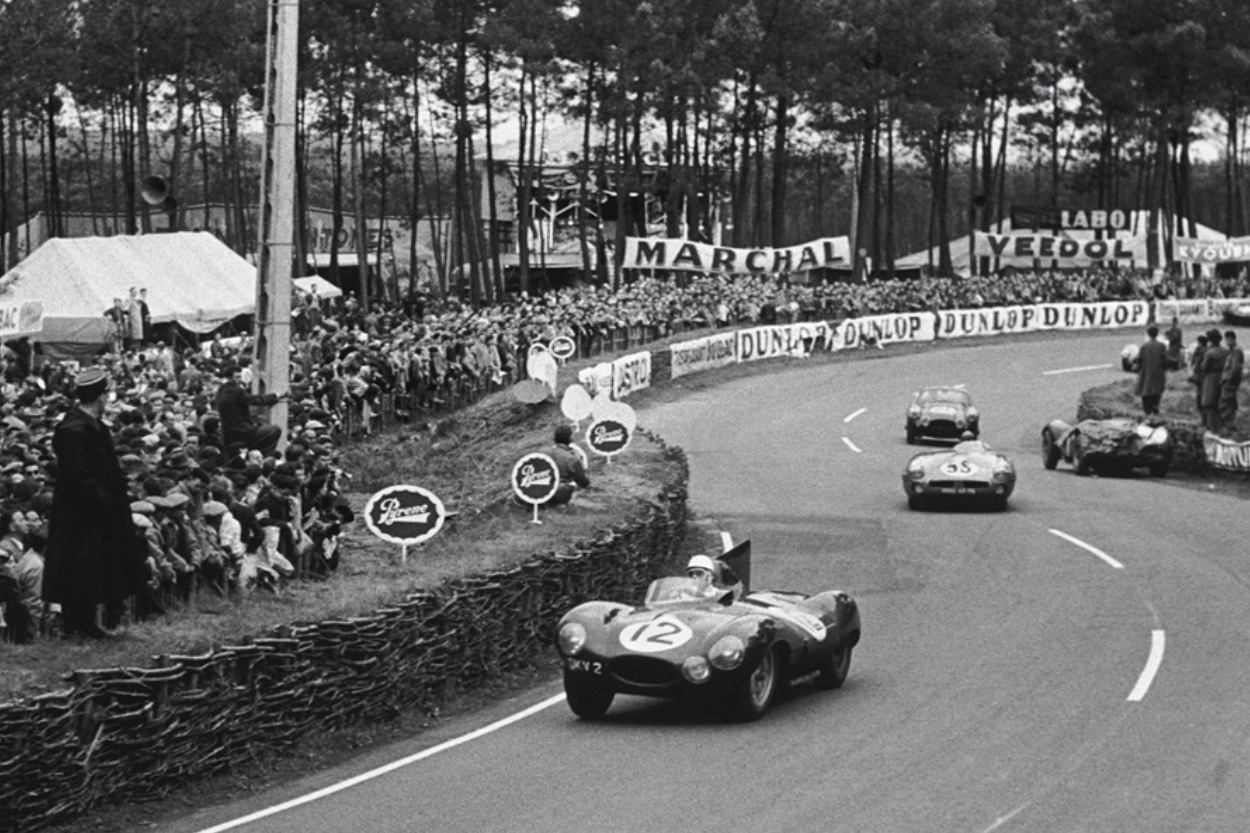
Before the 1936 Winter Olympics, (above) where he was a member of the British team, McEvoy had proved his daring and speed as a tobogganist on the famous, dangerous Cresta Run at St Moritz, Switzerland where he was awarded the ‘Cresta Colours’ that year for his accomplishments.

Keen to compete at the highest level, he would not have been eligible to represent Australia through the Australian Olympic Federation, as there was no State or National governing body for tobogganing or bobsleigh in Australia at the time. In fact there was no sport of skiing at the time to speak of!

Without wanting to give a dissertation on the development of skiing in Australia, the first moves on skis are thought to have been carried out by Norwegian gold-miners at Kiandra in the New South Wales Alps during the long winter of 1861. The first ski-lift was built near Mount Beauty in Victoria in 1936, but in simple terms the Alpine areas of Tasmania, Victoria and New South Wales were not developed as ski-fields until post-war when European migrants, some of whom worked on the Snowy Mountains Scheme (a massive post-war twenty year hydro-power generation and irrigation scheme – one of the ‘engineering wonders of the world) saw the potential of the Australian Alps and made formative investments at places like Thredbo and Perisher Valley. The sport itself did not boom until the 1970s with baby boomers looking for activities a bit more sophisticated than those which were available to, or could be afforded by many of their parents.

‘It is quite likely that he (McEvoy) associated with British bobsledders in Switzerland and was, as a British subject, eligible to compete for the mother country. It would have been difficult for the British authorities to overlook his nomination or prowess’ the Sydney Morning Herald reported.

Freddy was accorded the highest team honour by the British Olympic Committee to carry the British flag at the opening ceremony of the 1936 Games; that does amuse me, an Aussie carrying the flag for the Brits on such an august occasion!

Freddy, captain and steering, British 4 man bob, Garmisch Olympics 1936 (Getty)

Freddy and his team took the bronze medal with four runs down the treacherous bobsled course, finishing behind two Swiss combinations in front of a crowd of about 32,000 people. ‘Suicide Freddy’ was pipped for a medal in the two-man bob, finishing fourth with Garmisch-Partenkirchen well known for its bobsled run on which several men had died. Freddy wasn’t the only motor racer contesting events on the Olympic ice, GP racer Count ‘Tonino’ Brivio was eleventh in the the two-man bob and tenth in the four-man.

Bad weather limited training on the course before the Olympic race and crews had only two or three days’ practice on the fast and difficult run with ‘Britain fortunate to have an experienced and daring driver to steer both the four- and two-man bobs’, the British Teams post event report said.

One of the great bobsledders of the time, Bill Fiske of the US, wrote: ‘Freddie McEvoy has invented one of the most lethal toboggans ever seen on the run. He had a toboggan constructed of hollow ground runners…tremendously fast on a straight course but impossible to manoeuvre around corners…’

McEvoy proved after the 1936 Olympics that he was no flash in the pan. He was second in the Curzon Cup on Cresta in 1937, won the world two-man bob championship at Cortina, Italy in 1937, and the world four-man bob at St Moritz the same year. He retained the four-man title in 1938 and was runner-up in 1939.

Clearly 1936 was a busy year for the enterprising Australian who was said to have won $25,000 playing backgammon in Monte Carlo and then spent the money the next day on a new Maserati.

In fact the Maser 6CM, chassis #1535 was the first such machine to have been sold to a privateer, Maserati’s new Voiturette model first appeared in March 1936.

GP Picardie. #6 Carlo Trossi Maser 6CM, #2/#44/#14 B Bira, Earl Howe and Patrick Fairfield on ERA Type B, Type B and Type A (unattributed)

Freddy first entered his new six-cylinder, DOHC, supercharged 155bhp machine in the Grand Prix de Picardie held at Peronne in mid June 1936.

In a splendid display, he was fourth in both his heat and in the final won by Dick Seaman’s Delage in a year of dominance in Voiturette racing which carried the talented Englishman into the Mercedes Benz Grand Prix team.

John Medley wrote of the race ‘…On a scorching hot day the two heats saw the demise of Raymond Mays’ extremely quick ERA and also that of Arthur Dobson, with wins to Trossi and a surprisingly much slower Dick Seaman. Lehoux’ works ERA failed on the line in the final, which was led by Fairfield, an off-song Maserati of Trossi, and Bira’s ERA, before Bira moved past Trossi, with Seaman next until his steering (thought to have been damaged in an earlier Nurburgring incident) failed and the Delage hit a wall in the little village of Brie. The same corner in Brie momentarily claimed Fairfield’s ERA from a stern battle with Bira, so the little Siamese Prince won again from Fairfield and Lord Howe in ERA’s and McEvoy’s distant Maserati. There were no other finishers’.

Getting a little ahead of ourselves, Freddy’s Voiturette season commenced during the Monaco GP weekend, the Aussie contested the Coupe Prince Rainier on Saturday 11 April in an earlier Maserati 4CM on the same weekend in which the new 6CM made its race debut.

McEvoy started from grid 14, with Earl Howe on pole in an ERA Type B, and ran well until lap 43 when he spun on oil left by Zehender’s Maser 6CM and hit a wall damaging the cars fuel tank. This meeting was the first at which 6CMs raced, Scuderia Torino entered a car for Rovere, with Zehender relieving him in the 6CM late in the race. McEvoy  ran as high as eighth, the race was won by B Bira in an ERA Type B who ‘…took the chequered flag to take the first victory of his career, winning possibly the most prestigious voiturette race of the year only 392 days after making his race debut in a Riley Imp at Brooklands’ according to kolumbus.f1.

Albi GP. #4 Marcel Lehoux ERA Type B, #8 Patrick Fairfield ERA Type B, #10 Bira again B Type ERA with #26 the nose of McEvoy’s Maser 6 CM (unattributed)

At the Albi GP in mid-July, Freddy was ejected from his car in spectacular fashion during the first heat. The car caught fire after rolling across the straw bales opposite the pits, the car then burned furiously. Aggregate results of the two heats gave the win to Bira from Pierre Veyron and Hans Reusch in ERA Type B, Bugatti T51A and Maserati 4CS respectively.

The Coppa Ciano was held at Livorno in early August on a new course through the town rather than the usual mountain layout used hitherto, Trossi won in a works 6CM with Freddy eighth, two minutes behind the leader.

Coppa Acerbo. #8 Dick Seaman Delage 15S8, #2 Carlo Trossi Maser 6CM and #22 Bira ERA Type B (unattributed)

On the daunting Pescara road circuit on the Adriatic Coast in mid-August he was a strong fourth in the Coppa Acerbo having started fifth on the grid with Seaman again taking a Delage win.

In a busy month, in late August, the Berne GP was conducted on the Bremgarten road course in Switzerland. Freddy was seventh from grid ten in a chassis MotorSport said  ‘…was the most dangerous Maserati, an independently sprung Maserati which should have done well’.

Freddy, far from the most experienced driver on these grids was clearly no dilettante behind the wheel however many attractions and distractions there were sitting seductively on his pit counter. It does make you wonder what McEvoy could have achieved had he focused on his racing, but such was his zest for living life to the full that this was never the case. Wine, women and song sounds pretty good to me all the same...

Marne GP 1936, the growth of French sportscar racing as a response to the success of the Nazi funded German teams is an interesting story in itself. #6 Rene Dreyfus and #8 Andre Marcel Talbot T150C split #12 Jean-Pierre Wimille Bugatti T57G- the similar Bugs of Robert Benoist and Pierre Veyron on the row behind. #34 and #26 the Michel Paris and Laury Schell Delahaye 135CS. The Paris car is the 135CS shortly thereafter imported to Australia and raced by John Snow- and to an AGP win at Leyburn, Queensland in John Crouch’s hands in 1949. McEvoy’s Jag 100SS way back in the pack (Keystone)

In the middle of the year, on July 5 Freddy also contested the sportscar Marne GP at Reims in a 2.5-litre Jaguar SS100. He brought the ponderous beast home fifteenth overall and first in the 2-3 litre class, the patriotic MotorSport proclaiming an ‘S.S Wins A Continental Race’- they credit the race to Frank McEvoy, an error rather than another nickname.

John Medley ‘…Fast Freddy McEvoy, almost lived up to his other nickname ‘Suicide Freddy’ as he grappled with its nose-heavy understeer which flicked to alarming oversteer on exit to every corner on the very fast Reims-Gueux Circuit. Playing what MotorSport called ‘a waiting game’ (when actually he was travelling as fast as he dared) a long way behind the winning Bugattis which were chased by Talbots and Delahayes, brave Freddy brought the car home for a class win…’

It would be intriguing to know exactly when McEvoy first raced, his cv included the blue-riband sportscar Mille Miglia in 1935, it was certainly the first major race he contested. In that classic test of driver and car he shared a Vittorio Jano designed Alfa Romeo 6C1750 with Ghersi, the pair failing to finish the race won by another memorable Alfa, the 8C 2900B raced by the Pintacuda/Della Stufa crew.

In October 1936 Freddy was well enough funded by his various enterprises and acquaintances to contest the Vanderbilt Cup Races on New York’s Long Island, representing Australia in the 6CM.

This was an amazing event held on a very expensive facility by the standards of the day built by the Vanderbilt family and several associates including Indy winner Eddie Rickenbacker. It seems the designers of the track, who lived on opposite sides of the country, failed to communicate, so the track ‘comprised a single 3775 foot straightaway and sixteen completely unbanked corners, ten of which are best described as hairpins.’

A huge purse attracted some of Europe’s best teams, the race was a real endurance affair, 75 laps of a tight four mile road course circuit, 300 miles in total. Tazio Nuvolari won aboard an Alfa Romeo 12C-36 in 4 hours 32.44 from Jean-Pierre Wimille’s Bugatti T59 and Antonio Brivio’s Alfa 12C-36. In sixth place was Freddy proving his endurance on the hot day driving the 6CM, his time 4:57.24. Mind you, Carlo Felice-Trossi co-drove the 6CM, how many laps each of the intrepid pilots raced is undisclosed.

Freddy McEvoy with the Australian flag on the side of his Maser 6CM, Vanderbilt Cup 1936 (VDC)
Vanderbilt Cup start 1936, ID of cars welcome (VDC)
McEvoy Maser on one of the more open corners on a course dominated by tight corners (VDC)

McEvoy’s activities after 1936 are really beyond the scope of this article but he continued to compete at the highest levels of bobsleigh racing, this is covered at the end of the piece.

In 1937 he won $10,000 for setting a record time between Paris and Nice of 9 hours 45 minutes in a Talbot-Lago T150C SS coupe. He was the first person to do the trip from the capital to the Riviera in less than ten hours aboard the 4-litre, six-cylinder OHV, 170 bhp machine.

McEvoy’s personal note of thanks for the use of the Talbot makes clear the spelling of the short form of his name (unattributed)

As war broke out, the Australian was reluctant to apply his undoubted bravery to the war effort and left Britain to continue his playboy lifestyle on the French Riviera, and later New York and Hollywood. His fisticuffs it seems were limited to the odd scrap with husbands of ladies who were miffed by his attention to women who succumbed to his considerable charm.

Freddy shared a house with the by then notorious Errol Flynn in Hollywood, they enjoyed many adventures, including diving expeditions to Mexico. McEvoy was a key witness for Flynn in his infamous statutory rape case in 1942-43. This involved allegations of under-age sex by seventeen year Betty Hansen. Said events purportedly took place in McEvoy’s Bel Air home, his ‘no-nookie here matey’ protestations helped the actor get off the charges. Flynn credited McEvoy in assisting him recover from a growing dependency on opium by burning the actors stash of the drug, their friendship survived the fight which ensued when Flynn realised his drug syringes were ablaze in an adjoining room.

The actor, quoted in Mike Seth-Smith’s book on the Cresta Run, says: ‘I found that he complemented me. He was an athlete, a roisterer like myself, and he could be canny too, very. He had his eye for the main chance and bluntly told me he intended to marry wealth. With his physique and appearance and his charm and culture I didn’t doubt he could do this.’

Flynn and McEvoy at Monte Carlo in 1950 just prior to Flynn’s marriage to Patrice Wymore. Freddy was best man and Claude Stephanie Filatre, McEvoys third wife, the other witness (unattributed)

Suspected as spies in the 1930s, the US authorities monitored the activities of both Flynn and McEvoy with the FBI eventually concluding Freddy was ‘an international pimp who is interested in his own well being and probably not engaged in activities detrimental to the interests of the country’. In the same period, 1944, it is said the hustler smuggled guns, jewellery and alcohol from Mexico City to California on his boat, as his second marriage did not yield much cash.

McEvoy scandalised high society and fascinated the readership of gossip columns in equal measure. ‘A debonair socialite, he courted infamy as one of Hollywood’s self-styled ‘Hellfire Club’ or ‘Three Musketeers’ along with Errol Flynn and Bruce Cabot of  ‘King Kong fame’ and was usually characterised by newspapers as a ‘handsome gigolo’ or ‘popular playboy’, the big ‘dame hunter’ married three times.

At one society party in Cannes, the already married McEvoy made a play for Woolworth heiress, Barbara Hutton, just divorced from Cary Grant. They never wed but lived together for a time at a ski resort Hutton bought in Franconia, New Hampshire. In a sidebar to this liasion, our intrepid racer was beaten up by some thugs who set up the initial meeting between McEvoy and Hutton after Freddie failed to pay the ‘facilitation fee’! I guess ‘Tinder’ always existed in one form or another whatever the technologies of the day.

Although he failed there, Freddy succeeded in wooing the heiress to an oil fortune, Beatrice Cartwright of the Pratt Family/Standard Oil in 1940. At 63, she was 30 years older than McEvoy and promised him a yacht and a million dollars. McEvoy got the yacht, the 65-tonne Black Swan, but the money never found its way into his bank account. He later married a second heiress, Irene Wrightsman, at 18 years old less than half his age but they drifted apart after Irene’s father removed her access to the family loot.

McEvoy’s third and final wife was Claude Stephanie Filatre, a French fashion model. They married in 1949 and made their home aboard a 104-foot ketch/schooner called Kangaroo or Black Joke depending upon the account you choose to reference; there are plenty of conflicting accounts about many aspects of this mans life as I hope I have made clear.

The boat struck a reef off the Moroccan coast 60 miles from Casablanca during a storm off North Africa in 1951. There is some speculation that McEvoy was running arms or grog between his home port of Cannes and Tangiers. He made it to the shore and sought help unsuccessfully from a small settlement at Safi. Freddy returned to the floundering boat to rescue Filatre, but this time his luck ran out. McEvoy’s body, naked and scalped was in a lagoon/washed up on the beach on November 9, 1951 and his wife’s body the next day.

It transpires that one of the ships crew was wanted for murder of a prostitute in Berlin in 1945, that man, Manfred Lentner was later convicted of the murder in a Salzburg court in May 1954. Further, at the time of the ‘shipwreck’ British Intelligence had been tracking McEvoy as a suspected arms-dealer and smuggler of contraband between Tangiers and France, so to the very end of the racers story there was plenty of mystery and intrigue including £15,000 worth of diamonds and whisky onboard the ship. A French court convened in Morocco found  a verdict of murder by persons unknown of McEvoy, Filatre, her maid and three sailors, no-one was ever charged.

Fast Freddy, at best an elite level sportsman and likeable scallywag but perhaps more accurately described as an outstanding sportsman and amoral crook and scumbag certainly did not die guessing about the possibilities of life, without doubt he lived it to the full.

Put more delicately, ‘Sport was but one aspect, albeit perhaps the only honourable one, of his forty-four years on earth. His reputation was variously as an unprincipled playboy, suspected spy, alleged smuggler, dubious adventurer and unhealthy close associate of one of Hollywood’s most iconic but least reputable stars. He was one of the few Australians about whom the standard phrase in obituaries, ‘he led life to the full’ is an understatement’ wrote Max Everest-Phillips.

 Maserati 6CM…

‘Voiturettes’, cars of smaller capacity than machines of the contemporary Grand Prix formula went back to the dawn of motor racing, but the class grew in importance with the introduction of the 750 kg Formula.

There had been no official capacity limit since 1926, although the Voiturette class was usually for cars of 1100cc. During the 1930s the category was increasingly held for machines of 1500cc, it was attractive to smaller teams and privateers given the growing expense of GP racing. To that end Maserati introduced the 4CM-1500cc four-cylinder in 1932, with the 6CM a response to the Riley based ERA’s pace, these first raced from 1934.

The 6CM chassis was the usual channel section of the day but heavily boxed as Maserati were beginning to realise the importance of chassis rigidity. Front suspension was similar to the very unsuccessful V8RI GP car with independent suspension by unequal length wishbones and friction dampers up the front. At the rear, a rigid axle was deployed suspended on semi-elliptic springs. The body of the car was similar to the V8RI with a cowled radiator and neat streamlining.

The Fiat parts bin provided quite a few bits including the steering box and gearbox. The ‘tranny was a 4-speeder designed for use in the Fiat Tipo 522 taxi and was considerably overstressed given the cab had a paltry 34bhp. There were plenty of gearbox dramas until Maserati started to make their own ‘boxes. The rear axle was made by Isotta Fraschini.

The heart of the matter was a six-cylinder engine of 1493cc which had the cylinders cast in pairs, and twin overhead camshafts driven from the nose of the crank in established Maser practice. A single Weber carb, Roots type blower, Scintilla magneto and dry sump lubrication completed the key mechanical specifications. The neat little motor was claimed to produce 155bhp @ 6200 rpm early on which rose to circa 175bhp over time.

Cigarette card honouring the 1938 4-man bob world championship winning British team with Freddy up front

Freddy’s Alpine Career in Perspective…

Freddy was one of the great sportsmen of his era and in bobsleigh racing one of that discipline’s all-time greats.

He was a pioneer of a sport which was then very dangerous, the medal he won at Garmisch in the 1936 Olympics made him the first Australian to win a Winter Olympics medal albeit representing the mother-country, England.

Over the next three years captaining the British team and piloting the bobsleigh he won two world championships on the trot in 1937 and 1938, that later year beating ‘the master race’ in front of their home crowd in Nazi Germany. He took silver the year after that.

In total he won three Gold and two silver World Championship medals in two different forms of the sport – the four and two man ‘bobs – and was the first ever competitor, (along with his partner in the two-man bob) to win gold in both events in the same year. He set one last course record in 1939, covering the 1554 metres of the Italian World Championships run at Cortina d’Ampezzo in a time of 1 minute 20.75 seconds. It was also in Cortina where he won his first World Championship gold in the two-man bob in 1937.

 It was only the outbreak of war which put an end to his short career. He was the only sportsman from Australia to receive a medal in any of the five founding sports of the Winter Olympics.

Max Everist-Phillip’s, Director of the United Nations Development Programme’s Global Centre in Singapore in a 2015 ‘Numismatic Association of Australia’ article entitled ‘Bobsleigh in a Warm Climate: Pre-war Australian Identity on The Slide’ goes as far as to say that ‘…McEvoy’s 1938 bobsleigh triumph (World Championship Gold) in Nazi Germany represents not just an Australian achievement in an unusual sport from a different era. In the run up to World War 2, the success of the Australian-British team carried political significance. It marked a triumph for the democratic ideal over the Third Reich’s totalitarian ideology and the ‘master race’. Its win offered a psychological boost to the British Empire in the lead up to World War 2. Nazi propaganda sought to claim the German people trained in the body in the service of the state and so international sporting success supposedly demonstrated the might of the ‘new Germany’, thereby apparently justifying its claim for ‘Lebensraum’ and racial supremacy. The victory gripped the popular imagination increasingly interested in the sport’.

Spectators on a bend and the finishing section of the bobsleigh run, Garmisch, 1936 Olympics

Bibliography…

’Maserati: A Racing History’ Anthony Pritchard, ‘John Snow: Classic Motor Racer’ John Medley, kolumbus.f1, MotorSport magazine, Journal of The Numismatic Society of Australia article ‘Bobsleigh in a Warm Climate: Pre-War Australian Identity on The Slide’ by Max Everest-Phillips, barchetta.cc

 Photo Credits…

 Getty Images, vanderbiltcupraces.com

Tailpiece: Thank Your Lucky Stars…

(unattributed)

Errol Flynn in the scene from ‘Thank Your Lucky Stars’ in which McEvoy, although unattributed in the credits, appears at right

Finito


image

Frank Matich, Brabham BT7A Climax tries to outbrake Bib Stillwell #6, Brabham BT4 Climax, December 1963…

Photographer John Ellacott upon posting this shot online described it as ‘the two great rivals on Hume Straight’…Matich braking down the outside on the run into the slow second gear ‘Creek Corner’. Frank’s car was brand new, just unpacked, it had only turned a wheel for the first time several days before the 1 December ‘Hordern Trophy’, the final round of that years Gold Star, the Australian Drivers Championship.

Frank’s car was fitted with 2.5-litre ‘Climax FPF, Bib’s older chassis had an ‘Indy’ 2.7- a fair duel, one guy with the edge in chassis perhaps and one with a bit more power?

Stillwell led from the start of the 34 lap race and then FM began to reel him in, finally catching the Victorian on lap 20, the pair tangling in The Esses. The collision was enough to put Matich out of the race but Stillwell finished fourth, the race was won by John Youl in his Cooper T55 Climax 2.5 from David McKay’s ex-Brabham BT4.

frank and bib wf discussion
Frank left and Bib – looking very natty is his BRDC blazer – developing his listening and empathy skills by the look of it after the Hordern Trophy. Great rivals with a lot of respect for one another’s abilities (Sports Car World)

In the 1964 Tasman Series which followed the month after this race Youl was the most successful of the locals. Stillwell only contested three Australian races gaining a strong second in the AGP at Sandown whilst Matich was prodigiously fast but had woeful reliability, we shall pick up the Tasman shortly.

I described the rivalry between Frank and Bib in a post about the Stillwell Cooper Monaco;

It’s fair to say Stillwell, born 31 July 1927 took a while to mature as a driver. He started racing MGs in the late 1940s and as his motor dealerships became more successful throughout the 1950s he acquired and raced some expensive, fast cars, D-Type Jag and Maser 250F included. By the time he commenced racing Coopers he had well over 15 years of experience and was ready to take on anybody, winning his first Gold Star in 1962 and the last in 1965, four on the trot.

Matich, born 25 January 1935 was a more precocious talent who first competed in an MG TC at Foley’s Hillclimb circa 1954 and raced seriously from later in the decade after selling his Austin Healey and purchasing the ex-Frank Gardner Jaguar XKC. He soon drove cars for Leaton Motors who employed him as Sales Manager. Bib was more the silver-spoon-special born on the right side of the tracks and funded into his first dealership with family money. Mind you, whatever Bib started with he multiplied many times over, he was an extremely successful businessman in Australia and then became an executive of global calibre inclusive of being President of the Gates Learjet Corporation in the US.

Frank, the young pro, was cut from totally different cloth. He was educated at De La Salle College, Marrickville in Sydney’s inner west and was apprenticed as a 15 year old Diesel Engineer at Sydney’s Kurnell Oil Refinery before progressing through Butlers Air Transport and in 1954 to Selected Sportscars where he first came into contact with the Englishman who owned the MG TC Frank prepared, and both men raced.

FM’s ability and gift of the gab attracted patrons and commercial support from very early on in his career, Matich too was shortly to do well out of the business of motor racing with Australian franchises for Firestone, and later Goodyear racing tyres, and Bell helmets, apart from the sale of some of the Matich sports and F5000 cars he built.

Matich and Stillwell were intensely competitive, driven, successful men, they had far more in common I suspect than not, especially in terms of mindset and will to win. The battles between the pair were absorbing, Matich very quickly got on the pace of the big 2.5 Climax Formula Libre cars (the 2.5 Tasman Formula started in 1964, Australia’s national F1 ANF1 was F Libre till then), having come out of powerful sportscars- Jags C and D Types, Lotus 15, 19, 19B and small bore single seaters, works-Elfin FJ Ford and Elfin Catalina Ford 1.5.

At the time, these 2.5/2.7 litre F Libre/Tasman cars were the fastest road racing cars in the world, F1 having changed from a 2.5 to 1.5 litre formula from 1 January 1961. Given his experience it was not a surprise when Frank was on the pace straight away as he jumped out of his Lotus 19B sporty and into the new Brabham acquired with the French Oil Company, Total’s, support.

Well before the Tasman Series commenced in 1964, we had a strong International Series of races in Australasia in January/February, with enough of the best in the world to test the locals in equal cars Matich was more than a match for any of them. So was Bib on his day.

matich wf private practice brabham
Matich mounted up and ready for his first test of the naked BT7A, devoid of all signwriting and in civvies at Warwick Farm the week before the Hordern Trophy above. Brian Darby, at the rear, picked the car up from the Port Melbourne wharves the week before, Bruce Richardson is the other mechanic in shot. Note reinforced wide based top front wishbone and rubber mounted ball joint, inverted wishbone at the top and single lower link in the rear suspension. The later BT11A had the opposite rear set up, single top link and inverted lower wishbone (John Ellacott)

Matich was very quick in the Brabham throughout that ’64 Tasman Series and the short period in which he raced the BT7A, its interesting to look back at his time in the car. The late 1963 pre-international events in New Zealand are covered in this article here;

The first 1964 international was at Levin, which Frank missed, at Pukekohe, the NZ GP on 11 January, he ran strongly behind Brabham, McLaren, Tim Mayer and Hulme. He passed Mayer for third only to pop his engine on lap 26, McLaren won the race in a Cooper T70. After Puke he shipped the car home to Australia and re-joined the circus at Sandown on February 9. There he ran ahead of the locals before suffering crown wheel and pinion failure on lap 4.

At the Farm, Matich’s home turf, he started from pole, followed Jack away, then passed him but muffed his braking at Creek and ran off the road. Off to Queensland, at Lakeside, he was driving away from everybody before the engine let go, a Weber ingested a stone and the expensive motor went ka-boom on lap 8. After the long tow to Tasmania he finished third in the race won by Graham Hill’s BT4 and was first of the locals despite a misfire, and a revolution amongst his mechanics who pushed the car onto the grid but left his employ after the race.

Ray Bell wrote that ‘He had a mixed bag of results in shorter races during the middle part of the year, taking a number of outright lap records, then came the Gold Star closing events. Lakeside…pole and the lead before an oil line came adrift; Mallala he didn’t turn up (Stillwell basically could not be beaten for the Gold Star by this stage) and he led the Hordern Trophy till half distance before yet another engine failure’.

The 1965 Tasman Series was won by Jim Clark’s Lotus 32B Climax. Despite not contesting the four Kiwi rounds Matich was right on the pace at Warwick Farm, the first Australian round, starting from pole and leading to Creek corner, he then raced with Brabham behind Hill and Clark up front. ‘Both Hill and Matich had troubles in this race with cement dust getting into the steering, Hill spinning on the last lap because of it and failing to finish. Matich was third behind Clark and Brabham’s BT11A, Stillwell (BT11A) was thirty seconds behind him’ wrote Bell.

matich bt7a lakeside 1964
Matich in his semi-nude BT7A in the hot 1964 Lakeside summer sun, puddle notwithstanding! He is trying to stay cool in the searing Queensland heat, lower side panels removed. Shot shows the proximity of the aluminium side fuel tanks containing lots of Avgas, no rubber bag tanks prior to circa 1970 (Peter Mellor)

Down south at Sandown he ran just behind the internationals ahead of Stillwell only to retire with ignition failure, a rotor button on lap 10. During the AGP at Longford he pitted with suspension problems on lap 5 whilst best of the locals having run in sixth place. At Lakeside he contested the non-championship Lakeside 99 and made it a real race dicing with Clark on this high speed, demanding circuit for most of the race. ‘They traded places many times, but Matich did have a pitstop and lost some laps before rejoining the battle’. It was a race FM rated as one of his best.

Into the domestic season Stillwell won the Victorian Road Racing Championship Gold Star round in April after a couple of Matich spins, albeit FM was second despite a failing engine, and started from pole a half-second clear of Bib.

That was all the racing he did in that car. At Lakeside’s Gold Star round in late July, he crashed his Lotus 19B Climax, he took the sportscar to the meeting to test it in advance of the Australian Tourist Trophy which was held at the circuit later in the year, was burned and hospitalised and in the aftermath Total took the decision to cease their racing program and sold the cars and parts.

The story of the next phase of Frank Matich’s career in sportscars, initially with the Elfin 400 aka ‘Traco Olds’ is told in links within this article.

Frank Matich was one of Australia’s many F1 mighta-beens, to me the most likely to succeed of all, but with a young family and business ties in Oz it never happened despite offers being made to him on more than one occasion to go to Europe. As noted, Matich didn’t race single seaters for long at this stage of his career, from 1963 to 1965, racing sports cars very successfully until 1969 when he came back to open wheelers with the advent of F5000 – where he was a star as both a driver and constructor. Click here for an article on this phase of his career;

It’s a shame he didn’t drive Tasman 2.5 cars throughout this golden-era of single-seater racing in Australasia, his battles against the internationals as well as the local hotshots in both Tasman races and domestic Gold Star competition would have been sensational. Matich mixing it with Bartlett, Martin, Geoghegan, Harvey and the rest would have added depth to Gold Star fields which were increasingly  skinny as the decade wore on.

Stillwell retired at the end of 1965, he was certainly as quick as anybody on his day and arguably had not quite peaked when he did retire. No less an observer of the local scene than journalist/racer/Scuderia Veloce owner David Mckay believed that by 1965 Stillwell had reached F1 standard, not least for his ability to drive fast without mistakes or destroy the equipment.

brabhams longford 1965
Intercontinental Brabhams at Longford, AGP 1965. Stillwell’s dark blue #6 BT11A (6th), Matich BT7A (DNF) and Frank Gardner in Alec Mildrens yellow BT11A (eighth), the race won by Bruce McLarens’ Cooper T79 from Brabhams’ BT11A (Kevin Drage)

The Intercontinental Brabhams…

brabham caversham bt4
The first of the Intercontinental Brabhams. Jack in BT4 ‘IC-1-62’ on its debut at the Australian Grand Prix, Caversham, WA on 18 November 1962. He retired after colliding with another car whilst lapping him, Bruce McLaren won in a Cooper T62 Climax (Milton McCutcheon)

When Jack started his climb to the top in Europe he returned and raced in Australia each summer, bringing a Cooper with him and racing it successfully, then selling the car to one of the locals before returning to Europe. It was a nice little earner and helped fund his way in Europe as he fought to gain a toehold in international competition.

Cooper sold a lot of cars in Australia, Jacks business brain was as sharp as his cockpit skills so it was natural that some of the earliest Brabham production racing cars were for Australasian Formula Libre and from 1964, the 2.5 Tasman Formula- which in effect meant cars built for Coventry Climax FPF ex-F1 engines- 2.5 litres but increasingly 2.7’s after Jacks successful Indy 500 run in 1961 in the Cooper T54 with its 2751cc FPF engine. The Tasman Formula mandated 2.5’s of course.

Soon Repco were making Climax parts and eventually building the engines in totality under licence in Australia. The bits were plentiful which was just as well as the level of competition was such that the long stroke donks were being pushed well beyond their limits with spectacular blow-ups fairly common.

stillwell lakeside 1963
Bib Stillwell in his BT4 Climax ‘Lakeside International’ 1963, 2.7 FPF powered. 3rd in the race won by John Surtees Lola Mk4A Climax 2.7 (Bruce Wells/The Roaring Season)

The first Intercontinental Brabham, i use that descriptor as that was the chassis prefix for each car (‘IC’), the design intended for the shortlived Intercontinental Formula created in response to the new 1.5 litre F1- was the BT4 based on the first Brabham GP machine, the 1.5 litre Coventry Climax FWMV V8 powered BT3.

The first Brabham, retrospectively referred to as ‘Brabham BT1’, was the MRD, an FJ machine first raced by Gavin Youl with the BT2 an evolution of the MRD/BT1. The Intercontinental cars which followed the BT4 were the BT7A in 1963 and BT11A in 1964, both F1 cars adapted for Climax FPF engines.

Some incredibly talented guys raced the ‘IC’ Brabhams- Internationals such as Brabham, Hulme, Gardner, Hill and Stewart as well as Australian champions including David McKay, Lex Davison, Stillwell, Matich, Spencer Martin, Kevin Bartlett, John Harvey, John McCormack and other drivers in New Zealand and South Africa.

Jack Brabham won Australian Grands’ Prix in a BT4 and BT7A in 1963 and 1964 respectively. The cars won the Australian Drivers Championship, the Gold Star for Stillwell in 1963 and 1964 aboard his BT4, in 1965 with a BT11A and for Spencer Martin, again BT11A mounted in 1966 and 1967.

hill and stillwell longford brabhams
Graham Hill ahead of Bib Stillwell, BT4 Climaxes, first and fourth. South Pacific Trophy, Longford March 1964 (Rod MacKenzie)
bib stillwell wf 1965 bt11
Bib Stillwell in his final and successful Gold Star year 1965. BT11A at Warwick Farm. His final year of racing, he had a top year in the car at WF, finishing fourth in the Tasman race albeit behind Matichs’ BT7A in third and first in the Hordern Trophy at the end of the year (John Partridge Collection)

The ‘Brabham IC Australian party’ ended in 1968 when Kevin Bartlett won the Gold Star in BT23D/1, a one off car built for Alec Mildren’s Team around Alfa Romeo Tipo 33 2.5 V8s he secured to add a bit of Italian flavour to the local scene, Mildren was an Alfa Romeo dealer.

The Intercontinental cars were typically fast Tauranac designs of the period. They had rugged spaceframe chassis, suspension by upper and lower wishbones at the front with Armstrong shocks and coil springs. At the rear there was a single upper link, inverted lower wishbone, twin radius rods and coil spring damper units with adjustable sway bars fitted front and rear. With Jack doing all of the initial chassis setup work the cars were quick and chuckable ‘straight out of the box’.

Hewland HD5 gearboxes were used in the main (Colotti in the BT4) and rack and pinion steering completed the package with the cars clad in a slippery fibreglass body.

brabham bt 4 from rear
Bib Stillwell’s Brabham BT4 Lakeside February 1963. 2.7 litre Indy 2751cc Coventry Climax FPF engine, 58mm Webers, Colotti T32 five-speed ‘box. Rear of the spaceframe chassis apparent. Suspension- inverted upper wishbone, single lower link and twin radius rods for location, coil spring damper units, no rear roll bar here. Stillwell’s cars famously immaculate in preparation and presentation (Peter Mellor/The Roaring Season)

After Repco’s 2.5 litre Tasman V8 engine made its debut in BT19, Jacks victorious 1966 F1 winning chassis, in 1966 the Tasman Brabhams were variants of the BT23 frame (BT23A and BT23E) with the exception of the very last BT31 for the 1969 series. See Rodway Wolfe’s article about BT31 which he owned for many years; https://primotipo.com/?s=brabham+bt31

Once the 1.5 litre F1 ended in 1965 BRM quickly realised a stretched variant of their P56 V8 in a P261 chassis would be a Tasman winner and ‘their endeth the locals’ in Climax engined cars taking on the Internationals similarly mounted on more or less equal terms.

The Repco Tasman V8’s provided a supply of competitive customer engines for locals so the Tasman Formula continued into 1970 with engines capable of matching the internationals when the ever expanding F1 season and more restrictive driver contracts made eight weeks in January/February in Australasia no longer a proposition for the best in the world. With it went a wonderful decade or so of intense but sporting summer global competition in our backyard.

Those Intercontinental Brabhams were gems though and gave both the international aces and local hot-shots very effective tools with which to strut their stuff, not least Messrs Stillwell and Matich…

matich longford grid 1964
The Matich BT7A being pushed onto the Tasman grid, Longford 1964. Steering is Graham Matich, looking down at the rear is Geoff Smedley. Matich finished third, just in front of Stillwell, Graham Hill won the race in a BT4 (oldracephotos.com)

Tailpiece: Wanna buy a car matey, or a plane?…

bib and jack and bedford
Stillwell and Brabham, rivals and friends in the Longford paddock 1965. They are sitting on Bibs’ Bedford truck, BT11A up above…I doubt Jack sold anyone more cars over the years than he did Bib?! Bib put them to very good use mind you (Kevin Drage)

Frank Matich on dealing with ‘Wily’ Jack Brabham…

http://www.motorsportmagazine.com/halloffame/jack-brabham/frank-matich-on-jack-brabham/

(P Stephenson)

As nice a posed portrait of Jack and his BT11A ‘IC-5-64’ as you will ever see. The combination are in the old Sandown pitlane in February 1965 before he went out and won the Sandown Cup from Jim Clark, Lotus 32B and Phil Hill, Cooper T70, all Coventry Climax 2.5 FPF powered of course.

Etcetera…

matich hordern trophy 1964
Matich in his BT7A contesting the ‘Hordern Trophy’ at Warwick Farm in 1964. DNF in the race won by Leo Geoghegan in a Lotus 32 Ford 1.5, a great win for Leo, he and his brother Sydney Lotus dealers, Leo graduated to the ex-Clark Lotus 39 Climax at the end of the 1966 Tasman series (John Ellacott)
matich bt7 longford 1965
The Matich BT7A sitting in the Longford paddock in 1965. DNF with suspension failure in the race won by McLarens’ Cooper T79 Climax. Rear suspension by this stage to BT11A spec (Kevin Drage)
matich magazine
Front page spread in ‘Australian Motor Sports’, no advertising allowed on racing cars in Australia in those days but the colors on the nose of Franks’ Brabham (Leo Geoghegan’s Lotus alongside) are those of ‘Total’ the French oil company who were prominent in Australia at the time, the spread no doubt a ‘cross promotion’ as the modern marketers would call it!
stillwell rcn
Racing Car News and Stillwell’s Gold Star win in 1964. Brabham BT4 Climax.

Photo and Other Credits…

John Ellacott, Milton McCutcheon, The Roaring Season/Peter Mellor/Bruce Wells, Kevin Drage, Rod MacKenzie, The Nostalgia Forum, Australian Motor Sports, Racing Car News, Peter Stephenson

theroaringseason.com, oldracephotos.com, Ray Bell on The Nostalgia Forum

Tailpiece: Matich, Brabham BT7A, and Graham Hill, red BT11A and Clark, Lotus 32B, Warwick Farm 100 1965…

(J Ellacott)

Finito…