Archive for the ‘Features’ Category

rob roy start

(George Thomas)

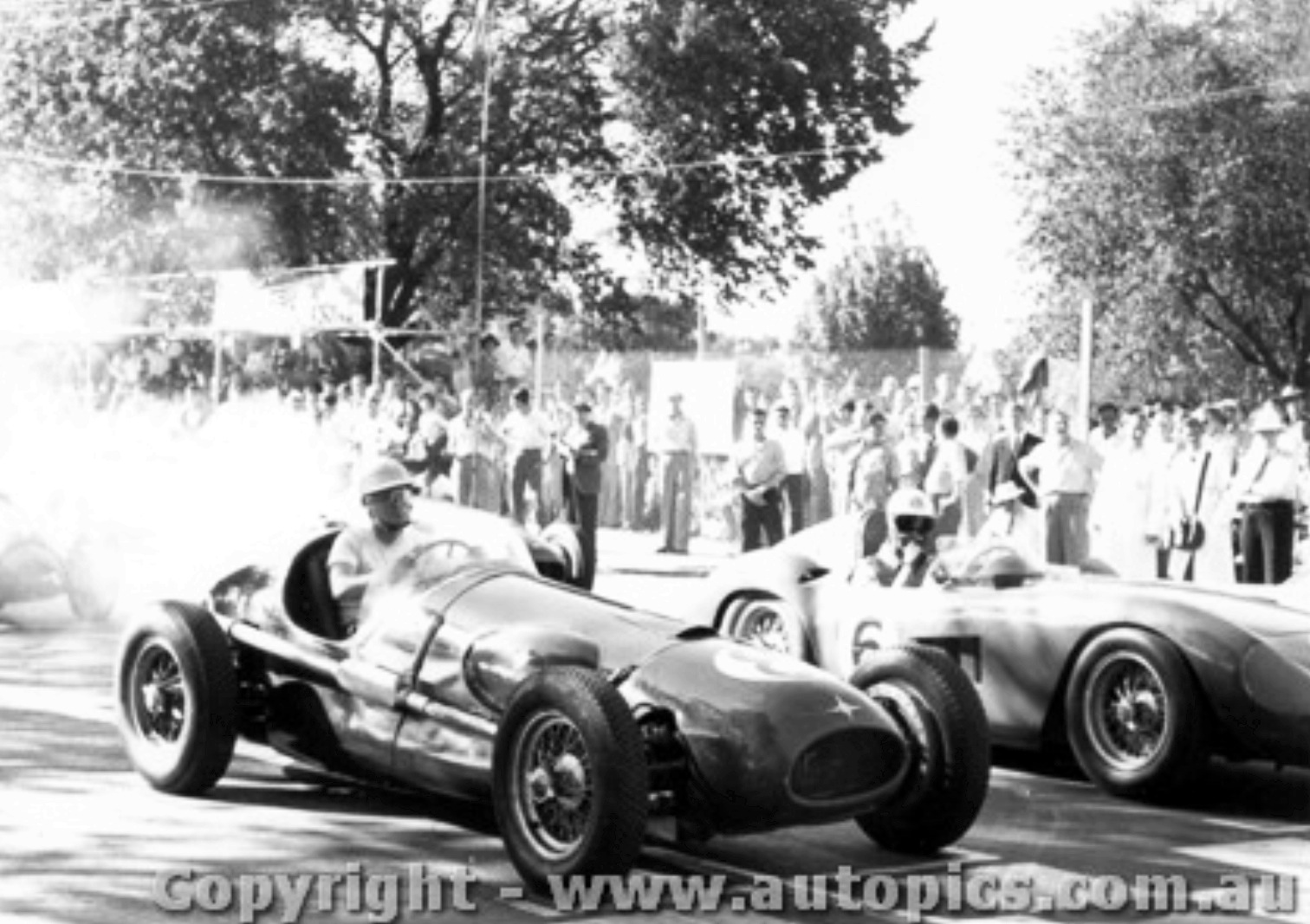
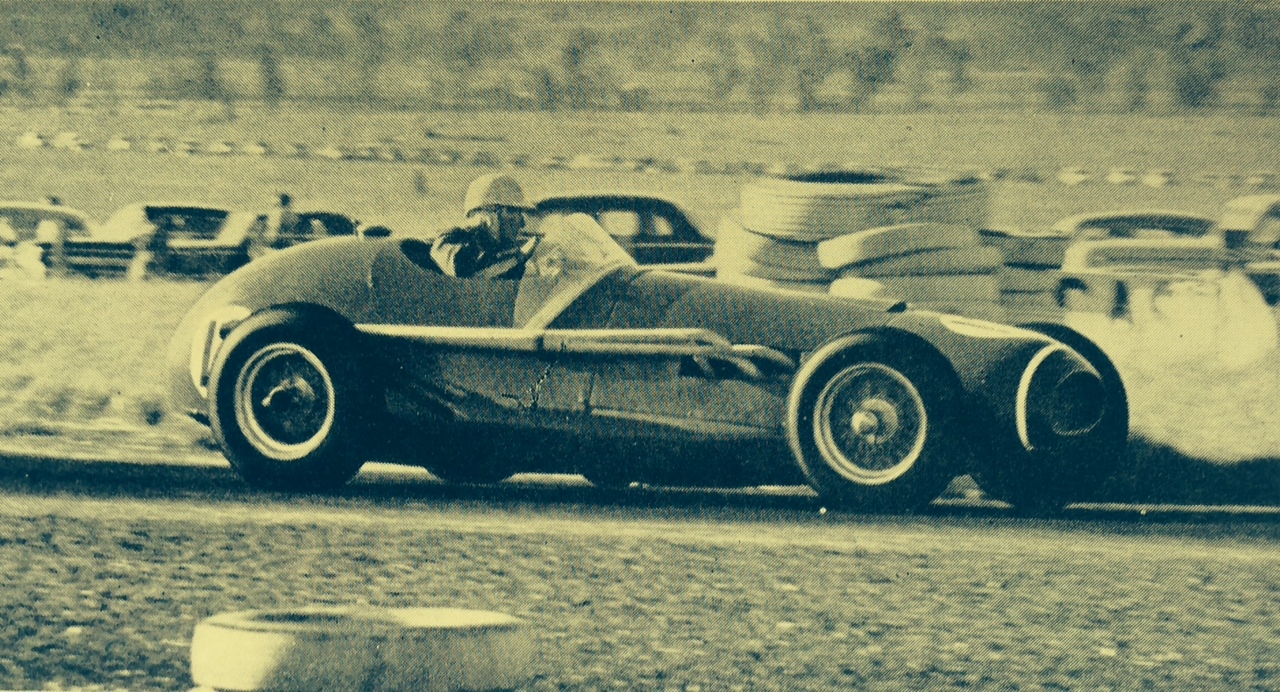
Jim Hawker launches the Chamberlain 8 off the start at Rob Roy, 17 June 1946, the car enveloped in a haze of acrid, blue, two-stroke smoke, spectators ears ringing with the sound of the ‘banzai’ engine at 7000rpm…

Introduction…

As you will see from this article, the Chamberlain 8 is a remarkable car built by equally amazing men, Bob Chamberlain and his brother Bill Chamberlain with later support of some of Australia’s most talented engineers.

This long piece is in two parts with several subsections;

The first is a reproduction of an article about the car written by John Medley published in a marvellous magazine, Barry Lake’s ‘Car’s and Drivers’ way back in 1977.

John is one of Australia’s best known Racing Historians having written for numerous publications in Australia and overseas for years. He is also a racer and author of two books; ‘Bathurst Cradle of Australian Motor Racing’ and ‘John Snow Classic Motor Racer’. In addition he contributed 3 chapters to Graham Howard’s seminal  ‘History of The Australian Grand Prix’.

A subsequent ‘Letter to The Editor’ of ‘Cars and Drivers’ by John Cummins, who worked on the car at Chamberlains’ post war is included as Part 1B to add more detail.

A summary of the cars history post war is written by me (Mark Bisset) based on John Hazelden’s book ‘The Chamberlain: An Australian Story’, John owned the car after the Chamberlain brothers deaths, the book chronicles the ‘Beetles’ full history inclusive of every event in which it participated. This subsection is Part 1C of the article.

The second part draws from a book written about Bob Chamberlain, ‘Chamberlain Australian Innovator’ and his significant engineering and business achievements which were so much a part of the first century of automotive engineering in Australia. The book was was written by Bruce Lindsay.

Part 1.by John Medley…

That which hath been is that which shall be; and that which hath been done is that which shall be done; and there is no new thing under the sun. Is there a thing whereof men say ‘See, this is new?’ It hath been already in the ages that were before us’- Ecclesiastes…

ch side

The Chamberlain Special ‘The Beetle’ with the Indian motorcycle engine in 1929. The light, multi-tubular, triangulated, spaceframe chassis is clear in this shot. 1929 remember! (The Chamberlain)

Australian motor sporting history has seen some quite remarkable instances of original thinking-the V6 1.5 litre Clisby engine, the Waggott four-cylinder engine, Eldred Norman’s Eclipse Zephyr Special, Jim Hawker’s Peugeot V8 engine, the Offenhauser copy based on Salmson engine, to name but a few.

Perhaps the most remarkable of them all, however, was a car created almost 50 years ago in Melbourne. It was (and is) living proof that there is little new under the sun. The mind boggles at the time, patience effort, and skill that went into its construction.

ch drawing

Bob Chamberlains original layouts of the ‘Beetle’ done under candlelight whilst Bob worked in the Mallee, rural Victoria. (The Chamberlain)

Imagine, if you can, a one off special built almost 50 years ago (now 90) and having the following features;

1. A 4 cylinder stepped bore, 8 piston, vertically opposed, supercharged, 2-stroke engine with 2 crankshafts one of which runs through the skirt of the top pistons.
2. An engine which runs to 8000rpm.
3. Twin plugs per cylinder producing 64000 sparks per minute (from 8 coils) at 8000rpm.
4. Front wheel drive with inboard brakes.
5. Four wheel independent suspension.
6. A space frame chassis of small diameter tubes, much of it triangulated.
7. An 1100cc 85+ BHP motor.
8. Virtually the whole car built in Australia.

Any one of these features would have been remarkable and distinctive in 1929 when the car itself was built, or in the early 1930’s when the present engine was inserted. In combination the assemblage of features makes for one of the most amazing cars the world has seen. That it was constructed by a small group of enthusiasts rather than a large and experienced factory makes it all the more remarkable.

beetle

Bob Chamberlain at the wheel of the Chamberlain ‘Beetle’. Circa 1929, car in its original motor cycle engined form.(Chamberlain Australian Innovator)

The car is the ear-splitting Chamberlain Special and its builders are Alan (Bob) and Howard (Bill) Chamberlain (with a little help from their friends). Bob built the original car while Bill built the 8-cylinder, 2-stroke engine.

The Chamberlain last appeared when entered for the Historic racing events at Sandown in 1973. In the early 1950’s it had been put away in a corner of the Chamberlain workshop and more or less forgotten-except when a bit was needed for some project or other, when it was robbed of parts. When it was decided to run the car again in 1973 the Chamberlains found one of the coils, a collection of sprockets, a 2 inch Vacturi carburettor and a large number of racing spark plugs were missing. Replacements had to be found before the car could be enticed from its lair.

It started at the second try after lying idle for about 20 years! The car ran well in private practice on the Thursday before Sandown (mainly practice for Bob Chamberlain who hadn’t raced for 40 years!) A water leak from a corroded engine cover plate was fixed and the car returned to Calder the following day. After an uneventful session Bob stopped and then promptly everything locked solid. At the time they thought it was the clutch but after some dismantling they realised that the problem was the engine bearings. Castrol ‘R’, the vegetable based racing oil which had been in the engine for 20 years had oxidised and gummed up the crankshaft bearings. Castrol supplied a solvent in an attempt to dissolve the mess although they weren’t very confident of its success and, in fact, it didn’t work.

The job of dismantling the complicated engine was just too great in the time available so the car did not race at Sandown, although it was brought along as a static display-a bitter disappointment to its owners and to those who had come to experience the sight and sound of this remarkable car.

bob

Bob Chamberlain in later years with his recreation of the Napier L48 racer. (‘Chamberlain Australian Innovator’)

Bob Chamberlain built the car in 1929, all except the engine being virtually as it is today. The car’s first engine was a big-valve Daytone Indian motor cycle unit. In this form, the road registered car covered thousands of miles but trouble was experienced with the valve gear. A slightly smaller capacity four cam Altoona Indian motorcycle engine was installed, proving more reliable. To increase the capacity and the performance, Norton barrels were fitted to the Indian crankcase. The car now became quite competitive, particularly in sprint events, easily holding the Wheelers Hill (in outer Eastern Melbourne) record for example. It ran in the numerous sprint events run by the Light Car Club of Australia, Junior Car Club and the Royal Automobile Club in Victoria during the period, as well as circuit races at Aspendale (inner Melbourne bayside suburb) and Safety Beach (holiday destination on Melbourne’s Port Phillip Bay).

paper article

The innovative nature of the car was widely recognised at the time, in this case ‘The West Australian’ 30 October 1930.

Entered 3 times for the AGP at Phillip Island, the car was not successful. At the first attempt a piston seized due to the alloy being unsatisfactory. By the following year the Chamberlains had made their own pistons from ‘Y’ alloy and the car completed practice without any troubles. In the race it only lasted 3 laps, when a crankpin broke.

Bob had trouble recalling a third attempt at the Island but checked his records and found that the car was indeed entered and listed as supercharged, although he is sure the car did not actually race in this form. Bob says that the blower was fitted to the Indian motorcycle engine and the compression lowered in the hope of improving big-end bearing life. It didn’t work out that well but this 2 cylinder supercharged engine powered the car at several meetings at Mebourne’s Aspendale Speedway as well as a number of hillclimbs, with some success.

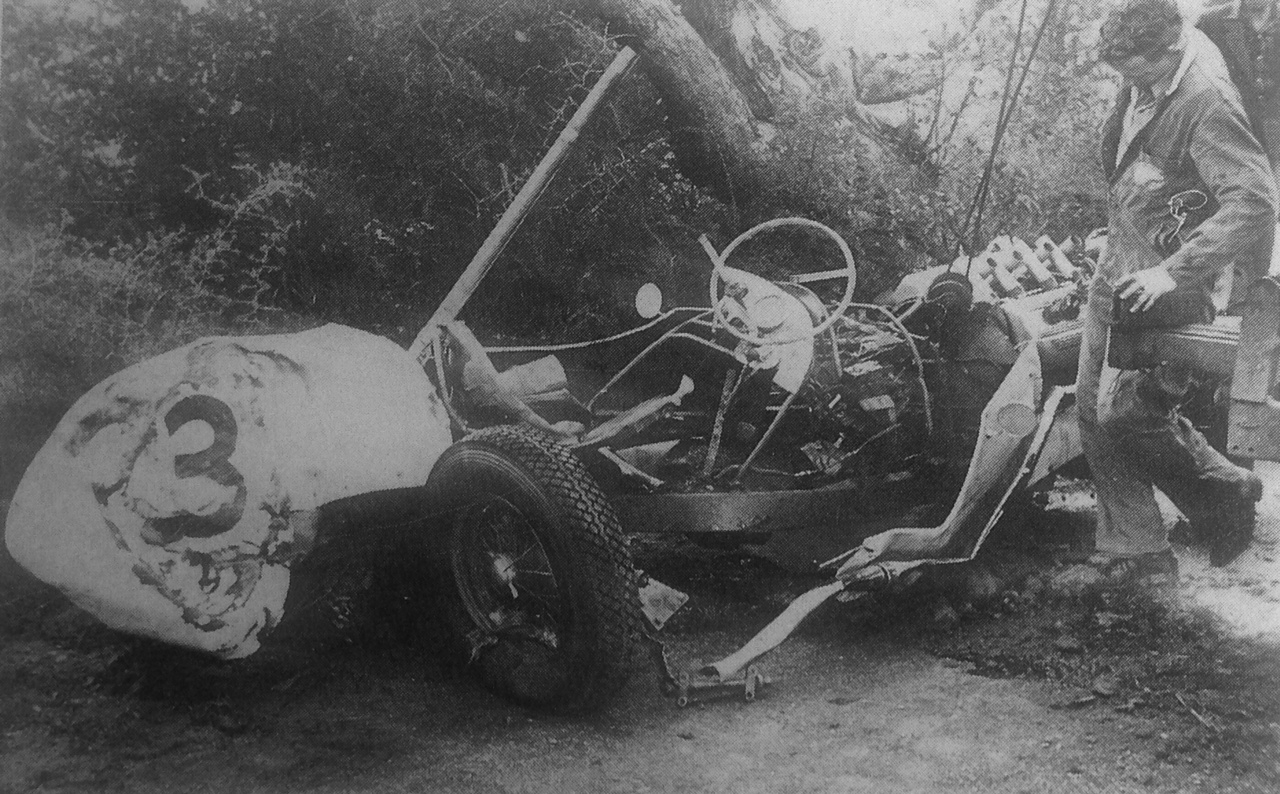
Then, in 1934, in Bob Chamberlain’s first attempt at Mount Tarrengower, the car crashed not too far from the site of Peter Holinger’s 1977 accident. It has been said of Mount Tarrengower that if you make a mistake you have to fight for airspace with the pigeons. Bob Chamberlain was saved from that battle by a stout tree, which he scored at top speed just beyond the finishing line.

hawker

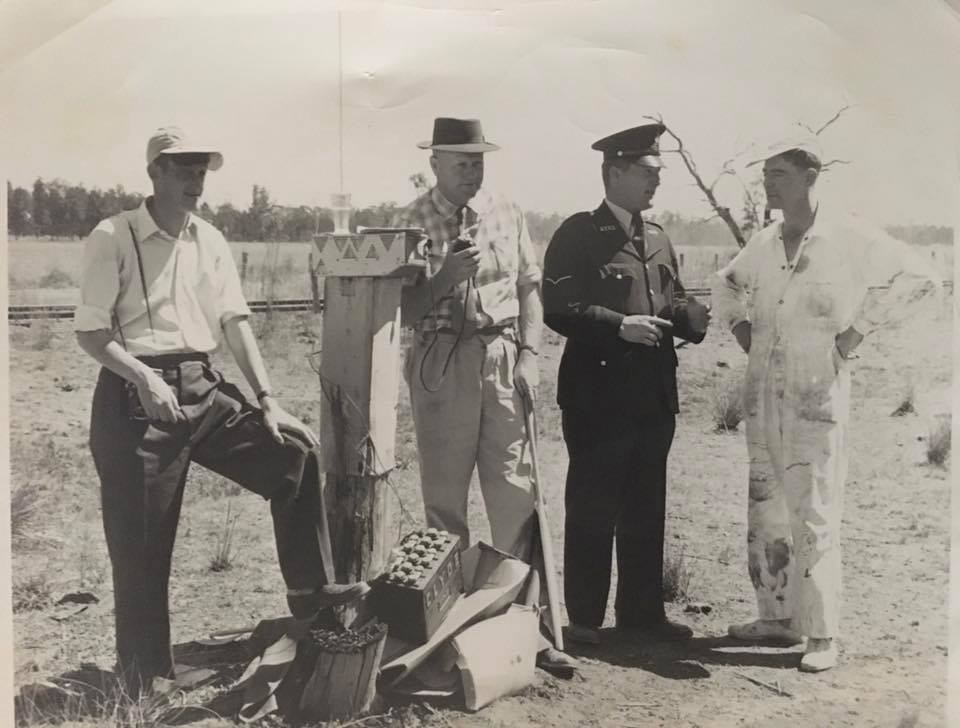
This photo ‘was taken at the second or third Sprint Meeting held by the Australian Motor Sports Club (quite illegally) on the Old Geelong Road, which ran into the back of the Point Cook Air Base (site of the 1948 AGP) . The pits were on the deep verge on either side of the road so ‘The Law’ couldn’t see the line up of cars from the New Geelong Road. You can easily see in this photo a deep crease on the radiator shell. This is the result when Jim Hawker and George Wightman (who was riding passenger) discovered the hard way at the first sprint meeting that a strand of barbed wire across the road was the demarkation of Air Force property and public road. The deep scuttle served to save them from decapitation-only the car bore the scars to tell the tale.(!) John Cummins. (Cars and Drivers)

Shortly after this Bob Chamberlain went overseas, handing the car over to brother Bill, who built and fitted the engine which is in the car now. Even on the plugs specially made in the UK for the car, oiling up was a problem and the Chamberlain did not appear often in the late 1930’s. Significant advances in spark plug design in World War 2 and the deeper involvement of Jim Hawker gave the car a new lease of life in the early post-war years. Once again hillclimbs and sprints echoed to the high-pitched scream of the Chamberlain.

ch engine fitted

The 4 cylinder, 8 piston 2 stroke engine being fitted to the Chamberlain in 1934. (The Chamberlain)

The engine resembled a design by W Jamieson (not to confused with the famous Murray Jamieson who designed the twin-cam Austin 7 engine and later the ERA engine) which was publicised in the early 1930’s. To the Chamberlains to build one for fun ‘seemed like a good idea at the time’.

The layout, though similar to the Jamieson design, used stronger parts. A Henderson motorcycle crankcase casting, suitably machined, formed the basis. This, rather like the Morris Mini motor, uses unit construction so that crankshaft, clutch, flywheel and gearbox all live in the same oil. On top of this was the block, a very complex casting (which was to cause problems later on). A multi plate cork insert clutch was built and the bottom crankshaft was machined from a 6.5 inch solid steel billet. Fully counterbalanced, this crankshaft runs in three roller main bearings. The bottom pistons have a bore of 62.5mm and a stroke of 75mm, giving the lower pistons a swept volume of 968cc while the upper, opposing, pistons have a swept volume of 100cc giving a total of capacity of 1068cc.

crank

The main crankshaft with one rod and piston. The power is taken off this crankshaft while the top crankshaft operates the small top pistons to give favourable port openings. (Cars and Drivers)

The top part of the bore is narrower, at 35mm, with intake ports at the top and exhaust ports at the bottom. The small piston which moves up and down to open and close the intake ports is of unusual shape, being bottle shaped. The ‘neck’  slides in the bore, exposing and closing the ports. The ‘body’ of the bottle are two holes, one small hole for the gudgeon pin and one large hole through which the top crankshaft (linked to the gudgeon pin by a little 1.5 inches long conrod) passes. This top crankshaft spins in five main bearings and is linked to the bottom crankshaft by chain.

The two pistons per cylinder design allows quite independent timing of the inlet and exhaust ports-thereby overcoming one of the inherent shortcomings of a normal one piston per cylinder two stroke design. The top crankshaft is actually timed 27.5 degrees behind the lower crankshaft. This allows the intake ports to remain open after the exhaust closes, to take advantage of the higher blower pressure-which then can actually pressurise the ingoing gases in the cylinder.

ch piston

An upper and lower piston. The very short throw upper crank passes thru the centre of the top piston to the gudgeon pin seen at the top via a very short connecting rod. The projecting parts where the 2 pistons meet are bosses to facilitate machining-are later taken off. JM. (The Chamberlain)

The distinctive feature of the engine is the short inverted top connecting rod. With this design feature the great angularity of the conrod produces very much greater movement of the piston near outer dead centre (port opening position ie: when the opposing pistons are furthest apart) than near inner dead centre (firing position when the pistons are closest together) for any particular crank angle. This enables a much greater port area to be obtained for a particular timing.

A snag, though, proved to be the complicated casting of the block. Because of this, the ports were not all in line, so it was necessary to alter the height of every piston in order to get the port timing correct for each cylinder. Then, to maintain the right compression ratio for each cylinder, the shape of the head of each piston had to be machined differently and the pistons were therefore not interchangeable. Once all this was done, by trial and error, educated guesswork and continued experimentation, the engine ran well.

After much experimentation, electrics were supplied by eight coils, one for each plug. The pre-war mica-insulated plugs with thick copper electrodes were a continual source of worry; aluminium oxide insulated plugs developed during WW2 solved this.

hawkwr 16th rob roy

Jim Hawker, Chamberlain 8, 16th Rob Roy 1948. (George Thomas)

Carburetion is by a huge device of SU design but built entirely in Australia. A 1/2 inch diameter fuel line feeds pure alcohol via huge float needles and huge jets and needles to this hungry motor. Getting the needle taper correct and mixtures right over the whole range required an immense amount of patience and hard work. A large Rootes-type supercharger sometimes running at 28lbs boost, is driven by chain from the top crankshaft.

Firing order is 1-2-3-4 and the engine runs anti-clockwise when viewed from the front. For reasons of balance the 90 degree angle between the crankpins is made at the centre bearing so that crankpins 1 and 2 are opposite one another, likewise 3 and 4.

No true power figures are available. Apparently the engine has been dynoed’ once, showing 84bhp at 5800rpm, although this was with the engine running on standard petrol, with low compression (6:1) pistons fitted and with only 12lbs boost from the supercharger. The ultimate power output was probably quite a bit higher than this figure.

A chain transmits power from a bevel drive on the front of the bottom crankshaft to a 3 speed ‘crash’ gearbox (also built by the Chamberlains).

ch front

Front shot shows FWD, CV joints made by the Chamberlains. IFS by transverse top leaf spring with locating ‘radius rod’, lower wide based wishbones, Hartford friction dampers not fitted in this shot. Gearbox and chain drive clear as is the tiny nature of the car. Brakes inboard drums. ‘Less is more’ ignoring the complexity of the engine! Car here in its early motor-cycle engined form. (The Chamberlain)

The tubular space frame chassis is very light and strong, having been lengthened by 4.5 inches to accommodate the present engine. Rear suspension is by transverse leaf spring and swing axles. Front suspension is also by transverse leaf spring and lower wishbones. Typically vintage Hartford shock absorbers provide damping. Front drum brakes (cable operated) are inboard to reduce unsprung weight. Chamberlain designed constant velocity joints are used to transmit the drive.

The radiator is in 2 halves, the top half above the axle, the lower half in front of the axle. The large radiator core thus permitted does not spoil the frontal appearance.

The narrow body is typically late twenties in appearance, with the passengers seat staggered back from the drivers. Only a little over 2 feet wide at its widest, the body was built to accommodate the 9 stone Bob Chamberlain in 1929, plus riding mechanic. Now, nearly 50 years later the car  has only enough room for 14 stone of Bob!

At a mere 11 cwt, the Chamberlain is very light for a car of its period, and possesses healthy acceleration even now.

It is, without doubt an astonishing car, a monument to the enthusiasm, dedication and sheer mechanical ingenuity of a small group of enthusiasts ‘because it seemed like a good idea at the time’.

Let us hope that we once again will be able to hear the ear-splitting scream and see the tyre destroying acceleration and characteristic cloud of dense blue, 2-stroke smoke of the inimitable Chamberlain 8.

cutaway 1

Cutaway drawing of the Chamberlain done by RMIT Engineering students. Car in its definitive 2 stroke, 4 cylinder form. (The Chamberlain)

Part 1B.by John Cummins…

Australian Racer John Cummins worked for the Chamberlains and wrote a letter to the editor of ‘Cars and Drivers’ #3 to recount his experiences having read John Medley’s article above.

These are truncated excerpts from that letter…

‘I was very interested in the article on the Chamberlain 8 as it formed the basis for most of my early motorsport experiences in the workshop and at the few hillclimbs and events held in the immediate post war period. I was apprenticed to the Chamberlain’s organisation from 1946 to 1950 and this was the time when the ‘Beetle’ as it was known inside the factory was rebuilt and developed’.

The team involved in the car comprised most of the brains in Australian automotive engineering. There was Bill Bargarnie, representative at the 1936 Isle of Man Motorcycle races, speedcar builder/driver…Allan Ashton of AF Hollins who used to look after Alf Barrett’s Alfa Monza, BWA builder and also prepared the cars of Lex Davison, Reg Hunt and others…Phil Irving…Len Sidney responsible for the invincible Mussett Velocettes of the period and Co-Founder of the 500cc Car Club in Australia…Jim Hawker who at the time had only trials experience…was involved in many projects including building a V8 Peugeot engine from ‘two fours’.’

Some additional background material to John Medley’s excellent article…It took Grimwade castings 32 tries before they were able to cast a block that was usable and was not completely porous’.

‘After the post-war period it had so much power that the Henderson crown wheel and pinion wouldn’t stand the torque, pushing the crown wheel away from the pinion. Being front wheel drive, it was necessary to strip the engine down to the bare crankcase before a complicated machining job could be done with the Kearns horizontal borer, which allowed enough room to fit a very thin, but large diameter thrust race between the crown wheel and the inside of the gearbox casing.’

‘The conrods in the engine were from an A-Model Ford and the SU carburettor, which was later replaced by a Vacturi, was of 2.5 inch diameter and was brought to Australia by Bill Bargarnie before the war as partly machined castings-Alan Ashton and Bill making the rest of the parts in the Chamberlain factory.’

Jim Hawker tried all over the world to get the correct type of spark plugs for the engine before finally giving up and making them himself. The centres were obtained from Olympic and the body and locknuts came from Pyrox Australia. Templates were made for each heat range, special drills ground for the correct internal shape of the plug body and a large number of grinding wheels of the aluminium oxide type were ordered. With 8 plugs to a set plus spares in each number of the heat ranges, a formidable total number had to be made. Jim set up a turrett lathe with the hexagon bar and started producing the outer bodies. Yours truly had the job of rough grinding the centres by hand on a pedestal grinder. The bodies were then heat treated and the spark plugs assembled. The pattern maker made a beautiful wooden box in which to hold this enormous range of hand-made plugs.’

‘The reason behind all this effort, of course, was that the correct mixture and the correct heat range of plugs were essential as a holed piston in that complex engine meant hundreds of hours of stripping and rebuilding’.

cutaway 2

Rear cutaway. (The Chamberlain)

tarrengower

Jim Hawker and George Wightman, Chamberlain 8, Mt Tarrengower, April 1947. (The Chamberlain)

Part 1C.Chamberlain 8 Post-War: A Summary…

As the War was finally over the minds of enthusiasts turned again to motor racing. Engineer and 1934 Isle of Man competitor Bill Balgarnie worked for Chamberlain Industries during the war, he prepared the car for the first event in Victoria post-war, a Hillclimb at Greensborough, in Melbourne’s outer north-east in November 1945.

As usual, the car misfired. Bill was convinced the engine was starved of fuel and set about machining an SU type carburettor of around 2 inches in diameter from castings he acquired in the UK pre-war. He also made changes to the ignition system.

Bill Chamberlain took over the car when Balgarnie went to WA to work on the Chamberlain tractor manufacturing project. Chamberlain only raced it once at Rob Roy before he too moved to WA, giving the car to his cousin Jim Hawker to develop after he was demobbed from the RAAF.

Hawkers two fundamental changes were to make higher compression pistons to suit the better post-war racing fuel and making his own spark plugs, as related by John Cummins above.

These used local ‘Olympic’ aluminium oxide insulators, Jim forming by hand, a range of ‘hot ends’ to make a range of ‘cold’ plugs. A quick test run down Salmon Street, Port Melbourne was successful, Hawker entered the Mount Tarrengower, Easter 1947 meeting winning its class. Pakenham Airstrip in May followed, then the Geelong Road illegal, as in unauthorised by the authorities, sprints in June resulted in FTD. Rob Roy in November was also entered.

geelong

George Wightman checking the cars tyre pressures. Geelong Road sprints, September 1947. (The Chamberlain)

There were still ignition problems so Jim came up with a solution; 8 coils, 1 for each plug, 4 contact breakers, 4 complete double ignition systems , 64000 sparks per minute. The result 96bhp @ 7000 plus rpm. The new ignition system passed with flying colors, no problems at all with a sprint at Killara Park, the home of Lex and Diana Davison near Lilydale.

Having got the car running really well Hawker then sought more power. He made some higher compressions pistons, about 10.5:1 and increased the speed of the blower to run at above engine speed, this produced 15 pounds of blower pressure, previously this was 12 pounds. He increased it further to 18 pounds .

An event at Rob Roy in May 1948 convinced Jim, when he failed to better his previous Rob Roy time that 15 pounds was the optimum. ‘Rootes type superchargers were notoriously inefficient above 15 pounds pressure, and to obtain 18 pounds pressure I was running at about 7500 rpm and losing out by the increased power required to drive the blower’ said Hawker.

Rob Roy 1948 was to be the last race for Jim although he did do a demonstration at Rob Roy 47 years later!

The Beetle was parked at the back of the workshop in Salmon Street and Jim concentrated on marriage, his role as factory foreman and his role in taking new Chamberlain Industries products to market

And so, the Chamberlain was moved around the workshop, contributed the odd part to other cars until 1973, when as John Medley’s article explains the car was entered at Sandown 1973, missing this meeting as a competitor it was present as a static display which aroused enormous interest from those who knew about it and young ones like me who were gobsmacked at its specification and significance.

phil island

Bob Chamberlain and Eric Price rounding Heaven Corner, on the original Phillip Island road circuit during the 50th Anniversary AGP Celebrations in March 1978. Car cornering hard, shot shows how well the cars all independent suspension geometry works! (The Chamberlain)

The car was again prepared to run at the 1978 50 Year anniversary of the first Australian GP at Phillip Island.

The engine and supercharger were overhauled by Bill, with some modifications to the clutch, the addition of an electric Bendix fuel pump to replace the hand operated one, some paint touch-ups and removal of Hawkers dent in the radiator shell caused by the Geelong Road mishap all those years before…

The car set off on the touring assembly but overheated, then the supercharger seized on Sunday, upon inspection post event the nut screwing the rotor to the shaft of the supercharger had unscrewed and jammed against the cover. But the car had at least run again!

bob

Bob Chamberlain blasts away at the Mount Tarrengower start, October 1989. (The Chamberlain)

The old car then raced occasionally at Historic Events; Sandown September 1978, Mount Tarrengower November 1980, Geelong Speed Trials, along Eastern Beach in 1982 and 1984, 1984 and 1986 Mount Tarrengower misbehaving at most of these events.

bill and bob

Bill, left and Bob Chamberlain, Geelong Sprints November 1986. (The Chamberlain)

Geelong 1986 was the wonderful cars final event with the Chamberlains, Bill fell seriously ill and died, with Bob passing way in 1992.

Bill Chamberlain’s children inherited the car after Bob’s death. After consultation with Jeff Dutton, local auctioneer and purveyor of fine cars the Beetle was auctioned… and bought by Dutton who planned to pop it on his wall as a static exhibit in his fine Church Street, Richmond, Melbourne premises.

john

Historic Winton 1995. Chamberlain 8 and L>R Jim Hawker, George Wightman, John Cummins and then owner John Hazelden. (The Chamberlain)

The car was a static exhibit at a function to launch the reopening of Rob Roy Hillclimb by the MG Car Club. John Hazelden, a Melbourne enthusiast with diverse car interests, and passionate about the Chamberlain 8 did a deal with Dutton, the car was his, to be used as the Chamberlains intended, the deal done in March 1993.

The scope of this article does not extend into the the modern era, Hazelden used the car…and enlisted Jim Hawkers help to prepare it competing at Geelong, Winton, Mount Tarrengower, Rob Roy, the Adelaide Grand Prix and at the Albert Park Grand Prix carnival…in more recent times the car has changed hands, the engine is being rebuilt, the car at the time of writing is the star exhibit at the ‘Shifting Gear: Design, Innovation and The Australian Car’ exhibition at Federation Square, Melbourne.

‘Shifting Gear’: Design Innovation and The Australian Car: Exhibition, National Gallery of Victoria…by Stephen Dalton & Mark Bisset

chamber 1

Chamberlain 8. National Gallery of Victoria, sans engine, July 2015. (Mark Bisset)

book on chamberlain

Part 2.by Bruce Lindsay…

‘Chamberlain Australian Innovator’: Author Bruce Lindsay…

Check out the website to this wonderful book about Bob Chamberlain and his immense contribution to the automotive industry in Australia.

http://users.chariot.net.au/~blindsay/index.html

What follows is Bruce Lindsay’s synopsis of his book, reproduced in full, as it is a summary of Bob Chamberlain’s life and achievements.

‘CHAMBERLAIN – Australian Innovator

Alan Hawker (Bob) Chamberlain inherited a legacy of engineering innovation. His maternal uncle was one of Australia’s most outstanding pioneer aviators, Harry Hawker. His father had established an engineering business in suburban Melbourne, which later led to the incorporation of the Australian Ball-Bearing Company Pty Ltd which survived to 1969.

He was born on 16th July, 1908. Raised in an environment where inventiveness and lateral thinking supplanted textbook designs, he graduated in Mechanical Engineering and joined the family firm. The Australian Ball-Bearing Company spread its activities very much more widely than may be assumed from its name. Commencing with the reconditioning of roller bearings, at a time when imported bearings were almost impossible to obtain, the company was incorporated on 4th October, 1922. It augmented its strong market position by expanding into the design and manufacture of kerbside petrol dispensing equipment, general engineering applications, and construction of major industrial plant such as factories and fuel depots. In all such ventures the young Bob Chamberlain was deeply involved.

From his late teens he was captivated by motor racing, and was fired to enter competitive events. In 1929, barely 20 years old, he designed and built a purpose-built hillclimb racing car, notable for its all-welded triangulated steel tube space frame, front wheel drive, and independent suspension on all four wheels. He raced this car with some success, but the modified motorcycle engines used in the car were so highly stressed by racing conditions that they frequently expired due to piston failure. His brother, HF Bill Chamberlain, built a revolutionary 4-cylinder, opposed piston, supercharged two-stroke engine for the car in 1934, in which form it survives in racing condition in private ownership in Melbourne.

Motivated by the necessity of producing replacements for their racing car, the family company embarked on the manufacture of pistons for internal combustion engines, Bob negotiated the rights for the aluminium-and-copper alloy patented by Rolls-Royce Motors in England, and the family established in April, 1937 the Rolloy Piston Company. From humble beginnings, this company grew to be the principal supplier of pistons to manufacturers including General Motors-Holden and the Ford Motor Company, in the 1950s producing 90% of original equipment pistons for the Australian motor industry, and 100% of pistons required by all Holden vehicles up to and including the FC model.

As early as 1931, Bob designed and patented a revolutionary hydraulic transmission, some years before General Motors first marketed their “Hydramatic” hydraulic gearbox. It was known in the works as “Bob’s oil gear”. Bob continued to be active in the design and patenting of a range of mechanical applications, including wheel suspension, novel transmissions and pistons. As late as 1955, the income from royalties paid on his patented designs was yielding more than £49,000 per annum.

prototype

Bob at the wheel of his 1937-8 prototype car chassis, under its own power for the first time in Port Melbourne. The car was much later fitted with a body by Jim Hawker, completed by Alan Hawker, and survives in the York Motor Museum in Western Australia.(Chamberlain Australian Innovator)

Late in the 1930s, the Federal Government sought actively to encourage the development of Australian secondary industries, as the nation emerged from its agricultural heritage into a world demanding self-sufficiency in manufactured goods. The Government of the day elected to encourage such development through a series of legislative inducements, offering “bounties” for the local production of manufactured items ranging from barbed wire to traction engines. Bob Chamberlain responded to the Engine Bounty Act and the Tractor Bounty Act of 1938 by designing and constructing novel prototypes.

His motor vehicle displayed once again his original and lateral thinking, utilising a tubular space frame, independent four wheel suspension, and a mid-mounted engine driving the rear wheels. This was at a time when conventional designs employed a heavy cruciform or ladder chassis frame, seldom were even the front wheels independently sprung, and heavy motors were almost invariably located above the steered wheels. Two prototypes were laid down, one survives at the York Motor Museum in Western Australia. Events such as the Second World War and the decision by General Motors-Holden to start local production killed off the venture.

tractor and chamberlain

The Chamberlain 8 with the first of the Chamberlain tractors, also designed and built by the Chamberlains, in 1946. JM. (Cars and Drivers)

In response to the tractor bounties being offered, Bob designed revolutionary prototypes, in Melbourne, of a new type of tractor specially suited to the conditions of Australian broadacre farming. A growing national population needed more food, and State Governments hastened the opening of marginal lands. In Western Australia, for example, the minimum size for an economically viable wheat farm in such lands was in 1950 deemed to be 2000 acres. Parts for the prototypes of the tractor were constructed at Port Melbourne as early as 1943, but War interrupted the development of a promising design.

Bob Chamberlain was then commissioned to work with local and American designers on War machines, at the express direction of the Rt Hon R G Menzies, then Prime Minister of Australia. He utilised the experience gained in the USA to contribute to the Australian Tank Project, intended to supply the Australian Army with a medium-weight tank in such quantities as would serve to repel the expected invasion of northern Australia by the Japanese armed forces. The Australian Cruiser AC1 tank incorporated much of his conceptual, design and engineering work, even though for political reasons it never saw quantity production. He worked on a range of significant wartime projects as part of the Directorate of Ordnance Production until 1943.

Drawing upon his experience in the remanufacture of ball bearings, he was required to plan and equip a roller bearing manufacturing facility intended to serve the War effort, and which was to be located in Echuca in northern Victoria as part of the Commonwealth Government’s decentralisation program. Although hostilities ended before this facility saw full production, it remained operational to serve the needs of an emerging industrial and manufacturing infrastructure.

Immediately following the end of the War, the need for expanded agricultural production was made more pressing by the return to Australia of servicemen and servicewomen requiring to be absorbed into the workforce, many of whom were to be resettled on the land. Imported tractors were scarce by virtue of their high cost, and their subjection to rigorous quotas because of tight restrictions on foreign exchange. So there was renewed Government interest in Bob’s prototype tractor.

Remarkable for its audacity and its dimension, a plan was in 1946 agreed between the Federal Government (who made available a new but unused munitions factory in outer suburban Perth, sold now-unwanted munitions and associated machinery to the new venture at 50% of new price, and assured Loan Council approval for the provision of funds to the West Australian Government to establish a new tractor manufacturing industry); the West Australian Government (which agreed to establish a high-powered Government Committee to oversight the project, and deputed senior bureaucrats to assist at every stage of its development); the State-Government-controlled Rural & Industries Bank of Western Australia (which supplied an overdraft facility upon which Chamberlain Industries may draw in order to develop their manufacturing facility, and which by 1954 had reached the staggering amount of £3.5 million – representing more than 60% of the Bank’s total capitalisation); and the new company.

tractor 40k

The first Chamberlain tractor – the 40K – built in Welshpool WA and displayed in 1946. (Chamberlain Australian Innovator)

Although the first tractor was not completed until three years after announcement of the “WA Tractor Project” – in 1949 – it was immediately evident that its large size and weight giving outstanding traction in rough country; its ability to haul large implements to more quickly prepare large acreages and to similarly harvest their product; its ability to travel at relatively high road speeds between distant land holdings; its competence to run on cheap and available kerosene during times of petrol restrictions; and its ruggedly simple design requiring minimal attention beyond routine maintenance, made the new design instantly successful. The “40K” model as that first tractor was known remains operational in sizeable numbers, fifty years after they were built, supported by a cult following amongst the enthusiasts of agricultural machinery.

With an eye to lifting the profile of his new designs, Bob produced in 1955 a one-off version of his new medium tractor capable of high road speeds. This tractor followed the highly publicised “Redex” (and later “Mobilgas”) Around Australia Trials. Images of the 110 kph-tractor were flashed around the world, as “Tail End Charlie” mopped up a field of bedraggled, bogged, broken and expired vehicles between Perth and Darwin (initially), and later along the entire route. Its performance was a promotional coup for the company, and the original vehicle remains on exhibit in Perth.

Bob continued to design new and evolutionary tractors and farm implements suited to attachment to the new style of large tractor, working from Melbourne, while his brother FH managed the Perth operation and designed a highly successful version of the “stump jump” plough. Bob saw the need for a smaller tractor, adaptable to industrial applications and specialist roles in the growing of crops such as grapevines, cotton and sugar cane. His “intermediate” tractor – dubbed the “Champion” – was introduced in 1956 and, like its predecessor, was an immediate success despite its extended gestation period. Bob had assumed the role of Managing Director of the company in 1954, when Chamberlain Industries faced growing financial difficulties, leading to the exclusion of the Chamberlain family in 1956.

Hawker8

Bob Chamberlain designed his prototype touring car in 1938, later passing it to Jim Hawker for completion. Jim in turn passed the car to his cousin, Alan Hawker, seen here with the car known as the ‘Hawker 8’ outside the Hawker-DeHavilland headquarters in Sydney. (Chamberlain Australian Innovator)

Returning to Melbourne, Bob continued work on the design of yet another tractor, this time a small machine capable of competing with products of the smaller imported brands like Ferguson, Massey-Harris and Fiat. He built two prototypes, of which one survives in Melbourne’s Scienceworks Museum. It was intended to be powered by either a sophisticated (and imported) German M.A.N. air-cooled diesel engine, or the ubiquitous Holden motor car engine, in which latter form the survivor exists.

It was always his intention to franchise rights to manufacture the small tractor, for which purpose he formally registered its design in 1959. Approaches to a number of farm machinery implement manufacturers unfortunately came to nothing, probably because the landscape of tractor design and sales had changed markedly between 1946 and 1959, and competing makes were already well established.

He continued to work for his family companies, developing the motor car oil filter system containing magnetic elements to extract metal particles from lubricating oils. This design was in 1942 taken up by the firm which to this day manufactures oil filters under the Ryco brand name.

In 1969 the Chamberlain family elected to sell their interests in both the Australian Ball Bearing Company and the Rolloy Piston Company to Repco Holdings Pty Ltd, itself an iconic Australian motor engineering company, against which Rolloy had for some time been operating in direct competition.

Undeterred, Bob in 1970 registered a new company under the name of Alan Chamberlain Engineering Pty Ltd, operating from premises within easy walking distance of the former Chamberlain headquarters, in Dow Street, Port Melbourne. This company’s stated purpose was to involve itself in “marine engineering”. Bob had for many years shown a passionate interest in powered boats, and now applied his engineering skills to the development of new products in that field. He took with him two long-serving and very highly skilled staffers – Alan Morgan as a machinist, and Vic Gray as a pattern-maker.

He designed, built and then manufactured a “vertical starter motor” for use with inboard-engined power boats. For this invention he was awarded a Prize of the National Safety Council for 1974. On the premise that inboard-engined boats utilised motor car engines, he observed that their electric starter-motors were located at the bottom of the engines. This placed them dangerously close to the boat’s bilge, which all-too-frequently contained surplus petrol drained from the fuel system above. The sparks generated by the starting procedure regularly ignited the petrol-doused bilge water, resulting in explosions and fires.

chamberlain ace

The prototype Chamberlain Ace 4 cylinder twin overhead cam 4 stroke outboard motor. (Chamberlain Australian Innovator)

He also designed and built a form of cushioned vee-drive for inboard powered boats, which was markedly commercially successful. His intended triumph – a brand new four-stroke outboard boat motor, the “Chamberlain Ace” – was like his small tractor probably too late into a market developing rapidly, and whose tide he was sadly too slow to catch. His design parameters called for an economical, 4-stroke motor which would produce 40 hp from a sophisticated design utilising four cylinders and 2 gear-driven overhead camshafts. He laid down parts for eight such motors, but it would appear that only one was built, which failed to reach its designed output, and caught fire on test. The sad reality was that, while under development by such a tiny company, the engine was outstripped in output by motors which were readily commercially available, before it could reach the market.

Bob then turned his attention to the reconstruction of highly significant sporting and racing cars which had come into his possession since 1945. Two of these were 1910-built “Prince Henry” Benz sporting cars; and another was the highly significant 1904-built Napier L34 “Samson”.

In the case of the Benz sporting cars, Bob used all of his considerable ingenuity to rebuild these cars from wrecks to driving condition, under the envying eye of the original manufacturers. The Napier L34 had been built in 1904, and had held the World Land Speed Record amongst its pantheon of racing achievements. Although the car was broken up in 1911, its remarkable engine found its way to Australia, and into the racing power boat “Nautilus”. After being campaigned in this form for many years, the motor had lain idle in a factory workshop in Brunswick, Melbourne, from where Bob rescued it.

napier

Bob Chamberlain with his re-creation of the L48 Racing Napier. (Chamberlain Australian Innovator)

Finding that the original detailed plans for the car’s construction survived in London, he travelled to England and copied sufficient material to enable him and his tiny team to construct a faithful replica of the original car, which he first drove on the road in 1982, and which he shipped to England for the Jubilee of the Brooklands racetrack in 1983. This most significant motor car survives in the Fremantle Motor Museum in Perth, Western Australia.

He continued to work on his historic motor vehicles, and lecture on his life’s work, right up to within weeks of his death in 1992. During his unusually productive life, he had been an important part of the transition of Australia from an agricultural to an industrial economy, charting a path through the hazardous shoals of new experience in the innovative application of engineering principles to industrial design.

This book seeks to catalogue his achievements in the evolution of the new industrial order in Australia, in a way not previously attempted. It uses source documents which include Bob Chamberlain’s comprehensive personal diaries, Government records, patent documents, Federal and State Government Hansard, personal accounts from staffers and customers, and the recollections of his family, friends and employees. It also offers to enthusiasts of his products detailed technical descriptions of his output, a collection of data not previously attempted. While the inclusion of such data in a biography may be seen as being unusual, in this case the engineering output is inseparable from the man, and his biography would be sadly incomplete without it.

The book chronicles the man’s legacy in terms of the respect in which his designs are still held, and the efforts which are being maintained to keep alive his memory.’

Bruce Lindsay.

Etcetera…

Bill Chamberlain Engine.

engine cutaway

Cutaway of Bill Chamberlain’s 2 stroke, 4 cylinder, 8 piston, 2 crankshaft, supercharged engine (The Chamberlain)

A summary of the engines salient features is as follows; ‘The Chamberlain engine is a water cooled, vertical, inline, 4 cylinder 2 stroke with 2 pistons per cylinder. Supercharged.

The bottom pistons have a bore of 62.5mm and a stroke of 80mm. These bottom pistons control the exhaust ports while the top pistons are much smaller, having a bore of 35mm and a stroke of 25mm. These small pistons control the inlet ports and are of a peculiar shape.

The large hole in the base of the piston allows the small crankshaft to pass through with the gudgeon pin secured at the opposite end to the head. The small crank has 5 main bearings, the conrods are only 1.5 inches long. the bottom crank is much heavier, was machined from solid and has 3 main bearings. The throws are such that the 4 cylinders fire each revolution of the engine. The 2 cranks are coupled together by chain.

With this 2 piston per cylinder design, considerable overlap can be achieved, which is impossible with the single piston 2 stroke design. In this engine the inlet ports are open for 25 degrees of crankshaft rotation after the exhaust ports have closed and, with the inlet ports mounted in the top of the head and the exhaust ports at the bottom of the cylinder wall, better scavenging is possible. The lower connecting rods are from an A Model Ford.

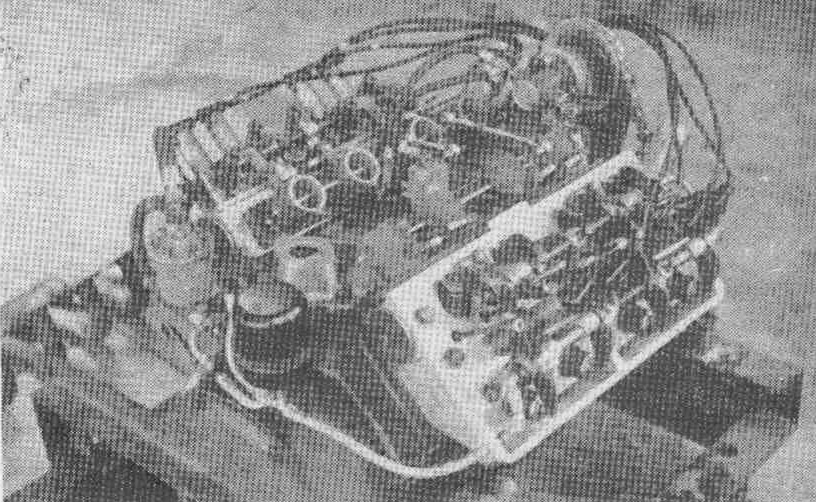
Each cylinder has a sparkplug mounted on either side of the block. (you can see from the overhead photo below the exhaust layout). Two Bosch aero magnetos were obtained in the hope they would cope with the high engine revolutions’, (The Chamberlain)

from above

Rare overhead shot shows the basic layout and symmetry of the design. (The Chamberlain)

Pre War.

bob 1

Bob Chamberlain attacks the first corner of Arthurs Seat Hillclimb, Dromana, Mornington Peninsula in 1933. Car motor cycle engined at this stage. Chamberlain. (The Chamberlain)

bob 2

1935, trialling the car, now in 2 stroke form, note water tank on the front. (The Chamberlain)

bob 3

February 1936 testing the car on the backroads near Keilor, close to where Calder Raceway now is. (The Chamberlain)

engine

Bill Chamberlain’s wooden model of the engine, made in 1:1 scale, it was used to demonstrate the engines operation and complexities, and to help assess the impact of proposed tuning changes. (The Chamberlain)

Post War.

ch calder

Chamberlain at Calder Raceway 1973, the first time the car had run in over 20 years. (The Chamberlain)

phil island

Bob Chamberlain and Eric Price, Phillip Island 1978. 50th AGP Anniversary. But for the ‘Hawaiian’ shirt it could be 1935…(The Chamberlain)

Two shots of the Chamberlain 8 at Queensland’s ‘The Speed on Tweed’ in recent years.

cham tweed front

cham tweed back

cover

John Hazelden’s excellent, and out of print, book. ‘The Chamberlain: An Australian Story’

Bibliography and Credits…

John Medley, special thanks for allowing his 1977 ‘Cars and Drivers’ article to be reproduced. ‘Cars and Drivers’ magazine, wonderful brainchild of the late, talented Barry Lake, Number 2 1977.

Martin Stubbs for the research assistance and encouragement

‘The Chamberlain An Australian Story’ John Hazelden

‘Chamberlain Australian Innovator’ Bruce Lindsay

George Thomas photographs

Finito…


maybach
(State Library of South Australia)

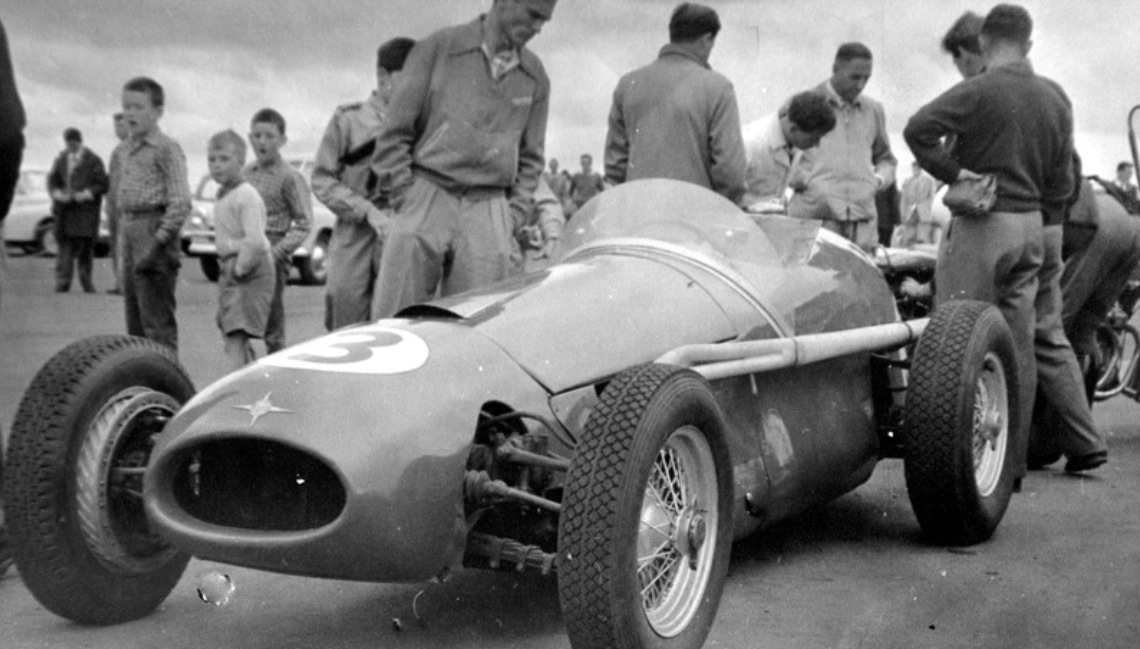
 The carefree nature of the 1950 Nuriootpa race paddock is contrasted by the formal attire of the day, young boy in the Pith Helmet is impressed by Charlie Dean’s Maybach 1…

The first post war Australian Grand Prix in South Australia was held in the Barossa Valley. Not on the daunting Lobethal road circuit where the 1939 event had been run, but just down the road on roads at Nuriootpa.

The circuit was basically a square layout of 3-miles on flattish land. A permit for Lobethal couldn’t be obtained but one for Nuriootpa was thanks to the intervention of some prominent local businessmen including John Hill-Smith of the Yalumba wine family.

Nuri cover
1950 AGP Program cover (Stephen Dalton Collection)

Graham Howard’s ‘History of The AGP’ described the circuit…

‘There was a slight uphill section along the (Nuri) Main Street, followed by a right hand corner onto a downhill section back into the countryside…This led to an Ess at a narrow bridge, after which the road ran straight to an intersection around which were collected the finish line, the pits and – on the next straight after the intersection – the start line. There was a vineyard to the left…but enough grazing paddocks for parking etc…’

The starting straight led to two fast right hand sweeps after which the road then led west by way of a pair of gentle Esses…to a T Intersection…then via a left-right sweep across another narrow bridge, into the Main Street again. There were some very bumpy parts…the roads just wide enough for two cars to pass readily…’

map
Nuriootpa Road Circuit Map (History of The AGP)

The Sporting Car Club of SA ran the event to the Australian Automobile Association’s decree, the winner was the competitor finishing in the fastest time but otherwise in the best traditions of the AGP at the time, the event was a handicap and awards were made on that basis. Geddit?

The main contenders for the race were primarily cars I have written about before so I won’t go through the detail, here are some links if you want to refresh your memory: The Maybach, driven by its creator Charlie Dean; https://primotipo.com/2014/12/26/stan-jones-australian-and-new-zealand-grand-prix-and-gold-star-winner/ ‘Black Bess’, the Ford Ute V8 Spl driven by its builder, Doug Whiteford; https://primotipo.com/2015/05/05/doug-whiteford-black-bess-woodside-south-australia-1949/

rupert steele monza nuriootpa
Rupert Steele in his ex-Alf Barrett Alfa Monza, drove an exceptional race as a relative novice against the tough Doug Whiteford. (John Blanden Collection)

The ex-Alf Barrett Alfa Romeo Monza, was by the time of the Nuriootpa event owned and driven by relative novice Rupert Steele. https://primotipo.com/2015/02/20/alf-barrett-the-maestro-alfa-romeo-8c2300-monza/ Lex Davison, who would later win four AGPs started his Alfa Romeo P3, the scratch man was Tony Gaze’ 1935 2-litre supercharged Alta 56S, although he was not to start after dramas in a preliminary race, all these racers were Melburnians.

Fastest resident South Australian was Harry Neale in Eldred Norman’s, extraordinary ‘Double Eight’ or ‘Double V8’ which married the chassis of a World War 2 weapons carrier and a pair of single carb Ford V8s from army trucks. It had independent suspension on all four corners, 7834cc in total and was rated a good chance on a ‘point and squirt’ course like Nuri with slow corners and long straights. See the section below for details on this amazing car.

Australian Motor Sports described the race day scene…

‘Brilliant sunshine made the competitors paddock a colourful spectacle with racing cars in different hues, tender vehicles ranging from furniture vans and in which the Steele cars had been brought from Melbourne to the luggage trailer which Peter Damman had towed behind his racing Hudson the same distance. In a handy position near the course, Motors Ltd’s mobile service van was in constant demand with its stock of racing oils, spares and field workshop’.

‘Between the finish of the under 1500cc scratch race and the start of the Grand Prix, there was a brief interval for luncheon; then, as 1.30 drew near, cars were lined up in the continuation of the crossroads behind the starting straight, in preparation for the big race. Two spectators climbed up stepladders which they had brought to the course for private grandstands, and the three limit men were away…’

davison nuri
Lex Davison takes to the circuit, Nuriootpa paddock in the background. Alfa Romeo P3/Tipo B (unattributed)

The race itself was diminished by the inability of Gaze to start, Davison’s retirement on lap one, having lost compression on two of the Alfas eight-cylinders and Dean’s withdrawal on lap 21 with magneto, overheating and braking problems.

What was absorbing was the battle between the Aussie Battler garage proprietor Whiteford in his carefully evolved and very well driven Ford V8 Spl, ‘Black Bess’ and the ‘Silvertail’ from Toorak, Rupert Steele in the aristocratic Alfa.

The latter had the edge on top speed, but the Ford, with more supple suspension was better suited to the South Australian country roads. Whiteford was a hard man as a driver, but the novice Steele was no slouch, he must have been a-natural to adapt to the GP car with his experience limited to a few hillclimbs and speed events in a Bentley road car.

1950 agp

On lap 13 Steele ran out of road having passed a gaggle of MGs, he spun the big Alfa and stalled, then lost about 1 minute 49 seconds, hand-cranking the supercharged straight-eight back into life but his race was effectively run.

Whiteford won from Steele’s Monza and Jim Gullan’s Ballot Olds. The latter was first on a handicap basis from David Harvey and Ron Kennedy, both in MG TC Specials. Steele’s sporting focus was on horses for the rest of his life, sad really as his potential as a driver was clear, the Alfa was sold to ‘Racing Ron’ Edgerton by the end of 1951.

Doug went on to enjoy two more AGP wins in 1952-53 at Bathurst and Albert Park, and a career which went well into the 1970s as a works driver of Datsun sedans and sportscars.

whiteford
Doug Whiteford, victorious in the 1950 AGP at Nuriootpa, in Black Bess’ his self constructed Ford V8 Spl. (John Blanden Collection)
nuriootpa poster

Other Competing Cars…

The stimuli for this article were several shots I found in the State Library of South Australia archive of the Dean Maybach, McKenna BMW 328, Jones HRG and other cars which competed that weekend.

I’ve done the Maybach to death in the Jones article referenced above, but here are some notes about the other cars with John Blanden’s ‘Historic Racing Cars in Australia’ providing much of the detail.

bmw 328
Peter McKenna’s BMW 328 in the Nuri paddock Car was the winner of the 1948 AGP, at Point Cook, Victoria driven by Frank Pratt (State Library of SA)

McKenna’s BMW 328 was raced by him all over Australia at Rob Roy, Fishermans Bend, Ballarat, Port Wakefield, Albert Park’s initial meeting in 1953 and as far afield as Southport on Queensland’s Gold Coast for the 1954 AGP. He overshot on a corner and rolled that day, the car passed through many hands before leaving Australia for Japan in the early 2000s.

Chassis # 85136 was brought into the country by John Snow, who acquired it on one of his regular trips to Europe, in 1937. A German General sold the car, Snow bought it on behalf of George Martin, president of the Light Car Club of Australia in Melbourne.

It finished the 1938 AGP at Bathurst in tenth, see my article on Peter Whitehead’s ERA which covers this race, Martin sadly had a fatal accident in it near Wagga Wagga on his return trip to Melbourne.

Their were two ‘racing 328s in period in Australia, both of which were involved in fatal road accidents. The other killed very talented racing driver Colin Dunne and his wife Billie at Phillip Island. It wasn’t a race accident mind you, but one which took place on the circuit between motor-cycle events.

By 1947 the 328 had passed into the hands of champion Geelong motorcyclist and dealer Frank Pratt. Pratt famously won his very first car race, the 1948 Australian Grand Prix held at Point Cook! He was aided by a favourable handicap, excellent driving and the extraordinary heat of the day which knocked out many of the more fancied runners.

Whilst new to car racing he was well familiar with intense competition. The car’s preparation by multiple AGP winner Les Murphy was also a factor. Some reports say that Murphy was extremely pissed off, he was originally entered to drive the car, and then was supposedly sharing it with Pratt, whose intention to drive the race solo soon became clear to Les once the arduous event was underway!

McKenna had a handicap of 9 minutes at Nuriootpa, but was unclassified.

HRG
Stan Jones, HRG Bathurst, Nuriootpa AGP meeting 1950. Jones cooked his engine in a preliminary race so was a non-starter for the GP (State Library of SA)

HRG ‘Bathurst’…

Tony Gaze brought the first HRG to Australia in 1947. The car was uncompetitive so Gaze specified future cars to be light, sports/open-wheelers with easily removable lights and guards so the cars could run as sports or racing cars in local events.

Brown and Dureau, a Melbourne trading firm who ‘Gaze was with’ imported the first car to these specifications in 1949, Stan Jones was the purchaser of the 1.5-litre, four-cylinder car (which had no chassis number).

He first raced it at Rob Roy in June, it was soon supercharged running at 12-psi of boost, racing it at Corio, Geelong in late 1949 and then entering the AGP at Nuriootpa.

In one of the preliminary races for under 1500cc cars Jones had a furious dice with fellow Melbourne motor trader/racer and later champion Bill Patterson – Bill was MG TC Spl mounted – both cars retired with overheating maladies. Jones’ car didn’t take the AGP start and Patto retired with head gasket failure; it was not a successful trip to the Barossa for either of them.

The car was sold later to Alan Watson in 1950 but was badly damaged by him and driven by Sil Massola in the 1952 AGP at Bathurst. According to the ‘Blanden Bible’ it was/is still in Australia.

massola
Silvio Massola in the ex-Jones HRG. Victorian Trophy, Fishermans Bend 21 March 1954 (VHRR/State Library of Vic)

Blurry Maybach in the ‘Nuri Paddock…

The shot is a bit fuzzy but still included for the atmosphere it shows, Charlie Dean in the paddock, the ‘Copper’ is keeping an eye on proceedings, Fiat Topolino behind the Maybach.

mayback blurred
Charlie Dean, Maybach, Nuriootpa AGP meeting January 1950 (State Library of SA)

Other Entrants…

Curran Ford V8.

curran ford
Dennis Curran, Curran Ford V8 3920cc (State Library of SA)

Regarded as one of the most specialised Ford side valve V8 specials built in Australia, Dennis Curran, then an apprentice, made many of the car’s advanced features including its independent front suspension and modified Minerva braking system. The attractive body appears to be in the style of the Alfa Romeo Alfetta 158/159 GP cars of the period.

The car was raced by Curran at the 1951 Narrogin AGP in WA, then in Bill Wilcox hands in the 1953-55 AGP’s as the ‘FLS’. The machine was then further modified by Frank Murphy on behalf of the owner, Melbourne car dealer Harry McLaughlin by fitment of a Lancia Lambda rear end, Jaguar XK120 gearbox and a new body.

A 5-litre Ford V8 was also fitted inclusive of Offenhauser heads and induction manifolds, it competed in this form at the 1956 Olympic AGP won by Stirling Moss at Albert Park. It was then known as the ‘Marchel’, the car then disappeared but was found by Noel Tuckey in 1980, restored and is now known as the ‘CWM Ford V8 Spl’ an amalgamation of the surname initials of the contributors to the cars evolution: Curran, Wilcox, Murray.

Bugatti Dodge.

bugatti dodge
L Robinson, Bugatti Dodge, Nuriootpa 1950. Interested to know more about this car if anyone has any information on it  (State Library of SA)

Ballot Oldsmobile.

ballot
Jim Gullan, Ballot Olds, AGP Nuriootpa 1950 (State Library of SA)

Jim Gullan replaced the Ballot Ford he had been racing in 1944 with a 2-litre Ballot bought nearby to his familiy’ garage in South Melbourne.

The Ballot engine was sold and replaced by an Olds six and ‘box, the chassis shortened by two feet and narrowed by six inches. It was lightened too, you can see the holes made in its longerons to do so. A body was made by Bob Baker in Melbourne – he built many racing bodies at the time – this Ballot is credited as the first. The sports two-seater was registered and commenced racing in 1946. It won the 1950 AGP handicap class as above.

Journalist and historian Ray Bell wrote about this car on ‘The Nostalgia Forum’, here is his detailed account of the construction and development of the car.

‘Jim Gullan’s Ballot will always rank as one of those cars that looks the part of an Australian Special. The raked nose, the heavily drilled chassis, steering wheel close to the chest and mandatory straps over the bonnet, its wire wheels carried a car that mixed European and American as well as any other. Fortunately the early life of the car is well detailed in Gullan’s book, ‘As Long As It Has Wheels,’ and there was plenty to write about as the Ballot Olds was to bring Gullan a number of successes.’

‘The car was bought in 1944, almost on a whim, it seems, after Gullan had sold the Indianapolis Ballot (by now fitted with Ford V8) early in the war.  A 2-litre model with sohc engine and knock-on wire wheels (more important, according to Gullan), it had a poor body. He mentions four-wheel brakes with Dewandre servo, making it a 1926/28 model 2LT.

Soon after buying it a workmate offered money for the engine, gearbox and radiator to fit into a Bugatti chassis.  Said Gullan: “I suppose any engine was better than none..’ Having just the chassis left, he thought he’d build a copy of his favourite car, the ERA. He was reluctant to go for another Ford, having had bad experiences with the V8, so an ad for an Oldsmobile engine and box (unused spares purchased for a Taxi) overcame his problems. It was to have triple Ford carbies and extractors.

The chassis was made into a copy of a Bugatti chassis, was shorter and narrower, designed to be ‘strong in the middle,’ boxed and drilled liberally ‘as on the SSK’ for lightness. The original hubs were retained, but laced to smaller rims, the spring shackles were located at the front instead of the rear as Gullan drew on all the modern technology he could identify.’

‘Bob Baker built the body round an angle iron frame, which was screwed to the chassis with small reject aircraft bolts. A deliberate effort was made to reduce frontal area, hence the car’s low appearance. Quick-fill petrol and radiator caps were fabricated and instruments (like the carbies) came from army disposals’.

‘The Ballot name was retained, even though virtually only the axles and wheel hubs remained, because it made it simple to register the car. Just roll up and pay the money!’

‘Springs were fitted outside the chassis and there were torque stays to the front axle, with finned alloy drums off a spare 2-litre Ballot Jim had bought and sold. The first race was at Ballarat at the beginning of 1947, after which hydraulic shocks were fitted front and rear (‘to the horror of the Hartford purists!’) and hydraulic actuation of the brakes was arranged. For Lobethal 1950, (the event which is the subject of this article) which the car was to win on handicap, a specially made 3.5:1 diff replaced the original 4.1:1 unit. Jim had to do the design work for the gear cutter.’

‘Gullan was in business with one of his major opponents on the track, Doug Whiteford, and when Doug imported an Edelbrock cam and heads (he’d melted a pair of alloy heads at Lobethal in 1940!) Bruce Rehn copied the cam profile and lift for the Olds. By the time of the Point Cook AGP (1948) there was yet another higher lift cam and special ratios in the gearbox. As a result of the heat at Point Cook, with the Olds running so cool and well, the engine was bored 3/16”, while both cars were fitted with enlarged sumps with cooling tubes fitted. Then for Nuriootpa’s opening meeting in 1949 PBR made up special alloy brake shoes and backing plates. These were found to be bending the chassis, so some more work was required’.

‘The car was Gullan’s expression of all he’d learned from observing racing and running his own Salmson, Wolseley, Austin and Ballot V8. It was considered by Whiteford to be ‘too sensitive in the steering and brakes, difficult to drive.’ Gullan adjudged Black Bess to be ‘tail light, tending to wander at speed, with light and spongy steering and poor brakes.’

‘Considering just how it came together – the bits that just happened to be there, the chance acquisitions – it worked very well. Gullan was a handicap specialist, with his wife Christine timekeeping and acting as strategist, and they beat the handicaps with monotonous regularity. He comments that he just had to keep on making the car quicker to keep on beating them, so it was well developed when sold to Alan Watson.’

‘He mentions getting airborne over the top of the hill approaching Lobethal at 110mph, touching 116mph on the straight and holding it flat all the way from Lobethal to within sight of the pits at that early stage of its development. By the time it won the handicap section of the 1950 AGP it must have been a fairly quick car’ (Ray Bell)

The car passed through many hands over the next 20 years, it was raced as late as 1963 at Calder, Victoria. It has been used since 1970 in historic events, is still alive today I believe in Frank Moore’s Collection of Australian Specials in Queensland.

ballot olds 1946
Jim Gullan in his Ballot Olds at Rob Roy,Victoria in 1946. This provides a clearer view of the car (George Thomas)

Double V8.

double 8
Eldred Norman in the ‘Double 8’ during the 1950 Nuriootpa, AGP. DNF on lap two (TNF)

The following truncated account of this car is by ‘theotherharv’ on ‘The Nostalgia Forum’.

‘In 1946 Eldred was purchasing ex-army vehicles left behind by the Americans and selling them in Adelaide. While visiting Papua-New Guinea , he acquired a war-surplus Dodge weapons carrier chassis along with a host of Jeeps and Blitz trucks at an auction in Port Moresby.

Eldred used the Dodge to construct a race car – the ‘Double Bunger’, or more commonly ‘Double V8’ – it was built from the bodywork of an aircraft and a tubular steel chassis.

d 8 engine
Scratchy shot of the 2 Ford V8 engines. Double 8. (TNF)

Power came from two Ford Mercury 239ci flathead V8 engines for a total capacity of 7,800cc. These engines were good for 100-110bhp each when run independently, giving Eldred some 200bhp in the Double V8. Engine cooling suffered despite radiators both in front and behind the driver with a tendency to overheat in long races. The engines were coupled flywheel-to-crank snout with a four-row chain drive and were timed to fire as a V16, with a Scintilla magneto providing the sparks.

This large 2500 lbs machine had independent suspension and water-cooled drum brakes supplied by four US made Toronto fuel pumps. The drum brakes produced spectacular clouds of steam as he applied them, despite being undersized for the task. The rear drums were built inboard, operating on the back axle and were additionally cooled by a fan worked by the tail shaft.

d 8 road
Eldred Norman aboard his road registered Double V8, attractive body, truck wheels betraying cars weapon carrier underpinnings! Two seater form here, this evolved over the car’s life (TNF)

Road-registered, Eldred was frequently seen driving the Double V8 around the Adelaide hills, with trade plates tied with string or a strap around his neck! Between 1948-51 he drove the car successfully in hill-climbs and various race tracks in three States, the car was also driven long distances to compete at tracks such as Fisherman’s Bend, Victoria, a 900-mile round trip sans mufflers.

In addition to circuit racing, Eldred raced at Sellick’s Beach, South Australia where competition was undertaken between mile posts. An annual speed trial and motorcycle races were held on three kilometres or more of sand along Aldinga and Sellick’s Beaches up to 1953. The Double V8 won both the unlimited scratch race and the over 1500cc handicap race held at the beach by the Racing Drivers Association of South Australia in April 1950. This event drew more than 5,000 spectators. One incident with Harry Neale at the wheel of the Double V8 ended with the car deposited into the sea, ripping off the bodywork and leaving Harry sitting on the chassis, wet but unhurt!

norman dbl 8 woodside
Eldred Norman Double V8, Woodside 1949 (State Library of SA)

Eldred’s can do, larrikin spirit was also evident in the way he once retrieved the telephone cables laid out for communication between officials at each end of the Sellick’s Beach strip. He fitted a bare rim to the Double V8 rear axle and fired up the twin V8s to power what must have been Australia’s most powerful fishing reel.

d 8 woodside 2
Double V8 in the Woodside, SA paddock 1949. (State Library of SA)

The Double V8 marked the start of Eldred’s entries in the Australian Grands Prix: in the January 1950 Nuiootpa Australian Grand Prix the Double V8 retired after only two laps.

The 1951 Australian Grand Prix was again run as a Formula Libre event in March at a 4.4 mile ‘around the houses’ road circuit at Narrogin, Western Australia. Eldred entered the Double V8, whilst leading on lap 7 of 24 it again broke down, this time due to suspension failure, leading to Eldred’s retirement from the race.

The car was sold in 1951 to Syd Anderson, proprietor of the Sydney Anderson Automotives used-car dealership in William Street Western Australia.  During both Anderson’s and subsequent ownerships in WA the car was modified repeatedly.

Anderson raced the Double V8 extensively, including the following West Australian meetings: The Great Southern Flying 50 at Narrogin in March 1952, winning the scratch race for over 1500cc. The Northam Flying 50 meeting in April yielded a win in the three-lap scratch race for over 1500cc cars. At the Goomalling Speed Classic, on the road circuit in June he was fourth in the 15 lap handicap for Racing Cars, first in the 3 lap scratch race for racing cars over 1500cc and first in the 5 lap handicap for racing cars.

d 8 2
Wonderful colour shot of Syd Anderson racing the Double 8 in the Goomalling Speed Classic at Goomalling WA in 1952: two first places at the meeting. Note truck wheels drilled for relative lightness. (TNF)
Toby Carboni with three helpers trying to get 16-cylinders to cooperate. Note the two carburettor vertical inlets, ‘V16’ script on the hubcaps and heavily drilled steel wheels especially on the rear. Caversham perhaps (K Devine)

Anderson entered the Double V8 in the 1953 Johore Grand Prix in Malaya but retired from the race with overheating dramas. The car was then sold by Anderson to James Harwood, a navy veteran, musician and motor enthusiast in Perth.

Harwood tossed a penny with Anderson to decide the purchase price – either £50 or £100 – Harwood won. The vehicle was then towed to his business premises where Bill Strickland removed the two Ford V8 engines, which were sold. The Double V8 body was then placed outside James’ business as advertising, although it was removed a few days later at the request of Perth City Council.

In the period 1955-1957 Toby Carboni raced the car extensively in Western Australia before Keith Windsor bought the Double V8 body in 1957 and installed a V12 Lincoln Zephyr engine.

Lincoln produced these engines from 1936-1948, ceasing production nearly a decade before Windsor’s repowering of the Double V8. I’m not certain if Windsor used the 267ci, 292ci or 306ci engine (110-130bhp), though in any case it was a marked reduction from Eldred’s 478ci (~200bhp) double V8 powerplant.

Windsor debuted the V12 Double V8 in the Christmas Cup at Caversham in late November 1958, competing in the five-lap racing car scratch race for over 1500cc cars, although he did not place in the top three positions. Sadly, Windsor found the V12 vehicle was not manageable and subsequently scrapped it; if there is one car which would be welcome at Australian historic race meetings it is most certainly this stunning creation!

After the Double V8, Eldred bought a 1936 Maserati Type 6CM.

MG K3…

(S Jonklaas)

Otto Stone’s car, out after completing only one lap.

Healey Elliott…

healey elliott
(SLSA)

The car behind the Healey Elliott is a Nash Ambassador. Donald Healey built 101 of these cars – Elliott refers to the body builders – Healey provided the ladder frame chassis to that firm to clothe, the engine was a Riley 2.5-litre pushrod-four, the car for a time was the fastest four seater in the world. They were built from 1946 to 1950, suspension used trailing arms at the front, and a live axle at the rear suspended by coil springs front and rear.

Etcetera…

Rupert Steele.

steele bentley
(George Thomas)

Rupert Steele contesting a Rob Roy Hillclimb in his Bentley devoid of bodywork in 1948. The step up from this lumbering tourer, he only did one circuit race in the car, to the Grand Prix Alfa Monza must have been immense.

whiteford paper article
‘The Adelaide Advertiser’ 3 January 1950.

Bibliography…

Graham Howard ‘History of The Australian Grand Prix’, John Blanden ‘Historic Racing Cars in Australia’, Australian Motor Sports January 1950, Stephen Dalton Collection, Motormarques, Ray Bell, The Nostalgia Forum (TNF), The Adelaide Advertiser 3/1/1950

Photo Credits…

Publications as above, State Library of South Australia, John Blanden Collection, George Thomas, The Nostalgia Forum, Stuart Jonklaas Collection

Tailpiece…

Ron Kennedy from Don Cant, both in MG TC Spls, finished in fourth and third places respectively.

Finito…

john goss

John Goss and pit crew 1974, Amaroo Park. Aunger Wheels, a Goss sponsor photo shoot. Car is Ford Falcon XA GT351 Coupe ‘Sports Sedan’.(unattributed)

Australia has had quite a few drivers who have been stars in both open-wheelers and touring cars at the elite level; Kevin Bartlett, John Bowe, Mark Skaife, Craig Lowndes and John Goss spring to mind…

Gossy left his adopted Tasmania with guts, determination, self built Tornado Ford sportscar and made his way to Sydney. Before long his speed and ‘gift of the gab’ secured support from Rockdale, Ford dealer Max McLeod. This took him all the way to the top of Australian motor racing, he and Kevin Bartlett won the Bathurst 1000 in 1974 in a Ford Falcon XA GT. Goss also won the F5000 Australian Grand Prix at Sandown in 1976.

He is the only man to have won both events.

davies matich sandown 1975

John Goss, Matich A53 Repco, Sandown Tasman 1975 . Goss won the race from John McCormack Elfin MR6 Holden and Max Stewart Lola T330 Chev. Fencing behind destroyed by the lap 1 crash of John Walkers Lola T332. (Robert Davies)

Three Vignettes of John Goss, all at Sandown Park stick in my mind…

The first was at the Sandown Tasman meeting, my very first motor race in January 1972. I was there for the F5000’s the ‘Taxis’ of no great interest to me but i happened upon John Goss near his Falcon GTHO Series Production car in the paddock, he was holding fort with a group of supporters or sponsors.

They were enthralled by his experiences. At 14 i was  amazed at the atrocities he performed on the Queens English, it would have been impossible to use more words to describe the simplest of things, all delivered with the most nasal-‘strine accent. Imagine Paul Hogan on steroids, but more nasal and you have nailed the Gossy accent! As one wag put it after a JG Bathurst win; his victory speech was longer than the race itself!

He won the South Pacific Touring Car Championship, the touring car series support of the 1972 Australian Tasman Rounds, the plucky privateer beat the works teams. Takeouts; he was quick and gifted on the commercial side of the sport.

goss ho

Goss doing his thing in the Phase 3 ‘XY’ Falcon GTHO with its brand new for Bathurst 1972 ‘Globe’ alloy wheels. Oran Park 1972. No front spoiler. (Vic Hughes)

The second was at the same meeting the following year when he blazed a trail with the Ford Falcon XA GT ‘Superbird’ or 2 door coupe variant of Fords new series of cars.

Pretty much everyone else stuck with the previous model, ‘XY’ Falcon GTHO’s for one more year, including the Broadmeadows factory until the Manufacturers Championship in the second half of the year. Ford and Holden, the latter with their Torana V8 SLR5000 and L34, had big oil surge problems with their engines; a function of greater grip with the wider tyres allowed and inadequate wet sump arrangements. (dry sumps stupidly not allowed by the regs).

Goss’ big yellow fat tyred car looked and sounded sensational. He was showing the way with it and getting lots of publicity, but he and long-suffering mechanics were up to their armpits in alligators with mechanical mayhem. Takeouts; he was prepared to make his own calls and not follow ‘the herd’ and had good developmental and mechanical skills.

The final impression was of his absolute competitiveness as a driver, his win in the 1976 AGP at Sandown.

I was one of 38000 people enthralled by his battle with Vern Schuppan in Garrie Cooper’s latest Elfin MR8 Chev. Vern broke a valve spring early in the race, John was in one of two Matich’s he acquired when Frank Matich retired from the sport in 1974. John’s A53 was actually the older of the two cars he bought, an updated A51 chassis # ‘005’, the car Lella Lombardi raced in two Gold Star rounds in 1974, Goss acquired it in 1975.

The car wasn’t in the first flush of youth by then, Goss drove superbly to take the win by half a second from Schuppan, then a driver of world class. In my mind Vern’s slightly down on power engine was compensation of JG not having the latest of equipment.

goss '76 agp

Goss in his Matich A51/53 ‘005’ Repco during his wonderful 1976 AGP winning drive at Sandown. He is turning into ‘Dandenong Road’, Marlboro Hill in the background. (unattributed)

Many saw Goss, born in the South Eastern Melbourne suburb of Glen Iris on 2 May 1943 as a Touring car driver. Whilst he started his career after qualifying as a mechanical engineer, in the Island state, he moved to Tasmania whilst a child, in a Holden FJ and Ford Customline he soon progressed to the self built Tornado Ford sportscar.

The car was powered by a Ford Falcon 170cid 6 cylinder engine which was harnessed via a VW gearbox. oldracephotos Lindsay Ross recalls ‘A Falcon XL sedan provided the motor, triple Webers were fitted in 1967, the steering wheel was fashioned out of a yacht centreboard. The Lotus 32B wheels were purchased from the Sternbergs who ran the ex Clark car in Tasmania in 68-69’.

goss tornado baskerville 1966 (david keep oldracephotos)

John Goss makes the race debut of his Tornado Ford, Baskerville, Tasmania 1966. Car sans the attractive body which came later, Ford straight 6 on single carb, steel wheels. Natty race-suit doubled as post race pub attire! (David Keep/oldracephotos.com)

‘First outing for the Tornado was at Baskerville in 1966. One of my first motorsport memories is a handicap race there in 1967 which only had 2 cars start. Goss in the Tornado off scratch and Lyn Archer in the Elfin Catalina 1.5 pushrod. Both drivers absolutely flat stick from the start over 6 laps and less than half a car length across the line at the finish with Goss just ahead. Great stuff from two very good drivers.’

goss longford 1968

John Goss in his Tornado Ford, Longford 1968. Proudly Tasmanian by the look of the decal on the cars rear…despite being born in Melbourne! Probably the Monday and coming down from the Water Tower. (Stephen Dalton Collection)

Hoping to progress in racing Goss took the Tornado to Sydney, with some success scoring points in the Australian Sports Car Championship in 1969 and 1970 (10th in both years).

He sought support from various sponsors Max Mcleod initially provided some money to help run the Tornado, Goss convinced McLeod to enter Series Production racing in 1969, this class exploding in public consciousness at the time with some phenomenal road cars built by Holden, Ford and Chrysler.

Goss made his Bathurst 500 debut in 1969 driving a Ford Falcon GTHO, co-driver Dennis Cribbin crashed the Falcon at Forrest Elbow. In 1970 Goss set the fastest lap during the event in his XW Falcon GTHO Phase II.

The following year he won two rounds of the Toby Lee Series at Oran Park against strong opposition such as Colin Bond and Fred Gibson.

goss bathurst 1973

Goss exiting Murray’s Corner Bathurst 500 1973. His Ford Falcon XA GT, shared with Kevin Bartlett is about to swallow the Leo Leonard/Gary Sprague Valiant Charger. (Vic Hughes)

John gained open-wheeler experience in 1971 at the wheel of the very first Birrana. Tony Alcock returned from a stint in Europe and designed and built the first Birrana, the F71 Formula Ford in Sydney and enlisted John’s help to develop and race the car.

Later Alcock moved to Adelaide and built over 25 cars in partnership with Malcolm Ramsay which won multiple championships in FF and F2, a story for another time.

29

John Goss in the very first Birrana, the F71 FF ahead of 2 Bowin P4a FF’s, Oran Park 1971. (lyntonh)

Goss won the 1972 South Pacific Touring Car Series and the 1972 Sandown 250 endurance race, both in Series Production Ford XY Falcon GTHO Phase III’s. He also put his Falcon on the front row of the grid at the 1972 Hardie-Ferodo 500, qualifying second fastest behind the Works GTHO of Allan Moffat. Engine failure after splashing around for 24 wet laps ended his race

1972BATHURSTJOHNGOSSETALHELLCORNER

Goss in his Ford Falcon XY GTHO Ph3, Hell Corner Bathurst 1972. Peter Brock won that year in a Holden Torana LJ XU-1. (Rod MacKenzie)

The Series Production class was replaced by Group C for 1973, it allowed greater modifications than before. Commercially, Goss had ongoing sponsorship from Shell, Max McLeod as well as factory assistance from Ford Australia who provided purpose-built XA racing chassis’.

As noted above, Goss was the first to race the XA Hardtop in the 1973 ATCC, before the Works team who used a modified Phase III GTHO during the Australian Touring Car Championship which Allan Moffat won for them. They switched to the Hardtop for the Endurance races, the ‘Manufacturers Championship’ later in the year.

Goss and open-wheeler/touring car ace Kevin Bartlett teamed up for the 1973 Bathurst and qualified on pole. Goss started and built up a good lead which was kept until he was involved in a crash, not of his making, at The Cutting, damaging the front end and causing radiator damage which finished their race.

The pair returned to Bathurst for the 1974 Hardie-Ferodo 1000 in the same car, repainted blue after losing Shell sponsorship winning a race marred by driving rain. To celebrate the victory, Ford Australia released a limited edition XB Falcon Hardtop in 1975 called the ‘John Goss Special’. Around 250 cars were built.

goss bartlett

Goss/Kevin Bartlett victorious Ford Falcon XA GT. Bathurst 1974. (unattributed)

Goss surprised the racing world when he snaffled the best of Frank Matich’s F5000 equipe when he retired at the end of the 1974 Tasman Series. FM had been badly hurt in a boating incident in which he was electrocuted, he decided it was time to quit to focus on his family and business interests which then comprised the distribution of Goodyear race tyres and Bell helmets in Australia. His cars were advertised in the May edition of ‘Racing Car News’.

Goss gained some support from ‘Scotch’ brand adhesives and was immediately competitive in the Matich A53 Repco, the last and best of Matich’s world class designs. His first race was at the Oran Park 1974 Gold Star round on 4 August.

Over the coming years Goss, chief mechanic Grant O’Neill and their small team continued to develop the two chassis ‘A51 005’ and ‘A53 007’ remaining competitive against the best the world had to offer in the F5000 categories peak period.

1976 agp

1976 AGP finish at Sandown. Goss from Vern Schuppan by 5/10 second. Matich A51/53 Repco and Elfin MR8 Chev. (Graham ‘Howard History of The Australian GP’)

1974 Gold Star Series…

The first series Goss contested was the domestic single seater championship the then very prestigious ‘Gold Star’.

For most of its life the Championship lacked quantity but not quality. The costs of fielding an ANF1 car, whatever the formula has been, has always been high. Australia’s obsession with Touring Cars has meant that funds have generally not been flush in open-wheeler racing, the early years of Formula Pacific, 1981-2 arguably the exception.

In 1974 Gossy faced Australian Champions Kevin Bartlett, Max Stewart and John McCormack in Lola T332, T330 and Elfin MR5 respectively. Later champions John Walker and Warwick Brown also contested the series in their Lola T332’s albeit Warwick took in some races in the US in his Pat Burke owned car, the very first production T332.

Frank Matich, whose last and best car Goss owned had retired. This created an opportunity for the rest of the field as Matich was arguably the ‘first among equals’ as a driver and the best funded, courtesy of Repco and Goodyear. I always figured ‘Cranky Franky’ had an actual and psychological advantage over the competition; he pounded around Warwick Farm getting his cars to a fine pitch and was always well prepared whenever he arrived at a meeting, his actual advantage. The psychological advantage was the fact his fellow competitors knew that he was well prepared! Whereas they, without similar fiscal support were not as much so.

Brittle things F5000’s; the Hewland DG300 box was originally designed for Gurney’s 400bhp F1 Eagle, not a 500bhp Chev. Crown wheel and pinions needed to be in the full flush of youth to be problem free. Engines too, with all drivers chasing the edge, were far from reliable especially if the engine-builders maintenance cycles were not followed, a temptation if you were not flush with cash. Despite the big corporate names which adorned the Matich cockpit over the years JG was not well-funded, in common with most of his fellow local competitors.

John’s first meeting was at one of his home tracks, Oran Park on 4 August, finishing 4th for the weekend. He was 9th at Surfers, 4th in the first heat and had an accident in the second. He didn’t contest the Calder and Sandown rounds in Victoria but was back for the AGP at Oran Park although by this stage Max Stewart had the ‘Gold Star’ in the bag. John had his tail up, he and Kevin Bartlett won the Bathurst 1000 in October the pair driving brilliantly to win the race held in difficult conditions that year.

The AGP field was buoyed by the addition of Internationals Graeme Lawrence, the former Tasman Champ Lola T332 mounted and Signorina Lella Lombardi. ‘A Sheila in a F5000’ got the tabloids interested in the race, which was good as only nine cars started, she drove a Matich A51 (the car Goss was to later acquire as noted above) very well, scoring equal second fastest race lap, despite the unfamiliar car. The car she drove in Europe which brought her to the local promoters attention, her Lola T330 (HU18) is owned by Peter Brennan in Australia, it’s restoration well covered in primotipo.

Gossy ran a bearing so didn’t start the race, Brown cantered off into the distance, quickly mastering Oran Park’s new layout, Stewart took the win when Warwick retired on lap 49 with a harmonic balancer kaput.

goss op

Goss in his Matich A53 Repco ‘007’. Oran park during practice for the opening 1975 Australian Tasman round, the ‘Oran Park 100’. Car just painted but devoid of sponsors decals. Jon Davison looking for divine inspiration in the background, his car an earlier Matich A50 Repco ‘004’. Warwick Brown won the race in his Lola T332 Chev, Goss DNF with electrical maladies. (Andrew Lynch)

The 1975 Tasman Series started in New Zealand on January 5 at Levin but John’s funding didn’t allow him to contest the four Kiwi rounds, he was up against opposition which had already had four consecutive weekends to get their cars to a fine pitch.

In addition to the leading drivers covered above, other frontliners in the series that year were Kiwis Graham McRae in his McRae GM2 and Chris Amon in the Talon MR1, an identical car to the GM2, the design acquired from GM by American Jack McCormack, the cars built in the ‘States. Another Kiwi was Ken Smith in an ex-Brian Redman Lola T332.

goss and bartlett

Oran Park Handling Lesson; Goss’ mildly understeering Matich A53 Repco being given a bit of hurry up by Kevin Bartlett’s new and somewhat recalcitrant, grass cutting oversteering Lola T400 Chev. (unattributed)

He had a DNF the at Oran Park with electrical failure, was 3rd the following weekend at Surfers, had another DNF at Adelaide, a water hose came loose on lap 3 and then things all came together at Sandown in the final round.

I have covered this meeting in another story, click on the link here;

The Mother and Father of Lucky Escapes…John Walker, Sandown Tasman 1975…

Suffice it to say, depending upon results, any of Lola drivers, Brown, Lawrence or Walker could take the title…Walker crashed on lap 1, Lawrence retired with fuel metering unit failure late in the race, Brown got the necessary point and Goss won the race in a fast, controlled drive. A strong win against opposition of depth.

matich sandown

Goss eases his Matich A53 ‘007’ through Torana Corner Sandown on the way to his first F5000 victory in the Tasman round ‘Sandown Park Cup’ on 23 February 1975. (unattributed)

By the time Goss commenced his 1975 Gold Star campaign he also owned the earlier Matich A51 Repco which was updated to later A53 specs.

JG continued his good form in the ‘Toby Lee’ sponsored F5000 Series held over 6 rounds, 5 at Oran Park and 1 at Sandown. Max Stewart won the series in his new for Tasman ’75, Lola T400. Goss took 4 of the 12 heats which comprised the series before being ‘pinged’ by CAMS for a black flag incident which almost cost him his AGP start.

Bruce Allison also starred in the Series, the 22 year old jumped out of his Birrana 274 F2 car and took to the ex-Bartlett Lola T332, prepared and guided by the very experienced Peter Molloy, like a ‘duck to water’.

And ducks they needed to be at Surfers Paradise Gold Star season opener held in torrential conditions. The AGP was the first round of the Gold Star that year, Goss matched local boy, Bruce Allison’s pole time but withdrew from the race early with a rough engine and visibility problems. Max Stewart had a lucky win when John Leffler, leading well and as comfortably as you can be devoid of vision!, in the radical, under-developed,tricky to drive but utterly wonderful Bowin P8 Chev, slowed with drowning electrics.

At Sandown he was 6th and then didn’t start at Oran Park, Calder and Phillip Island.

By 1976 the Tasman Series was over, the Kiwis had the ‘Peter Stuyvesant Series’ and we ‘Skips’ the ‘Rothmans Series’, still 4 rounds each. Internationals for the Australian Rounds were Aussie Vern Schuppan and the UK’s David Purley, Lola’s T332/T330 mounted and American John Cannon adding some interest with a March 73A/751 Chev.

At the ‘Oran Park 100′ Goss was 5th, in Adelaide he crashed, at Sandown he was 3rd in the race won by Cannons’ March, the final round at Surfers was washed out. As in the circuit was under the flooded Nerang River, Schuppan took the trophy, the presentation in waist deep water, the promoters gaining a shot for the tabloids despite the lack of a race!

agp 76 start

Ian Smith’s great shot of the start of the 1976 AGP at Sandown. Taken from the outside of Shell Corner, turn 1. L>R; Max Stewart Lola T400 Chev, Vern Schuppan Elfin MR8 Chev and Goss to the right, Matich A5153 Repco. (Ian Smith)

Goss’ domestic 1976 Gold Star campaign started well with his AGP win at Sandown in September, he didn’t finish at Oran Park with gearbox failure, at Calder he had an exhaust problem and didn’t contest the one off ‘Rose City 10000’ at Winton nor the final Phillip Island Gold Star round. John Leffler took the title in a new Lola T400 Chev, consistent finishes but no wins bagged the Championship.

agp 77

There was nothing quite like seeing F5000’s raced by top line Pro’s and look at the Oran Park 1977 AGP crowd! Front running group; Goss, Gethin, Schuppan and Bartlett. Matich A51/3 Repco ‘005’, Chevron B37 Chev, Elfin MR8 Chev and Lola T332 Chev. (‘History of the AGP’)

The 1977 Rothmans International Series of 4 races in Australia had good prizemoney, Count Rudy Van der Straten’s Team made a welcome return to Australia with a Lola T430 and Chevron B37 for Warwick Brown and Peter Gethin respectively, nuts from a spares point of view but both interesting cars, and critically not more Lola T332’s, wonderful devices that they are.

Alan Jones returned to Oz, to race a Teddy Yip, Theodore Racing Lola T332C, he was ‘on the rise’ well and truly by this stage, he drove for the Surtees F1 team in ’76, and took his first F1 win in Austria later in the year.

The development of the Lola T332 was ongoing, the T430 and Chevron B37 were new designs, Garrie Cooper’s Elfin MR8 was also the state of the art. In that context John Goss’ grid place (4th) and strong race performance in the season opening AGP at Oran Park, he ran in 2nd and 3rd for much of the race, in a car which dated to 1974 and an engine which had no development, Repco having withdrawn from racing in 1974, very creditable.

Jones jumped the start, depriving the spectators a duel at the front but all eyes were on him as he sought to make up the 1 minute penalty incurred. Brown won the race with teammate Gethin 2nd and Goss 3rd.

surfers 77

‘Surfers Paradise 100’ Rothmans Series 1977. L>R In the distance Alan Jones in Kevin Bartlett’s loaned Lola T332 Chev, Jones boofed his in practice. Warwick Brown Lola T430 Chev, Peter Gethin in the lead, Chevron B37 Chev, John Leffler in the white Lola T400 Chev and on the outside Goss, Matich A53 Repco. Finishing order, Brown, Gethin, Leffler and Goss. (Bill Forsyth)

Brown and Gethin repeated the performance at Surfers the following weekend, Goss 4th. Max Stewart won in his Lola T400 at Sandown, his last race win before his tragic death at Calder in the one off Kleber 40000 race at Calder. Goss DNF with engine failure.

goss sandown 77

‘Sandown Park Cup’ February 1977. Goss leads from Garrie Cooper Elfin MR8 Chev 3rd and Alf Costanzo Lola T332 Chev 2nd. Goss had an engine failure, the race was won by Max Stewart’s Lola T400 Chev. (Ian Smith)

In Adelaide, the last Series Round he was 4th and lapped as was the rest of the field, Jones dominant in his Lola T332. Brown took the Series win in the VDS Lola T430 Chev, both T430 chassis’ owned by VDS were sold to Alan Hamilton at the series end and would be an important part of the F5000 scene going forward in both Hamilton’s and especially Alfredo Costanzo’s hands.

mat ford

Gossy having his mirrors fitted in the clearly just finished Matich A53/55 Ford ‘007’. Thats Grant O’Neill doing the adjusting, Sandown paddock, 1978. Ford engine of note! (Ian Smith)

Goss’ had been developing a Ford F5000 engine based on the 302, cross bolted ‘Boss’ block, fitted to his newer Matich chassis ‘007’ it was entered in the first 3 Rothmans rounds but failed to appear in any of them.

Development of the Ford engine made sense given his Ford connections and whilst there were some Ford engines in the category in its formative years, he and his small team were giving away decades of development to the small block Chev. A smarter move, hindsight a brilliant thing, would have been a more up to date chassis…and a strong Chev engine.

The Matich Ford, the engine comprised a 4 main bearing bolt Windsor ‘Boss’ block with Cleveland heads, the latter to address the shortcomings of the Windsors ports, was tested but it does not appear to have ever been raced. He qualified the Ford car at the Sandown 1978 Rothmans with a 64.6 second lap but raced the Repco chassis. At Oran Park he practiced the Ford engined chassis on Friday and Saturday but again elected to race ‘old faithful’ A51/53 Repco ‘005’.

During this period the team were developing the Ford engine, Goss raced his other, earlier chassis with Repco power; A51/53 ‘005’, the chassis he used to win the AGP.

sandown maticj ford

Chris Jewell’s shot of the Matich A53/55 Ford ‘007’ at Sandown 1978. Car practiced but not raced. Same tub as 1974, in fact the chassis were to the same 1971 design for all 6 chassis’ built. (Chris Jewell)

Goss didn’t contest the 1977 Gold Star Series but ran Bathurst Teammate Henri Pescarolo in the one off ‘Kleber 40000’ event referred to above on 20 March, Alf Costanzo won the 2 heat event.

henri

Henri Pescarolo cruising the Calder paddock in Goss’ Matich A51/3 Repco ‘005’ during the February 1977 ‘Kleber 40000’ meeting. (oldracephotos.com)

JG reappeared in the Matich for the 1978 Rothmans, Warwick Brown was dominant winning all 4 rounds of the series in his Lola T333/332.

Goss was 6th at Sandown and in Adelaide and 5th at Oran Park. He tested the Ford engined chassis ‘007’ at Oran Park but chose to race his usual Repco engined car ‘005’.

matich ford

Goss testing his Matich A53/55 Ford at Oran Park during the Rothmans series in February 1978. Neat evolution of the A53 ‘007’ tub. Ferrari 312T-esque front wing, neat deformable structure and rear ‘flush’ mounted’ radiators, no airbox. Neat. (Doug Eagar)

At Surfers he failed to finish with oil scavenge pump problems.

With the costs of F5000 rising, and the Formula Pacific push for ANF1 underway Goss wound down his F5000 activities and sold both cars; the much raced A51/53 ‘005’ to touring car star Jim Richards who contested the ’79 Rothmans Series in it and A53 ‘007’ to Mel McEwin who converted it back to Repco form, and raced it towards the end of the category in Australia. Both cars still exist.

sandown 1978

John Cannon 3rd ahead of John Goss 6th ,1978 ‘Sandown Park Cup’. March 73A/751 Chev and Matich A51/53 Repco. (Anthony Loxley)

Formula 1 Ensign MN05 Ford Cosworth…

With interest in F5000 waning in the late 1970’s the ‘Rothmans Series’ rules were changed to allow F1 cars to compete in the 1979 Internationals. The F1’s were ‘brought back to the field’ by the hard Goodyears they were mandated to run. All the same the cars were great to watch, for many of us the first modern GP cars we had seen and heard.

Goss was keen to have a drive, Theodore Racing had 3 cars; 2 Wolf WR4 Ford’s  and an Ensign MN05 raced by Scot David Kennedy and Brit, Geoff Lees. Keen to run a car at Oran Park, Goss wasn’t so happy to stump up the $10K for the weekend but late on the Saturday the team gave him a run in the Ensign anyway.

He did 7 laps, brushed the wall on the out lap keeping out of the way of another car which moved over on him, he managed a 1:10.4 compared with Warwick Browns Lola T332 Chev pole of 1:5.4. It was not enough time for John to find the limits of the car , sadly he didnt race it. An interesting ‘mighta been’ had he raced the car.

john goss ensign mn05 oran park

John Goss, Oran Park 1979. Theodore Racing F1 Ensign MN05 Ford. A few laps in practice, no race sadly. (Dick Simpson)

In 1980 Goss began campaigning a V12 Jaguar XJS at Bathurst. His 3 previous Bathurst starts with Henri Pescarolo in Falcons were all DNF’s.

He started essentially a standard Jag from 58th on the grid, but lasted only 14 laps before retiring with gearbox failure. In 1981, he teamed with 1965 winner Barry Seton and after an improved qualifying effort (19th), they weren’t classified as finishers of the crash shortened race.

Goss returned with a better prepared effort in 1982, sharing the drive with American IMSA Jaguar sports car driver/team owner Bob Tullius who also assisted with technical info for the car and engine. Goss qualified 14th but after a strong run, once again the big cat failed to finish following suspension failure on lap 119.

Goss missed the 1983 James Hardie 1000, but returned in 1984 for the last year of Australia’s Group C racing sharing a drive with Tom Walkinshaw. Walkinshaw ran three factory backed Group A XJS’ in the ETCC, won that title in 1984, and added a lot of technical assistance to Goss’ team with revised suspension and the use of one of TWR’s V12 engines.

Despite trouble in qualifying with no suitable rear tyres arriving in time to use, the Scot qualified the car 8th before falling to 10th in the Hardies Heroes top ten run-off . Walkinshaw also started the race but never left the line.

The Jags clutch had gone leaving Walkinshaw stranded with his arm out the window warning other drivers he was stationary. Unfortunately in the dust kicked up off the start, the Kevin Bartlett owned Chevrolet Camaro of John Tesoriero was coming through at speed and could not avoid the Jag, a multiple crash ensued.

Goss-Jaguar

Goss/ Armin Hahne Jaguar XJS. Bathurst winner in 1985. (unattributed)

Australian Touring Car racing changed to International Group A rules in 1985, and Goss scored his second and last outright Bathurst win with West German co-driver Armin Hahne in one of a three-car assault by Tom Walkinshaw’s TWR team using the 1984 ETCC-winning V12 Jaguar XJS’

Goss, installed by Walkinshaw as lead driver of the team’s third car, qualified fastest going into Hardies Heroes, giving lie to those who believed he was past his best as a driver. He ended up 6th in the Top Ten run-off after mistakes on both laps.

Goss made a good start and for the opening laps was in a dice for 2nd with Allan Grice (Commodore), Robbie Francevic (Volvo), Dick Johnson (Ford Mustang), Jim Richards (BMW 635 CSi) and Peter Brock (Commodore). First Francevic, then Goss, broke free of the dice. Goss chased down the Volvo in less than 10 laps, giving Jaguar a 1-2 on the road for the first time since the early laps before the team’s second car driven by Jeff Allam retired with engine failure. From then on, the Goss/Hahne Jaguar was in second place for most of the race behind the Walkinshaw/Win Percy car.

Goss and Hahne’s job was made more difficult by the driver’s seat of their car having completely broken at the base of the back. The car took the lead on about lap 120 following a split oil line on the Walkinshaw/Percy car with both Peter Brock and Roberto Ravaglia (BMW) closing the gap to within 30 seconds.

The chase effectively ended with Brock’s engine allowing Goss to back off over the last 3 laps. Walkinshaw finished third with Win Percy, the pair crossing the finish line together.

After Jaguar Rover Australia declined to help fund a return effort by TWR in 1986 Goss returned with his own privately entered XJ-S backed by Citibank Australia and co-driven by veteran Bob Muir. Electrical troubles in the race resulting in a flat battery saw them complete 140 laps and finish 24th outright.

Goss missed the 1987 World Touring Car Championship round as well as the 1988 race but returned to drive for Glenn Seton Racing in 1989 in a Ford Sierra RS500. He paired with Seton for a fourth placed finish at the Sandown 500. At Bathurst Goss was teamed with Tony Noske in the second car, they were joined during the race by Seton after his own car failed. After a troubled run the trio went finished 20th outright.

Goss’ final Bathurst 1000 came in 1990 when he paired with fellow Sydney based veteran Phil Ward in Ward’s Mercedes-Benz 190E to finish 12th outright and a Division 2 class win after starting 38th.

Where Does Goss fit in the Pantheon of Australian Drivers…

Former Racing Car News journalist, Ray Bell saw most of Goss’ big races and had this to say on ‘The Nostalgia Forum some years back…’But to return to the main question, the reality of his ability, let’s just look at his AGP win, which was one of very few wins he had in F5000.

He diced through that race with Vern Schuppan, who was acknowledged as a F5000 pilot world wide at that time. John drove the three year old Matich A53, based on the 5 year old A50. Vern was in the almost new MR8. John’s car was no longer a ‘work in progress’, its designer had retired. Vern’s was under the care of Garrie Cooper who raced that model himself.

I think you would have to say that he demonstrated in that race all the qualities that are necessary, the skill to do the job; the determination to be there, overcoming whatever hurdles might have been put in his way along the path he followed; the recognition of openwheelers as the pinnacle, despite having already won the biggest race in Australia. And Sandown was never a place for the limp of wrist or small of heart in these cars…’

In retirement Goss is a businessman and maintains a couple of yachts for wealthy owners…

Etcetera…

The following images are from Graham Howard’s ‘History of The Australian Grand Prix’, and describe Frank Matich’s F5000 cars generally and John Goss’ pair specifically.

mat 1

mat 2

mat 3

mat 4

mc leod ford ad

Bibliography…

Graham Howard ‘History of The Australian Grand Prix, Wikipedia for touring car stuff, The Nostalgia Forum, Facebook Australian F5000 Group, Stephen Dalton Collection

Photo Credits…

oldracephotos.com, David Keep, Lyntonh, Dick Simpson, Rod MacKenzie, Robert Davies, Vic Hughes, Andrew Lynch, Ian Smith, Bill Forsyth, Chris Jewell, Doug Eagar, Anthony Loxley

Finito…


charger 1

(Robert Davies)

John McCormack wrestles his big, powerful but relatively nimble Valiant Charger Repco around the tight Calder, Melbourne confines in 1974…

Robert Davies shots have inspired two other articles, this is the third about a car which set a new paradigm in local Oz Sports Sedan racing in the mid-seventies.

In 1970 Touring Car Racing in Australia comprised ‘Series Production’ for essentially standard cars, contesting the Bathurst 500 and the like. ‘Improved Touring’ were more highly modified cars, the Australian Touring Car Championship was run to these regs, and ‘Sports Racing Closed’ or ‘Sports Sedans’ was an ‘anything goes’ type of category.

Sports Sedans were often the province of the more impecunious, owner driver, engineering types who created some incredibly quick Minis, Holdens of all descriptions and the occasional bit of ‘heavy metal’ V8’s from Oz or the US.

sharp

The Spirit of Sports Sedans in 1971; full spectator mounds, here at Sydney’s Oran Park. Bruce Taylor’s ex-Sharp Jag Mk2 Ford V8 ahead of Barry Seton’s ‘LC’ Holden Torana GTR XU1- old and new. (Vic Hughes)

Australian race fans liked Sedans, they were easier to understand and more spectacular to watch than most open-wheelers and the punters could relate to cars they either drove or saw on the road.

Other than during the Tasman Series, in most years our domestic single seater championship, the prestigious ‘Gold Star’ fields were thinnish. Scarce sponsorship dollars progressively found its way to Touring Cars fanning the open wheeler problem. Promoters were keen to give spectators what they wanted to fill their venues, and so, over time the dominance of Touring Cars in Australia occurred. And continues today. Sadly for open-wheeler nutters like me.

Castrol, for example, sponsors of Bob Jane Racing, one of our bigger teams encouraged Jane to get out of racers and more into touring cars in 1971. The Brabham and Bowin single seaters and McLaren sporty were progressively put to one side, replaced by a Holden Monaro Improved Tourer and Holden Torana Repco V8 Sports Sedan.

jano

Bob Jane’s Holden Torana ‘LC’ GTR XU1 Repco. Hume Weir, Boxing Day 1971. John Sheppard built and prepared superb cars, this is one of his best, its first iteration here was not that highly modified, engine and Borg Warner ‘box excepted. Phase 2 in its life was when Frank Gardner returned to Oz and raced the car for Jane in 1975; an F5000 Chev replaced the Repco, the suspension also modified substantially in addition to the car being lightened considerably. Jane reputedly said to Gardner when he saw it ‘What have you done to my beautiful car…?’. Car still exists. (Dick Simpson)

There had been other ‘clever’ Sports Sedans, Harry Lefoe’s Hillman Imp Ford V8, an example but Bob Jane’s John Sheppard built Torana, which married a lightweight but still fully trimmed LC Torana with the Repco 4.4 Litre ‘620 Series’ V8 Bob had sitting in his Brunswick Race HQ took things to another level.

The alloy Repco developed 400 bhp but at 360 pounds weighed less than the cast iron 3 litre ‘186cid’ straight 6 fitted to the car in production form. Bob and John Harvey won many races in this car.

The ‘professionalisation’ of Sports Sedans was underway.

imp

Harry Lefoe in his Hillman Imp Ford at Hume Weir, Albury, NSW on Boxing Day 1971, Dick Simpson took this shot and the one above of Bob Jane in the same race. Car had a 450bhp plus Ford ‘Windsor’ shoved in the back seat, Lefoe had balls of steel to drive the thing, twas usually sideways, considerably so! Its life ended with a big accident at Sandown in the late 70’s. Extremely short wheelbase clear, big wing, engine put out slightly more power and was slightly heavier than the 1 litre alloy standard engine…(Dick Simpson)

Another trend setting Sports Sedan was the Valiant Charger Repco built by Elfin and John McCormack’s team in 1973. Macs background is covered in the article about his McLaren M23 I wrote 12 months ago, you can read it here, I won’t repeat it.

Mac’s McLaren: Peter Revson, Dave Charlton and John McCormack’s McLaren M23/2…

John was an open-wheeler man, he won the Gold Star in 1973 in his Elfin MR5 Repco F5000, but he was also a professional driver who needed to chase dollars. Oran Park promoter Allan Horsley agreed appearance money with McCormack if he ran a Sports Sedan in his ‘Toby Lee (shirts) Series’ in 1974, that was the impetus McCormack needed.

McCormack and Elfin boss Garrie Cooper (who ran 2 Elfin MR5 F5000 cars as Ansett Team Elfin in the Gold Star and Tasman Series at the time) toyed with the idea of a mid-engined Chev Corvair but commercially a deal with Chrysler made more sense.

In those far away days Ford, GM (Holden), Chrysler (Valiant) and British Motor Corporation all made cars in Australia, with others VW included assembling them here. Now only Ford, Holden and Toyota (who changed from assembly to construction of their cars progressively after 1970) remain but have announced plans to withdraw as manufacturers.

The economic and social policy as well as wider societal implications of this are beyond the scope of this article. Suffice it to say the death of the Automotive Industry in Australia is sad, wrong and was avoidable with a mix of better management, cooperation from the global headquarters of Ford, GM and Toyota and politicians who are not fuckwits. An oxymoron i grant you.

mc cormack

McCormack during his NZ Tour with the Charger in 1975, circuit unknown. Beautifully proportioned racing car, the external appearance matched the unseen clever and well executed engineering. Elfin 10 inch wide wheels, that width mandated then, not much to put 495 energetic ponies to the road. But spectacular! (The Roaring Season)

Elfin were based in Edwardstown, a southern Adelaide suburb, the Valiant factory was at Tonsley Park, not so far down the road. Valiant lost the promotional value of motor racing when they ceased building and racing their performance ‘Chargers’ and were receptive to the idea of a Sports Sedan Charger to go some way to matching Ford and GM who were still actively involved in racing and exploiting its promotional benefits in the competitive local market.

In one day McCormack and Ansett Elfin’s John Lanyon negotiated a deal which gave them cash, a truck to transport the racer, support and a Charger which made its debut after much surgery and modification in early 1974.

Cooper’s Conmurra Avenue shop was ‘chockers’ building Elfins so McCormack set up a workshop just around the corner in Coongie Road where the Charger was built. He took two Elfin employees in the process, Dale Koenneke and Harry Aust which did not go down well with Cooper, way too decent a man to be mixed up in professional motor racing…

The Charger was the result of the design ideas of McCormack and Cooper but was always Macs project, Garries priorities were production racing cars and his own racing program which was always fitted in around his customers needs. Elfin built 11 cars in 1973, 14 in 1974, a lot from the small facility.

McCormack and his team ran and prepared the car with the income derived going to Mac, but Ansett and Ansett Team Elfin received the promotional value of winning races in a growing part of the sport.

charger 2

Rare cockpit shot of the McCormack Charger. Clearly cylinder head or valve gear problems during this Calder meeting in 1974. Mid-mounted Repco F5000 engine sans Lucas injection in this shot. Standard Valiant style steering wheel and column a nod to the donor car. Smiths chronometric tach, instruments and Hewland DG300 ‘box, the alloy case of which you can see aft of the engine all ‘standard F5000’ kit. RH gearchange outta sight, the pedal box was off the Elfin shelf as well, Mac felt right at home. (Robert Davies)

The trend setting bit referred to above was the decision to use as many F5000 bits as possible and to locate the 495 BHP Repco Holden F5000 engine amidships beside the driver, the car was in essence mid-engined albeit the engine was in front of the centre-line of the car rather than to its rear.

The car was completely gutted of all interior trim and surplus metal, an integral roll cage designed by Cooper adding considerable torsional rigidity to the standard sheet metal shell.

Elfin uprights and wheels were used front and rear, upper and lower wishbone’s and coil spring damper units were used at the front and single top link, twin parallel lower links, coil spring dampers, radius rods providing fore and aft location at the rear. Roll bars were of course adjustable. An Elfin steering rack was used as were Lockheed brake calipers.

The transmission was standard F5000 issue, a 5 speed Hewland DG300 transaxle, located aft of the engine. There were two though, the front one contained the gears and the rear DG300 case the differential. Mac placed the gearchange lever to the right of the very low mounted drivers seat so he would feel pretty much at home, the driving position akin to the single-seaters from whence he came.

repco F5000

Phil Irving’s adaptation of General Motors’ Holdens then new ‘308’ V8 as an F5000 engine in 1970 created a very effective racing engine. Lucas fuel injection was one of the few non-Repco manufactured parts. 495bhp@7500 rpm is the quoted figure but the few flat-plane crank engines of 1973/4 produced closer to 525. It didn’t matter, the engine had greater mid-range punch than most Chevs, the blend of power/torque won it championships. (Repco)

The Charger had its first race at Adelaide International in early 1974, the Elfin MR6 Leyland F5000 made its debut on the same day, by the end of it the Chrysler executives present were far happier than the Leyland guys, the race variant of that engine always somewhat of a ‘hand grenade’ as covered in the McLaren article referred to above…the Charger cantered away and won its races.

The intelligent beast was immediately successful, Mac getting $2500 appearance money each time he ran in the ‘Toby Lee Series’ at Oran Park and carted away a good share of the prize money in 1974, he won the series from Jim McKeown’s Porsche and Frank Ure’s Holden Torana V8.

The car was also raced around the country with similar success.

He raced the car into 1975 selling it eventually to Tony Edmonson who was also successful in it.

McCormack re-focussed on single seaters with his ultimately successful McLaren M23 Leyland program and was just coming back into sports sedans, having built a Jaguar XJS at the time of the untimely road accident in which he was a passenger, ended his racing career.

Their were many very clever Sports Sedans which followed the McCormack/Cooper Charger but arguably it was the first…

thommo

Bryan Thomson VW Fastback being chased by John McCormack’ Charger at Sandown’s, you guessed it, Torana Corner in November 1974. They are about to unleash 500’ish Chev and Repco Holden horses up Sandowns’ long back straight. Great circuit for these cars. Two clever cars from 1974; both F5000 based, both ‘mid-engined’ the VW at the mid-rear and Charger in the mid-front. (Paul Van Den Akker)

PostScript…

Frank Gardner got around to building a Chev Corvair, the car well engineered (see etcetera below) as you would expect and largely built around Lola F5000 componentry. He essentially ‘killed the category’ such was the dominance of the car until the regs were changed to effectively ban it (the Corvairs engine and gearbox in standard form, were located Porsche 911 style, with the engine behind the gearbox, the legislators would allow a Corvair to race in that format but not the layout Gardner had with the classic ‘box behind the engine layout).

gardner

Frank Gardner in the Chev Corvair ahead of Red Dawson’s Chev Monza, Bay Park, NZ 1976. (The Roaring Season)

Etcetera…

vw

Other ‘Class of ’74 Cars’; Bryan Thomson’s ‘Volksrolet’ was a marriage of VW Fastback and an ex-Hamilton/Brown McLaren M10B F5000, but it never worked as well as Frank Gardner’s Corvair variation on the same theme despite the prowess of Thommo and his engineer Peter Fowler. But a massive crowd-pleaser. Behind is Peter Brock in the Holden Dealer Teams ‘Beast’. From memory an ex-rallycross LC Torana chassis into which was shoehorned a Repco Holden F5000 engine mated to a Borg Warner T10 ‘box. Ok in ’73 but the game had moved on by 1974, let alone the cars to come. Sandown Park November 1974. (Robert Davies)

mac

Baskerville, Tasmania 1975. McCormack ahead of Jim Richard’s Kiwi built, old tech but superbly driven Ford Mustang 351 and Allan Moffat’s Ford RS3100 ‘Cologne Capri’. Moffat won the Australian Sports Sedan Championship in 1976 using this car and a Chev Monza. (oldracephotos.com/Leigh Stephens)

corvair

Frank Gardner’s Corvair as raced by Allan Grice after Gardner stepped outta the driving seat. Circa 1977. Nose of Grice’ Group A Commodore to the right. FG raised the Sports Sedan bar  again with the Corvair, the bottom shot clearly shows the car for what it was conceptually; a Lola T332 F5000 albeit with a spaceframe chassis and a roof! Brilliant device, even the 6 litre cars couldn’t keep up with it, put its power down so well. (The Nostalgia Forum)

Bibliography and Photo Credits…

‘Australia’s Elfin Sports and Racing Cars’ John Blanden and Barry Catford, ‘Maybach to Holden’ Malcolm Preston

Robert Davies, Dick Simpson, Vic Hughes, Dick Simpson, Paul Van Den Akker, The Roaring Season, The Nostalgia Forum, oldracephotos.com/Leigh Stephens, Bruce Keys

Tailpiece: McCormack, Charger Repco Holden, Calder, December 1974…

(B Keys)

Finito…

Repco Record NZ

The one and only ‘Repco Record’ in surreal surroundings, the Wairakei geothermal field near Taupo in the centre of New Zealand’s North Island in 1959…

After the end of Maybach’s useful life, the racing brainchild of Charlie Dean well covered in my article on Stan Jones, the talented Repco Engineer looked for a new project. https://primotipo.com/2014/12/26/stan-jones-australian-and-new-zealand-grand-prix-and-gold-star-winner/

Dean, Head of Repco Research, the large transnationals ‘Skunkworks’ turned his attention to the creation of a road car which would form a test bed for the companies products, a promotional tool and an expression of Repco’s innovative capabilities.

Dean recruited Tom Molnar (Chief Engineer of Patons Brakes) and Wally Hill (Repco Research) to assist with development of the car; Molnar with its engineering and brakes, Hill built the body with some assistance from Bob Baker to Deans design, a process completed in Dean’s spare time at his Kew, Melbourne kitchen table!

The cars construction took 4 years, the yellow coupe made its debut at the 1959 Melbourne Motor Show, where it was ‘The Starlet’ painted a distinctive shade of yellow.

repcorecordrear

The ‘Repco Experimental Car’ as it was then unimaginatively called was a mobile test bed designed to trial the groups products, but that didn’t stop contemporary reports speculating about series production. In the context of its time it was a highly specified, comfortable high speed car of potentially modest cost using largely production based components.

When originally built it was fitted with a Ford Zephyr engine with a Raymond Mays cylinder head Dean bought to fit to his company car, and an MG TC gearbox. A Holden engine was slotted in when the Repco ‘Hi-Power’ head was developed, a David Brown Aston Martin ‘box replaced the MG unit at the same time.

‘Sports Car Worlds’ Peter Costigan tested the Record with Dean on board and raved about its comfort, performance, roadholding and handling. Less impressive was the David Brown ‘box and brakes which faded after repeated high speed applications. The car cruised comfortably at 100mph with a top speed of 120 mph, the Repco modded Holden engine in ‘touring tune’. Heavier shocks, improved brakes and an oil cooler were suggested improvements.

recoord 1

Repco shot with the car posed in front of Repco Research’ new home in Dandenong, Victoria. Late 50’s. (Repco/From Maybach to Holden)

The pretty Coupe was used during the filming of ‘On The Beach’, a Hollywood movie shot in Australia featuring Gregory Peck, Ava Gardner and Fred Astaire during 1959.The film was based on a novel by British/Australian author Nevil Shute.

The car was one of several used in the productions racing scenes filmed at Phillip Island. It was during breaks in filming that SCW magazine drove the car, it was about this time someone dubbed the car ‘Repco Record’ a name never officially endorsed by Repco but an appellation which stuck!

Repco SCW 03

Repco ‘Hi-Power’ headed Holden ‘Grey Motor’ 2.3 litre OHV 6 cylinder, cross-flow engine fed by 2 Weber carbs. Circa 133 bhp with a ‘cooking cam’ and extractors. (SCW Magazine)

After testing of various Repco subsidiary components and the changing of the cars livery and especially rear window treatment the Record was sold after a few years into private hands, it is still in Australia, last sold several years ago and pops up occasionally at historic events.

Repco Record 2014 PI

Contemporary shot of the Repco Record at Phillip Island in 2014, changed frontal treatment not for the better. (Stephen Dalton)

Specifications…

The Record used the then contemporary (1948-1962) Holden 6 cylinder ‘Grey Motor’ bored to 2360cc. It featured a cast iron block, 4 bearing crank fitted with Repco Hi-Power crossflow, OHV semi-hemispherical cylinder head, 2 Weber 36 DCLD7 downdraught carburettors. On a compression ratio of 8.7:1. the engine developed circa 133bhp@5500 rpm and 141lbs/ft of torque@4000 RPM. For more on the Repco Hi-Power head see the separate section below.

The chassis was of integral construction with a tubular backbone, the steel body was welded to the frame to provide stiffness.

Suspension comprised modified Holden components; wishbones, coil springs and telescopic dampers at the front. At the rear a Holden live axle, quarter elliptic leaf springs and telescopic dampers was used. Rear axle was ENV spiral bevel, its ratio 3.66:1, Gearbox was a David Brown 4 speed manual with synchromesh.

Brakes were hydraulic drums front and rear with a Repco PBR booster, Steering by recirculating ball. Tyres: 6.40-13 on steel wheels

Fuel Capacity: 42 litres (9.5 gal) Height: 1320 mm (52 in) Length: 3810 mm (150 in) Weight: 1018 kg (2240 lbs) Wheel Base: 2286 mm (90 in)

Max. Speed: 120 m.p.h. (1st gear: 48 m.p.h., 2nd gear: 66 m.p.h., 3rd gear: 98 m.p.h., 4th gear: 120 m.p.h.) Acceleration: 0-60 m.p.h. in 10.5 secs. 0-100 m.p.h. in 21.2 secs. Standing quarter mile: 17.2 secs.

Repco AMS annual advert

Repco Record contemporary press ad. (Stephen Dalton Collection)

repco high power

Repco Hi-Power headed Holden engine complete with optional aluminium rocker cover. Engine variously named ‘HighPower’ ‘Hypower’ and ‘Hi-Power’ the latter the name it was finally marketed as…notwithstanding the name on the rocker cover! (Maybach to Holden)

Repco Hi-Power Head…

All countries have production car engines which, with tuning provide a staple for road going sedans, racing or sportscars, sometimes all three!

The BMC ‘A and B Series’, Ford 105E through Kent engines, the small block Chev and Ford V8’s and more recently Ford Zetec and Toyota 4AGE engines spring to mind. In Australia the Holden ‘Grey’ and ‘Red’ 6 cylinder engines were the tuners weapon of choice for 2 decades starting in the early ’50’s.

Repco were active in racing throughout this period, largely starting with the efforts of Charlie Dean and his Repco Research colleagues based in their Sydney Road, Brunswick, inner Melbourne base.

Phil Irving of Vincent and Repco Brabham RB620 Engine fame, his exploits well covered in the articles I have written about the 1966 World Championship wins by Brabham and Repco, designed the ‘Hi-Power’ cylinder head to meet market needs and exploit the knowledge Repco had gained about improving the performance of Holden’s 2200cc, 6 cylinder, iron, 4 bearing, OHV engine which in standard tune gave, according to Irving, a claimed and real 62 BHP at 4000 rpm. Click here for an article about Irving’s 1966 F1 Championship Winning Repco engine;

‘RB620’ V8: Building The 1966 World F1 Champion Engine…by Rodway Wolfe and Mark Bisset

RepcoHi-Powerhead_preview

Contemporary ‘horsepower press’ ad from ‘Wheels’ magazine July 1962 edition. (Wheels)

Irving, a noted author himself wrote about the Repco head in Barry Lake’s late, lamented and sadly shortlived ‘Cars and Drivers’ magazine in 1977, this piece is based on Irving’s article, the quotes are just that…

Irving’s simple proposal to Dean was to design a head which would increase the engines power, Dean agreed on the basis that the design be interchangeable with the original head, inexpensive and simple enough to be machined with little or no special equipment. In effect this precluded the head being made of aluminium so cast iron it was.

‘The valves were arranged in two rows with the 1.375 inch exhaust valves vertical and on the near side, while the inlets were inclined at 25 degrees on the opposite side, their heads being 1.56 inches in diameter’.

‘The 6 circular exhaust ports were short and direct, while the rectangular shaped inlets were arranged in two groups of 3, springing from the 2 galleries, these formed partly in the head and partly in the manifolds. The manifolds were simple open sided castings, made in several types to suit vertical or horizontal carburettors’.

The pressed steel side plates were replaced by an aluminium plate. ‘This feature enabled the head to be widened to give room for desirably long inlet ports and inclined rockers which oscillated on a hollow bar… Another bar carried the exhaust rockers, both bars mounted to pedestals integral to the head and thus free from flexure under load.’

Cost pressures meant the rockers were made of nodular iron, hardened locally and proved failure free.

Most of the development work was done by Repco subsidiaries; Warren and Brown the patterns, Russell foundry the head castings, Brenco the heavy milling and Repco Research the final machining.

‘There was no fancy work done on the ports, the first head was slapped on an FE Holden engine that was fired up in the middle of the night…after playing about with jet sizes and ignition settings we obtained 85bhp with a single Holden carburettor on a mocked up manifold’

‘The compression ratio was only 7.5:1 to suit the 90 octane fuel of the day which most people today (1977 at the time of writing) wouldn’t even put in their lawn mowers!’

‘It was an encouraging start with 100bhp, it was enough to push a road car along at over the ton…but more was needed for serious racing…which wasn’t difficult to get by changing camshafts, raising the compression ratio and boring .125 oversize…with each carburettor supplying 3 cylinders it was discovered the induction system came into resonance at around 4000rpm’.

irving and england

Ropey shot of Phil Irving and Paul England, ‘Racers’ in thought word and deed both! They are fettling the first Hi-Power head on the Russell Manufacturing Co dyno, Richmond, Melbourne. This was the same cell in which the first RB620 F1/Tasman engine burst into life in 1965. This first head was fitted to England’s Ausca sportscar, the car very successful, a car i must write about. (P Irving/Cars and Drivers magazine)

The bolt on kit was priced at £150, a fully rebuilt engine with camshafts and carburettors of the clients choice was £450. ‘The most popular choice was the 140bhp version with 2 double choke progressive Weber down-draft carburettors which gave a road speed (in a Holden sedan with three ‘on the tree’ speed gearbox) of 114mph’.

‘The harmonic balancer was the weak link with bad, critical oscillations at 6200rpm…crankshafts were prone to break if run consistently near 6200rpm…’

103 heads were made most going into road cars or speed boats ‘In a couple of seasons Hi-Power heads just about dominated sedan racing with drivers like John French, the Geoghegans, Stan Jones, Bob Holden and Ray Long on top of the pile’. Lou Molina fitted one to his MM Sportscar, (later supercharging the engine), Tom Hawkes to his Cooper in place of the Bristol original for a while holding the Phillip Island lap record together with Lex Davison’s Ferrari 500/625.

‘General Motors failed to evince any interest in our design which would have kept them ahead of the game for years…The end of the engine was hastened by the advent of big V8’s…and by a change in (racing) regulations which prohibited replacing the heads on production cars’.

hi power engine design

Phil Irving’s drawing of a cross section of his Repco Hi-Power head, his notes self explanatory. (P Irving/Cars and Drivers magazine)

Etcetera…

record 2

The Record worked hard as test bench, promotional tool and ‘function starlet’, here at such a function. The controversial and ever evolving rear fin is well shown in this shot. In the context of its time, an attractive car, front on view arguably its best angle? (Repco/From Maybach to Holden)

hi power ad

repco record

‘Repco Record’ at the Phillip Island Classic in 2008. Front treatment has changed along the way, not for the better! (Dick Willis)

repco price list

Repco Hi-Power head and related parts price list 1956. (From Maybach to Holden)

Credits…

Stephen Dalton and his collection for the provision of ‘Sports Car World’ March 1960, ‘Australian Motor Sports’ May 1959 and ‘Modern Motor’ January 1960 as reference sources, Dick Willis, ‘Maybach to Holden’ Malcolm Preston, ‘Cars and Drivers’ Magazine Number 2 1977 Phil Irving Repco Hi-Power head article, Don Halpin Collection

Tailpiece…

(D Halpin Collection)

Love this shot of Phil Irving and Charlie Dean trying to keep a straight face during a Repco promotional shoot to promote their new head. FE Holden, lovely head, extractors and twin-Strombergs clearly visible.

Finito…

1997 Goodwood fos 01

I’m too much of a dinosaur to relent to going through life with a ‘Bucket List’ – but if I did – then Goodwood Festival of Speed would be on it. However, in what now seems an eternity ago, that itch was scratched…

The year was 1997 and three full days at FoS action was on the agenda. That year was the 5th running of the ‘must see at least once’ event – originally established as a one day event at Lord Charles March’s humble abode on June 20, 1993. Essentially as a method to generate some income for the upkeep of his Goodwood Estate, while including the enthusiasm he shares with his late grandfather, Freddie March for the motor vehicle.

1997 Goodwood fos 06

When you put on the show, you get to play with all the good toys. Lord March about to take the Chaparral-Chevrolet 2 for a run with Jim Hall’s team mechanic, Troy Rogers

Perhaps one shouldn’t have been surprised, given it was under British skies, that 1997 happened to be the first year rain actually intervened with the event. The rally stars such as Juha Kankkunen, Michele Mouton & Tony Pond were in their element in those conditions. Although gumboots, or ‘Wellies’ (as our Chichester friends would prefer us Aussies call them), aided by a Massey Ferguson should have been the quintessential accessories in the outfields. But the show must go on… and so it did.

1997 Goodwood fos 02

Quattro of a different kind…part of Audi’s 1930’s heritage. As would be expected of a manufacturer like Audi they produced a special press pack just for the unveiling of the restored Auto Union V16. This forms part of it.

The prime of motoring’s manufacturers were ready to exhibit their wares in both static and competition or demonstration-mode to highlight their presence to the mass of Goodwood-bound enthusiasts and glitterati alike – arriving from both spheres of the globe.

Audi brought along their newly restored Auto Union V16 Mountain climb car for Hans Stuck to run up the Goodwood drive. Not quite mountain climbing, but a sight and sound to behold. Arch rival, Mercedes Benz brought along their 1955 Mille Miglia winning 300SLR for Stirling Moss to drive in memory of the then recently departed Moss MM co-driver and motoring journalist, Denis Jenkinson.

Arguably standout that year was the fiery red Italian, Ferrari marque. Certainly so, based on their presence at the event marked with the massive statue created in front of Goodwood House – celebrating their 50 years of Maranello motoring couture with a V12 orchestra under the bonnet. Ably backed with many examples baring the scarlet tone and prancing horse insignia, with past & then present drivers’ from the Scuderia invited along to accompany the celebration.

1997 Goodwood fos 03

One way to hook an F1 Ferrari… worshipping the scarlet red Italian marque, Goodwood-style. The even more imposing Goodwood House is behind.

If that wasn’t enough to ignite the flame then perhaps the presence of Jim Hall’s Chaparrals, various Lotus F1 & Indy car’s, Pink Floyd drummer, Nick Mason’s BRM V16, Wheatcroft & Collier collection’s Vanwalls, or numerous Shelby Cobra, et al flowing through the grounds to be enjoyed, would.

1997 Goodwood fos 10

Period attired Tony Brooks awaits in the Wheatcroft Vanwall ‘VW9’ for Stirling Moss’ arrival to jump aboard the Collier Vanwall ‘VW5/11’ so they could both do a demonstration run together. The Vanwall’s of course testament to engine bearing magnate, Tony Vandervell’s efforts after his frustrated support during the early days of the supremely complicated BRM V16 project.

Another option was to give the cheque book a work out by making your way to the BROOKS marquee and put your hand up or nod obligingly at the auctioneer in an attempt to procure various vintage or classic sports, or racing cars. Amongst the many offerings was the ex Graham Hill/Arnold Glass BRM P48 and original Mini designer, Alec Issigonis’ ‘Lightweight special’. Then again if the budget didn’t stretch that far, various memorabilia or even fashion traders would happily liberate multiples of pound notes from you. The memorabilia traders’ certainly worked their magic on me.

1997 Goodwood fos 07

Brooks Auctions (now Bonham’s) sold the ‘Lightweight Special’ originally built in the late 1930’s by 1959 Mini designer, Alec Issigonis and his friend, George Dowson. Both drove it in Hillclimb’s and ¼ mile Speed Trials at the likes of Prescott and Brighton. That’s how ‘Issi’ met John Cooper! When built the ‘Lightweight’ was advanced with its monocoque construction, rubber suspension and cast wheels. The Heritage Museum at Gaydon in the UK’s midland’s tried to acquire the car to add to its other Issigonis artefacts, but strong bidding knocked them out and it stayed in private hands – selling for around £40,000 at Goodwood. It was soon back into hillclimbing, but damaged quite soon after. The necessary repairs to the bodywork, meaning it lost some of its long established patina.

Given the prevailing moist atmosphere for 2 of the 3 day event, the smart move would have been to stay out of the weather and procure a grandstand seat while enjoying the sights, sounds and smells of motor sport’s past and then current, rally cars, sports cars, F1 or motor cycles as they motored by. Often driven or ridden by someone famous. Some on a mission to set a Hill record, others purely as a demonstration run.

1997 Goodwood fos 11

Uniquely placed in motor sport’s history is John Surtees – championships on motorcycles and cars. Seen here riding his 1960 MV Agusta 500.

What made Goodwood special for me though was the ability to just amble around and find something to enjoy. The paddock was a special place to get up close and view, not only the very special racing cars present, but many drivers or riders. Several who carried world titles within their sport and happy to oblige an autograph or 3. For me, a copy of the Doug Nye’s ‘Cooper Cars’ book garnering notable autographs from those who took part in racing Coopers during period on track battles. Reflecting back after 18 years, several of those present that weekend are no longer with us. However fond memories of a visit to Goodwood Festival of Speed will remain. For what was even in the event’s early years’ an overwhelming 3 days hard to take it all in… but worth giving a damn good crack.

1997 Goodwood fos 05

Splish, Splash… John Dawson-Damer takes his ex Team Lotus 79 for a gingerly run along a very damp Goodwood drive. This is chassis ‘79/5’ originally run in 1979 Team Lotus Martini colours for both Andretti and Reutemann during that season. When Lotus and J-DD struck up the arrangement that his ex-Clark Lotus 32B Tasman car went back to Lotus and the 79 was delivered to him in the far more pleasing JPS scheme

This year’s FoS is happening over June 25 – 28…

https://grrc.goodwood.com/section/festival-of-speed/#A0sx9FsJjirkRd9Q.97

1997 Goodwood fos 08

Only Barry could get away wearing his baseball cap backwards at Goodwood… After hearing Barry Sheene on Australian TV commentary for ATCC/V8 Taxis, some wags might say “What’s he doing trying to read!” Well I witnessed the relaxed Mr Sheene sitting atop this BMW in the pits, when clearly an enthusiast of his approached for an autograph of a Sheene book he had brought along. What quickly transpired was that while Barry was out winning races and busting bones on racing motorcycles, before disappearing to the warmer climates of Australia to live afterwards, he clearly was not aware of this book about himself! Flicking through it and scanning its pages as I managed to snap this photo.

A recent feature on Lord March…

http://www.ft.com/cms/s/0/7fda4792-0df5-11e5-9a65-00144feabdc0.html Note:- if you hit the paywall google ‘financial times uk lord march’ and maybe you’ll get through

1997 Goodwood fos 14

Despite Enzo not wanting to join the late 1950’s F1 GP rear engine revolution, Phil Hill won his 1961 F1 Championship in the ‘sharknose’ Ferrari 156 with the V6 engine behind the driver. So not only was Phil the first USA citizen to win F1’s highest accolade, he also goes down in history as the first Ferrari rear engine era Champion.

1997 Goodwood fos 15

Not Jimmy Clark’s 1965 Indy 500 winner, but the sister Bobby Johns Team Lotus entry.

1997 Goodwood fos 12

1997 Goodwood fos 13

The Ferrari T4 cockpit fit for a 1979 F1 World Champion. Jody was at Goodwood, here accosted by photographers

1997 Goodwood fos 09

Even in 1997 you would have struggled to get this close to Williams GP Engineering at an F1 event. One of the FW18’s used by Damon Hill in his successful 1996 season and the FW07B used successfully by Alan Jones in 1980 – both clinching World Drivers’ & Constructors’ Titles.

1997 Goodwood fos 04

The dedicated FoS officials and Ford’s then WRC weapon of choice… Juha Kankkunen’s Repsol Cossie Escort

Credits…

Excepting Goodwood artwork & Audi press material, all photos  Stephen Dalton

Finito…
turner hill indy

Graham Hill in his ‘American Red Ball Special’ Lola T90 Ford leads the latter stages of the 1966 Indianapolis 500 from Joe Leonard’s Eagle and Jim Clark’s Lotus 38. Fabulous Michael Turner painting…

Hill won the race from Clark and Jim McElreath’s Brabham. Graham lead the most critical part of the race, it’s last 10 laps after teammate Jackie Stewart slowed and retired his Lola T90, the BRM teammates also ‘roomies’ and Indy debutants in John Mecom’s Indy Team.

stewart hill broadley indy 1966

JYS, Hill and Eric Broadley giving GH a few tips about instrument location before the off…Note seatbelts, still 2 years away in F1, a bit earlier for Jackie after his big Spa shunt a fortnight later. (Autoextremist)

The race was not without controversy with more than one lap timer giving victory to Clark, who spun twice during the race without hitting anything on each occasion but causing some lap scoring confusion.

Hill was doubly lucky; he was not entered to race until the unfortunate Walt Hansgen was killed in the LeMans test weekend in a Ford MkII, the Brit taking the unfortunate Hansgen’s place in Mecom’s factory Lola entry, Mecom the American Lola importer at the time.

hill on qually day

One of my earliest motor racing memories is of Hill’s car, the Lola featured big time in one of those ‘Boys Own’ type books we were all given as stocking fillers at Christmas. I have always had a soft spot for these big Lolas’ as a consequence. I still have the book but its in storage, i can’t remember what happened yesterday but the book’s articles on Hill’s Lola, the equally new curvaceous Lola T70 and Tony Lanfranchi’s psychedelic helmet livery i adopted as my own in 1979 stick in my mind. Come to think of it my Lola fetish started then!

lola t80

Lola T80 being assembled at Slough in 1965. T80 unsuccessful, the T90 was an update of this car with the suspension geometry which held it back in 1965 addressed. (Lola Heritage)

The mid-engined invasion of Indianapolis was started by Cooper, Jack Brabham raced at Indy in 1961, Lotus had their first start with the pushrod-V8 Ford powered 29’s driven by Clark and Dan Gurney in 1963. Ferguson and Lola joined the stampede with mid-engined victory finally achieved by Team Lotus in 1965. Clark victorious in the Ford four-cam 4.2 litre V8 engined Lotus 38.

The US was a big market for Lola’s Eric Broadley, he achieved much success with the Group 7/CanAm T70 from 1965, USAC was another great opportunity. Broadley built the T80 for Indy 1965, but the car was late, wasn’t tested and was let down by suspension geometry shortcomings which gave the cars poor and unpredictable handling.

t 90 cutaway

Lola T90 Ford cutaway drawing. Car also designed for Offy 4 cylinder engine. Aluminium ‘full monocoque’ chassis, offset suspension; front top rocker operating inboard mounted spring/damper and lower wishbone. Rear, inverted lower wishbone with additional locating link, single upper link, single radius rod and coil spring/damper units. Adjustable sway bars front and rear, rack and pinion steering, 2 speed Hewland transaxle, Ford DOHC 4 valve, Hilborn fuel injected 4.2 litre V8. Circa 425 bhp @ 8000 rpm in 1965


stewart fettling

Jackie Stewart and Graham Hill helping Mecom’s mechanics with the fettling of the rear bodywork of Jackie’s T90 #43, the Scot and the other Scot, Clark, both unlucky not to win the race…Graham’s #24 Lola behind. (LAT)

The Lola T90 which followed for 1966 addressed the T80 shortcomings…

The T90 chassis was an aluminium monocoque constructed from Indy mandated 16-guage aluminium. Sheet steel diaphragms front and rear provided additional internal stiffness, externally a sloping scuttle in front of the instrument panel gave additional rigidity.

Lola Heritage ‘Tubular steel subframes were attached to both the front and rear of the chassis, the front subframe carrying the oil tank, radiator and the forward mountings for the lower wishbone. At the rear there were two subframes above and below the two-speed Hewland gearbox, the upper one carrying the attachment point for the single top link and the top spring/damper mounting. The lower subframe had the mounting points for the lower wishbones’.

‘The T90 was designed to accept either the 2.8-litre, 4-cylinder Offenhauser engine or the 4.2-litre 4-cam Ford V8. The Offy, built by Meyer-Drake in California was fitted with Hilborn fuel injection and a Paxton Roots-type supercharger and gave some 520 bhp, the Ford, whilst slightly less powerful, was a more known quantity having won the 1965 race in Jim Clark’s Lotus 38’

t90 build

Lola T90 build,  Slough 1966. Looking very sexy in its Specialised Mouldings body. Distinctive Lola ‘knock-offs’. Fuel cells still to be inserted into monocoque. (Lola Heritage)

The cars front suspension was inboard with fabricated rocker arms at the top operating coil spring/damper units and wide-based lower wishbones.

‘Rear suspension was fairly conventional with one departure from the norm. At the top of the upright was a single adjustable top link attached to the top chassis subframe whilst at the bottom a wide-based wishbone (reinforced on the left), mounting to the rear of the upright, was mounted to the lower chassis subframe. There was a single adjustable lateral link running from the lower front of the upright to the subframe that allowed for toe-in alterations. The unusual feature to the design was the single top radius rod, a lower rod was not used to to the difficulty of a suitable chassis attachment point due to the fuel tank design. As was the norm at this time front and rear suspension was offset to the left by three inches, the theory being that this helped the car through the left-hand turns at Indianapolis.’

t90 drawing

These drawings as well as showing the T90’s lines also nicely show the suspension, offset to the left, as was the convention of the time on speedways. (unattributed)


ford indy engine

Ford DOHC Four-Cam Indy V8 Engine…

Ford’s 1963 Indy engine fitted to the Clark and Gurney Lotus 29’s was an aluminium variant of its 260cid Falcon/Fairlane small block V8, it developed 350-376 bhp at 7200 rpm on 103 octane fuel fed by 4 Weber 58mm carbs.

Ford, after Lotus’ great showing (they was robbed) in 1963 decided to build an engine capable of developing 50bhp more but with a weight gain of no more than 50 lbs over the aluminium pushrod engines 345lbs.

Ford evolved, using many parts from the earlier engine, a DOHC motor with four valve heads, the combustion chamber ‘pent roofed’. The engine had ‘between the Vee’ exhaust as tests showed power was optimised with this setup. Hilborn fuel injection was used, in 1965 the engines developed 425bhp @ 8000rpm.

The block was cast of aluminum alloy using patterns modified from the production 289cid production ‘small block’. Cast iron cylinder sleeves were a shrink fit in the block and were sealed at the heads with copper laminated steel O-rings. In order to clear the two banks of camshafts in the heads, the 10 attaching studs were moved closer to the cylinder centerline. An additional 8 studs protruded from the heads maintained clamping force needed to seal the combustion chambers. The space occupied by the camshaft in the normal production engine was replaced with an oil tube. This acted as a gutter and collected oil as it drained from above to keep it off the reciprocating assembly.

The bottom end was beefed up considerably. The special forged steel crankshaft was held by 4-bolt bearing caps on numbers 1 through 4. Main and rod bearing journals are the same size as the 289, as is the engine’s stroke – 2.87″. The rod journals are crossdrilled for better oiling at high engine speeds. The rods are from the 289 HiPo, modified for floating pistons pins. The pins are 289 HiPo pieces. The oil pan is cast magnesium and is a structural part of the engine. ‘Ears’ cast integrally with the pan provide the engine/chassis mounts.

As summarised above, the cam-ground forged aluminum pistons have a pent-roof dome to closely fit the combustion chambers. Compression is 12.5:1. The cylinder heads housed 4 valves per cylinder with a central spark plug. The plugs are canted toward the 1.64″ diameter intake valves. Exhaust valves are 1.36″ diameter. The camshafts run in bearing bores in the cylinder heads directly over their valve banks. Valve clearance is adjusted by the selective fitting of the followers. Intake ports are between the cams with exhaust out the top of the heads between the vee. This was done to do away with the nightmare of exhaust tubing normally required. Hilborn injection is used having been selected for its light weight and simple low-pressure design.

The 255 CID engine weighed 406 lbs and produced in excess of 425 BHP at 8000 RPM. Useful power/torque was developed from 6000 with a rev limit of 9000 RPM

Once developed by Ford the engine was sold and serviced via Louis Meyer. In 1966 Ford built 20 engines which retailed at US$23000. The wonderful engines evolved over the decades, in both normally aspirated and turbo-charged form as Indy rules changed.

Checkout this website which gives an in-depth account of both the DOHC engine and the pushrod V8’s which preceded it, click on this link for an interesting read; http://www.quadcamford.com/development.html

66 indy start

Indy 1966 first lap shunt. Hill #24 Lola, McCluskey #8 Eagle Ford, Joe Leonard #6 Eagle Ford , Al Unser Lotus 38 to the left of his side-on car, Gary Congdon #53 Huffaker Offy, Don Branson in the sideon #4 Gerhardt Ford and the rest…(unattributed)

1966 Indianapolis 500…

Lola Heritage ‘Learning the lesson from 1965 Lola made sure the T90 was ready in plenty of time for the 1966 Indy 500, the John Mecom Racing Team-entered car made it’s debut at the March season opener at Phoenix International Raceway. Success was immediate with Roger Ward finishing second in his Offenhauser-powered T90 and a month later Ward took the winner’s laurels at Trenton’s 1-mile paved oval when he won a rain-shortened race ahead of Gordon Johncock.

Come the month of May and there were three T90s, all entered by John Mecom’s Houston-based team, ready to run at Indy qualifying, Roger Ward in his successful Offenhauser-engined car and Rookies Jackie Stewart and Graham Hill who were both Ford-powered. There was nothing much between the cars at the end of qualifying, Stewart was 11th fastest at a speed of 159.972 mph, Ward 13th at 159.46 mph and Hill 15th at 159.243 mph.’

The Indianapolis Star called the 1966 Indy 500 ‘the most fantastic, confused and incredible 500.’ And it may have been. This was the ‘500’ marked by a 16-car crash at the start when Billy Foster’s car hit the rear of Gordon Johncock’s Gerhardt setting off a violent chain reaction that eliminated 11 cars, including those of A.J. Foyt, Dan Gurney, Don Branson and Cale Yarborough.

Foyt suffered minor injuries, a cut finger and a bruised knee when he climbed out of his car and scaled a fence to get away from the scene.

clark pits

Jim Clark’s ‘STP Oil Treatment’ Lotus 38 Ford in the Indy pits 1966. Andrew Ferguson at left. I put a can of the stuff in Mums Morrie 1100 but it didn’t seem to go any quicker…the sticker on the rear window looked good tho. I thought so, she didn’t! #12 the car behind Clark is the Chuck Hulse driven Watson Ford. Lotus 38’s well raced, Lotus Indy tool ’65-’67. (unattributed)

The race was red-flagged for the second time in three years and was re-started after a one hour and 23 minute delay.

Mario Andretti took the lead at the restart but retired shortly thereafter with engine failure. Clark lead but spun twice with handling maladies without hitting anything, pitting on each occasion to have the car checked.  Stewart and Lloyd Ruby in an Eagle diced for the lead before fuel stops put Clark back in the lead.

broadley and hill

Great shot of Hill and Lola Supremo Eric Broadley discussing the cars setup during Indy qualifying 1966. See the quick change safety fuel cells/filler cap. Ignition cutout wired to steering wheel beside drivers thumb. (unattributed)

Ruby took the lead but his car was then black-flagged for the loss of oil, leaving Stewart in the lead from Clark and Hill. Hill had progressed through the field without making mistakes and benefiting from others errors or misfortunes, by lap 175 he was past Clark for 2nd. Stewart lead, until with 25 miles to go his oil pressure diminished, his engine scavenge pump failure gave Hill the lead he was not to relinquish.

Despite protests by Lotus’ Colin Chapman and sponsor Andy (STP) Granatelli that Hill had been incorrectly scored with an extra lap, the unofficial results stood. Hill won $156,297 for his victory, Jim Clark finished second battling an ill-handling car the entire race, Jim McElreath’s Brabham Ford was third and Stewart was classified 6th.

hill in the race t90

Hill drove a quick, clean race. He stayed out of trouble and was in front for the final laps which mattered, putting lap scoring disputes to one side…What a gorgeous looking, in a brutal kinda way, car! (unattributed)

YouTube Race Footage…

Etcetera…

1965 LolaT80.

t80 tingelstat

Bud Tingelstad in Lindsey Hopkins Lola T80 Ford, Indy 1965. (oldracingcars.com)

1966 Indy Race.

indy start 66

Another start shot; Cale Yarborough #66 Vollstedt Ford and Dan Gurney’s #31 Eagle Ford. Indy 1966. (unattributed)

Jackie Stewart.

steawrt bowes seal fast

Jackie Stewart in the ‘Bowes Seal fast’ John Mecom owned Lola T90 Ford Indy 1966. Eric Broadley front lower left, chief mechanic George Bignotti in the Texan hat, Mecom in the tan short sleeved shirt in front of Bignotti (unattributed)


stewart indy 1966

JYS with the face of a man focused on the qualifying task at hand. He qualified 11th, he was classified 6th after an oil scavenge pump failure caused his retirement. Lola T90 Ford, Indy 1966. (Dave Friedman)

Graphics and Imagery Hill/T90.

hill pic

Lovely artwork of Hill and his Lola T90 (D Sire)


red ball colors

1967 Lola T92 Ford.

The successor to the Lola T90 was the mildly updated in bodywork T92 for 1967, here raced by John Surtees in his one and only USAC race, the ‘Rex Mays 300’ held at Riverside in November 1967, a road course John knew well from his CanAm campaigns. His John Mecom entry DNF’d with magneto trouble in the race won by Dan Gurney’s Eagle Ford. The car did not use offset suspension on road circuits…

surtees t 92

John Surtees, Lola T92 Ford. Riverside 1967. (unattributed)

American Red Ball Company.

Even though the name has been in my brain since 1967, i had no idea what they do, clearly not the case in the US as they are an old established well known global removalist and transit organisation. So now i know!  http://www.redball.com/long-distance-moving-company/our-rich-history/

Tailpieces…

hill in car

Hill looking the focused driver he was. Interesting shot shows the conventional rear suspension albeit with 1 rather than the usual 2 radius rods to locate the suspension fore and aft. Seat belts, roll over bar too low in the event of a rollover and cross-over exhausts all clear as is all enveloping bodywork of the T90 to smooth air flow and top speed, F1 cars at the time largely devoid of rear bodywork. (unattributed)


indy 66 color

Nice bit of modern art; Top>Bottom; Stewart, Clark, Hill. Friends and Champions all. (olivesart.com)

Credits…

Michael Turner; http://www.studio88.co.uk/acatalog/Michael_Turner.html, quadcamford.com, GT40 Archives, Dave Friedman, LAT, olivesart.com, Dennis Sire

Lola Heritage;  http://www.lolaheritage.co.uk/ , oldracingcars.com, Autoextremist

Finito…

agp 67 hill and clark

(Graham Howard ‘History of The Australian Grand Prix’)

Jim Clark and Graham Hill swap notes prior to the start of the 1967 Australian Grand Prix, Warwick Farm, Sydney. It would be a good season for them both…

Their new F1 Lotus 49’s await their return to Europe, the Ford Cosworth powered cars established a package of integrated design which became the F1 standard for the duration of the 3 litre formula. Their is plenty of press interest in the two stars, teammates for the first time in 1967 and Hill’s #5 Lotus 48.

Behind them in the ‘Farm pitlane is Kevin Bartlett’s Brabham BT11A Climax, KB just in shot with his foot on his front Goodyear. Sixth in the race for him, an excellent result in the old car.

agp 67 start

Start of the 1967 AGP. #5 Hill Lotus 48 FVA 1.6, #6 Clark Lotus 33 Climax 2.0 V8, #3 Jackie Stewart on pole, BRM P261 2070cc V8. (autopics.com.au)

The 48 was Lotus’ new car for the inaugural 1.6-litre F2 1967 season. Designed by Colin Chapman and Maurice Philippe, it was in essence a ‘mini’ Lotus 49 which made its successful debut in the ’67 Dutch Grand Prix on June 4.

Keen to get in some early season testing of the new car, Colin Chapman sent the first chassis to Australia for the Warwick Farm round of the Tasman Series, the Australian GP that year, held on 19 February for Graham Hill to drive. Hill was popular at the Sydney circuit, the promoters paying plenty of money to get the Brit and his new Lotus to New South Wales for just one race. Of added local interest was that Hill had just returned to Lotus having been a BRM driver since 1960. Mind you, in Australia he raced in our internationals the Ferguson P99, Brabham Climaxes owned by ‘Scuderia Veloce’ as well as various BRM’s.

Jim Clark did all of the Tasman rounds in New Zealand and Australia that summer. He won the title in a Lotus 33 Climax, his 1966 F1 mount ‘R14’ fitted with the 2 litre Coventry Climax FWMV V8 engine with which he started the 1966 F1 season, the first year of the 3 litre F1. He used the car until the BRM engined Lotus 43 was ‘ready’ to race.

The new 48 F2 car had a full monocoque chassis made from aluminium sheet with steel bulkheads front and rear. Bolted to the rear bulkhead was a tubular steel subframe which carried the unstressed FVA engine and ZF gearbox. Front suspension used top rockers operating inboard mounted springs and dampers. The rear suspension was also conventional; single upper link, reversed lower wishbone, twin radius rods and coil spring/ damper units.

The 48 used the Ford Cosworth FVA, one of two engines contracted from Keith Duckworth and Mike Costin by Ford. Significantly the engine proved Duckworth’s design direction for his F1 V8, the Cosworth DFV which made its race debut at Zandvoort in the back of the equally new Lotus 49. The FVA’s design commenced in July 1965, its first bench test was in March 1966 and its first race in July 1966. The engine was well tested prior to its trip to Australia in the summer of ’67.

The remarkably successful unit combined a four-cylinder cast iron Ford Cortina block with an aluminium Cosworth head. FVA was an acronym of the ‘four valve assembly’ or ‘four valve type A’ of the engine’s new head. Twin overhead camshafts were used of course, driven from the crankshaft by gears. Equipped with Lucas fuel injection, the dry sumped engine developed circa 220 hp @ 9000rpm.

Ford-Cosworth-FVA

Ford Cosworth FVA Engine Cutaway drawing by Theo Page.

Graham Hill qualified Lotus 48 chassis ‘R1’ well amongst the Tasman Formula 2.5 litre engined cars, 3rd on the grid with only the V8 engined cars of teammate Jim Clark and Jackie Stewart’s BRM in front of him. He may only have had 1.6 litres but the chassis was clearly good and Hill was always been quick around Warwick Farm, the Sydney circuit a very technical one.

Stewart was very fast throughout the Tasman, he won it in ’66, but the BRM’s gearbox was at its limits with the greater stresses of the P60 BRM V8, now at 2070cc and developing much more power and torque than the same engine in its original 1.5 litre F1 guise ever produced. But the car held together at the ‘Farm, Jackie won from Clark and Frank Gardner in a Brabham BT16 Climax FPF, the old 2.5 litre F1 Climax four cylinder engine well and truly outclassed by ’67.

Hill’s new Lotus 48 expired with gearbox maladies on lap 25 but he gained valuable miles on the brand new chassis in advance of the European F2 season, which both he and Clark contested.

Intended as a customer car, the 48 was exclusively campaigned by Team Lotus during 1967, privateers used uprated 41’s. The new Lotus was quick but encountered the Brabham BT23, one of Ron Tauranac’s most successful designs. The 48 won four F2 races in 1967, three in Clark’s hands, the fourth by Jackie Oliver in the combined F1/F2 German GP at the the Nürburgring.

Whilst the Brabham BT23 was the car of the season many of its victories were taken by ‘graded drivers’, notably the ‘King of F2′ Jochen Rindt, whilst graded drivers did win races they could not score championship points. The 1967 title was won by Jacky Ickx using both Matra MS5 and MS7 chassis’, FVA powered.

Lotus continued with the 48 in 1968, 4 chassis were built in total, but struggled again with the dominant Brabham BT23’s. Jean Pierre Beltoise won the ’68 title in a Matra MS7 FVA. 1969 would be a ‘different kettle of F2 fish’, the Dave Baldwin designed Lotus 59 a much more competitive tool.

gh lotus 48 cockpit

Graham Hill tucked into the comfy cockpit of his beautifully finished Lotus 48. He is on the grid of the ‘Guards 100’, Snetterton in March 1967. Hill was 2nd to Rindt’s Brabham BT23. (Max Le Grand)

III Gran Premio Barcelona, Montjuic, Spain 31 March 1968…

untitled

Jim Clark, Lotus 48 FVA, Montjuic, Barcelona 1968. (Unattributed)

Jim Clark aviating his Lotus 48 during practice for the first European F2 event in 1968.

He started the season strongly with victories in his Lotus 49 in both the South African Grand Prix held at Kyalami on 1 January and the Tasman Series, including the Australian Grand Prix at Sandown Park, Melbourne. Jim won 4 of the 8 Tasman rounds, his Lotus used the 2.5 litre Ford Cosworth V8 variant, the ‘DFW’ so he came to this F2 event ‘razor sharp’.

Despite Clark’s speed, Jackie Stewart won the race in his Matra MS7 FVA, Jim was tagged by Jacky Ickx at the first turn, a ‘bonzai’ move down the inside taking out the innocent Scot, deflating a tyre and rearranging the rear suspension. Ickx was involved in another accident on lap 2 and retired. Karma at play!

The shot below is of #1 Clark, with Hills nose in shot, in the middle is an innocent Jochen Rindt, Brabham BT23 FVA. Ickx shot off down the road in his Ferrari 166. The next F2 round was the ‘II Deutsche Trophae’ at Hockenheim the following weekend.

mont clark

Hill’s Lotus 48 nose, Jochen Rindt caught up in the melee in his Brabham BT23 FVA and Clark, Lotus 48 FVA. (Unattributed)


mont clark 2

End of Clark’s race, flat tyre and shagged rear suspension. Lotus 48 FVA. Barcelona 1968. (Unattributed)

YouTube Footage of the Barcelona Race;

Hockenheim 7 April 1968…

Jim Clark before the off and (below) in the early stages of this fateful, awful race and the probable high speed tyre deflation which caused the accident that claimed the champions life.

clark and sims

Jim Clark, relaxed before the off and Dave Sims. Hockenheim 7 April 1968. Lotus 48 FVA. (Rainer Schlegelmilch)


clark lotus 48 hocken 68

Clark, Lotus 48 FVA, Hockenheim 7 April 1968. (MotorSport)

Lotus 48 Technical Specifications…

Chassis; aluminium monocoque with rear subframe. Front suspension; lower wishbones, top rocker actuating inboard coil spring/dampers, roll bar. Rear suspension; reversed lower wishbones, top links, twin radius arms, coil spring/dampers, roll bar
Steering rack and pinion, Brakes, discs all-round, Gearbox ZF 5DS12 5 speed.
Weight 420 kilo / 926 lbs. Length / Width / Height 3,797 mm (149.5 in) / 1,727 mm (68 in) / 762 mm (30 in)
Wheelbase / Track (fr/r) 2,330 mm (91.7 in) / 1,473 mm (58 in) / 1,473 mm (58 in). Wheels (fr/r) 13 x 8 / 13 x 10

Ford Cosworth FVA

Pretty much the ‘engine de jour’ of the 1.6 litre F2 from 1967 to 1971, the FVA won all of the European titles in that period.
Cast-iron Ford Cortina 1600 ‘116E’ 5 bearing block, aluminium head, 1,598 cc. Bore/Stroke 85.7 mm/69.1 mm, DOHC, 4 gear driven valves per cylinder, Lucas fuel injection and electronic/transistorised ignition. Circa 220 bhp @ 9000rpm.

Those with a strong technical interest in the Cosworth FVA and its role in relation to the subsequent Cosworth DFV V8 Design will find this treatise of interest;

Click to access cosworthstory.pdf

Etcetera…

clark pau 1967

Mini Lotus 49 indeed! Clark in his svelte Lotus 48, Pau GP 1967. 4th behind 3 Brabham BT23’s; Rindt, Hulme and Alan Rees. (Unattributed)


clark jarama 67

Clark in his Lotus 48 from Jackie Stewart’s Ken Tyrrell entered Matra MS7, both Ford Cosworth FVA powered, 1st and 2nd, Chris Irwin’s Lola T100 3rd, Jarama, Spain July 1967. (Unattributed)


oliver german gp

Jackie Oliver jumping his works Lotus 48 into 5th place, and first F2 finisher, German GP August 1967. He drove a great race, Hulme victorious in his Brabham BT24 Repco. (Unattributed)


hill oulton brian watson

Hill on the way to 3rd place in the Oulton Park ‘Gold Cup’ in September 1967 amongst the F1 cars, Jack Brabham won in his BT24 Repco from Jackie Stewart in a Matra MS7 FVA F2 car. (Brian Watson)


hill 48 in 68

Graham Hill in the Tulln Langenlbarn, Austria paddock in July 1968. NC with insufficient laps. Rindt won the race in a Brabham BT23C. ‘Chequered Flag’ truck contained the McLaren M4A driven by Robin Widdows also DNF. (Unattributed)


lotus 59

For the sake of completeness…this is the Dave Baldwin designed, spaceframe chassis F2 Lotus 59 which succeeded the 48. ‘Twas an FF/F3/F2 car, much more successful than the Lotus 48 but again the Brabham BT 28/30 gave it a good run for its money! Here G Hill at the Pau GP in April 1969 with high wings having only weeks to run before being outlawed by the FIA during the Monaco GP weekend. Hill DNF with fuel metering unit failure, Jochen Rindt victorious in the other Winkelmann Racing 59B. (Unattributed)

Credits…

Graham Howard ‘History of The Australian Grand Prix’

Max Le Grand, autopics.com.au, MotorSport, Rainer Schlegelmilch, Theo Page, Brian Watson, Roger Linton

Tailpiece: 1967 AGP Warwick Farm…

(R Linton)

Start of the race from the pit counter.

Hill’s Lotus 48 FVA at right, Clark, Lotus 33 Climax and Jackie Stewart, BRM P261 on the front row. Brabham is behind Stewart and Denny Hulme behind Jack in Repco ‘640’ V8 engined Brabhams

Finito…
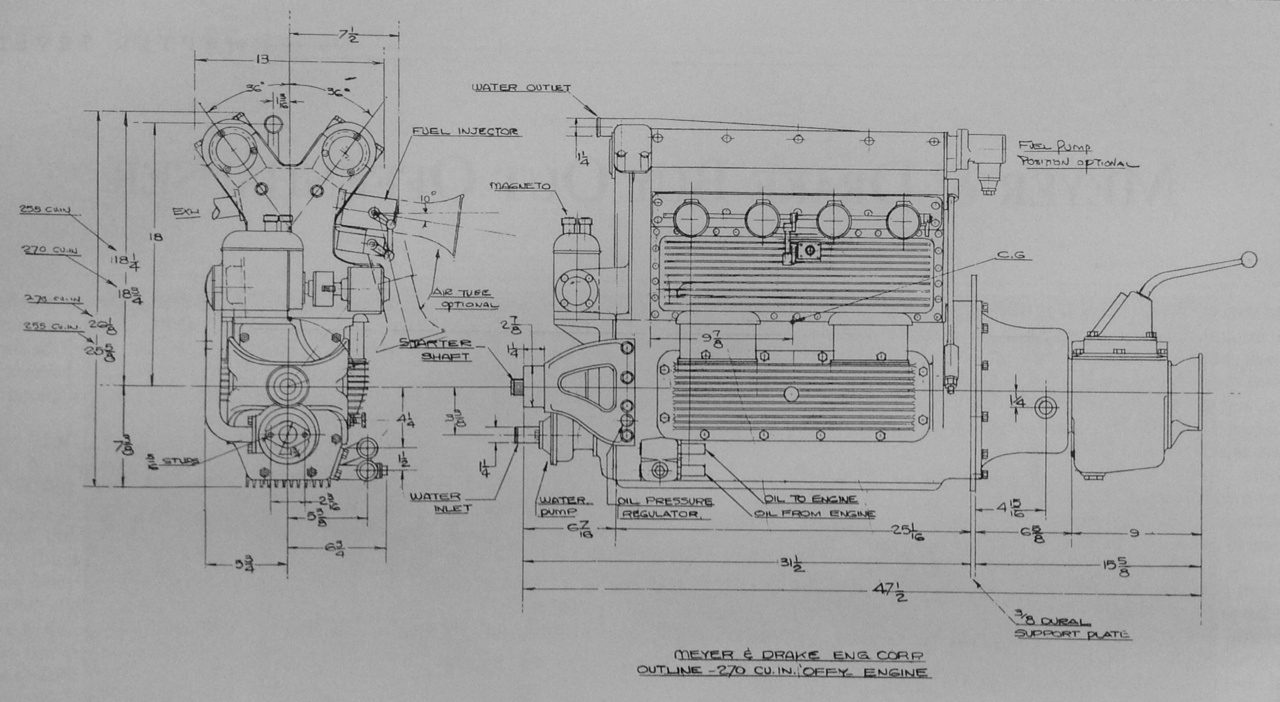
allen and matich bathurst 1969

(oldracephotos.com/Dick Simpson)

Niel Allen’s Elfin 400 Chev ‘BB662’ leads Frank Matich’s hi-winged Matich SR4 Repco and Bevan Gibson’s ill-fated Elfin 400 Repco, Easter Bathurst 1969…

There are so many historic elements to Dick Simpson’s wonderful shot of the three cars in ‘The Dipper’ on lap 1 of the Sunday feature race.

Allen is in Frank’s old car, the first Elfin 400/Traco Olds ‘BB662’, Matich’s 5 litre quad-cam Repco ‘RB760’ engined car slaughtered the opposition in 1969. It was intended for the 1968 Can Am but was completed too late, its high wings will be shortly outlawed as all such appendages were over the 1969 Monaco GP weekend…and tragically Bevan died during this race, a victim of circumstances and the aero of the 400 which was not, with the knowledge of the time, ‘fully resolved’.

I have not written an article about one of our ‘Racers Retreat’ Peter Brennan’s restorations for a while, this article features his ex-Frank Matich Elfin 400/ Traco Olds ‘BB662’ Sports Car.

I had almost finished it a few weeks ago and then the tragic news of Frank Matich’s death on May 11 came through.

With the assistance of his former colleagues at the time, Bruce Richardson and Geoff Smedley i have been able to fill in some gaps and i think portray an objective account of the Elfin 400’s design and construction, which has been somewhat contentious down the decades.

This article is dedicated to this incredibly talented racer, constructor and businessman- truly a great Australian, Frank Matich.

autosportsman mag matich

‘Auto Sportsman’ cover July 1966 depicts Frank Matich ‘Australian Tourist Trophy’ win at Longford in February. Elfin 400/Traco Olds ‘BB662’.

Historic Context…

It’s interesting to look at the explosion of motor racing post war as the vestiges of conflict faded away and people started to live their lives again and indulge in their passions.

Consumer credit became more available, manufacturers introduced new models of cars and of course wanted to extol their virtues and promote their brands via motor racing.

In the US, sports car racing was the focus of road racing at the time, single seater racing being mainly the province of speedways. The Europeans slugged it out with local specials powered by increasingly larger capacity V8’s. Ferrari and Maserati built cars such as the 340 America and 450S as cars like the Allard Cadillacs, their 6 litre engines providing stiff competition to the D Types, 300S Masers’ and Monza Ferraris’ the latter three began to dominate based on numbers alone.

A ‘game changer’ was the introduction of the small block Chev V8 introduced into 1955 model cars. The engine was 100 pounds lighter than any other production V8 at the time and compact, Lance Reventlow exploited its virtues in his Scarabs in 1958.

The Cooper Monaco and Lotus 19, mid-engined cars powered by the Coventry Climax FPF brought a level of subtlety to the fields but it wasn’t long before the small block Chev, Ford ‘Windsor’ V8 introduced in 1962 and the F85 aluminium Oldsmobile engines found their way into the backs of the Coopers and Lotuses. These ‘small and big block’ modern V8’s established a new paradigm globally for sportscar racing, they won everything up to and including Le Mans.

The focus of the European and English racing car manufacturers was the US market where there was much money to be made supplying this strong sportscar scene which launched the careers of Phil Hill, Carroll Shelby, Dan Gurney and Richie Ginther into Europe in the ’50’s.

In Australia the bigger racing budgets were devoted to single seaters although we had a smattering of Jag C and D Types’, 300S, Lotus 11’s and 15’s all of which could double up in events like the Australian Grand Prix which was run to Formula Libre until 1961.

In the early 60’s Frank Matich and Bib Stillwell slugged it out in both single seaters and sportscars; Stillwell in a Cooper Monaco I wrote about a while back and Frank Matich in a Lotus 19 and later, after the earlier car was destroyed in a Warwick Farm testing accident, a Lotus 19B. Both cars were Coventry Climax powered. (Stillwells Cooper was fitted with an ex-Scarab Traco Buick engine later)

‘Cranky Franky’ was an awesome competitor and engineer, his later self built cars were of world class and won Australian Sportscar and Gold Star (Single Seater) Championships.

In 1962 Matich raced Elfin Clubman, Formula Junior and 1.5 litre cars as a factory driver, in fact he ‘cut his single seater teeth’ with Elfin and was appointed the firms NSW Agent. Elfin is the South Australian company created by Garrie Cooper in 1958, it evolved from his fathers body-building business and became Australia’s largest and most successful producer of racing cars, building over 350 cars and winning dozens of Championships until well after Coopers death in April 1982

The modest, understated Cooper, a titan of Australian Motor Racing was to play a key role in Matich’s next championship winning sportscar.

19b wf

FM cutting the grass in the Lotus 19B Climax, Homestead Corner, Warwick Farm. This car was extensively and continually developed by Matich and his team and had some Brabham components; wheels and brakes at the end of its life which occurred at Lakeside in 1965. Chassis number unknown, car taken to Elfin and used as a reference for the 400 design, car last seen atop a workshop at Elfins many years ago…destiny unknown. (John Ellacott)

Destruction of Lotus 19B Climax…

Matich had success in his Lotus 19’s, winning the Australian Tourist Trophy in the 19B at Longford in 1964. He was the favourite to win the title at Lakeside in 1965, but the competition was to be stiffer than the year before with no less a driver than Ken Miles competing in a factory Cobra a long way from home.

Frank decided to contest a sports car event during the Lakeside Gold Star Meeting in July as his final preparation for the ATT  in November.

Matich was out in practice when he lost it behind the pits, the throttle of the car stuck open, he crashed the car  through the fence at around 120 miles per hour badly damaging it and giving Matich second degree burns to his hands and back.

cranky

Frank Matich pictured later in his career at Wigram, NZ. Tasman Series 1973. The car is his self built F5000 Matich A50 Repco, and here he is typically deep in thought pondering the setup changes he needs. He was 4th, the race won by his Kiwi rival in the constructor/driver stakes, Graham McRae in his McRae GM1 Chev. (Shane Lee)

The result was that Total, the French Oil Company and Matich’s sponsor, withdrew their support, the local distribution company had recently been taken over by Boral in Australia.

Ray Bell ‘They (Total) had been looking to Frank to win the Gold Star in the Brabham and continue blitzing the field in the 19B, but he was now out of racing for some time and they bailed right out of their deal with him’.

Laurie O’Neil was a wealthy Sydney businessman who had the franchise for Peterbilt Trucks, he had and would for many years own cars others raced, he was a sponsor of the Lotus 19B and would support Matich in a new car.

chassis and engine

The Matich 400 ‘BB662’ coming together at Elfins, Conmurra Avenue, Edwardstown. Side pontoons, Traco Olds 4.5 litre F85 engine and Hewland HD5 gearbox. Key elements of the engine; Engle roller cam, stock rockers but fabricated steel rocker stand or pedestal, JE pistons, Warren machined ‘H Beam’ rods, Moldex steel crank, 4 48 IDA Webers, conventional Delco Remy distributor and coil ignition, Traco inlet manifold, McLaren supplied exhausts; circa 350-365bhp at 6500 rpm. By 1966 the Olds even at 5 litres wasn’t enough to do the job in the ‘States, but in Oz it was more than sufficient, the engine 200 pounds lighter than a 5.4 litre Chev with consequent benefits in terms of running gear, weight transfer etc. (Bob Mills Collection)

Birth of The Elfin 400…

According to Barry Catford in ‘Australias Elfin Sports and Racing Cars’ Garrie Cooper was developing his own ideas for his first ‘big banger’ sports car as he had been approached by an existing customer, Noel Hurd to build a car powered by a Ford 289cid V8.

Cooper visited the UK looking at the latest racers and had commenced the design process of the car according to Noel Hurd who confirmed as such to journalist Ray Bell in August 2002. Still, the somewhat contentious part of this story is the input Matich had into the design of the Elfin 400, which was to be the new cars type designation, as against Cooper himself.

Geoff Smedley was Matich’s engineer at the time and recalled ‘I started to work with Frank after John Youl retired from racing (a world class driver of Cooper Climaxes from Tasmania) and have memories on the birth of the Elfin 400, it was in 1965 after the demise of the 19B at Lakeside. Garrie Cooper came over from Adelaide to Sydney, Frank and i picked him up and we had a long lunch, about half the day. We discussed the layout of the car, the ideas were drawn up on a restaurant serviette incorporating salvageable bits from the Lotus.’

‘At that stage we assumed we would use the Coventry Climax FPF from the Lotus, the decision to go with the Traco was made later. Garrie designed the car using the general layout we discussed and agreed. The final design couldn’t be finalised until we decided what could be used from the 19B. The Hewland HD5 box’ was used and i think the car was set up on the 19 uprights but i am not sure the car ever raced on them.’

‘I spent much time at Elfins’ in Adelaide machining many of the components as Garrie had a lathe but not a machinist which was my core skill. Garrie Cooper was a brilliant man and all the credit must go his way for the 400, it was an Elfin’ Smedley said.

‘Total had kept me on to sort out the sale of all of the bits left over from the Lotus and Brabham race program, but it all got too hard and complex so i left to work on other projects

g cooper ian smith

Lovely portrait of Garrie Cooper taken in the late 1970’s by Ian Smith. The ‘Ansett Team Elfin’ F5000 MR5/6/8/9’s were mainstays of Australian top level single seater racing for the best part of a decade from 1972. Cooper a remarkably successful designer/constructor and fine driver. (Ian Smith)

After Geoff Smedley’s departure, Bruce Richardson was employed to work on the program ‘I worked with FM on the Leaton Motors owned D Type Jag and Lotus 15 from around 1958 and then left to go overseas. I was working for Reg Parnell Racing in Europe at the time Total/Matich were looking for a competitive sportscar and made the introductions on their behalf to UDT Laystall which resulted in the purchase of FM’s first, ex-Moss 19.’

‘When I returned to Australia Laurie O’ Neil had decided to get actively back into motor racing by supporting Frank Matich into another car, which became the Elfin 400. He bought the wreck of the Lotus 19B from the insurers, employed me to look after the car and employed FM on his books as a salesman. early on Frank and i had discussed the various cars we liked at the time including Bruce McLaren’s ‘Zerex Special’ Cooper, all of which was later discussed with Garrie Cooper’

Laurie soon despatched me to Adelaide to pick the 400 up, I had only just got married so off my wife and I went on the long trip from Sydney by road South West. When we arrived in Edwardstown Garrie was surprised to see us, the car was far from finished!’

The Noel Hurd, Globe Engineering owned car was the prototype and given the chassis number ‘BB661′ but was soon relegated to the second built, with the Hurds’ generous consent, to allow the Matich car to be completed first. Frank wanted to contest the 1966 Australian Tourist Trophy at Longford in February 1966.

Richardson, ‘I stayed in Adelaide and helped build up the car together with Fulvio Mattiolo, a great bloke and fabricator, John Webb who built the body, Bob Mills and others. To my recollection none of the parts from the 19B were used in the 400.’ (other than the Hewland gearbox as noted above by Geoff Smedley)

‘The engine was a brand new Traco Olds based on the F85 block, Laurie was always bringing in cars from the US so he plonked it in the boot of one of his imports! I had several trips for Laurie to see the Traco guys in Culver City, both Jim Travers and Frank Coon were remarkable people and very professional to deal with’.

‘The engine itself was very good, the problems were inherent with the lightweight block once they developed over about 300BHP. The block distorted quite a lot causing loss of oil pressure. We used Merv Waggott’s dyno in Sydney and had him make some steel sleeves to fit into the block where the cam followers ran which helped the problem. Repco had similar issues with the same block they used in F1, solving them by building their own blocks from the 1967 season.’

‘With time running short, we planned to do the sports car events which were part of the 1966 Tasman Series Australian rounds, especially the Tourist Trophy, at Longford we took the car back to Peterbilts headquarters in Sydney. There the finishing touches were completed including the rear body, John Webb came to Sydney to do that, the exhaust system, painting etc. The car made its race debut at Sandown having been tested at Warwick Farm.’

body

The body of the 400 was hand formed by John Webb in aluminium with a fibreglass female mould taken from the nose section.. (Bob Mills Collection)

Matich related his version of the 400’s design and build in a ‘Vintage Racecar Journal’ article published in August 2002, unfortunately 20 years after Garrie Coopers’ death and therefore ability to respond…

‘Garrie Cooper of Elfin came to see me (after Matich destroyed his Lotus 19B) as he had orders to build a big sports car and had a proposition. They would do the work and build the car to my design if they, with some modification, could apply the design to their own version.  VRJ: So your own car was known as the SR3?

FM: The first car for me was called the Traco Olds. I was a bit embarrassed and didn’t want to call it a Matich…My good pal, Laurie O’Neil, was involved with me and had bought an engine from friends at Traco Engineering in America and we agreed to call the car a Traco. They were flattered but there was a bit of criticism as everyone thought there was some disagreement between Elfin and us. There was no disagreement, but there
was a little problem as BP had an arrangement with Elfin where they used to pay a bonus for every race that an Elfin car won. As a result of that, Elfin wanted me to call the car an Elfin; then they offered me a part of what BP was paying but I wouldn’t agree, so it all became too bloody complex. So from then on I decided to call them Matiches’.

In fact the ‘spin’ by Frank started very early, in an Australian ‘Auto Sportsman’ October 1966 article written by Ray Simpson. The article says ‘ The early stages of construction were carried out with the help of Garrie Cooper at the Elfin works in Adelaide. Completion of the project however took place at the Peterbilt Works in Sydney where Bruce Richardson and Rennmax exponent Bob Britton finalised the design and finished the car’.

The photos in this article clearly show the car being built at Elfins in Adelaide, the account of Geoff Smedley and Bruce Richardson confirm both the design and construction of the car by Cooper/Elfin in Adelaide with only the finishing touches made in Sydney, the bodywork itself completed by Elfin’s John Webb there.

Britton had no role in the design or construction of the 400. He did build the Matich SR3, Franks’ 1967 Repco powered Can Am contender, the chassis of which is ‘as good as a copy’ Elfin 400 according to Bruce Richardson, ‘something Bob Britton and i had a chuckle about in recalling all the fun times, challenges and success we had with Matich at his recent funeral’.

What seems likely is this; That Cooper had started the design of what became the 400 before Matich ‘boofed’ his 19B. That Cooper and Matich met in Sydney, at whose instigation is unclear. That the general conceptual layout of the car was agreed and ‘documented’ on a serviette. That the remains of the Matich 19B  were used as reference points only, no parts of the Lotus other than the Hewland HD5 ‘box were used in the ‘BB662’ build. That Cooper designed the car, which he had commenced, perhaps changing the detail of the design to be consistent with the ‘conceptual serviette layout’ and whatever learnings were to be taken from the very dead but still useful 19B…

The basic dimensions of the car were referenced from, or compared with depending on how far Coopers design had progressed when the Lotus arrived in Adelaide, the 19B. It was critical to both Matich and Cooper that the car was successful from the start.

Peter Brennan, having owned and restored ‘BB662’ 25 years ago comments; ‘…the rear frame is similar to the Lotus, the centre bulkhead is of the Lotus diaphragm type, the 400 uprights are very similar, Elfins perhaps took a pattern from them, the Lotus in standard form didn’t have a Hewland box, the Elfin had cast front uprights, the Lotus Alford and Alder uprights’.

The Lotus was a source of reference as was the ‘conceptual serviette’ but the car is entirely of Elfin detail design and manufacture as Geoff Smedley and Bruce Richardson confirm.

Matichs’ conversations with Cooper about the dynamic attributes and qualities of the car he sought would have been readily understood by Cooper, a champion driver himself. Matich had been racing ‘big sports cars’ for over a decade; C and D Type Jags, Lotus 15 and Lotus 19/19B. He knew what he wanted and what was needed to win. Garrie hadn’t raced a ‘big car’ to that point nor built one.

To say that they collaborated closely on the conceptual design of the car, that the detail design was Coopers’ and the cars construction was by Elfin is an accurate way to describe the design and build elements of the project.

400 chassis

400 space frame was fusion welded square, round and oval mild steel tubing. Lotus type centre diaphragm clear. (Bob Mills Collection)

Garrie Cooper designed a conventional space frame chassis which was fully triangulated and constructed of square, round and oval section tubes. The aluminium undertray and subsidiary bulkheads were stressed to add rigidity to the light structure. His first monocoque Elfin, the very successful Type 100 or ‘Mono’ single seater was winning races at the time and whilst the monocoque Lola GT, Ford GT40 and Lola T70 raced during 1963-5, a good space-frame could still do the job, time was of the essence and the successful Lotus 19B was a spaceframe…

Front suspension comprised upper and lower wishbones, coil springs and Armstong dampers, the uprights are cast magnesium, the roll bars adjustable. At the rear a single top link, inverted lower wishbone, twin radius rods and again coil spring damper units using Armstrong shocks was deployed. The sway bar was adjustable.

400 rear peterbilt

Rear shot of the Matich ‘BB662’ Olds in Sydney. Rear chassis diaphragm, Hewland HD5 ‘box, muffled! aluminium Traco Olds engine, inverted lower wishbones, Elfin cast magnesium uprights, driveshafts and adjustable sway bar all clear. Rear tyres 15 inch diameter X 12 inch wide shod with Firestone tyres to whom FM was contracted at the time. L>R Bruce Richardson, Matich, Laurie O’Neil. (John Ellacott)

The rack and pinion steering was Triumph Herald, the offset seating position encouraging Cooper to use this component.

Brakes were discs, 12 inch front and 11 inch rear using Girling BR calipers. Wheels were also of Elfin design and like the uprights were cast by the Commonwealth Aircraft Corporation in Fishermans Bend, Melbourne. They were 4 stud magnesium alloy, 15 inch X 10 inches in diameter at the front and 15 x 12 at the rear…to comply with Australian sports car regs a spare was also carried, mounted under the wrap around perspex windscreen.

The wheel base was 91 inches, track 55 inches, width 68 inches, length 148 inches, height 32inches and weight 1300 pounds.

Four Elfin 400’s were built; ‘BB661’ for Dick Bassett and Noel Hurd , ‘BB662’ for Laurie O’Neill and Frank Matich, ‘BB67-3’ for Bob Jane Racing and ‘BB67-4’ for Andy Buchanan in New Zealand.

All of the cars still exist and have interesting histories. For example, the Bassett car was fitted with a Ford Windsor V8 engine with DOHC heads developed by Globe Engineering for a period. The Bob Jane car was fitted with the first Repco Brabham RB620 racing engine sold to a customer, Brabhams engines all factory supplied as part of Jacks deal with Repco.

400 side rear

Car at Peterbilts’ Alexandria, Sydney base. Elfin 400 Traco Olds, February 1966. Car delivered completed without rear bodywork and all of the exhaust system. Rear body finished and fitted in Sydney by Elfins’ John Webb. Matich in the car, Laurie O’Neil and Bruce Richardson in overalls. (John Ellacott)

‘BB662’ without rear bodyword was taken to Sydney on February 8 1966 for completion and testing prior to the Australian Tourist Trophy which was contested during the Longford Tasman meeting on March 7.

Matich initially raced the car with the bodywork and its distinctive ‘front horns’ containing the headlights in place but these were later removed to attempt to overcome the aerodynamic lift that was characteristic of the car.

400 front peterbilt

Front of ‘BB662’ post painting in Sydney fitted with its controversial and aerodynamically unstable, original ‘front horns’ nose. The aero issues are explored in the text. It looks great, ‘edgy’ for its day but the aero was not ‘fully resolved’. (John Ellacott)

Elfins body-builder John Webb and Bruce Richardson accompanied the car to Sydney, the 400 being race ready to compete in the sportscar events at the 27 February Sandown Park, Victoria, Tasman meeting where it was immediately competitive. The body was completed the car pounding around ‘Franks Backyard’, Warwick Farm in Sydneys’ west before heading south to Melbourne and then across Bass Strait for the fabulous Longford meeting.

The ‘Racing Car News’ report of the ‘Elfin Traco Olds’ Sandown debut explains that the 365bhp car was barely slower than the 2.5 litre Tasman single-seaters. Matich won the race comfortably at a canter from Alan Hamiltons Porsche 906 and Spencer Martins’ Ferrari 250LM taking half a second off Bib Stillwells’ Cooper Monaco lap record ‘doing it so easily he’s saving a few seconds for the future…there just isn’t anything in the country that can come close to it in Sports Cars’.

Other than routine pre-race preparation the car was nicely ‘run in’ for its Australian Championship encounter the following weekend.

longford program 1966

(Ellis French Collection)


matich longford

ATT grid Longford 1966; #2 Matich Elfin 400/ Traco Olds, #1 Spencer Martin Ferrari 250LM, the red helmet on the far left is Alan Hamilton, his Porsche 904/6 Spyder invisible, #11 on row 2 is Lionel Ayers, a long way from Queensland in his Lotus 23B Ford . (Richard Blanden)

Frank Matich shares the front row of the 1966 Australian Tourist Trophy grid at Longford with Spencer Martin’s Scuderia Veloce Ferrari 250LM, his brand spanking new Elfin 400/ Traco Olds gleaming in the Tasmanian autumn sun…

The feature event of the annual carnival of racing at Longford was the Tasman race for 2.5 litre single-seaters, in ’66 the race was won by Jackie Stewarts BRM P261 but all eyes were on Jack Brabham and his BT19 Repco, the new partnership of Brabham and the RB620 engine making only its third start, the engine made its debut in South Africa, raced at Sandown the week before finishing 3rd behind the 2 BRM’s in Tasmania. The testing was all critical to give the package the reliability it needed to win the World Title, which of course Brabham did in 1966, doubling up with Denny Hulme in ’67.

The Australian Tourist Trophy was also an event of great stature, Matich took an easy win in an 8 lapper which opened the meeting, setting a lap record of 2:28 winning from Martin’s Ferrari and Frank Demuth’s Lotus 23B.

matich and ambrose

The latest Elfin Sports Car passes the first…Ross Ambrose (father of V8 SuperCar driver Marcus) is passed by Matich. Elfin Streamliner and 400 respectively. In fact FM muffed a gear under brakes and was nearly hit up the chuff by Ambrose. ATT Longford 1966. (oldracephotos.com.au/David Keep)


matich and richarson longford paddock

Mechanic Bruce Richardson and FM ponder changes to the Elfin 400/Traco Olds in the Longford Paddock. Note the sartorial elegance of the 2 Aussies in the background…Longford was always hot! (oldracephotos.com.au/David Keep)


matich tassie

Matich crosses the South Esk River, Longford 1966. The couple in the boat looking relaxed and dropping in a line…(Alan Stewart Collection)

The ATT was contested over 23 laps on day 2 of the carnival. ‘Racing Car News’ reported the event as follows ‘Martin made a slow start and allowed Hamilton’s Porsche 906 to follow Matich into the first corner, but took over 2nd towards the end of the first lap. Second time past the order was Matich, Martin, Hamilton, Demuth, Mitchell (RM1), then Ayers and Bolton…’

‘The pace was fast and furious but positions did not change greatly in the early laps…already Matich had lapped Bob Holden (Lolita) and Greg Ellis…Martin was forced into the pits on the 6th lap with a loose undertray and rejoined the race exactly as Matich went past.’

The order was Matich a half a lap ahead of Hamilton, Demuth, Ayers, Bolton and Holland, the latter 2 drivers in Lotus 23B’s.

‘The next 2 laps the big Ferrari regained 2 places..on lap 17 Matich was coming into Newry about to lap Carosi’s Bolwell when Carosi spun into the bank on the inside of the circuit barely giving Matich the room to pass…In the closing stages of the race Martin gave the Ferrari everything, making up 5 seconds a lap but he was unable to catch the fantastic white Porsche’

‘Matich was untroubled in the final few laps, his times dropping to 2:45’s and his top speed from around 160mph to 130. The fleet footed although bulky looking  Elfin took the flag some 13.4 secs ahead of the Porsche with Martin another 29 seconds away in 3rd’.

The meeting was indicative of the dominance of the car Matich winning many races in it in the short time he raced it, but he needed to do his own thing, he resigned from Peterbilt, who employed him, in September 1966 to pursue his own programs with his Rennmax built but ‘as good as a copy’ Elfin 400 chassis Matich SR3 cars…The success of these fabulous devices is a story in itself for another time.

wf feb

Peter Windsor’s shot of the RAC Sports Car Trophy race at Warwick Farm in May 1966. Matich is on pole in his new car with Alan Hamilton alongside, Porsche 904/6 with Kevin Bartlett on the outside in the Alec Mildren Racing Alfa Romeo TZ2. Windsor captions the 2 Lotus 23B’s behind as driven by Frank Demuth and Niel Allen, you can also just see Spencer Martin’s Scuderia Veloce Ferrari 250LM…the heavy long distance racer well back amongst all these ‘Sprinters’. (Peter Windsor)


rcn cover 400

RCN cover with David Atkinson’s watercolor of  duelling Elfin 400’s; Allen in ‘BB662’, from Noel Hurd in the Globe Engineering Ford Windsor powered car and Bob Jane in his Repco 4.4 litre engined device…


allen bathurst

Wonderful Dick Simpson shot of Bill Brown in the Scuderia Veloce Ferrari P4/350 CanAm with Niel Allen slipping up the inside at Hell Corner in the Elfin 400…on this occasion the exotic V12 bested 5 litres of Chev V8. Brown set the Bathurst top speed record of 181 mph and Allen took the lap record, then DNF in this Sports Car Trophy race. Love the crowd, vestigial safety fencing, ‘Murrumbidgee Road Racing Club’ overalls and ‘King Size Daggi Dog’ health food stand…(oldracephotos.com.au/Dick Simpson)

Laurie O’Neil sold the 400 to Sydney property developer and up and coming racer, Niel Allen…

Bruce Richrdson again picks up the story, ‘When FM left to do his own thing with the SR3 program Laurie said to me one day that Niel Allen was interested in buying the car, they did the deal, I went to work with Niel, looking after the Elfin and the other cars in his stable until I was injured in a fuel explosion. I left, Peter Molloy took my place. I took 12 months off and then worked for a succession of touring car teams as well as doing my own stuff; McLeod Ford with John Goss, Ron Hodgson with Bob Morris including a Bathurst win. I helped Charlie O’Brien run a BMW 635CSI at Bathurst, which was my introduction to electronics, at that stage I decided if that was the way things were going I would quit racing! Frank Gardner lived next door to me on the Gold Coast, I did work with them on a casual basis including helping them with their Bathurst win’

Allen initially raced the car with the Traco Olds but after blowing the engine ‘BB662′ was fitted with a 5 litre Chev V8 and ZF gearbox by Peter Molloy, Allen’s engineer till the end of his later, successful F5000 program. He continued to develop the car including changing the suspension pick-up points to suit the ever wider tyres available and fitment of Matich wheels to suit.

At the 1967 AGP Meeting at Warwick Farm Allen broke Matich’s lap record by 0.8 seconds and won the race. A month later he broke Franks’ Sandown lap record in a handicap race, FM having set it earlier in the day on the debut of his new Matich SR3.

Niel Allen was the only driver ever to set an outright lap record crossing the finish line backwards. This occurred at Symmons Plains, Tasmania, there being a tight corner that leads into a curve over the finish line there. At the end of the second lap he spun… and crossed the line backwards with a new lap record!

elfin 400 chev allen 1

Now with 5 litre Chev V8 in Niel Allen’s ownership, the installation done by Peter Molloy. ZF 5DS ‘box fitted at the same time. Wider Matich wheels fitted. (oldracephotos.com.au/David Keep)

Check out this YouTube Footage of the 1968 Warwick Farm Tasman Sports Car support race; wonderful race between Chris Amon in the Scuderia Veloce Ferrari P4/CanAm 350, Allen in the Elfin 400 and victorious Frank Matich in his Matich SR3 Repco…

wf stanley

Niel Allen ahead of Ian Cook in Bob Janes car. The 2 400’s are pictured at Warwick Farm’s Creek Corner during the Tasman meeting in February 1968, Matich having first tested the car 2 years before at the ‘Farm. Later nose clear to see, aerodynamically better? but fugly! (John Stanley)


400 bathurst grid

#12 Niel Allen Elfin 400 sharing the front row of the 1967 Easter Bathurst Sports Car grid with #7 Bob Jane Elfin 400 Repco ‘BB67-3’, Fred Gibson’s Niel Allen owned Lotus Elan 26R on the far left and Ron Thorp’s AC Cobra and another Elan on row 2. ‘BB662’ certainly did a few racing miles at Mt Panorama! (oldracephotos.com.au/Stuart Phillips)

Allen won both races he started at Hume Weir, near Albury in December 1967 s breaking Spencer Martins’ lap record set in the Scuderia Veloce Ferrari 250LM.

At the traditional Bathurst Easter meeting in 1968 Bill Brown set a top speed record in the Scuderia Veloce Ferrari P4/Can Am 350 at 181mph but Allen seriously challenged the Fazz setting a lap record of 2:18:4, 8 seconds ahead of Matich’s previous mark. Sydneysider Matich was on a business trip to the US to plan his 1968 CanAm assault, which ultimately did not eventuate due to the late completion of his SR4. Niel was a DNF forlornly parking the Elfin at the top of the mountain. Brown won the race from Pete Geoghegan in the SV Ferrari 250LM and Fred Gibson in Allens’ Lotus Elan 26R.

He also broke the record at Winton in Central Victoria in 1967 before selling the car to Sydney racer and tuning specialist Fred Gibson.

Allen bought Piers Courage’ McLaren M4A FVA at the end of the 1968 Tasman series in his inexorable rise to the top of Australian Motor Racing. He never won an Australian Title but took victory in the 1971 New Zealand Grand Prix in his McLaren M10B Chev, by rights perhaps he should have won the Tasman that year…FM said he didn’t understand how Allen was so fast given his need to divorce himself from his business pressures as a ‘weekend racer’, FM was a fulltime professional who tested religiously and relentlessly doing endless miles around Warwick Farm and being paid by the lap  as part of his Goodyear contract. FM was very fast but he worked hard at his craft.

Niel Allen wasn’t finished with Elfins’ sports cars either. He bought Cooper’s first monocoque sporty, the short wheelbase, tricky to drive, Elfin ME5 Chev 5 litre in 1969, success in that car was tough as by that time Matich was absolutely at the top of his game with his Matich SR4 Repco, the space frame car powered by a DOHC 4 valve, 5 litre RB760 engine, the car designed for the ’68 Can Am series for which it was late is a story in itself.

RCN oct

Niel Allen advertises the ‘fleet’ for sale to concentrate on his ex-Courage F2 McLaren M4A FVA. RCN Oct 1968. (Stephen Dalton Collection)


elfin 400 bathurst

Start of the fateful Easter Bathurst race which took Bevan Gibson’s life, 1969. Gibson is in Bob Jane’s red Elfin 400 Repco, Allen is alongside in the Elfin 400 Chev ‘BB662’ and Frank Matich on the right in his hi-winged Matich SR4 Repco. SR4 the  fastest car in Australia of any type in 1969, winner of the ASS Championship and the only year in which it raced. Allen gets the jump at the start. (Wayne McKay)

Nose Lift and Aerodynamic Instability at High Speed…

The aerodynamics of racing cars in the 1960’s was still very much a black art, perhaps the most early experiments in gathering data on the flow of air over and around racing cars was in the latter stages of Fords Le Mans program and the ongoing, seminal and defining work of Jim Hall and his band of ‘GM quasi-works’ boffins at Rattlesnake Raceway in Texas, the Chaparrals simply iconoclasts.

Without taking a tangent too far Jim Hall spoke about his early aerodynamic testing and calibration in the article i wrote about the Chaparral 2F, those with an interest in his work may find it of interest, the relevant bit is about half way through the article;

1967 Spa 1000Km : Chaparral 2F Chev…

Cooper designed the body with ‘John Webb wanting the underside of the horns extensions to be horizontal, as a continuation of the whole underside of the 400, to avoid the possibility of aerodynamic lift , but Garrie insisted they curve upwards to avoid the nose fouling the track’ quoted Barry Catford in his Elfin book.

Interestingly, in the ‘Auto Sportsman’ article mentioned earlier Matich claims credit for the body design ‘ The body styling was inspired by the very successful Chaparral Sports Car …Jack (sic) Webb fabricated the design from drawings supplied by Matich and it features front ‘Fish Gill’ spoilers which added to its gruesome appearance. Matich has recently run the car with a ‘blunt nose’ unit but plans only to use this on short circuits’. Taken at face value this statement suggests Matich did not think the car had high speed instability, if he planned to use the blunt nose on short circuits only, it implied he was happy with the original bodywork on fast ones.

Whatever the case Matich removed the distinctive horns on ‘BB662’, probably to cure aerodynamic lift, possibly to differentiate the look of the car from other 400’s.

During the 1967 Longford meeting in practice Noel Hurd in the Globe 400 ‘BB661′ became airborne at high speed, he mowed down a row of fence posts after spinning several times but was unhurt. The car was repaired at Elfins’ with the ‘horns’ removed.

When Peter Brennan acquired ‘BB662’ he spoke to Niel Allen about his experience of the car which was complimentary overall but ‘Niel said on the fast straights he used to have to touch the brakes to get the nose down before applying the brakes hard. The horns were already off the car at this point but Niel was still having problems with front adhesion. It was pretty clear these early cars had little or no frontal downforce’.

Once he cut the air slots in the guards he said it cured the problem ‘The horns were not the problem causing the lift, it was air damming under the guards which could not escape, all that was required was to cut slots in the rear of the front guards. I discussed this at length with Niel, he found out the cause later and would not have cut the original nose off had he understood the real nature of the problem’.

Peter raced the car at Adelaide in 1990 ‘at 175 mph down Brabham Straight without a problem, in fact it was making so much downforce we had to reinforce the nose brackets at the meeting with the belt of one of my pitcrews pants!’

Unfortunately all these learnings were in the future, lets not forget that even with technology no-one in their wildest of dreams could imagine in 1966 that Mark Webber aviated in his Mercedes on the Mulsanne Straight at Le Mans on consecutive days only a decade ago…

And so it was that Bevan Gibson, the young up and coming Benalla driver lost his life in Bob Jane’s Elfin 400 at the Bathurst Easter meeting in 1969.

Barry Catford described the race ‘Matich was favourite for the race with a practice time of 2:14.9. After practice the faster drivers reportedly discussed the aerodynamic lift they had experienced over the second hump (this is pre ‘The Chase’ which now slows the cars on Conrod) on Conrod and resolved to treat that section of the track with caution.’

‘Niel Allen roared away (in BB662) followed by Gibson and Matich. Frank took over at Forrests Elbow and then on lap 2 Niel had a lose on the Mountain and dropped back and the Matich SR4 Repco began having fuel pressure problems. Bevan closed…on Mountain Straight making up more ground and the next lap drew alongside as they headed into Shell again’.

Bevan sensed a victory (which would never have been on had the SR4 been running properly, it was an opportunity which would seldom come) and tried harder on the 4th lap…the Elfin became airborne on the 2nd Conrod Hump, turning on its back and killing Bevan instantly. Matich, Allen and others retired almost immediately’

Gibson SCW cover

(Stephen Dalton Collection)

Elfin 400/ Traco Olds/ Elfin 400…now the ‘R&T Chev’

Fred Gibson was then an up and coming driver and proprietor of a Randwick, Sydney tuning business called ‘Road and Track Automotive Services’ hence the new name when Fred purchased the car he had occasionally driven for Allen.

The 400 was extensively rebuilt but mechanically unchanged, the notable difference the new bodywork designed and built by Denis Julian which used the original body as a mould but gave the car a lower line. Gibson also added a wing.

The engine was a 5 litre Chev with Crower cam, Warren rods, again on 48IDA Webers and gave circa 450bhp.

rand t chev gibson

Fred Gibson in ‘BB662’ as the ‘R&T Chev’, Surfers Paradise 1970. (Unattributed)

Gibson didn’t race the car for long, his career was on the rise, he became a Ford factory driver in their Series Production racing program with the iconic Falcon GTHO’s, the car being sold to Allan Newton in Victoria.

Newton raced the car regularly for years both in Victoria and interstate only selling it after a ‘big hit’ going up Bitupave Hill at Sydneys Amaroo Park in 1977.

rand t

Geoff Russell’s shot of the Elfin 400 after its big Amaroo shunt on 29 May 1977, front of the car clearly shortened considerably by its impact against one of the circuits earth banks. See ‘Etcetera’ below for a sequence of photos which captured the accident. (Geoff Russell)

He sold the car to a friend, Dennis Burdon who cut away the badly damaged rear of the chassis to fit a 4.4 Litre Leyland P76 V8 and Hewland F1 FGA gearbox.

This process took years, Brennan was aware of the cars location, knew Newton and eventually when Burdon tired of the car he bought ‘the steering wheel, 4 corners which were complete, the centre section of the chassis from roll bar to the pedals and the engine and gearbox which were sold, respectively to Andrew McDowell and Chas Talbot for his self built Formula Holden’

And so, our intrepid racer set off on a mammoth reconstruction project…

r t chev winton

R&T Chev ‘BB662’ in the bucolic Winton, Benalla, Victoria paddock in 1974, still very much as Fred Gibson modified it. The car was a regular in Victorian events at the time, i saw it race many times, Allan Newton drove it well. The cars either side are Lotus 23B’s, the bright yellow car the Gibson Family (as in Bevan Gibson who died at Bathurst) which if memory serves was fitted with a Repco V8, at the time the car was driven by Paul Gibson. Australian readers will know the popular Gibson’s as Benalla Auto Club stalwarts. (oldracephotos.com.au/Neil Hammond)


salas shop

Elfin 400 ‘BB662′ getting towards the end of its restoration by Peter and Gavin Sala’s team. Car has been tested at Calder sans body, and is in the final stages of completion in late October 1990. Look closely and you can see the other 2 400 chassis’ in the workshop at the time. (Peter Brennan Collection)

Restoration of Elfin 400 ‘BB662’…

Having acquired the car, or rather it’s remains the restoration challenge was a big one, essentially Peter had the bones of a car, the project was largely one of reconstruction or resurrection rather than a rebuild.

Brennan liked the combination of the original bodywork and 5 Litre Chev engine, a Traco Olds was pretty much impossible to source, the Hewland HD5 and ZF boxes were also rare so it made practical, economic sense to choose a combination of core components with which the car had raced in its long racing life which could be sourced at sensible money.

That decided, Peter wrote to the Confederation of Australian Motor Sport and was given written approval from the CEO, John Keefe to rebuild/reconstruct the car to that spec.

Some years later, after the car had been racing, the CAMS Historic Commission changed their view on the matter, what followed was a decade of protracted arguments and negotiations about all manner of the detail specifications of the car which was finally resolved with compromise being reached; the car could race as rebuilt but when sold by Peter the nose of the car is to be similar to that used by Niel Allen during the period he raced it; in essence the car could race in the spec chosen by Peter and confirmed as such by the CAMS CEO at the projects commencement…

salas handiwork

Gavin Sala’s  handiwork on display. Brennan says’ Be fair to say Gavin played an equal part in the resto work, he is a craftsman for a butcher, hard to believe the work he produces with virtually no qualifications’. ‘Old Midnight’ is in situ, its a spaceframe chassis, the aluminium side pontoons are clear. Gear linkage sitting atop the pontoon this side, exhausts have been ‘dummy fitted’. (Peter Brennan Collection)

Having agreed on the specs of the car with CAMS a handy confluence of events accelerated the cars resurrection from mid 1990…

Our intrepid racer sold his Melbourne ‘Carbitune’ business and decided to give himself a well earned break before starting his new venture, the Australian Grand Prix was in Adelaide in November, with a little bit of luck ‘BB662’ could be a debut starlet in the Historic Racing support events, these races always popular with the punters and owners alike.

The repair choice was made easy as Gavin Sala, a Victorian Racer/Restorer/Dealer and Owner happened to have the ex Bob Jane ‘BB67-3’ and ex Buchanan ‘BB67-4’ cars in his outer urban Melbourne workshop for restoration at the time.

The most difficult part of the job was the chassis. Elfin still existed, it was only money to buy uprights, wheels and so on but the 400 chassis jig no longer existed. Having the other cars alongside made the task of using the remains of the original chassis as a base; from rear bulkhead to the pedals, then carefully measuring and fabricating the required frame, brackets, diaphragm and related aluminium panels relatively straight-forward for skilled fabricators such as Ken Leigh, Gavin and Peter himself.

400 butt shot

‘BB662’ resto assembly butt shot. DG300 ‘F5000’ Hewland ‘box. ‘Old Midnight’ 5 litre Chev circa 500bhp on 48IDA Webers. Cast Elfin uprights, upper and lower wishbone/coil spring damper suspension and beefy front bulkhead and rear chassis diaphragms all clear, ditto LHS aluminium pontoon. Car sans exhausts here, but the ‘overhead’ headers came with the bits acquired from Newton. (Peter Brennan Collection)

The suspension was complete but gently sand blasted, crack tested and either reused or replaced using the originals as templates. The wishbones and radius rods were then nickel plated with new spherical joints used throughout.

The cast magnesium uprights were again crack tested, found to be ok, and then reassembled with new bearings.The Triumph Herald steering box was checked and re-used. The lightweight aluminium radiator was a pair of Nissan Pulsar rads’ alloy cores welded together.

salas front scoop

400 front end showing Gavin Sala’s  beautiful aluminium radiator surround/support/duct fabrication work. Not bad for a fella apprenticed as a butcher as PB says! (Peter Brennan Collection)

Peter acquired a Hewland DG300 transaxle. The engine was bought from F5000 Racers Peter and Mary Middleton. ‘Old Midnight’ was originally the great Max Stewarts’ spare engine, we covered its history in the story about the restoration of Peters’ ex Lella Lombardi Lola T330 ‘HU18’, a while back.

Lella Lombardi’s Lola…Peter Brennan’s Restoration of Lola T330 Chev ‘HU18’ Episode # 3…

Peter, ‘Its nickname was ‘Old Midnight’ as the motor was usually slipped into his Lola after midnight when the race engine was cactus for the weekend.I bought it as a ‘long motor’ less injection. The block was shaved of all unnecessary production lugs and lightened as much as possible.It has Bow-Tie heads, TRW pistons, Carillo rods, a Crane ‘574’ roller cam, Z28 crank, Vertex magneto, and like most of Max’ engines is on Weber 48IDA carbs, it produces 505bhp@7500rpm’.

The bodywork was provided by Elfin, or rather the front mould, which had been run over by a truck! Peter repaired it in order to ‘take a flop’ from it. The original Matich rear body was long since gone, so a production 400 rear ‘glass panel was used, again sourced from Elfin.

calder

Calder test less bodywork 3 weeks before the 1990 AGP in October. (Peter Brennan Collection)

With time getting tight Peter tested the car sans bodywork at Calder to carry out systems checks, ‘BB662’ behaved itself well although Peter was stunned by the very heavy steering which Kevin Bartlett diagnosed as the offset of the rim from the centre line of the kingpin, ‘scrub radius’.

The car then returned to Gavin’s shop for the final fitment of the body, making its debut, as planned in November 1990, where it was undoubtedly one of the stars of the show for many misty eyed enthusiasts who remembered the cars heyday in the hands of the supremely talented Frank Matich and Niel Allen.

body on

Peter has dated this shot on the front guard…its 10 October with 3 weeks to the 1990 AGP…with still a great deal of work to do. Sala’s workshop. (Peter Brennan Collection)


400 at agp 1990

Last minute pre-event fettling out front of Noiges’ pit, AGP Carnival Adelaide 1990. (Peter Brennan Collection)


400 3

Peter Brennan at the AGP Meeting 1990. Photo signed by Niel Allen, Lola Mk1 at rear. Elfin 400 Chev. (Peter Brennan Collection)

The pointless squabble with CAMS meant the car disappeared from sight for a bit but otherwise the 400 is a regular entrant at Historic Meetings around the country and is always punted with verve and skill, much as Matich did during his ATT win at Longford all those years ago…

tour to tarrengower

Peter had the important job of ferrying Lorraine Cooper, on the Elfin Owners and Drivers Club’ Tour To Tarrengower’ in 1994. The 400 is pictured at Bendigo, the start of a road trip for around 35 racing Elfins on the public roads of Victorias’ Goldfields district to Mount Tarrengower Hillclimb at Maldon, 45 kilometres away. I did it in an Elfin Crusader F Vee…it was fun in that, the 400 and various F5000’s entered had a wonderful time! (Peter Brennan Collection)


DSC01368

More recent shot of ‘BB662’ at an Albert Park GP. Brennan’s standard of preparation and presentation outstanding. Car has its original Elfin nose, if you look at the top right of the nearside front guard you can see the ‘gills’ or air reliefs let into the bodywork which eventually addressed the front end lightness of the car by releasing air pressure at high speed. McLaren M1 alongside. (Peter Brennan Collection)


brennan in 400

‘Racers Retreat’ Peter Brennan, in Elfin 400 ‘BB662’, a much cherished car for over 25 years. Albert Park AGP several years ago. (Peter Brennan Collection)


scrab at traco

Amazing shot of the first Scarab Chev out the back of the Traco shop, ‘Thunder Alley, Culver City in 1958. Looking at the fuel tank on the right are Phil Remington and Harold Daigh, Dick Troutman is in the doorway. The Scarab body builder Emil Deidt is at the back of the car, beside him in the check shirt Marshall Whitfield. Jim Travers and Frank Coon are ‘midships with the suited Leo Goosen leaning against the car, beside him at the front of the car is Sonny Balcaen. (Photo Warren Olson Collection/Jerry Entin for ID of those pictured)

Etcetera Traco Engineering…

Traco Engineering was formed by Jim TRAvers and Frank COon in 1957, the pair made their names as mechanics for Bill Vukovich in his successful Indy wins in 1953 and 1954. Well before that they were pre-war hot-rodders racing on the dry lakes of California.

Their ‘shop’ was based in ‘Thunder Alley’, 11928 West Jefferson Boulevard, Culver City in the LA ‘Megalopolis’. The area was so named due to the number of ‘big hitters’ based in the area including James Garner and Lance Reventlow who tested their cars on the block.

The fledgling company was off to a strong start when Lance Reventlow contracted Traco to work on the front-engined Chevy powered sportscar Scarabs’ in 1958. AJ Foyt’s victory in the Mecom owned Scarab at Nassau gave the firm it’s biggest push with engines soon being supplied to Gurney, McLaren, Mecom, Brabham and Lola amongst others.

The bulk of the work in 1965/6 was on the Chev and Olds F85 engine although Bruce McLaren’s team used the companies talents to decrease the capacity of the Ford DOHC Indy engine for F1 use in 1966.

The payroll included some engineers who went on to become great engine builders in their own right; Al Bartz, George Bolthoff to name two.

In 1965 Traco built 48 complete engines and rebuilt 68 more, a ‘Sports Car Graphic’ 1966 article reported that ‘The average Traco built engine takes from 4-6 weeks to complete and requires approximately 100 man hours’, the engines were priced at the time from US$5000-6000.

In 1986 Travers and Coon retired after selling the business to then chief engine builder Jim Jones.

traco in shop

Frank Coon (L) and Jim Travers in their Traco shop building an engine in 1966. (Sports Car Graphic)


traco

Etcetera…

lt kay cutaway

(Laurie Kay)


match hospital

Brisbane ‘Courier Mail’ article of Matich’s Lakeside Lotus 19B crash. (Facebook Elfin 60’s Sportscars Group)


sandown elfin olds

image

Sports Car World cover shot at Longford 1966 during the Matich ATT win. Overhead shot shows a different angle of the body.


longford matich

Matich Elfin 400/Traco Olds with its AT Trophy laurel wreath. Longford paddock March 1966. (Ellis French)


matich lakeside

Matich in the Elfin 400/ Traco Olds, Lakeside, Qld 1966. (John Stanley)


400 rear

Rear shot of ‘BB662’ during Niel Allen’s ownership circa 1968, circuit undisclosed. (Mike Feisst Collection/The Roaring Season)


r and t 2

Chequered Flag magazine captured Allan Newton’s May 1977 accident which all but destroyed ‘BB662’, the old but sturdy spaceframe protecting Newton from worse injury…in much the same way the monocoque chassis of the Elfin MS7 saved him when his throttle again stuck open, this time at Calder, Victoria in 1984. He was a very lucky boy that day…(Chequered Flag)


elfin 400 bp ad

BP ad shot, taken, i think at Sandown, Victoria, ‘Peters Corner’ upon the cars debut, February 1966. (Facebook Elfin 60’s Sportscars Group)

Bibliography…

‘Australias Elfin Sports and Racing Cars’ John Blanden and Barry Catford, Ray Bell/The Nostalgia Forum, Sports Car World, Australian Auto Sportsman, Sports Car Graphic, Chequered Flag

Facebook ‘Elfin 60’s Sportscars’ Group. This is a very dedicated group of Elfin enthusiasts, key the group name into the FB search engine and apply to be to be admitted

Special Thanks…

To Bruce Richardson and Geoff Smedley for their affectionate, respectful accounts of their time working with Frank Matich

Stephen Dalton for the research assistance and access to his extensive collection

Photo Credits…

John Ellacott, Bob Mills Collection, Wayne McKay, Ellis French, John Stanley, Peter Windsor, Laurie Kay, Alan Stewart Collection, Ian Smith, Shane Lee, Peter Brennan Collection, Richard Blanden, Warren Olson Collection/Jerry Entin, Chris Snowdon, Mike Feisst Collection, Geoff Russell, Mike Kyral

Lindsay Ross of  Oldracephotos http://www.oldracephotos.com/content/home/ for the use of the Dick Simpson, David Keep, Stuart Phillips and Neil Hammond shots

Tailpiece…

(Mike Kyral)

Matich gallops away from Dandenong Road corner during the 1966 Sandown Tasman meeting upon the Elfin 400 Olds race debut- nice crowd!

Finito…

front

brabham entry

As motoring enthusiasts we all have a favourite (or two) when it comes to the various pressed, beaten or moulded automotive art…

The Italians have had a long tradition of art worthy cars for many to aspire. So what happens when the Art World decides to pay homage to a predominately Australian automotive heritage? Well you get the National Gallery of Victoria’s ‘Shifting Gear – design, innovation and the Australian car’ exhibition.

The NGV’s ‘Ian Potter Centre’ in high profile Federation Square, opposite Melbourne’s famous Flinders St Train Station has gone all out to show a variety of Aussie ‘coachbuilders’ art from the roads and the race tracks, ‘a celebration of Australian Automobile design represented by 23 cars dating from the late nineteenth century to the present day’.

Despite there being a lot of red involved, not one has an Italian sounding car name and only one has bodywork with a close relationship to Maserati.

NGV Efijy

‘Efijy’ – Shifting Gear? Or Cape Canaveral we have lift off? Holden built ‘Efijy’ as a Motor Show concept 10 years ago – Corvette basis, 6 litre supercharged GM LS2 644bhp V8 & 4 speed auto with ’55 FJ Holden looks

Upon entering the precinct, Holden’s Efijy greets you. It’s long and oh so low stance ready for cruising along Carlton’s Lygon St.

Then an entry fee covers viewing the main exhibition halls with more than enough variety for all to come away with a favourite that wouldn’t look too out of place sitting in your garage or shed.

It was a tad rushed when primotipo visited, so give yourself at least an hour to pass through and enjoy.

efi front

efi back

Several of the cars have long standing Australian Motor Racing Heritage, so it’s interesting to see how the Art World perceives them. Certainly different to the bitumen they usually frequent! And indeed, substantially different to seeing them at the likes of Phillip Island or Sandown.

‘Shifting Gear’ runs until July 12 with more details here:- http://www.ngv.vic.gov.au/exhibition/shifting-gear/
All exhibits details – http://www.ngv.vic.gov.au/wp-content/uploads/2014/08/ShiftingGearLabels-web.pdf

And remember not to get told off by security for using a camera flash!

bt 19

A Unique arrangement that allowed some smart, capable Aussies to take on the world, Brabham BT19 Repco. Brabham and Tauranac based in the UK collaborated with Repco in Melbourne to gain a head start on the new 3 litre F1 Grand Prix rule changes for 1966. Jack and this Brabham successfully taking on the ill prepared other teams within the F1 paddocks and grabbed both Drivers’ & Constructors’ Titles in 1966 and 1967. (Denny Hulme grabbed the Drivers Title in 1967).

Regular readers will know we have covered the history of these achievements in some detail in previous posts; this one about the ‘RB620 series’ 1966 Championship winning engine…https://primotipo.com/2014/08/07/rb620-v8-building-the-1966-world-championship-winning-engine-rodways-repco-recollections-episode-2/

and this one about Jacks’ 1966 Championship Year…https://primotipo.com/2014/11/13/winning-the-1966-world-f1-championships-rodways-repco-recollections-episode-3/

image

And in the red corner we have Purvis Eureka, Paul England’s Ausca (mostly hidden), Elfin Streamliner Climax and Molina Monza Holden…
NGV Group red

Garrie Coopers’ Elfin concerns first production racing car was the Elfin Streamliner, like many other designers he took a long look at Chapmans’ Lotus 11 and was consistent with many elements of it in his own interpretation; multi-tubular spaceframe chassis, slinky, light aluminium body and a range of engine configurations to suit customer choice. The car on display is the ‘ducks guts’ with Coventry Climax FWA engine and front wishbone, as against split front axle setup.

Elfin built 23 of these cars from 1959 to 1963, Cooper setting the foundations for high standards of design and manufacture which were his hallmark and sustained commercial success.

elfin streamliner

tach

When Ausca met Eureka; Nice juxtaposition of the 70’s Wedge with the curvaceous 50’s. Not many cars have been built with full canopy door openings. But with the Purvis Eureka and Holden Hurricane this exhibition has two.

Allan Purvis, an advertising executive, obtained the rights to the English developed ‘Nova’ building over 650 cars in Melbournes’ Dandenong between 1973 and 1989 considerably improving the design as he went along. The car was based on VW Beetle chassis and mechanicals although Purvis built some cars with the Ford ‘Kent’ 1600 engine, a very ‘tunable lump’ with bits from Cosworth, Holbay and the like.

Despite its Maserati A6GCS looks, the Paul England-built Ausca has links to Repco and Holden too. A gifted engineer, the Ausca remains fitting testament to Paul’s skills of 60 years ago. He passed away last year

ausca and purvis

Paul England and his friend Bill Hickey built the Ausca in their spare time at Repco Research in Sydney Road, Brunswick the clever, light car having a ladder frame chassis, a fibre glass body, the pair making the moulds. Holden front suspension was used, England narrowing the track by cutting 6 inches out of the middle of the cross-member and a Holden rear axle casing also shortened by 3 inches, suspended by quarter elliptic springs, radius rods doing locational duties.

Steering was by Peugeot rack and pinion, Repco subsidiary Patons provided the drum brakes the car powered by the very first ‘Repco Hi-Power’ cross-flow head for the ubiquitous Holden ‘Grey Motor,  the engine good for around 115bhp @5000 rpm using 2 1 3/4in SU carbs 1956. Gearbox was a Fiat 521 using straight cut gears, the car first raced late in 1955.

ausca 1

ausca 2

atmo

chamber2

The Chamberlain 8 is about the wildest Australian Special of all and deserving of an article in its own right…

Chamberlains’ as a family had a rich engineering heritage, originally manufacturing ball bearings and later tractors so Bob Chamberlain and his friend Bob Price had access to the toolroom and factory facilities to build their outrageously innovative space frame chassis, independently sprung, front wheel drive car.

First completed in 1928, the car evolved over the decades. After a succession of unreliable motor cycle engines Bill Chamberlain decided to build an engine himself. The result was a 1004cc 2 stroke with 4 cylinders and 8 pistons, two crankshafts and a Rootes type blower. Its scream was its hallmark @ 7000rpm, at a sedate 5000rpm it developed 80bhp.

chamber 1

The Chamberlain competed in 3 AGP’s at Phillip Island in the 1930’s coming into its own post war when one of the Chamberlain’s cousins, Jim Hawker built his own spark plugs and improved its electrical system.

The car never left the families hands and was restored for the 1978 Phillip Island 50 Year AGP Anniversary, its now owned by John Hazelden after the brothers deaths some years back. He is the lucky custodian of a very important part of our history.

chamb 3

Checkout this YouTube footage of the Chamberlain 8 Sound…


cham drawings

ian potter

NGV GTRX

One off, Torana GTR-X concept was still a fair way away from Holden’s 1969/70 production vehicles. As with most concept cars the economics didn’t stack up to sign off for production. It would have been part of a niche market catered by the likes of Datsun’s 240Z and even the Bolwell Nagari shown below.

A stunning car with bullet proof, race proven ‘186’ CID, pushrod OHV, triple Stromberg carbed 160bhp 6 cylinder engine hitting the road through a 4 speed close ratio gearbox…it should have been built and exported.

Alas, a great Aussie ‘what if’

gtrx donk

gtrx front

toranan butt

ngv

Melbournes’ Art Centre spire, aspect across the Yarra River from the NGV ‘Ian Potter Centre’ in Federation Square…gloomy Autumn day

Hard to believe that the catalyst of Maybach was some war-surplus materials and some Aussie ingenuity…To save repeating ourself visit this prior feature… https://primotipo.com/2014/12/26/stan-jones-australian-and-new-zealand-grand-prix-and-gold-star-winner/

NGV Maybach

atmo 3

The FR1 Concept Car is a 2011 collaboration between GM Holden Design, the Victorian Centre for Advanced Materials Manufacturing, Boeing, the Victorian Automotive Chamber of Commerce and Marand Precision Engineering Collection.

The car is a 21st century concept hotrod, hand crafted and powered by a 362bhp Chev V8 and 6 speed manual ‘box.

fr1

50 heads and mm

Repco Brabham ‘RB 750 Series’ V8…

Repco were a very innovative company, this is the engine developed as an option for the 1968 season and whilst developing good power on the test bench the difficulties of fitting the engine into Ron Tauranacs’ spaceframe chassis Brabhams’ or any other car for that matter are immediately apparent given the ‘spiders web’ of exhausts to be accommodated.

Developments of Repco’s ’30 Series’ heads showed there was a power advantage with cross flow gas paths, the ‘radial layout’ ’50 Series’ heads were aimed at exploiting that.

DOHC were used per bank, each one driving inlet and exhaust valves alternately. The valves were side by side in each half of a pent roofed combustion chamber. This layout allowed very simple valve operation compared with the BMW Apfelbeck ‘radial’ heads of the time. Doug Nye..’ On the Repco test heads exhaust stubs appeared within the Vee as a bunch of 8 small bore pipes, while 4 more appeared below the heads outside the Vee on either side. 8 induction trumpets fought for space within the Vee, and 4 more appeared on each side’.

One test engine was built up and the results were ‘encouraging’ but it was a blind alley because of installation problems…So the ‘Type 50′ heads were shelved and the more conventional ’60 series’ DOHC 4 valve heads used in 1968.

19 and 59 heads

The ‘750 Series Radial Valve’ engine beside Jack Brabhams Brabham BT19 Repco and its simple RB ‘620 Series’ SOHC 2 valve 3 litre, 310 bhp 1966 Championship Winning V8 Engine

repco

Pictures on the wall…Repco’s 3 litre F1 engines L>R ’68 ‘860 Series’ DOHC 4 valve, ’67 ‘740 Series’ SOHC 2 valve ‘exhaust between the Vee’ and obscured workshop shot showing the assembly of the ’66 ‘620 Series’ SOHC 2 valve cross flow…

43 years on and the Bolwell Nagari still has it. Good looks and performance to match…

NGV Bolwell

When i was 13 i drooled endlessly over the Bolwell Nagari, it really was ‘as good as it got’ in Australia. Home grown in dowdy Mordialloc but with Italian looks; the Chapman inspired backbone chassis a lightweight platform for the fibre-glass body and core Ford componentry; ‘302’ Windsor 5 litre V8, 4 speed ‘box and rear axle, live axle but very well located.

The Coupe version was even sexier than the ‘Spider’, Campbell Bolwell and his brothers were masters of the kit and low volume art…very tricky in a small market like Oz at a time the legislators made life hard for small players.

I still have the brochure i mailed away for in 1971…

Nagari_Brochure_Front

Nagari_Brochure_Last

mmm cockpit

Molina Monza Holden Special…

In many ways the MM is the most powerful and beautiful of Australias’ Holden engined specials.

Concepted by Lou Molina, much loved member of Melbournes’ ‘Spaghetti Mafia’ who brought fine Italian cuisine to Melbourne between the wars and Silvio Massola, the car was designed and built by Brian Burnett, who by 1955, had the Maybach bodies in his cv. The car had a ladder frame chassis, an aluminium body that was derivative of many influences but wonderfully distinctive with it.

Motive power was the Holden ‘Grey motor’ with Repco Highpower head but also fitted with a Marshall blower fed by a big SU 2 3/16th ins. carb, 199bhp @ 6000rpm the result. Drive was transmitted by a dual plate clutch to a Jag ‘box and then by a short drive shaft to a de Dion rear end utilising Ford components. Front suspension is of planar type using a transverse spring to locate steering knuckles at the top, with wishbones below. Telescopic shocks are used front and rear. Steering is by Citroen rack and pinion, brakes drum using HWM Jag components at the front.

MM made its competition debut at Rob Roy in Melbournes’ Christmas Hills on May 5 1957 and was very successful in Molinas hands against much more exotic cars before slowly passing into obscurity before being superbly restored not so many years ago by Gavin and Bryan Sala.

It is a truly fabulous device.

NGV MM

mm

NGV

monza wheel

The Holden Hurricane design study is about as far removed to their Holden production cars could ever be…

It was of course the era of low slung, mid-engined sporties such as the Ford GT40, De Tomaso Mangusta, Lamborghini Miura and even Lotus Europa. So Holden decided to give it a crack. One way to get the new ‘253’ CID Holden V8 noticed

NGV Hurricane

The car made its Melbourne Motor Show debut in 1969 and has a box section steel frame clothed in fibre glass panels. Wishbones, coil springs and dampers were used at the front, rear suspension uses swing axles, trailing arms and coil springs. The 4.2 litre pushrod OHV V8 produced 260bhp @ 6000rpm, the car uses a 4 speed manual ‘box and disc brakes on all corners. Height is 39.2 inches.

hurri

‘Hey Charger!’ the Ad Tag Line said in 1972…

The triple 45 DCOE Weber-fed Chrysler Valiant Charger’s played second fiddle to GTs and XU1s for too many years. But not anymore, they have a strong following and their values have increased substantially.

265 CID, in line OHV 6 cylinder engine, ‘E39’ 3 speed and ‘E49’ 4 speed ‘boxes. Never really developed as racers as Fords GTHO’s or Holdens XU-1’s but mighty competitive all the same.

NGV Charger

Credits…

Doug Nye ‘Profile Publications Brabham Repco’

‘Shifting Gear’ NG Victoria

Photos by the authors