Archive for the ‘Features’ Category

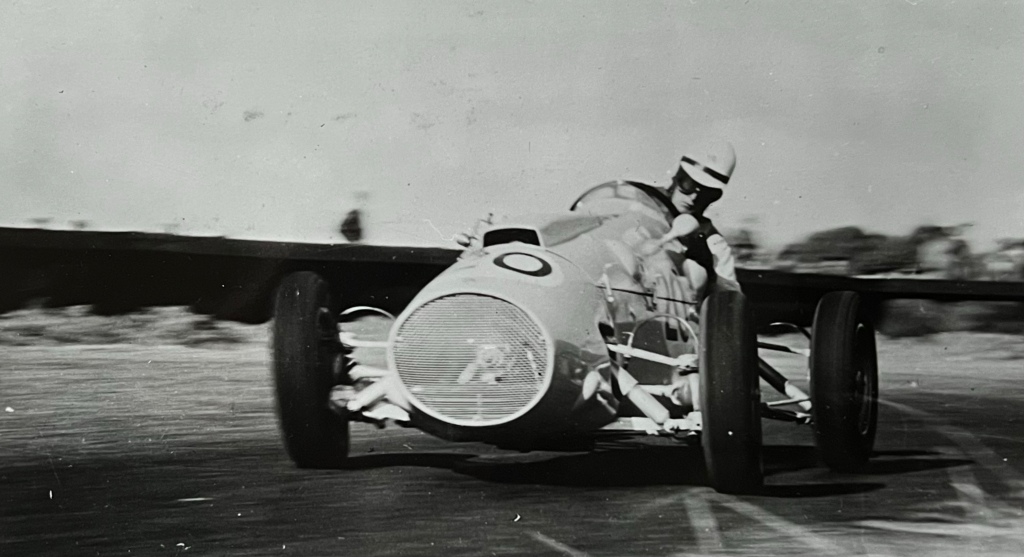
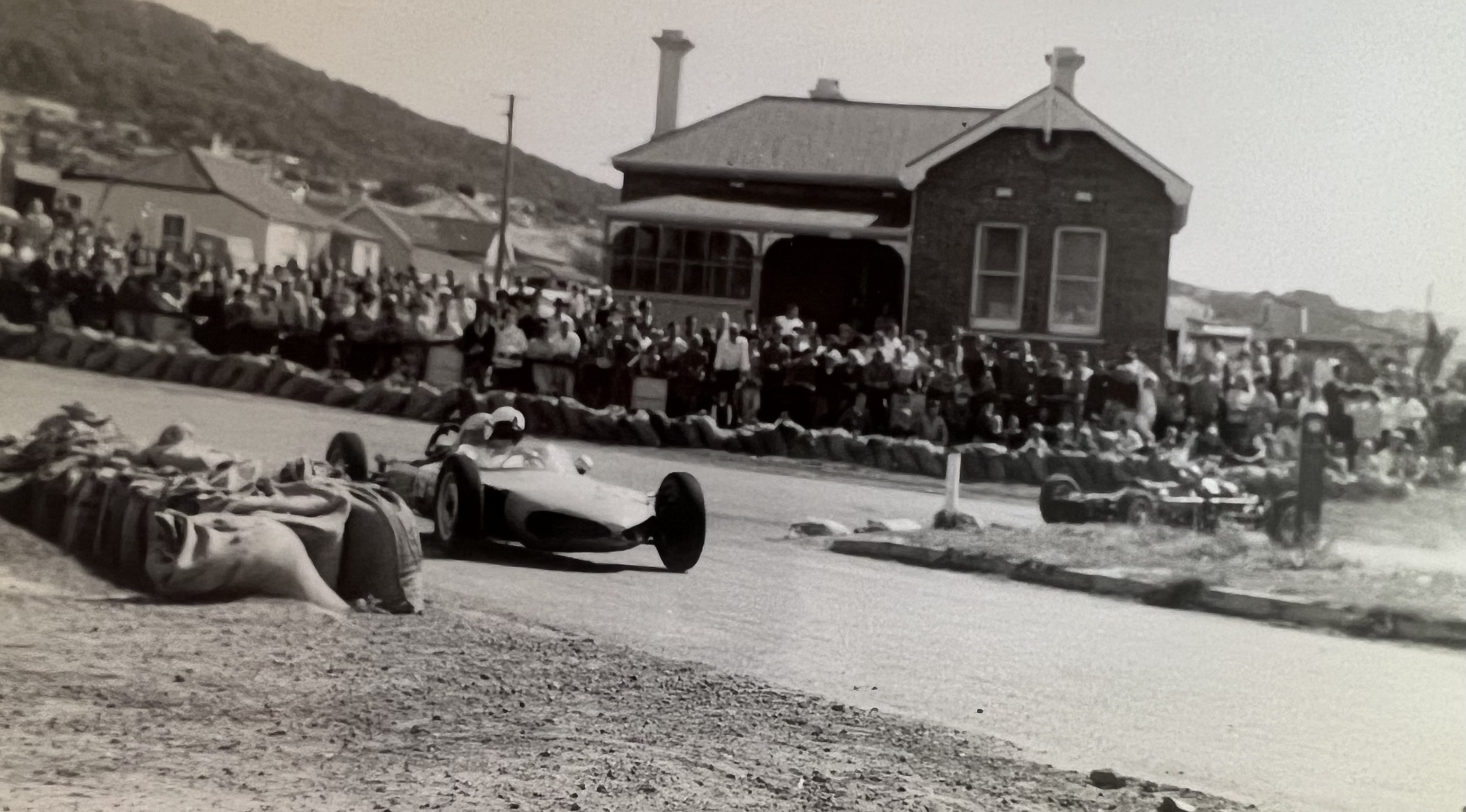
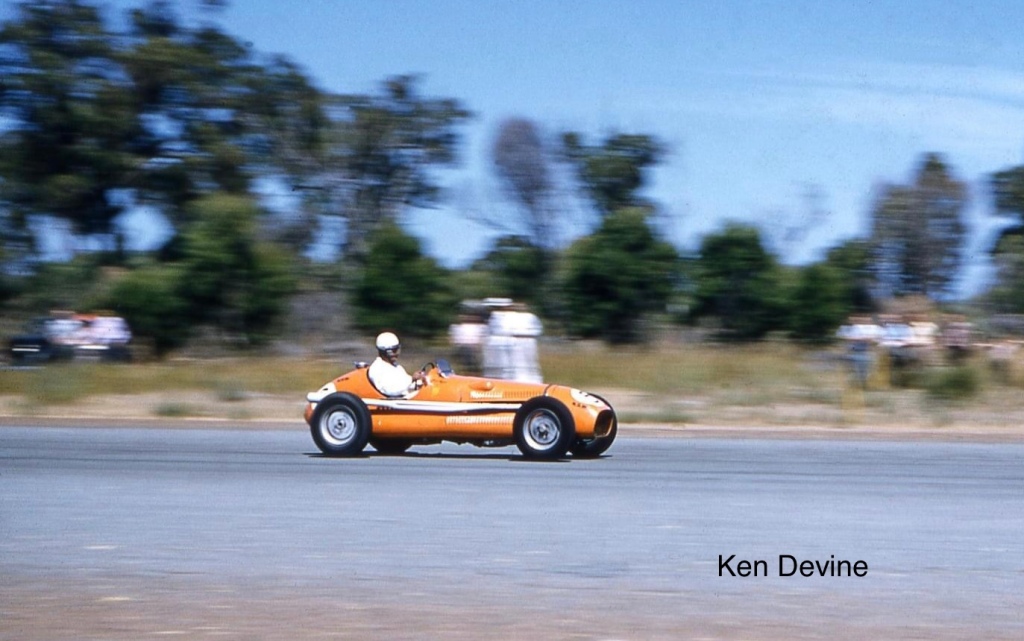
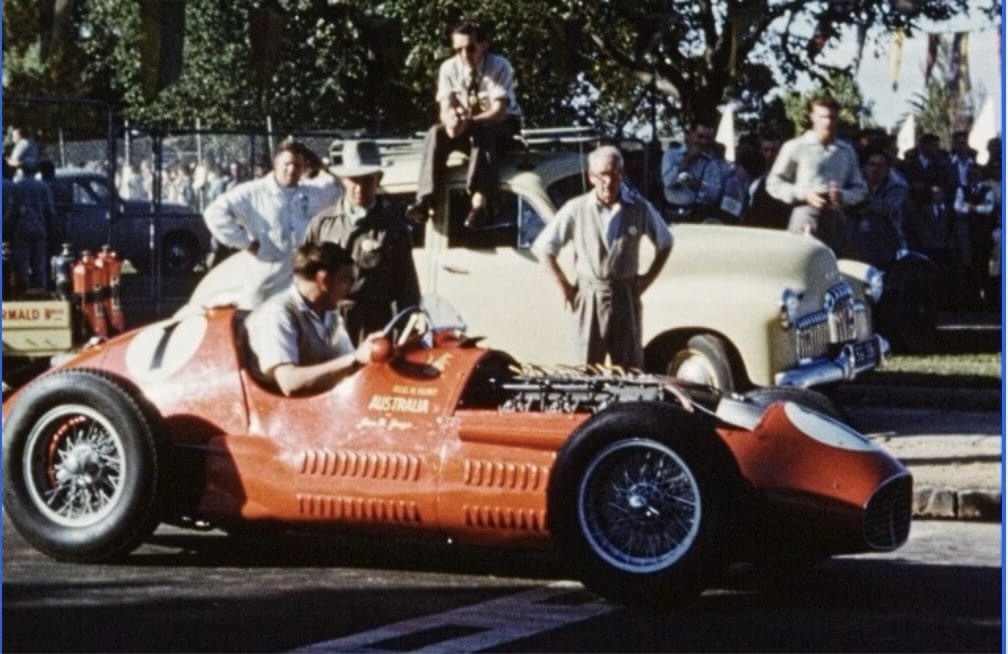
Reg Hunt, Maserati 250F, on his way to winning the Victorian Trophy at Fishermans Bend on February 12, 1956

Context…

Australian motorsport’s governing body was the Sydney based Royal Automobile Club of Australia until 1953 when the Melbourne based Confederation of Australian Motor Sport took over. CAMS Ltd trading as Motorsport Australia (CAMS) still rules the roost today.

One of the CAMS’ rare acts of decision-making excellence was the creation of the Australian Drivers Championship – the Gold Star – from 1957.

Lex Davison, Ferrari 500/625 was the first recipient of the award for points gained in nine rounds spread across all states except Tasmania – remedied in 1958 – on an 8-5-3-2-1 points basis for first to fifth places in each round.

1956 Faux Gold Star Championship…

I’ve thought for a long while that it would be interesting to summarise our elite level Formule Libre racing results by seasons, if for no other reason than when I want to research one thing or another a summary of the competitor set exists. Why not, I thought, extend the idea to calculating notional Gold Star points?

Of course it’s a fucking stupid thing to do as it simply didn’t happen! In the words of that great Australian philosopher, ‘Sir’ Frank Gardner, “If yer’ Aunty had balls she’d be yer’ Uncle”. In other words, deal with what is/was, rather than what isn’t/wasn’t.

But of course CAMS run a who-gives-a-fuck-about-facts (WGAFAF, pronounced ‘woggafaff’) motor racing history model. They don’t recognise the January 1927 Australian Grand Prix at Goulburn as the first AGP, yet we have 1928 and 1937 Australian Grands Prix, apparently, neither of which actually took place then, as officialdom chooses to brand them now. So, in accordance with established Oz-racing fast-and-loose WGAFAF precedent, what follows is a summary of the 1956 Gold Star, Faux Division.

Officialdom awaits the ‘Champion of the Day’ of the 100 Miles Road Race at Phillip Island held on Saturday 31 March, 1928. Oopsie, sorry there were two 100 Mile Road Races that day. The morning one started at about 11am, oopsie again, sorry, B-Class started at about 11am, and D-Class at about 11.05am. The afternoon race, races really, started at about 2.25pm for A-Class and then C-Class at about 2.30pm. All ‘Akin to European GP practice’ is the favoured line of some

The readily apparent State-The-Obvious flaw in my Faux Gold Star award is that as there was no such championship, drivers didn’t enter meetings they may have otherwise if they aspired to win such a title. However, the rich/well-funded in every era raced far and wide beyond their local meetings, this was certainly the case for the 1956 motor trader front runners, so I’m not so sure the top-3 are impacted by this factor.

Some criteria points. I’ve basically followed the equivalent 1956 meetings that CAMS recognised in ’57, even though some of the races are too short, in my mind, to be of championship length. Where there were two Formula Libre races of ‘championship length’ – over 75 miles – at the one meeting, such as the Albert Park Moomba meeting, the longer, feature event prevails. Results are scratch based only. I’m only awarding points for first to fourth placings as those are the records I have. If someone has more comprehensive records, spreadsheet skills and OCD knock yer’ socks off and I’ll update this masterpiece.

Away we go.

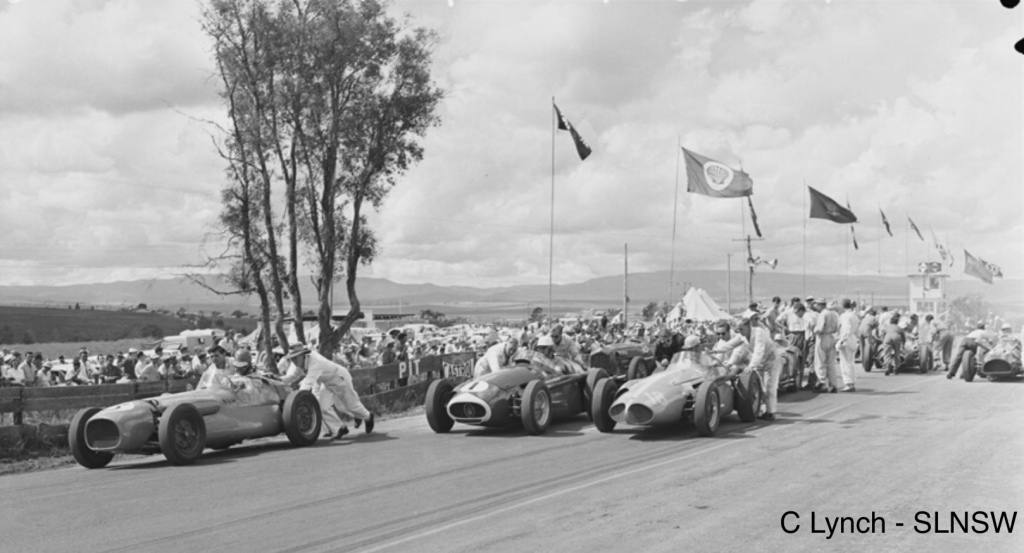
Reg Hunt on Gnoo Blas’ Main Straight while the 4.05pm to Sydney gets ready to depart. Maserati 250F (GB.com)

Gnoo Blas, Orange, New South Wales (NSW) : South Pacific Championship : January 30, 1956

This season opening race meeting on the Gnoo Blas road circuit at Orange, 260 km west of Sydney had become Australia’s only international meeting in prior years. The Australian Sporting Car Club always managed to entice a few of the drivers doing a full southern summer season In New Zealand across-the-ditch to the Great Brown Land before they headed back to Europe. As an aside, the Kiwis were five years or so in front of us in the Big Race Stakes.

Our Jack was the only international in ’56 mind you. He raced the 2-litre Cooper T40 Bristol that he built for himself at Surbiton to make his championship GP debut at the British Grand Prix at Aintree in July 1955. Brabham brought the car home at the end of the year, winning the AGP with it at Port Wakefield after frontrunners, Stan Jones in Maybach 3 and Reg Hunt’s Maserati A6GCM/250 (a 2.5-litre 250F engined A6GCM 2-litre F2 car) had problems, then did the Kiwi season and would sell it to Reg Smith before heading back to the UK.

To rub in his advantage, Reg Hunt brought along both the Maserati he raced throughout 1955 and his new 250F on the long tow from Melbourne to Orange, then disappeared into the distance, winning the 27 lap, 100-mile race in the 250F from Brabham. 

Stan Jones gave vigorous chase, but blew the 3.8-litre Maybach SOHC six fitted under the long bonnet of Maybach 3 sky-high on lap 22 when 39 seconds adrift of his fellow Melbourne motor trader.

That blow-up proved a defining moment in Australian Motor Racing History of that era as it marked the end of the Charlie Dean/Repco Research/Stan Jones/Maybach period. Repco’s stock of 3.8 and 4.2-litre Maybach cylinder blocks was at an end, so the car couldn’t easily be rebuilt. In any event, Stan realised he needed a Big Red Car to remain competitive, taking delivery of a 250F later in the season. Ern Seeliger created the very fast Maybach 4 Chev V8 of course, it proved to have a surprise or two in 1958-59, but the big-blue Maybach sixes were no more.

Kevin Neal was third in his Cooper T23 Bristol, then came Curley Brydon’s ex-Peter Whitehead – present at Gnoo Blas in the previous two years – Ferrari 166 and then Col James’s MG Special. Jack was a non-resident by then so he doesn’t get Gold Star points for his second place, so we have our top-four below.

1.Hunt Maserati 250F 8 points 2.Neal Cooper T23 Bristol 5 points 3.Brydon Ferrari 166 3 points 4.James MG Special 2 points

End of an era. Jones aboard Maybach 3 – very Mercedes W196’esque in appearance – before the engine let go, South Pacific Championship, Gnoo Blas in 1956 (GB.com)

Fishermans Bend (once Fishermen’s Bend) Melbourne : Victorian Trophy : February 11, 1956

Top guns entered for the 24 lap, 52.8 miles Formula Libre race included Hunt’s Maserati 250F, Lex Davison’s HWM Jaguar (“now with latest D-Type head and Weber carbs” according to AMS), Doug Whiteford’s Talbot-Lago T26C, Stan Jones’ Cooper T38 Jaguar sportscar, Brabham’s Cooper T40, Tom Hawkes Cooper T23 Bristol and Bill Craig’s Alta Holden.

While billed as on international meeting to attract some spillover visitors to New Zealand that summer, the only ‘internationals’ were Brabham from New South Wales and Craig from South Australia…

Hunt romped away, Whiteford’s old T-L, somewhat surprisingly, proved quicker than Davison’s ’54 AGP winning HWM Jag, then Davo spun, while broken throttle linkages accounted for Jones and Hawkes.

1. Hunt, Maserati 250F 8 points  2.Whiteford Talbot-Lago T26C 5 points 3. K Neal Cooper T23 Bristol 3 points  4.W Wilcox Ford Special 2 points

Albert Park, Melbourne : Moomba Meeting – Argus Trophy : March 18, 1956

Albert Park – promoted by the Light Car Club of Australia – hosted a pair of international two-weekend carnivals in ’56: the Moomba meeting in March and Olympic meeting in November/December.

The feature on March 11 was the Moomba Tourist Trophy for sportscars. Tony Gaze won that 150-miler in his HWM Jaguar VPA9, from Bib Stillwell’s brand-spankers Jaguar D-Type and Ron Phillips’ Austin Healey 100S.

F.A.O. Gaze DFC and Two Bars, OAM had decided to retire from racing and sold his HWM and ex-Ascari Ferrari 500/625 to his good mate, Lex Davison before the meeting. Tony had raced both cars in New Zealand that summer together with Peter Whitehead. Davison’s deal included racing the Ferrari in the Argus Trophy, the Formula Libre, 48-lap, 150-mile feature on the following weekend, March 18.

Davo had some serious opposition though, not least Hunt’s 250F and Melbourne haulier, Kevin Neal, who had bought Hunt’s immaculate A6GCM/250. Other expected front-runners included Hawkes’ Cooper Bristol, Stillwell’s D-Type, not to forget Arthur Griffiths, who had bought the ex-Moss HWM Jaguar just vacated by Davison, and Reg Smith in the Cooper Bristol similarly vacated by Jack Brabham.

Somewhat predictably, Reg Hunt won the race in his current model Maserati 250F – one of the great GP cars of any era – from Davison, with Neal, Hawkes and Stillwell third to fifth.

Lex’s old-bus dated back to 1952 – in 2-litre spec it was Alberto Ascari’s main weapon of choice in his triumphant 1952-53 World Championship years – but fitted with a 3-litre DOHC four-cylinder ‘Monza’ engine it proved for several years to have the measure of the fastest cars in the country thanks to a combination of Davo’s speed and almost peerless reliability. Tony Gaze had the Ferrari prepared by Alan Ashton and his AF Hollins crew in High Street, Armadale. He implored Lex to continue the relationship, Davo did so and it was key to his ongoing success with this car.

1.Hunt Maserati 250F 8 points 2.Davison Ferrari 500/625 5 points 3.Neal Maserati A6GCM 3 points 4.Hawkes Cooper T23 Bristol 2 points

Reg Hunt from Lex Davison during the Argus Trophy at Albert Park, March 1956. Maserati 250F and Ferrari 500/625 (D Meale)

Port Wakefield, South Australia : Easter Saturday : March 31, 1956

Not all the serious boys spent Easter at the traditional Bathurst fixture, some contested the 50-lap, 65- miles Wakefield Trophy at Port Wakefield, South Australia: Tom Hawkes, Cooper T23 Bristol, Kevin Neale, ex-Hunt Maserati A6GCM/250, Ted Gray, Tornado 2 Ford, and Derek Jolly, Decca Mk1 Climax FWA Spl included.

The weekend feature was for the 20 fastest cars. Soon after the start, the race developed into a Cooper and Maserati duel a lap in front of the rest of the field. Hawkes, in a great performance in the slower of the two cars, won from Neal’s Maserati, Ron Phillips’ Austin Healey 100S and TE Stevens, MG TC Spl.

Interesting are the top speeds recorded on Century Straight (all mph): Gray Tornado Ford V8 110.5, Neal Maserati 2.5 108.5, Hawkes Cooper Bristol 2-litre 104.7, Eldred Norman in the legendary Norman Zephyr Spl s/c 102.5, Murray Trenberth, Vincent 1000, 100, and Eddie Perkins, VW Spl s/c 99.5

1.Hawkes Cooper T23 Bristol 8 points 2.Neal Maserati A6GCM/250 5 points 3.Phillips Austin Healey 100S 3 points 4.Stevens MG TC Spl 2 points

‘She’s a comin’ down the mountain…’ Lex Davison from Reg Hunt, Ferrari 500/625 and Maserati 250F, Bathurst Easter 1956

Bathurst Road Races, NSW : Easter Monday : April 2, 1956

The 26-lap, 100-mile handicap, Bathurst 100 had a huge field, “more entries from interstate than Bathurst has seen for some time” wrote Australian Motor Sports. Stan Jones and Jack Brabham weren’t at the meeting, Maybach 3 was dead and Stan’s 250F hadn’t arrived, while Jack had returned to the UK. 

The handicap was won by Davison from Hunt, Bib Stillwell, Jaguar D-Type, and Paul England’s Ausca Repco-Holden. To be consistent, Gold Star points are awarded for the scratch results: Hunt, Maserati 250F, Lex Davison Ferrari 500/625 3-litre, Stillwell D-Type, and Tom Sulman’s Aston Martin DB3S.

1.Hunt Maserati 250F 8 points 2.Davison Ferrari 50/625 5 points 3.Stillwell Jaguar D-Type 3 points 4.Sulman Aston Martin DB3S 2 points

Port Wakefield Road Races : South Australian Trophy : June 4, 1956

Stan Jones took delivery of his Maserati 250F in May, demonstrating it in an untimed run at the Geelong Sprints meeting on May 27, Port Wakefield was chassis #2520’s Australian baptism of fire. 

Other fast cars which took the trip to the desolate, wind-swept permanent race track included Davison, Stillwell and brilliant, intuitive Adelaide engineer, Eldred Norman in his Norman Zephyr Spl s/c. Most significantly, Ted Gray was present in the Lou Abrahams owned, Gray/Mayberry Bros/Abrahams built Tornado 2 Ford. Tornado 1 Ford died a terrible death at the October ’55 Bathurst meeting, Tornado 2 was a new car using few of T1’s bits, amongst the exceptions were the Ford Ardun/Abrahams fuel injected OHV V8 and Ford truck ‘box. Ted was ok after a very long convalescence too. 

At this point of 1956 the key machines of Australian Formula Libre racing from 1956-59 were in place: the two Maserati 250Fs, Davo’s Ferrari and Tornado 2…two-litre Coopers were still to come.

Held in a big rainstorm, the 30 lap South Australian Trophy race, early on was a close contest between Stillwell – pretty comfy in his Jag sportscar – with Stan all over him, but unable to pass and see…

Davo spun on lap 3, so too later in the race did Gray, although another column in AMS says Ted didn’t even start the race due to a broken CV joint… The race was won by Stillwell from Jones, Norman and ??

Somewhat prophetically, Bob Pritchett wrote in the July 1956 issue of Australian Motor Sports, “Who said Ted Gray’s Tornado Special doesn’t handle. Ted was, I think, the only high-powered operator who did not spin off in the meeting (the guy that wrote the race report sez otherwise!) and in winning the A-grade scratch race 6-lapper, held Stan’s Maserati for four laps until Stan spun off in the wet.”

In the same column, Pritchett reported that Tom Hawkes was considering a Maserati four to get more speed out of his Cooper T23 Bristol, that engine being at the end of its development potential; a Repco-Holden Grey shortly thereafter provided a potent and more cost-effective solution. 

Similarly, he mused about the possibilities of Maybach 3, “by dropping in one of those 300-plus USA V8 monsters that are now available.” – the very path followed by Ern Seeliger, and Ted Gray with hot 283 Chev Corvette V8s being popped under the bonnets of Maybach and Tornado before too long.

1.Stillwell Jaguar D-Type 8 points 2.Jones Maserati 250F 5 points 3.Norman Norman Zephyr Spl s/c 3 points 4.??

Yes, the little-tacker in the lower shot is Alan Jones. He has recounted over the years his disappointment in finding Dad’s new, red Italian car was a Maserati and not a Ferrari! Bob Chamberlain at left Bob King thinks
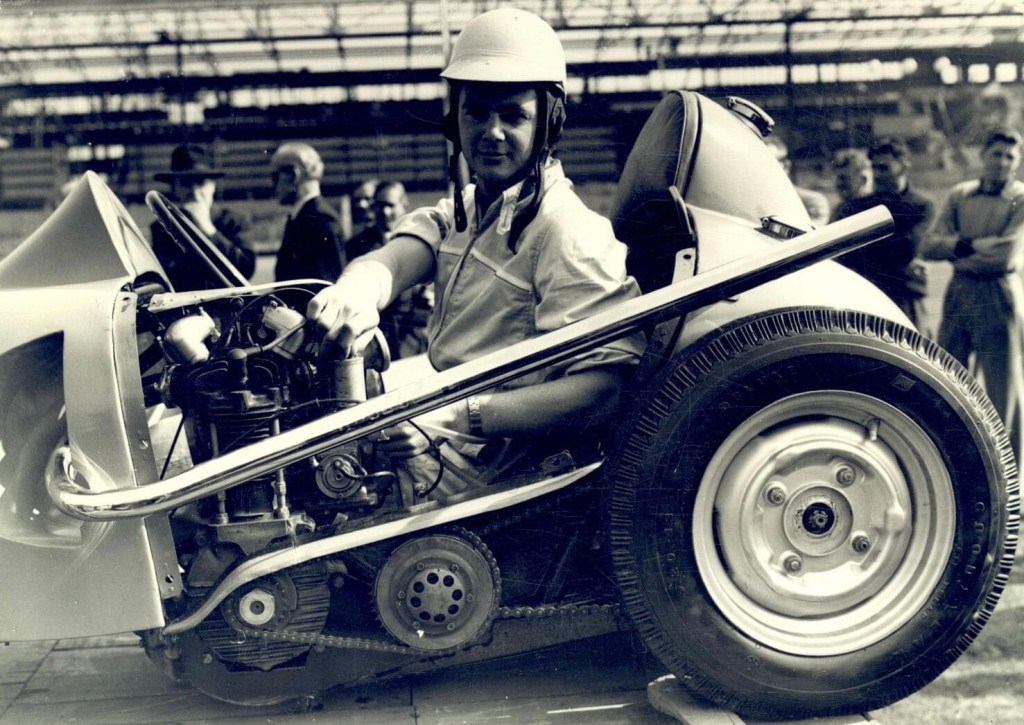
Ted Gray from Stan Jones during their Port Wakefield scrap in June 1956. Tornado 2 Ford V8 and Maserati 250F; plenty of scraps to come from this pair from 1956-59. Gray’s experience went all the way back to giving Peter Whitehead and ERA R10B a run for their money at Aspendale and Rob Roy in 1938 aboard a speedway-midget

Lowood Airfield Queensland : Lowood Trophy : June 3, 1956

“Queensland Racing Drivers Club conducted this year’s ‘Lowood Trophy’ meeting in typical Queensland winter sunshine, before a crowd of about 6000. The 2.7-mile circuit was in good condition…34 entries was received, including eight from NSW…” recorded AMS.

Top guns included Arthur Griffiths’ ex-Davison HWM Jaguar, Ken Richardson’s ex-Whiteford Talbot-Lago T26C, Steve Ames aka Count Steve Ouvaroff ex-Davison Alfa Romeo P3, John Aldis’ ex-Whitehead/Jones Cooper T38 Jaguar and Arnold Glass’ Maserati 4CL; it wasn’t a great entry of modern cars.

The 12 lap, 32 miles Lowood Trophy results were as follows:

1.Griffiths HWM Jag 8 points 2. S Mossetter Austin Healey 100S 5 points 3.R Weintraub Healey Silverstone 3 points 4.J Johnson MG TC 2 points

Bathurst : NSW Road Racing Championships : September 30, 1956

A crowd of 8-10,000 people fronted up to cold, blustery conditions for the second traditional Bathurst meeting a year, October fixture.

While Stan Jones was present to sharpen his skills in advance of the Australian Grand Prix two months hence, Lex Davison and Reg Hunt were notable by their absence, ‘preserving the machinery’ or whatever.

Bill Pitt was there in the Geordie Anderson/Westco Motors Jaguar D-Type and Jack Myers in the WM Special, a much-modified (by Myers, a highly skilled Sydney mechanic-cum-engineer) Cooper T20 fitted with a Waggott-Holden twin-cam, two-valve circa 200bhp ‘Grey’ six-cylinder engine. 

Handicaps were still prevalent, if not the norm in Australian racing, with the 26 lap NSW Road Racing Championship (Racing Cars) no exception. Jones set a new lap record of 2min 44sec without being hard pushed. While ‘J Archibald’ (who was he?) won the handicap classification in his MG Spl, the scratch results and Gold Star points allocations are as follows:

1.Jones Maserati 250F 8 points 2.Bill Pitt Jaguar D-Type 5 points 3.Jack Robinson Jaguar Special 3 points 4.John Archibald MG TC Spl 2 points

Fishermans Bend, Melbourne : Astor Trophy : October 14, 1956

You might think the Victorian Contingent would be out in force in advance of the rapidly approaching AGP, but not so. While Hunt, Whiteford, Neal and Gray were present, Davison and Jones were AWOL.

Then, having satisfied himself that his 250F was all tickety-boo in a 5-lapper, Reg Hunt didn’t take the start of the start of the 24-lap, 52.8-mile Astor Trophy feature.

While Kevin Neal’s Maserati A6GCM/250 was a far quicker car than Doug Whiteford’s – relatively new to him, but geriatric – Talbot-Lago T26C, there was no way Neal was going to beat the aggressive, cagey, vastly experienced triple AGP winner! Ted Gray and Owen Bailey were/are the other recipients of Gold Star points aboard Tornado 2 Ford and ex-Whiteford Talbot-Lago T26C respectively: third and fourth placings.

1.Whiteford Talbot-Lago T26C 8 points 2.Neal Maserati A6GCM/250 5 points 3.Gray Tornado 2 Ford 3 points 4.Owen Bailey Talbot-Lago T26C 2 points

“Tell him, he’s dreamin…’ Count Stephen Ouvaroff aka Steve Ames offers his ex-Scuderia Ferrari/Davison Alfa Romeo P3 chassis #50003 for sale, £895 is the ask. In 2024 dollars that is $A32,700, the value of a P3 is, however, in the ‘your guess is as good as mine’ category
Moss Mastery – high speed drift at Albert Park, Maserati 250F, AGP December 1956

1956 Australian Grand Prix : Albert Park : December 2, 1956

120,000 people watched 22 starters contest the ’56 AGP held in the afterglow of Melbourne’s staggeringly successful Olympic Games.

Furriners included a five-car squad from Officine Maserati: three 250Fs and a pair of 300S (sportscars for the Australian Tourist Trophy contested and won by Moss from Behra the week before) for works drivers Stirling Moss and Jean Behra, while Peter Whitehead and Reg Parnell raced their 3.4-litre Ferrari 555s.

Moss disappeared into the distance, winning the 80-lap 250-miles race in 2hr 36min 15.4sec, over two minutes ahead of Behra, then came Peter Whitehead.

The battle-within-the-battle was a local Melbourne Holden Dealer Derby – Davo’s farming and shoe making interests duly noted – between the 250Fs of Reg Hunt and Stan Jones, and Lex Davison’s Ferrari 500/625.

Graham Howard points out in his 1956 chapter of the ‘History of The Australian Grand Prix’ that “It was to be, surprisingly, the first encounter of the Hunt and Jones’ 250Fs, and Davison – at that stage the only driver to beat the Hunt 250F – was also there in his Ferrari.”

“Hunt and Jones had, to be strictly correct, lined up against each other the weekend before, in a short sprint race in the supporting program to the Tourist Trophy, but it had been inconclusive. With Hunt on pole position and Jones right beside him, the race had an explosive start as Jones – ‘jockeying for position’, as AMS discreetly termed it – hit the kerb and then a tree on Hunt’s side of the course within a hundred metres of the start. The car was fortunately not too badly damaged and was ready for the AGP the following weekend.”

At the start of the Grand Prix, Moss led from Behra, the Whitehead and Parnell Ferrari Super Squalo’s, then the Trident Trio: Hunt, Neal and Jones. Davison was slowed by engine maladies.

By lap 5 Jones was behind Hunt, and after two fast laps, passed him, where he stayed – with Hunt pacing himself behind – for 35 laps, “With both driving with a concentrated ferocity, which was almost tangible – no errors, no let- up, certainly no smiles.”

When Stan’s Maserati started to blow smoke from under the bonnet, he eased on lap 40, gifting his place to Hunt. Post-race the problem was disclosed as a broken breather.

The Gold Star points go to the fifth, sixth, seventh and eighth placed local finishers:

1.Hunt Maserati 250F 8 points 2. Jones Maserati 250F 5 points 3.Davison Ferrari 500/625 3 points 4.Whiteford Talbot-Lago T26C 2 points

Reg Smith competing at Templestowe hillclimb outside Melbourne in May 1956. His Cooper T40 Bristol was Jack’s ’55 British GP car and AGP winner. He can’t have been enamoured of the Cooper, replacing it with one of Officine Maserati 300S sold at the end of the ’56 AGP weekend

Gold Star Championship Points and Observations…

Drum roll…the winner of the 1956 Australian Gold Star Faux Championship is Reg Hunt, Maserati 250F, with 40 points, well clear of Kevin Neal’s 21 points gained with Cooper T23 Bristol and Maserati A6GCM/250, then Stan Jones, third on 18 points in his new 250F. Fourth was Whiteford, Talbot-Lago T26C 15 points, then the Davison Ferrari 500/625 on 13 points with Bib Stillwell sixth, on 11.

What does it all prove? Absolutely sweet-f-all, but I enjoyed it, which is all that really matters here.

I wish I could show you a neato little points chart or a spreadsheet of results for the year but I don’t know how to do those, so this hand-job will have to do, a remedy with which many of you will be familiar. Since publishing this, Stuart Murray – bless him – has done the vastly better spreadsheet which appears further below.

In my mind I’ve long thought Reg Hunt was the rock-star in 1955-56 aided and abetted by having The Best Equipment in the country in those two years by far. I’ve not done this exercise for 1955 yet to further prove the point, I’ll get around to it some time.

Having ‘came, saw, and conquered’, Reg retired from racing at the end of the season, aged only 33, to focus on his family and in building a staggeringly successful motor-dealership empire centred on his ‘Golden Mile of Cars’ in Brighton, Melbourne. He returned to historic racing in the 1980s with a Maserati 300S and Talbot-Lago T26C and died just shy of 100 on August 22, 2022.

Fellow Melbourne motor trader and later four-time Gold Star champ, Bib Stillwell bought the Hunt 250F (chassis #2616) but couldn’t resist the temptation of a factory freshen-up, so didn’t see it for the best part of 12 months. It’s a long boat ride between Port Melbourne and Genoa and back, and Maserati had bigger fish-to-fry, not least a World Championship to win with JM Fangio at the wheel of factory 250F’s.

At the end of ’56 the stage was set, the key players in 1957 seemed likely to be Jones, Davison and Gray with a tight contest likely given all three were well-funded ‘pro-outfits’ by Australian standards of the day. In the end Davo’s Ferrari 500/625 crushed the opposition with five Gold Star wins in nine rounds, a story for another time…

Credits…

Australian Motor Sports all 1956 issues, ‘Bathurst: The Cradle of Australian Motor Racing’ John Medley, ‘The History of The Australian Grand Prix’ edited by Graham Howard, ‘A History of Australian Grand Prix 1928-1939’ John Blanden, VSCC Victoria Collection, David Meale-Collections Victoria, gnooblas.com, Paul Cummins/Cummins Archive, Stuart Murray

Tailpiece…

(Cummins Archive)

Champions cockpit…the 1958 one’s actually – Stan Jones’ Maserati 250F chassis #2520, not Hunt’s #2516.

Paul Cummins wrote, “On the back of the photo it reads – this is the cockpit of Victorian racing driver Stan Jones’ new 2 1/2 litre ‘250F’ model Maserati which he has just imported from Italy. When that revolution counter shows 7800rpm his engine is developing 270hp giving a speed in excess of 165mph. It is expected to be the fastest car in Australia. It cost £7,200, but with freight cost and spare parts (including a 3-litre 300S engine), the actual landed cost is expected to be nearly £12,000.”

“The Maserati which will be using Mobilgas Racing Fuel and Mobiloil exclusively was built in October last year (1955) and taken to South America for the Argentine Grand Prix Season, but it was never raced. Stan Jones will race it for the first time at Port Wakefield South Australia on 4 June.”

Veglia instruments, right-hand shift for the 5-speed transaxle, note the far-left clutch location given Stan sits astride the driveline tunnel – Jones has clearly specified a ‘conventional’ right-hand throttle and central brake setup.

Finally, while Maserati’s bullshit story to Stan may have been that #2520 was a new car, in fact it was slightly shop-soiled. It had been raced as a works-car by Froilan Gonzalez at Buenos Aires on 22 January 1956 (DNF) and by Pablo Guile at Mendoza on February 5 (eighth).

The nose of the car as landed in Australia in the earlier arrival photographs rather suggests the car was shipped straight from South America rather than via the Modena paint-shop. What is in no doubt is that 250F #2520 has one of the simplest, most straight-forward histories of all Maserati 250F’s, so too does #2516 for that matter.

Finito…
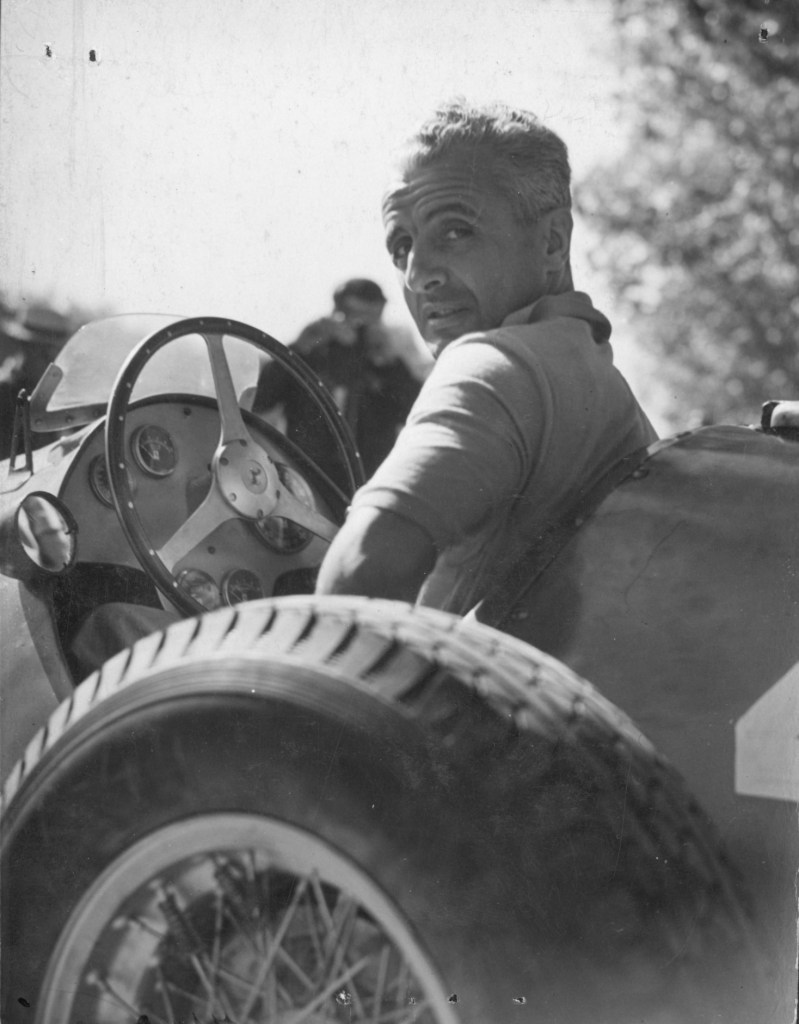
(M Dupain/SLNSW)

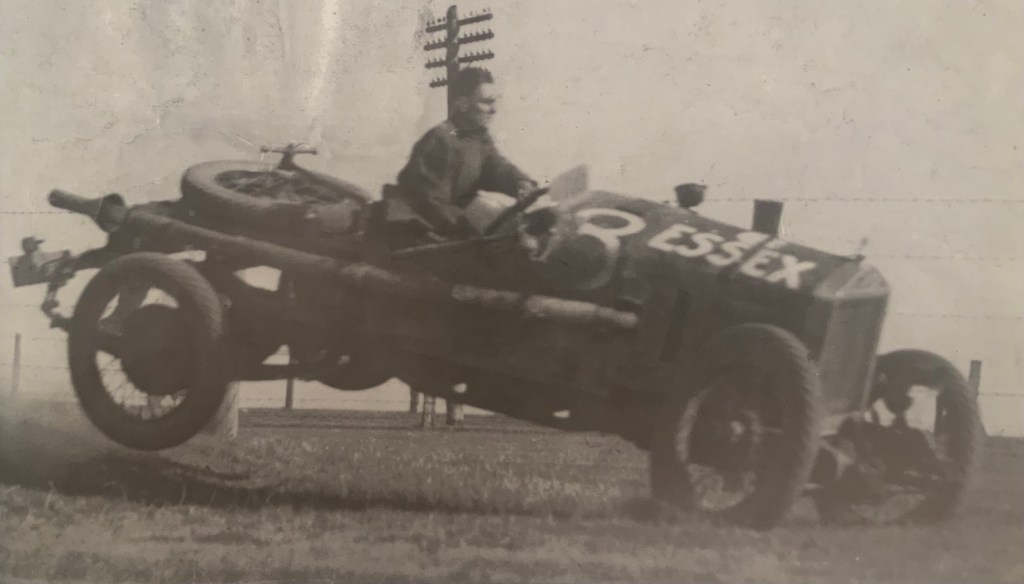
John Crouch plunges downhill on the Albury-Wirlinga road course – ‘on the border’ of Victoria and New South Wales – aboard his Alfa Romeo 8C 2300 Le Mans during the June 12/13, 1939 Albury and Interstate Gold Cup meeting.

The 76 mile race was won by Jack Phillips’ Ford V8 Special – the reigning champion – from the Hudson Specials of Bob Lea-Wright and Les Burrows. Crouch was fourth and proved his pace in this handicap race, handicaps prevailed in Australia at the time, with fastest race-time. See here for more information on the event and venue here: https://primotipo.com/2024/01/05/albury-and-interstate-gold-cup-1939/ and here: https://primotipo.com/2019/01/12/interstate-grand-prix-wirlinga-albury-1938/

Australian racer/entrepreneur John Snow imported this car to Australia in 1938, John Crouch acquired it shortly after it was offloaded in the Port of Sydney.

John Crouch aboard the booming 8C 2300 LM during the 1939 Australian Grand Prix at very fast, undulating Lobethal, South Australia (B King Collection)
#2311202 during scrutineering at Le Mans in 1933 (Alfa Romeo Archives via Simon Moore)

8C2300 Le Mans chassis #2311202 was one of nine cars built to this specification, five of these long-wheelbase machines with Touring bodies were built in 1933, ‘our car’ was the second of these and was registered by Alfa Romeo on June 6, 1933 MI43972.

Simon Moore wrote in ‘The Legendary 2.3’ that “We will never be 100% sure, but I think it is really almost certain that this (2311202) was the Chiron (1933) Le Mans car,” raced by Louis Chiron and Franco Cortese …” The car ran amongst the leaders until after dawn, leading on several occasions before Cortese lost control and crashed the car in the Esses after completing 177 laps/2388km; the winning Sommer/Nuvolari 8C 2300 MM covered 3144km.

These straight-eight, supercharged, 2336cc, circa 165bhp Alfas are Le Mans royalty, winning the 24-Hour classic four years on the trot: 1931 Lord Howe/Tim Birkin 8C 2300 LM, 1932 Raymond Sommer/ Luigi Chinetti 8C 2300 LM, 1933 Raymond Sommer/Tazio Nuvolari 8C 2300 MM and 1934 Luigi Chinetti/Philippe Etancelin 8C 2300.

2311202 was third in the 1933 Tourist Trophy at Ards in the hands of Tim Rose-Richards and was later owned by Peter Mitchell-Thompson – Lord Selsdon.

#2311202 at Le Mans in 1933 Louis Chiron/Franco Cortese DNF accident, also shot below (MotorSport)
(MotorSport)

John Medley wrote in his ‘John Snow: Classic Motor Racer’ that Aussie racer/entrepreneur Snow brought a large number of cars acquired in Europe to Australia in the immediate pre-war years, single-handedly improving the quality of our grids in the process. This Alfa Romeo was one of them, its shipmates were a Hudson convertible phaeton, 5-litre Bugatti Type 46 sedan and a Delahaye 135CS sports-racer (#47190) for Snow’s own use.

John Crouch became one of Australia’s most talented post-war drivers, winning the 1949 Australian Grand Prix aboard that very same Delahaye 135. Soon after the Alfa arrived in late 1938, Crouch entered chassis #2311202 in the ill-fated Parramatta Centenary Trophy Race on November 5, see here for that story: https://primotipo.com/2018/02/27/parramatta-park-circuit/ while Crouch’s AGP triumph is recorded here: https://primotipo.com/2022/10/05/1949-australian-grand-prix-leyburn/

He then shipped the car via coastal steamer to Port Adelaide and entered the 1939 Australian Grand Prix held at Lobethal in the Adelaide Hills on January 2. He was seventh in the race won in celebrated fashion by West Australian, Allan Tomlinson’s MG TA Spl s/c. Most of the big cars had tyre troubles in the extreme heat that day, Crouch had an off or two for this reason. He was a fast driver, but his pace with a still unfamiliar car wasn’t going to win him the race that weekend.

Other strong placings pre-war included fourth in the April 1939 New South Wales GP/150 Miles Road Race at Bathurst, and third fastest in a hillclimb and flying quarter-mile event at Mount Panorama in June. He was seventh in the NSW Road Race at Bathurst in October, a period in which he mixed his road racing with speedway events aboard a 4WD Skirrow.

Into 1940, with events getting a bit skinnier as the War impacted, he was fifth in the 150-miler at Easter Bathurst, and at Albury-Wirlinga in June he was second and again set the fastest time of the race.

While clearly a very potent racing car, John Crouch regularly used it around town (rego’ EO772), having the machine maintained by Jack Saywell and John Snow’s Monza Motors emporium-of-speed in East Sydney.

Tom Lancey checks his MG TA’s mirrors before being eaten by John Crouch and passenger and Alfa Romeo 8C 2300 during the 150 mile race at Bathurst during Easter 1939 (Terry McGrath via Simon Moore)
Alfa Romeo 8C2300 cutaway (R Roux)
Crouch, again at Lobethal in 1939 (B King Collection)

Victorian Colin Scott bought it in 1944 and had it fettled by Alf Barrett’s mechanic, Alan Ashton and his team at AF Hollins & Co in High Street, Armadale. Barrett and his 8C 2300 Monza were the fastest combination in Australia in the immediate pre and post-war periods. Scott was a frequent class winner at Rob Roy hill climb and a regular Vintage Sports Car Club competitor.

In 1949 #2311202 was bought by racer/pilot/dealer John Barraclough who onsold it to Tom Luxton. He raced and hillclimbed it, sometimes using the pseudonym James McEwan; McEwans was the family company, a 140 year old, national, retail hardware-store chain that was ultimately swallowed by Bunnings in the 1990s.

Howard Kiel owned the car next. Simon Moore wrote that Kiel was introduced to Louis Chiron at London’s Swallow Club by Tony Gaze. Chiron confirmed the car was French blue at Le Mans and “remembered it well and exalted its performance.”

Owner impressions are gold, Simon published Kiel’s impressions of the 8C 2300 outlined in an exchange of letters between the pair. “I well remember 2311202 as one of the most beautiful cars to drive. In fact I often drove it to work on the outskirts of Melbourne and raced Tony Gaze back to town many times. Through the streets the car was had to beat and exhilarating to drive. I sold the car when it became apparent it needed a comprehensive restoration.”

The next owner, Tom Roberts took great care of the car between 1958 and 1963 after which it joined the mouth-watering Doug and John Jarvis collection of 8C Alfas in Adelaide.

Australian Alfa Romeo owner/historian David Wright wrote in the February 2023 issue of Alfa Occidentale that “Doug Jarvis was particularly enamoured with this car and drove it at Mallala on several occasions. Following the death of Doug Jarvis, the 8C 2300 Le Mans was used regularly by his son, John, until, in 1975, it was acquired from the Jarvis Estate by Lance Dixon.”

(Reid Family)

Dixon, a successful Melbourne motor dealer and enthusiast reintroduced the car to VSCC events. Here Lance is taking then Prime Minister of Australia, Malcolm Fraser – a very tall bloke for a polly – for some quick laps in the car at a Sandown meeting in 1977.

In 1982 Lance’s restoration team, led by Ian Ruffley, were commissioned to comprehensively rebuild the car in Dixon’s Eltham workshop. The colour reverted to its original French blue, having been red for its entire life in Australia. #2311202 was sold via auction in 1986 to a Dutch enthusiast who continues to actively campaign it.

Nice close up profile shot of John Crouch in the 8C 2300 during the Easter 1939 Bathurst 150 meeting. The car lost its best years of racing in Australia thanks to the war, not that #2311202 was alone in that respect, far from it…(F Pearse)

A Driven Man and Driving Force Behind Motor Sports…

Is the title of the late Barry Lake’s obituary of John Crouch – 15/8/1918-30/5/2004 – published in the Sydney Morning Herald on June 17, 2004. Lake was a talented racer, journalist, historian and publisher; his beautifully written tribute is reproduced in full.

In the 1930s John Crouch was widely known as Australia’s youngest racing driver. In 1949 he won the Australian Grand Prix driving a French Delahaye. Even before his retirement from active racing in the mid-1950s, Crouch was heavily involved in the administration of motor sport in this country. By the time he died, at 85, he was recognised by many as the elder statesman of Australian motor sport.

Throughout all of these achievements, Crouch was the consummate gentleman, always immaculately dressed, always driving a late-model performance car (usually Mercedes-Benz in his later years) and always he was polite and softly spoken.

His father, Cecil, had his own new car sales company for 10 years before John was born in 1918, and the elder Crouch dabbled in motor sport when he raced a Metz car at Victoria Park racecourse in Sydney.

After leaving Sydney Church of England Grammar School (Shore), to which he walked every day from the family home in Wollstonecraft, Crouch went to work for his father. So it was hardly surprising he developed a keen interest in cars and motor racing – although his father strongly opposed the latter, having realised it consumed vast amounts of money.

Crouch began racing an MG TA sports car when barely 18. Two years later, he finished fifth in the 1938 Australian Grand Prix at Bathurst. In the late 1930s he drove a wide variety of cars including a supercharged Alvis, a Fronty-Ford, a Skirrow four-wheel drive speedway car, and an ex-Louis Chiron Le Mans Alfa Romeo 8C 2300.

With the Alfa, Crouch set fastest time in the Albury and Interstate Gold Cup races on the Wirlinga road circuit in 1939 and 1940, along with a third place and two fifth places on corrected times in the last three major events held at Bathurst before World War II.

After the war, Crouch left his father to start his own business. “I wanted to buy and sell performance cars but my father was never interested in them,” he once said.

He imported cars from England, including the high-class Bristol and the inexpensive but loads-of-fun Dellow sports car, as well as many new and used examples of exciting sports cars. In 1953 he gained the Australian distributorship for Austin-Healey sports cars, when the local Austin distributors rejected it as a folly. Crouch described it as a bonanza that sold beyond anyone’s wildest expectations.

The grid of the 1947 NSW Championship, Nowra airfield, June 16. #5 Jack Murray Mackellar-Bugatti Ford s/c, then #3 John Crouch Delahaye 135CS, #14 Alec Mildren Ford V8 Spl, #4 Frank Kleinig, Kleinig Hudson Spl and Alf Barrett, Alfa 8C2300 Monza. The handicap race was won by Tom Lancey’s MG TC, Crouch was eighth (J Hunter)

Immediately after World War II Crouch had bought a fast and reliable French Delahaye sports-racing car. It had a fastest race time at Bathurst to its credit, and Crouch scored second-fastest there with it in 1946.

But the one race to win then, as the Bathurst 1000 is today, for Australian drivers was the Australian Grand Prix. In 1948 the event was held at Point Cook in Victoria in blazing heat. The Delahaye scored third-fastest time but the handicap start resulted in his finishing only eighth.

The following year the race went to Queensland, on a wartime airstrip at Leyburn. Also for the first time, it was run from a scratch start, as is the case for today’s major events. Crouch was ready to pounce when the early pacesetter faltered. The blue Delahaye crossed the line a clear winner and John Crouch had achieved his life’s ambition.

In the early 1950s Crouch began to import and sell small, lightweight rear-engine Cooper racing cars. He sold the Delahaye and raced Coopers to promote them. He was ahead of his time. By the end of the decade Coopers were dominating Australian racing as they were the world championship. In Crouch’s time, however, they were fast but unreliable. In 1951, for example, Crouch’s Cooper set fastest race lap in the Australian GP, but retired with mechanical problems. In retrospect, he sold the Delahaye, had he kept it, would have been capable of winning the GP again in 1950 and 1951.

In 1953 Crouch sold a more modern, faster and more reliable Cooper-Bristol to Tom Brabham, for his son, Jack. The latter made his name in that car and went on to win world championships in 1959, 1960 and 1966.

Crouch’s final outings as a driver were in the Redex Round Australia Trials in 1953 and 1954, and the 24-Hour Race at Mount Druitt in 1954. He had planned to race in Europe before quitting the sport, but ran into financial difficulties when he expanded into importing tyres and tractors.

He retired from racing, closed his business and used his remaining resources to buy land and build apartment blocks in suburbs such as Dee Why. “Real estate was going so well at that time,” he said, many years later, “Any idiot could make money out of it.” He was comfortably well-off by the time the bust came in the 1970s – unlike many of his friends, who, he said, “had borrowed to the hilt and lost everything”.

Crouch had been the NSW state councillor for the then newly formed Confederation of Australian Motor Sports in 1953 and continued in various capacities with this organisation for many years, receiving awards for his contributions to motor sport. He also acted as clerk of course at a number of major events.

Crouch had two sons, John and David, with his first wife, Vivian. They eventually divorced, but remained good friends. Crouch’s second wife, Valerie, died in 1995. They had two daughters, Caressa and Penelope.

Crouch was reluctant to marry again, fearing a third would brand him a “womaniser”, but eventually he met June, whose lust for living a full life matched his own. They married and spent much of Crouch’s final few years travelling in South-East Asia and Europe, as well as attending various motor sport functions in Australia as honoured guests. That came to an end when Crouch suffered circulation problems that led to a series of strokes and heart attacks. He died in a hospital in Gosford.

Etcetera…

Sydney Morning Herald June 13, 1939
(Motorsport)

Another shot of Louis Chiron or Franco Cortese at Le Mans in 1933 aboard #2311202.

(S Dalton Collection)

Credits…

Max Dupain-SLNSW, ‘John Snow: Classic Motor Racer’ and Bathurst: Cradle of Australian Motor Racing’ by John Medley, ‘The Legendary 2.3’ Simon Moore via the Bob king Collection, Robert Roux, MotorSport Images, Reid Family Collection, John Hunter Collection, Fred Pearse, Sydney Morning Herald – Barry Lake, Stephen Dalton Collection

Tailpiece…

Finito…
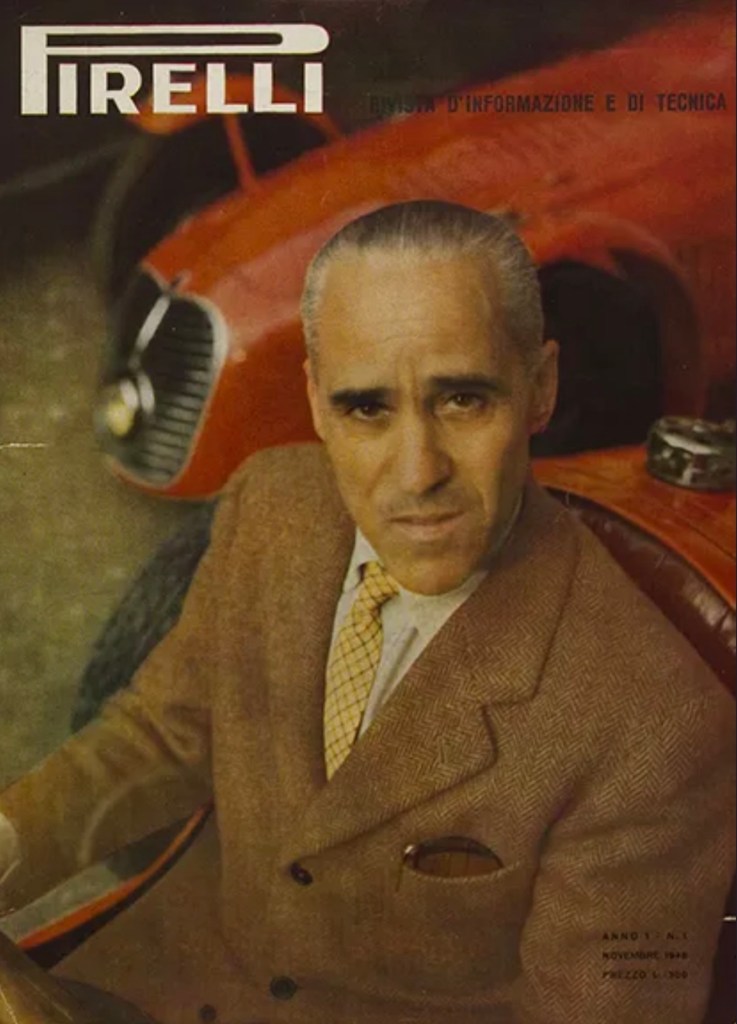
Charlie Dean’s Maybach 1 at Rob Roy in January 1949. The equipe behind is Micha Ravdell’s van and #38 Wyliecar Ford-A Special, still driven by its builder, Arthur Wylie. Number 9 on Maybach is a rego-disc (L Sims)

Even the contrarians amongst knowledgable Australian racing historians generally answer “the Maybach” when questioned about which racer was our greatest Australian Special.

It isn’t the Maybach though, but rather Maybachs – four of them – with no shortage of variants across the three chassis built. Whenever a photograph of a Maybach is uploaded onto social media there is always plenty of uninformed yibba-yabba about the specifications of the car in shot.

(Brian Caldersmith)
Charlie Dean and the brave Jack Joyce aboard Maybach 1 at Rob Roy in November 1947. The body is still to come. Wild road car! (L Sims)

One of our friends, John Ballantyne, prompted this article which I assembled to address the lack of accessible, accurate information about the specifications of Maybachs 1-4.

What follows is a copy of the technical specifications and evolution of the Charlie Dean and Repco Research built Maybach 1 published in an article of the Australian Motor Sports Annual 1958-59. The author’s name isn’t cited, but I’ve credited the editor of the book, Mr John Goode. The other two chassis – three cars – Maybachs 2, 3 and 4 will follow in my next post.

The article is focussed on technical information, not race results: this one that does that best, ponderous as it is: https://primotipo.com/2014/12/26/stan-jones-australian-and-new-zealand-grand-prix-and-gold-star-winner/ I hadn’t planned many photographs, but, as usual, my enthusiasm got the better of me…the period Repco ads are a visual device to assist in splitting one evolution of Maybach 1 from the next.

The photo choices are mine, so too are the ‘Notes’ sections, albeit almost all of that information is sourced from the same AMS article. I’m taking as-read a general knowledge of Maybach, if you need a refresher, click on the links at the end of this piece.

Six years later (from the 1947 shot) Stan Jones bolts away from the Europeans to win the October 1953 Victoria Trophy at Fishermans Bend in Maybach 1 S3. Behind is Doug Whiteford’s Lago Talbot T26C, George Pearse’s Cooper Vincent, and to the right, Ted Gray aboard Alta 21S Ford. Lex Davison’s Alfa Romeo P3 is partially obscured behind Maybach (L Sims)
John Fleming’s copy of The Argus report of the 1953 Victoria Trophy – the preceding shot

One final contextual word from Australia’s greatest motor racing historian, John Medley, about the Maybachs and their place in the Australian pantheon before we set off, quoted from the ’50 Year History of The Australian Grand Prix’, specifically John’s 1948 AGP chapter.

“HC (Horace Charles) Dean’s car, powered by a captured German scout-car engine, was little more than a year old, and had only been given a proper body in 1947: even so, in its brief career of trials, hillclimbs and sprints it had already attracted a lot of attention for its very willing performance and for its relatively advanced specification. It was, for example, one of just four runners in the 1948 AGP with independent front suspension, and of those four the Maybach was the only Australian special – the other three were factory-built cars of pre-war design: John Crouch’s Delahaye, Frank Pratt’s BMW, and Cec Warren’s Morgan.”

“The Maybach and Delahaye (135CS) actually had a lot in common, not least that both had been laid down not as pure racers, but as big-engined road cars with competition potential although another point which should not be overlooked is that both were essentially very conservative designs.”

“The significance of the Maybach was that it was Australian built, by a man at the centre of a small but talented team, and that the car had development potential – just how much was not realised at the time. Between 1948 and 1960, Maybachs in various forms were to contest eight AGPs and to lead – if sometimes only briefly – five of those races.”

Maybach 1 during June 1949, Charlie Dean and Jack Joyce on the way to FTD (D Stubbs)
Maybach 1 during Rob Roy #16 in May 1948 (D Stubbs)

MAYBACH 1 (1946-1949)

ENGINE: 6 cyl. inline single oh. camshaft. Bore and stroke: 90 × 100 mm. Capacity: 3,800 c.c., Compression ratio: 6.43 to 1. Output (initially on pool petrol: 69 octane) 100 B.H.P. at 3,000 г.p.m.

Single casting cast iron cylinder block and crankcase, with sump joint well below the crankshaft centre line. Crankshaft machined all over and fully counter balanced, running in eight white metal lined bearings, one between each crank throw and an extra one behind the camshaft drive pinion situated at rear end of crankshaft. Wet liners fitted to cylinder bores with lightweight balanced connecting rods and other reciprocating parts.

Single camshaft running in seven white metal bearings, opening valves by means of rocker arms fitted with eccentric bushes which could be rotated and locked to adjust valve clearances. Rockers had roller cam followers. Valves inclined at 65 degrees in hemispherical head and located on opposite sides. Helical timing gears with idler (originally compounded fabric, but replaced by steel).

Wet sump lubrication through filter with pressure fed oil supplied to centre main bearings, then to other caps, and through the crankshaft to big end bearings. Also fed to valve rocker shafts and camshaft bearings. Carburettors: Two marine Amal.

Charlie Dean and Maybach 1 during the January 26, 1948 AGP weekend at Point Cook RAAF Base just west of Melbourne. It was the cars first appearance with a body fitted, and painted white. DNF magneto failure on lap 12, the passenger decamped before the off. Note the Studebaker steel wheels at the front (AMS Review 1958-59)
Maybach 1 at Rob Roy in May 1948. A swag of these sensational, uber-rare Dacre Stubbs’ shots appear to have been taken immediately after Maybach was repainted, in the front garden of Dean’s Kew, Melbourne, home. Six Amals at this point, in November 1947 there were two…(D Stubbs)
(D Stubbs)

TRANSMISSION: Clutch: Fichtel and Sachs. Gearbox: Four speed crash type from a Fiat Model 525. Rear Axle: Lancia Lambda Series VIl in standard form.

CHASSIS: Frame: Tubular steel consisting of two parallel 4″ dia. steel tubes with independent suspension at the front (Dean’s own design) and conventional twin half elliptic springs at rear.

Suspension: Front Independent with transverse semi-elliptic spring and wishbones. Mainly 1937 Studebaker Commander parts. Steering: Cam and roller box (Marles) with two piece track rod.

Wheels and Brakes: Front: Studebaker bolt on pressed steel wheels with standard Studebaker brakes. Rear: Lancia centre lock 19″ dia. wIre wheels and brakes.

(D Stubbs)
(D Stubbs)

BODY: Two seat from welded sections of aircraft belly tanks.

LATER MODIFICATIONS: Included 6 carburettors, reduction of weight achieved by new front end. Minerva brake drums fitted with specially fabricated shoes, and new cast steel liners, mounted on light steel backing plates. Centrelock wire wheels with adapted hubs to replace Studebaker wheels. Body frame lightened.

(D Stubbs)
While all the one-liners down the decades credit Frank Hallam with the body, there is no way that’s correct. FH was apprenticed as a mechanic. Who built the body, it was clearly executed by a talented specialist, surely? (D Stubbs)
(D Stubbs)

NOTES: The car’s engine came from a German half-track vehicle that had been captured during the Middle East campaign and shipped to Australia for technical study by the military. Dean acquired it from a wrecker. Built as a sportscar, Dean was cajoled into turning it into a racing car by George Wade, a Repco mechanic/engineer, after recording 100mph in a Vintage Sports Car Club trial. The body was constructed in time for the 1947 AGP at Point Cook using aircraft belly tanks cut and shut by Frank Hallam, another Repco employee – so the story goes.

Cockpit shot shows the car was a ‘reasonably generous’ biposto in early spec. Twin-tube frame chassis, note diagonal bracing of the forward driver bulkhead. Revs, oil pressure and water temperature at a guess. Attractive – ahem – steering wheel, what is it off? (D Stubbs)
Neat remote shift – and locating stays to ensure easy accurate changes – to modified four speed Fiat 525 gearbox (D Stubbs)
(AMS Annual 1958-59)
Dean in Maybach 1 S2 competing in the Mornington Motor Races at the Balcombe army training base on Melbourne’s Mornington Peninsula in June 1950 (D Stubbs)

MAYBACH 1 Series 2 (1949 -1950/1)

Basically the same two seater sports/racing body and chassis with the following changes made from the original car.

ENGINE: 4.2-litre Maybach adapted to take developed parts from 3.8-litre original. Reground camshaft and special new main bearings. Original lead bronze bearings retained for big ends.

Supercharger: Ex G.M. diesel Roots type with three lobe rotors, mounted beside the motor driven by triple V-belts from the crankshaft nose; output 7 lb/sq. inch. Carburettor: Originally Claudel Hobson aircraft type replaced by Bendix-Stromberg aircraft type. Cooling System: Later sealed at blow off pressure of 4 p.s.i. Magneto: Adapted V-12 type but burnt out, subsequently Lucas.

TRANSMISSION: Differential: American Power Lock (1922 vintage truck) limited slip type fitted in modified Lancia housing.

CHASSIS: Rear Brakes: Special drums of original design using two leading shoes hydraulic system but replaced with leading trailing shoe hydraulics.

When Charlie Dean obliged Dacre Stubbs for the undated The Age (I think) article below he didn’t take Maybach 1 S2 too far, this shot is at the Willsmere Mental Institution in Kew. I grew up closeby, there were many occasions when Dad threatened to take us kids to The Nuthouse, as he sensitively referred to the place, when we misbehaved…(D Stubbs)
(J Fleming Collection)
Maybach 1 S2 at Rob Roy in June 1949 when Dean and Joyce bagged FTD. Wylie A-Ford Spl behind (L Sims)
(AMS Annual 1958-59)
Stan’s muscle-shirts were famous, here during the 1953 AGP at Albert Park. DNF with a variety of problems while leading in Maybach 1 S3 (S Griffiths)

MAYBACH I Series 3 (1951 – Early 1954)

Fundamentally similar in appearance to the two previous models, still a two seater but with suspension changes, three feet of rear chassis rails removed.

Modifications listed in order of introduction:

June 1950 – April 1951

Front suspension rebuilt: Studebaker parts replaced by Oldsmobile upper wishbones with integral shock absorbers. Transverse leaf spring redesigned to three leaf to reduce weight. Rear Suspension: Axle mounted on trailing quarter-elliptics with radius rods. It was this which necessitated cutting the rear end of the chassis.

Stan Jones awaits the off at Templestowe in September 1952, Maybach 1 S3, see photographer/racer/engineer John Fleming’s comments about his shot below
(J Fleming)
Posed The Age shot published on November 18, in the week before the ’53 AGP at Albert Park. Taken at Jones’ home garage in Yongala Road, Balwyn. From left, Ern Seeliger, Jones, Reg Robbins at the back, Charlie Dean and Lloyd Holyoak ‘working’ on Maybach 1 S3. Note the Oldsmobile top wishbones and (unsighted) lever arm shocks and transverse bottom leaf spring. One of the three big SUs is obscured by Stan’s arm
You can feel and smell Albert Park! Dacre Stubbs has tightly focussed his 1953 AGP start shot on Lex Davison, Jaguar powered ex-Moss HWM #3 and on Jones’ Maybach 1 S3; the ‘snappers framing of the shot heightens the drama. #7 is the legendary Frank Kleinig and Kleinig Hudson Spl with Cec Warren’s Maserati 4CLT alongside and #10, W Hayes’ Ford V8 Spl (D Stubbs)

Carburettors: Three marine Amals. Supercharger removed. Other Mods: Mild steel sheet head gasket fitted to engine raising compression ratio to 9 to 1.

Bodywork: Few obvious changes but considerable minor modifications. Framing modifled and lightened. Lighter radiator grille fitted, front cowl modified to give lower bonnet line.

June 1951 – September 1952

Carburettors: Three 1 3/4″ S.U. replacing Amals. Three special 2 3/16″ S.U. carburettors (originally designed for Lago Talbots) later fitted.

Tyres – Rear: 16 x 6.50 touring type (six ply). Subsequently four ply specially manufactured.

NOTES: Stan Jones bought the car off Charlie Dean in June 1951. Reports that the 1952 AGP would be held to F1 regs – 1.5-litres blown and 4.5 unblown, 1952-53 2-litre GP formula duly noted – meant the Maybach in 4.2-litre supercharged specs would have been ineligible so Repco Research developed a 3.8-litre unblown engine as noted above; three marine Amals fed the engine initially. Ultimately the ’52 AGP was held, as usual, to Formule Libre.

One of Jones’ pitstops at Albert Park in the 1953 AGP, Maybach 1 S3, Jag XK120 passes (D Stubbs)

The 1955 New Zealand Grand Prix programme recognised the achievements of Stan, the Repco Research team and Maybach 1 S3 in winning the 1954 event at Ardmore against international opposition the year before.

(AMS Annual 1959-60)

Etcetera…

(G McKaige)

Maybach 1 on Kew Boulevard at Studley Park, Melbourne before the start of the September 1947 VSCC One Day Trial. Alex Bryce’s Bentley 3-litre is behind. Note the twin-Amals, lump of wood to keep Charlie in-situ and slicks fitted up front!

(G McKaige)

By the time the VSCC Killara Park sprints were held at the Davison Lilydale farm in November 1947, Maybach 1 had grown four more Amals. The message to be taken is that Maybach(s), like all great racing cars, were in a perpetual state of development.

(J Montasell)

Charlie Dean at Rob Roy in January 1948, Maybach 1 obviously now bodied. Note the Studebaker pressed steel wheels and front drums compared with the shot of Maybach 1 in almost the same spot a year later below, with wire wheels and bespoke Minerva/PBR drums. Patons Brake Replacements – PBR – was another Repco Ltd subsidiary.

(J Montasell)
(G McKaige)

Charlie Dean cornering hard on Hurstbridge Hillclimb in April 1949, Maybach 1. He was second in the over 3-litre racing car class, Hurstbridge, to Melbourne’s east was used several times post-war.

(G McKaige)

Dean, Maybach 1 S2 competing in the Mornington Motor Races at the Balcombe military camp in June 1950.

Stan Jones in Maybach 1 S3 chasing Jack Murray’s Allard J2 at Parramatta Park, Sydney – the first meeting at the venue – on the Australia Day weekend in January 1952.

(J Fleming Collection)

Maybach 1 S3 this is The Age shot shown earlier, with the article as published. If somebody has a photograph of the Victoria Trophy we would all know if the annual for many years event was the Victorian, or Victoria Trophy. Both names are bandied around…

(Repco ad in the Motor Manual Australian Motor Racing Year Book No 4 1953-54)

Just how strongly Repco used the Maybach programme to promote their engineering excellence to the broader populace is unclear to me.

This ad in the horsepower-press below promotes some of the Repco subsidiary produced components used in Maybach, but pointedly fails to note that the car and driver shown are winning the 1954 New Zealand Grand Prix at Ardmore. Time to sack the ad agency and/or the internal copy-boy/girl!

Repco ad from the back cover of the November 4, 1952 Australian Hillclimb Championship, Rob Roy programme

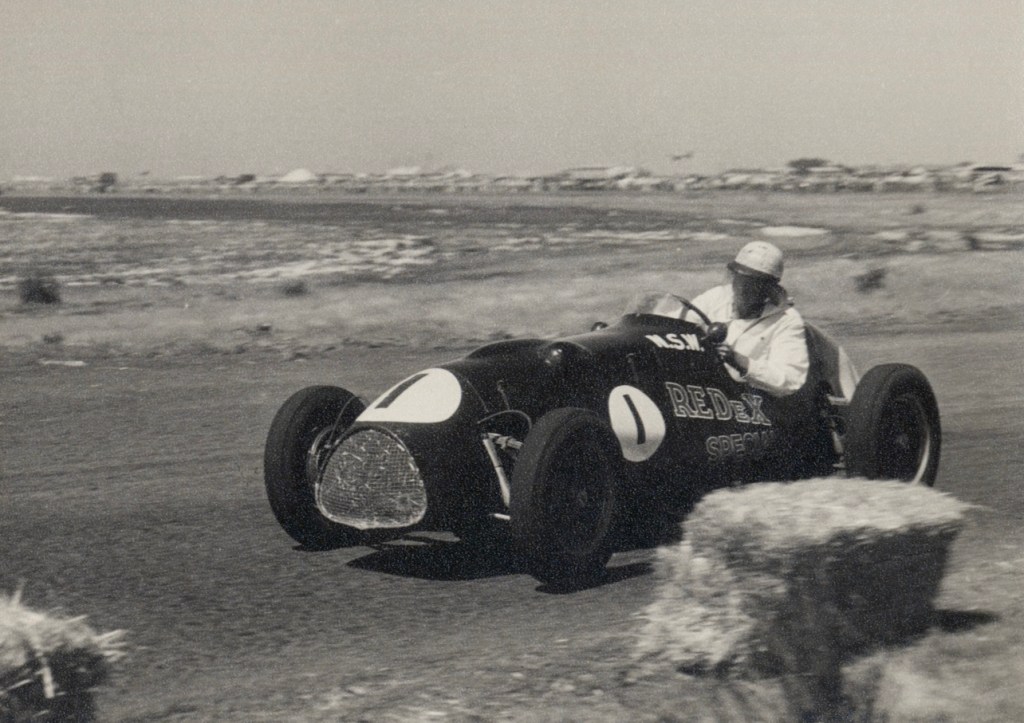
Clearly – to the extent you can see the cars – Motor Manual’s cars and drivers of the year were Stan Jones and Maybach 1 S3, and Jack Brabham and his RedeX Special, aka Cooper T23 Bristol.

Reference and photo credits…

Australian Motor Sports Review 1958-59, Brian Caldersmith, ‘The 50 Year History of The Australian Grand Prix’, John Fleming Collection via Tony Johns, George McKaige and Chester McKaige via their superb two ‘Beyond The Lens’ books, Stan Griffiths, David Zeunert Archive, sensational and rare Dacre Stubbs photographs via Martin Stubbs, VSCC Vic Collection, John Montasell, Clem Smith, Motor Manual, Ivan Pozega Collection, Peter Moore

Tailpieces…

(C Smith)

The Maybach reality: Australia against the Europeans – ignoring the country of origin of the engine! – with Stan as often as not leading as chasing. Here Jones is aboard Maybach 1 on the Adelaide Hills, Woodside road circuit in October 1951, chasing arch-Melbourne-rival come fellow rough-nut, Doug Whiteford’s Lago Talbot T26C. Whiteford won this encounter in what were Stan’s early days in Formule Libre.

(I Pozega Collection)

Maybach 1’s mortal remains were tracked down or found by Jack McDonald in a South Melbourne wrecking/junk-yard in the early 1960s. He rebuilt the car – all of the required donor bits were easier to obtain back then – and soon the old-gal was back on track, in this case a Calder Drags meeting in 1968. Jack is being blown off by Des Byrne’s E-Type Ford V8.

For the last 32 years Maybach 1 has been in the very safe, caring hands of Melbourne racer/historian Bob Harborow, shown below competing at Goodwood in 2006.

(P Moore)

Finito…
(P&O Heritage)

Jack Brabham’s Cooper T45 Climax (F2-10-58) enroute to the hold of P&O Line’s 30,000 ton SS Arcadia while Stirling Moss’ similar Rob Walker car (F2-9-58) awaits its turn at Tilbury Docks.

It’s October 20, 1958, seven weeks before the Melbourne Grand Prix at Albert Park on November 30 where this pair of drivers and cars were the star attractions in a 19 car field. The Arcadia arrived 11 days before the race allowing plenty of pre-event promotion.

I was contacted by P&O Heritage in June last year requesting assistance in identifying the cars and the event to which they were travelling, with the assistance of my good friend, Cooper expert Stephen Dalton, that wasn’t a drama. With their exhibition now well over we can share the shots.

(P&O Heritage)

Arfur Daley! was my first reaction, look at them all with their peaked-caps to ward off the brisk River Thames air. It’s Stirling’s Rob Walker owned T45, chassis F2-9-58, no less than the car in which Maurice Trintignant won the ’58 Monaco GP, and with which Moss was victorious in the non-championship F1 Aintree 200 and Caen GP that year.

Brabham’s F2-10-45 was acquired from the British Racing Partnership: Alfred Moss and Ken Gregory. It had been raced in 1.5-litre F2 events continuously throughout 1958 by Stuart Lewis-Evans in between his Vanwall F1 commitments and Tommy Bridger otherwise. Lewis-Evans had many top-5 placings and one win at Brands in June.

Maurice Trintignant during the 1958 Monaco GP. The Walker T45 F2-9-58 won from the two works Ferrari Dino 246s of Luigi Musso and Peter Collins (MotorSport)
Stuart Lewis-Evans on the hop at Goodwood during the April 1958 Lavant Cup. He was fourth in BRP’s T45 F2-10-58 behind Brabham’s works Cooper T43 and Graham Hill and Cliff Allison’s works Lotus 12s; all cars 1475cc Coventry Climax FPF powered (unattributed)

Still fitted with 1.5-litre Climax FPF, BRP entered Bridger in the Moroccan Grand Prix at Ain Diab. His only GP start, in a six-Cooper F2 race within a race, ended in tears after Tommy spun and crashed on oil dropped by Tony Brooks’ Vanwall the lap before, Bridger completing 30 of the 53 laps. He wasn’t badly hurt, but poor Lewis-Evans died from burns sustained after a separate accident caused by his Vanwall’s engine seizure.

BRP returned the car to Coopers for repair, Brabham then bought it and installed a 2.2-litre Coventry Climax FPF to race in the Antipodes, while the Moss car was fitted with an Alf Francis built 2015cc Climax.

(AC Green)

The trip from Tilbury to Port Melbourne back then took on average, four-six weeks, here the new Arcadia (b1953-d1979) is tied up at Station Pier, Port Melbourne in late March 1954. The trailer leg to transport the cars to Albert Park is a short 6km.

(B King Collection)

The 32 lap, 100 mile Melbourne GP was the eighth of nine Gold Star rounds that year, Stan Jones in the #12 Maserati 250F won the ‘58 title.

Brabham is in #8, #7 is Moss, while another Jones, young Alan is the small white clad figure leaning on the nose of the Ford Zephyr. Moss won the race from Brabham with the very quick Doug Whiteford, Maserati 300S in third

Bib Stillwell was fourth in another 250F with Len Lukey fifth in a Lukey Bristol – Len’s evolution of a Cooper T23. Car #10 is Tom Clark’s 3.4-litre Ferrari 555, the car alongside him is Ted Gray, Tornado 2 Chev.

Moss and mechanic, name please? and T45 F2-9-58 on the Albert Park grid. That November 30, 1958 event was the last at Albert Park until the modern AGP era commenced in 1996 (S Dalton Collection)
NZGP, Ardmore, January 10 1959. The Schell, Bonnier and Shelby Maserati 250Fs used their 2.5-litre torque to lead for a bit on lap one. #4 is Brabham’s Cooper, with Moss #7 behind and between Jack and Carrol – and the rest (LibNZ)

Both cars were then shipped across the Tasman to contest the Kiwi Internationals. Moss won the New Zealand Grand Prix at Ardmore from Brabham in a big field that included Bruce McLaren, Carroll Shelby, Jo Bonnier and Harry Schell on Maserati 250Fs, and Ron Flockhart’s works-BRM P25.

Brabham aboard F2-10-58 at Ardmore in 1959, second to Moss (T Marshall)

Moss (and the Cooper) then returned to Europe for his other commitments while Brabham did the Lady Wigram Trophy and Teretonga International for second/third, then returned home to New South Wales where he won the South Pacific Trophy at Gnoo Blas.

Jack then travelled to Cordoba to begin his F1 season with the February 16 Buenos Aires GP, but not before selling F2-10-58 to Len Lukey. The Melbourne Lukey Mufflers manufacturer used it to good effect to win the 1959 Gold Star, the highlight of which was an epic dice between Len and Stan Jones’ 250F in the AGP at Longford (AMS cover below) which was resolved in Stan’s favour.

The T45 remained in Australia forever, and in a nice bit of Cooper T45/Albert Park symmetry, Stirling Moss drove his Dad, and Jack’s old car in the historic car demonstrations during an Australian Grand Prix carnival in the early 2000s. Both cars are extant…

Etcetera…

(MotorSport)

An unmistakable Aintree shot of Stirling Moss aboard Walker’s T45 F2-9-58 on the way to victory in the BARC 200, April 1958.

(unattributed)

Tommy Bridger holding off Bruce McLaren’s works Cooper T45 Climax and Ivor Bueb’s Lotus 12 Climax aboard the BRP T45 F2-10-58 during the May ’58 Crystal Palace Trophy. He was second, bested only by Ian Burgess’ works Cooper T45, in a great performance.

Credits…

P&O Heritage, Allan C Green-State Library of Victoria, Bob King Collection, Stephen Dalton Collection, sergent.com.au, MotorSport Images, unattributed shots via Bonhams photographers unidentified, Terry Marshall, National Library of New Zealand

Tailpiece…

(MotorSport)

Tommy Bridger in the 1.5-litre F2 BRP Cooper T45 Climax F2-10-58 chasing Gerino Gerini’s Centro Sud Maserati 250F at Ain Diab during the October 19, 1958 Moroccan Grand Prix. Gerini was 11th from Q17 and Bridger DNF from Q22 after the accident described earlier.

The race-within-a-race of six Cooper F2 cars comprised T45s raced by Salvadori, Brabham, McLaren, Bridger and Andre Guelfi, plus Francois Picard’s older T43. Bridger qualified behind the works-Coopers of Roy, Jack and Bruce…he was pretty handy. See more about him here: https://500race.org/people/tommy-bridger/

Finito…
(Bisset)

Andrew McCarthy beavers away on the rebuild of his 1982 ex-Beppe Gabbiani works-Maurer MM82 2-litre F2 machine, chassis 04.

For a stock broker, he’s a pretty handy mechanic. He gets a prize for commitment too, this shot was taken at beer-o’clock, lunchtime on December 24, an occasion when most of us normal folks are getting Santa’s snack ready for his night-time arrival.

TVR Cerbera tow car is a nice touch (Bisset)
Gabbiani aboard MM82-04 during the 1982 Pau GP, DNF fuel injection (MotorSport)
Maurer MM82 cutaway drawing, Bellof machine shown (unattributed)
“…and then it goes like this!” Beppe to Stefan at a late 1981 test session at Paul Ricard. Willy Maurer at right (F Kraling)

The target first race appearance is the Phillip Island Classic in March. Even though the bulk of the hard work in a five year journey so far has been done, there is no shortage of fettling to come to meet that deadline.

The essential elements of Willy Maurer’s, Gustav Brunner penned, period-typical, ground-effect F2 car are an aluminium monocoque chassis, BMW M12/7 four cylinder, DOHC, four-valve, fuel injected 2-litre engine giving about 300bhp and a five-speed Hewland FG400 based transaxle in a bespoke Maurer case.

BMW M12/7 engines were THE ENGINE of the two-litre F2, winning the European title in 1973, Jean-Pierre Jarier March 732, 1974 Patrick Depailler March 742, 1975 Jacques Laffitte Martini Mk16, 1978 Bruno Giacomelli March 782, 1979 Marc Surer March 792 and 1982 Corrado Fabi March March 822. Renault came, conquered and left with their works engines, then Honda followed and stayed. BMW (from 1973) and the Hart 420R (from 1976) were there throughout the 1972-84 class (Bisset)
M12/7 circa 305bhp in-period, “330bhp for the Heideggers” McCarthy says. Kugelfischer-Bosch slide fuel injection (Bisset)
Stefan Bellof, Maurer MM82 BMW during the Spa round in June, DNF accident in the race won by Thierry Boutsen’s Spirit 201 Honda (MotorSport)

Let’s save the Maurer major story for when Mad Andy has MM82-04 running. In essence young entrepreneur Willy Maurer had access to substantial sponsorship cash via the German, Mampe drinks manufacturer.

After an initial sponsorship foray in German Group 5 with Ford Zakspeed and Kremer Porsche, Maurer decided to take one of his drivers, Armin Hahne, into F2. Rather than follow the herd and buy a March or Ralt he decided to build his own cars.

The first 1979 car (MM79) was a slug, then, via former Chevron racer, Eje Elgh, Maurer was introduced to the ex-Chevron team who were out of a job after the demise of the Bolton marque in its original form; said ending was a delayed reaction to company founder, Derek Bennett’s death in a hang-glider crash in March 1978.

Gabbiani on the way to third ahead of a gaggle of cars during the Mantorp Park, Sweden round in 1982. Johnny Cecotto’s works March 822 BMW won (MotorSport)
The chassis of the car is an aluminium honeycomb monocoque strengthened by carbon-fibre inserts. Front suspension comprises large, wide-based lower wishbones, top rockers and inboard mounted coil spring/Bilstein shock units. Andrew has the trick suspension lock-down linkages but will initially run with the conventional set up (Bisset)
The BMW engine mounts by four bolts to this cast magnesium plate, which has four bolts to attach it to the chassis; note both the aluminium and carbon fibre tub. The beautifully fabricated nickel plated A-frame in this shot and below picks up the rear of the engine (Bisset)
(Bisset)

The 1981-83 Maurers, designed by Brunner, interpreted and engineered by Paul Brown, and built and maintained by a team run by Bennett right-hand-man Paul Owens, Ian Harrison, Paul Brown, Graham Hall and others from premises in West Haughton, Manchester were fast cars which won four Euro F2 Championship races.

German wunderkind Stefan Bellof was victorious in two rounds – winning his first ever F2 race at Silverstone – and set five fastest laps (in 1982), while Roberto Guerrero and Elgh won a race apiece in 1981.

Italian F1 driver, Beppe Gabbiani raced a works MM82 alongside Bellof in 1982. The cars were jets, in part as a result of an ingenious suspension locking mechanism which allowed a very low ride height which enhanced the ground effect created by the car’s underbodies/tunnels, and powerful, but very fragile, short-stroke Heidegger prepared BMW engines.

Corrado Fabi won the championship aboard a works-March 822 BMW (five wins) with Bellof fourth and Gabbiani fifth. Beppe’s best in MM82-04 was second place at Enna. In an appalling run of reliability, he had five DNFs and Bellof six. By contrast, Fabi scored points in eight of the 13 championship rounds.

Same rear suspension set up as the front – note the suspension pick-ups on the bespoke cast magnesium Maurer transaxle which uses Hewland FG componentry. That unit contains the dry-sump tank – see the silver filler cap alongside the top of the rocker assembly (Bisset)
This shot is a couple of days later with rear brake calipers and rotors in situ (McCarthy)
(Bisset)
Disposition of the major components clear, a new bag-fuel tank goes in the big ‘ole (Bisset)
Enna, August 1982, DNF engine after only seven laps, Boutsen’s Spirit 201 Honda won (MotorSport)
Gabbiani, Enna, August 1982 (MotorSport)

By the time Maurer relocated the team back to Germany in 1983, after local press criticism, Brunner had already left for ATS and Willy was brawling with Heidegger in the courts.

Gabbiani moved to Onyx March for the 1983 F2 Championship, finishing an excellent third and best-of- the-rest behind the Ralt RH6 Honda duo of Jonathan Palmer and Mike Thackwell.

The MM83’s were still quick in the hands of Stefan, Alain Ferte and Kenny Acheson, but the four points-scoring finishes of the three works cars was an appalling record of reliability as things unravelled. Owens began cutting off the supply of spares…his bills were going unpaid, he decamped at the end of the year. Willy walked away from his F1 design and parked Bellof at Porsche in ’83 and Tyrrell for 1984, where his pace in both teams was of course mega!

It was all over, but not without merit. McCarthy’s car has ingenuity and quality throughout, MM82-04 is one of four Maurers in Australia, oh to have them all on the same grid one day.

“Hop to it Andrew, and hand me another Coopers Red sunshine”…

(Bisset)

(Bisset)

Original Personal wheel to be recovered in leather, and nice look at the magic of ally-honeycomb panels.

(Bisset)

Bodywork, BBS wheels and new Willans fuel cell await their turn for attention.

(Bisset)

It’s as well McCarthy is a slim (ish) short-arse. The Maurers were works cars built for underfed pubescents, they aren’t like a customer car such as an early Ralt RT4, for example, which do accommodate Ford F150 driving Fat Bobs. Note the steering rack of course, and the way the beefy-bulkheads provide torsional stiffness.

Distributor driven off the exhaust cam, fuel metering unit off the inlet (Bisset)

Andrew wishes to record the work of and thank Sam Henderson of Rotorweld, Auckland NZ for the perfect honeycomb work on the tub floor, Paul Deady at Melbourne’s Dana Engineering for wheel hubs and gearbox machining. Mo Meghji (ex Arrows F1 fabby) in Melbourne did the perfect A-frames and exhaust tig work and Garry Simkin in Sydney, the gearbox internals and setup.

(Bisset)

The thing should stop ok…

Credits…

‘Young, Gifted and Black’ MotorSport article by Gary Watkins, F2 Index-Fastlane, MotorSport Images, Ferdi Kraling Motorsport, Mark Bisset, Andrew McCarthy, Stephen Dalton

Tailpiece…

(Bisset)

Maurer MM82-04 framed above by a Ford 9-inch diff (attached to a Ford Falcon Sprint) and a Ralt RT4 below.

(M Bisset)

Postscript…

I thought that there was snowflakes chance of McCarthy having the car running at the Phillip Island Classic on March 8-10 but “Ye of little faith!” as my friend said.

Fellow Maurer racer Simon Gardner said, “You should have seen what still had to be done here on Thursday morning”, but he made it even if he ran the car with braking problems and without a clutch at all. The latter is manageable as the races for these cars use rolling starts and it wasn’t hard for us to push the car to allow Andrew to pull it into first.

(M Bisset)
(M Bisset)

A lower front wishbone retaining bolt came loose going into Southern Loop at about 9000rpm, there was a bit of luck there, and the throttle linkage came loose in the last race but bloody well done getting it all done while holding down a full-time gig.

(S Dalton)

Now all ya gotta do is rectify the dramas and make it safe, the inherent pace of the thing is already clear.

Andrew’s crew, Finn Kelly and Craig Armstrong both deserve valour awards as our intrepid pilot was in ‘hyper-drive mode’ throughout the weekend…

Finito…
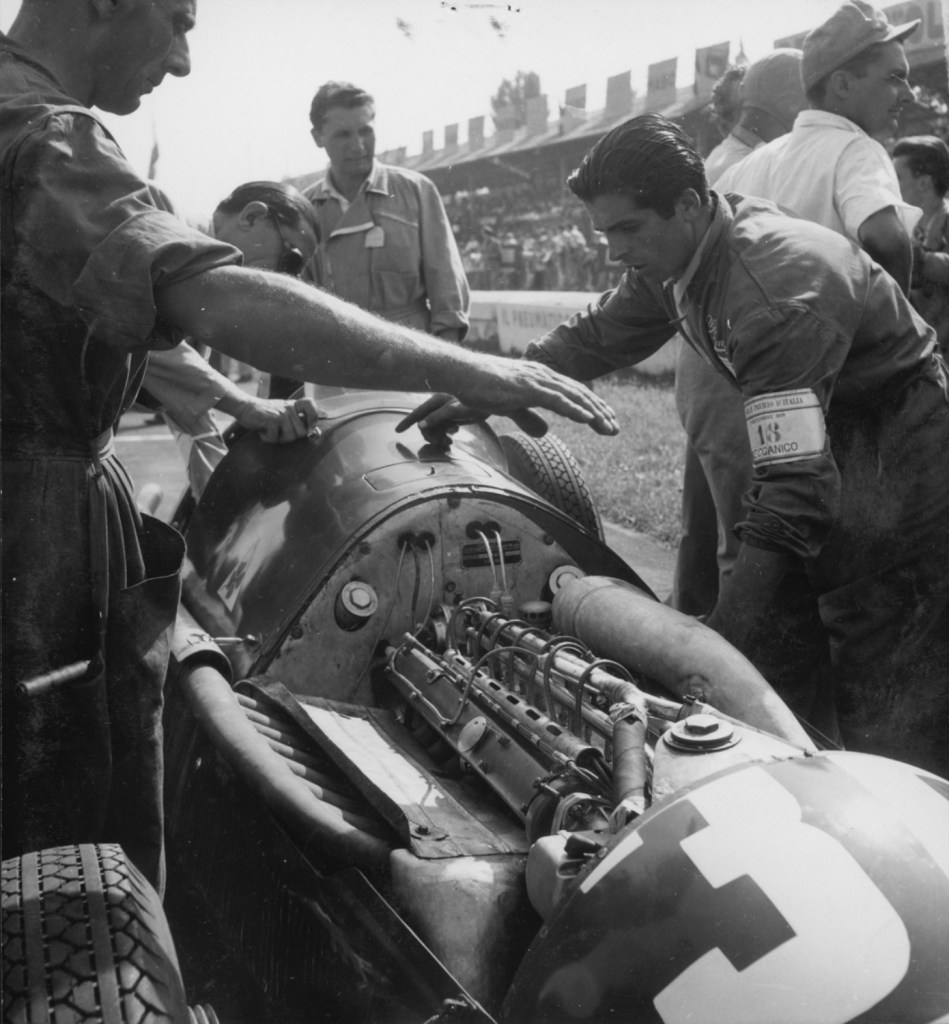
The Ferrari pits during the Grand Prix des Nations weekend, Geneva, July 30, 1950.

Alberto Ascari at left with car #40, a 4.1-litre Ferrari 340, the car behind is Gigi Villoresi’s 3.3-litre Ferrari 375 with the man himself at right (I think). Typical of the era, factory Alfa Romeo 158s finished one-two-three: Juan Manuel Fangio from Emmanuel de Graffenreid and Piero Taruffi.

“It took me five years to get this Autocourse and a whole lot of others from the widow of the owner!” my friend Tony Johns said with a chuckle. I’ve always been an Automobile Year guy, by the time I realised Autocourse was THE racing annual I’d already got the Automobile Year bug and started what became a 20 year journey to collect a set.

It was another set, Blommie The Great 38’s fabulous tits that led me in the wrong direction. Camberwell Grammar School appointed 25 year old, very statuesque Miss Blomquist as a librarian in 1971-72. Of course one couldn’t just sit in the library with ones tongue on the floor, it was while cruising the aisles trying to look like a serious student on my furtive, very frequent perving missions that I came upon Automobile Year 18, the 1970 season review. And so the obsession began, I was soon surgically removing the best photographs of the school’s Auto Years with a razor blade and adding them to my bedroom wall where scantily clad Raquel Welch had pole position.

It’s been great to have the very first of these learned journals for a week to peruse, read and enjoy. The 140 page, then-quarterly, cost 15 shillings in Australia and was distributed by Curzon Publishing Company, 37 Queen Street, Melbourne, not an outfit familiar to me but will perhaps ring a bell with some of the older brotherhood?

Two features are reproduced: one on F3 by Stirling Moss and another by Alfred Neubauer on the ‘Brains’ of the racing driver.

Walt Whitman once wrote ‘stout asa horse, patient, haughty, electrical’ but when first set to control one of the breed, at the age of six, it seemed to me neither stout nor patient. Reference to a horse may seem somewhat out of place when one begins to consider a motor racing career, but the equine enthusiasts talk about a good pair of hands and a good seat, and I am sure that both are just as necessary to the racing driver. If you are going to ride a horse seriously, as I did, then you must think one step ahead of it. A racing car also appears to have a personality of its own, and the driver must be equally facile at anticipating its behaviour.

Certainly I have never thought that the time I spent astride four legs as being anything but invaluable to subsequent control of four wheels, and my fourlegged career went on for ten years. Apart from the lessons it taught, it was even more directly concerned with the first appearance of ” Stirling Moss (Cooper) ” in a hill climb programme. Prize money won in the jumping ring was the financial foundation of the purchase of that Cooper.

It seems astounding now to recall that in 1948 British motor sport was centred on sprints and hill climbs, and that 500c.c. cars were still a somewhat despised novelty, mostly produced by enthusiastic owner drivers. I took delivery of one of the early production Coopers and it really is impossible to consider those days without digressing to praise the foresight and ability of the Coopers, both father and son, for without the reputation built up by their products half litre racing could never have reached the point where it won International recognition as Formula III. The only pity is that France and Italy appear yet to need to discover their equivalent of these two enthusiasts.

If they could, and were thus able to get equally successful cars into production, I am sure that there would not be the present move towards a change in the Formula.

Since those days the design of half litre cars has settled into a fairly consistent pattern of rear mounted motor cycle engine driving the back axle by chains via a motorcycle gearbox and it was the excellence of the available motorcycle components which played another big part in boosting the possibilities of Formula III. Perhaps the biggest advance in the past three years has been the mating of reliability with steadily increasing speeds. Maximum speeds have not changed so much, but circuit speeds have, as the result of patient chassis development, and though in 1951 circumstances will prevent me from driving half litre cars as much as in the past, the lessons learned at the wheel of these flyweights can be applied to the much trickier problems of heavier and faster machines.

Giving around 45 b.h.p. the more prominent 500 c.c. engines of today will propel a racing car at 100 to 105 m.p.h. and because the car is so low and so small this seems to the driver a pretty high velocity. It is only when one changes to a heavier car that one realises just how far liberties can be successfully taken with a car weighing perhaps 6 1/2 cwts all up.

Half-litre racing is always fun, and as far as the British scene is concerned is the most keenly contested class of all, because it has given so many people the opportunities which had previously been the prerogative of Continental drivers. I for one could never have hoped to motor race seriously but for the reduction in cost brought about by the 500 c.c. class and instead of being the proud possessor of the British Racing Drivers’ Club’s 1950 Gold Star would most likely have been, at the best, an unknown also ran with some sports machine in club events.

It may comfort some to know also that the first entry I submitted, fresh with enthusiasm at the prospect of taking delivery of the Cooper, bounced back at me.

The next step forward from the Cooper 500 was the Cooper 1000.

I say step forward without belittling the smaller car, but because I imagine that the goal of every racing driver is Formula I. That is a long road which I have yet to traverse but just how tricky a road it is I am learning almost every weekend this summer of 1951. I was fortunate in having parents every bit as enthusiastic about motor racing as myself, and at the same time a good deal more experienced when they suggested that one did not know what motor racing was all about until one had been on the Continent. With a Cooper 1000 I set out to see for myself in the latter half of 1949, and how right they were. The foray achieved some moderate success, not so much in the results, but in the experience gained and the feeling of confidence induced, and above all that I had something definite to offer to John Heath when he was looking around for drivers for the H.W.M. team. On his side, John could offer a car which was magnificently reliable and always pleasant to drive. The results achieved in 1950 are a matter of history, and there was only one snag. Excellent as the cars were they were never quite fast enough to win against a Ferrari, and we kept on meeting Ferraris.

This is not a criticism, but a simple statement of fact of which John himself was only too well aware, and which he has made every effort to remedy for 1951 by the most ingenious use of available materials. What was always a delight to me was to be a member of a well turned out team of cars bearing the British green which always arrived on the starting line a credit to their sponsor.

A racing driver usually gets some stock questions put to him by the layman, which can be paraphrased into ” How fast can you go?” “Which car do you like driving best? ” and ” What was your most memorable race?” My answer to the first is that speed is purely relative. The real art of motor racing and, for that matter the real excitement, is in negotiating an 8o m.p.h. corner at 90 m.p.h., for it doesn’t matter whether you do 100 or 150 m.p.h. down the straight.

As for the other two questions, the answer to the second is usually the car I am to drive next, and to the third, my last race. If one is to succeed, it has always seemed to me that one must be entirely engrossed in the race in hand, and whilst drawing on the experience of the past, memories of races as races are wiped out by the task of the moment. In any case, the last person to approach for any coherent picture of a race is a driver who was taking part in it.

The same sort of thing applies to cars, and one has to completely identify oneself with the machine of the moment, until you almost approach the state of believing that that is the only car which you really know how to drive.

Certain races stand out because of particular objects achieved, such as last year’s Tourist Trophy as being my first experience of a really fast heavy car, but the race itself was one of the easiest. So much so that I let my mind wander to external problems and made an excursion down an escape road. At Silverstone last August my chief reaction was a pleasure not so much in winning but in beating the late Raymond Sommer on the only occasion we met in reasonably comparable machines.

At Bari it was natural to feel a similar pleasure in bringing an H.W.M. home third behind two type 158 Alfas, because that was a result so much better than any of us had hoped for.

That is really the biggest satisfaction of all; doing just a little bit better than one expects when faced by a new situation and these notes are being written on the eve of what I am expecting to be my memorable race of 1951, the Mille Miglia and Le Mans.

The ‘Brains’ of the Racing Driver

By Alfred Neubauer, Team Manager of Mercedes Benz

The racing driver fixes hisses on the starting flag; his nerves are the keyed up to the highest pitch, for he knows those few moments of suspense, seeming like hours, will soon pass and the flag will drop. Another 10 seconds to go, slowly he pushes his gear lever into first…5…4…3…2…1 off!

With only 5 seconds left, he revs the car up to half its maximum, gently lets in the clutch and revs, further. The flag drops and with care to ensure that the back wheels do not spin, thus causing the car to run sideways, he shoots forward like a bullet from a gun.

Even for this first phase of the race – the start – the tactics involved have been thoroughly worked out by the team manager as a result of his observations during training. The popular opinion exists that in every racing team one or two drivers are chosen to set the pace. This, it is believed, will compel the other competitors to greater speeds. They will strain their engines, weaknesses will become apparent, resulting in their elimination, thus giving the driver, selected as the eventual winner, the opportunity to choose his moment and then drive through to clear victory. The opinion that such tactics are dictated is absolutely wrong. In fact, they evolve from the experience and technique of the driver himself.

The basic rule is as follows: ” Drive your machine within your own capabilities as fast as you can – but do not overstrain either yourself or your machine.” One rider must be added to this. Both car and driver, of course, must be subjected to some strain, but a first-class driver will know at what point this strain becomes excessive and for what length of time any strain can be borne without collapse. After continual experience, maximum powers of endurance become clear. Some drivers use both their cars and themselves unsparingly from the start and, consequently, collapse after a short time. They either drop back or are forced to retire. Others are capable of taking the lead from the start and holding it until the end of the race. There is yet a third kind of driver who knows the individual characteristics of his rivals and plays upon them. They purposely keep on their tail, in the meanwhile economising their own forces, and wait for a suitable moment to overtake them. The nerves of some drivers are unable to bare being trailed, and again there are those who remain completely indifferent to it.

Drivers can only know their position in a race so long as they keep within sight of one another. Once the leading drivers have got so far ahead as to lose contact with the rest of the field or when cars begin to drop out or are forced into the pits, then it is no longer possible for the drivers to know their position. It is at this juncture that the work of the pits commences. They are the brains of the racing driver and are led by the team manager. In aviation radio communication between the flyers of a squadron has long been recognised. So far as motor racing is concerned, however, this method of contact between the team manager and driver has not been introduced.* Thus for them the only means of communication is visual. It is, however easily understandable that the simplest method is the best because the driver’s attention must, under all circumstances, be concentated solely on his own car and the road ahead. A further duty of the pits is to inform the driver of the number of laps he has already covered and also the laps remaining. Each driver signifies that the message communicated to him has been understood by nodding his head.

An inexperienced team leader will be astonished when only a few laps later, by means of a circular movement of his hand, the driver indicates that he once more wants to know the number of laps that remain to be covered. This is, however, not exceptional and the explanation is given more often than not by the driver at the end of the race. He has to admit that very shortly after he received the first message he completely forgot its contents. For the driver the most important signals are those indicating his position in the race and the intervals that separate him from his opponents. The knowledge of his exact position dictates his policy. If the lead over his opponent is increasing, then naturally he will relax and thus economise his own forces and those of his car. If his lead is decreasing, then he will do everything in his power to increase once more the distance between himself and his rival. Similarly it is imperative for the driver lying in second place to know the distance between himself and the leader. From this it follows that he must be careful that his present position is not threatened by those who lie yet farther behind.

Naturally the team manager prefers those drivers who take the lead from the outset and hold it throughout the race without straining either themselves or their cars. It is only during a race itself that the driver can know whether he can have some moments’ relaxation or not. In some racing teams first-class drivers are fully aware of the potential weaknesses of their team mates and their cars and from the very start they remain in second place, thus conserving their own forces. As soon as they realise that their team mates’ powers are exhausted, they can immediately take the lead. The brains of the racing driver -the pits – have also to take such considerations into account, and must ensure that the driver who has made his way through the field and eventually takes the lead maintains the position he has succeeded in gaining. There have been instances when these tactics have been employed with great success. It is then the duty of the team manager to inform both the leading driver and his followers at each lap of the distance between them. It must be made clear to the driver lying in second place that he has lost his lead and would do far better to content himself by remaining in second place rather than force his car out of the race.

The price of driving as fast as driver and car permit is often very high. It should take very little experience for the driver to be fully aware of his own capabilities. So far as his engine is concerned he will have received precise directions and he will have been told by his testing engineers of the precise amount of revolutions permitted. However, it is only natural that he should make a point of ensuring that these instructions have not been too cautious and he will certainly confirm for himself to what extent his motor may be over-revved. The experience of former years has shown that drivers who have been given precise instructions that their revs should not exceed 4500 have, some years later, admitted reaching 6200. When a driver confines himself strictly to the instructions of the technicians and a team mate overtakes him, it becomes quite obvious that this team mate has exceeded the limits given to him. Here temperament plays its part, for the decision has to be made whether he will exceed his limits or whether he will observe the technical instructions to the letter and bear in mind the increased lasting powers of his engine.

Generally speaking, the driver who is bound by technical instructions has an advantage over those drivers who themselves assisted in the building of their engines. The latter, whilst testing, will have discovered the limits which the construction of the engine has imposed. Indeed it is fair to say that it is no advantage whatsoever to a driver to be himself a builder or testing engineer. He is naturally hampered by the knowledge of his own technical experience.

Perhaps this is a suitable moment to say a few words about “luck” in racing. If a driver fails to take into consideration the limits imposed by the technicians and a piston rod breaks or some defect in the engine forces him to retire or his tyres do not stand up to his way of driving, then he will have the satisfaction of knowing that all will say:- “What bad luck ! ” Conversely, one member of a team finishes and the others are forced to retire, invariably the latter will exclaim :- ” How lucky he was! “

Technically speaking, 95% of ” luck ” in racing is dependent upon the preparation of a car. This preparation begins at the first moment of building. The other 5% lies in the hands of the driver, whose “feel ” permits him to get the maximum value out of his car. There are drivers on the Nürburgring who use up their tyres in six laps and are indeed slower than those who do not have to change their tyres for eight or even ten laps. A more subtle method of driving, a more even use of the engine on leaving corners and a softer application of the brakes differentiate a good driver from a better one.

As in every activity which demands talent so in motor racing. There are many enthusiasts, but few become champions.

All these facts prove how many conditions have to be fulfilled before success in a race can be achieved. The popular complaint of housewives :-” You have eaten in a minute what I have taken hours to prepare,” would perhaps be even more suitable to motor racing!

It is not the obiect of this article to consider the many hurdles which must be cleared before the racing car eventually reaches the track:- the planning of the design according to the formula given, the design itself, the manufacture of the parts, the assembly and testing. Our task commences only from the moment when the car leaves the factory and proceeds to a race, there to prove the quality of its design and justify the work of preparation. These preparations are no more than stages on the road to victory.

The work is undertaken not merely to prepare a car for one particular race, but also with a view to its chances of success over its rivals.

Experience gained by entering for the same race year after year greatly assists the designer in his attempts to reach perfection so far as one particular course is concerned. Often drivers entering a race for the first time are taken unawares by the peculiarities of the track which had they had opportunities of practising thoroughly earlier, could have been avoided without difficulty. Practise on non-permanent tracks presents complications as it is practically impossible to close circuits to the public so as to enable practising to take place. Consesequently, the preparation of cars for non-permanent circuits is considerably more difficult than for permanent circuits which are open to racing cars at all times of the year. To list but a few-the choice of the right transmission, the measurements of fuel requirements and the wear on brakes and tyres are factors which must depend entirely on the circuit to be raced.

Many years ago, the principle of fitting streamlined bodies to cars for very fast circuits was accepted. Nevertheless, without comparative tests it is not so easy to decide whether this style of bodywork is most suitable to any track. The streamlined bodies with their attendant lack of wind resistance have the advantage in acceleration and are preferable when high maximum speeds are required. This, however, is offset by the decrease in braking power with the resultant strain on the brakes. On the former Avus circuit, where there are two parallel stretches of ten kilometres and long curves, this disadvantage was not apparent. Many, streamlined designers had soon to learn that the cooling of tyres presented a difficult problem. Within their enclosed space, the maximum temperature permitted was soon reached, but problems of engine and gear cooling often counter balanced the advantages gained by streamlining.’

All these points have to be considered during tactical preparation for a race, and it is on the conclusions reached that the decisions must be taken whether pit stops are to be made or not. These matters are of first-rate importance. In fact, success in a race depends on them just as much as it depends on the tactics of the driver which were mentioned before in this article.

It can now be seen that a race is not just a haphazard competition between one car and other. Each circuit has its individual problems, and not least of these are the prevailing weather conditions. Above all, fuel, tyres, back axle and gear ratios must be adjusted according to the circumstances.

The particular suitability of individual drivers to different tracks has to be considered also and a strategical race plan cannot be worked out without continual observations of the other competitors and the tactics which they employ. There are supreme examples which prove that although complicated preparations were made for a race, it was a the result of such observations that victory was achieved.

There was an instance at the Nürburgring when a driver’s race plan required him to stop for one minute to change his tyre. However this driver had a ten-second victory over his rival whose plan permitted him to run through the ten lap race without a pit stop though at a limited speed.

This ” organisation for victory ” does not date back very far. Even in 1914 visual communication between driver and the pits did not exist. In those days the pits were really no more than depots for refuelling and the change of tyres, and it was not until the period between the two world wars that the pits became more and more ” the brains of the racing driver.”

After many years of practice, this “Organisation” no longer carries many difficulties in so far as circuits are concerned. What is not so easy to master is the “organisation” of long distance races such as the Mille Miglia. It was in 1931 that Caracciola arrived at the finish in Brescia and refused to believe his team manager when told that he had won the race. In fact, it was not until some half an hour later, when his victory was confirmed by the organisers of the event, that he was convinced. The Mille Miglia is so planned that although times between control points are given, they arrive so late that it is impossible to communicate them to a driver, who may be anywhere on the Appenine peninsula.

In this race the only workable maxim is: “Know the capabilities of your machine and your own ability and get the best out of both.” It was not without reason that the experienced Italian master Villoresi exclaimed after the last Mille Miglia:-” What a ghastly race ! ” Above all, in England, where there are many handicap races, ” the brains of the racing driver ” have a particular problem to solve. Here a driver is not in direct competition with his rival who holds a position in the race which is obvious to all. On the contrary, the pits must continually work out his position according to the class of his car.

Many times during the Tourist Trophies in Ireland the team manager has looked for his rivals amonst the fastest competitors whilst the real speed so far as he was concerned was dicated by relatively unimportant competitors who had completely escaped his notice. In each handicap race average comparative speeds are formulated. If a car in the small capacity class exceeds its handicap speed, then the driver of car in a larger capacity class is compelled not only to increase his relative speed but also the speed laid down by his class.

Many prominent drivers from the Continent have been baffled by this and have to do everything within their power not to be defeated by a completely unknown rival. What to an onlooker appears to be no more than the smooth running of a race is to the team manager the careful integration of many factors which achieves the much-sought-after victory.

* Radio communication was used successfully by the American Cadillac team at Le Mans last year – Ed

The Gigi Villoresi and Piero Cassani victorious, battered and bruised Ferrari 340 America Berlinetta passing through Bologna on its April, 29 1951 Mille run.

Jaguar XK Super Sports. Was that the car’s model name before XK120 came along or has the copy-writer goofed?

Credits…

Autocourse 1951 from Tony Johns’ collection – many thanks TJ

Tailpiece…

Finito…
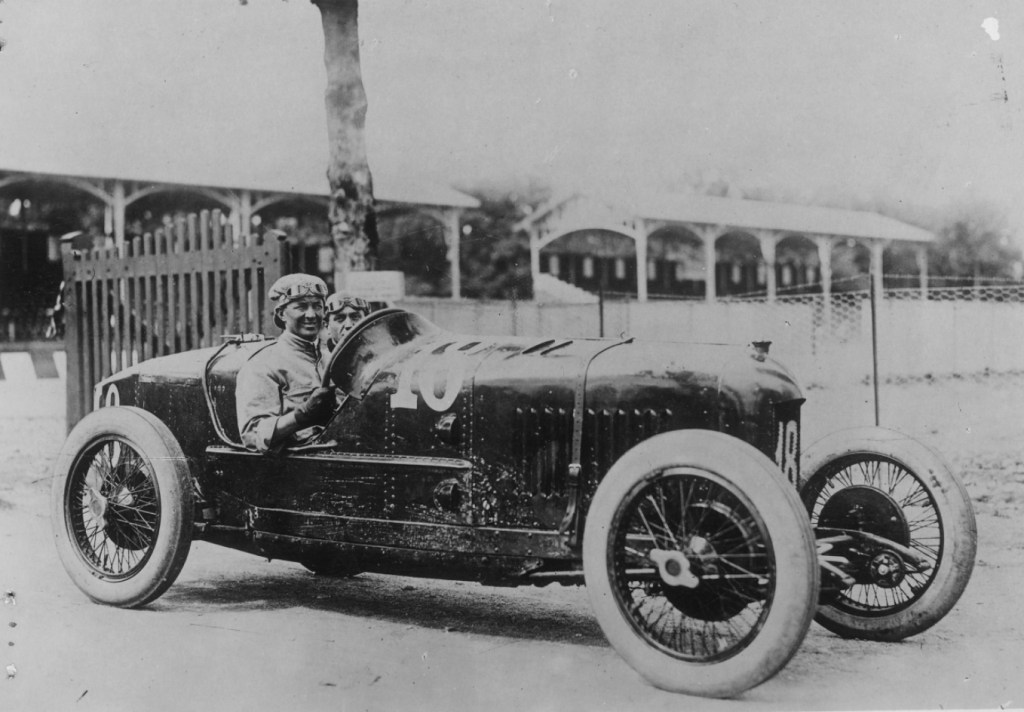
(G Cocks Collection)

Kelvin Bullock’s 1917 Scripps-Booth V8 Special looking very handsome at Lake Perkolilli, Western Australia in the late-1930s.

I’d never heard of the marque Scripps-Booth (S-B) until tripping over this shot of Bullock’s handsome racer on Graeme Cocks’ mighty-fine Lake Perkolilli Red Dust Revival Facebook page; https://www.facebook.com/reddustrevival2022/

The American marque was imported into Western Australia by the Armstrong Cycle and Motor Agency, this car was living in the rural hamlet of Corrigin when Claremont racer/mechanic Bulloch acquired it and extensively modified it circa 1937.

He raced at various of the West Australian’ Round the Houses towns including Albany, Bunbury, Pingelly, Applecross, Cannington, Dowerin and Lake Perkolilli.

Dowerin, September 4, 1938 and side view of the Bulloch Scripps-Booth V8 Spl (G Cocks)
Ferro V8 engine 1916-17 technical details as per text (Ferro)

Motorist and Wheelman magazine outlined the technical details of the Scripps-Booth Model D based special, as Cocks quipped, it shows just how inventive Specials builders were.

The engine was a Ferro V8, one of the first production American V8s, “which was surprisingly modern in design, and a most beautifully made and finished motor.” It still had its original cast iron pistons and had never been rebored. “The valves now in use, were designed for an Essex, and turned own for the Scripps. They are now closed by Chevrolet springs.”

The Alanson Brush designed series of V8s were built by the Ferro Machine and Foundry Company in Cleveland, Ohio; the Ferro Corporation still exists. The engine chosen by Scripps Booth was Ferro’s Model 8-35, a 162cid/2660cc, a two-main bearing OHV unit famous for being one of the first production automobile V8s, the first too with the block and crankcase produced as a single casting, 16 years before the 1932 Ford V8. The 8-35 had a 2 5/8 inch bore, 3 3/4 inch stroke, with a compression ratio of about 5.5:1. Fed by a Zenith twin-barrel carb, it produced 22.05hp/SAE, with an advertised output of 35hp. A Bosch magneto provided the sparks on Bulloch’s engine.

One owner described the engine as like two four-cylinder motors joined at the crankshaft, with each bank of cylinders fed by one chamber of a water heated inlet manifold. A heavy flywheel kept the vibrations at bay.

“The gearbox is original Scripps-Booth, but the rest of the 889kg that makes up the car, includes parts from a remarkable number of makes. The front dumb-irons are Chevrolet and the wheels and spring shackles Citroen. The radiator grille is ’34 Ford, the core Chevrolet, while the fan did 10 years service on a Rugby but its mounting is Bulloch Special.”

“Both the front axle and front brakes are Whippet, while the lamps in the first place showed the way to a driver of a Chrysler. The steering box, tailshaft and universals are Essex. At the top of the column a Ford steering wheel rides and behind it are two Austin bucket seats. Shock absorbers are Ford, and the rear braking, Bulloch says, ‘is by accident’!”

Dowerin September 4, 1938 (G Cocks Collection)

James Scripps-Booth and his creations…

“James Scripps Booth was a Detroit-area artist and automotive engineer. Born on May 31, 1888, in Detroit, Michigan, Booth was the eldest child of George Gough Booth, of the Booth publishing chain, and Ellen Scripps Booth, of the Scripps publishing empire,” according to the Detroit Historical Society. What follows is their ‘Encyclopaedia of Detroit’ entry on Booth.

“Booth grew up in a household that encouraged an awareness and appreciation of the arts, and he spent many hours sketching in and around his parents’ home in Detroit, surrounded by an extensive art collection. He also encountered many distinguished artists, writers, and musicians. Booth received most of his education through private schools and left school before finishing tenth grade. He taught himself the basics of automobile mechanics by systematically dismantling and reassembling the family’s car. While employed at the Detroit Evening News he developed his writing skills, broadened his automotive background, and refined his art techniques.”

“In 1910 at the age of 22, he married Jean Alice McLaughlin in Detroit. Following their marriage, Booth and his wife moved to Paris, where Booth studied art at the École des Beaux-Arts. They also spent some time living in Etaples, France, where Booth learned the fundamentals of working with pastels from Michigan-born artist Myron Barlow. In the decades following the couple’s return to the U.S., several of Booth’s works received critical acclaim at exhibitions at the Detroit Museum of Art and at other shows in both Michigan and California.”

James Scripps Booth (he didn’t hyphenate his own name) posing with a life size drawing of his Da Vinci ‘Pup’ cyclecar in 1921 (HA Parker)
James Scripps Booth’s drawing of the 115 inch wheelbase 1915-16 Scripps-Booth Vitesse Speedster V8, only one of which was built. The reverse of this drawing has this note by James “Proposed for Scripps Booth, accepted and detailed, then policy changed by Clarence Booth, then JSB quit.”

“As Booth perfected his artistic talents, he also developed a keen interest in mechanical engineering and automotive design. Many of his early drawings consisted of new designs for automobiles. In 1913, Booth developed his first automobile prototype, the “Bi-Autogo,” a unique two-wheeled cyclecar. The Bi-Autogo utilized the first V-8 engine ever built in Detroit. Booth’s Scripps-Booth Cyclecar Company was defunct within a year but was responsible for memorable designs. In 1914, with the financial support of his uncle William Booth, publisher of The Detroit News, Booth began his second business venture, the Scripps-Booth Automobile Company. The company produced more traditional upscale automobiles and was much more successful than the cyclecar business. Booth resigned in 1913 and moved to Pasadena, California. The company was purchased by General Motors and continued to operate until 1922.”

“In the 1930’s Booth moved his family back to Detroit from California, established an industrial design/art studio in Indian Village, and assumed responsibilities both as a trustee of the Brookside School and Cranbrook Foundation and as a director of the Cranbrook Academy of Art. During World War II, Booth published the General Handbook, Motor Mechanics Simplified: Understand Your Car, used by the American Red Cross in their automotive mechanics classes.”

“Following Booth’s death on September 13, 1954, a large collection of his automotive drawings, artwork, and several of his cars were donated to area institutions, including the Detroit Historical Museum.”

Scripps-Booth Model D…

The donor car for Bullock’s special, the model D was built between July 1916 and July 1917. VIN numbers quoted are 101-801 (and 101-700) and 801-1807 (and 801-1525) respectively: 700 cars and 725 cars depending upon the figures you believe.

While Booth’s prototype of the Model D V8 was the short wheelbase (115 inch) two-seat sporty Vitesse, Booth lost the production battle with his fellow management team of the Michigan based Scripps-Booth Company. The cars built were 2-door tourers and town cars (and runabout, chummy runabout/roadster built on a 120 inch wheelbase. Whether S-Bs imported to Australia were factory built or arrived sans-bodies, given the favourable tax-treatment afforded cars imported as rolling-chassis, is unclear.

The agents for S-B in Australia were the Armstrong Motor and Cycle Agency in WA, Roy Standfield Ltd in Sydney (from 1919 John McGrath) and Durance-Mayston Motors in Melbourne. It appears the cars came to Australia in some numbers, 62 S-Bs were registered in NSW in 1919 alone. How many are left here now? less than 10 it seems.

1916 Ferro ‘V-Type’ Motors ad. The types listed are the 8-35 (163cid), 8-48 (198cid), and 8-60 (265cid), that is 35, 48 and 60hp V8s and the 12-80 80hp V12. Hopefully, you can just read this…

What inspired this exploration of the arcane is the gorgeous looking body Bulloch had built by a body-artisan of some ability in Perth. It seems it’s perhaps not entirely original though. Perth man Graeme Holman is building a tribute car to the long-lost Bulloch Scripps-Booth V8 Special and credits the design inspiration for it as the 1934 Ford Model 40 Special Speedster commissioned by Edsel Ford for his own use. What a shame it is the magnificent E.T. ‘Bob’ Gregorie designed car was not put into series-production, they would have sold like hot-cakes. See here for a great piece on these cars; https://www.thetruthaboutcars.com/2012/01/look-at-what-i-found-the-most-significant-car-at-the-2012-naias-edsel-fords-1934-model-40-special-speedster/

The second Ford Speedster ordered by Edsel Ford – 1934 Type 40 Special Speedster – with its original, very elegant front styling, the photo was perhaps taken near Greenwich Village on Ford’s Dearborn campus. The shot below shows Ford Chief Designer Bob Gregorie’s scale model of the 1940 restyling to address overheating issues, and Edsel’s note to him (FoMoCo)
(FoMoCo)

Bulloch bought his S-B in late 1937 or early 1938 in Corrigin, an affluent wheatbelt town 230km southeast of Perth. Perhaps the car was a farmer’s pride and joy and was pushed into a shed when it eventually misbehaved? Interestingly, a Mr C.D. Kerr placed fifth in a S-B at the Bibra Lake standing-quarter mile meeting in February 1935 (26.4sec), I wonder if it’s the same car?

Quite who the team of mechanic/engineers/bodybuilders that assembled the cocktail of S-B Model D chassis, engine and gearbox and other assemblage of components into such a cohesive looking and seemingly competitive racer is unknown…but I’d love to know.

Kelvin Bulloch had been a prominent in the WA Sporting Car Club from about 1935. In ’37 he won the club’s silver-star for the greatest aggregate points in club competitions as well as the over 1500cc hill climb and had considerable success in gymkhanas. In 1936 he won the club’s eight-hour trial, the year before he dead-heated with Aub Melrose for first place.

Some of the field at the September 1938 Dowerin meeting, Bulloch #6. Help with other car IDs welcome (G Cocks)

Bulloch is said to have raced the car at various of the WA Round the Houses town tracks including Albany, Bunbury, Pingelly, Applecross, Cannington and Lake Perkolilli, with his best result a win at Dowerin in September 1938. There he won the main event, a 20 lap handicap, “driving well to gain the lead in the early stages” and triumphing despite his engine misfiring in the race’s final stages.

In an article to promote that Dowerin meeting, The West Australian described the car as ‘The Venerable Scripps-Booth’. It reads “One of the most unlucky drivers in recent months has been Kelvin Bulloch. He failed to start at Albany, and a minor ignition failure robbed him of almost certain victory in the big race at Dowerin in June. This time he is hopeful that the old Scripps-Booth, which has been dubbed ‘The Scraps’ will at least last the course.”

The class of the field in WA then was soon to be 1939 Australian Grand Prix winner Allan Tomlinson and his MG TA Spl s/c and Jack Nelson in a Ballot 2LS Ford V8 Spl.

Quite what became of the Kelvin Booth Scripps-Booth V8 Special is unknown, do get in touch if you can assist.

(Cox Family)

Other Australian competition Scripps-Booth…

“A picture of my old man, Wally Cox about 1937,” Allen Cox wrote. “A 23 year old petrol-head, his car was a 1922 Scripps-Booth fitted with a T-Model Ford engine fitted with a Frontenac or Rajo cylinder head conversion. In addition to that he pulled off the guards and lightened it etc. The problem was that in small country towns the constabulary knew where everyone lived!”

(Thomas Family)

1960’s drag-racing champion and speedshop chain entrepreneur Eddie Thomas owned a Scripps-Booth 13-34 162cid V8 that he fitted to a speedway midget he raced circa 1940.

What became of these cars and engines is unknown.

Etcetera…

These tables are from the Scripps Booth register, check out scrippsboothregister.com if you have a hankering to learn more about these cars.

Model D styling drawings by James Scripps Booth

Credits…

Red Dust Revival Facebook page, Graeme Cocks Collection, Detroit Historical Society, Harold A Parker, scrippsboothregister.com, various newspapers via Trove, Terry Walker’s Place – West Australian race results, Ferro Corporation, FoMoCo

Tailpiece…

Finito…
(P White)

Ouch. Wow, that’s daffy-ducked isn’t it!? Alan Cooper’s very dead 4.8-litre, straight-eight, 1919 Ballot 5/8LC lies on the front-straight of Olympia Speedway, Maroubra, Sydney on January 2, 1926.

Behind is his brother, Harold ‘Hal’ Cooper’s 2-litre Ballot 2LS #15. In the feature that night, relative novice Alan tried an outside pass on his vastly more experienced younger brother on the last lap, snagged a hub on the fence and cartwheeled along the track at over 100mph and into the sandy area between the track edge and the spectator compound. Alan walked away – shaken and stirred – but the poor riding mechanic wasn’t so lucky, the worst of his injuries was a pair of broken thighs.

Alan Cooper aboard #1004 earlier on the fateful day (Sherwood Collection)

Alan never raced again, but chassis 1004 was repaired by racer/mechanic/engineer John Harkness using an Australian Six chassis, and appeared again at Maroubra with Harkness at the wheel that August. Whatever thoughts I had about the original chassis being repaired have been well set aside…

The Cooper boys were from a family of 11 children. They were brought up in Melbourne’s Botanical Gardens where their father was Chief Gardner. Via a familial connection, Alan Cooper met the 30-years-older Stephen Brown not long after he returned from the Great War. The Brothers Brown owned a large vertically integrated Newcastle coal mining and distribution business named J & A Brown (now part of Yancoal Australia). Stephen treated Cooper as his son and lavished stupefying levels of wealth on him including the most exotic racing cars of the time; the Ernest Henry designed Ballot’s were the best there was, the 1919 ‘Indy’ Ballot undoubtedly one of the fastest cars on the planet.

Indy 500 1919. #4 Ralph DePalma, Packard, #32 and 31 are the Albert Guyot and Rene Thomas Ballot 5/8LCs, #3 is Howdy Wilcox – the winner – Peugeot, and #33 Paul Bablot’s 5/8LC. The pace car is a Packard Twin Six V12 (IMS)
Louis Wagner, Ballot 5/8LC #1004 before the off (IMS)

Louis Wagner raced 1004 at Indianapolis 1919 as part of a four-car factory assault on the race. The Ballots where the quickest cars too, but the hastily built machines were geared too-tall. The quick fix, in the absence of an alternative diff-ratio, was the use of smaller diameter locally made wheels and tyres – Goodrich instead of Michelins. These failed, Wagner was out with a broken wheel after only completing 44 of the 200 laps while running third, then Paul Ballot crashed when a wheel failed after 63 laps, so the other two 5/8LCs of Albert Guyot and Rene Thomas cruised home in fourth and 11th places.

While it was a bad day for Ballot all wasn’t lost for Ernest Henry, the winner was Indiana boy Howdy Wilcox in one of Henry’s old Peugeot GP cars. Indy was/is tough and dangerous. Of the traditional 33 cars that started, 18 didn’t finish, four of whom crashed, two fatally: Louis Le Cocq and Arthur Thurman both lost control aboard Duesenbergs. Robert Bandini, Thurman’s mechanic died as well.

As a result of the rise in pole-time speed to nearly 105mph in 1919, and one suspects, perhaps the three deaths, the Indy Formula engine size was reduced from 300cid in 1919 to 183cid for 1920. Ernest Ballot immediately had four very expensive racing cars surplus to requirements, just the thing for a bright-young-colonial with somebody else’s dosh jangling loose in his pockets.

By the time Brown and Cooper swung past Paris’ Boulevard Brune to acquire 2LS #15 – the ex-Jules Goux second-place 1922 Targa machine – Monsieur Ballot was using #1004 as a swish, speedy roadie. Fitted with Perrot brakes, mudguards and a windscreen, he cut quite a dash on the Boulevard St Germain.

Thelma – quite tidy too – at the wheel of #1004 at what became known as Safety Beach, Dromana on Victoria’s Mornington Peninsula in December 1928 (B King Collection)

That’s why the car before Alan Cooper crashed (pic 2 above) it looks road-equipped, it was. When shipped to Australia it supposedly arrived with three bodies, the one shown and destroyed in the prang, a slipper body which Harkness fitted (or built) when he rebuilt it, and another, a shot of which I’d love to see…

Harold Cooper raced 5/8LC 1004 for a while south of the Murray at Aspendale, the Melbourne Motordrome and other venues. He was described as “Victoria’s best known racing driver” by the Melbourne Herald before racing on the 2-mile 163 yards rectangular gravel course at Safety Beach, Dromana in December 1928, and duly set the fastest time.

Unfortunately Harold didn’t contest the 1927 Australian Grand Prix at Goulburn, nor did he ever give the 2LS a gallop in any of the early (2-litre supercharged and under) Phillip Island Road Races/Australian Grands Prix. Had he done so he would have been a red-hot favourite, he is the most underrated and forgotten Oz driver of the period…

Melbourne racer Jim Gullan and mechanic during practice for the January 2, 1939 Australian Grand Prix at Lobethal, South Australia. The exotic eight let go at warp speed, a rod carved the block in half with expensive shrapnel being spread across the Adelaide Hills countryside. It would be 40 years before the chassis was reunited with another Ballot engine (N Howard)
1004 in the Edgerton suburban garage, date unknown. Other than the Dino I’ve no idea of the identity of any of the other machines (R Edgerton Collection)

Both Ballots raced on. The 2LS’ svelte twin-cam 16-valve four was replaced by a succession of V8s and raced in Western Australia for decades, its mortal Ballot remains survived and are well cared for in Australia. The 5/8LC was restored after being tracked down to a northern Victoria farm by ‘Racing Ron’ Edgerton in the 1970s. The ‘Edgerton’ branded crankcase side covers were a tad vulgar for most but he got the car running and competed in it, a state to which it has never returned in the hands of the UK owner for the last three decades or so.

Check out the May 2021 issue of The Automobile. I wrote a never-published-before long yarn about the Coopers, Ballots, the elusive Stephen Brown and the staggering lifestyle he afforded them, and their later second lives as Captains of The Turf. See here to purchase; https://www.theautomobile.co.uk/may-2021-issue/

(R Edgerton Collection)

Ballots up. Frying tyres, rings or bearings? Ron Edgerton attacks Shell corner (Turn 1 in today’s vulgar parlance) at Sandown on one of 1004s relatively few outings – partially restored by the look of it – before the car was sold overseas. The following Ballot is Wes Southgate’s 2LS, now restored to original bodywork and owned by publisher/hotelier/renaissance-man Douglas Blain, who keeps the car in fine fettle in Victoria. Those Rothmans brake markers are circa 1978-79’ish, so a meeting about then?

Etcetera…

(AD Cook Collection)

Harold Cooper aboard #1004 at La Turbie Hillclimb in 1925. Hal did four ‘climbs: three venues near Nice including this one, and another in Monaco, before the car was shipped from Le Havre to Melbourne. Quite why this slipper-body was removed back at Ballot HQ at Boulevard Brune for the ‘Indy’ body before shipment to Australia is anybody’s guess. The body above is different to the form in which the car emerged Harkness’ workshop after Alan Cooper’s Maroubra accident.

While Alan Cooper makes much of his racing career in the Smiths Weekly serialisation of his life story – a grand, rollicking, bullshitty yarn it is too – in fact he did relatively few competition miles. Harold, on the other hand, competed a lot from 1922 when the 2LS arrived and was a man of great skill. He was far more competent than Alan, had competed in the 5/8LC in France already, so had a level of familiarity with it.

The car was ministered to in Sydney by Giulio Foresti, Ballot factory racer/dealer/mr-fixit who tested it at Maroubra and schooled the brothers in its use and mechanicals. We know from contemporary reports that a planned early Maroubra test by Alan was thwarted by steering problems. Harold should have raced the 5/8LC and Alan the 2LS that fateful night; letting Alan loose in it at Maroubra was akin to a modestly credentialed Formula Ford driver have a lash in Oscar’s F1 McLaren. Alan Cooper was kissed-on-the-dick-by-tinkerbell – to use vulgar Oz slang – many times during his long life, not least on that fateful 1926 evening.

The Argus December 10, 1928

“Thrilling motor-racing was witnessed at the Aspendale Speedway (Melbourne) on Saturday afternoon. The best display of driving was that given by Harold Cooper, who is shown here negotiating a corner at speed in his eight-cylinder Ballot car. He defeated Albert Edwards who drove a front-wheel-drive supercharged Alvis.”

Credits…

Peter White Scrapbook via Colin Wade, Indianapolis Motor Speedway Museum, The Argus, AD Cook Collection, Ron Edgerton Collection, Norman Howard, Bob King Collection, John Sherwood Collection from the wonderful ‘A Half Century of Speed’ by Barry Lake

Tailpiece…

(R Edgerton Collection)

The essential element of Edgerton’s rebuild of #1004 was locating one of the very exotic, Ballot 4.8-litre DOHC, four-valve, straight eight engines or the bones thereof.

As luck would have it, Briggs Cunningham had one, and wanted a Cottin & Desgouttes, Edgerton was happy to oblige. Here is Ron’s (at right) pride and joy (with Silvio Massola) – didn’t he have a lot of those in his automotive lifetime – on a 1977 rally in Tasmania, Australia’s South Island.

Finito…
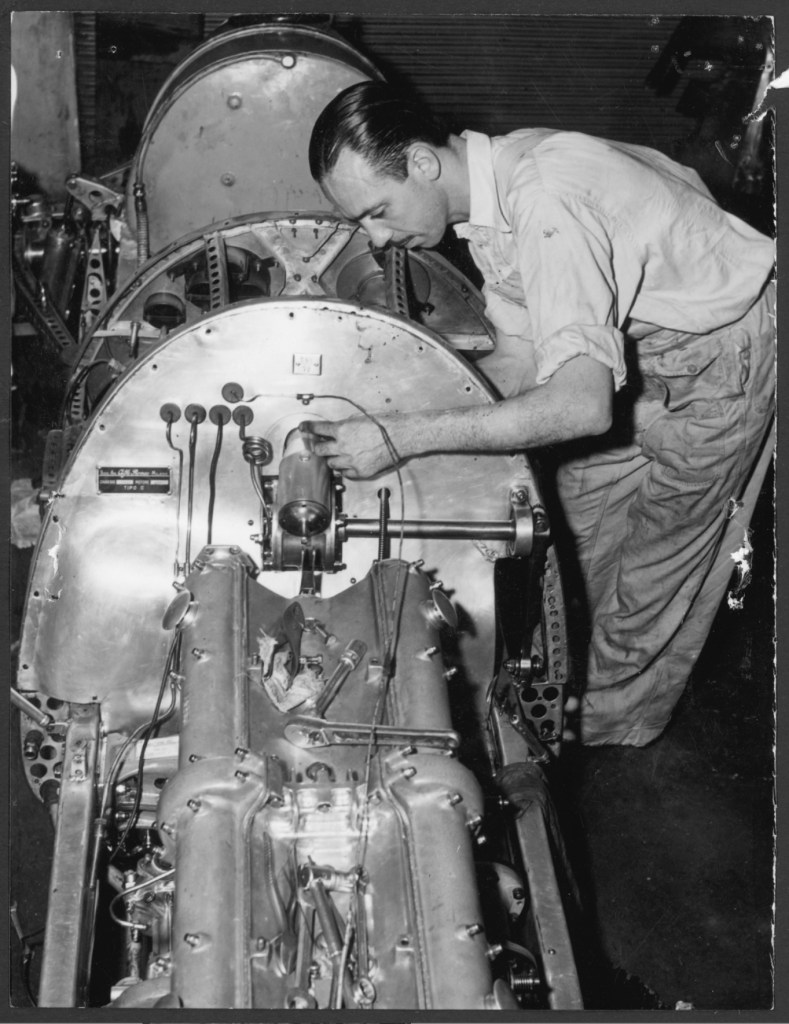
(LAT)

Woolf Barnato and Bernard Rubin on their winning Bentley Motors Ltd entered Bentley 4½-Litre at Le Mans, June 17, 1928. The duo completed 155 laps, 2669 km.

Second was the Robert Bloch/Éduard Brisson Stutz DV16 Black Hawk ‘Bearcat’ 5.2-litre straight-eight, with the André Rossignol/Henri Stoffel Chrysler 72 Six 4.1-litre third, having completed 154 and 144 laps respectively.

It was Bentley’s third victory in the race: Frank Clement and John Duff won aboard a 3-litre Sport in 1924 – the second time the event was held – and Dudley Benjafield and Sammy Davis, 3-litre Speed in 1927. The marque won again in 1929, Barnato/Birkin 6½-Litre Speed Six, 1930, Barnato/Kidston 6½-Litre  Speed Six and most recently the Capello/Kristensen/Smith Speed Eight in 2003.

(LAT)

Tim Birkin/Jean Chassagne Bentley 4½-Litre in front of the other team car driven by the Frank Clement/Dudley Benjafield then the Louis Chiron/Cyril de Vere Chrysler Six Series 72. The Birkin car finished fifth, the other pair were DNFs: the Clement machine with radiator hose/oil issues, and Chiron/De Vere were disqualified after a bump-start.

Barnato/Rubin (unattributed)
Pitstop for the winning car (LAT)

(LAT)
(LAT)

Bentley 4½-Litre chassis ST3001…
The winning Barnato/Rubin machine, chassis ST3001 (above) was the first Bentley 4½-Litre off the Cricklewood production line. Completed in June 1927 with Vanden Plas Le Mans-type body, it was delivered to Barnato for use as a Bentley Motors team car.

Barnato gave ST3001 the nickname Old Mother Gun. YH 3196 debuted at Le Mans in 1927. Driven by Frank Clement and Leslie Callingham the car set a lap record on its second lap with the convertible hood still up. ST3001 retired from the race after 35 laps while leading, having become enmeshed in the infamous White House Crash that eliminated seven cars, including the Bentley team. There was a second 24-hour race held at the Circuit de la Sarthe on August 15-16 that year, the Grand Prix de Paris. Frank Clement and George Duller led from the off and won it by over 80 miles.

In 1928 the car won despite the challenges. Frank Clement’s car was forced out when the chassis frame cracked, disconnecting a water hose and emptying the radiator. All seemed lost again when the frame of Old Mother Gun, leading at the time, also cracked with about 15 miles to go. Despite having to ease, Barnato hung on with the other 4½-Litre of Birkin/Chassagne fifth after losing a lot of time during a wheel change.

ST3001’s chassis was then replaced with a new heavy-pattern chassis frame. OMGs second chassis was later used to rebuild the 4½-Litre MF3157.

In 1929, Old Mother Gun raced again Le Mans, as the only 4½-Litre entered, alongside Bentley’s two 6½-Litre Speed Six’. Victory went to the Speed Six Old Number One with Old Mother Gun second raced by Jack Dunfee and Glen Kidston.

(LAT)

The rest of the field…

(LAT)

The Maurice Benoist/Louis Balart Tracta FWD leads the similar car of Roger Bourcier/Hector Vasena, while below, the Bourcier/Vasena machine passes the stranded – but ultimately eighth placed and first in class – Robert Benoist/Christian d’Auvergne Itala 65S 2-litre.

(LAT)

(LAT)

The Clive Gallop/EJ Hayes FW Metcalfe entered Lagonda OH 2L Speed, DNF accident.

(LAT)

The Sammy Davis/Bill Urquhart-Dykes (ninth) and Maurice Harvey/Harold Purdy (sixth) Alvis TA FWDs and to the right, the Lucien Lemesle/Henry Godard S.C.A.P – Sociéte de Construction Automobile Parisienne – (DNF) in the pitlane before the off, and below, Davis at speed.

(LAT)
(LAT)

Action for the grandstand crowd, the Émile Maret/Gonzaque Lécureul S.A.R.A SP7 (DNF) battles with the Goffredo Zehender/Jérôme Ledour, Chrysler Six 72 DNF radiator.

(LAT)

The Maurice Benoist/Louis Balart Tracta-SCAP (12th) chases the (11th) Baron André d’Erlanger/Douglas Hawkes Lagonda OH 2L Speed.

(LAT)

The Robert Benoist/Christian d’Auvergne Itala 65S passes the crashed Sir Francis Samuelson/Frank King Lagonda, Samuelson was experiencing gearbox problems at the time he crashed.

As the MotorSport report reads, our Knight’s frenzied reversing efforts resulted in his teammate, D’Erlanger, in another FE Metcalfe entered Lagonda, colliding with him and pushing him further into the sand and through a fence. The shot below shows him in this situation, as the Gregoire/Vallon Tracta passes.

(LAT)
(LAT)

The shot above shows Samuelson attempting the difficult task of releasing the left-front guard/wheel from the voracious clutches of the fence and sandbank. A task in which he was unsuccessful.

(LAT)

Front of the field action from the winning Barnato/Rubin Bentley 4½-Litre and second placed Édouard Brisson/Robert Bloch Stutz DV16 Black Hawk ‘Bearcat’.

(LAT)

Journo’s enjoying a Gauloise – with a Pernod closeby no doubt – as they interview a driver atop the pit counter.

(LAT)

Gorgeous Lombard AL3 of Lucien Desvaux/Pierre Gouette, they finished 13th outright and third in the 1100cc class.

(LAT)

Winners are grinners, sort of. Not really at all actually. Bentley Boys Frank Clement, Tim Birkin and Woolf Barnato.

Credits…

LAT Photographic, MotorSport, MotorSport Images, F2-Index, Wikipedia

Tailpiece…

(LAT)

Incredibly evocative, romantic shot of Francis Samuelson trying to extricate his Lagonda from the ‘merde’ while the Maurice Harvey/Harold Purdy Alvis TA FWD passes (sixth)…and the shadows grow ever longer. Marvellous.

Finito…
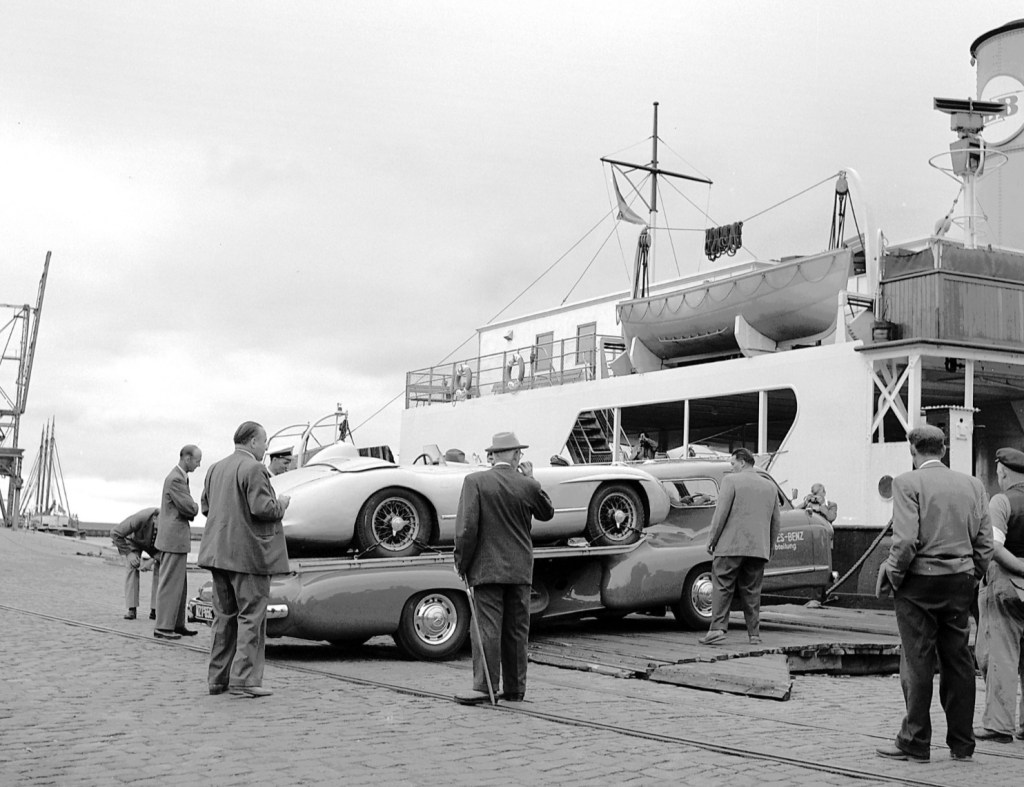
(Glenn Dunbar/LAT)

Ryan Briscoe is one of those Australian internationals I tend to forget about as he raced so little in Australia. His formative Karting years were here and then – Oscar Piastri like – most of his secondary education was in Europe from the age of 15 as he and his family successfully chased The Dream.

Briscoe, born in Sydney on 24/9/1981, is shown above testing the Toyota TF106 Grand Prix car at Jerez in December 2005. He was in on the ground floor of Toyota’s F1 program – from 2002-2004 – but never quite cracked it for a race seat so he was switched to Indycars in 2005, initially racing a Toyota powered Panoz for Chip Ganassi.

With Dad, Geoff circa 1992 (R Briscoe Collection)
Spa 2004 (MotorSport)

During the climb, he won Australian , American and Italian Karting titles in 1994, 1998 and 1999 respectively.He switched to cars, Formula Renault in 2000, winning the Italian F Renault Championship in 2001.

Ahead of the F Renault pack at Monza on April Fools Day 2001 from pole, but DNF as below! Tatuus Renault 2-litre (LAT)
(LAT)

During this most meteoric of rises Ryan also did some F3 in 2001, the shot below is at Zandvoort during the Marlboro Masters event on August 5, 2001. Car is Team Prema Dallara F300 Opel, DNF in the race won by Taka Sato, but third overall.

(LAT)
(MotorSport)

By the end of that year, aged 20, he was front and centre of Toyota’s F1 program as their test driver. Here he is at the launch of the Gustav Brunner designed Panasonic Toyota Racing TF102 V10 in Cologne, where the team was based, on December 17, 2001. The race drivers in 2002 – at the start of a rather grim eight year F1 sojourn for Toyota – were Mika Salo and Allan McNish.

Amongst his testing duties he raced initially in F3000, not going very well in the Nordic run car, and F3 later in 2002, and in 2003, winning the Euroseries that year. He progressed to being Toyota’s third driver, testing on the Friday of each grand prix, in 2004.

Lola TB02/50 Zytec-Judd KV circa 450bhp V8, Formula 3000 Barcelona April 2002 (MotorSport)
During the Pau GP weekend in June 2003, Dallara F303 Opel. Briscoe won a race, and Fabio Carbone the other (Glenn Dunbar/LAT)

Briscoe won eight of the 20 races in the F3 Euroseries in his Prema Powerteam Dallara F303 Opel to take the title from Christian Klien. Other hotshots in the field that year included Niko Rosberg and Robert Kubica.

Briscoe, during practice, Toyota TF104 3-litre V10, Hungary 2004 (unattributed)

Ryan moved to Indycars (I’m using that word as a generic descriptor of the genre) with Chip Ganassi in 2005, showing extraordinary pace for a rookie; two poles and regular top-half qualifying on unfamiliar ovals. Tenth at Indy on debut was stunning, equally so was seven crashes in his 15 starts, the last of which was a massive accident after his Panoz GF09C Toyota climbed atop Alex Barron’s Dallara at Chicagoland Speedway in September that landed him in hospital and rehabilitation for four months.

Zandvoort A1 GP Cup October 2006 – the first meeting of the 2006-7 season – third in the main race won by Nico Hulkenberg. Lola A1GP Zytec 3.4 V6 circa 520bhp (MotorSport)

In 2006 he did a mixed programme of Indycar, V8 Supercars and A1 Grand Prix, but it was a full season in the American Le Mans Series for Penske Racing driving a Porsche RS Spyder in 2007 that pushed his career forward with Penske. He won three rounds sharing with Sascha Maassen.

Ryan at Watkins Glen in June 2006. I rather like the shot of the Dallara IR03 Chev aero elements doing their thing (Dan Streck/LAT)
Briscoe in front of Vitor Meira at Sonoma Raceway, California in August 2006. Racing for Dreyer & Reinhold Racing in a Dallara IR03 Chev V8. 16th in the Indy GP of Sonoma won by Marco Andretti (Dan Streck/LAT)
Briscoe, American Le Mans Series, Northeast Grand Prix, Lime Rock July 2007, Penske Porsche RS Spyder. Ryan won the LMP2 class, and was third outright, sharing the car with Sascha Maasen (Sutton Images)

This sportscar success, together with some strong performance in limited Indycar outings – Q5 and fifth in the Indy 500 for Luczo-Dragon Racing, led to a full-time Indycar drive with Penske from 2008-2012.

In a strong Indycar career he won eight races, had 28 podiums and finished third in the title in 2009 (three wins), and fifth in 2008 and 2010 as his bests. In 2009 he led the championship going into the penultimate round but hit the wall exiting the pitlane at Motegi, then, in a three-way battle for the title finished second behind Dario Franchitti in the final round, who became champion.

(MotorSport)

Aviating at Surfers Paradise on the way to winning the Indy 300 in October 2008, Team Penske Dallara IR-04/05 Honda 3.5 V8. Scott Dixon was second, 5/10ths behind and Ryan Hunter-Reay a further nine seconds adrift.

And below doing the same thing at the same place in a V8 Supercar in October 2011, sharing the Holden Racing Team Holden Commodore VE in the Gold Coast 600 with Garth Tander. The pair were 11th in the first race, 23rd and last in the second. The winner overall was the Triple Eight VE Commodore crewed by Jamie Whincup and Sebastien Bourdais. Ryan’s best V8 Supercar result was at this event in 2013 when he shared a VF Commodore with Russell Ingall to third place.

(Mark Horsborough/LAT)

The Briscoe, Richard Westbrook, Scott Dixon, Chip Ganassi Ford GT at Le Mans in 2018. Q37 and 39th outright in the 3.5-litre turbo-V6 powered car – and shot below (MotorSport)
(MotorSport)

“Ryan has driven more sportscars that I’ve had Sunday roasts,” would perhaps be the observation Australia’s greatest all-rounder, the late Frank Gardner would have made.

Briscoe’s best sportscar results are victory in the Daytona 24 Hours in 2020 (Cadillac Dpi-VR), and Petit Le Mans the same year.

He was runner-up in the 2016 (Ford GT), 2018 (Ford GT) and 2020 (Cadillac DPi-VR) IMSA Sportscar Championship GTLM class. He was third in the 2007 American Le Mans Series, winning the LMP2 class (Porsche RS Spyder),

His best results at Le Mans were fifth in 2021 sharing a Glickenhaus 007 LMH with Romain Dumas and Richard Westbrook, and third in 2022 in the same make/model, this time sharing with Westbrook and Franck Mailleux.

At Daytona he won outright in 2020 (as above) and was first in class in 2015 and 2018 racing a Cadillac DPi VR, Chev Corvette C7.R, and Ford GT respectively – with co-drivers of course. At Sebring he won his class in 2013 and 2015 aboard a HPD ARX-O3b and Chev Corvette C7.R.

Briscoe/Richard Westbrook/Franck Mailleux Glickenhaus SCG007 LMH, fifth. Le Mans 2021 (MotorSport)
Richard Westbrook, Franck Mailed, Ryan Briscoe and James Glickenhaus, Le Mans 2021 (MotorSport)
Power by Pipo Moteurs 3.5-litre twin-turbo 500Kw V8, Xtrac 7-speed sequential manual (MotorSport)

Ryan married Nicole Manske in 2009, they have two children, and in 2018 he became a naturalised American.

Etcetera…
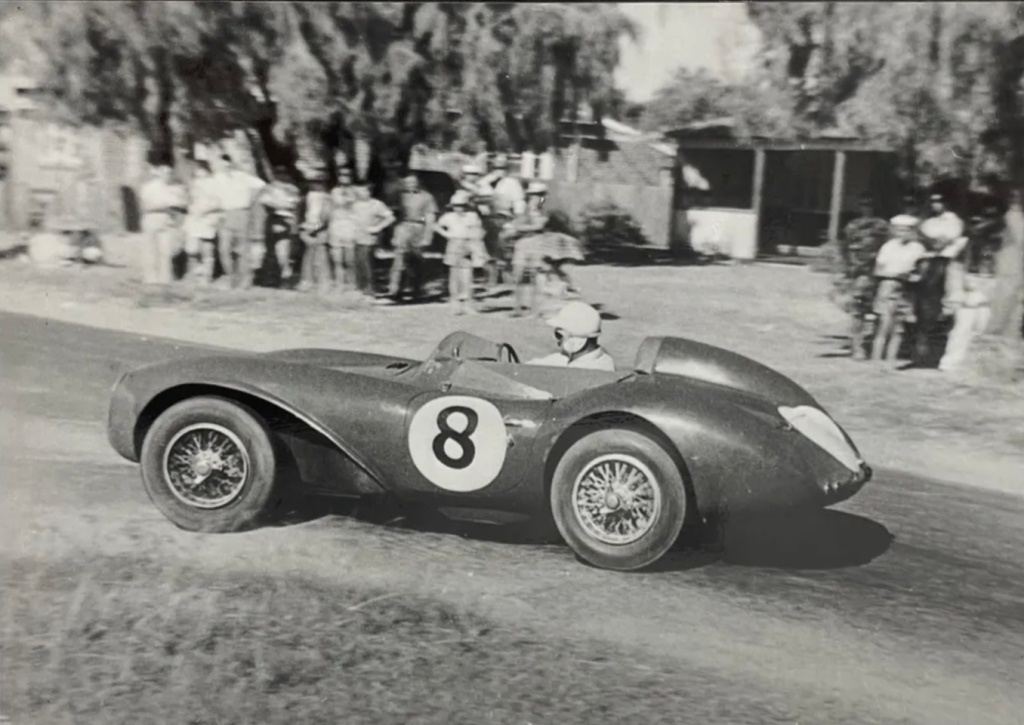
(MotorSport)

Here to zero at the Chicagoland Speedway, Joliet, Illinois on the Indy 300 September 10-11 weekend in 2005.

Here with the Gregory-Peck for pole, a handy $10k. It was Ryan’s second Indycar pole, he started from pole at Sonoma, the previous round but crashed out on the first lap. The car is a Chip Ganassi run Panoz GF09C Toyota.

Shortly after this happy scene the car failed post-practice scrutineering, so Ryan lined up last on the grid, perhaps sowing the seeds of the crash which followed.

(MotorSport)

‘Roger that, we have lift-off Houston.’

On lap 20 Briscoe’s Panoz GF09C Toyota ran into 15th placed Alex Barron’s Dallara Toyota (Q18) as he sought to go under him on his way up the field towards turn 3 of the 1.5-mile oval – look at the proximity of his right-rear to Barron’s head/roll bar area – and the staggering physics of a collision at 215mph were unleashed.

(MotorSport)

Briscoe hit the fence with the bottom of his Panoz first, it split in two as it ripped through a fence post, leaving a big hole. With a half-tank or so of fuel there was a spectacular explosion as the car split, with the cockpit safety cell spinning down the track narrowly avoiding other cars. Car 2 is Thomas Enge, #55 is Kosuke Matsuura.

(MotorSport)

After several anxious minutes Ryan was removed from the wreck – the monocoque had done its job well – and gave a reassuring wave as he was placed into the ambulance with injuries later diagnosed as two broken collarbones, a bruised lung, fractured right foot and contusions to his arms, legs and back.

Briscoe was hospitalised for nine days then had extensive rehab in the US and Italy before returning to the cockpit in a Riley Mk9 Pontiac 5-litre V8 in the Daytona 24-Hours on the January 28-29, 2006 weekend – four months after his Big One.

Credits…

LAT, MotorSport Images, Ryan Briscoe Collection

Tailpiece…

(MotorSport)

The Briscoe & Co Ford GT at Le Mans in 2018.

Finito…