Archive for the ‘Fotos’ Category

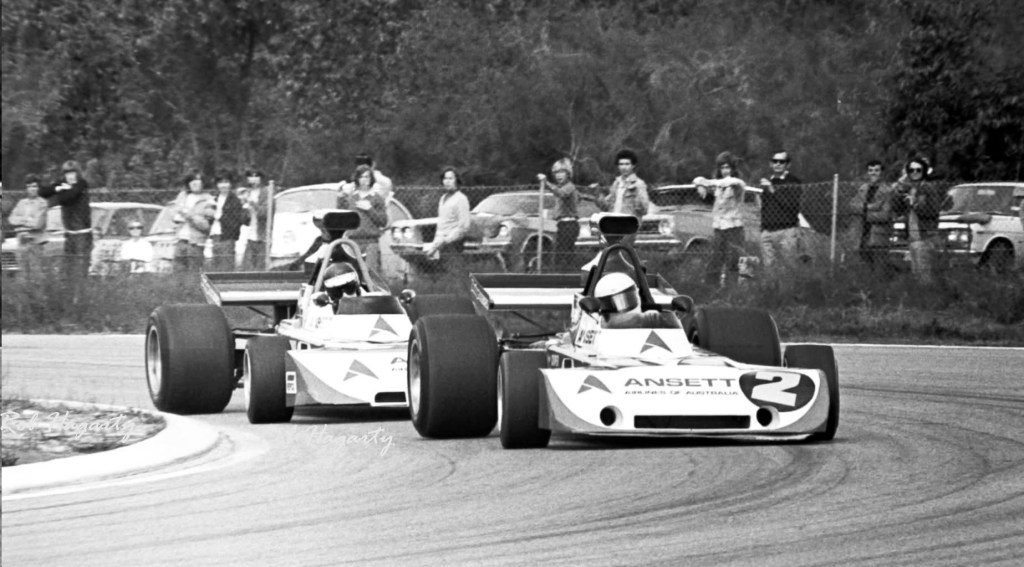
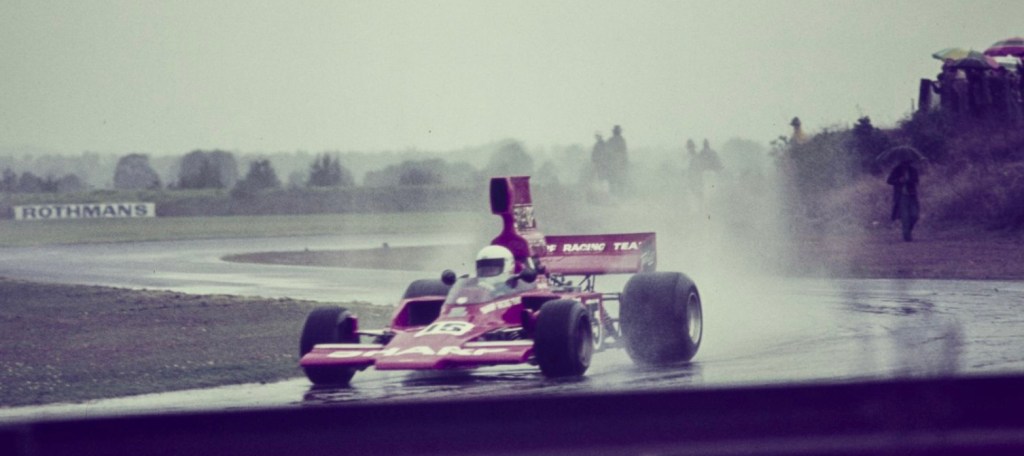
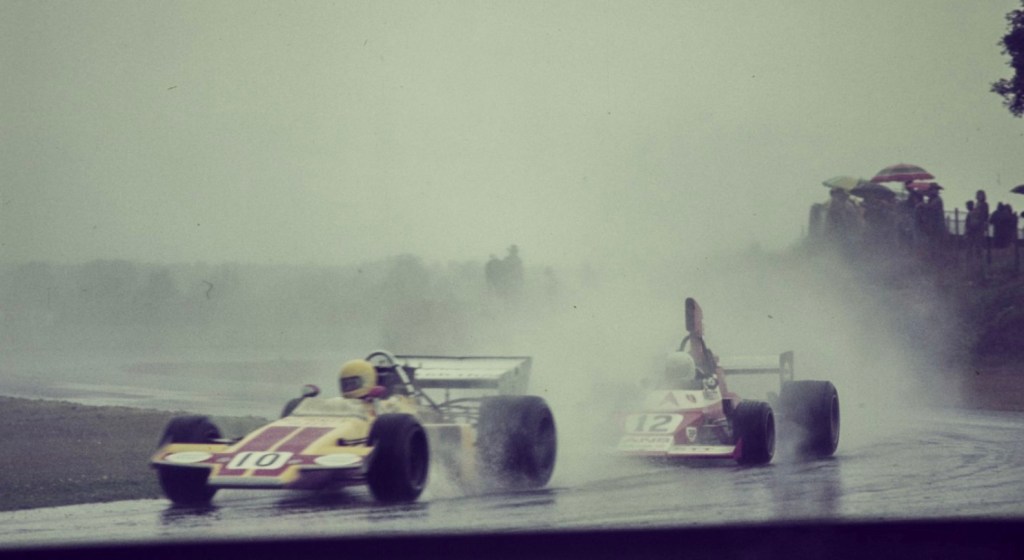
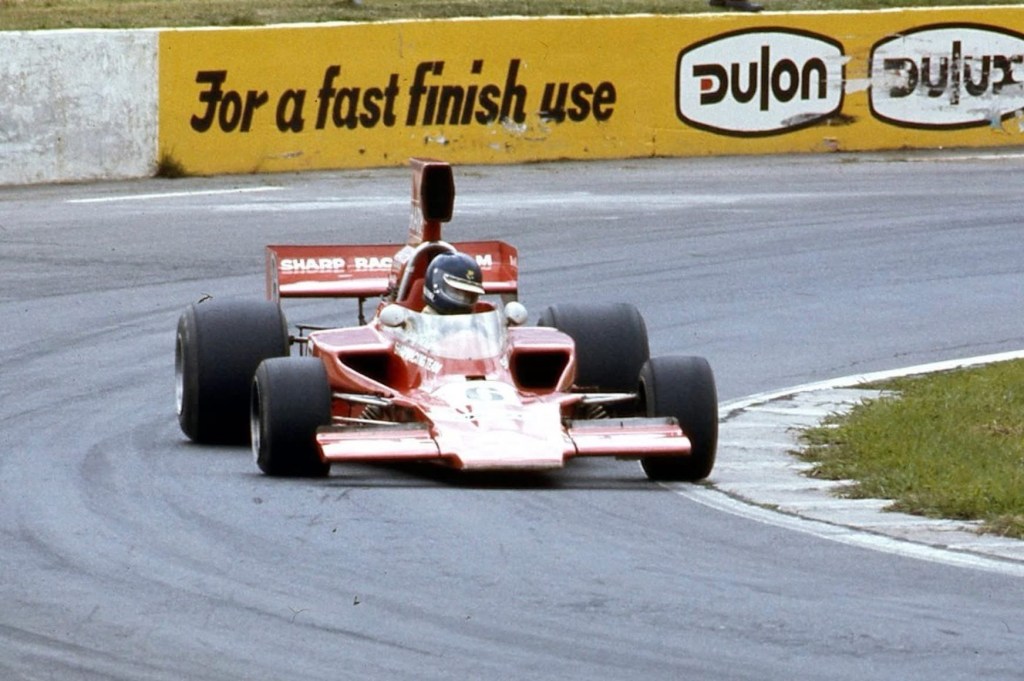
The battle for the lead of the AGP, John Leffler, Bowin P8 Chev from winner, Max Stewart, Lola T400 Chev (G Langridge)

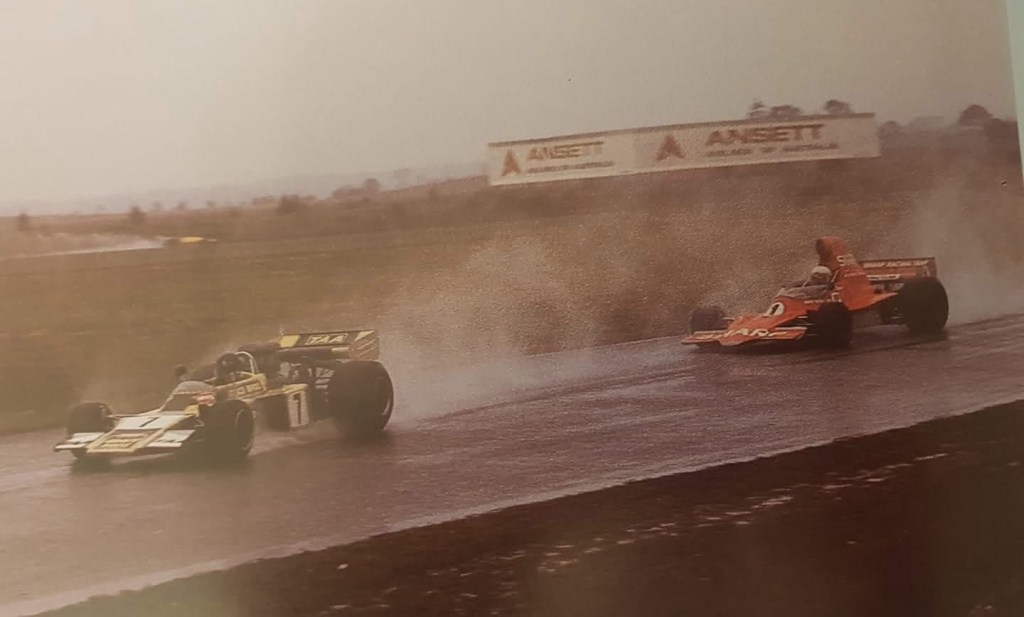
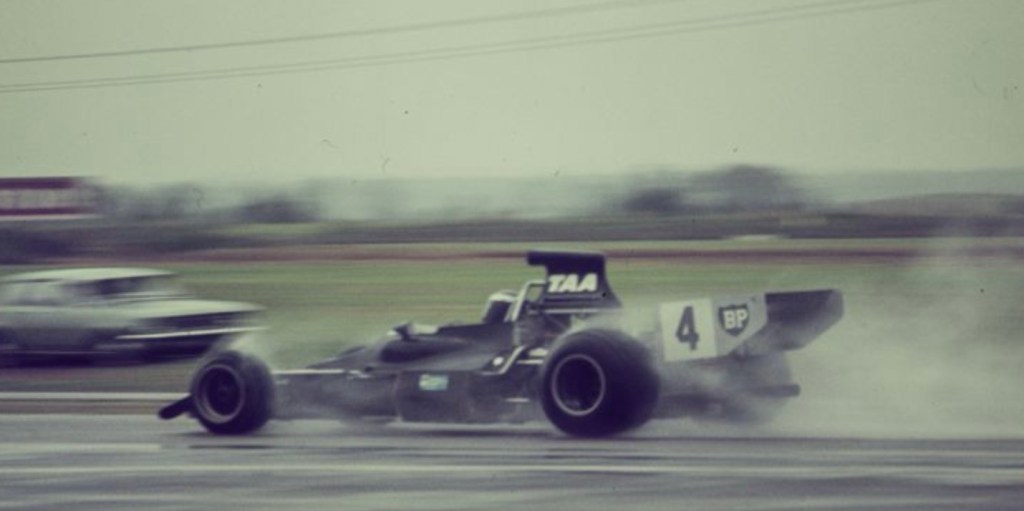
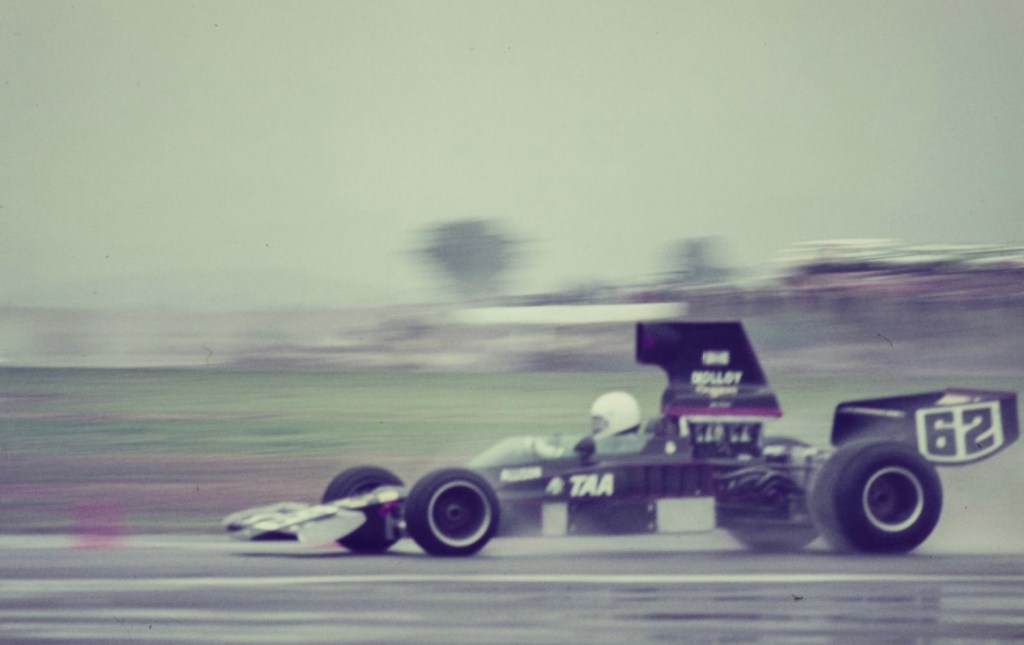
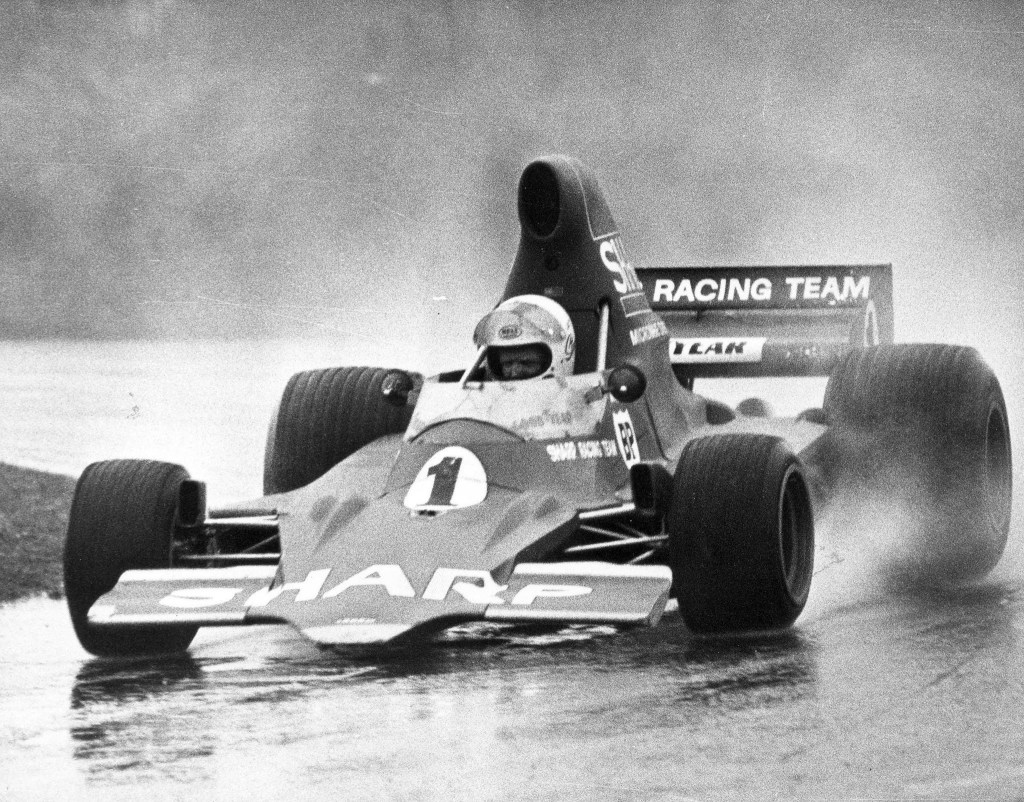
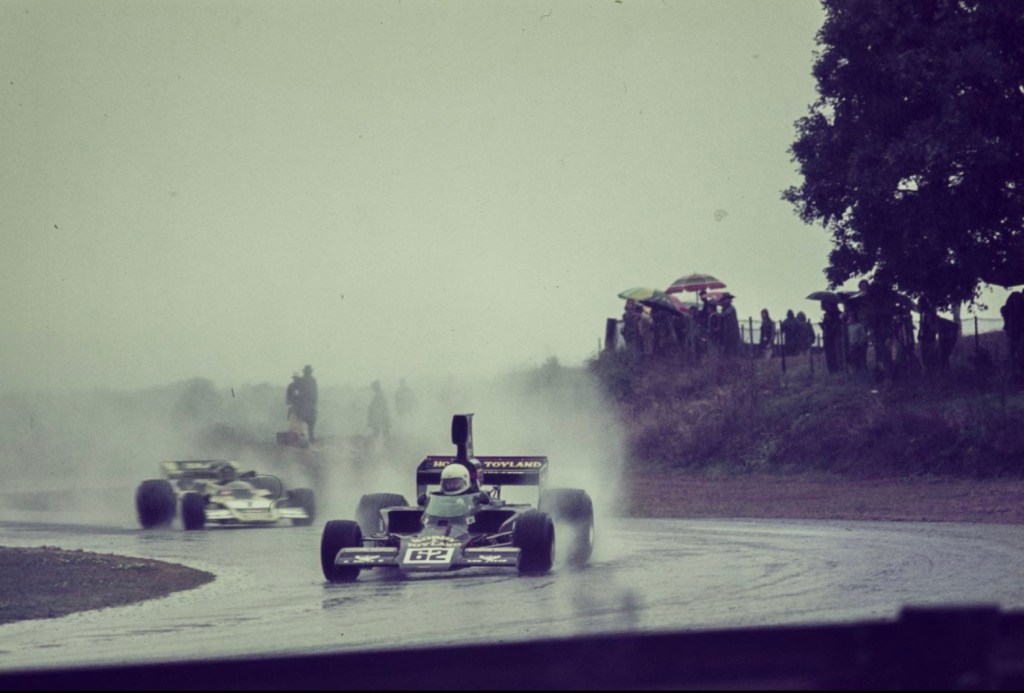
While the popular notion of Surfers Paradise is of sun, surf, sand and bikini-clad babes, Greg Langridge’s photographs show that nothing could be further from that stereotype; the Gold Coast rained cats and dogs during the Australian Grand Prix held on August 31, 1975.

Sandown hosted the final ’75 Tasman Cup round on February 23, so it was a long time between drinks for the F5000 pilots that didn’t have a gig overseas or another domestic racing program to keep their hands in. The five-round Australian Drivers Championship, aka the Gold Star, started at Surfers and finished at Phillip Island on November 28.

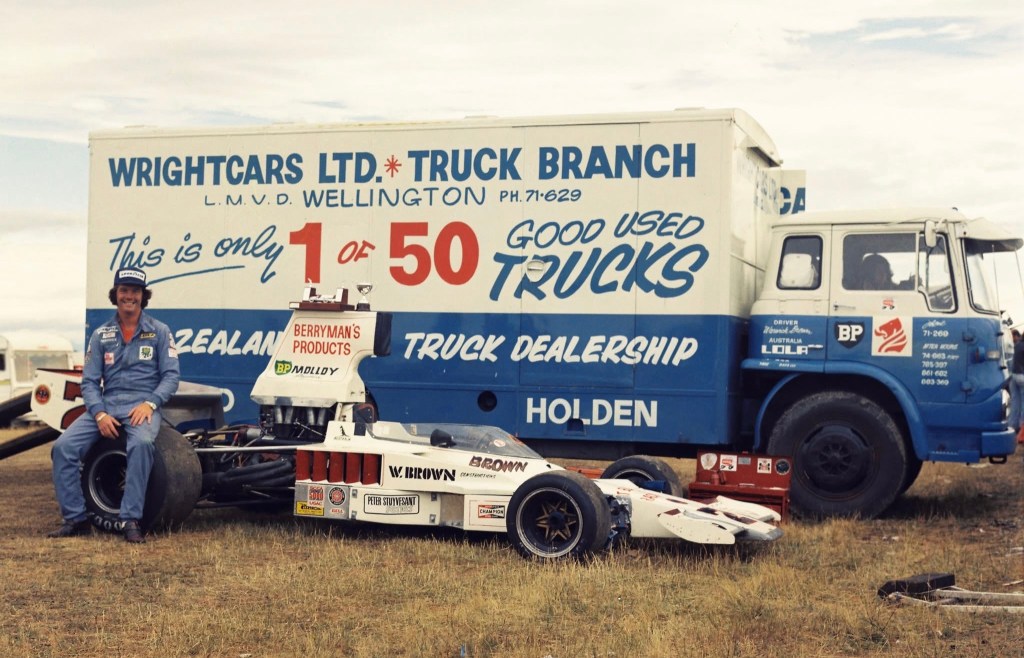
‘Eat ’em alive in 75′, Tasman champ Warwick Brown with Pat Burke’s Lola T332 HU27, the first of the T332s (S Elliott)

Gold Star Field…

Of the Tasman Top Trio, Warwick Brown headed back to the US, where he had a Jack McCormack Racing Talon Chev ride, Kiwi Graeme Lawrence did only the AGP, while John Walker was back with his Lola T332 retubbed after the colossal Sandown shunt from which he had ‘walked away’. Not back early enough, though, he missed the first AGP round, which proved rather critical at the season’s end…

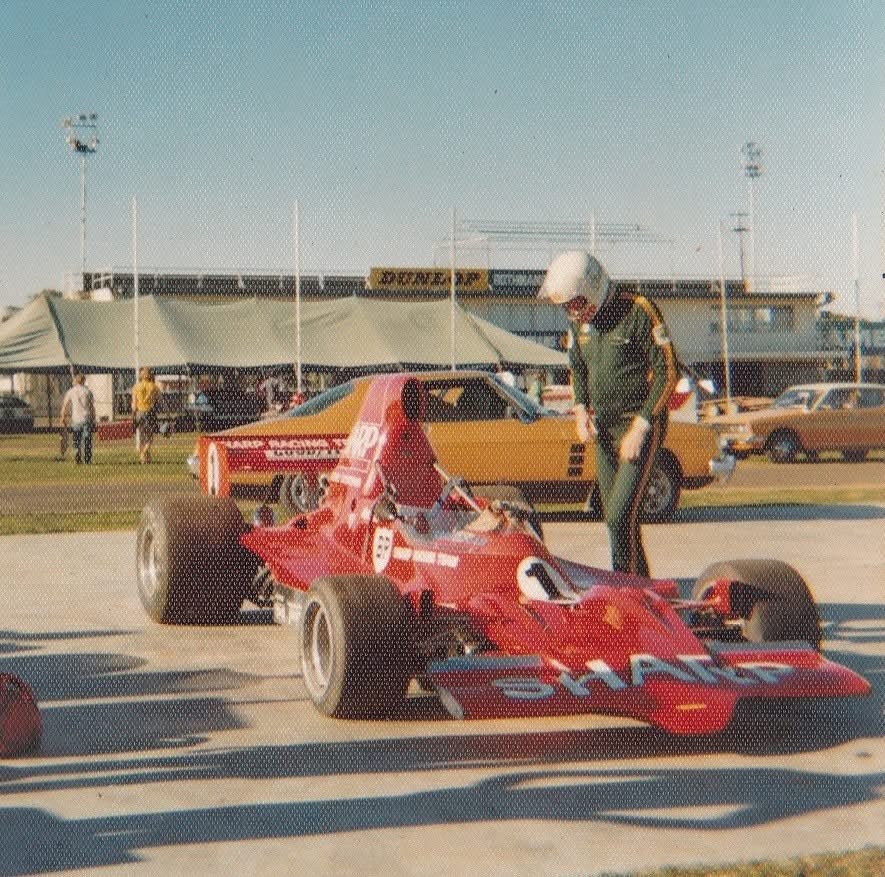
Lanky Max about to load his good-self, including his famous Jolly Green Giant race suit, into his Lola T400 during practice which was as dry as raceday was wet! (C Jewell)

Max Stewart and Kevin Bartlett were still grumpy about their variable-rate suspension Lola T400 Chevs, while the advantages of John Leffler’s variable-rate suspension Bowin P8 – handling and roadholding aspects of his Bowin P6F Formula Ford and Bowin P8 Hart-Ford 416B that he loved throughout 1973-74 – weren’t realised as the marriage of a Chev V8 with the Bowin P8 monocoque was executed poorly by Leffo and his team; the car was as stiff as a centenarians todger. A shame, as a Repco-Holden was a P8 bolt-on – John Joyce designed and built the car for that engine – the Chev, while bought at a good price, was not so.

McCormack, Elfin MR6 Repco-Holden during the 1975 Lady Wigram Trophy (T Marshall)

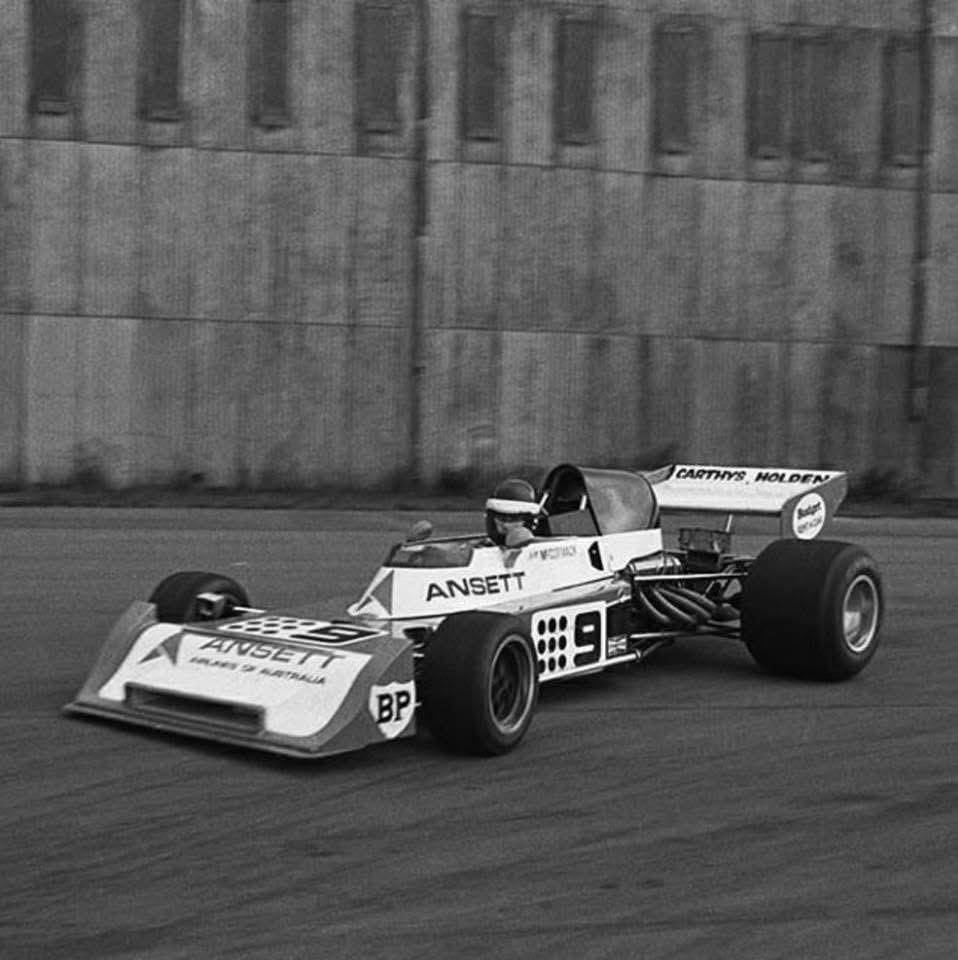
A bloke falling back in love with Repco-Holden F5000 V8s was ’73 Gold Star Champ, John McCormack. He’d persevered with the aluminium Repco-Leyland F5000 V8-engined Elfin MR6 throughout 1974. While the car was light, it was hopelessly underpowered, unreliable and therefore uncompetitive.

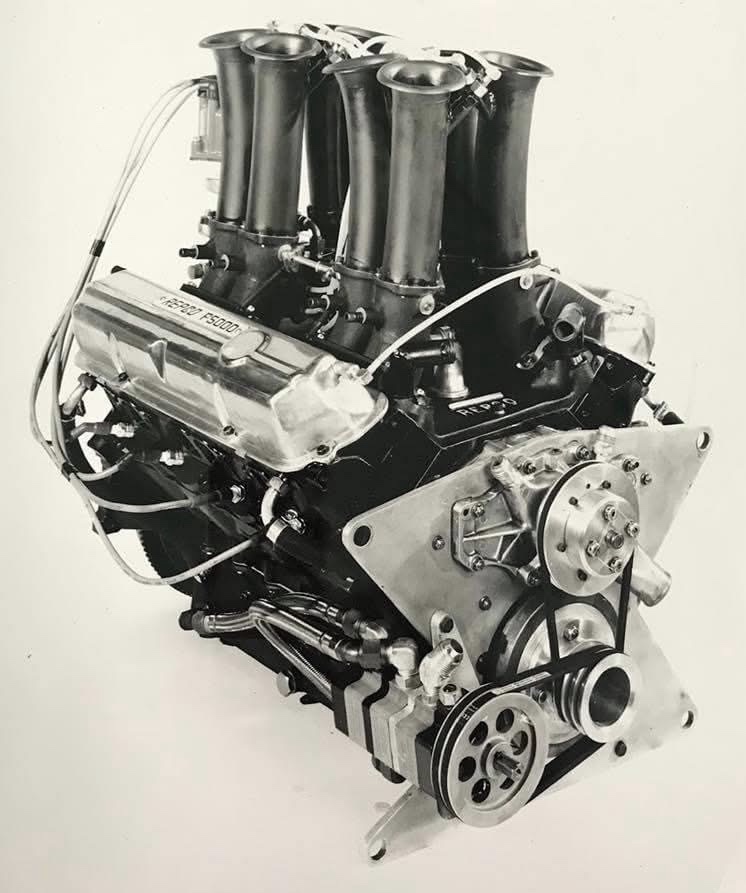
Repco-Holden F5000 V8 (Repco)
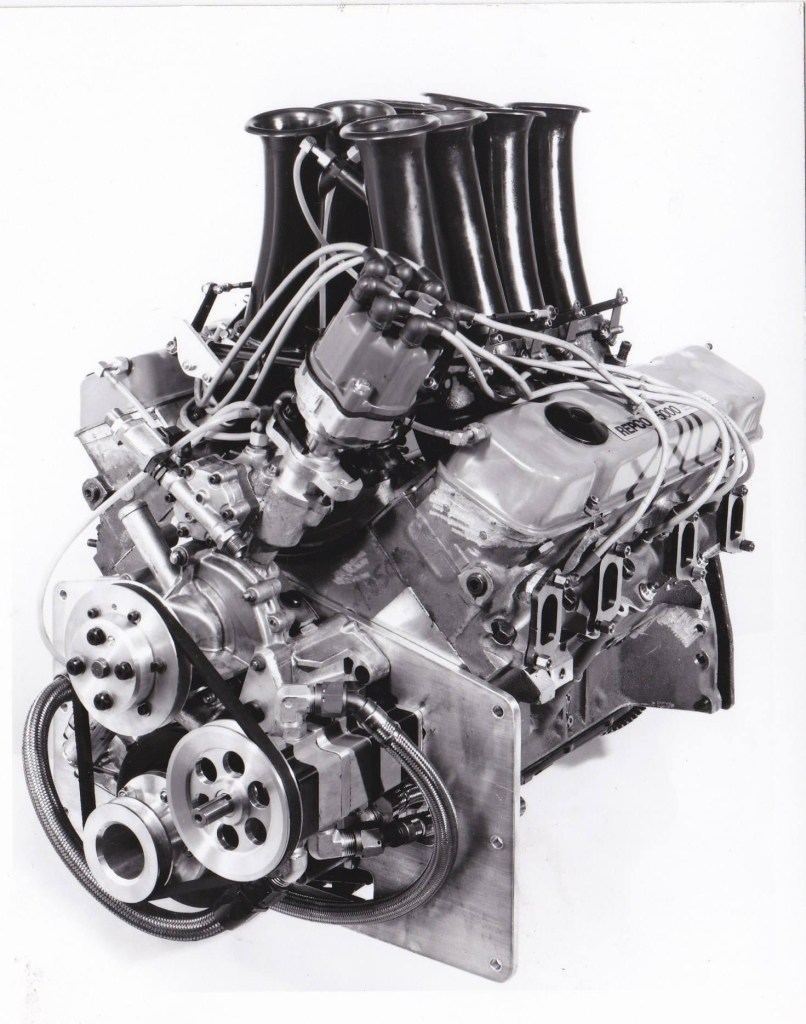
Repco-Leyland F5000 V8 (Repco)

Repco Ltd withdrew from racing in July 1974. The new Repco-Leyland F5000 program was a casualty. Unlike the cast-iron Holden 308 engine, the Leyland P76 V8 wasn’t structurally strong enough for racing. When Phil Irving ‘sectioned’ the engine at the program’s outset, he found it quite different to the Oldsmobile F85 aluminium V8 block that formed the basis of his 1966 World F1 Championship-winning 3-litre F1 Repco-Brabham 620 engine.

GM sold the BOP V8 (Buick-Oldsmobile-Pontiac) project to Rover, which made changes to it, too, and Leyland Australia when they built their 4.4-litre variant for the short-lived, very good but exceptionally ugly P76. Repco’s engineering resources would have overcome the shortcomings, as McCormack and Irving did ultimately, just! See here:https://primotipo.com/2024/10/18/repcos-withdrawal-from-racing/

In the interim, McCormack, Dale Koenneke and Simon Aram cranked old-faithful, their Repco-Holden V8s into the MR6 and instantly found the speed and reliability they needed. Mac was fourth in the ’75 Tasman.

‘Team Manager’ Warwick Brown with Bruce Allison’s Lola T332 Chev during the 1976 Rothmans International Series in NZ, circuit folks? (B Allison Collection)

The most impressive ’75 F5000 debutant was Bruce Allison, who enjoyed a successful season of ANF2 in 1974. His Birrana 274 Hart-Ford 416B was looked after by ace mechanic/engineer/Driver Whisperer Peter Molloy. The same combination ran the low miles Lola T332 Chev raced by KB in ’74 throughout 1975-76.

Soon to be 1975 Formula Ford Driver to Europe winner Paul Bernasconi was promising in Max Stewart’s other Lola T330 and T400, so too was Jon Davison in a self-funded Matich A50 Repco-Holden that had been raced by Walker in Australia and the US (A50-004). The Matich Repco-Holden top gun was John Goss, who was already a Tasman round winner despite graduating to F5000 in mid-1974.

Bruce Allison about to be lapped by John Leffler, Lola T332 Chev and Bowin P8 Chev (G Langridge)

Australian Grand Prix…

Bruce Allison proved he wasn’t remotely phased by the brawny 500bhp roller-skates, putting his T332 on pole of the big-balls track he knew so well. John Goss matched his time, with Leffo third.

When race day dawned very wet, the probable front-runners were rated as Stewart and Leffler, who had sets of Firestone wets of the type used by Brit Steve Thompson, who had run away and hid in his Chevron B24 Chev in the similarly soggy, steamy 1973 Warwick Farm 100 Tasman round.

Two warm-up laps allowed the starters to get a feel for the challenging conditions, then John Leffler’s Bowin jumped outta the box and blasted away under the Dunlop Bridge ahead of Allison, McCormack and Goss.

Leffo had a five-second gap after one lap and stretched this to 13 after seven. Bartlett spun early and dropped 20 seconds in his recovery. Leffler’s Bowin looked twitchy, but there was no holding him back as the race settled down.

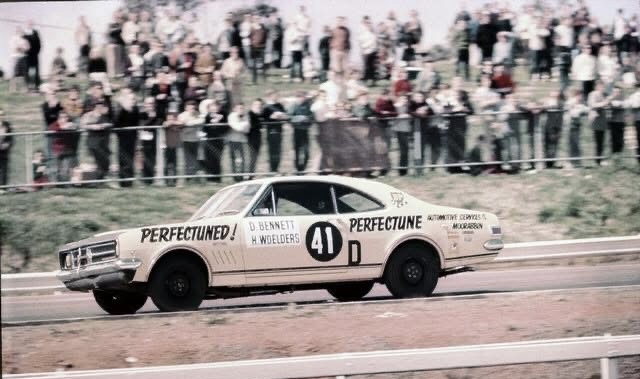
After the first couple of laps Allison eased back a bit from the Grace Bros car but found McCormack’s Elfin MR6 harrying him. Jon Davison was driving his Matich well with fellow Matich racer Goss in heaps of strife with a badly misted visor after he’d accidentally wiped the demisting fluid off it before the race.

Enno Buesselmann retired his Elfin 622 Lotus-Ford ANF2 car after a dive under Graeme Lawrence at Firestone didn’t end well; he speared off onto the swamplike infield from which there was no escape.

Jon Davison, his Matich Repco-Holden by then running in A51/A53 side-radiator spec (G Langridge)
Terry Hook, Lola T332 Chev (G Langridge)

By lap five, Bartlett had closed right up on Davison while Stewart and McCormack gained on Allison. Leffler was lapping the stragglers but lengthened his lap times by four or five seconds each time he had to submarine through a car’s spray.

On lap nine Allison spun at Goodyear, letting McCormack and Stewart through while Bartlett retired after being hit by a missile as he raised his visor to see where he was going.

Leffler extended his lead to 20 seconds from McCormack and Stewart, then there was a gap to Allison, then Davison ahead of Ray Winter, in the ex-Gardner/Bartlett/Muir Mildren Yellow Submarine Hart-Ford 416B ANF2 car, then Lawrence, Lola T332, Garrie Cooper, Elfin MR5B Repco-Holden and Chris Milton’s ex-David Hobbs McLaren M22 Chev.

Adelaide boys Milton and Cooper, McLaren M22 Chev and Elfin MR5B Repco-Holden (G Langridge)
Allison Lola T332 (G Langridge)

Allison spun again after 17 laps at which point Peter Molloy called it a day, while McCormack and Stewart chased down Leffler.

With 20 laps down Leffler was slowed by Davison’s spray while Stewart blasted past Cooper and then caught Leffler but spun trying to go under him at Lukey.

Max then got his dander up and set the fastest race lap, gathered up McCormack in three laps, passing him under the bridge and set off after Leffler 10 seconds up the road but now nursing an engine that wasn’t running on all eight thanks to the liberal dousing of his electrics by the Rain Gods.

Stewart dived past Leffler into Lukey on lap 31 and then opened a lead just as McCormack was black-flagged into a pit stop for not wearing a vizor. Stewart wasn’t using his either; he was keeping it cocked open with one hand while driving with the other.

Cooper retired with suspension failure and McCormack was soon back in the pits with a tyre that had thrown its tread. This chain of misfortune left Ray Winter holding down third place in his F2 Mildren followed by Lawrence.

Max Stewart took a plucky, but lucky win from Leffler, the star of the day, then Ray Winter in a fantastic drive of the Sub, from Graeme Lawrence, John McCormack and Chris Milton.

Max Stewart popped his Bell Star visor up and down to get some sense of direction on a shocker of a Gold Coast day, Lola T400 Chev (GCB)
1975 Australian Gold Star Champion, John McCormack, Elfin MR6 Repco-Holden. Sandown International 1975 (B Keys)

Gold Star Championship…

A fortnight after Surfers the F5000 Circus convened at Sandown Park in Melbourne’s southern suburbs where the Marlboro 100 was taken in fine style by John Walker’s Lola T332 Repco-Holden from Bruce Allison, Kevin Bartlett and John Leffler.

Walker started the September 15 race from pole – no sign of any heebie-jeebies as a legacy of his Tasman Cup accident in February.

John Goss seemingly had the race in the bag, leading until lap 21 of 32 when his rear wing support broke. From then Walker and Allison were neck and neck with Bruce only metres away from Adelaide’s finest in the ex-Bartlett T332 Chev. Of the frontrunners, only McCormack – from grid two – had a DNF due to a gearbox problem.

Jon Davison, Matich A50 Repco-Holden, Sandown Intrrnational 1975 (G Fry)
John Goss on the way to winning the last ever Tasman Cup round at Sandown in February 1975. Matich A53 Repco-Holden (I Smith)

In a tightly compressed Gold Star, the next round was at Oran Park in Sydney’s outer west, the following weekend, September 21.

The top three qualifiers were Stewart, Allison and McCormack from Walker, Leffler and Bartlett. The race organisers used a two-heat format, each comprising 24 laps of the by then longer circuit.

Stewart won the first from McCormack and Leffler, Leffo having again got the jump at the start. Max led but trailed oil smoke, Mac awaited the black flag, which didn’t come, his percentage play didn’t work as by the time Max eased, he was out of the Elfin’s reach.

Stewart had the advantage until he pitted on lap 7 with his nose-section coming adrift. McCormack then led before being passed by Allison. John returned the favour, and the crowd was treated to that duel, and another between Walker and Leffler. Mac’s flat-plane-crank Repco-Holden had the better of Allison’s Molloy Chev, then the matter was settled when Bruce went wide exiting BP and hit the wall.

When the results were aggregated, John McCormack won the round from Stewart, Leffler and Walker. At that stage Stewart was on 15 Gold Star points, Leffler 13, and McCormack and Walker 12 points.

Paul Bernasconi aboard Max Stewart’s Lola T330 Chev – HU1 was the very first T330 chassis – at Oran Park in September 1975 (D Grant Collection)
Bruce Allison at Pukekohe in 1976, Lola T332 Chev (unattributed)

The final two rounds were in Victoria which made logistics a bit easier for the teams, Calder was on October 19, and Phillip Island a month later, on November 28.

Bob Jane’s boys went for a two-race format, 30 laps, or thirty miles each. John McCormack took pole with a 39.8-second lap – under the magic 40 seconds – from Max Stewart on 39.9 and KB 40 seconds neat.

McCormack won the first heat, holding the lead from flag to flag, from Stewart and John Walker, then a fiercely scrapping Bartlett and Leffler. John McCormack got the jump in the second heat, too. Stewart’s challenge faded early with engine problems and ultimately a black flag. Bartlett spun early, so too did Mac, leaving Walker in the lead, an advantage he held to the end from Mac, KB and Paul Bernasconi, in Max’s old T330 Chev.

McCormack won the round from Walker, Stewart and Bartlett; the Gold Star tally was McCormack 21, Stewart 19, Walker 18 and Leffler still on 13 and effectively out of the running. The title swung on the final round…

Max Stewart pitches his Lola T400 Chev over the inside of Tin Shed’s kerb, Calder 1975
Graeme Lawrence, Lola T332 Chev from John McCormack, Elfin MR6 Repco-Holden, Levin International 1975 (D Green)

KB was in good form as he drove over the bridge from San Remo to Newhaven on Phillip Island on November 20. He sneaked in the Macau Grand Prix between Calder and Phillip Island on November 16, finishing a great second to winner John McDonald’s Ralt RT1 Lotus-Ford. Bartlett raced an Equipe 66 (LC Kwan, Hong Kong) Brabham BT40 Lotus-Ford.

McCormack took pole on the fast, challenging, still pretty rough track, 1.8 seconds clear of Bartlett, Leffler and Stewart.

The Bowin P8 Chev put its power down amazingly well, and Leffo made another of his screamer starts, blasting into the lead from row two. Stewart was out early with a broken pushrod. KB lined Leffo up in Southern Loop; soon John Walker followed suit. McCormack’s challenge faded; a moment through the Southern Loop rough stuff on the first lap had upset his car’s handling, then Leffler slowed with fuel feed problems.

Walker was racing Bartlett for his (JW’s) Gold Star. He needed to win the race to bridge the gap to McCormack. For the rest of the race, it was cut-and-thrust. KB led, then extended his lead when JW miscued at Repco, who then made up the shortfall over the ensuing six laps. Walker took the lead and held it for three laps before the head gasket(s) started to fail, causing a loss of power.

Kevin Bartlett on the way to winning the Gold Star round at Phillip Island in November 1974, Lola T332 Chev. Bass Straight looks pretty wild, as does the track surface (R Davies)

The Australian Motor Racing Annual recorded it this way, ‘Bartlett quickly closed up again, passing Walker flat in fifth while crossing the line to start the final lap. Walker hung on, chasing the red Lola up the back section of the circuit, where he made a last try for the lead at the right-hander before Lukey. It almost came off, except that KB had him covered to the extent that the T400 stayed in front.’

‘However, KB hit a patch of water and spun off while Walker, trying to avoid the red Lola, speared off into the long grass on the inside of the circuit, heading for Len Lukey’s cow sheds. Bartlett was the first to recover and regained the circuit to win by 23 seconds from John McCormack, with a very angry Johnnie Walker filling third place in a Lola with a very battered nose.’

I’ve got to go back to 1973 to find a shot of John Walker at Phillip Island. It’s a goodie though, blasting his T330 Repco-Holden through Southern Loop at full noise or thereabouts. Winner of the October Gold Star round (J Walker Archive)

‘But the drama was not over, as KB sped across the line to receive the flag, he backed off, and the rear wheels of his car locked on the rain-dampened track. Next thing, KB was sideways at 230 km/h and heading for the armco. Many would have crashed, but KB’s superb reflex action saved the day, he avoided the fence by a few centimetres and continued safely on for his cool-down lap.’

‘It was KB’s first win since the championship race at Phillip Island the year before. For Walker, it was a bitter disappointment as a win in the race would have clinched him the Australian Driven Championship. But Walker failed to contest the first round – something no serious racer can afford to do if he wants to win a title.’

True…but perhaps a tad hard given the expenditure required of his Lola T332 to get it back into RWC in the time available. Thankfully, the planets and karma were fully aligned for JW in 1979 when he took a lucky AGP win and the Gold Star in Martin Sampson’s Lola T332 Chev – the ex-Bartlett/Allison/Bartlett chassis.

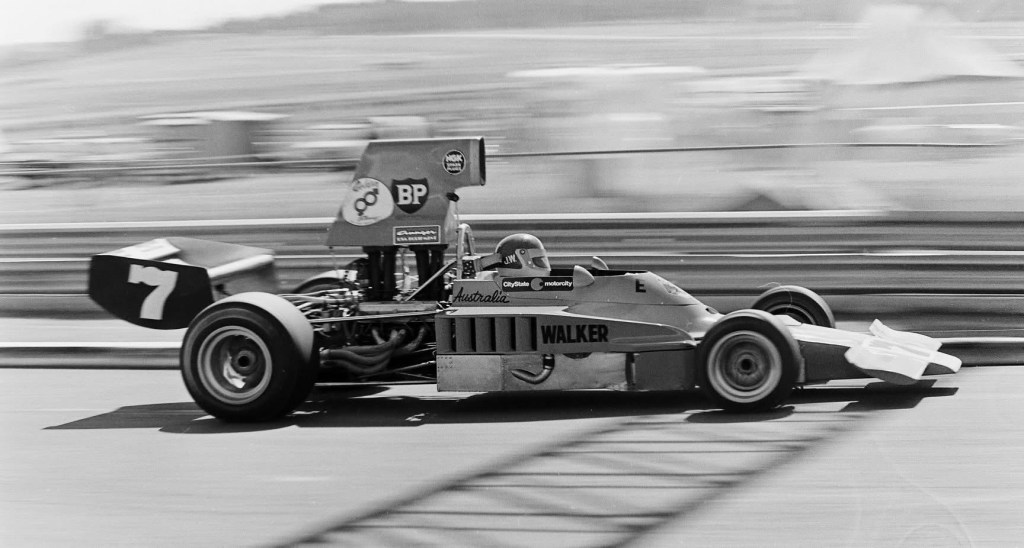
Surely one of the most brutally handsome racing cars ever built? Most successful too. John Walker’s T332 Repco-Holden during the ‘75 Tasman round. It was a toss up for me as to whether I wanted JW or WB to become the first and only Australian to win the Tasman Cup (B Keys)

Credits…

Greg Langridge-State Library of Queensland, Richard Cousins, GCB-Gold Coast Bulletin, Chris Jewell, Steve Elliott, Terry Marshall, Gavin Fry, Ian Smith, Doug Grant Collection, Mike Harding, Robert Davies, Bruce Keys

Tailpiece…

(R Davies)

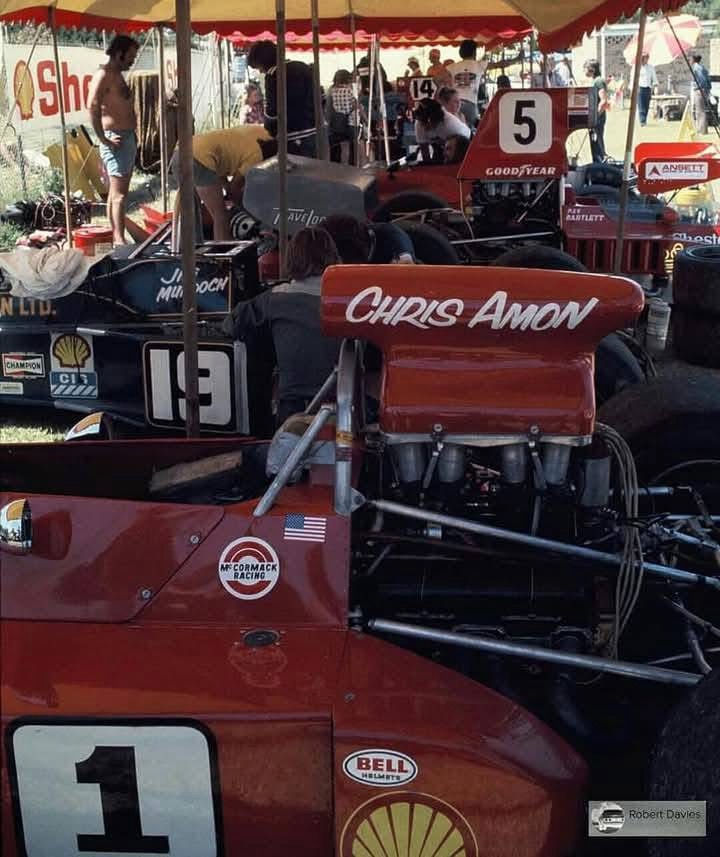
Heaven on a stick was the old paddock at Sandown!

Crowded as anything for competitors but great for spectators, here the Shell tent during the 1975 Tasman round with Chris Amon’s Talon MR1 shot front and centre. Then Jim Murdoch’s Begg 018, Kevin Bartlett’s Lola T332, with Graeme Lawrence’s #14 T333 airbox there too.

Finito…
This shot of John Surtees out front of his business in Fircroft Way, Edenbridge, Kent took my fancy.

I’ve been writing‘Australian Racing Random’ posts for a few years now, they seem to have hit the spot, so I thought I’d do the same thing with some international photographs.

John Surtees, Surtees TS7 Ford, Hockenheim 1970 (unattributed)

The photo of John Surtees was posted on Gabriel Brizuela’s Team Surtees Facebook site. Peter Connew, co-designer of the Surtees TS7 Ford communicated with Brizuela about his time at Surtees and about his own Connew GP car.

‘Hi Gabriel, I am so pleased with your interest of the history of the F1 car that I built and raced with Francois Migault.’

Peter Connew at the launch of his new F1 car at the Evening News Racing Car Show aboard the Townsend Thorensen ferry Enterprise 2, December 31, 1971 (J Wilds-Getty)

I have followed your stories and pictures of the Surtees Team history and are very impressed with your knowledge and enthusiasm about the Surtees Team history.

John Surtees seated in the new Surtees TS7 Ford with Peter Connew, Roger Flynn, Rex Stone, Bill Granger, Arthur Fowler and co-designer Shabab Ahmed. Edenbridge, July 15, 1970

They were fortunate times for me when John Surtees decided to build his own F1 car in 1970 … the TS7 … and I was lucky to be there at that time.

I have many fond memories of that time and are happy to share them. John Surtees was a very special person, and his engineering expertise and kindness is an example to us all.’

The Connew story is well told here: https://www.hagerty.co.uk/articles/motorsport/the-likely-lads-in-a-lock-up-who-made-it-to-the-f1-grid/

(S Taylor)

The erotic rear quarters of Pat Hoare’s Ferrari 256 3-litre V12 circa 1961, Ardmore perhaps.

The story of the last front-engined car to win a World Championship Grand Prix – as a Dino 246/58 – is an interesting one, see here: https://primotipo.com/2020/02/07/pn-hoare-440-papanui-rd-christchurch-nz/

(E Stevens)
(N Matheson-Beaumont)

Pat Hoare on the way to victory in the Waimate 50, New Zealand, in November 1961 and below, George Begg shot it in its ‘Fugly GTO’ phase in a race paddock, date and place unknown.

Pat’s best results in the car are as follows: 1960- NZ GP Ardmore eighth, Dunedin Road race and Waimate 50 second 1961- NZ GP Ardmore seventh, Dunedin Road Race second, Teretongaa International fourth, Waimate 50 first 1962- Dunedin Road Race first, Waimate 50 second.

(G Begg)
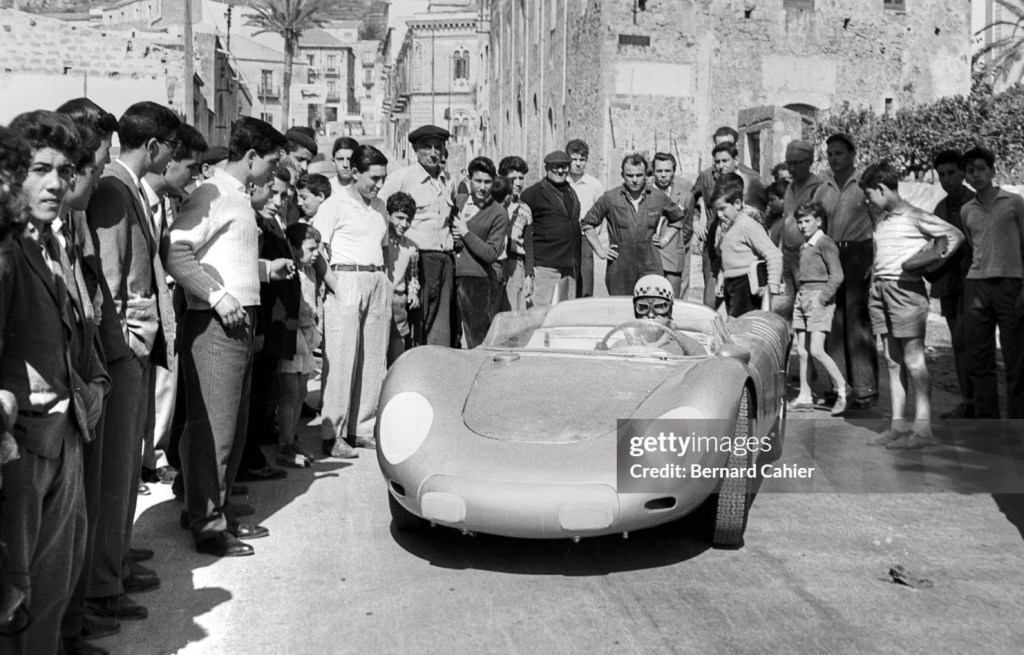
(B Cahier)

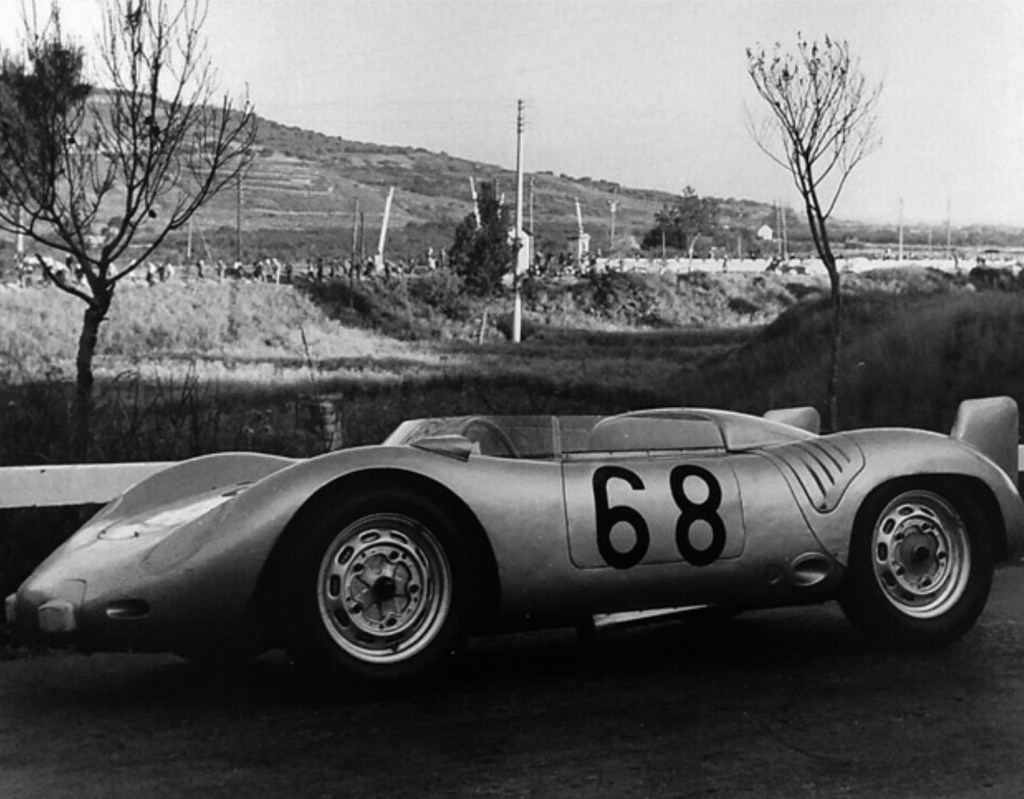
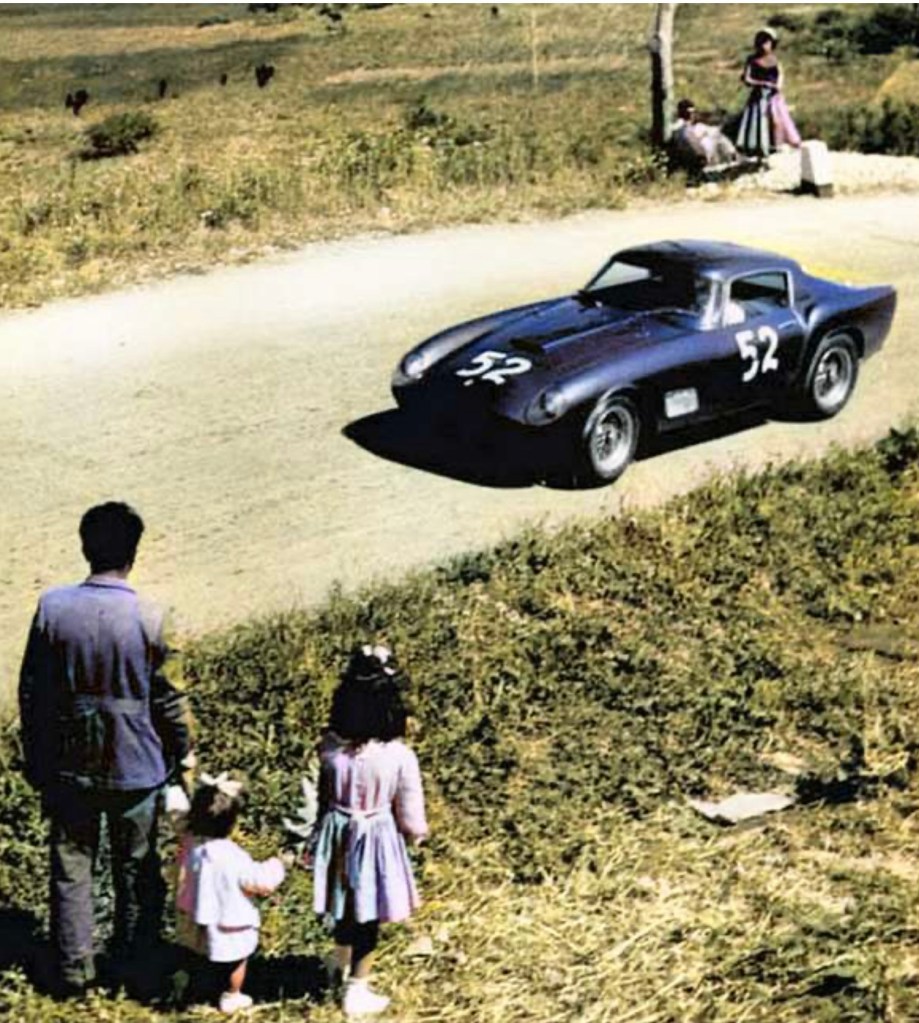
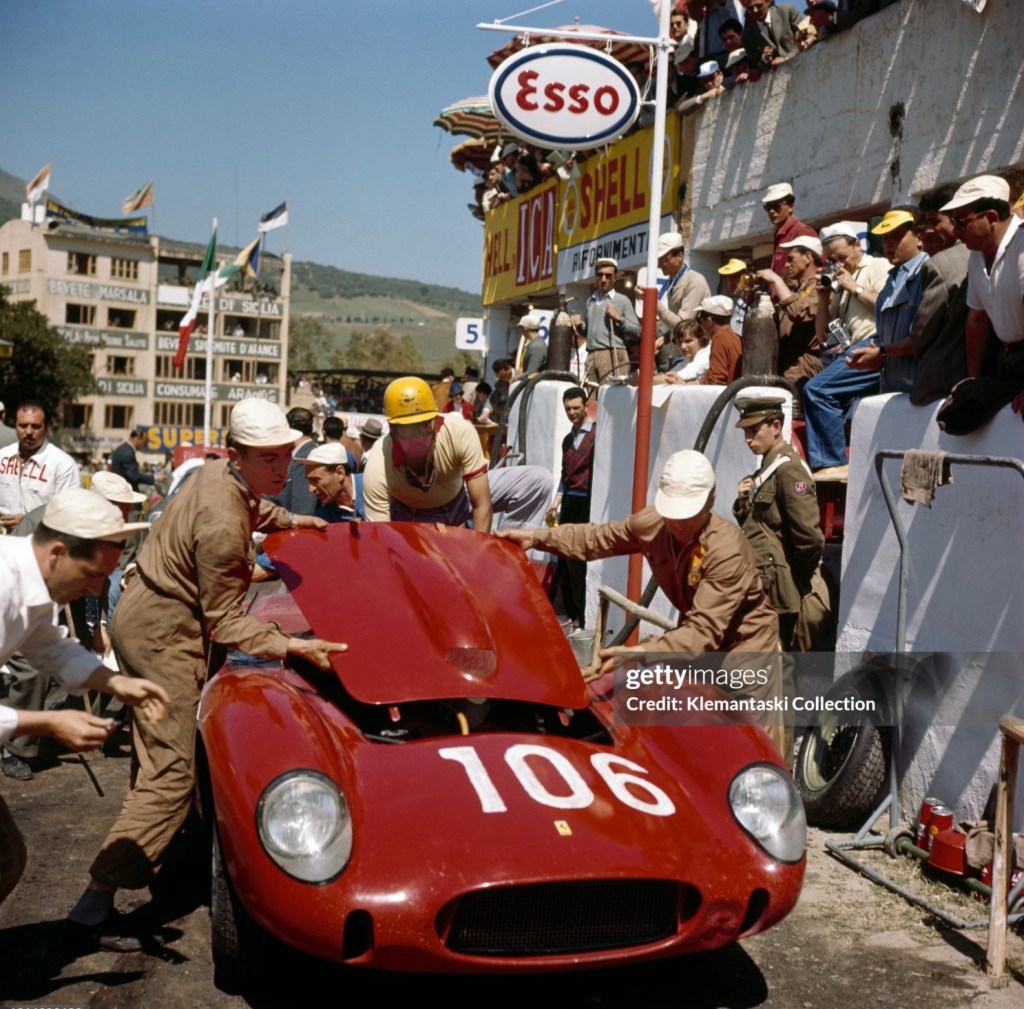
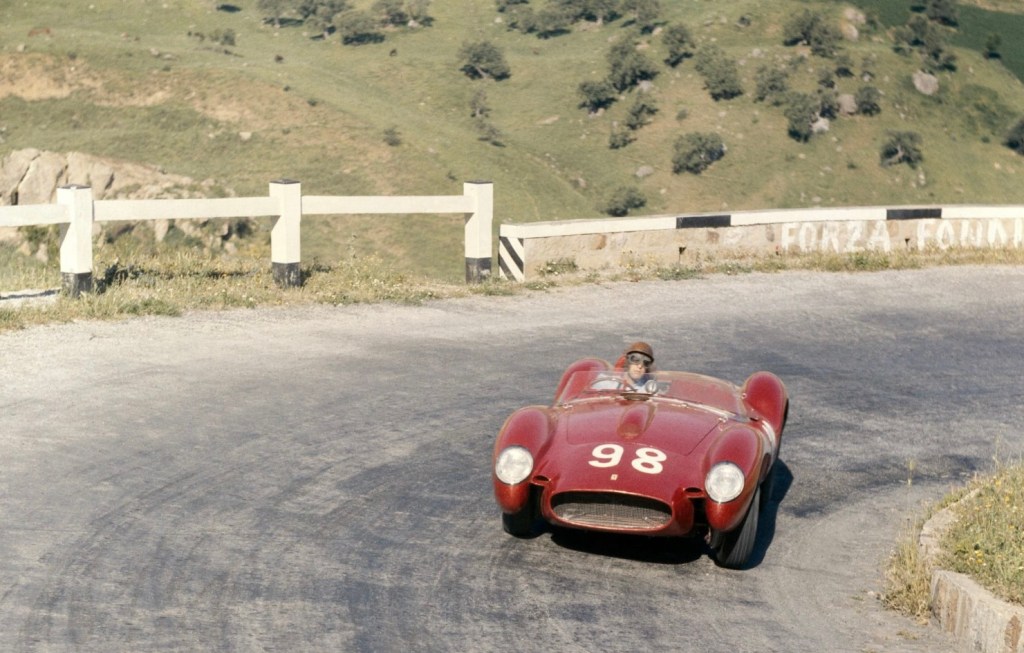
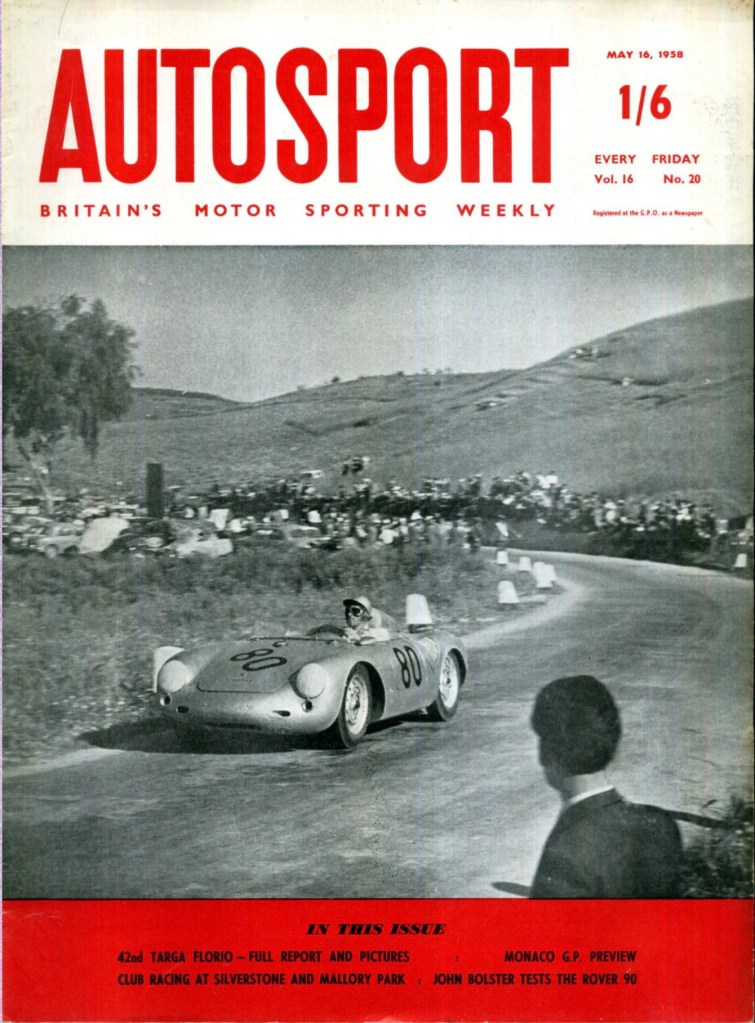
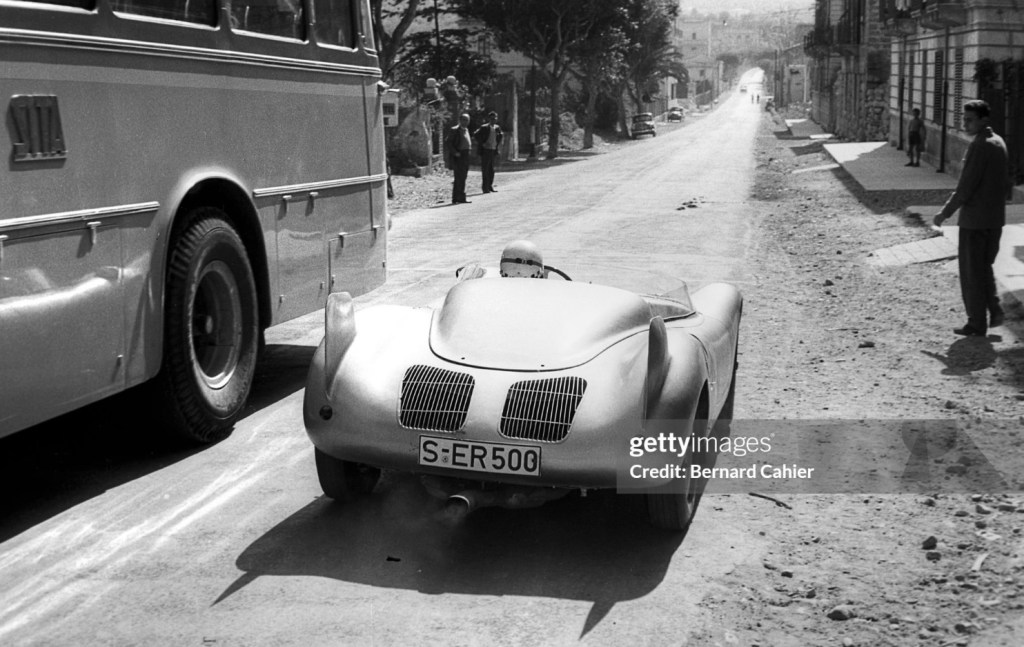
It can only be Targa, even at a glimpse…

The Chaparral 2F Chev raced by Phil Hill and Hap Sharp during the 1967 event, DNF after eight of the 10 laps. The classic was won by the more nimble works-Porsche 910/8 crewed by Paul Hawkins and Rolf Stommelen below. It was a 910 one-two-three with Cella/Biscaldi second and Elford/Neerpasch third.

(unattributed)
(Getty)

If only the 2F had an ‘automatic’-transaxle with the durability and reliability to match the quality of the rest of the car. A mighta-been indeed, see here for a lengthy feature on the car: https://primotipo.com/2014/06/26/67-spa-1000km-chaparral-2f/

(unattributed)
(Getty Images)

Later Chaparral pilot and rather successful entrepreneur, Roger Penske aboard Teddy Mayer’s Cooper T59 Ford FJ during the 1962 Daytona Continental 3-Hour meeting on February 11.

Penske was filling in for Tim Mayer, who had been drafted into the US Army at the end of 1961. That weekend’s Formula Junior ‘Count Lurani Cup’ was won by Pete Lovely’s Lotus 22 Ford; Penske wasn’t entered, it appears to have been a test session. Penske raced a Cooper T57 Climax in the 3-Hour but withdrew when his oil pressure plummeted.

Mind you, Tim had time enough to win the ‘62 USA-SCCA Interdivisional Championship. He prevailed in many Formula Junior races aboard big-brother Teddy Mayer’s RevEm racing Cooper T59 Ford including those at Marlboro Raceway, Maryland where Mark Donohue’s Elva was second, and Cumberland Airport, in front of teammate Peter Revson in Maryland, Bridghampton, Road America, Meadowdale Raceway, Illinois, and Thompson Raceway, Connecticut.

Tim Mayer chases Peter Revson during the 1962 Puerto Rico Grand Prix, RevEm Cooper T59 Ford FJs (Tom Burnside Collection)
President’s Cup, Virginia Raceway, Danville, Virginia April 28/29 1962 (B Reynolds)

Penske raced the car once at Virginia Raceway, Danville where he was second behind Walt Hangsgen’s similar car over the April 28/29 weekend.

He’s being looked after by Teddy Mayer on the grid at Virginia above. Car #1 is the Charlie Kolb Merlyn Mk3 Ford, while the front-engined red/white Stanguellini Fiat has Pierre Mion at the tiller.

(J Culp)

Jim Culp reports from practice over the 1970 Belgian Grand Prix weekend. ‘On Saturday I arrived in the spectator parking area to discover a Team Lotus van with a brand new Lotus 72. Alex Soler-Roig arrived in slacks and polo shirt, climbed in, and after a brief orientation, pulled on his helmet and drove out for a slow lap of the circuit.’

(A Sievers)

Soler-Roig was entered by Team Lotus at home (above), Spain, Jarama (Lotus 49C Ford), where he was a DNQ, at Spa (72C Ford) DNS, and in France, DNQ (49C Ford).

He started four races in a March 711 Ford in 1971, two in a BRM P160B in 1972 and failed to finish in all of them.

Dieter Glemser/Alex Soler-Roig, Ford Capri RS2600, Le Mans 1972. Second in class, 11th outright (unattributed)

After the futility of the five or so car 1972 BRM team became clear to him he ended his career in fine fashion racing works and quasi-works Ford Capri RS2600s in the European Touring Car Championship.

A Zandvoort Trophy win with Dieter Glemser and Jochen Mass, third at Spa with Dieter Glemser, third at Paul Ricard with Mass and Gerard Larrousse and a rousing win at home – Jarama – with the same crew were great results. See here: https://www.f1forgottendrivers.com/drivers/alex-soler-roig/

Doesnt the Maserati 250F look great from every angle?

Maria Teresa De-Filippis entering La Source at Spa in 1958, Q19 and tenth place, her best result in three Championship GP starts. See here: https://primotipo.com/2016/09/23/maria-teresa-and-stanguellini-fj/

(pirelli.com)
(unattributed)

De Filippis at the September 1, 1949 Aosta–Gran San Bernardo hillclimb where she was fifth in the under 750cc class in a Meccanica Taraschi built Urania BMW 750 Sport.

Below she is pictured during the August 4 Stella Alpina together with Giuseppe Ruggiero in a Squadro Taraschi machine operating from Berardo Taraschi’s base in Teramo. They were sixth with a time of 4 min 52.41, the winning Stanguellini S1100 did a 4:43. More about the company here:https://www.cortilepittsburgh.org/taraschi.html

(unattributed)

And below nearly a decade later in a Maserati 250F during practice for the 1958 Monaco Grand Prix where she was one of 15 drivers who didn’t qualify; Maurice Trintignant won in a works-Cooper T45 Climax.

I get Derek Bell being at Le Mans for shooting The Film with Steve and all of the boys, but I don’t get the presence of his Brabham BT30 Ford FVA at La Sarthe on July 18, 1970.

Any clues folks? Show and tell perhaps? Did Steve do a few laps in the Brabham?

Derek was second in the 1970 European F2 Championship in the Wheatcroft Racing Brabham with Clay Regazzoni the victor in works-Tecno 69 and 70 Ford FVA machines.

It may well be that the car was kept in France during this period, as there were two French Euro F2 rounds back to back: on June 28 at Rouen-les-Essarts (seventh) and Paul Ricard on July 26 (DNF accident).

Aston Martin DP155 at New Zealand during the Kiwi Internationals in the summer of ’56.

Reg Parnell drove the experimental DB3S-based Grand Prix monoposto well but was blown off by the ex-works Ferrari 500/625 3-litre machines raced by Peter Whitehead and Tony Gaze. Note the rego-plate, it would have been quite an Aston-Roadie!

See here for a feature on this car,where is the shot of Reg above, Kiwis?: https://primotipo.com/2019/09/05/the-gp-aston-martin-dp155/ and here: https://www.motorsportmagazine.com/articles/single-seaters/f1/aston-martins-failed-first-f1-attempt-the-dp155/

(primotipo archivio)

Start of the 1970 JAF Japanese Grand Prix at Fuji International on May 3, 1970. The three cars at the front, sorta, are Leo Geoghegan’s Lotus 59B Waggott TC-4V 2-litre, Tetsu Ikuzawa’s Mitsubishi Colt F2-D R39 1.6-litre and Jackie Stewart at the far right, Brabham BT30 BDA, capacity uncertain.

70,000 spectators watched the reigning World Champion, Stewart, win the 50 lap, 300 km race in the John Coombs Brabham BT30 Ford raced by Jackie and Jack Brabham in Euro F2 races that year.

Max Stewart’s Mildren Waggott TC-4V 2-litre was second, 50 seconds adrift of his much shorter namesake, and Kuniomi Nagamatsu was third in a Mitsubishi Colt F2-D 1.6.

Other notables who started the race included 1969 fourth placegetter Graeme Lawrence aboard the howling Ferrari Dino 246T in which Graeme and Chris Amon won back-to-back Tasman Cups in 1970-69, Leo Geoghegan’s fifth placed Lotus 59B Waggott TC-4V, and sixth placed Alastair Walker’s Brabham BT23C Ford FVA.

BRM mechanic, Willie Southcott, fettling a BRM 1-litre P80 four-cylinder twin-cam, fuel-injected Formula 2 engine circa 1965.

Power was quoted at 128 bhp @ 9750 rpm with bore/stroke of 71.555/61.595 mm in 1965, and increased to a claimed 136bhp @ 10,500 rpm when the bore-stroke changed to 74.63/56.95 mm in 1966.

The interesting bit for OCDers like me is that the inlets and exhausts of this engine are on the opposite side to most photographs of the unit; and yes, the shot isn’t being shown arse-about.

See here: https://primotipo.com/2017/11/06/jim-clark-lotus-35-and-the-cosworth-sca-f2-engine/ Part of the development process, I guess…

The eagle-eyed may have picked up ‘A&M’ on the head casting ‘facing us’. A&M was/is Automotive & Marine Foundry Ltd, based in Grantham, Lincolnshire, England. This company was a key supplier of precision sand castings for BRM during the 1950s and 1960s.

The P80-engined Matra MS5 of Hubert Hahne during the 1966 German GP meeting in August 1966. He was ninth outright and first in the F2 class ahead of Hans Hermann, Brabham BT18 Ford and Jo Schlesser’s works-Matra MS5 Ford.

Credits…

Peter Connew, George Begg, Bernard Cahier, Eric Stevens, Jim Culp, Bill Reynolds, GP Library, Alex Sievers, Dariel-Paris, Repco, Russ Cunningham

Tailpiece…

(Darien-Paris)

Did he catch it?…

This shot popped up in my BRM P80 research adventures. It’s Graham Hill doing his best to cut the Rouen-Les-Essarts grass during the 1965 meeting aboard John Coombs’ Brabham BT16 BRM P80 1-litre; Graham was a works-BRM pilot then.

Understandably so, as Hill is trying to catch Jim Clark’s victorious Lotus 35 Cosworth SCA, unsuccessfully as it transpired. Graham was second and Jack Brabham third in a BT19 Cosworth SCA; Brabham knocked the Honda S800 F2 engine into shape that season, then went and pulverised F2 with it the following year. Jack used the SCA for a while mid-season after dispatching the Japanese to go home and try again…they did a mighty fine job! See here:https://primotipo.com/2015/07/30/xxxii-grand-prix-de-reims-f2-july-1966-1-litre-brabham-hondas/

(R Cunningham)

There is an Australian aspect to this story. At the end of the ’66 season Frank Gardner bought the car on behalf of Alec Mildren in Sydney. The chassis was fitted with a Coventry Climax 2.5 FPF four and raced by Gardner successfully in the 1967 Tasman Cup, here at the Levin International on January. The car is still here, see this piece: https://primotipo.com/2020/03/13/brabham-bt16-climax/

(Repco)

Finito…
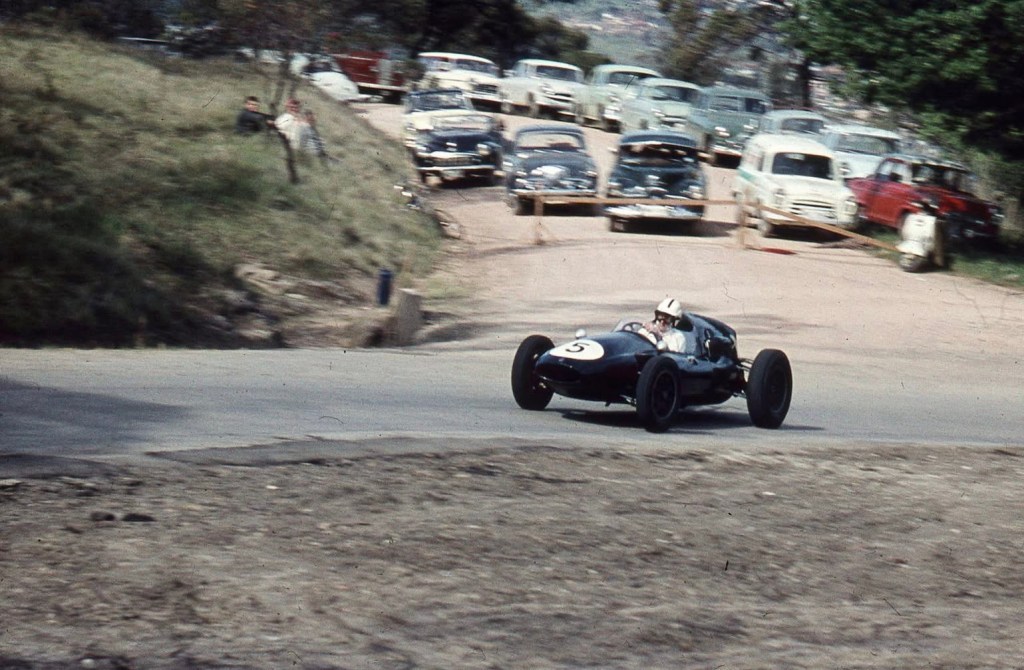
John Youl, left and Lex Sternberg aboard their Cooper T51 Climax’s at Symmons Plains circa 1961-62…

There were four of the eleven Cooper T51s that had ‘permanent residency’ in Australia, based in Tasmania for a while, this pair and those of Austin Miller. We know it’s before 15 April 1962 as Andrew ‘Slim’ Lamont tells us the Youl car passed to Jack Hobden then.

John Youl accepts the plaudits of the crowd and Tassie Premier, ‘Electric Eric’ Reece. Probably after winning the December 1962 Examiner £1,000 in the Cooper T51 (HRCCTas)
Symmons Plains 1961-62 (K Thompson Collection)
David Sternberg ascends Penguin hillclimb in the family T51, date unknown, but welcome, where is my copy of that book I wonder? (G Hartley)

Youl’s car history is simple, he says confidently, John acquired F2/9/60 new from the factory whereas Sternberg’s F2/7/59 or F2/9/59 was an ex-works 1959 car brought to Australia for Jack’s 1960 Summer Tour and then sold to Bib Stillwell after Bathurst 1960. Bib bought it to obtain the 2.5 Coventry Climax FPF with which it was fitted; they were as rare as Rocking Horse Poop in the colonies at that stage.

Bib raced it a few times, including Longford’s 1961 meeting before selling it to Burnie’s Lex Sternberg, both he and his son David raced it. The later ownership has the usual twists and turns of many of these cars, which is beyond the scope of this pictorial. Click here for The Nostalgia Forum thread in relation thereto, it’s content rich; https://forums.autosport.com/topic/150838-cooper-t51s-in-tasmania/

(R Lambert)

Jack with T51 F2/7/59 or F2/9/59 at Longford in March 1960.

Brabham consorting with a couple of chaps during practice. Is that Alec Mildren in the straw hat or is my imagination running riot? Look at the monster mouths of those 58DCO Webers.

Jack had a good run with this car that summer winning at Ardmore – the New Zealand GP – and Wigram before shipping the car across the Tasman and was then victorious at Longford and Phillip Island in March, and then Bathurst in October.

Brabham won the March 5 Longford Trophy from Mildren’s Cooper T51 Maserati and Stillwell’s T51 Climax.

(unattributed)

Jack Hobden (30/8/1942-18/9/2022) aboard the ex-Youl F2-9-60 at Baskerville?

The defunct Longford Grand Prix Expo FB page wrote that ‘Jack was requested to represent Tasmania in the 1965 Australian Grand Prix at Longford by then Premier Eric Reece. Upon being told of a lack of finances, he funded Jack’s race.’

Hobden was 12th in the race won by Bruce McLaren’s Cooper T79 Climax from Jack Brabham and Phil Hill.

Etcetera…

(N Barnes)

Noel Barnes was prowling the paddock at about the same time as Ron Lambert!

(N Barnes)
(N Barnes)

Credits…

Historic Racing Car Club of Tasmania, Ron Lambert, G Hartley, The Nostalgia Forum, Ellis French, Andrew ‘Slim’ Lamont, oldracingcars.com, Greg Ellis Collection, K Thompson Collection, Noel Barnes

Tailpiece…

(G Ellis Collection)

An early Baskerville grid containing two Youls, #38 Gavin’s Porsche 356 and #55 John’s NSU Prinz, #7 is Ross Larner, #29 David Lewis’ Humpy Holden, the white Morris Minor is Greg Ellis and #51 is Dick Crawford

Finito…
Graham Harvey, Elfin 400 Chev ahead of Jim Boyd Lola T70 Chev at Bay Park, New Zealand in 1969.

Elfin 400 chassis BB67-4, first owned and raced by Andy Buchanan, has lived all of its life in New Zealand and is now very close to completion, or has it already run? Where are those photos Alastair Grigg sent me!?

(R Herrick)

More on Garrie Cooper’s first big sports car here:https://primotipo.com/2015/05/28/elfin-400traco-olds-frank-matich-niel-allen-and-garrie-cooper/

(L Thacker)

BP’s Les Thacker congratulates Larry Perkins after an F3 win at Brands Hatch and Man of The Meeting award.

The F2 Index tells me Larrikins won two races at Brands during his victorious Ralt RT1 Toyota 1975 European F3 Championship campaign, the Polydor Records Trophy on September 7 and the BARC-BP British F3 Championship round a fortnight later on September 21. The shot will have been taken on the latter weekend, Larry won that F3 Championship from Conny Andersson and Renzo Zorzi.

Epic length article on Larry and Terry Perkins here: https://primotipo.com/2023/01/28/terry-and-larry-perkins/

Larry on the Snetterton dummy grid, June 15. A lousy day, 19th. Gunnar Nilsson was up the front in a March 753 Toyota (JI Croft)
(G Ruckert)

John Walker, Matich A50-004 Repco-Holden, at Surfers Paradise in 1972 or 1973. I’m not sure if it’s the Gold Star or Tasman rounds.

JW briefly raced an Elfin MR5 then jumped to the Matich which was US L&M Championship compliant – I can’t recall in what respect – doing very well with it in 1973. The Rise and Rise of John Walker really got going on that Stateside trip I reckon. Thoughts folks?

1979 Gold Star and Australian Grand Prix winner aboard the Martin Sampson owned, Rob Newman prepared Lola T332 Chev. More here: https://primotipo.com/2015/03/12/the-mother-and-father-of-lucky-escapes-john-walker-sandown-tasman-1975/

(C Wade)

Peter White, Fronty Ford DO Twin-cam racing Tom Benstead, Harley Davidson, at Penrith in the late 1920s

The Fronty was a factory built racer imported to Australia as against an assemblage of parts built on a local chassis.

A bit more Fronty Ford here and more research needed and wanted on my part: https://primotipo.com/2018/11/20/penrith-speedway/

Evan Green and Roy Denny, Leyland P76 4.4-litre V8 during the 1974 Southern Cross Rally, see here: https://australianrallyhistory.com.au/history-of-the-southern-cross-international-rally/1974-southern-cross-rally/

Only seven of 61 crews finished the gruelling 3560 km event out of Port Macquarie between October 9-14, the winners for the third year on the trot was the Mitsubishi Lancer GSR of Andrew Cowan and John Bryson.

Regarded as a sweet-handling big car in the day, she would have been a bit of a handful in the forests, the car didn’t survive, I’m not sure on which stage it stopped.

More about Evan Green here: https://primotipo.com/2025/05/27/alfa-romeo-autodelta-alfetta-gt/

A rather brave and slow looking, well-nourished photographer shoots Jim Clark on the exit of the Northern Crossing during the Australian Grand Prix at Warwick Farm on February 19, 1967. Lotus 33 Climax FWMV 2-litre V8.

Jim won the Tasman Cup again that summer, but his close mate Jackie Stewart, BRM P261 2.1-litre, won the AGP with Clark 17 seconds behind him, with Frank Gardner third, Brabham BT16 Climax 2.5 FPF.

Tasman Cup ‘67 here:https://primotipo.com/2014/11/24/1967-hulme-stewart-and-clark-levin-new-zealand-tasman-and-beyond/

Pete Geoghegan blasts his Ford Mustang around Pukekohe circa 1970-71, how’d he do folks?

Check out this article about our Touring Car Exports: https://primotipo.com/2025/02/05/tourers-on-tour/

Geoff Brabham aboard the Jack Brabham Ford Bowin P4X Formula Ford at Warwick Farm in 1972, gimme a date folks it’s gotta be one of Geoff’s first gallops in a racing car.

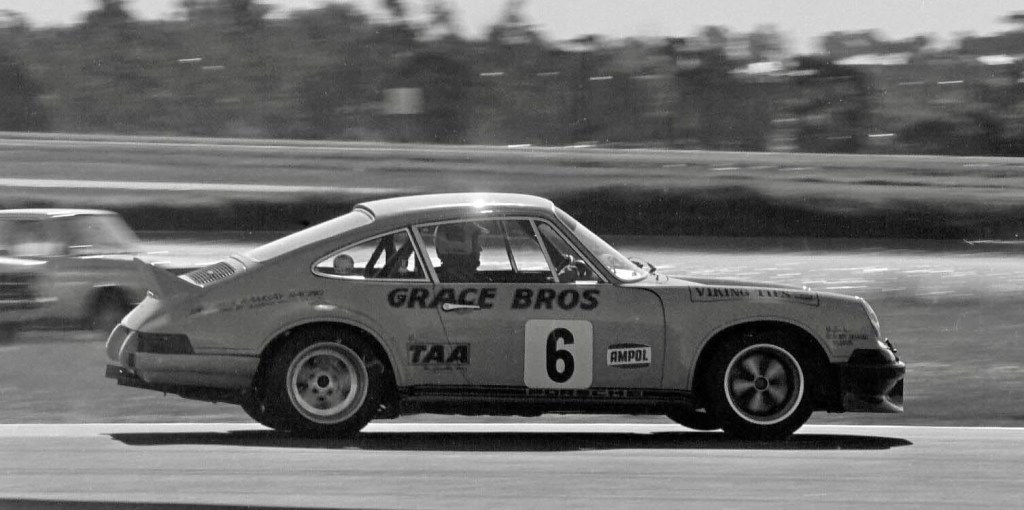
Bob Beasley was the usual driver of this car, finishing in the fifth in the 1971 Driver to Europe Series and third in 1972. John Davis then won it in a raffle, and finished fourth in the 1975 title race, and then third with support from Grace Bros the following year.

More on the Bowin P4 here: https://primotipo.com/2018/08/30/bowin-p4a-and-oz-formula-ford-formative/ There is a good summary of Geoff’s career here: https://primotipo.com/2015/03/31/geoff-and-jack-brabham-monza-1966/

(J Quinn Collection)
(unattributed)

The Lex Davison/Stan Jones/Tony Gaze Repco Research prepared Holden 48-215 during the 1953 Monte Carlo Rally.

See here for all of the detail on the car build and the rally itself: https://primotipo.com/2019/01/25/melbourne-to-monaco-holdens-1953-monte-carlo-rally/

Lank Lex, Stumpy Stan and Tall Timber Tony (unattributed)
(R Burnett)

Surely one of Australia’s most evocative sports-racing combos of any era?

John Harvey aboard Bob Jane’s immaculate, John Sheppard prepared McLaren M6B Repco 740 5-litre at Symmons Plains in 1972.

Harves won the 1971-72 Australian Sports Car Championships with it. In 72 he won five of the six rounds, including the final one at Symmons on November 12. Glorious shot of a glorious car, see here: https://primotipo.com/2018/09/09/sandown-sunrise/ At the end of the season, Bob set it aside; the family retain it 50 years later.

Speaking of iconic Sheppo built/prepared cars, here’s another! The Bob Jane owned Holden Torana GTR XU-1 Repco 620 4.4 V8 was built by John in his home garage away from any prying eyes snooping around Bob Jane Racing’s Brunswick HQ.

Here it’s in the Wanneroo paddock in 1971, the A regular race winner in Bob’s, John Harvey’s and Frank Gardner’s hands from 1971-75, then Ian Diffen after that? There’s more Harves here: https://primotipo.com/2021/01/25/harves/

(Harkness & Hillier)

Wizard Smith and Don Harkness with the SWB (sic) Fred H Stewart Enterprise LSR car out front of the Harkness & Hillier factory, Five Dock, Sydney in 1931.

The incredible machine was powered by a leased/loaned 1450 bhp Napier Lion W12 aero engine. Great article on this car here: https://oldmachinepress.com/2018/10/05/fred-h-stewart-enterprise-smith-harkness-lsr-car/

Michael Hickey writes that ‘The Harkness and Hillier background of the Wizard Smith Enterprise photo remains relatively unchanged 94 years later. It’s now Volvo Cars, Parramatta Road, Five Dock, the photo is in William Street.’

(K Starkey)

So disappointed to have missed out on racing or spectating at Catalina Park in New South Wales’ Blue Mountains, but it was well before my time.

Here Norm Beechey and Pete Geoghegan are wrestling their touring cars around the tight layout in January 1967: Chev Nova and Ford Mustang. I’ve got my money on Pete!? See here:https://primotipo.com/2019/09/26/norm-jim-and-pete/

A collection of these would be nice, I wasn’t aware of the publication until Bob Williamson put this up on his Facebook page; the LCCA’s ‘Competition Communicator’ magazine came later.

It’s Jack Brabham in a Cooper T51 Climax winning the Repco Trophy at Phillip Island on March 14, 1960. See here: https://primotipo.com/2018/08/12/jacks-donut/

(MotorSport)

A decade later Jack was mid-way through his last F1 season, here contesting the July British Grand Prix at Brands Hatch. That front couple of rows from pole is Rindt, Oliver, Brabham, partially obscured papaya Hulme, and Ickx on the right: Lotus, BRM, Brabham, McLaren and Ferrari. V8s and a V12 and Flat-12 or 180 degree V12 if you prefer…

With a bit more luck Brabham could have won tbe World Championship for a third time in 1970. At Brands he was robbed of certain victory on the last lap after on his Brabham BT33 Ford ran out of fuel after the Lucas mixture control of the 3-litre Ford Cosworth DFV was left on the rich setting by mechanic, Nick Goozee. Having passed and driven away from Jochen Rindt’s Lotus 72C, the 1970 posthumous World Champ was gifted the win.

See here: https://primotipo.com/2018/05/24/jochens-bt33-trumped-by-chunkys-72/

Warwick Brown at Riverside – I think – in October 1976, VDS Racing Lola T430 Chev. WB was sixth in the race won by Al Unser’s Lola T332 Chev.

I did a feature on the Lola T430 only a few weeks back, so best not to rabbit on, see here: https://primotipo.com/2025/07/23/lola-t430-chev/

(B Young)

Another member of the small-block Chev family, the fuel injected 283 nestled under the bonnet of Tornado 2, is related to the much modified 305 fitted to WB’s F5000 Lola above.

The new Corvette V8 was supplied to car owner Lou Abrahams via his Holden connections and built locally using the best over the counter US performance parts. Abrahams developed the fuel injection using Hilborn parts.

I rather like this Wiki summary of this great race engine family: https://en.wikipedia.org/wiki/Chevrolet_small-block_engine_(first-_and_second-generation)

(T Perrin Archive)

Ted Gray and Tornado 2 Chev at rest before the start of the 1958 Australian Grand Prix at Bathurst at which point it was arguably the fastest, if not the most reliable, racing car in Australia. That’s Lex Davison’s Ferrari 500/625 and crew at left with Ted Gray looking this way behind the right-rear.

(R Edgerton Archive)

Ted Gray, Lou Abrahams and Bill Mayberry – key Tornado men, the other Mayberry brother is the only one missing – during the 1956 AGP weekend at Albert Park. Ted’s first race in the new Tornado 2 Ford.

More on the Tornados here: https://primotipo.com/2015/11/27/the-longford-trophy-1958-the-tornados-ted-gray/

Another one from Tony Johns below. Ted – still in Tornado 2 Ford – at Fishermans Bend over the 12-13 October 1957 weekend, where he won a five-lap preliminary and led the 20-lap feature until rear axle failure intervened. Stan Jones’ Maserati 250F won that from Bib Stillwell’s similar car and Doug Whiteford’s 300S.

(D Lowe)

Alec Mildren and Lex Davison during their epic race long dice for victory in the 1960 Australian Grand Prix at Lowood, Queensland on : Alec’s very clever Cooper T51 Maserati 250S and Davo’s wonderfully daft Aston Martin DBR4 3-litre.

Mildren won in the drive of his life and Lex – uber sportsman as he was – seemed as happy about the well earned win as Alec was! See here: https://primotipo.com/2018/06/08/mildrens-unfair-advantage/

Those with an interest in Australia’s Aston Martins should buy the latest copy of Auto Action Premium #1909 on sale since Thursday, August 7. Eight pages and a lot of photos you won’t have seen before. International readers see the website here: https://autoaction.com.au/issues

(I Smith)

Peter Jones Cheetah Clubman Toyota 1.3 was, I think, regarded as the ‘Winningest’ car in Australian motor racing for much of the period Jones raced it, say, 1976-80, when Formula Pacific beckoned Peter.

The Cheetah Racing Triumvirate comprised Cheetah designer/builder/racer Brian Shead, racer Brian Sampson, and Sampson’s motor engineering business, Motor Improvements.

MI built most of the Toyota Corolla 1.3-litre race engines fitted to ANF3 and Clubman cars in this era. Peter Jones was the MI Foreman forever, so when Jonesey suggested to Sheady he build him a Clubman, it was game on!

Shead built two of these cars, a ‘turnkey’ one for Peter and another for Victorian Formula Vee ace, Derek Fry. Fry either had access to the drawings or perhaps Brian sold him the bits for Fry’s Tubeframes business to assemble. If one of you know give me a buzz.

Racer Brendan Jones, Peter’s son, has his old car and memory, again, suggests Fry’s was destroyed and scrapped?

Credits…

Les Thacker, Kevin Lancaster, Graham Ruckert, Jack Quinn Collection, Colin Wade, Rob Burnett, Ken Starkey, Terry Martin, Harkness & Hillier, MotorSport, JI Croft, Victor Oliver, Tim Perrin Archive, Bob Young, Brier Thomas-AMHF Archives, Racing Ron Edgerton Archive, Ian Smith, Roger Herrick, David Lowe

Tailpiece…

(R Edgerton Archive)

Tony Gaze, HWM Jaguar VPA 9 in the Albert Park paddock during the March 1956 Moomba meeting. See here: https://primotipo.com/2020/03/28/gaze-hwm-jaguar-vpa9-ryal-bush-new-zealand/

Gaze waved goodbye to both of his cars that weekend upon his retirement from racing having sold them to Lex Davison. Davo wasn’t a big fan of the HWM if my recollection of Graham Howard’s Lex biography is correct, but he loved the ex-Ascari Ferrari 500/625 3-litre and didn’t he make it sing, two AGP victories and the rest.

Finito…
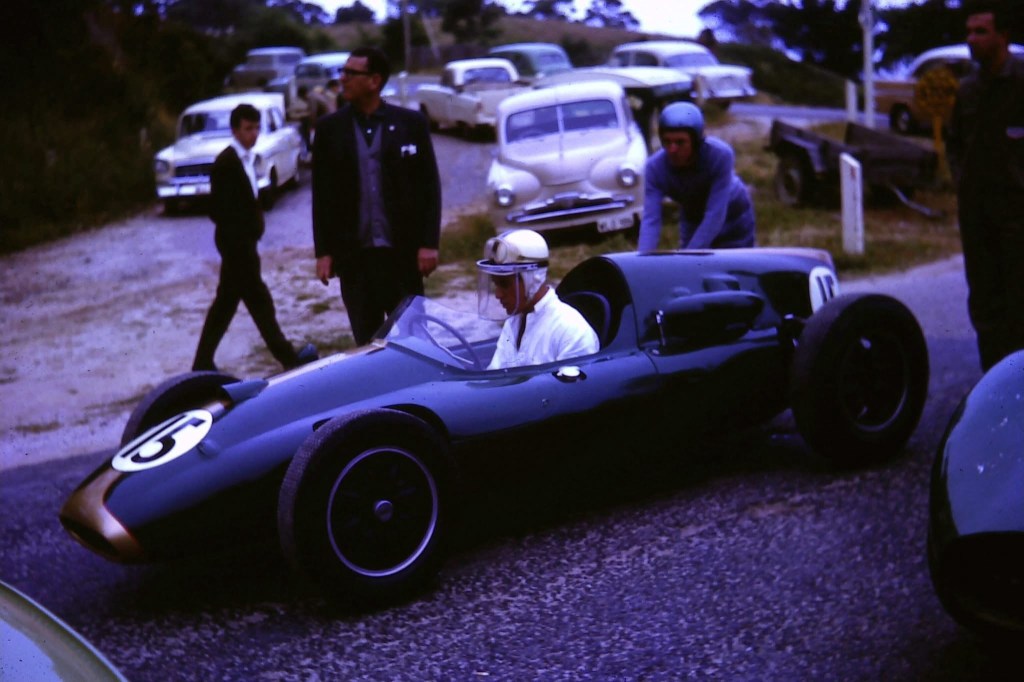
(B King Archive)

Harry Beith – 25/12/1889-26/5/1964 – seems to have done more than most to build and polish the nascent Chrysler brand throughout Australia in the 1920s and 1930s.

Here, he is on the way to victory in his Chrysler 70 in the Victorian Sporting Car Club Trophy, a 35 lap, 116 mile race held at Phillip Island on New Year’s Day, 1936.

17 starters took the flag of this handicap event – hence the competitiveness of a 10 year old car – with W Bullen’s Singer second and Tom Hollindrake’s MG K3 third.

Albury racer, Beith’s time was 1hr 38min 34 sec off a handicap of 2min 20 sec, his average speed was 64.1mph.

(B King Archive)

Harry’s riding mechanic is either pointing the way or at a pretty young lass in the crowd. It’s probably Heaven Corner, given the way the road – Berry’s Beach Road – drops away.

The car below is – perhaps, having wrongly suggested it was the E Buckley driven McIntyre Hudson some years ago – Les Burrows’ fourth-place Terraplane Spl.

(B King Collection)

Phillip Island notes…

The May 6, 1935 Jubilee Handicap meeting was the last held on the Victorian Light Car Club’s (VLCC) 6.5-mile rectangular course used from the two March 31, 1928 100 Mile Road Race(s) – retrospectively named the 1928 Australian Grand Prix by the VLCC – until the April 1, 1935 AGP.

A less dangerous, shorter 3.312-mile triangular course, incorporating some of the old pit straight (Berry’s Beach Road) was then made and promoted by the Australian Racing Drivers Club and the Victorian Sporting Car Club.

It was used until November 1, 1938 for cars, and ‘bikes until January 30, 1940. The Grand Opening Meeting of the modern track we all know and love was held over the December 15, 1956 weekend, it’s closed a couple of times along the way, but has been in continuous use since 1988.

Harry Beith…

Harry James Beith was one of those extraordinary Australians who fought in both the first and second World Wars, it tells you all you need to know about the bloke’s character and grit.

Unsurprisingly! his roles were as a driver and driver mechanic, in 1939-45 he was a Staff Sergeant in the 1 Company Australian Army Service Corps and was one of many who became a POW in Malaya.

The Age newspaper announced the appointment of Beith as chief adviser to the carnival committee of the Interstate Grand Prix meetings at Albury-Wirlinga in February 1938.

That February 10 piece provides a useful summary of his career, describing Beith ‘as one of Australia’s best known racing motorists with a unique career as a competition driver and road-record breaker.’

‘He first competed in a Talbot at Wildwood (near the current Melbourne Airport) in 1912. Aged 16, he won the hillclimb, defeating his employer, CB Kellow! He continued to compete and then in 1927, ‘when becoming associated with the first Australian agency of Chrysler, he set out to break road records.’

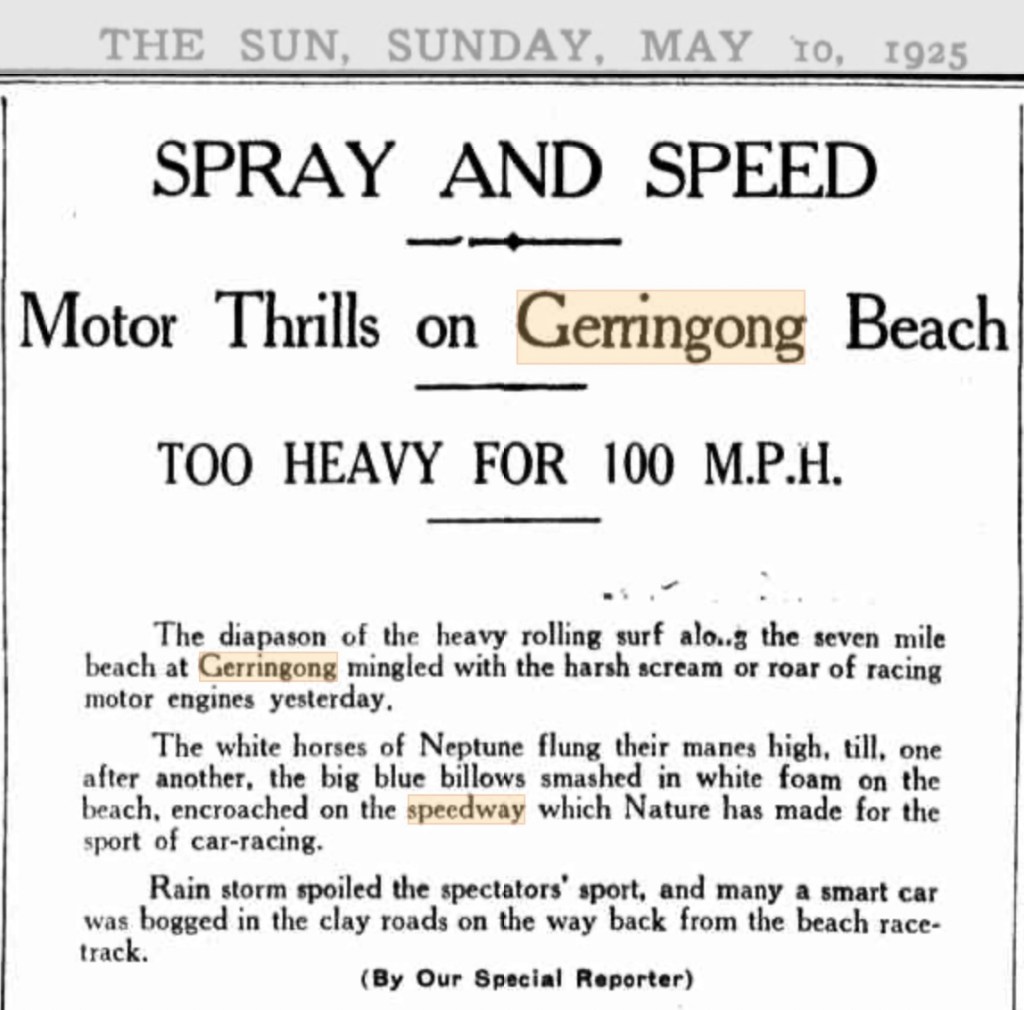
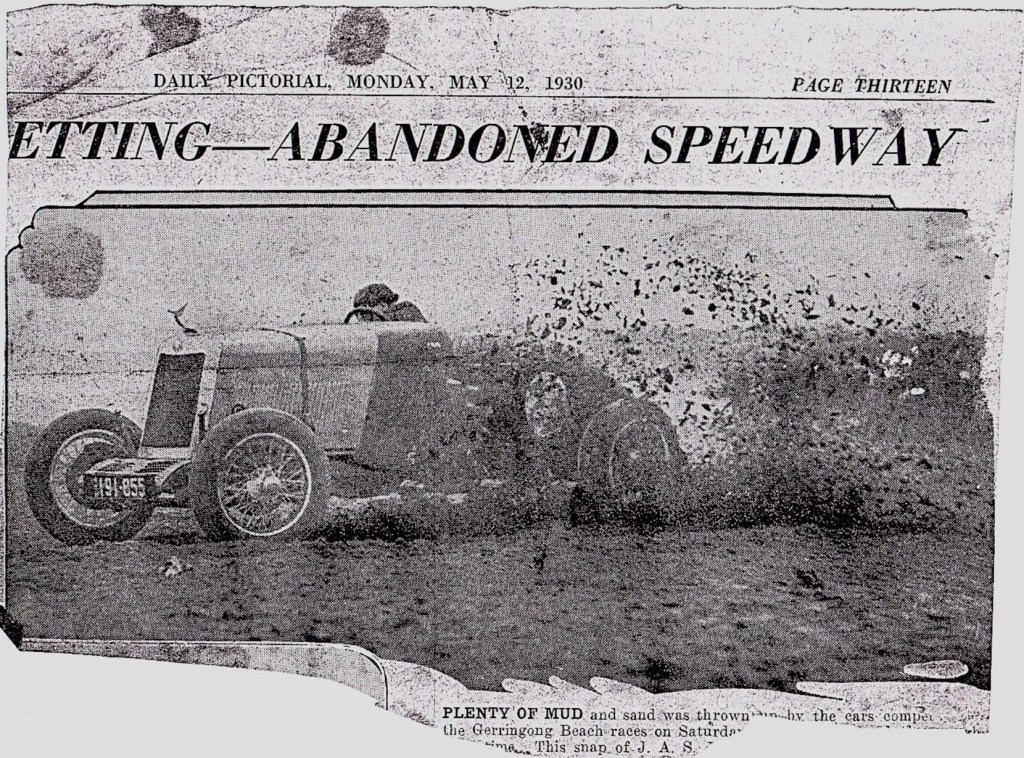
Gerringong Beach, NSW Fifty Mile Handicap May 10, 1930: at left is Percy Hunter in the JAS Jones’ Alfa Romeo 6C1750 Zagato, then the obscured Bill Thompson Bugatti T37A and then the two Chryslers of E Patterson and Harry Beith #72/14 (Fairfax)
The Beith – Harry at left – Chrysler leading with later Oz-Ace Alf Barrett’s Morris Cowley Spl behind. Phillip Island January 1, 1936 (B King Collection)

Beith set a new Melbourne-Sydney record of less than 11 hours. ‘As cars were improved new records were created by other drivers, but within three days of each new record, Beith set out to beat it.’ He held the Melbourne-Sydney record at the end of 1927, 1928 and 1929. ‘Finally the police authorities of Victoria and New South Wales intervened and put a stop to these speed tests over the inter-State highway.’

Harry’s flathead-straight six Chryslers are variously quoted at 3582 and 3583cc, and 4-litres with his endurance machine still going strong after 43,000 record-breaking miles. That car had a difficult birth being purchased by Beith from an insurer for £80 after it was burned-out!

Chrysler 70s were pacey at Le Mans in the late 1920s, the engines were advanced for the time: seven main bearing cranks, crank vibration damper, full-pressure lubrication, replaceable oil-filters and the rest. See here: https://www.drivecj.com/the-chrysler-70-a-revolutionary-leap-in-automotive-history.htm

Harry and team in and around the Chrysler, during the 1936 Australian Tourist Trophy weekend. Nice PR shot, pity about the crop! (B King Collection)
There She Blows during the March 30 1936 200-mile Australian Tourist Trophy at Phillip Island. DNF for Beith’s Chrysler in the race won by Jim Fagan’s MG K3 Magnette

Beith held the record for the final meeting held on the RACV’s rectangular, sandy-gravel course at – what is now Safety Beach – Dromana, ‘which had been held for three years by Harold Cooper’ in the Cooper brothers’ fearsome ex-Louis Wagner 4.8-litre ‘Indy’ Ballot 5/8LC.

‘Mr Beith also held the Perth-Sydney record with Dr Manning. Altogether he has won more than fifty motor races in Victoria and New South Wales.’ At the time of publishing he was employed by Neal’s Motors Pty Ltd, Melbourne as country organiser.

Neal’s was a large car assembler with premises in Fishermans Bend. By 1938 their empire encompassed the import and assembly of Hudson, Hudson Terraplane, Diamond T, Fiat, Studebaker cars and trucks, Chrysler, Chrysler Plymouth, Morris cars and trucks, De Soto cars and Fargo trucks…making our Harry a works-driver!

Beith didn’t contest any of the 1927-35 Goulburn-Phillip Island Australian Grands Prix, but raced in the successive 1936 and 1938 AGPs held on the Victor Harbor-Port Elliott, and Mount Panorama, Bathurst road courses. He was ninth and 14th respectively, aboard a Terraplane Special.

The Harry Beith trail runs cold post-war, can anybody advise further about his life in cars and otherwise?

Etcetera…

(B King Collection)

Harry Beith and Terraplane Special during the January 3, 1938 South Australian Grand Prix meeting at Lobethal. DNF in the handicap race won by Noel Campbell’s Singer Bantam.

See here for a ridiculously long feature on that event and related: https://primotipo.com/2018/11/08/the-spook-the-baron-and-the-1938-south-australian-gp-lobethal/

Harry Beith’s Terraplane Spl at Phillip Island, possibly the 1938 Phillip Island GP on March 31, he was fifth. Car #12 make folks?

Credits…

The Car January 1936 and photos are from Bob King’s collection, various articles via Trove, in particular The Age February 10, 1938, Fairfax, Reg Nutt Archive via Bill Atherton, Greg Smith and David Zeunert, Bob Lea Wright Archive via Nathan Tasca, Mr Rewind for the Australian War Memorial link

Finito…
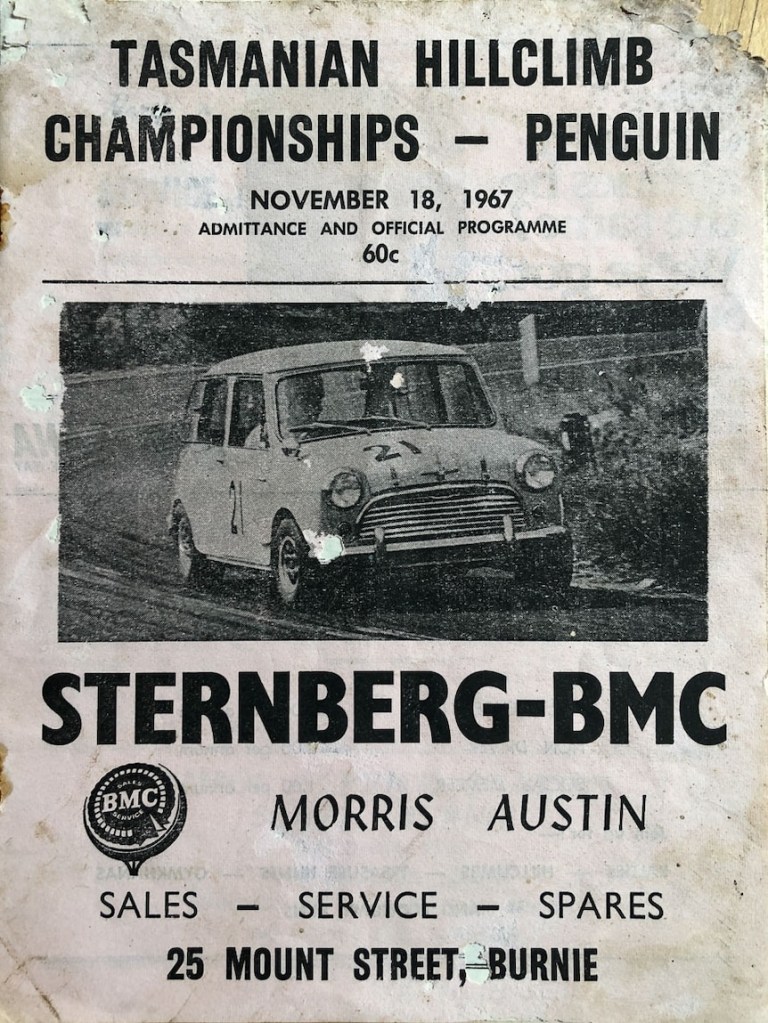
(B Forsyth)

‘Please keep off the track’ seems sound advice.

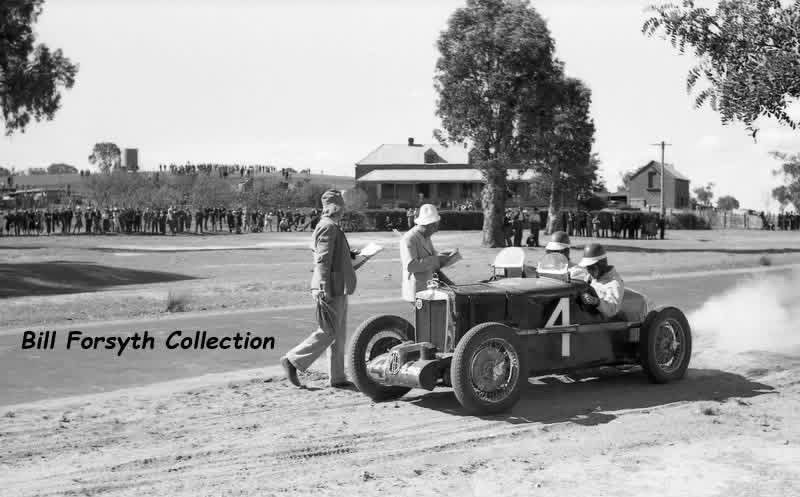
The perils of wandering about Mount Panorama during a race meeting are obvious enough, but were a potential problem throughout the first weekend of racing at Australia’s greatest cathedral of speed, hence the sage-like advice of the New South Wales Light Car Club.

Tom Peters, MacKellar Ford V8 Spl aka the ex-Bill Thompson Bugatti T37A #37358, is snatching a look over his shoulder of Bob Lea Wright’s, Terraplane Spl during the April 18, 1938 Australian Grand Prix at Bathurst.

Peter Whitehead won the race in his ERA B-Type that weekend. Peters was a terrific fourth in a car he had earlier owned and raced in its original, ‘pure-Bugatti’ form, and Lea-Wright was 11th. I wrote about the race yonks ago: https://primotipo.com/2015/04/16/peter-whitehead-in-australia-era-r10b-1938/

Here’s Ford dealer/racer Ron MacKellar on the debut of his comprehensive rebuild of the ex-Bill Thompson 1930/32 AGP-winning Bugatti Type 37A chassis 37358 at Centennial Park, Sydney in November 1937.

A McCullough supercharged flathead Ford V8 engine and gearbox and general fuglification of Ettore’s finest resulted in a faster car than before. It raced on all the way to 1952 when Bill McLachlan finished 13th in the AGP, at…Bathurst. See here for more about this T37A https://primotipo.com/2015/10/27/motorclassica-melbourne-23-25-october-2015/

To the current custodian, Michael Miller’s credit, his slow restoration/reclamation of 37358 is of the Oily Rag type, and with luck, the car may be finished in advance of Australian Grand Prix Centenary celebrations at Goulburn in January 2027. Keep an eye on the website, folks: https://goulburngrandprix.com.au/

Credits…

Bill Forsyth Collection, State Library of New South Wales, goulburngrandprix.com

Finito…
(G Thomas)

Lex Davison in the Little Alfa – Alfa Romeo 6C 1500 s/c Spl – at Ballarat Airfield with RAAF Avro Ansons in the background.

He is contesting the 75 mile Victoria Cup held on the Australia Day holiday, January 27, 1947.

The race was the first post-War ‘state level event’ held in Victoria and was promoted jointly by the Light Car Club of Australia and the Victorian Sporting Car Club.

(G Thomas)

Doug Whiteford won the handicap race in Black Bess, his Ford V8 Special which was at the start of a long run of success.

See here for Black Bess: https://primotipo.com/2015/05/05/doug-whiteford-black-bess-woodside-south-australia-1949/ and here for the Little Alfa: https://primotipo.com/2015/01/22/race-around-the-barracks-balcombe-army-camp-davison-little-alfa/

Davo also entered his rather imposing Mercedes Benz SSK, but the engine failed, see here: https://primotipo.com/2024/02/18/mercedes-38-250-ssk-lex-davison/

(G Thomas)
(SLV)

The caption says Fishermans Bend but it looks more like Altona to me, one for those with a programme collection. And below Ted again, Alta 21S Ford V8 Spl this time during the 1954 Victorian Trophy at the Bend on March 22, 1954.

(SLV)

This car, first brought to Australia by MI6 spook and sometime racing driver Allan Sinclair in 1938 is one of my obsessions, see here: https://primotipo.com/2018/11/08/the-spook-the-baron-and-the-1938-south-australian-gp-lobethal/

It’s alive and well too, restored by Graham Lowe several decades ago, it’s used regularly on road and track by current custodian, Fiona Murdoch. I’ve driven it too, in March 2023, for articles published in The Automobile and Benzina. And yes, it is sen-‘kin-sational.

(G Thomas)

Reg Nutt aboard an MG NE Magnette Ulster, outside the Nutt/Jack Day premises in Whiteman Street, South Melbourne.

Greg Smith comments, ‘White street South Melbourne features to note : 16″ rear wheels, 18″ or 19″ front wheels, brakes still cable operated, door fitted to the original body maybe to comply with the CAMS draconian rule (what has changed since its inception in 1953 ? nothing!!) that “sports cars” must have a door of minimum dimensions.Tyres nearly bald. Expensive push bike leaning against the wall with the owners Gladstone bag on the footpath, maybe the photographer ?? Two fuel tanks out in the sun sweating the fumes out before solder repairs. The car was ex-Barraclough and very scruffy by this time.’

Nutt was both a master mechanic and driver with a pedigree going back to Phillip Island’s early days. He was Reg Brearley’s riding mechanic in 1929 when the pair placed second in a Bugatti T37A.

Better was to come when he won the race in 1931 alongside Carl Junker aboard a Bugatti T39 in 1931. T39-4907 is the very car shown below raced Jack Day’s Day Special (the car below) in the South Australian Grand Prix referred to above on daunting Lobethal, setting the fastest race time for that handicap race, and the following day did the fastest lap of the weekend…he could drive.

He got the bug early, recounting to Bob King memories of a Bugatti Brescia while doing his apprenticeship at Meaby’s Garage in Toorak Road, South Yarra.

The Day Special was Bugatti T39-4607 fitted with a Ford V8 and other modifications (G Thomas)

Apart from his on-track exploits in this car, Nutt gave Norman Ellsworth the ride of his life, when towing Ellsworth’s just purchased Bugatti Brescia back from Adelaide to Melbourne.

The deal was that Reg would tow the car through the many country towns on the long trip as the Brescia was unregistered. But Reg ‘forgot’ about the Bugatti on the end of the tow rope and did several miles outside Dimboola at well over 100mph. Ellsworth’s reaction is unrecorded!

More about the Day Special here: https://primotipo.com/2021/06/11/werrangourt-archives-7-jack-day-and-his-superchargers-by-bob-king/

(SLV)

What an evocative shot of the business end of the brilliant Wylie Javelin Spl…

The gent in the Akubra makes the shot. Perhaps it’s the ’53 AGP weekend at Albert Park but that’s a guess. That looks like a rego-sticker on the windscreen! See this lengthy epic: https://primotipo.com/2018/09/14/the-wylies-javelin-special/

Arthur Wylie at Altona in 1954 (SLV)
(SLV)

A D.F.P. out front of a home, probably in Melbourne, chassis number and street address please!? It has a touch of the Elsternwicks about it but could be anywhere.

The marque were in on the ground floor of racing in Australia, Les Pound finished last in the 100 Mile Road Race run by the Victorian Light Car Club in March 1928, the second Australian Grand Prix.

See here for more on D.F.P.: https://primotipo.com/2021/10/01/werrangourt-archive-11-dfp-the-greyhound-of-france-by-bob-king/

(SLV)

Reg Hunt enroute to winning the scratch-section of the Bathurst 100 during the 1955 Easter weekend at Mount Panorama, Maserati A6GCM-250.

Despite having only his short-diff fitted the Grand Prix car still did 145 mph down Conrod.

The handicap winner of the race was Curley Brydon in his new MG Special; a mix of the ex-Tomlinson ‘39 AGP winning chassis and the supercharged engine from Brydon’s ex-Patterson TC Spl.

(SLV)

I’ve done chapter and verse on Australia’s fastest combination in 1955-56 – Reg Hunt and Maseratis A6GCM and 250F – but start with these two: https://primotipo.com/2017/12/12/hunts-gp-maser-a6gcm-2038/ and https://primotipo.com/2024/02/10/australian-gold-star-championship-1956/

Manchester born Reg Hunt tootling through the Fishermans Bend paddock in his Hunt Spl aka The Flying Bedstead, date unknown but 1951 perhaps.

The Hunts arrived in Melbourne in May 1949 with Reg bringing with him various parts accumulated in the UK which he used to build this hillclimb /road racer affectionately known as the Flying Bedstead.

It was built between May-October 1949 by Hedley Thompson either in his Deepdene, Melbourne home garage or as a homer at Trans Australia Airlines, where Hedley was head of maintenance.

Thompson’s thoroughly modern chassis was a shallow multi-tubular spaceframe of welded steel construction. It had a light, tringulated front bulkhead and a more substantial rectangular one at the very rear of the car just aft of the gearbox.

Front suspension was modified Morgan pillar, and the rear comprised an upper transverse rear spring, swing axles and an underslung tubular shock absorber mounted at its top to the underside of the axle case and at its bottom to the chassis.

Bolt-on wire wheels were 3:25 inch x 18 at the front, and 3:50 inch x 19 at the rear. The ultra-light machine had hydraulic brakes with two leading shoes at the rear.

The engine was an Amal-fed 500cc J.A.P. (J.A. Prestwich) speedway engine with the power hitting the road via a Norton four-speed box.

The Flying Bedstead’s first outing was at Fishermans Bend in October 1949, where it was noticeably quicker and outclassed the numerous MG specials present. Some weeks later, at Rob Roy, it lowered the class record by nearly six seconds, to 31.4 seconds. In March 1950 he improved his time to 29.35 seconds.

Other successes followed, and soon a supercharged 998cc Vincent Black Lightning engine was fitted by Phil Irving, and the bodywork was improved; the form shown above.

‘First used in this guise at Bacchus Marsh in July 1951, at Bathurst in October it outpaced a Cooper Vincent in the first race and was pipped on the last lap in the second. The speed over the flying ¼ mile was reported at 134 mph.’ Really?!

When Hunt raced Cooper 500s in Europe in 1954, he made a side-trip to Italy on the way home and purchased the ex-works Maserati A6GCM shown above, so the Bedstead was set aside and later sold. Hunt repurchased it in 1978, and it was ultimately restored under his supervision, then later sold at auction and is extant.

(SLV)

Conceived in Lou Molina’s Albert Park backyard the MM (Molina/Massola) Holden consisted of a Silvio Massola home-made chassis, Standard 12 front end, H.R.G differential and gearbox, Holden Grey six-cylinder engine and an attractive body made by Brian Burnett.

The MM had its first outing at Fishermans Bend on October 3, 1953, and I’m wondering if that’s when this photo of Lou and a Victim tootling around the paddock was taken?

MM Holden was initially fitted with triple Stromberg carbs, later replaced by SUs (SLV)

Lou then contested the November 21 1953, Australian Grand Prix at Albert Park where he was an amazing fifth in the 64-lap 200-mile event won by Doug Whiteford’s Talbot-Lago T26C. The 2290cc MM Holden started from grid 30. The car appeared exactly as it is in the photograph above, sans bonnet and with triple-Strombergs pointing loud and proud at the sun.

The MM raced the following year at the January 1954 New Zealand Grand Prix with Molina competing alongside other Australians including Jack Brabham, Stan Jones, Tony Gaze and Alec Mildren. On this occasion, the MM was not successful, retiring early with mechanical problems. Stan Jones won the day of course in another rather famous Australian special

Amongst other notable runs, in 1956 the MM finished in the top six at the Argus Cup at Albert Park and clocked 15.3 seconds for the standing quarter mile at the Geelong Sprints.

Greg Smith has given me a shedload of material about this car from Lou’s Archive, I really must do something on the two Molina Specials soon.

And below, the MM Holden and an MG?, before the off at Fishermans Bend.

(SLV)
(Peter D’Abbs)

The Mobil sponsored Toyota Melbourne-Toowoomba Performance Test in 1966, Toyota Crown. It was still at the stage that ‘The Japs’ were convincing Aussies about the durability of their cars I guess, they succeeded rather well!

(H Coulson)

This looks awfully like Jack Phillips and Ted Parsons after one of their Interstate Grand Prix wins at Wirlinga, Albury in 1938 or 1939. Jack – with the post-race fag – still has his kidney-belt on.

Their mount was a Ford V8 Special, see here: https://primotipo.com/2023/03/07/jack-phillips-ted-parsons-ford-v8/

(SLV)

Charlie Dean well and truly on the gas during this ascent of Rob Roy in Maybach 1, date unknown. Right front on the track’s verge and right rear well and truly on the roadside.

Dean’s series of three Maybachs were labelled Maybachs 1, 2 and 3. M 3 was christened M 4 when that car/chassis was modified by fitment of a 283 Chev V8 in place of the Maybach SOHC six and other changes, mainly to the rear suspension. These cars were great crowd pleasers from their first appearances in 1948 until the last in-period races of Maybach 4 Chev in the hands of Ern Seeliger and Stan Jones in 1958-59.

(SLV)

One of the great shames is that a Maybach never won an Australian GP, karma suggests that this shouldn’t be the case but shit-happened on those particular big days. Stan Jones’ 1954 NZ GP win – truly a great team effort – is duly acknowledged…More about Maybach 1 here: https://primotipo.com/2024/01/15/maybach-1-technical-specifications/

(SLV)
(G Thomas)

Alf Barrett at Ballarat aboard his superb, aristocratic Alfa Romeo 8C2300 Monza, during the 1947 Victoria Trophy.

This is another combination that shoulda-coulda-woulda but never did win an Australian GP. The fastest combination in the immediate pre- and post-war periods is the descriptor that would have to do.

The centenary of the first Australian Grand Prix takes place in 2027, good news is that the current custodians of this car: Grace, Troy and Lindon Davey-Milne have its restoration underway and with a bit of luck it will take its place in the on-track centenary celebrations or as a static exhibit at Goulburn and Phillip Island in 2027-28.

See here for more: https://primotipo.com/2015/02/20/alf-barrett-the-maestro-alfa-romeo-8c2300-monza/

(SLV)

Len Lukey and Ern Seeliger – probably – dice at the front of a Fishermans Bend pack circa 1957. Cooper T23 Bristol and Maybach 4 Chev. The 2-litre, triple Zenith-fed six-cylinder Bristol engine of the Lukey Cooper is shown below. More about the T23 here: https://primotipo.com/2017/02/24/the-cooper-t23-its-bristolbmw-engine-and-spaceframe-chassis/

(SLV)
(G Moss)

‘Sydney to Melbourne 750 miles by car in December 1927’, is the caption. Make of car folks? They certainly did it the long way, and the hard way no doubt.

(J Read)

Stan Jones HRG #24 amongst a gaggle of MGs at Fishermans Bend in 1951 led by Lex Davison in the family TC Spl. I’ll take your advice on the rest. Article on the Davison TC Spl here: https://primotipo.com/2015/10/01/lex-davison-mg-tc-the-lobethal-stobie-pole-and-the-lucky-escape/

Credits…

State Library of Victoria and photographers George Thomas, ‘Bathurst : Cradle of Australian Motor Racing’ John Medley, Hal Coulson, Gladys E Moss, JP Read, Australian Motor Sports

Tailpiece…

(G Thomas)

The starter drops the flag, can you see him among the clouds of two-stroke smoke!?, for Jim Hawker and the Chamberlain 8, VSCC Speed Trials, Geelong Road, June 1947; tree-huggers eat yer’ heart out.

The features of the Chamberlain brothers’ crazy-brave pre-war special included a small-tube spaceframe chassis, independent front and rear suspension, front wheel drive and eight-piston, two-stroke, supercharged 1.5-litre engine. See here: https://primotipo.com/2015/07/24/chamberlain-8-by-john-medley-and-mark-bisset/

Finito…
(L Sims Archive)

Legendary Australian Touring Car racer/engineer/tuner/team manager/CAMS politician Harry Firth ascends Rob Roy aboard a Cisitalia D46 in 1958. What a magic, crisp pan shot.

This ex-everybody car never did much in Australia. Its arrival more or less corresponded with the end of our long handicap racing era, and we didn’t have the right class for the car, 1100cc events here and there duly noted.

‘Only months earlier (May 4, 1958) Reg Nutt took the borrowed Leech Cisitalia to the top of the Hill in 28.30 secs. Now it was Harry’s turn however he couldn’t match Reg’s time. Harry’s time of 29.52 secs was more than 1 sec slower. But Harry probably won the most money on the day driving a Hillman for a second, Triumph TR2 for a first and the Cisitalia for a second,’ wrote Leon Sims.

A great car indeed, see here: https://primotipo.com/2023/09/08/cisitalia-d46/ here: https://primotipo.com/2023/09/08/cisitalia-d46/ and here for Harry: https://primotipo.com/2019/01/29/harry-firths-mg-tc-spl-s-c/

Firth prepared and raced plenty of sportscars before his highly successful 1960-80’ish tourer-era but he didn’t race many monopostos? That SU carb doesn’t look kosher on an Italian car either, surely it didn’t arrive here so equipped…
(G Hill)

Leon Sims, ‘This photo is from our (MG Car Club) second annual historic and classic meeting Feb 28, 1994. From the left: John Crouch, AGP winner, Australian Hillclimb Champion and Australia’s Cooper distributor in the 1950s. Harry Firth, multiple class winner and class record holder at Rob Roy. Bill Prowse, Rob Roy competitor from the 1947 LCCA years and also MGCC years.’

(L Sims Archive)

Credits…

Leon Sims, The Age via Leon Sims Archive, Gary Hill

Finito…
(I Arnold)

Easter 1955…

Reg Hunt working his Maserati A6GCM-250 hard at the Bathurst Easter meeting in 1955.

He won the 26 lap Bathurst 100 feature from Ern Seeliger aboard Stan Jones’ ex-Jack Brabham Cooper T23 Bristol and Lex Davison’s HWM Jaguar, below.

(I Arnold)
(I Arnold)

Clive Adams’ drove Stan Coffey’s Cooper T20 Bristol skilfully but lost an early joust for third place with Davison, spinning at Forrest’s Elbow on the run down the mountain.

By 1955 the ex-Jack Saywell Alfa Romeo P3 had passed through the hands of Julian Barrett and Bill Murray and was powered by an Alvis engine. Sold by Murray to Gordon Greig, the car was involved in a terrible accident after Greig pitted, feeling sick, on lap 16.

Gordon Greig, Alfa Romeo P3 Alvis at Hell corner above, and below, before the disaster (I Arnold)

Tony Bourke, one of Greig’s crew, jumped aboard to finish the race and promptly lost control of the car over Conrod’s final hump, spun and went backwards off the track through the crowd killing one, mortally wounding another and injuring 20. Bourke stepped from the car unhurt and was later treated for shock.

Changes were were made to eliminate spectators from this area after the Coroner’s Inquest and public and press reaction. Bourke died after a Midget crash at Westmead Speedway in 1965.

(I Arnold)
(I Arnold)

Col James MG Spl s/c and Ray Fowler, MG Spl, negotiate Hell Corner in the Group B Racing Car Scratch. They were third and fourth in this 3 lapper won by Stan Jones’ Cooper 1100.

(I Arnold)

Tom Jordan’s 1949 2.5-litre Riley engined Healey Silverstone (above) ‘was raced as a factory entry by Tony Rolt in the UK in 1949, then raced by Charles Mortimer in 1950 – he wrote a book about it, Racing a Sports Car – and was then returned to the factory, bought by Queenslander Colin Leagh Murray and raced and hillclimbed by him in Queensland before being sold to Jordan who had many successes with the car,’ wrote John Medley.

Etcetera…

(I Arnold)

It’s doubtful that Lex would have listed the HWM Jaguar – an ex-Moss HWM Alta 2-litre F2 chassis – amongst his favourite cars but he and his team coaxed enough speed and reliability out of the C-Type Jaguar powered jigger to win the 1954 AGP at Southport, aided and abetted by the breakage of a chassis weld on Maybach 2 when Stan Jones seemingly had the race ‘in the bag’.

By 1955 the HWM Jag was off the ultimate pace, Hunt had reset the local bar with his Maserati and Lex would meet the challenge in early 1956 with the purchase of Tony Gaze’ Ferrari 500/625 3-litre.

(I Arnold)

October 1955…

(I Arnold)

C James MG Spl S/c from Ted Gray, Tornado Ford, Hell corner, during the 3 lap Group A Racing Car Scratch.

On the last lap Tiger Ted lost the new car coming down the mountain near Griffin’s destroying it and hospitalising himself for months. Tornado 2 Ford would emerge in due course and Tornado 2 Chev became the fastest car in the country by later 1957, read here: https://primotipo.com/2015/11/27/the-longford-trophy-1958-the-tornados-ted-gray/

(I Arnold)

Touring car racing was steadily gaining in popularity with Jack Myers easily winning the sedan car handicap in his well developed, black-roofed, yellow Holden 48-215. ‘Holden wonder-man of the mid-1950s’ as John Medley described him. Here he is alongside George Pearse’s Ford Zephyr. See here for more on Jack: https://primotipo.com/2024/05/02/jumpin-jack-myers/

(I Arnold)

Jack Robinson’s Jaguar XK120 Special.

(I Arnold)

Dr John Boorman on the rise out of Hell corner on his way up Mountain Straight, ‘off scratch in the 6 lap Sports Car Handicap made no impression at all on Shmith’s new Austin Healey 100S which did 124mph through the timed quarter while Boorman did 125,’ Medley wrote. More about this car here: https://primotipo.com/2014/08/05/gnoo-who-gnoo-blas-circuit-jaguar-xkc-type-xkc037/

Postscript: Easter Bathurst tragedy…

After publishing this article, journalist/historian Ray Bell emailed me excerpts from ’emails I sent to the sister of Gavin Larnach’, one of the Bathurst accident victims.

1. That this whole thing is surrounded by lies and cover-ups is simply disgraceful. One can readily understand Mark’s state of mind and applaud him on his pursuit of the facts.

One such fact is that this car was very unstable after it had the very heavy Alvis engine installed. Ray Wamsley told me this, he was the next owner of the car, and he said it was absolutely transformed when he fitted a GMC truck engine after the Alvis unit failed. 

2. I’ve subsequently spoken a journalist of the time, about the cover-ups. He told me that he always understood it was the local member who pushed for the hushing of everything with a view to ensuring that the racing wasn’t shut down. The local member was Gus Kelly, who was a Cabinet member with some influence and had been the local member for many years, so that makes sense.

Two factors come into play here. In 1946 there was difficulty getting the racing off the ground because of police resistance. Additionally, a driver and a spectator had been killed at the Gnoo Blas race meeting in January, 1955. The fear throughout the two organising clubs would have been quite pronounced and it was just eighteen months later that the whole of motor racing in NSW had to comply with the new Speedways Act, which introduced standards for safety fencing etc.

3. What is really bugging me is John Medley’s comment that someone who gave evidence wasn’t actually in the country when the crash occurred. Not so consequential if he was just giving evidence about something technical, but still it appears from John’s comment that it might matter.

Credits…

Ian Arnold photographs via his son Mark Arnold

Finito…
(NAS)

Sonny Rajah negotiates the tricky Thomson Road circuit during the 1972 Singapore Grand Prix aboard his March 712M Lotus-Ford twin-cam, chassis #712M-7, the same car in which Ronnie Peterson won the 1971 European F2 Championship.

Max Stewart won that race from Vern Schuppan and Bob Muir – Aussies first to third – with Singaporean local, Sonny fourth. Stewart raced his venerable Mildren, Schuppan his March 722 and Bob Muir his Rennmax BN3, all of the cars were Lotus-Ford 1.6 powered.

Eli Solomon wrote in MotorSport that ‘Sonny Rajah had struck up a partnership with the ex-Ronnie Peterson March 712M. He was the local hero and looked the part with his long hair and Zapata moustache. But to gain admittance into a country (Singapore) where long hair was associated with drugs, he had resorted to wearing a short-hair wig! A fellow competitor once remarked: “He had brilliant car control but someone other than bullshit-artists had to take him in hand! Natural talent and character too boot.”

Signature Peterson. ‘Very fast, off-camber, downhill, made for Ronnie Peterson’, Yoshiaki Hirano said. Mallory Park non-championship (n/c) March 14: accident in heat 1, DNS heat 2. Winner Henri Pescarolo in a Frank Williams 712M FVA (C Walker)
Peterson bagged first place F2 Championship points – Graham Hill won the race, as a Graded Driver he was ineligible for points – in the Jochen Rindt Memorial Trophy at Thruxton on April 12 (unattributed)

Ronnie Peterson bagged maximum points in five of the ten F2 championship rounds he contested and won the title from Carlos Reutemann’s Brabham BT30/Brabham BT36 and Dieter Quester’s March 712M BMW.

Ronnie won at Thruxton, Rouen, Mantorp Park, Tulln Langenlebarn and the GP di Roma at Vallelunga. Note that Graham Hill (Brabham BT36) won at Thruxton – a real tear-jerker for race-fans as it was Graham’s first race-win since his huge Lotus 49 Watkins Glen crash at the end of 1969 – but as a graded-driver Hill was ineligible for Euro F2 Championship points.

London Trophy weekend at Crystal Palace, May 31, 1971. Adam Potocki’s spaceframe Brabham BT30 is made ready for battle while John Cannon’s monocoque 712M is similarly fettled (J Fausel)

F2 Wind-Shift from Spaceframes to Monocoques…
This season marked a shift in F2 with Brabham’s dominance – and spaceframes’ dominance – at an end. March Engineering led the charge with their 712M, while Lotus continued with the 69 and Brabham and Tecno stuck to their successful spaceframes.

It wasn’t that cut and dried though: Alan Rollinson won the Bogota GP n/c (non-championship round) in his Brabham BT30, Graham Hill at Thruxton in his BT36 and Carlos Reutemann, BT36 at Hockenheim n/c.

Noteworthy was Carlos Reutemann’s pace in both his Brabham BT30 and BT36 all year, so too Tim Schenken’s BT36 speed throughout without actually winning a round.

It was all over at the end of ’71 in the sense that Ron Tauranac sold Brabham to Bernie Ecclestone late that year with Bernie building monocoque customer F3 and F2 cars in 1972 before pulling out of production racing car manufacture at the end of that year.

Technical interest in the era of Absolute Ford FVA dominance was provided by Tecno in 1971 who fitted in-house-prepped Ford BDA engines which bagged two-championship wins at Hockenheim and the Nurburgring, and a non-championship victory at Vallelunga for Francois Cevert.

Emerson Fittipaldi won at Madrid, Crystal Palace and Albi, and Reine Wisell at the GP de Pau n/c in monocoque Lotus 69 FVAs but Emmo was a graded driver so didn’t bag F2 championship points.

Potent partnership: Ronnie Peterson and Max Mosley at Thruxton at the start of a great season for them both in F2 and F1 (J Fausel)

The 712M in the March Pantheon

That the 712M was a good customer car was proved by the number of drivers who won in them apart from Ronnie: Henri Pescarolo at Mallory Park n/c, Dieter Quester Monza n/c, Carlos Pace Imola n/c and Mike Beuttler the GP Madunina at Vallelunga.

Quester’s 712M was fitted with a works BMW 1.6-litre, four-valve, M12/2 engine providing the category with much-needed and ongoing technical interest, and plenty of pace: third place in the championship with five second places on top of his non-championship Monza win was a great season.

Critically, it was the start of a relationship with BMW Motorsport that was so important commercially and competitively for March from 1973, the second year of the 2-litre F2.

Dieter Quester, March 712M BMW at Hockenheim in October 1971 (R Schlegelmilch)
Derek Bell and Henri Pescarolo and Frank Williams 712M FVAs at the Nurburgring in 1971 (unattributed)

‘What makes March’s 1971 F2 season all the more creditable is that no fewer than 16 drivers went on to works F1 drives, nine would win Grands Prix and two, Lauda and Fittipaldi, would become World Champions.’ March biographer, Mike Lawrence wrote.

Beyond that, the 712M wasn’t a one-hit wonder, it just gave and gave. Its aluminium monocoque provided sterling service from 1971-77 in F3, F2 and F Atlantic form; it was a ‘banker’ at a critical time in March’s history.

Mike Lawrence picks up the thread, ‘Robin was getting on with the job of designing both the new F1 car and, what in the long term was to be more significant, a monocoque for F2 and F3.’

Herd, ‘It took us three or four goes to get it right; I did the detail mechanical design, Roger Silman and Dewar Thomas who made the prototypes put in a lot of their ideas as well, and John Thompson’s operation actually built the production tubs. Apart from the fact that it worked, and was still winning races in 1977, it was very well production engineered and I think we can be pleased with it. When the car was finished, I was away at an F1 race, so Dewar simply took it up to Silverstone and did 60 laps in it, which is something one cannot imagine happening today.’

‘Apart from the sharp new body and the monocoque itself, which had the engine as a semi-stressed member supported by the detachable multi-tubular frames, the broad layout of the design was similar to the 1970 cars, although there were detail changes such as such as narrower wishbones and the use of foam-filled fuel Carl’s which were required by the new regulations.’

Ronnie sits on Niki Lauda’s tyre at Mantorp Park in August. A win for Ronnie and seventh in the first heat and DNS the second for the Austrian who raced a works-entered 712M (R Nygren)
Sonny during the Calder AF2 championship round in August 1974, March 712M Lotus-Ford. 11th in the race won by Leo Geoghegan’s Birrana 274 (S Gall)

Sonny Rajah raced an ex-James Hunt F3 Lotus 59/69 by then fitted with a Lotus-Ford twin-cam in the 1971 South East Asian season for a best of second place in the Malaysian Grand Prix at Batu Tiga on September 5 behind John MacDonald’s ex-Mike Costin Brabham BT10 Lotus-Ford twin-cam.

By the commencement of the 1972 South East Asia season – the April 4 Singapore GP- Sonny was racing his new, ex-March-Peterson 712M. his strong performance in Singapore was succeeded by victory in the April 9 Malaysian GP at Batu Tiga in front of Ken Smith, Lotus 59/69, Vern Schuppan March 722 and Kevin Bartlett, Brabham BT30 – all Lotus-Ford twin-cam powered. He was third in the season-ender at Macau on December 4 behind John MacDonald’s Brabham BT36 Lotus-Ford and Max Stewart’s Elfin 600B Lotus-Ford.

Rajah on the jungle-surrounded Thomson Road track, Singapore GP weekend 1972. March 712M-7 (NAS)
Rajah, March 732/712M Hart Lotus-Ford twin-cam, Amaroo Park July 21, 1974 (B Henderson)

In 1973 Sonny bought a March 732B in the UK and took in a number of British Formula Atlantic Championship rounds from late May to late July. With best results in the highly competitive championship of ninth at Silverstone in May and fourth at Mallory in July he was sharpish by the time he returned home and promptly won the September 9 Selangor Grand Prix at Batu Tiga aboard the 712M-7! Graeme Lawrence was second in his Surtees TS15 and Percy Chan was third in the March 732B raced by Rajah in the UK. He capped off a busy season with second place to John MacDonald’s Brabham BT40 at Macau in the now 732 bodied 712M (probably says Allen Brown).

Into 1974 he had time to run the March 732 bodied 712M-7 in the Malaysian GP on April 7 DNF, before shipping the car to Australia before the first Australian F2 Championship round – also a twin-cam, two-valve formula – at Hume Weir on June 16.

Sonny Rajah and Bob Jane in August 1974 (Auto Action)

The popular Singaporean born racer, Rajah contested the full eight race 1974 championship with the March, updated, as already noted, with 732 bodywork in a low-budget campaign run largely out of Paul England’s workshop in Moonee Ponds, Melbourne

It was the most competitive second-level motor racing championship ever run in Australia thanks to the support of Van Heusen Shirts, the story of how that came about is one for another time

Rajah in the Julius Marlow Shoes sponsored 732-712M from Ray Winter, Mildren Yellow Submarine Lotus-Ford and Bruce Allison, Birrana 274 Lotus-Ford at Adelaide International. Rajah ninth, Winter fourth and Allison seventh in the race won by Bob Muir, Birrana 273 and John Leffler, Bowin P8 (Auto Action)

Up front the contest was between the Birranas of Leo Geoghegan and Bob Muir, and when he got it sorted, John Leffler’s Bowin P8; all of these cars were powered by Brian Hart built ‘416-B’ Lotus-Ford 1.6-litre, DOHC, two-valve (mainly) fuel injected engines giving about 205bhp.

Rajah’s contested all eight rounds with his best third place at Symmons Plains and sixth at Hume Weir. He’s not listed in the point score because – I guess – he wasn’t a CAMS licence holder.

Leo Geoghegan won the title in his works-Birrana 274, Bob Muir’s Bob and Marj Brown owned Birrana 273 and Leffo’s ‘works’-Bowin P8.

Etcetera…

(LAT)

March 712M Brothers in Arms Niki Lauda and Dieter Quester swap notes during the Rouen-Les-Essarts June 27 weekend in 1971. Peterson won from Quester and Graham Hill’s Brabham BT36 with Niki fourth.

Niki at Mallory Park (below) at for the F2 season-opener – non-championship – Speed Championship Trophy over the March 14, 1971 weekend.

His works-March-Bosch Racing 712M-9 didn’t finish either heat. The renta-driver had plenty of top-six finishes that season and memorably duelled with Graham Hill and Peter Westbury at the Nurburgring for fourth place. In the first heat at Rouen, he almost sling-shotted past Peterson to win, dipping out on the line and finishing second by 0.1 secs…

(I Hubbard Collection)

Still at Mallory Park, Derek Bell 712M-2 and Henri Pescarolo 712M-4, below, in the Frank Williams March 712M Ford FVAs. Henri won from Gerry Birrell’s Lotus 69 and Brian Hart’s Brabham BT30.

(Ed Brunette Collection)

Tino Brambilla tests his March 712M Ferrari Dino 206 V6 at Monza in 1972. This chassis is the ex-Pescarolo 712M-4.

Its amazing that a family of engines born in 1957 were still being used in 2-litre form at the dawn of the 1980s, not very successfully mind you! See here: https://primotipo.com/2023/06/17/ralt-chevron-and-minardi-ferrari-dino-206-v6s/

Tino retired his ‘Ferrari’ retired from the Monza Lottery non-championship F2 race – Gran Premio della Lotteria – won by Graham Hill from Silvio Moser and Jean Pierre-Jarier: Brabham BT38 Ford BDA, Brabham BT38 Ford BDE and March 722 Ford BDE.

(J Benak)

James Hunt in the Hesketh Racing March 712M-5 Ford BDA during the September 16, 1972 British F2 Championship race at Oulton Park. The soon-to-be F1 Star was third behind the works-March 722 Fords of Ronnie Peterson and Niki Lauda.

In several late season Euro F2 rounds in September-October he was Q3 and DNF at the Salzburgring, Q 11 and fifth at the Albi GP, Q12 and eighth at Hockenheim.

(B Henderson)

Rajah at Amaroo Park, Sydney on July 21, 1974. DNF engine in the race won by Bob Muir’s Birrana 273.

I’m intrigued by what Allen Brown (oldracingcars.com) makes of the photos in this article which show the obvious difference in ‘our car’s’ bodywork – 732 rather than 712M – but in addition the roll-bar mounts are different between the two cars. I do wonder whether the car that came to Australia by then had a 732 tub. we know Sonny raced a ‘mystery’ ‘732B’ in British Atlantic then took it back to Asia. I wonder whether the car in Oz was the 732 chassis rather than the 712M?

Credits…

National Archives of Singapore via Rewind Media via Ed Brunette, Clarke Walker, Rolle Nygren, ‘The Story of March : Four Guys and a Telephone’ Mike Lawrence, Stephen Gall, Jutta Fausel, Ed Brunette Collection, Bryan Henderson, Auto Action, Ian Hubbard Collection, Singapore Fling : Singapore GP piece in MotorSport by Eli Solomon

Tailpiece…

(J Fausel)

Ronnie during the Grand Prix de Rouen on June 27, 1971.

The Swedish Star won from Dieter Quester’s 712M BMW and Graham Hill’s Rondel Racing Brabham BT36 and Lauda’s works-712M. Graham was still a plenty-quick F2 driver in that lovely Ron Dennis prepped BT36 that year. Always loved those March wheels…

Quite a few of the photos in this article are by now US domiciled German photographer Jutta Fausel who I collaborated with in an article published in MotorSport a couple of years ago on the 1970 Israel Grand Prix, an obscure F2 race.

I really must buy her book, F2 Devotee as I am, which comes highly recommended!

Finito…