Archive for the ‘Fotos’ Category

(D Lupton)

Andy Brown’s unique Elfin Mono Clisby V6 in the Calder paddock during the 21-23 May weekend in 1965…

Melbourne racer, restorer and Brabham expert Denis Lupton sent this photo to me yesterday- it is magnificent in its colourful detail so I thought we might finish the weekend as we started it- with a Clisby theme. I’ll pop it into the other article too, but it was too good to ‘lose’ within there, so here it is in all of its detailed glory.

Click on the link to the earlier article for the engine’s full technical details, the following occurs to me in absorbing the photograph.

Clisby Douglas Spl and Clisby F1 1.5 litre V6…

Isn’t it an exquisite little thang! Denis’ shot is so sharp we can easily see the beautiful finish of the cam-covers, ‘Clisby’ script and contrasting coloured retaining bolts. Three of the four Bosch-Clisby distributors are clear, as is the battery of four coils to provide lotsa spark for each of the twin-plugs per cylinder.

Blow the shot up and the intricate, beautifully fabricated, ‘Rose’-jointed throttle linkage is clear- as are the two triple-throat Clisby carburettors- boy they look yummy, so nicely made and finished. Die or sand cast?

Garrie Cooper designed the Type 100 Elfin or more colloquially the ‘Mono’ to suit the Ford pushrod and Lotus Ford twin-cam inline four-cylinder engines- I wonder if the tub of this chassis, Mk1 ‘M6548’ is different to the rest, perhaps Mono Experts Ron and James Lambert can let us know.

Either way, routing the exhausts to clear the top of the aluminium full-monocoque tub and then through the rear suspension linkages was a challenge and a test of the pipe-benders art. The nickel plated top radius rod on this side is clear as is the similarly shiny gear linkage which pops from under the fibreglass body and travels between the cam-covers to the Elfin modified VW case- Southcotts cut the gears in Adelaide if my memory of a conversation with James Lambert last weekend is correct.

The oil filter is atop the ‘box, as is the rear black roll-bar which is set to full soft at this stage of the Autumn weekend. That engine is low, the conceptual thinking of the 120 degree V6 is clear in terms of getting the masses as low down in the chassis as possible.

Wow. A visual feast.

And, if only…

Photo Credit…

Denis Lupton

image

Rainer Schlegelmilch’s artistry lays bare the clinical beauty of the 1991 McLaren Honda at Silverstone on 14 July…

Whilst this article is a summary of McLaren’s ultimately successful 1991 season of changing fortunes with its new Honda V12 powered McLaren MP4/6- all of the photographs are by Rainer Schlegelmilch and were taken over the Silverstone British GP weekend of 11 to 14 July.

This was Honda’s third different type of engine in four seasons- a new 3.5 litre 60˚ V12 unit with greater piston area than the outgoing V10 it replaced and therefore it had a potentially higher rev limit. More revs, all things being equal, results in more power. It was not without its chassis design and packaging issues, the motor was longer, heavier and thirstier than the V10 it replaced but the anticipated 720bhp should have been more than enough, on balance to make the car faster.

When first tested by Ayrton Senna in an MP4/6C test-mule, he was far from impressed and said as much to the Japanese. The Honda people persevered of course, and McLaren’s season got off to a great start with four wins on the trot. The increased engine weight was partially offset by the latest development of McLaren’s six-speed manual, transverse Weisman/McLaren gearbox.

image

Team led by Neil Oatley produced a handsome and effective brute in MP4/6


Whilst visually similar to the outgoing MP4/5B, the new cars aerodynamic profile was different as designer Neil Oatley and his team had received fresh perspective and input from Henri Durand who had jumped ship from Ferrari to McLaren in mid-1990.

Many changes had to be made to the chassis to accommodate the longer engine and enlarged fuel cell needed to satisfy its greater thirst. Despite additional length, the new tub was much stiffer in terms of torsional rigidity and comprised fewer basic components than its predecessors.

There were changes to the suspension too. The  pushrod-activated coil-spring/dampers were now mounted on top of the chassis ahead of the cockpit instead of being installed vertically on either side of the footwell.

image

The increased fuel consumption presented lots of challenges. Despite plenty of development on the engine management system, Senna twice ran out of fuel (at Silverstone and Hockenheim) but the Brazilian Ace and his new car remained unbeaten up to and including Monaco- giving McLaren a comfortable lead in the Constructors‘ Cup at that stage of the season.

This margin was to prove crucially important as the team’s performance began to slip and Williams Renault began to gather pace with Nigel Mansell and Riccardo Patrese threatening as the Williams FW14 Renault V10’s reliability improved.

‘In Montreal two things quickly became apparent. The first was that the Honda’s extra power was simply to offset its greater weight relative to the V10s, particularly when its internal frictional losses continued to rise. The other was that the Williams FW14s, particularly Mansell’s, were really getting into their stride’ wrote McLaren.

Honda, of course continued development of its V12. The ‘Spec 1’, which won at Phoenix, Interlagos and Monaco was replaced by ‘Spec 2’- introduced ahead of Monaco offered better mid-range punch thanks to a new induction system. The friction problems were addressed in the ‘Spec 3’ variant here at Silverstone.

In addition the cars suspension was evolved, new linked rocker arms were fitted to reduce roll and a cockpit-adjustable ride-height mechanism was deployed.

The fuel metering issues so obvious during the British and German Grands Prix weekends were mainly caused by Shell’s experimentation with different fuel densities and viscosities.

image


At Silverstone Nigel Mansell and his Williams dominated at home, other than for part of the first lap- Senna jumped from grid 2 and led until Mansell passed him into Stowe, the Brit led from start to finish.

Nigel and Ayrton drove away from the rest leaving Berger, Prost and Alesi scrapping over third, a duel settled in Jean’s favour, he lost the place later in the race in a collision with Aguri Suzuki. Mansell won from Berger’s McLaren and Prost’s Ferrari 642 V12 with Senna classified fourth having lost his hard-raced second after running out of fuel, as written above.

Mansell gives Senna a lift back to the pits at the end of the British GP (R Schlegelmilch)

‘At Paul Ricard, another inaccurate readout forced Senna to drive conservatively, although following this Honda’s research and development effort accelerated dramatically so that by the time he arrived in Hungary he had a car which could be safely revved to 14,800 rpm, albeit only for short bursts’

In Budapest McLaren regained its form in order to able to save its season.

With great chassis balance and another reworked engine comprising lighter cylinder heads, camshafts and connecting rods, Senna pulled out some of the magic only he possessed and pushed the Williams FW14 Renault RS3 3.5 V10 duo back to second and third places.

Despite a ‘box failure he did it again at Spa where he nursed the failing car home and saw his lead over the Williams boys grow significantly after another Mansell retirement due to an electrical problem lost the Brit a ‘sure win’.

image

Engineers prepare two Honda RA121E V12’s for fitting into the cars of Senna and Berger

Then Williams had two wins- the Portuguese (Patrese) and Spanish GP’s (Mansell) in a season of changing fortunes, in Spain Senna struggled on the wrong tyres.

‘At Suzuka the order flipped again, the correct tyres and yet more successful engine development leaving Senna in an unassailable position on 96 points. He returned to Brazil with a resounding third title, while Berger finished fourth with 43 points, having been handed victory by Senna in Suzuka. McLaren again took the Constructors World Championship’.

An historic sidebar to MP4/6 is that it was the last car to win an F1 World Championship powered by a V12 engine and using a traditional manual gearbox. Whilst McLaren tested a semi-automatic ‘box during the season it was not deemed race-worthy so was not used, Williams and Ferrari were the only teams so equipped that season.

The 1992 championship winning Williams FW14B Renault was ‘an orgy of technology’- semi-automatic transmission, active suspension, traction control and for a while, anti-lock brakes whilst still using the evolved but tried and true Renault RS3/4 engines, a story for another time…

image


Credits…

Rainer Schlegelmilch, Getty Images, mcLaren.com

Tailpiece…

image

Finito…


(B Young)

Stan Jones, Maser 250F and Bib Stillwell Cooper T43 Climax joust into Mountford Corner during the 1958 ‘Longford Trophy’ Gold Star round, 3 March…

It was the first time the great Tasmanian circuit hosted a round of the national drivers championship, the locals turned out in droves, including enthusiast/photographer Bob Young who took these remarkable, crisp oh-so-clear, evocative photographs.

Colour photos of this quality are so rare of Australian racing then. Each one in some ways deserves to be posted on its own but in the end I decided it was better to do a short article around them as a group. They are not the only shots he took on the day mind you- others have already been posted on the Historic Racing Car Club of Tassie Facebook page and filched by me! See the links at the articles end to view some of them.

I wonder whether Stan is having a shot down the outside of Bib or is Bib plunging down the tiny- but just big enough gap Jones left for his fellow Melbourne motor dealer buddy/competitor. Whatever the case, i suspect Stan The Man- and he was very much one of them at the time, gathered Bib up on the long run out of the tight right-hander, gently rising and then steeper towards the Water Tower- 2.5 litres of Maser six having a bit more grunt than a 1.7 litre Climax FWA four.

Otto Stone steering, Stan and John Sawyer, 250F, Longford 1958. Racer/engineer Stone’s counsel and car preparation were key factors, with perhaps Jones growing maturity as a driver, in Stan’s well deserved success. Pirelli Stelvio tyres BTW- photo is that sharp! It’s early in the weekend, the team have not applied the real race number decals to the car yet (B Young)

Bib sold his ex-Hunt 250F to Arnold Glass and jumped into the first of many water-cooled Coopers with the T43 (F2/9/57 according to John Blanden) whereas Stan, who changed racing cars more often than he did his Jocks- and had a long history of Cooper air-cooled and T23 experience, hung onto the 250F (chassis ‘2520’) and profited from the decision rather than jump into a Cooper just then. He did of course buy T51’s in time, with which he was very fast.

Stan won the 1958 Gold Star with two victories at Fishermans Bend and Phillip Island- book-ending his season with wins and returned to Longford twelve months hence and finally won the AGP he so richly deserved aboard the 250F from Len Lukey.

By that stage Lukey had switched from the Cooper T23 Bristol shown below to an ex-Brabham Cooper T45 Climax Jack raced in Australasia in late 1958 and over the summer races of 1959 before heading back to the UK and a World Championship aboard factory Cooper T51’s.

Len jumped from Ford Customline Touring Cars into this Cooper Bristol and an evolved Lukey Bristol in a relatively too brief racing career, his ‘Lukey Mufflers’ business funded his racing efforts- he was a friend to motor racing via Phillip Island and other means for the rest of his life. Another mighty shot, Len has just started his turn-in to Mountford, car looks just superb, as indeed it was-well prepared and driven (B Young)

Lukey’s Cooper Bristol was the ex-Tom Cole-Reg Hunt-Kevin Neal machine, chassis ‘CBR/2/9/53’ with which he did so well in 1957-8, but the reality was the car wasn’t an outright winner, hence the upgrade to the then, very much latest available, Cooper T45. With this he pursued Gold Star 1959 success in a year of speed, consistency, good preparation and perseverance- at twelve rounds it was the longest ever Gold Star championship.

Late in its ‘in period’ Australian life the front engined T23 was fitted, as all of the Australian Cooper Bristols were, with a Holden ‘grey’-six or Chev small-block V8, in the case of this car a Holden engine. The racer eventually passed to the Donington Collection in the early seventies and later still back into private hands.

The Man in Red- Lukey nattily dressed with his wife holding a serious camera. Long chromed exhaust said to be unique to this ex-Cole-Gibson-Hunt-Neal-Lukey et al car (B Young)

There is little doubt a 2.5 litre Coventry Climax FPF powered Cooper would have very comfortably won the 1959 AGP and Gold Star but them things were like hens teeth- 2.5 FPF’s were issued only to works and favoured teams in Grand Prix racing until the Climax lads could keep pace with global demand which in practical terms meant during 1960.

Ted Gray won the Longford Trophy on this clear but chilly Tasmanian weekend, to have heard the big, booming fuel-injected Chev V8 engined Tornado blasting its way around Longford would have been really something!  This car does sound just like an F5000, imagine that in 1958!

It’s showtime. Raceday. Just love this shot, atmosphere plus.

Len Lukey’s and Lou Abrahams’ boys push their steeds to the form-up area. That beautiful, clever beastie to the left is Tornado 2 Chev 283, the yellow Cooper in the background is Aussie Millers T41. Note the Repco service van- its chilly too, 3 March is still summer’ish but most of the chaps are well rugged up against Tasmanian cool.

(HRCCT)

Business end of the Tornado 2 Chev in the Longford paddock. GM Corvette ‘small block’ 283 CID V8 with lots of goodies from the US including Vertex magneto and home grown fuel injection using some Hilborn Travers components, circa 380bhp (B Young)

As you would have surmised from the foregoing descriptions of the cars, Australian National F1 at the time (until the end of 1963) was run to Formula Libre, hence the presence of Doug Whiteford’s ex-works Maserati 300S below.

I have bemoaned the fact that Doug bought a sportscar from the Officine Maserati team at the end of the 1956 AGP weekend at Albert Park, rather than one of the three 250F’s they had with them.

Whilst Douggie was no spring-chookin’ by then- he started racing pre-War and won his first AGP aboard his Ford V8 Spl ‘Black Bess’ back in 1950, he still would have given his contemporaries a serious run for their money in his always beautifully prepared and driven cars.

Doug sold this car in the early-sixties to Bill Leech, the racer and pillar of the Victorian Light Car Club who used the car both on the road- it was a familiar sight on Beach Road jaunts from Brighton, and at historic meetings in the early years of such racing in Australia. It was a sad day when this ‘mobile Monet’ left our shores.

Ooh-la-la. Sex on wheels and what a backdrop- the vivid red Maser 300S ‘3055’ contrasted against the dark shadows and green Mountford Pine- it’s still there by the way (B Young)

It was another batch of Bob Young’s photos which inspired an article I wrote a little while back on Norman Hamilton’s Porsche 550 Spyder, which on this weekend was driven by Melbourne Hillclimb ace Bruce Walton in the sportscar events.

(B Young)

The photo below is of the A Edison entered 1250cc MG TF Spl- I know nothing about the car or driver, who can fill us in?

(B Young)

Article Links…

Longford Trophy and Tornados; https://primotipo.com/2015/11/27/the-longford-trophy-1958-the-tornados-ted-gray/

Porsche 550 Speedster; https://primotipo.com/2018/06/28/hamiltons-porsche-550-spyder/

Longford in detail; https://primotipo.com/2018/07/05/longford-lap/

Stan Jones; https://primotipo.com/2014/12/26/stan-jones-australian-and-new-zealand-grand-prix-and-gold-star-winner/

Doug Whiteford; https://primotipo.com/2015/05/05/doug-whiteford-black-bess-woodside-south-australia-1949/

Etcetera…

(B Young)

Constabulary ensuring the Course Car- Clerk of The Course perhaps, leaves the circuit to make way for the racers.

(B Young)

Paddock scene may be the 1959 AGP meeting.

(L Lukey)

The Lukey Cooper Bristol again.

Credits…

Bob Young on Historic Racing Car Club of Tasmania Facebook page, ‘Historic Racing Cars in Australia’ John Blanden

(B Young)

Tailpiece: The ‘Tasmanian Tyre Service’ Handicap…

It’s a bit of a puzzling photo really- the handicap grid sort of makes sense but Doug Whiteford belongs up the back with Stan as ‘scratch- men’ rather than at front left. John Youl’s red Porsche 356 stands out, other drivers and cars folks?

By the way, they are in the original starting line area, on The Flying Mile, just a way back from Mountford Corner, clearly Bob Young stuck to this part of the track and the paddock- to the right of the racing cars.

Cropped version of the above photo, the focus Stanley, ‘2520’ and the lads (B Young)

John Sawyer is leaning on the tail, Otto Stone is on the right approaching, Stan readies himself in the cockpit, I wonder who the fella in the neato Maserati overalls is, and in the MG TF up the road to the right is Charles Button, still active in the Historic Racing Car Club of Tasmania today Grant Twining tells me.

Finito…

(B King)

Many European and American engines were used to replace the tired original in racing Bugattis in Australia – notably Ford’s V8 and Hudson’s side valve straight eight – ‘there’s no substitute for litres’…

However, it was Australia’s own cast iron, pushrod-OHV ‘grey’ Holden six that was as effective as any.

We will take a look at two important examples where a ‘grey’ successfully replaced the sophisticated mid-nineteen twenties single overhead cam, three valves per cylinder, 1500cc, Bugatti unit.

Bob Baker of coachbuilding fame, powers through Tin Shed corner at Rob Roy. This body would not have been the best example of his art (B King)

Type 37 Bugatti, chassis no. 37209…

This is the Bugatti that multiple Australian Grand Prix winner Bill Thompson made his Phillip Island debut with in 1929.

His race lasted but two laps before he exited with a blown-up motor – youthful over-enthusiasm perhaps? This was far from the end of the cars participation in the AGP, with the next owner Ernie Nichols contesting the 1934 and 1935 GPs at the same venue.

After a succession of well known drivers, it returned to Sydney where it was prominent in the early post war racing scene, first with Roy Murray and then Irwin ‘Bud’ Luke. The latter finished a splendid seventh in the 1949 AGP at Leyburn the ageing car winning the handicap and averaging 73 mph for the 150 miles. At Easter Bathurst, 1951, it was a victim of the well named Conrod Straight after having achieved almost 98 mph.

Fishermans Bend did not provide the most exciting background for photographers to display their wares. This is John Hall at the wheel, possibly on the way to a podium in the B Grade Scratch Race (B King-Spencer Wills)


Paddock shot at Phillip Island (B King)

It was back at Bathurst for the AGP in 1952, but now Holden engined. It was said to be the first Holden engined racing car – do our readers know of an earlier Holden powered special? The car today is little changed from when it was last raced seriously in the nineteen sixties and is still in regular use.

In terms of the articles opening photograph.

The Holden Bugatti was still an effective racing car into the sixties in the hands of a number of drivers – the 3 inlet trumpets are a give-away that this is no ordinary Bugatti. Who is the driver entering Repco Corner at Phillip Island, probably in the late nineteen-fifties though folks? We can confidently rule out Valery Gerrard. John Hall was rotund, as was John Marston. Therefore it is likely to be Barry Elkins or John Pyers?

(B King)

The old girl (above), still with unsupercharged Bugatti engine, was  still able to hold a bevy of stripped TC’s up the mountain at Bathurst.

(P Coleby)

‘37209’ again, and still in action at Calder circa 1962 when owned by the Watson brothers, driver unknown.


John Cummins in ‘37332’ keeps Bill Sherwill honest on the dirt at Tarrawingee, near Wangaratta, Northern Victoria. This is a good illustration of Cummo’s flamboyant style (B King)

Type 37(A) Bugatti, chassis no. 37332…

John (Cummo) Cummins, grand prix driver, raconteur, racing commentator and all round good fellow will be familiar to many readers as the driver of this Holden engined Bugatti special.

And it was a very special car. New in 1928, it gained fame as the feature car of TP Cholmondeley Tapper’s “Amateur Racing Driver” (Foulis). The car was owned by New Zealander Tapper’s partner, Eileen Ellison, and they campaigned it extensively in England, Europe and South Africa.

TP Cholmondeley-Tapper frightens a sapling in the unmodified Type 37 at a Bugatti Owners Club hillclimb at Chalfont-St Peter 25 May 1935. Presumably when the car was owned by Eileen Ellison (Bill Brunell Collection-MPL)

In the early thirties they had it supercharged at Bugatti’s Molsheim factory. In the mid-thirties it was modified by Leslie Bellamy; he fitted his eponymous independent front end which was detrimental to the cars appearance, and probably also to its handling, as it shortened the wheelbase.

(B King)

Cummo found the engineless car in Newcastle-on-Tyne in 1952 and brought it to Australia where Len Sydney fitted a hot Holden engine.

Here above is the down-at-heel Bellamy. No engine, no problem- fit a ‘grey’. This was possibly the third racing car so fitted with Lou Molina and Silvio Massola splitting the two Bugattis in the precedence stakes with their ‘MM Special’.

John’s position as an engineer at Chamberlain’s gave him access to a veritable Who’s Who of tuning experts – this resulted in a standing ¼ mile time of 14.4 seconds and 135mph on Conrod Straight. In recent times the car has been returned to the standard configuration of a supercharged Type 37A Bugatti.

Bibliography and Photo Credits…

‘Bugattis in Australia and New Zealand, 1920 – 2012’. Bob King & Peter McGann. (Self published 2012), ‘Amateur Racing Driver’ TP Cholmondeley-Tapper (Foulis, undated), Bill Brunell Collection in the Motoring Picture Library

Bob King Collection, Kees Jansen, Spencer Wills, Peter Coleby Collection

Tailpiece: John Cummins, ‘The Wall’, Templestowe Hillclimb, in Melbourne’s then outer, now inner east…

(B King)


Finito…

(S Wills)

Stirling Moss was at his impeccable best in his works Maserati 250F in winning the 1956 Australian Grand Prix held over 250 miles at Albert Park, 2 December 1956…

With six laps remaining it suddenly rained and it was only then we saw what a true master Moss was- controlling his slipping and sliding car on the treacherous track with sublime skill.

Stirling is probably being interviewed by a journalist, or perhaps he is attending to an autograph? Known for his love of sleek cars, it is said he was not averse to sleek women. We think the young lady at right is his current friend. Does anyone have any clues as to her identity? What about the Moss wrist-watch, a distinctive part of his race apparel at the time- can any of you horologists advise us of make and model?

In the photograph below he may have been telling Reg Hunt, fourth and first local home in his 250F, how easy it was. Reg is already in street attire whilst Moss has not had a chance to change. We know the curly, dark headed boy is John Calligari, but who is the partially obscured driver on Reg’s left?

Look at all the boys, young and old, their eyes riveted on the man of the moment, or more particularly one of the two men of the era…

(S Wills)

Regular readers may recall the first of racer, restorer and author Bob King’s ‘Words from Werrangourt’ article a month ago. Bob has amassed an immense collection of photographs in sixty years of intense interest in motorsport which he is keen to share.

My traditional Sunday offering is a ‘quickie’- a few words and an image or two. This format will be used to gradually get the work of some wonderful photographers ‘out there’- fear not, there is enough to keep us going for a decade or so. And many thanks to Dr Bob!

Feature on the ’56 AGP…

Moss at Albert Park…

Credits…

Bob King Collection- photographer Spencer Wills

Finito…


image

Wilkie Wilkinson points out the finer points of the Bristol 2 litre six to Marion Skevington at Silverstone, the photo is dated 1 January 1953…

‘twould be interesting to know the Cooper T20’s chassis number, driver and meeting date. Is that a lineup of ‘factory’ C Types behind?, Wilkinson was a works Jag mechanic amongst a varied career with BRM and others.

It looks like one of those ‘advertorial’ shots newspapers plonk on page 3 to help get bums on seats come raceday.

Credit…

Evening Standard

image

Jim Clark races his Lotus 49 Ford through the daunting dives and swoops of the Ardennes Forest in 1967…

He popped his dominant Lotus 49 on pole, then led until a stop to change plugs. Dan Gurney took a famous win in his Eagle Mk1 Weslake thereby joining the club of which he Jack Brabham and Bruce McLaren are the only members- drivers who won a championship Grands Prix in a car of their own manufacture.

Credit…

Rainer Schlegelmilch

(WFFB)

Despite being in the middle of built up Sydney, Warwick Farm had its bucolic elements…

And there is nothing more quintessentially country Australian than a windmill- here as a backdrop for Leo Geoghegan’s Lotus 59B Waggott prior to the 1971 Tasman round on 14 February.

Frank Gardner’s Lola T192 Chev was victorious that weekend, Leo succumbing to ignition problems. The Lotus was kind to him though, he won the 1970 Gold Star in it with wins here and at Mallala- with the F5000’s about in the Tasman rounds the competition was a bit tougher though.

Geoghegan’s 59B in the Oran Park paddock during the September 1970 Gold Star weekend which he won from Garrie Cooper’s Elfin 600D Repco and Bob Muir’s Rennmax BN3 Waggott. Love the knock on wheels, radiator nostrils and distinctive air exit ducts. Bob Holden’s Ford Escort Twin-Cam behind (K Hyndman)

Dave Baldwin designed the spaceframe 59 as Lotus Components’ 1969 F3 and F2/B customer racing cars, there were a few Formula Fords too. Guys such as Emerson Fittipaldi, Mo Nunn, Roy Pike, Dave Walker, John Miles, Max Mosley, Graham Hill and Jochen Rindt raced the cars with success.

Shades of the 1961/2 F1 Ferrari 156 of course (P Townsend)
As pretty (and effective) as it is possible to get in its Castrol livery, WF 1970. Note the tail of Leo’s works Valiant Pacer Series Prod car behind (P Townsend)

In Australia the Tasman 2.5 litre Formula 1 (ANF1) was being phased out and F5000 phased in over 1970-71 so Leo Geoghegan saw an opportunity to replace his long lived, much loved, ex-Jim Clark Repco V8 engined Lotus 39 with a 59B.

Geoghegan’s Sporty Cars were Australia’s Lotus importer- it would also have made sense for Leo to race a Lotus 70 F5000 machine, not that it was one of their greatest designs mind you. Leo astutely chose the 59B and installed one of Merv Waggott’s new ‘TC-4V’ 275 bhp, fuel injected, DOHC, 4-valve 2 litre engines into the space usually occupied by a 1.6 litre Ford FVA F2 engine.

In a year of consistency he finally won the national title he had been chasing for years in the 39 Repco.

Leo’s car, chassis ’59-FB-14′ is still in Australia, in the Holmes family collection.

Etcetera…

Hewland FT200 5 speed transaxle, big oil tank and hub mounted inboard discs (P Townsend)

Again at the Farm, 6 September 1970 (D Simpson)
(N Murphy)

Geoghegan at Bathurst, Easter 1970.

Photo Credits…

(WFFB) Warwick Farm Facebook page, oldracephotos.com.au, Ken Hyndman, Peter Townsend, Neil Murphy

Tailpiece…

(oldracephotos)

Geoghegan and Lotus 59B Waggott on Warwick Farm’s Pit Straight in 1971.

Finito…

fazz 1

(GP Library)

Brand spanking new Ferrari 156, the aluminium body still unpainted awaits its Modena test in early 1961…

fazz 2

(Klemantaski)

Its all happening in this shot.

Its the first track test in April 1961 of the new 120 degree 1.5 litre DOHC, 2 valve V6 which offered a lower centre of gravity to the dominant cars of that year. Phil Hill was crowned World Champion of course, in a year of tragedy for the team, ‘Taffy’ von Trips lost his life at Monza late in the season.

Bending over the car’s nose is Luigi Bazzi, Ferrari’s ‘Senior Technician’ of the time, the large fella to Bazzi’s left is famed ‘panel basher’ Medardo Fantuzzi who made the sexy bodies of these cars and many other Ferrari’s. Carlo Chiti, the cars designer, has his hand in the cockpit. Richie Ginther, ace racer/tester gets comfy before the off. In the hat behind Richie is Romulo Tavoni, Team Manager and leaning against Enzo’s Ferrari 250GT is the chief himself and Phil Hill.

Superb G Cavara cutaway of the jewel like Ferrari 120 degree V6, the key elements of which are beautifully clear

Etcetera…

Rear suspension and bodywork detail at Zandvoort during the Dutch GP weekend in May 1961.

Upper and lower wishbones- the bottom one quite widely based, with coil spring/Koni shocks and an adjustable roll bar.

Cockpits of the day were minimalist- we are a year or so away from leather bound wheels in Ferrari cockpits.

Veglia tach and gauges probably displaying water temperature and oil temperature and pressure. Classic Ferrari ‘open gate’ change to the right which lasted all the way to the semi-automatic paddle-shift boxes pioneered by Ferrari in the 3.5 litre 640 V12 in 1989.

Ferrari 156 at the Nürburgring during the August 1962 German GP weekend, by this stage of things the dominant car of 1961 has been well and truly surpassed by the Lotus 25 Climax and BRM P57- Graham Hill won aboard the latter that weekend,.

65 degree V6 in this chassis, note the spaceframe chassis which looks a bit ‘wonky’ in the length above the cam covers of the engine- Doug Nye christened the Ferrari welders of the day ‘Mr Blobby’ given the finesse and finish displayed. They worked ok in 1961 mind you!

(B Cahier)

Four 156’s were entered at the Nürburgring in 1962, here is the World Champion, Phil Hill. He DNF with suspension failure after 15 laps, Ricardo Rodriguez was the best placed Ferrari driver in sixth, Giancarlo Baghetti was tenth and Lorenzo Bandini DNF after an accident on lap 5.

Credits…

GP Library, Louis Klemantaski Collection, G Cavara

Tailpiece…

enzo

(Klemantaski)

An earlier test than the one above, this chassis fitted with the 65 degree V6. Chiti is at left then the boss, another gent and copiously making notes is famous Ferrari engineer, Mauro Forghieri, then in his early days with the Scuderia. I’m intrigued to know who the mechanic is.

Its a stunning shot of the cars unbelievable lines, their purity complete with the Borrani’s off the car…

Finito…
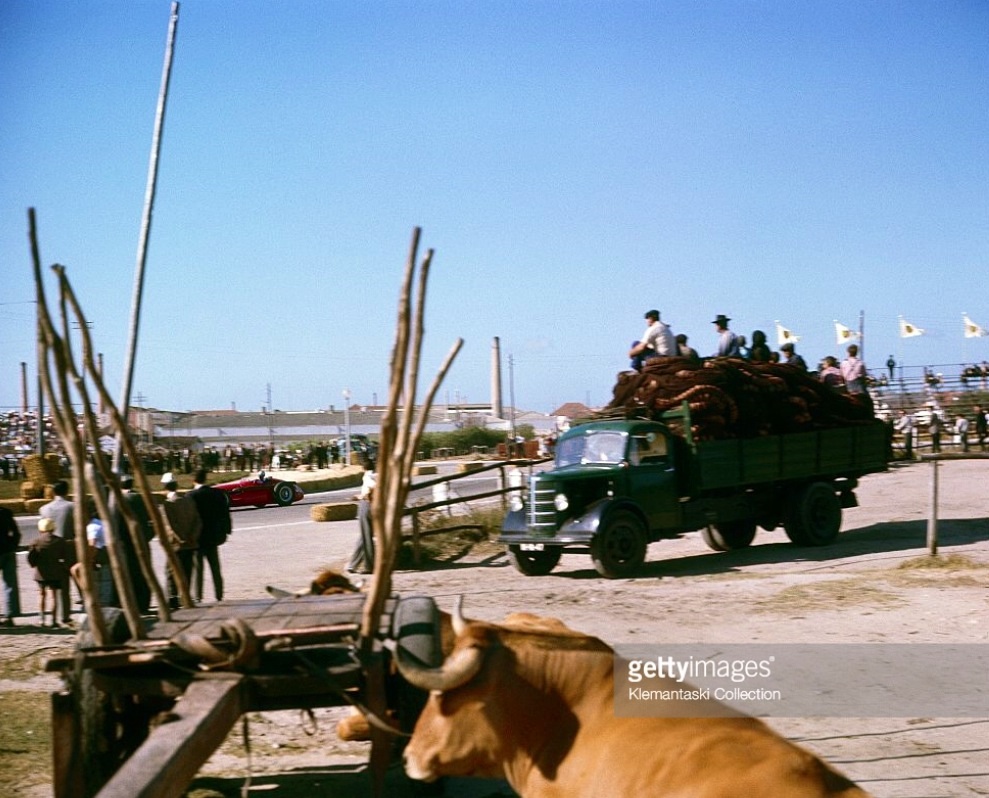
Holden LJ Torana ad-shoot at Sandown Park circa 1972…

The Tommy Torana is of no interest other than that GMH are promoting a mid-spec Torana-Six rather than the huffin’ and puffin’ 202 GTR-XU1, surely one of Australia’s finest all-round touring-car racers on tarmac and dirt?

Two of Bob Jane’s cars form the backdrop- the Tasman Formula Brabham BT36 Waggott 2 litre and McLaren M6B Repco 5 litre ‘740’ V8 sports-racer. John Harvey raced the Brabham and both Harves and Jano shared the one of a kind, Repco powered McLaren- albeit it was with John at the wheel that the car won the 1971 and 1972 Australian Sportscar Championships.

John Harvey, McLaren M6B Repco, Warwick Farm Esses 1972 (oldracephotos)

Both cars are superb jiggers and still extant, the McLaren still in Australia and owned by Bob (ongoing family litigation duly noted). Jane’s taste in racing cars down the decades has been flawless, his machines included but are far from limited to a Maserati 300S, Jag XKD, Jag E Lwt, Elfin Type 100 ‘Mono’ Ford, Brabham BT11A Climax, Elfin 400 Repco, Brabham BT23E Repco, the Rennmax built Jane Repco, Bowin P8 Repco, Ralt RT4 Ford plus twenty or so touring cars/sports sedans the most mouth watering of which were the Shelby built Ford Mustang, John Sheppard built Holden Torana GTR-XU1 Repco and Holden Monaro GTS350 and Pat Purcell constructed Chevy Monza. Lets not forget the Porsche 956 tho it was a lease deal not a car he owned. I’ve lost touch with exactly which cars he retains but I think the scorecard includes the Brabham BT11A, Ralt RT4, McLaren, Monaro and a 635 CSI BMW rings a bell- be great to hear from those who know.

Many other fellas raced these cars other than Jane- the uber successful businessman put way more into racing than he ever extracted- the tabloid family stoushes of recent decades are a sad final chapter in a great mans life.

Sandown old-timers know this bit of real estate rather well. The racers are facing the wrong way in the pitlane, the models are standing more or less on the spot, depending upon your car, that brakes and a downshift or two into second gear would be considered for the ‘Peters’ or ‘Torana’ (depending upon your era) left-hander and then the blast up the back straight.

Harvey again, Brabham BT36 Waggott, into the WF Esses 1972 Tasman round (unattributed)

Etcetera: Bob Jane Racing brochure circa 1971 from Murray Thomas’ Collection…

Credits…

Greg Feltham Collection, Murray Thomas Collection

Tailpiece…

‘When You’re Hot- You’re Hot’ absolutely captured the performance variants of the Torana at the time- the GTR ‘poverty pack’ and ‘ducks-guts’ GTR-XU1. But, at fourteen years old at the time, overall I thought ‘Going Ford Was The Going Thing’! Fords ‘Total Performance’ approach to motor racing globally was intoxicating for a teenaged racing nut- this one anyway!

Finito…