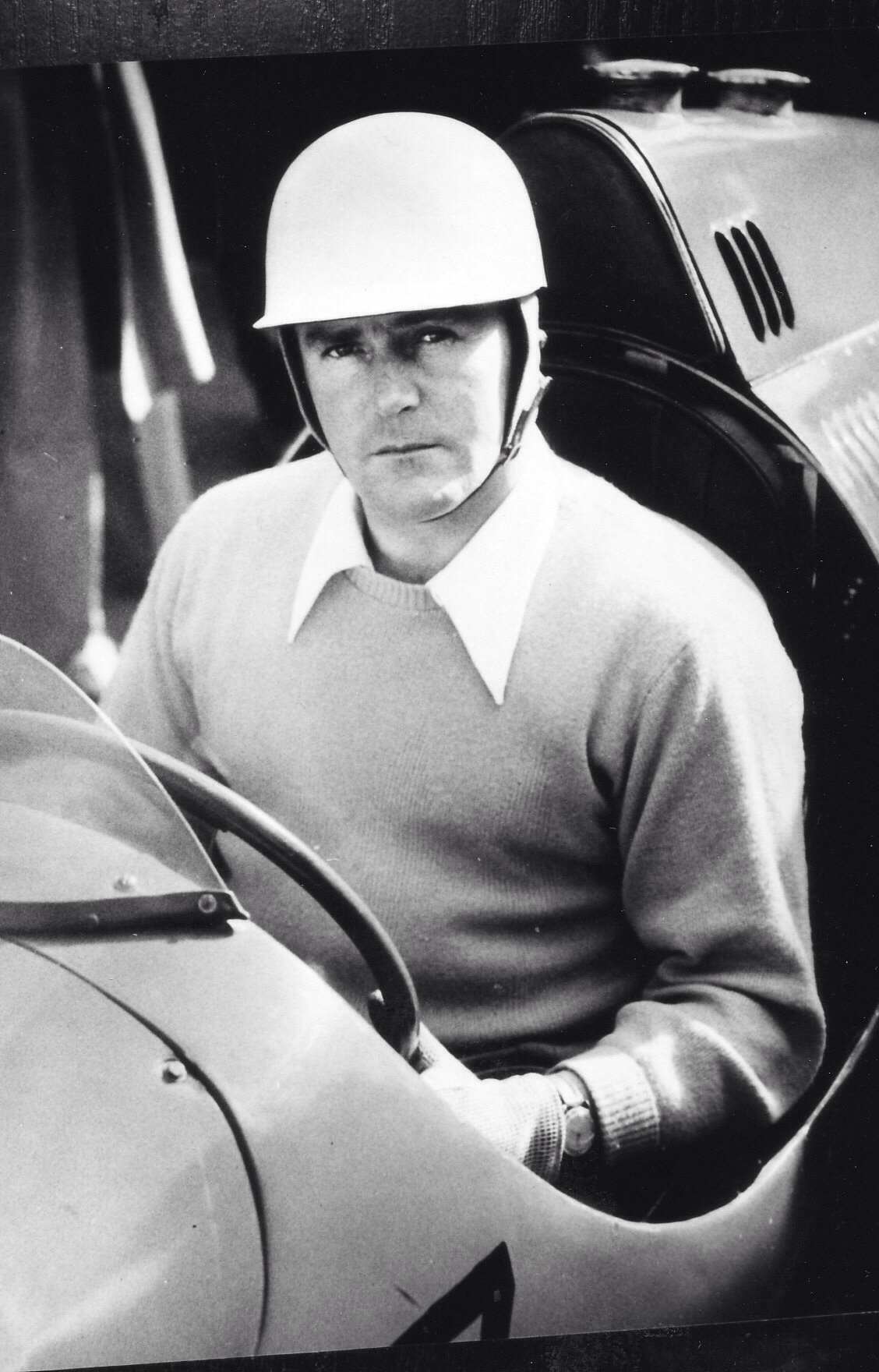
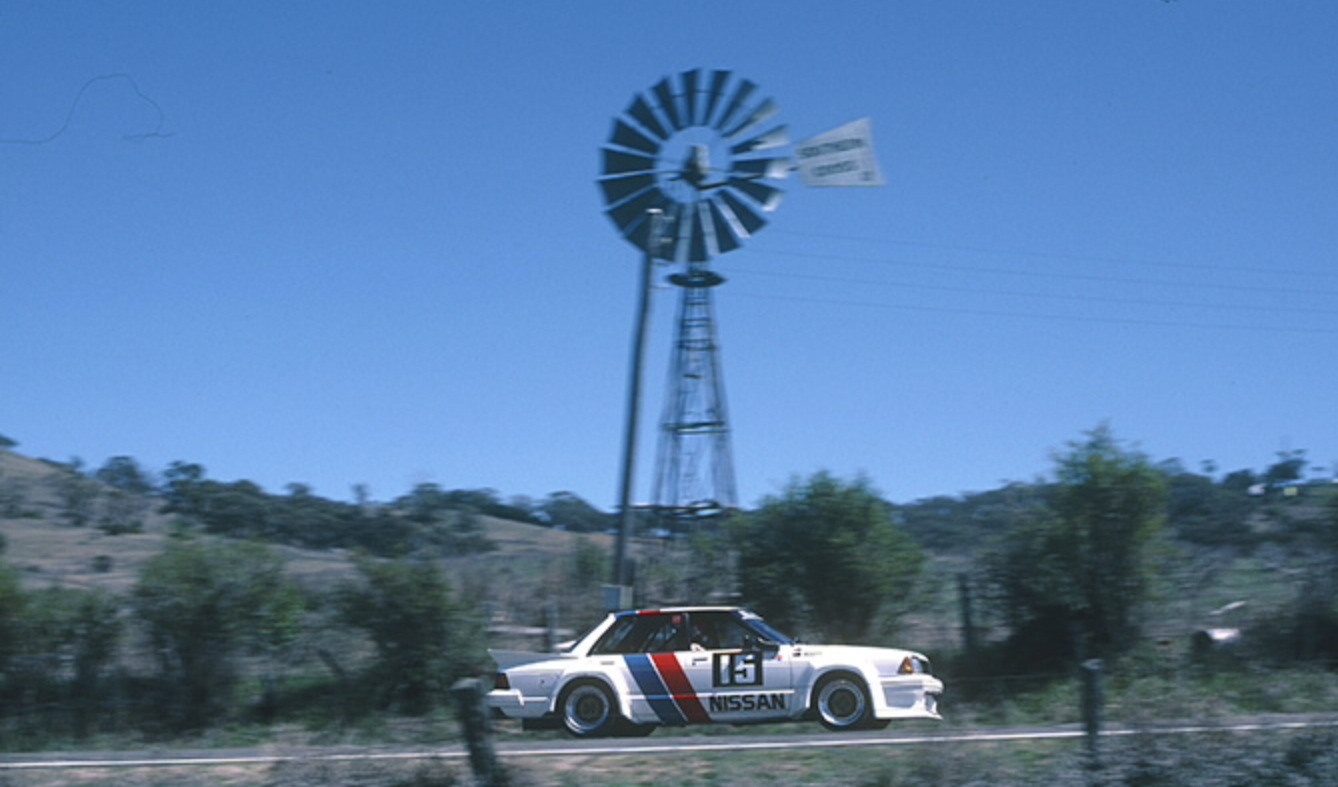
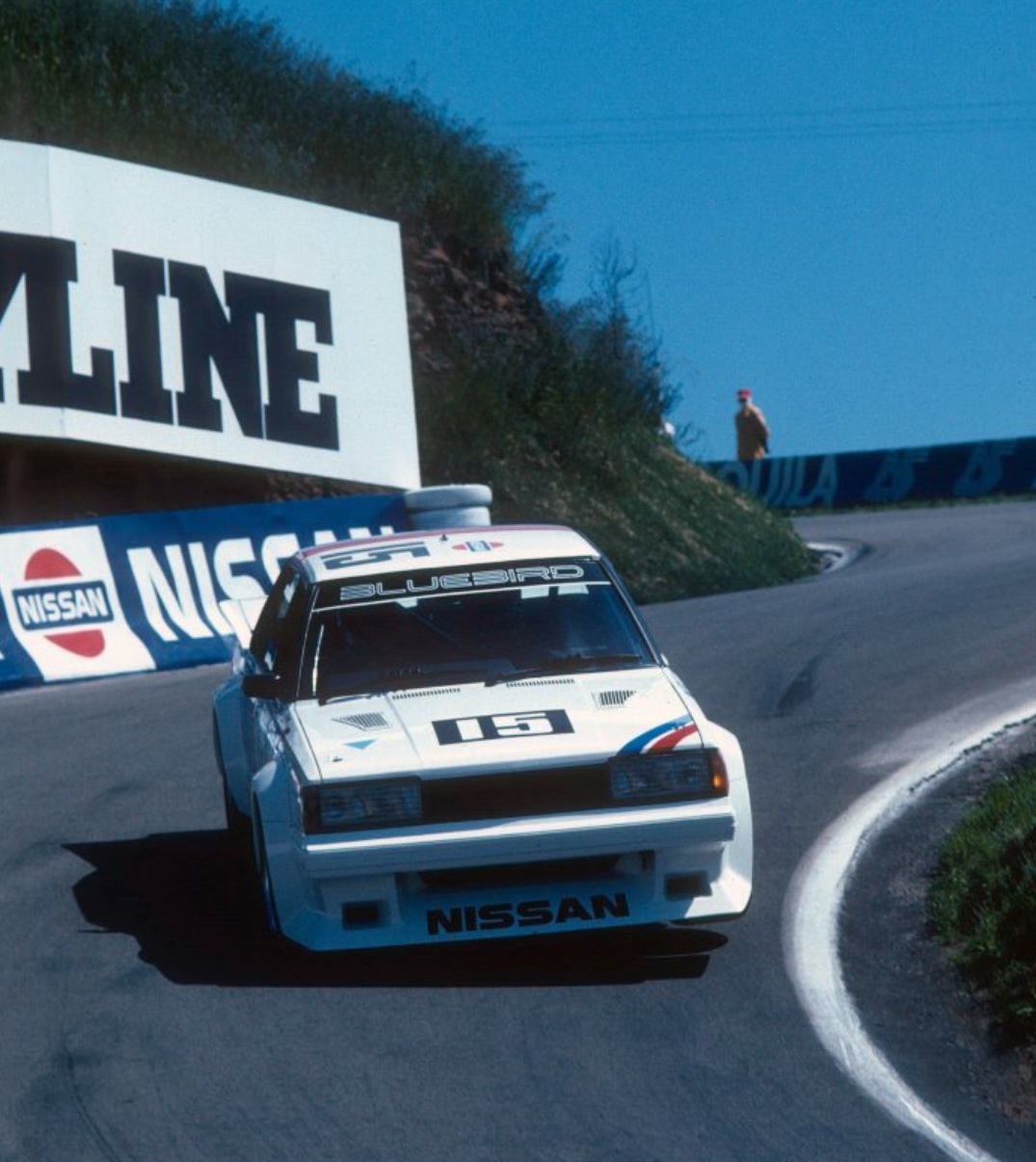
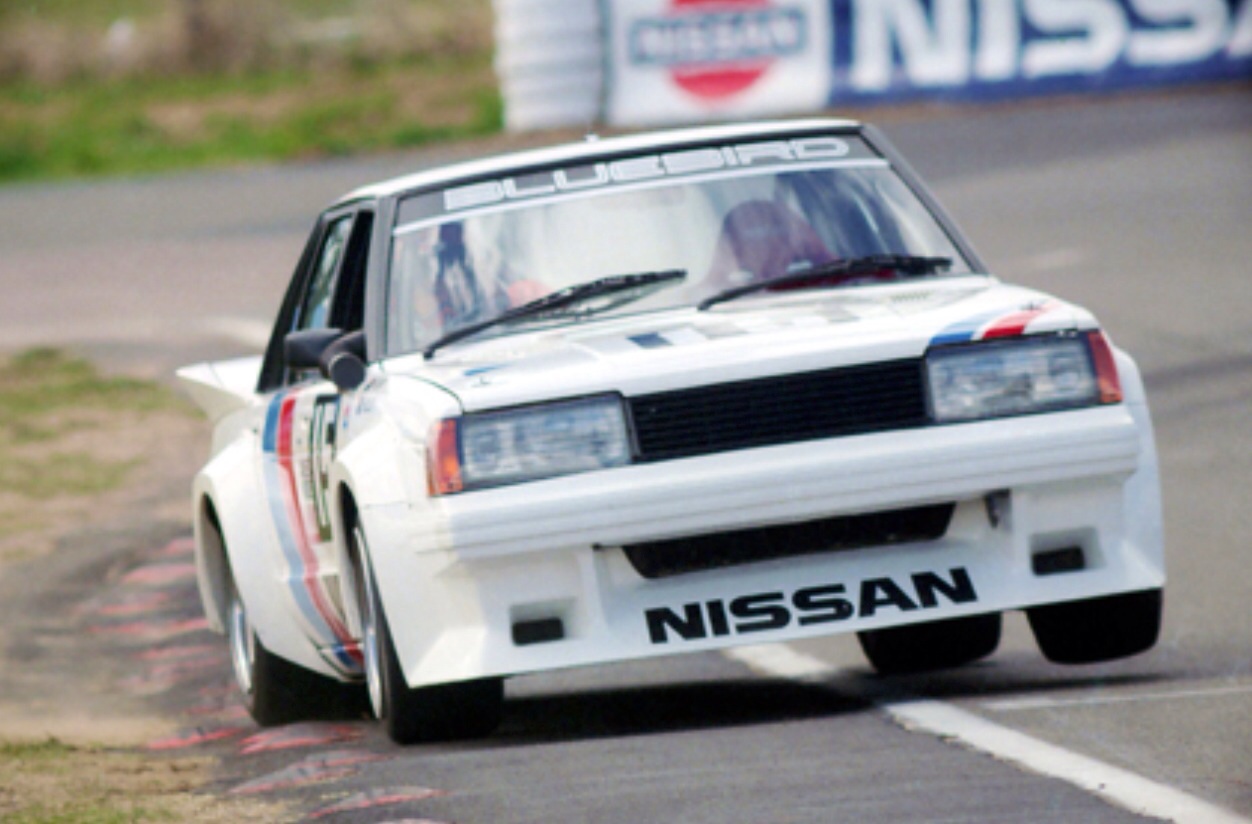
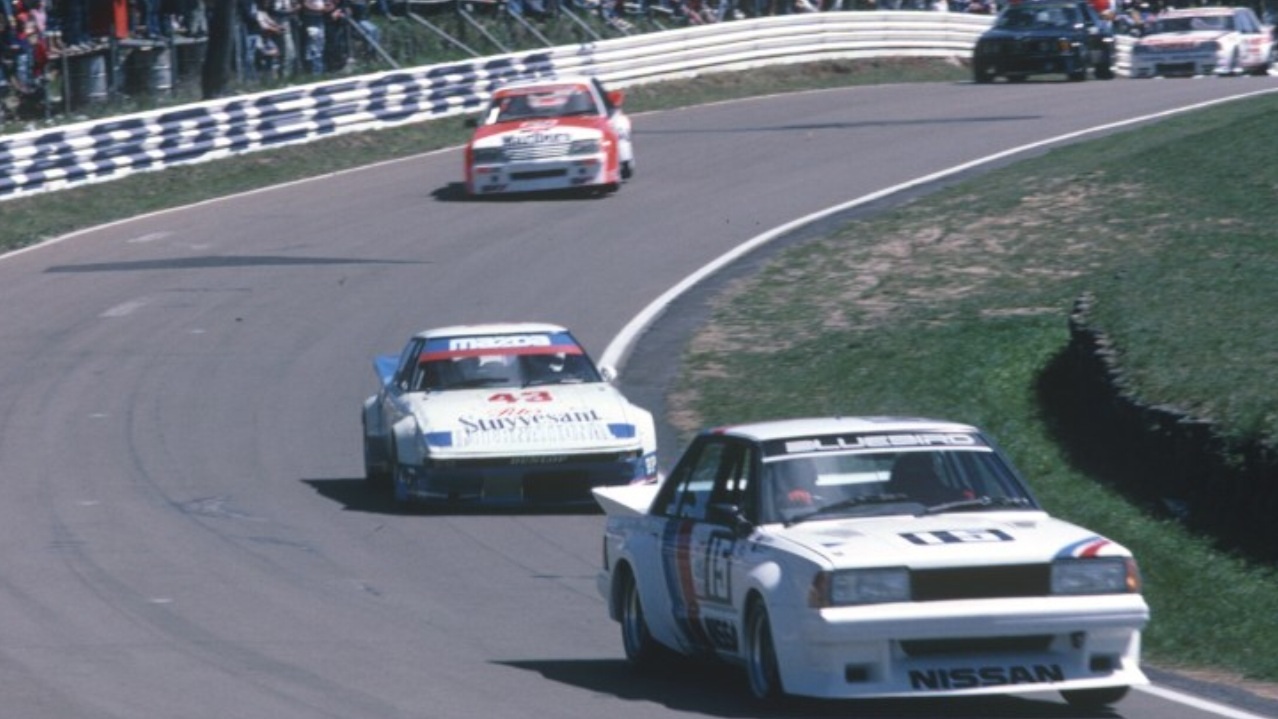
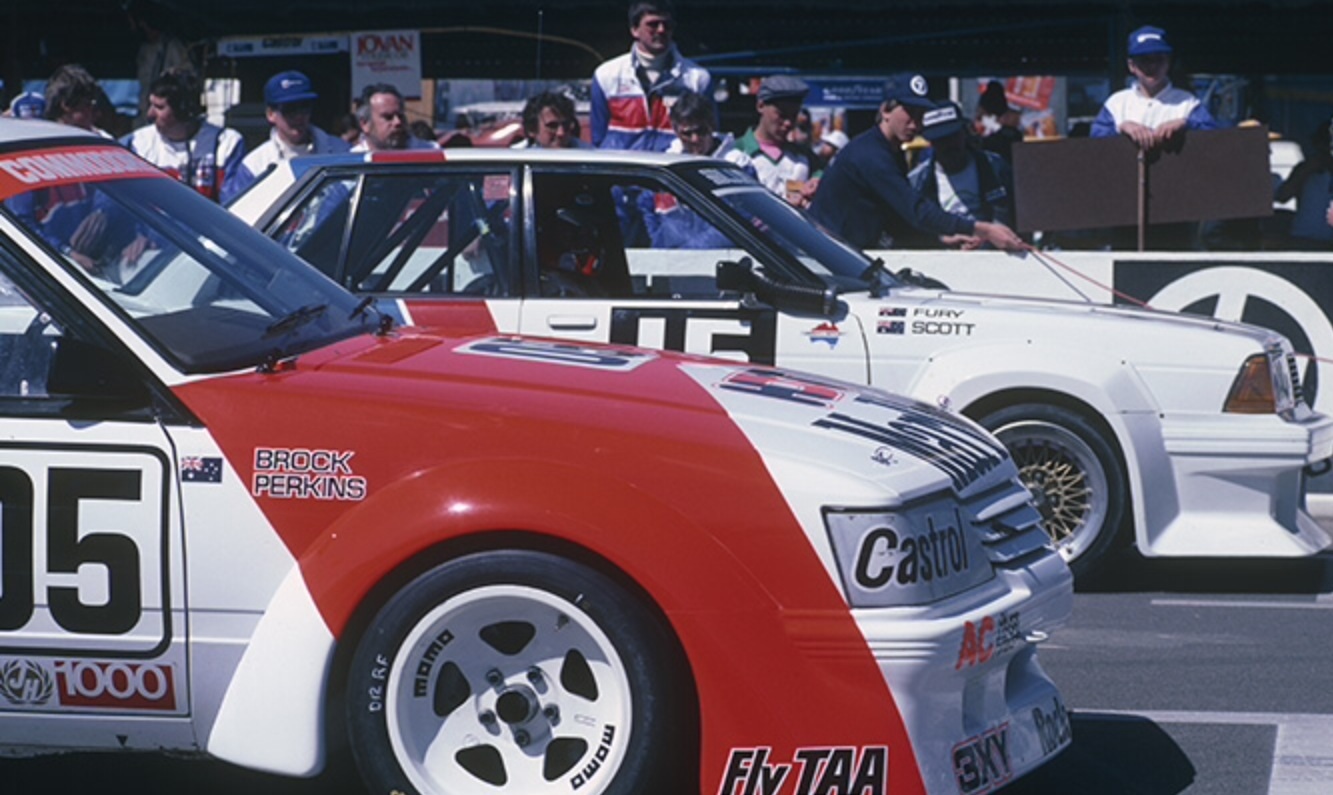
Here Bob Kent allowed Randall Bromfield to do a few practice laps of Baskerville in 1970 aboard his very tidy 1310cc Morris Cooper S, whereupon Randall ‘lost it at the bottom of the hill’.
Bigtime by the look of it.
Clearly Randall had not mastered the complex topography of that particular part of Tasmania to the required degree. The fiscal arrangements between ‘ole Randall and trusting Bob subsequent to this misunderstanding of the laws of physics remains unrecorded but it seems to me The P&O System is an eminently fair and reasonable one in circumstances such as this…
Credits…
All photos oldracephotos.com.au
Tailpiece: Daffy-Ducked ‘innit like?- it will take more than the application of Uri Geller’s talents and polish before the ‘brick is ready for its next meeting…
John Goss’ Tornado Ford leads a gaggle of sportscars on the drop between the Water Tower and The Viaduct, Longford, Saturday 2 March 1968…
I wrote this piece a while back and now seems a good time to post it given one of Tasmania’s finest, Gossy himself was awarded an Order of Australia for services to motor sports in last weekend-and-a-bit’s Queens Birthday Honours announcements. Off the back of that achievement Terry Sullivan started a The Nostalgia Forum thread which now contains some marvellous Goss photos, many from Lindsay Ross’ oldracephotos.com.au archive which have never seen the light of day before- check TNF out;
Back to Longford- it’s the Saturday race day, the Monday Labour Day holiday was Tasman Cup day, that year the feature race was won by Piers Courage’ McLaren M4A FVA F2 car in a notoriously wet, perilous day of motor-racing. Sadly it was the last in Longford’s relatively short but very sweet period as a road racing track. Click here for my article on the 1968 Longford Tasman;
Goss, future Bathurst and Australian Grand Prix winner is leading Kerry Cox’s Paramount Jaguar, three-times Australian Grand Prix winner Doug Whiteford’s works Datsun Fairlady, Bert Howard’s Lola Mk1 Climax, the partially obscured Lotus 23 Ford of Alan Ling and then Peter Mawdesley in a Lotus Super 7. Out front out of shot is the ex-works Scuderia Veloce Ferrari P4/350 Can Am driven by Chris Amon from Ian Cook’s Bob Jane Racing Elfin 400 Repco, Peter Macrow in the Argo Chev, Lionel Ayers MRC Ford and Glynn Scott’s Lotus 23 Ford. The opening shot shown is the second group of cars.
I wrote an article a while back about John Goss including a bit on the Tornado, click on the link to read it;
The following shot is of Gossy losing Tornado on his turn-in to The Viaduct, I wonder if its the same lap! I think not, the track looks wet, which makes it the Monday. Amon’s Ferrari was pushed off the grid with a flat battery- he started the 10 lapper with 2 laps down and finished third- and did 178 mph in the wet conditions on The Flying Mile. Peter Macrow won in Tony Osborne’s Argo Chev from Glynn Scott’s Lotus 23 Ford.
(oldracephotos/DKeep)
Credits…
David Keep/oldracephotos.com, Lindsay Ross Collection, Rob Bartholomaeus
Etcetera: Autosportsman article on the Tornado Ford, courtesy Lindsay Ross’ Collection…
Tailpiece: Amon’s 480bhp Ferrari P4/Can-Am 350 monstering Gossy’s 200bhp Tornado Ford out of Newry, Longford 1968…
(oldracephotos/DKeep)
During the dry Sports Car Scratch race on the Saturday Chris won from Ian Cook in Bob Jane’s Elfin 400 Repco V8 and Peter Macrow in the Argo Chev.
Amon, awfully comfortable in the P4/CanAm 350- in addition to his Ferrari F1 commitments he raced the cars in both the 1967 endurance races and some Can Am rounds, set an all-time Longford lap record of 2:16.2 undercutting Jim Clark’s Lotus 49 Ford DFW time of 2:13.0 earlier in the day. Mighty quick. Mind you, that summer Frank Matich beat Chris’ Ferrari in the Matich SR3 Repco in the other Australian Tasman round sportscar support events. But FM did not cross Bass Straight to do Longford- sad! Those battles on that circuit would really have been something to see!
Graham Hill with his new Doppelganger, London, 10 October 1968…
With him is Austrian actress Loni Von Friedl who appeared in ‘Doppelganger’, a movie which is the subject of this promotion, an activity which seems quite agreeable to the great Brit. The car, also a movie-star was ‘designed and built by Alan Mann Racing, has a Ford engine and chassis, is 44 inches high and is capable of 144 mph’.
The film, also called ‘Journey To The Far Side Of The Sun’ in some countries has a screenplay written by Gerry and Sylivia Anderson of ‘Thunderbirds’ and other 1960’s ‘Supermarionation’ puppet TV series fame- well known to those of us of a particular generation.
Set one-hundred years into the future, the film is about a joint European-NASA mission to investigate a planet in a parallel position to Earth and ends in disaster with the death of one of the astronauts- his colleague discovers that the planet is a mirror image of earth. Click here for some more detailed information about the movie which first screened in 1969; https://www.imdb.com/title/tt0064519/
Who gives a rats about the movie for most of us! As to the car, I can find out a little bit, Alan Mann Racing has a great website but the car does not rate a mention there so I am intrigued to know more about the detailed design.
It seems the styling of the futuristic car (three were built for the film) was the work of Derek Meddings, the machines were ‘redressed slightly’ for a subsequent movie named ‘UFO’. The donor chassis was a Ford Zodiac Mk4 with the shapely aluminium body draped thereon. The gull-wing doors did not actually work, someone such as Hill G, or off camera during the movie was required to support a door.
‘The actors reported that the cars were very unpleasant to drive in, as there was not enough headroom, engine exhaust fumes spilled into the interior…and the cars were not fast, so many scenes were sped up to simulate a fast-moving vehicle’. The bones of the car still exist and will no doubt make an interesting curio at race/concours meetings when completed.
Photo and Other Credits…
PA Images/Joe Bangay Getty, projectswordtoys.BlogSpot.com
Tailpiece: Another of Doppelganger’s cars, Loni and a bloke…
One of the wonderful things about the internet is the constant appearance of material on every topic, in this case a nice batch of photos popped onto it by ‘The Adelaide Advertiser’, here they are, too good not to share.
To celebrate Campbell’s achievement the people of Adelaide turned out in droves- about 200,000 flooded the streets of the small city on 25 July to see and hear Bluebird drive up King William Street to the Adelaide Town Hall. Mind you, ‘Beatle-Mania’ hit Adelaide five weeks before when 300,000 fans of the worlds greatest supergroup flooded into the capital.
Campbell also set the World Water Speed Record in 1964, achieving 276.3 mph at Lake Dumbleyung near Perth in Bluebird K7.
Vic Elford leans his machine gun on moustachioed teammate Lucien Bianchi’s, winged Cooper T86B BRM in search of a Messerschmitt BF109, Nurburgring 1968…
This is a pretty canny bit of impromptu PR by the Cooper boys at the height (sic) of the hi-wings explosion that summer in Grand Prix racing. That trend was all over pretty quickly due to the flimsy engineering of some of the appendages, that story covered by an article I wrote a while back; https://primotipo.com/2015/07/12/wings-clipped-lotus-49-monaco-grand-prix-1969/
Cooper’s built three T86B chassis for the 1968 season by adapting the 1967 Maserati V12 engined T86 design to accept BRM’s sportscar derived customer P101 V12 first used by Bruce McLaren during the later half of the 1967 season in the back of his McLaren M5A.
Cooper T86B- aluminium/electron monocoque chassis, front suspension by top rockers, lower wishbones and inboard mounted coil spring/dampers, rear suspension by single top link, inverted lower wishbones, twin radius rods and coil spring dampers, adjustable roll bars front and rear. Outboard disc brakes front and rear, Cooper steering rack. BRM P101 2998 cc DOHC, 2 valve, Lucas injected 60 degree circa 375 bhp V12, Hewland DG300 5 speed transaxle (Bill Bennett)
The heavy, relatively lower (a Cosworth DFV punched out about 410bhp at the time) powered machines were raced initially by Brian Redman and Ludovico Scarfiotti, who was tragically killed at Rossfeld Hillclimb over the June Spa weekend. He was replaced by Lucien Bianchi, who had an amazing year in sportscars, rally machines and in single-seaters. Click here for an article in part about Lucien; https://primotipo.com/2016/03/22/cowans-grunter/
Quick Vic got the steer after Brian Redman was badly injured at Spa when his suspension failed, the car then crashed into and over a concrete barrier, his progress arrested by a parked Ford Cortina- he escaped with a broken arm and minor burns but was out of racing for a bit. Johnny Servoz-Gavin and Robin Widdows had one-off drives. Best results for the cars were thirds for Redman in Spain and Bianchi at Monaco, whilst fourth places were scored by Scarfiotti in Spain and Monaco and by Elford in France.
German GP start, gloomy to say the least! Denny Hulme’s McLaren M7A Ford in shot, to his left and forward is John Surtees Honda RA302 with Elford’s Cooper to John’s front left. Up front are Ickx and Amon’s Ferrari 312’s, Hill is to Elford’s right in the hi-winged Lotus 49 and a slow starting Stewart, Matra MS10 in front of Hulme (PH Cahier)
Vic popped his Cooper on grid 5 at the Nurburgring but left the road on the first lap of the famously wet and treacherous race won by Jackie Stewart’s Dunlop shod Matra MS10 Ford. He won by four minutes from Graham Hill’s Firestone shod Lotus 49B Ford and Jochen Rindt’s Goodyear tyred Brabham BT26 Repco a further six seconds back. Stewart was magic that day aided by some schmick, trick Dunlop wets- one of his greatest drives in the minds of many including the great man himself.
JYS during his soggy, stunning run, Matra MS10 Ford (R Schlegelmilch)
Love this post by Australian racer/enthusiast Ed Holly on Facebook the other day. He happily reported he still has the record but not the turntable upon which to play it…
The Spotify (you can’t beat it mind you) generation really struggle with records and turntables, mind you vinyl is staging a comeback of sorts.
Didn’t we all have Scalextric sets or a mate who had one? The image gave me all kinds of happy flashbacks. School holidays in the sixties were a blur of train sets, slot cars, a Yogi Bear or Flipper movie with mum at Balwyn Cinema (Melbourne, Victoria, Australia) with WH Lowe’s Ferrari showroom opposite in Whitehorse Road to drool over, choc-top ice cream in hand afterwards- and billy-cart manufacture of course.
Ken Holt, the Caltex Servo owner at Greythorn never did crack the shits no matter how many ball-bearings me ‘an me mates cadged in our quest for ultimate, super steep Fintonia Street speed.
Pram wheels at the front and ball bearings at ze rear was the gun setup which provided speed, plenty of front end bite and bulk oversteer of which Kevin Bartlett would have been proud.
After a couple of hours of that it was time to go inside, sort the brushes on the Chaparral and go Scalextric racing- I never did have that record mind you…
Credits…
Ed Holly, Getty Images
Tailpiece: Christmas shopping 1968- that could be mine…
The covers of some old magazines are amazing aren’t they!?…
Rob Bartholomaeus, one of our friends in South Australia sent me this ‘Motor Manual’ 1950-51 Year Book to assist in the research of the Derek Jolly article I wrote not so long ago.
This magazine lasted well into the 1970’s, to me it was always a distant third behind the two Australian road car monthlies- ‘Wheels’ and ‘Modern Motor’ both of which survive today, the latter title became simply ‘Motor’ in 1992. These yearbooks are research gold now. Mind you Rob and I can make no sense of the painted cover in terms of the cars and places represented, perhaps the blue car has a bit of Maserati 4CL about it- I like it all the same!
The content of the ‘Tailpiece’ is different though- and a beauty it is too from Brian Caldersmith’s collection. It is MM’s Yearbook Number 6 of the 1955 season. The top image is Reg Hunt’s Maserati A6GCM, arguably the dominant car of the season if not the AGP winner. The bottom photo is an Albert Park grid front row with the nose of Kevin Neal’s ex-Hunt Cooper T23 Bristol alongside Doug Whiteford’s blue Talbot-Lago T26C and Hunt’s A6GCM at right.
‘The new Balilla, for everyone, women’s elegance’.
The Balilla was a 1 litre, 4 cylinder, 4 seater built at the Lingotto plant and also assembled in Poland, Germany and France from 1932-37. With a 3 speed ‘box, the car did around 50mph. Not normally primotipo material but the ad caught my eye!
Fiats on test at the famous, iconic Lingotto, Turin factory (Getty)
I love the way so many of the individual components of a racing car look…
The functional beauty and engineering artistry, let alone the fabrication, casting and welding of bits and pieces never fail to satisfy ones eye.
Schlegelilch’s shot is an incredibly tight crop of the gauze covered Lucas fuel injection trumpets atop one of the Ford Cosworth DFV’s at the 1971 French Grand Prix, Le Castellet on 4 July 1971.
Jackie Stewart won the race in a DFV powered Tyrrell 003, it may be his engine but Rainer isn’t saying to which chassis this engine was attached…
Jackie Stewart before the off at Paul Ricard, French GP 1971, Tyrrell 003 Ford (Cahier)
Brian Redman’s Carl Haas Racing Lola T332CS Chev awaits the off at Mont-Tremblant, Quebec, Canada 12 June 1977…
That’s Jim Hall in the Texan hat and you can just see a glimpse of Brian’s driving suit to the far left of the photo. Randy Lewis’ Shadow in front of the Lola I think. Redman was the ‘King of 5 Litre Racing’ in the US having won the American F5000 championship from 1974 to 1976 aboard Lolas- T332, T332/400 and T332C respectively.
When I first spotted Bob Harmeyer’s photo, I thought, ‘what a beauty, I can do something with that pit scene’. Then I looked a bit closer at the date and venue and realised it was the weekend Brian came close to meeting his maker-it was not the only ‘biggie’ in his career either.
Its the very first race meeting of the single-seat 5 litre Can Am formula- Brian and his Lola are about to indulge in some involuntary aviation, the landing sub-optimal in comparison to takeoff.
Carl Haas in the blue shirt and Brian Redman (who is the other Shadow bloke?) in the Mid-Ohio pits, August 1975. #1 is Brian’s T332 HU45, #48 Vern Schuppan’s Eagle 755 Chev. Brian won from Al Unser and David Hobbs aboard T332s, Vern was fifth (unattributed)
With F5000 on the wane a bit, in part due to the dominance of the Lola T330/332, it was decided to spruce up the show by creating a single-seat Can Am series for 5-litre cars- in essence F5000 in drag.
Gordon Kirby wrote about that first single-seat Can Am season in the June 2010 issue of MotorSport- ‘The death of the old Can-Am left the Sports Car Club of America (SCCA) with Formula 5000 as its primary series. For a few years the American F5000 championship was pretty healthy, attracting big fields and top drivers like Mario Andretti, Al Unser Sr, Jody Scheckter and Brian Redman, who won the title for three consecutive seasons in Carl Haas and Jim Hall’s Lola-Chevrolets. But the SCCA and its promoters longed for the return of full-bodied Can-Am cars.
Burdie Martin ran the SCCA’s professional racing department in those days and says the series wouldn’t have come together had it not been for Haas. “Carl had sponsorship for his team from First National City Bank,” says Martin. “But he also talked them into sponsoring the series and, of course, thanks to Eric Broadley and Lola he provided the cars to make it happen. I talked to Carl and said we could make these 5000s into closed-wheel cars and call it Can-Am. I said it wouldn’t cost a lot of money and the cars were out there. We could add the 2-litre cars because there’s a lot of them around and they’re not that much slower. That would fill out the field. So Carl and I got on the phone and called some people, and all of a sudden we were putting a programme together.’
Peter Gethin’s Team VDS Lola T333CS HU2 with standard Lola bodywork…with the front wing added by the team, see text below
‘The SCCA’s last-minute decision to replace F5000 with the closed-wheel, single-seat ‘new era’ Can-Am didn’t inspire much confidence, or interest, from the racing industry. All the uncertainty surrounding the new series meant few teams were ready for the start of the 1977 season. In fact, Haas/Hall was the only Can-Am team able to do any serious pre-season testing and it quickly learned that the new nose for the enclosed wheels didn’t produce enough downforce. The team designed and built its own replacement, which incorporated an F5000 nose in place of the flat, cow-catcher nose of Lola’s T333CS ‘conversion kit’. The result was a car that looked more like an F5000 car with fenders rather than a sports/racer’.
Redman aboard his T332CS- note comments above in relation to the cars body/aero compared with the standard Lola body kit on Peter Gethin’s car above (Harmeyer)
‘Most Lola customers had installed the conversion kit on their F5000s and were pretty upset when Haas/Hall rolled out its unique car in first practice for the opening Can-Am race at St Jovite in Quebec’s Laurentian Mountains. But it soon turned out that in some circumstances even the Haas/Hall aerodynamic package wasn’t up to the job.
In the middle of St Jovite’s backstraight was a humpbacked rise over which the Can-Am cars of Paul Hawkins and Hugh Dibley had taken flight in 1966. Ditto Jackie Oliver in 1970. In afternoon practice Elliott Forbes-Robinson became the first driver to fly a new-era Can-Am car through the air when his flipped as he tried to go over the hump on full throttle. Miraculously, the car cartwheeled through 360 degrees and landed upright on all four wheels. Forbes-Robinson jumped unscathed from the wreckage.
Later that day Brian Redman had a much more serious accident. Redman’s car did a violent backflip, landing upside-down and leaving him unconscious and in a critical condition with a broken left collarbone, a cracked sternum, two broken ribs and a fractured vertebra in his neck. Redman lay heavily sedated in hospital for a week while the swelling and contracting of his brain’s epidermis ran its course and his doctors assessed the damage to his brain and nervous system.’
Harmeyer’s shot of Redman’s car back in the paddock. The Lola aluminium monocoque has stood up to the impact remarkably well, look closely tho- the roll over hoop is gone, torn off/flattened in the huge physics upon landing. Redman a very lucky boy (B Harmeyer)
‘Deeply shaken by Redman’s accident, the Haas/Hall team withdrew from the race and headed home. With the three-time F5000 champion in hospital, a makeshift chicane was installed before the backstraight hump.’
Redman recalled that ‘…the roll bar broke and my head went down on the road. My helmet was worn away on each side. But as the car rolled off the track onto the surrounding land, it landed on its wheels, which was a good job. Because my heart had stopped and the track doctor was a heart specialist- he got that going again. And then on the way to the hospital the ambulance blew a tyre!’
Tom Klausler in the Schkee DB1 Chev at Road America in August. Truly wild coupe like so many cars in this series Lola T332 based (oldracingcars.com)
The Mont Tremblant race was run in half wet, half dry conditions and was won Formula Atlantic standout Tom Klausler driving the unique Schkee coupé, a quite sensational looking Lola-based car built by veteran Can-Am builder Bob McKee. Unfortunately the little team didn’t have the money to race or develop the car and ceased to exist by the seasons end.
Haas/Hall missed the next race at Laguna Seca whilst they looked after Brian’s needs and sought another driver to replace their pilot of the previous near half-decade.
Brian in the Mont Tremblant pitlane, not sure of the chassis number of his T332CS. Randy Lewis Shadow DN4B Dodge # 00 alongside. The car behind the Shadow looks like a T332CS with ‘standard Lola body’ but am not sure which car (B Harmeyer)
During practice in California there were more problems with ‘Cessna 180’s as Aussie F5000 ace, Warwick Brown’s VDS Lola T333CS took off going over the fast brow beyond the pits.
Brown- already a ‘Lola Limper Club’ member by virtue of a T300 F5000 accident at Surfers Paradise in early 1973 broke both legs in the big accident. Teammate Peter Gethin, a vastly experienced driver with an Italian Grand Prix victory amongst his many credits withdrew from the race until a proper solution could be found. Clearly the aero treatment was ‘unresolved’, as the lawyers would put it.
Tambay in the Haas Lola T333CS Chev ‘HU6’ on the way to a win at Mosport on 21 August 1977 (B Cahier)
Kirby- ‘Haas signed up-and-coming French driver Patrick Tambay to replace Redman. A smooth, fluid driver and a gentleman too, Tambay won six of the seven Can-Am races he started in 1977, all from pole, and easily claimed the championship. “I was also doing my rookie F1 season with Ensign, so I had a lot of miles under my belt that year, not only aeroplane miles but driving miles,” he recalls. “The Can-Am car had a lot of power, gave good grip and was a good tool to do mileage to make me sharp for my F1 ride. My Can-Am successes helped me build a strong confidence.”
Back to Brian. As we all know Redman was a racers-racer with several successful comebacks- that he did in 1981 driving a Lola T600 Chev. The Cooke-Woods run car won the IMSA GTP championship on top of the 24 Hours of Daytona, a classic Brian won at the seasons outset together with Bobby Rahal and Bob Garretson in a Porsche 935 K3.
The Redman/Sam Posey Lola T600 Chev during the Road America 500 miles in 1981, 2nd (M Windecker)
Credits…
Bob Harmeyer, Bernard Cahier, Getty Images, oldracingcars.com, Mark Windecker, MotorSport magazine article by Gordon Kirby 2010