
‘Pascal’ dreams of Grand Prix success, shot on 1 February 1956 in front of the Arc de Triomphe du Carrousel in the Place du Carrousel, Paris…
It gave me a chuckle! I wonder who has that little car now?

Credit…
Jerry Cooke
 | Peter Finlay on Harry Galloway’s Racing… |
 | bobmorrowfc478be528 on Harry Galloway’s Racing… |
| Peter Finlay on Harry Galloway’s Racing… |
 | markbisset on Photography : Stephen Fry… |
 | Rob on Photography : Stephen Fry… |
‘Pascal’ dreams of Grand Prix success, shot on 1 February 1956 in front of the Arc de Triomphe du Carrousel in the Place du Carrousel, Paris…
It gave me a chuckle! I wonder who has that little car now?
Credit…
Jerry Cooke
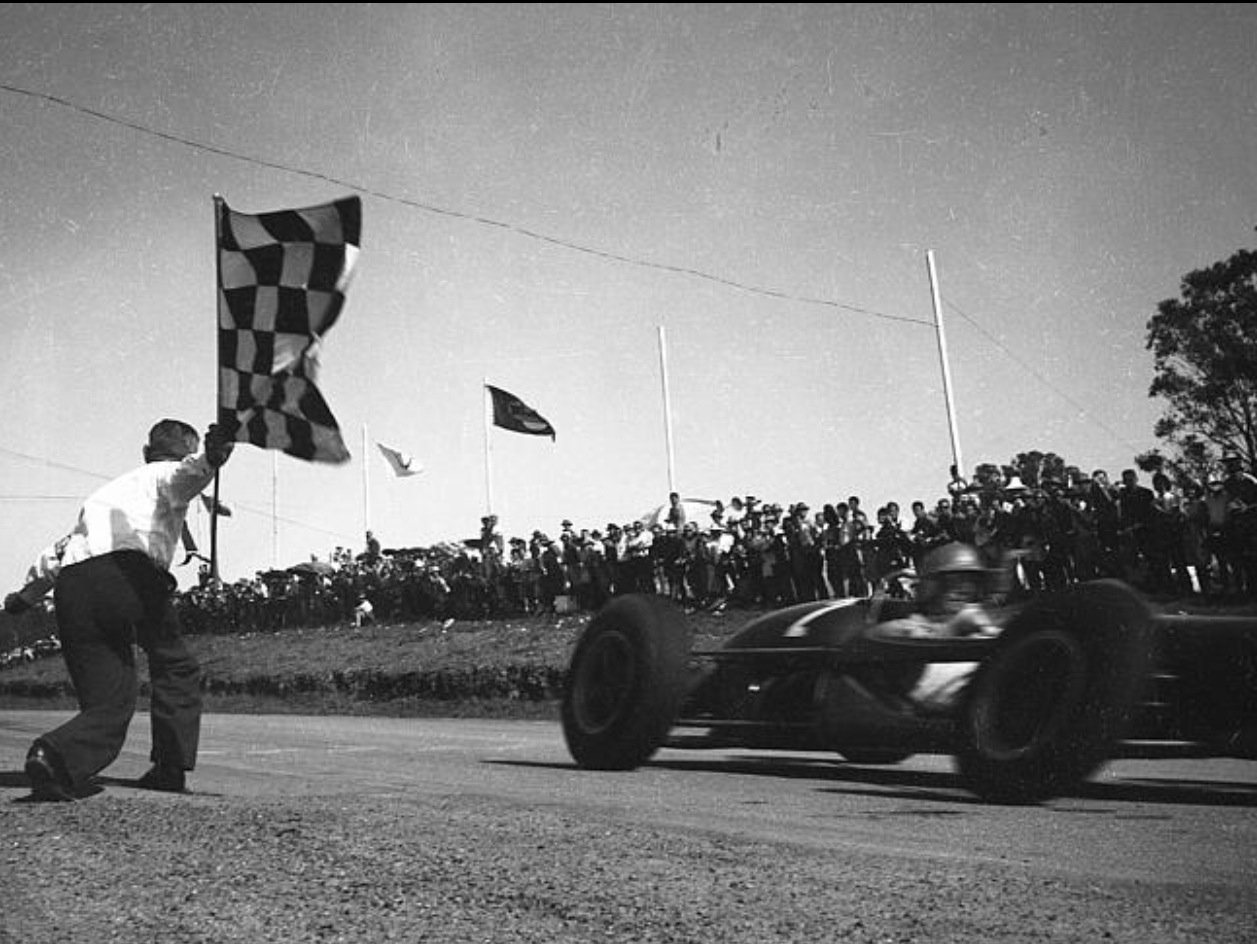
(News Ltd)
Jack Brabham’s ‘go-kart’ wins the ‘Lakeside 99’ Tasman Round in February 1964…
The photographer has created a ‘turn of the century’ distorted effect, the Brabham BT7A Climax looks quite weird , the off-beat nature of the shot enhanced by the cars lack of bodywork to try and deal with the harsh, summer Queensland heat.
Brabham won the race from John Youl’s Cooper T55 Climax, Jacks ’61 F1 and ’62 Australian Internationals chassis and Bruce Mclaren’s Cooper T70 Climax.

Brabham exits the Lakeside pitlane onto the hot, steamy circuit (Peter Mellor/The Roaring Season)
By the looks of these Peter Mellor shots the lead up to the race was wet, the tropical humidity would have made the race a real endurance test.
Bruce McLaren won the first Tasman Series, with both he and Jack taking 3 wins, appropriately Bruce’s in NZ and Jack’s in Oz!

Brabham portrait Lakeside 1964 (Peter Mellor/The Roaring Season)

Brabham BT7A Climax 2.5 FPF (Peter Mellor Collection)
Photo Credits…
News Ltd, Peter Mellor Collection/The Roaring Season
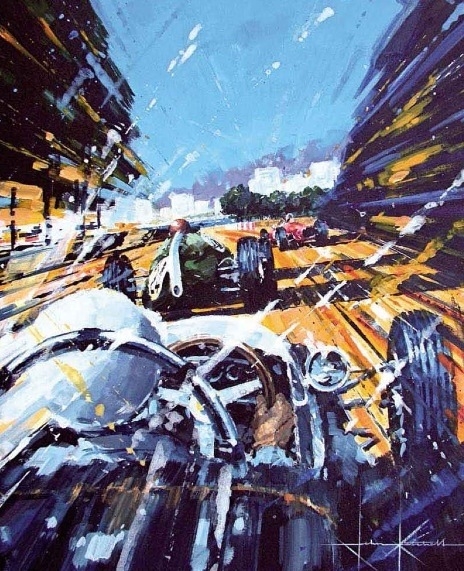
A famous win for Moss, Rob Walker and the Lotus 18 Climax…
1961 was the first year of the 1.5 litre F1; Ferrari were dominant with their powerful 156’s, the little V6 was the most potent engine, the chassis not a patch on the best of the Brits but overall the Scuderia had a great year.
However, the mastery of Moss prevailed several times during 1961. The first of these performances in his lithe, nimble 1.5 Coventry Climax Mk2 engined Lotus 18 is portrayed in the season opening event by John Ketchell’s art.
The great cockpit view shows Moss chasing Jack Brabham’s Cooper T55 Climax and Richie Ginther’s Ferrari 156.
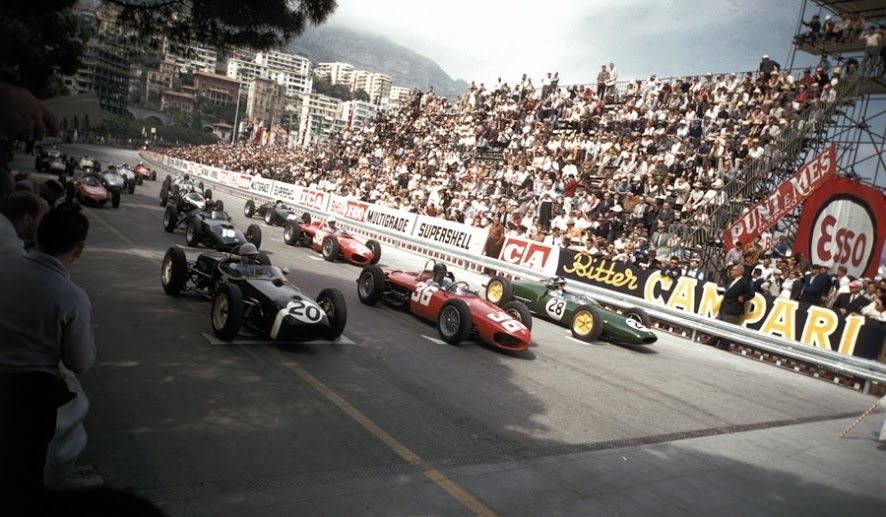
Grid shot: #20Moss Lotus 18 Climax, #36 Ginther’s Ferrari 156 and #28 Clark Lotus 20 Climax front row. Gurney’s Porsche 718 and Phil Hill’s Ferrari 156 on row 2 (unattributed)

Hill’s Ferrari, Clark outside #28 , Moss inside with the missing bodywork, #16 Tony Brooks BRM P48/57 Climax#36 Ginther and the silver nose of Gurney’s Porsche 718 (GP Library)
Credit…
John Ketchell, GP Library
Tailpiece: Maestro Moss…
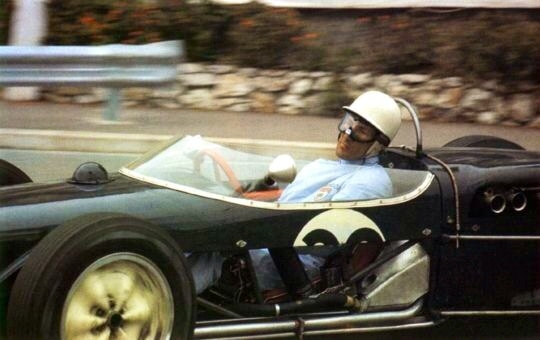
Moss Mastery; totally relaxed as he gets every bit of performance out of the chassis of his year old Rob Walker owned Lotus 18; works drivers Clark and Ireland are in the new Lotus 20. Side bodywork removed to provide cooling air on the hot May day. Moss won Lotus’ first championship GP win with this victory (Geoff Goddard)

(Daniel Kalisz)
Shane van Gisbergen’s winning McLaren 650S GT3 dives into The Esses during its victorious run on 6/7 February 2016…
The McLaren won the Bathurst 12 Hour endurance race held at the classic Mount Panorama circuit last weekend from the Chiyo/Kelly/Strauss Nissan GT-R GT3 and Bell/Karel/Smith Bentley Continental GT3. The McLaren won the race by 1.2 seconds, the Nissan the 2015 defending champion.

Florian Strauss in the 2nd placed Nissan GT-R ahead of the 3rd placed Bentley Continental GT3, Griffins Bend. The bucolic beauty of Bathurst and elevation of Mount Panorama clear in this shot looking down Mountain Straight (Daniel Kalisz)
The event was first held in 1991 and has evolved from a competition between ‘Series Production’ cars to an international race comprising GT3 (Class A) GT3 Porsche Cup Cars (Class B) GT4 (Class C) and Invitational. This year the race was the first round of the ‘Intercontinental GT Challenge’ which includes the Sepang 12 Hours and Spa 24 Hours and is sanctioned/organised by the Stephane Patel Organisation.
37000 punters drove to Bathurst, a magnificent 1850’s ‘Gold Rush’ era town in NSW’s Central Tablelands 200 Km from Sydney (the October V8 Supercar Classic achieves 200000 folks over 4 days) to see an interesting variety of cars race from Saturday evening to Sunday morning.

Top left Klark Quinn McLaren 650S, top right and bottom Shane van Gisbergen McLaren 650S (Daniel Kalisz)
The field included a strong entry of V8 Supercar drivers and Internationals including Marcus Winkelhock, Guy Smith and ex-F1 drivers Mika Salo, Bernd Schneider and Andrea Montermini.
The lead of the race changed over 30 times, the winning McLaren prevailed despite 13 pitstops and a drive-thru penalty. The variety of the field is reinforced by the 4th placed Audi R8 LMS and 5th placed Mercedes SLS AMG GT3; five marques in the first five places.
Time to go and see this race!

1,2 seconds separated the winning McLaren 650S from 2nd placed Nissan GT-R at the race’ conclusion (Daniel Kalisz)

2016 Bathurst 12 Hour podium ceremony with drivers of the first 3 cars as per the text; Gisbergen, Webb and Parente the winning crew (Daniel Kalisz)
Photo Credit…
Daniel Kalisz, Getty Images
Tailpiece…

Guy Smith in the 3rd placed Bentley Continental GT3 (Daniel Kalisz)
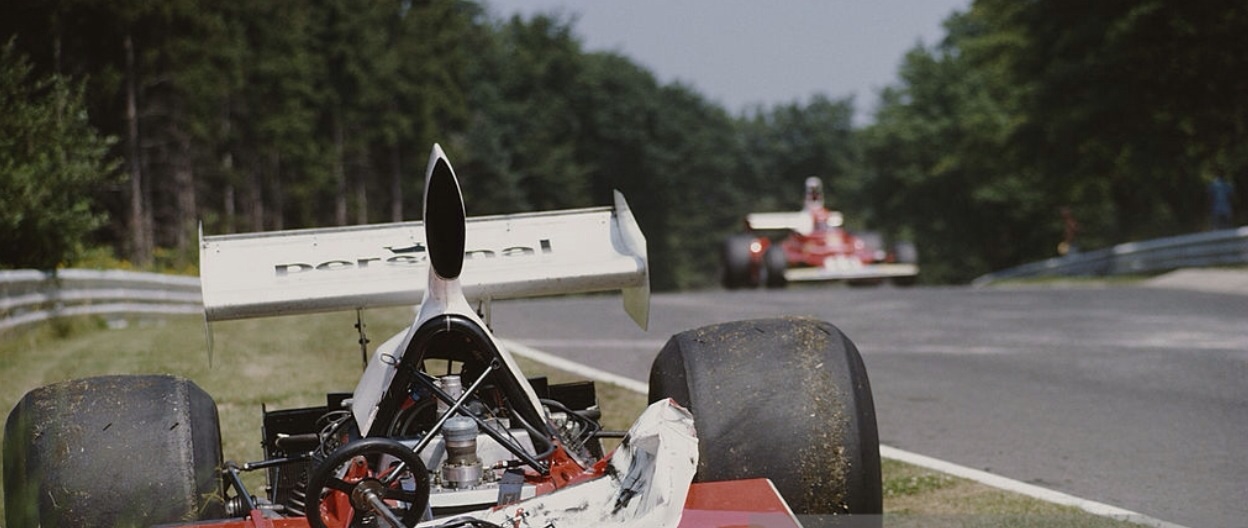
Ian Ashley’s Williams FW03 Ford sits forlornly beside the Pflanzgarten Armco while Niki Lauda turns in, Ferrari 312T, Nurburgring, German GP practice 1 August 1975…
Ashley had his car, teammate Jacques Laffitte was quick in the evolved FW04 that year, in 20th grid position, when he had one of several huge career shunts, not of his own making. Ian takes up the story;
‘I had several things go wrong in practice, including a stuck throttle, which turned out to be a broken engine mount. There are four plates which used to hold the Cosworth onto the monocoque, and the top left plate had snapped. They didn’t check any of the others, and on the final qualifying run, and I was up to 9th or 12th by then – I hadn’t actually done a flying lap, only what they call a rolling lap, and my fastest lap was on my warming-up lap – I was ten seconds up on my flying lap when one of the bottom engine mounts snapped, and it just turned sharp left along the straight, and I went straight into the armco at 160mph. Nobody realised straight away what had happened, and I had chipped an ankle, so I missed one race of the F5000 series, but I managed to hang on to my lead’ (of the European F5000 Championship in which he ultimately finished 4th in Lola’s T330 and T400)

Marshals gather the remains of Ian Ashley’s ‘lightened and modified’ Williams FW03 Ford, Nurburgring 1975. The dangers of frontal impacts in aluminium monocoques of the period 1962 to circa 1982 readily apparent and certainly greatly superior to the chassis of earlier times! He was lucky the result was not a good deal worse, the car, originally designed by John Clarke in 1973 stood up to the big impact pretty well. The dude holding the helmet, to state the obvious, is the pilot of the medical chase car not Ashley…(unattributed)
For an interesting interview/summary of Ian Ashley’s career, and the trials and tribulations of trying to get into F1 with underprepared cars and/or ‘shitboxes’, click on this link;
http://8w.forix.com/ashley.html
In the GP Lauda was 3rd, Carlos Reutemannhttp won in a Brabham BT44B Ford and Laffitte was a career-enhancing 2nd and off to the new Ligier Matra outfit at seasons end.
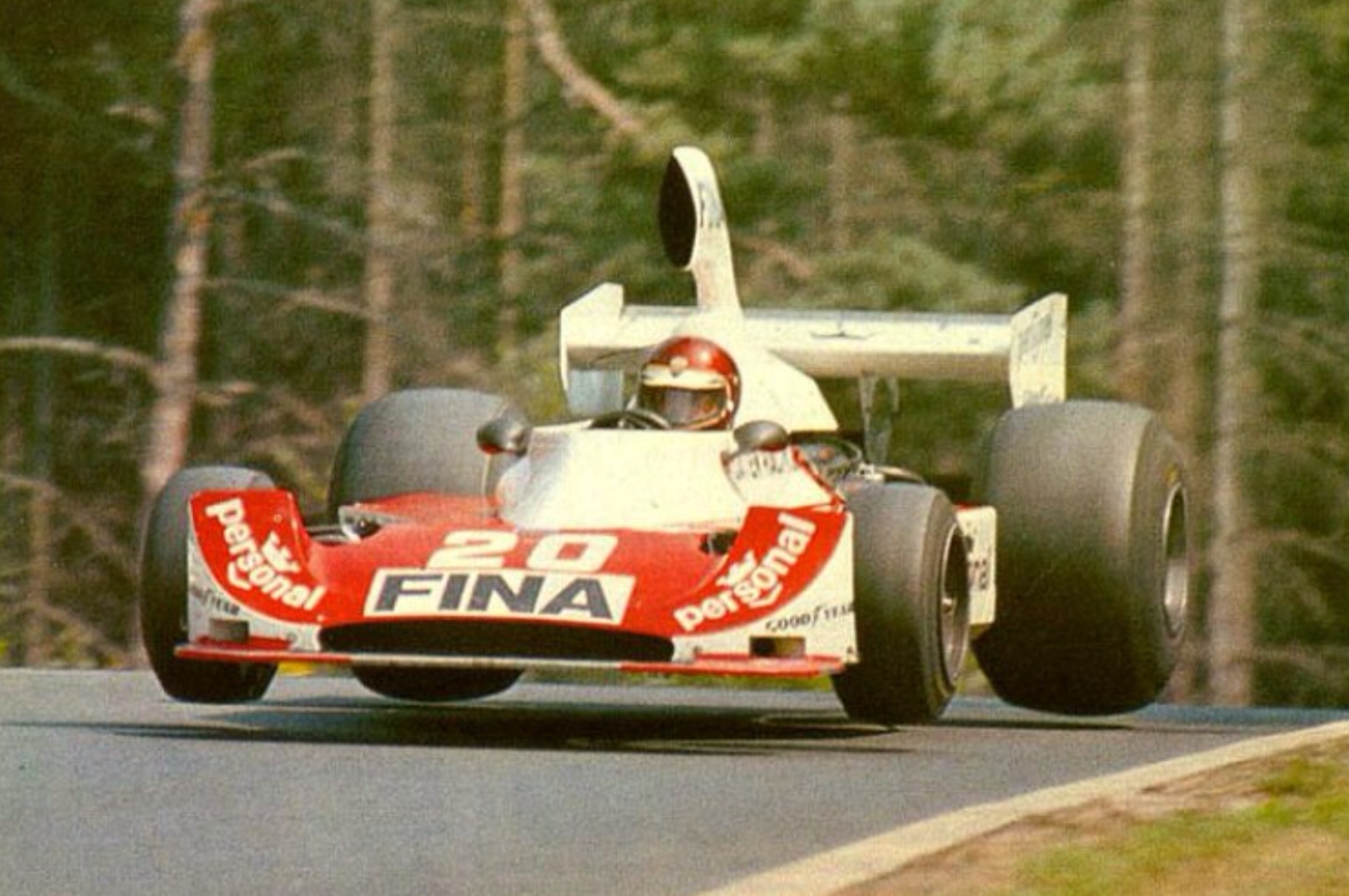
Ian Ashley in Frank William’s FW03 before the engine mount failure, German GP practice 1975 (unattributed)
Credit…
Rainer Schlegelmilch, 8w.forix.com, motorsport.com

Carlos Reutemann on his way to German GP, Nurburgring victory in August 1975. Brabham BT44B Ford (unattributed)
Tailpiece: Ian Ashley in recent times in an historic Elden Mk8 FF…


Mark Webber’s Red Bull in a great late afternoon shot at Circuito de Jerez, in Jerez de la Frontera, Spain on 6 February 2013…
Webber is grinding around honing the RB9 Renault chassis into a fine pitch before the start of the 2013 GP season, his last before departing to sportscar success with Porsche.
He is, pictured below in the Porsche 919 Hybrid he shared to 2nd place at Le Mans in 2015 with Brendon Hartley and Timo Bernhard, the Porsche trio of Neel Jani, Romain Dumas and Marc Lieb won the classic.
I have tried hard to find photos which show the efficient, complex, fast machines lines to best effect but no angle is a visually pleasing one.

Porsche 919 Hybrid; Chassis: composite carbon fibre honeycomb Suspension: front and rear multi link actuated by pushrods Steering: hydraulically assisted rack and pinion Brakes: carbon fibre discs front and rear: Wheels/Tyres Michelin 310/710mm-18inches in diameter front and rear Weight circa 870Kg. Engine: 2 litre V4 turbo developing circa 500bhp with accumulator type lithium-ion battery, with Engine Generator Unit developing circa 400bhp on front axle Transmission: rear wheel drive, all wheel drive via KERS on front axles, gearbox itself 7 speed sequential with hydraulic actuation (Getty)
Click here for a fantastic detailed technical description of this amazing car in ‘Racecar Engineering’…
Webber’s teammate Sebastian Vettel took the 2013 F1 title for the fourth year on the trot but it was a lean year for Mark in terms of race wins, he was second in Malaysia, Britain, Japan and Abu Dhabi and third in the drivers title chase behind Vettel and Ferrari’s Fernando Alonso.
Off to challenges anew in Stuttgart for Mark including the Drivers Title win for Webber, Hartley and Bernhardt for Porsche in 2016…

Le Mans 2015; Porsche 919, Mark Webber (Getty)
Credits…
Paul Gilham, Getty Images
Tailpiece: Webbers #17 Porsche 919 at Le Mans in 2015…

(Getty)

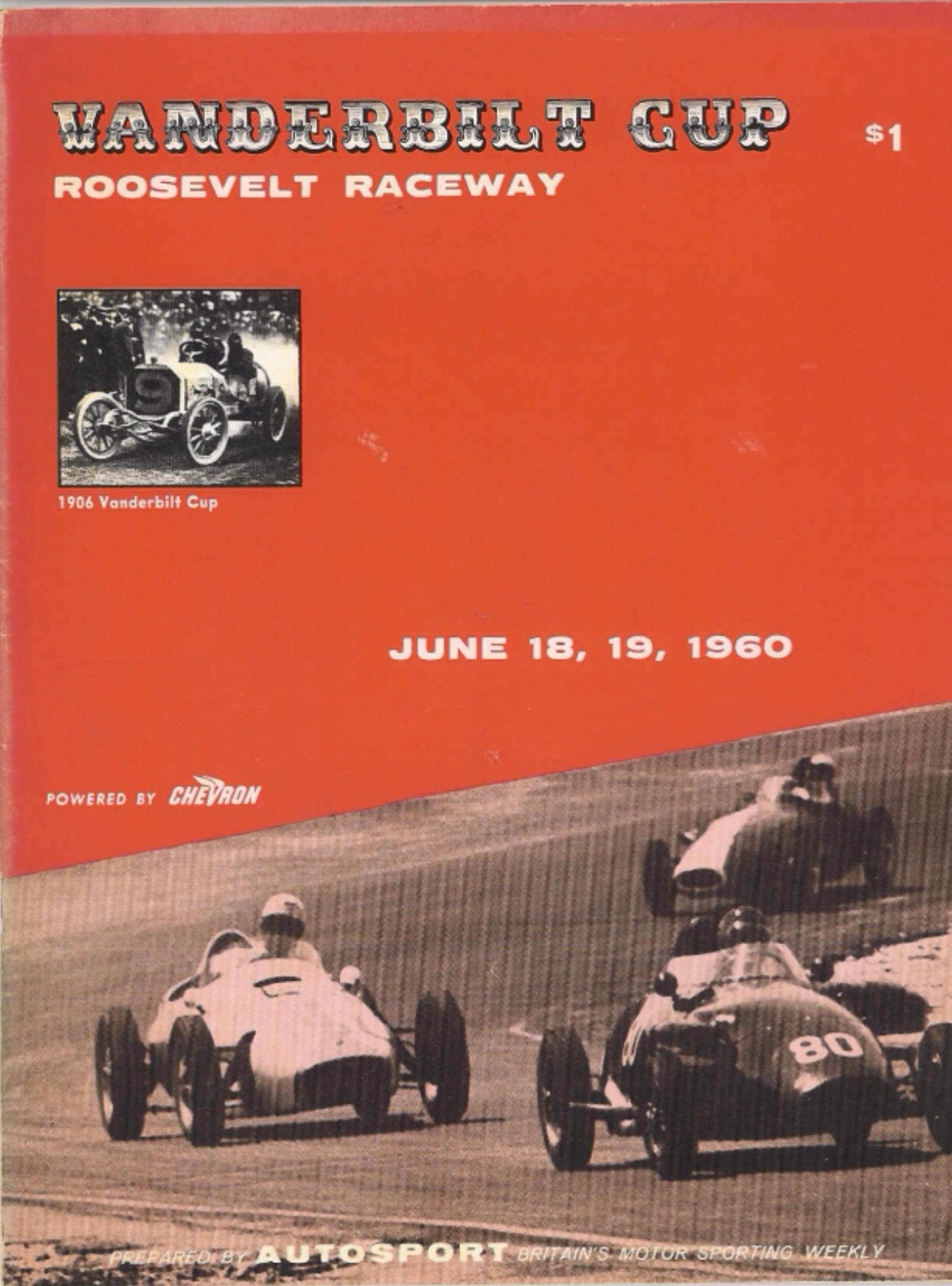
The Formula Junior field starts the Vanderbilt Cup at Roosevelt Raceway, Long Island, New York on Sunday 19 June 1960…
On April 2, 1960 the New York Region of the Sports Car Club of America (SCCA) announced a ‘revival’ of the Vanderbilt Cup.
The feature race was one of nine events viewed by 37000 spectators and took place at the SCCA’s new road circuit on the Roosevelt Raceway’s grounds. The track used a portion of the car park and access roads of a harness racing track. Its 11-turn, 1.5 miles included a half mile straight.
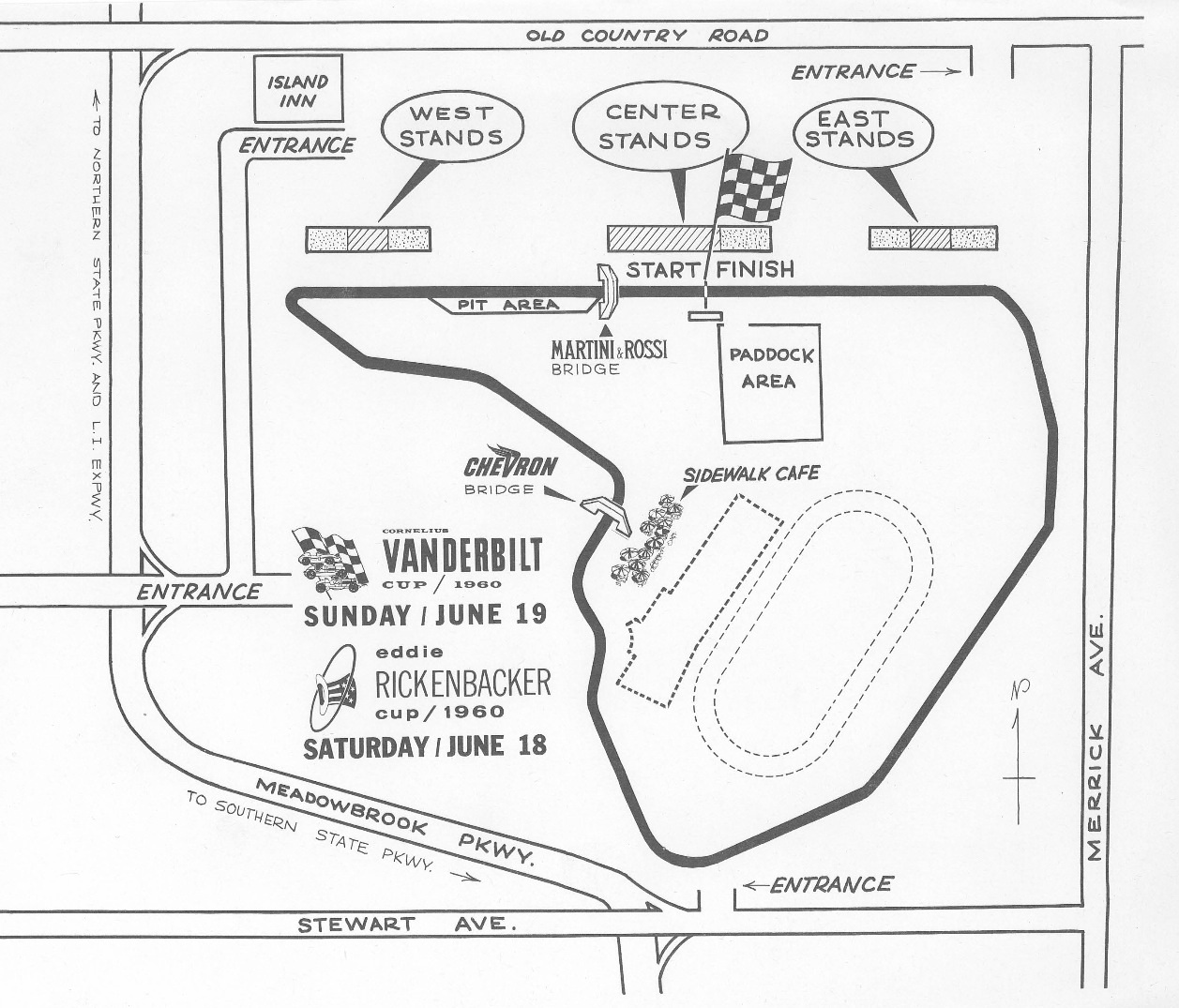
The ‘Cornelius Vanderbilt Cup Race’ was run on Sunday, June 19, 1960. Usually the province of amateur drivers, this SCCA event was granted special status which allowed professionals to compete in what was a ‘Junior Formula’ race. As a result Indy Winners Jim Rathman and Roger Ward competed along with Carroll Shelby, the ’59 Le Mans winner and future GP drivers Ricardo and Pedro Rodriguez, Jim Hall and Lorenzo Bandini.
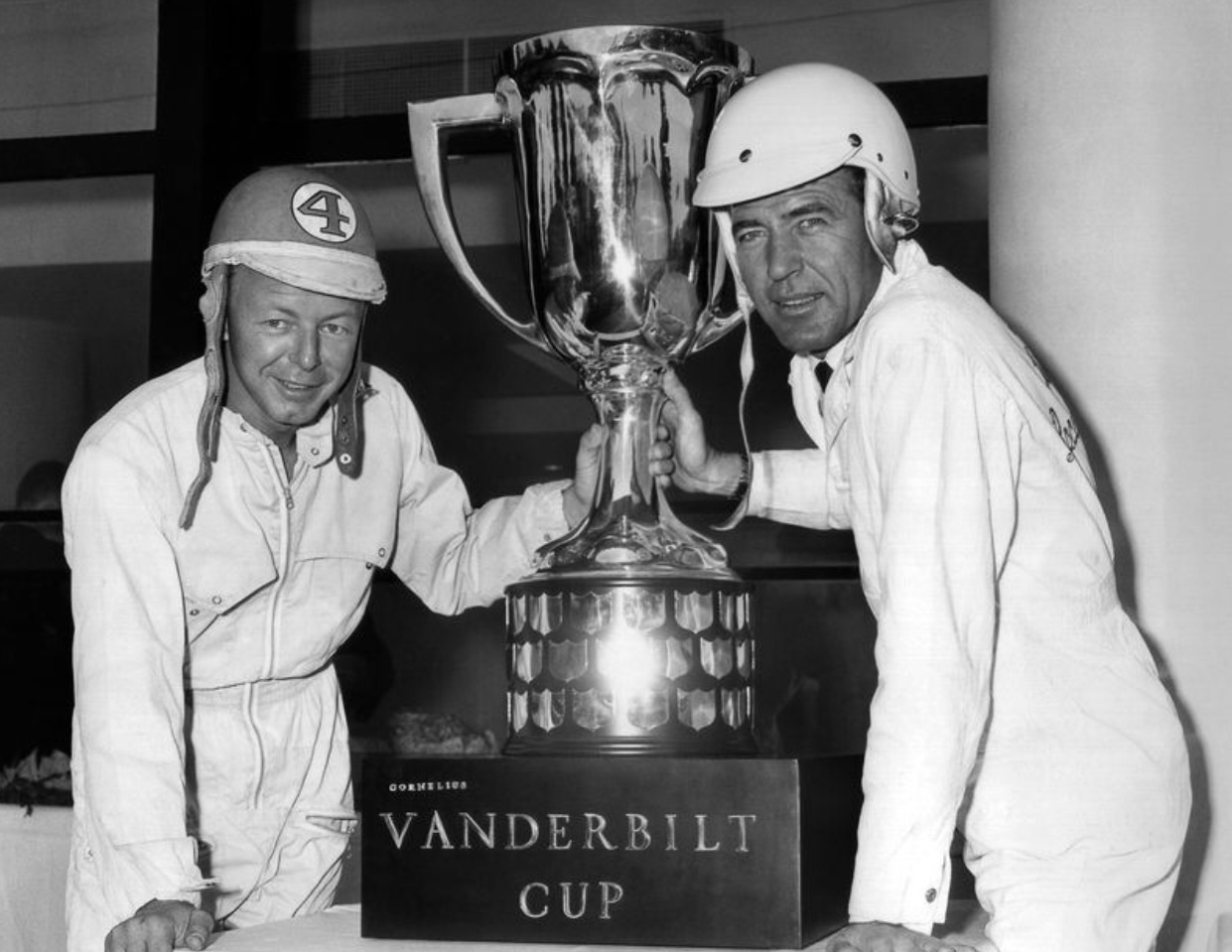
Jim Rathman (left) and Carroll Shelby pose for a pre-meeting publicity shot (nydailynews)
‘At the turn of the 20th century the superiority of European automotive craftsmanship cast a long shadow over America’s fledgling car industry. To encourage American automobile manufacturers to challenge European quality, 26-year old William K. Vanderbilt Jr., heir to a railroad fortune and a pioneer race car driver, organized America’s first international road race, modeled after those held in Europe. The six Vanderbilt Cup Races held on Long Island from 1904 to 1910 were the greatest sporting events of their day. These colorful, exciting and dangerous races drew huge crowds from 25,000 to over 250,000 spectators’.

Winner Henry Carter receives his little! trophy from Cornelius Vanderbilt IV, author, newspaperman and nephew of WK Vanderbilt the founder of the VDB Cup series of races (nydailynews)
The 1960 FJ race was a 50 lapper over 75 miles and won by Henry Carter driving a Stanguellini Fiat. Of the ‘name drivers’, only Pedro Rodriguez finished in a Scorpion DKW, 2nd was Chuck Wallace in a similar car and Jerry Truitt 3rd in a Stanguellini.
If any readers know the cars/drivers let me know, whilst there is some interesting information about the race i’ve not been able to find an entry list complete with race numbers.
Click on this link to an article about the 1960 race, have a fossick around this site which has a wealth of detailed information about the ‘real’ Vanderbilt Cup races;
http://www.vanderbiltcupraces.com/races/story/1960_vanderbilt_cup_race
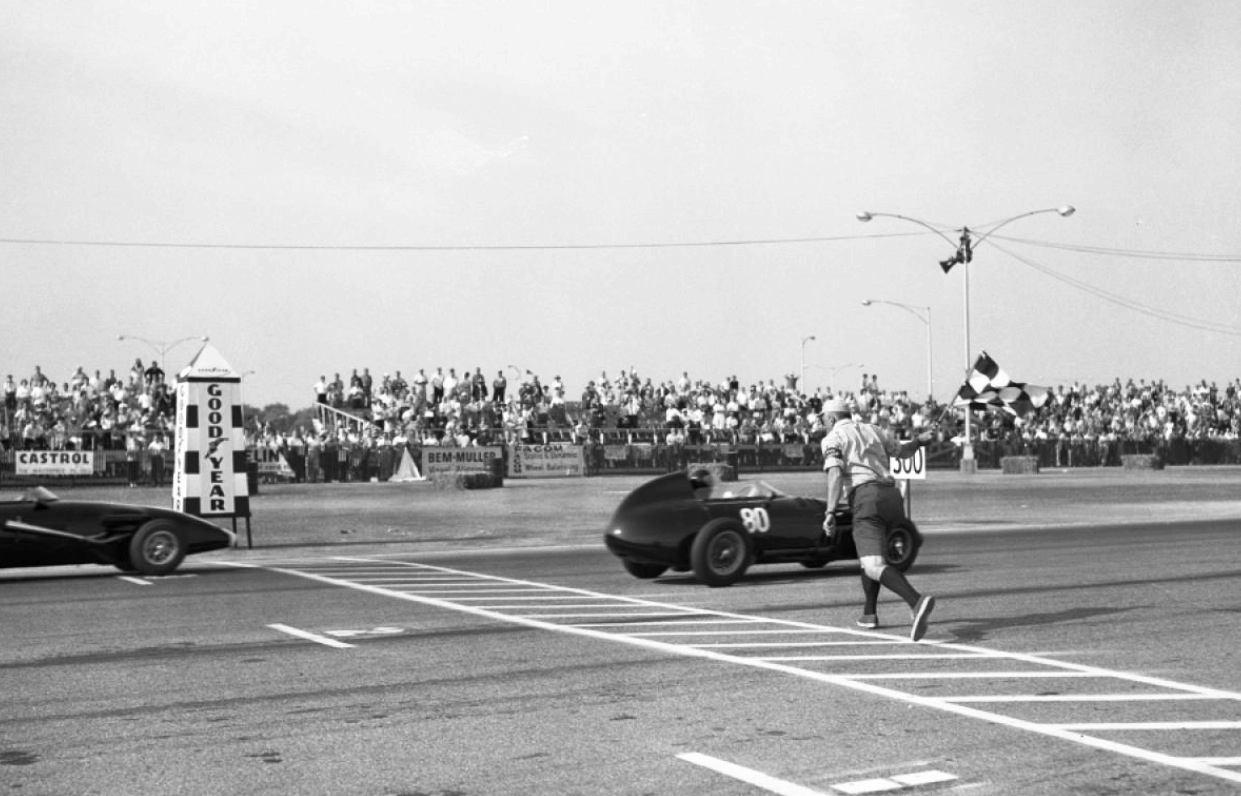
Henry Carter’s Stanguellini Fiat takes the chequered flag from Chuck Wallace’s Scorpion DKW in 2nd (nydailynews)
Credits…
New York Daily News, vanderbiltcupraces.com
Tailpiece…

As Jeremy Clarkson would say. The 3 litre Formula 1 ushered in another era when a surfeit of power over chassis grip made the cars spectacular to watch and a challenge to drive…
Here Graham Hill #7 gets off pole with a minimum of Firestone wheelspin, not so Jack Brabham #3 and Dan Gurney #9, Repco V8 and Gurney-Weslake V12 leaving behind plenty of ‘Goodyear’. The noses of the cars behind are Clark’s yellow striped Lotus and Bruce McLaren in Dan’s second Eagle, his own car being not quite yet ready.

Bruce McLaren getting the feel of the Eagle T1G Weslake. Q5 and retired on lap 26 with ignition failure. He also raced the car at Silverstone and the Nurburgring (The Cahier Archive)
Dan was on top of his game, he won the Belgian Grand Prix a fortnight before in his Eagle T1G and Lotus the first race for the 49 and its Cosworth engine two weeks before that. But it was the ‘old stager’ Brabham who took the French Grand Prix win in his BT24 from teammate Denny Hulme and Jackie Stewart’s BRM P261.

Brabham’s BT24 ahead of Dan Gurney’s Eagle T1G DNF fuel line. Circuit Bugatti 1967 (unattributed)
The Automobile Club de France laid out a ‘pissant’ circuit built for the racing school which also used the start-finish straight of the classic 24 hour circuit but the ‘Circuit Bugatti’ had none of the atmosphere, grandeur or challenge of Reims, Rouen or Clermont Ferrand the other options available to them!
The ‘punters’ reacted accordingly, only 20000 showed up, the race was held at Rouen the following year.

Grid ready to go, G Hill popping on the Nomex, Bruce McLaren in an Eagle T1G and to his right Jochen Rindt’s Cooper T81B Maserati DNF engine (Getty)
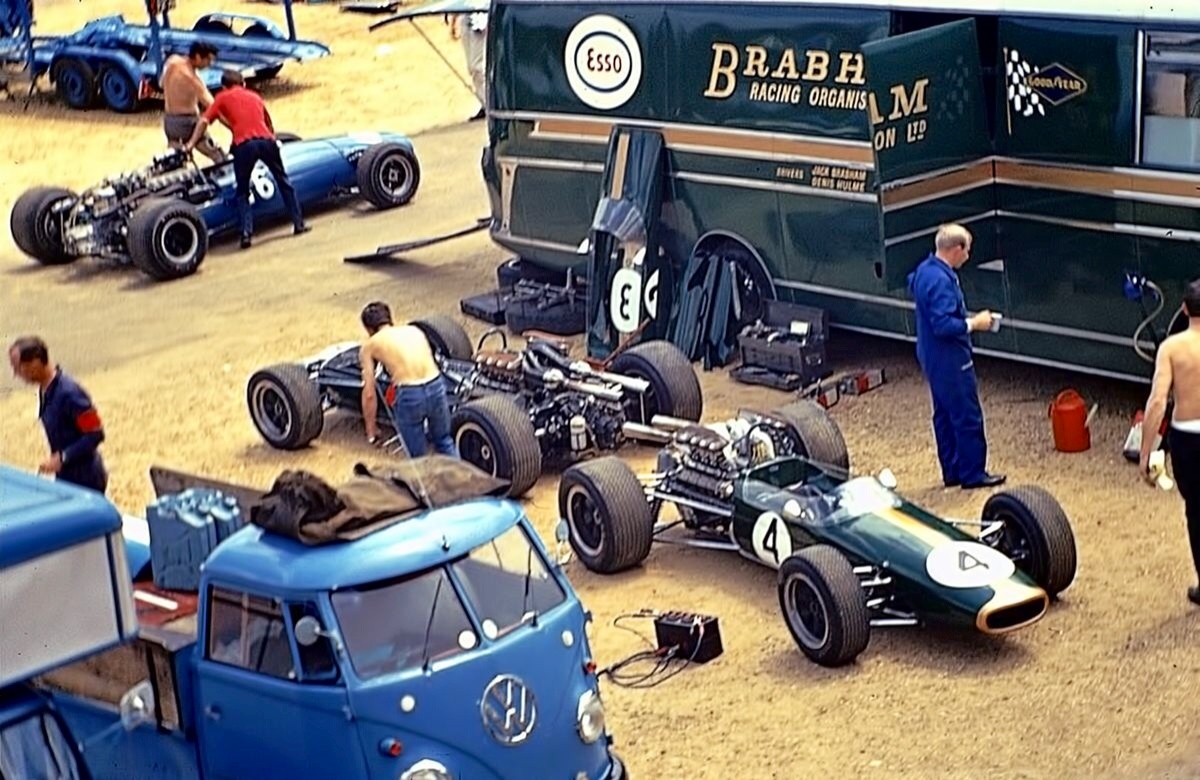
#4 Hulme’s Brabham BT24 Repco 2nd in front of Jack’s car, #16 is Guy Ligier’s Cooper T81 Maserati N/Class. Le Mans paddock 1967. How small, light and neat do those BT24’s look? Champions in ’67 of course with Hulme D (unattributed)

Superb shot of Chris Amon’s Ferrari 312. He qualified 7th and ran as high as 3rd before the throttle cable broke at half distance (Sutton)
Jack lookin’ pretty happy with a good days work in his BT24 Repco both before the race and after its successful conclusion…

(Getty)
Credits: The Cahier Archive, Getty Images, Sutton Images
Tailpiece: You can take the Racing Driver out of the Engineer…

Ever the engineer Bruce helps with a plug change on his Weslake V12. Le Mans 1967 (Getty Images)
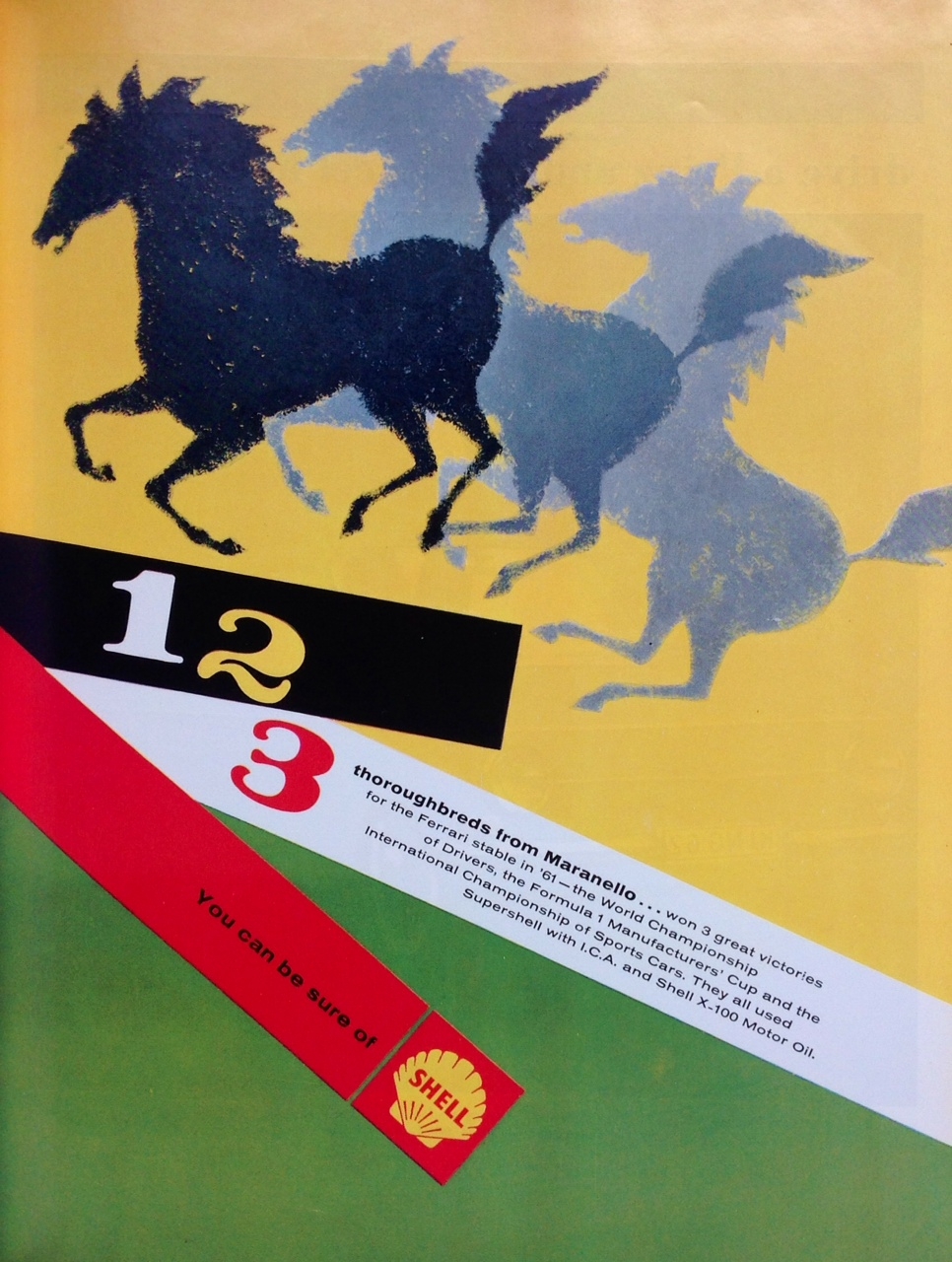
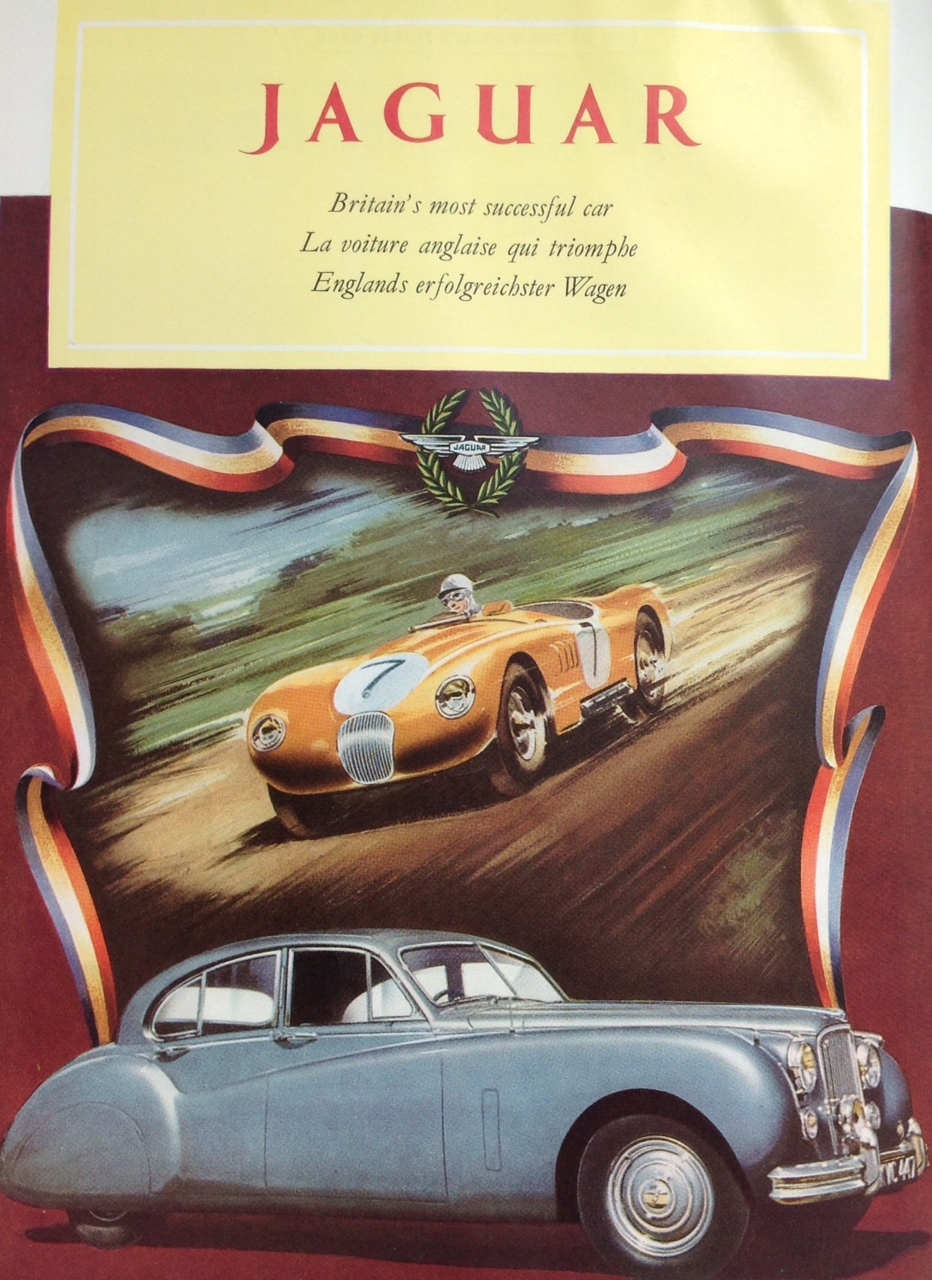
Often the more subtle ads are the most effective? From Automobile Year #10…
 primotipo...