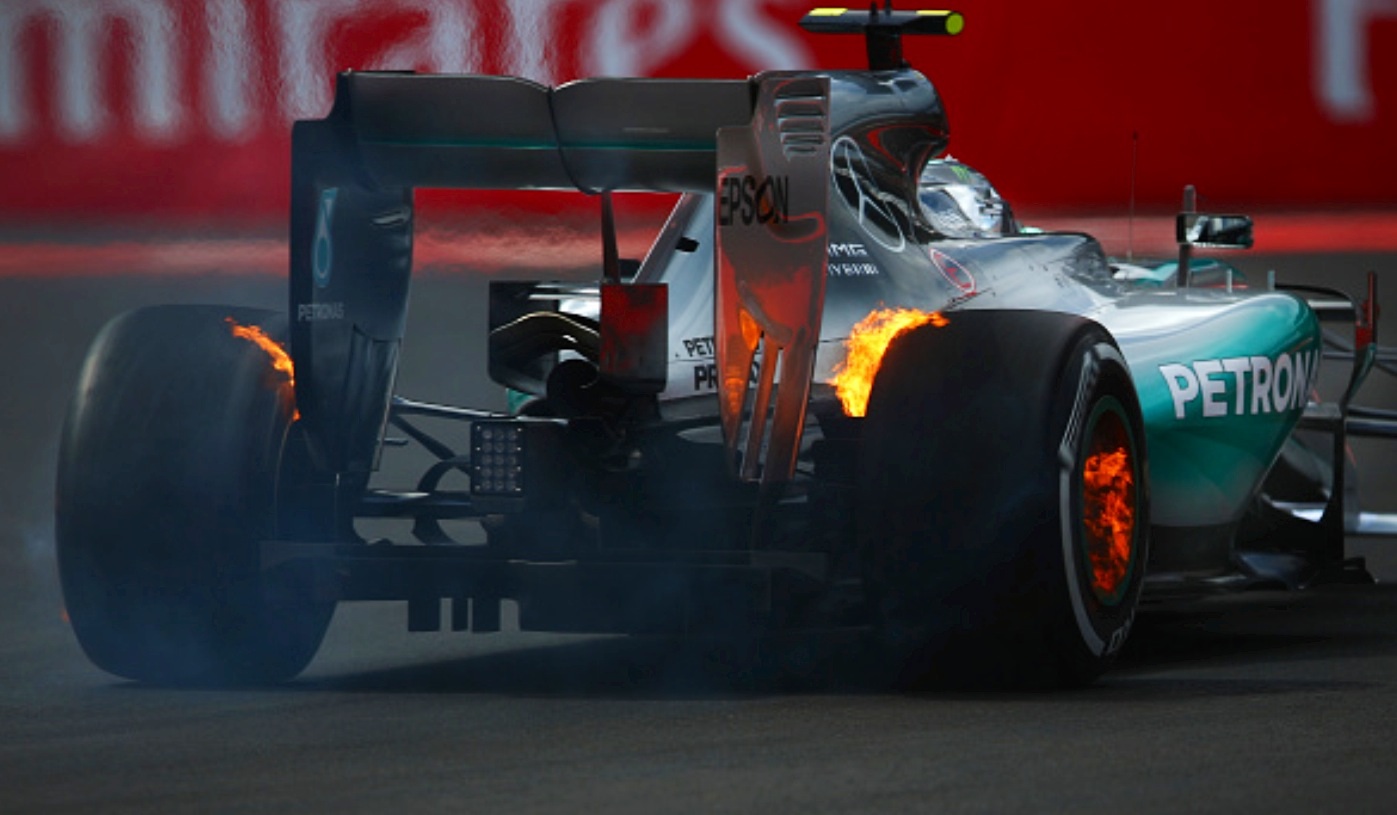
Mark Webber’s Red Bull in a great late afternoon shot at Circuito de Jerez, in Jerez de la Frontera, Spain on 6 February 2013…
Webber is grinding around honing the RB9 Renault chassis into a fine pitch before the start of the 2013 GP season, his last before departing to sportscar success with Porsche.
He is, pictured below in the Porsche 919 Hybrid he shared to 2nd place at Le Mans in 2015 with Brendon Hartley and Timo Bernhard, the Porsche trio of Neel Jani, Romain Dumas and Marc Lieb won the classic.
I have tried hard to find photos which show the efficient, complex, fast machines lines to best effect but no angle is a visually pleasing one.
Porsche 919 Hybrid; Chassis: composite carbon fibre honeycomb Suspension: front and rear multi link actuated by pushrods Steering: hydraulically assisted rack and pinion Brakes: carbon fibre discs front and rear: Wheels/Tyres Michelin 310/710mm-18inches in diameter front and rear Weight circa 870Kg. Engine: 2 litre V4 turbo developing circa 500bhp with accumulator type lithium-ion battery, with Engine Generator Unit developing circa 400bhp on front axle Transmission: rear wheel drive, all wheel drive via KERS on front axles, gearbox itself 7 speed sequential with hydraulic actuation (Getty)
Click here for a fantastic detailed technical description of this amazing car in ‘Racecar Engineering’…
Webber’s teammate Sebastian Vettel took the 2013 F1 title for the fourth year on the trot but it was a lean year for Mark in terms of race wins, he was second in Malaysia, Britain, Japan and Abu Dhabi and third in the drivers title chase behind Vettel and Ferrari’s Fernando Alonso.
Off to challenges anew in Stuttgart for Mark including the Drivers Title win for Webber, Hartley and Bernhardt for Porsche in 2016…
Le Mans 2015; Porsche 919, Mark Webber (Getty)
Credits…
Paul Gilham, Getty Images
Tailpiece: Webbers #17 Porsche 919 at Le Mans in 2015…
The Formula Junior field starts the Vanderbilt Cup at Roosevelt Raceway, Long Island, New York on Sunday 19 June 1960…
On April 2, 1960 the New York Region of the Sports Car Club of America (SCCA) announced a ‘revival’ of the Vanderbilt Cup.
The feature race was one of nine events viewed by 37000 spectators and took place at the SCCA’s new road circuit on the Roosevelt Raceway’s grounds. The track used a portion of the car park and access roads of a harness racing track. Its 11-turn, 1.5 miles included a half mile straight.
The ‘Cornelius Vanderbilt Cup Race’ was run on Sunday, June 19, 1960. Usually the province of amateur drivers, this SCCA event was granted special status which allowed professionals to compete in what was a ‘Junior Formula’ race. As a result Indy Winners Jim Rathman and Roger Ward competed along with Carroll Shelby, the ’59 Le Mans winner and future GP drivers Ricardo and Pedro Rodriguez, Jim Hall and Lorenzo Bandini.
Jim Rathman (left) and Carroll Shelby pose for a pre-meeting publicity shot (nydailynews)
‘At the turn of the 20th century the superiority of European automotive craftsmanship cast a long shadow over America’s fledgling car industry. To encourage American automobile manufacturers to challenge European quality, 26-year old William K. Vanderbilt Jr., heir to a railroad fortune and a pioneer race car driver, organized America’s first international road race, modeled after those held in Europe. The six Vanderbilt Cup Races held on Long Island from 1904 to 1910 were the greatest sporting events of their day. These colorful, exciting and dangerous races drew huge crowds from 25,000 to over 250,000 spectators’.
Winner Henry Carter receives his little! trophy from Cornelius Vanderbilt IV, author, newspaperman and nephew of WK Vanderbilt the founder of the VDB Cup series of races (nydailynews)
The 1960 FJ race was a 50 lapper over 75 miles and wonby Henry Carter driving a Stanguellini Fiat. Of the ‘name drivers’, only Pedro Rodriguez finished in a Scorpion DKW, 2nd was Chuck Wallace in a similar car and Jerry Truitt 3rd in a Stanguellini.
If any readers know the cars/drivers let me know, whilst there is some interesting information about the race i’ve not been able to find an entry list complete with race numbers.
Click on this link to an article about the 1960 race, have a fossick around this site which has a wealth of detailed information about the ‘real’ Vanderbilt Cup races;
As Jeremy Clarkson would say. The 3 litre Formula 1 ushered in another era when a surfeit of power over chassis grip made the cars spectacular to watch and a challenge to drive…
Here Graham Hill #7 gets off pole with a minimum of Firestone wheelspin, not so Jack Brabham #3 and Dan Gurney #9, Repco V8 and Gurney-Weslake V12 leaving behind plenty of ‘Goodyear’. The noses of the cars behind are Clark’s yellow striped Lotus and Bruce McLaren in Dan’s second Eagle, his own car being not quite yet ready.
Bruce McLaren getting the feel of the Eagle T1G Weslake. Q5 and retired on lap 26 with ignition failure. He also raced the car at Silverstone and the Nurburgring (The Cahier Archive)
Dan was on top of his game, he won the Belgian Grand Prix a fortnight before in his Eagle T1G and Lotus the first race for the 49 and its Cosworth engine two weeks before that. But it was the ‘old stager’ Brabham who took the French Grand Prix win in his BT24 from teammate Denny Hulme and Jackie Stewart’s BRM P261.
Brabham’s BT24 ahead of Dan Gurney’s Eagle T1G DNF fuel line. Circuit Bugatti 1967 (unattributed)
The Automobile Club de France laid out a ‘pissant’ circuit built for the racing school which also used the start-finish straight of the classic 24 hour circuit but the ‘Circuit Bugatti’ had none of the atmosphere, grandeur or challenge of Reims, Rouen or Clermont Ferrand the other options available to them!
The ‘punters’ reacted accordingly, only 20000 showed up, the race was held at Rouen the following year.
Grid ready to go, G Hill popping on the Nomex, Bruce McLaren in an Eagle T1G and to his right Jochen Rindt’s Cooper T81B Maserati DNF engine (Getty)
#4 Hulme’s Brabham BT24 Repco 2nd in front of Jack’s car, #16 is Guy Ligier’s Cooper T81 Maserati N/Class. Le Mans paddock 1967. How small, light and neat do those BT24’s look? Champions in ’67 of course with Hulme D (unattributed)
Superb shot of Chris Amon’s Ferrari 312. He qualified 7th and ran as high as 3rd before the throttle cable broke at half distance (Sutton)
Jack lookin’ pretty happy with a good days work in his BT24 Repco both before the race and after its successful conclusion…
(Getty)
Credits: The Cahier Archive, Getty Images, Sutton Images
Tailpiece: You can take the Racing Driver out of the Engineer…
Ever the engineer Bruce helps with a plug change on his Weslake V12. Le Mans 1967 (Getty Images)
Adrian Fernandez slices his Lola B2/00 Honda into the lead of the Monterrey Grand Prix from pole, behind is Dario Franchitti’s Reynard 02i Honda the first round of the 2002 CART Series on 10 March…
Such a picturesque location, the circuit used for this event between 2001 and 2006 was located at Fundidora Park, Monterrey the capital and largest city in the state of Nuevo León in the foothills of the Sierre Madre Oriental mountains, Mexico. The old buildings in shot are those of a disused steel mill which is both a nod to the past and indicator of the city as a current industrial centre.
Fundidora Park panorama, Fernandez is the green/red Lola B2/00 Honda
2002 was ‘the start’ of the demise of CART, Penske Racing defected to the rival Indy Racing League at the end of 2001, starting a trend the net result of which was to weaken single seater racing in the US. A great shame as CART to me at the time was as interesting and exciting a category as F1 if not superior in its variety of circuits, circuit type (road, circuit, short and long speedways), chassis and engines. A story for another time.
The engine regs continued to mandate a 2.65 litre, single turbo-charged V8 for 2002, squabbling over the future engine specifications one of a myriad of issues causing the ‘stampede’ of teams and engine manufacturers from CART.
Christiano da Matta, Lola B2/00 Toyota
The 2002 CART championship was won by Christiano da Matta in a factory Newman/Haas Lola B2/00 Toyota, he also won this race. Fernandez finished 13th, Dario Franchitti was 2nd in a Reynard 02i Honda and Christan Fittipaldi 3rd in the other Newman/Haas Lola B2/00 Toyota.
da Matta Lola B2/00 Toyota, Monterrey 2002, he was on a journey which took him to F1 with Toyota
Top shot Dario Franchitti’s Reynard 02i Honda. Podium ceremony L>R 2nd Franchitti, winner da Matta and 3rd Christian Fittipaldi
Unitary chassis construction, 2451cc OHV V6, Weber twin throat carb, circa 118bhp @ 5000rpm. 115mph. 4 speed box but the transaxle was innovatively located at the rear as are inboard mounted drum brakes.
Front suspension sliding pillar, semi trailing arms at rear, De Dion tube on fourth series cars.
The car was remarkably advanced for its time, one of a series of stunning Lancia’s designed by Jano, the ‘apex of which’ was the D50 GP car which first raced at Barcelona in the 1954 Spanish Grand Prix.
B20 Coupe body Ghia designed and Pininfarina built, Francesco de Virgilio the senior member of Jano’s design team.
These cars also useful competition tools; here is the Johnny Lurani/Sambuynd Gatta GT2500 during the 1953 French Rallye des Alpes on the Passo Pordoi. (Mailander)
Luigi Fagioli’s Mercedes W25B attacks Bernd Rosemeyer’s Auto Union Type B whilst being pelted by rocks on the course covered with them…
The race was help on 22 September 1935 in the Gipuzkoa, Basque region of Northern Spain, Mercedes finished first to third; Caracciola from Fagioli and von Brauchitsch. All drove the 4.3 litre straight-8 engined car. Rosemeyer was 5th in the V16 5.6 litre mid-engined Auto Union.
Caracciola won the European Championship that year with 3 wins of 5 Championship rounds, his other triumphs at Spa and Bremgarten, Switzerland.
Graham Hill and jockey Lester Piggott test the Lotus 61 Formula Ford at an incredibly frigid Hethel Airfield 20 March 1969…
How many times he spun the car at Lotus HQ is unrecorded! The event appears to be a promotion to boost the sales of Lotus Components latest Formula Ford. And a very competitive car it was, in fact all the Lotus FF’s were; 51, 61, 59 and 69, it’s a great pity Chapman took the marque up-market and left its enthusiast/grass roots racing background behind.
Graham Nearn did rather well with the Lotus 7 Series 3 too, proving there was life in the old beast yet, the 7 being the other product of Lotus Components in addition to the production racing cars, Chapman sold the rights of the 7 in 1971.
On a more familiar type of mount; Lester Piggott takes the Queens horse ‘Carrozza’ back to scale having won ‘The Oaks’ at Epsom, Surrey on 7 June 1957. Queen Elizabeth leads (Popperfoto)
Credit…
Victor Blackman, Richard Styles
Tailpiece: Dave’s Lotus 61…
Later Lotus GP driver, Aussie Dave Walker tests his JRRDS Lotus 61 at Snetterton prior to the start of his successful 1969 season. He won the British Les Leston FF Championship in this car in 1969 (Richard Styles)
Louise Collins susses husband Peter’s fabulous Ferrari 335S in advance of the start of the ’57 Mille Miglia…
It was a victorious race for Ferrari but otherwise disastrous on every level given ‘Fon de Portago’s accident and it’s consequences, click here for an article about both this race and the big Ferrari;
Stan muscling his big Maserati 250F around Longford in 1959 en-route to his one and only Australian Grand Prix win…
The win was timely, he was monstered all the way by Len Lukey’s Cooper T43 2-litre, the way of the future of course. ‘Twas the last AGP win for a front engined car, mind you Lex Davison came within metres of winning in an Aston Martin DBR4 at Lowood, Queensland in 1960.
Jones at the wheel of his Maser, 1956 AGP Albert Park. Lovely portrait of the guy and looking quite the pro driver he was! (unattributed)
Jones gave his Gold Star defence a red hot go in 1959 having won the title in 1958, he raced four cars in his quest.
He didn’t race in the season opening event in Orange, NSW. Jack Brabham won in a Cooper T51, but he wheeled out his Maybach for Fishermans Bend’s Victoria Trophy on 22 February. He finished second to Alec Mildren’s Cooper T43.
Stan hadn’t raced the Maybach for years but had retained it. His friend and fellow racer Ern Seeliger evolved the car by replacing the Maybach engines which had been at the core of Maybach’s 1-3 with a Chev Corvette 283cid V8. The car also had a de Dion rear end and other clever modifications.
He swapped back into the Maser, winning the AGP at Longford on 2 March.
Stan in the big, now blue Maybach 4 Chev beside Alec Mildren’s Cooper T43 Climax at fairly desolate Port Wakefield, SA, March 1959 (Kevin Drage)
He switched back to the Maybach for the SA Trophy at Port Wakefield on March 28, winning the race. Crazily, the next round of the title was at Bathurst on 30 March, two days later. Very hard for contestants to make that trip from SA to Central NSW now, let alone with the road system of 1959!
Stan flew to Bathurst to drive the Maser. Whilst he won his heat he had engine dramas in the final and failed to finish, victory was taken by Kiwi Ross Jensen in another Maserati 250F.
He used the Maybach again at Lowood on June 14, he was third, then swapped back to the Maser for the next round, again at Lowood on 30 August, hitting a strawbale and failed to finish.
The reasons for the choice of car at each meeting would be interesting to know but are probably a function of vehicle availability and suitability. Which was the primary and which was the secondary factor meeting to meeting no doubt varies…
Mid-engined inevitability was clear though despite none of the Australian Cooper exponents being able to secure a full 2.5-litre FPF Coventry Climax engine…yet. The ‘mechanical mice’, as Lex Davison christened the Coopers, were only going to get quicker.
Whilst his fellow competitors were back at Port Wakefield for the 12 October meeting Stan was doing a deal with Bib Stillwell to buy his Cooper T51 2.2 FPF, chassis ‘F2-20-59’, the first of several T51’s Stan raced.
Stan Jones, Cooper T51 Climax, Caversham, WA October 24, 1959 (Dave Sullivan Album)
He soon got the hang of the car, after all he had been an air-cooled Cooper exponent earlier in the decade, finishing second to Len Lukey’s Cooper at Caversham, WA.
The Jones #3 Cooper T51 beside Len Lukey’s earlier model T43, Caversham August 1959. Lukey was the Gold Star winner in 1959 driving both Cooper T43 and T23 Bristol (Dave Sullivan Album)
The final rounds of Australia’s longest ever Gold Star series were Phillip Island’s Westernport Cup and Phillip Island Trophy races on 22 November and 13 December respectively.
Jones brought his ‘roster of cars’ to four for the year when he drove Ern Tadgell’s Sabakat (Lotus 12 Climax) after damaging his Cooper in a collision with Lukey. The Cooper was too badly damaged to start, as was Lukey’s, but Stan, very sportingly was lent the Sabakat by Tadgell.
Lukey won the 1959 title from Alec Mildren by two points with Jones a distant third. Mildren’s time would come in 1960 with fabulous AGP and Gold Star wins in a new Cooper T51 Maserati he and his team built over the summer.
Sadly it was the last full-blown Gold Star campaign for Jones, economic pressures from 1960 meant he did a few title rounds but was not a serious title contender, although still a tough competitor in any individual race he entered.
Stan settles into his Cooper T51 at Caversham (Dave Sullivan Album)
Equipe Jones at Albert Park during the 1956 AGP won by Moss’ 250F. International truck and the Rice Trailer, were the ‘ducks guts’, still a few of these around and highly prized (unattributed)