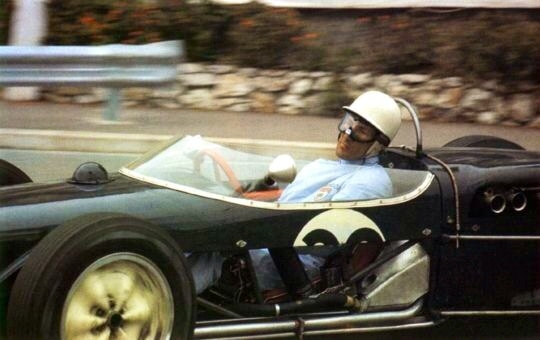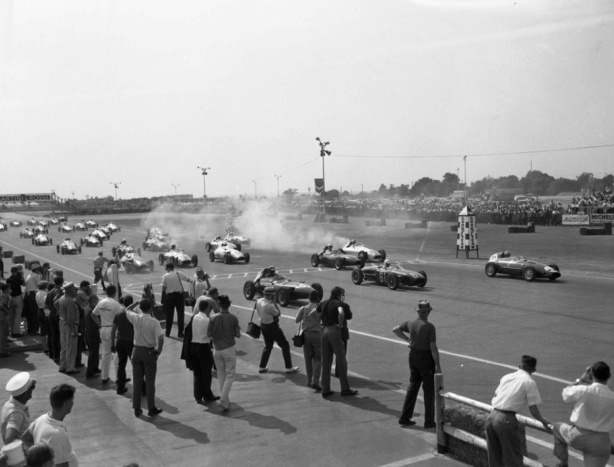
Billy Vukovich leading the Indy 500 in his Kurtis Kraft Offy, he won the race from the similar cars of Art Cross and Sam Hanks…
Vukovich dipped out on victory in 1952 with a steering gear failure several laps from the end, in ’53 he led from lap 1 and 195 of the 200 laps in total. The event was run in searing heat which required the use of 16 relief drivers, Billy drove the race himself in a tough, gritty display.
32 of the starters used the DOHC 4 cylinder Meyer-Drake ‘Offy’, the other engine the famous Novi V8, finally Kurtis Kraft supplied 22 of the 33 chassis which contested the race.
Credits…
Max Staub, Racing One
Vukovich rejoins the race after a pitstop, Kurtis Kraft, Indy 1953 (Racing One)
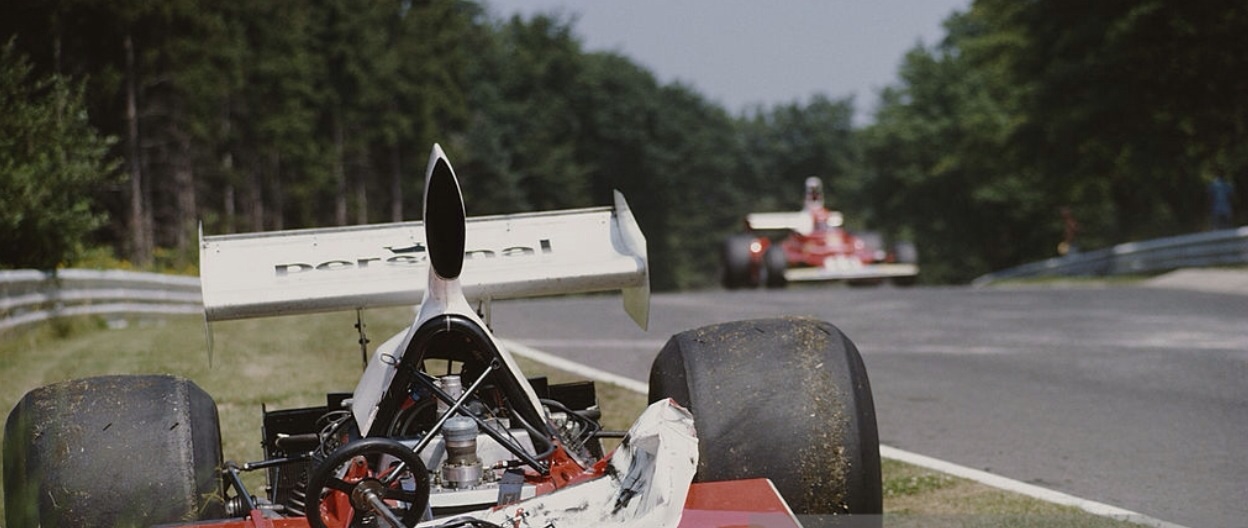
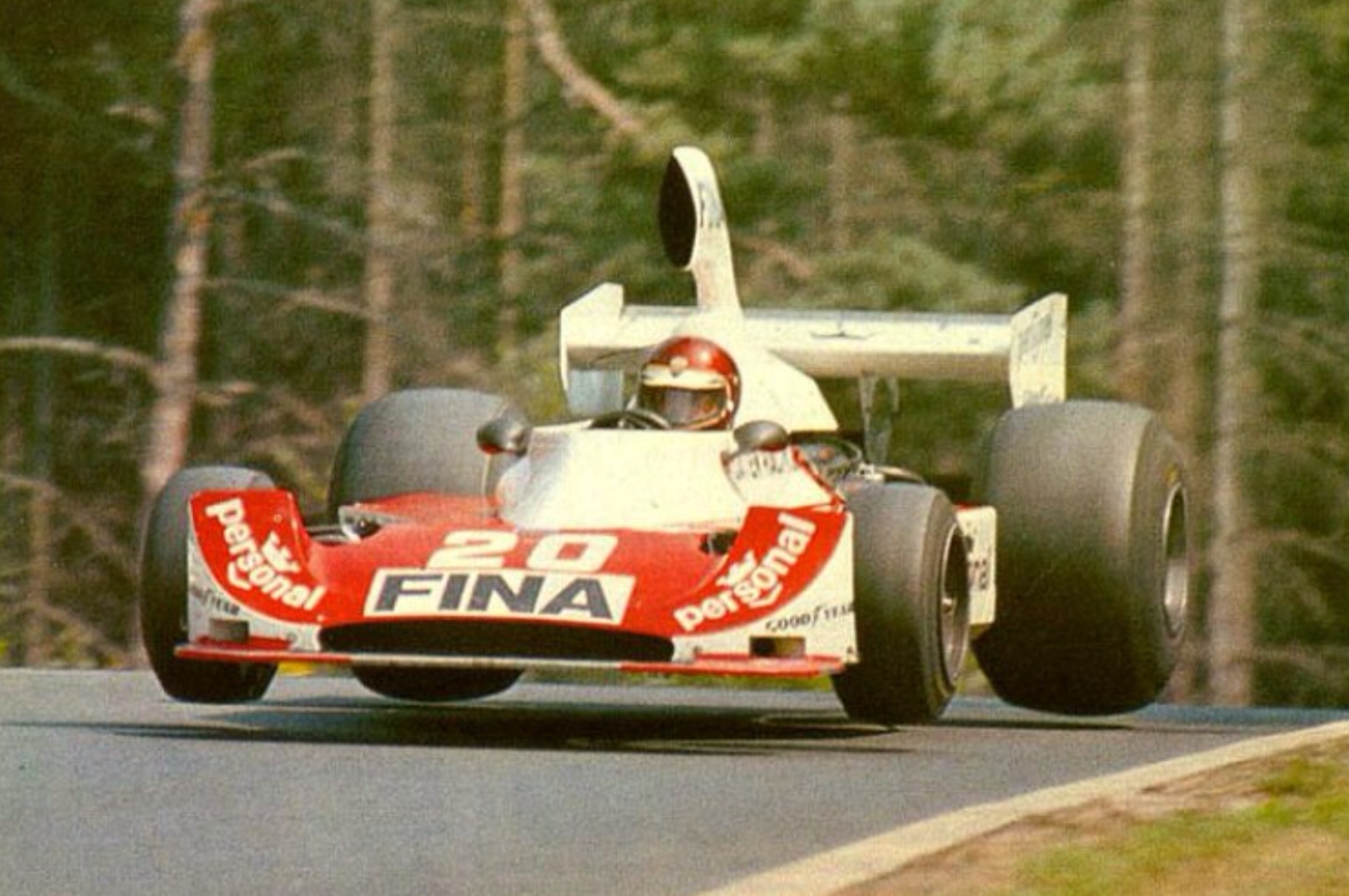
John Watson, Penske PC4 Ford, Austrian GP August 1976. Watson and Penske’s first GP wins.
Given the junk ‘Tilke Tele Circuits’ on which the circus races too much these days the old tracks, not that the ‘Red Bull Ring’, goes back as far as Monza or Spa, are important for their own sake as great ‘theatres’ but also to remind us of the heritage for which we are all responsible.
I’m not suggesting F1’s Venture Capital Fund owners, CVC give a ‘Rats Toss’ about heritage mind you.
Pastor Maldonado, Lotus E23 Mercedes, Austrian GP June 2015. Pastor was 7th in the race won by Nico Rosberg’s Mercedes F1 W06. (reddit.com)
Etcetera…
It was Tilke’s work to shorten the fast, long Osterreichring, used for the Austrian GP from 1970-1987 to the shorter A1-Ring used for the race from 1997-2003 aka Red Bull Ring now. The Styrian Mountains setting to start with was so good even he couldn’t bugger the thing up completely in its transformation to the modern age…
I re-read Mark Donohue’s excellent biography not so long ago. He refers to his Lola F5000 as a ‘little car’ which made me laugh!
I’ve never seen F5000s as anything other than big-cars but I ‘spose it’s all relative. When your frames of reference include McLaren M16 Offy Indycars and Porsche 917/30 Can-Am racers they are…
The ‘brand spankers’ M8A out front of McLaren’s salubrious David Road, Colnbrook facilities in early 1968. A contrast with the opulence of Woking today (unattributed)
There is nothing small and subtle about Can-Am cars, everything is BIIIGG!
They were built for 200 mile races, GP distance. The engines, 7-litres and up, the chassis had to be big and strong to carry the engine and its fuel, they used a lotta fuel! The dimensions were unrestricted, with bodies large to provide downforce. Big engines, lots of power and torque needs a big gearbox and driveshafts, the shot above of a 1968 McLaren M8A in all its naked glory illustrates the point.
Denny Hulme took the 1968 Can-Am Cup from teammate McLaren with three wins to Bruce’s one in six races.
The team, Tyler Alexander left and Gary Knutson, sorting an M8A engine drama at Bridghampton 1968. The car ran a bearing in the race while Denny’s broke a rod, Donohue won in an M6B Chev. Bruce patiently awaits. Few racing drivers as intelligent, analytical and thoughtful. Or quick (Pete Lyons)
M8A’ s vital statistics…
7-litre/427 cid McLaren modified aluminium block Chev ZL-1 engine. Bore and stroke 108mm x 95mm, pushrod OHV, Vertex magneto, Lucas fuel injection with the package giving circa 620bhp @ 7000rpm. Hewland LG500 four speed transaxle.
Monocoque chassis of rivetted and bonded aluminium with fabricated steel bulkheads. The Chev engine was a stressed member of the chassis. Wheelbase 94 inches, front and rear tracks 57.5 and 54.5 inches, length 153 inches and height to the top of the roll bar 36 inches. Weight circa 1350 pounds.
Hulme in the workshop prior to the M8A’s departure to the ‘States. Engine extractors, Lucas injection trumpets, (horizontal) fuel metering unit and (vertical) Vertex magneto, Hewland gearbox casing and brake ventilation ducts all clear. The rear wheels are fabricated magnesium, McLaren had two attempts at making these work and both failed. It’s a top shot, Denny spent a lot of time in the workshop when not racing (Jabby Crombac)
Rear suspension comprised single top link, reversed lower wishbones, twin radius rods, coil spring/damper units and adjustable roll-bars. Front was by unequal length wishbones, coil spring/damper units, adjustable roll-bars.
Brakes are Lockheed calipers outboard front and rear, McLaren cast magnesium wheels of 15 inches diameter and up to 11 inches wide and 15 inches and up to 16 inches wide at the rear…Big, like everything else!…
McLaren M8A Chev cutaway drawing. An incredible successful series of cars, the M8 family: M8A, M8B, M8D and M8F won the Can-Am title in 1968-71 respectively (M Palk)All hands on deck to load the cars for shipment to the US. Teddy Mayer on the trailer with Bruce’s car, note the standard four spoke cast wheels on the front of Hulme’s car and experimental fabricated ones on the rear (N Beresford Collection)Denny Hulme, M8A Laguna Seca practice 1968. John Cannon won this race, famously held in very wet conditions when so many fell off the Island. Cannon’s old McLaren M1B Chev won from Hulme and George Eaton’s McLaren M1C Ford (tamsoldracecarsite.net)
Credits…
‘Cars in Profile No8 McLaren M8 Series’ by David Hodges, Pete Lyons, Jabby Crombac and Nigel Beresford Collection via ‘kayemod’ TNF, tamsoldracecarsite.net
Alan Moffat finesses his big, powerful ‘works’ HO Falcon around the tight, technically demanding confines of Sydney’s Warwick Farm February 15 1970…
This will be a support race for the ‘Warwick Farm 100’ F5000 Tasman series round, am intrigued to know who won this ‘Series Production’ encounter. Perhaps a Holden Torana GTR-XU1, WF more suited to the nimble but powerful 3 litre/186cid Holden 6 than the 5.7 litre/351 cid V8 ‘Big Henry’?
Moffat won the ‘South Pacific Touring Car Championship’ series conducted over the four Australian Tasman events but i wonder if he won this round?
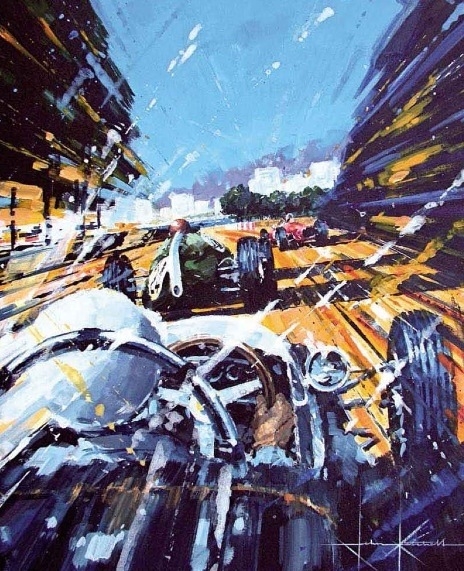
Teammates Rudi Caracciola and Manfred von Brauchitsch #10 battle for the lead roaring by the ‘Hotel Beau Rivage’ in their Mercedes Benz W125…
This image is Alan Fearnley’s ‘Battle of Beau Rivage’ from his book ‘The Classic Car Paintings’ and ‘depicts a dramatic battle amidst the architectural wonderment of the principality pre-war’, von Brauchitsch won the race against team orders. Caratch won the European title in 1937, both he and Bernd Rosemeyer, Auto Union mounted, won 4 races apiece but Rudi had the larger points haul.
Manfred’s nickname was ‘The Unlucky Bird’, when he had this chance for a race victory he was not going to let it slip away. He said later in life that Alfred Neubauer, Mercedes famous team manager did not have much to do with him afterwards for the rest of his career. It was one of the few races Caracciola lost to another Mercedes that year.
The Mercedes W125 was Fearnley’s favourite machine ‘it seems to embody all the visual impact that a Grand Prix car should have’, his painting is a superb, dramatic work.
The artistry of some folks never ceases to amaze, Yoshiro Inomoto is one of the best of the ‘cutaway artists’, this is his Ferrari 166S…
Three cars were built using a 2 litre version of the Colombo 60 degree V12 giving circa 150bhp@7000rpm.
The first two were bodied by Carozzeria Allemano and were successful; the cars won both the 1948 Targa Florio, Troubetzoy/Biondetti in a 166S and Mille Miglia, Biondetti/Navone in a 166 Coupe. Both race winners were destroyed, of the 3 cars only the ‘goggle-eyed’ one drawn by Inomoto survives.
The winning Ferrari 166S of Troubetzoy/Biondetti leads the 16th placed Lancia Aprilia of Piccinini/Marzotto (unattributed)
Credit…
Yoshihiro Inomoto, Klemantaski Collection
Tailpiece…
Alberto Ascari on the way to winning the production sports car race at the ‘International Daily Express Trophy’ Meeting 26 August 1950. Factory Ferrari 166MM Barchetta (Klemantaski Collection)
There is just no chance Damon Hill wasn’t going to be a racing driver?…
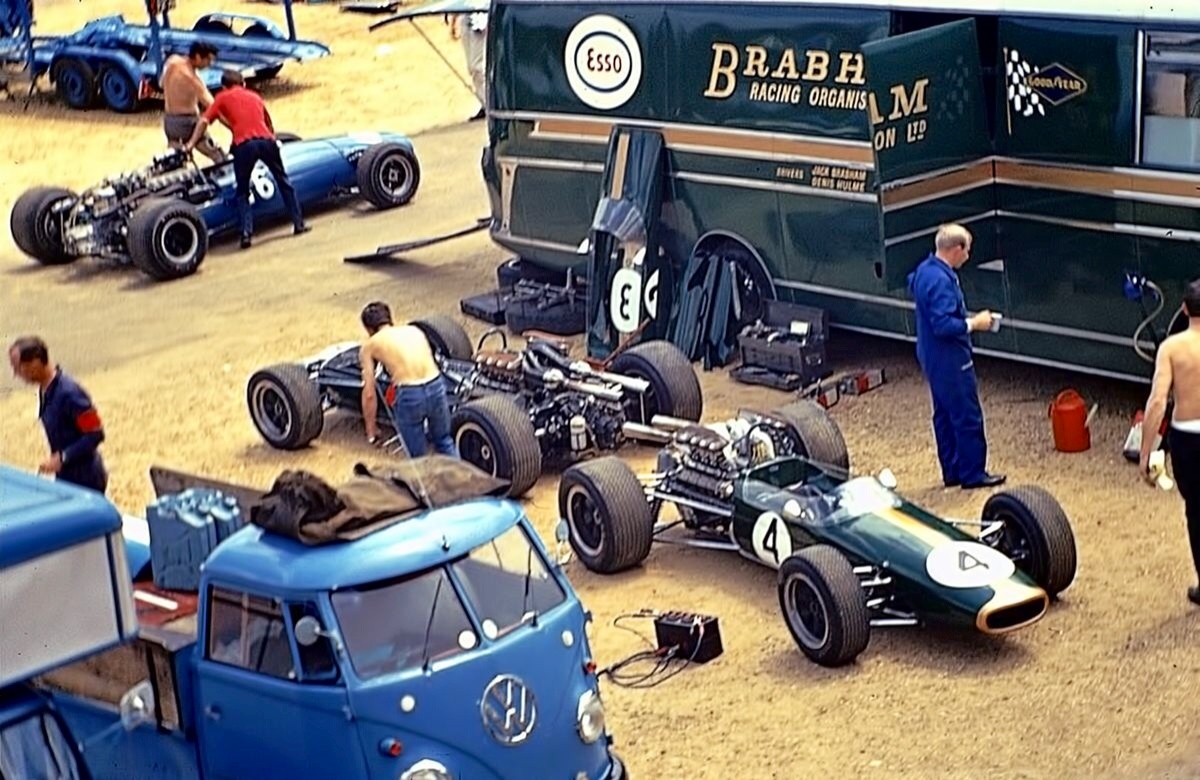
There are so many childhood shots of him with his dad in practice for an event somewhere round the globe. This one is close to home, Graham’s Lotus 33 BRM is being fettled for the ‘XIX BRDC International Trophy’ at Silverstone on 29 April 1967.
GH rejoined Team Lotus from BRM so was well familiar with the 2 litre P56 engine which powered his Lotus. He won plenty of races with this engine in both 1.5 litre F1 and 2 litre ‘Tasman’ spec in the BRM P261 chassis.
Damon @ 15 aboard his Bultaco 1975 (Chris Ware)
Hill started racing bikes in 1981, here aboard a Kawasaki 500 at Donington Park. His early racing was all self-funded, the Hill family fortune diminished by claims of victims families after the light aircraft crash which killed GH and most of his team in 1975 (unattributed)
There were 2 ‘interim’ 2 litre V8 33’s in 1967; this chassis ‘R11’ and Jim Clark’s Coventry Climax powered ‘R14’ in which he had just won the Tasman Series.
Things were about to change though; the 3 litre Ford Cosworth DFV powered Lotus 49 was already being tested by Hill and famously won upon its Dutch Grand Prix debut in Clarks hands on 4 June.
Parkes won at Silverstone in his Ferrari 312 from Jack’s Brabham BT20 Repco and Siffert’s Cooper T81 Maserati with Graham fourth in ‘R11’. The car was kind to Graham, he was second in the Monaco GP on 7 May, the last championship round in which these cars were raced by Team Lotus.
Formula Ford Festival Mayhem! 1985 Brands Hatch. Damon Hills #37 Van Dieman RF85 leads the pack, interested to know who the other drivers and cars are FF fans!? The ’85 festival was won by Johnny Herbert’s Quest with Jonathon Bancroft 2nd, Hill 3rd and Mark Blundell 4th all in VD RF85’s. DH career progression; F3 in 1986, F3000 in 1989, a critical testing contract with Williams in 1992 and Brabham F1 drive in the same year. He was no star in his early years, he ‘got there’ by displaying the same grit, determination and persistence as his father. He also has his fathers ‘class’ and is a fine ambassador for his country and sport (Phil Rainford)
Damon Hill on his way to 6th in the 1992 Hungarian GP. Brabham BT60B Judd 3.5 V10. Q25, a good drive in difficult conditions, Senna won the race in a McLaren MP4 Honda V12. First GP season. Also proved his speed and feedback as a test driver for Williams that year. World Champ for Williams Renault in 1996 (unattributed)
Credits…
Getty Images, Victor Blackman, Chris Ware, Phil Rainford
Venetia Day adorns the Matra MS120 at London’s Racing Car Show at Olympia on January 6 1971…
She is quite the most beautiful young lady with all of the ‘bibs n bobs’ we fellas tend to like. With the compound curvature of a Maserati 250F she is hard to beat.
I get a lot of metrics as part of this WordPress website, it always amuses me that the seventh most popular article i have done is the MS120 Matra piece i wrote a while back featuring Venetia’s ‘rear suspension’. Here to complete the set is her ‘front suspension’ which is as firmly set and finely proportioned as the rear…
Its certainly not the best piece i have written, so i guess it has something else going for it, page one or two of a Matra MS120 Google search !
All very politically incorrect these days of course, but political correctness is so ‘ferkin boring!
Here’s the original article if you’ve not read it;
David Coulthard’s Red Bull Renault RB’4WD’ trys to avoid being lassooed y’all, Johnson City, Texas 19 August 2011…
There was no American GP from 2008 to 2011 this Red Bull promotion was of Coulthard driving the ‘Circuit of The Americas’ then under construction outside Austin, Texas.
YouTube footage thereof…
DC Red Bull Renault, ‘Circuit of The Americas’ first ‘race laps’, August 2011 (Getty Images)