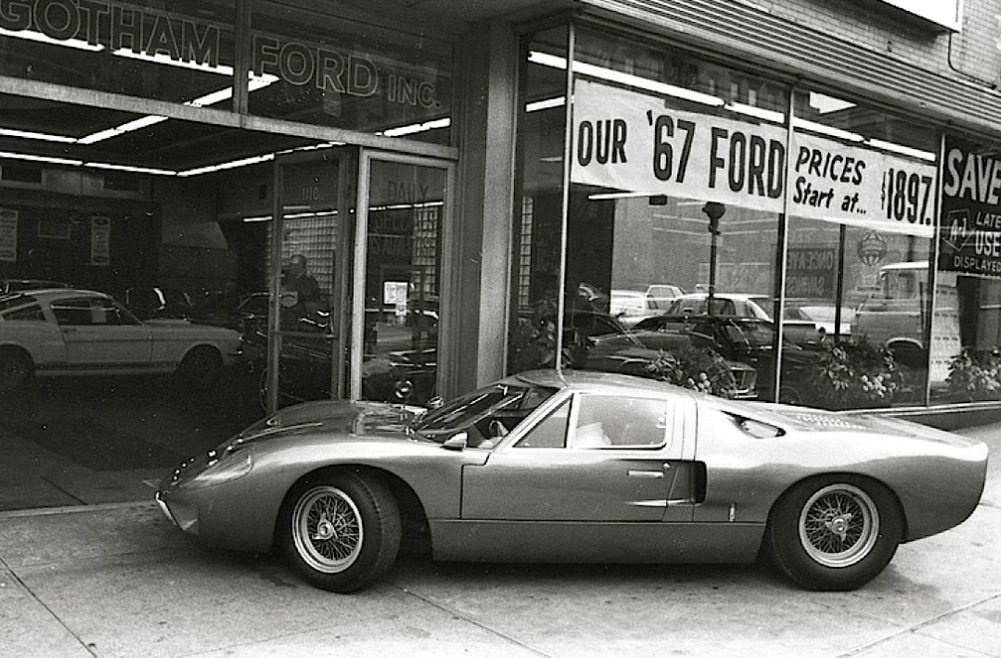
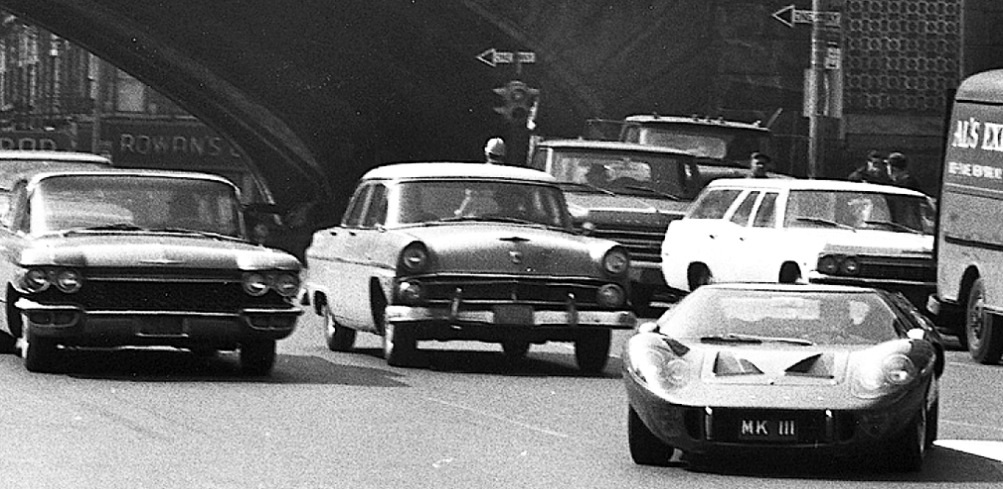
I wonder how much it was? ‘Gotham Ford’ does have a touch of the ‘Batmans’ about it doesn’t it…
Not too many of these GT40 ‘road cars’ were built, maybe one of you knows which chassis this is?
Credit…
Unattributed
 | robert king on Mount Martha Hillclimb… |
 | markbisset on Mount Martha Hillclimb… |
 | Laurie Shine on Mount Martha Hillclimb… |
 | Rod Callaghan on Mount Martha Hillclimb… |
I wonder how much it was? ‘Gotham Ford’ does have a touch of the ‘Batmans’ about it doesn’t it…
Not too many of these GT40 ‘road cars’ were built, maybe one of you knows which chassis this is?
Credit…
Unattributed
(John Ellacott)
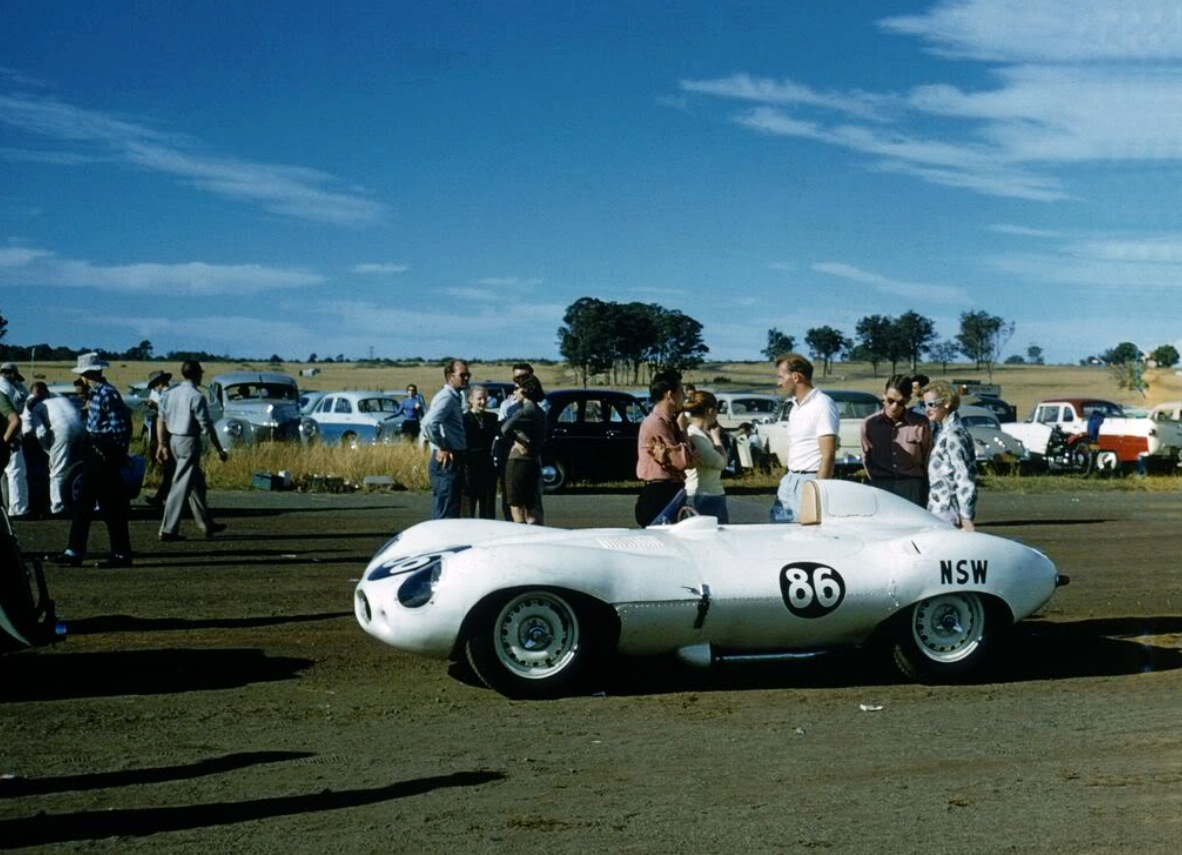
Frank Gardner beside his Jaguar D Type ‘XKD 520’ at Mount Druitt on 23 May 1958, looking fairly relaxed, photographer John Ellacott recalls FG achieved a 14.57 standing quarter mile in the big, powerful car…
Its right at the end of Mount Druitt’s decade long life as a race circuit in Sydney’s western suburbs. FG took FTD in one of the sprint events after the circuit was ‘mortally wounded’ by circuit owner Belf Jones after a spat with its operator the ‘Australian Racing Drivers Club’ in 1958.
(TR0003)
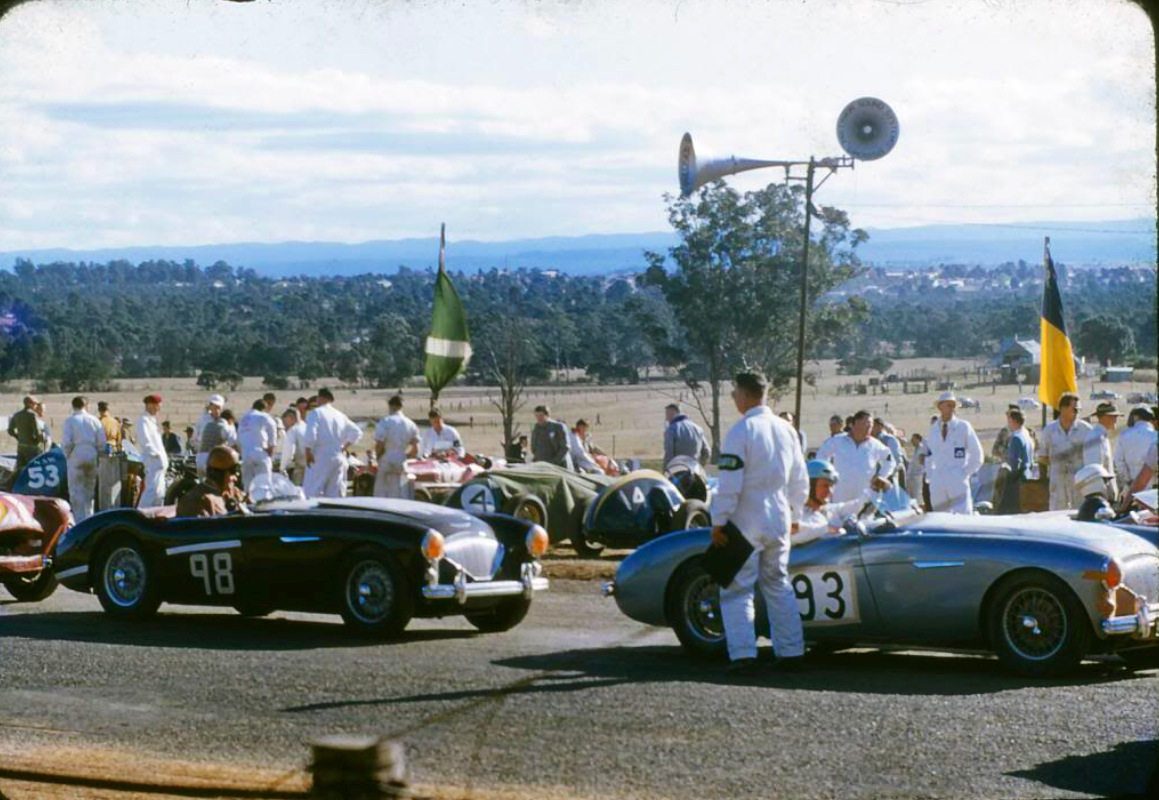
These wonderful Mount Druitt, 1955 Sydney, New South Wales colour shots (the one above and below) were posted on ‘the Nostalgia Forum’ which, for those of you who haven’t discovered it is something you should do, but be warned you will be lost in interesting motor racing ‘threads’ for years…
http://forums.autosport.com/forum/10-the-nostalgia-forum/
Ace researcher/historian and primotipo contributor Stephen Dalton dates the shots as probably the 4 September 1955 meeting with the Healeys’ driven by #93 C Kennedy and #98 K Bennett. In the background Stephen thinks the #53 tail is an important Australian MG Spl, the ex/Dick Cobden/David McKay/Curly Brydon car.
The red car surrounded by mechanics is perhaps the ex Jack Saywell Alfa Romeo P3 then Alvis powered and driven by Gordon Greig. The covered #4 single seater is Stan Coffey’s Cooper Bristol ‘Dowidat Spl’ and #14 Jack Robinson’s Jaguar Special.
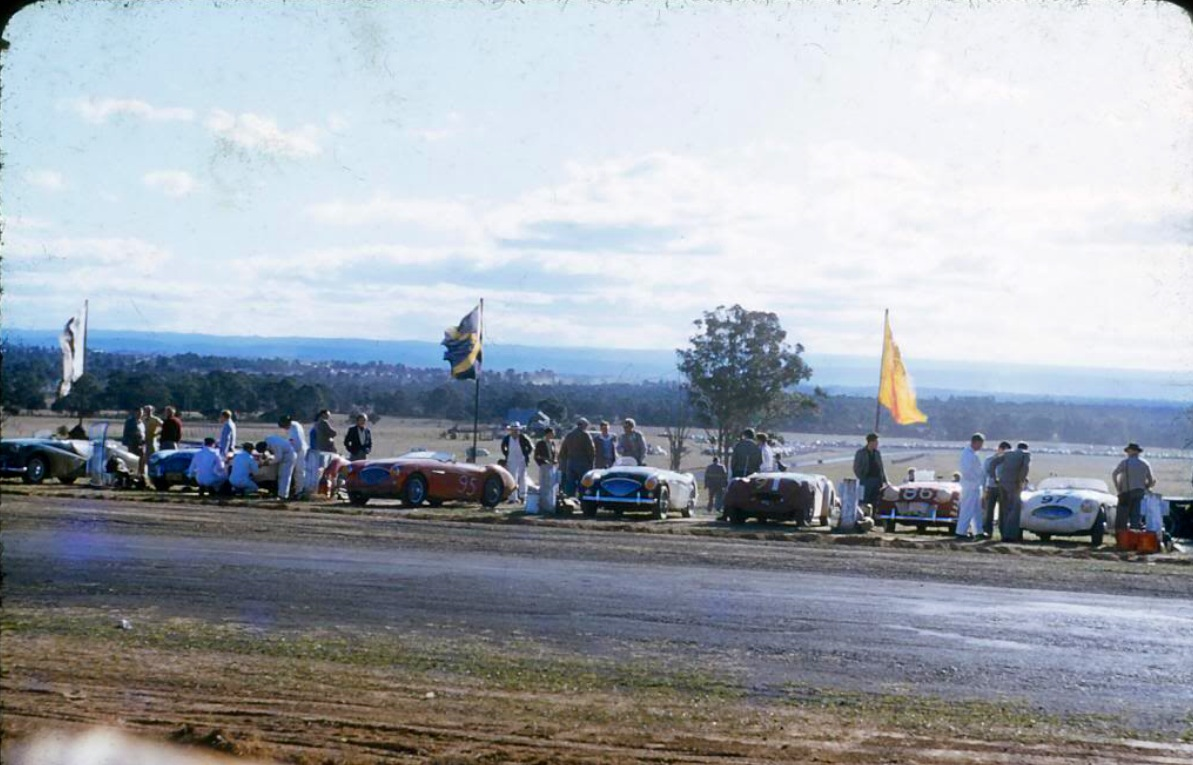
(TR0003)
All ‘The Fun of The Fair’ or ‘Mount Druitt Motor Racing’ as the case may be…
This article was published in the Sydney Morning Herald on 14 August 1954, it captures the atmosphere of the place and the day and ignorance of the public of motor racing;
‘THIRTY thousand picnicking spectators in 8,000 cars make a phenomenon in Australian sport and entertainment at Sydney’s monthly motor races at Mt. Druitt.
Cars park two to four deep the whole length of the two and a quarter miles racing track. Spectators drive between races from one vantage point to another over ‘horror stretches’ in the seemingly endless acres of paddocks around the track.
Vendors sell hot water, hot dogs, all the usual provendor of picnics. Children play rounders or football between races.
By the standards of Britain’s famous Brooklands, the informality is extreme for the spectators, but it is typically Australian; sunshine, open air, gum trees.
The Australian Racing Drivers’ Club, however, applies the strictest international rules of competition to its 12 or 14 race program.
Officials on motor cycles patrol the boundary fences. White uniformed officials with international motor racing flags signal the drivers safely through the races-a blue flag waved – ‘a competitor is trying to overtake you’; a yellow flag waved ‘great danger, be prepared to stop’; yellow, with vertical red stripes-‘take care, oil has been spilt on the track.’
A public address system links the whole of the two and a quarter miles of track with the finishing line.
A truck tows breakdowns off the course, often two at a time, ignominiously, like a defeated bull dragged from the ring.
At the end of the day 8,000 cars crowd the Great Western Highway in a colossal traffic jam, in which the ‘hot rodders,’ after a few imitative accelerations, lose their ardour for speed on frustrating miles of bumper-to bumper driving.
What attracts this crowd to a venue nearly 40 miles from the city is the excitement of speeds up to 140 miles an hour and skid turns on hairpin and right-angle bends. The straight of the bitumen track is a wartime airstrip.
The club conducts events for racing, sports, and stock cars and has 60 to 70 competitors at a meeting.
Most of the competitors are owner-drivers-fanatical seekers of perfection in the assembling and tuning of motors. They acquire a car, according to their means and choice. If it is a stock model they remachine and reassemble parts of the motor, and fit new parts, two carburettors, and a ‘blower’ (a supercharger), which gives the ultimate ‘kick.’
In all types of cars running and maintenance costs are high. A set of tyres is good for only 500 racing miles. A car may run half a mile and burn the top out of a piston. An owner may spend £250 on a new cylinder head and find it does not fit satisfactorily.
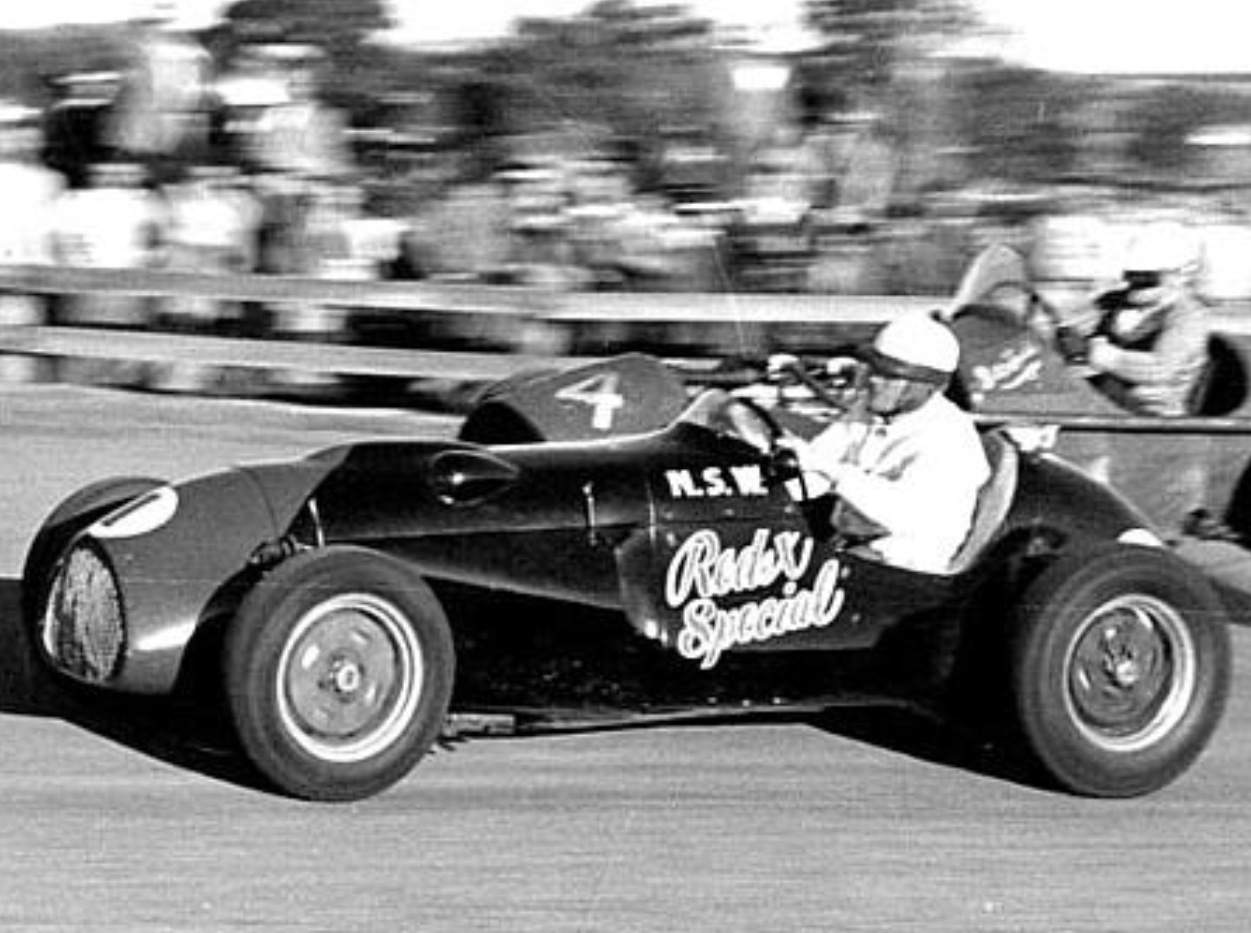
Jack Brabham in the Cooper ‘Redex Spl’ Bristol referred to in the text. On the outside is Bill Hudson, Hudson Spl at Mount Druitt in 1955. Jack was later to say he should have taken this highly self developed car to the UK rather than purchase the Cooper Alta he bought in the UK…still it didn’t hold him back in the end! (unattributed)
THE glamour driver of the moment is a 26-year-old motor engineer, Jack Brabham, with his British £4,000 six cylinder Cooper (frame)-Bristol (motor).
He is a former Australian midget car champion, whom some club officials put in ‘world class.’
In the lingo of the fans, he ‘lashes the loud pedal-(accelerator) down to the boards’ and scorns the ‘anchors’ (brakes).
His driving is, indeed, a spectacle as he relentlessly mows down a field, flashes past car after car, and changes gears at 85 to 90 miles an hour.
But the fans are watching a £7,000 Italian Ferrari, with a 12-cylinder two litre engine having a power output of 250 b.h.p. and a top speed around 150 m.p.h. Owner Dick Cobden, a fine driver, has had the car only a few months and is still familiarising himself with its tuning and driving.
The Ferrari is a Grand Prix car, which famous English driver, Peter Whitehead, drove in the Lady Wigram trophy at Christchurch, New Zealand, early this year’.
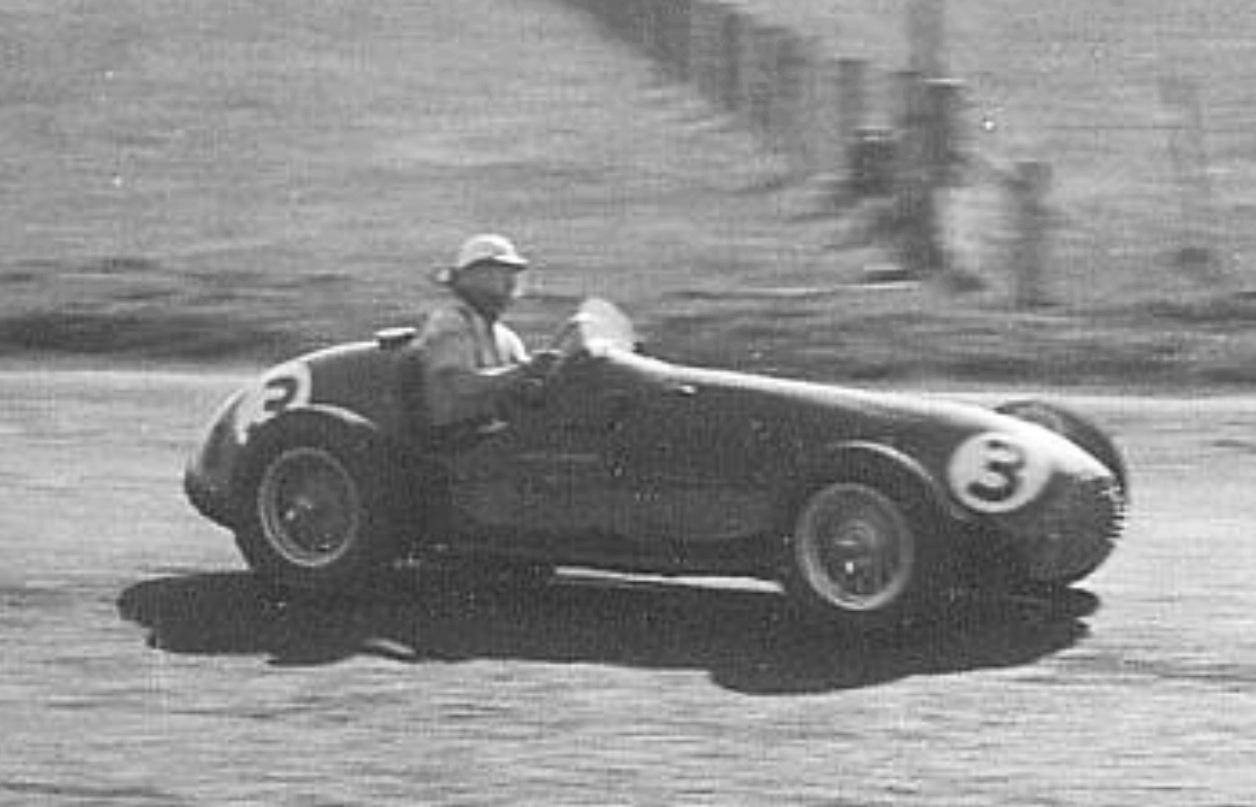
Dick Cobden’s ex-Whitehead Ferrari 125 at Mount Druitt, date uncertain. (G & L Liebrand Collection)
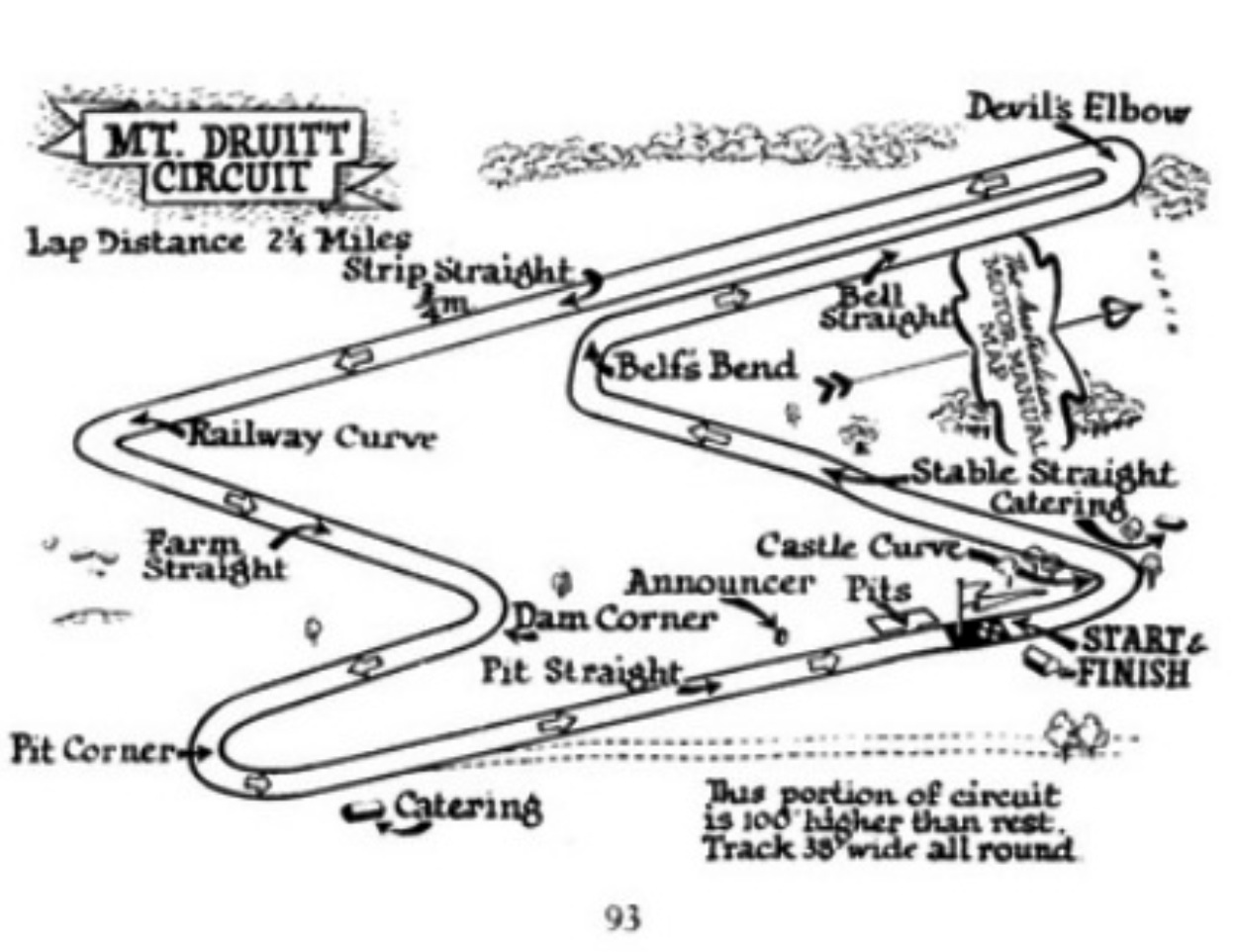
Circuit Map…
(unattributed)
Mount Druitt Aerodrome, 45 Km west of Sydney was built for the Royal Australian Air Force during World War 2. The facility comprised 2 hangars, workshops and a runway 1,524 metres long and 48 metres wide, perfect as the basis of a racetrack postwar.
The first race meeting was held on October 4 1948 on a short track based on the runway established by the Australian Sporting Car Club.
In 1952 Belf Jones built a full circuit, 2.25 miles long using some adjoining land owned by a Mr McMahon, a Sydney businessman. The circuits’ first meeting was on 30 November 1952 organised by the Australian Racing Drivers Club, the main event, a 50 Mile Handicap won by future Australian champion, David McKay’s MG Spl. (one of the cars obscured in the first photo above).
Over the following 5 years over 25 meetings were run with crowd attendances often over 15,000, given the circuits proximity to Sydney. Mt Druitt’s last meeting was on 10 November 1957.
Commercial agreement for the circuits future use could not be reached between the ARDC and Jones, who did irreparable damage to the circuit; Jones cut a trench around the circuit with a digger!
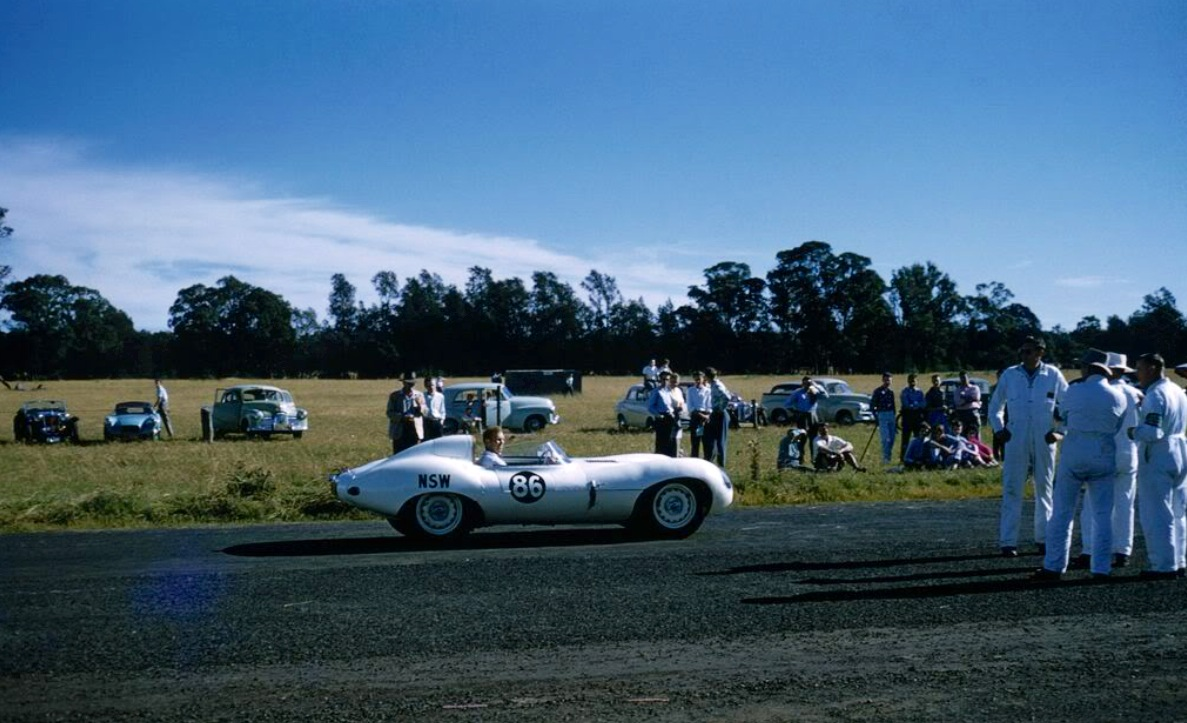
Another shot of Frank Gardner’s D Type at Mount Druitt on 23 May 1958. (John Ellacott)
The last hurrah for the venue was a number of sprint meetings run in 1958. Victories resulted for Gardner’s D Type Jag, Arnold Glass’ HWM Jaguar and Len Lukey’s Cooper Bristol.
The ‘NSW Speedway Act’ in 1959 and consequent required investment in the facility to meet new safety standards was the final death-knell for this fondly remembered circuit.
The parts of the track added in 1952 remain but the airstrip section is long gone, the area is now known as the Whalan Reserve, it comprises the Mount Druitt industrial estate and Madong Avenue Primary School.
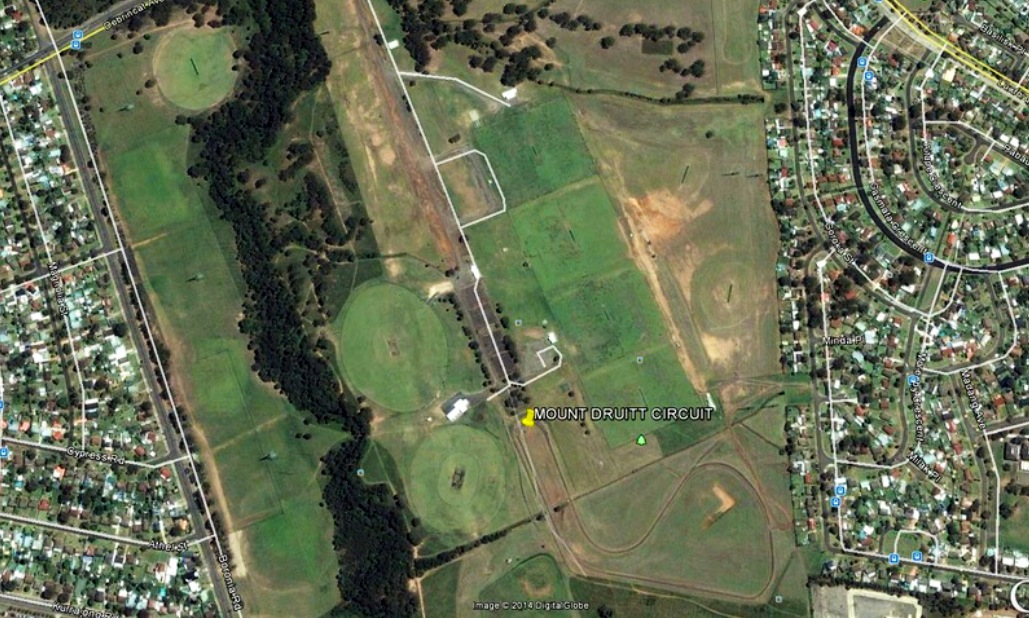
Current google earth aerial shot of the circuit area. (speedwayandroadracehistory.com)
Bibliography…
The Nostalgia Forum Mount Druitt thread, particularly the contributions of Stephen Dalton and ‘wirra’. Sydney Morning Herald 14 August 1954, speedwayandroadracehistory.com
Photos…
John Ellacott, TR0003, G & L Liebrand Collection
Finito…
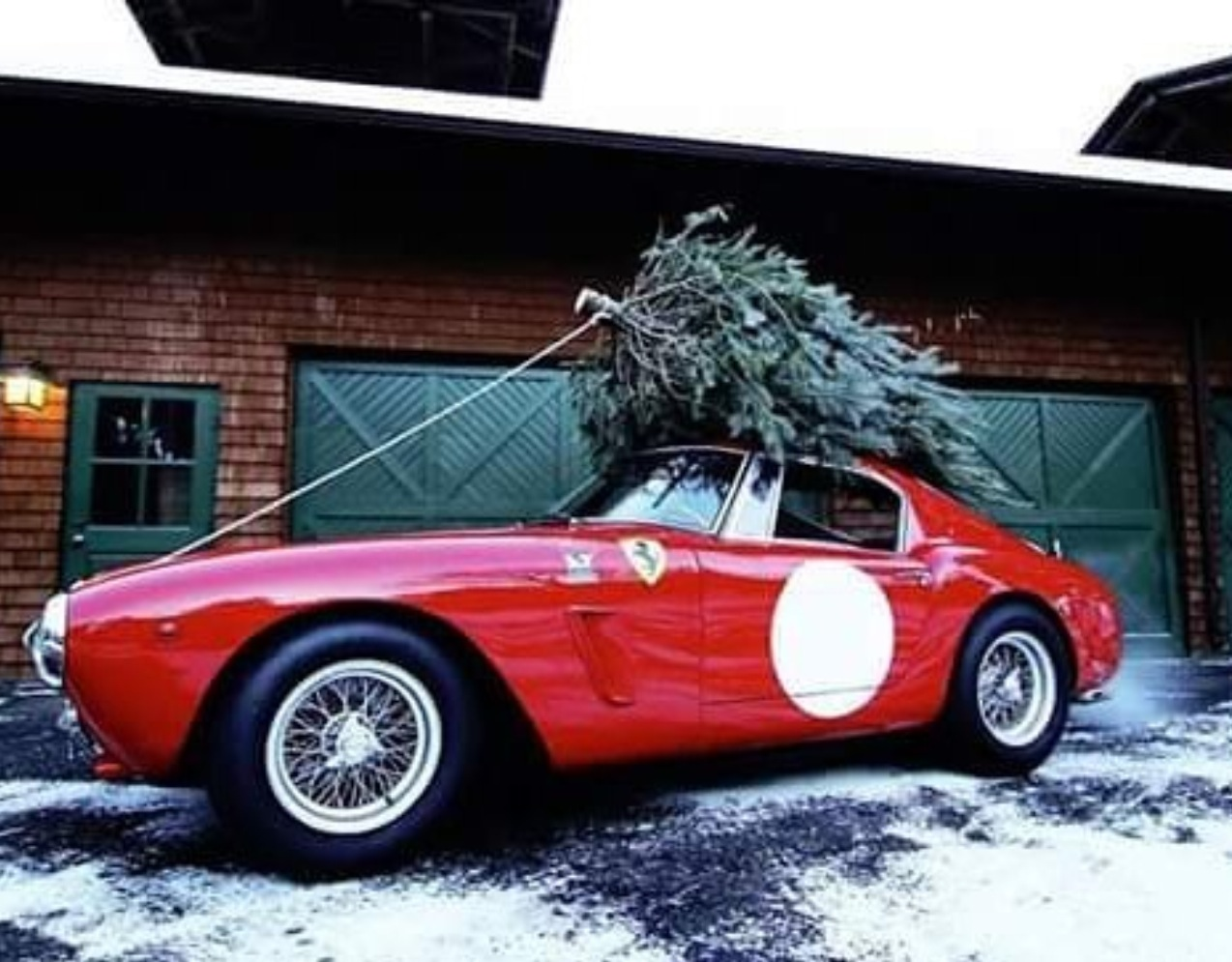
Down to the local scout-hall in your 250 SWB to pick up a tree (unattributed)
Seasonal Saluations to you all wherever you may live…
This world of ours is as nutty as ever. It’s nice to be able to lose yourself in motor racing I figure!
It’s my third Christmas Primotipo greeting, I started this online magazine in mid-2014 when I had lots of time on my hands working in Adelaide. I’ve now a role based in Melbourne but involves regular travel to Sydney and Perth. It makes writing the longer stuff a lot harder, so contributions from anyone who want to write about their passion are invited! You can see how eclectic the content is, so go for it! My email address is mark@bisset.com.au.
In that regard many thanks to Stephen Dalton, Nigel Tait and Greg Smith for their articles this year. Similarly Peter Brennan and Rodway Wolfe both provide ongoing sources of material for articles, in Rodway’s case we are bit by bit writing the ‘Repco Racing Story’ with Nigel Tait and Michael Gasking’s Collections providing, rich, never published before Repco visual promotional material.
An army of Australian photographers continue to assist by allowing me to use their wonderful work; John Ellacott, Dick Simpson, Rod MacKenzie, Lindsay Ross, Dale Harvey and David Blanch all spring to mind.
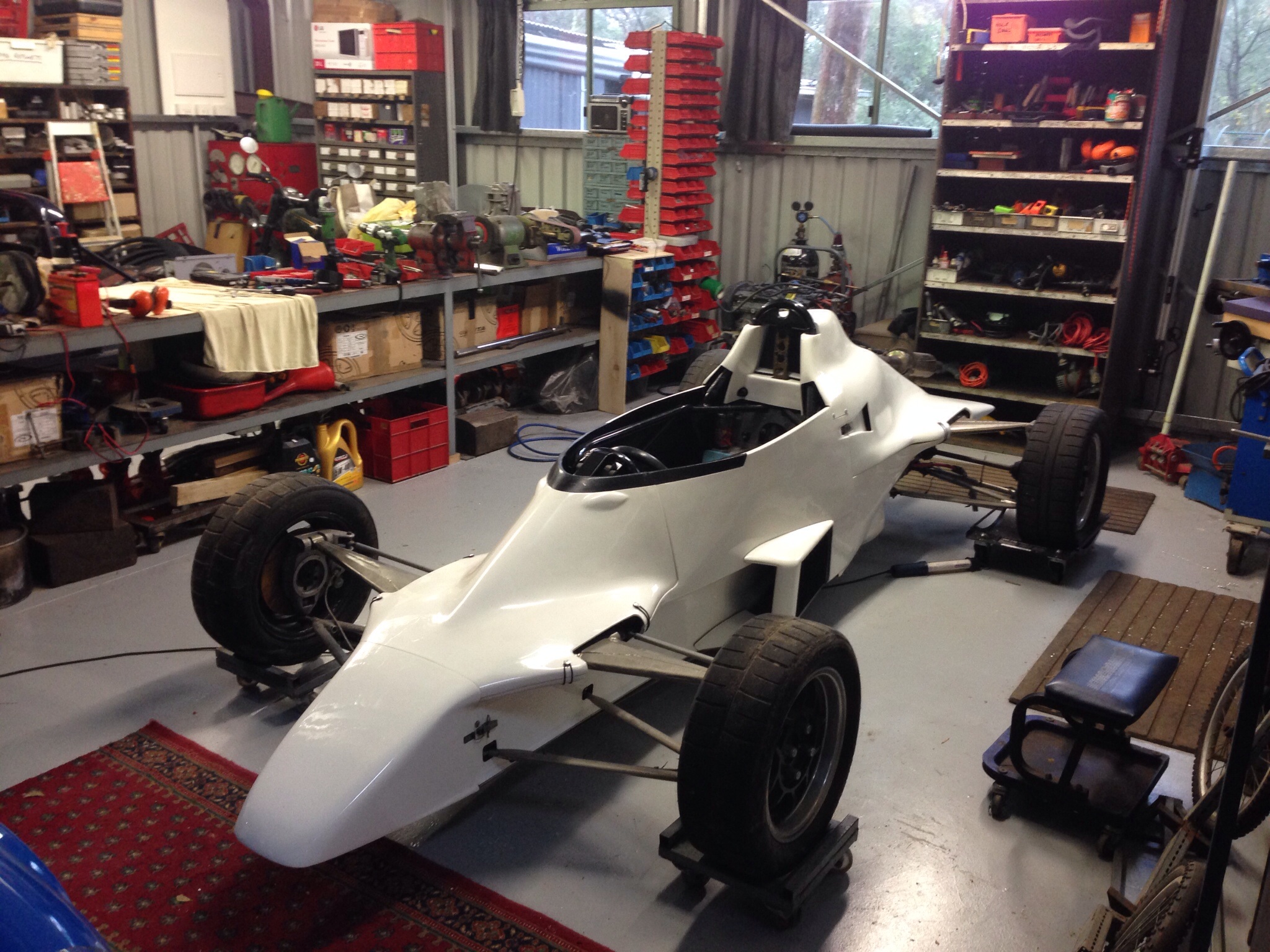
My own Van Diemen RF86 Formula Ford ‘freshen’ is nearly complete, i will rejoin the historic FF grids in Oz in 2017. Interesting car, its one of two chassis used by Peter Verheyen to win the Australian FF Championship in 1987
It continues to boggle my mind that although the content is about 40% Australian that 80% of the readership is global, the top 10 countries in order of size Australia, France, US, Germany, UK, Italy, Japan, Holland, Brazil and Spain. An interesting mix!
Most of all, thanks for reading primotipo!
I’ll mainly be posting shorter stuff over the next few weeks, it’s our summer holidays in this part of the world so me ‘an the sabre-toothed-tigress are off to Seminyak, Bali for a couple of weeks.
Stay well, stay safe, may you all enjoy good health and all the luck you deserve in 2017.
Mark Bisset, 24 December 2016
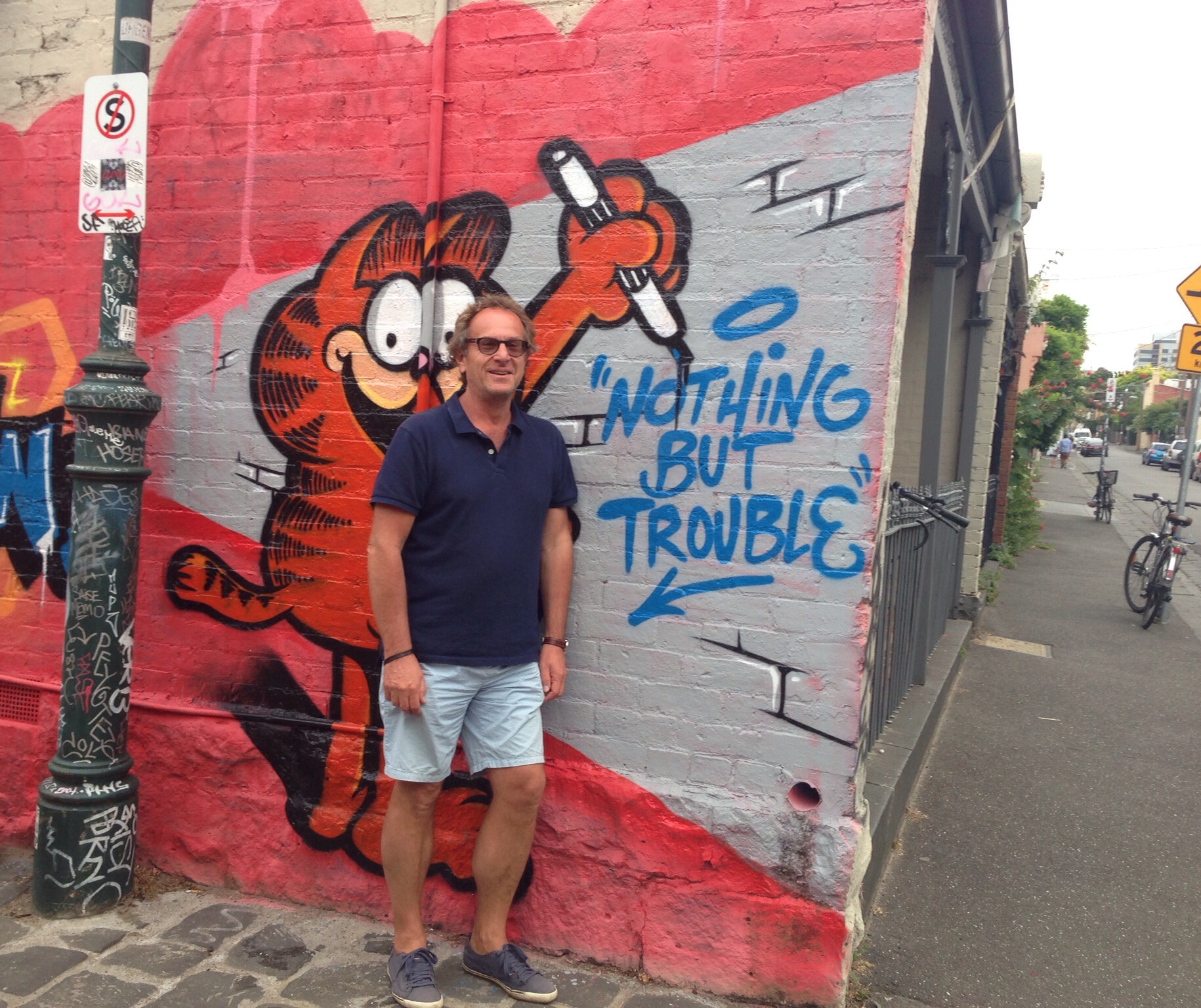
Lane in Fitzroy, Melbourne, not too far from home

(David Van Dal)
Morry Maurice competing in the the ‘Goomalling Speed Classic’ 7 June 1954, HRG 1500. Goomalling, Western Australia…
The two wonderful color photographs in this article are by David Van Dal of Morry Maurice’ HRG 1500 at Goomalling and Narrogin. Both are towns in Western Australia’s wheatbelt around 200km southeast of Perth. The shot above is quintessential Australian country town, even today. The beautiful blue racing car and upright, stylish driver a contrast to the drab coloured background buildings and gum trees.
‘Round The Houses’ Racing in Western Australia…
WA has a rich history of ‘Round the Houses’ racing, such events were held on street circuits in many country towns there in the 1930’s, 40’s and 50’s. The first of these was held at Albany in 1936 and planned to emulate the style of racing common in Europe at the time.
The towns of Pingelly, Bunbury, Dowerin, Northam, Goomalling and Narrogin all held meetings with Narrogin hosting the Australian Grand Prix in March 1951. That event held in very hot conditions was watched by 35,000 people a long way from Perth, and won by Warwick Pratley in the Ford V8 powered ‘George Reed Special’.

Maurice at Northam, WA in 1954, HRG 1500. ‘Northam Flying 50’ 19 April 1954 (Ken Devine)
Maurice’ HRG was originally bought to Australia in 1949, it was one of an initial shipment of three chassis imported by Brown and Dureau, the Melbourne based distributors of the marque. The bodies for the cars were built locally. Like so many cars in Australia it was constantly modified in an effort to keep it competitive throughout the 1950’s as technology rapidly advanced. Click on this link for a good summary of the life and times of the 1948 HRG 1500 chassis #174 aka 1958 HRG Buchanan Holden ‘Godfrey Spl’;
http://www.buchananmotorcompany.com/HRG%20Buchanan%20Holden.htm
Goomalling…
Racing at Goomalling took place between 1949 and 1961. It was a prominent motorsport venue in the postwar years, taking over from Dowerin as one of the WA wheatbelt’s motorsport hubs. Motor racing was a reason for creation of the circuit but so was fundraising to pay for a new swimming pool in the town. Its scorching during the long, hot, dry summer months there!
Three racing mad returned servicemen; Milton Royal, Ted Nicholson and Charlie Dent were behind the track, the trio originally formed the Goomalling Sporting Car Club in 1939. That year the club held a small event at the abandoned Goomalling horse racing track before its three founders were called away to fight for their country over the skies of Europe, all were Air Force Officers. It wasn’t until 1949 that motorsport returned to Goomalling, the last ‘in period’ meeting the 1961 ‘Flying Fifty’.

(David van Dal)
Maurice’ HRG 1500 again, this time at Narrogin in ‘The Great Southern Fifty’ meeting on 2 March 1953…
My brother lives in Perth, WA, I spend a lot of time there and in the Margaret River region down south, this topography and soil is so WA. The parched earth, brown grass and green eucalypts are so Oz and WA in particular. I can feel the summer heat just looking at this shot! It looks like an outer suburban street scene, love the ‘International’? truck in the background and cream brick house.
Bibliography…
‘Goomalling Classic Racers’ by Graeme Cocks, Ken Devine and Ray Bell on ‘The Nostalgia Forum’, terrywalkersplace.com-great site for all things WA motor racing history, ‘Around The Houses’ by Terry Walker
Credits…
David van Dal via Ken Devine and ‘Repco 22’ on The Nostalgia Forum for the photos. David Van Dal was a West Australian racer, who between events in his Morgan took some amazing photographs, many in color, so rare for the period and therefore to be savoured for the lifelike time capsules they are.
Tailpiece: Goomalling Speed Classic summary and circuit…

(‘Around The Houses’ Terry Walkers )

Achille Varzi’s Auto Union Type B pitstop during the 26 May Avus-Rennen, Berlin, 1935…
Note the onboard air-jacks, pretty schmick for 1935, I didn’t realise the technology went back that far, I wonder when they were first used in racing? It’s a nice shot also of the swing axle rear suspension, sprung by torsion bars in 1935 rather than the transverse leaf spring of the 1934 Type A.
Varzi was 3rd in his 4.9 litre V16 beastie, the race won by Luigi Fagioli’s Mercedes Benz W25. The race was a Formula Libre event so the German teams turned up with some streamliners including a Mercedes W25 for Hanns Geier, the cockpit cover of which could only be opened from the outside. No doubt Alfred Neubauer was happy to oblige at each pitstop.
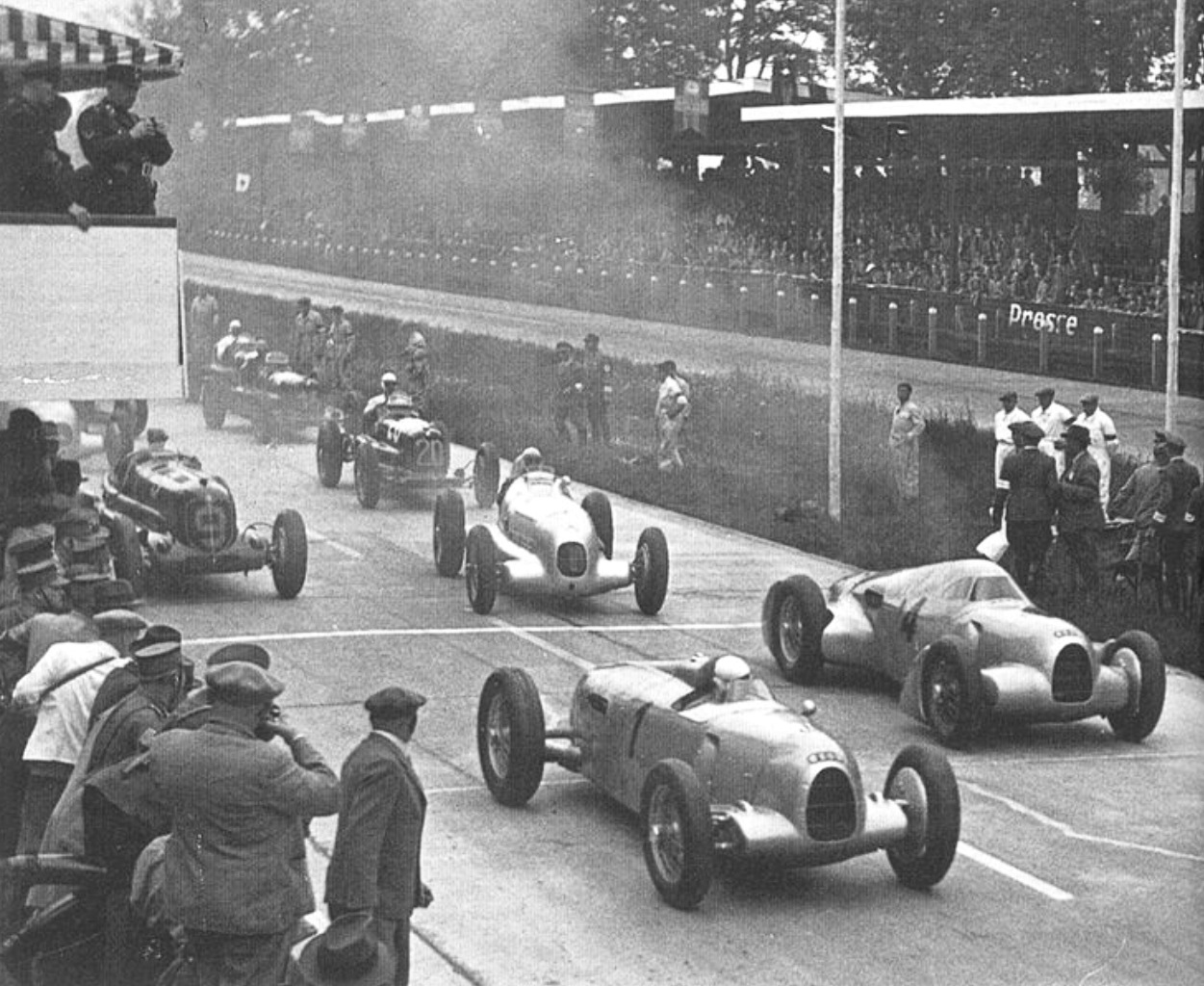
Avus 1935 heat 1 start; #1 Stuck AU Type B 1st from #4 Rosemeyer AU Type A Streamliner DNF, the Mercedes is Fagioli’s W25 2nd, #9 is Nuvolari’s Alfa Bimotore 6th, #20 Farina’s Maserati 4C 5th, #16 Siena’s Maserati 8C DNF (unattributed)
Continuing the themes of commonsense and bravery!, the meeting was also notable for the first ever car race of German ‘bike ace Bernd Rosemeyer. He ‘blagged his way’ into the Auto Union team for whom he raced from then until his untimely death in early 1938 during a brave land speed record Auto Union run. Read anything about this fella and the word brave will be peppered throughout the article.
The car racer novice plonked the notoriously twitchy 375bhp mid-engined Type B on the front row for his heat on the fastest circuit in the world, the AU’s were seeing 326kmh along Avus’ long straights. He punctured a tyre during his 7 lap heat so didn’t make the final which comprised the first 4 placegetters in each of the heats, but he had well and truly ‘arrived’…
Check out Kolumbus F1’s ’35 Avus race report, this being my favourite Pre-War race results site, have a good poke around if you haven’t visited it before;
http://www.kolumbus.fi/leif.snellman/gp3503.htm#9
Credits…
Kolumbus F1, Ullstein Bild, Zoltan Glass

Auto Union Type A engine and rear suspension (Zoltan Glass)
Tailpiece: Varzi’s Auto Union Type B 4.9 V16 and Rosemeyer’s AU Type A 4.3 V16 in the 1935 Avus paddock…
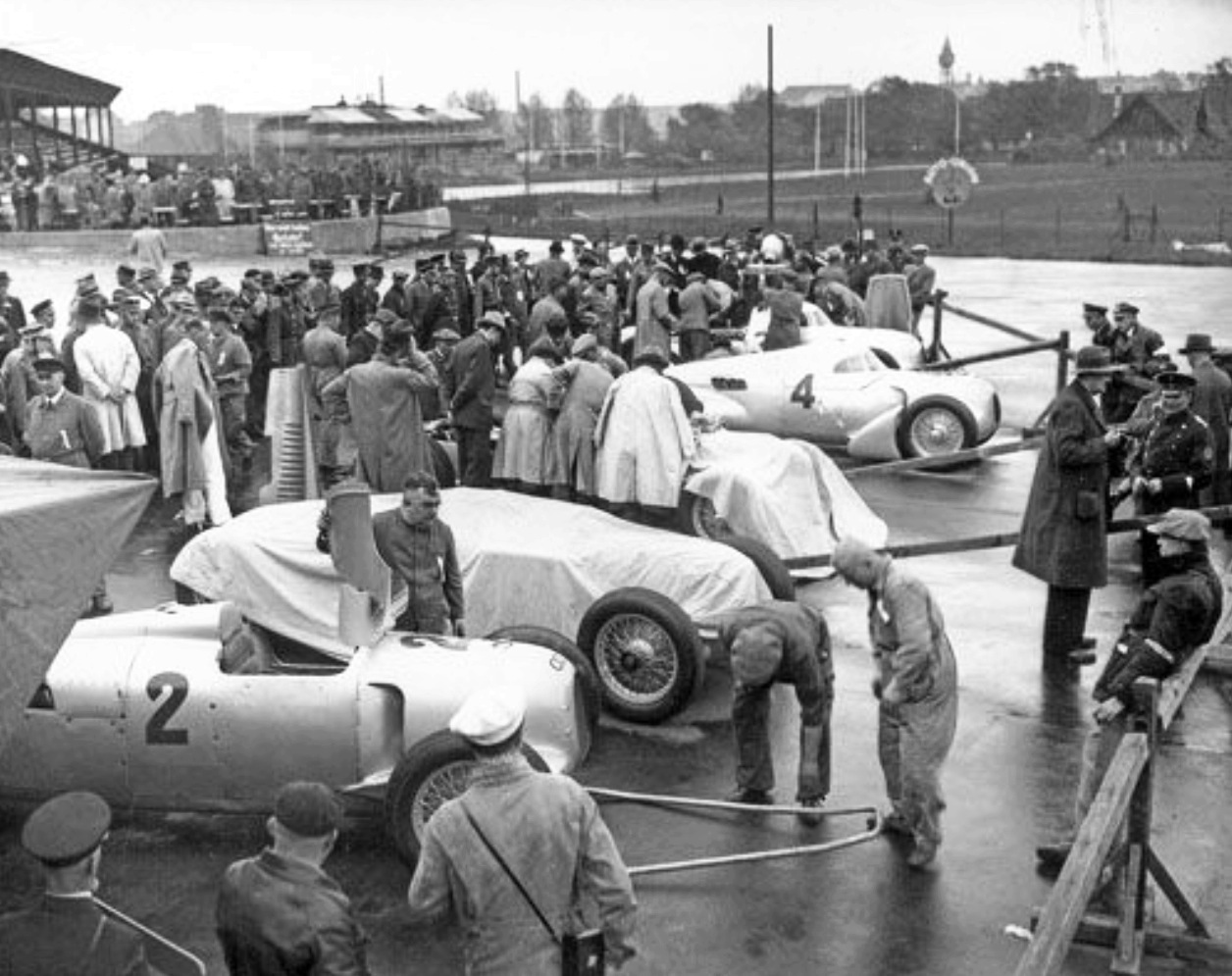
(unattributed)
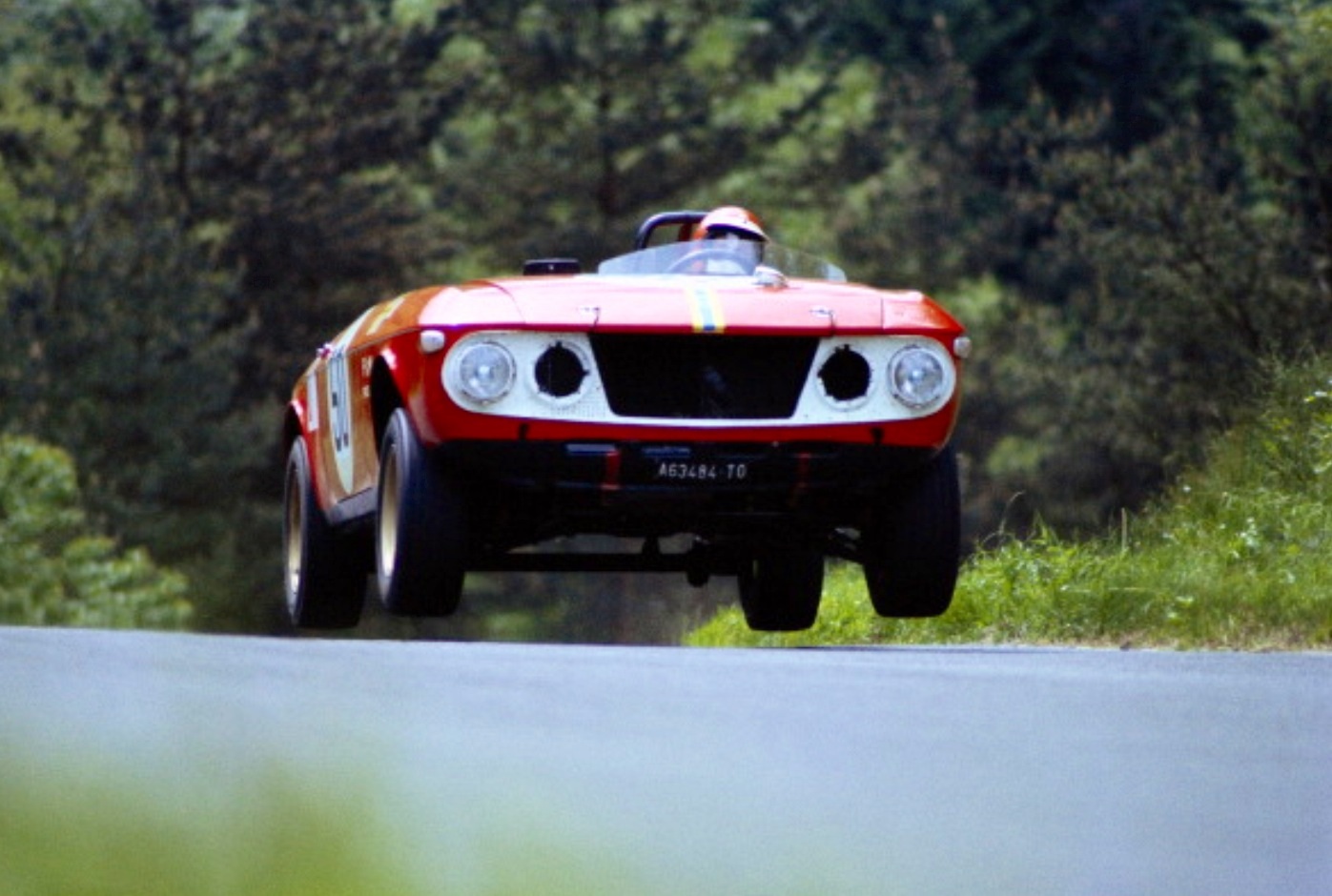
(Schlegelmilch)
The Lancia Fulvia HF ‘F&M’ barchetta of Sandro Munari and Rauno Aaltonen jumping its way to a class win at the Nurburgring 1000Km on 1 June 1969…
The story of this Lancia is an interesting one, well known to fans of the marque, three cars were factory built in period plus a couple by Sicilian Lancia tuners.
Cesare Fiorio and Claudio Maglioli, respectively team manager and works driver of Lancia’s Squadra Corse HF, saw that the team´s drivers were fried by the Daytona heat in 1969 and decided to create something more competitive and cooler for the drivers for the Targa Florio. Given there was no budget for a more sophisticated approach they chopped the roof off the HF coupé and shortened its chassis by 28 mm. The roof, windscreen and side windows were removed and interior completely stripped with the exception of the driver’s seat. The result, a car 200 pounds lighter with consequent benefits to acceleration, handling and braking.
Whilst lightened the structural rigidity of the chassis was retained by the addition of some tubular framework. The fuel tank was centralised by placing it where the rear seat had been.
The first factory car eventually became the test mule for the Lancia Stratos, the second exists although in what form is a little unclear, the location of the third is unknown.
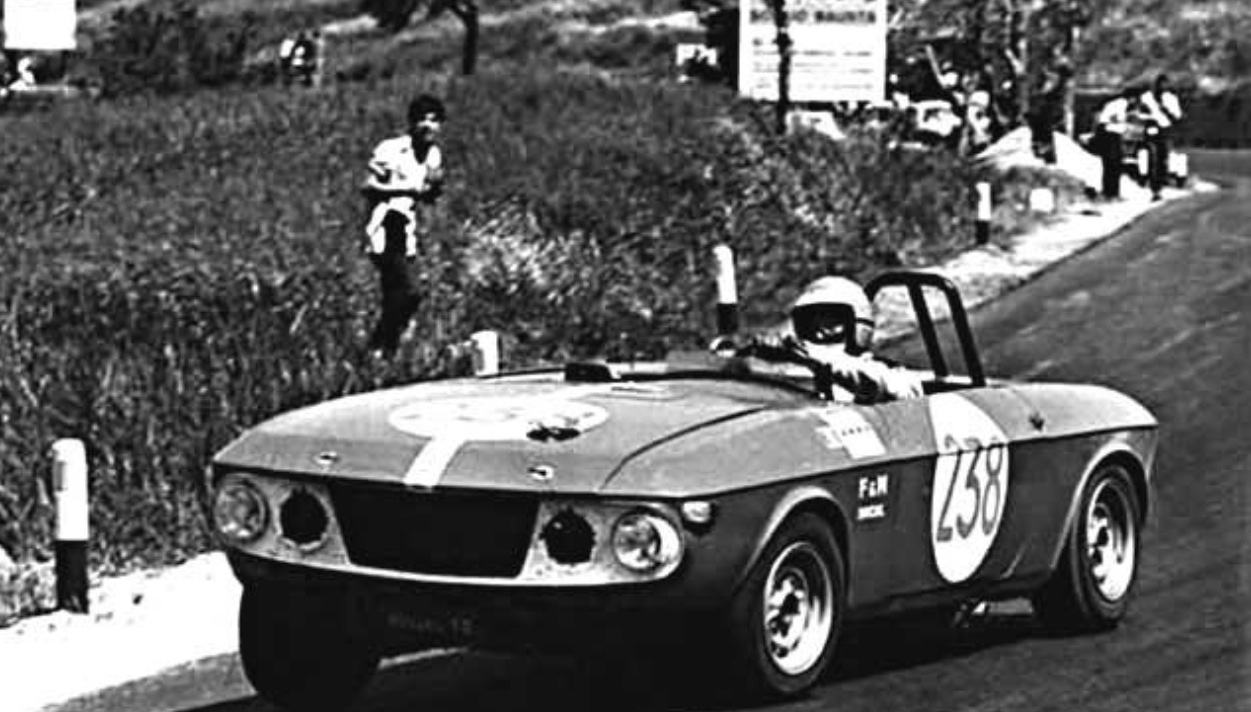
Pretty lines of the Fulvia F&M Barchetta shown in this Targa shot of the 9th placed Aaltonen/Munari chassis (unattributed)
The cars made their race debut at Targa in May where Claudio Maglioli /Raffaele Pinto retired due to overheating caused by an errant newspaper obstructing the radiator, but ninth place overall was a great result for rally-drivers Sandro Munari and Rauno Aaltonen in the other car. The race was won by the Mitter/Schutz Porsche 908/2.
At the 1000 km of Nurburgring on June 1, Munari /Aaltonen were 27th outright and won their class and Maglioli / Pinto finished 29th/2nd in class. Porsche again won the race with their 908/2, this time the car crewed by Jo Siffert and Brian Redman.
At the Grand Prix of Mugello in July Sandro Munari was 5th, a great result amongst 2 litre Abarth and Porsche sports-prototypes and a 5 litre Lola T70!
Two of the cars were then further modified (see post-script below) to accommodate a navigator and rudimentary weather protection to allow them to compete in Group 4 at the 1969 Tour de Corse/Rally Corsica where the Munari/Davenport car was 13th and Timo Makinen/Paul Easter 11th.
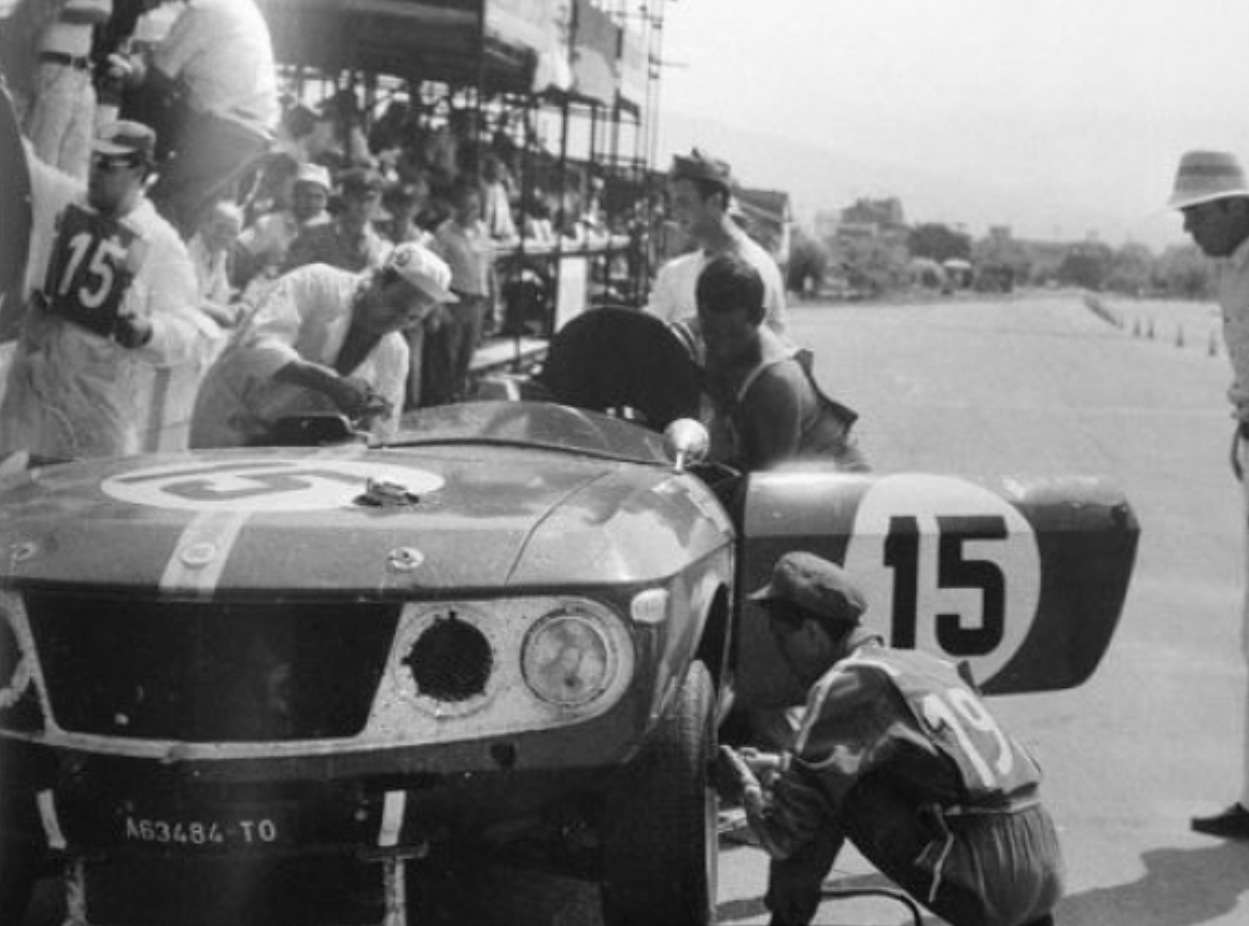
Munari’s car into the Mugello pits en-route to 5th amongst some pretty quick sportscars and prototypes, Fulvia F&M. Munari won the ’69 Mugello GP in a Abarth 2000SP (unattributed)
Technical Specifications…
Lancia Fulvia’s were front-engined and FWD of course.
Engine, SOHC, 2 valve 13 degree, all aluminium 82.4X75mm bore/stroke, 1600cc V4. Circa 160bhp@8200rpm. Gearbox, 5 speed with limited slip diff, final drive ratios to choice.
Spider body with front suspension by wishbones, tranverse leaf spring and guide-bar and rear by beam axle, transverse rod and longitudinal transverse spring with telescopic hydraulic shocks front and rear. Brakes were non-servo assisted discs
The little cars were 3670 mm long, 1580 mm wide and 840 mm high with weight quoted as 720 Kg.
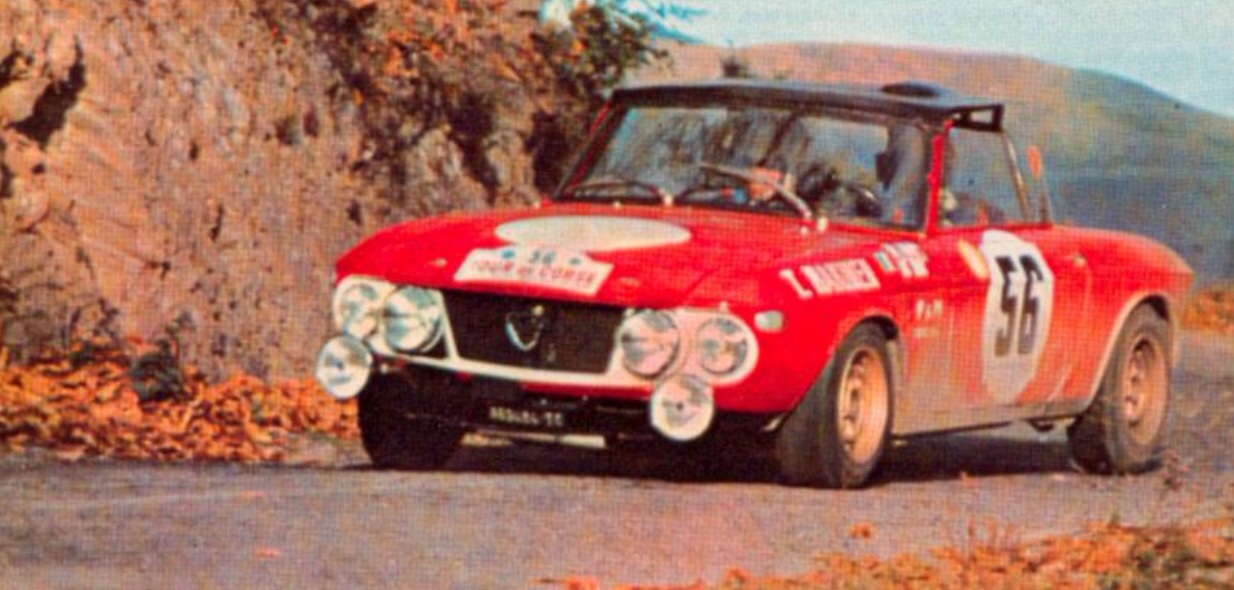
Timo Makinens car during the Tour de Corse, note lights back on the car and the basic windscreen and ‘roof’ (unattributed)
‘Tour de Corse’ Rally Corsica, 9-11 November 1969 Postscript…
Just love Lancia’s creativity; when looking at the Barchetta’s above you wouldn’t think they could be crafted into ‘all-weather’ rally machines, particularly given the winter of 1969, but that belies Lancia’s focus!
Lancia felt they would be more competitive against the Porsche 911R, Alpine A110 and 2002Ti opposition with the F&M Specials than their usual HF machines
Tests in Corsica resulted in some changes to the cars; which had reinforced doors, a wider roll-bar to protect both driver and navigator, navigation rally gear and thin Plexiglas, 24cm high, windscreen and wipers.
During the last week before the rally the weather worsened greatly, Sandro Munari realised the open car was going to be virtually impossible to drive in conditions down to 4 degrees so he decided to clothe himself more appropriately in rubber suits sourced by the Turin factory; one flew around too much at speed, the black divers wetsuit! didn’t ‘breathe’ causing lots of sweating.
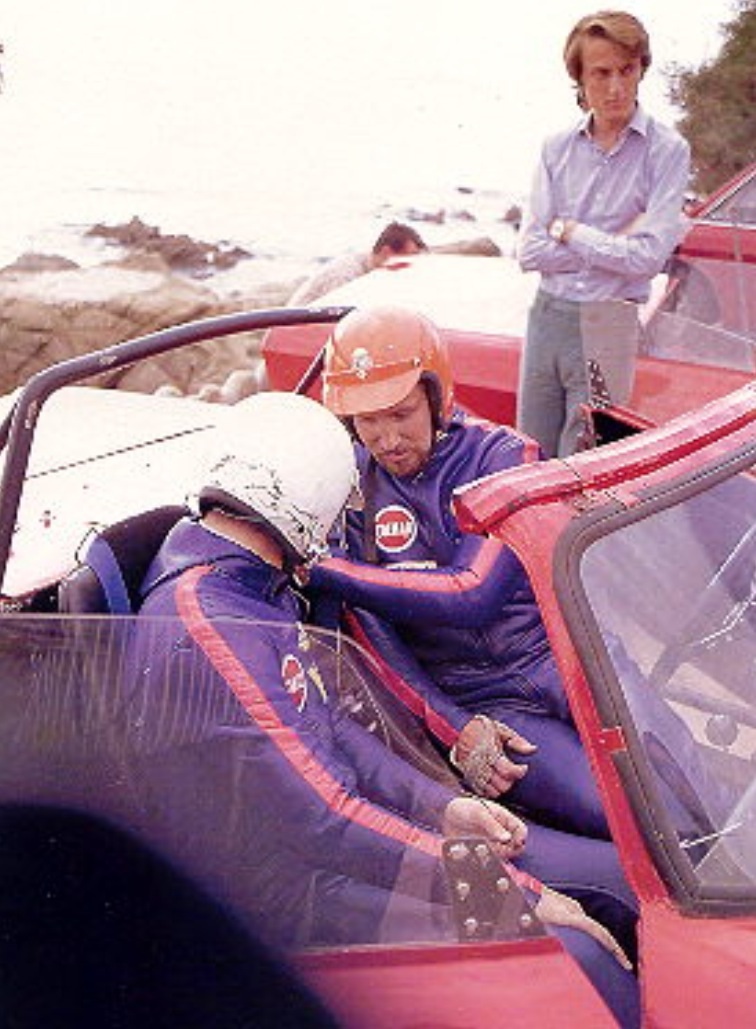
Munari in orange helmet and Davenport in their warm ‘sub-suits’, no roof in this shot. Later Ferrari chief Luca Montezemolo looks on skeptically! (unattributed)
After tests both Munari, Makinen and their navigators decided to use a race suit similar to that utilised by submariners. In Turin, the racing department considered further changes to the cars…More shelter was provided for the occupants by raising the windscreen, the earlier one tested replaced by one from a Fulvia Coupe albeit modified with special uprights and with plastic side windows which were anchored to the front section of the roll bar.
By the time the cars arrived in Ajaccio for the Tour de Corse start the ‘F&M’s had lost both the appearance of the Targa Barchettas as well as their light weight! Makinen’s car at the last minute was fitted with a rudimentary sheet metal roof, an addition scornfully rejected by Sandro Munari! Softie!, he thought of Timo.
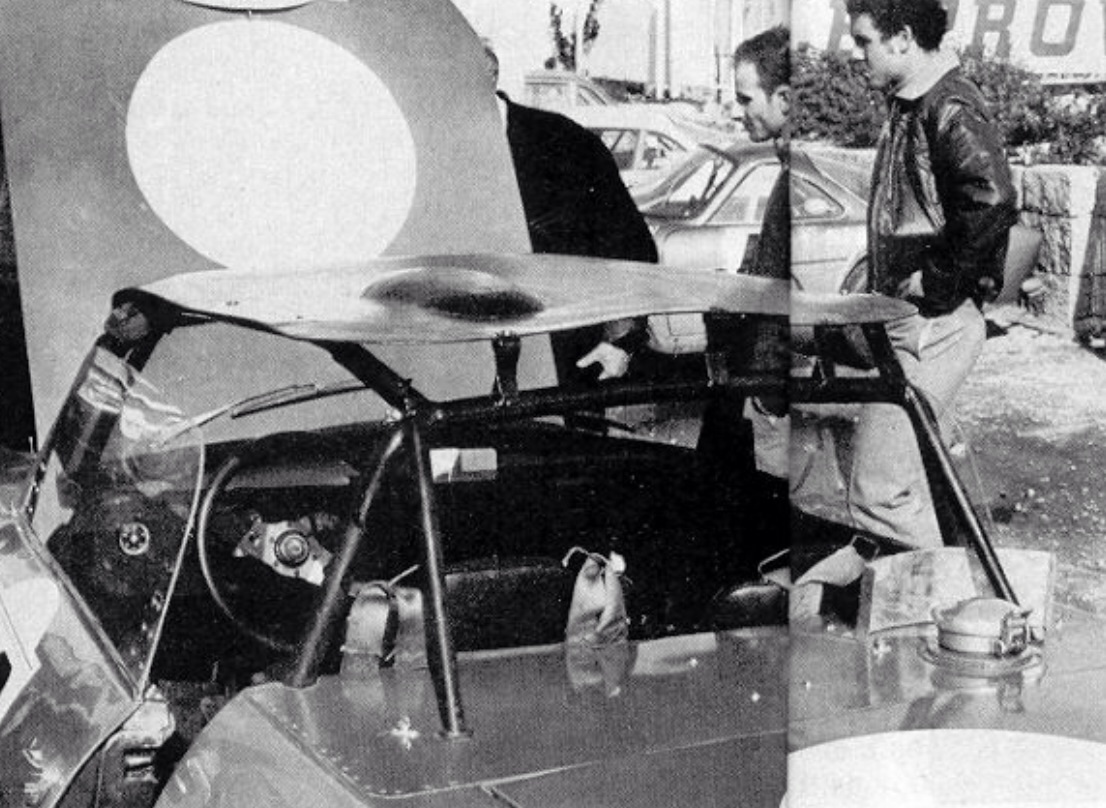
The quickie roof! as per the text, note fuel filler, rough as guts geddit done finish (unattributed)
The two ‘F & M Special’ were part of Lancia’s six car team in the event, the final result was disappointing with the normal 1.6HF of Kallstrom/Haggbom 9th, 1.3HF of Ballestrieri/Audetto 10th ahead of the trick ‘F&M Specials’; Makinen-Easter 11th and Munari-Davenport 13th. The rally was won by Gerard Larrousse/Gelin in a Porsche 911R ahead of an Alpine A110 Renault, Ford Capri RS2600 and a swag more A110’s…

Normal HF following the Munari car during the Tour (unattributed)
Credits…
Rainer Schlegelmilch, Rallymania
Tailpiece: Collesano, Rauno Aaltonen, Lancia Fulvia F&M, Targa 1969. The short, squat efficient lines of the car clear in this wonderful shot…
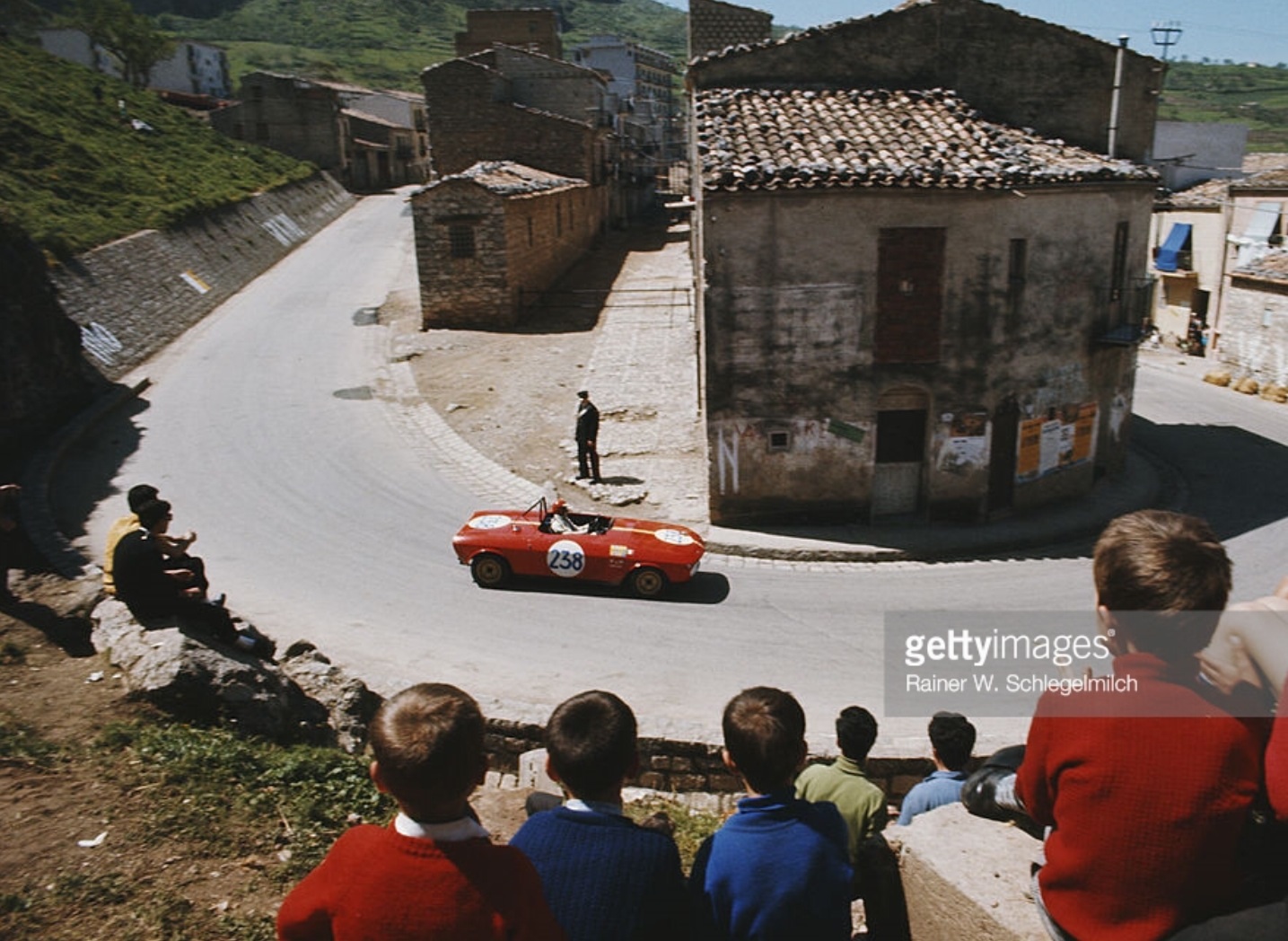
(Schlegelmilch)

The Hon Jock Leith’s Bugatti Type 35B leads EG Hughes Frazer Nash, Brooklands 16 March 1935…
JA Hamptons shot is all about composition, just love that background Vickers factory, a well known aviation name of course.

By 1919 Vickers was already famous for the first non-stop crossing of the Atlantic Ocean when Alcock and Brown flew their converted Vickers Vimy bomber from Newfoundland to a crash landing in an Irish bog.

The company was known as a shipbuilder, but early in the 20th century saw aviation as a profitable future opportunity. In 1908 the British Admiralty ordered the R.1 airship from them, a few years later Vickers built a French monoplane under license. In 1913 their first design, the F.B.I. flew.
Vickers Flying School opened at Brooklands on 20 January 1912, aircraft construction commenced on the site in 1915, Vickers having taken over the Itala Motor Works factory, by the Wars end they had built 4500 aircraft there…

Wellingon bombers being built at Vickers factory, Brooklands in December 1939 (Keystone-France)
Click on these links for interesting websites about Vickers and its history…
This one is more about Vickers on the Brooklands site; http://www.subbrit.org.uk/sb-sites/sites/v/vickers_shelter/index.shtml
And this one more about the aircraft themselves; http://www.vc10.net/History/vc10_origins.html

Credit…
JA Hampton, vc10.net, subbrit.org.uk, Keystone France, Underwood Archive
Tailpiece…
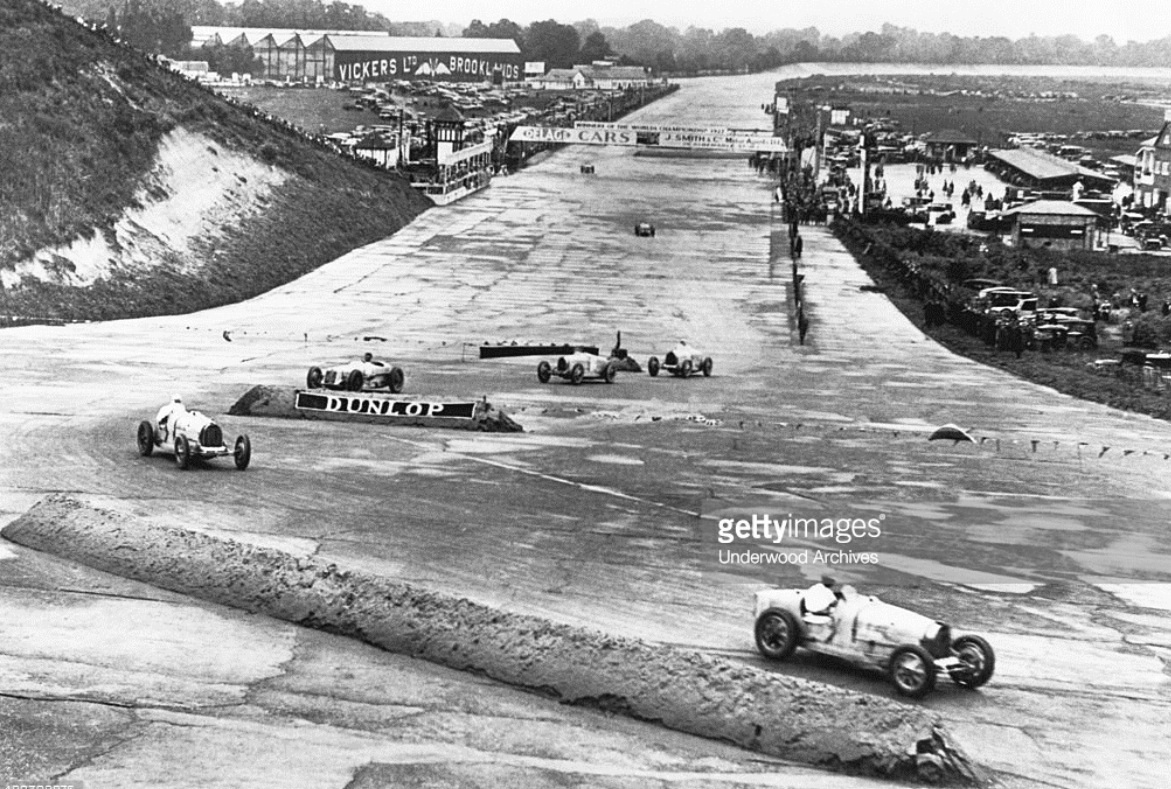
British GP, Brooklands Saturday 1 October 1927, Vickers factory in the background. The race ‘Royal Automobile Club Grand Prix’ was won by Robert Benoist’s Delage 155B, first 2 cars here both Bugatti’s (Underwood Archives)
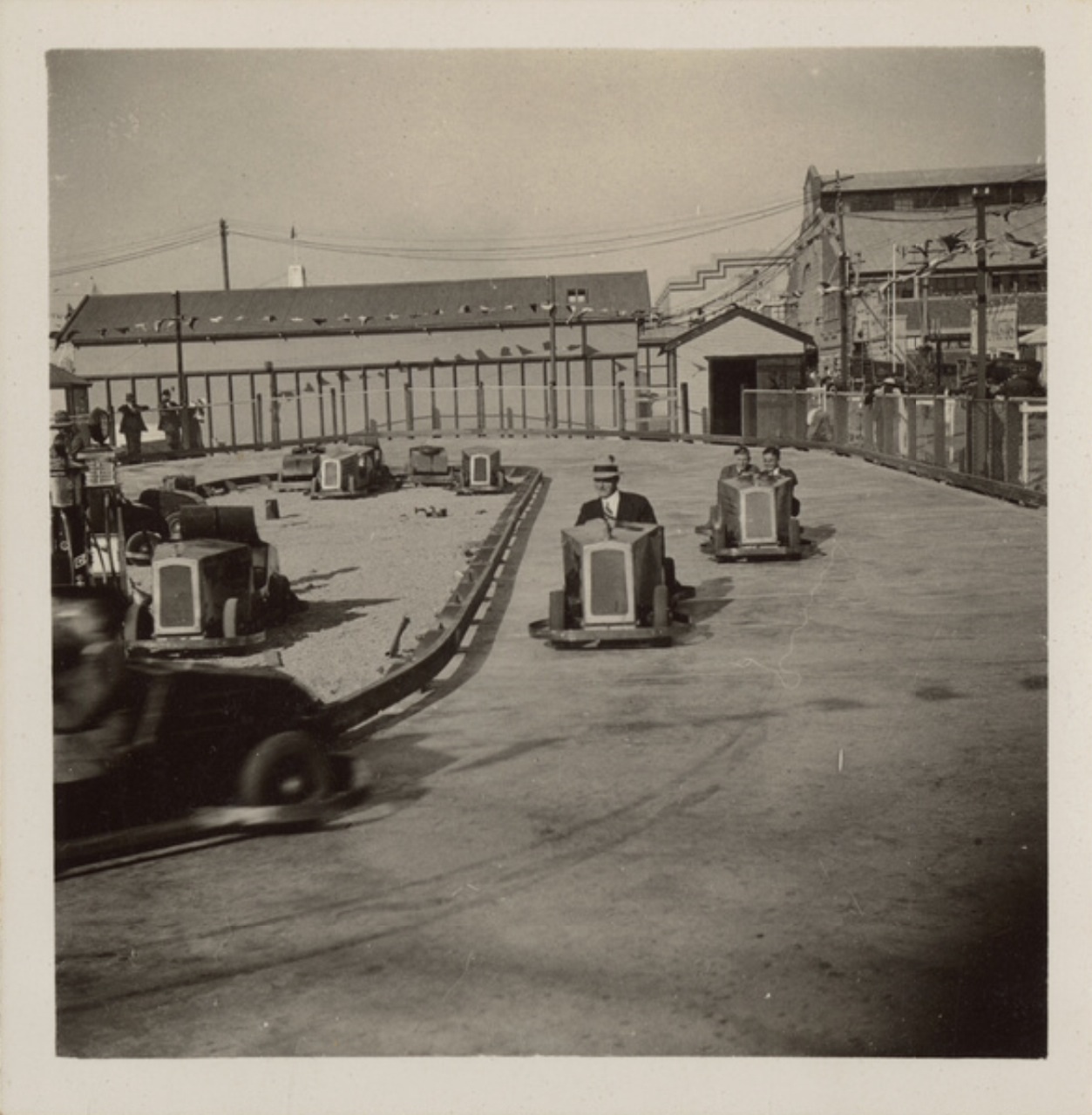
Dodgems 1936 style, Royal Adelaide Show, Wayville…
Timeless, ageless and still fun for kids of all ages, the gentleman in the photo adds an air of formality normally lacking in sideshows!
‘twould be interesting to know what these little buzz-box, bumper cars were powered by, no sign of an electrical connection in evidence here. The Show traditionally starts on the first Friday in September and lasts 10 days, so its early September ‘36.
I chanced upon the shot looking for something else, it was too good not to share. The Adelaide Showgrounds are still in the same spot, Wayville is not too far from the cities ‘Square Mile’ which defines its CBD.
Credits…
Raymond Gordon, State Library of SA
Credits…

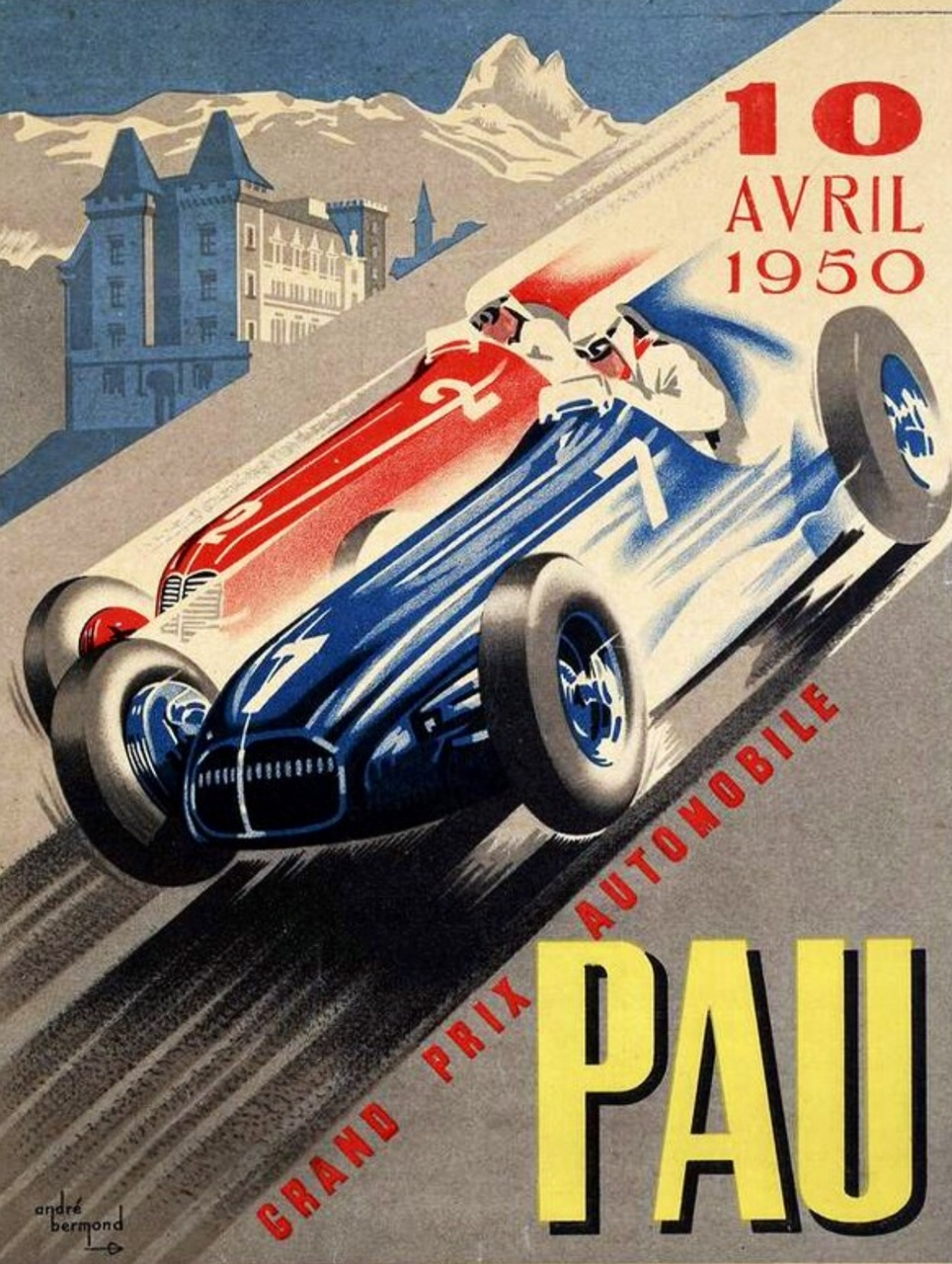
Juan Manuel Fangio wins the first F1 Grand Prix at Pau. Maserati 4CLT/48, 10 April 1950…
He is ahead of Luigi Villoresi’s Ferrari 125, 2nd. Louis Rosier was 3rd in a Talbot-Lago T26C.
The first championship Grand Prix for ‘Formula 1’ introduced at the start of 1950 was the British GP held at Silverstone on May 13.
Fangio, somewhat fittingly is therefore the first winner of an F1GP albeit a Non-Championship one! Farina took the Silverstone race in an Alfa 158, the car of 1950/51.
Credit: Keystone-France
Tailpiece…

Mrs Cook’s Cooper is fettled at Brands Hatch during 1957…
Clearly an inspirational woman for the teenagers with the cameras looking on. All information about the driver gratefully received.
Credit…
Charles Hewitt
 primotipo...