This fine George Thomas shot of Lex Davisons’ Alfa Romeo P3 ‘50003’ is undated but is in the mid-fifties, its become exposed over time which adds to its patina and drama of the occasion…
This wonderful Grand Prix car had to ‘sing for its supper’ in Australia, events were few and far between in the early post-war years. Davison was a keen competitor who raced his cars far and wide in trials, rallies, circuit races and hillclimbs like this one at the ‘Christmas Hills’ in Melbourne’s outer east.
The venue is still used by the MG Car Club, perhaps one of their historians can help date the shot.
Sue Steele Thomas sharing ‘her unique visions of nature and automobiles with the piece ‘Alfa Romeo Through the Shafta Daisies’ which views a 1938 Alfa Romeo 8C 2900B Speciale Le Mans Touring through a bright botanical overlay’…
Only one of these cars was built for Le Mans 1938; the car driven by Clemente Biondetti and Raymond Somner had the most commanding lead at La Sarthe ever, 11 laps/1 hour or 100 miles depending upon your way of expressing it.
The stunning looking, very aerodynamic 8C2900B during its long run in the lead of its only race, Le Mans 1938 (unattributed)
A succession of mechanical maladies cost victory; a tyre blew on the Mulsanne, Sommner bringing the car to a halt but the tyre destroyed the mudguard. Biondetti went back out but the car retired shortly thereafter with either valve or gearbox failure.
Le Mans 1938. Compare and contrast the aerodynamic treatment and styling of the winning, left, Chaboud/Tremoulet and 2nd placed Serraud/Cabantous Delahaye 135CS with the 8C2900B (unattributed)
The race was won by the Eugene Chaboud/Jean Tremoulet Delahaye 135CS from the similar car of Gaston Serraud and Yves Giraud-Cabantous with Jean Prenant and Andre Morel in a Talbot T150SS Coupe. The Alfa 8C 2900B completed 219 laps, more than the 4th placed car.
The leading Alfa after its valve or gearbox failure whilst well in the lead. The passing car is the Talbot T150SS of Jean Prenant/Andre Morel, 3rd (unattributed)
Five 8C 2900B chassis were modified for racing early in 1938, and whilst offered for customer sale the cars were road going versions of Alfa’s GP cars,very much in the best tradition of the Monza Series of cars. The cars were nearly identical to the 8C 2900A’s which won Le Mans in 1936 and 1937.
The 2.9 litre straight-8, boosted by two superchargers developed 220bhp in race trim and was the ultimate road going version of the 8C2300 originally built in 1931, click here for my article on the Alfa Monzas’ which covers the design detail of the cars;
Unlike the earlier Monza’s the cars gearbox was in unit with its differential shifting weight to the rear.
Routine pitstop during the 1938 Le Mans for the 8C2900B (unattributed)
Bodies of all five cars were built by Touringwith open bodies for the Mille Miglia for which four cars were entered, the Alfas finishing 1-3 with Biondetti and Ado Stefani crewing the winning car from the Pintacuda/Mambelli and 8C 2300A of Dusio/Boninsegni.
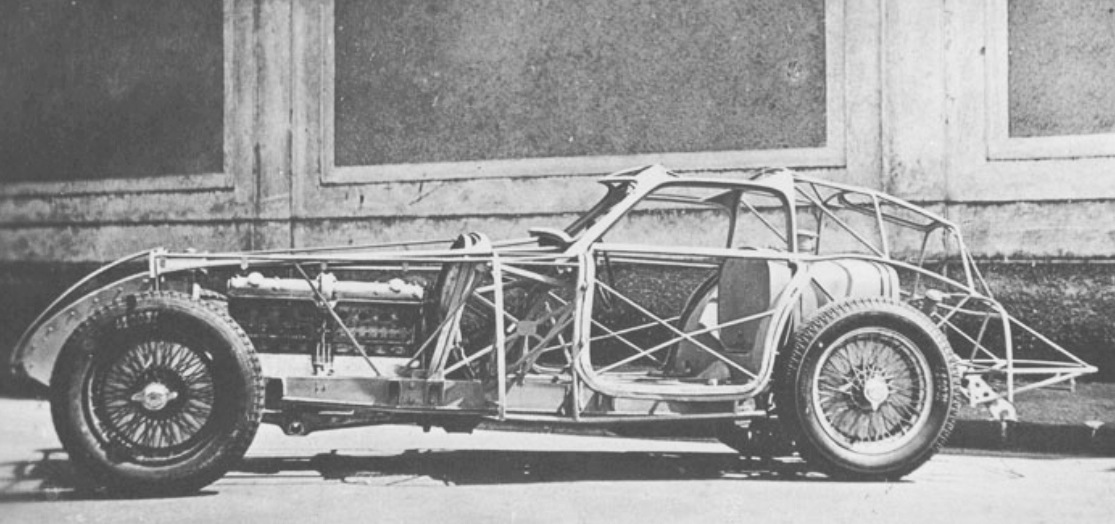
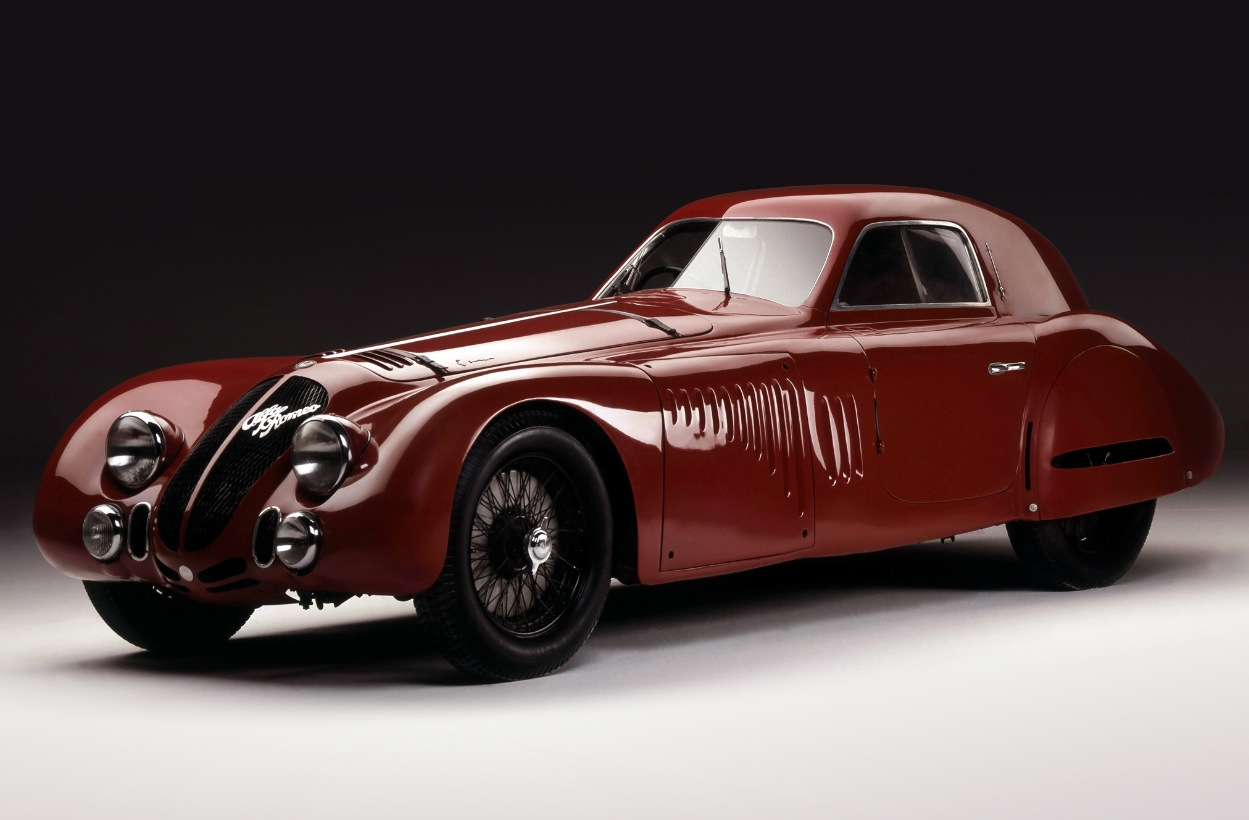
The Le Mans car, chassis #412033 had its Spider body removed to be replaced by a futuristic, slippery coupe designed by Touring’s Carlo Anderloni. The panels aft of the front wheels could be removed to allow access to Vittorio Jano’s mechanical marvels.
#412033 was repaired but not raced again, sold to a Roman it ‘disappeared’ but was found by collectors in the late sixties, passing through several hands before being re-acquired by Alfa where it is a popular exhibit at Museo Storico, and attractive to artists such as Sue Steele Thomas…
Car during its construction at Touring’s workshop. Typical boxed steel chassis, Jano’s engine clear as is light alloy tubing to accept the aluminium body. Big fuel tank prevents view of the rear mounted gearbox/diff unit (unattributed)
Specifications…
Chassis of light gauge box section steel. Front suspension; trailing arms coil spring/tubular shocks. Rear suspension; swing axles located by radius rods, semi-elliptic leaf springs and tubular shocks. Steering, worm and sector. Brakes drums all round. Weight circa 1100Kg.
Engine; DOHC, 2 valve, all alloy straight-8 of 2905cc, bore/stroke 68mm/100mm. Two Roots type superchargers fed by two Weber carbs giving circa 220bhp@5800rpm.
Gearbox 4 speed mounted at the rear in unit with differential
Stunning car for its time, stunning full stop! Studio shot of the 8C 2900B Le Mans after its restoration by Alfa Romeo. Side access panel referred to in the text clear, skilful aero treatment at a time when exposed guards the norm (unattributed)
Credit…
Sue Steele Thomas, conceptcarz.com
Tailpiece…
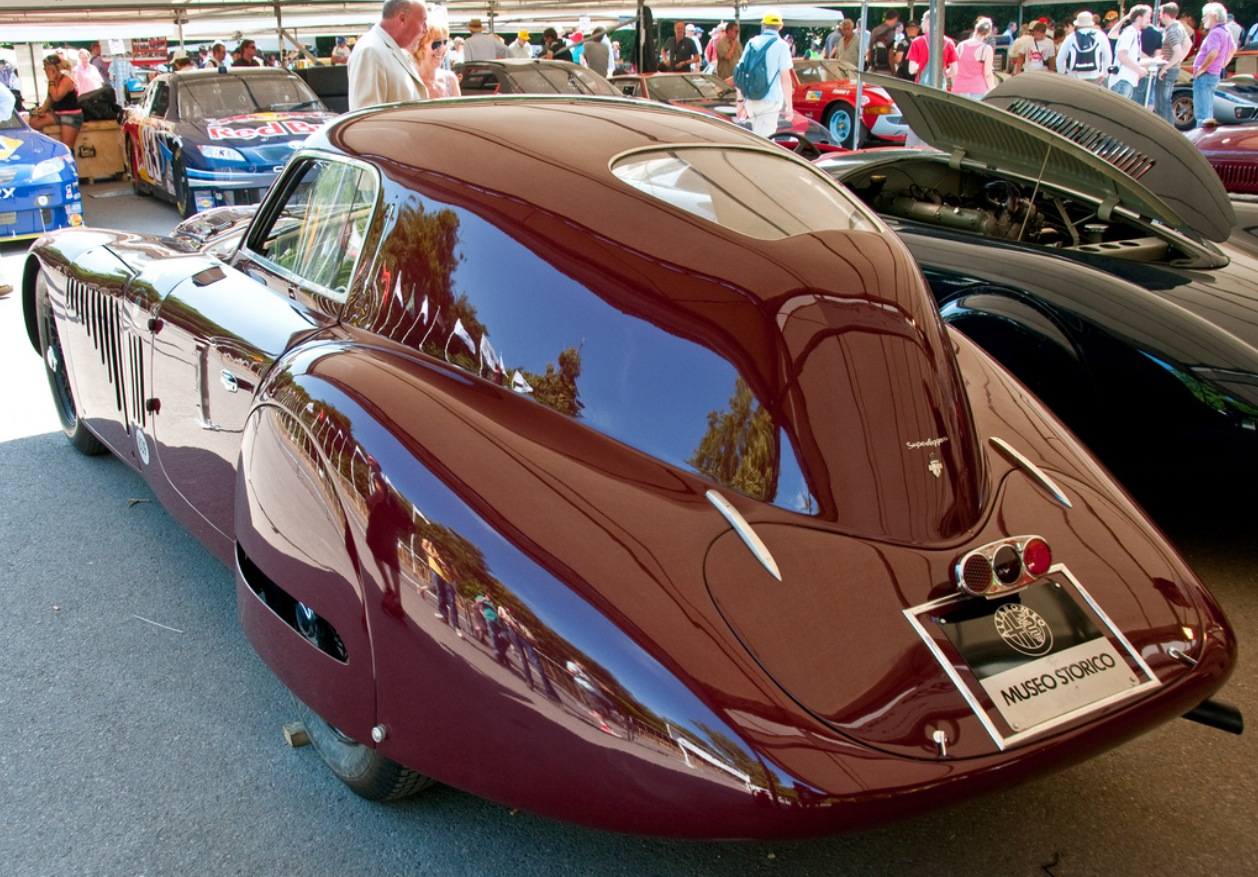
8C 2900B Le Mans butt shot at the Goodwood Festival of Speed in 2010 (unattributed)
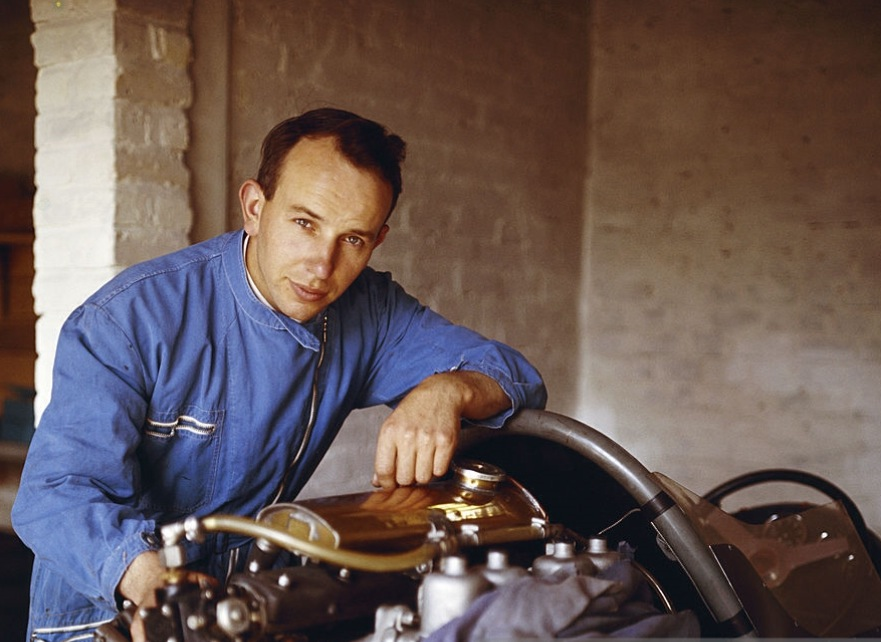
John Surtees smiles for the cameras with his Ken Tyrrell Racing Cooper T51 Climax in April 1960…
The much anticipated switch of the British multiple bike champion to four wheels took place when he contested the Formula Junior races at the ‘BARC Members Meeting’ at Goodwood on 19 March 1960.
Ken Tyrrell entered him in a Cooper T52 BMC, the ‘novice’ raced into second between the Team Lotus duo of Jim Clark and Trevor Taylor both mounted in Lotus 18 Fords, more competitive cars. The field also included other later GP drivers Peter Arundell and Mike Spence.
John Surtees, Cooper T52 BMC FJ, Goodwood, 19 March 1960 (Getty)
It was a great debut so why not jump into the deep end?
The Non-Championship F1 ‘Oulton Park Trophy’ took place at the Cheshire circuit on 2 April, with limited testing the talented Brit took on a field of some depth, starting the race from pole and again finishing second. Innes Ireland took the win in a Team Lotus 18 Climax with the very experienced Roy Salvadori third in another Cooper T51 Climax. The field also included Harry Schell and Chris Bristow.
Surtees had arrived in cars! He mixed racing two wheels and four in 1960 but focussed on cars from 1961…
Photo Credits…
Getty Images
Tailpiece…
Surtees winning the Isle of Man Senior TT in 1956. MV Agusta 500 (Getty)
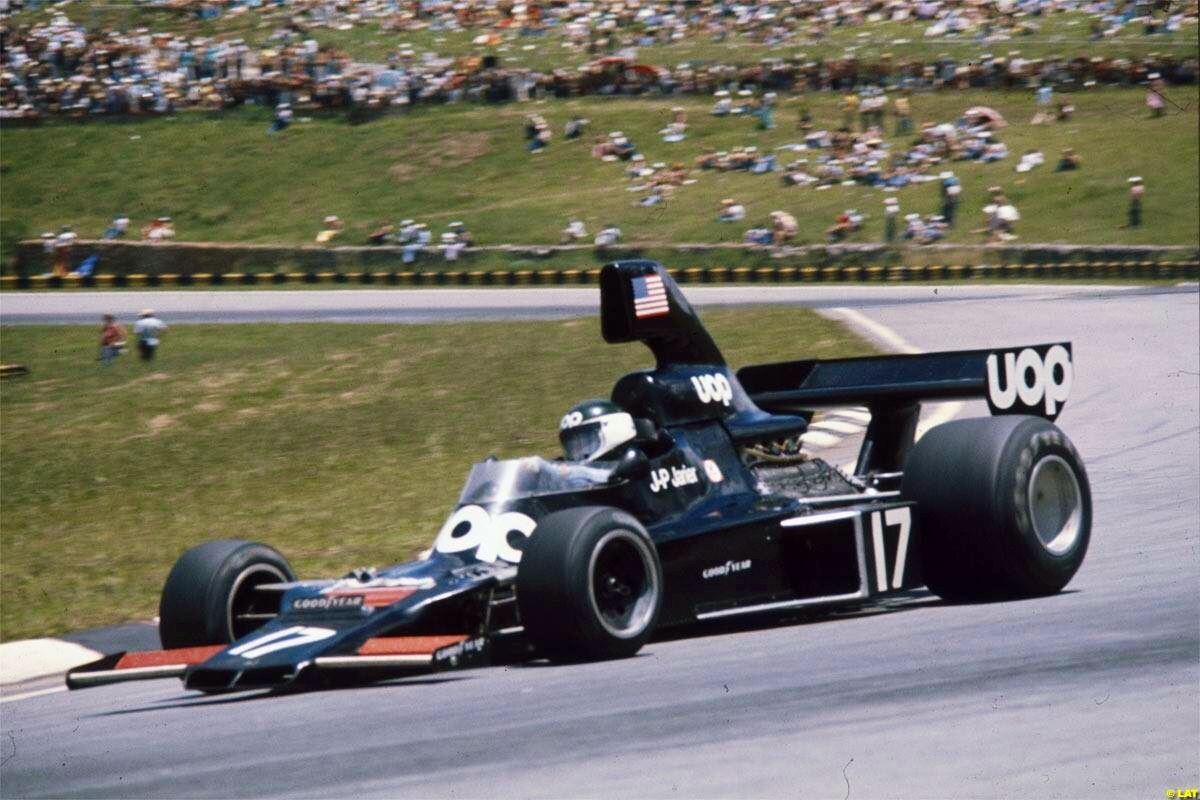
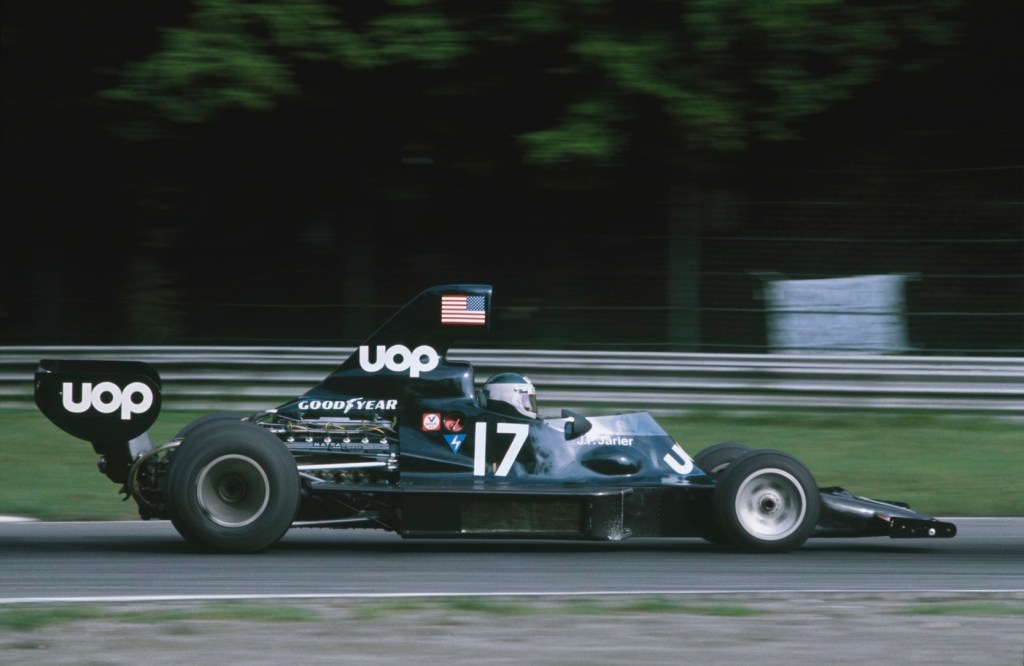
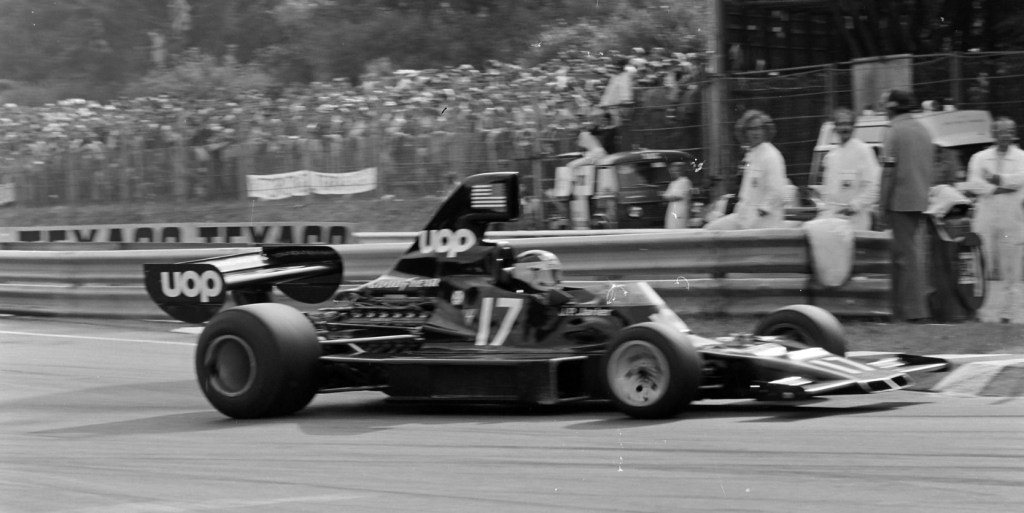
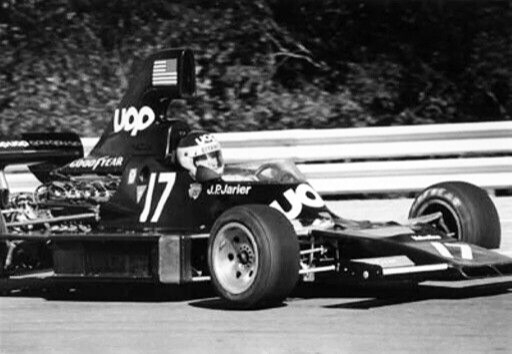
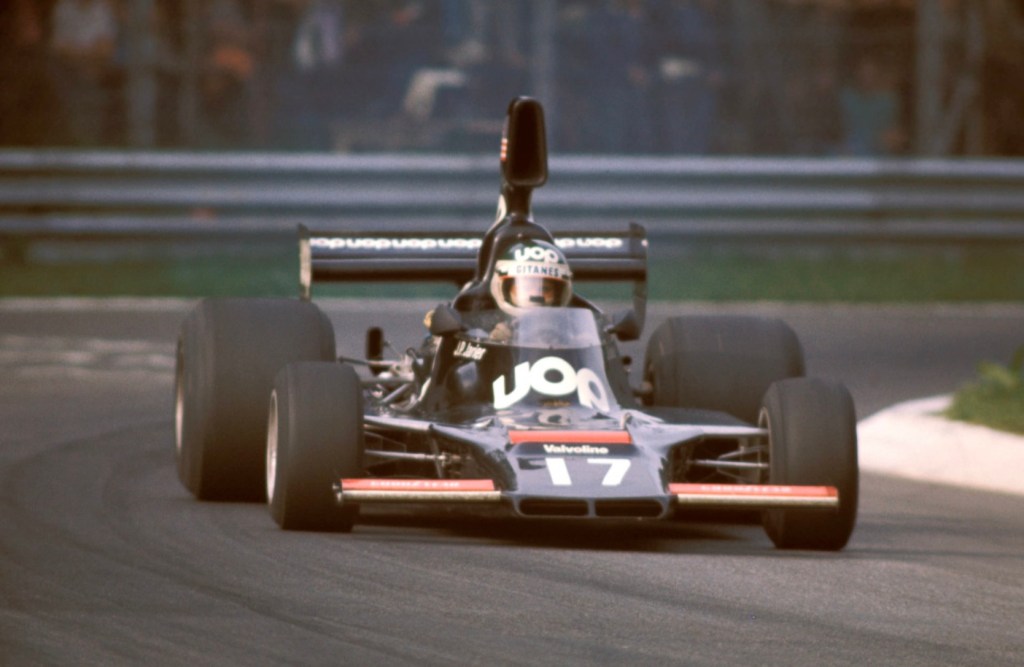
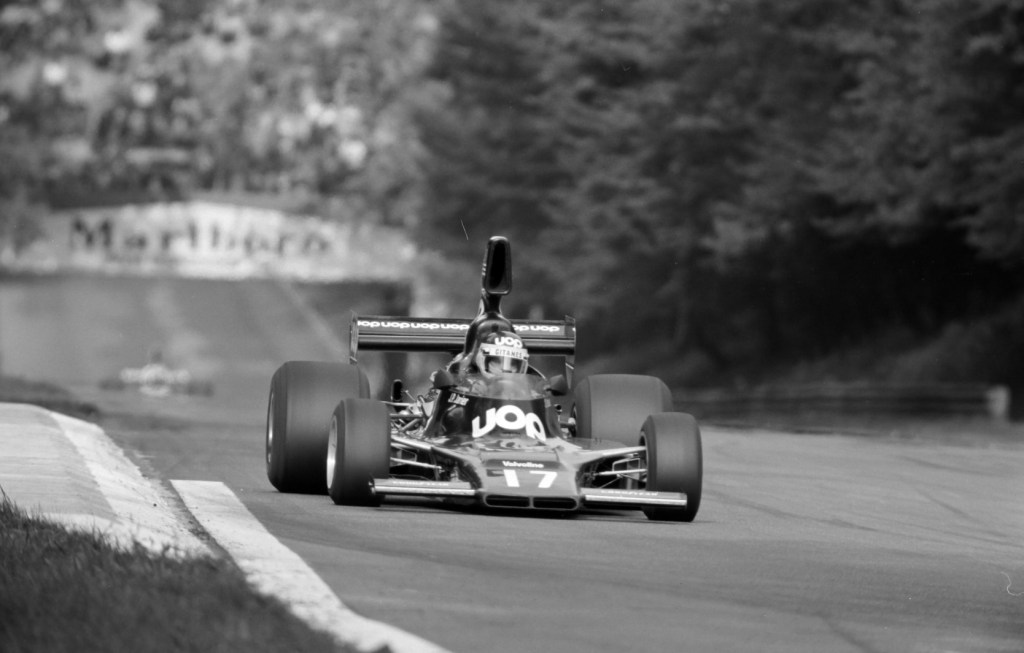
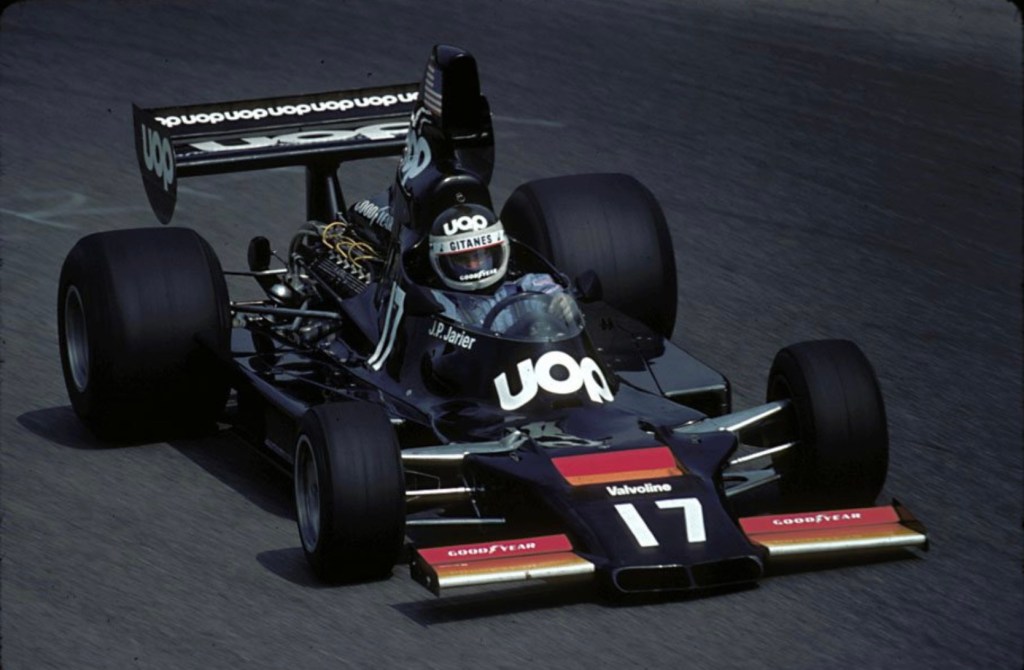
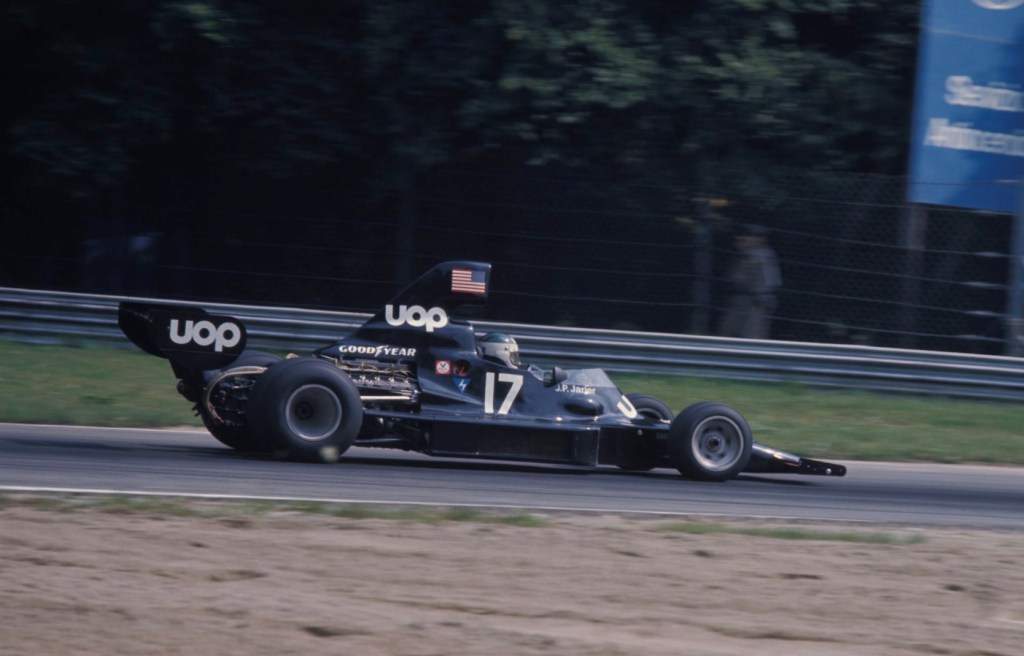
Jean Pierre Jarier nips a front brake during qualifying for the 1975 Italian Grand Prix, pushing his Shadow DN7 Matra ever so hard…
One of the revelations of the early 1975 GP season was the speed of the new Shadow DN5 Ford, an evolution of the 1973/4 DN1 and DN3 designs penned by Tony Southgate. Frenchie Jean Pierre Jarier rocked the socks off the established aces setting a time eight-tenths/second clear of the rest of the season opening Argentinian GP grid.
There were mutterings of Shadow getting development Cosworth engines but the truth was an aero tweakwhich is indicative of the importance of aerodynamics over the coming years.
Tony Southgate, ‘ I spent half my life doing aero at Imperial College and DN5 was the first to use the new rolling road wind tunnel, as far as i know, the first in the world. What we discovered was a massive split, front to back, in downforce. People always thought they had about 30-40% on the front. In fact it was no more than 20. And only we knew.’
Southgate moved the driver forward 2.5 inches within a longer wheelbase (with removable spacer between engine and gearbox), developed deeper nose fins and placed the front springs and dampers inboard.
‘The car was an aero jump. We matched downforce to its static weight distribution-about 35/65% front/rear – and the spacer allowed us to tune the chassis to different circuits; we would find 1.25 seconds at Silverstone just by removing it. Immediately it was clear that our car had more downforce than the others and was very well balanced. In its short chassis specification Jarier was taking the fast bend after the pits at Interlagos, Brazil without lifting…’
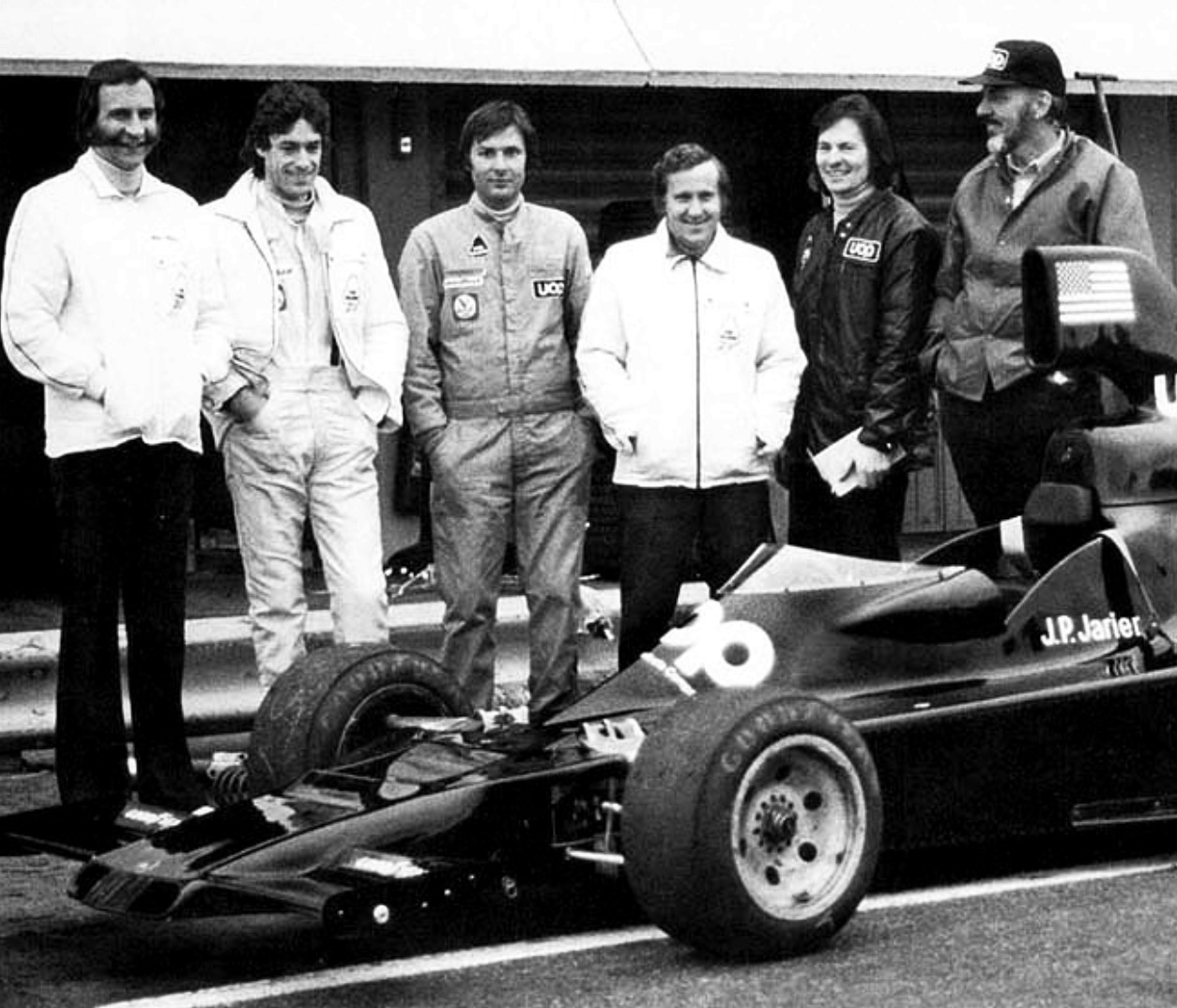
Shadow hierachy at an early 1975 season Paul Ricard DN5 Ford test. L>R Chief Mechanic Phil Kerr, Tom Pryce, JP Jarier, Team Manager Alan Rees, Tony Southgate and El Capitano Don Nichols (unattributed)JPJ Shadow DN5 Ford, Argentina 1975. Pole and DNS with CWP failure on the warm up lap (unattributed)
Despite being on pole in Argentina, raceday was a disaster with a crown wheel and pinion failing on the warm-up lap. ‘I had been pursuaded to use Hewland’s latest TL200 gearbox instead of the FGA400, I think we and Copersucar did so. It was meant to be more reliable, with helical gears 20% stronger and more bearings in the pinion shaft, improper heat treatment was blamed for the failure’.
In Brazil Jarier was running away with the race from pole when the metering arm of the Lucas injection unit seized. In fact JPJ’s season was a mix of spins and mechanical failures, teammate Tom Pryce getting the better results with a win in the non-championship Race of Champions at Brands Hatch and third in the Austrian GP after qualifying on pole for the British GP before retiring from the lead.
Southgate; ‘Our budget was tight and there was little development left of the car. It wasn’t good on fast circuits where we had to unbolt downforce so we weren’t swamped on the straights. Plus better funded teams cottoned onto what we were doing and were ringing Imperial College to ask if they could use its wind tunnel.’
‘Shadow’s Grand Prix results for 1975 were very disappointing, especially in view of the competitiveness of the DN5. Our finishing record was simply poor. The cars either broke down or crashed. Jarier only finished two Grands Prix for the year. Pryce’s statistics were better, but he still only finished six GP’s…I often think that, if the DN5 had been prepared and raced by one of the top teams it would have won the Championship.’ said Southgate in his autobiography.
Tom Pryce on his way to winning the Race of Champions at Brands Hatch on 16 March 1975 from pole, the Welshman’s only F1 win sadly. He won from John Watson’s Surtees TS16 Ford and Ronnie Peterson’s Lotus 72E Ford. The field included Ickx, Scheckter, Emerson Fittipaldi, Mass, Donohue and others, it was a great win for both him and the DN5 in a classy field (Autosport)
The Ford Cosworth DFV and alternative engines…
The diligence of team owner, Don Nichols’ designer had given the team the ‘unfair advantage’ of which Mark Donohue spoke so eloquently, with a car whose origins dated back to Shadow’s first year in GP racing in 1973. Whilst Southgate pursued this aero approach Nichols eventually concluded discussions with Matra to use its glorious V12 in a modified DN5 chassis christened the DN7.
The Ford Cosworth DFV 3 litre V8 was the dominant engine of the 3-litre formula, by the end of 1974 it had taken drivers titles in 1968/9 and 1970-4 but Ferrari’s speed in 1974 gave pause for many team managers – Cosworth users – to find an alternative which allowed them to leap clear of the garagiste pack as Enzo Ferrari christened the British Cosworth/Hewland hordes! The DFV was a tough proposition to beat given its blend of power, packaging, weight, economy, reliability, price and Cosworth’s servicing backup.
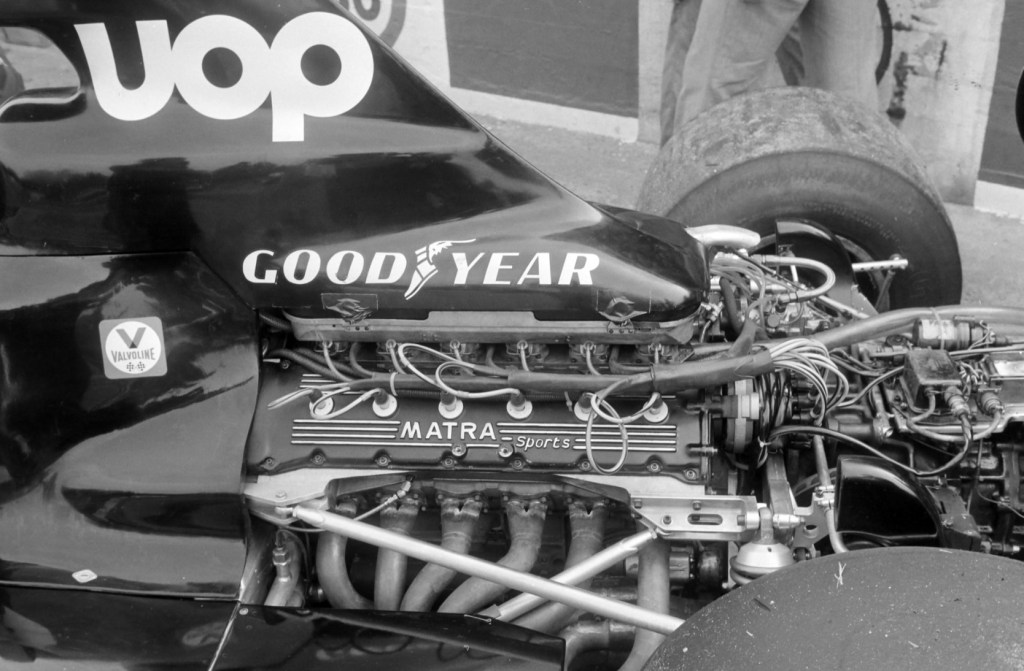
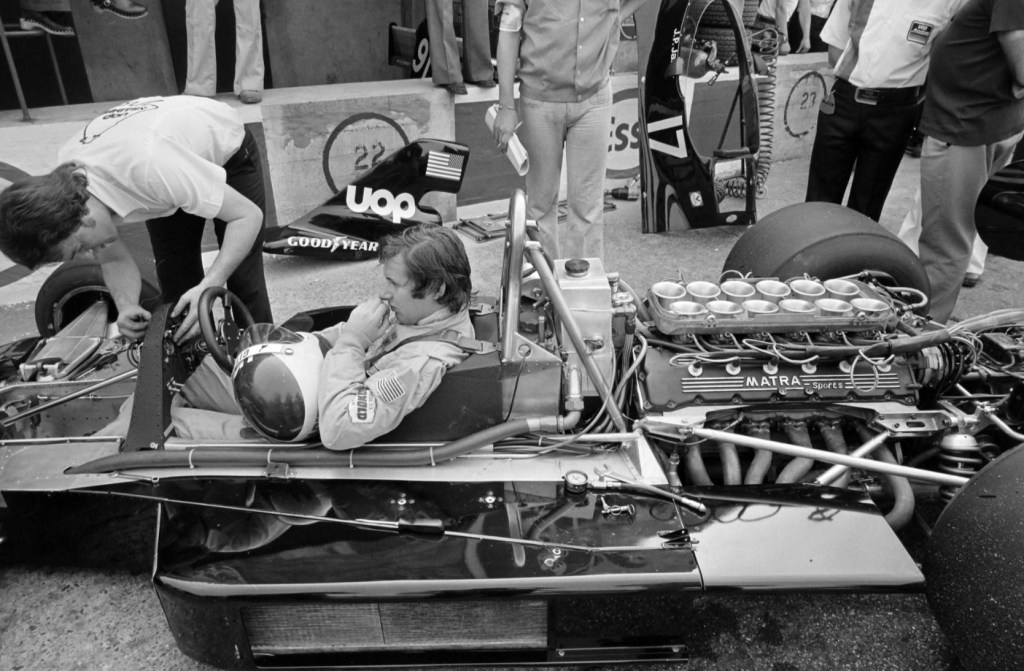
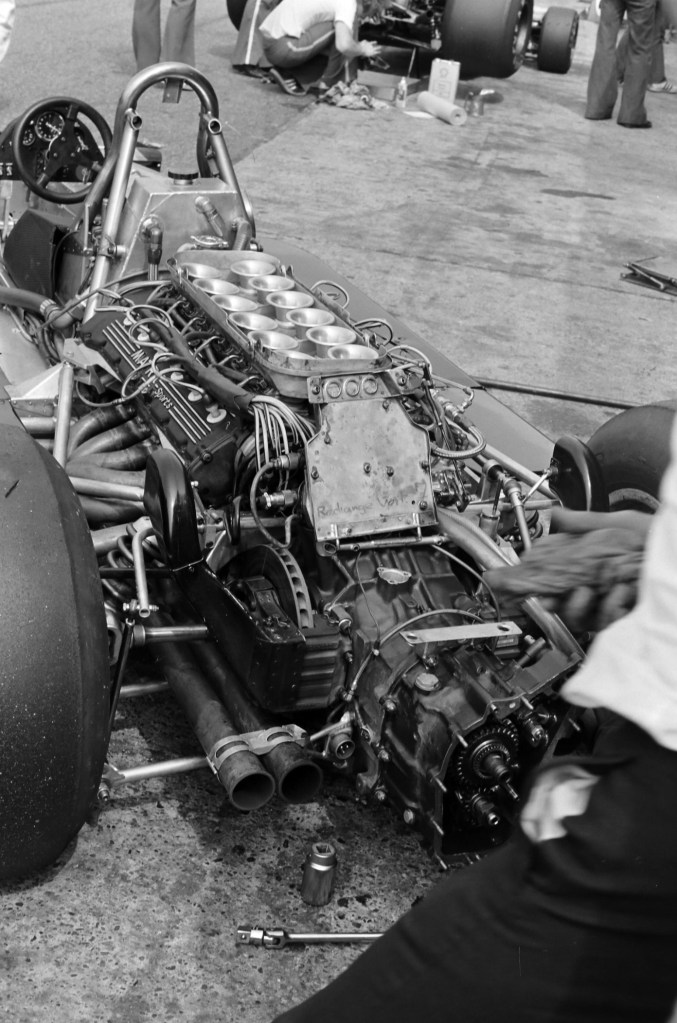
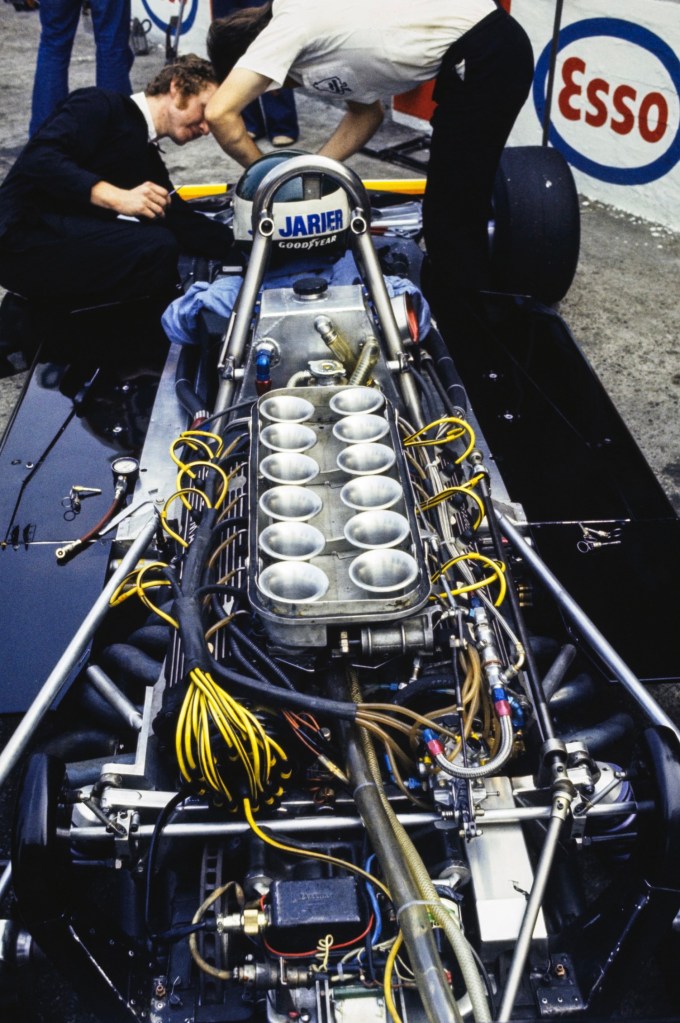
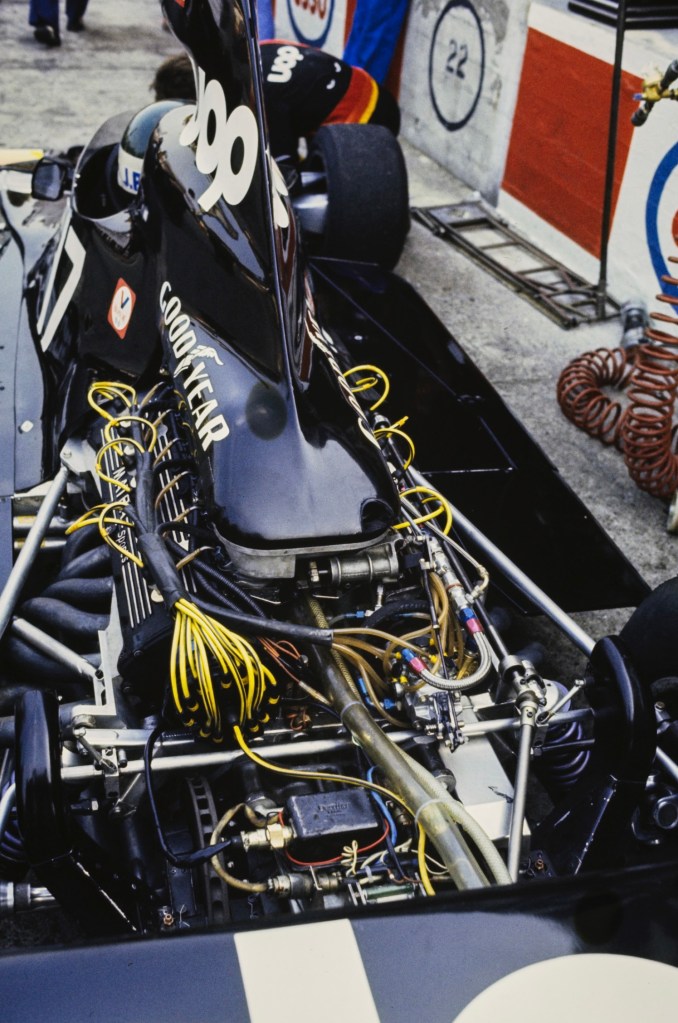
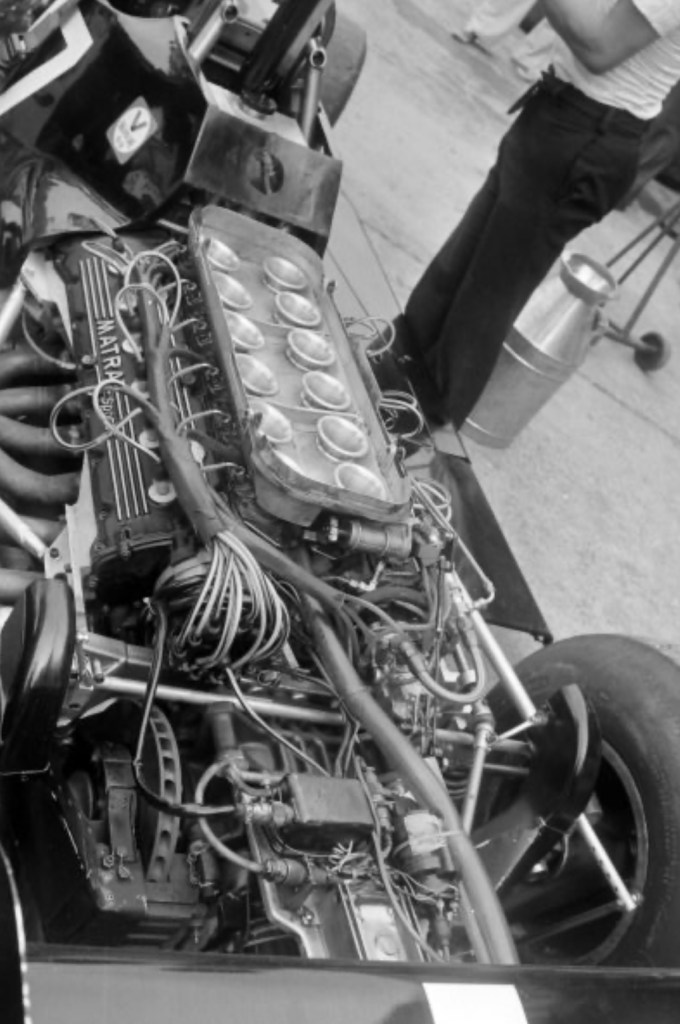
Shadow DN7 Matra. Type 73 3-litre V12 – circa 500bhp – engine installation at Monza in September1975. Note single plugs and distributor driven off the rear of the inlet camshaft, also exhausts and neat brackets to which the top radius rod at the front and shock/spring mount attaches at the rear – the main bracket runs the length of the cylinder head. You can just see the roll bar behind the spring, radiator header tank also clear (MotorSport)
The obvious alternatives were the Matra V12 and Alfa Romeo Flat-12, both 3-litre endurance engines, and the venerable BRM V12. The latter was easily ruled out as being way past its prime, the BRM P207 was a sad joke in 1974/5 for all concerned. The Matra and Alfa were successful endurance engines. In the event BC Eccclestone, then Brabham’s owner, did a deal to use Alfa engines from 1976 whilst Nichols pursued the Matra option.
While the French V12 last appeared in GP racing in Matra MS120s driven by Chris Amon in 1972, the engine had been continually developed as an endurance unit. Given Matra’s Le Mans wins from 1972-74 and a whole swag of other endurance events; so it was not too difficult to adapt Matra’s learnings to a sprint-spec of the engine, from whence it originated in any event way back in 1968.
Silverstone Shadow DN7 Matra first test, July 1975 (unattributed)
Evolving the DN5 Ford into the DN7 Matra…
Whilst commercial negotiations dragged on between Nichols and Matra, Southgate and his team focussed on keeping the DN5 competitive while concepting the DN7, which was essentially a DN5 adapted to fit the longer, heavier, thirstier but more powerful V12.
Major differences were increased fuel tankage and a longer wheelbase, otherwise the key elements of both cars – chassis, body, aero and inboard front suspension by rockers, conventional outboard rear suspension and Hewland TL200 gearbox were the same. This gearbox was developed by Hewland for endurance purposes and was used by Matra in their MS670 sports cars.
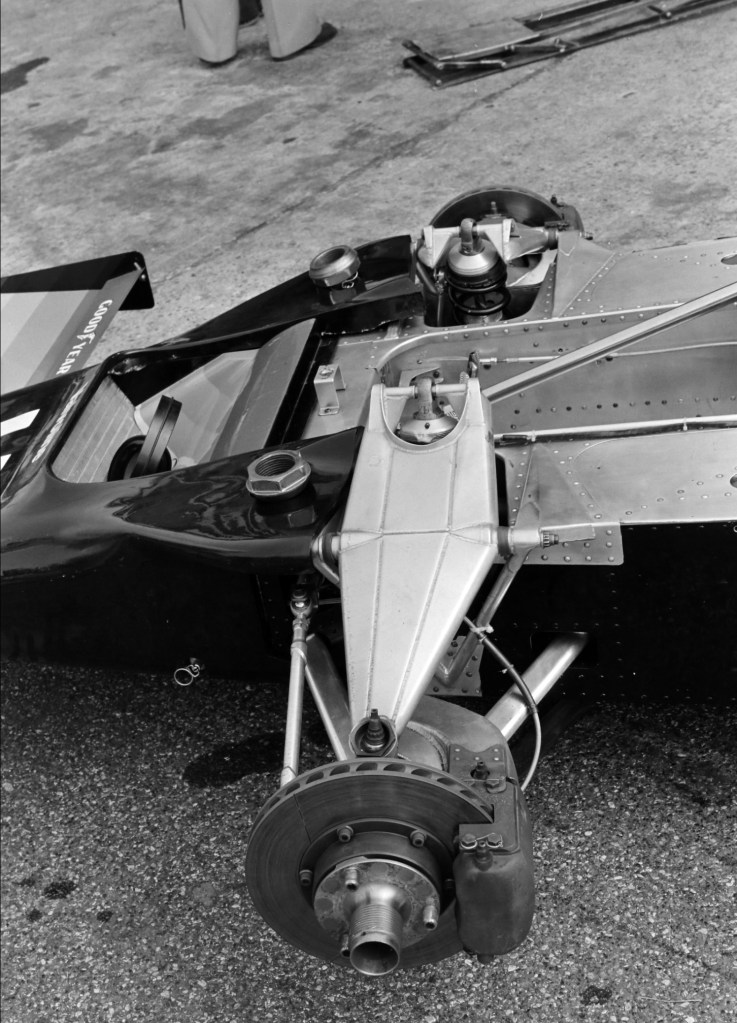
Three body-off shots in the Monza paddock 1975. Exquisite standard of fabrication clear (MotorSport)(MotorSport)Hewland TL200 ratio change (MotorSport)
Tony Southgate spoke of the challenges of adapting the Matra engine to the DN5 in his autobiography.
‘In view of my V12 experience with Eagle and BRM the powers that be most likely thought I was a bit of a V12 expert and that I might be able to resurrect the old Matra engine and get it to the front of the grid. Fitting the Matra engine was not that straightforward and of course the V12 engine required a lot more fuel cell capacity. The engine ran at 12000rpm, about 30% more than the DFV, so extra tanks were fitted into the sides of the car alongside the existing seat tank.’
‘Due to the extra engine RPM and horsepower the cooling system needed to be increased in size, so I fitted larger side pods and set the water radiators further forwards to maintain the weight distribution of the Cosworth engined DN5. The V12 was longer than the DFV, of course, so the wheelbase was increased a little’.
‘The end result was a longer, heavier but more powerful DN5 which we called the DN7. I thought that it would do about the same lap times as the DN5 and that proved to be the case’.
Matra MS73 V12 ultimately successful in Matra sports prototypes and Grands Prix winner in Ligier chassis. Famously aurally erotic, circa 500bhp @ 11600rpm when a good Cosworth DFV gave circa 470bhp. Note Lucas injection trumpets, inboard rear discs and duct, engine electronics behind radiator header tank (MotorSport)
When finally completed the car was tested by ‘Jumper’ at Silverstone in July and made its race debut in practice for the Austrian GP on 17 August.
Tom Pryce drove his usual Ford engined DN5 and offered a direct comparison, both drivers being more or less equivalently FAST. The car was heavier than the DN5, it wasn’t bespoke, but still provided the team and of course Matra a sense of competitiveness of the package.
The Austrian GP was a horrible weekend,Mark Donohue crashed his Penske March 751 in practice as a result of a Goodyear tyre failure, dying in a Graz hospital several days later of brain injuries sustained in the high speed crash. Half points were awarded to finishers of the rain shortened race won by Vittorio Brambilla’s works March 751 Ford, that teams first, long overdue win.
Denis Jenkinson in MotorSport had this to say about the re-appearance of Matra in GP racing; ‘Another welcome return was made by the Matra V12 engine, this time in the back of a UOP Shadow DN7, but somehow it seems to have lost that car-splitting scream that it used to have in the days of Beltoise and Pescarolo in the blue cars from Velizy. Perhaps the Ferrari and Cosworth engines have caught it up on the decibel scale, for they certainly have on bhp output. None-the-less it was nice to see and hear a Matra V12 in Grand Prix racing again’.
‘Particularly pleasing was to see the enthusiasm with which JPJ was tackling the job of driving the DN7. It was not a half-hearted attempt, with one eye cocked over the Cosworth powered DN5 standing in the paddock, or a dickering between the two cars. As far as Jarier was concerned there was only one car for him and that was the DN7. With that approach in the cockpit the Shadow Matra V12 project could get somewhere. It certainly started well by being ahead on the grid of Pryce in the Shadow Cosworth V8, even if it was only 0.2 sec ahead’
Jarier qualified the DN7 13th, one grid slot in front of Pryce, Tom had a great race finishing third while the Matras fuel injection system malfunctioned causing JP’s retirement on lap 10. It was an ok start for a car with limited testing, the Shadow boys prepared the same mix of cars for the Italian GP held on 7 September.
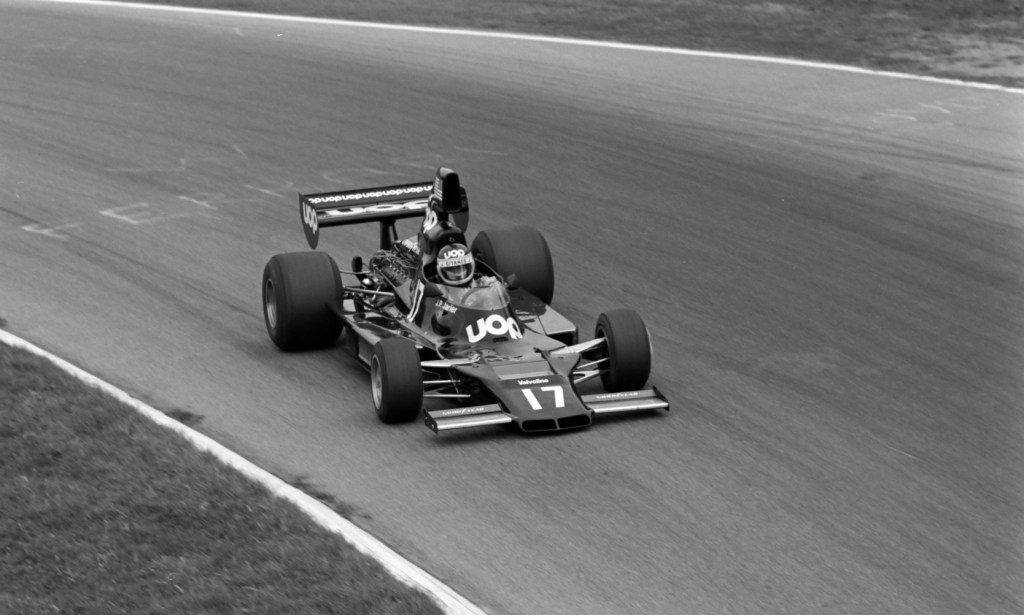
Jarier, DN7 Matra, Monza 1975. GP cars of the era don’t look better than this (LAT)1975 Italian Grand Prix, just look at the variety of aero approaches in this shot let alone mechanical specification, Oh for the days before F1 was a ‘control formula’?! Regazzoni’s winning Ferrari 312T Flat-12 from Jarier’s Shadow DN7 Matra V12, Carlos Pace’s Brabham BT44B Ford V8 and Ronnie Peterson’s similarly powered Lotus 72E (unattributed)(MotorSport)
In between the Osterreichring and Monza the non-championship Swiss Grand Prix was held at Dijon, France, there being no circuits in Switzerland, with Jarier putting his Shadow on pole. He led the first 23 laps until retirement with gearbox trouble; but he was back in his Ford engined DN5 while the DN7, the team only built one chassis – #DN7/1A – was readied for Monza. Clay Regazzoni won the event in his Ferrari 312T and then doubled up also driving to victory at Monza.
The Shadows qualified in Italy exactly as they had at the Osterreichring, the results similar as well; ‘Jumpers’ Matra failed, this time with fuel pump failure and Pryce was sixth after a good mid race battle with James Hunts Hesketh. Niki Lauda won his first drivers championship, his third place in his Ferrari 312T assuring him of the championship.
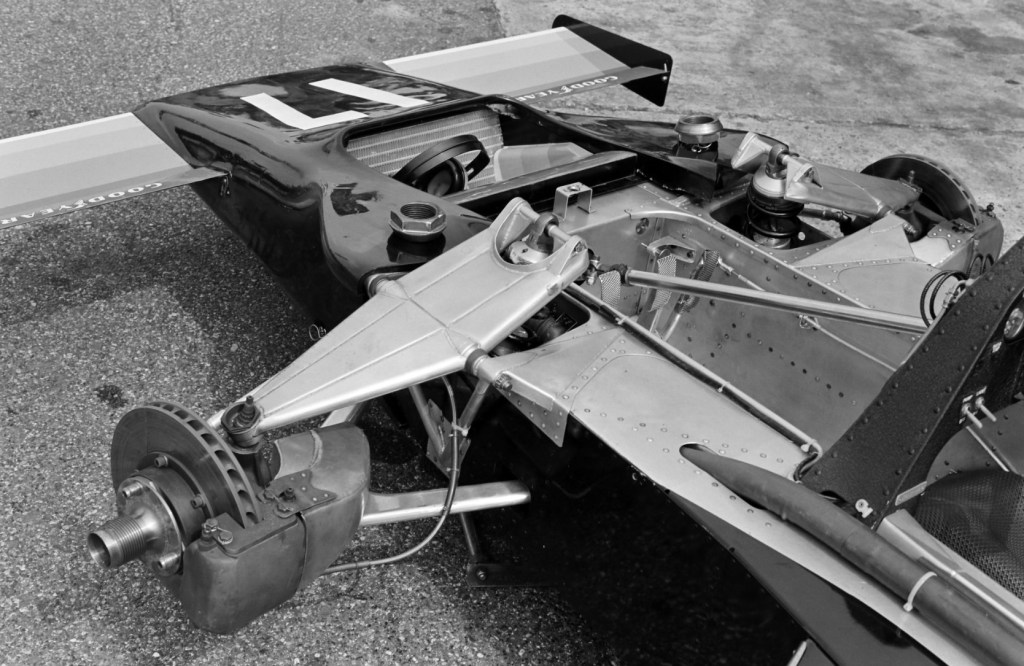
Shadow DN5 Ford in the nuddy, Kendall Centre, Watkins Glen US GP 1975. Pryce DN5, 16th in the race, non-classified with Jarier’s similar car DNF. Car getting a fresh Ford DFV. Rear suspension/’box assy at the rear, with the Cossie about to be unbolted, aluminium monocoque and quality of build and finish clear. Note cast alloy instrument bulkhead (unattributed)
At the season ending Watkins Glen race both Shadows were very fast; Q4 for Jarier and Q7 for Pryce but both were in DN5s, the Matra experiment was, sadly for the sport, over.
‘Jean-Pierre Jarier was fighting hard with the Shadow V12 during the first session, a revised fuel system and some titanium exhausts from the sports car endowed it with appreciably improved performance at the top end of its rev band. Alas, Jarier’s enthusiasm would be channeled into the Cosworth powered DN5 after it was calculated that the engine would consume fuel at the rate of 4mpg under racing conditions, and the French engined car was sadly pushed away for the remainder of the weeekend’ (therefore the car would not hold sufficient fuel to complete the race without a stop) said Denis Jenkinson in his MotorSport race report.
It may be that that was the case, or simply that Don Nichols had learned that Matra engines would be used exclusively by the new Ligier team for 1976 and simply put the car to one side to focus on the quicker DN5 Cosworths.
Lauda won the race, both Shadows well down the field despite qualifying times which showed just how quick a package the car was on a circuit which was a great test of a car’s medium to high speed handling characteristics.
JPJ in the DN7 during the first practice session at Watkins Glen, the last time #DN7/1A turned a wheel before its restoration by Grant Beath in recent times. Car was for 35 years part of Don Nichols collection fitted with a dummy, blown V12 (unattributed)
Both Nichols and Ligier wanted exclusivity in terms of engine supply, from a France Inc perspective the choice of the well connected former rugby international’s team made more sense than the American owned British based concern; French car, team and driver.
From Matra’s viewpoint it makes more sense to me, given the aerospace conglomerates immense resources, to supply two teams in 1976 especially given Shadow’s speed, if not reliability in 1975.
Ligier were an unknown 1976 quantity, Shadow were. Both Shadow drivers had shown prodigious speed in 1974-75, one was French and Southgate did a neat job integrating the Matra V12 into an existing chassis designed for a different engine. His bespoke 1976 Matra chassis would have been lighter overall and designed around the engine architecture rather than an adaptation of what he had based on the Ford Cosworth.
Ligier were to be a one car entry in 1976 so Matra very much had all their eggs in one basket. Ligier’s JS5 1976 car was a horrible looking, bulky thing, mind you it delivered the goods in a a way Shadow did not that year. Jacques Laffitte was eighth in the drivers championship, Pryce 12th and poor Jarier didn’t score a point in the lightly updated 1976 Shadow DN5Bs and new DN8. Matra finally achieved a GP win when Laffitte won the 1977 Swedish Grand Prix in his Ligier JS7, the whole paddock were delighted for him, Ligier and Matra.
Don Nichols retained ownership of Shadow, but his company, United Oil Products, was no longer the team’s major sponsor and the slippery slope of progressive loss in competitiveness began, whilst noting Alan Jones’ lucky 1977 DN8 Ford, Austrian GP win.
If only Nichols had jagged the Matra deal or the Velizy concern supplied both teams he may have stayed more involved and we would have had the chance of seeing Tony Southgate designed, bespoke, Matra engined cars driven by two of the fastest chargers around at the time. It’s an interesting ‘mighta been’ I reckon?!…
Jarier, DN7 Matra, Monza (MotorSport)
Shadow DN7 Matra Technical Specifications…
Chassis; aluminium monocoque using the Matra MS73 V12 as a fully stressed member. Front suspension by lower wishbone and top rocker actuating inboard mounted coil spring/damper units. Rear suspension twin parallel lower links, single top link, coil spring/damper units and twin radius rods. Adjustable roll bars front and rear. Wheelbase 2667mm, front and rear tracks 1473/1549mm. Weight 612Kg.
Front and rear disc brakes, inboard at the rear. Rack and pinion steering. Wheel sizes front/rear 9.2/20 13 inch in diameter, 16.2/26/13 inches.
Engine; Matra MS73 3-litre, DOHC, four valve, Lucas fuel injected, all aluminium 60 degree V12. 2993cc, bore/stroke 79.7/50mm, circa 500bhp @ 11600rpm. Gearbox; Hewland TL200 five speed transaxle
(MotorSport)
Etcetera…
(MotorSport)
More shots at Monza in 1975, probably too much of a good thing…
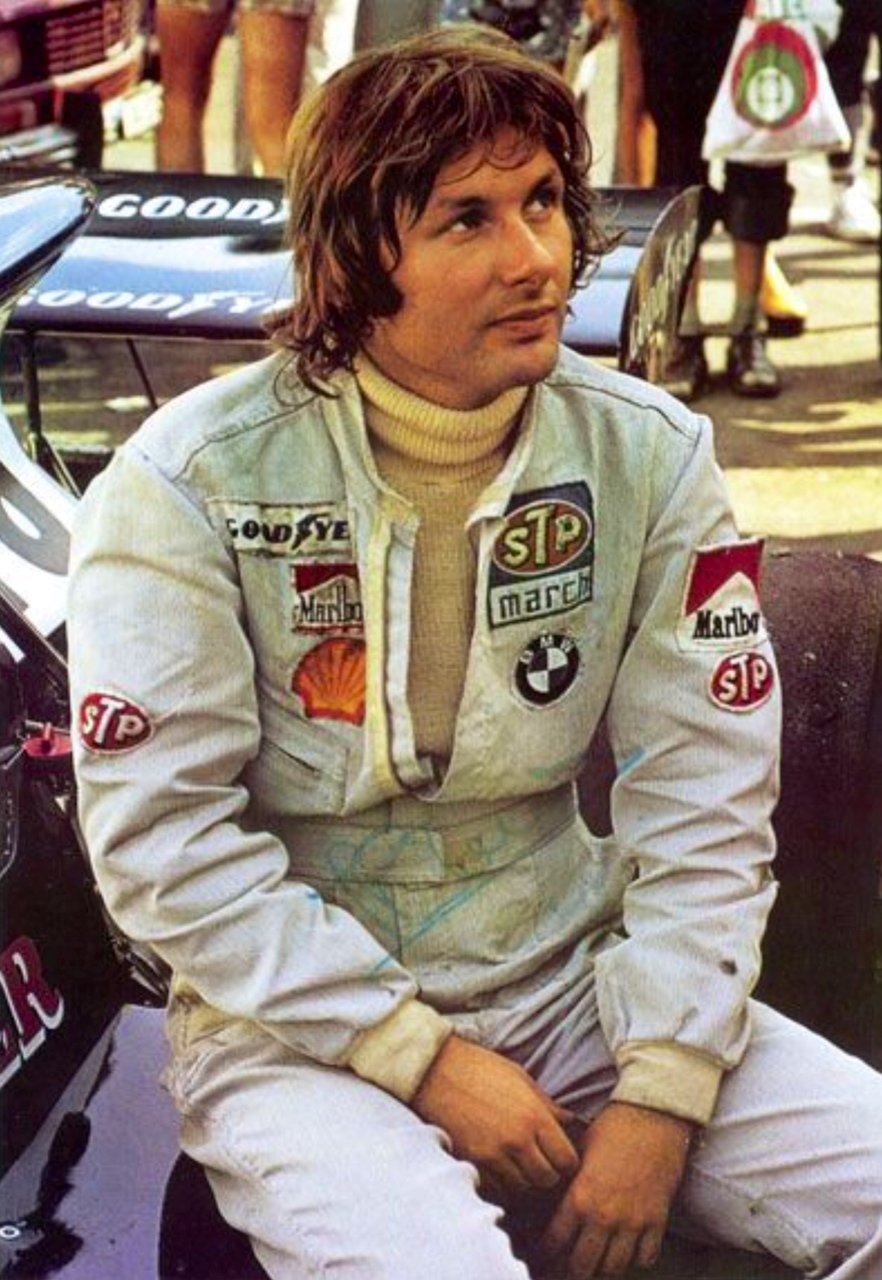
(MotorSport)(MotorSport)(MotorSport)(MotorSport)(MotorSport)(MotorSport)JPJ sitting on his March 731 Ford during 1973. He did a year of F1 and F2 for the team comprehensively lifting the Euro F2 title in a March 732 BMW (unattributed)
Tony Southgate on ‘Jumper’ Jarier in ‘MotorSport’…
‘He had such fantastic car control and speed but just didn’t have the commitment. I’m sure he could have been World Champion if only he could have been bothered. Jean-Pierre got bored very easily and in practice or testing he would adapt himself to the car and do the same times after you had made adjustments. He was a typical French driver in that he was more interested in going out of an evening, eating a good meal and chasing the ladies. It soon became clear that he wouldn’t go on to the next level’.
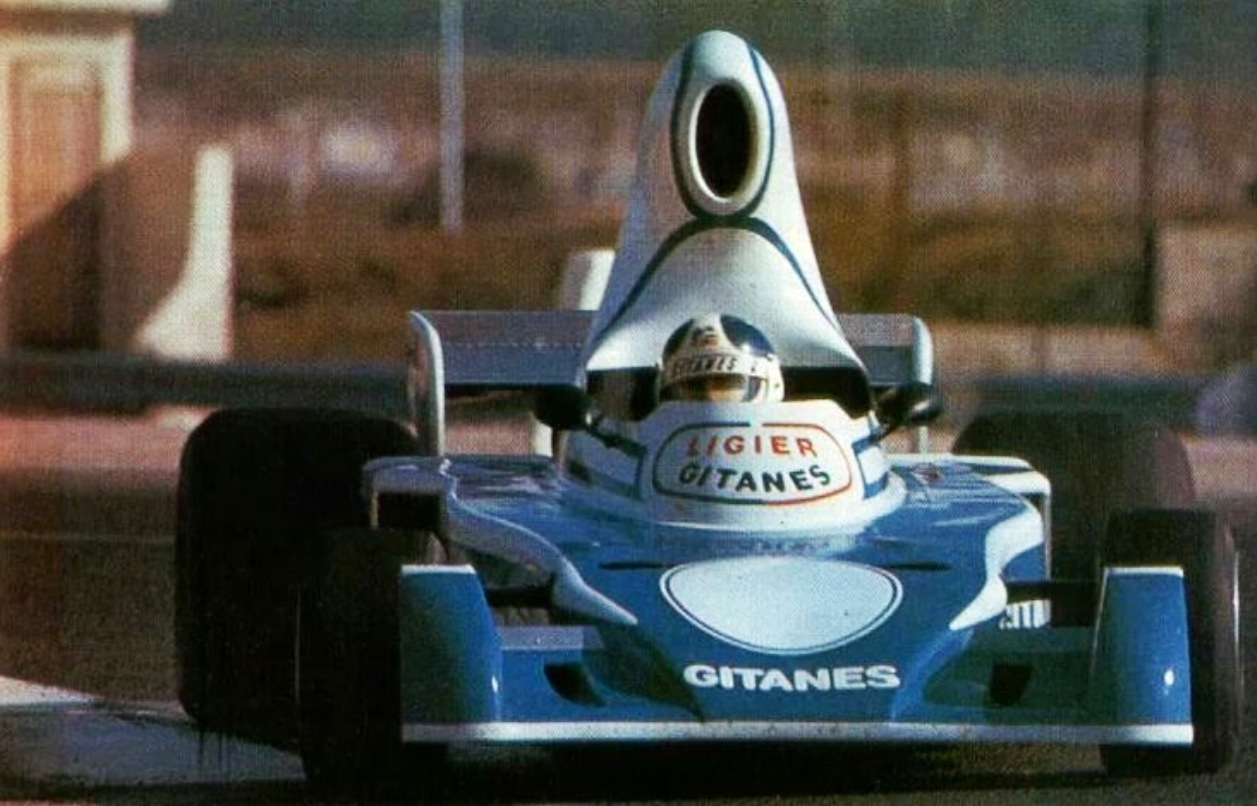
Jean-Pierre Beltoise testing the brand new Ligier JS5 Matra at Paul Ricard in December 1975 (unattributed)
1976 Ligier JS5 Matra…
The Ligier JS5 Matra was a sinfully ugly car, it had the looks only a mother could love but its ‘fugliness’ was only skin deep!
Gerard Ducarouge and his team had the aero spot on, the enormous airbox which led to the car’s nickname The Flying Teapot chanelled air beautifully over the car and smoothed it onto the rear wing. Eighth in the drivers title for Laffitte and sixth for Ligier in the constructors race in a one car team entry was an exceptional first year performance.
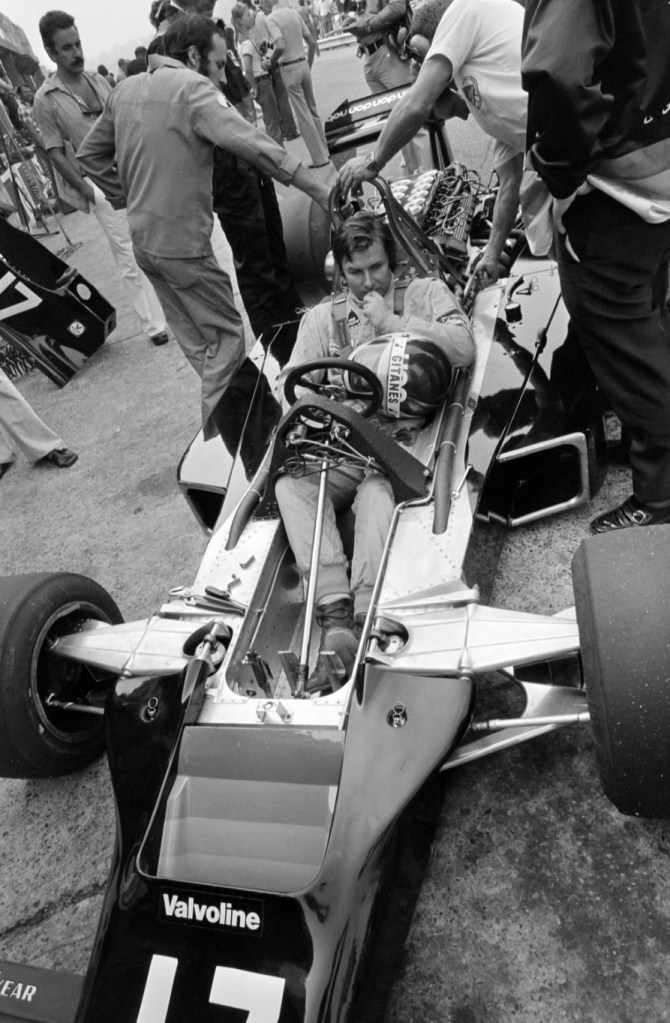
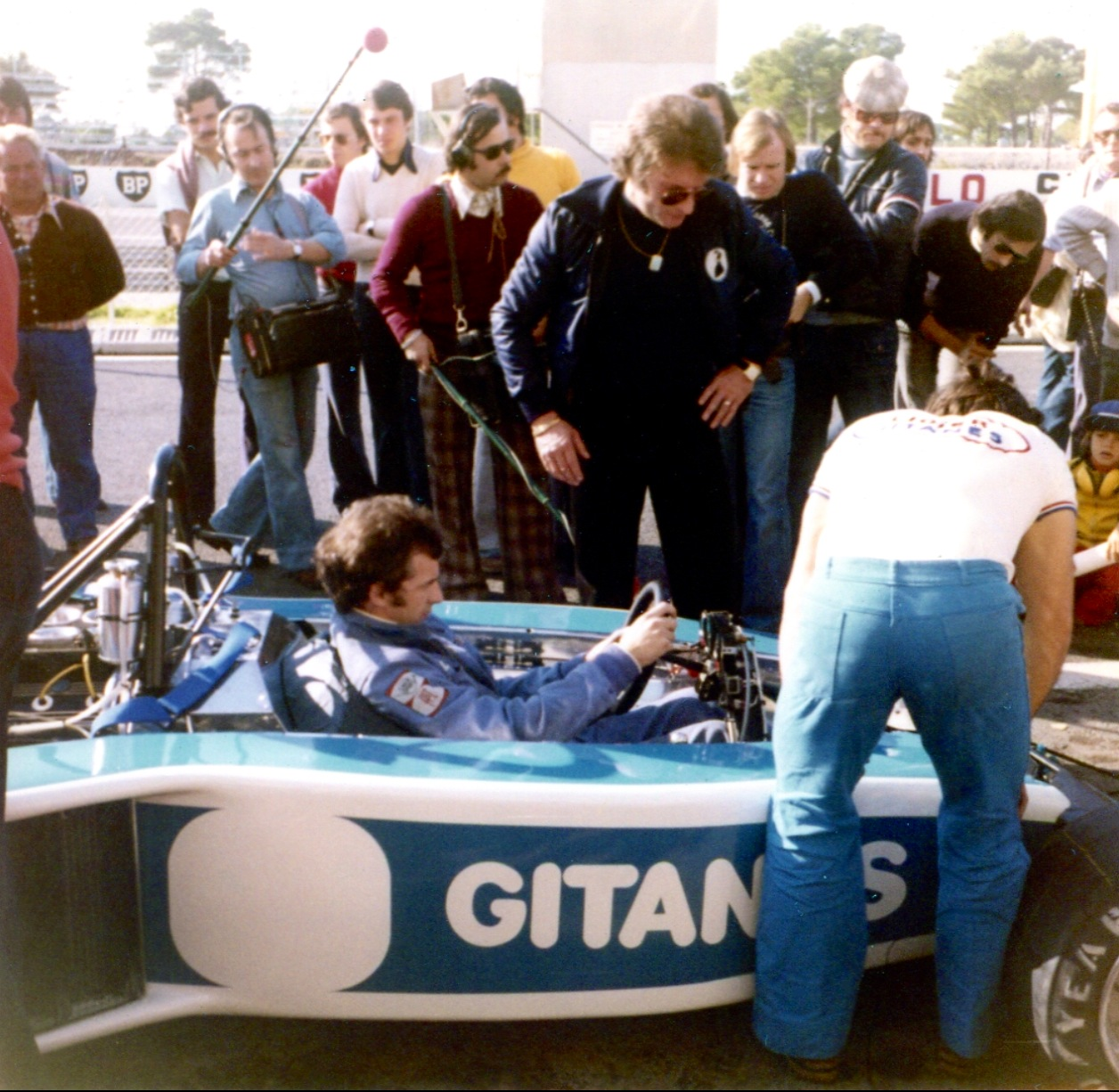
The pictures are of the JS5’s first test at Paul Ricard in December 1975 with Jean Pierre Beltoise up. JPB had been announced as the driver, perhaps via sponsor Gitanes, but Guy Ligier was not convinced and organised a driver test over two days. Jacques Lafitte the quicker of the two in a car which had been tweaked by JPB who tested on the first day.
There was disquiet in France in some quarters over the choice of Laffitte, JPB at the time was France’s only contemporary GP winner, but Ligier’s choice was sound. Jacques in Frank Williams’ Ford engined Williams FW04 and Martini Mk16 Euro F2 crown ahead of the March BMW hordes in 1975 made it fairly clear that he was the better choice. JPB, fine driver that he was, ‘ultimate speed’ had been shown over the years to be not in the Ace category whereas Jacques’ potential, relative novice that he was, was pretty clear. It was an astute choice if not an entirely popular one.
JPB smiles for the cameras and gets himself comfy in JS5, designer Ducarouge, what a talented chappy! looks at JPB’s feet. Paul Ricard December 1975 (unattributed)
Bibliography…
MotorSport January 2015, Denis Jenkinsons MotorSport Austrian and US GP reports 1975, GP Encyclopaedia, Tony Southgate ‘From Drawing Board to Chequered Flag’
Photo Credits…
MotorSport Images, LAT, Car Blueprints, Alejandro Saldutto
Tailpiece…
(MotorSport)
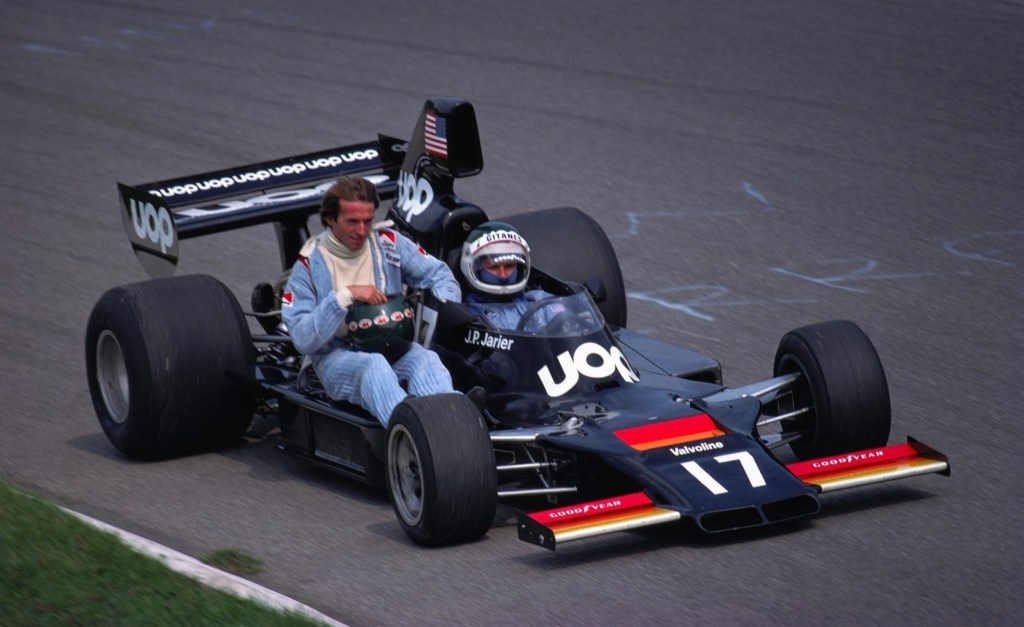
‘So waddya think of the engine Jean-Pierre? is perhaps the question Jacques Lafitte is asking JPJ on their way back to the Monza paddock’? He knew full well of course as an ex-Matra sportscar driver…
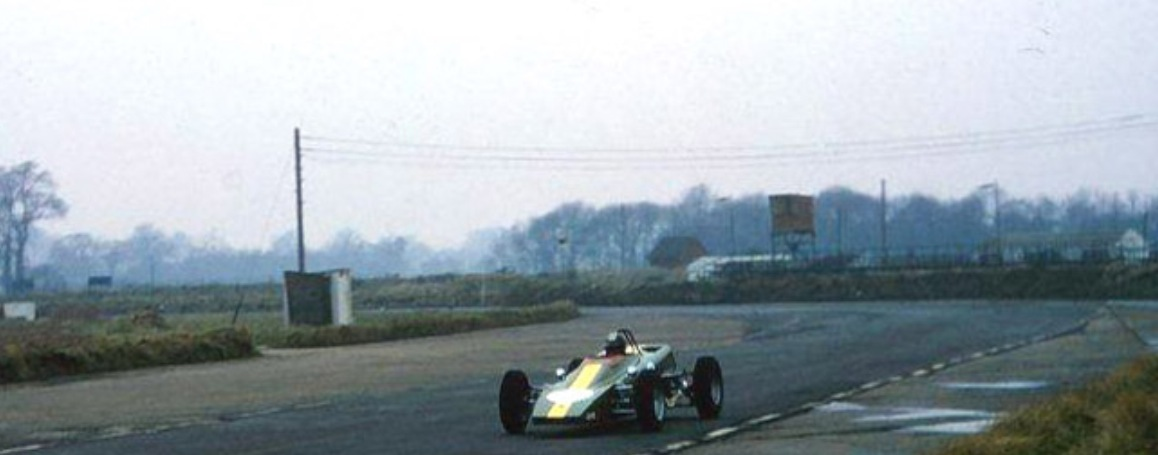
Graham Hill and jockey Lester Piggott test the Lotus 61 Formula Ford at an incredibly frigid Hethel Airfield 20 March 1969…
How many times he spun the car at Lotus HQ is unrecorded! The event appears to be a promotion to boost the sales of Lotus Components latest Formula Ford. And a very competitive car it was, in fact all the Lotus FF’s were; 51, 61, 59 and 69, it’s a great pity Chapman took the marque up-market and left its enthusiast/grass roots racing background behind.
Graham Nearn did rather well with the Lotus 7 Series 3 too, proving there was life in the old beast yet, the 7 being the other product of Lotus Components in addition to the production racing cars, Chapman sold the rights of the 7 in 1971.
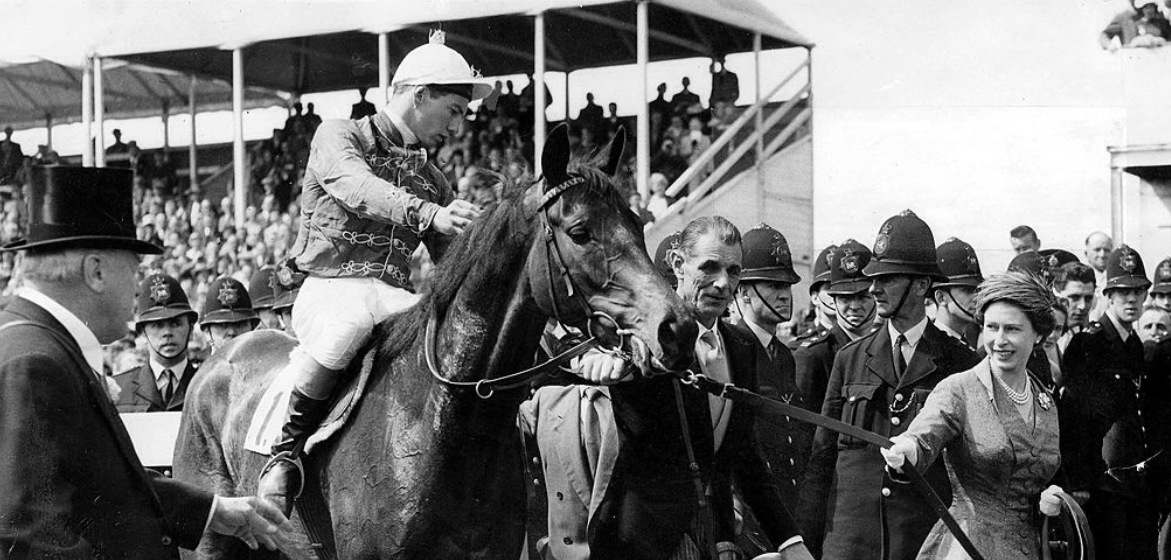
On a more familiar type of mount; Lester Piggott takes the Queens horse ‘Carrozza’ back to scale having won ‘The Oaks’ at Epsom, Surrey on 7 June 1957. Queen Elizabeth leads (Popperfoto)
Credit…
Victor Blackman, Richard Styles
Tailpiece: Dave’s Lotus 61…
Later Lotus GP driver, Aussie Dave Walker tests his JRRDS Lotus 61 at Snetterton prior to the start of his successful 1969 season. He won the British Les Leston FF Championship in this car in 1969 (Richard Styles)
Lotus stand at the ’69 Racing Car Show, sports-racer Type 47 and F3 Type 59 to the fore…
Both models are Loti i always had a hankering for, there were several 47’s which raced for years in Australia in a variety of classes and a 59 won the Australian Drivers Championship, the ‘Gold Star’ in 1970.
Emerson Fittipaldi contesting the 1969 Guards Int Trophy at Brands Hatch on 1 Sept 1969. His Jim Russell Lotus 59 Ford was 3rd to Reine Wisell Chevron B15 Ford and Tim Schenken BT28 Ford, all racing in F1 in 1971- Emerson and Reine for GLT Lotus, Tim for Brabham (unattributed)
Back to the UK in 1969, the works ‘Gold Leaf Team Lotus’ 59’s were raced by American Roy Pike and Brit Mo Nunn (later Ensign F1 designer/supremo) with Aussie Dave Walker in a ‘Lotus Components’ entry (the constructor of Lotus customer racing cars).
Emerson Fittipaldi raced a Jim Russell Lotus 59 entry winning the 1969 British championship and making his GP debut at Brands Hatch in 1970.
Dave Walker in the GLTL Lotus 59 during the 1970 Monaco F3 GP, 9 May. He is threading his 8th placed car thru typical Monaco carnage. Tony Trimmer won in a Brabham BT28 Ford, Walker dominated F3 in 1971 including a GLTL Lotus 69 Ford Monaco F3 GP win (Simon Lewis)
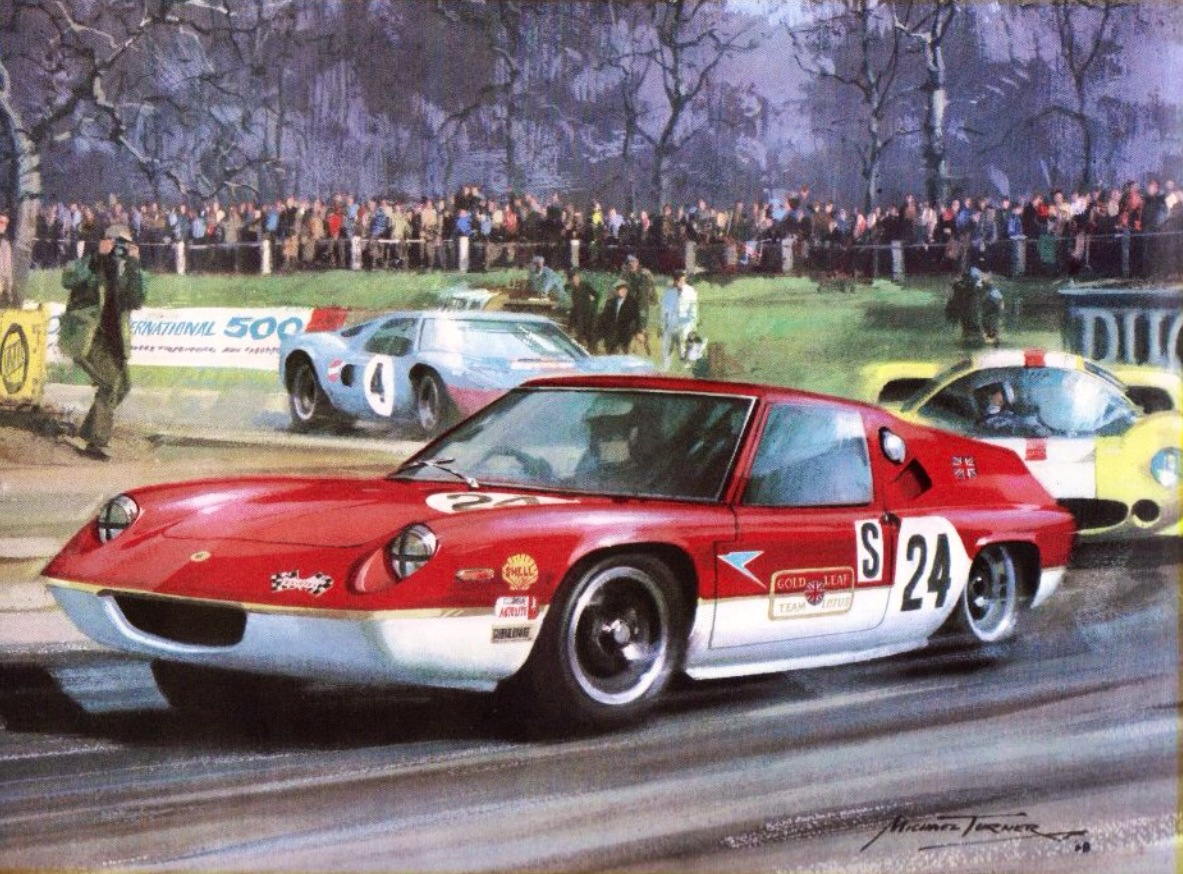
The Oliver/Miles GLTL Lotus 47 is depicted ahead of the Bonnier/Sten Axelsson Lola T70 Mk3 Chev 6th and winning Ickx/Redman Ford GT40, Brands 6 Hour, 7 April 1968, the day of Jim Clark’s death (Michael Turner)
The 47 was raced in the 1968 Brands Hatch 6 Hours in GLTL colorsby Jackie Oliver and John Miles finishing in tenth place in the race won by the Ickx/Redman Ford GT40.
In 1969 the works team raced the Lotus 62 with the GM derived Vauxhall/Lotus LV220 DOHC 4 valve engine, the 47 powered by the venerable Ford/Lotus twin-cam, a Hewland FT200 gearbox used in place of the standard Renault unit.
Whilst the 62 looked a bit like the 47 it shared a few body panels only; its spaceframe chassis was bespoke (2 built) and engines as noted above totally different.
John Miles Lotus 47. ‘Silverstone Players Trophy’ meeting 27 April 1968 (Simon Lewis)
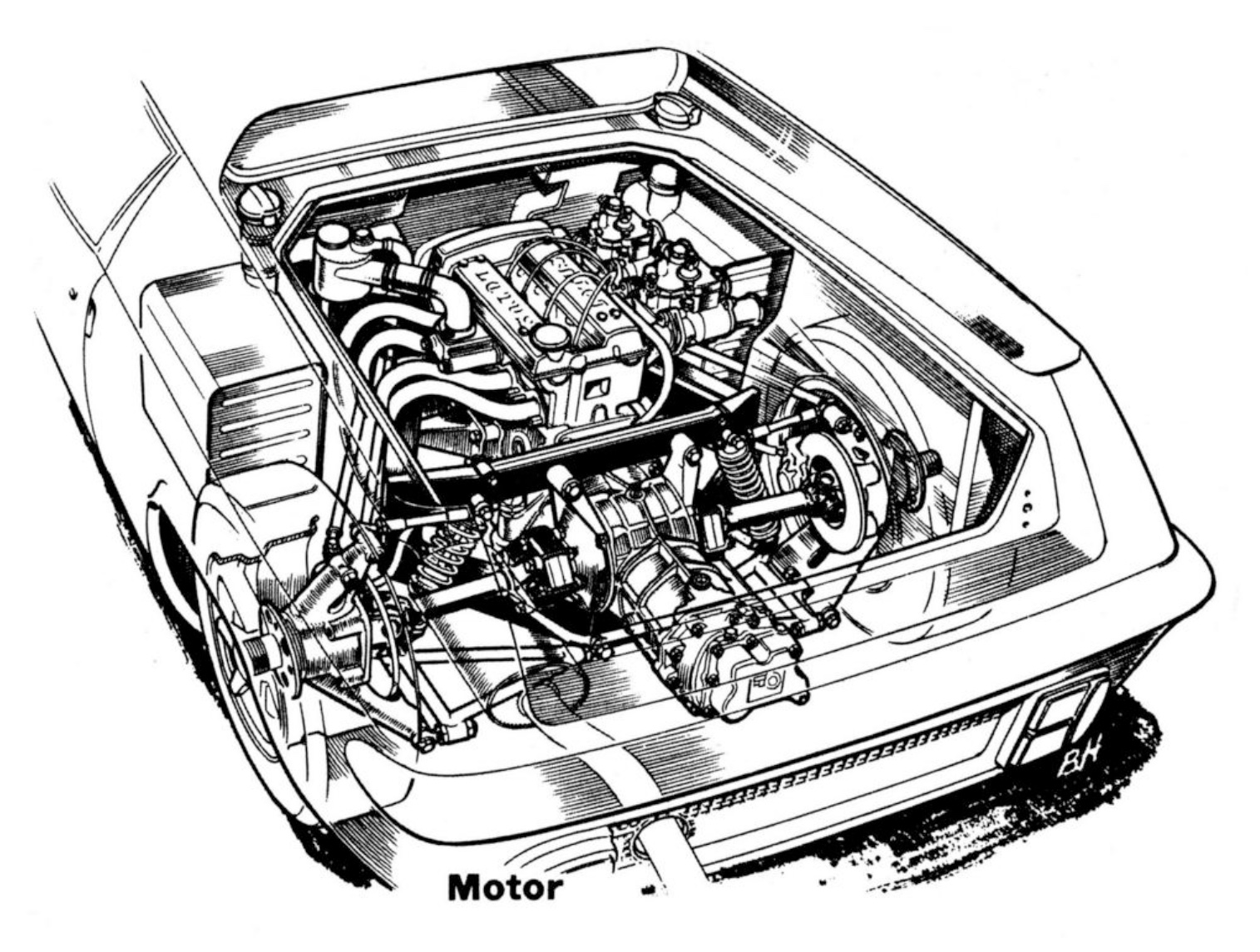
Lotus 47 cutaway; backbone chassis, front suspension upper and lower wishbones and coil spring/damper units. Rear suspension top link, lower wishbone and radius rods. Engine Ford/Lotus twin cam 2 valve, power depending on spec from 160-190bhp. Gearbox Hewland FT200 5 speed , Brakes ventilated disc all round (unattributed)
Lotus 47 engine, gearbox and suspension detail (B Hayton)
Geoghegan’s Sporty Cars 47…
It was inevitable that the Geoghegan brothers would import a Lotus 47 to Australia albeit the cars didn’t fit neatly into our sportscar class structure where the majority of races were short sprints rather than the longer events for which the cars were really designed.
(C Haigh)
The point is illustrated by Leo’s challenge in keeping up with the Lotus 23B Ford at Lakeside above circa 1968, whilst the gorgeous silhouette of the car is shown in the shot below at Hell Corner, Bathurst where he is trying to hold off his old Elan 26R being driven by Niel Allen.
(C Haigh)
(C Haigh)
The last two shots are at Lakeside, the one above is Leo and the 23B lapping slower machines- get in touch if you can identify the cars/drivers.
The first use of a car by Santa to deliver gifts, 1896?! Make and model unknown, Benz my guess…
I hope wherever you live you have an enjoyable festive season with family and friends.
In Australia it’s our Summer Holidays so the whole joint closes down for a few weeks. We have the comatose excitement of cricket and lots of fun in the sun, which is great.
I’m off to Margaret River on the West Australian Coast; it’s a long flight from Melbourne across the big wide, dry continent and then a three hour drive drive from Perth. But you overseas folk should have it on your ‘must visit when I go to Oz’ list given it’s mix of wineries and food scene, coastal scenery and drivers roads, massive caves and beaches. Sure, there are a few sharks but the West Australian Great Whites are discerning diners, they seem to mainly eat lawyers!
I will continue to post over the coming weeks but the emphasis will be ‘quickies’ rather than features.
Even though 40% of the stuff I write about is Australian my ‘biggest market’ is France; other top-10 countries in order of size are Australia, US, UK, Germany, Italy, Japan, Czech Republic, Spain and Brazil. So, our little community is truly global, thank you all so much for reading the thing wherever you live.
I continue to enjoy writing it so will stick with the eclectic approach which is a function of the photos I find being the inspiration for an article.
Which brings me to some ‘thank-you’s’ for the yearespecially the photographers who have been so helpful and supportive; John Ellacott, Dick Simpson, Lindsay Ross, Rod MacKenzie and David Blanch in Australia, John Holmes ‘The Roaring Season’ ‘across the ditch’ in NZ and The Cahier Archive and Louis Klemantaski Collection for the more International stuff.
A foundation of the magazine is the Repco story and Peter Brennan’s restorations, many thanks to Rodway Wolfe and Peter for allowing me to write about these topics and the material they provide.
Stephen Dalton both contributed articles and is hugely helpful with his extensive library and advice on correcting the occasional boo-boo.
John Medley’s Chamberlain article and ongoing support and encouragement has been fantastic as is Pat Ryan’s enthusiastic fizz; both these guys have a wealth of Pre-War Oz knowledge which is not my strength. To my surprise i have written much more about older stuff rather than play to my personal strengths which is 1960 to the present but it’s simply more fun to research and write about what you don’t know rather than what yer do!
Autosport’s ‘The Nostalgia Forum’ is a good place to lose yourself for weeks, check it out. Its content rich for research especially on the obscure; the expertise especially on Australian Stuff of regular contributors Ray Bell, John Medley, Stephen Dalton, Kevin Drage and the Oz photographers above has added great depth and the perceptions of ‘those there at the time’.
Most of all, thankyou for reading it!
I am active on Facebook, Pinterest and Instagram so if you need a ‘daily fix’ pop Mark Bisset and primotipo.com into the relevant search engines and the names should pop up. Of these FB is the best as there is often dialogue about the posts which is often interesting.
Finally, I get asked all the time ‘wot cars would you like the most’, my contribution to this endless enthusiast debate is as follows,it’s not around the cars I would invest in just the stuff I would have to own and race! Sadly i’m not Nick Mason so none of the purchases are imminent! Am very interested to know the lists of others.
1. 1931 Alfa 8C2300 Corto Sports/Road
.Who needs a Bugatti when you can have a Jano Alfa? Any ‘Monza’ series Alfa would do. In fact anything designed by Jano would be nice!
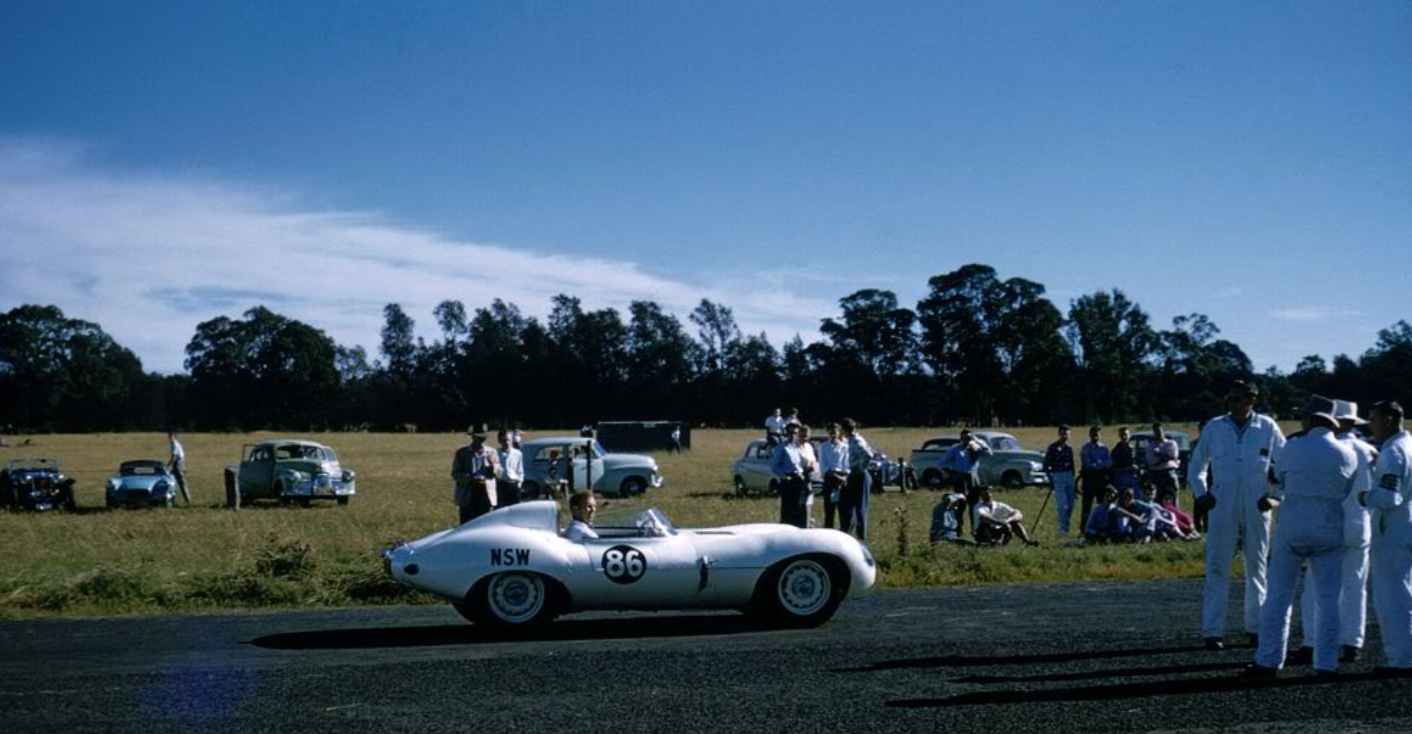
Frank Gardner, Jag D Type, Mount Druitt, Sydney 1958. It all looks ‘pretty chilled’ dunnit, from this ‘clubby scene’ sprung some world class drivers of whom FG was one (John Ellacott)
3. 1957 Maserati 250F F1
.’Nuff said ‘the’ quintessential front-engined GP car? Lancia D50 my next choice, not as pretty as the Maser but much more ‘edgy’.
Fangio in his 250F chasing Mike Hawthorn and Peter Collins Lancia Ferrari 801’s, German GP 1957. A famous, Fangio win (unattributed)
4. 1965 Ford GT40 Sports/Road
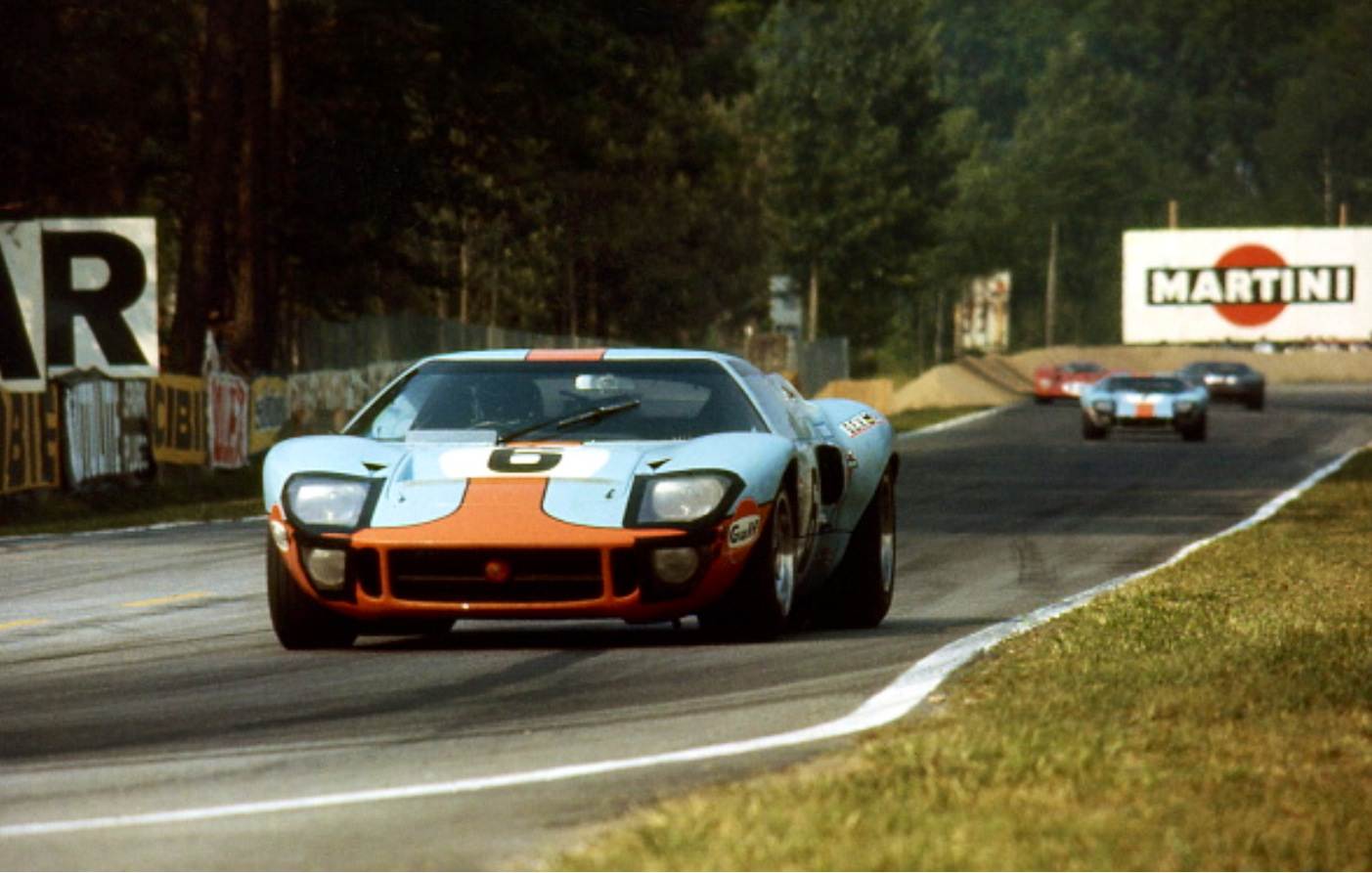
.So hard to choose between 1960’s Lola T70, Fazz P4/512S, Chap 2F and various Porsche’s!
Ford GT40 Mk1 ‘1075’ on the way to the second of its two Le Mans wins in 1969 for Ickx/Oliver, Rodriguez/Lucien Bianchi won in the same chassis the year before (Getty)
5. 1965/7 Lotus 39 Repco Tasman
.The ex-Clark Coventry Climax FPF engined chassis fitted with Repco ‘740 Series’ Repco 2.5 litre V8 to me the best looking 60’s single-seater of all, with apologies to Dan’s Eagle T1G!
Leo Geoghegan in his Lotus 39 Repco in the Surfers Paradise Tasman form-up area in February 1968. Brabham’s BT23E Repco alongside, Clark’s Lotus 49 DFW and Rodriguez BRM P126 to the rear. Clark won the race.Article on the 39 in the ‘pipeline’ @ present (unattributed)
6. 1970 McLaren M8D Chev CanAm
.Bruce’ last masterpiece and sadly the car in which he died.
Ignazio Giunti, Ferrari 312B, Spa 1970. 4th and best placed of the Ferrari’s in the epic contest between Pedro Rodriguez BRM P153 and Chris Amon’s March 701 Ford. Sadly a lost talent, he died in a pointless accident in the Buenos Aires 1000Km race the following January (unattributed)
8. 1973/5 Lola T330/2 Chev F5000
.Grew up loving these beasts, T330/2 one of the most successful racing cars ever
Click here for the first of a series of article on the T330;
Aussie Kevin Bartlett with the style for which he was renowned. Here subbing for Brian Redman in the Haas/Hall Lola T330 Chev @ the 1973 Laguna Seca L&M US F5000 Championship round DNF . Article on this in the pipeline (unattributed)
9. 1990 Ferrari 640 F1
.Anything more recent too ugly and complex.
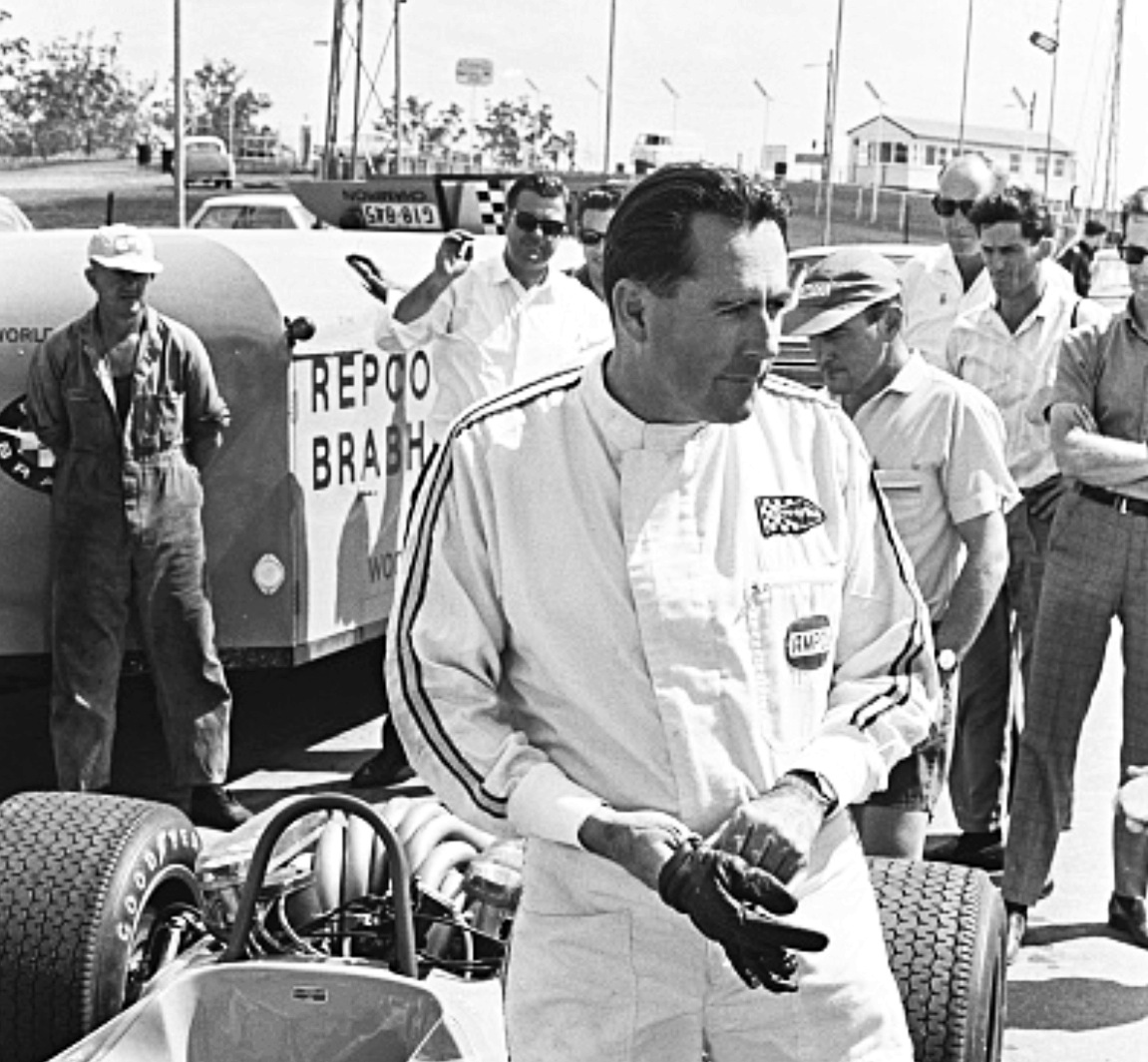
Jack Brabham shakes down his 1968 Tasman contender the Brabham BT23E Repco for Sydney’s media at Oran Park, 14 February 1968…
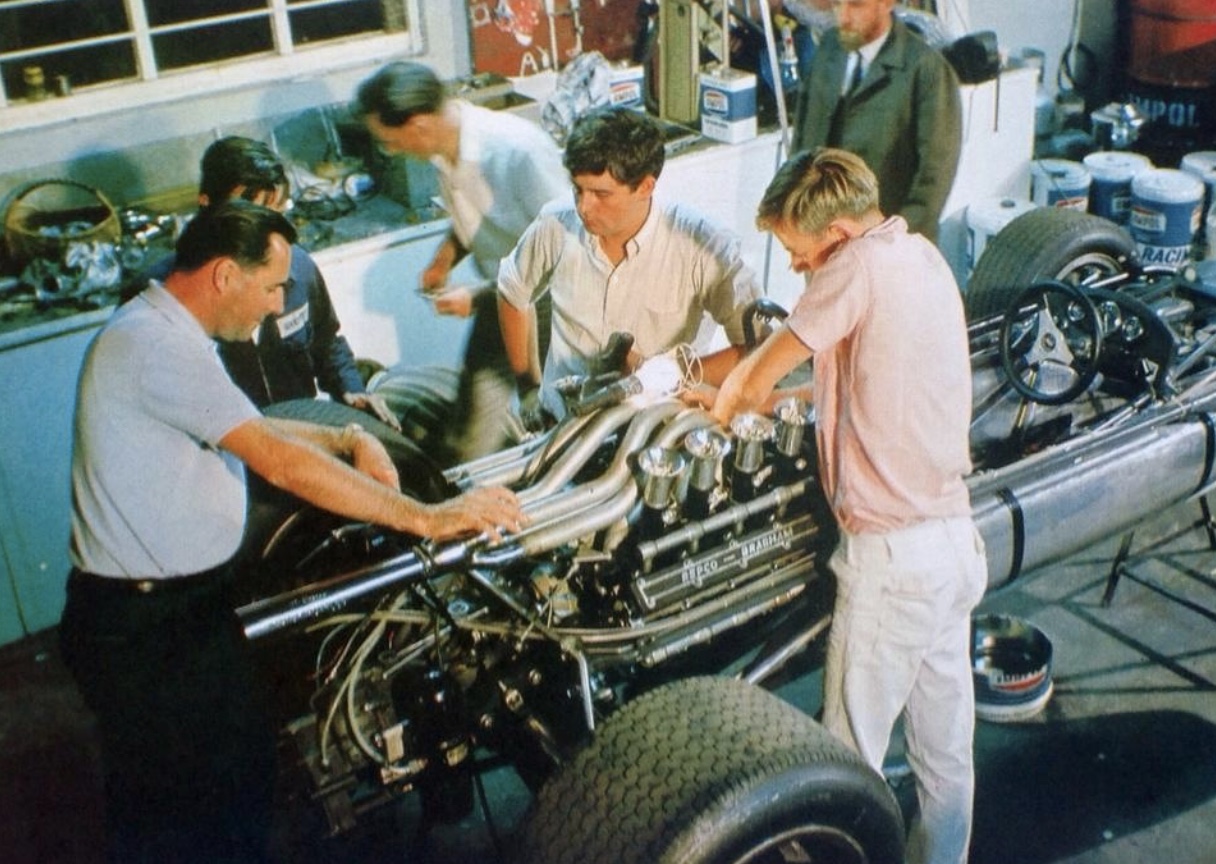
Nestled in the back is Repco’s latest ‘RB740’ 275bhp 2.5 litre V8, the Tasman variant of Brabham’s successful 1967 F1 3 litre (330bhp) engine. Denny Hulme took the drivers title from Jack in a BT24, with Brabham Repco winning the constructors championship for the second year on the trot.
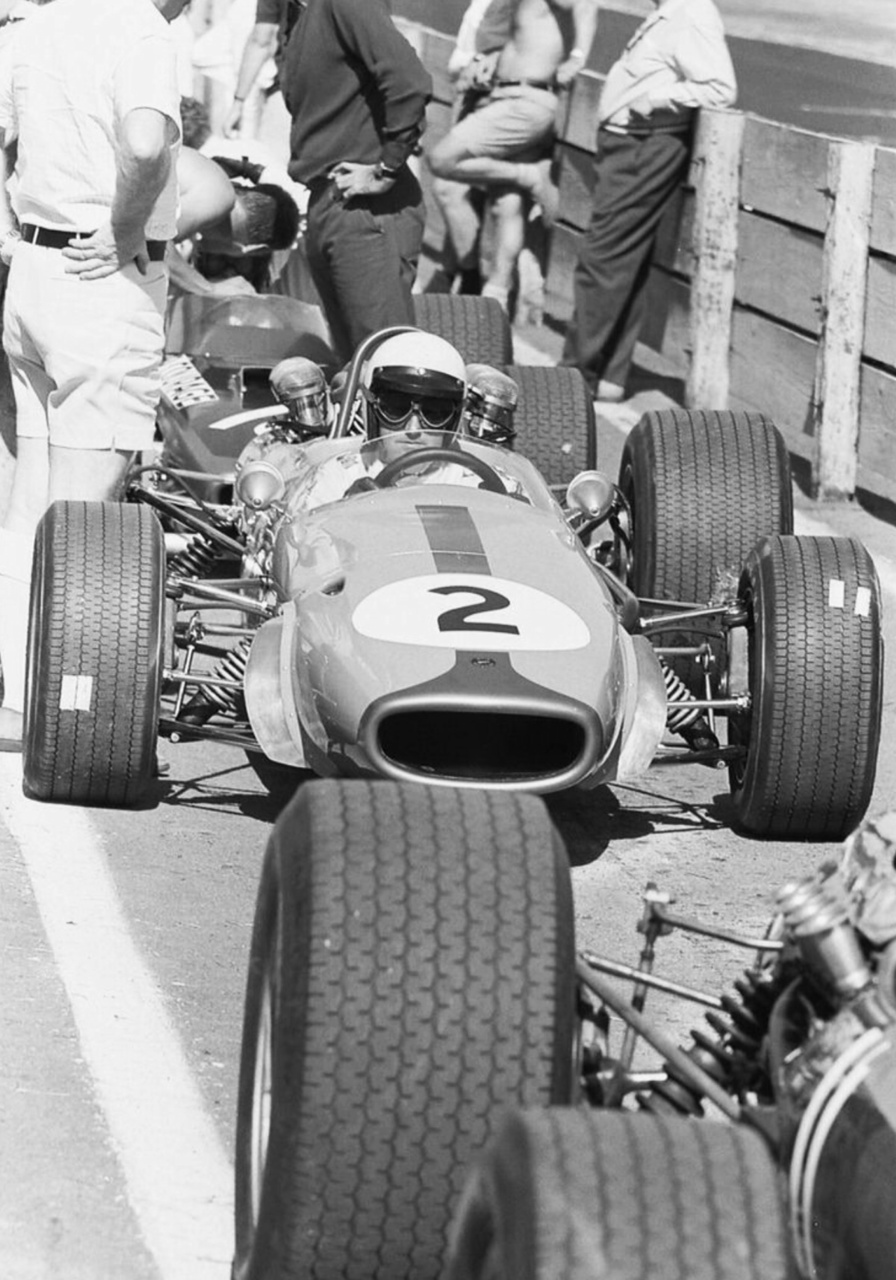
Brabham in the OP pitlane February 1968 (R Rice)
Jack Brabham at Oran Park, Sydney 1968. He might have raced a Holden touring car there in the mid-seventies but didn’t in his ‘heyday’. Built in the 1960’s 60Km west of Sydney near Camden, OP was extended in 1974 hosting the F5000 1974 and 1977 AGP’s. Subsumed by Sydney’s western sprawl ‘Oran Park Town’ will house around 25,000 people (R Rice)
BT23E being fettled probably in Sydney during the Warwick Farm weekend, Jack hands on as ever, RBE740 2.5 V8, Hewland FT200 gearbox (unattributed)
The Brabham BT23E/1was again built on Ron Tauranac’s BT23 F2 jig and powered by a 2.5-litre Repco V8- as it was for the BT23A he campaigned in the 1967 Tasman before its sale to David McKay’s Scuderia Veloce- BT23A used RBE640’s throughout the 1967 Tasman whereas BT23E used both RBE740 and a new design- the RBE830 (short F1 block and between the Vee crossflow, SOHC, two valve heads) on raceday at Sandown.
Jack Brabham made limited appearances in the 1968 Tasman series, he raced the BT23E twice, at Warwick Farm and Sandown Park in February.
(Brian McInerney)
Brabham in BT23E in the Warwick Farm pitlane several days after the cars Oran Park shakedown.
The car in front of Jack’s is Pedro Rodriguez’ BRM P261, behind him is the nose of Piers Courage’s McLaren M4A Ford FVA F2 car, third in the race. Jack was seventh in the ‘Warwick Farm 100’ on 18 February, Jim Clark ran away with the race from teammate Graham Hill’s identical Lotus 49 Ford DFW. Click here for an article on this meeting;
At Sandown on 25 February Clark again won the race and the title, Jack’s new Repco ‘830’ engine failed. It was a bit of a portent of the F1 year he and Jochen Rindt were to experience with the Repco engines.
The Ford Cosworth DFV, in its second year, challenged the new quad-cam 32 valve Repco RB860 V8, its fragility was as problematic as its RB620 and 740 brothers had been reliable…
Sandown AGP 1968. Clark, Lotus 49 Ford DFW, Chris Amon, Ferrari Dino 246T and Jack in BT23E/1. Row 2 is Graham Hill and Leo Geoghegan in Lotus 49 Ford DFW and Lotus 39 Repco 740 respectively. The other glimpse of a car beside the fence is Frank Gardner’s Brabham BT23D Alfa. Jim won in a thriller diller of a race by a ‘bees-dick’ from Chris (HAGP)
RBE830 engine cobbled together to fit in the BT23E frame- the blocks were different, note oil cooler and breather arrangements (R MacKenzie)
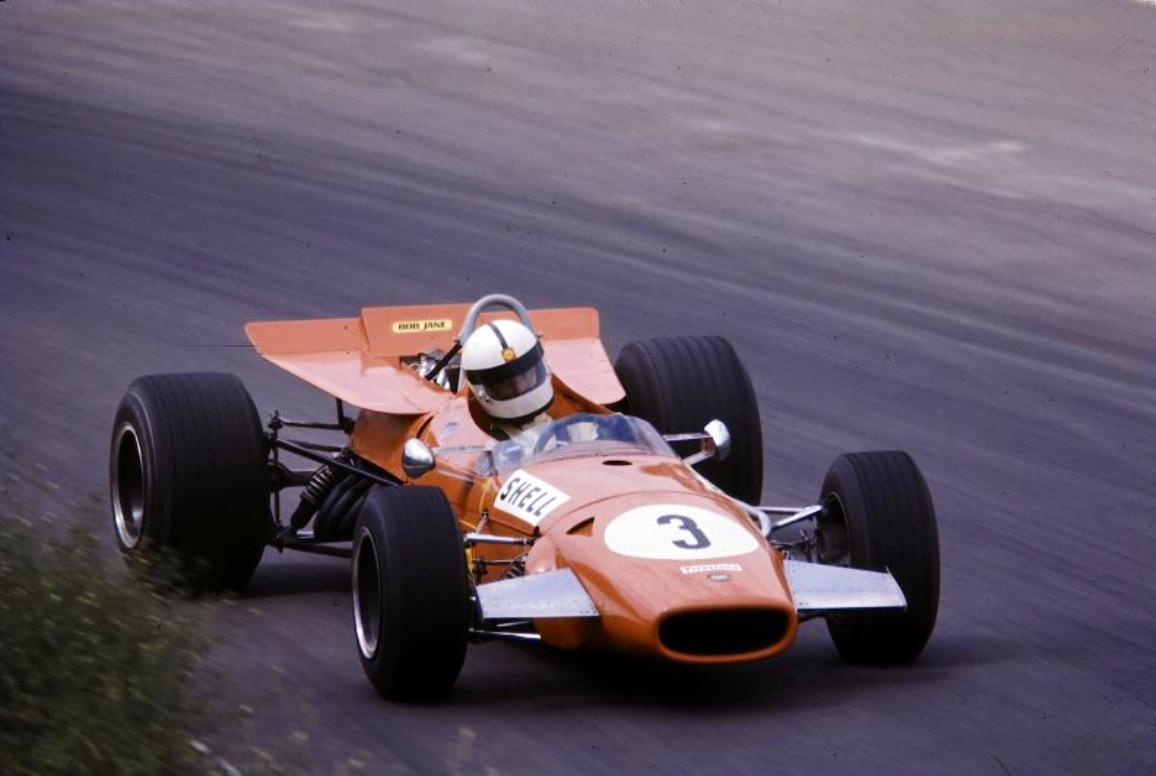
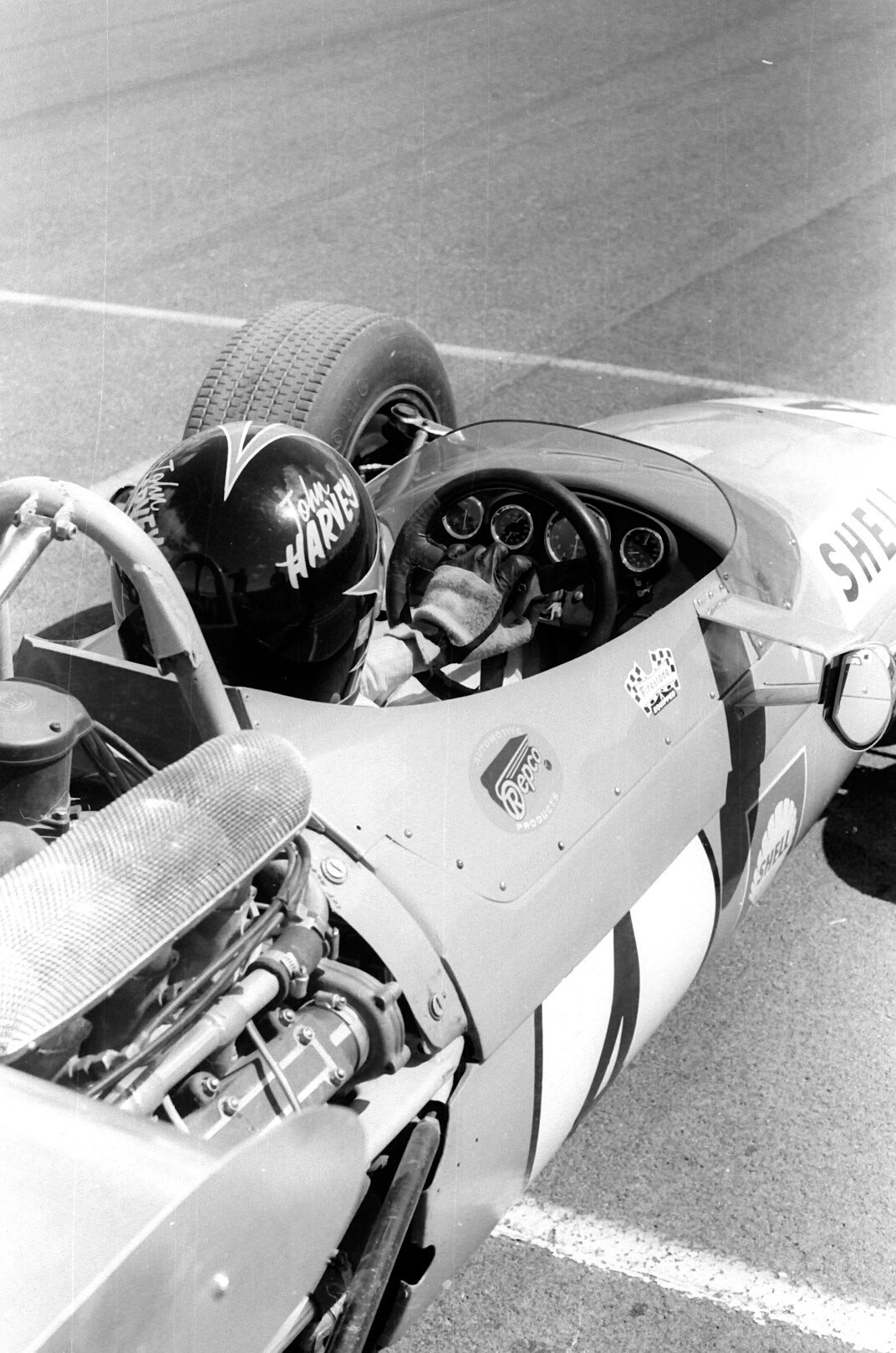
The car was then sold to Bob Jane Racing and driven by John Harvey, but he was injured in a massive accident in practice on his first outing in the car at Bathurst during the Gold Star meeting.
It was repaired before Harvey recovered from the life threatening accident, which was a bumma for John but also in terms of the ’68 Gold Star competition, it would have been great to have Harves give Kevin Bartlett, who won that year in Alec Mildren’s Brabham BT23D Alfa Romeo Tipo V8 a run for his money- Leo raced his ex-Clark Lotus 39 Repco.
Bob Jane gave Ian Cook a run in the car at Lakeside in July and then by Allan Moffat at Sandown Park in August, Moffatt crashed it again and it was out of action until the 1969 Tasman series. Moffat had returned to Australia after making a strong name for himself in the US in the two years before in Lotus Cortinas, a Ford Mercury Cougar in late 1967 and sharing a works Shelby Mustang at Daytona and Sebring in the first quarter of 1968.
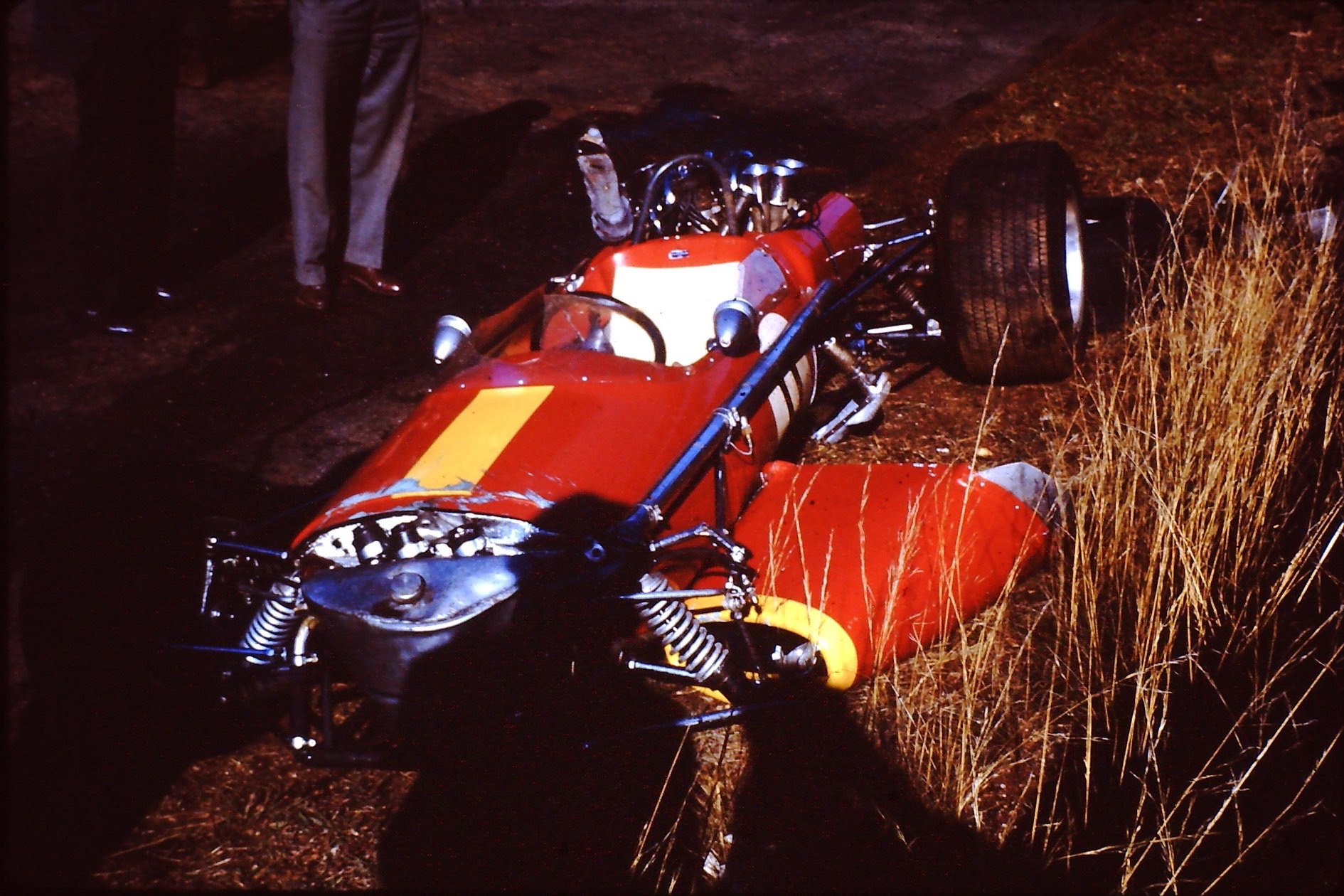
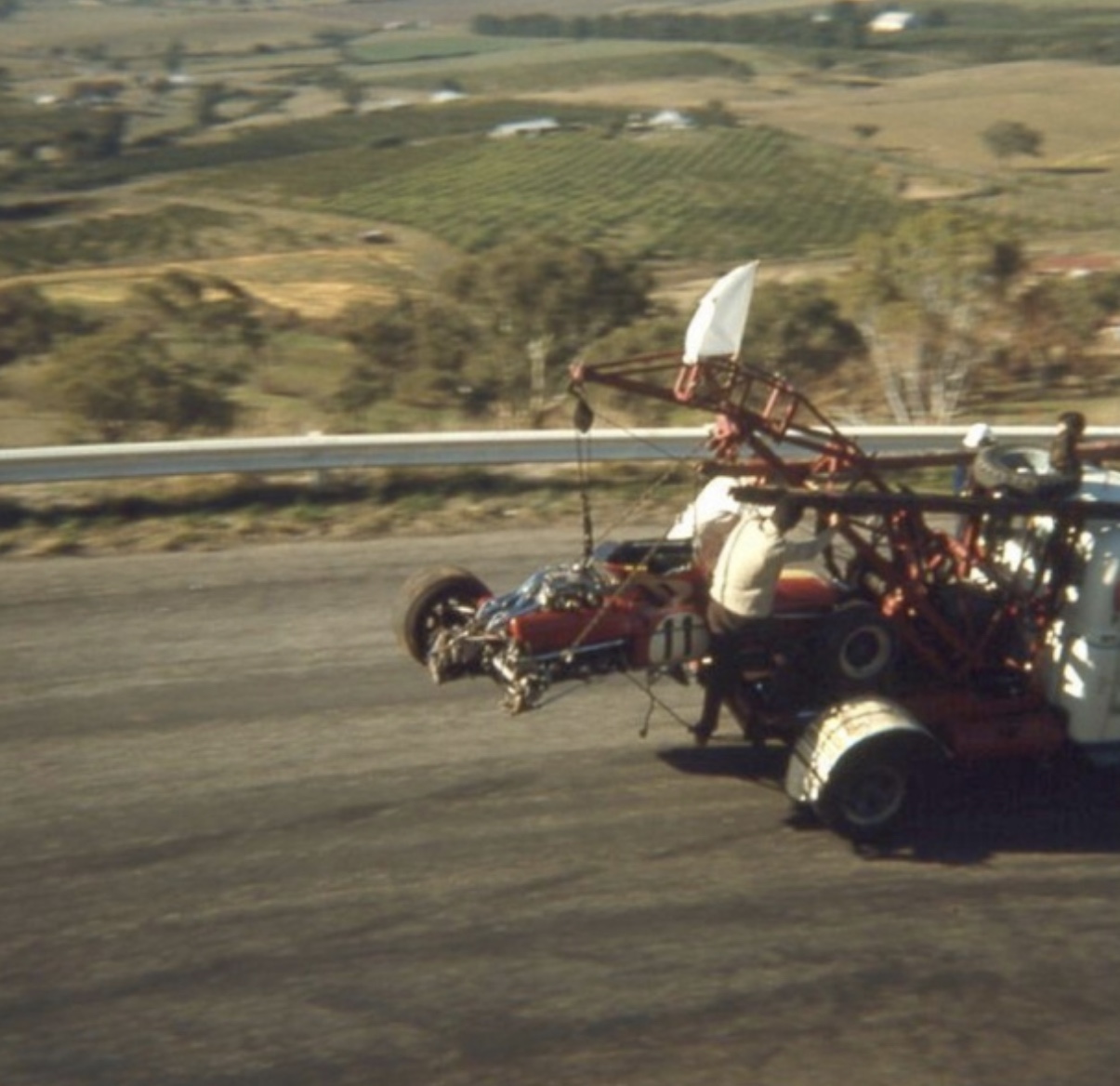
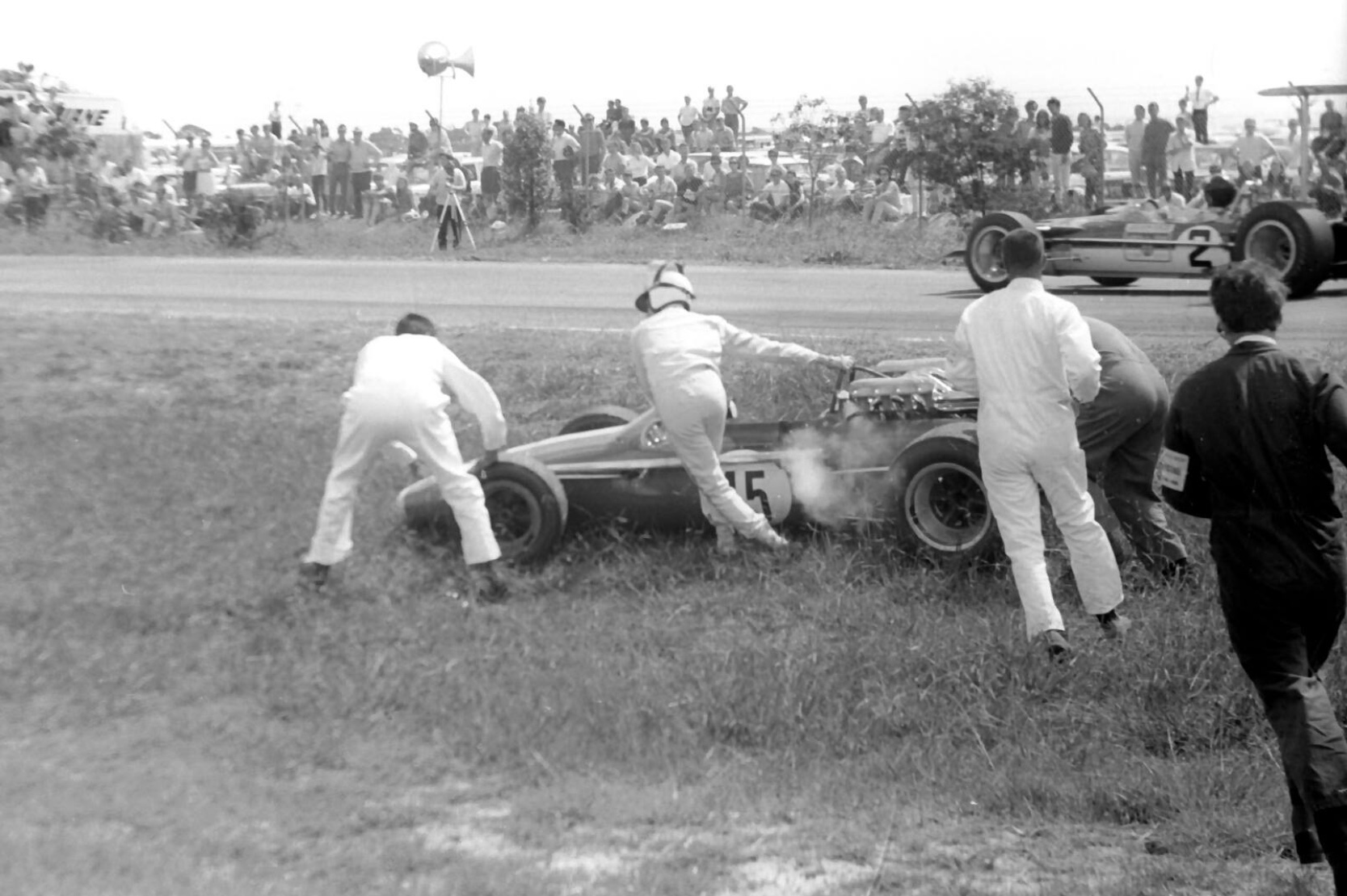
Harvey in the bi-winged Brabham BT23E 740 at Bathurst Easter 1969 before the big accident caused by upright failure, the mangled mess is shown below. The car was run in this form only once (oldracephotos.com)
(J Davis)
(D Harvey)
Harvey and the marshalls push BT23E 740 to the inside on the run out of Dandenong Road at Sandown in February 1969- Jochen Rindt’s Lotus 49B Ford DFV sings past (R MacKenzie)
When John and the car were ready to race again he contested Bob Jane Racing’s home race at Sandown but failed to finish after having engine problems.
Harvey raced it through the 1969 Australian Gold Star series, winning at Sandown in September and finishing second at Bathurst at Easter but retired from four races- due to oil pressure at Symmons Plains, undisclosed engine problems at Mallala, a cam-follower at Surfers Paradise and an accident in practice at Warwick Farm. Kevin Bartlett won his second Gold Star in 1969 aboard the Mildren ‘Yellow Submarine’ Alfa from Leo Geoghegan’s Lotus 39 Repco and Max Stewart in the other Alec Mildren entry, the Mildren Waggott TC-4V 1.9 litre.
During this period the car evolved in look a lot- constant experimentation with wings and engine- Bob Jane acquired the latest circa 300bhp RBE830 series V8 prior to the commencement of the Gold Star, the team yielded a performance dividend but not a reliability one. Repco Brabham Engines’ Rodway Wolfe recalls being instructed to give the two works RBE830 engines used by Jack Brabham in his little raced 1969 Tasman campaigner, the Brabham BT31 to Jane after Jack’s last event with that car- a win in the 1969 Easter Bathurst Gold Star round, so Bob/Harvey should have had the best of Repco Tasman V8s.
Harvey, BT23E, Warwick Farm 1970 (R Thorncraft)
Harvey, BT23E 830, Warwick Farm 100 Tasman round 1970. That neatly integrated engine cover/cowling wing assembly was fabricated by ex-Repco man John Brookfield in Melbourne (D Simpson)
Formula 5000 cars were eligible to enter the 1970 Tasman Series but despite that a good 2.5, or 2.4 litre car in fact won the championship- Graeme Lawrence won in the same V6 Ferrari Dino 246T chassis Chris Amon used to win in 1969. Bob Jane Racing entered only the Warwick Farm and Sandown rounds- Harves was a good fifth at the Farm where KB won in the Sub 2 litre Waggott powered whereas at Sandown he had an oil leak and retired the car- Niel Allen won ina McLaren M10B Chev.
He raced BT23E in the first round of the 1970 Gold Star series, winning at Symmons Plains in March from Leo Geoghegan and Kevin Bartlett but from the following round at Lakeside the teams front line tool became the Jane-Repco 830 V8- a machine built on Bob Britton’s Brabham BT23 jig but optimised to suit the latest generation of Firestone tyres- with more reliability Harvey had the speed to win the Gold Star that year. The story of that year is told here; https://primotipo.com/2019/07/05/oran-park-diamond-trophy-gold-star-1970/
After the sale of the car by Bob Jane it was converted to an F2 car with a Ford twin-cam engine and raced by Woody Curran in Tasmania from 1970-1977, it was sold to Bill Marshall who restored and historic raced passing via Ray Delaney into the hands of Art Valdez in the United States, and then a consortium in the UK in 2017, in more recent times it was acquired by Australian racer/restorer Aaron Lewis who has rebuilt it in RBE830 engined form.
Symmons Gold Star round 1970. From left Leo Geoghegan, Lotus 39 Repco 730, Kevin Bartlett, Mildren ‘Sub’ Waggott TC-4V 2 litre- Max Stewart on the row behind in the Mildren Waggott TC-4V 2 litre and John Harvey, Brabham BT23E Repco 830. Harvey won from Geoghegan, Bartlett and Stewart (H Ellis)
The last few races for the BT23E in its Repco heyday seem to be the 1970 Symmons Plains Gold Star round (above) on 2 March 1970, the ANF1 races during the Easter Bathurst meeting (no longer a Gold Star round due to safety issues) and finally the ANF1 races held during the RAC Trophy sportscar championship meeting (below) at Warwick Farm on May 3 1970
Harvey, BT23E 830 in its final front-line Repco engine race at Warwick Farm on 3 May 1970 (R MacKenzie)
(M Bisset)
(M Bisset)
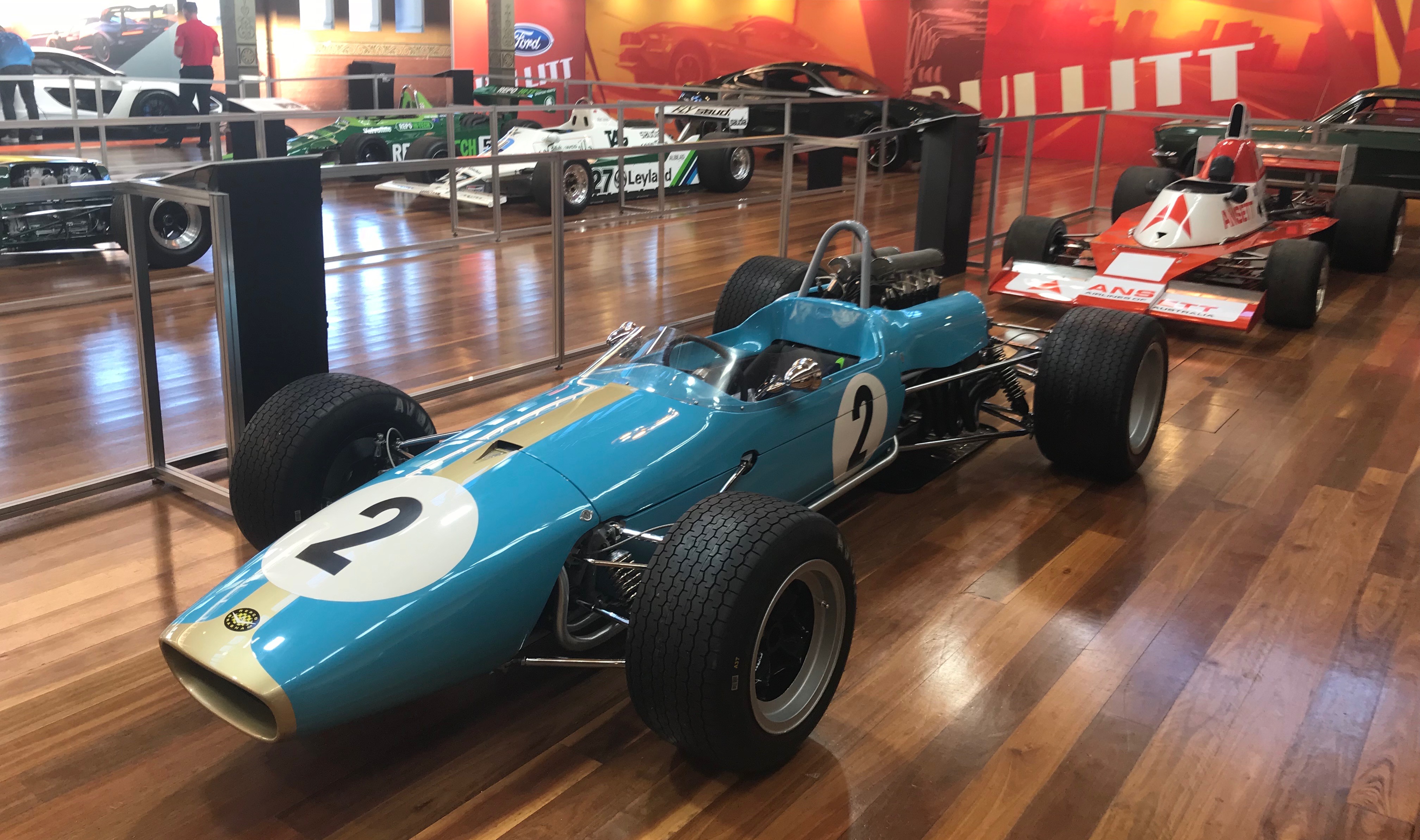
Aaron Lewis’ restoration of the car is superb, as shown it is fitted with an RBE830 2.5 litre V8 and sans wings- that is the specification in which it raced in the 1968 Sandown AGP. This is the Melbourne Exhibition Buildings in Carlton during ‘Motorclassica’ in October 2018.
Surrounding cars include the ex-Alan Jones Williams FW07 Ford, the green ex-Nelson Piquet 1981 AGP Ralt RT4 Ford BDA, ‘Ansett’ Elfin MR8 Chev F5000 and red Allan Hamilton owned McLaren M10B F5000.
Etcetera…
(oldracephotos.com
Bob Jane Racing Council of War at Symmons Plains in March 1970, I guess that weekend they may have run the Shelby Mustang, Brabham, McLaren M6B Repco sporty and a series-production Monaro GTS350 perhaps.
Bob, Harvey, Pat Purcell, an obscured fellow and John Sawyer at right. Harvey is sitting on the rear tyre of the BT23E.
(R MacKenzie)
Three photographs of John Harvey at Bathurst in 1970- this was the famous meeting/event at which Niel Allen set a lap record for Mount Panorama in his McLaren M10B Chev F5000, which stood for a couple of decades .
Note that in the shot above at Easter the car has a separate wing rather than the integrated engine cover cowling and wing- cowling at Symmons in on 3 March, separate wing above on 27-30 March and back to the cowling fot that final meeting at Warwick Farm in May 1970- perhaps they were testing a different wing for the pending Jane V8?
Note the tyre going flat in the closeup shot below on the way down the mountain.
(Wirra)
Bathurst Easter 1970 grid (R MacKenzie)
(P Townsend)
Photograph in the Warwick Farm paddock during the May 1970 RAC Trophy meeting. That near engine over/wing does have a 1969 F1 Matra MS80 touch about it.
Credits:
R Rice, Brian McInerney, Wirra, Rod MacKenzie, Peter Townsend, Dale Harvey, oldracingcars.com, Harold Ellis, Dick Simpson, ‘History of the AGP’ G Howard and ors, M Bisset, Jeff Davis
Tailpiece: Jack’s BT23E cruisin’ the Warwick Farm paddock…
(Wirra)
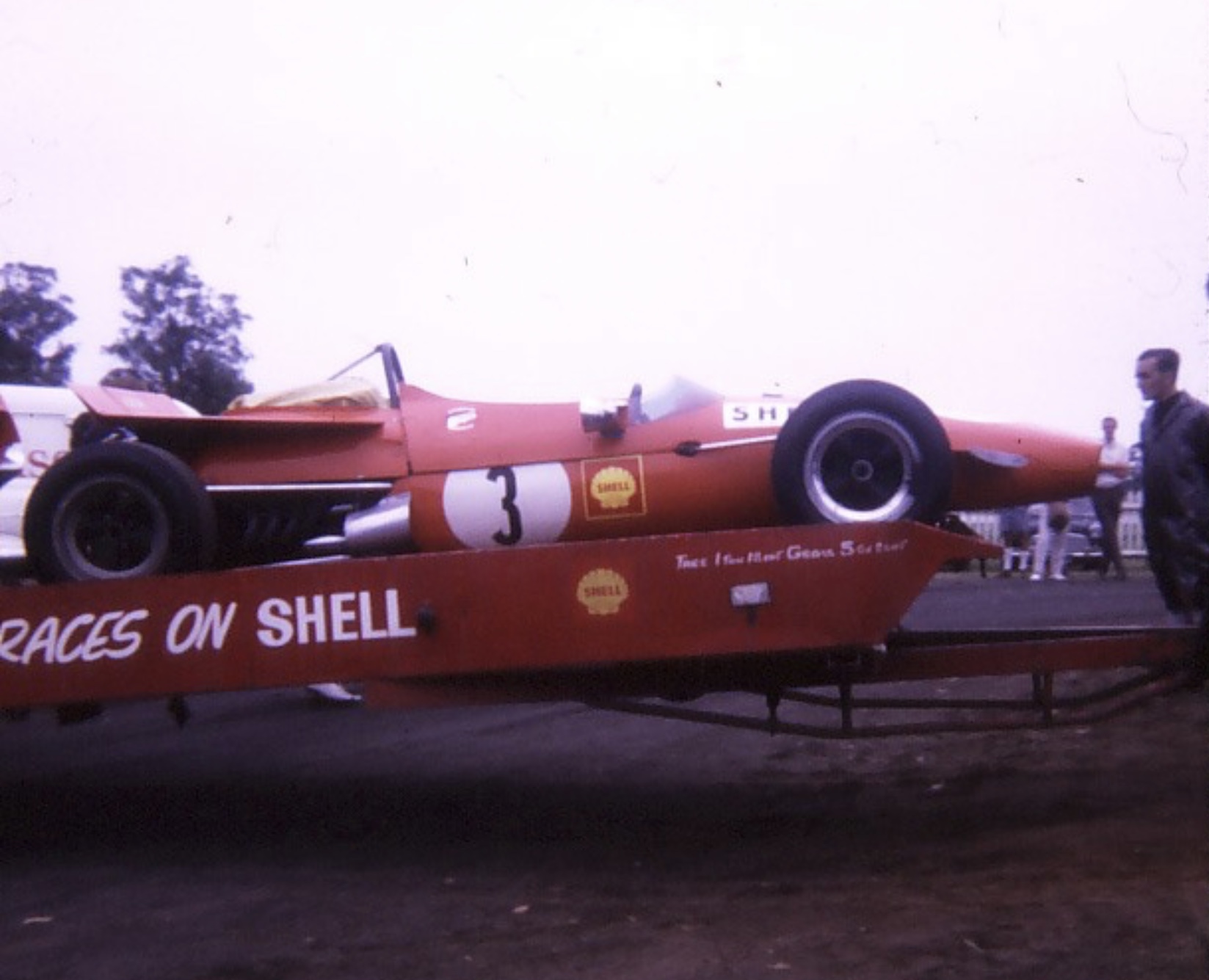
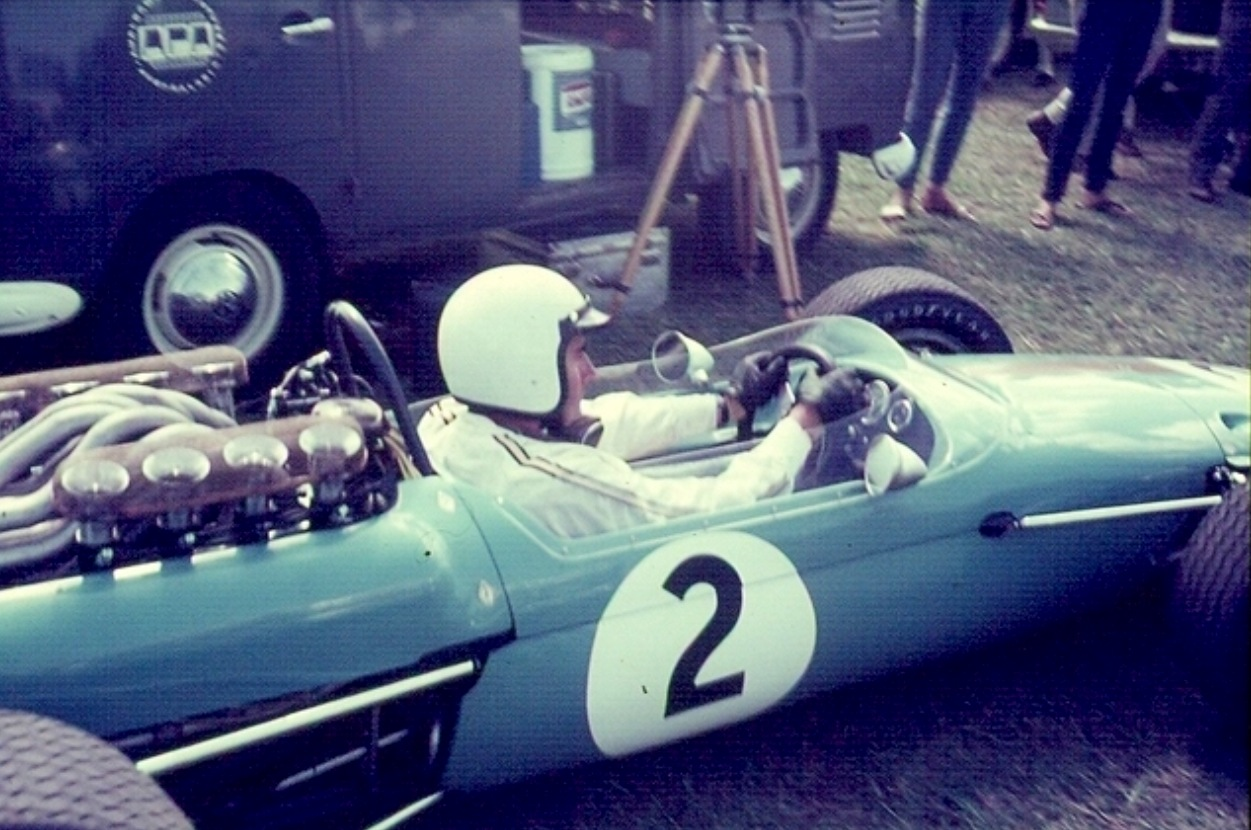
Brabham, Brabham BT23E Repco 740, Warwick Farm Tasman meeting 1968, all gorgeous in its turquoise/gold stripe livery.
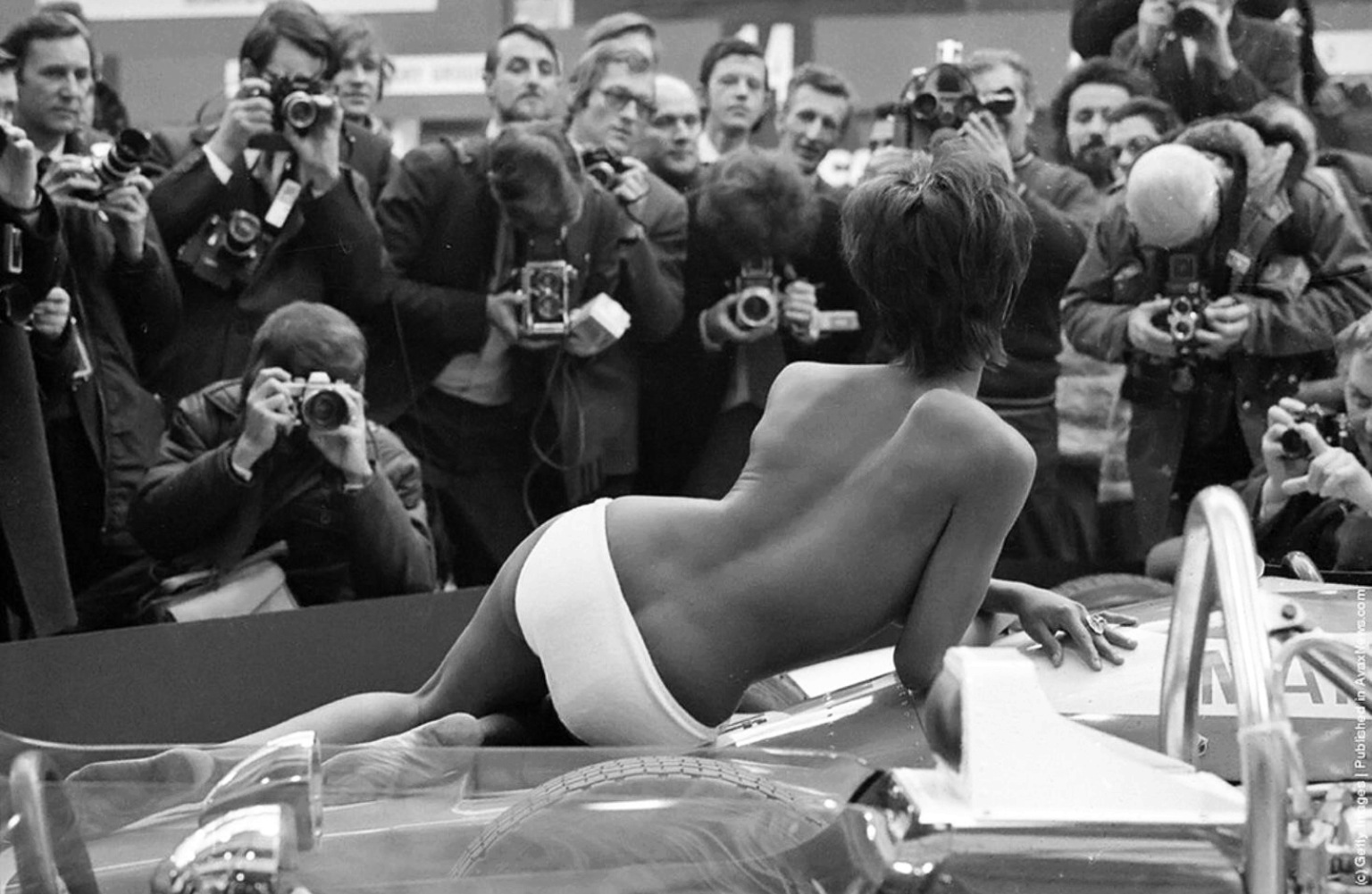
Venetia Day adorns the Matra MS120 at London’s Racing Car Show at Olympia on January 6 1971…
She is quite the most beautiful young lady with all of the ‘bibs n bobs’ we fellas tend to like. With the compound curvature of a Maserati 250F she is hard to beat.
I get a lot of metrics as part of this WordPress website, it always amuses me that the seventh most popular article i have done is the MS120 Matra piece i wrote a while back featuring Venetia’s ‘rear suspension’. Here to complete the set is her ‘front suspension’ which is as firmly set and finely proportioned as the rear…
Its certainly not the best piece i have written, so i guess it has something else going for it, page one or two of a Matra MS120 Google search !
All very politically incorrect these days of course, but political correctness is so ‘ferkin boring!
Here’s the original article if you’ve not read it;
The first BMW Art Car was proposed by the French racer/auctioneer Herve Poulain who wanted to invite an artist to create a canvas on a car…
In 1975, Poulain commissioned his American artist friend Alexander Calder to paint a BMW 3.0 CSL which Poulain raced partnered by pro’s Sam Posey and Jean Guichet in the 1975 Le Mans classic.
The car ran in the ‘Touring’ class, failing to finish with a CV joint failure on lap 73.
‘Art Car’ BMW 3.0CSL, Le Mans 1975 (unattributed)
BMW won the class, a little 2002Ti completed 252 laps, Derek Bell and Jacky Ickx won the race in a Gulf GR8 Ford DFL, the first Le Mans win for Bell and for the long distance variant of the great Ford Cosworth DFV V8.
Derek Bell in the victorious Gulf GR8 Ford DFL he shared with Ickx. Behind is the 2nd placed Ligier JS2 Ford DFL of Lafosse/Chasseuil (unattributed)
Since Calder’s work many other renowned artists have created BMW Art Cars including David Hockney, Andy Warhol and Roy Lichtenstein. 17 Art Cars based on both racing and production vehicles have been created.
The most recent car is Jeff Coon’s 2010 model M3 GT2. The 4 litre V8 engined car competed in the 2010 Le Mans 24 Hours driven by Andy Priaulx/Dirk Muller/Dirk Werner but did not finish.
BMW’s Thomas Girst says the purpose of the project has changed over time: ‘In the beginning the cars were raced. There wasn’t much public relations around them…Since then some of the Art Cars have been used in advertisements to show that BMW is a player in the arts…Part of what we are doing now is raising awareness of alternative and renewable energy sources’.































 primotipo...