(E Adamson – Miller Family Collection – T Johns Collection)
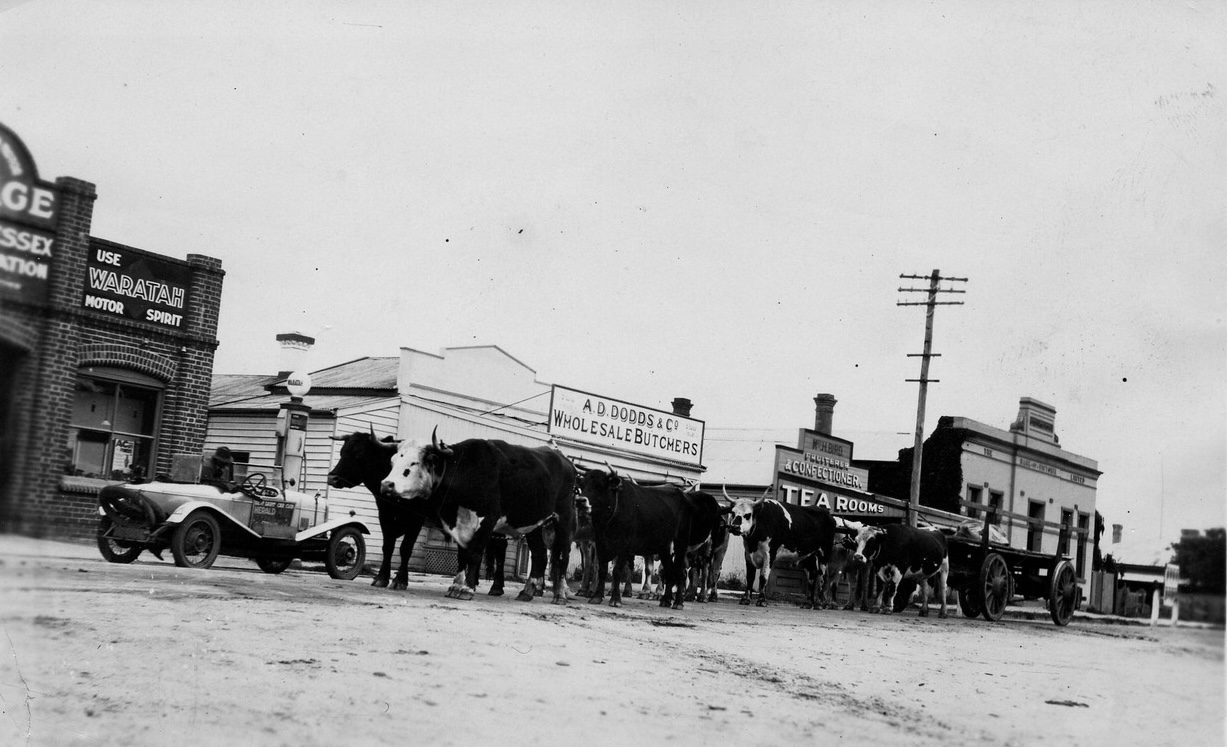
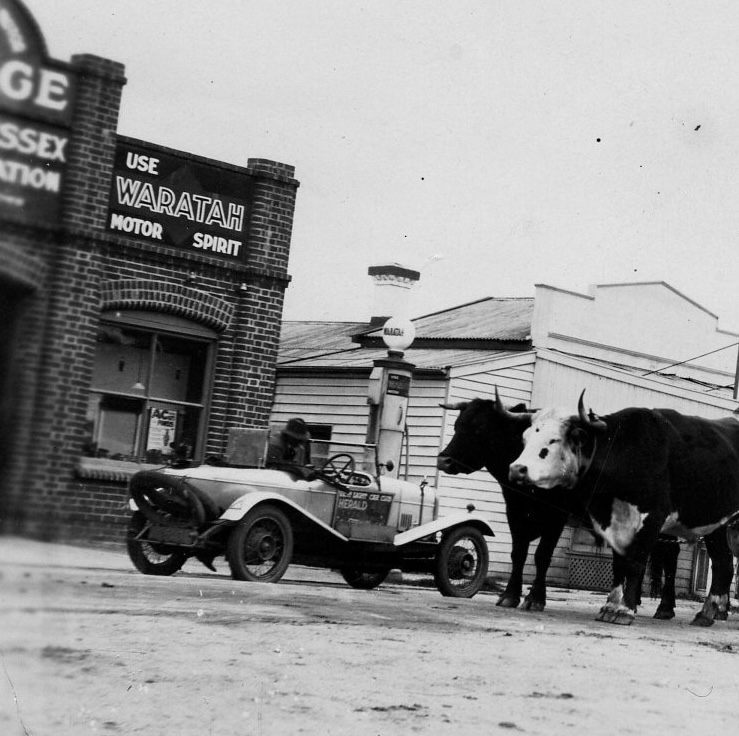
The K Guest Alvis 12/50 Ducksback during the 1927 Herald Dependability Test, in the Bruthen main street “with some very nervous looking bullocks outside the butcher shop” Bob King observed.
LOL etc, it was too good a shot of another time and place to resist – some great research from the Johns/King/Sands combination has cracked this mystery, not completely though.
In 1922, using the 10/30 as a starting point, freshly-minted Chief Engineer Captain GT Smith-Clarke and Chief Designer WM Dunn commenced work on the 12/50.
Powered by a new 1496cc four-cylinder OHV engine, the 12/50 had a successful baptism of fire winning the prestigious 1923 JCC 200-mile race at Brooklands in a car crewed by CM Harvey/Tattershall.
The first production cars, priced at 550 pounds went on sale later that year. Popular with sporting motorists, the cars gave peppy performance and a top whack of 75-80mph as long as the body fitted was not overly portly.
The SA model had a wheelbase of 108.5 in and the SB 112.5. A 1598cc version of the same OHV engine was marketed from 1924 when a stronger platform chassis was used rather than the earlier, slender ladder frame. Front brakes were available from 1924 too, the cars had a four speed non-synchro gearbox with right hand change and a fabric-faced aluminium-cone clutch.
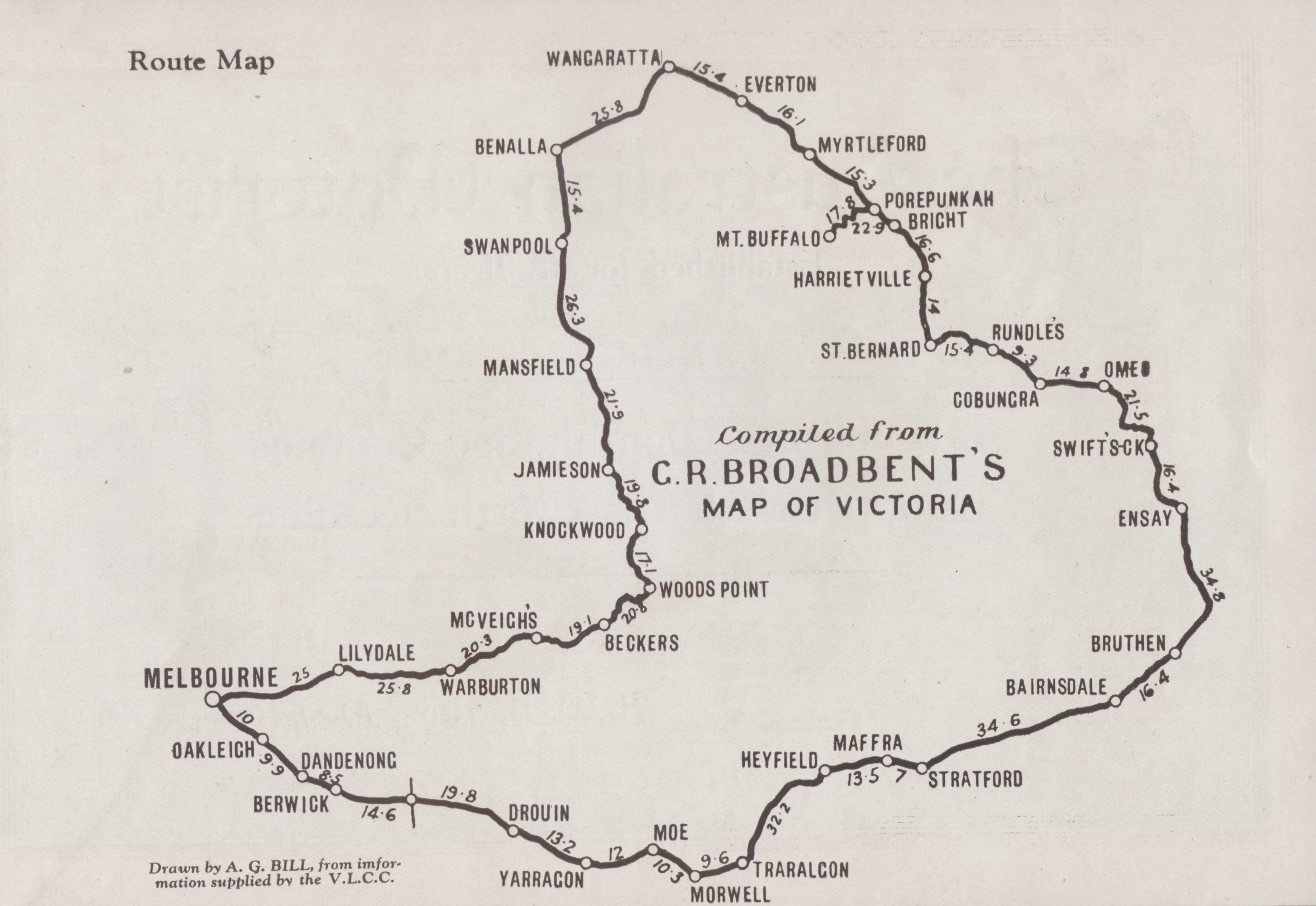
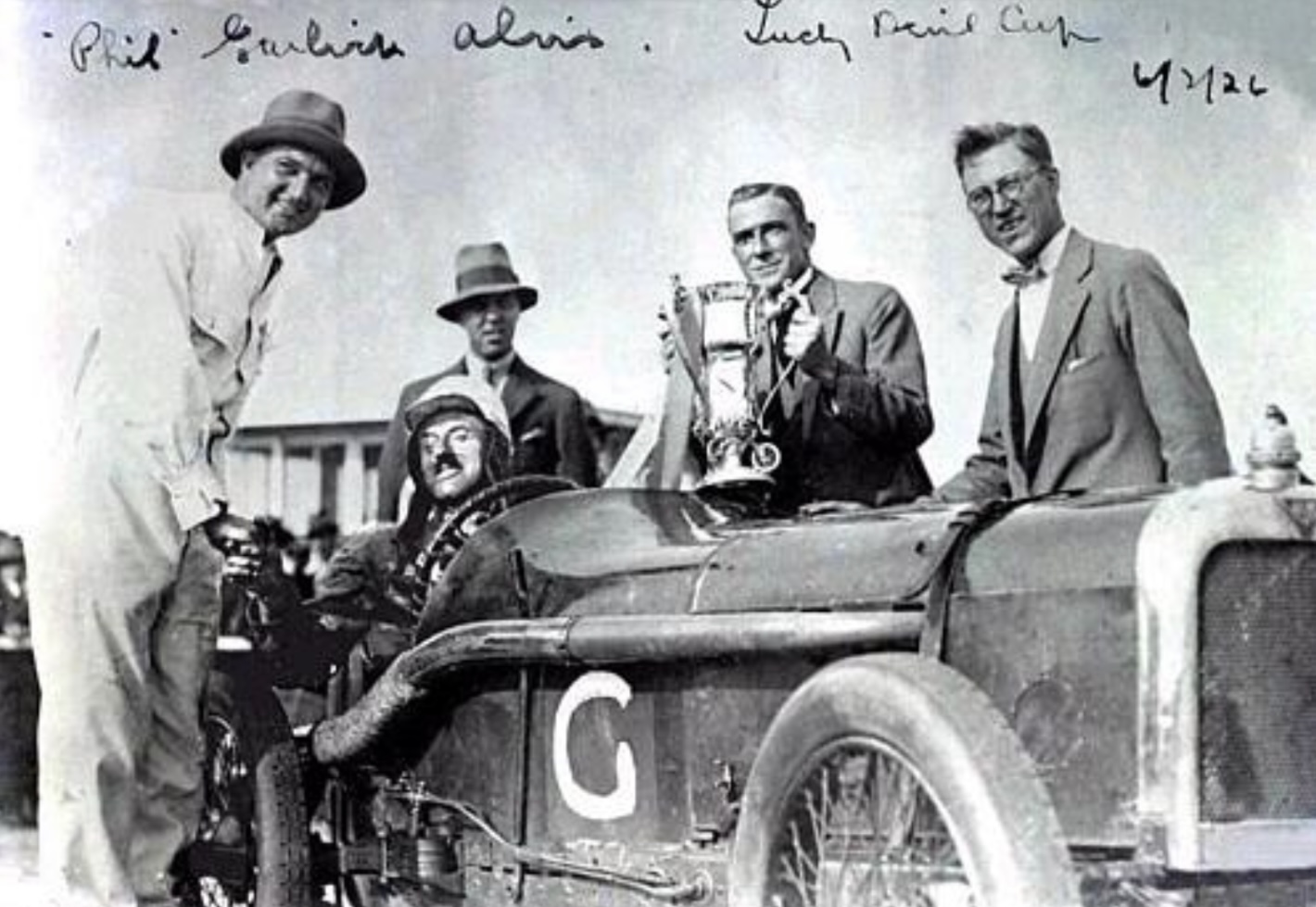
The Guest 12/50 during the 1927 Dependability Test – note absence of windscreen (The Car)1927 Herald Reliability Test route (D Zeunert Collection)Phil Garlick, Alvis 12/50 s/c and crew after winning the 1926 Lucky Devil Cup. Unfortunate name given his subsequent demise at Maroubra (unattributed)
Built in right hand drive, the light, robust sporting cars were popular in Australia with Williams Bros, the Sydney agents claiming that one-fifth of British cars sold here in 1923 were Alvis’.
Inevitably many were used as competition cars in trials, hill-climbs and racing.
Several 12/50s contested early Phillip Island Australian Grands Prix, the best placed was J Hutton’s eighth in 1928.
The most famous Australian Alvis combination was the 12/50 raced by the the great Phil Garlick at Maroubra’s Olympia Motor Speedway in the mid-twenties. Unfortunately he died a gruesome death in his ex-works-Harvey, supercharged, JCC 200-Mile Race winning 12/50 in January 1927.
The K Guest car shown in this article is an SC model Ducksback 2/3 seater (perhaps a TF subject to a better view), the prettiest of all 12/50s, fitted with optional front brakes.
An immensely robust and versatile car, Alvis’ 12/50 was well designed and built, easy to service and simple to repair. Performance and handling for a 1.5-litre car was exceptional for the time. With a healthy dose of that ephemeral quality called character they are sought after, quintessential vintage cars. A good number are extant, in part due to factory support until Alvis ceased car production in 1967.
Tony Johns circulated the fantastic opening shot earlier in the week, the full credit, to show the tortuous century long route from photographer to you, the online audience, is as follows.
The ‘snapper was the great Edwin Adamson, from whom the shot was bought by Arthur Terdich, 1929 AGP winner. When he died he left his very large, life-time car/racing photo collection to his son Arnold, his widow in turn left them to the Vintage Sports Car Club (Victoria). At some point, club-member Graeme Miller was given a copy, later still Graham gave a copy to my mate Tony Johns, and now my friends, here it is.
Melbourne born Edwin Ted George Adamson (1895-1974) opened for business in 1920, by the 1940s he ran a prominent studio at 169 Collins Street and later 229 Collins Street, Melbourne.
His major clients then were the State Electricity Commission, Gas and Fuel Corporation and sections of the motor industry. Despite a practice doing plenty of commercial work, and regarded as a major chronicler of Melbourne life in the mid-20th century, he positioned the practice as one specialising in portraiture.
We are lucky that the development of smaller cameras and faster films in the 1920s encouraged Adamson (and no doubt other members of his studio) outside to capture the sports he loved.
Straying upon this chance Alvis photograph was timely, ‘Guided by Art’ published ‘Remembering Edwin Adamson’, an article by Michael Schwarz on August 1, 2021, only last week! Click here to read it; Remembering Edwin Adamson – Guided By Art (beguidedbyart.com)
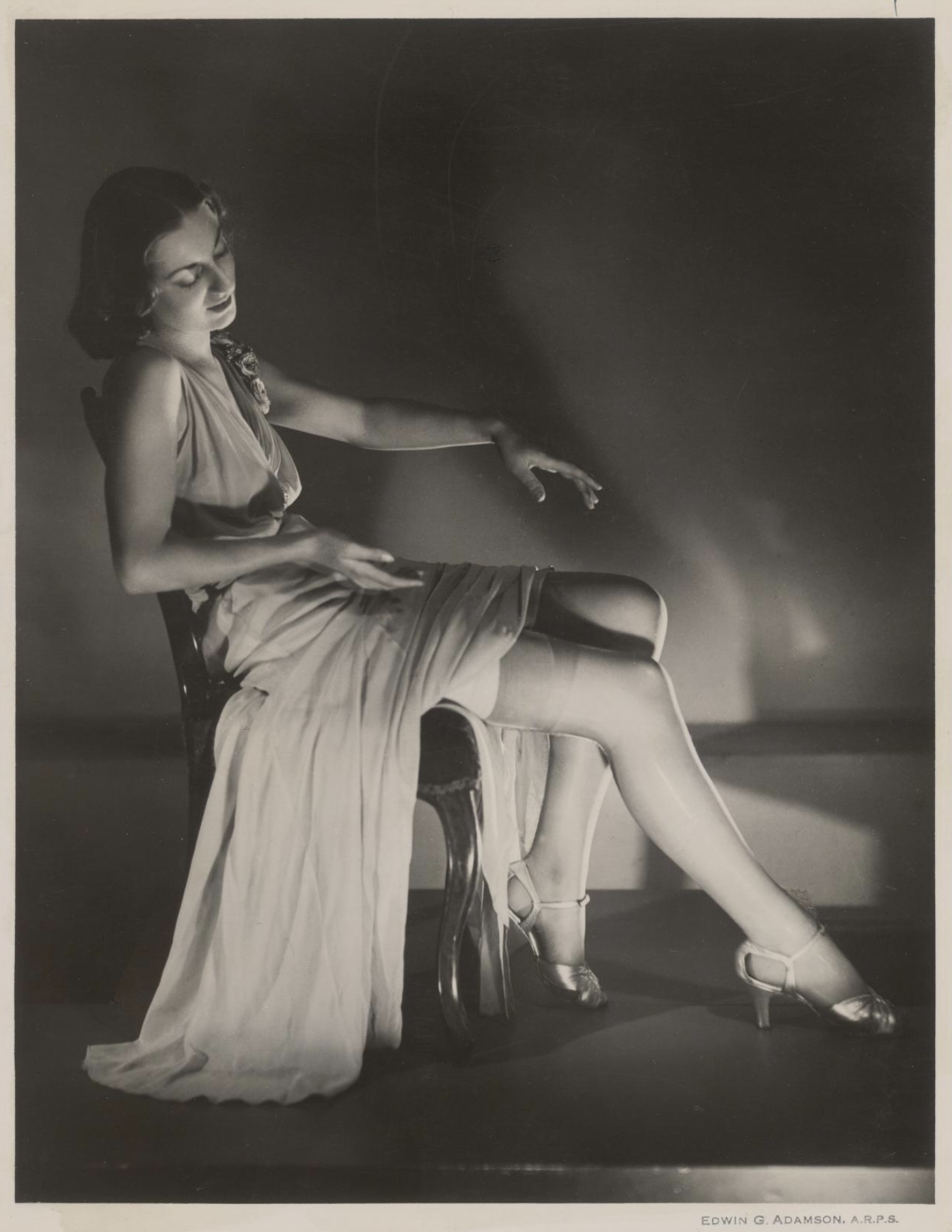
Langlauf race at Mount Buller in the Victorian Alps, 1930-40s (E Adamson)Holeproof Hosiery ad 1930s
Credits…
Tony Johns, Bob King, Robert Sands, Dale Parsell, Peter Miller, The Car, David Zeunert Collection, Guided by Art
(E Adamson – Miller Family Collection – T Johns Collection)
Stirling Moss jumps aboard his Porsche 550 Spyder at the start of the Buenos Aires 1000km on January 26, 1958.
It is intriguing to know how often the great one practised this manoeuvre, the chances of getting ones legs mixed up in gear-shifts and other componentry due to a poor landing are obvious.
He won the 2-litre class in the 1.6-litre car shared with Jean Behra, and was third outright in the 106 lap race – the first round of the FIA World Sports Car Championship – won by the works Ferrari 250 Testa Rossa driven by Peter Collins and Phil Hill.
Today we are so used to cast or forged alloy wheels on our cars that we don’t think about them, at least not until we hear that infuriating crunch when we brush a curb. Just when the modern alloy wheel first appeared is subject to some speculation. (See The Nostalgia Forum – https://forums.autosport.com, 12 November, 2009 et seq.) When discussing these wheels, aluminium, magnesium and Elektron (a magnesium alloy) are often confused. Regardless of what we call them, ‘Mag, Alloy or Ali’, there is no disputing that Ettore Bugatti pioneered the use of aluminium wheels on racing cars when he used them on his ground-breaking Type 35 that first appeared at the Grand Prix de l’ACF (French Grand Prix) at Lyon on 3 August, 1924.
Ignoring Bugattis pioneering wheel for the moment, it would seem that cast or forged alloy wheels started to appear in general use in the late 1930’s – perhaps initially in the aviation industry – by this time the USA was a hotbed of experimentation in aluminium casting and alloy development. In England Alex Issoginis used 6 spoke Elektron wheels on his fabulous ‘Lightweight Special’ which he developed in the latter half of the 1930’s. These wheels had integral brake drums, à la Bugatti, but the spokes were bolted to the rim as distinct from being cast in one piece; a technique also used with aircraft.
Bugatti’s aluminium wheel as seen at the French Grand Prix in 1924 (B King)Alec Issigonis aboard his Lightweight Special with electron wheels in 1961 (unattributed)
In the early post-war years, the use alloy of wheels became commonplace, particularly with racing cars. Perhaps the first to use these wheels in this period was John Cooper on his Mark II. Doug Nye in his seminal COOPER CARS , states that Cooper discussed the increasing difficulty in obtaining suitable wheels with his cousin Colin Darby and they came up with the idea of casting wheels with an integral brake drum “like Bugatti pre-war”.
They patented their design and had them cast, claiming that the wheels were “lighter and stronger than the old Fiat type”. Arthur Owens, THE RACING COOPERS, states that their first production alloy wheels appeared in 1947 and were “cast in Elektron with 8-inch brake drums cast integrally”. Others state that it was in 1948 that the Cooper Mk. II, their first production model, appeared with these wheels. Again, claims were made for better brake cooling, more rigidity and better access to the brakes. Other small-time manufacturers such as Laurie Bond with his eponymous Bond ‘C’ type of 1948 used alloy wheels; in the case of Bond, they were to his own design.
Cooper Mk2 cast aluminium wheels (Cooper Cars)
Meanwhile across the pond, ex-Douglas aircraft engineer Ted Halibrand began experimenting with magnesium alloy wheels in 1946 which he first used on his own midget racing car. He tried them out on Indy cars in 1949, but had problems with cracking and the soon to become ubiquitous Halibrand cast wheel did not appear at the Indianapolis 500 until 1950. Subsequently, every Indy car between 1951 and 1967 wore Halibrand wheels and Halibrand’s influence still looms large in the wheel industry and hot rod community.
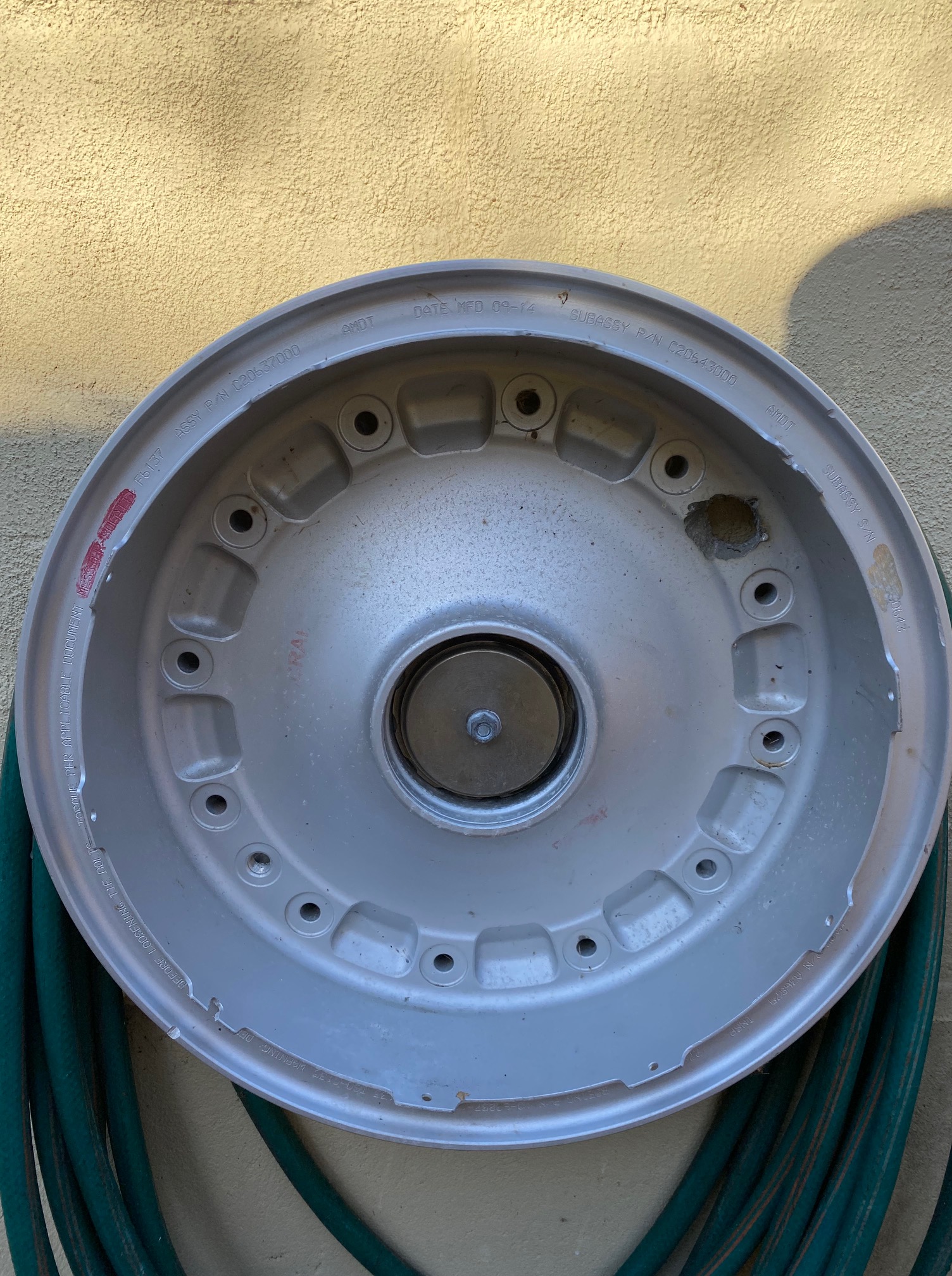
‘Sure, it looked a lot more aggressive than a steelie with poverty caps’. Ted Halibrand with magnesium alloy wheels and other castings (Internet Commons) A ‘modern’ Messier Bugatti alloy Boeing nose wheel serves as a hose reel for the writers garden hose. Yes, the Bugatti name survives in the aero-spatial industry (B King)
Historically, it had been generally accepted that the cast aluminium wheel was solely the product of the inventive mind of Ettore Bugatti. However, in 1981 influential American automotive historian Griffith Borgeson (1918-1997) set the cat among the pigeons with his BUGATTI by BORGESON (Osprey). The sub-title of this book is ‘The dynamics of mythology’, and in it he tries, at times too hard, to discredit some of the pioneering work of Bugatti. In chapter 13, ‘Wheels within Wheels’, Borgeson claims priority for the invention of the aluminium wheel for Harry A Miller in a US Design patent of 4 May 1920,
Miller’s design for an ‘ornamental wheel’ (G Borgeson)
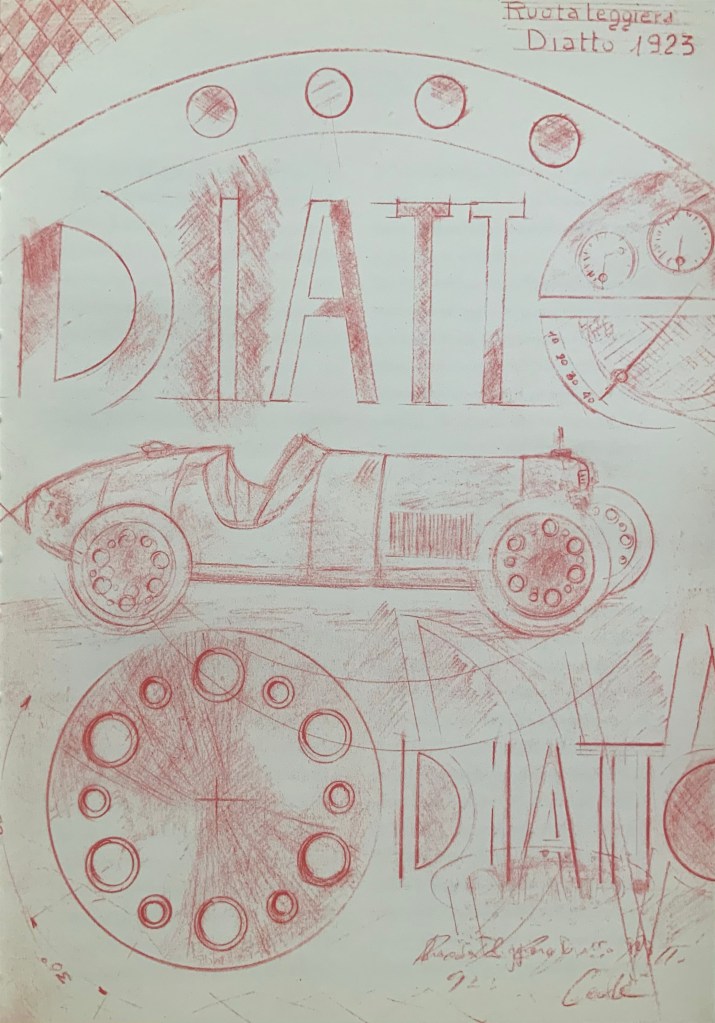
Recently, while researching the racing history of Diatto factory works driver Carlo Massola we were shown a book on the marque by Sergio Massaro titled simply: DIATTO. We were astonished to see that on the front cover there was depicted a car with what appeared to be cast wheels. In fact, in 1923 ‘Automobili Diatto’ produced a version of their racing Tipo 20S with aluminium wheels described by Massaro as “the fantastic ‘holey’ wheel” which was cast in light alloy.
It is important to understand that there had been a long-standing relationship between Bugatti and Diatto dating back to their membership of the Turin branch of Club Automobilisti d’Italia as early as 1899 or 1900. According to Steinhauser’s ETTORE BUGATTI, Pietro Diatto, who was nine years older than Ettore, ‘Took an interest in Bugatti’s prototype T8 in 1907. Their relationship was uninterrupted’.
The T8 refers to Bugattis eighth car design which was for the German industrial giant that was Deutz. It was in effect a prototype for future Bugattis with an overhead cam actuating vertical valves via ‘banana’ tappets – a design feature later glorified by his highly successful Brescia model. In October 1915 Louis Panabel, the Diatto agent for France, obtained an option for Bugatti’s pioneering eight in-line steel-block aero engine in the name of Cavaliere Pietro Diatto. This was the aero-engine which had grown from Ettore’s concept for a luxury car engine of eight cylinders with which he had been experimenting since 1912.
The Diatto-Bugatti aero engine was successfully tested in September 1916, Diatto sending an enthusiastic telegram to Bugatti “I am happy to announce the excellent results for the engine … the testing resulted in a brilliant 210 HP”. This collaboration led to a 1919 agreement in which Bugatti was to supply Diatto with fifty 16 valve car chassis made in Molsheim; they were to be fitted with Diatto radiators. (Other than the radiator and the bonnet, these cars were identical to the Bugatti factory product – they are what today is referred to as the ‘Brescia Bugatti’).
Three of these Diatto-Bugattis were shown at the Paris Motor Show in 1919, all with a Diatto radiator with a Bugatti badge. Bugatti displayed two of his outdated 8-valve cars on another stand. Bugatti was a late entrant for the show, and it would appear that the industrial giant Diatto had stolen a march on the under-funded Molsheim factory. There is an unsubstantiated claim in Wikipedia that Diatto also manufactured chassis for Bugatti.
The fantastic holey wheel used on the Diatto 20S (Massaro)
Dane Claude Teisen-Simony has written of the relationship between Bugatti and Diatto. According to Claude, Diatto, which was the second largest Italian automobile manufacturer post-WWI, formed what was “an absolute dream team. Not only did he start with the collaboration of Bugatti, he also linked-up with the outstanding engineering capacity of Giuseppe Coda of FIAT and SCAT racing fame plus two of the Maserati brothers, Alfieri and Ernesto”.
Teisen-Simony claims that “Bugatti used the much larger Diatto factory and its capacities as a test facility for his new ideas, such as a hollow front axle in 1920 and racing cars with superchargers in 1921”. He states that the remarkable Bugatti hollow front axle was developed as a collaboration between Bugatti and Coda. He notes that Borgeson also referred to a partnership between Bugatti and Coda in the development of the Deutz Type 8.
Although the source of the information on the alliance between Bugatti and Coda is not given, there is sufficient grounds to accept that Diatto and Bugatti worked closely on a number of projects, including aero engines and the sixteen-valve car. Other tangible evidence of the close association between Bugatti and Diatto is indicated by the similarity between their radiator badges and by their adoption of the term ‘Thoroughbred’ translated as, ‘Pur Sang’ and ‘Puri Sangue’ respectively, to describe their cars. It is not clear to the writer when Ettore first used the ‘Pur Sang’ description; but it has been applied retrospectively to the first Bugatti, his Type 13 of 1909 – ‘Le Petit Pur Sang’. Diatto used ‘Puri Sangue’ to promote the company’s success with their Tipo 30 (Bugatti).
The Diatto radiator badge has an identical form to the Bugatti badge (Massaro)Diatto’s thoroughbred (Internet Commons)
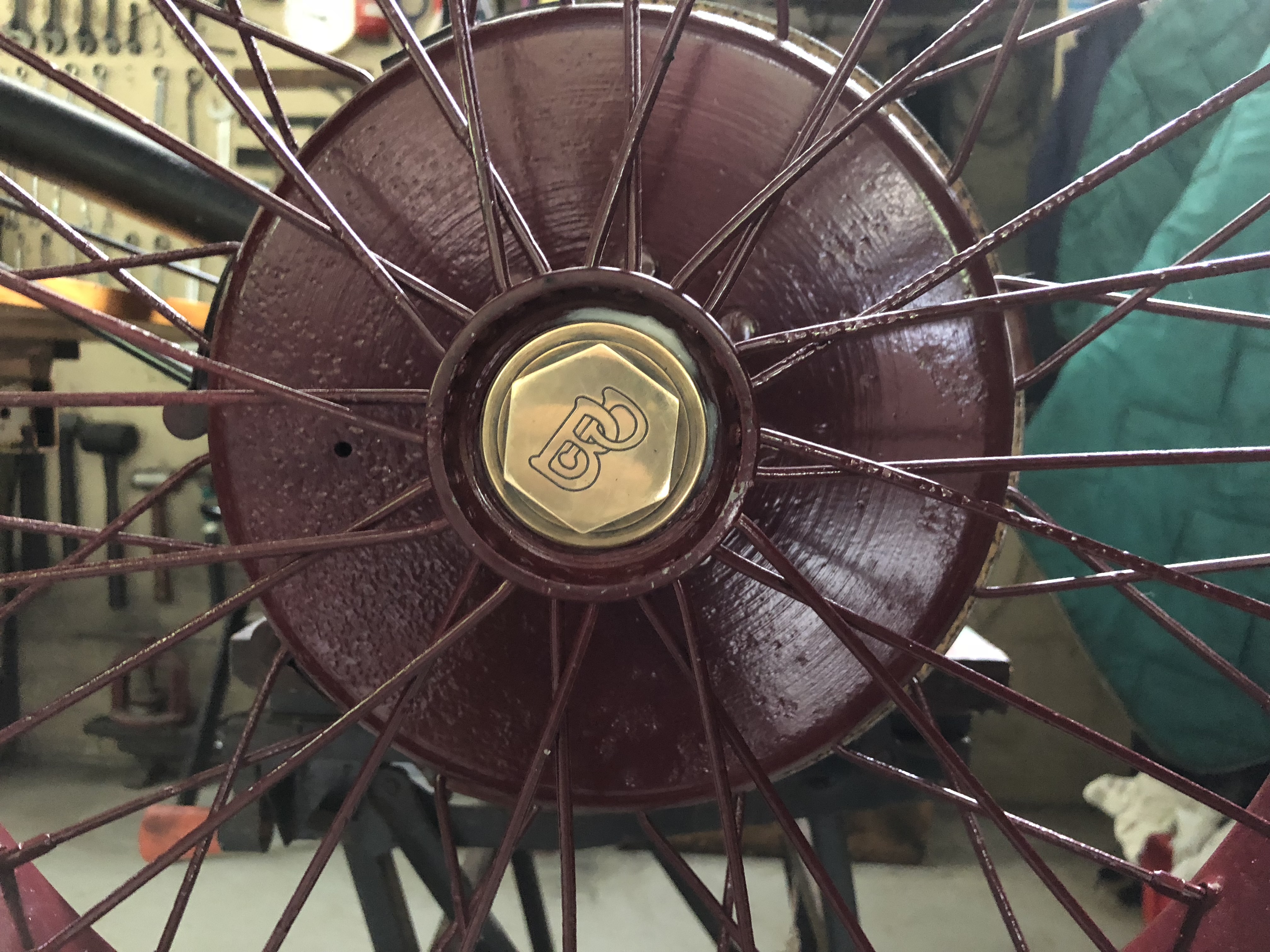
The Bugatti cast aluminium wheel.
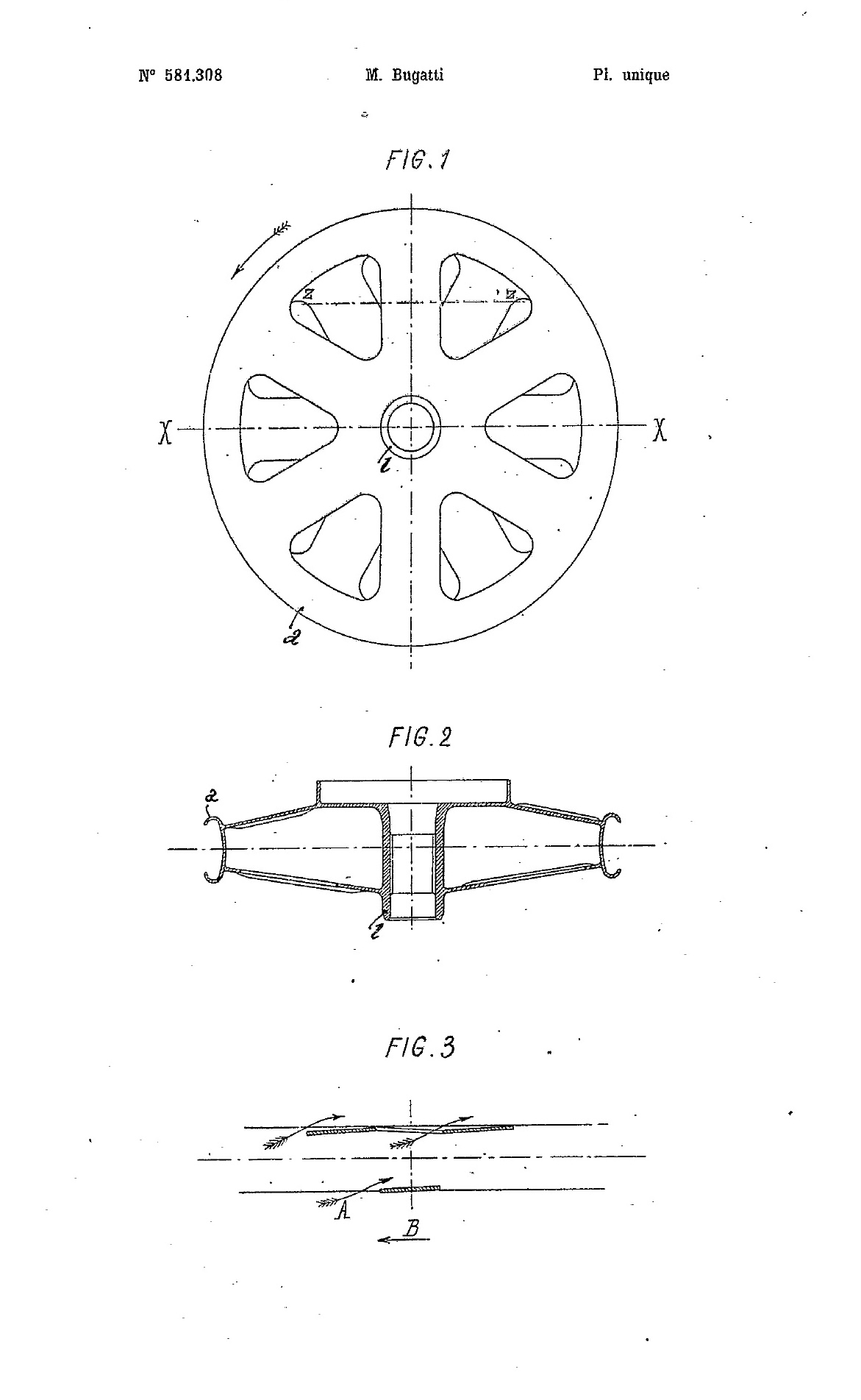
Cast wheels were not a novelty in 1924, and therefore not patentable; nor would the change from iron to aluminium have had patentable merit. Bugattis first patent for his wheel (FR581308), filed on 5 May 1924, was titled Roue à disque à refroidissement ‘cooled disc wheel’, concerning itself with the increased brake cooling provided via skewed spokes. (In production the spokes were parallel).
The Bugatti wheel was distinguished by its integration of the brake drum into the wheel, but this arrangement was not unique as many automotive wire wheels prior to WWI had their spokes laced into the periphery of the brake drum. Malicet et Blin (MaB) were well known for their use of this design and as parts suppliers to the automotive industry this pattern of combined wheel and brake drum appeared on many, mostly French, cars in the early days. Closer to home, Bugatti used this pattern of wheel on his Type 16, the Bébé Peugeot, from 1912 – possibly this influenced his thinking when it came to making an aluminium wheel with an integral brake drum.
The rear wheel of the writers Bebe Peugeot, showing the integration of the brake drum into the wheel (B King)The original Bugatti aluminium wheel as patented in 1926 in the USA. It shows two rows of six spokes, offset; significantly different to the final product (Ploeg)Bugatti wheel (Salzman)
Wheel manufacture had played an important part in Diatto’s history; Guglielmo Diatto was a thirty-year-old wheelwright and coachbuilder when he established his eponymous company on the banks of the Po River in Turin in 1835. In 1838 he patented ‘a perfect wheel’. From what can be seen in a photograph of the wheel taken from the patent application, it appears to be a normal metal spoked cart wheel. Was it the use of metal spokes that made it patentable, or was it a pioneering cast wheel?
Guglielmo Diatto’s ‘perfect wheel’ of 1838 (Internet Commons)
Aluminium wheels, Bugatti, Miller or Diatto?
It seems unlikely that Bugatti was influenced by the 1919 Miller design for an aluminium wheel. Miller, strictly, did not patent the design – it was a Model Registration that concerned ‘the ornamental design of a wheel’. The wheel was intended to be used on an innovative racing car known as the T.N.T., but in its one or two track appearances it was fitted with conventional wire wheels. (Mark Dees, THE MILLER DYNASTY) The model registration did not address any perceived mechanical advantage from a cast wheel. The wheel was six spoked, compared with Ettore’s eight spokes, and there is nothing in the model registration to suggest it used an integral brake drum. It appears that Borgeson, not for the first time, was ‘drawing a long bow’ when he suggested that Miller’s design was the inspiration for Bugatti’s cast aluminium wheel.
In regard to the association between Bugatti and Coda, we are prepared to believe that the Diatto and Bugatti aluminium wheels might have had common antecedents. In the absence of documentation, just who influenced who remains unclear. The presence of Giuseppe Coda in the allegedly contemporary drawing of a Diatto 20S with perforated aluminium wheels does imply his possible involvement in this novelty.
Bugattis original patent described the wheel “as consisting of one, two or several discs, pierced in a manner to give the desired form to the ‘arms’ or spokes”. This description better fits the Diatto wheel than the aluminium wheel as it first appeared on the Type 35 Bugatti at Lyon in 1924. Could this design have arisen from discussion between Coda and Bugatti, or was Bugatti inspired to make his own version having seen the cast wheel designed by Coda? Italian patents relating to the aluminium wheel might be revealing.
A representation of Coda at the wheel of a Diatto 20S with cast aluminium wheels (Massaro)
What is certain is that Ettore Bugatti was the first to produce a practical light alloy wheel for racing and passenger cars – wheels that are now standard on modern cars.
Etcetera…
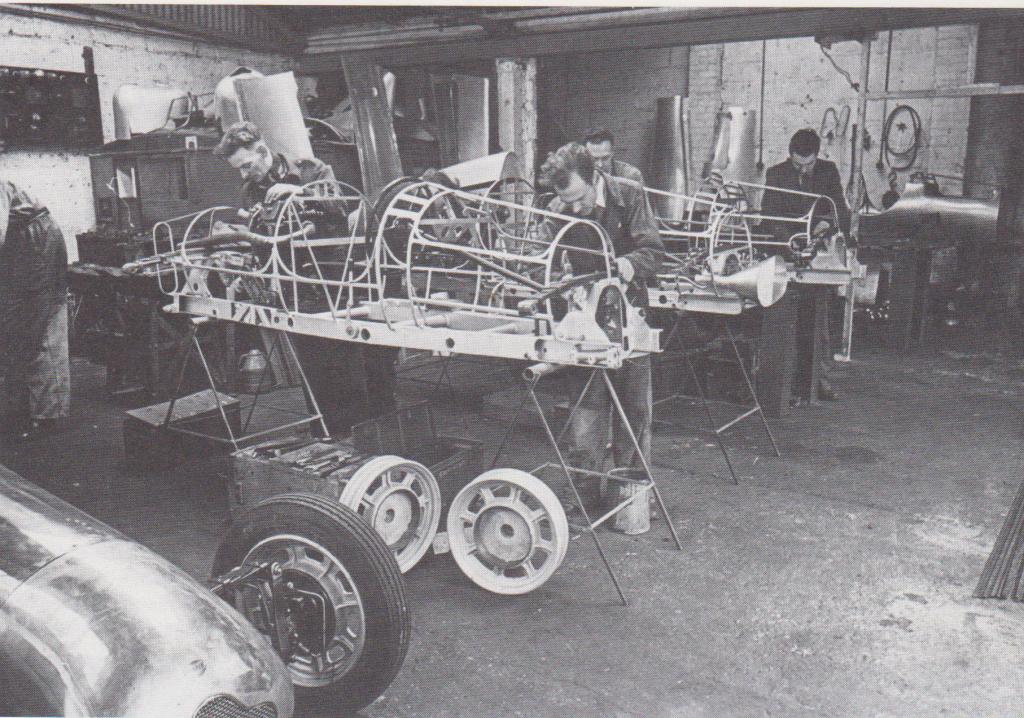
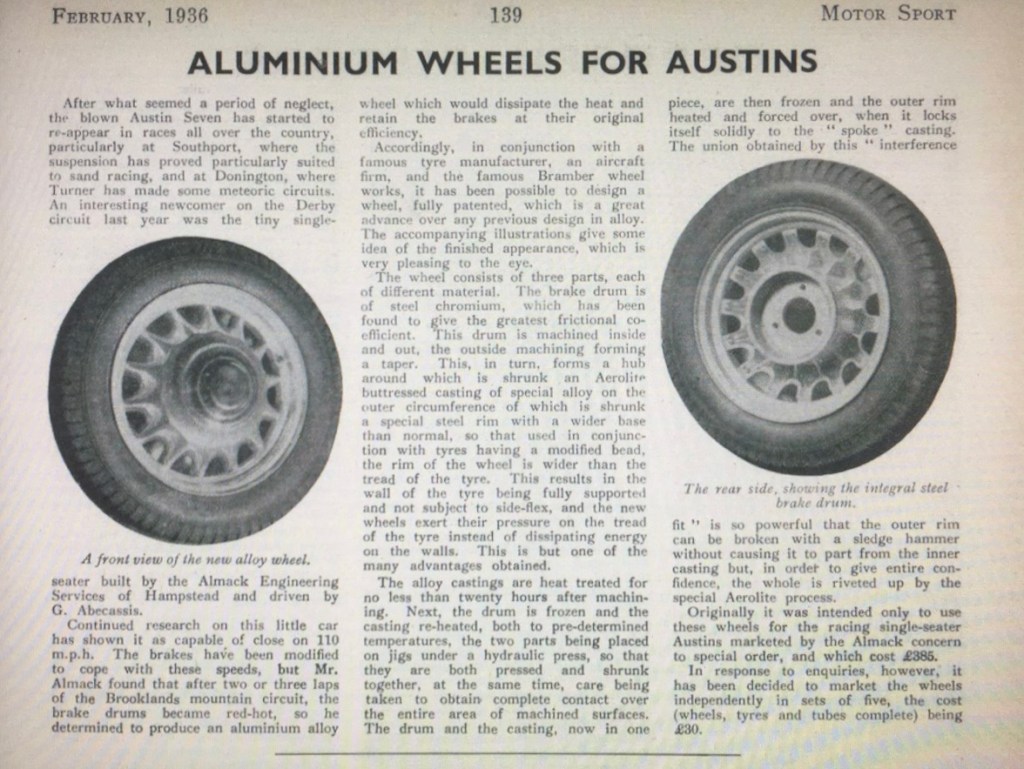
Aerolite wheels detail construction
More on the Aerolite wheels from Stuart Ulph, owner of the Almack Austin.
“I was completely unaware that a commercial fleet had been equipped with Airlite wheels. My knowledge of these wheels (apart from owning some) was derived from the “Motor Sport” article, so to me they were ‘Aerolite’. They were made by Bramber with, I am pretty sure, Dunlop rims, the rims being steel of course. I had wondered if High Duty Alloys were involved in the supply of materials – just speculation.
Pete Almack refers to them as ‘my patented wheels’. I assumed he was the patent holder – he held other patents – but a patent search has revealed nothing. Peter also acted in some sort of consulting capacity to the patents board. It has occurred to me that Bramber may have held the patent.
As far as Austin Sevens are concerned, I know that both 15″ and 16″ wheels were made. I had heard that a ‘Motor Show’ Vauxhall 14 was equipped with Pete’s wheels and I have a set of 16″ wheels which were fitted to a BMW 315. Unlike the Austin 7 wheels, these do not have integral brake drums. The BMW wheels have a patent pending number on them as I recall but even this proved of no use to the searcher.
You would think that more of these wheels might turn up, given that Bramber seem to have sold quite a few sets. I telephoned Bramber circa 1980, by which time they had moved to Wales and their major occupation was in producing trailers for Land Rovers. Though interested by the story, by then they had no records or knowledge of the alloy wheels.”
CZ Z13 1.5-litre two stroke (D Ploeg)
And this contribution from Dick Ploeg, “You may also wish to add that the Czechoslovakian firm of CZ (CESKOSLOVENSKA ZBROJOVKA), on their 1931 Z13 racing car they copied the Bugatti alloy wheels, with integral brake drums.
Furthermore there was a French make of aftermarket light alloy wheels available shortly before and after WW2. These were seen, I believe, on Amilcars and Peugeot Darlemats of the period. I have no name available at the moment, but it must be recorded somewhere.”
Credits…
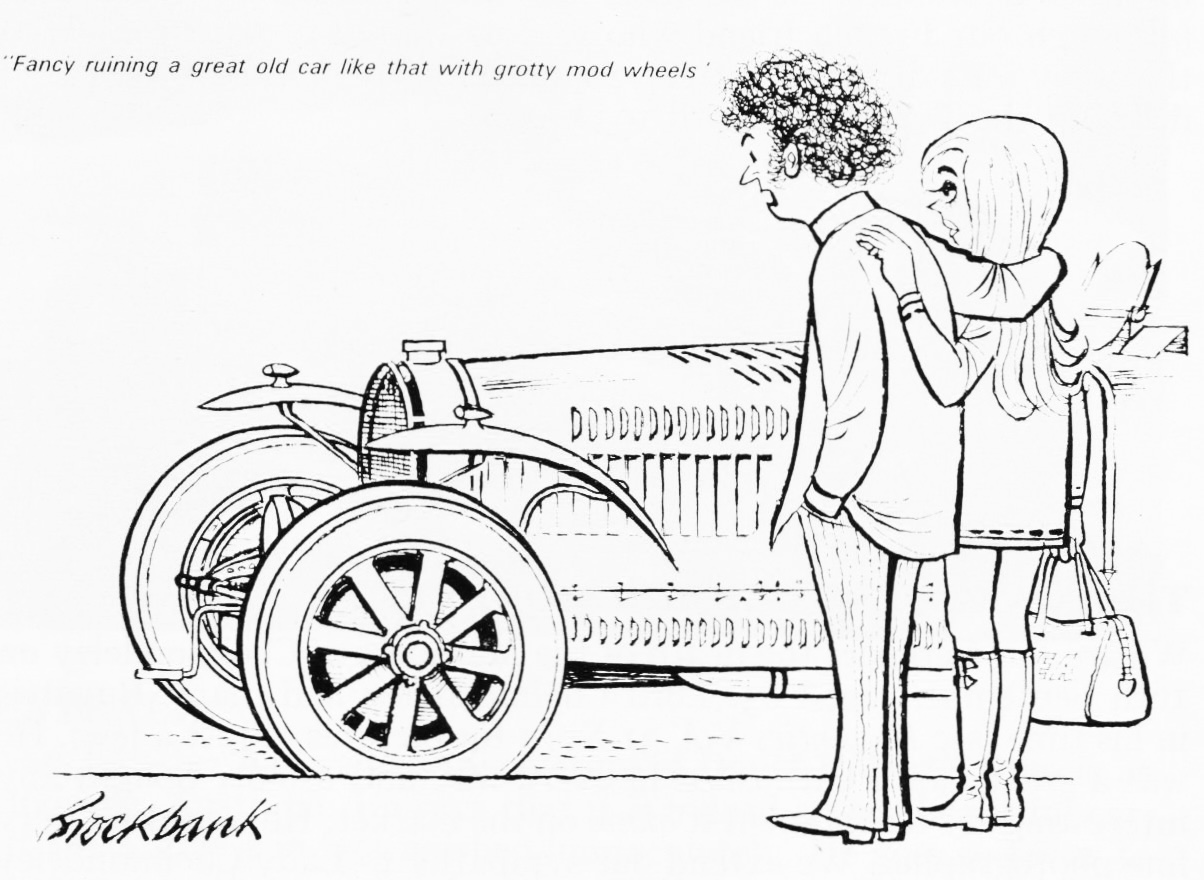
Bob King and his collection, Tony Johns, Mike Costigan, Stuart Ulph, Dick Ploeg, Diatto’ Sergio Massaro, Brockbank and other references quoted in the text
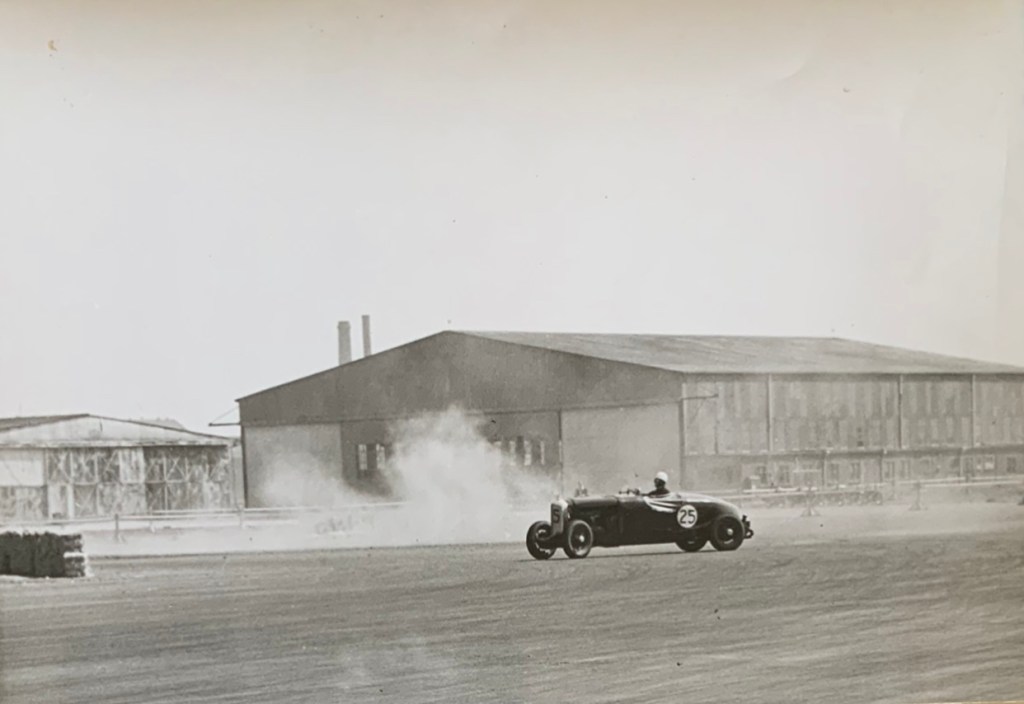
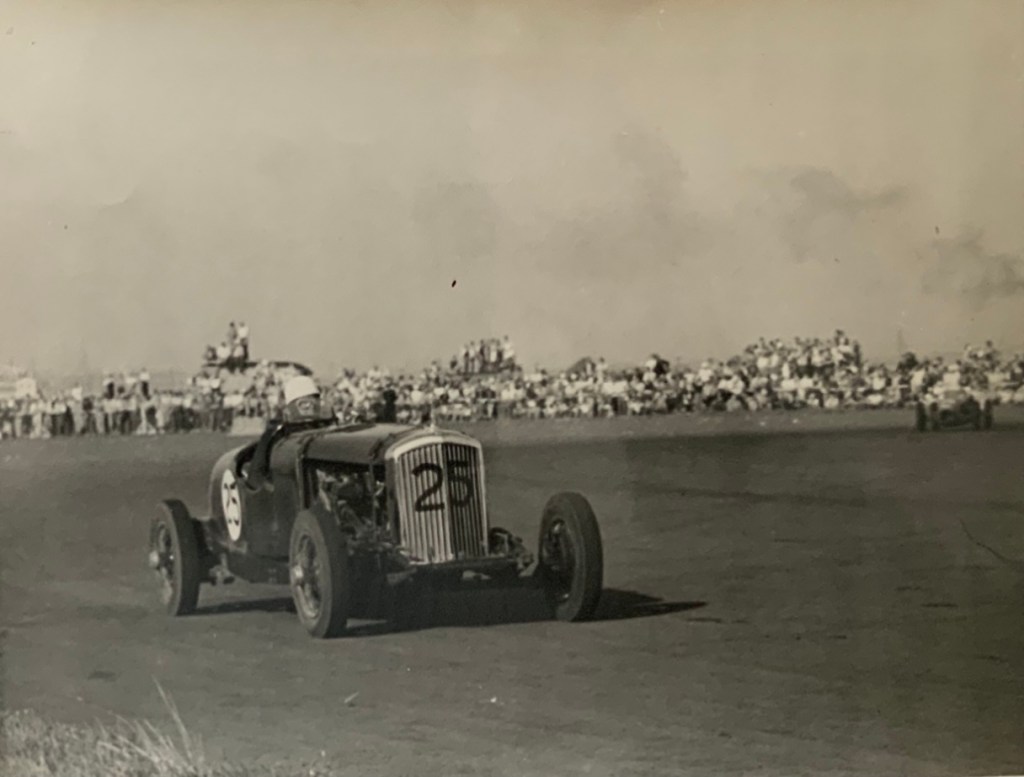
Rupert Steele explores the limits of his Bentley in the ample confines of Fishermans Bend (JP Read/VSCC Vic Collection)
Sir Rupert Steele was a pillar of the Melbourne sporting and business establishment throughout the 1960-1980s.
With a period typical sense of duty he served in World War 2, including a year as a POW in the Stalag Luft III camp, in Sagan, Lower Silesia (now Poland) after the Lancaster in which he was a bomb-aimer was shot down over Germany.
Before he discovered thoroughbred racing, he was a racing driver of some ability despite few competition miles.
He took over his father’s 1937 Bentley and was soon competing in the heavy, 4.25-litre six-cylinder, pushrod, twin-SU 120bhp sedan; he was timed at 90.8mph in a 1940 Cowes Speed Trial.
Post-war – still with the cars Martin & King body fitted – he won the Light Car Club’s Peninsula Trial in 1947 overall, and the Boneo Hillclimb within that event. In 1948 he contested the Light Car Club’s Mountain Trial and a Rob Roy Hillclimb.
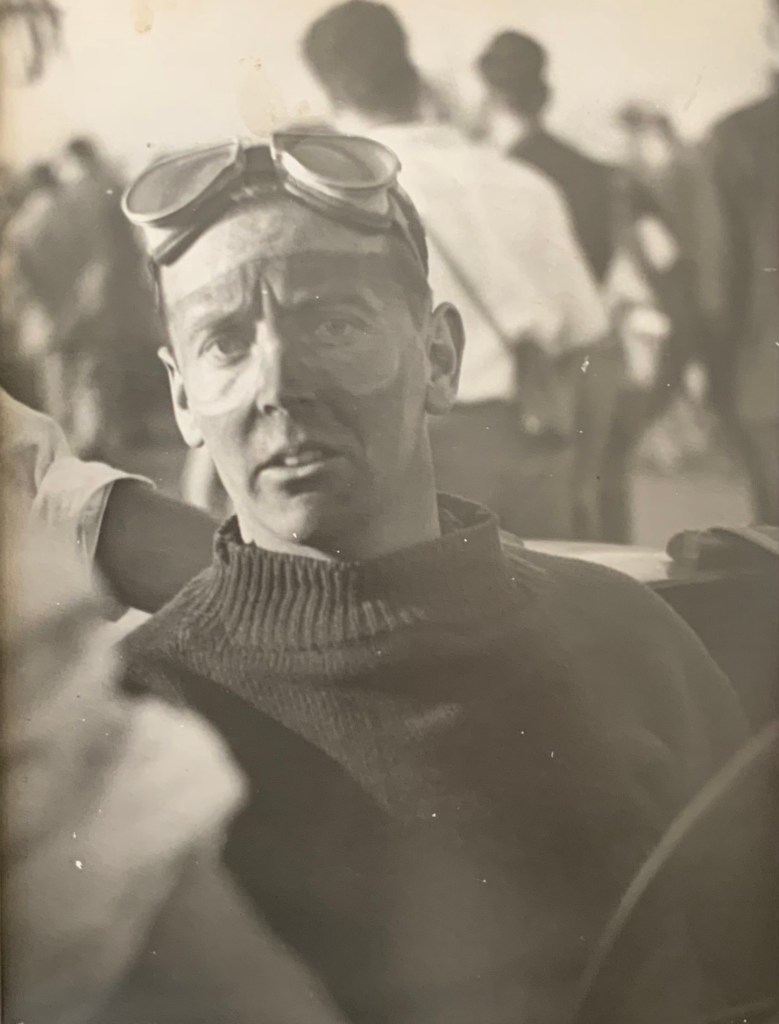
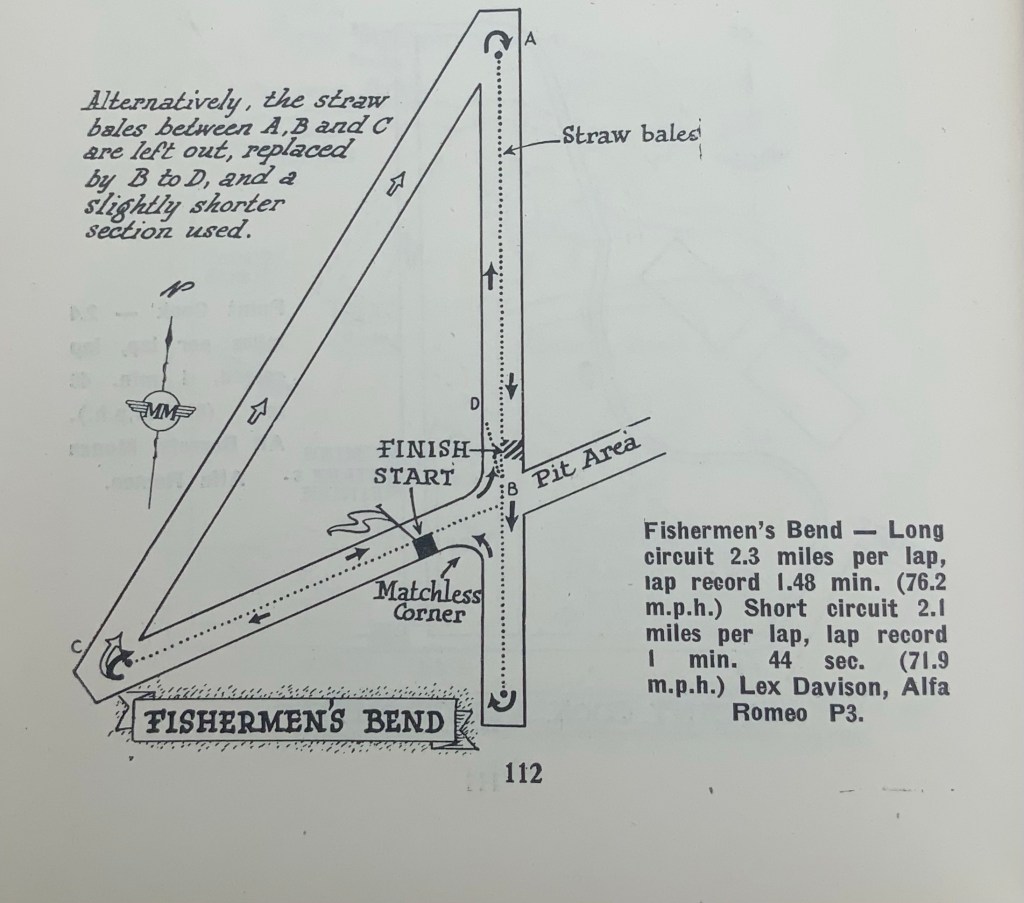
Rupert Steele after battle at Fishermans Bend (JP Read/VSCC Vic Collection)Fishermans Bend is the name these days! (Motor Manual Annual)
His serious intent was made clear when he had the Bentley body removed during a Rob Roy Hillclimb weekend in 1949. He competed body-on during the Saturday runs, and raced without it on the Tuesday Melbourne Cup Day! This work was performed by Allan Ashton at one of the most prominent race-preparation ‘shops of the day; AF Hollins in High Street, Armadale, Melbourne.
He raced the Bentley only once, on the occasion shown at Fishermans Bend, in Melbourne’s inner-west, in 1949. It was then game on; he purchased the Alfa Romeo Monza chassis # 2211134 previously raced by great Aussie Ace, Alf Barrett, who was retiring, this car was also prepared by Ashton and his crew.
“Everything was less serious in those days of course. Rupert Steele recalled that despite the lack of racing opportunities he put in quite a bit of practice driving in the Monza on outer Melbourne public roads, for example, driving from Dandenong to Beaconsfield and back at five in the morning.” he told great Australian race-historian Graham Howard.
Super rare shot of Steele in the Alfa Romeo Monza at Rob Roy, Melbourne Cup Day meeting, November 1949. His first three runs got better and better but the fourth was a bit more exciting for he and spectators after a lose up from the Spillway (Tony Johns Collection)Steele in the Alfa Romeo Monza at Nuriootpa during the 1950 AGP, a most impressive performance from a novice in a demanding GP machine. A pity he retired so early (John Blanden Collection)
Despite his inexperience, he gave Doug Whiteford and his Ford V8 Special, Black Bess, a serious run for their money in the 1950 Australian Grand Prix run on the Nuriootpa roads in South Australia’s Barossa Valley. This event is covered here; 1950 Australian Grand Prix: Nuriootpa, South Australia… | primotipo…
The Bentley lived to fight another day, after the meeting shown its standard body was refitted, so equipped Rupert went into battle with the similarly equipped matrons on the Toorak, South Yarra and Armadale roads.
Rupert Steele was born circa 1921 and died in August 2000. His life of achievement included directorships of some large corporates including Carlton and United Breweries, he was Chairman of the Victorian Racing Club from 1978-1983 and knighted in 1980.
Etcetera…
(Darren Overend Collection)
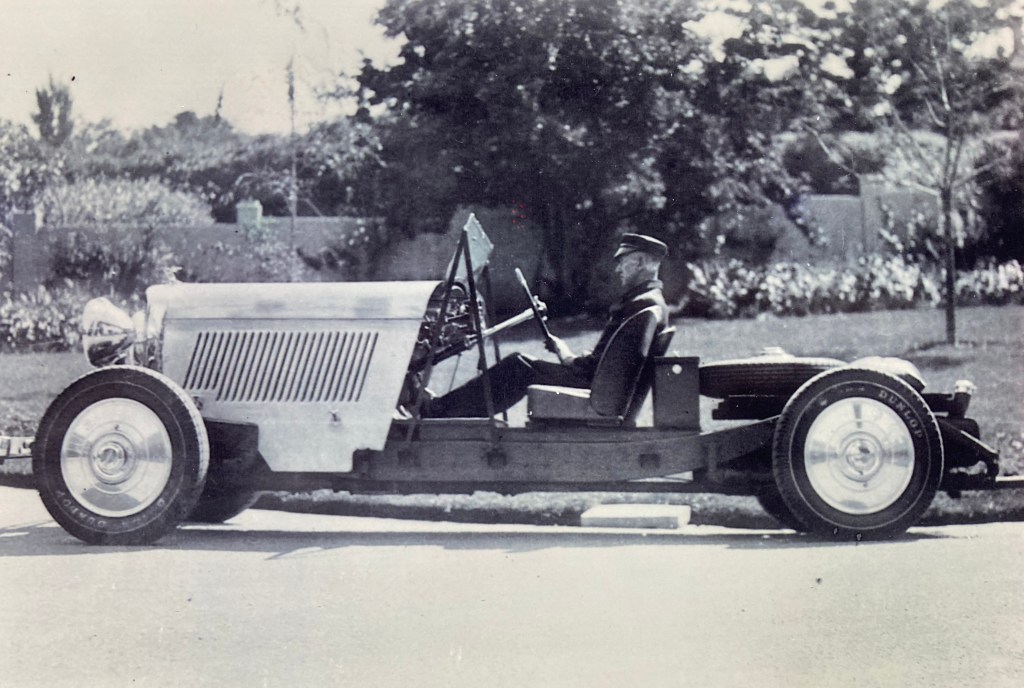
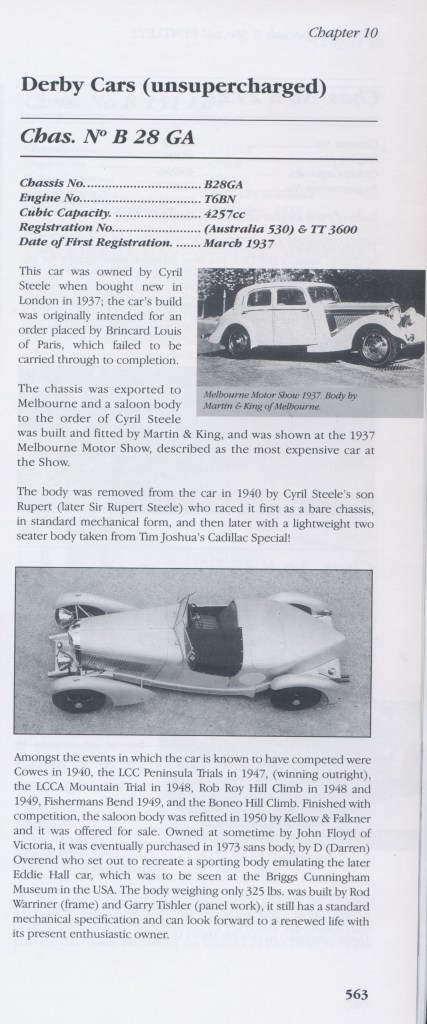
Bentley chassis B 28 GA “Brand new in Toorak, immediately after importation by Cyril Steele, Rupert’s dad, before being bodied by Martin and King in High Street, Armadale for the 1937 Melbourne Motor Show,” current owner Darren Overend writes.
“The driver is the Steele chaffeur, Arthur Jackson, who was drowned with Cyril in a boating accident (believed the boat capsized in stormy weather) on Port Phillip Bay near the Heads” (the treacherous, narrow entrance of the Bay and Bass Strait – the ocean).
‘Bentley Specials & Special Bentleys’ Ray Roberts (Johns Collection)(Darren Overend)
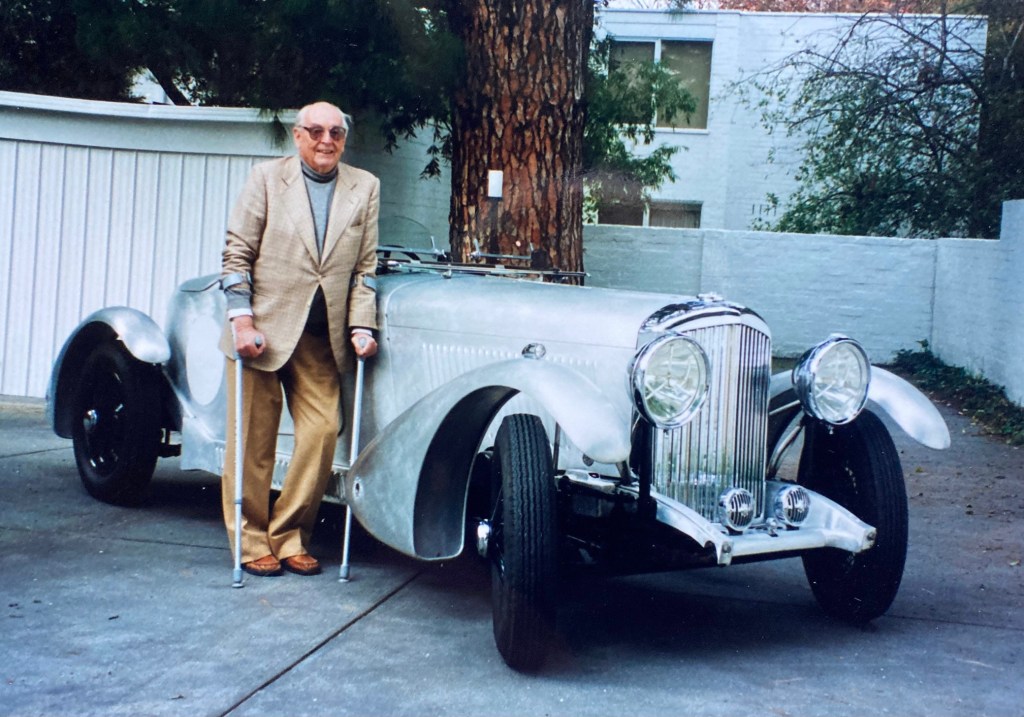
Sir Rupert Steele with his old Bentley, looking a little different than it did in his days with it as a racer, Toorak 1995.
Credits…
JP Read photographer-VSCC Victoria Collection, ‘History of The Australian Grand Prix’ Graham Howard and others, John Blanden Collection, 1950-51 Motor Manual Australian Motor Racing Yearbook, Tony Johns Collection, Darren Overend Collection
Tailpiece…
(JP Read/VSCC Vic Collection)
That imposing radiator ranging up behind would have scared the lesser ranks into submission, surely! Bentley sedan looks mighty fine as a sports-racer. While it looks the part, mechanicals were standard. Fishermans Bend 1949.
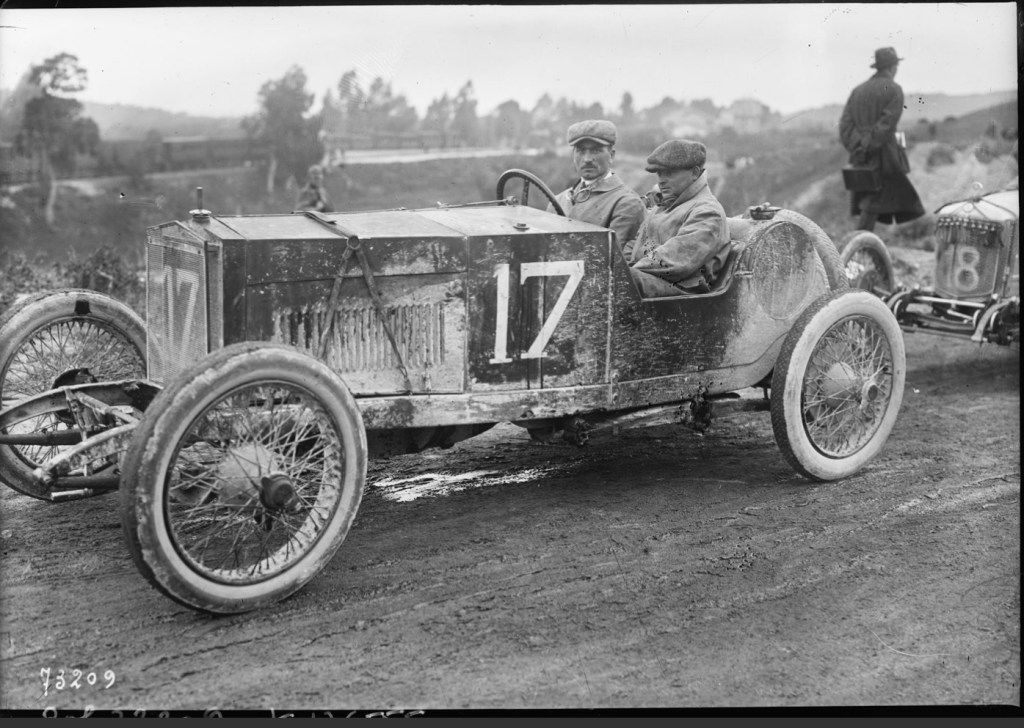
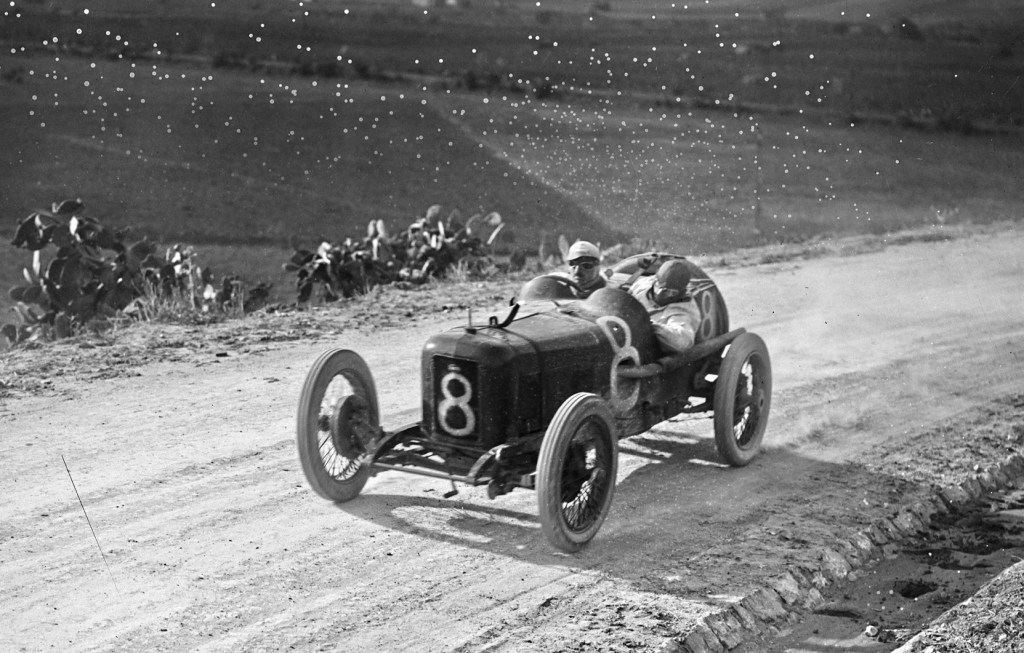
Carlo Massola and riding mechanic aboard his works Diatto Type 20 during the April 1922 Targa Florio weekend. DNF after one of four 67 mile laps. #18 is the nose of Giulio Foresti’s Ballot 2LS – a Maroubra visitor in 1925 (BNF)
Formed by 30-year old Guglielmo Diatto in Turin in 1835 as a coach-builder, Fratelli Diatto later morphed to railway engineering in 1864 before (Vittorio and Pietro Diatto, grandsons of Guglielmo) focusing on new-fangled motor automobiles in collaboration with Adolphe Clément in 1905. Its first cars were licensed Clément-Bayard designs, known as Diatto-Cléments.
After Clement’s 1909 departure, Diatto (Societa Anonima Autoscostruzioni Diatto), a major concern of over 500 employees, made its own cars, the 12/15hp Tipo Unico was its most popular pre-War.
After the conflict Diatto built the Giuseppe Coda designed Tipo 20. Powered by a 2-litre SOHC four, it produced 40bhp and was exported globally. With assistance from the Maserati brothers – Alfieri Maserati split his time between his Bologna factory and Diatto in Turin – Diatto produced the short-wheelbase 2-litre, DOHC, 75bhp Tipo 20S Grand Prix car for the 2-litre formula which commenced that year.
Carlo Massola was a FIAT mechanic and test driver before joining Diatto to fill a similar role. He contested the 1922 Targa Florio in a Tipo 20 (or 20S, accounts vary) but failed to finish, as did Domenico Gamboni in the other works car which started; Giulio Masetti won in a 1918 Mercedes GP 18/100.
At the end of the year Massola emigrated to Australia to join the Ongarello brothers’ Diatto Australian agency, based in Melbourne.
He successfully raced his Targa Diatto, and other marques, at Aspendale amongst other venues from 1923, later still he took Australian citizenship. His son Silvo was a noted racer/engineer post-war; HRG, Bugatti and the M.M. Holden are amongst his race/construction credits.
The Ongarellos sold Diatto Tipo 20A’s in rolling chassis form, the most infamous of which was owned by Melbourne’s Roaring Twenties gangster, Joseph ‘Squizzy’ Taylor who was gunned down in a 1927 Carlton shootout (in a Barkly Street terrace, not the Diatto!).
After a succession of financial reconstructions, Diatto ceased car production in 1927 to manufacture other products. In 2007 the Carrozzeria Zagato revived the brand for a concept car displayed at the 2007 Geneva Motor, the Diatto Ottovù Zagato.
I am in the process of researching an article about Carlo inspired by Bob King with the assistance of the Massola family. Carlo’s race record in Australia is pretty clear, his career in Europe is not. I am keen to hear from any readers, particularly Italians who may have access to race-records in the decade before 1923, to fill in the gaps. Gimme a yell at mark@bisset.com.au if you can assist, many thanks!
Alfieri Maserati and mechanic, Diatto GP305/20S 3-litre four, DNF oil-tank, during the November 1922 268 mile Coppa Florio. Boillot won on Peugeot 174S. Wonderful action, whites of the eyes shot (Wiki-unattributed)
Credits…
Bibliotheque Nationale de France, ‘Diatto’ Sergio Massaro via Bob King Collection, Wikipedia
Tailpiece…
(S Massaro)
Beautiful drawing from the Massaro book showing a race Diatto 20S long-tail. The light-alloy, holey wheels date from 1923.
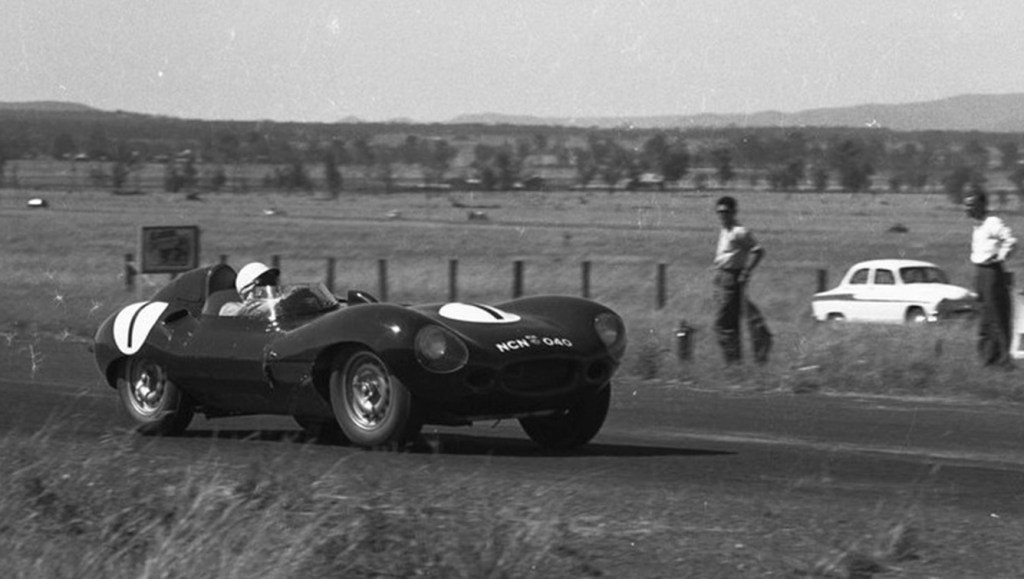
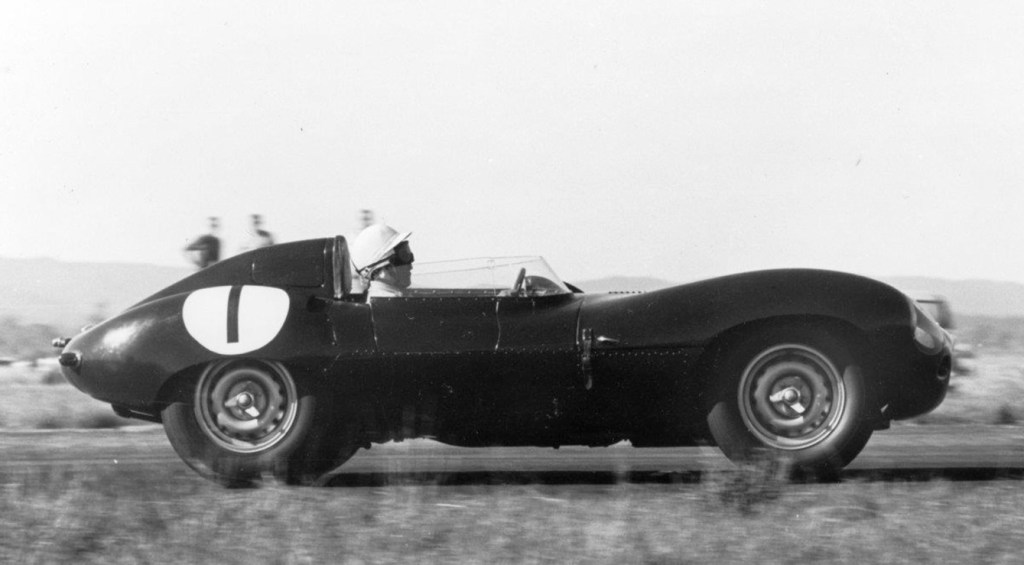
I’ve done this car to death of course, but each time it’s offered for sale the vendor unveils a few more shots, Bonhams are the source of this lot. Shared here coz they are too interesting to waste.
Geordie Anderson checks that her Dunlops are attached securely before the off, XKD526 circa 1956.
The on-circuit shots are at Lowood, and appear to be Ms Anderson too, happy to take your advice as to the meeting date. From memory it will be early after the cars arrival, once Bill Pitt got his hands on it, he kept it to himself. I would have done the same.
Bob Jane belting down Mental Straight, his 3-litre straight-six Maserati 300S howling with delight at a high-speed gallop through the Gnoo Blas, New South Wales countryside in October 1959.
What strikes at first-glance is the extreme narrowness of the road.
Man these cars are a hard one to toss as winner in a line-up of the sexiest fifties sports-racers? Lord knows, in that decade there were more contenders than in most. I’ll try and not let my sixties bias intervene in this little jolly.
By October ’59 the Brunswick-brawler had been racing his ex-works #3059 for a year. He was starting to get the hang of it – Lex Davison’s gybes about moving his boat further into Albert Park Lake to ensure his families safety from the ravages of Jano’s driving were at an end.
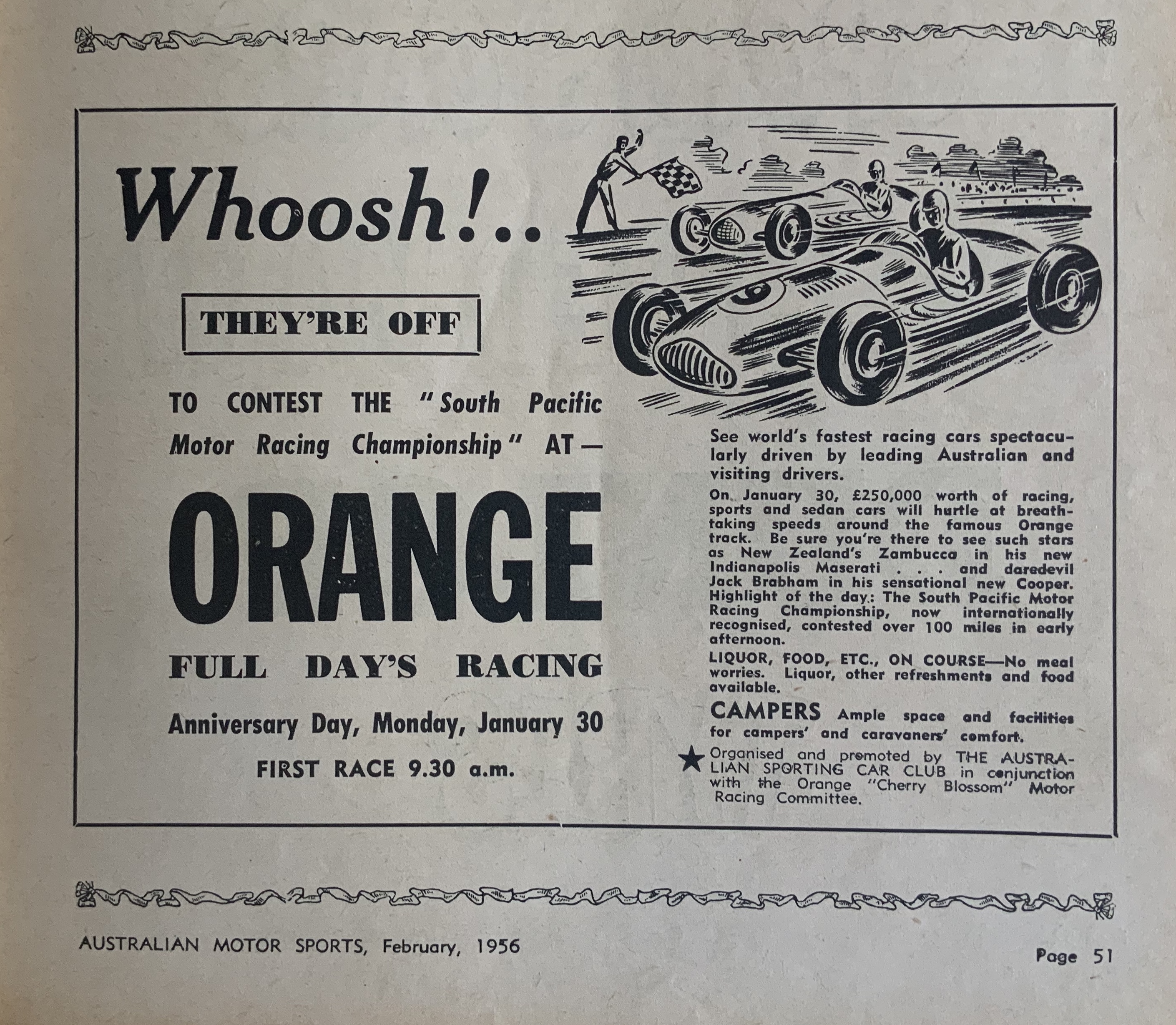
I’ve been to Orange three or four times along the journey but never done a dedicated Gnoo Blas walk – I really must do it. The place has a mystique about it, and is significant in the pantheon of Australian tracks, not least as the first to host an international meeting – the 1955 South Pacific Championship. See here for that one; https://primotipo.com/2020/04/09/1955-south-pacific-championship-gnoo-blas/
(GBCCC)
Bill Murray’s Alfa Romeo Tipo B Alvis leads a bunch of cars during the October ’54 meeting – I’ll take your advice on the following pair.
Murray was timed over the flying-quarter-mile at 134.4mph during this meeting.
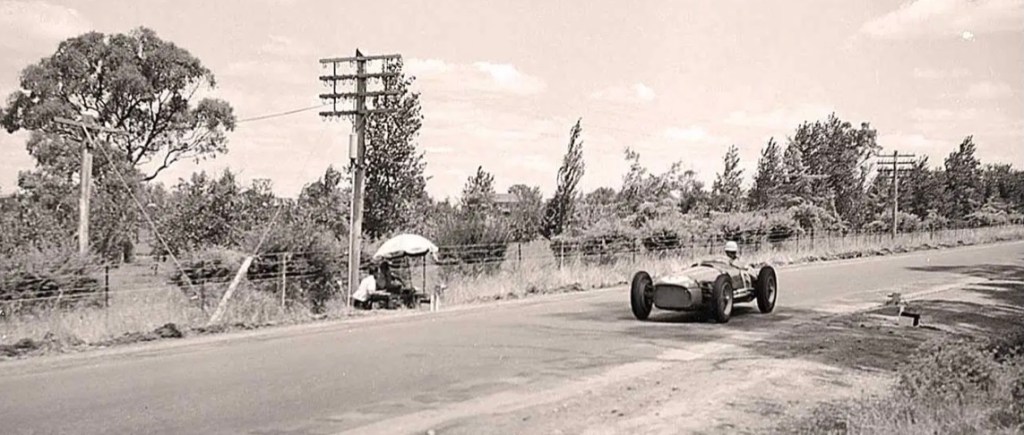
Chassis 5002 was raced by Murray to third in the 1952 AGP at Bathurst. First imported to Australia by John Snow for Jack Saywell to race in the ’39 AGP at Lobethal, its race history is a chequered one for another time.
In simple terms, the ex-Scuderia Ferrari Alfa’s engine rebuild was botched in Sydney immediately pre-war. Enroute to Italy for a rebuild, the ship carrying the valuable 2.9-litre straight-eight gurgled to the bottom of an ocean, perhaps after a submarine torpedo attack.
The car raced on post-war, fitted with an Alvis-six , GMC truck engine and Chev V8 before being rescued by Doug Jarvis. He restored it in Adelaide before sale to the UK in the mid-sixties, and multiple owners since.
The path of Australian racing history was changed at Gnoo Blas in 1956.
I’ve had an engine run-a-bearing in a race, which wasn’t impactful in the Formula Vee. Oh-fuck, whatever it is I can’t afford it was my 22-year old thought!
I imagine a rod breaking was more of a Nagasaki-near-the-crutch moment for Stanley when Maybach 3’s lovely SOHC, injected Maybach straight-six grenaded at warp-speed – well over 6,000rpm.
Instantly the car spat him down the road at high speed on its own Mobiloil.
Stan hung onto the car, which evolved into Maybach 4 Chev in Ern Seeliger’s delicate hands. Stan won in it too.
But it was the end of the Maybach Troika which had been so effective since 1951 – Charlie Dean and Repco Research, Maybachs 1,2 and 3, and Jones had been one of the major forces in Formula Libre.
Jones was keen on attractive Italians, he soon had a red Maserati 250F in his Yongala Road, Balwyn garage.
All of the promise was finally delivered with some help from Otto Stone, who prepared the car and seemed to calm Stan down a bit. He became a bit more of a percentage driver, ‘to finish first, ‘yer first have to finish’ and that kinda stuff.
Eric Thompson’s works Aston Martin DB3S rounds a right-hander on the Dundrod 7.4 mile road course in Ireland. September 5, 1953 Tourist Trophy…
The new DB3S had a good day out. The Pat Griffith/Peter Collins and Reg Parnell/Eric Thompson machines finished first and second from the Stirling Moss/Peter Walker Jaguar C-Type in third- to make the Feltham marque’s dominance complete the customer DB3’s of Graham Whitehead/Tony Gaze and Robert Dickson/Desmond Titterington were fourth and fifth.
The winner’s time for the 111 lap, round six of the World Sportscar Championship was just over 9 hours and 37 minutes.
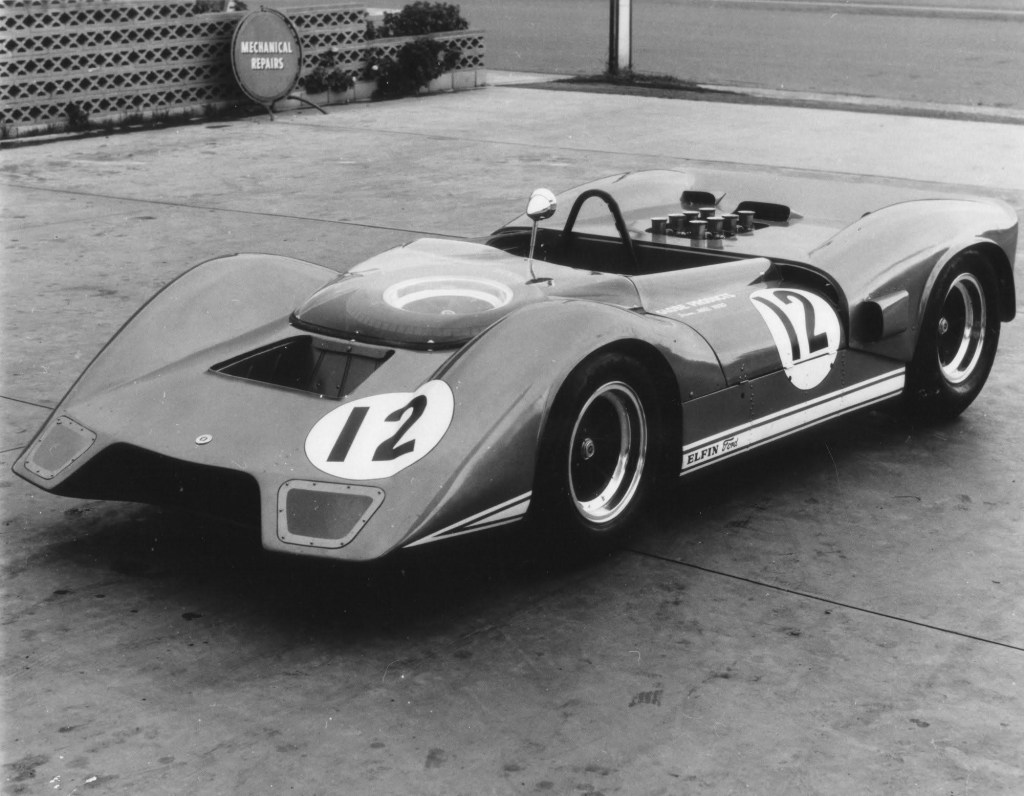
Ron Lambert’s shot out front of the Conmurra Avenue factory was taken that same June 1966 weekend
It was finding a few shots of the car before and after it took flight at about 140mph going up the hill towards Longford’s Water Tower in March 1967 which piqued my interest again.
The original aero of the four 400s was suss – fatal in Bevan Gibson’s case. Hurd took air at Longford, spinning five times according to onlookers, and miraculously did not damage the car greatly. He was ok but a change of undergarments would have been required. To go off there and not hit a substantial piece of local geography was lucky, to say the least.
Noel Hurd hooks into the Viaduct, Longford 1967. The spot he went off is 700 metes or so back up the road behind him (Y Waite)(HRCCT)Longford damage looks superficial but enough to end the weekend early. Changes to body is not the work which could be done quickly at the circuit (E French)
After the Longford meeting the car was dropped back to Garrie Cooper. Together with his body specialist John Webb, the front horns were removed and the nose re-profiled and was then again tested at Mallala.
When it reappeared at Mallala in June 1967, the machine was powered by the Kevin Drage-designed and built Globe-Ford V8. This DOHC, twin-cam, two-valve, four Weber-fed 366bhp 289cid Ford V8 replaced the 289 pushrod ‘Cobra’ engine first fitted to the 400. More about this project in an article to be published soon.
(G Matthews)
Adelaide’s Keith Rilstone at Mallala after purchase of BB661 in 1969-1970 – note the changes made to the nose. Sadly, he acquired the car with the pushrod Ford fitted rather than the DOHC unit.
The patterns of that engine were scrapped by a subsequent Sydney owner’s widow. The completed engine has disappeared from trace, last known probable locale, Western Australia. Do get in touch if you can assist in that regard.
Etcetera…
(F Radman Collection)
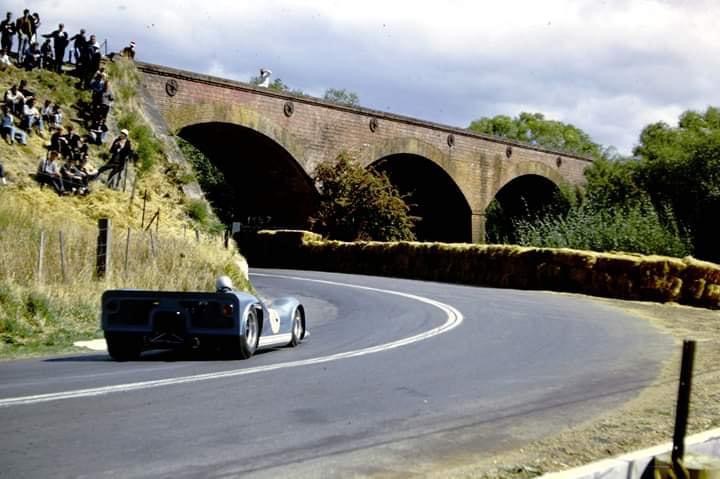
Magazine cover shows the start of the 1967 South Australian Tourist Trophy won by Alan Hamilton’s Porsche 906 Spyder from Hurd’s Elfin 400.
The nose treatment of Niel Allen’s ex-Matich Elfin 400 #4 and the Globe Products 400’s standard nose alongside is marked.
BB661 as originally built, at Edwardstown, with Ford ‘Cobra’, four Weber 48IDA 289 V8.
(K Drage)
Rear shot at Mallala in June 1966, showing Hewland LG500 four-speed transaxle.
Big muvva of Can-Am gearbox with this little V8, heavier than the more logical DG300 which was just coming onto the market at this time and was by then used by Jack Brabham and Dan Gurney in their F1 Brabham BT19 and Eagle Mk1.
(J Lemm)
Noel Hurd getting the hang of his new mount, Mallala, June 1966. Won on debut, although Bob Jane’s second places Jaguar E-Type Lwt was hardly a fair-fight of equals.
(R Lambert)
Ron Lambert fettling the car at Elfins in October 1966.
Credits…
Greg Matthews, Ellis French, Yaya Waite, John Lemm, Ron Lambert, Kevin Drage, Historic Racing Car Club of Tasmania
Tailpiece…
(K Drage)
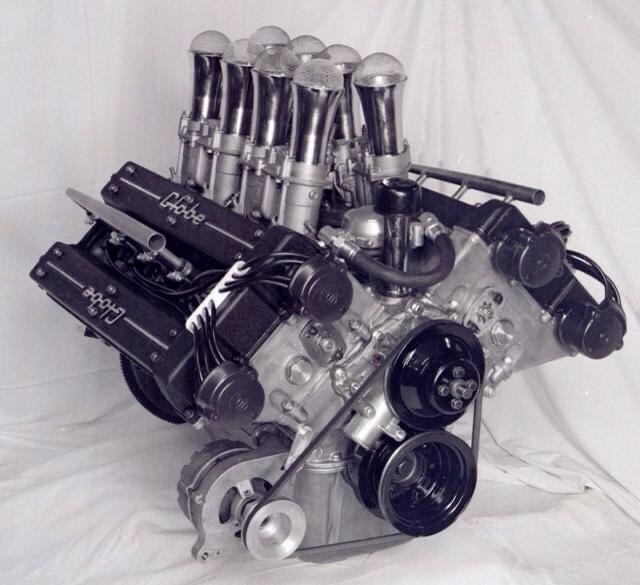
South Australian ingenuity, the Kevin Drage designed Globe-Ford 289 V8.
Ford block with twin, chain-driven camshaft, two-valve aluminium cylinder heads fed by four Weber 48IDA carburettors. One of Oz racing’s great mighta-beens.
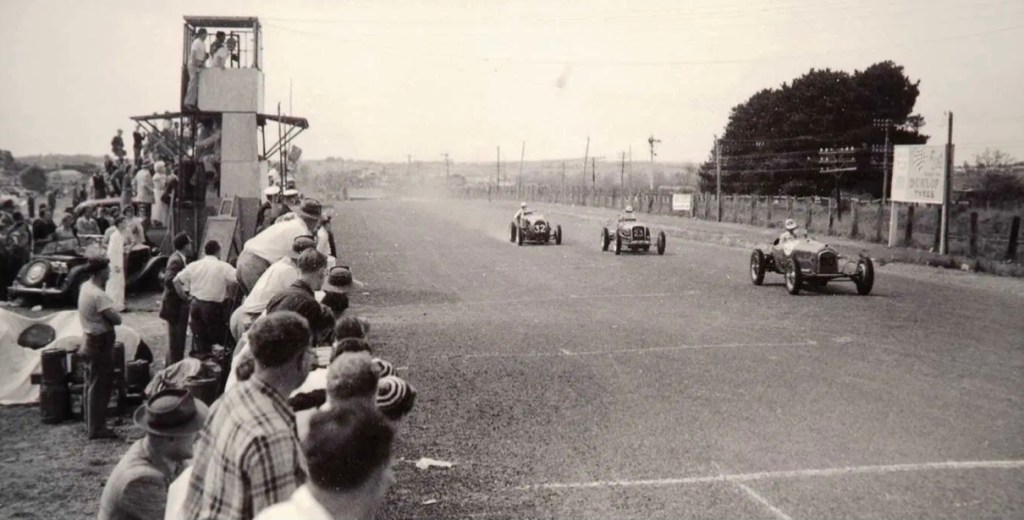
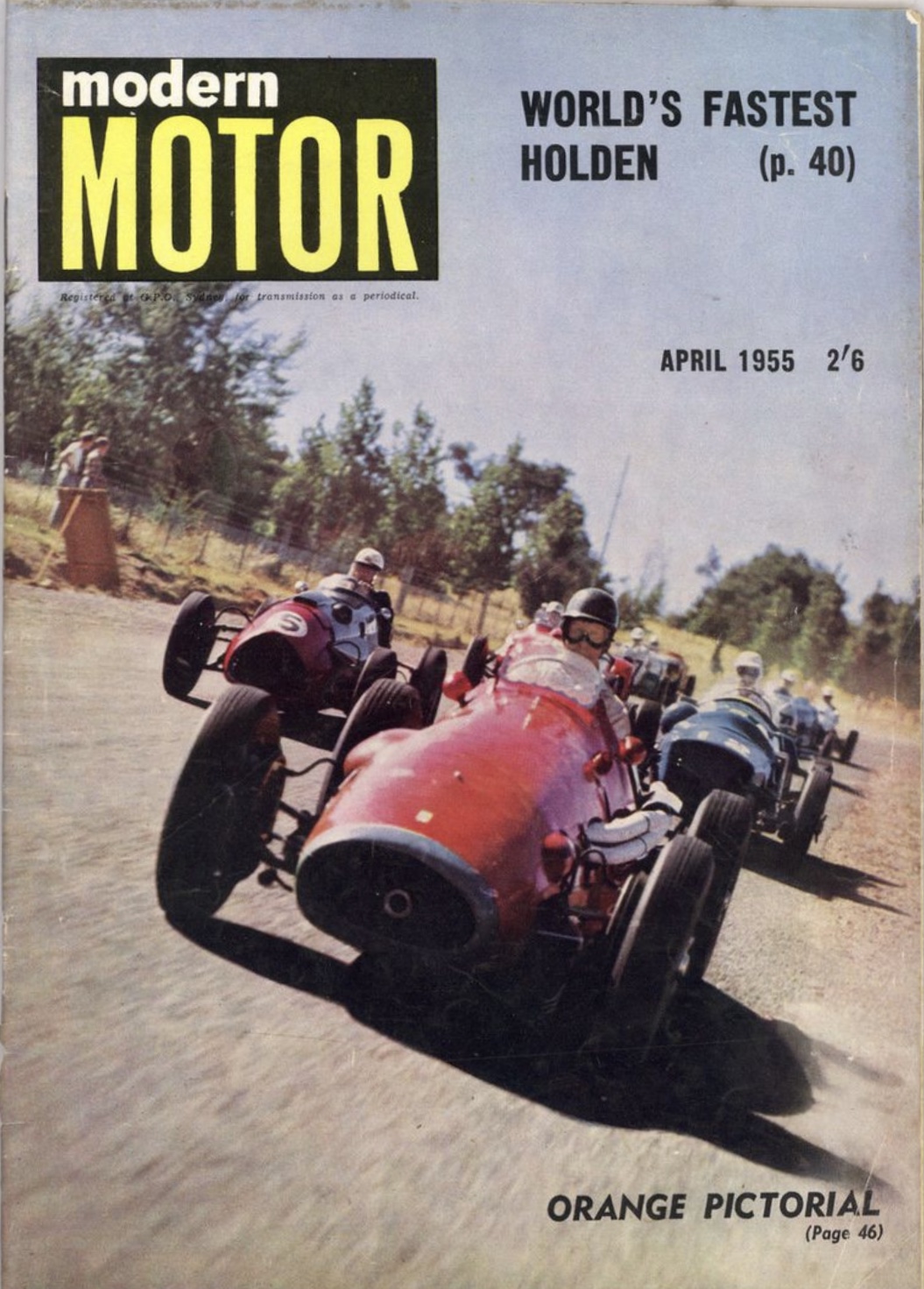
If the 1938 Australian Grand Prix at Bathurst was our first international event, by virtue of visiting Brits Peter Whitehead and his ERA B Type, and Alan Sinclair, Alta 1,100 s/c, our second international, and first of the modern era, was the South Pacific Championship at Gnoo Blas held in January 1955.
Peter Whitehead liked the place so much he came, saw, and conquered again, just as he did seventeen years before at Mount Panorama, albeit the 1955 field had a bit more depth that of 1938.
Peter and Tony Gaze raced Ferrari 500/625s, Bira a Maserati 250F with the better equipped locals Dick Cobden’s Ferrari 125 and Jack Brabham’s Cooper T23 Climax. Kiwi’s John McMillan and Fred Zambucka in Alfa Romeo Tipo B and Maserati 8CM respectively came across the ditch but both cars were too long in the tooth as was Tom Sulman’s Maserati
Non starters were Reg Hunt, short of parts for his new Maserati A6GCM, and Lex Davison’s HWM Jaguar
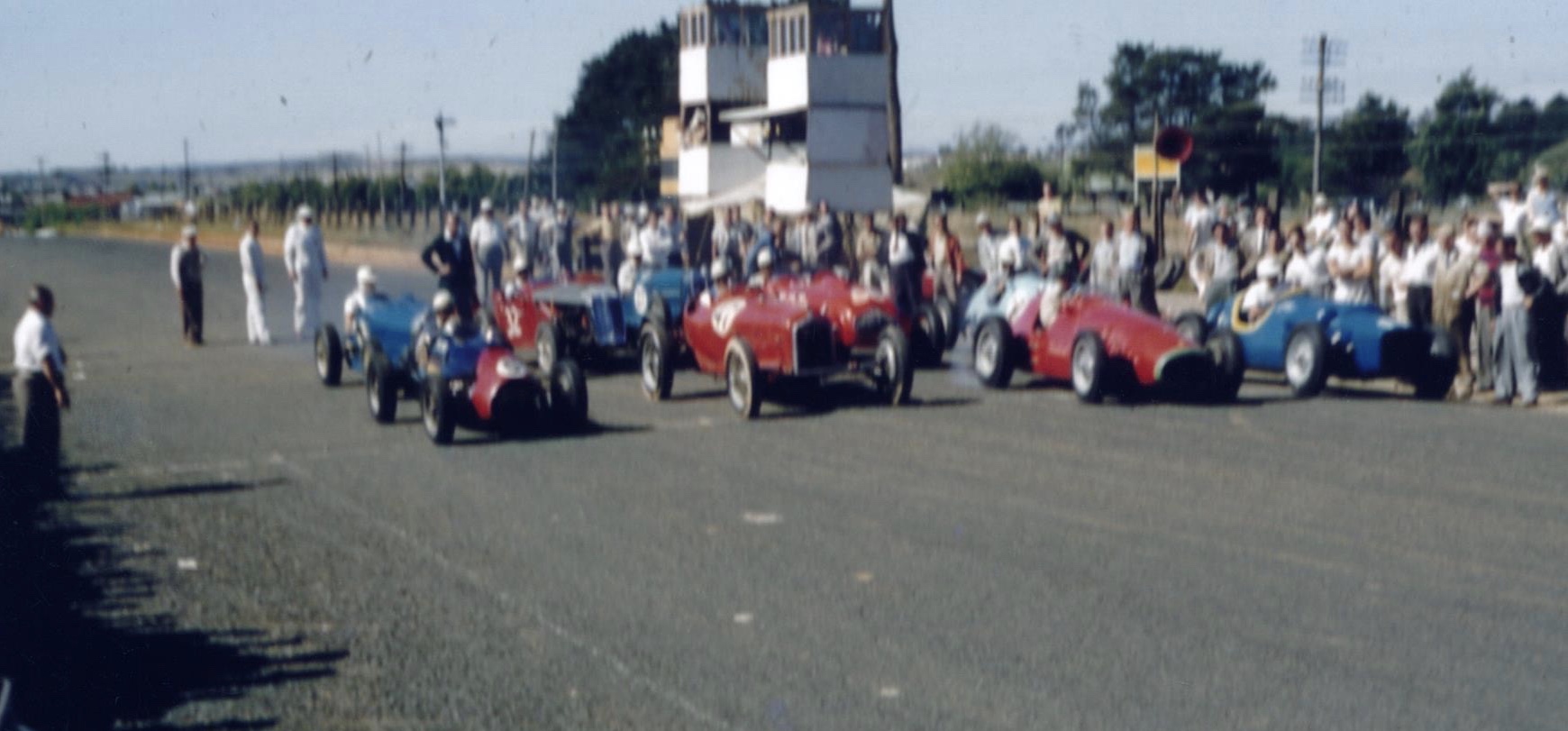
This shot isn’t kosher, it was staged for Modern Motor magazine but is still a cracker showing the Whitehead Ferrari, Brabham Cooper off to the left and Jack Robinson’s Jaguar Special aft of Peter. Further back is the unmistakable shape of a Bugatti, perhaps the John Hall Holden engined Type 37.
The grid on Huntley Road. From left, Jack Brabham, Cooper T23 Bristol, John McMillan, Alfa Romeo Tipo B, Peter Whitehead, Ferrari 500/625 and Jack Robinson, Jaguar Special (unattributed)
(unattributed)
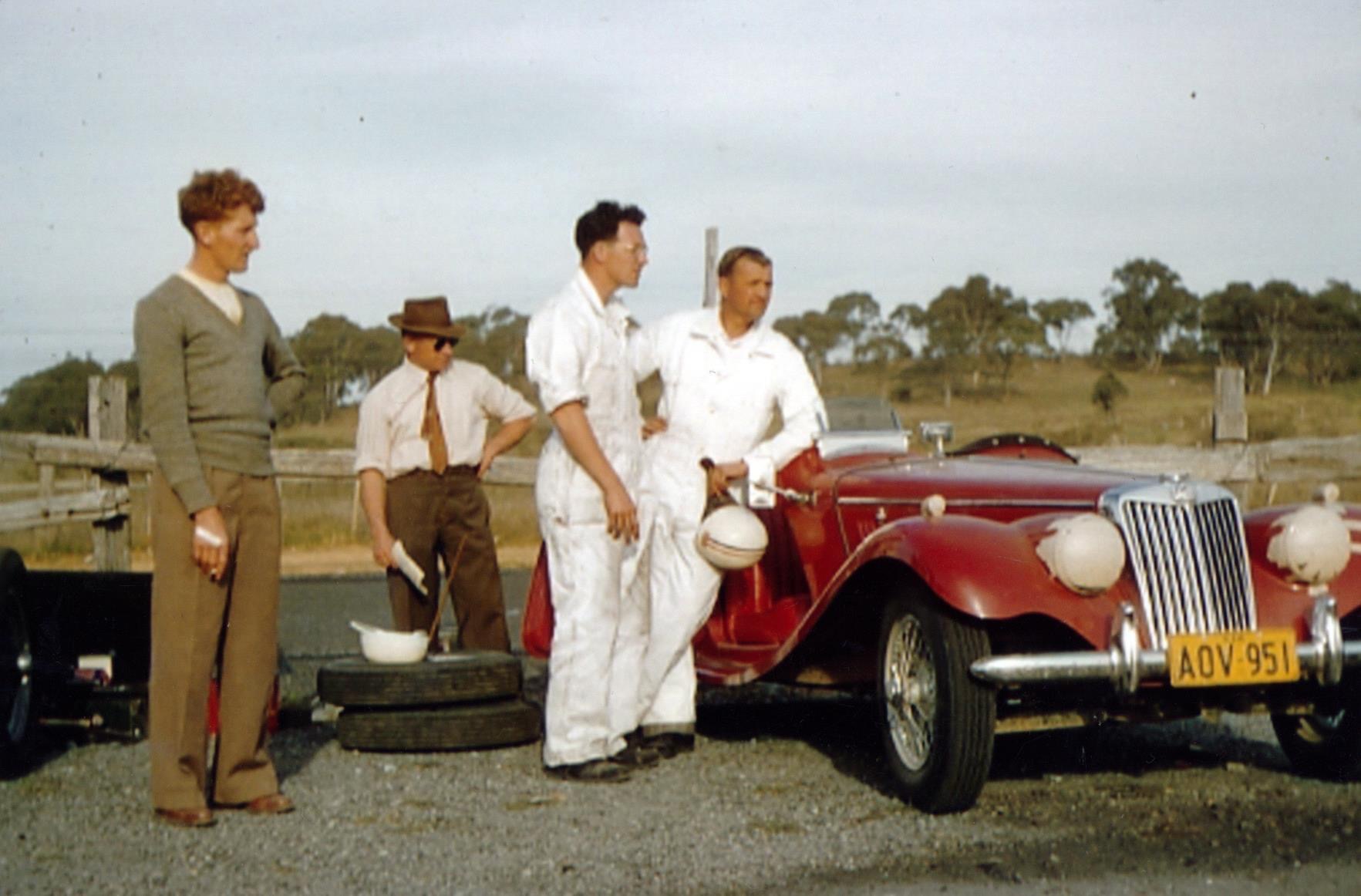
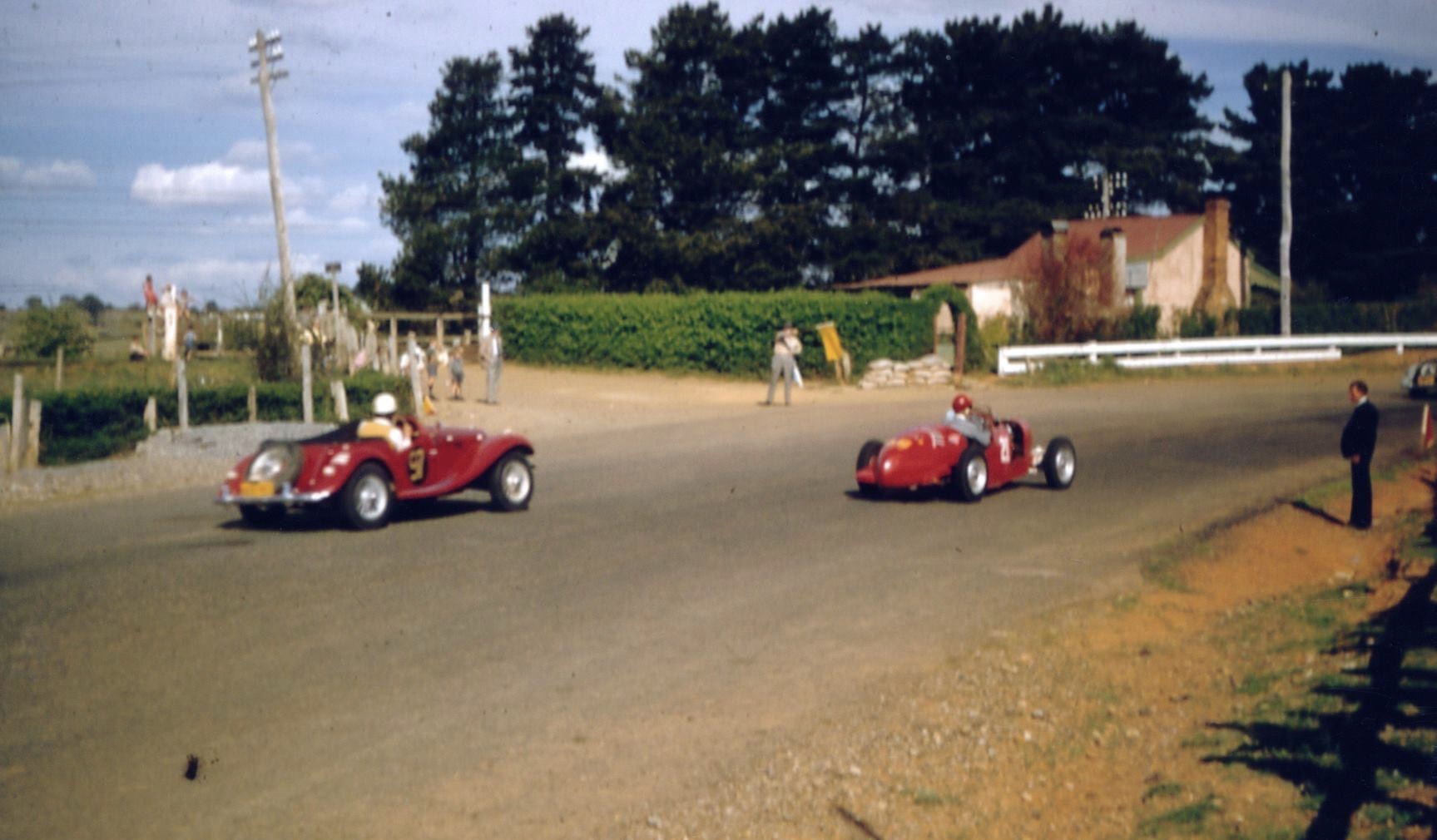
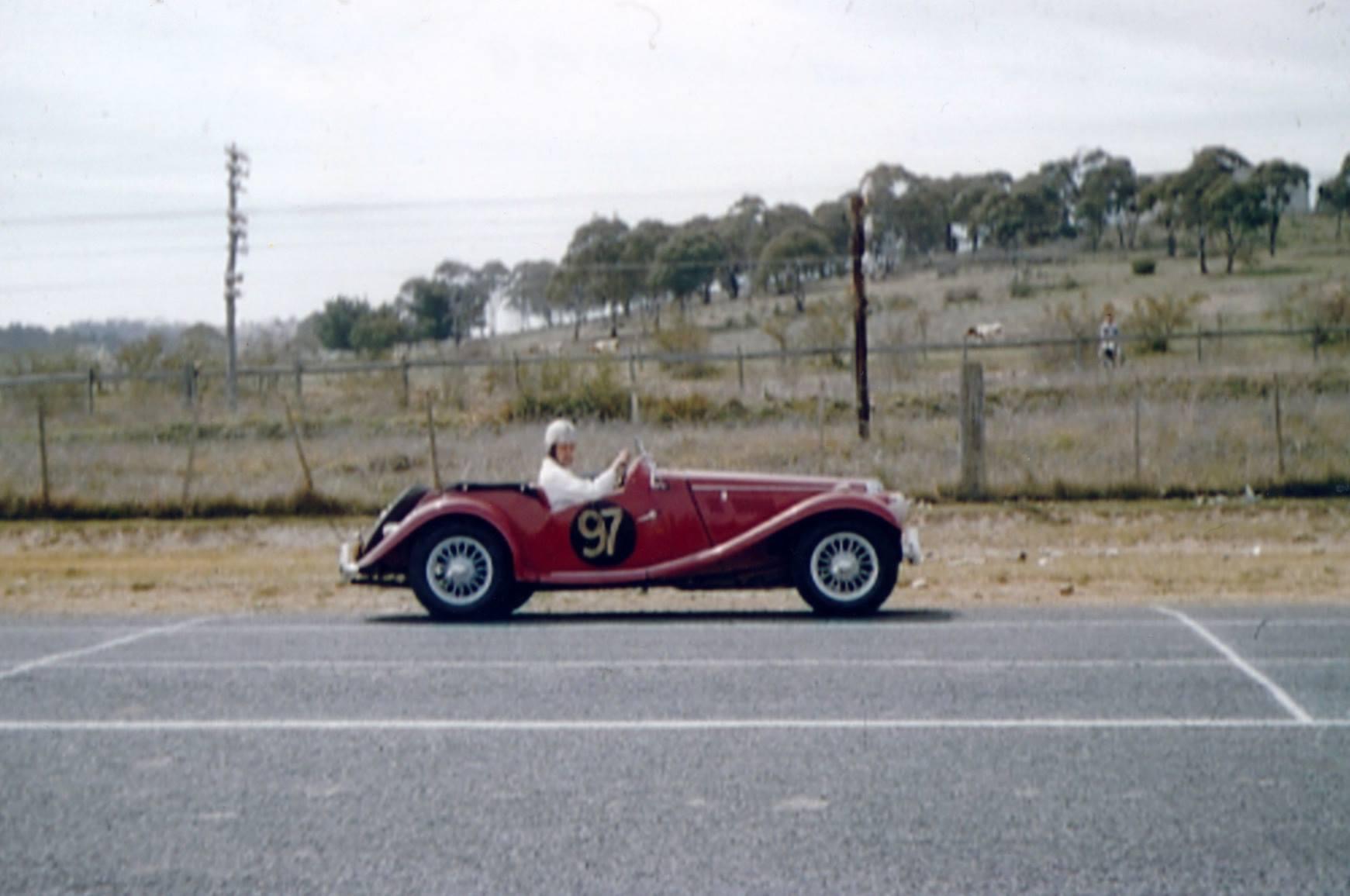
This group of wonderful colour photographs were taken by George Causbrook, an Orange electrician who worked at the time for Tom Barrett, owner/driver of the #97 MG TF.
Barretts Milk was a successful local business with a factory/depot including an airstrip. Causbrook’s family, the Beasleys, made available the shots to the Gnoo Blas Classic Car Club from whom I have shoplifted them, with thanks!
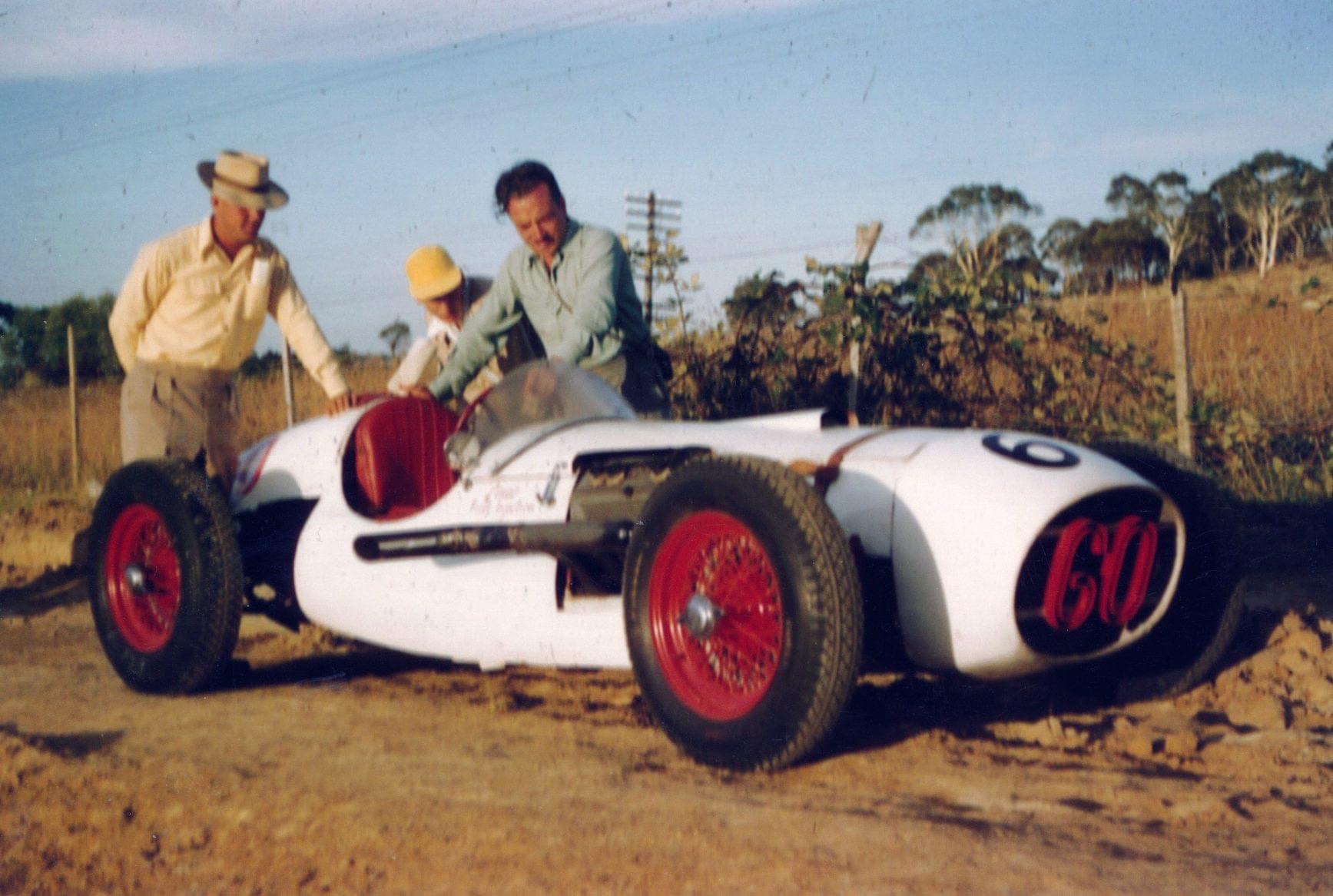
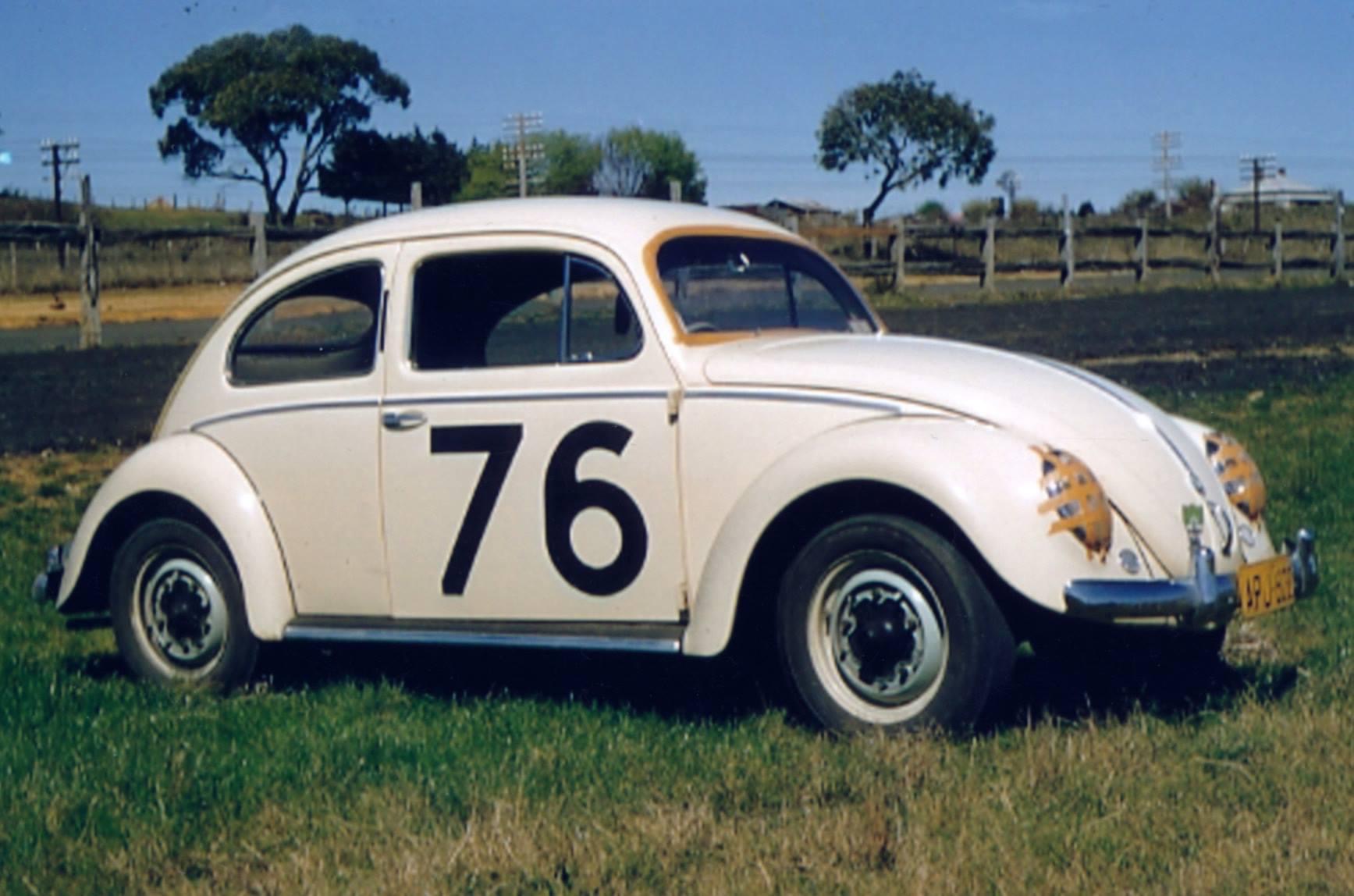
George had a fine eye, his colour shots of this challenging road course help us understand better its nature sixty years after the final Gnoo Blas meeting.
Ted Gray is shown below fussing over his brand new Lou Abrahams owned Tornado 1 Ford, just finished in Gray’s workshop in Melbourne.
By the October Bathurst meeting the team were starting to get the new beast sorted, but a huge accident in practice destroyed the car and came close to killing its plucky driver who took six months to recover from his injuries. See here for Tornado; https://primotipo.com/2015/11/27/the-longford-trophy-1958-the-tornados-ted-gray/
(unattributed)
(unattributed)
T Borrer’s VW Beetle entered in the production car race, October 1954 meeting.
The sportscar race grids (October ’54) seemed to be particularly well supported, with T Jordan’s 2.4-litre Riley-engined Healey Silverstone, Austin Healeys, #90 W Kelly and #104 Robert Page Jaguar XK120s in the shot below.
(unattributed)
(unattributed)
The ‘pretty boy’ with the Ray Bans in the XK120 is none other than local Cake Shop proprietor Bill Kelly, he would be as in fashion at an historic meeting in 2020 as he was in 1955!
Clearly there was plenty of money in pies and lamingtons in the fifties.
(unattributed)
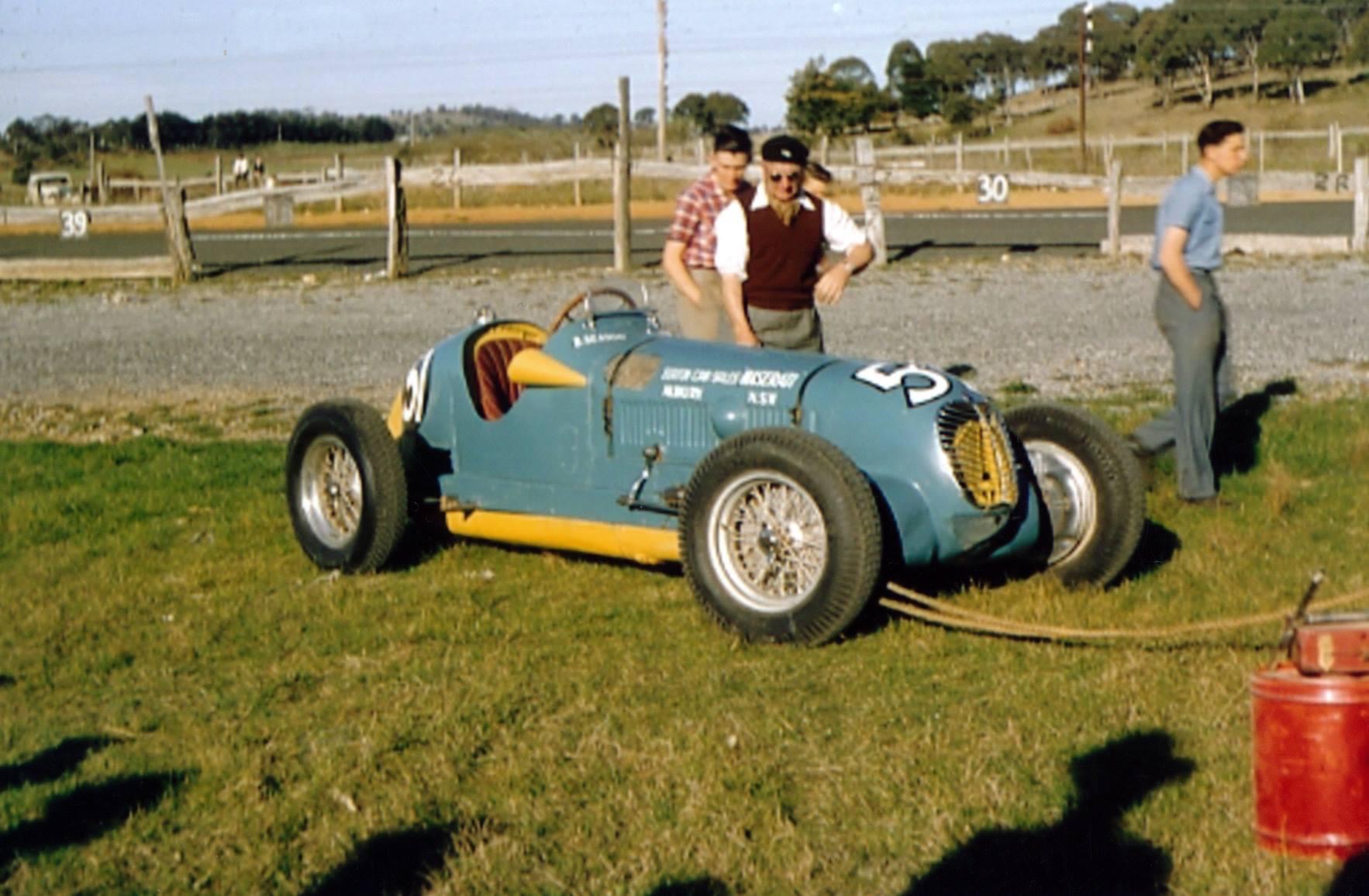
The great Eldred Norman’s least favourite car was this 1937 Maserati 6CM 1.5-litre six cylinder Voiturette.
Chassis ‘1542’ was originally raced by Franco Cortese throughout 1937, but the going was tough against the dominant ERAs. The machine then made occasional appearances as part of Ciro Basadonna’s various teams both pre and post-war. It was imported to the UK for Gilbey Engineering in 1947, Colin Murray raced it in the UK throughout 1949 and 1950 then brought it to Australia to contest the Narrogin 1951 AGP before its sale to Norman.
When the engine blew shortly thereafter Norman fabricated a steel block and cast detachable bronze heads then cobbled together Fiat 1500 conrods and BSA pistons when Maserati originals were unavailable. Eldred raced it for a year or so before he sold it to Edward David ‘Ted’ McKinnon who finished fifteenth in the 1953 Albert Park AGP.
‘1542’ then passed to Eddie Thomas briefly, before Albury’s Seaton Brothers bought it in poor shape, they solved the engine reliability issues by fitting a Holden Grey six-cylinder unit. In this form Jack Seaton ran it and Ken Cox raced it on the country tracks of Victoria between 1957-1959.
Stephen Dalton places the above shot as during the October 1954 Gnoo Blas meeting with Tom Sulman the driver. Ted Gray was entered but he has been crossed off Stephen’s program and Sulman substituted- well familiar with Maseratis.
The car went through a variety of hands before passing to Doug Jarvis, then some years later to Alf Blight, a talented engineer who did a great job over a decade with its restoration, it left Australia in the early eighties.
(unattributed)
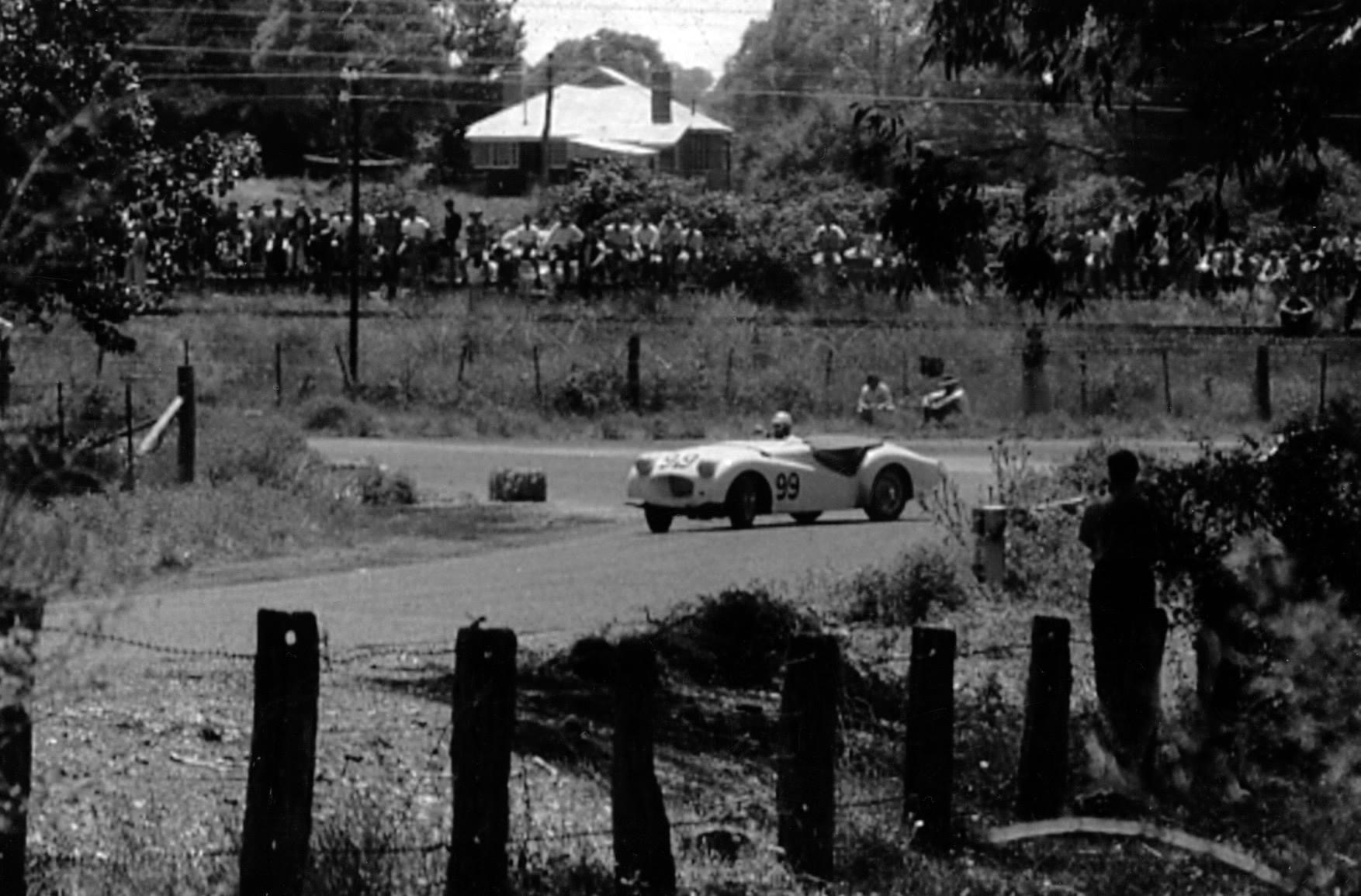
Tom Barrett, now racing a Triumph TR2 during the January 1956 meeting. I wonder if he caught it?
The fences to catch the wayward or unfortunate at ‘Mrs Muttons Corner’, the intersection of what is now Bloomfield and Huntley Roads, are clear and poignant in the context of Ian Mountain’s fatal accident during January 1955.
Stan Coffey, Cooper T20 Bristol, at Windsock Corner ‘due to the location of the old windsock when the Orange Aerodrome was in Jack Brabham Park during October ’54. The picture is looking towards Applebar/Pybar. The area that is now Leewood is in the background to the right, and in the middle of the background one can see what is now Blowes Road when it was dirt!’
Our friend Tom Barrett in the MG TF ‘at what is now the intersection of Huntley Road and Leewood Drive, where the level crossing now is’ and a special entering, the high speed Connaghans corner.
(unattributed)
Mr Barrett and MG TF.
Credits…
Modern Motor, Stephen Dalton
George Causbrook via Deidre and Brett Beasley and the Gnoo Blas Classic Car Club Facebook page





 Stirling Moss jumps aboard his Porsche 550 Spyder at the start of the Buenos Aires 1000km on January 26, 1958.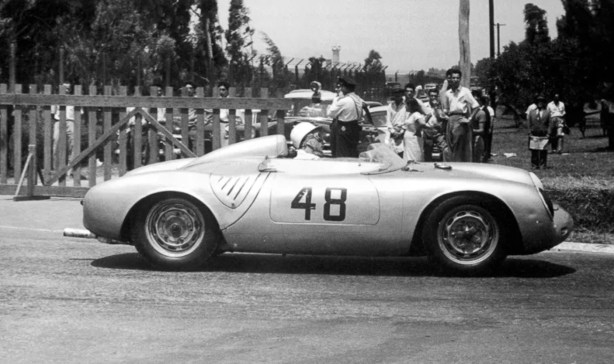




















 primotipo...