Battle for the test drive between Belgian Journalist/Le Mans winner Paul Frere and one of the Porsche drivers, any idea who?…
Frere (below) finished fourth in a Jaguar D-Type he shared with Freddy Rouselle. ’57 was a D-Type rout, the Ecurie Ecosse cars of Ron Flockhart/Ivor Bueb and Ninian Sanderson/John Lawrence were first and second from the Equipe Los Amigos French entry crewed by Jean Lucas/Jean-Marie Brussin, then Frere’s machine in fourth.
(LAT)
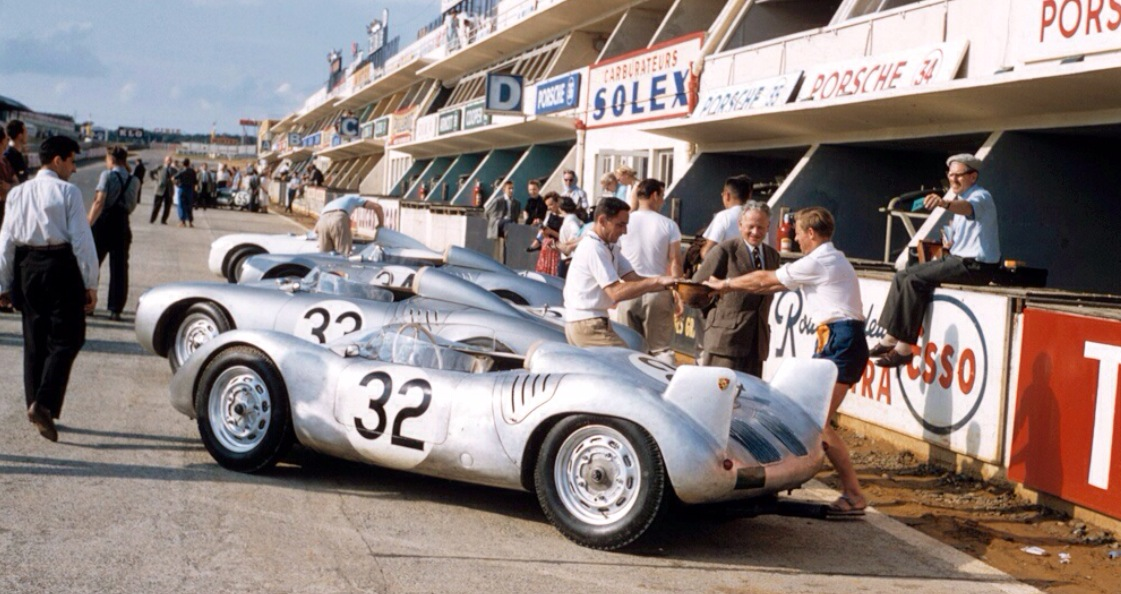
Ferry Porsche is in the suit and racing manager Huschke von Hanstein is on the pit counter.
The cars are the #32 718RSK of Umberto Maglioli/Edgar Barth, the #33 550A of Hans Hermann/Richard von Frankenberg and #34, the 550A of Claude Storez/Ed Crawford; DNF, DNF and non-classified respectively. The best placed Porsche that year was the privately entered 550A of Ed Hugus and Carel de Beaufort in eighth place.
The car in the distance is the #55 Lotus Engineering Lotus 11 Climax which finished ninth, and first in the sports 750cc class, in the hands of Herbert Mackay-Fraser and Jay Chamberlain (below).
(unattributed)
(LAT)
The Umberto Maglioli/Edgar Barth 718 RSK during the race, DNF accident after completing 129 laps in the 12th hour.
(unattributed)
(LAT)
The toss-pots of the concours world would be well advised to have a good look at shots like this which show the finish of racing cars as prepared for battle, ex-factory. Still, the last thing most of these dudes seek is originality, may the Oily Rag concept prevail. Here, the Maglioli/Barth 718 RSK before the off.
Credit…
Louis Klemantaski, LAT Photographic
Tailpiece…
(LAT)
The eighth-placed Ed Hugus/Carel Godin de Beaufort Porsche 550A chases the Jack Brabham/Ian Raby Cooper T39 Climax, 15th, during Le Mans in 1957.
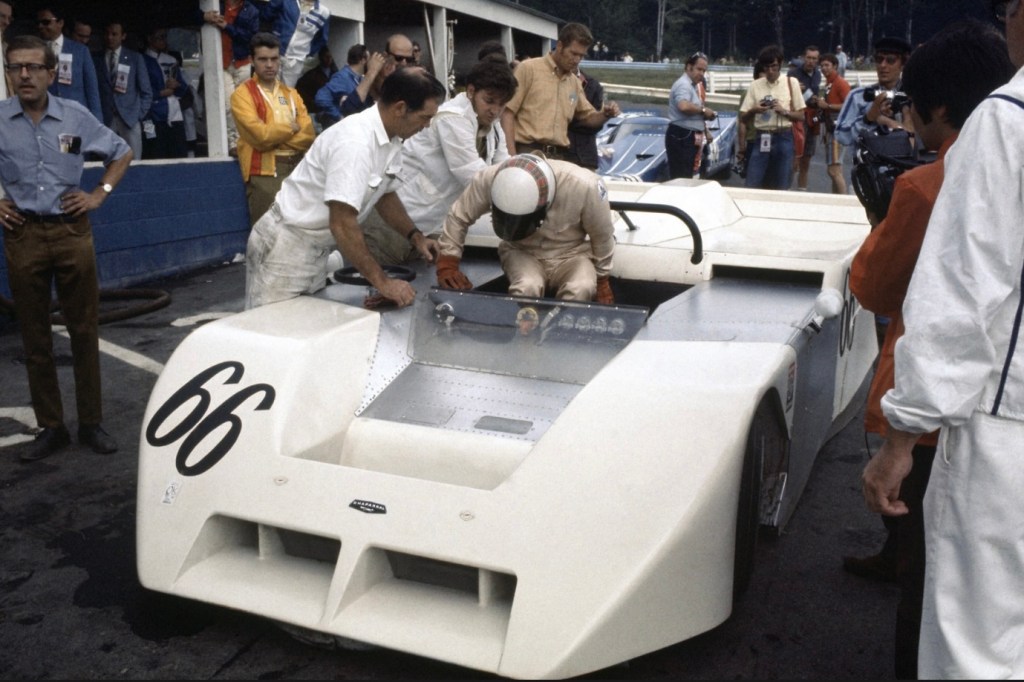
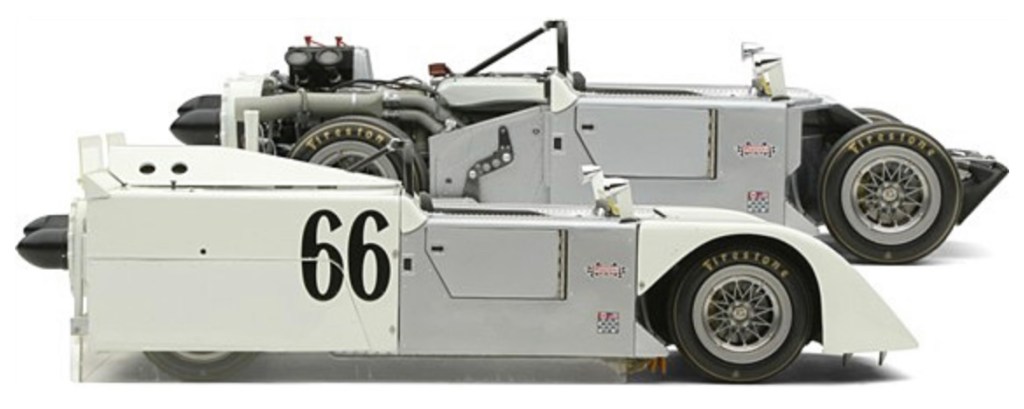
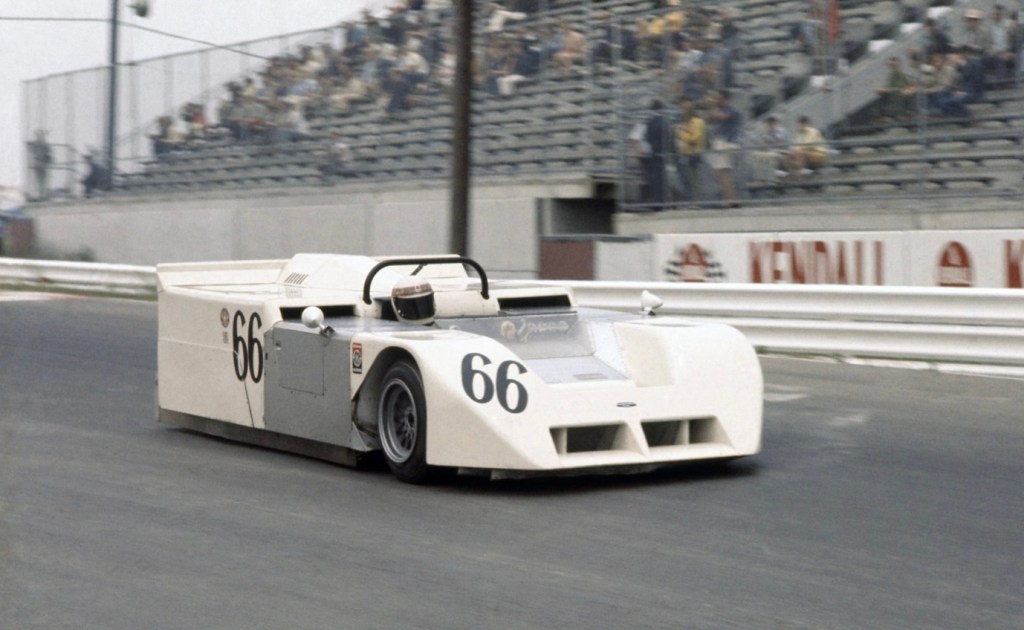
JYS loads up into the Chaparral 2J at Watkins Glen in July 1970 (LAT)
Apart from the Chaparral 2J Chev, name another car raced in 1970 that looks as edgy now as it did way back then?
I still remember flicking through Automobile Year 18 in Camberwell Grammar’s library in 1971 and flipping-my-14-year-old-lid at the sight of the 2J. My oldest mate remembers me saying, “Look at George Jetson’s car!” The only things missing were Jane, Judy, Elroy, and of course ‘rAstro!
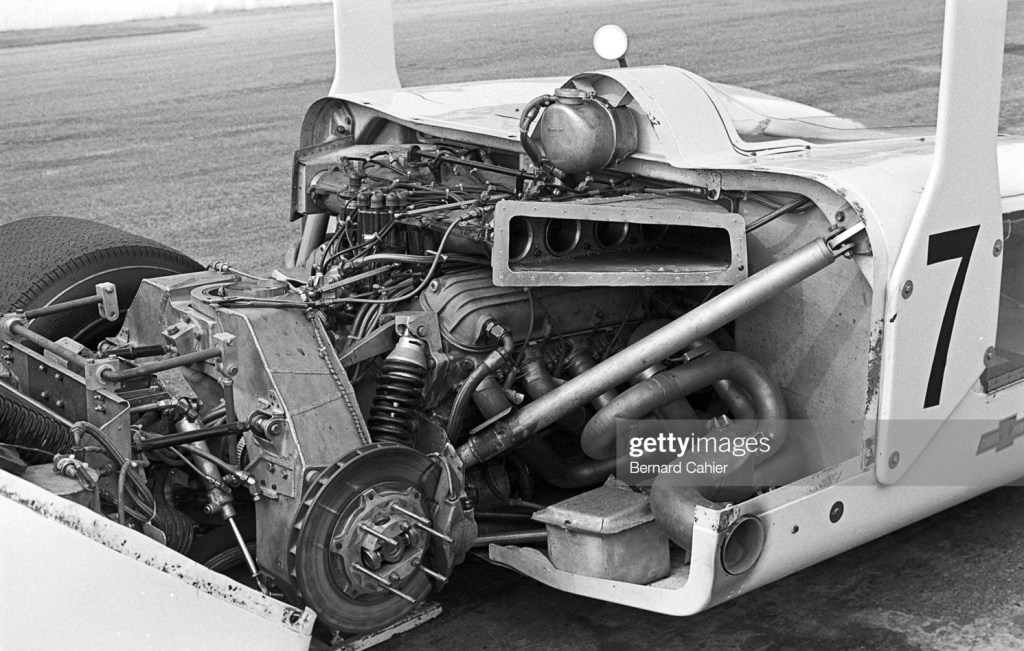
John Surtees, Chaparral 2H Chev at Riverside in October 19692H butt at Riverside in October 1969. Of note is the world’s biggest fabricated aluminium De Dion rear axle and one of the worlds biggest radius rods. ZL1 Chev has a crossover inlet manifold to get the fuel injection trumpets out of the airstream, ditto routing of extractors. Enormous wing fitted in this shot – you can see the vertical support – which is not installed in the shot above, remember too that this car was originally designed and built with the driver fully enclosed inside, something John Surtees pushed strongly against
Jim Hall has gonads the size of pineapples.
His outrageous 1969 offering, the wedgy, door-stop, knee high, De Dion rear-ended 2H was a complete flop. It’s driver, John Surtees, thought Hall had been smoking wacky baccy at Woodstock rather than working with clean-cut Nixon supporters at GM’s Skunkworks to design a new car.
Ever the poker player, Hall doubled his bets and concepted a machine so advanced and fast it was banned after only four races.
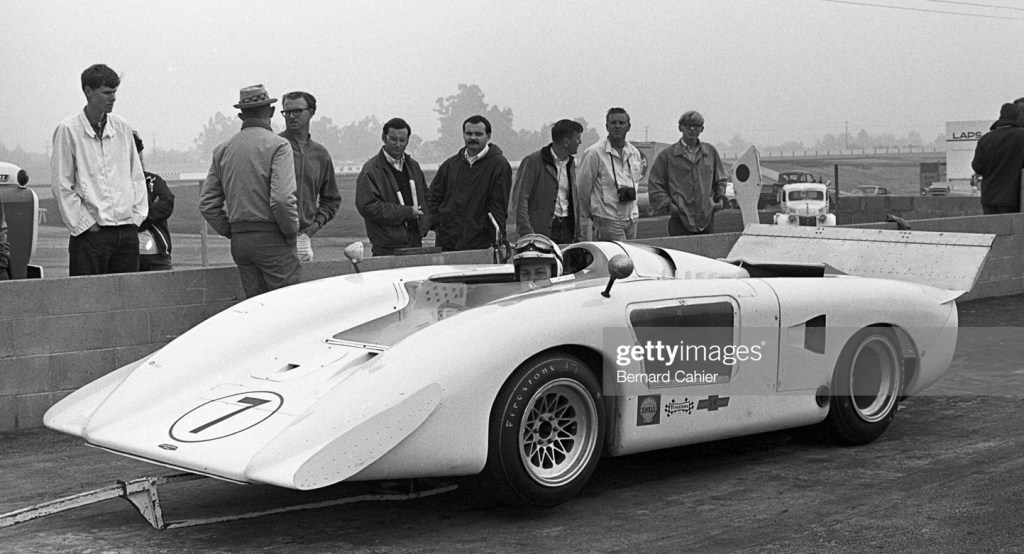
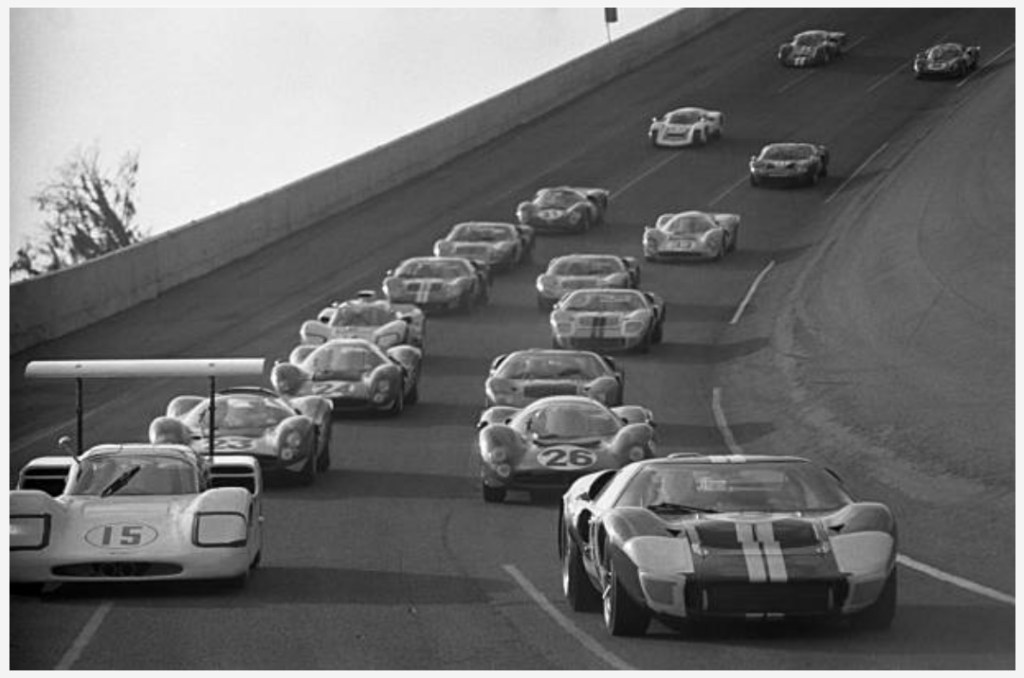
The Phil Hill/Mike Spence winged Chaparral 2F Chev looking lonely on the Daytona banking in 1967, DNF (Getty)
Chaparral had been giving the rest of the racing world aerodynamics and aero-technology lessons for five years or so to that point.
By 1970 the aluminium monocoque chassis was passe, so too was the aluminium block 650bhp’ish Chev ZL1 V8, even Chaparral/GM’s semi-automatic three-speed transaxle was a bit ho-hum.
Legend has it the inspiration for the 2J was a child’s fan-mail drawing to Hall of a sports racer being sucked down to the road by giant fans extracting the air underneath.
Whether it was ‘Elroy Jetsons’ sketch, an extension of previous Chapparral/GM R&D work, or divine providence, GM’s Paul Von Valkenburgh and Charlie Simmons, and Chaparral’s Don Gates started modelling the possibilities on Chevy R&D’s Suspension Test Vehicle.
More of a test-rig than a car, it enabled them to play with roll-centres and stiffness, ride height, pitch axis, anti-dive/squat and lots of other stuff; this rig became the 2J test mule.
“Gates worked out a fan and skirt infill defence system while Don Cox, Ernie DeFusco and Joe Marasco engineered a chassis to match,” Doug Nye wrote.
(sportscardigest.com)(sportscardigest.com)
The resulting tricky bits were the slab-sided, fully-fenced bodywork and Rockwell JLO 247cc two-stroke 45bhp snowmobile engine which powered two rear fans nicked from an M-109 Howitzer Tank. That combination could move 9,650 cubic feet of air a minute @ 6,000rpm, creating negative pressure equal to 2,200 pounds of downforce. Unlike other racing cars, the downforce was independent of the speed of the car.
For three-quarters of its footprint the car was ‘attached’ to the ground via skirts made of General Electric’s new, trick, Lexan polycarbonate. The skirts moved up and down with the movement of the car via a system of cables, pulleys and machined arms that bolted to the suspension. On the smoother Can-Am venues the seal was good, with the fans on the car hunkered-down by two inches.
The net effect of all of this was that the car sucked itself to the road, thereby creating immense cornering power and traction.
Stewart on the Watkins Glen grid, Chris Ecomomaki in front looking for a mike (J Meredith Collection)Vic Elford togs-up at Riverside. The car in front is Peter Revson’s Carl Haas entered Lola T220 Chev, Revson is sitting on the pit wall to the right of the Lola’s rear. His performances in that car propelled him into a works-McLaren M8F Chev with which he won the 1971 Can-Am Cup – F1 followed (B Cahier-Getty)
During the 2J’s build Jim Hall was smart enough to give SCCA officialdom a look at the car to ensure it was kosher in the almost-anything-goes Group 7/Can-Am world. The crew-cut mob deemed it hunky-dory to race.
While the car was first tested at Rattlesnake Raceway in November 1969, the complex machine missed the June 14, 1970 Mosport season opener and the following Canadian round at St Jovite. But 2J-001 finally arrived aboard a modest ute (pick-up) at Watkins Glen in mid July.
It’s driver was reigning World Champion Jackie Stewart in a one-race deal supported by GM (weird given the Ford sponsored Cosworth engine which powered his F1 cars). JYS had plenty of sportscar experience, including Can-Am cars, but nothing prepared him for the 2J.
“The car’s traction, its ability to brake and go deeply into corners is something I’ve never experienced before in a car of this size and bulk,” he wrote in Faster! “Its adhesion is such that it seems able to take unorthodox lines through turns, and this, of course, is intriguing.”
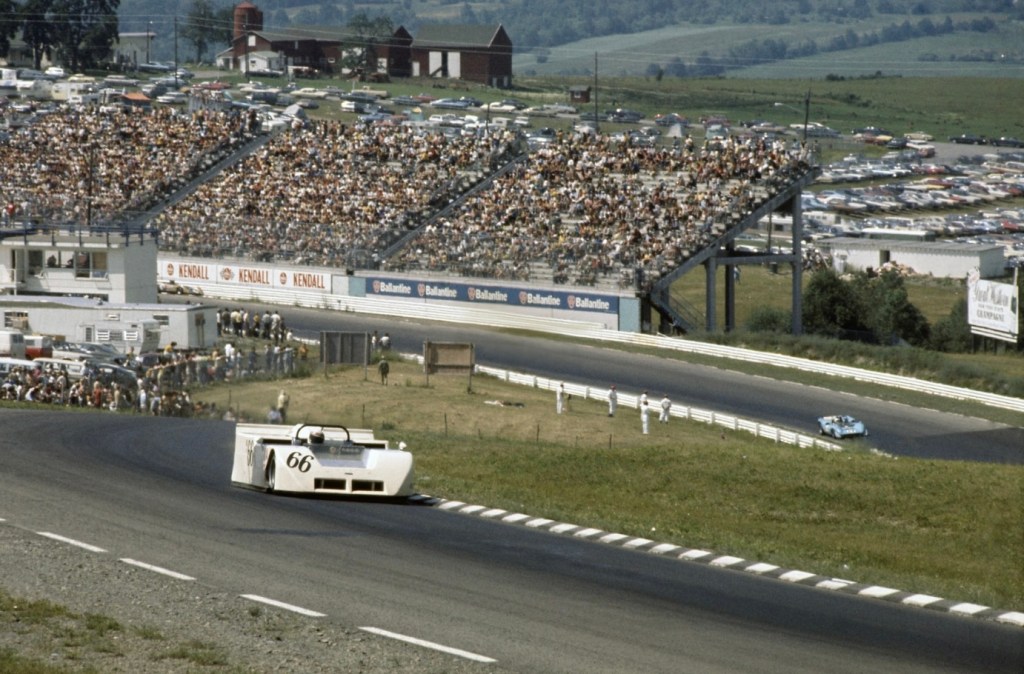
Jackie Stewart during practice at Watkins Glen, and below, a wonderful race day panorama (LAT)(LAT)
Stewart, and Vic Elford, retained by Hall to drive the car for the balance of the series, experienced the same other worldly, steep learning curve – retraining the brain about what was possible – as Mario Andretti encountered with Peter Wright and Colin Chapman’s Lotus 78-79 ground-effect cars in 1977-1978.
In a practical sense, half the problem was keeping the auxiliary engine alive – remember it wasn’t designed for this application – in its new harsh environment with all the trackside detritus the fans sucked up from the bottom of the car and regurgitated out the back at speed. Not to forget the skirts and their support mechanisms. The engineering challenge of this lot was mega.
Stewart qualified the brave-new-world 2J third behind the dominant orthodoxy, Denny Hulme and Dan Gurney’s new Batmobile-Beautiful McLaren M8D Chevs. Jackie closed on Dan during the race before being forced to pit, then went out for another seven laps – 22 in all – he bagged fastest lap before braking problems ended his race.
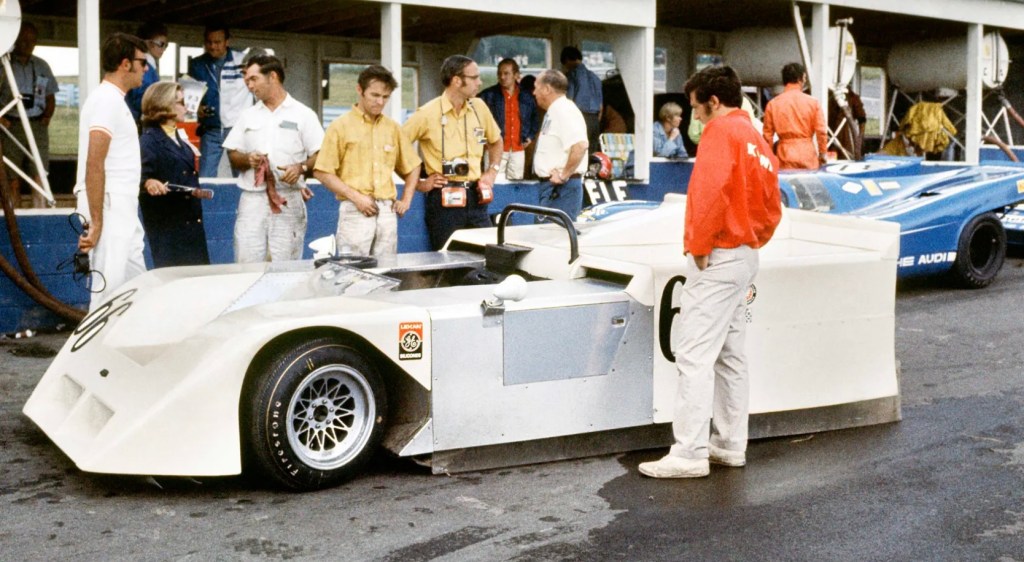
2J-001 at rest in the Watkins Glen pitlane. Sole sponsor decal is for GE-Lexan. Porsche Salzburg 917 of either Vic Elford or Dickie Attwood behind (LAT)Stewart blasts past Attwood’s third placed Porsche 917. While Hulme’s McLaren M8D Chev won at Watkins Glen, the next six placings were taken by Group 5 enduro cars, not the Group 7 cars for which the race was run. Said Porsche 917 and Ferrari 512S’ had already done the Watkins Glen 6-Hours the day before, most without an engine change between the two races. The JW 917 of Pedro Rodriguez/Leo Kinnunen won (unattributed)
Context is everything. The Glen’s Can-Am round was always topped up by Group 5-6 World Endurance Championship cars which were also in town for the Watkins Glen 6-Hour.
The dominant 1970-71 endurance racer was the swoopy-rounded, spaceframe, 4.5-4.9-litre flat-12 engined Porsche 917. Alongside the 917 the 2J looked like a Sci-Fi film prop!
The Texans missed the next three rounds at Edmonton, Mid Ohio and Road America to further develop the car before rejoining the circus at Road Atlanta in mid-September.
Elford recalled his impressions of the car to MotorSport, “Drving the car was just out of this world. The start-up procedure was a bit like an aeroplane I suppose, you didn’t just jump into first gear and drive away.”
“I put my left foot hard on the brake to make sure it didn’t go anywhere, then fire-up the little engine which immediately started to drive the two monster fans at the back, sucking up the air underneath. When I did this the car would literally go: ‘Shhhp!’ and lower itself down to the ground by about two and a half inches.”
Such was the suction of the turbines, the 2J could tootle off on its own at up to 30mph if the brakes weren’t applied.
At Road Atlanta Vic popped it on pole and finished sixth after ignition problems with the snowmobile engine.
“You get to the stage of thinking it’s just not possible to go around any corner at that speed, and adapting to it mentally is the most difficult approach because no other car has ever gone around a corner as fast as this one,” Elford recalled.
“Another great thing about the suction is that it doesn’t allow the cars’s handling characteristics to change as you go through a corner. Whichever way it’s set it remains that way at all times, whether its a fast corner or a slow swerve – it remains absolutely constant.”
Come race day Elford was always impacted by the three speed semi-auto transaxle, rather than the four of the LG600 Hewland equipped competition, that wasn’t the problem at Road Atlanta though, it was the subsidiary engine.
Laguna Seca followed a month later. There, Elford was the only car to go under a minute, a smidge less than two seconds quicker than Denny Hulme, despite never seeing the place before…
“I went around Laguna in 59 seconds and it was about five years before the next car managed to go under a minute, and that was an Indycar!”
He didn’t get to start from pole as the Chevy popped a-leg-out-of-bed in the warm-up early in the day, and there simply wasn’t the time for the Midland boys to pop in a new engine. The complexity of an engine change involved pulling much of the car apart and reassembly, a days work. It was an immense bummer for the Californian crowd.
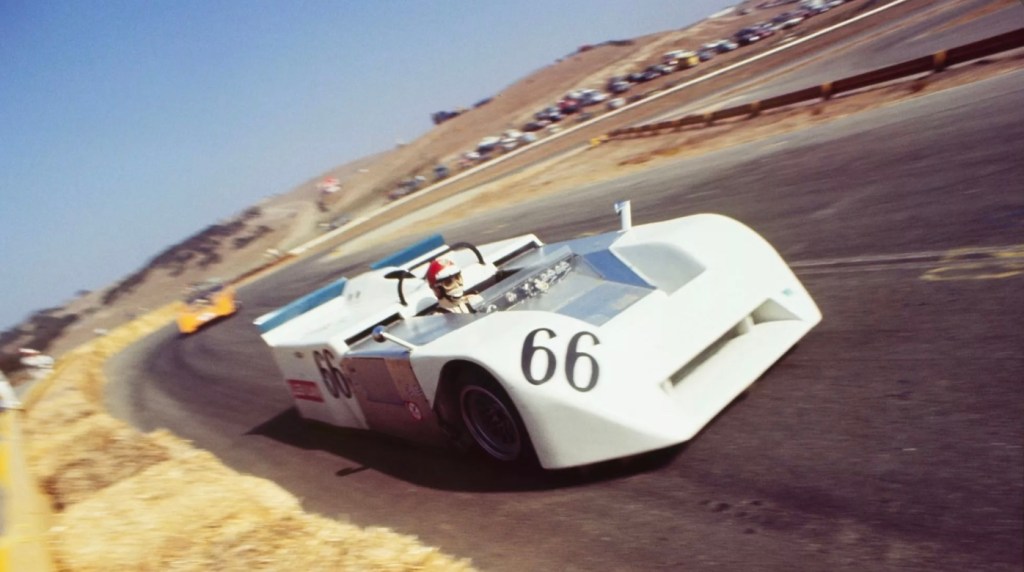
Beautiful Laguna Seca profile shot of Vic Elford shows the unmistakable slab-sided lines of the car and operation of the skirts which appear to be riding the bitumen pretty well (unattributed)Imagine being showered by fast moving trackside shrapnel at 170mph, Dyson have nothing on this vacuum-cleaner! Elford in the Road Atlanta pitlane
The final Can-Am round was at Riverside a fortnight later. There, Elford was again well clear of Hulme in qualifying, this time the gap was a little over two seconds, these are huge margins folks.
“At one point we came into Turn 9 with Denny Hulme just in front of me. I was right up against the wall and I probably didn’t even change gear. I drove all the way around the outside of Denny in third gear. He went straight off, went into the pits and took his helmet off, sat on the pit wall and sulked for the next half hour!”
This time the Rockwell engine didn’t play ball, breaking its crank. The team managed to patch it up and take the start but it inevitably failed on lap two.
And that was it, the howls of protest were loud and long.
Not that there was any way known the 2J didn’t bristle with illegal ‘moveable aerodynamic devices’! No way can the SCCA officials who saw the car pre-season could have thought it otherwise, but – bless-em – they probably thought “Let ‘em run, the crowds will be huge and we’ll see what happens from there.”
In the process of banning it, the SCCA ripped the soul out of Can-Am in that Hall and his boys walked away.
Can-Am’s attraction was its anything goes nature which invited innovation. Anything goes was great, unless, it seems, it threatened the dominant orthodoxy. To me there was Chaparral-Can-Am and Post-Chaparral-Can-Am and the former was vastly better than the latter, with all due respect to Porsche and Shadow.
Elford in front of one of the Papaya-M8D-Terrors at Laguna Seca. Hay bales still very much around in 1970 (H Thomas/Getty)Brian Redman, Jim Hall, the Chaparral crew and their Lola T330/332 Chevs were the dominant US F5000 force from 1974-76. Here the duo are in the Elkhart Lake pits in 1974, Lola T332C Chev
Still, Hall kept his core team together running Lolas in the US F5000 and single-seat Can-Am championships, then had the joy of watching Lotus carry the ground effect torch forward, not that Chapman ever gave any credit his way, our Col never did that to anyone.
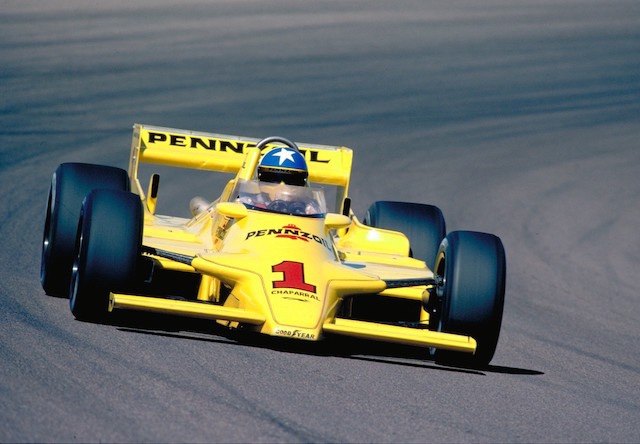
Hall then returned with the John Barnard designed ground effect Chaparral 2K Cosworth which won the CART championship and the Indy 500 in 1980 with Johnny Rutherford at the wheel.
Lone Star JR on the way to a win at Indy in 1980, Chaparral 2K Cosworth (IMS)
That Automobile Year 18 I prattled on about at the start of this masterpiece was hugely influential in stimulating my interest in cars and racing. Six of my Top Ten cars I first saw in that tome; Ferrari 312B, Lotus 72 Ford, Ferrari 512S, McLaren M8D Chev, Ferrari Dino 246GT and of course the Chaparral 2J. The Ferraris and McLaren are all about sex-on-wheels, the 72 and 2J are a tad more cerebral.
This article made me consider what the most influential racing car in my lifetime is? Its ‘gotta be a toss-up between the Lotus 25 Climax and 2J.
All monocoque racing cars are related to the 25, the first modern monocoque. The aerodynamics of racing cars since the Lotus 78 are related to the 2J. Let’s toss the coin as to which is the more influential, let the debate begin!
PS…
I ‘spose you think I’ve forgotten John and Charlie Cooper, but they were doing their mid-engined thing way before I was born, so, I’ve dodged that debate at least. In any event, Auto Union’s mid-engined missiles won GPs pre-war.
May 1967Thinkin, always thinkin. Jim Hall at Riverside in 1966 (B D’Olivo-Getty)
Credits…
MotorSport Images, sportscardigest.com, Indy Motor Speedway, Getty Images, J Meredith Collection, Harry Hurst, Sports Illustrated, Sportscar Digest, MotorSport November 2020 article by James Elson
Tailpieces…
“Aw come on Jim, it’s years since you raced in F1, time to return and give things a bit of a shake up.”
Jim Hall and Jackie Stewart pre-race at Watkins Glen. “Just make sure you have your left foot on the brake when we fire it up or you’ll mow down half the paddock!”
Note the fan-covers missing at Watkins Glen but present in subsequent races.
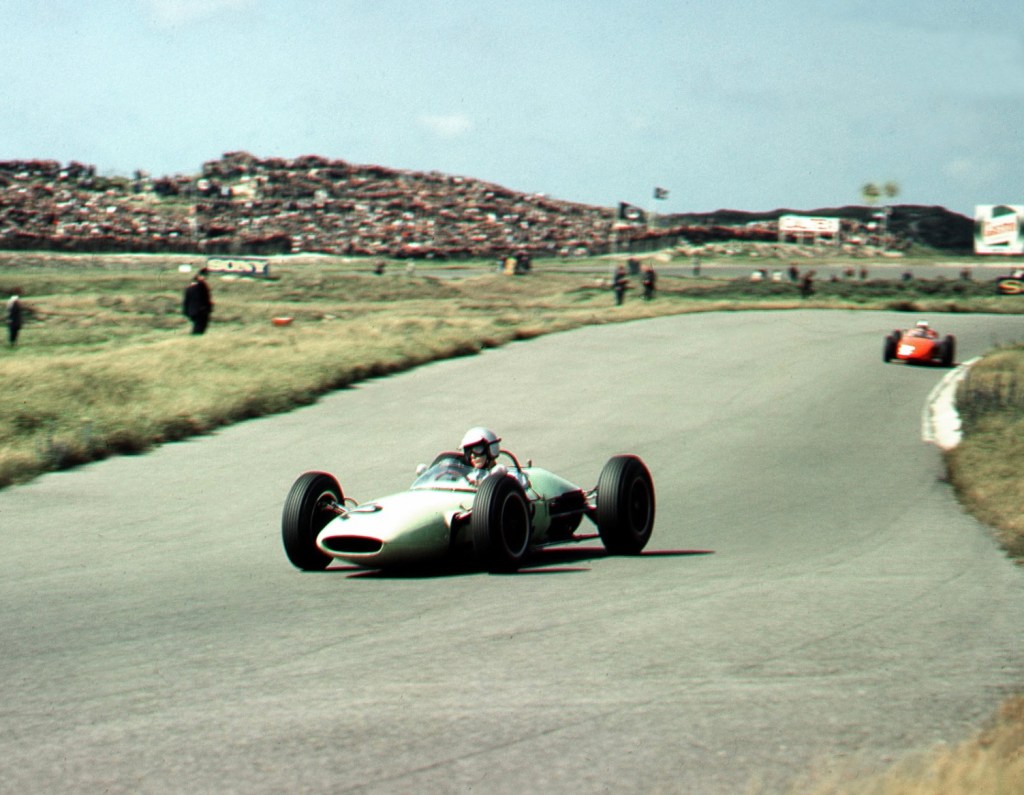
Jim Hall’s British Racing Partnership Lotus 24 BRM during the 1963 Dutch GP at Zandvoort, eighth in the race won by Jim Clark’s epochal Lotus 25 Climax. Carel de Beaufort’s ninth placed Porsche 718 in the distance (MotorSport)
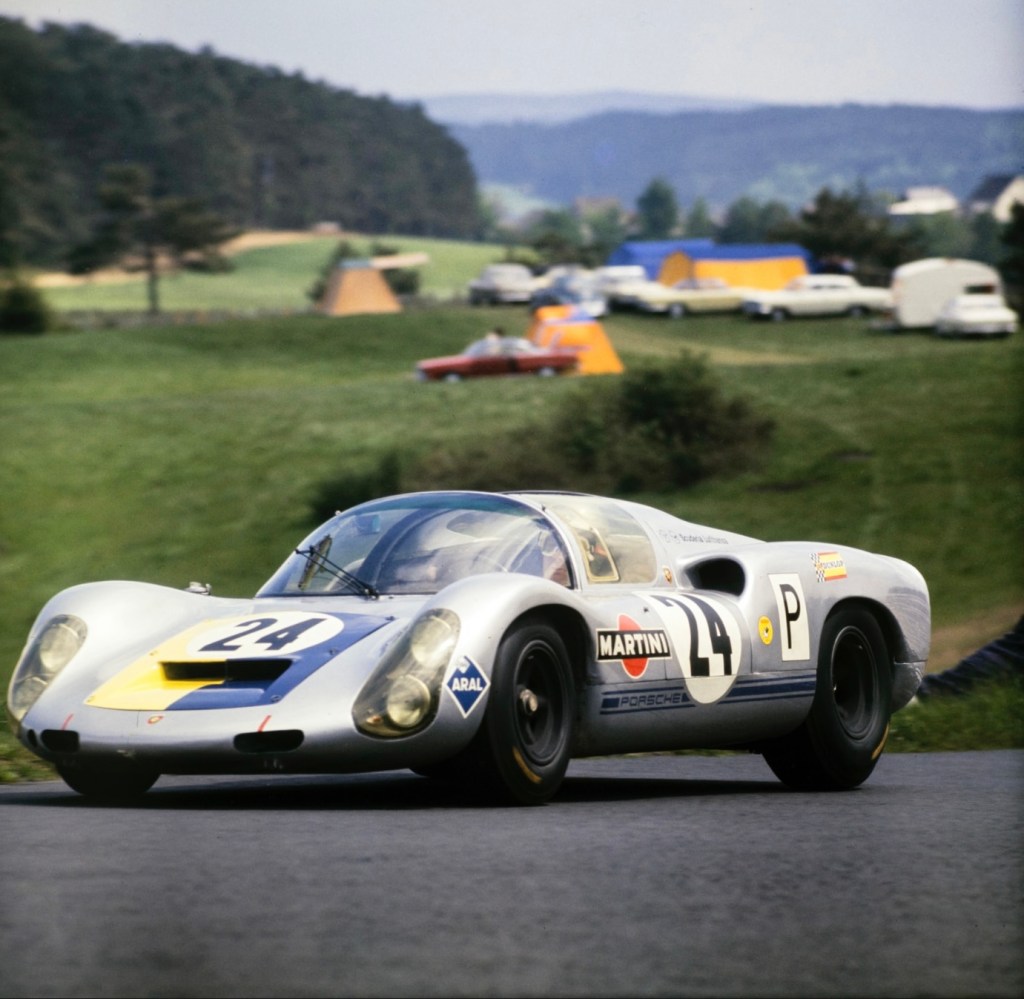
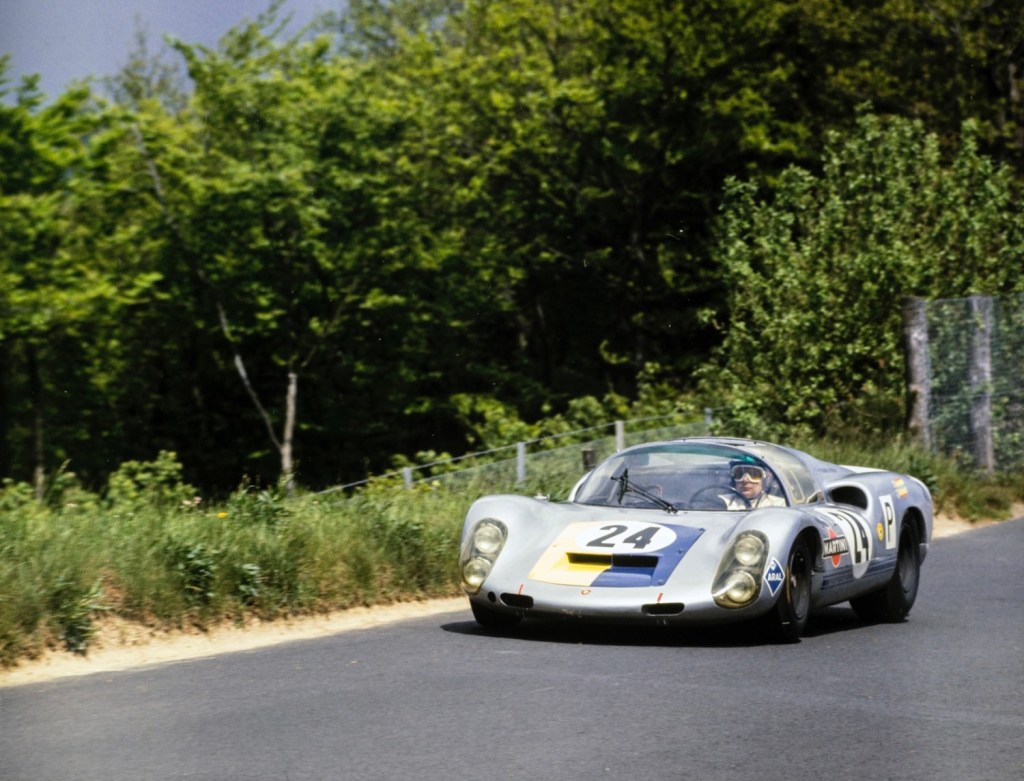
Hans-Dieter Dechent wasn’t quite in on the start of Martini & Rossi’s (M&R) support of motor racing, but his Lufthansa Racing Porsche 910 was the first racer to carry the famous livery substantively, when non-trade advertising was permitted on racing cars in 1968.
Here he is enroute to a DNF with engine failure in the 910 he shared with Robert Huhn in the 1968 Nurburgring 1000km.
M&R sponsored two Alfa Co US entered Alfa Romeo Giulietta SZ’s raced by Charlie Kolb and Paul Richards at the 1962 Daytona 3 Hours. The machines were devoid of the corporate branding with which we are all so familiar, instead they had Martini & Rossi Racing Team discretely sign-written atop the front quarter-panels.
Paul Richards’ Alfa Giulietta SZ in the Daytona 3 Hours paddock in 1962 (N Cerutti)(MotorSport)
Martini’s German head of PR, Paul Goppert, and his friend, Dechent, took things up a gear with M&R’s support of the Scuderia Lufthansa Porsche 910 (above) owned and driven by Robert Huhn, a Lufthansa executive, together with Dechent.
Among strong results Dechent won his class racing a Porsche 906 in the 1967 Nurburgring 1000Km and was third outright in a 907 at the 1969 Monza 1000Km behind the works 908/2s of Jo Siffert/Brian Redman and Hans Hermann/Kurt Ahrens.
In 1970 the Martini & Rossi International racing team – later Martini Racing – was formed.
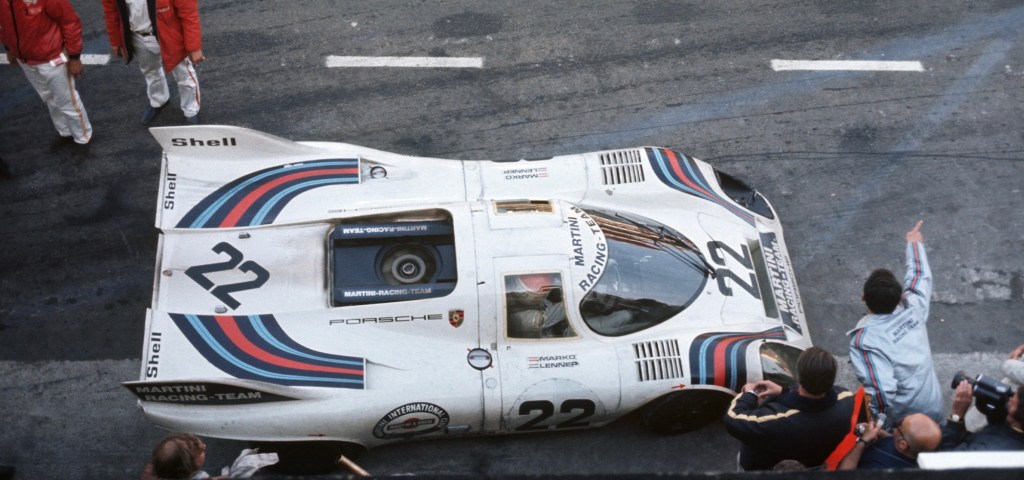
Gijs Van Lennep in the Porsche 917K he shared with Helmut Marko to victory at Le Mans in 1971 (DPPI)(DPPI)
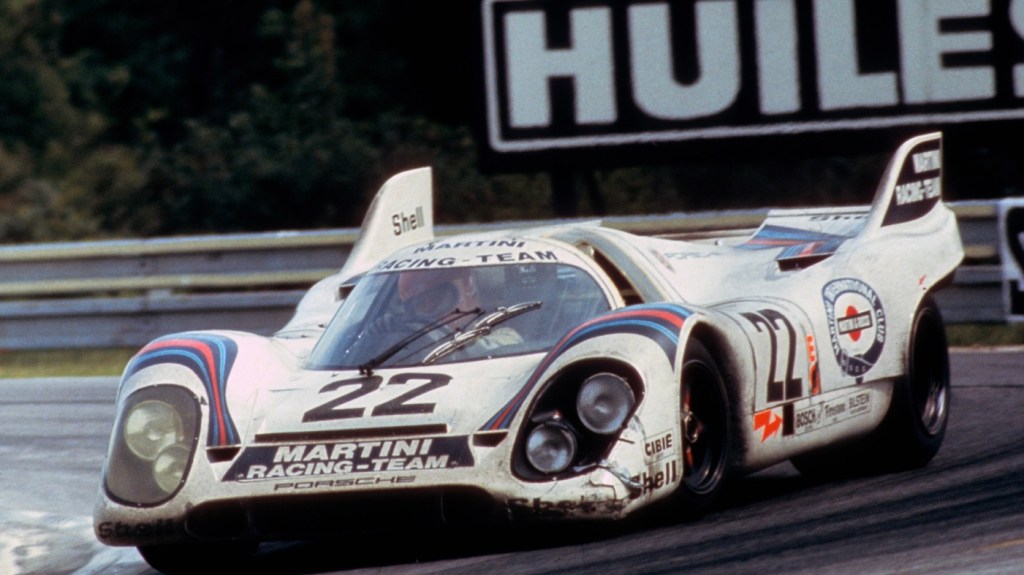
With the assistance of Hans-Dieter the Martini & Rossi relationship with Porsche became enduring. He hung up his helmet to take on the role of Team Manager of Porsche Salzburg in 1970, and in addition had responsibility for the M&R sponsorship. The first M&R Le Mans win followed in 1971, the victorious Porsche 917K was crewed by Gijs Van Lennep and Helmut Marko.
Dechent moved on from Martini Racing to other motor racing team management roles (see here; Motorsport Memorial – Hans-Dieter Dechent) he was replaced by David Yorke at the end of 1971. Lets not forget the critical role Dechent played in ‘commencing’ an iconic team/brand/livery.
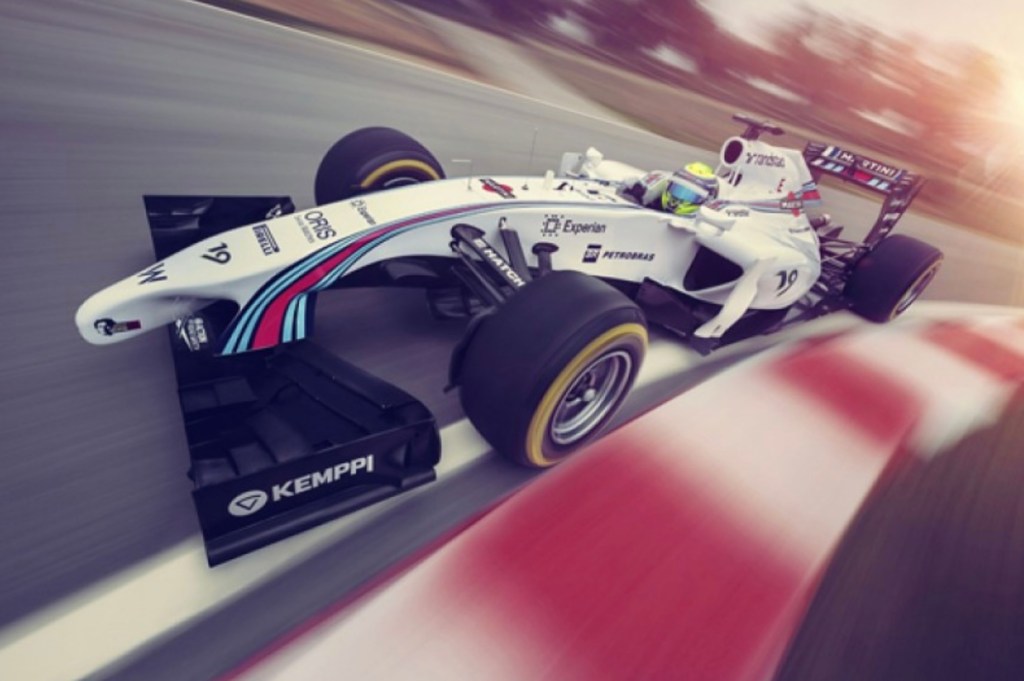
The 2014 Williams FW36 Mercedes with Felipe Massa up. Best results for the year were third places for Valtteri Bottas in Austria, Hungary, Russia and Abu Dhabi, and Felipe Massa in Italy and Brazil (Autosport)
The amazing thing about the Martini & Rossi house-style – as the brand consultants call it – is that it makes every car to which it’s applied look better, faster…
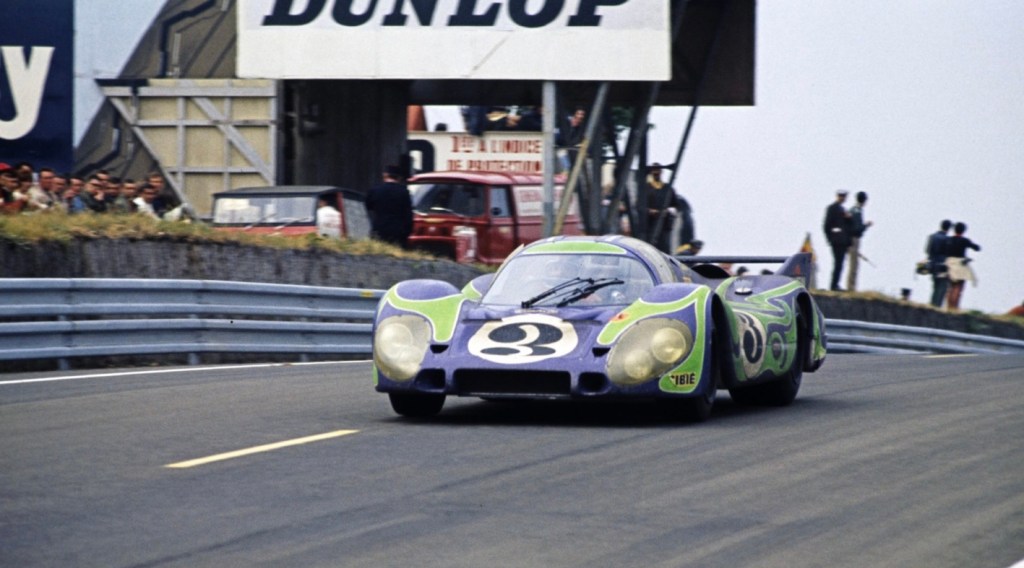
Surely one of the most iconic racing car liveries of all is the car Hans-Dieter Dechent turned over to Porsche designer Anatole Lapine for special treatment in 1970.
The Gerard Larousse/Willy Kauhsen Porsche 917 Langheck, chassis 917/21, first raced at Le Mans in June.
The Martini & Rossi sponsored, swirling psychedelic, green and purple Hippie-Car – second behind the winning 917K of Dick Attwood and Hans Hermann – has a cult following which transcends race-fans.
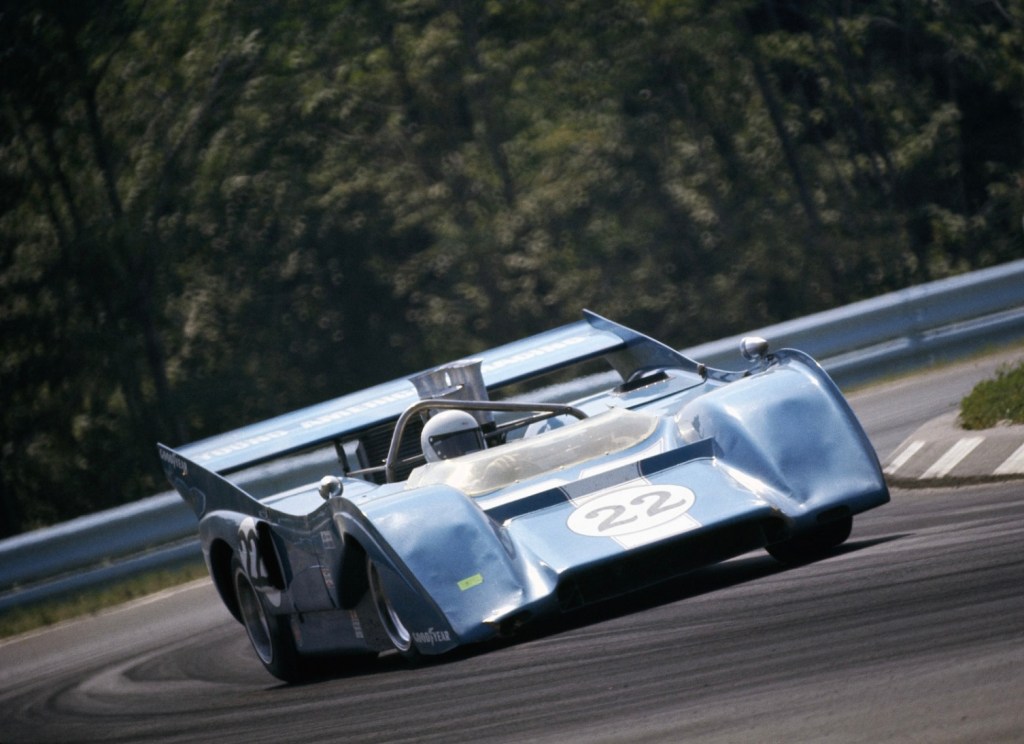
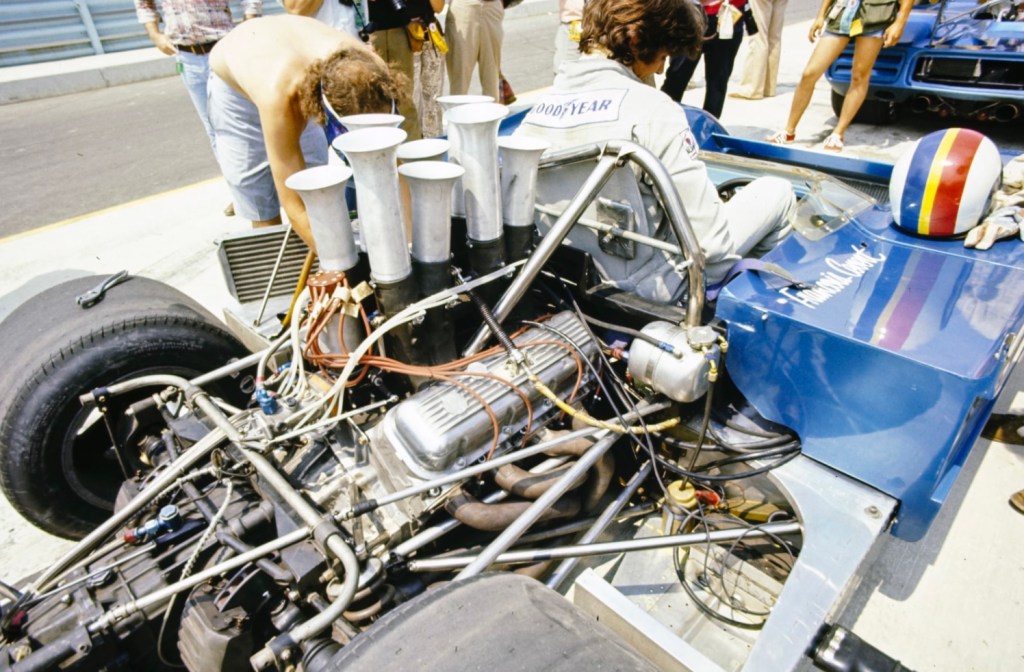
French Grand Prix ace Francois Cevert raced this McLaren M8F Chev with great skill, flair and commitment during 1972, here over the July 23 weekend at Watkins Glen.
His best results in the Young American Racing Team (YART) ex-works/Peter Revson 1971 Can-Am Cup winning M8F/1 chassis was a win at Donnybrooke in mid-season, second place at Road America and third placings at Watkins Glen and Laguna Seca.
The dashing, fast Frenchie adapted well to the big-cars, was rarely out of the top-five qualifiers, and finished fifth in the drivers title behind three Porsche 917/10s – headed by George Follmer – and Denny Hulme’s second placed McLaren M20 Chev.
(MotorSport)
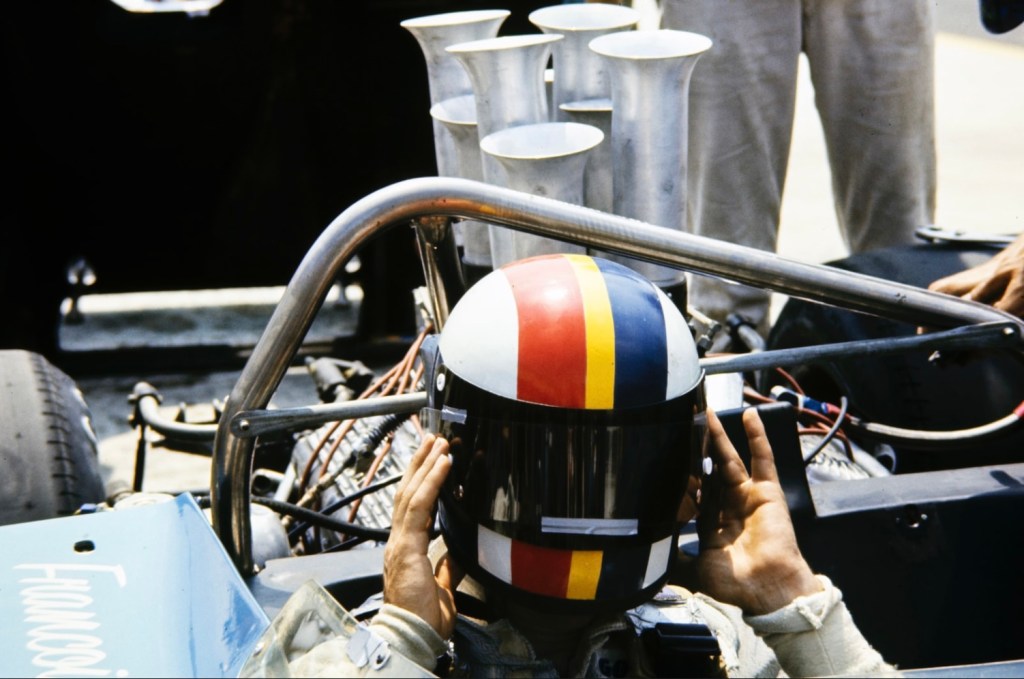
The shot above shows the great Frenchman pressing on at Watkins Glen, and loading up below in front of 8 to 8.4-litres of 740-830bhp big-block aluminium injected Chev V8.
(MotorSport)(MotorSport)
The wonderful thing about Can-Am cars is the subtlety and nuance of the things! Everything about them is big, brash, brassy and loud, quintessentially American some might say.
What’s not to like? Oh to have seen theses babies race in anger, in period…
(MotorSport)
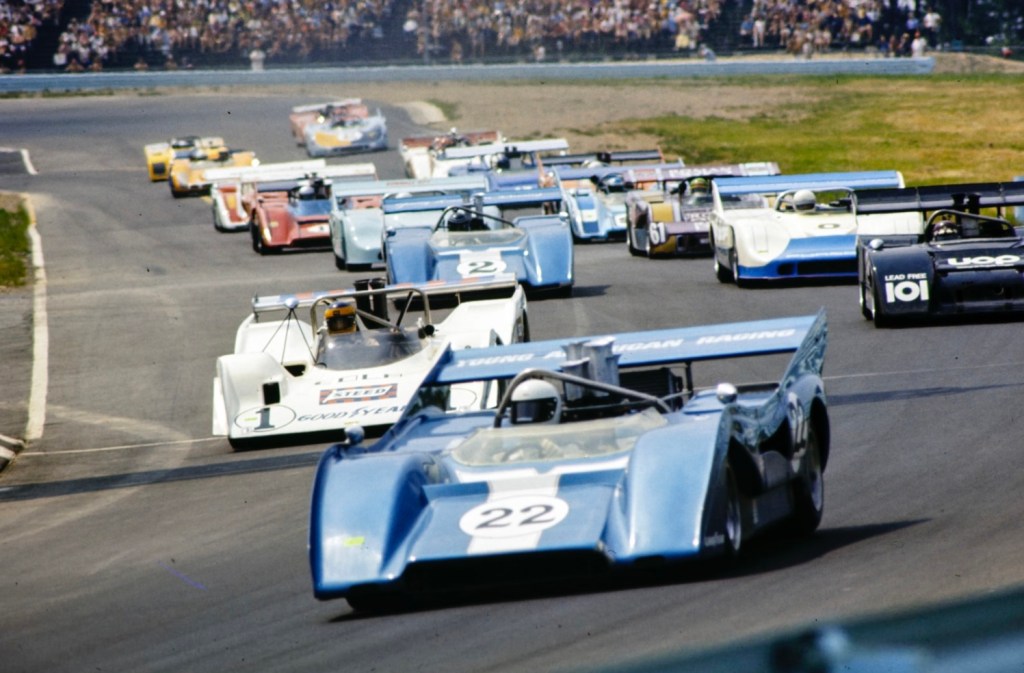
Watkins Glen, the first of sixty 5.435km laps, 326km in total. Francois leads a pack comprising David Hobbs, Lola T310 Chev, Jackie Oliver’s Shadow Mk3 Chev, then Greg Young in the other YART M8F #2 and Milt Minter’s Porsche 917/10 to the right. The Hulme and Revson McLaren M20s, and Follmer’s 917/10 are already up the road a bit.
Hulme won from Revson and Cevert but it was all Porsches up-front for the remaining six rounds with the exception of Francois’ Donnybrooke win; the McLaren Can-Am era which commenced in 1967 was finally, sadly, over.
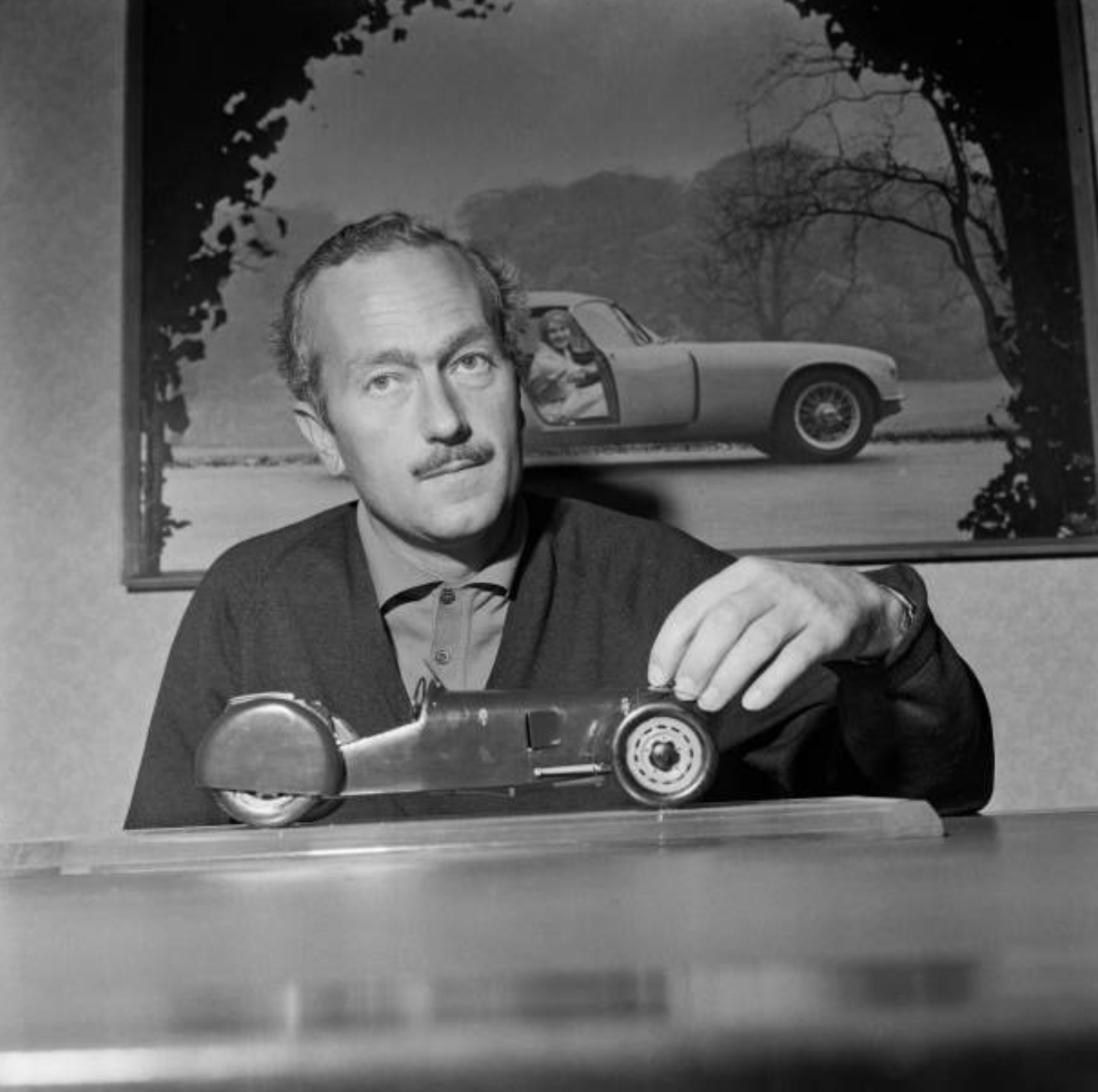
Colin Chapman in thoughtful mode posed with a model of a Lotus Mk6, the shot is dated September 14, 1963.
I wonder what the purpose of the press visit was? For sure Ronald Dumont, the photographer and perhaps an accompanying motor-noter weren’t there to discuss the Mk6 or the Elite shown in the background.
Chapman’s primary programs that year were winning Lotus’ first F1 World Championship – Chapman’s part-credit for Vanwall’s 1958 Manufacturers Championship victory duly noted – together with Jim Clark and the Lotus 25 Climax, and winning the Indy 500 with Clark, FoMoCo and Lotus 29 Ford. He ticked the first box that year, but not the second, not yet anyway.
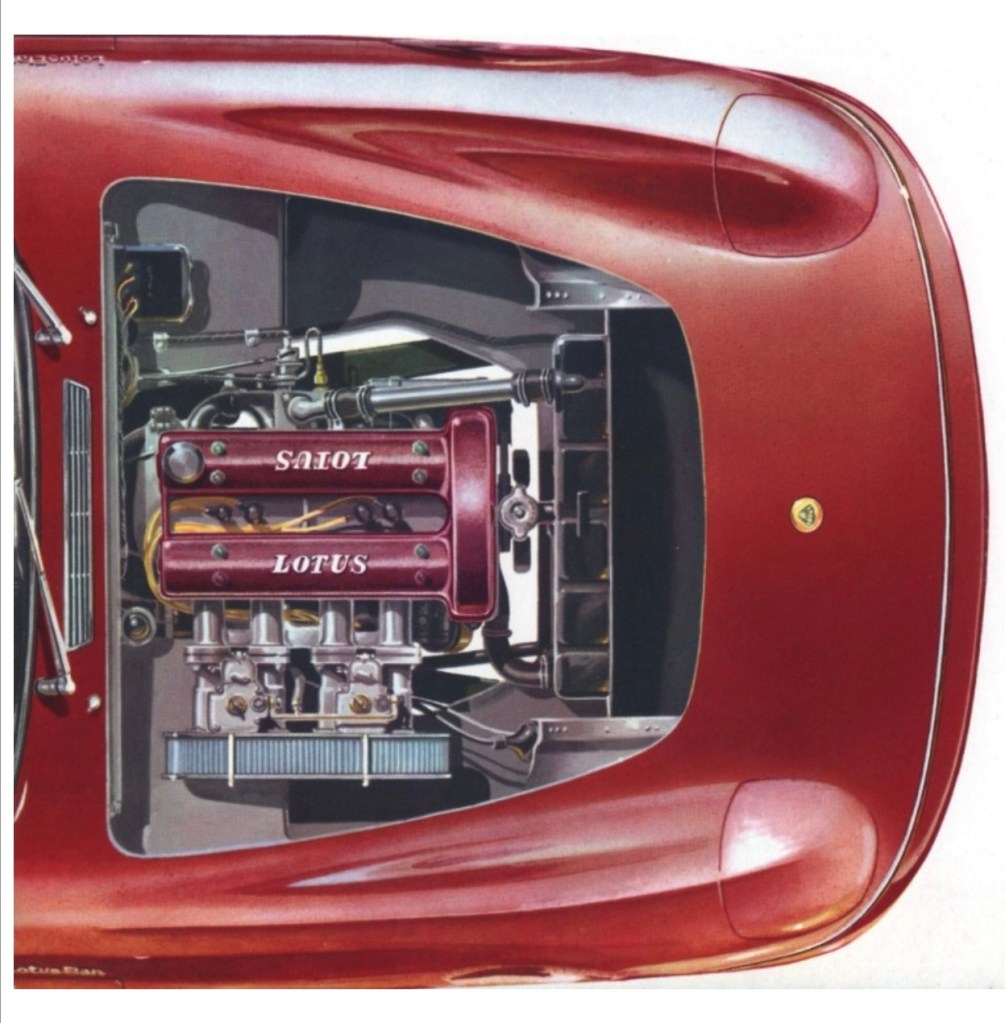
Design drawing of what became known as the Elan, by Ron Hickman dated November 1962 (R Hickman)
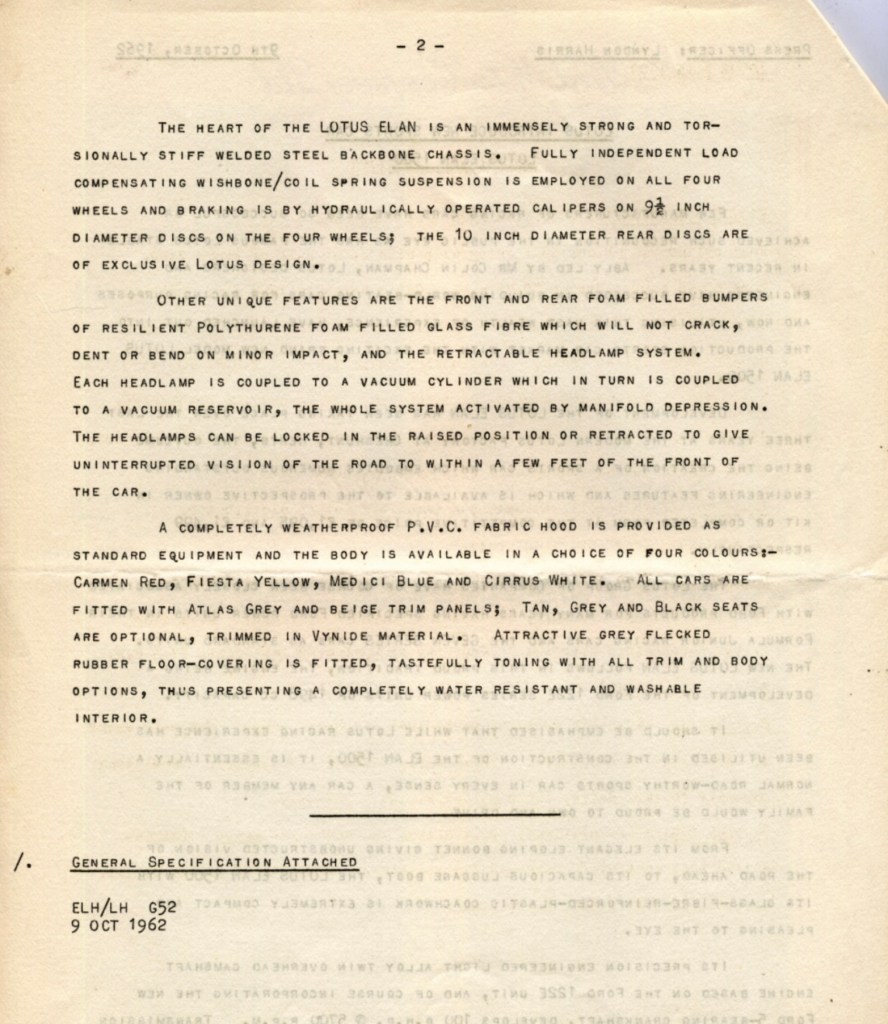
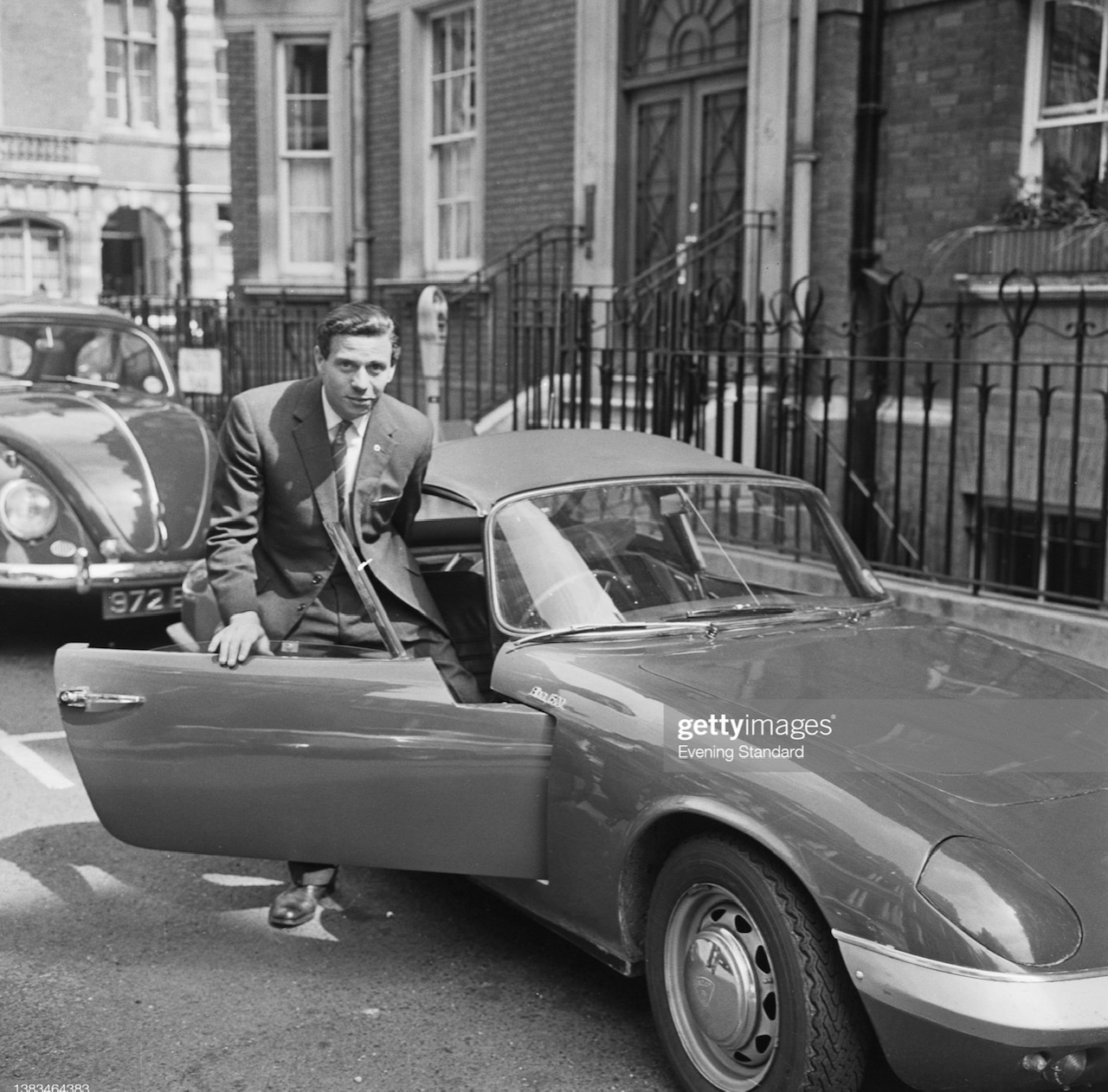
I know what the visit would have been about! The Elan was introduced in October 1962, that’s it. Ignoring the fact the car(s) in the shot are a 6 and Elite…
(unattributed but I’d love to know the artist if anyone can oblige)
It’s interesting how Ford sought to capitalise on the growing relationship with Lotus, something of a model for partnerships between a major automotive corporate and a more nimble performance specialist firm.
FoMoCo)(Lotus Cars)(Lotus Cars)Elan production line at Hethel circa 1970 (Lotus Cars)
Where would motor racing have been, and historic racing now, without the giant-killing Lotus Ford twin-cam engine in all of its various guises; road, race and in the forests and hills?
For the last few decades the aerodynamics of racing cars have been developed with the aid of complex computer modelling and sophisticated wind tunnel testing. Things were a bit different in 1964 as Bruce McLaren finalised the specifications of the first McLaren built from the ground up in his own factory – as against the Tasman Cooper T70s he and Wally Willmott built at Cooper in later 1963 – the McLaren M1.
The Kiwi’s head was full of ideas, he was up to his armpits doing countless laps of Goodwood helping to get the best from Ford Advanced Vehicles’ new Ford GT40. His nascent Bruce McLaren Motor Racing Team was racing the Cooper Oldsmobile, a further mutation of the ex-Roger Penske Zerex Climax Special. Then there was his day job with Cooper as leader of their F1 team. Not to forget Cooper’s own Climax engined ‘Monaco’ sporty, or Lola’s Mk6 GT Ford, he had done plenty of laps in those too.
Bruce McLaren at right, and Eric Broadley – lead design engineer – in the brown shirt at left and Ford GT40. It’s the May 1964 Nurburgring 1000km, race debut of the car, DNF suspension. Note the radiator top-ducts (unattributed)
Never was a man better placed than Bruce right then to know exactly what a winning sports-racer’s attributes needed to be. After all, in June he’d won the Players 200 at Mosport in front of some of the best in the world (Dan Gurney, Jim Hall, AJ Foyt, Roger Penske and Ken Miles) aboard his just finished Cooper Olds aka Zerex Special. This very finely honed grandfather’s axe had just copped a new McLaren built centre cockpit section and 3.9-litre Traco modified Oldsmobile V8 to replace the lissom Coventry Climax FPF four. More on the Zerex Special here; Roger Penske’s Zerex Special… | primotipo…
While testing the Cooper Olds at Goodwood, McLaren’s mechanics, Wally Willmott and Tyler Alexander got tired of continually removing the front section of the Cooper Olds bodywork, just to check brake and clutch fluid levels. So they decided to cut a small access hatch above the master cylinders, it was hinged at the front and held shut with a Dzus fastener at the rear.
Cooper Oldsmobile and a busy Tyler Alexander in the Goodwood paddock, June-July 1964 – still with the Mosport ‘quickie’ stack exhausts and winning numerals attached (W Willmott)
On one of Bruce’s test runs the fastener came loose. McLaren noticed the flap lifting, showing negative pressure just where he thought it would be positive, and would therefore hold the flap shut.
Bruce, Wally and Tyler discussed the phenomena. They concluded that if it was a low-pressure area, they could exhaust hot air from the water and oil radiators through the top of the body to assist cooling. The method until then had been to exit the air around the front wheels.
They decided to change the radiator air exit, so Tyler set-to with tinsnips and cut a big square hole in the body behind the radiator. The flap of alloy wasn’t cut at the top but folded down behind the radiator to deflect the air upwards.
Tyler Alexander takes the tinsnips to form the Cooper Olds’ radiator exit duct. The smaller flap which popped open is clear, Goodwood (W Willmott)
After his test run with the changed nose, George Begg wrote, “Bruce reported that the front of the car now had better grip, this helped reduce high speed understeer. In turn this meant a larger rear spoiler could be employed so as to again balance the car’s handling at high speed.”
“This was a big breakthrough as it meant both better cooling and higher downforce from the body. Back at the factory an alloy panel was made and fitted to smooth the flow of air through the big square vent in the top of the bodywork.”
The Cooper Oldsmobile raced with the top-duct fitted for the balance of its life.
Bruce McLaren was the class of the field in the August 1964 RAC TT at Goodwood until clutch failure ended the Cooper Olds run – complete with now more refined bonnet top radiator duct (Evening Standard)
This innovation – I’m not saying McLaren were the first to do it, check out the duct on the Ford GT40 shown above that May – was then deployed on all front-radiator McLarens. Right from the first M1 sportscar – with the exception, for some reason, on the 1967 single-seaters – until the 1971 side-radiator M16 Indycar headed in a new aerodynamic direction initiated by Lotus’ epochal types 56 and 72.
McLaren’s approach quickly became the global paradigm. It really was a major advance, one borne of a dodgy Dzus fastener and the computer like brain of Bruce Leslie McLaren, with not a data-base or wind tunnel to be seen.
(GP Library)
Bruce McLaren aboard his brand new McLaren M1 Oldsmobile at Goodwood in mid-September 1964.
It’s his first run with bodywork – note the neat radiator duct – his first laps of the spaceframe machine were completed sans body, a practice followed for years with McLaren’s single seaters and sportscars.
The McLaren M1’s Engine at this stage was a Traco prepped circa 310bhp 3.9-litre aluminium V8, gearbox a Hewland four speed HD, wheels are Cooper magnesium. More on the McLaren M1 here; Lola Mk6 Ford, Bruce McLaren and his M1 Olds… | primotipo…
(Getty)
The finished product during the Bahamas Speed Week at Nassau in December 1964.
Bruce placed second to the Hap Sharp/Roger Penske driven Chaparral 2A Chev in the feature race, the Nassau Trophy, despite giving away a litre or so and several years of ongoing development to the Rattlesnake Raceway boys.
Wally and Tyler sending Bruce away after a pitstop during the 405km race – 56 laps of the 7.2km Oakes Field Course.
Apart from the two factory Chaparrals (Penske jumped into Sharp’s car after an off-course excursion), the classy field of outright contenders included Pedro Rodriguez in a NART Ferrari 330P, Walt Hansgen’s Scarab Mk4 Chev, Dan Gurney’s Lotus 19 Ford and Jerry Grant’s Chev engined 19.
It was a great start for McLaren, orders for the cars poured in, this led to the deal Teddy Mayer concluded with Elva cars to produce customer McLarens, an incredibly smart and lucrative way to deal with the punters…
(Getty – Bernard Cahier)
Reference and photo credits…
‘Bruce McLaren: Racing Car Constructor’ George Begg, Wally Willmott, GP Library, LAT Images, Getty Images – Bernard Cahier
There are drives which are spoken of in reverential terms down the decades, Pedro Rodriguez’ victory in the Brands Hatch 1000km in 1970 is one of those…
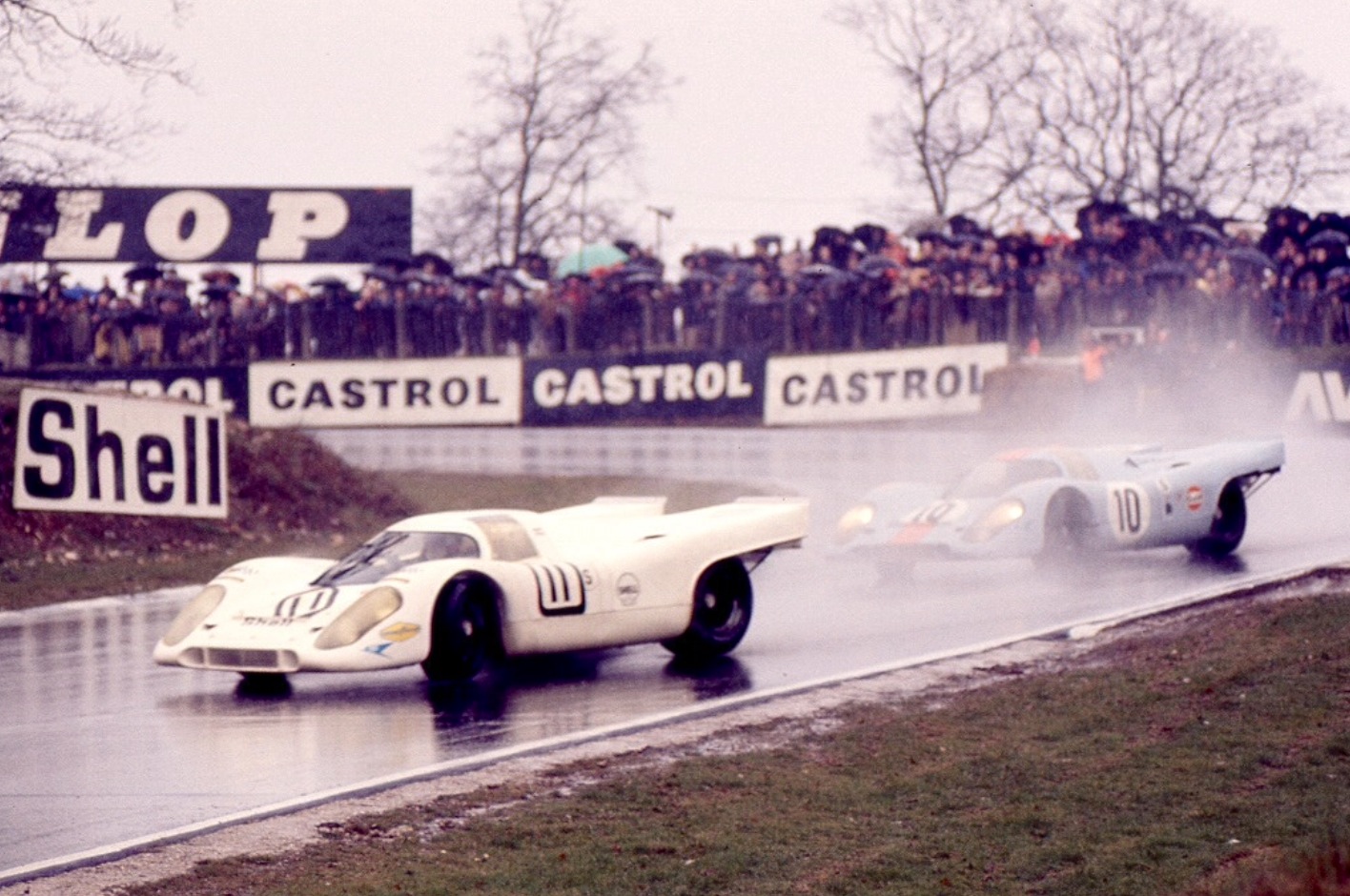
Here #10, the John Wyer entry is set to pounce on #11 Vic Elford out of Druids in another factory (Porsche Salzburg) Porsche 917K, the Brit was of course no slouch on slippery surfaces himself. He was European Rally Champion aboard a Porsche 911 in 1967 and Monte winner similarly mounted in 1968 before going circuit racing.
Acknowledged wet weather ace Jackie Ickx raced a factory Ferrari 512S in a Brands Hatch field full of F1 drivers who in those days also contested the sportscar endurance classics. But Pedro was in a class of his own on that sodden Kent afternoon finishing five laps ahead of the second placed 917K of Elford and Denny Hulme, and eight laps ahead of another 917K driven by soon to be 1970 Le Mans winners Hans Hermann and Richard Attwood, both in similar equipment to Pedro…
Stirling Moss’ Aston Martin DB3S heads down Silverstone’s straight on the approach to Copse, Silverstone, 5 May 1956…
Another factory Aston DB3S of Roy Salvadori won the race, The Daily Express Trophy meeting sports car event, with Bob Berry third in a Jag D-Type from Moss, he is behind Stirling in this shot. Roy Salvadori had a good meeting also winning the under 1500cc sportscar event in a Cooper T39 Climax.
Moss won the feature F1 event, the BRDC International Trophy over 60 laps/175 miles in Vanwall VW2 from the Connaught B-Types of Archie Scott-Brown and Desmond Titterington.
(unattributed)
Moss in Vanwall VW2 chases teammate Harry Schell in VW1 during the International Trophy, Moss won while Harry suffered a DNF with a broken fuel pipe.
I’m on tour at the moment in Italy and then England, back in Australia on July 5, my posts until then will be predominantly quickies.
The John Whitmore/Frank Gardner Ford GT40 Mk2 chases the GT40 crewed by Peter Sutcliffe/Brian Redman through the leafy Ardennes Forest on May 22, 1966.
Its not the leaves which trouble me, but rather the more substantial trees to which they are attached. The saplings (sic!) to the left are not too much of a worry but their big brothers to the right – like the big hombre at the corners exit point – look a tad more unyielding.
Still, the general idea is to stay on the tarmac, not go off-roading. The group of spectators have wisely chosen to locate themselves on the far side of the trees all the same. They must be Belgians, not young Italians.
(MotorSport)(AMR)
Alan Mann (with tie) and GT40P/1012 before the off, and under-the-Armco Eau Rouge shot below.
(AMR)
Mike Parkes and Ludovico Scarfiotti won the ’66 Spa 1000 kms in four hours 43.24 seconds from the Whitmore/Gardner Alan Mann Ford, then the Essex Wire GT40 driven by Peter Revson and Skip Scott with Peter Sutcliffe’s car fourth.
The race was held on the same weekend as the Monaco Grand Prix, so GP pilots were rather thin on the ground at Spa. Ford and Ferrari sent one works car each; the Parkes/Scarfiotti P3 was comfortably on pole from Whitmore/Gardner.
Parkes jumped away at the start, 4-litres of V12 led the Revson and Whitmore V8s then Lucien Bianchi, in Ecurie Francorchamps’ Ferrari 365P2. After 12 laps Parkes had lapped the field up to fifth place, by the mid-point it was Parkes/Scarfiotti, Whitmore/Gardner and Revson/Scott, the final race order.
The winning Parkes/Scarfiotti Ferrari P3 (MotorSport)(AMR)
Down the field there was plenty of scrapping among the Porsche 906s who chased the very quick Maranello Concessionaires Ferrari Dino 206S crewed by Richard Attwood and Jean Guichet. The Dino finished sixth outright ahead of two 3.3-litre 250LM Ferraris and behind the fifth placed Chris Amon/Innes Ireland Ford GT40.
The Gijs and David Van Lennep Racing Team Holland Porsche 906 follows the similar works car of Hans Hermann and Dieter Glemser, 15th and DNF (MotorSport)
Etcetera…
Peter Sutcliffe’s GT40, chassis P/1009, was the same machine he raced with Frank Matich to second place in the 1966 Surfers Paradise 12-Hour, it was the last time he raced it before sale to Ed Nelson.
Credits…
MotorSport, AMR-Alan Mann Racing
Tailpiece…
(AMR)
Majestic is the word which springs to mind. The #48 Jaguar E-Type following ‘our GT40’ is crewed by Mike Merrick and John Harper, it finished 16th.
Jackie Stewart’s Carl Haas/works Lola T260 Chev all cocked up ahead of Denny Hulme’s McLaren M8F Chev at Laguna Seca on October 17, 1971…
Peter Revson won that day in the other works M8F from Stewart and Hulme, it was the second last Can-Am Cup round, the title won by Revson from Hulme and Stewart with five, three and two wins respectively.
I’ve given the Lola and the ’71 series a really good go here in a long epic; Jackie Stewart’s 1971 Can-Am Lola T260 Chev… | primotipo… but the discovery of some great MotorSport testing shots of the car at Silverstone in May and June that year were too good to ignore.
Lola’s 1971 challenger was developed off the back of its quick 1970 T220/T222 raced with great speed by Revvie. They upped the ante the following year with another new car, run by Haas, well funded by the L&M tobacco company and driven by no less an ace than John Young Stewart.
As you will see from the article above, the only things the Lola program lacked – both critical mind you – was sufficient testing and development prior to the championship’s commencement in mid June, and a tad more luck!
(MotorSport)(MotorSport)
Frank Gardner shaking T260 HU1 down at Silverstone in May, doesn’t it look small in comparison to other Can-Am contenders of the day?
Gardner was Lola’s F5000 and development driver/engineer. He had a busy year extracting a little more pace from the (F5000) T192, and then, together with Bob Marston developed the smash-hit Lola T300 F5000 machine. A mountain of profits flowed into Eric Broadley’s coffers over the ensuing decade as Lola shifted dozens of T300/T330/T332/T333 machines.
Eric Broadley, Bob Marston? and who else folks, Silverstone test June 1971 (MotorSport)
Marston designed the T260 to a brief developed by Broadley. While the car had the same wheelbase as the dominant M8F, the car was narrower in both its front and rear track, and notably shorter in overall length. The car was very twitchy and difficult to drive at the limit, JYS later listed it as his least favourite racing car, by a nose from the 1966/7 BRM P83 H16. The T260 also had an understeer problem the team chased all year with all manner of different aero-treatments, most notably the cow-catcher additional front wing fitted in the final rounds.
(MotorSport)
The inboard mounted coil spring/Bilstein shock units were designed to allow huge, inboard disc brakes but Stewart vetoed that design approach given the failure of a front brake driveshaft fitted to a Lotus 72 Ford caused the death of his best friend, Jochen Rindt, at Monza in 1970.
Jackie later used inboard discs to good effect on the 1973 World F1 Championship winning Tyrrell 005/006s designed by Derek Gardner, but for the moment they were verboten.
(MotorSport)
Two T260s were built, the car shown is chassis HU1, Stewart’s racer all season, while HU2 was an unused spare in 1971.
(MotorSport)
Stewart shelters from the rain at Silverstone in June 1971, I wonder if he managed any dry laps before the car was shipped to North America for the first race at Mosport over the June 13 weekend?
(MotorSport)
The George Folz built, Lucas injected, circa 700bhp 8.1-litre alumium block Chev comes in for a bit of attention at Watkins Glen in late July. Jackie retired with gearbox problems after starting from pole. Revson won from Hulme and Jo Siffert’s Porsche 917/10.
(via Bonhams unattributed)
Credits…
MotorSport, Getty Images, Bonhams
Tailpiece…
Another angle on that radical, extended cow-catcher front wing in an attempt to get better grip at the front. LA Times Grand Prix, Riverside, the final Can-Am round on October 10, 1971. Hulme won from Revson and Howden Ganley, BRM P167 Chev, JYS DNF engine failure.


 (Louis Klemantaski)