Archive for the ‘Sports Racers’ Category

Ickx/Hobbs first place Mirage M1 Ford from Piper/Attwood Ferrari 412P and Hawkins/Love Ferrari Can-Am 350, Crowthorne Corner, Kyalami 1968 (G Kegel)

Paul Hawkins had a very successful African tour in November/December 1968 with his ex-works Ferrari 350 Can-Am, winning five of the seven races he entered.

Ferrari raced four P4s in the 1967 World Sportscar Championship, one of which was an upgraded P3, at the WSC seasons end two of the cars were lightened and modified to ‘350 Can-Am’ specification. David McKay acquired one of the cars at the end of the 1967 Can-Am Challenge Cup, ‘0858’, for Chris Amon to race in the 1968 Australian Tasman Cup round sportscar supporting events where he was beaten on every occasion he raced Frank Matich’s Matich SR3 Repco. The story of the P3/350 Can-Am is here; https://primotipo.com/2015/04/02/ferrari-p4canam-350-0858/

After Chris returned to Europe Bill Brown raced the car throughout the domestic Australian season until after the Surfers 6 Hour enduro at which point Hawkins bought it and took it to Africa.

Kyalami (royckdboats)


4176cc, DOHC three valve, twin plug, fuel injected V12, 480 bhp @ 8500 rpm, five speed transaxle. Kyalami (royckdboats)


PH getting stuck into the Pommery after winning the 1968 Monza 1000 km- he shared the winning Gulf Wyer GT40 with David Hobbs

The prestigious Kyalami 9 Hour was the first race on Hawkins’ tour, there, on 11 November, sharing with South African single-seater ace, John Love, they were third having started from pole, the race was won by the Ickx/Hobbs Mirage M1 Ford. Tim Schenken took fourth outright and a 2 litre class win in a Chevron B8 BMW he shared with Brian Redman.

A week later Hawkins won the Cape Town 3 Hour at Killarney and was again victorious on 1 December at the GP Bulawayo, on the Kumalo circuit, he was second in the GP of Rhodesia on the same weekend. He again placed second in the 3 Hour de Lourenco Marques, in Mozambique that race won by Mike Hailwood and Malcolm Guthrie’s Mirage M1 Ford. He finished his tour with victories in the Roy Hesketh 3 Hours in Pietermaritzburg and 500 Km of East London on January 4 1969.

In May Hawkins raced a Lola T70 Mk3B Chev at Magny Cours, he entered Mike Hailwood in the Ferrari with Mike winning the race despite Paul setting pole and fastest lap of the race. Several days later Hawkins won the Dijon International, this time Mike started from pole and did the fastest lap but finished eighteenth. Shortly after this Paul sold the car to racer/dealer David Piper who had plenty of opportunities to evaluate the merits of the car on circuit!

Cyril Simson/Hawkins Healey Sebring Spite s/c, 20th with Morgan and Ferrari 250GT SWB in close attendance during the 1960 Tourist Trophy, Goodwood- the victor, Moss Ferrari 250GT SWB (Getty Images)


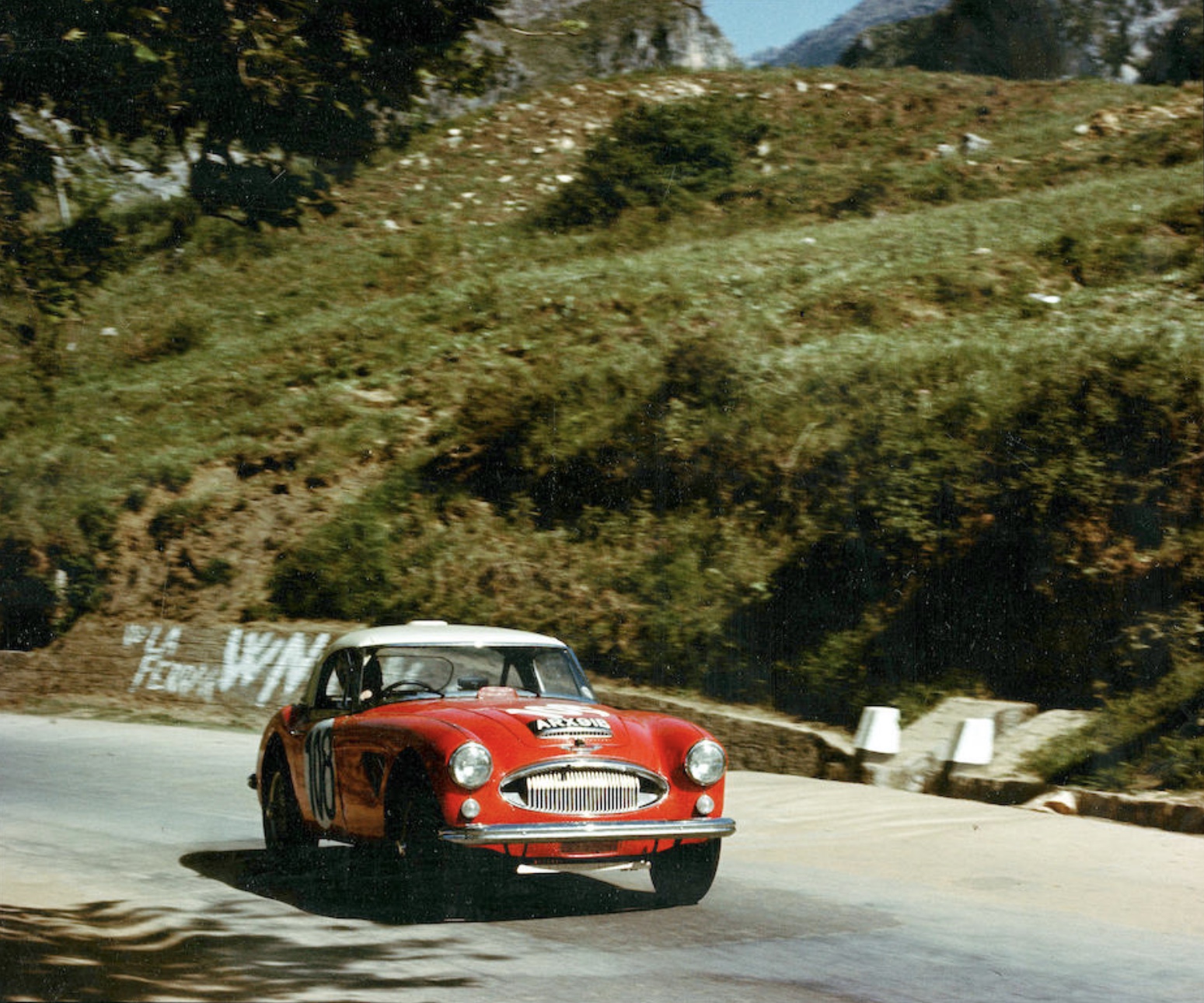
Hawkins/Makinen works Austin Healey 3000 during Targa in 1965. 21st and second in class. Vaccarella/Bandini won in a Ferrari 275 P2 (Bonhams Collection)


Paul Hawkins, Willment F2 Lotus 25 Coventry Climax FPF from Sam Tingle, LDS 1 Alfa Romeo during the 9 January 1965 Cape South Easter Trophy at Killarney, Cape Town, South Africa. Hawkins won from John Love and David Prophet (R Winslade)


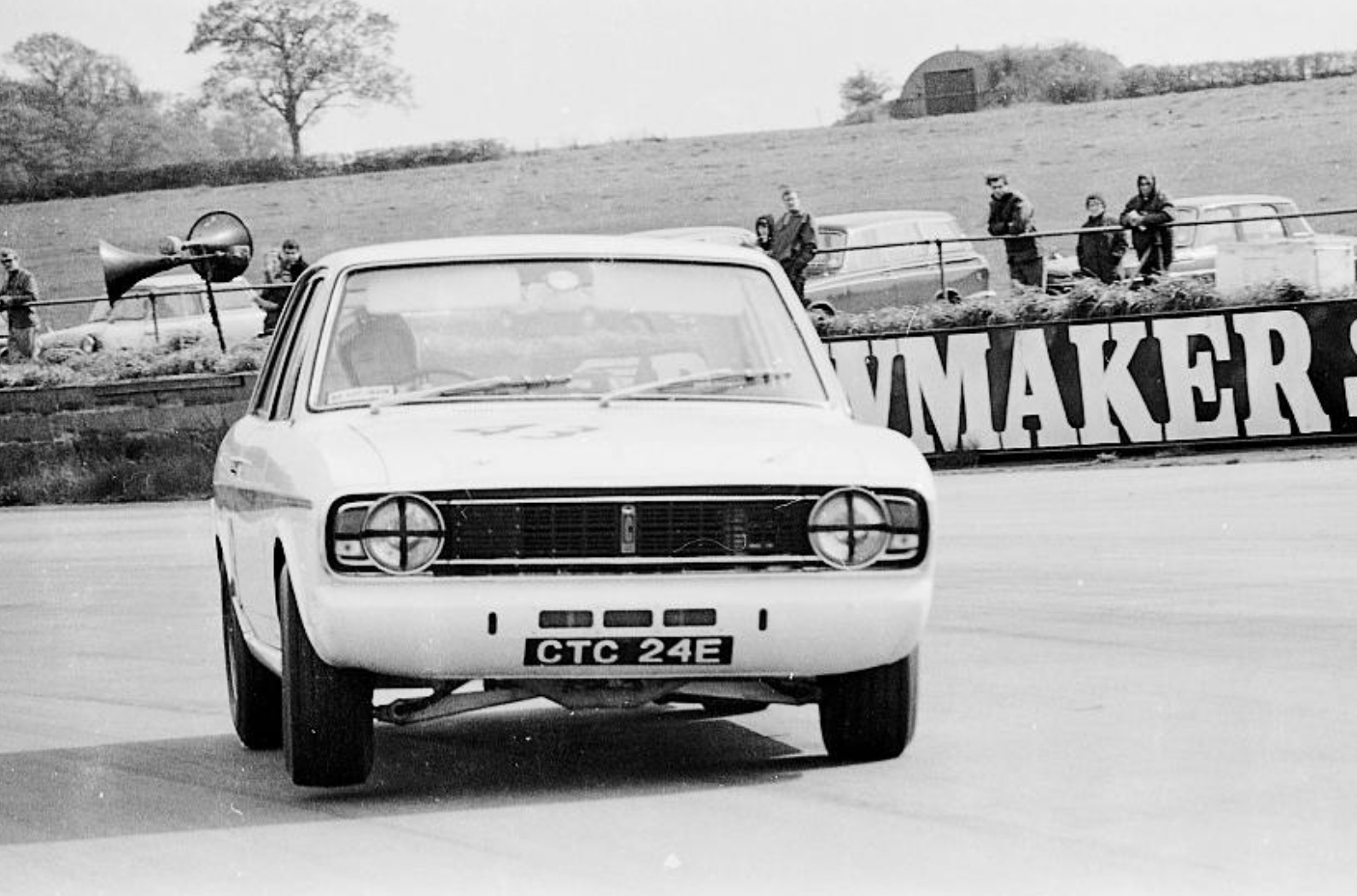
Hawkins in a works-Lotus Ford Cortina FVA Group 5 machine during the 1967 BTCC, circuit folks? (unattributed)

‘Hawkeye’ was born in Melbourne’s inner eastern suburb of Richmond on October 12 1937, his father was a builder who later became a clergyman. He started racing circa 1958, having a few runs in Terry Valmorbida’s Austin Healey 100S before jumping a ship to the UK where a job with Healey quickly led to racing the marque.

He progressed through one of the toughest schools of all, British Formula Junior and then Formula 2 with John Willment in 1964, he was ninth in the 1965 South African GP aboard Willment’s Brabham BT10 Climax.

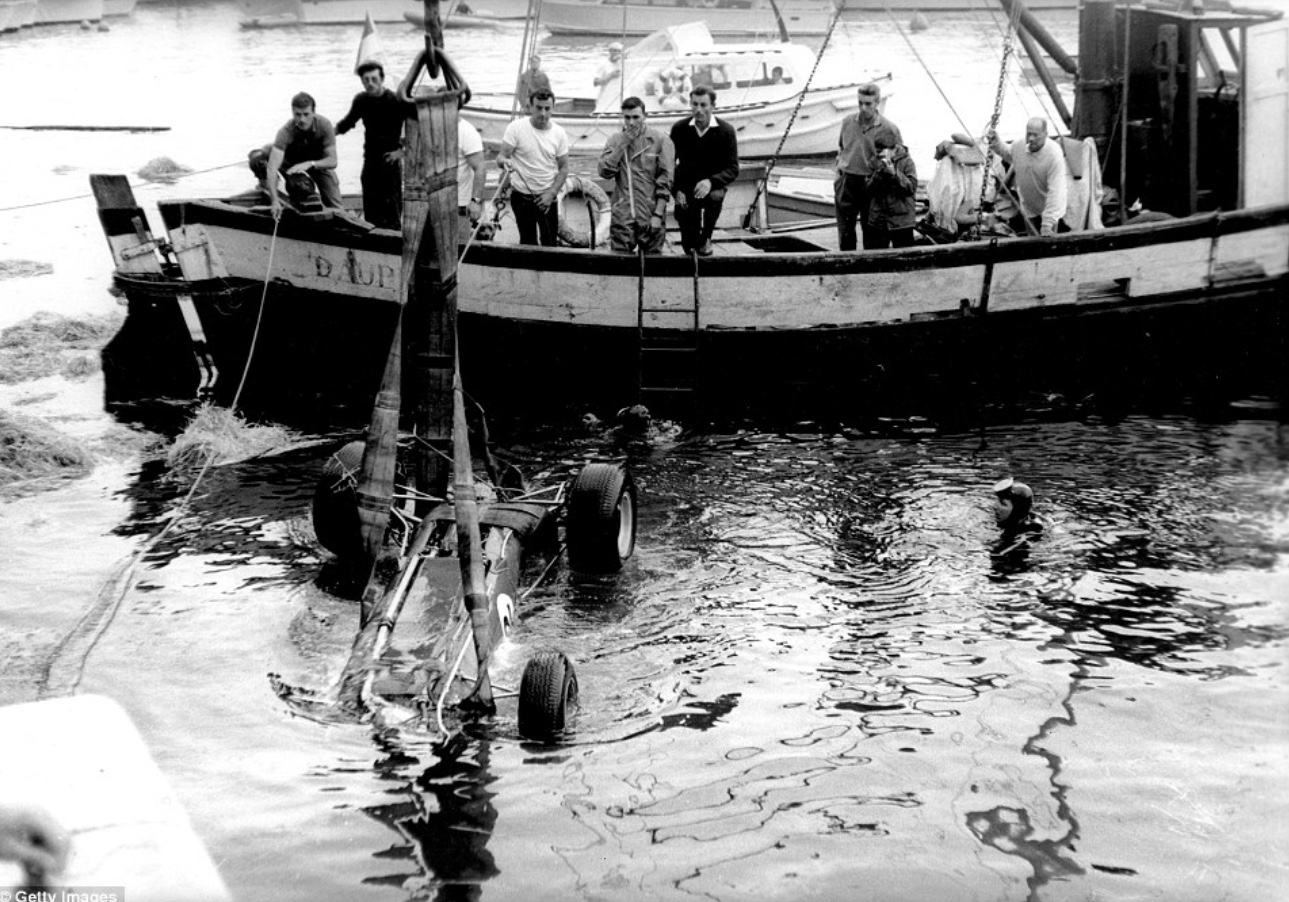
Along with Alberto Ascari, Hawkins is a Monaco Grand Prix diver survivor. He was racing Dickie Stoop’s Lotus 33 Climax towards the rear of the field on his eighthieth lap of the100 lap race in 1965. Denis Jenkinson saw it this way ‘…there was a bit of a furore at the chicane for Hawkins struck the wooden barrier at the entry and spun through the straw bales and over the edge of the quay and into the harbour. The Lotus sank to the bottom and the rugged Australian bobbed to the surface and struck out for shore, while boats went to his rescue.’

DSJ wryly observed ‘There was some discussion as to whether Hawkins used an Australian crawl or an American crawl to return to the edge of the harbour after his dive. Whatever it was it was an impressive and powerful stroke. Exactly ten years ago Ascari went in at the same place in a Lancia.’ Graham Hill won the race in fine style in his BRM P261.

Monaco 1965, Paul, Lotus 33 Climax about to be rounded up by second placed Lorenzo Bandini’s Ferrari 1512. Hawkins accident happened on his eightieth lap (unattributed)


Hawkins slightly soggy Lotus 33 Climax is repatriated from the chilly waters of Monaco Harbour. Chassis ‘R8’ lived to fight another day and is alive and well


Hawkeyes’s Lotus awaits him at a subsequent meeting! (R Schlegelmilch)


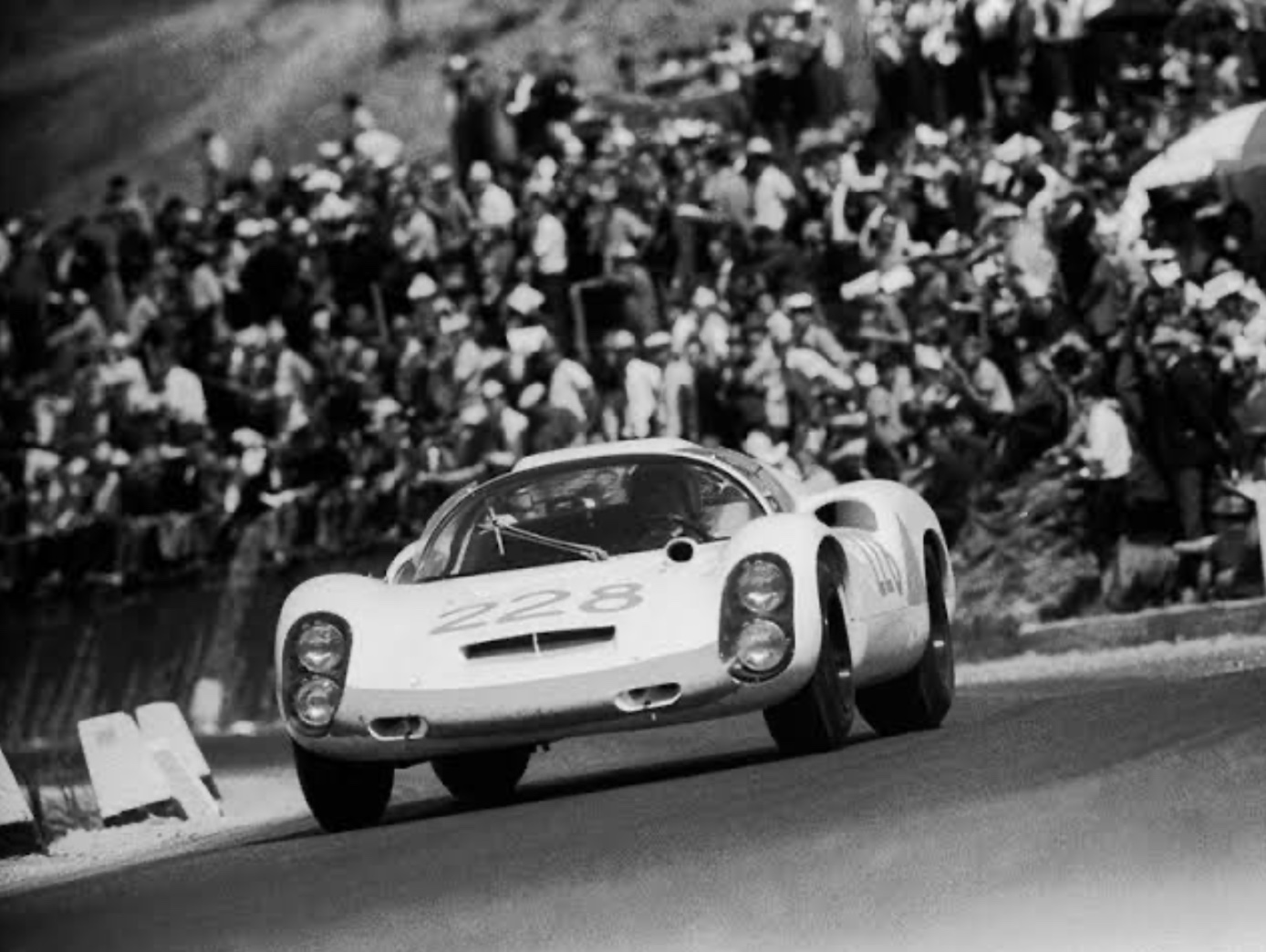
Hawkins on the way to winning the 1967 Targa Florio aboard a works Porsche 910 together with Rolf Stommelen (unattributed)

Hawkins quickly became a very fast, safe pair of endurance/sportscar hands winning Targa together with Rolf Stommelen aboard a works Porsche 910 and the Paris 1000 Km at Montlhery in a Mirage M1 Ford with Jacky Ickx in 1967 as well as the 1968 Monza 1000 Km together with David Hobbs. He was placed in five rounds of the World Sportscar Championship assisting John Wyer’s iconic Gulf sponsored Ford GT40s to victory in 1968.

At 31 he was still a young man in a wonderful career sweet spot racing factory cars and his own cars in national and international non-championship events.

On 26 May 1969 whilst running a works supported Lola T70 Mk3B Chev during the Tourist Trophy at Oulton Park, battling to get back in the lead group whilst running sixth, he hit a tree at Island Bend with poor Paul caught in the car as it was engulfed in flames. Brian Redman wrote ‘…I have no doubt his Lola T70 Mk3B suffered suspension failure, later in the race I crashed heavily at Knicker Brook due to the same problem.’

Treat this as a teaser, we will come back to Paul Hawkins, who is somewhat forgotten in Australia, Oulton was such a tragedy at a time his career trajectory was very much on the up.

1965 South African GP, East London. Paul Hawkins ninth place Brabham BT10 Lotus-Ford t/c from Dan Gurney’s Brabham BT11 Climax DNF- Jim Clark was up front in a Lotus 33 Climax (MotorSport)


Spa 1000 km start 1968. Hawkins GT40 inside Herman’s 908 Coupe, fourth and third respectively, Ickx/Redman Wyer GT40 the victor (unattributed)


Hawkins/Hobbs Gulf Wyer Ford GT40 Spa 1000 km 1968 (MotorSport)

Credits…

MotorSport, Brian Redman on ‘The Nostalgia Forum’, Gary Kegel, royckdboats, Richard Winslade, Mike Hayward Collection, Peter Maslen, Rainer Schlegelmilch, autopics.com.au, Bonhams Collection

Etcetera…

Hawkins Lola T70 Mk3 Chev about to surge past Alan Hamilton’s Porsche 906 during the 1967 Surfers 12 Hour (P Maslen)

We saw a bit of Paul in Australia later in his career. He contested the 1967 Surfers Paradise 12 Hour in a Lola T70 Mk3 Chev shared with car owner, Jackie Epstein, the duo were second in a race either they or the Scuderia Veloce Ferrari 350 Can-Am Hawkins shortly thereafter acquired should have won but both machines had problems, see here; https://primotipo.com/2018/08/28/1967-surfers-paradise-6-hour/

David McKay included Hawkins in his ‘works’ Holden Dealer Racing Team Bathurst 500 lineup in 1968.

Paul popped the Holden HK Monaro GTS327 he shared with Bill Brown third on the grid, but the pair were disqualified after ‘slicing’ a wheel in The Cutting and receiving outside assistance. In the shot above he is ahead of Fred Gibson’s works XT Ford Falcon GT. The race was won by Bruce McPhee and Barry Mulholland in another GTS.

It’s interesting to speculate about the manner in which Paul Hawkins Racing Ltd may have developed whilst Hawkeye continued to race and once he retired. Here Mike Hailwood ponders more pace from his Hawkins Racing Lola T142 Chev F5000 during the the 4 April 1969 British F5000 championship round at Oulton Park.

The spaceframe chassis, surplus T70 parts-bin special T140/142 is unlikely to be on any list of Lola’s greatest cars. This event was the first ever British F5000 championship race, Mike qualified third behind the David Hobbs Surtees TS5 Chev and Peter Gethin’s McLaren M10A Chev, Peter took the win from David with Mike a DNF after a driveshaft broke.

Tailpiece…

(Lola Archive)

Paul has the big, brutal Lola T70 Mk3B Chev beautifully dancing on its tippy-toes on the way to a win in the Guards Trophy at Snetterton in April 1969.

Finito…


(MotorSport)

Mark Webber at Knockhill, Fife, Scotland during the 1996 British Formula Ford Championship- works ‘Duckhams’ Van Diemen RF96.

It was a good season, he won four races, was second in the title race won by Kristian Kolby in another RF96 and won the important Formula Ford Festival at Brands Hatch at the seasons end. This victory secured a test with Alan Docking Racing’s top-notch F3 outfit.

This shot made me think about Webber’s progress from the more junior ranks, this short, mainly photographic piece tracks his ascent from the early nineties to 2002.

Before arriving in England he cut his racing teeth in Karts before contesting the Australian Formula Ford Championship in 1994 and 1995 (fourth) before racing in the Formula Ford Festival at Brands- his fourth place secured the Duckhams Van Diemen seat for 1996.

In Formula 3 with Alan Docking Racing in 1997 he was fourth in the British Championship, taking a win at Brands Hatch and three podiums, the title winner was Jonny Kane in a Dallara F397 Honda. In addition Webber was fourth in the important Macau GP and third in the F3 Masters at Zandvoort won by Tom Coronel- the top 37 cars on the grid were separated by less than one second, to provide an example of the competitiveness of F3!

It was a tough year though, only Australian rugby international David Campese’s loan of $100,000 kept Webber afloat and in the Dallara F397 Honda for the full season.

Lola B99/50 Zytec F3000 at Imola in April 2000, third place the first time he raced in the class (MotorSport)


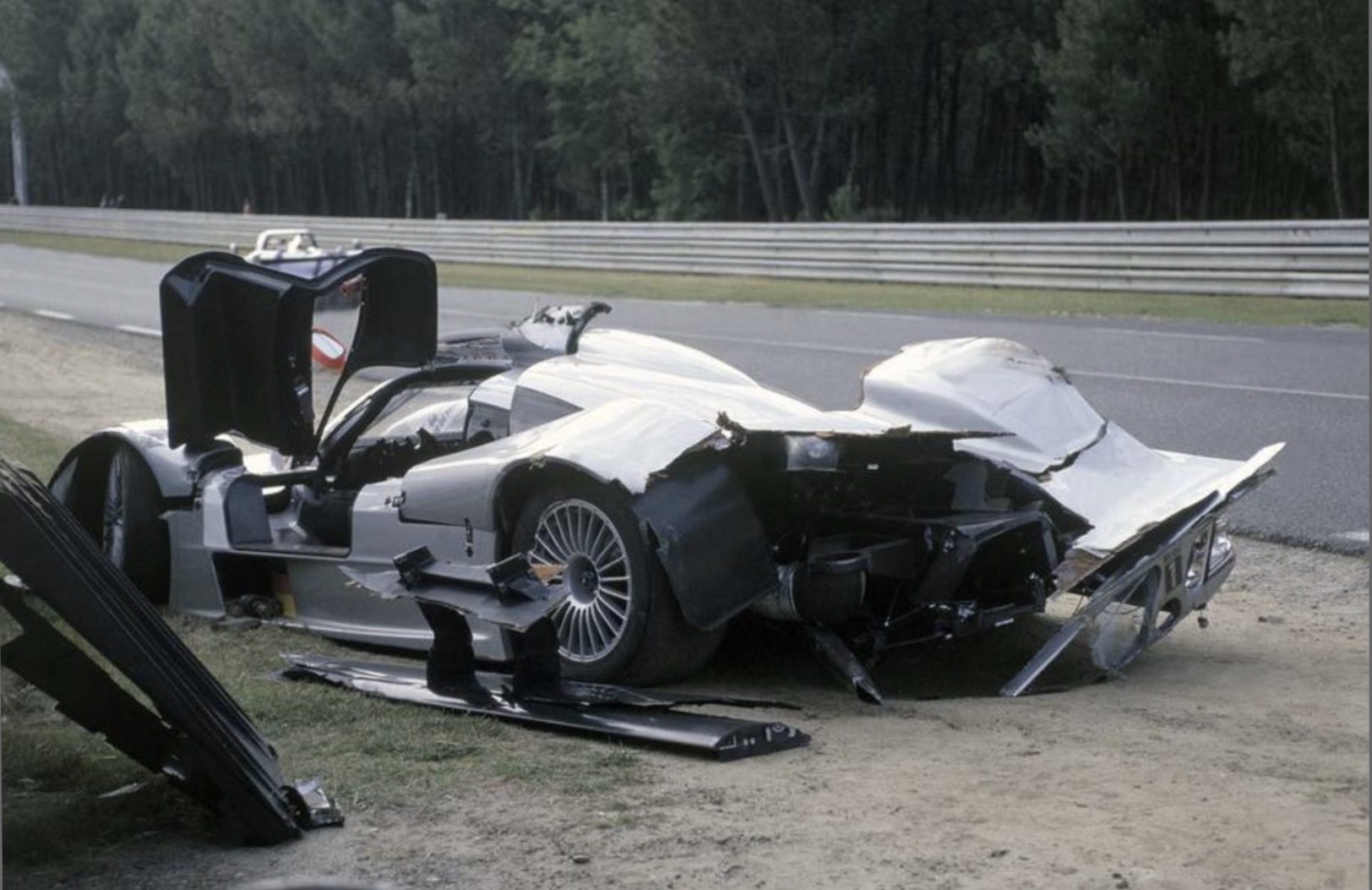
‘Fuck me! Again!’, or thoughts along those lines. The second of Mark’s flips on the Hunaudieres at Le Mans in 1999, Mercedes CLR. Peter Dumbreck also took to the sky during the race

In 1998 he progressed to the FIA GT Championship with Mercedes Benz-AMG, how thrilled we all were to see him demonstrate the 6 litre V12 CLK GTR at Albert Park before the season in Europe began.

Paired with Bernd Schneider, they won five of the ten races but finished second overall to  teammates Klaus Ludwig and Ricardo Zonta who also won five but had better placings.

Webber’s aerobatics at Le Mans in 1999, in two sessions remember, showed just how tough he was but the season was a write-off when Mercedes cancelled their program after Webber and teammate Peter Dumbreck both took flight.

In 2000 and 2001 Webber mixed F1 testing roles with Arrows and then Benetton and the European F3000 Championship, finishing third (one win and three fastest laps) and second (three wins) respectively.

In 2002 he broke through into F1 with a Minardi PS02 Asiatech 3 litre V10 (née Peugeot F1), by then the Italian F1 stalwart was owned by Aussie aviation entrepreneur Paul Stoddart.

Webber’s fifth place at Albert Park was a great start to the season and indicative of the career towards the top of the pyramid to come- 9 wins, 42 podiums, 13 poles and 19 fastest laps throughout a stellar Grand Prix career.

Webber, Minardi PS02 Asiatech, Albert Park 2002 (MotorSport)

Etcetera…

(unattributed)

Mark started his karting career at Fairbairn Kart track in Canberra aged 14, winning his first title, the NSW karting championship in 1993.

He is shown above in that machine, what chassis and engine is it folks?

With Mum and Dad- Queanbeyan, early years (M Webber Collection)


(unattributed)

Mark ran a well funded Formula Ford campaign in 1995 aboard a Van Diemen RF95 after an exploratory year aboard Craig Lowndes 1993 championship winning RF93 in 1994.

This was the start of the business relationship with Ann Neale, who organised the Yellow Pages deal, helped him make it all the way to F1 and remains his partner in life.

He was fourth in the Australian FF Championship won by Jason Bright in another RF95, in a season of typical depth the class of ‘95 included later V8 Supercar greats Jason Bargwanna and Todd Kelly.

Above the Van Diemen RF95 is on the way to winning the Australian GP, Formula Ford support race at Adelaide in November 1995.

(unattributed)

In some useful ‘big car’, wings and slicks, experience Mark raced Malcolm Ramsay’s Birrana Engineering Reynard 90D Formula Holden at Mallala in June 1995.

He finished second behind his teammate and multiple Gold Star Champion Paul Stokell in the teams 91D.

Webber did one final meeting before heading to Europe in 1996, he contested the Formula Holden AGP support races at Albert Park in one of Graham Watson’s Ralt Australia Reynards, winning the Sunday race in a 91D.

(MotorSport)

The Bouchut/Heidfeld/Dumbreck AMG-Mercedes CLR leads the Tiemann/Webber/Gounon machine during practice at Le Mans 1999.

(MotorSport)

A before and after shot Le Mans 1999 shot.

The photograph above is of the Webber CLR after the first flip at Indianapolis on Thursday night.

Takeoff speed was about 185mph, the car was rebuilt overnight around a new chassis. All three team cars were fitted with front winglets in an attempts to keep them on terra firma.

On the short Saturday morning warmup, one can imagine the courage required to get back in the car, he again took flight whilst following a teammate closely on the hump on the Mulsanne. The car crewed by MW, Jean Marc Gounon and  Marcel Tiemann was withdrawn from the race.

The other two machines, with further tweaks took the start with Peter Dumbreck taking off on lap 75, about 5 hours in, on the bumpy section towards Indianapolis. This time the car flew off the side of the track amongst the trees- Mercedes, lucky not to lose another driver, but with another PR disaster on their hands in France, withdrew the other car- and from sportscar racing as it later transpired.

(MotorSport)

Martin Brundle in the pole winning Toyota GT-One with Pedro Lamy, Mercedes CLR- behind him his teammate Christophe Bouchut with the BMW V12 LMR alongside him, and the rest, Le Mans start 1999.

Testing duties for Benetton at Estoril in September 2000.

Car is the Benetton B200 Playlife 3 litre V10. ‘Playlife’ engines were rebranded Supertec motors which derived from 1998 Renault RS9 engines built by Mecachrome. Goddit?

Raced by Giancarlo Fisichella and Alexander Wurz, the B200s were also-rans in 2000.

Super Nova Racing F3000 Lola B99/50 Zytec V8 at San Marino in April 2001, the Lola behind is driven by Darren Manning.

Mark had a great weekend, winning from pole and taking fastest lap. He won in Monaco and at Magny Cours as well, finishing second in the title chase behind Justin Wilson, his later teammate at Jaguar.

His run home was poor with collisions in all three final rounds.

(Getty)

The shots above are at Silverstone during the 2002 British GP weekend.

Minardi PS02 Asiatech, Q20 and DNF clutch in the race won by Michael Schumacher’s Ferrari F2002 3 litre V10.

Webber during the Red Bull years, meeting and date unknown (unattributed)

Credits…

MotorSport, Frederic Le Foch, Wikipedia, Getty Images, Mark Webber Collection

Tailpiece…

(unattributed)

After retiring from F1 at the end of 2013, Webber joined Porsche’s endurance racing program.

2014 was a building year, but Mark won the World Endurance Racing Championship along with Timo Bernhard and Brendon Hartley in 2015, the same crew having not won a race the year before.

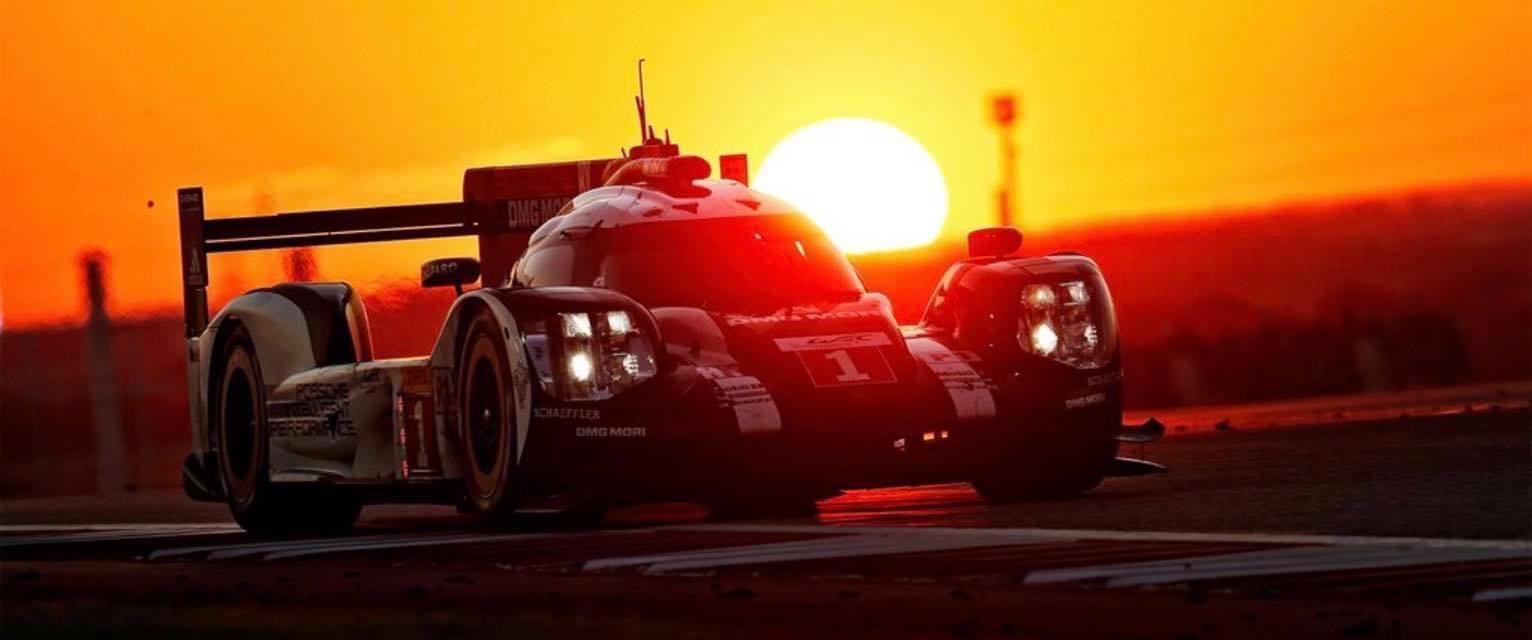
But not the elusive Le Mans win- here is his Porsche 919 Hybrid during the 2016 race- the same trio raced the car that year as in the two seasons before, they were classified thirteenth, the race won by the sister 919.

Finito…

(N Henderson Collection)

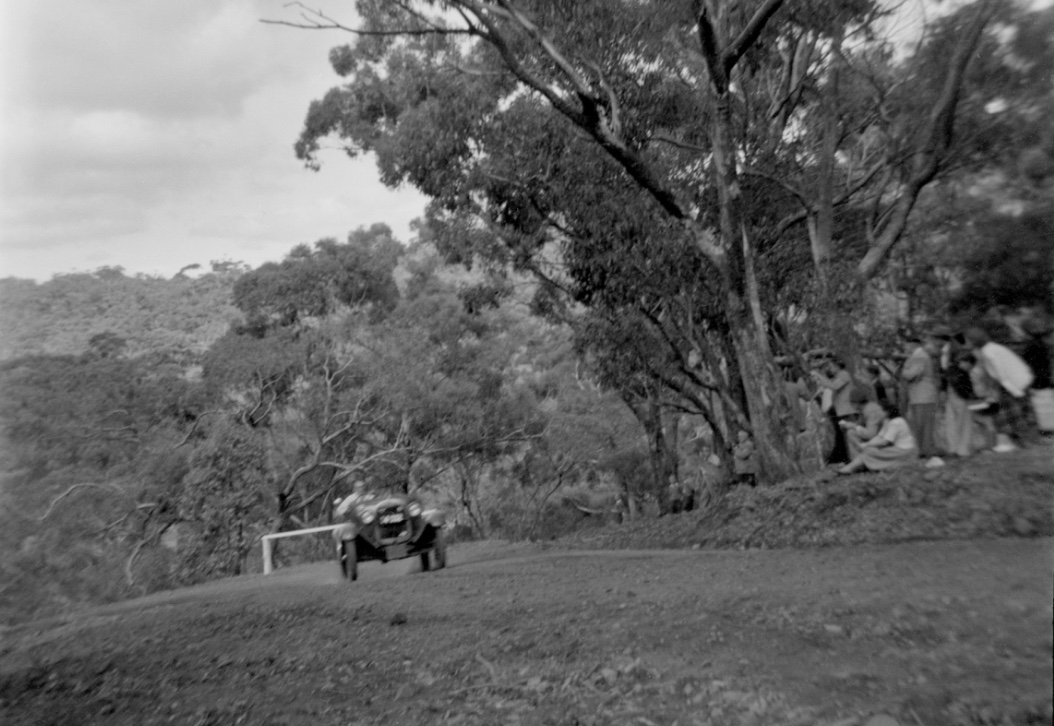
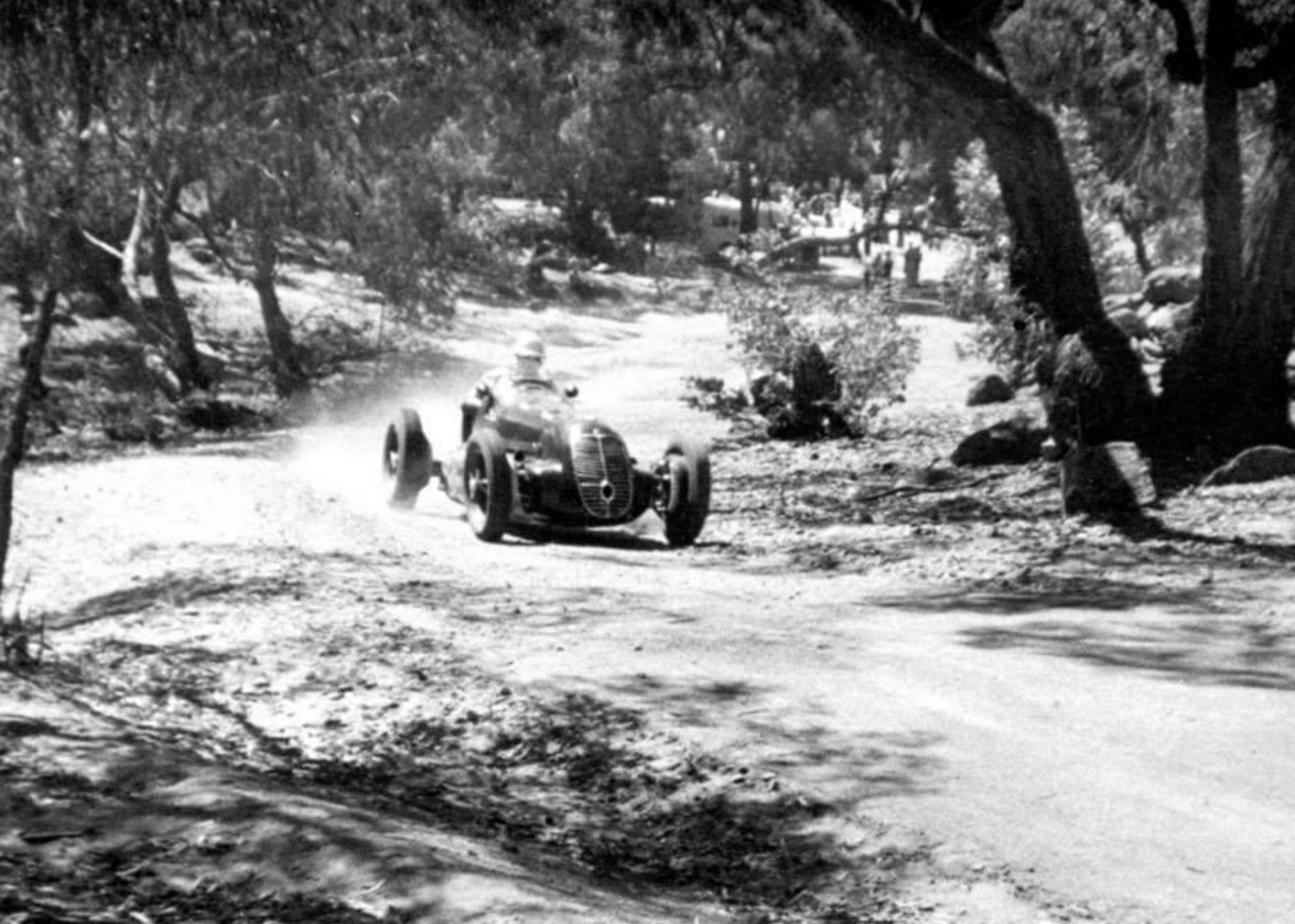
MG on Mount Tarrengower, Maldon, Victoria circa 1946-1947…

Its funny what ya find sometimes, this was a random catch found sitting in front of the tello whilst searching for something else.

The photograph, from artblat.com, is part of the Nicholas Henderson Collection and thought to be Tarrengower given the preponderance of Maldon shots in the collection- further evidence cited the surrounding box-ironbark trees. We had a country drive to Castlemaine, Kyneton and Maldon inclusive of a cruise up the mountain again six months ago-Tarrengower it is i suspect.

I am no pre-war expert but the stance of the machine and its grille reek of MG, perhaps not a supercharged one mind you, so that narrows the model choice somewhat- but it’s no more than a guess, perhaps it’s Peter Vennermark’s Maserati 4CL?

Below are two more cars, one sporting and the other not- love to know what they are, bonus points for the drivers and the date of the meeting.

(N Henderson Collection)

For some of you the dress of the spectators may help give us a fix on the date, as perhaps will the model year of the most recent car built- perhaps the sedan below.

Another car (not shown) in the same batch of photos had a registration expiry date of February 1947 and was therefore indicative of the approximate timing of the photographs to the curator of artblat.com, Dr Marcus Bunyan.

(N Henderson Collection)


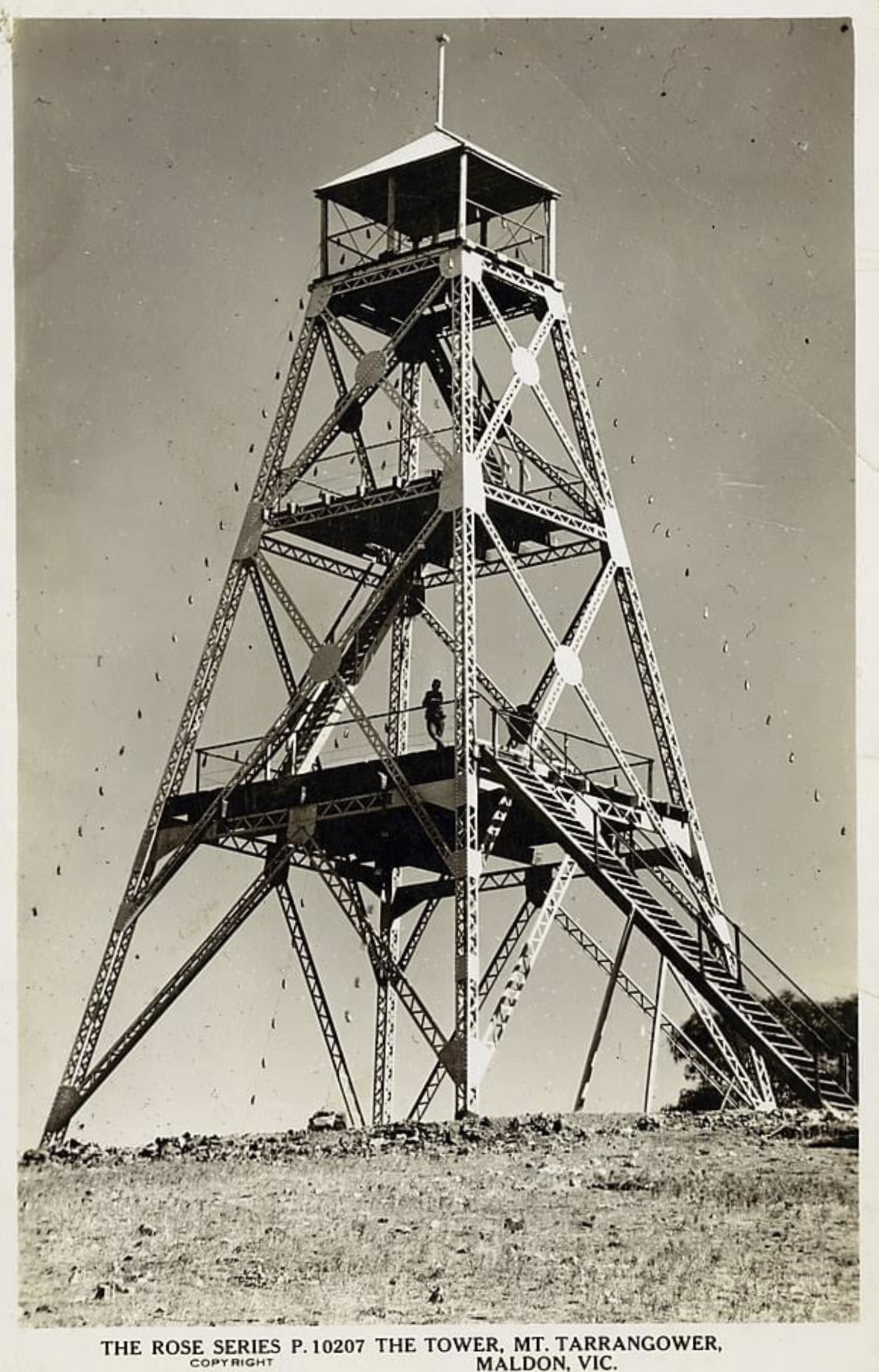
1947 postcard of the meeting that year shows the spectator car park at the bottom of Mount Tarrengower- horse and cart is a nice touch!


A little bit more research shows the the first pot-war event was on Easter Saturday, April 5, 1947. The climb has been pretty much in continuous use since the dawn of motoring in Australia. The ninetieth anniversary of the first event was held last year- 2019.

The climb had not been used for a couple of decades until the Vintage Sports Car Club ran an event on 29 February 1964, FTD that day went to Bill Leach in an E Type Jaguar. The club returned that October when FTD was set by no less than Lex Davison’s Cooper T62 Climax 2.5 Tasman car in 50.34 seconds. Davo was a very experienced hill climber with an Australian Championship amongst his many racing achievements, see here; https://primotipo.com/2019/03/05/mount-tarrengower-hillclimb/

I’ve never raced there competitively but I did run my Elfin Crusader Formula Vee up the hill during an Elfin Owners Club event from Bendigo to Mount Tarrengower and back in November 1993. About 40 cars did that event from Peter Brennan’s MR8C Chev F5000 ‘down’ to one or two Vees- a Gendarme up front in a fast pursuit car ensured speeds were civil but quick on 80km of public highways. What fun it was.

Jim Hawker and George Wightman aboard the awesome Chamberlain 8, Tarrengower April 1947 (The Chamberlain)


(Maldon Museum Archive)

A group of competitors gathered in Maldon during the Easter 1947 meeting.

Many thanks to the combination of David Zeunert, Tony Johns, Bob King and Stephen Dalton who between them provided the shots and nutted out the date and competitors.

We are not sure of the white sportscar by the kerb, then the Hugh Stuart aka Tim Joshua Frazer Nash single-seater, Jim Gullan’s Ballot Oldsmobile and at right Lex Davison’s Alfa Romeo 6C1500 s/c Spl aka the ‘Little Alfa’.

Stephen reminded me this site at 51-57 High Street is still a servo, Robert Cox Motors are the current operators.

Entry list of the Easter 1947 meeting (Ash Tracey)


Later 1960’s shot of a Geneer Outlaw VW, I think, gives perspective on the open nature of the tourist road and surrounding terrain (Ken Bolitho)


Peter Vennermark, Maserati 4CL 1.5 at Tarrengower, 24 March 1951 (Maldon Museum)


Lex Davison, Cooper T62 Climax, Tarrengower October 1964- Davo in collar and tie (M Williams Collection)

The climb is about 1500 metres long, the bitumen is narrow, patchy and rough at the edges- the shot above of Lex in 1964 is not that much different to now, it is a tourist road with a lookout at the top. It’s a very fast open climb, a big challenge, I notice that a chicane half way up was used last year which is a bummer in some ways but probably makes good sense.

My first visit to Mount Tarrengower was as an official with a mate in 1978. We camped overnight and took up our post about two thirds of the way up the hill on Sunday, a beautiful clear, hot day. What impressed was the speed of the more powerful cars but the dangers were great given the unguarded edges and unforgiving trees awaiting those who goofed.

During the afternoon we heard the unmistakable wail of a Porsche flat-six off the start line- it was the very impressive Dr Will Darvall’s 2.7 RS mounting another assault. The rise and fall of the engine note indicated his commitment and rapid progress until about 100 metres or so below us the throttle closed rapidly, then followed a sickening series of dull-thuds as the gorgeous car pinged from eucalypt to sheoak. I will never forget that sound.

We looked at one another and said in unison ‘He’s fucked!’ It seemed and sounded that bad. But the good doctor recovered, I know this as he was ‘me mate Big Bad Brucie’s GP in Heidelberg, but he was a sick boy for a long while. The car was rooted, but it too lived to fight another day after bulk dollars were spent on its resurrection around a new shell.

The point to be taken here is that there is no ‘good place’ to leave the road on this challenging mountain.

Maldon High Street 1934 (Maldon Museum)


Maldon High Street circa 1975 (Ellen Hansa-Stanyer)


Maldon High Street 2019, refreshingly little change over the last eighty years or so (Maldon FB)

The Central Goldfields area of Victoria is quite beautiful and so named as a consequence of the 1850’s Gold Rush which attracted massive numbers of fortune seekers from around the world.

The ‘Golden Triangle’ area marked by the towns of Ballarat, Maryborough and Bendigo yielded massive amounts of the precious commodity, Mount Tarrengower is a couple of kilometres from the tiny village of Maldon at the Triangle’s northern end- short walks around and from the village allow this wonderful history to be seen and experienced- the steam train ride is a beauty for ‘big kids’ too.

Maldon is a must visit for any Victorian international tourists list, the town was classified by the National Trust way back around 1970 so the streetscape now is little different to the way it was during that 1947 hillclimb weekend.

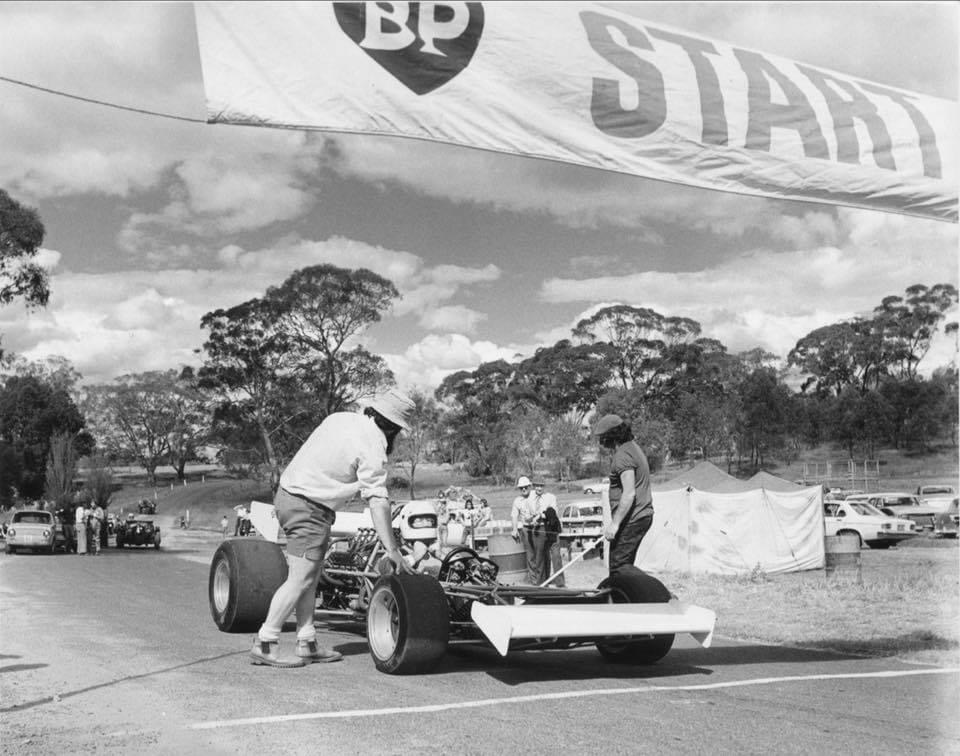
Peter Holinger on the line aboard the very fast Holinger Repco ‘620’ 4.4 V8 circa 1978, the dimensions of which were provided by Jack Brabham’s 1969 Tasman contender- Brabham BT31 Repco (John Bowring)

Etcetera…


(M Bisset)

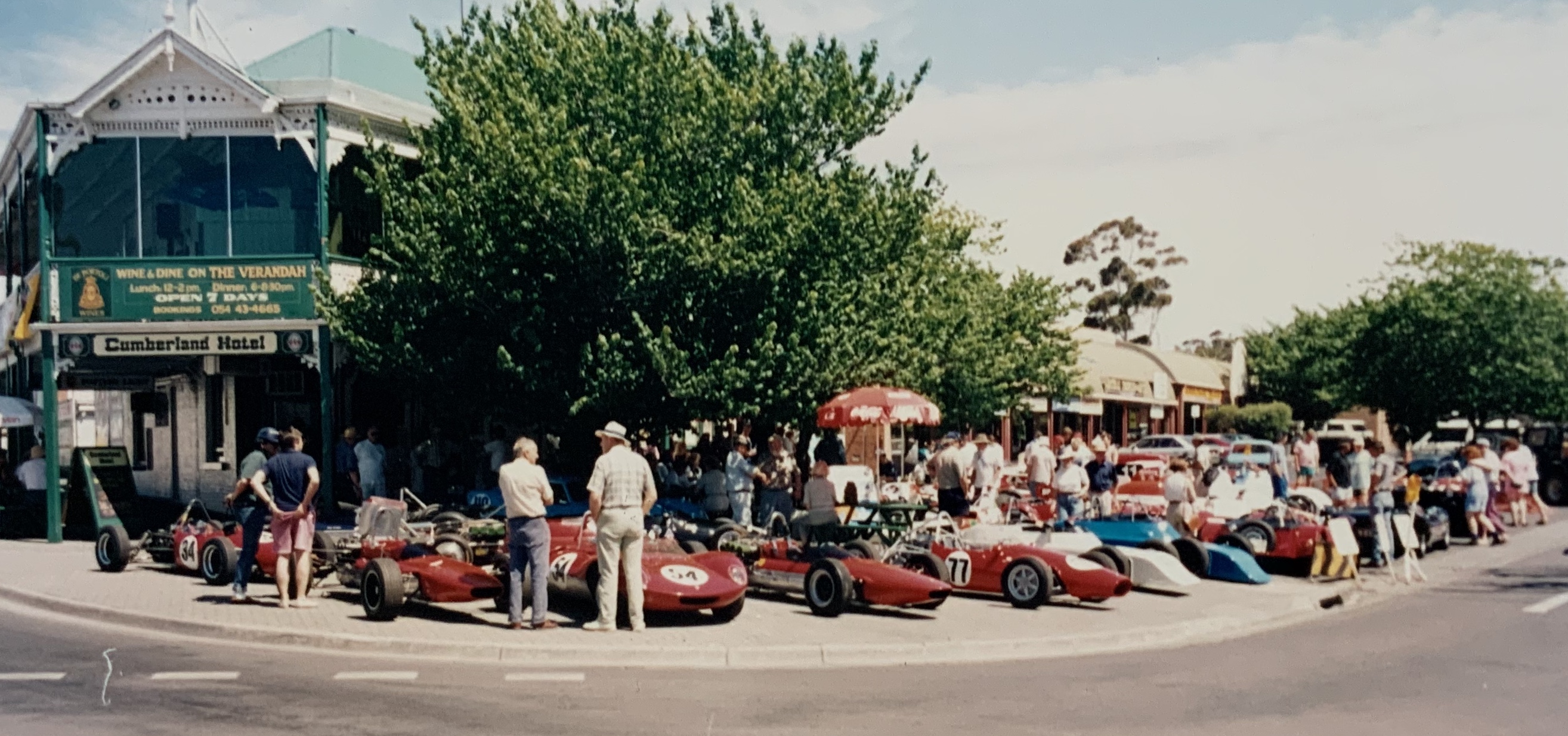
A couple of happy-snaps of the Elfin ‘Tour To Tarrengower’ in November 1993 I mentioned.

The five red cars are Catalina, Mono, Mallala sports, Mono and Catalina, then a white and blue pair of 620s- this is in Bendigo.

Below is Pete Brennan’s MR8 F5000 and the arse of his 400 Chev at right, the big white monster is the ex-Schuppan MR8 in Can-Am dress, now owned by Bill Hemming, it is in F5000 guise. The other white sporty is a 360, a personal favourite.

(M Bisset)

Peter Brennan on the way to FTD circa 1982 in his Elva Mk8S BMW 2 litre.

(P Brennan Collection)


(A Tracey)

Another crop of Peter Vennermark’s Maserati and a report on that meeting below, Easter Saturday 24 March 1951- where he had an off.

Chassis #1555 was later sold to long time racer Cec Warren who alighted the machine during the March 1954 Fishermans Bend meeting for adjustments, collapsed with a heart attack and died.


(A Tracey Collection)


(D Zeunert)

Lovely photo of the vibe in the ‘modern era’, crowd and carpark in the background, 1982 with Stuart Anderson on the line, Maserati 4CM 1100, above and below.

(D Zeunert)


(G Thomas in L Sims Collection)

Bob King has his money on our opening car being the Lindsay Head driven Riley Austin Spl, here being driven over Skyline at Rob Roy in 1946- without its lights, it is a possibility’

Photo and other credits…

Nicholas Henderson Collection on artblat.com, Maldon Museum, Maldon Facebook, Ellen Hansa-Stanyer, Max Williams Collection, The Chamberlain, Tony Johns Collection, ‘Bentley Specials and Special Bentleys’ Ray Roberts, John Bowring, Ken Bolitho, Peter Brennan Collection, Ashley Tracey Collection via Tony Johns, George Thomas in the Leon Sims Collection, David Zeunert/Collection

Tailpiece…

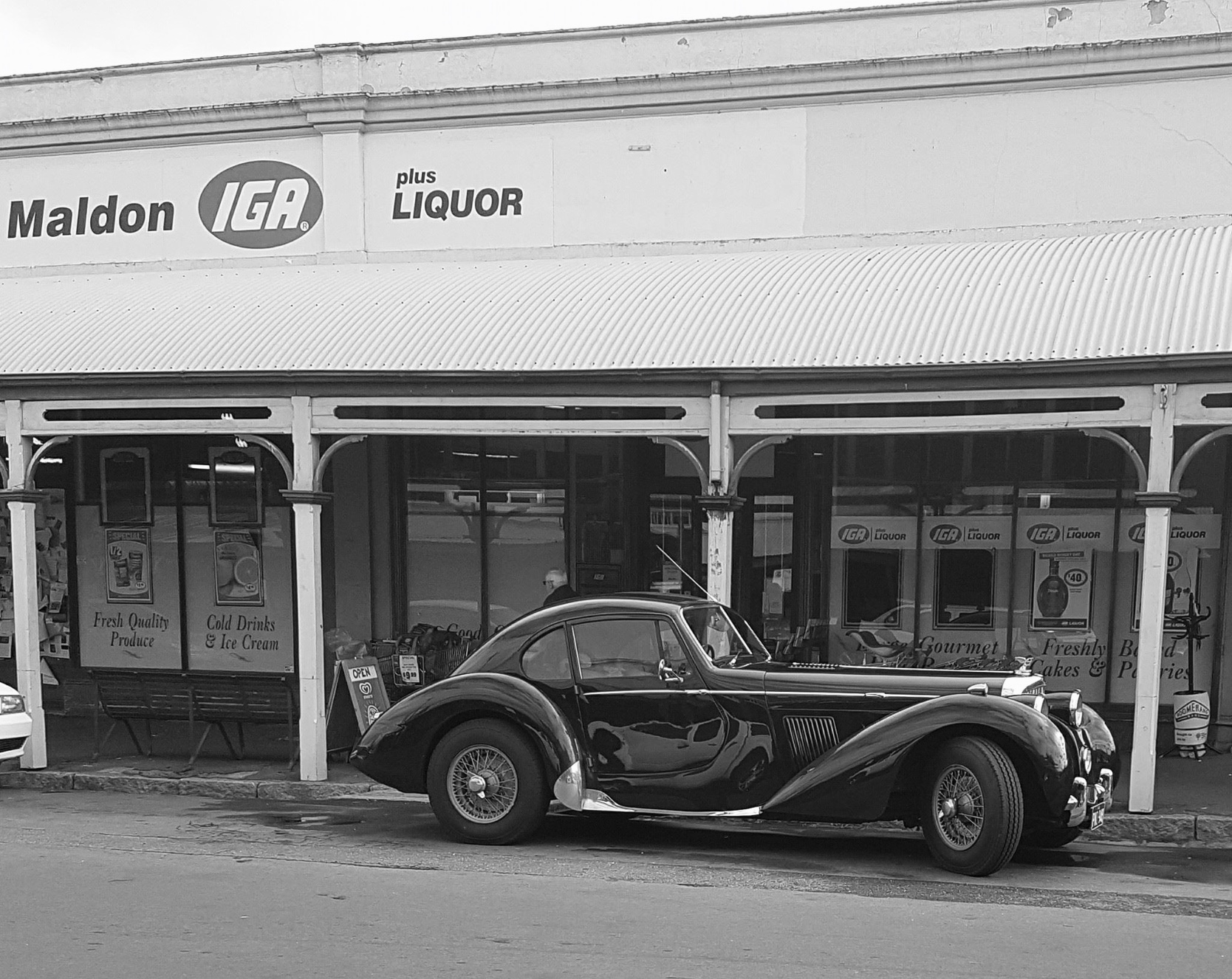
Bentley in High Street, Maldon circa 2018, Tony Johns tells me it’s a 1950 Mk6 rebodied coupe. The Mount Tarrengower road and car park is well worth a visit on race weekend and a tootle up from Melbourne for the day anytime.

The many closed shops in town at the moment are a bit of a worry, I have not seen the place so depressed in all the years of regular visits since 1978.

Back to the Bentley, with a bit of assistance from John’s copy of ‘Bentley Specials and Special Bentleys’.

The car was designed by Queensland graphic designer Ian Shaw who was considerably influence by the Bugatti Type 57SC Atlantic.

The chassis (#B4JO) ‘was reclaimed from an earlier touring body conversion’, seven inches were taken from the frame, the engine moved aft twelve inches and lowered- whilst the ‘X brace’ part of the chassis was removed other cross members were added to restore and enhance torsional rigidity.

Mechanical upgrades include dual boosted hydraulic brakes, Koni shocks, sixteen inch wires and a smaller than standard MkVI steering wheel.

The steel body was built to Ian’s full scale drawings by Venkat, Bodrog and Evans around one inch by one inch steel tubing and incorporates highly modified MkVI front wings, a shortened radiator shell and bonnet.

Initially a 4.25 litre Bentley motor was used, this was later replaced with an ‘S type’ 4.887 litre straight six which was blueprinted and modified by the incorporation of a higher lift cam with the head ported and fitted with larger valves.

This beautiful looking 2+2 motor car is a credit to the fine eye of its creator, it first ‘broke cover’ over the 1998 Bay to Birdwood weekend in Adelaide and is now good for 125mph which would make it a fine interstate express.

Finito…

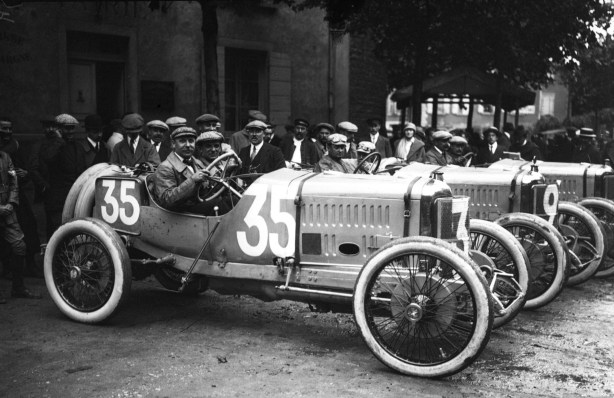
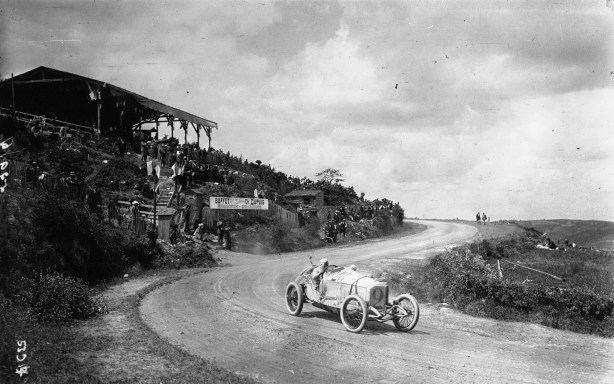
Christian Lautenschlager descending the ‘le piege de la mort’ switchback, Mercedes 18/100 HP (4.48 litre straight-four), first in the July 1914 French Grand Prix run over a 752 km road course in a little over 7 hours 8 minutes.

Mark suggested I write something on ten of the more interesting cars I have had the privilege of driving. (Car 2 I have only been a passenger in, but it is included here because of its relevance to Car 1). This could be a challenge for others to produce their lists. Although I have had extensive experience of a few of the cars, the majority are more an exercise in name dropping. Here goes in approximate date of manufacture order:

1. 1914 Grand Prix Mercedes

Yes, I have driven Lautenschlager’s winning car (above).

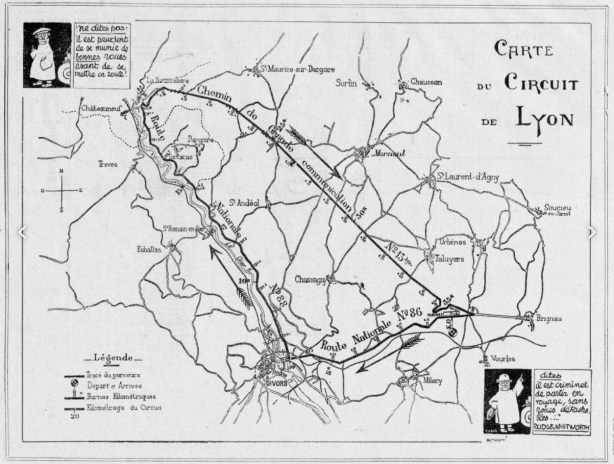
In 1974 I went to Lyon for a memorable dual celebration of 60 years since Mercedes won the Grand Prix de l’ACF at this venue, coupled with 50 years since the debut of the Type 35 Grand Prix Bugatti on the same circuit. (Incidentally, the latter was the inspiration for my proposal that we similarly celebrate 50 years of the AGP at Phillip Island in 1978).

To cut to the chase; I had a Rosé infused lunch sitting opposite Phillip Mann, the then custodian of the 1914 winning Mercedes. He proposed I ride with him in the afternoon, and handed me the wheel for the last couple of hours.

What a car; a low first gear to cope with starting and the ‘fourche’ at Les Sept Chemin and then three close and high ratios to follow. Quick and light; two-wheel brakes did not seem to be a problem, and when Phillip said, “Bob, if you used third gear more, you would not use the brakes so much” (‘code for have a go’), the car came alive.

As we followed a road that swept beside the twists and turns of the Loire, there were ample opportunities to extend it in third and then into top, which was only a smidge higher ratio. Road holding and steering were what one would expect from a car that had won one of the greatest races of all time. The 750 km. race had taken just over 7hrs – heroes all, those Belle Epoque drivers.

A short piece on the 1914 French GP; https://primotipo.com/2017/05/01/1914-french-grand-prix/
 

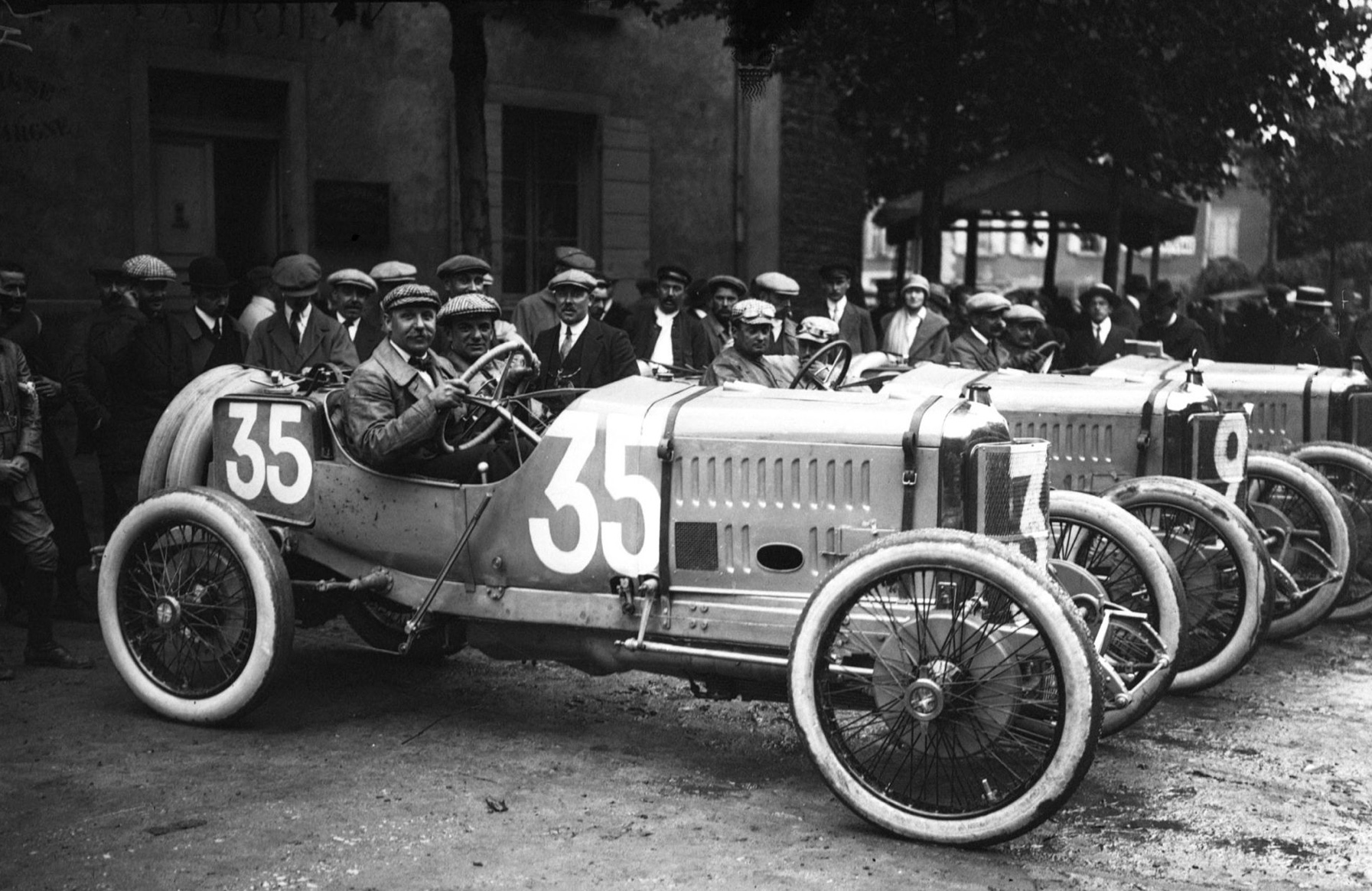
Arthur Duray in the 4.44 litre straight-4 Delage Type S before the off. #9 is Paul Bablot (unattributed)

2.1914 Grand Prix Delage

I am also privileged to have had a couple of rides as passenger in the wonderful Murdoch family Delage, Type S, that raced with the Mercedes at Lyon.

Twin OHC, desmodromic valves, four valves per cylinder, four-wheel brakes, five speed gear box with direct drive on third (two overdrives), and all this in 1914. Usually known as the ‘Indianapolis Delage’, this is a much more sophisticated bit of kit than the Mercedes, but it was not to win that mythic race.

Like the Mercedes, it was designed for the circuit; again a lowish first gear and then a bunch of higher ratios, one for each piece of this track that varied from the aforementioned hairpin to  right angle bends through the town of Givors and then a long fourteen km. straight back to Sept Chemin, necessitating the high gearing of these cars.

The weight limit for this race was 1100 kg’s and with 4 1/2 litres of sophisticated racing engine to propel them, these cars, for their day, had super-car performance with a maximum speed of close to 170kph. Even today this 104-year-old car can hold its own with modern traffic.

Delage were out of luck; two of their three team cars were said to have had valve adjustment issues with their complicated desmodromic valve gear and the third car of veteran Arthur Duray was delayed after running near the front of the race and could only manage eighth place, over 40 minutes after the winning Mercedes.

Regardless of the result, of the two cars, I think the Delage would be my choice based on its sophistication, not to mention its booming exhaust.
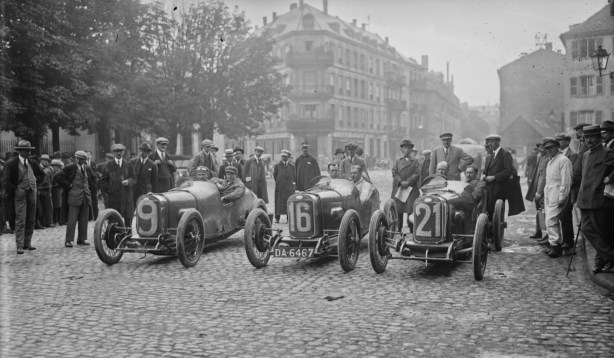
 

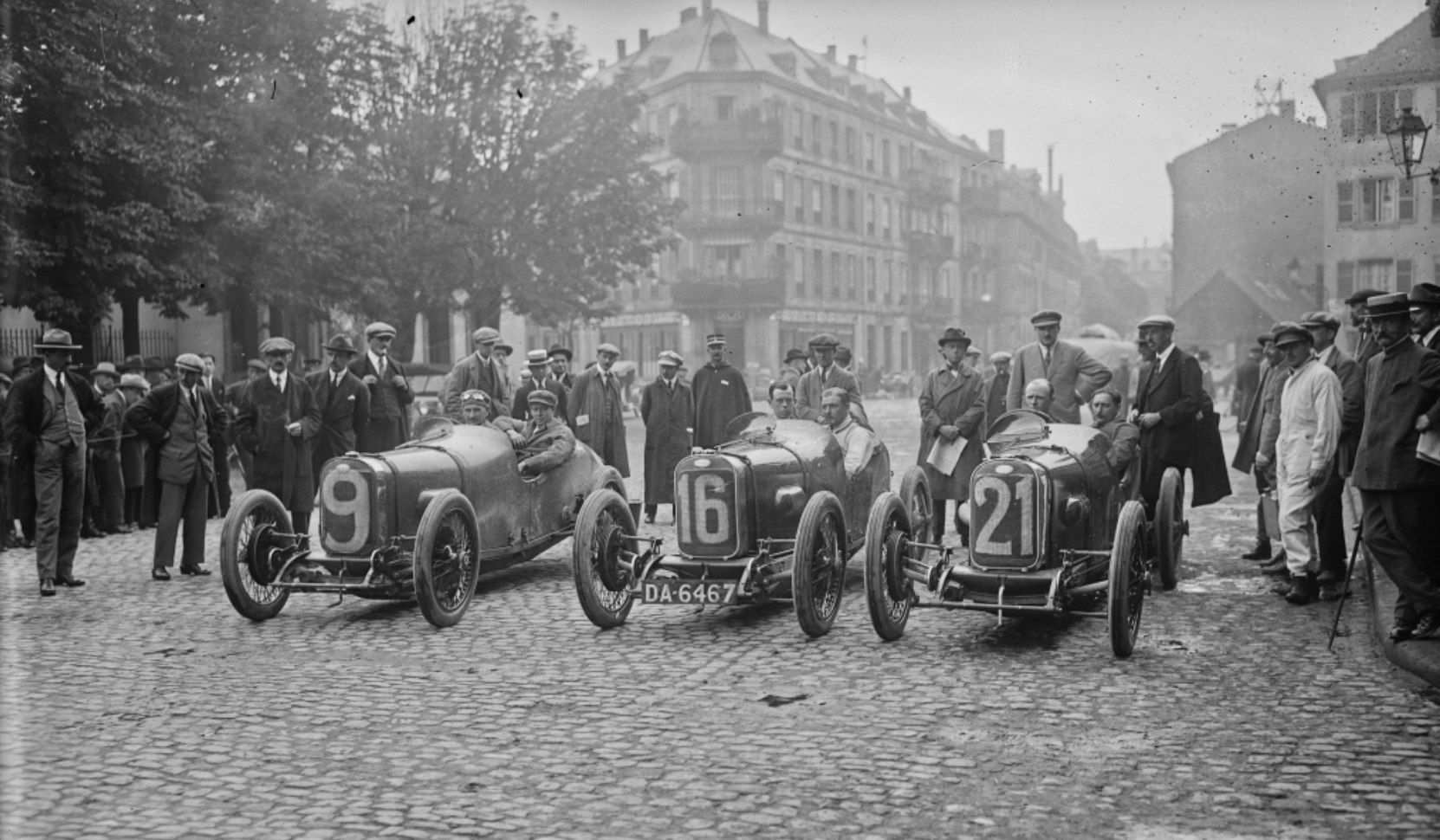
The Sunbeam team cars lined up at Strasbourg before the start of the 1922 French GP- #9 Jean Chassagne, #16 Kenelm Lee Guinness and #21 Henry Segrave (Selou)

3.1922 Grand Prix Sunbeam

Four of these Ernst Henri designed cars were at Strasbourg for the 1922 Grand Prix de l’ACF.

The three racing cars broke down with valve trouble through over-revving attributed to low reading rev-counters and the practice car suffered an engine fire before the race. Not an auspicious debut.

This was another epic race over 803kms of public roads won by Felice Nazzaro at an average speed of close to 130kph – these 2 litre cars were not slow.

By December 1925 Jean Chassange’s car was competing at Maroubra in the hands of Hope Bartlett. The car is now in a restored condition in Queensland.

The Sunbeam I drove was imported to Australia in 1984 by Tim Hewison, and it was during his custodianship that I drove it. Having had some experience of the often-underrated vintage touring Sunbeams, I found that the GP car had all the same attributes of light and precise controls – a delight to drive.

Although of only two litres, its twin overhead camshaft engine, coupled with a light racing body, gave it a satisfyingly brisk performance. With direct but light steering, powerful brakes and a delightful gear-change, this would have been a wonderful road-car and an exciting racing car.

My drive was limited to a quick squirt up and down the Flinders-Mornington Road. Unfortunately, the car was only in Australia for a short time and I never had the opportunity to take it for a serious drive.
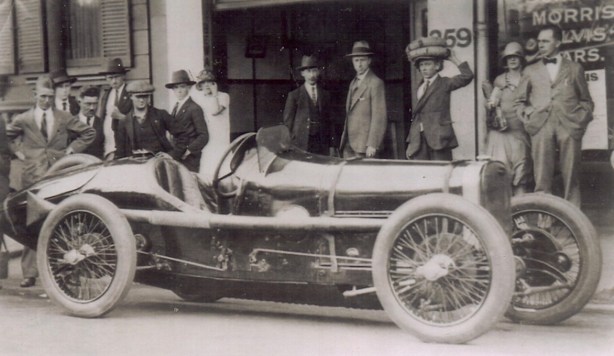
Hope Bartlett’s GP Sunbeam shortly after its arrival in Australia, Sydney 1925 (H Bartlett Collection)
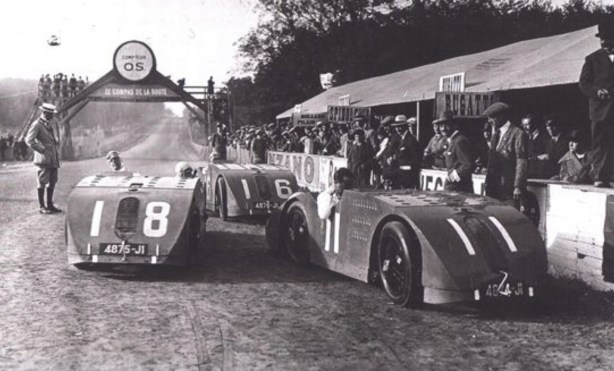
 

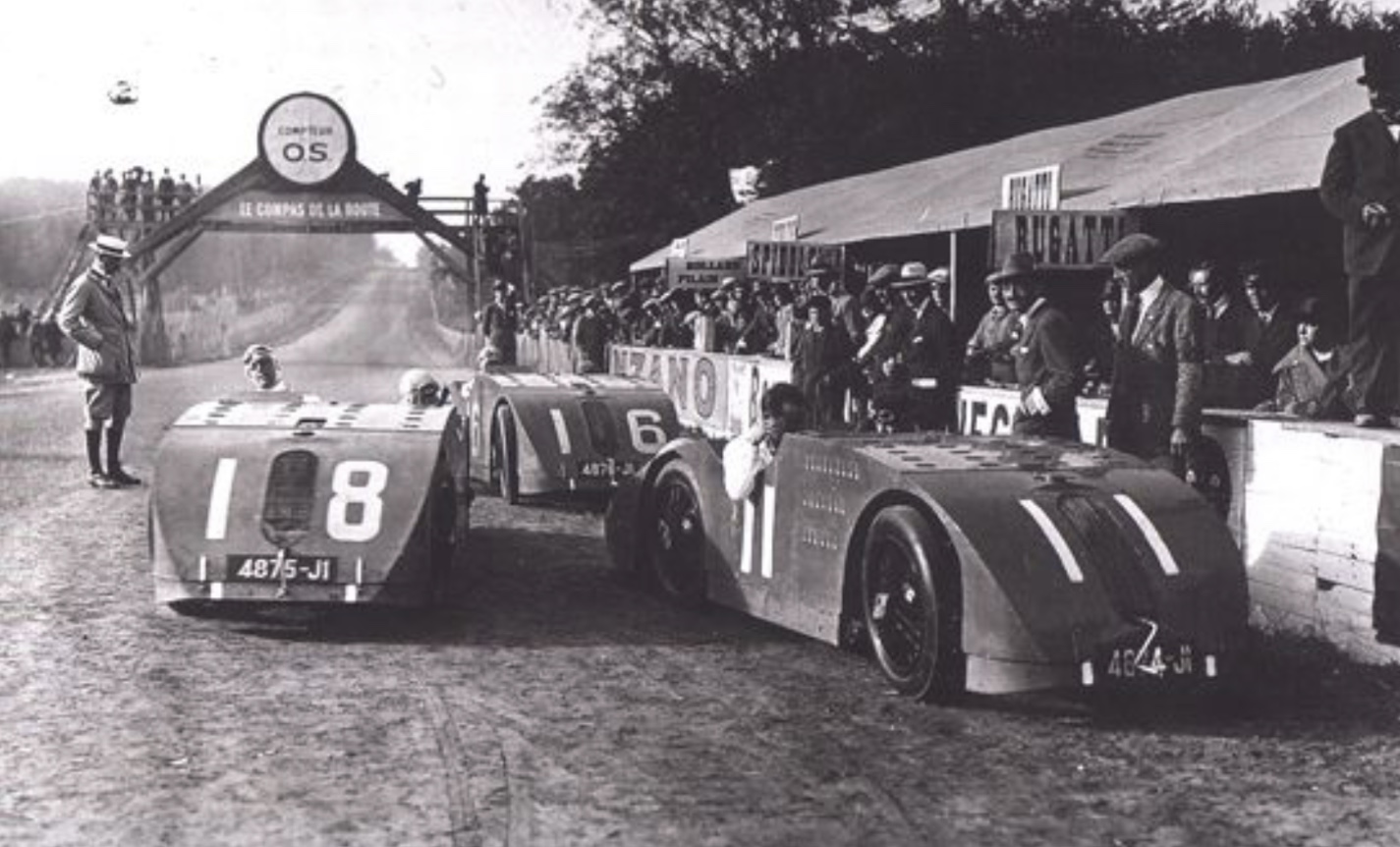
Bugatti T32 ‘Tanks’during the 1923 French GP weekend at Tours. #18 Prince de Cystria, #16 Pierre Marco and #11 Pierre de Vizcaya. Segrave’s Sunbeam won, the best placed T32 was Ernest Friderich’s in third place (unattributed)

4.1923 Grand Prix Type 32 Bugatti Tank replica

After a satisfactory 1922 Strasbourg GP, with second, third and fifth placings, hopes must have been high at Molsheim for these innovative cars in the 1923 Grand Prix de l’ACF at Tours.

The triangular layout with three long straights had focused Bugattis mind on streamlining, and with only three corners per lap, he was happy to make do with a three-speed gear box, albeit in a trans-axle configuration.

Disappointingly, they could manage no better than third place in yet another marathon event; Henry Segrave’s winning Sunbeam averaged 123 kph for the 800kms. Of the team of five cars one was reconstructed around remaining parts and is now in Italy. Another unmolested example is in the Cité de l’Automobile (Schlumph) museum in France.

Noted Bugatti enthusiast Bob Sutherland was given unrestricted access to the Schlumph car which enabled him to construct a ‘tool-room’ copy, apart from a three main bearing crankshaft; the full roller bearing crankshaft of the team cars was only revealed in more recent times when the Italian car was restored.

Bob Sutherland entrusted me to race his car at three Australian historic meetings – Winton, Sandown and Phillip Island.
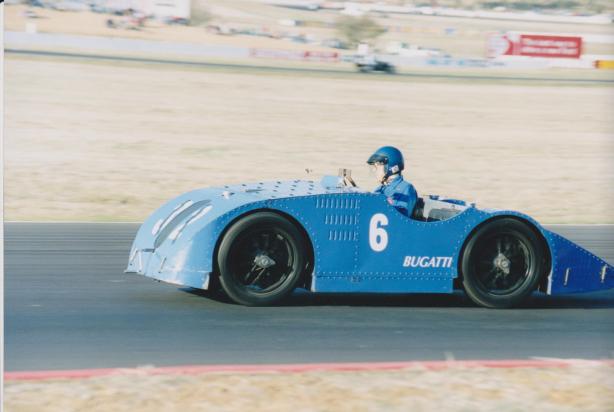
The Tank lost in the wide open spaces of Winton (B King Collection)
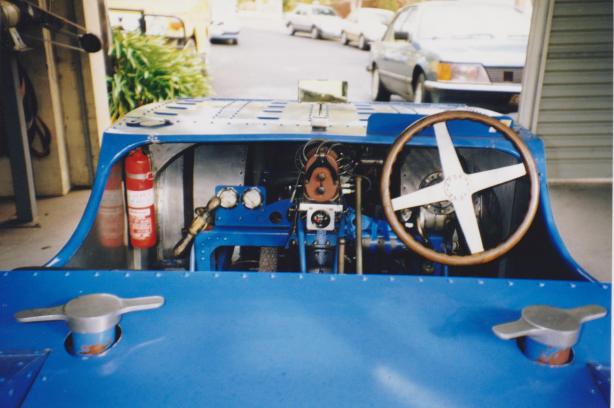
 

Tank office, the magneto is on the back of the engine, so the driver sits right amongst the machinery (B King)

Legend had it that these cars were evil handling because of their 3 metre wheel-base coupled with aerodynamic lift engendered by their ground-hugging, enveloping bodywork.  I can categorically say that the rumours were not true; the car was a delight to buzz through bends and there was no sign of lift at 100 mph.

On the flip side, the car was tricky to drive with the gear change to the trans-axle and the lever for the rear wheel brakes being operated by the left hand, while the right foot was busy being a human balance-bar operating the front wheel brakes as well as an almost inaccessible throttle pedal courtesy of the tight packaging of the straight eight engine which intruded into the cockpit. (Braking was not a priority at Tours with only three corners per 23 Km lap).

Once you got your head around the complicated controls, it was a delight to drive, just like any other Bugatti; and fast enough to pass an Alvis 4.3 litre racing car and a Gypsy Moth engined car down the main straight at Phillip Island. In the absence of a rev-counter and in deference to the three main bearing crankshaft fitted to this car, it was thought necessary to lift off well before turn one. Ettore Bugatti must have had sufficient confidence in his new 5 main bearing ball and roller crankshaft to deem a rev counter unnecessary.

A quickie; https://primotipo.com/?s=1923+french+grand+prix
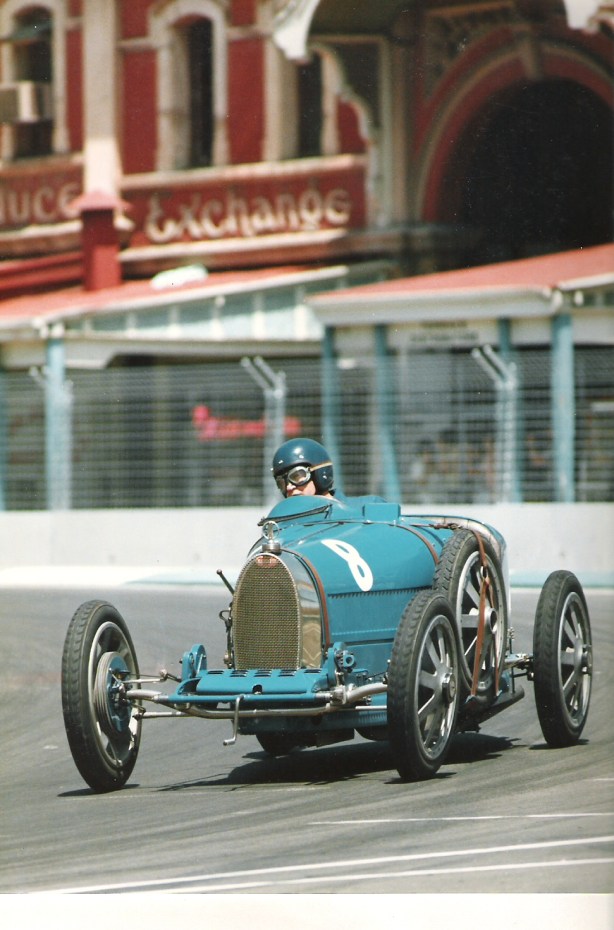
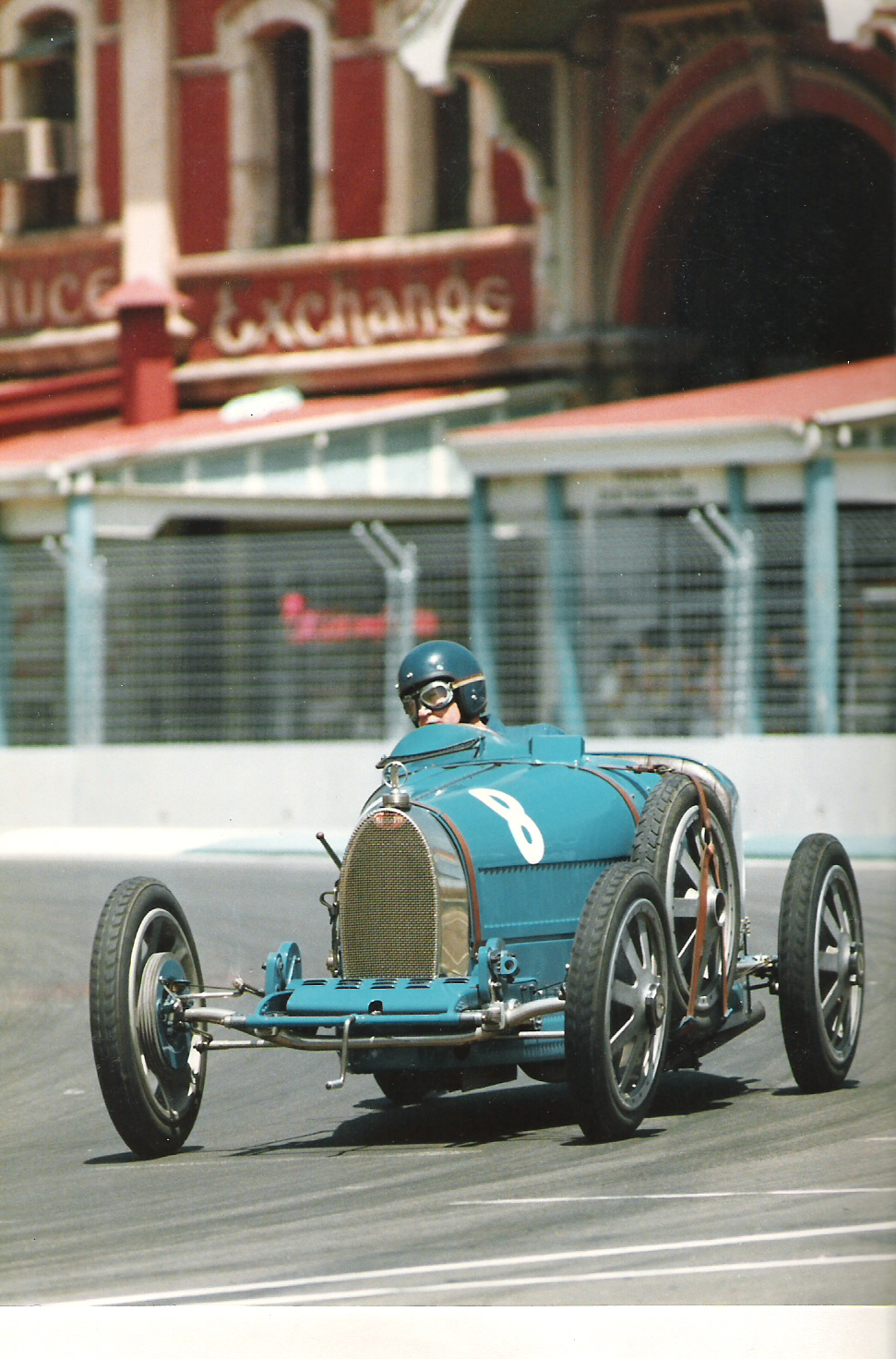
Bugatti T39 #4607 at Stag Corner during the 1985 AGP meeting (B King Collection)

5.1925 Grand Prix Bugatti Type 39

Of Bugattis I have owned, I chose this one as the most delightful to drive.

The Type 39 was the 1 ½ litre variant of the straight eight GP Bugatti – more normally 2 or 2.3 litre. The Type 39 was designed for competition in the Voiturette races in 1925, but initially appeared in the Grand Prix de Tourisme with skimpy touring bodies which barely complied with the rules (and probably not the spirit of the competition).

After the 1000Km touring car race at Montlhery they were rebodied with the familiar GP bodywork and then sent to Italy for the 1925 Italian Grand Prix des Voiturettes. The five team cars were successful in both endeavours.

Remarkably two of the team cars were competing at Maroubra by June 1926, where they met with limited success, being too high geared for the track. However, my car, chassis No. 4607, won the 1931 Australian Grand Prix with Carl Junker at the wheel.

After several blow-ups, the engine was replaced with a Ford V8 in which form it went on to even more fame as the Day Special, driven by Jack Day and then Gelignite Jack Murray. Many years on I was able to restore it using the engine from its sister car.

The car had all the usual attributes of GP Bugatti, as one would expect, with razor sharp steering, a ‘knife through butter’ gear box and powerful brakes. All this was complemented by precise, delicate, handling on beaded edge tyres and an engine that loved to rev courtesy of its short stroke roller bearing crankshaft (60×66 mm). Carl Junker used 7,000 revs through the gears in winning the 200-mile AGP at Phillip Island; almost unheard-of engine speeds for those days. His average speed was 110kph on the rough and dusty roads of Phillip Island.

A bit about the ‘Day Special Ford V8’ aka this Type 39 is here; https://primotipo.com/2018/11/08/the-spook-the-baron-and-the-1938-south-australian-gp-lobethal/
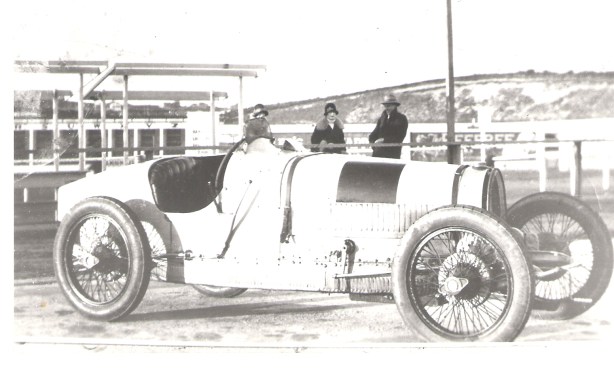
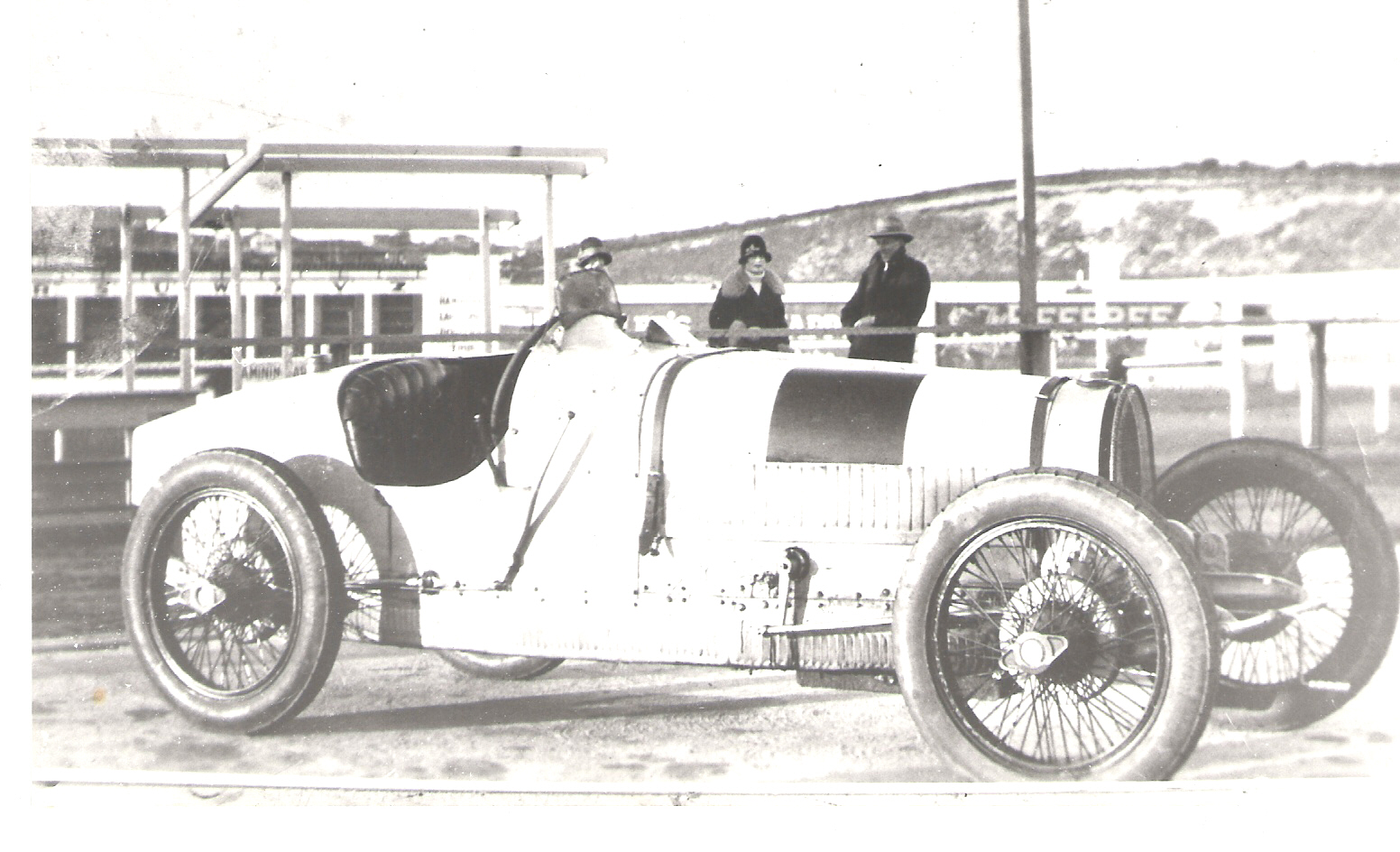
The Type 39 #4607 shortly after its arrival in Australia- here at Maroubra, Sydney note the elaborate scoreboard and banked track in the background (B King Collection)
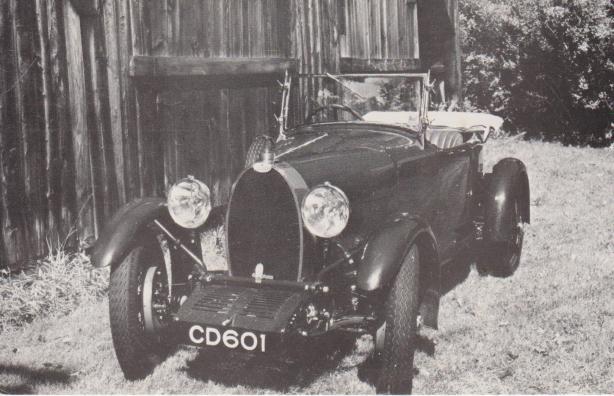
 

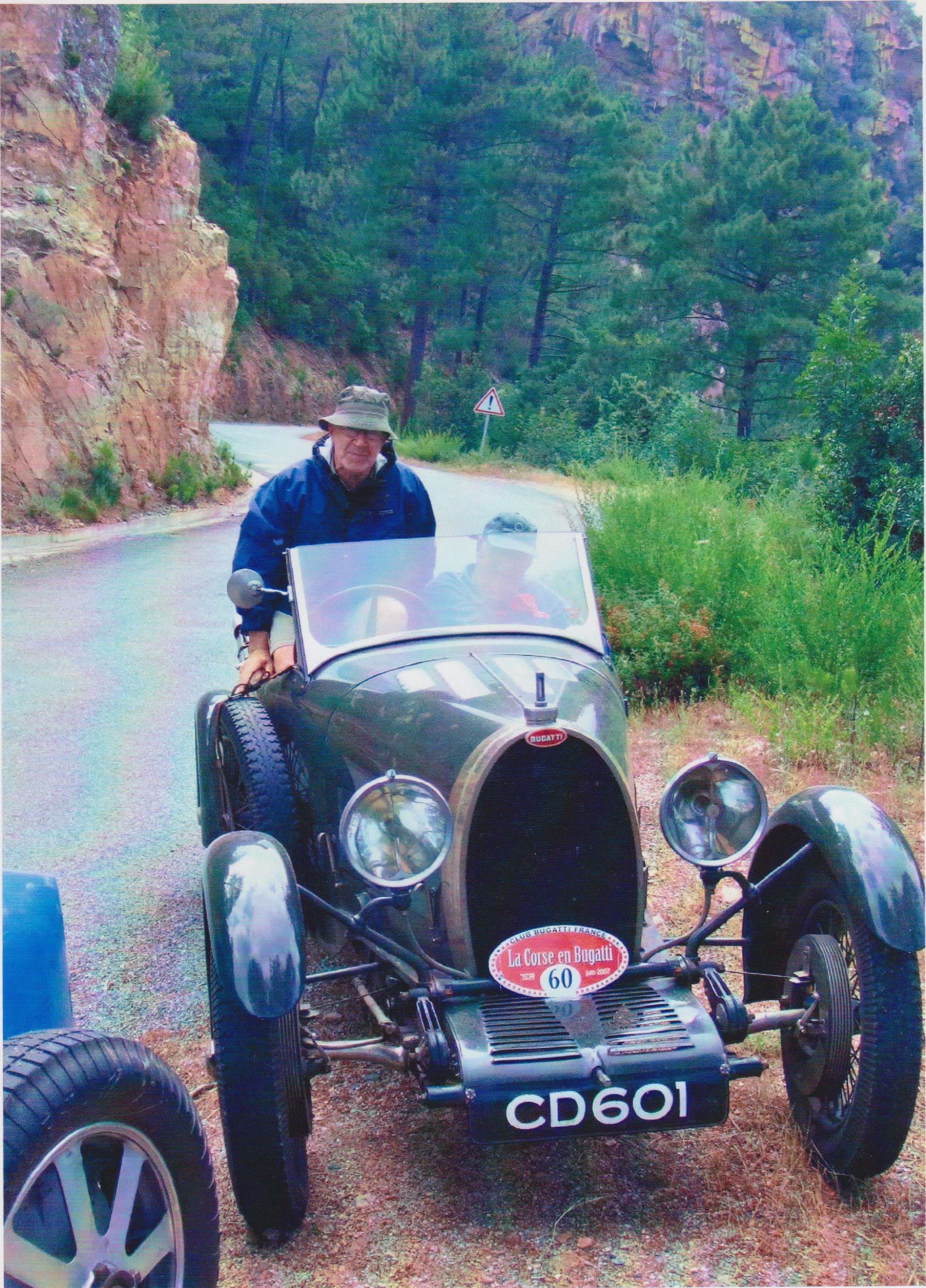
Type 40 not long after restoration, outside David Mize’s barn in Vermont. The Indo-chine number plate was useful to fuzz the Fuzz (A Rheault)

6.1928 Type 40 Bugatti touring car

Why are Bugattis always so maligned? Is it envy or a dearth of experience of these cars, or is it easy to make fun of some of their antediluvian features?

Of all Bugattis, the Type 40 has suffered the most slings and arrows. Usually passed off as the ‘Molsheim Morris Cowley’, it is a humble car with its 1500cc engine usually burdened with a none-too-light four-seater body. However, it maintains all the usual characteristics that make Bugattis a pleasure to drive, and has a cruising speed half as much again as the maximum speed of the aforementioned Morris.

David Mize was employed by the State Department of the US Government in Vietnam and was able to liberate this original factory bodied Grand Sport Type 40 which he found in the killing fields.

Following light restoration, the Type 40 saw active service on numerous International Bugatti Rallies from the mid-nineties. He and the car visited Italy, France, Luxembourg, Spain, Portugal, England, Scotland, Corsica, Sardinia, Tunisia and Australia, including Tasmania. In Europe it was driven to and from events, usually with the writer at the wheel.

Although outpaced by its more sporting brethren in a straight line, it could usually keep pace with them on twisty roads; so long as the roads did not go up-hill. An epic cross USA adventure came to a premature end when the output shaft of the gear box fractured at a point where an unfortunate modification had been made.

In all, David and I did more than 40,000 kms in the car, but this was the first time that it did not get us home. My last drive was as memorable as my first, from Provence to Luxembourg in 2015; David sadly died in 2018, aged 90, but the car remains on active service with his close friends.
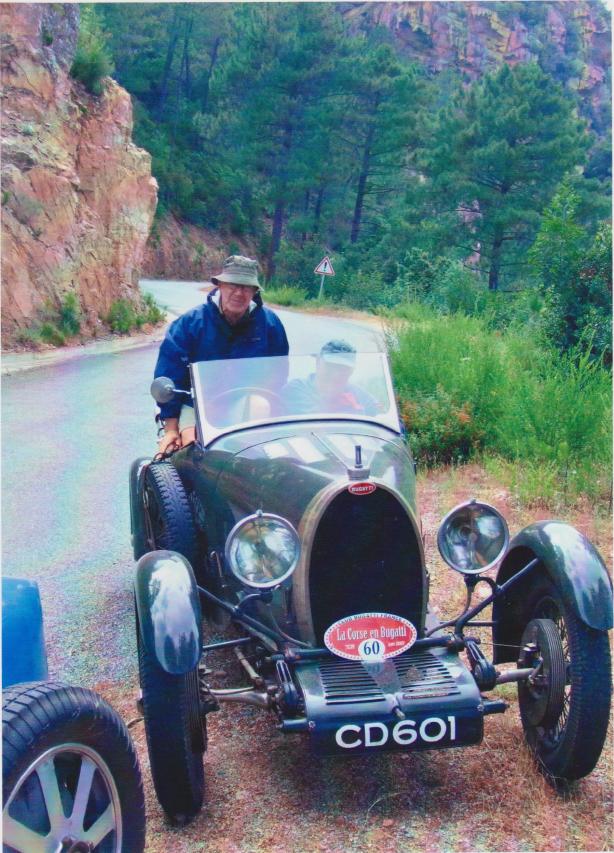
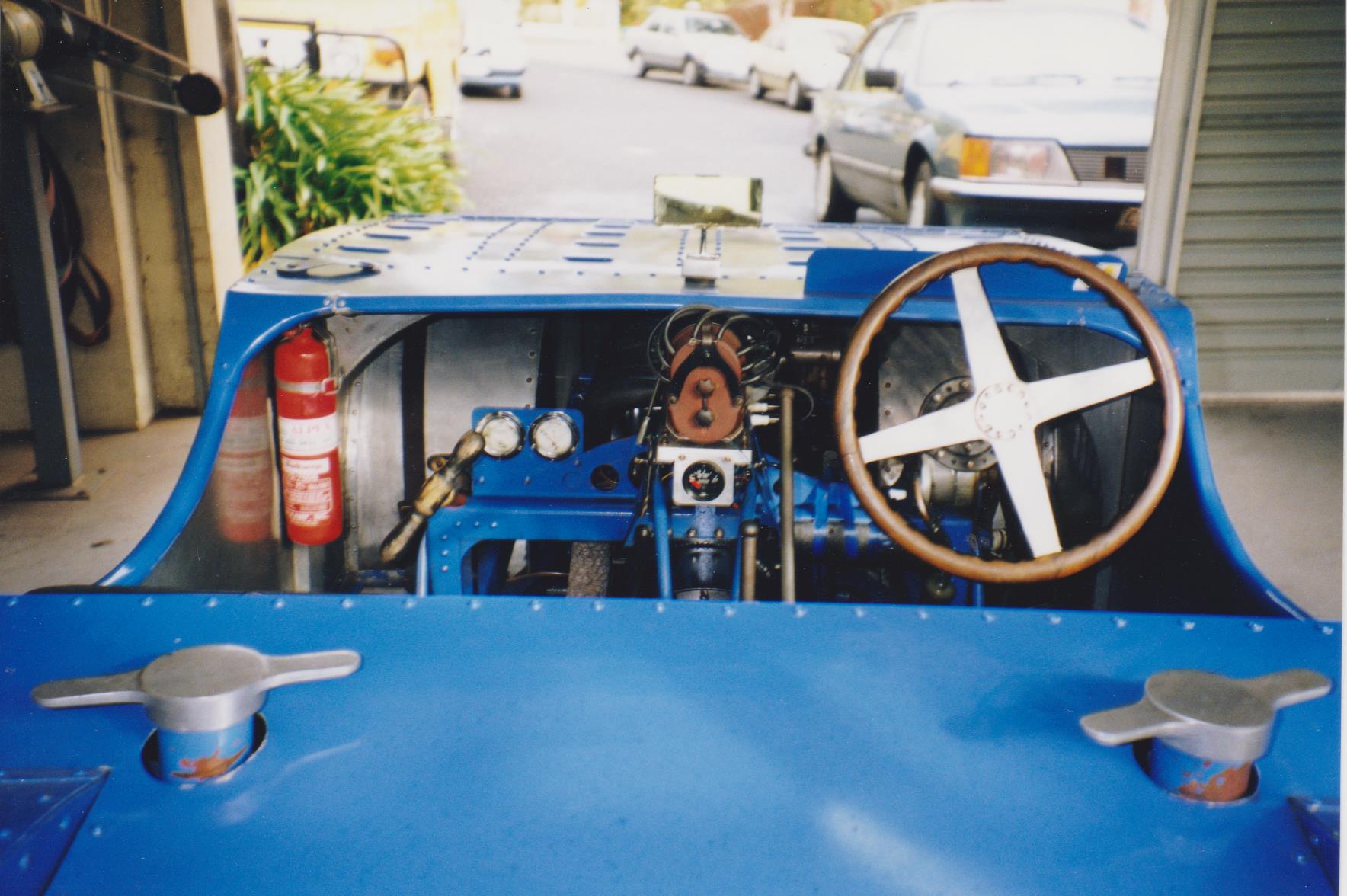
The author enters the car while David Mize makes space in the narrow (and svelte) body, Corsica, 2007 (B King)
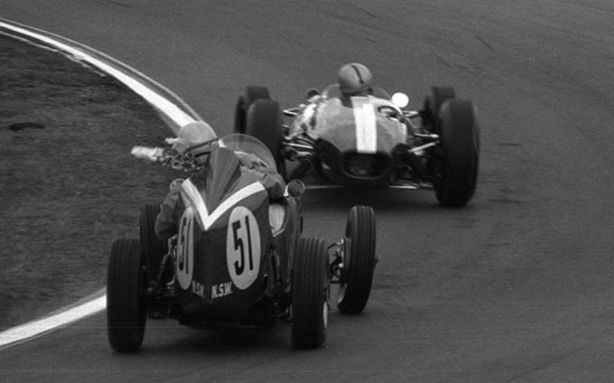
 

Ron Reid in the Sulman Singer chases Colin Bond, Lynx Peugeot s/c at Oran Park 1967 (oldracephotos.com)

7.1935 Sulman Singer

This car might seem a little out of place in this exalted company, but it is included because of its unique place in Australian motoring history.

It was my fortunate lot to be invited to drive this remarkable car at Wakefield Park at an ‘All Historic’ meeting in 2013, through the generosity of Malcolm and David Reid.

This was a car with which I had had many memorable dices in my Anzani Bugatti when it was raced by its long-term custodian, Ron, the Reid boy’s father. Ron mostly had the upper-hand, particularly if he was using a hot motor; if he had a ‘cooking’ motor, then we had great dices.

Singer Le Mans power in a light weight chassis added up to a spritely performance – sufficient for me to pass the ex-Osborne 18 l Hispano-Delage at Wakefield, definitely a case of David and Goliath. Unfortunately, my drive was curtailed by rattles in the engine – the crankshaft had broken at only 4,000 revs. Not to worry said the Reid boys, ‘that was our $10 motor fitted 10 years ago which was about to be replaced anyway’.

Tom Sulman had built the car while living in England and had many successes with it in the pioneering days of speedway in England before repatriating himself and the car to Australia post-war. Tom achieved a memorable 5th place in the 1947 AGP at Bathurst. Raced by two generations of Reids, the Sulman has probably had more starts in Australian Historic Races than any other car.

See here for a feature on Tom Sulman and his cars; https://primotipo.com/?s=sulman+singer
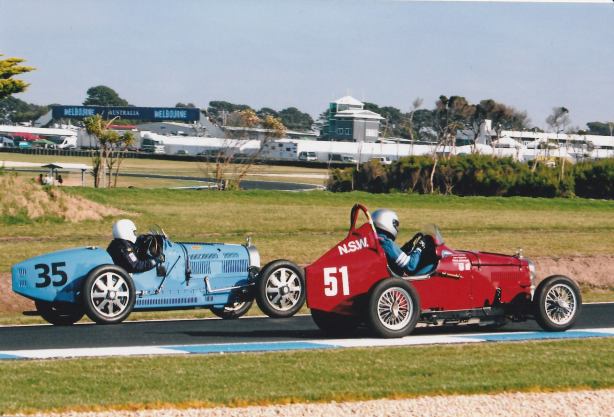
Mal Reid in the Sulman Singer passes George Hetrel’s Bugatti Type 35C at Phillip Island (FB)
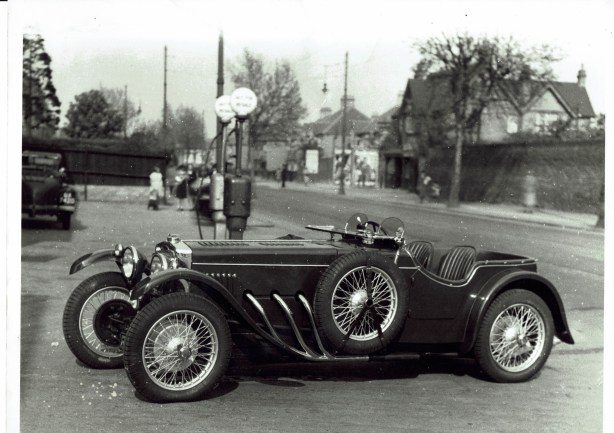
 

‘Nash in England is the car sitting outside the factory in Isleworth on the day the first owner took delivery (G Bain)

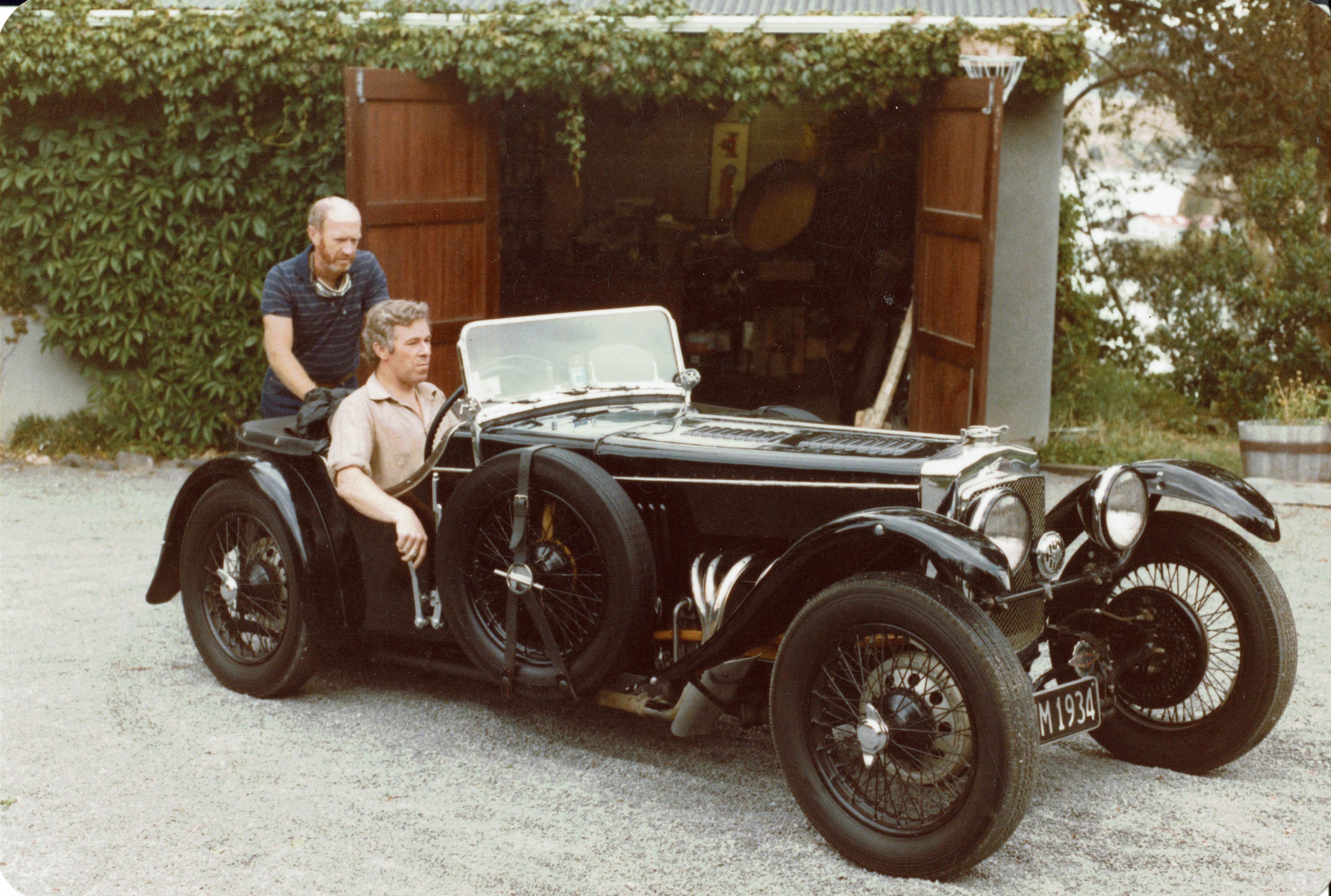
8.1934 Frazer Nash TT Replica

Interestingly, in the Australian context, the first owner of this car was mystery man AG Sinclair. However, Sinclair had nothing to do with this car’s arrival in New Zealand in 1936; he had already sold it.

In New Zealand this extensively raced car went through numerous incarnations as a special before being bought by Gavin Bain in 1976 in restored condition, now fitted with a 6 Cylinder 2 litre ohc AC motor in place of the original 4ED Meadows.

In 1984 Gavin invited me to drive it in Dunedin in a hill climb (Bethune’s Gully) and in road races. The road race was a true ‘round the houses’ affair on the historic Wharf Circuit made famous by Peter Whitehead and Tony Gaze in their Ferraris. Tony later told me that part of the circuit was rough gravel in their day – fortunately it was all bitumen by 1984.

Characteristically, Frazer Nashs are defined by the way they ‘hang the tail out’ when cornering. No matter how hard I tried, this car tracked true, possibly because of the extra two cylinders ‘up-front’ altering the weight distribution. What-ever, it was great fun to drive with its rapid gear change courtesy off the chain drive transmission and its direct steering. And I was hooked on around the houses racing; just like the Ards TTs, except that the left-right flick past the butcher’s shop in Comber was replaced by a plumbing supply company in Dunedin.
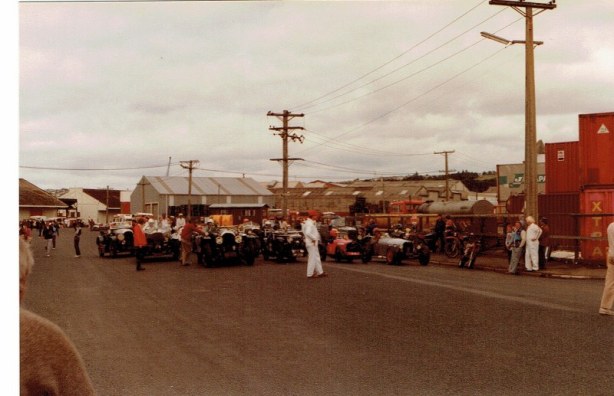
The author lines up on the front row of the grid, Dunedin Wharf Circuit 1984. Definitely round the houses (G Bain)
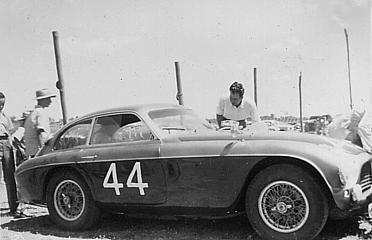
 

The Ferrari 212 when owned by Nino Sacilotto (M Bunyan)

9.1951 Ferrari Type 212 Export Berlinetta Chassis ‘212 0112E’

This fabulous car competed in the Mille Miglia with its original owner, Count Guerino Gerini, having already been uprated to 2.7l, Type 225 specifications.

By 1956 it was in Sydney with Nino Sacilotto, a textile agent and the Italian Consul; he also had a smart Italian restaurant in Kings Cross, where I met zabaglione for the first time. Nino drove it to Melbourne for the 1956 Australian Tourist Trophy at Albert Park. By 1959 it was with Adelaide engineer Harold Clisby who undertook an extensive mechanical rebuild after the crankshaft broke on his delivery drive.

In the sixties it was owned by Ian Ferguson, and I had the opportunity to drive it for several laps at Winton on an early Australian Ferrari Register track day. Ian and I were both Bugatti owners, and I likened it to driving a Grand Prix Bugatti with a roof. Like the Bugatti, one’s left knee rested on the gear box (5 speed with dog engagement); also housed under the unlined aluminium roof was a howling 2.7 l, 12-cylinder engine. Motoring heaven.

One quickly appreciated Sacilotto’s description of the ordeal of driving it from Sydney to Melbourne: “I started out with a full bottle of scotch wedged between the seats; by the time I got to Melbourne, the bottle was empty”.

At a later date I had a number of rides in New Zealand in Phipps and Amanda Rinaldo’s Type 166 Inter Coupe (Chassis 007 – the earliest road registered Ferrari). The contrast was stark. This car with a 2l engine and the usual interior creature comforts was civilized; sure, you could enjoy the whirring 12 cylinders, but there was none of the cacophony of the later racing car – Sydney to Melbourne would have been a pleasure; even without the whisky.
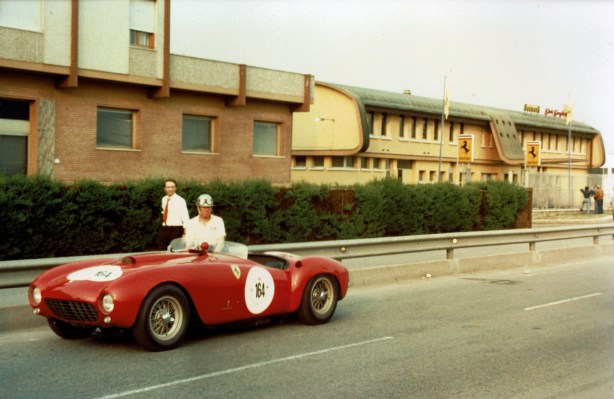
 

The 375 MM back ‘home’ in Modena (G Bain)

10.1953 Ferrari 375 MM Chassis ‘MM 0370AM’

Again, through the good offices my friend Gavin Bain, I had the opportunity to drive this beast in practice at an All Historic Amaroo meeting – we swapped drives, he drove my Bugatti.

Gavin had replaced his Grand Prix Ferrari 375 F1 with this car which had won the Buenos Aires 1000km in 1954 when driven by Umberto Maglioli and Giuseppe Farina. The fabulous Pininfarina body on it was draped over a bellowing 4.5l, 12-cylinder engine, matched to a close ratio gear box.

Gavin warned me that it had a high first gear and that the clutch was ‘in or out’ and therefore you needed to give it a few revs to get moving. I did just that and went wheel spinning up Bitupave Hill. Wow, how good is this? Real power. I drove it for about 12 laps and cautiously sped up.

By the end of my stint I felt that if I could drive it for week, I just might be able to drive it at racing speeds, but I was well aware of my limitations and felt that I could never be drifting it through corners with only inches separating me from my competitors – I was never going to be a Maglioli or a Farina.
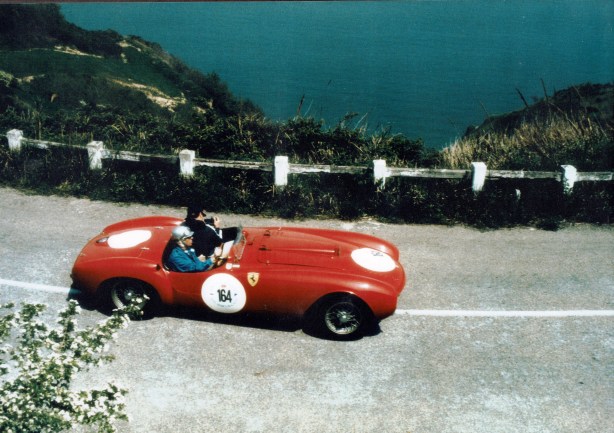
Somewhere in Italy (G Bain)

Epilogue.

Reg Nutt, who as a young fella was riding mechanic to Carl Junker in the winning Bugatti Type 39 in the 1931 AGP, told me that he had raced 27 cars, but had never owned a racing car – an enviable record. I guess I have been lucky to have had, mostly brief, acquaintance with some pretty remarkable cars.

Photo Credits…

Bob King/Collection, Gavin Bain/Collection, Merv Bunyan Collection, Lynton Hemer, A Rheault, Selou, Hope Bartlett Collection

Etcetera…
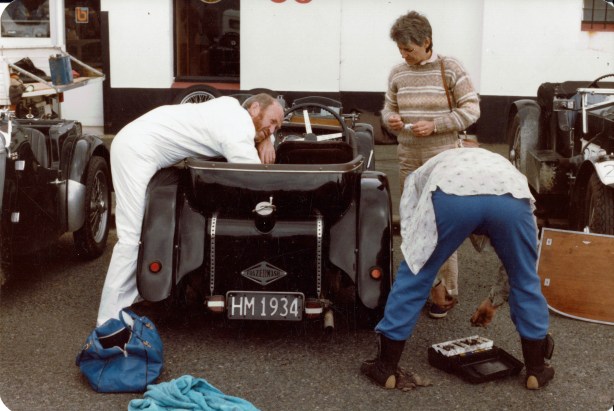
(G Bain)

Frazer Nash being worked on at Dunedin in 1984 an below in Gavin Bain’s New Zealand yard.
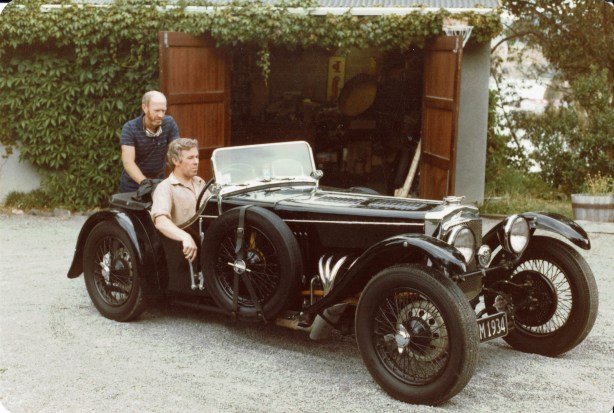
(G Bain)

Finito….

(D Lupton)

Not quite actually.

Lionel Marsh aboard Norman Hamilton’s Porsche 550 at Templestowe Hillclimb’s ‘The Hole’ on Melbourne’s eastern outskirts circa 1961/2.

Denis Lupton took a cracker of a shot- ignore the eucalypts, pretend they are pines and it could be the Eifel Mountains, sorta.

Denis was sure the pilot was Alan Hamilton, son of Porsche Cars Australia founder Norman Hamilton, but after some investigation and comment by Ron Simmonds, Gordon Dobie, Tony Johns and Stephen Dalton, Alan Hamilton resolved the ‘mystery’.

He recalls ‘Sadly, the 550 days were just a bit too early for me. That is Lionel Marsh at Templestowe. I did drive the 550 a couple of times at Fishermans Bend. Sometimes, after the races, Alan Jones and I used to disappear to a deserted end of the airstrips and drive our respective fathers, cars.’

‘I don’t recall how Lionel came to “own” the 550 other than he was a great mate of Jack Godbehear. (a renowned but low profile engine builder) I have a feeling that Jack might have been the owner, or at least, a major shareholder in it. Jack certainly did the preparation for Lionel and in many ways, this was the most successful period of the 550’s
life.’

‘My father and Frank Kleinig took the car to New Zealand to race there in 1956. Frank had difficulty coming to terms with the 550 as it handled total differently to his Hudson Special. Unfortunately, Frank earned the reputation of “hay bail Charlie” because of his habit of hitting hay bails which marked the track limits. My father asked Stirling Moss if he’d like to drive the car in the Ardmore Handicap, which he won.’

‘In about 1964, I located the car in a panel beating shop in Sydney and bought it. The engine was part disassembled, the gearbox was missing, as were the front brakes. The body work was “bruised” in various places. One of the panel beaters from Duttons (our authorised body repairers at the time) commenced work on the “bruises” and I sent the engine back to Porsche for a full rebuild.’

‘I spent six months living and working at Porsche in 1965 and came back with the 906 Spyder, chassis # 906-007. I also came back with a burning desire to race, but with no money. Part of my assets to be turned into cash, was the 550, which was sold to Lindsay Fox with the restoration beautifully completed by Brian Tanti.’

‘Lindsay also owns my 718 RSK which is also beautifully presented in the Fox Classic Car Collection. Incidentally,
the chassis number of the 550 that James Dean was driving when he died was 055, just one car earlier than my father’s car, chassis number 056.’

(D Lupton)

‘I spent 6 months living and working at Porsche in 1965 and came back with the 906 Spyder, chassis # 906-007. I also came back with a burning desire to race, but with no money. Part of my assets to be turned into cash, was the 550, which was sold to Lindsay Fox with the restoration beautifully completed by Brian Tanti.’

‘Lindsay also owns my 718 RSK which is also beautifully presented in the Fox Classic Car Collection. Incidentally,
the chassis number of the 550 that James Dean was driving when he died was 055, just one car earlier than my father’s car, chassis number 056’ Alan conculded.

The close up shot of Hamilton’s ex-works Porsche 904/8- chassis # ‘906-007’ ‘Bergspyder’ is a beauty, Calder 1966- colour too, thanks Denis!

By this stage the machine was fitted with a 2 litre 906 six-cylinder engine, click here for a piece on the car and one of the biggest friends Australian motor racing has ever had; https://primotipo.com/2015/08/20/alan-hamilton-his-porsche-9048-and-two-906s/ . The 550 Spyder is here; https://primotipo.com/2018/06/28/hamiltons-porsche-550-spyder/

(R Simmonds)

Etcetera…

As usual, a flurry of communication with others of our friends after upload of the piece resulted in a few more images.

The first above is from Ron Simmonds, again at ‘The Hole’ with then owner Lionel Marsh at the wheel, whilst below is one from Tony Johns of Stirling Moss having a steer of the car in a sportscar support race- winning the ‘Ardmore Handicap’, as Hamilton notes above, before setting off for a victorious run in his Maserati 250F in the New Zealand Grand Prix at Ardmore in 1956.

(T Johns Collection)


(T Johns Collection)

During the period Norman Hamilton owned #’0056′ it was driven by ‘every man and his dog’- the array of talent included Stirling Moss, Jack Brabham, Frank Kleinig, Bruce Walton, Otto Stone, Eddie Perkins, Ted Gray, Austin Miller and Ern Tadgell, who is shown aboard the car at Phillip Island below.

Credit…

Special thanks to Denis Lupton and Alan hamilton

Ron Simmonds, Tony Johns Collection, Dick Willis, ‘Historic Racing Cars in Australia’ John Blanden

Tailpiece…

(Dick Willis)

Ern Tadgell again, in Dick Willis’ shot, this time at Lowood, Queensland in 1957- the car worked hard all over Australia as one of Hamilton’s primary brand recognition tools all those years ago when the Zuffenhausen giant was a small family business start-up, hard though that is to imagine now!

Finito…

(R MacKenzie)

Pedro Rogriguez BRM P126 V12 howling its way around Surfers Paradise in the summer of 1968, behind is Dick Atwood’s sister car…

This shot is by Rod MacKenzie, loved his work, especially the more creative stuff of which there is heaps- he died last year sadly, see here for some of his work; https://primotipo.com/2018/09/27/oz-racing-books/ and here for the BRM P126; https://primotipo.com/2018/01/25/richard-attwood-brm-p126-longford-1968/


(oldracephotos.com.au/King)

Bob Jane from Allan Moffat in Lotus Cortinas at Mountford Corner, Longford in March 1965.

Didn’t these two characters go at with considerable ferocity for a couple of decades, who won the encounters on this weekend? Click here for the Lotus Cortina; https://primotipo.com/2014/11/16/jim-clark-lotus-cortina-sebring-1964/ and here for Moff’s more formative career years; https://primotipo.com/2020/03/06/moffats-shelby-brabham-elfin-and-trans-am/


(I Smith)

Feel the earth move under your feet- Formula 5000 at Sandown was what hooked me into the sport.

McRae, McRae GM3 Chev, Costanzo, Lola T332C Chev and Kevin Bartlett’s partially obscured Brabham BT43 Chev, another three T332s and the rest on the run down from The Rise down into Dandy Road- Sandown Park Cup, Rothmans International Series, February 1978.

Warwick Brown won from Garrie Cooper and John Cannon- Lola T333/T332C Chev, Elfin MR8-C Chev and March 73A/751 Chev, McRae, Costanzo and Bartlett were all DNFs.

Piece on Graham McRae here; https://primotipo.com/2018/09/06/amons-talon-mcraes-gm2/


(S Jek)

Stan Jones, Maserati 250F during the 1956 Australian Grand Prix.

Taken from the spectator foot bridge on Pit Straight, Stan was fifth in the race won by Moss’ works 250F, see here; https://primotipo.com/2018/01/16/james-linehams-1956-agp-albert-park/


(unattributed)

The Corkscrew, Laguna Seca Can-Am 15 October 1967.

Skip Scott, McLaren M1C Chev from Frank Matich, Matich SR3 Repco ‘620’ 4.4 V8 and Chris Amon, Ferrari 350 Can-Am V12 with a Lola T70 up top.

Bruce McLaren won that day in his M6A Chev- the first of the long series of dominant orange Can-Am Big Macs.

For Matich, his 1967 tour was a toe in the water exercise, but he never did go back with a sportscar, the SR4 chassis and Repco 5 litre 760 engine were both hopelessly late, in the event he used a sledge hammer to crack a nut in torching the local opposition in the 1969 Australian Sportscar Championship- see here; https://primotipo.com/2016/07/15/matich-sr4-repco-by-nigel-tait-and-mark-bisset/


(Peter Weaver Motorsports Photography)

John Smith, Ralt RT21 Holden, Formula Holden, Phillip Island during the opening 1990 Gold Star round in March 1990.

Schmiddy put Dave Mawer’s immaculate car second on the grid but had a mother and father of a prang during the pre-race morning warm up comprehensively destroying the car after a high speed off at Lukey Heights.

I became a Smith devotee in his Bowin P4A Formula Ford days where his dazzling car control was Bartlett-esque, he carried that pace into the Galloway ANF2 and then the ex-Scuderia Veloce/Larry Perkins Ralt RT1 he raced with both pushrod Ford and BDA Ford engines in both ANF2 and Formula Pacific- nifty that, I always thought.

The thinking drivers of that F Pac period were Alf Costanzo and John Bowe- the ‘maddies’ perhaps Andrew Miedecke, Lucio Cesario and Smith- with the latter two probably or possibly the quickest of the five over a given lap and Costanzo and JB more often victorious. Alan Jones duly noted of course.

Alf should have gone to Europe in 1969 (or did he? and returned), Smith in 1979 and Bowe and Cesario in 1981- man there was talent aplenty amongst that lot.

John boofed a few cars mind you- the RT1 was retubbed at least once, ditto one of the RT4s, ditto this RT21 but he was always ‘on it’ in a very European kinda way as was Lucio, and let’s not forget the latter was a Lancia LC2 Ferrari Group C works driver for a season or so- I really must write that story.

John’s Ralt RT4 looking a tad second hand after a difference of opinion with the Adelaide International real estate before the first Gold Star round in 1982 (SLSA)


(T Parkinson)

Bunbury ‘Round The Houses’ down south as the Perthies refer to Margs (Margaret River) and its surrounds.

The real 100S Austin Healey deal ‘AHS3909’ which Tony Parkinson identifies as driven by Perth disc-jockey Mike O’Rourke during the 1963 New Year weekend.

See here for more about these West Australian town venues; https://primotipo.com/2017/03/23/bunbury-flying-50-allan-tomlinson-ferrari-500-et-al/


(Govt Singapore)

John Walker’s Elfin 600B Ford twin-cam leads winner Graeme Lawrence, Brabham BT29 Ford FVC through the tropical jungle alongside the Thompson Road track, Singapore GP 1971.

This piece is about the Singapore GP generally but with a focus on the 1972 event; https://primotipo.com/2016/11/24/singapore-sling-with-an-elfin-twist/


(J Ellacott)

Beautiful John Ellacott shot at Mount Druitt in July 1957.

The two Johns, Ellacott and Medley identify the entrants as the #81 George Websdale MG TC, #9 Howard Hunt MG TA/TC Spl s/c, Jim Johnson MG TC Spl, #20 Don Wright, Citroen Spl and Gordon Stewart in the mid-engined Wheeler MG Spl s/c, and on the second row Ray Walmsley, Alfa Romeo P3 Alvis, unknown, the George Pearse Cooper MG and maybe Ken Bennett’s Austin Healey 100-4, Medley notes in the background the red Jack Robinson Jaguar in the background.

A piece on Mount Druitt is here; https://primotipo.com/?s=mount+druitt


(A Doney)

Soap Box Derby in Bendigo.

Nineteen-forties d’yer reckon? All of us with a billy-cart or three in our past can relate to this wonderful shot. More on billy-carts; https://primotipo.com/2019/02/10/spitty/


Poignant.

The I’ll-fated Rocky Tresise Ecurie Australie Cooper T62 Climax is pushed onto the grid at Longford in March 1965.

Warwick Cumming at the rear, Lou Russo up front- two of the AF Hollins crew who always looked after Lex Davison’s cars.

A rather sad story, a ‘Greek Tragedy’ as some have described it, here; https://primotipo.com/2016/05/20/bruce-lex-and-rockys-cooper-t62-climax/


(Peter Weaver Motor Sport Photography)

Bap Romano, Kaditcha Ford Cosworth DFL, Winton, 1983.

Bap won both heats of the Australian Sportscar Championship that day- I was there and still remember the raucous, sharp exhaust note of Barry Lock’s marvellous car.

It needed a bit of work from ex-Alan Jones Williams mechanic, Wayne Eckersley to get the structure and aero right but it was a jet once they got the thing sorted.

I went to several meetings just to see and hear this car.


(I Nicholls)

Tiger In Your Tank indeed.

Ray Parsons and Jim Clark watched by a fascinated Sandown Park crowd during the 1966 Tasman meeting.

Clark’s Lotus 39 Climax was the least competitive of all of his Tasman mounts, the two BRM P261s were the class of the field that year with Jackie Stewart taking the title convincingly.

See here for an epic on this car which was driven so well for so long after acquired by Leo Geoghegan after the Longford round which followed this Sandown event; https://primotipo.com/2016/02/12/jim-clark-and-leo-geoghegans-lotus-39/


(N Macleod)

Aussie Abroad.

Warwick Brown in Jack McCormack’s Talon MR1A Chev at Mosport during the 1975 US F5000 Championship.

He gave Mario Andretti a surprise that weekend pushing him hard in the heat, in the final he was third behind Mario and Brian Redman’s Lola T332 Chevs.

A bit about Warwick here; https://primotipo.com/2017/03/09/wb-for-73/


(D Simpson)

The old and the new.

There are not too many shots of Bob Jane’s second and third Mustangs together on track together as here during the 1969 Australian Touring Car Championship round at Mallala.

Bob in the 1968 Shelby built Trans-Am leads John Harvey in the GT390 with Terry Allen’s Chev Camaro in shot too.

Pete Geoghegan won the race in his Mustang from Alan Hamilton’s Porsche 911, Bob retired mid-race, not sure about Harves and Terry Allan, I don’t have my ATCC book to hand- folks?

1969 ATCC article here; https://primotipo.com/2018/02/01/1969-australian-touring-car-championship/


(J Ellacott)

Stunning John Ellacott work- look closely, there is so much going on in this magnificent photograph taken during the 1962 Warwick Farm 100 weekend.

Moss practiced this Lotus 21 Climax but preferred Rob Walker’s Cooper T53 so won in that from Bruce McLaren and Bib Stillwell in similar cars.

Read about the Lotus 21 here; https://primotipo.com/2016/04/08/ole-935/


(M Terry)

Aspendale Park 1929.

James Crooke built a race track inside his horse racing course in 1905, the first race meeting was held on 29 January 1906 making it the ‘world’s first purpose built racing circuit.’

I am intrigued as to the cars and drivers above identification folks?

See here a great piece on this Melbourne bayside motorsport 1905 to 1951 race venue, Melburnians who want to check the location should pop Albany Crescent, Aspendale into Google Maps and drive along it- it once was the track’s back-straight.

See here; https://www.hyperracer.com/history


(R Lambert or D Mills)

Surely Garrie Cooper was the most multi-talented man in Australian motor racing apart from Jack Brabham?

Designer, engineer, constructor of production racing cars in some scale for a couple of decades and a bit, small business owner and employer and elite level racing driver- not at the  apex of the latter of course.

Nobody has a bad thing to see about the bloke either, he was a decent, honest man of his word in a sea filled with no shortage of white-pointers.

Here he is aboard his superb Elfin 600C Repco ‘830’ 2.5 V8 during the JAF Japanese Grand Prix weekend in 1969 in this race won by

Per head of population the Elfin 600 was one of the most successful production racing cars ever built- the only model missing from the Edwardstown concerns line up was a Formula Vee variant!

Craig Sparks, Elfin 792 VW inside Bob Prendergast’s Cheetah Mk7 , Winton March 1981


Winton ANF2 championship round in March 1981. John Bowe, Elfin GE225 VW from Ricahed Davison’s Hardman Ford, Russell Norden’s March ‘Aryben’ 793 VW and Peter Macrow, Cheetah Mk7 Toyota. JB wrote of this car ‘Loved that car, would have liked to run it for a bit longer but my sponsor wanted to go Atlantic racing straight away which meant Ralt. I’m sure Garrie could have built an awesome Atlantic car but the time frame was crucial’

I remember looking at John Bowe’s works Elfin 792 VW car at the Winton ANF2 championship round in 1979 and going simultaneously ‘woweee’ and ‘ya missed the boat Gazza’ when first glimpsing the gleaming Ansett sponsored car, it was the year ‘all’ the production racing car manufacturers had a crack at a ground-effect car, ‘black art’ that it was at the time.

The 792 wasn’t a GE car but the GE225 VW F2 which followed it was- and was a quick machine, John Bowe rated it and then Chris Leach, his sponsor, wanted to go Formula Pacific so the car was sold sooner than ideal, so too was the MR9 Chev F5000 but it’s developmental opportunities were not at an end when Garrie died suddenly in early 1982.

I’ve often wondered what he would have achieved had he continued on, for sure the historic restoration work he had commenced would have provided valuable cash-flow as the market for production racing cars got tougher especially as the carbon-fibre era began.

The cars designed and built by Don Elliot, Tony Edmondson and Jon Porter were the real Elfin deal mind you, god bless ‘em for taking the torch forward as they did.

R.IP. GC Cooper- see here for the 792; https://primotipo.com/2016/06/10/elfin-light-aircraft/


Bib Stillwell at Mount Panorama aboard his Cooper T51 Climax in October 1960.

Bib owned and raced more cars than you and I have had hot dinners- the Coopers he had in this period alone takes a bit of reckoning.

This one ‘F2-18-59’ is the car he leased to Lex Davison and in which, despite its 2.2 litre Coventry Climax FPF engine, compared to the oppositions 2.5s, Lex won the 1961 Australian Grand Prix at Mallala, click here for that story; https://primotipo.com/2018/03/29/the-naughty-corner-renta-gp-winner/


(HRCCTas)

Alan Hamilton’s Porsche 904 leads a gaggle of cars into the Viaduct at Longford during the 1966 Australian Tourist Trophy.

Behind him is Lionel Ayers, MRC Lotus 23B Ford, Spencer Martin in the Scuderia Veloce Ferrari 250LM- Frank Matich is up front in his new Elfin 400 Olds and took the win.

Here is a piece on Hamilton’s sportsracer Porsches of this period; https://primotipo.com/2015/08/20/alan-hamilton-his-porsche-9048-and-two-906s/


(Brabham Automotive)

‘Orf with his head!’

Arise Sir Jack, Sir Zelman Cowen, Australia’s Governor General completes the Knighthood ritual in Canberra, 1979.

And rather well deserved too.


(unattributed)

Aussies Abroad, for quite a while the case of these blokes…

Brian Muir, BMW 3 litre CSL chases Frank Gardner, Chev Camaro ZL-1 7 litre at Brands Hatch during a British Saloon Car Championship round in 1973.

Frank left Australia as a sportscar pilot and forged a great career in those things as well as single-seaters and tourers whilst Brian left Sydney as a touring car driver and mixed that in Europe with sportscar drives.

Frank returned to Oz in late 1974 whilst Brian died suddenly in England on 11 September 1983.


(unattributed)

The raucous bellow of the XK Jaguar engine bellows and echoes off the surrounding gums as Ron Phillips’ Cooper T38 exits Kings Bridge during the 1959 Australian Grand Prix at Longford…

Phillips, son of Wangaratta between the wars top racer Jack Phillips didn’t win that day but he won the event at Lowood in 1959.

I’ve an article largely completed on that ex-Whitehead/Jones car and tangentially the driver, I really must get on with it Ian McDonald!


(Castrol)

Bathurst 1000, 2019: Lee Holdsworth, Tickford Racing Ford Mustang GT…

The Mustangs brought a great new shape to V8 Supercars in 2019 with the DJR Scott McLaughlin car taking the title from Shane van Gisbergen and Jamie Whincup.

Holdsworth was ninth at Mount Panorama sharing with Thomas Randle and finished tenth in the overall seasons point score with a best placing for the year third at Sandown.


(P Cross)

Phil West at the wheel of the Scuderia Veloce ex-Gardner Ferrari 275GTB during the 1968 Surfers Paradise 12 Hours.

He finished ninth sharing the car with George Reynolds and – the race was won by the SV Ferrari 250LM driven by the Brothers Geoghegan.

Whilst the 275GTB are somewhat iconic Phil wasn’t impressed at all, his thoughts about it are here; https://primotipo.com/2019/10/24/franks-fazz/


(R Watson)

Bob Jane at Calder aboard his Brabham BT23E Repco circa 1968.

Janey raced single-seaters regularly circa 1964-1966, he had an Elfin Mono Ford ANF1.5 and at that stage more or less switched to touring cars but not exclusively so, when he felt like it he had a whirl in his Elfin 400 Repco, and here aboard his ex-Jack 1968 Tasman machine usually piloted by John Harvey.

This car is covered in this piece here; https://primotipo.com/2015/12/22/jack-brabham-brabham-bt23e-oran-park-1968/

Bob Jane, Elfin Type 100 Ford twin-cam ANF 1.5, Warwick Farm Tasman meeting 1966 (autopics.com)

Photo and other Credits…

Roderick MacKenzie, Sharaz Jek, oldracephotos.com, Peter Weaver Motorsport Photography, Tony Parkinson, John Ellacott, Allan Doney, Ian Nicholls, Norm Macleod, Dick Simpson, Michael Terry, Historic Racing Car Club of Tasmania, Brabham Automotive, Castrol, Richard Watson, hyperracer.com, autopics.com, S5000 Facebook

Tailpiece: Surfs Up…

(S5000 FB)

Tim Macrow testing the prototype S5000 Ligier at Phillip Island on 19 September 2019.

Lovely shot by Peter Weaver, who said all modern circuits are ugly? Weaver is the master at the Island, his work there is exceptional.

This was one of several test days at the circuit before the new categories first race at Sandown several weeks hence, click here for a feature on the class; https://primotipo.com/2019/10/26/progress/

Finito…

(T Johns Collection)

Tony Johns well rugged up for the chills of Winton in 1965, Austin 7 Spl…

When I completed University my student earnings were all blown on a Venom Mk2 Formula Vee in March 1979, i entered the ‘real workforce’ and bought my first racer in the same week. Formula Vee was the way to go for the impecunious enthusiast with a hankering for single seater cars then, but a generation before in the late fifties/early sixties the path was a little more difficult without so many ‘factory’ cars about.

Tony Johns’ story of Austin 7 competition in the day is an interesting first-hand account of how it was for enthusiasts with a hankering for competition in those times- many Australian enthusiasts will be familiar with him as a racer, purveyor of fine motorbooks or co-author of ‘Vintage Bentleys in Australia’.

‘I was fortunate to grow up with very tolerant parents who accepted my love of old cars. Starting when I was a young boy with an Austin 7-owning great aunt which generated my passion for these wonderful cars. In my final years at school long before any of us were old enough to hold a driving license, two of my class mates already owned A7s, and soon after a third purchased a Chummy six months before me which he still owns to this day.’

John’s first Austin Chummy. ‘In the early 1960s the A7 Club held their annual beach run on the Mornington Peninsula at what was then a quiet peaceful beach at Shoreham, not far from Flinders. Never to waste an opportunity once the tide went out, the sticks were soon in place for a slalom event. If you look closely (very Tony!) under my armpit you can see Neil Johannesen’s Mooris 850 ex-1961 Armstrong 500’. Bugeye Sprite at right (David Lowe-T Johns Collection)

TJ and Chummy ascending Rob Roy in the early sixties (A Tracey)

‘As a teenager in the 1950’s I convinced my parents to take me to a race meeting at the Fisherman’s Bend airstrip circuit and the race meetings at Albert Park, mind you I had to wear my school uniform and cap!

Still months away from being old enough to have a driving license, I purchased my first Austin 7, a 1928 magneto-engined Chummy that was my entry card to join the Victorian Austin 7 Club in 1960.

In the beginning I competed in Gymkhanas and Navigation Trials but always wanted to build and compete in my own racing Austin 7. I started going to race meetings with Nigel Tait and got to know all the other drivers, observing what to do and what not to do. In those days everybody was very helpful and at race meeting, drivers would share spare parts if somebody needed help.’

Minimalism defined! ‘The gymkhana chassis, which, together with the body from Allan Tyrrell’s racing car which became my first racing Austin in 1965’ (T Johns)

Lakeland Hillclimb in the mid-sixties, still in short-sleeves but with secondhand Dunlop racing tyres and fifteen inch wheels (D Lowe)

‘John Fleming’s Merri Bridge Motors was the place to go for Austin 7 specials in the 1960s’ (T Johns Collection)

‘John Whitehouse and Dale Shaw were the front-runners when I had built my racing 7. My first race meeting as a driver was the Easter weekend in South Australia back in 1965, it comprised a hillclimb at Collingrove and races at Mallala. By then John Fleming and John Bowring had retired and sold their cars to new owners.

It took nearly a year to build with a lot of help from fellow Austin 7 club member Geoff Taylor, yet another A7 member who ended up as an engineer with General Motors. Geoff was still around when we built the two new Austins for the ‘1981 Raid’ to the UK- this time, as the Chief Brake Engineer for GMH. He used his contacts at PBR to supply all the new brake fittings, no going back to the wreckers!

Starting with a lowered chassis which had been modified to use in gymkhanas, I converted the original cable brakes to hydraulic operation using new alloy backing plates manufactured and sold by John Fleming (see advertisement) and Lockheed cylinders from a side valve Morris Minor obtained from the local wrecker.

Fortunately for me, Allan Tyrrell, due to both work commitments and a young family had decided to give up circuit racing and instead use his Austin to compete in an occasional hill climb. Having removed the alloy body to save weight he then agreed to sell it to me, however it took several years to get to own the inlet and exhaust manifolds but he loaned them to me for many years.

During these early years I had various manifold and SU carby setups hence the various power bulges and cutouts in the bonnet. Bill Sheehan came to my rescue on more than one occasion shaping the alloy transmission tunnel around my parents Hills Hoist.

The 1965 Easter weekend was the first of many all night sessions in order to get ready for a race meeting. Another Mallala story, one year at scrutineering the scrutineer eyes were focused on my front shock absorbers and nothing else. When I queried if there was a problem his reply was ‘Where did you get them?’- once again they were a gift from Geoff Taylor, my GMH friend, they were a pair of very special, fully adjustable Munro shocks used in the development of the Holden Torana and never available to the general public. Once that was all settled I sailed through scrutineering.’

Mallala 1965 shot which oozes atmosphere. TJ leads Trevor Cole’s ex-Fleming Austin through ‘Woodroffes Corner’ (T Johns Collection)

(T Johns Collection)

Easter Mallala 1967. Doug Jarvis on pole in the ex-Davison Alfa Romeo P3, #11 Ron Brownrigg Riley and #9 Peter Brady ex-Bira MG K3. On row 2 Bill Potts or son Douglas at left MG TA and an obscured Tony Johns #98 Austin 7. Johns observes ‘This is what it was like at the start of Vintage and Historic Racing in the sixties- no roll bars and short sleeved shirts and we are still here today’ (T Johns Collection)

Same event as above but the flag has dropped, ‘Ron Brownrigg making his usual fast getaway in the Riley Imp, in view behind the Austin is John Jarvis driving his father’s Alfa Romeo 8C2300. Digby Thomas at the rear in his SS100 #72. The same race had an embarrassing end for me. In practice I drove around the outside of the Smith Darracq-Talbot on what used to be called Castrol Corner, nowadays BP. During the race, with youthful experience, I attempted the same passing move, only this time he was going much faster and the end result was that I rolled over several times and was thrown out…a roll bar and seat belt were fitted to the Austin soon after!’ (T Johns Collection)

(T Johns)

‘Back in the 1960’s there were several books published in the UK on how to build an Austin 7 Special. In fact two of them were the first books published by authors Patrick Stephens and John Haynes who both became very successful publishers, anybody interested in reading about the subject was well catered for.

After a decade of racing in this form my good friend and special builder David Lowe decided my Austin needed a birthday, so it lived in his Toorak garage where he removed the pop rivets which held the body to the frame and then set about welding up a new steel tube frame complete with built-in roll bar using only the scuttle panel and top and bottom of the tail on the newly rebuilt car. A twin brake master cylinder conversion was added at this time.

The next major change to the car happened just in time for the 1978 AGP 50th Anniversary celebrations at Phillip Island when yet another Austin 7 Club member, Ross Stewart, offered to fit a supercharger to my car.

He designed, cast and machined all the alloy castings in the style used by the Austin factory back in the 1920s in order to comply with CAMS rules. Using a tooth belt to drive a supercharger was no longer allowed. Once again it was an all night session and Ross arrived with my car at the PI race circuit very late on Saturday afternoon with no time for practice. I continued to race this car for a further two years before building my Raid car to comply with UK VSCC rules- story coming soon on this adventure to the UK.

To quote Charles Dickens- ‘It was the best of times, it was the worst of times’.

During my thirty plus years of racing an Austin 7 the scene has progressed from Austin 7 Formula racing in the 1960s when we raced with the air cooled 500cc cars competing in Division 3 or 4 races at country circuits such as Hume Weir and Winton.’

Sandown pits 1965 ‘My racing car arriving on the Saturday morning after being towed from Brighton behind Bill Morling’s homemade A7 Ute- there are no hills on the route so we thought it would be good to upset the Bugatti owners etc with their Rice Trailers and Ford Mainline Utes!’ (Bill Morling-T Johns Collection)

Winton dummy grid in late 1968. An interesting shot in the context of Johns’ comment about the evolution of A7 racers and competition rules. #92 Nigel Tait with Neil Johannsen partially obscured behind him, then Johns in upright A7, #95 John Whitehouse in the Whitmor referred to in the text below, #93 Trevor Cole, #89 Maggie Rowe (D Lowe)

A Boxing Day meeting at Hume Weir in the mid seventies, Maggie Lowe chasing TJ (T Johns Collection)

‘Not long after, new very fast wedge-shaped Austins started appearing led by John Whitehouse in his Whitmor and Nigel Tait in his new car. These cars incorporated Triumph Herald front uprights together with coil spring shock absorbers, rack and pinion steering and 13 inch alloy wheel centres with spun rims. There was not much of a chance of an upright Austin 7 fitted with a beam front axle to first to great the chequered flag.

Vintage car racing in Australia began to flourish and the opportunity to be a front runner was there again. Another change to the rules for the A7 Formula was that engines other than the side valve Austin 7 could be used- Renault 750 and Hillman Imp motors were popular choices.

It was this period which included races at Warwick Farm, Historic Amaroo, Oran Park, Sandown Park and Historic Winton that were certainly ‘the best of times’ and when my engine seized a piston on the second lap at Mallory Park in the UK in 1981 during the 750 Motor Club Intercontinental Challenge and I retired, that was ‘the worst of times’.

It is sad to report that Austin 7s are now rarely seen on Historic Meeting race grids, these days the later 1930s cars are so much faster and the Austins now compete in Regularity events, Hill Climbs or Sprints.’

Etcetera…

(T Johns Collection)

Equipe Johns in the Sandown paddock, September 1965.

The Chummy he acquired whilst still a student and the A7 racer he ran from 1965 to 1980.

(T Johns Collection)

Easter Mallala sandwich-the Johns’ A7 sandwiched between Gavin Sandford-Morgan’s Jaguar C Type with Gavin Sala’s Darracq closes in.

(T Johns Collection)

Austin 7 Club stand at the Royal Exhibition Building in Carlton, Melbourne during one of the Racing Car Shows promoted by Jim Abbott and John Whitehouse in 1969 or 1970.

From left, beside the pole is Nigel Tait’s then new Formula Austin, then the Whitmor’s engine, the restored Ulster chassis owned by Doug Head and in the foreground is new spaceframe car designed to compete on Observed Section Trials. In the background is Alan Esmore’s 7 with a locally built Ace two-seater body and Johns’ racing 7 on the right.

(T Johns Collection)

Lakeland Hillclimb near Lilydale, Melbourne in the mid-sixties before installation of the first roll-bar.

(D Lowe-T Johns Collection)

Another shot above showing the evolution of racing A7s.

Lachie Sharp at Mallala during the Easter 1966 meeting aboard the John Whitehouse built ‘The Carrot’- the name a function of the car’s colour. It was built in 1961 with help from Dale Shaw and body builder Barry Hudson- the shark-nose was completed prior to its adoption by Carlo Chiti in Maranello for his 1961 World Championship winning 156 V6 machines.

The original setup included a split front axle and leaf spring, later on John Whitehouse made the conversion to fully independent suspension as the car is shown here.

Austin 7 Formula in Australia…

See this interesting article on the evolution of Austin 7 based racing cars which was published in the ‘Australian Motor Sports Review’ 1958-1959.

See ‘The Nostalgia Forum’ Austin 7 Racing in Australia thread…

This great thread has heaps of snippets, photographs and stories by Tony Johns and Stephen Dalton about the racing of Sevens since the 1930s- it is ever evolving and growing so keep an eye on it.

https://forums.autosport.com/topic/215085-austin-seven-racing-in-australia-from-1928/

Credits…

Tony Johns- many thanks for the article and pictures

David Lowe, Ashley Tracey, Bill Morling, Australian Motor Sports Review 1958-1959

Tailpiece…

(T Johns Collection)

Tony Johns in front of Nigel Tait at Winton in 1965- wonderful times, simpler times where it was about sport and fun.

Finito…

Alex Strachan was the first to import a Lotus into Australia, and as a consequence he was appointed by Colin Chapman the first of many Lotus concessionaires over the years in this country…

The car was significant enough to make the cover of Wheels magazine, Alec’s race exploits in the car commenced the long run of success Lotus had on the circuits of Australia- the marque won an Australian Grand Prix- the 1968 race at Sandown in which Jim Clark’s Lotus 49 Ford DFW was victorious with one Gold Star Championship hard won by Leo Geoghegan, Lotus 59B Waggott TC-4V 2 litre in 1970.

Wheels reported that Alex Strachan was the President of the New South Wales North Shore Sporting Car Club and quoted the car’s vital statistics as 72bhp from the 1100cc Coventry Climax FWA four cylinder engine, 8 cwt in weight and a top speed of 110mph.

Doug Chivas was the lucky driver given the opportunity to race the new machine, these two photographs, I love the one below with the cravat blowing in the breeze, were taken at Mount Druitt on 24 April 1956- the cars debut meeting i wonder?

Australian racer/restorer/historian, the late Graham Howard later owned this Lotus 6 for decades and wrote about it on ‘The Nostalgia Forum’ during November 2004 ‘…the story in brief is this. Stan Brown who had spent some time with Williams & Pritchard before emigrating (from England to Australia), told me he built the replacement chassis for the Strachan Six after about three race meetings because the factory chassis repeatedly cracked- Strachan felt he could not sell Lotuses in Australia if his ‘demonstrator’ kept cracking its chassis.’

‘The locally built chassis used 2 inch bottom tubes because 1 7/8 inches as original was not available, likewise Stan used paired 1 inch square for the cross-member under the bellhousing and in certain places behind the seats because 2 inch by 1 inch was not available. The original panels fitted without drama and the swap was not publicised.’

‘The replacement chassis was far heavier, but it didn’t break (it twisted but didn’t break). The car therefore had most of its Strachan and subsequent history with the locally built chassis. The de Dion was production Mk 9 and in part of Strachan’s paperwork from the factory the car was actually described as a Mk 9.’

‘The original chassis was once owned by Paul Collins, was bought from him and built up into a race car by Eric Beatty, and is still running…The Viva (Vauxhall) powered car used one of Stan Brown’s own-Lotus like chassis and was completed by Bill someone from around Willoughby.’

’Stan built an unknown number and variations of these, some of them as “Slotuses” for Strachan to sell (i doubt that was in accordance with Alex’s agreement with Chappers!). They were longer and had fewer tubes. At least two of them have since become genuine Lotus Sixes. Strachan also had patterns made for the final drive case, the de Dion hubs and spiky-finned brakes and front and rear backplates, and castings were made and sold’ as per the June 1957 advertisement above.

Etcetera…

Credits…

Wheels magazine, Graham Howard, Stephen Dalton, AMHF Archives

Tailpiece…

(S Dalton)

Photograph of the ex-Strachan car during the March 2020 Australian Grand Prix carnival after Thursday afternoon’s historic demonstration, Paul O’Connor the current custodian, and cars at this particular event on the move were a very rare thing, Stephen Dalton was lucky enough to be there…

Finito…

(B King Collection)

A C ‘Mick’ Carlton and passenger aboard his Lea-Francis Hyper 1.5 s/c, chassis number #14041 during the sprint meeting at Safety Beach, Dromana on Melbourne’s Mornington Peninsula, Saturday 7 December 1929…

It’s amusing to think that a century ago motorsport took place on land upon which at least two of our Victorian readers have weekenders. Let’s deal with the events at Safety Beach first and come back to Mick and Lea-Francis further on.

The Royal Automobile Club of Victoria first ran ‘a long series of motor car contests’ at Safety Beach the year before, Saturday 2 December 1928 on a two mile rectangular, sandy gravel course on the ‘Safety Beach Estate between Mount Martha and Dromana’. Cursory research indicates the venue was used from 1928 to 1932.

About 1,000 spectators attended that day making the long journey by car or steamer from Melbourne to Dromana. No doubt the nascent sport was shown to best effect as the chosen course, held on private property – motor racing on public roads was illegal in most states including Victoria – was placed in a natural ampitheatre of hills including Arthurs Seat and Mount Martha towards which the photograph below was taken.

(Rose)

A familiar view to Victorians from Arthurs Seat across Port Phillip Bay and down towards Dromana and it’s pier – the area to the right before the land starts to rise at Mount Martha is Safety Beach. The settlement in the distance is Mornington – its apex is Snapper Point.

The course was 2 miles 173 yards in length, a nice lap with ‘tests for acceleration over a short run’ and ‘for speed around the full circuit’, more than fifty cars entered.

Prominent competitors included Joan Richmond, Riley, and Arthur Terdich in the Bugatti T40 in which he was so quick in the 1928 100 Miles Road Race (The Australian Grand Prix) at Phillip Island in March. Other Phillip Island racers entered included WA Terdich – variously called Bill or Ab – Senechal, Harold Drake-Richmond in the Maurice Shmith owned Fiat 509 and Jack Day’s Bugatti T37 which had been very fast in the latter stages of that first road race in Australia.

Other cars of interest/racers of later prominence included AW Bernadou, Riley, Maurice Shmith in a Bugatti, Herb Beith aboard a Chrysler and Arthur Terdich’s Lancia Lambda, perhaps running his road car in addition his Bugatti.

Ground level’ish view looking from near ‘Anthony’s Nose’, the Point between Dromana and McRae towards the Dromana Pier with a Steamer in attendance, and on towards Safety Beach beyond. The Nepean Highway, then Arthur’s Seat Road, is that ‘quiet little track’ in the foreground (Rose)
Harry Cooper’s 4.8-litre Ballot 5/8 LC. Safety Beach, 2 December 1928 (E Adamson photo published in ‘The Argus’ 4 December 1928 via Terry McGrath)

The final event of the day was a five lapper, about 10.5 miles, between the fastest car of the day, Harold Cooper’s 4.8-litre straight-eight 1919 Ballot 5/8 LC  ‘Indycar’, which covered the course at an average speed of 59.96 mph, ‘a remarkable performance, in view of the fact that the course was practically a rectangle with four almost right angle turns’, and an aircraft piloted by Keith Farmer.

‘Cooper sped the 10.5 miles, up till the last lap the plane gave the appearance of not been fully extended, but in the run home it speeded up and won. The contest created considerable excitement among the spectators’ The Argus writer concluded.

Other snippets about the meeting were that the serious boys were down the weekend before to test further improvements made in the final week by ‘gravelling and oiling the course’ – shades of Phillip Island final preparations between 1928 and 1935.

That ‘Speedboat racing will be another feature of the programme’ suggests the road was parallel with and very close to the Safety Beach foreshore. The ‘Dromana Progress Association’ looked after the ‘special catering arrangements’ but I doubt ice-cold ‘frothies’ were on the menu.

Noted future Aussie International Joan Richmond made the dailies the following year, 1929, when she overturned her Riley 9 during practice, ‘the car was smashed, but the driver, whilst concussed, and passenger escaped serious injury. Miss Richmond is known as a capable and daring driver.’

Joan Richmond and Mollie Shaw with the Riley 9 Brooklands (the ‘Young Riley’ in Joan-speak) during the 1931 AGP weekend at Phillip Island, fifth outright and second in the 1500cc class. ‘We had to part our hair in the middle to get our helmets on’ Joan quipped. The car was a Riley 9 chassis with ‘a light fabric body made by Mr Thomas of the Elite Motor Body Works’ (unattributed)

Despite the onset of the Great Depression, 3,000 spectators attended Safety Beach again in 1929, the crowd was perhaps bouyed by the two successful Australian Grands Prix held not too far away at the Island in March 1928 and 1929.

Whilst Hope Bartlett’s 2-litre Grand Prix Sunbeam was not entered at Safety Beach, a long way from his Nowra base, there was no shortage of ‘French blue’ exotic racing machines including Alan Cooper’s big, booming Ballot driven so well by brother Harry, as well as the Terdich, Junker, Jenkins, Bedford and Day Bugattis plus Clarrie May’s Austin 7 s/c and Harry Beith’s very quick Chrysler.

By any measure it was a strong entry of cars for the rapidly growing number of racing enthusiasts. The meeting was also a gala social occasion, by the end of the hot summers day the lovely, long cream dresses of the ladies took on the light brownish hue of the dust created by the cars which was readily picked up by the strong onshore breeze. Once may well have been enough for many of the ladies!

The ‘feature event’ late in the day was a lap record contest for the six cars which made the fastest time of the day, who then ran off to attempt to lower the existing lap record of 2: 6.5 seconds.

The Herald’s advance coverage of the race speculated that the final six drivers/cars may include Cooper, Jack Day’s Lombard s/c (not entered), Arthur Terdich’s Bugatti T37A and Harry Beith’s Chrysler Special.

Cooper, in a repeat of his pace the year before won again aboard the ex-Louis Wagner 1919 Indianapolis Ballot doing a time of 2 minutes 5 3/5 seconds, then came Beith’s Chrysler and Sydney Cox’ Bugatti. Contrary to some reports it appears this event was not a massed start but rather one machine at a time with each getting a ‘flying start of 20 chains’.

The Melbourne Herald put the day in context, ‘In view of the existing ban (which seems to have applied everywhere in Victoria other than the Peoples Republic of Phillip Island, where, bless ’em, the local shire/council basically said up-yours to Spring Street – the Victorian State Government), and the police suppression of events held on public roads, special interest attaches to the speed contest for motorcars…’

In other words a good clean, problem free event would advance the cause of the sport.

By that stage, as noted above, there had been two Grands Prix on Phillip Island’s 6.5 mile rectangular gravel course, at the time its certainty as a venue was far from guaranteed given the absolute constitutional power of the Victoria Government’s  sovereignty over and above that the said Peoples Republic of Phillip Island.

I love the local shire’s up-yours-cocko attitude to State law but the Light Car Club and the Shire of Woolamai (aka the PR of P Island) would have been in a pickle, to say the least, had a vexatious litigant had a crack at ’em in the event something went horribly wrong- an errant car killing some punters in the crowd or some such.

Discussions with racers/restorers/historians/authors Tony Johns and Bob King reveal quite a large, and still growing number of Mornington Peninsula venues being identified including the Balcombe Army Camp between Mornington and Mount Eliza and Safety Beach as sprint venues. Frankston, the Moondah Estate in Grices Road (now Kunyung Road) Mount Eliza, Arthur’s Seat, Cape Schanck and Dromana all held hillclimbs.

Who can add to this list?

Dromana Hotel on what is now the Nepean Highway, grand accomodation for the competitors (Rose)

The bountiful land, streams and blue waters of the bay were the home and playground of Australia’s indigenous people for sixty-thousand years before we whiteys rocked up, it didn’t take too long for entrepeneurship, money and steam power to open up the bay.

Steamer services extending to Frankston, Mornington, Dromana, Sorrento, Queenscliff and other places in addition to railway lines to Frankston, Mornington and Geelong opened the new colony in the 1880s.

In days of yore before car ownership became commonplace post-war (WW2) people stayed in hotels and guest houses on their holidays in country and coastal locales such as those listed above. This is the reason we have still large numbers of grand, if often run-down hotels and guest houses in places like Mornington, Sorrento, Queenscliff, Lorne, Port Fairy, Daylesford, Healesville, Mount Beauty and other places, to stick with Victorian examples.

Many such properties were torched in ‘Jewish Stocktakes’ (as my dad in the politically correct (sic) fashion of the day described) in the fifties and sixties as burgeoning car ownership extended the reach of the average citizens holiday horizons beyond many of the towns listed. Many establishments in these places were no longer viable so a surruptitious phone call to ‘Louie da Torch’ and a brown paper bag full of pound notes was not uncommon with insurance assessors not having the forensic services to hand as a defence to the obvious the way they do now. My great-grandfather’s guest house, ‘Montpellier’ in Healesville went up in smoke thanks to Louie’s intervention a decade or so after the family sold it.

Nepean Highway at Dromana looking west towards McRae/Portsea- makes and model folks (unattributed)

The Herald’s December 1929 event coverage very kindly summarises the Supp Regs which are interesting, the deft hand of officialdom was as prevalent then as now – not quite as bad as now perhaps!

There were five classes- stock standard (aka Group E ‘Series Production’!), open, closed car, special and lap record.

The stock standard event was open to any financial member of the club (RACV) whether connected with the trade or not, but sports model cars were ineligible. ‘A stock standard car is one regularly supplied to the public in the usual way of the trade and fitted with standard type body, hoods and guards. The windscreen can be removed and the carburettor and magneto timing adjustments altered.’

‘In the open event, sports models are eligible, but super-sports models, special cars and supercharged cars are ineligible…cars must run in complete touring condition with proper body guards, hood, lamps, efficient silencer and carry a spare wheel, or spare rim with tyre attached.’

‘Women will not be permitted to drive in the event unless they are the bona-fide owner of the entered car.’ In a an interesting twist of logic ‘For the closed car event sports models are prohibited, but women are allowed to drive’ – which i guess means if ‘the wife’ drives the family machine down to the shops to Domain Road they can have a crack at the race.

‘The special event is open to any financial member, and cars can compete fitted with superchargers and stripped of guards, screens, hoods, batteries and spares. Lady drivers are ineligible’. Given the differentiation between ‘women’ and ‘ladies’ i wonder if ‘women’ could compete in the special event that ‘ladies’ were specifically excluded from. Hmmm, one for the lawyers.

Whilst the Victorian Light Car Club limited its Australian Grand Prix to cars of a maximum of 2-litres supercharged or otherwise, this event was divided into 850cc, 1100cc, 2200cc, 3300cc and over 3300cc classes, hence the great variety of cars.

Etcetera…

(B King Collection)

It’s funny how stuff sometimes happens.

I was over at Bob King’s place raiding his photo archive to do the 1928 Australian Grand Prix magnum-opus a few weeks ago. At the end of that exercise we were talking gobshite and going through some other stuff- Herald-Sun shots Bob rescued from the ‘to be chucked out’ pile.

The Mick Carlton Lea Francis shot, marked ‘Safety Beach 1928’ caught my eye – ‘WTF is that Bob? I’ll have that one please!?’ ‘Safety Beach, well bugger me!’, in the words of the great George Pell, I thought.

So off I go – Trove away and learn some new stuff, happy days and draft most of this piece. Then I went back to Bob’s for another Covid 19 friendly play-date last week and lo and behold, in amongst a relatively small number of old ‘programmes’, was the program for the meeting- and the results sheet! Sometimes, ya just get lucky.

(B King Collection)
(B King Collection)
(B King Collection)
(B King Collection)
(B King Collection)
(B King Collection)
(B King Collection)

Peoples Republic of Phillip Island Postscript…

I really have been enjoying my ‘Peoples Republic of Phillip Island’ jokes, even if it they were becoming a bit thin.

A quick glance of John Blanden’s ‘A History of Australian Grand Prix 1928-1939’ 1929 race chapter reveals that constitutional matters were finally in hand and that succession of the smallish island in Westernport from the Commonwealth of Australia was finally rendered unnecessary- the battalion of Lee Enfield 303 toting sheep famers could be stood down.

‘At the (1929 AGP results prize-giving) presentation smoke-night at the RACV Hall in June , Arthur Terdich was presented with first prize, a cutlery cabinet. In addition Wally Robertson received a clock, Noel Langton a silver cup, Reg Brearley a knife chest, Harry Jenkins a pair of binoculars, Jack McCutcheon a manicure set and John Bernadou the RACV trophy.’

Of all the class place-getters only poor old Cyril Dickason and Bill Lowe didn’t get gifts- what a bummer, mind you, given the offerings perhaps they considered themselves the fortunate ones!

To matters more germane.

‘Mr Daly of Phillip Island Council, speaking on behalf of the residents, announced that after negotiations with Brigadier-General Blamey, the Country Roads Board and the Public Works Department, a Bill was to be passed through State Parliament to enable racing to be held on twelve days a year.’

‘Until this time the events had technically been held illegally. However, the authorities had acknowledged the benefits to the island and so the bill had been drafted’ Blanden wrote.

All of the two-bit constitutional lawyers amongst you will advise your clients that a bill does not become law until it passes the two houses of the Victorian State (Tammany Hall) Parliament and gains royal assent – that is the State Governor signs the bill over a gin and tonic or three.

Lets assume though, that the process above was all hunky-dory by 24 March 1930 which makes the 1930 AGP the first held at Phillip Island which was held legally. I Luvvit given all of the ‘Pillars of The Establishment’ involved…

A.C. ‘Mick’ or ‘Mike’ Carlton…

I started this article with a shot of Carlton’s Lea-Francis Hyper, remember?

He was a Melbourne Herald ‘muttering rotter’ in the words of the great Australian motoring writer Romsey Quints aka Bill Tuckey (motoring writer). John Blanden records Mick as a journalist with RVA Automobile & General News Service, whatever the case he was a motoring writer.

Carlton used the car from at least 1929 to 1931 extensively in trials, hillclimbs, reliability events, speed events such as Safety Beach and an Australian Grand Prix. He rode with Harry Jenkins to fourth place in a Bugatti T30 at Phillip Island in the 1929 AGP and then jumped to the other side of a car in 1930 – aboard the Lea-Francis. In its pre-event publicity The Herald wrote that Carlton ‘had in this car one of most formidable British entries, in its new very low built form it should prove extremely fast, while it’s strength and comfort should both prove helpful in the long race’ of 200 miles.

Come raceday the little car failed to finish after Mick left the road at ‘Young and Jacksons’ corner on lap 2 where he ploughed through a hedge and damaged a wheel which he replaced with the spare. He restarted but withdrew as the rear axle was damaged in the off, the race was won by Bill Thompson’s Bugatti T37A.

These little Cozette supercharged 1496cc, pushrod OHV Meadows four cylinder powered two-seater ‘Leafs’ would have been a really cost effective ‘all round’ machine for Australian motorsport at the time. The car below is chassis #14099, this Hyper was owned and raced by Mrs JAS Jones and other drivers on her behalf in New South Wales. Ian Goldingham advises ‘the story of the Australian Hypers is steadily gaining momentum…with at least six, maybe seven Lea-Francis S Type Hypers’ delivered to Australia ‘in period’.

Beach racing of another kind. Mr RG Potts in the JAS Jones owned Hyper on Gerringong’s Seven Mile Beach, NSW on 10 May 1930 (Fairfax)
Vida Jones in her Hyper, date and place unknown (A Patterson)
None of them look happy, a bitter Melbourne winters night during, or perhaps at the start of a trial, Mick Carlton is the guy with the peaked cap looking sideways third from the right. The Lea-Francis was fitted for this event with its touring body (I Goldingham Collection)
Shot as above uncropped – both Hyper and Lancia Lambda are Carlton’s cars. The ‘Metropolitan Ice & Fresh Food Co Pty. Ltd’ was located in North Melbourne and had a ‘storage capacity of 60,000 mutton carcasses’, handy to know – the location is outside their front door it seems. The spot has the feel of an event starting point about it with competitors very well rugged up. Checkout the guy second from left at the back – he looks like a crook from central casting – one of Squizzy Taylor’s gang maybe! (I Goldingham Collection)

After publication Kiwi Lea-Francis owner/restorer/historian/enthusiast Ian Goldingham made contact and provided additional photographs and this information from Max Gregory’s ‘Lea-Francis in Australia’.

‘In Victoria both A Charlton and R Whiting used their Hypers competitively, former Bugatti conductor, Mick Carlton being the most notable.’

‘He was a thoroughly dedicated competitor who left nothing to chance in his preparations and had bought the car in chassis form, for which he obtained two bodies, a tourer and a racing monoposto, which were alternated as use dictated.’

‘Mr Phil Smith recalled how he and some Robinsons mechanics served as Carlton’s pit crew for the 1930 Grand Prix at Phillip Island. Unfortunately Mick lost time with an unscheduled pitstop and was attempting to make up ground when raised dust from a spin-out at Young and Jackson’s caused him to take to the ti-tree scrub, bending his axles.’

‘Mr Smith also remembered Carlton entering a fuel economy test sponsored by Commonwealth Oil Refineries (now BP) and his preparations went as far as removing the supercharger and some piston rings and replacing wheel bearing grease with oil. A great deal of fine tuning was done as the car was driven round and round the Albert Park Lake and all to good effect as the car was a clear winner.’

‘A more appropriate victor for the Hyper which came to mind was the climb at Wheelers Hill in 1931. Mr Smith retains a vivid memory of Carlton cresting the hill at a speed of 83 mph from a standing start. Bob Chamberlain also has a keen memory of that day when the existing record was broken three times, as not only did the Hyper make fastest time of the day but the Chamberlain Special, first time out with Norton barrels on the Indian crankcase, and a Bugatti also beat the old record. Mick Carlton late the motoring news for the Herald newspaper in Melbourne’ Max Gregory concluded.

Mick Carlton ‘in the cockpit of his locally bodied car of which we know very little’ wrote Ian Goldingham (I Goldingham Collection)

Utterly Irrelevant and Pointless…

(B Gaica)

Lea Francis of a different sort.

Have I flagrantly glorified the fabulous female form in publishing this beautiful photograph? Yep, guilty as charged, but only in the name of art of course.

The Sydney Dance Company performed Louis Falco’s ‘Black and Blue’, a fabulously vibrant work to the music of Harry Nilsson in 1994. I’m getting there, the connection is coming my friends.

The stars of that show were Alfred Taahi…and…da dum – Lea Francis! And I have to say that ‘Leaf’ looked even better in the flesh, every single cell. Just like the Lea-Francis Hyper…

Reminds me, Nilsson Schmilsson was such a good album, ‘wannit?

Credits and references…

Bob King Collection, The Herald 12 May 1924, The Daily Telegraph Sydney, 14 November 1925, JJ Maher in the Sporting Globe 27 April 1927, Melbourne The Argus 3 December 1928, The Herald 13 November 1929, Rose Postcards, Dromana Historical Society, ‘Skilful Skidder’ aritcle by Harry Miller in the 2 December 1928 Sporting Globe, Sporting Globe Melbourne 29 December 1928, Smiths Weekly 23 August 1947, Fairfax Corporation, Branco Gaica, Terry McGrath Motoring Archives, Ian Goldingham Collection including an excerpt from Max Gregory’s ‘Lea-Francis in Australia’, Adrian Patterson

Tailpiece…

(unattributed)

I’m not so sure the pipes would ‘slay the babes’ these days but it is a fun Dromana shot all the same, and yes, there are still heaps of bathing boxes today all gayly painted in vivid colours.

Finito…

(SLNSW)

Its amazing the interesting stuff ya trip over sometimes…

I’ve written abut the racing career of Wangaratta’s Ted Gray favourably but tangentially in two pieces- in one about his Alfa Romeo Ford V8 and the other about the Lou Abrahams owned Tornado V8s- they are here; https://primotipo.com/2018/02/15/mrs-jas-jones-alfa-6c-1750-ss-zagato/ and here; https://primotipo.com/2015/11/27/the-longford-trophy-1958-the-tornados-ted-gray/

The shot above shows him in his ex-Mrs JAS Jones Alfa Romeo 6C 1750 Zagato Ford V8 in front of Frank Kleinig, Kleinig Hudson Special during the handicap 1946 New South Wales Grand Prix at Bathurst. Ted was fourth and Kleinig DNF in the race won by Alf Najar MG TB Monoposto- article here; https://primotipo.com/2019/11/15/1946-new-south-wales-grand-prix/

I was researching another Wangaratta driver, Ron Phillips when I came upon this gem about Ted’s legendary Wangaratta to Melbourne record breaking run in his race Alfa in a blog by KB Hill…

‘What about the celebrated record attempt, undertaken in the late forties by two Wangaratta personalities, Ted Gray and North Eastern Car Club President, Jack Cox. Here’s a condensed version of the story that Jeff Whitten recounts in one of his publications:

A group of men had been chatting in a local hotel when the conversation turned to how fast a car could travel from Wangaratta to Melbourne (145 miles). Ted Gray drained the last drop of ale from his glass, planted it on the bar and told the small group in a confident tone: “I’ll do it in less than two hours.”

A boast became a bet, and hundreds of pounds changed hands during the next few days. Speculation raged around town. On the day (in April 1946 according to Tony Parkinson) of the attempt Wangaratta’s taxi fleet did a roaring trade, shuttling people to the ‘S’ Bend just south of Glenrowan, for 2 shillings a time. Many spectators thought the Alfa Romeo may fail to negotiate the sharp turn over the railway line. Visions of a wrecked car, hurtling over and over, were probably foremost in the minds of those who were waiting there.

That evening, more than 1,000 people lined Murphy Street as Gray, the Australian Land Speed Record Holder, and his passenger Jack Cox, a Faithfull Street engineer, sat waiting in the Alfa Romeo. The moment the Post Office clock struck 5.30 the Alfa’s engine roared and the pair took off, accompanied by the cheering of the crowd. All along the route, thousands stood in the darkness, shuddering with cold, and expectation.

Telephones ran hot, as people sought updates. In many places the Alfa, with Gray at the wheel, exceeded 110 miles per hour, while Cox hung on for dear life. The car clipped the railing on the sharp bridge over the river at Seymour, but sped on and recorded 112mph over Pretty Sally (Hill).

The railway-gate keeper at Tallarook had been bribed, to make sure that he kept the gates open at a certain time.

With misty rain falling, Gray spent much of the trip peering over the top of the windscreen, ensuring he wouldn’t tangle with cars and transports that hadn’t yet turned on their tail-lights. It enabled him to reach Bell Street, Coburg, in record time.

The trip from Bell Street to the Melbourne GPO took six and a quarter minutes. The pair pulled up in front of the Post Office exactly one hour and 59 minutes after leaving Wangaratta.

Jack Cox climbed out of the car, knees still shaking, while Ted Gray acknowledged the cheers of the crowd…’

Ian Virgo in the Alfa Romeo V8 from Tom Stevens MG TC Spl at Port Wakefield in the mid-fifties , date folks?- the Ford V8 engines Alfa Romeo 6C 1750 SS Zaato was by this stage was owned by Broken Hill’s Bob Jervies (T Stevens)


(J Cox Family)

Postcript…

The power of the internet.

Racer/restorer/historian Tony Parkinson got in touch with the fabulous material below, he wrote ‘I found references to the Alfa Romeo sent to me by John Cox, son of Jack Cox, riding mechanic on the infamous Wangaratta to Melboune run, also shots at Fishermans Bend pus Jack Cox (with blindfold) and Pat O’Keefe, the Alfa front on in Murphy Street Wangaratta, a glorious shot of the Cox & Gray garage and a very young John Cox on a trike in Roy Street Wangaratta with the 6C1750 V8 up the drive.’

Just wonderful stuff, in addition there are various newspaper reports, if anyone can help with the date of the run in April 1946 that would be the candle atop the cake!

(J Cox Family)

Jack Cox and Pat O’Keefe aboard the Alfa Romeo and hamming it up for the local press.


(J Cox Family)

The old beast still looked pretty good in 1946 despite a very active competition life from the time it arrived in Australia- here in Murphy Street, Wangaratta with road equipment- well lights anyway!

Late 1950’s report or retrospective on the run probably from the Melbourne ‘Herald’ at a guess (J Cox Family)


Big sister looks after John Cox whilst his Dad, Jack Cox and Ted Gray’s big V8 engined racer is at rest up the drive.

Imagine the drives possible from there- Wang to Corryong, Wang to Mansfield via the King Valley, Wang to Echuca and so on…apart from the car’s racing of course.


(J Cox Family)

There was obviously plenty of consternation after the veracity of the elapsed time given plenty of money wagered on the outcome- a close run thing it seems!


(J Cox Family)


(J Cox Family)

The two shots of the Alfa at Fishermans Bend- be great to know the date and have the identities of other cars and drivers.

(J Cox Family)

Credits…

Excerpt of an article by KB Hill ‘A Lifetime Passion for Motor Sport’, December 2019 in kbonreflection.wordpress.com, State Library of New South Wales, Australian Motor Sports Tom Stevens Collection via Tony Parkinson, Jack Cox Family Collection via John Cox and Tony Parkinson

Tailpiece…

(J Cox Family)

Jack Cox and Ted Gray’s ‘Hume Garage’ in Wangaratta.

His pre and post war speedway and road racing career across the country was conducted using Wang as a base- was his move to Melbourne from the time he started to race Tornado 1 Ford with Lou Abrahams circa 1954?

You need luck in motor racing of course, Lex Davison made his own with great preparation of his cars by AF Hollins (and others early on), Ted Gray was keeping Lex’ Ferrari 500/625 and Stan Jones Maserati 250F at bay at Bathurst in October 1958, he really, coulda-shoulda-woulda won the Australian Grand Prix that year, cracked suspension mountings caused his retirement.

An under-rated driver i reckon…

Jones, Gray and Davison, Hell Corner, Mount Panorama during the 1958 AGP (AMS)

Finito…