Archive for the ‘Sports Racers’ Category

image

(SLWA)

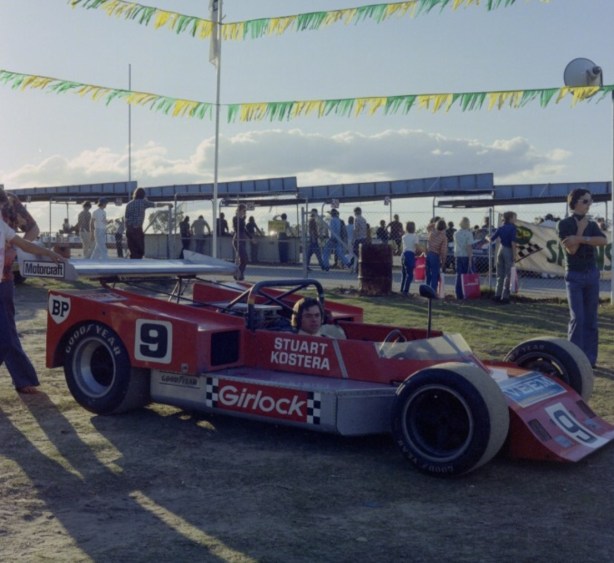
Lionel Ayers and Stuart Kostera shake hands after Ayers’ victory in the 35 lap Wanneroo Park, West Australian round of the Australian Sportscar Championship (ASC) on 12 August 1973…

Lionel’s car is a real weapon, a Rennmax, ‘the Big Bertha’ of all of the sportscars built by Bob Britton, powered by a Repco ‘740 Series’ SOHC Lucas injected, 5 litre 500 BHP V8. Stuart raced a Matich SR3 Ford into third place behind Henry Michell who was second in an Elfin 360 Repco 2.5 V8.

Both Ayers and Kostera were ‘sportscar stalwarts’, they raced two-seaters for a decade and more and all over Australia- not easy as Ayers was a Brisbane boy with Stuart from Perth.

A majority of the motor racing in Australia is in the Eastern Seaboard states of Victoria and New South Wales so these blokes would have done a million miles over the years travelling from home base to chase the Tourist Trophy or ASC. As the name suggests the ASC was a national series, the distance from Brisbane to Perth and return for Ayers was about 8600 Km for example!

image

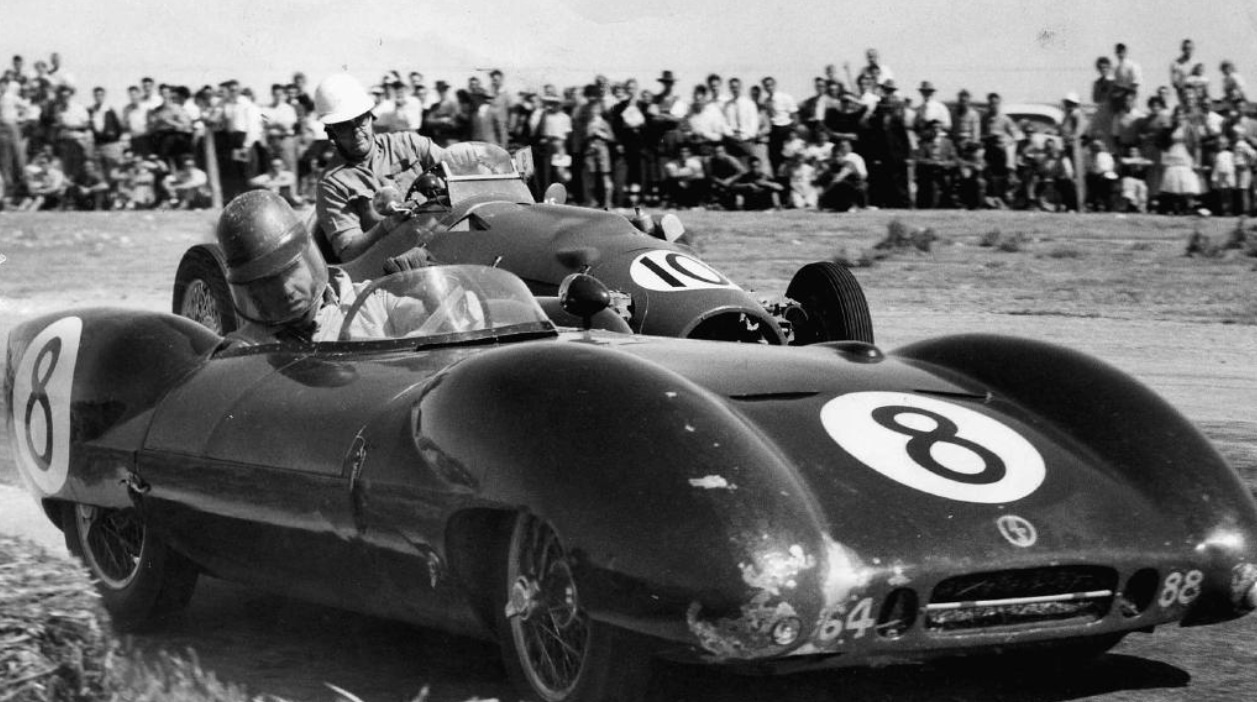
Lionel Ayers tips his MRC Lotus 23B Ford into The Viaduct at Longford in 1968. What a shot! (oldracephotos.com/DKeep)

Ayers cut his racing teeth in an MG TC and then progressed into single-seaters such as the Cooper MG and Lotus 20 Ford before racing the first of three Rennmax Engineering built sportscars over the next decade.

The first was the MRC Lotus 23B Ford in which he contested the 1966 Australian Tourist Trophy at Longford. Later came the MRC Mk2 Repco, the last the Rennmax Repco which used the Repco ‘740 Series’ 5 litre V8 and Hewland DG300 ‘box from the MRC Mk2.

MRC ‘Motor Racing Components’ was Ayers company, which prepared the cars and part assembled them in Brisbane but the three cars were Rennmax built. Lionel was a pharmacist but he was also a pretty handy engineer.

image

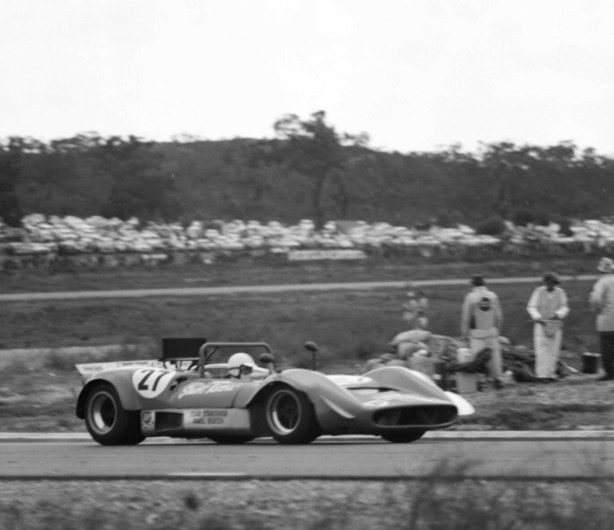
John Harvey and Phil Moore, Wanneroo Park 18 August 1972. Howie Sangster won the ASC round at Wanneroo that year in a McLaren LT170 Chev- this car an amalgam of Lola T70 chassis and McLaren bits (SLWA)

Star of the sportscar ranks at the dawn of the seventies, post the sixties ‘Matich Decade’ was John Harvey in Bob Jane’s superb McLaren M6B Repco.

You could liken Harves to an Australian Mario Andretti in some ways, he was a champion in Speedway Midgets before hitting the circuits and was soon into single-seaters after an initial season in a Cooper S.

The shame is that he wasn’t in 2.5 litre Tasman cars earlier, that he never did a full Tasman Series (only the Oz rounds) and in the F5000 era Bob Jane popped the Bowin P8 to one side way too early. Sponsor, Castrol wanted Bob to run ‘taxis’, so it was tourers and sports sedans the team raced- and in which John excelled.

Harvey won the ASC title at a canter in 1971 and 1972, the car only raced sporadically after that as the team focussed on Touring Cars/Sports Sedans. Bob of course still owns it.

image

John Harvey in the Symmons Plains paddock, McLaren M6B ‘740 Series’ Repco V8, November 1972. He won the title in ’72 and that round. Love the juxtaposition of the 1967/8 ‘futuristic’ racer with the (mainly) Holden ‘roadies’ in the background (E French)

The South Australian ‘Elfin 360 Repco twins’, Phil Moore and Henry Michell won the ASC in 1973 and 1974 in two different chassis’.

Garrie Cooper built two very clever cars there (three 360’s were built, the other for Bob Romano was Ford twin-cam powered). In essence they comprised spaceframe chassis sporties built of single-seater F2 Elfin 600E hardware into which he dropped (surplus to requirements with the advent of F5000) ex-Tasman Repco Brabham 2.5 litre V8’s and FT200 Hewland gearboxes. In so doing, he created two light, chuckable, circa 300bhp little rockets which were driven with considerable skill and brio.

image

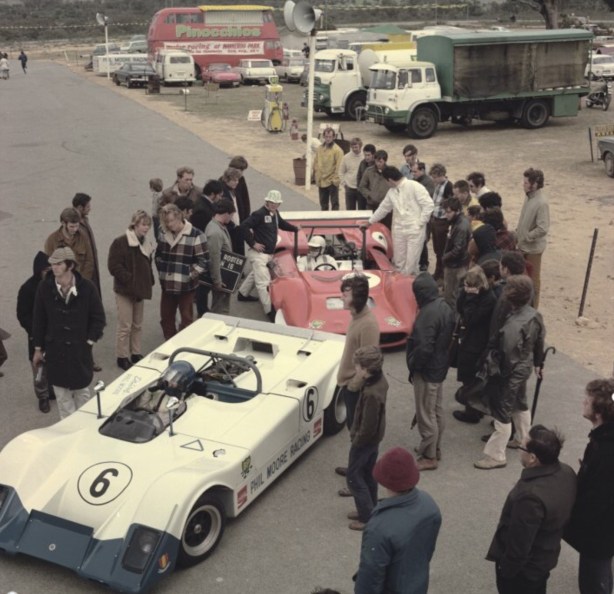
Phil Moore Elfin 360 Repco and Stuart Kostera, Matich SR3 Ford in the Wanneroo Park formup area August 1971. Pinocchios is Howie’s club (SLWA)

In 1973 Moore won the ASC convincingly taking four rounds, Phillip Island, Sandown, Symmons Plains and Oran Park, the latter a night meeting. I would love to have seen those cars, lights ablaze in the dark. Lionel won at Wanneroo and Adelaide International.

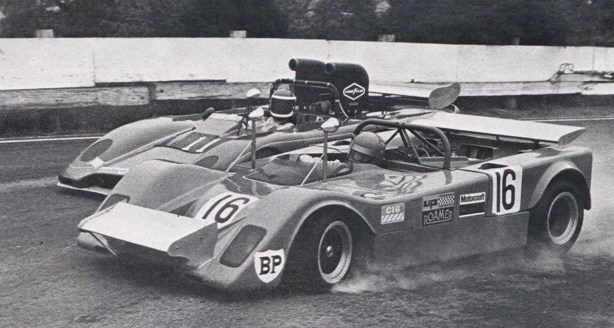
The photo below is at the Sandown round in July and shows Phil diving down the inside of  Lionel’s Rennmax at Torana/Peters Corner before the blast up the back straight where I suspect 5 litres of Repco V8 triumphed over 2.5 litres of it! Phil won the round mind you.

image

(Aust M Racing Year)

The following year, 1974, Ayers again won two of four rounds, at Adelaide and Calder with Henry Michell taking the title in a year of speed and consistency.

Garrie Cooper took the other two wins in ’74 in his new, epoch shifting, Elfin MS7 Repco Holden.

This one off car was a mix of monocoque chassis and bibs and bobs from his F5000 MR6 parts book including uprights, wheels, suspension and brake componentry, Repco Holden 500bhp V8 and of course the ubiquitous DG300 Hewland transaxle.

The car (below) was a crowd and sponsor pleaser, you can just make out the Ansett logo against the bare aluminium body on the nose of the MS7 which is making its race debut at Adelaide International, just down the road from Edwardstown, where the car was built.

Its 25 August 1974, Ayers won the two ASCC rounds before the Elfin raced, Garrie won the other two at Phillip Island and Symmons Plains. In an unfortunate turn of events Lionel broke both of his arms in a low speed motorcycle accident after the first two rounds of the series, perhaps missing out on a title it would have been wonderful to see him win- mainstay of sporties as he had been.

image

(G Cooper Elfin MS7 Repco Holden from Stan Keen, Boral Ford, August 1974 (R Davies)

He promptly retired from the sport and sold the Rennmax but remaining close to the scene. A decade ago he did a brilliant job restoring the Mildren Waggott ‘Yellow Submarine’ made famous by Kevin Bartlett and Frank Gardner. He died in 2013 but his memory lives on in that wonderful car retained and used by his family.

The Rennmax did achieve a national title though- after Lionel sold it.

It passed through Melbourne’s Jim Phillips hands, he raced the car for a few years and then sold it to the ‘Racing Gibsons’ in Benalla. There, at Winton in 1979, with yours truly watching the race, I was contesting the Formula Vee support races that weekend, Paul Gibson won the Australian Tourist Trophy- from none other than Stuart Kostera in the Elfin MS7 Repco Holden. The presentation of the Australian Tourist Trophy to Paul was a very proud moment for father ‘Hoot’ Gibson, a racer himself who raised a family of racers!

image

Stuart Kostera’s Matich SR3A Ford looking as ugly as sin. Wanneroo Park 9 June 1975 (SLWA)

Kostera cut his racing teeth in sedans but progressed through an Elfin Catalina Ford to the Matich SR3- this famous car was ex-Matich and Don O’Sullivan- who finished 2nd in the 1969 ASSC in it behind Matich’s famous SR4 Repco.

Stuart continually developed the car, 5 litre Ford, not Repco ‘620 Series’ 4.4 V8 powered as it had originally been to the stage that it won the West Australian Sportscar Championship in 1975 having finished second in 1972 and 1974. At national (ASC) level he was 9th in 1972 and 1973, 12th in 1974, and 5th in the single race ASC at Phillip Island in 1975, the winner Cooper’s MS7.

Stuart Kostera, Matich SR3A Ford Wanneroo Park 1976 (SLWA)

He bought the MS7 Repco Holden from Garrie Cooper, running it as a quasi-works machine, the car mainly based at the Elfin works in Edwardstown, Adelaide rather than Stuart’s hometown of Perth.

Kostera’s first big win in the car was at Phillip Island twelve months after Coopers MS7 victory in the one race 1975 Australian Sports Car Championship. Kostera won the 1976 Australian Tourist Trophy at the same fast, demanding circuit tailor made for powerful devices such as the Elfin.

Kostera was a talented driver, I saw him race both the SR3 and MS7 at most of the Victorian circuits on numerous occasions, he always got the best from these big, demanding cars. The Elfin drive ended after Garrie Cooper’s demise in 1982.

Lionel Ayers, Lakeside, MRC Mk2 Repco Brabham V8 circa 1970 (unattributed)

All of the cars mentioned in this article still exist, the MRC Lotus 23, MRC Mk2 Repco, McLaren M6B, Elfin 360’s, Elfin MS7 and Matich SR3.

The Rennmax has been in Jim Phillip’s ownership (back to him post the Gibsons period of ownership) for decades, and will hopefully one day see the light of day outside the outer east of Melbourne garage where it resides. So too do the two 360’s mind you one of those has been in a garage not too far from the Rennmax for about the same time period!

 Etcetera…

Matich SR3 ‘3’ Ford

This ex-Don O’Sullivan/Frank Matich car evolved, as cars do over time. Attached are a couple of shots of the chassis which defeated Chris Amons Ferrari P4/Can Am 350 during the 1968 Tasman Series sportscar races competitive against more modern designs. The story of the SR3’s and a comprehensive chassis list of all the Matich built cars is in this article on the Matich SR4;

Matich SR4 Repco…by Nigel Tait and Mark Bisset

image

Stuart Kostera Matich SR3 Ford, Wanneroo Park 18 August 1972. Body of the SR3 not too from the car as built albeit guards modified to take much wider tyres than those of 1967/8 (SLWA)


Three years earlier than the shot above, Lakeside. Ayers in the MRC Repco Mk2 from Don O’Sullivan in SR3 ‘3’ Repco from a couple of Lotus 23’s and the rest, circa 1969 (unattributed)


Lionel Ayers Rennmax Repco at home shortly after collection from Bob Britton (J Lay)

Credits…

State Library of Western Australia, Terry Walkers Place, Ellis French, Robert Davies, Jeffrey Lay, Australian Motor Racing Year

Tailpiece: Phil and Stuart, ready to roll, ASC Wanneroo August 1972…

image

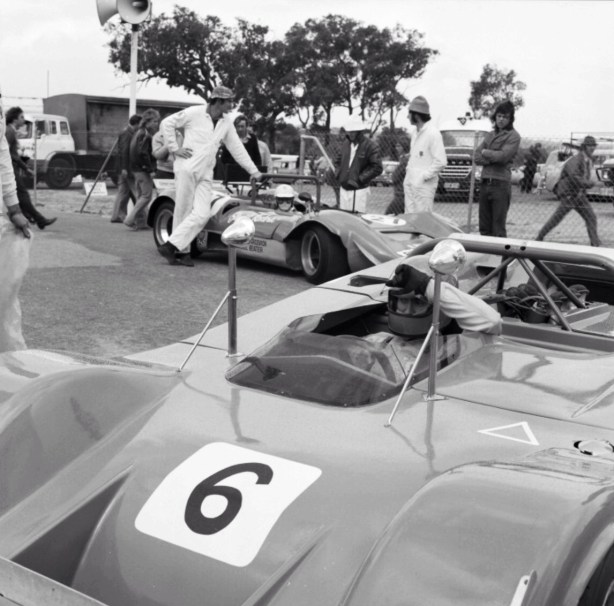
Phil Moore and Stuart Kostera in the Wanneroo Park form up area in 1972. Elfin 360 Repco and Matich SR3 Ford. Howie Sangster won the ’72 Wanneroo ASC round that year, McLaren LT170 Chev from Kostera and Moore (SLWA)

Finito…

image
(Nissan)

The victorious Nissan/Datsun R380-3 of Kunimutsu Takahashi and Yoshikayo Sunago during the 2 November 1969 Surfers Paradise Six-Hour enduro…

Unfortunately this event had run out of puff by 1969, the entry was decidedly skinny but that shouldn’t diminish Datsun’s achievement in winning and placing second in cars the original variant of which was built by Prince prior to its 1966 acquisition by Nissan.

David McKay’s Scuderia Veloce had a mortgage on this race, or rather his Ferrari 250 LM #6321 did. It won thrice on the trot with Jackie Stewart and Andy Buchanan aboard in 1966, Bill Brown and Greg Cusack in 1967 and the brothers Geoghegan, Leo and Pete in 1968.

The first two events were 12 hours, the latter two, 1968-69  6 hours. Into 1970 the Twelve Hour was run for Series Production or Group E showroom stock sedans, this class of racing boomed in Australia at the time and was much easier for the punters to understand than sports prototypes.

The Y Nanda and K Okuyama Datsun 1000, winner of the under 1 litre class of the 1958 Mobilgas Around Australia Trail. First competition win for the marque in Australia (L Richards)

Datsun (the name was dropped in favour of Nissan in March 1986) very cleverly used motor racing to build their brand in Australia. The Melbourne based Datsun Racing Team ran cars in Series Production touring car events, Rallies and Production Sportscar racing with Doug Whiteford their name driver, a former tree-time Australian Grand Prix winner.

Whilst Datsun’s prominence in Australia dates from the mid-1960s it is reported that some of its Austin 7 like products were imported to Australia in completely-knocked-down form circa 1937. I am intrigued to hear from old cars folks who have ever tripped over one of these, they would be as rare as hens teeth. In 1958 a Datsun 1000 won the under 1000cc class of the Mobilgas Around Australia Trial won outright by Eddie (father of Larry) Perkins’ VW Beetle.

image
Prince factory brochure which shows the R380 in its original form (Nissan)

It’s interesting to reflect on the growth of Japanese cars in the Australian market in the 1960s given the dominance which followed. It was entirely product driven as there was some animosity, particularly by those of a certain age, towards the products of The Japs and The Krauts given the war was only twenty years before. Everybody had relatives who died in theatres of war in which the folks of the above countries fought, let alone the atrocities committed.

It very quickly became clear just what great cars they were, the Mazda 1500, Toyota Corolla and Datsun 1600 to name three. All were vastly superior to the British equivalents. I was a small Ford guy at university, my car was a Mk 2 Cortina GT. A mate and I useter wreck Mk1s, they were a popular student car at the time, so we pulled ’em to bits and advertised the clobber on the Monash University Union noticeboard.

Lots of my Uni mates had Datsun 1200s 1600s and Corollas all with heaps of miles on them. I drove them and considered them vastly superior to the small Fords or the Morris 1100/1500, Austin 1800, poverty level Holden Toranas and the like. The first Honda Civic, circa 1972, was a revelation, I couldn’t believe how good it was compared to the competitor set.

So, it was no surprise why, at the price point, prejudices were put aside by our parents a decade before as they bailed out of BMC, VW, Holden and Ford products into stuff made in the Land of The Rising Sun.

Datsun 240Z and Japanese model at the Melbourne International Motor Show on 5 March 1971 (L Richards)

They were put together rather well, some had a flash overhead camshaft, let alone rear ends (sometimes) using other than cart springs, and had carpets and car radios as standard equipment for chrissakes!

By the time Datsun raced in the 1969 Chevron Paradise 6 Hour the brand was well known in Australia. Amongst enthusiasts Datsun went up two gears in perception with the release of the 240Z in 1969. Ok, it owed a nod or three to the E-Type but what a stunning car it was. Never did quite buy one but drove several and was amazed at how good for how little they were.

The first R380 was borne of Prince’s failure to win the 1964 Japanese Grand Prix at Suzuka with its modified S54 Prince Skyline GT. A Porsche 904 took the win, but Prince came first in the Touring Car class however.

To go one better in 1965, engineering head Shinichiro Sakurai resolved to build a sports-prototype. Given no-one in the company had any experience of this type of car a used Brabham BT8 open sportscar was acquired which enabled the team to unlock Ron Tauranac’s secrets and reverse engineer them.

A multi-tubular spaceframe chassis was constructed and curvaceous aluminium coupe body, a Hewland 5-speed transaxle was a key component and a bespoke racing engine built. The GR-8 six cylinder, DOHC, four-valve engine was an oversquare aluminium design with a bore/stroke of 82x63mm giving a capacity of 1996cc. Fed by three 42DCOE Webers, the unit produced 200bhp @ 8000rpm. Brakes were Girling, the car weighed a relatively hefty 615 Kg.

See below at the end of the article a Nissan factory table with detailed specifications of the R380 design as it evolved from 1965-1969.

image
Prince R380 cockpit, spaceframe chassis. See steering rack beyond drivers feet, LH change for 5 speed Hewland transaxle not the ‘norm’ (Nissan)

The first R380, as the car was designated, was finished in October 1965, well in time for the 1965 Japanese GP but the event was cancelled! Undeterred, all dressed up but with nowhere to go, Prince chased speed records.

The car, driven by Yukio Sugita, a Prince test driver, at the Yatabe Test Track on 6 October 1965 took several Japanese records in Class E over distances of 50, 100 and 200 Km at 233.33, 234.69 and 234.93 km/h.

image
Yukio Sugita at speed, Prince R380 at Yatabe test track, 6 October 1965 (Nissan)
image
Line up of Prince R380 before the 1966 Japan GP in May. Fuji Speedway, 65 Km e west of Yokohama. #11 is winner Yoshikazu Sunako (Nissan)

Prince was absorbed into Nissan in 1966, the new parent was delighted to inherit the cars and its team and put to one side a similar racing project in its early planning stages.

Upon taking over the project Nissan modified the cars bodywork to be ‘more flowing’ with vents and ducts also refined. Some extra power, a bit more than 200 bhp, was extracted from the engine. This car, designated the R380A-2 Type 1 weighed 660 Kg compared with the 615 of the original.

Porsche returned with one Carrera 906 to the 1966 Japanese GP at Fuji, but the Shintaro Taki piloted car crashed out of the race. The team of four modified R380’s triumphed taking first and second places, the winning car, #11 above, was driven by Yoshikazu Sunako.

image
1966 Japan GP vista, the Hideo Oishi R380 still badged Prince at this stage (Nissan)
image
’66 Japan GP, the fourth placed Tatsu Yokoyama driven R380 (Nissan)
Kunimitsu Takahashi’s second placed Nissan R380 ahead of the Tadashi Sakai Porsche 906 during the May 1967 GP. Tetsu Ikuzawa won in another 906 (Nissan)

Nissan further modified the cars for 1967…

The modifications included changes to the track, which was widened front and rear. Engine power was increased from a bit over 200bhp to 220bhp @ 8500rpm in part by fitment of bigger 45DCOE Weber carbs. ZF gearboxes replaced the Hewland transaxles which were designed for sprint, rather than endurance use. Whilst the wheel size remained at 15 inches, in keeping with tyre development at the time, width was increased 20mm at the rear.

Despite these upgrades in specification of the cars – now designated R380A-2 Type 2 – Porsche took their revenge in 1967 with Japanese driver Tetsu Ikuzawa winning the Japanese Grand Prix at Fuji  in one of three 906s entered, the R380A-2’s placed 2-3-4 and 6th.

image
(Nissan)

Nissan R380-2 during the Yatabe speed records in October 1967. The wonderful shot shows the beautifully braced spaceframe chassis, Weber 45DCOE fed, DOHC, four-valve 2-litre six-cylinder engine and, by then, the ZF transaxle. Suspension is period typical, single upper link, inverted lower wishbone with two forward facing radius rods, coil spring/shocks and roll bar.

image
(Nissan)

That October further land speed records (above) were set with the cars, this time both Japanese and International records.

The earlier land speed record attempts in 1965 whilst setting Japanese records were not International marks as the Yatabe course wasn’t FIA approved. Two years later the course was certified and Nissan again went record hunting on 8 October 1967, this time Tatsu Yokoyama of the Nissan Racing Team was the driver. Seven new International records were set with speeds between 250.98 km/h for the One Hour to 256.09 km/h for 50km.

image
Moto Kitano aboard the winning 1968 Japan GP winning Nissan R381. Chev 5460 cc pushrod OHV V8, Weber 48 IDA carbs circa 450 bhp @ 6000 rpm. Hewland LG600 gearbox, spaceframe chassis (Nissan)

For 1968 Nissan developed the 5.5-litre 450bhp Chev V8 powered R381 open Group 7 sportscar…

It won the 1968 Japanese GP in the hands of Moto Kitano, #20 above, but development continued on the R380, creating the R380-3 Type 3. Changes to the car involved longer and further evolved, heavier body work. Despite changing to fibreglass from a mix of aluminium and fibreglass, the cars now weighed 660kg, up from 640kg. The engine now produced 245bhp @ 8400rpm in part due to adoption of ubiquitous Lucas fuel injection in place of the faithful Webers. Tyre widths also, of course, grew.

By this stage some of the R380s were in the hands of privateers as Nissan focused on their more powerful cars. Three were entered in the 1968 Japanese Grand prix yielding third to fifth places.

image
(Nissan)

Nissan developed the R382 as its frontline tool for 1969, a sensational 6-litre V12, 600bhp open Group 7 sportscar, which again won the Japanese GP, the driver this time, Moto Kurosawa with H Kitano second.

These amazing cars (R381 and R382) are stories for another time, the photos are a tease! Oh for them to have raced in the Can-Am in the respective years! Timing is everything, and the timing in a corporate sense was not right even it was from an enthusiast’s perspective.

image
Nissan 1969 R382: spaceframe chassis, GRX-3 5954cc DOHC Lucas injected V12, circa 600 bhp (Nissan)

The two cars, entered for the 1969 Surfers 6 Hour were Nissan Motor Co works entries designated R380-3.

The bodies were a little longer than the year before at 4210mm compared with 4080mm. The car was 20 kg heavier, now 680 Kg and 5bhp more powerful, so a total of 250bhp @ 8400rpm. In that sense the cars brought to Australia were the ‘ultimate’ R380 specification, it would be interesting to know what became of them.

The winning car crewed by Takahashi/Sunago completed 257 laps from the second placed sister car of Moto Kitano and Motoharu Kurosawa on 253 and then the Brisbane Lotus Elan of Glynn Scott/Joe Camilleri/Ann Thompson on 236 laps. The Lotus 47 crewed by Sydney drivers Bob Beasley and Brian Davies was fourth with 233 laps. Not to forget the fifth placed Datsun Racing Team Datsun 2000 of Doug Whiteford/John Roxburgh/Barry Tapsall on 231 laps.

The R380s raced on into 1969 and 1970 taking secnd in the ’69 Fuji 1000km and second in the 1970 Fuji 200 mile event. Interesting cars aren’t they and as occasionally happens, a topic I tripped over looking for something else!

Etcetera…

Prince/Nissan R380 Specifications 1965-69…

image
(Nissan)
Prince R380 press release above and below in 1965 (Nissan)
(Nissan)

Bibliography and photo credits…

nissan-global.com, rffrfrnzclub.net, japanesenostalgiacar.com, earlydatsun.com, Nissan Motor Co, Laurie Richards Studio

Tailpiece…

Tatsu Yokoyama and Nissan R380-2 record setting at Yatabe in October 1967

Finito…

What a great commercial, symbiotic relationship it was between Gulf Oil Corporation and JW Automotive…

The success they achieved together with the Ford GT40 in 1968 and 1969 carried through into the Porsche years of 1970-1971 and beyond of course.

In 1968 the GT40, then getting long in the tooth, won the Manufacturers Championship and Le Mans. In 1969 the reliable old war-horse, again in Gulf-Wyer colours won at Le Mans, narrowly from the Porsche 908, undoubtedly the car of the year. It was one of the few races the 3 litre flat-8 Spyders and Coupes did not win- albeit not by much. The Jacky Ickx/Jackie Oliver GT40 ‘1075’, also the ’68 Le Mans winning chassis (driven by Pedro Rodriguez/Lucien Bianchi) beat the Hans Hermann/Gerard Larrousse 908L by only seconds, or around 120 metres after 24 hours of racing.

The Porsche 917, first raced in the Nurburgring 1000 Km in June, showed promise towards the end of 1969, winning the Osterreichring 1000 Km in the last Manufacturers Championship round on 10 August. It made sense for Wyer to race Porsche in 1970, and the German’s were happy to contract the racing of their cars to JW- with Gulf again providing commercial support. This event at the Carlton Tower Hotel i assume is the announcement of the parties plans for 1970.

JW were very successful in 1970, they won the lions share of the races- Daytona, Brands Hatch, Monza, Spa, Watkins Glen the Osterreichring and Targa, the latter won by a 908 Spyder. But they didn’t win Le Mans, nor did they do so in 1971.

In both cases Porsche Salzburg won the blue-riband endurance event. At the time JW signed with Porsche Wyer didn’t know about the Porsche family plans to cover its bases with two factory teams- Porsche Salzburg, owned by the Piech family being the other. Cunning plan. The right plan.

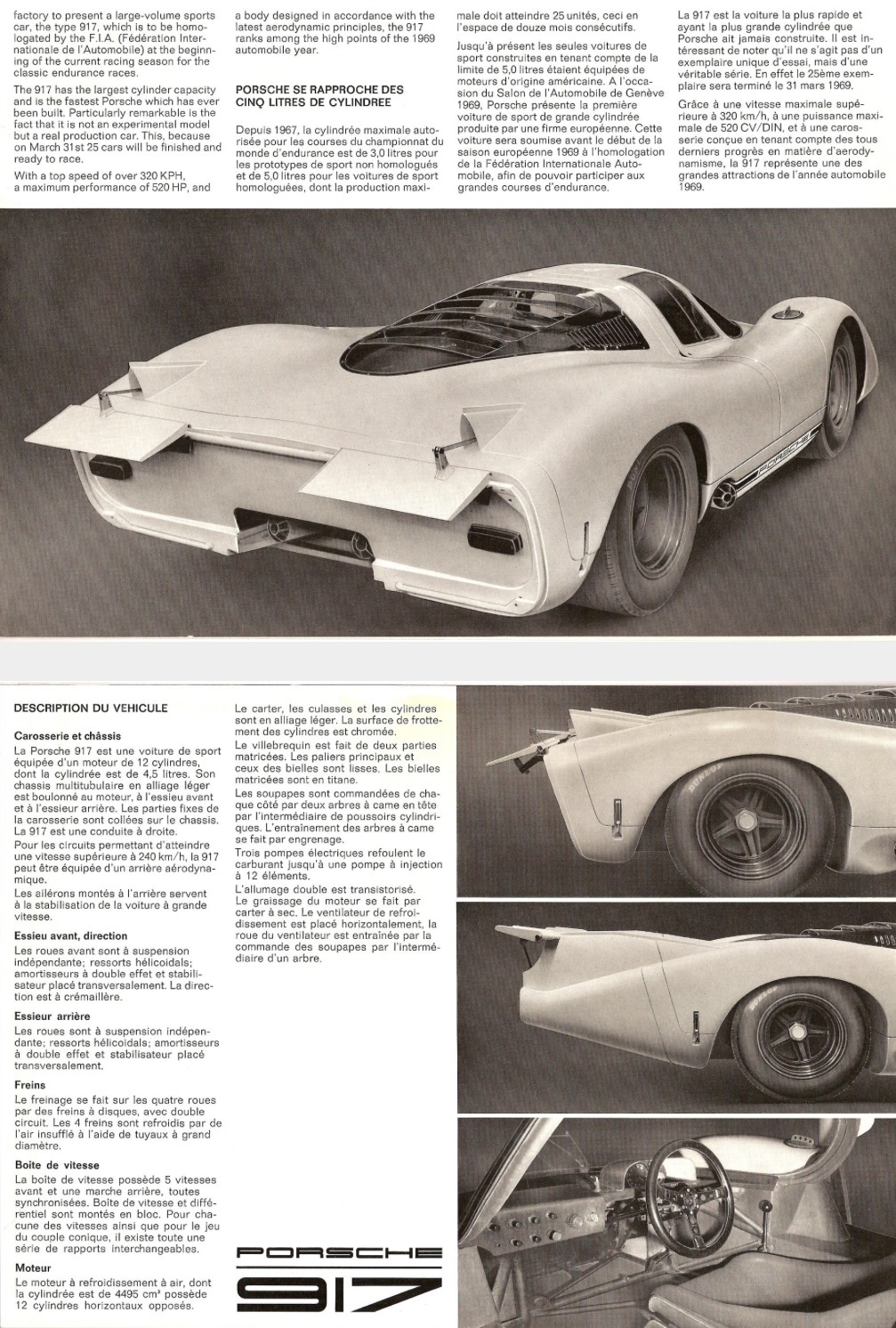
The car pictured at The Carlton is interesting to show the September 1969 917 paradigm, especially it’s aerodynamics.

Shortly after the JW engineers and drivers got hold of the 917, working with Weissach, the winning cocktail of changes which made the car so successful in 1970/71 was quickly determined.

One was a Lola T70 Mk3/3B type rear deck which cured the aerodynamic instability issue, the other involved changes to the suspension geometry both front and rear to both make good what was never quite right- and was needed anyway to suit the latest generation of wider and lower profile tyres to be used in 1970.

And the rest, as they say is history…

Compare the 1970 917K of Leo Kinnunen during the Brands 1000 Km with the 1969 917K spec of the original design shown in the brochure below. The Brands race is the one made famous by Pedro Rodriguez, who in this car mesmerised spectators and fellow drivers alike with his wet weather skills to win in this twitchy, difficult to master, high powered car (unattributed)

Photo Credits…

Wesley, Getty Images, Porsche AG

Porsche 917 in 1969…

Check out my article on the Porsche 917 first year of competition;

Porsche 917: 1969 The First Season…

Etcetera: 1969 Porsche 917 ‘Sales Brochure’ in a mix languages…

Finito…

(K Drage)

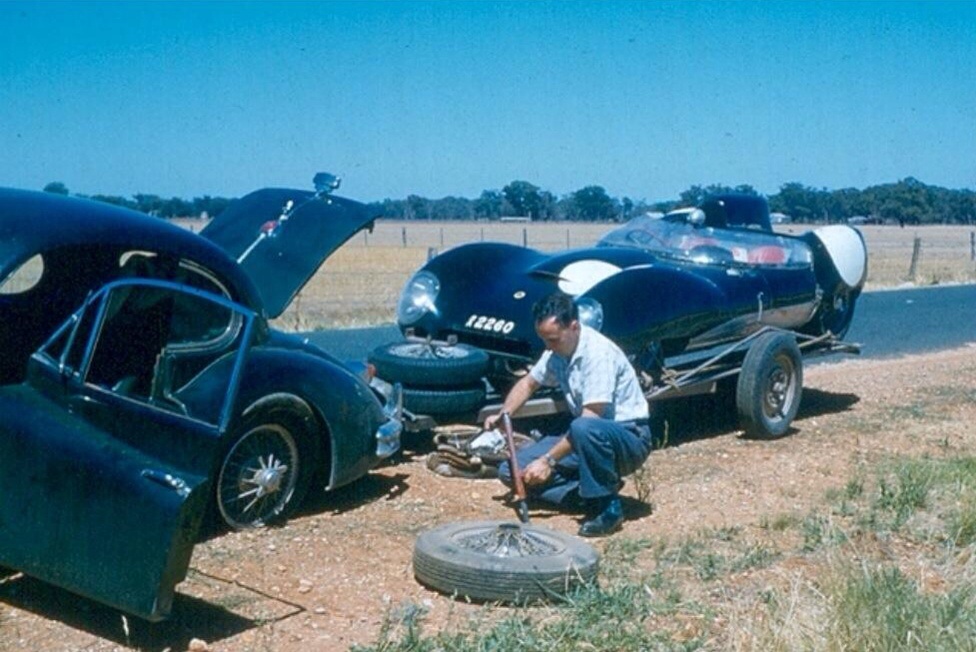
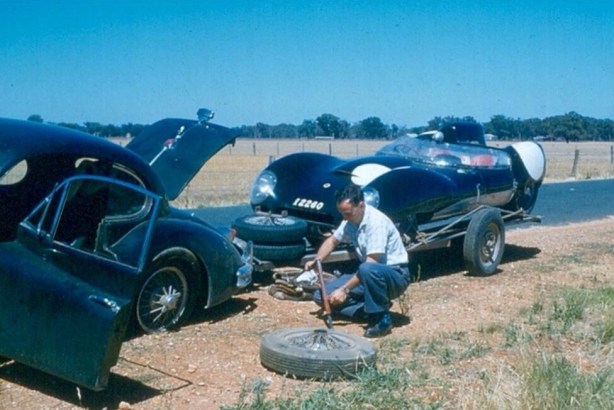
Ira Phillips changes a Jaguar XK140 wheel with Derek Jolly’s Lotus 15 Climax ‘608/626’ on the trailer enroute to Gnoo Blas, Orange, New South Wales in late January 1960…

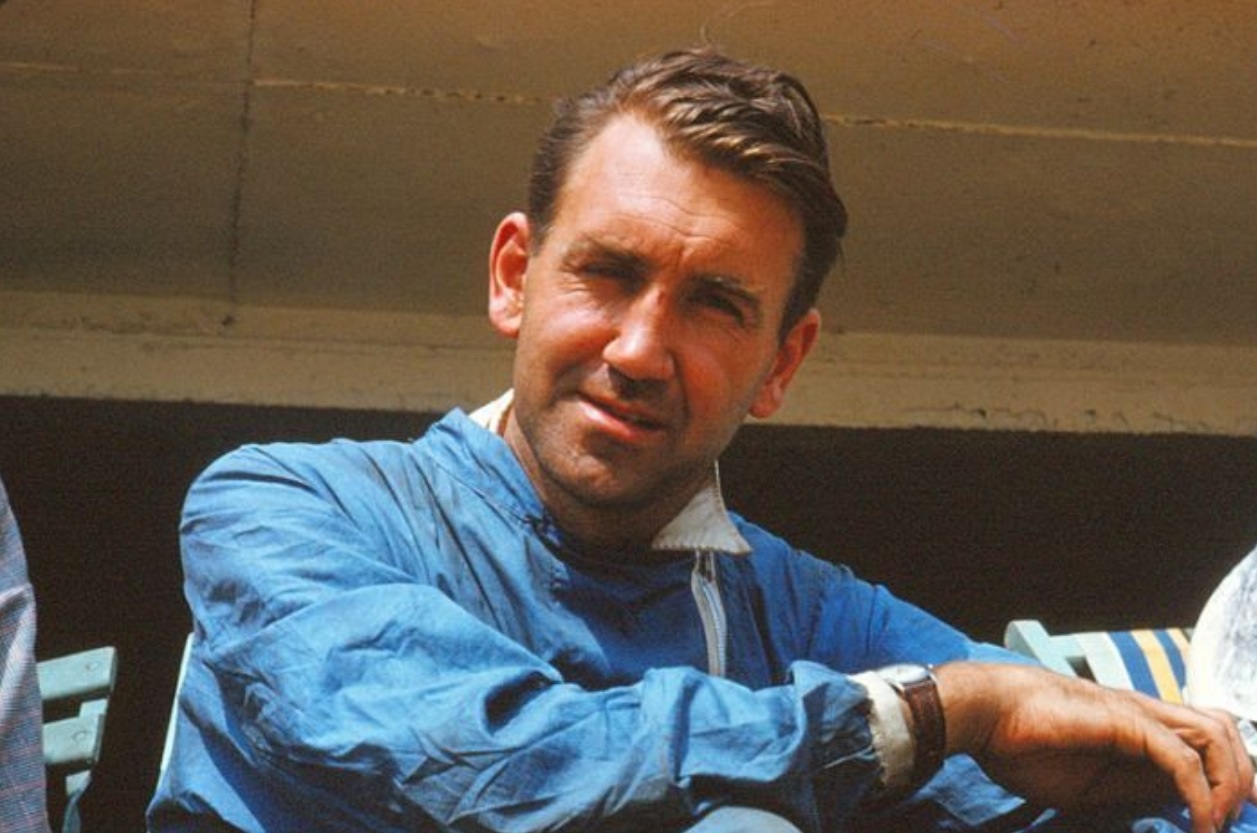
Derek Jolly led a full life, he was a man of many parts.

A visionary with money who had many interests including motor racing, business, photography, music, science and technology, the arts and fine wine- something of a renaissance man really.

Born into the wealth of South Australia’s Penfold Wines family, he played an important role in improving the performance of early Austin 7 engined Lotus cars, designed, built and raced his ‘Decca Specials’ and then two Lotus 15s with much success in Australia. In addition to his motor racing he also played a role in Australia’s nascent music industry from the 1960’s and was seminal in the redevelopment of the Melbourne Street, North Adelaide precinct in the 1960/70’s. Later in life he lost a good deal of his wealth on Australia’s stock market, undeterred he moved back to the Barossa Valley and commenced a new business there.

The focus of this article is Jolly’s two Coventry Climax engined ‘Decca Specials’ and his Lotus 15s chassis # 608/626, the car raced with much success by Derek and later a shooting star named Bevan Gibson- in fact Jolly’s 15 was not one but two chassis, albeit both had the same chassis number or chassis plate as you will see.

This article is drawn from several sources- an unattributed article in ‘Unique Cars’, the recollections of Kevin Drage, a very prominent Adelaide engineer (who deserves his own detailed story) who was Jolly’s mechanic/pit crew for much of the time he raced the Lotuses, Kevin’s account and the dialogue about them on ‘The Nostalgia Forum’ are content and context rich. John Blanden’s seminal book ‘Historic Racing Cars in Australia’ was used, various issues of Australian Motor Sports magazines provided race results for the two Deccas, I’m not suggesting it is a complete list however, AMS also provided the technical specifications of Decca Mk2. Where there were divergences of the story as to fact, I have expressed the alternative suppositions or views.

As will be seen, Derek progressed from Austin 7 based cars to his own lightweight Coventry Climax FWA powered Deccas and finally to the Lotus 15, then amongst the fastest sportscars of their type.

The powerful 15’s or more correctly ‘Fifteens’ were fitted with the Coventry Climax FPF, twin-cam, 2 valve, four cylinder engine in either 1.5 (140bhp and 112 lb ft of torque) or 2 litres (170 bhp and 160 lb ft) in capacity. The chassis was an evolution of the Chapman/Costin Lotus 11 design, about thirty were built.

Chapman’s cars were famous for their light weight, the Fifteen tipped the scales at 445 kg, it was competitive with far more powerful cars which were nominally, on paper at least, faster machines. The cars were light, slippery, turned in beautifully and, with a de Dion rear end, put their power down well. During 1958 a well driven Fifteen would see off Jaguar D Types and were only challenged for outright wins by the works Lister Jaguar and Aston Martin DBR1’s in the UK.

Lets start with some background on Derek before turning our attention to the cars he built and raced.

Jolly at Le Mans 1959 (ABC)

Derek Jolly…

Jolly, as stated was from a wealthy background, a member of the Penfold family, the founders of Penfolds Wines, still one of Australia’s greatest winemakers which originated in South Australia’s Barossa Valley.

Penfolds was founded on 200 acres at Magill in 1844 with vines brought from France by Christopher Rawson Penfold. Penfold’s daughter married a George Hyland, the descendants adopted the Penfold Hyland name. Derek’s mother Mrs Ernest Jolly (doncha love the patriarchal terminology of 1940 Australia) was the only daughter of HL Penfold Hyland who entered the family firm in 1904. What is not clear to me is what role Derek had at Penfolds, although its said he worked alongside Max Schubert in the 1950’s, for generations he was  the most legendary of Penfolds winemakers especially of ‘Penfolds Grange’, which is not a bad drop in global terms.

Like so many drivers of the period he cut his racing teeth on Austin 7s, in fact he was one of the most competitive racers running these cars. Derek was given one as a twenty-first birthday present by his parents and with encouragement from fellow South Australian A7 expert Ron Uffindell, he went racing.

Ron knew all of the secrets of these machines having competed extensively in them including two Australian Grands Prix. He was seventh in the 1936 AGP at Victor Harbour and eighth at Bathurst in 1938, in that race won by Peter Whitehead’s ERA, Ron drove his little A7 Special from Adelaide to Bathurst, raced it and then drove home again via Victoria’s Great Ocean Road!

Derek’s car was a 1931 Ulster replica chassis ‘11517’ initially raced in chassis form, and for hillclimbing had its radiator mounted behind the engine, for road racing a lightweight body was fitted. Into the late forties and early fifties the car was a regular at events in South Australia, Victoria and New South Wales, perhaps it’s most notable result was third in the under 1500cc handicap at the 1950 October Bathurst meeting.

The exact specifications of the car ‘had an aura of mystery grow up against it’ according to the 1950-51 Australian Motor Racing Annual given that ‘such an ordinary looking diminutive side-valve runabout can circulate in company with all but the very hottest TC MG’ with ‘light weight and meticulous attention to detail’ its secrets of success.
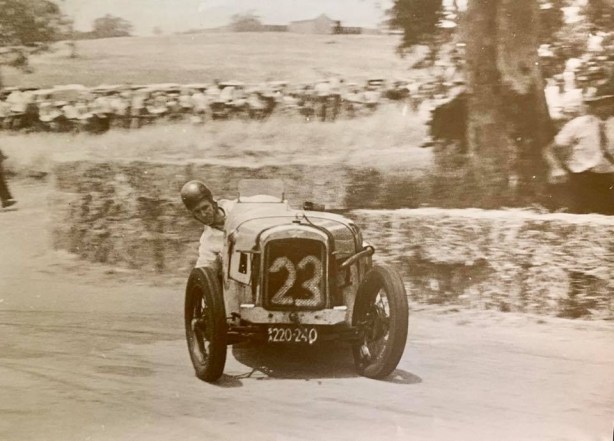
Derek at Woodside in the Adelaide Hills, December 1948 (S Jonklaas)
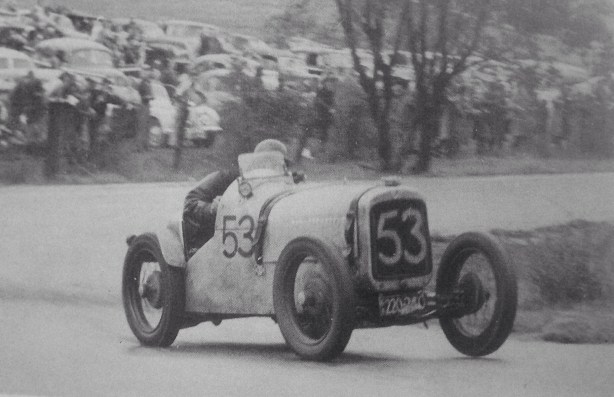
 

Derek lifting the inside wheel thru Hell Corner on the way to third behind the Brydon and Pearse MG Spls in the Under 1500cc Handicap at Bathurst in October 1950, Austin A7 Ulster Spl ‘11517’. Car now in the UK ( G McGrath)

The published specifications of the car include a three main bearing engine made of new parts, 747cc, side-valve, cam with standard timing but higher lift. Compression ratio was 7:1 with a single horizontal SU carb, coil and distributor ignition. Gearbox was Big Seven 4 speed, the front brakes slightly modified with a floating anchor pin, brakes standard cable operated. A special lightweight 2-seater aluminium racing body with a rounded tail was built with maximum speed quoted at 92 mph.

It was in the context of racing Austin 7’s that Colin Chapman wanted to meet Derek, Colin was just starting his transition from trials competition to racing and was keen to learn more about the secrets of Derek’s A7 engines.

Derek went to the UK with his girlfriend, Pamela Strange, as well as his very competitive, powerful A7 engine and gearbox as baggage on the ‘Otranto’. His presence in the UK was noted in the August 1951 issue of Motorsport which recorded his three-bearing Austin 7 racing successes in Australia.

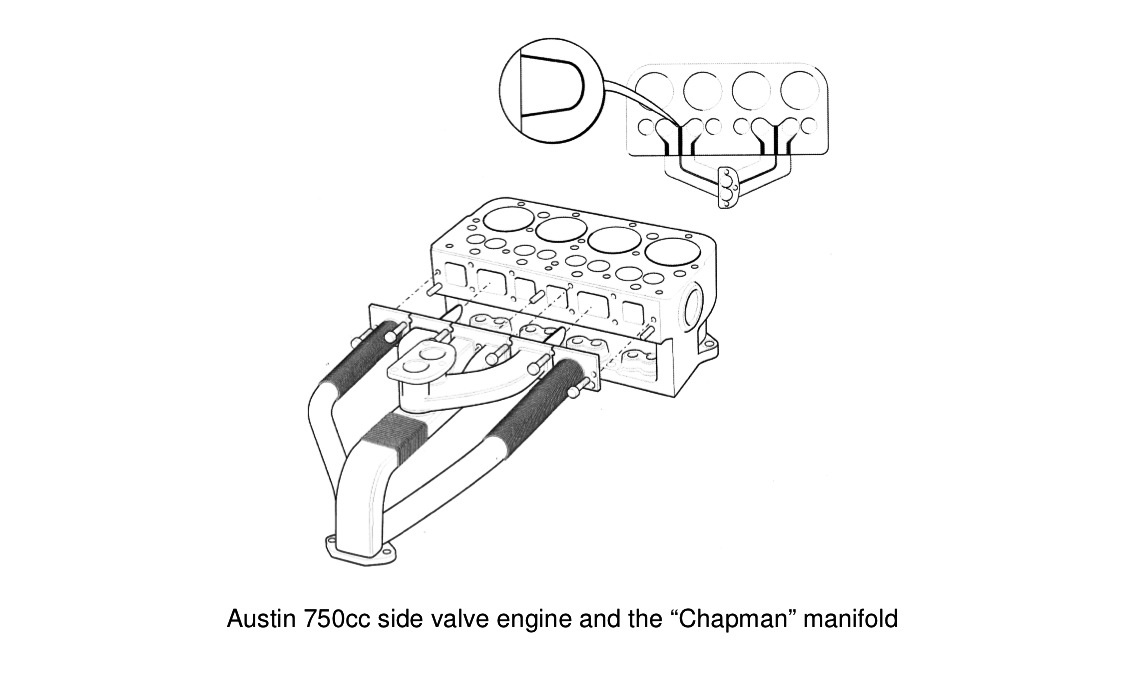
Depending upon which story you reference the engine either arrived with Derek or in advance of his time in the UK. Whatever the case (see Appendix) Chapman, after examining the engine, adapted Jolly’s inlet manifold ideas, which in essence turned the siamesed two inlet port standard side-valve A7 engine into a four port motor considerably increasing its power and performance- at this point let’s note that Derek’s A7 secrets were mainly Ron Uffindell’s in terms of apportioning credit where it is really due.

Chapman, in typical style claimed in Ian Lawrence’s book the initiative as his own ‘…an idea which had suddenly come to him after a rather hectic Christmas party…’- maybe Derek Jolly was at that party!?

Whilst some publications ignore the important role Jolly played in the performance of a very significant Lotus raced by Chapman himself in 1951, Derek’s role is now more widely acknowledged.

The Lotus Mk III ‘was constructed and probably very successful due to the assistance of the Allen brothers and Colin’s access to Derek Jolly and his Austin 7 engines’- ‘the car conceived and built between June 1950 and its first race in May 1951’ the Colin Chapman Archive and Resource notes in its ‘The Hills, Spills and Thrills’ article.

Jolly contested a Prescott Hillclimb aboard a Lotus Mark 3 powered by his engine/box but ‘broke down’, John Blanden does not identify the cause of the failure. Whilst in England Derek spent as much time at Hornsey as he did on Penfolds family business, which was supposed to be the primary purpose of the trip.

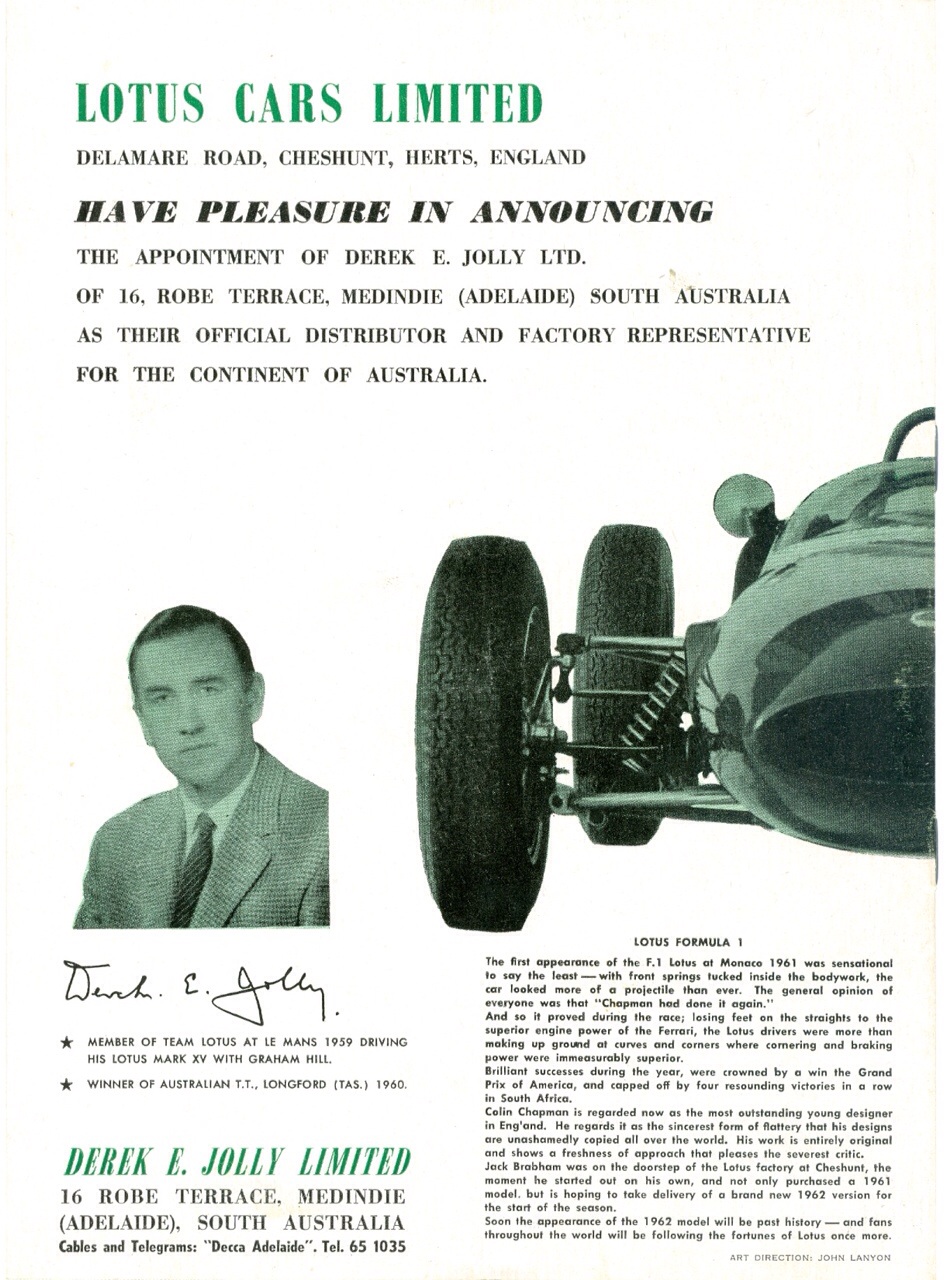
Clearly very strong relationships were created between the two men, Jolly later acquired two Lotus 15’s, was entered as a works driver at Le Mans in 1959 together with Graham Hill and Chapman awarded Jolly the franchise for Lotus cars in Australia in the later mid-fifties.
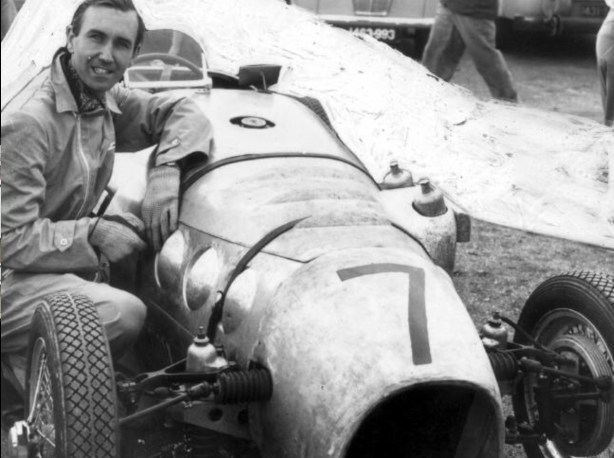
Jolly posing with Decca Mk1 Climax FWA in 1956 (ABC)

Decca Mk1 Climax…

Derek returned to Australia and continued racing his A7 Spl but he soon realised he needed a more sophisticated car as the Australian scene progressed with drivers building cars to modern design themes or imported racers from Europe.

He had watched Lotus’ progression through the Mk9 and later the 11 and decided a car powered by the Coventry Climax 1100cc SOHC, FWA engine was the way to go- he acquired an FWA, MG TC gearbox and Borg and Beck clutch on one of his trips to the UK.

His concept was a lightweight Clubman type car of spaceframe construction with a de Dion rear end. The machine, inclusive of its aluminium body and cycle-guards was built by Arthur Williams in Sydenham Road, Norwood, Adelaide, Derek’s home town of course.

The Decca Mk1 Climax made its debut at Port Wakefield on 31 March 1956 but caught fire during the 50 lap ‘Wakefield Trophy’ won by Tom Hawkes Cooper T23 Bristol.

Damage was light with the car racing again at Templestowe Hillclimb in Melbourne’s outer east in May, in a busy day he won the 1100cc sportscar class, then took his cycle guards off and was second in the 1100cc racing car class with only Lex Davison, Bruce Walton and Murray Rainey quicker than the little Decca, regardless of capacity in their Coopers and Walton Special.
Derek and Decca Mk1 shortly after it’s debut, Port Wakefield, SA

Back at Port Wakefield on June 4 Derek started a period as one of the most prolific racers in Australia for the next several years, in those days race meetings were not plentiful, if a competitor wanted to race frequently, he had to travel interstate.

The car raced locally of course at Port Wakefield, again on 8 October for second in the ‘B scratch’ with a class win in the 20 lap sportscar feature won by Bib Stillwell’s Jag XKD. The day was topped off by a win in the 20 lap racing car handicap where 1100cc of Coventry Climax triumphed over the Chev V8 engined Tornado of Ted Gray.

At Collingrove he took first in the 1100cc sportscar class during the SA Hillclimb Championship on 6 October- the car was fourth quickest up the hill that day outright.

At Fishermans Bend in outer Melbourne on October 13/14 Derek won the sports and sedans race, was second in the racing and sportscar race and also contested the 52.8 mile feature ‘Astor Trophy’ getting experience of longer events. He ran as high as eighth, the race won by Doug Whiteford’s Talbot-Lago T26C grand prix monoposto.

The little car was fast, in the 1956 Melbourne Cup, November meeting at Rob Roy, in Melbourne’s Christmas Hills ‘Derek Jolly continued to embarrass the locals with his amazing little Decca Special…’ that day his 27.97 secs was the third quickest time of the day the only faster machines were the specialist hillclimb single-seaters of Lex Davison and Bruce Walton.
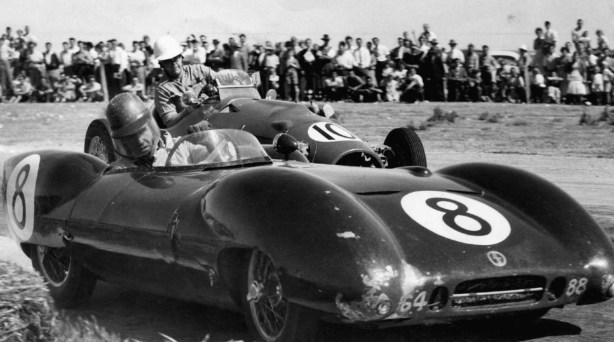
Jolly on the inside at Port Wakefield, SA circa 1957, Decca Mk2 Climax FWA, design of car Lotus 11 inspired (unattributed)

So successful was the Mk1, always intended as a prototype to test suspension ideas, that Derek decided to build a quicker car around the same major components.

Mk1 exists today in Fiat engined form but the little car donated its engine, gearbox, rear suspension and wheels to the new machine.

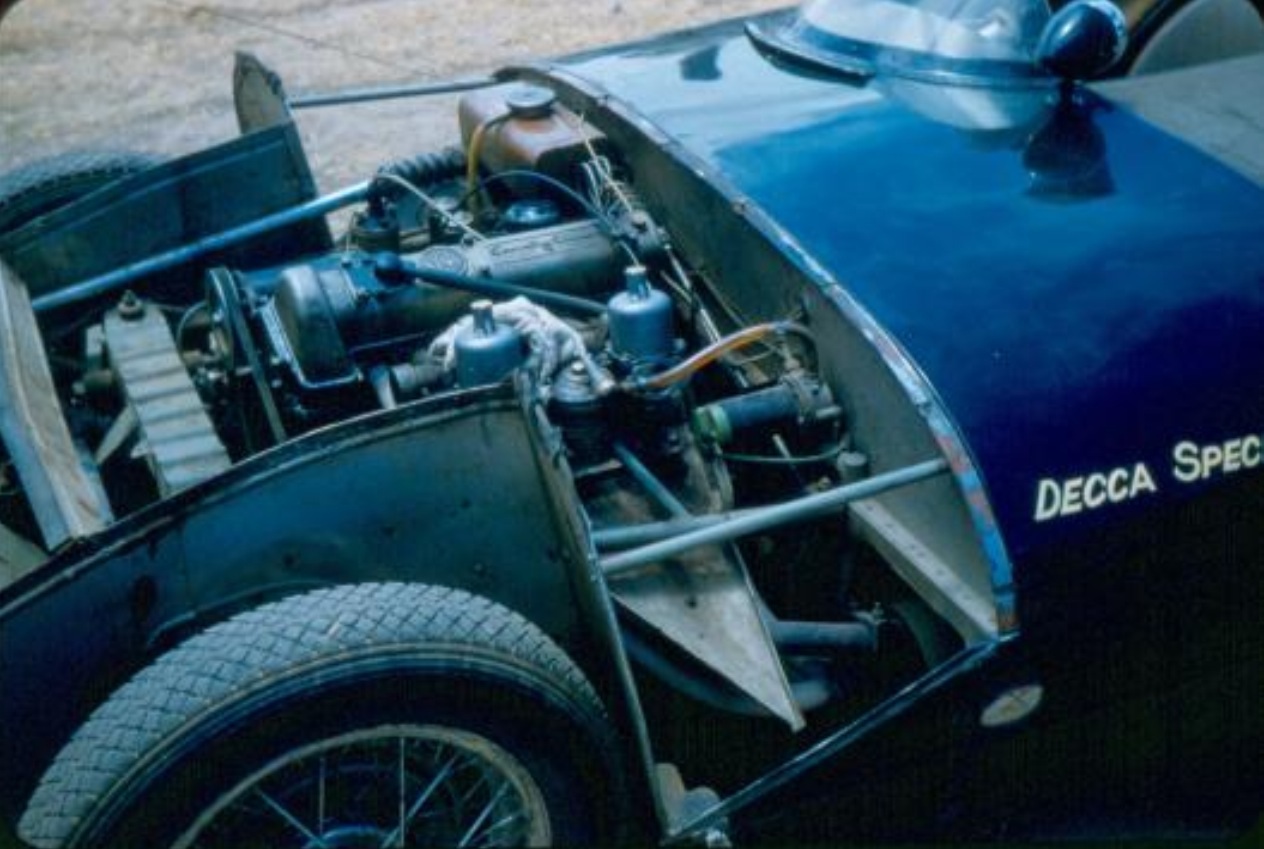
Work commenced on Decca Mk2 in August 1956 ‘using an army of thirty amateur and professional mechanics, the car quickly took shape’ John Blanden wrote. The car’s inspiration were the Lotus 11s Jolly saw on a trip to Europe in early 1956 and was again of spaceframe design and construction this time with the all-enveloping slippery body formed in aluminium. See ‘Etcetera’ towards the articles end for full technical details of this great little car.

Decca Mk2 car was completed five days before the Australian Tourist Trophy at Albert Park in November 1956, Derek’s prolific racing schedule continued with many impressive results, inevitably he won his class but the car was often also an outright contender.

In a splendid debut he was thirteenth in the 100 mile event behind vastly more powerful cars and won the 1100cc class. On the second day of the AGP carnival won by Stirling Moss’ works Maserati 250F Jolly showed the speed of the car again by finishing seventh in the 25 mile ‘Argus Trophy’ behind two Coopers, a D Type, Paul England’s Ausca Holden Repco and two Austin Healey 100S.

Derek towed the car back up the Western Highway towards Melbourne and then around Westernport Bay to the opening meeting of the Phillip Island circuit on the 15 December 1956 weekend.

He contested the ‘Bill Thomson Memorial Trophy’, Thomson was thrice winner of the Australian Grand Prix on the original Phillip Island road circuit in 1930/32/33.

Jack Brabham won in a Cooper Bobtail from Stillwell’s Jag D Type, Paul England’s Ausca Holden Repco and Ron Phillips Austin Healey 100S. Derek duelled for third with England and Phillips but retired on circuit with undisclosed dramas with 2 laps to run- the competitiveness and speed of the car seems apparent from its earliest of events.

‘Brand spanking new’, road registered Decca Mk2 Climax in the Albert Park paddock in November 1956 accompanied by a lovely lady and a couple of Melbourne’s finest- lines of car derivative but distinctive (K Drage)
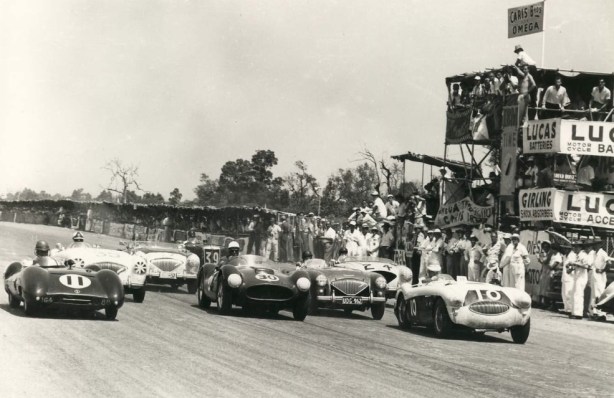
 

Sportscar support race, 1957 Caversham WA Australian GP meeting. Derek at left Decca Mk2 Climax, J Wynhoff Healey, R Ashley Healey, #39 A Collett MG T Type, #30 Paul England Ausca Holden Repco, A Melrose Healey, E Kinnear Healey and out front Ron Phillips Healey 100S. Derek was ahead before battery problems intervened giving the win to Phillips AH 100S (E Steet)

In early January 1957 Jolly and his small team towed Decca across the Nullarbor Plain to Perth to contest the Australian Grand Prix carnival at the Caversham ex-airfield circuit, the meeting was held in notoriously hot conditions.

Derek was fourth in his qualifying 20 lap AGP heat from Brabham’s Cooper T43 Climax on the Saturday. 25,000 people arrived to watch the races on Monday which was even hotter than the preceding days.

Derek led the 40 lap sportscar preliminary until a battery lead came adrift, Jolly jumped out of the car near the Olympic Hairpin and remedied the problem but by then Ron Phillips AH 100S had passed him, a lead he was not to lose.

Not only that but Derek doubled up and contested the 70 lap AGP, held to F Libre rules. It was an amazing act of endurance, some drivers including the winner, Lex Davison, Ferrari 500/625 had a co-driver (Bill Patterson in Davo’s case) whereas Jolly did the race on his own and finished in seventh place! The achievement was even greater as Jolly’s crew were still refuelling Decca when the flag to start the race fell, Jolly was push-started by his crew after the rest of the field had departed.

In the AMS report of the race, an outright event, the days of handicap Australian Grands Prix were over, they list handicap placings which give Jolly fourth behind Syd Anderson Alta s/c, A Melrose AH Healey 100/4 and Len Lukey Cooper T23 Bristol.

In March Derek again won his class and finished fifth outright at Albert Park in the 100 mile 1957 Victorian Tourist Trophy, this time the ‘heavy metal’ in front of his small car comprised Doug Whiteford’s Maser 300S, Bill Pitt in a Jag XKD, Bill Patterson’s Cooper Climax and Paul England’s Ausca Holden Repco.

He returned to Victoria in June to race the car in the VSCC Fishermans Bend Sprint meeting, with the AMS report quipping ‘Derek Jolly once again took the opportunity to visit us with his spectacular Decca. His XK140 is probably able to find its own way back to South Australia..’

Travelling even further afield to Broken Hill in July, Derek took fastest time of the day at Peak Hill ‘..the glamour car of the meeting scored an easy victory..’

Undeterred by the 520 km trip to Broken Hill Derek pointed the trusty Jag in the direction of Sydney where the car was to stay until after Bathurst.

Derek contested the New South Wales Hillclimb Championships at Silverdale, near Camden on 15 September taking the 1100cc class AMS reporting ‘…the Decca went up very quickly and treated all corners with utter contempt’ taking a class record in the process. The car was the sixth quickest present that day, a few future big guns present were Frank Gardner, Jag XKC , Leo Geoghegan in a Holden FX and lets not forget Ron Tauranac’s Ralt, Lex Davison in his Cooper Irving s/c and Brian Foley Austin A30.
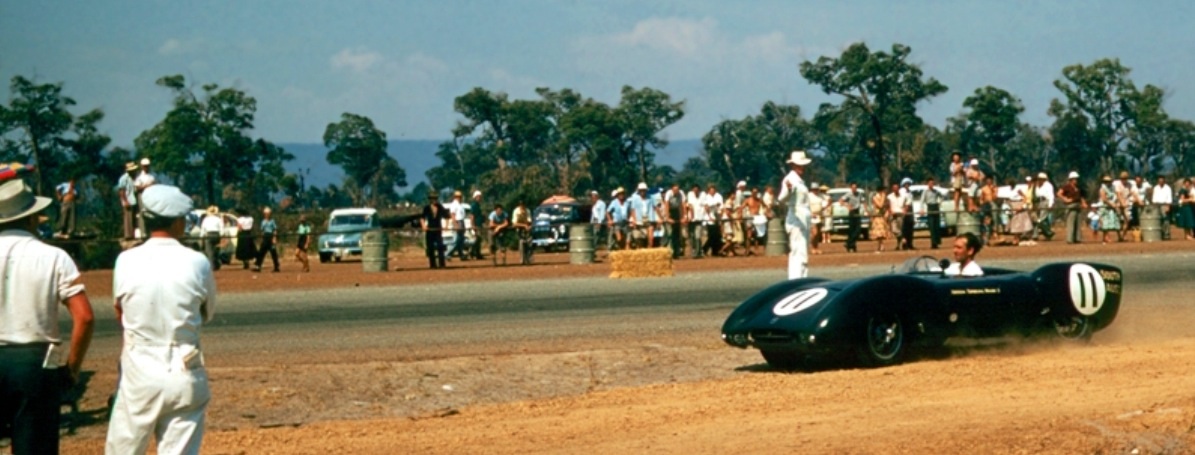
Derek Jolly & Decca Mk2 at Caversham during the ’57 AGP weekend, wonderful colour shot of the cars lissom lines (D Foley)
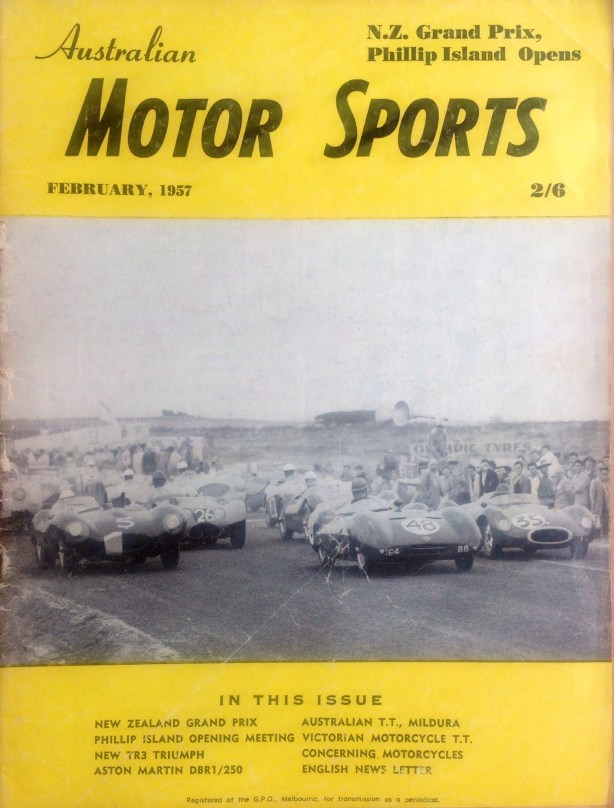
 

Next on the agenda was a trip from Sydney to Coonabarabran for some record breaking for a whole swag of Commonwealth Oil Refineries supported drivers, of whom Derek was one.

On 28 September 1957 he set a Class G Australian Land Speed record in Decca Mk2 recording 116.75 mph, the little car modified to suit by fitment of a head fairing.

Off to Bathurst for the ‘Bathurst 100’ meeting in October Derek competed as an F Libre car rather than a sportscar.

The event was a scratch race as part of the Gold Star, the Australian Drivers Championship but was run as a handicap. Derek actually lead the race (on handicap) for quite a long way until easing towards the end with a brake duct that was coming adrift. Lex Davison’s Ferrari 500/625 won from scratch in 75.54 minutes with Jolly third on handicap in 83.54 minutes behind Tom Hawkes Cooper Holden Repco and Frank Gardner’s Jag C Type.

Home in Adelaide Derek contested the Gold Star meeting at Port Wakefield on the 14 October weekend, he placed fifth in the championship ‘Wakefield Trophy’, behind the single-seaters of Davison, Hawkes, Lukey and Keith Rilstone’s Zephyr Spl.

It really makes you wonder how DJ would have fared in one of the more competitive single-seaters of the day- a Lotus 12 with a 2 litre FPF could have been quite a good thing in Australia in 1957/8.

On the road again to Hepburn Springs Hillclimb, not as far as Melbourne, over the Victorian border, Derek took his customary first in the 1100cc sportscar class on 20 October.

Still in Victoria for the Phillip Island Gold Star round on 27 October Derek placed second in the sportscar support race behind Bill Patterson’s Cooper Climax and then fourth in the F Libre Gold Star race behind Lex Davison Ferrari 500/625. The Melburnian won the very first Gold Star awarded that day, Tom Hawkes Cooper T23 Holden Repco and Eddie Perkins (father of Larry) Porsche Spl were second and third.

Derek stayed in Melbourne for the week for the Victorian Hillclimb Championship final on the 5 November, he was again first in the 1100cc sportscar class, Bruce Walton took FTD that day at Rob Roy in his Walton JAP Spl.

Into 1958 the cars competitiveness continued with first in class and eighth outright in the F Libre Victorian Trophy at Fishermans Bend.

On 7 April Derek again won his class at the SA Hillclimb Championships at Collingrove.

In 1958 he contested several rounds of the Victorian Hillclimb Championship- he was first in the 1100 sportscar class at Rob Roy on 4 May and again at Hepburn Springs on 18 May.

It was time to move on and up to a faster car.

As a driver and car constructor Derek had certainly proved his capabilities over the last two years so he placed an order with Chapman for a Lotus 15. In a wonderful piece of symmetry, Derek raced his new Lotus to second in the 1958 Australian Tourist Trophy at Bathurst in October whilst Gavin-Sandford Morgan was first in class and fifth outright in the borrowed Decca Mk2 Climax!

Decca Mk2 raced on in the hands of Victorian John Ampt in 1959/60, he very much did it justice, the car lives on in Frank Moore’s collection of Australian Specials in Queensland and has done for many years.

Lets now turn ourselves to Chapman’s Lotus 15 design.
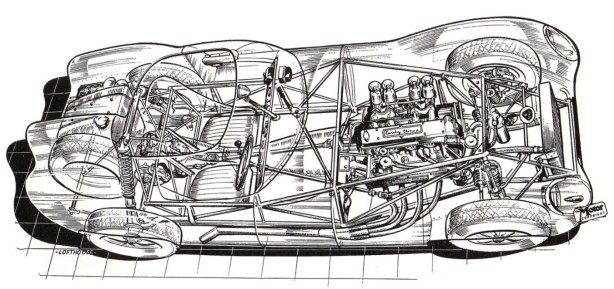
Lotus 15 cutaway (Tony Lofthouse)

Design and Construction…

The first Fifteens (lets do ‘15’ to save space) had the engine laid over at about 60 degrees to starboard, allowing a flat, gorgeous bonnet line between the wheel arches. There was a trade-off though in that there was an absence of space for additional diagonal bracing to the top of the engine bay. In all other ways, the early Series One cars did not noticeably differ from the finalised Series One. Derek Jolly’s car ‘608’ as landed in 1958 was to later S1 form.

The chassis of the 15 was a 30 kg space-frame in 18 and 20 gauge mild steel with the 15 and F2/F1 Lotus 16 having many components in common. The front suspension with wishbones incorporating the roll bar as the front half of the top A-arm components were common with the Series Two 11s, the 7s, the Elite and Lotus first single-seater, the F2/F1 Lotus 12- the 15 and 16 also shared the variations in engine inclination and Chapman Strut rear suspension.

The 15 was delivered with either wire or cast-magnesium 15-inch wheels to customer order, which, like the Eleven, had the same rim width front and rear. In 1958 this was four inches, carrying 4.50 front and 5.50 rear tyres and in 1959 perhaps four-and-a-halves. Chapman’s primary design priority until around 1960 was minimisation of unsprung weight by keeping both wheel and tyre as small as possible. The 15 had the standard Lotus track and wheelbase of the day – that is, an 88-inch wheelbase and just under 48-inch track- these dimensions, established with the 11, were used with the 7, 12, and 16.

Also carried over from the single-seater Lotus 12 was the controversial Lotus five-speed gearbox, aka the ‘Queerbox’.

‘A thing of Swiss-watch subtlety and elegance, but still of doubtful reliability nearly a year after its introduction. Rear-mounted in unit with the differential, it carried its five ratios in less than nine cm (3 1/2 inches) of length, with the output gears fixed on the long differential pinion shaft, and the input gears spinning free until progressively selected by a migrating spline which was itself splined to the tailshaft.

This gearbox was very much the Achilles Heel of the 15, and in fact substitution of the less-subtle, but infinitely more reliable, BMC B-series gearbox bolted to the engine, and of the proven Lotus Elite diff-case, distinguished the Series Two cars introduced later in 1958’ Unique Cars reported so eloquently.
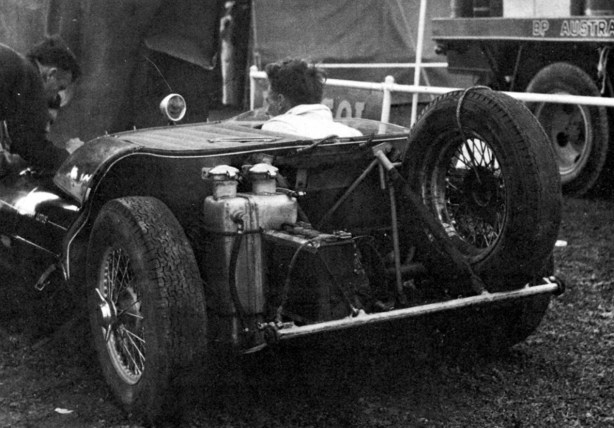
Rear of the Jolly 15 ‘608’ at Bathurst in October 1958, 2nd in the Australian Tourist Trophy to David McKays Aston DB3S that weekend (unattributed)

‘At the start it was the engines that gave the biggest headaches. For Lotus aficionados it is almost heresy to consider what Lotus committed on those early engines, and the engineers at Coventry Climax undoubtedly felt the same way. To accommodate the inclined engine, one of the dry-sump scavenge pumps was discarded and the other modified, and the sump itself was drastically reshaped; the inlet ports were counterbored to take spigots for the manifolding, which had to incorporate a 30-degree droop. No matter how hard Climax tried (and to give them their due, they tried hard) the inclined engine was about nine horsepower short of upright-engine figures, and suffered cooling and oiling problems’.

None of these things was happening to the FPF engine in rival Coopers, so for Le Mans Lotus bit the bullet and produced two cars (a 1.5 and a two-litre) with engines inclined a mere 17 degrees the other way – just one degree different to the Cooper! This gave the upright-engined 15’s a distinctively long and slim bonnet-blister which, not so aerodynamically strong, but reliability was improved. Apart from a continuing series of enlargements to the water and oil cooling radiators, the 1958 15 specifications had been finalised.
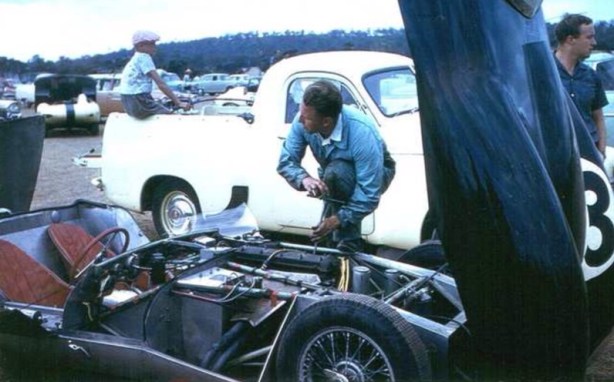
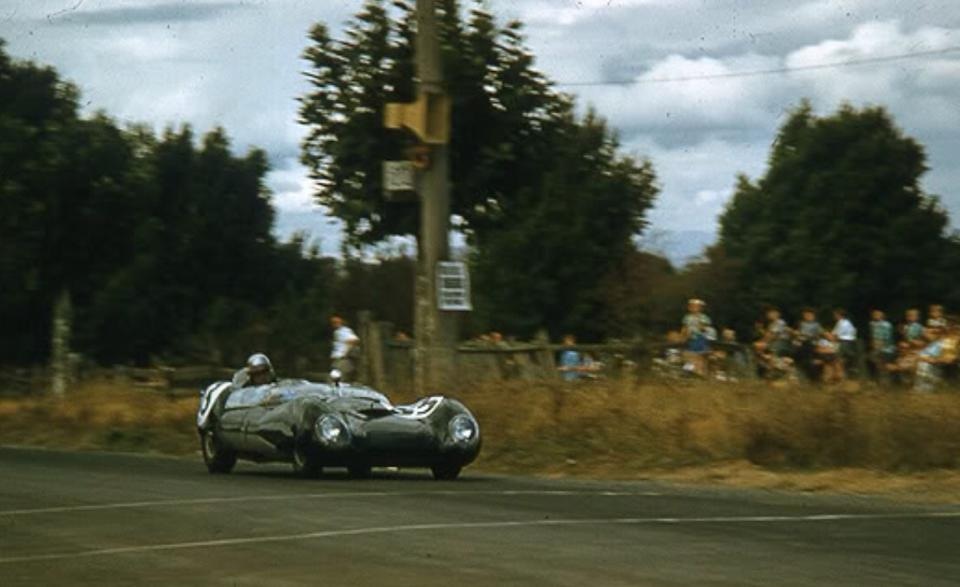
Lotus 15 ‘608/626’ in Series 3 form at Longford in March 1960 during the Australian Tourist Trophy weekend, a race the car won. Kevin Drage is changing plugs, note the chassis engine bay cross bracing tube referred to in the text. 1960cc CC FPF (K Drage)

‘For 1959, the Series Three car was announced, offering a simpler chassis mainly resulting from re-positioning the front anti-roll bar to become the rear link – instead of the front – in the top wishbone. Engine position, and the important diagonal across the top of the engine bay, carried on from the upright-engine 1958 car. A small change was visible in the cockpit, where the Series Three now had two small down-tubes from the dash, meeting a transverse tube which ran across the floor, whereas the earlier 15s had relied solely on the stressed tailshaft cover to strengthen the floor and to provide gearbox mounting for the B-series box’.

‘Press pictures of the 1959 car show it with the BMC gearbox but at least two cars were built with the very compact, front-mounted ZF S4-12 all-synchro four-speed box, and another had a unique development of the Lotus five-speeder which carried the gears astern of the differential. The existence of at least two ZF-gearbox cars can be supported because there were two such cars in Australasia – one the Leaton Motors Frank Matich driven 2.5-litre car, the other a 2 litre which went to New Zealand for Jim Palmer. A unique five-speed box was fitted to Derek Jolly’s car. That raises the question of how a 1959 gearbox found its way into a 1958 car. The answer involves what is probably the most contentious item of 15 history’.

Jay Chamberlain/Pete Lovely works Lotus 15 FPF 1.5 ‘608’ at Le Mans in 1958 DNF accident (Revs)

Jolly’s car, chassis ‘608’, was one of two 15’s Team Lotus ran at Le Mans in 1958.

‘One was a 1.5-litre, the other a 2 litre FPF which caused quite a stir with its fast practice laps, but which retired embarrassingly early (blown head gasket) in the race itself. The 1.5, shared by the American Lotus drivers Jay Chamberlain and Pete Lovely, went well in patches between pit stops, and became one of the victims of violent rainstorms during the night when it crashed avoiding a slower car and was in turn centre-punched by a spinning Ferrari’.

Jolly was initially offered chassis ‘607’ by Chapman but it was allocated before Derek responded so he acquired ‘608’ instead, the car raced by Chamberlain and Lovely. It was repaired after Le Mans and raced by Cliff Allison on 19 July at the British GP meeting at Silverstone in a sportscar support event.

Lotus records show the car was then prepared for sale to Jolly equipped with tonneau cover, long-range tanks and fitted with 1475 cc Coventry Climax FPF #1054- it was popped on the SS Orsova and arrived in Australia in August 1958.

Derek’s choice of the 1.5 litre FPF rather than a larger one may have been a function of availability or choice. It may be he saw it as a stepping-stone from the 1100 single-cam Climax FWA used in his Decca Special’s, perhaps he also thought it a gentler companion for the Lotus 12 type gearbox fitted to the car.

Jolly in 15 ‘608’ upon its Australian debut at Forrests Elbow, Bathurst, Australian Tourist Trophy in October 1958. 2nd behind the McKay ex-works Aston DB3S (unattributed)

The car’s first event in Australia was at Bathurst, the October 1958 Australian Tourist Trophy, which was contested by a field of great depth.

The ATT was the support event to one of the most thrilling Australian Grands Prix of all- the spectacle of Lex Davison, Stan Jones and Ted Gray battling away in Ferrari 500/625, Maserati 250F and Tornado Chev V8 on this toughest of road circuits is one held in reverential terms by those who attended the meeting.

David McKay won the Tourist Trophy race in his ex-works Aston Martin DB3S from Jolly’s little Lotus off grid 3 and Ron Phillips Cooper T38 Jaguar, a gust of wind took one of the favourites, Doug Whiteford’s Maserati 300S out of the race and into the barriers on Conrod Straight.

The following day Jolly scored his first win, walking away with the sportscar 10 lap support race to the Australian Grand Prix, from the D Type Jag of Bill Pitt and Frank Matich’s Leaton Motors C Type- the speed of the Lotus, which was timed at 137.4mph on Conrod Straight was not lost on Frank who would get his hands on his own Lotus 15 in time!

Jolly raced the car closer to home, at Port Wakefield a week later on 13 October finishing third in the F Libre Wakefield Trophy behind a pair of Cooper Bristol single-seaters.

The little car was then towed to Melbourne a week later for the Victorian Sportscar Championship meeting at Fishermans Bend.

In a very successful weekend Jolly won the race- like Bathurst, a power circuit, from Bob Jane, making his race debut in his ex-works Maserati 300S, Derek’s task was made easier by Phillips DNF in the Cooper Jag with a broken oil line.
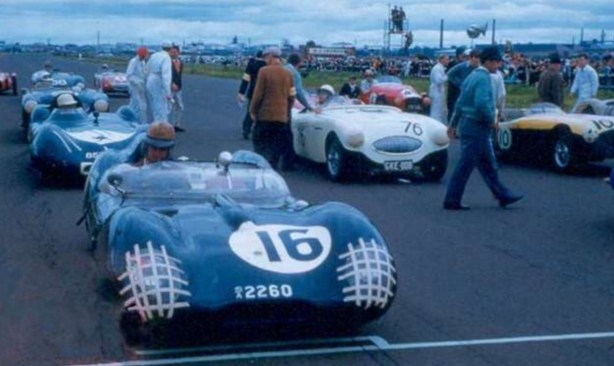
Jolly at Fishermans Bend prior to winning the Victorian Sportscar Championship in 1958, Lotus 15 ‘608’. Lotus 11 behind, various Austin Healey 100S and Coad built and driven yellow Vauxhall Spl to right (K Drage)
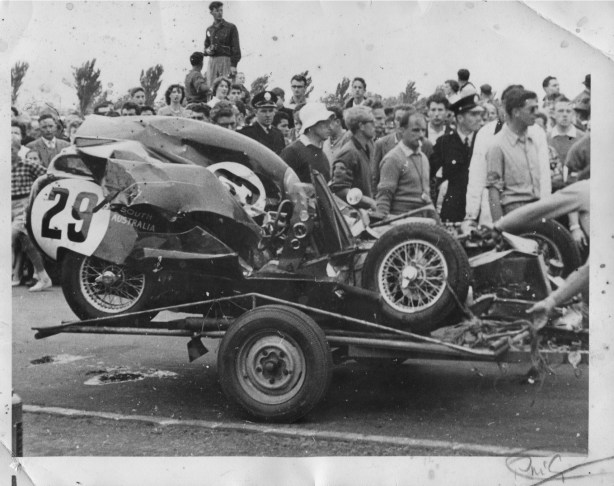
 

The fairly comprehensively rooted ‘608’ at Albert Park looking sad and forlorn before the trip back to Adelaide in November 1958 (P Skelton)

The Lotus then returned to Adelaide to be prepared for a fortnight of racing at Albert Park on the 23 and 30 November weekends.

In the 100 mile Victorian Tourist Trophy Derek was an excellent third behind Whiteford’s 300S and Ron Phillips Cooper Jag. Phillips and Derek had many dices when they were racing the Decca and Austin Healey 100s, Phillips, like Derek had stepped up to a bigger car, in his case a Cooper Jag. On the following day in a support event Derek was split between Doug Whiteford’s winning Maser and Bill Pitt’s Jaguar XKD.

The feature event the following weekend was the Formula Libre Melbourne Grand Prix won by Stirling Moss’ Rob Walker owned Cooper T43 Climax.

Derek’s heat went well enough, he finished fifth or sixth, but things went terribly awry whilst running in seventh place during the main race.

Kevin Drage ‘The front anchorage point of a rear radius arm failed…and the Lotus rear steered into a tree. Derek was taken to hospital for facial surgery where the Perspex screen impacted on his visor and fractured his cheekbone. I think he also fractured an ankle’.

John Blanden’s account of the accident is that ‘halfway around on the last lap Derek crashed badly. He later put the accident down as three-quarters due to exhaust fumes and tiredness and the balance perhaps contributed by the left hand radius rod pulling away from its mounting. No amount of research revealed whether the radius rod pulled out and dug into the roadway or whether, while on that side of the road to take a left-hand bend, the offside front wheel mounted the kerb as he ‘blacked out’- as the car had done this two laps earlier, it is the more likely explanation. All Derek could remember was a sudden jolt (probably the wheels mounting on the kerb) and the tree looming up in front which was hit a split second later’.

In essence, was the broken radius rod anchorage the cause or effect of the accident?- the answer is that nobody can be certain.

Kevin Drage ‘The Lotus was extensively damaged. Derek took photos of the failed anchorage point and asked Colin Chapman to rebuild the car free of charge. Chapman agreed on the condition he could run the 15 as a factory entry at Le Mans in 1959. Derek in turn agreed on the condition he co-drive at Le Mans and retain the 2.5 litre FPF engine to be fitted’.

Whilst there is no doubt that bits were transferred from the original chassis to the rebuilt car, what was contentious was whether or not the original chassis was repaired or replaced.

Drage picks up this point ‘I was Derek’s race mechanic/pitcrew during most of the time he had the 15 and was always under the impression that the car that returned to Australia was ‘rebuilt’ not a new one. Of course the car was extensively damaged at Albert Park and it may well have been a new chassis and panels’.

John Blanden provides the answer to this repaired old/new chassis point it seems.

When ‘608’ was returned to Cheshunt, it was stripped by works parts chief Jay Hall who assessed the frame as not being economically repairable. The chassis was scrapped (taken to the tip), the 1475cc CC FPF engine fitted to another chassis and what undamaged bits were left were built into a new chassis, frame number ‘626’.

Blanden cites photographic evidence of this chassis (626) plate at Le Mans but before being shipped to Australia- the car went back to the factory, a new ‘608’ chassis plate was affixed complete with the correct 2 litre Coventry Climax engine number- ‘1160’.

The Lotus invoice to Derek characterised the work done as chassis repairs and replacements to remove the obligation for Derek to pay Australian import duty on what was a new chassis rather than a repaired one. This kind of jiggery pokery is what still goes on of course, why wouldn’t the ‘fiscal fiend’ be avoided if at all possible- but it does create havoc for historians decades hence.

Lotus 15 Climax ‘608/626’ at Le Mans during scrutineering in 1959. Car driven by Graham Hill and Derek Jolly. The largely new car was fitted with chassis plate ‘626’ at Le Mans but replaced by a new ‘608’ plate before shipment back to Australia (John Hendy)

Lotus 15 Climax ‘608/626’…

In terms of the new cars identification, lets call it ‘608/626′ as John Blanden i think correctly does.

Series Three features were used wherever possible in the build of the car. Externally, the most easily recognised is the later style of bonnet, which extended right to the dashboard and carried the centre section of the carefully-curved perspex screen – whereas Series Ones and Twos had a shorter bonnet and a separate scuttle panel, very much in the style of Lotus Elevens.

Team Lotus had earlier in the year announced its intention to contest Le Mans with a pair of customer-owned 2.5-litre 15’s, in the end the factory entry was none other than ‘608/626’, with Jolly’s co-driver, soon to be rising F1 star, Graham Hill.

The car arrived at La Sarthe initially fitted with a 2 litre FPF, ‘this was replaced with a Lotus-owned 2.5 after the first practice session and the untested gearbox showed itself keen to unscrew the nut on the end of the pinion shaft because this shaft now rotated in the opposite direction to previous gearboxes. Nonetheless, despite these indications of preparation haste, the car survived practice and in fact ran for more than 10 hours of the race’.

‘Graham Hill at one stage had the car as high as seventh outright – before its habit of jumping out of gear caught Jolly out at 120 mph, changing up to fifth on the very fast run to Arnage. In traditional Climax fashion, number four rod hacked the block almost in half, and demolished the starter-motor for good measure’.

Having again failed at Le Mans, the car was returned to the factory, now moved from the cramped Hornsey site to a larger premises in Cheshunt, to be readied to go to Australia.

Drage recalls that a 2.5 litre crank could not be obtained in time for the post Le Mans rebuild so the car returned to Australia with a 2 litre crank inside a 2.5 litre block and therefore raced at a capacity of 1960cc.

In rebuilt form the car also had a very different style of engine bulge – wider based, more gently curved and open at both ends, there may have been aerodynamic reasons for this.

‘Additionally, the original five-speed gearbox – in which the gears were carried just ahead of the differential – had been replaced by a new design, with the gears astern of the crown-wheel and pinion, but on the same fore-and-aft centreline. This meant gears could be swapped far more easily, and it was announced this box would be an option for sports cars. In fact, it seems likely that only the one box was ever built, although the same principles were used – in a slightly different casing for Grand Prix Lotus 18s, and the closely-related Lotus 19 sports car’, Unique Cars reports.

Derek looking pretty happy with the car ‘608/626’ in the Gnoo Blas paddock February 1960. Is that Jack Myers he is speaking to? Jolly’s tow car XK140 behind, car with bonnet up is Tom Sulman’s Aston DB3S. You can see the slight canting of the FPF engine, cars spaceframe chassis and cross bracing in the engine bay referred to in the text (Kelsey)

Returned to Australia aboard the SS Athenic in August 1959 and then on to Adelaide, the Lotus was not raced for a while given mounting business pressures.

Entered at Gnoo Blas, Orange in New South Wales in the Australian Touring Car Championship meeting on the 1 February 1960, Derek took a first up win in the ‘South Pacific Sportscar Championship.’

The photo which starts this article is of Kevin doing a roadside wheel change between Adelaide and Orange- a distance of 1150 Km, the new cars first Australian meeting was a long way from home base!

No doubt Derek had tested the car around the Port Wakefield circuit or in the Adelaide Hills to ensure everything was hunky-dory before the long tow north. What a mouth watering thought that is, there are some marvellous roads in the hills close to Adelaide, some of these were explored by Fangio, Moss and other stars on the ‘Climb To The Eagle on The Hill’ which was an annual part of the Adelaide GP carnival. Fangio blasting a 300SLR past at speed up the hill is a straight-eight image and sound I will never forget!
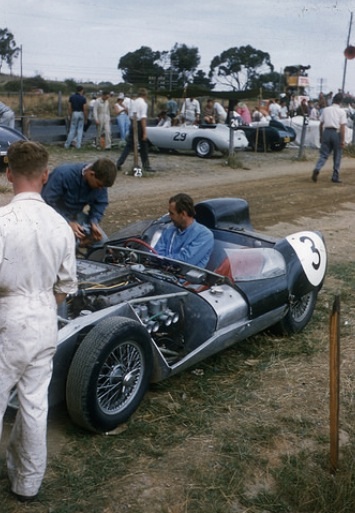
Kevin Drage attending to the 15’s mirror, ‘608/626’ in the Gnoo Blas paddock, February 1960, note the twin-choke SU carbs on the 1960cc Coventry Climax FPF, silver car #29 is Brookes Austin Spl (Kelsey)

The win at Gnoo Blas was a good one defeating David Finch in a Jaguar D Type, Tom Sulman’s Aston DB3S and others.

The car was giving away plenty of capacity but its power to weight ratio, aerodynamic properties and ability to put its power to the ground ensured its competitiveness. As a driver Drage said that Jolly ‘On his good days was a pretty good driver, on other occasions he could be just average. When Derek got the bit between his teeth and had a bit of a challenge he usually rose to the occasion’.

‘I can remember towing the Lotus 15 all the way from Adelaide to Sydney to the opening very wet meeting at Warwick Farm (1960). Derek putting it into the fence after 1.5 laps of practice and then having to turn around and drive all the way back to Adelaide. Derek flew. The only good part was that the tow car was an XK140 Jaguar’. Of that car KD recalls ‘the XK140C with C Type specs…as certainly quick. I recall one trip with Derek (without trailer) from the outskirts of Melbourne to the outskirts of Adelaide in a bit under 5.5 hours’. Quick to say the least!

Success at Gnoo Blas was a portent of even better to come at the Longford International meeting in March 1960.

On the same 5 March weekend that Jack Brabham won the Longford Trophy in his Cooper T51 Climax Jolly triumphed in the 24 lap Australian Tourist Trophy from Doug Whiteford’s Maserati 300S.

Three time Australian Grand Prix winner Whiteford was somewhat impacted by a slipping clutch, but it was a great win with Frank Matich in the Leaton Motors D Type third. In a thrilling weekend for the Adelaide driver Victorian John Ampt was fourth in Decca Mk2.

Kevin Drage recalls that weekend with pleasure ‘When we went to Longford for the Australian TT in 1960 Derek wasn’t keen to pay for the tow car and trailer on the ferry (from Port Melbourne to Launceston- an overnight trip). Fortunately he had somehow managed to have the Lotus 15 road registered so I left the Jaguar and trailer in Melbourne and had the ‘onerous task’ of driving the Lotus from Devonport to Longford and back again. Perhaps this may have been the last time a TT winning car was driven to and from the meeting?’ Kevin mused.

At speed at Longford en-route to Australian Tourist Trophy victory in March 1960 Lotus 15 Climax ‘608/626’ (J Ellacott)


image

Derek being congratulated after his 1960 Australian Tourist Trophy win at Longford (Walkem)

His recollections of the ‘Queerbox’ are also of interest. ‘An interesting fact about the Lotus Queerbox is that the gear change lever on Jolly’s original 1475cc 15 always returned to a central position and as a consequence you were never quite sure what gear was engaged. When the 1960cc version returned after the Le Mans rebuild the gear change lever was a migratory type and the gear positions were marked on the tunnel and you at least knew what gear had been selected’.

The Penfolds family at the time were going through the process of listing the family company on the Australian Stock Exchange which was no doubt for the ‘usual’ reasons. As families grow larger there are many who don’t want to be involved, a public listings makes their interest more liquid and also gives access to greater amounts of capital to expand- Penfolds at the time had increased in size enormously from its original Magill base mind you.

As a consequence Derek was under pressure to devote more time to the business, one last success was achieved by the 15 when Derek won the 1962 Caversham 6 Hour co-driven by John Roxburgh. The pair won by 10 laps despite being hampered by a jamming throttle and a leaking gearbox.

The car was then offered for sale, the process took a while with Frank Coad giving it an occasional run in Victoria to remind people of the its existence.

By 1962 the Lotus 15 was old hat of course with mid-engined Lotus 19, Cooper Monaco and the like much more competitive cars, but eventually in 1964 it passed into the hands of somebody else who made it sing.

The Gibson family are well known Benalla, Victoria racing identities, all of ‘Hoot’ Gibson’s sons raced- Bevan, Paul, Grant and Carl, in sportscars.

At the time Bevan was making a name for himself initially in karts, then in a Triumph Spitfire and was ready for the next step into a quicker car, so Hoot bought the 15. Bevan had just two races in it before end-for-ending it five times at Warwick Farm during the 1965 Tasman meeting in a highly spectacular crash which left him unhurt on the grass as his car somersaulted onwards.
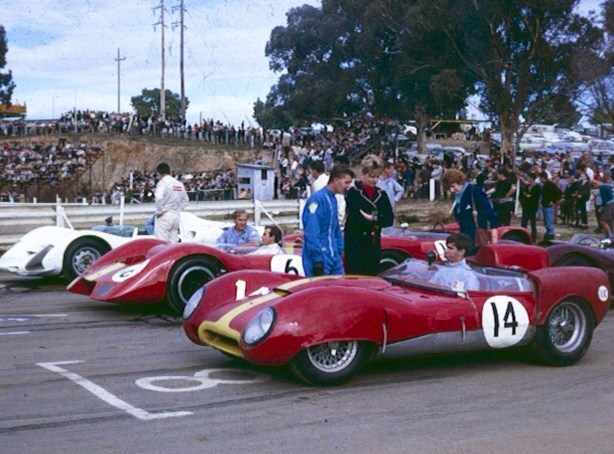
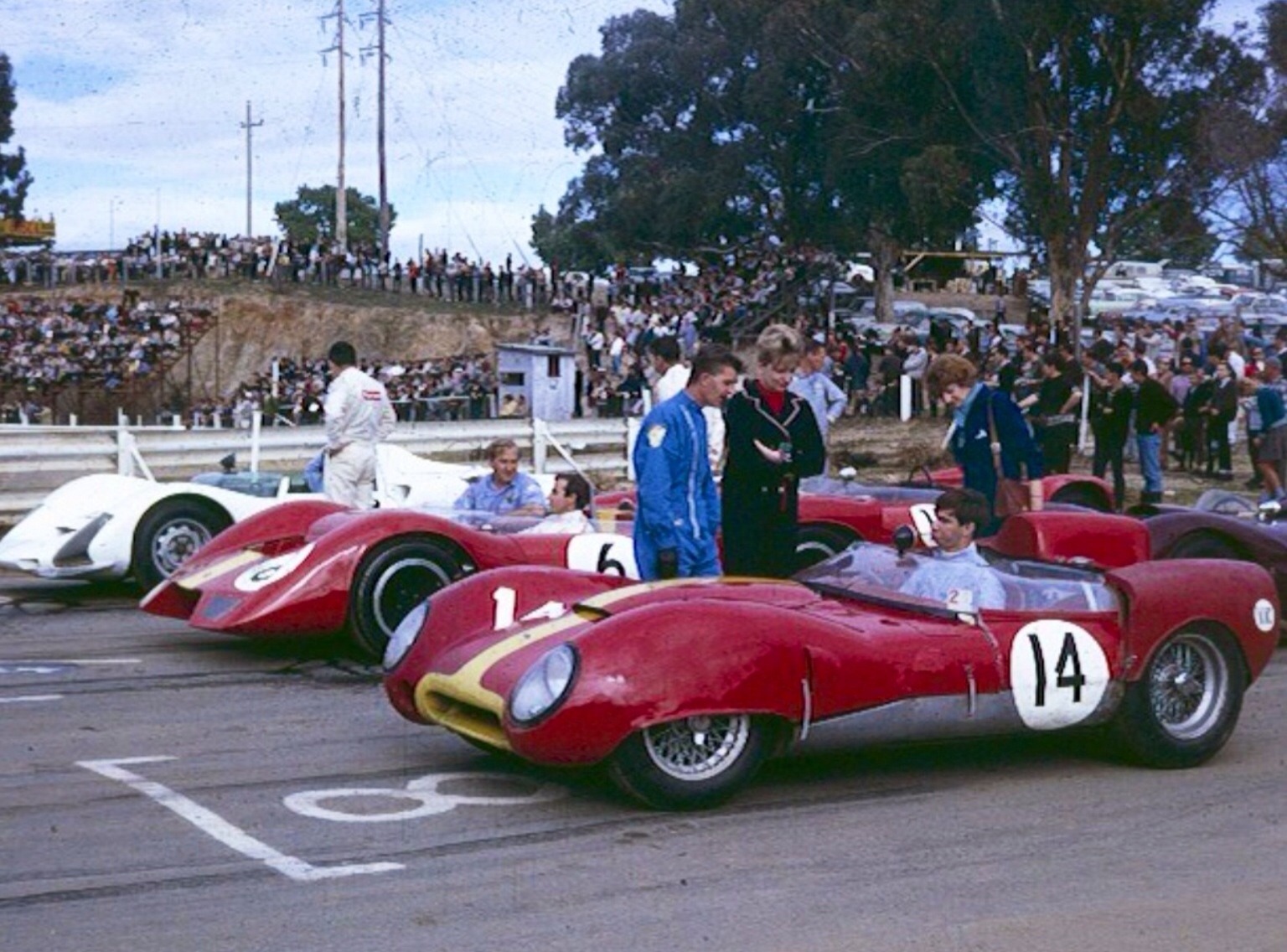
Bevan Gibson, Lotus 15 ‘608/626’, Spencer Martin Elfin 400 Repco and Alan Hamilton Porsche 906 Spyder at Hume Weir, Albury/Wodonga, Queens Birthday weekend 1967. Shot is somewhat poignant as Bevan is to die in the Elfin at Bathurst 2 years hence. Drives in the 15 earned him the Bob Jane cars drive (Bryan Liersch)


‘My late brother’s Lotus 15 airborne and upside down at Warwick Farm on 14 February 1965. Bevan had diverged slightly offtrack to avoid a spinning car at The Causeway and unwittingly drove into sand covering the horse track. This caused the Lotus’ nose to dig in, flipping the car end over end. Seat belts were not compulsory and this threw Bevan out, suffering only minor injuries. He can be seen on the ground between the railings. The photo won Racing Car News photo of the year’ wrote Mark Gibson
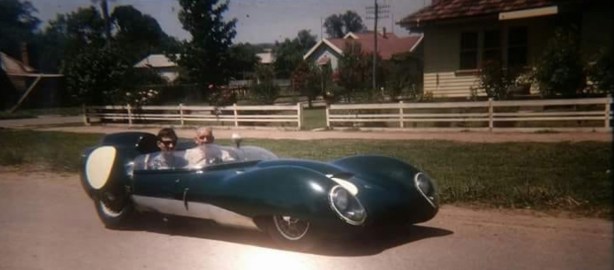
 

Sunday Drive: Bevan and Hoot Gibson cruising the back streets of Mansfield, Victoria circa 1964 (Mr Ramsay)

Two months later the car reappeared at The Farm, Bevan won the race from the back of the grid. It was the start of a period in which the Gibson team campaigned it at virtually every available Victorian and NSW meeting until the end of 1968.

The engines capacity was raised to 2.3 litres which put small-capacity lap records out of consideration, while the over 2 litre class was the territory of the big V8 cars, so that outright and class wins were relatively few, although the car held the Phillip Island sports lap record for many years. What made an impression was Bevan’s natural speed and commitment despite the 15’s inherent shortcomings against much younger cars.

The bodywork was progressively hacked about to repair minor damage and to accommodate wider rims and tyres, and the gearbox needed lots of caring fettling.
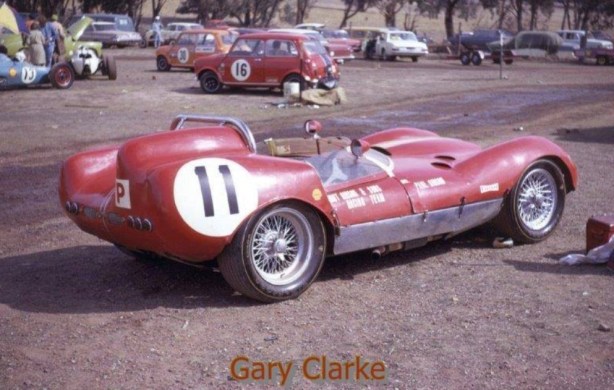
The Gibson family owned Lotus 15 Climax ‘608/626’ in the Winton paddock circa 1970, Paul starting out not long after Bevan’s death. Journalist Ray Bell wrote about the family maintenance of the ‘Queerbox’-‘they sometimes wore out their crownwheels, these were too expensive for cinema operator Hoot to replace thru Lotus spares (ZF made them exclusively for Lotus) and so Vauxhall crownwheels were lapped in running with grinding paste on the lathe overnight to suit. The gearchange was always dicky with this car, but when Grant Gibson took it to England he was able to set it up properly with a hacked-up unit alongside and found some spacers in the wrong place’ (G Clarke)


Another photo from Mark Gibson ‘…taken not long after (the aviating one above) following subsequent repairs, at Hume Weir’s Scrub Corner, the broken half windscreen can still be seen, aa new one not yet available. Bryan Thomson Elfin Mallala follows, David Bailey #8 Asp Clubman further back’ (M Gibson)

But by early 1969 the old beast had served its purpose, Bevan was recruited by Bob Jane as one of his drivers doing some laps in the Brabham BT11A vacated by Spencer Martin and becoming the primary driver of Bob’s Elfin 400 Repco sportscar.

This car was a very serious weapon powered by a 4.4 litre ‘RB620’ V8, unfortunately Bevan died in it at Bathurst in 1969 whilst pursuing Frank Matich’s much quicker Matich SR4 Repco, that day slowed by a fuel injection problem. The Elfin took to the air on one of Bathurst’s Conrod Straight humps. This story is well told in my article on the Elfin 400. Click here to read it; https://primotipo.com/?s=elfin+400

The Lotus 15 remained in the Gibson family for decades raced by various of the boys before being restored by Grant Gibson, partially during the period he worked as Nigel Mansell’s engineer whilst at Williams.

The car looked fantastic when completed but sadly left Australia a few years ago, its still alive and well…
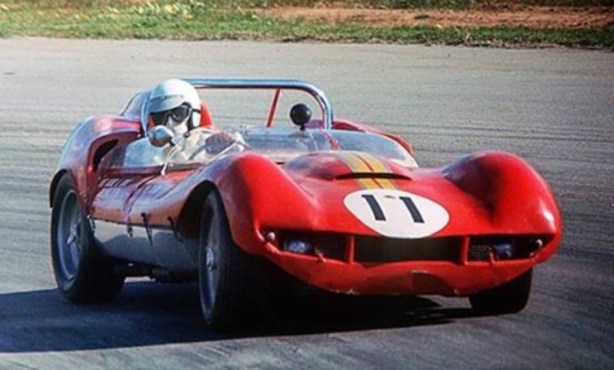
Ugly as a hatful of arseholes, awful innit?! Bevan Gibson at Hume Weir in the 15 in 1969, with modified nose. The old beast ‘608/626’ had done a few tough race miles by then (oldracephotos.com.au)
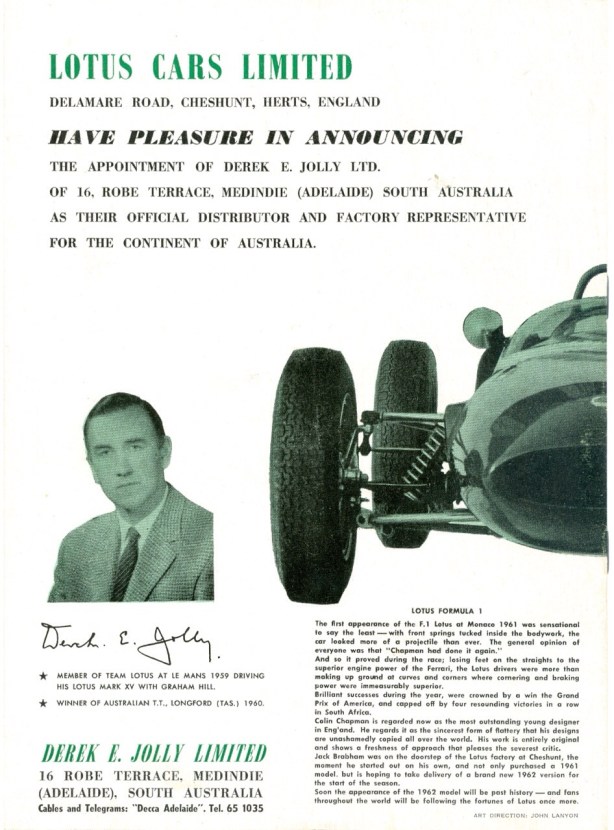
 

What Happened to Derek?…

After the Penfolds float Derek moved away from the racing scene, the Geoghegan family in Sydney took over the Lotus franchise after Jolly relinquished it.

But he was a big mover and shaker in swingin’-sixties Adelaide.

He built Gamba Studios in ‘Deccas’ Place’ at what is now 97 Melbourne Street, North Adelaide, its a wonderful part of town i lived in Sussex Street for 3 1/2 years not so long ago.

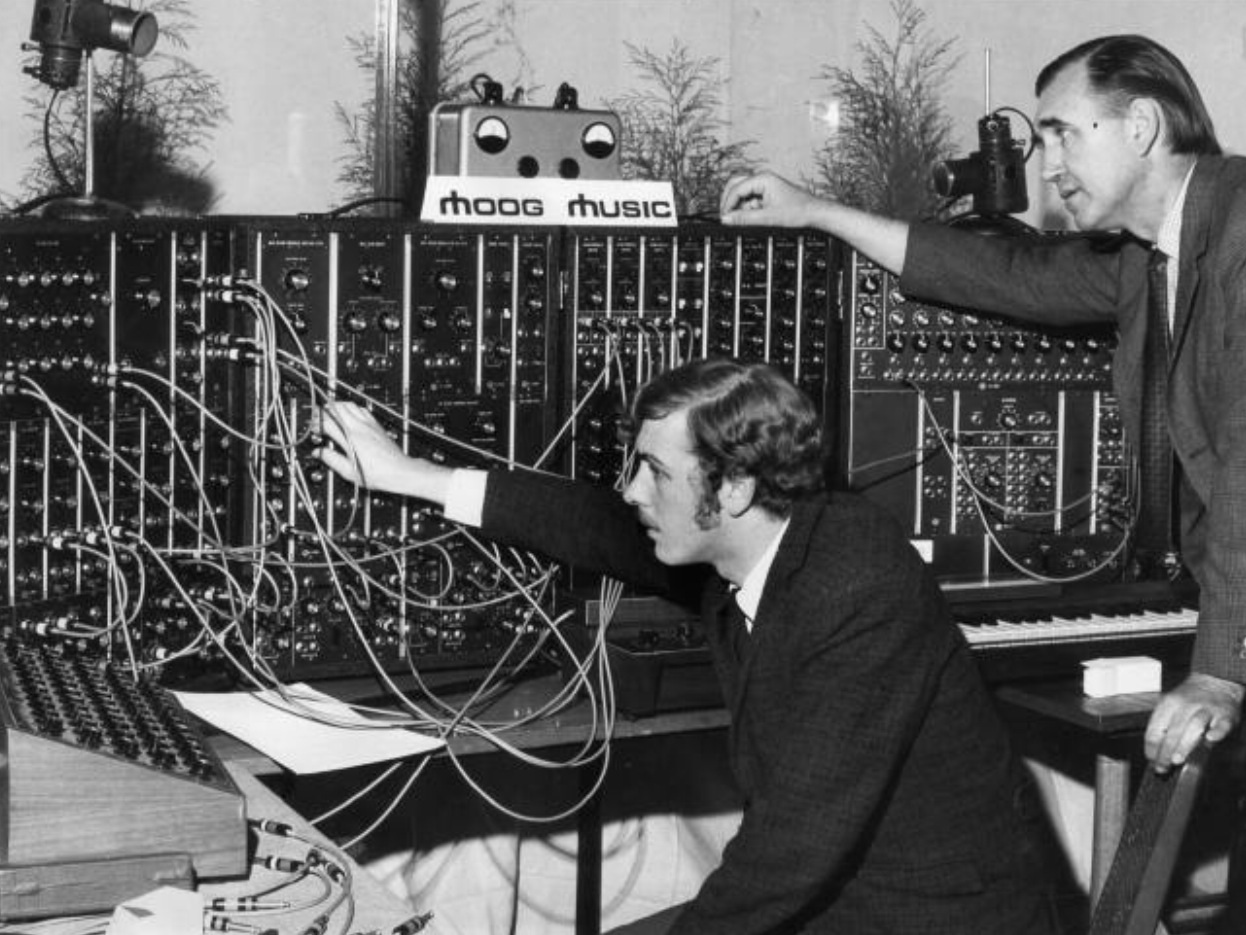
But back then it was moribund, Derek’s development included a restaurant and state of the art recording studio with the highest quality recording equipment available. He encouraged an open door policy inviting musicians and performers to use the studio to experiment, to enhance that he imported the first Moog synthesiser in Australia, in fact its said to be the first one used outside the US.

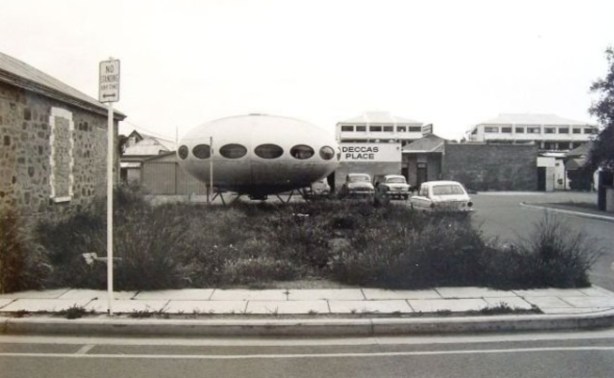
Many Adelaide folk of a certain age remember the ‘Futuro’ house, a flying saucer like round pre-fabricated building in Melbourne street in the 1970’s and 1980’s. It was originally designed as a ski-house by Matti Suuronen, a Finn. It was seen as a home of the future by Derek, eventually less than fifty were built, Derek’s was relocated to a country site some years ago.

Jolly planned Decca’s Place as a cultural centre, his initial drive and enthusiasm being credited as responsible for the mix of shops, restaurants, apartments and boutiques in the area today.
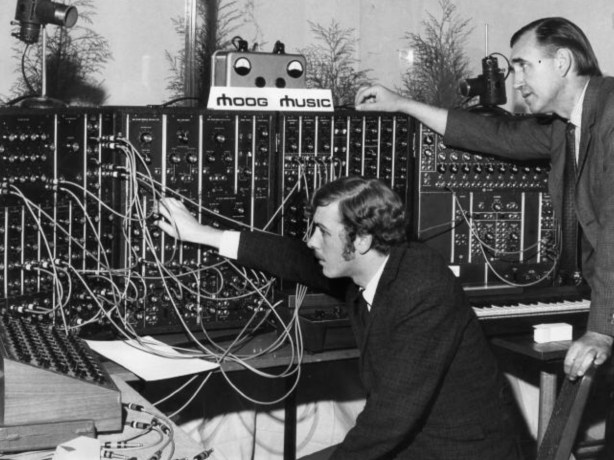
Derek at right in the Gamba Recording Studio, Deccas Place circa 1971 (ABC)
 

image

Deccas Place and Futuro house in the 1960’s, at what is now 97 Melbourne Street, North Adelaide (ABC)

Unfortunately Derek lost much of his fortune in the 1987 stockmarket crash although he continued to be a force in the arts. He and his wife Helen moved back to the Barossa Valley in 1996 opening a multi-media gallery, they were instrumental in establishing the annual Barossa Music Festival which is still held today.

Jolly still popped up at the occasional car event, a close friend who owns a Lotus Elite Super 95 once Derek’s recalls him as guest of honour one year at the Lotus Club of Australia annual Easter get together.

Derek died in 2002, aged 74 as a result of injuries sustained in a car accident twelve months before- his stationary car was slammed into by an out of control driver at about 90kmh. It was a sad end to a man of many parts, he was also battling cancer at the time.

Jolly was a man of considerable achievement, he used his inherited wealth to achieve much in motor racing, business and the arts.

Its tempting to speculate what he may have achieved had he raced on rather than retired in his early thirties but the scene was becoming more professional- his own racing of the Fifteens is an example of that, in that sense his career bridges post-War amateurism with late fifties-early sixties professionalism.

Lets remember one of the largely forgotten men of Australian motor racing…
image

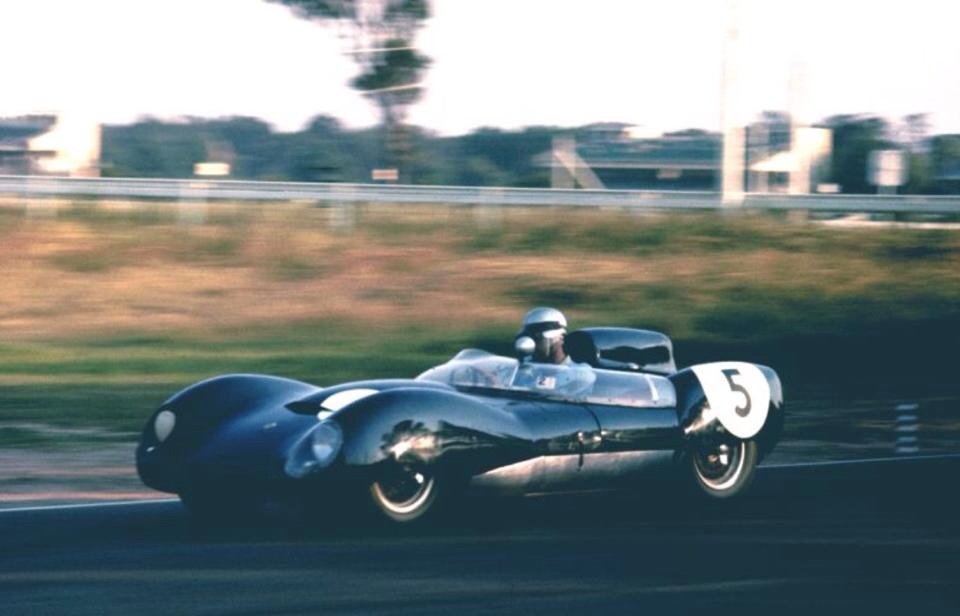
Jolly in his Lotus 15 ‘608/626’ at Warwick Farm during the summer 1961 International meeting. He was second to Frank Matich’s Leaton Motors Lotus 15 2.5 FPF during this meeting, giving away some power to the quick FM driven car- the fastest sportscar in Australia at the time (J Ellacott)

Bibliography…

Uniquecarsandparts.com.au, ‘Historic Racing Cars in Australia’ John Blanden, Colin Chapman Archive and Resource, ‘The Story of Lotus 1947-1960’ Ian Smith, ‘History of The Australian Grand Prix’ G Howard and Ors, ‘Australian Motor Sports’ magazine various issues, ‘Bathurst: Cradle of Australian Motor Racing’ John Medley, northkentlotusgroup.org, The Nostalgia Forum, Ray Bell

Special Thanks…

Kevin Drage, Ellis French and Rob Bartholomaeus- in Kevin’s case for the recollections and photos on The Nostalgia Forum which inspired this article and in Ellis’ and Rob’s case material from their collections to plug important research gaps

Photo Credits…

Kevin Drage, John Ellacott, John Hendry, ABC, Doug Foley, Tony Lofthouse, Bryan Liersch, oldracephotos.com, Geoff McGrath, Gary Clarke, Ellis French Collection, Walkem Family Collection, Eddie Steet, Ron Lambert, Kelsey Collection, Mr Ramsay, Mark Gibson, Stuart Jonklaas, Philip Skelton via Tony Johns Collection

Etcetera…

Austin 7 Engine..

At the time Chapman was starting out to race his Lotus 3 the UK 750 Club rules required the use of the standard two siamesed inlet ports, which could be opened up to improve performance.

Derek Jolly’s secret, probably learned from South Australian Austin 7 exponent Ron Uffindell was to de-siamese the ports.
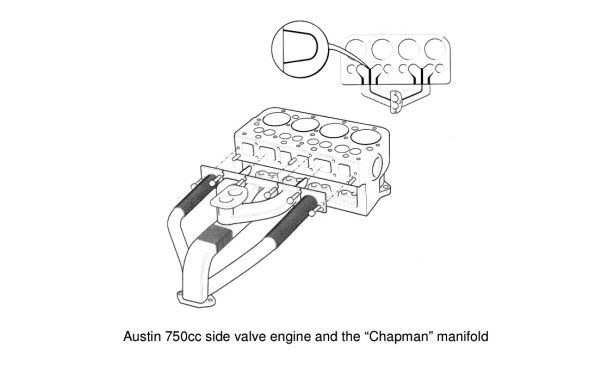


The technique Jolly used was illegal in the UK as noted. Chapman’s interpretation was to have Michael Allen create an illegal four pipe inlet manifold with two hidden separators attached to the manifold face which slid into the opened out ports when fitted thereby effectively creating four rather than two ports. They bound up the manifolds four pipes using asbestos tape to hide the pipes and make it appear that it had just two. Unless the manifold was removed the development was invisible.

The Lotus Mk 3 was a very successful car in 1951 with Chapman behind the wheel, its speed was due to a combination of Chapman’s talent, the chassis and the engine.

Decca Mk2 Climax FWA..

Whilst superficially similar to the Lotus 11 the Decca is different in many respects.

Jolly again built a spaceframe chassis with two tubes either side spaced 12 inches apart vertically. The lower tube was one inch square 17 gauge, the upper one one inch round of 20 gauge, the chassis had only one intermediate cross member at the bellhousing, most chassis bracing was left to the 24 gauge sheet aluminium undertray which was fastened to the lower side tubes and to the tail shaft tunnel, this acted as a large box section.
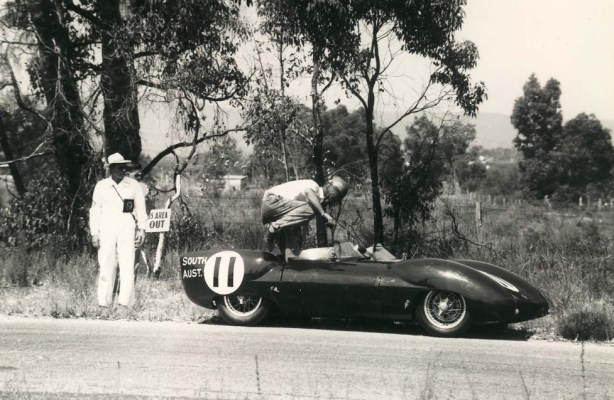
Jolly jumps back aboard the Decca Mk2 during the 1957 Caversham AGP support race, battery sorted but race lost. He then contested the AGP itself finishing 7th in the amazing, pretty little car (unattributed)

In front a massive box section crossmember welded up from 15 and 20 gauge sheet steel gave massive strength and torsional rigidity, to this was attached 1956 Renault front suspension more or less complete together with its rack and pinion steering gear modified to give 1 3/4 turns lock to lock. The brakes were 9 and 8 inch Alfin drums front and rear.
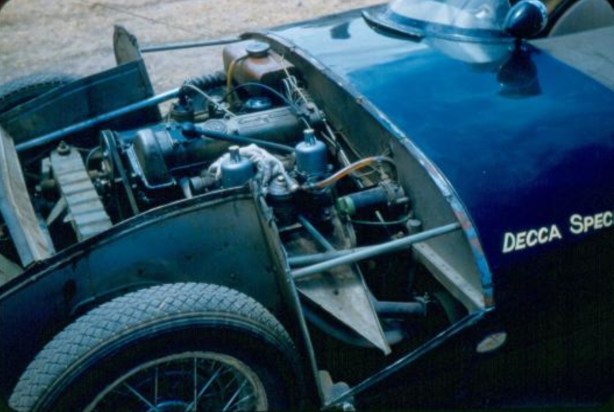
Decca Mk2 Climax, Collingrove Hillclimb circa 1957. Coventry Climax 1097cc FWA SOHC, 2 valve, twin SU carbed engine to ‘Stage 2’ tune giving circa 83 bhp @ 6800 rpm (K Drage)

At the rear a de Dion system was used, the diff housing was cut down Austin A70 with inboard rear brakes built to it. The driveshafts were as long as possible, their outer universal joints contained within the hub housing, these having been machined down from 6 inch solid duralumin. The de Dion tube itself was made of 3 1/2 inch chrome molybdenum tube and was located by twin trailing arms on each side and a Panhard rod for lateral location. Coil springs were used and tubular shock absorbers.

Wheels were Borrani with 4.5 inch and 5 inch X 15 inch tyres, front and rear.

The car measured 11 feet 3 inches long, 5′ wide and 28″ high at its scuttle, its weight 9 1/2 hundredweight. The body was made of 18 and 20 gauge aluminium welded together and  arranged such that with the removal of three bolts the whole upper shell could be removed. More routine maintenance can be done with front and rear body sections which are hinged.

The 8 gallon tank gave a racing range of 200 miles and was raced in ‘touring trim’ – and road registered which would have made it a mighty fine, fun, fast road car!

Lotus 15 ‘608/626’..

Wow Factor: Lotus 15 ‘608/626’ in the Longford paddock in March 1960, Jolly’s Australian Tourist Trophy winning weekend (R Lambert)

Tailpiece: Lets end the article the way we started- Equipe Decca in Adelaide, before the long trip to Gnoo Blas, late January 1960…
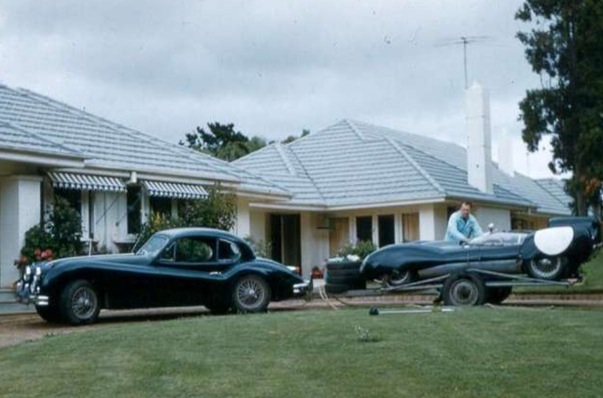
(K Drage)

Finito…


Frank Feeley, Designer (right) and Aston Martin’s owner David Brown with a clay model of Feeley’s Aston Martin DB3S in the Feltham design studio, 1954…

It would be interesting to know the occasion of this factory PR shot, the DB3S first appeared at Charterhall in May 1953 so it seems unlikely it was about that model Aston. The clay model is also notable, in comparison with the final design, for the distance behind the rear wheel arch which is shorter on the production car than the clay. The DB3 was much more slab-sider than its younger sibling too wasn’t it? The cutaway front arch, such an outstanding feature of the DB3S design is clearly shown. The rendering on the wall behind the two fellows is also intriguing, I wonder what it is?

I wrote an article about one of Aston’s sexiest models, the DB3S, not so long ago, click here to read it;

David McKay’s Aston Martin DB3S’s…

Two of Frank Feeley’s designs at Le Mans in 1949. #29 DB1 driven by Lawrie/Parker to 10th and #28 DB2 driven by Marechal/Mathieson DNF. Race won by the Chinetti/Thomson/Selsdon Ferrari 166MM (unattributed)

Feeley is said by some to be a forgotten man of Aston Martin…

 It seems odd really as he shaped all post-war Astons up to but excluding the DB4, most notably the DB3 and DB3S racers.

Feeley, whose father also worked there, joined Lagonda as a teenager at 14, initially he was the office boy under Arthur Thatcher, the assistant works manager.

By 25 he was their ‘Body Designer’, succeeding Walter Buckingham. The commercial viability of Lagonda as an independent firm was weakened when Briggs Motor Bodies exited an agreement to build Lagonda’s bodies to take on more profitable and larger deals with Jowett and Ford. Lagonda had closed their own body shop, with times being tight, Feeley and WO Bentley were shown the door.

David Brown bought Aston Martin, famously spotting a ‘For Sale’ advertisement in ‘The Times’, he paid the princely sum of twenty thousand- five hundred pounds for the business. Shortly thereafter he also bought Lagonda, creating, you guessed it, Aston Martin Lagonda. Needing a body man Brown approached Feeley who took on the role despite some misgivings.

Aston DB2 in 1949. It is the #28 car in the 1949 Le Mans photo above when first built. The car was without brakes for a long period of the race, Pierre Marechal crashed at White House on Sunday, then rolled with the unfortunate driver dying of his injuries the following day. ‘LMA/49/1’ was scrapped, the engine transferred into a DB1 (unattributed)

Feeley’s first work for the nascent AML was a roofless, rebodied Atom which ‘…was a sweeping open tourer derived from his pre-war ideas to modernise the Lagonda V12 and featured a new design of radiator grille. This had a vertically slatted centre section based on the original Aston radiator and a pair of low side grilles flanking it. Fifteen were built with the car retrospectively called the DB1’.

No doubt Cisitalia and Ferrari influenced the shape of the DB2 which was built on a shortened version of the Claude Hill designed ladder frame chassis- the car was created quickly to run at Le Mans in 1949. ‘We drew the chassis in and I immediately drew up the whole thing around it, the whole shape. Their was no time to change my mind once I had done it’ Feeley recalled.

The DB2 continued the DB1’s three-piece grille form, in a simplified one piece design, which set the template for the Aston grille shape which continues today.

David McKay’s first Aston DB3S ‘102’ in the leafy Sydney North Shore suburbs in the mid-fifties (pallas1970)

The DB3S is favourite car for so many of us such is its purity of curvaceous line. Cutaway front arches were its innovation, the practical element of this approach was to draw heat out of the engine bay. ‘Feeley had got fed up with the chassis engineers never knowing where they were going to put the exhaust pipes, so he decided it for them by running the pipes through the cutaways’. By this stage Frank’s duties extended to managing the body-builders, initially Mulliners of Birmingham and later Tickford in Newport Pagnell, a David Brown acquisition.

But times were changing, John Wyer was instrumental in the rejection of Feeley’s proposal for the coming DB4 in favour of Touring of Milan. This, and the concentration of activity at Newport Pagnell, where the DB4 was to be built, rather than at Feltham near Feeley’s home signalled it was time to leave. He worked in the aircraft industry and continued to live in his native Staines until his death in 1985.

In terms of contribution post-war Feeley is up there with Astons best- Claude Hill, Harold Beach, Ted Cutting, Tadek Marek, John Wyer and David Brown himself. Not a forgotten man at all me-thinks?

The works Aston’s before the off- Le Mans 1949: #27 is the Jones/Haines 7th placed DB2, the #28 DB2 in front of it, then the #19 Johnson/Brackenbury DB2, DNF water pump (unattributed)

Bibliography…

 Article by John Simister in ‘Vantage’ Magazine November 2014, ‘Aston Martin: The Racing Cars’ Anthony Pritchard

 Photo Credits…

 Getty Images, pallas1970

 Tailpiece: It’s a winner I think…


hawthorn fazz

Mike Hawthorn dives his big Ferrari 335S into The Esses and past the smaller Ferrari 500TRC of Fernand Tavano and Jacques Peron early in the 1957 Le Mans 24 Hours…

Both cars failed to finish, Hawthorn shared the 335S with Luigi Musso, the cars engine cried enough on lap 56 and the 500TRC also had an engine problem withdrawing after the completion of 235 laps.

1957 was a D Type rout- the Ivor Bueb/Ron Flockhart D won from the similar cars of Lawrence/Sanderson, Lucas/Brousselet and Frere/Rouselle, all of which gave Ferrari something to think about! The best placed Ferrari was the 500 Testa Rossa driven by Lucien Bianchi and Georges Harris but it was 39 laps adrift of the winners.

Click on this link for an article about the Ferrari 335S and 1957 Mille Miglia;

Peter Collins: Mille Miglia 1957: Ferrari 335S…

Credit…

Klemantaski Collection

image

Glenda Foreman focusses on the Heuers whilst Pedro Rodriguez runs up-front at Le Mans 1970…

Pedro’s girlfriends powers of concentration were not tested, the Mexican’s John Wyer Porsche 917K was out of the race on lap 22 with engine failure, he and Leo Kinnunen started from grid 5. Another 917K, the Hans Hermann, Richard Attwood car won the race.

image

image

Rodriguez/Kinnunen JW Porsche 917K Le Mans 1970 (Schlegelmilch)

Credits…

Rainer Schlegelmilch

Tailpiece: Leo, Pedro, Brian and Jo. Kinnunen, Rodriguez, Redman and Siffert, the 1970 JW Automotive drivers before the off…

image

(MotorSport)

John Surtees struggles to restart his stalled Lola T70 Mk3 Aston Martin at the commencement of the Nurburgring 1000 Km, 28 May 1967…

Alongside him , slightly obscured, poleman Phil Hill in the sensational Chaparral 2F Chev is also slow away, meanwhile a gaggle of Porsche 910’s sprint away, likely culprits the works cars of Rolf Stommelen, Gerhard Mitter and Jo Siffert.

A happy confluence of events was the construction of Aston Martin’s new V8 engine and racer/entrant Jackie Epstein’s approach to Eric Broadley to build a coupe variant of the 1966 Can Am Championship winning Lola T70 Spyder Group 7 machine. John Surtees of course won the very first Can Am series in a T70 Mk2 Chev. Eric Broadley and Surtees formed Lola Racing Ltd as a works development and racing arm, Surtees honed the T70, he outlined his philosophy in developing the car in a MotorSport interview in August 2003.

‘With a long distance car you can’t have something that rides on a knife edge like a top F1 car…You are trying to get consistency, you don’t want an unpredictable and volatile character. By the time the T70’s got some running in them they were very driveable, very predictable cars which you could drive up to the limit and perhaps a little bit over. This gave the driver confidence’.

Nurburgring 1000km 1967 (MotorSport)
(MotorSport)

Surely one of the swoopiest, voluptuous and sexiest racers ever, the Lola T70 Mk3 Coupe ‘SL73/101’ was the first Lola Aston built and was shown to rapturous crowd approval at the annual Racing Car Show at London’s Olympia in January 1967. Tadek Marek’s new Aston Martin ‘DP218’ V8 engine also made its first public appearance at the show on the Surtees Racing stand. The announcement of the relationship between the concerns: Lola, Aston Martin and Surtees was made at the show.

On the face of it the association had every chance of success.

The combination of one of sportscar racings best chassis, a lightweight, powerful engine which promised to provide the Lola with better balance than the Chev engined T70s and John Surtees’ track testing ability and sheer speed promised much. Aston Martin chief, David Brown, was of the view that ‘racing improves the breed’ whilst his chief engineer Tadek Marek was not especially enamoured of the high risk strategy. After all, his new engine was designed as a road car motor not a race engine.

Undaunted, David Brown proceeded and Aston Martin Lagonda supplied special versions of Marek’s design with a capacity of 5008.5cc, a bore/stroke of 98x83mm. The all aluminium, duplex chain driven quad cam, two-valve, dry-sumped, Lucas fuel injected V8 was quoted at 450bhp @ 6750rpm and 413 lb/ft of torque at Le Mans in 1967.

‘DP218 was first tested in a T70 Spyder in Autumn 1966. At that first development stage, using a compression ratio of 11:1 and fitted with four Weber 48IDA carburettors the engine was quoted as giving 421bhp @ 6500rpm and 386 lb/ft of torque. Testing showed there were many problems with the engine, most notably the motor popped a rod through the side of its aluminium block due to oil starvation. Eventually a much developed engine, one of a batch of ten that had been delivered, with attention to the dry sump system, was installed in March 1967 into the new coupe for Team Surtees to run. The most obvious problems in testing were a bad vibration and an inability to rev beyond 6100 rpm.

Le Mans test day 1967 #SL73/101, note the engine is Weber equipped and sans spare and luggage container (unattributed)

The big, booming car was the third fastest machine present in the dry and fastest in the wet at the Le Mans test days on April 8 and 9…

The car was fast through the corners but was unable to top 186mph as a consequence of not being able to pull more than 6000rpm on the Mulsanne. Astons were convinced that Lucas fuel injection, which was shortly to be installed, would cure the problem. The quickest cars were the works Ferrari P4s of Bandini, Amon, Scarfiotti and Parkes with Bandini at the end of the day the quickest. The two Fords driven by McLaren and Donohue ‘rumbled ominously but did not press the button’. Mind you the Mark 4 was timed at 205mph and the Ferrari 198mph on the Mulsanne.

The MotorSport report of the test weekend wryly observes ‘…the two giants (Ford and Ferrari) kept an eye on Lola, Ford knowing that their whole racing effort was born of the brain of Eric Broadley and Ferrari knowing that Surtees can never be underrated’… ‘Although on paper Ferrari left Le Mans as top dog, no one was being fooled by the freak circumstances, for had it been dry on Sunday it might have been a different story and both teams were very impressed with the Lola Aston Martin efforts, remembering their own experiences when running a brand new design for the first time. It seems that Ford did not want to run in the rain for fear of a repetition of the accident to Hansgen last year…’

So, in short, Lola Astons peers were impressed by the car and the threat it potentially represented.

Surtees/Hobbs Nurburgring (MotorSport)

Lola Aston Martin’s first race appearance was at the Nurburgring 1000 Km on May 28…

It was planned to race the car at Spa but it was not ready in time so the beautiful beast made its race debut at the daunting Nurburgring. Lucas fuel injection was amongst the latest refinements to DP218.

On the face of it the car was far from the most nimble present, nor was the Phil Hill/Mike Spence Chaparral 2F Chev on pole, but Surtees popped ‘101’ second on the grid, he shared the drive with David Hobbs. Porsche 910s were the next quickest group of cars.

Surtees stalled the unfamiliar car at the start but was soon up to seventh place by lap seven when a rear wishbone broke going down through the Fuchsrohre. Surtees managed to stop the car without damage to either the machinery or the driver, but that was the end of the meeting; and of useful testing miles. Udo Schutz and Joe Buzzetta won the race in a 910.

Surtees during early laps at Le Mans (MotorSport)

At Le Mans the team had both ‘101’ and a new chassis SL73/121, which was fitted with a longer tail made of aluminium, the standard car’s body was in fibreglass made by Specialised Mouldings. The new car was to be driven by Surtees/Hobbs, the other by Chris Irwin and Peter de Klerk.

Both cars had problems in practice caused by overheating, with the Lola mechanics looking after chassis setup claiming the engines ignition timing to be 180 degrees out. Some sources have it that the overheating was caused by the different aerodynamics of the longer tail which enclosed the engine. In addition, against Aston’s advice, Surtees negotiated a sponsorship agreement to use Marchal spark-plugs. The stage was set for the disastrous events which followed.

Chris Irwin/Peter de Clerk Le Mans (MotorSport)
(unattributed)
Le Mans tail on Surtees’ machine (MotorSport)

Poor Surtees started the classic from grid 13 and then only covered three laps when ‘121’ was outed by a burned piston. ‘101’, the car started by Chris Irwin, was back on grid 25. The drivers struggled with the car for 2.5 hours during which time the mechanics replaced a broken camshaft driveshaft, the engine lost oil pressure, overheated and finally broke a crankshaft damper. The race was won by the Shelby American entered Ford GT Mk4 driven by the all-American crew of Dan Gurney and AJ Foyt.

Post event the Lola Astons were were returned to Slough where the DP218 engines were removed and both cars re-engined with Chevrolet pushrod V8’s, the Aston Martin experiment was over. It was clear the short term prospects of getting the engine race worthy were slim.

After the race engines were stripped at AML it was found that the blocks had twisted and cracks were found in the main bearing housing. The engine went through a major redesign to strengthen the motor’s bottom end which prevented the launch of the Aston Martin DBS V8 road car until 1969, initially six cylinder variants were sold.

Surtees, Nurburgring 1000km (MotorSport)

Surtees had this to say about the Lola Aston Martin program…

‘The Aston V8 could have achieved so much but was a total disaster. We didn’t expect to compete on out and out speed- we were hoping to a degree that weather would play a hand. If it rained a bit as it did at the Nuburgring and the Le Mans practice we were very competitive. Before Le Mans we did a long test at Goodwood, ten or twelve hours, but in the race we only lasted a few laps because Aston Martin had changed the design of the head gaskets! As soon as we got the cars back from Le Mans we took the Aston engines out and that was the end of that’.

In addition Surtees felt the T70 Mk3 chassis was inferior to his Can-Am T70 Mk2 ‘I didn’t like the Mk3. The front suspension was altered and i hadn’t done any development or testing on the changes. I didn’t like the effect on the character of the car, it lacked the positiveness of the original and didn’t suit my style of driving. I didn’t mind a car being a little loose at times, but i couldn’t stand something which you couldn’t point where you wanted. Some people tried to compensate by playing with the aerodynamics, but i just stopped using the Mk3. Luckily the previous years car was still in America so we dragged that out of retirement’.

In the same MotorSport article Surtees notes the contribution of Firestone tyres to the package. He did most of the Firestone testing in the UK, with a lot of work done on springs and dampers, and working closely with Koni to keep pace with tyre development, a spin-off of the Firestone/Goodyear war of the time. ‘That brought its problems too, because as you improve the tyres you put greater stress through everything, but the car retained its user-friendly character’.

There are some contradictions in the quotes above, Surtees was a tough character, after all, despite the Lola’s shortcomings he was off the front of the grid at the Nurburgring so the chassis cannot have been too bad!

If only the Aston Martin engine had the quality of Surtees’ pace in the Le Mans start-sprint!

In the end the Lola Aston Martin program was one of unfulfilled promise, but David Brown was right- racing did indeed improve the breed. The rigours of competition identified design shortfalls in the original DP218 engine which were not apparent during road testing. As a consequence the modified production V8 proved to be a strong, reliable unit- and the basis of a good race engine in the decades to follow!

From Surtees perspective he had bigger fish to fry. He was juggling multiple race programs on both sides of the Atlantic with the Lola/Honda F1 exercise, Lola T100 Ford FVA F2 car and in the Can-Am where Lola’s dominance was being overtaken by the ‘papaya menace’, Bruce McLaren’s M6 McLaren Chevs. John’s endurance T70 program was best advanced by bolting Chevys into the back of the cars in place of the Aston engines. Only a week after Le Mans Surtees ran at the front of the pack so engined at the Reims 12 Hour…before popping his Chevy engine. Unfortunately the Chevs rarely provided the reliability the T70 needed for endurance success in the blue riband events. But what a car all the same!…

By the July 1967 Brands Hatch 500km the Surtees/Hobbs Lola T70 Mk3 was Chev V8 powered (MotorSport)

1967 Endurance Season…

I wrote an article a while back about the Ferrari P4 which also profiled the main protagonists of sportscar racing in ’67- Ford Mk4, Ferrari P4 and Chaparral 2F Chev which may be of interest. The article also has photos of the Lola Astons at Le Mans.

See also this article on Le Mans 1967.

Bibliography…

‘Aston Martin: A Racing History’ Anthony Pritchard, ‘Lola, The Illustrated History 1957 to 1977’ John Starkey, MotorSport May 1967 and August 2003, Team Dan

Photo Credits…

Rainer Schlegelmilch, Dave Friedman Archive, Autosport, MotorSport, LAT

Etcetera…

(MotorSport)

Three more shots of the Surtees/Hobbs machine in the Nurburgring paddock.

(MotorSport)

Tailpiece…

The Lola Aston Martin relationship was rekindled a while later, here the Lola B08/60 Aston Martin 6 litre V12 in 2009…

Finito…

image001

Looks of wonderment and amazement at the voluptuous lines of the Aston’s Frank Feeley penned body.  The ‘Wow Factor’ of contemporary racing cars never changes whatever the era does it?!…

Here it’s a Melbourne crowd on February 28 1958. Its the end of the long hot Australian summer but the crowd are well rugged up, Melbourne is notoriously ‘four seasons in one day’ sometimes and Fishermans Bend is an exposed windswept place at the best of times. At the wheel of the road-registered, ex-works Aston Martin DB3S chassis DB3S/9 is a youthful David McKay.

McKay aboard DB3S/9 at Fishermans Bend in February 1958. Nose of the car showing minor scars of battle, perspex headlight covers fitted to this car from its birth. First race the ’56 Rouen GP in May, then 2nd @ Le Mans ’56 driven by Moss/Collins, Salvadori was 2nd at Goodwood in September- car retained by Astons into 1957, the DBR1 the front line weapon that year with Brooks racing DBS3/9 at Easter Goodwood for 3rd. It was then used by the works for the last occasions as a practice car at Silverstone for the British Empire Trophy and for the Nurburgring 1000Km before sold by John Wyer to McKay with funds provided by Ampol (Westaway)

At the time he was ascending the driving ranks having cut his racing teeth in MG’s. He made it into the elite group too- let’s not forget were it not for a ropey jumped start call he would have won the 1961 Australian Grand Prix at Mallala aboard a Cooper T51 Climax. David would soon be known as much as a journalist, successful businessman and entrant-entrepreneur via his business ‘Scuderia Veloce’ as a driver though.

McKay raced this car to wins in the sportscar races that Fishermans Bend weekend, and was very successful in it throughout the country, taking 8 wins from 9 starts.

His only defeat, 2nd place was at the hands of Doug Whiteford’s ex-works Maser 300S in the Tasmanian Tourist Trophy at Longford in early 1958 during the Gold Star meeting.

McKay and passenger, Baskerville 1958 (HRCCT)

After Longford McKay and his crew took the car south to Hobart racing it at the new Baskerville circuit (above) in April and taking a comfortable win, and setting a new outright circuit record from Lyn Archer’s Cooper 1100 but churning through more of his diminishing stock of racing Avons due to the abrasive nature of the surface.

An amusing side-story is that the officer in charge of the old SS Taroona ship between Devonport and Port Melbourne took exception to the oversized trailer and refused to load it until David made representations to the Captain who graciously allowed the equipe aboard ensuring that important commitments to sponsors could be met.

db 3 s engine

Engine of the ex-works/McKay DB3S/9, raced at Albert Park, November 1958 by Stan Jones. 6 cylinder 2922cc DOHC 2 valve, twin plug all alloy engine fed by 45DCO Weber carburettors. Circa 225bhp @ 6000 rpm (Kevin Drage)

His last race in the car was successful, he took an Australian Tourist Trophy victory at Mount Panorama, Bathurst in October 1958 in what McKay described as ‘the faithful old ex-works Aston’s…greatest Antipodean win’.

The race was not an easy one. Initially Bill Pitt’s Jaguar XKD led and then Doug Whiteford, the formidable, forceful three-time AGP winner took the lead from McKay with Pitt 3rd. On lap 10 Doug had an enormous accident when the Maser was caught by a sudden gust of wind after coming over the second Conrod Straight hump threw the car out of control with the Maser spinning and hitting the right hand fence three times. Whiteford was almost flung from the car as it skidded backwards down the escape road and into another fence. Fortunately the St Kilda racer was only bruised by the wild ride.

McKay then led with an intermittent engine miss from Derek Jolly’s Lotus 15 Climax, a light rain shower adding to the degree of difficulty towards the end of the race. McKay won from Jolly, Ron Phillips and Frank Matich- Aston DB3S, Lotus 15 Climax, Cooper Jaguar and Jaguar XKC.

The weekend was a brilliant one for the Sydneysider as his new Jaguar Mk1 3.4, just imported for him by Ampol trounced the hitherto dominant Repco headed Holden sedans of John French and Leo Geoghegan in the sedan car handicap, to start the ‘Jaguar Era’ of Australian Touring Car racing.

After the Tourist Trophy win Stan Jones bought the racer but wasn’t really happy with it. The wonderful Le Mans second placed 1956 car then passed into Ray Barfield’s hands in Western Australia where its contemporary racing history ended in the early sixties. A summary of the cars history is in this article, rather than repeat myself;

‘Bunbury Flying 50’, Allan Tomlinson, Ferrari Tipo 500 et al…

McKay’s first Aston, a production DB3S chassis #102 in the Carrathool paddock during its Australian LSR record breaking weekend in February 1957. Interesting to know who crafted the aero pod beneath which McKay sat and cooked! (Jek)

McKay was a very dab hand at the wheel of Aston’s by the time he bought his ex-Moss car…

He was part of the trio of privately run DB3S,  ‘Kangaroo Stable’ of cars raced by Australians Tony Gaze, Jack Brabham, Les Cosh, Dick Cobden, Tom Sulman and McKay in Europe in 1955.

McKays car, initially delivered to Tony Gaze, chassis DB3S/102 took the best result of the tour cut short by the cancellation of many sportscar races in Europe after the Le Mans disaster- McKay and Gaze were second in the 29 May Hyeres 12 Hour behind the winning Ferrari 750 Monza driven by Canonica/Munaron

At the end of the European Safari which included Oporto (Gaze 8th) and Goodwood (McKay/Gaze DNF distributor drive) David shipped the car straight to New Zealand for a number of races there including the Formula Libre NZ GP in January 1956,he retired from the Ardmore event won convincingly by Stirling Moss in a Maserati 250F.

The engine of the car was shipped back to the UK for a rebuild after a major failure during a race at Invercargill. From May 1956 production DB3S’ were fitted with twin-plug 210 bhp engines, it was in this form the engine was rebuilt and delivered from Feltham back to Sydney. The beautiful car was again race ready by early 1957.

Tony Gaze about to rejoin the May 1955 Hyeres 12 Hour, he shared the car with David McKay- car #20 behind is the Graham and Peter Whitehead DB3S DNF (CAMS)

The stunning colour photographs were taken of ‘102’ in February 1957 at Carrathool a tiny village 680 Km west of Sydney between Narrandera and Hay in New South Wale western Riverina.

The main automotive attribute of the town was a long, straight stretch of road between Carrathool and Gunbar which was ideal for record setting, and so it was that various Ampol sponsored cars sought to break some Australian speed records. The then current Australian LSR was the 136.4 mph set by Jack Saywell’s 2.9 litre Alfa Romeo Tipo B/P3 at South Australia’s Coorong in 1939.

After plenty of careful preparation inclusive of incorporating the beautifully made perspex fairing onto his Aston, McKay broke the record setting a time over the Flying Kilometre of 143.19 mph on the morning of 19 February 1957. The ‘Canberra Times’ reported that McKay made two full speed runs on the course, ‘during one run he skidded on a patch of loose dirt at 140 mph’.

This speed was soon eclipsed by other cars but the DB3S held the class record for some years.

David McKay at speed during the Ampol sponsored record-breaking weekend in early 1957. Carrathool a tiny hamlet with now around 300 inhabitants. A straight, flat road with a decent surface a long way from major population centres was ideal record breaking territory! (Jek)

The car was first raced in Australia at Easter Bathurst in April 1957, he was 2nd in the sportscar handicap and won the sedan and sportcar handicap from Paul England’s Repco headed Ausca, passing the very fast special built at Repco Research by England ‘running up to 139.3 mph to do so and clocking fastest quater mile time for the day’.

But the car saw little further use as the quicker ex-works machine arrived in Sydney in September 1957. DBS/9’s first race was the October 1957 13 lap NSW Sportscar Championship at Bathurst, an event the combination won comfortably with McKay taking the lap record despite using only 5200 of the Aston’s available 6000 rpm. Bill Pitt’s Jaguar D Type was timed at 144 mph on Conrod Straight with McKay at 136 mph using his self imposed rev limit.

Both of these extremely valuable cars still exist but sadly left Australia many years ago. Those of you with collections of Australian ‘Sports Car World’ magazine should have a fossick through them as McKay wrote two sensational articles about the ownership of his two Aston’s in the seventies, or maybe the eighties!..

Technical specifications as per text (Tony Matthews)

Aston DB3S Technical Specifications…

The Aston Martin DB3S was built from 1953 to 1957, 32 were constructed excluding the single-seater variant ‘DP155/1′ raced by Reg Parnell in New Zealand in 1956.

Fundamentally Willie Watson’s design was a shorter, lighter and stiffer car than Eberan Eborhorst’s Aston DB3. The car evolved over just four months making its debut in Reg Parnell’s hands at Charterhall on 23 May 1953.

The cars were designed around a period typical ladder frame chassis which was 7 feet 3 inches long- 6 inches shorter than DB3. The frame comprised twin tubular members of 4 inch 16 gauge chrome molybdenum steel and three 14 gauge four, and five inch cross-members. The shorter chassis made the car nimbler than its predecessor if somewhat skittish on bumpy surfaces. The track was reduced from 4′ 3″ to 4’ 1″.

Frank Feeley designed the very stylish body, as sexy as the DB3 was dowdy. More than a nod had been given in the direction of the contemporary Maserati A6GCS it seemed. Overall the car was shorter, narrower and lighter than the DB3 and importantly it ‘looked right’ straight out of the box.

Front suspension was independent by trailing links, torsion bars, piston type dampers and a roll bar. A De-Dion rear axle was used sprung by a torsion bar and located by trailing links and a Panhard rod, again with piston type shocks.

Naturally a David Brown gearbox was fitted, the S430 ‘box a 4 speeder with reverse, final drive was by spiral bevel in a light alloy casing with a ZF slippery diff usually fitted. Brakes initially were two-leading shoe Alfin drums- 13 inches in diameter at the front and 12 inches at the rear. From 1955 Girling disc bakes were specified, the rotors were 11.5 inches in diameter front and rear. Precise rack and pinion steering was fitted, two turns were required lock to lock.

A 2922cc all alloy DOHC, 2 valve, 6 cylinder engine provided the cars heart. It had 4 main bearings and wet cylinder liners with the valves disposed at an included angle of 60 degrees. Initially fitted with 35DCO Weber carburettors the engine gave 182 bhp @ 5500 rpm and 182 lb/ft of torque at 3800 rpm on a compression ration of 8.5:1.

The cars were of course developed extensively throughout their racing life with the works cars fitted with twin-plug heads and 45DCO Webers from May 1954 giving 225bhp @ 6000 rpm.

The ‘Kangaroo Stable Cars’ (DB3S/102 Gaze-McKay, DB3S/103 Sulman, DB3S/104 Cosh) delivered in early 1955 all had the 200 bhp Weber 40 DCO engine- when announced at Earls Court in October 1954 the production cars had a feeble and uncompetitive 180 bhp on triple SU’s.

For the sake of completeness special works engines included a supercharged 240 bhp car raced at Le Mans in 1954 and a 2992cc normally aspirated variant raced at Dundrod in 1955.

In an era of unlimited sportscars the production based 3 litre DB3S was rarely an outright contender, the big guns, depending upon the year were the Benz 300SLR, XKD Jags and Ferrari V12’s of varying capacity. But with a change to 3 litres for the manufacturers championship and a more uncompromising approach the DB3S’ younger brother triumphed at Le Mans in 1959 and won the manufacturers title to boot. The path to that success was in part via the DB3S journey…

David McKay and passenger doing some camera work at the then new Baskerville circuit, Tasmania in early 1958 (HRCCT)

Etcetera…

(unattributed)

McKay on the left and Doug Whiteford, Maserati 300S with Bill Patterson’s Cooper Climax Bobtail behind?

Its Longford before the startline was moved from here- towards the end of The Flying Mile, before Mountford Corner to what became Pit Straight- the stretch after Mountford.

(unattributed)

Perhaps an Ampol publicity shot- ‘Rice’ trailer? Nice rig.

Bibliography…

‘Historic Racing Cars in Australia’ John Blanden, ‘David McKay’s Scuderia Veloce’ David McKay, ‘Aston Martin: A Racing History’ Anthony Pritchard, ‘Bathurst: Cradle of Australian Motor Racing’ John Medley, ‘The Canberra Times’ 20 February 1957

Photo Credits…

Don Westaway, Kevin Drage, Ampol, Sharaz Jek, Tony Matthews, HRCCT- Historic Racing Car Club of Tasmania, CAMS

Tailpiece: McKay at high speed in DB3S/102 during a practice run at Carrathool, in New South Wales western Riverina in April 1957…

(Ampol)

Finito…


image

(Alvis Upitis)


Denny Hulme unleashing all 670 ‘neddies’ of his McLaren M8D Chev at Mid Ohio in August 1970…

The alloy block Chev V8’s were 7.6 litres in 1970, the ‘Batmobile’ arguably the sexiest of the Can Am McLarens and certainly one of the most successful.

Denny won 6 of the 10 rounds and Dan Gurney another 2 before sponsorship conflicts brought to an end his drive which arose as a result of Bruce McLaren’s fatal testing accident aboard an M8D at Goodwood on 2 June 1970. Peter Gethin, Dan’s replacement won another round adding to the ‘papaya rout’.

image

Denny and Teddy Mayer are easy to pick, perhaps some of you can help with the names of the rest of the team, modest ute and trailer indicative of a ‘no frills’ approach to all but the ‘weapons of battle’ (Alvis Upitis)

I wrote an article about the McLaren M8D a while back, click here to read it;

Peter Gethin: McLaren M8D Chev: Can Am 1970…

image

Hulme won the Mid Ohio round, the ‘Buckeye Cup’ from Peter Revson’s Lola T220 Chev and Lothar Motschenbacher’s ex-works McLaren M8B Chev, in the shot above Denny is ahead of Lothar early in the race.

Credits…Alvis Upitis

image

Teddy Mayer, Denny and the team resolve the next set-up changes to Hulme’s steed (Alvis Upitis)