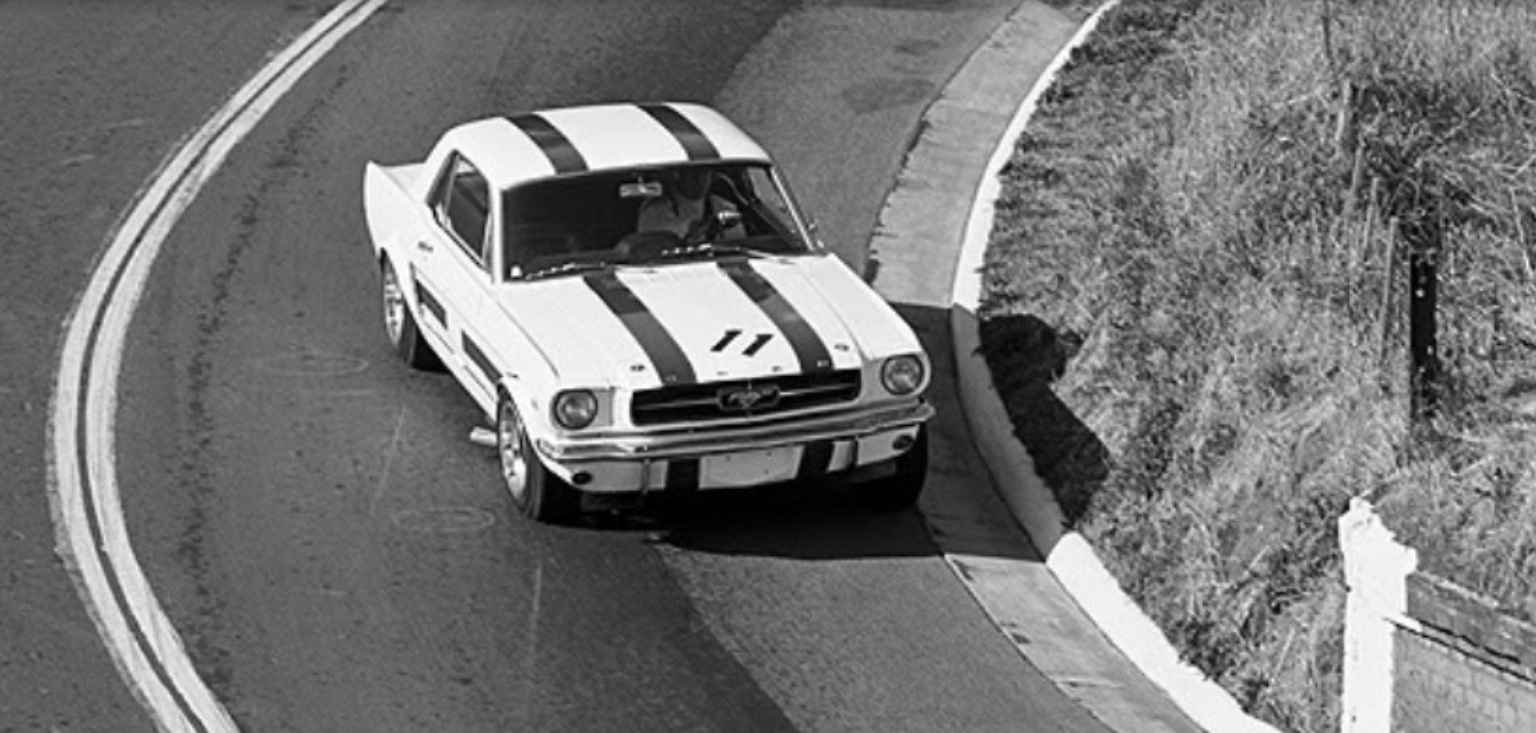
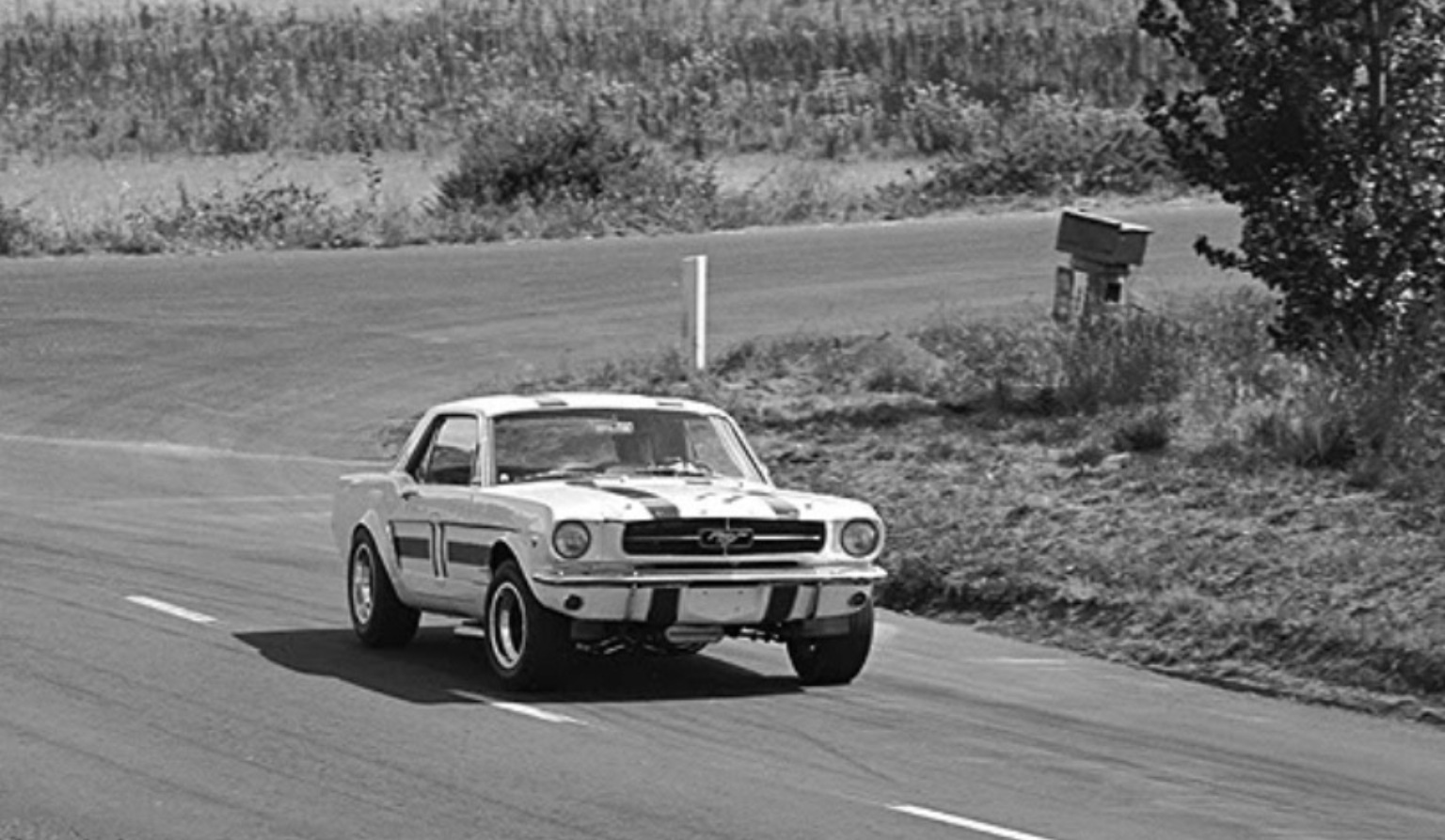
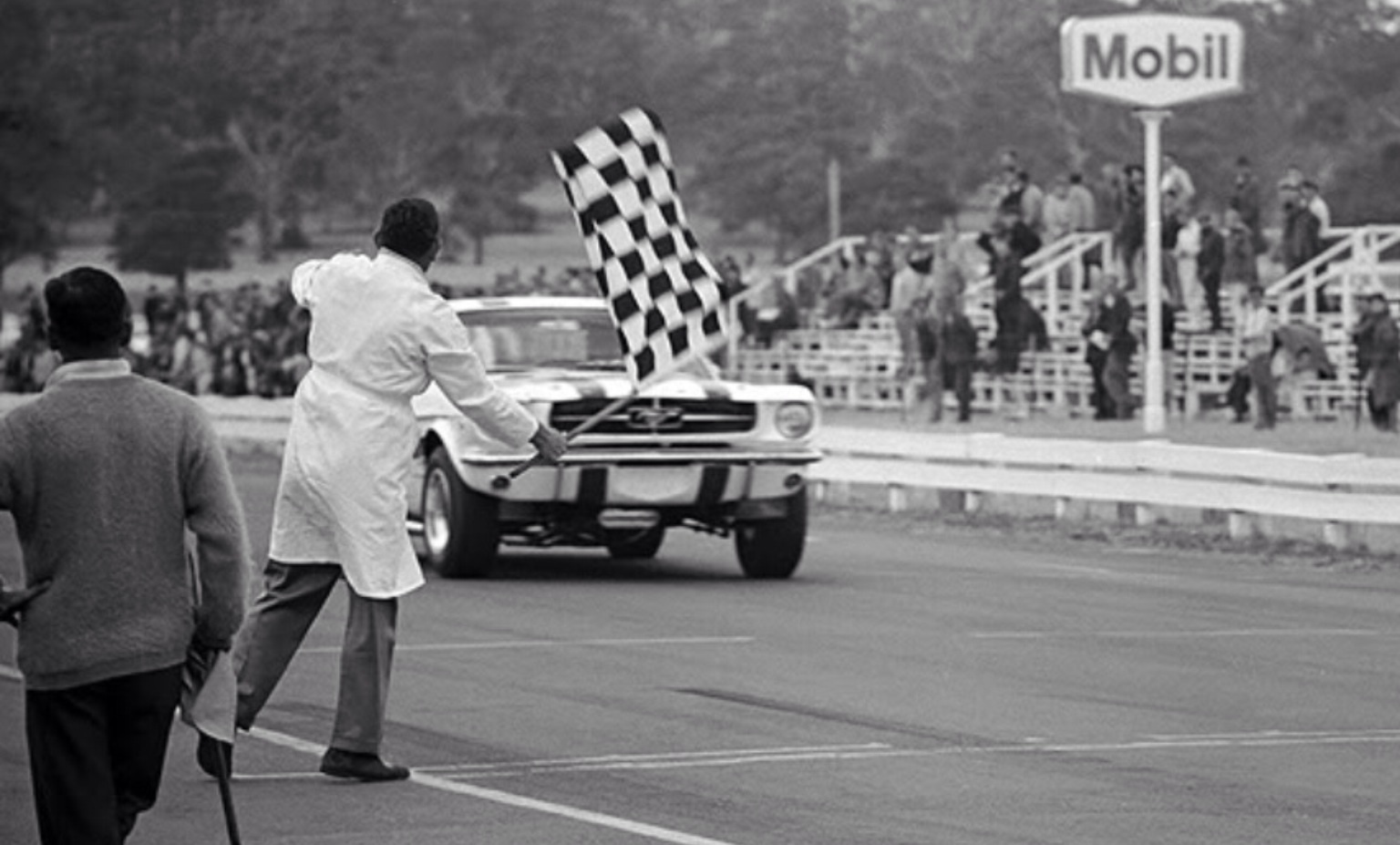
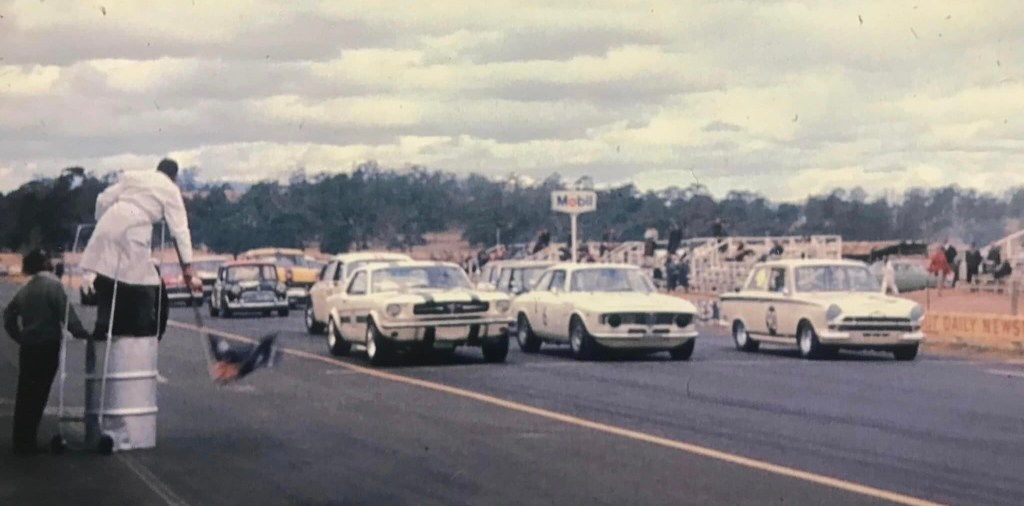
Robin Pare, Pete Geoghegan in Ford Mustangs, Bruno Carosi Jag Mk2, Frank Gardner Alfa GTA and Robin Bessant Lotus Cortina on the downhill plunge towards The Viaduct, Longford Improved Production Touring Car race 1967 (oldracephotos.com)
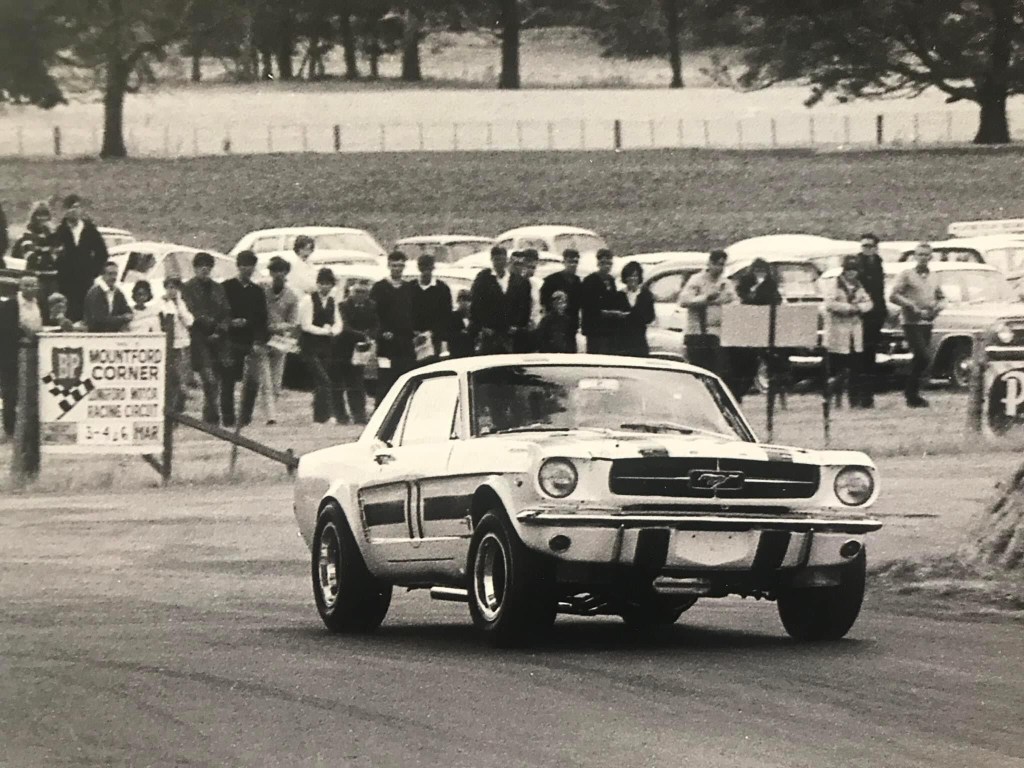
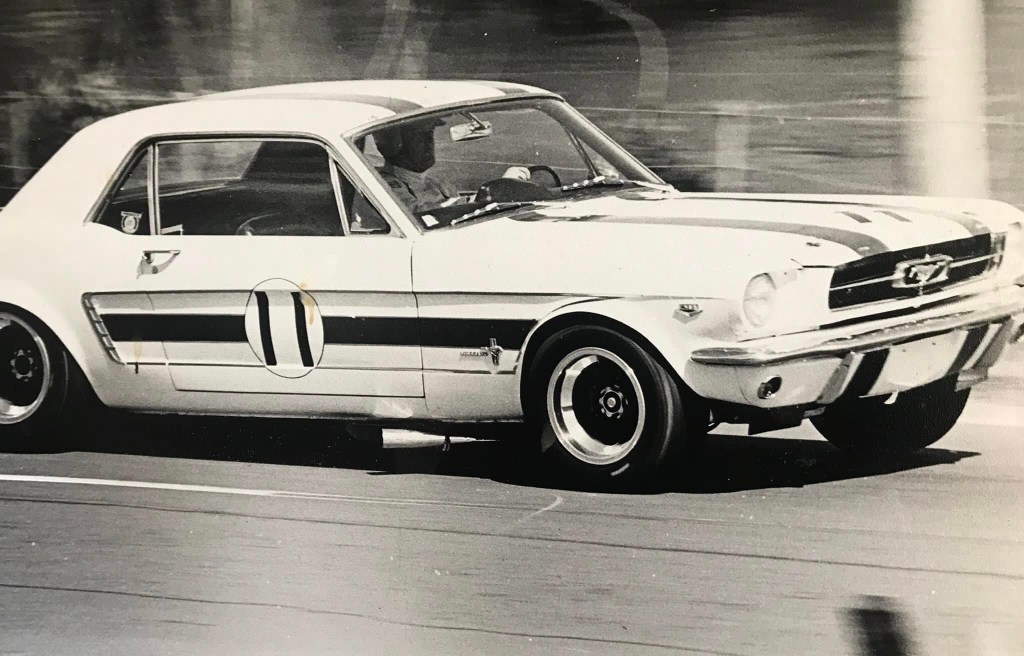
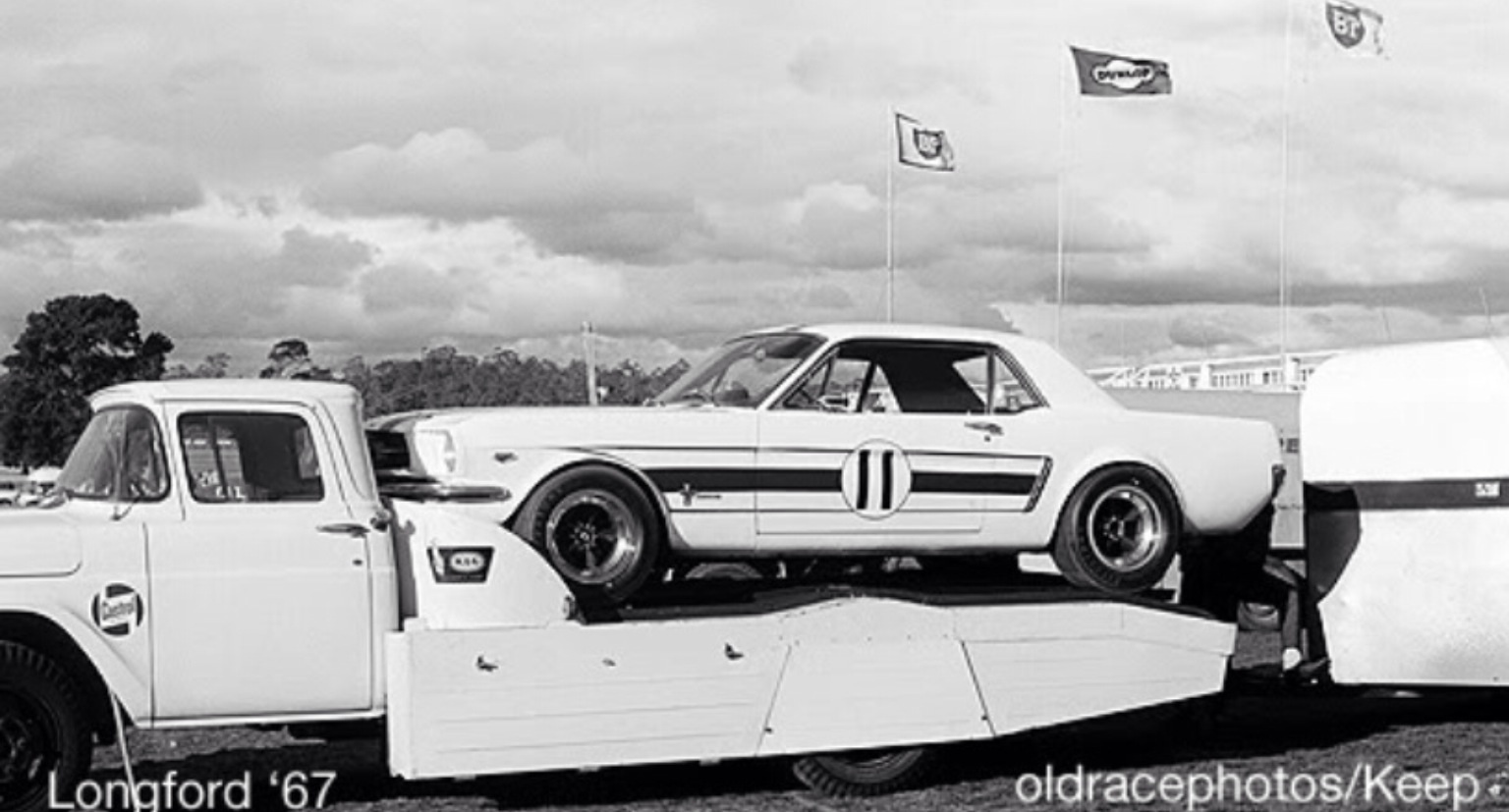
Pete Geoghegan did so many times too! The Sydneysider is here doing his stuff aboard the first of his two Ford Mustangs at Longford during the Tasman round in February 1967…
The Brothers Geoghegan, Leo and Ian or ‘Pete’ were stars of Australian Motor Racing from the late-fifties into the mid-seventies, Leo in single-seaters and Pete in ‘taxis’, touring cars of all pursuations. When he was a youth Pete was quick in a brief career in single seaters and a Lotus 23 Ford but he became a ‘big unit’ so his girth meant he was best suited to cars with a roof.
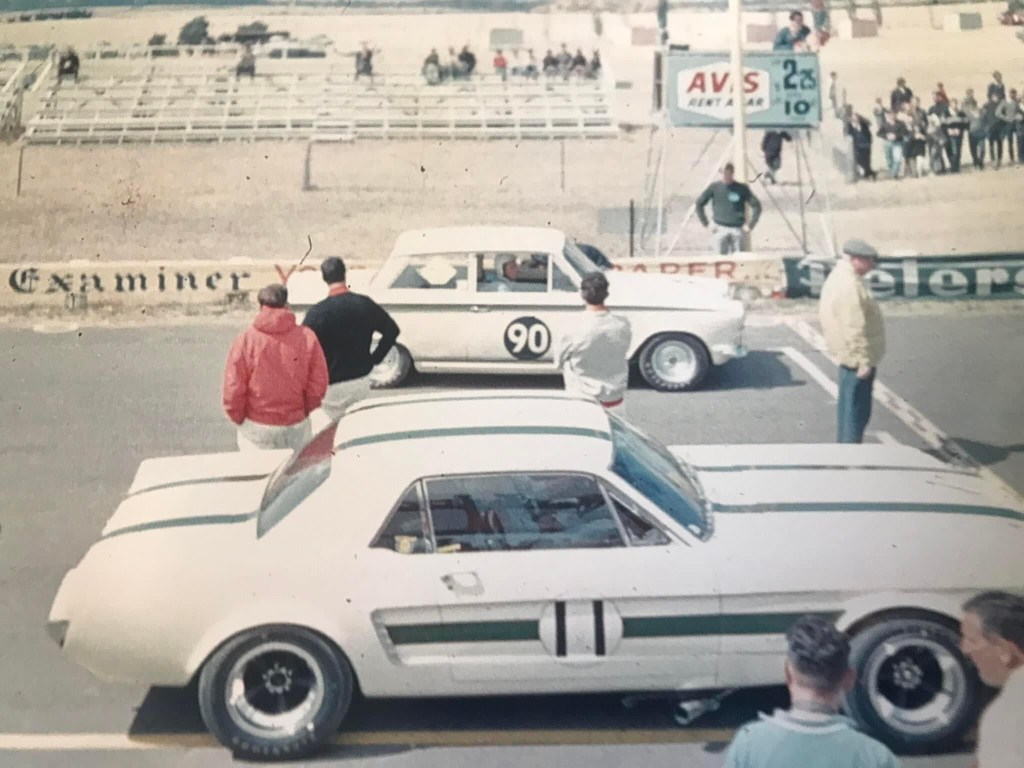
Geoghegan , Gardner and Carosi off the front row, no sign of Pare – perhaps not the same race grid as above (oldracephotos.com)
A supreme natural, Geoghegan made a car sing with flair and feel blessed to some from above. Every car he drove. His band-width extended from GT’s to Sports Cars, Production Tourers and very highly modified Sports Sedans- sedans of considerable power and performance.
His CV included some of the most iconic cars raced in Australia over the decades above including a Lotus 7 , 22, 23, the Scuderia Veloce Ferrari 250LM, Holden ‘Humpy’, Jaguar 3.4, Morris 850, the two Mustangs, Cortinas- both GT and Lotus variants, Falcon GT’s, Falcon GTHO’s, Valiant Charger E49, highly modified Porsche 911’s, his iconic, Ford factory built and later Bowin Cars modified Ford Falcon GTHO ‘Super Falcon’ and the superb John Sheppard built Holden Monaro GTS350 Sports Sedan.
That car was as conceptually clever, beautifully built and presented sedan racer as any ever constructed in Oz. Lets not forget his late career drives in Laurie O’Neill’s Porsche 935, a notoriously tricky device to master. Much earlier on he drove O’Neills Aston Martin DB4GT Zagato, every bit as exotic as the 935.
(T Watts)Big Pete finesses the Mustang into The Viaduct (oldracephotos.com)
Geoghegan, five times Australian Touring Car Champion 1965-69 was an immensely popular racer with the fans, his bulk, manner and ‘stutter’ part of his appeal. He was not without his issues mind you. Touring Car racing is a religion in Australia, our sedan racing has been the equal of the best in the world for decades and arguably for the last 20 years our V8 Supercar category has been consistently one of the Top 5 sedan racing contests on the planet.
A touch of the opposites on the exit to Newry (oldracephotos.com)
So, the pantheon of talented touring car aces is large, and membership of the Top 10 a subject of much informed pub chatter, tough. Most knowledgeable touring car observers would have Geoghegan in their Top 10, if not Top 5, along with the likes of Norm Beechey, Peter Brock, Allan Moffat, Dick Johnson, Jim Richards (a Kiwi but we take him as our own) Mark Skaife, Glenn Seton, Craig Lowndes, Garth Tander, Jamie Whincup and others.
(oldracephotos.com)
Etcetera…
(unattributed)
Geoghegan, Gardner and Robin Pare.
(unattributed)
Pete booting the ‘Stang out of Mountford in typical style.
(unattributed)
Geoghegan and Pare.
(unattributed)
Photo Credits…
Oldracephotos.com- Harrison and David Keep, Tim Watts
Tailpiece: Came, Saw, Conquered and then returned to Sydney…
I was too young for the Lotus Cortina but drooled over its cousin, the Escort Twin Cam from the time they were released in Australia as a youngster…
‘Going Ford Is The Going Thing’ was the tagline of the day. And it was too. At the dawn of the 1970’s their product lineup was irresistible as a kid; Escort Twin Cam, Cortina GT, Capri 1600 GT and 3000 GT V6 and then came the range topping big muvvas, the Falcon GT and GTHO. Both packed the famed 351CID V8, the ‘HO’ the Bathurst homologation special was truly outrageous. All had ‘Super Roo’ decals on the front valances making the striped, candy-red devices lustworthy in a pubescent kinda way. Always a realist, I thought the Twin-Cam the pick of the litter given its cost/size/performance equation, not to mention its looks.
Local, Melbourne, Kew driver Michael Stillwell was racing a BDA powered Escort in Australian Touring Car Championship races at the time, giant killing too, I still think its one of the sexiest touring cars of all time. Others were raced by Allan Moffat, John Bassett, Bob Holden and Garry Rodgers, with plenty of tyre under extensively flared guards they really did, do, look the goods.
Mike Stillwell giving Don Holland’s Holden Torana GTR XU1 a love tap in the entry to Hell Corner, Bathurst during the 1972 Australian Touring Car Championship round (oldracephotos.com)
Eventually, post university, I was in the market to buy and drove a Twin Cam an old codger (about my age now) in Glen Iris had for sale. But i had been spoiled by a mates Alfa Romeo Giulia Sprint GT I had driven a lot by then. The older Alfa ‘105 Coupe’ made the little Ford seem crude by comparison. Don’t get me wrong, it was quick, but the front suspension was doing one thing, the back another, you didn’t sit nice and low like in the Alfa. The rack had that sort of ‘rattle, chatter, shimmy thing’ no amount of wheel alignments or balance weights fixed on both my Mk2 Cortina GT and Capri 1600 GT. That always gave me the shits with those cars!
The engine was great, I still love Harry Mundy’s work and drive them reasonably regularly, usually mounted in Elans. Imagine motor racing without the Ford Lotus Twin-Cam engine from mild to Hart 416B wild specification!? The gearbox was great too, Fords single-rail box is one of the production ‘trannys of the era, knife thru butter with synchro’s which, when in good nick, could not be beaten.
My heart was with the ‘Twinc but the Alfa was so much more of an integrated, cohesive package with similar performance and matching looks so that’s the way I went. But I still love Cortina’s and Escort’s, mass market for sure but Ford got the styling of the things just right as their sales volumes proved…
Etcetera: Australia’s race twin-cams…
Dick Simpson captured the best of Australia’s Escorts ‘in the day’, some of them are shown below starting with Bob Holden’s car at Warwick Farm circa 1970.
(D Simpson)
(D Simpson)
The shots below are of Bib Stillwell’s car, initially driven by Graham ‘Tubby’ Ritter and later driven with much success by Michael Stillwell after his ‘graduation’ from the teams Elfin 600 Formula Ford.
(D Simpson)
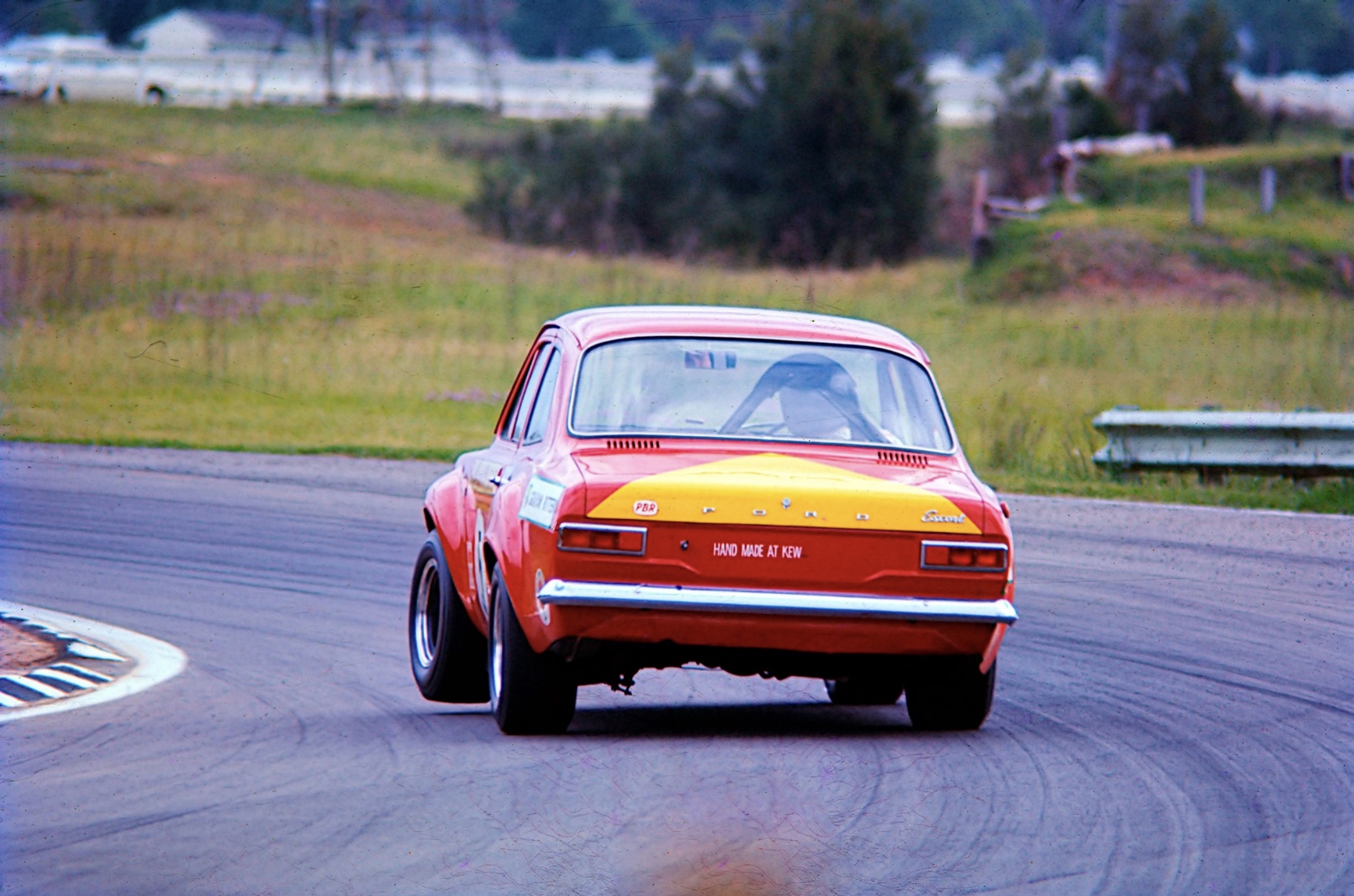
Ritter at Calder in 1970 above and below at Warwick Farm. The ‘hand made at Kew’ note on the cars boot lid refers to the location of Bib’s Ford Dealership’s location in Cotham Road Kew, Melbourne, Tubby built the car right there!
(D Simpson)
By 1972 the car was fitted with a 2 litre Ford BDG engine, in that form it was a formidable weapon indeed, Mike Stilwell easily the quickest of the 2 litre cars- here at Adelaide International Raceway.
(D Simpson)
Photo Credits…
Dick Simpson
Tailpiece…
(D Simpson)
Allan Moffat slices his Ford Australia, Alan Mann built, Ford Escort FVA into Warwick Farm’s Esses, bang on line in 1971. And exiting Creek Corner below.
Glemser/Fitzpatrick Ford Capri RS2600 ahead of a Ferrari 312PB and a Porsche 911RSR, Le Mans 1973 (Schlegelmilch)
Ford’s battles with BMW in 1970’s touring car racing are legendary as both manufacturers battled for supremacy.The adage ‘Win on Sunday, Sell on Monday’ was reflected in big marketing spends in the European Touring Car Championship at the time…
Chris Amon in the CSL he shared with Hans Stuck, Le Mans ’73 DNF lap 162 with accident damage (Schlegelmilch)
In 1973 the protagonists in the big car class were the RS2600 Capri and 3.0CSL, the title that year won by Toine Hezeman’s BMW with wins at the Spa, Zandvoort and Paul Ricard rounds.
Toine Hezemans/Dieter Quester CSL winning the class at LeMans in 1973 (unattributed)
Jackie Stewart and Jochen Mass, Monza ETCC round 25 March 1973 (Schlegelmilch)
Such were the number of GeePee drivers involved one could have mistaken the paddocks for F1 events rather than touring cars; Stewart, Amon, Stuck, Hunt, Lauda, Ickx, Pescarolo and Emerson Fittipaldi all had a steer during the ETCC that year.
Jean Claude Andruet/Richard Bond Ferrari 365 GTB/4 Daytona 20th, Dieter Glemser/John Fitzpatrick Capri, out in the 20th hour with a broken rod (Schlegelmilch)
Whilst Le Mans was not part of the ETCC, Ford and BMW slugged it out in the 24 Hour Classicalthough only one of the factory cars went the distance; the Dieter Quester/Toine Hezemans BMW was 11th overall with 307 laps.
The race was won by the superb 3 litre V12 Matra MS670B piloted by Henri Pescarolo/Gerard Larrousse, the rapid sports-prototype covering 355 laps. The best placed Ferrari 312PB was 6 laps adrift of the Matra, Art Merzario and Carlos Pace were second with another Matra 670B driven by the two Jean-Pierre’s, Jabouille and Jaussaud in third place.
#53 Koinigg/Vinatier/Birrell and #55 Glemser/Fitzpatrick (Schlegelmilch)
As to the rest of the factory touring car entries; the Dieter Glemser/John Fitzpatrick RS2600 schnapped a conrod on lap 239, the Chris Amon/Hans Stuck BMW had an accident on lap 162.
The woe continued with the Helmut Koinigg/Jean Vinatier/Gerry Birrell Ford having valve gear trouble on lap 152, Gerry Birrell swapped into this car after his own Capri had ignition problems. Hans Heyer co-drove that entry.
Mike Kranefuss, keeps an eye on proceedings, ‘the boss’ as the cap suggests (Schlegelmilch)
Glemser/Fitzpatrick RS2600 at Le Mans, DNF with a broken rod (unattributed)
I guess the cars weren’t stressed for 24 hours so perhaps the results are not too surprising, I posted an article about the fabulous Cologne Capri’s which may be of interest to those who have not read it; https://primotipo.com/2015/04/09/australias-cologne-capris/
Colin Bond finessing the Holden Dealer Teams Holden Torana GTR XU-1 Repco thru Murrays Corner, Bathurst, Easter 1973…
In fact ‘twas as much Brocky’s as Bondy’s as they tended to drive this Repco Holden F5000 V8 engined ‘Sports Sedan’ (Oz anything goes taxi category) in their home states. Peter Brock in Victoria and Bond in NSW, I suppose Holden Dealer Team chief Harry Firth worked out who drove the thing elsewhere.
By that stage Sports Sedans were starting to get a bit more scientific, check out my article on John McCormack’s Chrysler Valiant Charger Repco F5000 which provides both era context and some car specifics;
This press shot a couple of days before the cars Sandown race debut in April 1973 shows the mid-mounted location of the cast iron Repco Holden F5000 V8, and change for the 4 speed Borg Warner ‘box, the engine cover provided some heat absorption, but not much! (M Bisset Collection/Melbourne Herald)
Harry decided to chase the ‘Toby Lee Sports Sedan Series’ $ at Oran Park and cobbled together this car which was the marriage of an LJ Torana chassis with a Repco Holden 500BHP injected F5000 V8 which was mounted right next to the driver to keep him warm.
Other specifications included a Borg Warner T10 four-speed tranny, Rose jointed, solidly mounted, coil-sprung Watts linkage rear end and wishbone and coil spring front end were the suspension modes. Brakes were F5000 issue calipers clamping HQ Holden rotors front and rear.
The car began life in ’71 as an HDT Bathurst 500 Series Production car and in ’72 was Frank Kilfoyle’s rally car before being gutted for its new role, Chris De Fraga reported in ‘The Age’ before the cars debut as a Sports Sedan at Sandown on 13-15 April 1973. It didn’t win too much in the way of major events but was a massive crowd pleaser and fast with two of the countries best steerers twiddling its MoMo.
Back to Bathurst Easter in 1973. Col Bond won all three of his races over the weekend in ‘The Beast’ with Peter Brock, in a good meeting for the Holden Dealer Team, sharing the Production Touring Car wins in an XU1 with John Goss’ Ford Falcon GT Coupe.
We have ignition problems on this weekend, the distributor cap and plug leads are missing. Shot shows just how far back in the chassis the engine sits (Chevron)
Credit…
Nigel Tait Collection/ Repco Ltd, Jeff Nield, Chevron Publishing
Tailpiece…
Brock at Calder, LC/LJ Toranas’ such a great looking car, the bellow of this injected V8 one not to be missed. Wheels are by Mawer Engineering in Sydney, very popular on Touring Cars and Clubmans of the day.
(Auto Action)
Checkout Brock’s impressions of The Beast after first driving it, published in the April 27, 1973 issue of Auto Action.
Blondie surrounded by World Champs; Messrs Hulme, Hill and Clark, Melbourne, 1968…
Ford Australia’s 1967 ‘XR’ Falcon was a big step forward in its market competition with General Motors ‘Holden’ who had a dominant position. The XR GT packed a 289cid V8 and started the trend of local pony cars which provided wonderful road cars and iconic Bathurst racers for years.
Barry Cassidy, Ford Falcon ‘XR’ GT, Newry Corner, Longford March 1968 (oldracephotos.com)
This photo is no doubt part of Ford’s ongoing repositioning of their product, ‘Going Ford is the Going Thing’ was FoMoCo’s ‘tag line’ of the day.
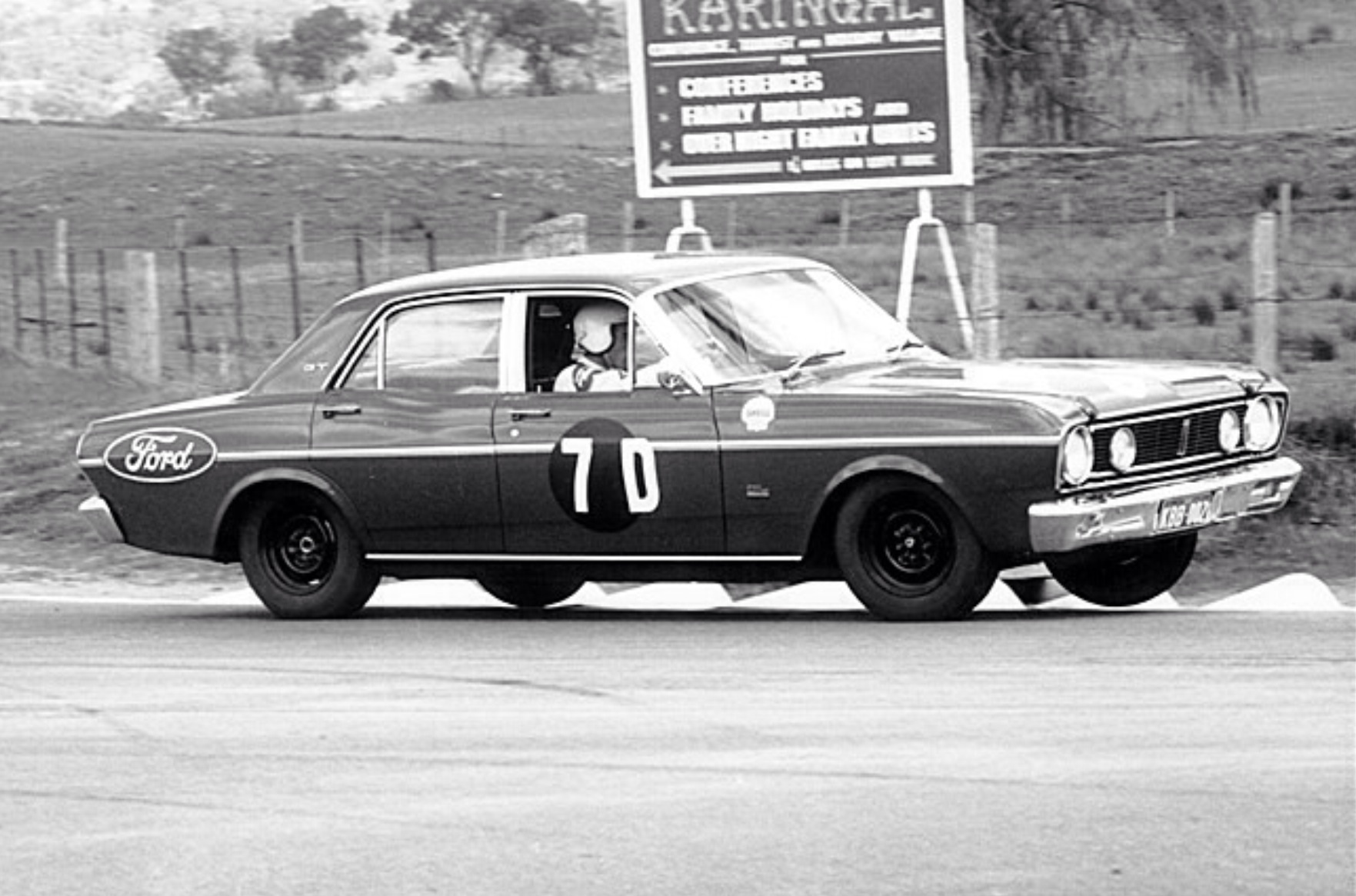
‘Blondies’ car is the 1968 ‘XT’ Falcon 500 ‘poverty pack’. A 302cid V8 was cranked under the bonnet to create the GT, a 4 speed box, slippery diff and front disc brakes with firmer springs and shocks completed the performance makeover. This was the only one of the ‘Big Henrys’ which didn’t win the Bathurst enduro classic. An ‘HK’ Holden Monaro 327 coupe driven by Bruce McPhee took the ’68 win.
‘Win on Sunday, Sell on Monday’ is the adage…
The Spencer Martin/Jim McKeown XT Ford Falcon GT auto!,Bathurst 500 1968. The pair were 42nd, the highest placed Ford was the XR GT driven by McIntyre/Stacey which was 7th (unattributed)
The local ranges of Ford and Holden were full of mundane stodge in 1966, perhaps the Cortina GT the ‘highlight’. Times ‘were a changin tho’, by 1970; Ford offered the Falcon 351V8 GT/GTHO, Lotus engined Escort Twin-cam, Capri GT V6 and 1600GT and Holden the Monaro HG 350V8 and Torana XU1 which sported a 186cid ohv triple-carbed straight six, all wonderful cars for 13 year olds to dream about…
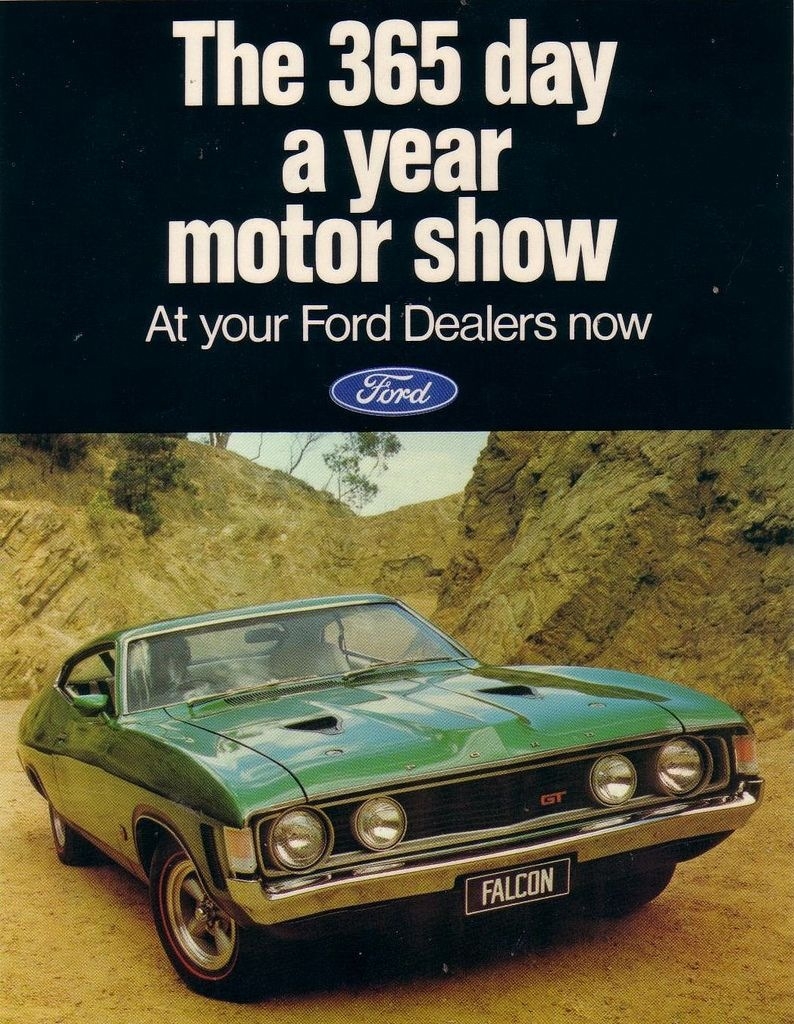
Ford Oz ad for the 1972/3 ‘XA’ Coupe GT; 351cid 300bhp V8, 4 speed ‘top loader’ box, slippery diff, disc/drum brakes, great cars!
Ford provided some support to Team Lotus who campaigned Lotus 49 DFW’s for both Jim Clark and Graham Hill during the ’68 Tasman Series which Clark won.
The Falcon shot at the articles start has Victorian plates so the shot was probably taken in the week of 25 February to 4 March 1968. Clark took the Sandown, Victorian round. The world champs were then in Melbourne for a few days before heading to Longford, Tasmania for the series ending race won by Piers Courage’ McLaren M4A FVA F2 car in a stunning wet weather drive.
Clark ahead of Graham Hill, slices into The Esses during the ‘Warwick Farm 100’, another win for the Scot’s Lotus 49, he took the ’68 Tasman (oldracephotos.com)
Jim had a great weekend, he knocked off the V8’s and won the ‘AJC Trophy’ round 5 of the 1970 Australian Touring Car Championship on 12 July…
Allan Moffat’s Trans-Am Mustang was on pole but he spun on the first corner taking out Pete Geoghegan’s Mustang and Brian Foley’s 911S, McKeown took the win. Outright contender, Norm Beechey’s Holden Monaro lost a rear wheel, Bob Jane’s Mustang was second and Bill Brown, 911S finished third-fast, robust, reliable beasts 911’s…
Foley in the WF paddock, ATCC round 1970 (Rolling Road)
The ex-factory specification of these cars is infinitely variable to special order and in summary comprises…
Engine; six cylinder, horizontally opposed ‘boxer’, SOHC two valve, 2247cc. Compression ratio 10.3:1, three 46IDA Weber carbs, Marelli distributor, bigger valves and polished inlet and exhaust ports giving circa 240bhp @ 8000rpm.
Five speed gearbox with ‘slippery’ diff, external oil pump, cooler and vast array of ratio choices The body was lightened by deletion of bumper over-riders, rubber locks, simplified interior, wings widened and the front bumpers were made of fibreglass.
Wheels; 7 and 9 inches front and rear in width, 15 inches diameter.
For those with an interest in these cars attached is a link which shows you the factory options for both the 1970 911 and 914-6 and later 3 litre Carreras, wallet size the only limiting factor;
Brian Foley on the way to third place during the 26 July 1970 Lakeside Australian Touring Car Championship round- Norn Beehey won in his Holden Monaro GTS350 and Bob Jane was send in his Shelby built Ford Mustang. Hasn’t Dick Simpson caught the car superbly, Foley dancing the car right on its toes.
At the opening championship round at Calder (below) in March Foley and McKeown had a fantastic tussle for second place which was resolved in Brian’s favour- up front Allan Moffat’s not quite twelve months old KarKraft/Bud Moore Ford Mustang Trans-Am took the win. Bob Jane was fourth, then Bill Brown’s 911S fifth and Bill Fanning’s Lotus Cortina Mk1 sixth.
Brian Foley in the right-left wiggle off Calder’s back straight (J Lemm)
Foley from McKeown in the battle for second place- onto the back straight (R Davies)
Foley, McKeown Calder dice from the rear heading into front straight (R Davies)
Lynton Hemer (below) catching Foley on the hop and committed coming down The Dipper at Mount Panorama, Bathurst, Easter 1970- ATCC round.
Beechey won this encounter from the Pete Geoghegan and Bob Jane Mustangs.
(L Hemer)
This is a beauty, its twelve months hence- the June 1971 ATCC round at Mallala- the South Australian Touring Car Championship race which was won by Bob Jane’s big, booming seven litre Chev Camaro ZL1 from Pete Geoghegan’s and Allan Moffat’s Mustangs.
Foley and McKeown were still at it but by this stage Brian was racing an ex-works 2 litre Alfa Romeo GTAm whilst McKeown was still running his 911S. Foley made the change to the Italian coupe as he had opened an Alfa Romeo Dealership in Sydney- KcKeown was fourth and Foley fifth.
(J Lemm)
Recently the ex-Foley 911S/T, both the Foley and McKeown cars were fitted with factory S/T kit of goodies has been restored by Melbourne’s Ian Henderson.
These shots are of the cars appearance at Phillip Island in March 2016. Use of the period Chesterfield Racing transporter is a nice touch!
(Bisset)
(Bisset)
(Bisset)
(Bisset)
(Bisset)
Credit…
The Rolling Road, Dick Simpson, Nigel Watts, Mike Jacobson of Spyder Automobiles for the information on ex-factory parts, John Lemm, Robert Davies
Tailpieces: McKeown and Brian Foley in 911S’ doing the wheel lifting 911 thing, Energol Corner, Oran Park 1970…
(Nigel Watts)
McKeown at the 1970 Bathurst ATCC round, fourth in the race won by Beechey’s Holden HT Monaro GTS350.
(Dick Simpson)
McKeown and Brian Foley in 911S’ doing the wheel lifting 911 thing, Energol Corner, Oran Park 1970.
This view in race direction looking down the main straight and into the daunting ‘Doohan’ Turn 1 ‘Southern Loop’ section of the track (Kevin Drage)
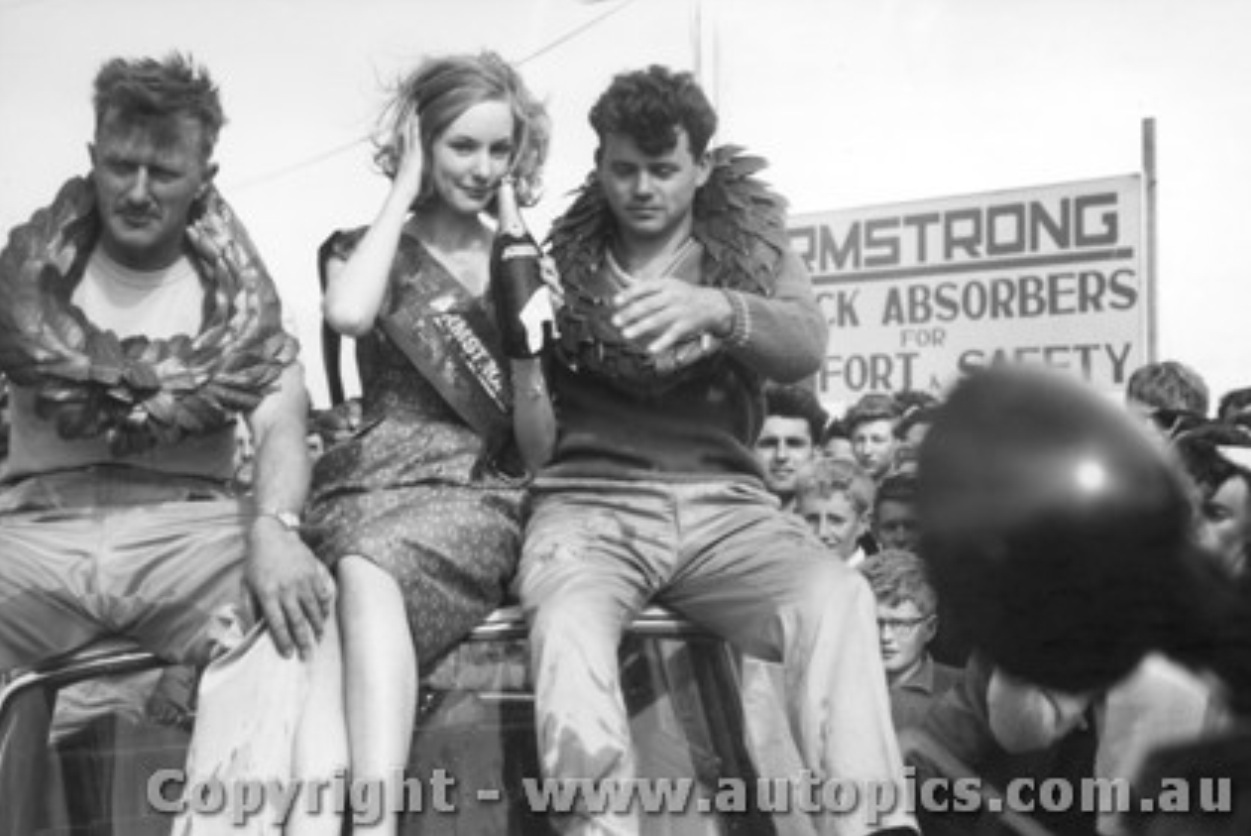
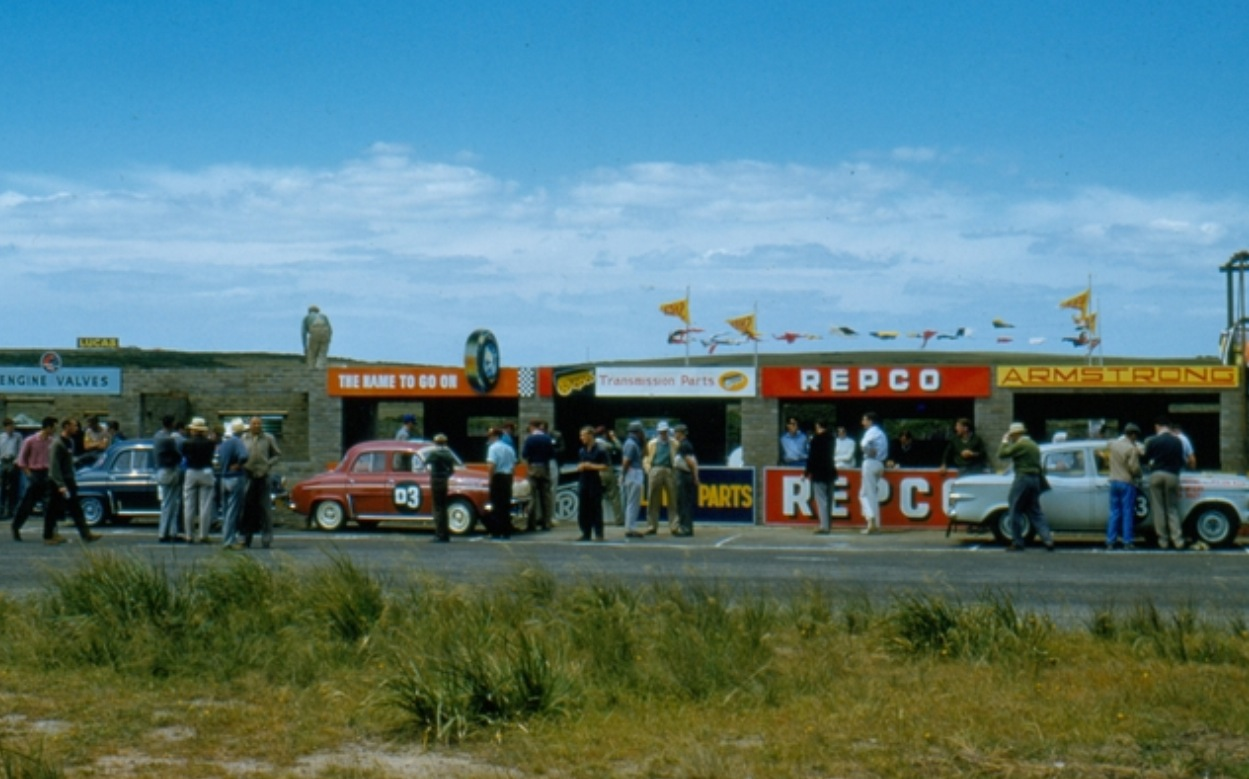
Kevin Drage’s wonderful aircraft shot shows packed Phillip Island during the 1961 Armstrong 500, Australia’s growing obsession with Touring Cars underway…
The race was held at the Phillip Island on 19 November 1961 over 167 laps of the 3.0 mile circuit, a total of 501 miles (807 km).
It was the second event held in the combined history of the Armstong 500/Bathurst 500/Bathurst 1000 which began in 1960 with the first Armstrong 500.
Jane/Firth take the chequered flag. Jaguar dominated the local prestige market in Oz then…but not for too much longer, the German onslaught began about here!? (autopics)
Bob Jane and Harry Firth were the only combination to complete the full race distance, earning the pair the first of their four outright race wins in Jane’s ‘Autoland’ Mercedes Benz 220SE. Mind you, the concept of an outright race win was not be officially recognised until 1965- Mercedes, Studebaker and Renault each took class wins.
(Kevin Drage)
Fabulous Phillip Island day! Len Lukey’s airstrip in the foreground, this shot is of the cars coming out of Siberia- top shot towards Bass Straight through the flat out right handed towards ‘Lukey Heights’. And below Ms Phillip Island coping very well with the Bass Straight ‘breeze’ whilst touring car aces Harry Firth and Bob Jane look suitable pleased with their days work. Their are plenty of race wins and championships to come for these two fellows.
(Kevin Drage)
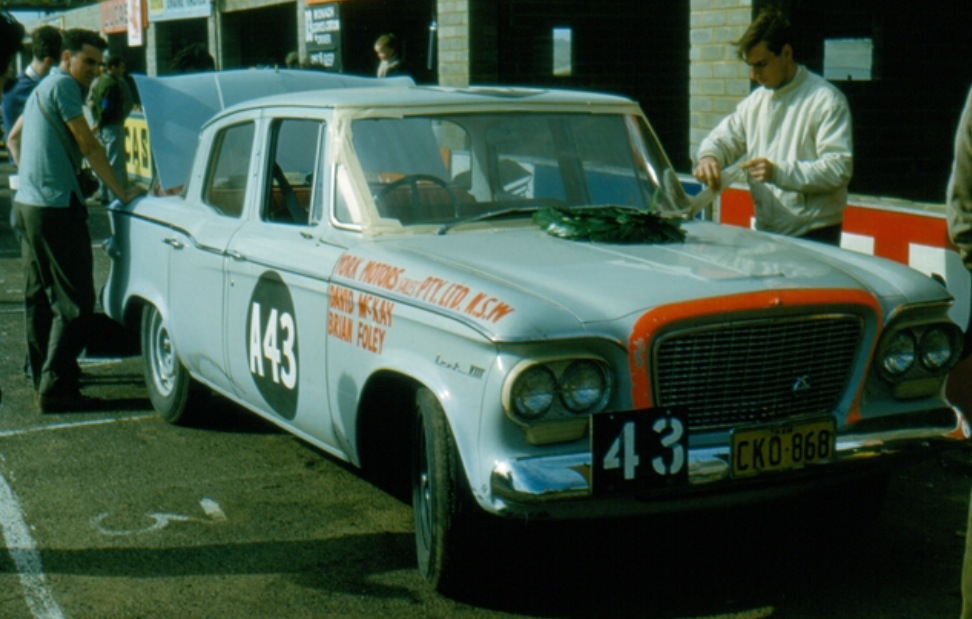
The pitlane shot shows the Class D winning Renault Gordini of Jim Gullan, Brian Sampson and John Connelly, whilst the grey car is the Class A winning Studebaker Lark of David McKay and Brian Foley.
(autopics.com.au)
Harry Firth, by the look of that crouch behind the wheel of the winning Mercedes- he is just entering the left hand rise ‘Lukey Heights’ before the drop into ‘MG’, Mercedes 220SE.
(Kevin Drage)
David McKay and Brian Foley- champions both and below the Studebaker Lark entered by York Motors they raced to second place.
Alan Moffat finesses his big, powerful ‘works’ HO Falcon around the tight, technically demanding confines of Sydney’s Warwick Farm February 15 1970…
This will be a support race for the ‘Warwick Farm 100’ F5000 Tasman series round, am intrigued to know who won this ‘Series Production’ encounter. Perhaps a Holden Torana GTR-XU1, WF more suited to the nimble but powerful 3 litre/186cid Holden 6 than the 5.7 litre/351 cid V8 ‘Big Henry’?
Moffat won the ‘South Pacific Touring Car Championship’ series conducted over the four Australian Tasman events but i wonder if he won this round?
The first BMW Art Car was proposed by the French racer/auctioneer Herve Poulain who wanted to invite an artist to create a canvas on a car…
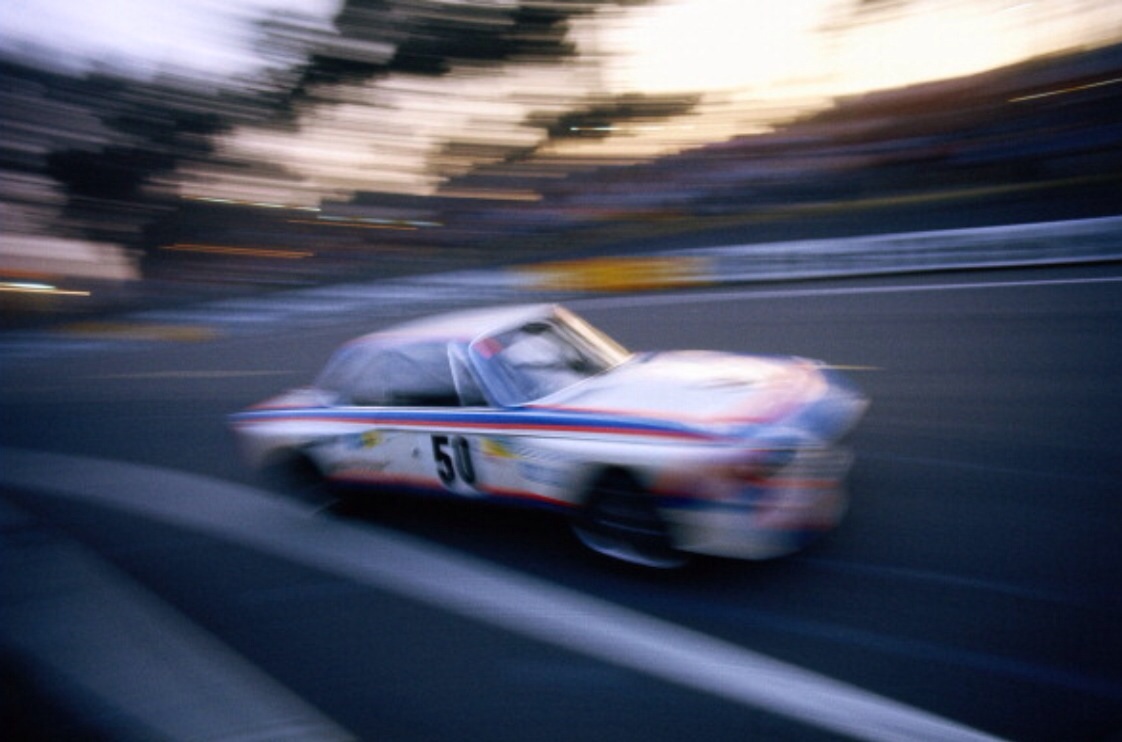
In 1975, Poulain commissioned his American artist friend Alexander Calder to paint a BMW 3.0 CSL which Poulain raced partnered by pro’s Sam Posey and Jean Guichet in the 1975 Le Mans classic.
The car ran in the ‘Touring’ class, failing to finish with a CV joint failure on lap 73.
‘Art Car’ BMW 3.0CSL, Le Mans 1975 (unattributed)
BMW won the class, a little 2002Ti completed 252 laps, Derek Bell and Jacky Ickx won the race in a Gulf GR8 Ford DFL, the first Le Mans win for Bell and for the long distance variant of the great Ford Cosworth DFV V8.
Derek Bell in the victorious Gulf GR8 Ford DFL he shared with Ickx. Behind is the 2nd placed Ligier JS2 Ford DFL of Lafosse/Chasseuil (unattributed)
Since Calder’s work many other renowned artists have created BMW Art Cars including David Hockney, Andy Warhol and Roy Lichtenstein. 17 Art Cars based on both racing and production vehicles have been created.
The most recent car is Jeff Coon’s 2010 model M3 GT2. The 4 litre V8 engined car competed in the 2010 Le Mans 24 Hours driven by Andy Priaulx/Dirk Muller/Dirk Werner but did not finish.
BMW’s Thomas Girst says the purpose of the project has changed over time: ‘In the beginning the cars were raced. There wasn’t much public relations around them…Since then some of the Art Cars have been used in advertisements to show that BMW is a player in the arts…Part of what we are doing now is raising awareness of alternative and renewable energy sources’.
Pete Geoghegan blasts his Ford ‘Super Falcon’ GTHO across the top of Mount Panorama with the millimetre precision and finesse for which he was famous, harnessing all 600 plus horses of his demanding 351cid steed on this oh-so-demanding and unforgiving of road circuits…
The 1972 Australian Touring Car Championship was one of the greatest contests ever, the Bathurst round one of the best races in a series full of close events in its 60 year history.
The late, respected motoring journalist Mike Kable wrote ‘The third round at Bathurst’s Mount Panorama on Easter Monday won by five times former champion Ian Geoghegan by six tenths of a second from Allan Moffat was the finest touring car race I have seen in 25 years of watching Australian motor racing which started as a small boy when I lived just a few more paddocks away from the famous old mountain circuit’.
‘It was an absolute spellbinder, the sort of race you dream about with Geoghegan in his Falcon and Moffat in his Mustang fighting a slipstreaming and braking duel right around the spectacular track and tearing side by side down the 1 1/2 mile long Conrod Straight at more than 160mph and becoming airborne over the humps’.
The race ended in controversy as Pete’s Super Falcon was losing oil from its catch-tank, Moffat copping so much Castrol on his windscreen he dropped back for a bit to try and clear it with his wipers. Towards the end of the race he undid his shoulder harness to see out the drivers window, during all this he took seven seconds from from Geoghegan’s previous record set in his evergreen Mustang.
Moffat protested, after 90 minutes of deliberation the steward determined that the results stood on the basis that it could not be confirmed that the oil spill cost Moffat the race. Further, Moffat’s speed late in the race didn’t tend to support the Canadians argument!
In fact Moffat lost the championship after intense competition and biffo at a number of meetings resulted in Bob Jane, his Melbourne arch rival, protesting being shoved aside by Moffat during the Warwick Farm round of the championship.
Sadly, the protest was heard on the virtual eve of the title decider at Oran Park, Moffat’s exclusion from the results at Warwick Farm gave the series win to Jane, the plucky, tough entrepreneur took the title again in the Chev Camaro in which he won in 1971. The car was powered by a cast iron 350cid engine in ’72 rather than the ZL-1 427cid Can-Am aluminium block Chev used in 1971.
Bob Janes Chev Camaro ZL-1, 350cid cast iron powered in 1972, thru Hell Corner during the ATCC race, Easter 1972. BJ Racing’s cars always superbly prepared and presented (D Simpson)
What made the late 1960s-1970s ATCCs magic and still spoken about in reverential terms by those who were there were cars such as Jane’s…
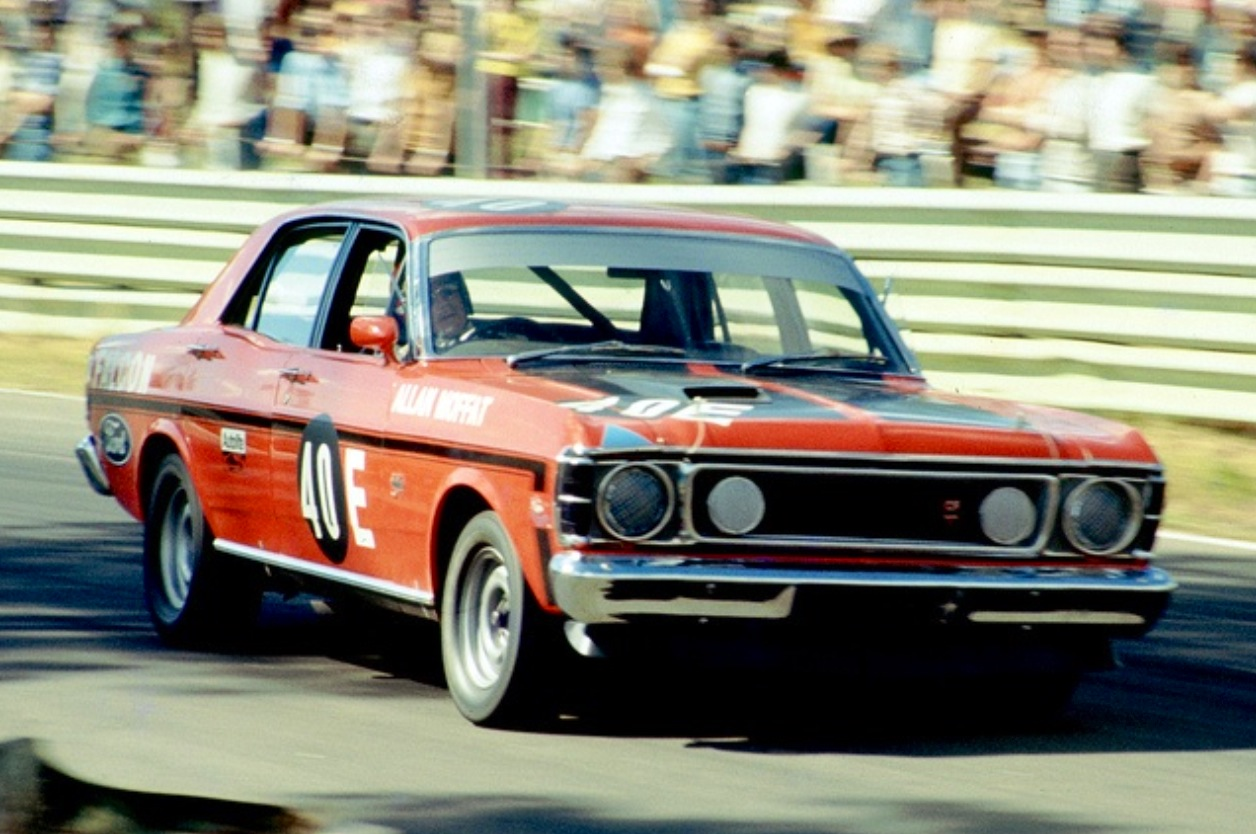
Moffat’s Mustang was a factory Trans-Am racer, he first ran it in 1969, despite many race wins, he never took the ATCC. He achieved that for the first time in a Ford Falcon GTHO Phase 3 Group C car when the regs changed from 1973. In Mike Kable’s view at the time ‘There’s not much doubt about who is Australia’s finest all round tin-top driver. If he proved it once he proved it a dozen times in both his venerable Trans-Am Mustang and works Phase 3 Falcon GTHO’.
In 1972 Moffat tried both the 351cid V8 (at Calder he raced it and at Surfers used it in qualifying) and Boss 302 engines but the Cleveland 351 engine was never reliable and much heavier than the ‘small-block’ Boss which buggered the cars balance. It was with the 302 fitted that he gave Geoghegan so much curry at Bathurst, Pete’s factory built Super Falcon, Moffat was built one as well of course in 1970, 351 equipped and seldom reliable.
Norm Beechey was back for one final crack at the championship in the gorgeous Holden Monaro HG 350 V8 in which he won in 1970 and had been continually developed by Norm and Claude Morton in their Brunswick, Melbourne base.
Norm Beechey, two wheels off the deck, Murrays Corner, Bathurst 1970. He won the title, and the Bathurst round that year in this fabulous, injected 350 Chev V8 engined Holden (unattributed)Malcolm Ramsay’s Holden Kingswood Repco V8, 1972, not sure which paddock this is. 1971/3 HQ Holden Kingswood a great contemporary bit of sedan styling, i saw this car at its race debut at the ’72 Sandown Tasman meeting. Look, sound and speed impressive! (Perry Drury/The Roaring Season)
Later Birrana co-proprietor and single seater driver Malcolm Ramsay ran an HQ Holden Kingswood powered by a Repco Holden F5000 engine, the big orange, ROH ‘Dragmag’ wheeled thing looked and sounded sensational.
The ‘Kingsy bristled with the clever engineering ideas of Ramsay and Tony Alcock, the Birrana designer: fabricated front wishbone suspension, carefully evolved rear suspension with better location of the standard live axle/coil spring setup, removable front guards to ease access to the injected Repco lump and much more. It deserved another season of development but unlike many of the cars pictured in this article which became Sports Sedans after the Australian Touring Car Championship rules changed from 1973, the Kingswood was dismantled and components sold as the Birrana boys focusssed on their main game, which was building winning ANF2 and F3 cars, a story for another time.
Big Pete’s Super Falcon was fully rebuilt by Bowin’s John Joyce after the Adelaide International round of the championship. The openwheeler specialist rebuilt it around a new shell, both lightening it and giving it the rigidity lacking in the original. The front and rear suspension geometry was modified. Note that some reports say the car was re-shelled, but the Bowin drawings don’t suggest this. In addition, Geoghegan claimed 608bhp for the engine by seasons end. For those interested in the work Joyce and his team performed, click on this link; http://www.bowincars.org/mediawiki-1.6.12/index.php?title=Car_Drawings#Bowin_P7
Mike Stillwell, son of former multiple Australian Gold Star Champion Bib Stillwell at Bathurst in his Ford Escort BDA (D Simpson)
Apart from the front runners there were other cars to salivate over. Mike Stillwell’s Ford Escort BDA was a jewel of a thing, at one stage class wins made it a possibility that he would win the title. Clive Green’s ex-Geoghegan Mustang was great to look at and well driven by the Balwyn, Melbourne car dealer when he appeared.
Towards the end of the season Bob Jane’s John Sheppard built Holden Monaro HQ Chev 350 V8 appeared, John Harvey drove it in the final ATCC round at Oran Park, like all of Sheppo’s cars it looked too good to race and had the performance to match.
Harvey was second on the grid and ran in second until brake dramas slowed him. This car had a very long, successful life as a Sports Sedan after it’s short one as an Improved Tourer ATCC contender.
John Harvey makes the series debut for Bob Jane’s Holden Monaro HQ 350 Chev, here ahead of the always scrapping Jane and Moffat. Oran Park ATCC round 1972 (autopics.com)Front 2 rows of the grid before this great Bathurst ’72 ATCC race; Moffat on pole, Mustang TransAm from Geoghegan, Ford Falcon GTHO, then Jane’s partially obscured Camaro and Norm Beechey’s yellow Holden Monaro HG350 (Bob Jane Racing Heritage)
Back to That Race at Bathurst…
From pole, Moffat, three seconds faster than Pete in practice, was slow away, Bob Jane was first to the top of the mountain from the second row, he held the lead until passed by Moffat on the first run down Conrod, losing a further place to Pete as the cars went up Mountain Straight the second time.
The crowd roared as Sydney’s ‘Goody Pete’ chased Melbourne ‘Baddy Moffat’, the Falcon passed the TransAm on lap 4, the torque of the 351 carrying the Falcon past the Mustang up the mountain, only to lose the lead on Conrod.
Pete from Bob- off row 2, then Moffat and Beechey towards Hell Corner for the first time (oldracephotos.com)First lap drop into The Dipper, Ray Bell’s shot captures both the cars and excitement of the crowd atop the mountain. Jane from Moffat and Geoghegan (R Bell)
And ‘So it went on for lap after lap, the two cars passing and re passing each other, circulating at record speeds and literally running nose to tail in their gladiatorial battle. The last lap was almost unbearably exciting and Geoghegan scrambled across the finish line a bare cars length ahead of Moffat after a frantic side by side dash along the whole of Conrod Straight’.
From the rear down thru The Dipper for the first time its Jane from Moffat and Geoghegan but Moffat blasts the 302 Boss Mustang past Janes 350 Chev on Conrod, piston failure for Bob not far away (L Hemer)Geoghegan ahead of Moffat…(L Hemer)
Dick Simpson, the photographer of most of this articles shots recalls the closing laps ‘I was standing on the corner post of what was the Australian Racing Drivers Club (Bathurst promoting club) members/competitors camping area, these days its the middle of pit exit lane’.
‘Pete suckered him through the race by braking earlier and earlier at the end of Conrod Straight as the race went on as if the big Falcon had brake problems. I think Marvin was happy that he could get him whenever he wanted, but on the last lap Pete stayed over on the right (on the outside of the track) leaving the gap for the dive under brakes but he didn’t brake! I think he went way deeper than even Moffatt had been going. I don’t know if he was saving the brakes for the last lap or just setting Moff up’.
‘I do know that when he went past me he had a massive grin and tapped the side of his head!’
Geoghegan in the view of some Australia’s greatest ever Touring Car driver (D Simpson)Ford factory driver Fred Gibson was 4th in his own, as against his factory, GTHO Phase 3 Series Production car, just ahead of John Goss’ similar car (D Simpson)
John Goss and Fred Gibson were third and fourth in their Series Production (less modified) Falcon GTHO Phase 3’s after a race long duel with Doug Chivas’ Series Prod Valiant Charger RT and Stillwell’s 2-litre Escort. Jane was forced out with piston failure and Beechey with a shagged gearbox, always a weak link in these big, powerful cars.
1972, a season to remember, and wow, to have been there at Easter Bathurst to see ‘Marvin The Marvel’ and ‘Big Pete’ woulda been really something!…
Alan Moffats ‘Super Falcon’ Ford Falcon XW GTHO Phase 2. Calder 1970 (Bob Jane Collection)
The Ford Australia 1970-71 GTHO ‘Super Falcons’…
Ford were pretty much on top of the global motorsport world in the late sixties; their Cosworth DFV 3 litre V8 was at the start of building its reputation as the most successful GP engine ever, they won Le Mans with the venerable Mk1 GT40 in 1968 and 1969 (in fact from ’66 to ’69 in Mk1, 2B and Mk4 GT40’s), their DOHC Indy Ford V8 was still winning its share.
The Escort was at the start of a run which made it one of Rallying’s greatest, in TransAm the Mustang was a winner and in Australia local ‘Pony Cars’ powered by a succession of V8’s progessively increasing in capacity were winning many of the very popular Series Production events for essentially Showroom Stock cars.
‘Win on Sunday, Sell on Monday’ was the adage, the advertising tagline of the day was ‘Going Ford Is The Going Thing’!
So, wins at Bathurst and in the Australian Touring Car Championship were important in the local sales race. All Big Three subsidiaries of the American automotive transnationals (Ford, GM-Holden, Chrysler-Valiant) were manufacturing cars locally and up to their armpits in racing whatever company policy said!
Whilst Ford had a winning presence in the local ATCC, the Mustangs of Moffat, Geoghegan and others were not cars sold locally and therefore the promotional value of said wins was limited.
Norm Beecehey ran competitively with two Holden Monaros winning the title in his fabulous yellow HG Monaro 350 in 1970. Holden were getting a benefit Ford wanted, that is winning in cars the public could buy road variants of. All they needed to do was build the right car.
Injected Ford Cleveland 5.7-litre/351 cid, OHV, fuel injected, circa 600bhp V8 in one of the factory Super Falcons (I Smith)Al Turner and David McKay circa 1970 (I Smith)
Popular American ‘Big Al’ Turner was El Presidente of Ford Australia at the time and a racing enthusiast. He decided to build two Super Falcons, modified versions of the then current 1969-70 Ford Falcon GTHO Phase 2, a four door sedan powered by a Windsor/Cleveland 351 cid or 5.7-litre, four barrel Holley carbed engine.
These Falcon GTHOs were successful Series Production racers already taking outright Bathurst 500 wins in Moffat’s hands in 1970-71.
The cars were built at Fords race workshop, Lot 6 Mahoneys Road, not far from the Ford factory at Broadmeadows, an outer Northern Melbourne suburb.
Howard Marsden managed the team, the cars were built by John Whynne, the engines by Ian Stockings and Bill Santuccione. Cars were built for Geoghegan and Moffat, the shells were extensively lightened, although the regulations did require the cars to be fully trimmed. The engines were highly modified including fitment of fuel injection.
Moffat’s Super Falcon at Calder, March 1971 ATCC round. Flared guards to cover the big Minilites, additional lip below the standard GTHO’s spoiler all clear. White car behind is Geoghegan’s Ford Mustang (Perry Drury Collection/The Roaring Season)
Moffat raced his Falcon at the final 1970 ATCC round at Symmons Plains, Tasmania, the car took pole before the engine blew. The cars reappeared in 1971 trimmed as XY models but the problems continued.
Steve Holmes summarised the 1970-71 racing of the two Super Falcons in a The Roaring Season article he wrote’…the Moffat Super Falcon started out as an XW and made its one and only appearance in XW guise at the final round of the 1970 Australian Touring Car Championship,(at Symmons Plains, Tasmania) where Moffat drove it briefly in practice before the motor expired. It was, however, very fast in a straight line!’
‘For 1971, neither Super Falcon appeared at the opening round as development continued, but Moffat’s made an appearance at Calder Park, Victoria Round 2. Once again, this car suffered engine dramas in practice and Moffat opted to qualify and race his Mustang. Kevin Bartlett practiced the Mustang and was set to race it had Moff run the Falcon. Both Super Falcons were at Sandown, Victoria for Round 3, where both drivers also brought along their Mustangs. In the end, they both chose to race their Mustangs, after putting in faster times in practice’.
This shot and the one below are of Kevin Bartlett practising Moffat’s Trans-Am at Calder whilst Allan focused on the Falcon. It would have been very interesting to see KB race this car – I wonder what his impressions were? (D Simpson)(D Simpson)
‘Again, at Surfers Paradise, both drivers raced their Mustangs. Indeed, Geoghegan didn’t even bother hauling the Falcon up to Queensland. Moffat was again faster in his Mustang. His Super Falcon, however, did race, in the hands of local John French, who fought race-long with Geoghegan’s Mustang for third, before eventually settling for fourth place. Moffat tested his Super Falcon at Mallala, but instead raced the Mustang, while again Geoghegan only brought his Mustang. At Lakeside, Queensland both Super Falcons appeared, but again, both drivers decided to race their Mustangs, which were faster. Once again, John French was drafted in, this time to race the Geoghegan Falcon, and finished fifth.
‘Neither Super Falcon went to the final race at Oran Park, NSW as both Moffat and Geoghegan were in the hunt to win the championship in their Mustangs.’
Moffat in his Super Falcon, ATCC Calder round 21 March 1971. Aussie fans will pick the XY trim lights and striping as against the XW trim spec the car was built with; mechanically identical of course. Moffat practiced the Falcon but raced his Mustang which DNF. Beechey’s Monaro won the round (R Davies)
In 1971 Pete’s Mustang was already past its useby date, his talents kept it in front longer than it deserved so he stuck with the Falcon as a Mustang replacement whereas Moffat, a professional racing driver, (Pete had a share in the families Sydney car dealership as well as his racing income) stuck with his ’69 Boss Trans-Am which was still very competitive, its long life extended into 1975.
What both cars needed was a concentrated period of development by the factory with the full support of the drivers. Moffat’s Mustang was his, he raced to win, to live, he could win more money with the Mustang so his decision was an easy one. Ford provided some support for the Mustang, but his paid Ford drive was for the Series Production events in the HO’s. It kinda makes you wonder why Ford didn’t get someone like Fred Gibson to do development work on the Super Falcons, he was well equipped for the role, a factory driver and didn’t have the distraction of the ATCC campaign which was critical to both Moffat and Geoghegan.
The Falcons were never were going to succeed with the drivers juggling two cars, Super Falcons and Mustangs as both Allan and Pete did at several meetings.
Moffat’s Falcon was eventually scrapped, although the 351 engine he flirted with in the Mustang was the injected engine from the car. Unwanted bits went to Pete for his car, the body of Moffat’s was believed dumped.
Geoghegan’s car has been superbly restored and is part of the Bowden family collection. Click here for a link to a tremendous article on the Geoghegan car’s race history and its restoration by them;
Moffat ahead of Geoghegan at Bay Park, NZ , December 1972 (Terry Marshall/The Roaring Season)Moffat and Geoghegan, again in 1972, this time at Lakeside, Queensland. ‘Hungry’ corner (unattributed)
Tailpiece: The Pete Geoghegan the fans knew and loved…
Dick Simpson, autopics.com, Bob Jane Racing Heritage, lyntonh, Ian Smith, Ray Bell, Perry Drury Collection/Terry Marshall The Roaring Season, Robert Davies, FoMoCo