Archive for the ‘Who,What,Where & When…?’ Category

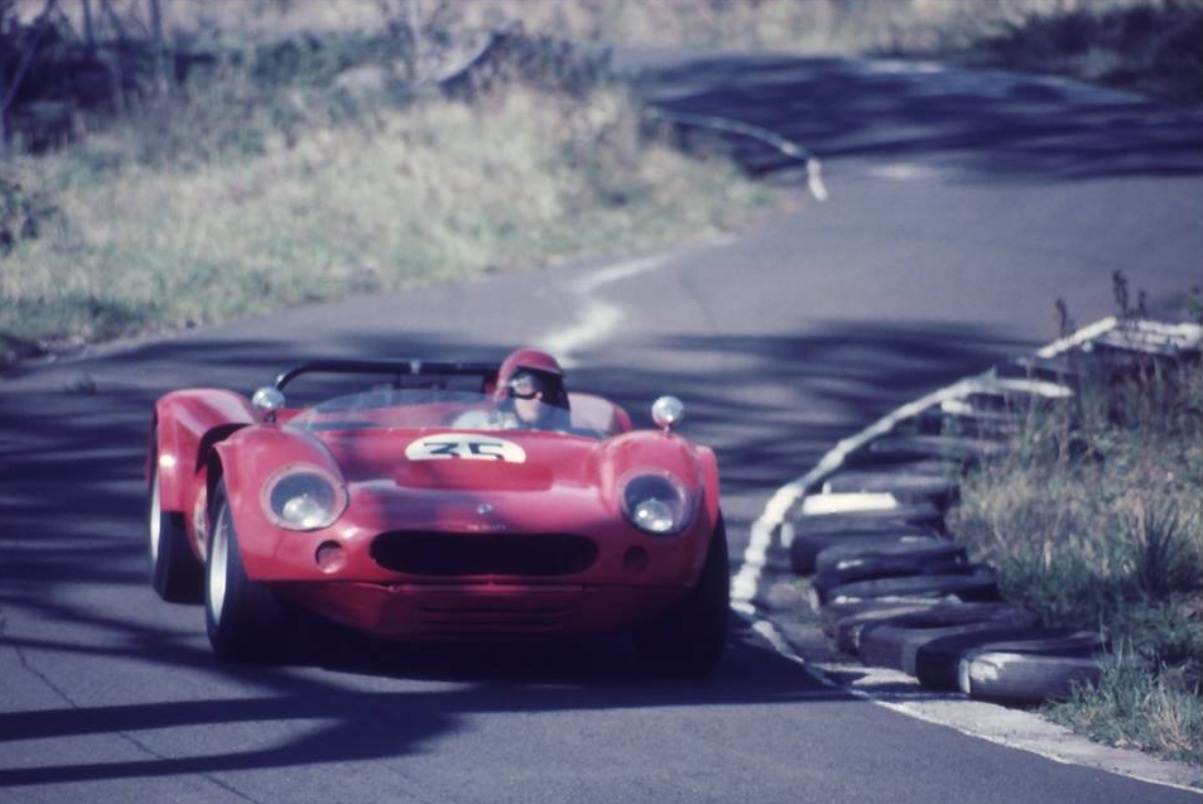
Peter Brock in his Birrana 272 Ford at Winton in 1973…

Brocky was very hot property in 1973 having seized the public spotlight with the last solo Bathurst win aboard his Holden Dealer Team Torana GTR XU1 in October 1972. Every young bloke in Australia wanted to emulate him, and many women wanted to shag him, including Miss Australia as it transpired!

Purists were delighted when he bought 272-002, Tony Alcock’s first monocoque Birrana to contest the Australian F2 Championship, but sadly he didn’t race the car for long, soon returning to the touring car ranks.

Tony Alcock’s first Birrana, the F71 Formula Ford was built in Sydney and initially raced by one of Brock’s touring car sparring partners, John Goss. Then Tony returned to his Adelaide home town and started to build Birrana’s in numbers in partnership with Malcolm Ramsay, in 1972 building two F72 Formula Fords and 272-002. Their first ANF2 car was raced by Ramsay, dual Australian F2 champion Henk Woelders and Gold Star champion Leo Geoghegan before being sold to Brock.


PB raced it at Hume Weir, Winton and Oran Park to get his hand in prior to the start of the 1973 F2 Championship which commenced at Hume Weir in June.

Brock was second to that years champion Leo Geoghegan at Oran Park on 5 August and then sixth at Amaroo on 19 August, in a Birrana 273, chassis 273-008. He updated to the best car of the season, Geoghegan galloping to the title with wins in every round but one. Its not clear exactly how many meetings Brock did in the two cars but he certainly raced the 272 at Hume Weir, Winton, Calder and Oran Park and raced the 273 at Oran Park and Amaroo Park.

Running the Lotus Ford twin-cam engine was said to be a commercial barrier to the continuation of Brock’s F2 program given his Holden Dealer Team contract, but perhaps the reality of running his own car again with the assistance of his dad was just all too hard compared with being a works driver with all of its benefits. It was such a shame, Brock’s sublime skills deserved to be deployed in racing cars as well as the tourers of all sorts in which he excelled.

Brock’s talent was clear from the start aboard his Holden engined Austin A30, his aptitude very quickly accepted once others drove that car, none of those who raced it or track-tested it could work out how he did the times he did: not Ross Bond, Peter Wherrett or Rob Luck.

The little rocket was a mix of lightweight Austin stripped shell, highly modified Holden 179 6-cylinder ‘red motor’ giving circa 200bhp using triple two-inch SU carbs, Holden three, and later four speed ‘box, rear axle assembly wheel to wheel with a Holden front end and Triumph Herald steering rack with disc front brakes and drum rears.

During the early-mid seventies glory F5000 years it always seemed to me the union between Holden and Repco would see him aboard a big, powerful single-seater car at some point, but the closest that ever came to fruition was the Repco Holden F5000 V8 engined Torana sports-sedan The Beast, which was not exactly what I had in mind at all. Still, what was in that for Holden or Repco I guess? Holden sold sedans not racing cars, so they hardly needed PB racing one of those dangerous things and Repco’s works F5000 driver was Frank Matich. A guest drive in a Matich would have been nice all the same…


Steps in the right direction were his international drives at Le Mans in 1976 aboard a Bill Patterson supported BMW 3.5 CSL Group 5 machine paired with Aussie International Brian Muir. Now that would have been a career to emulate in terms of a mix of sedans and sportscars based in the UK?

Spa in a works Vauxhall Firenza Magnum 2300 paired with Gerry Marshall yielded an amazing second outright in the 24 Hour classic in 1977.

Brock’s status as one of the best Touring Car Drivers of them all was confirmed by MotorSport in 2005 who rated him the greatest in an article contributed to by an array of global commentators of the top-20 of all time.

The Bob Jane supported attempt on the 1984 24 Hours of Le Mans, with Brock partnered by Larry Perkins in a customer Porsche 956 captured all of our imaginations and to me was exactly where that pair belonged and deserved to be. Sadly the warm-up Silverstone 1000 Km and Le Mans was as far as it went. At Le Mans they retired after an LP mistake during the night.


If only Brock had raced the 1974 Australian F2 Championship in a good car amidst one of the best grids of any single-seater championship in Australia ever- with success his career direction may have encompassed racing cars as well as tourers, rallycross and rallies.

Not half versatile was he?

Etcetera…

It’s interesting to get Brocky’s initial impressions of driving the Birrana, here recorded in his Auto Action column published in the March 16, 1973.

Birrana Cars Feature…

Photo and Other Credits…

autopics.com.au, Robert Davies, Lynton Hemer, Getty Images, Dean Oliver, tentenths.com

Tailpiece…

Outta my way big guy. Sydney during the PR build up to Le Mans 1984, Porsche 956 chassis ‘110’…

Finito…


Chris Amon on the ‘Warwick Farm 100’ grid, 9 February 1969. DNF lap 1 after a tangle with Piers Courage. Rindt won by 45 seconds from Bell’s 246T. Checkout the wing mount detail (B McInerney)

Amongst the most jewel like Ferraris of the late sixties are the F2 Dino 166 and Tasman Formula 246T’s…

Just yummy they are. The 246T had enough of everything to do the job, but not too much of it, including its wings.

Amon didn’t race so equipped in 1968, his first Tasman Dino year, but wings exploded in F1 that season so he did return with these small aerodynamic aids in 1969, together with four 300 bhp V6’s to power the cars raced by he and Derek Bell that summer.

They were works entries with logistics on the ground taken care of by David McKay’s Scuderia Veloce, Sydney based outfit. David and Chris went way back to 1962/3 when McKay’s support of him in a Cooper T53, and Chris’ speed in it that summer brought him to the attention of Reg Parnell- and off to Europe he went.

Amon’s 246T wing in the Pukekohe paddock, Jan 2-4 1969. He won the NZ GP that weekend in ‘0008’- his ’69 Tasman mount, Bell raced ‘0010’ to 4th (M Feisst)

But its the 246T wings which interest me…

Chapman’s Lotuses returned to Australasia with World Champ Hill and World Champ Aspirant Rindt at the wheel in 1969. Colin’s Lotus 49 DFW ‘aero-phalluses’ were notable for their size and the regularity with which they parted company with the chassis to which they were, usually temporarily, attached.

It was these component failures on both Lotuses at Montjuic Parc, Barcelona several months after the Tasman that caused the FIA to act, constraining the size of wings from the ’69 Monaco GP. Click here for an article in relation to those events.

‘Wings Clipped’: Lotus 49: Monaco Grand Prix 1969…

Graham Hill’s Lotus 49B Ford DFW with its big, hi-mounted wing in the Pukekohe paddock, 1969. Its high in the airstream to catch ‘clean air’, not a problem- the mounts themselves were under-engineered bigtime though. Hill, Oliver and Rindt all had failures, in the case of Oliver and Rindt huge accidents which could easily have been fatal (M Feisst)

I am a complete Lotus nutbag but joisus Chappers should have been shot for the death and destruction caused to his drivers/customers by component failure over the years? The Latin term ‘caveat emptor’ could have been designed with Lotus purchase in mind. On the other hand, butch though the engineering sometimes was, the 1961/2 156 springs to mind- shite didn’t and doesn’t tend to fall off Ferraris.

Look at (in the Pukekohe paddock photo above) the spidery, small, multi tube structure which supports the little wing. The mounts are triangulated and supported forward to the roll bar. The adjustment mechanism to alter the angle of incidence is simple and neat. The chord of the wing is shallow with endplates, not so common at the time, to ‘capture’ airflow.

Note the throttle linkage, water and oil fillers and breathers, also the Willans harness attached to the roll bar.

Amon at Teretonga, I think, in 1969. Courage won in Frank Williams Brabham BT24 Ford DFW- a portent of the success they would have in GP racing that season with an FW run Brabham BT26 Ford DFV. Again, check out the Dino wing and its mounts. Chris was 3rd behind Hill (unattributed)

Chris took a great win in the ’69 Tasman, he won the first two rounds at Pukekohe and Levin after Rindt spun away the lead, before Jochen won on the Wigram airfield circuit. Piers Courage won at Teretonga in his bi-winged Brabham BT24 Ford DFW before the circus crossed the Tasman Sea to Australia.

Chris won well at Lakeside, the Australian Grand Prix was run in very hot conditions- with both Lotuses suffering wing failure that weekend. Jochen drove away from the field at Warwick Farm in streaming rain after Amon and Courage tangled early on. Chris won again at Sandown by 7 seconds from Rindt and took the series with 44 points from Rindt and Courage on 30 and 22 points respectively.

Graham Hill suffers what would not be the last Lotus 49 wing failure during the 1969 Australian Grand Prix at Lakeside. He pitted, a mechanic hack-sawed the wing mounts and removed the offending items allowing GH to rejoin and finish 4th behind Amon and Bell both aboard Dino 246T’s and Leo Geoghegan’s Lotus 39 Repco (G Ruckert)

Amon’s 1968 Tasman Dino Season…

Amon’s Tasman Dino…

The Ferrari 166 Dino…

Temporada F2 Series Argentina: San Juan 1968: Ferrari Dino 166

Amon after his Lakeside AGP win (J Stanley)

Bibliography…

oldracingcars.com

Photo Credits…

Mike Feisst/The Roaring Season, Brian McInerney, John Stanley, Graham Ruckert

Tailpiece: Amon on his way to AGP victory at Lakeside on 2 February 1969, Ferrari 246T ‘0008’…

(J Stanley)


David Mist wasn’t a motor racing photographer but he took some interesting shots on assignments allocated to him by the advertising agency USP Benson…

The client on this occasion was Shell, the ‘talent’ the Scuderia Veloce racing team owned and operated by David McKay and perhaps the Warwick Farm circuit itself. Mist’s gigs incuded the ’63 and ’67 AGP weekends, ‘the 1965 Shell Racing Series Scuderia Veloce Racing Team’ and a meeting at Catalina Park, Katoomba. Click here for a link to an article which includes background on SV; https://primotipo.com/2017/01/04/scuds/

Its David McKay on the grid, above, with driver Greg Cusack and Greg’s Elfin Catalina Ford FJ circa 1964. It won the 1964 Australian Formula 2 Championship, at Lowood, Queensland, chassis ‘6310’ is now owned by the National Motor Racing Museum.

Cusack came through the world of rallying and burst onto the racing scene with speed in a Lotus 23, an Elfin Mallala sportscar, the Catalina above and then into a Brabham BT6 Ford. During this time he progressively built a significant automotive retailing business, a Ford dealership in Canberra. Perhaps this dual focus of business and racing mitigated against ultimate motor racing success but he rose right through the ranks to race McKay’s Brabham BT23A Repco Tasman 2.5 Formula car.

Interestingly this very chassis, Jack’s 1967 Tasman weapon- ‘BT23A-1’ has recently been acquired by the National Automobile Museum, which is good and bad! Good in that it stays in Australia, bad in that it now becomes a static museum exhibit rather than occasionally raced as it has been by Peter Simms for the last 30 years.

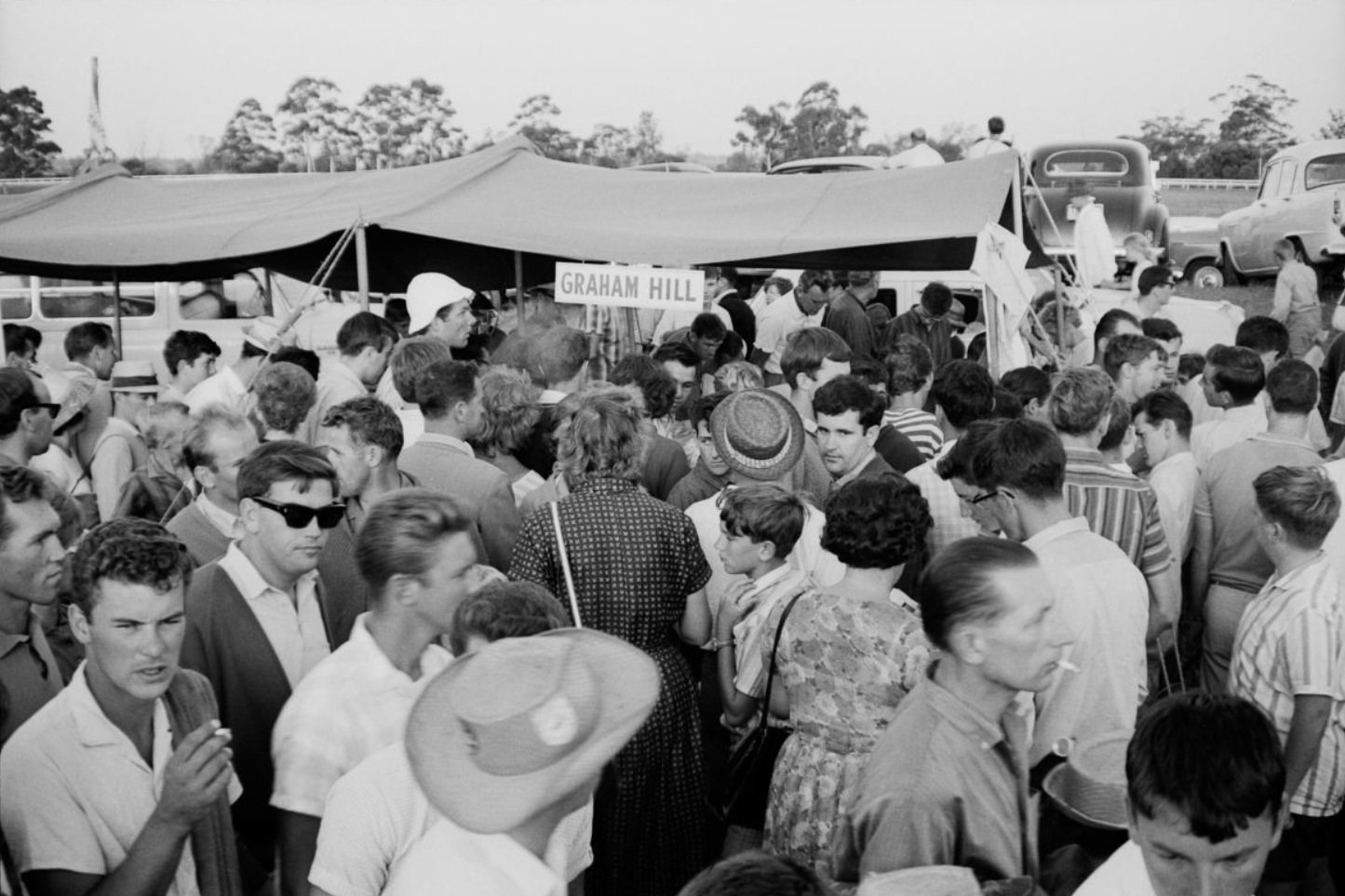
The Tasman meetings attracted enormous crowds, here the crush is around Graham Hill’s Lotus in 1967.

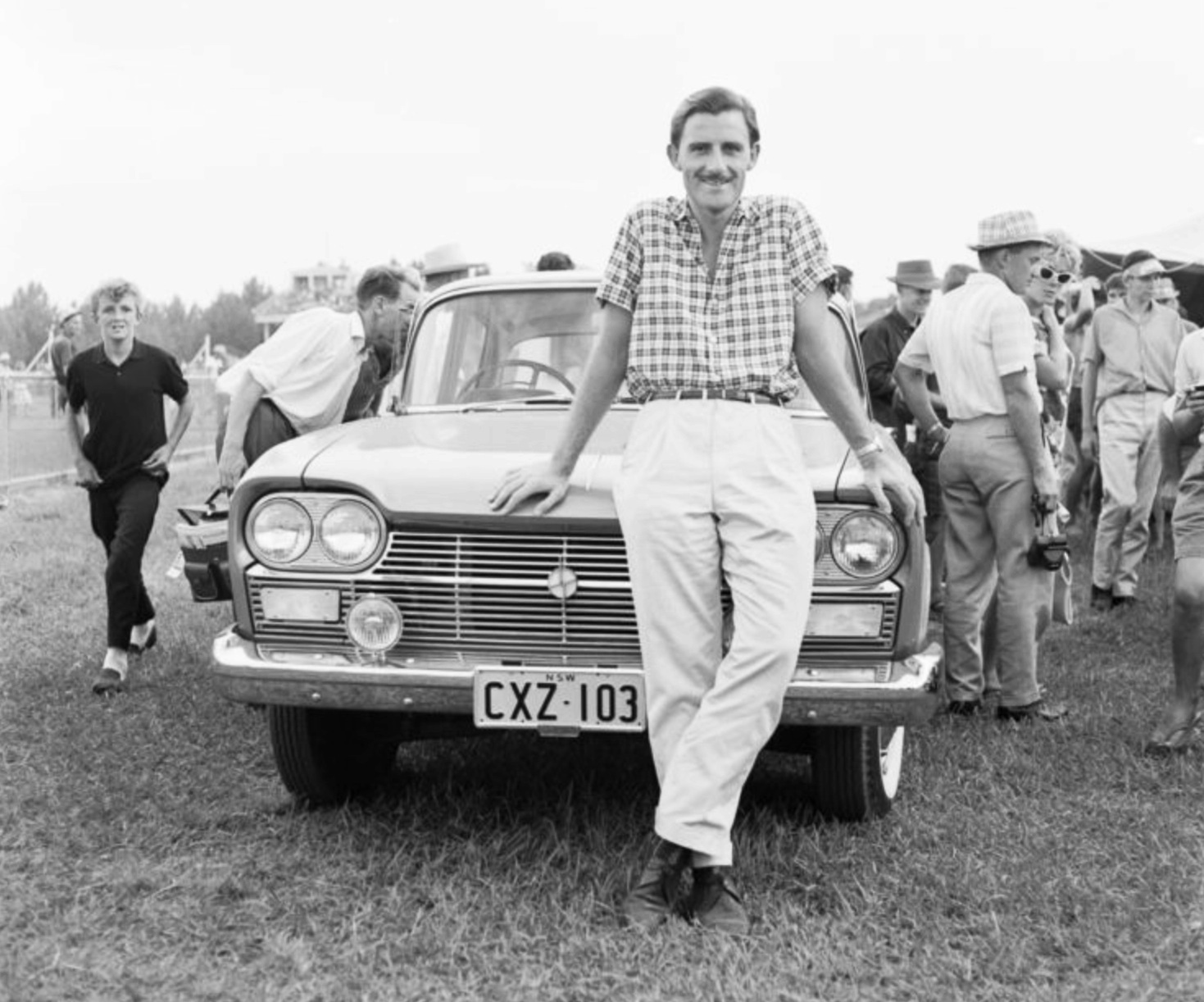
Sticking with Graham, here he is no doubt leaning against his courtesy car for the weekend. Its a big Datsun/Nissan Cedric, I wonder what GH thought of it? I wrote an article about the Prince/Nissan R380 racer a short while ago which tangentially talks about the rise and rise of the Japanese manufacturers in Australia in the sixties. Click here to read it;

Prince, Datsun, make that Nissan R380…

The popularity of touring car racing in Australia began in the fifties and has exploded exponentially since. Sadly. Sadly in that the ascension has been at the expense of the purer forms of the sport- single seaters and sports-racing cars. Still, the market has spoken and we enthusiasts of the Real McKoy have to suck it up and remember the glory days of the fifties to seventies, and even then other than at Tasman time, grids could be pretty shitful in quantity if not in quality.

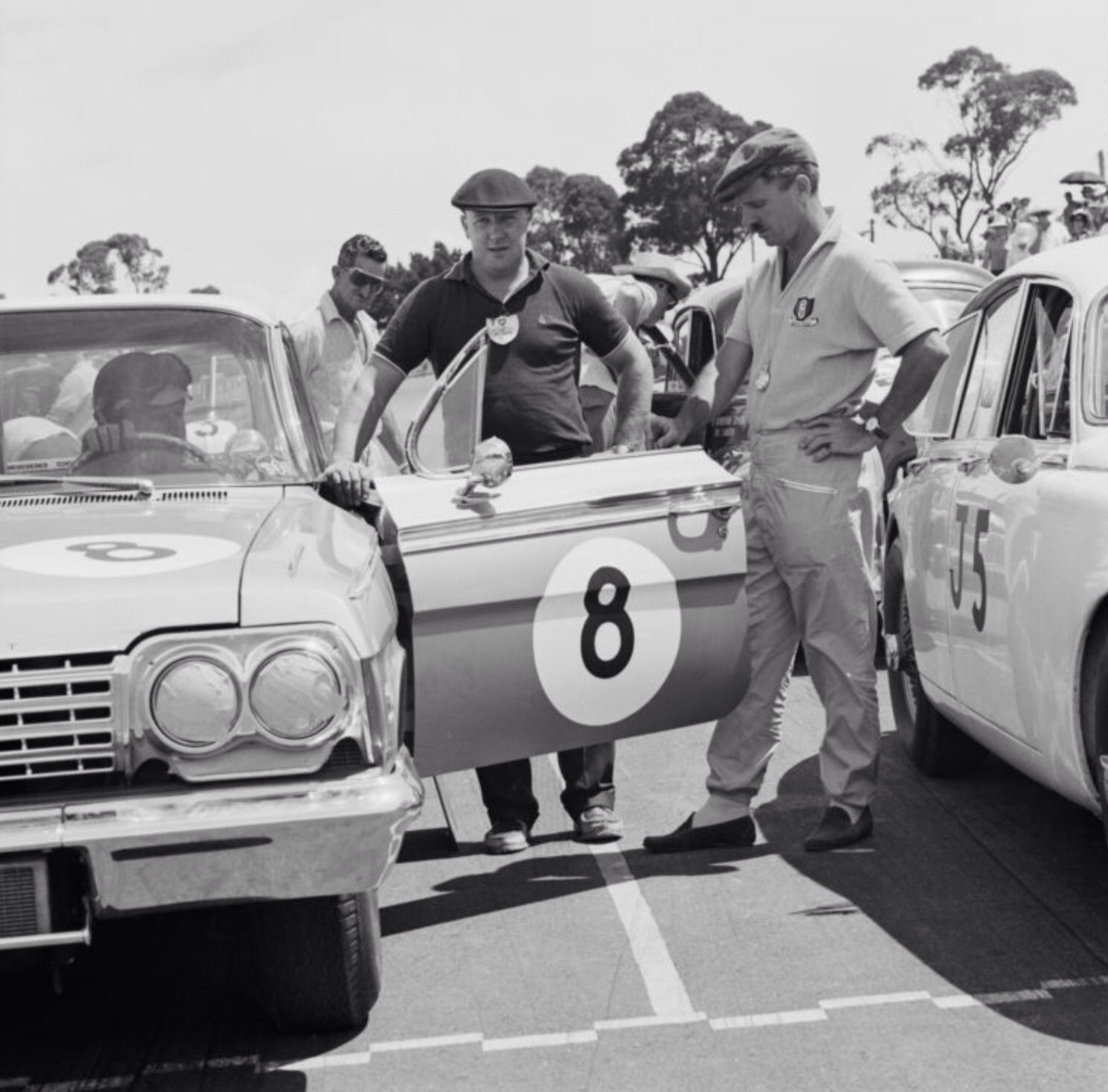
One of the touring car greats as a racer, personality and crowd pleaser was Norm Beechey, winner of the 1965 and 1970 ATCC in Ford Mustang and Holden Monaro 350 respectively, here aboard his Chev Impala in 1963.

He was a member of the SV squad at the time, winning the NSW Touring Car Championship in this car on the ultra tight, Catalina Park circuit. McKay is alongside the car together, I think with Claude Morton, Norm’s mechanic. David is in driving gear so he’s not quite retired. I’m guessing this as the 1963 Australian GP weekend in February, McKay finished a splendid 4th in his Brabham BT4 Climax in that race behind Brabham, Surtees and McLaren.

The spinner below is Gavin Youl in a Brabham BT2 Ford, the passing Nota BMC is Les Howard’s chassis owned by John Medley for 45 or so years!

Photo Credits…

All shots by David Mist

Finito…

Piers Courage and Sally Curzon aboard Piers Charles Lucas Racing, F3 Lotus 41 Ford Cosworth, Brands Hatch 8 May 1966…

 Courage had just won the ‘Les Leston Trophy’ from Peter Gethin and Roy Pike in a season which was a breakthrough one for him. Lucas ran the Lotus factory team with Courage racing the 1 litre Cosworth powered Lotus as much in Europe as in the UK.

 He won the prestigious Pau GP in April, another Les Leston round at Mallory Park in late May, the Coupe de Auto Club Normand at Rouen in July, another Les Leston round at Brands in late August and the Coupe de Vitesse at Albi in early September.

The European International Challenge, the ‘F3 Grand Final’ was held at Brands on 2 October, Piers was 2nd to Chris Irwin’s Brabham BT18 Cosworth. Behind Piers was Chris Williams, Jean-Pierre Beltoise, Brian Hart, Kurt Ahrens and Jacky Ickx. Jonathon Williams was outside the top 10, he was racing an unfamiliar Brabham BT18 rather than the de Sanctis Cosworth with which he did so much damage that year in Europe- he won a lot of races, enough to impress Enzo Ferrari. The depth in F3 never fails to impress.

The pretty lady is Lady Sarah Curzon, daughter of renowned British racer Earl Howe, she and Piers married in 1966, click here for her interesting story, well known to you Brits, but not necessarily to the rest of us;

https://www.telegraph.co.uk/culture/3608233/For-the-love-of-a-dangerous-man.html

 Credits…

 Getty Images- Victor Blackman, f2register


(Douglas Walker)

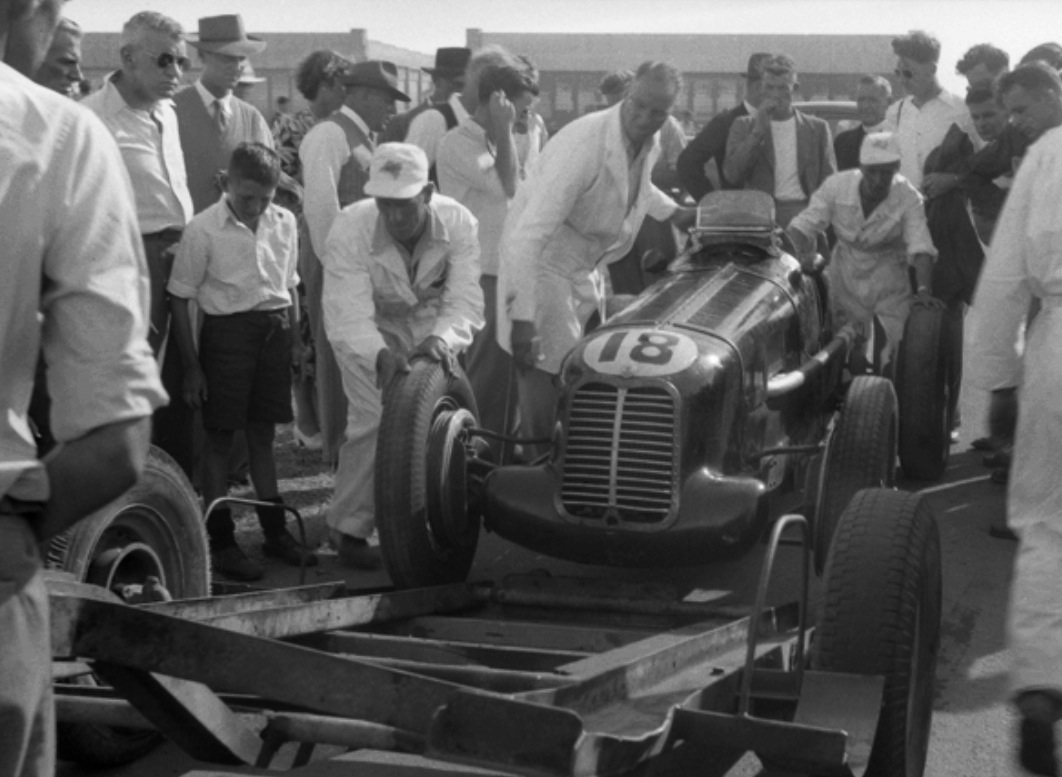
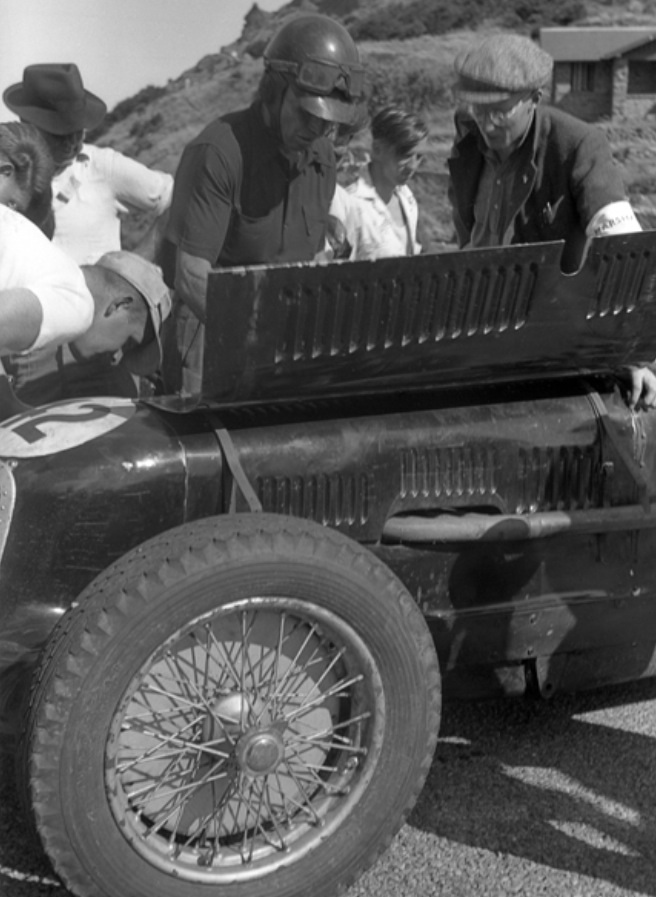
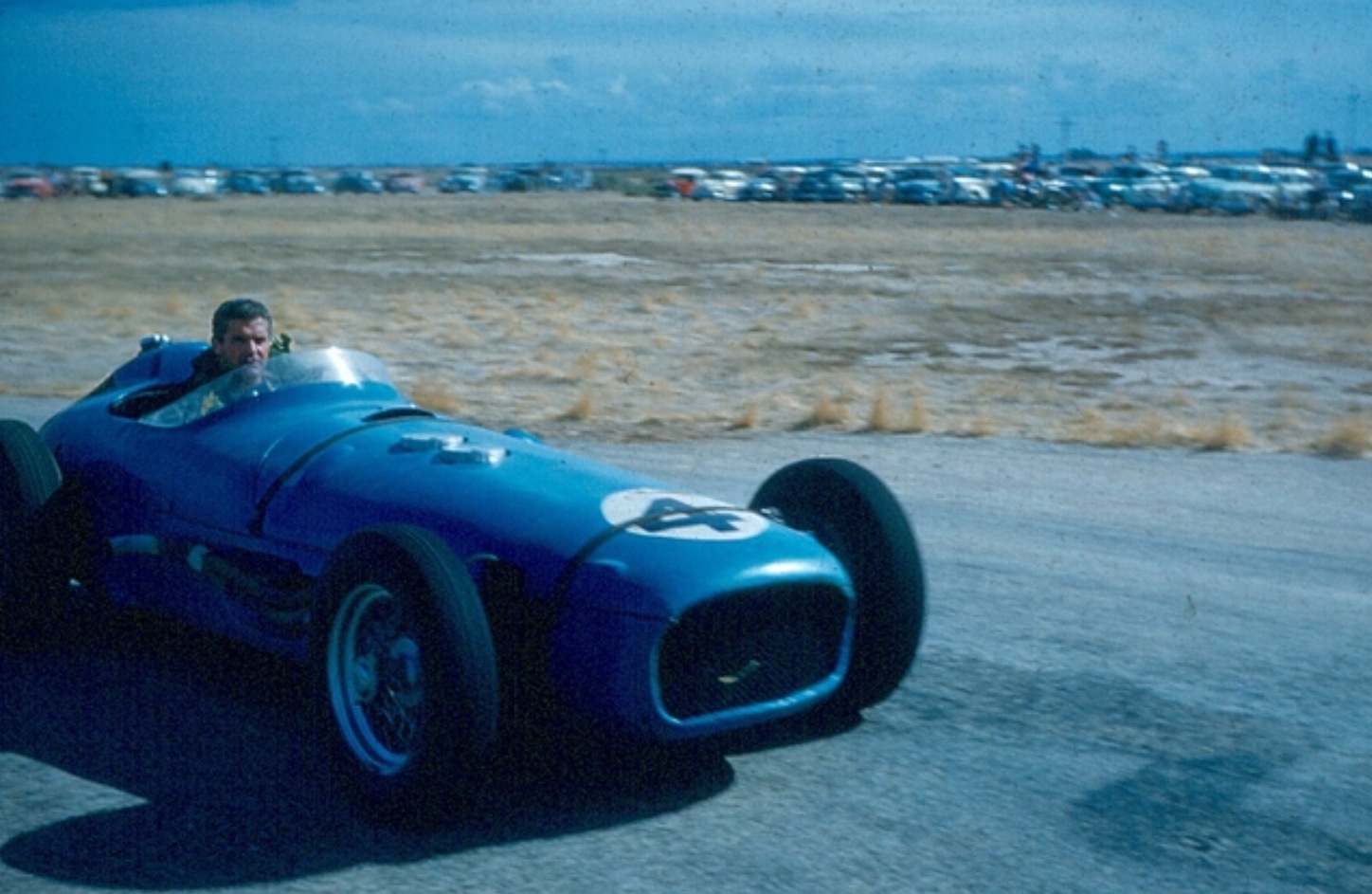
Quintessential Australian racer/engineer Tom Sulman loads his Maserati 4CM after the second ‘Lady Wigram Trophy’, Wigram Airbase, New Zealand 23 February 1952…

Tom Sulman was born in Sydney on 25 December 1899 and died in a tragic accident at Mount Panorama, Bathurst on 30 March 1970 aboard one of his Lotus 11 Climax’. He was the grand old, gently spoken man of Australian motor racing- a racer to the core, he competed all of his life inclusive of elite levels internationally.

Like most of my articles this one was stimulated by finding some photographs, and as is usually the case, doing so whilst looking for something else!

The shots of Tom and his Maserati 4CM in New Zealand in 1951 were simply too good- so evocative of the period not to do something with. The trouble is that his racing career was so long it’s a huge job to do it justice especially with information not readily available, so treat this as summary of his wonderful life with a bit of focus on the Maser, itself a car with an interesting provenance.

Sulman was the son of UK born and later immensely prominent and influential Sydney architect Sir John Sulman. Tom grew up in a rambling home at Turramurra, on Sydney’s upper North Shore. Unlike his formidable father, whose competitive spirit he undoubtedly had, he commenced a career in automotive engineering, very much an industry of growth at the time. In 1923 he built his first racer, the ‘Sulman Simplex’, a road-going cyclecar, which he raced at Sydney’s Victoria Park that year.

Tom Sulman and Fay Taylor with the Sulman Singer at West Ham, London in 1936

During the 1930’s depression Tom travelled to England looking for work and soon established a motor engineering business. His early motor sport endeavours began in 1931 and involved conversion of a Morgan 3 wheeler to a 4 wheeler! so that he could race ‘a car’ on dirt, which was very popular at the time. Later he built a car with a motor-cycle twin-cylinder engine and a ‘vaguely Salmson chassis’ which he raced at the early Crystal Palace meetings and at Greenford.

In fact Tom was right there at the start of organised car-only dirt track racing on motorcycle speedway lines. Outside the reach of the RAC, the first UK race of this type was held on Good Friday 30 March 1934, at Crystal Palace.

There were three teams of three riders and a reserve with ‘New South Wales Champion’ Tommy Sulman captaining the Wimbledon Park team driving a ‘Bitza Special’! During this period he raced at tracks such as Greenford, Crystal Palace, Hackney, Lea Bridge and Wimbledon. To provide some sense of the scale and level of interest in speedway racing at the time there were over 25 tracks in the London extended area alone. In addition to his motor engineering Tom was a professional driver earning money from his race competition.

He was approached by a Singer agent off the back of his performances and growing reputation to build a similar sprint and hillclimb special to his own car using Singer components. Core mechanicals were a Singer Le Mans engine and G.N. chain transmission. When the car was completed, it became the ‘Sulman Singer Special’ after the Singer agent went ‘bust’ leaving Sulman with the car! It soon became clear after the commencement of dirt track racing that the cut down sportscars predominantly used were unsuited to the tight, deep cindered UK tracks with short straights. Tom built the Sulman Singer as a dual purpose machine, but its very short wheelbase was a function of the development work by trial and error he and other leading racers had done to create a car ideal for the dirt.

Sulman raced it regularly in the UK and once in Holland in 1936. On 4 August 1936 Tom contested the very first Midget World Championships at Hackney, in inner London.

The winner with 7 points from his heats was Cordy Milne of the US- Tom was 6th with 3 points, he was 3rd, 2nd, and 2nd in his three heats. Another Australian, Dicky Case was 2nd with 6 points. An interesting sidebar is that Case, a star motorcycle solo-rider was invited into the competition as a fill-in driver due to a lack competitors- and came close to winning the thing! The program does not disclose the chassis the various competitors used.

Into 1937 the Sulman became obsolete, along with most of the rest of the fields with the advent of the ‘Skirrow Specials’. These revolutionary cars built by Harry Skirrow in Cumbria had chain drive to both front and rear axles harnessing the 80bhp produced by their bespoke 990cc twin-cylinder JAP engines rather effectively. As a consequence, Tom built a 4WD car of his own in an attempt to more effectively compete- he crashed badly at Coventry in August/September 1937 and elected then to end his midget racing career. The Sulman Singer, which had been put to one side, was then pressed back into service, Tom raced it at various hillclimbs.

Bathurst 1950, Hell Corner lap 1. Ron Ward MG TC from Sulman in the  #47 ‘Singer then Ron Edgerton #37 MG TC and Gordon Stewart #46 MG Magna (AussieHomestead)

At the end of World War 2 Sulman returned to Australia by signing on as a flight engineer on an aircraft, his very cost-effective way to take the long, expensive 12000 mile journey home was as a crew member of a Lancaster Bomber converted to carry people rather than a lethal payload. The Sulman Singer followed by ship, the car travelled sans bodywork to avoid import duty being imposed upon it by the Fiscal Fiend- the Australian Taxation Office!

Tom first raced the car in Australia at Nowra on the NSW south coast in June 1947, the combination took a win in the under 1100cc scratch race. As a road racer it competed in contemporary events up to and including the Australian Grand Prix, then a handicap event. He was 5th at Bathurst in 1947 and also contested the 1948 AGP race at Point Cook in Melbourne’s outer west, the little car succumbing to the extreme March summer heat like so many others on that day.

Sulman eventually sold the car when he acquired the Maserati, it raced regularly in various hands in the 1950’s but by the 1960’s was mainly used in historic events. The car was sold to AP North, then later to Monty South and finally Ron Reid on 6 November 1965 to start a long relationship of sympatico between driver and owner.

Moustachioed Ron Reid, red ‘kerchief flapping in the breeze with a big smile upon his face was an icon of Australian Historic Racing in the car which still races, after Ron’s demise in 1999, in the hands of Mal Reid, Rons son. Whenever I see this wonderful machine in the paddock it always brings a smile to my face. Drivers and cars come and go, but the Sulman Singer remains a constant in Australian motor racing and would be a finalist for the ‘longest continuously raced’ car on the planet.

Sulman competed in other cars as well though, including an 1100cc HRG sports car. By the late 1950’s, Tom, who had a workshop in the now very trendy inner-Sydney suburb of Surry Hills, had added to his stable the Maserati 4CM. This ex-Farina/Salvadori car, he bought from Australian resident Englishman David Chambers.

Sulman in the Maserati 4CM at Mt Druitt’s Hairpin, Sydney, date unknown (AussieHomestead)

Chassis # 1521, one of about twelve 1500cc 4CM’s, was first delivered to none other than Giuseppe Farina in August 1934, he won Voiturette races in it at Biella and Masaryk and then Modena and Turin. Gino Rovere, who probably owned the car when raced by Farina, raced it during 1935 and perhaps also Gigi Villoresi as part of Rovere’s ‘Scuderia Subalpina’. It then passed into the hands of several UK drivers including EK Rayson, Charles Mortimer and then formed an important part of the nascent racing career of Roy Salvadori post-war.

David Chambers acquired the car in England in 1949, raced it at Goodwood and then shipped it home and made his Australian debut at Rob Roy Hillclimb in outer Melbourne in 1950. Raced at Easter Bathurst 1950, the 500Kg, 1496cc, Roots-type supercharged, 4 cylinder 130bhp @ 6100 rpm car achieved 122mph through the traps on Conrod Straight in top- 4th gear in its Fiat derived gearbox.

New Zealand Hillclimb Championship 1951, winner in the Maser 4CM. Venue folks? (Walker)

Tom bought the car shortly after this meeting and campaigned it in both Australia and New Zealand over the next few years.

Among his New Zealand successes were the 1951 NZ Hillclimb Championship, on that tour he also contested circuit races- the Ohakea Trophy and Lady Wigram Trophy in March finishing 4th and taking fastest lap, and DNF at Wigram. NZ ‘heavy metal’ of the day included cars such as Les Moore’s Alfa Tipo B, Ronnie Moore’s Alfa 8C, Frank Shuter’s V8 Spl, Jack Tutton’s C Type, Ron Roycroft’s Jag XK120 and like Australia a swag of MG and Ford V8 powered specials as well as the early Coopers starting to appear.

Working on the engine of the Maser 4CM, NZ Hillclimb Championship 1951. Mechanical specifications as per text (Walker)

The Maser was period typical in having a channel section chassis, with rigid axle suspension at both ends and semi-elliptic springs front and rear. Sulman was unhappy with the cars handling so modified it by adding 3.5 inches into the front axle, increasing the front track from 3 foot 11.2 inches to about 4 feet 3.5 inches, widening the spring base and inverting the rear shackles. The rear track remained at 3 feet 11.2 inches. When completed he reported the car as extremely predictable and easier to handle.

During practice at Parramatta Park in January 1952 he nipped a brake coming into Rotunda Corner, spun, hit the kerb and rolled landing back on the Masers wheels. Damage was limited to a bent stub axle and minor body twisting. He repaired the car and returned to the Land of the Long White Cloud that summer of 1952, racing again at Wigram and Ohakea for 2nd off the front row and 4th.

Tom at Mount Panorama in the 4CM, date unknown- superb, rare colour shot (B Miles)

The car was shipped back to Australia in time for the April 1952 AGP at Mount Panorama- finishing 6th in the race won by Doug Whiteford’s Talbot Lago T26C taking the second of his three AGP wins.

Probably his best run in the thoroughbred single-seater was at Gnoo Blas, Orange, NSW in April 1953- his haul five race wins. Less happy was the car ‘chucking a rod’ through the block at Mount Druitt, Sydney in 1954.

Tom Sulman Aston DB3S, Doug Whiteford Maserati 300S and Bill Pitt Jaguar XKD on pole, Victorian Tourist Trophy, Albert Park 17 March 1957. Whiteford won the 100 mile racefrom Pitt, Tom DNF on lap 16 (unattributed)

Tom was invited to become a member of ‘The Kangaroo Stable’ which planned a long distance sportscar racing program in Europe in 1955 with three Aston Martin DB3S customer racers.

At that point the Maser was sold, it remained in Australia into the mid-sixties but left the country many years ago, living on in historic racing.

He acquired DB3S ’103’ new from the Aston, Feltham factory, the car was registered in NSW as ‘OXE-473’ and raced it in England-the Goodwood 9 Hours and at Aintree during the British GP meeting sportscar events, Portugal- the Lisbon GP, France, with the best result a 2-3-4 finish for The Kangaroo Stable behind a Ferrari in the Hyeres 12 Hour in the Provence-Cote d’Azur region of France-Tom was third. His co-driver was none other than Jack Brabham, then in his first year of a long and rather successful racing career in Europe. The Kangaroo Stable’s racing plans were to a large extent scuttled by the ’55 Le Mans disaster and the cancellation of many events in Europe as a consequence that year.

Tom returned to Oz, with the Aston his mount for years. Sportscar racing was especially healthy in Australia at the time with a mix of XKC and XKD Jags, Maser 300S, Aston DB3S, Cooper Jaguar, the Ausca Holden Repco, a swag of Austin Healey 100S and various Climax engined Lotus 11 and 15’s thrilling large crowds. The customer Astons were front third of the field cars. When David McKay’s ex-works DB3S car- DB3S/9 arrived it was the class of the field. Other quicks of the time Bill Pitt’s D Type, Frank Gardner’s C and D Types, Doug Whiteford’s ex-works Maserati 300S and the Derek Jolly and Frank Matich Lotus 15 FPF’s when they appeared later in the decade. Tom’s best results aboard ‘103’ were 2nd , 4th and 4th in the South Pacific Sportscar Championship at Longford in 1958, 1959 and 1960. He was 5th in the hotly contested 1960 Australian Tourist Trophy at Longford won by Jolly’s Lotus 15.

Tom Sulman takes his Aston DB3S onto the Longford grid during the 1960 Australian Tourist Trophy weekend. Only Whiteford’s #10 Maser 300S of this group of cars (in addition to Tom) contested the championship event- this is perhaps a preliminary or practice (J Ellacott)


Gnoo Blas, Orange 1 February 1960. Anniversary Championship for Sportscars. Derek Jolly Lotus 15, Ross Dalton Jag XKC, David Finch Jag XKD on pole, and on row 2 the Aston DB3S’ of Jim Wright ex-Warren Bloomfield and #58 Tom Sulman. Jolly won from Finch and Wright with Tom placed fourth (Aussie Homestead)


Stunning shot of Tom during the first ‘Southland Road Race’ at Ryal Bush in 1956. He appears to have had some involuntary oversteer on one of the road courses left handers! (J Manhire)


Tom at Lowood in 1960- Aston DB3S (B Thomas)

Tom took the car to New Zealand for their summer races in 1956 commencing with the NZ GP held at Ardmore, then Wigram, Dunedin, Ryal Bush and Ohakea, his best results in the five meeting two month stay was 6th and 7th at Ryal Bush and Ohakea Airfield.

At a time the Australian Grand Prix was still a Formula Libre race, with ‘outright’ sportscars regular entrants. Tom the took the Aston on the long trip, 3920 kilometres for you Europeans- you have to be keen!, from Sydney to Western Australia to contest the 1957 race held at Caversham in outer Perth. It was a long way to travel for a DNF, but many cars did not survive another AGP held in scorching hot Australian summer heat. Lex Davison took a famous, and fortunate win in that race co-driven by Bill Patterson. Fortunate in the sense that lap-timing confusion awarded the race to Lex rather than Stan Jones.

In addition to Jack Brabham driving the car, the Aston’s provenance was further enhanced when Stirling Moss took the wheel and gave a journalist the ride of his life during several practice laps at the 1961 Warwick Farm opening meeting.

Sulman, Lotus 11 Climax, Silverdale Hillclimb, NSW (Bruce Wells)

In the early 1960’s he bought a locally built Lynx Ford Formula Junior and in 1961 the first of two Lotus 11 Climax’.

Chassis ‘343’ was an S2 Le Mans spec car powered by several Coventry Climax FWA engines. The Aston was sold to Ron Thorp, it remained in Australia for some years before it too made its way to the UK. In 1963 he bought his other 11, a Climax FPF engined car, chassis ‘305/552’ which had originally been raced by Ron Flockhart and Roy Salvadori in the UK. This period is confusing for historians as it is not clear which car he raced where- and he raced them everywhere! At sprints, hillclimbs and circuit races.

Remember, by 1960, he was 61 and had been racing for the best part of 40 years. Tom’s racing was diverse though, he contested rallies, hillclimbs and sprints as well as circuit racing. His rally/reliability trial experience included the famous, legendary RedeX Round Australia Trials of the 1950’s including the first one in 1953 as a member of the Humber Super Snipe team. He entered touring car races too- as that aspect of the sport grew including the Mount Druitt 24 Hour race and the 1962 Bathurst Six Hour aboard a new-fangled Datsun Bluebird.

Tom in the ex-Abbott/Hamilton Porsche 904 Ford Cobra, Huntley Hillclimb, NSW 1 June 1969 (T Arts)


and again as above (Tony Arts)

Some of the cars he raced such as the ex-Alan Hamilton Ford Cobra powered Porsche 904 were very potent devices, he ran this car circa 1969. He contested the 1966 Surfers Paradise 12 Hour enduro as co-driver to Ron Thorp who by then was racing a booming AC Cobra, very much a crowd favourite, the duo won their class, that event won outright by Jackie Stewart and Andy Buchanan aboard the famous Scuderia Veloce Ferrari 250LM.

Lotus 11 Le Mans Climax FPF 1500, Lakeview Hillclimb, ACT date unknown (AussieHomestead)

In March 1970 Tom loaded the little Lotus 11 ‘343’ onto its trailer in Surry Hills and headed out of Sydney west towards the Bells Line of Road for the 200Km trip to Mount Panorama, goodness knows how many times he would have made that journey? He was off to the Easter Bathurst meeting, at that time there were two race meetings a year at the famous circuit, not just the annual touring car 500 miler.

Journalist Barry Lake recounts the events of Sulman’s final drive in the insignificant 6 lap ‘Sir Joseph Banks Trophy’ sportscar scratch race at Mount Panorama. ‘At the Easter Bathurst meeting on 30 March 1970 the quietly spoken Tom, now 70 years old and as keen to race as ever, moved slightly to the right and simultaneously slowed down between the two humps on Conrod Straight. Vincent Evans who was a short distance behind, could not avoid the impact of his left-front mudguard with the right rear bodywork of the Lotus 11 driven by Sulman. The Lotus 11 swerved to the left of the circuit (its inside) into the gravel on the verge and rolled into a locked (farmers) gateway, hitting the gatepost on the drivers side. Sulman’s head hit the post causing his instant death’.

‘Shortly before the accident there had been a ‘Tom Sulman Trophy’ race at Warwick Farm for historic cars to commemorate his very long racing career. At the age of 70, Sulman was one of the oldest racing drivers in activity at the time’ Lake’s tribute concludes.

It was a terrible case of being in the wrong place at the wrong time and hitting the fencepost when it could just as easily have been open space. Australian motor racing was rocked by another fatal accident at Bathurst twelve months after the last, Bevan Gibson’s Elfin 400 Repco became airborne on one of Bathurst’s humps at the same meeting a year before.

Sulman had lived a good life, a long full one despite its untimely end. He was one of those fellows who put more into the sport than he took out, and loved it to its core. A racer through and through right to the very end.

Tom Sulman at Lowood, circa 1959 (R Wittig)

Etcetera…

(Athol Yeomans)

Tom in the Maserati 4CM at Silverdale Hillclimb in June 1960.

Bibliography…

Obituary written by Barry Lake published on ‘Motorsport Memorial’, ‘Historic Racing Cars in Australia’ John Blanden, ‘Maserati: A Racing History’ Anthony Pritchard, Derek Bridgett on ‘Midget Car Panorama’. MotorSport magazine December 1936, ‘Bugattis Did It Too’ article in ‘Loose Fillings’ December 2015

Photo Credits…

Douglas Walker Collection, Aussie Homestead, Simon Lewis, Bruce Wells, Ron Wittig, Bruce Miles, John Ellacott, Tony Arts, John Manhire, Brier Thomas

Tailpiece: Sulman aboard his remarkably adaptable Sulman Singer at Kennel Corner, Shelsey Walsh in 1938. A rare UK shot of the car…

(Simon Lewis)

Finito…

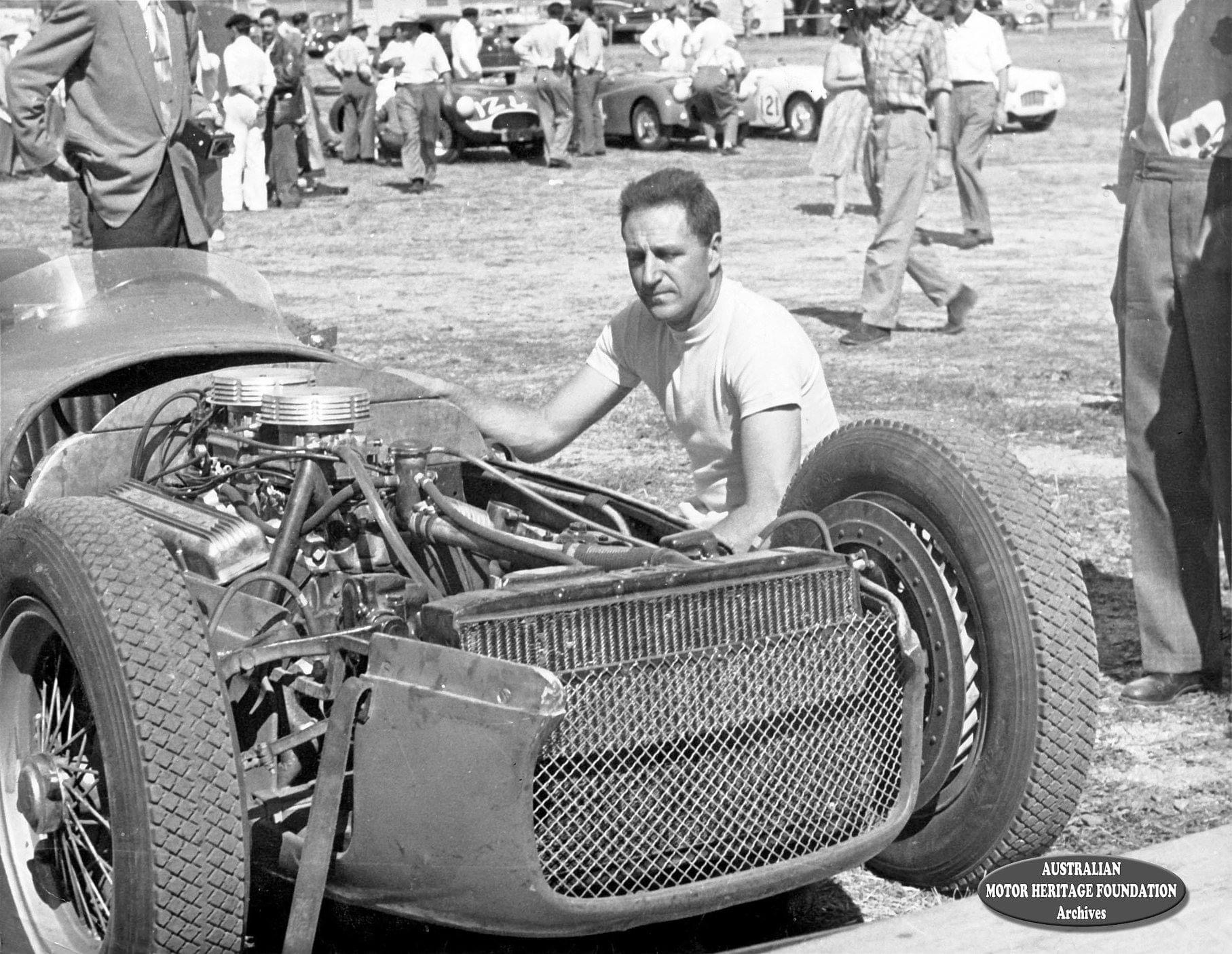
Front wishbone and lever arm shock and lower transverse leaf spring. Chev Corvette 283 cid V8 topped by 2 Carter 4 barrel carbs, note how the engine and drivetrain are offset to the right with the driver sitting nice and low to the left rather than above the prop-shaft. Bob Burnett built this body as he did the other Maybachs. Handsome brute (Q Miles)

Stan Jones, Maybach 4 Chev in the Lowood, Queensland paddock, June 1959…

I love Quentin Miles wonderful clear period photo of the fun of the fair and especially the business end of the last car built in the most famous range of Australian Specials- not that the ‘Special’ descriptor does justice to the quality of the design and construction of the Maybachs under Charlie Dean’s leadership at Repco Research in Sydney Road, Brunswick, in Melbourne’s inner north.

In essence my article about Stan Jones is also a piece about Maybach- it together with the 1954 Southport Australian Grand Prix feature provide plenty of background on the cars and their progressive evolution from Maybach 1- the 1954 NZ GP winner, the shortlived Maybach 2 which should have won the ’54 AGP but instead died a violent death during that race, and the replacement Mercedes Benz W154 inspired Maybach 3- the final iteration of the Maybach 6-cylinder engined machines. Maybach 3 became Maybach 4 when Ern Seeliger skilfully re-engineered aspects of the car to accept the new, lightish Chev, 283 cid ‘small-block’, cast-iron, pushrod OHV V8. Click here for Stan and Maybach;

Stan Jones: Australian and New Zealand Grand Prix and Gold Star Winner…

and here for the ’54 AGP;

1954 Australian Grand Prix, Southport, Qld…

Jones’ forceful speed and the ongoing evolution of the Maybachs kept the cars at the forefront of Australian single-seater racing into 1955 but game-changers were the arrival of modern ‘red cars’- Lex Davison’s acquisition of Tony Gaze’ Ferrari 500/625, Reg Hunt’s Maser 250F powered A6GCM and his subsequent 250F to name two.

Stan gave up the unequal struggle and acquired a 250F, ultimately doing very well with it- winning the ’58 Gold Star and the ’59 AGP at Longford, thank goodness he finally won the race in which he had deserved to triumph for the best part of a decade.

Even though the Maser was his front line tool he was not averse to giving Maybach a gallop, as here on the Queensland airfield circuit.

Jones at speed on the Lowood airfield circuit, Maybach 4 Chev, June 1959 (Q Miles)

As Stanley focussed on the Maserati, Maybach 3 languished in a corner of Ern Seeliger’s workshop in Baker Street, Richmond. Ern was a successful racer, engineer/preparer and a close friend of Jones. With a view to selling it Stan handed Seeliger the car telling him to ‘do what he liked with it’.

The essential elements of Maybach 3 were a chassis built up from two 4 inch diameter steel tubes, the Maybach 3.8 litre, 260 bhp, SOHC 6 cylinder engine fitted with a Charlie Dean/Phil Irving designed and carefully cobbled together fuel injection system, the engine laid down at an angle of about 60 degrees to the left to lower the bonnet line, like the W196- the car was also styled along the lines of that Benz. The cars front suspension comprised upper wishbones and a lower transverse leaf spring and at the rear utilised quarter elliptic leaf springs and radius rods. Brakes were PBR drums and the gearbox a 4 speed manual.

Towards the end of its life the limiting factor of Maybach 3’s performance was the end of Charlie Dean’s supply of Maybach engines, no more power could be squeezed from them- and there were none left in any event!

In addition there were now plenty of competitive well sorted cars. The only locally built racer capable of running with Hunt, Davison and Jones was the Lou Abrahams owned and built, Ted Gray driven Tornado Ford V8- and from late September 1957, Tornado Chev V8. There is little doubt that Ern looked long and hard at a machine that was prepared only 1.5 Km from his own ‘shop for inspiration. Click here for the Tornado story;

‘The Longford Trophy’ 1958: The Tornados: Ted Gray…

Pretty soon a 283 Chev was on its way to Australia, Seeliger modified the 4.6 litre V8 by fitment of two Carter 4-barrel carbs, the cylinder heads and valve gear were ported, polished and lightened, with the oilways modified and the unit dry-sumped. The motor produced about 274 bhp @ 6000 rpm and had a truckload of torque- around 300 lb feet of it at 3500 rpm. Ern and his band of merry men did not just plonk the engine into the space formerly occupied by the German straight-six however.

Seeliger thoroughly overhauled the machine, lengthening the chassis to accept the de Dion rear end he designed to better put the cars power and torque to the road. A transverse leaf spring was installed instead of the quarter elliptics and an anti-roll bar used at the front incorporating brake torque rods. The rear track was widened by an inch and a larger 30 gallon fuel tank fitted to feed the thirsty Chevy.

Seeliger designed and built a multi-plate clutch which used the existing Maybach 4 speed ‘box and diff albeit modified with shortened axles and cv joints to mate with the de Dion tube.

Stan Jones and Alec Mildren at Port Wakefield in 1959. Maybach 4 Chev and Cooper T45 Climax (K Drage)

Ern made the cars debut in this form at Fishermans Bend in March 1958, his bid for victory came to an end with stripped tyres- the car was quick right out of the box, Seeliger a mighty fine design and development engineer.

Whilst a very good driver he was not in Stan’s league- Jones was stiff not to win the ’58 AGP at Bathurst aboard his 250F- as was Ted Gray unlucky to dip out in Tornado 2 Chev, but Seeliger finished 2nd in the Maybach with Lex Davison, always a lucky AGP competitor, the winner. Be in no doubt my friends Maybach 4 Chev in Jones hands was a winning car- had he felt so inclined in 1958 but he was busy winning the Gold Star aboard the 250F in any event.

Into 1959 Maybach 4 was still competitive in Ern’s hands, and Stanley took a win in the Gold Star, South Australian Trophy event at Port Wakefield in late March and 3rd place in the Lowood Trophy race as pictured in this article behind the Cooper Climaxes of Alec Mildren and Bill Patterson. Before too long Stan would show his speed in a Cooper T51.

The reign of the ‘Red Cars’ was quickly coming to an end In Australia but lets never forget the dark blue Tornado 2 and silver/blue Maybach 4- Chev V8 engined locally engineered devices very much as quick as the more sophisticated, twin-cam, exotic, expensive factory cars from Italy’s north…

Etcetera…

Seeliger, above, with his mount at Bathurst during the 1958 Australian Grand Prix weekend- and a successful meeting too, second behind Lex Davison’s Ferrari 500/625 3 litre.

In June 2020 i was contacted by Melbourne enthusiast John Comber who had done a weeks work experience as a fifteen year old at Seeliger’s Baker Street, Richmond workshop in 1958.

On the strength of that he embarked on a Panel Beating career- his recollections recorded in a creative writing class not so long ago are a wonderful step back in time as a youth’s perspective of Ern’s workshop.

‘…My second job was also with a neighbour, Mr Seeliger, who had a small automotive engineering business in Richmond…The arrangements were for me and my friend Trevor to be at the Seeliger’s house at 7.30 am Monday morning, do a days work and see how we liked it.’

‘On the Monday, with a  packed lunch and wearing our best “old clothes” we arrived at 7.30 just as Mr Seeliger was starting the engine of his utility. “Jump in boys” he said and we took off straight away, heading for Richmond (from Blackburn).’

‘I still remember quite clearly his opening comments, “Well i have the right job for you two bastards today, you can clean some car parts with kero, “That’ll keep you busy”.

‘The thought of cleaning the car parts with kerosene didn’t faze me but the language had caused me something of a jolt. To me this was school-yard  language and i wasn’t used to adults swearing, certainly not from my parents or relatives, or family friends.’

‘Well the rest of the day turned out fine, Trevor and i set-to with a can of kerosene cleaning mechanical parts and some body parts as well. This was quite an easy job and allowed us to look around and take in the surroundings. Mr Seeliger’s workshop  was converted from some old run-down stables with cobblestones between the sheds and an overhead loft used for storage. The yard was quite large with grass growing between some old cars and car trailers adding to the overall run-down appearance of the place.’

‘This must have been too much for Trevor as he didn’t come any more but i was there each day for the next fortnight, working amongst the cars was perfect for me…’

The nose of Tom Hawkes’ Cooper T23 Holden-Repco and Ron Phillip’s Cooper T38 Jaguar in the Seeliger workshop in 1958 (J Comber)

‘The core of Mr Seeliger’s business was tuning and maintaining racing cars, he was a qualified aircraft engineer and understood high performance engines and was also a racing driver himself. One of the racing cars he worked on had a V8 engine and was a potential race-winner. I learned later that this car was known as the “Maybach” and had a long history of success. He had spent several days working on the rear of the car making some modifications. Finally with it all finished i can still visualise him standing on the back of the car, making it bounce up and down and saying “That’ll keep me ahead of those bloody Ferraris.”

‘There were only three on staff, Mr Seeliger, a mechanic, and Roy, the apprentice. Although Roy was only a year or two older than me he was quite friendly and helpful. To quote an old mechanic’s saying “he knew his way around a toolbox”, sometimes i helped with jobs on customer cars- simple jobs…’

‘Working conditions can best be described as matching the already mentioned surroundings: primitive might sum it up. There was no lunch-room, morning tea break was around the car being worked on and discussing the progress of the job while sipping tea or coffee. Lunch break was a little better though with a couple of old car seats to sit on…There was no heating of any sort, the area between the main sheds being open to the elements. The toilet was basic and the only tap available for hand washing was also used for filling radiators and washing cars etc.’

‘Despite these poor working conditions, which by twenty-first century standards, would be deemed illegal, i thoroughly enjoyed myself working with cars and receiving five pounds each week. Now i was even more eager to finish school and begin an apprenticeship as a panel beater’, John Comber concluded in a wonderful personal account of what it was like ‘in the day’.

Seeliger and Stan Jones with Stan’s HRG at Baker Street- guy in the cockpit? (D Zeunert Collection)


Australian Motor Sports ad 1955

Photos/References…

Quentin Miles, Australian Motor Sports Review 1959 & 1960, Australian Motor Heritage Foundation Archives, John Comber article and photograph, David Zeunert Collection 

Tailpiece: Winners are Grinners: Stan, Maybach 4, Port Wakefield 1959…

(K Drage)

Finito…


The Ove Andersson/Arne Hertz Alpine Renault A110 1600S blasts through a village during the ’72 Rallye du Maroc…

The 24-30 April event was based in Rabat, Casablanca and comprised 1563 Km of competitive stages on asphalt and gravel. The Simo Lampinen/Andreasson Solve Lancia Fulvia HF 1.6 Coupe won the event, the Andersson car failed to finish with engine failure.

Photo Credit…

Jean Claude Deutsch


(K Hyndman)

Jody Scheckter’s works F2 McLaren M21 Ford BDF (left) at Trojan Racing’s workshops in Beddington Farm Road, Croydon on 1 October 1972…

Alongside it is the first Trojan T101 ‘101’ F5000 coming together, the cars are close relations.

Jody took one European F2 Championship win in chassis # M21-72-01 at Crystal Palace in May, the title was won that year by Mike Hailwood’s works Surtees TS10 Ford BDA.

The South African charger was competitive throughout the season, but like others running BDA’s stretched close to 2 litres struck engine dramas. The standard cast iron Ford Cortina 711M block just didn’t want to be bored that far, pistons came close to kissing each other which is rather sub-optimal. The bespoke alloy Ford Cosworth BDG block solved that from 1973. Hailwood ran Brian Hart prepped 1850cc BDA’s and took a hotly contested first 2 litre Euro F2 title from Jean-Pierre Jaussaud Brabham BT38 Ford and Patrick Depailler March 722 Ford.

Jody recalled his McLaren M21 F2 year in an article titled ‘McLaren and Me’ on mclaren.com…

It was Phil Kerr who approached me about driving for McLaren…I don’t think F2 was their major interest, and I think in a way they were playing on the side with it. Teddy Mayer preferred the big time stuff.

F2 obviously wasn’t F1 or CanAm, which had been their main thing, and I had the only M21. I can’t remember thinking at the time that they weren’t putting enough effort into it, however I would probably not have known at that stage. That was the first works drive after running my own car, so whatever it was was fantastic.

At the beginning we had an 1800cc motor, and the other guys were 2-litres, so it was underpowered. We would run less and less wing to try and do the same speed on the straights, and then we had no downforce.

The car wasn’t bad. But initially it had a broken shock absorber, which nobody discovered. We weren’t competitive at all, and with me being new in, obviously people thought I wasn’t competitive. If you’re on your own, when you go well it’s good, and if you don’t, you wish had others cars to compare against!

In one way it was nice because you’re the only driver they’re concentrating on. If there was another one could you have developed the car quicker? Possibly, but I didn’t really think about it.

After a few races we went down to Goodwood and Denny Hulme drove the car and played around with it a bit. They had found in the workshop that one of the shock absorbers was broken. So they changed that, and Denny went out and did 1m14.2s or something like that, and I went out and in three laps did a 1m13.8s. I think we were doing 1m15s before that.

London Trophy, Crystal Palace 29 May 1972. Scheckter won in his #60 McLaren M21 Ford BDF by 1.5 seconds after 50 laps from Mike Hailwood’s #46 Surtees TS10 Ford BDA and Carlos Reutemann’s Brabham BT38 Ford BDF (J Fausel)

And then we went to Crystal Palace. I’d raced there in F3 and Ford Escort Mexicos, and I quite liked that circuit. The car was going well, and we won. After that everyone was looking at the car, wondering why it was going so quickly. I remember at Rouen passing Carlos Reutemann on the outside of a bend going down the hill.

Crystal Palace was a real breakthrough in a way. In those days there were F1 drivers competing, and, if you did well in an F2 race, you immediately showed that you were good enough to go up to the next level. Which is what happened.

Later Lotus came and wanted me to drive for them. I told McLaren and they said, ‘OK, we’ll give you a drive in the last Grand Prix, at Watkins Glen.’ I don’t think they’d thought about it, but when other teams start making offers, they knew they had to do something!

Watkins Glen (1972 US GP) was good because nobody recognised me, and I could walk around and not be bothered. I thought the M19 was fantastic. It was my first F1 car, and it just seemed to grip more and more, you could go faster and faster and nothing was happening, rather than sliding all over the place. It was nothing compared to the downforce of today’s cars, but in comparison to my F2 car the M19 had much more downforce, and bigger tyres as well’.

The story of Scheckter’s rather successful F1 career is one for another time.

McLaren pulled out of the production racing car market with effect the end of 1972. Trojan, acquired by Peter Agg in 1960 took over Elva Cars in 1962, Bruce McLaren worked with Elva to develop his McLaren-Elva Mk1A for the 1965 season, the Trojan built McLaren cars dated from 1969. The mutually fruitful partnership lasted until the end of 1972 at which point Agg continued building cars named Trojan- the T101 was the first.

January 1973 Trojan T101 ‘101’ is the car shown ‘as advertised before Ron Tauranac arrived in the design department’ Ken Hyndman

Trojan went into 1973 with a new F5000 design which was in essence the marriage of  the Ralph Bellamy designed F2 M21 front end with an M18/22 McLaren F5000 rear attached to a new chassis. Bruce would have approved, very much in his ‘Whoosh-Bonk’ tradition this machine!

The new car, designated ‘T101’ was designed by Paul Rawlinson with Ron Tauranac- post-sale and exit of Brabham to Bernie Ecclestone, brought in by management at the seasons commencement to ‘make the car work’.

Work it did- Jody Scheckter won the US F5000 L&M Championship in 1973 with 3 wins in T101 chassis ‘103’ at Laguna Seca and Michigan in May and Mid Ohio in early June. He then decamped and raced a Lola T330 (HU20) owned by Bob Lazier winning in it at Watkins Glen in mid-June after boofing T101 ‘103’ during practice.

He was back aboard T101 ‘103’, the chassis repaired at Trojan, at Road America Elkhart Lake on 29 June and Road Atlanta in mid-August and then raced another T330 (HU24) said to have been bought with his winnings, at Pocono on 3 September before ending the season in his faithful T101 ‘103’ in the final of the nine round championship at Seattle on 30 September where he was 3rd.

Scheckter and Redman at Pocono in 1973 (J Knerr)

Brian Redman aboard a sinfully sexy Carl Haas Lola T330 Chev (HU14) at the Riverside first L&M series round in 1973, he won. Mechanics names anyone? (M Paden Hewitt)

The above puts a wonderful gloss on the Trojan season but does not tell the whole truth!

Brian Redman started his reign as the ‘King of F5000’ in 1973, although he was uncrowned that year. He won the US Championship from 1974-76, and aboard the works Carl Haas Lola T330 in ’73 won five rounds- Riverside, Elkhart Lake, Road Atlanta, Pocono and Seattle.

The only thing which cost him the title were his factory Ferrari 312PB World Endurance Championship sportscar rides, he missed several rounds. The only L&M Championship race where Jody beat Brian ‘man on man’ was at Watkins Glen where T330 ‘HU20’ prevailed over Redman’s ‘HU8’.

The evolved for 1973 Lola T330 (from the late ’71-’72 T300) was a stunning production racing car which begat a whole series of dominant F5000 and single-seat Can Am cars- T332, 332C, 332CS and 333. Category destroyers in some ways, these cars!

But let’s not take anything away from the Scheckter/Trojan 1973 L&M wins- to finish first, first you have to finish and that they did that in spades! Jody won with 144 points from Redman’s 130 and Mark Donohue, Lola T330 AMC on 64 points.

Scheckter in the Trojan T101 ‘103’ Chev at Brands on 17 March 1973, first British F5000 championship round. DNF in the race won by Peter Gethin’s Chevron B24 Chev from Brett Lunger’s Lola T330 Chev and Tony Dean’s Chevron B24 Chev (R Bunyan)

The team did a couple of British early season F5000 Championship rounds to shake the car down before shipping it to the US, where they were ‘match fit’ from the start of the season.

Sid Taylor and Jerry Entin owned the car Scheckter raced and expected Tauranac would work on its development during the season but Ron was sucked into the 1974 Trojan F1 program, so Taylor/Entin received little help. What development the car lacked was more than made up for by Jody’s endeavour behind the wheel mind you!

Scheckter 1st from David Hobbs Lola T330 3rd, Peter Gethin Chevron B28 at left 2nd and Kevin Bartlett Lola T330 DNF behind Gethin. Laguna Seca 1973. Bartlett had a guest drive of Redman’s works/Haas machine whilst Brian was away on Ferrari sportscar duties- he was 3rd in his heat and DNF the final (unattributed)

Kiwi Ken Hyndman worked at Trojan Racing and took the colour factory shots on his first work day there on 1 October 1972…

Hyndman wrote on ‘The Roaring Season’- ‘The M21 F2 race car that Jody Scheckter had driven at Oulton Park a few weeks prior (on 16 September, DNF transmission in the race won by Peterson’s works March 722), was in the midst of being dismantled so as to form the basis of a new F5000 car. The main body/tub was a McLaren M22 and the suspension/steering was from the M21.’

In fact it seems clear that whatever Trojan did with ‘M21-72-01’ late in 1972 the car was sold to French hillclimber Yves Martin who used it in the following years.

In more recent decades the car is part of Scheckter’s collection of cars he raced.

Perhaps some components were used in the F5000 T101-1 build. Given the M21 was a one-off- only one chassis was built and raced by Jody in 1972, maybe the car was used in the workshop to help create the necessary drawings/patterns for components needed for the T101 batch build of six cars.

Shape of the T101 nose as raced different in profile compared with the original design as being constructed here in October 1972. M21/1 at right (K Hyndman)

The photo above shows ‘The Trojan F5000 T101X (T101 ‘101’) was first drawn up by a likeable young designer, Paul Rawlinson. He had also been a mechanic…Paul had the design that was M21 ahead of the engine and a M22 F5000 behind.’

‘The T101X had a concave surface nose section like a Porsche 917/10 Can Am car for added downforce. It had a full width nose with NASA type ducts for cooling the front brakes. This was to be powered by an Alan Smith tuned 5 litre engine…and looked pretty neat…’

‘Note in the background is the inverted M10B tub for (then Australian F5000 coming-man) Warwick Brown’ Hyndman observed, adding in relation to the Brown tub ‘that does not seem to match the records of the car (M10B-19)’ which indeed it does not but the chassis at a glance does look like that car at that time Ken!

Etcetera…

McLaren M21 ‘M21-72-01’

Yves Martin in his ex-Scheckter McLaren at Saint-Germain-sur-Ille hillclimb in 1974.

(T Le Bras)

Trojan T101 ‘103’

Ron Bennett and Scheckter (below) ponder the setup of the T101 in the Elkhart Lake paddock in June 1973. Alan Smith brought over his slide-injected engine for this race, Jody didn’t like the feel of it though, so they went back to carbs for the rest of the season. Clearly from the Brands shot above Jody used the injection engine early in the season too.

Suspension of the T101 was period conventional- single top link, inverted lower wishbone, coil spring/dampers and adjustable roll bar at the rear with upper and lower wishbones at the front. The gearbox is the good ‘ole Hewland DG300, F5000 standard issue.

(J Entin)

Scheckter gridding up at Riverside. ‘Look’ of the car in terms of chassis and nose similar to its Chevron B24/8 and Elfin MR5 contemporaries (M Paden Hewitt)


References/Photo Credits…

 Ken Hyndman Collection, oldracingcars.com, Jutta Fausel, Jerry Entin, Joel Griffin, Richard Bunyan, Jim Knerr, Thierry Le Bras, Michael Paden Hewitt

Tailpiece: Scheckter in the mist, Trojan T101 Chev, Michigan 1973…

Jody won at Michigan on 20 May from Derek Bell guesting in the Haas/Redman T330 and Peter Gethin’s Chevron B24 Chev (unattributed)

Finito…

Arch Tuckett’s Henderson engined Midget out front of the workshop where it was probably built-off William Street, Woolloomooloo, inner Sydney in 1934…

The first race meeting in Australia for what became known as Midgets took place at Olympic Park, Melbourne in the summer of  1934, on 15th December. A motley crew of racers attacked the cinder track that evening, including Arch Tuckett.

Also on the grid were Bill Allen, who brought the sport to Australia, George Beavis, Barney Dentry, Charlie Spurgeon, Bill Thompson, Cec Warren, P Bouker, Lance Burgess, Fred Curtis, Arthur Higgs, Les Gough, Bruce Leckie, G Malone, J Farmley, A Shaw and Bob Finlay who was Australia’s first Midget champion.

Although there had been car racing on oval track venues around Melbourne such as the 1 mile Richmond Racecourse in Melbourne’s inner east and the bayside Aspendale track since about 1913- it was not Midget racing but events between larger dimensioned light cars ‘somewhat akin’ to American Championship Cars.

The ‘Big Cars’ at Wentworth Park in November 1933. L>R Fred Braitling 1924 Alvis s/c, Charlie Spurgeon Fronty Ford Spl and Don Shorten Rajo Ford Spl. This is the race meeting referred to below in the text (S Hood)

In Sydney an organisation known as the ‘Dirt Track Car Racing Club’ (DTCRC) ran speedway meetings at Granville Showgrounds from 1932 and made an impression on the Sydney oval track scene. These cars were bigger machines including Rajo and Fronty Fords, Overland Miller and Morris Specials. They were putting on a good show at Granville but were a dismal failure as a spectacle when tried on the shorter Wentworth Speedway quarter mile in November 1933.

A year later several of the leading drivers of the DTCRC including Bruce Leckie, Charlie Spurgeon and Arch Tuckett gathered in Melbourne with the rest of the pioneering members of ‘The Midget Car Drivers Association of Australia’ to commence the new sport at Olympic Park.

Wentworth Park, Glebe. Midget race during the 1935/6 season L>R Arthur Wylie, speedway racer, constructor, road racer and ‘Australian Motor Sports’ magazine founder/publisher, Archie Tuckett and Sam Aggett. No chassis/engine details sadly. I worked in Glebe for 12 months- is that big building still there? (VS)

The first race meeting for Midgets in New South Wales was at Wentworth Park in Wattle Street, Glebe on 5 October 1935.

Sixteen drivers contested scratch races for A and B grade drivers, triangular match races and 5 lap handicap events. The first race of the afternoon was the A Grade 5 lap scratch won by none other than Arch Tuckett who led home Bruce Leckie and four times Australian Grand Prix winner Bill Thompson in a time of 1 minute 52.5 seconds. So, ‘our’ Archie won the first Midget race in NSW.

All the Midget Drivers Association competitors were well known guys from the ranks of road racing (such as Dentry, Thompson, Warren) former motorcycle and sidecar riders from the old concrete saucer Maroubra days and dirt track speedway sidecar riders who would all be unfamiliar with Midget car racing.

(S Hood)

Tuckett’s car looks so immaculate I suspect its just completed, perhaps the workshop built the car in whole or in part. Little is known about the specification of it other than that it is powered by a Henderson four cylinder, air cooled motorcycle engine and is no-doubt based on established American practice of the day. Let me know if you can add details about the cars specifications.

I know that part of the world reasonably well, the design and branding consultancy I was a part of was located at 160 William Street for a few years, i’ve poked around many of the lanes between William Street and Woolloomooloo Bay. Using the evidence- part of a street name on the fence, and the number 252 in the other photo- I think the address may be 252 Dowling Street just off William Street. This fits with the caption together with Sam Hood’s photos on the State Library of New South Wales Flickr post of these amazingly clear, evocative shots. Wonderful aren’t they?

Arch Tuckett with the Midget he bought from Duane Carter after the 1937/8 Summer NZ Tour he contested. The chassis was built by the Technical Institute in Alameda California in 1935. Originally built with a Continental Star engine, here it is fitted with a modified A Model Ford unit (G McIsaac)

As to Tuckett himself, variously said to be from Queensland and Victoria, he built the car pictured himself and raced it to Queensland and Victorian State Championship wins.

He travelled to New Zealand to contest the first Midget races there, contesting events held at Western Springs Stadium in the summer of 1937/8 in Auckland.

At the end of that tour he bought the ‘Alemite Lubricant Special’, a professionally built, Continental Star engined racer from Duane Carter, one of five Americans on that tour. He raced that chassis very successfully in South Australia, Victoria and New South Wales before emigrating to New Zealand in 1940, subsequently enlisting in the RNZAF.

The car featured in this article, his first Midget, was sold to Kiwi ‘Pee-Wee’ Anderson.

The Alemite car exists, restored in NZ, it would be interesting to know what became of the Woolloomooloo built car! Similarly what became of Arch?…

Wonderful cover of the Olympic Park, Midget racing meeting program, 14 March 1936 (D Zeunert Collection)

Etcetera: Motor Racing at Olympic Park, Melbourne…

The current site of ‘AAMI Park’, one of Victoria’s premier football and rugby Stadiums, is situated within the city’s leading sports precinct nestled between the Yarra River and Melbourne Park, the site has served a myriad of purposes including motorsport. This section of the article is of arcane interest to Victorians only I suspect. But it was interesting to me just how many iterations of motorsport there were in an area many of us know so well. The piece is a truncated version of the AAMI Park site history.

Bound by nature

‘Prior to European settlement of Melbourne in 1834, the Yarra River Valley was inhabited by the Wurundjeri people of the Kulin Nation. The area has always been idyllic for recreational pursuits. Surveyor-General Robert Hoddle surveyed Melbourne in 1837 and set the boundary for ‘Government Paddock’, an area that comprised the current Yarra and Melbourne & Olympic Parks. The lower reaches of the paddock near the Yarra (i.e. AAMI Park) were quite marshy, a chain of lagoons proving popular with duck shooters.

These riverside pastures of what was also called ‘Richmond Paddock’ became the first location for Melbourne’s Zoo. The Zoo area became the ‘Friendly Society’s Gardens’. The Combined Friendly Society used the land for athletic carnivals and social events. The Yarra constantly flooded until 1896 when the Board of Works realigned the river between the City and Richmond.

The League of Victorian Wheelmen completed a banked cycling track in 1897, which included a grandstand, bar and a range of amenities. Motocyclists also used the 32-35ft wide asphalt track which was enclosed by a picket fence. However, their machines became too fast and the track useless for racing purposes. As well as other cycling and running tracks (often flooded or swamp-like) the area was used for football, tennis, rugby union and women’s cricket either side of the century’s turn.

The ‘Amateur Sports Grounds’ basically consisted of two ovals – one rough and ready, the other encircled by the cycle track. On these fields were turf wickets for cricket, and two adjacent double tennis courts. Athletics was still a regular feature, the St Stephens Harriers using both ovals regularly.

In 1915 the Great War halted preliminary work on a private company’s £5000 motordrome, based on the popular yet extremely dangerous board tracks of the United States. Pioneered by Jack Prince, these banked tracks were capable of handling speeds up to 100mph, but overpowered motorbikes caused mayhem on a weekly basis.

Thrills ‘n spills at the ‘Drome

Melbourne Carnivals Pty Ltd developed and leased the site until the conclusion of World War II. Undeterred by carnage on similar tracks in America, dynamic and colourful local entrepreneur John Wren was a driving force (along with ace promoter Campbell) in reviving the previously shelved ‘Melbourne Motordrome’. Built over 18 months on the old cycle track, it opened on 13 December 1924 at a cost of around £30,000.

A campaign led by defunct newspaper, The Argus, condemned the appropriation of public space for commercial activities, however authorities maintained the land was still open to the community. From the venue’s inception official complaints about the noise levels arose – the ‘peace and tranquility’ of the nearby MCG test match disturbed, along with local residents. Criticism subsided as people attended all manner of entertainments such as wrestling. Few were keen to make an enemy of the powerful Wren in any case- he was one of those chaps who played right on the envelope of legal and bent activity in many areas.

The treacherous 629 yard concrete drome’s primary attraction was two lap ‘professional wheel racing’ events. Recruited by ace promoter Campbell, American star motorcyclists Jim Davis, Ralph Hepburn and Paul Anderson regularly thrilled crowds whilst Ron Hipwell was the local favourite. Crowds nearing 30,000 also thrilled to eclectic programs that featured sidecars, cycling, athletics and wrestling bouts. Some novelty events bordered on the farcical; racing ostriches were imported from South Australia in December 1926, but in what The Argus labelled ‘a complete fiasco’, the confused and terrified beasts (with cardboard cutout ‘jockeys’) wandered aimlessly, scampered in all directions, or simply stood stupefied. ‘Motor Push Ball’ was another bizarre affair, as were children being pulled by billy goats in two wheeler carts.

Tearing around at over 80 miles an hour with no brakes on the steep banks, it was little surprise that five riders lose their lives, the track earning the nicknames ‘Suicide Track’ and the ‘Murderdrome’. Due to instances of flying debris and that the vertical wall at the top was only half the height recommended by Jack Prince, the Motordrome’s innovative ‘saucer’ track featured ‘Danger – don’t lean over’ signs and additional strategically placed fencing. A red danger line half way up the daunting 48 degree bank acted as a guide for riders, however serious trouble often ensued when oil spilt on the track, riders ‘wobbled’, skid on the painted red line or tried to ride more than three abreast.

In one spectacular crash, Hipwell suffered concussion and assorted injuries (including his hip!) and never regained the form that saw him once defeat Davis in front of a full house. More tragic accidents saw Alec Staig, Allan Bunning, Charles Grigg, Reg Moloney and two teenage spectators lose their lives. Riders even contended with foolish attempts at sabotage; such as double sided tacks, or on one occasion, a five foot length of barbed wire that officials thankfully spotted. The final tragedy, local star Jimmy Wassell on 2 January 1932, appeared to be the last straw. Crowds declined and racing was restricted to slower side-cars in the final season.

Jumping aboard dirt track’s motorcycling’s wave of popularity in Britain, a new 494 yard track was added by 1928, enclosed by the ‘drome. Huxley and Van Praag were stars of these meetings. Cycling also became popular as the Great Depression took hold. The nature of this unique ‘velodrome’ lent itself to motor-paced feats such as Legendary cyclist Sir Hubert Opperman covering 100 miles in 90 minutes in 1930 and in a world famous performance, 1000 miles in 28hrs 55 mins. He also broke the world record for the dangerous five mile motor paced event. The Motordrome also hosted the historically significant Austral Wheelrace five times between 1923 and 1929.

The world’s richest professional footrace, ‘The Melbourne Thousand’ was established by Wren in 1928. The inaugural £500 winner’s prize went to South Melbourne star footballer Austin Robertson, the sprint last run in 1932. Other much hyped events such as the ‘World’s Championship’ sprint appeared on ‘sensationally historic’ athletic programs.

On 4 June 1932 the Motordrome became part of VFL/AFL history when Melbourne played the first of three VFL home games owing to the MCG undergoing resurfacing works. Melbourne lost all three games at the Motordrome.

Page of competitors, Midget events march 1936 (D Zeunert Collection)

Olympic Park Speedway

An untenable safety record, and declining financial viability, saw 20 charges of dynamite reduce the ‘Drome to rubble in 1932. The venue was reconstructed as the ‘Olympic Park’ sporting arena in 1933. Interestingly, this reference predated the ’56 Games. Said to better reflect the usage of the site than ‘Amateur Sports Grounds’, the name was prophetic, if not lacking in logic. Promoted successfully by Dick Lean Snr, popular midget speedcars debuted and were pioneered in Australia here in 1934 on a newly constructed dirt track around the sporting field.

Football returned on 30 March 1935 when a floodlit game between 1934 Grand Finalists Richmond and South Melbourne remarkably drew 25,000 spectators (causing Jack Dyer to walk to the ground, unable to get on the packed trams). The practice match was interspersed with midget car races in the breaks. Amid some controversy, around this timeWren almost closed a deal for Richmond to relocate to Olympic Park.

The Australian Imperial Force assumed control of Olympic Park in 1940, although with the permission of the Fuel Board one last speedway meeting was held on 1 April 1946 in aid of St Vincent’s Hospital.

Continued petrol rationing spelled the death knell for the speedway in the aftermath of WW2. The venue met with the wrecking ball in 1946 but few local residents lamented the demise of the noisy motorsports. Further deconstruction occurred inadvertently when a fire destroyed a large wooden grandstand in 1951.

Olympic Park lives up to its name

The welcome 1956 Olympic Games transformation began in 1951. A new sports arena at the southern end of the AAMI Park site hosted the field hockey preliminary rounds, subsequently known as the Eastern Sportsground or the No. 2 Oval. A 4400 seat, 333 metre long velodrome was also constructed, situated on the northern/Swan Street side at a cost of around £120,000. One of the fastest tracks in the world, it was made of reinforced concrete over a New Zealand pine base. Our cyclists won a gold and a bronze at the ’56 Games.

A couple of unidentified cyclists during the 1956 Olympics Velodrome, Olympic Park 3 December ’56

Entertaining the masses

The Victorian Amateur Football Association took up residence at the Eastern Sportsground in 1957, using the venue as its administration base and a weekly marquee game.

The Victorian Rugby Union competition used the Eastern sportsground, as did three Victorian Soccer Federation teams and even the Australian Equestrian Federation held twice yearly championships here. In one of Olympic Park’s more controversial moments, hundreds of protesters against the 1971 Springbok rugby tour clashed with mounted police armed with batons on 3 July. The demonstration was a forerunner to other protests around Australia and preceded Australia pulling out of its upcoming cricket tour of South Africa. Several court cases ensued with accusations of assault levelled towards, and against police. The game itself saw South Africa thrash Victoria 50-0.

A £50,000 investment by the Melbourne Greyhound Racing Association saw their relocation from Arden St. North Melbourne to a redeveloped Eastern Sportsground in 1962. On 20 August 6000 punters braved the cold for the first meeting. The velodrome was demolished in 1972, becoming a 800 space carpark, and the following year saw a new $6m 2200 seat grandstand built for greyhounds, soccer and rugby. The facilities pre-empted the dishlicker’s halcyon days which lasted until the 1980’s. Regular crowds of 5000 were also entertained by athletic races during the Monday night program, as well as promotions tied to Moomba, glamorous models and various celebrities.

A changing landscape

TThe Eastern Sportsground was upgraded with a synthetic pitch, practice running track and throwing area to coincide with the 1985 World Veterans Athletic Championship. As well as facilitating commercially viable sport and entertainment, Olympic Park Management’s other primary objective to increase the variety of sports. Consequently, hockey and American football utilised this field during winter, the latter playing their Victorian Championship on the ground in 1985-1993.

In November 1991, billowing smoke permeated through the greyhound track grandstand causing the evacuation of 2000 enthusiasts, moments after the last race. Forty firemen were dispatched to the blaze that began in a storeroom. The last race was run in February 1996 as 3000 punters sadly bid farewell, the club relocating to Broadmeadows.

The old Eastern Sportsground was reborn as Edwin Flack Field whereupon Collingwood used it as their training ground from 2004-06 – some irony given their legendary patron John Wren had built the Motordrome on the same patch of turf.

City of Melbourne folks- the area we are referring to is the modern white stadium and Olympic Park to its left beside the River Yarra- one can readily see that motor racing 1 km from a modern metropolis even in the 1940’s was a bit of a stretch! MCG right middle of shot as you cricket lovers, god help you, would know

State of the Art Stadium

Plans for the new stadium were originally conceived when Melbourne bid for a new Super 12 franchise. Upon being beaten by Perth, it didn’t take long for the plans to re-emerge. In April 2006, the Victorian Government announced a new 20,000-seat stadium would be built at Olympic Park to host Rugby League and Football. Melbourne Victory.

Construction commenced in late 2007 on the site of Edwin Flack Field- AAMI Park officially opened its doors on 7th May 2010, hosting the Rugby League ANZAC Test Match between Australia and New Zealand. The game attracted a near sell-out crowd of 29,442. As well as the Victory, Storm and Rebels; the Melbourne Demons Football Club (AFL) also have their training and administrative base at the venue, training on the adjacent sporting field.’

Built at a cost of $267.5 million, AAMI Stadium features a distinctive cutting-edge Bioframe design with a geodesic dome roof which substantially covers the seating area and is a great visual reference point when heading into town from the inner-East through South Yarra…

Bibliography…

australianspeedway.com, vintagespeedway.com, article by Ken Wylie, David Zeunert Collection

Photo Credits…

Sam Hood, State Library of New South Wales, Gordon McIsaac

Finito…


(SLWA)

Garrie Cooper aboard his Elfin 600D Repco V8 in the Wanneroo Park, Western Australia pitlane in May 1970…

 ‘Motor Racing Royalty’ in Australia are any Australian cars powered by Repco Brabham V8’s in my book. There are only four single-seater road-racing cars so built- 3 Elfin 600’s and the Rennmax/Bob Britton built Jane Repco. Of all the Australian built Repco Brabham V8 engined cars- single-seaters and sportscars, to me the most desirable is this particular car, Garrie Cooper’s 1970 works machine, Elfin 600D chassis ‘7012′. There is a spot for it in my garage.

Few racing car designs have won success in Formula Ford, F3, F2 and F1- well, ok, Australian National Formula 1- the Elfin 600 variants 600, 600B, C, D and E are such cars. If Cooper and his band of merry artisans in Conmurra Avenue, Edwardstown, South Australia had built a Formula Vee 600 (his FV of the day was the Elfin 500) he literally would have had covered all Australian single-seater categories with variants of the one spaceframe chassis design!

I have an article half-finished on the Elfin 600. I was going to pop these wonderful shots of GC and ‘7012’ taken during the WA Road Racing Championship meeting at Wanneroo on 3 May 1970 into it but they are too good to lose in a longer feature. Elfin and Garrie Cooper bias hereby declared, not that I am alone in that regard.

The final Tasman 2.5 ANF1 year was 1970, Cooper built the car for his own use that season but didn’t take a Gold Star round win in it. Leo Geoghegan won the coveted title in a 2 litre Waggott powered European F2/Formula B chassis Lotus 59 taking two wins, there is a certain amount of irony in that as Leo had raced the ex-Jim Clark Lotus 39 powered by various Repco engines since 1967. If anybody deserved a Repco powered Gold Star championship victory it was the popular Sydneysider!

Max Stewart won another two ‘Star races in his similarly Waggott 275 bhp powered Mildren and John Harvey also took a couple in the other new for 1970 Repco Brabham engined car, the Jane Repco.

Cooper’s Elfin 600D Repco beside John Walker’s Elfin 600B Ford ANF2- ANF2 then was a 1.6 litre, production twin-cam, 2 valve formula which effectively meant the use of the Ford/Lotus twincam engine. That’s GC standing up and JW sitting on the Armco next to him (SLWA)

The Jane, like Cooper’s Elfin was powered by Repco Brabham ‘830 Series’ V8’s, RBE’s ultimate spec Tasman 2.5 engine.

These babies made their race debut in the back of Jack Brabham’s BT23E in the 1968 Sandown Tasman round- the specifications included the ‘short’ 800 block (’68 F1 issue) SOHC, crossflow, 2 valve ’30 Series’ heads as well as Lucas fuel injection and all the usual Repco goodies. The engines have a bore/stroke of 3.34/2.16 inches and produced 295 bhp @ 9000 rpm with a big fat, Repco mid-range band of torque. They weighed 330 pounds and hit the road via Hewland FT200 gearboxes.

Cooper was a fine driver, he won an Australian 1.5 Championship together with Max Stewart and an Australian Sportscar Championship as well as a Gold Star round at Mallala in 1969 aboard a 600C Repco, but he wasn’t an ace. ‘7012’ in the hands of Kevin Bartlett, Stewart, Geoghegan or Harvey was a Gold Star winning car, make that 1970 Tasman Championship winning car in Bartlett’s hands if a dose of Repco reliability was thrown into the mix.

The Wanneroo Park meeting was not a Gold Star round but Garrie and another South Australian Elfin 600 ace and future AGP and Gold Star winner John Walker made the trip across the Nullarbor from Adelaide and took first and second places in the WA Racing Car Championship ‘Carbon Brakes 500’ with ex-Brabham employee Bob Ilich third in his Brabham BT21B Cosworth SCB.

The meeting had an eight race card, the ten lap Touring Car and Sportscar Championship events were won by Peter Briggs in the ex-Norm Beechey Holden Monaro GTS327 and Howie Sangster aboard Don O’Sullivan’s Lola T70 Mk2 Chev respectively.

GC accepts the spoils of victory in his ‘Fastman’ nomex suit (SLWA)

Etcetera…

John Walker 600B and GC 600D Repco, Wanneroo 1970 (SLWA)

Walker’s 600B @ Wanneroo, same weekend. JW developed into an awesome F5000 steerer, took the ’79 AGP and Gold Star aboard a Lola T332 Chev (SLWA)

Credits/References…

State Library of WA, Terry Walkers Place, oldracingcars.com, Brian Caldersmith

Postscript & Statistics…

Brabhams are excluded from the list of Australian cars fitted with 2.5 Repco V8’s, they are Pommie cars however much some of us Aussies like to claim them as ours. Sure Motor Racing Developments was owned by Jack Brabham and Ron Tauranac, an Australian domiciled Brit, but the cars were designed and built in the UK- so lets be fair folks!

7 Brabhams (BT11A, BT14, BT19, BT22, BT23A, BT23E, BT31) were built with or modified to accommodate RB 2.5 litre V8’s as was 1 Lotus- the ex-works 39, the stillborn Flat 16 Coventry Climax FWMW chassis converted to Coventry Climax 2.5 FPF engined form for use as Clark’s 1966 Tasman car.

To the list of 4 Oz built Repco 2.5 powered single-seaters should be added ex-RBE engineer, Peter Holinger’s 2 hillclimb cars, ‘Holinger Repco’, have I forgotten any others?

Before digressing further from the story I started with, all three of the Elfin 600 Repco’s built still exist- 600C ‘6908, ‘7011′ and 600D ‘7012’ with two of them ‘runners’ and one (7012) in the process of being rebuilt/restored. The Jane Repco chassis still exists in a WA Museum but is no longer Repco powered.

GC in ‘7012’ at Oran Park in 1970. Ain’t she sweet (unattributed)

As to the Australian built Repco engined sportscars, I think there were 10.

They are as follows- shown are build years, car type, number built, Repco engine originally fitted and first owner.

1966/8- 1 x Elfin 400 4.4 620/720 (Jane), 3 x Matich SR3 4.4 620/720 (Matich). 1968/9 1 x Matich SR4 5 litre 760 (Matich/Repco), 1 x Bob Britton/Rennmax built MRC Repco 5 litre 740 (Ayers). 1971- 2 x Elfin 360 2.5 730/830 (Moore, Michell). 1970/2- Rennmax- 1 x 2.5 740 (McArthur) and 1 x 5 litre 740 (Ayers)

To get a complete list, the following non-Australian built sportscars should be added- 4.

1966- 1 x Brabham BT17 4.3 620. 1968- 1 x Chevron B8/12 3 litre 720 (John Woolfe) 1969/70- 1 x Healey XR37 3 litre, 1 x McLaren M6B 5 litre 740 (Jane)

The sportscar list is dangerous as it is pulled out of my head, that will trouble some of you! but do help me with the research as there is no such list currently. Let me know cars I have forgotten and we can update the schedule.

So, to summarise.

There were 12 single-seaters to which Tasman 2.5 V8’s were fitted- 3 Elfins, 1 Jane, 7 Brabhams and 1 Lotus.

Lets not forget Peter Holinger’s 2 4.4 litre 620/720 engined hillclimbers. There may have been some ‘climbers in the UK?

There were 14 sportscars to which a range of Repco Brabham V8’s were fitted as above.

For the absence of doubt, as the lawyers are inclined to say, this list does not include cars powered by Redco Pty. Ltd. built Repco Holden F5000 V8’s just the Repco Brabham Engines Pty Ltd built motors, the list above also excludes RBE F1 and Indy V8 chassis lists.

Frank Matich in his SR3 Repco ‘720’ 4.4 V8 Warwick Farm Tasman meeting 1968 (B Caldersmith)

To nail my colours completely to the mast, the most lustworthy of the Repco engined sportscars to occupy my garage alongside Elfin 600D ‘7012’ is, probably, a Matich SR3. I’ll have the second of two chassis fitted with RBE 4.4 620/720 V8’s with which FM contested some ’67 Can Am rounds and then returned home to dust up Chris Amon’s ex-works Scuderia Veloce Ferrari P4/350 Can Am V12 in the ’68 Australian Tasman round sportscar support events.

Mind you I’ve always dribbled over the two Elfin 360 Repco 2.5’s from the first time I saw them in 1972, Elfin 600 component based jewels of things that they are, to finish about where I started…

Tailpiece: ‘7012’ at rest Wanneroo May 1970…

(SLWA)

Matich SR4 & SR3…

Matich SR4 Repco…by Nigel Tait and Mark Bisset

 Finito…