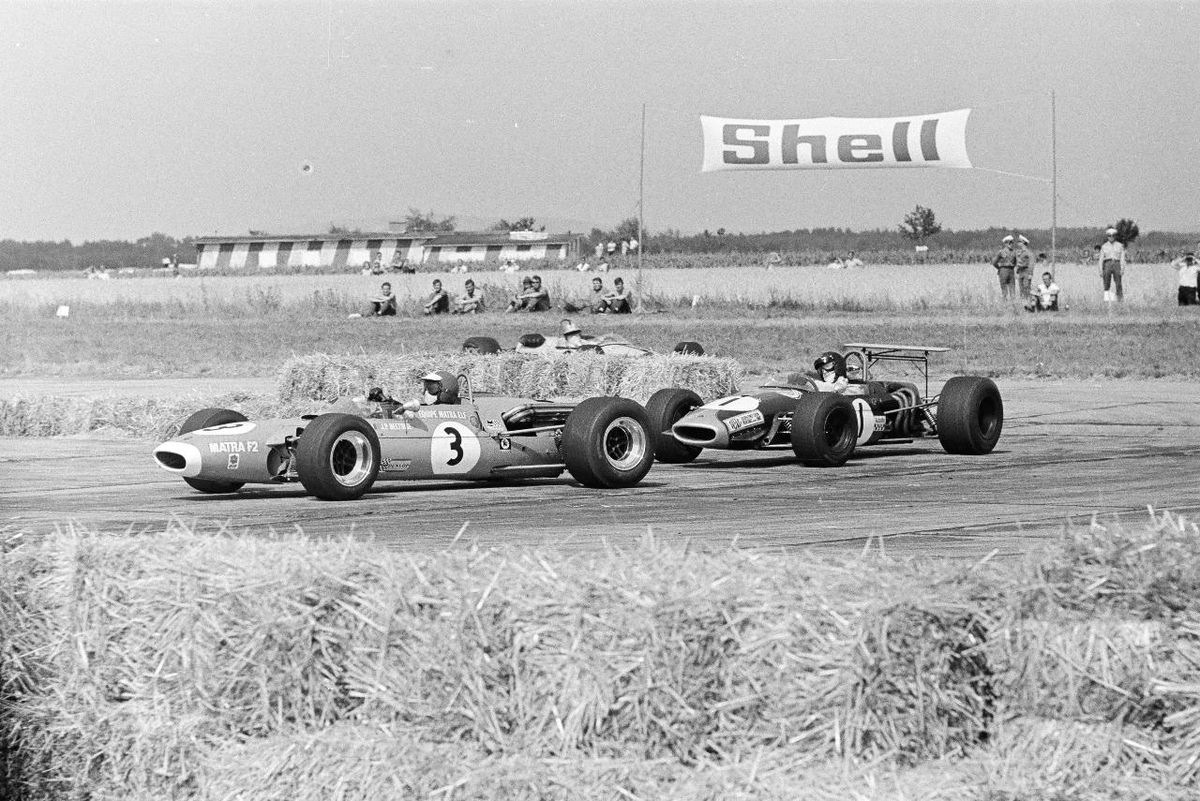
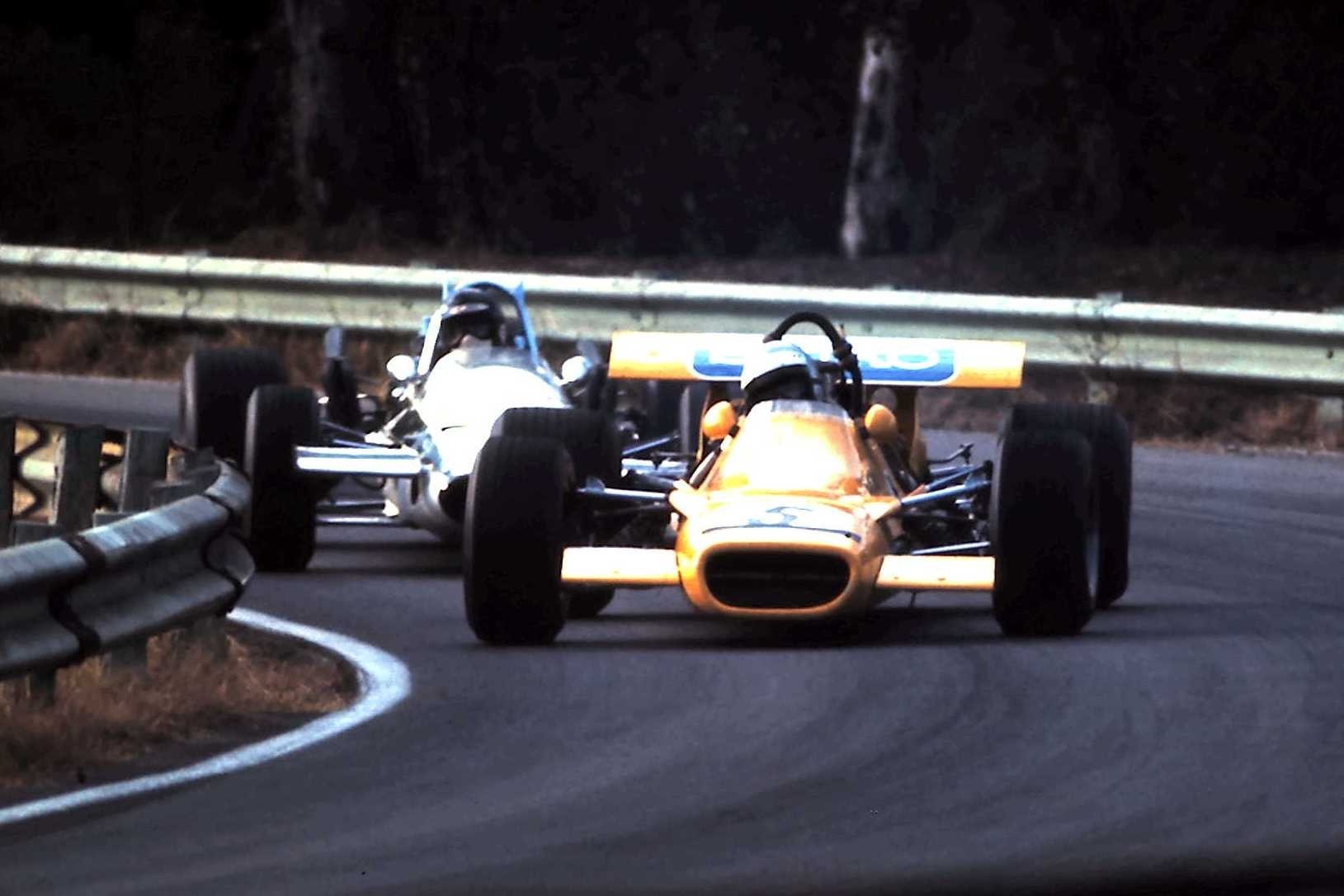
Jochen Rindt doing some Brabham ‘grass cutting’ at the Tulln-Langenlebarn airfield circuit in 1967 with the flair and precision for which he was famous…
There are the ‘thinking drivers’ of course but it’s the ones with mesmerising, other worldly driving skills that ultimately excite.
The high priests amongst these fellows are the likes of Nuvolari, Fangio, Peterson, Villeneuve and of course Jochen Rindt. Only two of these chaps died in bed. In the days when racing cars and the geography in which they raced could and did bite, the law of averages, especially if you played with the extremes of the laws of physics too often could bring you undone.
Rindt from JPB at TL in 1968. He won from JPB and Henri Pescarolo in works Matra MS7 FVA’s. Brabham BT23C’s filled 5 of the top 10 placings (unattributed)
Rindt made his name in F2- he was the dominant player in the class from the time he entered it in 1964 until the time he left planet earth in 1970. For much of that period he raced Brabhams- the chuckability of which were tailor made for the plucky Austrians balls to the wall, tail out, crowd pleasing style. Check out this article about Jochen and the F1 Lotus 72 Ford; https://primotipo.com/2017/05/19/designers-original-intent/
The BT23 family of cars, Tasman and F2/FB variants were ripper cars. They were up there with the very best of customer Brabhams designed by Ron Tauranac, fettled by Jack as to baseline chassis setup and built by Motor Racing Developments in large numbers.
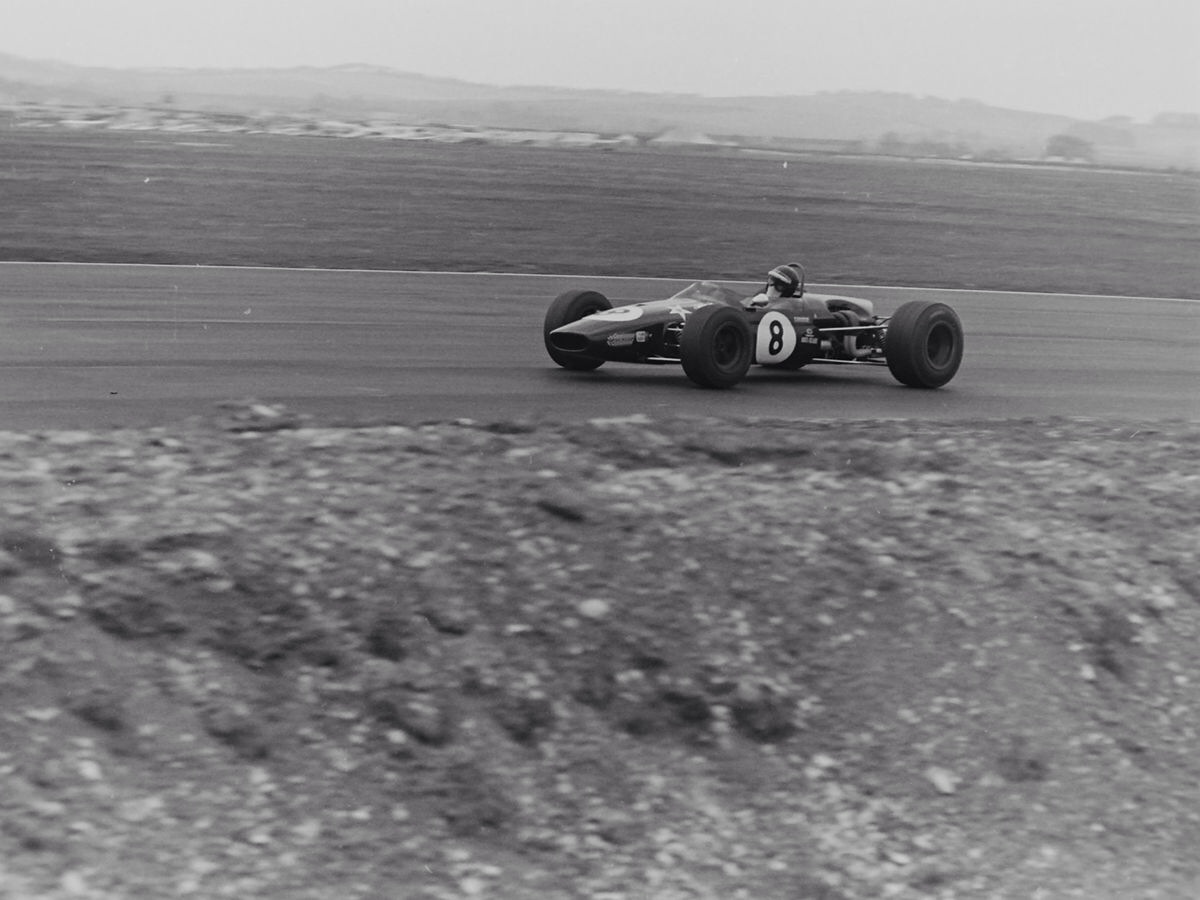
The photos in this article are of Rindt at Tulln-Langenlebaln, Vienna and Thruxton. At TL Rindt’s Winkelmann BT23 FVA won in 1967 from Jack Brabham’s works machine and Jean-Pierre Beltoise’ Matra MS5 FVA , and ‘winged in 1968 from JPB and Henri Pescarolo both aboard works Matra MS7 FVA’s.
At Thruxton (below) in 1968 he won from JPB in an MS7 FVA and Derek Bell in a BT23C FVA. Jochen also raced a BT23C in ’68, again Winkelmann entered.
Jochen on the way to winning the ‘BARC 200’ at Thruxton on 15 April 1968, Winkelmann BT23C (unattributed)
Bibliography…
F2 Index
Photo Credits…
Unattributed
Tailpiece: Rindt, on it, as usual, BT23C, Tulln-Langenlebaln, Vienna, 14 July 1968…
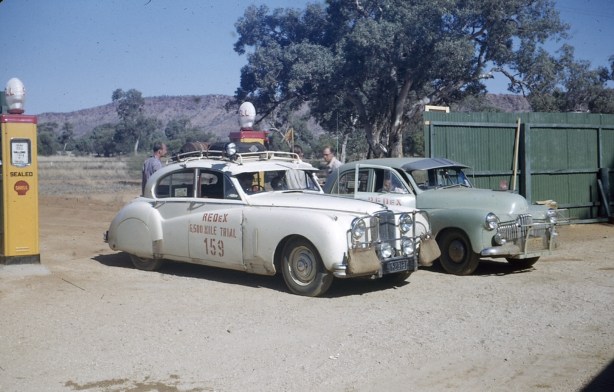
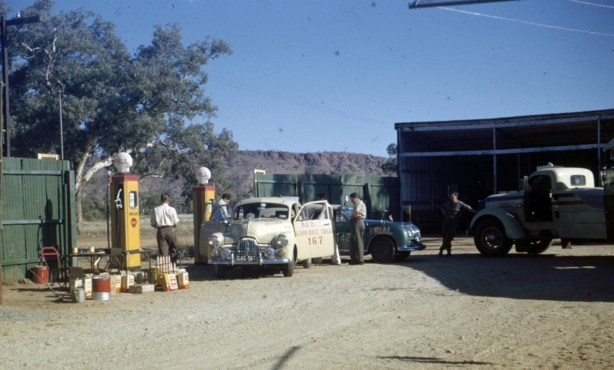
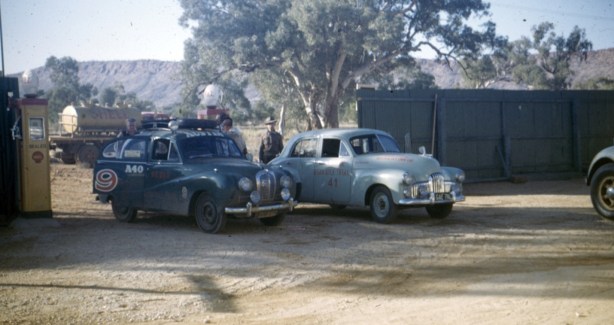
The Northern Territory entered Jaguar Mk7 of B Kingston and a Holden 48-215 line up for fuel at Bonds Chalet, Alice Springs during the 1953 Redex Round Australia Trial on 9/10 September…
It’s a quintessential Alice Springs scene, the red-brown parched soil and mid-green eucalypts framed in the distance by the MacDonell Ranges. Most of us of a certain age attended Primary Schools with artwork by Albert Namatjira, in these hues, hanging on the classroom walls.
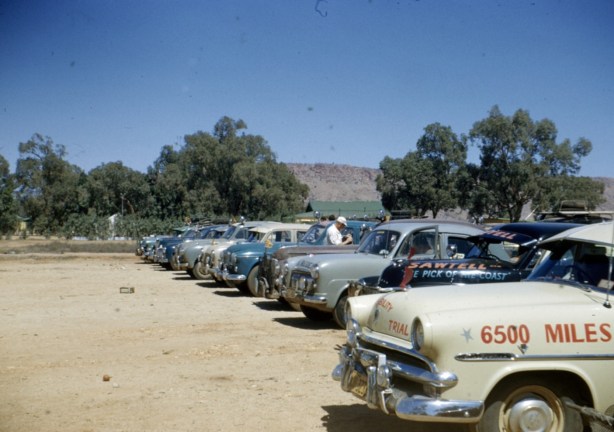
Adelaide based Bonds Bus Tours provided ‘Parc Ferme’ and refuelling facilities for the rally in Alice Springs. These amazing photos were taken by a longtime employee, Kevin Harris. Rolled gold they are too, even though they are of the cars at rest, with one exception.
The post-war pent-up demand for entertainment, in those much simpler times was massive. Bouyed by an economy which was starting to boom, Australians turned out in their thousands to watch the progress of the 187 participants in the 1953 Redex Round Australia Trial.
In part it was because most roads west of Adelaide were challenging to say the least. The fact that the rules provided that cars were largely unmodified meant that the average man in the street could see how his car, or the one he aspired to own went created some interest. Cars were stock other than for underbody protection, carburettor, exhaust, lighting and instrument modifications.
Many of Australia’s better racing drivers competed, not that they were all household names by any stretch, but many were by the end of the decade in part due to their trial exploits in the years to come. The media, by the standards of the day provided massive coverage also fuelling the fire of public interest.
Stan Jones Holden 48-215 and O Yates Austin A40 Atlantic, Stan a tough nut purpose built for an endurance event like this, even if his press-on style was not (K Harris)
Fifty thousand people lined the streets of Sydney from the start at the Sydney Showgrounds at Centennial Park on 30 August and lined the route through the major cities the circus traversed. Whilst the event was styled as a reliability trial it was effectively a race as we shall see. So there were plenty of acts of derring do and accidents aplenty.
Name drivers included ‘Gelignite Jack ‘Murray, the ‘Preston Holden Team’ of Holden 48-215’s driven by Lex Davison, Stan Jones and Charlie Dean. David McKay and ‘Curley’ Brydon ran Austin A40’s and Jack Brabham a Holden 48-215. Norman (father of Alan) Hamilton, the Porsche importer entered a 356, Frank Kleinig a Morris Minor. Jack Davey ran a Ford Customline- the popular radio show host broadcast on local radio stations along the route and had a can of hairspray in the glovebox to look his best at all times. Bill McLachlan ran a Customline, Don Gorringe a Jowett Javelin, Peter Antill, a trials ace raced a Plymouth with Eddie Perkins in a Rover 75, Laurie Whitehead ran a Citroen and John Crouch a Peugeot 203, Ken Tubman another.
Norman Hamilton, Porsche 356, I wonder if this car still exists? (unattributed)
The entry included all of the above as well as an Allard, Vauxhall Velox, Mercedes 200D diesels, MG TD’s, De Soto, Humber Super Snipes and a swag of big, strong 1948 Ford V8’s. In addition were Peugeot 203, Jaguar Mk7, Chrysler Airflow, Hudson Terraplane, Ford Anglia, Zephyr and Consul, Singer 9, Simca, Vanguard, Hillman, Riley and so on!
It isn’t my plan to cover the trial in detail but rather to showcase the Kevin Harris photographs taken during the Alice Springs stopover on September 9 and 19 1953. A summary of the trial, a heavily truncated version of a couple of other articles follows.
B Gurdon Austin A40 and Lex Davison Holden 48-215- the ever versatile Victorian racer/businessman was quick in anything or any sort of event from Trials to GP cars (K Harris)
Ted Hoy’s Chrysler Airflow, car #1 later to play a critical part in the result of the event, was the first to leave the showgrounds at 2pm, the last to travel along Driver Avenue was a Queenslander, Miss J. Hill aboard a Renault 750 at 11.33pm.
150,000 people lined the streets through Sydney’s northern suburbs to Hornsby to watch the start of this amazing 6500 mile adventure, the second longest event of this type in the world at the time. The first breakdown was a Jaguar Mk7 which died near the Hawkesbury River only 52 Km from the start!
The leaders averaged about 50 mph (80 km/h) up the Pacific Highway to Brisbane, with mechanical failure taking points from some of the novices. The first bad accident happened near Gin Gin, when Patience/Binks hospitalised themselves after rolling their Ford V8 down an embankment.
The field didn’t strike unsealed roads until after clearing Rockhampton. The challenges began with corrugations, culverts, cattlegrids, washaways, dry creek beds and everything else the vast brown land could throw at them. McLachlan, one of the favourites, lost two hours 15 minutes with water pump failure on his Customline, but still made the Mackay control on time.
In 24 hours’ rest at Townsville, the organisers counted 177 cars in control with 128 clean-sheeters.
The Antill Chrysler Plymouth, no idea where (unattributed)
At this point the trial stopped being a rally and became a road race.
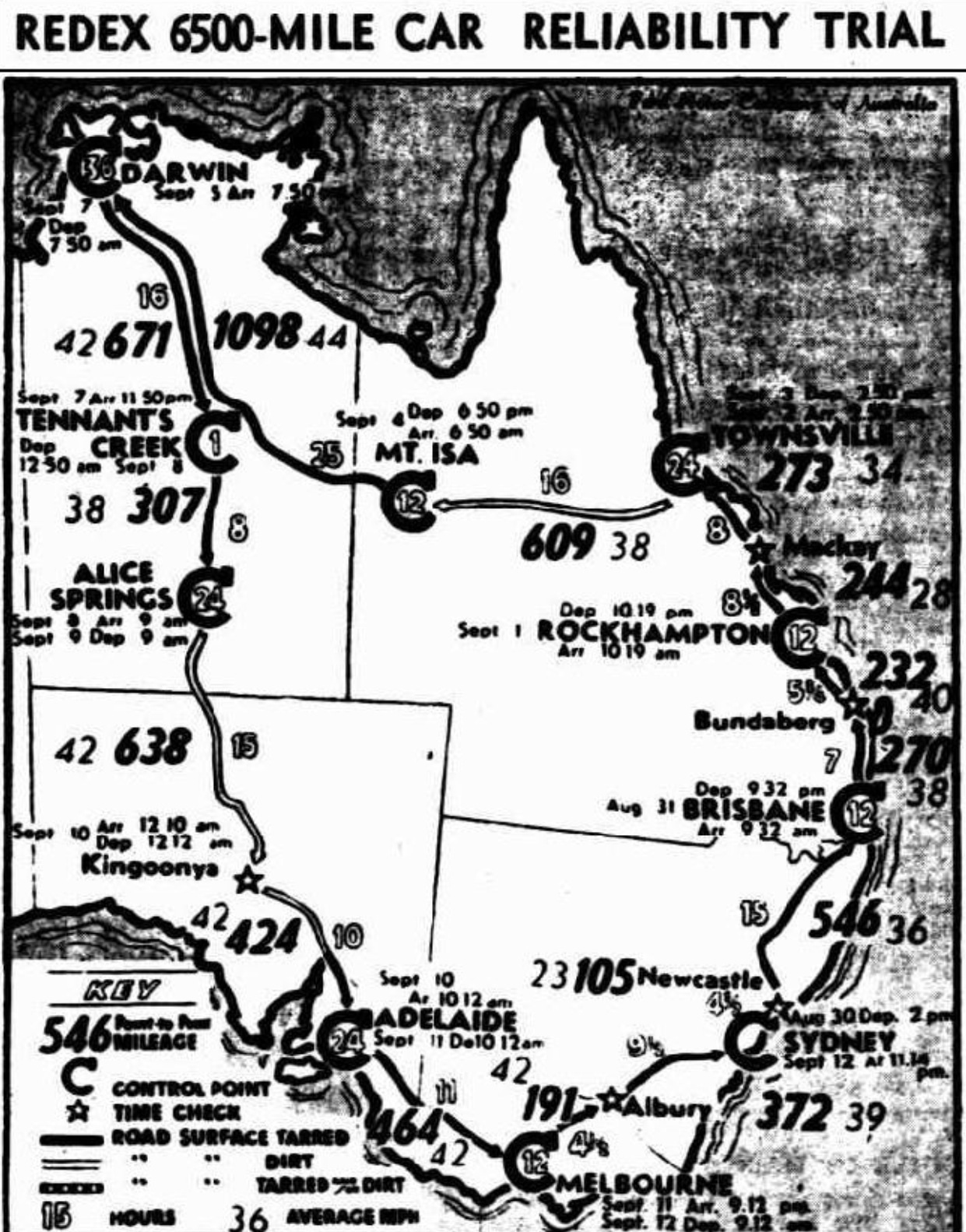
Word went thru the field that the organisers had decided that if several crews reached Sydney without loss of points, their times on the Townsville – Mt. lsa and Alice Springs – Adelaide sections would decide the winner. They were given 16 hours to cover the 609 miles (980 km) from Townsville to lsa. It was ‘game on’ amongst the racers.
Peter Antill’s Plymouth was fastest with an incredible 13:22. The first car to reach Mt. Isa was Possum Kipling’s, 14 hours 12 minutes after leaving Townsville. He had to get the control officials out of bed, he was so early!
Behind him was a nightmare of crashed cars, irate police and horror stories. Half the field was spread across most of Queensland. Bill McLachlan was directed wrongly in the middle of the night and drove 136 miles (219 km) off course before getting back on the right road, only to hit a cattle grid that had been de-guttered by the field. Stan Jones hit the same grid.
Bonds Alice Springs vista ( K Harris)
Bill Murray rolled his Plymouth, Hamilton’s Porsche hit a kangaroo and deranged its front suspension, driving the rest of the way into the Isa on the undertray. The last car, Anderson in a Skoda, staggered into town after a 24 hour 44 minute trip following a trail of wreckage
The next stage over bitumen to Darwin, was 1098 miles (1760 km) the average set at 44 mph (71 km/h). Antill hit a galah (indigenous bird) which took out his windscreen, his car already had a cracked chassis.
McLachlan had broken his Customline’s diff housing, but the medium-sized cars, like the Holden of Kipling, who was second into Darwin, and the Rover of Perkins, 3rd into control, were in good shape.
‘Wheels’ magazine in its report of the trial wrote: ‘The myth that the only car suited for Australian conditions was the large American vehicle had been exploded’.
‘Parc ferme’ #114 Charlie Deans Holden 48-215, the master engineer taking time away from his Repco Research/Maybach race preparation duties but no doubt keeping some kind of eye on his driver S Jones Esq in one of the other ‘works’ Holdens. Stan very much one of the quickest guys in Australia at the time and stiff not to win the Australian Grand Prix in Maybach 1 that November with mechanical problems ( K Harris)
From Darwin 132 cars set out for an easy drive down the bitumen to Alice Springs for servicing and repairs at Tennant Creek, then on to the Alice.
At Alice Springs the field stopped at Bonds facilities as shown in the photographs. The cars were scheduled in from 8.51am on Saturday the 9th, and out, commencing 12.01am on the 10th.
Of the 41 clean-sheeters who departed Darwin, 38 were there when the field lined up for 368 miles (592 km) of desert to Kingoonya.
This stretch was considered impossible to cover in less than 48 hours- the organisers had set a time of 15 hours 10 minutes. In addition the field were given only one hour’s rest at Kingoonya before despatch for the 424 mile (682 km) run to Adelaide, an an average of 42 mph (68 km/h).
Lex Davison arrived in Kingoonya in an unbelievable 13 hours 39 minutes. Second was Possum Kipling in another Holden in 14:10. Tom Sulman, prominent racer, was fastest in his Humber Super Snipe when he emerged from the desert and drove south to Adelaide.
Magic scene, the Cusso framed between the truck wotizzit? and old Shell bowsers. Driver is S Levy, NSW (K Harris)
By Adelaide there were 11 clean-sheeters. Crews had to be lifted from their cars after up to 60 hours at the wheel without a break!
The road had decimated the field, who limped in with hair-raising tales of tying up rear suspensions with tyre chains, living underground at the opal mining settlement of Coober Pedy, jamming coir matting into a broken front end to keep going and crew members going crazy from the dust and heat.
The field of 11 clean-sheeters who left Adelaide faced only bitumen roads through to the finish in Sydney via Melbourne. They were Davison, Kipling and Davies in Holdens, Perkins (Rover), Tubman (Peugeot), Sulman, Ken Robinson and Jack Masling (Humber Snipe), Antill (Plymouth), Nelson (Vanguard) and David McKay (Austin A40).
HR Smith, Pug 203 from WA, no idea where the crossing is (unattributed)
The journey was easier given the sealed roads and by this stage the police were very stroppy ‘about the crazy high speeds’. As a consequence the organisers threw in a special section or stage to help break up the field.
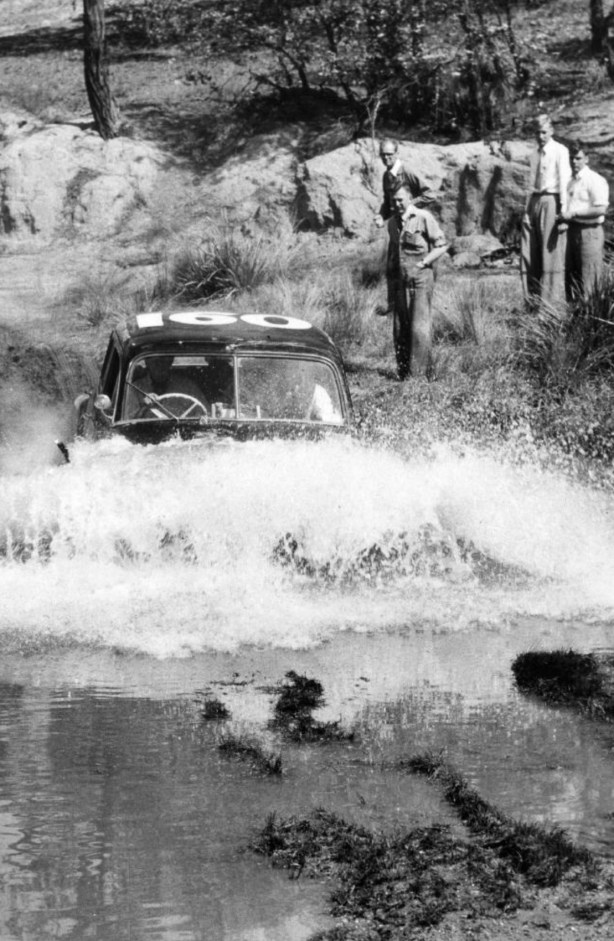
An 11-mile (17.7 km) stock route was chosen between Marulan and Bowral in NSW, part of a 30-miles (48 km) long elimination section which included a flooded river crossing, Paddy’s River. It was a metre deep with several cars being washed downstream.
Some drivers stopped and fitted protection in front of the radiator before entering the water, but the winner of the event, Ken Tubman was one who elected to drive right through. He stalled, but the 203’s engine restarted.
The Paddy’s River crossing and the strange action of Hoy, the man who had retired his Airflow at Mount Isa, got bogged, with the whole field held up for at least 30 minutes. The drivers naturally tried anything to get around him and save points.
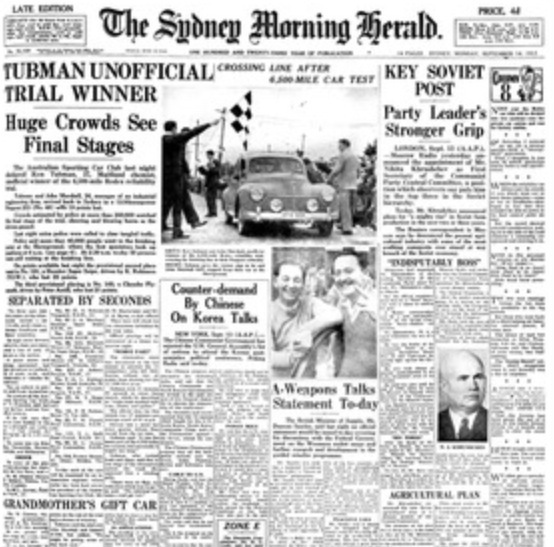
No-one is quite sure what happened to whom or who set up the stage. The contest was so tight it took five hours for the Australian Sporting Car Club to work out that 37 year old Ken Tubman and his navigator, John Marshall won in their Peugeot 203 by 25 seconds from the Robinson Humber Super Snipe- 25 seconds after 10,500 kilometres of murderous country!
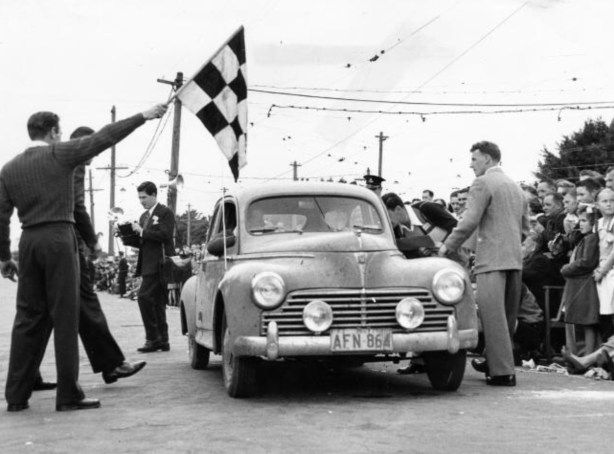
Ken Tubman and John Marshall take the chequered flag in Sydney. Results not announced until some 5 hours later. Peugeot 203 (unattributed)
In one of those ‘Win On Sunday, Sell on Monday’ moments the victory caused a sales rush on Peugeots- every new Pug in the country was sold within a week.
The first Redex Trial went down in the annals of Australian automotive history as one of the harshest long-distance events ever run. It had everything- characters, heroes, bravery, stupidity, crashes, ingenuity and mayhem!
Off the back of its 1953 success, 31 203’s were entered in the 1954 Redex, that year won by Jack Murray’s Ford. Ken Tubman competed in rallies well into his sixties winning a re-run of the trial from ‘Gelignite Jack’ Murray in 1974. He also took part in a 1983 anniversary re-run in a Peugeot 505. He died at his Maitland, NSW home in May 1993.
Bibliography…
Redex.ru, Unique Cars and Parts
Photo Credits…
Kevin Harris
Tailpiece: End where we started with the Kingston Jag Mk7, here lifting its skirts as it leaves Alice Springs…
The highest paid Dunlop tyre fitter in the world attends to the needs of his Lotus 32B Climax, Warwick Farm, 1965…
Its practice prior to the ‘Warwick Farm 100’ so Jim Clark assists Ray Parsons in between on-circuit sessions on the Friday or Saturday before the race.
Its Frank Matich zipping by in his Brabham BT7A Climax, he was quick too, off pole and led Clark and Graham Hill for much of the first lap. He was 3rd, five seconds behind Brabham in 2nd with Jim a minute up the road from Jack in an emphatic victory.
Roy Billington, Brabham’s chief mechanic is the black clad dude to the left of Jim. In the white helmet is the tall, lanky frame of Frank Gardner and beside him his Alec Mildren Racing Brabham BT11A Climax. A DNF for Frank that weekend with Coventry Climax engine dramas on lap 25.
(Telegraph)
In the photo above Roy Billington is tending Jack’s BT11A, its Jim’s Lotus behind. The tall fellow to the right, in the cloth cap is, I think Lex Davison- Lex retired on lap 3 with a busted steering wheel in his Brabham BT4, an odd failure for a driver of considerable deftness and touch.
‘Topless’ behind Lex is Jim Clark talking to Warwick Farm boss, Geoff Sykes- to the left near the pit counter is again Frank Gardner.
Its all happening, as I say…the first six home were Clark, Brabham and Matich, then Bib Stillwell, Brabham BT11A, Graham Hill similarly mounted in the Scuderia Veloce entered machine and then Kiwi Jim Palmer in his BT7A.
Credits…
Daily Telegraph, oldracingcars.com, Bruce Wells on The Roaring Season
A promotion for Indian motorcycles, Adelaide 1923, the only items missing are a bow and arrows…
I spat my chockie biscuit out when I came upon this snap! Too funny and sooo politically incorrect and unacceptable in todays societal morays. I think I would have slotted into 1923 quite nicely.
Details are few other than the three bikies were at a sporting event, I’m guessing the Indian bloke hailed from the Adelaide suburbs rather than the American prairies.
As to locale, its probably not the go at the Adelaide Oval during the cricket, and the ‘Speedway Royal’ Wayville, just outside Adelaide’s ‘Square Mile’ hadn’t quite opened yet, so who knows where it is.
Anyway. Look and laugh, just luvvit! I mean no disrespect to any North American Indian readers, my mirth is at the ‘creativity’ of the Indian ‘Sales and Marketing Team’ here in Australia. Still no doubt it achieved the ‘cut through’ marketers seek.
As to the model of bike, the Indian lineup about then was the ‘Scout’, ‘Chief’ and ‘Big Chief’. I’m guessing it’s the 1200cc Big Chief, coz that’s what the dude on the bike looks like!
Credit…
Searcy Collection- State Library of South Australia
What’s it like out there Don? How’d the McLaren go…TV news interview for Don O’Sullivan aboard his McLaren M18 Repco Holden F5000 after winning the West Australian Road Racing Championship at Wanneroo Park on 7 May 1972.
O’Sullivan won the 35 lap race from John Harvey’s Bob Jane owned Brabham BT36 Waggott 2 litre, Bob Ilich in a Brabham BT21B Cosworth SCB 1.5 and Bernie Zampatti’s ZX5 Ford.
Don O’Sullivan is a very successful Perth businessman who mixed a racing career in amongst his property development and road car sales ‘The Chequered Flag’ enterprises. He commenced racing in the early sixties in Western Australia and quickly progressed through a couple of Tasman Cooper Climaxes and was soon racing a Lola T70 Chev.
Don O’Sullivan in the hi-winged Matich SR3 Repco ahead of Niel Allen’s Elfin 400 Chev at Warwick Farm in early 1969 (oldracephotos.com/D Simpson)
At elite level in 1968 he raced one of Frank Matich’s Matich SR3 Repco’s and then switched to single-seaters racing several McLaren F5000’s.
The first was an M10A acquired from Matich. Having written that off at Teretonga in early 1971 he bought a new M18 to which a Repco Holden engine was fitted by his ace engineer/mechanic Jaime Gard. This car was raced into 1973.
Don and Jaime then decided to build a 5 litre sportscar and F5000, they therefore acquired an M18/22 Chev from Trojan Cars in the UK as a donor vehicle. But upon close inspection when it arrived in Perth, the M18/22 was of better specification than their low mileage M18 so they decided to race the M18/22 Chev and use the M18 as a parts car for their Gardos Sportscar and Gardos F5000 car. Goddit?! This was all achieved between early 1971 and early 1974!
This piece is the tale of these F5000 cars and the Gardos Sports.
It was all relatively complex until the story was unravelled bit by bit online on various forums by a swag of F5000 enthusiasts. The shared knowledge was then encapsulated in individual car chassis histories on Allen Brown’s oldracingcars.com website. Fifty percent of my articles use oldracingcars as a primary research source, have a fossick on the site if you have not done so, you will be lost for days if not weeks.
Here we go, come back here to the summary if you get confused or lost!
Frank Matich at the Thomson Road Course, Singapore GP weekend in 1970- FM destroyed the M10A Chev chassis in a preliminary race accident (E Solomon)
McLaren M10A ‘300-10’ Chev/Repco Holden…
This car, first owned by Frank Matich was the first ‘real F5000’ imported into and raced in Australia. So confident was FM of the CAMS introducing F5000 to succeed the long-lived and much loved Tasman 2.5 Formula as Australia’s next ANF1 that he acquired the car well in advance of that vexed, to say the least, choice between between 2 litre and 5 litre options.
The car arrived in August 1969 and was quickly developed to M10B specs by engineer/mechanic Derek Kneller and FM. Kneller arrived from McLaren the week after the M10A arrived in Australia, fresh from building Peter Gethin’s M10B- the first such chassis built at McLaren, so was eminently qualified to make the modifications from A to B specs. See my Matich F5000 for more details on this car and the modifications made to it.
Ian Messner and Jaime Gard tending to O’Sullivan’s M10A Repco with the Matich M10B Repco alongside, Teretonga 1971 (I Messner)
The car was very successful, taking four poles and wins at Pukekohe and Wigram during the 1970 Tasman Series. It was damaged in a preliminary race at the Singapore GP meeting in 1970 and was replaced by a new M10B to which the first Repco Holden F5000 V8 was fitted. This car won the 1970 AGP at Warwick Farm.
The M10A was repaired at the Matich workshop in Sydney, fitted with a Repco Holden F5000 V8, sold to O’Sullivan and entered as a Rothmans Team Matich entry during the 1971 Tasman.
Yes blokes its absolutely rooted! M10A ‘300-10’ at Christchurch Airport on the way back to Oz, 1971. No amount of work with adjustments to spring platforms will sort the car in time for Surfers! (I Messner)
Don was 12th in the opening round at Levin, 7th on the Wigram Airbase circuit and failed to finish the NZ GP at Pukekohe with half-shaft failure. During the early laps of the Teretonga round, O’Sullivan pitted to have the cars nose taped in place having hit Malcolm Guthrie’s Lola T192 up the chuff. He set off and crashed into an earth bank after an off at the Hairpin whilst waving another car through, bending the cars chassis but not injuring himself.
Another shot of M10A ‘300-10’ @ Christchurch Airport RIP. The Matich M10B ‘400-10’ is already on the aircraft delivery trolley (I Messner)
As the photos post accident show the tub was destroyed, beyond economic repair so was scrapped, with all salvageable components removed from the tub back in Perth.
Some parts of ‘300-10’ were used in the Gardos cars. We will come to these racers soon. The more immediate problem was acquisition of a replacement car for the ’71 season which was well underway. The first round of the Gold Star Series was at Lakeside, Queensland in June, a long way from Perth!
McLaren M18 ‘500-08’ Repco Holden…
Don and Jaime decided to acquire a new McLaren M18, the then current Trojan Cars built, customer F5000 McLaren.
The car first appeared at Wanneroo Park during the WA Touring Car Championship meeting on 19 September 1971, failing to finish.
The M18 was designed for the Chev V8 to be used as a stressed member, the major difference between it and the very successful M10B.
In the M10A and M10 B the engine/’box were attached to the full monocoque chassis which extended beyond the drivers bulkhead, where the tub of the M18 ended, to the rear of the car. Have a look at the photos of the M10A monocoque in the Teretonga shots and the M18 below to appreciate the differences between the two chassis.
‘500-08’ was adapted by Jaime Gard to fit Don’s Repco Holden F5000 V8 out of the M10A, with the engine, unstressed, supported by a steel A-frame which extended from the rear of the monocoque to the DG300 gearbox bellhousing.
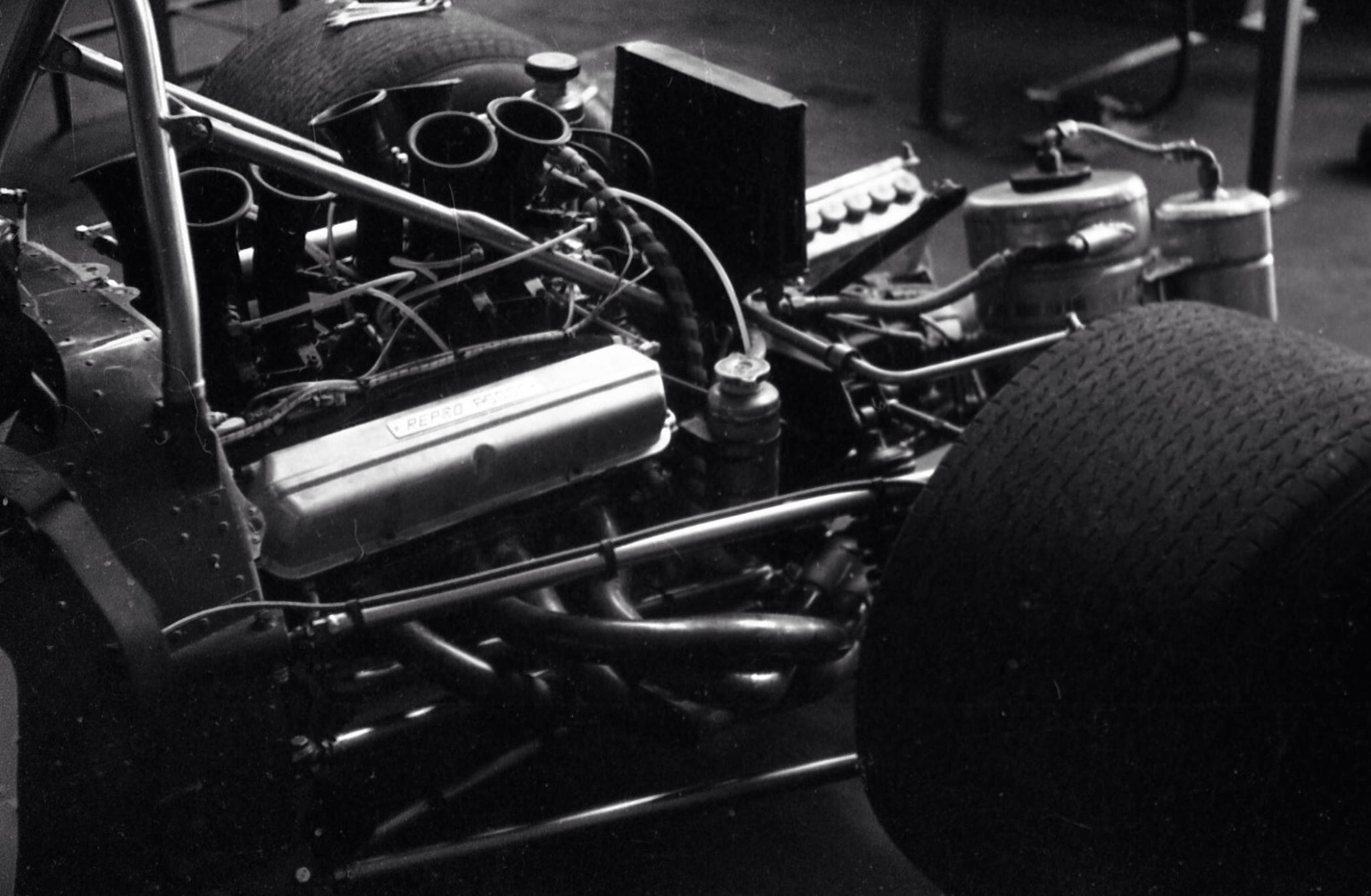
M18 rear shot sans DG300 Hewland. Repco Holden F5000 circa 480bhp V8. You can see how the tub ends at the drivers seat bulkhead, and the A-frame supporting the engine which attaches to the rear of the tub and the bellhousing. Clutch twin plate Borg and Beck? (J Bondini)
The excellent detail photos of the car above and below were taken at Repco’s Maidstone factory in the Western suburbs of Melbourne. Redco Pty. Ltd built the Repco Holden F5000 engines here and Repco Brabham Engines Pty. Ltd. the F1/Tasman/Indy/Sportscar series of motors from 1966-1970. Others of this series of shots are included at this articles end for M18 fans.
In essence the M18 was underdeveloped at the seasons outset in Europe and was eclipsed by the Surtees TS8, Lola T192 and the quickest of the M10B’s which had been extensively developed in Europe, North America, South Africa and Australasia. The M10B was one of THE great production racing cars.
O’Sullivan’s racing programs were always sporadic, doubtless fitted in amongst business commitments and pressures, in addition Perth is a long way from the eastern seaboard circuits, trips east a major undertaking.
The M18’s first national event was at the 11 October 1971 Mallala, South Australia Gold Star round (DNS, oil leak) in the first race win for the Elfin MR5 Repco, John McCormack the driver on that occasion.
Jaime then towed the car to Sydney where Don raced at the Warwick Farm Australian AGP on 21 November. He qualified 13th in a field of depth and crashed out of the race on lap 21. His colleague, Frank Matich, won that day aboard the brand new Matich A50 Repco in a splendid display of dominance ‘out of the box’.
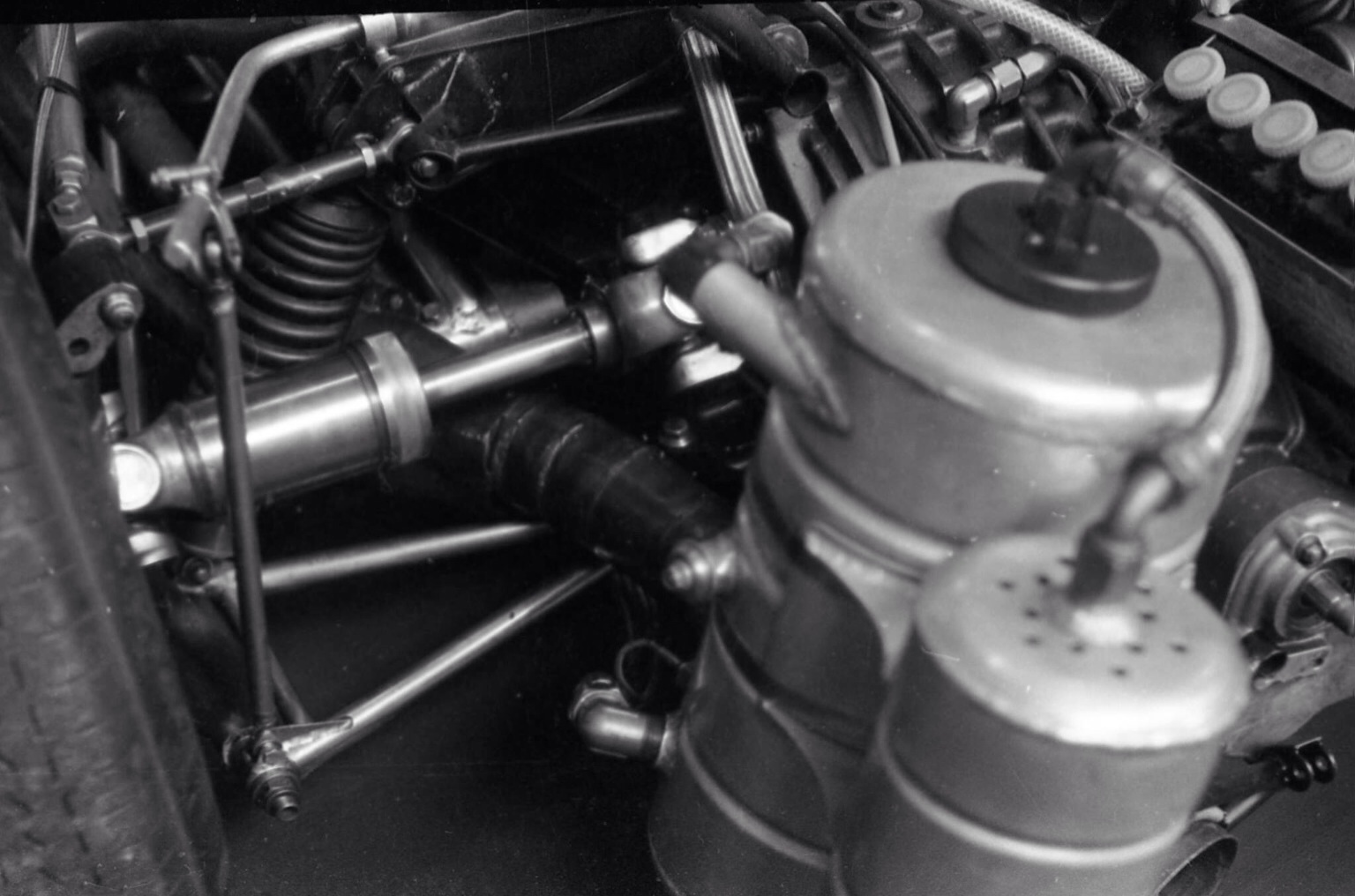
Front suspension detail: wide based lower wishbone, top link and rear facing arm, Koni shocks, coil springs, adjustable roll bar, Lockheed calipers and Aeroquip lines. Nice (J Bondini)
Into 1972 the car raced at the Motorama TT meeting at Wanneroo Park in April for 2 wins. Howie Sangster, later to race both the M18 and M22 McLarens was at this stage regularly racing, and had been for some time, Don’s McLaren LT170 Chev sportscar. That car, an amalgam of Lola T70 and McLaren componentry is a story in itself for another time!
A month later Don won the West Australian Road Racing Championship in the car, that meeting is the one featured in the opening photograph of this article.
The M18 raced in Queensland, at the Surfers Paradise Glynn Scott Memorial Trophy Gold Star round in 1972 and was by that stage said to be updated to M22 spec, still Repco powered but from this point is described as a M18/22. (It is still listed as an M18 in Western Australian records mind you in ‘Terry Walkers Place’)
The car was entered at the Symmons Plains Gold Star round in Tasmania but did not arrive. Perth and Launceston are two ends of the country after all! O’Sullivan raced the car in the Adelaide Gold Star round on his way back to Perth in October for a DNF with handling problems.
Howie Sangster raced the car for Don at Warwick Farm in the November 1972 Hordern Trophy. He qualified 8th on the technically demanding circuit but DNS for undisclosed reasons.
The car was not entered for the ’73 Tasman but raced in some local meetings at Wanneroo Park in 1973- the first was the Sterling City Speed Classic in March with O’Sullivan taking two wins. At the Autumn Cup meeting in April he again took two wins.
By the time of the WA Racing Car Championships in the Spring Carnival meeting on 16 September O’Sullivan had bought the later ex-Redman/Hobbs/Teddy Pilette VDS McLaren M18/22 Chev. He won the championship in the M22 Chev.
McLaren M18/22 ‘500-01’ Chev…
Into 1972 it was pretty clear the F5000 way to go was Lola, the T300 and McRae GM2 were the ‘ducks guts’ cars, mind you a Matich bought from Don’s old mate from Sydney would have been a credible choice!
But Don and Jaime had plans to build both a sportscar and an F5000 machine and they had plenty of McLaren componentry already so they started to look at cars for sale. The ex-works McLaren M18/22 ‘500-01’ being offered by Trojan Cars was well known to the Perth boys as the car was raced with some success in the 1972 Tasman Series by David Hobbs. Hobbs won the final round of the series at Adelaide International in it.
It was Gard’s intention to use the M22 ‘500-01’ as the donor components car for the Gardos Sportscar but when the pair landed it in Perth they soon appreciated that the M22 was a more advanced design than their low miles customer M18 ‘500-08’.
On that basis they decided to keep intact the M22 Chev as the F5000 weapon until their proposed Gardos F5000 car was built and use the bits of the M18 for the Gardos Sports, the build of which is covered later in this article.
Business end of the M22 Chev in the Surfers Paradise Tasman paddock in 1972 (unattributed)Gardos Repco Sports in the Phillip Island paddock during the Australian Sportscar Championship meeting in November 1975. M8D design such a sexy beast! By now ‘McLaren’ is writ large on the Gardos’ nose (M Bisset)
The Gardos Sports was built by Gard and his team in Perth to McLaren M8D drawings but using much of the F5000 M18 hardware rather than the usual Can Am kit used by Trojan and McLaren in their customer/works Can Am cars. Powered by a Repco Holden F5000 engine and using a DG300 Hewland gearbox, it was first raced by Don at Wanneroo Park during the 6 May 1973 Australian Touring Car Championship meeting.
The timeline here is interesting, for historians at least!
The last race for the M18 was at the Wanneroo Autumn Cup meeting on 8 April 1973. The first race for the Gardos Sports, which used much of the M18 componentry, was at Wanneroo Park on 6 May 1973. Clearly, given the foregoing, the Gardos Sports was completed between those two dates, with critical bits of the M18 removed from that chassis and fitted to the all but complete Gardos Sports. The chassis of the M18 was not used in the Gardos Sports project, but was put to one side for later use in the build of what became the Gardos OR2 F5000.
Several months later, after the Gardos Sports debut, O’Sullivan was 3 seconds a lap quicker in practice for the Australian Sportscar Championship round held at Wanneroo on 14 August.
He DNF’d having qualified equal 3rd, the race won by Lionel Ayers’ Rennmax Repco V8- that car powered by a Repco Brabham Engines 760 series 5 litre SOHC engine.
Lets now go back to McLaren M18/22 ‘500-01’, a McLaren works built car, not a Trojan customer car. It would be rather a nice thing to have as you will see!
During 1971 Brian Redman, Peter Gethin, Derek Bell and Reine Wisell raced it entered by Sid Taylor Racing.The car was then returned to Colnbrook, where McLaren updated it as the prototype M22. It was then raced by Hobbs in Australasia. The chassis was returned to the UK and formed the basis of the first ‘real’ M22 which was raced by Teddy Pilette until May when it was replaced by the first Trojan built production M22.
The car was then sold to O’Sullivan as noted above and first raced at Wanneroo in the 16 September 1973 ‘Spring Carnival’ meeting winning the WA Racing Car Championship, as he had done in the M18 Repco the year before.
O’Sullivan and Sangster shared the M22 races in the Cancer Crusade Classic at Wanneroo on 21 October with Don taking one victory and Howie two.
Sangster then drove the car in the AGP at Sandown on 4 November, the meeting in WA gave him valuable seat time in advance of his drive . In fact, in Melbourne, having attended the meeting, the car looked wonderful in a fresh coat of ‘O’Sullivan Dark Blue’, with Howie doing a very good job on the unfamiliar, fast circuit with a strong, reliable 4th from grid 6. Graham McRae won the race in his almost brand new, jet black, McLaren M23 like McRae GM2 Chev. My god that car looked great! I think the GM2 had one race in the UK before being shipped from the Poole factory to Melbourne and a win.
The final round of the 1973 Gold Star was a couple of weeks after Sandown, also in Victoria at Phillip Island on 25 November, so the West Australians raced the M22 there before heading home to the West. Howie retired with throttle problems, again qualifying well in 6th – on this fast, demanding, technical circuit it was a good showing. In fact it’s a shame Sangster’s career did not advance further after O’Sullivan’s closure of his team, there are enough flashes of speed to indicate plenty of talent in the guy.
The M22 was not raced again by the O’Sullivan team who by that stage were well into the build of their new Gardos OR2 Repco Holden F5000 which they planned to run in the 1974 Tasman Series.
As a result the M22 was offered for sale and eventually sold to Adelaide’s Chris Milton, the talented engineer/driver ran it in the ’75 Tasman, ’76 Australian Internationals and into later 1976.
After Milton started to drive the Gardos OR2 several years later, the M22 was sold to Melbourne sportscar exponent Alan Newton who raced it in a couple of rounds of the 1978 Australian International Series, before being out to one side. All these decades later he still has it!
M18/22 ‘500-01’ would be a very nice jigger to own given it’s a factory built McLaren and the large number of pilots of international calibre who sat in its tight fitting cockpit!
Keith Poole testing the just reassembled Gardos OR2 Repco at Adelaide International Raceway in February 1976 (K Pedler)
Gardos OR2 Repco Holden…
Whilst Howie Sangster raced the new McLaren M22 Jaime Gard was busy in Perth building Don his new F5000 car using some of the components of the M18. The new car made its debut at the Adelaide Tasman round, the last of the series in February 1974.
The aerodynamic direction of racing cars at the time was ‘up in the air’, there were as many practitioners of the Lotus 72 chisel nose/side radiator school as the Tyrrell bluff nose approach. Examples of the former in F5000 at the time include the Lola T330/332, Matich A53 and of the latter the Chevron B24/B28 and Elfin MR5.
Jaime decided on the chisel nose/side radiator approach for his new car, the aluminium monocoque used the M18 bulkheads, which were slightly modified and in typical F5000 style ended at the bulkhead behind the driver with a steel sub-frame carrying the Repco Holden engine as an unstressed member.
Keith Poole and David Craig assembling Gardos OR2 in Adelaide in early 1976. Monocoque chassis bespoke by Jaime Gard but used M18 bulkheads. Suspension geometry different to M18 but used M18 uprights. Note rear/side radiator and Repco Holden, Lucas injected V8 (K Pedler)
They had a choice of engines of course, and stuck with the Repco Holden F5000 unit. A logical choice at the time- the Perth guys were not to know Repco were only months away from withdrawing from motor racing. But in late 1973 their engines were as good as any, Matich had shown the power of the latest Repco flat-plane crank unit was equal to the best Chevs circa 525bhp to be precise, with the big, fat mid range torque the Repco’s were always renowned for a bonus.
Gard revised the suspension geometry of the car, but used M18 uprights. The car was utterly conventional with upper and lower wishbones at the front and multi-link at the rear- single top link, twin lower links and two radius rods for fore and aft location. Coil springs and Koni shocks were used as of course were adjustable roll bars. The steering rack was from the M18.
Gardos OR2 pretty as a picture, ready for the off at AIR in early 1976. Airbox off the M18/22 at a guess (K Pedler)
The sad part about the Gardos is that it raced so little ‘in its prime’, that is when first built.
When completed the car was tested at Wanneroo and then entered in the last 1974 Tasman round at Adelaide International Raceway. Howie Sangster raced it qualifying 14th only 1.6 seconds slower than Max Stewart’s 49.7 second pole time in his Lola T330 Chev. He finished, albeit with only 41 laps to his credit with no doubt a range of teething problems.
And that was it for the Gardos under O’ Sullivan’s ownership.
The car languished through the rest of 1974 and 1975- not raced locally either before being sold to David Craig of C & C Autos in Adelaide.
Craig acquired both cars- the OR2 F5000 and Gardos Sportscar- Keith Poole, a local motor engineer and Formula Vee champion stepped up to the plate to race both, 5 litre 500 bhp cars! The OR2 was reassembled by K&A Engineering in Adelaide with Jaime Gard doing the final suspension setup for testing.
The team missed the first round of the 1976 Internationals at Oran Park but Keith qualified the car a strong 9th at his home track and finished 7th in a race of attrition. At Sandown he was 12th on the grid and blew a welsh plug, non-starting the final round at Surfers Paradise.
He was 2nd to Paul England in the Australian Hillclimb Championship at Collingrove, in South Australia’s Barossa Valley.
The car was unraced in the 1976 Gold Star but Chris Milton leased it to contest the 1977 Internationals, the same fellow who had acquired the M22 ‘500-01’ several years before. Later in 1977, Milton bought a Lola T330/2.
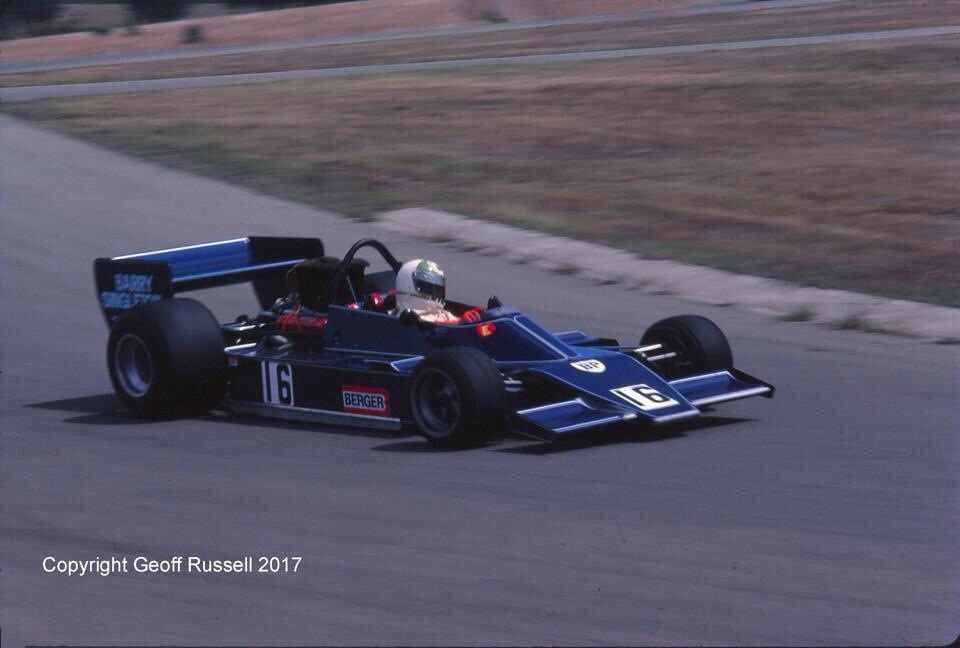
Craig then sold the Gardos to Queenslander Barry Singleton, who had it rebuilt by Kaditcha’s Barry Lock in Queensland following fire damage which occurred at C&C. It was remodelled by Lock more than once during Singleton’s ownership, eventually having ground-effect sidepods fitted.
Singleton raced the Gardos at Surfers Paradise during the 1979 Rothmans International series and then crashed it at Oran Park. He was sixth at the Australian Grand Prix at Wanneroo Park in March. The car next appeared in June 1980. (a DNS at Lakeside) He was an early retirement from the November 1980 Australian GP at Calder Park- the race run to F1 and F5000 regs won by Alan Jones Williams FW07 Ford GP car.
He put in one last appearance in Sep 1981 at Sandown Park but finished last as F5000 just spluttered along- Formula Pacific was by then Australia’s ANF1.
Singleton then sold the Gardos to Bob Minogue, who sold it on to Brian Sampson. Then Peter Roach, previously the owner of a Matich A50 bought it in the late-eighties and sold it in 1992 to Graham McMinn, who had the chassis rebuilt by Brian Shead of Cheetah fame in Mordialloc, Melbourne before selling to Max Warwick in 1997. In 2001, it was sold again to Chris Watson in NZ and has in recent times joined the healthy Kiwi F5000 Historic grids. Which is great to see it finally reappear.
Gardos Repco Holden Sportscar…
Just to recap the story earlier in this article. Don and Jaime planned to build a sportscar to Australia’s 5 litre limit and acquired the M18/22 ‘500-01’ as a donor car. When the car arrived it was clear to the enterprising West Australians that it was of later spec than their M18- so it was decided that it would be the parts car. The Gardos Sports was to be powered by one of the teams Repco Holden F5000 V8’s, the transmission a Hewland DG300 gearbox.
There was the vexed issue of the design of the car of course.
Depending upon the account, the blueprints to the 1970 Can Am McLaren M8D Chev were provided to the Perth lads to build a car under licence. Peter Agg’s version, the owner of Trojan Cars is that the plans were ‘sneaked out of the factory’. That is, he was not aware of it and no fee was paid. It is not difficult to imagine the Aussies suggesting they should have the blueprints flicked their way given what great customers they had been over the years. And they had been loyal McLaren dudes for quite some while- I certainly would have argued the case that way.
In any event the blueprints/drawings to the McLaren were obtained, the car was built by Gard and his team in Perth and fitted with M18 parts wherever possible. Engine, gearbox, suspension corners inclusive of brakes and wheels all came from the M18. Most of the bare tub of the M18 was consumed in the build of the OR2 F5000 inclusive of its bulkheads, which, modified, were used in OR2 as already related.
The Gardos Sports looked superb when completed, as McLaren M8D’s do!
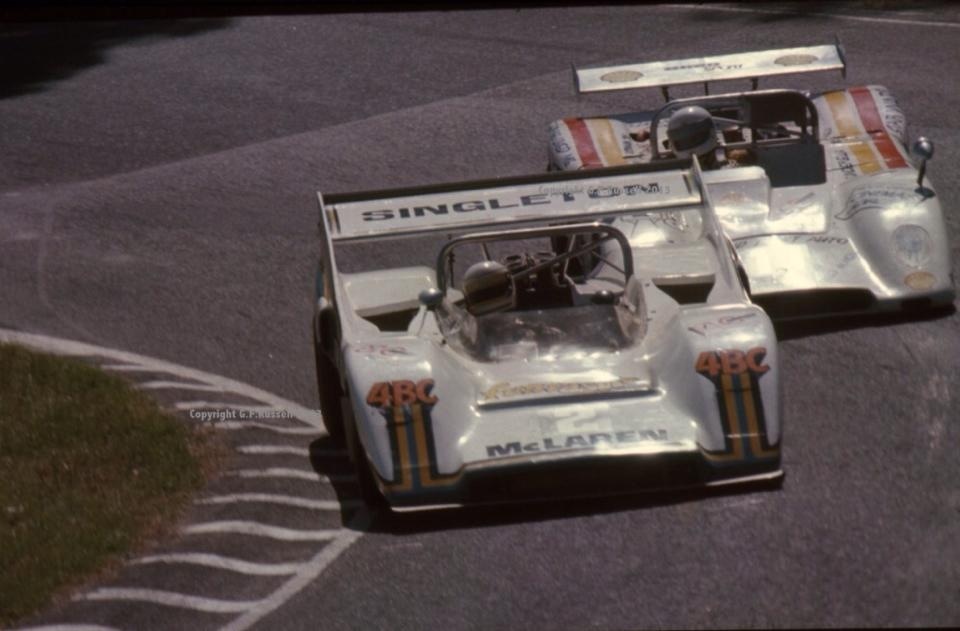
Gardos Repco Sports in the Amaroo Park paddock during Barry Singleton’s ownership (G Russell)
It was first raced at the Australian Touring Car Championship meeting at Wanneroo Park on 6 May 1973 entered as ‘Gardos’ in the program. Not Gardos Repco, not McLaren M8D Repco but Gardos. This may seem arcane, but the point will become clear in discussing its subsequent re-birthing in the USA. Driven by O’Sullivan the car failed to complete the 10 lap sportscar race, his best time was 62.2 seconds, a good first up effort.
At the 12 August Wanneroo meeting the feature event was the fourth round of the Australian Sportscar Championship won by Lionel Ayers Rennmax Repco V8 with O’Sullivan, the car again entered simply as ‘Gardos’ DNF. Henry Michell, Elfin 360 Repco was 2nd and local lad Stuart Kostera 3rd in an old but quick Matich SR3 Ford. O’Sullivan’s best lap of 59.6 seconds was right up at the pointy end for what was still a very new car.
And that appears to be it for the Gardos in the O’Sullivan teams hands. The team raced their F5000’s and much earlier McLaren LT170 Chev sportscar in WA meetings during the rest of 1973 but did not race the Gardos, it would be intriguing to know why.
The car was potentially a winner of the 1974 Australian Sportscar Championship had the Perth guys been able to commit to a national program. Henry Michell won it in a season of reliability in his Elfin 360 Repco 2.5 V8, without winning a round.
Garrie Cooper’s Elfin MS7 appeared mid-season and won two rounds and shifted the local sportscar goalposts but potentially the Perthies may have had a win or two on board by the time the MS7 hit Adelaide International where Garrie first tested and raced it in August. Lionel Ayers Rennmax Repco V8 5 litre was the other outright contender that year and winner of two of the four rounds.
Rear happy, crappy Kodak Instamatic shot of the rear of the Gardos Sports at Phillip Island in November 1975 (M Bisset)
By 1975 the Gardos Sports peak had passed, Cooper was on top of his game with the superb Elfin, the best Australian sportscar of the era.
Other than the Gardos OR2 Repco F5000 debut at Adelaide International in early 1974 neither O’Sullivan or Sangster raced any of the team cars throughout 1974. Both Gardos cars, as related earlier were sold to C&C Autos in 1975 when O’Sullivan withdrew from the sport.
Poole raced the Gardos Sports locally in South Australia and contested the one race 1975 Australian Sportscar Championship at Phillip Island that November. Garrie Cooper won the race in his Elfin MS7 Repco Holden from Henry Michell’s Elfin 360 Repco and Fred Gibson’s Alfa Australia Alfa Romeo T33 V8 Coupe with Keith a DNF.
The other main race at the ‘Island was the final round of the Australian F2 Championship won by Geoff Brabham in a Birrana 274 Hart. He took both the round and the title, I can well recall an excited conversation with the likeable bloke in the paddock after his win. And then off to Europe he went, Ralt RT1 Toyota F3 in 1976.
By then the bodywork of the Gardos proclaimed ‘McLaren’ on its nose- which is of course far sexier than ‘Gardos’. It seems to me the name of the car is rightly Gardos Sports Repco or Gardos McLaren Repco, but of course that does not ‘gas up’ its commercial value, even if it is factually correct.
Both Gardos cars, OR2 F5000 and Sports were sold to Barry Singleton in Queensland who raced them a lot and did them justice.
Gardos Sports cockpit, complete with McLaren steering wheel, and an array of Smiths instruments, at Phillip Island in November 1975. Shift lever and linkage is attached to a DG300 Hewland ‘box (M Bisset)
Eventually the Gardos Repco Sports found its way to the US and into the Matthews Collection but the car now tagged ‘M8D G’ (Gardos) owes nothing at all to its specifications as built by Gard in Perth.
As built the car had a Repco Holden F5000 engine, it now has a Big Block ally ZL1 Chev. As built the car had a DG300 Hewland, it now has an LG600. As built the car had M18 suspension, brake and wheel componentry. The car was rebuilt to full M8D spec sometime in 1993/4, with all the M18 pieces removed and replaced by sportscar bits. Owners of cars can do what they like of course- I’ve no issue with that.
In the early nineties the car was passed off as a ‘real M8D’ but nowadays it is said to be accepted for what it is- that is, as I have depicted the cars history and its conversion in the US to a car of M8D ‘full specification’. The Matthews Collection’s attempt at documenting the cars origins on its website is incomplete and inaccurate. There are 21 modern photos of the car in 1970 works papaya colours. None are of the car in Australia in period. Why let history get in the way of a good story after all?
As as related earlier the shots below are the balance of those taken by Jay Bondini at Repco, Maidstone. Rare, detail period shots for McLaren F5000 nutters of whom I am one!
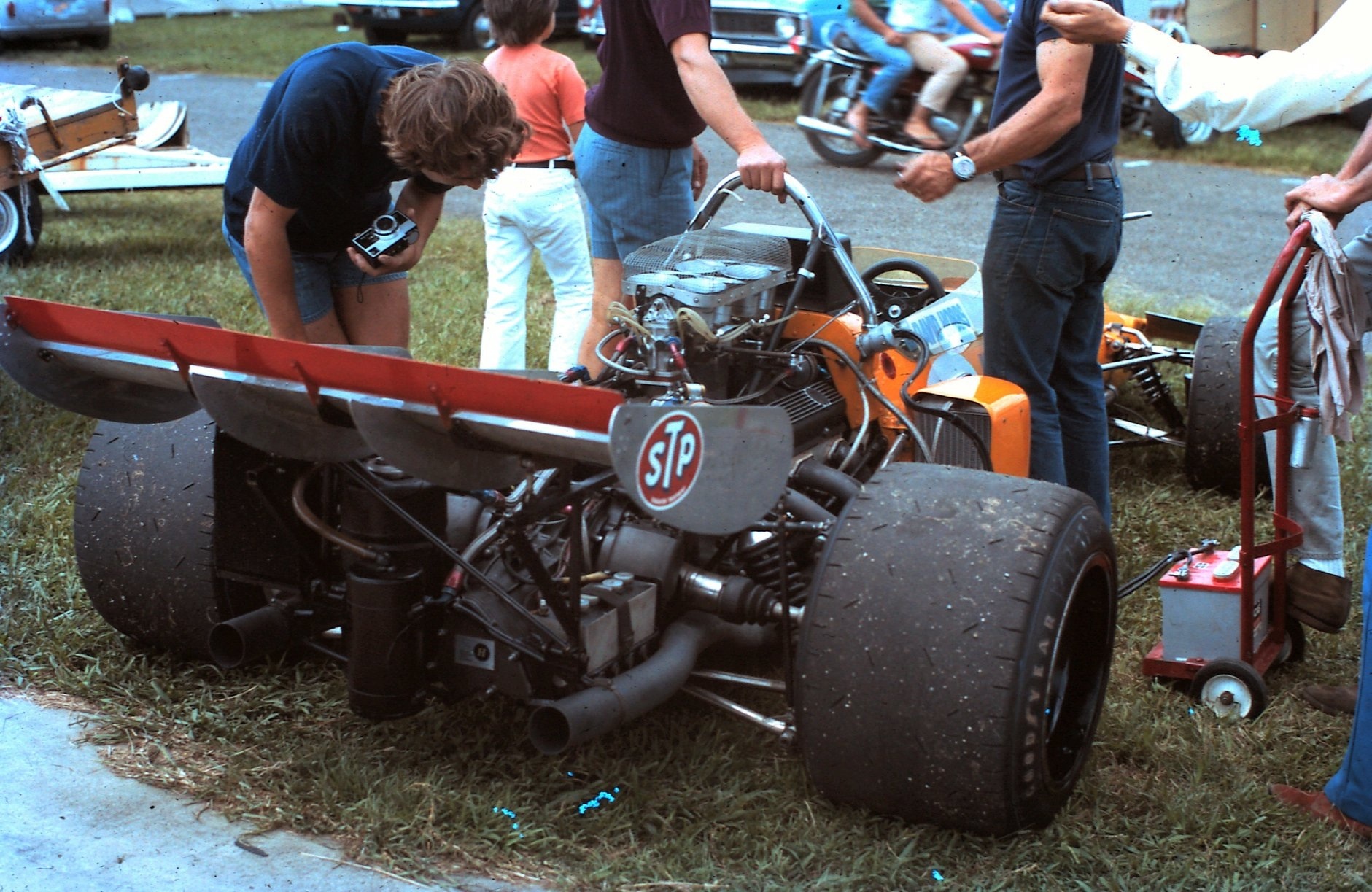
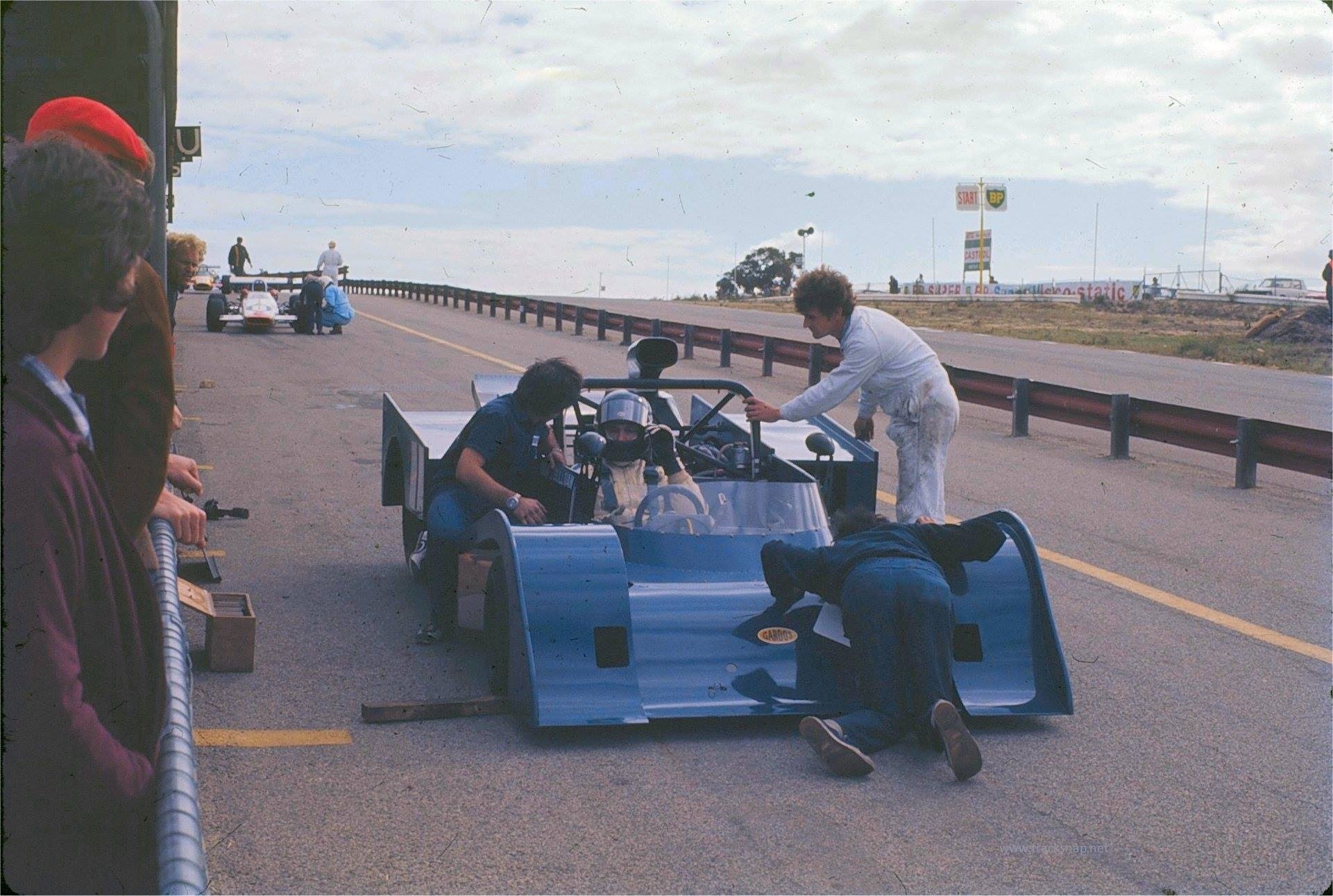
(J Bondini)Conventional rear suspension- single top link, inverted lower wishbone, coil spring/damper, twin radius rods, mag alloy uprights. DG300 Hewland 5 speed ‘box, note oil dry-sump tank and catch tank. Varley battery plonked up high (J Bondini)Comments as per previous shot (J Bondini)Repco Holden Lucas injected F5000 V8 engine, circa 480 bhp @ this stage for a ‘customer’ engine. Matich motors had a bit more. Aeroquip brakeline running atop top radius rod (J Bondini)The McLaren F5000 tubs of this period are all related in design to the 1968 F1 M7A- M10A, M10B, M18 and M22. Note ‘A-frame’ to carry the engine as per text, wheels 13 inch in diameter (J Bondini)
Bibliography…
oldracingcars.com, Terry Walkers Place, ‘History of The Australian Grand Prix’ Graham Howard and Ors, The Nostalgia Forum especially the contributions of Duncan Fox and Ray Bell
Photo Credits…
State Library of Western Australia, oldracingcars.com, Eli Solomon, Jay Bondini, Neil Stratton, Geoff Russell, Stupix, Rod MacKenzie, Ian Smith, Kym Pedler, Ian Messner, Wirra, Brendon Hagarty, Greg Owen
Tailpiece: O’Sullivan cruisin’ the Wanneroo Paddock in the M18 Repco…
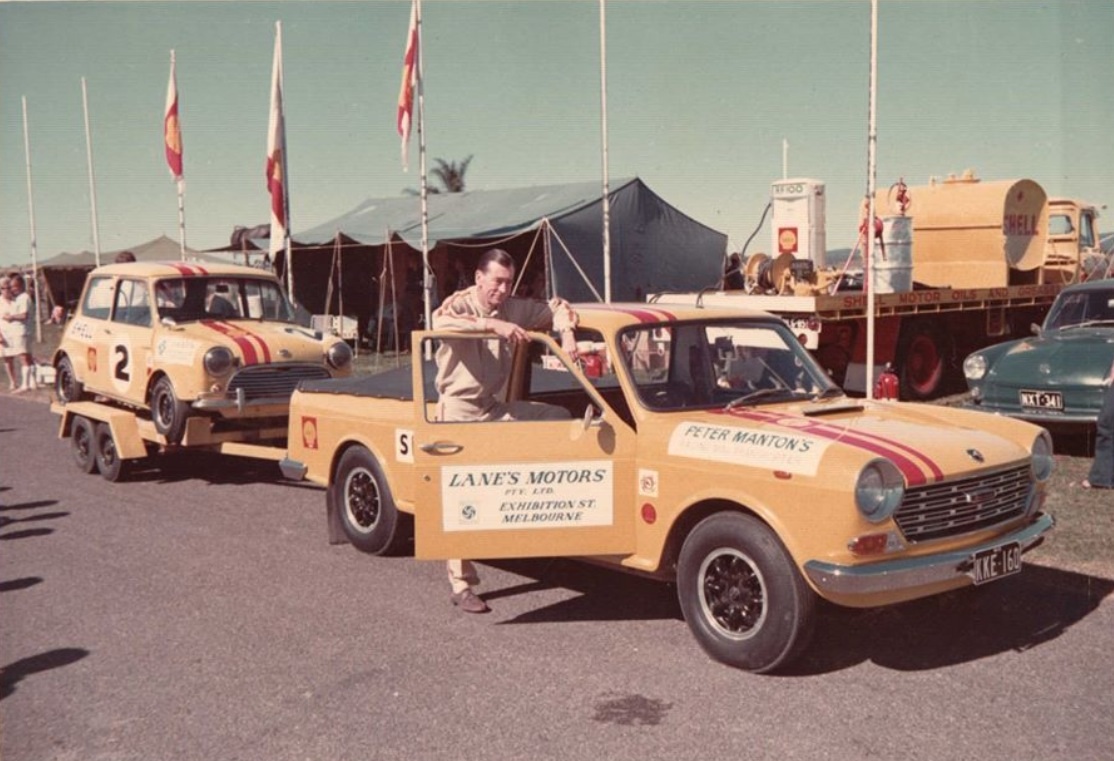
Peter Manton, Austin 1800 tow car and his ‘Improved Production Touring’ Cooper S, perhaps at Surfers Paradise in 1970…
Manton is long way from home, the Gold Coast is 1720 kilometres from Melbourne, the Mini aces home base. That cut down Austin 1800 is a really nice rig but I don’t fancy towing that Mini with that car, even if it has a couple of SU’s bolted to the side of the ‘B Series’ head. It lacks the ‘mumbo’ needed for such long tows across our big, brown, parched continent. Nice thing to ponce around Surfers Paradise in mind you.
By 1970 Peter was winding down a long career in the sport which dated back to the thirties. Born in 1922, Gerald Peter ‘Skinny’ Manton began racing at 16 in his mothers Austin 16.
In his formative years he worked at the Commonwealth Aircraft Corporation, Fishermans Bend in product engineering leaving to work for John Ould Motors and later Monaro Motors, of which he later became a partner.
Monaro Motors sold MG’s and developed performance parts for the marque. They were agents for Wade superchargers and became sole distributors in Victoria for SU carburettors. ‘Skinny’ progressed to design and research developing many twin-carb manifolds and other bits.
Mac/Manton works MGB ‘HBL129D’, Sebring 1966 (unattributed)
Manton’s reputation amongst the BMC UK hierarchy was such that he was chosen to partner Roger Mac in a works MGB at Sebring in March 1966, it was a successful weekend too, the pair were seventeenth overall in the 12 hour classic and first in the GT 2 litre class- the race was won by the Ken Miles/Lloyd Ruby Shelby American Ford GT40 X-I Roadster.
In a busy weekend Manton also contested the four hour Governor’s Cup for sedans the day before the 12 Hour. He shared a Cooper S with Paddy Hopkirk but the pair’s 1293cc S was outted with a broken timing chain after only 33 laps- Jochen Rindt won in a works Alfa Romeo GTA shared with Roberto Businello. Businello, well known in Australia after his Alfa Giulia TI Super Sandown 6 Hour win with Ralph Sach in 1964, blotted his copybook in all but destroying the car in practice.
Hopkirk/Manton Cooper S during the Four Hour Governor’s Trophy, Sebring 1966 (Friedman)
As the Issigonis front wheel drive BMC products swept the market Manton was in on the ground floor.
In 1962 BMC released the Morris Cooper in Australia but in August 1961 Manton was one of those behind the ‘Morris 850 Sports’, the little brick was fitted with twin-SU carbs and a set of extractors. The car was sold through Peter Manton Motors in Melbourne and P&R Williams in Sydney, whilst a ‘dealership special model’ the cars had the backing of BMC inclusive of the factory warranty.
In terms of his racing Manton swapped his Marshall-blown Morris Major for a succession of Cooper S’ with which he became synonomous. Manton Motors was a well known destination for a generation or so of Melbourne BMC and racing enthusiasts
Was the Mini King of Oz Peter Manton or Brian Foley? Are the honours equally split?, without doubt they were the Mini Kings of Victoria and New South Wales respectively throughout the sixties in any event!
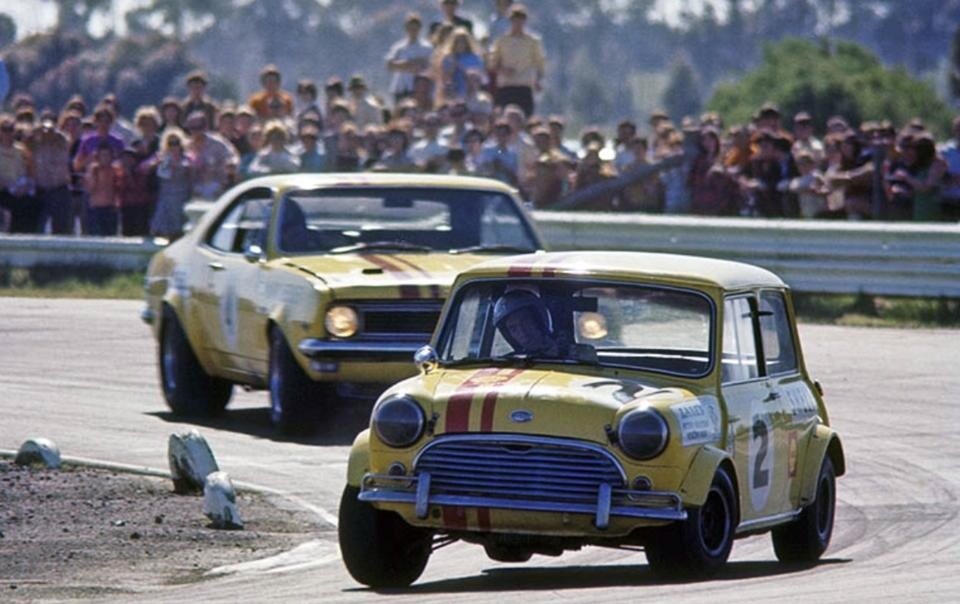
Manton from Bob Holden, Ford Escort Twin-Cam and Brian Foley in Warwick Farm’s Esses 1970 (R Thorncraft)
Etcetera: Sebring 1966…
(Friedman)
Sebring main straight vista with the Mac/Manton MGB to the left and back.
#57 Porsche 904GTS of Ripley/Wetanson in front, MGB of West/Charles, one of the Porsche 906’s to the right and alongside the Shelby GT350 Mustang of Kohler/Reina/Biddle and on his own behind that group of three the Porsche 911 of Ryan/Coleman.
(Friedman)
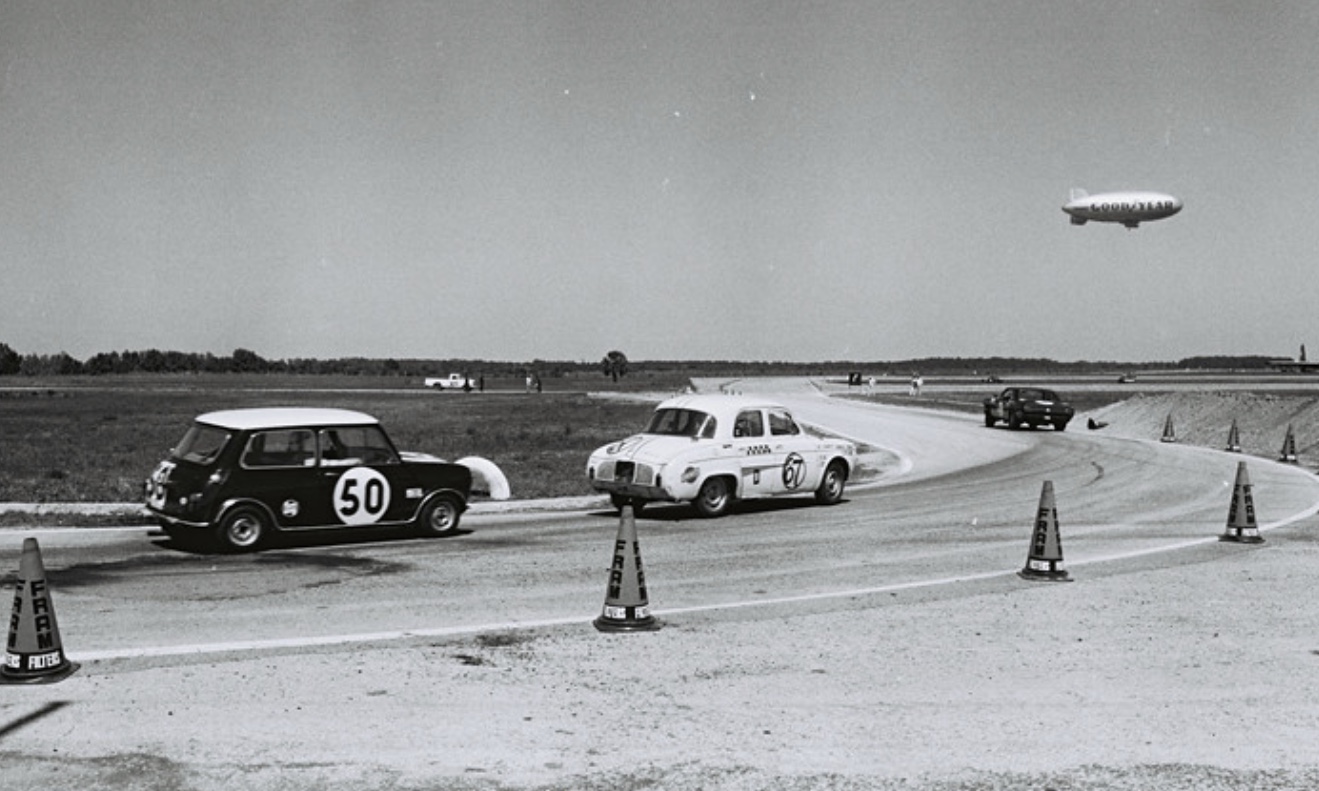
Hopkirk/Manton chasing the Renault Dauphine of Porath/Van Hoozier, ever present Goodyear blimp up above.
(Friedman)
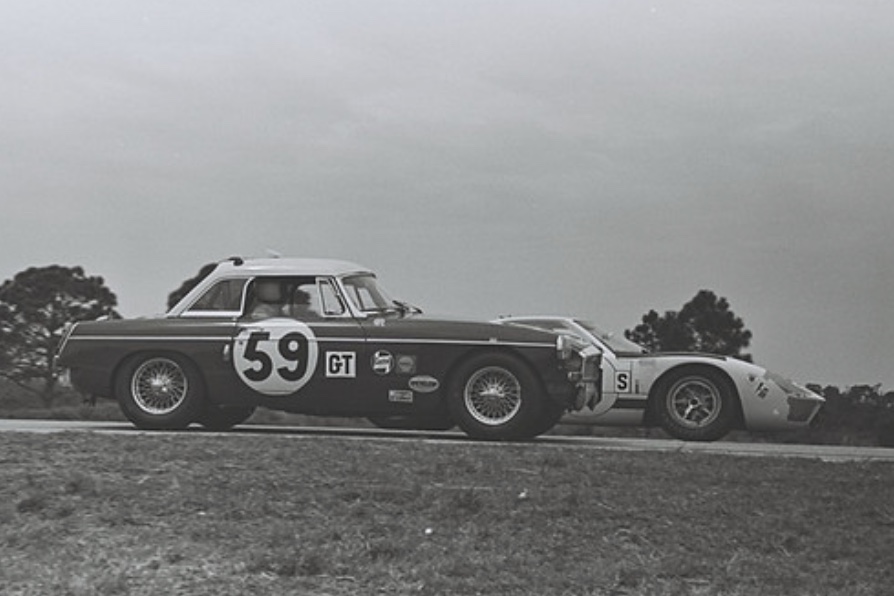
The Shelby Mustang GT350 of Kohler/Reina/Biddle from Mac/Manton- and below the MGB being monstered by one of the 7 litre Ford GT Mk2’s, no doubt Peter Manton spent as much time looking in his mirrors as he did out the B’s windscreen on the wide expanses of the airfield circuit.
(Friedman)
Flying trio.
Mac/Manton MGB from the similar West/Charles entry and then the Ryan/Coleman Porsche 911. Dave Friedman’s photographic archive is wide, rich and deep.
Photo and Reference Credits…
Eldougo, Dick Simpson, Russell Thorncraft, David Knowles, Dave Westerman, article by Craig Watson in uniquecars.com.au, David Friedman Archive, Peter Longley
Tailpieces: Manton’s Cooper S being monstered by Shell teammate and 1970 ATCC champion Norm Beechey’s Holden HG Monaro GTS350 at Calder…
(Simpson)
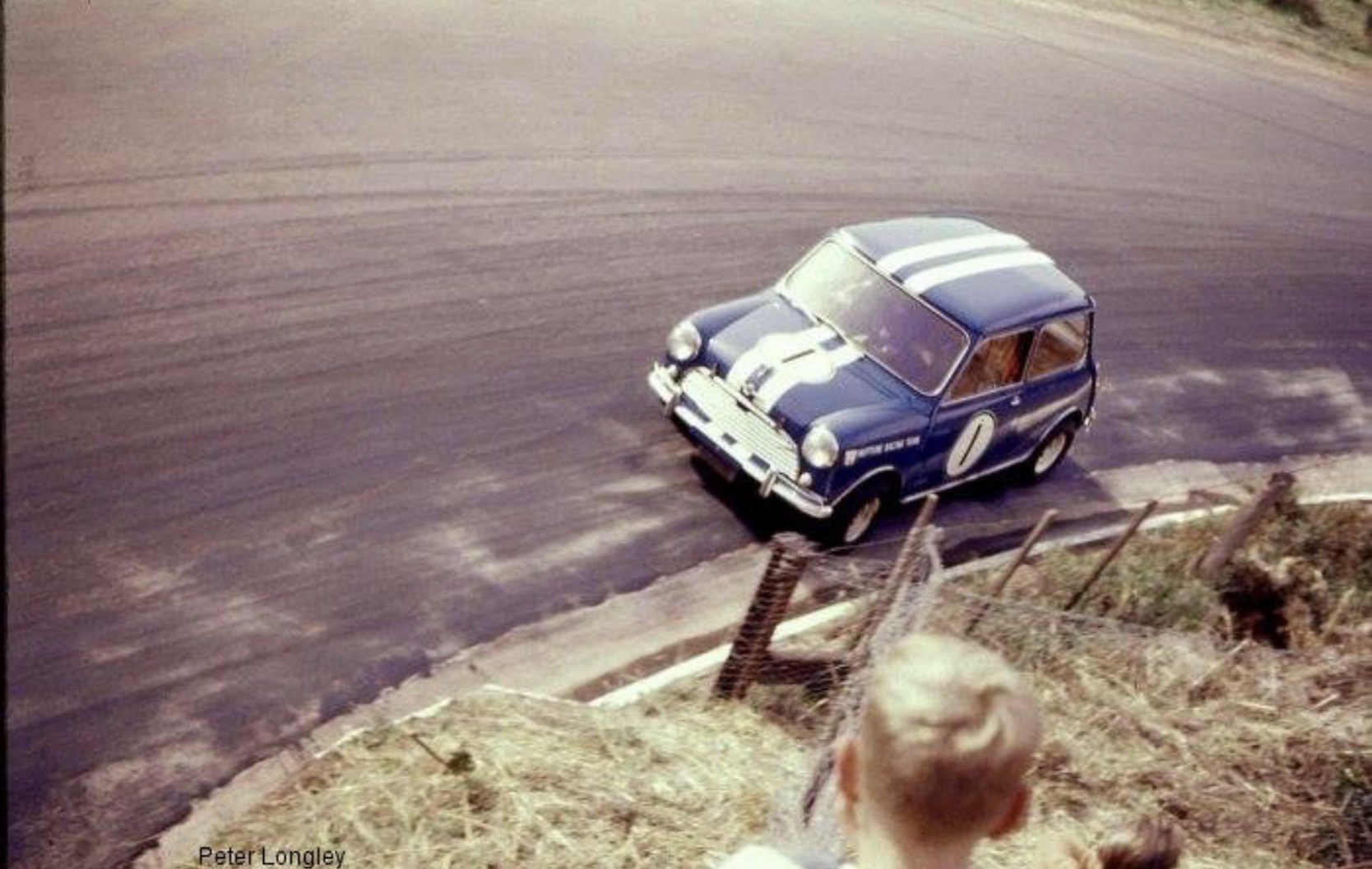
Peter Longley’s great shot of Manton turning in to Longford’s Viaduct circa 1965.
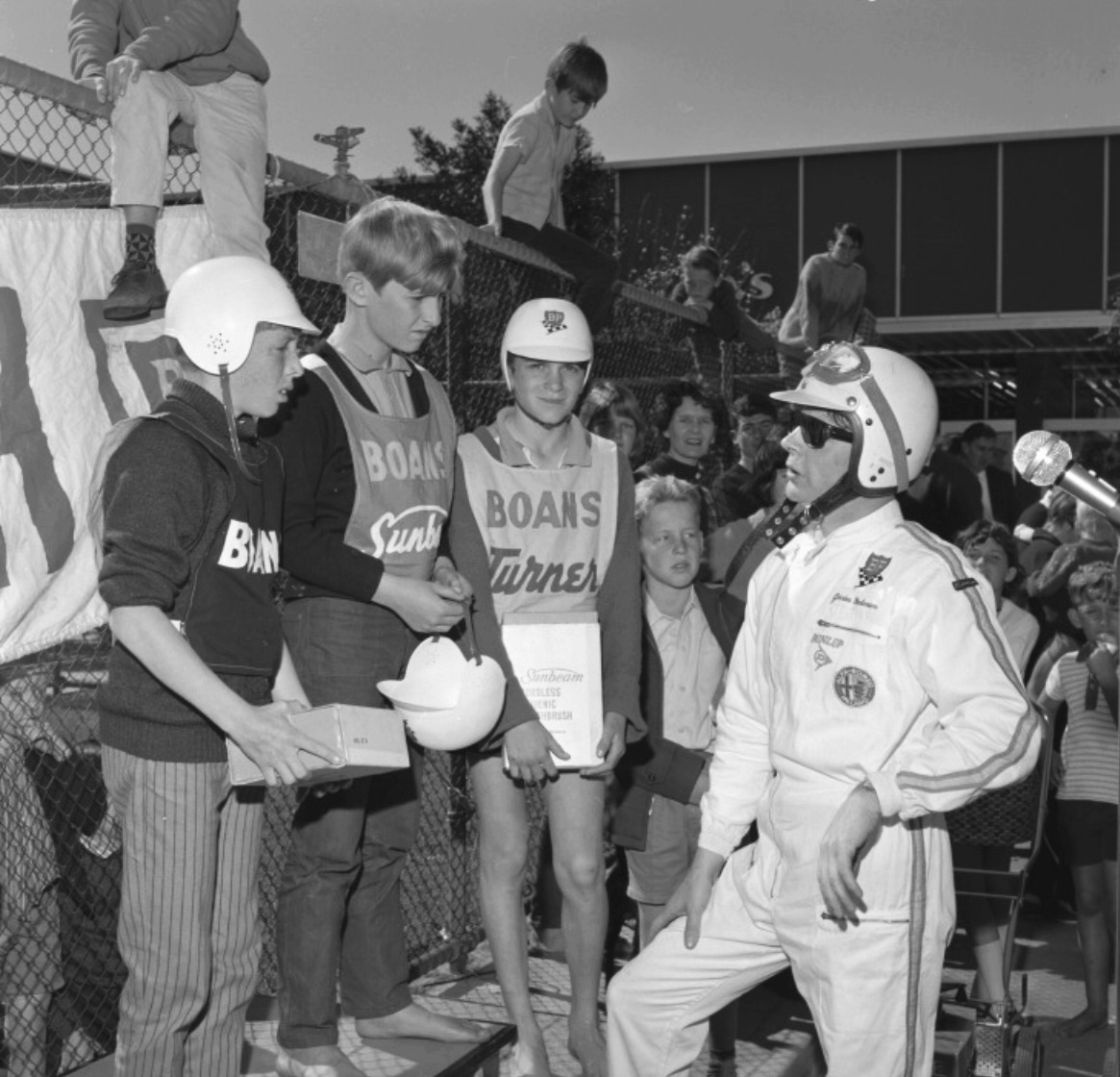
To keep a sponsor happy that is! Here it’s Perth racer Gordon Stephenson presenting the prizes to the winners of a department store lawnmower racing competition…
WTF you may well say?
Boans was an iconic West Australian department store for almost a century. Remember when every state or city had such emporiums of shopping pleasure for those so inclined? Myer in Victoria, Grace Brothers in New South Wales, Malcolm Reid in South Australia and so on. Now the buildings may still exist but the companies have been absorbed into a small number of conglomerates over the last forty years; Boans were chomped up by the Myer Group in 1986.
A sign of the times, competition and change is the rise in online retailing in the last decade or so. At the time of writing, mid November 2017, Amazon have just launched in Australia. The potential impact has executives of our major local retailers soiling their undergarments with fear. And rightfully so, Change is the Continuum.
(SLWA)
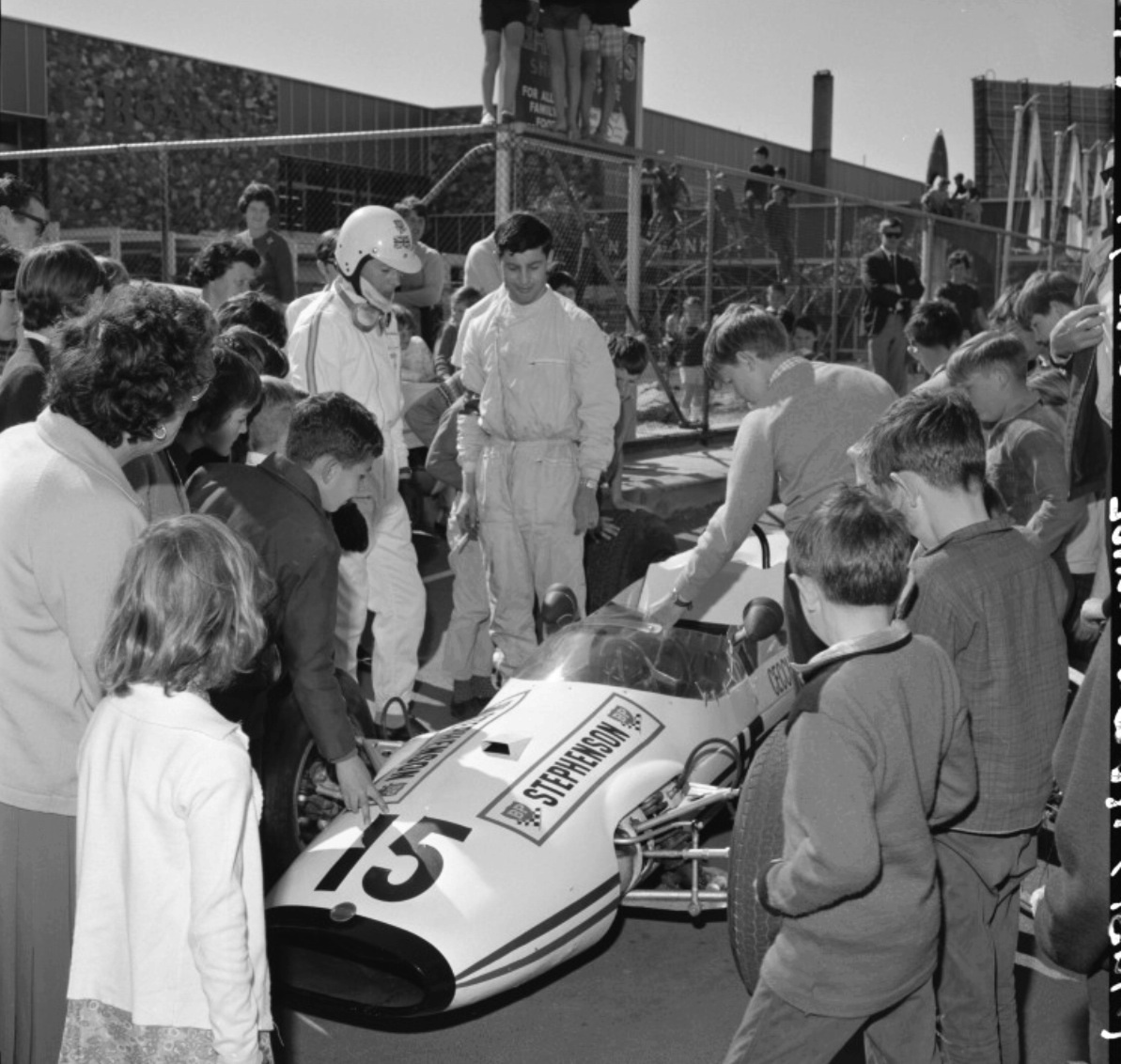
Stephenson showing the kids his Tasman Cooper T70 Climax. I wonder if he fired the 2.5-litre Coventry Climax FPF and did a lap or two of the Boans, Morley carpark!? The car taken to Perth by Don O’Sullivan who bought it from Bill Patterson in Melbourne, Stephenson only raced it for 12 months
It seems that Boans organised a cross-promotion to raise their profile and flog a few lawnmowers, rolling BP into the fun. Poor BP sponsored Gordon drew the short straw that day to display his car and hand out the prizes. The local media did the rest to maximise exposure.
FTD was awarded to the kid who pushed his mower ‘for Chrissakes pick a Victa two-stroke son it will be lighter than the four-stroke Scott-Bonnar’ – across Boans carpark the fastest; Morley is 10km from central Perth.
Cooper T70 Climax…
Cooper T70 Climax #FL-1-64 is an interesting, significant car as the 2.5-litre Coventry Climax FPF engined car raced by Bruce McLaren and Tim Mayerin the 1964 Tasman Series, and then by 1961 World Champ, Phil Hill, in mildly updated form in the 1965 Tasman.
It was later purchased by Richard Berryman in the mid-1970s and was restored and is owned by his son Adam Berryman, a Melbourne mate of mine.
The history of the two T70s car is covered in the two articles below rather than restate the history of one of the ‘first real McLarens’ built.
Stephenson was a stalwart of WA racing for decades, mainly in Touring Cars. He had a busy season in 1968 racing both his ex-Alec Mildren Racing Alfa Romeo GTA and the Cooper in local circuit races at Caversham, having several wins in the T70, and hillclimbs at Mount Brown, York.
The story of the Mildren GTA’s is told here, inclusive of their extensive West Australian history;
…in the words of Maxwell Smart, for you aficionados of Mel Brooks’ wonderful sixties TV show ‘Get Smart’.
Kevin Bartlett with an inside wheel off the deck demonstrating the millimetre precision for which he was famous aboard the Mildren ‘Yellow Submarine’ Alfa in Warwick Farm’s Esses, September 1969. Rod MacKenzie has opened his shutter at precisely the right moment.
Another inch or so and the talented Sydneysider would have ripped an expensive corner off the front of a car which was so kind to him. I’m not sure of the racer behinds identity. A Lotus 27 or 32 perhaps?
Bartlett inherited the Len Bailey designed, Alan Mann Racing built, Alec Mildren owned car after Frank Gardner raced it in the 1969 Tasman Series. KB used it to great effect in that years Australian Gold Star Series winning three rounds and the title in it- Symmons Plains, Surfers Paradise and in Bartlett’s Warwick Farm backyard in December. During a busy season KB and the Sub also won the Macau Grand Prix on 16 November and contested the JAF Japanese Grand Prix at Fuji.
Every inch a GP car of its day isn’t it, just magnificent. Mildren Alfa in its ‘Alfa ultimate form’. Lynton Hemer’s shot captures the car at WF on Hume Straight in July 1970- interesting shot as the Alfa engine is back in the car long after its first Waggott engined race (L Hemer)
It wasn’t the ‘same car’ by the end of the year though as the Alfa Romeo Tipo 33 2.5 litre V8 engines with which the chassis was originally designed and built were put to one side and replaced by Merv Waggott’s Sydney built, 2 litre all alloy, DOHC, 4 valve, Lucas injected 275 bhp engine.
The history of my favourite ‘Australian’ racing car is one for another time- it’s a long story as this jewel of a car’s ‘in period’ history starts with 1969 Alfa V8 wins, continues with Waggott engined victories and ends with 1.6 litre Hart 416B success in Australian National F2 form in 1974/5. A fellow named Ray Winter was campaigning this famous car by then.
(Bill Pottinger)
High Speed Precision too…
Bartlett was famous for his tail out style, he was ‘the absolute master of opposite lock’ as Sam Posey described him having raced against KB during the 1973 Tasman Series and in the ‘L&M F5000 Championship’ in the ‘States in 1972/3.
This shot of the car is in ‘neutral to very subtle oversteer’ attitude, a very high speed, delicate drift- was taken by Bill Pottinger whilst Kevin traversed Teretonga’s ‘loop’.
The 1970 Tasman was tough in a 2 litre car, it was the first year of the Tasman F5000 Formula. KB was still quick enough to take 5th at Pukekohe and Teretonga- a second at Surfers Paradise, very much a power circuit was amazing and first at Warwick Farm brilliant but understandable. Bartlett, Matich and Leo Geoghegan were surely the quickest blokes around ‘Gods Own Acre of Motor Racing ‘ out Liverpool way?!
A mighty fine car and a mighty fine driver- thankfully both are still alive and well in Australia, Queensland to be precise…
(Bill Pottinger)
Merv Waggott fettles…
Sydney’s engineering genius Merv Waggott doing a plug change in ‘The Sub’ during the 1970 Teretonga weekend. Alec Mildren had been using Merv’s talents for years and specifically the smaller variants of Waggott’s engines in his other car, the Rennmax Engineering built Brabham BT23 copy ‘Mildren Waggott’ raced by Max Stewart.
When Merv decided to build a bespoke aluminium block to allow a capacity of 2 litres, something the Ford Cortina blocks used hitherto could not, it was an easy decision for Alec to go the more cost effective route with the local engine rather than the 2.5 litre Alfa V8.
The Alfa unit had received no development since first fitted to Mildren’s Brabham BT23D chassis in late 1967. Alfa were focussed on 3 litre engines for both their Tipo 33 Sportscar program and F1. Two litre Waggotts won Australian Gold Stars for Leo Geoghegan in 1970 (Lotus 59B) and Max Stewart in 1971 (Mildren Waggott)
(H Ellis)
Etcetera: Australian Competitor Set 1970…
Startline of the first round of the 1970 Gold Star Series at Symmons Plains, Tasmania in March 1970.
John Harvey’s #2 Bob Jane Racing Brabham BT23E Repco on pole alongside KB in the Mildren ‘Yellow Sub’ Waggott with Leo Geogheagn’s Lotus 39 Repco on the outside, and behind him in the other yellow Mildren Racing entry is Max Stewart in the Mildren Waggott spaceframe Bob Britton/Rennmax built car. Harvey won a top race from Leo and KB.
In a season of change it was Leo’s last championship race in the venerable ex-Clark Lotus, Harves was about to switch to the Britton/Rennmax built Jane Repco V8- yet another car, like the Mildren Waggott built on Britton’s Brabham BT23 jig whilst KB spent much of 1970 racing in the US so did not defend his Gold Star title. It was also the last year of the Tasman 2.5 Gold Star Formula- Geoghegan taking the title in a new Lotus 59B Waggott 2 litre as noted above.
KB gets a shove during the 1970 Tasman meeting- he won in front of the F5000’s. Glen Abbey, Ian Gordon and another fella. Stewart’s Mildren Waggott in the paddock behind (unattributed)
Photo Credits…
Roderick MacKenzie, Bill Pottinger on The Roaring Season, Lynton Hemer, Russell Thorncraft, Harold Ellis
Tailpiece: Bartlett from Geoghegan, Warwick Farm Esses during 1969- Mildren Alfa from Lotus 39 Repco…
Jim Clark’s Lotus 35 Ford Cosworth SCA 1 litre F2 car at rest in the Pau paddock on the 25 April weekend in 1965…
You forget what delicate little flowers these cars were. When I glanced at Ian Gordon’s wonderful shot I initially thought it was a ‘screamer’, a 1 litre F3 of the same era. Not so.
Remember the pantheon of single-seater formulae at the time was 1.5 litre F1 engines giving 205-215’ish bhp, 1 litre pushrod F3’s breathing through a single carburettor choke giving about 100bhp and 1 litre OHC race engine F2’s giving 115 initially towards 150 bhp plus by the formula change to 1.6 litres in 1967.
Jim won at Pau from Dick Attwood’s Lola T60 SCA and Jochen Rindt, also SCA powered in a Brabham BT16.
The engine in Clark’s winning Lotus is Keith Duckworth’s conception based on the production Ford 116E block. The SCA (single cam series A) was the dominant F2 engine of 1965. It won all of the ‘Internationals’- there was no European F2 Championship until 1967, with the exception of the ‘Autocar Trophy’ at Snetterton in May. Graham Hill took that win, BRM P80 powered, aboard a John Coombs Brabham BT16.
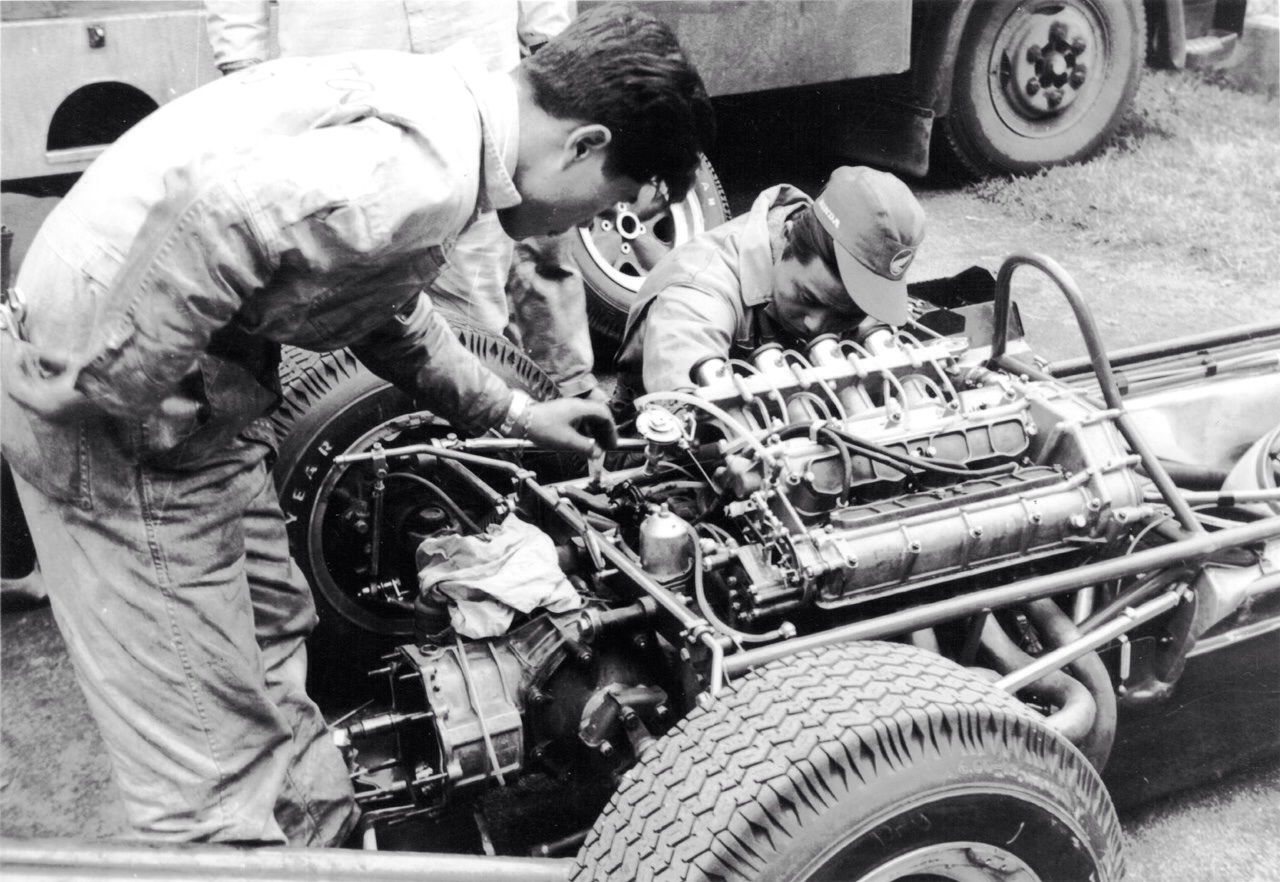
Hewland ratio change in Jacks BT16 in the Pau paddock- there were lots of them as Brabham tried to match ratios to the peaky 1965 variant of Honda’s S800 engine. Brabham raced much of the ’65 F2 season in SCA powered cars as Honda development continued (Gordon)
Ian Gordon became a well known and respected Australian race mechanic, later working for Alec Mildren Racing and Max Stewart amongst others. He was on a racing holiday in 1965 and snapped these fantastic photos of the ‘F2 Engines of 1965’ during the Pau Grand Prix weekend. The engines are the SCA, BRM P80 and Honda S800.
For Jim it was the first of five F2 wins in ’65- that amazing season of Clark domination (F1 World Title, Tasman Championship and Indy 500 win), the others were at Crystal Palace, Rouen, Brands Hatch and the Albi GP late in the season.
The real threat to Cosworth SCA dominance into 1966, not that it was necessarily apparent at the time, were the 1 litre DOHC, injected Honda 4 cylinder engines fitted to various of Jack’s works Brabhams during 1965. The peaky nature of the engines power delivery was the primary issue which was addressed in spades over the winter. Click here for my article on Brabham Honda dominance in 1966.
By the beginning of 1963 new F3 and F2 categories were announced, the former to replace Formula Junior to take effect from 1 January 1964.
Duckworth, armed with 17,500 pounds of support from Ford set to work on the new ‘SCA’ engine which would use the Ford 116E block known so well to them.
Sitting atop it would be an aluminium cylinder head with a line of vertical valves, two per cylinder ‘It was really an overhead cam version of the last Formula Junior engine’ Duckworth quipped in Graham Robson’s wonderful ‘Cosworth’ book.
The engine was notable for its bowl in piston combustion chamber or ‘Heron Head’ design. ‘My simple argument was that at the compression ratios we could use, and the valve sizes needed to ensure good breathing, that a bathtub type of chamber ended up masking the valves. It was an awfully long way around their periphery. I argued with myself, that if I put the combustion chamber in the piston, then for most of the time the valves would be out of the way, and that they wouldn’t impede the flow’ Duckworth said.
The steeply aligned inlet port of the SCA owed much to the Mk XVII pushrod 1963 engine engine which was heavily modified by having tubular downdraught inlet ports brazed into the casting. It wasn’t easy to do or cheap to make but improved gasflow. The SCA in some ways mirrored that approach.
KD ‘The SCA was the first cylinder head that I ever designed, and now I think their was quite a lot wrong with it. We had all sorts of trouble with the combustion- we couldn’t make it burn- but it was still good enough to win a lot of F2 races. In the end there was so much spark advance, that it wasn’t reasonable. We ended up with 49 degrees. The SCA chamber suffered from a lack of circumferential swirl’.
Colin Chapman sub-contracted the running of his F2 team to Ron Harris, the two wheels of the car alongside Clark’s Lotus 35 in the opening photo are those of his teammate Brian Hart- Brians 35 is BRM P80 powered and is shown above. The story of BRM’s 4 cylinder P80 F2 engine is one for another time but its vital statistics are an all aluminium, DOHC, 2 valve, Lucas injected 998cc (71.88X61.6mm bore/stroke) dry sumped motor giving circa 125 bhp @ 9750 rpm. (Gordon)
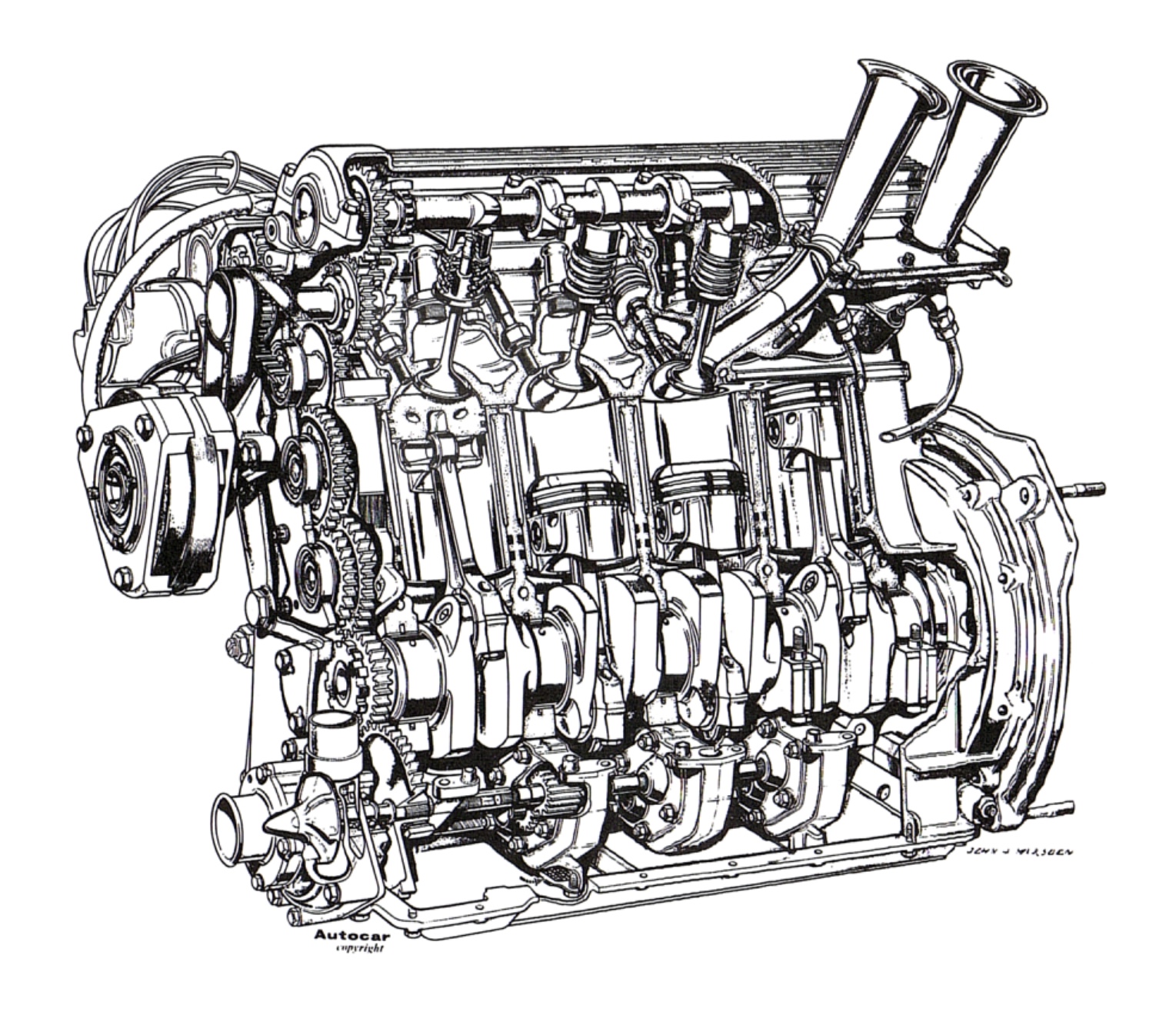
BRM P80 1 litre F2 engine cutaway (J Marsden)
Duckworth- ‘It might not have been right, but we had to make it work. It won the F2 Championships of 1964 and 1965…and…until the Honda engine of 1966 with four valves and twin overhead camshafts, tungsten carbide rockers and torsion bar valve springs appeared in Jack Brabham’s cars. We’d run out of breathing at 11,000 rpm so we obviously needed more valve area. That’s what started me thinking about 4-valve heads’.
‘Mike Costin and I exercised great ingenuity- we had ports that curved around, we had the piston of the week with every kind of shape, dint and odd hole- but the combustion was not good, the mixture never burned properly’.
All the same, the dominant F2 engine of 1964 and 1965 did so producing between 115 bhp @ 8700 rpm in its original Weber 40 IDF carburettor form and ultimate ’66 spec Lucas injected form 143 bhp.
Ford 5 bearing 116E block. Single, (train of seven gears) gear driven overhead camshaft, two valves per cylinder , Cosworth rods and pistons, Laystall steel crank. 997cc- 81mm x 48.35mm bore-stroke.
SCB variant 1498cc 175 bhp – 3 engines only built including the Brabham BT21B raced by ex-Brabham mechanic Bob Ilich in Western Australia
SCC variant 1098cc 135 bhp for North American sportscar racing
Bibliography…
‘Cosworth: The Search for Power’ Graham Robson, tentenths.com, F2 Index
Photo Credits…
Ian Gordon, Peter Windsor, John Marsden
Tailpiece: Jim Clark’s Lotus 35 Cosworth SCA on the way to victory in the 80 lap, 221Km Pau GP on 25 April 1965. Its only when you look hard you realise that it is not an F1 Lotus 33!…
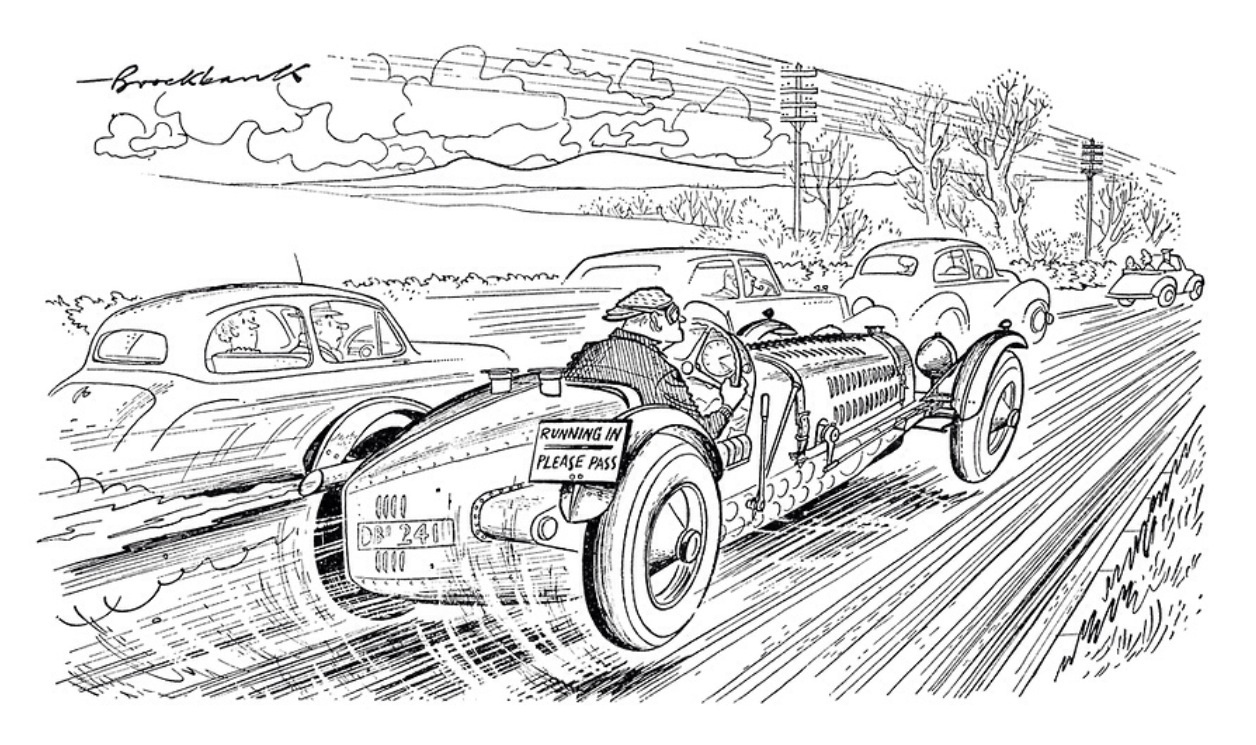
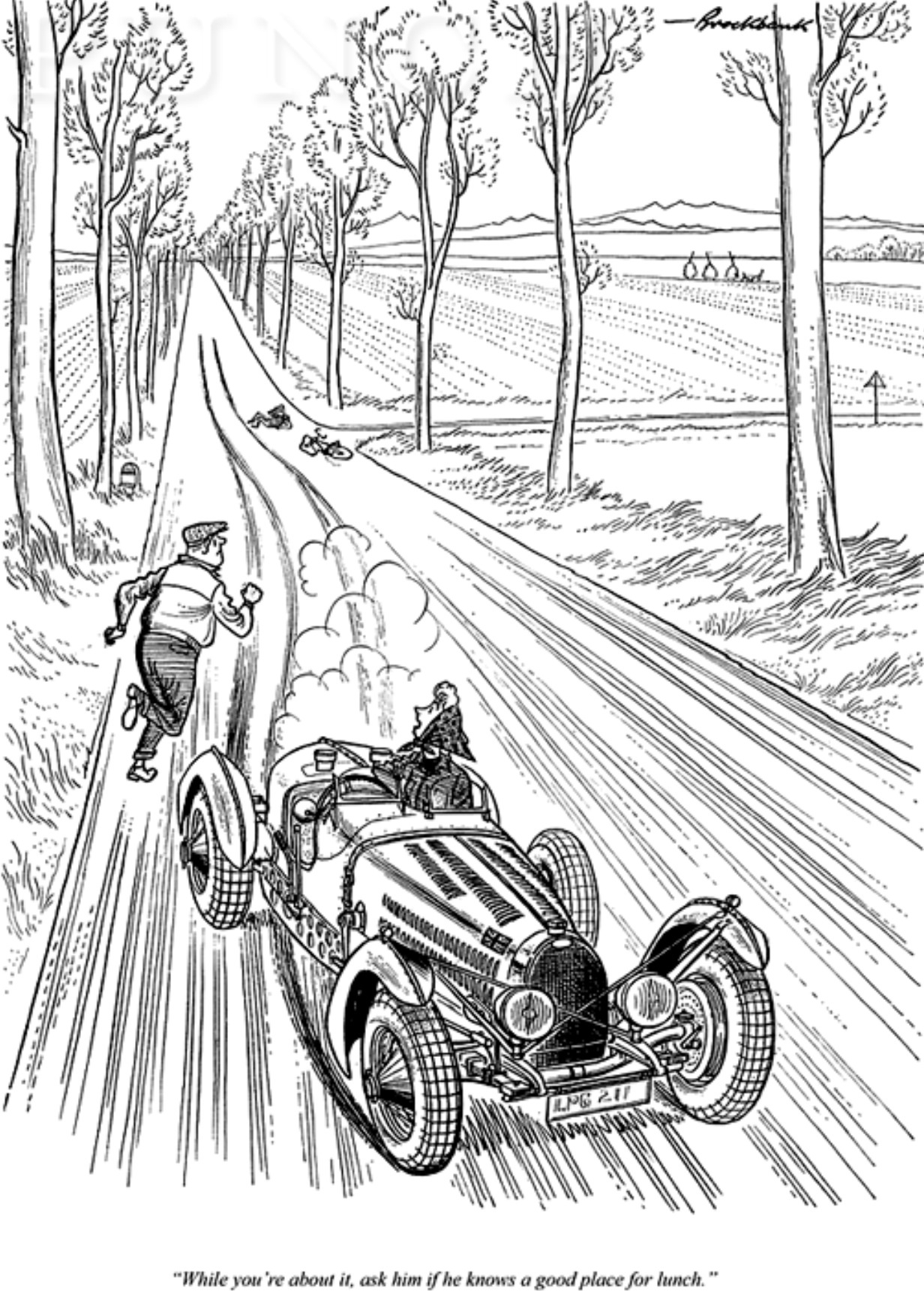
I joined a couple of much younger enthusiasts at Prahran’s ‘The Alps’ for a couple of ‘shandies’ on a warm Spring Sunday last week and was amazed to see them on their ‘duelling’ iPads cackling away to some of Brockbank’s magic…
I shouldn’t have been surprised though as the work is timeless.
Russell Brockbank died in 1979 so has not been with us for a while. I think the first time I saw his work was in a batch of Pommie magazines my dad had been given by a mate in my early teens. A while ago.
He wasn’t born a Brit though, he was Canadian by birth, born in Niagra Falls in 1913, he was educated there and then went to Chelsea School of Art in London. He left art for industry in 1932 and then industry for art in 1936.
The 1960’s English editor of Automobile Year recalls he was a fairly well known motoring artist when Brockbank asked for his advice on how to break into the automotive business over a post Donington meeting drink. Confronted by such brilliant competition, Gordon Wilkins thought he showed sound sense in deserting art for writing.
Brockbank’s career started in the thirties as a contributor to ‘Speed’ magazine producing scraper images of the racing cars of the time.
Throughout his war service in the Royal Navy he contributed to Punch, Lilliput and The Aeroplane, his art reflecting the state of society then.
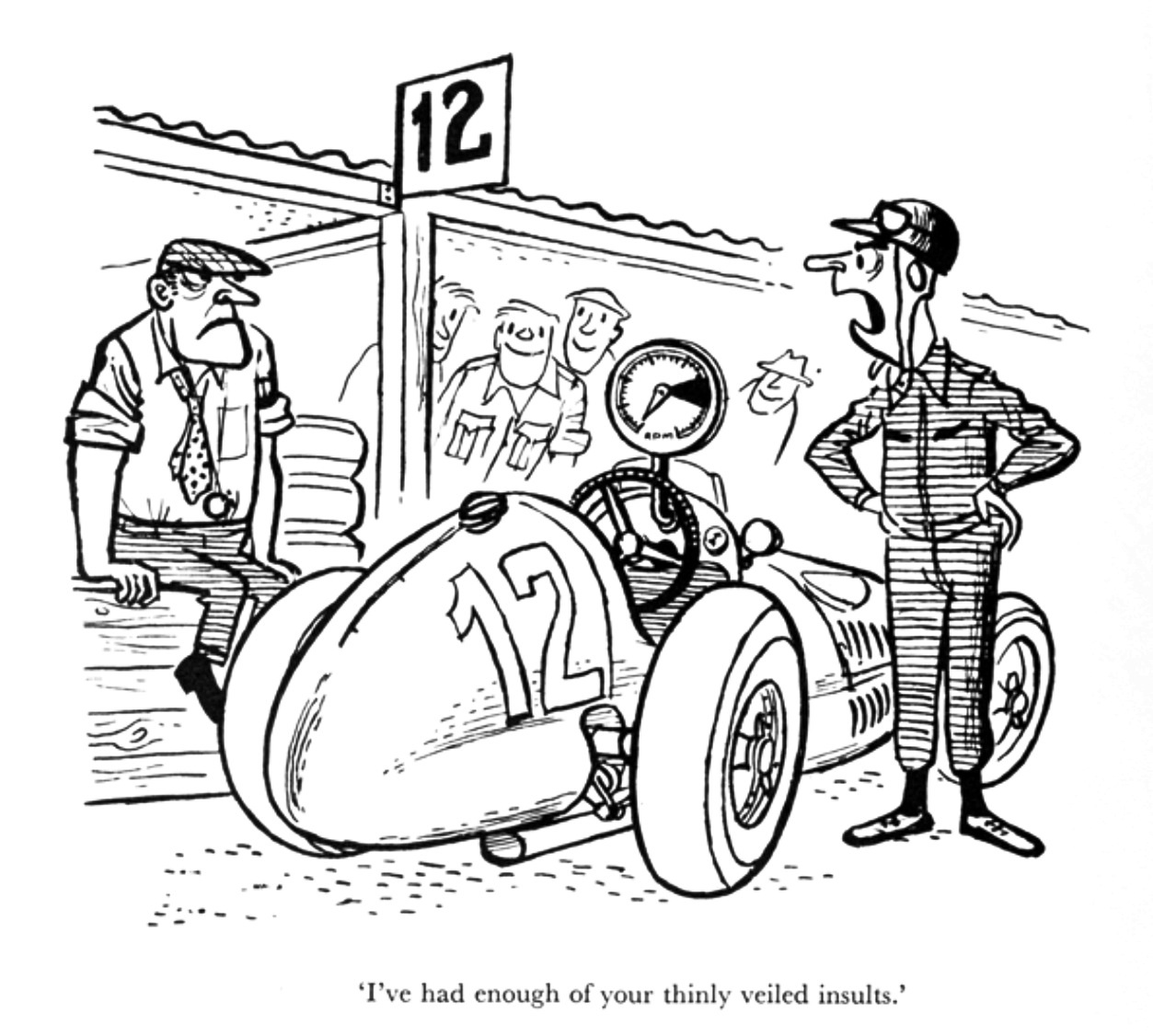
By 1949 he was the Art Editor of Punch. His passion and knowledge of cars and motor racing shines through in the technical accuracy of his work as do his characters-Major Upsett with his outmoded ‘tache and clapped out Austin 8. Not to forget the ‘Old Biddy’ haranguing her long-suffering husband, the Rolls driver and Latin racing drivers. Nothing missed his eagle eye.
In England he lived in the country and frequently gave lifts to grannies who had missed the hourly bus. He even thought of starting a ‘100 mph Club’ – ‘Bless their hearts, they chat away at a Porsche ton and don’t know it. The observant few watch the tacho, read 40 and are happy’ he quipped.




































 primotipo...