AG Bungey’s or GB Woodman’s Humberette 5HP on the startline of the Magill to Norton Summit Hillclimb, Adelaide, Saturday 16 December 1905…
The first of these events run by the Automobile Club of South Australia (ACSA) was held a year before, on 17 December 1904. I was terribly excited at finding a shot of a competitor in the first hillclimb in SA, but upon further research it appears the superb photograph is from the 1905 event, the second of three, the final in-period event being held in 1906.
The photo took my breath away, there is so much going on. I find fascinating the clothing and attire of the drivers, officials, kids and teenagers. Love the deer-stalker hat and pipe of the dude on the left. The officials with writing pads are HR Harley and HR Hammer- do let me know if any of you are related to them. The Steward at the start line is the Club Secretary RJ Hancock, perhaps he is the fella to the right of the car?
The competition was held in ideal Adelaide summer weather with what slight wind there was, blowing down the hills, perhaps impacting times slightly.
Bungey’s time for the 4 mile journey from the East Torrens Hotel at Magill (corner of what is now East Street and Magill Road) up into the Adelaide Hills finishing line at the White Gate, Norton Summit, was 42 ½ minutes which suggests he was either incredibly slow or had some type of mechanical drama. Woodman completed the distance in 30 min 7 seconds. Fastest time of the day, to use modern phraseology, was recorded by ES Rymill’s Darracq 15HP who did a time of 9 minutes 10 seconds. So keen was Rymill to win the event that his car was rebuilt, ‘like many cars it had been dismantled for the occasion’. Great to see the competitive spirit from motor racing’s most formative stages in South Australia!
Pictured below are the Rymill brothers, notable pioneering South Australian motorists, aboard their fast Darracq at the top of Belair Hillon the way to Victor Harbor during the ACSA Reliability Trial held during Easter 1905, 21 and 22 April. These type of reliability events were very popular in Australia in the early years of motoring with this one the first organised by the ACSA.
Adelaide’s ‘The Advertiser’ newspaper characterised communal views on the car at the time: ‘The average citizen considers that the principal characteristic of a motor car is its fickleness. In his opinion it will go sometimes, but often it will not go. To disabuse people of this erroneous idea the club inaugurated the trial, which has had the effect of proving that as a general rule the motor car is reliable, and, considering the distance covered at a high speed was 228 miles, there were comparatively few mishaps, and all of those were of a trivial nature. Of the 14 cars which competed seven (including the Rymill Darracq) succeeded in accomplishing the entire 228 miles, constituting a very severe test, within schedule time, and gained the full number of marks’.
(SLSA)
This trial comprised two legs, the first of 120 miles on Good Friday from Mitcham, an Adelaide suburb to Victor Harbour, site of the 1936 South Australian Centenary Grand Prix aka ‘1937’ Australian Grand Prix held in December 1936 on the Fleurieu Peninsula. On the Saturday, 108 miles were covered from Adelaide to Mannum.
Twenty one cars and five motor cycles contested the Norton Summit Hillclimb with the competitors arranged in classes according to their quoted power ‘and sent away at different times to obviate passing each other’ with ‘officials stationed at all the sharp curves on the road’. The quickest bike was N Jackson’s 2.5HP water-cooled Lewis, his time was 10 minutes 6 seconds.
The Advertiser’s report notes ‘There was not one breakdown or mishap, which speaks volumes for the excellence of the cars owned by South Australia’.
Just a brief note to put these early, formative motor sporting contests into the broader framework of motoring competition in Australia at the time. When I wrote about Australia’s first ‘Motor Car Race’ at Melbourne’s Sandown Racecourse on 12 March 1904, (link below) respected Australian motor racing historian/author/racer John Medley said ‘that was brave!’ meaning the topic is somewhat contentious. It would be great to hear from others who may feel an event other than the Sandown contest was the first.When was the first ‘race’ in New South Wales for example?
In South Australia, for the record, it appears the first hillclimb, legal one anyway!, was the 17 December Norton Summit event on Saturday 17 December 1904 and the first ‘car race’, ‘where motor cars take the place of horses, and race in competition at their top speed’, was held at Morphettville Racecourse, 10 Km from Adelaide on Saturday 12 November 1904. This meeting was also promoted by the Automobile Club of South Australia.
FS Rymill had earned the nickname from Adelaide tram and cab-drivers of ‘The Flying Dutchman’ for his fast driving exploits in traffic. He and his Darracq 15HP were the stars of the show that Morphettville November day winning the 3 mile ‘Tourist Car Race’ from scratch, in this race a full complement of passengers were carried averaging at least 10 stone or over in weight. Rymill then won heat 1 of the ‘Starting Competition’ (starting the car by handle and then racing) and finally the 3 mile ‘Heavy Car Race’. Perhaps the latter was the premier event of the day, where Rymill again won off scratch from the De Dion 12HP of A Allison and De Dion 8HP of Dr Gault.
Bibliography…
‘The Advertiser’ Adelaide 20, 22 and 24 April, and 22 December 1905, ‘Chronicle 12 November 1904, ‘Adelaide Observer’ 19 November 1904
Tom Hawkes, Cooper T23 Holden Repco, AGP Bathurst 1958 (unattributed)
Tom Hawkes racing his way up Mount Panorma towards a giant killing 3rd place during the 1958 Australian Grand Prix at Bathurst…
He finished behind Lex Davison’s winning Ferrari 500/625 and Ern Seeliger’s 4.6 litre fuel injected Chev V8 engined Maybach. Hawkes’ Cooper T23 is the ex-Brabham car chassis # CB/1/53 i wrote about not so long ago. Click here to read the article;
Tom replaced the cars Bristol engine and fitted a Repco Hi-Power, Phil Irving designed head breathing much life into the standard 6 cylinder, OHV, inline Holden 6 cylinder ‘Grey Motor’. The engine raced at 2.3 litres in capacity.
The interesting thing is exactly where on Mount Panorama the shot is taken. The right hander at the top of Mountain Straight perhaps, ‘Quarry Corner’? All suggestions taken. Its a quintessential Australian country scene, in the absence of a crowd it could be anywhere!
Photo Credit…
Unsure, intrigued to know who took the wonderful shot
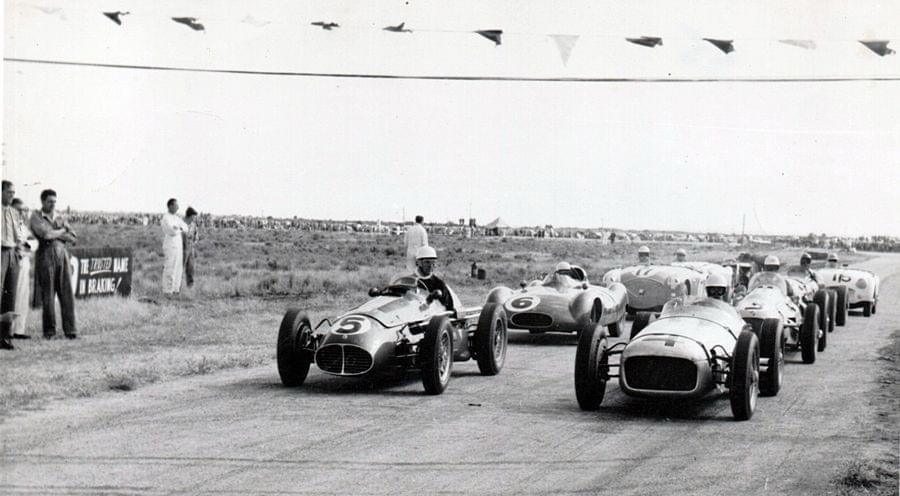
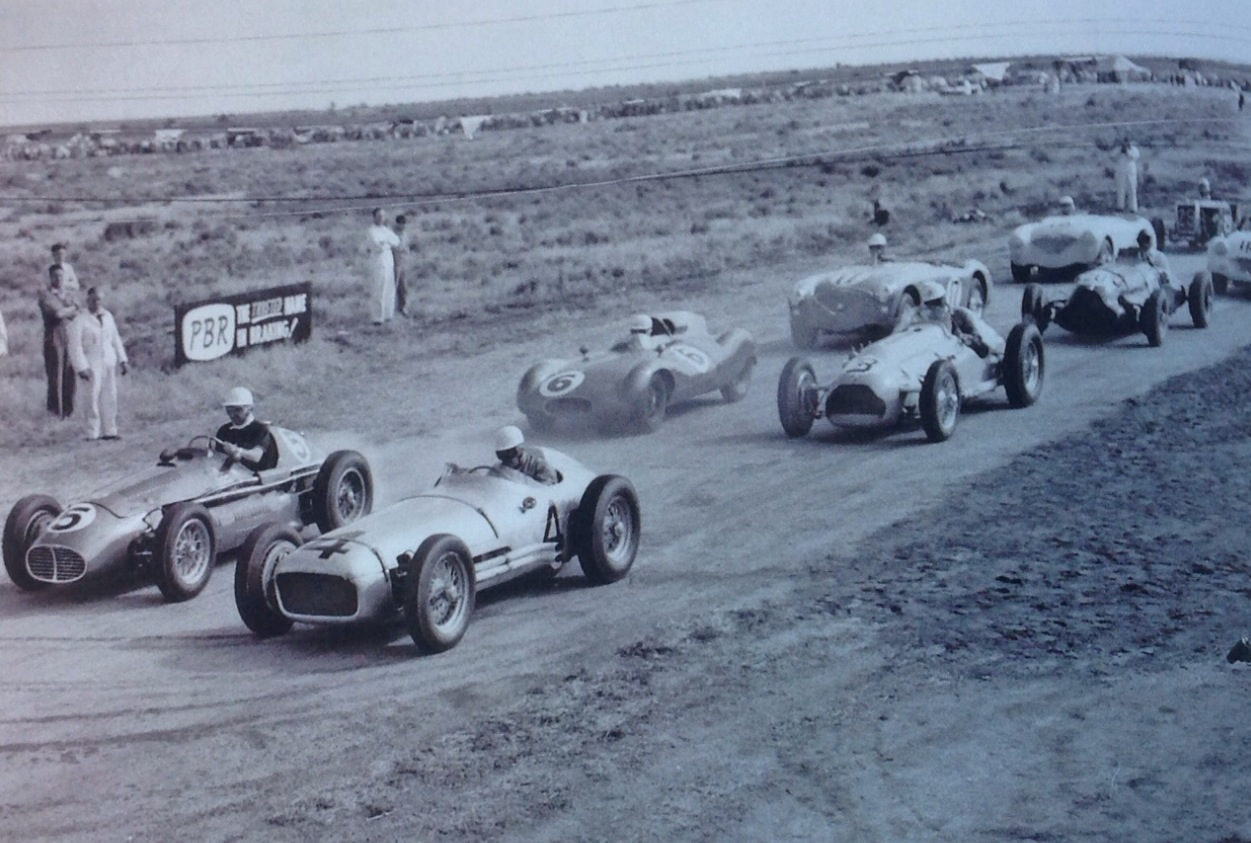
In a Battle of Melbourne Motor Dealers,Stan Jones struggles to keep Maybach 3 in front of Reg Hunt’s Maser A6GCM during the first lap of the 1955 Australian Grand Prix at Port Wakefield, South Australia, October 10…
The two cars were arguably Australia’s fastest special and production racing car at the time. Mind you the ‘special’ descriptor belies the tool-room quality of the Maybach series of cars in terms of both design and execution by Charlie Dean and his team at Repco Research in Melbourne. The Maserati A6GCM/250 and 250F family are members of one the greatest series of production racing cars ever built. Not that either car won this particular contest!
Jack Brabham on the way to victory, Cooper T40 Bristol (Adelaide GP)Hunt, Maserati A6GCM/250 and Jones’ Maybach 3 on the front row with Brabham and Whiteford’s Talbot-Lago T26C on the second row (Cummins Collection)
Jack Brabham returned home from his first season in Europe replete with a self-built Cooper T40 Bristol, winning the Port Wakefield race in the 2-litre, 150bhp, 1100lb, mid-engined car. Was it the first time a modern-era post-war mid-engined car won a national Grand Epreuve?
Brabham had luck that weekend in South Australia in a car which later became notorious for its unreliability. He won the race after the retirement of, or problems encountered by some of the event’s heavy-metal including Jones works-Repco 3.8-litre Maybach, Hunt’s Maser 250F engined Maserati A6GCM – A6GCM/250 to some – and another Melbourne motor-trader, Doug Whiteford’s 4.5-litre Talbot-Lago T26C.
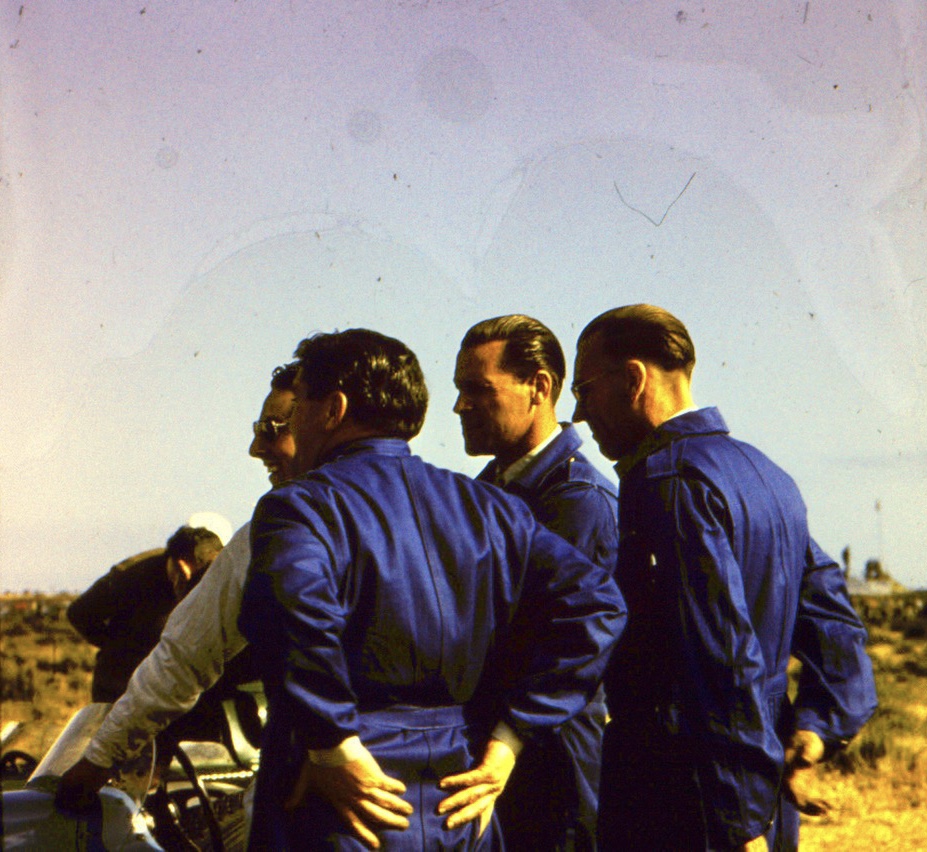
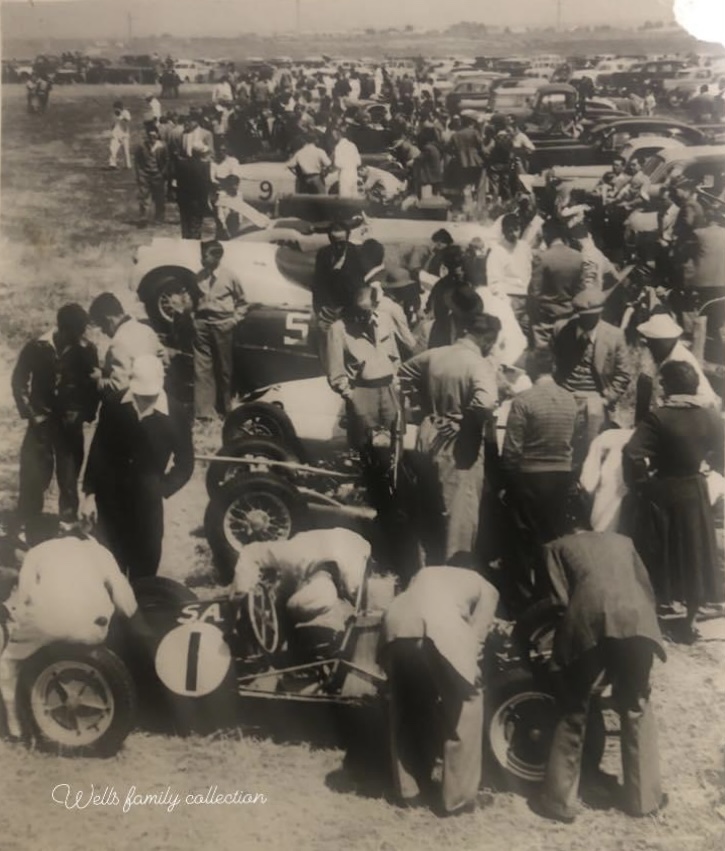
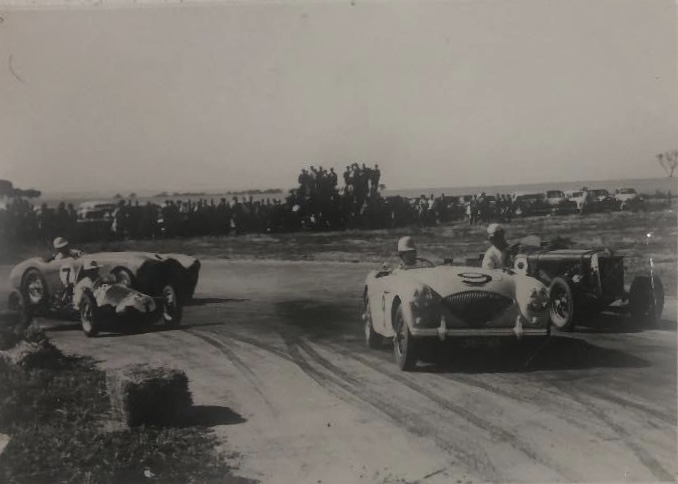
Clem Smith’s Austin Healey 100, DNF suspension being rounded up by the first and second placed cars of Brabham and Hunt: Cooper T40 Bristol and Maser A6GCM 2.5 (unattributed)Doug Whiteford’s (second) Talbot Lago T26C, note the three whopper SUs, on the grid in front of Greg McEwin’s Austin Healey 100. And below, in the centre with his crew before the off (JA Denniston)(JA Denniston)
Hunt and the Maser were the form combination at the time. Reg took the lead from Jones on lap one and led the race convincingly until the failure of a finger type cam follower forced the Maser onto five-cylinders, Brabham was soon past and into a lead he held for the races duration. Jones had clutch dramas, with Whiteford third, behind Hunt, in a car which raced too late after it’s initial arrival in Australia – devoid of some of the trick bits Doug paid for – shifty furriners! See here: https://primotipo.com/2022/05/04/doug-whiteford-talbot-lago-t26c-take-3/
The 80 lap, 104 mile event was the twentieth AGP and is noteworthy as the first on a purpose built circuit. Port Wakefield is 100km north of Adelaide in flattish, coastal, saltbush country. Previous AGPs were held on closed roads or airfields. ‘Wakefield, 1.3 miles in length, was used from 1953 to 1961, when Mallala, built on a disused Royal Australian Air Force airfield, became the main South Australian circuit.
(JA Denniston)
Not especially clear, but an interesting panorama with Hunts A^GCM in the foreground and a ‘cine-camera’ atop the pits. Makes you wonder if some footage is still kicking around somewhere.
(unattributed)
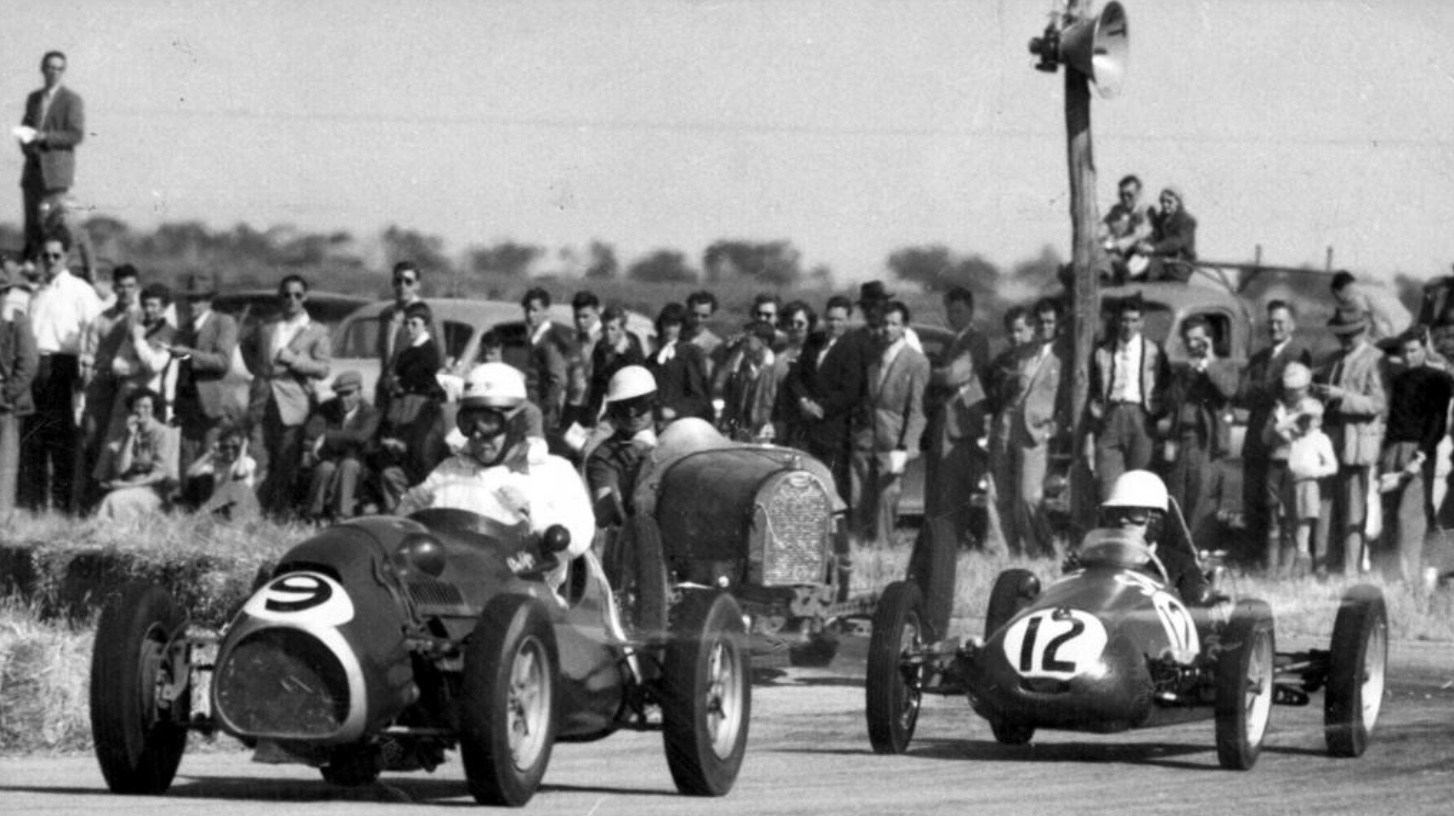
Stan Coffey, Cooper T20 Bristol from Murray Trenberth, Vincent Spl and John Cummins, Bugatti T37 Holden in one of the qualifying heats. Stan again below, this time having passed the spinning Cummins Bugatti in one of the qualifying heats. Cummo did not take the start in the GP.
(unattributed)(N Tasca Collection)
Etcetera…
(E Gobell)
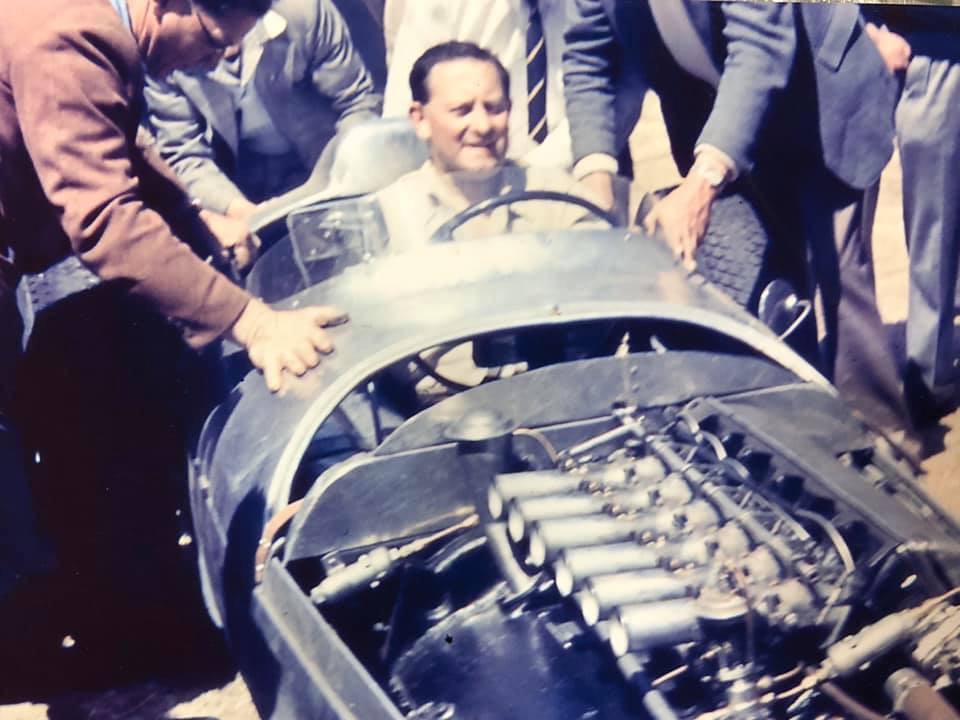
Charlie Dean beaming with pride aboard his latest creation, or rather the Repco Research team’s latest. Maybach 3 with its fuel injection system dominant atop the heavy, cast iron Maybach SOHC, two-valve 3.8-litre straight six laid-over at 65 degrees.
Greg Smith notes that the fuel injection system clearly shows the fuel rail and injectors, and that the throttle-bodies are actually single-choke 36DO2 units which were later (after the engine blew at Gnoo Blas with Stan at the wheel in early 1956) used on the Norman Wilson built Laydown Holden Special. See here: https://primotipo.com/2024/01/08/stan-jones-won-the-1954-nz-gp-70-years-ago-today/
(E Gobell)
Reg Hunt’s Maserati A6GCM above and below. This model is a 2-litre F2 car of the 1952-53 Grand Prix formula fitted with a 250F 2.5-litre SOHC, two-valve, triple Weber fed straight-six. About 240bhp at this early stage of the engine’s development. Hunt raced the car for little more than a year before progressing to a 250F in 1956, his final season in an oh-too-short elite level career. See here: https://primotipo.com/2017/12/12/hunts-gp-maser-a6gcm-2038/
(E Gobell)(JA Denniston)
Melbourne businessmen/racers/Light Car Club of Australia supremos Bill (left) and Jim Leech admire the brand new Austin Healey 100S, chassis #3905 perhaps, in the Port Wakefield paddock. Stephen Dalton advises that this car, the first 100S in Australia was driven from Sydney to the meeting by motor dealer and 1949 AGP winner, John Crouch.
(JA Denniston)
Bill Craig’s Alta Holden – 1952 chassis F2/5 ex-Peter Whitehead – (above and below), with its distinctive alloy wheels, and perhaps, BP’s Tom Stevens the onlooker. Ken Devine advises the car was later owned and driven by Murray Trenberth, Jack Ayres and David Rockford in Western Australia before being sold overseas.
(JA Denniston)
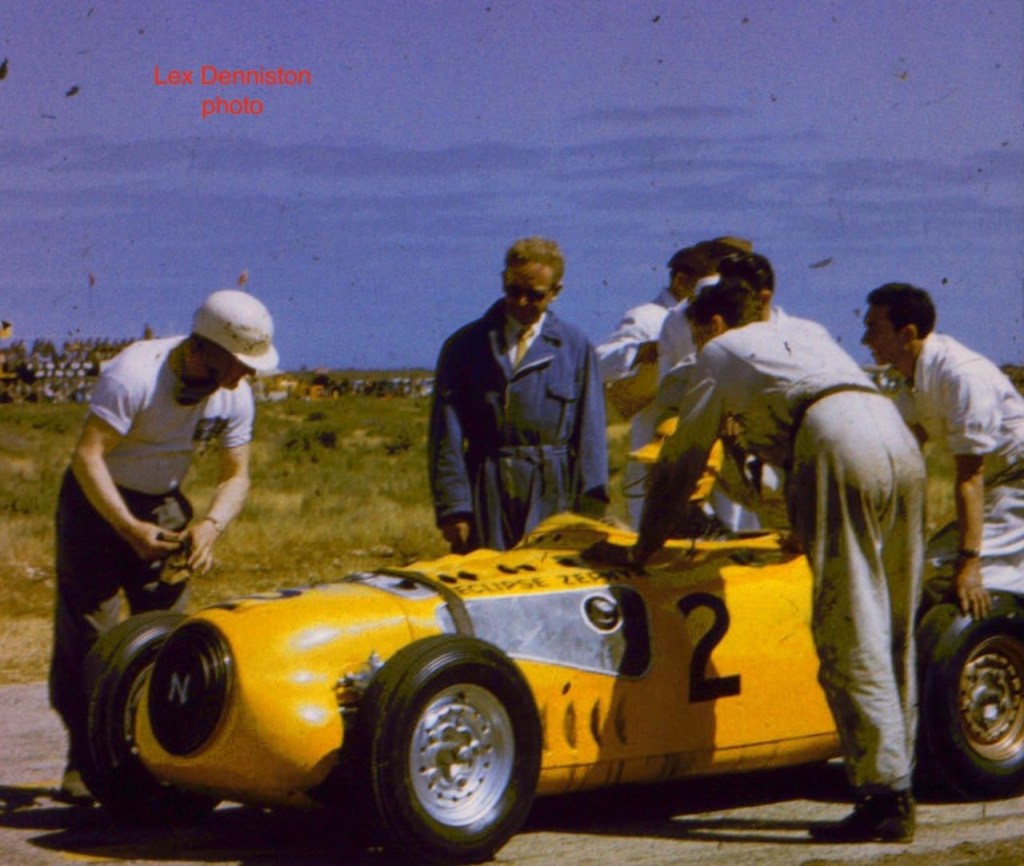
Two shots of the famous Eldred Norman built Zephyr Spl s/c. Tony Johns, “The starting grid photo shows the Zephyr alongside #8 Tom Hawkes’ Cooper T23 Bristol, probably a preliminary race.”
Credits…
State Library of Victoria, Reg Fulford Collection, Graham Howard and others ‘The 50 Year History of The Australian Grand Prix’, JA Denniston via Tony Johns, Edward Gobbel, Cummins Collection via Paul Cummins
Tailpiece…
The ’55 AGP third qualifying, 20 lap heat is underway. As a cursory glance of the mix of competitors shows, the race is a Formula Libre event.
On the second row is Brabham’s streamlined, central-single seater Cooper T40 Bristol and thrice AGP winner Doug Whiteford’s Talbot-Lago T26C. It’s rather a neat contrast of post and pre-war technology. On the next row is the Austin Healey 100 of Greg McEwin and Bill Wilcox’ Ford V8 Spl, South Aussies both.
A parade of Auto Unions through the streets of Zwickau on November 7 1936, Auto Union’s home town to celebrate Bernd Rosemeyer’s 1936 European Championship victory…
The cars were built in the Horch factory located in the town. Bernd Rosemeyer drives the lead car with Hans Stuck, Ernest Von Delius and Rudolf Hasse in the cars behind.
After two years of Mercedes supremacy it was the turn of the mid-engined, 6 litre, 520bhp Type C V16 engined cars. Rosemeyer was the dominant driver winning 3 of the 4 championship rounds- the German, Swiss and Italian GP’s. Rudy Carracciola’s Mercedes W125, powered by a 600bhp 5.6 litre V12 in 1936 took the Monaco race. Rosemeyer also won the Eifelrennen and Coppa Acerbo non-championship events.
Mercedes would be back with a vengeance of course, but for now victory is sweet and to be celebrated…
Rosemeyer’s German GP win 26 July 1936, Auto Union Type C (Getty)
Max Stephens powers his 2 litre Cooper T40 Bristol up the Domain Hillclimb, Hobart, Tasmania probably late 1959…
Its not just a T40, it’s THE T40, Jack Brabham’s 1955 Australian Grand Prix winning car- Jack took a somewhat lucky win when the more powerful cars of Stan Jones and Reg Hunt fell by the wayside or were mortally wounded.
Colour isn’t so common in Australian motor racing photography in the period- partially due to its cost and that professionals mainly shot in monochrome given good ole black and white in magazines prevailed. This is a fantastic colour photograph from Lindsay Ross’ oldracephotos.com.au archive, I’m not sure who the ‘snapper is in this particular case but his/her composition took my eye.
The 1959 Australian Hillclimb Championship was held at the Queens Domain on Saturday 14 November 1959, in fact the weekend was a ‘double-banger’ with competitors over from the mainland able to compete at the Baskerville circuit on the Sunday. Perhaps this photo is of Max during the championship meeting, i’m intrigued to know.
The journalist Rob Saward, writing on The Nostalgia Forum had this to say about T40 ‘CB/1/55’ and Stephens…
‘The gearbox was always this cars weakness…It was the usual Citroen based (ERSA modified) box Cooper were using in the early Bobtails and F2 cars, which worked ok with the FWA or FWB Climax, but 2 litres of Bristol power meant it had to be treated very gingerly. Longford was always hard on transmissions, even more so before the railway crossing was rebuilt prior to the 1960 meeting’.
‘Max Stephens never really had the chance to demonstrate his true potential in the car- he was a gifted motorcycle racer, Tasmania’s best in the 1950’s and there is no reason why he could not be good in a car also. I don’t know whether it was his (Max Stephens Motors in Moonah, a car sales, later accessories and motorcycles) business that stopped him getting more involved in car racing or whether money was the issue…he died a few years ago’.
‘The car was sold in about 1962/3 to Alan Robertson of Hobart who converted it from central seat to sportscar format and raced a few times before Bristol engine problems intervened…the car was purchased by Frank Cengia, who restored it in the original Brabham 1955 colours, but in the 1990’s it was unfortunately sold overseas…’when Pat Burke who owned the car fell upon hard times’.
Cooper T40 ‘CB/1/55’ whilst in Stephen’s ownership at Longford in 1959 or 1960. It is the car that Jack built, literally, days before his championship F1 debut at Aintree in the 1955 British GP. The car was constructed on the T39 Bobtail sports jig, with modifications. Note the curved Cooper spaceframe chassis, Bristol 2 litre engine sitting tall in the chassis, alloy wheels…such a clever car (oldracephotos.com)
Talented engineer Geoff Smedley added that ‘the car was prepared (in Tasmania) by the late Eric O’Heaney, one of the old school motorcycle mechanics who gave Max a lot of success in his bike days…Eric himself was an avid bike racer until a serious accident…In my mind Eric was an earlier version of the great Phil Irving, both with the same demeanour in their thinking and dedication to the development of the sport…’
Scott Stephens describes his father Max‘…as a respected car and motorcycle racer. He was the only Australian, whilst riding a Manx Norton 500, who successfully passed Geoff Duke for the race lead whilst Geoff held the mantle of current World Champion, this was achieved during the Australian Grand Prix held at Longford…Observed motorcycle trials was his last competitive stance. He was the Kawasaki and Maserati distributor in Tasmania…In his Hobart store he was the approved reseller of Norton, BSA, Velocette, Triumph, Laverda, Maico, Cotton, AJS, CZ, Montesa, Bultaco, Ossa, Hodaka, Italjet and Suzuki’ makes down the decades. Scott himself was a successful professional racer who rode for Kawasaki Australia, Matich Pirelli Racing and Suzuki quips that Max ‘Loved and was amazed by anything driven by fuel!
Tailpiece: Stephens and T40 on the warm-down lap, Longford…
(P Geard)
Bibliography/Credits…
The Nostalgia Forum- contributions by Rob Saward and Geoff Smedley, scottstephens.com.au, oldracephotos.com.au, Paul Geard Collection
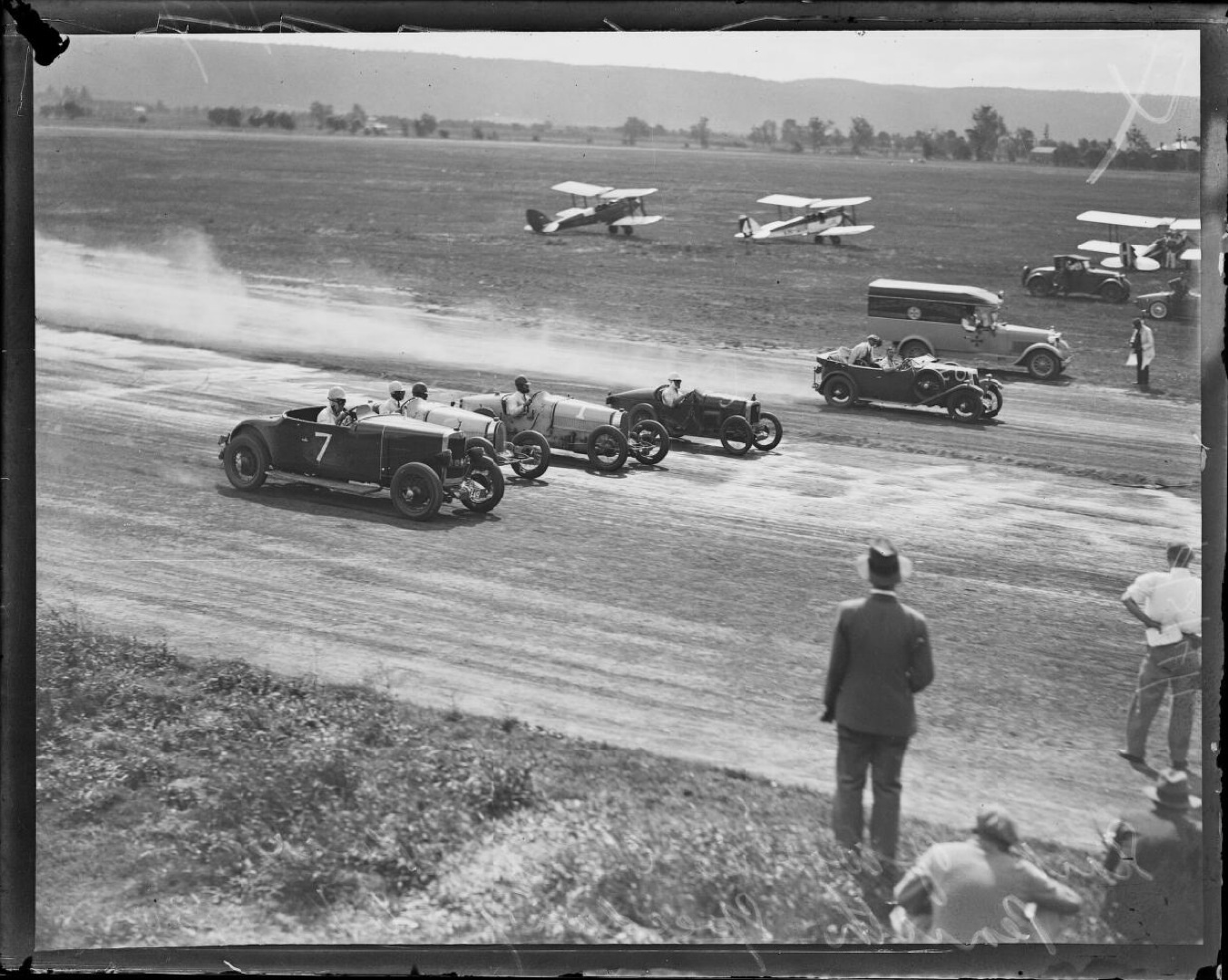
The finalists are off to a flying start in the 6 October 1930 ‘World Championship’ for under 1500cc cars on dirt, Penrith Speedway, Sydney…
The glass plate negative, wonderful monochrome photograph creates such an evocative feel apart from the scene itself. From the outside is John Sherwood’s cumbersome looking Lea Francis O-Type, then the Sam Aggett and Charlie East driven Bugatti T37’s and on the inside Tom Lord’s, Geoff Lowe owned Austin 7 Brooklands. On the very inside verge is Jack Field’s supercharged Lea Francis S-Type Hyper tourer slowing having paced the competitors for a lap before the championships 3 lap journey, East was the winner in his Bugatti.
Event and Competitors…
A record entry of 79 cars was received for the meeting. The winner of the feature event, Charlie East, described as an ‘old hand track and competition driver’, was proclaimed World Champion for cars under 1500cc on dirt tracks.
The 6 entries for this 3 lap race were all rather local notwithstanding the grandiose title of the Light Car Club of New South Wales promoted event, not that there is anything new in promoters ‘puff’ to put bums on seats!
The Nepean Times reported that the race was ‘No mere crow attracting stunt, but a legitimate worlds championship event’. The ‘International Racing Organisation…specified certain electrical timing apparatus, this to be controlled by officials sanctioned by the leading motor body of the state’. The event was supervised by the Royal Automobile Club of Australia, the Confederation of Australian Motor Sport was not formed until the 1950’s.
The Sydney Morning Herald noted Mr TF Lord’s supercharged Austin 7 Brooklands was a new car with Messrs Charlie East and Sam Aggett entering 1496cc (T37) Bugatti’s. Tom Sulman had a career which went all the way from the early 1920’s in the UK to his unfortunate death in a Lotus 11 Climax at Bathurst in 1970, was entered in a 1096cc Salmson.
John Sherwood was a luminary as a driver, businessman, motoring and motorsport administrator down the decades, he entered a 1496cc Meadows 4ED twin-carb powered Lea Francis O-Type. Sherwood was the driving force of the NSW Light Car Club as well as the key individual who created the Mount Panorama track at Bathurst. From a pioneering motoring family, he was a formidable competitor and later, as a Director of Empire Speedways, was a big contributor to the growth of Speedway Racing in Australia.
WH Northam was the final entry in another 748cc Austin, a combination which had many wins at Penrith and who later raced to 6th place in the 1932 Australian Grand Prix aboard this car. Bill Northam had an extraordinary life of achievement in commerce, sport and as a charity fund raiser. Long after he stopped motor racing he took up yachting in his mid-forties making the Australian Olympic Team and winning the Gold Medal in the 5.5 metre class at the Tokyo 1964 games. He was knighted in 1976 and died, aged 83, in 1988.
Other races on the ‘Eight Hour Day’ Monday public holiday card were an all powers handicap over 5 miles, a handicap for under 850cc cars over 3 miles, a four mile scratch race and finally the NSW LCC handicap over 3 miles.
The Championship Race…
Four starters took the flag with Sulman and Northam knocked out in eliminations conducted over 1 lap, a mile, with each car having a flying start. Aggett was the fastest qualifier at 66.91 mph from East, Lord, Sherwood, Sulman and Northam the slowest on 60mph.
The racers were given a rolling start behind JA Fields Lea Francis, then East immediately took the lead in his Bugatti from Lord’s Austin, then Aggett’s Type 37 and Sherwood’s Lea Francis ‘handicapped by a cumbersome body’, ‘Sherwood’s Lea Francis could not be opened up except in the back stretch’ in 4th. East drew away to a lead he never relinquished, and led Aggett by 100 yards from Lord. East’s lead stabilised at about 400 yards from Aggett, who was handicapped by an oiled plug, Lord was 100 yards further back and then Sherwood last.
In the final quarter of a mile Lord and his little supercharged Austin seized an opening through the dust, coming alongside Aggett’s Bugatti in 2nd. ‘Aggett swung a trifle wide on the last turn onto the home stretch, and, straightening up, cut down to the inner edge of the racing course. The two cars touched with the Austin spinning wildly. ‘Lord’s car spun on its side, dragging the driver, who was half out, and half in the Austin. Lord sustained abrasions to his legs and face. Charlie East one of the Maroubra stars, won in a time of 2 minutes 33 seconds at 70.58 mph by 100 yards with a wheel, literally, between Aggett and Lord in 2nd and 3rd. Sherwood’s Lea Francis was last car home.
The excitement was far from over though. ‘With Lord in the hands of the ambulance people, the stewards took prompt action. They disqualified Aggett and ‘sent him out’ (banned him from competition) for six months’. ‘The Referee’s’ report of the race then pointed out the unfairness of this process which was so speedy, their was no call for full evidence and Aggett appealed. I’m uncertain of the response of officialdom to this request.
Aggett and Lord make contact, the accident attributed to the Bugatti T37 driver rather than Lord aboard the tipping Austin 7 Brooklands (Fairfax)
John Sherwood’s Lea Francis won the final of the open class ‘Widgery Cup’ Handicap, the ‘Clyde Battery Cup’ handicap for cars under 850cc final was won by CB Tye’s Austin 748cc and the All Powers Scratch Race final by CO Spurgeon’s Rajo Ford with the Club Handicap for under 2000cc cars won also by Tye’s Austin. In a day of interesting racing a special match race between Captain Hammond’s Gypsy Moth aircraft was won by the plane over J McCutcheon’s Morris Midget by a few lengths, the distance a flying mile, pun intended!
Penrith held the international spotlight for a week during the 2000 Sydney Olympic Games, the town is 50Km west of Sydney on the Nepean River, it was the site of the whitewater rafting and rowing competitions. But the hype about the Penrith 1930 World Championship race inclusive of its title were not indicative of the events true local nature.
The competitors were all from New South Wales, a notable absentee was Bill Thompson, three time winner of the Australian Grand Prix and in sparkling form in 1930. Earlier in the year he won his first AGP at Phillip Island and had swept the board in the same AGP winning Bugatti T37A during the Gerringong Beach racing carnival on NSW’s Illawarra Coast in May. Thompson was reported to be entered at Penrith but did not race, his entry was received ‘out of time’ and so was refused. Talk about a promoter putting due process in front of ‘the show’! ‘The Referee’ report noted the ‘the field was unworthy of a world championship. Without entries from Thompson, Drake-Richmond and Terdich, to mention but three of the missing cracks, the field was not even truly representative of Australia’. Both Harold Drake-Richmond and Terdich were Victorian stars, Arthur winner of the 1929 AGP at Phillip Island aboard a Bugatti Type 37A.
Charlie East, all smiles aboard the winning Bugatti T37, Penrith, October 1930 (Sydney Morning Herald)
Not that the quality of the final lacked talent in the context of Australian Motor racing, very much nascent at the time…
The Australian Grand Prix was held for the first time on an oval dirt layout around the showgrounds at Goulburn, New South Wales in 1927. The 1928 AGP, ‘The 100 Miles Road Race’ at Phillip Island, the first proper race in Australia on a road, run on a large, rectangular, gravel course was more indicative than Goulburn of the direction Australian racing would take and was indeed the race which started the tradition of road racing in Australia.
At the time Australian motor racing was largely amateur, a ‘run what you brung’ approach prevailed with most competing cars driven to and from the track. The sport evolved from hillclimbs, sprints and races on horse-tracks, the province of the gentry pre-War, to hillclimbs at Waterfall Gully, Kurrajong, Mount Coot-tha and Belgrave, beach racing at Gerringong and Sellicks to venues such as Aspendale, Maroubra and Penrith Speedways. Racing on Sydney’s banked, concrete Maroubra Speedway track was very professional. Maroubra was owned by a commercial enterprise, not a car club, there was prize money to be won, the approach of the top competitors was consistent with that- the importation of cars and preparation thereof with a view to commercial success prevailed.
Some brave kids watching a competing car at Kurrajong Hillclimb, 75Km northwest of Sydney in the lower slopes of the Blue Mountains, October 1920, the competitor has the two outside wheels in the dirt on turn in! Hillclimbs were incredibly popular forms of motorsport in Australia at the time either as stand alone events or as part of trials which were events mixing navigation and speed events, usually sprints and hillclimbs. Between 1915 and 1926 there were at least 50! different hillclimb venues used across the country (Michael Terry)
John Medley wrote that ‘it was some time before other groups followed (the Light Car Club of Victoria’s Phillip Island) road racing direction, preferring the simpler expedient of running trials with speed sections included (rather like modern rallies) or contests on simple dirt speedways- both of these being more easily controlled by the organisers and also less accessible to the long arm of the law. One consequence was that their was very much a casual air to the whole occasion, with ‘chop picnics, family gatherings and exuberant overnight parties.’
I have not used the term speedway racing as the ‘forked road’ the sport took in later years had not yet occurred, competitors contested a variety of events as above. In addition solo intercity record-breaking attempts were also important with Graham Howard recording that ‘…intercity records…were the most consistent form of competitive motoring in Australia until the late 1920’s, and produced our first household-name drivers…’
A little snippet in the ‘Nepean Times’ article is a reminder of the important co-existence, with the motorcycle dudes the leaders, of ‘bikes and cars racing at the same meetings. The article notes that the Penrith meeting was ‘the only all car one in New South Wales for about five years’. It is also reported in terms of contemporary competitor numbers (79) that the meeting had ‘a record entry for a car race meeting for any part of Australia’. Also amusing, the ‘Times notes, ‘Women are barred, (from entering the championship race) which means that Mrs J.A.S Jones will not be driving her supercharged Alfa Romeo (6C1750). But it is hoped this fine car will race even with a mere male at the wheel’!!
Stunning image by of WE Hart in his Bristol Boxkite biplane in 1912. A Parramatta dentist, Hart bought the Boxkite (frame number 10) from Joseph Hammond, demonstration pilot of the British & Colonial Aeroplane Co and became Australia’s first qualified pilot on 5 December 1911 (SLNSW)
Penrith Speedway ‘was formerly the first recognised airfield in Australia situated in Belmore Park and is now the village of Thornton’ wrote Peter Finlay, former racer and aviation writer.
‘William Ewart Hart was the first Australian to fly from there in 1911 in his Bristol Boxkite after demonstration flights by JJ Hammond in the Bristol. Hart established a flying school there before moving to Hart Common, now RAAF Richmond. Races between cars and aircraft were held at the speedway. Frank Kleinig Snr was a regular competitor and Sir Charles Kingsford Smith operated the ‘Southern Cross’ from the field at times. There is a spectacular memorial featuring a stylised Bristol Boxkite at the entrance to the oval’, Peter wrote.
The first car race meeting was held over the April 1924 Easter weekend- the track morphed through lap distances of 1 mile 80 yards to the 1 mile course used in 1930. The track was touted by international competitors who raced there as ‘The Worlds Greatest Dirt Track’ but its life was relatively short-lived. The Commonwealth Defence Department compulsorily acquired the land in 1941 and the circuit was consumed in that process.
RG Potts racing the Mrs JAS Jones owned Lea Francis on Gerringong’s Seven Mile Beach, 50 Mile Handicap on 10 May 1930. You can just see the pole at left which Potts is turning around to head back the other way on this beach near Kiama, 130 kilometres to Sydney’s south. There was no road racing in NSW at the time so racers did ‘the lot’- sprints, the hillclimbs which were often part of the trials conducted by local car clubs, the speedway at Penrith, and here upon Gerringong Beach. Sellicks Beach on Adelaide’s Fleurieu Peninsula was also used by ‘bikes and cars to race (Fairfax)
The six ‘World Championship’ entrants were all experienced New South Wales competitors with Sherwood and Sulman later entrants in Australian Grands’ Prix. Sherwood’s car appears to be a Lea Francis ‘Hyper’, a competition variant of the marque successful in the UK at the time and powered by a supercharged 1496cc 4 cylinder engine.
I can find no details of Sulman’s Salmson and am keen to hear from any of who may know about his car. Tom Sulman is revered in Australia as a doyen of racers who simply never stopped until the sport eventually took his life. I was at Winton a fortnight ago and looked again at the Sulman Singer, the amazing self-constructed dirt car Tom built and raced in England in the 1920’s before his return to Australia. It was a constant in Australian motor racing in both contemporary circuit events, and later from the mid-seventies, in historic racing when driven by Ron Reid. Upon his death not so long ago, his sons continue to race a car which must have done more racing miles than any other on the planet!.
Somewhat bizarre is that the ex-Charlie East Bugatti T37, chassis ‘37104’ sits in Earl Davey-Milne’s garage in Toorak, Melbourne one kilometre from where I am writing this article right now! Chassis ‘37104’ was the fourth T37 built and shipped to Sydney’s Russell Taylor, the prosperous owner of the Advanx Tyre company. It was raced for him by Charlie East, a driver whose stature was growing at the time.
East was a Maroubra regular, one of its stars having first raced there in 1926 and subsequently lapping at over 96mph and on one occasion his lap was timed at over 116mph. Davey-Milne bought the car in 1943, it remains in the Chev Corvette V8 engined, open chassis form Earl rebuilt it to in the late 1950’s. East didn’t race the car in an AGP but ‘37104’ was raced in the 1933/4/5 events at the ‘Island driven by Cec Warren in 1933 and John McCutcheon in ‘34/5.
It isn’t clear if either or both the East and Aggett Bugatti T37’s were normally aspirated or to T37A, supercharged specifications. I can find no references as to which particular Bugatti Aggett raced and am keen to hear from any Bugatistes who can help with the identity and specification of the car and the drivers background. Similarly, whilst Lord’s Austin 7 is reported to be of blown Brooklands specification I have no details of the Northam Austin 7. All details again gratefully received. These snippets of history are all interesting i think!
In this case the photo which inspired the research and the resultant article popped up on that internet thingy when I was messing around looking for shots of Bill Thompson after reader Rob Bartholomaeus corrected the caption of an article I’d written about Thompson and his Bug T37A. Its funny how one thing can lead to another!…
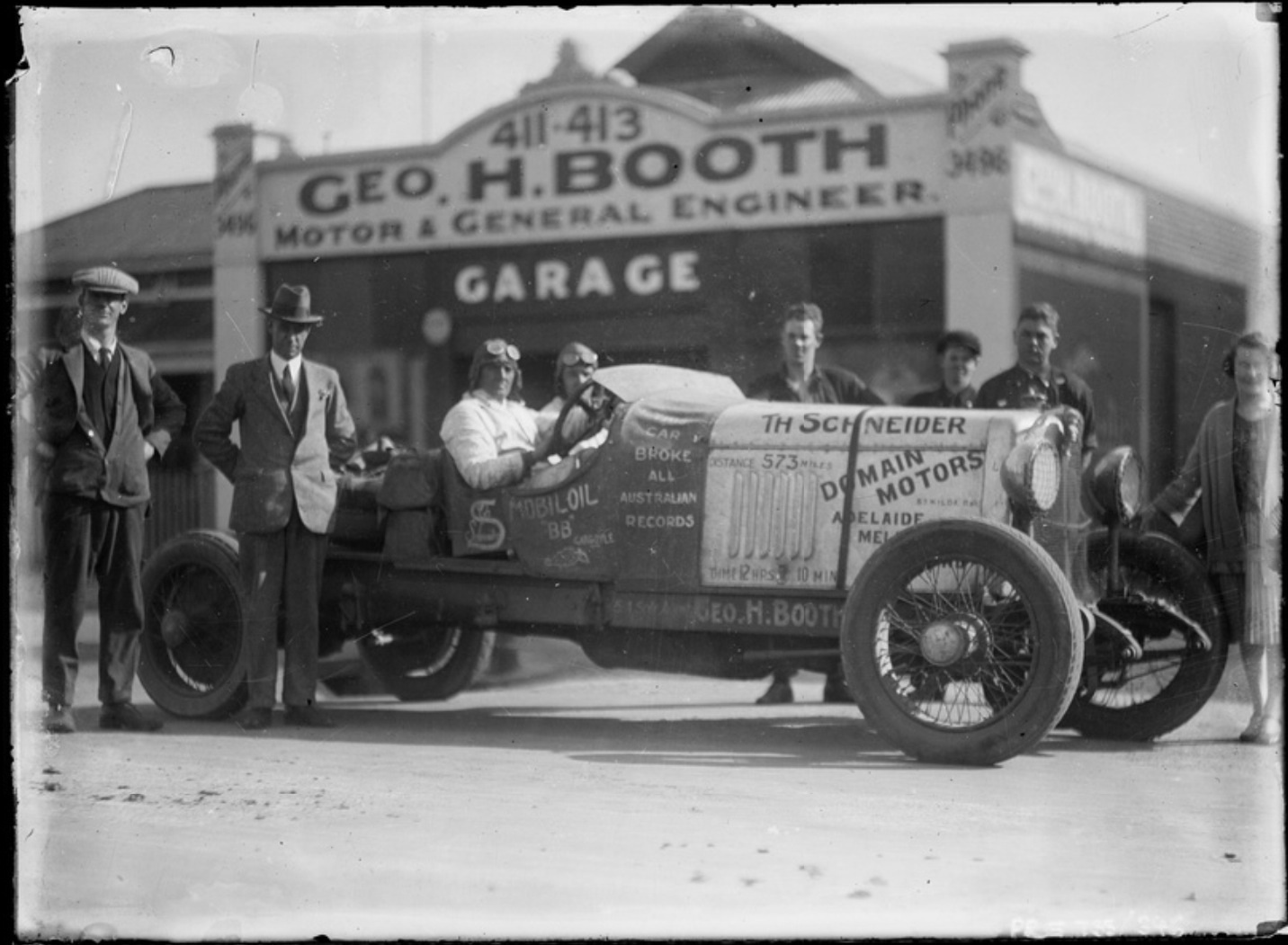
Intercity record breaking was a popular form of solo road competition in Australia until outlawed in 1935 due to accidents. Here is the 25.5hp Th.Schneider with Arthur Barnes at the wheel and mechanic Bill McCulloch alongside- they have just taken the Broken Hill, NSW to Adelaide, SA record covering the 533 kilometres of unmade roads in 8 hours 3 minutes. The car is parked out front of Booth’s Garage, 411 King William Street in Adelaide’s CBD. 12 August 1925 (WS Smith)
YouTube Footage of Penrith…
Makes clear the speed and danger of the place! I looked at the film enthralled but the danger was readily apparent before discovering other footage of a multiple fatality when a car crashed into spectators in 1938.
When ‘shit happens’ at speed, without protective barriers, its all over in the blink of an eye. Racing entry tickets still have the ‘Motor Racing is Dangerous’ message to this day, and so it was for all, spectators included until not so long ago!
Etcetera: WE Hart, Bristol Boxkite, Penrith circa 1912…
‘Nepean Times’ 27 September 1930, ‘Sydney Morning Herald’ 30 September and 7 October 1930, ‘The Referee’ Sydney 8 October 1930
‘Bathurst: Cradle of Australian Motor Racing’, John Medley, ‘History of The Australian Grand Prix’ Graham Howard and Ors, ‘Historic Racing Cars in Australia’ John Blanden, Peter Finlay
Photo Credits…
Fairfax, Sydney Morning Herald, State Library of South Australia, Sir Hudson Fysh, WS Smith, Michael Terry
This fantastic advertorial shot is of Frank Matich’s Brabham BT7A Climax and Leo Geoghegan’s Lotus 27 Ford at Sandown in April 1964…
The magazine is the much loved and lamented ‘Australian Motor Sports’, the cover its June 1964 issue. The caption reads ‘…picture taken on the main straight up from the Dunlop Bridge, that’s the Dunlop R6 tread pattern photographer David Parker has caught so clearly on Frank’s car, at the April Sandown meeting’.
The 19 April meeting featured the Victorian Sportscar Championship which Matich won in the Total Team Lotus 19B Climax, the weekend for the team made almost complete by Geoghegan’s Lotus 27 victory in the ‘Victorian Trophy’, that year limited to 1.5 litre cars. Matich retired the Brabham with gearbox problems in the 15 lap racing car feature for ‘Tasman’ cars whilst in the lead, the race was won by Lex Davison’s Brabham BT4 Climax.
At the time the French oil company had aggressively entered the Australian retail market. Formation and promotion of this team, launched in July 1962, was an important part of their marketing and positioning strategy.
Total supported the Matich and Geoghegan team cars of Frank, Leo and brother Ian Geoghegan. Both Frank and Leo I have written about in detail, clink on the links below to read about them.
Ian or ‘Pete’ Geoghegan’s Lotus 23 Ford, Leo G’s Lotus 32 Ford and Frank Matich’s Lotus 19B Climax at Oran Park, NSW in 1965 (Rod MacKenzie)
Engine 4 cylinder monobloc, 1 inlet and 2 exhaust valves, SOHC, 4493cc-100X143mm bore/stroke, 4 speed box, 4 disc clutch, brakes on transmission, front and rear wheels, 1025Kg
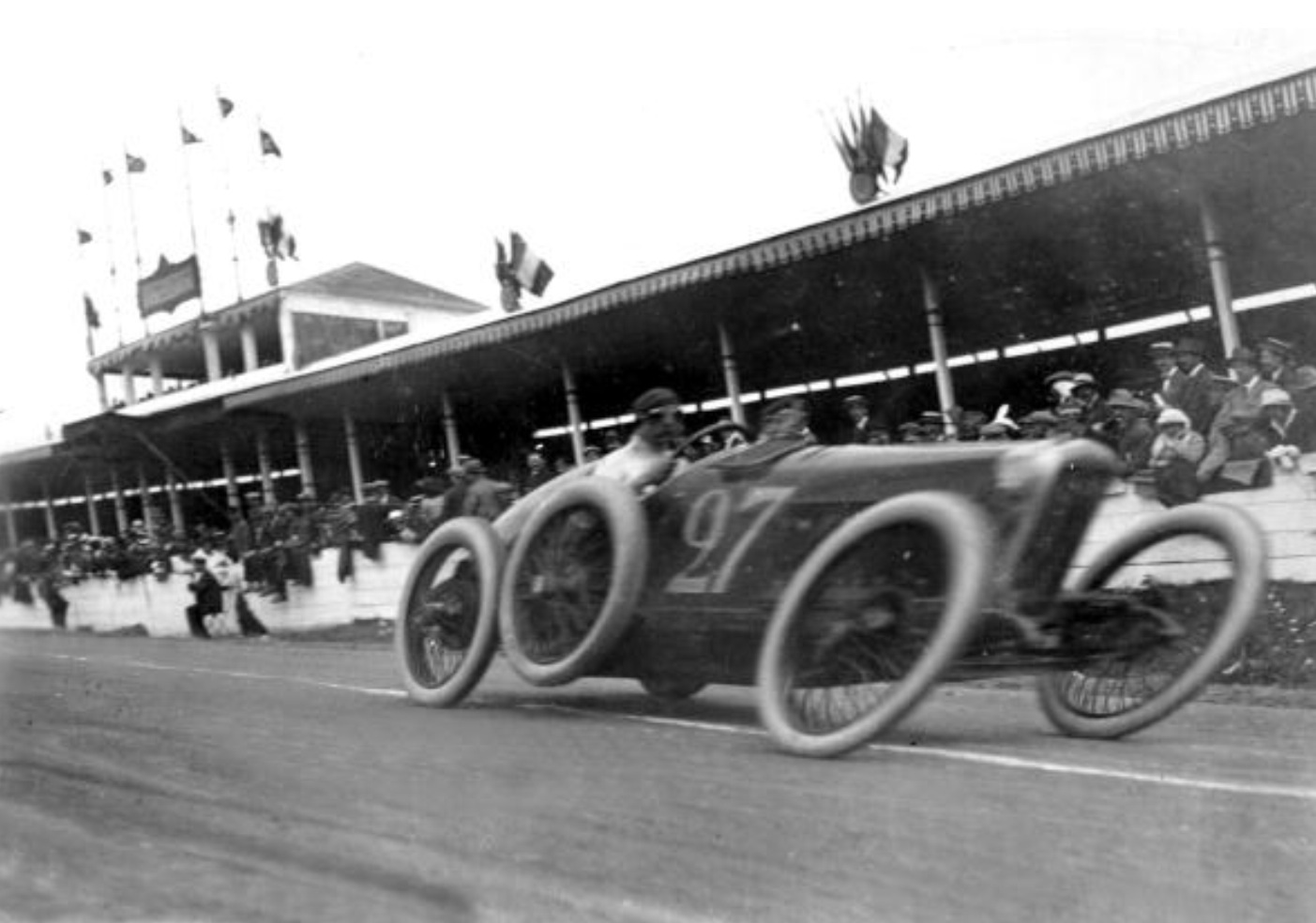
Antonio Fagnano blasts his Fiat through a village during the 14 July 1914 event, Lyon…
Fagnano was a Fiat all-rounder and institution, he was a mechanic, foreman, member of the test department and graduated from riding mechanic to race driver of the works team!
For 1914 the GP ‘Formula’ provided for an 1100Kg maxiumum weight and engines of no more than 4.5 litres in capacity. The race was a contest between Peugeot and Mercedes in the context of imminent war; Archduke Franz Ferdinand was assassinated less than a week before the GP at Lyon which drew a crowd of over 300,000 filling hotels within a 50Km radius of the course.
Christian Lautenschlager and riding mechanic on the way to winning the 1914 French GP, Mercedes GP 35HP. Engine 4 separate cylinders, 4 valves per cylinder, SOHC, 3 plugs per cylinder, 4456cc-93X164mm bore/stroke, claimed power 115bhp@2800rpm. 4 speed box, leather cone clutch, brakes on transmission and rear wheels, 1080Kg, top speed circa 110mph (unattributed)
Christian Lautenschlager won from teammates Louis Wagner and Otto Salzer in 7 hours 8 minutes 18.4 seconds at an average speed of 65.665mph.
Sailer led by 18 seconds at the end of the first lap, by lap five he had built a lead of almost 3 minutes and then retired with a blown engine on lap 6. Boillot’s Peugeot took over the lead for 12 laps, at one point he led by over 4 minutes.
The Mercedes drivers made one stop during the race for new Continentals. This contrasted with the poor wear of the Dunlops of Peugeot, Boillot made eight stops for tyres, the Frenchman’s many tyre changes allowed Lautenschlager to pass on lap 18. By the end of that lap, Christian had opened up a lead of over 30 seconds.
Fagnano’s Fiat was the best placed of the Italian cars, the talented driver died of an illness, aged 35, on 8 July 1918.
France, 1914 and the Art Historians…
If you have a hankering for this era of racing here is a very interesting article with a completely different angle.
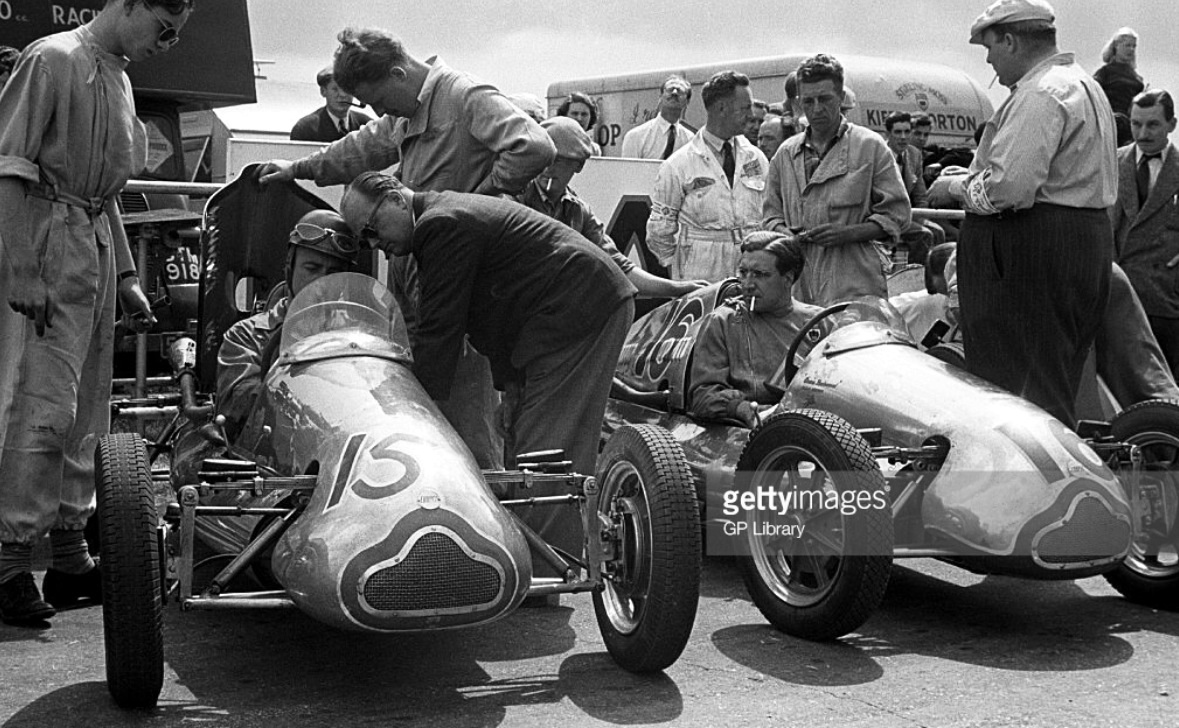
Eric Brandon and Alan Brown, ‘Ecurie Richmond’ drivers with capped patron Jimmy Richmond, a haulage contractor from Nottinghamshire and mechanic Ginger Devlin at Silverstone 14 July 1951…
It’s the British Grand Prix meeting, the cars the latest Norton engined Cooper MkV 500cc F3. The motors were tuned by the highly rated Steve Lancefield and Francis Beart. The very competitive drivers were first (Brandon) and second in that years Autosport F3 Championship from the JBS’ of Peter Collins and Don Parker. They didn’t win at Silverstone though, Stirling Moss won in the new Kieft CK51 from Ken Wharton and Jack Moor.
The Ecurie Richmond pair netted 16 major victories and 41 heat wins in a marvellous 1951 season. The Brands Hatch Junior Championship in ’51 was taken by Cooper mounted BC Ecclestone.
Ecurie Richmond progressed to F2 in 1952 with Brown’s Cooper T20 Bristol achieving the great marques first championship GP points with his 5th place at Bremgarten in the Swiss Grand Prix, F2 adopted as F1 in 1952-3 of course. Heady days indeed…
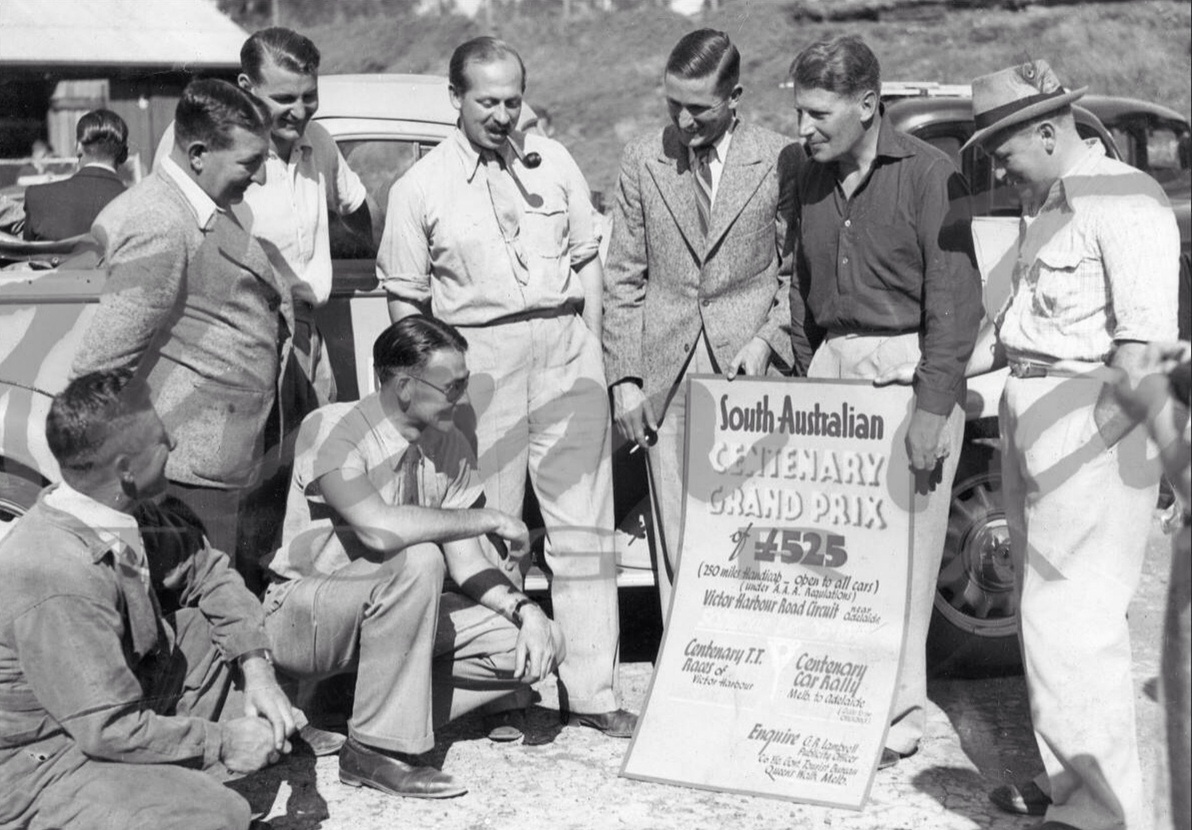
One of our online friends, Rob Bartholomaeus, sent me these excerpts from the program of the ‘S.A. Centenary Grand Prix’. I was going to add them to the article I wrote about the race quite a while ago, but they were too good to disappear without trace within an existing article, so here they are…
Then I started thinking about history and the recording, interpretation and restatement in relation thereto.
There was no ‘Australian Grand Prix’ held in 1936 or 1937.
The 32 lap, 240 mile ‘South Australian Centenary Grand Prix’ was held on 26 December 1936 and down the decades, no-one seems to know who started it, has been acknowledged as the 1937 AGP despite being held on 26 December 1936 and despite not being called the AGP at the time.
Graham Howard in his introduction to the seminal, defining, authoritative and entirely wonderful ‘The 50 Year History of ‘The Fifty Year History of The Australian Grand Prix’ (HAGP) describes the reporting of motor racing in the early days in Australia as being ‘casual to the point of useless’. He then cites as an example of the lack of precision in reporting the AGP ‘the wonderful way in which a race staged in 1936 as the South Australian Centenary Grand Prix could, within a few years, acquire not only Australian Grand Prix status, but rank as the AGP for 1937’.
Go figure.
There is some ‘competition’ globally as to which countries have ‘the longest continuous’ Grand Epreuve.
The French have the oldest which was first held in 1906. The Italian commenced in 1921, Belgian in 1925, German GP in 1926 and the Australian in 1927- these races are the longest continuing GPs. The US and Britain for example, don’t qualify in ‘the longest continuing’ as both had big gaps when the event was not held despite the races being first run in 1908 and 1926 respectively. I’ve given the Germans a free kick as they were ‘black-balled’ till 1950 post-war, you can take them off the list if you are not as generous in spirit as me in your ‘longest continuous’ definition!
As in Australia with the 1936 ‘South Australian Centenary Grand Prix’ and the 1928 ‘100 Miles Road Race’ at Phillip Island, both later appropriated as Australian Grands Prix, some of the events globally were not held as ‘The Whatever Grand Prix’ at the time they were conducted either. Rather they were adopted later as such, as part of the continuum of the countries premier road racing event in that year. The first American GP, at Savannah, Georgia was called ‘The 1908 Grand Prize of The Automobile Club of America’ and the first British GP held at Brooklands was entitled ‘1 Royal Automobile Club Grand Prix’.
In recent times an Australian motoring historian, David Manson whilst trawling through some Sydney newspapers in the early 1980’s discovered that an Australian Grand Prix was held in Goulburn, 200 Km from Sydney on 15 January 1927.
This 6 lap event was won by local racer Geoff Meredith in a Bugatti T30. Seven cars contested the races on an oval dirt layout, 1 mile and 75 yards long around the Goulburn Racecourse (horse racing)- the contest comprised three heats and a final between the quickest pair.
Whether a six lapper lasting 6 minutes 14.8 seconds between two cars on an oval dirt course is a ‘Grand Prix’, even in the Australian context of the time, let alone the European one is debatable. The fact is, an event named, styled, promoted and run as the ‘Australian Grand Prix’ ‘for all powers racing cars’ was contested in Goulburn on 15 January 1927.
John Lackey has edited a stunning little book titled ‘A History of Australia’s First Grand Prix’ with contributions by a number of people including the highly respected John Medley- one of the authors of HAGP, it’s a must for any Australian enthusiasts library.
One of the reasons the book is significant is Medley’s coverage of the event and it’s competitors but more so his view about the role motorcyclists and their clubs had in paving the way for car racing in Australia- they were the true racing pioneers Medley records. It’s not a perspective I’d read before- more about this race meeting another time.
To the point of David Manson’s hugely significant discovery the first AGP was acknowledged as being the ‘100 Miles Road Race’ held by the Victorian Light Car Club for cars of no more than 2 litres capacity, at Phillip Island on 31 March 1928. The race, on a rectangular, 6.5 mile dirt road course near Cowes was later appropriated as the first AGP despite the name- the first AGP, using that name was promoted by the Victorian Light Car Club at Phillip Island in 1929- the Light Car Club staged the event annually at the island from 1928 until 1935.
As a result of the 1927 Goulburn event discovery, the History of the AGP, published originally in 1986, was reprinted to add the 1927 AGP as it’s first chapter in 2015.
So, it is a fact that the first Australian Grand Prix was held on 15 January 1927.
It is a fact that the ‘South Australian Centenary Grand Prix’, later appropriated as an Australian Grand Prix- I have no issue with that, was held on 26 December 1936. The event, won by Les Murphy’s MG P Type as a matter of fact is the 1936 Australian Grand Prix- not, without wanting to belabour the point, the 1937 Australian Grand Prix.
Adding the 1927 GP to the new edition of HAGP updated and corrected history, which, as we can all see from the very late discovery of the Goulburn event is a living, breathing thing. Why not also have altered the date of the Australian Grand Prix of 1937 and call it what it factually was and is- ‘The 1936 Australian Grand Prix’. HAGP is ‘The Bible’ on these things, an opportunity was lost, sadly.
Its all about history, it’s recording, interpretation and restatement, which I think is about where I came in. Sorry to be a pedant, but it’s just plain wrong and always has been- that the 26 December 1936 SA Centenary GP is ‘generally accepted’ as the 1937 AGP does not make it right let alone factually correct.
I know such a change wouldn’t contribute to world peace, it doesn’t really matter, but just sayin’…
Marvellous pre event drivers PR shot for the SA Centenary GP- Bob Lea-Wright kneeling in specs (N Taska)
Credits…
Rob Bartholomaeus Collection, Nathan Taska Collection
Bibliography…
‘The 50 Year History of The AGP’ by G Howard and Others, ‘The 1927 Australian Grand Prix’ Editor John Lackey, ‘A History of Australian Grand Prix 1928-1939’ by John Blanden
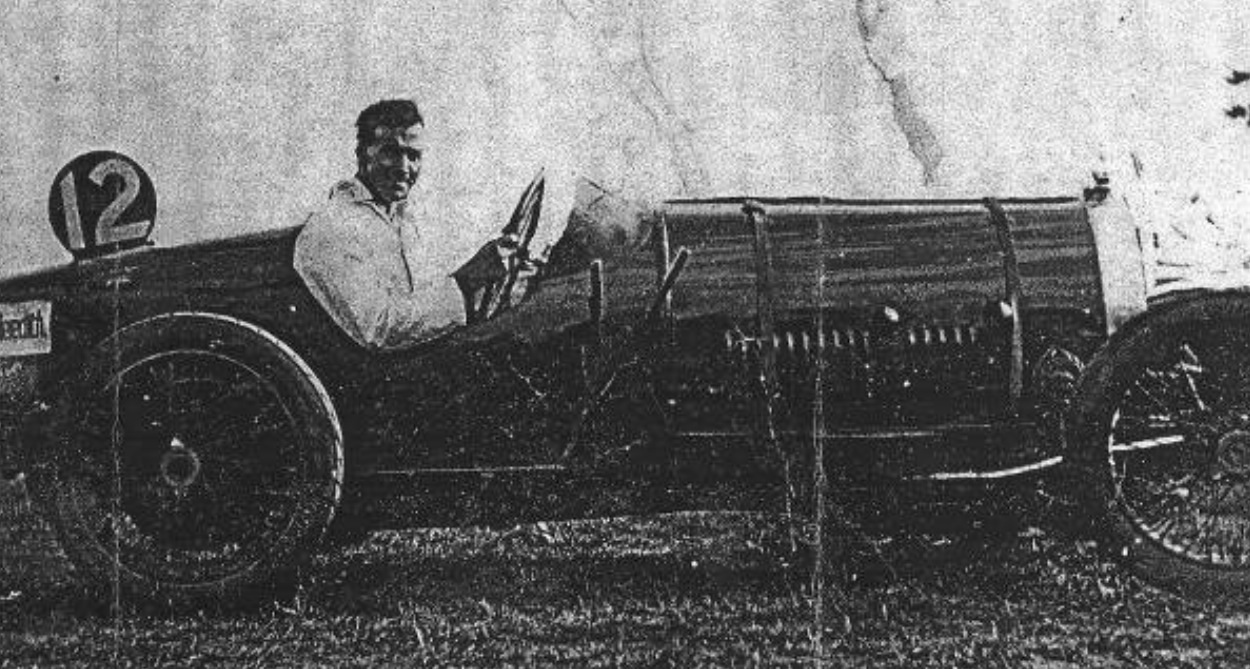
Tailpiece: Geoff Meredith aboard his Bugatti T30 at Goulburn during his victorious AGP meeting in 1927…
(unattributed)
Whilst a top NSW driver of the day at places like the daunting Maroubra Speedway in Sydney, Geoff Meredith was a Goulburn local, a sheep grazier from nearby Windellama.
His 2 litre straight-8 Bugatti T30 won a purse of £50- a ‘Grand Prize’ at the time, the Bug, is, happily still in Oz.
Meredith died of pneumonia he contracted by exposure to the elements at the Isle of Man, he was in a support role to a group of Australian riders less than 12 months after his AGP win





















 primotipo...