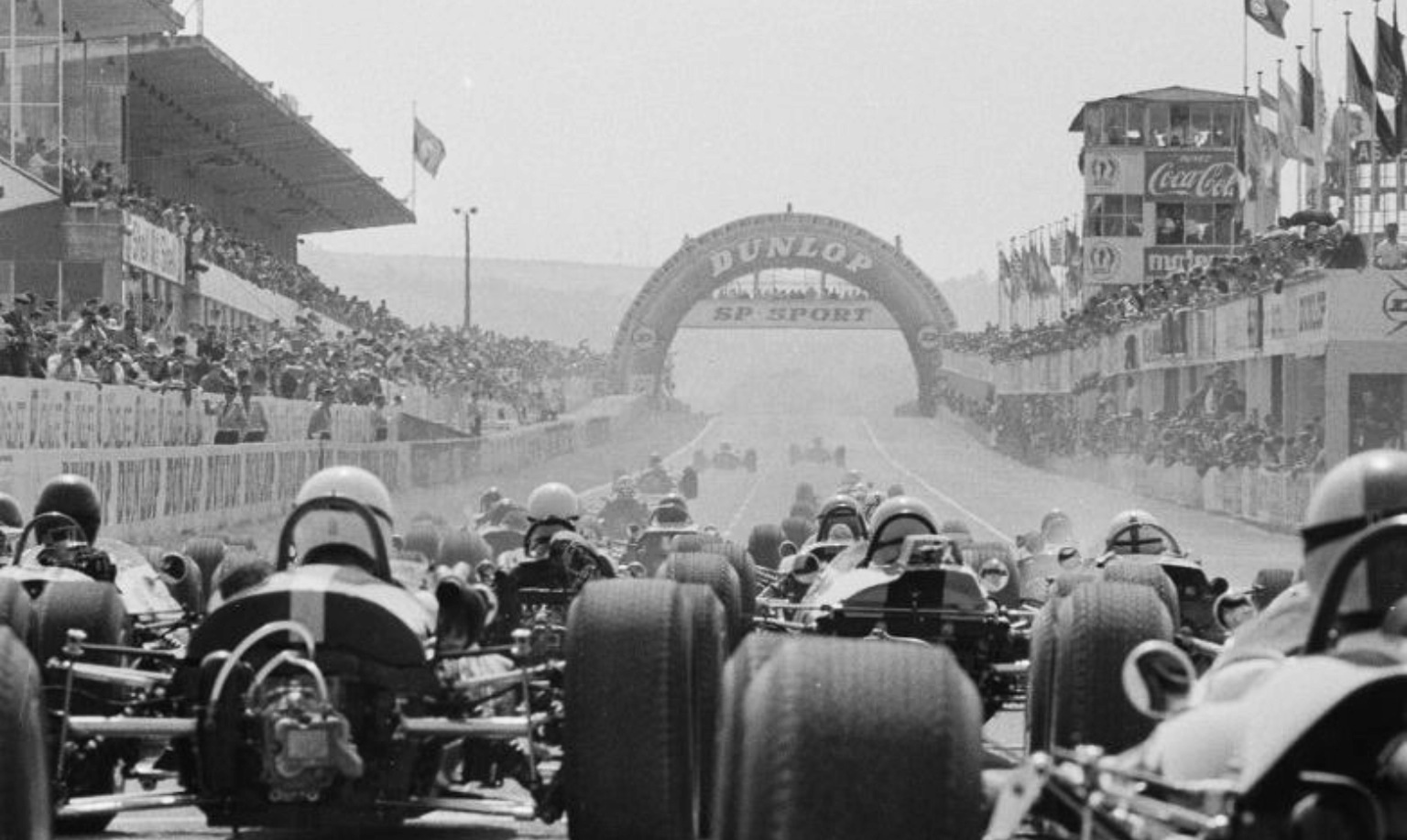
Start of the race won by Jack Brabham’s dominant Brabham BT18 Honda, the little 1 litre car was the winner of the F2 Championship that year…
Jack won the title, ‘Trophee de France’ 1966, awarded for results in six championship rounds, from teammate Denny Hulme, similarly mounted with Alan Rees third in another BT18 powered by the Ford Cosworth SCA engine.
Brabham won the 3 July, 307 km ‘XXXII Grand Prix de Reims’ F2 in a little over an hour and a half from Alan Rees BT18 and Jean-Pierre Beltoise’ works Matra MS5 Cosworth SCA.
In a pretty good weekend for Jack, he also won the 400 km French Grand Prix on the same day in BT19 Repco, and of course in so doing became the first man to win a GP in a car with his own name and manufacture- together, Brabham and Ron Tauranac were partners in Motor Racing Developments, the manufacturers of Brabham cars.
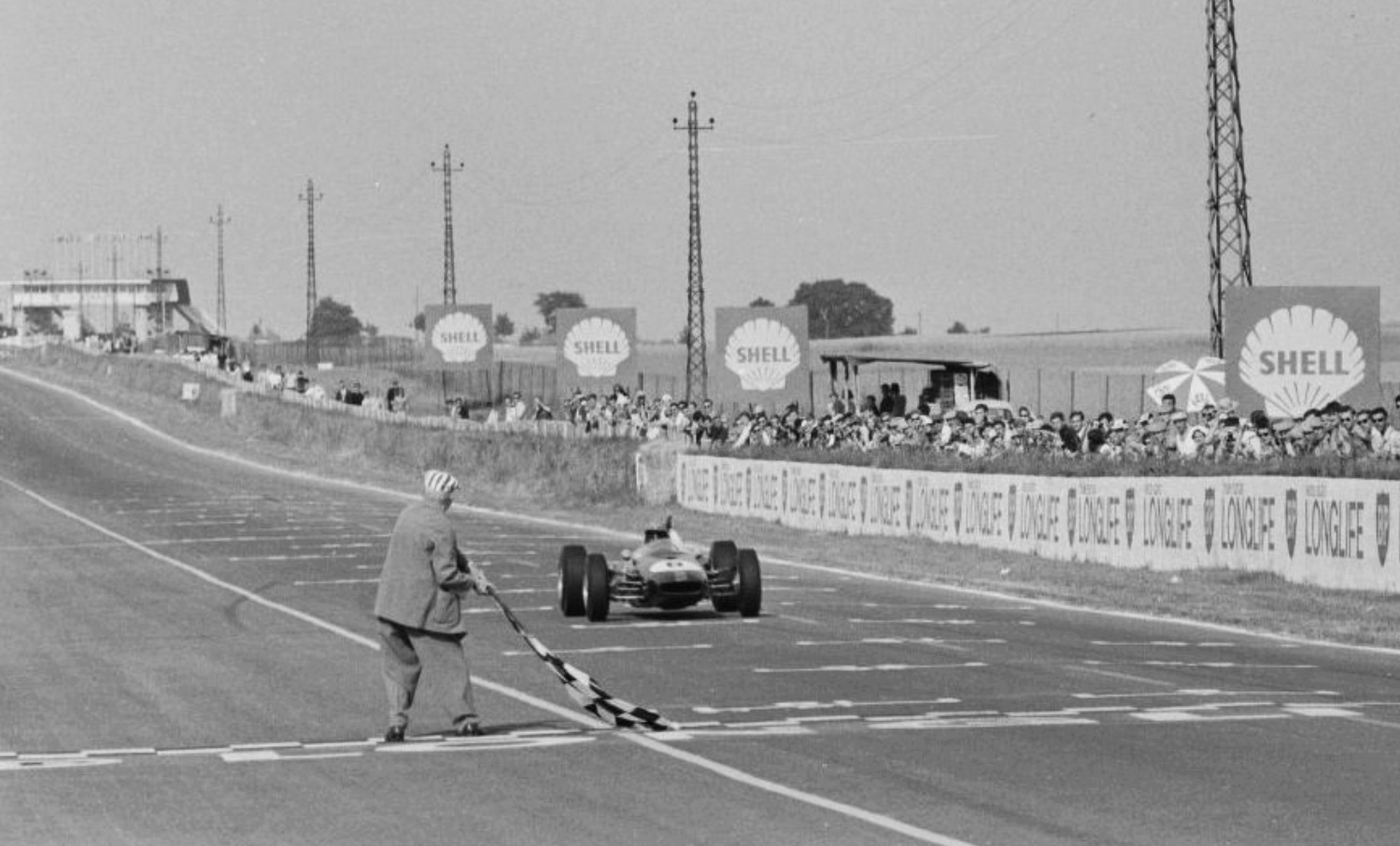
Brabham’s BT18 Honda takes the Reims chequered flag from Toto Roche (unattributed)
Jack’s business acumen is demonstrated by his ability to form engine partnerships with Honda in F2 and Repco for his F1 and Tasman engines simultaneously, victorious in both F2 and Grands Prix racing in 1966…
Brabham and Ron Tauranac collaborated very successfully with the Japanese engineers, Honda learning much about engine installation and the need for torque as well as top end power during the first season of the partnership in 1965.
The little ‘S800’ 4 cylinder, fuel injected 1 litre engine developed around 150bhp @ 10000 rpm at the time the Ford block Cosworth SCA developed circa 138bhp and comprehensively blew off the opposition that year. 150bhp per litre for a normally aspirated engine was about as good as it got at the time, apart from Honda’s motor cycle engines anyway!
Honda acquired a Brabham F2 chassis in 1964, so Jack was well aware of Honda’s F2 plans, he first tested the car at Honda’s request late in 1964 at Suzuka and again in January 1965 at the conclusion of the Tasman Series.
He reported his impressions of the car in his ‘Motor Racing’ magazine column.
‘The Honda F2 is an all-alloy 4 cylinder DOHC, 4 valve engine with fuel injection…alongside an F2 Cosworth SCA , it is quite a big looking unit and there are some difficulties getting it into the frame…Since then modifications have been made to the unit so it can be mated to a Hewland 6 speed gearbox and sit in its proper position in the chassis’.
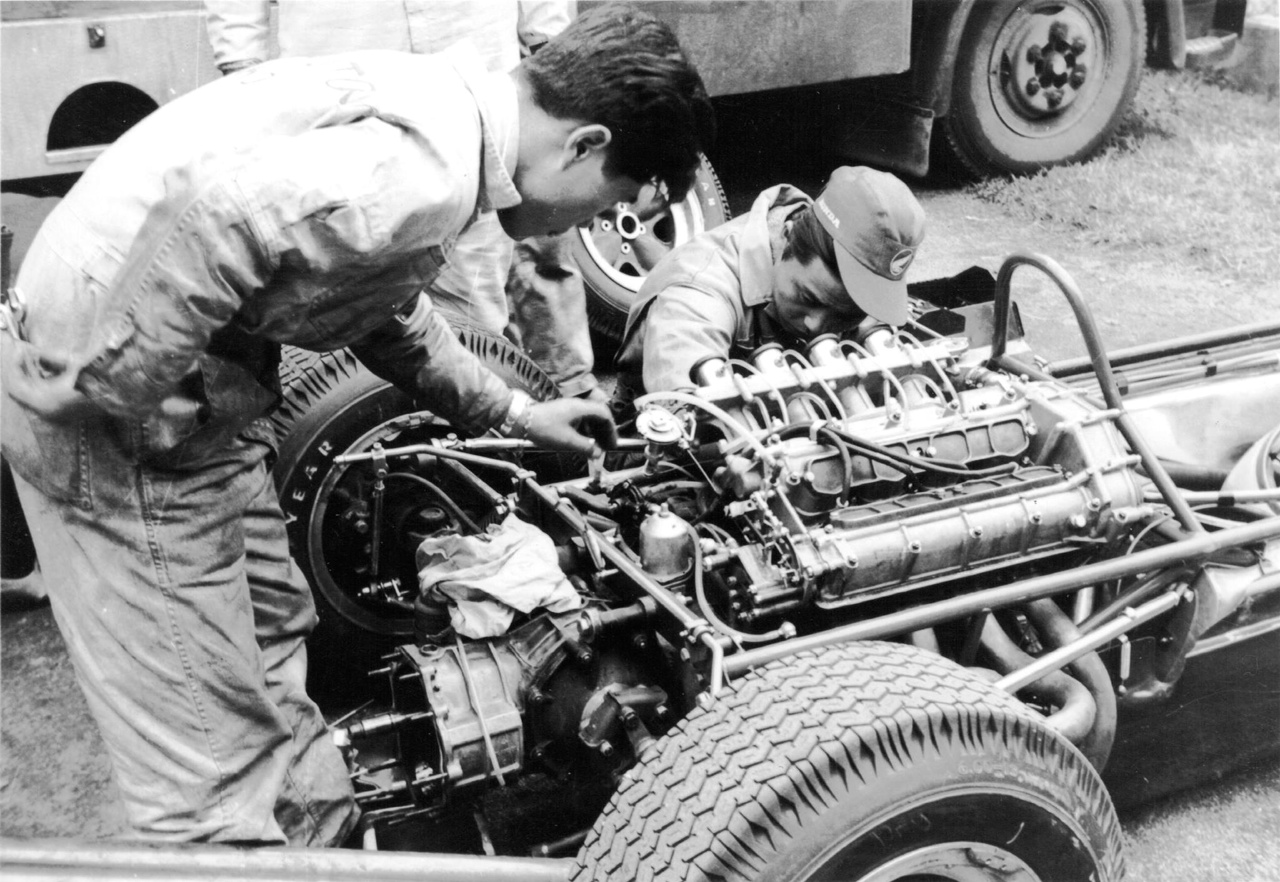
Honda 1 litre DOHC, 4 valve fuel injected 150bhp ‘S800’ engine. Jack’s Brabham BT16, Pau GP 1965, DNF in the race won by Clark’s Lotus 35 Cosworth SCA. Electronic ignition take off of exhaust camshaft clear, large size of engine, neat installation and Goodyear tyres suggests 1966. Hewland ratio change in progress, lots of this with the peaky little engine! (Ian Gordon)
‘It runs smoothly and sounds very impressive, makes twice as much noise as the average F2 engine..there is useful power from 6000-9500 rpm, which is a nice wide band and makes the car comparatively easy to drive…Honda agreed to send two of their mechanics to be responsible for maintaining the engines during the coming season’. (1965)
In fact 1965 was a learning year for the new partners with Jack impressing upon the Japanese engineers the need for a wider band of power and torque, gearing of the car in 1965 was particularly critical.
Jack stepped out of the Honda powered chassis in June, forsaking it for Cosworth SCA power as the engine was developed. He returned to it at Albi in September- Jack took pole, set the fastest lap and finished second to Jim Clark’s Lotus 35 Cosworth SCA by less than a second after 85 laps…the lessons were well learned by Honda for success, make that domination in 1966.
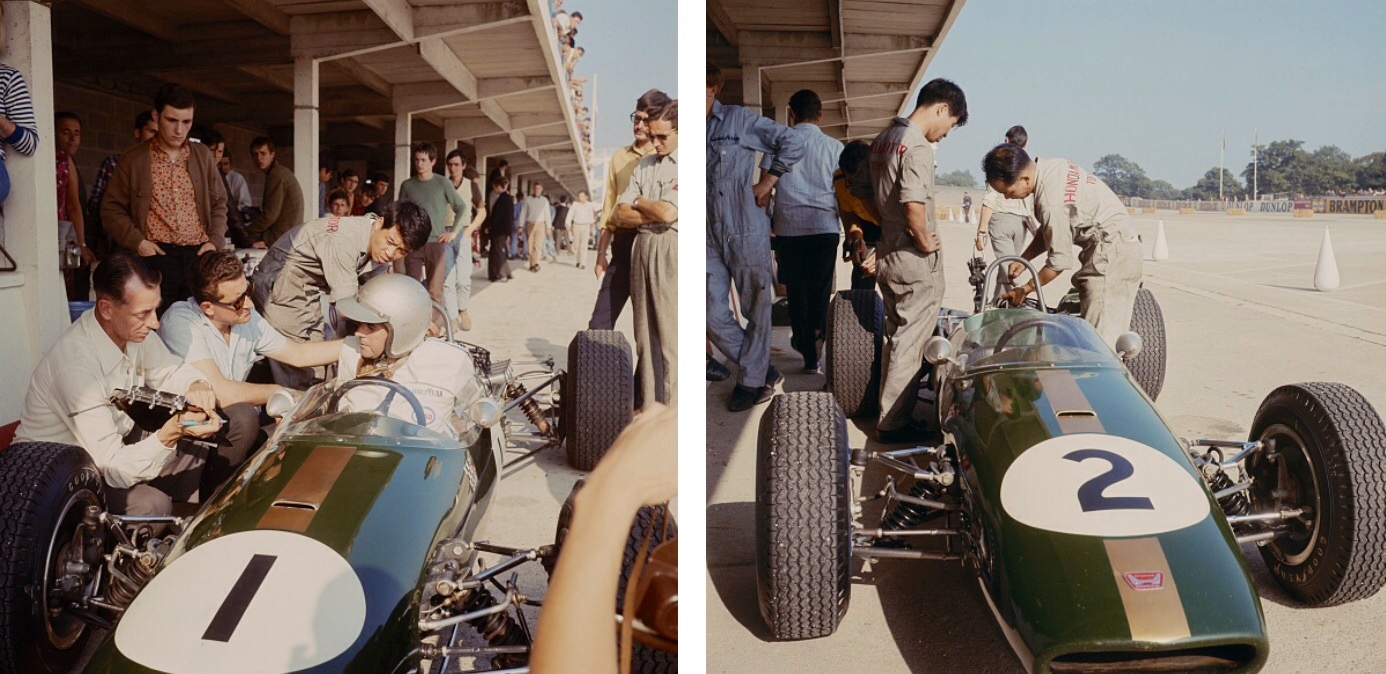
Ron Tauranac and Jack Brabham discussing setup changes to Jacks BT21 Honda, #2 Hulme’s sister car, Monthlery 9 September 1966 (Popperfoto)
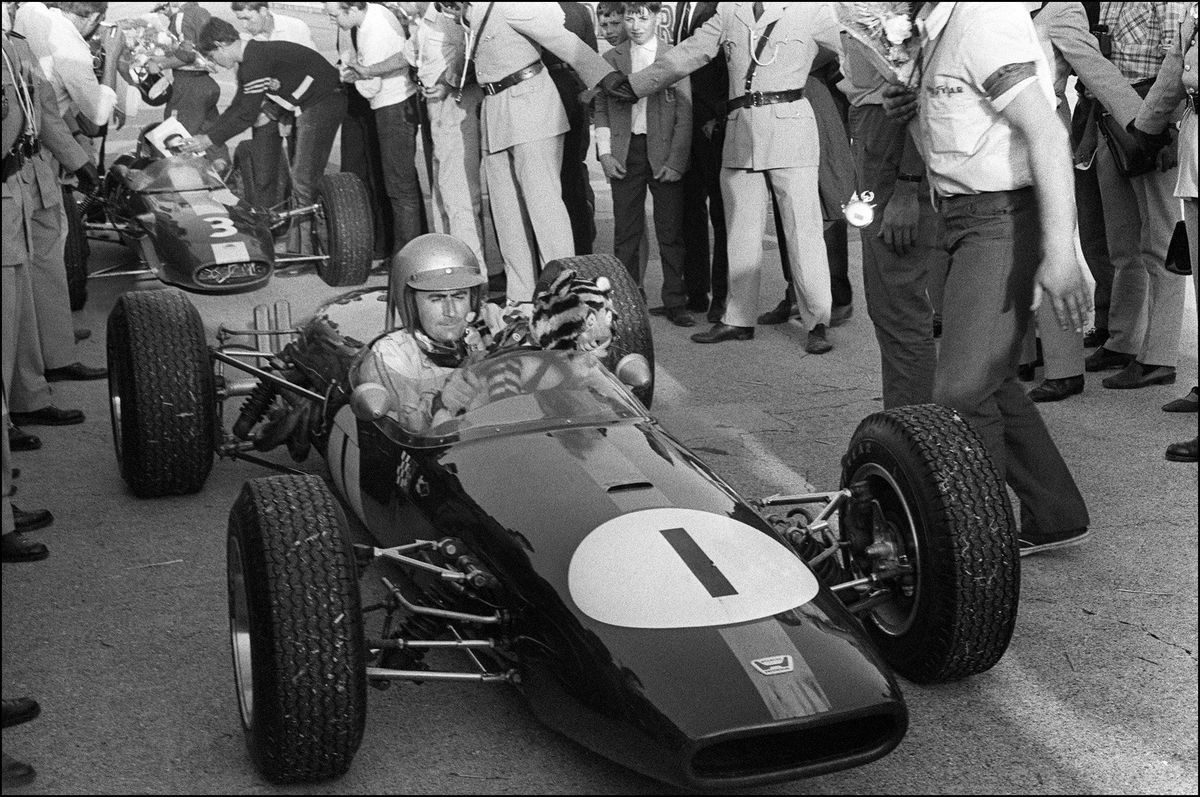
Jack Brabham with the victors garland, Monthlery 1966. Brabham BT21 Honda. Thats Clark’s 2nd place #3 Lotus 44 Cosworth SCA behind, Denny Hulme was third in the other Honda engined Brabham BT18. Note the Honda badge on the nose of Jack’s car. (unattributed)
The FIA introduced a new 1.6 Litre F2 class for 1967…
Honda were focussed on F1 in 1967 and 1968 before their withdrawal from top level single seater racing, they did not build an engine for the new European F2 Championship, but returned with Ralt to 2 litre F2 in 1980- the partnership of Honda and their old friend and collaborator Ron Tauranac was rekindled after all those years.
They were successful again too, winning the European F2 Championship in 1981/3/4, the Ralt Honda’s driven by Geoff Lees, Jonathon Palmer and Mike Thackwell to the title respectively before they returned to F1 with Spirit in 1983. That formative partnership was replaced with a longer term commitment to Williams in 1984 and the rest as they say is history.
(unattributed)
Modern Ron Tauranac/ Honda Partnership…
The successful Ralt Honda Team in 1981. They were victorious with the Ralt RH6 in the Euro F2 Championship, Geoff Lees won the title, he is to the right of teammate- the black-clad Mike Thackwell is on crutches thanks to a big testing accident before the 20 April Thruxton Euro F2 round, showing true grit he returned to the fray at Mugello on May 24.
Lees won the title with three wins, Thackwell took one, the season opener at Silverstone.
Ralt RH6/81- the aluminium monocoque ground effect car of the period used the Honda RA261E, 2 litre (1996cc) DOHC, 4 valve , fuel injected normally aspirated V6 engine as a stressed member, which developed circa 310bhp @ 10500rpm.
Ron Tauranc leaning on the wing of a Ralt at Silverstone during the obviously hot! British Grand Prix on 18 July 1981.
There was no F2 duties that weekend but rather an important F3 race to attend to- customer Ralt RT3 Toyota’s filled the first four slots in the race- Thierry Tassin won from Raul Boesel and Jonathon Palmer, the latter graduated to the works Ralt-Honda F2 squad. To underline the dominance of the RT3’s, they filled thirteen of the top fifteen places.
Ralt RH6 Honda (T Jufuku)
Etcetera…
Jack not looking quite so happy with the car in its formative 1965 year with the new Honda engine. Here at Oulton Park for the F2 ‘Gold Cup’ in September. He qualified his BT16 with the peaky unit well, 6th, but clutch trouble meant a DNS in the race won by John Surtees Lola T60 Cosworth SCA. (Eddie Whitham)
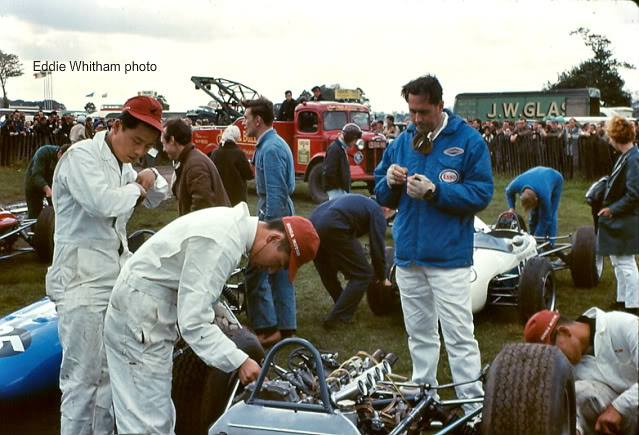
Another Oulton shot, Geoff Brabham in the green jacket far left looking on, Ron Tauranac, Jack and the small team of Honda mechanics. (Eddie Whitham)
In the early stages much experimentation took place to get the power/torque mix right including exhaust lengths… 1965, paddock place and date unknown. (unattributed)
Jack preparing for the off in the Oulton paddock, 1965 Gold Cup. (Eddie Whitham)
Another unattributed paddock shot of the Brabham Honda. Roy Billington down the back. Conventional rear suspension and Hewland ‘box. Single top link, inverted lower wishbone, coil spring/damper unit, adjustable roll bar and rubber donut all in shot. (unattributed)
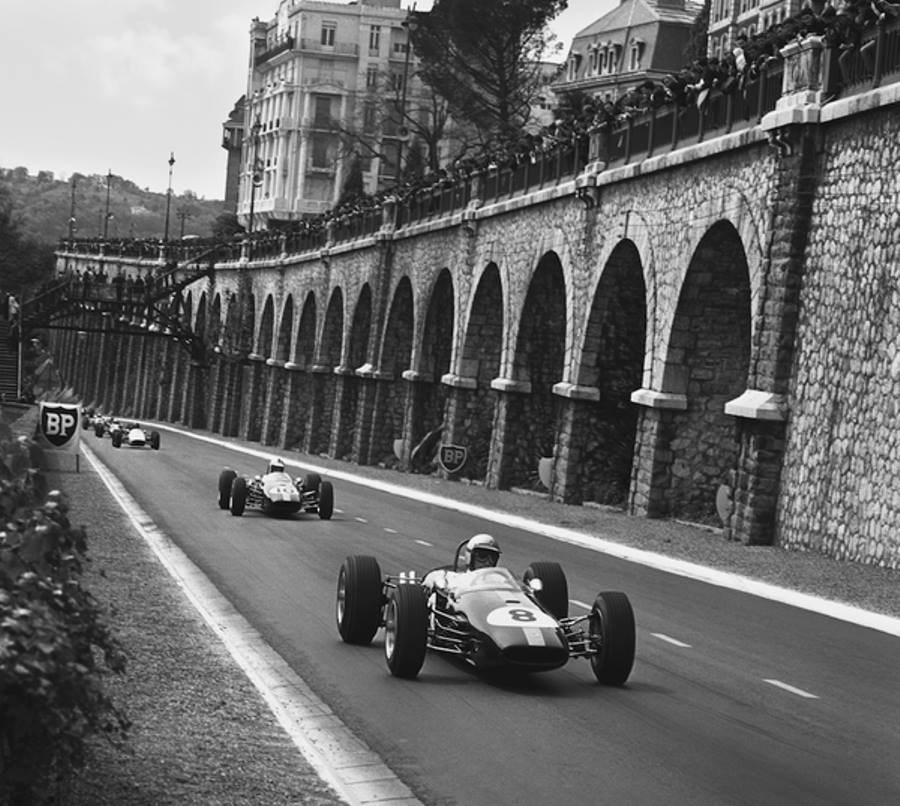
Denny ahead of Jack at the Pau GP on April 17 1966. The tables were turned at the events conclusion, Jack and Denny in Brabham BT 18 Honda’s, Graham Hill 3rd in another Brabham, a BT16 BRM. The Brabham Honda 1/2 was achieved at Goodwood, Pau, Zolder, Crystal Palace, Karlskoga and Keimola, Finland that year. (unattributed)
Brabham victorious in the car at Pau with Graham Hill and Denny Hulme joining in the fun (INA)
Tailpiece…
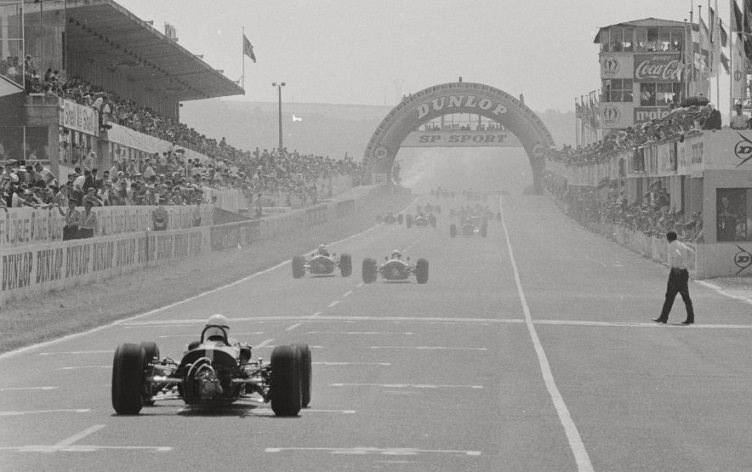
‘Where’d they go?!’ Tailenders on the Reims ’66 F2 grid. (unattributed)
Credits…
Eddie Whitham, Popperfoto , Stephen Dalton and Leigh McMullen for research assistance, ‘Motor Racing’ magazine May/June 1965, Ian Gordon, Takashi Jufuku
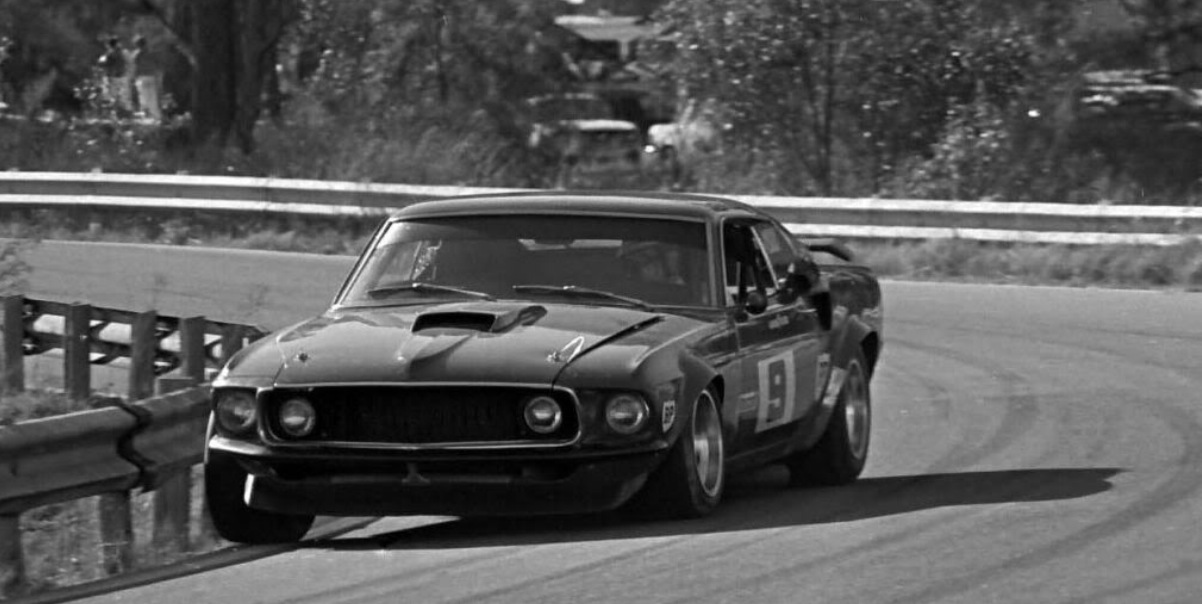
Allan Moffat’s Mustang on Warwick Farms ‘Northern Crossing’, 30 April 1972…
In a country obsessed with touring cars this is one of, if not the most revered of all, even though it never won the Australian Touring Car Championship.
A rare beast, it is one of only seven ‘factory’ Kar-Kraft built cars for the 1969 Trans-Am Championship Moffat commenced racing in Australia at Sandown on 5 May 1969.
I am not a ‘taxi racing’ guy but this car is on my ‘ten racing cars I would love to own’ list, its still in Australia thank goodness, in the tender loving hands of David Bowden. This excellent article was written for ‘Australian Muscle Car’ magazine by Mark Oastler and is ‘definitive’, the best i have read on this great car.
Moffat in search of an apex, one he has well and truly nailed! Warwick Farm, Sydney, 9 July 1972.
Etcetera…
One of the more significant days in Australian touring car racing was the first race appearance of the machine which was at the Sandown Park ‘Southern 60’ meeting, Melbourne on 4 May 1969.
The first photograph is on the main straight as I suspect is the second.
(SS Memorabilia)
Here is the car ‘mid-career’, again at Sandown and ahead of arch-rival Bob Jane’s 7 litre Chev Camaro ZL1, very much as trick a device complete with aluminium big-block V8 as Moffat’s 1969 Kar-Kraft/Bud Moore 5 litre Trans-Am. Dandenong Road corner during the 1971 February Tasman Series meeting.
(AMC)
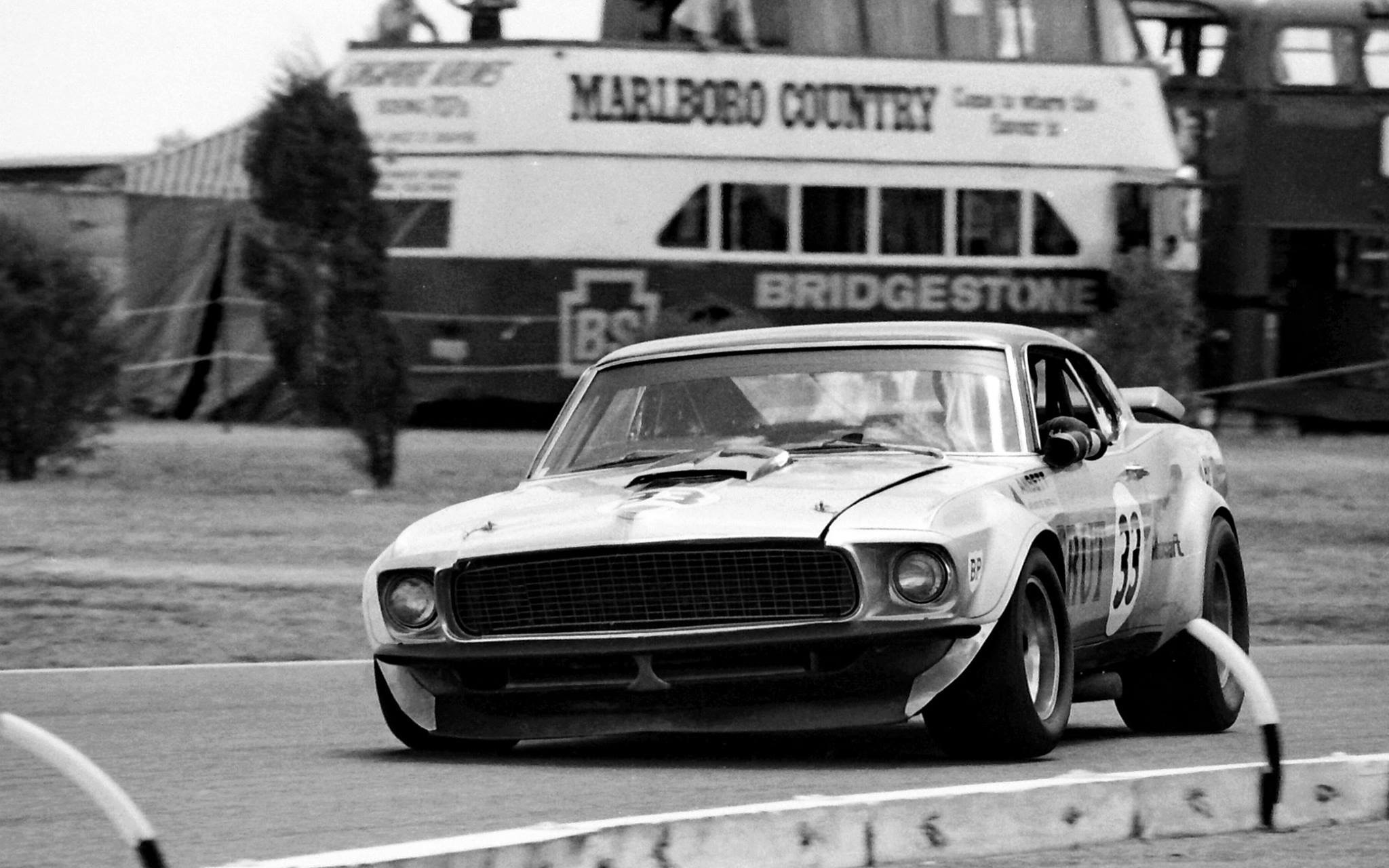
The cars twilight years were raced in 1973-1975 as a Sports Sedan, to Allan’s eternal credit he didn’t butcher the thing but rather replaced it in 1976 with the Ford ‘Cologne Capri’ RS3100 Cosworth when the years finally caught up with her.
The shot below is of Moff tickling the car into a beautiful third-gear slide through Sandown’s Shell Corner on the entry to the old Pit Straight, 1974, marvellous, even in Brut-33 livery!
(I Smith)
Credits…
wirra, lyntonh both via The Nostalgia Forum, Stephen Dalton Collection, SS Memorabilia, Neville Starr Collection, Allan Moffat Collection, Ian Smith
Tailpiece…
(N Starr)
That gorgeous red paint must have been ‘Dulon’- the Trans-Am even made the cover of a panel beating industry journal, the photo was taken at that initial meeting in May 1969.
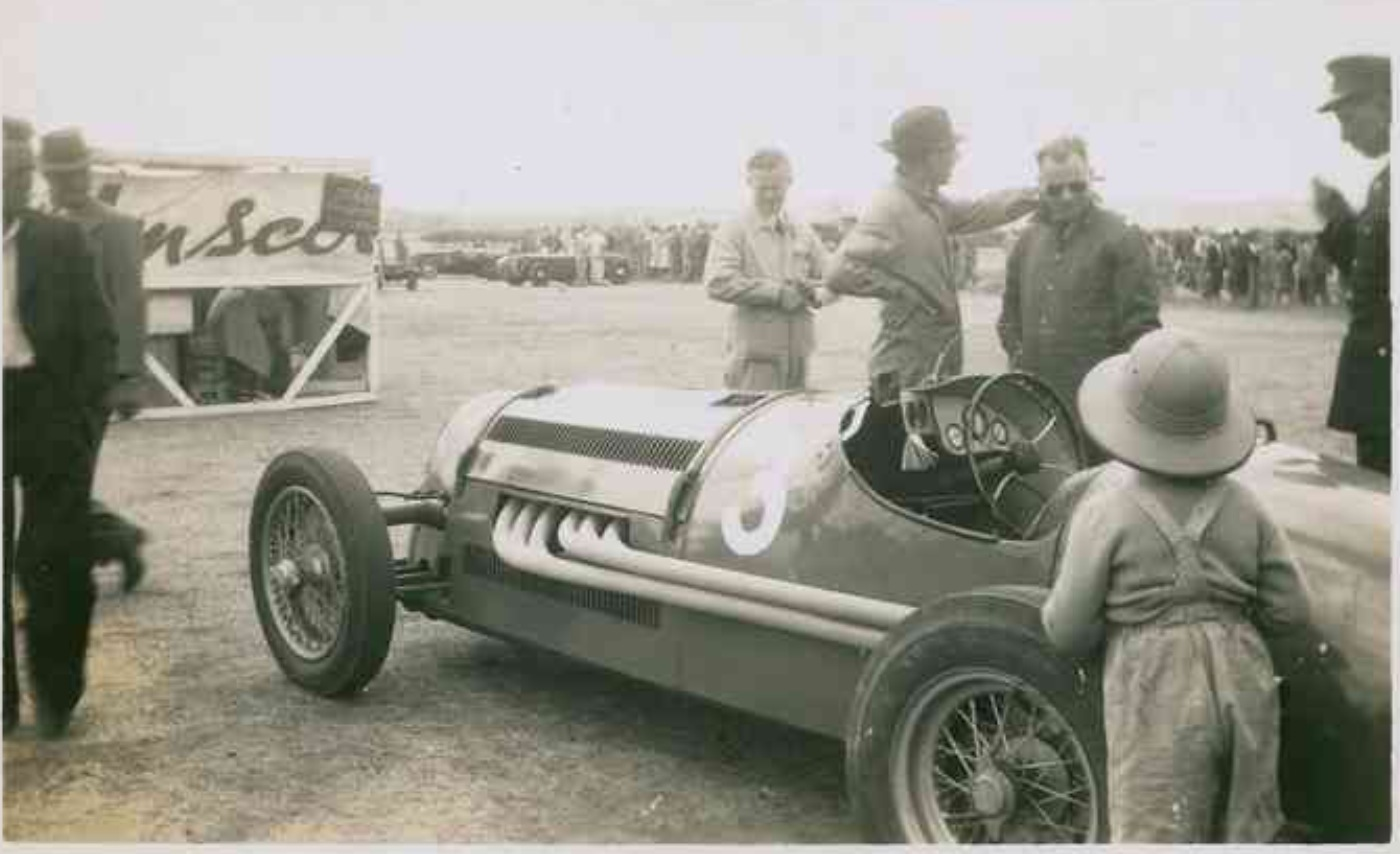
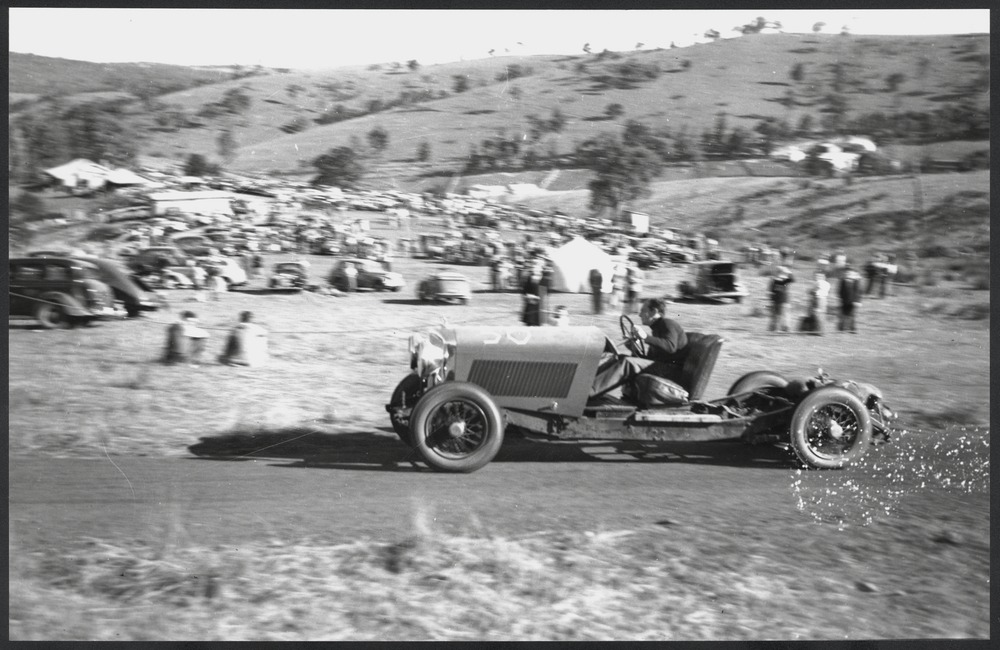
The carefree nature of the 1950 Nuriootpa race paddock is contrasted by the formal attire of the day, young boy in the Pith Helmet is impressed by Charlie Dean’s Maybach 1…
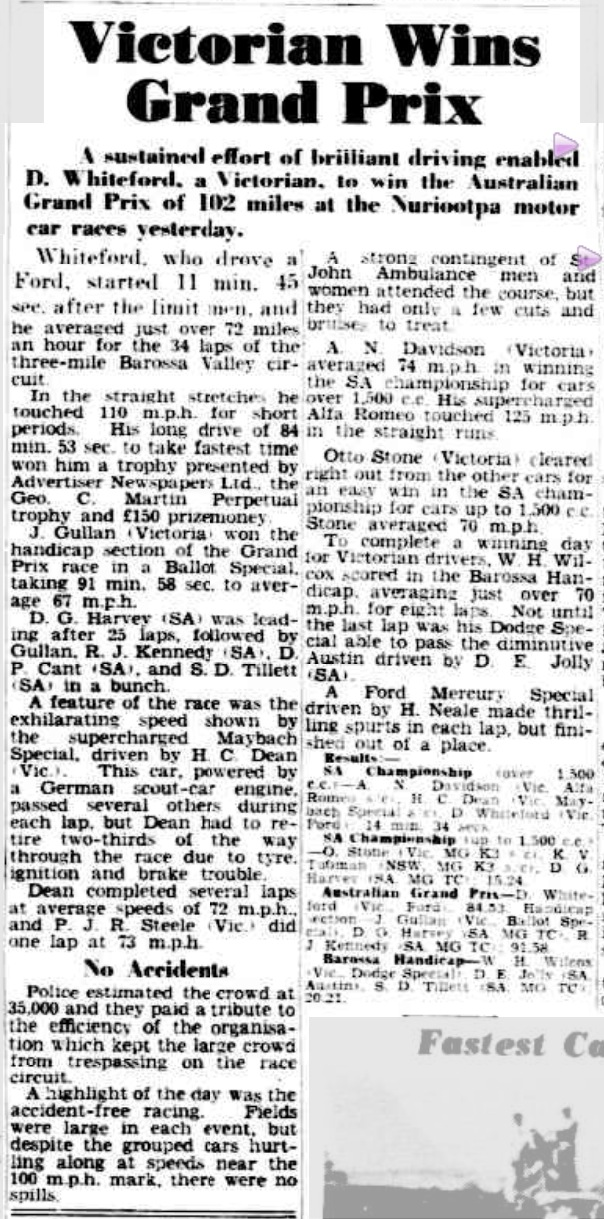
The first post war Australian Grand Prix in South Australia was held in the Barossa Valley. Not on the daunting Lobethal road circuit where the 1939 event had been run, but just down the road on roads at Nuriootpa.
The circuit was basically a square layout of 3-miles on flattish land. A permit for Lobethal couldn’t be obtained but one for Nuriootpa was thanks to the intervention of some prominent local businessmen including John Hill-Smith of the Yalumba wine family.
1950 AGP Program cover (Stephen Dalton Collection)
Graham Howard’s ‘History of The AGP’ described the circuit…
‘There was a slight uphill section along the (Nuri) Main Street, followed by a right hand corner onto a downhill section back into the countryside…This led to an Ess at a narrow bridge, after which the road ran straight to an intersection around which were collected the finish line, the pits and – on the next straight after the intersection – the start line. There was a vineyard to the left…but enough grazing paddocks for parking etc…’
The starting straight led to two fast right hand sweeps after which the road then led west by way of a pair of gentle Esses…to a T Intersection…then via a left-right sweep across another narrow bridge, into the Main Street again. There were some very bumpy parts…the roads just wide enough for two cars to pass readily…’
Nuriootpa Road Circuit Map (History of The AGP)
The Sporting Car Club of SA ran the event to the Australian Automobile Association’s decree, the winner was the competitor finishing in the fastest time but otherwise in the best traditions of the AGP at the time, the event was a handicap and awards were made on that basis. Geddit?
Rupert Steele in his ex-Alf Barrett Alfa Monza, drove an exceptional race as a relative novice against the tough Doug Whiteford. (John Blanden Collection)
The ex-Alf Barrett Alfa Romeo Monza, was by the time of the Nuriootpa event owned and driven by relative novice Rupert Steele. https://primotipo.com/2015/02/20/alf-barrett-the-maestro-alfa-romeo-8c2300-monza/ Lex Davison, who would later win four AGPs started his Alfa Romeo P3, the scratch man was Tony Gaze’ 1935 2-litre supercharged Alta 56S, although he was not to start after dramas in a preliminary race, all these racers were Melburnians.
Fastest resident South Australian was Harry Neale in Eldred Norman’s, extraordinary ‘Double Eight’ or ‘Double V8’ which married the chassis of a World War 2 weapons carrier and a pair of single carb Ford V8s from army trucks. It had independent suspension on all four corners, 7834cc in total and was rated a good chance on a ‘point and squirt’ course like Nuri with slow corners and long straights. See the section below for details on this amazing car.
Australian Motor Sports described the race day scene…
‘Brilliant sunshine made the competitors paddock a colourful spectacle with racing cars in different hues, tender vehicles ranging from furniture vans and in which the Steele cars had been brought from Melbourne to the luggage trailer which Peter Damman had towed behind his racing Hudson the same distance. In a handy position near the course, Motors Ltd’s mobile service van was in constant demand with its stock of racing oils, spares and field workshop’.
‘Between the finish of the under 1500cc scratch race and the start of the Grand Prix, there was a brief interval for luncheon; then, as 1.30 drew near, cars were lined up in the continuation of the crossroads behind the starting straight, in preparation for the big race. Two spectators climbed up stepladders which they had brought to the course for private grandstands, and the three limit men were away…’
Lex Davison takes to the circuit, Nuriootpa paddock in the background. Alfa Romeo P3/Tipo B (unattributed)
The race itself was diminished by the inability of Gaze to start, Davison’s retirement on lap one, having lost compression on two of the Alfas eight-cylinders and Dean’s withdrawal on lap 21 with magneto, overheating and braking problems.
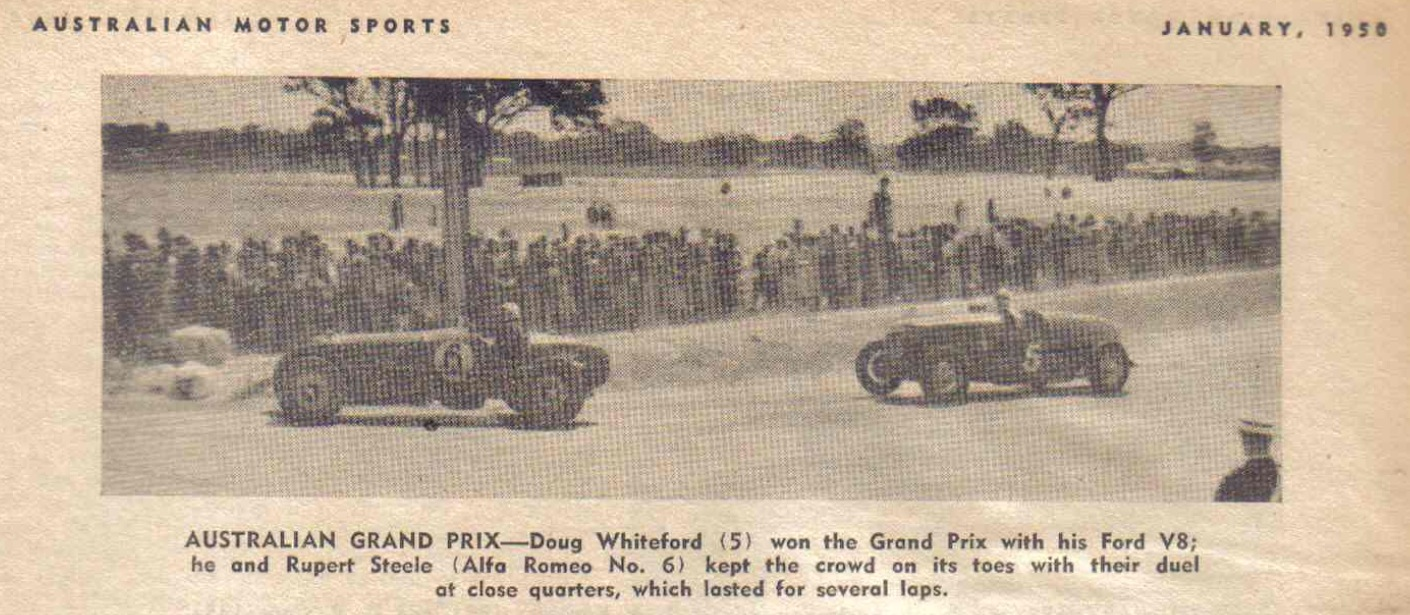
What was absorbing was the battle between the Aussie Battler garage proprietor Whiteford in his carefully evolved and very well driven Ford V8 Spl, ‘Black Bess’ and the ‘Silvertail’ from Toorak, Rupert Steele in the aristocratic Alfa.
The latter had the edge on top speed, but the Ford, with more supple suspension was better suited to the South Australian country roads. Whiteford was a hard man as a driver, but the novice Steele was no slouch, he must have been a-natural to adapt to the GP car with his experience limited to a few hillclimbs and speed events in a Bentley road car.
On lap 13 Steele ran out of road having passed a gaggle of MGs, he spun the big Alfa and stalled, then lost about 1 minute 49 seconds, hand-cranking the supercharged straight-eight back into life but his race was effectively run.
Whiteford won from Steele’s Monza and Jim Gullan’s Ballot Olds. The latter was first on a handicap basis from David Harvey and Ron Kennedy, both in MG TC Specials. Steele’s sporting focus was on horses for the rest of his life, sad really as his potential as a driver was clear, the Alfa was sold to ‘Racing Ron’ Edgerton by the end of 1951.
Doug went on to enjoy two more AGP wins in 1952-53 at Bathurst and Albert Park, and a career which went well into the 1970s as a works driver of Datsun sedans and sportscars.
Doug Whiteford, victorious in the 1950 AGP at Nuriootpa, in Black Bess’ his self constructed Ford V8 Spl. (John Blanden Collection)
Other Competing Cars…
The stimuli for this article were several shots I found in the State Library of South Australia archive of the Dean Maybach, McKenna BMW 328, Jones HRG and other cars which competed that weekend.
I’ve done the Maybach to death in the Jones article referenced above, but here are some notes about the other cars with John Blanden’s ‘Historic Racing Cars in Australia’ providing much of the detail.
Peter McKenna’s BMW 328 in the Nuri paddock Car was the winner of the 1948 AGP, at Point Cook, Victoria driven by Frank Pratt (State Library of SA)
McKenna’s BMW 328 was raced by him all over Australia at Rob Roy, Fishermans Bend, Ballarat, Port Wakefield, Albert Park’s initial meeting in 1953 and as far afield as Southport on Queensland’s Gold Coast for the 1954 AGP. He overshot on a corner and rolled that day, the car passed through many hands before leaving Australia for Japan in the early 2000s.
Chassis # 85136 was brought into the country by John Snow, who acquired it on one of his regular trips to Europe, in 1937. A German General sold the car, Snow bought it on behalf of George Martin, president of the Light Car Club of Australia in Melbourne.
It finished the 1938 AGP at Bathurst in tenth, see my article on Peter Whitehead’s ERA which covers this race, Martin sadly had a fatal accident in it near Wagga Wagga on his return trip to Melbourne.
Their were two ‘racing 328s in period in Australia, both of which were involved in fatal road accidents. The other killed very talented racing driver Colin Dunne and his wife Billie at Phillip Island. It wasn’t a race accident mind you, but one which took place on the circuit between motor-cycle events.
By 1947 the 328 had passed into the hands of champion Geelong motorcyclist and dealer Frank Pratt. Pratt famously won his very first car race, the 1948 Australian Grand Prix held at Point Cook! He was aided by a favourable handicap, excellent driving and the extraordinary heat of the day which knocked out many of the more fancied runners.
Whilst new to car racing he was well familiar with intense competition. The car’s preparation by multiple AGP winner Les Murphy was also a factor. Some reports say that Murphy was extremely pissed off, he was originally entered to drive the car, and then was supposedly sharing it with Pratt, whose intention to drive the race solo soon became clear to Les once the arduous event was underway!
McKenna had a handicap of 9 minutes at Nuriootpa, but was unclassified.
Stan Jones, HRG Bathurst, Nuriootpa AGP meeting 1950. Jones cooked his engine in a preliminary race so was a non-starter for the GP (State Library of SA)
HRG ‘Bathurst’…
Tony Gaze brought the first HRG to Australia in 1947. The car was uncompetitive so Gaze specified future cars to be light, sports/open-wheelers with easily removable lights and guards so the cars could run as sports or racing cars in local events.
Brown and Dureau, a Melbourne trading firm who ‘Gaze was with’ imported the first car to these specifications in 1949, Stan Jones was the purchaser of the 1.5-litre, four-cylinder car (which had no chassis number).
He first raced it at Rob Roy in June, it was soon supercharged running at 12-psi of boost, racing it at Corio, Geelong in late 1949 and then entering the AGP at Nuriootpa.
In one of the preliminary races for under 1500cc cars Jones had a furious dice with fellow Melbourne motor trader/racer and later champion Bill Patterson – Bill was MG TC Spl mounted – both cars retired with overheating maladies. Jones’ car didn’t take the AGP start and Patto retired with head gasket failure; it was not a successful trip to the Barossa for either of them.
The car was sold later to Alan Watson in 1950 but was badly damaged by him and driven by Sil Massola in the 1952 AGP at Bathurst. According to the ‘Blanden Bible’ it was/is still in Australia.
Silvio Massola in the ex-Jones HRG. Victorian Trophy, Fishermans Bend 21 March 1954 (VHRR/State Library of Vic)
Blurry Maybach in the ‘Nuri Paddock…
The shot is a bit fuzzy but still included for the atmosphere it shows, Charlie Dean in the paddock, the ‘Copper’ is keeping an eye on proceedings, Fiat Topolino behind the Maybach.
Charlie Dean, Maybach, Nuriootpa AGP meeting January 1950 (State Library of SA)
Other Entrants…
Curran Ford V8.
Dennis Curran, Curran Ford V8 3920cc (State Library of SA)
Regarded as one of the most specialised Ford side valve V8 specials built in Australia, Dennis Curran, then an apprentice, made many of the car’s advanced features including its independent front suspension and modified Minerva braking system. The attractive body appears to be in the style of the Alfa Romeo Alfetta 158/159 GP cars of the period.
The car was raced by Curran at the 1951 Narrogin AGP in WA, then in Bill Wilcox hands in the 1953-55 AGP’s as the ‘FLS’. The machine was then further modified by Frank Murphy on behalf of the owner, Melbourne car dealer Harry McLaughlin by fitment of a Lancia Lambda rear end, Jaguar XK120 gearbox and a new body.
A 5-litre Ford V8 was also fitted inclusive of Offenhauser heads and induction manifolds, it competed in this form at the 1956 Olympic AGP won by Stirling Moss at Albert Park. It was then known as the ‘Marchel’, the car then disappeared but was found by Noel Tuckey in 1980, restored and is now known as the ‘CWM Ford V8 Spl’ an amalgamation of the surname initials of the contributors to the cars evolution: Curran, Wilcox, Murray.
Bugatti Dodge.
L Robinson, Bugatti Dodge, Nuriootpa 1950. Interested to know more about this car if anyone has any information on it (State Library of SA)
Ballot Oldsmobile.
Jim Gullan, Ballot Olds, AGP Nuriootpa 1950 (State Library of SA)
Jim Gullan replaced the Ballot Ford he had been racing in 1944 with a 2-litre Ballot bought nearby to his familiy’ garage in South Melbourne.
The Ballot engine was sold and replaced by an Olds six and ‘box, the chassis shortened by two feet and narrowed by six inches. It was lightened too, you can see the holes made in its longerons to do so. A body was made by Bob Baker in Melbourne – he built many racing bodies at the time – this Ballot is credited as the first. The sports two-seater was registered and commenced racing in 1946. It won the 1950 AGP handicap class as above.
Journalist and historian Ray Bell wrote about this car on ‘The Nostalgia Forum’, here is his detailed account of the construction and development of the car.
‘Jim Gullan’s Ballot will always rank as one of those cars that looks the part of an Australian Special. The raked nose, the heavily drilled chassis, steering wheel close to the chest and mandatory straps over the bonnet, its wire wheels carried a car that mixed European and American as well as any other. Fortunately the early life of the car is well detailed in Gullan’s book, ‘As Long As It Has Wheels,’ and there was plenty to write about as the Ballot Olds was to bring Gullan a number of successes.’
‘The car was bought in 1944, almost on a whim, it seems, after Gullan had sold the Indianapolis Ballot (by now fitted with Ford V8) early in the war. A 2-litre model with sohc engine and knock-on wire wheels (more important, according to Gullan), it had a poor body. He mentions four-wheel brakes with Dewandre servo, making it a 1926/28 model 2LT.
Soon after buying it a workmate offered money for the engine, gearbox and radiator to fit into a Bugatti chassis. Said Gullan: “I suppose any engine was better than none..’ Having just the chassis left, he thought he’d build a copy of his favourite car, the ERA. He was reluctant to go for another Ford, having had bad experiences with the V8, so an ad for an Oldsmobile engine and box (unused spares purchased for a Taxi) overcame his problems. It was to have triple Ford carbies and extractors.
The chassis was made into a copy of a Bugatti chassis, was shorter and narrower, designed to be ‘strong in the middle,’ boxed and drilled liberally ‘as on the SSK’ for lightness. The original hubs were retained, but laced to smaller rims, the spring shackles were located at the front instead of the rear as Gullan drew on all the modern technology he could identify.’
‘Bob Baker built the body round an angle iron frame, which was screwed to the chassis with small reject aircraft bolts. A deliberate effort was made to reduce frontal area, hence the car’s low appearance. Quick-fill petrol and radiator caps were fabricated and instruments (like the carbies) came from army disposals’.
‘The Ballot name was retained, even though virtually only the axles and wheel hubs remained, because it made it simple to register the car. Just roll up and pay the money!’
‘Springs were fitted outside the chassis and there were torque stays to the front axle, with finned alloy drums off a spare 2-litre Ballot Jim had bought and sold. The first race was at Ballarat at the beginning of 1947, after which hydraulic shocks were fitted front and rear (‘to the horror of the Hartford purists!’) and hydraulic actuation of the brakes was arranged. For Lobethal 1950, (the event which is the subject of this article) which the car was to win on handicap, a specially made 3.5:1 diff replaced the original 4.1:1 unit. Jim had to do the design work for the gear cutter.’
‘Gullan was in business with one of his major opponents on the track, Doug Whiteford, and when Doug imported an Edelbrock cam and heads (he’d melted a pair of alloy heads at Lobethal in 1940!) Bruce Rehn copied the cam profile and lift for the Olds. By the time of the Point Cook AGP (1948) there was yet another higher lift cam and special ratios in the gearbox. As a result of the heat at Point Cook, with the Olds running so cool and well, the engine was bored 3/16”, while both cars were fitted with enlarged sumps with cooling tubes fitted. Then for Nuriootpa’s opening meeting in 1949 PBR made up special alloy brake shoes and backing plates. These were found to be bending the chassis, so some more work was required’.
‘The car was Gullan’s expression of all he’d learned from observing racing and running his own Salmson, Wolseley, Austin and Ballot V8. It was considered by Whiteford to be ‘too sensitive in the steering and brakes, difficult to drive.’ Gullan adjudged Black Bess to be ‘tail light, tending to wander at speed, with light and spongy steering and poor brakes.’
‘Considering just how it came together – the bits that just happened to be there, the chance acquisitions – it worked very well. Gullan was a handicap specialist, with his wife Christine timekeeping and acting as strategist, and they beat the handicaps with monotonous regularity. He comments that he just had to keep on making the car quicker to keep on beating them, so it was well developed when sold to Alan Watson.’
‘He mentions getting airborne over the top of the hill approaching Lobethal at 110mph, touching 116mph on the straight and holding it flat all the way from Lobethal to within sight of the pits at that early stage of its development. By the time it won the handicap section of the 1950 AGP it must have been a fairly quick car’ (Ray Bell)
The car passed through many hands over the next 20 years, it was raced as late as 1963 at Calder, Victoria. It has been used since 1970 in historic events, is still alive today I believe in Frank Moore’s Collection of Australian Specials in Queensland.
Jim Gullan in his Ballot Olds at Rob Roy,Victoria in 1946. This provides a clearer view of the car (George Thomas)
Double V8.
Eldred Norman in the ‘Double 8’ during the 1950 Nuriootpa, AGP. DNF on lap two (TNF)
The following truncated account of this car is by ‘theotherharv’ on ‘The Nostalgia Forum’.
‘In 1946 Eldred was purchasing ex-army vehicles left behind by the Americans and selling them in Adelaide. While visiting Papua-New Guinea , he acquired a war-surplus Dodge weapons carrier chassis along with a host of Jeeps and Blitz trucks at an auction in Port Moresby.
Eldred used the Dodge to construct a race car – the ‘Double Bunger’, or more commonly ‘Double V8’ – it was built from the bodywork of an aircraft and a tubular steel chassis.
Scratchy shot of the 2 Ford V8 engines. Double 8. (TNF)
Power came from two Ford Mercury 239ci flathead V8 engines for a total capacity of 7,800cc. These engines were good for 100-110bhp each when run independently, giving Eldred some 200bhp in the Double V8. Engine cooling suffered despite radiators both in front and behind the driver with a tendency to overheat in long races. The engines were coupled flywheel-to-crank snout with a four-row chain drive and were timed to fire as a V16, with a Scintilla magneto providing the sparks.
This large 2500 lbs machine had independent suspension and water-cooled drum brakes supplied by four US made Toronto fuel pumps. The drum brakes produced spectacular clouds of steam as he applied them, despite being undersized for the task. The rear drums were built inboard, operating on the back axle and were additionally cooled by a fan worked by the tail shaft.
Eldred Norman aboard his road registered Double V8, attractive body, truck wheels betraying cars weapon carrier underpinnings! Two seater form here, this evolved over the car’s life (TNF)
Road-registered, Eldred was frequently seen driving the Double V8 around the Adelaide hills, with trade plates tied with string or a strap around his neck! Between 1948-51 he drove the car successfully in hill-climbs and various race tracks in three States, the car was also driven long distances to compete at tracks such as Fisherman’s Bend, Victoria, a 900-mile round trip sans mufflers.
In addition to circuit racing, Eldred raced at Sellick’s Beach, South Australia where competition was undertaken between mile posts. An annual speed trial and motorcycle races were held on three kilometres or more of sand along Aldinga and Sellick’s Beaches up to 1953. The Double V8 won both the unlimited scratch race and the over 1500cc handicap race held at the beach by the Racing Drivers Association of South Australia in April 1950. This event drew more than 5,000 spectators. One incident with Harry Neale at the wheel of the Double V8 ended with the car deposited into the sea, ripping off the bodywork and leaving Harry sitting on the chassis, wet but unhurt!
Eldred Norman Double V8, Woodside 1949 (State Library of SA)
Eldred’s can do, larrikin spirit was also evident in the way he once retrieved the telephone cables laid out for communication between officials at each end of the Sellick’s Beach strip. He fitted a bare rim to the Double V8 rear axle and fired up the twin V8s to power what must have been Australia’s most powerful fishing reel.
Double V8 in the Woodside, SA paddock 1949. (State Library of SA)
The Double V8 marked the start of Eldred’s entries in the Australian Grands Prix: in the January 1950 Nuiootpa Australian Grand Prix the Double V8 retired after only two laps.
The 1951 Australian Grand Prix was again run as a Formula Libre event in March at a 4.4 mile ‘around the houses’ road circuit at Narrogin, Western Australia. Eldred entered the Double V8, whilst leading on lap 7 of 24 it again broke down, this time due to suspension failure, leading to Eldred’s retirement from the race.
The car was sold in 1951 to Syd Anderson, proprietor of the Sydney Anderson Automotives used-car dealership in William Street Western Australia. During both Anderson’s and subsequent ownerships in WA the car was modified repeatedly.
Anderson raced the Double V8 extensively, including the following West Australian meetings: The Great Southern Flying 50 at Narrogin in March 1952, winning the scratch race for over 1500cc. The Northam Flying 50 meeting in April yielded a win in the three-lap scratch race for over 1500cc cars. At the Goomalling Speed Classic, on the road circuit in June he was fourth in the 15 lap handicap for Racing Cars, first in the 3 lap scratch race for racing cars over 1500cc and first in the 5 lap handicap for racing cars.
Wonderful colour shot of Syd Anderson racing the Double 8 in the Goomalling Speed Classic at Goomalling WA in 1952: two first places at the meeting. Note truck wheels drilled for relative lightness. (TNF)Toby Carboni with three helpers trying to get 16-cylinders to cooperate. Note the two carburettor vertical inlets, ‘V16’ script on the hubcaps and heavily drilled steel wheels especially on the rear. Caversham perhaps (K Devine)
Anderson entered the Double V8 in the 1953 Johore Grand Prix in Malaya but retired from the race with overheating dramas. The car was then sold by Anderson to James Harwood, a navy veteran, musician and motor enthusiast in Perth.
Harwood tossed a penny with Anderson to decide the purchase price – either £50 or £100 – Harwood won. The vehicle was then towed to his business premises where Bill Strickland removed the two Ford V8 engines, which were sold. The Double V8 body was then placed outside James’ business as advertising, although it was removed a few days later at the request of Perth City Council.
In the period 1955-1957 Toby Carboni raced the car extensively in Western Australia before Keith Windsor bought the Double V8 body in 1957 and installed a V12 Lincoln Zephyr engine.
Lincoln produced these engines from 1936-1948, ceasing production nearly a decade before Windsor’s repowering of the Double V8. I’m not certain if Windsor used the 267ci, 292ci or 306ci engine (110-130bhp), though in any case it was a marked reduction from Eldred’s 478ci (~200bhp) double V8 powerplant.
Windsor debuted the V12 Double V8 in the Christmas Cup at Caversham in late November 1958, competing in the five-lap racing car scratch race for over 1500cc cars, although he did not place in the top three positions. Sadly, Windsor found the V12 vehicle was not manageable and subsequently scrapped it; if there is one car which would be welcome at Australian historic race meetings it is most certainly this stunning creation!
After the Double V8, Eldred bought a 1936 Maserati Type 6CM.
MG K3…
(S Jonklaas)
Otto Stone’s car, out after completing only one lap.
Healey Elliott…
(SLSA)
The car behind the Healey Elliott is a Nash Ambassador. Donald Healey built 101 of these cars – Elliott refers to the body builders – Healey provided the ladder frame chassis to that firm to clothe, the engine was a Riley 2.5-litre pushrod-four, the car for a time was the fastest four seater in the world. They were built from 1946 to 1950, suspension used trailing arms at the front, and a live axle at the rear suspended by coil springs front and rear.
Etcetera…
Rupert Steele.
(George Thomas)
Rupert Steele contesting a Rob Roy Hillclimb in his Bentley devoid of bodywork in 1948. The step up from this lumbering tourer, he only did one circuit race in the car, to the Grand Prix Alfa Monza must have been immense.
‘The Adelaide Advertiser’ 3 January 1950.
Bibliography…
Graham Howard ‘History of The Australian Grand Prix’, John Blanden ‘Historic Racing Cars in Australia’, Australian Motor Sports January 1950, Stephen Dalton Collection, Motormarques, Ray Bell, The Nostalgia Forum (TNF), The Adelaide Advertiser 3/1/1950
Photo Credits…
Publications as above, State Library of South Australia, John Blanden Collection, George Thomas, The Nostalgia Forum, Stuart Jonklaas Collection
Tailpiece…
Ron Kennedy from Don Cant, both in MG TC Spls, finished in fourth and third places respectively.
Stuart Lewis-Evans with the assistance of Tony Harris lowers his Cooper Mk V from the roof of his ‘Landy’ at Crystal Palace in 1956…
It looks as though the most tricky part of a race meeting with this set up was actually getting the racer to the meeting and safely onto the Paddock terra-firma!
Lewis-Evans was one of the many stars spat out of 500cc/F3 and within a couple of years was into Grand Prix racing in a career which promised much but was cut short by the tragic accident which took his life at Ain Diab, Morocco in 1958.
Have been thinking about a W,W, W and When as an occasional post for ages, so many thanks to Australian Racer, Historian and Author John Medley for providing the first…
Contributor Stephen Dalton nutted out the driver, perhaps because the photo’s ‘donor’ John Medley has written a book ‘John Snow Classic Motor Racer’. I have just commenced it. Its a fascinating insight into Snow’s life and also the difficult times both immediately pre and post World War 2. Perhaps i can prevail upon John to write a truncated version of Snow’s fascinating life?
Back to the photo though; Snow was in Europe on both a buying trip for the family department store in Sydney and to race and test some cars with a view to bringing them back to Australia for his own use/sale.
He identified the Hans Ruesch owned and driven Alfa Romeo 8C-35 as such a car, he tested it at Brooklands as shown, this photo until very recently thought to be Ruesch, proved otherwise by Medley.
Medley’s book states that after the Brooklands test, here Snow is passing the Clubhouse, he then hired the car for meetings at Crystal Palace, Donington, Brooklands and Cork. Unfortunately for Snow, the car, with Buddy Featherstonhaugh at the wheel crashed badly during practice at Donington and was then sent back to the factory for repair.
Snow brought another of Hans Ruesch’s cars to Australia, the Alfa P3/2900 Tipo B #5002 which he sold to his friend Jack Saywell who raced it in Australia in 1939, the car actively campaigned in Oz for 30 years, but that is a story for another time…
I’m too much of a dinosaur to relent to going through life with a ‘Bucket List’ – but if I did – then Goodwood Festival of Speed would be on it. However, in what now seems an eternity ago, that itch was scratched…
The year was 1997 and three full days at FoS action was on the agenda. That year was the 5th running of the ‘must see at least once’ event – originally established as a one day event at Lord Charles March’s humble abode on June 20, 1993. Essentially as a method to generate some income for the upkeep of his Goodwood Estate, while including the enthusiasm he shares with his late grandfather, Freddie March for the motor vehicle.
When you put on the show, you get to play with all the good toys. Lord March about to take the Chaparral-Chevrolet 2 for a run with Jim Hall’s team mechanic, Troy Rogers
Perhaps one shouldn’t have been surprised, given it was under British skies, that 1997 happened to be the first year rain actually intervened with the event. The rally stars such as Juha Kankkunen, Michele Mouton & Tony Pond were in their element in those conditions. Although gumboots, or ‘Wellies’ (as our Chichester friends would prefer us Aussies call them), aided by a Massey Ferguson should have been the quintessential accessories in the outfields. But the show must go on… and so it did.
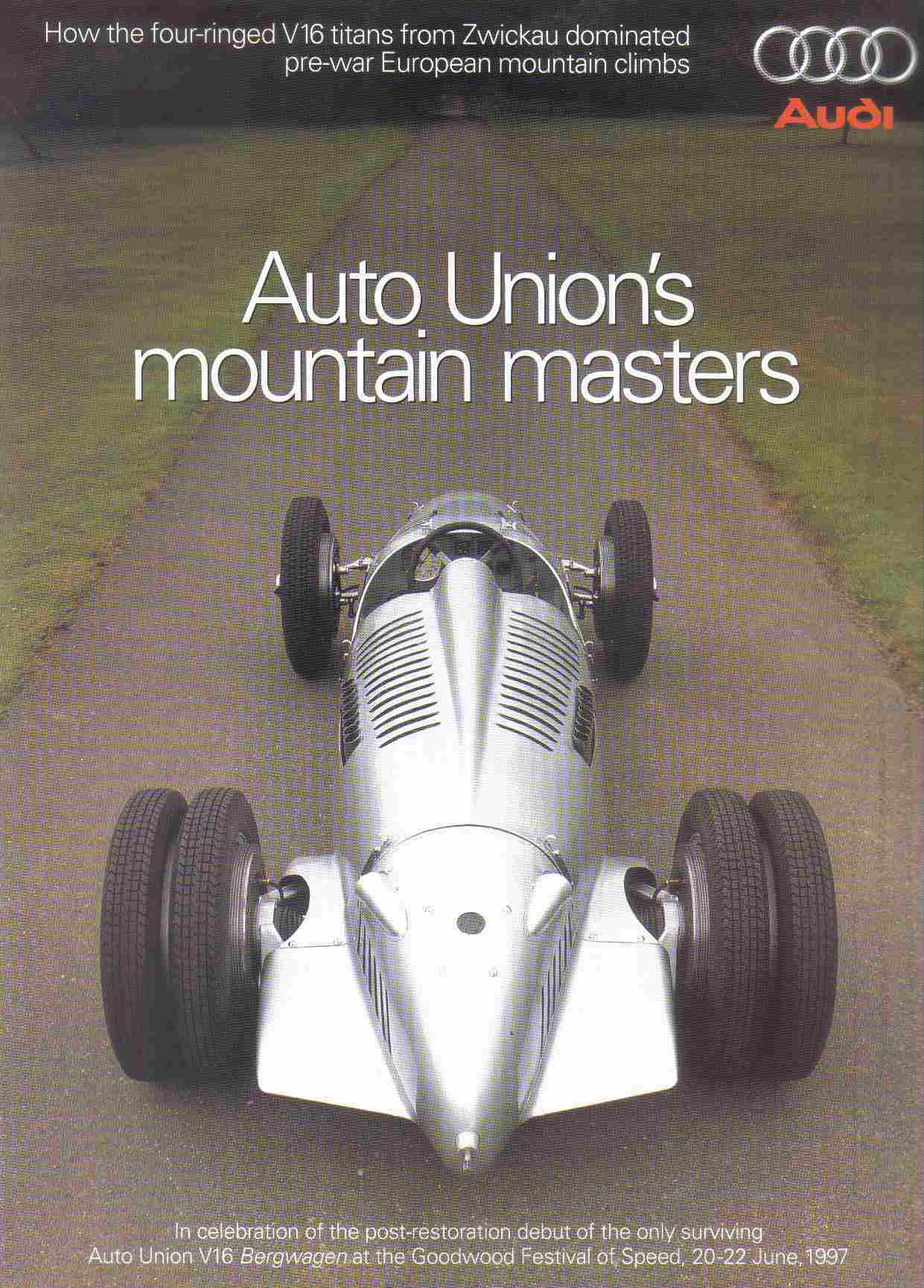
Quattro of a different kind…part of Audi’s 1930’s heritage. As would be expected of a manufacturer like Audi they produced a special press pack just for the unveiling of the restored Auto Union V16. This forms part of it.
The prime of motoring’s manufacturers were ready to exhibit their wares in both static and competition or demonstration-mode to highlight their presence to the mass of Goodwood-bound enthusiasts and glitterati alike – arriving from both spheres of the globe.
Audi brought along their newly restored Auto Union V16 Mountain climb car for Hans Stuck to run up the Goodwood drive. Not quite mountain climbing, but a sight and sound to behold. Arch rival, Mercedes Benz brought along their 1955 Mille Miglia winning 300SLR for Stirling Moss to drive in memory of the then recently departed Moss MM co-driver and motoring journalist, Denis Jenkinson.
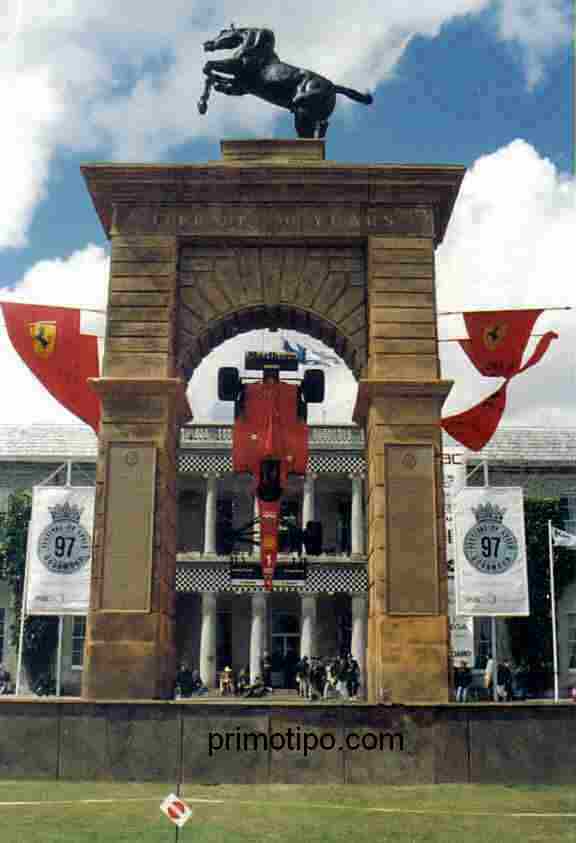
Arguably standout that year was the fiery red Italian, Ferrari marque. Certainly so, based on their presence at the event marked with the massive statue created in front of Goodwood House – celebrating their 50 years of Maranello motoring couture with a V12 orchestra under the bonnet. Ably backed with many examples baring the scarlet tone and prancing horse insignia, with past & then present drivers’ from the Scuderia invited along to accompany the celebration.
One way to hook an F1 Ferrari… worshipping the scarlet red Italian marque, Goodwood-style. The even more imposing Goodwood House is behind.
If that wasn’t enough to ignite the flame then perhaps the presence of Jim Hall’s Chaparrals, various Lotus F1 & Indy car’s, Pink Floyd drummer, Nick Mason’s BRM V16, Wheatcroft & Collier collection’s Vanwalls, or numerous Shelby Cobra, et al flowing through the grounds to be enjoyed, would.
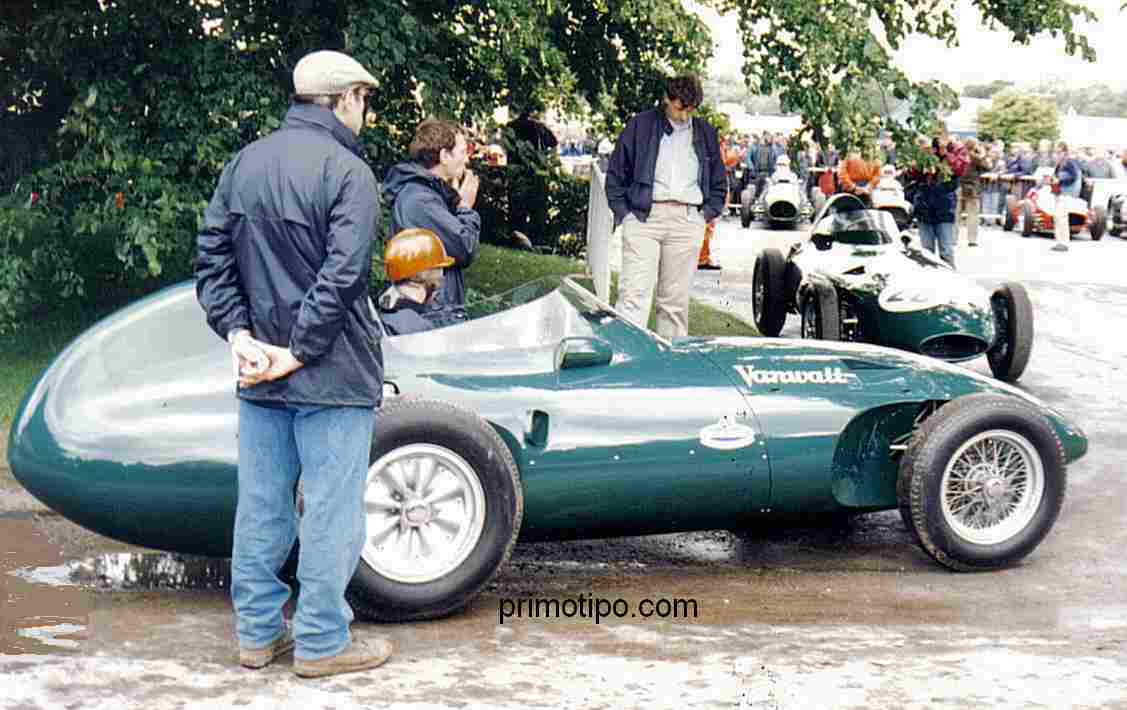
Period attired Tony Brooks awaits in the Wheatcroft Vanwall ‘VW9’ for Stirling Moss’ arrival to jump aboard the Collier Vanwall ‘VW5/11’ so they could both do a demonstration run together. The Vanwall’s of course testament to engine bearing magnate, Tony Vandervell’s efforts after his frustrated support during the early days of the supremely complicated BRM V16 project.
Another option was to give the cheque book a work out by making your way to the BROOKS marquee and put your hand up or nod obligingly at the auctioneer in an attempt to procure various vintage or classic sports, or racing cars. Amongst the many offerings was the ex Graham Hill/Arnold Glass BRM P48 and original Mini designer, Alec Issigonis’ ‘Lightweight special’. Then again if the budget didn’t stretch that far, various memorabilia or even fashion traders would happily liberate multiples of pound notes from you. The memorabilia traders’ certainly worked their magic on me.
Brooks Auctions (now Bonham’s) sold the ‘Lightweight Special’ originally built in the late 1930’s by 1959 Mini designer, Alec Issigonis and his friend, George Dowson. Both drove it in Hillclimb’s and ¼ mile Speed Trials at the likes of Prescott and Brighton. That’s how ‘Issi’ met John Cooper! When built the ‘Lightweight’ was advanced with its monocoque construction, rubber suspension and cast wheels. The Heritage Museum at Gaydon in the UK’s midland’s tried to acquire the car to add to its other Issigonis artefacts, but strong bidding knocked them out and it stayed in private hands – selling for around £40,000 at Goodwood. It was soon back into hillclimbing, but damaged quite soon after. The necessary repairs to the bodywork, meaning it lost some of its long established patina.
Given the prevailing moist atmosphere for 2 of the 3 day event, the smart move would have been to stay out of the weather and procure a grandstand seat while enjoying the sights, sounds and smells of motor sport’s past and then current, rally cars, sports cars, F1 or motor cycles as they motored by. Often driven or ridden by someone famous. Some on a mission to set a Hill record, others purely as a demonstration run.
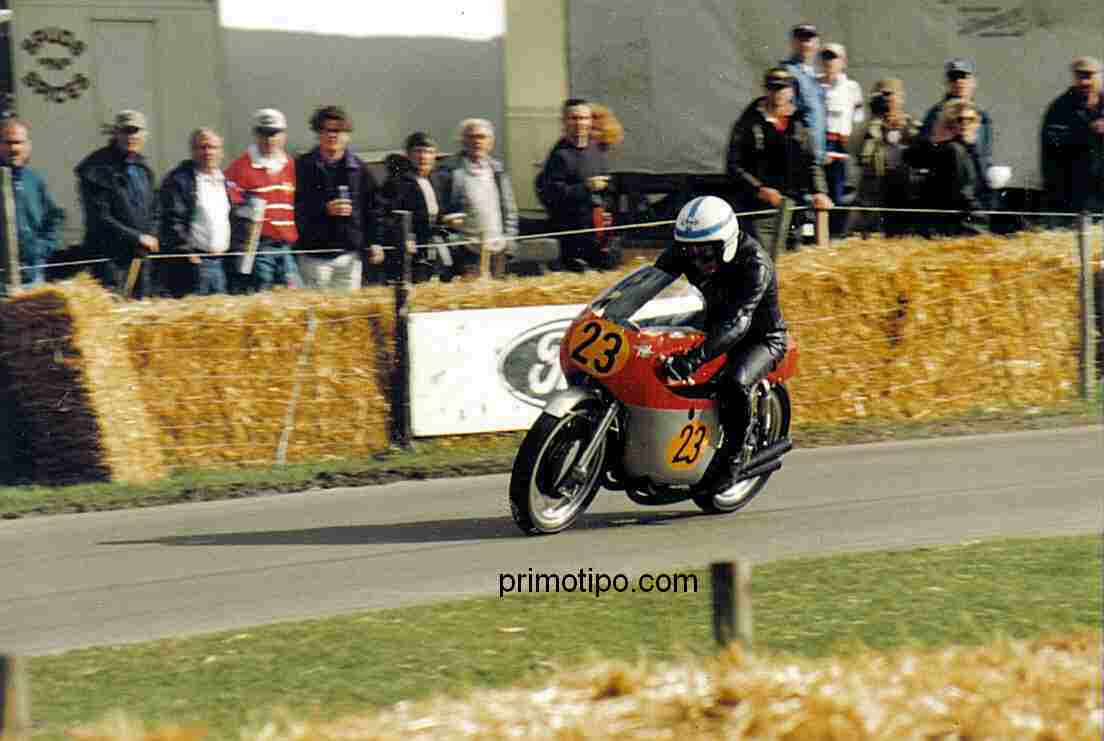
Uniquely placed in motor sport’s history is John Surtees – championships on motorcycles and cars. Seen here riding his 1960 MV Agusta 500.
What made Goodwood special for me though was the ability to just amble around and find something to enjoy.The paddock was a special place to get up close and view, not only the very special racing cars present, but many drivers or riders. Several who carried world titles within their sport and happy to oblige an autograph or 3. For me, a copy of the Doug Nye’s ‘Cooper Cars’ book garnering notable autographs from those who took part in racing Coopers during period on track battles. Reflecting back after 18 years, several of those present that weekend are no longer with us. However fond memories of a visit to Goodwood Festival of Speed will remain. For what was even in the event’s early years’ an overwhelming 3 days hard to take it all in… but worth giving a damn good crack.
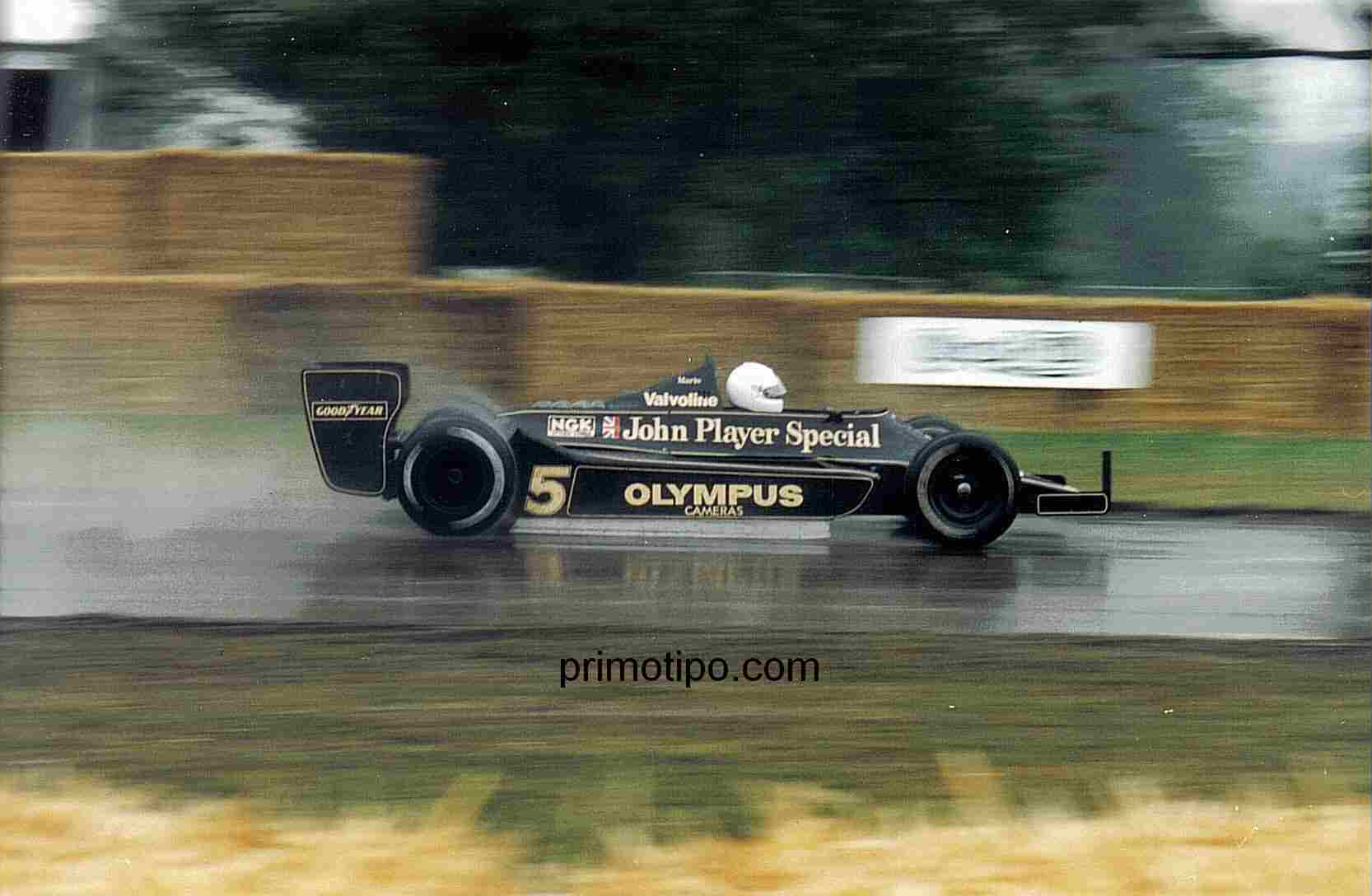
Splish, Splash… John Dawson-Damer takes his ex Team Lotus 79 for a gingerly run along a very damp Goodwood drive. This is chassis ‘79/5’ originally run in 1979 Team Lotus Martini colours for both Andretti and Reutemann during that season. When Lotus and J-DD struck up the arrangement that his ex-Clark Lotus 32B Tasman car went back to Lotus and the 79 was delivered to him in the far more pleasing JPS scheme
Only Barry could get away wearing his baseball cap backwards at Goodwood… After hearing Barry Sheene on Australian TV commentary for ATCC/V8 Taxis, some wags might say “What’s he doing trying to read!” Well I witnessed the relaxed Mr Sheene sitting atop this BMW in the pits, when clearly an enthusiast of his approached for an autograph of a Sheene book he had brought along. What quickly transpired was that while Barry was out winning races and busting bones on racing motorcycles, before disappearing to the warmer climates of Australia to live afterwards, he clearly was not aware of this book about himself! Flicking through it and scanning its pages as I managed to snap this photo.
Despite Enzo not wanting to join the late 1950’s F1 GP rear engine revolution, Phil Hill won his 1961 F1 Championship in the ‘sharknose’ Ferrari 156 with the V6 engine behind the driver. So not only was Phil the first USA citizen to win F1’s highest accolade, he also goes down in history as the first Ferrari rear engine era Champion.
Not Jimmy Clark’s 1965 Indy 500 winner, but the sister Bobby Johns Team Lotus entry.
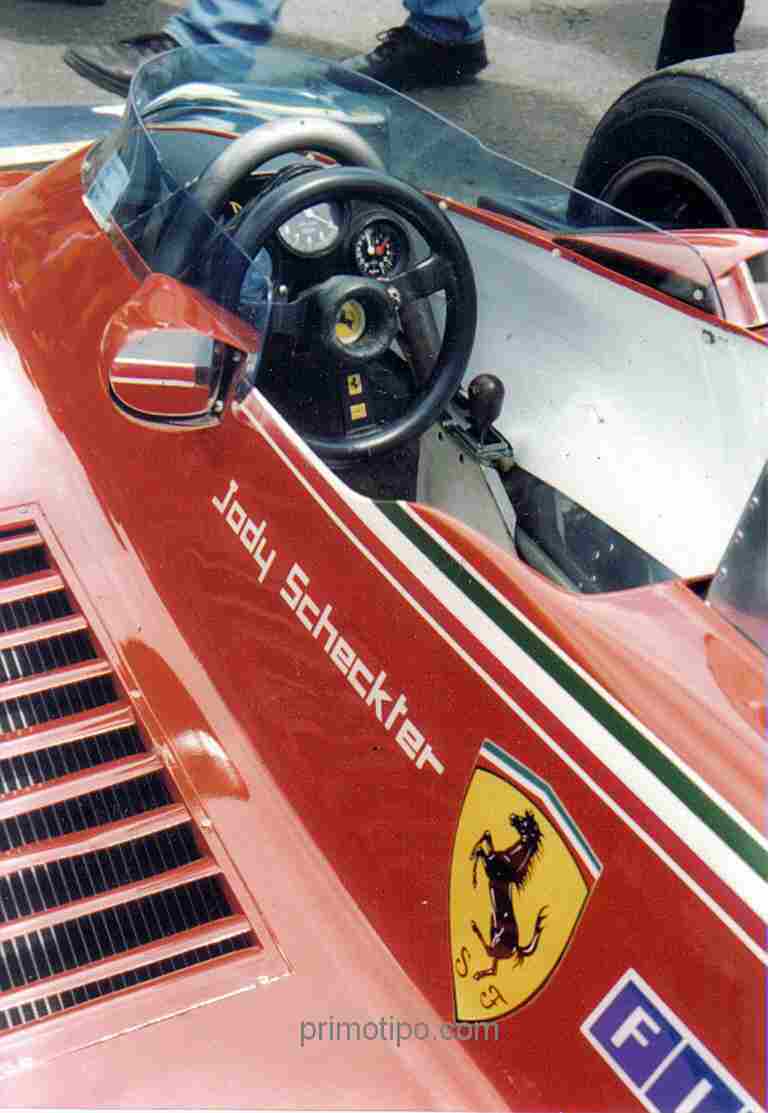
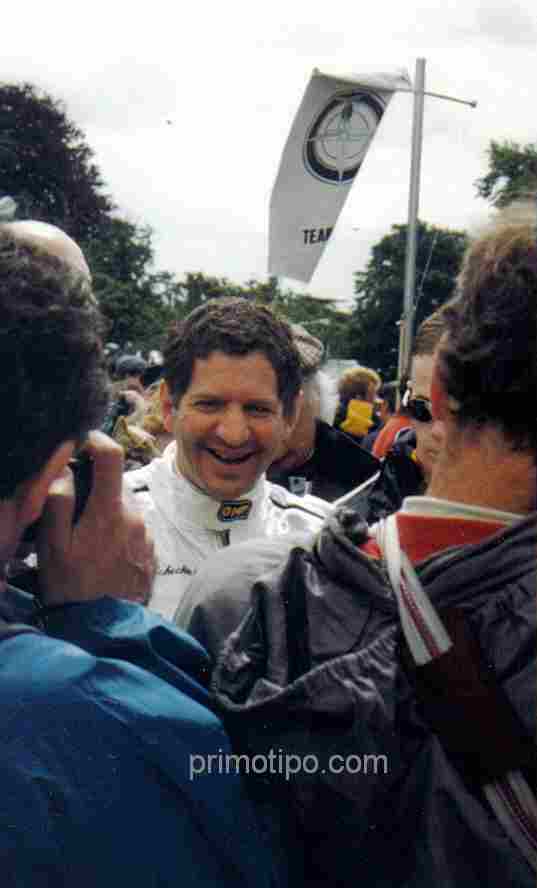
The Ferrari T4 cockpit fit for a 1979 F1 World Champion. Jody was at Goodwood, here accosted by photographers
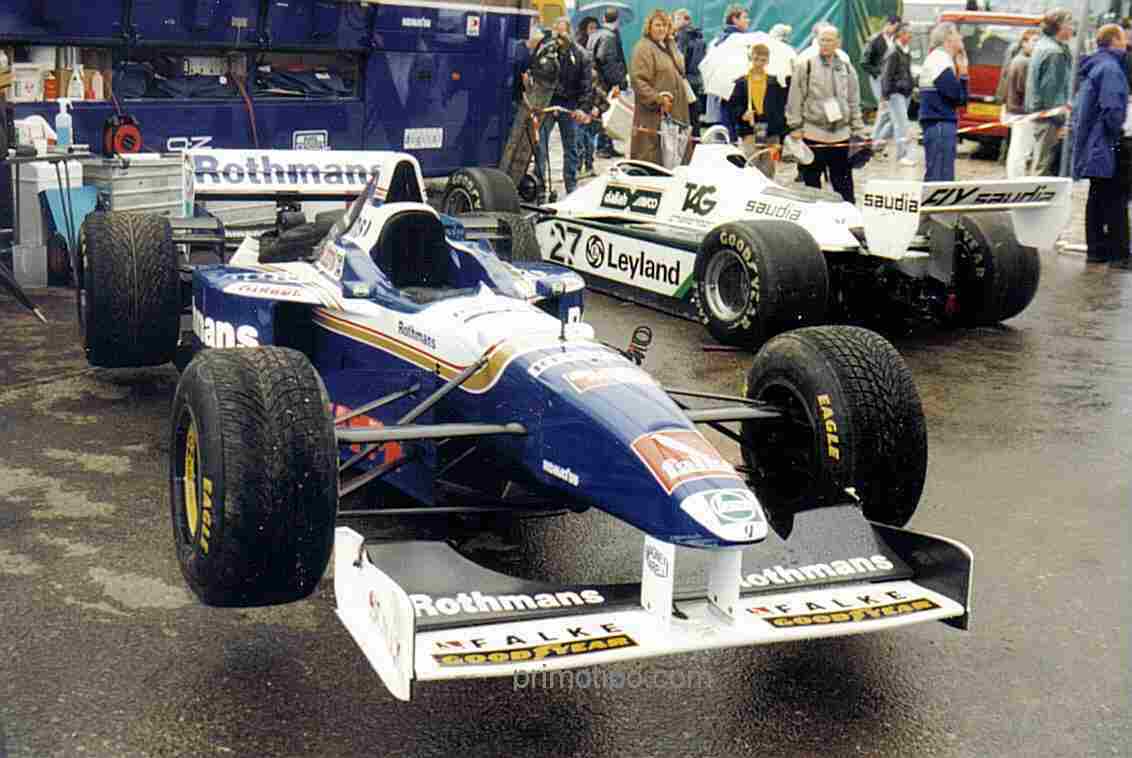
Even in 1997 you would have struggled to get this close to Williams GP Engineering at an F1 event. One of the FW18’s used by Damon Hill in his successful 1996 season and the FW07B used successfully by Alan Jones in 1980 – both clinching World Drivers’ & Constructors’ Titles.
The dedicated FoS officials and Ford’s then WRC weapon of choice… Juha Kankkunen’s Repsol Cossie Escort
Credits…
Excepting Goodwood artwork & Audi press material, all photos Stephen Dalton
Who What Where and When?…its Lex Davison in his Alfa Romeo P3 ‘50003’…the where is a little more interesting?…
My writer/historian friend Stephen Dalton thinks its Fishermans Bend, Victoria at the 13 March 1949 meeting…the background looks bucolic to me so it may be Ballarat Airfield in 1950? All correspondence will be entered into.
The shot itself is by George Thomas, i tripped over it…ripper shot which catches the essence of these airfield circuits.
I will get around to writing about this wonderful Alfa in due course, on the basis that it is Fishermans Bend Davo won the 12 lap, 25 mile scratch race from Charlie Dean in Maybach 1, those of you who have read my Stan Jones article will be familiar with this car, Arthur Wylie in a Ford V8 Spl was 3rd.
Credits…
George Thomas, Stephen Dalton, ‘Australian Motor Sports’ 14 April 1949
Photographer John Ellacott; ‘The three Mustangs of Pete Geoghegan, Norm Beechey and Bob Jane racing against each other for the first time, Catalina Park, Katoomba in Sydney’s Blue Mountains on 7 November 1965’…
And so commenced a wonderful period of Touring Car Racing in Australia. Between them these blokes won the Australian Touring Car Championship on 11 occasions; Bob Jane 1962/3 Jaguar Mk2, 1971/2 Chev Camaro ZL-1. Pete Geoghegan 1964 in a Ford Cortina GT, 1966-9 Ford Mustang and Norm Beechey, 1965 in a Ford Mustang and 1970 in a Holden Monaro GTS350.
For those with an interest in these Mustangs’ click on this link to read a detailed article by Australian historian/writer/commentator Mark Oastler, the login process is simple.
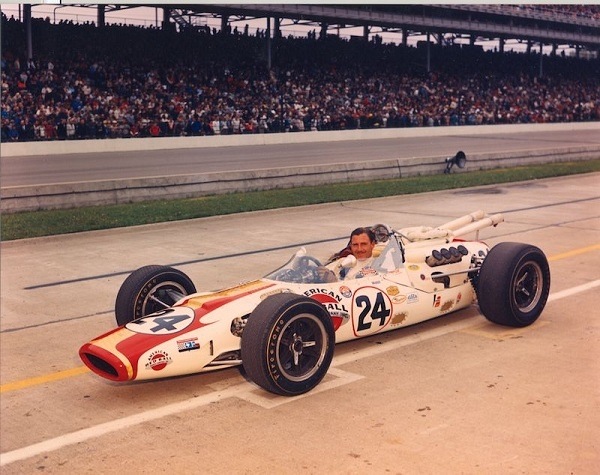
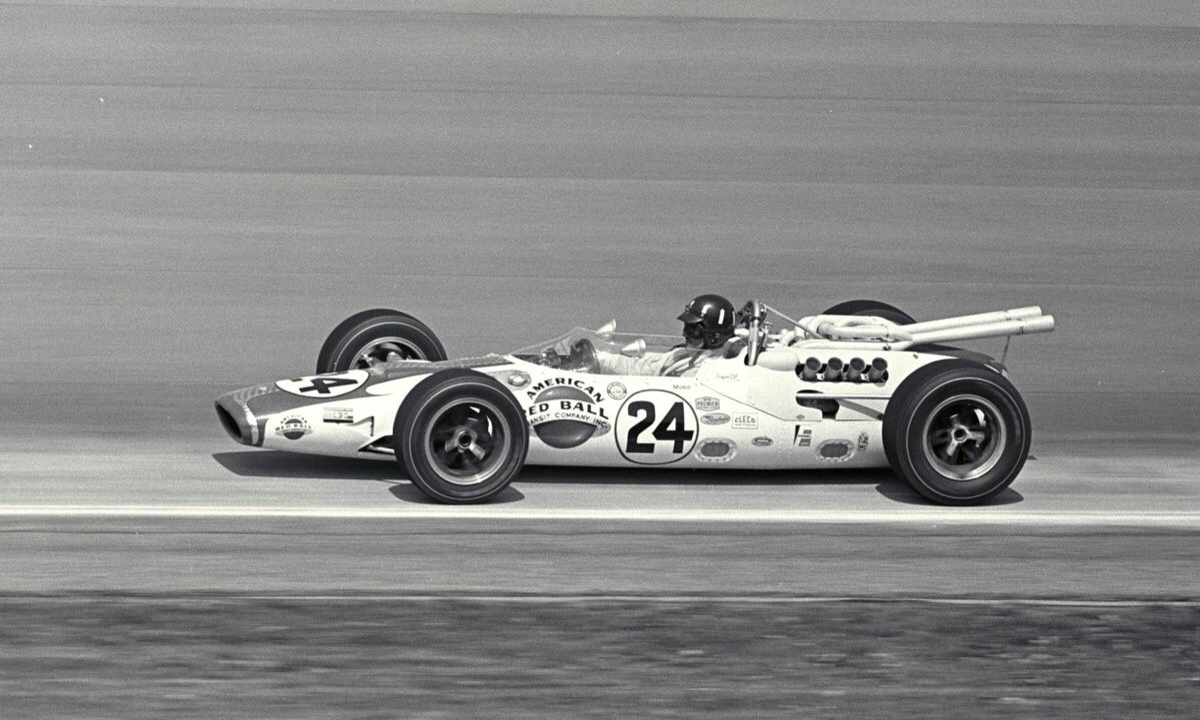
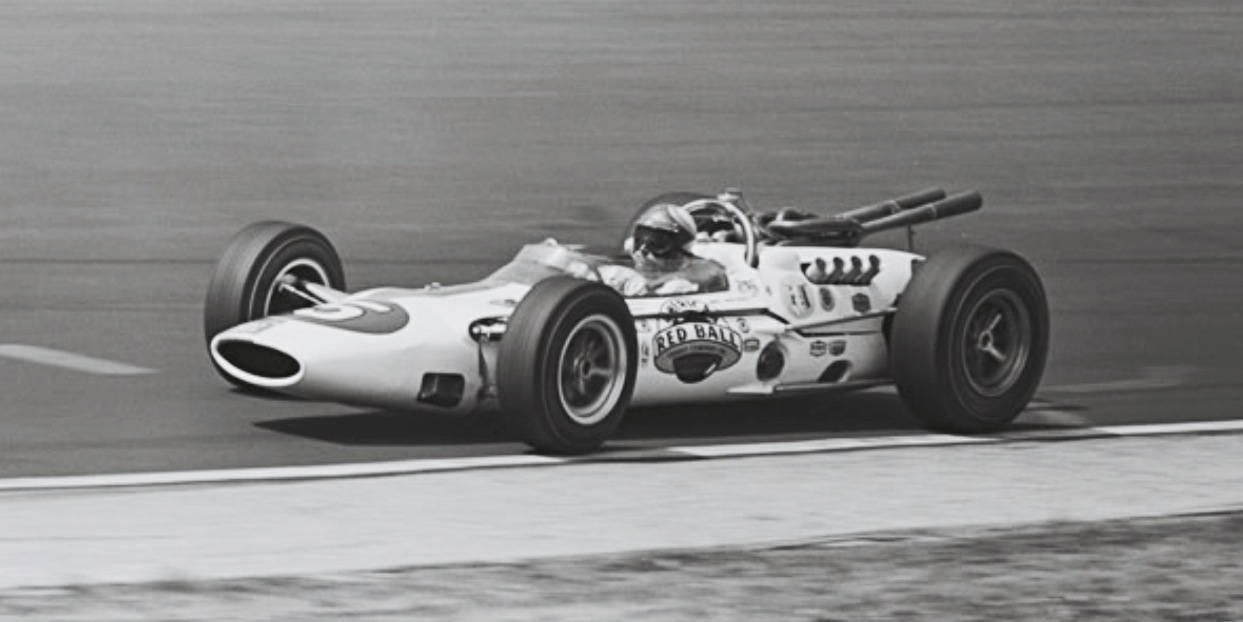
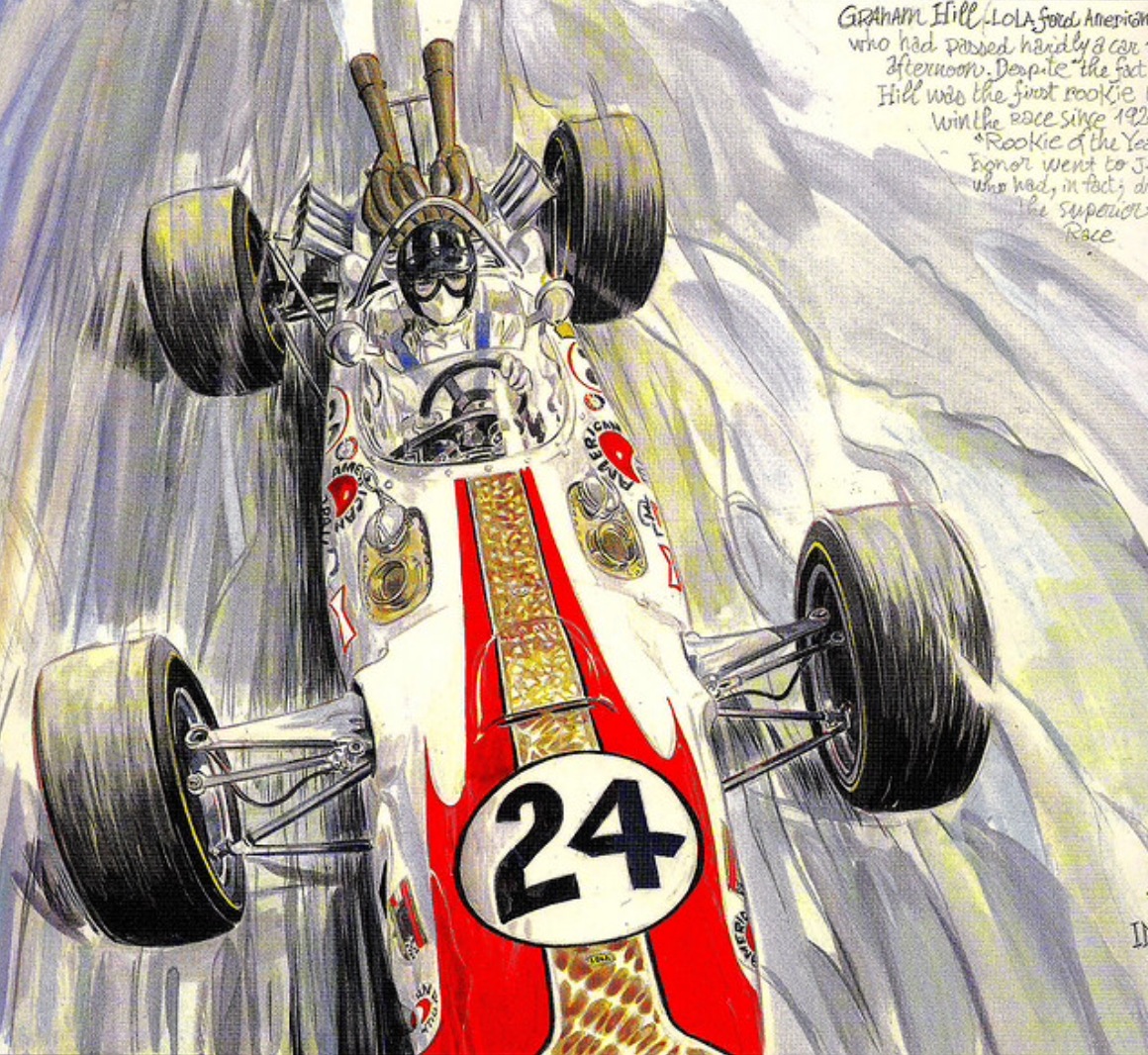
Graham Hill in his ‘American Red Ball Special’ Lola T90 Ford leads the latter stages of the 1966 Indianapolis 500 from Joe Leonard’s Eagle and Jim Clark’s Lotus 38. Fabulous Michael Turner painting…
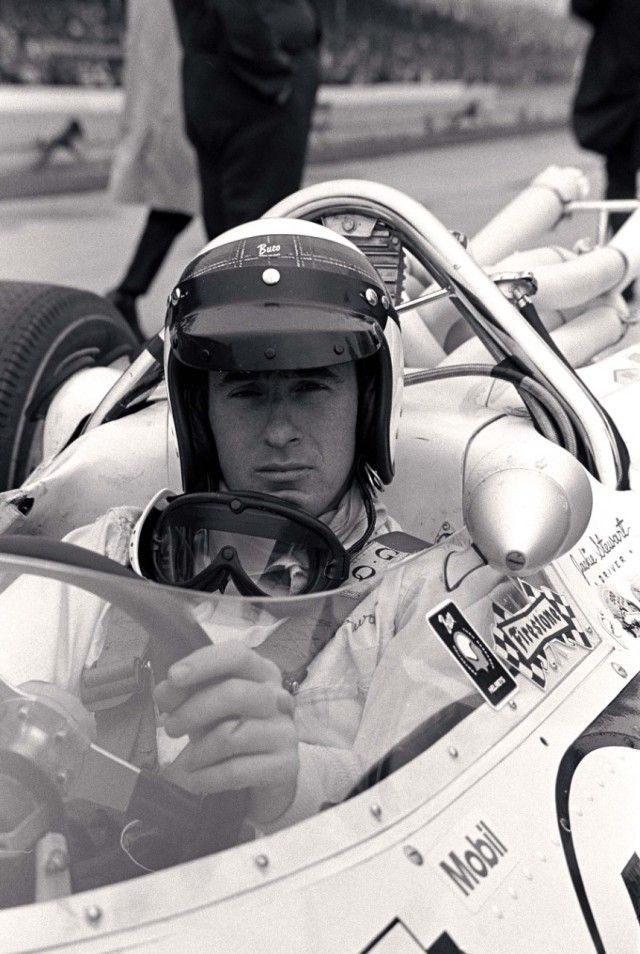
Hill won the race from Clark and Jim McElreath’s Brabham. Graham lead the most critical part of the race, it’s last 10 laps after teammate Jackie Stewart slowed and retired his Lola T90, the BRM teammates also ‘roomies’ and Indy debutants in John Mecom’s Indy Team.
JYS, Hill and Eric Broadley giving GH a few tips about instrument location before the off…Note seatbelts, still 2 years away in F1, a bit earlier for Jackie after his big Spa shunt a fortnight later. (Autoextremist)
The race was not without controversy with more than one lap timer giving victory to Clark, who spun twice during the race without hitting anything on each occasion but causing some lap scoring confusion.
Hill was doubly lucky; he was not entered to race until the unfortunate Walt Hansgen was killed in the LeMans test weekend in a Ford MkII, the Brit taking the unfortunate Hansgen’s place in Mecom’s factory Lola entry, Mecom the American Lola importer at the time.
One of my earliest motor racing memories is of Hill’s car, the Lola featured big time in one of those ‘Boys Own’ type books we were all given as stocking fillers at Christmas. I have always had a soft spot for these big Lolas’ as a consequence. I still have the book but its in storage, i can’t remember what happened yesterday but the book’s articles on Hill’s Lola, the equally new curvaceous Lola T70 and Tony Lanfranchi’s psychedelic helmet livery i adopted as my own in 1979 stick in my mind. Come to think of it my Lola fetish started then!
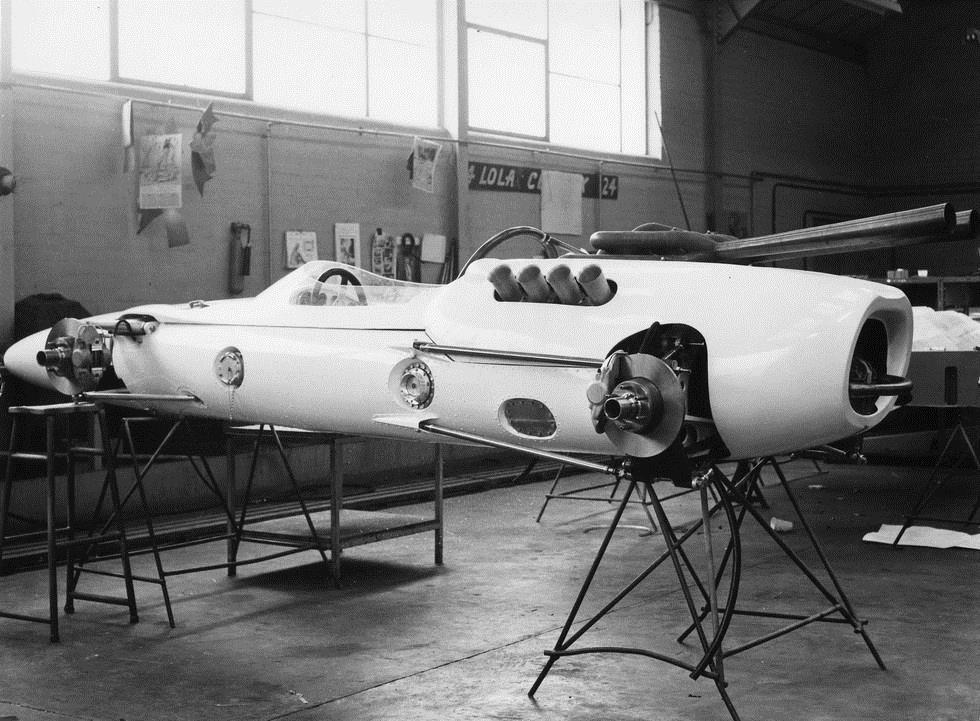
Lola T80 being assembled at Slough in 1965. T80 unsuccessful, the T90 was an update of this car with the suspension geometry which held it back in 1965 addressed. (Lola Heritage)
The mid-engined invasion of Indianapolis was started by Cooper, Jack Brabham raced at Indy in 1961, Lotus had their first start with the pushrod-V8 Ford powered 29’s driven by Clark and Dan Gurney in 1963. Ferguson and Lola joined the stampede with mid-engined victory finally achieved by Team Lotus in 1965. Clark victorious in the Ford four-cam 4.2 litre V8 engined Lotus 38.
The US was a big market for Lola’s Eric Broadley, he achieved much success with the Group 7/CanAm T70 from 1965, USAC was another great opportunity. Broadley built the T80 for Indy 1965, but the car was late, wasn’t tested and was let down by suspension geometry shortcomings which gave the cars poor and unpredictable handling.
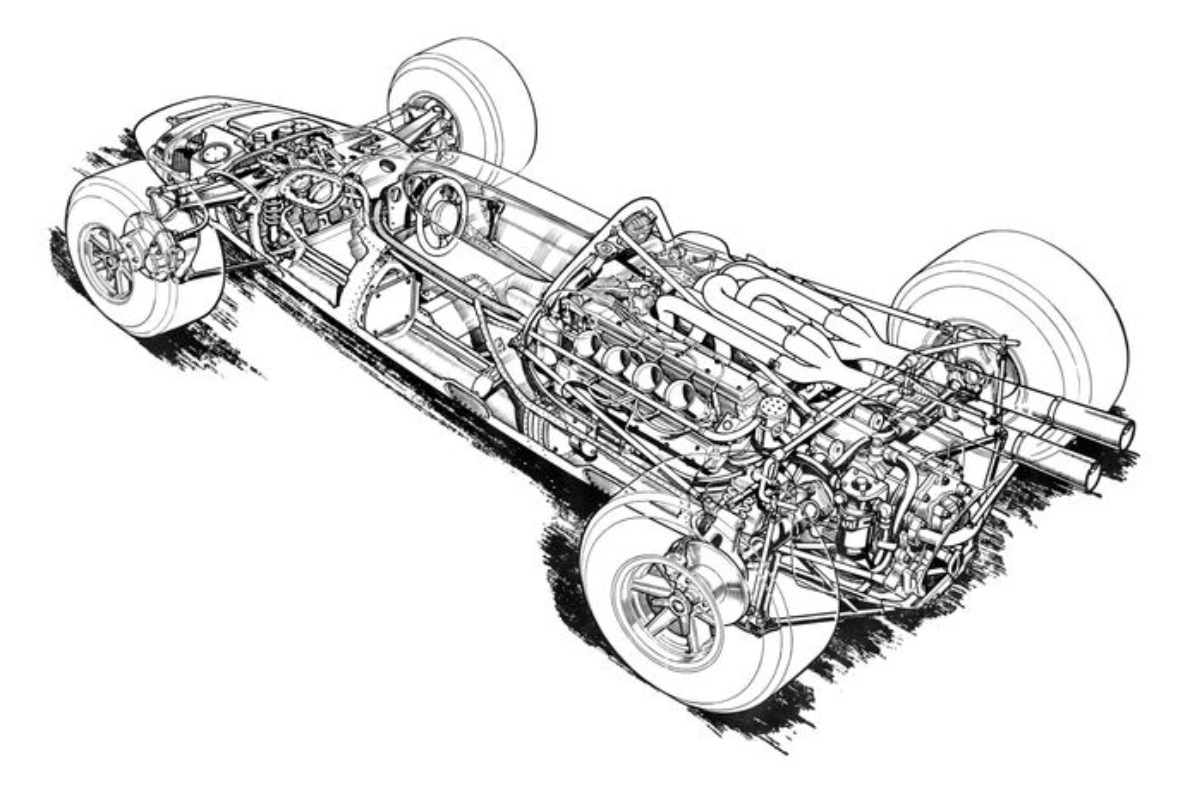
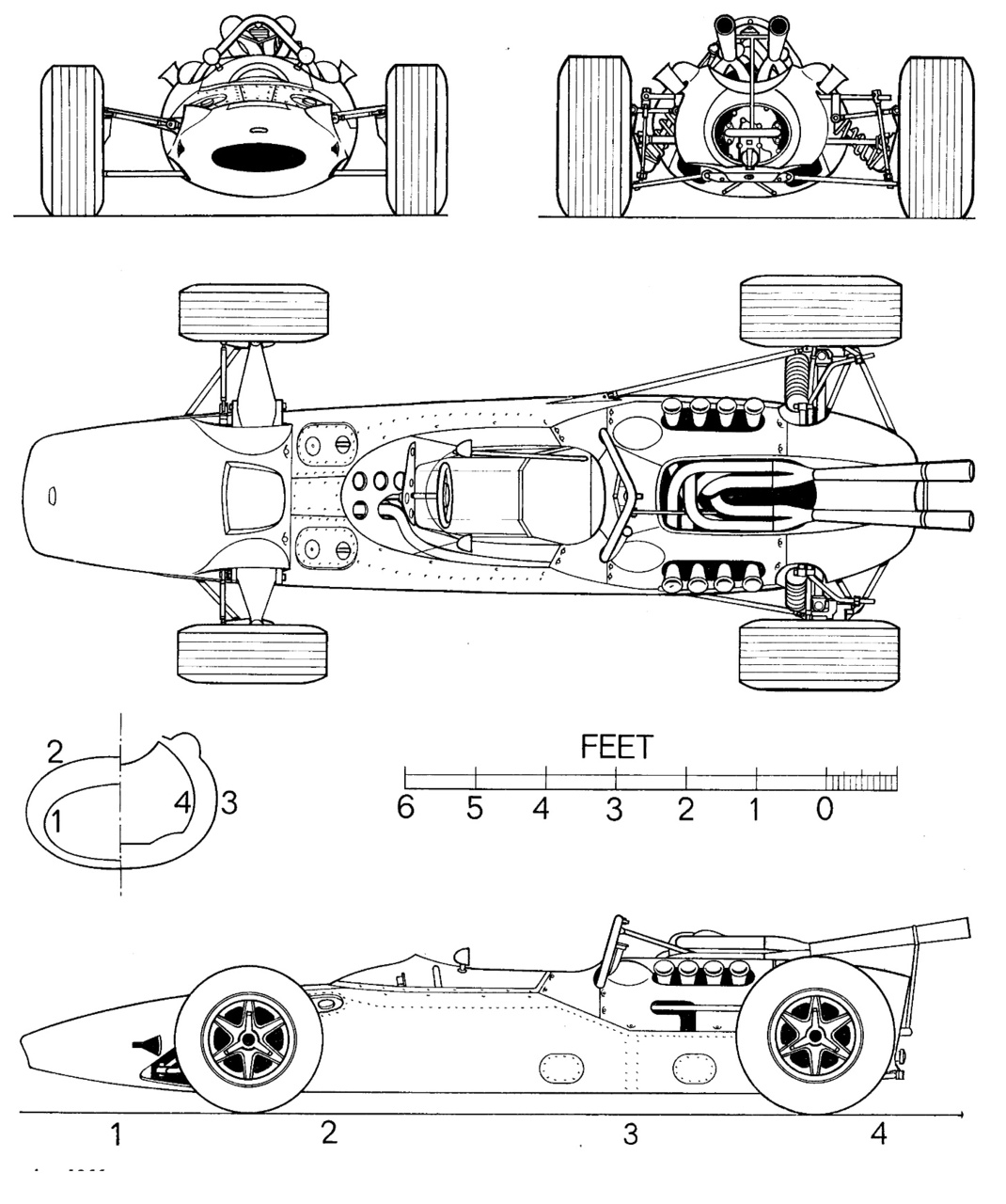
Lola T90 Ford cutaway drawing. Car also designed for Offy 4 cylinder engine. Aluminium ‘full monocoque’ chassis, offset suspension; front top rocker operating inboard mounted spring/damper and lower wishbone. Rear, inverted lower wishbone with additional locating link, single upper link, single radius rod and coil spring/damper units. Adjustable sway bars front and rear, rack and pinion steering, 2 speed Hewland transaxle, Ford DOHC 4 valve, Hilborn fuel injected 4.2 litre V8. Circa 425 bhp @ 8000 rpm in 1965
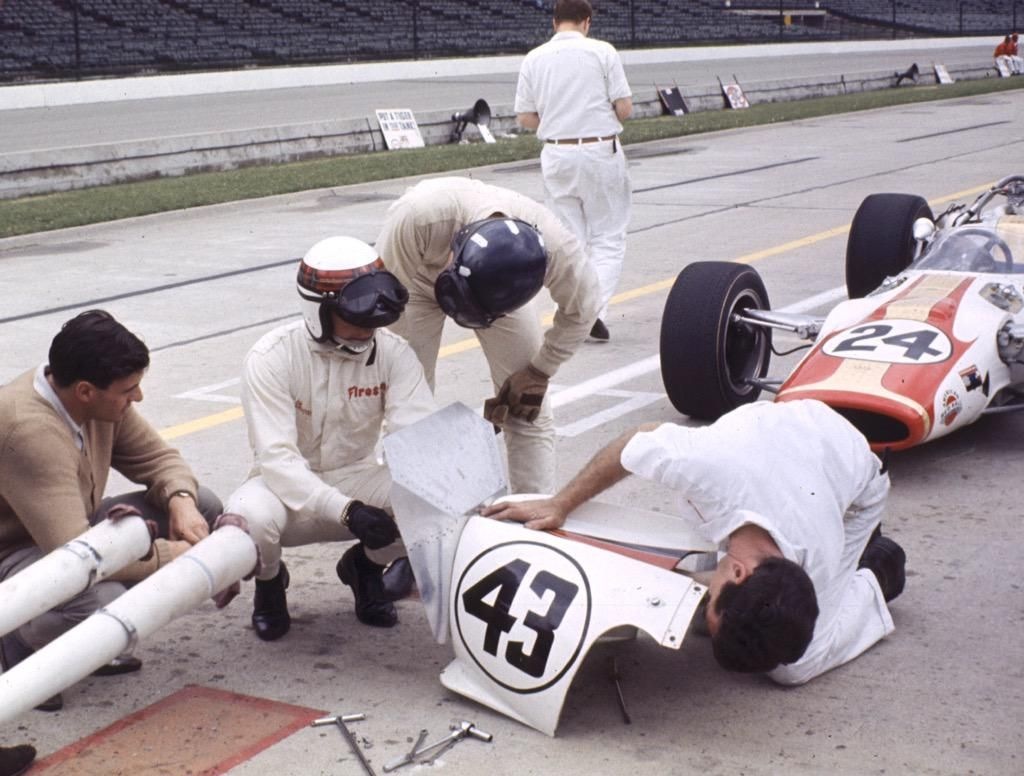
Jackie Stewart and Graham Hill helping Mecom’s mechanics with the fettling of the rear bodywork of Jackie’s T90 #43, the Scot and the other Scot, Clark, both unlucky not to win the race…Graham’s #24 Lola behind. (LAT)
The Lola T90 which followed for 1966 addressed the T80 shortcomings…
The T90 chassis was an aluminium monocoque constructed from Indy mandated 16-guage aluminium. Sheet steel diaphragms front and rear provided additional internal stiffness, externally a sloping scuttle in front of the instrument panel gave additional rigidity.
Lola Heritage ‘Tubular steel subframes were attached to both the front and rear of the chassis, the front subframe carrying the oil tank, radiator and the forward mountings for the lower wishbone. At the rear there were two subframes above and below the two-speed Hewland gearbox, the upper one carrying the attachment point for the single top link and the top spring/damper mounting. The lower subframe had the mounting points for the lower wishbones’.
‘The T90 was designed to accept either the 2.8-litre, 4-cylinder Offenhauser engine or the 4.2-litre 4-cam Ford V8. The Offy, built by Meyer-Drake in California was fitted with Hilborn fuel injection and a Paxton Roots-type supercharger and gave some 520 bhp, the Ford, whilst slightly less powerful, was a more known quantity having won the 1965 race in Jim Clark’s Lotus 38’
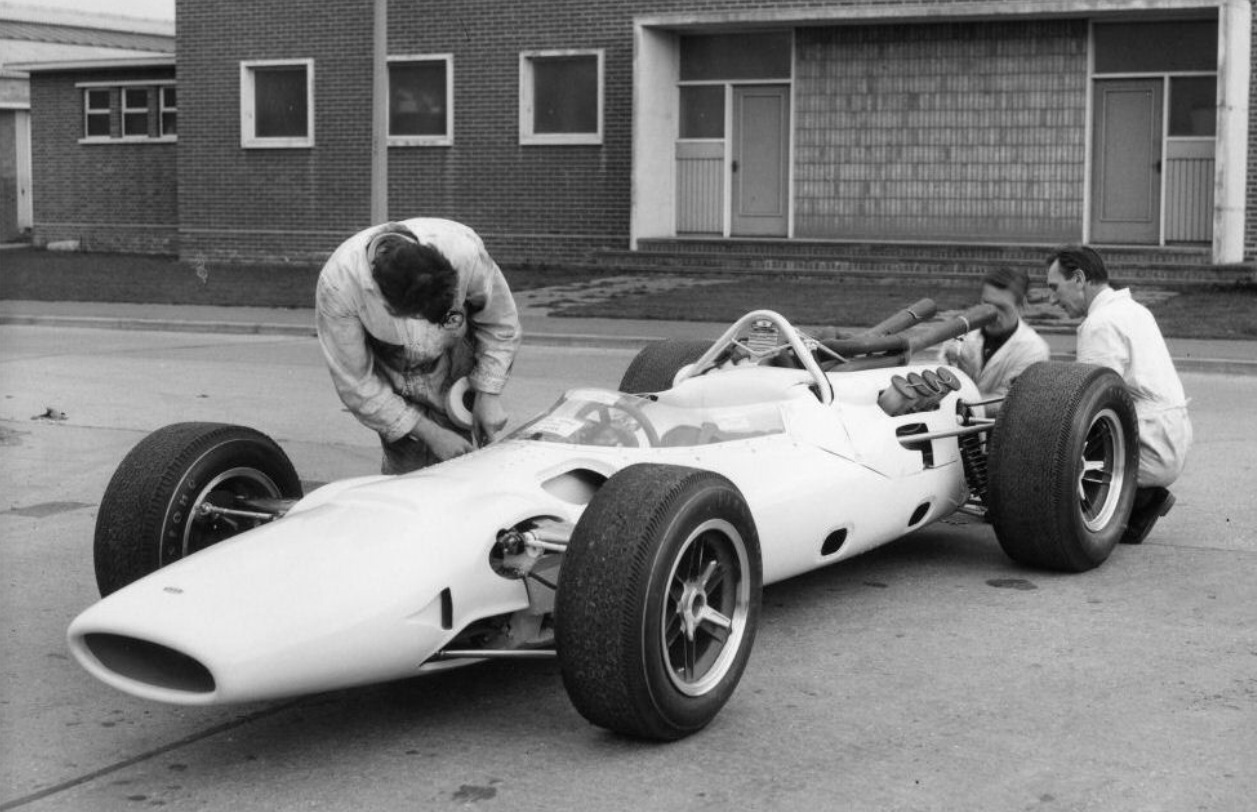
Lola T90 build, Slough 1966. Looking very sexy in its Specialised Mouldings body. Distinctive Lola ‘knock-offs’. Fuel cells still to be inserted into monocoque. (Lola Heritage)
The cars front suspension was inboard with fabricated rocker arms at the top operating coil spring/damper units and wide-based lower wishbones.
‘Rear suspension was fairly conventional with one departure from the norm. At the top of the upright was a single adjustable top link attached to the top chassis subframe whilst at the bottom a wide-based wishbone (reinforced on the left), mounting to the rear of the upright, was mounted to the lower chassis subframe. There was a single adjustable lateral link running from the lower front of the upright to the subframe that allowed for toe-in alterations. The unusual feature to the design was the single top radius rod, a lower rod was not used to to the difficulty of a suitable chassis attachment point due to the fuel tank design. As was the norm at this time front and rear suspension was offset to the left by three inches, the theory being that this helped the car through the left-hand turns at Indianapolis.’
These drawings as well as showing the T90’s lines also nicely show the suspension, offset to the left, as was the convention of the time on speedways. (unattributed)
Ford DOHC Four-Cam Indy V8 Engine…
Ford’s 1963 Indy engine fitted to the Clark and Gurney Lotus 29’s was an aluminium variant of its 260cid Falcon/Fairlane small block V8, it developed 350-376 bhp at 7200 rpm on 103 octane fuel fed by 4 Weber 58mm carbs.
Ford, after Lotus’ great showing (they was robbed) in 1963 decided to build an engine capable of developing 50bhp more but with a weight gain of no more than 50 lbs over the aluminium pushrod engines 345lbs.
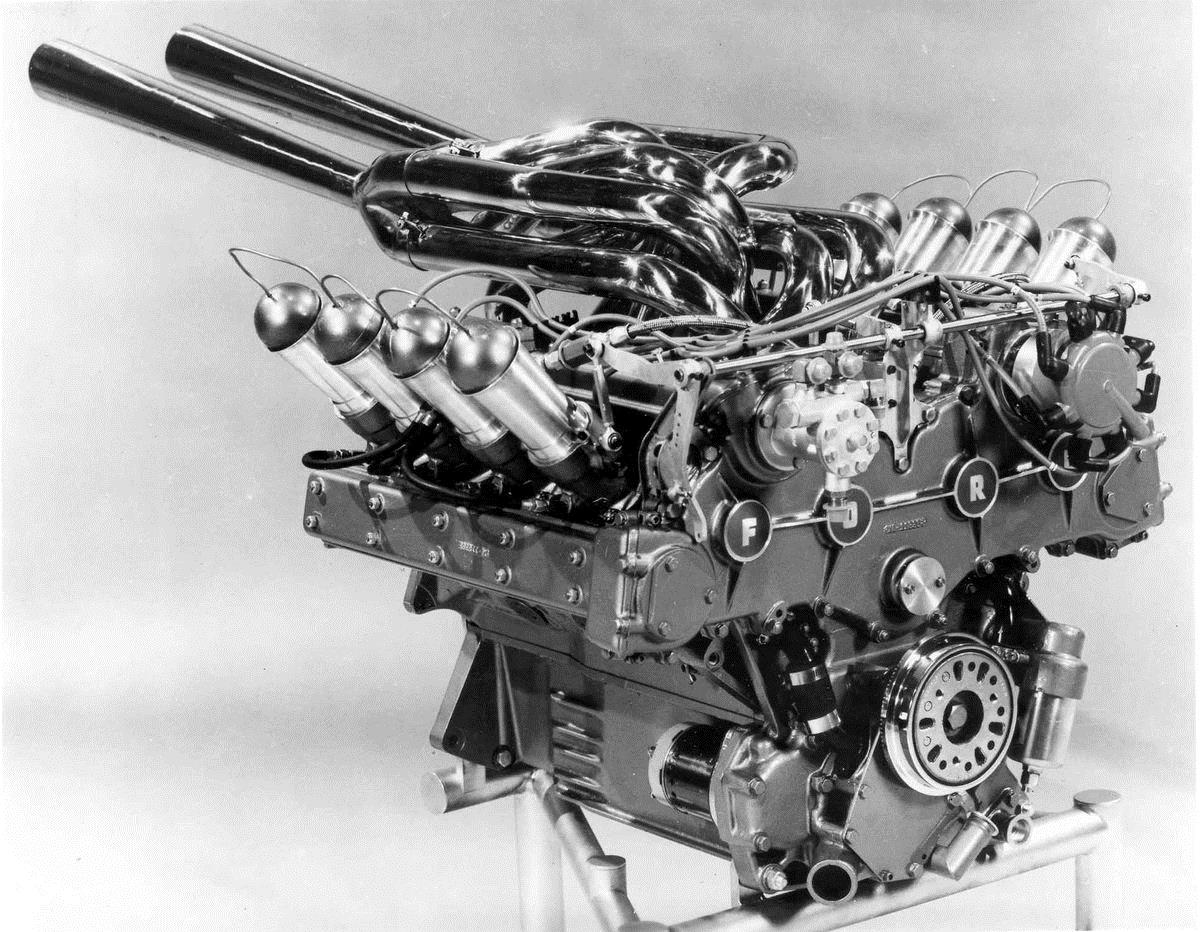
Ford evolved, using many parts from the earlier engine, a DOHC motor with four valve heads, the combustion chamber ‘pent roofed’. The engine had ‘between the Vee’ exhaust as tests showed power was optimised with this setup. Hilborn fuel injection was used, in 1965 the engines developed 425bhp @ 8000rpm.
The block was cast of aluminum alloy using patterns modified from the production 289cid production ‘small block’. Cast iron cylinder sleeves were a shrink fit in the block and were sealed at the heads with copper laminated steel O-rings. In order to clear the two banks of camshafts in the heads, the 10 attaching studs were moved closer to the cylinder centerline. An additional 8 studs protruded from the heads maintained clamping force needed to seal the combustion chambers. The space occupied by the camshaft in the normal production engine was replaced with an oil tube. This acted as a gutter and collected oil as it drained from above to keep it off the reciprocating assembly.
The bottom end was beefed up considerably. The special forged steel crankshaft was held by 4-bolt bearing caps on numbers 1 through 4. Main and rod bearing journals are the same size as the 289, as is the engine’s stroke – 2.87″. The rod journals are crossdrilled for better oiling at high engine speeds. The rods are from the 289 HiPo, modified for floating pistons pins. The pins are 289 HiPo pieces. The oil pan is cast magnesium and is a structural part of the engine. ‘Ears’ cast integrally with the pan provide the engine/chassis mounts.
As summarised above, the cam-ground forged aluminum pistons have a pent-roof dome to closely fit the combustion chambers. Compression is 12.5:1. The cylinder heads housed 4 valves per cylinder with a central spark plug. The plugs are canted toward the 1.64″ diameter intake valves. Exhaust valves are 1.36″ diameter. The camshafts run in bearing bores in the cylinder heads directly over their valve banks. Valve clearance is adjusted by the selective fitting of the followers. Intake ports are between the cams with exhaust out the top of the heads between the vee. This was done to do away with the nightmare of exhaust tubing normally required. Hilborn injection is used having been selected for its light weight and simple low-pressure design.
The 255 CID engine weighed 406 lbs and produced in excess of 425 BHP at 8000 RPM. Useful power/torque was developed from 6000 with a rev limit of 9000 RPM
Once developed by Ford the engine was sold and serviced via Louis Meyer. In 1966 Ford built 20 engines which retailed at US$23000. The wonderful engines evolved over the decades, in both normally aspirated and turbo-charged form as Indy rules changed.
Checkout this website which gives an in-depth account of both the DOHC engine and the pushrod V8’s which preceded it, click on this link for an interesting read; http://www.quadcamford.com/development.html
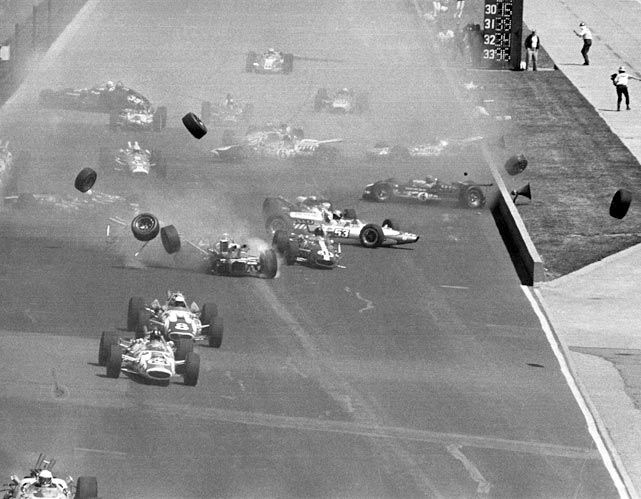
Indy 1966 first lap shunt. Hill #24 Lola, McCluskey #8 Eagle Ford, Joe Leonard #6 Eagle Ford , Al Unser Lotus 38 to the left of his side-on car, Gary Congdon #53 Huffaker Offy, Don Branson in the sideon #4 Gerhardt Ford and the rest…(unattributed)
1966 Indianapolis 500…
Lola Heritage ‘Learning the lesson from 1965 Lola made sure the T90 was ready in plenty of time for the 1966 Indy 500, the John Mecom Racing Team-entered car made it’s debut at the March season opener at Phoenix International Raceway. Success was immediate with Roger Ward finishing second in his Offenhauser-powered T90 and a month later Ward took the winner’s laurels at Trenton’s 1-mile paved oval when he won a rain-shortened race ahead of Gordon Johncock.
Come the month of May and there were three T90s, all entered by John Mecom’s Houston-based team, ready to run at Indy qualifying, Roger Ward in his successful Offenhauser-engined car and Rookies Jackie Stewart and Graham Hill who were both Ford-powered. There was nothing much between the cars at the end of qualifying, Stewart was 11th fastest at a speed of 159.972 mph, Ward 13th at 159.46 mph and Hill 15th at 159.243 mph.’
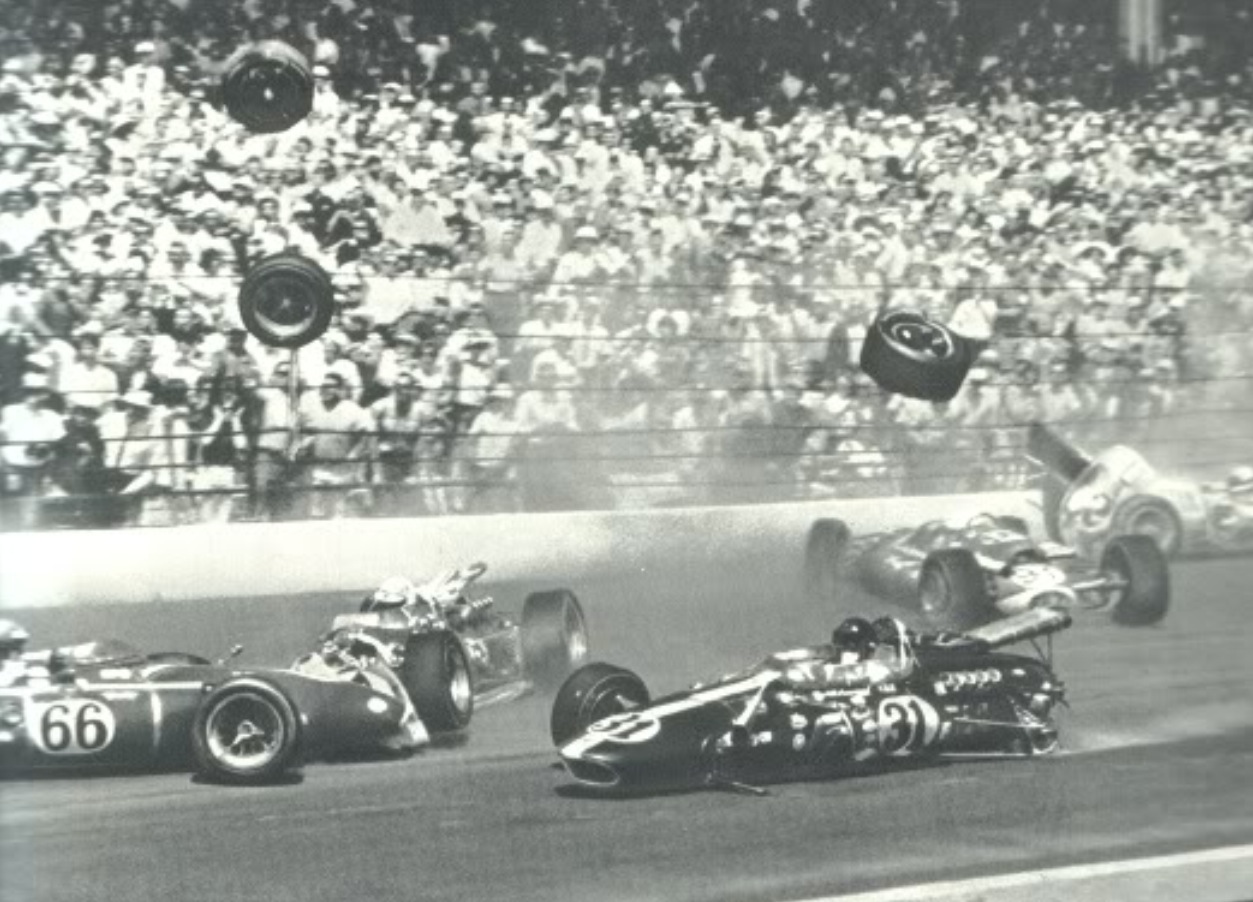
The Indianapolis Star called the 1966 Indy 500 ‘the most fantastic, confused and incredible 500.’ And it may have been. This was the ‘500’ marked by a 16-car crash at the start when Billy Foster’s car hit the rear of Gordon Johncock’s Gerhardt setting off a violent chain reaction that eliminated 11 cars, including those of A.J. Foyt, Dan Gurney, Don Branson and Cale Yarborough.
Foyt suffered minor injuries, a cut finger and a bruised knee when he climbed out of his car and scaled a fence to get away from the scene.
Jim Clark’s ‘STP Oil Treatment’ Lotus 38 Ford in the Indy pits 1966. Andrew Ferguson at left. I put a can of the stuff in Mums Morrie 1100 but it didn’t seem to go any quicker…the sticker on the rear window looked good tho. I thought so, she didn’t! #12 the car behind Clark is the Chuck Hulse driven Watson Ford. Lotus 38’s well raced, Lotus Indy tool ’65-’67. (unattributed)
The race was red-flagged for the second time in three years and was re-started after a one hour and 23 minute delay.
Mario Andretti took the lead at the restart but retired shortly thereafter with engine failure. Clark lead but spun twice with handling maladies without hitting anything, pitting on each occasion to have the car checked. Stewart and Lloyd Ruby in an Eagle diced for the lead before fuel stops put Clark back in the lead.
Great shot of Hill and Lola Supremo Eric Broadley discussing the cars setup during Indy qualifying 1966. See the quick change safety fuel cells/filler cap. Ignition cutout wired to steering wheel beside drivers thumb. (unattributed)
Ruby took the lead but his car was then black-flagged for the loss of oil, leaving Stewart in the lead from Clark and Hill. Hill had progressed through the field without making mistakes and benefiting from others errors or misfortunes, by lap 175 he was past Clark for 2nd. Stewart lead, until with 25 miles to go his oil pressure diminished, his engine scavenge pump failure gave Hill the lead he was not to relinquish.
Despite protests by Lotus’ Colin Chapman and sponsor Andy (STP) Granatelli that Hill had been incorrectly scored with an extra lap, the unofficial results stood. Hill won $156,297 for his victory, Jim Clark finished second battling an ill-handling car the entire race, Jim McElreath’s Brabham Ford was third and Stewart was classified 6th.
Hill drove a quick, clean race. He stayed out of trouble and was in front for the final laps which mattered, putting lap scoring disputes to one side…What a gorgeous looking, in a brutal kinda way, car! (unattributed)
Another start shot; Cale Yarborough #66 Vollstedt Ford and Dan Gurney’s #31 Eagle Ford. Indy 1966. (unattributed)
Jackie Stewart.
Jackie Stewart in the ‘Bowes Seal fast’ John Mecom owned Lola T90 Ford Indy 1966. Eric Broadley front lower left, chief mechanic George Bignotti in the Texan hat, Mecom in the tan short sleeved shirt in front of Bignotti (unattributed)
JYS with the face of a man focused on the qualifying task at hand. He qualified 11th, he was classified 6th after an oil scavenge pump failure caused his retirement. Lola T90 Ford, Indy 1966. (Dave Friedman)
Graphics and Imagery Hill/T90.
Lovely artwork of Hill and his Lola T90 (D Sire)
1967 Lola T92 Ford.
The successor to the Lola T90 was the mildly updated in bodywork T92 for 1967, here raced by John Surtees in his one and only USAC race, the ‘Rex Mays 300’ held at Riverside in November 1967, a road course John knew well from his CanAm campaigns. His John Mecom entry DNF’d with magneto trouble in the race won by Dan Gurney’s Eagle Ford. The car did not use offset suspension on road circuits…
John Surtees, Lola T92 Ford. Riverside 1967. (unattributed)
American Red Ball Company.
Even though the name has been in my brain since 1967, i had no idea what they do, clearly not the case in the US as they are an old established well known global removalist and transit organisation. So now i know! http://www.redball.com/long-distance-moving-company/our-rich-history/
Tailpieces…
Hill looking the focused driver he was. Interesting shot shows the conventional rear suspension albeit with 1 rather than the usual 2 radius rods to locate the suspension fore and aft. Seat belts, roll over bar too low in the event of a rollover and cross-over exhausts all clear as is all enveloping bodywork of the T90 to smooth air flow and top speed, F1 cars at the time largely devoid of rear bodywork. (unattributed)
Nice bit of modern art; Top>Bottom; Stewart, Clark, Hill. Friends and Champions all. (olivesart.com)
Ewald Kluge, DKW SS 250, Phillip Island 31 January 1938 (Earle Vienet)
I love some of these evocative older shots of a time in motor sport such a long time ago, this series of shots at Phillip Island in 1938 are some of those…
These photos were taken by Earle Vienet, father of a friend of mine, Trevor Vienet, at Phillip Island in 1938. By then the original rectangular, dirt, incredibly dangerous 10.6km circuit, host of the first eight Australian Grands’ Prix, had been replaced by a shorter 5.3 km course using part of the original track.
Phillip Island plays an important role in the pantheon of Australian Motor Racing History, not only did it hold the events described above, it was the place road racing first occurred in Australia. You can still drive the original road course, it’s well marked. There is also the current ‘modern’ purpose built circuit built in 1956, well known to International readers via its globally televised V8 Supercar and Moto GP events.
Cowes pits, Baron von Oetzen of Auto Union (left), see text below. Cowes is the main village on Phillip Island (Earle Vienet)
Many international and interstate visitors have made the trip to the ‘Island to see the ‘bike GP, historic car event in March or perhaps a V8 Supercar race. These days the tourist playground is well serviced from Melbourne with freeway-highway access and a bridge (opened in November 1940) from San Remo on the mainland to Newhaven on Phillip Island.
But back when Earle, his wife and thousands of other fans made the raceday/weekend pilgrimage it was literally a ‘cut lunch and camel ride of a trip’.
A train was taken from Flinders Street Station, Melbourne to Stony Point on Westernport Bay, then a very crowded ferry from there to Cowes on the island and finally a walk, bus or horse-drawn cart ride to the track on the outskirts of Cowes. These photos are from their trip on 2 January 1939.
(Earle Vienet)
(Earle Vienet)
Prominent Australian Motor Racing Historian/Author John Medley said of the shot above ‘The Baron was Baron von Oetzen from Auto Union who with his wife accompanied world champion Ewald Kluge and two DKW race bikes around Australia racing in 1937-38, using DKW (and other Auto Union vehicles) as support vehicles. Les Friedrichs rode one of the DKWs. The Baron promised Auto Union racing cars in Australia (as he already had done in South Africa) before the war intervened’.
Medley, ‘It is a story worth telling. We know some bits, and South Australian Eric Williams made a film about it, partly used in Tony Parkinson’s ‘History of Racing at Lobethal’, pearl handled revolvers and all!’
See ‘Etcetera’ below for more details on both Kluge and The Baron.
Ewald Kluge, Baron von Oertzen and Mr Green the Melbourne DKW agent. This shot is in Northcott Avenue, Canberra before their unsuccessful attempts to raise the Australian 250cc Land Speed Record in 1938. DKW SS 250, 2 stroke supercharged machine. These were annual events in Canberra at the time (The Velobanjogent)
Click here for an interesting article on Kluge’s DKW SS 250, 2 stroke supercharged racer at Lobethal, SA…
Great Australian Motor Racing Historian Graham Howard published an articlein ‘Motor Racing Australia’ magazine some years ago about The ‘Island pre-war. He wrote that the triangular layout was used twice per year from 1935 to the final meeting on public roads at Phillip Island in November 1938, it would be interesting to know if these shots are from that last meeting?
Interested to hear from any of you who could help with the details.
The straight Cowes 1938, any assistance in ID’ the cars gratefully received (Earle Vienet)
Earle Vienet was a motor racing entrepreneur in the 1960/70’s as the promoter of the Brooklyn Speedway as it was called then, located on Melbourne’s western outskirts. The difficulties of making a buck in motor racing on ‘that side of the fence’ have always been extreme, but Earle worked hard, in fact he toiled at four jobs to put his five children through private school.
The speedway was built on land first used a greyhound track. The original owner, a Mr Wilson built the track, installed wooden fencing and named it ‘Brooklyn Speedway’. The enterprise was then purchased by three partners; Ezmat Haken, Earle Vienet and Laurie Rowland. In the initial stages Earle and Laurie built up the speedway infrastructure, including putting in the lighting. They bought an old tip truck and made many trips to the local quarry to create spectator mounds. Ez was the marketer and Earle the promoter.
The business was very much a ‘do it yourself affair’, some of the stories about the contribution the Vienet boys, particularly Graeme, the elder made shows the level of commitment required to make a buck and the cavalier way in which things were done in those far away days. Occupational Health and Safety? What’s that!?
Barry Watt all the way from Queensland for the 1969 Speedcar Championship. Brooklyn pits(unattributed)
Trevor recalls the English Motor Cycle Test Team slept ‘in our 20 foot caravan which was parked at the side of the house in suburban Balwyn. Nigel Boocock (the captain) gave my mum a pair of pantyhose. I don’t think she had ever seen a pair before. The night the test team raced was the biggest crowd we ever had, approximately 10,000 people. Sadly, we didn’t get those numbers on a regular basis so the speedway, in my dad’s time was not a financial winner.’
Elder brother Graeme was Earle’s right hand man though ‘As a youngster at 13 I used to go to the speedway every single week with Dad. Initially I sold programs and ice-creams. A few years later I graduated to being the guy who pulled the elastic cord across the track and engaged it in the old bomb release mechanism mounted in the fence for the starting of solos and sidecars. I of course also used the watering can to mark out the white lines. I was paid $5 per night.’
‘When Speedcars came to the Speedway I also drove the black and yellow Holden panel van to start the cars. After race meetings I would often jump onto the Fiat tractor and do a rough grade of the track, pulling the dirt away from the fence line. I remember once a car going off the track and dropping a wheel into a small hole where the taps were for watering the track and the tap being broken and a huge spout of water shooting into the sky and out onto the track. Dad told me later that all the officials were saying to him that the race had to be stopped. Dad said, just give it a moment knowing I was outside the track at this stage. I was half way round the track from the main water valve and I ran like hell through the crowd and turned off the water at the main.’
‘I almost lost my eye sight one night when I was switching off the track lights (24 poles, 48 lights at 1,500 watts per light, 72,000 watts on three circuits) up in the judges box when one of the switches broke apart inside as I threw the switch.It arced and threw a massive fireball at me, hitting me in the neck just under my chin. If it had been dad, it would have hit him right in the eyes. Great ride in the ambulance though with full lights and sirens and dad following behind in his ’66 Studebaker Cruiser with 283cid V8 in close attendance’.
Love this shot which captures the entrepreneurial hands on zeal of the partners, Earle Vienet on left of the tractor bucket. Working bee at the Speedway (Earle Vienet)
Other classics of impecunious entrepreneurship included;
‘The yellow and black panel van donated by a car dealership as a push car, which could never be registered again as it wouldn’t have passed a road-worthy. The Fiat tractor which Steven Walker rolled one night whilst doing a series of fancy one wheel brake turns in front of his mates, whilst dragging some dirt back into a small hole on the main straight was a sight not forgotten by spectators there on that particular night!’
Trevor, ‘One year we entered entered a float in the Moomba procession to promote the Speedway ( a big annual festival of activities over a fortnight the highlight of which is a huge procession through the streets of Melbourne) with a Speedcar on top of a huge trailer surrounded by some pretty girls one of which was my elder sister showing off ‘her assets’. It was pulled by a Super Modified with a special fan which overheated, the whole rig had to be pushed at times by a bunch of mechanics during the procession, causing a good deal of chaos!’ All with 100.000 spectators on Melbourne’s CBD streets closed for the Public Holiday.
The partners sold the business in 1972 after six years of ownership. Earle died, very young at 51, the year before. The Speedway closed in 1988.
Etcetera…
Ewald Kluge.
Ewald Kluge or Les Friedrichs DKW, Cowes race meeting 31 January 1938 (Earle Vienet)
‘The Canberra Times’ 0n 15 January 1938 reported that Kluge successfully broke the Australian 250cc Flying Quarter Mile in Canberra on 14 January 1938. Further, whilst in Australia Kluge won the South Australian Lightweight and Junior TT’s, on the same DKW SS 250 at Lobethal on December 27 1937. Elsewhere it was reported that Ewald attracted a lot of attention from the German speaking locals, many people from Germany emigrated to South Australia and settled in the Barossa Valley, near Hahndorf in particular. The Authorities gave him attention in relation to the displaying of Nazi Swaztikas. Whether he liked it or not he was a member of the N.S.K.K., the ‘Nationalist Socialist Drivers Club’, difficult for the German racing heroes of the day to avoid. In Victoria he won the Lightweight TT at Ballarat Airfield, he also raced at Phillip Island on January 31 1938, as reported here, returning to Germany on February 8.
The Brisbane ‘Courier Mail’ on 15 June announced plans for Kluge to return to Australia in December 1939 but war put paid to that.
Ewald Kluge was born on 19 January 1909. After leaving school he was apprenticed as a mechanic. Kluge soon bought a Dunelt motorcycle, entering the 1929 Freiberger Dreiecksrennen, starting first and finishing in third place. Over the next few years, Kluge rode a private DKW before joining the works team in 1934 as a mechanic and backup rider. In 1935 he was made a full member of the team.
From 1936 to 1939, Kluge was German champion in the 250 cc class and in 1938 and 1939 he was also European champion. In June 1938, He won the 250 cc Lightweight TT at the Isle of Man. He was the first German and only the second rider from continental Europe to win the race.
During the War Kluge was a Sergeant in Leipzig at the school for army motorisation in wunsdorf In 1943, he was released from his role at the request of Auto Union, for whom he went to work in their testing department. After the war, the Russians denounced him as a Nazi and between 1946 and 1949 he was imprisoned.
From 1950, Kluge once again rode for DKW, often riding in both the 250 cc and 350 cc classes. In 1952 Kluge competed at the German GP finishing fifth in the 350 cc race and fourth in the 250 cc race. In 1953 he had a serious crash at the Nurburgring in which he fractured his thigh, ending his riding career. Later he worked in public relations for Auto Union.
Kluge died on 19 August 1964 from cancer. He was married and had a son and a daughter.
Ewald Kluge on his DKW SS 250, Lobethal, South Australia, December 1937. (Tony Parkinson Ray Trevena Collection)
Baron von Oetzen (unattributed and undated)
Baron Claus von Oetzen.
During 1932, four German motor manufacturers; Audi, DKW, Horch and Wanderer merged under the pressures of the depressed German economy to form Auto Union. The new company’s four-ringed emblem is credited to von Oertzen.
von Oertzen, in charge of sales at Wanderer, became sales director and chairman of the board of Auto Union.
Von Oertzen wanted a showpiece project that would bring fame to his new firm. Together with Ferdinand Porsche and Hans Stuck (senior), one of Germany’s most successful racing drivers, they began work on a new ‘people’s car’ and also a government-sponsored racing program.
Initially a sum of 500,000 reichmarks was pledged to Mercedes Benz but Dr. Porsche convinced the government that two programs were better than one, and the 500,000 RM would be split by the two competing firms.
Von Oertzen had to leave Germany as his wife was a Jewess, in 1935 they relocated to South Africa away from the Nazis view. From 1936 he initiated the export of the DKW saloon car to South Africa and Australia, the visit by he and Ewald Kluge in 1937/8 was partially about racing but largely to establish export and distribution arrangements for Auto Union products. In 1937 he arranged for the Auto Union racers to be brought to South Africa for promotional purposes.
In addition to South Africa and Australia, von Oertzen also worked in Indonesia, where he and his wife, Irene, were interned in separate prison camps during the War.
After the cessation of hostilities Volkswagen Germany appointed him as their representative in South Africa. He was instrumental in the early stages of negotiations to bring Volkswagen to South Africa.
In Australia von Oetzen appointed his pre-war DKW partner, Lionel Spencer’s Regent Motors as the local VW importer and distributor, the first cars arrived in October 1953.
Oetzen was born in 1894 and died in 1991.
‘The Canberra Times’ report on the Kluge/ DKW 250cc Australian Speed Record attempts on 14 January 1938.
Diagram of the original Phillip Island, ‘gravel surface with some blue metal stone chips rolled in’ road course. The roads, now bitumen, still exist, the circuit is well marked including signs which explain the locations historic significance (kolumbus.f1)
Capt Arthur Waite, the Australian born son in law of Herbert Austin, on his way to winning the first AGP in 1928. Phillip Island in his factory backed Austin 7 s/c, specially developed for Brooklands. Event has become known as the AGP but was called the ‘100 Miles Road Race’ by The Light Car Club of Australia, the promoters at the time. March 31 1928. Race 16 laps, total 170Km(unattributed)
Caption; ‘Rugby or Chrysler at Cowes 1938’.Speedway cars, these two (Earle Vienet)
Credits…
Earle Vienet Collection, Trevor and Graeme Vienet, Motor Racing Australia Magazine #35 ‘Phillip Island Pre-War’ article by Graham Howard, Wikipedia
melbourne speedbowl.com, Kolumbus.f1, Stephen Dalton and John Medley for research assistance
Tony Parkinson Ray Trevena Collection, The Velobanjogent
































 primotipo...