Sue Steele Thomas sharing ‘her unique visions of nature and automobiles with the piece ‘Alfa Romeo Through the Shafta Daisies’ which views a 1938 Alfa Romeo 8C 2900B Speciale Le Mans Touring through a bright botanical overlay’…
Only one of these cars was built for Le Mans 1938; the car driven by Clemente Biondetti and Raymond Somner had the most commanding lead at La Sarthe ever, 11 laps/1 hour or 100 miles depending upon your way of expressing it.
The stunning looking, very aerodynamic 8C2900B during its long run in the lead of its only race, Le Mans 1938 (unattributed)
A succession of mechanical maladies cost victory; a tyre blew on the Mulsanne, Sommner bringing the car to a halt but the tyre destroyed the mudguard. Biondetti went back out but the car retired shortly thereafter with either valve or gearbox failure.
Le Mans 1938. Compare and contrast the aerodynamic treatment and styling of the winning, left, Chaboud/Tremoulet and 2nd placed Serraud/Cabantous Delahaye 135CS with the 8C2900B (unattributed)
The race was won by the Eugene Chaboud/Jean Tremoulet Delahaye 135CS from the similar car of Gaston Serraud and Yves Giraud-Cabantous with Jean Prenant and Andre Morel in a Talbot T150SS Coupe. The Alfa 8C 2900B completed 219 laps, more than the 4th placed car.
The leading Alfa after its valve or gearbox failure whilst well in the lead. The passing car is the Talbot T150SS of Jean Prenant/Andre Morel, 3rd (unattributed)
Five 8C 2900B chassis were modified for racing early in 1938, and whilst offered for customer sale the cars were road going versions of Alfa’s GP cars,very much in the best tradition of the Monza Series of cars. The cars were nearly identical to the 8C 2900A’s which won Le Mans in 1936 and 1937.
The 2.9 litre straight-8, boosted by two superchargers developed 220bhp in race trim and was the ultimate road going version of the 8C2300 originally built in 1931, click here for my article on the Alfa Monzas’ which covers the design detail of the cars;
Unlike the earlier Monza’s the cars gearbox was in unit with its differential shifting weight to the rear.
Routine pitstop during the 1938 Le Mans for the 8C2900B (unattributed)
Bodies of all five cars were built by Touringwith open bodies for the Mille Miglia for which four cars were entered, the Alfas finishing 1-3 with Biondetti and Ado Stefani crewing the winning car from the Pintacuda/Mambelli and 8C 2300A of Dusio/Boninsegni.
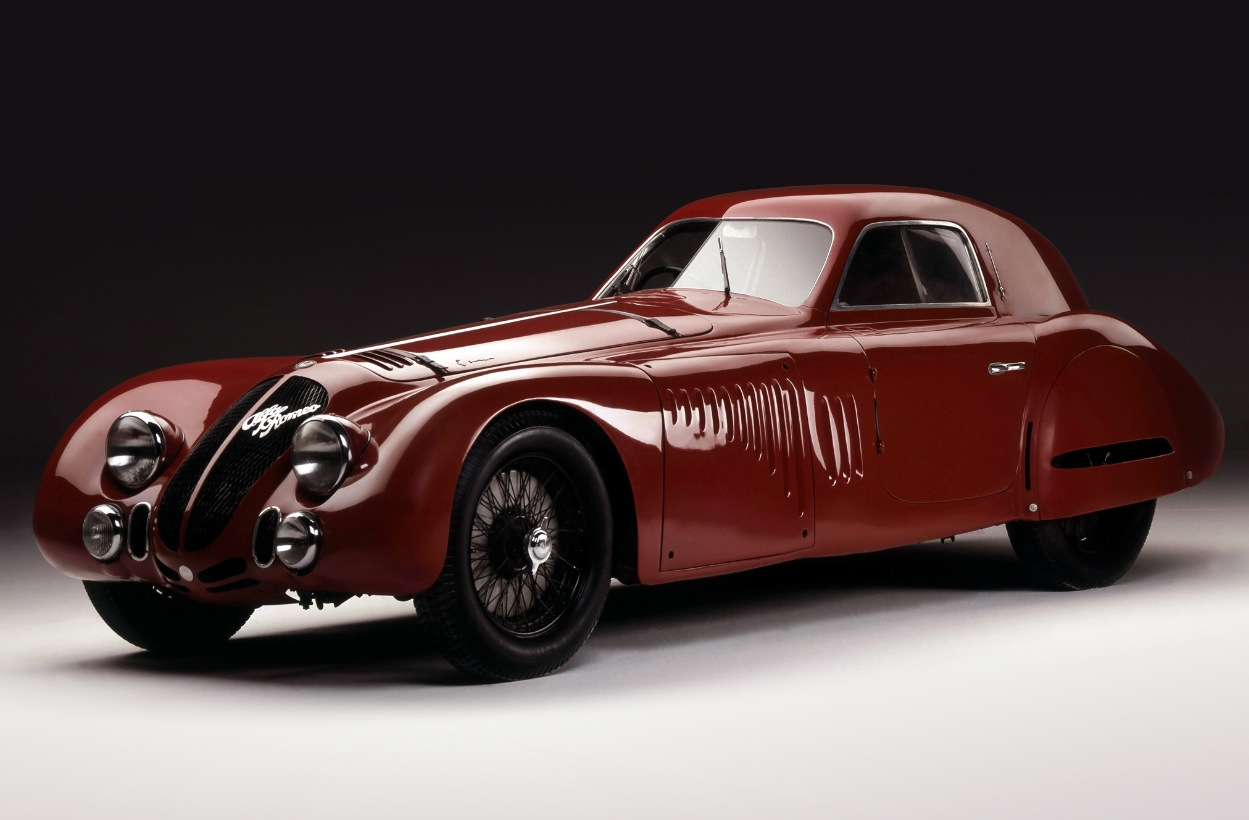
The Le Mans car, chassis #412033 had its Spider body removed to be replaced by a futuristic, slippery coupe designed by Touring’s Carlo Anderloni. The panels aft of the front wheels could be removed to allow access to Vittorio Jano’s mechanical marvels.
#412033 was repaired but not raced again, sold to a Roman it ‘disappeared’ but was found by collectors in the late sixties, passing through several hands before being re-acquired by Alfa where it is a popular exhibit at Museo Storico, and attractive to artists such as Sue Steele Thomas…
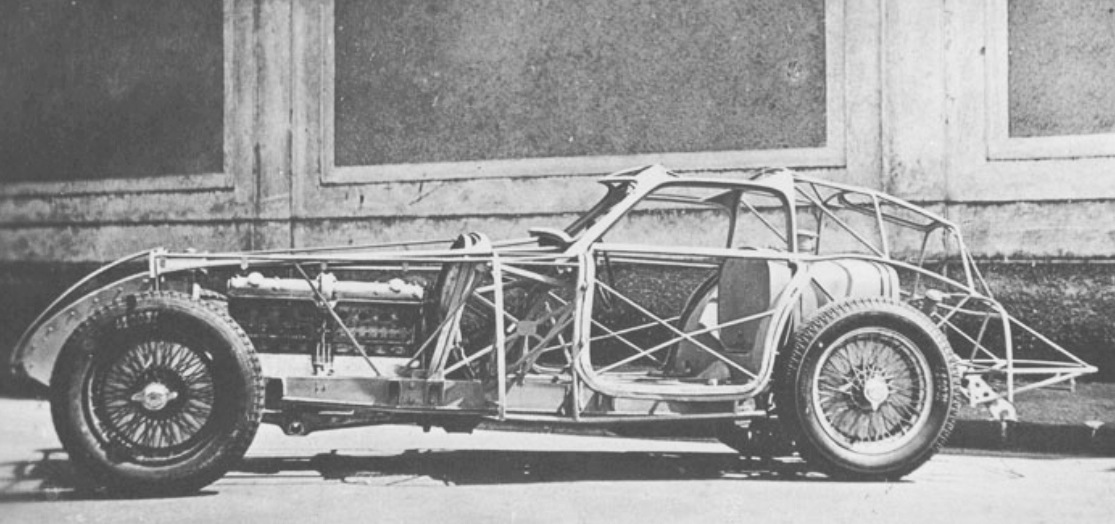
Car during its construction at Touring’s workshop. Typical boxed steel chassis, Jano’s engine clear as is light alloy tubing to accept the aluminium body. Big fuel tank prevents view of the rear mounted gearbox/diff unit (unattributed)
Specifications…
Chassis of light gauge box section steel. Front suspension; trailing arms coil spring/tubular shocks. Rear suspension; swing axles located by radius rods, semi-elliptic leaf springs and tubular shocks. Steering, worm and sector. Brakes drums all round. Weight circa 1100Kg.
Engine; DOHC, 2 valve, all alloy straight-8 of 2905cc, bore/stroke 68mm/100mm. Two Roots type superchargers fed by two Weber carbs giving circa 220bhp@5800rpm.
Gearbox 4 speed mounted at the rear in unit with differential
Stunning car for its time, stunning full stop! Studio shot of the 8C 2900B Le Mans after its restoration by Alfa Romeo. Side access panel referred to in the text clear, skilful aero treatment at a time when exposed guards the norm (unattributed)
Credit…
Sue Steele Thomas, conceptcarz.com
Tailpiece…
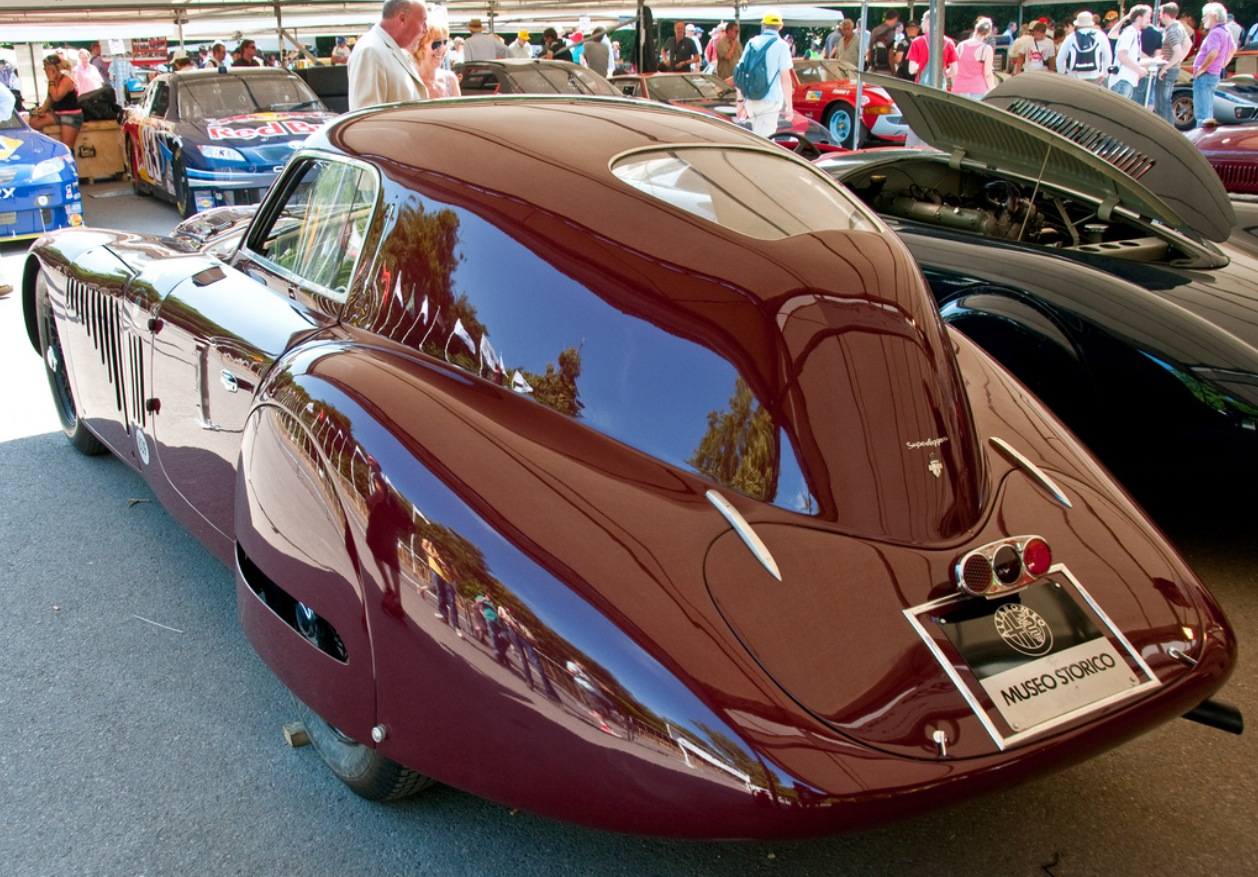
8C 2900B Le Mans butt shot at the Goodwood Festival of Speed in 2010 (unattributed)
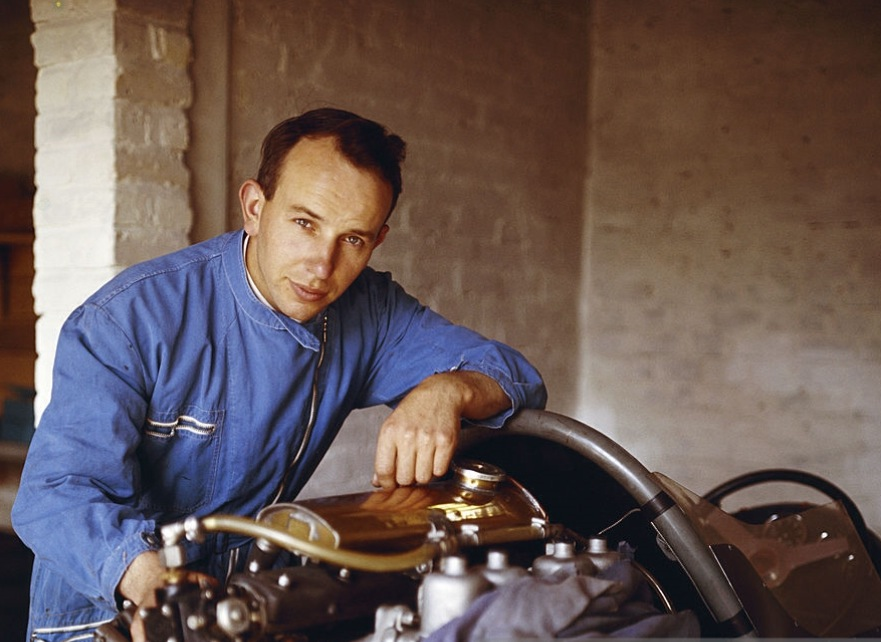
John Surtees smiles for the cameras with his Ken Tyrrell Racing Cooper T51 Climax in April 1960…
The much anticipated switch of the British multiple bike champion to four wheels took place when he contested the Formula Junior races at the ‘BARC Members Meeting’ at Goodwood on 19 March 1960.
Ken Tyrrell entered him in a Cooper T52 BMC, the ‘novice’ raced into second between the Team Lotus duo of Jim Clark and Trevor Taylor both mounted in Lotus 18 Fords, more competitive cars. The field also included other later GP drivers Peter Arundell and Mike Spence.
John Surtees, Cooper T52 BMC FJ, Goodwood, 19 March 1960 (Getty)
It was a great debut so why not jump into the deep end?
The Non-Championship F1 ‘Oulton Park Trophy’ took place at the Cheshire circuit on 2 April, with limited testing the talented Brit took on a field of some depth, starting the race from pole and again finishing second. Innes Ireland took the win in a Team Lotus 18 Climax with the very experienced Roy Salvadori third in another Cooper T51 Climax. The field also included Harry Schell and Chris Bristow.
Surtees had arrived in cars! He mixed racing two wheels and four in 1960 but focussed on cars from 1961…
Photo Credits…
Getty Images
Tailpiece…
Surtees winning the Isle of Man Senior TT in 1956. MV Agusta 500 (Getty)
Unitary chassis construction, 2451cc OHV V6, Weber twin throat carb, circa 118bhp @ 5000rpm. 115mph. 4 speed box but the transaxle was innovatively located at the rear as are inboard mounted drum brakes.
Front suspension sliding pillar, semi trailing arms at rear, De Dion tube on fourth series cars.
The car was remarkably advanced for its time, one of a series of stunning Lancia’s designed by Jano, the ‘apex of which’ was the D50 GP car which first raced at Barcelona in the 1954 Spanish Grand Prix.
B20 Coupe body Ghia designed and Pininfarina built, Francesco de Virgilio the senior member of Jano’s design team.
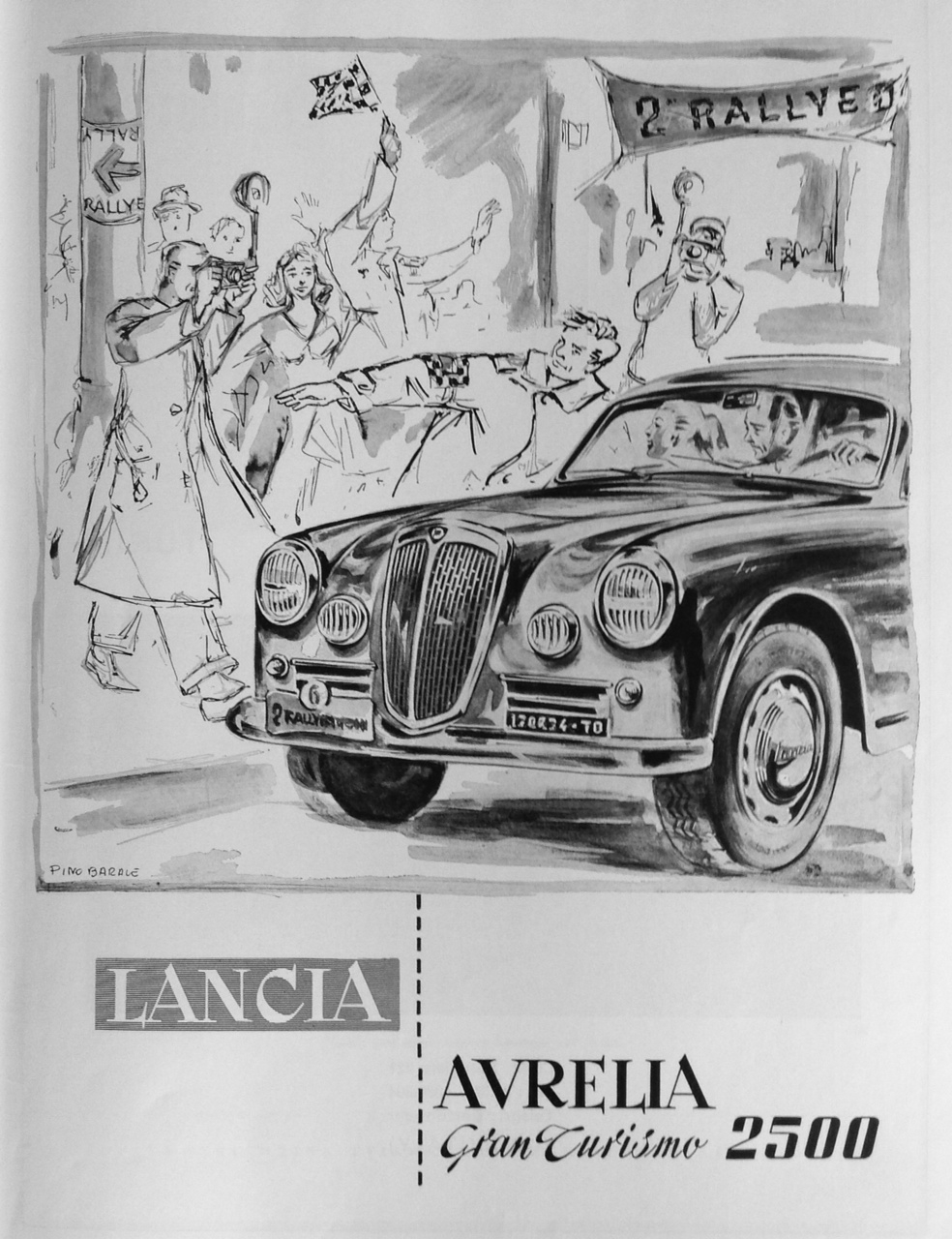
These cars also useful competition tools; here is the Johnny Lurani/Sambuynd Gatta GT2500 during the 1953 French Rallye des Alpes on the Passo Pordoi. (Mailander)
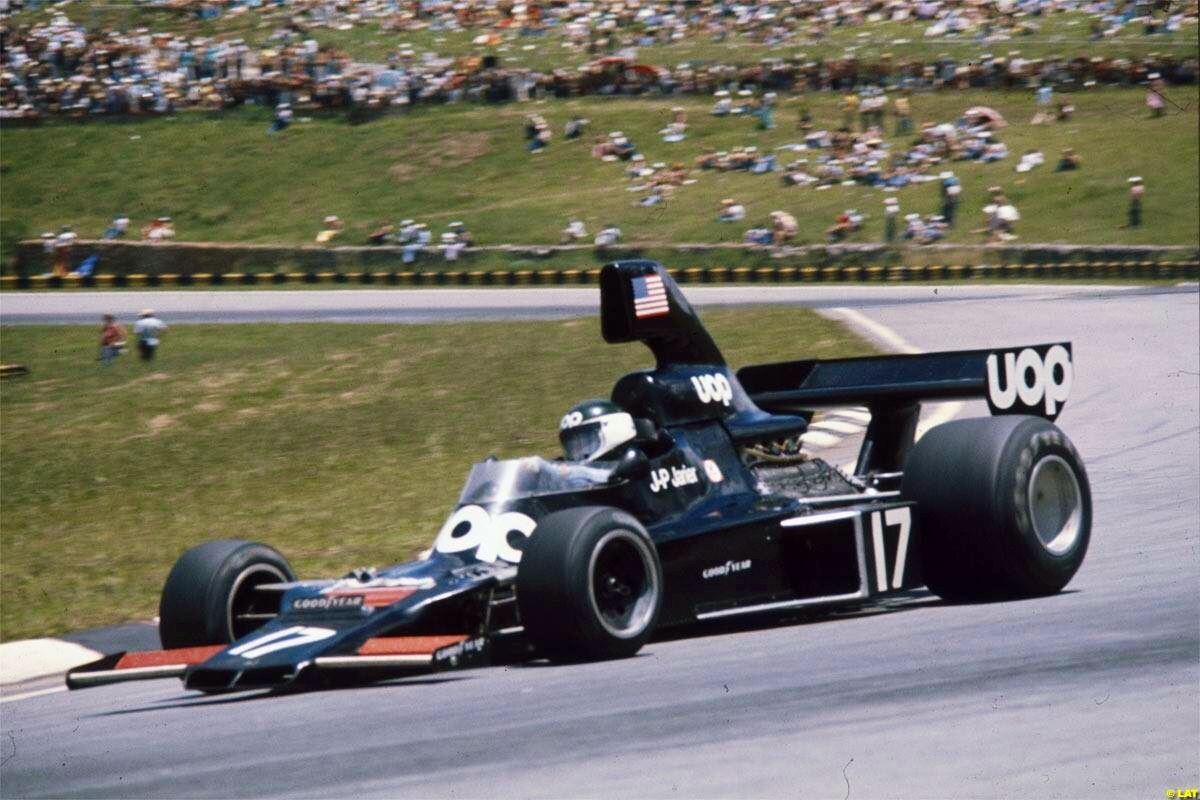
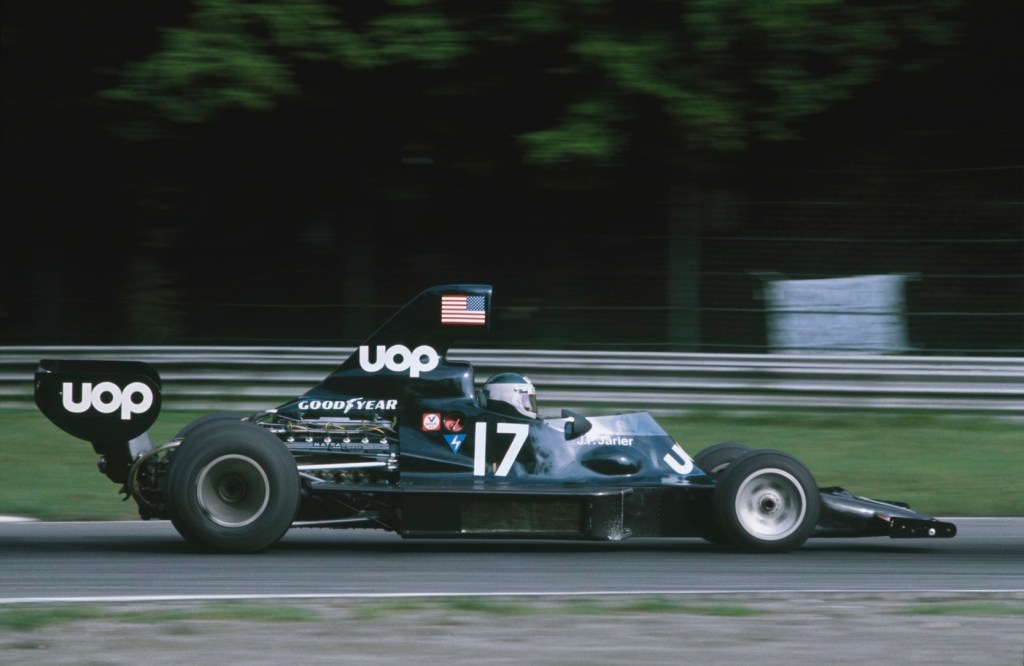
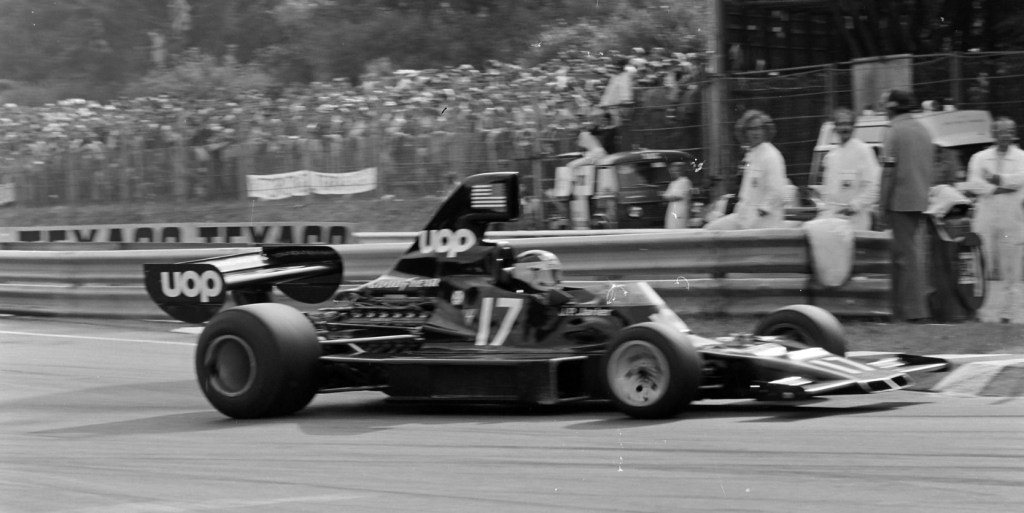
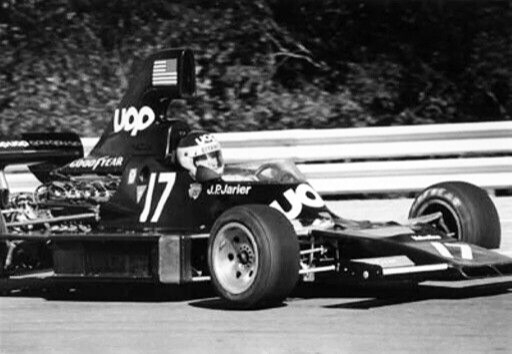
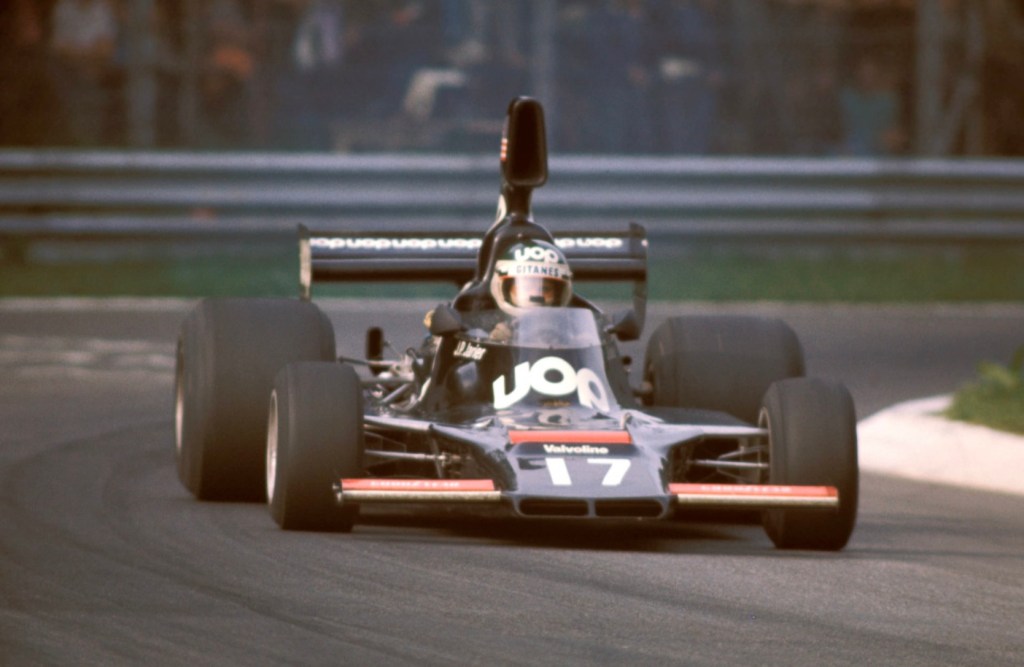
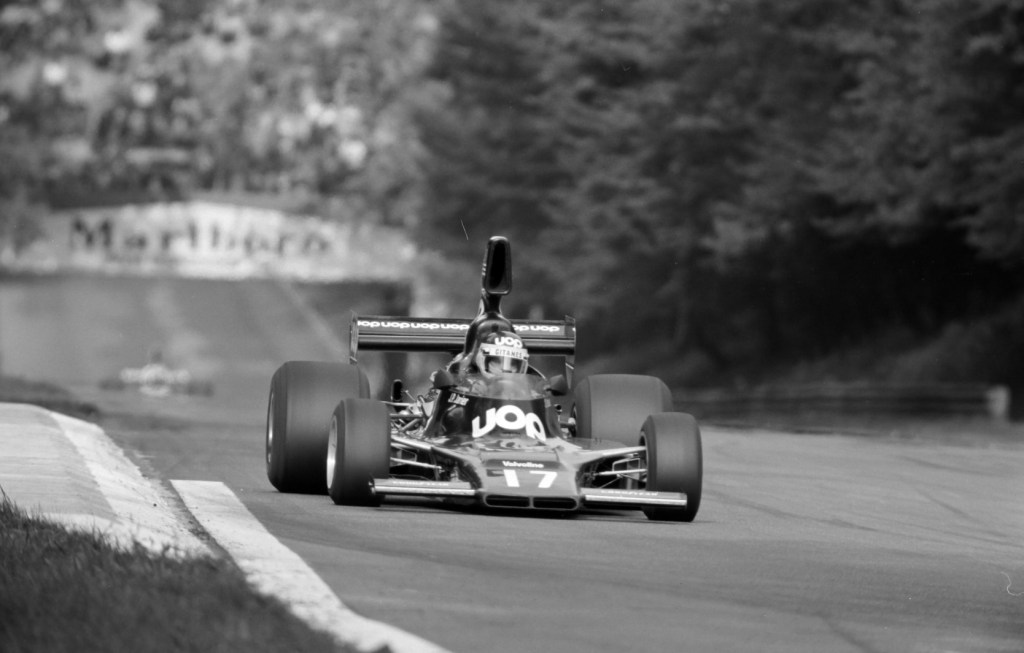
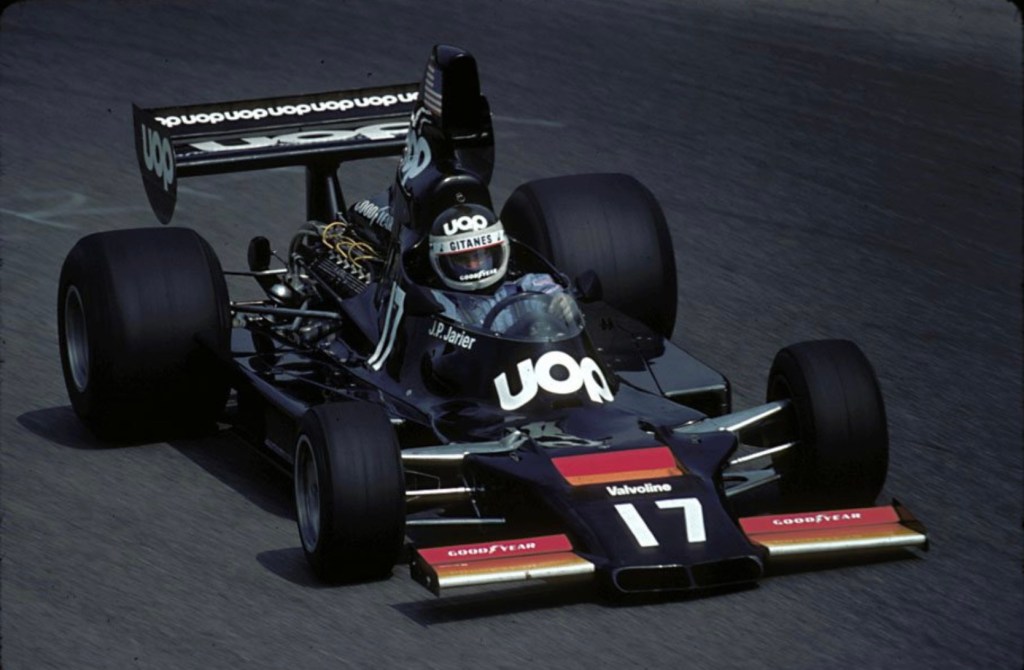
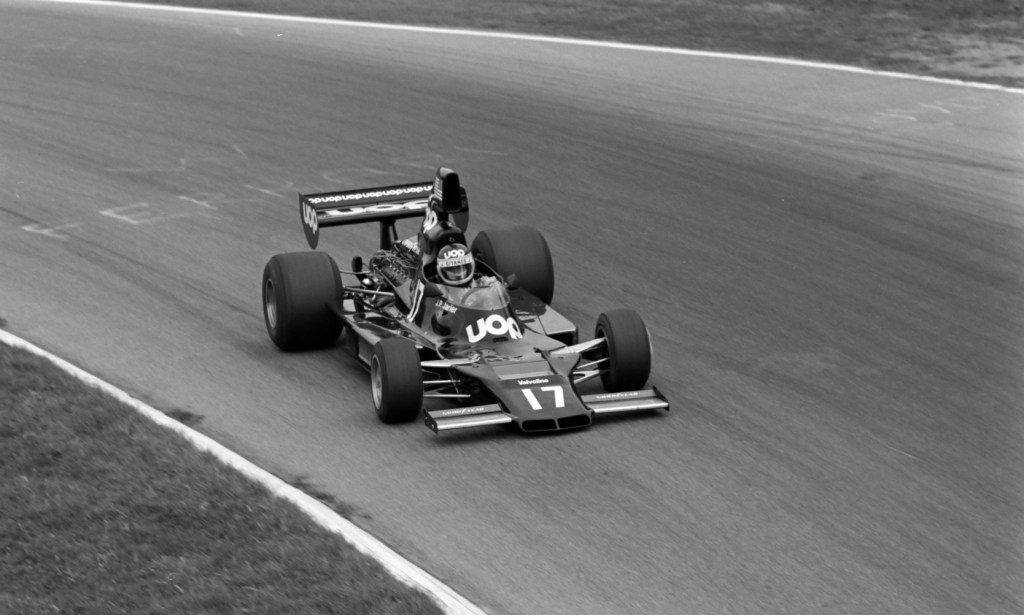
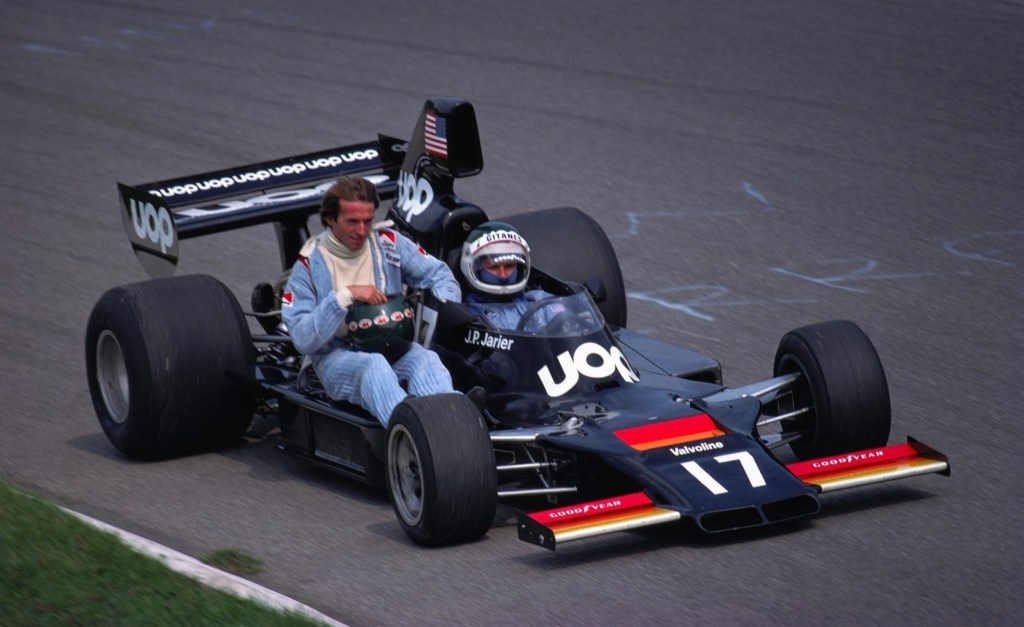
Jean Pierre Jarier nips a front brake during qualifying for the 1975 Italian Grand Prix, pushing his Shadow DN7 Matra ever so hard…
One of the revelations of the early 1975 GP season was the speed of the new Shadow DN5 Ford, an evolution of the 1973/4 DN1 and DN3 designs penned by Tony Southgate. Frenchie Jean Pierre Jarier rocked the socks off the established aces setting a time eight-tenths/second clear of the rest of the season opening Argentinian GP grid.
There were mutterings of Shadow getting development Cosworth engines but the truth was an aero tweakwhich is indicative of the importance of aerodynamics over the coming years.
Tony Southgate, ‘ I spent half my life doing aero at Imperial College and DN5 was the first to use the new rolling road wind tunnel, as far as i know, the first in the world. What we discovered was a massive split, front to back, in downforce. People always thought they had about 30-40% on the front. In fact it was no more than 20. And only we knew.’
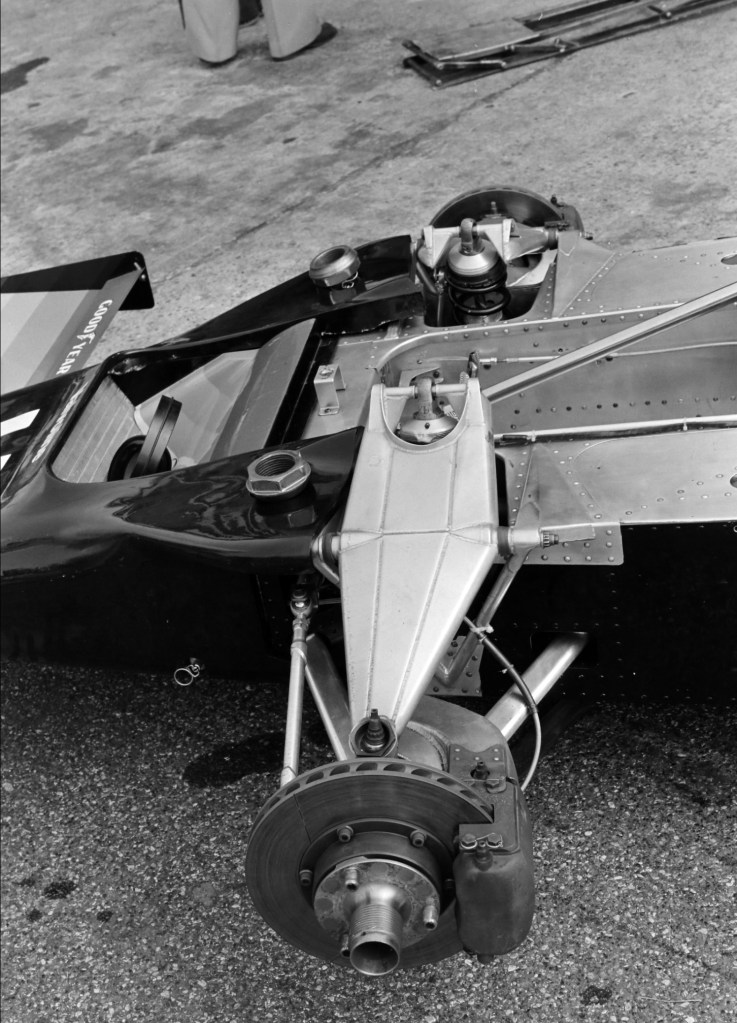
Southgate moved the driver forward 2.5 inches within a longer wheelbase (with removable spacer between engine and gearbox), developed deeper nose fins and placed the front springs and dampers inboard.
‘The car was an aero jump. We matched downforce to its static weight distribution-about 35/65% front/rear – and the spacer allowed us to tune the chassis to different circuits; we would find 1.25 seconds at Silverstone just by removing it. Immediately it was clear that our car had more downforce than the others and was very well balanced. In its short chassis specification Jarier was taking the fast bend after the pits at Interlagos, Brazil without lifting…’
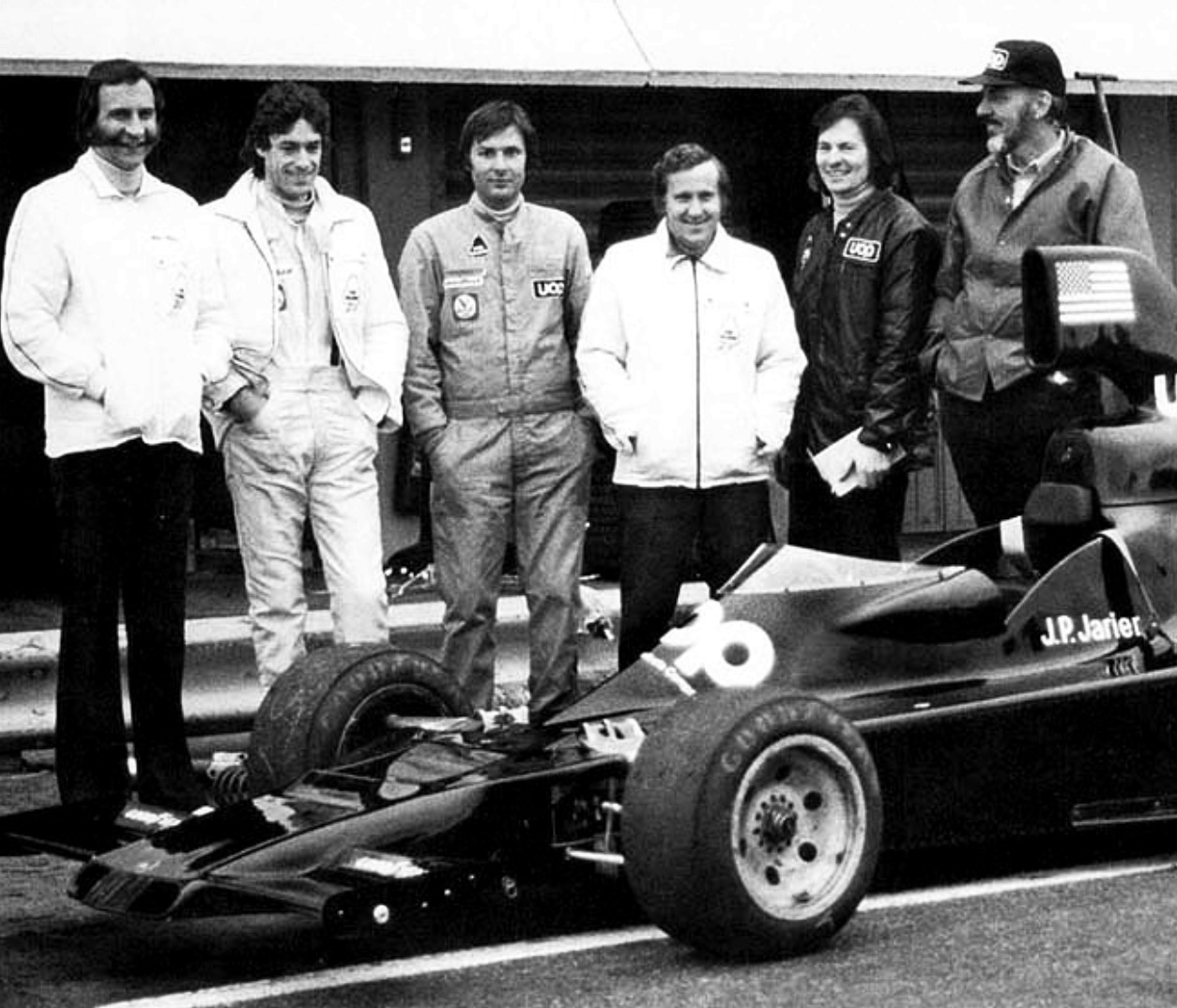
Shadow hierachy at an early 1975 season Paul Ricard DN5 Ford test. L>R Chief Mechanic Phil Kerr, Tom Pryce, JP Jarier, Team Manager Alan Rees, Tony Southgate and El Capitano Don Nichols (unattributed)JPJ Shadow DN5 Ford, Argentina 1975. Pole and DNS with CWP failure on the warm up lap (unattributed)
Despite being on pole in Argentina, raceday was a disaster with a crown wheel and pinion failing on the warm-up lap. ‘I had been pursuaded to use Hewland’s latest TL200 gearbox instead of the FGA400, I think we and Copersucar did so. It was meant to be more reliable, with helical gears 20% stronger and more bearings in the pinion shaft, improper heat treatment was blamed for the failure’.
In Brazil Jarier was running away with the race from pole when the metering arm of the Lucas injection unit seized. In fact JPJ’s season was a mix of spins and mechanical failures, teammate Tom Pryce getting the better results with a win in the non-championship Race of Champions at Brands Hatch and third in the Austrian GP after qualifying on pole for the British GP before retiring from the lead.
Southgate; ‘Our budget was tight and there was little development left of the car. It wasn’t good on fast circuits where we had to unbolt downforce so we weren’t swamped on the straights. Plus better funded teams cottoned onto what we were doing and were ringing Imperial College to ask if they could use its wind tunnel.’
‘Shadow’s Grand Prix results for 1975 were very disappointing, especially in view of the competitiveness of the DN5. Our finishing record was simply poor. The cars either broke down or crashed. Jarier only finished two Grands Prix for the year. Pryce’s statistics were better, but he still only finished six GP’s…I often think that, if the DN5 had been prepared and raced by one of the top teams it would have won the Championship.’ said Southgate in his autobiography.
Tom Pryce on his way to winning the Race of Champions at Brands Hatch on 16 March 1975 from pole, the Welshman’s only F1 win sadly. He won from John Watson’s Surtees TS16 Ford and Ronnie Peterson’s Lotus 72E Ford. The field included Ickx, Scheckter, Emerson Fittipaldi, Mass, Donohue and others, it was a great win for both him and the DN5 in a classy field (Autosport)
The Ford Cosworth DFV and alternative engines…
The diligence of team owner, Don Nichols’ designer had given the team the ‘unfair advantage’ of which Mark Donohue spoke so eloquently, with a car whose origins dated back to Shadow’s first year in GP racing in 1973. Whilst Southgate pursued this aero approach Nichols eventually concluded discussions with Matra to use its glorious V12 in a modified DN5 chassis christened the DN7.
The Ford Cosworth DFV 3 litre V8 was the dominant engine of the 3-litre formula, by the end of 1974 it had taken drivers titles in 1968/9 and 1970-4 but Ferrari’s speed in 1974 gave pause for many team managers – Cosworth users – to find an alternative which allowed them to leap clear of the garagiste pack as Enzo Ferrari christened the British Cosworth/Hewland hordes! The DFV was a tough proposition to beat given its blend of power, packaging, weight, economy, reliability, price and Cosworth’s servicing backup.
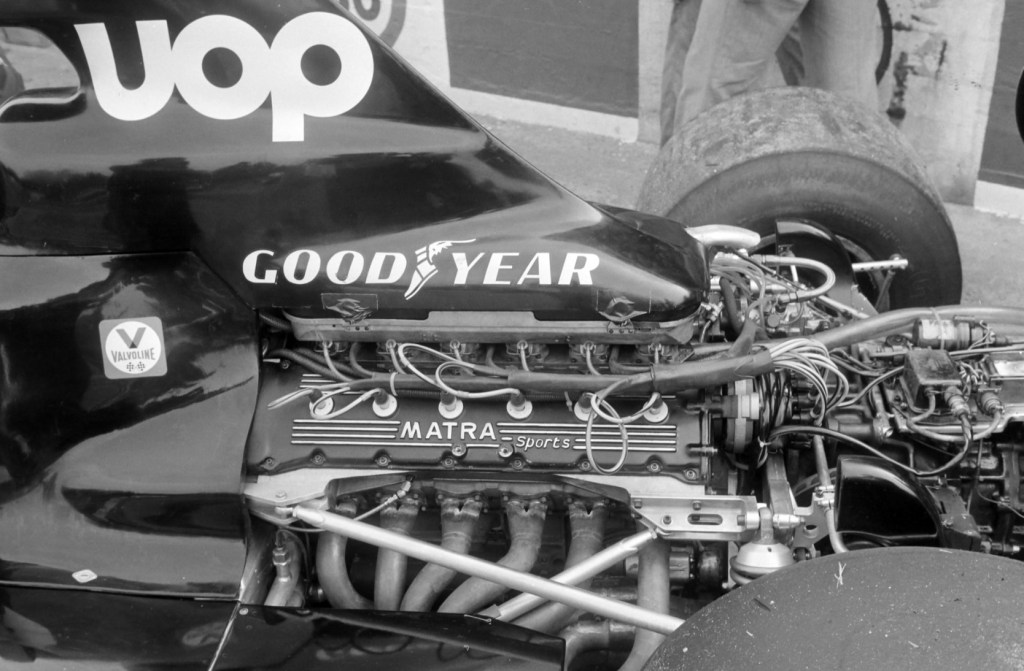
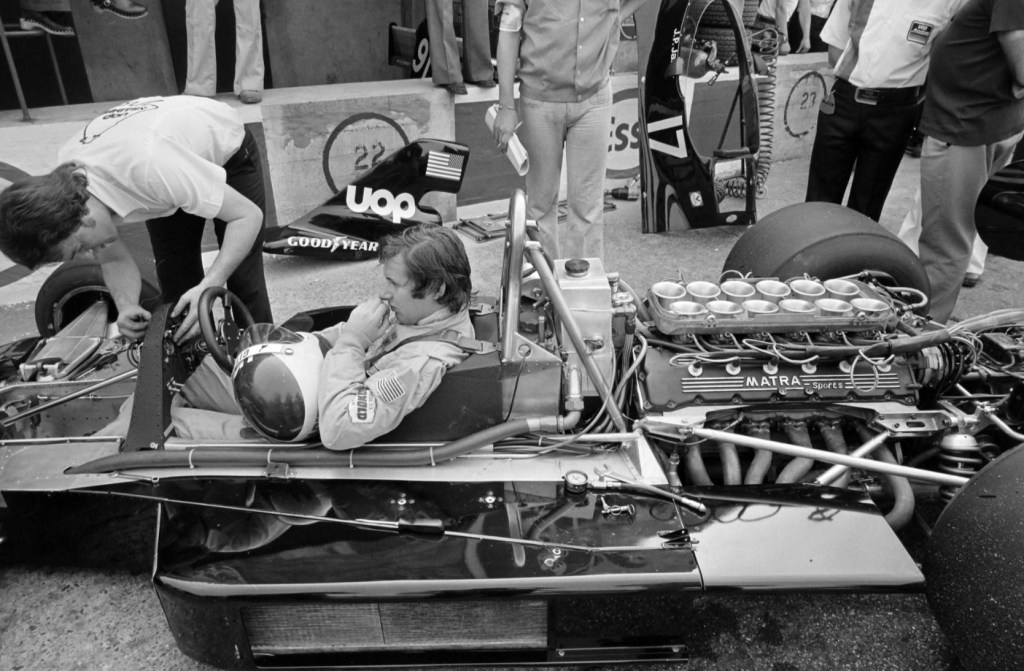
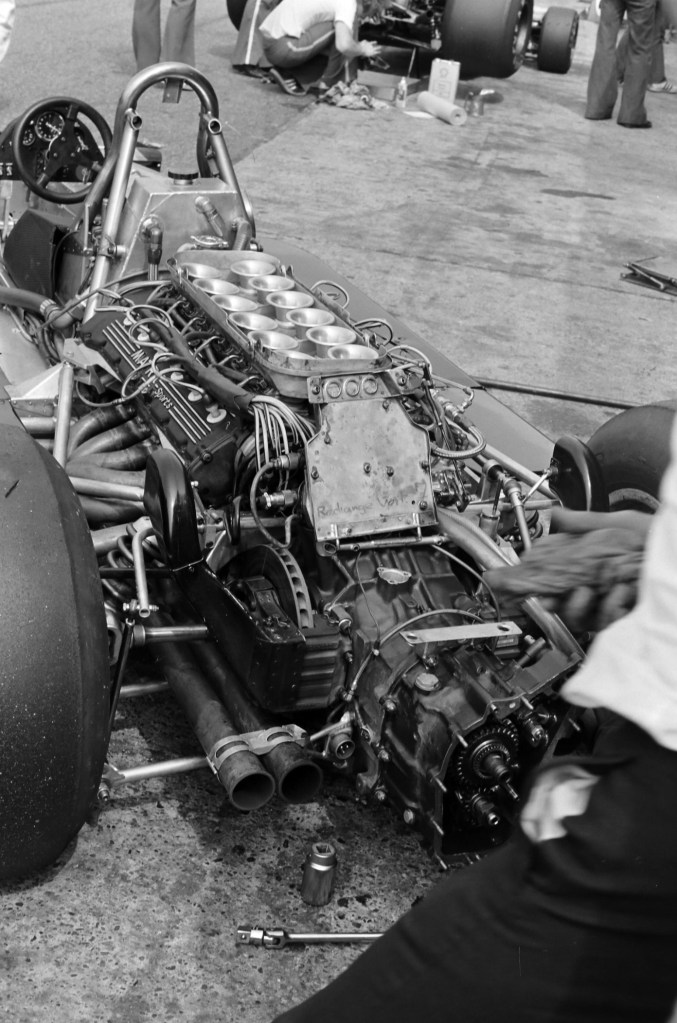
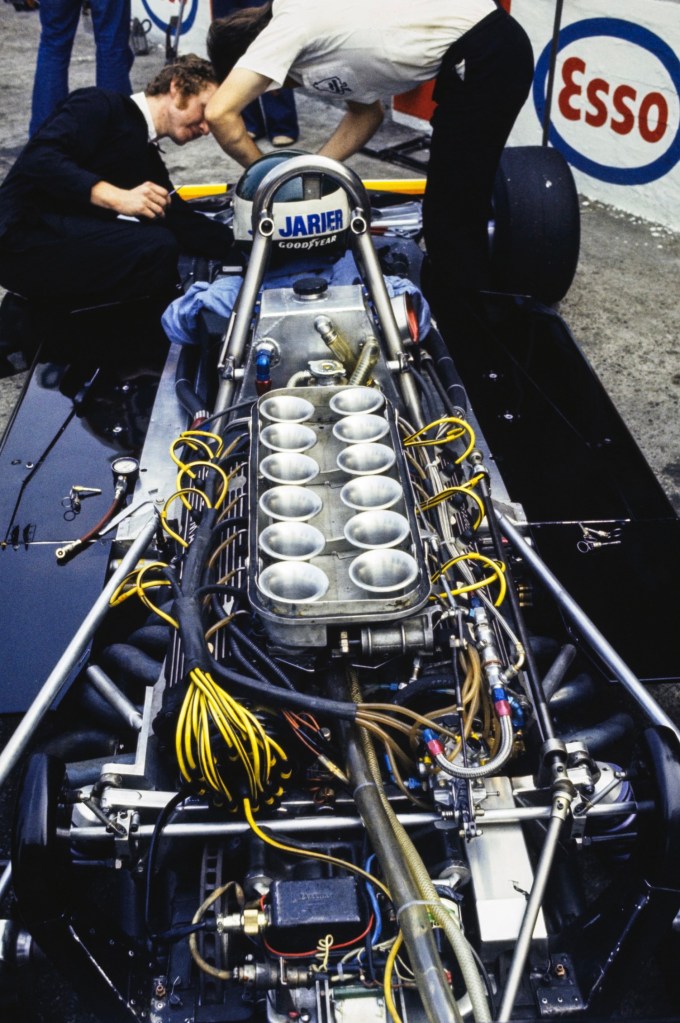
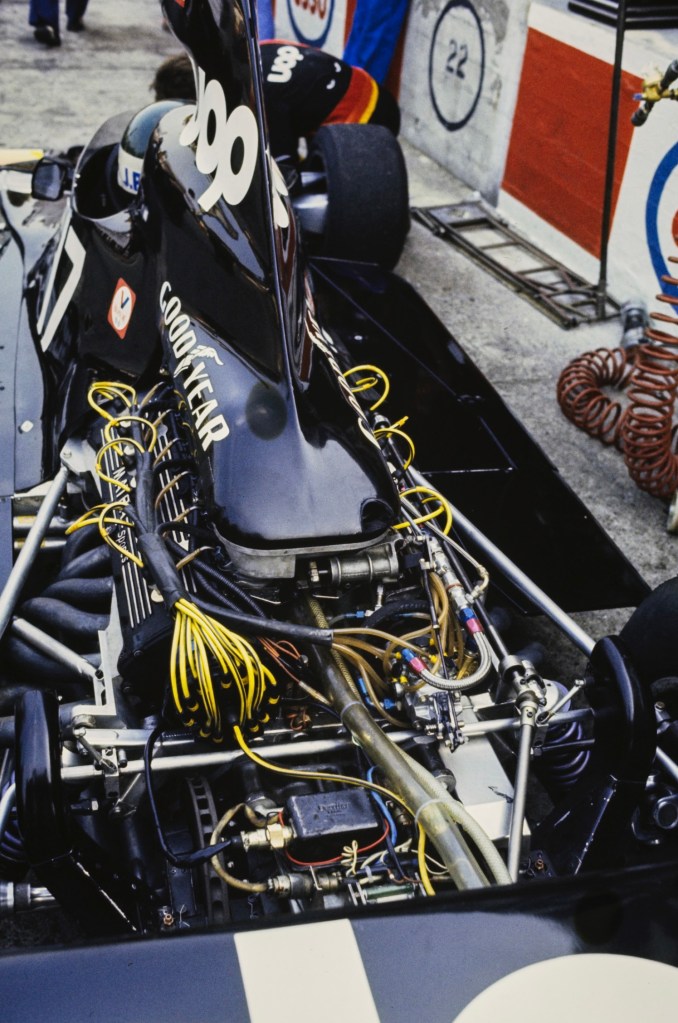
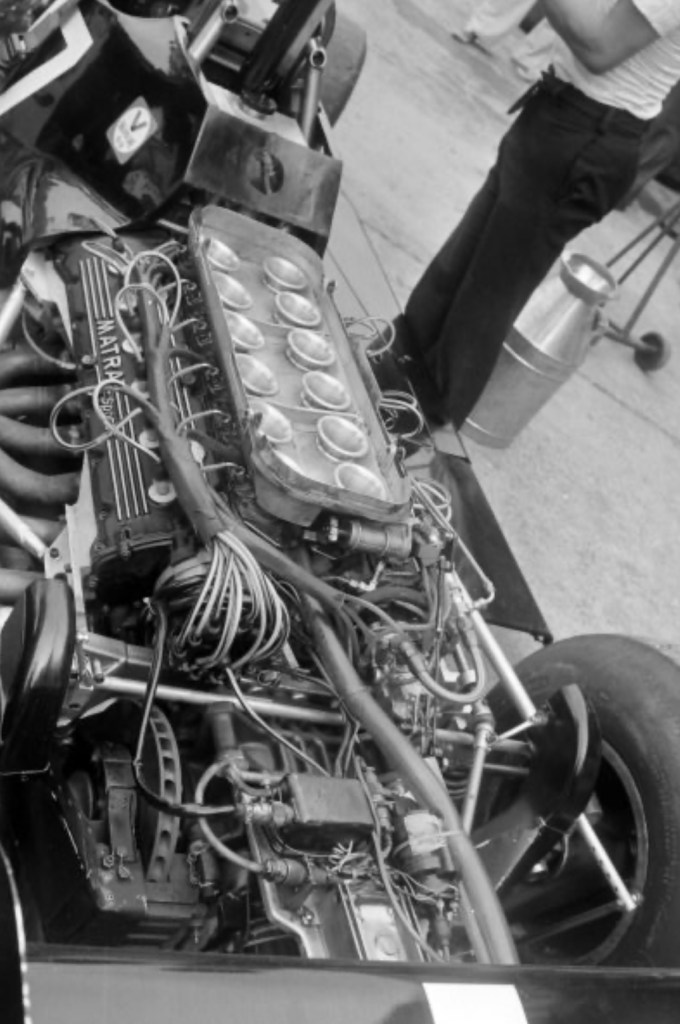
Shadow DN7 Matra. Type 73 3-litre V12 – circa 500bhp – engine installation at Monza in September1975. Note single plugs and distributor driven off the rear of the inlet camshaft, also exhausts and neat brackets to which the top radius rod at the front and shock/spring mount attaches at the rear – the main bracket runs the length of the cylinder head. You can just see the roll bar behind the spring, radiator header tank also clear (MotorSport)
The obvious alternatives were the Matra V12 and Alfa Romeo Flat-12, both 3-litre endurance engines, and the venerable BRM V12. The latter was easily ruled out as being way past its prime, the BRM P207 was a sad joke in 1974/5 for all concerned. The Matra and Alfa were successful endurance engines. In the event BC Eccclestone, then Brabham’s owner, did a deal to use Alfa engines from 1976 whilst Nichols pursued the Matra option.
While the French V12 last appeared in GP racing in Matra MS120s driven by Chris Amon in 1972, the engine had been continually developed as an endurance unit. Given Matra’s Le Mans wins from 1972-74 and a whole swag of other endurance events; so it was not too difficult to adapt Matra’s learnings to a sprint-spec of the engine, from whence it originated in any event way back in 1968.
Silverstone Shadow DN7 Matra first test, July 1975 (unattributed)
Evolving the DN5 Ford into the DN7 Matra…
Whilst commercial negotiations dragged on between Nichols and Matra, Southgate and his team focussed on keeping the DN5 competitive while concepting the DN7, which was essentially a DN5 adapted to fit the longer, heavier, thirstier but more powerful V12.
Major differences were increased fuel tankage and a longer wheelbase, otherwise the key elements of both cars – chassis, body, aero and inboard front suspension by rockers, conventional outboard rear suspension and Hewland TL200 gearbox were the same. This gearbox was developed by Hewland for endurance purposes and was used by Matra in their MS670 sports cars.
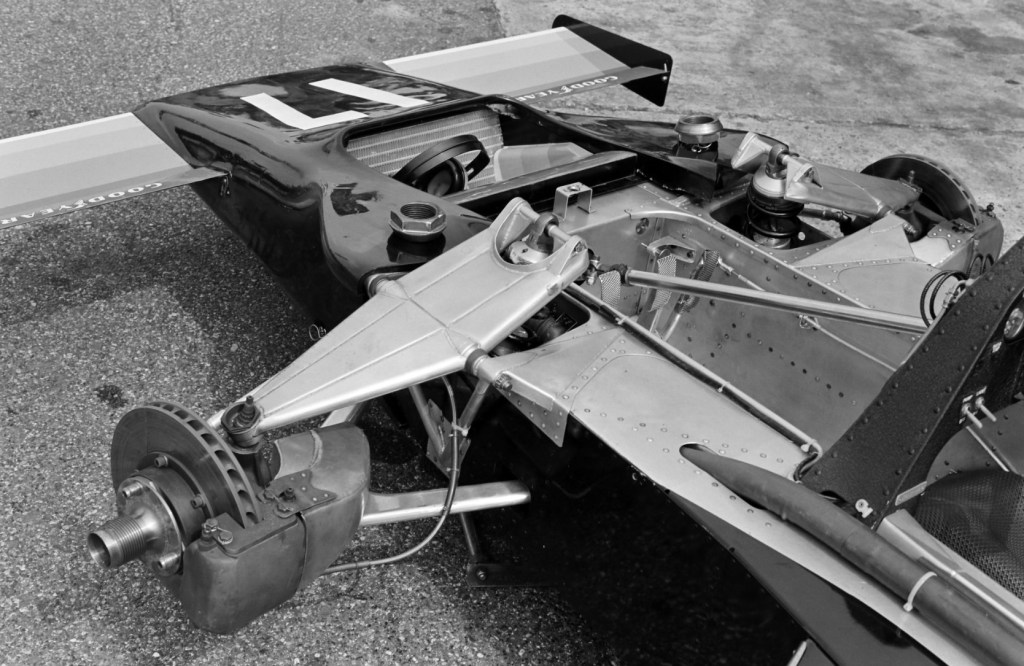
Three body-off shots in the Monza paddock 1975. Exquisite standard of fabrication clear (MotorSport)(MotorSport)Hewland TL200 ratio change (MotorSport)
Tony Southgate spoke of the challenges of adapting the Matra engine to the DN5 in his autobiography.
‘In view of my V12 experience with Eagle and BRM the powers that be most likely thought I was a bit of a V12 expert and that I might be able to resurrect the old Matra engine and get it to the front of the grid. Fitting the Matra engine was not that straightforward and of course the V12 engine required a lot more fuel cell capacity. The engine ran at 12000rpm, about 30% more than the DFV, so extra tanks were fitted into the sides of the car alongside the existing seat tank.’
‘Due to the extra engine RPM and horsepower the cooling system needed to be increased in size, so I fitted larger side pods and set the water radiators further forwards to maintain the weight distribution of the Cosworth engined DN5. The V12 was longer than the DFV, of course, so the wheelbase was increased a little’.
‘The end result was a longer, heavier but more powerful DN5 which we called the DN7. I thought that it would do about the same lap times as the DN5 and that proved to be the case’.
Matra MS73 V12 ultimately successful in Matra sports prototypes and Grands Prix winner in Ligier chassis. Famously aurally erotic, circa 500bhp @ 11600rpm when a good Cosworth DFV gave circa 470bhp. Note Lucas injection trumpets, inboard rear discs and duct, engine electronics behind radiator header tank (MotorSport)
When finally completed the car was tested by ‘Jumper’ at Silverstone in July and made its race debut in practice for the Austrian GP on 17 August.
Tom Pryce drove his usual Ford engined DN5 and offered a direct comparison, both drivers being more or less equivalently FAST. The car was heavier than the DN5, it wasn’t bespoke, but still provided the team and of course Matra a sense of competitiveness of the package.
The Austrian GP was a horrible weekend,Mark Donohue crashed his Penske March 751 in practice as a result of a Goodyear tyre failure, dying in a Graz hospital several days later of brain injuries sustained in the high speed crash. Half points were awarded to finishers of the rain shortened race won by Vittorio Brambilla’s works March 751 Ford, that teams first, long overdue win.
Denis Jenkinson in MotorSport had this to say about the re-appearance of Matra in GP racing; ‘Another welcome return was made by the Matra V12 engine, this time in the back of a UOP Shadow DN7, but somehow it seems to have lost that car-splitting scream that it used to have in the days of Beltoise and Pescarolo in the blue cars from Velizy. Perhaps the Ferrari and Cosworth engines have caught it up on the decibel scale, for they certainly have on bhp output. None-the-less it was nice to see and hear a Matra V12 in Grand Prix racing again’.
‘Particularly pleasing was to see the enthusiasm with which JPJ was tackling the job of driving the DN7. It was not a half-hearted attempt, with one eye cocked over the Cosworth powered DN5 standing in the paddock, or a dickering between the two cars. As far as Jarier was concerned there was only one car for him and that was the DN7. With that approach in the cockpit the Shadow Matra V12 project could get somewhere. It certainly started well by being ahead on the grid of Pryce in the Shadow Cosworth V8, even if it was only 0.2 sec ahead’
Jarier qualified the DN7 13th, one grid slot in front of Pryce, Tom had a great race finishing third while the Matras fuel injection system malfunctioned causing JP’s retirement on lap 10. It was an ok start for a car with limited testing, the Shadow boys prepared the same mix of cars for the Italian GP held on 7 September.
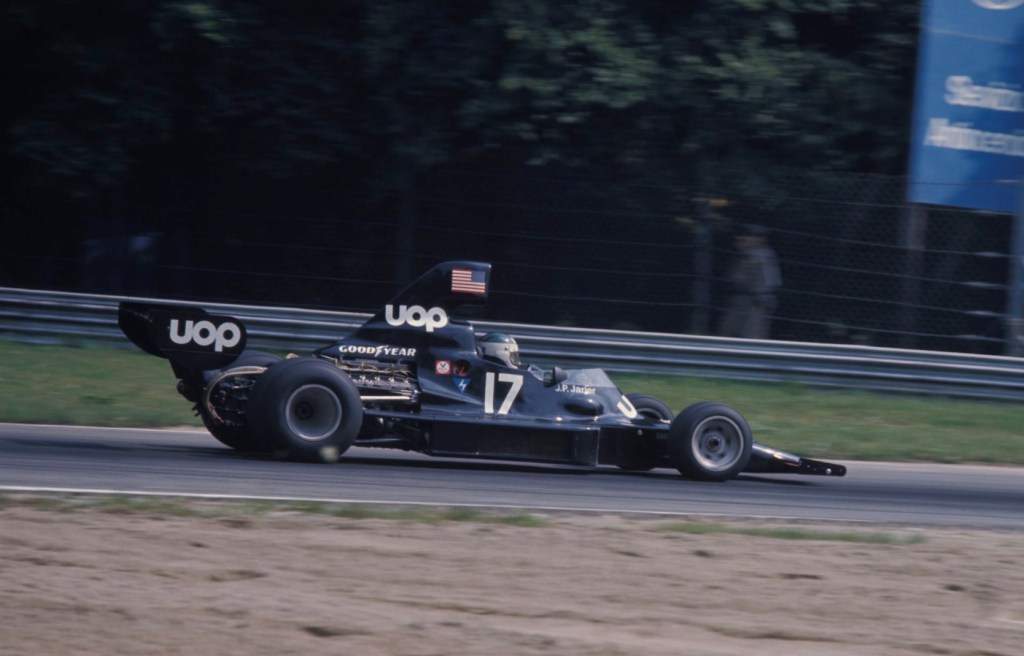
Jarier, DN7 Matra, Monza 1975. GP cars of the era don’t look better than this (LAT)1975 Italian Grand Prix, just look at the variety of aero approaches in this shot let alone mechanical specification, Oh for the days before F1 was a ‘control formula’?! Regazzoni’s winning Ferrari 312T Flat-12 from Jarier’s Shadow DN7 Matra V12, Carlos Pace’s Brabham BT44B Ford V8 and Ronnie Peterson’s similarly powered Lotus 72E (unattributed)(MotorSport)
In between the Osterreichring and Monza the non-championship Swiss Grand Prix was held at Dijon, France, there being no circuits in Switzerland, with Jarier putting his Shadow on pole. He led the first 23 laps until retirement with gearbox trouble; but he was back in his Ford engined DN5 while the DN7, the team only built one chassis – #DN7/1A – was readied for Monza. Clay Regazzoni won the event in his Ferrari 312T and then doubled up also driving to victory at Monza.
The Shadows qualified in Italy exactly as they had at the Osterreichring, the results similar as well; ‘Jumpers’ Matra failed, this time with fuel pump failure and Pryce was sixth after a good mid race battle with James Hunts Hesketh. Niki Lauda won his first drivers championship, his third place in his Ferrari 312T assuring him of the championship.
Shadow DN5 Ford in the nuddy, Kendall Centre, Watkins Glen US GP 1975. Pryce DN5, 16th in the race, non-classified with Jarier’s similar car DNF. Car getting a fresh Ford DFV. Rear suspension/’box assy at the rear, with the Cossie about to be unbolted, aluminium monocoque and quality of build and finish clear. Note cast alloy instrument bulkhead (unattributed)
At the season ending Watkins Glen race both Shadows were very fast; Q4 for Jarier and Q7 for Pryce but both were in DN5s, the Matra experiment was, sadly for the sport, over.
‘Jean-Pierre Jarier was fighting hard with the Shadow V12 during the first session, a revised fuel system and some titanium exhausts from the sports car endowed it with appreciably improved performance at the top end of its rev band. Alas, Jarier’s enthusiasm would be channeled into the Cosworth powered DN5 after it was calculated that the engine would consume fuel at the rate of 4mpg under racing conditions, and the French engined car was sadly pushed away for the remainder of the weeekend’ (therefore the car would not hold sufficient fuel to complete the race without a stop) said Denis Jenkinson in his MotorSport race report.
It may be that that was the case, or simply that Don Nichols had learned that Matra engines would be used exclusively by the new Ligier team for 1976 and simply put the car to one side to focus on the quicker DN5 Cosworths.
Lauda won the race, both Shadows well down the field despite qualifying times which showed just how quick a package the car was on a circuit which was a great test of a car’s medium to high speed handling characteristics.
JPJ in the DN7 during the first practice session at Watkins Glen, the last time #DN7/1A turned a wheel before its restoration by Grant Beath in recent times. Car was for 35 years part of Don Nichols collection fitted with a dummy, blown V12 (unattributed)
Both Nichols and Ligier wanted exclusivity in terms of engine supply, from a France Inc perspective the choice of the well connected former rugby international’s team made more sense than the American owned British based concern; French car, team and driver.
From Matra’s viewpoint it makes more sense to me, given the aerospace conglomerates immense resources, to supply two teams in 1976 especially given Shadow’s speed, if not reliability in 1975.
Ligier were an unknown 1976 quantity, Shadow were. Both Shadow drivers had shown prodigious speed in 1974-75, one was French and Southgate did a neat job integrating the Matra V12 into an existing chassis designed for a different engine. His bespoke 1976 Matra chassis would have been lighter overall and designed around the engine architecture rather than an adaptation of what he had based on the Ford Cosworth.
Ligier were to be a one car entry in 1976 so Matra very much had all their eggs in one basket. Ligier’s JS5 1976 car was a horrible looking, bulky thing, mind you it delivered the goods in a a way Shadow did not that year. Jacques Laffitte was eighth in the drivers championship, Pryce 12th and poor Jarier didn’t score a point in the lightly updated 1976 Shadow DN5Bs and new DN8. Matra finally achieved a GP win when Laffitte won the 1977 Swedish Grand Prix in his Ligier JS7, the whole paddock were delighted for him, Ligier and Matra.
Don Nichols retained ownership of Shadow, but his company, United Oil Products, was no longer the team’s major sponsor and the slippery slope of progressive loss in competitiveness began, whilst noting Alan Jones’ lucky 1977 DN8 Ford, Austrian GP win.
If only Nichols had jagged the Matra deal or the Velizy concern supplied both teams he may have stayed more involved and we would have had the chance of seeing Tony Southgate designed, bespoke, Matra engined cars driven by two of the fastest chargers around at the time. It’s an interesting ‘mighta been’ I reckon?!…
Jarier, DN7 Matra, Monza (MotorSport)
Shadow DN7 Matra Technical Specifications…
Chassis; aluminium monocoque using the Matra MS73 V12 as a fully stressed member. Front suspension by lower wishbone and top rocker actuating inboard mounted coil spring/damper units. Rear suspension twin parallel lower links, single top link, coil spring/damper units and twin radius rods. Adjustable roll bars front and rear. Wheelbase 2667mm, front and rear tracks 1473/1549mm. Weight 612Kg.
Front and rear disc brakes, inboard at the rear. Rack and pinion steering. Wheel sizes front/rear 9.2/20 13 inch in diameter, 16.2/26/13 inches.
Engine; Matra MS73 3-litre, DOHC, four valve, Lucas fuel injected, all aluminium 60 degree V12. 2993cc, bore/stroke 79.7/50mm, circa 500bhp @ 11600rpm. Gearbox; Hewland TL200 five speed transaxle
(MotorSport)
Etcetera…
(MotorSport)
More shots at Monza in 1975, probably too much of a good thing…
(MotorSport)(MotorSport)(MotorSport)(MotorSport)(MotorSport)(MotorSport)JPJ sitting on his March 731 Ford during 1973. He did a year of F1 and F2 for the team comprehensively lifting the Euro F2 title in a March 732 BMW (unattributed)
Tony Southgate on ‘Jumper’ Jarier in ‘MotorSport’…
‘He had such fantastic car control and speed but just didn’t have the commitment. I’m sure he could have been World Champion if only he could have been bothered. Jean-Pierre got bored very easily and in practice or testing he would adapt himself to the car and do the same times after you had made adjustments. He was a typical French driver in that he was more interested in going out of an evening, eating a good meal and chasing the ladies. It soon became clear that he wouldn’t go on to the next level’.
Jean-Pierre Beltoise testing the brand new Ligier JS5 Matra at Paul Ricard in December 1975 (unattributed)
1976 Ligier JS5 Matra…
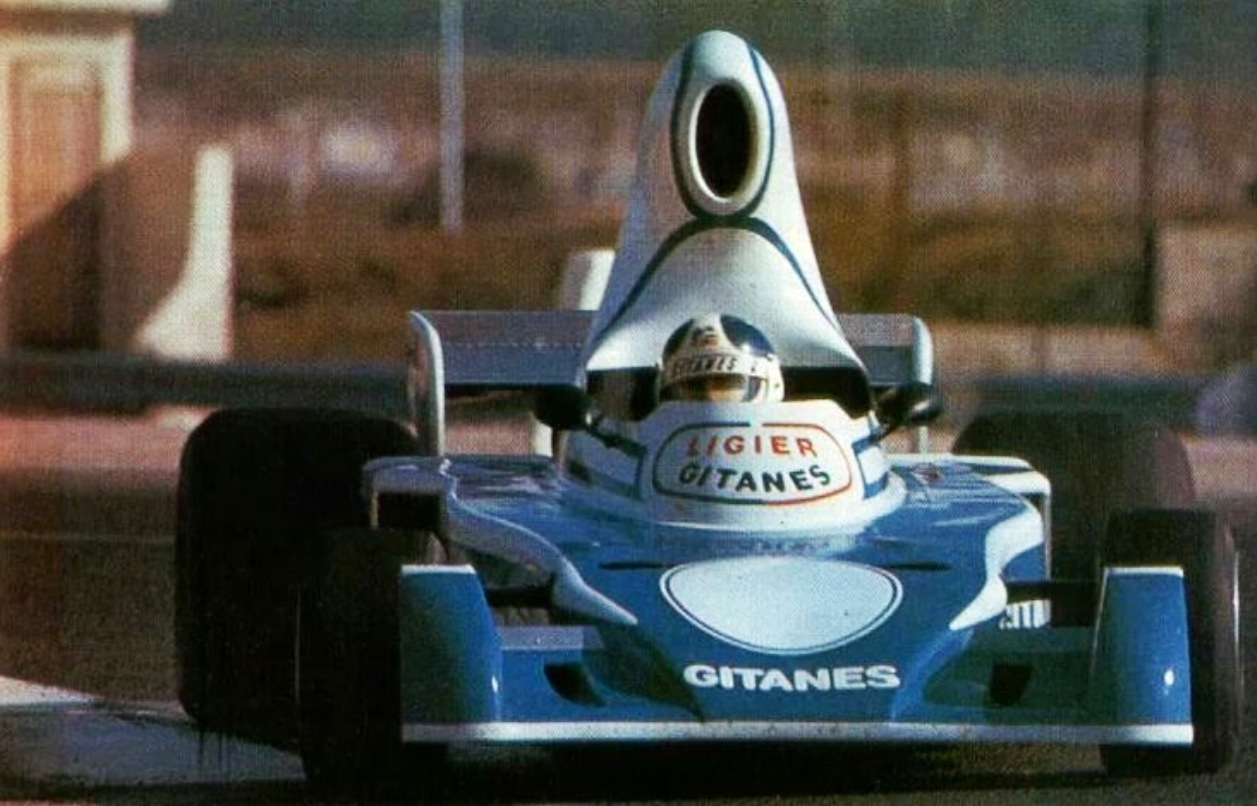
The Ligier JS5 Matra was a sinfully ugly car, it had the looks only a mother could love but its ‘fugliness’ was only skin deep!
Gerard Ducarouge and his team had the aero spot on, the enormous airbox which led to the car’s nickname The Flying Teapot chanelled air beautifully over the car and smoothed it onto the rear wing. Eighth in the drivers title for Laffitte and sixth for Ligier in the constructors race in a one car team entry was an exceptional first year performance.
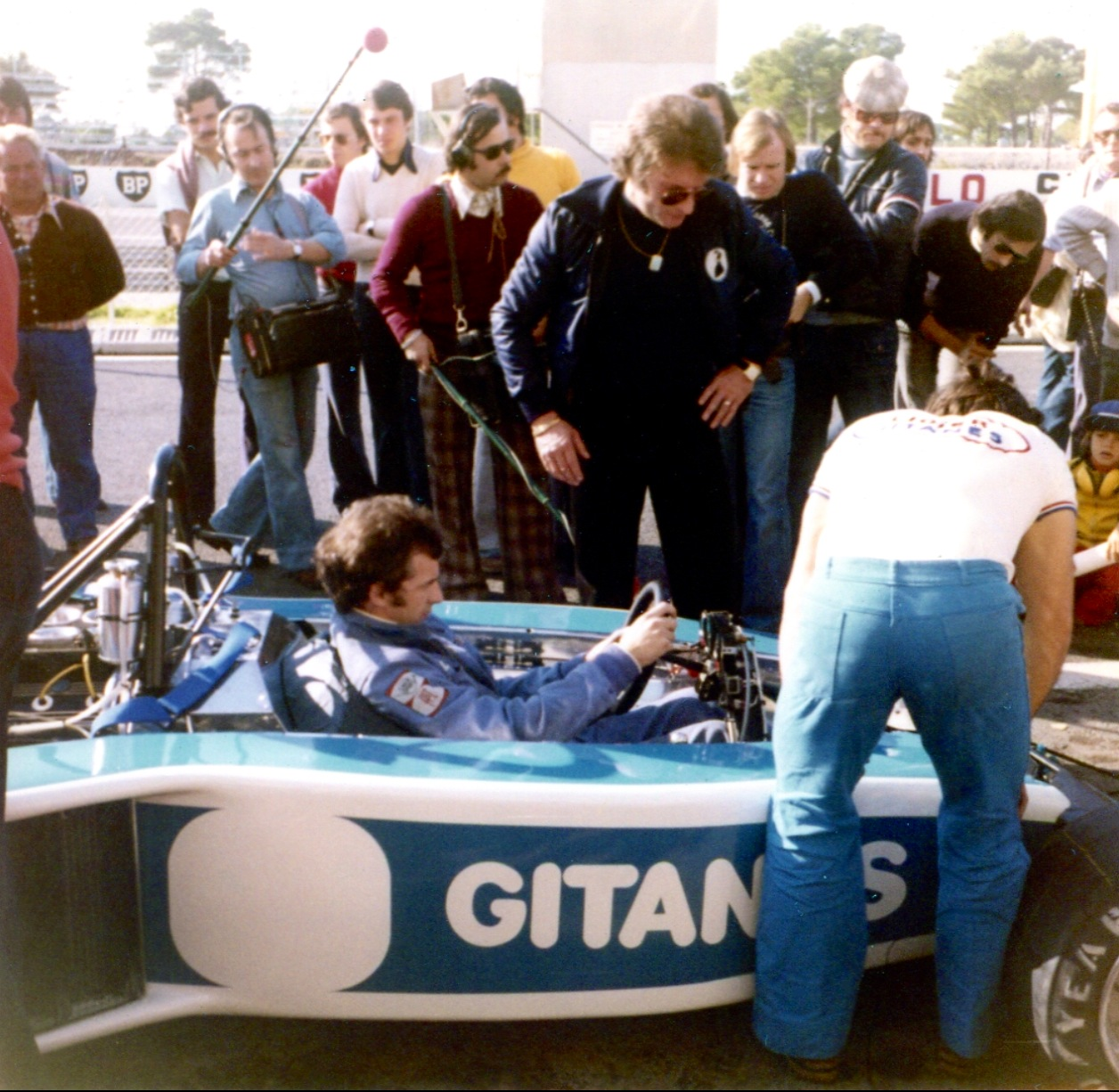
The pictures are of the JS5’s first test at Paul Ricard in December 1975 with Jean Pierre Beltoise up. JPB had been announced as the driver, perhaps via sponsor Gitanes, but Guy Ligier was not convinced and organised a driver test over two days. Jacques Lafitte the quicker of the two in a car which had been tweaked by JPB who tested on the first day.
There was disquiet in France in some quarters over the choice of Laffitte, JPB at the time was France’s only contemporary GP winner, but Ligier’s choice was sound. Jacques in Frank Williams’ Ford engined Williams FW04 and Martini Mk16 Euro F2 crown ahead of the March BMW hordes in 1975 made it fairly clear that he was the better choice. JPB, fine driver that he was, ‘ultimate speed’ had been shown over the years to be not in the Ace category whereas Jacques’ potential, relative novice that he was, was pretty clear. It was an astute choice if not an entirely popular one.
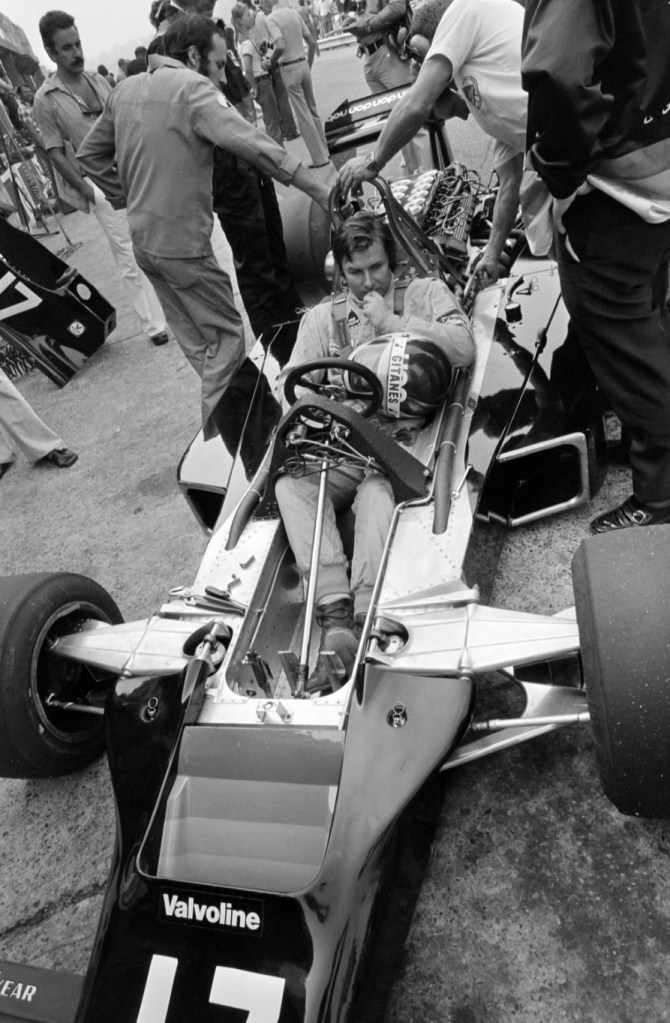
JPB smiles for the cameras and gets himself comfy in JS5, designer Ducarouge, what a talented chappy! looks at JPB’s feet. Paul Ricard December 1975 (unattributed)
Bibliography…
MotorSport January 2015, Denis Jenkinsons MotorSport Austrian and US GP reports 1975, GP Encyclopaedia, Tony Southgate ‘From Drawing Board to Chequered Flag’
Photo Credits…
MotorSport Images, LAT, Car Blueprints, Alejandro Saldutto
Tailpiece…
(MotorSport)
‘So waddya think of the engine Jean-Pierre? is perhaps the question Jacques Lafitte is asking JPJ on their way back to the Monza paddock’? He knew full well of course as an ex-Matra sportscar driver…
Luigi Fagioli’s Mercedes W25B attacks Bernd Rosemeyer’s Auto Union Type B whilst being pelted by rocks on the course covered with them…
The race was help on 22 September 1935 in the Gipuzkoa, Basque region of Northern Spain, Mercedes finished first to third; Caracciola from Fagioli and von Brauchitsch. All drove the 4.3 litre straight-8 engined car. Rosemeyer was 5th in the V16 5.6 litre mid-engined Auto Union.
Caracciola won the European Championship that year with 3 wins of 5 Championship rounds, his other triumphs at Spa and Bremgarten, Switzerland.
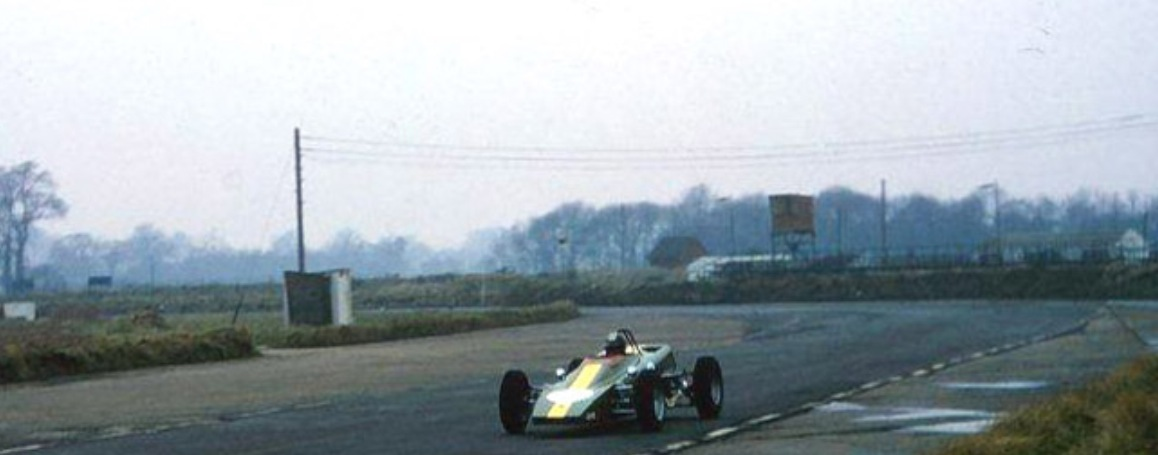
Graham Hill and jockey Lester Piggott test the Lotus 61 Formula Ford at an incredibly frigid Hethel Airfield 20 March 1969…
How many times he spun the car at Lotus HQ is unrecorded! The event appears to be a promotion to boost the sales of Lotus Components latest Formula Ford. And a very competitive car it was, in fact all the Lotus FF’s were; 51, 61, 59 and 69, it’s a great pity Chapman took the marque up-market and left its enthusiast/grass roots racing background behind.
Graham Nearn did rather well with the Lotus 7 Series 3 too, proving there was life in the old beast yet, the 7 being the other product of Lotus Components in addition to the production racing cars, Chapman sold the rights of the 7 in 1971.
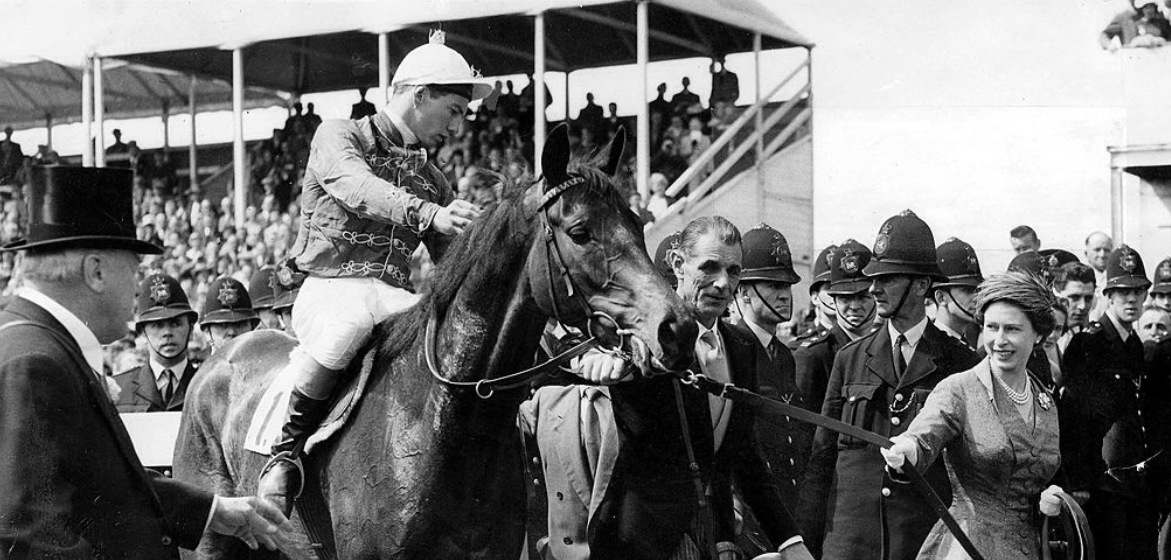
On a more familiar type of mount; Lester Piggott takes the Queens horse ‘Carrozza’ back to scale having won ‘The Oaks’ at Epsom, Surrey on 7 June 1957. Queen Elizabeth leads (Popperfoto)
Credit…
Victor Blackman, Richard Styles
Tailpiece: Dave’s Lotus 61…
Later Lotus GP driver, Aussie Dave Walker tests his JRRDS Lotus 61 at Snetterton prior to the start of his successful 1969 season. He won the British Les Leston FF Championship in this car in 1969 (Richard Styles)
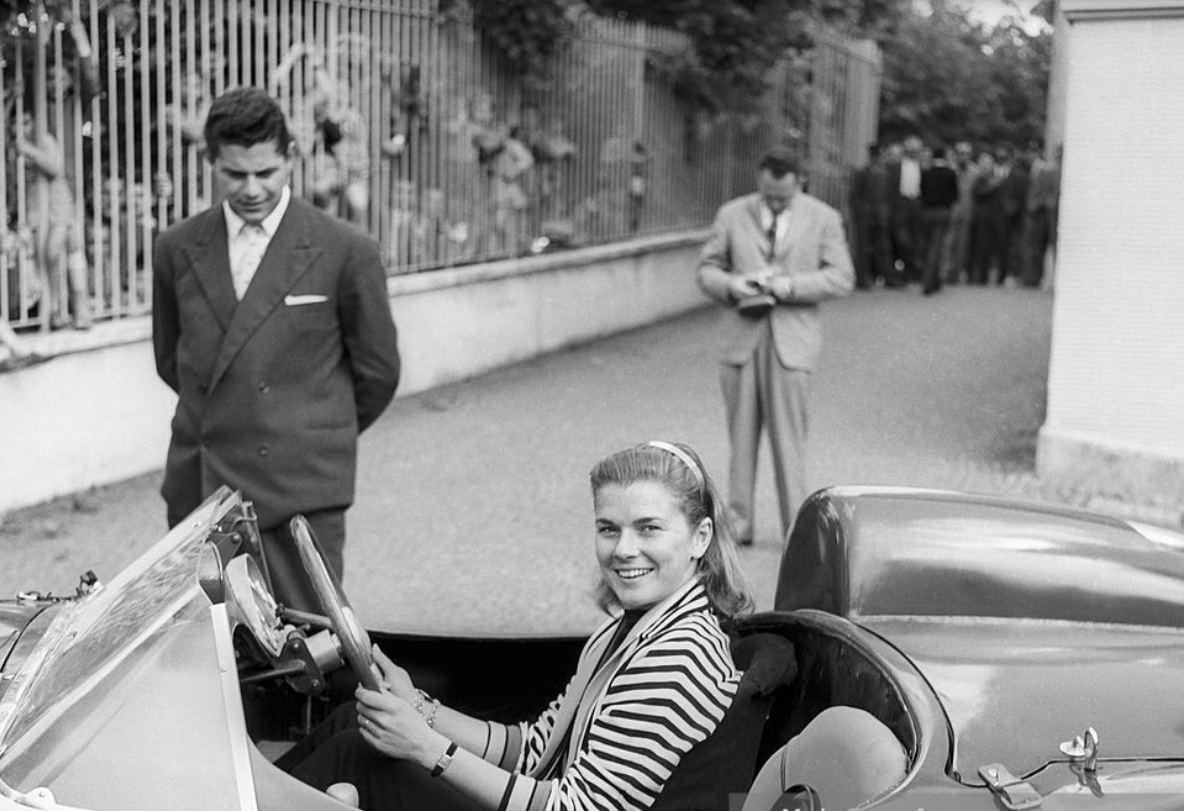
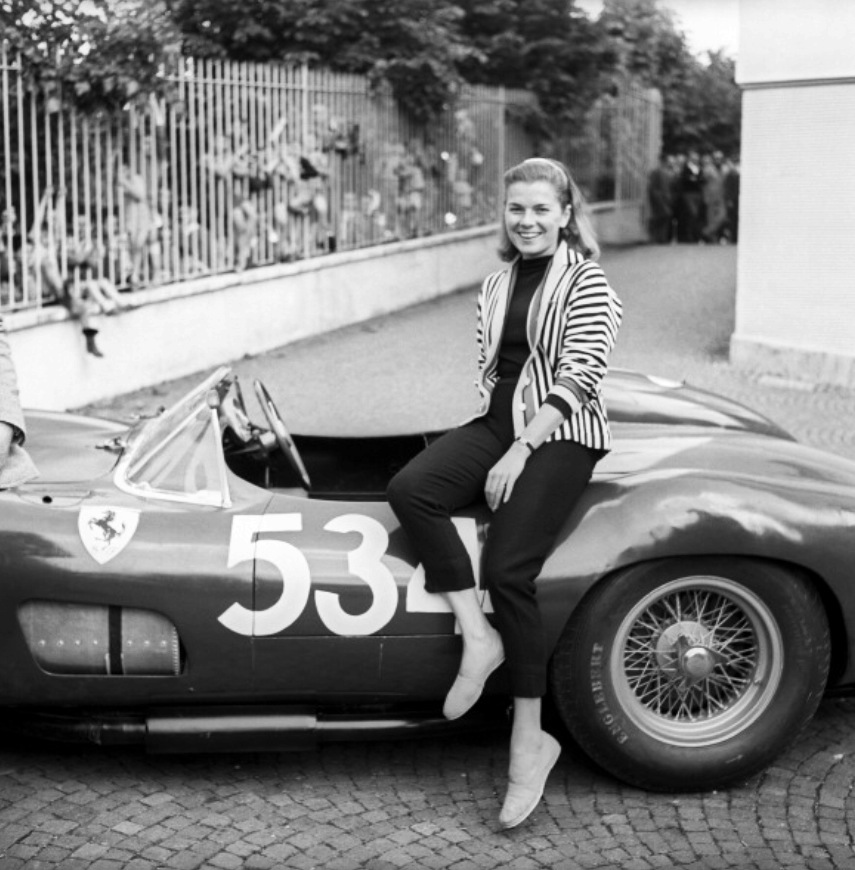
Louise Collins susses husband Peter’s fabulous Ferrari 335S in advance of the start of the ’57 Mille Miglia…
It was a victorious race for Ferrari but otherwise disastrous on every level given ‘Fon de Portago’s accident and it’s consequences, click here for an article about both this race and the big Ferrari;
Stan muscling his big Maserati 250F around Longford in 1959 en-route to his one and only Australian Grand Prix win…
The win was timely, he was monstered all the way by Len Lukey’s Cooper T43 2-litre, the way of the future of course. ‘Twas the last AGP win for a front engined car, mind you Lex Davison came within metres of winning in an Aston Martin DBR4 at Lowood, Queensland in 1960.
Jones at the wheel of his Maser, 1956 AGP Albert Park. Lovely portrait of the guy and looking quite the pro driver he was! (unattributed)
Jones gave his Gold Star defence a red hot go in 1959 having won the title in 1958, he raced four cars in his quest.
He didn’t race in the season opening event in Orange, NSW. Jack Brabham won in a Cooper T51, but he wheeled out his Maybach for Fishermans Bend’s Victoria Trophy on 22 February. He finished second to Alec Mildren’s Cooper T43.
Stan hadn’t raced the Maybach for years but had retained it. His friend and fellow racer Ern Seeliger evolved the car by replacing the Maybach engines which had been at the core of Maybach’s 1-3 with a Chev Corvette 283cid V8. The car also had a de Dion rear end and other clever modifications.
He swapped back into the Maser, winning the AGP at Longford on 2 March.
Stan in the big, now blue Maybach 4 Chev beside Alec Mildren’s Cooper T43 Climax at fairly desolate Port Wakefield, SA, March 1959 (Kevin Drage)
He switched back to the Maybach for the SA Trophy at Port Wakefield on March 28, winning the race. Crazily, the next round of the title was at Bathurst on 30 March, two days later. Very hard for contestants to make that trip from SA to Central NSW now, let alone with the road system of 1959!
Stan flew to Bathurst to drive the Maser. Whilst he won his heat he had engine dramas in the final and failed to finish, victory was taken by Kiwi Ross Jensen in another Maserati 250F.
He used the Maybach again at Lowood on June 14, he was third, then swapped back to the Maser for the next round, again at Lowood on 30 August, hitting a strawbale and failed to finish.
The reasons for the choice of car at each meeting would be interesting to know but are probably a function of vehicle availability and suitability. Which was the primary and which was the secondary factor meeting to meeting no doubt varies…
Mid-engined inevitability was clear though despite none of the Australian Cooper exponents being able to secure a full 2.5-litre FPF Coventry Climax engine…yet. The ‘mechanical mice’, as Lex Davison christened the Coopers, were only going to get quicker.
Whilst his fellow competitors were back at Port Wakefield for the 12 October meeting Stan was doing a deal with Bib Stillwell to buy his Cooper T51 2.2 FPF, chassis ‘F2-20-59’, the first of several T51’s Stan raced.
Stan Jones, Cooper T51 Climax, Caversham, WA October 24, 1959 (Dave Sullivan Album)
He soon got the hang of the car, after all he had been an air-cooled Cooper exponent earlier in the decade, finishing second to Len Lukey’s Cooper at Caversham, WA.
The Jones #3 Cooper T51 beside Len Lukey’s earlier model T43, Caversham August 1959. Lukey was the Gold Star winner in 1959 driving both Cooper T43 and T23 Bristol (Dave Sullivan Album)
The final rounds of Australia’s longest ever Gold Star series were Phillip Island’s Westernport Cup and Phillip Island Trophy races on 22 November and 13 December respectively.
Jones brought his ‘roster of cars’ to four for the year when he drove Ern Tadgell’s Sabakat (Lotus 12 Climax) after damaging his Cooper in a collision with Lukey. The Cooper was too badly damaged to start, as was Lukey’s, but Stan, very sportingly was lent the Sabakat by Tadgell.
Lukey won the 1959 title from Alec Mildren by two points with Jones a distant third. Mildren’s time would come in 1960 with fabulous AGP and Gold Star wins in a new Cooper T51 Maserati he and his team built over the summer.
Sadly it was the last full-blown Gold Star campaign for Jones, economic pressures from 1960 meant he did a few title rounds but was not a serious title contender, although still a tough competitor in any individual race he entered.
Stan settles into his Cooper T51 at Caversham (Dave Sullivan Album)
Equipe Jones at Albert Park during the 1956 AGP won by Moss’ 250F. International truck and the Rice Trailer, were the ‘ducks guts’, still a few of these around and highly prized (unattributed)
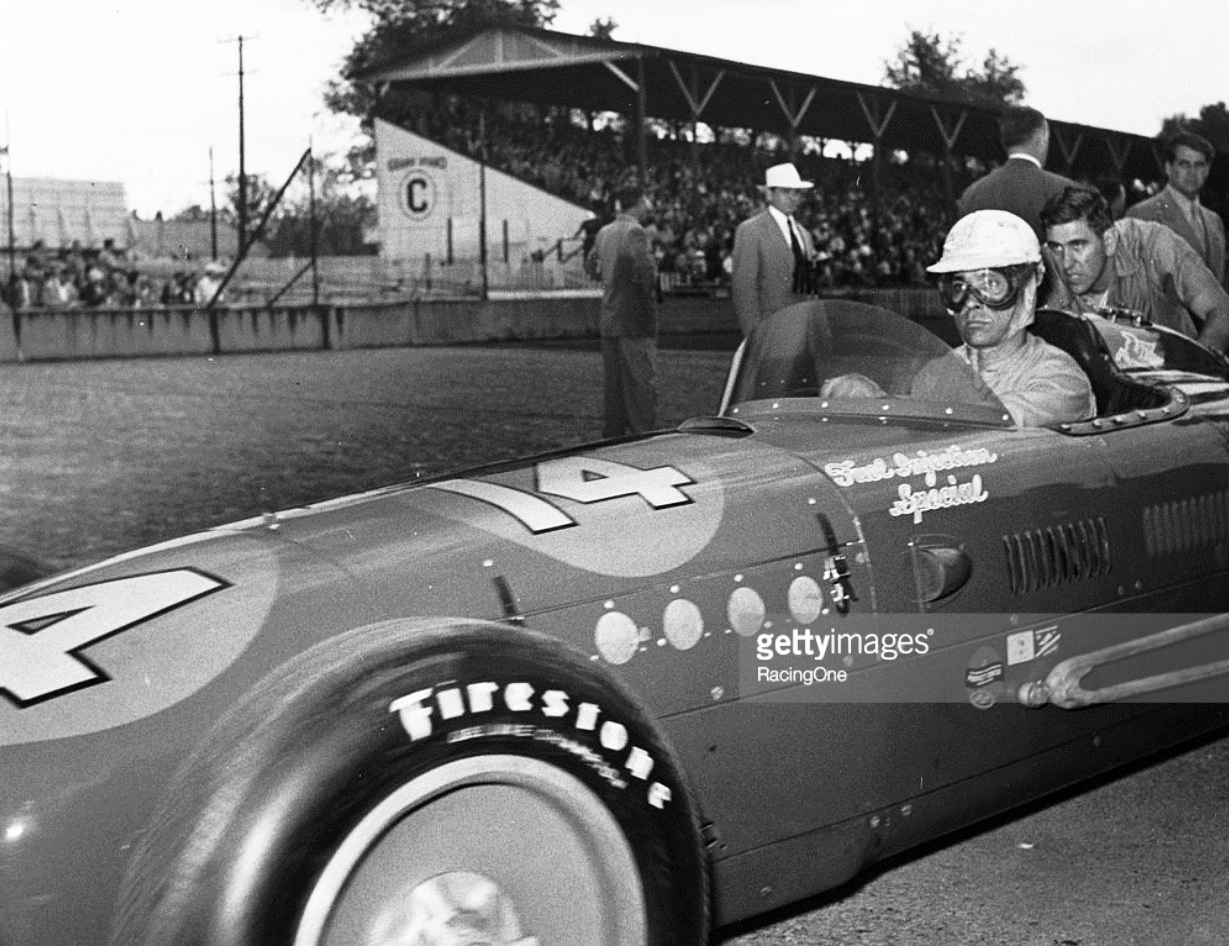
Billy Vukovich leading the Indy 500 in his Kurtis Kraft Offy, he won the race from the similar cars of Art Cross and Sam Hanks…
Vukovich dipped out on victory in 1952 with a steering gear failure several laps from the end, in ’53 he led from lap 1 and 195 of the 200 laps in total. The event was run in searing heat which required the use of 16 relief drivers, Billy drove the race himself in a tough, gritty display.
32 of the starters used the DOHC 4 cylinder Meyer-Drake ‘Offy’, the other engine the famous Novi V8, finally Kurtis Kraft supplied 22 of the 33 chassis which contested the race.
Credits…
Max Staub, Racing One
Vukovich rejoins the race after a pitstop, Kurtis Kraft, Indy 1953 (Racing One)
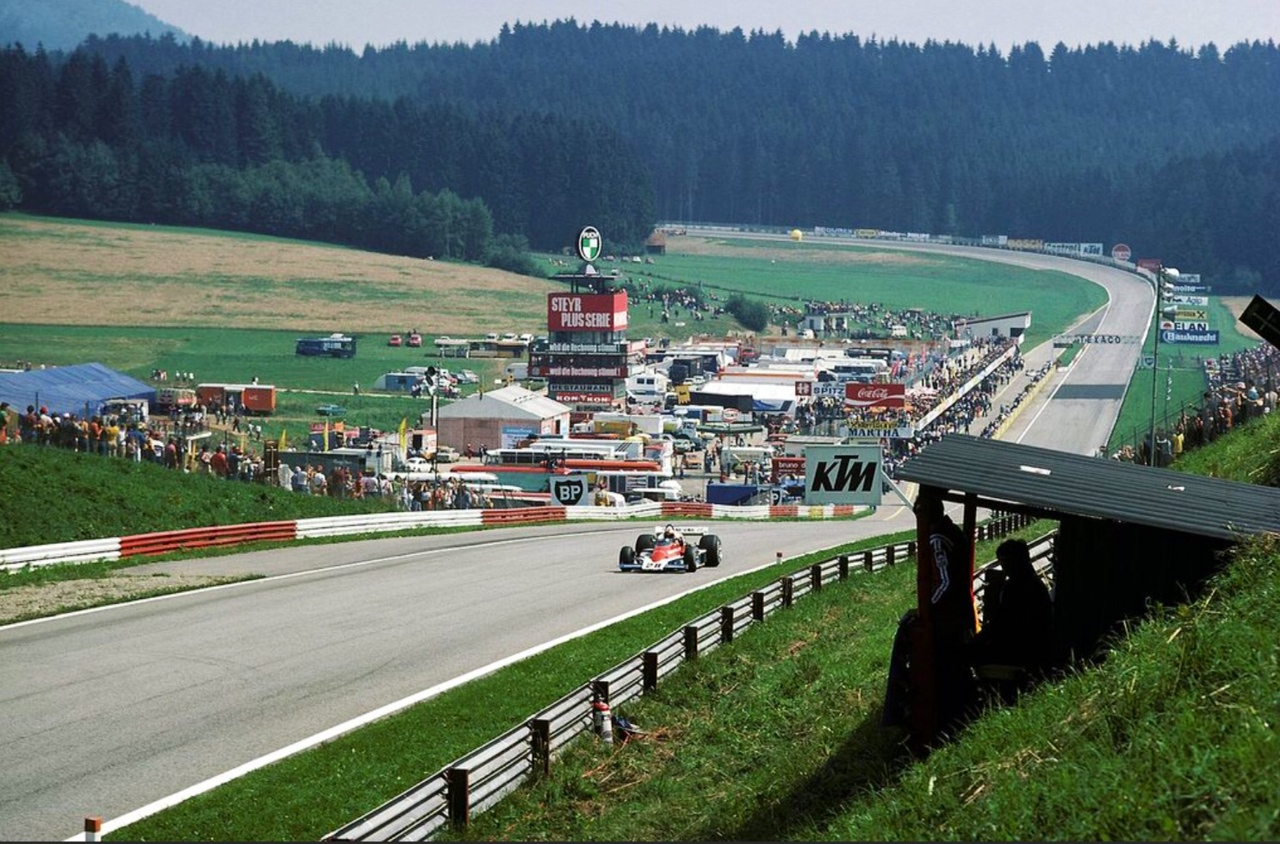
John Watson, Penske PC4 Ford, Austrian GP August 1976. Watson and Penske’s first GP wins.
Given the junk ‘Tilke Tele Circuits’ on which the circus races too much these days the old tracks, not that the ‘Red Bull Ring’, goes back as far as Monza or Spa, are important for their own sake as great ‘theatres’ but also to remind us of the heritage for which we are all responsible.
I’m not suggesting F1’s Venture Capital Fund owners, CVC give a ‘Rats Toss’ about heritage mind you.
Pastor Maldonado, Lotus E23 Mercedes, Austrian GP June 2015. Pastor was 7th in the race won by Nico Rosberg’s Mercedes F1 W06. (reddit.com)
Etcetera…
It was Tilke’s work to shorten the fast, long Osterreichring, used for the Austrian GP from 1970-1987 to the shorter A1-Ring used for the race from 1997-2003 aka Red Bull Ring now. The Styrian Mountains setting to start with was so good even he couldn’t bugger the thing up completely in its transformation to the modern age…















 primotipo...