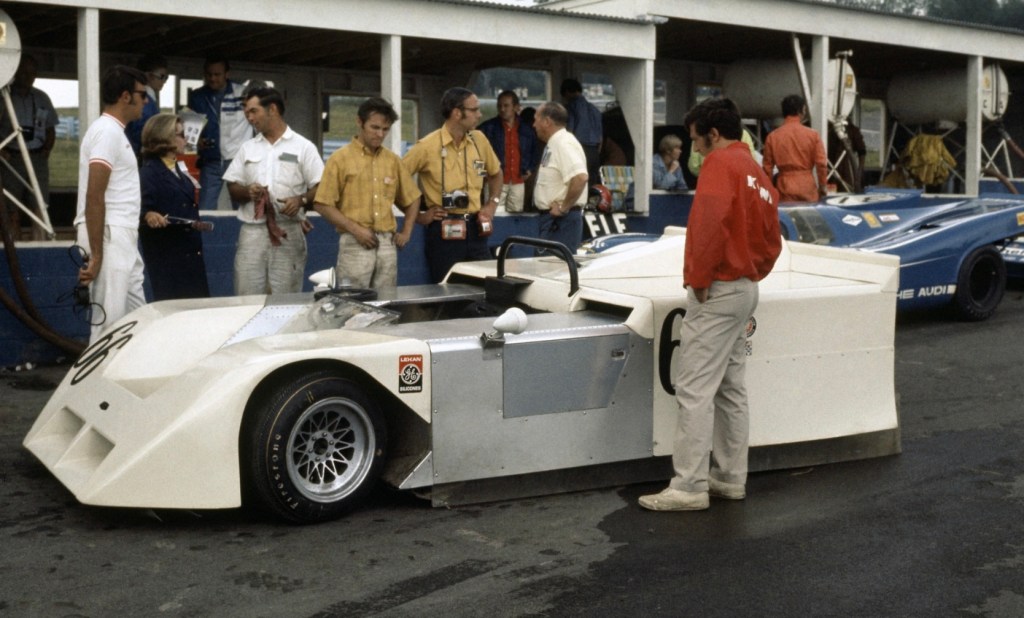
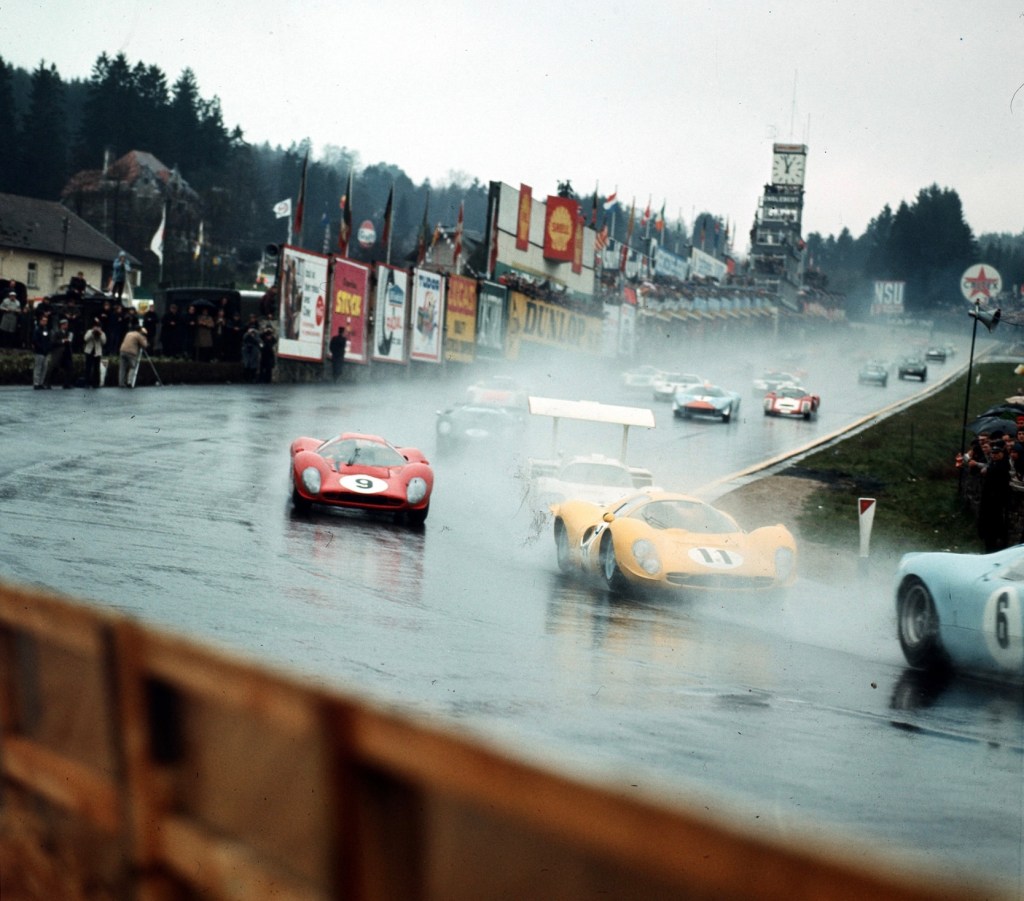
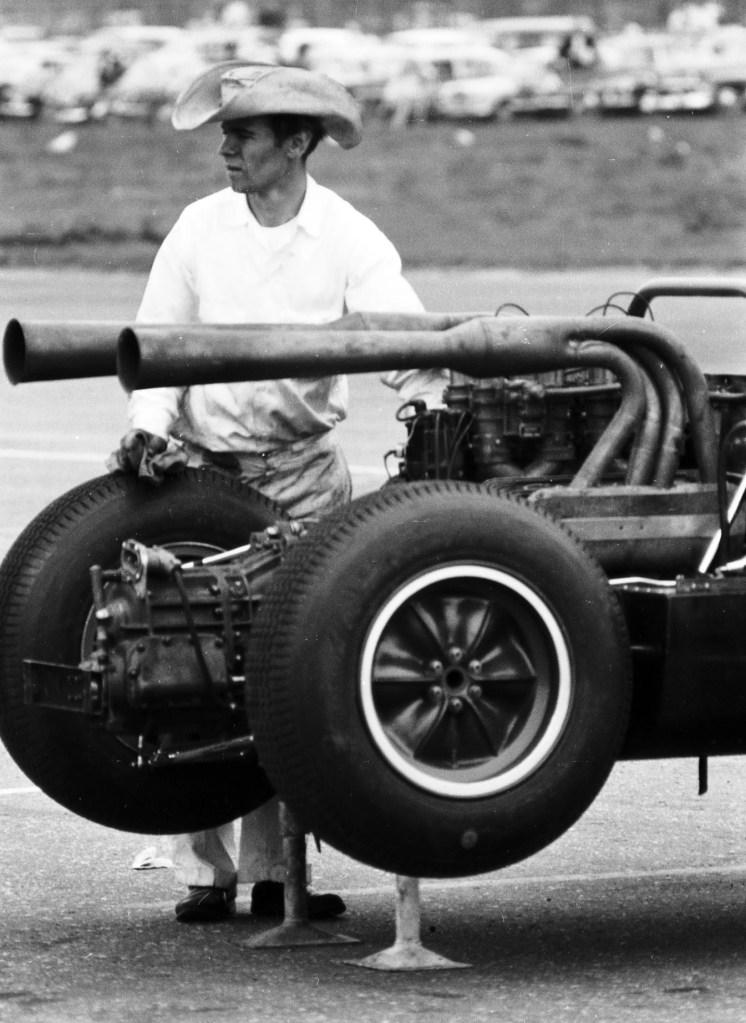
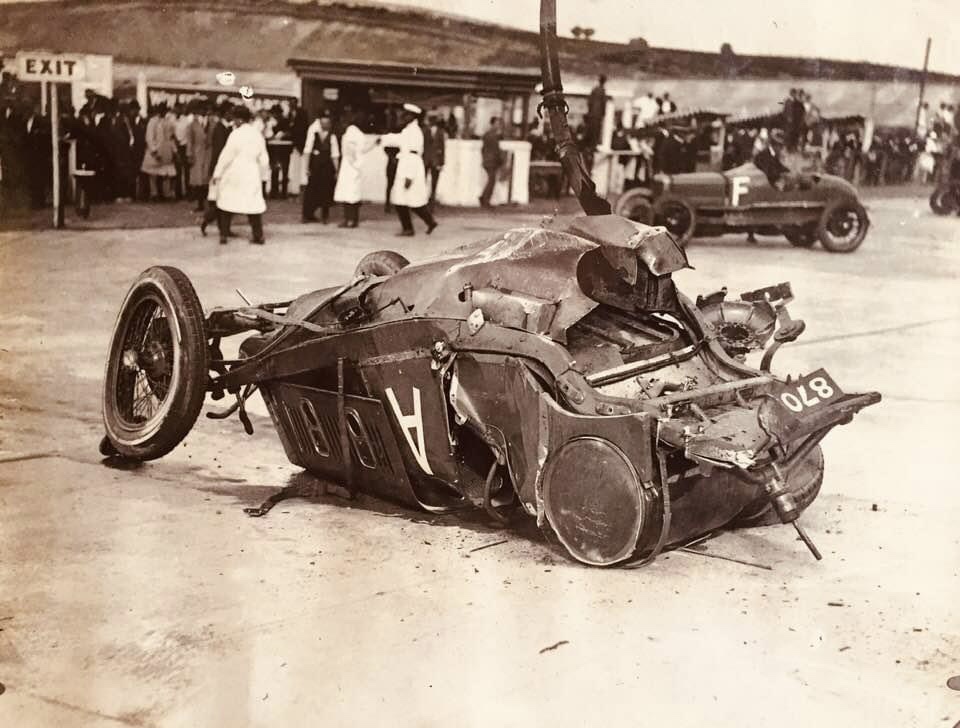
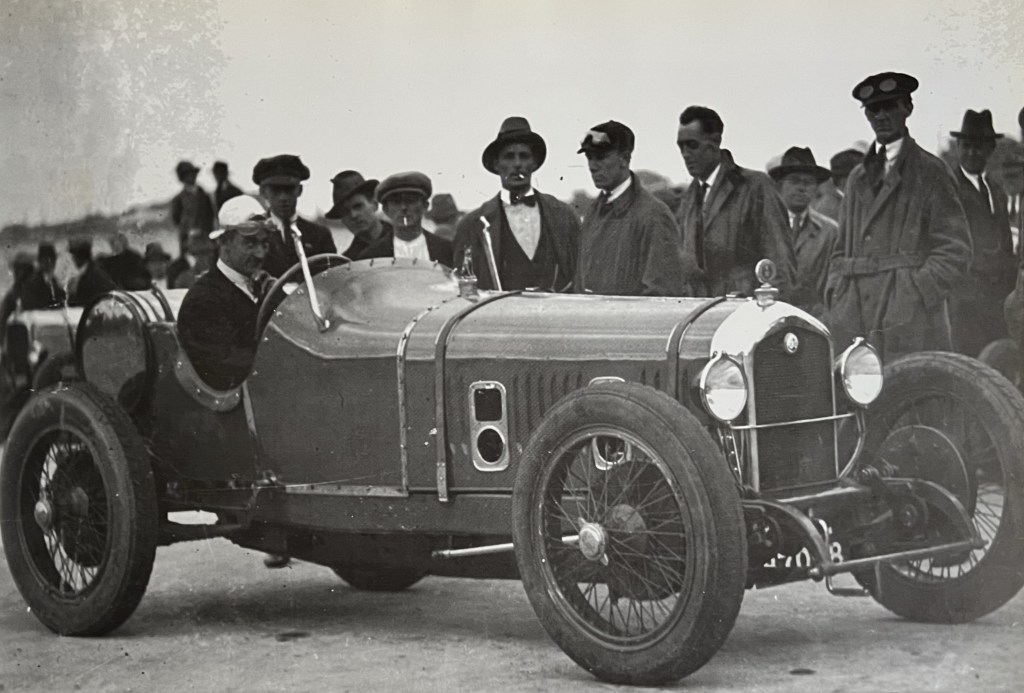
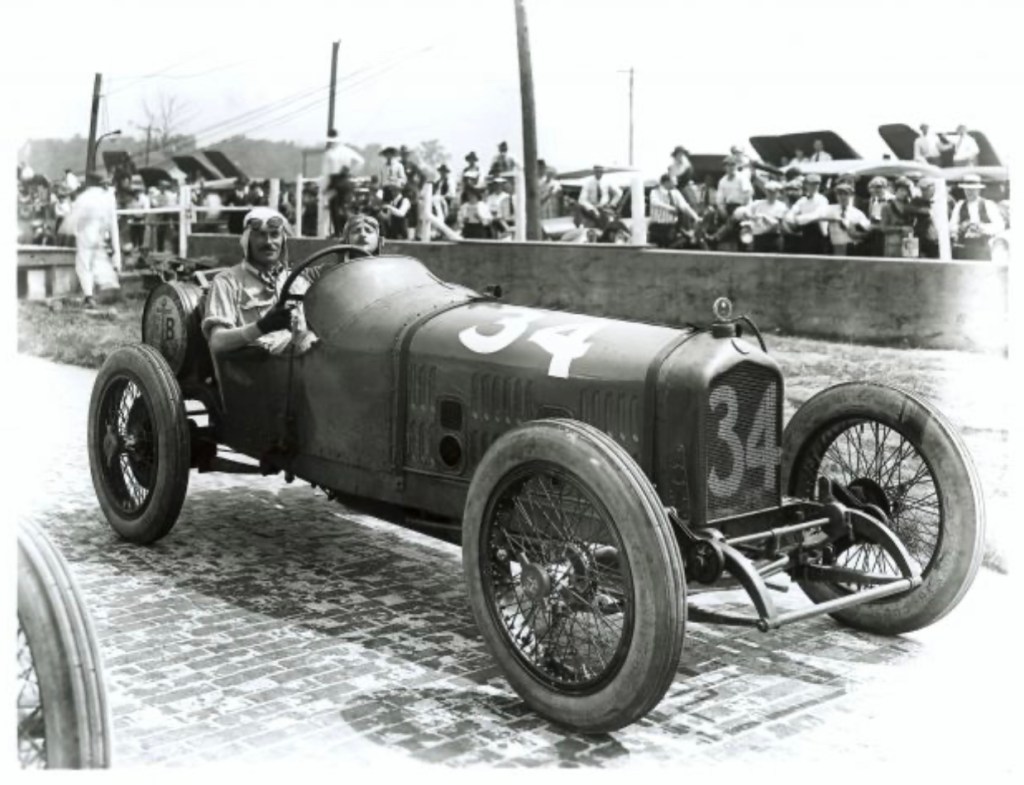
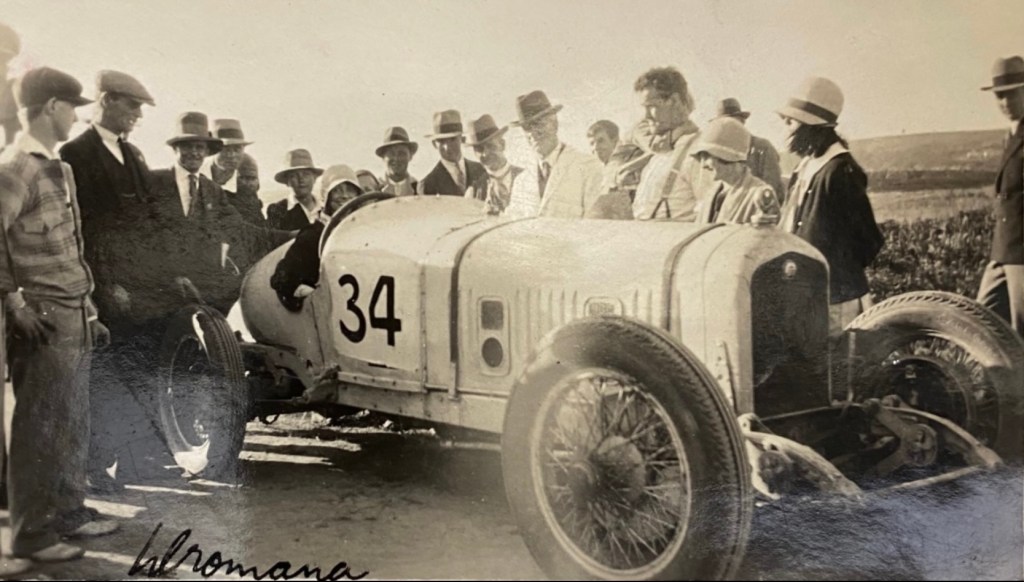
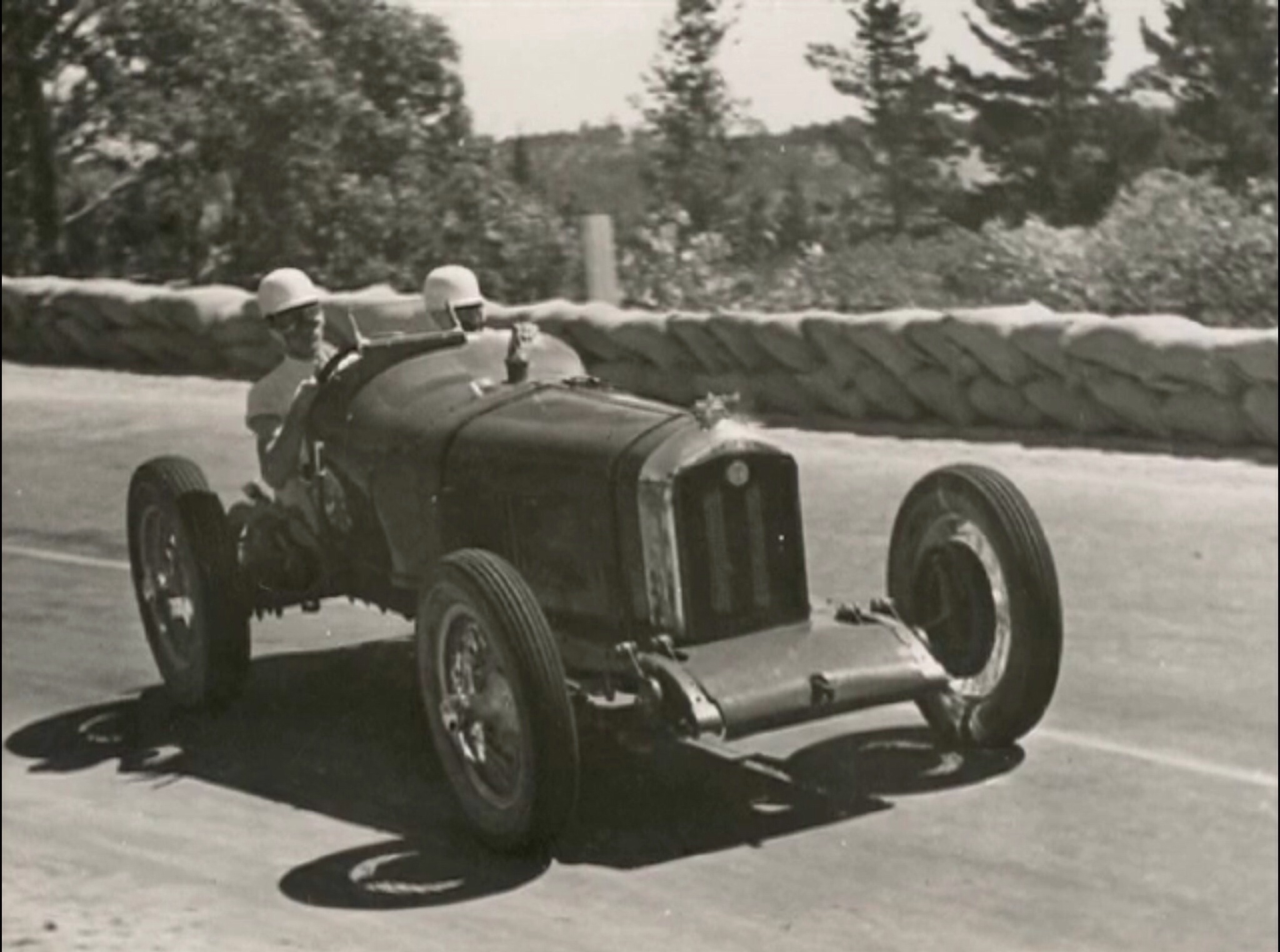
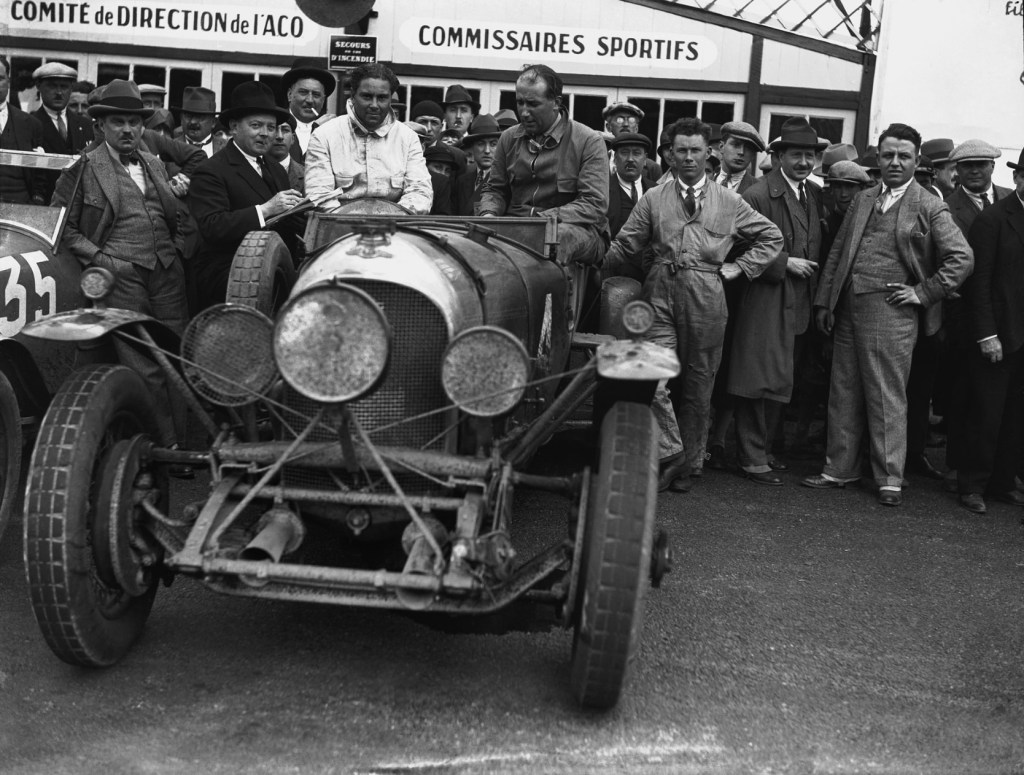
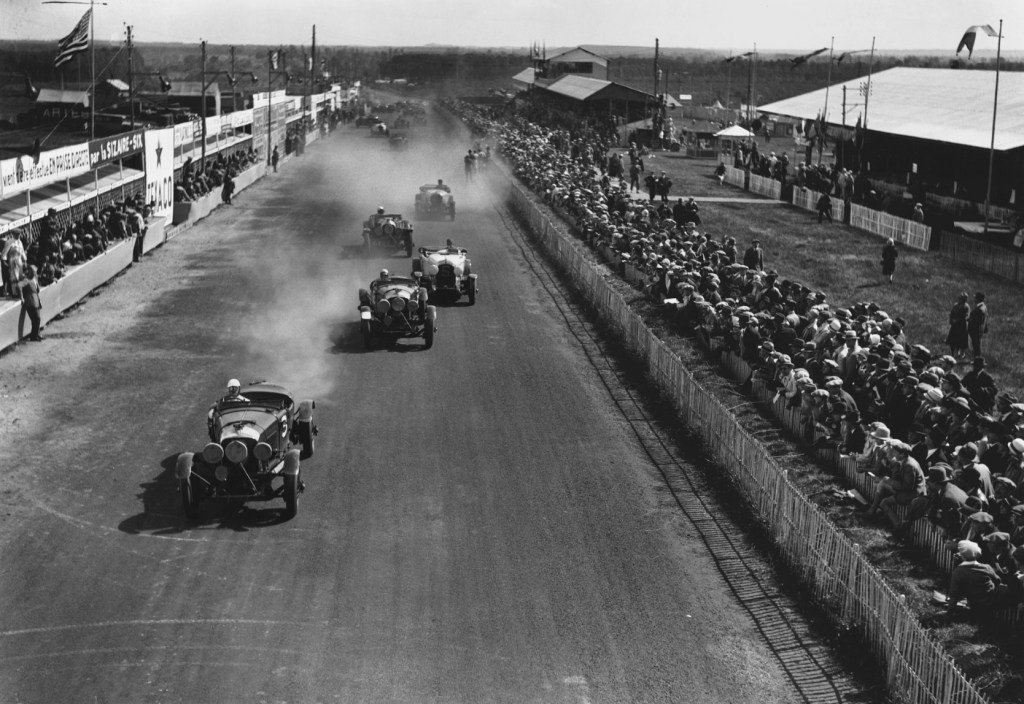
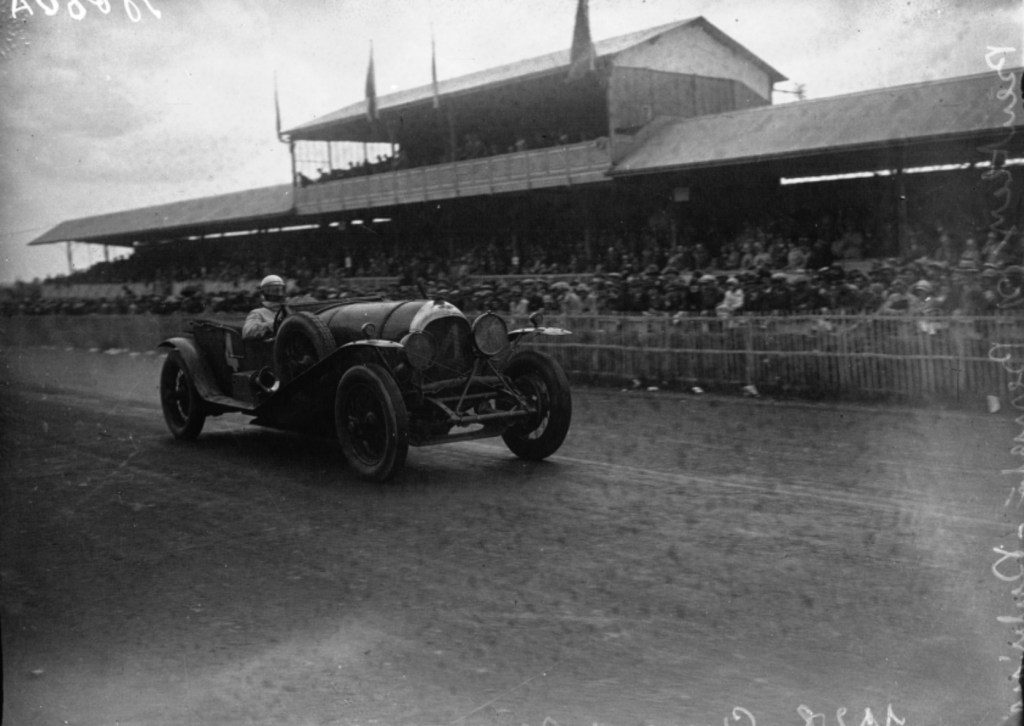
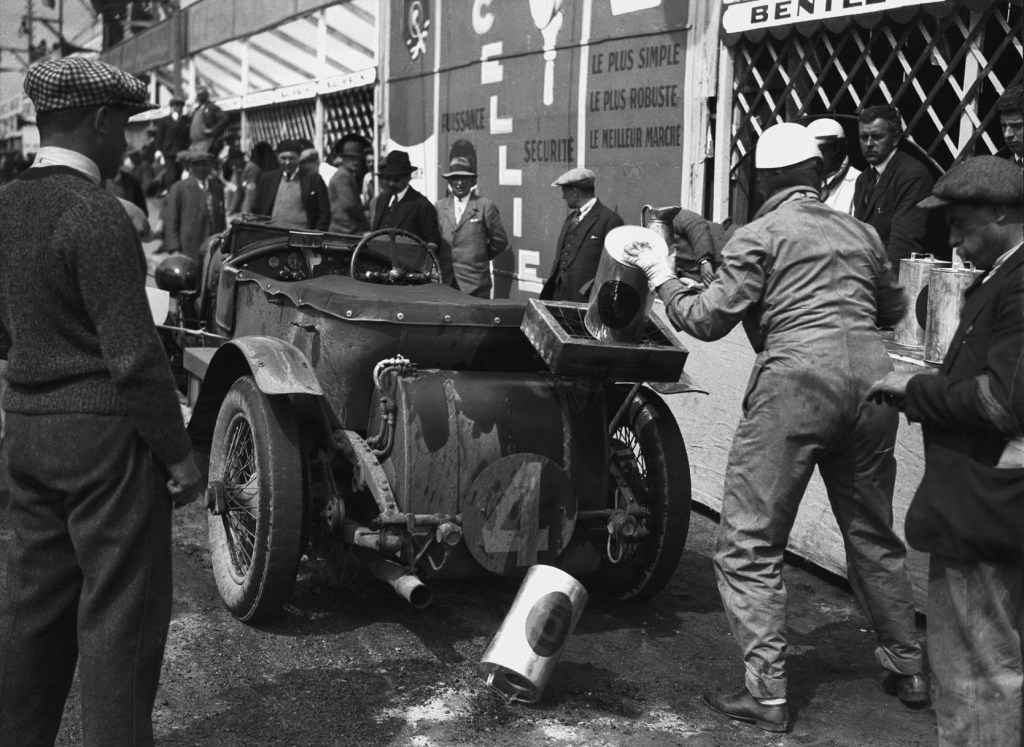
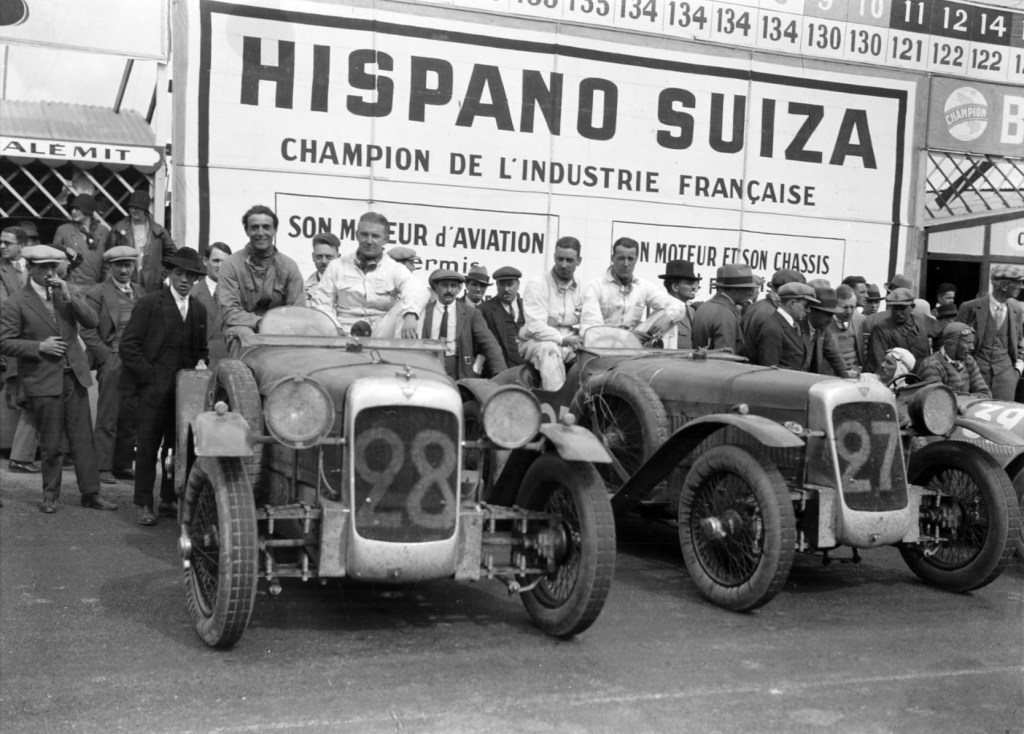
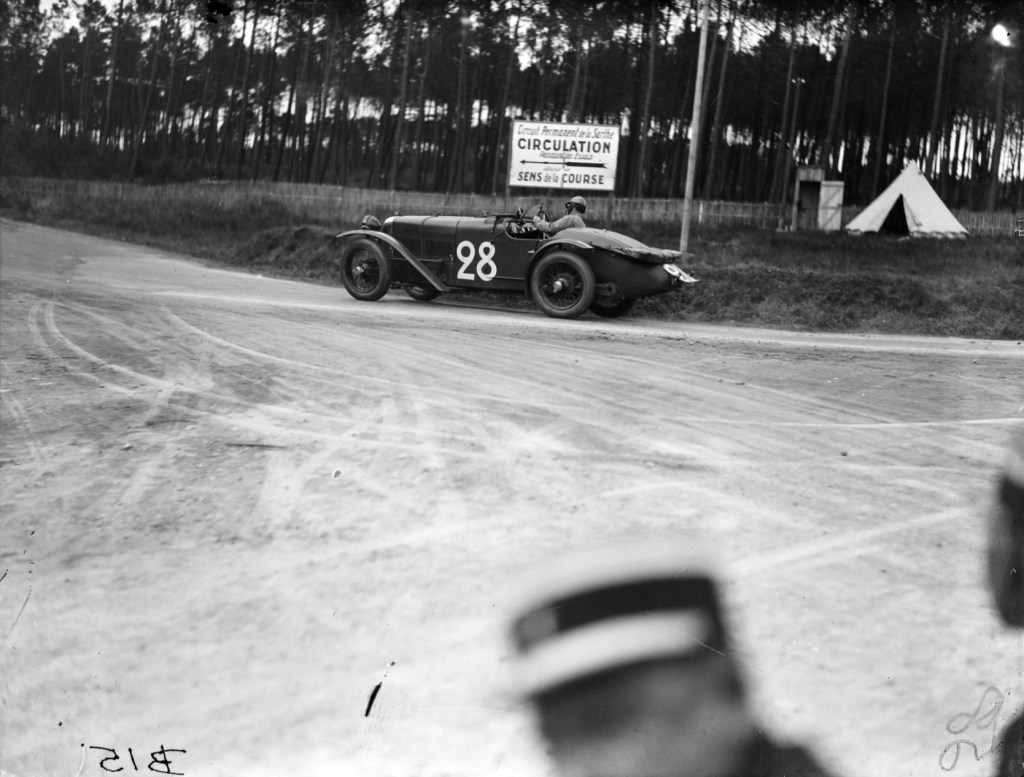
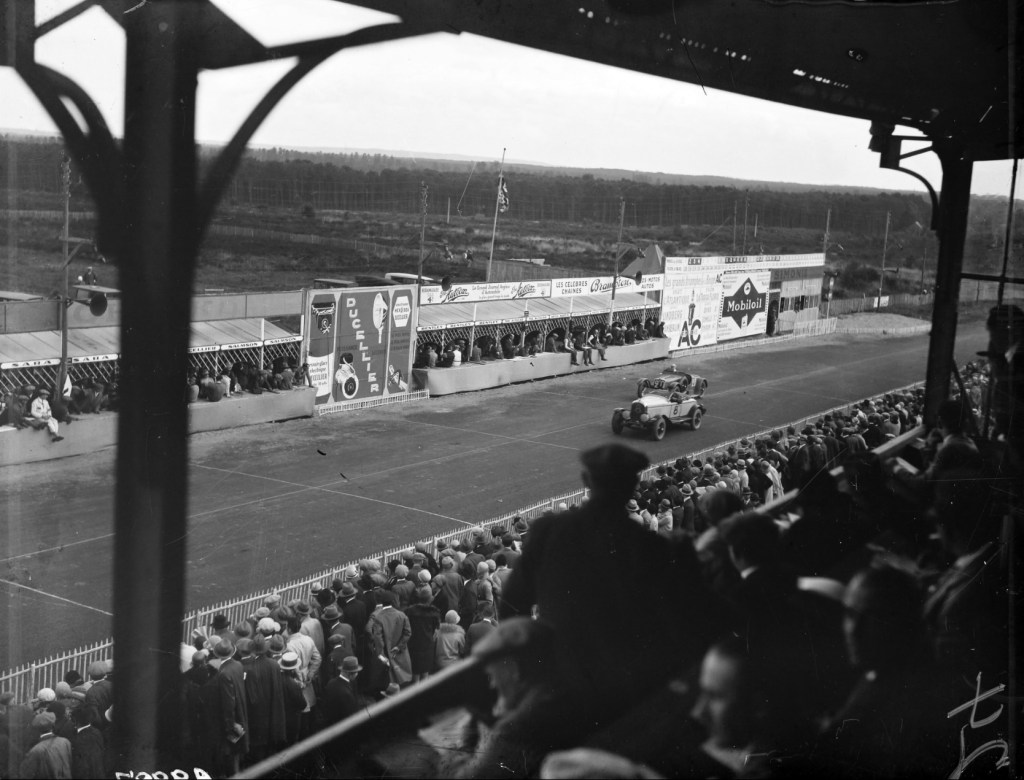
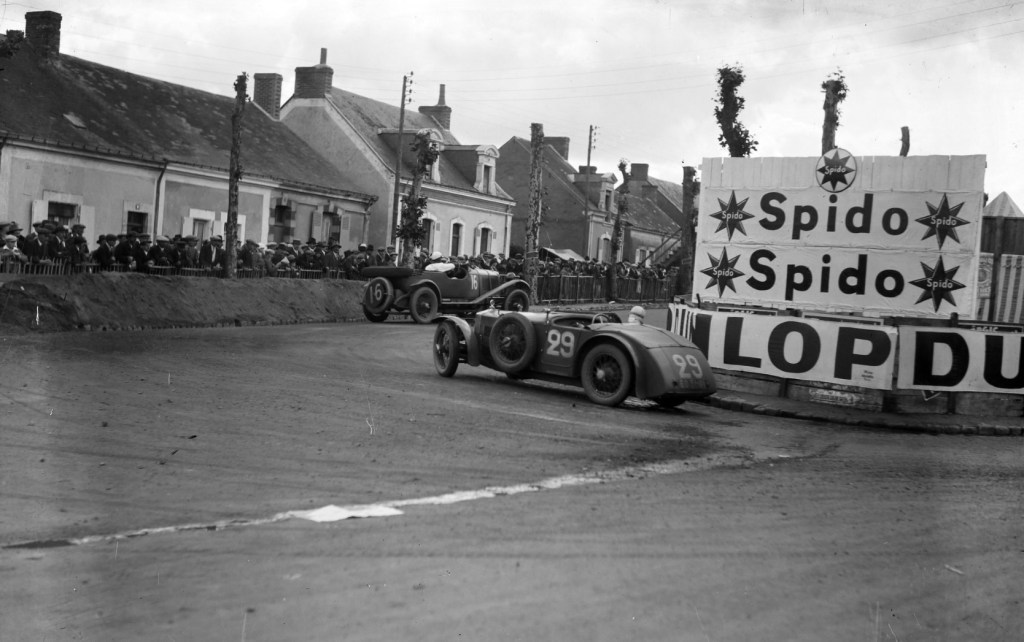
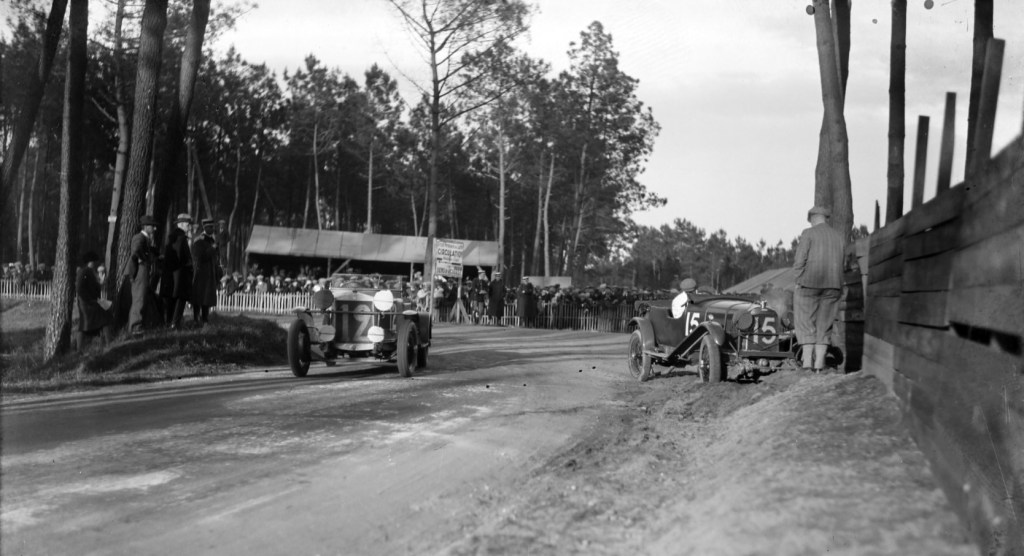
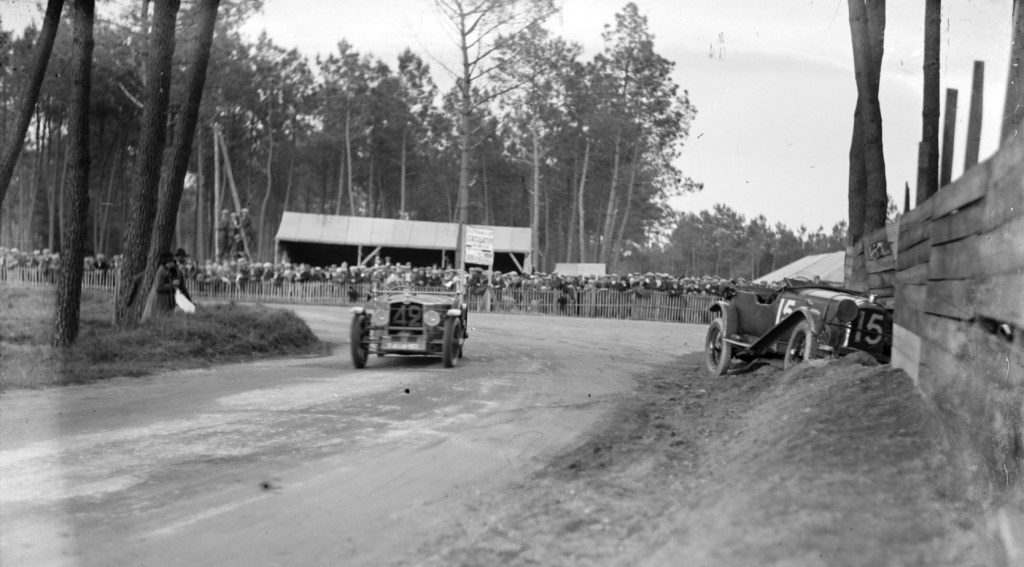
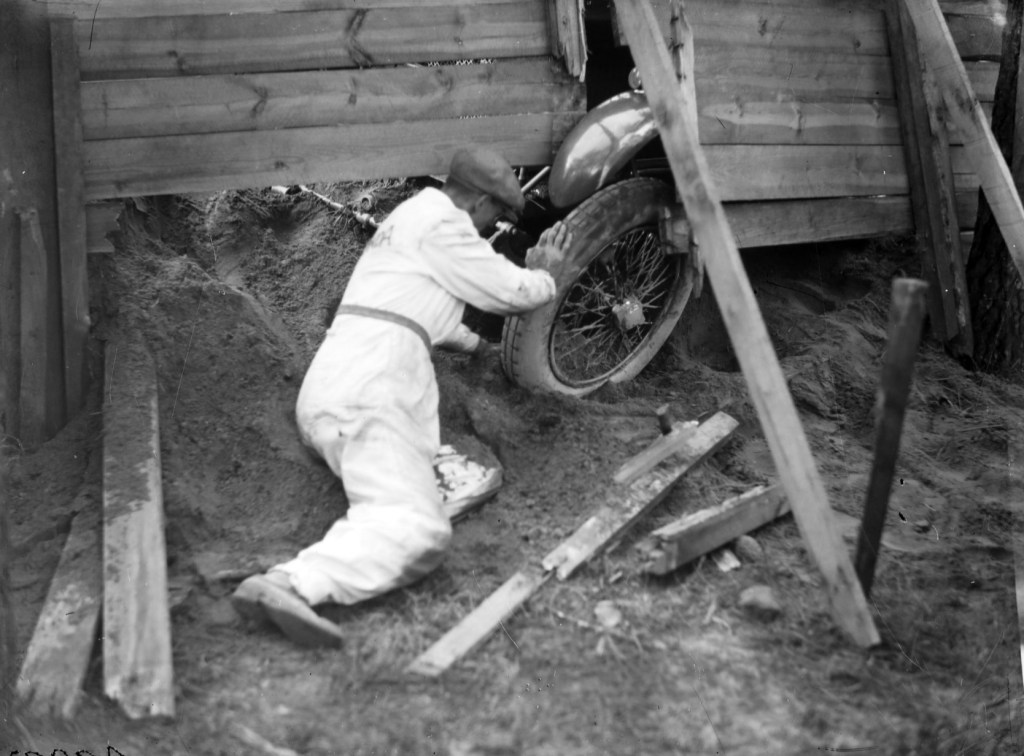
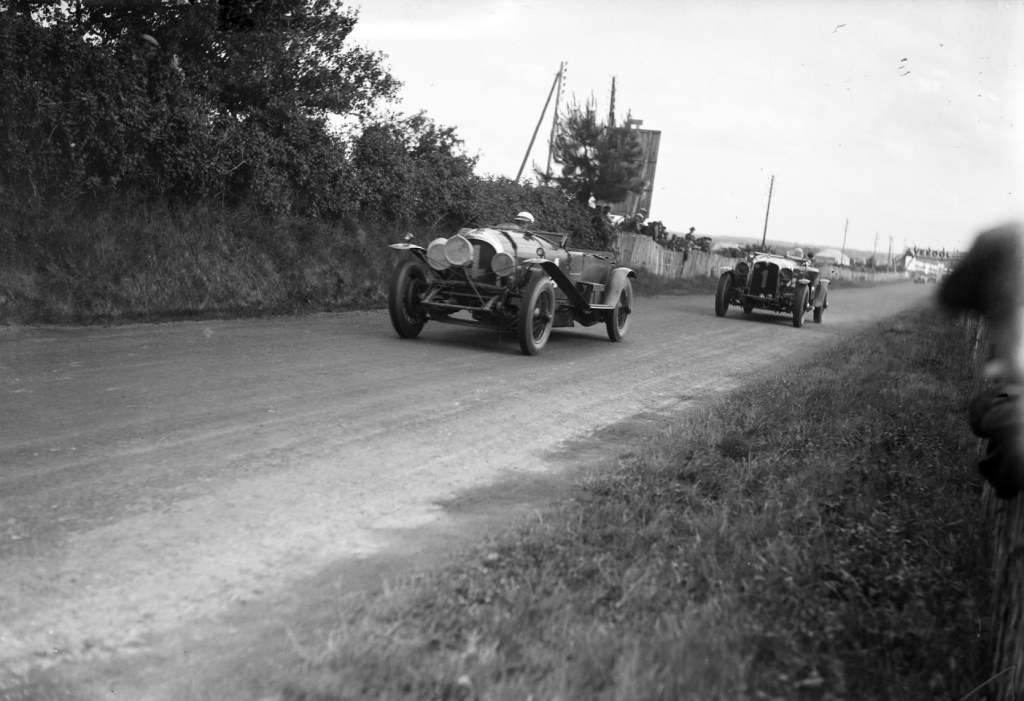
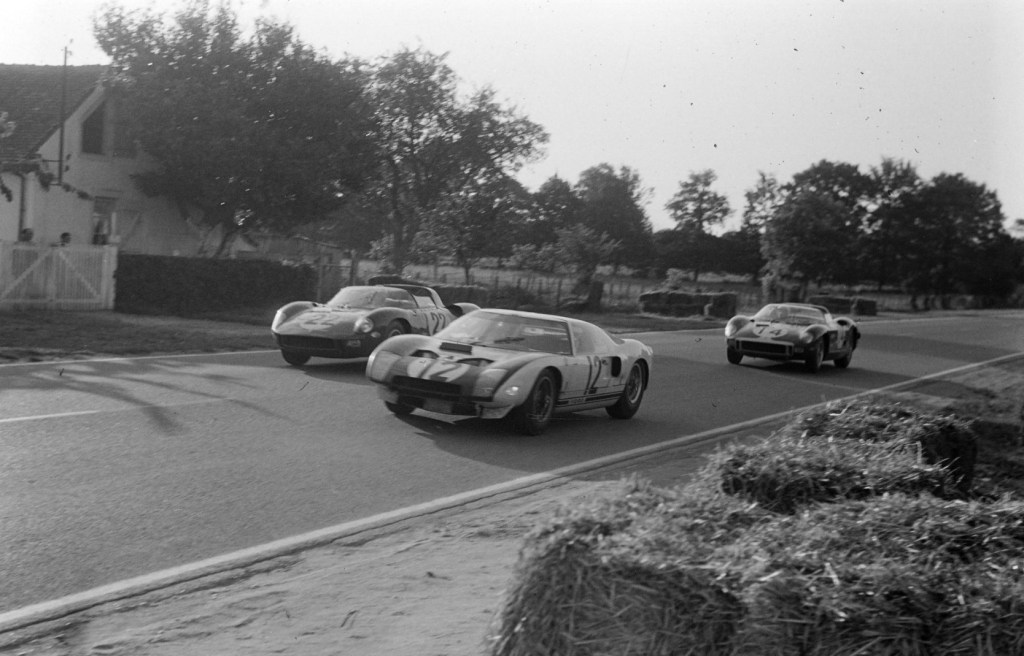
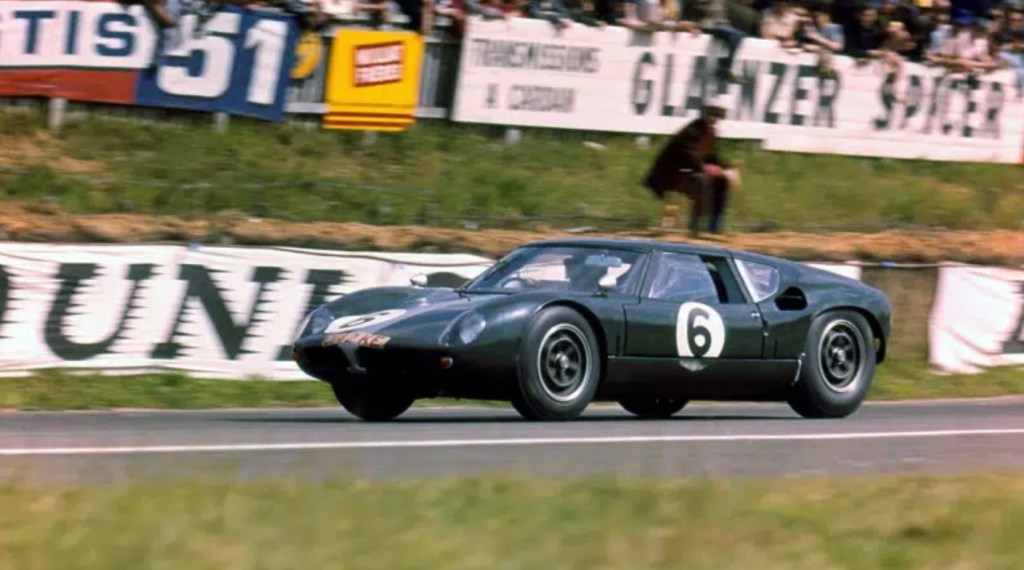
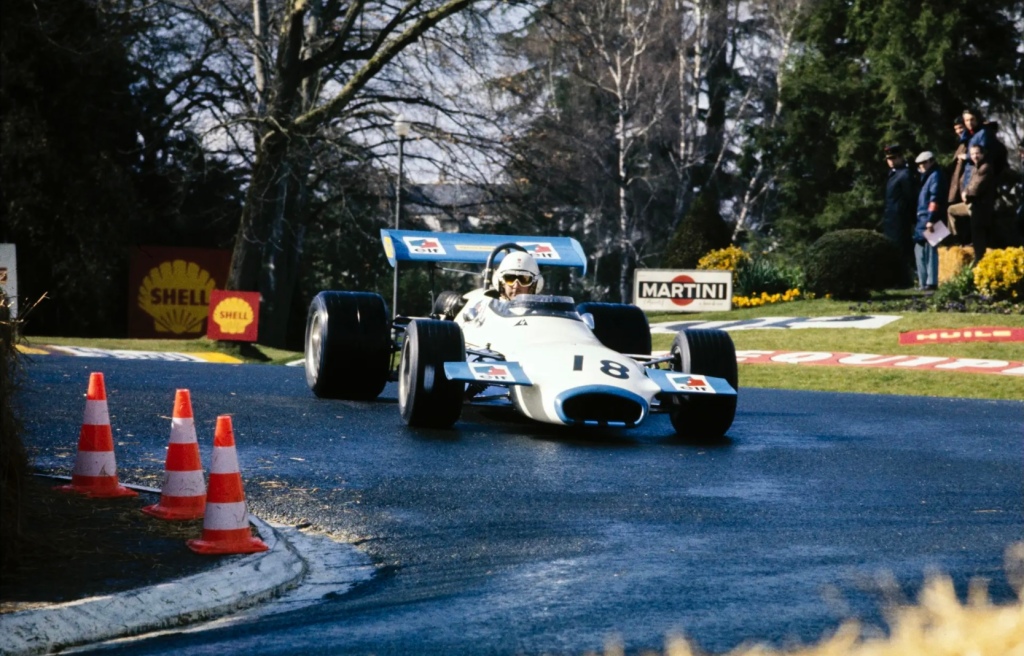
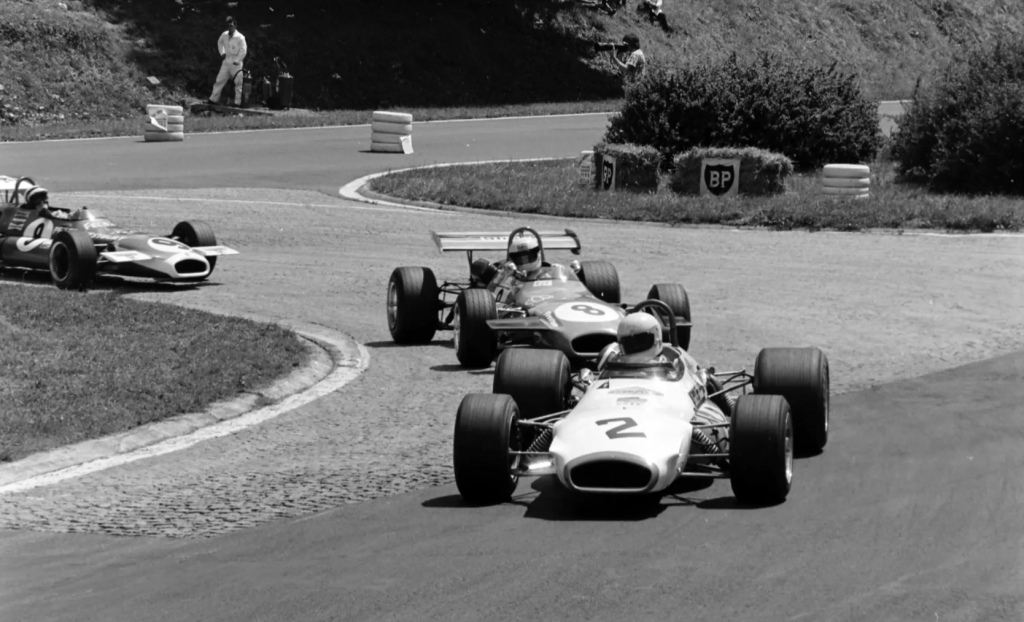
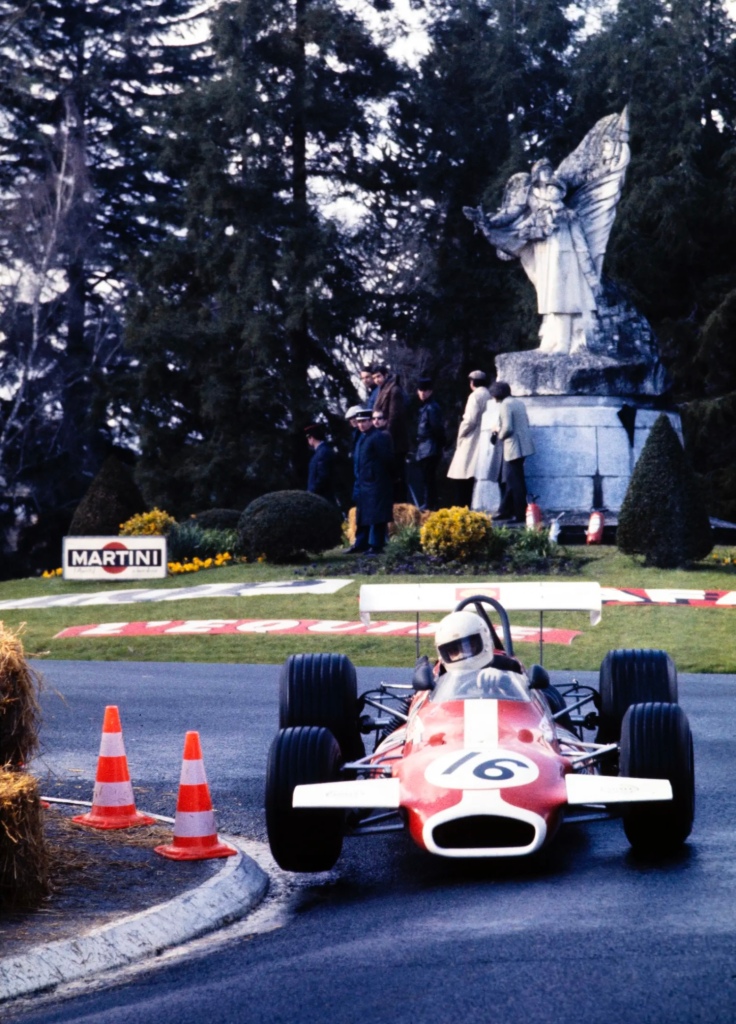
The Jean Guichet/Nino Vaccarella Matra MS630 at Le Mans in 1969, they finished fifth in the race won by the John Wyer Ford GT40 driven by Jacky Ickx and Jackie Oliver.
Matra’s progression up the Le Mans results was underway. A pair of DNFs for the two 2-litre BRM P56 V8 powered MS630s in 1967 wasn’t improved upon by the Johnny Servoz-Gavin/Henri Pescarolo MS630 V12s in 1968 (puncture, accident). Fourth and fifth places in 1969 was more impressive, the Jean-Pierre Beltoise (JPB) / Piers Courage MS650 Spider was a lap ahead of the Guichet/Vaccarella MS630 Coupe. Matra would get there soon enough of course, Henri Pescarolo and Graham Hill (below) won the classic race aboard an MS670 from teammates Francois Cevert and Howden Ganley similar car in 1972.
Graham Hill’s ’72 Le Mans victory famously bagged him the Triple Crown: an F1 title, Le Mans and Indy wins, the only bloke to achieve it of course (MotorSport)
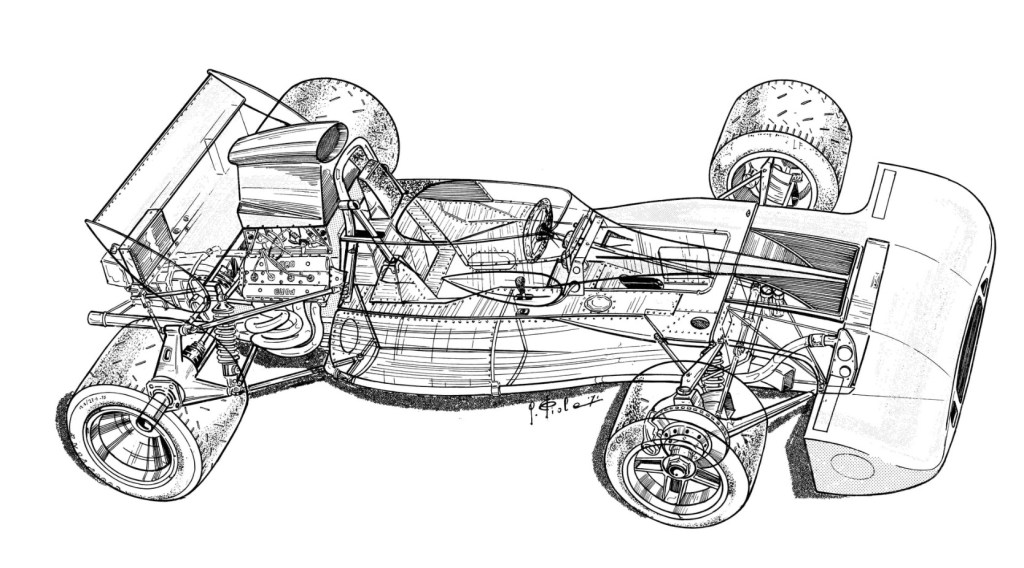
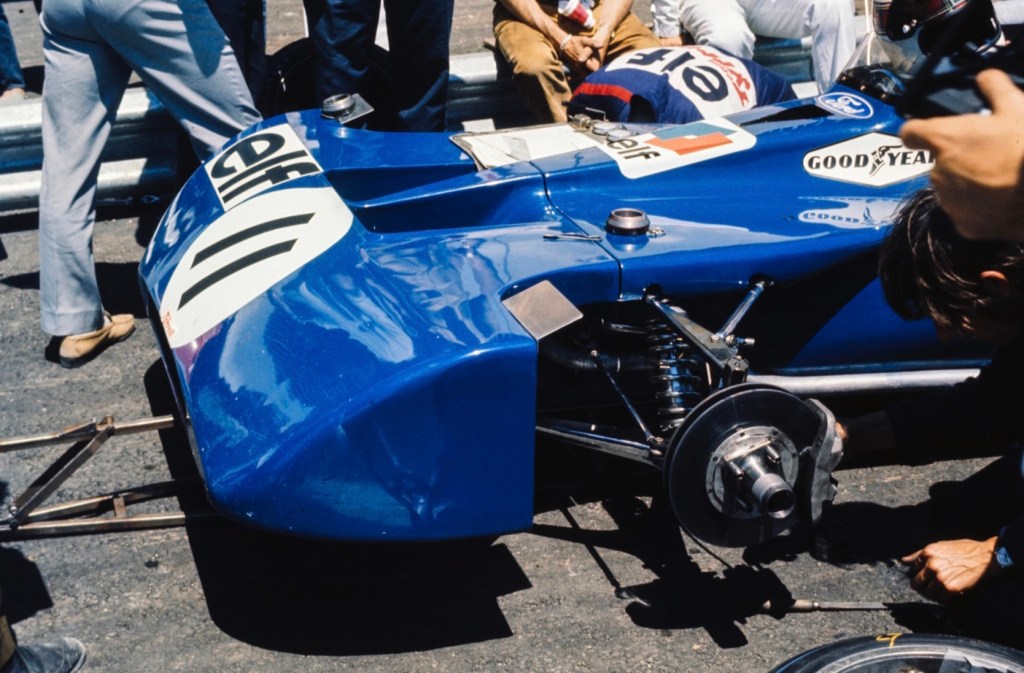
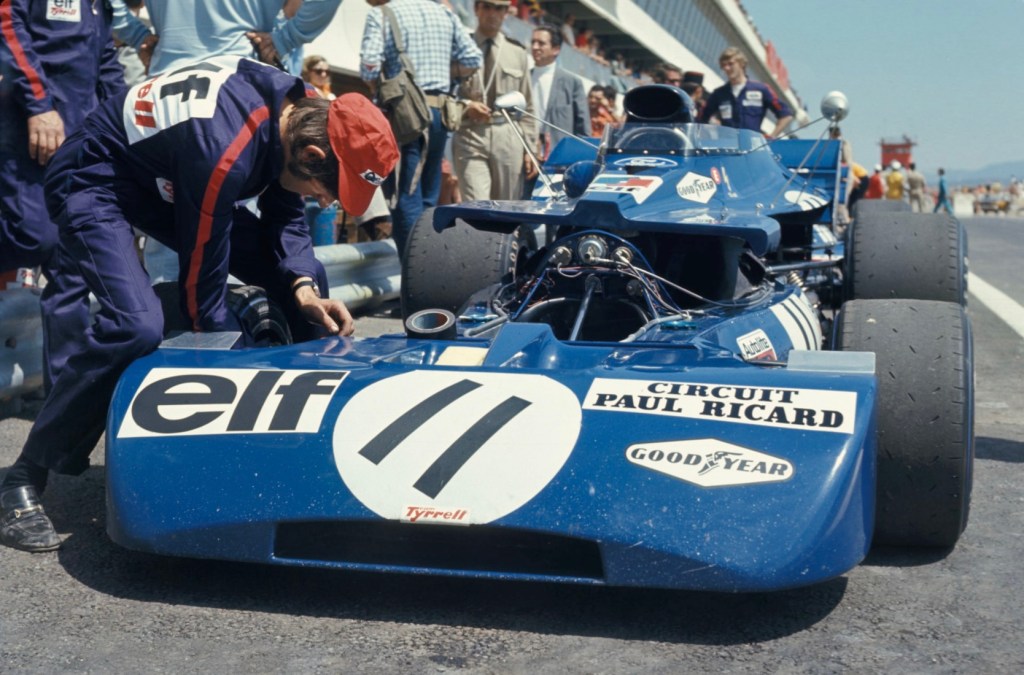
Two of the team MS670s in the garage at Le Mans in 1972. The MS73 circa 450bhp 3-litre V12 is a stressed member of the monocoque chassis, note the light tubular frame to support the rear bodywork, the five speed transaxle is ZF.
The third member of the Le Mans team was an MS660C crewed by Jean-Pierre Jabouille and David Hobbs, DNF gearbox after 278 laps in the final hour.
David Hobbs, MS660C in 1972 (MotorSport)(MotorSport)
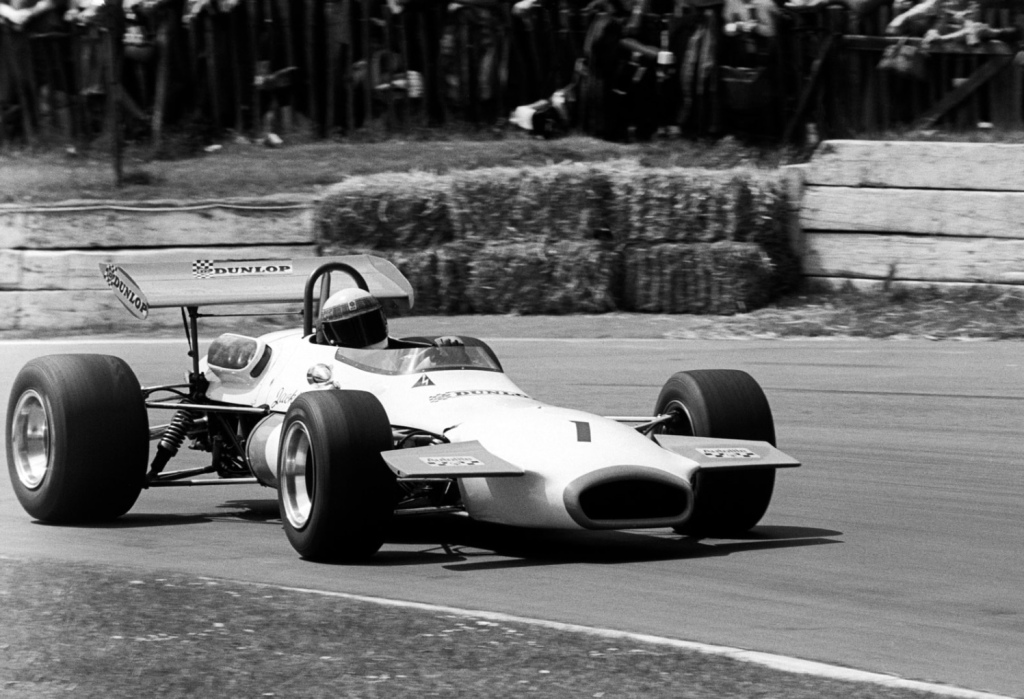
Jean-Pierre Beltoise lines up for the start of the July 1968 British Grand Prix aboard his Matra Sports Matra MS11 V12. Q11 and 14th in the race won by Jo Siffert’s Lotus 49B Ford.
The best placed of the Matras was Jackie Stewart’s Ken Tyrrell/Matra International MS10 Ford DFV in sixth. See here for a piece on JPB; https://primotipo.com/2015/01/15/r-i-p-jpb/
(MotorSport)(MotorSport)
Francois Cevert tips his Matra MS670B into a right-hander at Dijon in during the 1000km enduro in 1973.
Unlike 1972 when Ferrari and Matra shadow-boxed – Ferrari won everything but didn’t contest Le Mans and Matra won Le Mans but didn’t race anywhere else – Matra won a clean fight with Ferrari in 1973. They again won at Le Mans, the MS670B driven by Henri Pescarolo and Gerard Larrousse were the star crew of the year. Matra won five of the ten World Sportscar Championship rounds, narrowly taking the title from Ferrari, 124 points to 115.
(MotorSport)
Jean-Pierre Jaussaud, Matra MS6 Ford 1-litre F3 car during the 1967 Monaco F3 GP weekend.
JPJ won heat one and Pescarolo the other in the second Matra Sports entry, with Henri in front of Jean-Pierre in the final by six-tenths of a second, with Derek Bell’s Brabham BT21 Ford another half-second in arrears.
While Brabhams were again 1967 Top F3 Dogs in the UK and Sweden, Matras won the French (Pescarolo), Italian (Geki Russo) and the Argentinian Temporada (Beltoise) titles.
Amon Monaco 1971, Q4 and DNF diff MS120B (MotorSport)
Amon and Matra, what should have been never quite was!
Chris won the non-championship 1971 Argentine GP which was a portent of ‘front two row’ qualifying pace over the ensuing two years but 11th in the ’71 World Drivers Championship and 10th in 1972 was a poor dividend not really indicative of the pace of the car and driver.
Chris should have won at Clermont in 1972, as it was, pole and fastest lap there, and fastest lap at Nivelles was about all the driver and team took away from the season, withdrawal as a team from F1 followed. Very sadly. Feature piece about the MS120 here; https://primotipo.com/2014/07/06/venetia-day-and-the-1970-matra-ms120/
Amon, Mosport 1972 Q10 and sixth MS120D (unattributed)(LAT)
Jacky Ickx won the first European F2 Championship in 1967 aboard Ken Tyrrell Matra MS5 and MS7 Ford FVAs.
Here he is at the Nurburgring over the August 6, German GP weekend in an MS5 which was outted with suspension failure, I wonder why!? More on the MS7 in this piece on Johnny Servos-Gavin; https://primotipo.com/2016/09/02/johnnys-talbot/
Jackie Oliver won the F2 section of the race, he was fifth overall in a works Lotus 48 FVA. Denny Hulme won the race from Jack Brabham in a Brabham Racing Organisation BT24 Repco 1-2, Alan Rees was the second placed F2 home, seventh overall in a Brabham BT23 FVA.
Ickx won the championship from Frank Gardner’s works Brabham BT23 and Beltoise’ MS5 and MS7, but the F2 Star was – as ever – graded driver, Jochen Rindt with five wins of the ten rounds aboard his Roy Winkelmann run Brabham BT23 Ford FVA.
(MotorSport)
Jackie Stewart, Matra MS80 Ford – the 1969 drivers and constructors champions – from Bruce McLaren, McLaren M7C Ford at Monaco in 1969.
Jackie retired with a broken UJ and Bruce was fifth in the race won by the Mayor of Monaco, Graham Hill, in his Lotus 49B Ford, for the fifth time. It was the crazy weekend when the CSI/FIA banned high-wings after Friday practice, see here; https://primotipo.com/2015/07/12/wings-clipped-lotus-49-monaco-grand-prix-1969/
Matra International and Stewart won the respective titles with victories at Kyalami, Montjuich Park, Zandvoort, Silverstone and Monza. See here for more on the Matra MS80; https://primotipo.com/2016/07/01/matra-ms80-ford/
(MotorSport)
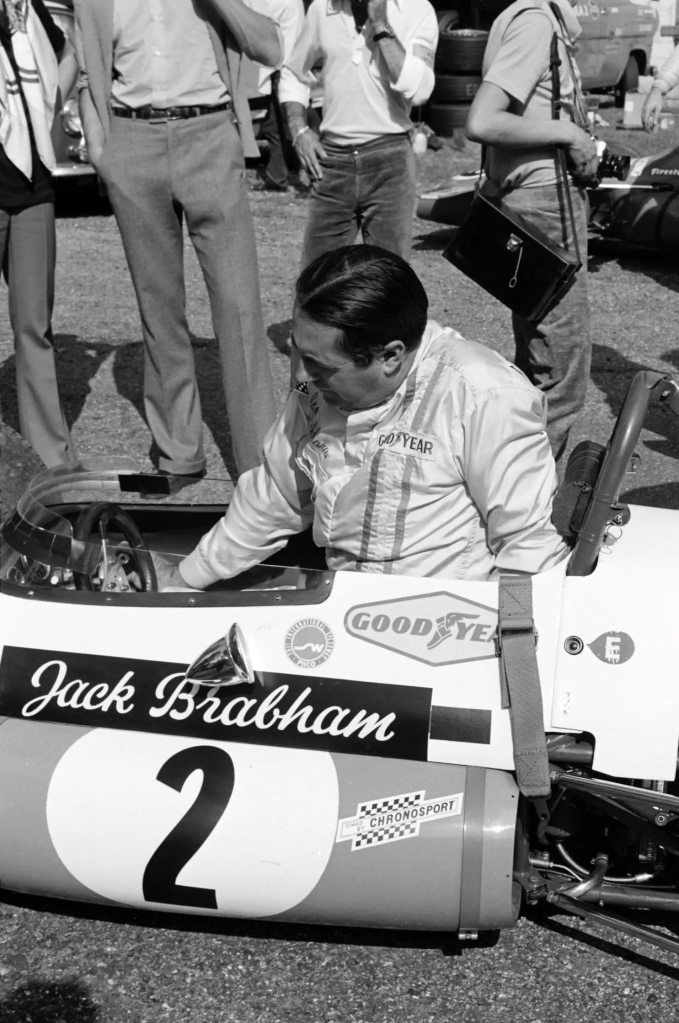
Jack Brabham at Daytona in 1970, where he was 10th in the Matra MS650 he shared with Francois Cevert. It was Black-Jack’s final season, later Australian taxi-competition duly noted.
Relieved of management responsibilities – he had sold his half share in Motor Racing Developments and the Brabham Racing Organisation to Ron Tauranac at the end of 1969 – the wily campaigner attacked his final season with great vigour, knowing he had Her Indoors to look forward to on a more regular basis when the family returned to Australia.
Apart from his Brabham F1 program, he raced an F2 Brabham BT30 for John Coombs, contested the Indy 500, and had a program of World Endurance Championship rounds with Matra, see here for the detail; https://primotipo.com/2016/09/09/jack-and-francois-matra-ms660/
Brabham in the MS650 he shared with JPB, Brands Hatch 1000km 1970. 12th in the race won by the Rodriguez/Kinnunen Porsche 917K (MotorSport)(MotorSport)
The quickie MS7 F2-derived F1 Matra MS9 Ford DFV was knocked together as an R&D machine in advance of the quintessential ’68 Ford powered MS10.
MS9 was raced at Kyalami to give Ken Tyrrell and Jackie Stewart a car in which to contest the opening 1968 F1 round in South Africa.
(MotorSport)
The car was purposeful in its military green primer and became an entrant in the Fugly Car Cup when fitted with an outsized front radiator, extra water tankage and cooler to cope with the ferocious African heat (below). All the hard work paid off though, Jackie drove the lash-up to third behind Jim Clark – the great Scot’s final F1 victory – and Graham Hill’s Lotus 49 Fords.
The MS9 was used only once again in a test at Albi before being set aside and ultimately restored, it resides in a private collection.
(MotorSport)(MotorSport)
The definitive 1968 Ford V8 powered F1 Matra was the MS10, here at Spa with Jackie on his way to fourth place, and below at Rouen in the tragic French GP.
Jo Schlesser died in the new Honda RA302 that awful, wet day, while Stewart was third. Bruce McLaren won at Spa in his M7A and Jacky Ickx in France aboard his Ferrari 312, the only F1 race not won by a Ford Cosworth powered car that season.
(MotorSport)
Francois Cevert, Matra MS670B from Brian Redman, Ferrari 312PB at Le Mans in 1973.
Both cars failed to finish, the Icky/Redman car with engine failure after 332 laps, and Cevert/Beltoise after completing 157 laps before a puncture induced accident. The winning Pescarolo/Larrousse MS670B competed 356 laps, while the second placed Art Merzario-Carlos Pace driven Ferrari 312PB 350 laps. A convincing win indeed.
The tail shot below is of a 670B during the May 1973 Nurburgring 1000km weekend.
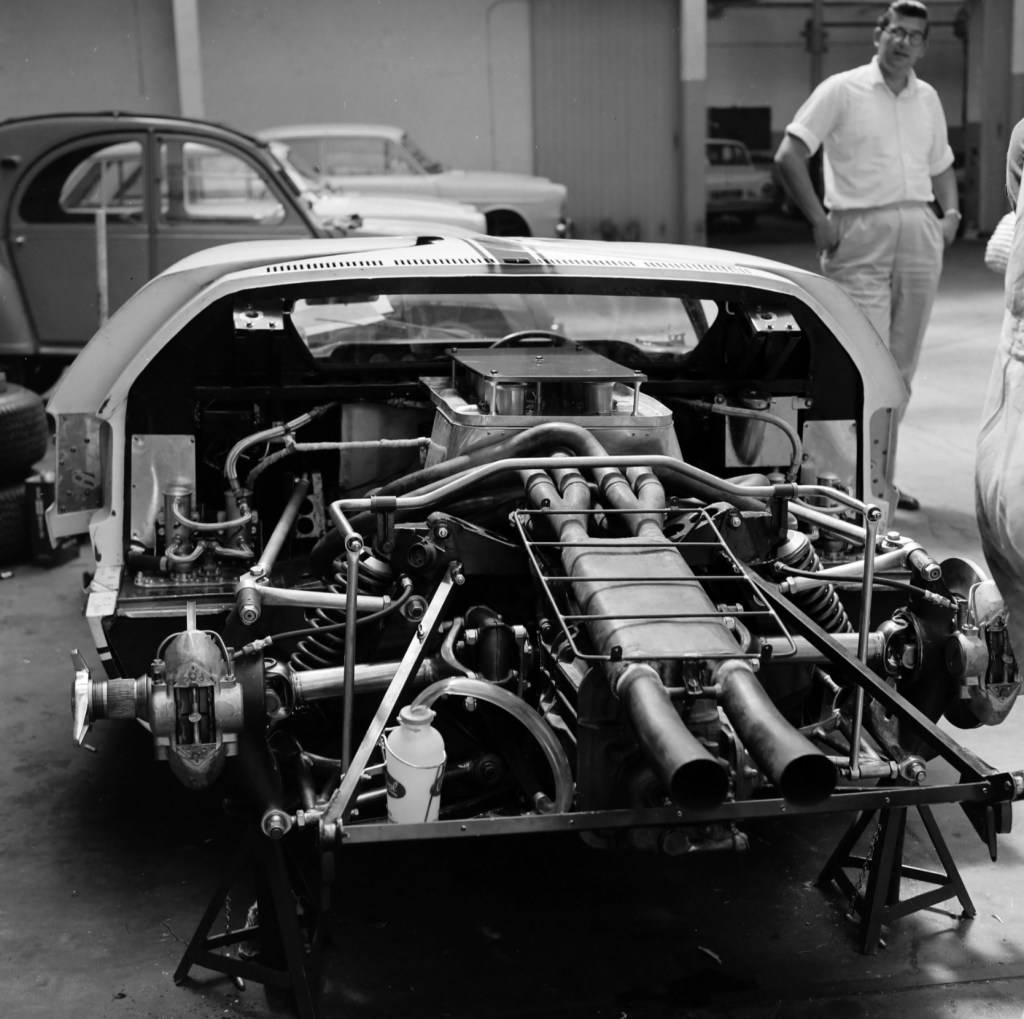
Both the Cevert/Beltoise and Pescarolo/Larrousse 670Bs retired with engine failure allowing an easy Ferrari 312PB 1-2, the Redman/Ickx pair in front of Pace/Merzario. Hewland gearbox this time, note the alternator driven off the rear of the transaxle.
(MotorSport)(MotorSport)
Jo Schlesser during the 1966 German Grand Prix, F2 1-litre Cosworth SCA powered Matra MS5. Jo was third behind two other MS5s raced by Beltoise and Hubert Hahne (Tyrrell entry).
1966 was the year of absolute F2 dominance by the works Brabham Hondas raced by Brabham and Hulme. Sad story on Schlesser, more positively, I am in the process of assembling a feature on the man, will finish it soon; https://primotipo.com/2019/07/12/its-all-happening-3/
JPB before winning the F3 round at Reims on July 4, 1965 – a breakthrough first victory for Matra – Matra MS1 Ford.
It was a slipstreaming ball-tearer of a 54 minute race too, JPB won by one-tenth/sec from Piers Courage’s Brabham BT10 Ford with John Fenning’s Cooper T76 Ford two-tenths further adrift!
In another year of Brabham F3 dominance, Matra grabbed a market toehold. JPB won the Trophy de Cognac at Reims in July, while Jean-Pierre Jaussaud took two more wins aboard his MS2 Ford in September, the Coupe de Paris at Montlhery and Coupe Internationale de Vitesse at Albi.
(MotorSport)
Henri Pescarolo at the Kyalami first F1 championship round in 1970, Matra MS120.
Henri finished the drivers world championship that year in 12th place, while JPB was 9th. Their best results were third placings at Spa and Monza for Beltoise, and at Monaco, Pescarolo. Matra were seventh in the manufacturers championship.
That year the Velizy concern chose not to build a Ford powered variant of their chassis raced so capably by Ken Tyrrell’s outfit in 1968-69, and Tyrrell/Stewart felt they were better sticking with a Ford DFV powered chassis, having tested the MS120 that winter. Initially Tyrrell raced customer March 701s, but by the season’s end the pace of Derek Gardner’s Tyrrell 001 Ford was apparent, and was delivered in spades in 1971.
Zandvoort 1970, Beltoise’ fifth placed MS120. Isn’t the distance between the radius rods unusually small? (MotorSport)JPB, Brands Hatch, British GP 1970. DNF wheel after 24 laps, looong exhausts! (MotorSport)(MotorSport)
JPB on his way to victory in the VII GP de Monaco Formula 3 GP in 1966, Matra MS5 Ford, from Chris Irwin’s Brabham BT18 Ford – five-tenths adrift – and John Cardwell’s Lotus 41 Ford.
That year Johnny Servoz-Gavin won the French title in another MS5.
(MotorSport)
Another one that got away from Chris…
He led the 1972 French Grand Prix on a mans track – Clermont Ferrand – to half distance, then copped a puncture which dropped him back to eighth, then worked his MS120D back up to third place. So close, again.
(MotorSport)(MotorSport)
Credits…
MotorSport Images, LAT Photographic, Getty Images, MotorSport, oldracingcars.com, Wikipedia
Tailpieces…
(MotorSport)
Of course, one of the most erotic of all Matras is the black one, Tony Southgate‘s 1975 Shadow DN7 Matra.
An experiment that was over way too soon, here at Monza driven by Jean-Pierre Jarier, DNF fuel pump after 32 of the 52 laps from Q13. Clay Regazzoni’s Ferrari 312T took a very popular victory. See here for an article on the Shadow Matra; https://primotipo.com/2016/01/15/shadow-dn7-matra/
Bruce McLaren piloting the works Isuzu Bellett at Goodwood during practice for the St Mary’s Trophy race over the April 19, 1965 International Trophy weekend.
In a busy weekend McLaren raced his Cooper T77 Climax to fourth place in the F1 feature, the Sunday Mirror Trophy, and his 4.5-litre Elva McLaren Oldsmobile to third in Lavant Cup, both races were won by Jim Clark, in Lotus 25 Climax and Lotus 30 Ford respectively. The power to weight ratio of this Nippon Racing, British Saloon Car Championship entry would have been the lowest of his mounts I suspect…
It was the first time a Japanese car appeared at a BSCC round, so it was an historic occasion. The Autosport report of the race records that a piston failed in the 1471cc four-cylinder engine in practice, so Bruce didn’t take the start of the event won by Jim Clark’s Team Lotus, Lotus Cortina and Jack Sears’ sister car.
(unattributed)Bruce about to go out with the fourth placed John Willment Racing Lotus Cortina of Frank Gardner behind (Goodwood Sixties)
John Sprinzel raced the Bellett at Crystal Palace on June 7, albeit not in the BSCC race, how did he go?
MotorSport Images, ‘Motor Racing at Goodwood in the Sixties’ Tony Gardiner, Stephen Dalton, Jack Inwood, Brent Benzie, Doug Nye
Tailpiece…
(J Inwood)
No doubt Bruce had ‘plenty’ of touring car form – don’t bother with an essay on the topic whatever you do, they were of no consequence to him – here with a works, I think, Morris Cooper at Pukekohe during the January 5, 1963 NZ GP meeting.
McLaren DNF’d that race after magneto failure in his Cooper T62 Climax on lap 24, John Surtees won aboard a Lola Mk4 Climax. I wonder how he went with the Mini? He brought this car out on his Australasian Tour that summer, racing it only in NZ, does it still exist?
Etcetera…
(B Benzie)
A few days after I posted this article I had a great email from Brent Benzie.
“I read with great interest the post about Bruce McLaren and the Mini Cooper he raced in the Tasman series support races (at least in New Zealand) back in 1962-63.”
“During the mid-late 1960s I owned and raced this car mainly at Teretonga, Wigram and Ruapuna. The late Wally Willmott, wh I got to know quite well in the 1970s, told me a lot about the details of the car and its history with Bruce, and that he (Wally) had quite a lot to do with its original preparation.”
“It had an interesting a very special engine that was basically a BMC Formula Junior unit. It was fitted with two 1 1/2 inch SU carbs with no provision for chokes and sure was hello get started in that South Island climate I can tell you.”
“I sold the Cooper to fund my move to Australia but I’m pleased to say that the car still exists in New Zealand and has been restored by a gentleman who lives in or near Auckland. See the photo.”
“Incidentally, before your post I had never heard of Bruce driving an Isuzu Bellett and it brought to mind a story I read several years ago about a company that, back in the 1990s, had just leased an abandoned warehouse near the docks in Los Angeles. Inside was a huge stock of Bellett parts – including complete engines, transmissions and body parts etc – all brought into the US by Isuzu but never distributed to their dealers before they ‘pulled the plug’ on that model.”
Fukumi Takatake – sometimes written Fukumi Kotake, born in Fukuoka, December 3, 1944 – at the wheel of the works Honda R800 during the 1969 Suzuka 500km, he finished second outright and first in the R1 class.
A very attractive car(s) new to me, the machine was of spaceframe construction, the design seemingly inspired by an F3 Brabham Honda owned by the Suzuka circuit, itself owned by Honda of course.
As the rear body-up photograph of the R800 shows below, its tiny air-cooled engine – mounted north-south at the front of the S600-800 roadies – was mounted conventionally in the rear of the sports-racer.
Honda R800 in the Suzuka paddock 1969 (unattributed)791cc all alloy DOHC, two-valve, water cooled four fed by two twin-choke Keihin carbs, 70bhp @ 8000rpm. With roller bearings supporting the crank – and its dizzy rpms – Honda delved straight into its motorbike practice book for this engineHonda R1300 during the 1969 Suzuka 1000km (unattributed)
The cutaway drawing of the R1300 below – the engine was mounted east-west in the Honda 9 – shows the engine-transmission unit is mounted transversely at the rear as was also the case on Honda’s stunning, successful 1964-65 1.5-litre V12 RA271-272 GP machines. The suspension, brake, wheels and other specifications are otherwise 1960s period typical. See here for a feature on the Honda 1.5-litre GOP cars; https://primotipo.com/2014/12/12/honda-ra271272-1-5-litre-v12-19645-gp-cars/
Honda R1300 cutaway (unattributed)Series 99 1299cc all alloy, SOHC, two-valve, air cooled transversely mounted four cylinder engine is fed by four Keihin carbs, dry-dumped, 116bhp @ 7300rpm (Honda Australia)(unattributed)
The R800 was built by Honda RSC the competition arm of Honda. The Racing Services Club was formed in 1965, then became the Racing Service Center and finally in 1982 morphed into Honda Racing Corporation. The car made its race debut that Suzuka 500km weekend and was Honda’s response to the Coniglio and Macransa (later Dome) Honda S-Series based kit/racing cars.
Shortly after the Suzuka ’69 500km race, Honda upgraded the machine by fitment of the 1.3-litre, air-cooled, four-cylinder engine fitted to their then new Honda 7/9 Coupe, a vastly underrated car. The 1300cc SOHC, crossflow, all alloy engine had a unique engine cooling system named Duo Dyna Air Cooling. The head and block had airways akin to the water passages of liquid called engines cast with short, stubby vertical fins. An impeller mounted directly to the crank pumped air through the passages, assisted by additional fins on the outside of the block. The dry sump carried plenty of lubricant, in a sense the engine was also oil cooled.
I’m having trouble finding the race record of the R800/1300, my Japanese is limited other than when excessively lubed. Information welcome.
Fukumi Takatake commenced racing motorcycles at 17 and was a contracted Honda rider at 19, winning the All Japan 250cc title in 1966. When Honda withdrew from two-wheel competition in 1967 (for a while!) he switched to four wheels, racing single-seaters, sports and touring cars. He ceased as a racer in 1987 after competing in the All Japan Touring Car Championship.
Etcetera…
(Honda Australia)
The Honda 1300 Coupe 9 was famously the last project Soichiro Honda personally led before retiring as Honda’s ‘Supreme Advisor’ in 1973.
His originality showed through in the design too, albeit times, safety and emissions legislation required a changed more conventional approach to become relevant and appealing to the masses. The brilliant Civic followed, there was nothing particularly novel about it, just great, bullet-proof engineering and build quality. Australian conditions are tough.
(Honda Australia)
My Mk2 Cortina GT was the typical student shit-fighter, but it was all-mine! I felt like I was jilting a babe after a chance drive of a very affordable Coupe 9, by 1976 they were el-cheapos, high risk ones too. My big-mistake was talking to Dad about it, I needed a bridging loan while I flogged Corty and bought 9 Outta 10.
“I’ve spoken to the car guy (the Fleet Manager who thought HQ Kingswoods were edgy) at work!” he said to me the next night, here we go I thought. “He reckons you’re a bloody idiot, it will cost you heaps. You’re looking after the Ford, he reckons you’ll have to rev the ears off it – just like the last bloke did…” And so on…
So I never did buy it but man it was a nice thing. A weird mix of old-tech like the rear axle, then that out-there engine and sweet gearbox. But it was so cohesive as a package, a howling but torquey engine, shitty looking nose tho. Time to drive one again, an interesting Classic Car article perhaps…
Credits…
Sanei Shobo, Historic Japanese Racing Cars Facebook page, Yukio Kobayashi, honda-rsc.com, yoshimura-rd.com
Tailpieces…
(unattributed)
Soichiro Honda looking pretty happy at the wheel of an S600 or S800 Honda.
John Surtees Honda RA300 ahead of Chris Amon’s Ferrari 312 at Monza in 1967. Big John won the race in a last lap duel and last corner fumble from Jack Brabham’s BT24 Repco, two-hundredths of a second the official margin.
Maybe Honda had mercy on Jack – their F2 partner in 1965-66 – saving him the embarrassment of the more obvious corporate shot! See here for a piece on that partnership; https://primotipo.com/2021/12/17/brabham-honda/
Reg Nutt aboard the Leech Brothers owned Cisitalia D46 Fiat at Rob Roy hillclimb in Melbourne’s glorious Christmas Hills on May 4, 1958. He ran second in his class that day behind multiple Australian Hillclimb Championship winner, Bruce Walton, Walton J.A.P with a time of 28.30 seconds.
Nutt was a riding mechanic in the first decade of Australian Grands Prix at Phillip Island in the 1920s and 1930s and then a racer of note in his own right, including AGPs. “Reg told me that he had raced 27 cars and never owned any of them,” recalled Bob King. What a lucky man.
Nutt in the Rob Roy paddock on November 5, 1947 when the car was owned by Fred Gibbs’ Sabina Motors (Davey-Milne Family Collection)Harry Firth in the D46 at Rob Roy in 1958. Later Oz 1960s and 1970s touring car star driver/engineer/team manager (L Sims Collection)
The car – chassis D461.1 according to John Blanden, and #0020 “the 20th of approximately 30 D46s built” according to a dealer in more recent times – was built in 1947 and sold to Frenchman, Roger Loyer (5/8/1907-24/3/1988) of the Ecurie de Paris. See here for a full-profile of Roger; https://gprejects.com/centrale/profiles/drivers/profile-roger-loyer
Loyer was a two time French national motorbike champion who switched from two wheels to four postwar aboard an old Delage D6. He then bought the Cisitalia – two D46s in fact, the other Ecurie de Paris car was driven by ‘the mysteriously self-styled Robert’ – which was prepared in his Ecurie de Paris garage located in the swish 17th Arondissement.
His D46 debut was at the Circuit des Remparts, Angouleme on June 15, 1947 and netted a heat victory, and third in the final sharing the car with Raymond Sommer. In the Coupe des Petites Cylindrees at Reims he was ninth, much better was third in the Coupe de Paris at the Bois de Boulogne in central Paris. Another strong fourth in a field of depth in the 330km GP du Comminges followed at St Gaudens in August, the three cars in front were Talbot Lagos. Late in the month Roger was third in a field of 12 Cisitalia D46s on the Circuit del Montenegro in Italy. A DNF late in the season at Lyon wasn’t representative of qualifying pace, fourth again at the Prix de Leman at Lausanne in October was followed by a season ending DNF with rear axle failure at the GP du Salon, Montlhery.
Roger Loyer and Velocette at the Isle of Man in 1933 (unattributed)GP des Remparts, Angouleme in 1949. Maurice Trintignant, Simca Gordini T11 in front won sharing with Jean Thepenier. Bruno Sterzi, Ferrari 166 #26, with Roger Loyer at right D46 Fiat DNF, and Harry Schell, D46 Fiat behind Trintignant (unattributed)Roger Loyer with his Cisitalia D46 Fiat at Lyon in September 1947 (Jannaud)
In a limited 1948 season – when the D46 was still very competitive in F2 events – Loyer raced at Pau in March, then Geneva in May for a DNF, then shared a car to third in the Circuit des Remparts with Robert in July. 1949 was worse in an even more limited campaign. DNQ at the Circuit du Lac in June and a crash at the Circuit des Remparts in July despite finishing second and setting fastest lap in the second heat. Robert and Roger shared a drive to sixth in the Circuit de Lac in a Simca, then contested the Grand Prix of the Nurburgring, where Roger was again a DNF.
Alan Watson was the buyer, but he didn’t use it much, notably giving it a run at Longford in March 1955. The car passed through several owners hands, albeit who were owners and who were drivers is lost a bit in the mists of time; the roll call includes Tony Osborne, John Doherty, Harry Firth, Syd Fisher, Ian Wells, Ray Gibbs and Ian Wells.
Lou Burke sold it to the Leech Brothers in 1964 and they used it for decades in Eastern Seaboard Australian historic events. The car was painted red circa 1980 when the pretty-Italian formed the bloke-magnet for the Lombard Insurance stand at motor shows. The car left Australia for the ‘States in 1987 and has pinged around the auction scene, some of the sales-prose Arthur Daley would be proud of.
The lack of straight tube-runs would have offended Colin Chapman (but not Owen Maddock), however, the Cisitalia D46 spaceframe – here in definitive production form – was simple, light and stiff for its day. So elegant in its simplicity (unattributed)
Design and Production…
While the Piero Dusio founded (1943) and funded – Compagnia Industriale Sportiva Italia or Cisitalia – Dante Giacosa 1946 spaceframe design is rightly lauded as one of the world’s first, certainly of one built in volume, Australian historians point to the Chamberlain Brothers’ Chamberlain Indian/Eight of 1929 as a stunning much earlier expression of multi-tubular spaceframe brilliance. See here; https://primotipo.com/2015/07/24/chamberlain-8-by-john-medley-and-mark-bisset/
In 1944 Dusio, via an interlocutory contacted and contracted Giacosa (to the end of 1945), a Fiat engineer to design ‘the outline and technical hypothesis of a racing car using Foot 500 and 1100 components.’
Giacosa’s small team comprised draftsman Edoardo Grosso, and from August 1945, Giovanni Savonuzzi, Dante’s replacement. ‘The project number 201 in keeping with those used by Giacosa at Fiat. While the car was later called D46, this remained the basis of the subsequent numbering of Cisitalias: 202, 204, 303, 505, 808 etc.’
‘Giacosa’s project 201 (first version with low sides and straight tube-runs) had a tubular spaceframe, the first time (it wasn’t) this revolutionary construction system was used’ (Cisitalia)(D Giacosa)
Overcoat clad Giacosa susses one of his early D46s. He later remarked, “When I came to build the chassis it was in my mind to make it of tubing. That’ll appeal to Dusio, I thought, since he builds Beltrame bicycles in his workshop.” It’s also thought that the tubular cockpits of the Rosatelli designed aircraft Giacosa worked on during the war was also influential.
Whatever the case, the ‘framework chassis’ adopted was light and stiff and provided a platform to ‘which the mechanical parts could be easily mounted in a low position…using existing equipment and staff already specialised in this kind of procedure. The molybdenum chrome plated steel (remember how scarce high quality material was in this immediate post-war period) used came from leftover Aeritalia stock ‘used by Rosatelli in the construction of CR and BR aeroplanes during and after the war.’
‘An interesting system was chosen for the gear change using three semi-automatic gears. The rear axle with its upside-down differential was another novelty’ (Cisitalia)‘The design envisaged two ways of lowering the drive: using a crown wheel and pinion or turning the differential upside down and using driving gear. The second solution was adopted’ (Cisitalia)
To better exploit the chassis further lateral thinking was applied to other key components. The rear axle and diff was turned upside down, with a small aluminium crankcase developed for the Fiat engine allowing a bevel gear pair to take the drive from front to back passing under the differential towards the driveshaft turned from a steel billet -the gear pair offered a range of ratios to driver choice. This lowered the engine by 12cm.
Front suspension was lifted straight from the Fiat 500. ‘Hydraulic shock absorbers were fitted on the prolongation of the lower triangle’ (wishbone), but turned upside down compared to original Fiat fitment. An upper transverse leaf spring performed compliance and locational duties.
Equally brilliant was the Grosso drafted three-speed, semi-automatic mechanical gearbox ‘intended to save time for the drivers during races’, later in the D46’s life (1948) four-speed conventional Fiat ‘boxes were used.
Short tests of the prototype took place on a short circuit backing onto the railway at the rear of the factory in Corso Peschiera in February 1946: Adolfo Macchieraldo, Carlo Dusio, Giacosa and Savonuzzi all had a steer. More importantly the vastly experienced engineer/racer Piero Taruffi drove the disc-wheeled, sketchy bodied prototype a short while later, and was appointed the official test driver. Evolution of the then car progressed quickly.
Rear axle with short coil springs and lever action friction shocks. Frame member and diff also in shot (Cisitalia)A Giacosa sketch which shows the differences in the original solid rear suspension location medium and quarter elliptic setup adopted – as per text. Also shown is the clever diff/driveshaft arrangement (Cisitalia)
Initial problems included rear end judder rectified by replacing the two rigid lateral suspension arms with two quarter elliptic springs ‘five to the axle, rotating freely on two pinions integral with the chassis, offering only resistance to torsional stress like an anti-roll bar, leaving the real springing to two short coil springs. The axle was connected to the chassis via a hinged triangle mounted to the diff and a spring at the point of chassis attachment which allowed suspension adjustment.’
The chassis cracked in the central area so was strengthened, in part by enlarging the body side and inserting a welded shaped metal panel of greater size. Note the differences clear in side views of the frame of the prototype and production cars, it evolved from Colin Chapman straight tube-runs to Owen Maddock wonky-ones! and worked as well as Owen’s!
‘From the first model with a small tubular lattice-work frame, the D46 moved swiftly to the definitive version with a modified chassis and a sophisticated semi-automatic gearbox’ (Cisitalia)
By September 1946 seven D46 Fiat 508B/1100cc powered 62bhp @ 5500rpm, 370kg Voiturettes had been built. ‘The line of the car was fascinating and aggressive at first sight, offering pleasing solutions such as the double fairing on the front suspension which gave it something of the air of a biplane. The nose was perfect oval which incorporated a small upper air intake which fed the carburettor via a duct, brining a certain amount of overpressure when racing.’
The steering wheel could be tipped to allow easier access for the portly. The six-piece, beautiful, quick-fitting Itallumag body was made by Turin’s Rocco Motto, the riveted 45 litre duralumin fuel tank by De Gregori, another local.
The initial batch of seven cars were raced in the Coppa Brezzi at Valentino Park, Turin on September 3. Piero Dusio won from Franco Cortese and Louis Chiron, poor Tazio Nuvolari had the steering wheel come away in his hands when it broke away from its hinge, below.
(Wikipedia)‘The definitive version of the little 1100cc D46 with fairings on the front wheels and the curious system of the tip-up steering wheel’ (Cisitalia)(Cisitalia)
‘Selection of first gear or reverse was carried out by means of a lever set on the side of the steering column, while to change from first to second or from second to third or back down again the clutch pedal had to fully depressed. To change from second or third to first or neutral, the clutch pedal had to be fully depressed again, but after having moved the hand lever to the desired position. To use the clutch without changing gear, the pedal had to be depressed about halfway, when a hardening was encountered beyond which the gear shift was operated.’ Yeah right, buggered if that makes sense to me despite driving a couple of cars with pre-selector ‘boxes recently…
(Cisitalia)
Towards the end of 1947 Rudolf Hruska and Carlo Abarth joined Cisitalia as Technical General Manager and Racing Manager respectively. The D46 was modified and shown at the October 1947 Milan Motor Show (above).
The nose was still oval but more horizontal, the fairings deleted, sides extended to house two lateral fuel tanks. ‘The overall line of the car was influenced by the design of its big sister, the supercharged 1500cc Grand Prix car taking shape on the firm’s drawing boards.’
In addition, the semi-automatic gearbox was dropped in favour of a standard Fiat 1100 4-speeder, the rear suspension modified by fitment of twin torque arms on each side, and telescopic hydraulic shock absorbers adopted all-round.
Etcetera…
(Sud Ouest)
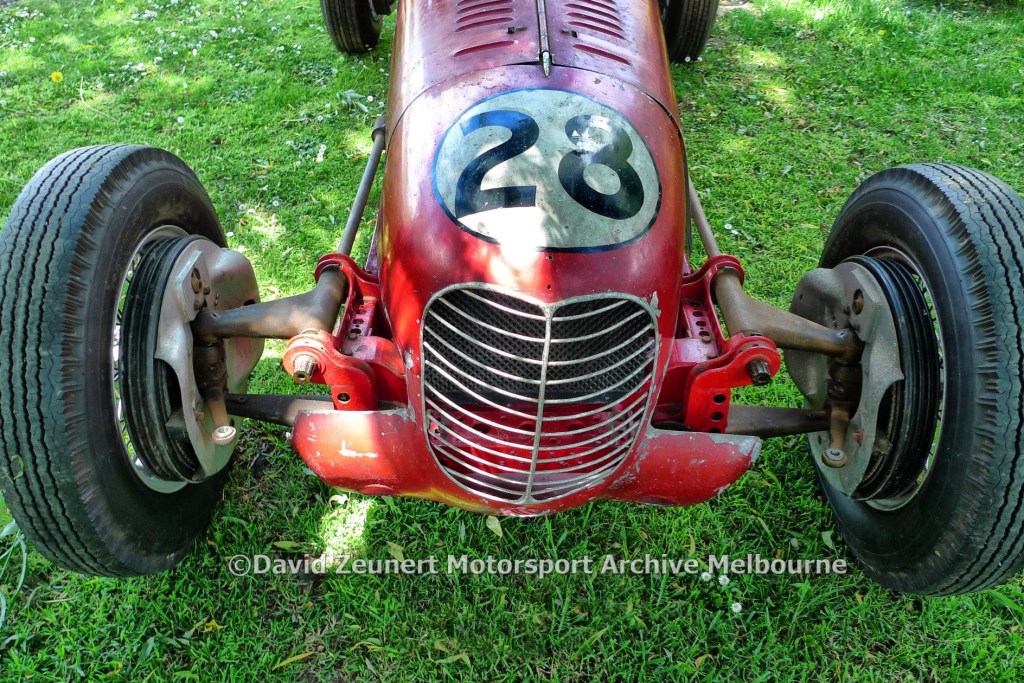
Cisitalia D46s at the Circuit des Remparts, Angouleme in 1949. #2 is Loyer, #28 is Guy Michelot and future, fast GP driver Harry Schell is on the move in the family Ecurie Bleue #20 machine.
(unattributed)
Roger Loyer having a gargle alongside ‘our’ D46, perhaps, Ecurie de Paris raced two, after a strong showing, place unknown. Fosters Lager stubby perhaps…
(M Wells Collection)
Who said tits don’t sell, it’s always worked with me? A couple of delightful lasses resplendent in much less than acceptable attire these days, during Melbourne’s March Moomba festival in the early 1960s.
(R Jackson)
Looking quite the beauty queen at Sandown in the 1970s above, and below in the old pits at the same venue in June 1963; so distinctive from every angle, form and function…
(A Tracey)(G Shepherd)
Not Tazio’s tiller but the altogether more flash one of ‘our’ D46 at Calder when owned by the Leech boys circa 1966.
(M Wells Collection)
Ian Wells with elbows out at Calder in the early 1960s. The car in strife behind is the “Platypus MG”, Greg Smith tells us. “By this time it was fitted with a big Healey-four, later to be reconfigured by Lou Molina as Vulgarilla (famous Oz MG Special raced by Molina, an equally legendary racer/hotelier/raconteur) and still sports the same alloy tail, maybe Murray Nankervis at the wheel.”
(A Tracey)
Jim Leech taking on the challenging Mount Tarrengower hill, in Victoria’s Goldfields region, 1964. The Brothers Leech had a small but very select collection of old cars they used extensively.
(Australian Motor Racing No 2 1952 – S Murray Collection)
WTF…
The Sehab Alma Bey Trophy was an invitation race for Cisitalia D46s held on the 1.48km Circuit El Guezireh – The Pyramid Circuit around the Guezireh Park – Cairo on March 9, 1947.
Franco Cortese won the first heat and Piero Taruffi the second, and Cortese the 50 lap final from Alberto Ascari, Taruffi, Piero Dusio and Mario Tadini (below entrant numbers unknown).
(New York Times)
Credits…
Reg Nutt Collection via Leon Sims, Troy Davey Milne, Mark Wells Collection, Graham Shepherd via David Zeunert, Jannaud, Russell Jackson, Ashley Tracey, New York Times, ‘Profile – Roger Loyer’ Jeremy Scott, ‘Historic Racing Cars in Australia’ John Blanden, ‘Cisitalia’ Nino Balestra and Cesare Agostini via Tony Johns, Stuart Murray Collection
Tailpiece…
Rendition by Martin Vins of a famous original photograph of Felice Bonetto – replete with fag – sliding his D46 Fiat at the Circuito di Mantova in 1948.
Monaco GP weekend 1964, Revson – Parnell Racing Lotus 24 BRM, DNQ. Graham Hill won, BRM P261 (MotorSport Images)
I love this letter to the editor of MotorSport from Ray Truant, of Hamilton, Canada, their Star Letter in the September 2023, current issue, highly recommended of course.
“In F1 Retro…Peter Revson is referred as ‘the heir to the Revlon cosmetics fortune.”
“This is a statement repeated during Revson’s entire racing career by the media, but was never correct. While he was a Revson, Peter’s father split his interest in the Revlon firm very early from his brothers Charles and Joseph in 1958 and had no equity in Revlon.”
1973 Brazilian GP, McLaren M19A Ford. DNF gearbox after 3 laps from Q12, Emerson Fittipaldi won in a Lotus 72D Ford on his way to the drivers title (LAT)The 1969 Indy 500 carnival had its moments but fifth place in the Brabham BT25 Repco 760 V8 was a career turning point in the view of some – from dilettante to pro. Mario Andretti won in a Hawk 3 Ford (MotorSport)Sebring 12 Hour 1966, Essex Wire Ford GT40, third shared with Skip Scott. Ken Miles and Lloyd Ruby won in a GT40 X-1 Roadster (LAT)
“Charles and Joseph Revson ran Revlon subsequently into an empire, but Peter’s father was not involved. He ran Del Laboratories and lived to an incredible 105 before dying in 2016. Interestingly, Martin Revson left Revlon over ethical concerns of how the company was marketing to women.”
“The media loved the playboy heir story so much they ignored the reality and it persisted throughout Revson’s career, despite Revson’s attempts to correct this myth repeatedly in interviews.”
McLaren M20 Chev at Watkins Glen in July 1972, the reigning Can-Am Champ was second to Denny’s M20 that day (MotorSport/R Schlegelmilch)Chassis sorting the McLaren M23 Ford during the June 1973 Swedish GP weekend at Anderstorp, Q7 and seventh in the race won by Denny Hulme’s sister car (MotorSport/D Phipps)
Practice session meeting of the type established by Bruce McLaren. Alastair Caldwell ponders while Denny and Revvie chew the fat. Monza 1972, where they were third and fourth in their M19C Fords, Emerson Fittipaldi’s Lotus 72D Ford won.
Credits…
MotorSport and Ray Truant, MotorSport Images, LAT Photographic
(MotorSport)
Tailpiece…
Sixth place in a gloomy Race of Champions at Brands Hatch on March 17, 1974, Shadow DN3 Ford. Sadly the car in which Peter perished due to component failure – a titanium ball joint – during practice at Kyalami, South Africa, the week after Brands on March 22.
Racing a Grand Prix Maserati around the short, tight Darley circuit outside Melbourne would have been somewhat akin to racing in ‘yer backyard…
Reg Hunt pretty much became-the-pace when he imported this 2.5-litre Maserati A6GCM (chassis ) to Australia, he was stiff not to win the ‘AGP at Port Wakefield, South Australia with it in 1955.
These two Australian Motor Manual excerpts highlight the controversy surrounding the selection of Port Wakefield as the AGP venue that year given its short length – only the Goulburn course used for the first AGP in 1927 was shorter – and put in the electronic public domain Hunt taking the Darley lap record in his lead up preparation to the AGP.
This press advertisement dated January 13, 1968 changed the racing world as we knew it in many parts of the globe, the US and some other places excepted…
The days of the mobile fag, franger and fragrance wrapper were underway, for better or worse.
While Lotus and Imperial Tobacco were negotiating the commercial deal which would take advantage of the FIA/CSI relaxation of rules relating to the advertising of non-trade products and services on racing cars, the business of motorsport rolled on.
(MotorSport)
Jim Clark took off where he left off at the end of 1967, the fastest car/driver combination won the South African Grand Prix in Kyalami. Clark won aboard his Lotus 49 Ford from Graham Hill in the other Team Lotus entry, and Jochen Rindt’s Brabham BT24 Repco.
After that race – his final Championship GP win as events transpired – he flew to New Zealand along with Jack Brabham, Bruce McLaren, Denny Hulme, Chris Amon, Pedro Rodriguez and Graham Hill to join other internationals, Frank Gardner and Piers Courage, and local drivers for the 1968 Tasman Cup.
That summer the highly competitive 2.5-litre series comprised four rounds in NZ, and in Australia, commencing with the NZ GP at Pukekohe on January 6, and concluding with the South Pacific Trophy at Longford, Tasmania on March 4. Eight events in eight weeks on both Kiwi islands, shipping the circus across the Tasman Sea from the very south of the South Island (Teretonga) to Brisbane…oh, yes, and prepare the cars for the 100 mile races too. While the series was famous for sun, fun and spunkmuffins there was some serious racing as well. To win the Tasman required a mix of speed, discipline, endurance and organisation.
(LAT)
Chris Amon jumped out of the blocks, winning at both Pukekohe, and Levin aboard his works Ferrari Dino 246T. JC had engine failure after 44laps in the NZ GP while in the lead, and suspension problems at Levin (above). He ran wide off the track early, caught Amon but then went off again and bent a radius rod while trying to pass Chris.
During the week between Levin and the Lady Wigram Trophy round, the small team looking after Jim’s Lotus 49 Ford DFW organised a signwriter of some talent, at Hutchinson Ford, Christchurch to apply the cancer-stick signage in accordance with the Gold Leaf corporate identity standards manual…a document with which Lotus staff were to become intimately familiar.
Kiwi journalist, Allan Dick wrote that there was a function held in Christchurch on the Friday evening of the race weekend to unveil the new colours, perhaps the shot below is during said gig, albeit the venue doesn’t appear particularly salubrious.
(MotorSport)(A Batt)
Big Wigram crowd taking in the candy-coloured Lotus – chassis number R2, Jim’s 1967 F1 mount – over the January 20 weekend. Clark provided plenty of cheer for the suits back in the UK when he won ‘on GLTL debut’ from Amon and Denny Hulme’s F2 Brabham BT23 Ford FVA.
These three shots are all at Wigram Clark from Amon at Wigram (sergent.com)Wigram looks chilly that day, Kiwi-Oz touring car ace Jim Richards with his hands in race-suit pockets towards the far right of the crowd
Bruce McLaren won for BRM at Teretonga in the final NZ round. He finished in front of Clark after Jim had an off while in the lead. Bruce’s mount was a 2.5-litre V12 engined BRM P126, a chassis designed by Len Terry, and being blooded in advance of the ‘68 F1 season by McLaren, Rodriguez and Richard Attwood.
Clark had a much stronger run on the other side of the Tasman Sea – where he was joined by teammate Graham Hill, who had been enjoying a family holiday – winning the Surfers Paradise 100, the Warwick Farm 100 in Sydney and the Australian Grand Prix at Sandown, in Melbourne’s outer suburbs. Only the final round at Longford eluded him, Piers Courage took a wonderful victory there in his F2 McLaren M4A Ford FVA in streaming rain.
Clark at Teretonga where a high speed off cost him the lead to Bruce McLaren (unattributed)Clark at Sandown winning the AGP, here on Pit Straight in third gear. The shot highlights the shortcomings of the too low roll bar. While Jim was well familiar with seat belts in his ‘Indycars’, he missed these safety devices in Grand Prix racing, commonplace as they were by the end of the year
When he departed Australia on or about March 5, Jim Clark had won his final GP and championship, he died a month later at Hockenheim during the first heat of the Deutschland Trophy, Euro F2 Championship round, aboard a GLTL Lotus 48 Ford FVA on April 7, 1968.
Last discussion before the off with Dave ‘Beaky’ Sims, Hockenheim April 7, 1968 (MotorSport)Clark here running behind Chris Irwin, Lola T100 and Chris Lambert, Brabham BT23C, the Lotus, Lola and Brabham all Ford FVA powered (MotorSport)
Etcetera…
(W Reid)
Graham Hill displaying his new colours, ones he immortalised in the F1 record book by the end of a tragic year, Sandown paddock, February 1968.
(W Reid)
Hill raced Lotus 49 chassis R1, early spec 49s used a ZF five-speed transaxle rather than the later Hewland DG300, engine is the Ford Cosworth DFW 2.5-litre V8. The skinny rears – front tyres – are for transport purposes. A bit of arcane trivia for Melburnians is that the GLTL Lotuses were fettled in the Head Brothers, BMC dealership and bodyworks, at 504 Neerim Road, Murrumbeena, (below) not too far from Sandown.
(J Makeham)
Ford Australia must have kicked in a few dollars to the budget, note the crude ‘Australia’ added to the deft signwriting on the nose of the Lotus executed in Christchurch. The elaborate trailer is as flash as the one I used to tow my Formula Vee.
(C Neale)
Jim Clark about to go out and win the AGP at Sandown. The official margin between Clark’s Lotus 49 and Chris Amon’s Ferrari 246T is one-tenth/sec, but it was closer than that!
(unattributed)
Fags…
Kiwi enthusiast/historian Graham Woods wrote that “The first car (other than in places like the US where such advertising had been allowed) to carry tobacco sponsorship was in South Africa in a round of the SA F1 Championship.”
“The driver was John Love, and the tobacco company, Gunston. Three weeks before Wigram, Love and Sam Tingle started the South African GP, the opening round of the world championship in a Brabham and SA built LDS on January 1. Love was ninth and Tingle DNF – both were in Gunston colours. “
John Love in the Team Gunston Brabham BT20 Repco during the ‘68 South African GP (LAT)
“South Africa was Jim Clark’s last GP win in the green and yellow of Team Lotus. The first race for Lotus in GLTL colours was at Wigram, the first championship GP, the Spanish GP at , a race won by Graham Hill’s Lotus 49 Ford…another GP that got away from Chris Amon, whose Ferrari 312 dominated practice and led most of the race.”
Graham Hill enroute to winning the 1968 Spanish GP, GLTL Lotus 49 Ford (MotorSport)(CAN)
Afterthought…
The afterthought goes to Allan Dick of New Zealand’s Classic Auto News.
‘Historic image of Jim Clark’s Lotus 49T (“T” for Tasman) at Wigram 1968. It’s historic because this was the first time the public had seen the new Gold Leaf sponsorship — a first for Formula One on this scale. The deal with Lotus and the tobacco company had been finalised between Levin and Wigram and it was done in “secret”.’
‘There had been an official and rather exclusive unveiling on the Friday evening in the snobby “The Motor Racing Club” way of doing things in those days, but it was Saturday morning when the great unwashed got to see it. There it sat, paint so new it still looked sticky and fenced off with a great lump of old rope! The reaction? I can still remember it clearly! It was “Yucchhh!” Nobody liked it. It looked cheap and taudry. Nobody thought it was good. We far preferred the dark green with yellow stripe — traditional Lotus. But the world got used to it.’
Credits…
Bryan Miller Collection, LAT Photographic, Allan Batt, Ray Sinclair, John Lawton, Warren Reid, Chris Neale, John Makeham, Allan Dick Classic Auto News
Frank Matich leads a Triumph TR4 and Austin Healey 100 on the short stretch of road between Long Bridge as he aims his Lotus 19B Climax into the progressively more-uphill-on turn-in Newry Corner during the 1964 Australian Tourist Trophy, February 29, 1964.
Bill Brown in the Scuderia Veloce Ferrari 350 Can Am – aka P4 – at Bathurst during the 1968 Easter meeting. Such a marvellous evocative shot of the most seductive of cars.
In the space of a week photographs popped up on Bob Williamson’s FB site on Scuderia Veloce topics from three different photographers, Ray Sinclair, Greg Earle and Robert Spence.
In the shot below the scowling Kiwi is motoring through the Sandown paddock, perhaps miffed that his 4.2-litre 480bhp V12 was beaten by Frank Matich in the Sydneysider’s 4.4-litre Repco V8 powered Matich SR3. See here for a feature on this Ferrari; https://primotipo.com/2015/04/02/ferrari-p4canam-350-0858/
Chris Amon at very sunny Sandown earlier in the year aboard his Ferrari 246T, with a line of Formula Vees behind, with Bib Stillwell arriving at the circuit in the Ford Galaxie.
Chris just failed to pip Jim Clark in the closest of finishes in the Sandown Australian Grand Prix Tasman Cup round the following day, the official margin was one-tenth of a second. With that the Scot took both his last final GP and championship win – the Tasman Cup – aboard his works Lotus 49 Ford DFW. See here for a piece on that weekend; https://primotipo.com/2021/03/06/1968-australian-gp-sandown-2/
350 Can Am in the Sandown paddock. The #7 Brabham is Greg Cusack’s SV machine, the BT23A Repco raced by Jack Brabham the year before. Quickie on the BT23A here; https://primotipo.com/2017/01/04/scuds/
On the blast past the old pit-counter at Sandown, paradise for a young enthusiast, with the V12 howling its fabulous song in third gear.
Amon was given the short back-and-sides by Frank Matich’s Matich SR3 Repco V8 at the three meetings they met in the sportscar Tasman Cup round supports that summer; Warwick Farm, Surfers Paradise and Sandown. I wonder why FM didn’t take the SR3 to Longford to bag the Quadrella?