
(oldracephotos.com.au)
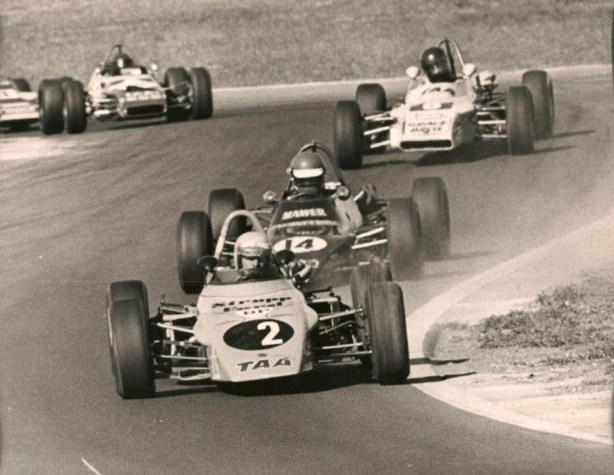
Terry Perkins, Elfin 620 Formula Ford leads Peter Larner’s Wren and another Wren – Murray Coombs’ F3 car – back to the Calder paddock as they run down the old circuit exit in 1973…
A swag of Australians pursued a motor-racing career in the UK down the decades, it would be interesting to create a definitive list. My own interest are those guys who gave it a crack that I had seen race in Australia prior to heading across the oceans to the world’s racing capital.
Those who spring to mind – its not an attempt at a definitive list from 1972 – are The Brabham Boys – Geoff, Gary and David (F3), Paul Bernasconi (F3), Chris Farrell (F3), Andrew Miedecke (F3 briefly), Gerry Witenden (FF2000), Gary Scott (F3), Lucio Cesario (WEC in Italy), Mark Skaife and Craig Lowndes (F3000), Steve Harrington (F3), Mark Webber (FF), Will Power (F3), Daniel Ricciardo (FBMW), John Martin (FF)…and Terry and Larry Perkins in F3. There are others post 1972 I’ve not seen…or forgotten, so spare me the pedantry.
Let’s focus on the latter brothers, primarily their single-seater exploits in Europe, do grab a wine or a couple of Carltons before you start though, a 1,500 word quickie has become an 11,500 word epic with a tangent or three thrown in, I really have wandered all over the joint with this one…
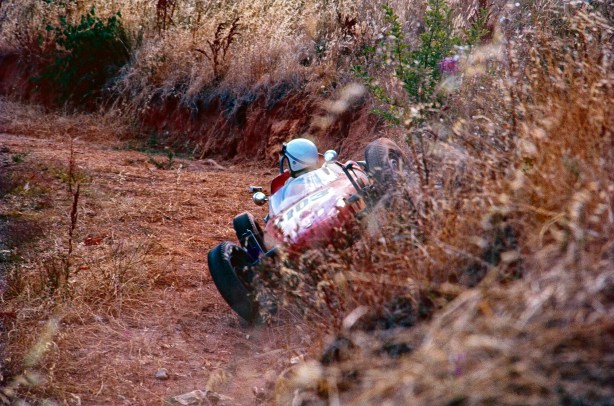
Larry explores the limits of his Perkins Vee- Hume Weir 1969 (D Simpson)
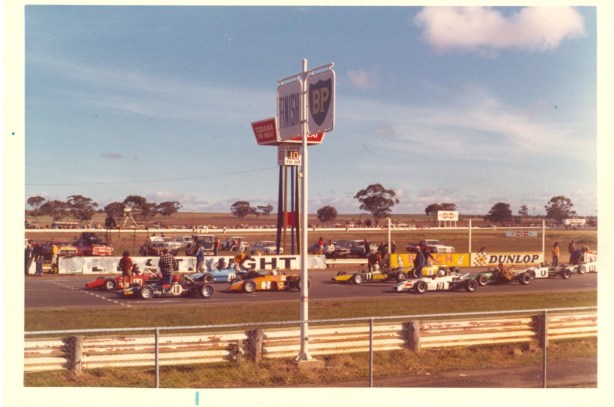
Quite possibly the Calder meeting at which Perkins T was photographed in the opening shot in 1973, a mixed FF and ANF3 grid, common in the day. I’ll take advice on who most of the cars/drivers are but it appears to be a red Elfin 600 and a Wren on the front row. That’s Terry on row 2 in car #2 Elfin 620 whilst on row 3 on the far side is, I think, Peter Larner whilst the white #78 is Brian Sampson’s Cheetah Mk3 Toyota-unusually far back (unattributed)
The path through motor racing in Australia for the Perkins brothers from Cowangie, a small whistle-stop between Ouyen and the South Australian border, aided and encouraged by their ex-racer/rallyist father Eddie was similar.
Both started in the Victorian Formula Vee ranks and progressed to Formula Ford winning the prestigious TAA Airlines Driver To Europe Australian FF Championship, and then off to the UK they went. Larry was scooped up by Bib Stillwell into his two car Elfin 600 Formula Ford team in 1970, winning the title in 1971, whereas Terry was victorious in 1974 aboard an Elfin 620 supported by Doncaster Ford Dealership Strapp Ford. Ted Strapp was a supporter of motor racing at the time.
Larry figured he wasn’t quite ready to take his DTE prize in 1971 so stayed in Australia driving, and helping to prepare Holden Dealer Team Torana’s of various types and won the Australian F2 Championship in Garry Campbell’s Elfin 600B/E Ford, no doubt the wings-‘n-slicks circa 180bhp experience stood him in good stead when he entered F3 in 1973.
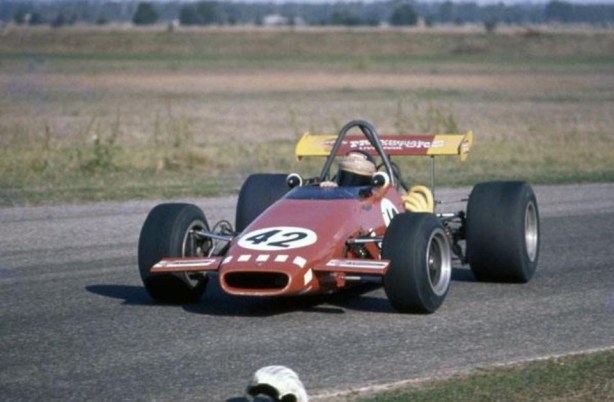
Larry in Garry Campbell’s ANF2 Elfin 600B/E during the 1972 Surfers Paradise ‘Glynn Scott Memorial Trophy’ Gold Star round. The Sydney ‘Provincial Motors’ motor dealer was a wonderful supporter of Perkins inclusive of his initial foray in Europe (G Ruckert)
There was a strong Australian contingent at Snetterton for the inaugural Formula Ford Festival in 1972, then as now the launchpad of many a Grand Prix career. The roll-call included Larry Perkins in Garrie Cooper’s first Elfin 620, John Leffler’s Bowin P4a and Bob Skelton’s Bowin P6f all arrived from Australia whereas Peter Finlay’s Palliser WDF2 and Buzz Buzaglo’s Elden Mk10A both had been campaigning in UK/Europe. Future F1 drivers Danny Sullivan, Patrick Neve and Tiff Needell, in addition to Perkins were also entered.
Buzz qualified well and finished second to Sullivan in his semi-final and was back in the pack in the final having initially run third off the front of the grid, and moving forward before the distributor moved, causing a misfire which pushed him back through the field. Best placed of the Aussies was Perkins, third in the final and at the start of a five year sojurn in Europe which took him all the way to F1.

Whilst Doug Bassett goes straight on at The Hairpin in the background, Larry Perkins Elfin 620 leads Tiff Needell, Lotus 69 at left, with Chris Smith’s Elden #44 up his chuff and Buzz Buzaglo in the distinctive, white, Falconer bodied Elden Mk10A on the inside and the rest, Snetterton FF Festival 1972
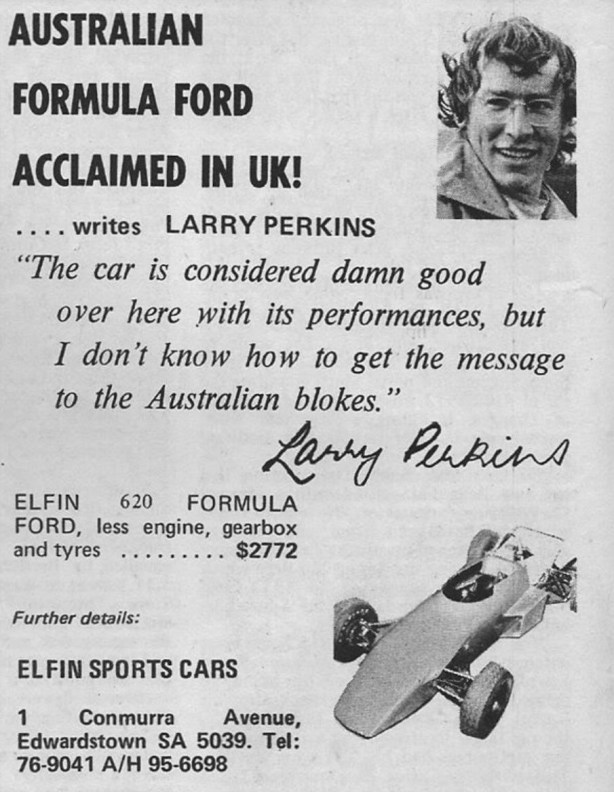
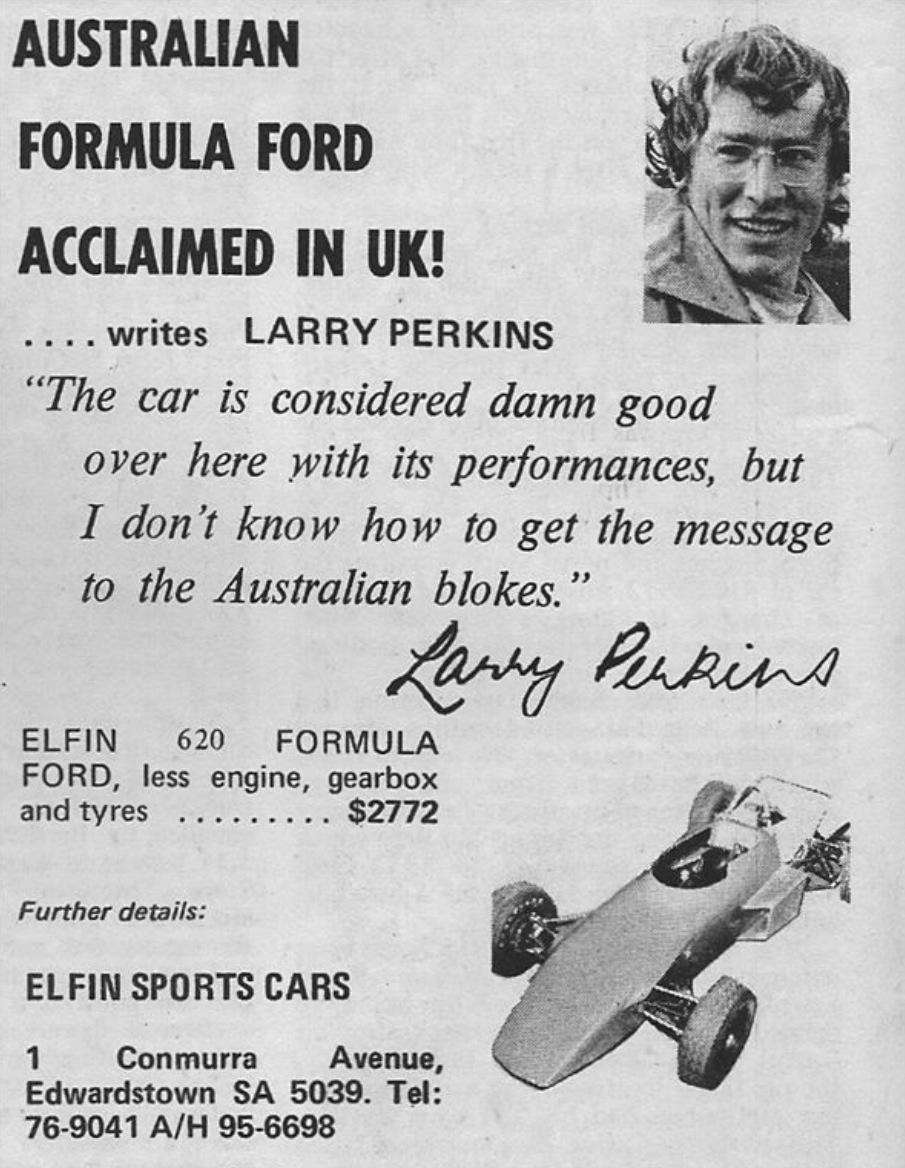
Elfin Racing Car News ad extolling the virtues of the Elfin 620. Larry took the first chassis to England having won the 1971 FF Driver to Europe award in one of Bib Stillwell’s Elfin 600s
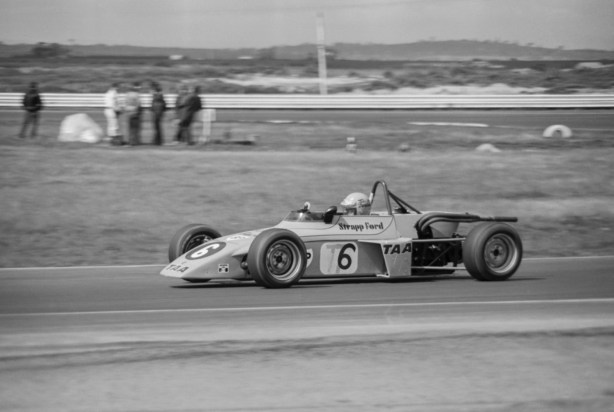
Profile shot of the Elfin 620, Adelaide International perhaps, Terry Perkins in 1973 or 1974 (unattributed)
Perkins set about finding an F3 car for 1973 quickly. He settled on a GRD 372 Ford-Novamotor, a sound choice of car made by ex-Lotus Components lads led by David Lazenby. His campaign was funded by savings and financial assistance/sponsorship from David McKay’s Scuderia Veloce and Garry Campbell’s Provincial Motors, both Sydney businesses, BP and Singapore Airlines. First race was at Silverstone’s short circuit on 18 March, round 2 of the BRSCC North Central Lombard F3 Championship. Larry DNF, with Alan Jones the victor in a GRD 372 at the start of a season which would finally see him break free of F3 after four years of banging away at it.
To Snetterton on April Fools Day, again DNF, Jones the winner, then to the BRDC International Trophy Meeting at Silverstone DNF, and again on April 20 DNF accident at Oulton Park – a BRSCC John Player F3 Championship round. Not a great start but it was clear he was trying hard, Larry finally got a score on the board at Mallory on April 23 during another BRSCC round, sixth in his heat and ninth in the final with Jones up front.
Perkins took in a couple of French Championship rounds on the way to the Monaco F3 GP on 1 May, starting at Magny-Cours where he finished third behind Jacques Laffitte and Jean-Pierre Paoli, the pair raced BP sponsored Martini Mk12 Ford-Holbays. At Pau on May 6 he was a DNF with Laffitte again up front. Still in France, Larry won the GP de La Chatre on 20 May to take his first win on European soil from Bernard Beguin and Laffitte.
Larry therefore went to Monaco with his tail up for the 2 June F3 GP Automobile de Monaco, but failed to qualify after an accident on lap 12 of his heat. Jacques Laffitte won the extremely prestigious race in a Martini Mk12 Ford, and raced to a European F2 Championship victory with Tico Martini the following year on his way to F1.
On June 17 he contested the Trophee d’Auvergne finishing sixth, and then on to Rouen on 24 June he was out on lap 4 due to accident damage, plenty of damage which could not be quickly repaired given the small Team Cowangie budget. The bundle of GRD bits Larry presented for inspection to Ron Tauranac referred to shortly was caused by this particular accident…
In the British GP support race Larry cadged a works Ensign LNF3 Ford from Mo Nunn. He was ninth in his heat and had an accident in the final. Another important race, this one was taken by USA’s Tony Rouff in a GRD 373, the best placed Aussies were Alan Jones, third in his GRD and Buzz Buzaglo’s splendid seventh in his smell-of-an-oily-rag budget March 723 Ford.
By 11 August Larry had convinced no less than BC Ecclestone to let him have the use of a Brabham BT41 into which Larry dropped his Ford-Novamotor engine for the Lombard F3 round at Oulton Park. DNF accident on lap 5 would not have left BCE best pleased, but nonetheless Perkins had created the start of a relationship which would see him in a bigger Brabham, an F1 jobbie in three years. Better was eleventh at Mallory on 26 August, Tony Brise was up front that day in a March 733, with further improvement to sixth at the Oulton Park BRSCC Lombard F3 round on 8 September, Brise was again the winner.
Third behind Brian Henton’s Ensign LNF3 and Tony Brise’ March 733 Ford at Brands round 11 of the BRSCC John Player British Championship on 30 September must have been a great boost to Larry’s confidence as well. A DNF followed at Oulton Park after an oil pipe failure on 7 October, the Jones boy triumphed again that day. At Mallory Park he was seventh in mid-October, then fifth, one slot in front of Jones in the Motor Show 200 at Brands on 21 October, Brise won.
Looking at 1973 in perspective, Tony Brise won the BRSCC John Player Championship by two points from Jones, Larry was twelfth, he had done well having started the process of establishing his name and racing on a wide variety of circuits in both the UK and France but he had run out of money. As a consequence his racing in 1974 was rather limited, albeit the year did include a somewhat premature, unplanned crack at F1.
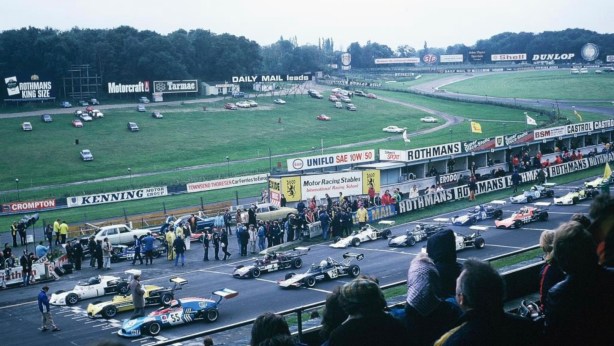
Huge Brands grid 21 October 1973. Ian Taylor, March #1, Tony Brise alongside and Michel Leclere Alpine on the outside. #25 is Alan Jones GRD 372, #4 Masami Kawashima and #61 Larry Perkins, white Brabham BT41 Ford on the inside and the rest. Brise won from (K Hyndman)
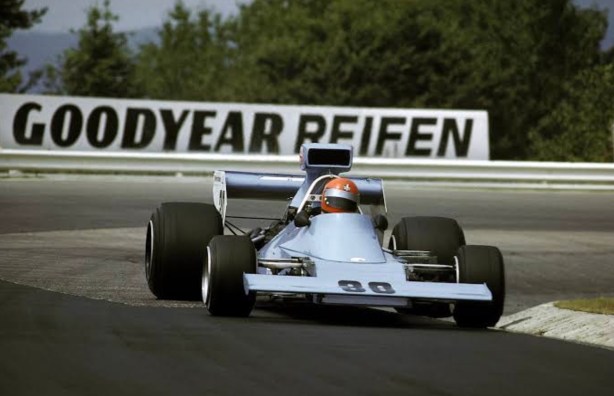
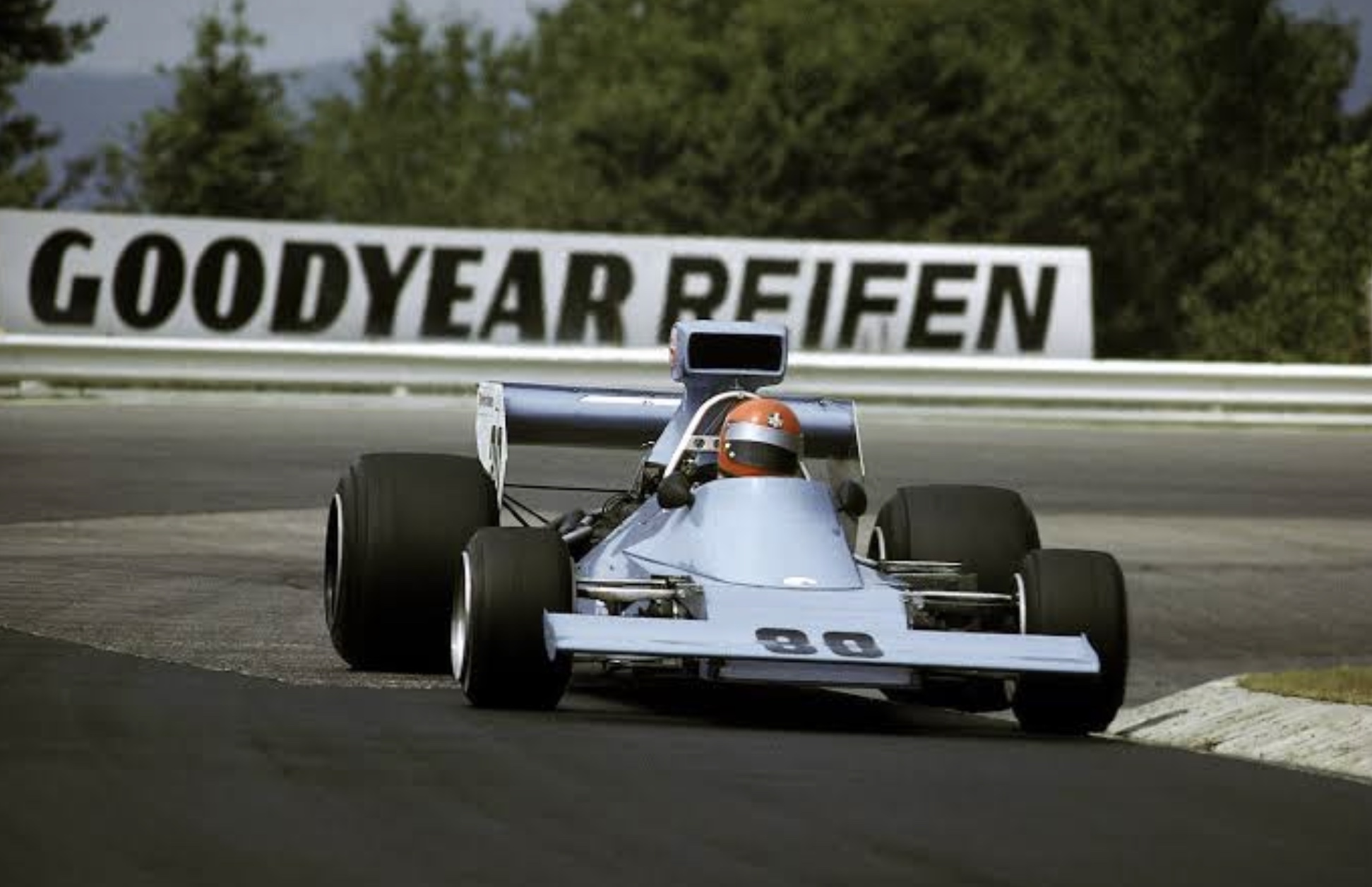
Larry Perkins, Amon AF101 Ford, German GP practice, Nürburgring 3 August 1974 (Sutton)
Larry had discussed with Chris Amon joining Chris’ team in 1974 driving either a second F1 car or one adapted to F5000. No doubt Chris saw in Larry somebody who would muck-in with the build, maintenance and preparation of the cars.
When lack of sponsorship put paid to that, Larry organised a few F3 outings to keep his name out there. His first race was in a Trivellato March 743 Ford-Holbay at Monaco in May where he was seventh in his heat, but was a DNF due to accident damage after five laps in the final. That year there were sixty cars which sought to qualify for the final. He raced again for Trivellato in the Monza Lottery in June finishing ninth, and was tenth a month later at Alessandria in the Coppa Autodromo di Casale.
What should have been a career high-point was his first GP chance at the Nürburgring on 4 August aboard Amon’s car, the sub-optimal Amon AF101 Ford. The car appeared at the Nürburgring having missed a couple of races with the front brakes inboard again, the water radiators placed either side of the engine and new wings front and rear as well as lots of other bits-and-shits.
Team Chris was immediately in trouble on Friday, only one lap revealed overheating problems so the crew were kept busy modifying radiator mounts for the balance of the day. As Saturday dawned Chris had developed a streaming cold or sinusitis depending upon the source, so Larry took on the formidable challenge of qualifying the recalcitrant car on the most demanding of all circuits, not one he had raced on before and in a year when he was hardly match fit given the paucity of racing he had undertaken.
The first part of Saturday practice was dry, the second bit was wet compounding the challenge! Some reports have it that he went off but Denis Jenkinson’s account does not record that if it occurred. Unsurprisingly he missed the cut along with Francois Migault, Tim Schenken, Guy Edwards and Howden Ganley, Clay Regazzoni won that weekend in a Ferrari 312B3.
Whilst innovative, the Gordon Fowell designed, John Dalton and Chris Amon financed Amon was uncompetitive in the extreme, not even Chris’ renowned testing prowess could make it good. By the end of the season he had jumped out of the fat and into the flames and raced another shit-heap vastly beneath him in the BRM P201. He ran the car at Mosport and Watkins Glen. It’s said that there was nothing wrong with the P201 that a good ‘ole Cosworth DFV could not fix…
Redemption of Amon’s Formula One career of sorts would come in Morris Nunn’s 1976 Ensign N176 Ford in a drive which had a Larry Perkins twist we will come to shortly.
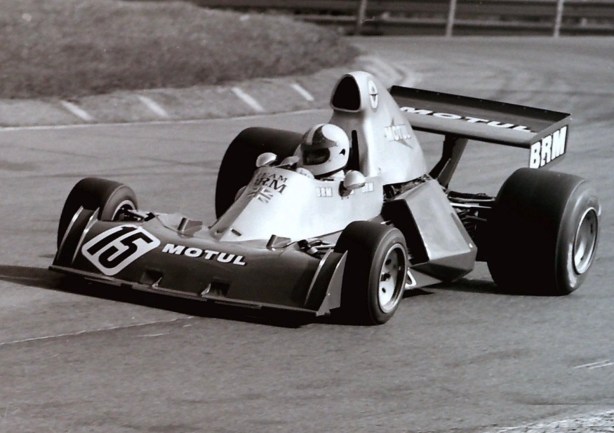
Chris Amon drove ‘all the classic marques’ of the period including BRM but the Bourne team’s ‘glory years’ of 1959 to 1971/2 were long gone by 1974, here at Mosport, 1974 Canadian GP, BRM P201 (nwmacracing)
Terry Perkins, Elfin 620, Paul Bernasconi, Mawer 004, Andrew Miedecke, Birrana F73, Peter Finlay, Palliser WDF2 and the nose of Geoff Brabham’s Bowin P6F at Oran Park in 1974. Perkins, Bernasconi and Brabham all raced Ralt RT1in Europe, Miedecke did a few races in a March 763 and Finlay had just returned to Australia having finished second in the 1973 EFDA European FF Championship in the Palliser (N Bennett)
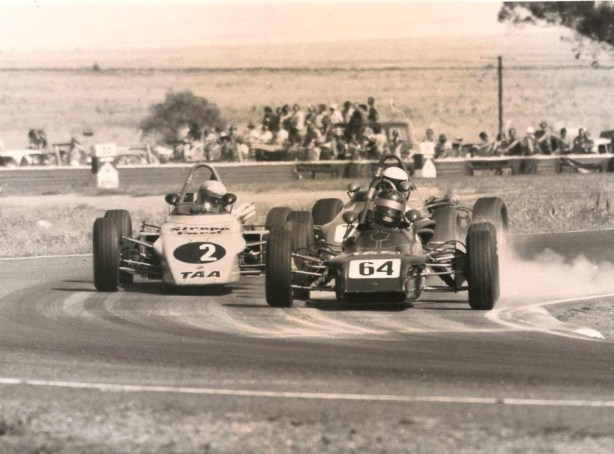
Andrew Miedecke, Birrana F73 trying to hold off a hard charging Terry Perkins Elfin 620, with another 620 giving chase at Calder’s Tin Shed corner in 1973 (N Bennett)
While Larry was wrestling the recalcitrant Amon around the Nurburgring, by that August weekend Terry was well into his second Australian Formula Ford season which saw him win three of the ten Driver to Europe Series rounds – at Adelaide International and the Oran Park June and September rounds. His mount was an Elfin 620 albeit he won at Oran Park in September aboard Peter Lissiuk’s Titan Mk6C. Terry won the title with 71 points from Andrew Miedecke and Geoff Brabham.
I recall American visitor Peter Lissiuk’s win in this car at Sandown in July, he was one of some great drivers in a season of depth which included second placed Andrew Miedecke. He had three wins in his Birrana F73 (one of the great Australian FF chassis raced later by Richard Carter and Gary Brabham amongst others). Geoff Brabham was third in the ex-Leffler 1973 DTE winning Bowin P6F with one win, while Paul Bernasconi was fourth in the lust-worthy, ex-everybody and still extant Mawer 004 with two wins. Peter Finlay was just back from Europe mid-season in the Palliser WDF2 in which he finished third in the 1973 European FF Championship. He would be a force in 1975 with Grace Brothers sponsorship and the Pommie cars suspension optimised for the Goodyear slicks then used in Oz FF.
The grids also included later single-seater aces, Peter Larner, Elfin 600, Stephen Brook, Bowin P6F and John Davis who raced the Bowin P4X in which Jack Brabham won his last ever race, the Calder Formula Ford ‘Race of Champions’ in mid-1971. With his Elfin sold prior to the last round of the championship in October, Terry decided to join his Big Bro in England in 1975 with the aim of buying a Ralt, if the car looked up to snuff…
Larry Perkin’s search for a quicker F3 car for 1975 to create the forward momentum needed to capture the spotlight of those who matter coincided with Ron Tauranac’s desire to jump back into the production racing car business. Tauranac recalled Larry pulling up in front of his house with a “rather tatty Formula Three GRD which he was using in races all over Europe. I put in a few rivets for the lad and gave him some helpful advice and I had often thought it would be nice to provide him with something really competitive to race, so I decided to design a chassis which he and his mechanic could build up themselves,” Tauranac recalled in July 1978 Motorsport interview.
In another Motorsport interview he said “(Larry) had no money and asked me to help him redesign a Formula 3 car he had bought. After looking at it, I said, ‘We can do better than this’, so I built him a car with Greg Siddle doing the management bit. Larry began to progress.”
And so it was, in the final months of 1974 Ron Tauranac sat down to design “a simple, easy to maintain, yet competitive racing car, one which could be updated and modified and redeveloped as the years wore on,” arguably the RT1 was the greatest of his production racing car designs…Mind you other contenders would be the Brabham BT3/4/7/11 F1/Intercontinental, BT23/C F2, BT30/36 and lets not forget the RT2/3/4/5, and theres more…whatever the argument, the RT1 was a corker of a car in the hands of a vast number of drivers.
Alain Fenn, who had worked with Ron at Motor Racing Developments, re-joined Tauranac from Fred Opert in the US to assist with the sourcing of componentry. They identified premises at Snelgar Road, Woking and were soon underway in the build of an initial batch of five Ralts. Make that an initial batch of ‘Ralt Twos’ as the very first Ralts were built by Ron and Austin Tauranac in Sydney in the early post-war years.
The first Ralt Norton ES2 powered machine’s construction commenced in 1949 after Ron befriended the first men to build a ‘500’ in New South Wales. Jack and Bill Hooper were Sydney motor-cycle engineers, this car was powered by a Triumph single. Ron later modified the Hooper machine which Austin raced.
Ralt 1’s first event was a Sprint meeting in late 1949, later after running at the Hawkesbury hillclimb in 1950 Australian Motor Sports noted that he made a ‘promising rather than auspicious’ debut on a day when John Crouch, Australian GP winner, took FTD in a Cooper 1100. Tauranac’s relationship with Jack Brabham commenced when RT bought a 500cc MSS Velocette engine Jack had for sale, the two men, both of whom served in the RAAF towards the war’s end struck an instant rapport. As is well known, ‘Ralt’ was derived from the initials of Ronald Sidney Tauranac and his brother Austin Lewis Tauranac, viz Ron Austin Lewis Tauranac – RALT.
There is a certain symmetry about the first batch of Ralt Twos being five cars, as the batch of Ralt Ones that RT was preparing in 1960 was also a batch of five when he jumped on a plane – popping his family, wife Norma and daughter Jann on the ‘Fairsea’ from Circular Quay to Southhampton – off to the UK via an event at Riverside looking after Jack’s Cooper Monaco to join Brabham Enterprises to commence the path we all know so well. The five cars were built as Lynx Formula Juniors after Ron sold the plans and patterns for the design to Lynx Engineering for a nominal sum.
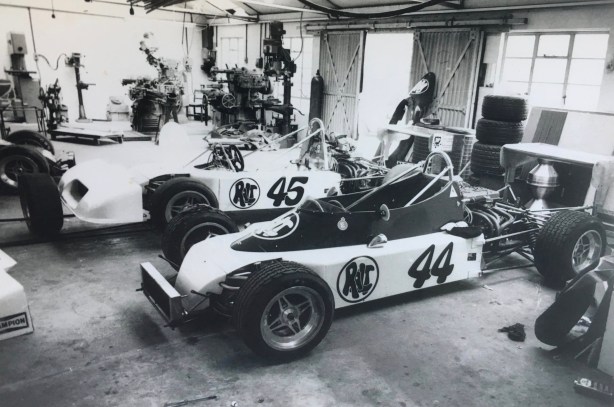
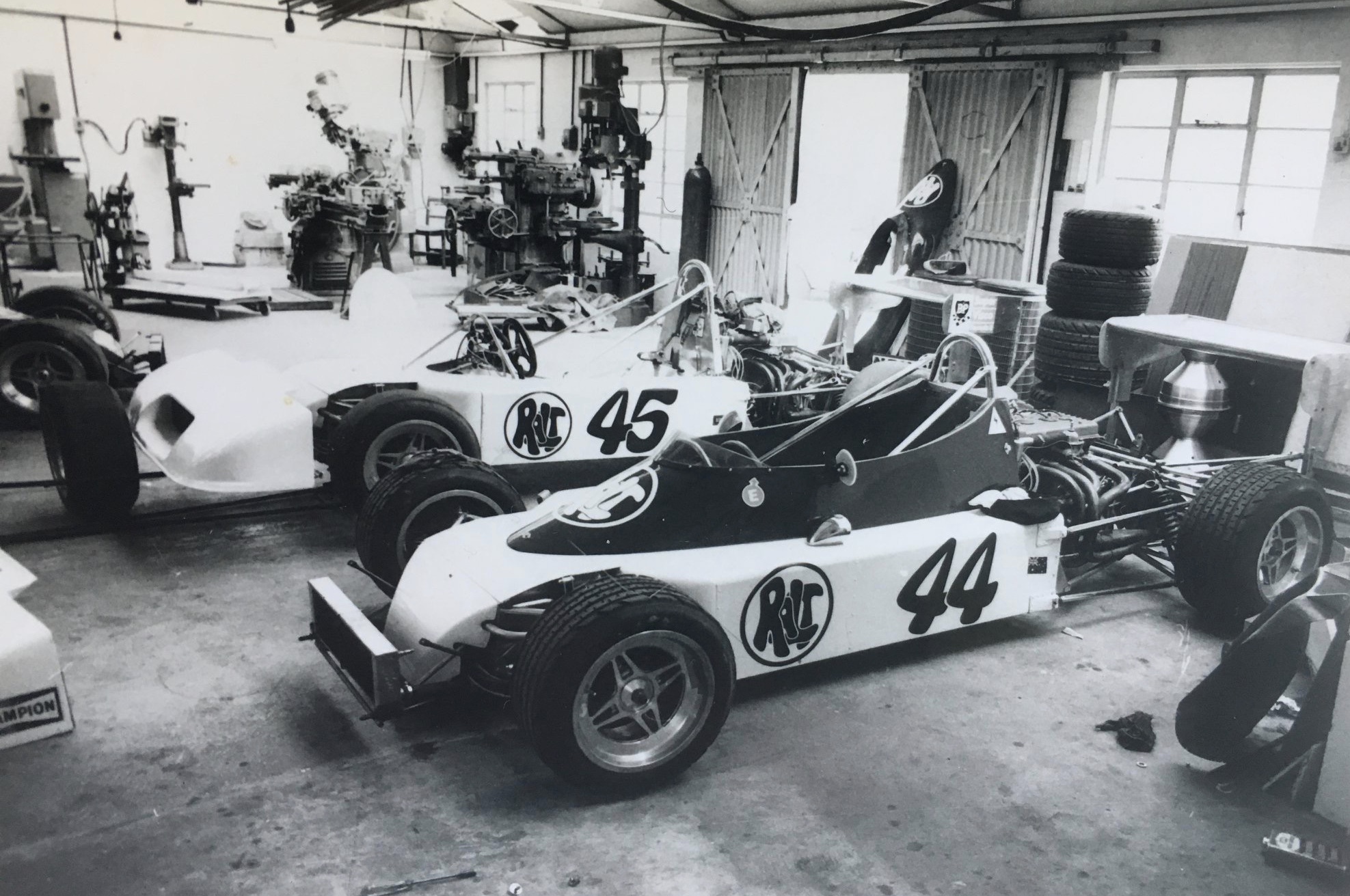
The two Perkins brothers Ralt RT1’s in the Ralt, Snelgar Road Woking factory in early 1975. #44 Larry, chassis # ‘RT1/75-2’ and Terry # ‘RT1/75-3’ (G Siddle)
The first RT1 chassis to take to the track (a total of 165 RT1s were built from 1975 to 1979) was Larry Perkins’ works loaned car- RT1/75-2, Italian Roberto Marazzi bought one (chassis RT1/75-1) via Ralt’s agent in Italy, Chuck McCarty. Ulf Svensson acquired another which went to Bertram Schafer (RT1/75-4), both McCarty and Svensson had been Brabham agents. Terry Perkins machine was RT1/75-3 and longtime Brabham customer, the very quick Hong-Konger John McDonald bought the fifth, RT1/75-5. What about that Ralt logo or wordmark? I loved it from the moment i saw it, the hippy-script was designed by thirteen year old Julie Tauranac!
Perkins, in the second year of 2-litre F3 had chosen wisely, a Ford Novamotor twin-cam was a smart choice for him as he was familiar with the engine of a car he was to self-prepare, the Toyota 2T-G Novamotor would become the engine to have before the season’s end, and was fitted to Larry’s chassis before the year ended.
Larry decided to target the FIA Formula 3 European Cup not having sufficient a budget to run the more prestigious BP series in England, mind you, some sources have it that the FIA F3 European Cup was only announced in the FIA’s June bulletin by which time three of the six Euro rounds had been run and won…
Team Cowangie had tested the car thoroughly enough before the start of the season commenced, and, critically had Greg Siddle – to become a very successful motor racing entrepreneur/driver mentor/team organiser – was in their camp. Larry was fifth at the opening BARC round at Thruxton on 31 March where Gunnar Nilsson was the winner, the first of many that year.
Siddle (an article in itself) managed the careers of Nelson Piquet and Roberto Moreno for periods of time in addition to Perkins and many others down the decades, and as a long term admirer of Tauranac “It was Siddle who nominated him and rounded up influential referees” which culminated in the award of an Order of Australia to RT in 2002, wrote Michael Stahl.
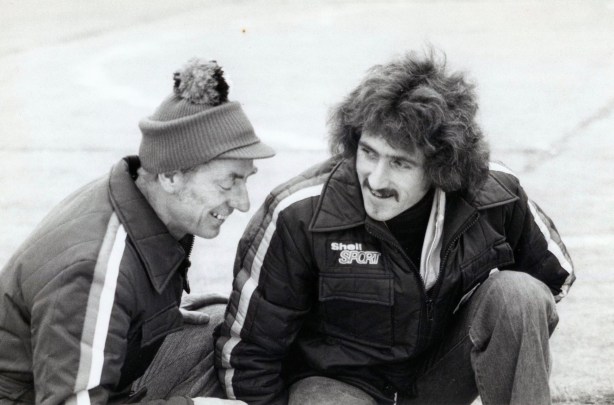
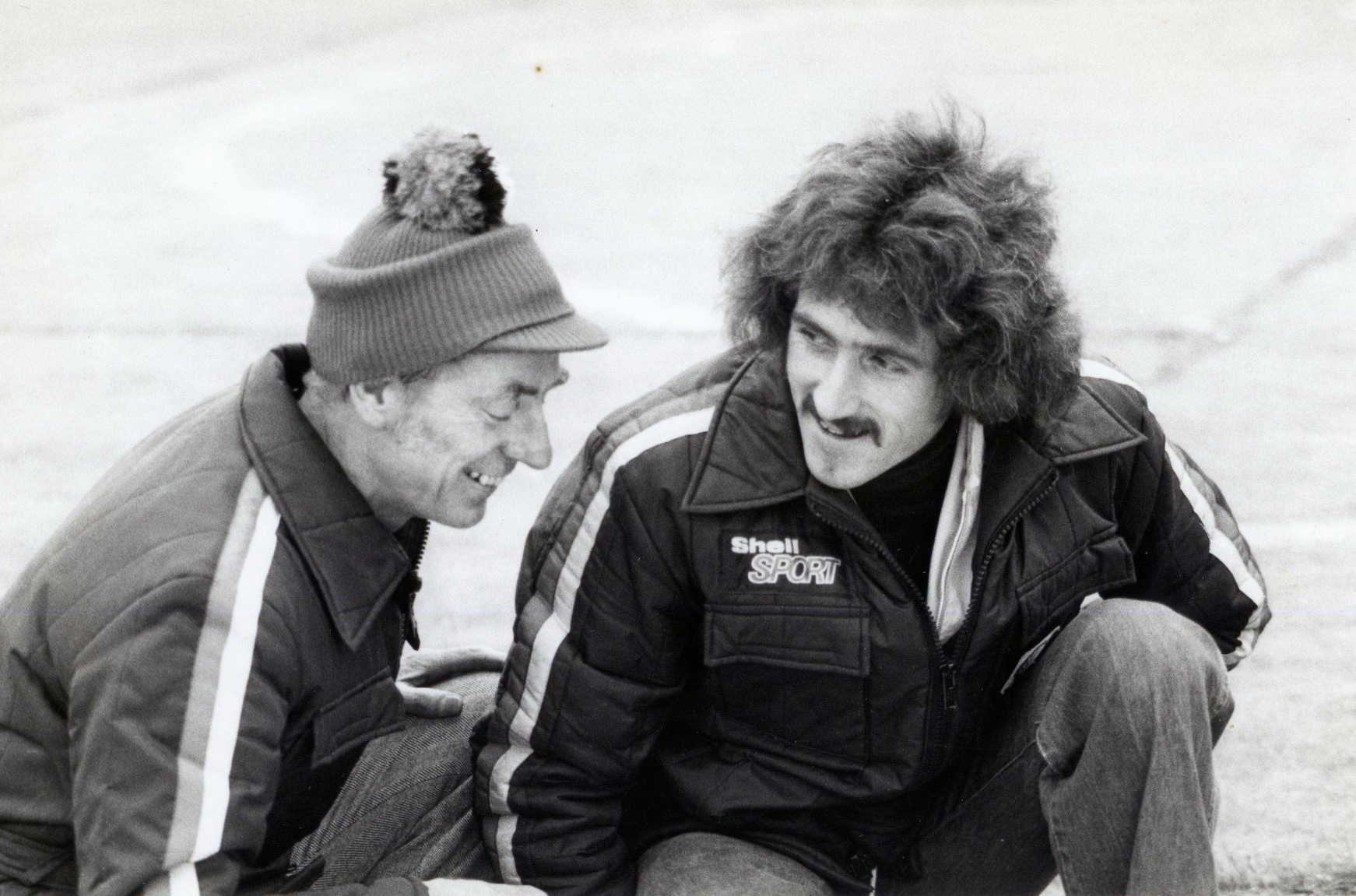
Ron Tauranac and Greg Siddle in 1975- racers both (G Siddle)
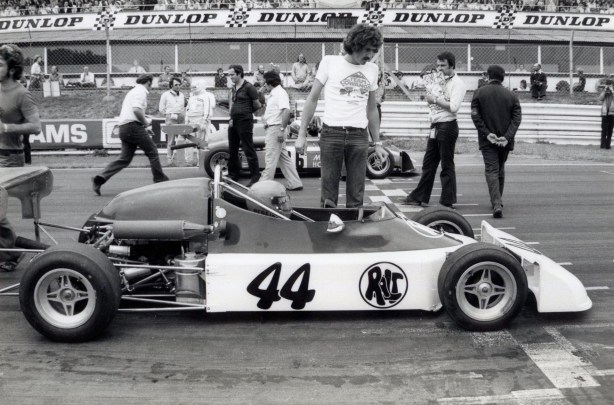
Brands Polydor Records Trophy, 7 September 1975 front row. Larry this side and Dick Parsons, Modus M1 Ford alongside – first and second – Danny Sullivan in another Modus was third (G Siddle)
Silverstone on 27 April on the short circuit was not a good weekend for the brothers with LP twelfth and DNF whilst Terry was a non-starter due to accident damage. Off to Monaco for the most prestigious race of the year, the first round of the European Championship on 10 May. Larry won his heat from Conny Anderson and Patrick Neve but was out in the final after 12 of the 25 laps with accident damage. Renzo Zorzi’s GRD 374 Lancia won. Nonetheless, an important marker had been put down, the entry list that year ran to 67 cars including the non pre-qualifiers.
Back in the UK for BARC round 5 at Thruxton on 26 May, Larry was seventh and Terry DNS with head gasket failure, Nilsson won again and then to Snetterton on 15 June, Larry was 19th and TP a no-show. Larry had missed the previous two Euro rounds at the Nürburgring on 1 June, and Anderstorp on 8 June, where Freddy Kottulinsky, Modus M1 BMW M-10 and Conny Anderson, March 753 Toyota won respectively.
Team Cowangie headed off to Italy for round four with LP winning the prestigious Monza Gran Premio della Lotteria on 29 June by forty seconds in a field which included future F1 drivers Piercarlo Ghinzani, Renzo Zorzi, Danny Sullivan, Patrick Neve, Gunnar Nilsson, Alex Ribeiro, Conny Andersson, Loris Kessel, Alessandro Pesenti-Rossi, Gianfranco Brancatelli and others.
LP was quickest in practice – which suggests the Ford-Novamotor did not lack power – and that the RT1 was a pretty slippery jigger, Larry’s task was made easier as Gunnar Nilsson had a big accident in practice and was unable to start the race. Larry had a race long scrap winning from local heroes Fernando Spreafico’s GRD 374 Toyota-Novamotor and Alessandro Pesenti-Rossi’s March 743 Toyota-Novamotor. It was a big win mentally and put some valuable funds into the team coffers.
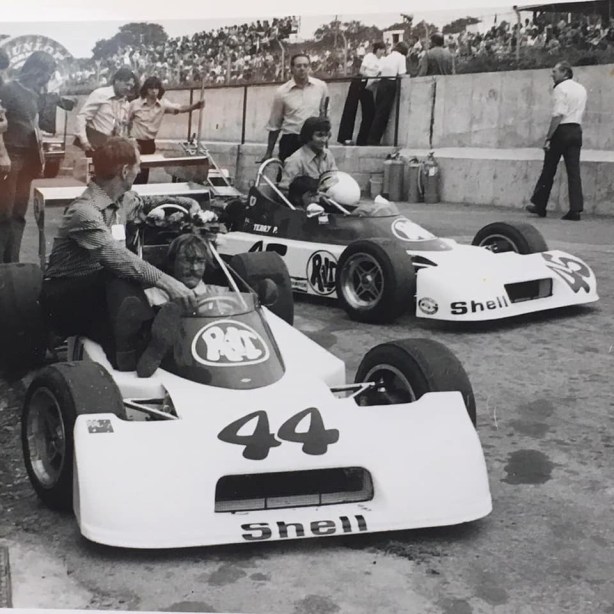
Brands Hatch ‘Polydor Records Trophy’ meeting on 7 September. Larry in #44 won and Terry in #45 was ninth (G Siddle)

Terry’s car at Silverstone during the British GP weekend (A Raine)

Larry spins whilst a Modus and #46 Stephen South Ray BR3 go thru the Woodcote Chicane (T Marshall)
Off to Silverstone for the British GP meeting on 19 July, the FOCA Trophy, and again an important meeting with all of the F1 hierarchy in attendance. The trophy was won by Gunnar Nilsson, he took the British BP F3 Championship that year in a works March 753 Toyota. Terry had his best run of the year to finish fourth, with Larry back in ninth after recovering from an early race spin shown in the photograph above.
Perkins’ Monza victory gave him a serious tilt at the European Championship, so the team transporter headed back across the Channel to Croix-en-Ternois for the Trophee d’Arras on 20 July, the fifth round. Larry was fourth on the grid and Terry sixth in a small field of fourteen cars, with LP the winner and Terry out with accident damage after only two laps.
Then it was on to Denmark for the final Euro round at Djurslandring- the Danish Grand Prix on 2 August. In a wonderful weekend for the Brothers Perkins Terry was fourth in the first of two heats, while Larry won his, Terry bagged the 40 lap Grand Prix! It was a good win too, in front of Anders Olofsson, Conny Andersson, Renzo Zorzi and others. Larry was ninth with undisclosed dramas but had accumulated enough points to win the European Championship. His 18 points and two wins trumped Conny Andersson on 14 and Renzo Zorzi 11 points. The brothers stayed in Denmark to contest the Wrangler GP at the Jyllandsringen on 24 August finishing third and sixth, Larry from Terry with two Scandinavians up front, Jac Nelleman and Conny Andersson in GRD 375 and March 753 respectively.
Larry had a point to make back in the UK, the British F3 Championship was the toughest of F3 contests that year so it was back there to race in a few rounds of the BARC BP Super Visco British F3 Championship before the season’s end, starting with round 15 at Silverstone on 31 August. Larry finished a strong second behind Eddie Cheever, Modus M1 Toyota with Terry only two seconds adrift of Larry but still in fifth place, such was and is the competitiveness of the category. Larry used a Toyota 2T-G Novamotor engine at this meeting for the first time. A week later Larry won the Polydor Records Trophy at Brands, again Toyota powered in a field which included Danny Sullivan, Alex Ribeiro, Gunnar Nilsson, Terry (ninth), Rupert Keegan, Ingo Hoffman etc- it was a good win and indicative of the Toyota advantage over the venerable, long-lived Ford/Lotus twin-cam.

Oulton Park- Gunnar Nilsson, March 753 from Ingo Hoffman in another 753 then Larry with a bunch of three; Eddie Cheever Modus M1 on the inside then Alex Ribeiro and Stephen South both in March 753s, all Toyota 2T-G powered (Toyota)
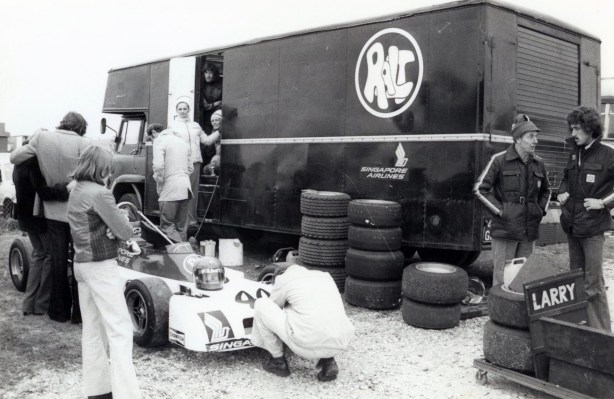
Ralt Racing Equipe in 1975, Perkins’ RT1 with Ron Tauranac and Greg Siddle off to the right (G Siddle)
Back to Italy on 14 September for the Coppa Autodromo di Casale, on the Autodromo di Casale Monferrato at Alessandria, Larry was fifth, TP not making the trip.
Larry held his Brands Hatch form, winning the BARC BP round 16 on 21 September from Ribeiro and Nilsson, a week later at Silverstone for round 17 he was second behind Nilsson. A week further on, 4 October, the British F3 circus was at Oulton Park for the penultimate BP round, this time the winner was Ingo Hoffman’s March 753 from Alex Ribeiro, then Larry from Nilsson, Cheever, Stephen South and Rupert Keegan- 30 seconds covered these first seven cars.
Off to Thruxton for the final BP round on 26 October, Larry was fifth behind Ribeiro, Sullivan, South and Patrick Neve, Modus M1 Toyota. Then back to Thruxton again on 5 November for the BARC Forward Trust BBC-TV race of 1975 where Larry was again fourth, this time from Nilsson, Cheever and Neve. Team Cowangies’s final race for the year was at Hockenheim on 9 November when Terry raced his Ford Novamotor powered RT1 to seventh in round 12 of the German Championship at Hockenheim, Eddie Cheever won.
The team – Tauranac, Siddle, Perkins L and Perkins T – would have been pleased, make that ecstatic at the season’s results, Larry won the FIA Euro Championship with Terry was equal fourth. Conny Andersson was second and Freddy Kottulinsky third.
Despite contesting, at best, half the rounds Larry was fifth in the more important, if less outwardly prestigious BARC BP Super Visco British F3 Championship. The top four were Gunnar Nilsson, then Alex Ribeiro, both in works March 753s, then Danny Sullivan, Modus M1 and Patrick Neve, Safir RJ03. All of these fellows would race an F1 car with the exception of Terry and Kottulinsky.
Tauranac’s faith in the Perkins brothers was well founded, their speed and success in the RT1s provided a foundation piece for the Ralt sales success which was to follow over the next decade or so. Ron has been quoted many times about how Ralt was a far more profitable business than Motor Racing Developments ever was, lets not forget that first and foremost it was a family business.
Terry Perkins needed another year of F3, having established his potential clearly, no doubt the Danish Grand Prix cup still has a prominent place in his study, he returned to Australia, I’d love to hear from anybody who can tell me his story since then…
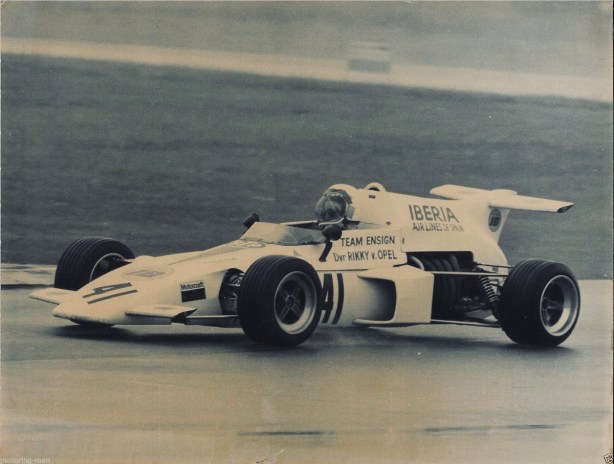
Rikky Von Opel, Ensign LNF3 Ford F3, Thruxton 1972. One can’t help but ponder the effectiveness of those wings- not so much the inclination but rather the shapes, very successful design mind you (unattributed)
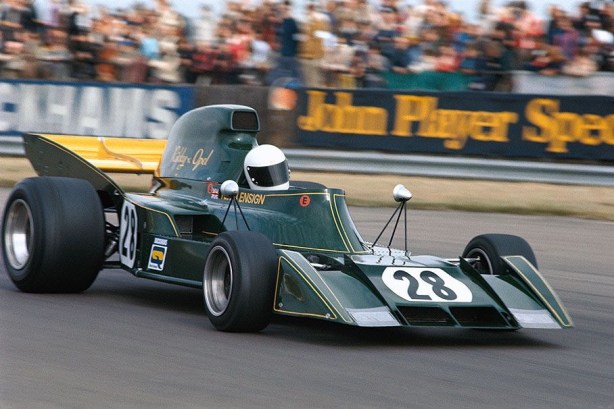
Von Opel during the 1973 British GP, Ensign N173 Ford. Q21 and 13th, six laps adrift of winner, Peter Revson’s McLaren M23 Ford (unattributed)
Former Team Lotus F3 racer Morris Mo Nunn ran German nobleman and very quick driver Rikky von Opel to victory in the 1972 Lombard North Central British F3 Championship. His prototype F3 car, the Ensign LNF1 was built behind the garage of his Walsall home and was raced with success by another ex-Team Lotus F3 pilot, Bev Bond in 1971. The LNF3 was the 1972 production car was raced with success by the likes of David Purley and Colin Vandervell with Von Opel, great grandson of Opel founder Adam Opel, winner of the Lombard F3 Championship in 1972. You will recall that Larry did a race in a works Ensign LNF3 after damaging his GRD in France in mid-1973.
Keen to progress to F1 the wealthy Rikky financed Mo Nunn’s venture into F1. Dave Baldwin joined the team to work on the F3 cars while Morris designed the Grand Prix Ensign 173 which raced throughout 1973. Rikky’s best was thirteenth in the British GP at Silverstone. In 1974 von Opel decamped to Brabham early in the season after unhappiness with the team’s progress and was replaced by Vern Schuppan, Teddy Yip funded the drive, his best in the N174 (a revamped N173) was fifteenth in the Belgian GP at Zolder. Mike Wilds drove the car late in the season.
For 1975 Mo attracted sponsorship for a two car team comprising the N174 and new Ensign N175 Ford, a beautiful bit of kit, from Dutch company HB Bewaking who were insistent on Dutch drivers. Roelof Wunderink and Gijs van Lennep were signed. Van Lennep, 1971 Le Mans winner in a Porsche 917 together with Helmut Marko and very quick in a Lola T330 Chev F5000 in European F5000 in 1973 was the more successful of the two 5-litre graduates, Gijs’sixth place at Hockenheim gave Ensign their first F1 Championship points.
Late in the season Chris Amon joined the team taking a pair of twelfths and most importantly gave Nunn a driver who could develop the speed inherent in the evolved N176, which was so quick, but sadly so fragile in 1976, Chris’ last year in F1 and a period in which he showed he had lost not a tenth of the raw pace he always had.
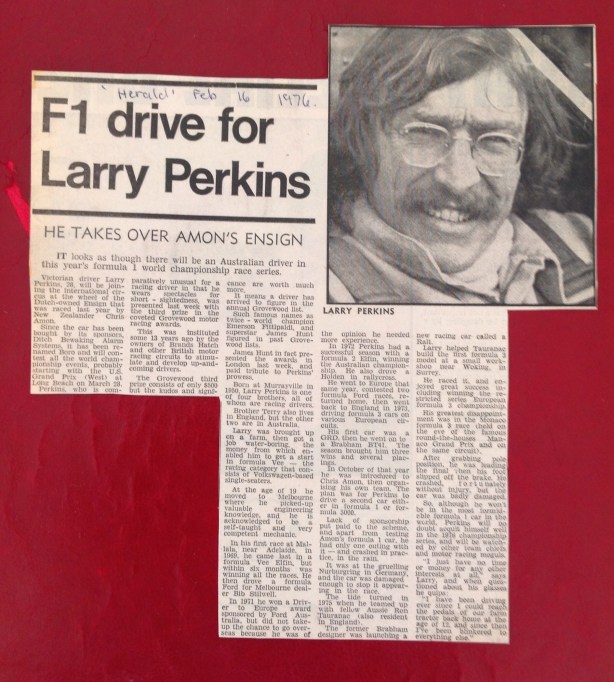
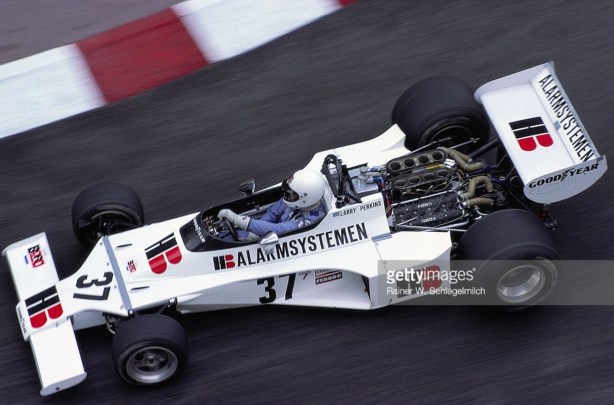
Perkins, Ensign N175 Ford, 1976 Monaco GP practice overhead shot shows the pure lines of the Baldwin/Nunn design to good effect. Griffin helmet, looks like brake cooling was an issue- see added on ducts at the rear
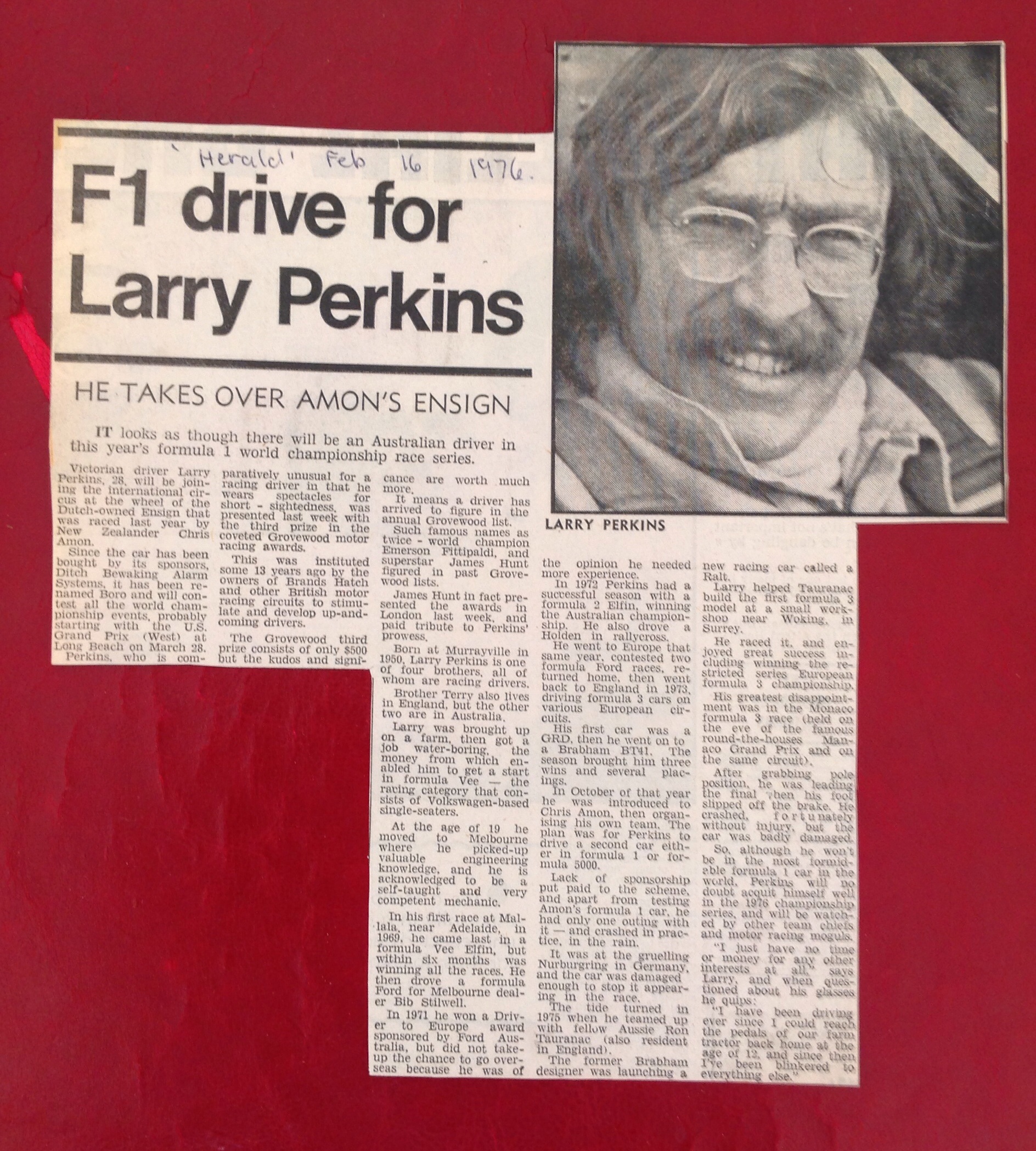
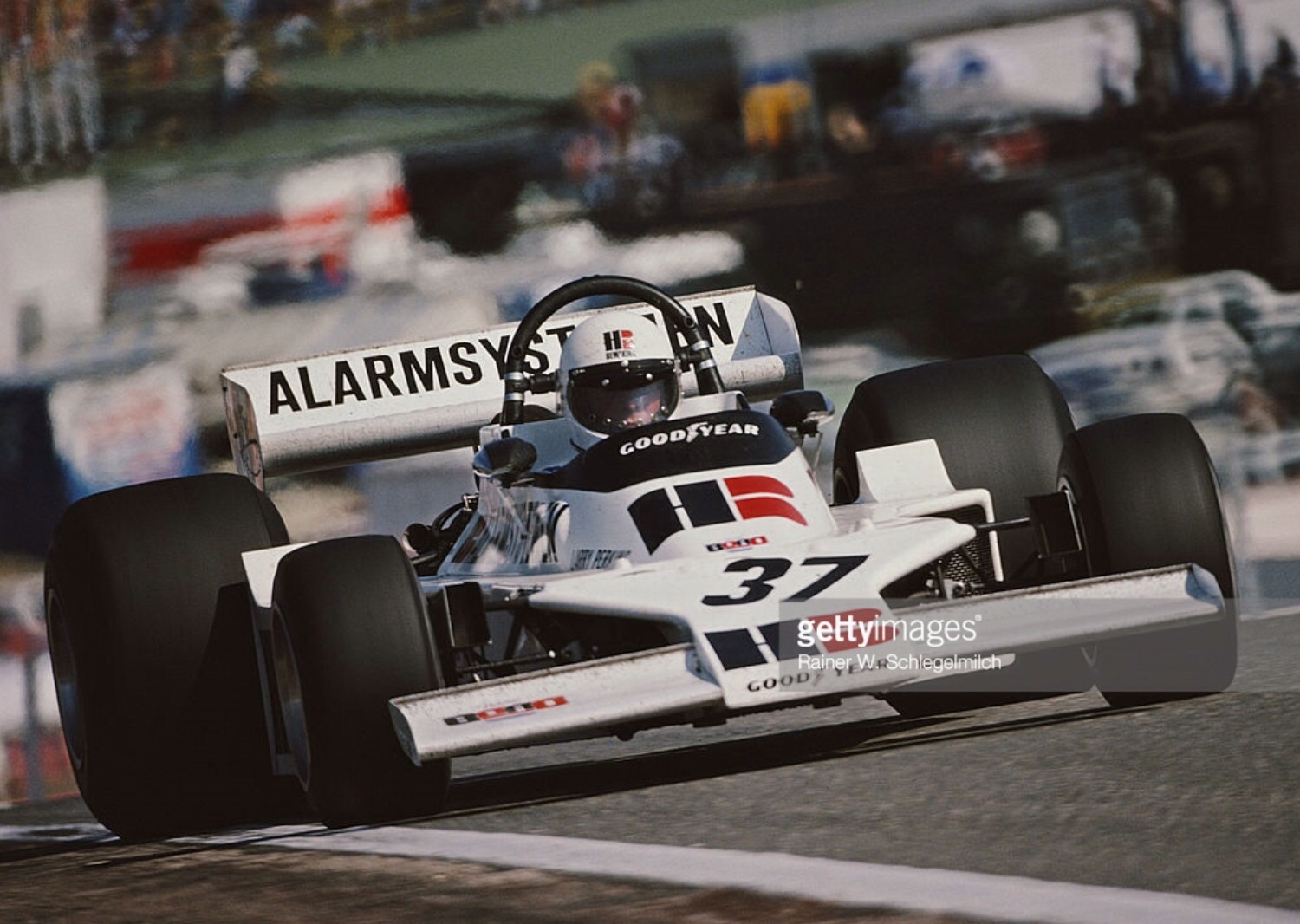
During late 1975 there was a spat between Nunn and HB Bewaking which was resolved by HB taking possession of Ensign 175 chassis MN04 which had been raced by Van Lennep, Wunderink and Amon throughout 1975. Larry Perkins was chosen to drive the car in 1976. The car was prepared from the a base in Bovenkerk, Holland by the Bob and Body Hoogenboom (BOb and ROdy = Boro) with plenty of input and work from Perkins, who was very impressive in the way he went about F1 in DIY fashion! In fact F1 in the manner he had run his F3 program, necessity being the mother of invention.
Designed by the well credentialed Baldwin and Nunn, the Ensign N175 was a typical Cosworth kit car of the era with an aluminium monocoque chassis, with upper and lower wishbone front suspension, coil spring/Koni dampers, and a single top link, twin lower links, twin radius rods and coil spring/Konis at the rear. The trusty Hewland FG400 transaxle was mated to the Cosworth Ford DFV which gave around 485bhp at the time. Brakes were ventilated discs, outboard at the front and inboard at the rear.
Money was tight so Larry had done little testing by the time the team arrived at Jarama for the fourth round of the 1976 World Championship, won that year by James Hunt’s McLaren M23 after Niki Lauda nearly lost his life when his Ferrari 312T2 crashed at the Nürburgring mid-season. As is so often the case, adversity and injury creates opportunity for others and so it was for Larry later in the season, indirectly as a result of Lauda’s prang.
Larry did well upon debut, he qualified 24th and finished 13th “circulating tidily and keeping out of trouble” as Denis Jenkinson described his race, after a slow pitstop to change a flat tyre. There were six non-qualifiers that weekend among the large number of teams contesting Grands Prix at the time. Hunt won the race in his McLaren with Perkin’s F3 1975 compatriot, Gunnar Nilsson impressing all with his performance behind the wheel of a Lotus 77 Ford.
Onto Zolder, Belgium, Larry achieved his best ever GP finish, eighth from Q20 in a grid of 24. Lauda won from his teammate Clay Regazzoni in a Ferrari 312T2, Larry passed the two Shadow DN5Bs of Jean-Pierre Jarier and Tom Pryce to secure eighth behind John Watson’s Penske PC3 Ford. In the latest Ensign N176 Chris was Q8 and running fourth when a wheel detached itself from the car, causing Chris to crash and roll, but he emerged unscathed.
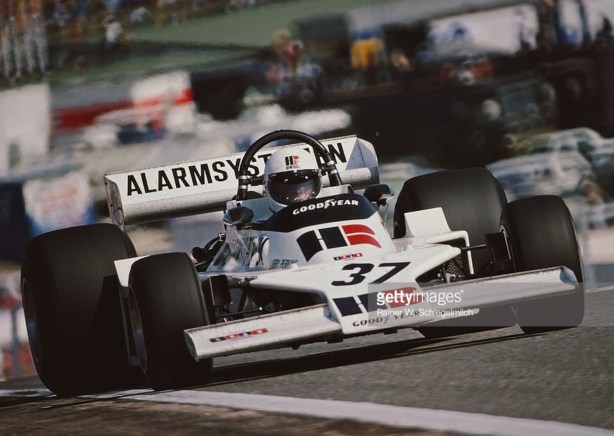
LP on the hop, Ensign N175, Jarama 1976
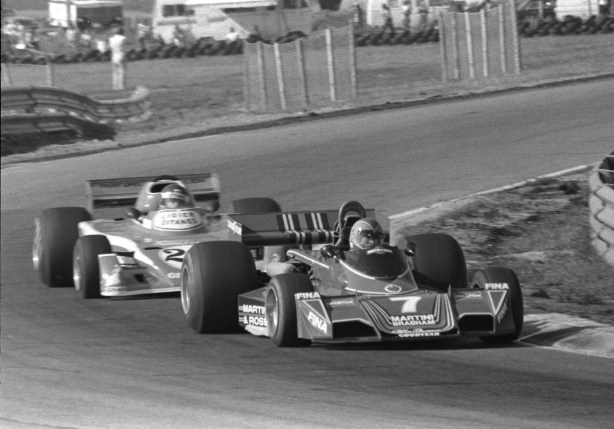
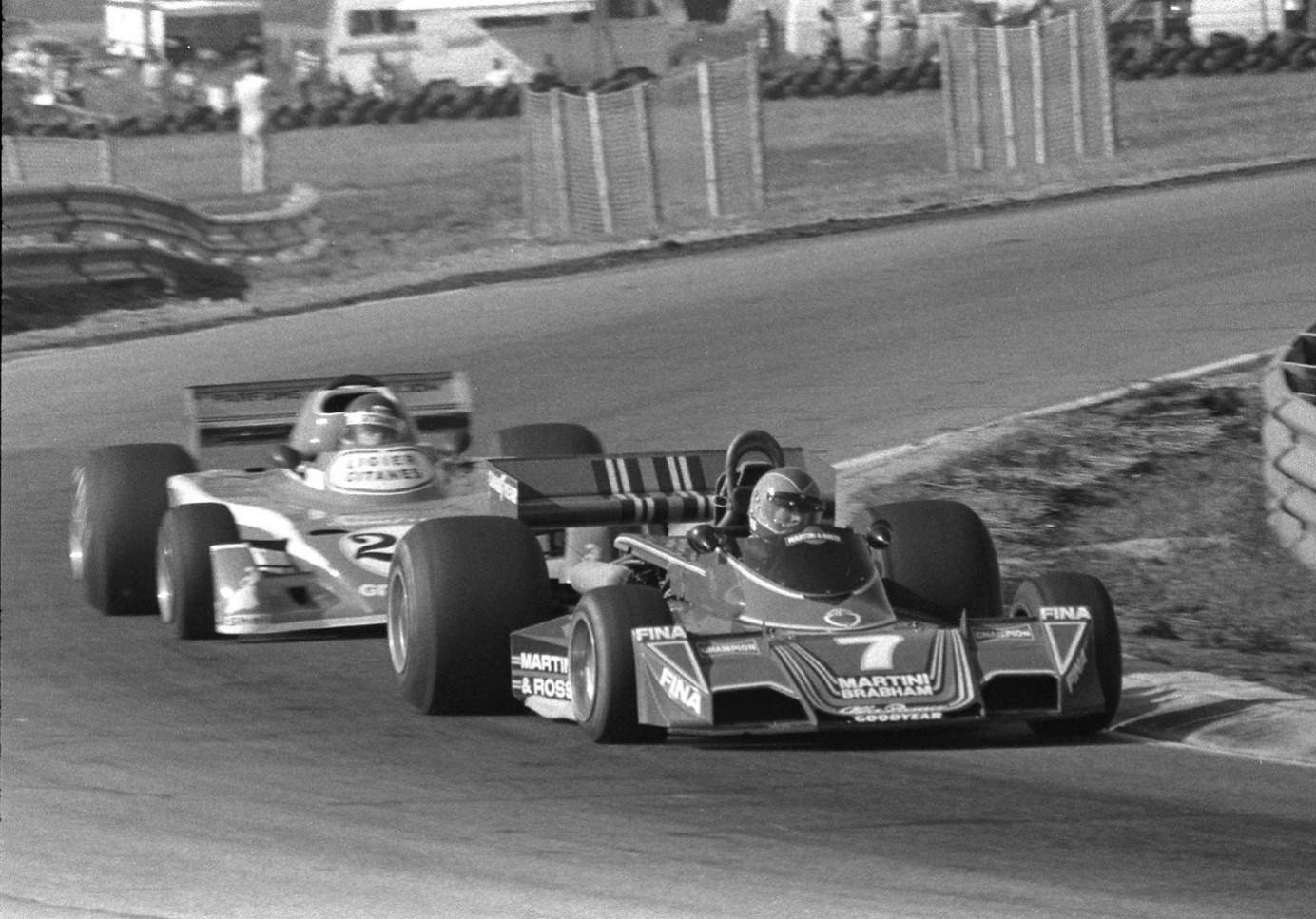
Mosport 1977. Larry Perkins in the big cumbersome Brabham BT45 Alfa in front of the big cumbersome but faster Ligier Matra of Jacques Laffitte (N MacLeod)
Despite having demonstrable F3 speed at Monaco Larry was unable to wrestle sufficient pace out of the Ensign to make the cut, but the degree of difficulty was high. He was doing much of the preparation himself inclusive of belting said self into the six-point Willans, before setting off. But hey, he was in F1 and in a decent car to boot.
At Anderstorp, Sweden, Larry had an engine failure near the chicane giving him a long walk back to the pits and plenty of time to watch the competition at close quarters as he trudged home having qualified 22ndof 26. Amon proved the pace of the N176 having put it into a stunning third on the grid and chasing Depailler hard whilst running third, only to have the left-front corner part company with the rest of the car which sailed through two catch fences and then head on into the barriers. Chris, very shaken, climbed out with badly bruised legs.
Down the back, Alan Jones qualified the Surtees TS19 with which Larry was to become familiar in 1977 eighteenth, and finished thirteenth. This was the weekend the Tyrrell P34 six-wheelers finished a marvellous one-two after Mario Andretti’s DFV went kaboomba, swallowing a piston while in the lead with his Lotus 77.
Off to the Dutch team’s home race at Zandvoort, Larry was Q19 of 26. Jenkinson commented upon Larry’s car control “…There was a lot of pressing on, even from those near the back and both Merzario and Perkins had spins leaving the Tarzan hairpin, the Australian doing a textbook job of declutching at precisely the right moment to avoid stalling the engine, keeping his sense of direction and driving off as soon as the nose swung the full 360 degrees and was pointing the right way up the course.”
Larry was given some work to do after an incident with Peterson’s March 761 late in the afternoon. “…Peterson was out in his spare March and thought he would outbrake and chop across the front of Perkins at the end of the main straight, but the Ensign driver didn’t reckon on being bullied with the result they collided and spun off the road. The Boro-Ensign was wheeled back to the pits more or less undamaged but the March had to be retrieved by a breakdown truck!” Denis recorded.
Larry ran as high as thirteenth behind Ickx, driving the Ensign N176 vacated by Chris Amon after the German Grand Prix but “spun off into the catch fences in a cloud of sand due to a moments inattention on the fast right-hand bend leading ono the main straight,” in the race won by Hunt’s M23 McLaren after a titanic dice for much of the race with Watson’s Penske.
The Italian Grand Prix was amazing as it marked the return to racing of the gritty, oh-so-tough, mentally strong Niki Lauda back in the cockpit of a Ferrari. Ronnie Peterson won that weekend taking the very first works March F1 win in a 761 Ford.
In first wet practice Larry was one of few to brave the circuit and provided an exercise in high-speed aquaplaning to the assembled masses in the pits with a big spin on the straight. Larry made good on Satuday though. “One driver who was embarrassing a lot of people was the bespectacled Australian, Larry Perkins, running his whole show himself, and recording a time that must have given him a “double-A for effort” in anyone’s book, for he split the two works Lotus drivers on the final grid.”
Larry qualified a splendid 13th of 26 and was running 13th in the race, immediately behind Jones’Surtees TS19 when his precious 3-litre Cosworth blew spectacularly whilst passing the pits. It was a cost the team could ill-afford.
It was at this point that one of the consequences of Lauda’s accident played to Perkins’ advantage.
Scuderia Ferrari immediately post-accident correctly saw Niki’s position as grim. His life was at risk in the early days post accident and even if he did survive it was far from clear that Lauda could or would race again. They needed a driver to race the second car alongside Clay Regazzoni, with Carlos Reutemann easily seduced across from Brabham where he had raced Gordon Murray’s race winning Cosworth engined BT44/44B, but was now lumbered with the Alfa Romeo flat-12 engined, heavy, unreliable BT45. Doubtless the deal Bernie did with Alfa Romeo was a good one financially but the cars were not race-winners despite the undoubted talents of the two South Americans, Reutemann and Carlos Pace.
Ecclestone recruited Rolf Stommelen to replace the car vacated by Reutemann before Monza. He did well too, Q11 and DNF, but then Bernie offered Larry the car for the last three races of 1976, the Canadian, US East and Japanese Grands Prix. If he did well there was the chance to do a full season the following year. The task was not an easy one as Pace was quick, he had three years in F1, was already a GP winner and was familiar with the BT45, he would be a tough benchmark for Larry as a teammate.
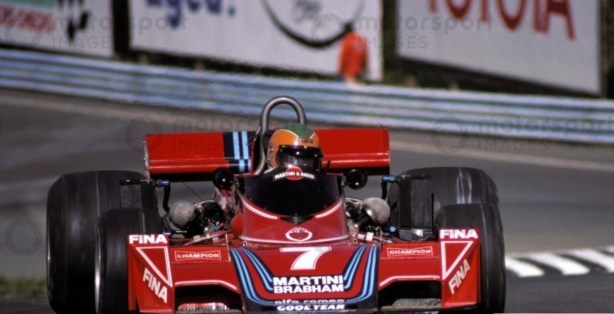
LP, BT45 Alfa Watkins Glen 1976- doncha lerv the Martini livery on any car! (D Phipps)
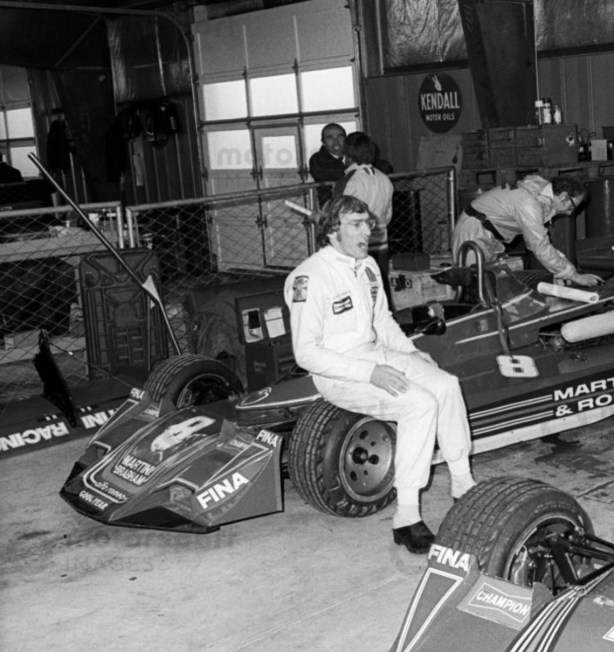
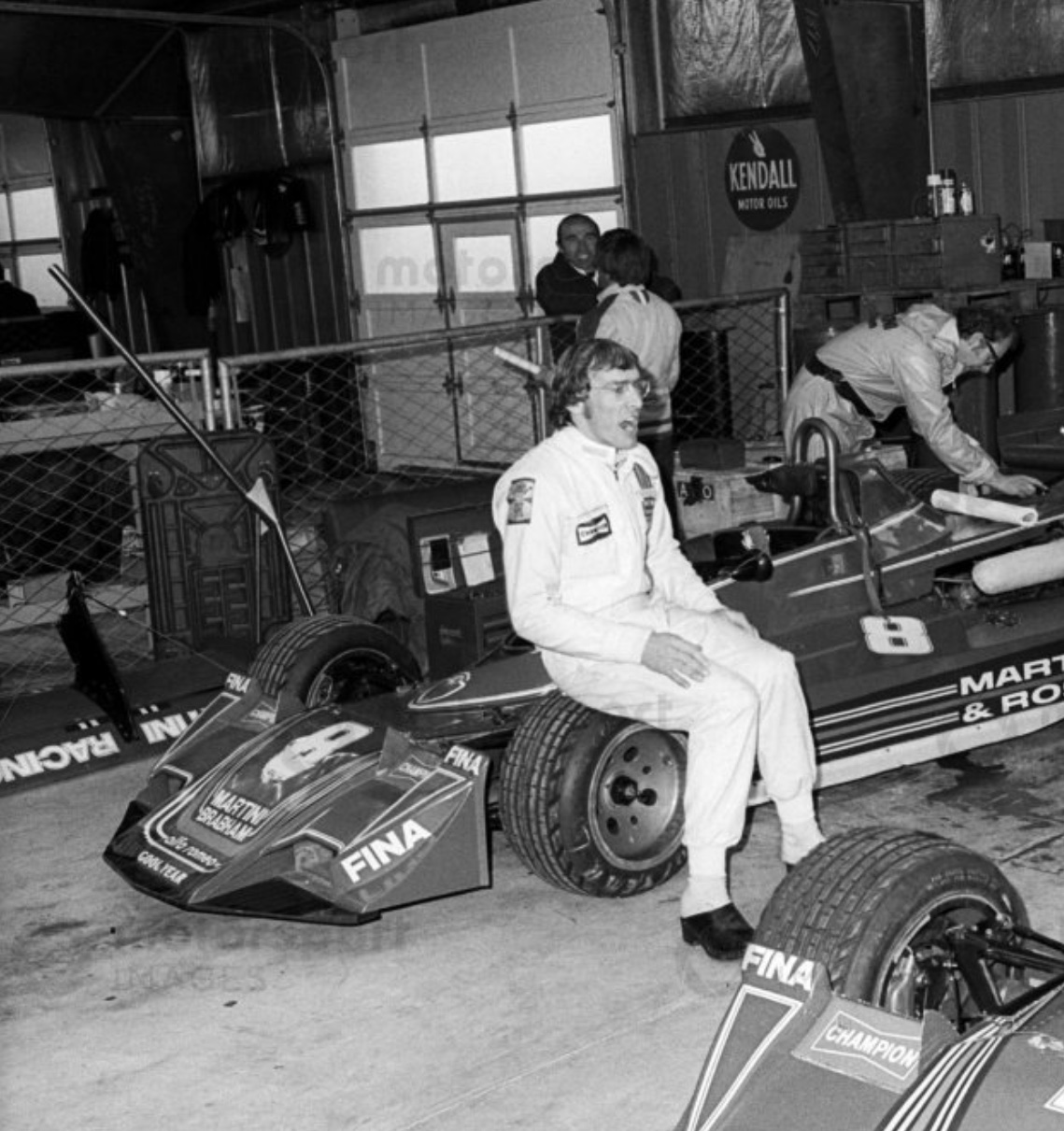
Perkins sitting on Carlos Pace’ BT45 in the Kendall Centre, Watkins Glen 1976 (D Phipps)
Denis Jenkinson reported the changes at Brabham in his Canadian Grand Prix race report as follows, “Bernie Ecclestone’s Martini-sponsored team brought along a brand new Brabham-Alfa Romeo BT45 for Carlos Pace to drive, this being chassis number 5 which featured several minor chassis alterations and weight-saving changes plus wishbone rear suspension and revised rear bodywork, with newly “faired-in” cold-air ducting for each bank of the 12-cylinder motor. The car was also using the carbon-fibre brakes once more and the Brazilian seemed reasonably happy with it on the first day, although his best of 1 min 13.438 sec. on Saturday was only 12th quickest.”
“In the second car, vacated permanently by Carlos Reutemann, Ecclestone had decided to reward the initiative and determination demonstrated by bespectacled Australian Larry Perkins whilst he was driving the old HB Ensign MNO4 in the European races he could afford to compete in. Perkins was thus installed in the second Brabham (BT45/3) and did a neat and tidy job on his first outing with a works team even though he was forced to take over the team spare BT45/1 after his original mount suffered engine failure on Friday, and then the replacement engine developed a severe internal vibration on Saturday.”
Larry qualified 19th and Pace 10th, Jones Q14. Early in the race Larry ran 14th but had “a wild old spin dropping him to last” circa lap nine. Larry finished 17th, Jones 16th and Pace seventh, the race was won by Hunt’s McLaren M23 from Patrick Depailler’s Tyrrell P34 and Mario Andretti’s Lotus 77, Lotus’ renaissance was well and truly on.
Picking up the Amon thread throughout this article, Chris cried ‘Enough!’ after the first of the two German GP race starts. Lauda’s accident was the last straw, so he stepped out of the Ensign which was so fast in his hands but so fragile too. Neither Hans Binder nor Jacky Ickx, who then drove the car made the chassis sing as Chris did.
But several races after this decision Amon was cajoled back to join Wolf-Willams, he was down to drive an Wolf-Williams FW05 in the Canadian GP. The luckless Kiwi spun “very slowly on a downhill left-hander whilst moving over to make way for a faster car during the second session. Before he could restart he was hit by Harald Ertl, who simply lost control on his own, the impact wrecking both cars and putting both drivers out of circulation with badly bruised legs and damaged muscles”, it was insult to further injury in such a mixed season for Chris.
The circus then decamped across the border to the beautiful Watkins Glen circuit in the Fingers Lake region of upstate New York.
The Glen difficult, technical circuit wasn’t one on which Larry had competed before, Q13 was a good effort only three slots behind the experienced Carlos who crashed in the race. Larry had suspension failure, a front wishbone pick-up pulled away from its mounting after the Aussie had finished 31 laps.
Their was plenty of tension in the air that weekend as the championship was at its pointy end. James Hunt needed to win to keep his hopes alive, which he duly did, taking victory from Jody Scheckter’s Tyrrell and Niki Lauda’s Ferrari.
It was the first time in a while that three Australians were on an F1 grid, Alan Jones and Warwick Brown were also race qualifiers. Chris Amon was hobbling around Watkins Glen on crutches, unable to take the start in his Wolf Williams, which had been rebuilt around a fresh monocoque. Frank Williams sought Vern Schuppan’s services but found another Australian in California instead, and so it was that F5000 ace Warwick Brown got the gig, sadly his only F1 ride.
Denis Jenkinson observed that “Larry Perkins put in a very respectable show in the second Brabham-Alfa Romeo, (in practice) lapping faster than Clay Regazzoni who tried both his regular Ferrari and the spare (028-2) during the afternoon but really seems to have lost a great deal of his determination since he has been advised that Ferrari won’t be needing his services again in 1977.”
Perkins ended up qualifying only a tenth-shy of Pace, Q13 and Q10 and ran as high as 12th in the race ahead of Jones, Ickx and Fittipaldi before yielding his place to Jones, then having the suspension failure which ended his race. Jones was Q18 and eighth after a trouble free run whilst WB was Q23 of 27 and finished 14th, slowed with gearbox problems throughout, with “the Australian driving the last few laps without third and fifth gears operative on the Williams but keeping out of everybody’s way as he did so,” wrote DSJ.
Off to the Mount Fuji and its amazing outlook to the dormant volcano for that amazingly wet race that decided the 1976 title in Hunt’s favour, the race win taken by Andretti’s Lotus 77.
Larry’s qualifying performance was ordinary- Q17 with Pace Q6 “…in Brabham BT45/3, the Brazilian having started practising with BT45/1 but taking over the newer car from team-mate Larry Perkins after it had developed a misfire. The Martini sponsored team was down to only two machines for this final race of the season as the new lightweight BT45/5 had been sent home after Pace had tangled with Mass’ McLaren at Watkins Glen and damaged the chassis quite badly in the ensuing accident.”
The start took place in diabolical conditions, but Hunt made the most of a good start and edged his McLaren into the lead whilst Larry “crept into the pits to retire his ill-handling Brabham-Alfa, the Australian’s car not feeling quite right after being hurriedly repaired after he’d crashed it during the untimed morning session.” Pace withdrew after only seven laps, having similar misgivings about the conditions as Lauda. Alan Jones was Q20 and finished a typically gritty fourth, adrift of Hunt.
And that was it, the Brabham drive for 1977 went to John Watson, on the market from Penske, and, in all the circumstances, the logical decision for Bernie Ecclestone to make.
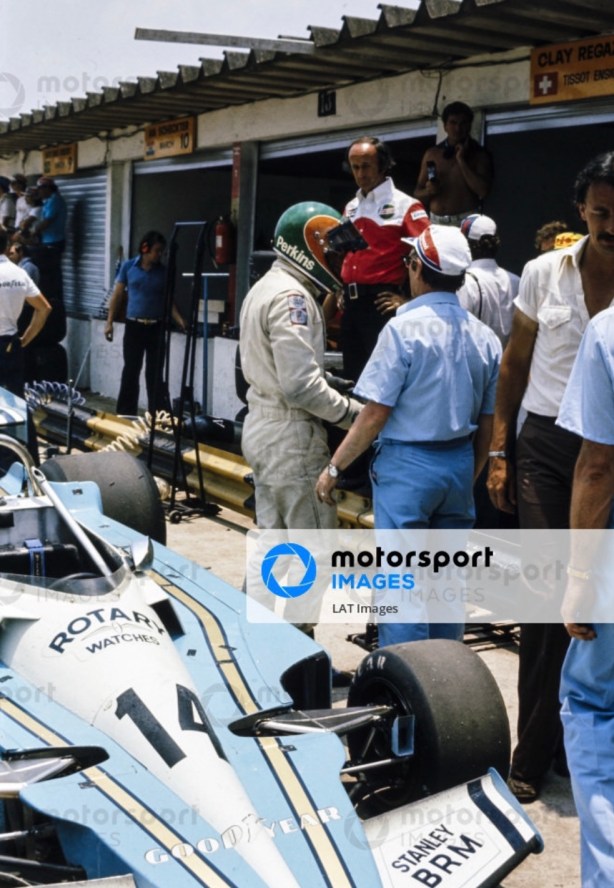
Interlagos 1977, BRM P207. “I thought you said that was the best engine- the thing wouldn’t pull me’ granny off the top of the piss-pot at Cowangie!”- or words to that general effect
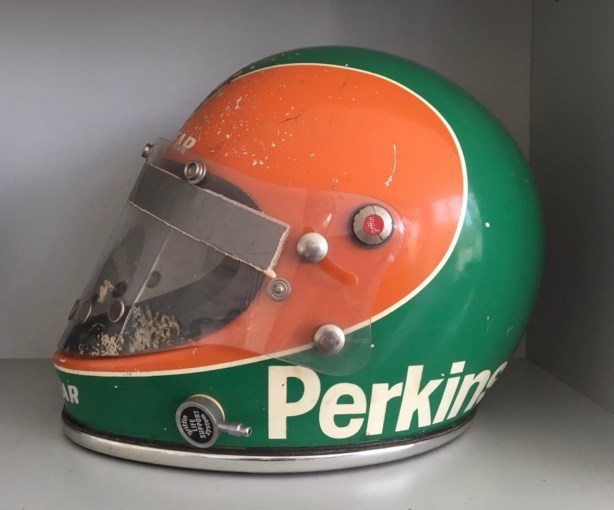
Yours for $A10,000, LP’s Griffin helmet from his Brabham Alfa and BRM days (Perkins Engineering)
To most pundits surprise BRM were returning to Grand Prix Racing in 1977, with an ‘all-new design’- the P207 was the second quickie-car from the hand of the very talented Len Terry who had first pulled the fat out of the fire for the Bourne concern with the 1968 BRM P126. With four months and a minimal budget, the car was unveiled at the swanky Dorchester Hotel on 3 December, 1976. Without time to test properly, it was given a few straight-line runs on a Cambridgeshire airfield where the it boiled as merrily in the English winter, as it did in the South American summer shortly thereafter.
Larry had a taste of how an F1 team should operate with Brabham, and was optimistic – mind you, he had to be as he was hardly spoiled for F1 choice – he joined BRM for 1977.
“Sometimes,” he says, “a driver finds himself in a good situation, the next moment you’re thinking, “Christ, will another opportunity come along?” Well, BRM came along, and I reckoned it was better than nothing. There were some capable people at BRM, and I’m a hands-on sort of guy who reckons you should be able to turn things around if you have good people around you” reflected Perkins, 26 years of age at the time.
Chief Engineer Aubrey Woods, pissed off at Len Terry’s appointment ‘over his head’, and Len, disagreed with the cause of the overheating. Woods and Perkins thought it was a radiator/airflow problem “…but I reckoned it boiled down to the design of the water pump housing. The pump I designed was intended to send the water in two directions, diagonally opposite to each other. But because of a lack of finance, the actual pump was a cobble-up of two pumps cut in half. As soon as I saw it, I knew we would have trouble with it. The interior of the pump was such that it was stirring rather than circulating – and the water was just sitting in the head.”Len Terry recalled.
This was a small problem which should have been easily solved, but the issue preventing a fix was a clash of personalities and ego. Terry, “I was saying that the main problem with the car was the engine, and Aubrey was saying it was a fundamental design problem. He wouldn’t accept it, and I wouldn’t accept it. In fact, looking back, it was neither an engine problem nor a design problem.”
Poor Perkins landed in the middle of this shit-fight, which then descended to complete farce when the car would not fit into the plane to South America from Gatwick. Measurements had been made for a commercial aircraft with two doors whereas the passenger jet on offer had only one. The steam coming out of Perkin’s ears as he awaited his team at Buenos Aires airport is reasonably easy to visualise.
Jody Scheckter shook the established McLaren/Ferrari order with a strong win in the new Harvey Postlethwaite designed Wolf WR1 Ford. A last-minute deal with Brazilian airline Varig meant the BRM arrived at Interlagos in time for the year’s second GP.
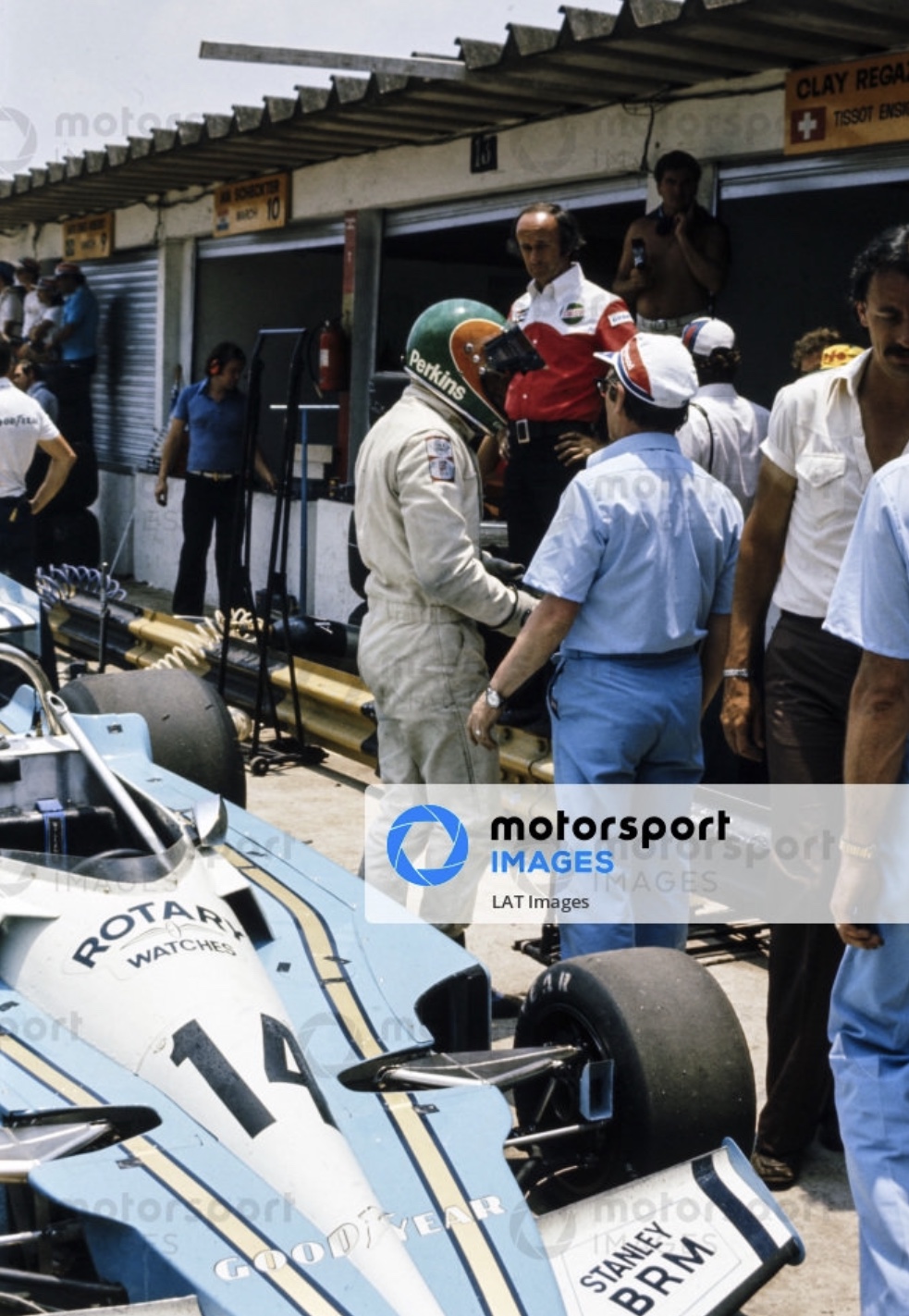
Dennis Jenkinson observed the efforts of the team when he wrote about practice in the February 1977 issue of Motorsport “…Mention of Perkins brings us to the subject of the BRM P207, that new car from Bourne which has been designed by Len Terry. Barely ready to move, let alone race, the BRM predictably overheated madly in the Brazilian heat and minor problems with certain aspects of its fuel system couldn’t detract from the fact that the whole team was in a state of total unreadiness. Perkins could only manage 2 min. 42.22 sec. with the BRM and, since we saw him qualify 12th out of 24 at Watkins Glen in a Brabham BT45, we feel we know what conclusion it would be accurate to draw. Some people never learn; or perhaps they don’t want to.”
Whilst Carlos Reutemann drove a fast, consistent race in his 312T2 to win the race, many others lost control on one particular corner which had a surface like ‘black ice’ poor Larry “Totally unnoticed by most of the spectators…crawled into the pits to retire with all of its water blown out after a single lap.” It wasn’t an auspicious start to a season which was an embarrassment to all fans of this grand-marque.
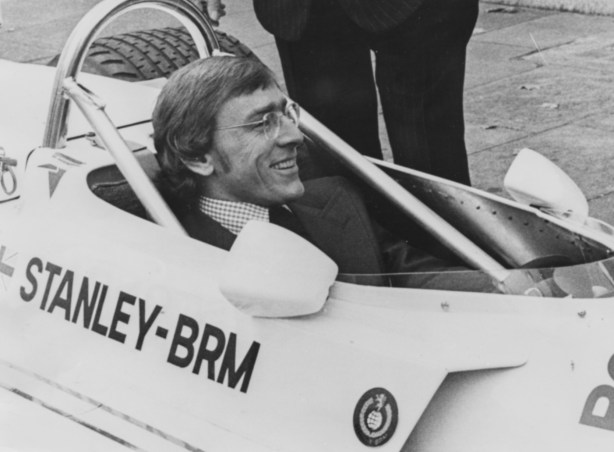
‘Yeah mate it feels great- at this speed’, LP P207 at the Dorchester launch (Getty)
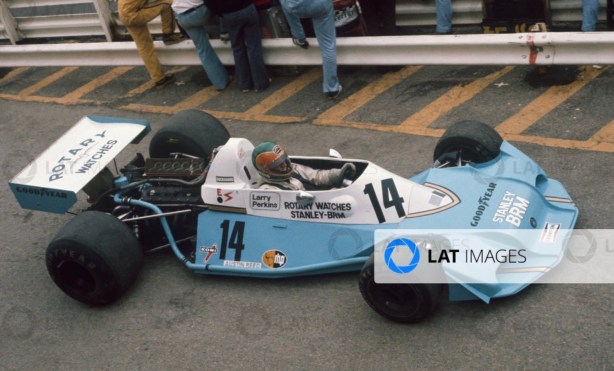
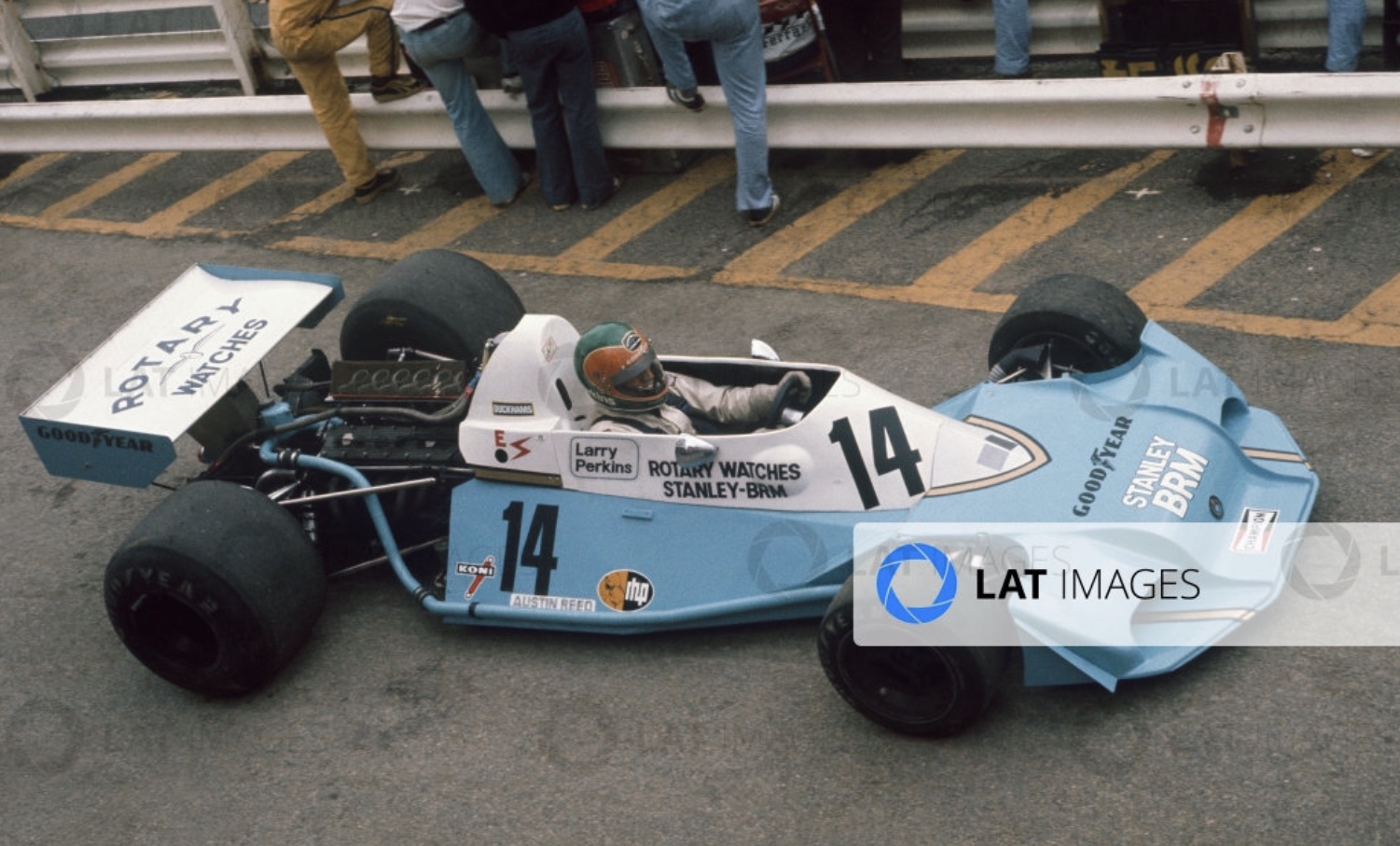
Larry in the Kyalami pits, BRM P201B 1977
Kyalami was next.
The team managed a little testing at home, but broke enough bits to eliminate the use of the P207 in the South African GP. They team took a P201 instead, Perkins quipped that “I think it had Jo Siffert’s name on it”. The machine hadn’t run since Argentina 12 months before. Loaded onto the slow boat to Cape Town – there wasn’t enough cash to fly it – it arrived, according to one journalist, looking as though it had been used as the ship’s figurehead.
The frazzled team trailered it to Kyalami in what turned out to be a tragic weekend with the death of Tom Pryce and a young marshall. Larry popped the car in Q22 “…simply because it would not go any faster” – only Brett Lunger’s private March was slower. The car would do no more than 148.5mph on Kyalami’s long straight. Larry at least finished the race in 15th place albeit five laps behind the winner and bringing up the rear running on about 10 cylinders”, his hands and arms numbed by the vibration caused by missing wheel weights.
Niki Lauda’s Ferrari 312T2 won the challenging race in a Ferrari very low on water and even lower on oil as a consequence of picking up on circuit metal left by the remains of poor Tom’s Shadow and Jacques Laffitte’s Ligier on-circuit.
The P207 returned to battle in the traditional non-championship Brands Hatch’s ‘Race of Champions’ on 20 March, but withdrew when some old ‘parts bin uprights showed signs of wear. The car was far from all-new, Terry’s brief was to use as many existing components off the shelf or what Perkins described as “old rubbish recycled”.
Larry said in 2001, “You dream that someday you will become an F1 driver, and now here I was doing it. I couldn’t believe it. But then I couldn’t believe that, having got there, you could be treated so badly. The car had some nice bits. The engine lacked power initially, but they found 50bhp with a new sump. It sounded beautiful. But then it would break. The gearbox was lovely, too. There were some good engineers at BRM.”
Larry was off though, he had had enough, there was no prospect of a performance improvement, indeed the car did not qualify for any race for the rest of the season despite the best efforts of Conny Andersson (Spain, where he blew an engine on the first day and the car became stuck in gear on the second. Belgium – both V12s blew. Sweden – one engine lost oil pressure, the second blew whilst a third engine flown in overnight also blew and in France where both engines blew) Guy Edwards (Silverstone) and Teddy Pilette (Germany, Holland and Itay).
‘”I wasn’t politically correct; I don’t remember having a long chat about it all, I think I just rang up and said, ‘You won’t be seeing me again’ Larry said. Len Terry left the team at about the same time. It was his last foray in F1: “There was a lot of energy and ideas, but much of it was at cross-purposes, especially between Aubrey and me. It was one big cock-up.” Woods stayed on and reckons his reworked V12 was giving a very competitive 480-490bhp. Pilette concurs, but also remembers that it kept dropping valves: “There was just no money. There was a patch on one block that was leaking. So we sealed it with Araldite”…
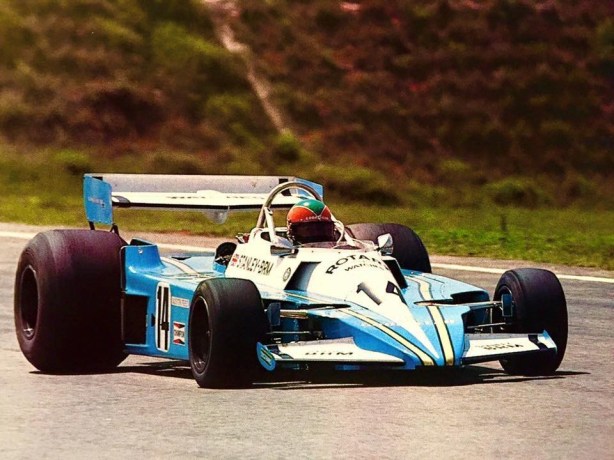
Perkins, BRM P201, Interlagos 1977 (unattributed)
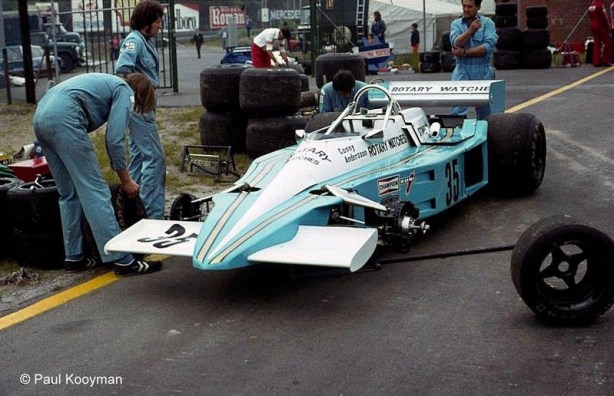
Andersson’s BRM P207 in slight undress at Spa in 1977- front inboard rocker suspension clear, DNQ
What to do next?
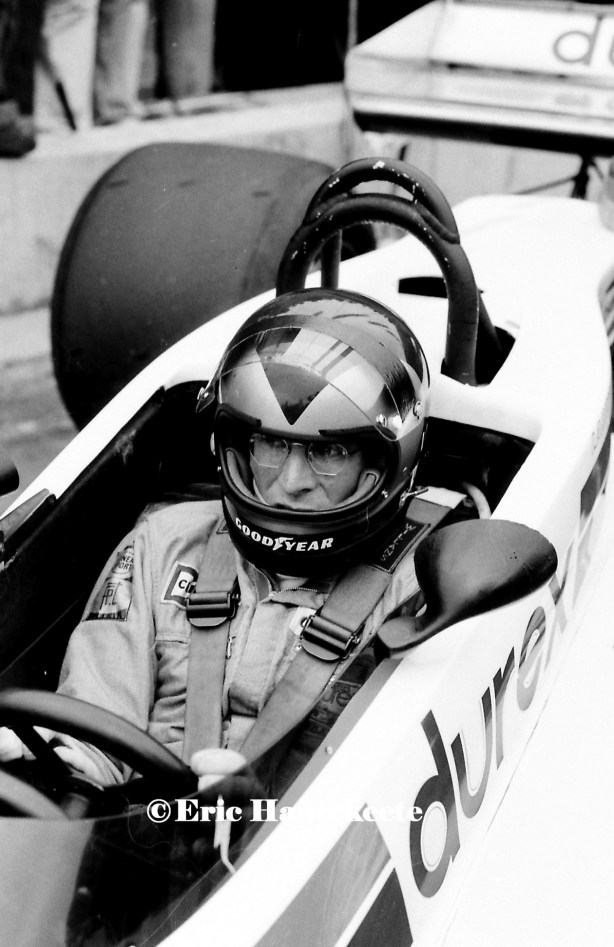
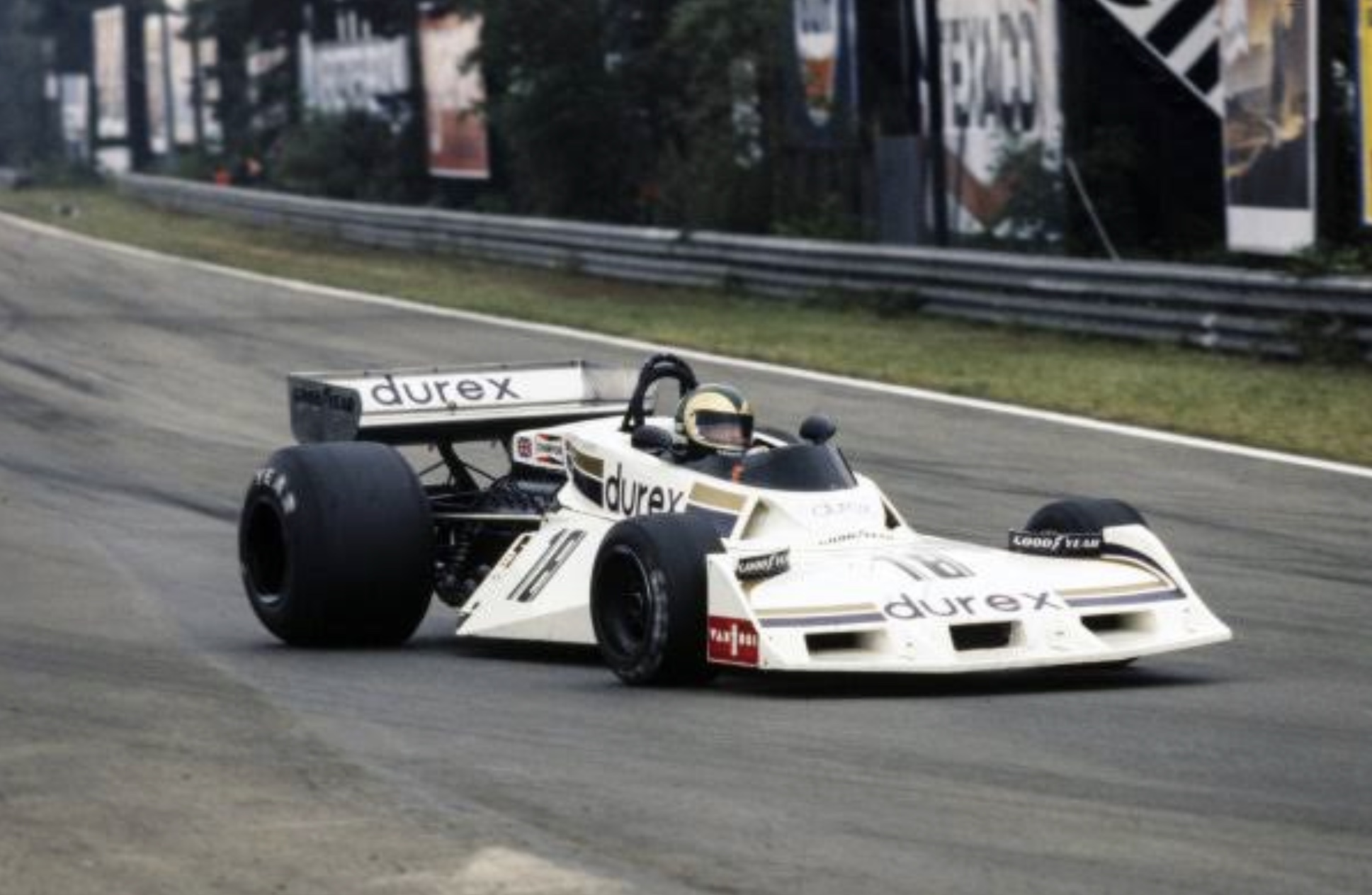
Over at Team Surtees the ‘Monza Gorilla’, Vittorio Brambilla managed to blow-off all of his younger teammates, Hans Binder was his latest victim in the early races in 1977, mind you, whilst Binder qualified well behind Vittorio he did finish races Vittorio did not. Perkins was given the drive in the other TS19 Cosworth for what was said to be just the Belgian Grand Prix at Zolder in early June. There he qualified the Franger F1, Durex sponsored TS19 Q23 – six spots in front of poor non-qualifier Conny Anderson in the BRM Larry had vacated, he finished a steady 12th, Vittorio was Q12 and fourth.
It is interesting to read Jenkinson’s July Motorport report of the June 5 Zolder race and the realisation of the extent of the ‘Unfair Advantage’ Colin Chapman and his team had, as expressed in the Lotus 78 Ford, some excerpts are below. Note that the first Lotus 78 Ford GP win was at Longbeach in early April and then at Jarama a week later.
“Overnight (after practice) the speed of the Lotus was discussed in all quarters. It was accepted that Andretti was a good driver, but not that good, and anyway Nilsson was well placed, so it had to be something about the Lotus 78 that Chapman and his team had done. It wasn’t super-special Cosworth engines, for Andretti was using a John Nicholson prepared engine and Nilsson was using a normal run-of-the-mill Cosworth Engineering prepared unit. Lotus had got a special-development Cosworth engine, but were not using it, it was sitting in the transporter.”
“It could not be special Goodyear tyres, because by the Constructor Association “gentleman’s agreement” everyone had the same type of tyre – or had they? It couldn’t be that Goodyear were preparing for the appearance of Michelin into Formula One, by letting some special tyres slip out. If they had, they are unlikely to have had them for Andretti and Nilsson. It could not be the special low-percentage slip differential, for Nilsson wasn’t using one.”
“The only common factor seemed to be the much-vaunted (at the beginning of the season) air-flow under the side-pods, giving additional down-force. From appearances both Lotus cars seemed to be running with their rear aerofoils at a shallower angle than most people, thus providing little down-force, but more important they were producing less drag. Observers remarked that Andretti was not only much faster round the long right-hand sweep that brings the track along behind the pits; but looked uncommonly steady. Perhaps the inverted aerofoil sections under the sides of the Lotus are now really working, having sorted out the other variables.”
“When Colin Chapman returned on Sunday morning (he had returned home to England for a family gig on Friday) he was both pleased and angry, for while he expected Andretti to be on pole position he intended that he should have done it by a few tenths of a second, not a whole second and a half. Team Lotus had shown their hand unnecessarily.”
And then this from his report of the latter race stages, “The nice drying wind was still doing its stuff and as things improved Nilsson’s Lotus came into its own and the Swede began to reduce the gap on the leading Ferrari at an astonishing rate. Within ten laps on the dry road the Lotus was right up behind the Ferrari and on lap 50 the Swede out-braked the Ferrari into the chicane behind the pits, as if he was overtaking a back-marker, and was gone over the hill into the lead, just like that. There was nothing Lauda could do about it, and with all respects to Gunnar Nilsson’s driving ability, it just had to be a case of a vastly superior car.”
“…Once away from Lauda, the younger Swede was able to ‘roll it off’ and cruise home untroubled, revving to a mere 9,500 r.p.m. in the gears, instead of the normal 10,800 r.p.m. The Lotus was just remarkable, and Nilsson was doing a great job of work with it…Nilsson cruised round to complete the 70 laps.”
The next two races were terrible for Larry, DNQs at both Anderstorp and Dijon where Brambilla was Q13/DNF and Q11/DNF respectively. In the French GP Larry drove only in Friday practice, then Big John bundled him off to one side and popped Patrick Tambay into the car, he too missed the cut.
Vern Schuppan drove the Dinger Spl at Hockenheim for Q19 of 24 and a distant seventh, a lap adrift of winner Lauda, but a finish all the same. At the Osterreichring he was Q25 of 26 and 16th, two laps adrift, then DNQ at Zandvoort with Lamberto Leoni getting the gig at Monza – DNQ…Hans Binder was reinstated at Watkins Glen, Q25 and 11th, two laps adrift…I guess the point of all of this is that it is very hard for a driver to get into some sort of rhythm-and-sync with a car and team unless there is the time and commitment to do so…
And that was it, Larry’s F1 career was over.
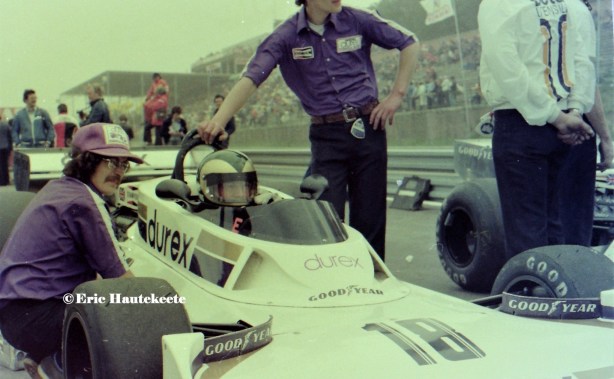
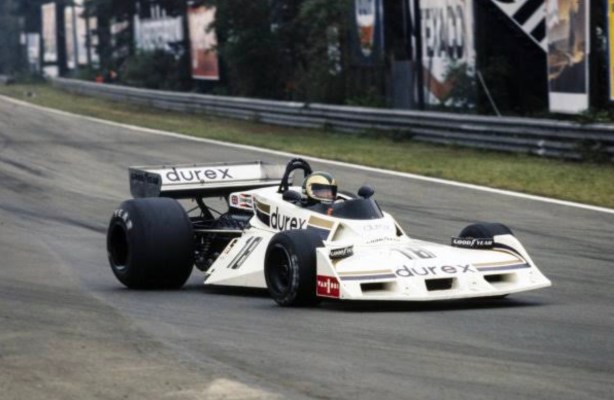
Belgian GP 1977 (Motorsport)
So, what do we make of it all, at least to this point in their careers?
Terry Perkins proved he deserved another year of F3 but returned to Australia, never to be heard of in a racing sense again, hopefully via this article I can fill in the last forty years or so. While I have made attempts to get in contact with Terry via social media a while back, hopefully this article will be a catalyst to make a connection and then close things off.
Larry did exceptionally well with the Ensign N175, better than Wunderink and Amon’s best results in 1975. Only Van Lennep’s sixth place bested him and let’s not forget Larry was preparing the car in addition to being chief cook and bottle washer on race weekends, perhaps only Arturo Merzario acted in this manner as a driver after Perkins did. So, the Brabham ride was well deserved.
At Watkins Glen Larry proved he could go almost as fast as Pace in the same car despite giving away three years of F1 experience and a season racing the BT45. Who knows if Bernie pulled Larry and Carlos into the pits in Japan? The net effect was that Larry lost one of his three races in which to establish his credentials. Certainly if I were Bernie I would have grabbed John Watson rather than Larry to pop into the car in 1977- shit happens.
BRM FFS!
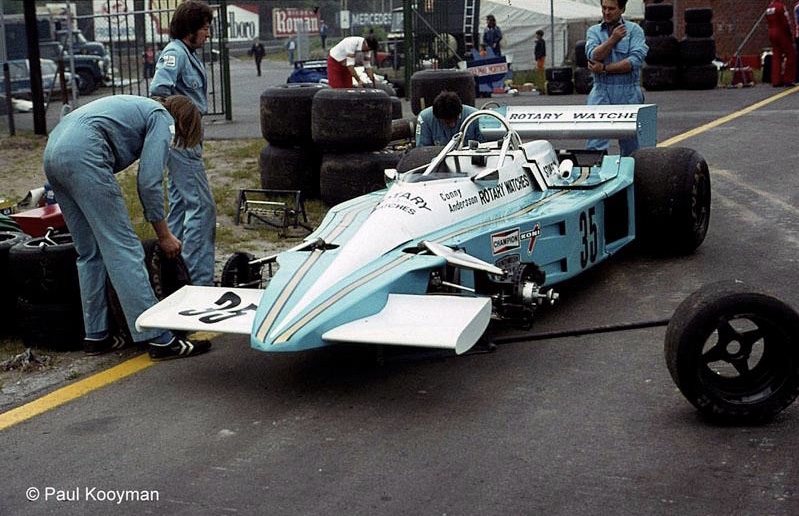
Mind you I would have done what Larry did too in all the circumstances – make a hero of yourself in a poor car has paid off many times in the past but the Stanley Steamer was junk. Whatever management merits ‘Lord’ Louis Stanley had in the past – enabling Tony Rudd and emasculating the Ray Mays/Peter Berthon duopoly duly noted – part of ancient history, BRM was crying out for leadership of a still good team of engineers/mechanics but the pompous stereotype of aristocratic incompetency was never the answer. Taking Rotary Watches money was almost theft. Stanley-BRM are lucky they didn’t go the wallies for deceptive conduct or something similar.
It would have been better to pop a DFV in the back of Terry’s P207 chassis, who knows how good it really was, engine problems meant decent chassis testing was never achieved, and go forward from there, put some results on the board and find the funds to build a new engine. The precedent of Bourne using engines made by others outside its cloistered high-ceilings was established. The Coventry Climax FPF 1.5 it used in F1 in 1961 and the Chevs installed in the back of the Can-Am cars in 1970/1971 are examples but Larry, unfortunately, landed in the middle of this clusterfuck and did the only reasonable thing he could do- walk, or run perhaps in the opposite direction. At least he had the satisfaction at the end of the year of knowing he did better than the poor, equally optimistic missguided souls who followed him, viz Messrs Andersson, Edwards and Pilette, not to forget Mike Wilds later.
Surtees, who knows…
Jones, Lunger, Andersson, Takahara, Binder, Perkins, Schuppan, Leoni, Tambay all didn’t do so well with the TS19 but Vittorio Brambilla made the thing go, albeit not necessarily finish. To be fair AJ did finish in the top six three times in 1976 and second in the non-championship Race of Champions behind Hunt’s McLaren M23 at Brands Hatch, and he was still on the rise as a GP driver, something made difficult for the rest of the guys mentioned above without a test session or three. It would be intriguing to know how many test laps away from a GP weekend Binder, Perkins, Tambay, Schuppan and Leoni copped from Surtees in 1977. Not many…
Jones has gone on the record in various publications about the degree of difficulty he found in getting John Surtees to make changes suspension/wing changes to the TS19, as he, Surtees had tested the car and therefore knew its attributes…to which Jones acid response was that the car handled and reacted somewhat differently when being driven on the pace than the way it did pottering around a couple of seconds off it…
Surtees was committed to Brambilla, Beta Tools money ensured that, whereas the pilots of the Durex machine were changed as often as one does a used condom..
And that was it, back to Oz Larry came.
With his blend of skills you can easily see how Larry could have become a seventies/eighties version of Frank Gardner in Europe blending an F1 test role(s) with race programs in sedans and sportscars but it was sadly not to be, he had given Europe a red-hot- go over five years and made it right near the top of the pyramid. How far had he come from rattling around the surrounding bush of Hume Weir in his FV in 1969? It was time to come home to Australia to make a living in touring cars, a taste of which he had received in his annual Sandown/Bathurst co-drives with The Captain – Peter Janson.
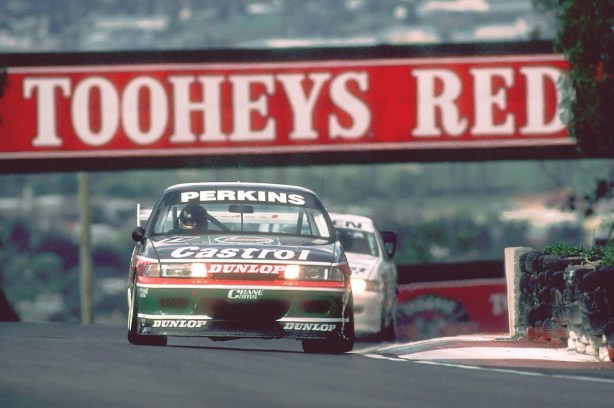
Larry Perkins and Gregg Hansford won the 1993 Bathurst 1000 from pole- a great win and Larry did so in a Holden VP Holden whereas most of the other GM hotshots raced Holden VP Chevs. Only Larry tickled all that was left from the venerable, old Holden ‘308’ V8 (unattributed)
The purpose of this article is not to examine Perkin’s staggering touring car race and business career once he returned to Australia at the end of 1978. He won countless races and six Bathurst 1000’s and had an amazing career as a car builder, initially leading the construction of the Holden Dealer Team cars and later on his own trading as Perkins Engineering. His own race team was successful for decades, not to forget his aviation interests or becoming the first man, together with adventurer Hans Tholstrup, to cross Australia in a solar powered vehicle in 1982, ‘The Quiet Achiever’ was built by Larry and Gary Perkins…
Once Larry returned to Australia he had not entirely finished with open-wheelers, racing David McKay/Graham Watson’s Ralt RT1 Ford BDA in the 1978 New Zealand Formula Atlantic Championship against Keke Rosberg, Bobby Rahal, Danny Sullivan, Brett Riley and others. He also contested the 1979 Series against another group of young thrusters including Teo Fabi, Eje Elgh, John Smith, Jeff Wood and in 1980, but the Chevron B39 he raced that year was not the greatest or latest bit of kit.
After getting ‘match fit’ in January and February 1979 in New Zealand Larry jumped aboard a works Elfin MR8C Chev and won the 1979 Rothmans F5000 Championship from Alf Costanzo’s Lola T430 Chev and Warwick Brown’s Lola T332C/333 Chev.
He raced Paul England’s Chevron B39 at the dawn of Formula Pacific racing in Australia and the a RT4 in the first F Pac AGP in 1981…having boofed the tub of his car during practice he quickly organised a spare from Ron Tauranac who was roaming the paddock that weekend, I watched, fascinated for a long while at Larry’s efficient pace at getting the good bits from the rooted tub on to the newie, the practical skills which helped get him to F1 were still well in evidence and are still deployed today.
Click here for some of LP’s latest exploits…
https://www.abc.net.au/news/2018-07-16/racing-car-driver-larry-perkins-finds-explorers-cache-of-eqipmen/9992376
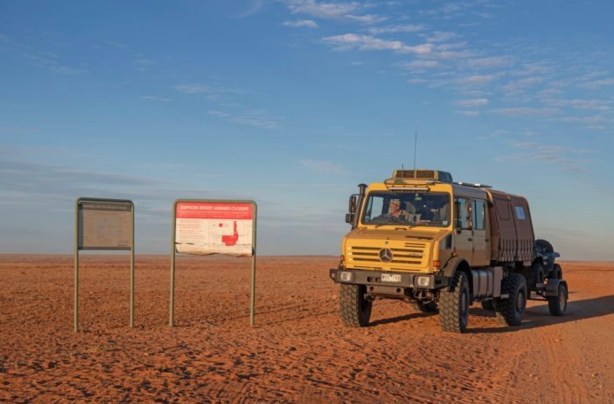
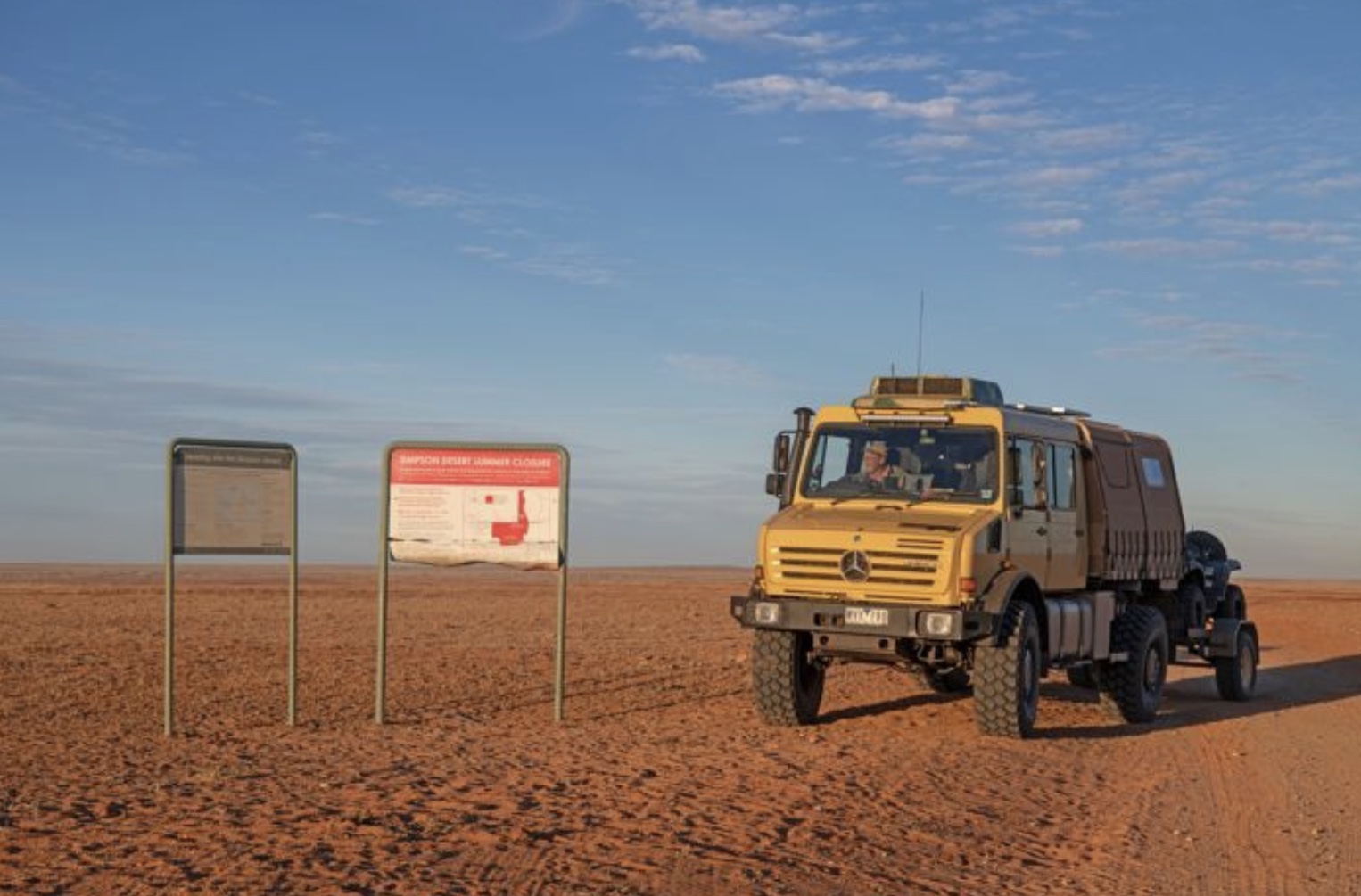
Larry Perkins, Mercedes F1 in the Northern Territory. Mercedes Benz Unimog U4000 (P Blakeman)
Other Larry Perkins articles are here; https://primotipo.com/2016/12/09/f1-driverengineers-jack-larry-the-68-agp-and-rb830-v8/ and here; https://primotipo.com/2016/06/02/larrys-le-mans/ , https://primotipo.com/2018/01/28/what-the-hell-is-that/
Etcetera…
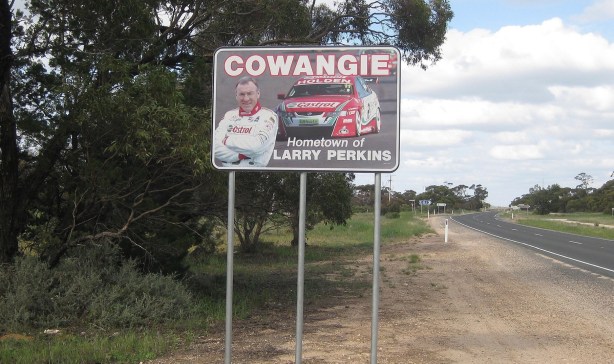
Larry grew up on a farm at Cowangie in Victoria’s Mallee, wheat farming country on the Ouyen Highway not far from the South Australian border, Adelaide is 290km due west and Melbourne 540km to the south.
Larry’s grandfather, Clifton Perkins was granted 793 acres under the Soldier Settlement Scheme after World War 1, having served and been injured during the Battle of the Somme as a member of the 1st Australian Imperial Force.
Larry’s father, Eddie Perkins, a racer/rallyist gave him a love of all things mechanical and the basic skills Perkins deployed to great effect in both his racing and business career. For the record, LP was born at Murrayville on 18 March 1950, his full name is Larry Clifton Perkins.
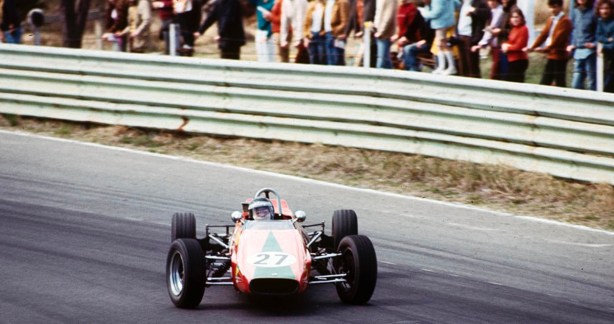
(oldracephotos.com)
Larrikins does his thing in the Warwick Farm Esses during his successful 1971 Driver to Europe campaign.
Former Australian Gold Star Champion Bib Stillwell (or perhaps more accurately ‘BS Stillwell Ford’) owned two Elfin 600s, Richard Knight won the 1970 championship in one of them with Perkins in the other car, whilst Larry’s sidekick in 1971 was Mike Stillwell, Bib’s son, who was pretty handy in Formula Ford, after a brief stint in an ANF2 Elfin 622 he found his niche in a Ford Escort BDG, remember how he made that thing sing in 1972-3?
Bib sold the two 600s at the end of 1971, a bummer, as these drives were eagerly sought seats at the time, he was not the only Ford dealer who supported a car at the time but he was the only one who did it ‘properly’- good budget, well prepared cars with the best of everything.
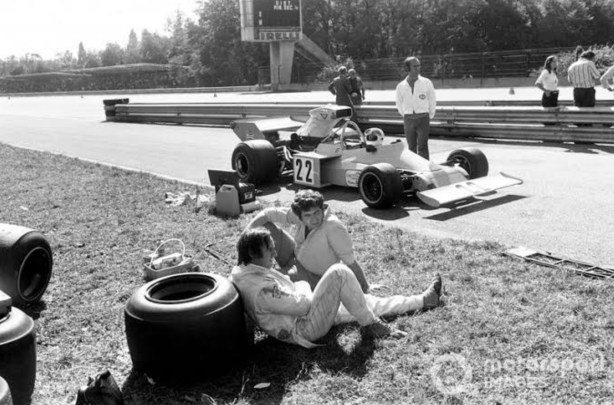
Chris Amon and the boys chew the fat at Monza during the Italian GP weekend in September 1974.
‘WTF do we do now guys?’ seems to be the vibe of dejection.
The Amon AF101 was a noble if misguided attempt at building an innovative, competitive Cosworth/Hewland ‘kit’ GP car, but Chris was off to BRM enroute to a better situation at Ensign. Whilst No Nunn gave Chris a competitive car in the N176 it was the last straw in the sense that the cars fragility and resultant accidents ‘did Chris’ head in’ as to confidence in the equipment and the Kiwis’ view as to the probable longevity of his life…
As a devout, one-eyed, hopelessly biased Chris Amon fan, the 1973 to 1976 period brings absolute frustration at such a waste of talent driving, mainly, GP junk.
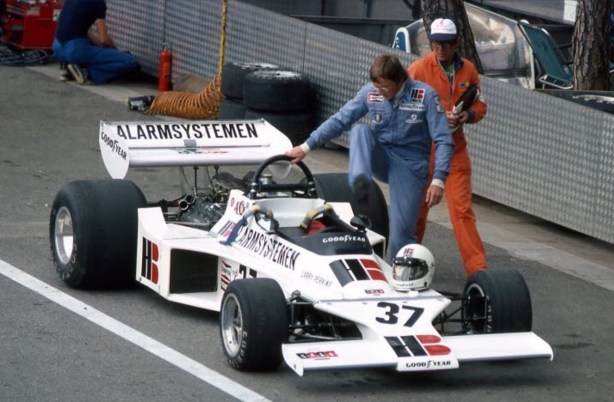
Seldom has a ‘DIY’ F1 effort done so well in the modern era- Bob Anderson springs to mind with his self run Brabhams in the sixties. I don’t think Larry has ever really got the credit he deserves for his stint in Ensign 175 ‘MN04’.
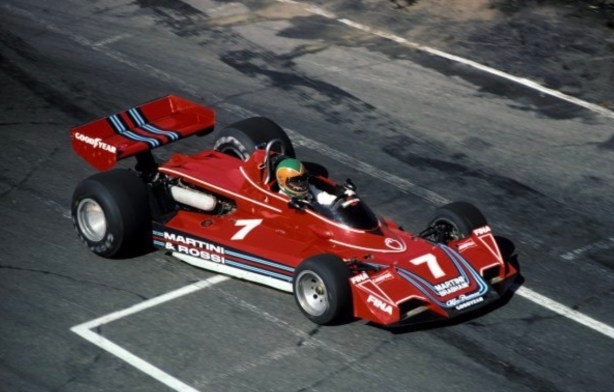
(D Phipps)
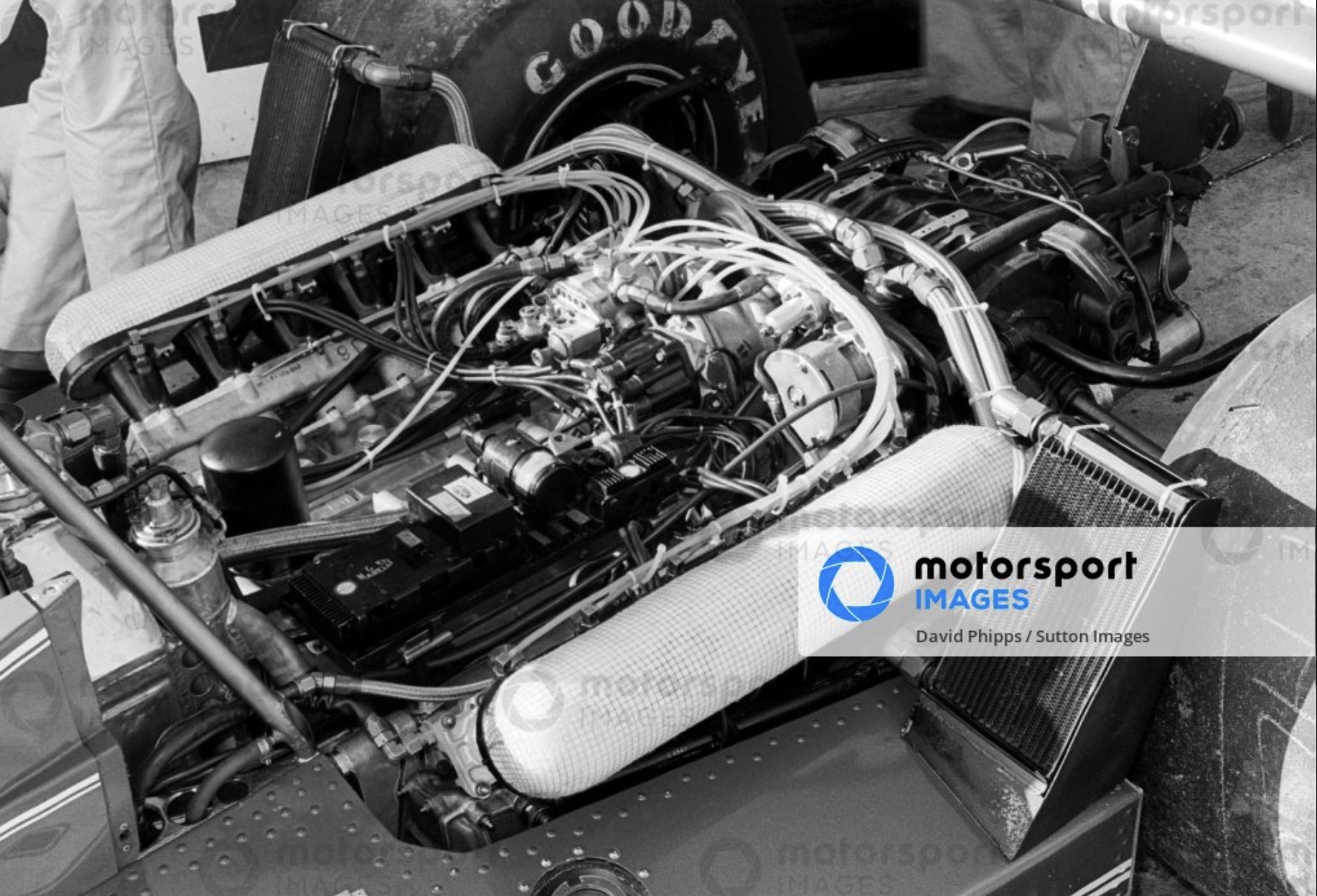
The Alfa Romeo 3 litre flat-12 installation in the Brabham BT45 at Mosport in 1976. Circa ? bhp but with significant bulk and thirst, just fine in the 33TT/12 sportscar but sub-optimal as an F1 engine.
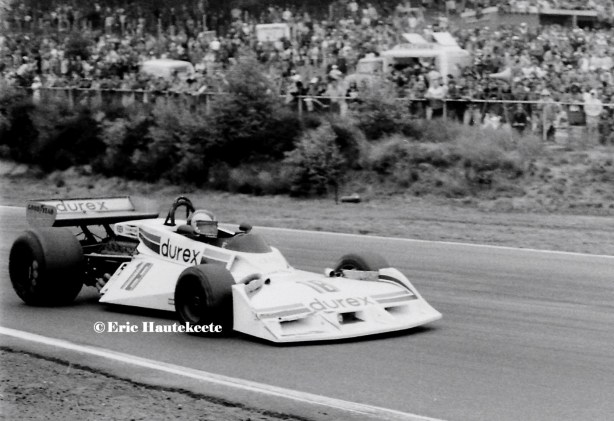
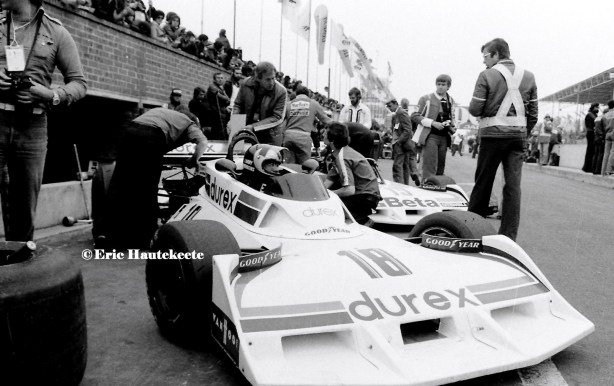
A trio of Belgian Grand Prix shots at Zolder in 1976- the car is TS19-1, the first chassis built raced by Brett Lunger and Henri Pescarolo in 1976, Hans Binder and Vittorio Brambilla as well as Perkins in 1977.
Perkins practiced TS19-2, the chassis Alan Jones raced in 1976, at Anderstorp and in Dijon first practice- Surtees gave the race drive to Patrick Tambay.
Bibliography…
Motorsport articles published in July 1978, January 1994, July 2001 and January 2014 written by M.C.S, MK, Paul Fearnley and Michael Stahl respectively. Motorsport 1976 and 1977 GP race reports by Denis Jenkinson. F2Index F3 race results, oldracingcars.com
Photo Credits…
Alan Raine, Greg Siddle Collection, Graham Ruckert, Yoshiaki Hirano, nwmacracing, Mike Dixon, Ken Hyndman, oldracephotos.com, Tim Marshall, Peter Blakeman, Motorsport/D Phipps, Eric Hautekeete, Nick Bennett Collection, Sutton Images, Getty Images
Tailpiece: Larrikins Ralt RT1 BMW, Thruxton 1978…
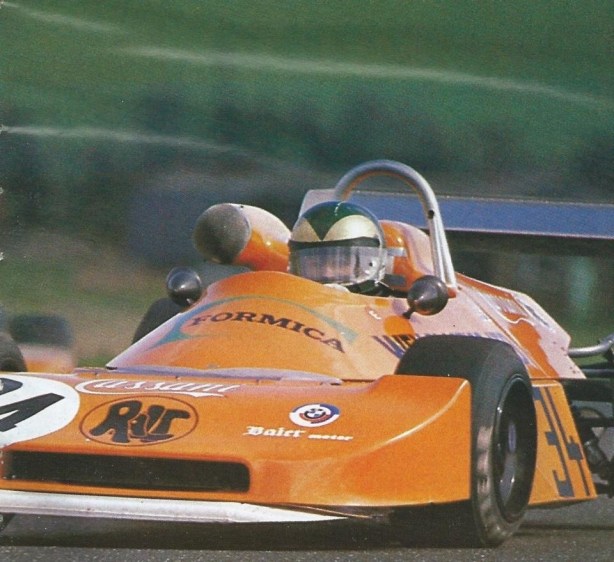
(Y Hirano)
Larry aboard the Manfred Cassani owned Ralt RT1 BMW during the first round on the 1978 European Formula Two Championship at Thruxton on 27 March 1978, Bruno Giacomelli won that weekend, and the title that year, in one of the great F2 Marches, a 782 BMW.
In a one-off drive Larry was the first RT1 home in ninth place behind six 782s and a duo of Chevron B42’s.
LP was RT1 fit, he had raced the David McKay/Scuderia Veloce Formula Pacific variant in the 1978 New Zealand Formula Atlantic Championship against the likes of winner Keke Rosberg, finishing second in the series against the might of Fred Opert Racing.
An aside is that on the same day Larry raced at Thruxton the next generation of Australian RT1 hopefuls contested the BP British F3 Championship 15 lapper. Paul Bernasconi was seventh, Geoff Brabham ninth and Gary Scott 12th- the only interloper was Barry Green’s 16th in a Chevron B38, he of Elfin 620B Formula Ford and Indycar owner fame.
Derek Warwick won that day from Nelson Piquet, both aboard RT1’s.
Finito…






































 primotipo...