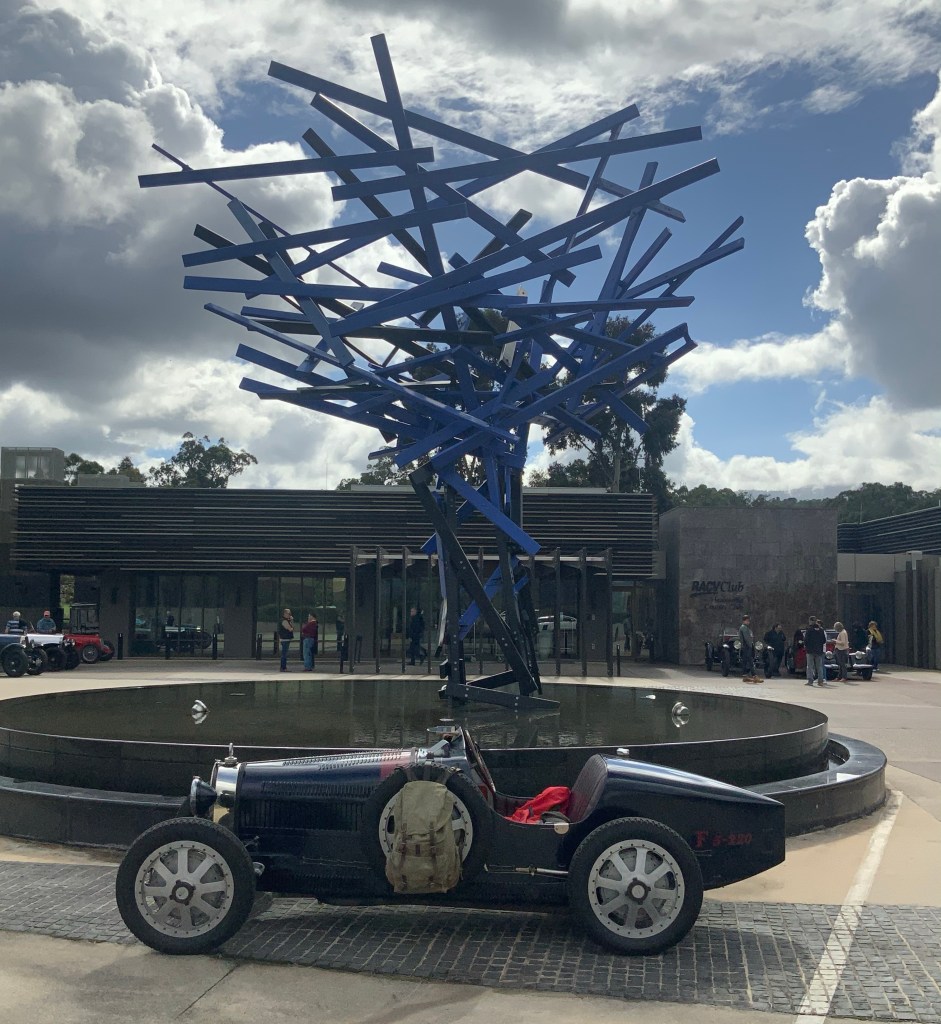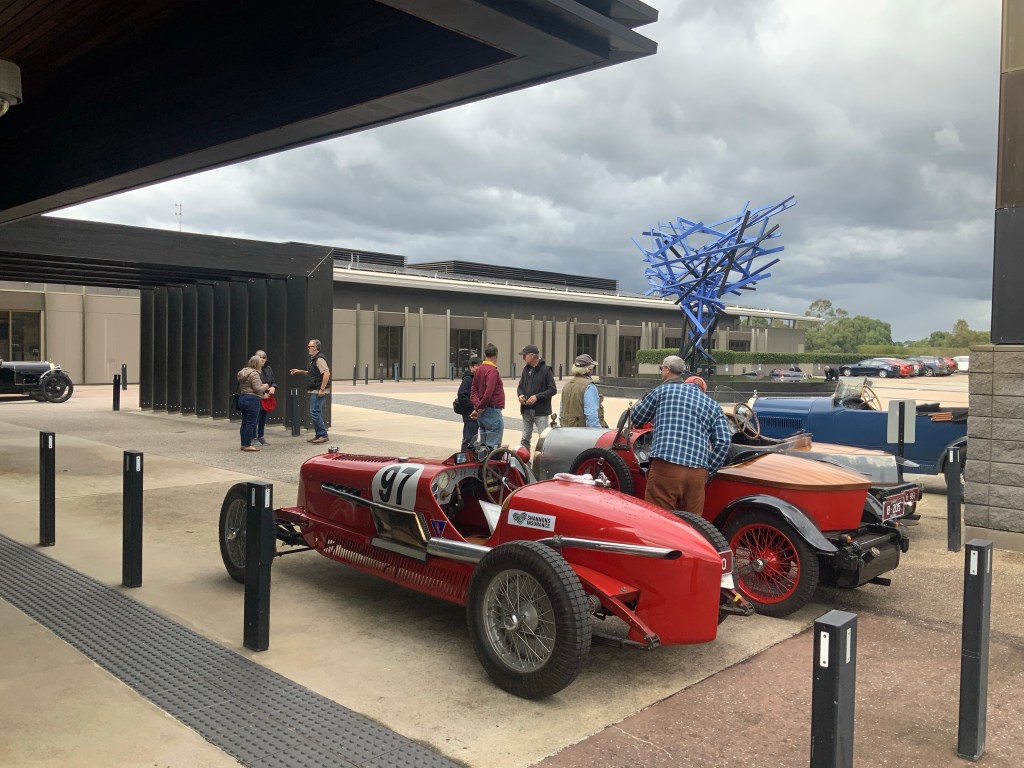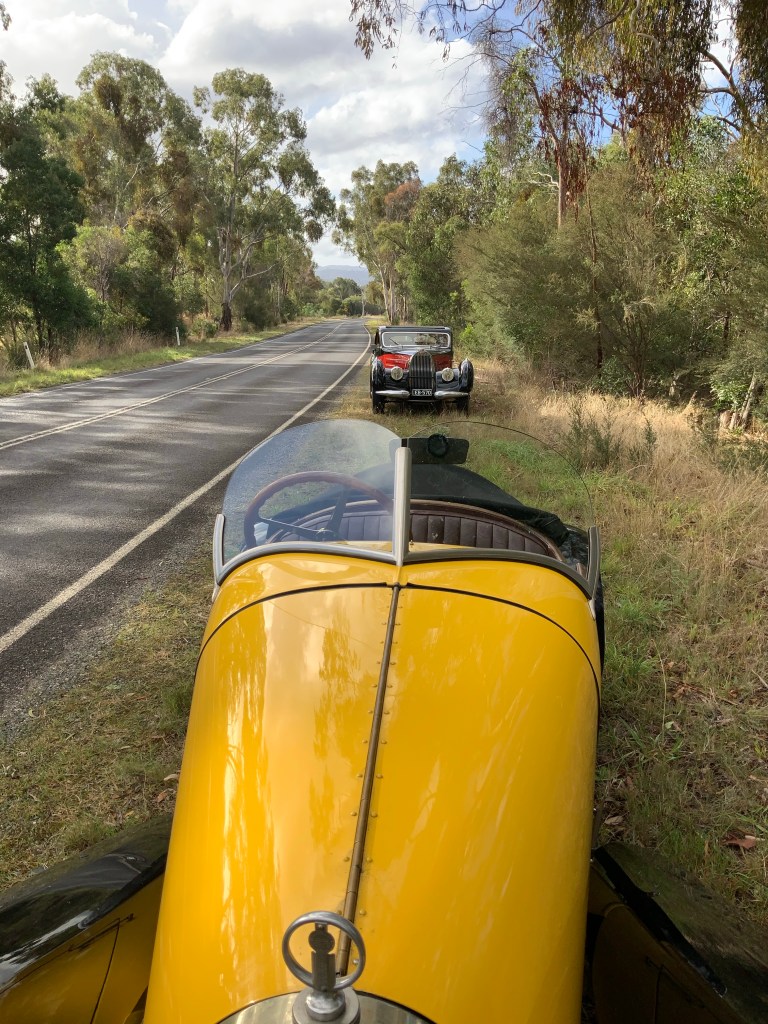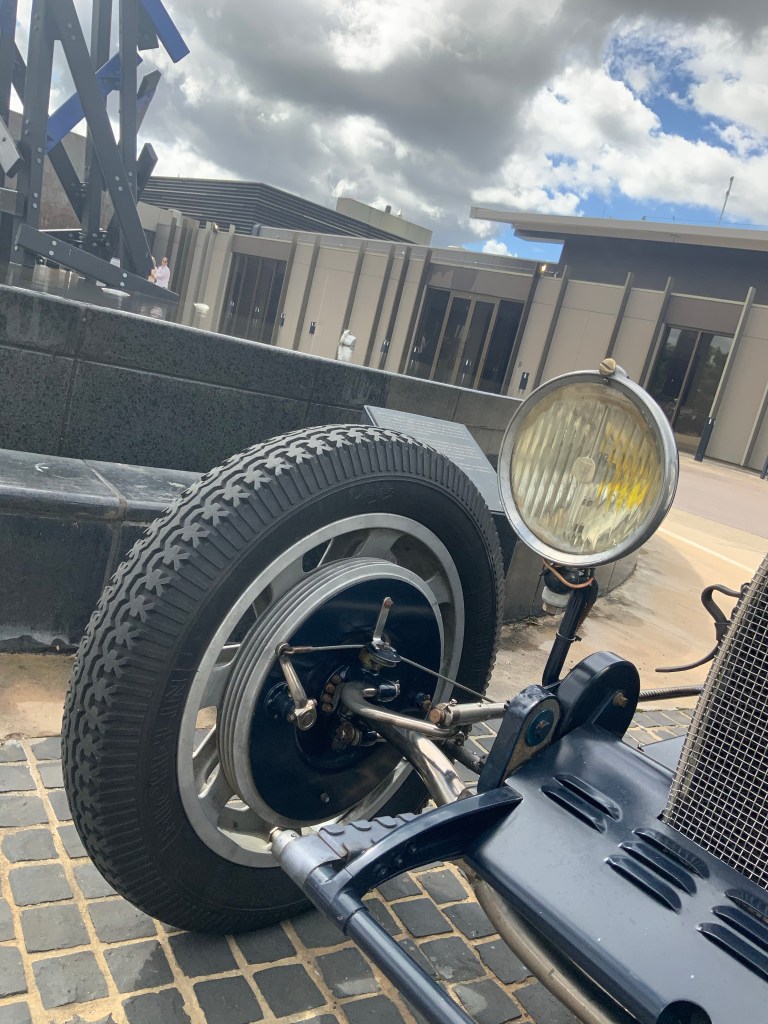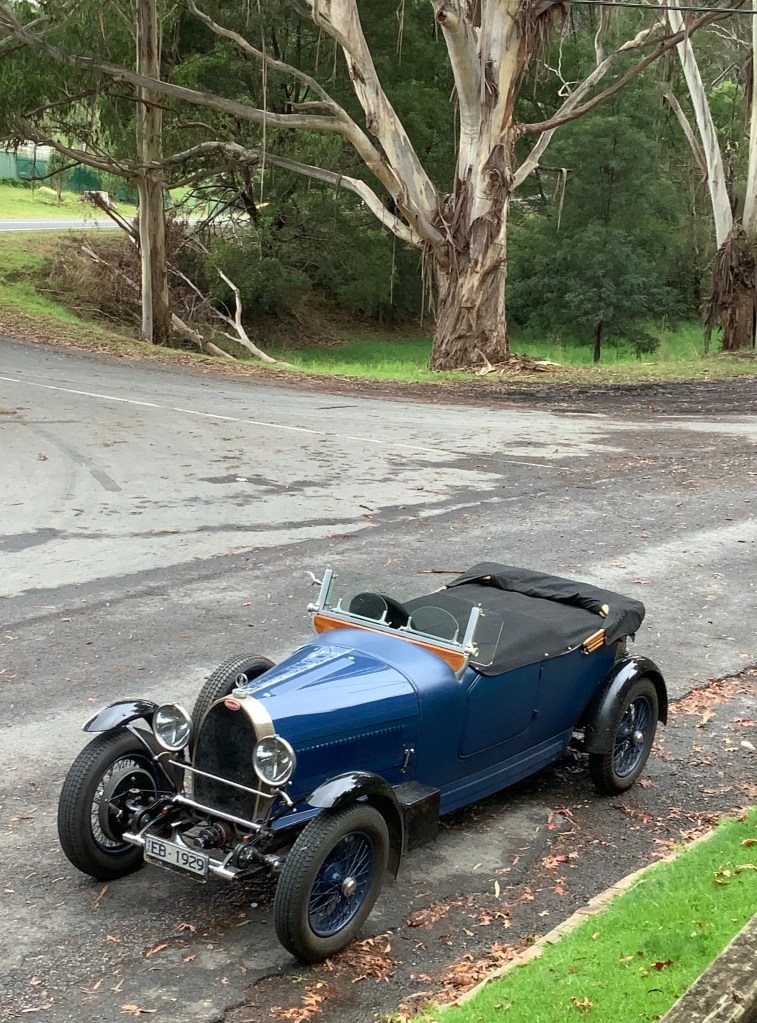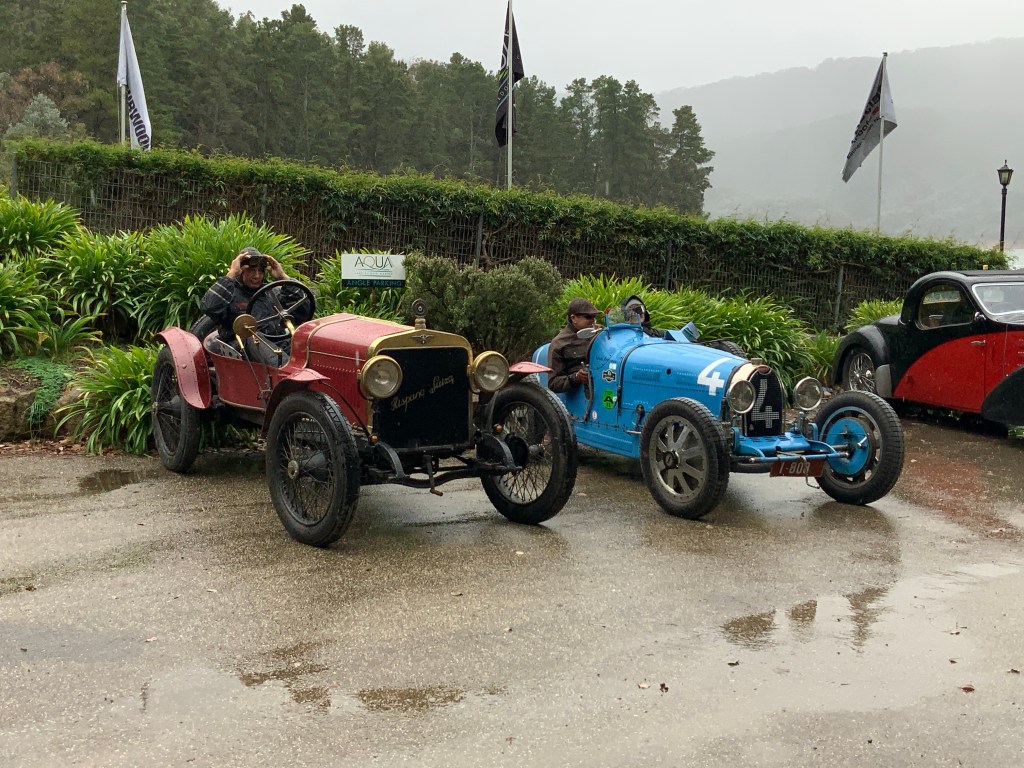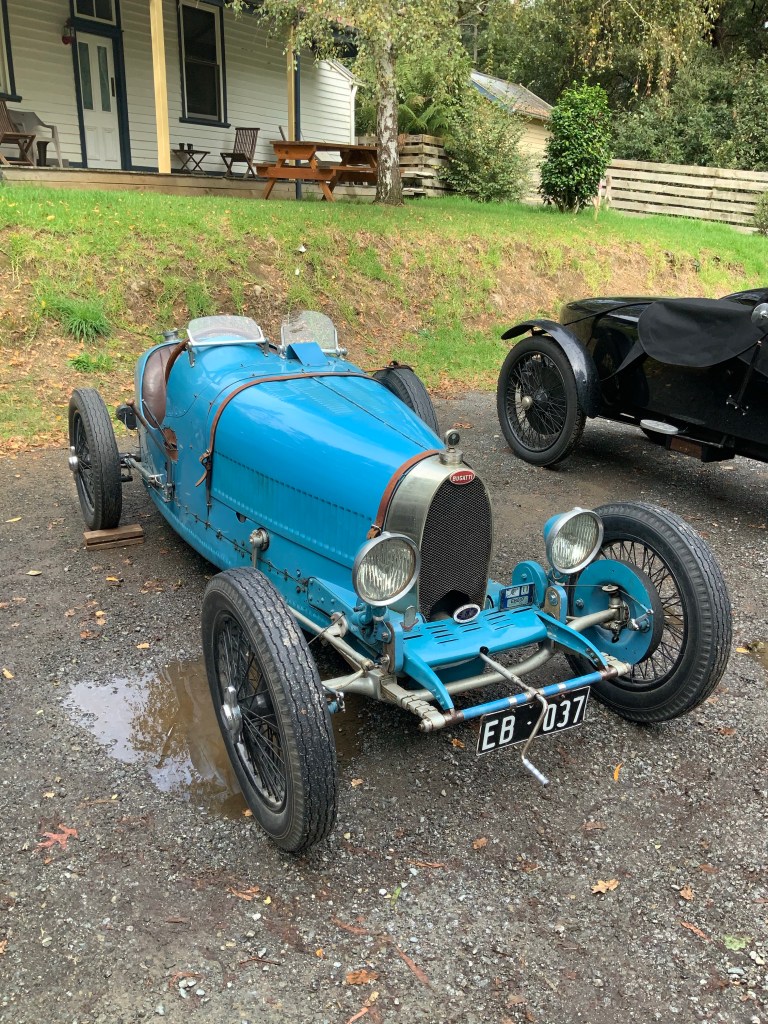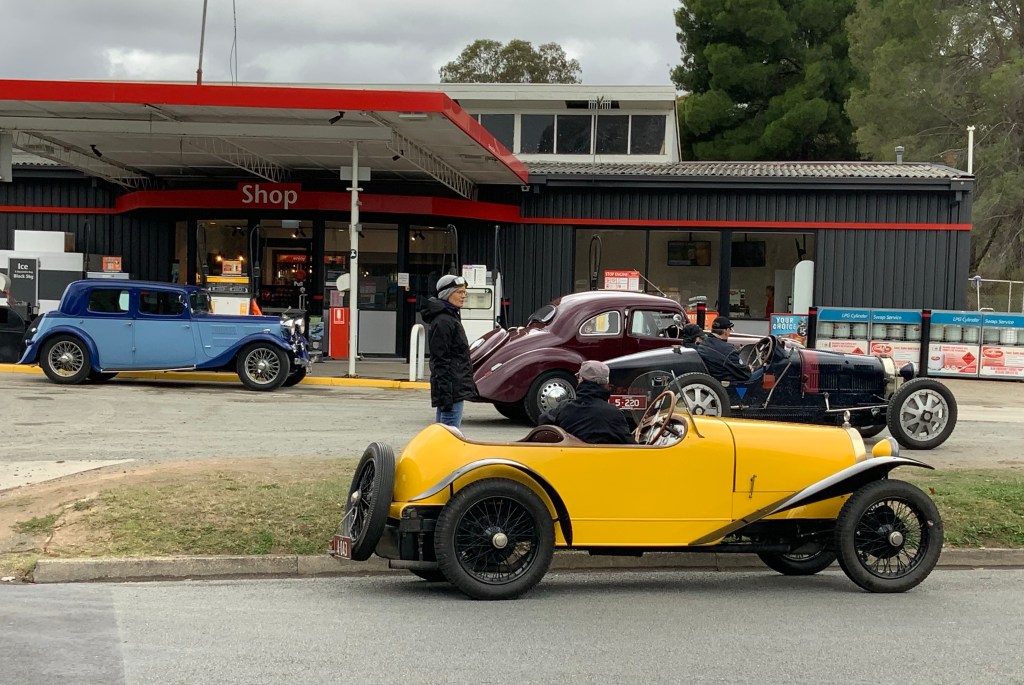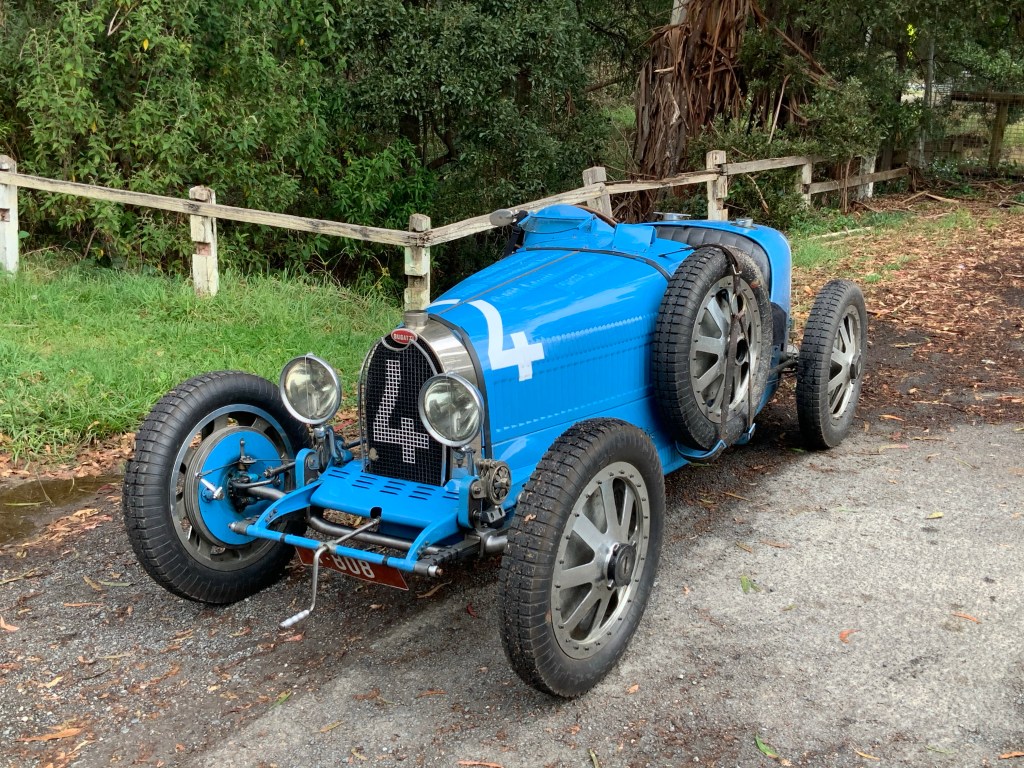
The Bugatti Owners Club of Australia, Victorian Division held their 2021 rally in and around Healesville, in the Great Dividing Ranges, 70km from Melbourne from 9-11 April.

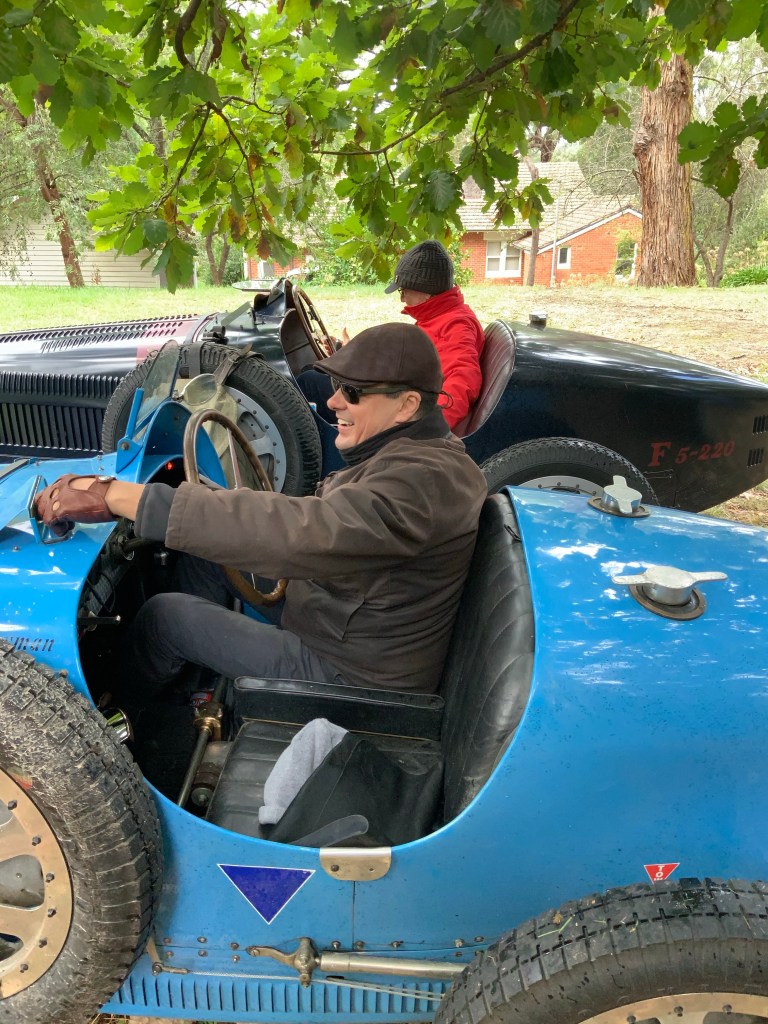
These gigs are not my stock-in-trade, but Bob King’s wife opted out of a seat in his Type 35B Replica #BC134, an opportunity I was happy to accept.

Over the last four years I’ve got to know one of the marque’s noted authors and historians, he has well and truly infected me with Bugatti-lore, my marque knowledge is probably now a low pass.

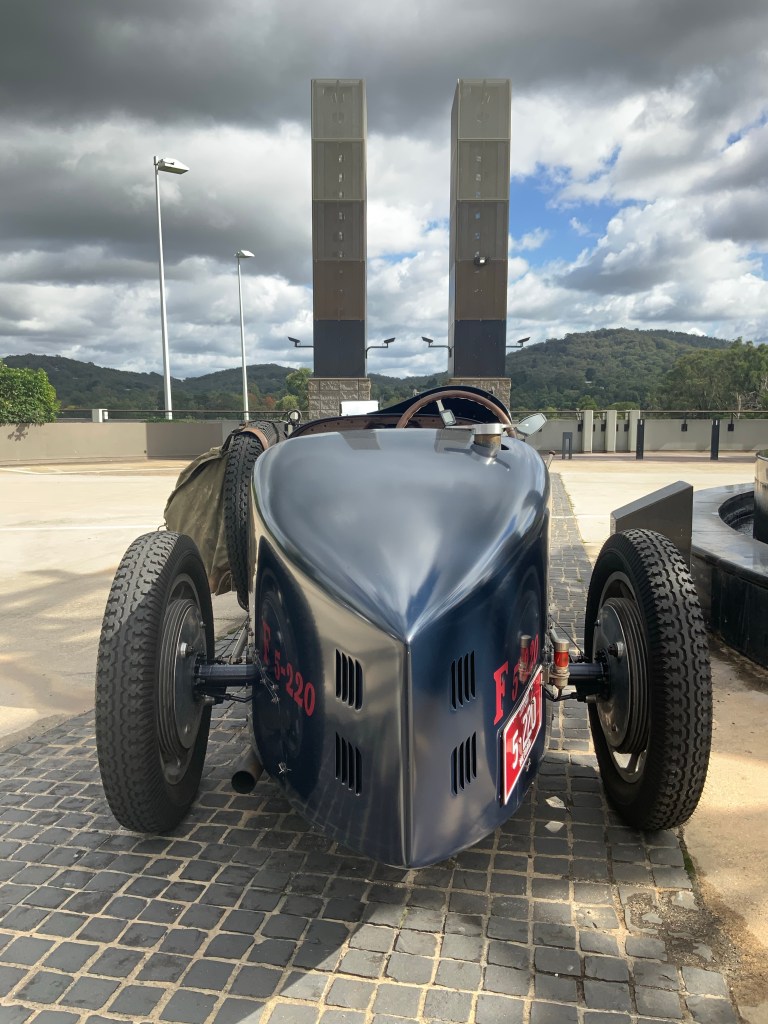
King T35B #BC134

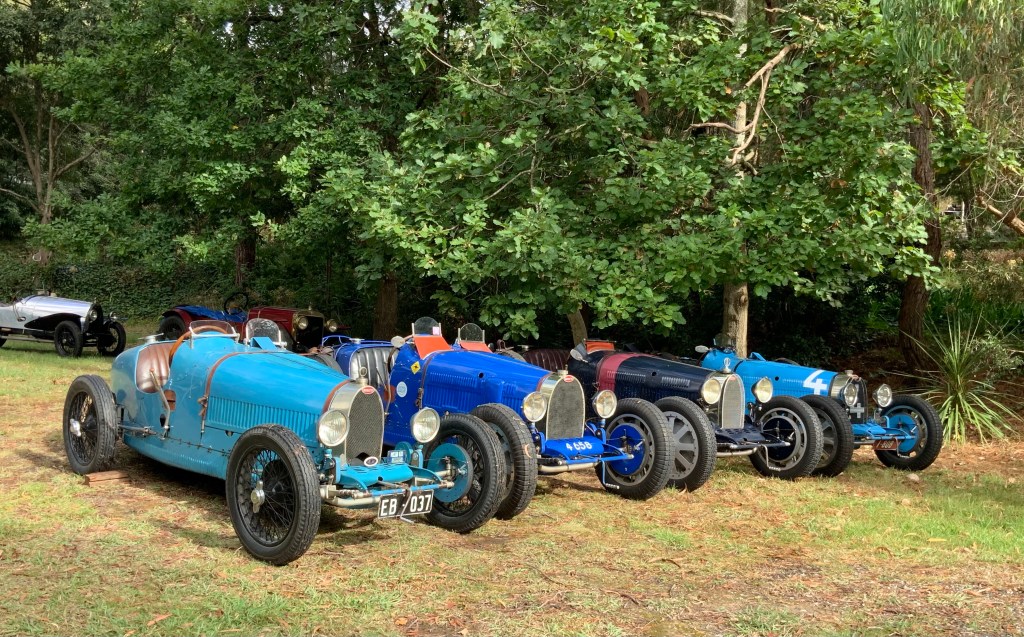
Trevor Montgomery’s Alfa 6C1500 Spl s/c, McWhirter Brescia T23 #2467 and blue Stuart Anderson owned, Michael Anderson driven T44

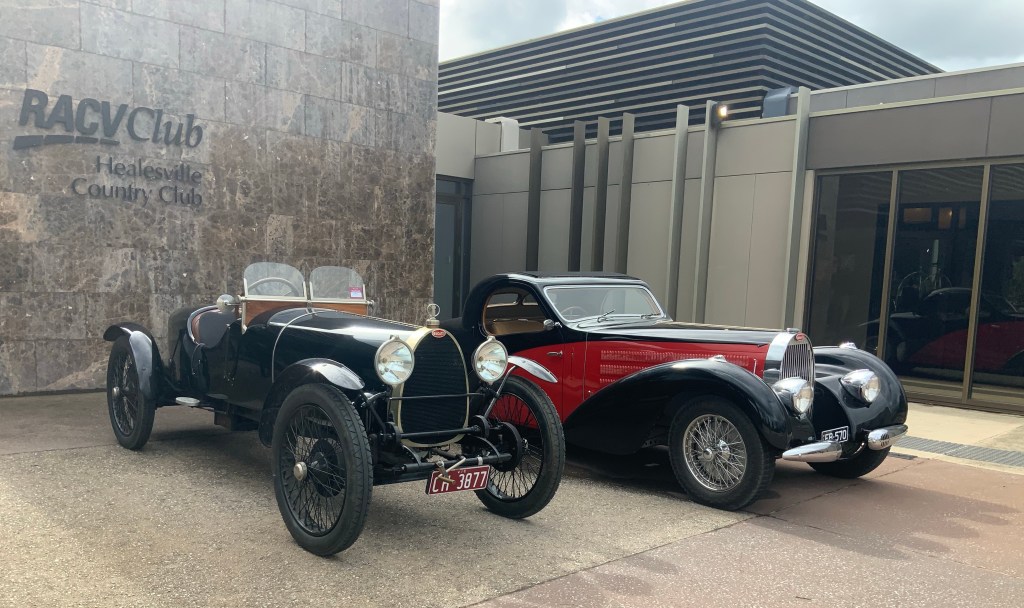
Murdoch T30 and T57C Atalante

We did three long loops out of Healesville in different directions; on Friday afternoon, all day Saturday with a pit-stop at Eildon for lunch, and then a hardy-souls-only Sunday morning one when it really was ‘pissin down!

Cripes these dudes use their cars!

The Ettore Works Driver awards went to the Adam Berryman/Louise Murdoch T37A, Rod/Rita Quinn T35B and Brendan Dillon Hispano Suiza combinations on Saturday afternoon. They braved the very wet, muddy, dirt, steep, dark Acheron Way to return to Healesville after some wally in a modern 4WD left the road on the Black Spur, causing the Gendarmes to close that road.

All five were buzzing with excitement back at the hotel, but both gals – sans the aero-screens afforded the drivers – were soaked to the skin and had faces so muddy they could have been on the Black and White Minstrel Show (if one was allowed to write that).

Well over 500km was covered over the three days on a variety of roads including some ordinary dirt, with a good percentage of it in wet weather. A good test of drivers, resolve, and steeds.

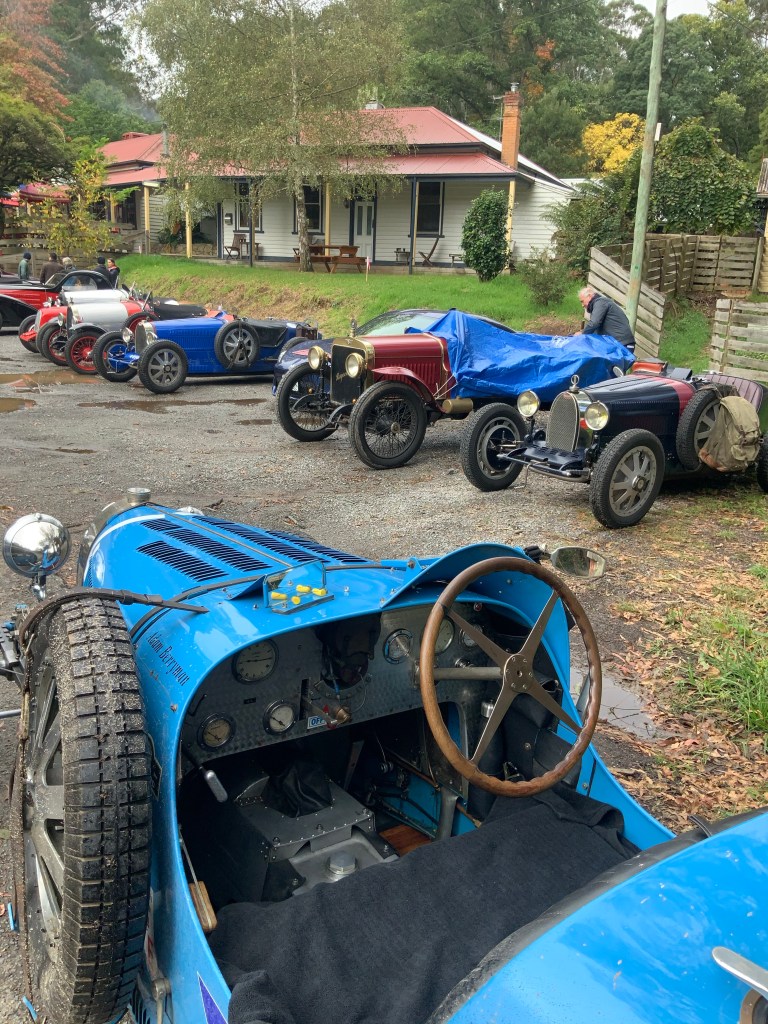
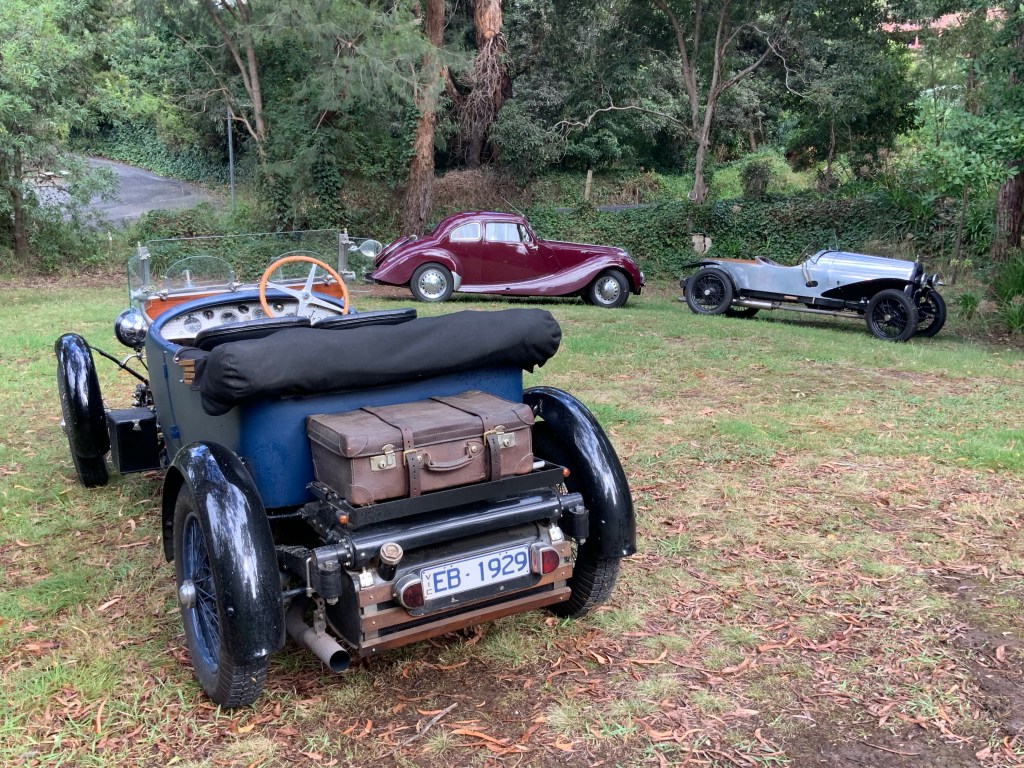
Reefton Hotel vista across the cockpit of the Berryman 37A, then King 35B, Dillon Hispano, Dillon 35B Rep #BC135 and McWhirter Brescia

Messrs Berryman and King looking suitably soggy and happy at Yarra Junction

GP Bugatti parade at Yarra Junction. The Roberts T37 and Berryman T37A book-end the T35Bs of Dillon and King

Living is blatting along at 3,000 rpm in a straight-eight Bug, rain, wind and dirt in your face with the raucous, basso-profundo bark of a supercharged engine assaulting your left-earhole and rattling the spaceframe supporting your brain.

The engine competes with incredible gear whine in the indirects, top-slot provides some relative cruising peace.

I don’t know about all that tearing calico-crap as a descriptor of the exhaust note?

The engine, with its oddball firing order, has a music all of its own, the timbre of which is infinitely variable with a smidge more, or less, of throttle. Lugging-slightly in fourth at low speed, then accelerating, makes the thing breathe really-deep, and demonstrates the flexibility of Ettore’s 2.3-litre, three-valve, under-square design.

The thing is unbelievably stiff, but by the same token the spring/shock rates are well resolved; the chassis itself is also a spring of course, which absorbs the imperfections of Victoria’s B-roads.

Great speed on dirt would threaten your false-teeth, with kidney-belts a necessity. Bill Thompson and his ken were legends to race at the speeds they did in their T37/37As to win Australian Grands Prix on rugged Phillip Island dirt and dust in the twenties – 200 miles flat chat would have been a hard days work, to say the least.

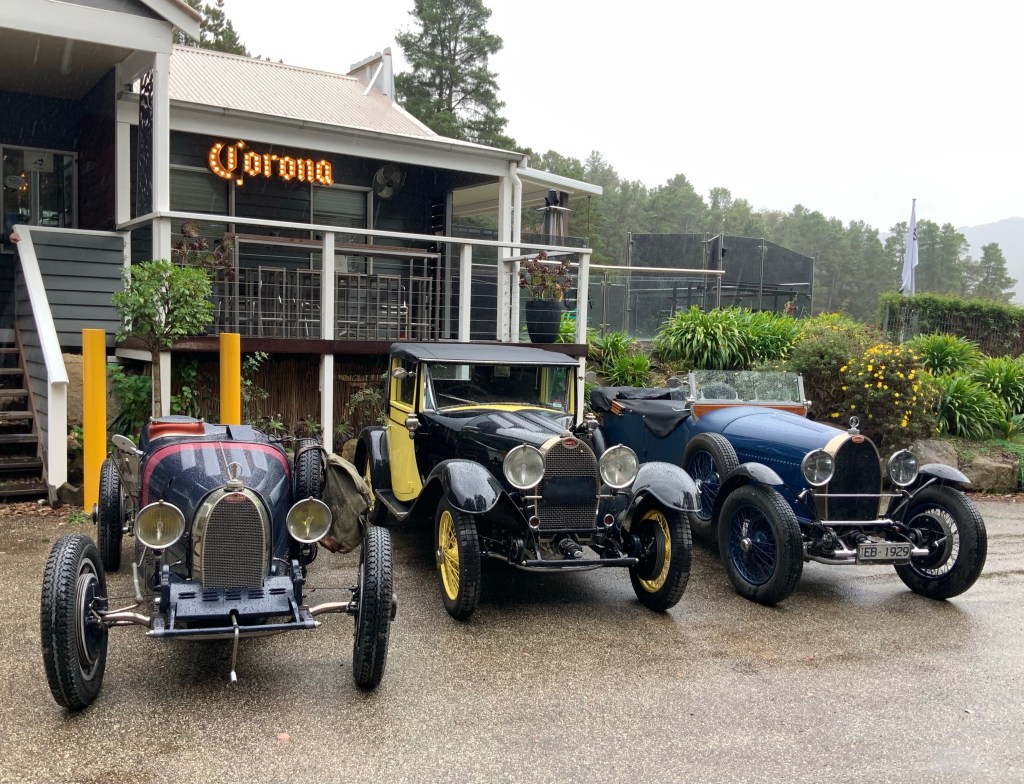
Eildon Hotel, the Corona was nice and cold, as was the day. King T35B, McGann T40 1.5 s/c with Lydia Bugatti style body, and Michael Anderson’s T44 3-litre eight

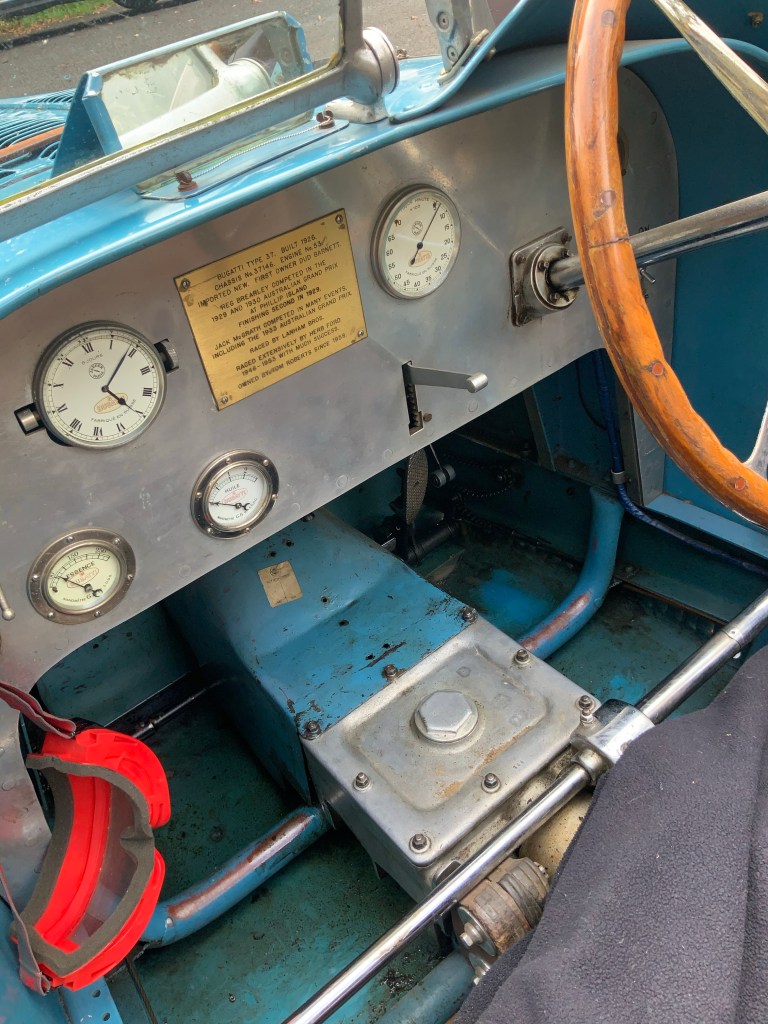
Roberts’ T37 #37146 cockpit. Gauges are tach, clock, fuel and oil pressure. The lever is ignition advance/retard, set here fully retarded. Blue chassis cross-piece under the gearbox. Silver tube is part of gear shift mechanism, shift on right outside the cockpit. First is left bottom, second straight forward, third across to the right away from you and back, top is straight forward

Eildon. Murdoch T57C and T23 Brescia, McWhirter Brescia T23. Nice to see a car worth a small piss-ant country driven on normal roads

The Royal Automobile Club of Victoria’s Healesville Country Club was a perfect choice for the gig.

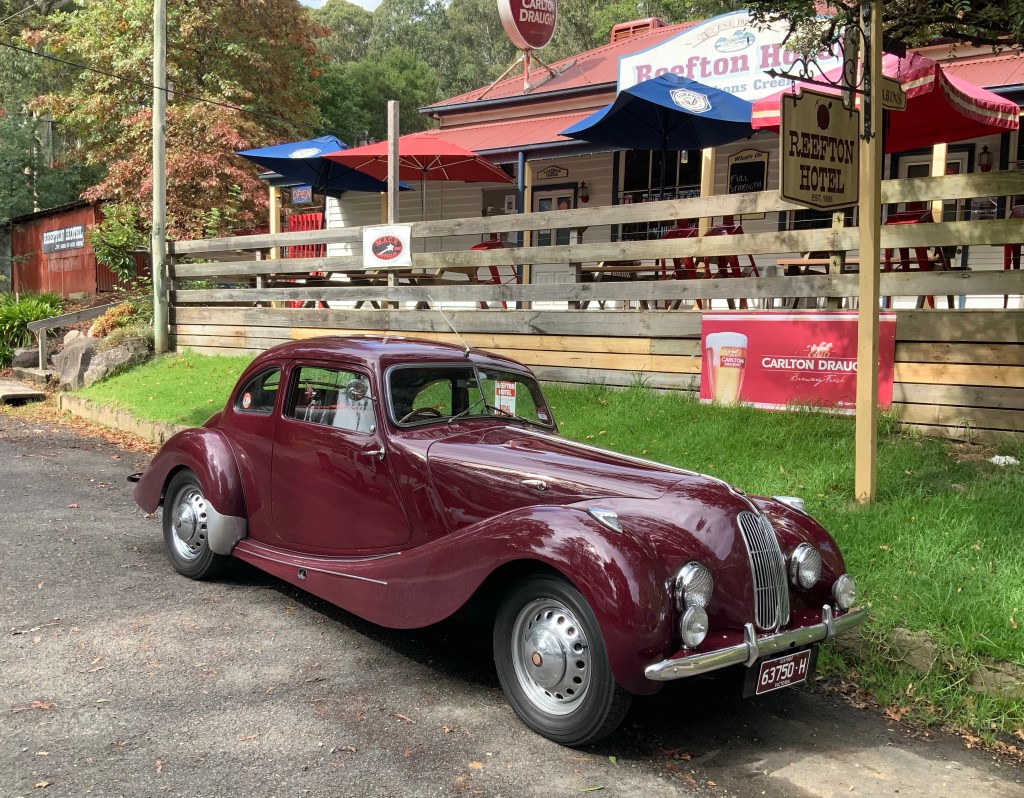
It’s close to Melbourne with plentiful underground car parking for about 12 Bugatti’s and interlopers. These included Trevor Montgomery’s ex-Lex Davison ‘Little Alfa’ 6C1500 s/c, David Hands’ ‘fat’ 3-litre Bentley with Phil Schudmak as sidekick, Brendan Dillon in brother Des’ incredibly quick 1914 4-litre Hispano Suiza Alfonso, Rod and Rita Quinn’s Bristol 400 and a couple of others.

Car parks established for electric Tesla’s became pit-bays for the GP cars which needed a check-over and charge of the batteries before resuming battle the morning after. The irony of these beautiful, charismatic, dirty old gas-guzzlers using facilities established for modern tributes to boredom will not be lost on you.

There was no mechanical carnage, albeit one Brescia, fresh from an engine rebuild, displayed some petulance, but nothing the talented new owner/driver, Phil McWhirter and his patient wife Laurette couldn’t overcome.

The poverty-end of Bugatti ownership these days is about $A400,000-plus for a Brescia, not cheap. What was impressive was the amazing depth of mechanical and racing history knowledge amongst owners, and the high proportion who wield their Stahlwilles with deft skill.

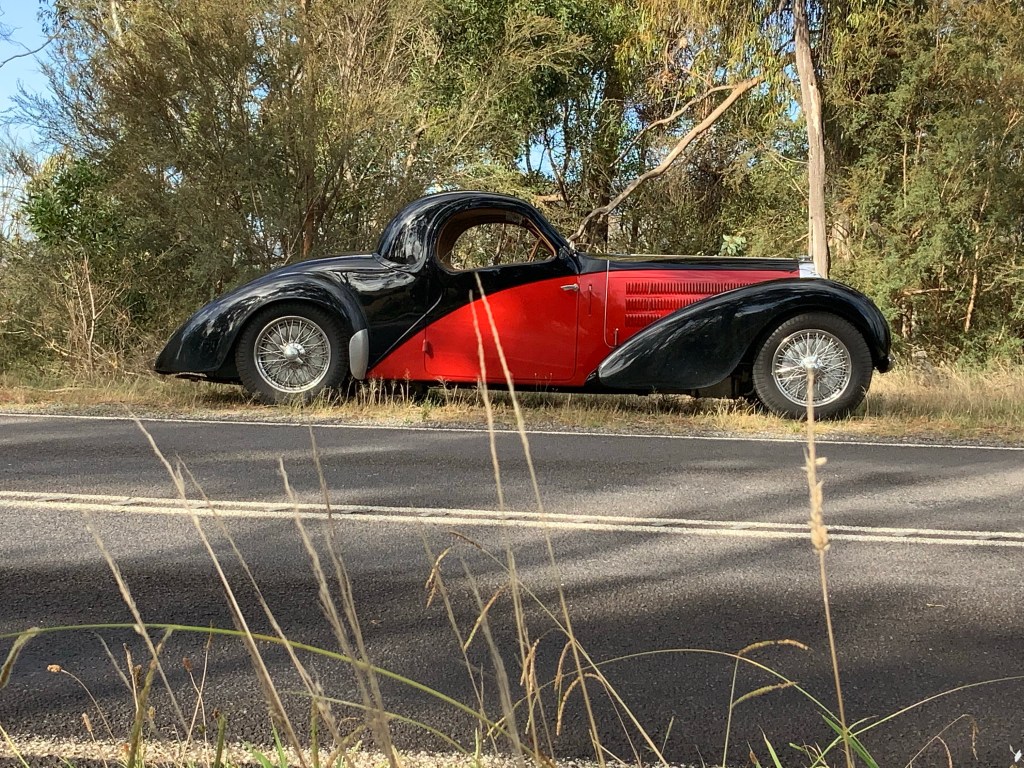
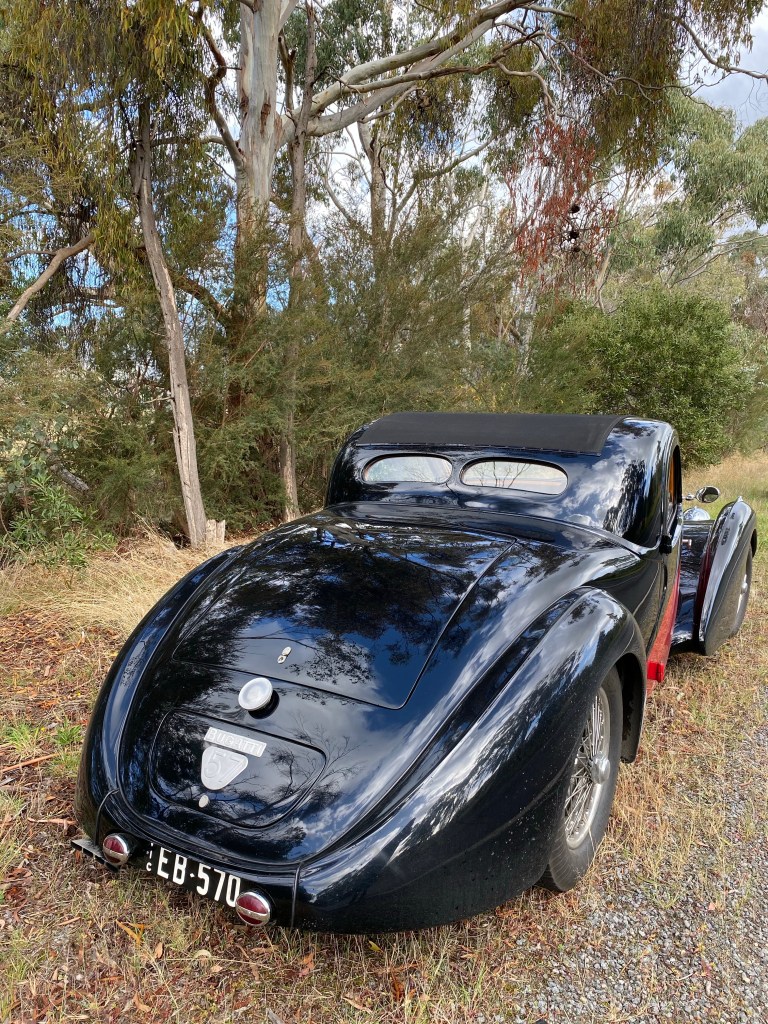
Belle of the ball was the Murdoch family, Type 57C Atalante #57788, which is simply, jaw-droppingly stunning.

Like a beautiful woman, your eyes take in every perfectly proportioned curve, each one of which blends into the next and teases you a little more as you take the thing in, from top to bottom, and back to front. Then do the same thing over and over.

Ooh-la-la indeed.

Yes, the Acheron and Taggerty locals did need chiropractic treatment after passing this lot on the Maroondah Highway roadside
King T35B
Michael Anderson’s T44 3-litre normally aspirated eight at Reefton, wonderful tourer

The T57C has an Australian history since the Dale brothers imported it in the late-fifties. Young Doctor King must have been quite an Ormond man-about-town in it in the early sixties cruising the streets of Melbourne. He sold it just as his sixth-sense suggested the engine may be in need of very expensive TLC soonish.

It then passed to Eric Pengilley, where many an Australian Bugatti became a resident of his Black-Hole-of-Cammeray Bugatti burial-ground on Sydney’s lower north-shore .

Stuart Murdoch made many trips from Melbourne to Sydney before prising it from Pengilley, then starting the long, expensive process of restoration. The Murdoch patriarch is as sharp as at a tack and was much in demand, so I never did get the full T57C story.

He did burst the bubble of one old, oft repeated myth though.

It’s said that his father, Doctor Noel Murdoch made his Yarra Junction 1920s house-calls in an eight-cylinder Type 44, which the family retain. Stuart said that would only have been for the most special of patients, his normal chariot of choice was one of Australia’s first Fiat 501s.

Both these blokes drove with plenty of brio. Brendan Dillon in brother Des’ Alfonso Hispano and Adam Berryman with another brave, lucky ‘victim’
King 35B butt-shot @ Healesville RACV. Makes the knees tremble really
The Rod and Rita Quinn Bristol 400. I did 150km in the car and thoroughly enjoyed the drive, it only falls short amongst the moderns on long, steepish hills where 2-litres ain’t enough

The most stunning part of the long-weekend took place inside an enormous, designer Bat-Cave, sitting low in a small valley surrounded by sweet smelling, damp eucalypts.

There, the good Doctor King was put very much on the spot, with about 40 of us looking on. His task was to identify a factory T37A chassis. He went to work with a small-torch, and all of the experience which comes from restoration of his share of the cars, and having seen more of them than you and I have had hot dinners.

That was just the sweets course of this automotive archaeology segue, mind you.

The main dish was having laid out, before our eyes, some of the core components of the Geoff Meredith driven, 1927 Goulburn, Australian Grand Prix winning, ex-Turner/Meredith/Clements 2-litre eight-cylinder Bugatti T30!

Neil Murdoch showed the cut down chassis, front cross-member, cast-aluminium firewall and engine. It’s far from a complete car of course, but is heaps of bits in a world where a reconstruction often starts with no more than a vinyl Lola nose-badge.

The ex-Meredith 2-litre, three main-bearing eight cylinder engine currently powers a perfect, black Type 30 driven by Fiona Murdoch. No doubt her two brothers, Neil and Geoff are trying to get little ‘sis engine for this important part of Australian racing history. Stuart Murdoch quipped, “I’ve done my restoration bit, that one is for the next generation.”

So it is too. It’s more of a five year or decade long project, but over time, doubtless the Murdochs will acccumulate the bits they need, including another two-litre eight to pop under the curvaceous long bonnet of the immaculate black Type 30! Watch this space.

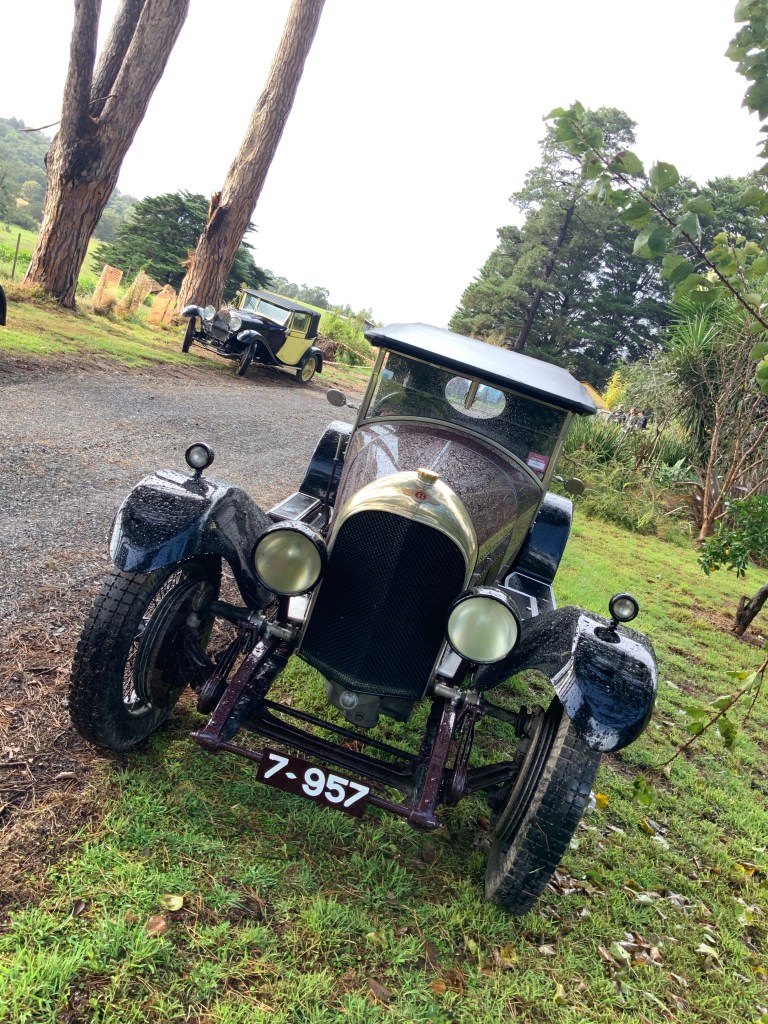
Interlopers included David Hands’ Bentley 3-litre which had arrived home from the UK at Port Melbourne a few days before. Drove it to Sydney over two days following the rally
Practical things these long-legged eight-cylinder touring Bugattis. Michael Anderson’s T44 at Yarra Junction

Robert’s T37 at Reefton Hotel

It was great to see Tom and David Roberts in Tom’s beautifully patinated T37 37146, and old-mate, Adam Berryman’s T37A, 37327.

Tom has owned the ex-Brearley/McGrath AGP contestant since 1958, the car has not been spotted for a while so Roberts father and son were welcomed like long, lost cousins.

“That car was the first Bugatti I saw. I was standing outside the Melbourne University Union building when Ian Ferguson and his brother pulled up and parked it, jumped out, pulled their trousers out of their socks – done to avoid the inevitable pool of oil in the footwell – and rushed off to lectures. How cool was that, I thought!” recalls Bob King of the late fifties Melbourne Uni car-park which contained its share of old-banger Bugattis.

I reckon todays 85 year olds probably had the best of motoring as we currently know it. They saw the end of the front-engined GP era, the best, pre-wing, mid-engined era, and had available to them a truckload of exotic road and racing cars which were cheap old rockets before their era as global investment grade assets.

T35B Rep, Brescia, Alfa 6C1500 Spl, Brescia, T57C and T30 at Reefton
Brescia T23, T35B Rep, Bristol 400 and light blue Triumph of Mr Terdich, Eildon
Berryman’s ex-Chiron Targa T37A is about as good as it gets. Sex on wheels. Reefton

Berryman’s T37A, a car his father bought in the seventies, was imported by Melbourne racers/businessmen/Light Car Club stalwarts, the Leech brothers in the fifties.

I sat alongside Adam from Reefton to Yarra Junction. The experience was in some ways similar as the 35B, given the chassis of types 35 and 37 are the same, but the engines are quite different of course- the T37A is a SOHC, three-valve, 1.5-litre supercharged four (T37, same engine un-supercharged).

The 37A feels, and is lighter, the engine is notably more responsive to the throttle with a lighter flywheel and higher state of tune than Bob’s 35B. The 35B is ultimately quicker on a like-for-like basis.

A quick refresher course on Australian Bugatti Grand Prix wins. These were achieved with the modified-tourer T30 2-litre eight raced by Meredith in 1927, T37A 1.5-litre supercharged voiturettes raced by Arthur Terdich in 1929 (Tom Roberts’ T37 was second driven by Reg Brearley), Bill Thompson in 1930 and 1932 and the T39 1.5-litre supercharged eight raced by Carl Junker in 1931.

What a weekend.

Many congratulations and thanks to organisers Michael Anderson, Bui Khoi and Geoff Murdoch for their creativity, warm hospitality, attention to detail and deft-touch. Fantastic stuff!

Credits and Commerce…

Bob King quoted the chassis numbers out of his head, not bad at 84. I’m that confident he is right I’ve not checked any of them!

The photographs are all mine, with one exception.

For those with an interest in all the Antipodean Bugattis, see ‘Bugattis in Australia and New Zealand 1920-2012’ by King and Peter McGann. $110 plus postage, email McGann on; pmc24757@bigpond.net.au

Tailpieces…

Let’s finish as we started with the Murdoch T57C Atalante. Man I cannot get this thing outta my sick little mind…

(B King)

Finito…

After World War II, interest in gas-turbine power was intense, who would be the first automotive manufacturer to harness engines which had revolutionised aviation?

I chanced upon this topic searching for information about Carlo Salamano, the pre-war Fiat Grand Prix driver and winner a while ago researching an article I published in 2019 about Fiat’s twenties GP cars, see here;

Fiat 806 GP 1927…

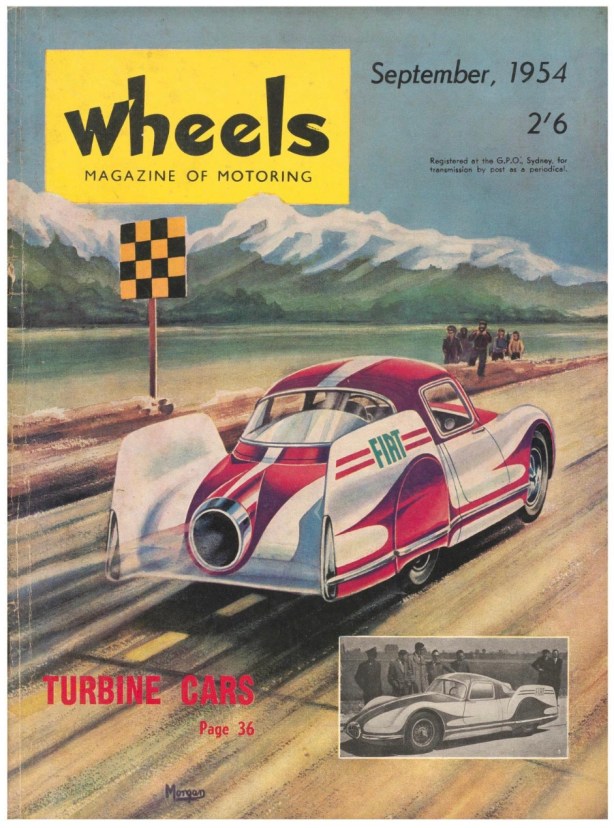
More recently I came across this Australian ‘Wheels’ magazine cover, the spark to ignite my interest in writing about Fiat’s amazing turbine powered car came from those two sources. The difficulty of this topic for me are the technicalities of these engines for my ‘humanities’ brain, but Karl Ludvigsen has come to the rescue in a beautifully written Hemmings article titled ‘Turbine Speed with Style’. Initially I thought I would just use the magazine cover and a link to Karl’s article but in 4,000 words he has only two piccies- not enough for us. So…

I’ve truncated his article in part- and as you will see, very substantively quoted him especially in relation to the technical elements, quotation marks will ensure you can see when it’s one of motorings finest writers verbatim and what is me truncating and in some cases expanding upon his original prose. The full Hemmings piece is here; https://www.hemmings.com/blog/article/turbine-speed-with-style/

Off we go.

In March 1948 Rover announced that it was working on a gas turbine for cars making use of wartime intellectual property gained while building some of Frank Whittle’s first jet engines.

Karl Ludvigsen wrote that “The Autocar published a shrewd speculative drawing of the gas-turbine car of the future, a provocation if there ever was one. Several other gas-turbine programs dated their launches to 1948. One was that of General Motors, followed in 1949 by Chrysler. Another for whom 1948 was a decisive year was Italy’s Fiat. Proud of its great engineering heritage and eager to exploit new technologies, Fiat too would assess the turbine’s potential.”

“I was afraid that in the race for progress that had been speeded up by the new wartime technologies, we might well have been overtaken by others,” recalled the brilliant Dante Giacosa, technical director of Fiat’s automobile arm since 1945. “I remembered what had happened to piston engines in aviation, suddenly superseded by jets.” It was Giacosa’s role to protect the future of Fiat by exploiting the opportunity or discounting it as a ‘blind alley’ in automotive terms.

“Fiat weren’t starting from scratch, one subsidiary was producing the de Havilland Ghost jet engine under license, another was building large industrial gas turbines. However, there were two reasons for not troubling these experts with Fiat’s turbine-car ambitions. Giacosa determined not to involve those with some expertise as they were already fully committed with aeronautical development work, he wanted to ‘see for himself’ and he wanted to develop the technology without undue pressure from inside the huge Fiat organisation- keep his and his team’s heads down until they were good and ready.”

“Vittorio Bellicardi was chosen by Giacosa to lead the project, together with a three-man team he commenced studies of the state of the turbine art. They examined the latest in aviation-turbine design, compressors, constant-flow combustors, red-hot turbines and high-speed shafts and bearings to name a few. ‘A firm grasp of the theory of fluid dynamics was needed to cope with the unique conditions prevailing inside these engines” Ludvigsen wrote.
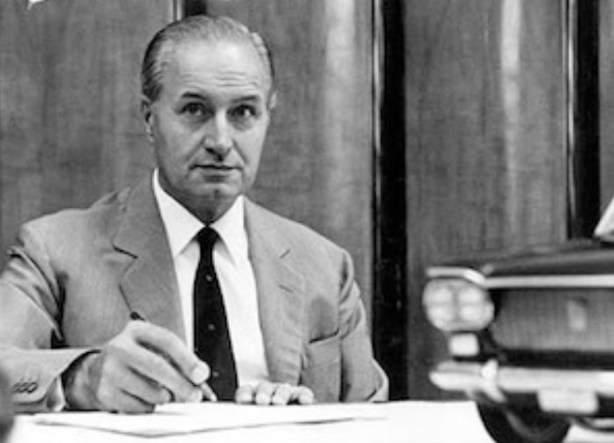
Dante Giacosa in the mid-sixties (unattributed)
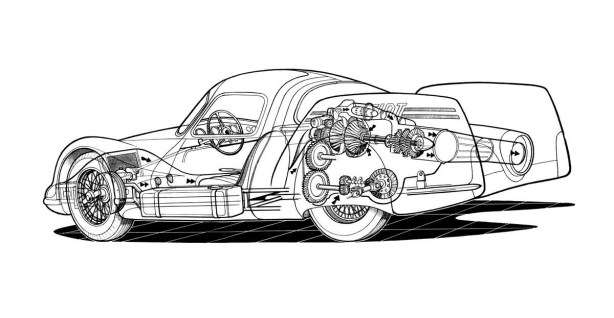
Fiat 8001 Turbina general layout (unattributed)

Work began in September 1950 on an engine which Giacosa said “envisaged the turbine as an integral part of the automobile” rather than a stand-alone unit which was then hooked up to a car, which was the direction of some other competitors. Fiat’s project 8001 combined its power generator and its final-drive gearing into a single assembly purpose-built for car use.

Virgilio Borsattino and a colleague then commenced design of the engine whilst Giacosa considered test equipment: “We had to take measurements of the behavior of air and gases passing through the various sections of the engine, perfect the combustion chambers and the shape of the turbine blades, the choke tubes of the two-stage compressor and the turbine, the injection mechanism, regulator and so forth. We also had to make sure that the impellers turning at 30,000 rpm could stand the centrifugal strain. This meant we needed a pit inside which we could set them spinning until breaking point was reached, without danger to the observers.”

The research work promised to be noisy and expensive but Bellicardi found a solution right under their noses at the top of Fiat’s famous, fabulous five-story Lingotto factory in Turin. An isolated sixth-floor work area, ‘Traversa D’, wasn’t being used so Bellicardi struck a cheap rent deal which was billed to Giacosa’s car-development unit. Using surplus equipment discarded by other parts of the empire they updated their laboratories with all of the specialist items they needed- with no mention of exotic gas turbines.

By May 1951,  Project 8001 turbine drawings were allocated to Fiat’s workshops for fabrication, the assembly drawing of the complete unit was dated November 8, 1951. It showed a power unit unique amongst automotive turbines in terms of its integration with the final drive and differential as well as its layout, “which was not unlike some of the early post-war aviation gas turbines”.

“One of the two basic elements of most automotive gas turbines is a gas generator that has a turbine wheel or wheels that drive a compressor, which delivers air to a combustor. Hot gas from the combustor drives the turbine that keeps the compressor going. There’s plenty of gas left over to drive the other basic element, another turbine wheel called the power turbine, which drives the car. When starting up, the power turbine is at rest until it starts to turn under the impact of the hot exhaust from the gas generator. Fiat used this method, in which the relationship between gas generator and power turbine acts as an automatic transmission, in its 8001.” Karl wrote.

In general arrangement, the Fiat turbine had similarities to a Rolls-Royce aviation turboprop unit, the Dart. Exploiting its wartime work on Merlin engine superchargers, Rolls used a two-stage centrifugal compressor in its Dart. This gave a high pressure ratio, the equivalent of a piston engine’s compression ratio. Although they faced their paired impeller entries to the rear instead of forward, the Fiat engineers used a similar compressor in the 8001 to get an exceptionally high pressure ratio of 7.0:1 for maximum performance and efficiency.
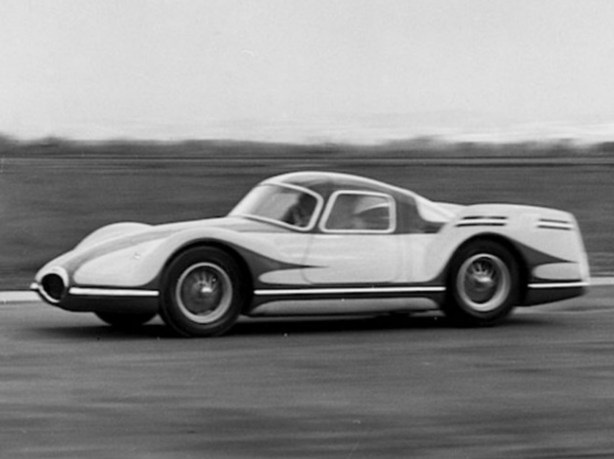
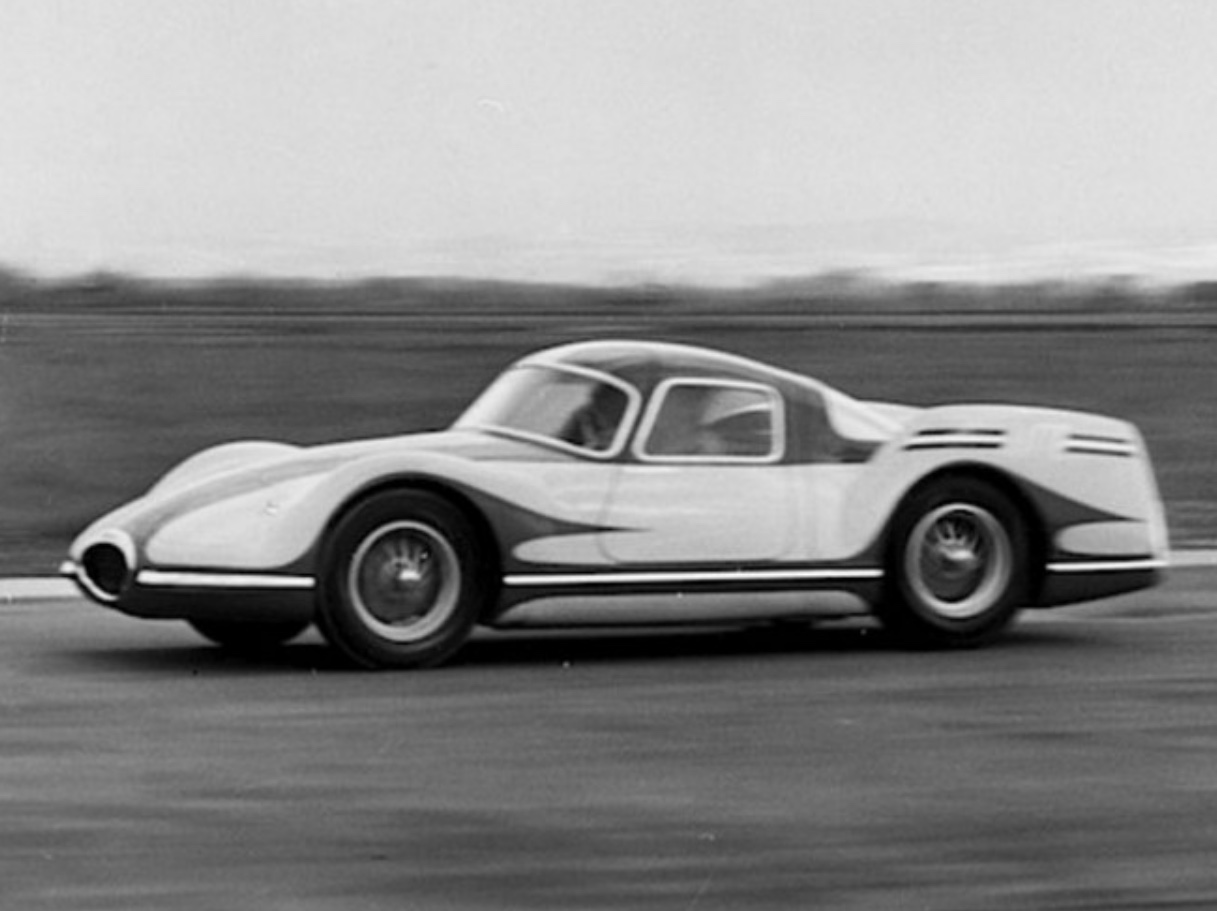
Caselle Airport, Turin 23 April 1954 (Fiat)
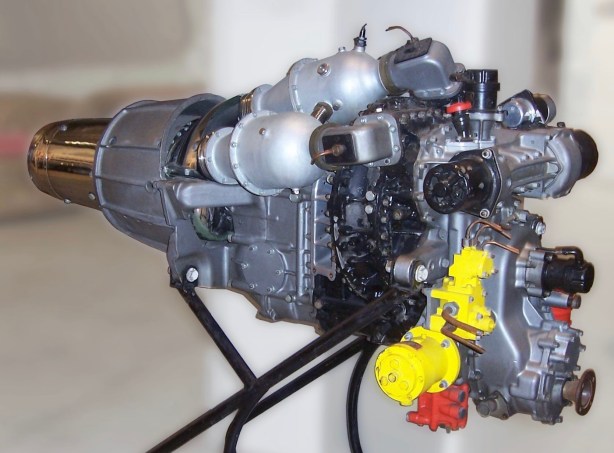
Turbina engine- if it looks heavy it is, circa 570 pounds. Output circa 200bhp according to ‘Wheels’ in-period but not more than 150bhp used. A turbine speed of 22,000 rpm produced a road speed of 120mph (Fiat)

“While an aviation turbine like the Dart had multiple combustion chambers around its shaft, the Fiat had three at the top and sides of its central shafts. Three were, in fact, two more than most automotive turbines. Triple burners were chosen by the Fiat team in the belief that they would give higher efficiency. Angling inward toward the rear of the engine, the combustors required a long shaft from the compressor to the pair of turbine wheels that drove it. Impressively, Fiat itself made all these vital rotating parts of the 8001, including the forged-aluminum compressor wheels and the turbines, which had blades of Jessups G32 alloy copy-machined individually and attached by fir-tree joints to wheels of similar alloy.”

“At the engine’s extreme rear, just inside its circular exhaust duct, was its power turbine. This drove an output shaft that went all the way to the front of the 8001 through its hollow compressor shaft. Both coaxial shafts were made in two parts joined by splined sleeves. From there it drove a set of reduction gears that went down to a shaft that ran backward, through another pair of gears, to a spiral-drive ring and pinion and the differential. The main reduction gears were duplicated on the driven shaft to provide two subtly different overall ratios, selected by a dog clutch when the car was at rest, for experimental purposes.”

“The complete unit had a dry-sump lubrication system with two scavenge pumps and one pressure pump. Delivery from the latter was high-pressure to all the engine’s plain bearings and gear trains. A reducer cut the pressure back for delivery to the high-speed anti-friction bearings. The oil reservoir was behind the passenger seat, and an oil cooler was in the nose, fed by the upper portion of the car’s air inlet. Engine output was controlled by a variable fuel-metering valve, while starting was by a truck-type starter motor on a 24-volt system. Firing up at 5,000 rpm, the gas generator became self-sustaining at 10,000 rpm.”

Back at Lingotto’s Traversa D, Bellicardi and Freilino, the engineer charged with running the tests, subjected all the engine’s key components to trials in their various rigs in January 1953, they were able to run the complete unit. Weighing 570 pounds, it was designed to be rubber-mounted at four points of a chassis and installed only in a rear-engined car, those with a keen sense of Fiat history will recall that Fiat were on track for the launch of the 600 in 1955.

“Meanwhile, other gas-turbine efforts were surfacing throughout the world. In March 1950, Rover demonstrated the world’s first turbine-powered car, which in 1952 was driven to the first gas-turbine speed record of 152.9 mph. In 1951, French truck maker Laffly showed a chassis powered by a Turbomeca turbine, while in the same year, a 36-ton Kenworth semi-trailer rig was completing a test with Boeing turbine power. Closer to home for Fiat, at Paris in October 1952, a handsome turbine-powered sports coupe, the SOCEMA-Gregoire, was placed on show.”
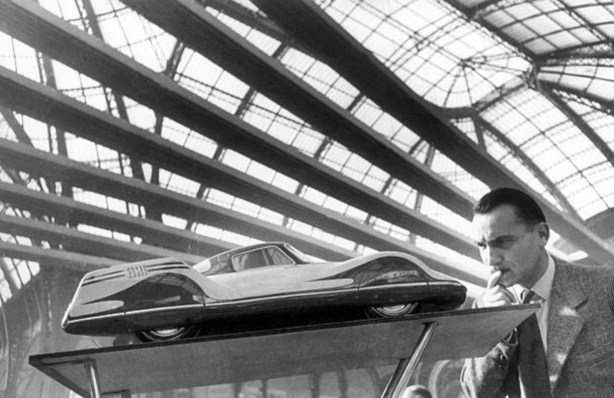
Paris Car Show October 1954 (Getty)
(smcars.net)

Fiat were not alone in their exploration! In 1953 more substantial funding for the 8001 project was provided by senior management. Design work on the car itself began led by Oscar Montabone with the ongoing support of Bellicardi. The type of car was determined by the powerful engine. Whilst a low-power turbine would be in line with Fiat’s mainstream cars, the bigger the turbines the better in that that the necessary clearances between its rotating parts and static walls become proportionally smaller in relation to the size of the engine. Large clearances mean loss of efficiency. With this in mind the engineers scaled the 8001 to deliver a nominal 200bhp – about the same as Ferrari’s contemporary 4.1-litre Type 342 America! And so an exciting sportscar it was to be.

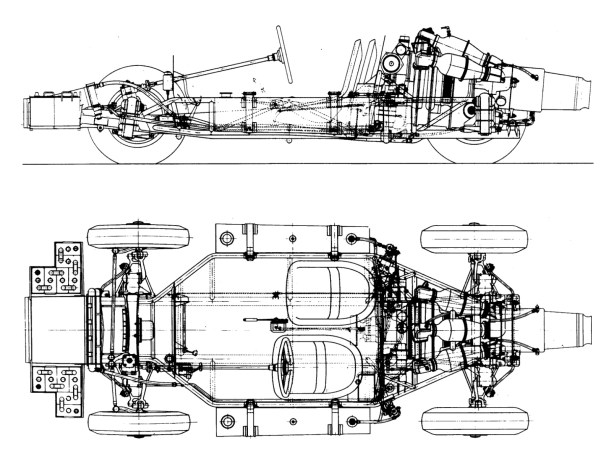
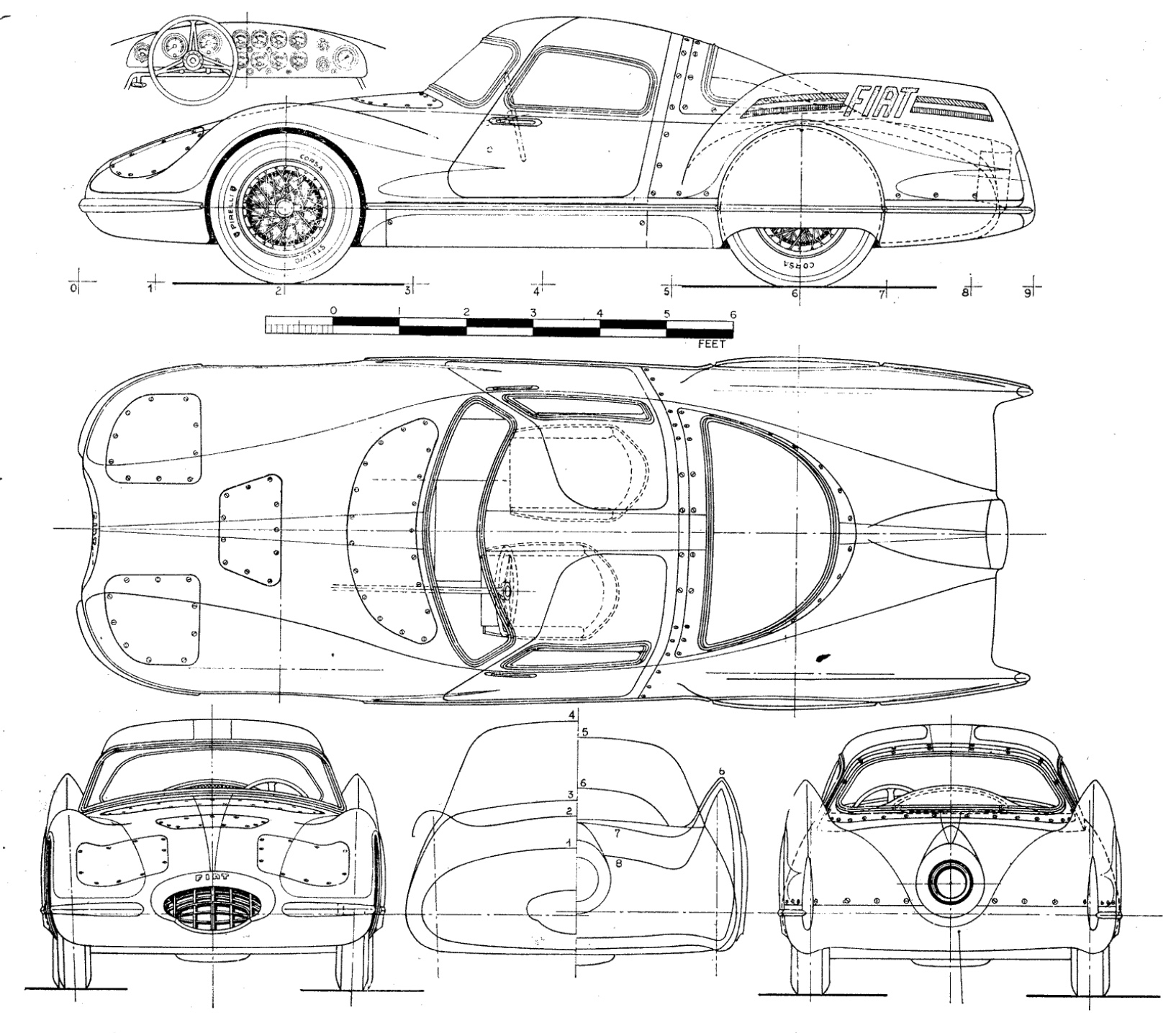
“Fiat was developing its V8-engined 8V sportscar, whose new independent suspension- a parallel-wishbone design with a single upper link actuating a coil spring/damper inside an oil-filled housing was lifted for use in each corner of the 8001 chassis. Roll bars were used at front and rear, drum brakes were Fiat ‘FB’ pattern with beautiful Borrani wire wheels wearing Pirelli’s 6.00 x 16 Stelvio Corsa tires.”

“Giacosa’s chassis was a multi-tubular steel structure reminiscent of his Cisitalia sports cars of the 1940s. Of semi-space-frame design with truss-braced side members, two 13-gallon tanks were attached to carry the car’s kerosene. The turbine was in the rear, while up front three six-volt batteries were carried on each side, adding weight which increased the car’s polar moment of inertia and therefore its stability. The lower section of the nose inlet delivered air to a central tunnel that fed it to the hungry compressor. The car’s wheelbase ‘was no more than the classic 2,400mm, 94.5 inches, the same as Fiat’s front-engined 8V sports car. The track was also similar to the 8V’s at 51.0 inches.”
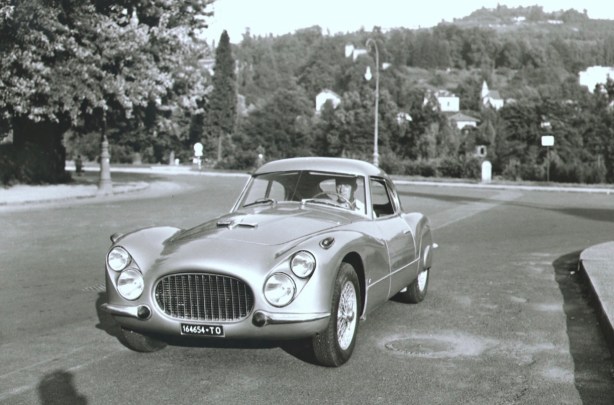
Fiat 8V (Fiat)
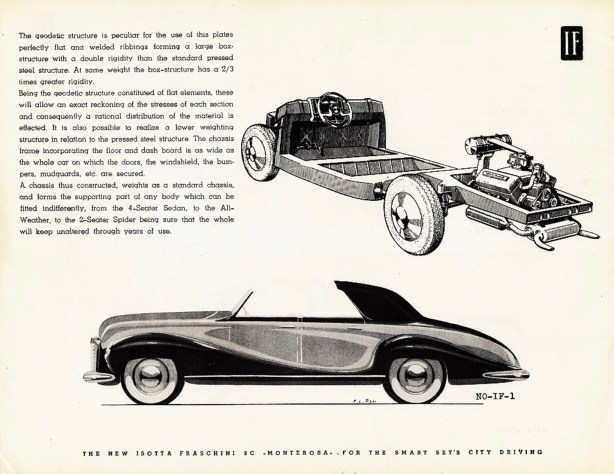
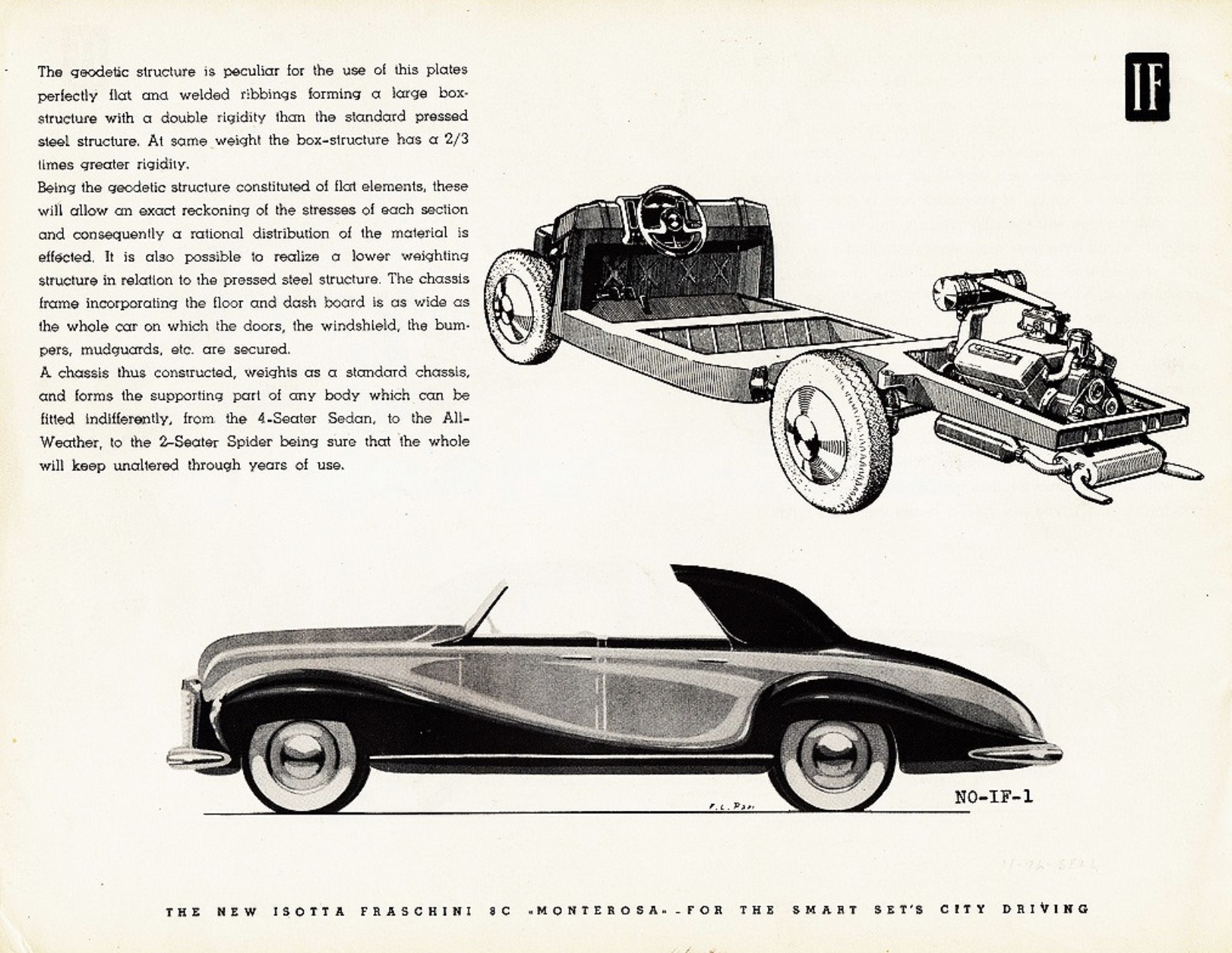
The lucky man chosen to style the 8001 was Fabio Luigi Rapi. As much an engineer as stylist, Rapi had been vice director to Giacosa since 1949 and in 1952 took over responsibility for special coachwork. His CV included experience of powerful rear-engined cars with Isotta Fraschini, for whom he styled the marvellous 8C Monterosa. Its rear mounted 3.4-litre V8 gave 120bhp and bettered 100mph.

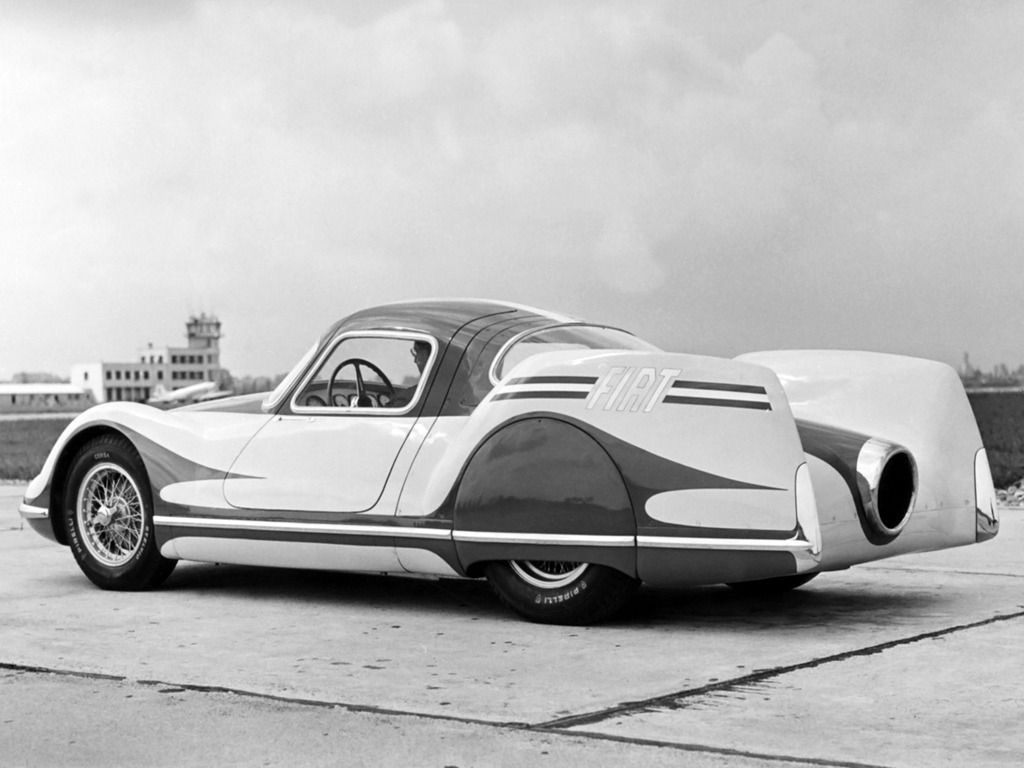
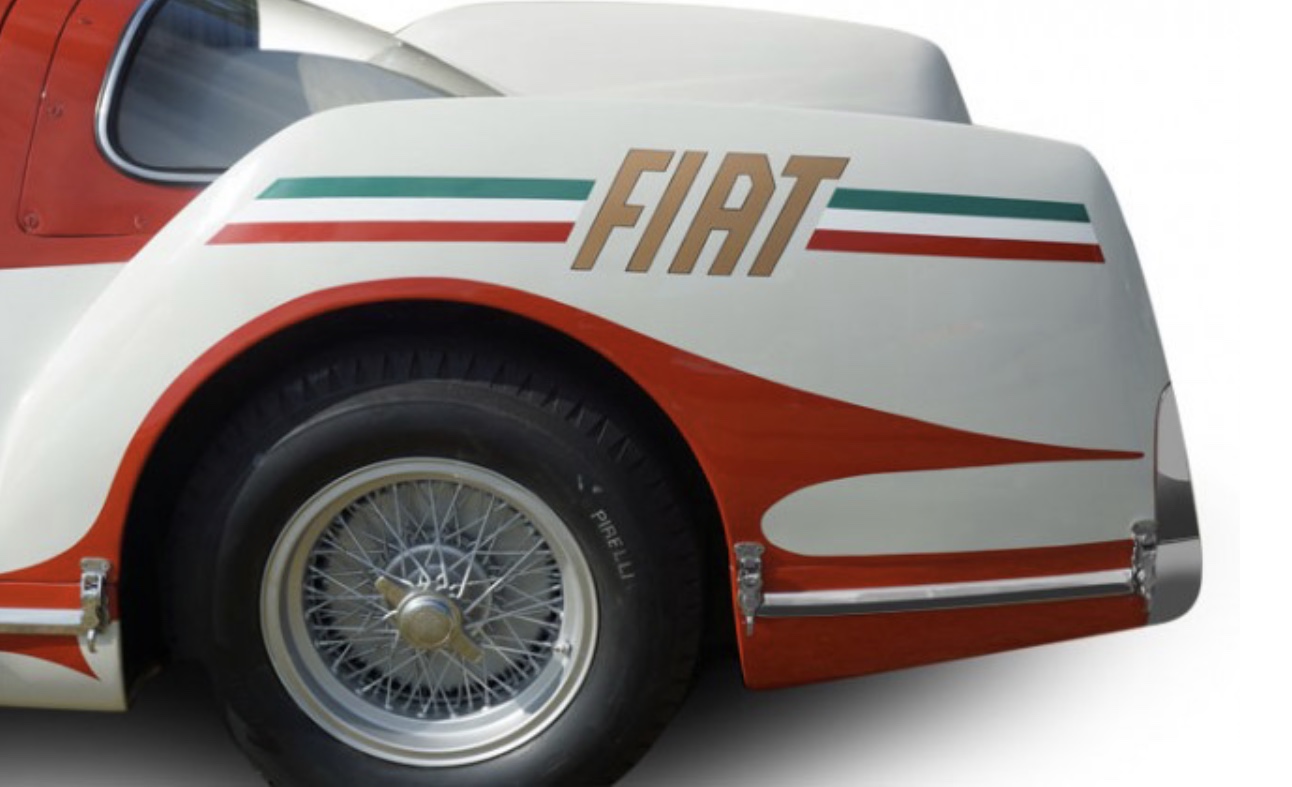
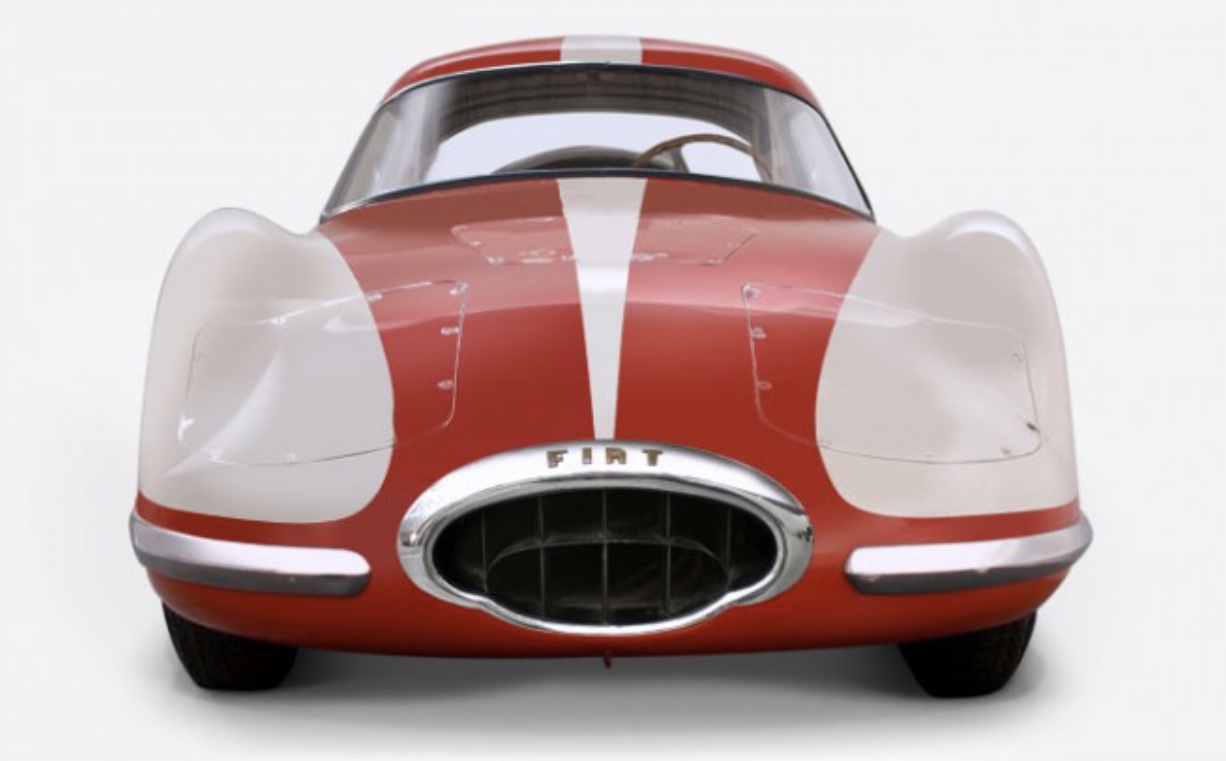
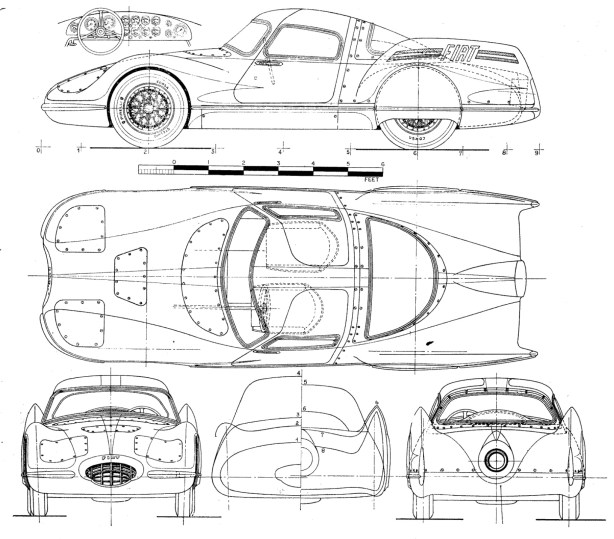
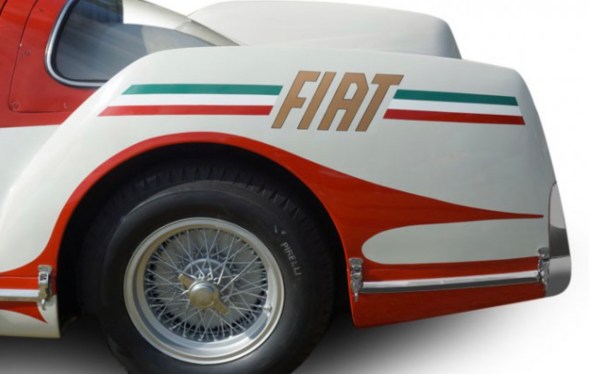
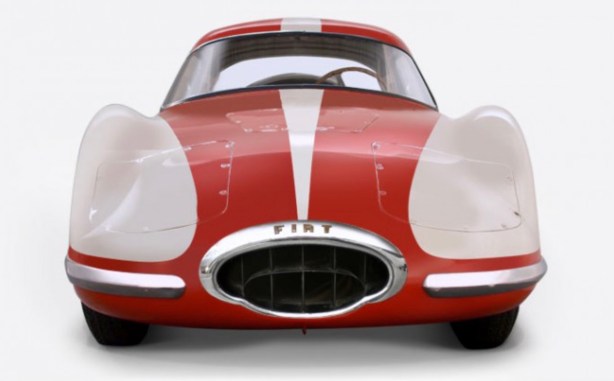
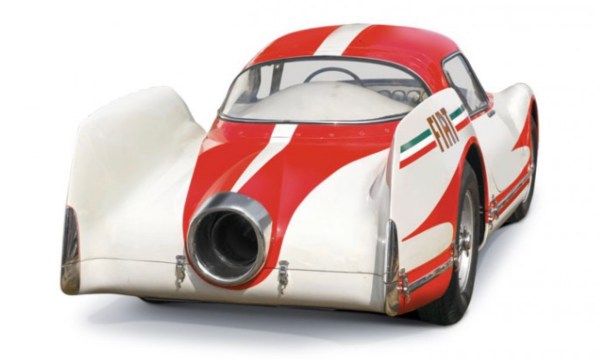
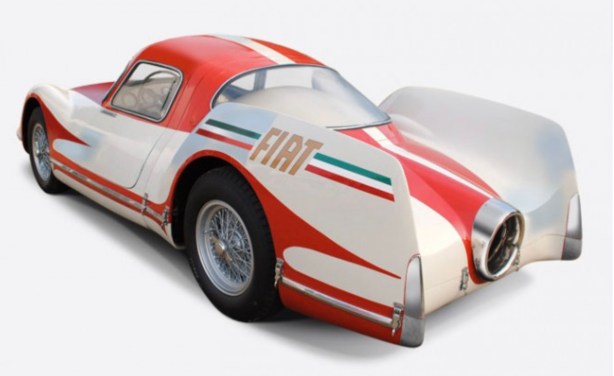
The sports version of Isotta’s Monterosa used substantial stabilising fins, which Rapi used in his 8001 two-seater coupe. It had chrome trim around its nose and along its flanks, a deeply curved windscreen and had side windows fixed in rear-hinged doors that curved into the roof to aid access and egress.

“Although the 8001’s rear wheels were designed to be enclosed, the car was styled to look good with its pants removed. Its high, squared fins were functional for stability enhancement at the speeds of which it would be capable. That its drag would be low was suggested by tests of a one-fifth-size model in the Turin Polytechnic’s tunnel that showed a drag coefficient of only Cd=0.14. A fitting touch was a chrome-ringed central exhaust for the turbine, emblematic of the jet age. Completing the ensemble was a red-on-white paint scheme as extroverted as the automobile itself. Its overall dimensions were 172.0 inches in length, 63.4 inches wide and 49.4 inches in height. For a car considered to be purely experimental, no need was envisaged for headlamps or running lamps.”

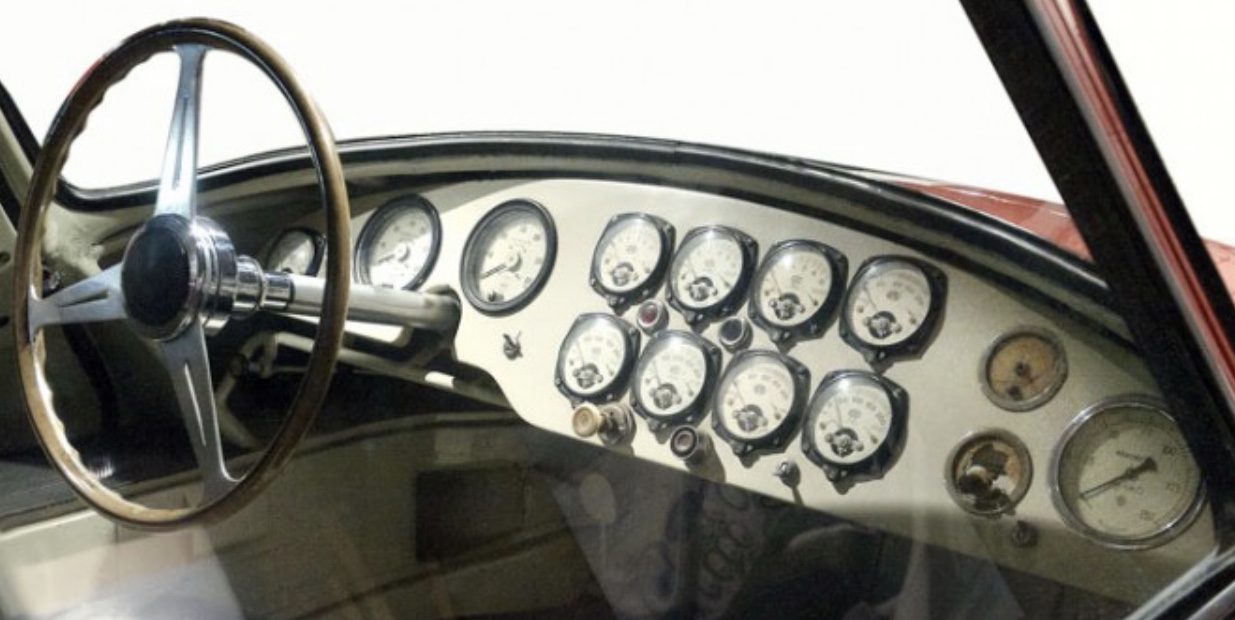
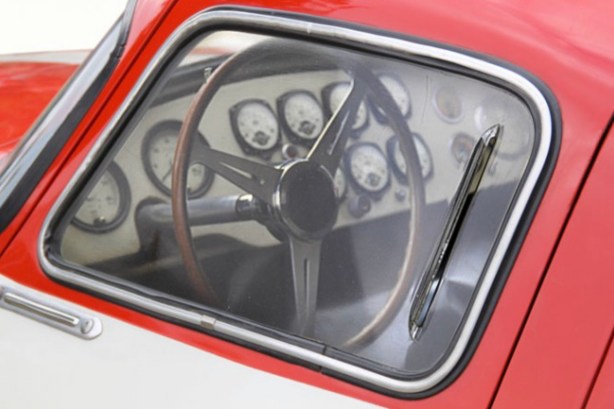
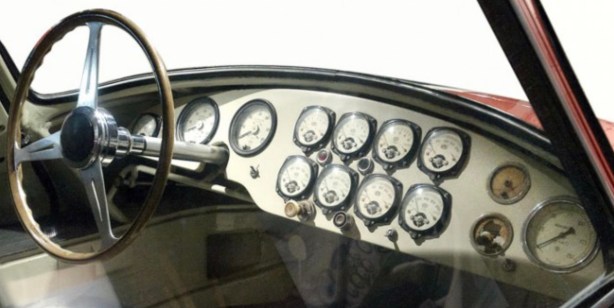
The cars test nature was expressed in its interior which had only the basics. The driver had two pedals, one to go and one to stop but faced a bank of instruments, many of which were there for technical observers. There were two tachometers, one for the gas generator and the other for the power turbine. Temperature readings were given for oil, bearings and combustion gases, while pressures were shown for the fuel and for the engine’s two lubrication circuits.
(smcars.net)
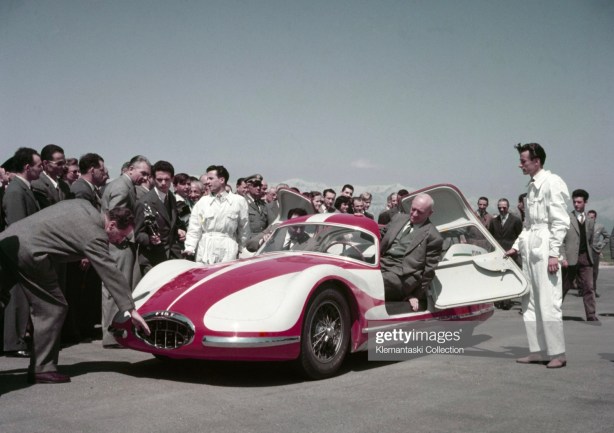
Carlo Salamano eases himself into the Turbina cockpit at Caselle Airport 23 April 1954

Work on the 8001 proceeded over the 1953-54 winter. By the end of February, the chassis was completed and handed to the in-house carrozzeria for body fabrication. On March 15th, its final engine was installed, and on April 10th, the car was considered completed. On the 14th, it was wheeled out of Traversa D onto the Lingotto rooftop test track. Settling himself behind its Nardi wheel was none other than pre-war Fiat Grand Prix winner Carlo Salamano, the by then veteran tester whom Giacosa described as “the conscience of Fiat.”

“That first test on April 14th had its humorous aspect. Salamano joked that since he had no idea how the car would react when he pressed the throttle (this being a completely new form of motive power), he should wear a parachute while testing it on a track 100 feet up in the air! In any event, the test went smoothly; the car went through its 15-second starting sequence flawlessly and, accompanied by the doughty Freilino, Salamano took it for baptismal laps of Lingotto’s rooftop track.”

“Turin’s automobile show opened on April 21, the turbine car had the potential to be a huge sensation for Fiat. It was only a rumor when the Italian president opened the show at 10:00 a.m. that Wednesday, but on Thursday evening, the closely held secret was revealed by Bono and Giacosa in talks at a meeting of Turin’s Rotary Club. A more appropriate venue could hardly be imagined.”

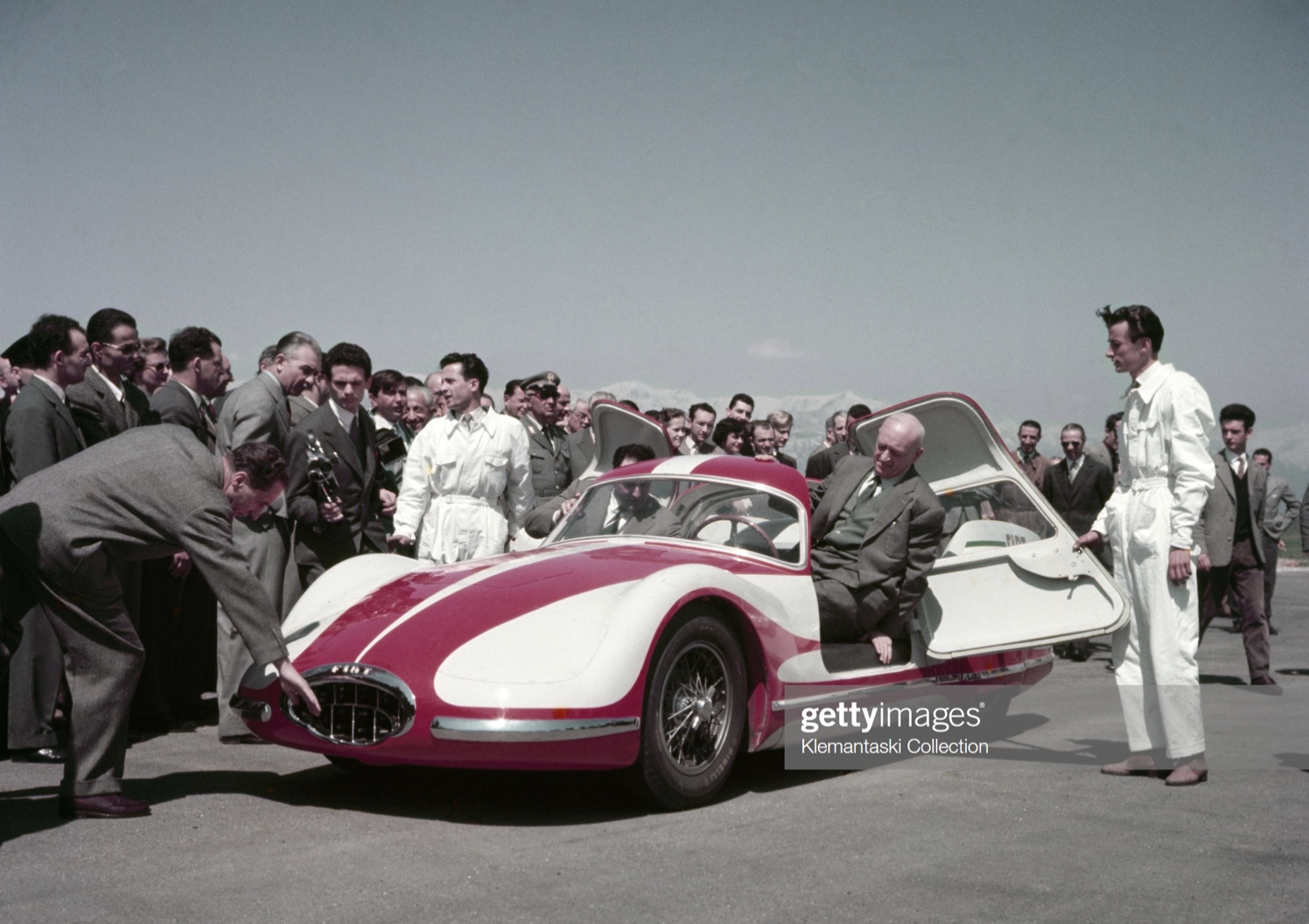
“By Friday the 23rd, the freak April snows had melted away, and Turin’s Caselle Airport was bathed in sun as Fiat executives and journalists convened to see the 8001 in the flesh and in action. Two days earlier, Salamano had tested it there and posed for press photos while finding all in order. Nevertheless, the turbine’s settings were conservative, power being held to some 150hp and power-turbine revs to 22,000, equivalent to 120 mph. The gas generator was running to 27,000 rpm, 10 percent less than its planned maximum.”

Fiat’s unveiling of its Turbina was impeccable in its timing in that It was the first public demonstration of a turbine-powered car in continental Europe- the SOCEMA-Gregoire of 1952 was never shown in operation. Fiat were the second manufacturer to display a running gas-turbine car. GM first ran its Firebird I in autumn 1953 but the media weren’t invited, while Chrysler’s first turbine-engined Plymouth, displayed in New York on April 7-11 of 1954, waited until June 16 for its running debut before the press and public. In July 1955 Austin demonstrated its first turbine-installed in a Sheerline.
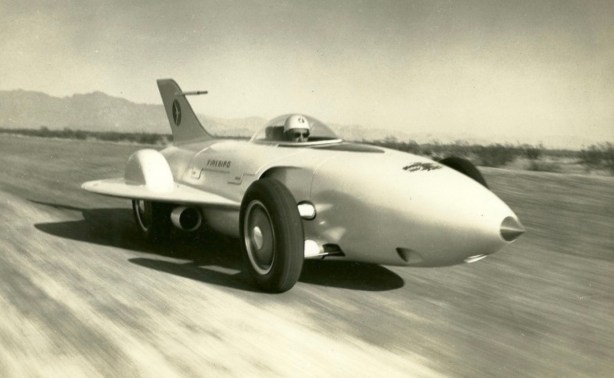
Mauri Rose, thrice Indy winner pilots the GM Firebird 1 on a deserted road in the Arizona desert. The ‘engineering and styling exercise’ was potent having a circa 370 horsepower ‘Whirlfire Turbo-Power’ turbine engine was located in the back of the car and drove the wheels through a two speed gearbox. Rose reached 100 mph- more than that was impossible due to tyre traction problems- the tyres could not cope with the torque (GM)
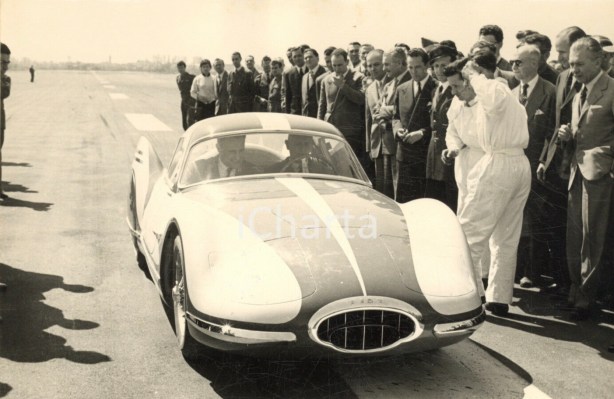
Salamano and the Fiat CEO?, Caselle amongst an admiring throng of press and Fiat staff (unattributed)

“No one could take more satisfaction from the Turbina’s demonstration at Caselle, and its appearance on the Turin show floor the next day, than Giacosa. ‘It was a festive occasion for me and my co-workers’, he said, “with the shrill whistling of the engine providing the high point of a bright spring day…a festive throng of the leading representatives of the city, journalists and Fiat executives, from the president down…an event that caused quite a stir all over the world.”

“With Fiat justifiably in the limelight, Giacosa could reflect on this spectacular result of his daring decision six years earlier to begin research on a radical new prime mover. Most important to Giacosa, however, was that the Turbina showed “that the motor vehicle design section was also capable of producing a small turbine, that our design engineers were on a par with those in the aeronautical division and, if needed, they could enable Fiat to compete with any foreign manufacturers in the small turbine field. The automobile was there as a concrete testimony to the abilities of the team of young men who had thrown themselves with enthusiasm into this far from easy task. For Fiat, it was precious experience gained. It showed that the turbine was not yet suited to the private automobile-nor may ever become so-but it should still be thoroughly perfected and studied for other uses.”

“After the hubbub of Turin in April 1954 had abated, Giacosa’s engineers got down to serious development of their 8001 turbine. They found many flaws. The compressor housing, originally of silicon-alloyed aluminum, deformed at high heat and rubbed against the rotating impellers. A change to an exotic magnesium-zirconium alloy gave the added strength needed without increasing the housing’s weight. The power-turbine casing had to be redesigned to keep it from sagging under its own weight. Key ball bearings were fitted with little centrifugal exhaust pumps to accelerate the flow of cooling oil through them. Forged brass cages and silver-plated surfaces were needed to extend ball-bearing life.”

“With compressor efficiency crucial to turbine performance, Bellicardi’s team built and tested many different configurations and sizes of the impellers and their connecting diffusers and ducting. Combustion chambers too were redesigned and retested. Stiffening components allowed closer running clearances throughout the engine, a boon to better performance. The ability of the gas generator to accelerate from its 10,000-rpm idle to full 30,000 rpm-a key index of engine response-was measured at five to six seconds, with most of the time taken to reach 20,000.”
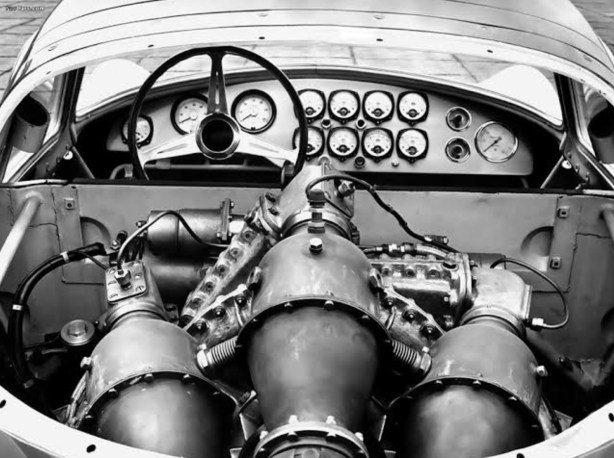
(Italianways)
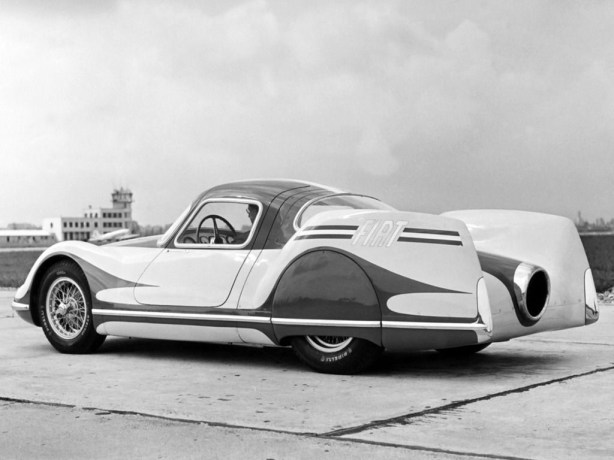
Caselle Airport, 23 April 1954 (Fiat)

“The engineers’ efforts over several years spectacularly improved the 8001’s performance. It now attained its target 200hp at 18,000 power-turbine rpm with the gas generator running at 29,000 rpm. With the gas generator at 30,500 rpm and the power turbine at 20,000, output rose to 295hp. At 29,000 power-turbine rpm, it was still producing 250hp.”

“This was impressive output. Fuel consumption was heavy, on the order of twice that of a comparable piston engine, but that didn’t trouble Carlo Salamano, who saw a chance for some glory behind the wheel late in his career. With that kind of power, he was sure, the Turbina would easily break the Rover turbine’s speed record of 152.9 mph, dating from 1952. He urged Giacosa to prepare the Turbina for an attempt over the flying kilometer.”

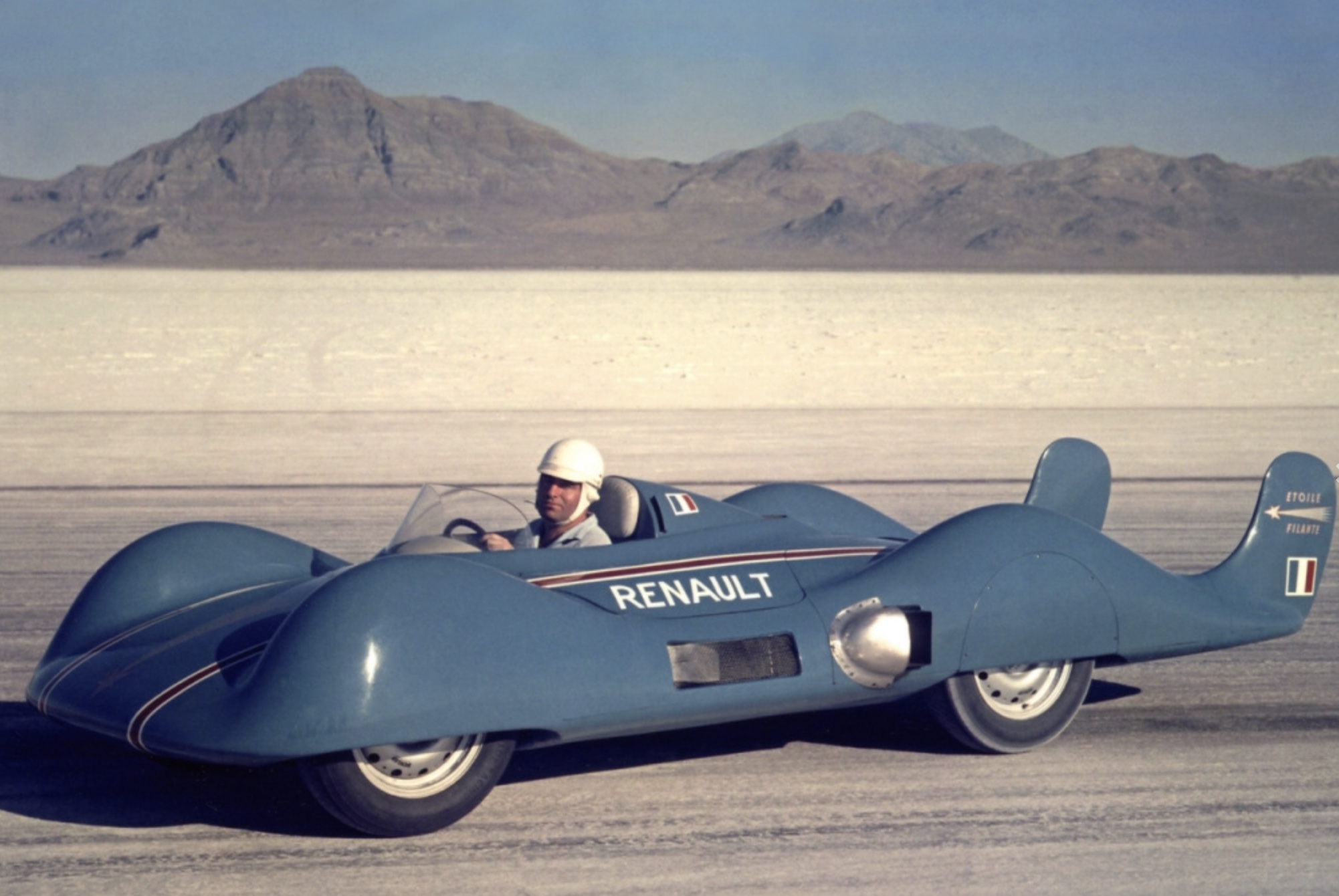
“In September 1956, they were getting ready to attack the record when they heard bad news from Utah. At Bonneville, Frenchman Jean Hebert set a new turbine-powered record at 191.8 mph in Renault’s “Etoile Filante.” Power from its Turbomeca Turmo I engine was akin to the Fiat’s: 270hp at 28,000 rpm. The car, however, was a purpose-built record-breaker with a sleek, low, single-seater body. The Turbina had no chance of matching its speed, let alone exceeding it.”

Though it never went record-breaking, Fiat’s Turbina did make more public appearances. It was tested at Monza in 1954 and then, on June 6th, turned laps of honor before a non-championship Grand Prix at the Castelfusano circuit on the coast at Ostia, near Rome. The Eternal City’s mayor joined other dignitaries to see and hear what Fiat had wrought. Now the Turbina rests in Fiat’s collection, occasionally loaned to exhibitions. It deserves to be accompanied by a recording of its engine’s keening whine, that exciting sound of the future that enraptured us all half a century ago.
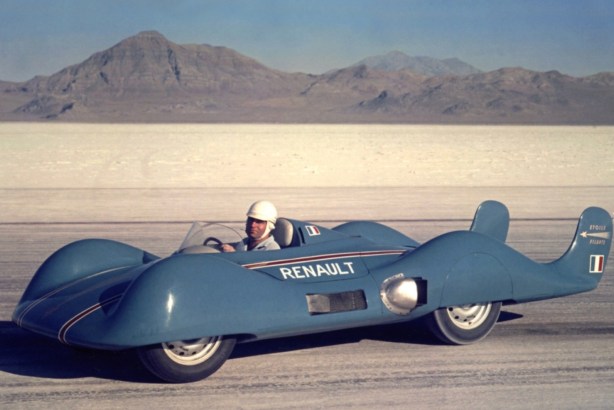
Renault Etoile Filante (Shooting Star) on the Bonneville Salt Flats before setting a Land Speed Record of 308.85 km/h on 5 September 1956- driver/engineer Jean Hebert is at the wheel (Renault)
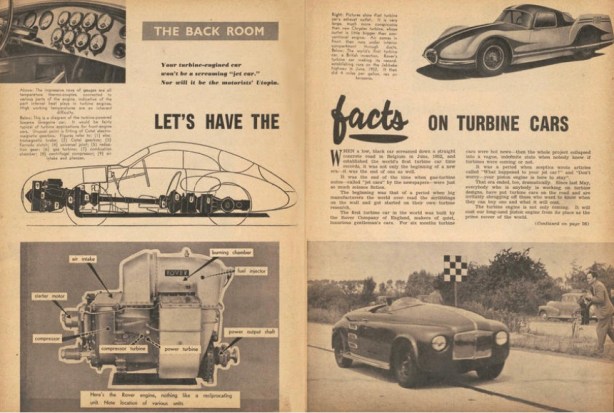
Contemporary automotive turbine perspective in September 1954…

It is interesting to look at the Wheels article, it has no writers byline unfortunately, and the future of turbine powered cars as anticipated then.

Wheels predicted “Turbine cars will be on the market in quantity from six to ten years. Commercial vehicles may be here in less’. Had the initial pioneers, the Rover Company of England had the backing of their government or the assets of General Motors they would have had as substantial lead now over the rest of the world in ground turbines as Britain had with jet aircraft in the air.”

Initially the technology would be applied to large cars from the US, ‘wealthy mens waggons‘ because the efficiency losses in small turbines indicated the industry would commence with bigger cars in which fuel economy is not important.

Advantages touted after a summary of the initiatives of Rover, Chrysler, GM and Fiat were outlined included simple transmissions with no gearbox, smooth vibrationless running, simple lubrication and practically no oil consumption, small dimensions and practically no oil consumption, small dimensions and low weight, no cooling system and easy starting regardless of weather conditions.

The challenges the technology at the time needed to solve were primarily complex metallurgical problems of service, manufacturing difficulties and the need for mass production to much tighter tolerances than was typical then.

It was thought that piston engine evolution to ‘fight back’ may focus on fuel injection and two-stroke diesels, both of which happened and of course the continual refinement of our old favourite has ensured its omnipotence to the present at least…

Etcetera…
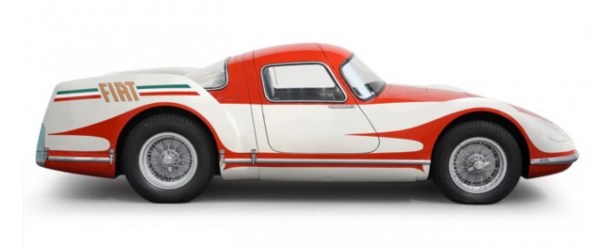
(Italianways)
(Italianways)
(Italianways)
(Italianways)
(Italianways)
(Italianways)
(Italianways)

Credits…

‘Turbine Speed with Style’ by Karl Ludvigsen in Hemmings, smcars.net, Getty Images- Louis Klemantaski, Italianways

Tailpiece…
(Getty)

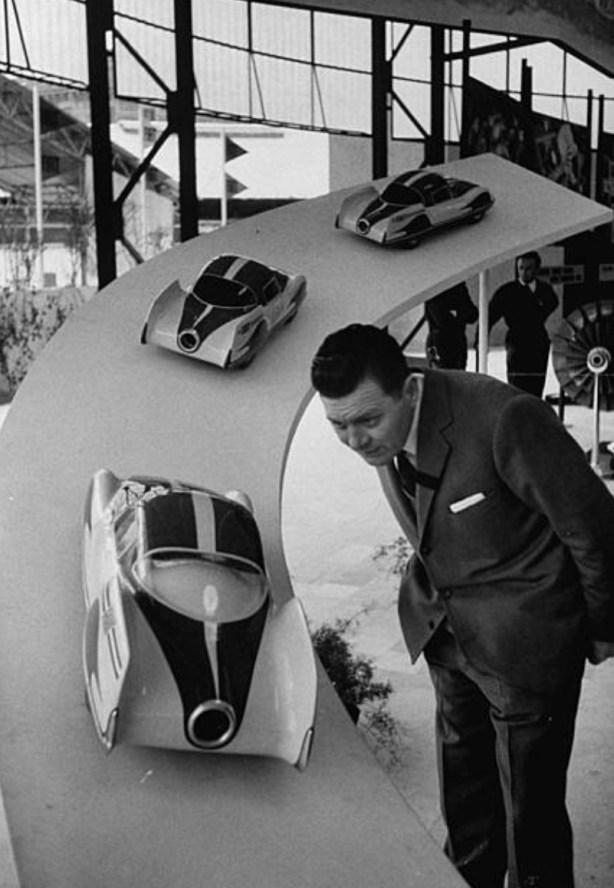
Mass production of the Turbina after all!

Finito…

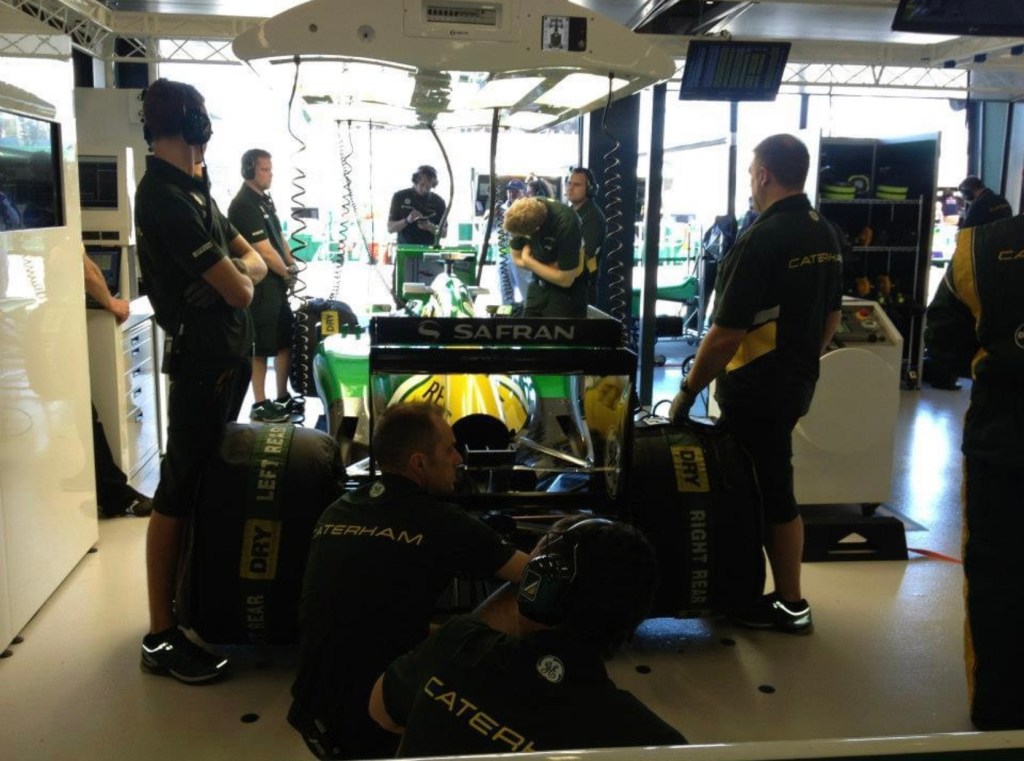
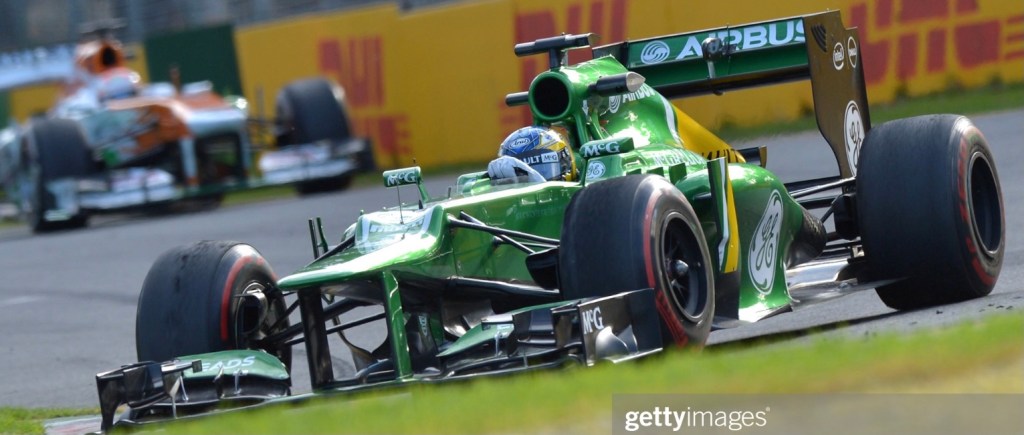
Caterham CT03 Renault…

Posted: April 4, 2021 in F1, Fotos
Tags:

Wonder if I can get triple J on this radio?

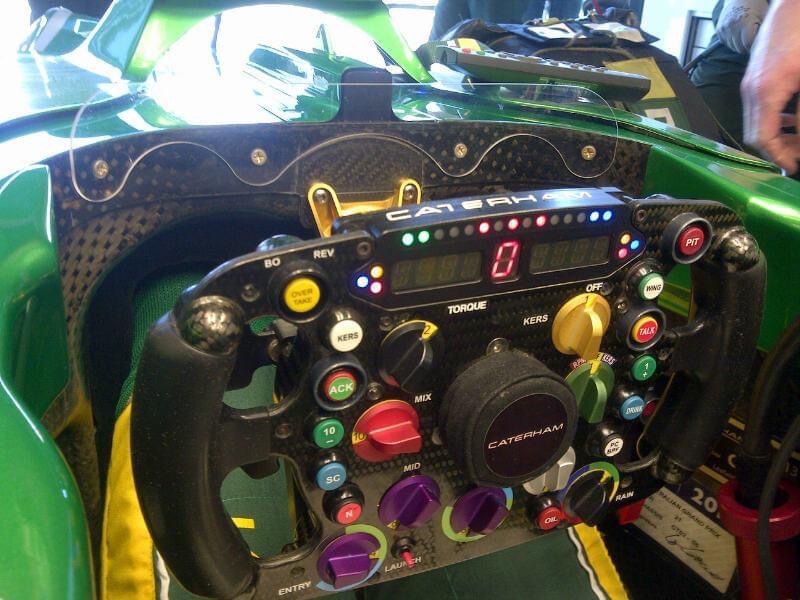
The drivers have to be digital natives to drive these things. There are twenty-two gizmos to push or twist in addition to the gearchange paddles on the steering wheel or tiller.

The dingo-ugly school of F1 design reached new heights in 2012-2013. Usual F1 levels of stupidity were attained when the FIA accepted a proposal to allow hit-with-the-fugly-stick chassis ‘modesty panels’ to be added to minimise (sic) the high-speed visual atrocity impact.

Charles Pic is the featured driver in all of the action shots, Van der Garde behind him here in first wet practice

Kimi Raikkonen won the 2013 Australian Grand Prix aboard a Lotus E21 Renault. Down the other end of the grid Giedo van der Garde made the cut in his Mark Smith designed Caterham CT03 Renault RS27 2.4-litre V8, Charles Pic did not – but was allowed to start anyway. Both cars finished too, Pic was 16th, Van der Garde 18th and last, two laps adrift of the podium trio, Raikkonen, Alonso and Vettel.

It was a tough season for the team, 14th placings by Pic in Malaysia and Korea, and by Van der Garde in Hungary were the best results in Caterham’s last full season of GP competition.

Credits…

Getty Images- Robert Cianflone and Paul Crock, Australian GP Corporation

Tailpiece…

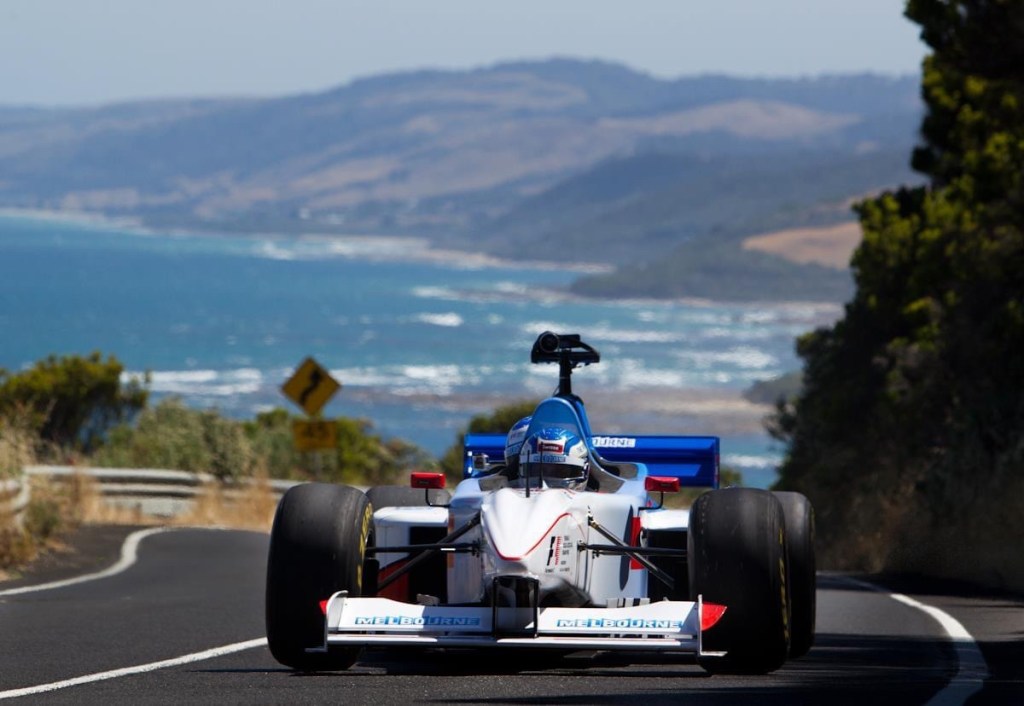
The Australian Grand Prix corporation always work hard on pre-event promotion of the event within Australia and overseas.

Their 2013 focus was in part some fantastic footage of, and from the 750bhp Minardi Asiatech V10 two-seater piloted by Cameron McConville, with Victoria’s Great Ocean Road near the Twelve Apostles, as the backdrop.

Finito…

The Easter Rabbit bounced past me early this year.

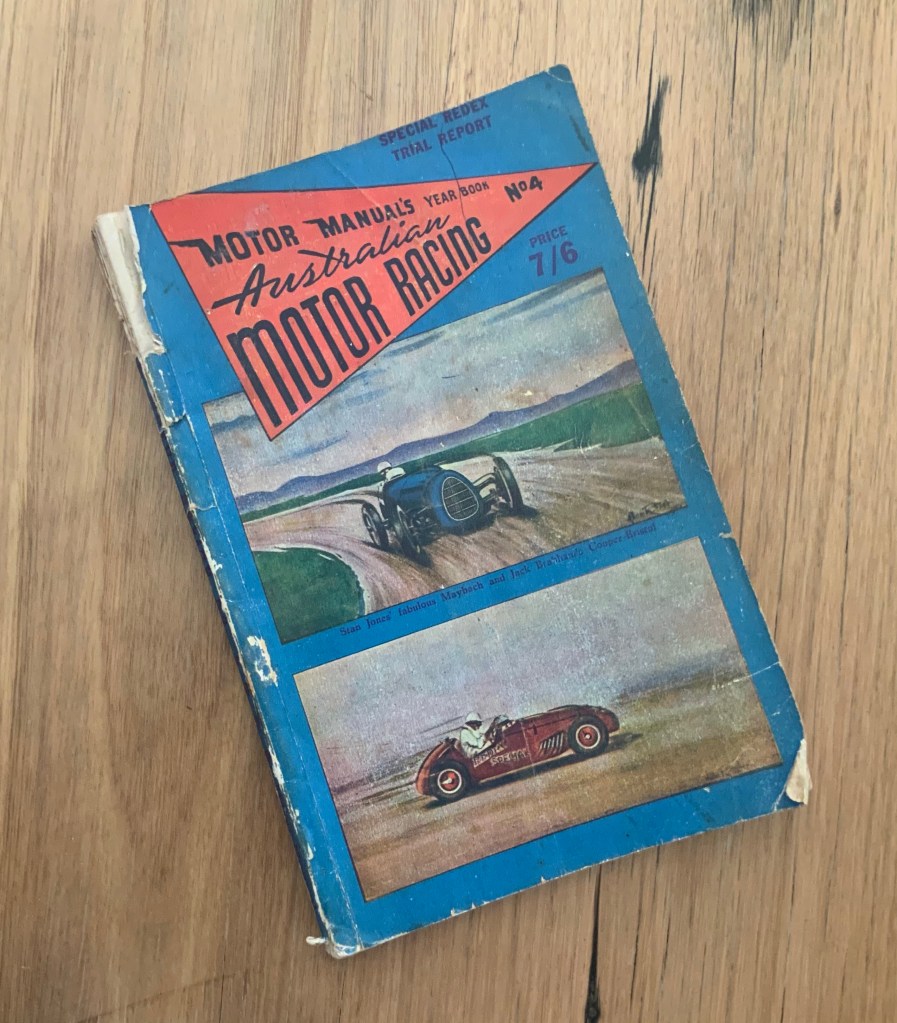
‘Me mates Stephen Dalton and Bob King each gave me an Australian Motor Racing Annual; the first 1951 edition and the fourth 1954 edition – who needs more chocolate anyway? Easter reading sorted, thanks muchly blokes!

Like way too much Oz pre-1960 racing publications, these little gems passed me by until a couple of years back but I’d never seen the gizzards of one before, chockers with information as they are.

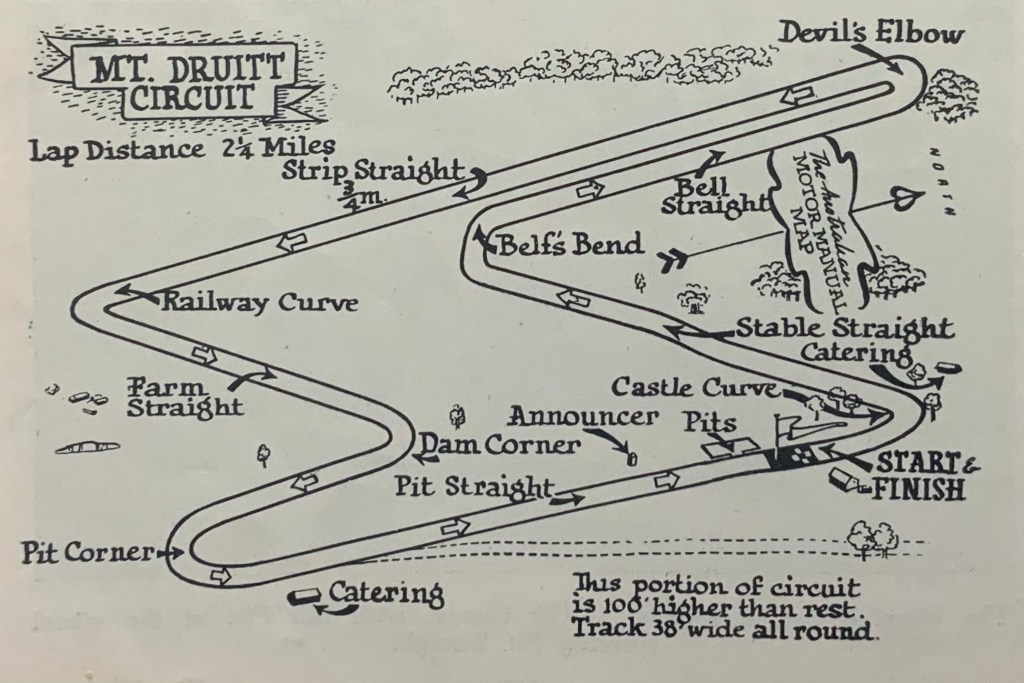
The first edition covers the history of racing in Australia, a summary of the leading clubs, one-pagers on 80 of our contemporary racing cars, quickies on personalities, beautiful drawings of circuits, a tuning guide by Dicer Doug Whiteford and an article on The Modern Racing Car.

By 1954 the format had evolved to include a summary of the year’s major events and their results, more features while continuing the summary of contemporary racing cars. Great stuff indeed.

By the time I came down the magazine purchasing pike in 1971, Motor Manual, publishers of this summary, produced almost annually from 1951 to 1967, were a distant third in my personal rankings of road car magazines, behind Modern Motor and Wheels.

Mind you, once I discovered Sports Car World I didn’t touch M-M or Wheels for a couple of decades – SCW was the roadie bible of cars which mattered.

When Motor Manual stopped producing their racing annuals, the Australian Motor Racing Annual published by the SCW/Wheels/KG Murray Publishing mob took up the cudgels, this evolved into their sensational Australian Competition Yearbook, an Oz touch of Autocourse. This 200-pager covered each F1 GP and had a season summary, the same format was used for each of the ‘major’ Oz racing categories; F5000, F2, F3, FF, sportscars, rallying, and taxis. Other motorsport copped a couple of pages or so each; hill-climbing, motorkhanas, karting and perhaps the drags.

I still refer to these publications all the time for research purposes, or just coz I always have – sad little unit that I am.

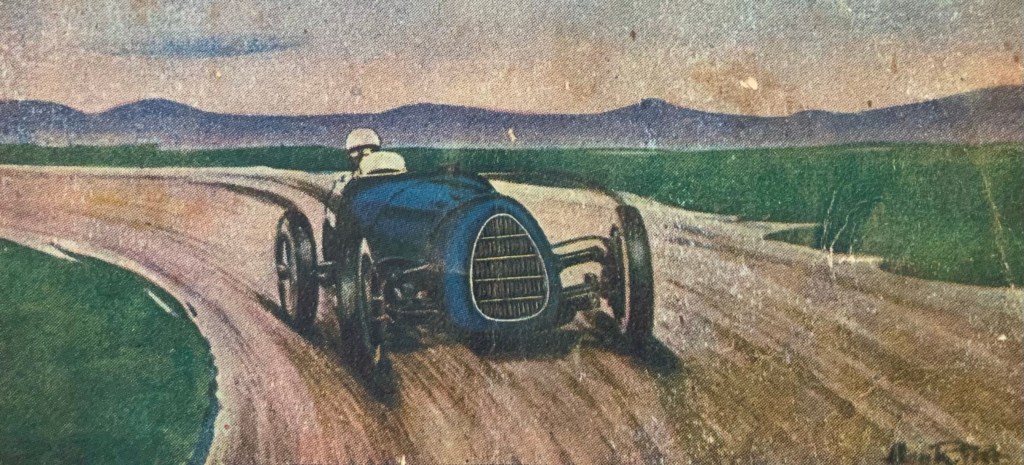
Stan The Man in Maybach 1, Jones suffering from uncharacteristic understeer. I can’t quite make out the artist’s name but would like to know who it is and credit appropriately
Stan Jones winning the New Zealand Grand Prix at Ardmore in 1954, Maybach 1
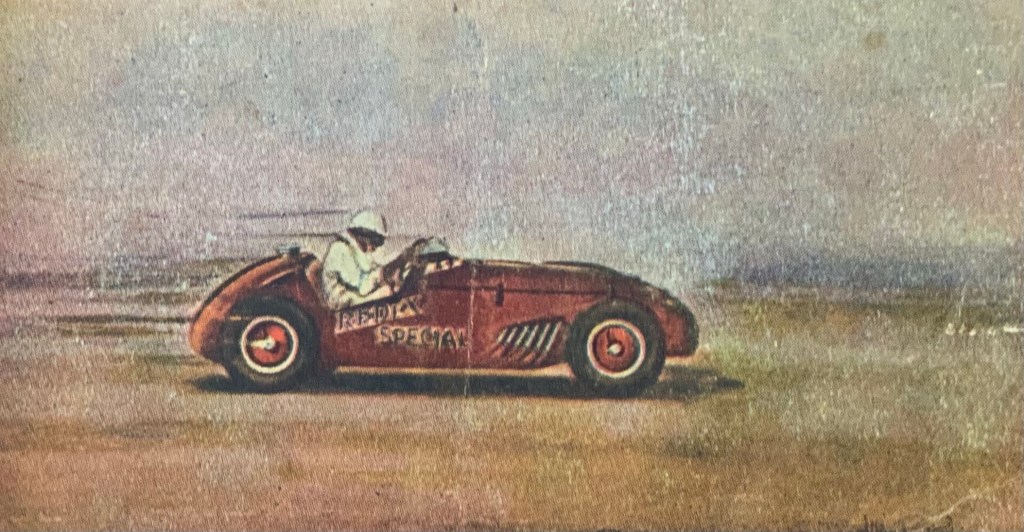
Jack Brabham, RedeX Special, Cooper T23 Bristol. The artist has the ‘Brabham Crouch’ nailed!

In the mid-2000s The Annual Australian Motorsport was fantastic. Perhaps publisher Grant Rowley should have had more steak ‘n chips maxi-taxis to have a sales smash – the 2005 edition devoted only 46 of 218 pages to the big swingin’ V8s while commendably giving all other categories a fair crack of the whip.

Since then no-one has been stupid enough to step up to the annual-summary plate, sadly.

Those Annual Australian Motorsport mags were $20 in 2007. I’d quite happily pay $40-50 for a 200-page annual now, even one with 100 pages of the big shit-fighters – there is the rub, it’s probably got to be that way to flog enough mags to hit break-even print numbers.

Auto Action are probably the only ones who could do it these days. Publisher/owner/editor/cook Bruce Williams is passionate enough, but whether he is that stupid is another thing.

Anyway, if you think an annual is a good idea email him on bruce@autoaction.com.au, he doesn’t believe a word I say. Don’t tell him I sent you, this is an un-sanctioned jolly of my own.

Maybe people-power can get us back something I still miss each January/February.

Tailpiece…

Finito…
(Brabham Family)

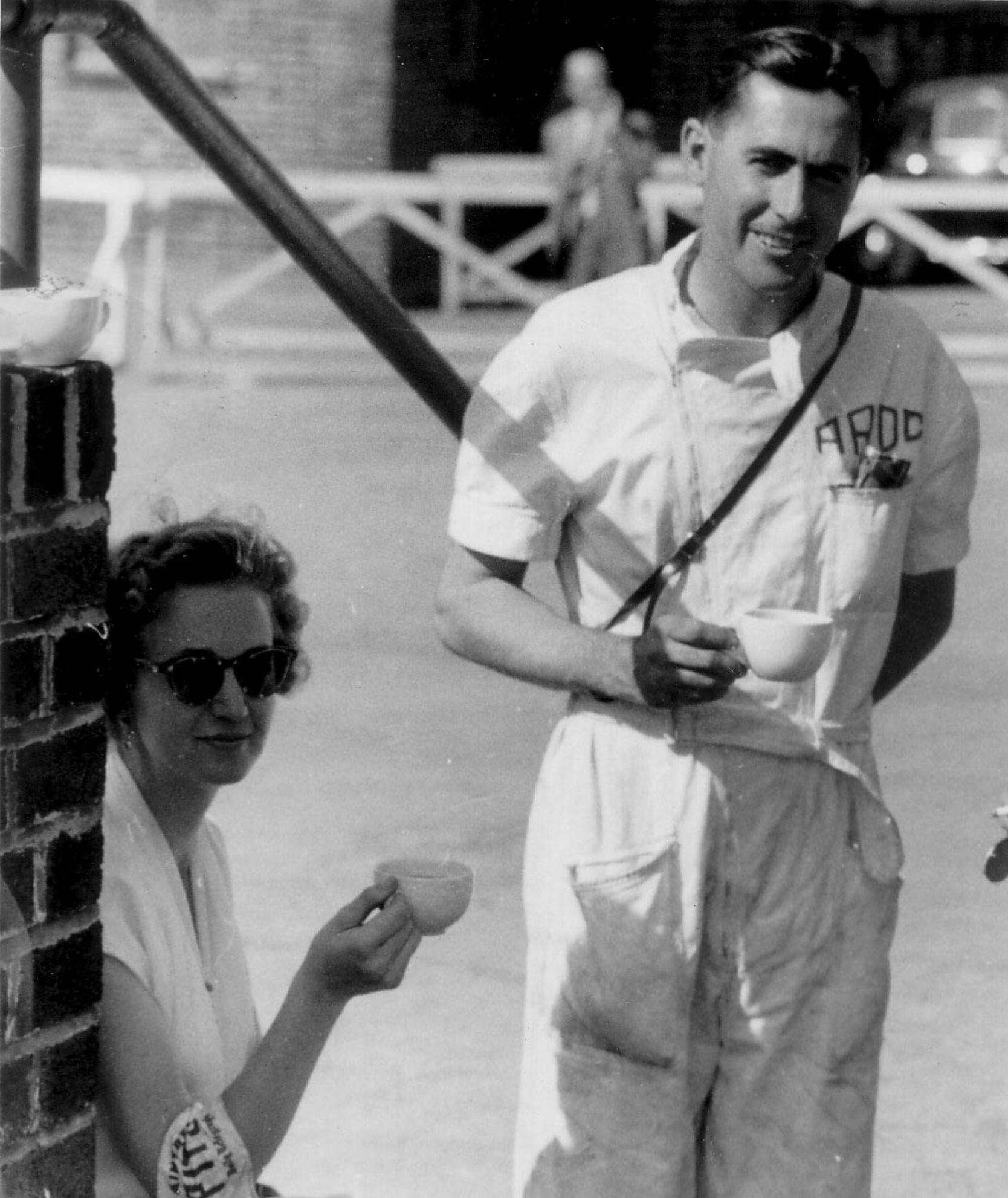
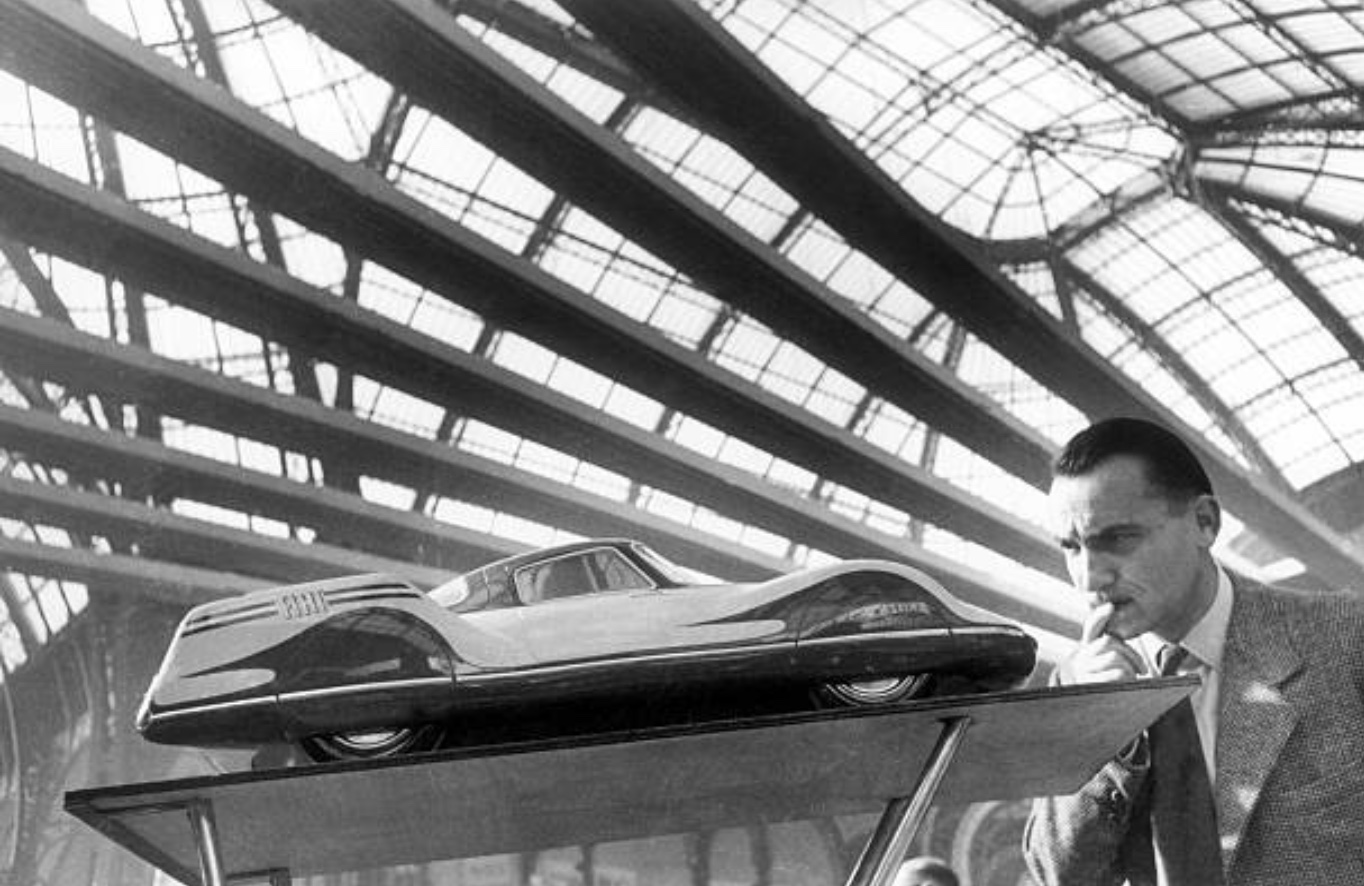
Jack and Betty Brabham chillin’ between sessions at Aintree during the July, 1955 British Grand Prix weekend.

Brabham is a very youthful 29, love the Australian Racing Drivers Club badge on his once lily-white overalls-how casual does it look?

It was Jack’s championship debut in a car he built himself, a Cooper T40 Bristol. He qualified 25th and retired after 30 laps with engine trouble. The race was famously won by Stirling Moss’ Mercedes Benz W196.


(Cummins Archive)

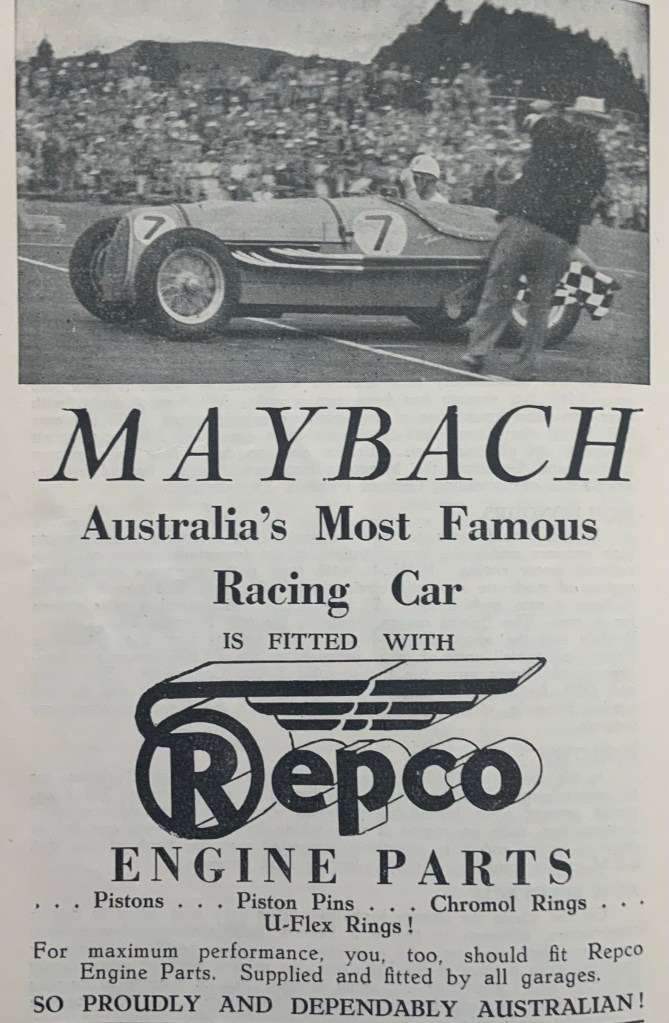
The car was shipped to Australia for what was to become Jack’s annual summer tour. He scored a lucky AGP win at Port Wakefield, South Australia when front runners Reg Hunt, Maserati A6GCM 2.5 and Stan Jones in Maybach 3, on the front row above, had mechanical dramas. Jack is on the second row alongside Doug Whiteford’s Talbot Lago T26C

The car stayed in Australia, see articles here; https://primotipo.com/2015/07/16/60th-anniversary-of-jacks-first-f1-gp-today-british-gp-16-july-1955-cooper-t40-bristol-by-stephen-dalton/ and here; https://primotipo.com/2017/07/04/max-stephens-cooper-t40-bristol/

(unattributed)

Brabham blasting through the flat, grim, saltbush Port Wakefield terrain, 100km north-west of Adelaide. Click here for an article on the race; https://primotipo.com/2017/07/28/battle-of-the-melbourne-motor-dealers/

Credits…

Brabham Family Collection, LAT, News Ltd, Cummins Archive

Tailpiece…

(News Ltd)

To the victor the spoils, and a bit of attention from the chief.

Finito…

(Goldsmith Collection)

Globe Products boss, Dick Bassett, poses in the Mallala paddock on the debut of his new Elfin 400 Ford #BB661, driven by Noel Hurd, on June 13, 1966.

Regular readers will know I’ve slugged away at the Elfin 400, a favourite car, ad-nauseum. See here on the Matich 400 and related; https://primotipo.com/2015/05/28/elfin-400traco-olds-frank-matich-niel-allen-and-garrie-cooper/ and Bob Jane’s 400; https://primotipo.com/2018/04/06/belle-of-the-ball/

It was finding a few shots of the car before and after it took flight at about 140mph going up the hill towards Longford’s Water Tower in March 1967 which piqued my interest again.

The original aero of the four 400s was suss – fatal in Bevan Gibson’s case. Hurd took air at Longford, spinning five times according to onlookers, and miraculously did not damage the car greatly. He was ok but a change of undergarments would have been required. To go off there and not hit a substantial piece of local geography was lucky, to say the least.

Noel Hurd hooks into the Viaduct, Longford 1967. The spot he went off is 700 metes or so back up the road behind him (Y Waite)


Longford damage looks superficial but enough to end the weekend early. Changes to body not the work which could be done quickly at the circuit (E French)

After the Longford meeting the car was dropped back to Garrie Cooper. Together with his body specialist John Webb, the front horns were removed and the nose re-profiled and then again tested at Mallala.

When it reappeared at Mallala in June 1967 the machine was powered by the Kevin Drage designed and built Globe-Ford V8.

This DOHC, twin-cam, two-valve, four Weber-fed 366bhp 289cid Ford V8 replaced the 289 pushrod ‘Cobra’ engine first fitted to the 400. More about this project in an article to be published soon.

(G Matthews)

Adelaide’s Keith Rilstone at Mallala after purchase of BB661 in 1969-1970 – note the changes made to the nose.

Sadly, he acquired the car with the pushrod Ford fitted rather than the DOHC unit.

The patterns of that engine were scrapped by a subsequent Sydney owners widow. The completed engine has disappeared from trace, last known probable locale, West Australia. Do get in touch if you can assist in that regard.

Etcetera…

(F Radman Collection)

Magazine cover shows the start of the 1967 South Australian Tourist Trophy won by Alan Hamilton’s Porsche 906 Spyder from Hurd’s Elfin 400

BB661 as originally built, at Edwardstown, with Ford ‘Cobra’, four Weber 48IDA 289 V8.

(K Drage)

Rear shot at Mallala in June 1966, showing Hewland LG500 four-speed transaxle.

Big muvva of Can-Am gearbox with this little V8, heavier than the more logical DG300 which was just coming onto the market at this time – by then used by Jack Brabham and Dan Gurney in their F1 Brabham BT19 and Eagle Mk1.

(J Lemm)

Noel Hurd getting the hang of his new mount, Mallala, June 1966. Won on debut, although Bob Jane’s second places Jaguar E Type Lwt was hardly a fair-fight of equals.

Credits…

Greg Matthews, Ellis French, Yaya Waite, John Lemm, Ron Lambert, Kevin Drage

Tailpiece…

(K Drage)

South Australian ingenuity, the Kevin Drage designed Globe-Ford 289 V8.

Ford block with twin, chain-driven camshaft, two-valve aluminium cylinder heads fed by four Weber 48IDA carburettors. One of Oz racing’s great mighta-beens.

Finito…

(R Edgerton Collection)

The J.A ‘Lex’ Denniston owned Itala V8 Special was built by Ern Seeliger in his modest temple-of-speed in Baker Street, Richmond, early events included Rob Roy’s April and November 1946 meetings.

The cocktail of components comprised a 1930-1932 Itala chassis and steering box (later replaced by a Lancia component) and modified Ford Mercury V8 and gearbox, the talented Bob Baker built the body, his ‘shop, Baker and Tait was closeby in Church Street, Richmond.

Seeliger normally raced it, notable successes were at Rob Roy, and at the Ballarat Airfield, where Ern won the Wendouree Handicap in January 1947. After this meeting, he rebuilt it, although he was able to run it very effectively sans body at Rob Roy on April 20, 1947 achieving FTD at 30.99 seconds (G Thomas)

(R Nutt Collection)

The leaner, meaner machine reappeared at Lobethal twelve months hence on the January 1, 1948 weekend. Practice passed uneventfully enough, Seeliger’s first race was the 11.05am Lobethal 100 handicap. The less powerful cars had done two laps by the time our scratch-man, Seeliger set off and gave chase.

After only one completed lap he was baulked by another car at over 100mph, the Itala slid one way, then the other before crashing through trees backwards, demolishing the front of the car enroute. Ern, fortunately escaped without injury but the svelte racer was dead. After last rites were performed, its remains were presented to a Lobethal farmer.

Jim Gullan, below, won aboard his Ballot Olds Spl from Granton Harrison’s Phillips Ford Spl and Ron Edgerton’s MG TC Spl, #32. See here for an article on this race; https://primotipo.com/2016/11/11/south-australian-100-1948-jim-gullans-ballot-olds-and-greensborough-hillclimb/

Legendary Adelaide engineer Harold Clisby #29, and Ron Edgerton #32, in standard and modified MG TCs respectively (R Edgerton Collection)

(T McScratchey)

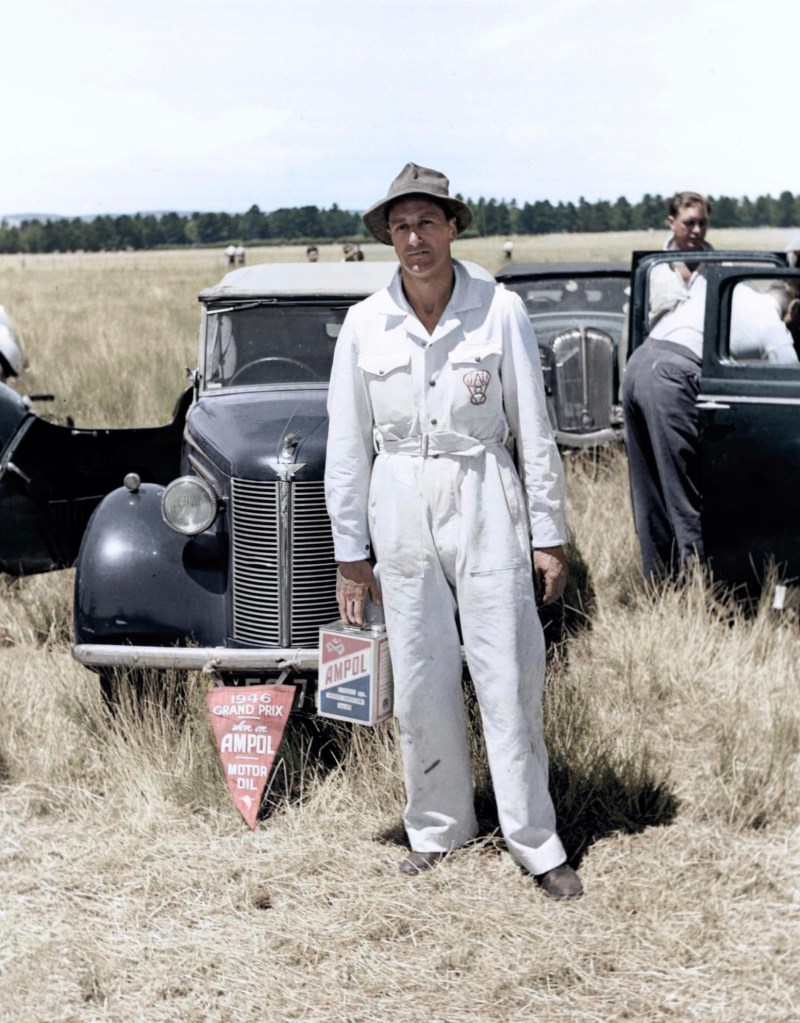
Amazing colour shot of Ern Seeliger during the January 1947 meeting on Ballarat Airfield. Blow the shot up and you can see ‘Itala V8‘ on his pocket. A smile to the Ampol ‘snapper would have been appropriate.

As to the ‘1946 Grand Prix’ winner Ampol are crawling about, the race being referred to is the October 7, 1946 New South Wales Grand Prix won by Alf Najar’s MG TB monoposto at Bathurst. The first postwar AGP wasn’t run until October 1947, Bill Murray’s MG TC Spl was victorious at Bathurst.

Etcetera…

(G McKaige)

The Itala Ford V8 Spl as originally built. George McKaige took these photographs on November 23, 1946. The car was parked in Orrong Road near the Towers Road, Toorak, Melbourne corner, presumably close to Denniston’s residence.

(G McKaige)
(G McKaige)
(G McKaige)
(G McKaige)

(G McKaige)

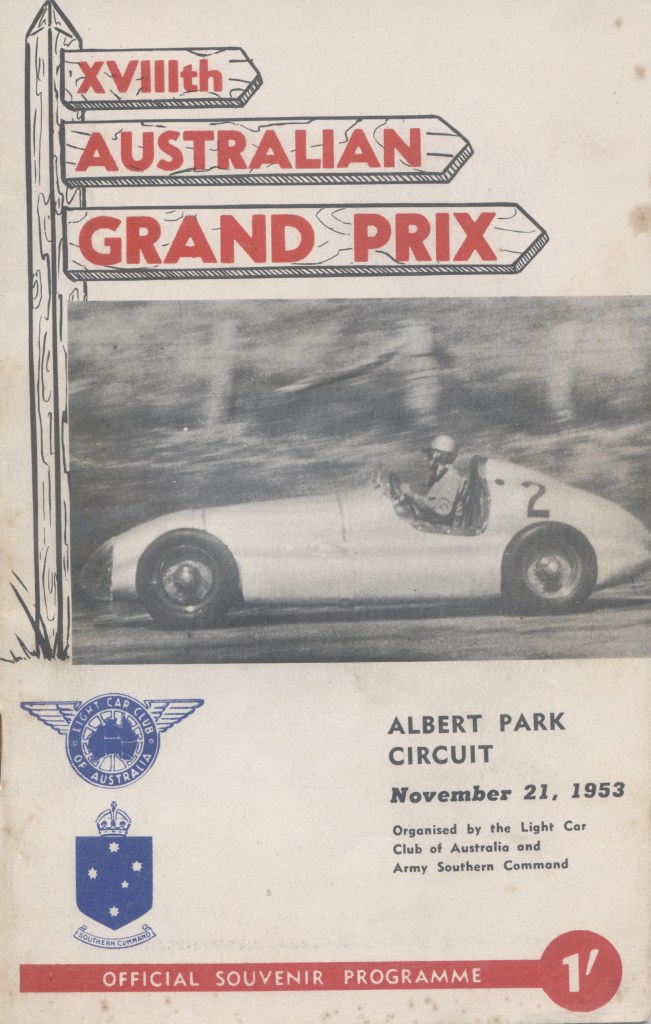
Tony Johns’ research indicates that Denniston was President of the Light Car Club of Australia in 1951-52. This goes some way to explaining why a car which was destroyed in 1948 was on the cover of the program of the 1953 Australian Grand Prix at Albert Park, promoted by the LCCA! Perhaps one of the likely race-winning drawcards would have been more appropriate. Still, in the minds of so many, what is the point of having power if you don’t abuse it?

Credits…

Ron Edgerton Collection, ‘Beyond The Lens’ Chester and George McKaige, Stephen Dalton, Tony Johns Collection, Australian Motor Sports November 1947, SAmotor, Dacre Stubbs, Seeliger Family Archive, Travis McScratchey

Tailpiece…

(SAmotor)

Amazing, rare colour shot of the Seeliger Itala at Lobethal in 1948.

Finito…
(unattributed)

If the 1938 Australian Grand Prix at Bathurst was our first international event, by virtue of visiting Brits Peter Whitehead and his ERA B Type, and Alan Sinclair, Alta 1,100 s/c, our second international, and first of the modern era, was the South Pacific Championship at Gnoo Blas held in January 1955.

Peter Whitehead liked the place so much he came, saw, and conquered again, just as he did seventeen years before at Mount Panorama, albeit the 1955 field had a bit more depth that of 1938.

Peter and Tony Gaze raced Ferrari 500/625s, Bira a Maserati 250F with the better equipped locals Dick Cobden’s Ferrari 125 and Jack Brabham’s Cooper T23 Climax. Kiwi’s John McMillan and Fred Zambucka in Alfa Romeo Tipo B and Maserati 8CM respectively came across the ditch but both cars were too long in the tooth as was Tom Sulman’s Maserati

Non starters were Reg Hunt, short of parts for his new Maserati A6GCM, and Lex Davison’s HWM Jaguar

Whitehead won from Brabham and Gaze with Joe Murray, Allard Cadillac, Tom Sulman, Maserati 4CM and Curley Brydon, MG TC Spl in fourth to sixth places, I’ve written a feature in this race here; https://primotipo.com/2020/04/09/1955-south-pacific-championship-gnoo-blas/

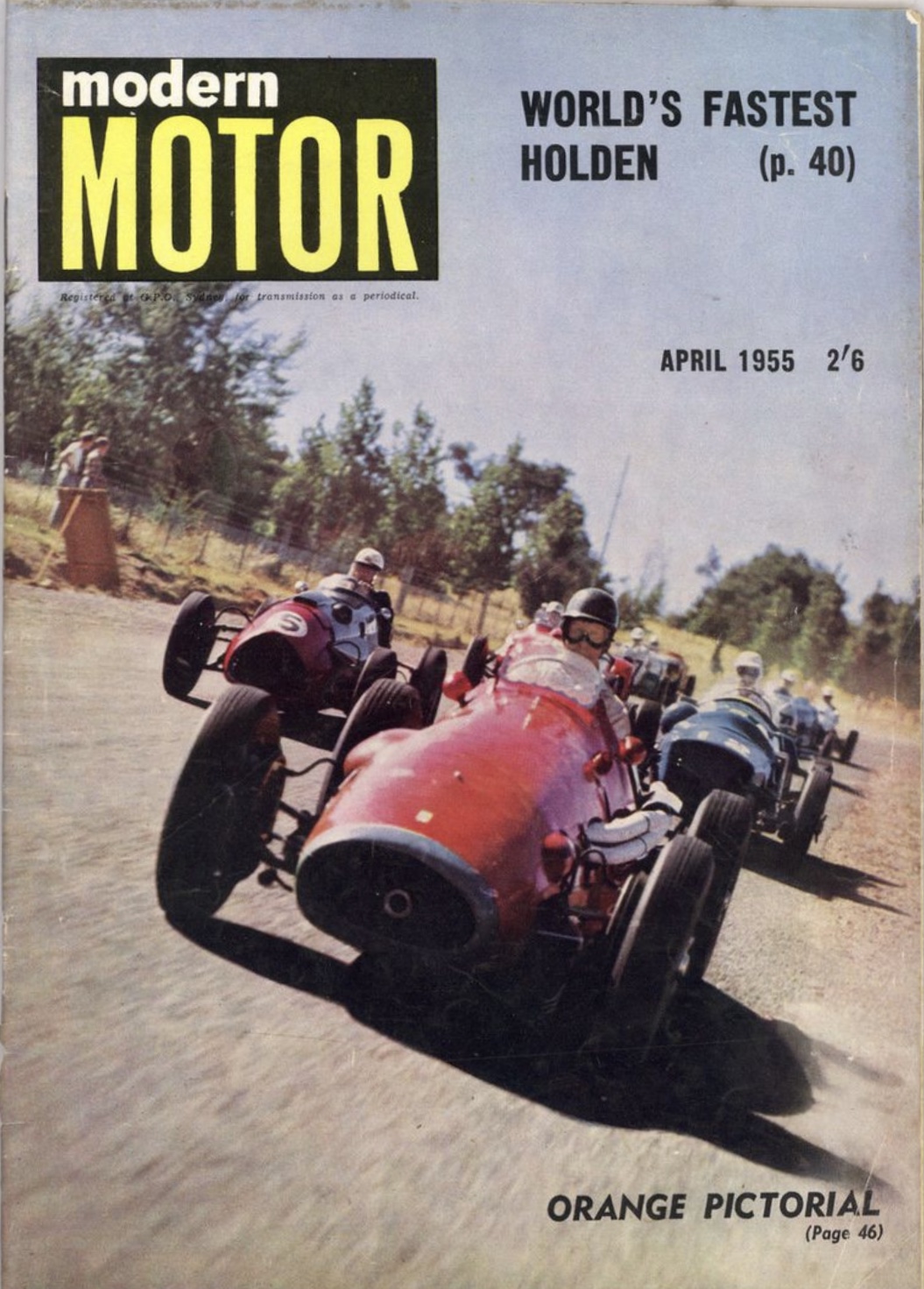
(Modern Motor)

This shot isn’t kosher, it was staged for Modern Motor magazine but is still a cracker showing the Whitehead Ferrari, Brabham Cooper off to the left and Jack Robinson’s Jaguar Special aft of Peter. Further back is the unmistakable shape of a Bugatti, perhaps the John Hall Holden engined Type 37.

The grid on Huntley Road. From left, Jack Brabham, Cooper T23 Bristol, John McMillan, Alfa Romeo Tipo B, Peter Whitehead, Ferrari 500/625 and Jack Robinson, Jaguar Special (unattributed)


(unattributed)

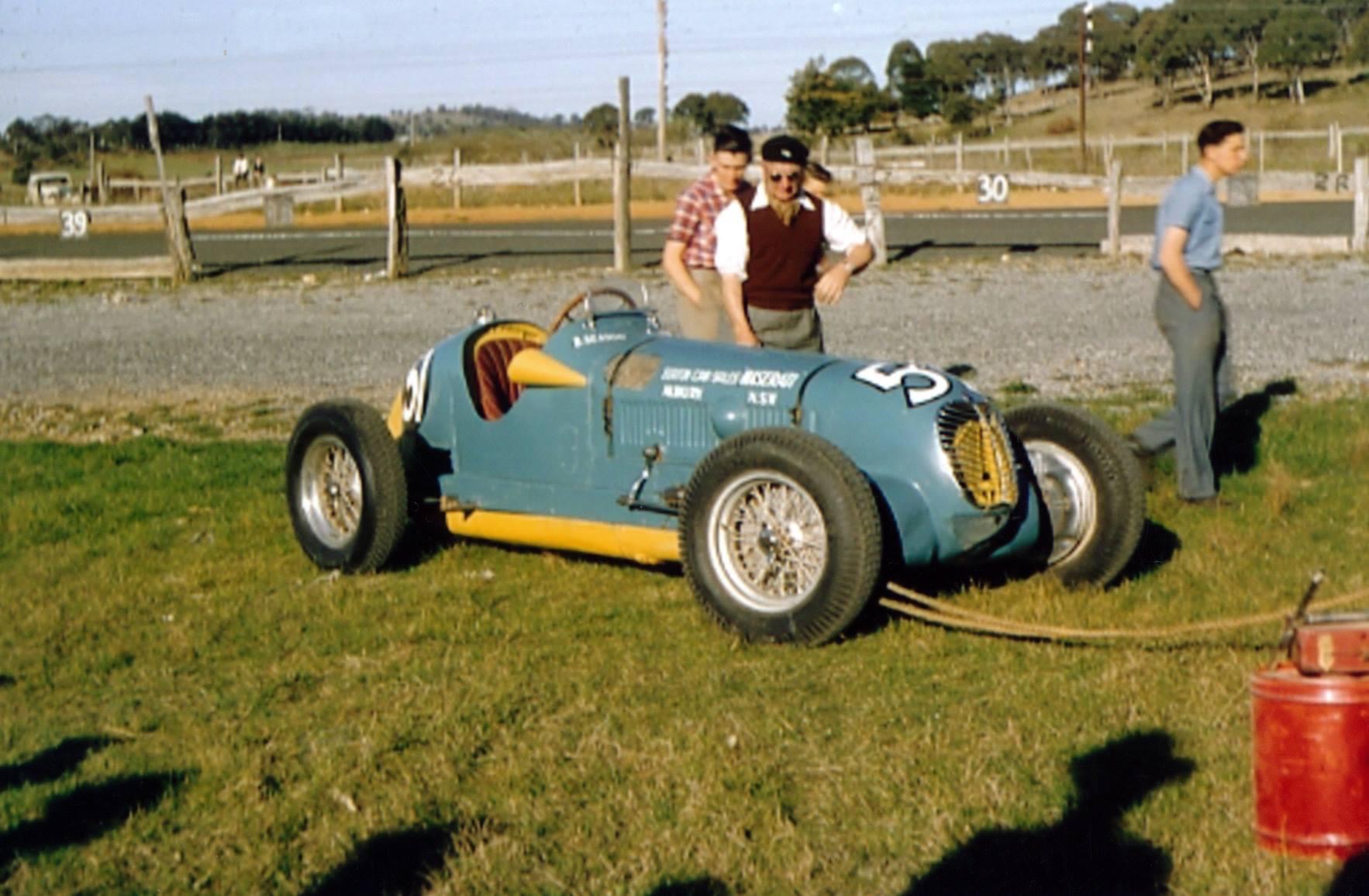
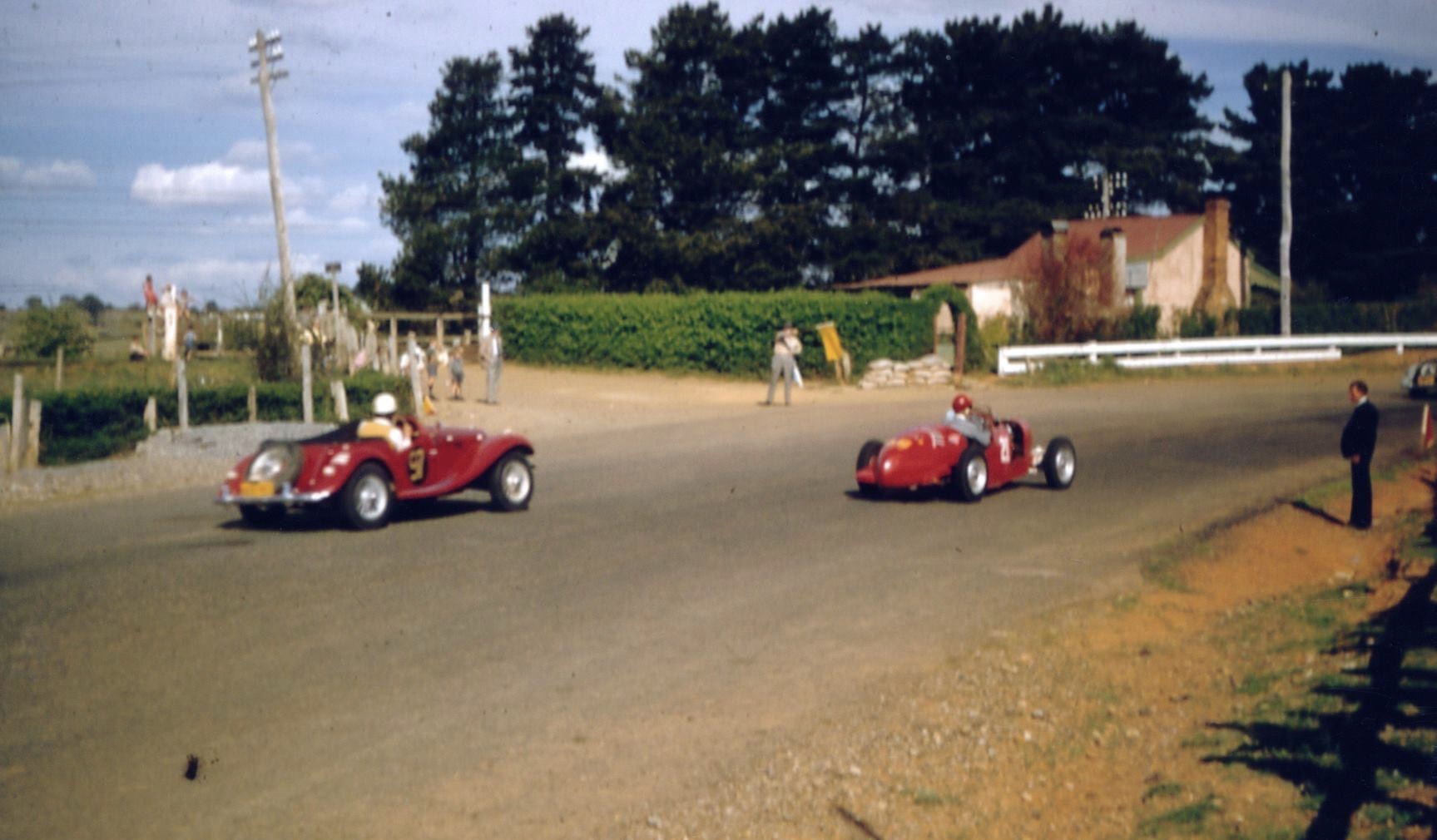
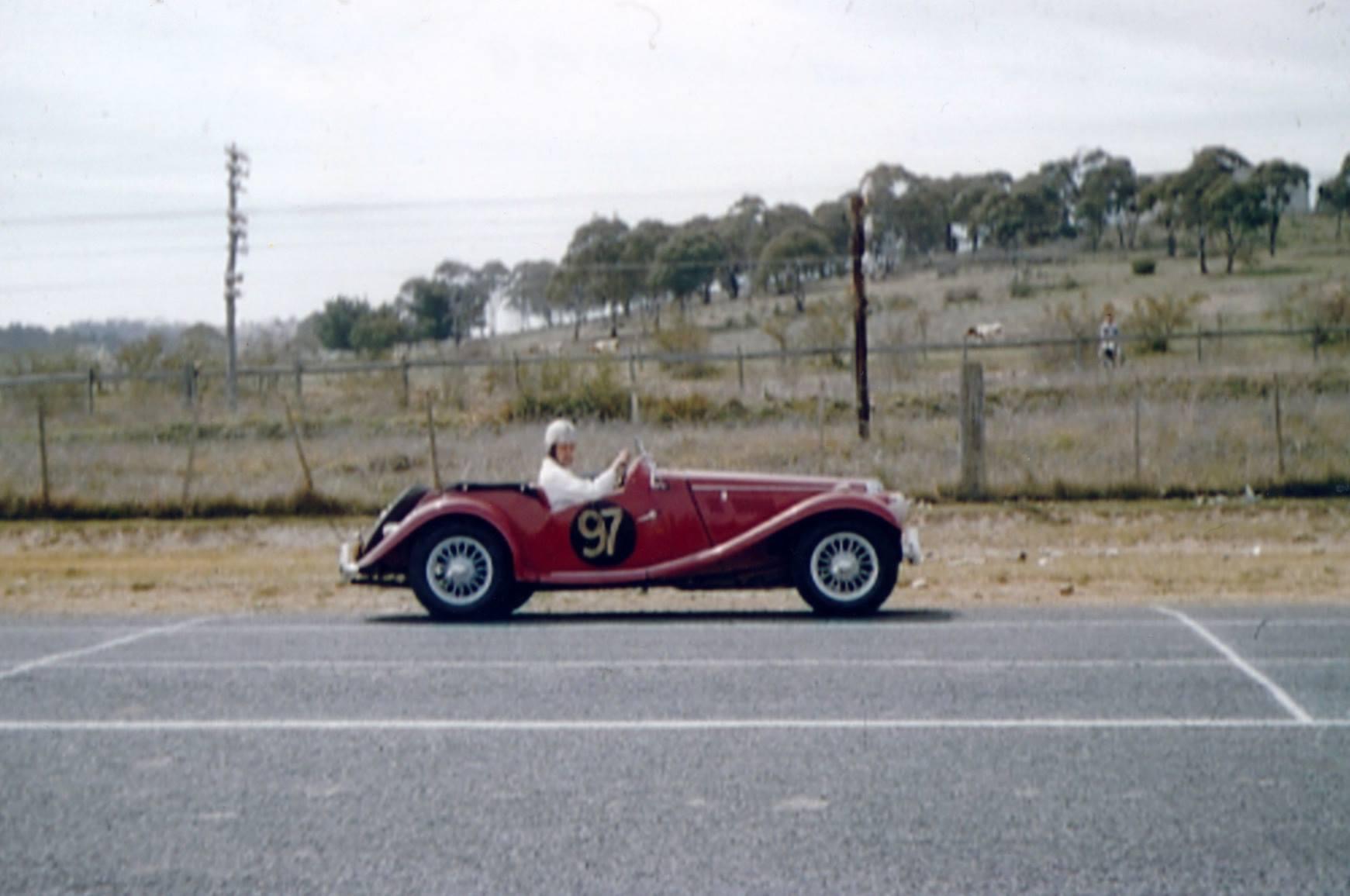
This group of wonderful colour photographs were taken by George Causbrook, an Orange electrician who worked at the time for Tom Barrett, owner/driver of the #97 MG TF.

Barretts Milk was a successful local business with a factory/depot including an airstrip. Causbrook’s family, the Beasleys, made available the shots to the Gnoo Blas Classic Car Club from whom I have shoplifted them, with thanks!

George had a fine eye, his colour shots of this challenging road course help us understand better its nature sixty years after the final Gnoo Blas meeting.

Ted Gray is shown below fussing over his brand new Lou Abrahams owned Tornado 1 Ford, just finished in Gray’s workshop in Melbourne.

By the October Bathurst meeting the team were starting to get the new beast sorted, but a huge accident in practice destroyed the car and came close to killing its plucky driver who took six months to recover from his injuries. See here for Tornado; https://primotipo.com/2015/11/27/the-longford-trophy-1958-the-tornados-ted-gray/

(unattributed)


(unattributed)

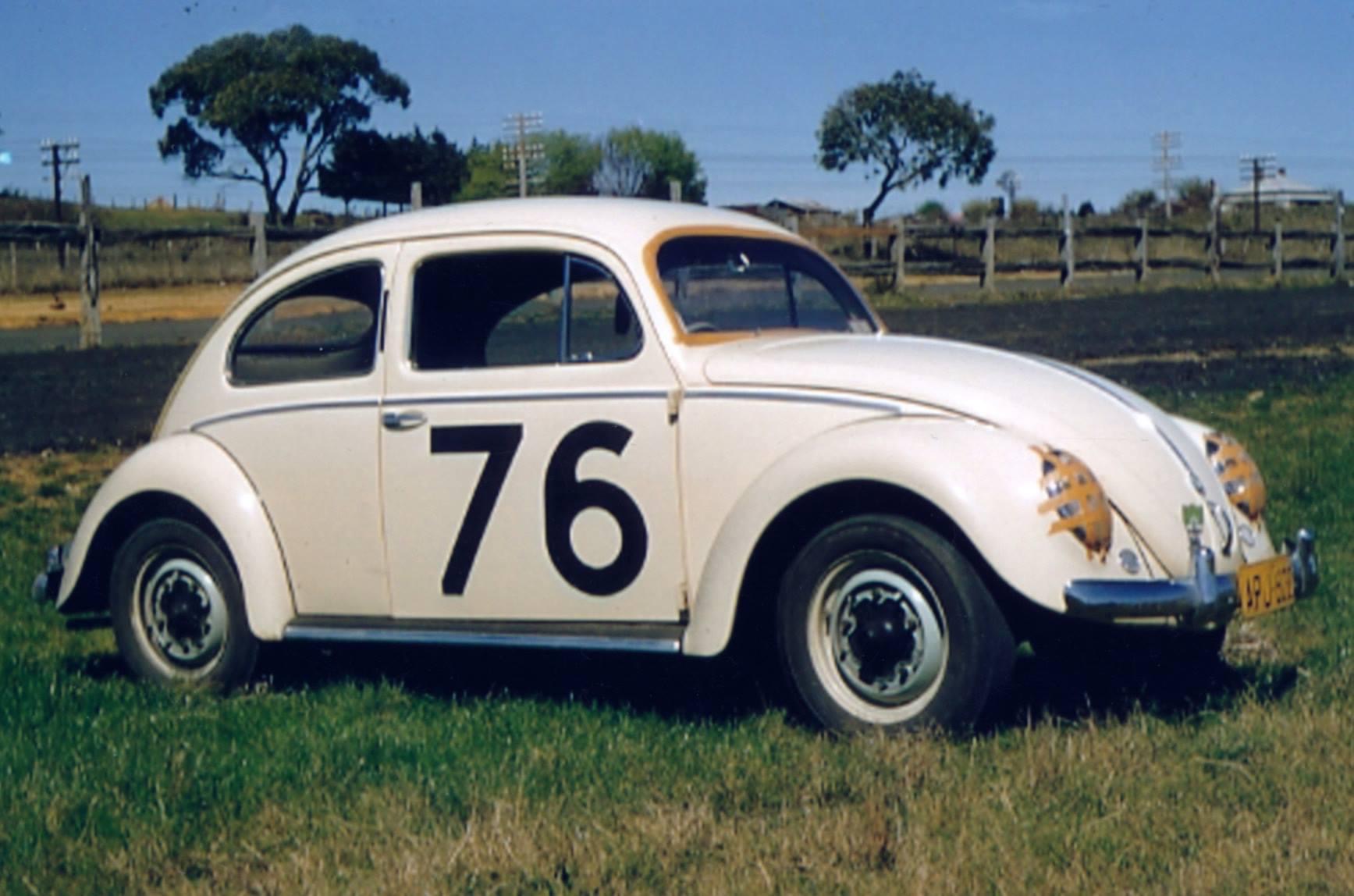
T Borrer’s VW Beetle entered in the production car race, October 1954 meeting.

The sportscar race grids (October ’54) seemed to be particularly well supported, with T Jordan’s 2.4-litre Riley-engined Healey Silverstone, Austin Healeys, #90 W Kelly and #104 Robert Page Jaguar XK120s in the shot below.

(unattributed)


(unattributed)

The ‘pretty boy’ with the Ray Bans in the XK120 is none other than local Cake Shop proprietor Bill Kelly, he would be as in fashion at an historic meeting in 2020 as he was in 1955!

Clearly there was plenty of money in pies and lamingtons in the fifties.

(unattributed)

The great Eldred Norman’s least favourite car was this 1937 Maserati 6CM 1.5-litre six cylinder Voiturette.

Chassis ‘1542’ was originally raced by Franco Cortese throughout 1937, but the going was tough against the dominant ERAs. The machine then made occasional appearances as part of Ciro Basadonna’s various teams both pre and post-war. It was imported to the UK for Gilbey Engineering in 1947, Colin Murray raced it in the UK throughout 1949 and 1950 then brought it to Australia to contest the Narrogin 1951 AGP before its sale to Norman.

When the engine blew shortly thereafter Norman fabricated a steel block and cast detachable bronze heads then cobbled together Fiat 1500 conrods and BSA pistons when Maserati originals were unavailable. Eldred raced it for a year or so before he sold it to Edward David ‘Ted’ McKinnon who finished fifteenth in the 1953 Albert Park AGP.

‘1542’ then passed to Eddie Thomas briefly, before Albury’s Seaton Brothers bought it in poor shape, they solved the engine reliability issues by fitting a Holden Grey six-cylinder unit. In this form Jack Seaton ran it and Ken Cox raced it on the country tracks of Victoria between 1957-1959.

Stephen Dalton places the above shot as during the October 1954 Gnoo Blas meeting with Tom Sulman the driver. Ted Gray was entered but he has been crossed off Stephen’s program and Sulman substituted- well familiar with Maseratis.

The car went through a variety of hands before passing to Doug Jarvis, then some years later to Alf Blight, a talented engineer who did a great job over a decade with its restoration, it left Australia in the early eighties.

(unattributed)

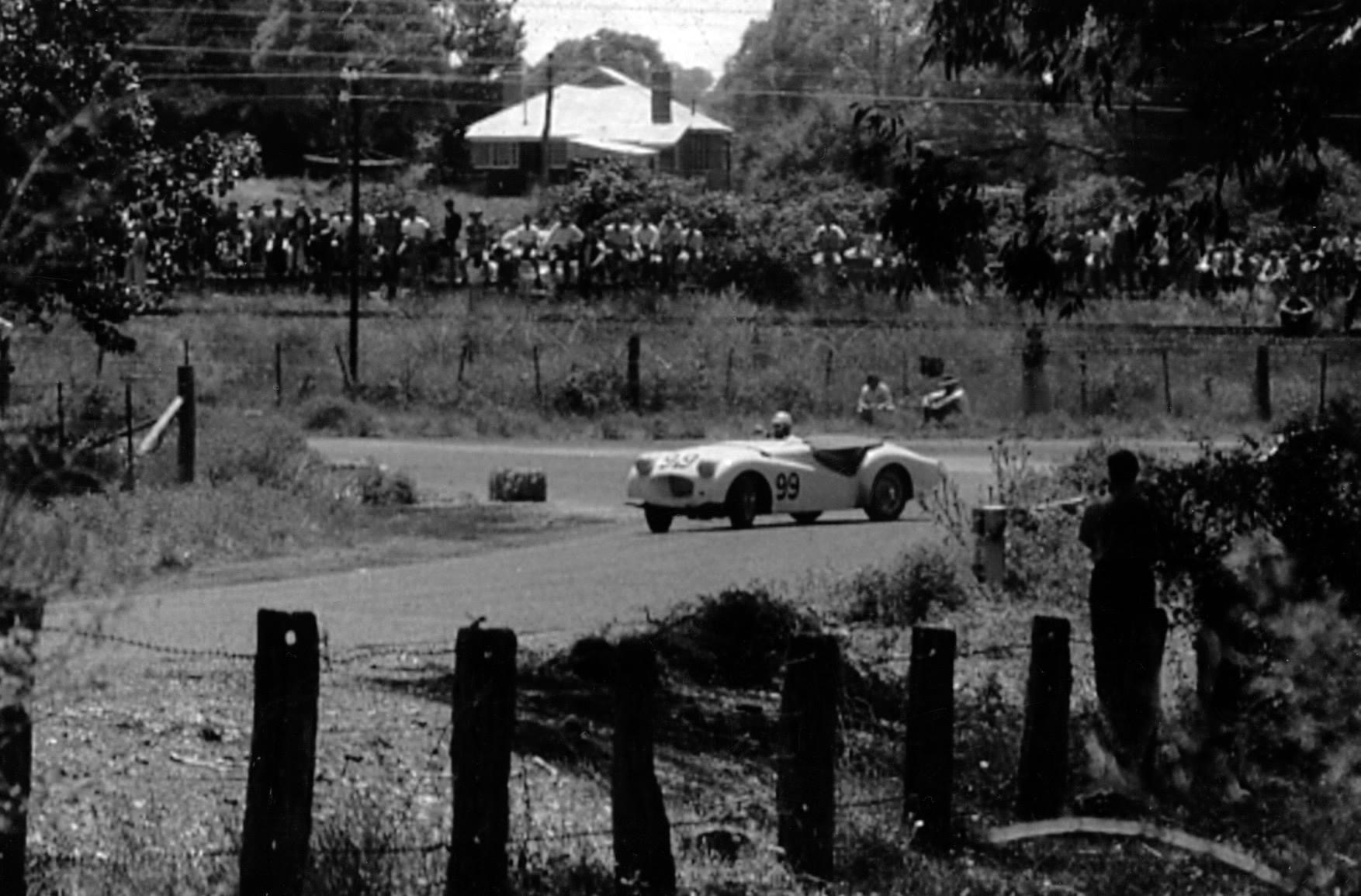
Tom Barrett, now racing a Triumph TR2 during the January 1956 meeting. I wonder if he caught it?

The fences to catch the wayward or unfortunate at ‘Mrs Muttons Corner’, the intersection of what is now Bloomfield and Huntley Roads, are clear and poignant in the context of Ian Mountain’s fatal accident during January 1955.

Stan Coffey, Cooper T20 Bristol, at Windsock Corner ‘due to the location of the old windsock when the Orange Aerodrome was in Jack Brabham Park during October ’54. The picture is looking towards Applebar/Pybar. The area that is now Leewood is in the background to the right, and in the middle of the background one can see what is now Blowes Road when it was dirt!’

Our friend Tom Barrett in the MG TF ‘at what is now the intersection of Huntley Road and Leewood Drive, where the level crossing now is’ and a special entering, the high speed Connaghans corner.

(unattributed)

Mr Barrett and MG TF.

Credits…

Modern Motor, Stephen Dalton

George Causbrook via Deidre and Brett Beasley and the Gnoo Blas Classic Car Club Facebook page

Tailpiece…

Finito…
Ron Edgerton loomed large in Victorian and Australian motor racing from the thirties to the fifties, make that eighties if one includes his restoration efforts.

He owned a staggering number of exotic road and racing cars including Alfa Romeo Monza, Alta Ford V8, Ballot 5/8 LC ‘Indy’, Bentley 4.5 s/c, Bugatti T37, Cooper T38 Jaguar, Cord, Frazer Nash, Lancia Aurelia, Lotus Cortina, MG, Willys Woody and numerous speedway cars.

The shot above is of Ron and his son Greville in a posed newspaper photograph taken in the mid-late 1950s.

Grev raced also- a Cooper T38 Jaguar and Elfin Mallala Climax. Ron died many years ago but Greville is hale and hearty, still developing commercial properties, and in the middle of restoring a 50-foot huon-pine 1930’s yacht in one of his developments in Moorabbin.

My mate Bob King knows Grev, who very kindly allowed us to scan images from his dad’s album, there are enough of them to keep us going for years. As you will see, some are pro shots he acquired, and some self or family taken happy-snaps.

This first batch are some of the family cars.

I am not going to go berserk with the descriptions throughout this and subsequent posts, together we can flesh out the history of the cars.

Ron and Ken Wylie aboard the Edgerton Bugatti T37 at Aspendale Speedway, a Melbourne southern bayside suburb pre-war.

VMCU meeting, June 8, 1941. Cashflow to fund Ron’s racing was provided by a printing business. Chassis 37104 is the ex-Russell Taylor/Advanx Tyres car raced by Charlie East. Ron bought it in March 1931 and later fitted a Hudson straight-eight when the delicate block could not be repaired after a decent blow-up at Tooronga.

Earl Davey-Milne has owned the car since the 1940s, see feature here; https://primotipo.com/2019/04/25/alexandra-sprints-and-bugatti-t37-37104/

Edgerton was a leading light in early speedway in Australia, research on the #4 Lycoming welcome, similarly about Reynold’s 8/80 JAP.

Bill Reynolds (the Sydney one vs. the St Kilda Wren building one) emigrated to Australia pre-war, having graduated through speedway bikes and then to cars winning World Speedcar Championships in 1939, 1941 and 1958- he won the Australian title  in 1956. He also strayed onto the circuits- a good topic for another time.

Australia’s only resident supercharged 4.5-litre Bentley in-period was chassis SM3907.

Yes, much later others were imported. Tom Luxton brought in SM3907 from the UK, Edison Waters famously raced the gas-burner powered car at Bathurst (not for long) over the Easter 1940 weekend. Post-war owners included Lex Davison.

Ron’s caption is ‘Ron, Dawn, Hugh Stewart with blown 4 1/2 Bentley’, quite where those Californian Bungalows are is something to find out. Pre-war is my guess.

Edgerton’s Alta Ford V8 at Mitcham Hillclimb in October 1941, interesting that we were still running motorsport events in Australia this late in the war.

It doesn’t seem all that appropriate given the number of blokes having their nuts shot off by this stage – or am I just a limp-wristed-commo-bleeding heart liberal?

Mitcham is a Melbourne outer eastern suburb, housing development of which exploded from the fifties. It looks quite bucolic 15 years or so before.

This car is the ex-Alan Sinclair Alta 1,100 cc s/c chassis 21S, the MI5 Spook brought to Australia in time for the January 1938 South Australian GP at Lobethal, but by this stage Ford V8 engined.

In this form it was a race-winner in Ted Gray’s hands as the Male Special pre-war. Edgerton had rebuilt it by late February 1942 (see shot below). Ron raced it post-war, it then passed back into Gray’s hands who made it sing again, especially when fitted with Lou Abraham’s Ardun-OHV head Ford V8- the car was the immediate precursor of Ted and Lou’s Tornado 1 Ford.

Wind the clock forward another couple of decades and Mount Eliza’s Graeme Lowe reunited the car with its rightful 25S 1,100cc engine and restored it superbly- it took its first bow in 1999. No longer with us, Graeme’s wife still owns it and a 2-litre stablemate.

Epic about the Alta and Sinclair here; https://primotipo.com/2018/11/08/the-spook-the-baron-and-the-1938-south-australian-gp-lobethal/

Hillclimb unknown post-war, note the LCCA badge on the scuttle and differences in appearance of the Alta before and after its 1941-2 ‘birthday’

‘No 4’ at Greensborough Hillclimb immediately post-war, date folks? Manufacturer of chassis and mechanical components unknown.

More Mount hillclimb action, this time Ron’s Lycoming Special at Mount Tarrengower, the following shot shows the engine bay; https://primotipo.com/2020/08/21/mount-tarrengower-2/

Edgerton jumped in amongst the big boys with the purchase of the ex-Alf Barrett Alfa Romeo Monza #2211134 from Rupert Steele in 1950

Ron’s caption says ‘Dirt track Charlie (Frank Kleinig, Kleinig Hudson Spl) chasing Racing Ron at Mount Panorama’ during the October 1951 meeting. He was fourth in the over 1500cc Championship Scratch, and third in the Redex 50 Mile Championship race- Whitefords’ Lago Talbot T26C won with Stan Jones second in Maybach 1.

Edgerton was immediately on the pace with it too. More on Ron’s time in this car soon, in the meantime it’s story is told, at length, here; https://primotipo.com/2015/02/20/alf-barrett-the-maestro-alfa-romeo-8c2300-monza/

Greville had a go too.

Here, his Elfin Mallala Coventry Climax 2-litre FPF is at freeze-yer-nuts-orf Silverstone testing during the winter in 1964. Ron used the Lotus Cortina to get around the UK. More of Grev’s UK adventures that year soon.

Racing Ron’s ex-Louis Wagner 1919 Ballot 5/8LC ‘Indy’ at rest at home in the eighties.

The high-born French aristocrat is in pretty good company amongst Ferrari Dino 246GT, sundry bikes and a racer.

When Alan Cooper’s Ernest Henry designed 4.8-litre, DOHC, four-valve, normally aspirated straight-eight racer arrived in Australia in late 1925, it was the most advanced and one of the quickest racing cars in the country. Chassis #1004 joined a 2-litre Ballot 2LS #15 acquired for Cooper by his patron twelve months before.

It all turned to custard at Maroubra in December 1925. Alan, a relative novice to a car of this performance, ran wide passing his brother Harold in the 2LS and rolled, badly damaging the car and his riding mechanic.

1004 was repaired in Sydney by Don Harkness and then raced very successfully by Harold, a gifted driver. One of the great mighta-beens of early Phillip Island AGPs is Harold racing the 2LS, but he never did.

The 5/8LC passed through many hands before Ron found it on a farm in country Victoria in the seventies. A long, complex restoration followed, Ron enjoyed the fruits of his labours before selling to Peter Briggs as his health failed. The car has been in England for many years.

Credits…

All photographs are from the Ron Edgerton Collection, with thanks to Greville Edgerton. Steve Wood

Tailpiece…

The album is very thick.
The degree of scanning difficulty is high, so let’s be thankful for what we have before some of you old women start chookin’ on about the quality of the shots- don’t spose I should say that. Oops.
Finito…
(NAA)

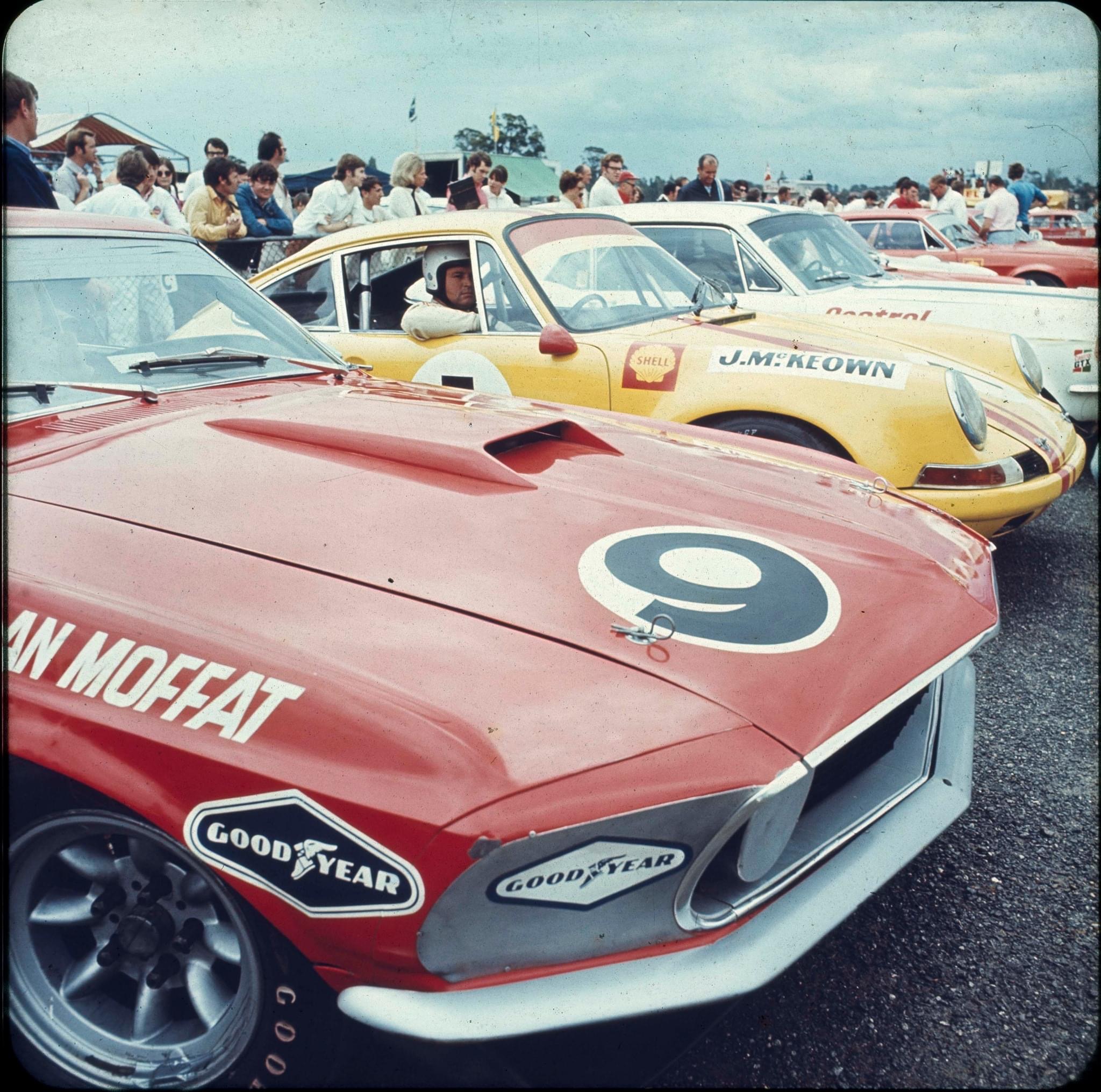
The heavies before the start of the AJC Trophy at Warwick Farm, fifth round of the Australian Touring Car Championship, on July 12, 1970.

Allan Moffat, Mustang Trans-Am, Jim McKeown, 911S, Pete Geoghegan, Mustang, you can just see Brian Foley’s 911S then Bob Jane’s Mustang Shelby Trans-Am on the dummy grid.

Moffat’s Trans-Am started from pole but he lost it in the first corner causing mayhem – Moffat, Geoghegan and Foley were out on the spot. McKeown led, Norm Beechey was up to second but then he lost a wheel gifting second to Bob Jane. It was the first ATCC round win for Porsche. https://primotipo.com/2016/05/11/jim-mckeown-porsche-911s-warwick-farm-1970/


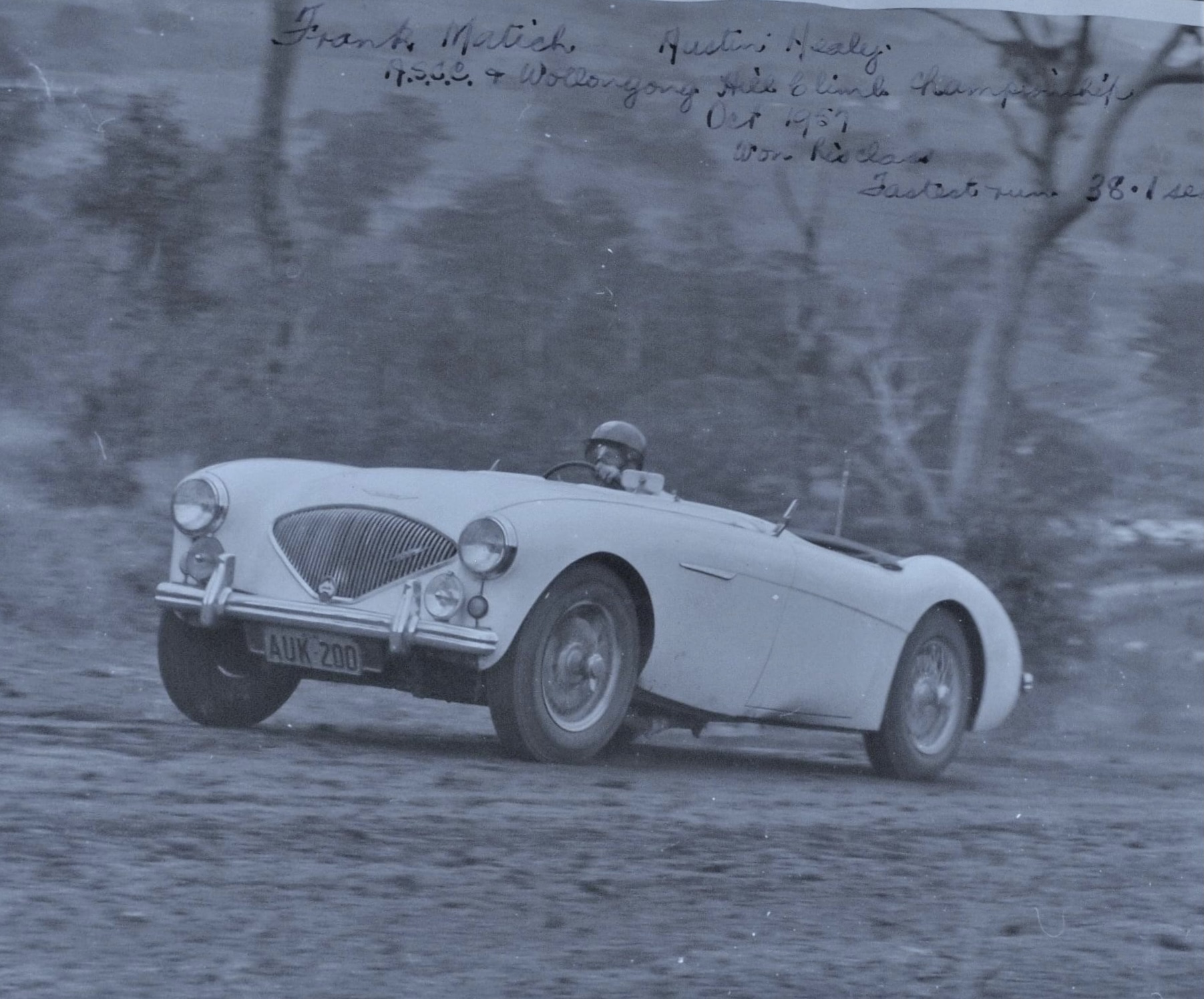
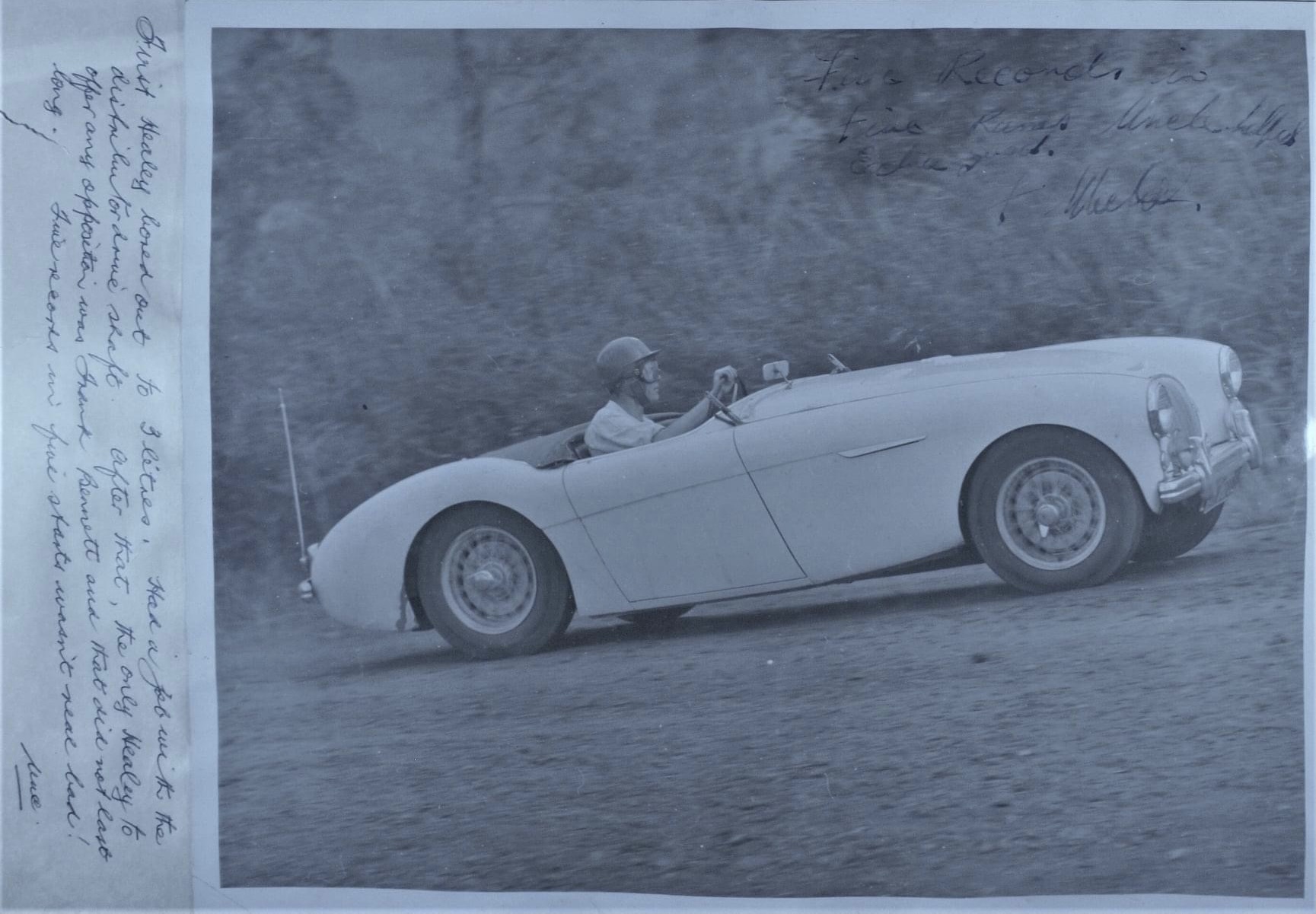
The power of the internet continues to amaze, in this case Facebook. The two shots above and below are the earliest I have seen of Frank Matich.

They show his ‘road-registered family car, the Healey 100/4 with LJC Motors bored out 3-litre engine at Huntley’s Hill in 1957’ for the Australian Sports Car Club Wollongong Hillclimb Championship..

‘First Healey bored out to 3-litres. Had a job with the distributor driveshaft. After that the only Healey to offer any opposition was Frank Bennett and that did not last long. Five records in five starts was not real bad’ is the note FM wrote to his friend Alan Cummine, to whom we are indebted for these shots.

Matich’ career is covered in this piece; https://primotipo.com/2015/09/11/frank-matich-matich-f5000-cars-etcetera/

(A Cummine)


(Examiner)

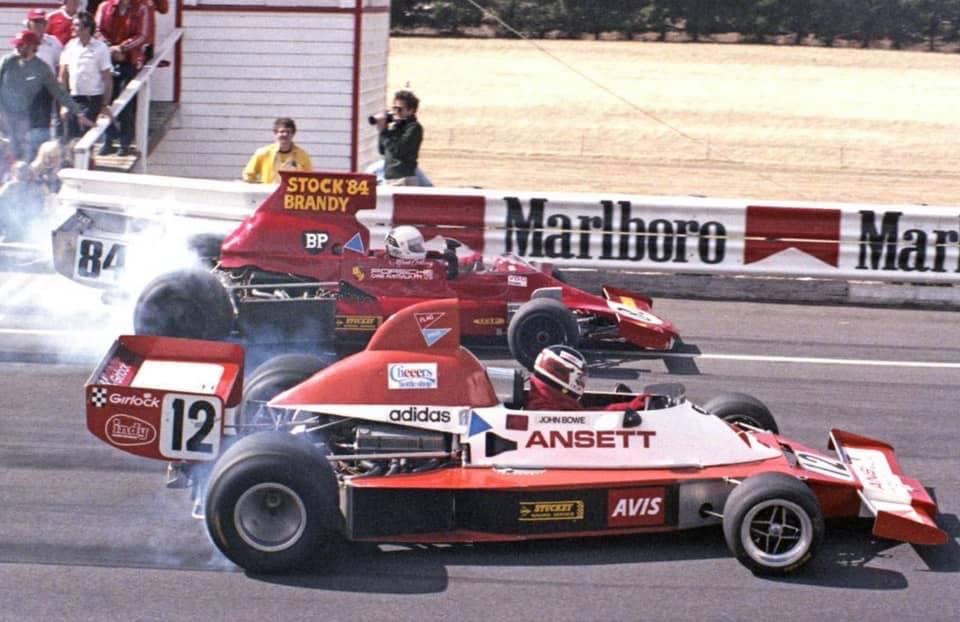
We have lift-off. John Bowe and Alfie Costanzo smoke their Goodyears off the line at Symmons Plains at the start of the Gold Star race in 1980.

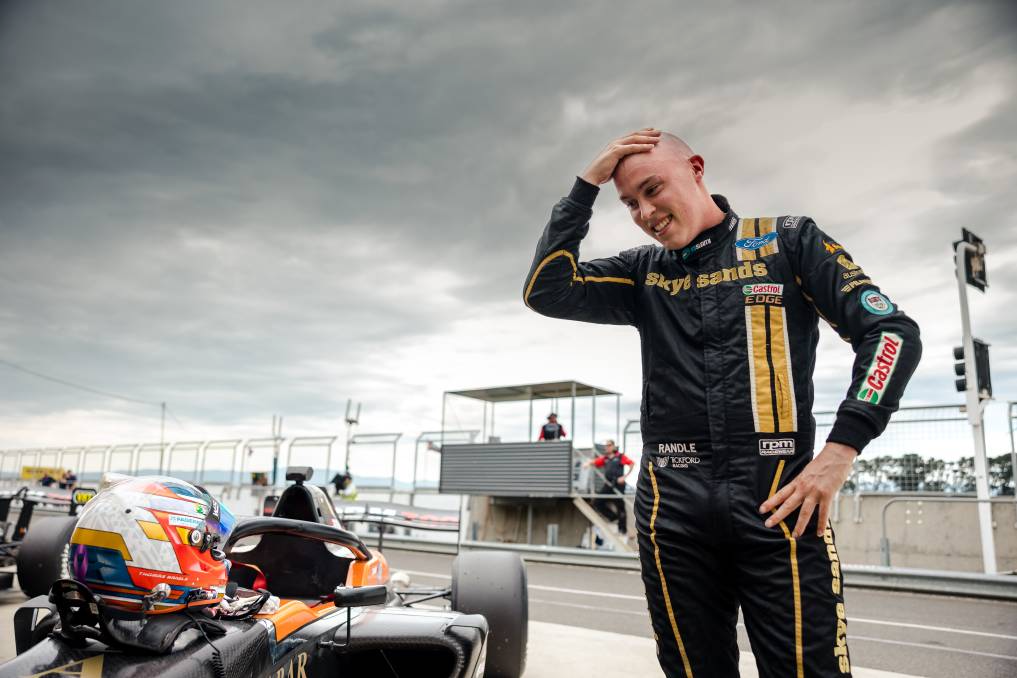
JB won the race in his Elfin MR8 Chev from Alf’s Lola T430 Chev. Costanzo set a lap record of 50.16 seconds that weekend which stood for forty years until it was broken by Thomas Randle’s Ligier JS3 Ford S5000 on January 25, 2021. He did a 49.864 second lap in the S5000 opener before winning the John McCormack Trophy, Gold Star event.

It was a great, gutsy race win, the 24 year old below had his last chemotherapy treatment for testicular cancer on New Years Day.

A bit on John Bowe here; https://primotipo.com/2016/06/10/elfin-light-aircraft/

Thomas Randle delighted with his Symmons Gold Star win (S5000)


Randle’s Ligier JS3 Ford on the way to victory at Symmons- crowd limited to 5,000 given Covid restrictions. A magic weekend, was lucky enough to be there, these jiggers are magnificent, spectacular cars (Auto Action)


(S Griffiths)

Bob Jane had exquisite taste in racing cars didn’t he? I’ve said it many times. Here are his recently purchased Jaguar D Type and new E Lightweight.

Calder, Australia Day meeting, 26 January 1964. I wonder what the black single-seater is? See this piece on Bob’s various cars; https://primotipo.com/2020/01/03/jano/


(J Manhire)

Can ‘yer grab my helmet Alec- I gotta go. Kevin Bartlett talks to his headless team-chief at Wigram in 1968, it was the first Tasman Cup KB did in full, both Kiwi and Oz races.

That Brabham BT11A Climax was one of his favourite cars, he did pretty well that summer in what was by then an old car amongst all the multi-cylinder exotica. See here; https://primotipo.com/2018/04/27/kbs-first-bathurst-100mph-lap/


(unattributed)

Otto Stone, MG K3 during the January 2, 1950 AGP at Nuriootpa, South Australia.

As adept behind the wheel as he was twidding the tools, he retired from the race after only completing one lap, with engine problems. Nine years later Otto prepared the Maserati 250F Stan Jones raced to AGP victory at Longford.

1950 AGP article here; https://primotipo.com/2015/07/10/1950-australian-grand-prix-nuriootpa-south-australia/


(C Bottomley)

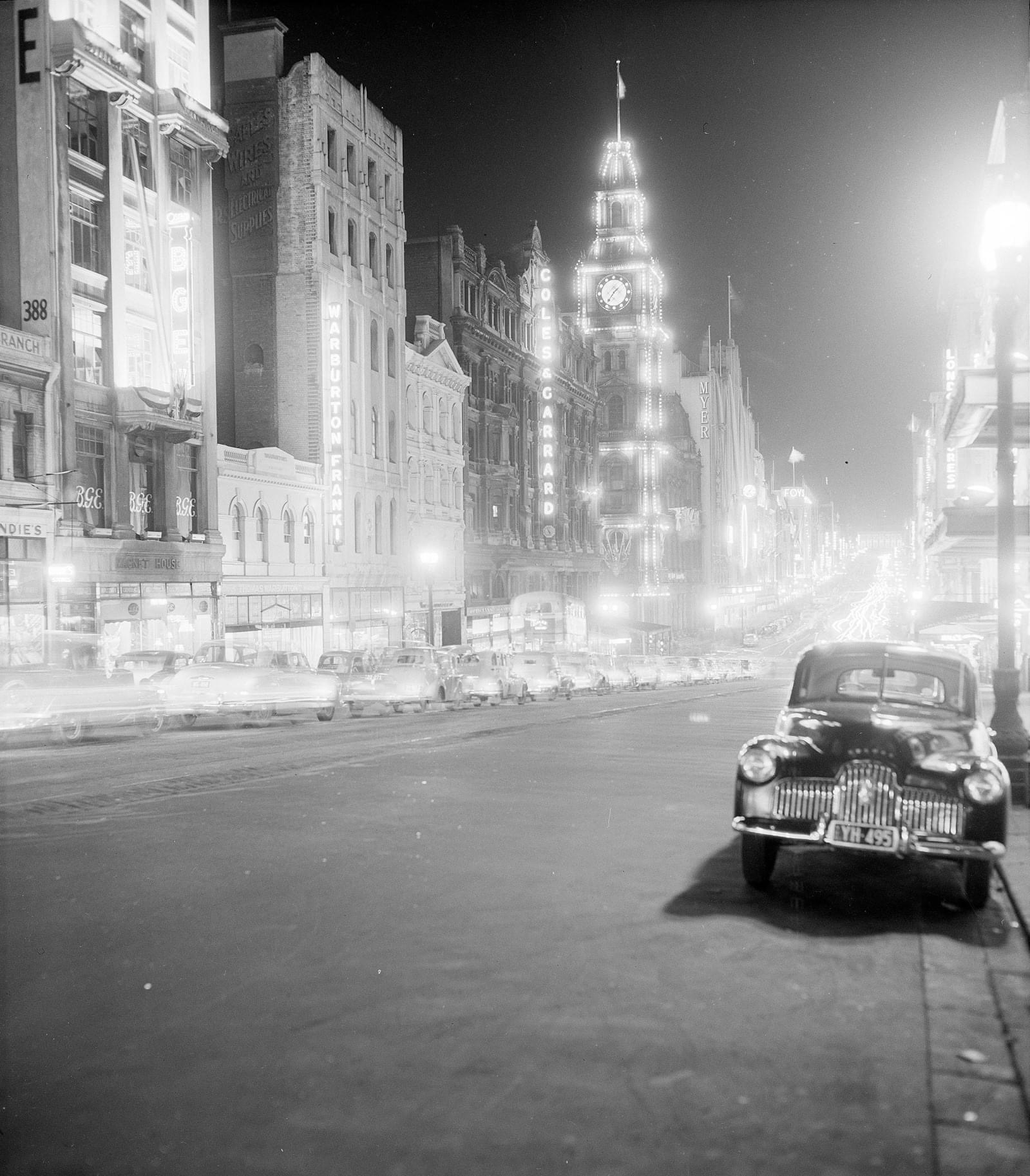
Marvellous shot of a Holden 48-215 in Bourke Street, Melbourne in 1959.

The post-office building stands, albeit as a retail emporium these days but the rest of the buildings in view copped the kiss-of-death from Whelan the Wrecker or one of Des Whelan’s mates. I wonder if YH-495 is extant? See here for a piece on Holden’s formative years; https://primotipo.com/2018/12/06/general-motors-holden-formative/


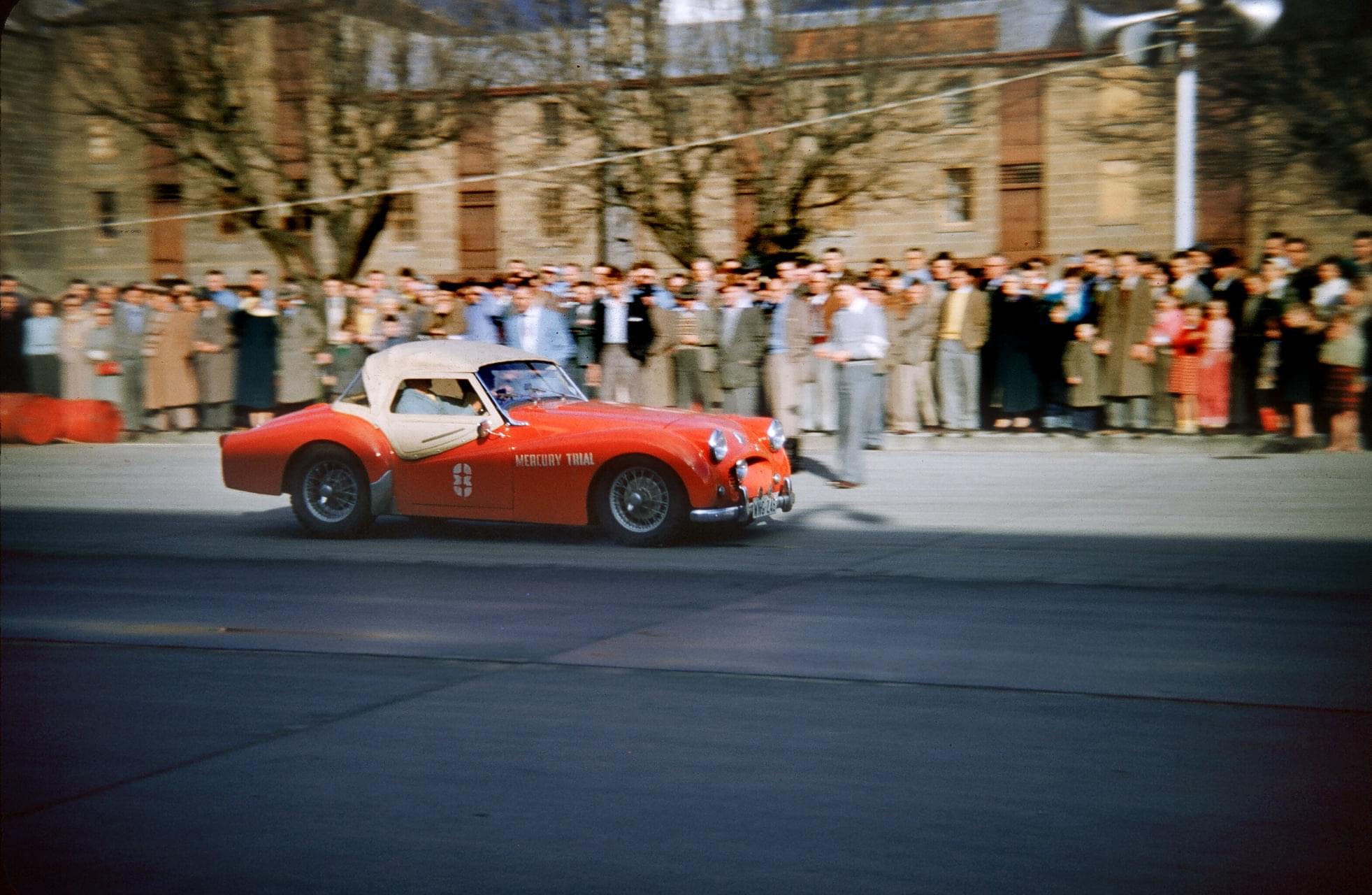
Triumph TR2 (B Young)

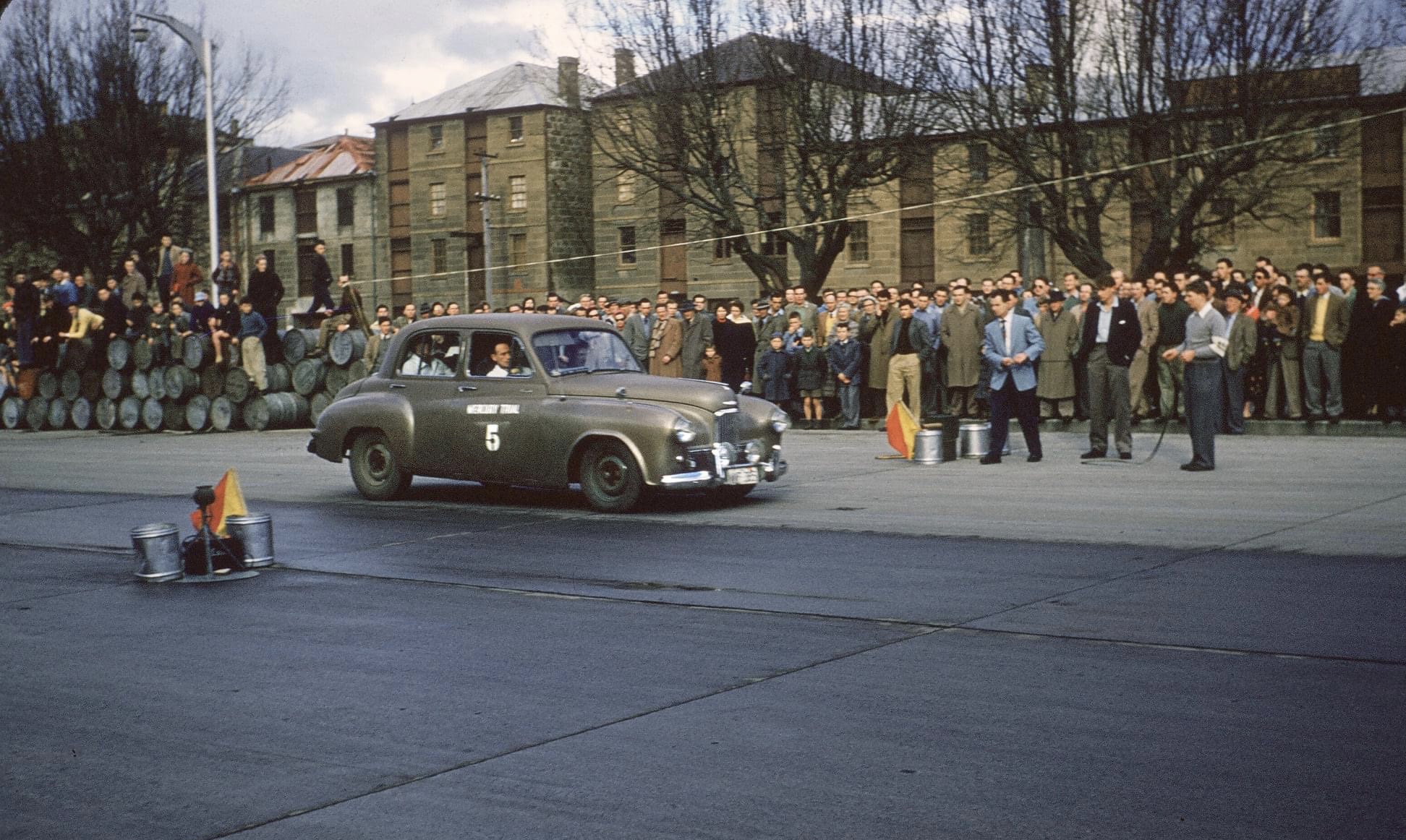
Grant Twining wrote in the marvellous Historic Racing Car Club of Tasmania’s FB page that ‘The 1956 Mercury Trial (The Mercury is Hobart’s local rag) was a big thing at the time. The Second World War was still in recent memory and Australia was just starting to recover economically from the austere post war years. In little old Tasmania, the well publicised ‘Mercury Trial’ was a significant event and eagerly followed by the public. Bob Young was on hand to capture these images in Salamanca Place’ dockside in Hobart.

All of which is fine and dandy but I’m buggered if I can find any details of the event – not even a piece in the sponsors product! It may be others out there are more patient than I. Do get in touch if you glean some deatails on the events duration, route and winner. Bob Young’s Tassie colour shots I’ve used many times before and just too good to ignore despite a paucity of information.

Humber (B Young)

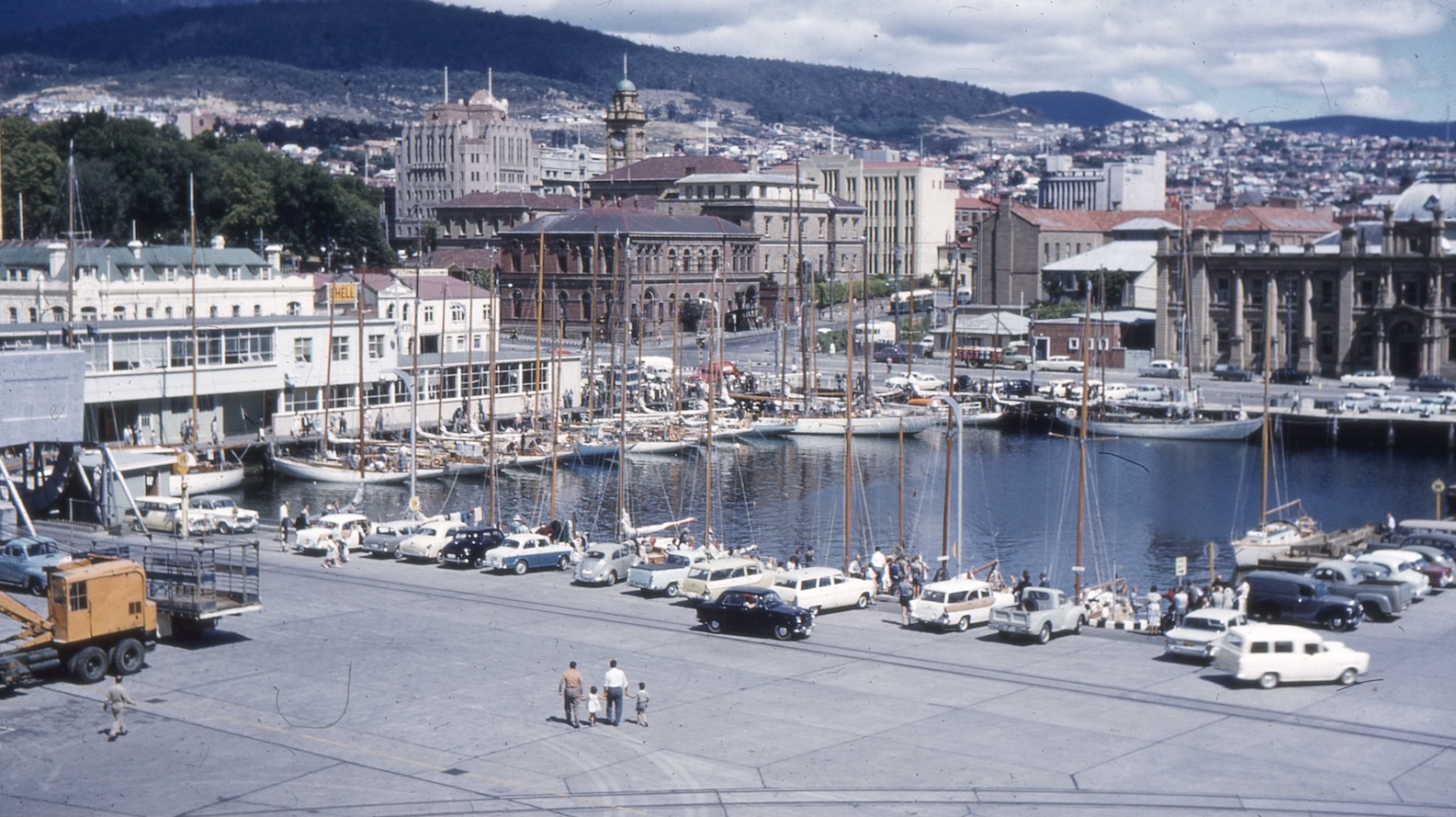
I wonder if the Salamanca stage of the trial is a speed test or speed and braking? Note all the kegs of something nice. In the fifties this stretch is now filled with lots of wonderful cars, restaurants and places of fun. It is to the left in this mid-sixties shot of Constitution Dock looking towards Hobart CBD. The boats are possibly from a not long finished Sydney-Hobart.

(B Short)


(NAA)

I had one of these when I was 18. The car, the Capri.

I had two in my student years actually, a 1600 GT and 3-litre GT V6, the little fella was much the nicer car to drive. I never had an accessory as cute as the one above in either car, sadly. Must have been my Brut 33.

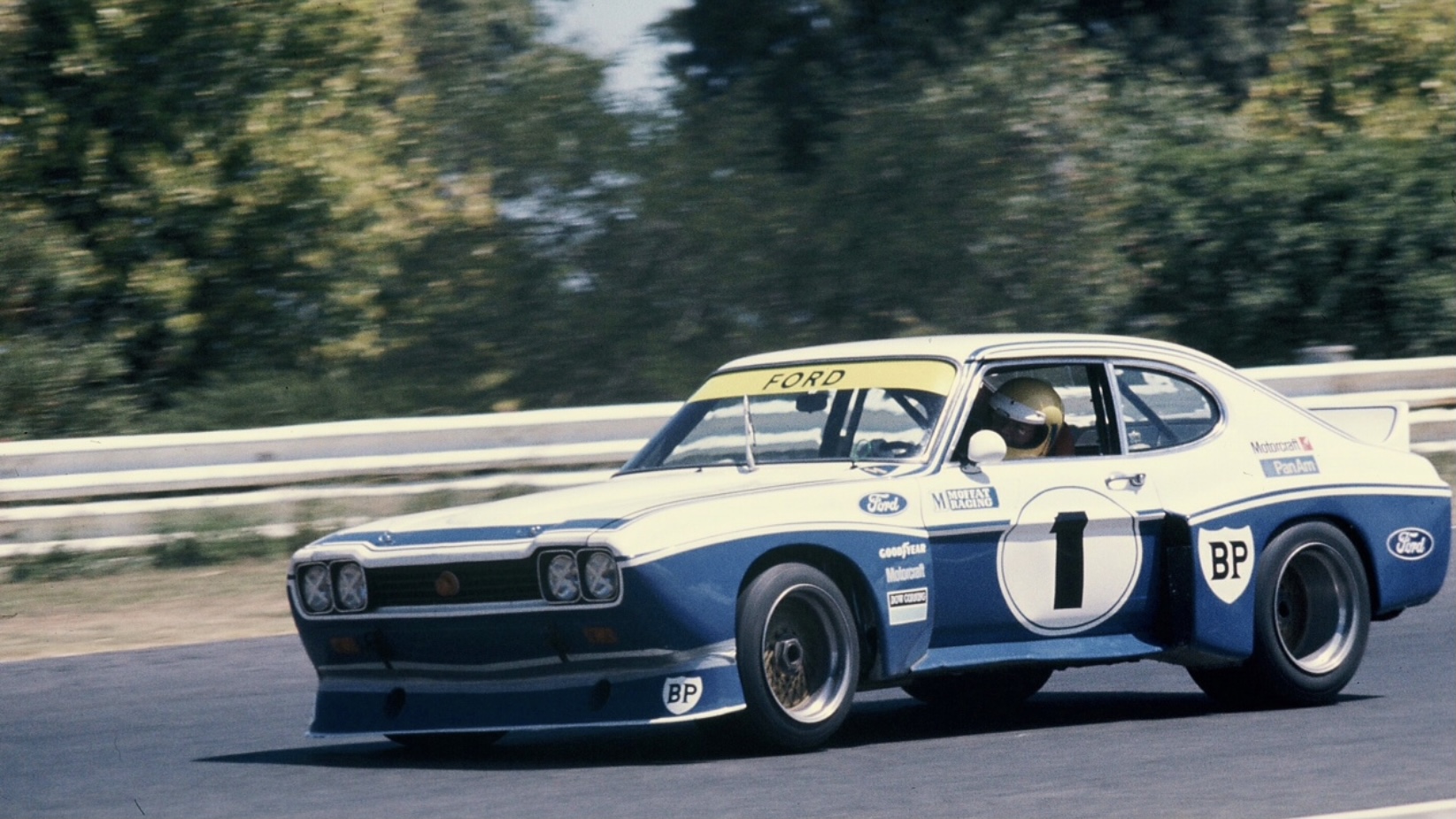
Speaking of which, Moffat’s Cologne Capri was a Capri of a quite different type. Robert Davies’ shot of the car upon debut during the Sandown Tasman meeting in February 1975 is the best shot ever taken of the car. Lacked torque amongst all the big hairy V8 Gorillas but it was yet another of Marve’s imports which so enriched our grids.

Cologne Capris here; https://primotipo.com/2015/04/09/australias-cologne-capris/

(R Davies)


(Porsche)

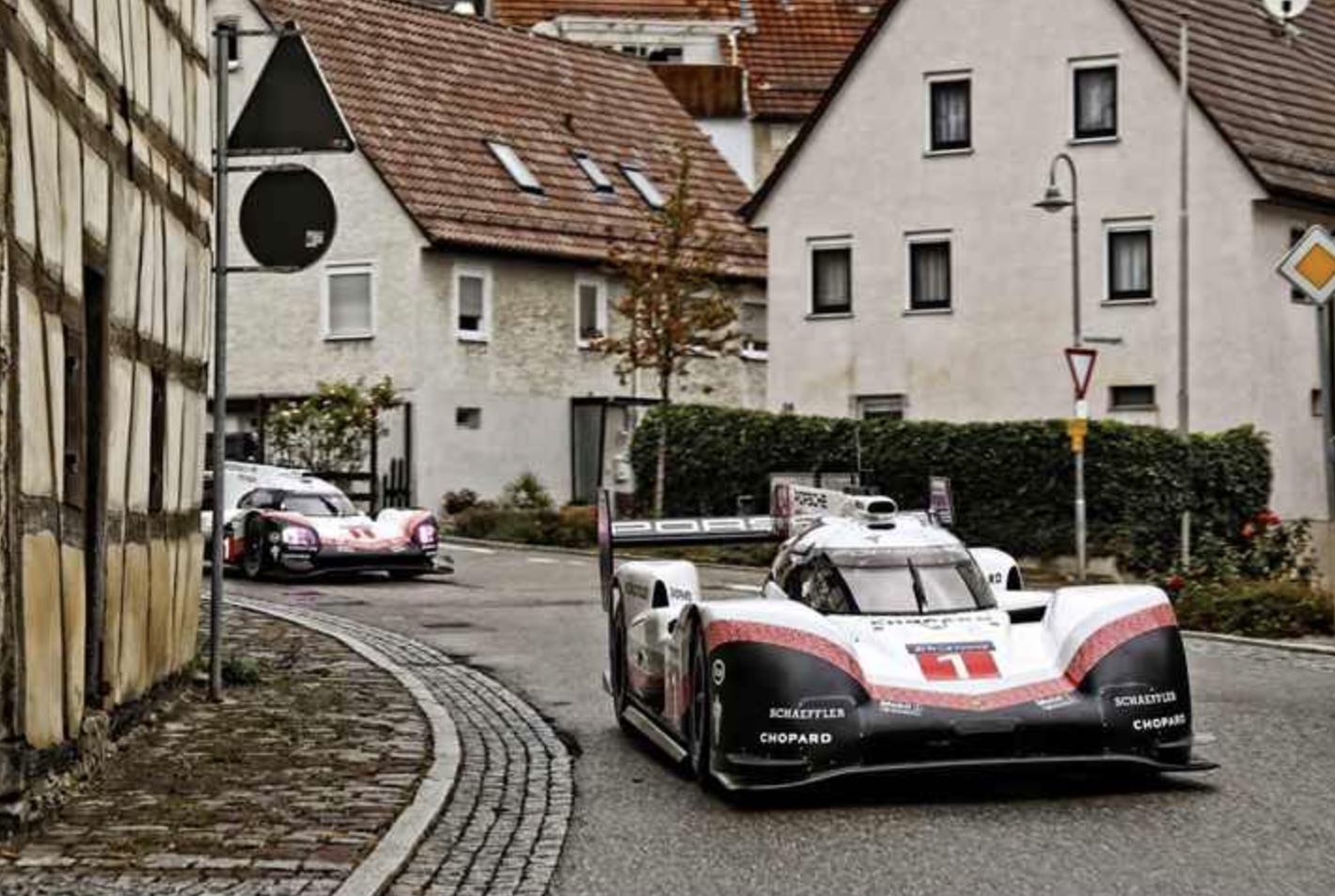
Porsche’s PR machine has always blown me away. They do stuff in such an interesting kind of way.

When they put the 919 Hybrid away after several years of sterling service- a few Le Mans and WEC wins they enlisted Mark Webber and Marc Lieb to drive two of the cars 25km from Porker HQ in Weissach to their Museum in Zuffenhausen.

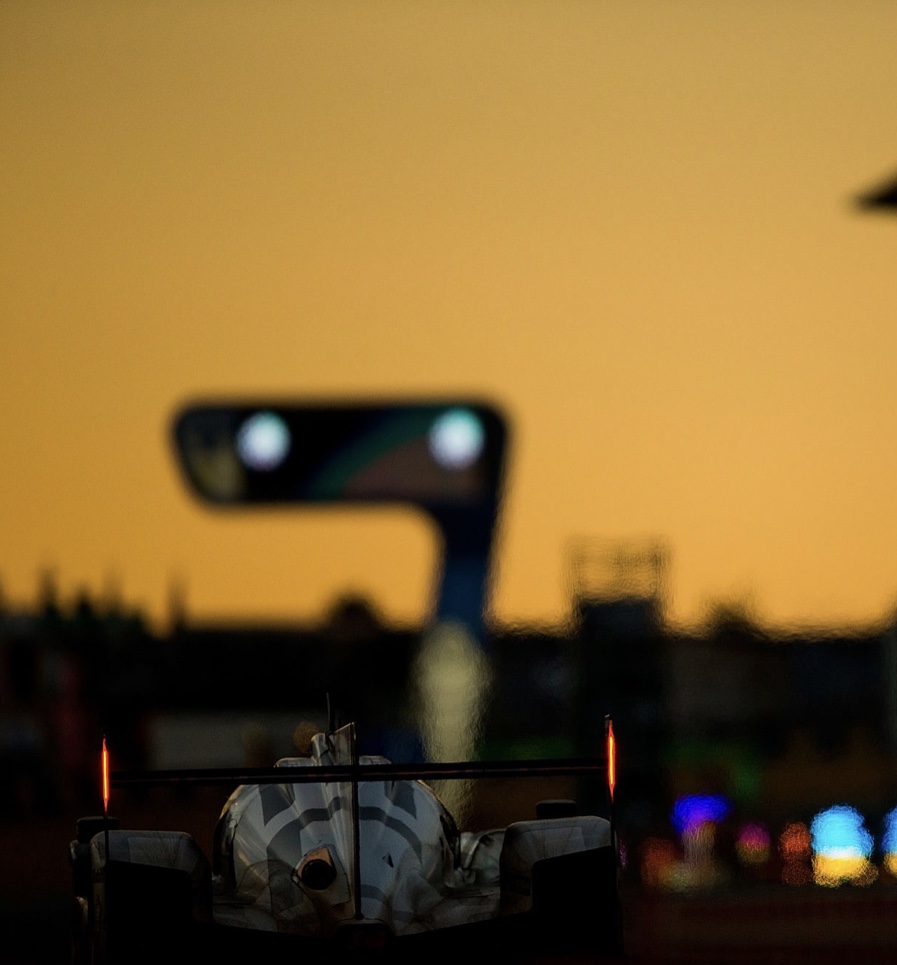
Milking plenty of teev, ‘paper and online coverage. Nice. The shot below is Webber’s 919 at Le Mans in 2014, check out this article; https://primotipo.com/2019/07/18/le-mans-arty-farty/

(Getty Images)


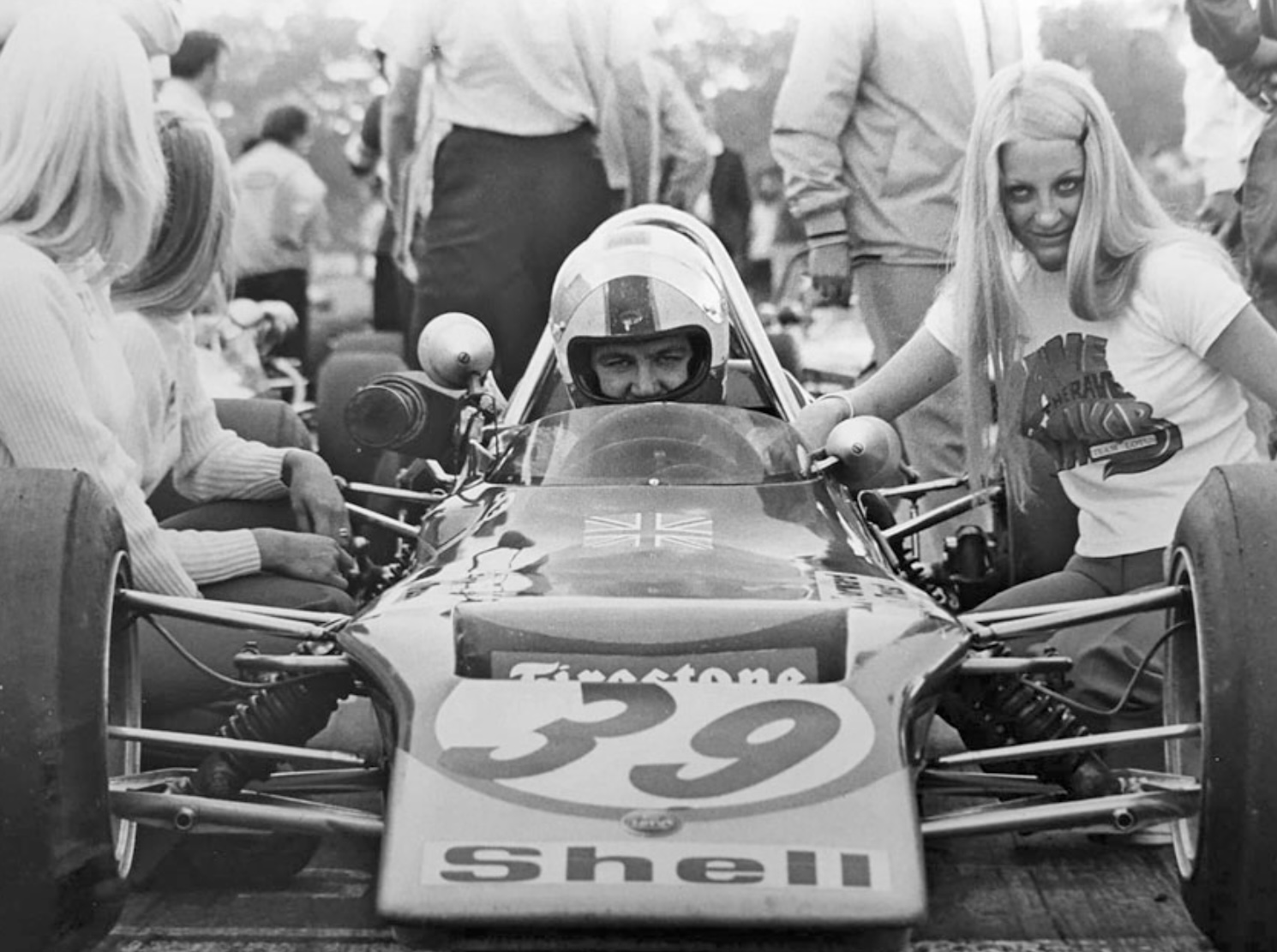
Walker with a couple of lovelies on the 1971 Zandvoort F3 grid, Lotus 69 Ford (J Ranger)

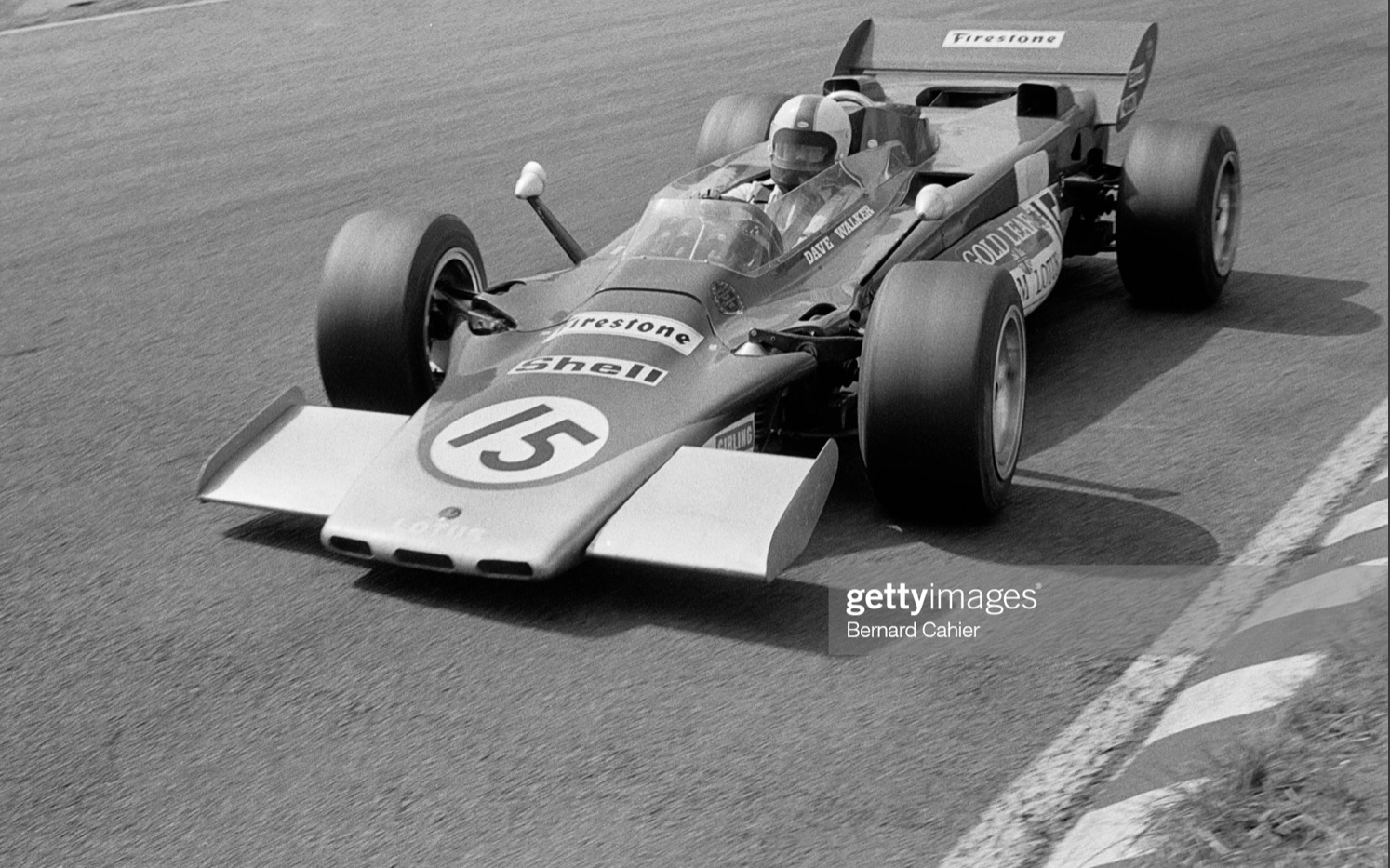
Its fifty years ago that one of Australia’s shooting stars had one of the most sensational F3 seasons ever- Dave Walker in his works Gold Leaf Team Lotus, Lotus 69 Ford-Novamotor during 1971.

In addition to winning everything in F3- he also had several F1 drives most notably aboard the incredibly sophisticated, complex, Pratt & Whitney gas-turbine powered, 4WD Lotus 56B.

Who knows, perhaps with some decent test miles under his belt he may have taken a podium finish during the wet Dutch Grand Prix at Zandvoort. The shot below of the 56B is during dry practice.

Stay tuned for a feature on David Walker.


(T Carwithe)

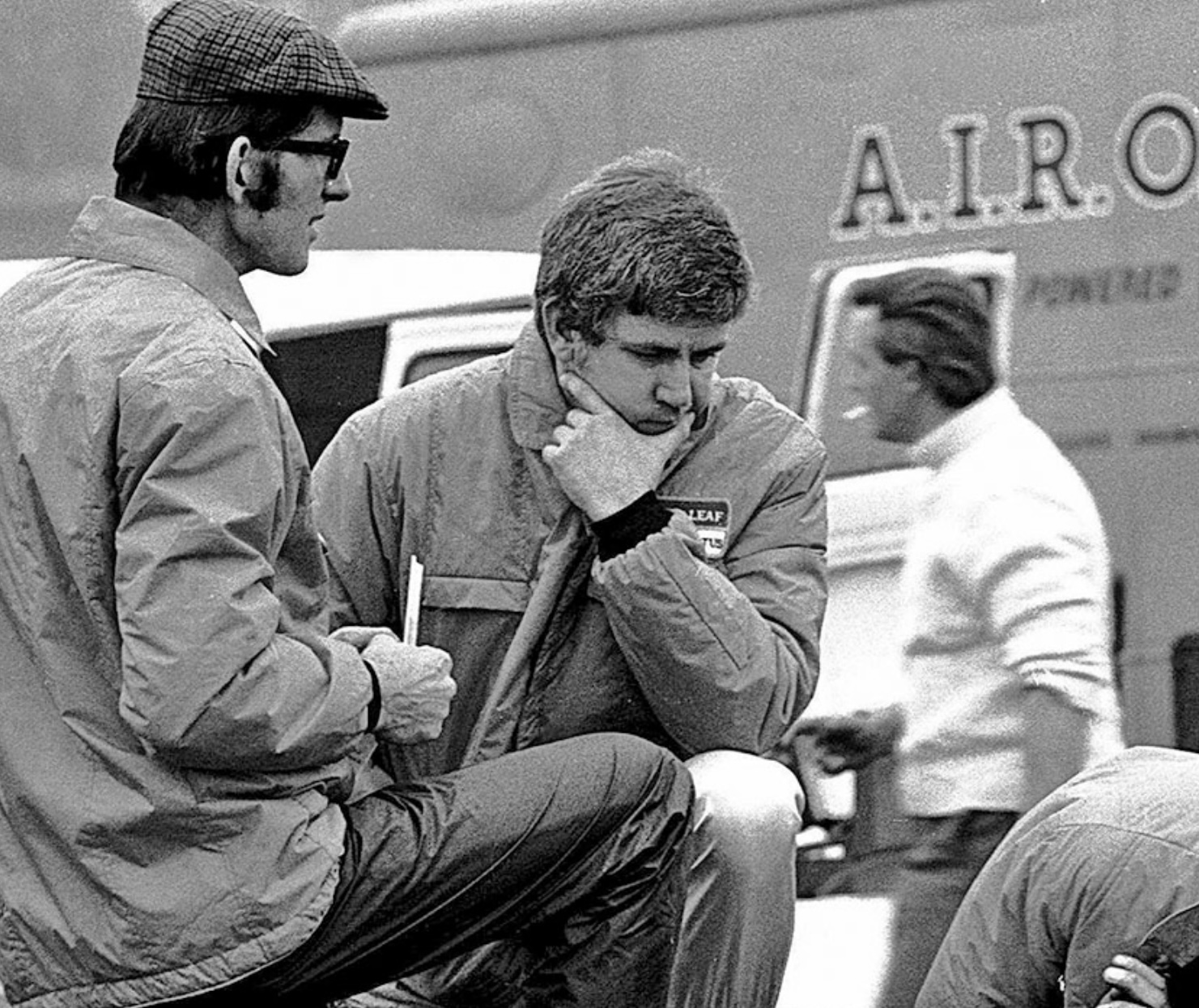
Dave with Lotus Team Manager Peter Warr at Mallory Park during 1971. Walker was the the most successful of the Gold Leaf Lotus drivers that season. Emerson Fittipaldi and Reine Wisell didn’t win a GP, the first time in about a decade Lotus hadn’t won a championship round. Walker’s ascent to the F! team in 1972 was in part to placate British Tobacco.

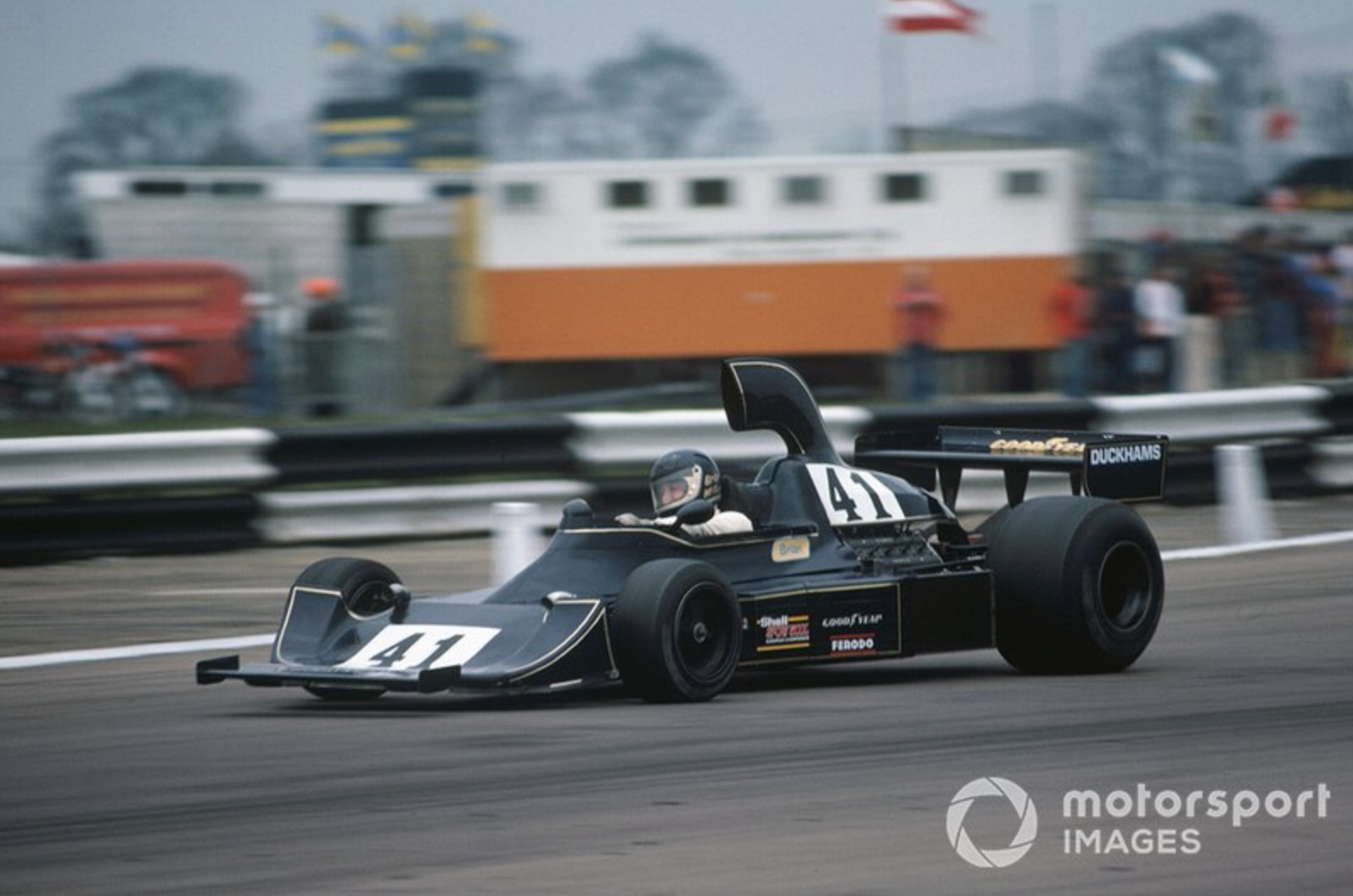
The eagle-eyed will have noticed the A.I.R.O transporter behind Warr and Walker. The Australian International Racing Organisation was the rather flash name for the smell of an oily rag operation which ran two Australians in F3- Alan Jones and Brian McGuire.

(N Snowdon)

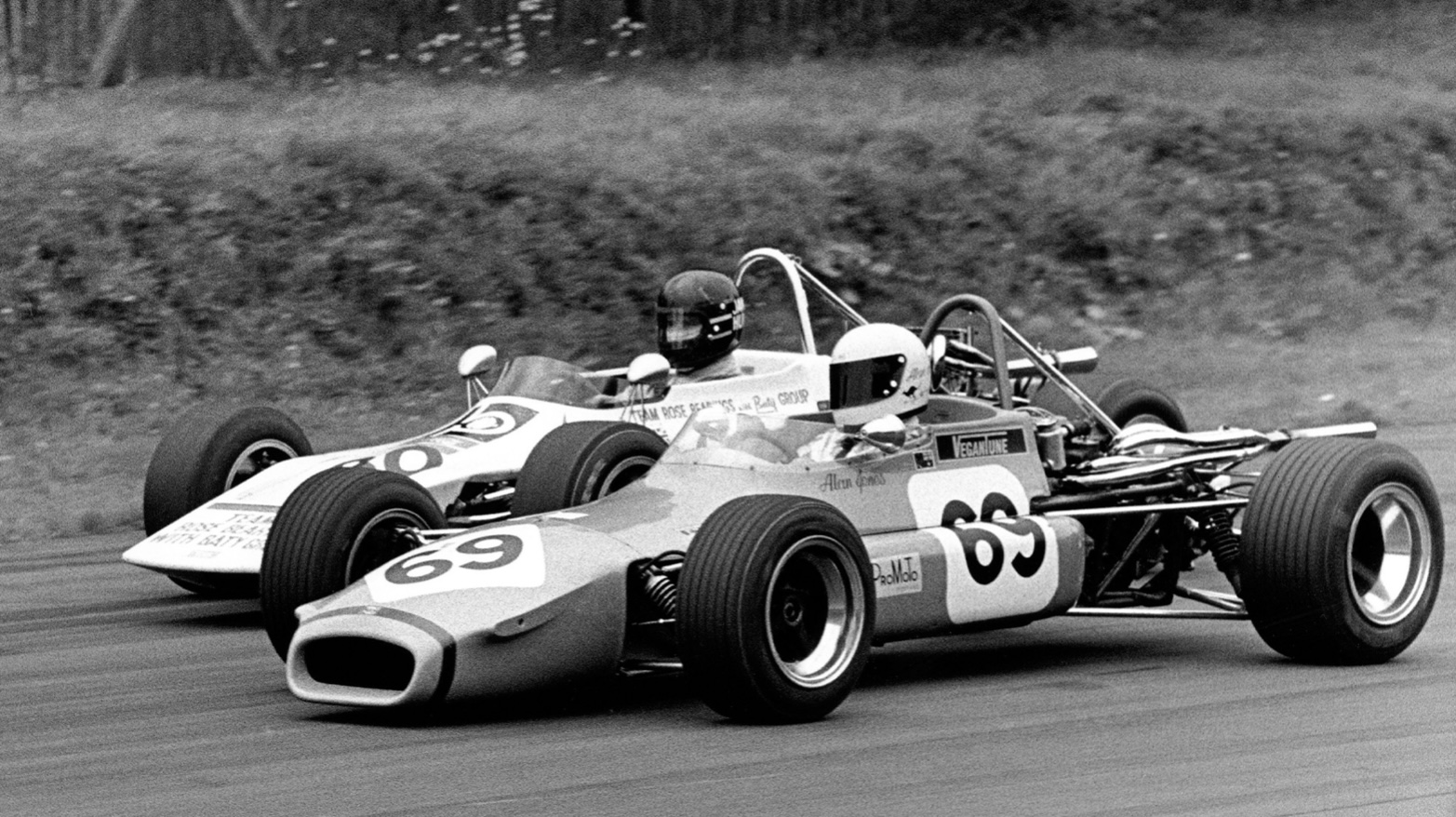
A.I.R.O. driver Alan Jones at it hammer and tongs with another up-and-comer, James Hunt at Brands Hatch during 1971. Brabham BT28 and March 713M.

Hunt the Shunt jumped out of F3 and into GP racing with Alexander Hesketh’s team in 1973, Jonesy was a year or so after him but no less successful!

Brian McGuire aboard his Williams FW04 Ford during the April 1976 BRDC International Trophy at Silverstone.

Q18 and DNF lost oil/black-flagged in the race won by James Hunt’s McLaren M23 Ford.

The self made Aussie, a mate of Alan Jones, hailed from East Melbourne. He set off for England to race in 1966, paying his own way by dealing in cars and later caravans. He jumped from F3 to F5000 becoming a front-runner in the 1975 Shellsport F5000 Championship racing the ex-Bob Evans 1974 British F5000 Championship winning Lola T332 Chev.

He progressed to an F1 Williams FW04 Ford (aka McGuire BM1). He won a Shellsport 5000 European Championship race in the wet from pole at Thruxton in September 1976 – the first ever win for a Williams. It was in this car he crashed to his death, taking a flaggie with him, after component failure in practice for a Shellsport International Championship race at Brands Hatch on August 29, 1977 .

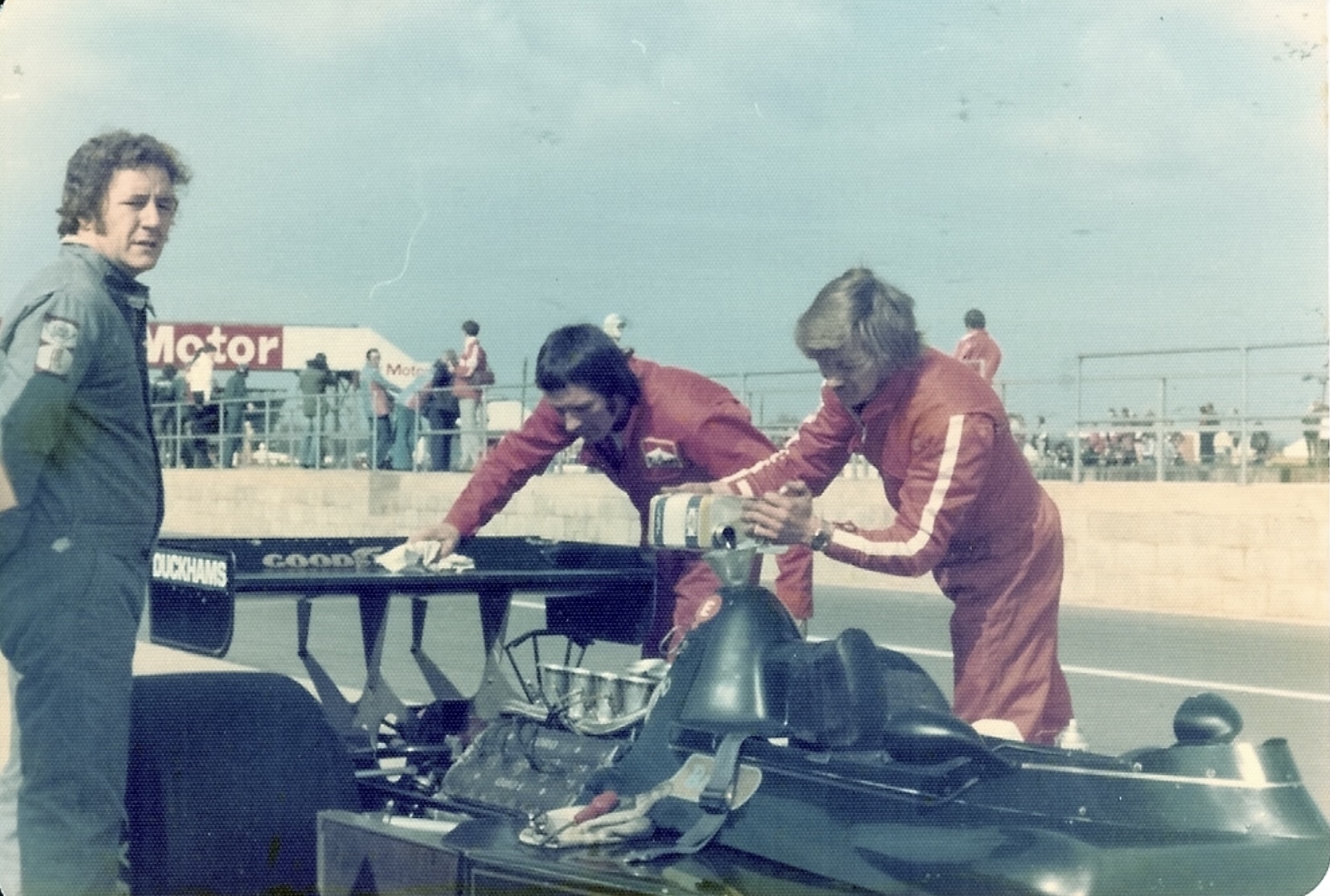
McGuire, Williams FW04 and crew in the Silverstone pitlane in April 1976 (peter.bryan.org.nz)


(NAA)

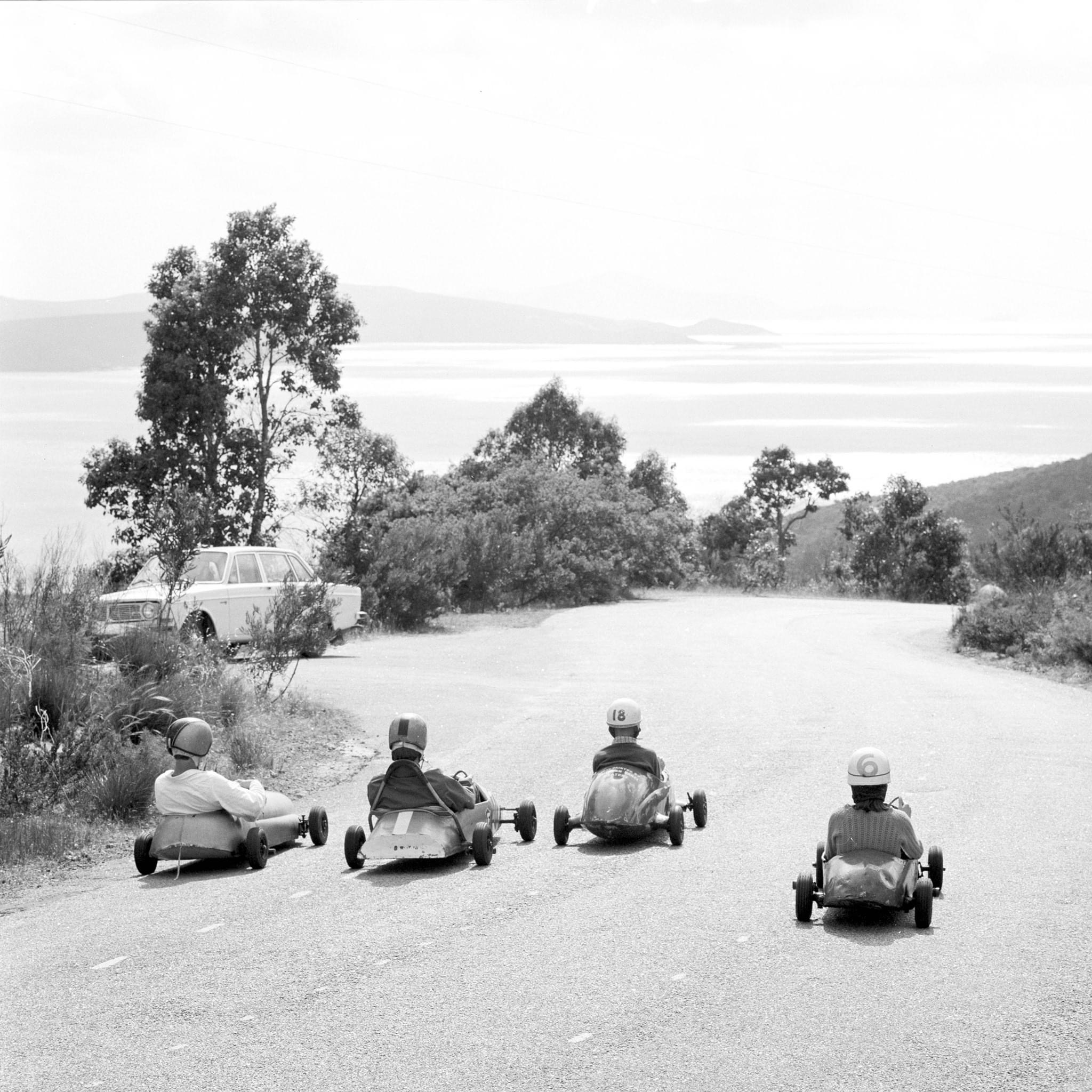
Soap-box race at Albany, West Australia in 1970.

It’s a shame that bloody Volvo buggered up a great shot.

What was the seventies Oz Volvo joke? ‘Wots the difference between a Volvo and a Porcupine? Answer- the pricks are on the outside of the Porcupine. Boom-boom. More billy-carts; https://primotipo.com/2019/02/10/spitty/


(J Barnes)

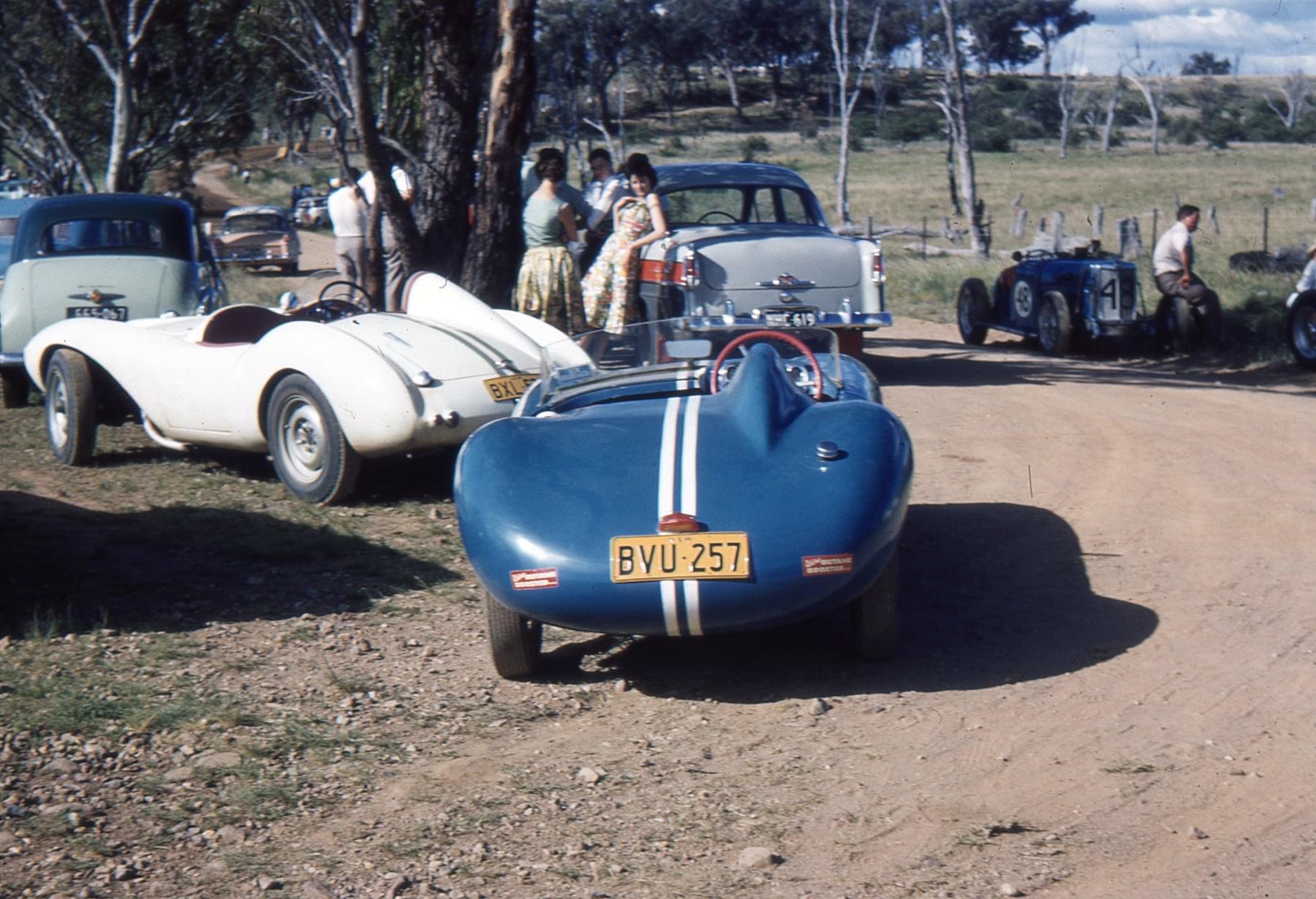
Some shots from Elsmore Hillclimb, east of Inverell in New South Wales.

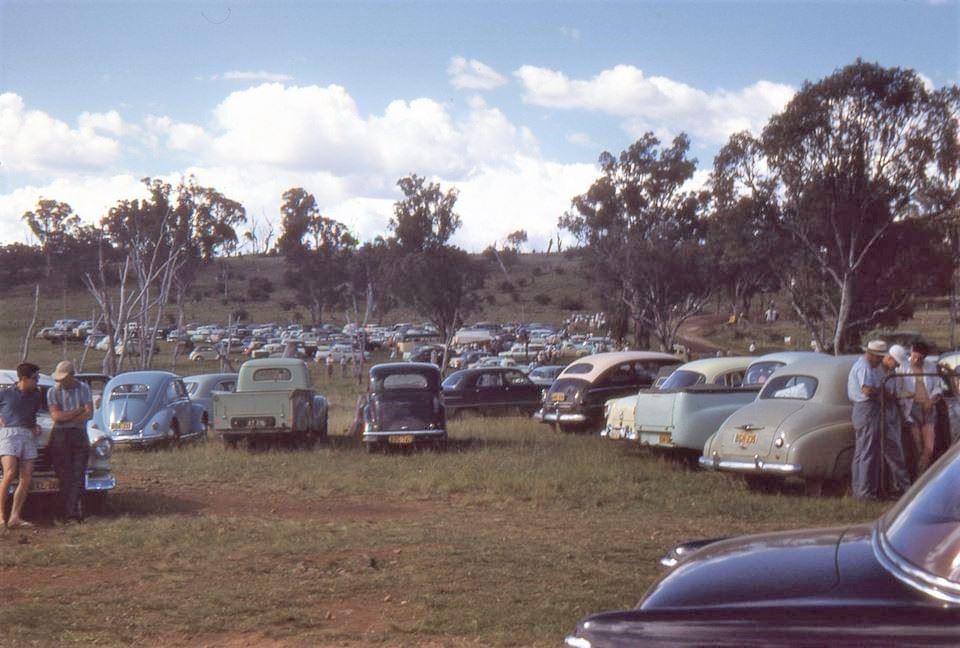
The first shot shows John French’ Holden 48-215 at the far left, then the white RAWGS sportscar , the beautiful blue JWF Milano and the Barnes MG TC Spl at far right- thanks to Dick Willis for the IDs. The photographs below are from the carpark looking back up the hill.

(J Barnes)


(A Purcell)

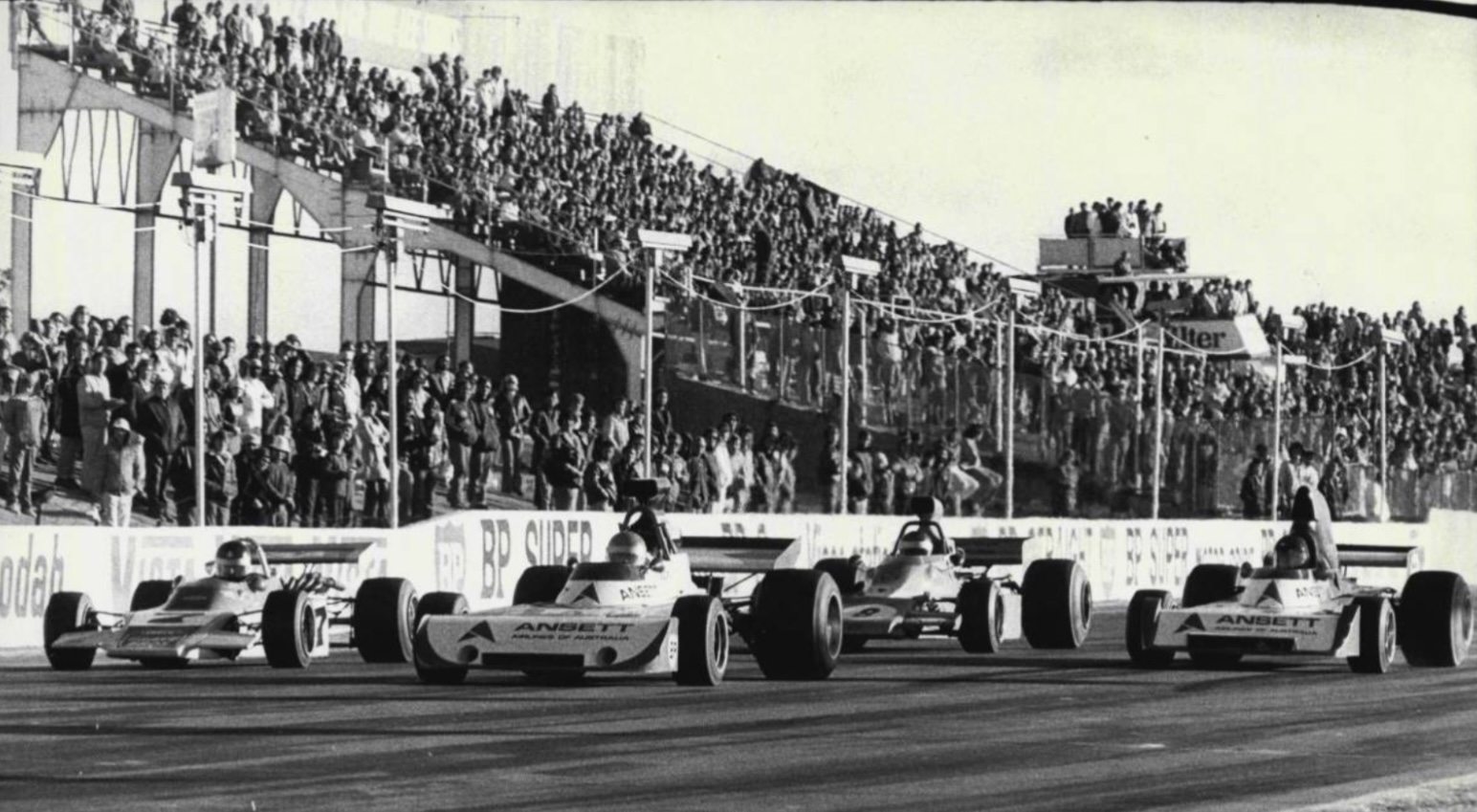
A packed crowd at Oran Park for the start of the

From left, John Leffler’s Bowin P8 Hart-Ford ANF2 car alongside Phil Moore, Elfin MR5 Repco-Holden. On row 2 car 8 is John Goss in his just acquired Matich A53 Repco-Holden and on the right John McCormack in the other Ansett Team Elfin car- an MR6 Repco-Leyland.

There were two heats, Max Stewart won both is his Lola T330 Chev- this group are the back couple of rows in one of them. Max won the Gold Star that season.

1974 Australian Grand Prix at Oran Park; https://primotipo.com/2021/01/15/1974-australian-gp-oran-park/

(P Weaver)

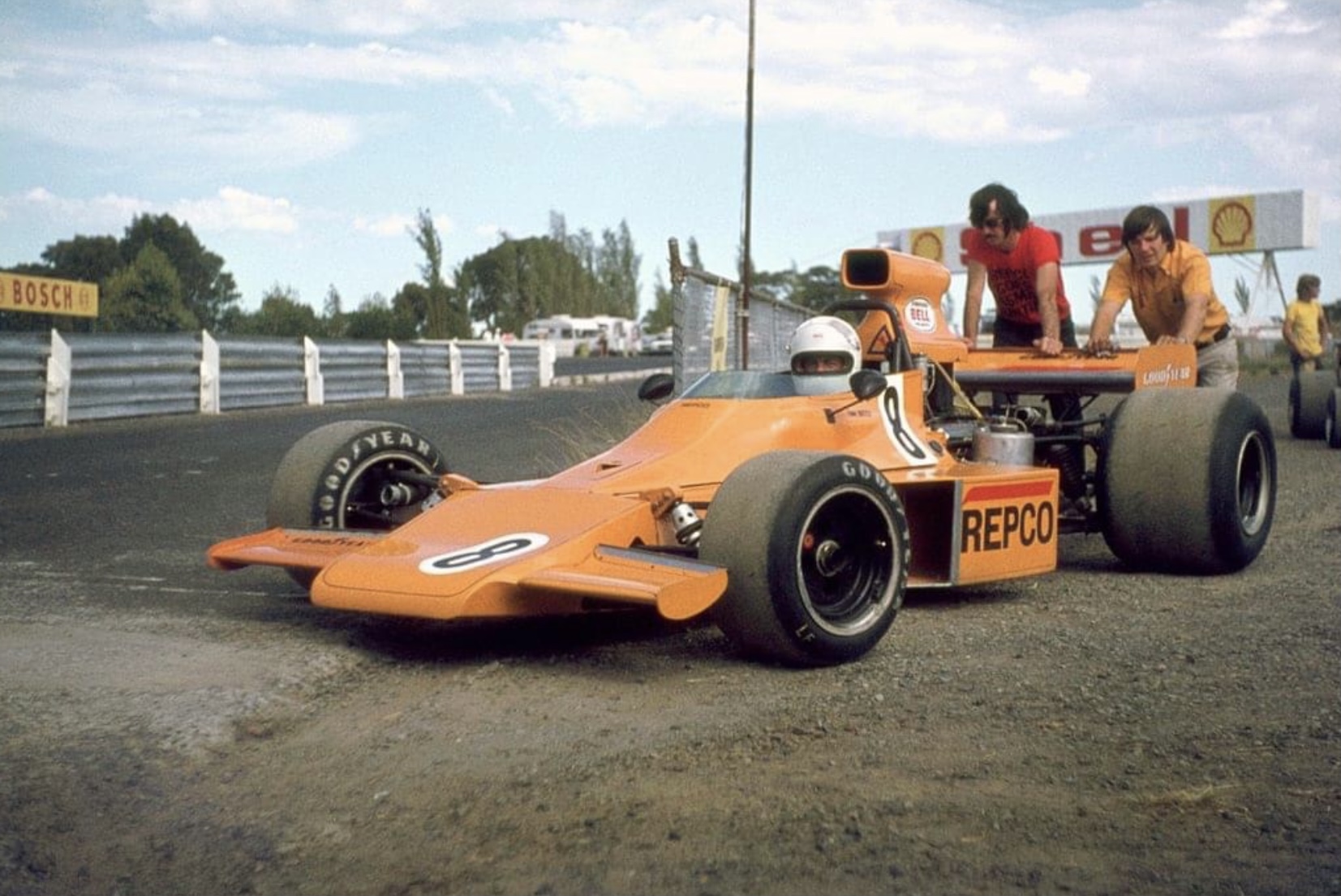
Here is the car John Goss raced at Oran Park in the hands of its creator Frank Matich at Sandown Park during the February Tasman Cup meeting. Repco’s Ken Symes and Matich’ chief mechanic Derek Kneller pushing.

The Matich A53 Repco-Holden was the smallest, last and best of the six Matich F5000 cars, it is a great shame FM did not return to the US that year as planned. His boating accident and Joan Matich’ illness meant the time had come to retire.

Goss did well with the car winning the 1976 AGP at Sandown in an A51 updated to A53 specifications. See here for a feature on the Matich F5000 cars; https://primotipo.com/2015/09/11/frank-matich-matich-f5000-cars-etcetera/

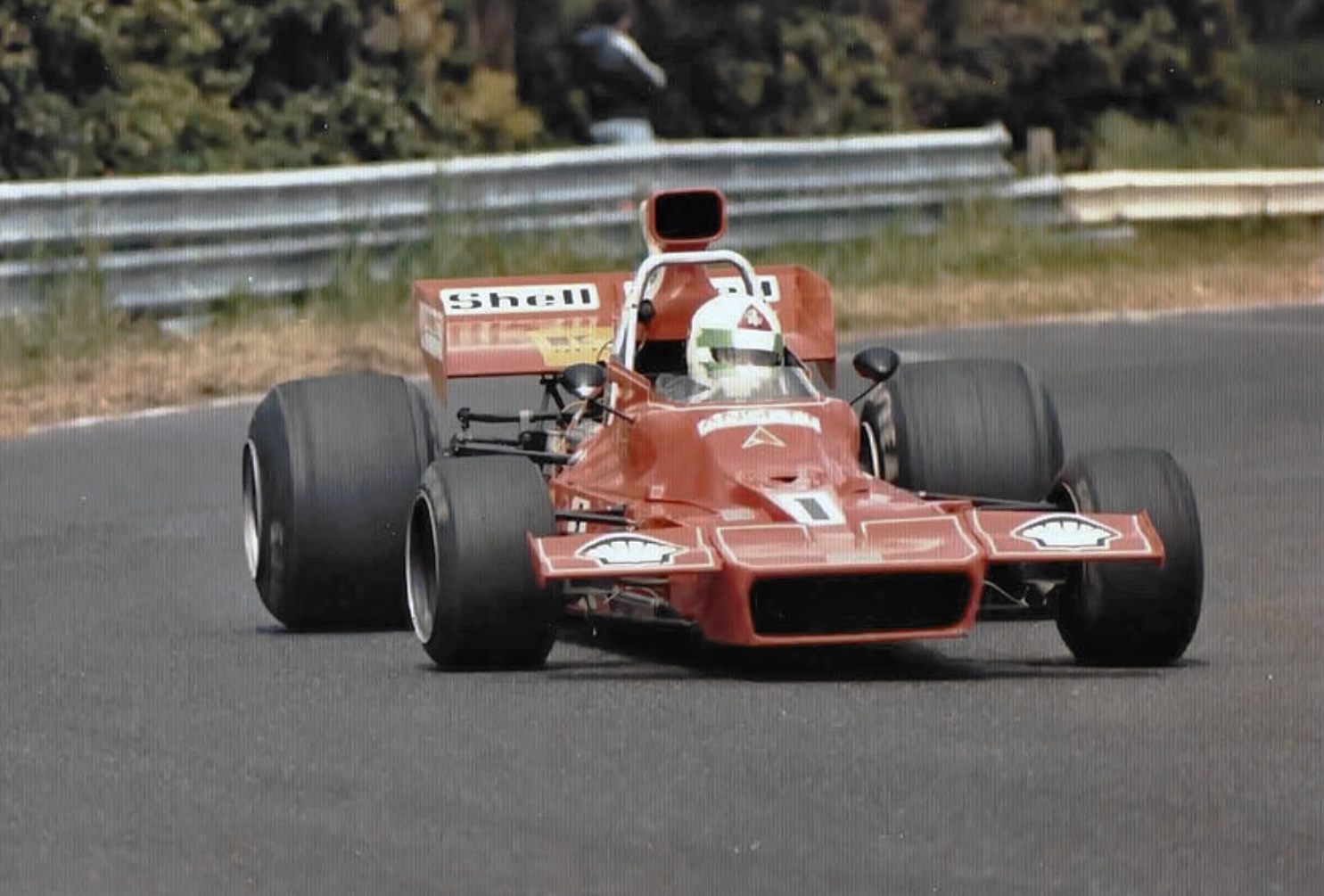
Above is Lella Lombardi in the same chassis Goss used to win the AGP at Sandown in 1976, A51 ‘005’.

When Goss used it, the car was converted to side-radiator A53 specifications similar to the shot of FM above. Lella is shown at Sandown’s Dandenong Road during the 1974 Victoria Trophy Gold Star round prior to contesting that years AGP at Oran Park, see here; 1974 Australian Grand Prix at Oran Park; https://primotipo.com/2021/01/15/1974-australian-gp-oran-park/


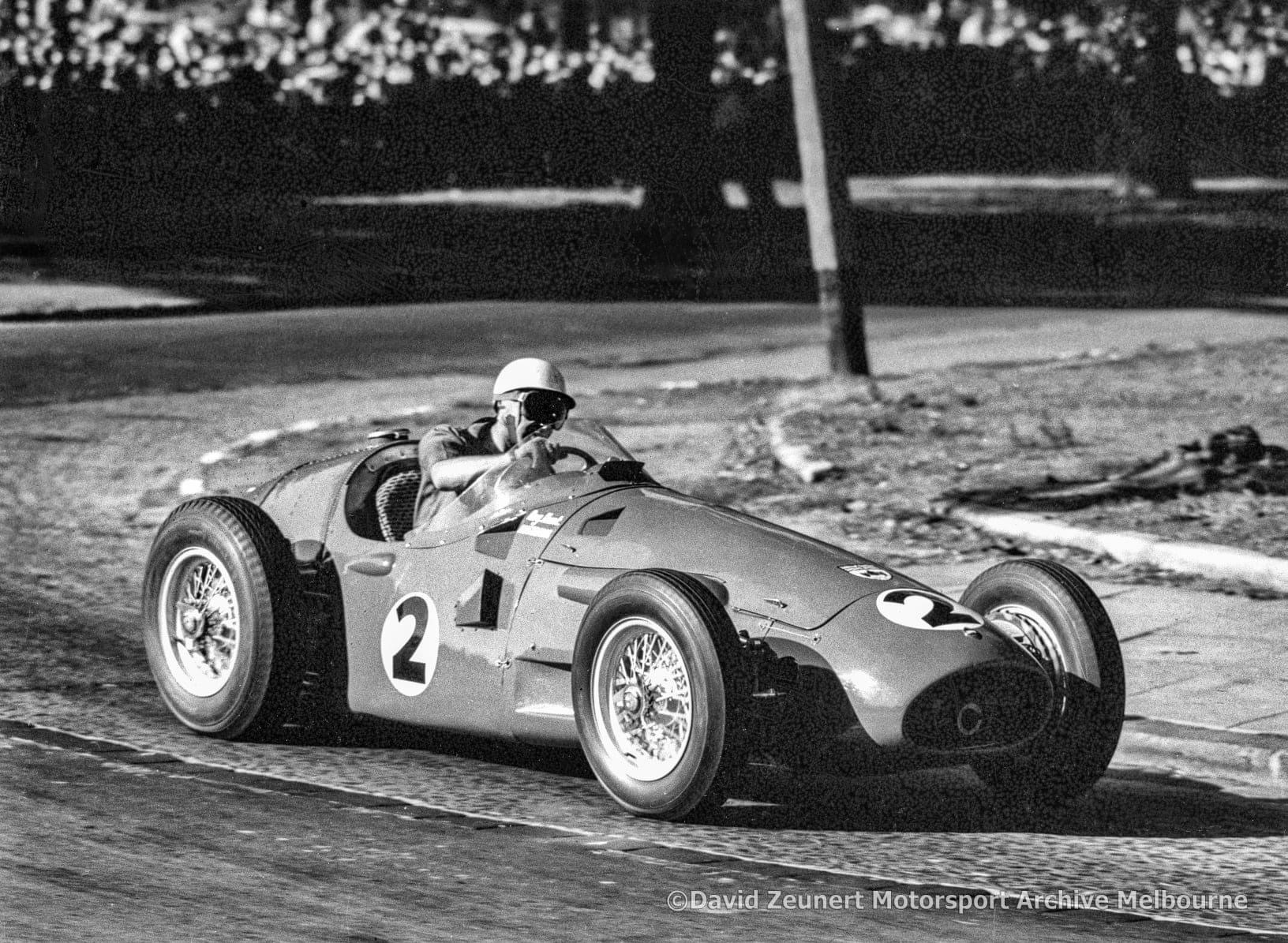
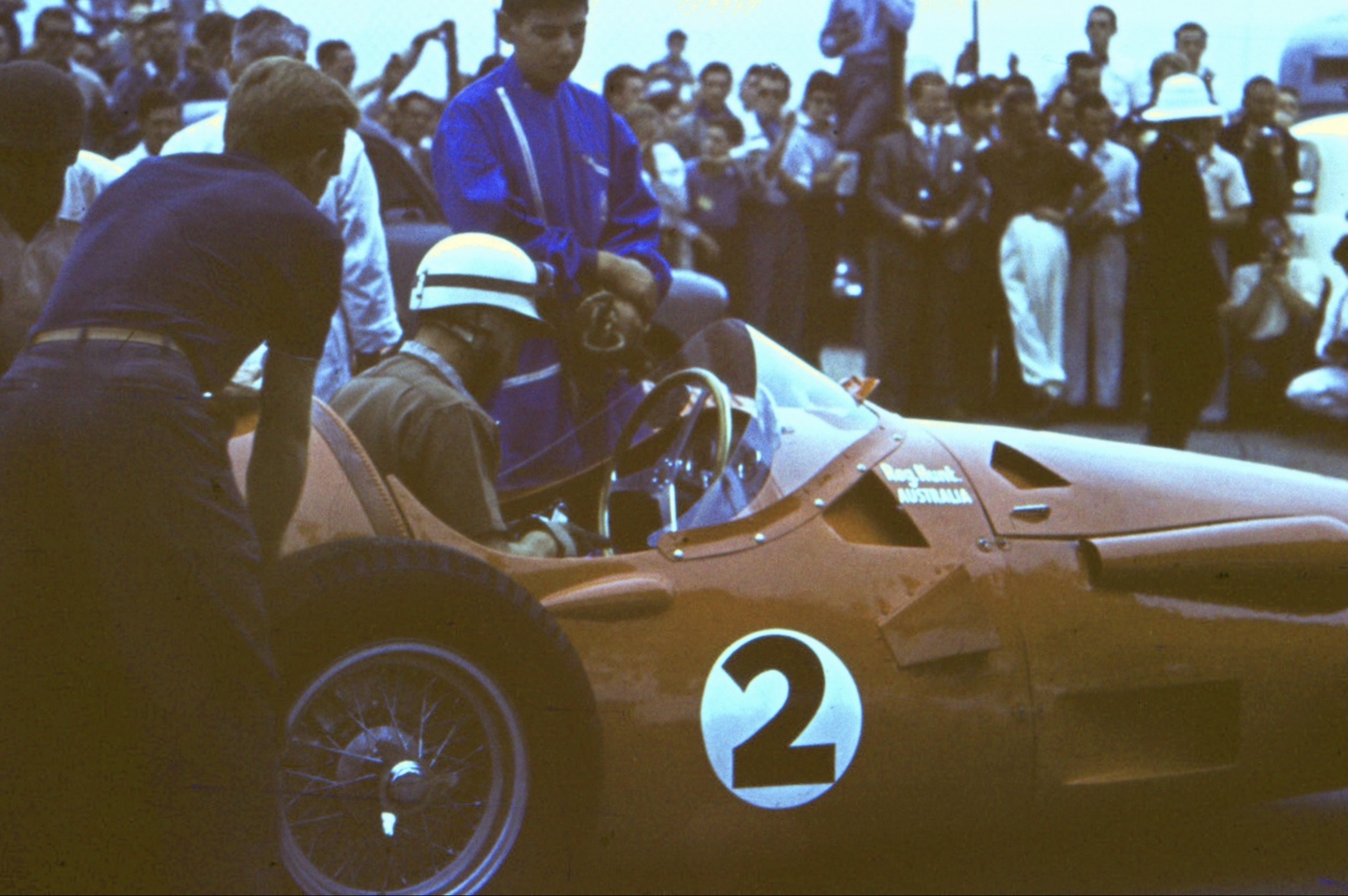
Reg Hunt, Maserati 250F during his successful March 1956, Moomba meeting.

He won both the 50-mile Albert Park Cup and 150-mile Argus Trophy feature from Lex Davison’s just acquired ex-Gaze Ferrari 500/625, Tom Hawkes’ ex-Brabham/Jones Cooper T23 Bristol, Bib Stillwell’s Jaguar D Type and others.

By the end of the year he had been the fastest resident in the AGP, also at Albert Park and retired from racing. His ‘reign at the top’ extended from the arrival of his A6GCM Maserati 2.5-litre in early 1954 to the end of 1956.

Feature on Reg Hunt; https://primotipo.com/2014/07/19/reg-hunt-australian-ace-of-the-1950s/


(J Fitzpatrick)

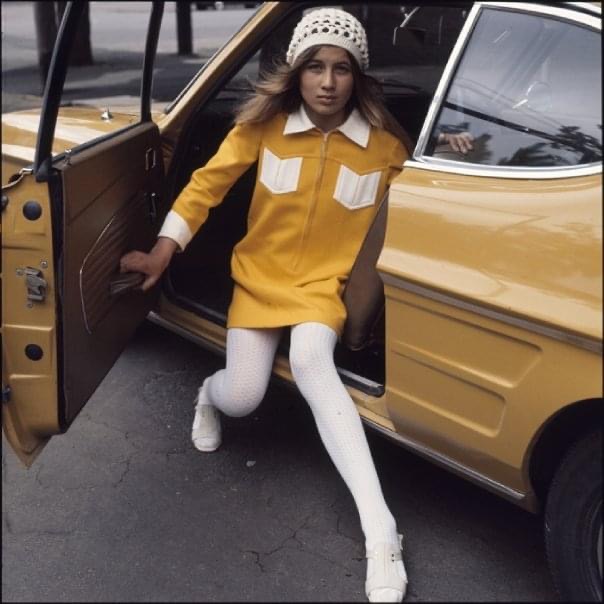
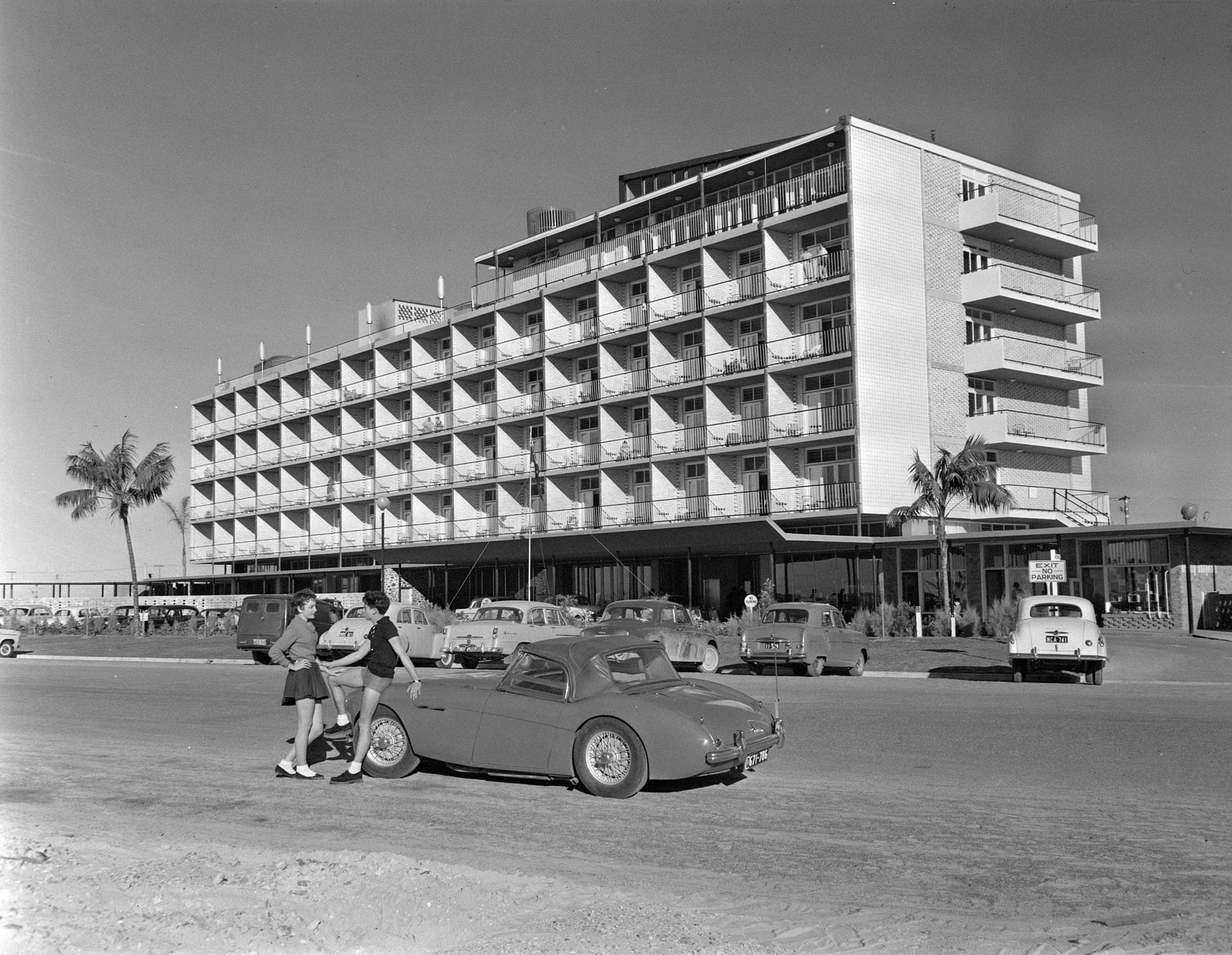
Who said Jean Shrimpton was the first to wear a miniskirt in Oz?

Leggy-lass, as we say in polite society, and a chap with quite questionable clothing taste, and Austin Healey 100 outside the Broadbeach Hotel on Queensland’s Gold Coast in 1957.

Have always thought the Goldie a good place to fly over, the Queensland white-shoe brigade got better with their developments as they went progressively north.


Michael Andretti had a shocker of an F1 season with McLaren in 1993.

It was never going to be easy with the incredibly gifted and well established Ayrton Senna in the other car. The class was new to Mario’s boy. So too the tracks and the culture of F1. Stupidly, he continued to live in the US rather than camp somewhere close to McLaren in the Thames Valley. See here; https://primotipo.com/2015/02/06/michael-andretti-and-f1/

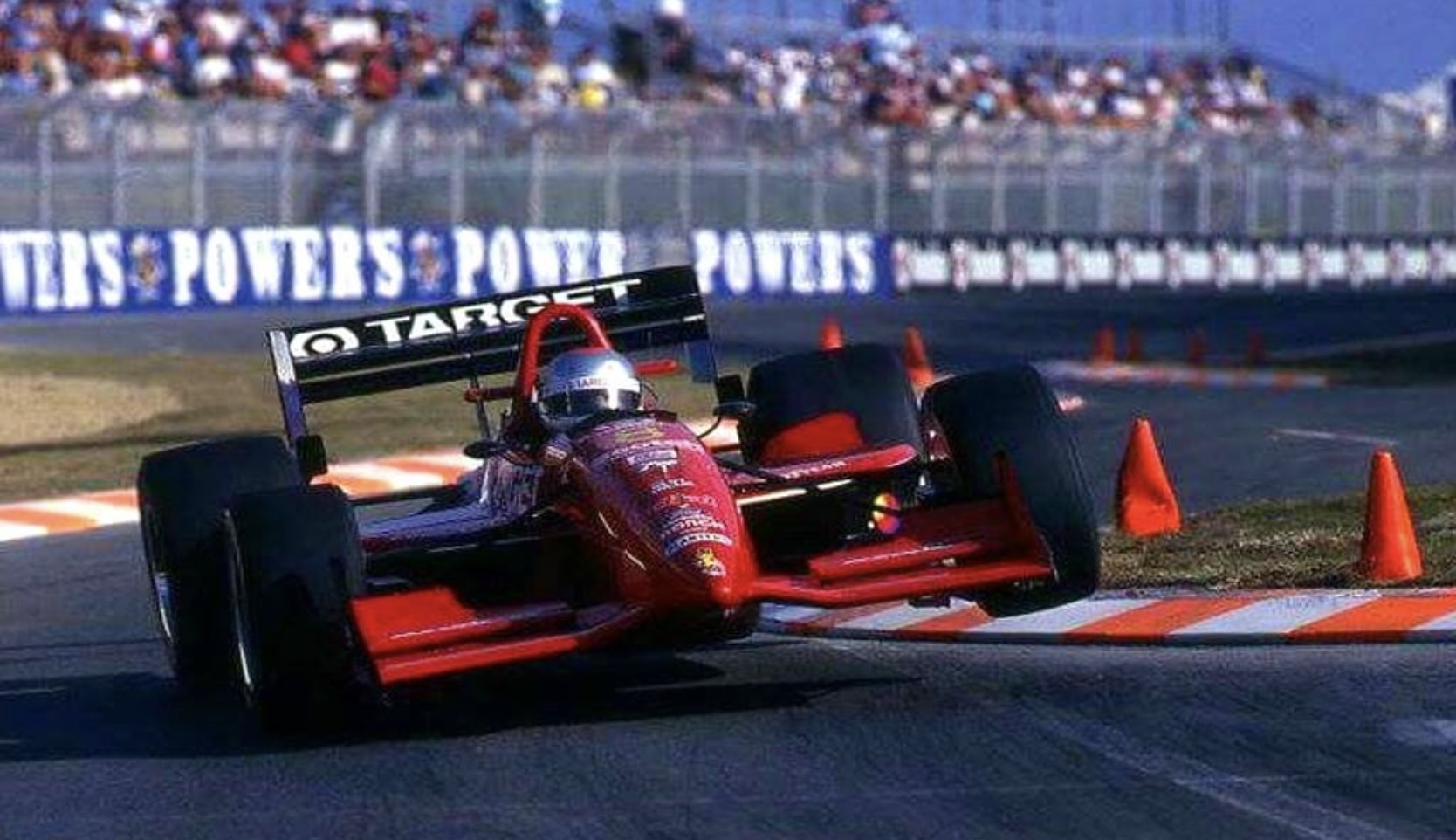
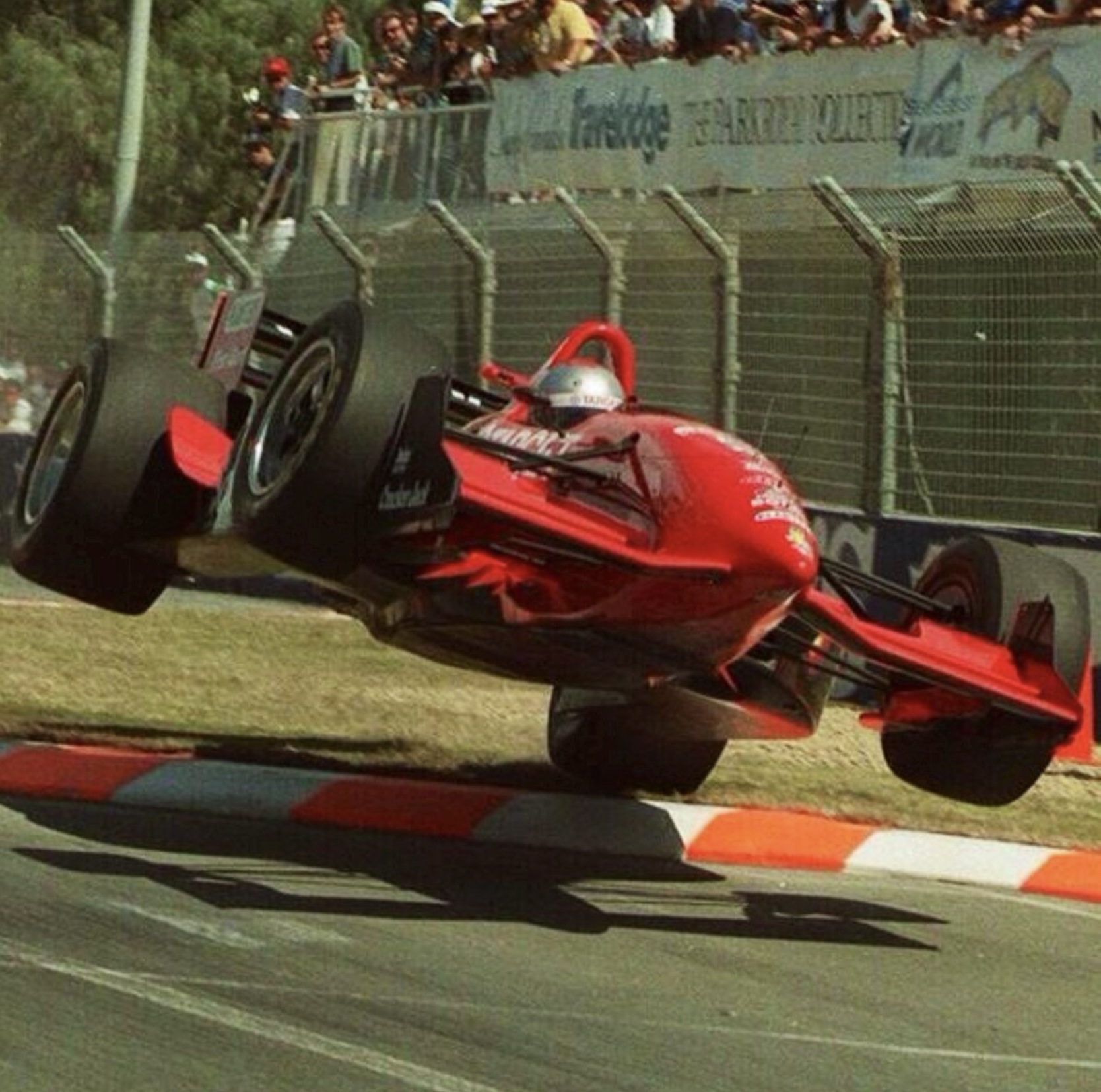
Indycar was mighty competitive as well. To come back after a season away and win the first race of the season at Surfers Paradise in Malcolm Oastler’s brand new Chip Ganassi Racing Reynard 941 Ford Cosworth XB V8- his first Indycar design, was quite a feat.

Emerson Fittipaldi was second in the new Penske PC23 while Mario Andretti was third aboard his Lola T94/00 Ford in his final season- it was the great all-rounders final podium.

(unattributed)

Credits…

National Archives Australia, Auto Action, Stan Griffiths, Bob Young, Ben Short, Robert Davies, Getty Images, Janathan Ranger, Tony Carwithe, Nigel Snowden, MotorSport, peter.bryan.org.nz, John Barnes, Clive Bottomley, National Archives of Australia, Jim Fitzpatrick

Tailpiece…

(LAT)

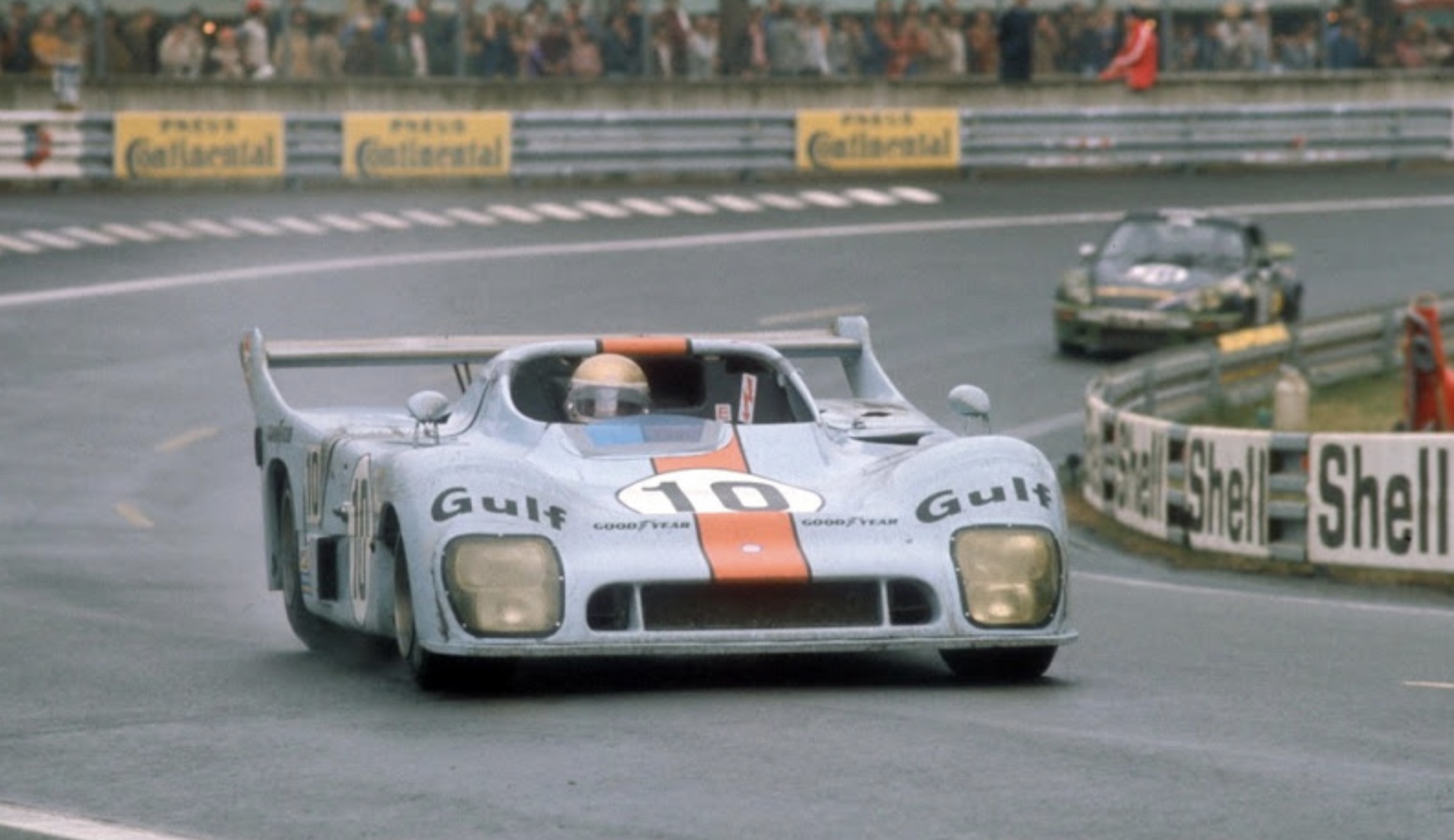
Vern Schuppan, Mirage GR8 Ford on the way to third place at Le Mans in 1975.

He shared the car with Jean-Pierre Jaussaud, Derek Bell and Jacky Ickx won in another Mirage.

Finito…