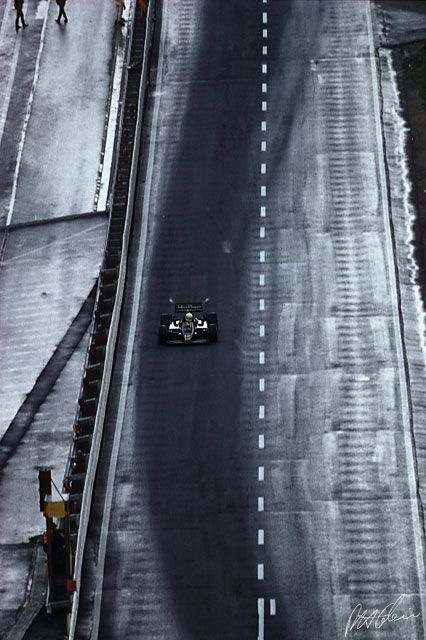
Slightly surreal shot of Ayrton Senna in his Lotus 97T Renault during pre-season testing at Spa in early 1985, the line clearly marked through light snow…
Not a good idea to get off line! These slippery test conditions were of great use come 15 September when the race itself was run in wet conditions, the Brazilian demonstrated his mastery and deft touch by winning the race from Nigel Mansell and Alain Prost, Williams FW10 Honda and McLaren MP42B TAG Porsche respectively.
What is he on about this time you may well ask? Rear ends my friends are one of my favourite parts…
Location of same is one of the most critical bits of their effectiveness. When I spotted this cutaway of a 1958 Grand Prix Vanwall, I thought what a wonderful pot-pourri of all of the bibs and bobs which makes a front-engined cars rear end provide grip, stability and control as le pilot applies the motive forces via the throttle to the road.
One of my current obsessions is the brilliant work of ‘cutaway artists’ like Vic Berris, Theo Page, Paolo D’Alessio, Claude La Tourette, Brian Hatton, Bill Bennett, Tony Matthews, Bruno Betti, Giuseppe Cavara, Yosihiro Inomoto and others. I post their work regularly on my primotipo Facebook page, which is always well received. An ‘eyeful is better than an earful’ in terms of understanding what makes something tick. My simple little brain cannot conceive just how they conceptualise their work let alone create it.
So, to my reaction- ‘Wow, that IS a textbook illustration of the way to locate, brilliantly, a live rear axle. Or in this case, a de Dion axle. Vanwall’s Colin Chapman chassis design was the state of the art in that immediate pre mid-engine era, whilst noting Cooper’s first F1 championship victory was also in 1958. That was Moss’ win aboard a T43 in Argentina. Vanwall won the Manufacturers Championship that year whilst Mike Hawthorn took the drivers title aboard a Ferrari Dino 246, in 1958 trim the Italian car also utilised a de Dion rear end.
Chapman’s spaceframe designs, the art he was honing on his Lotus sportscars was first applied to a single-seater for someone else- Tony Vandervell.
The de Dion axle is clear in the cutaway, as are the inboard disc brakes. The de Dion tubes upwards and downwards movement is controlled by a Watts Linkage, the springing medium is a coil spring/damper or Chapman Strut. Lateral movement is controlled by a Panhard Rod. Fore and aft movement of the de Dion tube is controlled by two Radius Rods extending forward of the de Dion tube to the cars chassis on each side of the racer.
The engineering of these cars was first class, the execution of tool-room quality, check out the article I wrote on Vanwall a while back which explores the cars in more detail by following the link at the articles end.
Art Credit…
The irony, in naming all of the talented cutaway dudes above is that the drawing, published on ‘The Nostalgia Forum’ is not credited! If any reader knows the artist please advise me and I will update the caption accordingly. The chap is a skilful one whoever he is.
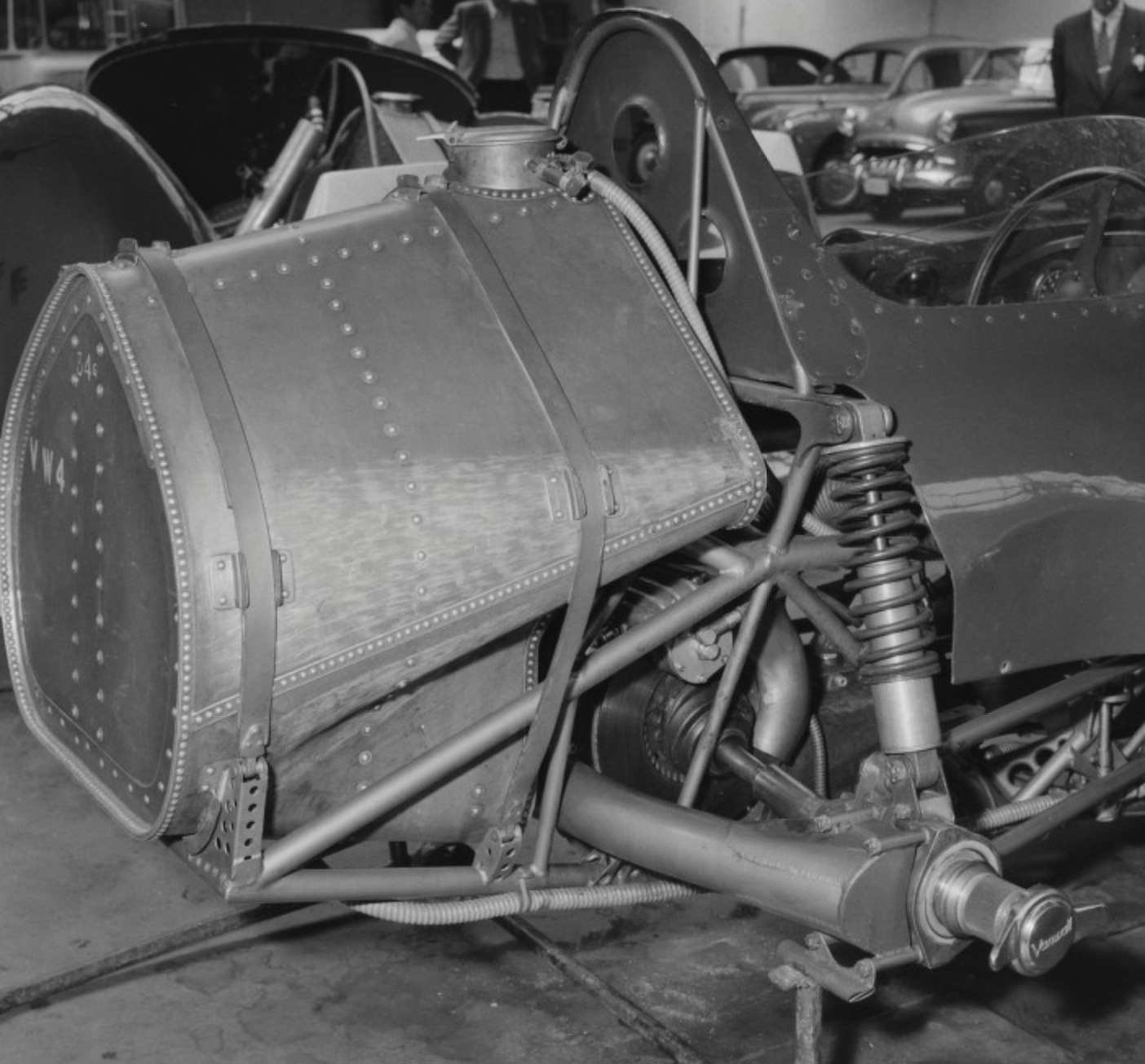
Vanwall chassis ‘VW4’, as per the fuel tank tag- said aluminium tank beautifully fabricated and simply located to the spaceframe chassis by rubber bungee straps. de Dion axle, inboard discs and Chapman Strut- it looks like a simple co-axial coil spring/damper unit to me! Two forward facing radius rods also clear at lower right (Ludvigsen)
Nomenclature…
James Watt patented his mechanical linkage in 1784 when it was described in the patent specifications of his steam engine. The Panhard Rod was invented by the French automobile manufacturer at the dawn of the twentieth century. Whilst named after Jules-Albert de Dion, the co-founder of De Dion-Bouton, ‘the tube’ was invented by one of his partners, Charles Trepardoux for use on the company’s steam tricycles. ‘Chunky’ Chapman’s strut was first used on his 1957 Lotus 12 Climax F2 and later F1 car but the design’s origin rests in the near vertical coil spring struts on William Stout’s 1932 Stout Scarab. Alexander Graham Bell developed spaceframes based on tetrahedral geometry (triangular pyramid) for nautical and aeronautical engineering purposes between 1898 and 1908. There aint nothin’ new under the sun my friends, rarely anyway…
Superb detail of fabrication and finish down to ‘Vanwall’ spinner cap. Disc brakes are Goodyear designs made by Vanwall. Otherwise description as above (Ludvigsen)
1958 Belgian GP, Spa, 15 June…
The photos in support of the drawing were taken in the Spa pits by historian/author Karl Ludvigsen.
Clearly, one of the chassis photographed is ‘VW4, raced by Stuart Lewis-Evans that weekend and famous in the pantheon of Vanwalls as the first British car to win a championship grand prix- the ’57 British at Aintree in the hands of both Brooks and Moss. Sadly, this car was destroyed in the October 1958 Casablanca, Moroccan GP accident which befell Stuart Lewis-Evans and from which he later died.
The photos are probably all of ‘VW4’ as it was clearly unclothed at the time. ‘VW5’ was raced by Brooks and ‘VW10’ by Moss that weekend. Interestingly the Vanwall numbered #48 in the background of the front of the car shot (at the end of the article) is not listed in the race results- perhaps the car is a spare or had not yet had its Spa race number applied. Race numbers for the weekend were Brooks #4, Moss #2 and Lewis-Evans #6..
It was a great race for the Acton team with Tony Brooks winning from Q5, Stuart Lewis Evans was 3rd from slot 11 with team leader Moss out on lap 1 after muffing the fourth to fifth shift exiting Stavelot and popping the engine. A mitigating factor was the interminable time spent on the grid which boiled engines and drivers nerves- pole-sitter Mike Hawthorn’s Ferrari Dino 246 was bubbling before the flag was dropped but survived to the end of the race, but only just, as a piston failed heading down the hill to the finish line on the last lap, in 2nd place.
In an amazing finish Brooks gearbox was tightening, some way towards failure, Hawthorn had an engine pop just before the line and Lewis-Evans finished with a broken right front upper wishbone. The first healthy car to complete the distance was the ‘Chapman Strutted’ Lotus 12 of Cliff Allison in 4th place, the little cars Coventry Climax FPF four cylinder engine giving away some capacity to most of the opposition, racing as it was at 2.2 litres. It was a mighty fine performance by Allison and the tiny little Lotus on a supreme power circuit, the ultimate test of high speed precision and testicular size!
This shot shows the attachment of the de Dion axle to the upright or hub, parallel radius rods also clear. Favoured wheel combinations in 1958 were old fashioned wires at the front for greater driver feel and magnesium wheels at rear (Ludvigsen)
In fact the Vanwalls had the speed for most of the weekend in a close contest for pole, Moss was so confident of his time not being bettered that he/the team made the decision to sit out the last session only to have the Ferrari’s of Hawthorn and Musso better his times. In a sign of a different era, Denis Jenkinson in his MotorSport report of the race notes that ‘Having nothing to drive (as his Vanwall was in bits for final race preparation) Maserati lent Moss a new experimental sportscar they had with them, this being a V12 cylinder 3 litre engine in a modified 300S chassis’, imagine that happening today! Still, Stirling was a Maser racer throughout his career.
Bibliography…
The GP Encyclopaedia, MotorSport July 1958
Photo Credits…
Karl Ludvigsen, The Revs Institute
Tailpiece: It seems a lost opportunity not to show the gubbins at the Vanwall’s front in addition to the back, Spa ’58…
Water radiator and behind it the engine oil dry sump, engine itself mounted well behind the front axle line. Aluminium alloy head and Rolls Royce ally block, in 1958 form the Bosch injected, DOHC, 2 valve, 4 cylinder 2.5 litre engine developed circa 280bhp on pump fuel- down from circa 290bhp on alcohol. Wire/Alloy wheels referred to in shot above shown on the two cars in shot (Ludvigsen)
Tom Hawkes, Cooper T23 Holden Repco, AGP Bathurst 1958 (unattributed)
Tom Hawkes racing his way up Mount Panorma towards a giant killing 3rd place during the 1958 Australian Grand Prix at Bathurst…
He finished behind Lex Davison’s winning Ferrari 500/625 and Ern Seeliger’s 4.6 litre fuel injected Chev V8 engined Maybach. Hawkes’ Cooper T23 is the ex-Brabham car chassis # CB/1/53 i wrote about not so long ago. Click here to read the article;
Tom replaced the cars Bristol engine and fitted a Repco Hi-Power, Phil Irving designed head breathing much life into the standard 6 cylinder, OHV, inline Holden 6 cylinder ‘Grey Motor’. The engine raced at 2.3 litres in capacity.
The interesting thing is exactly where on Mount Panorama the shot is taken. The right hander at the top of Mountain Straight perhaps, ‘Quarry Corner’? All suggestions taken. Its a quintessential Australian country scene, in the absence of a crowd it could be anywhere!
Photo Credit…
Unsure, intrigued to know who took the wonderful shot
Emerson Fittipaldi lost in thoughts of set-up changes during Jarama practice, McLaren M23 Ford 27 April 1974…
This is a ‘signature’ Rainer Schlegelmilch shot, Emerson had an ok weekend, 3rd behind the Ferrari 312B3’s of Niki Lauda and Clay Regazzoni, valuable points in his successful quest to win his second drivers title.
James Hunt and Brendan McInerney looking confident before the start of the 1973 British F3 season with a brand new March 723, Bicester 1 March…
They were not newcomers to March having driven works 713M’s in 1971- Hunt’s was a paid drive, Brendan was paying his way, under the banner of ‘Rose Bearings-Team Baty Group’. In Autosport journalist Ian Phillips 1971 F3 season review, his pantheon of drivers of the season had Hunt at #5. Phillips wrote that he had been ‘ one of the disappointments of the year. The season started well enough but suddenly a run of accidents and mechanical problems struck. It seemed he was a victim of his own enthusiasm but he really suffered at the hands of those less experienced than himself who by the nature of F3 were able to mix it with the quicker drivers. When he was able to get clear he proved that he was capable of showing everybody the way round and hopefully things will turn out better next season.’
Phillips Top 3 for ’71 were David Walker, Jody Scheckter and Roger Williamson- all future F1 drivers of course. In fact Walker made his F1 debut in 1971, his potential victory aboard the 4WD, gas turbine powered Lotus 56B, in the wet at Zandvoort one of thousands of motor racing mighta-beens! McInerney finished 6th in the BRSCC / MCD North Central Lombard F3 Championship with Hunt 8th and also 10th in the more prestigious BRSCC / MCD F3 Championship with Brendan 20th. So, the sad news for James was another year in F3- the good news was he still had his works drive…
This very famous shot of young James Hunt and a gorgeous leggy lady was taken at Brands on 17 August 1969. Despite the obvious distraction Hunt drove his Brabham BT23B to 3rd place in the Lombard F3 Championship round, Emerson Fittipaldi won it in a Jim Russell Lotus 59 Ford (unattributed)
1972 was to be rather a difficult season for them, despite high expectations, especially on Hunt’s part. The duos first race as members of the STP March Racing Team was at Brands on March 5, their last at Monaco on 13 May. In the ten meetings they raced the works 723, the best result was Hunt’s 3rd at Mallory Park amongst a swag of DNQ’s and DNF’s due to accidents.
A year later, on June 3 1973 Hunt ran as high as 6th in the main race at Monaco on the Sunday, the F1 Monaco Grand Prix that is, before the engine in his Hesketh Racing March 731 Ford failed. The stuff of movies really! Hunt was out of a job at March after Monaco ’72 and a front-runner upon his Championship Grand Prix debut at Monaco in a customer March 12 months later.
Its interesting to look at that year, ‘Monaco to Monaco’ as context and background to the charismatic, driven champions subsequent achievements. Only a ‘Hunt true believer’ would have thought it possible to get into F1, let alone win a World Championship in those difficult months of mid-1972 when motor racing oblivion seemed the most likely outcome for James.
The 1972 March F3 efforts of Hunt and McInerney need to be put into perspective, ‘The mechanical shortcomings, political manoeuvring, dissent and strife within the team caused Autosport to describe the 1972 works STP March effort as ‘shambolic’…The…723 cars were plagued by inconsistent handling characteristics and a shortage of straight line speed’ Gerard Donaldson’s James Hunt biography says.
March were in big trouble with their F1 program in 1972,Ronnie Peterson had been a consistent front-runner in 1971 in the wonderful, unconventional 711 Ford, much was expected of March in 1972.
The 721X Ford low polar moment, Alfa Romeo gearbox’d (Alfa gears and diff in a March case) design was a dismal failure, even Ronnie Peterson could not drive around its shortcomings. Designer, Robin Herd later put the problems of the car down to issues with the gearbox- its gearchange, lack of ratios, differential problems. Robin also acknowledged his failure to design the car around the needs of the customer Goodyear tyres. In essence too much load was on the front of the car which overheated the tyres and caused excessive understeer.
A quick fix, it took only 9 days to build the first one for Mike Beuttler!, was the March 721G, essentially a 722 F2 car to which was attached a Ford DFV, Hewland FG400 ‘box and additional fuel tankage. In fact, Herd points out, from then on that philosophy of the F2 car design of each year forming the basis of March’ simple and often competitive Grand Prix cars for the period of the original founders ownership of the company served them quite well given the budgetary constraints they always had.
The point is that Robin Herd’s and others time was sucked up in the F1 effort which meant the 723 F3 and 722 F2 cars did not get the development attention they needed.Both inherently were not as good cars as the 1971 F3/F2 713M and 712M were. In addition, in F3, the GRD 723 and Ensign LMN3 were very quick little cars, drivers like Roger Williamson, who could afford to do so, backed by Tom Wheatcroft as he was, decamped from their March cars to GRD’s. The running of the March F3 team had also been contracted out and the preparation of the cars was not up to snuff.
Hunts first race at Mallory yielded 3rd but he was excluded when his engine restrictor did not hold the required air pressure. His best efforts at Brands, the next meeting were a distant 4th and 5th. At Snetterton the car wandered alarmingly all over the road- he was 8th. He tangled with 2 other cars at Oulton Park but bounced back to 3rd at Mallory Park and thrilled the crowd , his duel with Roger Williamson the races highlight. The two following races at Silverstone yielded 7th and an accident when a spinning car punted his March hard off the circuit into an earth bank. Before he could drive it again he was fired by March.
The back story to this is that the two 723’s failed to front at Zandvoort in early May, ostensibly because new bodywork was being developed to give the car more straight line speed. But Hunt, at the circuit as a spectator, given his car had not arrived heard rumours that March, chronically short of funds, had been approached by Ford Germany with an offer to run their protégé, Jochen Mass. This was not good for James as Brendan was paying March whilst in James’ case March were paying him…
Brands BRSCC F3 C’ship R1 19 March 1972. Hunt’s works March from Colin Vandervell Ensign LNF3 Ford and Ian Ashley Royale RP11 Ford. Hunt was 5th in the race won by Tom Pryce Royale RP11 Ford (Getty)
Roll on Monaco.
Hunt had tried to contact the chiefs at Bicester but could not get hold of anybody to find out what was going on. Then the F3 cars did not arrive in time for Monaco first practice, critical on this tight demanding circuit for the most important F3 race of the year. Late that night the transporter arrived with two cars which had not been adequately prepared- the mechanic, tired from the trip driving the truck went to bed. Furious, Hunt consulted his former team manager Chris Marshall- who happened to have a spare car as one of his drivers had his licence suspended. They decided that if James’ works car was not ready in the morning James would drive the Marshall car- this is what occurred, Hunt then qualified it.
Whilst Hunt was aboard the Marshall 713M awaiting his heat a missive arrived from March Director, Max Mosely to the effect that Hunt drive the works car or leave the team. By that stage James was certain he was being manoeuvred out of the team or would be sacked anyway so he decided to race the 713M which he promptly stuffed into a barrier- partially at least given the lead up to the race none of which put the driver in the best frame of mind to excel!
Several days later March announced Hunt’s dismissal and Mass’ appointment with McInerney also departing given that he thought the car horrendous and the team terrible! Mosely, Donaldson writes, ‘admitted the fault at Monaco, the delay in preparing the car and the failure to communicate with Hunt, lay with the factory, but the March directors felt it was wrong for their sponsors that Hunt should race for another team. This, and the recent lack of results had brought about the firing. Besides Mosely offered, Hunt would probably go much better without the pressures of being in a works team’, no doubt said with all of the sincerity lawyers possess…
In reality, putting contractual obligations and morality to one side!, the decision was an easy one for Max Mosely to make as he had Ford Germany keen to pay him to put Jochen Mass into James car. March needed the cash desperately so it was a ‘no brainer’ for Max to tip James out of the ride. Russell Wood drove the other works car, with both drivers failing to impress much during the rest of the year.
The long and the short of it was that the ‘bright eyed and bushy tailed lads’ were out of a drive mid-season.
In the interim James raced a Chris Marshall ‘Equipe La Vie Claire International’ F3 March 713M to 5th place at Chimay on 21 May, it was during that meeting the world changed for Hunt.
James popped the year old 713M 2nd on the grid with Hunt running 2nd with 3 laps to go when a tyre started to deflate but he still finished 5th. Amongst those who noticed the performance that weekend was ‘Bubbles’ Horsley.
Hesketh Racing was formed to run Anthony ‘Bubbles’ Horsley in F3, they had been running a Dastle Mk9 and were looking for another driver for the 2nd car. In addition ‘Bubbles’ was not really up to it- Steve Thomson was engaged to race the car at Monaco as Horsley was unlikely to qualify for this elite race. Hunt needed a drive, Hesketh wanted a driver, the Hesketh team, funded by the young English aristocrat, Lord Alexander Hesketh, at the time were regarded as a bit of a joke, it was not necessarily the opportunity which other drivers may have sought- but there was a happy alignment of the planets between the circumstances of Hunt, Horsley and Hesketh.
Hunt raced Marshall’s 713M at Mallory Park the following week on 29 May to 10th place- in 2nd place was Alan Jones in James’ STP March 723- the best result the Australian had for quite some while! The Melburnian was clearly sussing alternative chassis to the Brabham BT38 he had been running, he purchased a GRD 372 shortly thereafter mind you! An astute choice, it was with a GRD 373 that he did so well in F3 in 1973.
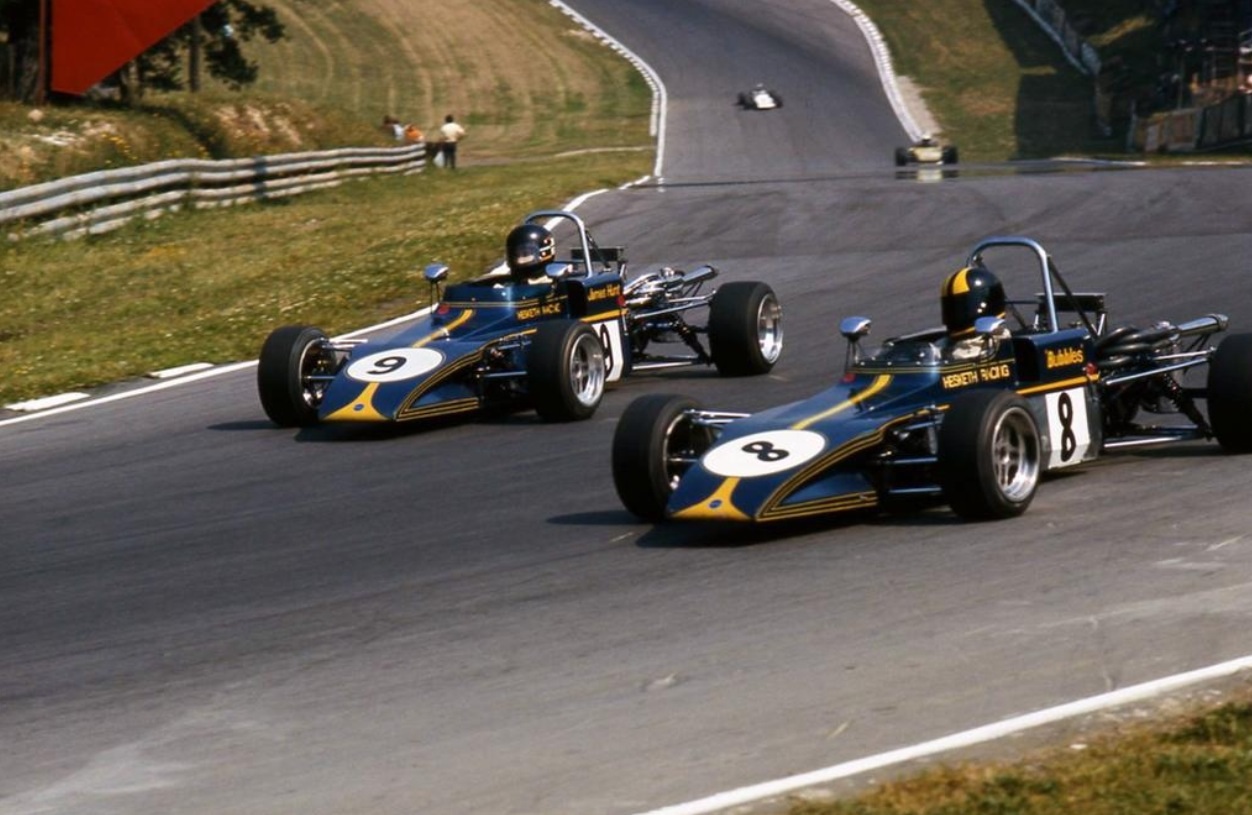
Team Hesketh Dastle Mk9 Ford’s, Hunt on the inside, Bubbles on the outside, Druids Hill, Brands Hatch, British GP meeting, July 1972. It’s early in qualifying, Horsley has not yet damaged his car, an even bigger accident awaits Hunt in the race- collision with Keele’s Lotus 69. Roger Williamson took the win in a GRD 372 Ford. Dastle were built by Geoff Rumble- orthodox monocoque, outboard suspension, Mk9 Hewland box- cars held back by budgets, insufficient testing and ordinary engines (Dent)
Hunt first raced a Hesketh Dastle at Silverstone on 11 June, it was memorable as Hesketh recounts in Donaldson’s book. ‘The first race I saw him drive for me was in the wet at Silverstone. He actually took the lead, which we had never done before, indeed we’d never even been near the front of the grid. But when he was leading it was backwards- because he’d spun. He must have travelled about 40 yards in this way- then crashed into the pitwall right in front of me, which I wasn’t impressed by’.
James raced the car at Thruxton on 18 June to 10th and then had an even worse accident than at Silverstone which destroyed his car during the British GP support event at Brands Hatch on 14/15 July. Bubbles car was damaged in a qualifying prang with another racer and then Hunt had an accident which could have killed him. He was closely following another car which spun as a result of a suddenly deflating tyre, Hunt spun his car to avoid it, made contact with it and the Dastle was launched skywards, completing some mid-air aerobatics then landed, upside down astride the barrier on one side of the circuit- the engine and gearbox on the other side of the track.
Hunt was uninjured in the accident, the situation worsened when the Mini he was driving had a head on collision with a Volvo which was being driven on the wrong side of the road, on the way home from the circuit. ‘…bloodied but unbowed, James, who treated himself with emergency first aid in the form of a pint of beer from a nearby pub, was carted off to hospital…In an effort to cheer him up, some of his F3 mates procured a female ‘specialist’ to administer to the needs of the wounded driver in his hospital bed. When a shocked matron entered the room and discovered James, again with a pint of beer in his hand, and the lady engaged in a private therapy session he was sent packing for his flagrant misuse of visiting hour privileges’- I had forgotten just how amusing the Donaldson book is.
It was effectively the end of Hesketh’s F3 team. Hunt was 35th in his final race in a cobbled together Dastle at Mallory Park on 25 July.
Hunt, March 712M Ford ahead of Lauda, works March 722 Ford at Oulton Park in the final round of the British F2 Championship on 16 September 1972. Hunt finished a splendid 3rd behind Peterson and Lauda in the works March 722’s- and having diced with Ronnie in the latter stages of the race. Impressive run in the Brian Hart tweaked 1790cc BDA engined year old March (unattributed)
The year looks fairly shitful at this point does it not!? The ‘Hunt The Shunt’ epithet seemed an apt one.
Then Hunt and Hesketh doubled their bets, with a couple of damaged Dastles in his garage. Hunt had had enough of four years in F3, he decided it was time to go F2, but to do so there was the small matter of a car, engine and all the other bits and pieces necessary.
Hunt and Chris Marshall obtained the loan of an F2 March 712M for the rest of the year after threatening legal action against March for breach of Hunt’s contract. Max Mosely conceded the potential liability and was quick to offer a car Hunt knew was sitting in March’s Bicester factory. From Max’ perspective to give them a car for the balance of the season to mollify the pair of vexatious litigants was smart. And who knows, they may do well! The Ford BDA engine fitted to the car was Hesketh’s. Wisely, or luckily it was a 1790cc unit, those who ran the BDA at close to 2 litres that year had plenty of engine problems, their simply was not enough meat in Fords cast iron ‘711M’ block to run the bore size needed to get to the F2 class capacity limit. The plan was to contest the remaining rounds of the European F2 Championship, that year won by Mike Hailwood in a Surtees TS10 Ford BDA.
At that point Hunt showed what he could do- and in races of longer duration. It is almost as though James knew ‘It Was Now Or Never’- his reputation was shot and the chances of another Alexander Hesketh coming his way were Zero.
The first event contested was close to home, the ‘Rothmans 50000’ Formula Libre race at Brands Hatch. He was 5th , having qualified his March as the second quickest F2 car, in a great drive in his year old, down on power March amongst F1, F2 and F5000 cars. Emerson Fittipaldi won in a Lotus 72D Ford, the 2500 pounds of prize money was a valuable addition to the teams kitty.
Team Hesketh then headed off to the Salzburgring where he was 19th and non-classified, the team returned to the UK for a John Player round, the final of the British F2 Championship at Oulton Park where he was 3rd, from grid 2, the race won by Ronnie Peterson’s works March 722 with Niki Lauda’s similar car in 2nd. Again, a great performance.in a stellar field that included Hill, Surtees, Scheckter, Schenken, Roger Williamson all in works or very professional teams. Amongst the first to congratulate James were his erstwhile March teammates Peterson and Lauda who ‘…were not surprised at the gritty performance of their former F3 rival…’ Hunt having a great dice with Ronnie in the races final stages.
At the end of the season the team took the March to Brazil to contest the 3 races at Interlagos in October and November with Hunt again finishing strongly in 5th and 4th places, missing the second race having crashed in the pre-event warmup. The races were won by Emerson Fittipald’s Lotus 69 Ford BDF and Mike Hailwood’s Surtees TS10 Ford BDA.
For Hunt, the season started and ended with promise. The bit in the middle was rather ugly! He was lucky to meet Hesketh but did brilliantly, with Hesketh, Horsley when he adopted the team management role and the mechanics in knuckling down and delivering well in a good, albeit year old car. His ability to deliver consistent speed in the company of very talented racers, some of them ‘graded drivers’ over distances longer than 10 lap screamers was demonstrated between August and November 1972. One of the things great drivers have in common is towering self-belief. What Hunt achieved in that short space of time was wonderful mind management. He simply put all of the dramas of the year behind him and delivered. Not once, but continuously.
Donaldson wrote of Hunt’s determination ‘…he was so accustomed to setbacks he used them as inspiration. Indeed he thrived on adversarial situations to the point that if they didn’t exist it sometimes seemed he went out of his way to create them, then employed the Hunt theory of reverse psychology to turn negatives into positives’. Hunt responded ‘I’m a great fatalist. Whenever I think I’m going to achieve something, it turns out that I don’t. I always have to “negative think” to get the best out of myself.’ Sportsman’s mind management is all important. However he did it, Hunt’s ability to mentally apply himself in positions of extraordinary adversity and stress was exceptional.
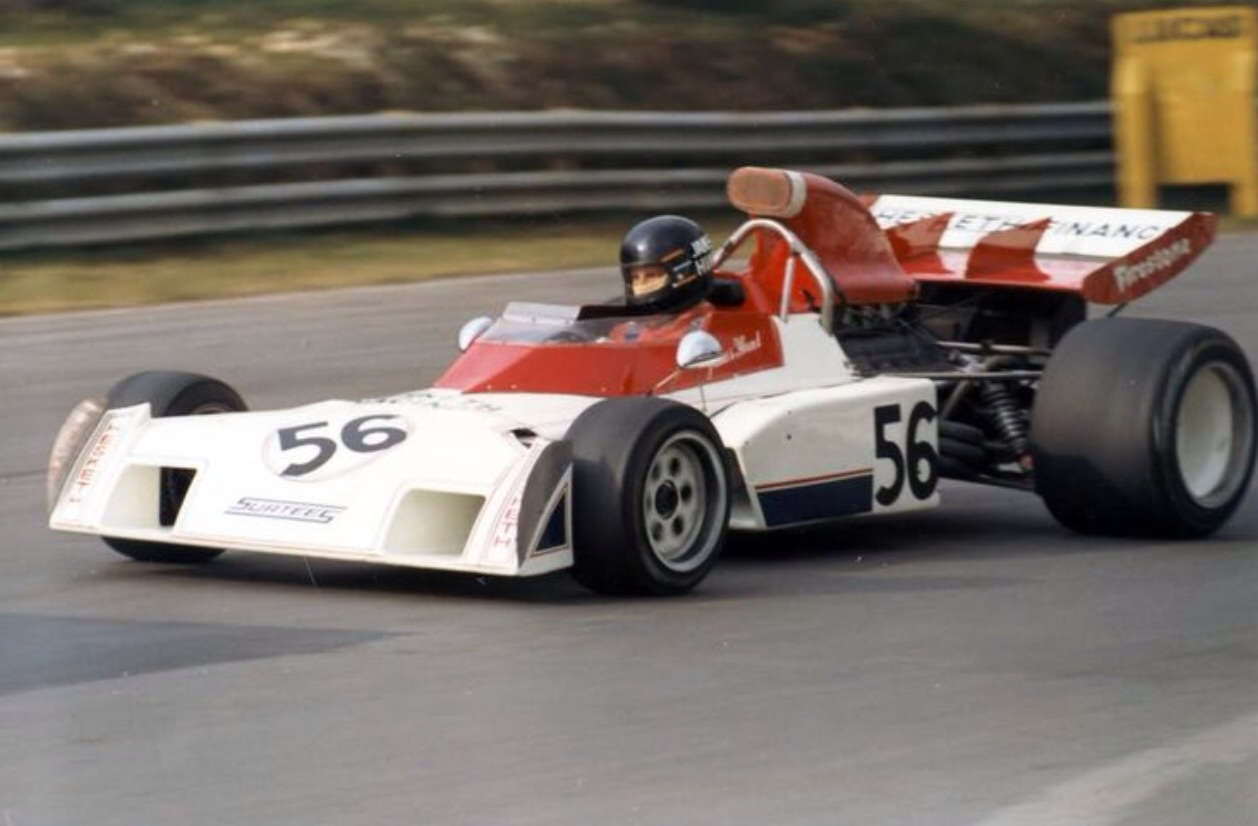
Euro F2 Championship round 1 at Mallory Park on 11 March 1973. The Hesketh Surtees TS15 Ford at rest. Hunt 15th in the race won by Jarier, March 732 BMW (unattributed)
Given Hunt’s performances it was easy for Hesketh to decide to continue with him. Off the strength of the Surtees marque’s showing in 1972 Hesketh ordered a new F2 TS15 to mount a serious European F2 Championship campaign for 1973. It was a good car but the March 732 BMW M12 combination started a period of domination that year. As to Hunt’s early season performances; he raced the Surtees at Mallory, Hockenheim, Thruxton, the Nurburgring and the Pau GP for 15th, DNS with fuel metering unit problems, 10th, DNF tyres and wrote off the TS15 at Pau! All of the sudden its ‘hell in a hand basket’ again.
F1/F5000 Brands ‘Race of Champions’ 18 March 1973. Hunt in the leased Surtees TS9 Ford, 3rd from Q13. Peter Gethin Chevron B24 Chev F5000 won from Hulme, McLaren M23 Ford (unattributed)
So what does Hesketh do?, doubles up again of course and purchases a new F1 March 731 Ford off the back of Hunts performance in a 2 year old F1 Surtees TS9 Ford in the 18 March 1973 Brands ‘Race of Champions’, and that my friends is where the story really starts.
Just look at what happened between Hunt and McInerney posing out front of the Bicester factory on 1 March 1972, and Hunt finishing in front of most of the works teams in a 2 year old Surtees at Brands on 18 March 1973 only 12 months later.
Incredible, unbelievable. Some fellows peak before F1, Hunt really only took it all seriously, the racing anyway, when he commenced in Grands Prix. What was priceless was how easy the Hesketh boys made it all look in 1973 with their off the peg car being carefully developed by Harvey Postlethwaite and driven within an inch of its life by Hunt J…
The Hesketh, Postlethwaite modified March 731 Ford during the 1973 British GP at Silverstone. Hunt 4th from grid 11- attacked Peterson for 2nd till his tyres faded- the grid was schredded by 10 cars due to Jody Scheckter’s famous end of lap 1 crash. Revson’s McLaren M23 Ford won (Schlegelmilch)
Postcript: Brendan McInerney
What about Brendan though? Born in Dublin on 30 November 1945, he had his own team, the modestly named!, as he put it ‘Race Cars International’ which ran his, and customer cars. He raced in FF, F3, F2, F5000 and Sportscars where he achieved his best results.
Amidst the tough 1972 F3 season he linked up with good friend Trevor Thwaites racing an Intertech Steering Wheels backed 2 litre Chevron B19/21 to 8th in the Brands 1000Km, 9th at the Osterreichring and Spa 1000 Km events, great results in amongst the 3 litre factory entered missiles of Ferrari, Matra, Lola, Mirage et al. Finally they had a splendid 5th in the Jarama 2 Hours 2 litre championship round and non-qualified at the Nurburgring 1000Km.
Confidence intact, he upped the ante and raced in most of the 1973 European F2 Championship in a ‘GRS International’ GRD 273 Ford BDA. It was a tough year racing in a field of great depth. He DNQ at Hockenheim, Pau, and Mantorp Park and had DNF at Karlskoga and Albi. He was 20th at the Nurburgring, 10th at Rouen, 12th at Monza and 6th at the Norisring in a race of attrition, finally he was non-classified at Nivelles. A March 732 BMW was the car to have in 1973, none of the GRD drivers had strong results in 1973.
In ’73 the Thwaites/McInerney duo again contested some endurance championship events finishing 12th in a Chevron B21/23 at the Vallelunga 6 Hour and had a DNF at the Nurburgring 1000Km. Late in the year Brendan also had a steer of Thwaites Lola T330 Chev F5000 in some European Championship rounds at Brands/Snetterton/Brands without showing great competitiveness.
Into 1974, the last of his racing career, McInerney contested some late season European F5000 championship rounds, again in the Thwaites T330 and getting more out of the year old car at Thruxton/Brands/Snetterton and Mallory Park for 16/12/11th and 9th placed finishes.
Brendan became a professional backgammon player after motor racing in between stints of helping with his family’s Dublin based contracting business, he also worked in real estate whilst living in England. He now lives in Charlotte, North Carolina
Bibliography…
‘The Story of March: Four Guys and a Telephone’ Mike Lawrence, ‘James Hunt: The Biography’ Gerard Donaldson, GP Encyclopaedia, F2 Index, oldracingcars.com
Photo Credits…
Getty Images, Stuart Dent, Rainer Schlegelmilch, Mirrorpix
Tailpiece: Its not as though the hot and cold running babes started in Hunt’s GP years but no doubt the thru-put went up a couple of gears then. Hunt was livin’ the life of every schoolboys dream in 1973. He was certainly living mine…
The winning Tony Rolt/Duncan Hamilton Jaguar C Type ahead of the Phil Walters/ John Fitch Cunningham C5R Chrysler and Alberto Ascari/Gigi Villoresi Ferrari 375MM at Le Mans 13/14 June 1953…
Early in the race it was clear the Jaguar C Types, Ferrari’s 340/375MM and Alfa Romeo 6C/3000CM were the cars in the hunt for outright victory, the Lancia D20’s and Talbot T26GS were outclassed.
Moss, the initial hare from the start in a works C Type had a misfire in his 3441cc DOHC straight-six, which set in after 20 laps putting him back to 21st and out of contention. Worse for Hawthorn and Farina was disqualification of their 4.1 litre V12 340MM Ferrari after brake fluid was added before the requisite 28 laps were completed. Fangio’s Alfa was out with engine dramas in his 3.5 litre, DOHC straight-six, the car shared with his countryman, Onofre Marimon, at about 6pm
As darkness fell the Ferrari/Jag battle intensified between the Ascari/Villoresi 375MM and Rolt/Hamilton C Type with the Alfas not too far back. Rolt and Hamilton led, the best placed Fazz was hampered by a sticking clutch and a thirst for water.
At dawn the same two cars led, with Moss up to 3rd in the car he shared with Peter Walker, as the mist cleared they still led. By 9am the lead Ferrari had dropped back to 5th, retiring at 11am. The works Paolo Marzotto/Giannino Marzotto Ferrari 340MM challenged the lead Jags and Cunningham finishing 5th behind the winning car driven to the finish by Duncan Hamilton with Moss/Walker 4 laps back with the Phil Walters John Fitch Cunningham C5-R Chrysler 5.4 litre V8 a lap further adrift in 3rd. The third works Jag C Type of Peter Whitehead and Ian Stewart was another 2 laps back having driven a pace to finish throughout.
Tony Rolt and Duncan Hamilton chew the fat, Silverstone 6 May 1955, the car is Rolt’s works D Type ‘XKC 403’…
Love this carefully posed shot, perhaps used to promote the meeting the following day. Its practice for the 7 May ‘Silverstone International’ sportscar race, a 190Km event won by Reg Parnell from Roy Salvadori, both aboard works Aston DB3S’, then came Rolt, Hamilton and Mike Hawthorn in works D Types. Mike started from pole and set the fastest lap.
Nick Heidfeld thrilling spectators in qualifying with a touch of what was a drivers stock in trade into the early seventies, oversteer which thrilled the eye if not always the stopwatch…
He was brought in to replace Pedro de la Rosa, qualified 15th and retired after a collision on lap 36 in the race won by Fernando Alonso’s Ferrari F10.
Gavin Youl in the new MRD Ford making a sensational championship debut in Ron Tauranac and Jack Brabham’s Formula Junior at Goodwood on 19 August 1961…
The young Taswegian arrived in England with sportscar and touring car experience in Australia and made a huge impact in finishing fourth in his heat, and second in the final of the BARC FJ Championship in what was only his fourth outing in single-seaters.
Alan Rees won the race in a Lotus 20 Ford. To give perspective on the level of competition, there were 19 non-qualifiers and a field of 24, which included future champions Mike Spence, Richard Attwood, David Piper, John Rhodes, Frank Gardner and Hugh Dibley.
Gavin made a huge splash, and so too did the nascent ‘Brabham’ marque. The MRD was their first car; the established production racing car paradigm was given a shake that day. Arguably, Brabham was the most consistent, competitive, cost-effective customer proposition for most of the 1960s and early 1970s in FJ, F3, F2 and F1.
The story of Jack Brabham and Ron Tauranac’s partnership in forming Motor Racing Developments Ltd in England, the company that built Brabham cars, is well known.
So too is the decision by the two partners to change the name of the cars from ‘MRD’ to Brabham upon the advice of prominent Paris-based Swiss journalist Jabby Crombac. He told Jack that MRD was pronounced ‘merde’ in French, the literal translation of which is ‘shit’! And Brabham’s were very rarely, if ever, shit cars!
The MRD was retrospectively given the model name BT1. There was only one built, thankfully, the car is still in Australia, where it has raced all of its life, other than the seven race meetings in England that Youl contested between late July and late September 1961.
It’s intriguing to contemplate the look on Frank Gardner’s face at the speed of the MRD at Goodwood, as the multi-talented Aussie, who raced a Jim Russell Race Drivers School Lotus 20 that year, was one of a small team that built Tauranac’s new car, being peddled so quickly by novice Youl!
Gavin was sold the car by Ron during a Brabham plane trip. Jack took several friends to see the Tourist Trophy bike races at the Isle of Man. It appears there was no great process of choosing the driver of their first car; the commercial imperative was someone who could pay for it! Mind you, no doubt Gavin was aboard the plane with that commercial end in mind as well as his potential as a driver.
Ron Tauranac’s MRD Ford Holbay was a pretty, effective, competitive car. RT had built numerous Ralts in Australia before the design and build of the MRD, which was his first ‘water-cooled engine’ design! The ‘Brabham’ was competitive from the start, here at Goodwood in Youl’s hands, very much indicative of the amazing run of strong, reliable, fast cars built through until Ron’s sale of the MRD business to Bernie Ecclestone at the end of the 1971 F1 season (Getty)
In the MRD’s initial outings (see listing below), not much notice had been taken of it, their were plenty of specials in FJ at the time. But at Goodwood, a circuit on which he had not raced before, Youl caused a sensation by popping the car on pole for his heat, 0.8 seconds under the lap record. Tauranac recalls that things were looking good, but then the car caught fire, RT rebuilt it in time for the race on the Bank Holiday Monday. Youl was fourth in his heat; it may have been higher, but he overcooked it on a corner, but in the final kept it all together to finish second to Rees, then very much a rising star.
Jack’s connection to the car had been kept very secret. The MRD was built in a room at the back of a garage on the Esher bypass with all of the specialist purchases needed to construct the car being made very discretely. The Goodwood meeting was a national event, the FJ events were supports to the RAC Tourist Trophy sportscar race with plenty of press presence. ‘The paddock buzzed with speculation and some people were adding two and two to make four’ wrote Mike Lawrence in ‘The Ron Tauranac Story’. Soon of course the connection was known as were Jack’s plans to leave Cooper at the years end.
Tauranac arrived in the UK in April 1960, whilst he occupied himself with Climax-engined Triumph Heralds and other projects for Jack Brabham Motors in Chessington, his main task was to design the MRD in the bedroom of the flat the Tauranacs rented above a shop in Surbiton.
Sensibly, the car was a conventional multi-tubular spaceframe chassis design fitted with an attractive, fully enveloping aluminium body. Suspension at the front comprised a single upper link and Y-shaped radius rods and lower wishbone with coil spring/Armstrong dampers. At the rear broad based upper wishbones, lower links and twin radius rods were used again with coil spring/dampers. The car was reputedly the first to be fitted with adjustable roll bars.
Alford and Alder uprights were fitted at the front, to which were attached 13-inch Brabham alloy wheels, unique to BT1, front and rear. Rear uprights were cast magnesium. The car used 9inch drum brakes at the front and inboard-mounted 8-inch drums at the rear.
The gearbox was a modified VW Beetle 4-speed with Jack Knight cutting gears to give RT the ratios he wanted. The steering rack was also made by Jack Knight to a pattern and drawings RT brought to England from Australia. A Morris Oxford pinion was used with a specially cut rack. Initially, a 1000cc Ford engine was fitted with an 1100cc Holbay Ford used from the Goodwood meeting.
Jack was still racing for Cooper as noted above, but he found time to help build the car together with Ron, Frank and Peter Wilkins, who had assisted Tauranac build the chassis frames of his ‘first series’ Ralts in Australia and was asked to come over to the UK to help build the MRD.
Gavin Youl is contesting the FJ race in the MRD at the Warwick Farm international meeting on February 4 1962. He was 3rd behind Leo Geoghegan’s Lotus 22 Ford and Glynn Scott’s Lotus 20 Ford (John Ellacott)
In October 1961, the MRD was shipped to Australia, where Gavin raced it to some success. He contested some of the support events for that year’s international meetings in the summer, finishing second at Lakeside, 3rd at Warwick Farm and then winning the FJ race at the 1962 Longford international meeting. There, the little car was timed at 132mph on the ‘Flying Mile’. He took a win at Calder in late February and then made the long trip to New South Wales in March- he won the NSW FJ Championship at Catalina Park, beating Leo Geoghegan’s Lotus 20 Ford. Gavin then returned to the UK to race a new BT2 FJ in selected British and European events.
Victorian Wally Mitchell was the lucky purchaser of the MRD which over the years passed through many owners hands. The car is a much admired part of the local historic scene and together with Jack’s 1966 F1 championship winning BT19 Repco would be the most significant Brabham in Oz.
Works Brabham FJ Campaign in 1962…
The factory-assisted drivers in 1962 were Gardner and Youl, with Frank initially racing BT2 ‘FJ-3-62’, a car he built. When Gavin arrived in the UK, he raced this car with Frank racing ‘FJ-8-62’; both of these cars went to Australia after the initial season of racing in the UK/Europe.
Gavin’s campaign was set back from the start after a testing accident at Brands Hatch made a mess of both the car and his collarbone, which was broken. He recovered whilst the car was being repaired.
The BT2’s differed from MRD ‘FJ-1-61’ in that outboard disc bakes were used front and rear, and Specialised Mouldings built fibreglass bodies replaced the one-off ally body of MRD. A Hewland Mk5 gearbox replaced Ron’s modified VW unit, whilst noting the Maidenhead-built ‘box also used a VW case.
11 BT2’s were built, the first two or three by Gardner and Wilkins, the balance by Buckler Cars. Buckler is credited in the Tauranac and Brabham biographies as the constructor of the sole MRD frame, to Tauranac’s drawings, a claim denied by Frank Gardner. In conversations with Australian Brabham owner/historian Denis Lupton, Gardner said the MRD frame was built by Gardner, Wilkins, Tauranac and Brabham.
Buckler built at least five BT2 chassis. Of course, Arch Motors, the unsung engineering concern, was soon thereafter to become the builder of both Brabham and Ralt ‘production chassis’, in addition to their many other clients!
Peter Arundell’s works Lotus 22 Ford leads Youl’s Brabham BT2 Ford and Denny Hulme’s Cooper T59 BMC through the Nouveau Monde hairpin during the 8 July 1962 Rouen GP for FJ. They were 1st, 12th and 10th overall, with Youl crashing in the first heat; he was ninth in the second heat (Sutton)
The BT2 proved to be a competitive car but the FJ combination to beat in 1962 was Peter Arundell in his works Lotus 22 Ford Cosworth. BMC engines were not prominent and the Holbays used by Brabhams were not the ‘ducks guts’ either. When Gardner and Youl’s cars finished they were often the best of the Holbays, that is, best of the non-Cosworth engined cars.
Youl’s results are in the table below. His first meeting after recovery from his injuries was at Silverstone in May, his last at Albi in September. His best results were a pair of 5ths at Albi and Goodwood, the latter event was the BARC Express and Star British Championship, where he was the best-placed Holbay car.
Gardner’s seventh on the Monaco FJ grid was indicative of his place (that is fast!) in the pantheon of FJ drivers that year, a race he failed to finish with clutch failure. Arundell won what is still the most prestigious international junior event from Mike Spence and Bob Anderson, all three aboard Lotus 22 Ford Cosworths. It would have been very interesting to have seen how the Gardner/Youl combo would have gone with Cosworths behind their shoulders in ’62. Right up there for sure.
Gavin shipped his car to Oz after the European races he had competed in with Gardner’s ‘FJ-8-62’ accompanying Frank back to Australia at the end of the year. The lanky Sydneysider raced the car in two of the Formula Libre Australian Internationals in early 1963- Lakeside and Longford, with the car being sold to Len Deaton later in 1963.
The history of the 11 BT2 chassis built for those interested can be seen, in all of its intricate glory, on oldracingcars.com and Ten Tenths, just Google away.
John Youl, with his engineer, Geoff Smedley, beside their ex-works/Jack Brabham F1 Cooper T55 Coventry Climax FPF on the Longford grid before the ‘South Pacific Trophy’ on 2 March 1964. He was fifth in the race behind Graham Hill, Bruce McLaren, Frank Matich and Bib Stillwell in his 3-year-old car (Smedley)
The Youl Family Story…
The story of Gavin and his older brother John, a racer of Cooper T51/55 Coventry Climax-engined cars (second in the 1962 AGP to Bruce McLaren at Caversham and twice second in the Gold Star, the Australian Drivers Championship), is an interesting one for another time. So too is the history of the family, the patriarch of which was an early clergyman in Tasmania and with a land grant made on the South Esk River in 1818, commenced a very successful grazing concern which continues to this day.
Unfortunately, Gavin’s promise, his raw speed, was never realised. He raced the BT2 at a few meetings at home, including the 1962 Australian FJ Championship, at Catalina Park in late October. He was second to Frank Matich’s works Elfin Ford with Leo Geoghegan’s Lotus 22 Ford 3rd, but decided to retire to focus on the family grazing properties and his other interests, which included aviation; both he and John were talented pilots.
The apocryphal Youl/Brabham aviation story involves Gavin being asked by Jack to deliver his single-engined Cessna 180 from the UK to a farmer in Tasmania to make way for the Cessna 310 twin to which he was upgrading. Youl needed to get home for Christmas 1961/2, so too did Eoin Young, the renowned Kiwi racing journalist and key figure in Bruce McLaren Racing in its early days, as well as Roger Tregaskis, a mate of Youls.
Gavin was the pilot, Roger was in the co-pilot’s seat and could steer if necessary, and Young sat in the back with maps, the five-man liferaft and forty pounds of emergency rations. To eliminate customs difficulties, we were given the honorary ranks of co-pilot and navigator.’ So off they set with Gavin’s intention to fly over as much land as possible, keeping sea crossings to a minimum. ‘The Timor Sea between Indonesia and Australia was our biggest worry. We comforted ourselves in the fact that, as a high-winged tail-dragger, the Cessna could be landed on the Ocean without tipping over, Young wrote.
Eoin was later to admit that he was better not to know that the plane was not a new one as he thought, but rather a ’54 model which Jack bought from Lance Reventlow of Scarab fame. All was well on this adventure, though, the 7.7-litre, 225bhp, 4 cylinder Continental-engined aircraft didn’t miss a beat on the month-long trip- 98 flying hours, 30 stops in 18 countries, 13000 miles in total at an average speed of 151 mph, chewing through 950 gallons of Shell fuel to do so. What an amazing experience- last word to Eoin Young.
‘It wasn’t until we delivered the plane to its eager new owner that we discovered it had been refused a Certificate of Airworthiness because there was so much corrosion in the fuselage that the wings were about to fall off!’ Boys Own Adventures and exploits indeed.
The Youls were never far from the sport, indeed they were major supporters. Symmons Plains circuit is built on land they owned. Very sadly, Gavin, an important figure in the earliest Motor Racing Developments years, died in 1992 at 45, way too young, after a brief battle with a very aggressive cancer.
1962 Australian FJ Championship grid before the off at catalina park, Katoomba on 28 October 1962. #8 Leo Geoghegan Lotus 22 Ford, #2 Youl Brabham BT2 Ford and #4 Frank Matich Elfin FJ Ford. #16 is Clive Nolan Lotus 20 Ford. Matich won from Youl and Geoghegan, Nolan was 5th (Ed Holly)
Etcetera: G Youl European Race Results…
1961 British FJ Results: Gavin Youl MRD Holbay/ Brabham BT1. I have also listed the winner of each race
23/7/61 Mallory 2nd. Jack Pearce won in a Lotus 20 Ford
29/7/61 Silverstone 5th , holed fuel tank, pitted to top up with fuel. Mike Spence Emeryson Mk2 Ford
7/8/61 Aintree 17th, forced out of final with blown head gasket. Peter Proctor Lotus 18 Ford
19/8/61 Goodwood 2nd, great effort of 4th in the heat, team had a pit fire during practice. Ian Rees Lotus 20 Ford
2/9/61 Crystal Palace DNQ. Trevor Taylor Lotus 20 Ford
23/9/61 Oulton Park 13th. Tony Maggs Cooper T56 BMC
30/9/61 Snetterton 31st. Mike Parkes Gemini Mk3A Ford
1962 British and European FJ Results: Gavin Youl Brabham BT2 Holbay
12/5/62 Silverstone DNF oil pressure. Peter Arundell Lotus 22 Ford
1/7/62 Reims DNF lap 1. Arundell as above
8/7/62 Rouen 12th. Arundell as above
14/7/62 Silverstone 12th. John Fenning Lotus 20 Ford
6/8/62 Brands 7th. Tony Maggs Cooper T59 BMC
18/8/62 Goodwood 5th. Arundell as above
21/9/62 Zandvoort DNF. Arundell as above
9/9/62 Albi 5th. Arundell as above
Random but sorta-1960s related; Aussies Abroad in Europe…
I was flicking through the ‘F2 Index’ database to research the FJ/F3 race results of David Walker (article coming together very slowly) and Gavin Youl, and it occurred to me just how many Australians had a crack at England/Europe in the 1960’s.
It was a long way away then, 12000 miles- it still is the same distance I expect! But the cost and means of making the journey, then mainly by ship, as flying was so expensive, made it seem further and harder than now. What follows is a quick list of guys, tracking them through the Junior Formulae. I don’t pretend it’s complete, do let me know if there are fellows I have missed. The period researched is 1960-1970 in the UK, where the racing was outside the UK; I have clearly stated so.
1960 FJ
Steve Ouvaroff Lotus 18 Ford, Frank Gardner Cooper Ford
1961 FJ
Frank Gardner JRRDS Lotus 18 Ford- FG famously straightened cars at the Jim Russell School and was allowed to race them on weekends! Gavin Youl works MRD Ford
1962 FJ
Frank Gardner and Gavin Youl works Brabham BT2 Ford, Steve Ouvaroff Alexis Mk4 Ford, John Ampt Ausper T4 Ford- now there is a story to be written- about Geelong racer, Tom Hawkes’ Ausper project
1963 FJ
Paul Hawkins and Frank Gardner Brabham BT6 Ford- both guys’ careers took off into F1 within 12 months, Gardner raced big ‘Tasman’ 2.5 litre cars in the ’63 Australian summer as well as BT2, a go home and race summer trend he continued until his permanent return to Australia during 1974. John Ampt Alexis Mk5 Ford, Martin Davies Lotus 20 Ford
1964 F3
Martin Davies Lotus 20 Ford (running top 10)
1965 F3
Jim Sullivan Brabham BT15 Ford (he won some kind of Driver to Europe award didn’t he?) (ran top 10)
1966 F3
Jim Sullivan and Wal Donnelly Brabham BT18 Ford, Dave Walker Brabham BT10 Ford- all three ran under the ‘Team Promecom’ banner, racing in Europe
1967 F3
Tim Schenken Lotus 22 Ford- made an immediate splash in this self-prepared ‘ole clunker, having learned many of the Pommie circuits in 1966 aboard a Ford Anglia twin-cam.
David Walker Merlyn Mk10 Ford, with his racing on the road ‘gypsy existence’ in Europe, going from race to race, living on start and prize money. Kurt Keller, Barry Collerson and Wal Donnelly all raced Merlyn Mk10 Fords (Donnelly occasionally his BT18) throughout Europe that summer, no doubt offering each other lots of support. All four were Sydneysiders, mind you, they did not all do the same meetings by the look of it
1968 FF&F3
Tim Schenken won both the British FF and F3 championships in the same year, a feat never achieved before or since, and took the Grovewood Award. He raced a Merlyn and a Chevron B9 Ford, respectively.
Walker also ‘stepped back’ to FF that season to successfully re-launch his career. John Gillmeister Lotus 32 Ford- F3, Wal Donnelly Brabham BT18 & BT21 Ford F3 in Europe
1969 FF&F3
Tim Schenken Brabham BT28 Ford F3, John Gillmeister Lotus 35 Ford.
Dave Walker won the Les Leston FF C’ship in a Lotus 61 and joined the works Lotus F3 Team later in the season- Lotus 59 Ford and was immediately in the leading group (with his dominant Lotus 69 F3 season in 1971, the same year he made his F1 debut)
Jim Hardman raced a Brabham BT21B Ford in F3. He returned to Oz in 1975, after a stint running the Bob Jane/Frank Gardner Racing Drivers School at Calder, he prepared cars for others, designed and built 3 ANF2 cars- one of these, Hardman JH2 Fords, won the ANF2 title in Richard Davison’s hands. He prepared championship-winning cars for several drivers/team owners and is still in the business in outer Melbourne.
Buzz Buzaglo Merlyn Mk11 FF, I wrote a feature about Buzz a while back, click on the links at the end of the article to read it.
Vern Schuppan Makon MR7 FF
1970 FF&F3
Tim Schenken broke into F1 in sad circumstances- he joined Frank Williams and raced the De Tomaso after Piers Courage’s death.
Dave Walker GLT Lotus Lotus 59 Ford- second in the BRSCC F3 C’ship, John Gillmeister Brabham BT28 Ford.
Alan Jones, a couple of races in a Lotus 41 Ford and then late in the season in a Brabham BT28 Ford running down the back at this early stage (Jones F3 breakthrough and breakout of F3 season was in 1973)
Buzz Buzaglo Merlyn Mk11 FF (Buzaglo raced in F3 in 1973/4) Vern Schuppan works Palliser FF (Vern’s ascension was in ’71 when he won the first British F Atlantic series in a Palliser and was picked up by BRM in F1)
As to others, Aussie touring car ace Brian Muir carved a great career for himself in the 1960s and 1970s, racing tourers and occasionally sports-racers in the UK and Europe.
Speaking of ‘Taxis’, Shepparton’s Bryan Thomson sold his truck business and took his ex-Beechey Mustang to the UK and raced it for two seasons in the mid-sixties before coming back to Oz and being a force in racing as either a driver or entrant for a couple of decades.
John Raeburn raced a Ford GT40 and a Porsche in endurance events in 1966-8, with Tim Schenken an occasional co-driver in the longer events.
As I say, it’s a quickie list- let me know who I have forgotten in that 1960-1970 period, it would be great to assemble a complete list. I’ll attack other decades another time after the going ‘cross-eyed’ exercise in creating the list above abates.
I’m also interested in what became of each of these guys and am keen to hear from any of you who can help flesh out the stories other than for the ‘stars’ of course, the histories of whom are well known.
Bibliography…
Ten Tenths Forum especially Denis Lupton, Ron Tauranac website, F2 Index, ‘Brabham, Ralt, Honda: The Ron Tauranac Story’ Mike Lawrence, ‘The Jack Brabham Story’ Jack Brabham with Doug Nye, Eoin Young article in MotorSport August 2011
Photo Credits…
Getty Images, John Ellacott, Sutton Photographics, Ed Holly Collection
Tailpiece…
(Sutton)
Beautiful portrait of 25 year old works Brabham FJ pilot, Gavin Youl at Rouen on 8 July 1962.
In a Battle of Melbourne Motor Dealers,Stan Jones struggles to keep Maybach 3 in front of Reg Hunt’s Maser A6GCM during the first lap of the 1955 Australian Grand Prix at Port Wakefield, South Australia, October 10…
The two cars were arguably Australia’s fastest special and production racing car at the time. Mind you the ‘special’ descriptor belies the tool-room quality of the Maybach series of cars in terms of both design and execution by Charlie Dean and his team at Repco Research in Melbourne. The Maserati A6GCM/250 and 250F family are members of one the greatest series of production racing cars ever built. Not that either car won this particular contest!
Jack Brabham on the way to victory, Cooper T40 Bristol (Adelaide GP)Hunt, Maserati A6GCM/250 and Jones’ Maybach 3 on the front row with Brabham and Whiteford’s Talbot-Lago T26C on the second row (Cummins Collection)
Jack Brabham returned home from his first season in Europe replete with a self-built Cooper T40 Bristol, winning the Port Wakefield race in the 2-litre, 150bhp, 1100lb, mid-engined car. Was it the first time a modern-era post-war mid-engined car won a national Grand Epreuve?
Brabham had luck that weekend in South Australia in a car which later became notorious for its unreliability. He won the race after the retirement of, or problems encountered by some of the event’s heavy-metal including Jones works-Repco 3.8-litre Maybach, Hunt’s Maser 250F engined Maserati A6GCM – A6GCM/250 to some – and another Melbourne motor-trader, Doug Whiteford’s 4.5-litre Talbot-Lago T26C.
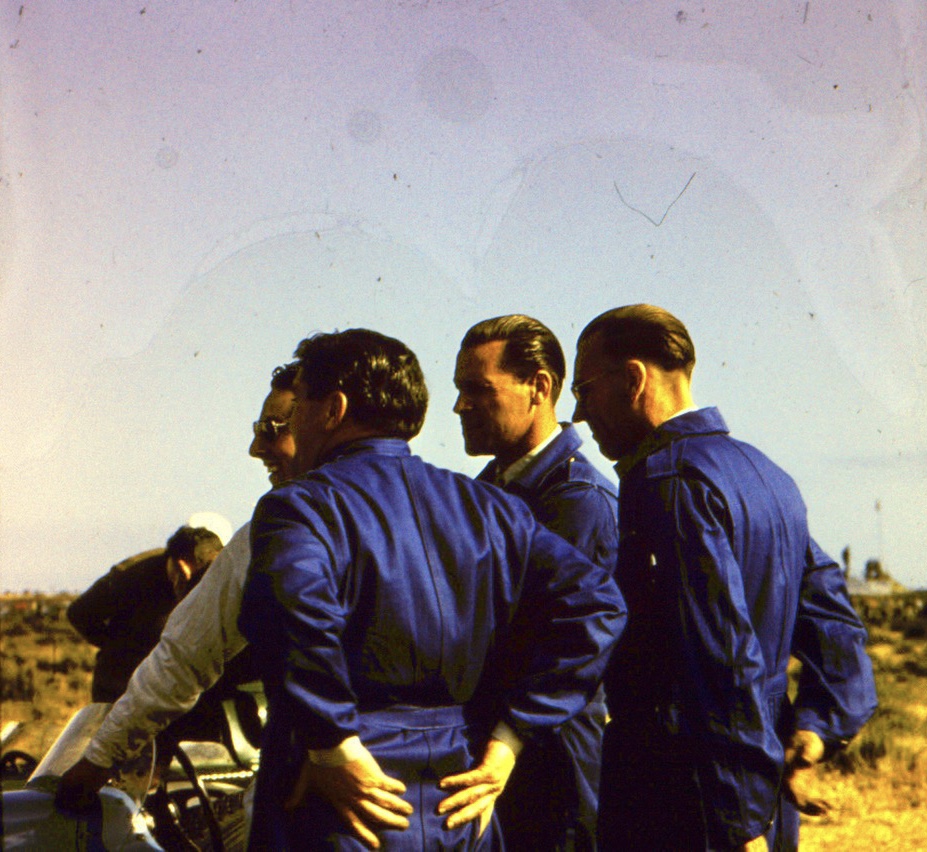
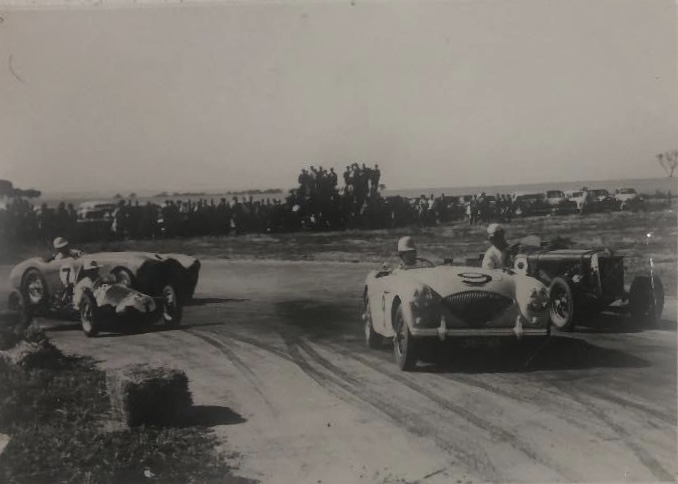
Clem Smith’s Austin Healey 100, DNF suspension being rounded up by the first and second placed cars of Brabham and Hunt: Cooper T40 Bristol and Maser A6GCM 2.5 (unattributed)Doug Whiteford’s (second) Talbot Lago T26C, note the three whopper SUs, on the grid in front of Greg McEwin’s Austin Healey 100. And below, in the centre with his crew before the off (JA Denniston)(JA Denniston)
Hunt and the Maser were the form combination at the time. Reg took the lead from Jones on lap one and led the race convincingly until the failure of a finger type cam follower forced the Maser onto five-cylinders, Brabham was soon past and into a lead he held for the races duration. Jones had clutch dramas, with Whiteford third, behind Hunt, in a car which raced too late after it’s initial arrival in Australia – devoid of some of the trick bits Doug paid for – shifty furriners! See here: https://primotipo.com/2022/05/04/doug-whiteford-talbot-lago-t26c-take-3/
The 80 lap, 104 mile event was the twentieth AGP and is noteworthy as the first on a purpose built circuit. Port Wakefield is 100km north of Adelaide in flattish, coastal, saltbush country. Previous AGPs were held on closed roads or airfields. ‘Wakefield, 1.3 miles in length, was used from 1953 to 1961, when Mallala, built on a disused Royal Australian Air Force airfield, became the main South Australian circuit.
(JA Denniston)
Not especially clear, but an interesting panorama with Hunts A^GCM in the foreground and a ‘cine-camera’ atop the pits. Makes you wonder if some footage is still kicking around somewhere.
(unattributed)
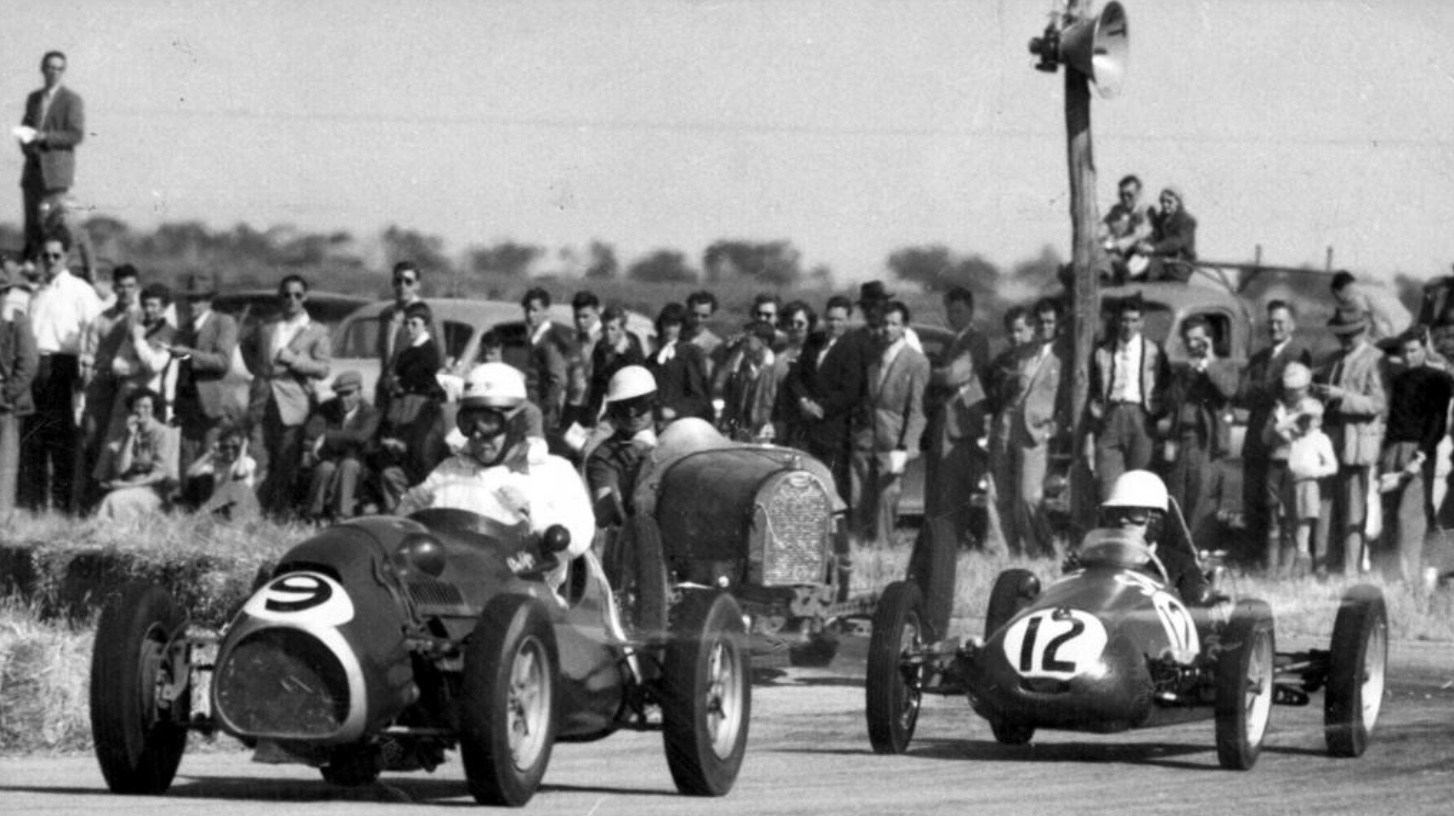
Stan Coffey, Cooper T20 Bristol from Murray Trenberth, Vincent Spl and John Cummins, Bugatti T37 Holden in one of the qualifying heats. Stan again below, this time having passed the spinning Cummins Bugatti in one of the qualifying heats. Cummo did not take the start in the GP.
(unattributed)(N Tasca Collection)
Etcetera…
(E Gobell)
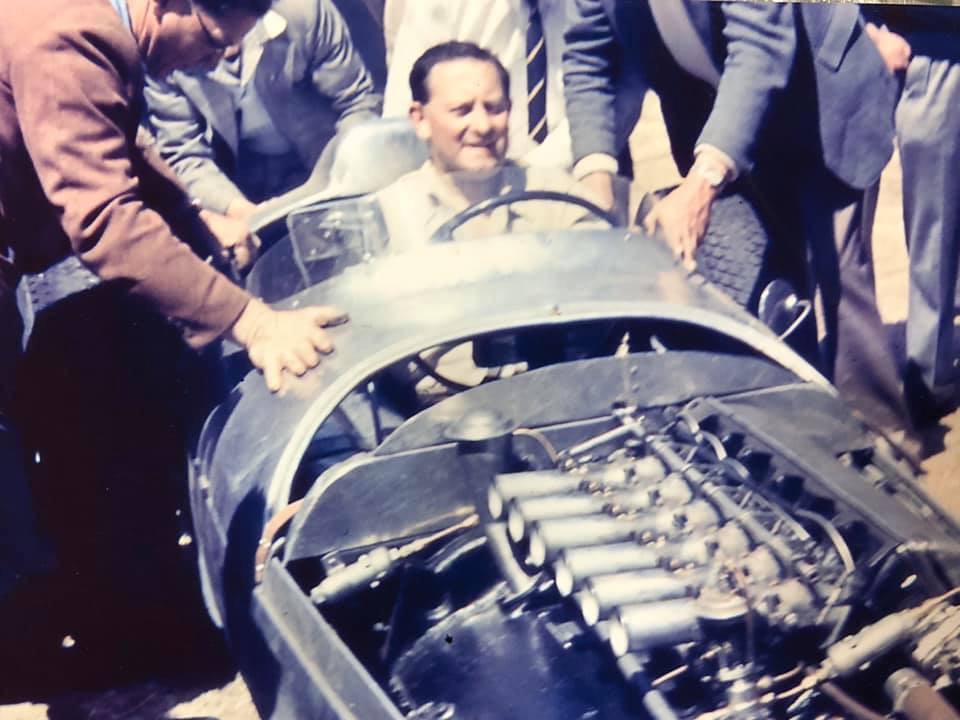
Charlie Dean beaming with pride aboard his latest creation, or rather the Repco Research team’s latest. Maybach 3 with its fuel injection system dominant atop the heavy, cast iron Maybach SOHC, two-valve 3.8-litre straight six laid-over at 65 degrees.
Greg Smith notes that the fuel injection system clearly shows the fuel rail and injectors, and that the throttle-bodies are actually single-choke 36DO2 units which were later (after the engine blew at Gnoo Blas with Stan at the wheel in early 1956) used on the Norman Wilson built Laydown Holden Special. See here: https://primotipo.com/2024/01/08/stan-jones-won-the-1954-nz-gp-70-years-ago-today/
(E Gobell)
Reg Hunt’s Maserati A6GCM above and below. This model is a 2-litre F2 car of the 1952-53 Grand Prix formula fitted with a 250F 2.5-litre SOHC, two-valve, triple Weber fed straight-six. About 240bhp at this early stage of the engine’s development. Hunt raced the car for little more than a year before progressing to a 250F in 1956, his final season in an oh-too-short elite level career. See here: https://primotipo.com/2017/12/12/hunts-gp-maser-a6gcm-2038/
(E Gobell)(JA Denniston)
Melbourne businessmen/racers/Light Car Club of Australia supremos Bill (left) and Jim Leech admire the brand new Austin Healey 100S, chassis #3905 perhaps, in the Port Wakefield paddock. Stephen Dalton advises that this car, the first 100S in Australia was driven from Sydney to the meeting by motor dealer and 1949 AGP winner, John Crouch.
(JA Denniston)
Bill Craig’s Alta Holden – 1952 chassis F2/5 ex-Peter Whitehead – (above and below), with its distinctive alloy wheels, and perhaps, BP’s Tom Stevens the onlooker. Ken Devine advises the car was later owned and driven by Murray Trenberth, Jack Ayres and David Rockford in Western Australia before being sold overseas.
(JA Denniston)
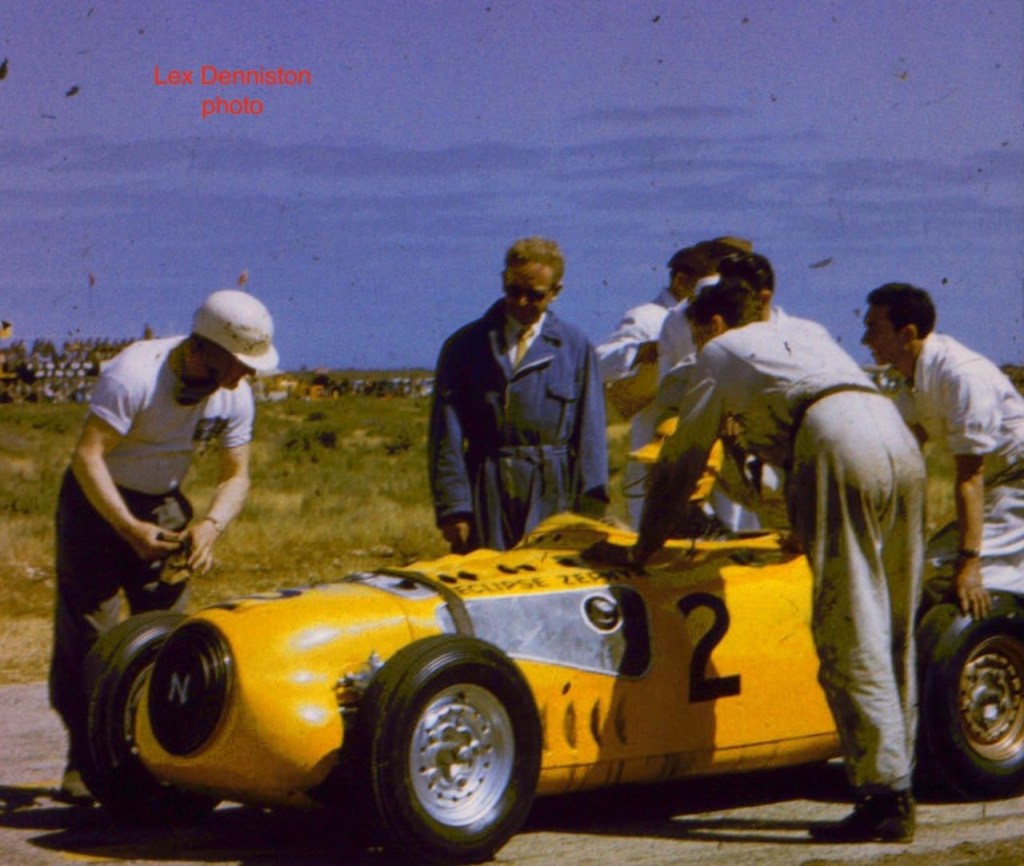
Two shots of the famous Eldred Norman built Zephyr Spl s/c. Tony Johns, “The starting grid photo shows the Zephyr alongside #8 Tom Hawkes’ Cooper T23 Bristol, probably a preliminary race.”
Credits…
State Library of Victoria, Reg Fulford Collection, Graham Howard and others ‘The 50 Year History of The Australian Grand Prix’, JA Denniston via Tony Johns, Edward Gobbel, Cummins Collection via Paul Cummins
Tailpiece…
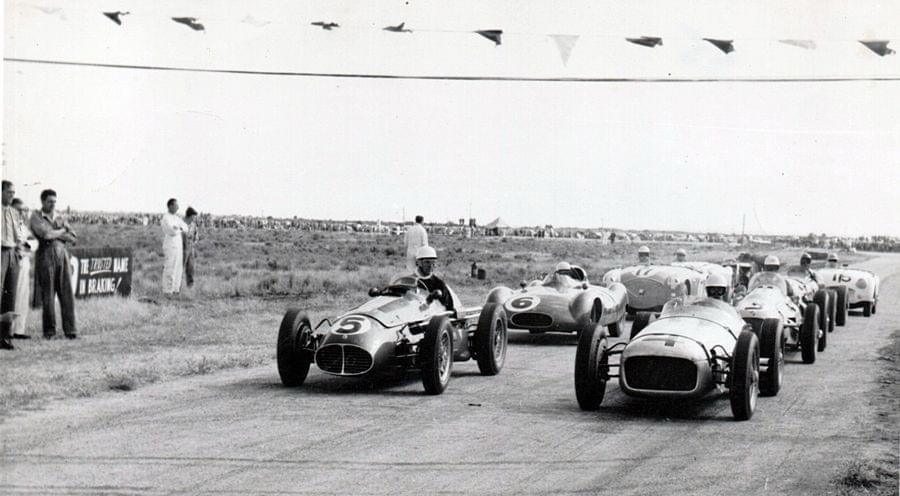
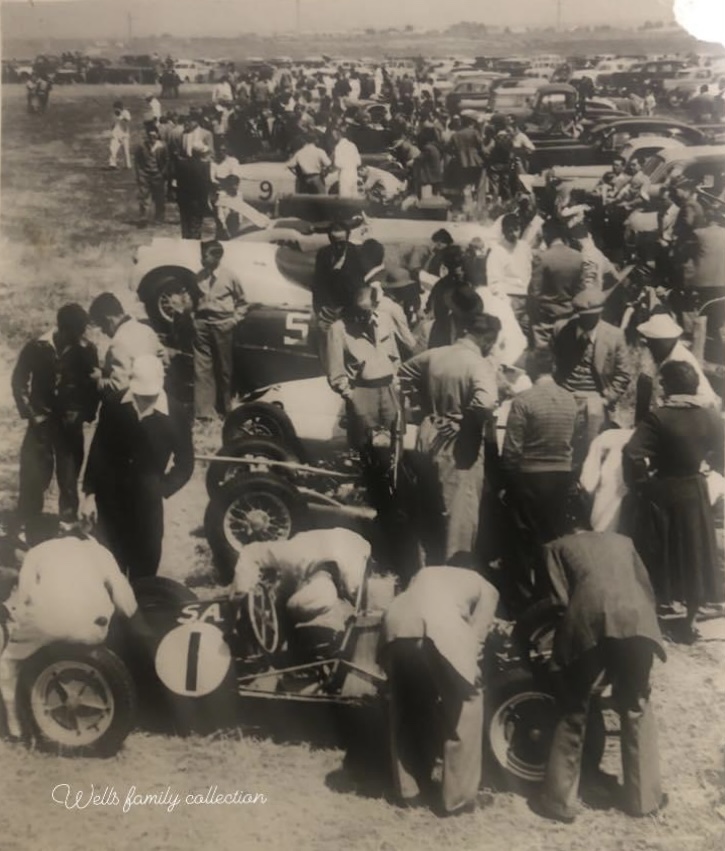
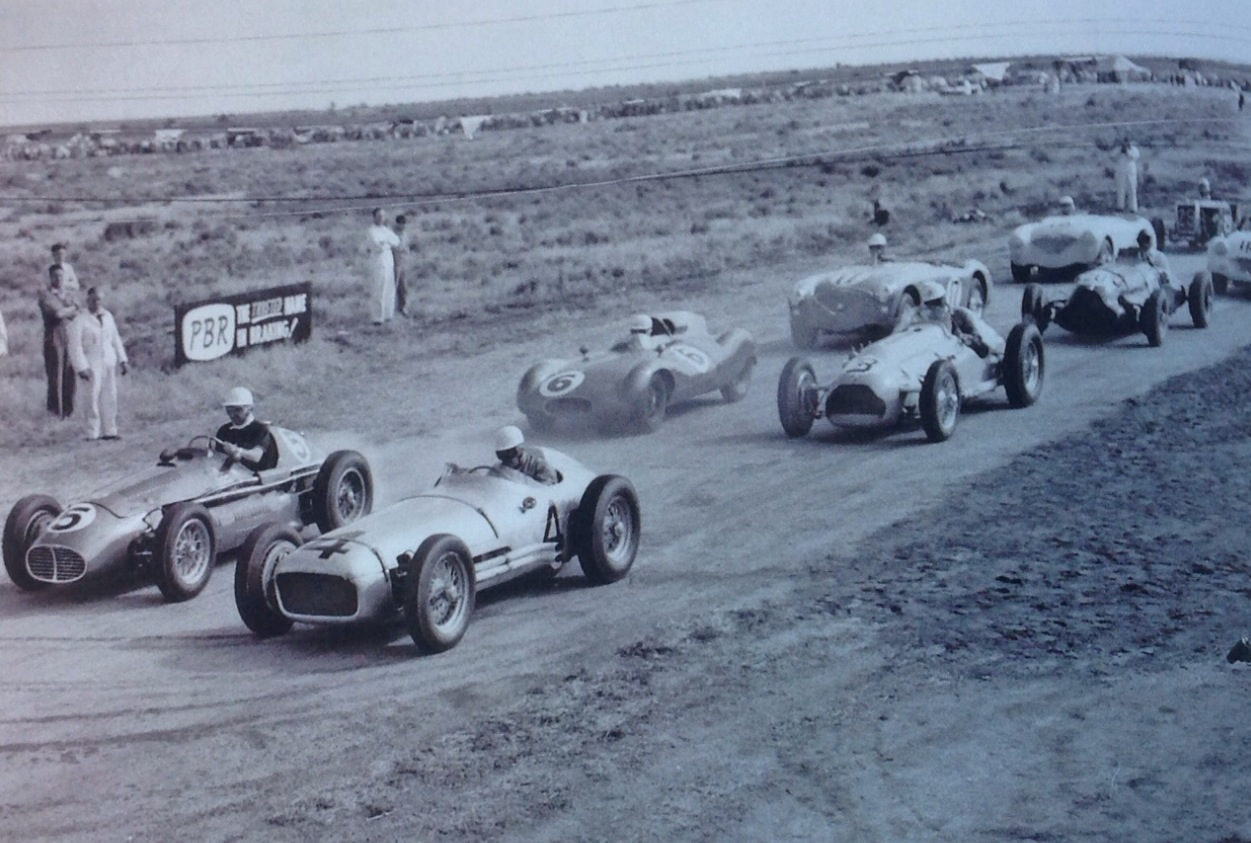
The ’55 AGP third qualifying, 20 lap heat is underway. As a cursory glance of the mix of competitors shows, the race is a Formula Libre event.
On the second row is Brabham’s streamlined, central-single seater Cooper T40 Bristol and thrice AGP winner Doug Whiteford’s Talbot-Lago T26C. It’s rather a neat contrast of post and pre-war technology. On the next row is the Austin Healey 100 of Greg McEwin and Bill Wilcox’ Ford V8 Spl, South Aussies both.


















 primotipo...