Rothman’s promo handout of the type used at race meetings back in the day.
Frank Matich did well with this unique Repco-Holden F5000 V8 engined McLaren M10B, chassis 400-10, winning the Australian Grand Prix with it in November 1970. In early ‘71, after finishing second to Graham McRae’s M10B Chev in the Tasman Cup, he took he entered the first two rounds of the US F5000 Championship held in California in April/May. He won the Riverside Grand Prix and finished second in the following Monterey Grand Prix at Laguna Seca, proving the car was one of the quickest F5000s around.
Sponsorship commitments forced his return to Australia to contest the Gold Star, a pity! Given the solid US campaign you would think Repco – he was their contracted test and race driver – and Rothmans would have seen the good sense in staying a bit longer and surfing the wave of success. US wins would have created good column inches back home and promoted Repco-Holden engine sales stateside, the irony of successful Australian V8s on the ‘home turf’ of that pushrod-V8-donk genre will not be lost on most of you. When Repco and Matich returned to the US with a full-on two car works L&M F5000 Championship assault in 1973 it was a clusterfuck, a tangent covered in this article and another linked below; https://primotipo.com/2015/09/11/frank-matich-matich-f5000-cars-etcetera/
(R Wolfe Collection)
Back home things turned to custard as he collided with another car – in a zig-zag moment as two cars converged – in practice at Oran Park before the first Gold Star round on June 27.
By then FM had decided to build his own car, so rather than order a replacement M10B chassis from Trojan Cars – manufacturers of McLaren customer cars – he decided his Brookvale team should rebuild the buggered monocoque as practice for what became the Matich A50 Repco-Holden that November. FM’s cars to that point – the SR3-4 sportscars – had spaceframe chassis.
When the thrice tubbed – the original, a Trojan replacement after a July 1970 prang, plus the Matich built chassis – M10B was rebuilt it was designated M10C.
Compare and contrast. Matich shown winning the November 1970 AGP above at Warwick Farm fitted with 15-inch front and rear wheels, and below at the same circuit using 13-inch jobbies up front during the February WF Tasman round, DNF electrical. Same car, chassis 400-10, and same tub at this point! (unattributed)(Terry Russell/an1images.com)Matich in the M10C in New Zealand – where folks? – during the ’71 Tasman showing its M7/M14 13-inch front wheels. Isn’t it neat looking sans hi-airbox – that ‘innovation’ was introduced by Tyrrell during the ’71 French GP weekend – and with engine cover (D Kneller Collection)
In the lead up to the 1971 Tasman, FM developed 13-inch Goodyears as part of his test-driver role with Goodyear, he was one of about 10 in the world at the time, he was the distributor of the Akron giant’s race-tyres in Australia too. F1 cars raced on 13-inch covers and Goodyear were keen to evolve suitable boots of the same diameter for the heavier F5000s. The M10A and M10B were supplied ex-factory with 15-inch wheels front and rear. Simultaneously, the Matich crew increased the wheelbase of the car by 150mm by using redesigned front wishbones and longer radius rods, these and other subtle changes heralded the very quick C-specification.
Back to the ’71 Gold Star. Matich won at Surfers Paradise when he rejoined the Gold Star circus on August 29, 1971 but retirements at Warwick Farm and Sandown cruelled his championship aspirations. By then the main game was readying the new Matich A50 Repco-Holden for the November 21 AGP at Warwick Farm where the several days old car finished a splendid first!
Etcetera…
(G Wadsworth Collection)
Matich in the middle of the leading gaggle of cars not long after the start of the Riverside Grand Prix, that’s Sam Posey’s Surtees TS8 Chev turning in. The red car out of focus on the left looks suspiciously like Skip Barber’s F1 March 701 Ford DFV. Ron Grable’s Lola T190 Chev won the first 38 lap heat and Posey won the second, but FM’s two second placings won the day and the bubbles overall.
(M Kidd)
I like this unfinished painting, Kiwi artist Michael Kidd never got beyond his initial sketch of the McLaren M10C Repco-Holden in ‘71 Tasman specs as shown below. Matich leads Niel Allen’s M10B Chev and Frank Gardner’s works-Lola T192 Chev in the distance. Circuit folks? How ’bout completing the painting Michael?
(D Kneller Collection)
What’s interesting to we anoraks – perhaps – is that between the end of the Tasman and the trip to the US a couple of months later, Matich fitted a more substantial roll-over hoop with two rear stays mounted further back on the car at the rear. Look at the shots above and below. I wonder why? Different US regs perhaps, dunno, that’s one for Derek Kneller…
(D Kneller Collection)
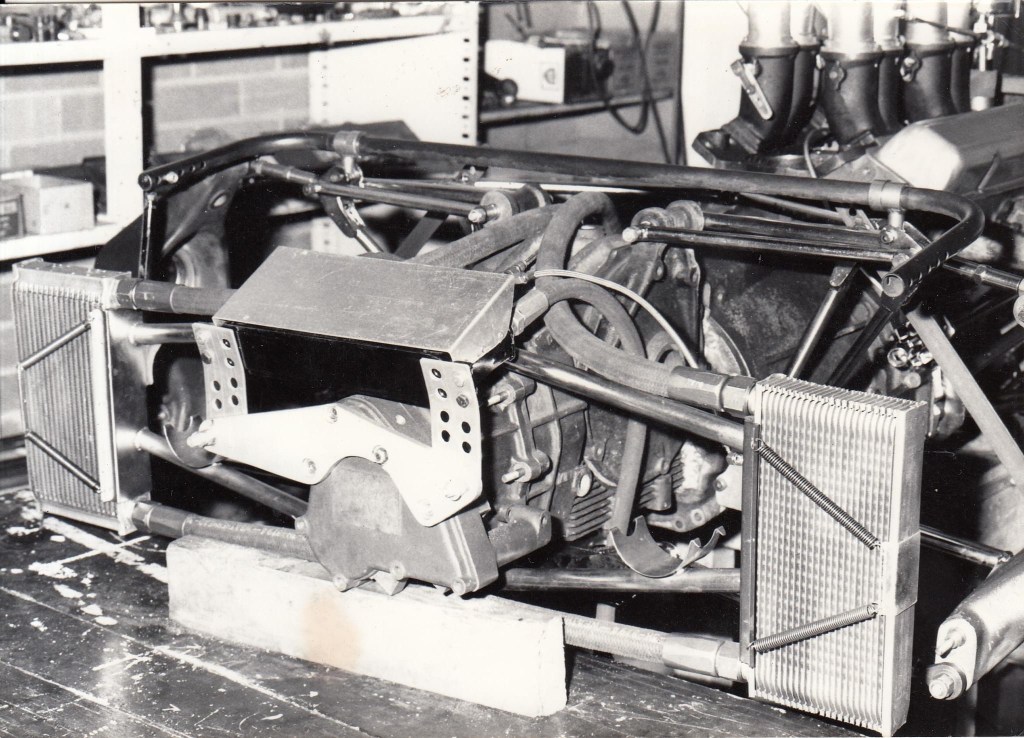
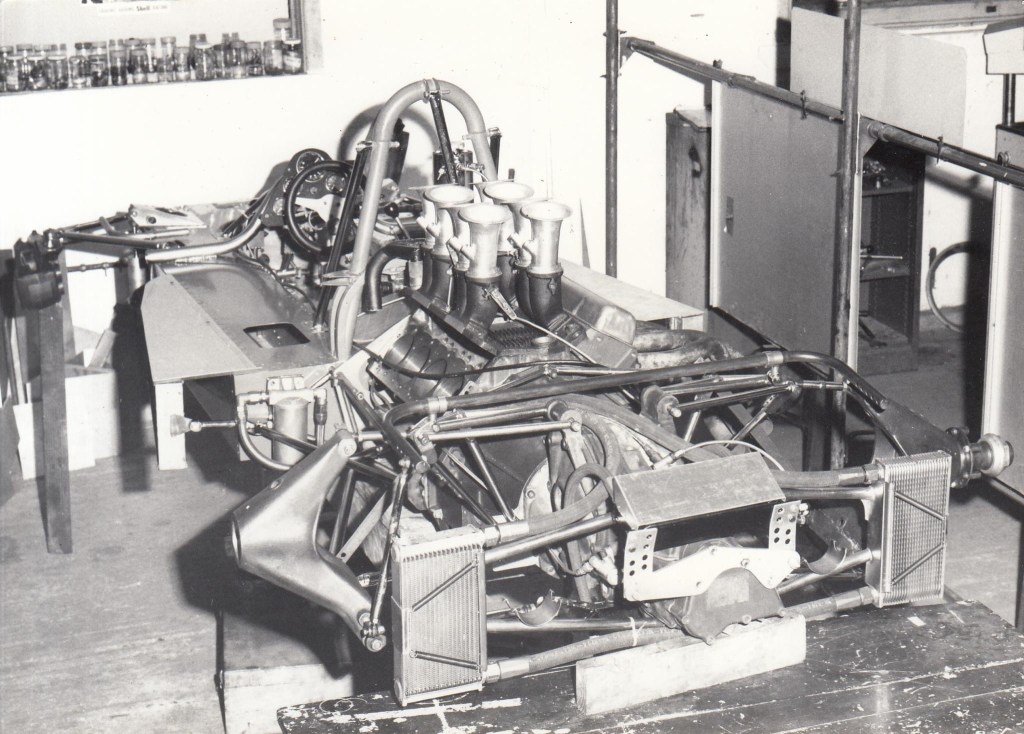
The more you look, the more you see of course, here’s one for the Repco-Holden perves. Don’t the inlet trumpets on the engine above indicate that that injection slides are in use rather than butterflies? I thought by this stage slides had been given the arse by REDCO given their propensity to jam from the collection of roadside detritus on our shitty tracks?
Credits…
Rod Wolfe Collection, Derek Kneller Collection, Terry Russell, Michael Kidd, Eli Solomon
Tailpiece…
Frank Matich, McLaren M10A Chev, Thomson Road, Singapore GP, March 1970 (E Solomon)
Frank Matich’s F5000 commitment began with the purchase of this McLaren M10A Chev in late 1969, before CAMS had ‘finally landed’ on their decision for the new Australian National F1 to succeed the much loved, but running out of puff, 2.5-litre formula. That balsy-call by FM and staggering tale of ‘decision making fuck-wittery’ by the Conspiracy Against Motor Sport is contained within this exhausting epic; https://primotipo.com/2018/05/03/repco-holden-f5000-v8/
By the way, the small minded and petty (me) can still take the piss out of CAMS’ name quite legitimately. They registered the new business name Motorsport Australia with effect from January 1, 2020 but the full legal name of the organisation we all love is the Confederation of Australian Motor Sport Ltd (ABN 55 069 045 665) trading as Motorsport Australia, so CAMS it is.
Frank’s M10A, chassis 300-10, was delivered to him in August 1969, and Derek Kneller, ex-McLaren came with it. Derek and Peter Mabey immediately set to and updated the car to the just coming M10B spec – DG300, radiator, body, suspension wheels etc – and created a jet that Matich put on pole in four 1970 Tasman rounds for two wins, the NZ GP at Pukekohe and Wigram.
The last time Frank raced it – F5000 was not Gold Star legal in 1970, see fuck-wittery above – was during the March 29, 1970 Formula Libre 1970 Singapore Grand Prix on the big-balls Upper Thomson Road circuit.
Eli Solomon picks up the story, “Frank complained that his car weighed 1500lbs and carried 28.5 gallons of petrol designed for a 100 mile course. Talk that Niel Allen would also race an M10A never materialised (albeit he had a race winning M10B ready for the 1970 Tasman).”
“In Thursday practice Matich took out a bus stop doing 160mph on the Murder Mile, his best time had been 2:05.5, fifth fastest compared with the winner Graeme Lawrence, Ferrari 246T on pole at 1:57.8. Kevin Bartlett, Mildren Alfa Romeo T33 2.5 V8, did 1:58.6 and Max Stewart, Mildren Waggott TC-4V 2-litre, 1:59.6.” Lawrence won from John MacDonald’s Brabham BT10/23C Ford FVA and Albert Poon’s similarly powered Brabham BT30.
Matich’s M10A 300-10 on the NZ GP grid at Pukekohe, January 10, 1970. Guy tapping the nose folks? the Keke Rosberg look-alike is Hugh Lexington with Graeme ‘Lugs’ Adams alongside right. Matich won from Derek Bell, Brabham BT26 Ford DFW and Graeme Lawrence, Ferrari Dino 246T. Engine is a Traco prepped Chev (The Roaring Season)
Obiter…
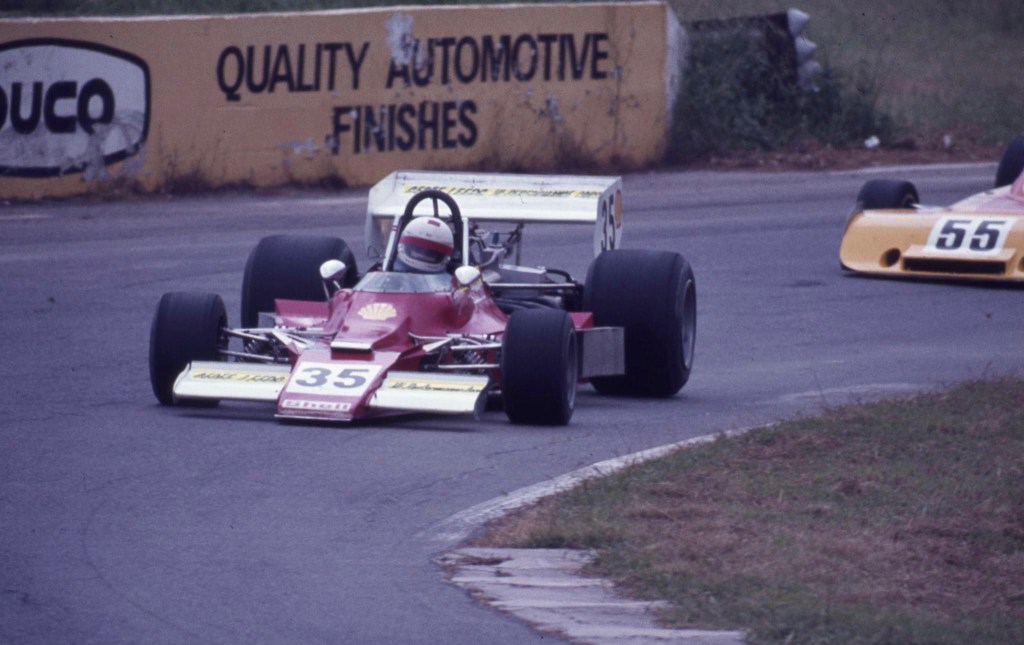
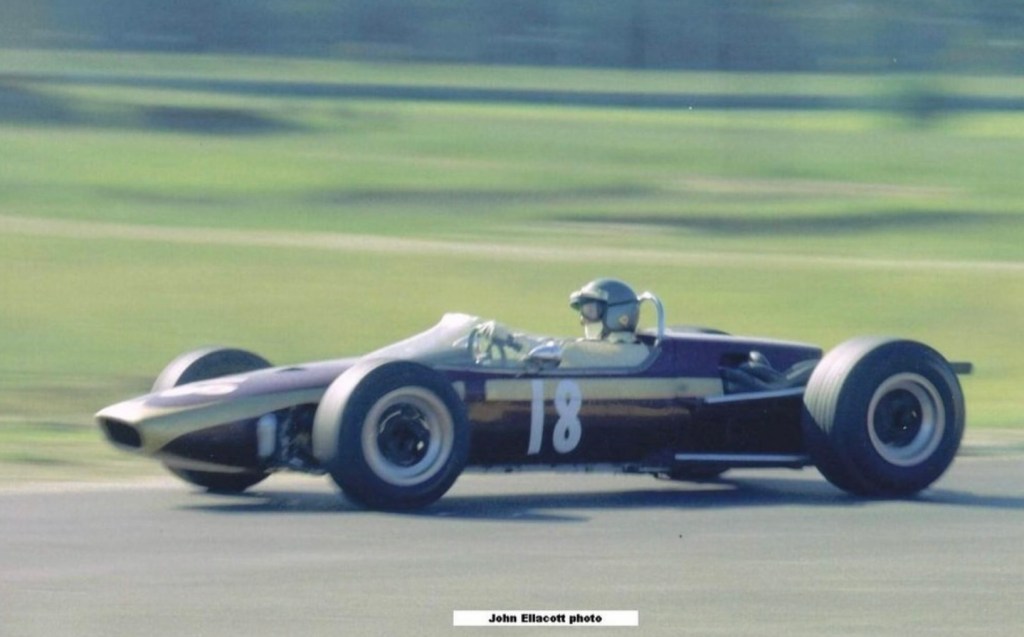
One last final fleeting glance for me before uploading this masterpiece. The Rothmans’ shot of 400-10 isn’t a photograph of the car in M10C spec but rather M10B spec before modification, the specification sheet listing is M10B before mods too, the poor old marketers are always the last to know. So, sleep easy now with that knowledge, I’m not OCD-ADHDxyz believe it or not but I do have my uber-anal moments…
Graeme Adams, Adama GA01 Chef in front of Chris Middleton, Elfin MR5 Chev, Oran Park 100 February 26, 1978 (N Stratton)
Graeme ‘Lugsy’ Adams (24 September 1941-24 September 2013) is one of many talented mechanics who jumped the fence from the paddock onto the grid. He quickly graduated from a self-built Holden Torana GTR XU-1 Group C tourer to the equally home-grown Adams GA01.
Adams worked for the very best of Australian outfits in F5000 from 1969 including Niel Allen Racing, Frank Matich’s Repco sponsored team and Warwick Brown’s team where he worked again with Peter Molloy, one of the country’s most gifted mechanics-cum engineer-cum Driver Whisperer. He worked on McLaren, Matich and Lola chassis and therefore knew his way round these machines better than most.
He acquired and built a 3.3-litre, two-OHV, straight-six Holden Torana GTR XU-1 racing the machine to some Australian Touring Car Championship points in 1974 and a great fifth place at the 1974 Bathurst 1000, sharing his car with Bob Stevens, in a real smell-of-an-oily rag operation.
Adams/Stevens during the 1975 Bathurst 1000, DNF that year – and with a few $ from Amex. I wonder how much!(D Cratchley)(D Cratchley)
Turning his mind to Formula 5000 – Australia premier single-seater category for both our summer internationals and domestic Australian Drivers Championship, the Gold Star – Lugs considered his options and decided to build his own car.
He set to work on the car in an office within his workshop, progressing the project as customer commitments allowed. The machine was Lola T400-esque in appearance and in the overall look of the aluminium monocoque chassis.
Surfers Paradise, February 1978, and yes, the day is fine! (G Simkin)Adams built 5-litre, injected Chev (G Simkin)
The uprights are Lola, so too the steering rack, while the top bodywork section is Matich, as used on the A50-53 series of cars. The transaxle is of course the good ‘ole Hewland DG300 five-speeder and the engine a fuel injected Chev of Adams’ own assembly.
Adams during his F5000 race debut weekend at Surfers Paradise in February 1978. Lost in thought but enjoying every minute (G Simkin)Allan Newton, McLaren M18/22 Chev and Adams dicing down the back of the field during the February 19, 1978 Surfers Paradise 100. DNFs for both
Graeme finally completed the car, extricating it from the office by knocking down a wall, and entered all four of the 1978 Rothmans International rounds, racing the car at two, the Surfers Paradise 100 and Oran Park 100 in February 1978.
Garry Simkin, friend of Graham and for many years a salaried mechanic/technician member of Racing Team VDS picks up the story. “Money was really tight, in the shots below he is getting a push-start at Surfers as he hadn’t fitted starter motor yet. His initial tyre setup (below) for exploratory laps comprised three wets and a dry! I have a funny feeling that Count Rudy Van der Straten may have bought a set of tyres for him.”
(G Simkin)
“I remember Lugs telling me that he thought he was going ok, really fast, when WB (Warwick Brown) passed him on the outside of the corner onto the main straight with one wheel in the dirt and waving to him. ‘The bastard!’ Lugs said with a laugh.”
He was Q23 and completed 31 of the 40 laps of the Surfers race won by Brown’s VDS Lola T333/332C Chev. The new car completed too few laps to be classified.
Adams GA01 side profile at Oran Park (A Betteridge)
Things were pretty tough in his home race at Oran Park, where again he qualified 23rd, and this time retired the car with a thrown oil pump belt after completing only 12 laps. Bown won that race too, and the championship from Vern Schuppan’s Elfin MR8B-C Chev and Bruce Allison, Chevron B37 Chev.
Graham Bristol with the Adams GA01 being rebuilt to original spec (G Simkin)
Those were the only occasions the car raced, “Then Lugs crashed it badly into a concrete pylon at Oran Park. He didn’t ever repair it, with the engine and gearbox sold over time.”
“Graham Bristol was working for Lugs and eventually bought the remains of the car. Up Lake Macquarie way he is working steadily on the GA01. I’m helping him piece together a DG300 and he’s built an injected engine and is keen to get it up and running.”
So treat this article as WIP, I shall report further about this valiant attempt at F5000 on an FF budget, in due course.
Etcetera…
(G Simkin)
Simkin, “That’s Graeme in the black singlet looking longingly at the VDS 332 (T333/T332C HU2) outside his workshop in Silverwater, where we assembled the car in 1978. On the far right of the shot is Herve, Count VDS’s son.”
(G Simkin)
“I love this one, it’s Graeme at a Sandown historic meeting in the mid-1980s when WB had a run in his old Lola T332 HU27. This was the Pat Burke owned car prepared by Peter Molloy, John Wright and Phil Harris with me and Michael Truman as gopher that won the 1975 Tasman Cup at Sandown. It was the first and only time an Aussie won that title.”
“All of my shots taken with my trusty Minolta 101B.”
Credits…
Neil Stratton, autopics.com.au, David Cratchley, Bob Quinlan Collection, Arn Betteridge, eldougo, Australian Broadcasting Commission, Garry Simkin
Tailpieces…
(eldougo)
A few words from Graeme at Surfers Paradise in 1969 when he was working with Frank Matich, here shown with Don O’Sullivan who had just acquired a Matich SR3 Repco from Matich; https://youtu.be/nxQILr8mgUE
Graeme Adams and Don O’Sullivan during the 1969 Surfers Paradise 6 Hour (ABC)(G Simkin)
A racer in approach and mindset to his core, Graeme Adams all set for battle at Surfers Paradise in February 1978.
Well known in Australia but perhaps less so elsewhere are Ron Tauranac’s pre-Brabham phase Ralts as against the post-Motor Racing Developments ones…
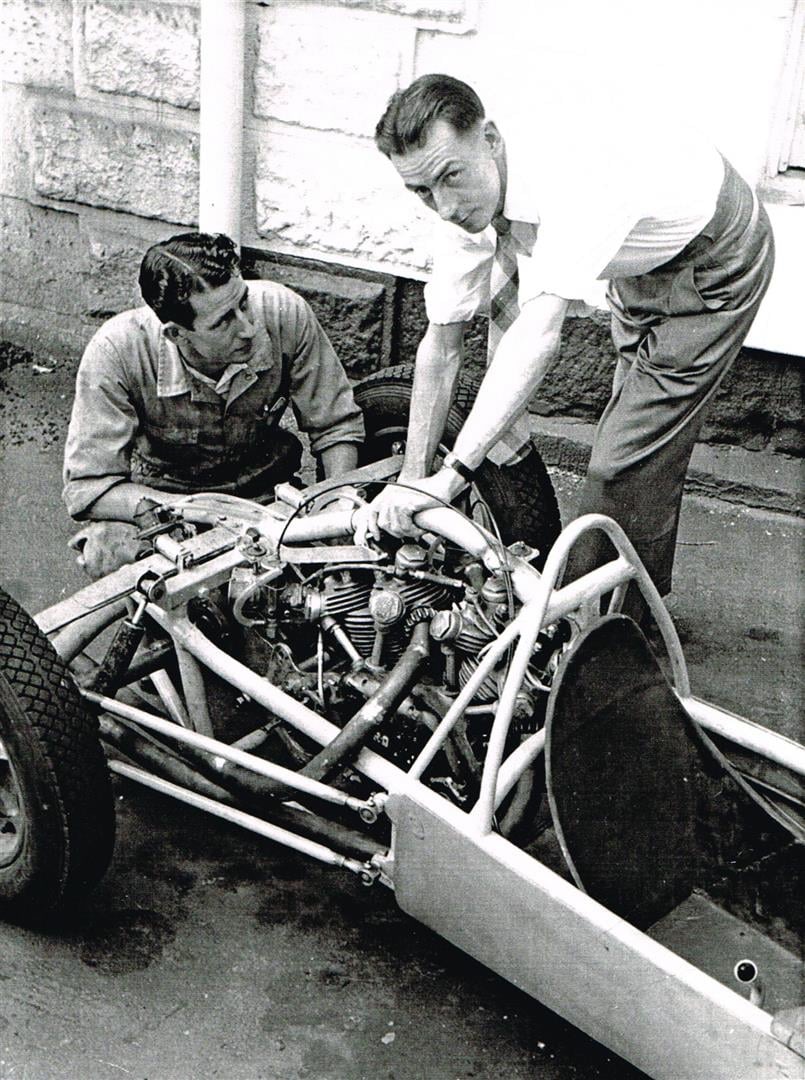
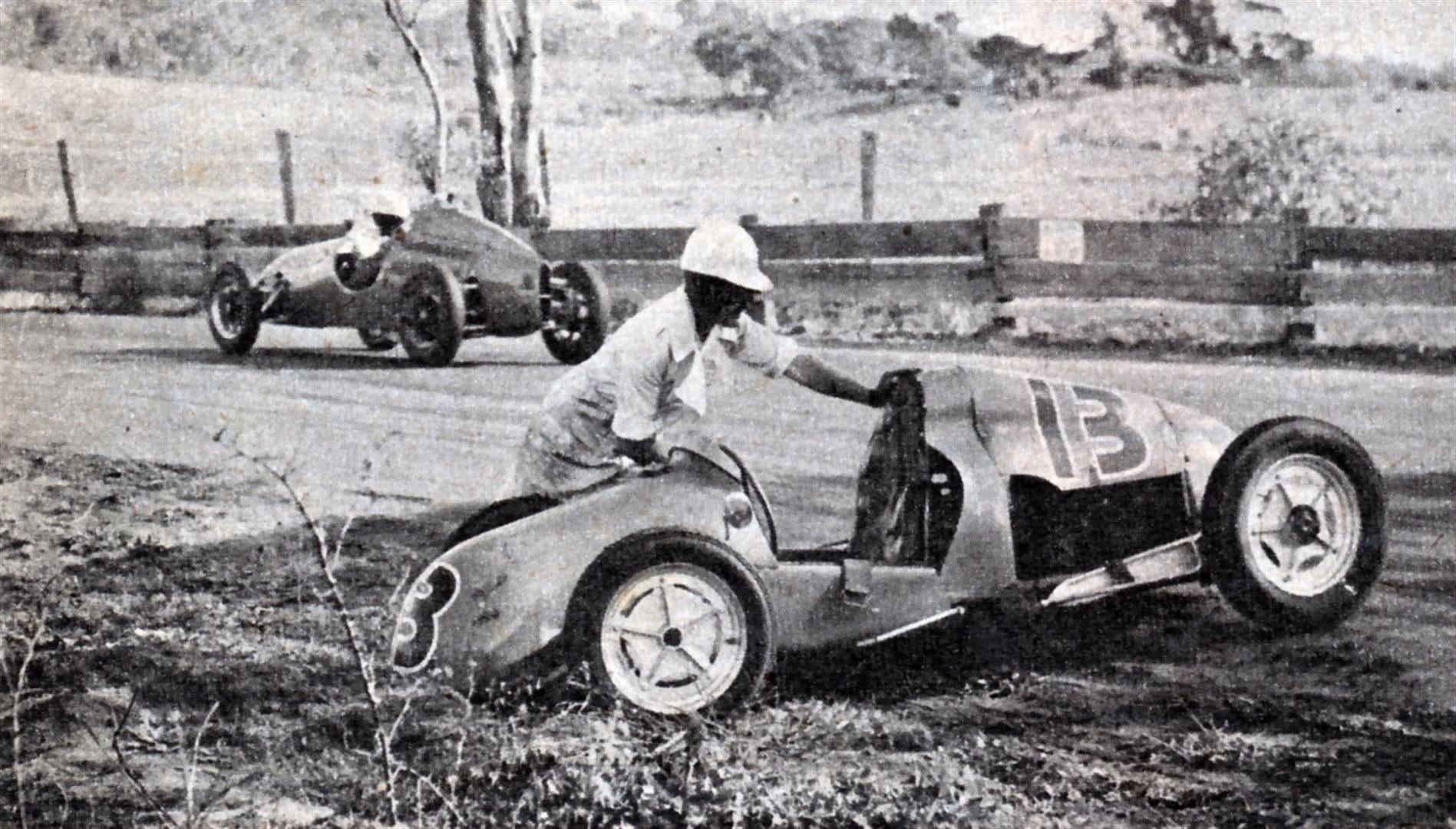
Ron looking young and shy in the first Ralt, the ‘Ralt Special’ above at the King Edward Park hill, Newcastle in 1951. By this stage Ralt 1 was fitted with schmick Ralt wheels and low-pivot trailing arms to better control the swing-axles.
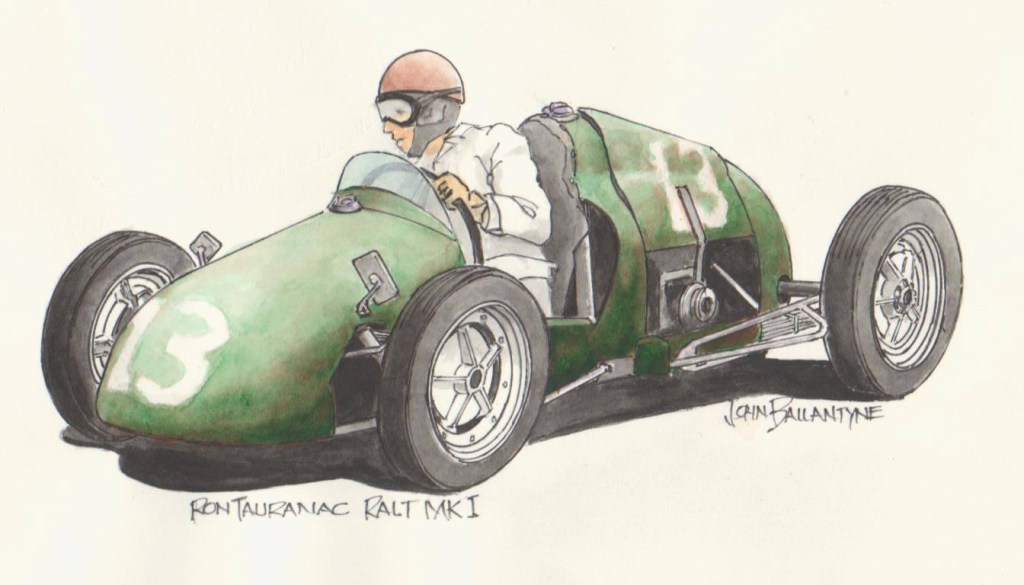
Ron and Austin Lewis Tauranac (RALT) built five racing cars in the 1950s fitted with a variety of engines, two were powered by Norton 500s and one each by Ford 10, Vincent 1000 and Peugeot motors. Sadly, only the latter seems to remain.
‘Series Two’ Ralt. Larry Perkins and Ron with the RT1 Toyota with which Larry won the 1975 European F3 Championship. Monaco GP weekend, where he won the first heat and crashed out of the final. Renzo Zorzi, GRD 374 Lancia won the second heat and the final. The car behind looks like a Modus M1 but I can’t make #117 work (Auto Action Archive)
After that they built another five or so chassis on their jig, which were Vincent 1000 powered, before Jack Brabham made the offer to Ron to join him in the UK as Jack hatched his post-Cooper plans.
Peter Wilkins, who had been working with Ron making chassis, fibreglass bodies, seats, alloy wheels with integral brake drums, steering and suspension gear, bought the stock of parts. He then onsold the Ralt bits – Ron’s version is he sold them direct – to John Bruderlin and Leon Thomas, whose Concord, Sydney, Lynx Engineering business specialised in building hot MGs and selling MG parts.
Wilkins joined them as a partner for two highly productive years making what John Blanden described in his book as Ralt Derivatives; three Vincent engined cars and various Lynx Peugeot, Borgward, Ford and BMC powered FJ/single-seaters until Wilkins joined Tauranac in the UK to assist in the construction of the first Brabhams at Motor Racing Developments. These cars are covered later in the article under the Ralt Derivatives heading.
The descriptions of the cars are those used in Ron’s biography, ‘Brabham Ralt Honda : The Ron Tauranac Story’ written by Mike Lawrence, but I have used Ralt 1, 2 etc for brevity. There is no shortage of photos of the cars on the internet but most don’t have captions, if you can help with the who, where and when please email me on mark@bisset.com.au and I will update the piece.
In the beginning…
Tauranac was born in Gillingham, Kent in 1925 and emigrated to Australia with his folks in 1928. Austin was born in 1929 by which time the family lived in Fassifern, Newcastle. When of working age Ron joined the Commonwealth Aircraft Corporation as a junior draftsman in 1939, continuing his technical studies. Despite being in a protected occupation he joined the RAAF in 1943 and trained as a pilot but missed out on combat with the end of the conflict, he was a Flight Sergeant when he returned to Civvy Street.
A very youthful Ron aboard Ralt 1, probably near the Bondi garage/workshop in 1949 (B Caldersmith)
Garry Simkin, historian, air-cooled expert and el-supremo of the superb loosefillings.com – from which a chunk of this article was drawn, together with the relevant section of Blanden’s bible which was written by Doug Grant and Mike Lawrence’s biography on Ron – writes that legend has it Ron was driving through Marsden Park when cars were racing on the ex-RAAF landing strip there, and his appetite for racing was whetted that day. Simkin debunks the theory, but one way or the other Ron and Austin, by then a motor mechanic, were soon reading all they could about the fledgling 500cc Movement in the UK. The 500cc Car Club of NSW was formed in April 1947, the brothers were soon hatching plans of their own aided by the knowledge gained in buying/improving/selling an Austin 7, Lea Francis and a Morris Minor. Suss and and carefully search Loose Fillings here; https://loosefillings.com/
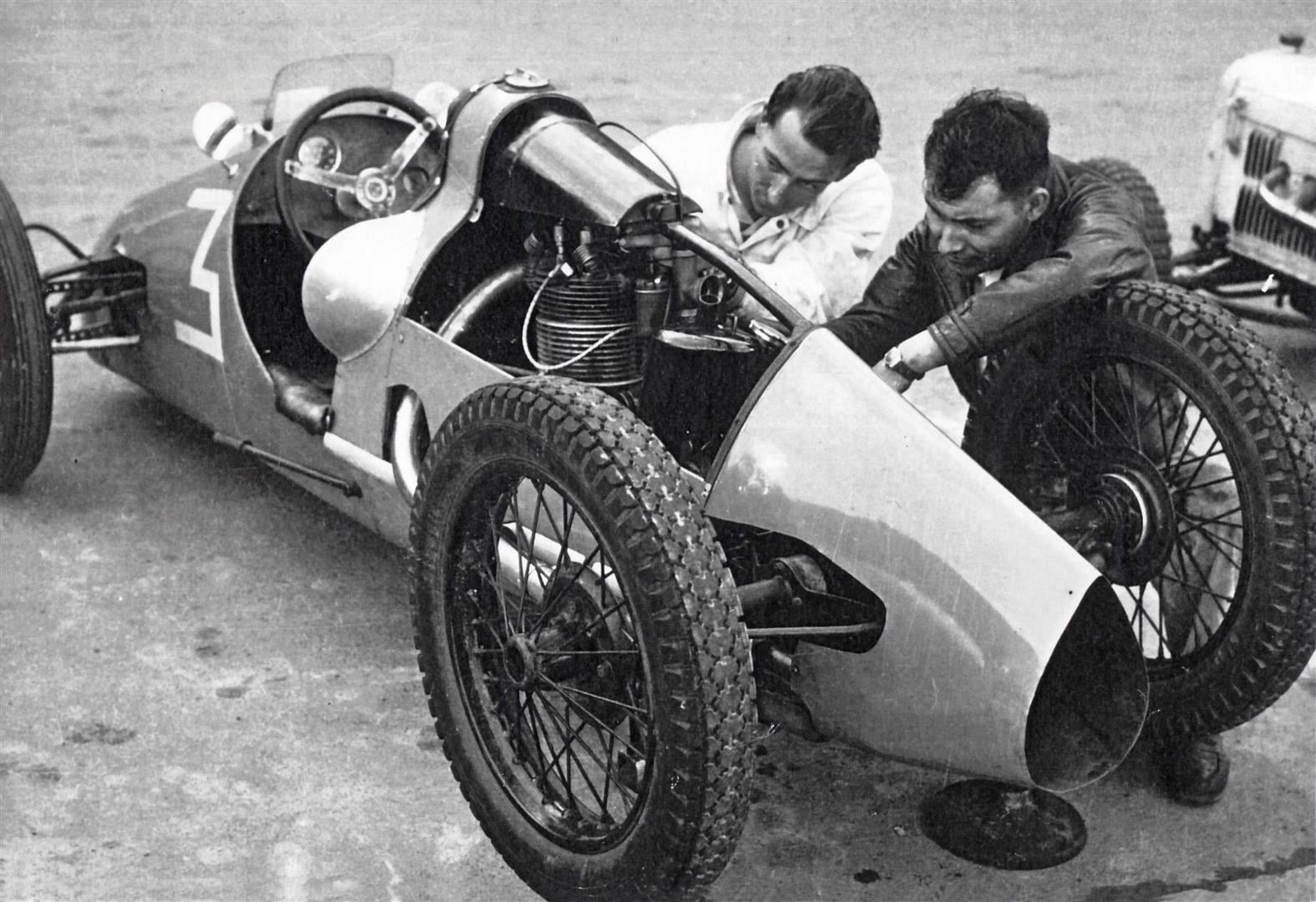
Ron drew the Ralt Special – as he called it in Lawrence’s book – Ralt 1 in 1947 but there was then a two year gestation period until it was rolled out of a rented garage in Blair Street, Bondi, closeby to the family flat. Powered by a Norton ES2 500cc engine, the car was a typical 1940s 500 with 19-inch wire wheels, tubular steel ladder-frame chassis, wishbone-leaf spring front suspension and swing-axle rear with an engine/gearbox from a road-going motorcycle.
Ralt 1 at Marsden Park, Peter Finlay suspects, an RAAF emergency airfield at Berkshire Park, west of Sydney. This shot and the one below are circa-1950 with the 19-inch wires and original rear suspension fitted (B Caldersmith)(B Caldersmith)
Despite lacking shock absorbers, money was tight, Ron entered a hillclimb at Hawkesbury on November 20, 1950. “On his first run, the Ralt, which had already given him a few frights in the first corners, ran wide, hit a drainage gully and flipped. Ron was thrown out and taken to hospital to be stitched together,” wrote his biographer, Mike Lawrence.
When RT recovered from the crash, he repaired the car, fitted shocks, stiffened the rear suspension and then took it back to Hawkesbury. After some impressive practice times, he set off on his first timed run and again crashed, this time one of the back wheels tucked under and the car flipped, Ron was unhurt despite cuts and abrasions. A shackle on the rear spring had broken and caused the wheel to fold over, the problem was that the spring was the main locating medium.
Ron was learning valuable lessons on-the-hop and back to the drawing board he went. He devised long-arm, low-pivot swing axles, adding universal joints and was able to lower the roll-centre of his car by six-inches. Then it returned to competition in 1950 and was raced consistently, notable early performances included a 58.13 seconds Newcastle hillclimb time, an Australian quarter-mile class record of 16.3 seconds, and an appearance at the Easter Bathurst meeting in 1951 when Ron drove. By then the car also had Ralt cast-alloy wheels, Ralt 2 – the ‘Ralt 1100’ – also contested this meeting.
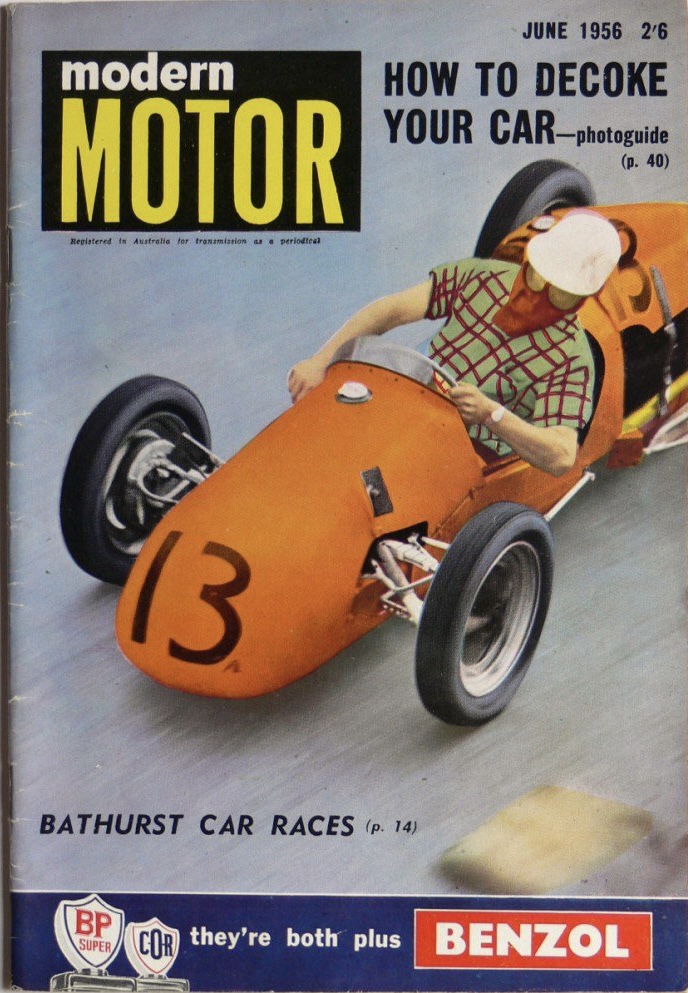
Merv Ward’s Ralt leads the Day Special (Bugatti T39 Ford V8 Spl) at Mount Druitt (B Caldersmith)Merv Ward in living colour on the cover of Modern Motor magazine aboard Ralt 1 Norton during the Easter Bathurst meeting in 1956 (S Dalton Collection)(B Caldersmith)
Ralt 1 then raced with continuous engine development at Foleys Hill, Newcastle and Parramatta Park among other venues. It was during this period that Ron met Jack Brabham and started to use him for his CSR Chemicals, his employers, machining work. The car was then sold to Merv Ward and Bernie Short, both of whom raced it in 1955 with much success using both ES2 and Norton overhead camshaft engines until Easter 1957 when the ES2 engine blew at Bathurst and the car crashed.
Sold in 1957 to Bert Bartrop, then to Reg Mulligan, on to Leaton Motors and Bert Lambkin, he crashed into a pole at Orange in 1960 during his first race. Taken to motorcycle expert Cec Platt for repair, parts of the car were used in building TQ midgets, the rest, apart from the two wheel-centres, was disposed off at the local tip after Platt’s death.
The Ralt 1100 (Ralt 2) appeared from the Bondi garage in 1949 fitted with a Ford 10 E93A engine, Standard 10 gearbox mounted mid-car fitted to a ladder-frame chassis, a Morris 8/40 rear end completing the key mechanicals. These components were clad in a sleek two-seater aluminium body, registered NSW KJ.989 and was raced by Austin at Leura, Mt Druitt, Foleys and Bathurst through to 1951.
Featured in the April 1951 issue of Australian Motor Sports, the car was sold to Lane Cove’s Austin Sudden in 1952 after Tauranac’s marriage, his wife to be wasn’t keen on his racing. Sudden used it on the road before selling it, passing through a couple of pairs of hands – Doug Grant chanced upon a photograph of the car below in a South Brisbane car yard circa-1959 – it was badly damaged in a 1969 car accident in Queensland and assumed scrapped.
(unattributed)(D Willis)
Ron Tauranac in the Jack Hooper car modified by he and Austin, then raced by Austin as the ‘Norton Special’ at King Edward Park hillclimb, Newcastle in 1951. Dick Willis tells us “It took FTD with a mere 500 Norton engine ahead of many more fancied runners including Sir Jack with the Cooper Bristol.”
Originally built by the Hooper brother, operators of the Hooper & Napier Motorcycles business in Sydney, Austin bought it and the brothers comprehensively rebuilt it inclusive of a new chassis. The Ralt MkIII (Ralt 3) took nine months to build in the Austin Service Station, East Circular Quay ‘on’ Sydney Harbour.
Austin debuted it at Mount Druitt in 1953 then raced very successfully for two years, he placed third at the Bathurst Easter 1955 meeting in an event also contested by Merv Ward in Ralt 1. Sold to a Broken Hill enthusiast who raced it at Port Wakefield in October 1956, no further details of the car’s whereabouts are known.
(B Gunther)
Byron Gunther wrote on the reverse of his photograph above, “A Tauranac, Norton 500. Very consistent all day (what day and where tho Byron??), this is the ex-Hooper 500, the first really good 500 built in this country.” Interesting to get this in-period perspective from an expert on the scene.
Ralt 1 at left with the Hooper originated Norton Special (Ralt 3) – by then fitted with Ralt alloy wheels on the front – at Mount Druitt (B Caldersmith)(B Caldersmith)
Austin and Ray Tauranac with the Ralt MkIV (Ralt 4) in build. This car, which used a four-tube chassis had no similarity to the earlier cars. Its front suspension used Austin A30 wishbones and uprights and Tauranac’s twist on De Dion rear suspension. The wheels and rack and pinion steering were also RT built. The much more sophisticated car was fitted with a Vincent Black Lightning 998cc engine and was also built at Circular Quay.
First raced in 1957 by Ron, it was driven by Jack Brabham at Mount Druitt on a trip home that year. Ron sold it to Noel Hall of Woolgoolga in 1958, he raced it in both the Easter and October 1958 Bathurst meetings before selling it to John Hough in mid-1959.
Noel Hall on his first shakedown run after purchase from RT, Ralt 4 Vincent at Castlereagh Dragway in 1958 (P Graham)Noel Hall, Ralt 4 Vincent, Lowood 1959 (D Willis)(R Hough)
John Hough in the Ralt 4 Vincent on the family farm at Woodford Island in 1958 or 1959. Later traded to Reg Mulligan for the ex-Moss-Davison HWM Jaguar, it was crashed by Richard Compton at Catalina Park in 1962 then left in Lehane’s workshop in Auburn, Sydney, before being sold in damaged condition and disappearing without trace.
(B Caldersmith)(D Grant)
Reg Mulligan in Ralt 4 Vincent on pole of a four-lapper during Catalina Park’s opening meeting, February 12, 1961. Bob Maine and Vincent guru, Alan Burdis are awaiting the push-start.
Barry Garner is in the Nota Major alongside, and #37 D Russell’s MG TC Spl, #68 is Peter Wherrett’s Cooper Mk4 Hillman Minx and #31 the Toby Hines’ Ralt 498cc.
(D Grant)
The Ralt 5 – Ralt MkV – was a front-engined single-seater for Austin which was built simultaneously with Ralt 4. With a spaceframe chassis and similar suspension to Ralt 4, the car was sold incomplete when Austin retired from racing, what became of this car, nothing is known?
Having referenced John Bruderlin and Leo Thomas’ Lynx Engineering business, here is the Bruderlin/Thomas cigar-bodied MG TC Spl of Max Williams at Lowood in 1958 (G Smith Collection)
Ralt Derivatives…
The list of the cars built with Tauranac designed chassis, sold to Peter Wilkins and then Lynx Engineering follows. lt’s a precis of the Doug Grant/John Blanden material in Blanden’s ‘Historic Racing Cars in Australia’, which is included for completeness, it’s not a treatise on the history of each car.
Ralt Vincent 1959
Bought by Tony Hindes in 1959-60 and used with both V-twin and 500cc engines, sold to Todd Hamilton in 1962-63 and still with him in 2004.
(K Starkey)
The shot of Todd above is on the Amaroo Park hill in 1968, the one below at an historic meeting in more recent times.
(D Willis)
Marvellous shot of Ron and the same car at a Parramatta Park reunion (I think) not too long before he died.
In more recent times the car has been sold to Chris Page.
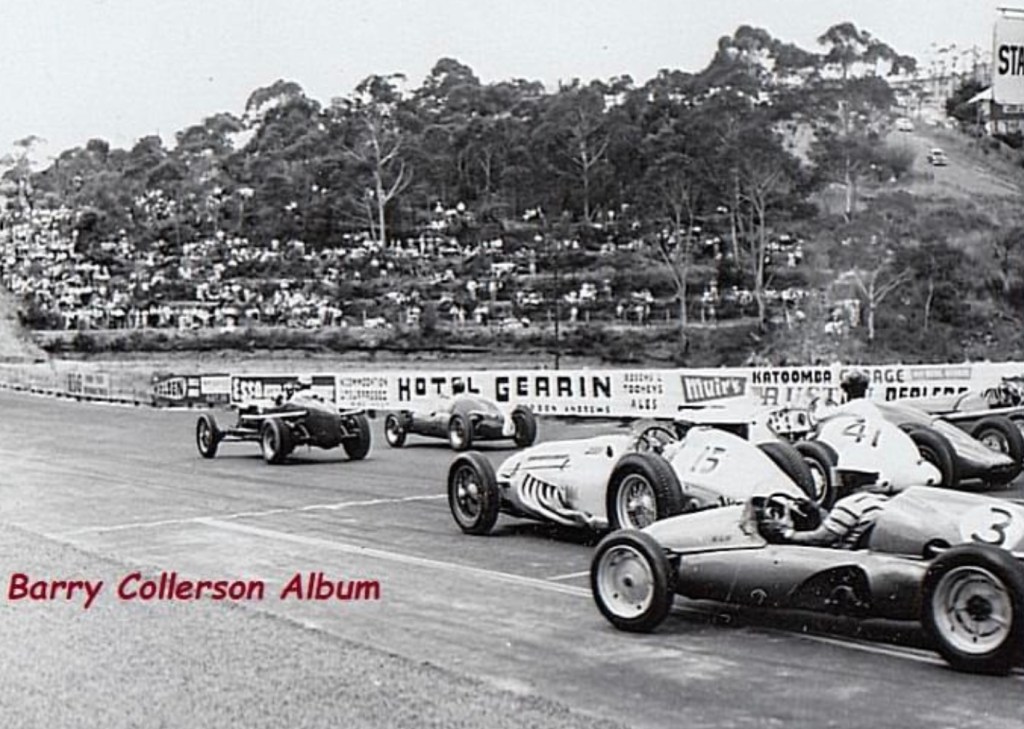
Ray Walmsley, Alfa Romeo P3 Chev up front, with Jack Myers’ #3 Triumph Thunderbolt, Barry Collerson, Talbot Lago T26C #15, #41 Frank Walters, SoCal and Gordon Stewart, Stewart MG at the start of a Catalina Park race during the opening meeting in 1961
He raced the Thunderbird at Easter Bathurst in 1961 and took part in hillclimbs throughout Australia, but tragically died in it after being thrown from it at Catalina Park, Katoomba in January 1962.
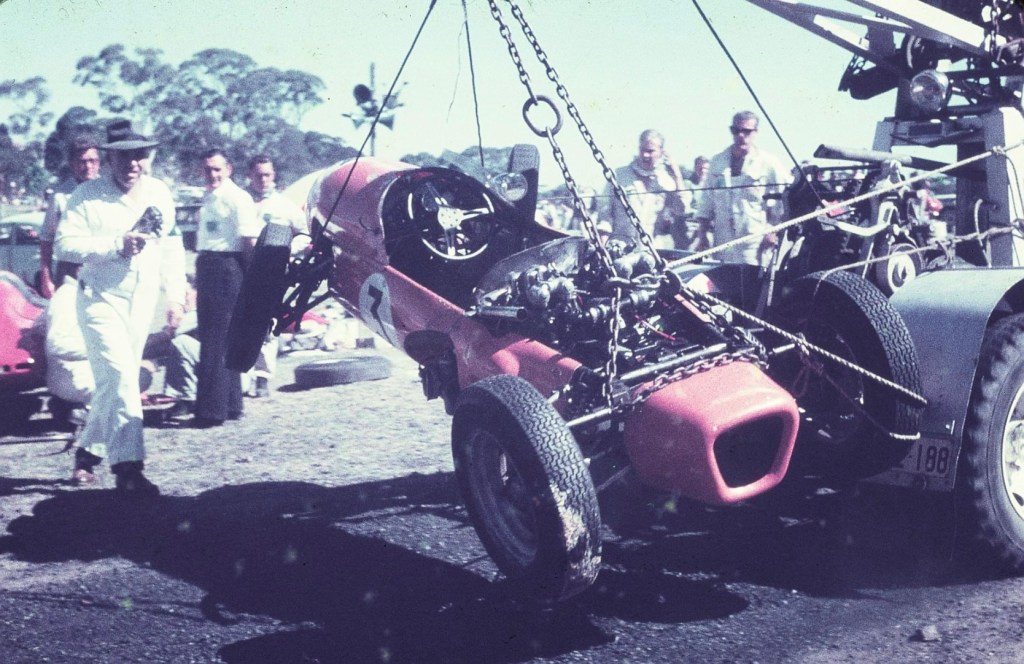
The photo above shows Jack – wearing his usual T-shirt with hoops – in car #3 at the start of a Catalina race in 1961, while the post-accident one below is shown to provide an idea of the engine packaging challenges.
(P Goulding)(D Willis)
As the post-Catalina-crash shot shows, the damage to the car does not appear significant. Sold by the Myers family, here the car is in the hands of Jim Reuter at Lowood in 1964.
Jennings Vincent
Built and owned by George Jennings in Victoria, whereabouts unknown.
(G Simkin Collection)
Lynx Vincent chassis 101
Built for Narrandera racer Les Trim in 1960, 998 Vincent. Sold in 1964 with the parts going into a sportscar project in Queensland.
Lynx Vincent chassis 102
John Marston raced it in Victoria and New South Wales fitted with a supercharged engine often as a Bruderlin & Thomas works entry. Through many hands, extant, and partially restored, albeit less engine, the car survives and was authenticated by RT.
(J Ellacott)
John Ellacott’s marvellous, rare colour shot was taken of John Marston gently sliding through Homestead corner at Warwick Farm in 1961.
(unattributed)
Lynx chassis 103
Built in 1961, through the hands of five drivers until the caring, skillful Dick Willis bought it in 2004.
Lynx chassis 104-109
Generally Ford and BMC powered FJs. Below is Kevin Bartlett’s Lynx BMC, chassis #105, at Lakeside in May 1962.
(B Miles)(B Thomas)
The same car at Lakeside a little earlier, November 11, 1961. KB’s #105 having its gizzards attended to; BMC 1-litre A-series engine with Amals, Renault transaxle.
Lynx chassis 110-116
The slimline Mark 2 machines were all Ford powered with the exception of the supercharged Peugeot powered machine built for Bob Holden and later raced very successfully by Colin Bond.
Holden’s lovely Lynx Peugeot is shown above Warwick Farm on debut in 1963.
(unattributed)
The same car with Colin Bond at the wheel and key team-members in attendance, Bob Riley standing alongside Vicki Allingham with Bob Allingham behind the front wheel. Bond’s performances in this car on the circuits and in the hills, and in rally Mitsubishi Colts resulted in subsequent fame-and-fortune via the Holden Dealer Team.
Etcetera…
Ralt 1
(B Caldersmith)
Ralt 1 in very early spec spec with Morris 19-inch wheels.
“I made two fundamental mistakes on that car,” Ron related to Mike Lawrence. “I put the seating position too far forward, and and the other was that I put swinging half-axles at the rear. The seating position gave me the theoretically correct weight distribution but it also made the car much harder to drive because you just didn’t get enough warning when the back end was going to break away.”
The shot above at Foleys Hill on July 13, 1952 shows Ralt 1 with its Ralt alloys and another angle on Ron’s swinging-half axles, and you can just see the end of the trailing arm.
(B Caldersmith)
Ron with hands in pocket and Austin looking towards us, Ralt 1 then with his alloy wheels and trailing arm rear suspension at Foleys Hill, July 13, 1952.
RT told Mike Lawrence, “The homemade engine was based on a Norton ES2 pushrod unit. The cams from a Norton WD side-valve gave me the timing I wanted. Over time, we made a crankcase, fitted a locally made piston which gave a 14:1 compression ratio, and ran it on methanol with an Amal carb. It had a cast-iron flywheel, then I had Jack Brabham machine me a a steel one. We played around with new barrells and eventually enlarged it from 500-600cc, I learned a lot about engines from that.”
(B Caldersmith)
In front of Dick Cobden’s Cooper.
Merv Ward at Gnoo Blas in 1956 (D Grant)(B Caldersmith)(B Caldersmith)
Mountain Straight at Bathurst perhaps. Do get in touch if you can help with the missing where, when and whom caption gaps.
(B Caldersmith)
Ralt 4
Noel Hall took FTD in the Ralt 4 Vincent at this gravel hillclimb held at Rushford Road, South Grafton, NSW in 1959. Racer/restorer/historian Dick Willis was there to catch the relaxed vibe of the day in countryside Dick described as “sparse”. Indeed.
(R Hough)
Ralt 4 Vincent on its trailer on the Hough family farm.
Credits…
Brian Caldersmith, Dick Willis, Richard Hough, John Medley, ‘Brabham Ralt Honda: The Ron Tauranac Story’ Mike Lawrence, Kerry Smith in Loosefillings.com, ‘Historic Racing Cars in Australia’ John Blanden, Bill Miles, Bill Tyrrell, Pat Goulding, Barry Collerson Album, John Ballantyne, Ken Starkey, Brier Thomas, Stephen Dalton Collection, Daniel Bando, John Ellacott, Peter Graham via Grant Burford
Tailpiece…
Whatever Ron and Jack were talking about, it wouldn’t have been the past. They were all about the next project, not the last one…
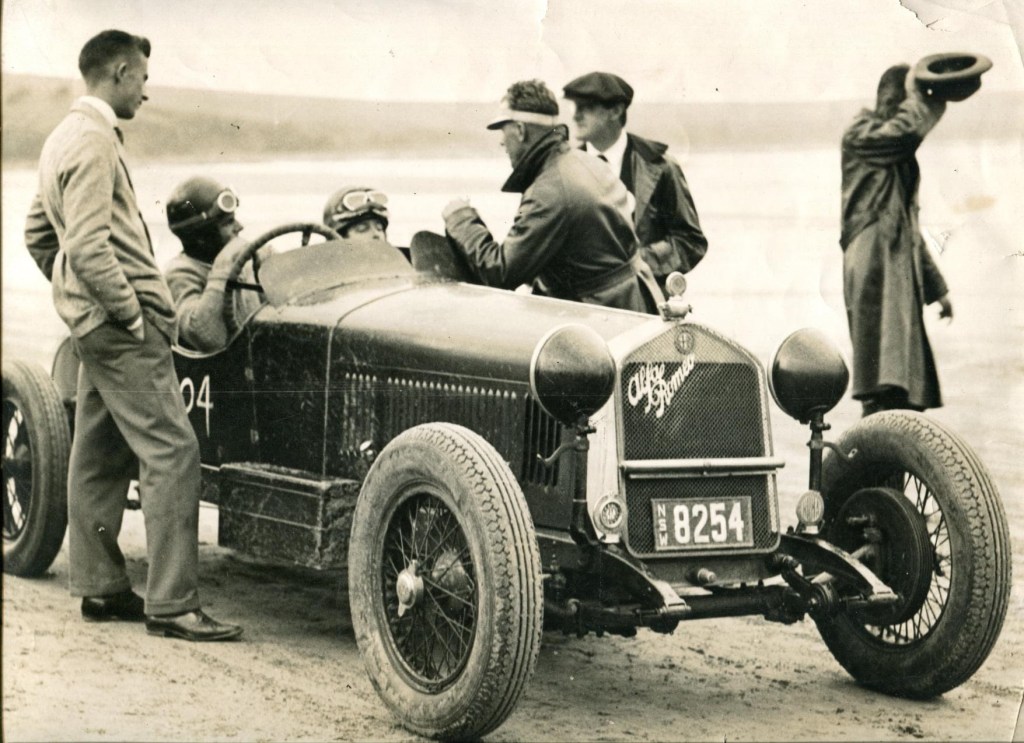
Percy Hunter and Vida Jones – aka Mrs JAS Jones – aboard her Alfa Romeo 6C 1750 SS Zagato on the beach at Gerringong, New South Wales south coast in 1930. Click here for a long feature on this oh-so-famous Oz racing car; https://primotipo.com/2018/02/15/mrs-jas-jones-alfa-6c-1750-ss-zagato/
(Keith Anderson Photography)
Only in Australia…
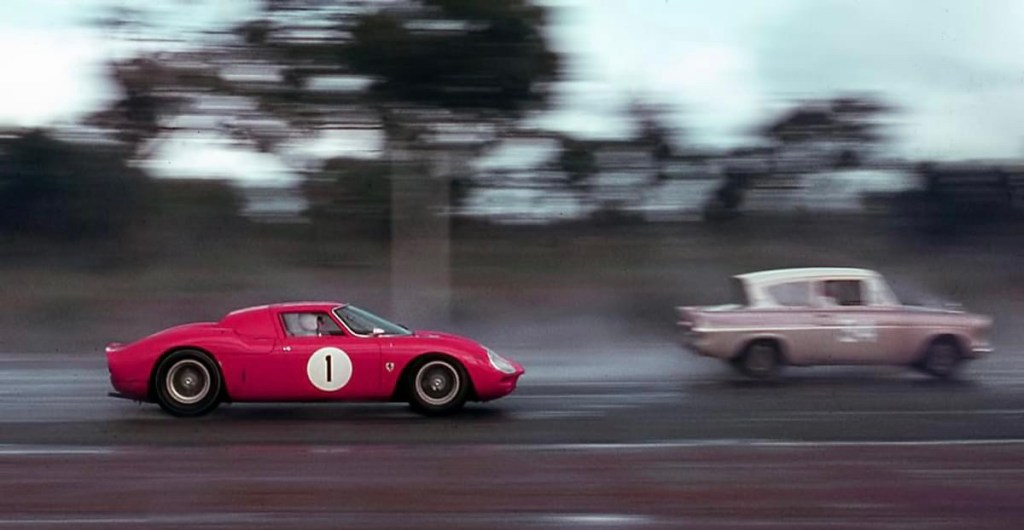
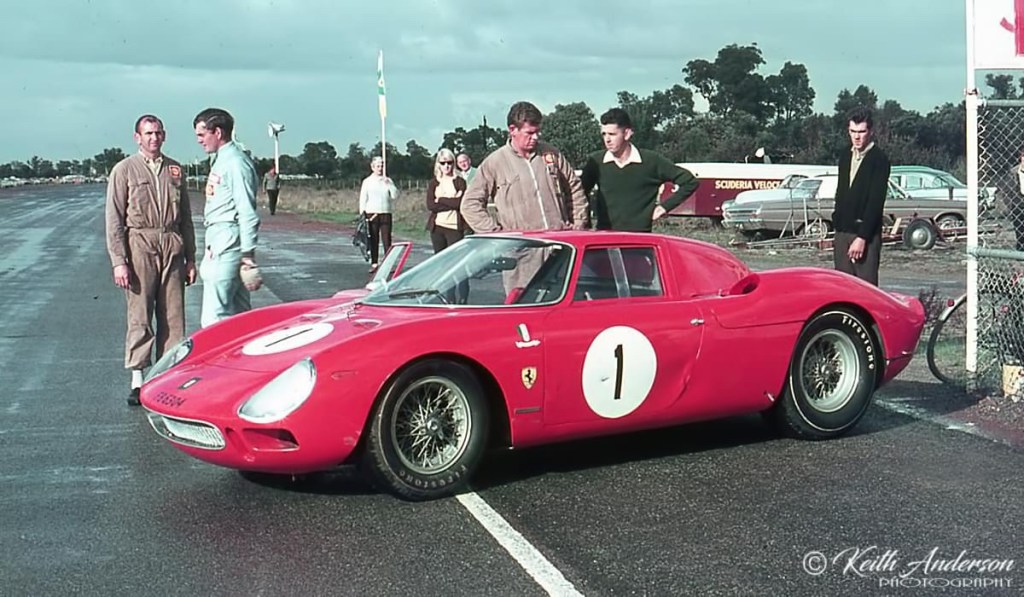
And no, the little Angle-box isn’t blowing off Enzo’s finest, the Andy Buchanan Ferrari 250LM at Caversham during practice for the 1966 6-Hour race.
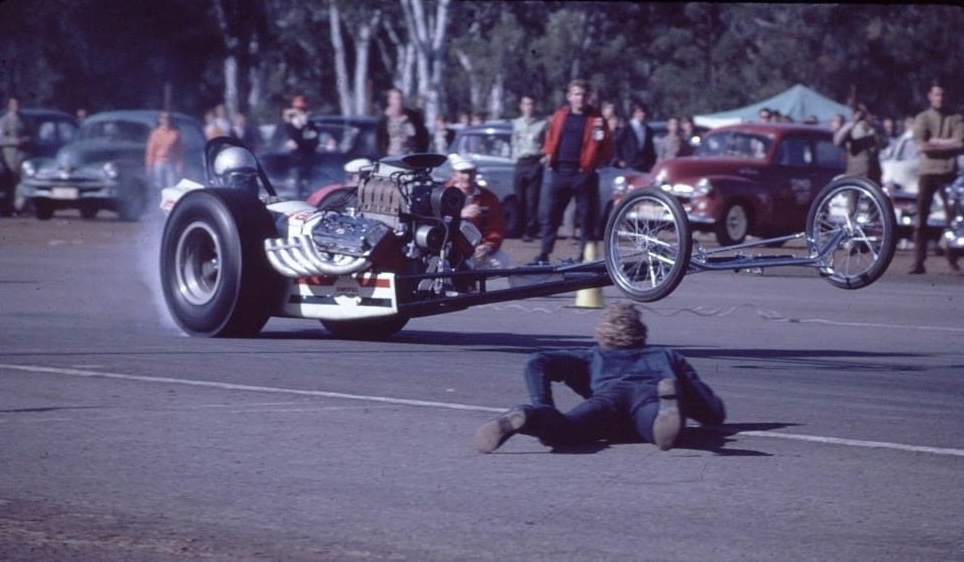
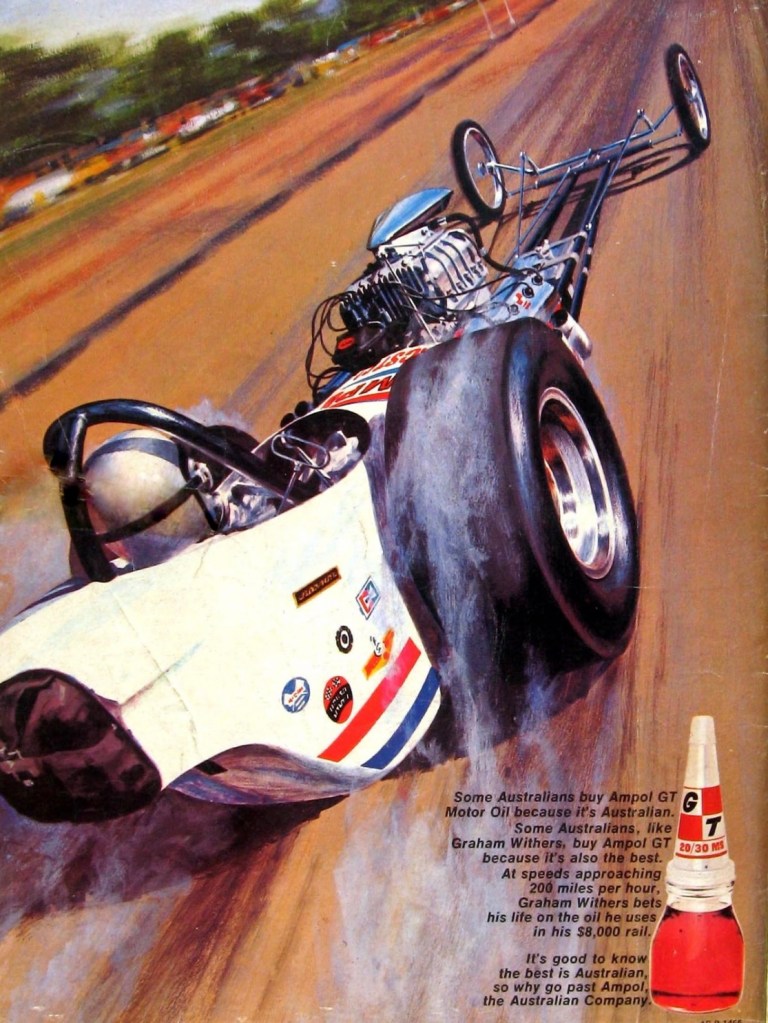
Graham Withers ‘slingshot’ Ampol GT sponsored dragster/rail at Castlereagh in 1968.
Whether the dude with the death-wish is a crew member sussing just how much air Mr Withers is taking on launch, or perhaps been ingesting tablets of a type not dispensed by suburban pharmacists is an interesting question. Do let me know if you can put all of our minds to rest. Manufacturer of the machine folks?
(B Williamson Collection)
Ron Hodgson’s Lotus 11 GT has to be Fugly Car Cup contender.
Here in the Warwick Farm paddock circa 1962. The story of how some lovely sportscars were re-purposed is told in this article about Murray Carter here; Forever Young… | primotipo…
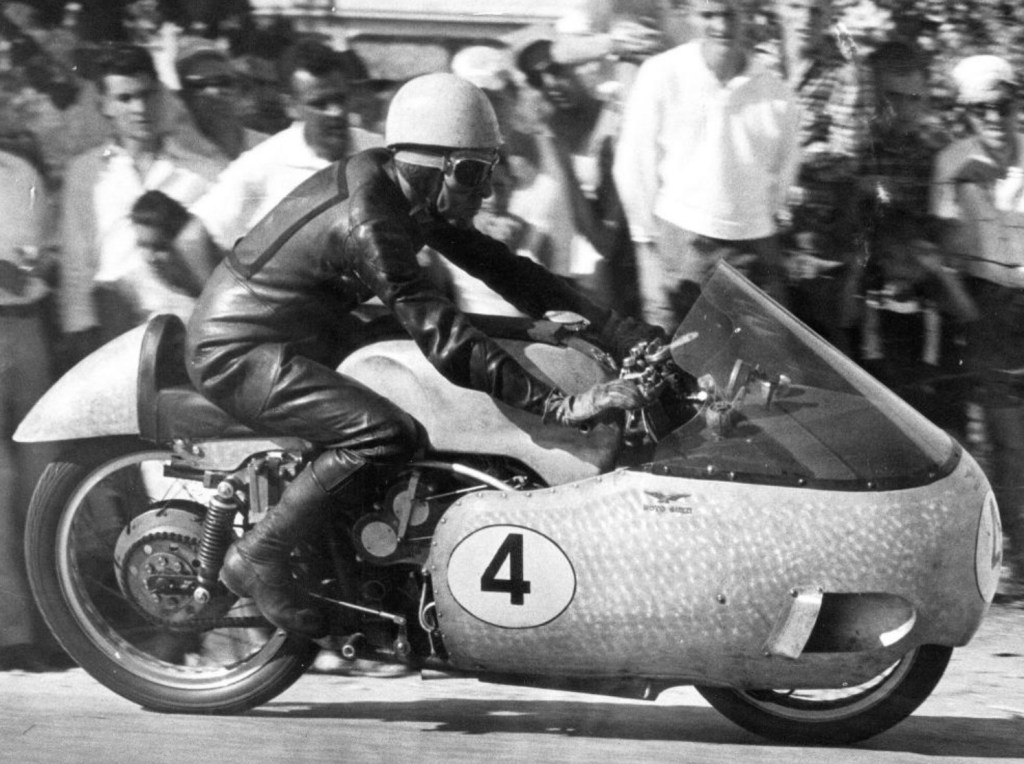
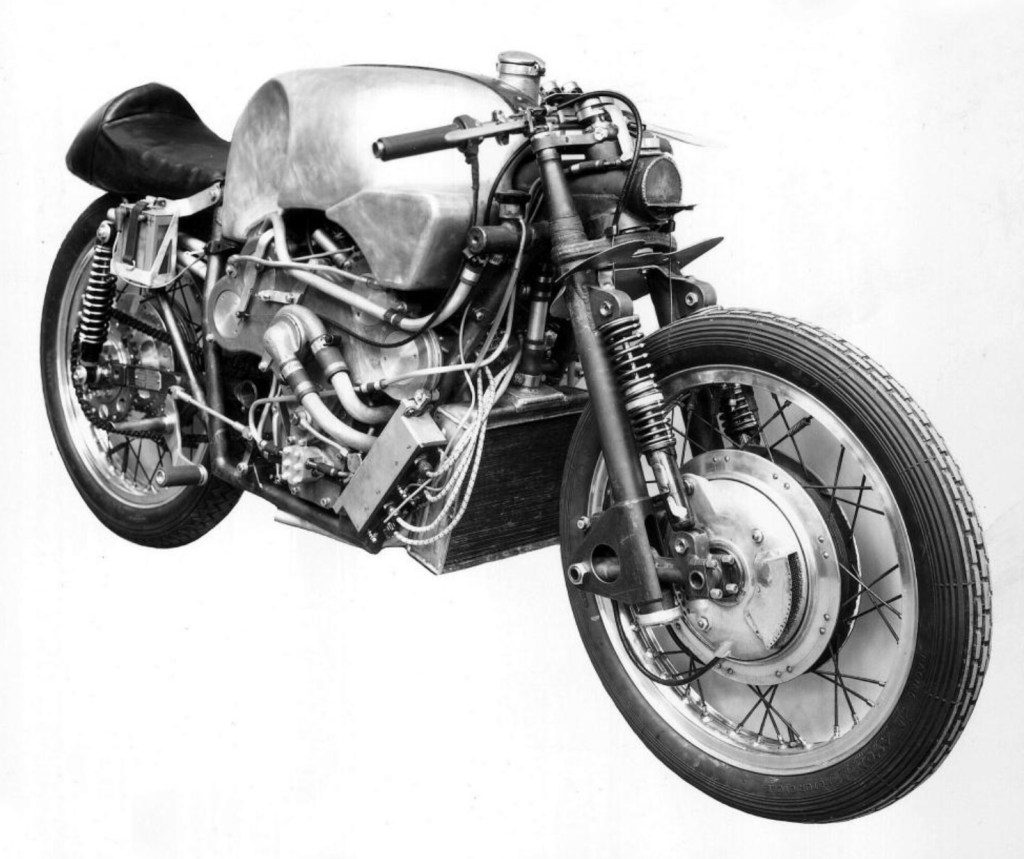
Ken Kavanagh aboard the awesome Moto Guzzi 500 V8 GP machine during the 1956 Senigallia Grand Prix.
This wild machine made its race debut at the Belgian GP in June 1955, read about Kavanagh’s time with Moto Guzzi in this feature; Moto Guzzi… | primotipo…
(Moto Guzzi)(MotorSport)
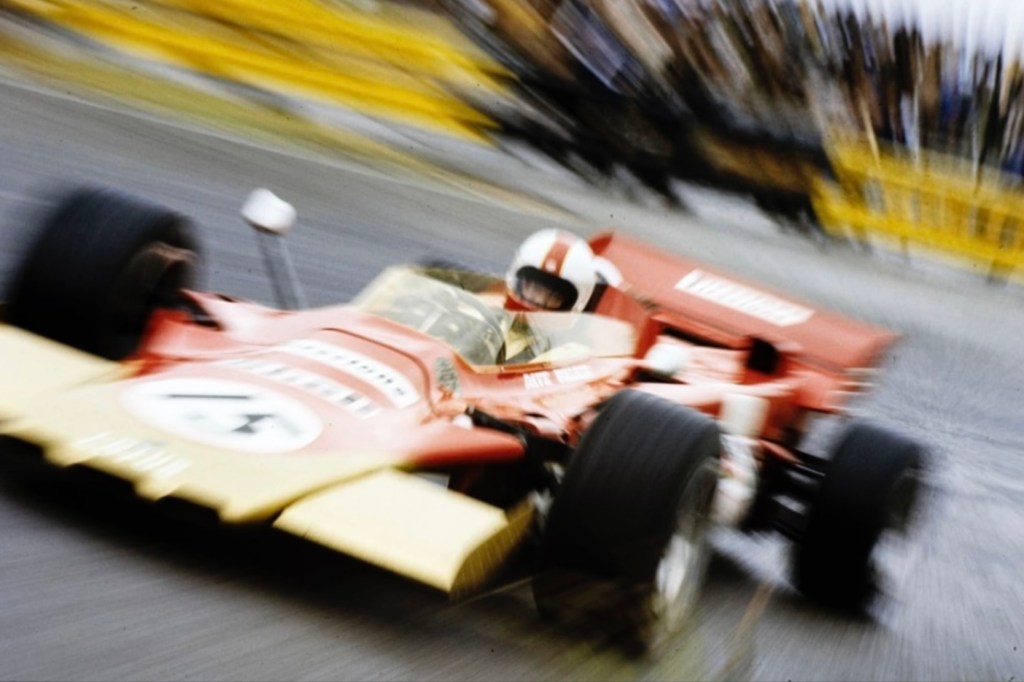
Dave Walker and Tim Schenken during the 1971 Dutch Grand Prix weekend at Zandvoort.
Walker started the Lotus 56B Pratt & Whitney 4-WD from grid 22 and was looking good for a while in the very soggy conditions but like so much of the grid, missed his braking point – in a car in which he hadn’t done a huge number of laps – and ran off the track after completing only five laps. Quickie on DW here; https://primotipo.com/2022/01/05/walkin-on-water/
Tim Schenken’s Brabham BT33 Ford was a more competitive mount. In its second year – Brabham won the South African GP in one in 1970, and should have won two or three more – it was still competitive in the young Melburnian’s hands, third place at the Osterreichring was his best result of the year.
At Zandvoort he started from grid 19 but DNF with suspension failure in the race won by Regenmeister Jacky Ickx’ Ferrari 312B2. Short piece on Tim here; https://primotipo.com/2019/01/02/tim-schenken/
(MotorSport)(Reg Hunt Collection)
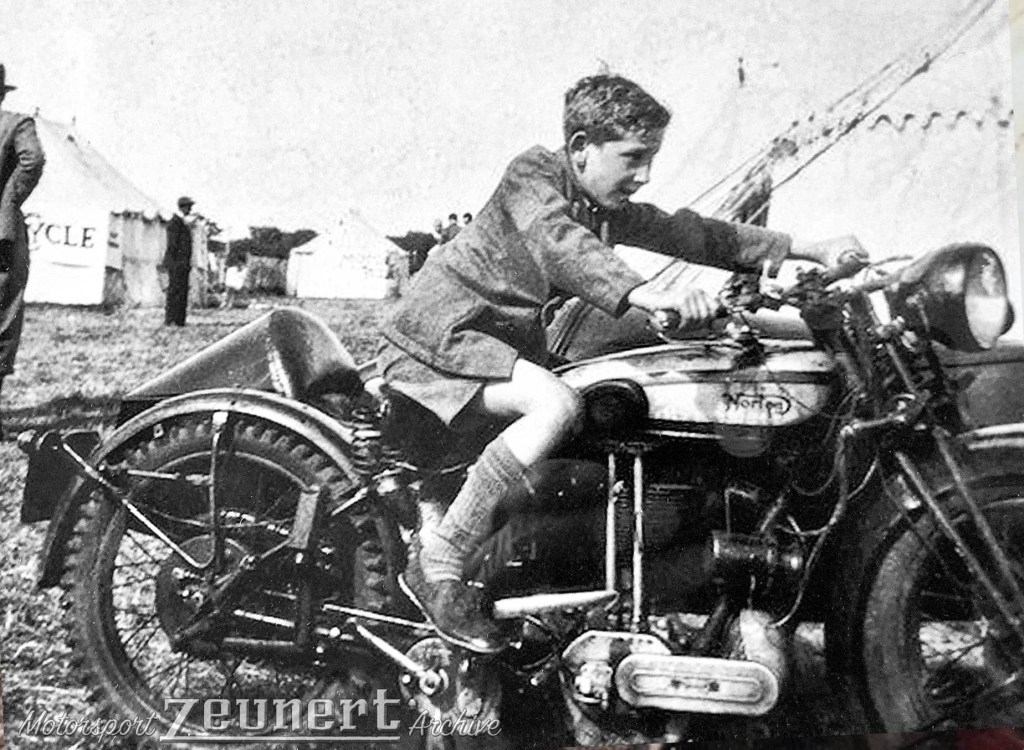
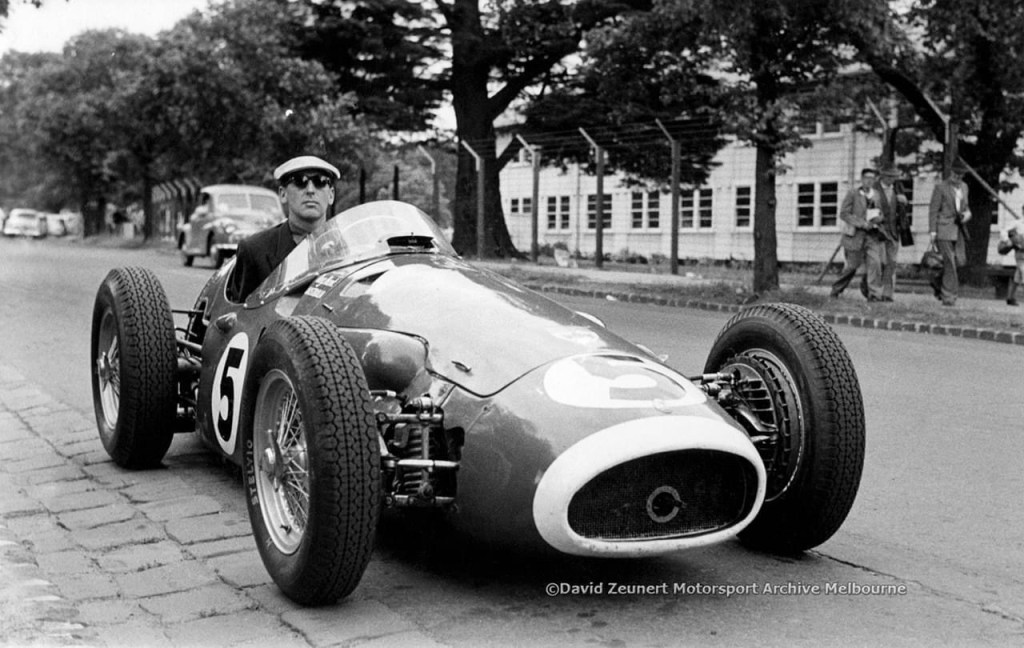
Reg Hunt dreaming about future conquests on one of his parents Nortons, aged nine, in the early 1930s in the UK, and living the dream at Albert Park in 1956 aboard his Maserati 250F below.
He and his A6GCM and 250F were Australia’s fastest combinations in 1955-56, then he retired early to focus on his family and motor dealerships, amassing a fortune. See more about Reg here; https://primotipo.com/2017/12/12/hunts-gp-maser-a6gcm-2038/
(Reg Hunt Collection)(P Miller)
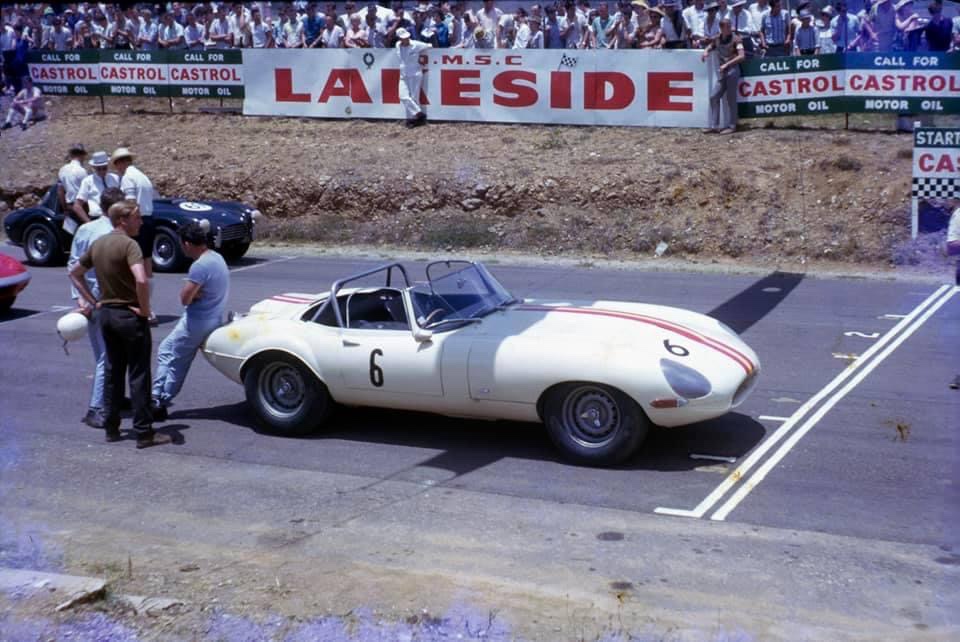
Bob Jane relaxes on his Jaguar E-Type Lwt during the Australian Tourist Trophy meeting at Lakeside over the November 14, 1965 weekend.
This is a heat or support race, Bob was fourth in the ATT, while Ron Thorp – it’s his AC Cobra you can see – didn’t start. Pete Geoghegan won from Greg Cusack and Spencer Martin: Lotus 23B Ford, Lotus 23 Ford and Ferrari 250LM.
The dude in the brown shirt is longtime Bob Jane Racing chief mechanic/team manger John Sawyer, no idea who the driver is, the tiny splash of red is Bill Gates’ Lotus Elan. Jane usually raced this darlin’ of a Jag with its factory hardtop but wasn’t averse to running topless on hot days. Click here for a feature on the car; Perk and Pert… | primotipo…
Piers Courage on the hop during the Warwick Farm 100 Tasman Cup round in January 1968.
Giving away a bit of horsepower at old-Sandown, a power track. Piers pitches his McLaren into Peters Corner with the Richard Attwood BRM P126 V12 , and, I think, Kevin Bartlett’s Brabham BT11A Climax behind. This fabulous race had an amazing dice between Jim Clark’s Lotus 49 Ford DFW and Chris Amon’s Ferrari 246T, resolved by a smidge in favour of the Scot. It was his last race, and series win.
(D Simpson)
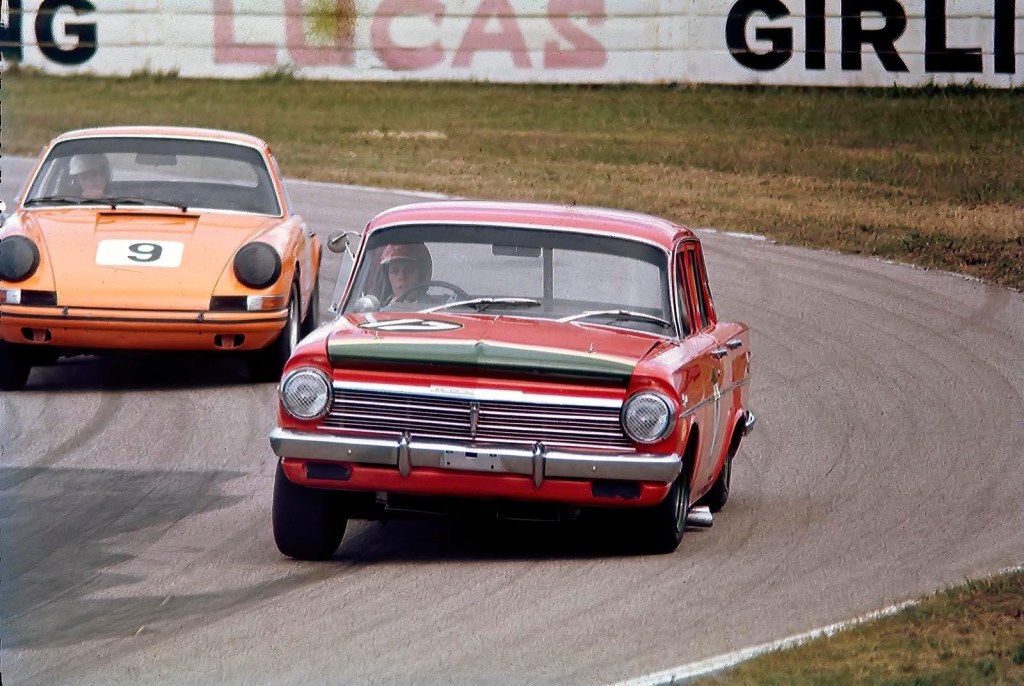
This is the Queensland Touring Car Championship meeting at Surfers Paradise in August 1969, a round of the Australian Touring Car Championship. Dick Johnson’s EH Holden in front of Alan Hamilton’s Porsche 911
Norm Beechey’s Holden Monaro GTS327 won – taking the first ever ATCC win for a Holden – with Hamilton second and Jim McKeown third in a Lotus Cortina Mk2.
Dick Simpson recalled a funny moment related to his photo. “A couple of laps after that shot, as the EH was entering Lucas Corner, there was an almighty bang, a massive cloud of blue smoke and black engine oil and a number of red bits of metal pouring out of the engine right on the apex of the corner. The noise stopped and the EH silently trundled on around Repco Hill and disappeared.”
“We had a flag post right beside us and had been chatting with one of the flaggies who was most impressed that we were keen enough, or stupid enough to drive all night from Wollongong. So he said he had to go and clean up the mess and would we like a couple of souvenirs? He brought up a couple of bits of steel, one looked like a huge main-bearing cap and plonked them on top of the fencepost to cool off. About an hour later a young kid who looked a lot like the EH driver came along and demanded his bits back. So we had a quick chat with a young DJ!”
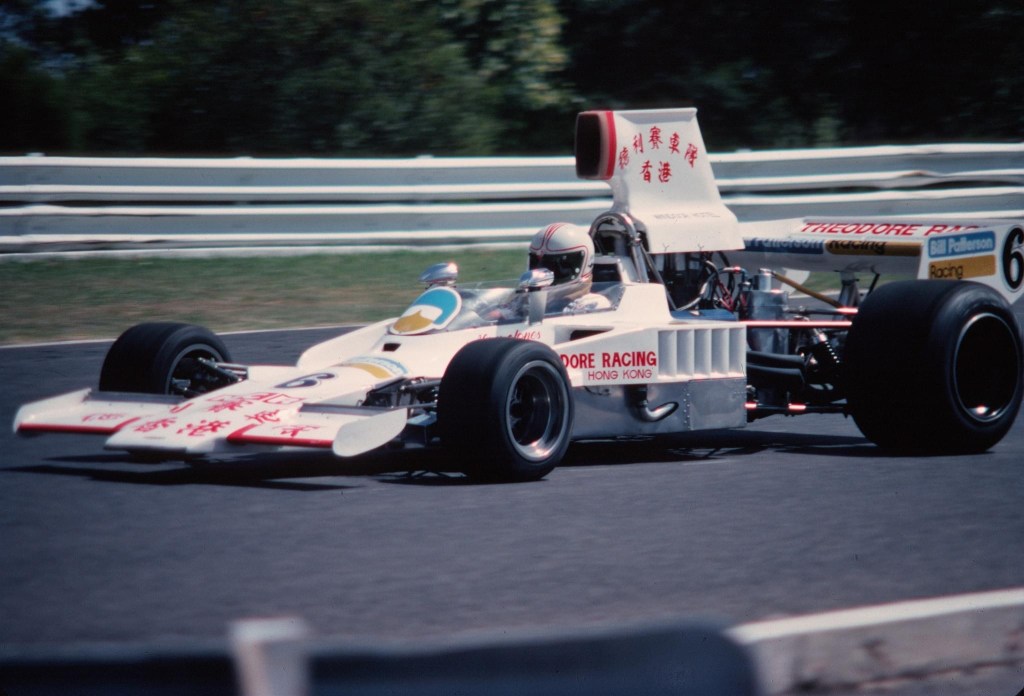
Alan Jones was stunningly quick in Sid Taylor/Teddy Yip Lola T332 Chevs during Australia’s 1977 Rothmans International F5000 Series.
While Warwick Brown won it in his Racing Team VDS Lola T430 Chev, Jones was the series-ace, let down by mechanical dramas and a mistake or two of his own; a jumped start at Oran Park and writing off a car in practice at Surfers Paradise.
(R Steffanoni)
Here at Sandown he grabbed the lead from the start but retired with overheating. He won the fourth, final round at Adelaide International at the start of a year in which he won his first F1 Grand Prix aboard a Shadow DN8 Ford at the Osterreichring (below).
(LAT)(I Smith)
Amazing Ian Smith pan of Allan Moffat in his legendary Trans-Am Mustang at Oran Park during the final round of the Australian Touring Car Championship on August 8, 1972.
Steve Snuggs tells us that he was wearing an oxygen mask in protest to CAMS not allowing him to remove the car’s carpets which smouldered from the hot exhausts and gave off fumes.
Incredibly rare colour shot of Pedro Rodriguez’ works-BRM P261 2.1-litre V8 during the 1968 Longford Trophy.
He is on the rise having exited the Newry right-hander in second or third gear – that line of poplars and road is still there – before an open left-kink then onto The Flying Mile.
Pedro nicked second-place from Frank Gardner’s Brabham BT23D Alfa in the final lap but fell well short of Piers Courage McLaren M4A Ford FVA F2 car in demanding wet conditions. More about BRM in the Antipodes here; https://primotipo.com/2020/02/22/1966-australian-grand-prix-lakeside/
(I Smith)
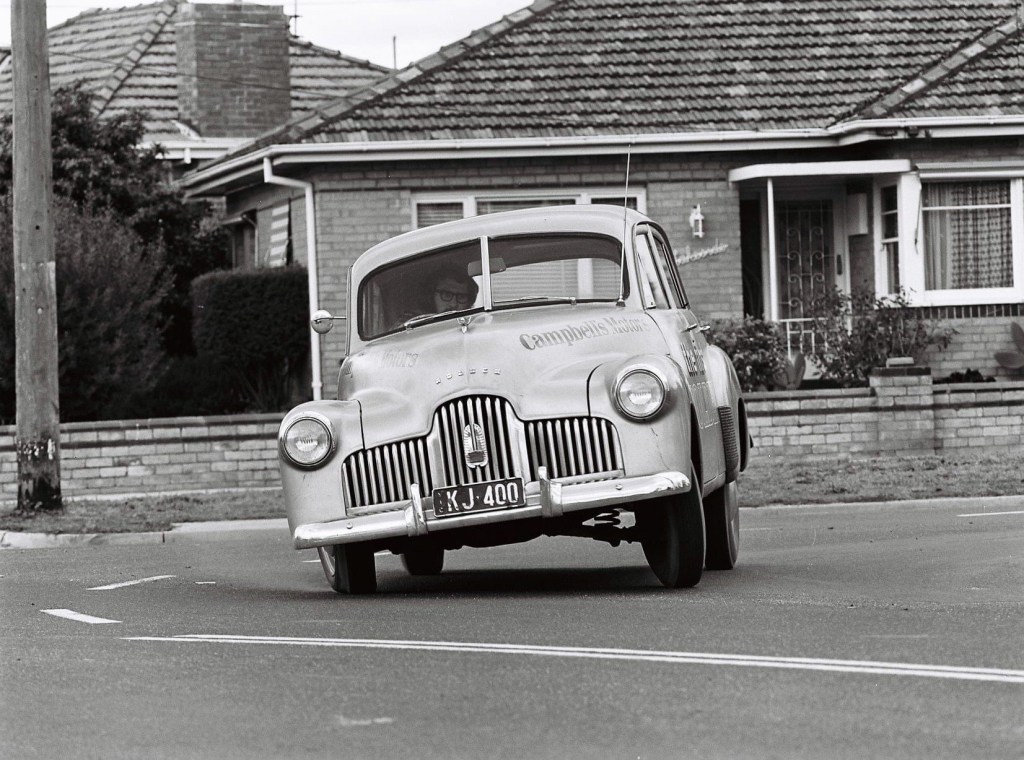
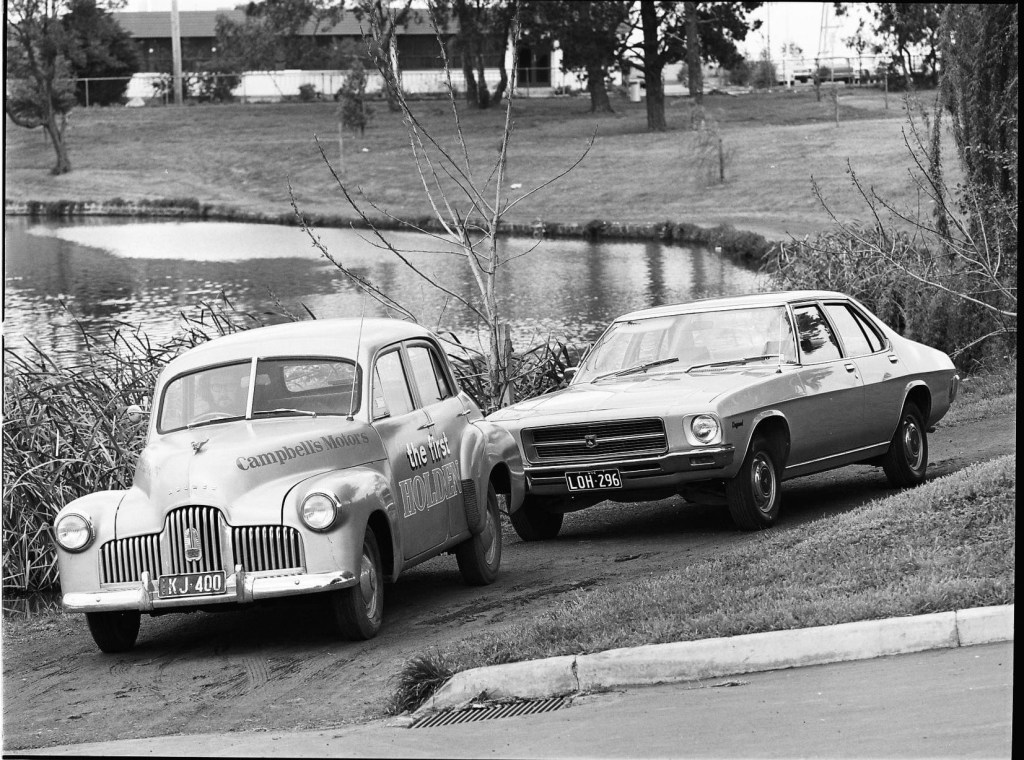
The great Ian Smith is sharing his back-catalogue of photographs in great dollops via Facebook. I enjoyed this series of shots taken in Reservoir, suburban Melbourne during a compare and contrast Wheels road-test between the then new Holden Kingswood HQ, and the original 1948 Holden 48-215 circa 1972.
(I Smith)
The reason for the strange location is probably because Campbells Motors Holden were in High Street, Preston and they didn’t want their luvverly old-Humpy being taken too far from ‘home’. See here for a piece on the 48-215; https://primotipo.com/2018/12/06/general-motors-holden-formative/ The locale is Edwards Park Lake, Reservoir.
(I Smith)(Mitsubishi)
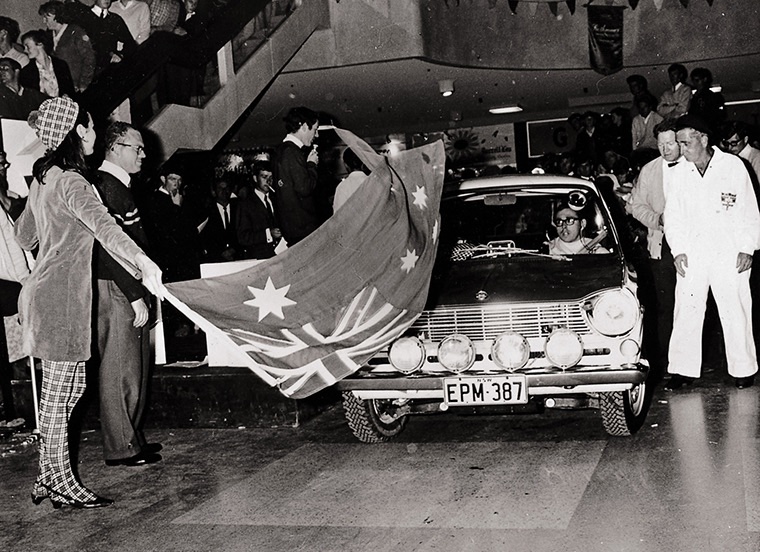
The giant-killing Colin Bond/Brian Hope, fourth place overall Mitsubishi Colt 1000F at the end of the 1967 Southern Cross Rally at Port Macquarie.
Michael Gasking Collection, Keith Anderson Photography, Bob Williamson Collection, oldracephotos.com-Dick Simpson, Moto Guzzi, Reg Hunt Collection via David Zeunert, Peter Jones, Peter Miller, Rod Steffanoni, Bill Forsyth, Ian Smith, IC Walker Collection via Russell Garth
Tailpiece…
(oldracephotos.com/DSimpson)
Dick Simpson’s artistry catches Niel Allen on the hop in Garrie Cooper’s first monocoque sportscar, the Elfin ME5 Chev on the entry to Homestead corner at Warwick Farm in 1969. It was a twitchy beast of a thing with its short-wheelbase, arguably, only Niel got the best out of it in the short time he owned it before buying a McLaren M10B Chev F5000.
Social media just keeps giving and giving. This time enthusiast Russell Garth has posted some great ’56 AGP colour shots taken by the late Ian Curwen-Walker at Albert Park on Bob Williamson’s Old Motor Racing Photographs Australia Facebook page.
Sometimes I’ve got so many different articles on the same topic I’m confusing myself – not that is difficult to do I might add – so rather than start another ’56 AGP piece I’ve added the shots to this existing article; https://primotipo.com/2018/01/16/james-linehams-1956-agp-albert-park/
The photograph above is Paul England’s Ausca Holden-Repco which contested the 25 November, 34 lap, 100 mile Australian Tourist Trophy. He was 12th outright and second in class, in the car he and Bill Hickey built after hours at Repco Research’ Sydney Road, Brunswick premises on the other side of town. The flash of blue to the right is the Norman Hamilton owned Porsche 550 Spyder driven that weekend by Otto Stone, lasting only one lap. Otto would have been a busy boy that fortnight, looking after Stan Jones’ 250F, or was he preparing it at that early stage?
Tony Johns tells me the “bloke (with his back to us) in the white overalls with the fag is Norman Hamilton,” who created the Porsche Cars Australia empire in Australia, famously the first Porsche importer/dealer outside Europe.
One upon a time Grand Prix drivers weren’t paid fees that make the GDPs of third world countries look small.
I guess that over 20 Grands Prix and the associated test and race-simulation loads keep them busy, the rest of the time is devoted to the body-beautiful, PR and the needs of the girl/boyfriend.
At the dawn of the space-age, wily Jack Brabham worked all the angles to optimise his earnings, short and perilous as it was in the days when drivers died in the cockpit as a matter of routine.
John Cooper paid him a retainer and a percentage of his winnings. He ghosted magazine articles, had a motor garage and dealership or three, drove cars for others and owned and entered cars for himself and others. That’s how he found himself in the New South Wales/Victorian border-town of Albury, on the Murray River, for the Craven-A International at the small, new, Hume Weir circuit over the March 12/13 1961 weekend.
(Draper Family Collection)(G Garth)
That summer he’d brought a Cooper T53 Climax (chassis F2-8-60) and Cooper T51 Climax (F2-5-57 or F2-7-59) home to do the Kiwi and Australian Internationals.
He did pretty well too, winning the New Zealand Grand Prix on the Ardmore aerodrome and the Lady Wigram Trophy on the RNZAF base of the same name in the T53. Ron Flockhart that car on pole at Ballarat, and finished third, while Ron’s best with the Cooper T51 was fourth at Ardmore and fifth in the Warwick Farm 100 where Stirling Moss won the first international held on the great Sydney track aboard Rob Walker’s Lotus 18 Climax.
(J Richardson)
Roy Salvadori – who had raced a Reg Parnell Lotus 18 in New Zealand that summer – took the wheel of the Cooper T51 in Tasmania, winning the Longford Trophy (above) but his weekend wasn’t so successful in Albury where he was fourth in the Saturday 20-lapper, and failed to finish the equally hot Sunday race. Brabham won both races in the T53 in skinny six/seven car grids.
Our Jack dragged in he crowds, doubtless Craven A sold a few cancer-sticks, so everybody went home happy. Brabham always flogged the cars he brought to Australia at the end of his tour but on this occasion both Coopers returned to the UK and equally oddly both disappeared into the ether later in the year.
(Draper Family Collection)
Credits…
John Richardson, Draper Family Collection, Glenn Garth, oldracingcars.com
Tailpiece…
(Draper Family Collection)
Roy Salvadori reflecting on the size of his ‘Gregory Peck’ at the Weir while entertaining the crowd, announcer’s name folks?
The Grand Prix cinematographer doesn’t seem the least bit perturbed by the immediate proximity of Daniel Sexton Gurney at Spa during the 1966 Belgian Grand Prix in the pouring Ardennes rain. There is a haybale or two there after all.
I guess Dan is past the critical – for the ‘snapper’s life – turn-in phase of the corner and he is only (sic) delicately balancing the Eagle Mk1 Climax 2.7 FPF on the throttle through Eau Rouge. Still, it was really dumb-shit like this that makes the film so great.
Gurney qualified 15th and wasn’t classified in this interim car, he was awaiting Weslake Engineering’s delivery of the Eagle-Weslake V12 motor to create a true contender, John Surtees’ Ferrari 312 won. See here; https://primotipo.com/2019/02/19/eagle-mk1-climax-101/
(Wfooshee)(unattributed – who took the shot?)
He came, he saw and he conquered with mesmeric car control in the 1969 Warwick Farm 100 Tasman Cup round. Jochen Rindt Lotus 49B Ford DFW 2.5 V8.
If he wasn’t recognised as the fastest man alive at the start of the season, most pundits saw it that way by the end of it. Fastest I said, not best. See here; https://primotipo.com/2018/01/19/rindt-tasman-random/
Duncan Ord completes a donut out front of a Shell Servo in suburban Perth, date and place unknown…
I laughed at the sight of this oh-so-pedigreed racer being subjected to useage more often applied to ‘Humpy’ Holdens of the day!
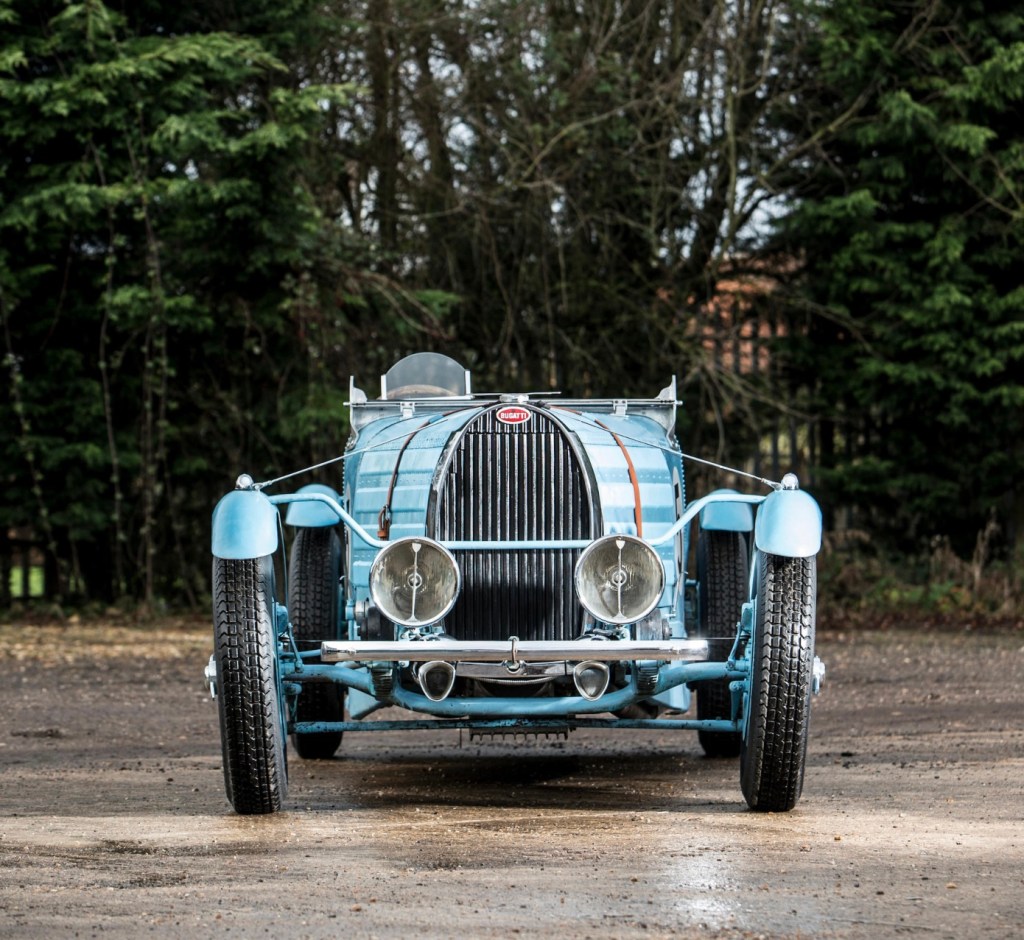
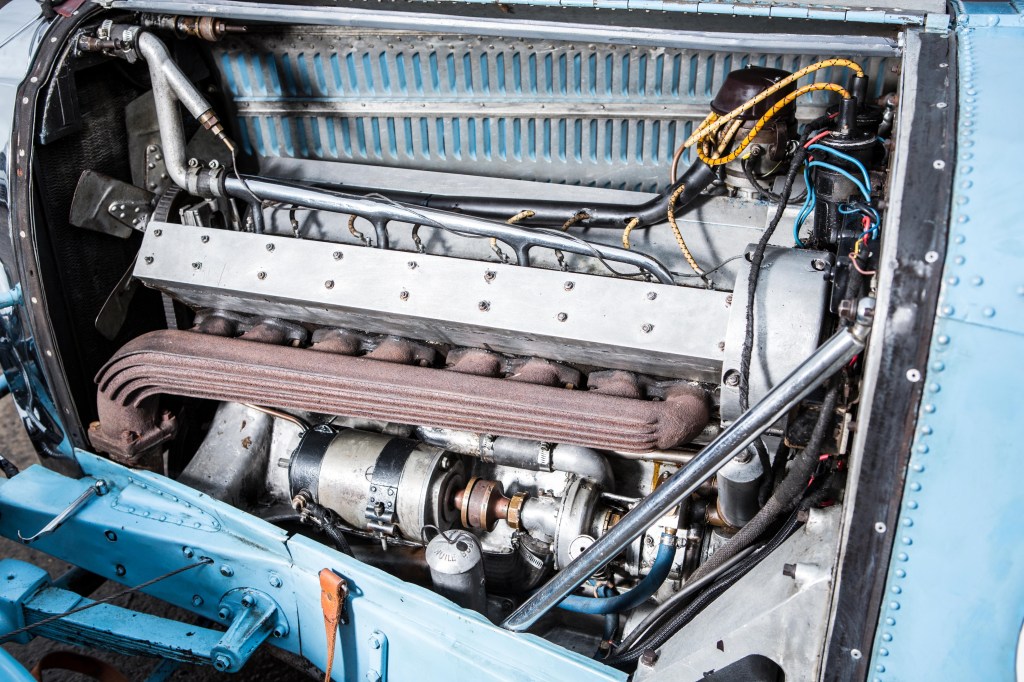
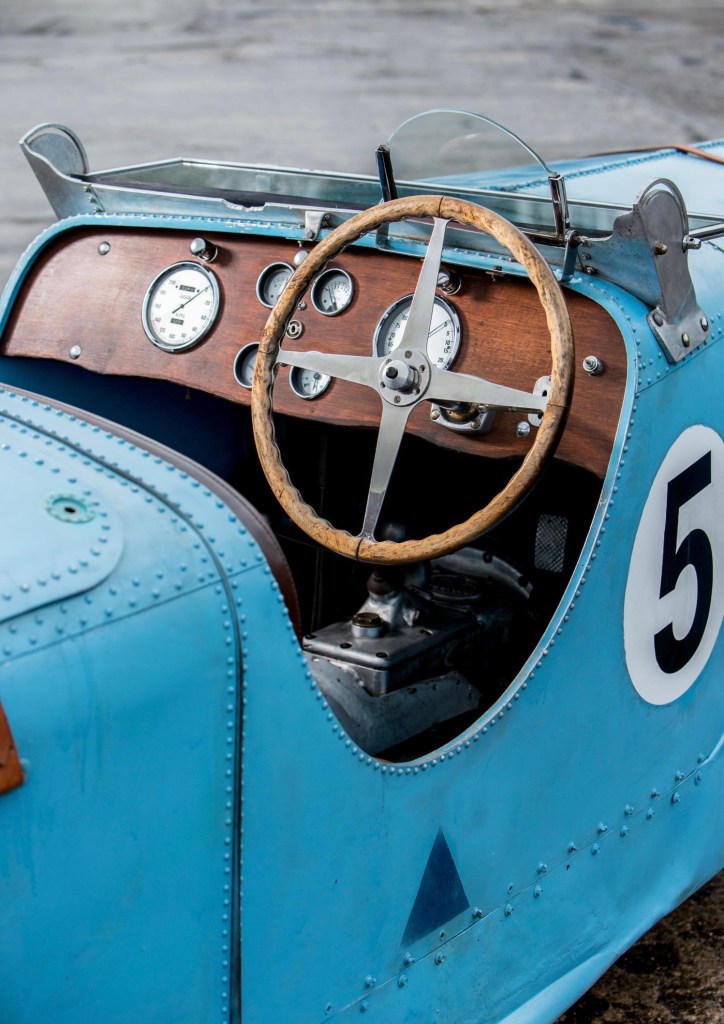
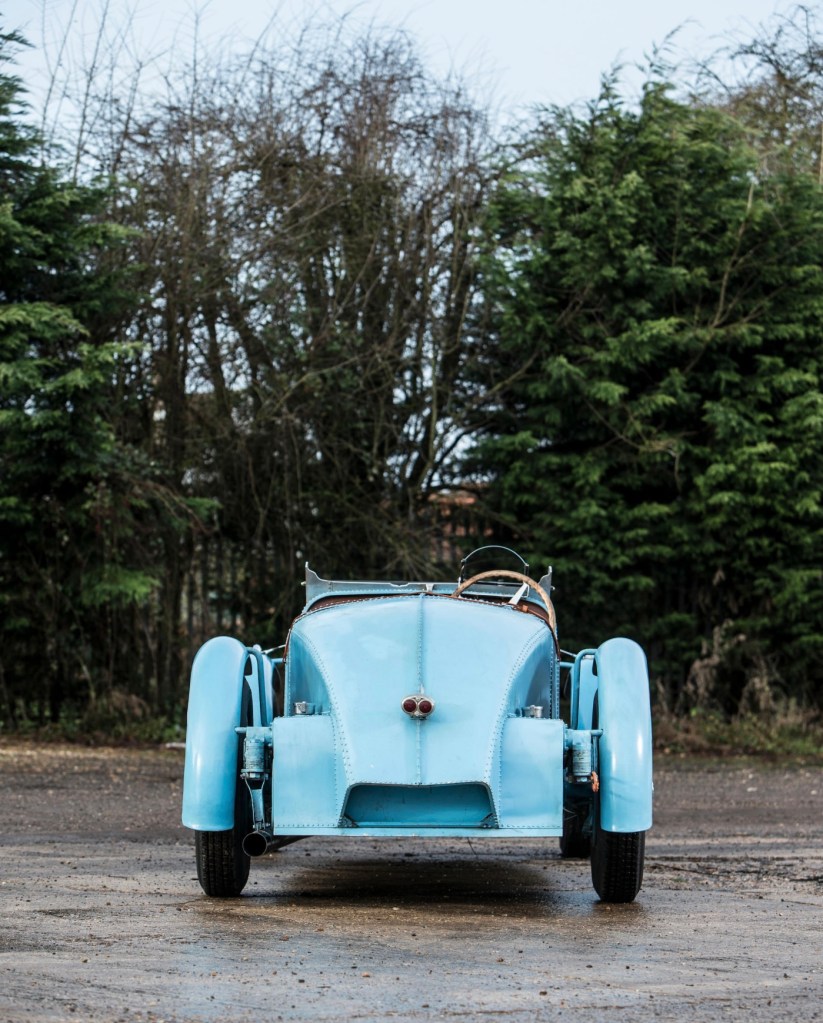
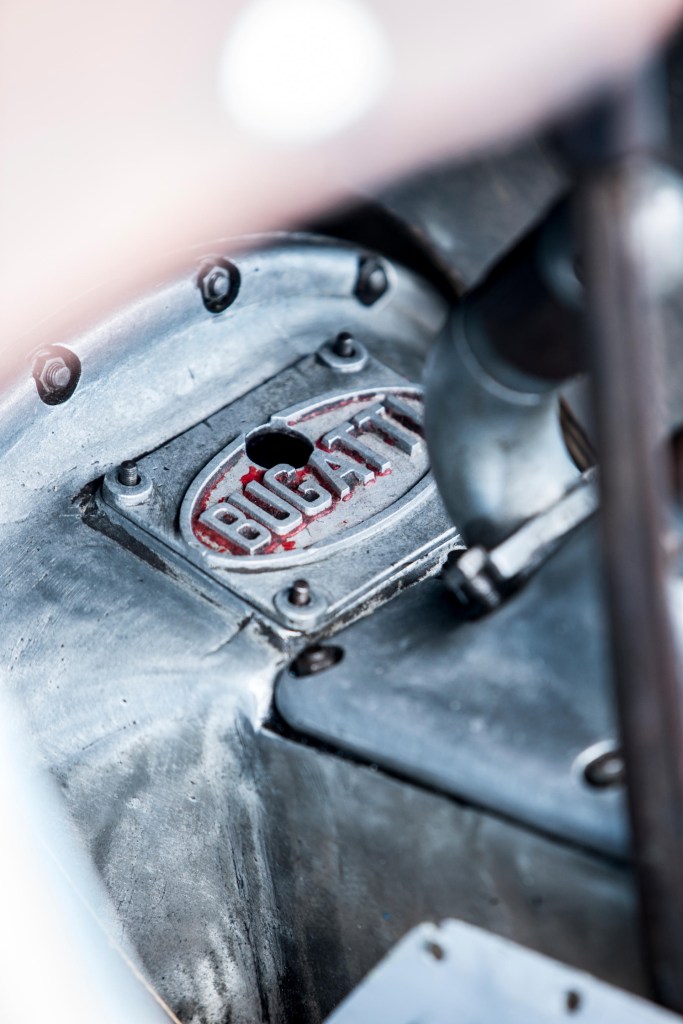
This 3.3-litre, DOHC, straight-eight Bugatti T57T #57264 was first raced by Earl Howe in the 1935 Ulster Tourist Trophy later passing into the hands of Pierre Levegh who contested the 1937 GP des Frontieres at Chimay amongst other races. It, perhaps, passed through Jean-Pierre Wimille’s hands before being sold to visiting Perth racer Duncan Ord in the UK. He shipped it home, first racing it at Pingelly, Western Australia in January 1939, where it remained a pillar of the local scene into the dawn of the swinging-sixties.
Among sports-racing Bugattis, the Type 57 is one of the most illustrious. Chassis 57264 is a Type 57 Tourist Trophy Torpedo, originally designated chassis 57222, this was later changed by the factory. The car is unusual in that despite a racing history of over thirty years it retains its original chassis largely intact, and original crankcase, gear-box and front and rear axles as well as other less critical components.
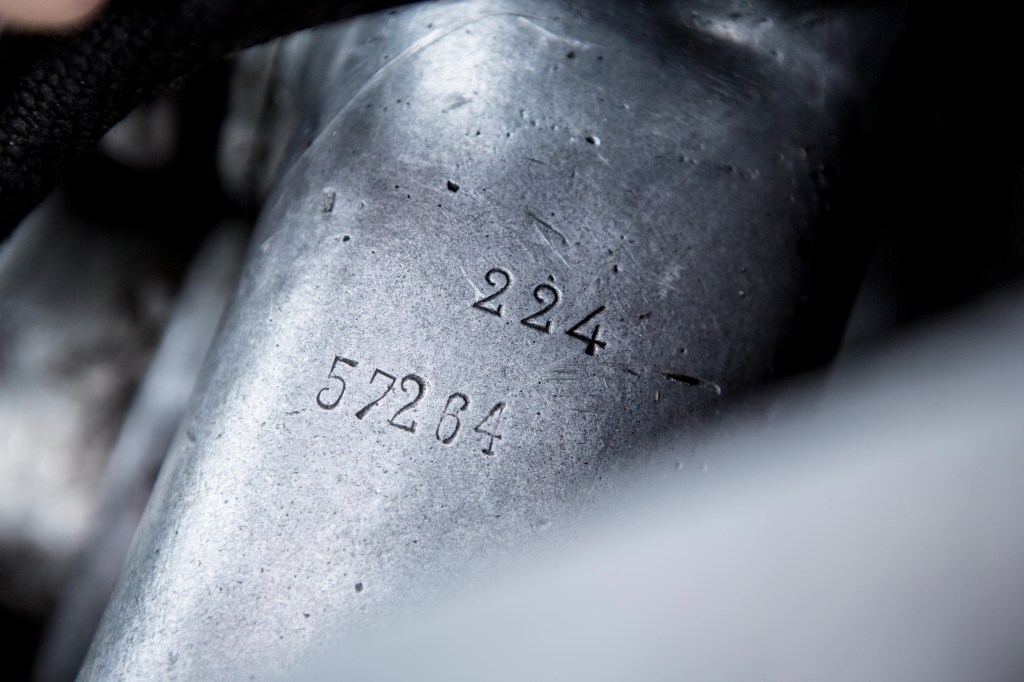
Detailed research by foremost French Bugatti authority Pierre Yves Laugier has confirmed this machines history, “The first mention of the car is in the August 1935 list of bodywork at the Bugatti factory which contains the entry ‘2 Voitures Course 24 Heures, moteurs 223 et 224’. While no chassis serial numbers were recorded for these two cars, on August 29 that year – in the factory’s list of cars sold – the chassis serial number 57222 Torpedo Tourist Trophy with motor number 224 is mentioned. Francis, Earl Howe, drove Bugatti Type 57 TT, engine 224, to finish third in the Ulster TT race, at Ards, Ulster (as below) on September 7, 1935.”
(MotorSport Images)Earl Howe beside his trusty steed at Ards before the off (MotorSport Images)
In its report of the race MotorSport said, “The Bugattis driven by Lord Howe and the Hon. Brian Lewis were models of light construction with their duralumin shell bodies, and weighed only 26 cwt, with driver, fuel and water. Georges de Ram shock absorbers were used and the engines were said to develop over 160hp at 5,500rpm, which sounds rather fantastic. At any rate the compression ratio was well over 8 to 1 thanks to the efficient shape of the twin (sic) combustion chambers. Lord Howe’s car did close on 120mph while Lewis’s car was somewhat slower….”.
During the first practice day Francis, Earl Howe, had in fact made fastest lap time in 10 minutes 16 seconds which was some six seconds faster than his RAC handicap time. During the race Brian Lewis – the younger man and a faster driver than Howe – led the race, before his Bugatti developed clutch slip due to an oil leak from the gearbox. This left Howe leading, only to make an immediate refuelling stop. He subsequently fought his way back onto the leader board, MotorSport commenting “Howe had been making splendid progress on the Bugatti, and on the 33rd lap caught the two Aston Martins to secure third place…” – behind winner Freddie Dixon’s fleet Riley and Eddie Hall’s very special 3.6-litre Bentley.
By January 1936, the car was listed for sale with dealer Dominique Lamberjack back in Paris at 60,0000 Francs. The car was also referred to in period as chassis serial 57264/moteur 224 Torpedo TT as the factory had re-allocated serial 57222 to a new Competition Torpedo with its gondola shaped Type 57S chassis.
57264 was possibly entered at Le Mans in 1936 but the event was cancelled due to the political unrest throughout France. On June 11, 1936 the car was co-driven by Yves Giraud-Cabantous and Bugatti company salesman Roger Labric in the Spa 24-Hours. Labric, a friend of Bugatti, managed the marque’s showroom on the Avenue Montaigne, Paris. Unfortunately he overshot at the Stavelot Hairpin and burst the car’s radiator. When repaired it was offered for sale at the Avenue Montaigne showroom.
The car pictured in France during Pierre Levegh’s ownership (Bonhams Collection)
It found a buyer on April 8, 1937 in talented French gentleman/sportsman – talented cyclist, skier, ice hockey and tennis player – owner/driver Pierre Bouillin. Born in Paris on December 22, 1905, he was the son of an antiques dealer and had become the director of a brush factory in Trie Châ-teau in the Oise region. The Type 57 was his first Bugatti.
Bouillin idolized his uncle – Alfred Velghe – a pre-war pioneer racing driver. Bouillin shuffled the letters of that surname to adopt the anagram nom de guerre ‘Levegh’ for his racing exploits.
Pierre became obsessed with winning Le Mans and in 1952 came close – over-revving his Talbot-Lago and blowing the engine after 23 hours of a solo drive – while well-established in a probably uncatchable lead. His misfortune gifted the race to the works Mercedes-Benz 300SL Gullwings which finished first and second.
When Mercedes returned to Le Mans with a team of 300SLRs in 1955 they invited 49 year old Levegh to drive for them. It was aboard an SLR that he became innocently involved in the terrible collision which claimed the lives of over 80 spectators, in addition to the luckless Bouillin himself.
57264 perhaps at Miramas, Marseilles with Levegh in June 1937 (Bonhams Collection)
In happier times during 1937 he paid 32,500 Francs in instalments to purchase 57264 for his competition debut. On May 15, 1937, he raced the T57 in the Grand Prix des Frontieres at Chimay, Belgium finishing third, running sans mudguards. On June 6 he contested the Marseilles 3-Hours, finishing eighth, then on September 19 at Montlhery, Levegh entered the the Autumn Cup sports car race, the machine by then fitted with larger Delahaye-style mudguards, but failed to finish.
Pierre then advertised the car for sale in the L’Auto March 15,1938 issue, describing it as a “Type 57, unique car, capable of 190km/h. Write to owner at 54 Avenue de Choisy”.The car was spotted at Brooklands during that period and clocked at 192km/h. It had already been modified with the addition of a 40-gallon riveted aluminium fuel tank behind the driver’s seat, different doors, an additional oil cooler ahead of the radiator and further modified mudguards. It also featured cable-adjustable Repesseau shock absorbers.’
Contemporary references are confusing but it’s possible Levegh sold it to French Ace Jean-Pierre Wimille who used it as his roadie before passing it on to an unknown purchaser, who shipped it to Brooklands, but died before he could compete there. It then passed to London based sports car specialist J.H. Bartlett who advertised it in the May 1938 issue of Speed, “Bugatti special 3.3-litre 120 m.p.h. competition 2 seater, fitted late series 57S engine, special electron body, special streamlined wings, spare tanks, etc…£450.” It was acquired by visiting Australian racer Duncan Ord.
Ord, Pingelly Speed Classic, on the cars race debut in Australia, January 30, 1939 (J Krajancich Collection)
Another Pingelly shot, year unknown, note the oil cooler up-front (K Devine Collection)
On arrival in Australia the car was unloaded from the ship at Fremantle where it created considerable local interest as a contemporary machine described in the press as a “1934 Le Mans model two-seater fitted with long range 60 gallon fuel tanks and had been refurbished at Molsheim before being clocked at 120 mph at Brooklands.”
Ord entered the Great Southern Speed Classic at Pingelly on 30 January, no doubt the step up in performance of the Bugatti compared to the P-Type MG he started racing in 1936 was deeply impressive. Ord’s handling of the car was noted as being particularly good but he was slowed by clutch troubles and a spin on the last lap which dropped him to fourth.
Interestingly this handicap race was won by the supercharged MG TA Spl driven by the very young Alan Tomlinson. On 2 January 1939, three weeks before, ‘The Three Kids from Perth’ (Tomlinson, Minder- Bill Smallwood, Manager- Clem Dwyer both of these latter fellows no slouches as drivers themselves) won a famous Australian Grand Prix victory on the daunting Lobethal which confounds historians to this day. Confounds in the sense that the sustained speed of the little MG beat some serious heavy-metal including the Jano Alfas of Alf Barrett, Jack Saywell and John Crouch, the Delahaye 135CS of John Snow and others on a track regarded as Australia’s greatest ever motor racing challenge.
The racing fraternity in Western Australia had a great relationship with the authorities which was reflected in a vast number of Round The Houses racing on closed public roads of small towns they secured over many decades, the first of which was at Albany in 1936.
The venues were away from Perth, to its south east was Pingelly 150km away, and Cannington 10km. Narrogin was-is 200km to the north east, Goomalling 130 km and Dowerin 160km. Byford Hillclimb was 45km south of Perth whereas Albany was a very long tow, 420km south to the edge of the continent’s coast. Busselton is 225km ‘down south’ as the Perthies say, too, on a magic stretch of coast. Bunbury was and is an important port on the west coast, it too is south of Perth, 175km from the state capital. This is by no means a complete list, I’ve just covered the towns in which the Bugatti raced.
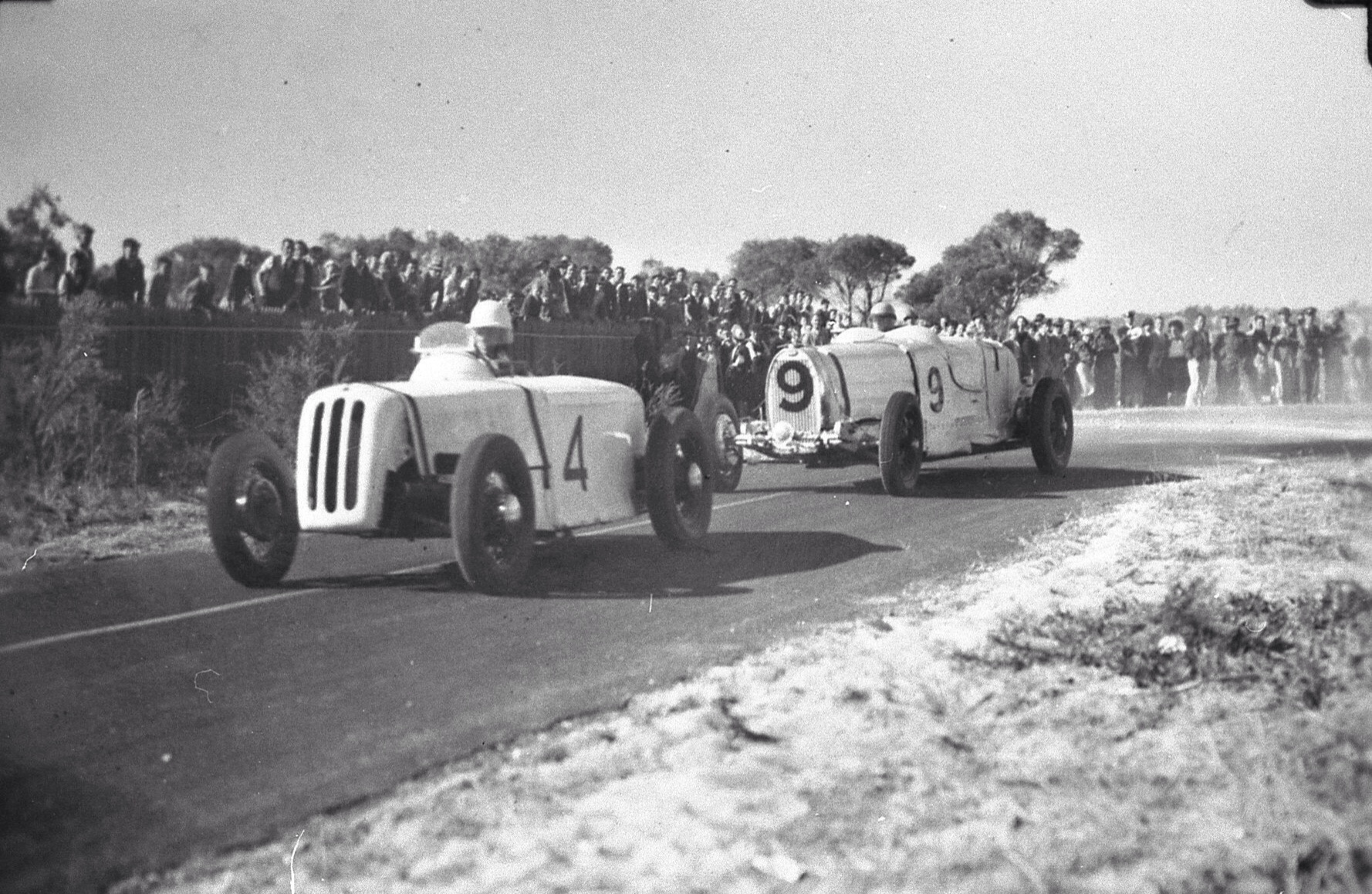
Duncan Ord pressing on, place and date unknown (J Krajancich Collection)Ord again at Pingelly, uncertain of the year – he raced there from 1939-41 carrying #9 on each occasion – at the Review Street corner (K Devine Collection)
Pre-War the West Australians did more racing miles than racers in any other state on tar or bitumen. On the odd occasion they competed on the east coast – a cut-lunch and a camel ride away – given the transport network and roads of the day, the best of them could be prodigiously fast, Alan Tomlinson being the prime example.
As the war clouds gathered in Europe Ord raced the car in the June Dowerin winter meeting, finishing second in the open championship to Jack Nelson’s Ballot Ford V8 Spl. A fortnight later he was at Cannington for the Quarter Mile Trials where the Bug did a 17.2 second standing quarter and a flying quarter mile pass at 94.73 mph. He was second in each event again to Nelson’s Ballot which achieved 16.5/104.64 mph.
Whilst Australia was at war in 1940, Ord competed three times for a second place to Bob Lee’s Riley in the (handicap) Great Southern Speed Classic at Pingelly, and second in the Albany Tourist Trophy. Of his performances Bob King reported in his ‘Bugattis of Australasia’ that Ord “thrilled many thousands of spectators at Albany and Pingelly by the skilful and dashing manner in which he was handling the big, blue Bugatti. Ord demonstrated at Albany this year when he broke the course record that he had mastered the car.”
Ord, Patriotic Grand Prix, Applecross 1940. What was that about Motor Racing is Dangerous bit on the entry-ticket?! (P Partridge Collection)Jack Nelson, White Mouse Ford 10 Spl from Duncan Ord, Bugatti T57, Applecross 1940 (K Devine Collection)
Let’s not forget the Patriotic Grand Prix, a four event race meeting held through the then outer suburban streets of Applecross 8km from Perth’s CBD to raise money for various charities which looked after returned serviceman and their families.
Between 20,000 and 40,000 spectators turned up, appropriately on Armistice Day, November 11, and paid a shilling to enter with a program a further sixpence. The feature event was a handicap for racing cars and won by Harley Hammond’s Marquette Spl with the big Bug setting a lap record but retiring with engine trouble. “Oddly one race was held for cars fitted with gas producers, perhaps as a sop to those who felt motor racing was wasteful during a war,” Bob King wrote.
While in his ownership Ord fitted hydraulic brakes and moved the radiator forward to lower the bodywork, perhaps improving cooling, exactly when these changes were made is unclear.
Ord was first in the January 1941 Great Southern Speed Classic 5 lap scratch race at Pingelly before laying the car up for the balance of the war years. This carnival was literally the last race meeting in Australia until the conflict ended.
Victory shot at Pingelly in 1940. Duncan Ord, third at left, Bob Lee (Riley Brooklands) the winner in the middle and second placed Bill Smallwood (MG TA) at right (K Devine Collection)Duncan Ord – with goggles around his neck in the middle of the group of three – lines the T57T for a standing-quarter competition behind the very neat MG TA Spl of Norm Kestrel, at Nicholson Road, Forrestdale in 1946 (MG Specials – Aust – Pre-War and T Type Collection)
The Bunbury Flying 50 in November 1946 was Duncan’s first competitive post-war run, perhaps the big beast was unhappy about being disturbed after such a long slumber as it failed to finish. In January 1947 the WA Speed Championships were run on the RAAF Airfield at Caversham – a venue close to Perth which remained the home of motor racing in WA until the late-sixties – when Wanneroo Park was built. Ord was second in the 50 Mile Handicap,
He returned twelve months later and shared the car with prospective purchaser, South Australian Durrie Turner, who had placed a deposit on it pending a race in it. Fuel feed problems prevented Turner taking the start in his event with Ord then winning a 6 mile scratch.In the Airforce Trophy 25 lapper, Turner broke the lap record, but pitted with an overheating engine. Ord took over but on the following lap left the road, travelling through the boonies at great speed, before coming to rest too badly damaged to continue. The corner was subsequently known as ‘Bugatti Corner’!, to add to Ord’s woes Turner didn’t proceed the purchase.
AD ‘Durrie’ Turner is flagged away in the 25 lap Air Force Trophy handicap, Caversham on 13 March, 1948 (T Walker Collection)
Six years elapsed before the car reappeared at the Great Southern Flying 50 at Narrogin in March 1954 when it was driven by MG and Morgan driver and photographer David Van Dal to eighth, and last place last in a 3 lap scratch. He didn’t race in the feature won by Sid Taylor’s TS Special so perhaps had dramas in the earlier race. I’m not sure who owned the car by this stage, it’s said David Van Dal, but Phil Hind raced the Bug to twelfth in a preliminary and a DNF in the June 1954 Goomalling Classic.
In October Hind contested the Byford Hillclimb on the south-eastern Perth fringe but was unplaced. In this period Van Dal raced the BRM Morgan. It’s said at some time that Phil Hind bought the car, and in an effort to keep it competitive modified the chassis by shortening it 2 feet 6 inches between the rear kick-up and the cockpit. In addition, the original body was discarded and replaced by a contemporary style slender monoposto racing version, coil-springs were fitted at the front.
The T57 returned to Byford hill in October 1956 this time raced by R Annear to equal fourth place, or was it V Smith racing the car?
(K Devine Collection)T57T, Busselton in ‘monoposto’ form 1957, David Van Dal up (B King Collection)
By 1957 the Bugatti was back in David Van Dal’s hands, running in the Busselton Derby at the towns airstrip in January 1957, prior to the ’57 Australian Grand Prix held at Caversham in March. He was fourth in a 5 lap racing car scratch but failed to finish the Busselton Derby.
In a full field of the best cars of the day at Caversham for the AGP – Lex Davison’s Ferrari 500/625, Stan Jones Maserati 250F, Len Lukey’s and Tom Hawkes’ Cooper T23 Bristols, Jack Brabham’s Cooper T41 Climax and many others – the monoposto Bugatti was an also-ran but that was hardly the point, Van Dal was out there competing.
He shared the drive on an excruciatingly hot Perth summers day with John Cummins, a Sydney racer/mechanic/raconteur and fellow Bugatti driver, Cummins usually raced a Bugatti T37A Holden. The pair didn’t finish the race won in somewhat controversial circumstances by Davison who shared his car with fellow Melbourne driver/Holden Dealer Bill Patterson, whereas burly, rough and tough Stan Jones raced solo, and in the minds of some, won in disputes over lap counts. It was not the first time this occurred at elite level, nor the last!
Again, the ownership of the car isn’t clear throughout this period with Don Hall racing it in the state championships at Caversham in September, he was unplaced in the 7 lap scratch. David Van Dal raced a Morgan at the state championship meeting. Is it the case that David owned it from 1954 with others also having a race during this continuing period of ownership?
The Type 57T again in monoposto form, circa 1956 (K Devine Collection)(K Devine Collection)
In 1958 Van Dal sold it to Jim Krajancich, a Perth motor engineer. He had spotted 57264 advertised for £600 in Australian Motor Sport and offered Van Dal £400 payable in instalments. Van Dal had already been offered £400 by Melbourne-based Bugatti Type 51 owner Peter Menere, but since this would cost him a good deal more in transport he accepted Jim’s offer.
Krajancich then entered the car in the WA State Championships at Caversham in September 1958. He was sixth in both the first and second heats and DNF the third heat, a 10 lap race. N Rossiter won all three events in the TS Special with John Cummins second in the BRM Morgan raced previously by Van Dal.
The old beast’s final race before a very long hibernation was the Christmas Cup meeting at Caversham on November 22, 1958. In an ignominious end to such a long period of racing in Europe and Australia Jim was unplaced in the 5 lap scratch and the 15 lap Chrismas Cup, no doubt the machine needed a major ‘pull through’!
Jim decided to rebuild it in Maserati 300S style, but time passed and upon marriage in 1962, Bugatti T57T 57264 was mothballed as he bought it.
(Bonhams)(Bonhams)(Bonhams)
Bonhams picks up the story “Restoration work to original 1935 form finally commenced in 1973 and the work continued until 2010, Krajancich completing almost all the work himself. This included re-lengthening the chassis using works T57 drawings and painstakingly re-making the body and road equipment from archive photos. The brakes were re-converted to mechanical operation, the original radiator was acquired from Van Dal while the car’s original starter motor, dynamo and radiator shutters were reacquired from Ord. The radiator shell came via Wolf Zeuner and had come from Australia, it is in fact believed to be the car’s original. Original Type 57 rear springs came from Barry Swann in Malaysia, replacement original cylinder block and crankshaft were also sourced from Malaysia (the cars originals included with sale of the car), the spring hangers came from Zeuner, while the rear torque arm is old stock Molsheim spares.“
“Original pedal pads were obtained from Henry Posner, and when Gavin Sandford-Morgan re-bodied the sister 57627 he sold numerous original parts to Krajancich including the fuel tank, cast aluminium dashboard brackets and bonnet catches. The Repesseau adjustable friction shock absorbers now fitted at the rear were the fronts when the car arrived in Australia in 1938, the vendor having fitted original de Ram dampers on the front (sold to Krajancich by Bob King who obtained the ‘very heavy!’ units ex-Lex Davison’s Alfa Romeo P3 from Diana Davison) as fitted for the 1935 TT.”
(Bonhams)(Bonhams)(Bonhams)
The only replica mechanical parts used in 57264’s rebuild are the rear-brake back plates, the brake cross shafts and the dashboard instruments while original parts being sold with the car but not used in the rebuild include gearbox internals, crankshaft, cylinder block, steering wheel, steering drag link, oil pump, Stromberg carburettor – two SUs are mounted presently on the original manifold – while in addition there is a spare radiator ex-Sandford-Morgan.”
Bugatti authority Pierre Yves Laugier has personally inspected the car, “From this we can confirm correct number stampings identify the engine crankcase, gearbox, chassis, front and back axles as being original to this car.”
(Bonhams)(Bonhams)
Credits…
‘Bugattis in Australasia’ Bob King, MotorSport Images, Bonhams sale description/car history, Terry Walker Collection, Jim Krajancich Collection, Ken Devine Collection, Peter Partridge Collection, Tony Johns Collection
Etcetera…
(K Devine Collection)
Fantastic sharp shot of Duncan Ord at Pingelly in 1940.
(unattributed)
Huge crowd awaits the start of the Patriotic Grand Prix at Applecross in 1940. Clem Dwyer’s very successful Plymouth Special in front of Duncan’s T57T.
(J Krajancich Collection)
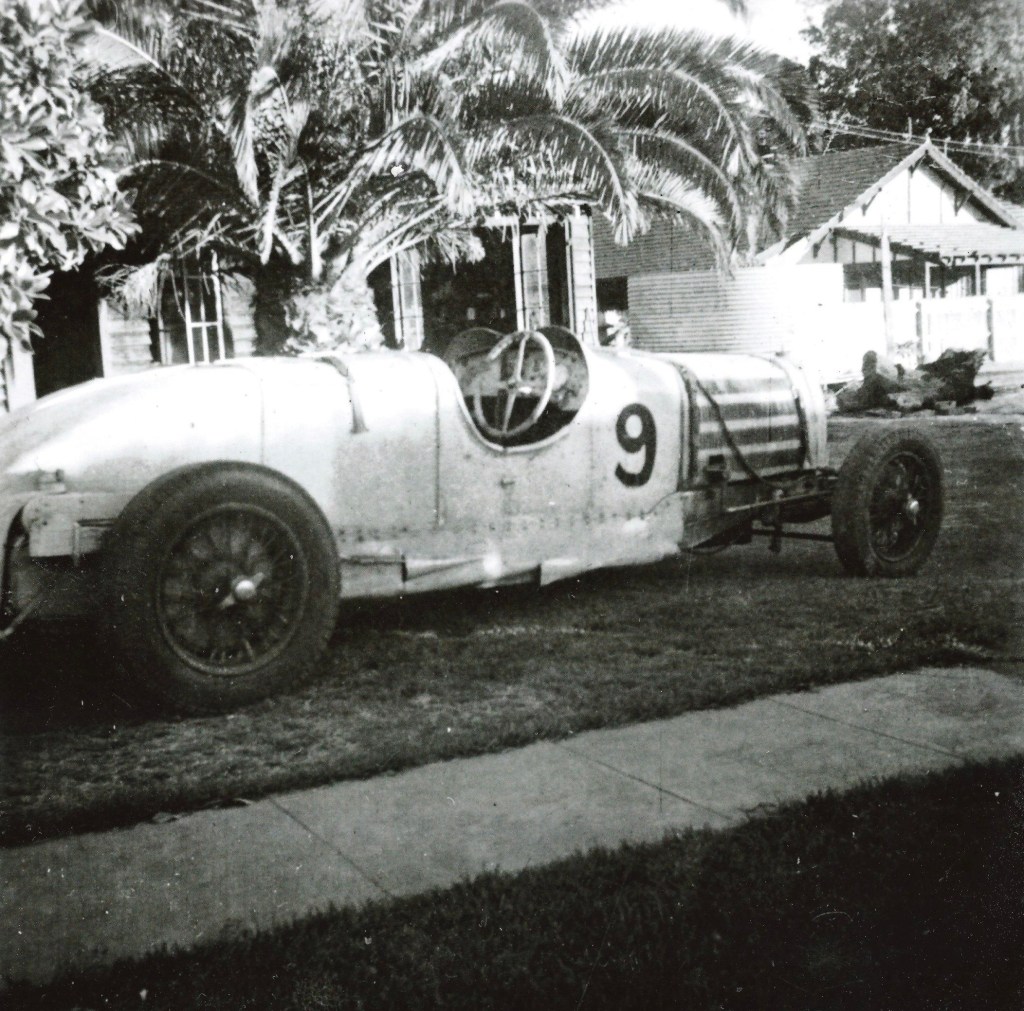
No address or date for this shot but it’s still in Duncan Ord’s ownership, given the presence of #9, but looking decidedly tatty.
(T Johns Collection)
Really interesting contemporary newspaper article, especially on Duncan Ord’s pre-Bugatti racing phase and where the T57T sat in the contemporary WA racing pantheon.
(J Krajancich Collection)
Applecross ladies in their finery dodging the noisy, smelly racing cars…
Tailpiece…
One look at this magnificent Bugatti after it had been tampered with – I’ve got no issue with racers trying to remain competitive mind you – made me think of Queen’s Fat Bottomed Girls…
57264 very late in its competitive life at Caversham in ‘comfy monoposto or tight bi-posto’ form. Ken Devine tells me the driver is Don Hall, the meeting is the 1957 WA Championship. “The car in this form was also driven by Peter Nichol of motorcycle scramble fame.”
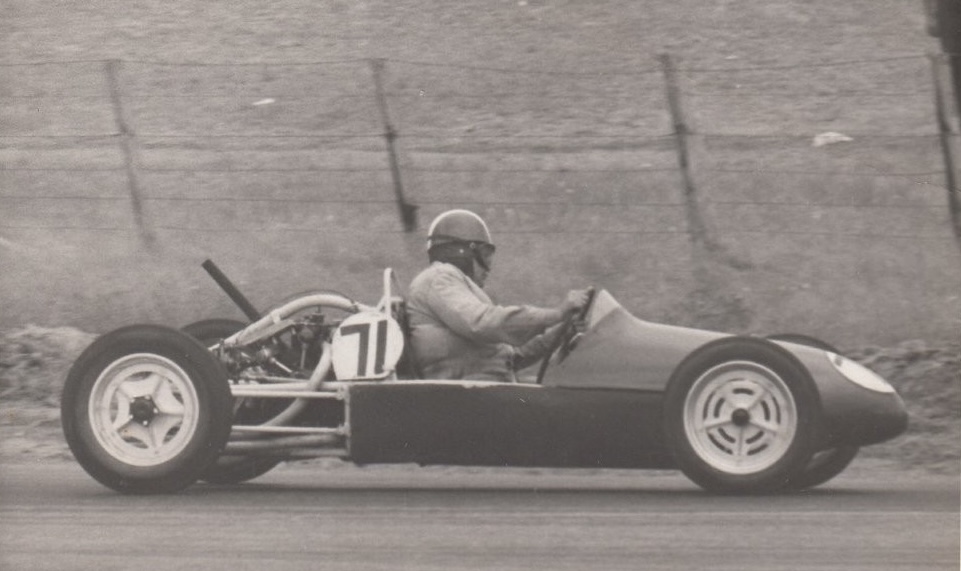
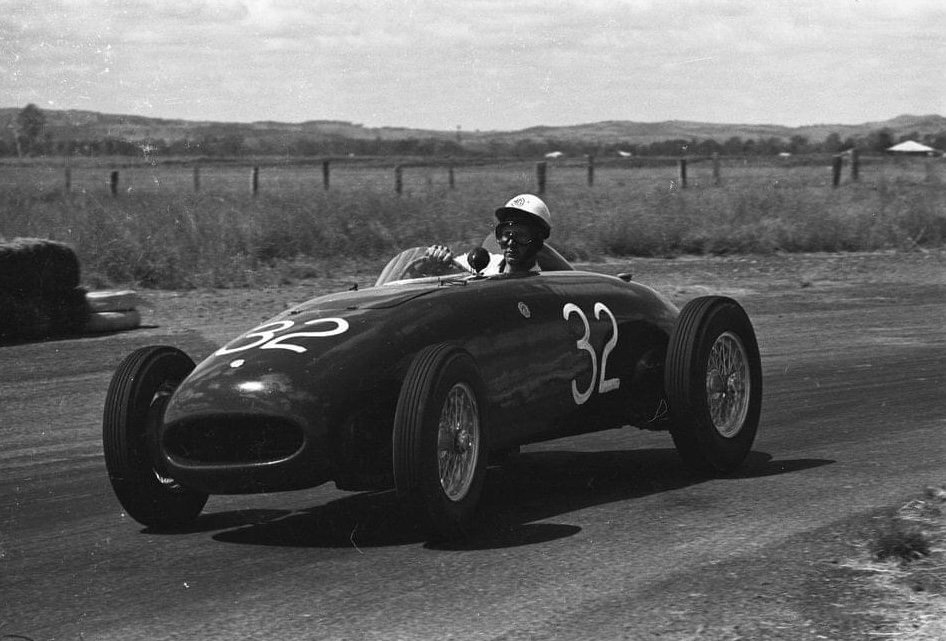
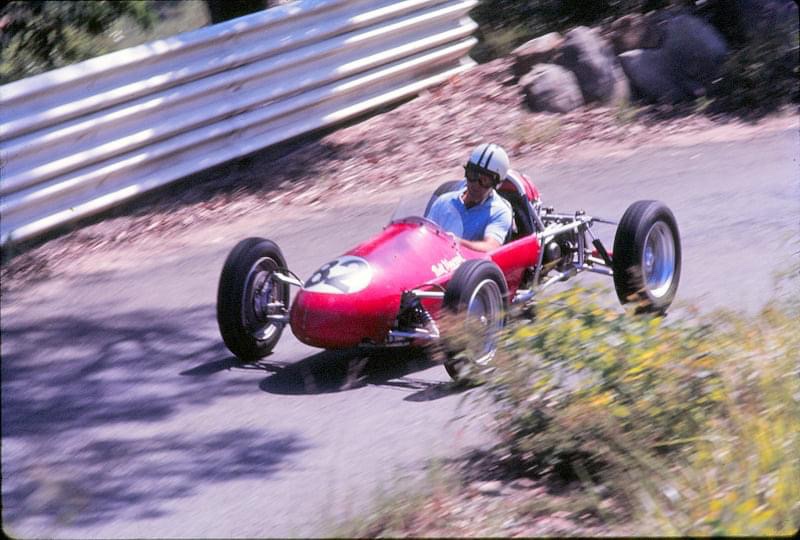
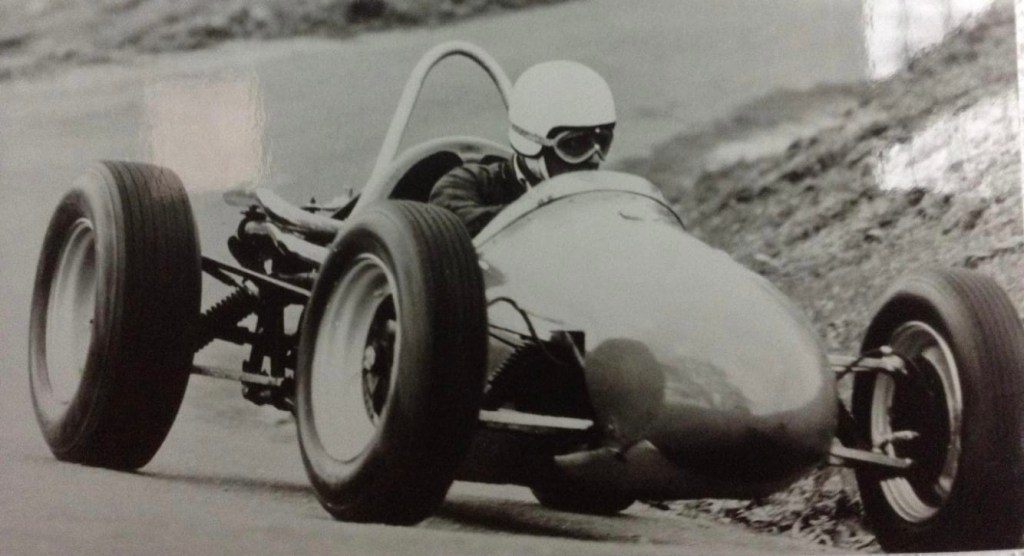
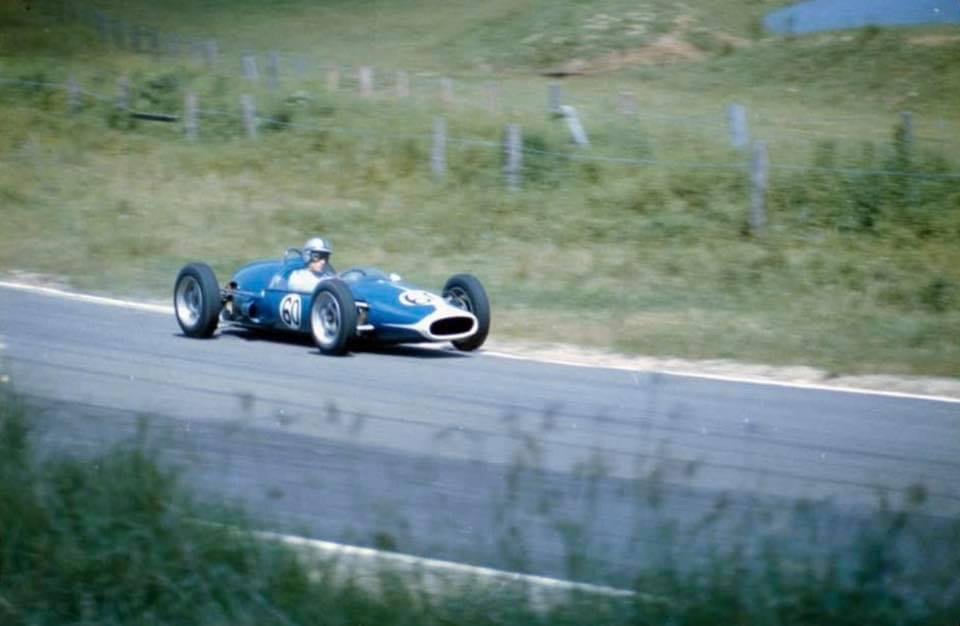
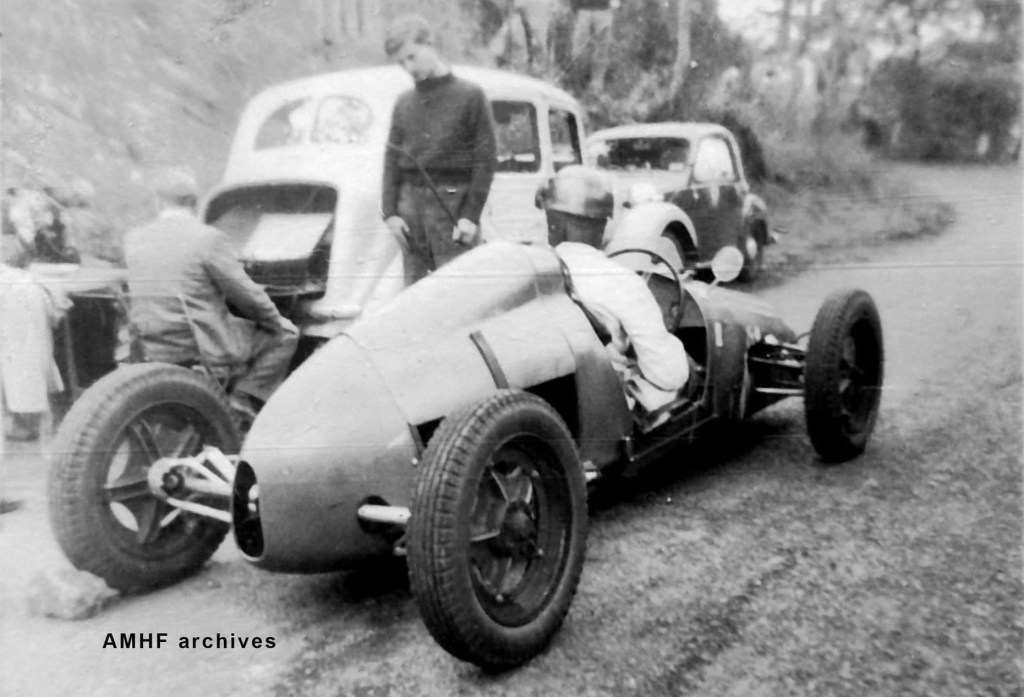
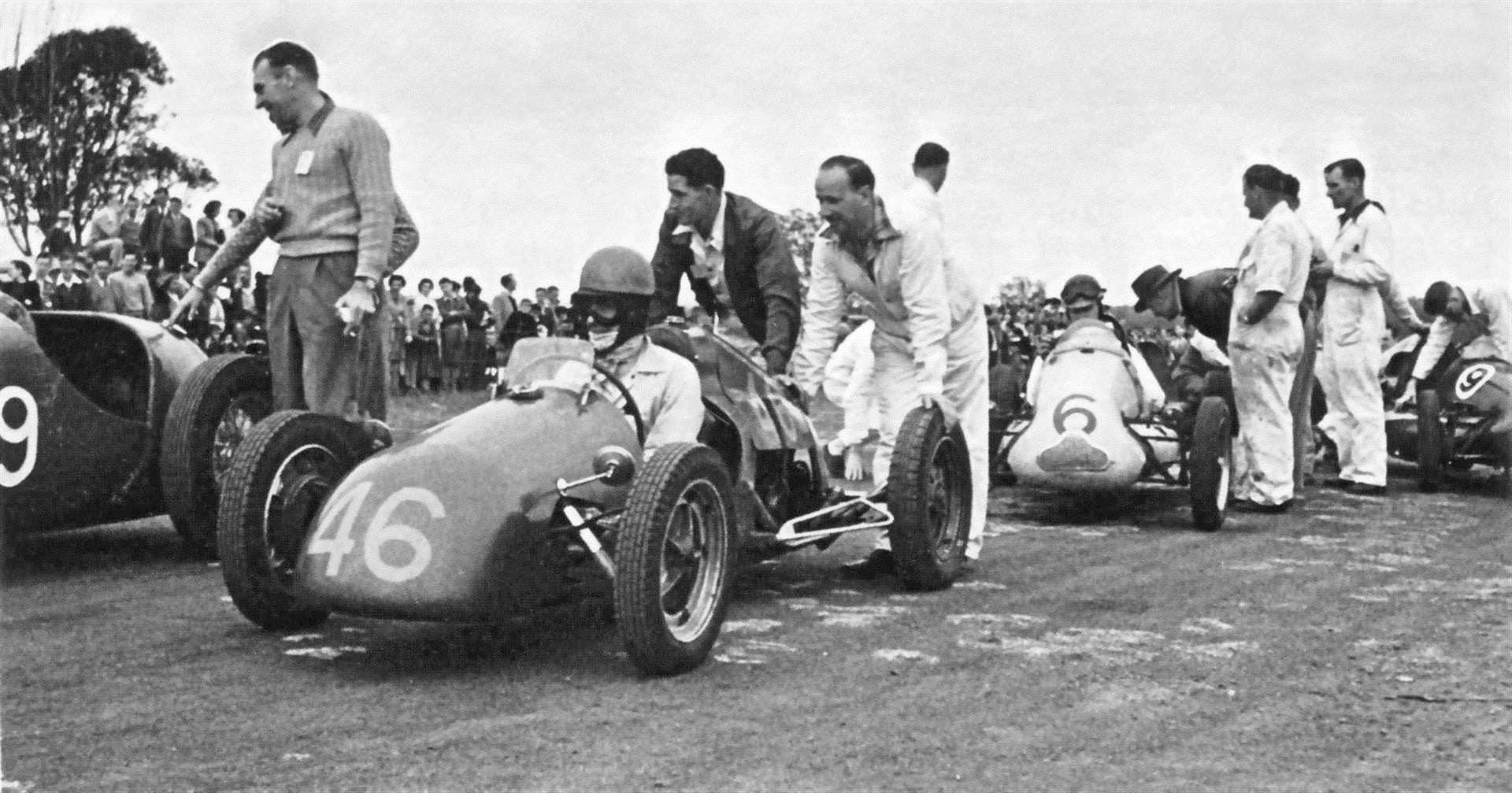
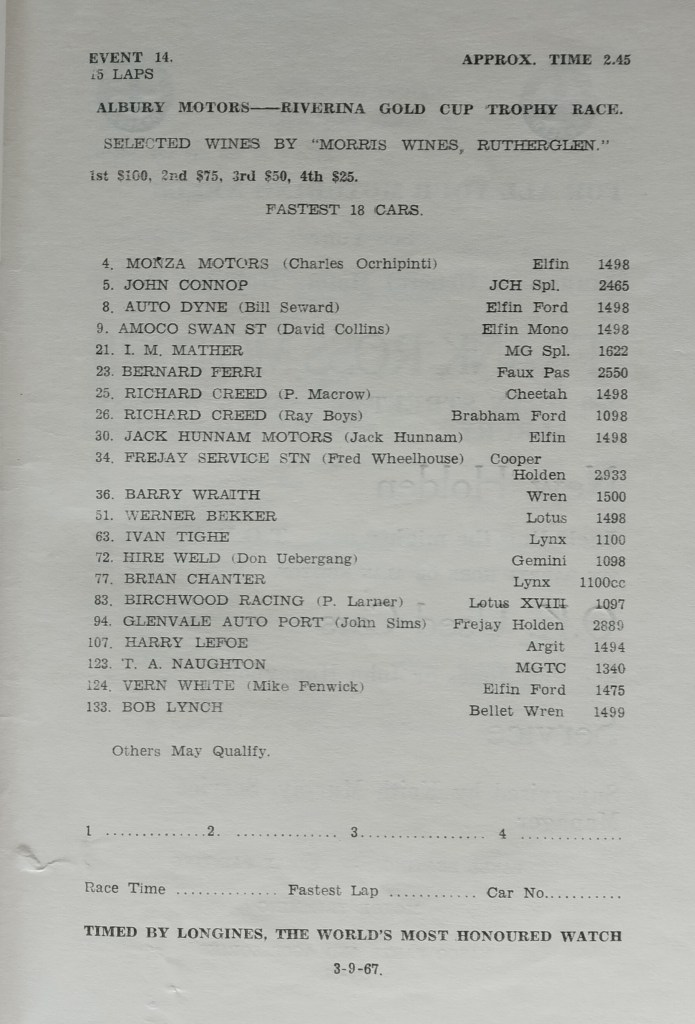
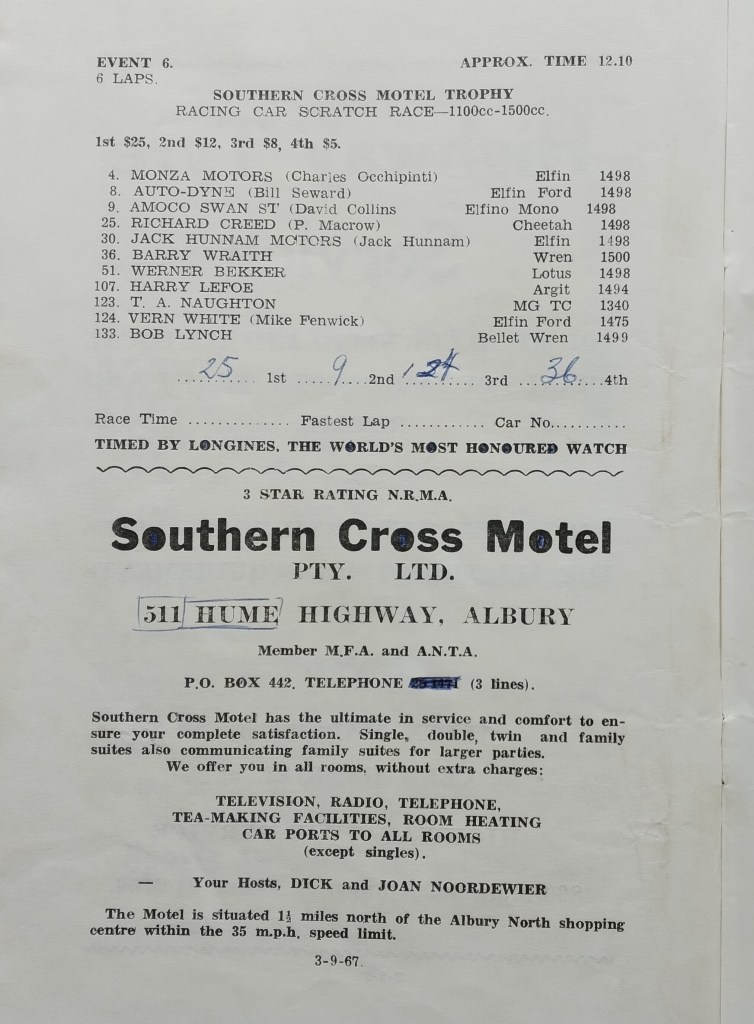
Peter Macrow, clad in fireproof woollen brown jumper, on his way to victory in the Riverina Gold Cup aboard his Brian Shead built Cheetah Mk3 Ford at Hume Weir on September 3, 1967.
It was his third Riverina Gold Cup on-the-trot! He won from a 17 car field varying in performance from future prominent Clubman and Tourer competitor Tom Naughton’s MG TC and equally capable single-seater driver/engineers Ivan Tighe, Lynx and Peter Larner, Lotus.
Shead first competed in his road-going Austin A40 in 1960, progressing to his own Cooper influenced Cheetah Mk1 in 1962. Brian regularly diced with Peter who was then racing the ex-Garrie Cooper, Cooper Austin. The evolved Cheetah Mk2 followed and all new spaceframe Mk3 in 1963.
Macrow was so impressed by the Mk3 he convinced Shead to sell it and help with its development. Brian picks up the story, “I succumbed to pressure from Macrow and sold him the car less engine, and assisted in installation of a pushrod Ford 1100cc engine. I retired from racing and helped with the running of the car and its preparation. Peter raced it extensively with considerable success in Victoria and New South Wales.”
“We continually upgraded the specifications of the car until it was running 7″ and 9″ wide wheels with disc brakes all around and fitment of a Lotus twin-cam engine. The Macrow/Cheetah combination became most successful at Hume Weir and Winton.”
Shead returned to racing when he built his first production cars, the Mk4, which was also raced successfully by Macrow, more on that here; https://primotipo.com/2021/11/16/cheetah-mk4/
The first Pingelly Speed Classic was held on a 2.5-mile round-the-houses course in the West Australian town 160km south-east of Perth on January 30, 1939.
The five event programme consisted of the handicap Great Southern Speed Classic, run concurrently with a scratch race, two five lap handicaps – one each for racing and sports cars – and a four lap handicap and relay race for stock (standard production) cars.
(K Devine Collection)
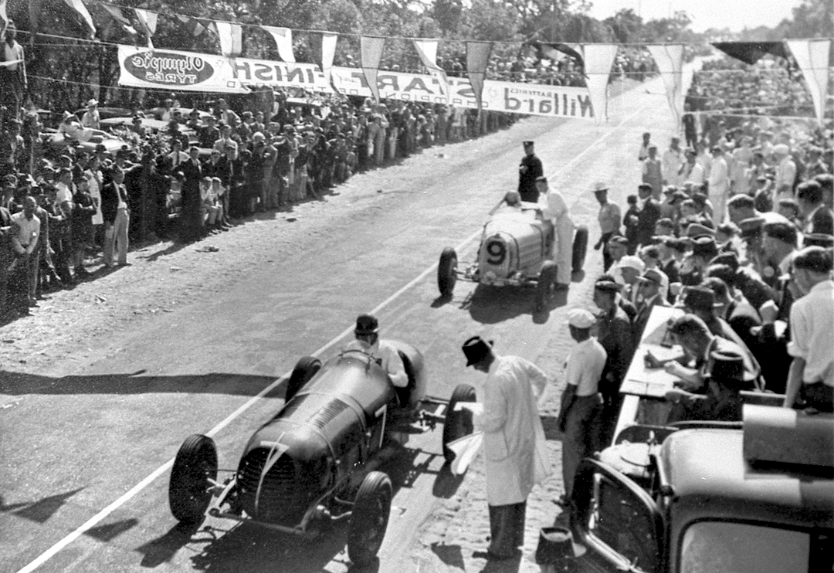
The Clem Dwyer Plymouth Special and Duncan Ord Bugatti T57T take the chequered flag during the inaugural Great Southern Speed Classic on a fabulous Wellington Street panorama.
The very successful Plymouth, powered by a side-valve straight-six was based on a damaged sedan which was heavily lightened and modified, whereas Ord’s blue-blood 3.3-litre straight-eight twin-cam Bugatti (chassis 57264, originally 57222) was an ex-Lord Howe machine. It was the race debut of the Plymouth and first Australian event for the Bugatti which had arrived from France not long before.
Alan Tomlinson MG TA Spl S/c won from Bill Smallman, MG TA with Roy Sojan third in his Chrysler Special ‘Silverwings’. Duncan Ord was fourth.
(K Devine Collection)
The round-the-houses racing tradition – unique to Western Australia and the envy of the other states – commenced when the good-burghers of Albany decided on a Back To Albany Festival in 1936. With that, three entrepreneurs of the West Australian Sporting Car Club – Eric Armstrong, Clem Dwyer and J Warburton – motored down from Perth and successfully pitched the notion of a Monaco style street race around their fair city to the Council.
The race became the highlight of the festival and spawned similar races at Applecross, Bunbury, Dowerin, Narrogin – at which the 1951 Australian Grand Prix was held – Pingelly and others until the gruesome 1955 Le Mans disaster frightened local councils and led to a clampdown on racing on public roads. Not that they eliminated it completely, the WASCC had a tremendous relationship with the WA cops and ran events in a variety of places right into the 1960s.
(K Devine Collection)(P Narducci Collection)
Two shots of Bill Smallwood’s MG TA Spl during the 1939 race. Smallwood and Clem Dwyer had been Tomlinson’s pit-crew in a staggering win for the young West Australian in the Australian Grand Prix held on the daunting Lobethal road circuit three weeks before.
Clem Dwyer aboard the Bartlett Special in 1939. He bought this machine, built around an 1100cc twin-cam Salmson engine on a trip to the UK. Modified with Brooklands in mind, it was fitted with a Cozette supercharger and was said to be good for 120mph.
Raced at Lake Perkolilli, he gave Ossie Cranston’s Ford V8 Spl a run for his money in 1936, but the car never achieved the success hoped, the demands of the Brooklands bowl and round-the-houses West Australian tracks being quite different.
Unattributed and unknown, perhaps Jack Nelson, Ballot Ford V8 Spl
(W Duffy Collection)
Bob Lee won the five-lap handicap aboard this Riley Brooklands in 1939, and went one better as shown here in 1940, when he won the Great Southern Flying Fifty – the race had been increased from 5 to 10 laps, 25 to 50 miles.
(K Devine Collection)
During the 1940 race. “Park Street Hospital Hill with the old nurses home in the background behind the chook-yard” quipped Jennie Narducci. It’s Harley Hammond in the Marquette Special from Barry Ranford’s Ranford Special. In a long successful career through until 1958, the latter built four specials.
The 1940 programme comprised five events: a 10 lap Tourist Trophy for under 1500cc stock machines, a 5 lap handicap for racing cars, 4 lapper for stock cars plus the 15 lap classic.
(unattributed)
Harry Squires MG PB Spl S/c – looks more like a T-Type to me?
(unattributed)
The intersection of Park and Parade Streets with Jack Nelson’s Ballot Ford V8 Spl in shot, 1940.
The bones of this car – #15 – were those of the ex-Jules Goux, Cooper brothers Ballot 2LS which met its death at Phillip Island in 1935. Les Cramp had just acquired the car and was killed. This machine raced on well into the 1950s – with no Ballot left – before Mick Geneve died at its wheel, by then Chev powered, at Caversham in 1959. A tribute car exists.
This local footbridge lasted into the 1960s, while one of the local ‘cockies tells us there are two Gilchrist sheep feeders “built by the dozen on a site between the present police station and Shire Office.” Love the power of FB! (K Devine Collection)
Harley Hammond again aboard the Marquette Special. The serving RAAF man did well in this immediate pre-war period with this attractive Buick 3.5-litre sidevalve six-cylinder powered special; Marquette was a shortlived Buick sub-brand.
He won the Great Southern Speed Classic in 1941 – the last race meeting in Australia before the lights went out – and the Patriotic Grand Prix held on the Applecross round-the-houses course 10km from the Perth CBD, several months before.
In fact the November 11, 1940 Applecross races were to have been the final event but the Pingelly organisers slipped in one final meeting on the Australia Day weekend, January 27 with funds raised from the five event programme for cars and ‘bikes in aid of the British Air Raid Relief Fund.
Credits…
Ken Devine Collection, Peter Narducci Collection, Eddy Ring Collection, Warren Duffy Collection, ‘Around The Houses’ Terry Walker





























































 primotipo...