This is the first in an ongoing series of pieces based on my (vulgar) first response to a photograph that makes no sense to me. Regular readers will appreciate that an inferior intellect like mine elicits such responses often.
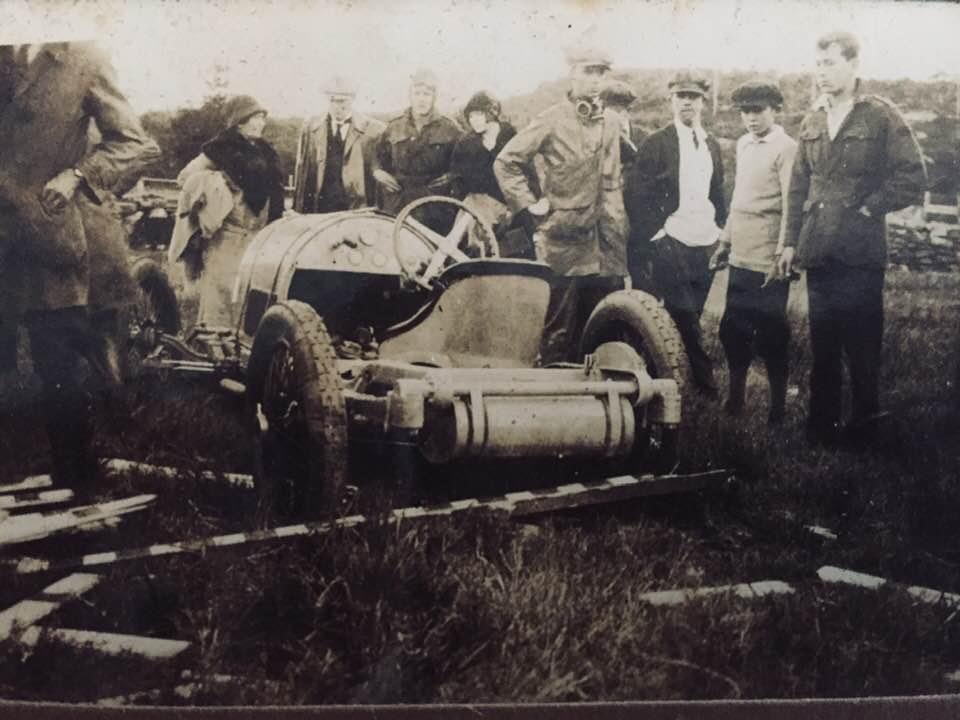
When I first saw the photos – the first one above and the second last – I thought no way were they in Australia, both had a USA feel to me, wrong on both counts.
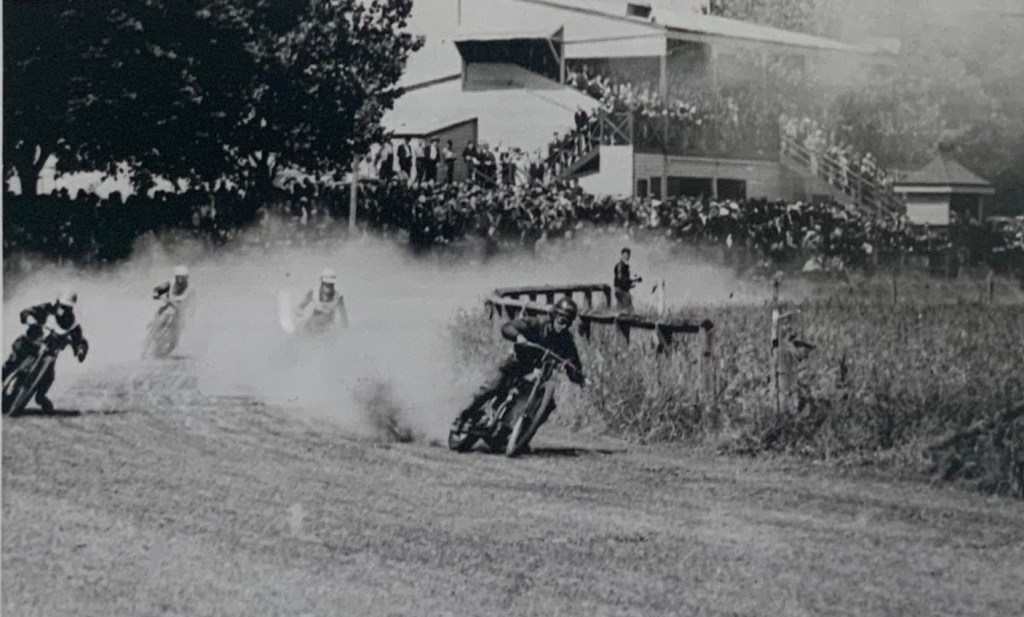
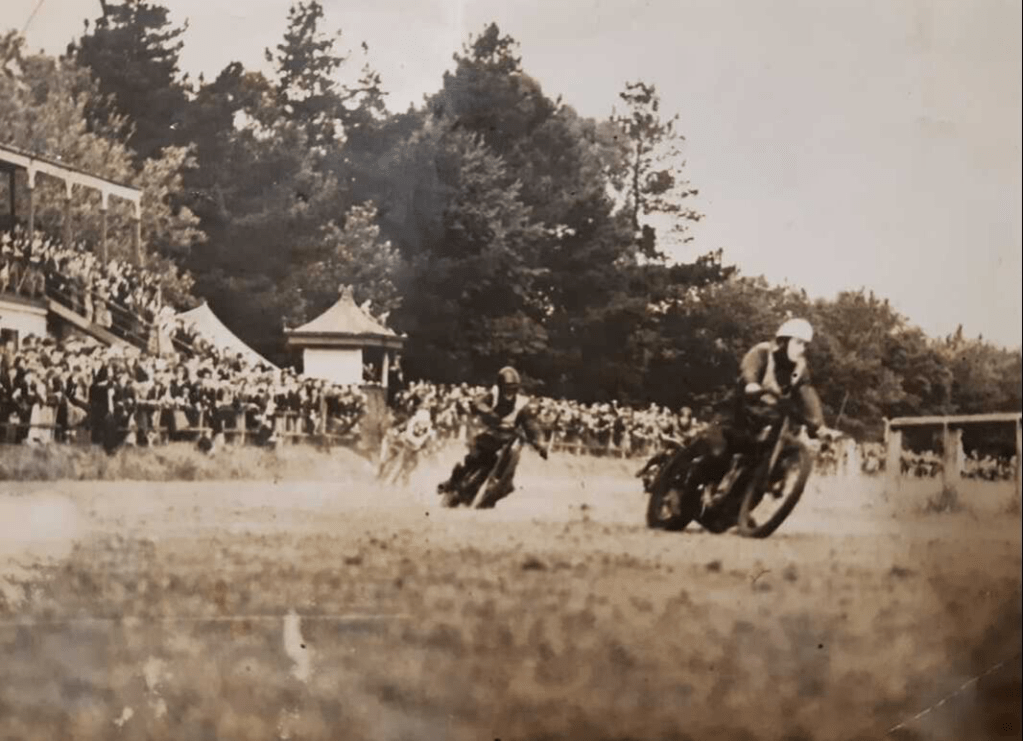
The first is from me’ mate Bob King’s Collection and was taken at the Warragul Showgrounds pre-War. The last was shot at Drouin, just up the road, that both photographs were taken in two small West Gippsland townships close together 100km to Melbourne’s east is coincidental.
King’s caption for the ‘bike race photograph reads “Darby – in front – was killed in this race.” Sadly that is the case. A bit of judicious Troving confirms that the small Warragul community ran grass-track meetings on their local showgrounds from the mid-1920’s until 1941, with a final meeting, perhaps, in 1953. Ploughing through the results of meetings in the 1930s revealed that Leslie Edwin Darby is our man.
The Auto Cycle Union of Victoria sanctioned events were usually run over the Easter long-weekend on a track “6 1/2 furlongs” (1308 metres) long, timed after the speedway and trotting (nags) seasons had ended, these ran from November-April. As the photo shows, the crowds were huge, 6000-8000 people, not bad for community of less than 500 at the time.
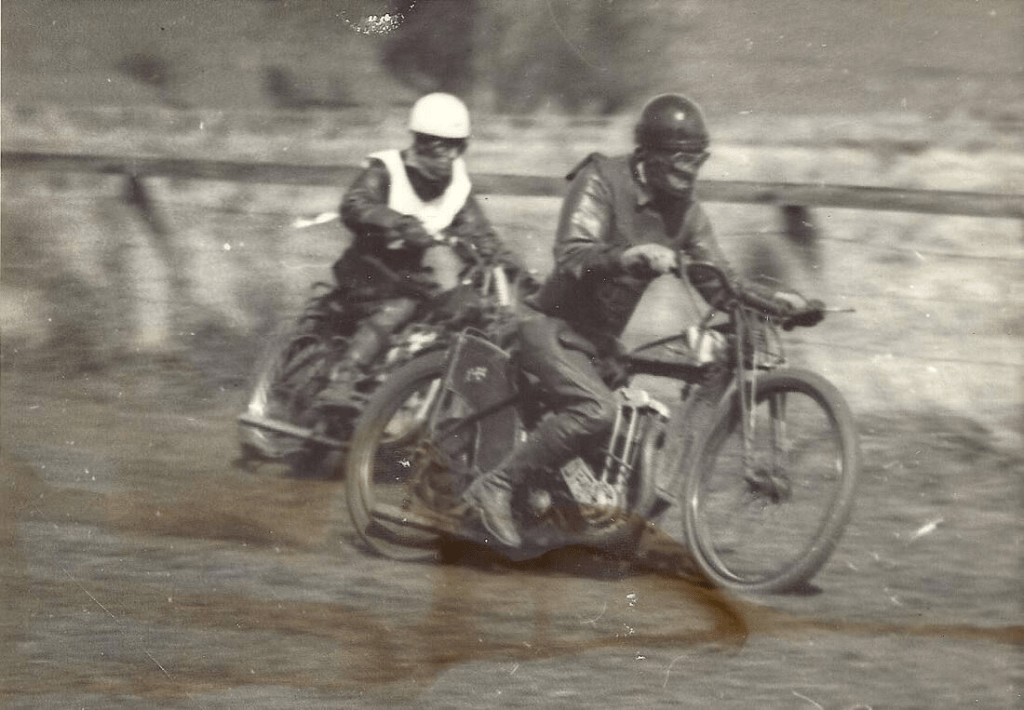
Warragul Showgrounds really looks a nice place, it’s still there too. I often go the long way to Phillip Island via Drouin-Poowong-Loch-San Remo, a fabulous driving road devoid of The Fuzz, so time to do a Warragul detour next time. No details of the above (SRRH) Two riders at Warragul, no details (SRRH)
Darby was a star of the sport, holding over 30 Australian and Victorian grass track championship wins and over 150 placings. He had won four Victorian and Australian championships at Warragul in the 350 and 500cc classes. He also competed with success in road racing, holding the 250cc lap record at Phillip Island, in 1937 he set FTD at Rob Roy hillclimb, besting all the cars present.
Showing his adaptability, Darby also contested sidecar events, winning the Victorian Sidecar Championship in 1934, and placing third in the famous Victorian Tourist Trophy at Phillip Island held over 75 miles that same year.
Les had a lucky escape at Warragul in April 1936 when he crashed at high speed, somersaulting over a perimeter fence when his ‘bike struck it. Unharmed, other than by cuts and abrasions, he jumped aboard another machine and won the Australian All Powers Three Mile Championship. Warragul claimed three lives, its variety of ever present dangers were demonstrated by Bud Morrison who was thrown from his bike into an adjoining creek and nearly drowned before ambulance officers intervened, during the same 1936 meeting.
Poor Darby’s luck ran out in tragic circumstances on Boxing Day 1940. Shortly after passing the finish line at the end of the the final of the Gippsland Solo Scratch – in which he was battling Edward Smith for the win – Smith, narrowly the victor, lost control of his machine just after the line and fell. Darby swerved in avoidance and hit the fence at over 70mph before cannoning into the crowd. He was declared dead at West Gippsland Hospital shortly afterwards, aged 32. Two spectators were seriously injured but survived.
Les Darby is buried at Kew Cemetery, close to where I grew up, I shall make a pilgrimage to pay my respects soon.
(The Gazette – Warragul & Drouin)
Thankfully the Drouin shot is happier but no less impactful.
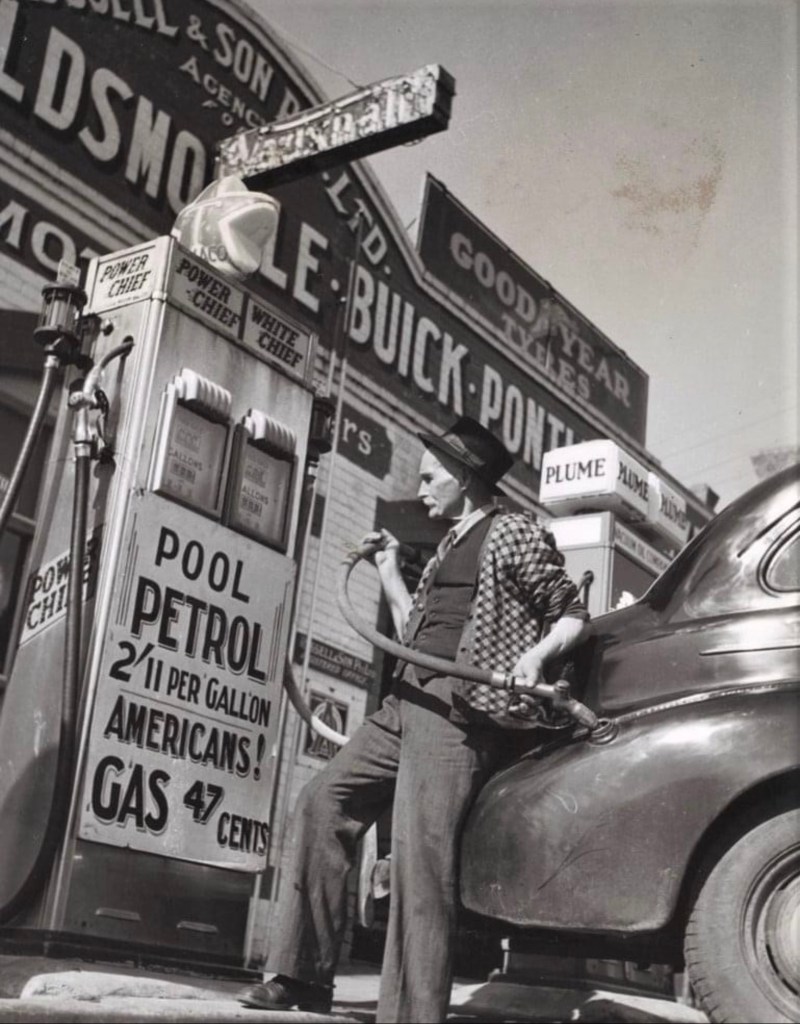
William Russell is putting the four-gallon monthly ration of petrol into a customers car at Drouin in 1944. The sign is for the benefit of United States servicemen using the Princes Highway, a main Melbourne-Sydney artery.
The photo is one of a series of Drouin shots taken by government photographer Jim Fitzgerald (Australian Dept of Information) to document the impact of the war on ordinary people, they were used here and in the US.
William Russel & Son Pty. Ltd. the biggest servo in Drouin had two sites employing 16 people and appears a good business with franchises for Oldsmobile, Buick and Pontiac. Aged 80, William was still on-the-tools…
Born in Brechin, Scotland in 1865, a year later he emigrated to Australia with his parents and older brother, a voyage which took 95 days. William was apprenticed as a blacksmith, wheelwright and coach builder, acquiring the Monroe and Morse, Drouin business in 1890. As horsepower evolved from hooves to wheels the business evolved into a garage, car showroom and servo. William died on May 11 1950 and was such a highly respected member of the local community the hearse taking him on his final journey was followed by over 100 cars.
Credits…
Bob King Collection, Trove – various newspapers, The Gazette-Warragul and Drouin, motorsportmemorial.org, Speedway and Road Race History – SRRH
(B King Collection)
Tailpiece…
After I posted this article I sent it straight to Bob King who provided the shot, or more specifically I scanned it during one of our many illicit, keep-ya-sanity, Covid 19 trysts at his place in the winter of 2020. We Victorians were locked up tighter than a nun’s chastity belt by our beloved Dictator Dan (State Premier Dan Andrews) for most of that year, and a good chunk of 2021, bless the Chinese Alchemists and their magic potions.
His response was “All good stuff, I now recall the name of the patient who gave me the Darby photo, John Soutar, I believe. I think he raced against Darby, my last contact with him was 30 years ago, I just googled Soutars Garage, which is still in Warragul, may be worth a visit.”
There ya go, that explains the WTF photo above.
King’s caption for it is “John Soutar”. The scan was in Bob’s album above the one of Darby in action. I’m sure he made the connection two years ago when we were scanning away, this time the geriatric at fault is me not him…Still, we got there in the end, albeit I think Mr Soutar was a young fan rather than a competitor.
In Australia at least, there has never been anything quite like the sphincter-puckering blend of excitement and fear as a 10,000bhp grid of 20 5-litre, fuel injected, thundering V8 missiles are launched by their intrepid pilots.
Many thanks to Michael Strudwick for his photographic artistry.
Warwick Brown, Racing Team VDS Lola T430 Chev gets the jump from pole here at the Surfers Paradise, Rothmans International Series round in February 1977. Quite where Peter Gethin and Vern Schuppan – second and third on the grid – are out of shot I’m intrigued to know. John Leffler is in the white Lola T400 Chev with the partially obscured Alfredo Costanzo’s red Lola T332 Chev behind him. The white helmeted dude behind Brown is Alan Jones aboard Kevin Bartlett’s T332. The Jones boy had crashed and written-off his newish Sid Taylor-Teddy Yip Lola T332C in practice so the pair did a lease-deal to allow AJ to race KB’s car. The blue machine to the right of Jones and back is John Goss’ Matich A51/A53 Repco-Holden.
Alan Jones blasts down Surfers main straight in Kevin Bartlett’s Lola T332 Chev HU22, fifth place (M Strudwick)Goss’ fourth placed Matich A51/A53 Repco Holden. #005 is one of the two A51s FM took to the US in 1973, and later updated by Goss and Grant O’Neill to A53 side-radiator – and the rest – specifications. This is Goss’ ’76 AGP winning chassis (M Strudwick)Duulling T332s; great Kiwi Graeme Lawrence HU28 in blue, tenth place, and great Italian/Australian Alfie Costanzo’s ex-Bob Evans HU36 in red, DNF engine. Lola perves will note the 332C factory engine cover come air intake on Alf’s car compared with the very neat one produced by Graeme and his crew in NZ – always distinctive on this car (M Strudwick)
Brown won the race from pole, Peter Gethin’s VDS Chevron B37 Chev was second – the budget required to maintain adequate spares for two different makes within the one team doesn’t bare thinking about – then Leffler, Goss and Jones.
It was a great Rothmans International Series, the three big international Aussies at the time were Jones, Brown and Vern Schuppan, who raced a works Elfin MR8C Chev. The strongest locals were Goss, reigning Australian GP winner, the Lolas of Bartlett, Leffler, Costanzo and Max Stewart, plus John McCormack’s fast but brittle ex-F1 McLaren M23 Leyland.
Brown won two races, Surfers and the AGP at Oran Park, the opening round on February 6. Jones – on the front row alongside poleman Brown – jumped the start at Oran Park by a fortnight, so was pinged a one-minute penalty which he could not make up, so the AGP went to Brown, from Gethin, Goss, Jones and Schuppan.
Karma ruled in that WB got the AGP win he should have had in 1974 at Oran Park, and Jones got his at Calder in 1980. That day he disappeared into the distance in the Formula Libre event aboard one of his works Williams FW07 Fords.
John McCormack tips his one-of-a-kind ex-F1 McLaren M23 #2 Repco-Irving-McCormack Leyland into the harry-flatters-in-top big-balls right hander under Dunlop Bridge Last man standing in an open-face helmet at this level. The integration of the Leyland P76 aluminium V8 into the space usually occupied by a Cosworth DFV was superbly done, without butchery to the chassis. No matter what they did to that motor, new heads and all, it was always a Hail Mary jobbie by the mechanics as they waved J-Mac onto the circuit. He was 12th and last at Surfers. Still, he won the 1977 Gold Star with it (M Strudwick)The business end of Max Stewart’s Lola T400 Chev, HU3. DNF dropped valve. MS probably won more races than anyone else on the planet in a T400, including the 1975 AGP – at Surfers – in HU2. Max got better and better as he aged, but died in this car at Calder a month later, March 16. The saddest day I’ve ever had at a race track (M Strudwick)John Leffler in the gorgeous Grace Bros (chain of NSW department stores) liveried Lola T400 Chev HU15, third place. Won the 1976 Gold Star in it (M Strudwick)
Surfers was the second round, the circus then travelled 1,750km south to Sandown Park in Melbourne’s southern suburbs from the Gold Coast. During that week Sid Taylor brought a replacement T332 to Australia for Jones, who put it third on the grid behind Gethin and Schuppan. Brown shoved the nose of his Lola under the Dandenong Road fence during the warm-up lap, so the man in grid-slot four couldn’t take the start.
Jones jumped Gethin and Schuppan at the drop of the flag – remember those? – but one-by-one, in turn, each of Alan, Peter and Vern retired with overheating, fuel pressure and engine failure respectively. Max Stewart took a popular win from Costanzo, Garrie Cooper in the Elfin chief’s MR8C Chev, Dave Powell in the very first Matich A50 Repco-Holden and McCormack’s McLaren, seven laps adrift.
Off to Adelaide for the final round on February 27, Jones finally won the round he had been threatening to do from the off. He was awesome to watch in these cars, thrilling.
Other than those who had last seen him compete at Sandown in the 3-Hour Production Touring Car race in 1968 (second in a Holden Monaro GTS327 shared with Clive Millis), it was the first time Australian fans had the chance to see him in action. He had been paying his dues in the UK and Europe climbing the greasy-pole in the interim. As a kid, Jones was a silver-spoon-special but by the time he embarked on his racing career, father Stan’s money was long- gone. Jones did it the hard way.
Jones was on pole at Adelaide International, from Brown’s repaired Lola T430 by a half-second, and won the hot race from Brown, Goss, Gethin and Stewart.
Brown won the 1977 Rothmans International Series with 24 points from his team-mate Peter Gethin’s 15, and Alan Jones, third on 14 points.
Peter Gethin in the VDS Chevron B37 Chev #37-76-01, second place. Some of you may have seen it raced by Gethin and Pilette in the US, some by Gethin in Australia and some by Bruce Allison in Australia and in the UK in the 1977 UK Group 8 Championship. Bruce did so well that year he won the premier Grovewood Award (M Strudwick)The one-off Jaime Gard built Gardos OR2 Repco Holden was built for Perth entrepreneur Don O’Sullivan. Here, Chev powered, it’s being fettled for Adelaide driver Chris Milton (M Strudwick)Garrie Cooper, Elfin MR8C Chev #8761. Pretty much the equal of the best F5000s, the three MR8s were raced with success by Vern Schuppan, John Bowe, Larry Perkins and James Hunt (M Strudwick)
Formula 5000 was at a crossroads when it was shot in the head at the end of 1976 by the Americans. They wanted Can-Am type crowds, so they ditched F5000-Formula Lola and created…central-seat sportcar-Formula Lola. The Lola T332 had been the star of the show since 1974, and the T332 decked out in a less attractive frock remained the star of the show – as the T332CS/T333CS – into the late 1970’s.
Those other countries who had F5000 as a premier/key category therefore had decisions to make, car constructors would react accordingly and change their focus as the biggest market changed direction.
In our neck of the Tasman-woods the Kiwis jumped with Formula Atlantic as their national premier class, while Australia stuck with F5000 for waaaay too long. New Zealand got the very best of Formula Atlantic chassis diversity and young thruster drivers from the US and Europe, by the time Australia really committed to Formula Atlantic/Pacific, the chassis interest was gone, it had become Formula RT4 (Ralt).
Tasmanian racer David Powell aboard the very first F5000 Matich, A50 #001 Repco Holden. FM’s 1971 AGP and 1972 Gold Star winner (M Strudwick)American racer Ed Polley’s Polley EP1 #76-13, Lola T332 copy. Polley had a background in big bore sports cars and sprint cars before graduating to F5000 in the US (M Strudwick)Goss, A51/A53. Relatively light car, the flat plane crank Repco’s gave 520bhp without loss of their legendary flat-fat torque curve. Repco Engine Developments exited Australian motor racing in July 1974 so development of this engine, and then new Repco Leyland V8, stopped then. Phil Irving/John McCormack later evolution of the Leyland unit duly noted (M Strudwick)
Credits…
Michael Strudwick, oldracingcars.com
Tailpiece…
(M Strudwick)
Warwick Brown’s VDS Lola T430 Chev #HU2 in the Surfers Paradise pitlane.
VDS bought two new T430s for the 1976 US F5000 Championship. Brown raced this car twice in the US, then throughout the ’77 Rothmans before HU1 and HU2 were acquired by Australian Porsche importer/racer/team owner – and thoroughly great bloke – Alan Hamilton at the end of the series.
‘Hammo’ raced HU2 for the balance of 1977 and into 1978 – Derek Bell’s drive at Oran Park in the ’78 Rothmans round duly noted – until nearly killing himself in it in a high speed accident at Sandown’s Causeway during the ’78 AGP. While Hamilton survived, HU2 was broken in two.
HU1 (below) was then built up by the Porsche Cars Australia crew led by Jim Hardman, and raced by Alf Costanzo to many race wins, and one Gold Star for Hamilton (1980) in a long relationship which also achieved much success with a McLaren M26 Chev and several Tiga Formula Pacific chassis.
The Hamilton/Costanzo T430 HU1 being tended to at Calder circa 1979-80 (M Strudwick)
Lola returned to the brew which started their F5000 run of success when they married an F2 T240 chassis with a 5-litre Chev V8 and Hewland DG300 transaxle to create the T300 raced by Frank Gardner in later 1971. Gardner, then Lola’s development driver/engineer and works driver, and Lola’s Bob Marston concepted the T242 prototype, and T300 production models.
The 1976 T430 – nicknamed The Flying Bracket by VDS mechanics – was a blend of T360 Formula Atlantic chassis, 520bhp’ish 5-litre Chev and DG300.
The Americans were very attached to their T332s, even moreso after the initial lack of speed of Lola’s 1975 variable rate suspension T400, so they stuck with, or bought new T332/T332Cs rather than the T430, only three of which were sold – to VDS and Carl Haas. Lola’s T400 update kit worked, the two VDS cars were quick in Europe, as were Max Stewart’s and John Leffler’s in Australia, but the Americans weren’t convinced.
All three T430s are extant in New Zealand, where HU2 was reconstructed around its chassis plate which for many years was on the pinboard in Hamiltons’ Church Street Richmond office!
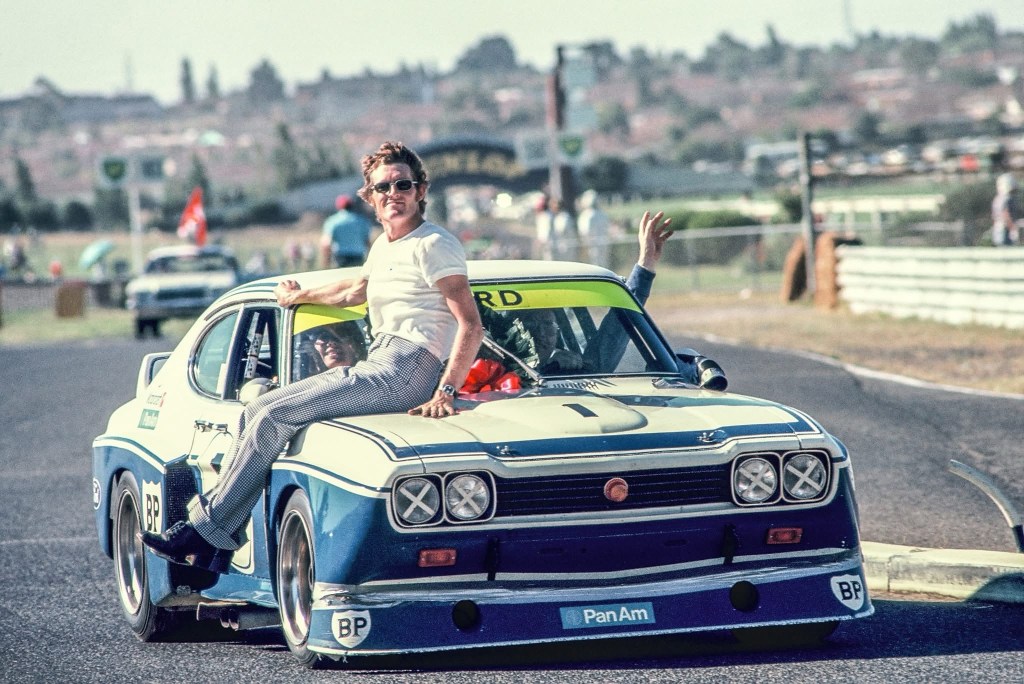
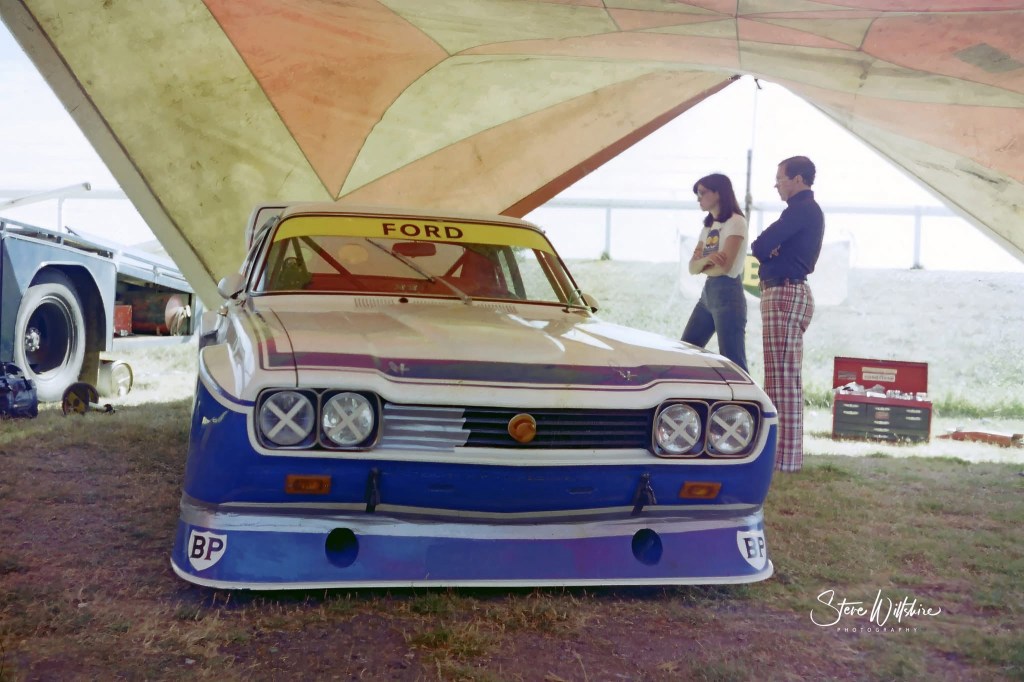
Allan Moffat tips his new car into Shell corner, Sandown Tasman meeting 1975, Ford Capri RS3100 on its Oz debut (B Keys)
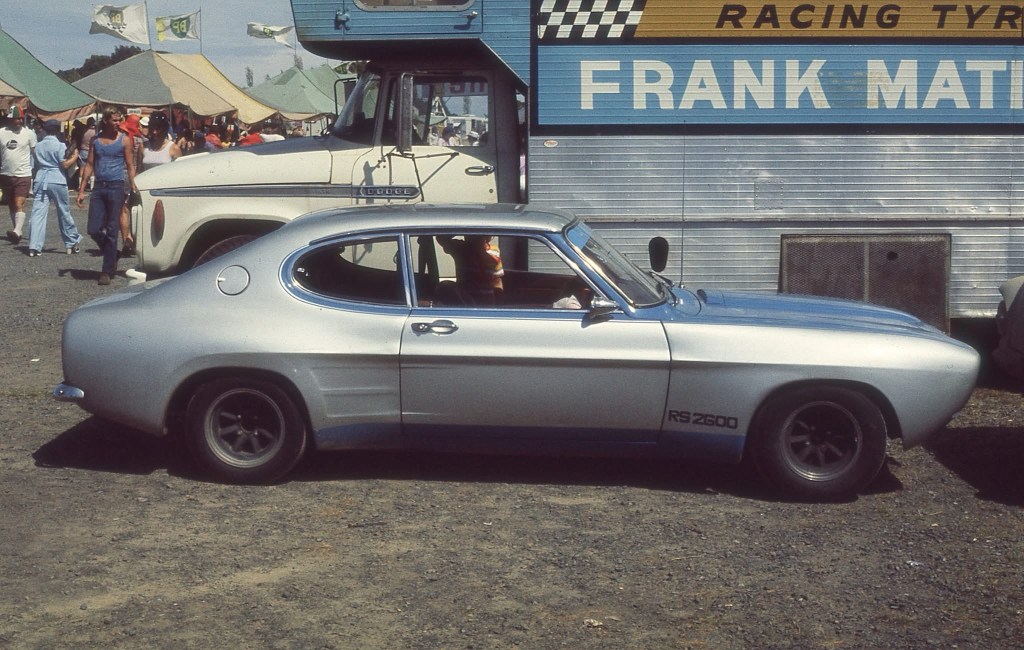
Even though I’m a dyed-in-the-wool single seater and sportscar kinda guy, I’ve got my taxi favourites, Ford’s Cologne Capris are up-there on that list…
(I Smith)
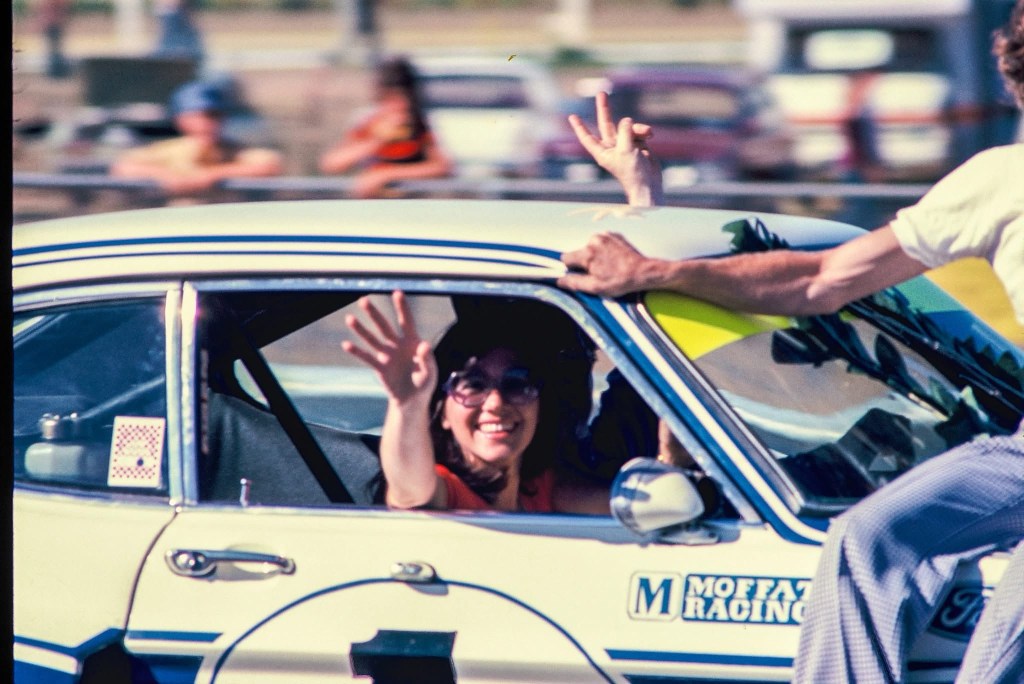
These three shots show the debut of Allan Moffat’s ex-works car at Sandown on February 23. It wasn’t a bad weekend’s work either, third and a win from the two races.
Alastair McNaughton on the bonnet above and Pauline Moffat in the passenger seat below.
(I Smith)
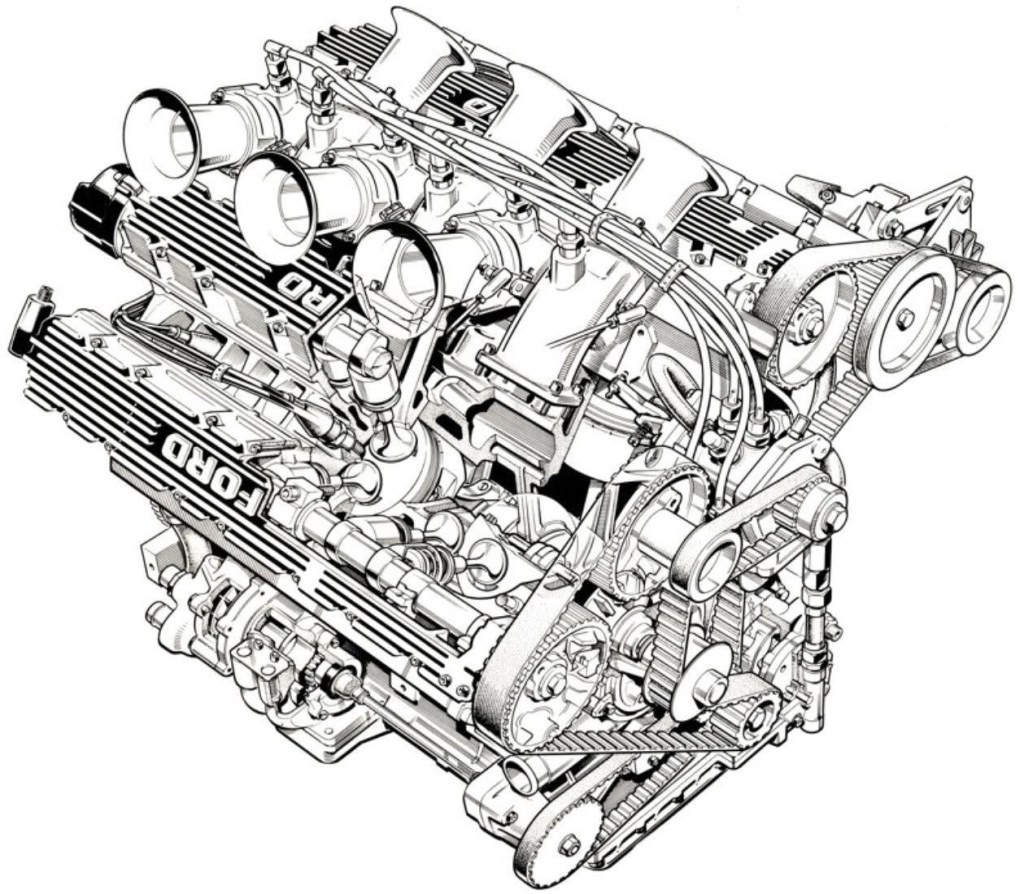
Michael Strudwick has been posting some marvellous stuff on Bob Williamson’s Old Motor Racing Photographs – Australia Facebook page in the last fortnight, including these uber-sharp under-the-bonnet shots of Marvin da Marvel’s – the great Allan Moffat – Ford Capri RS3100 vin/tag/chassis # GAECPY19999 circa 1976.
Raucous Cosworth Engineering built Ford Cosworth GAA 3.4-litre four-valve, quad-cam, fuel injected 420bhp @ 8500rpm V6. Cast iron block, ally heads 280 lb/ft of torque @ 7000rpm (M Strudwick)(M Strudwick)
What else is on The List you might ask? Jaguar Mk2, Ford Lotus Cortina, Alfa Romeo GTA and GTAm, Norm Beechey’s Holden Monaro GTS350, any Ford Falcon GTHO, Bob Jane’s Holden Torana GTR XU1 Repco V8, Ford Falcon XA GT351 Coupe, Bryan Thompson’s Volksrolet Chev, John McCormack’s Chrysler Valiant Repco-Holden, Holden Torana A9X, BMW M3 and 625CSi, Ford Sierra RS500, Nissan Godzilla GT-R.
In my book, Australian touring car racing was homogenised, pasteurised and sodomised (poor Georgie Pell) with the advent of V8 Supercars. The shit-boring sameness of maxi-taxis is not for me, gimme grids of vast variety any day, the speed of said silhouette tourers is duly noted. Happy to be in the minority, as always.
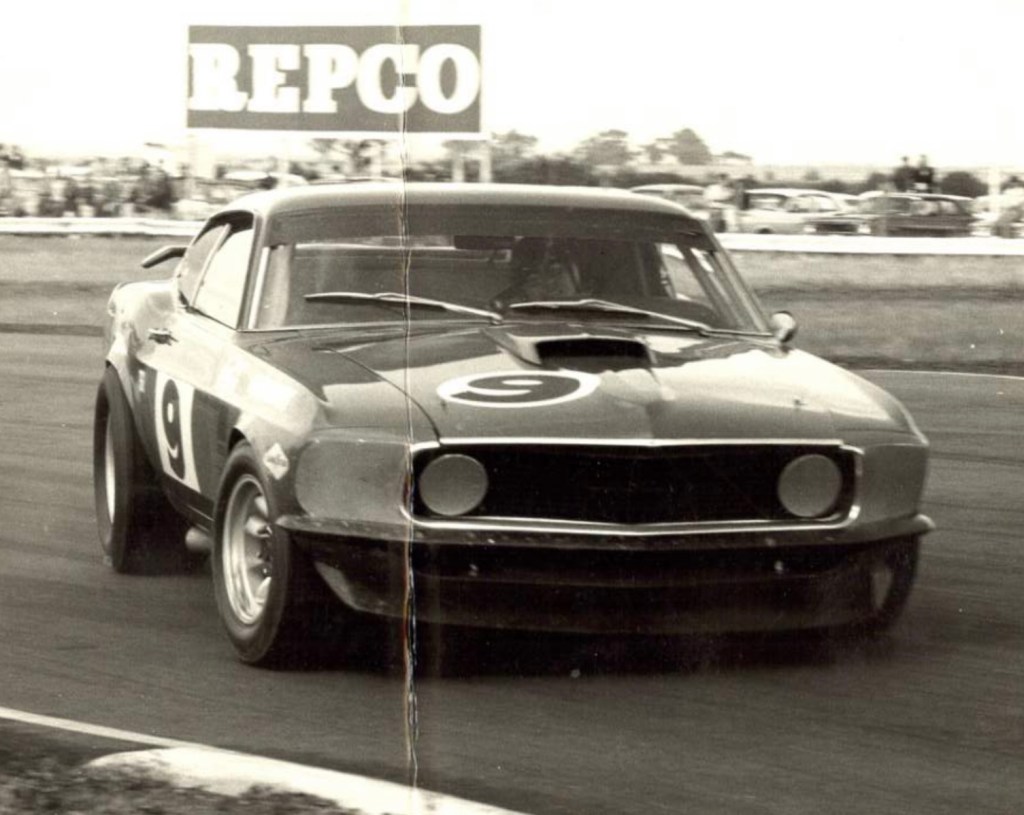
(motorsportretro.com)
This US shot was in the motorsportretro.com bunch of Moffat Mustang shots. The inference is that Allan is behind the wheel, can any of you touring car specialists date and place this shot of a car in Bud Moore warpaint?
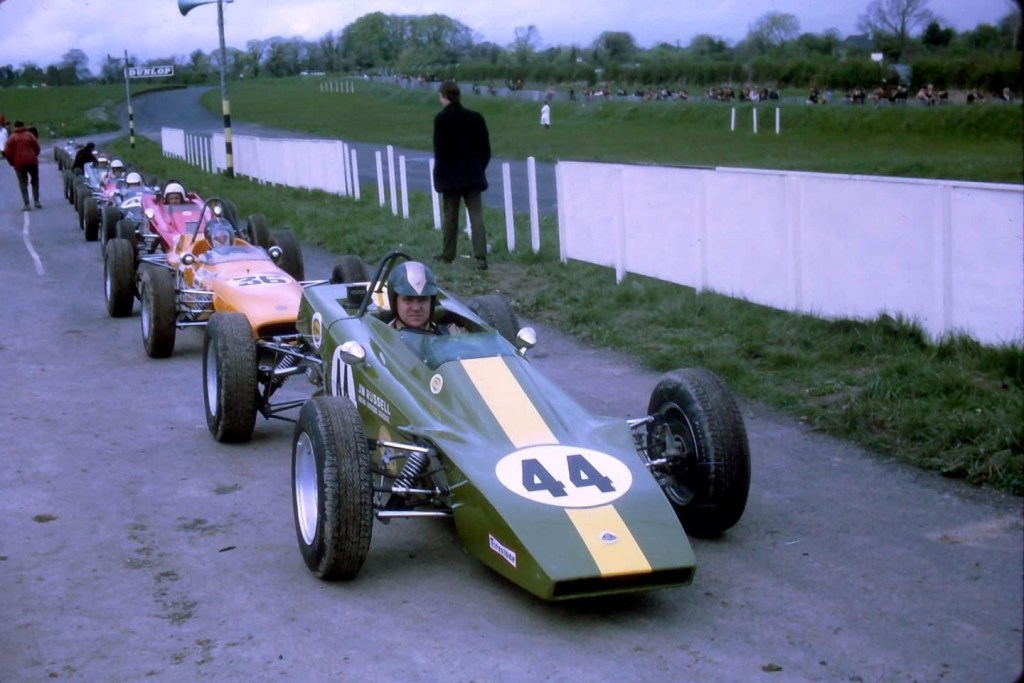
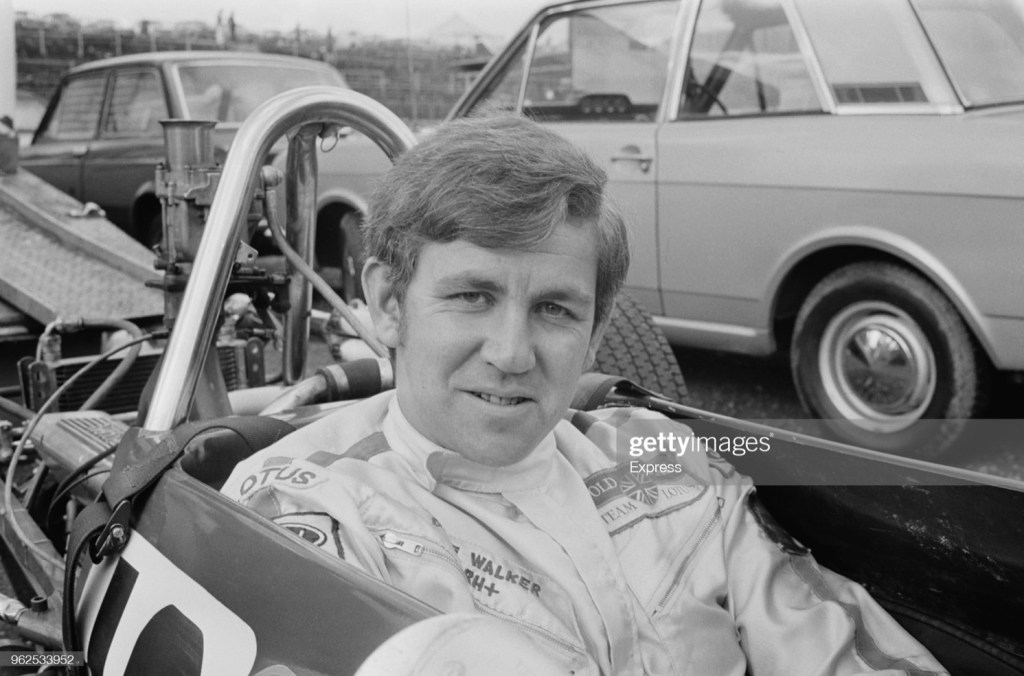
Great shot of Dave Walker in front of a gaggle of cars in the Mondello Park pitlane over the May 11 1969 weekend.
His works-Jim Russell Lotus 61 Formula Ford is in front of Emerson Fittipaldi’s Merlyn Mk11A with another future Grand Prix driver, Tony Trimmer in the black Titan fourth in the group.
Walker went backwards to go forwards with FF. He had been quick in his poorly funded F3 exploits in Europe since arriving from Australia in the mid-1960s but revitalised his career in works Lotus FFs. He won the 1969 Les Leston Formula Ford Championship aboard the Lotus 61 in 1969, dominant seasons in F3 aboard Gold Leaf Team Lotus 59 and 69s followed in 1970-71, then F1.
Walker during the 1964 Australian Grand Prix at Sandown Park in February 1964. He was ninth aboard his Brabham BT2 Ford 1.5, the race was won by Jack Brabham’s Brabham BT7A Climax FPF 2.5 (autopics.com.au)
Trimmer was second in the title aboard his Frank Williams racing Titan Mk4. Other drivers of note competing that year included Colin Vandervell, fifth using Lotus 61 and Merlyn Mk11A chassis, Ian Ashley, sixth in an Alexis, not to forget Tom Walkinshaw who was equal 14th in a Hawle DL2 – years before his switch to touring cars – with a youngster named James Hunt 21st in another Merlyn Mk11A.
Emerson was eighth but spent a good part of the year focused on F3, winning the BRSCC/MDC Lombank British F3 Championship aboard a works-Jim Russell Lotus 59 Ford. Walker was 11th in a Lotus Components 59, and Hunt 15th using Brabham, Lotus and March chassis.
Lotus Components built about 250 Lotus 61/61Ms from 1969-71, they were huge sellers, successful too with the wedge styling taking its cues from the 1968 Indy Lotus 56 Pratt & Whitney.
Credits…
Nick Sparks photo via Hans Hulsebos, autopics.com.au, Getty Images
Tailpiece…
Nice portrait of 29 year old Dave Walker at Crystal Palace in October 1970. Lotus 59A Ford F3.
That weekend, Mike Beuttler, Brabham BT28 Ford, won his heat, Walker his, and the final from Beuttler, Trimmer and Gerry Birrell.
Walker won the 1970 MCD Lombank F3 Championship, Carlos Pace (Jim Russell Lotus 59/59A) the BARC Forward Trust F3 title, and Tony Trimmer the BRSCC/MotorSport/Shell Super British F3 Championship, Brabham BT28 Ford.
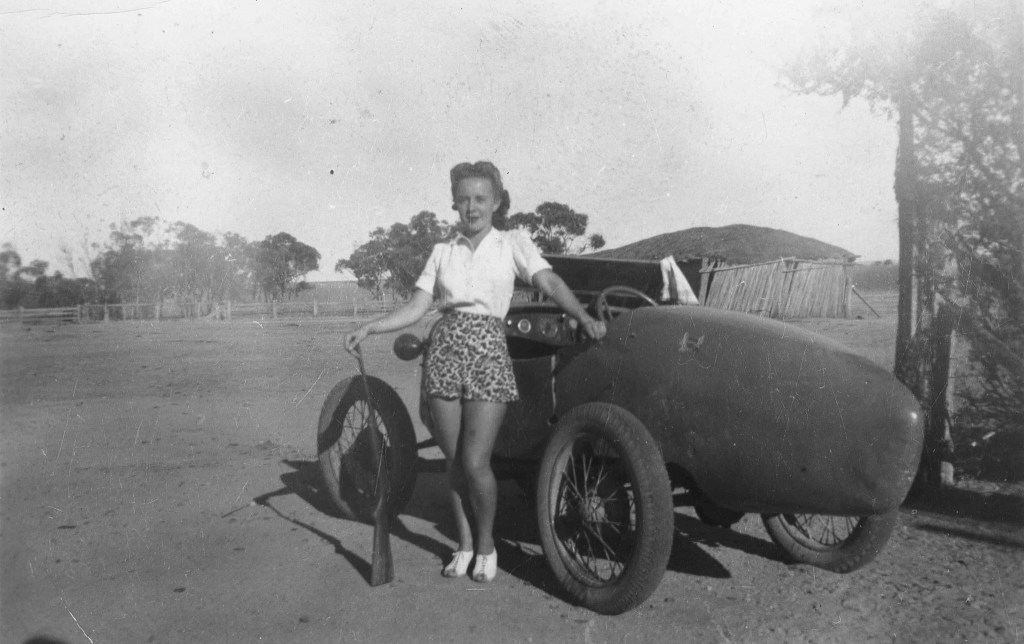
The thoroughly delightful Eunice Fidock is shown beside an Austin 7 Special at Dowerin, Western Australia circa 1935.
Dowerin is a wheatbelt community 160km north-east of Perth. It had two pre-war racing venues, the Lake Koombekine one mile, dirt, circular speedway, and the Dowerin Showgrounds speedway in town. I’m not sure which of the two this is, but I’m happy to take advice.
My friend Tony Johns, Austin racer/historian is on the job as to chassis type and number, albeit he suspects a Perth built body on a standard or Super Sports chassis.
Eunice hails from Cottesloe, an inner Perth beachside suburb. Looking like that she would have cut quite a dash at Cotts’ Indiana Teahouse. Resplendent in leopard-skin shorts, she is showing lots of bumpy-curvy bits for the times and is therefore well armed to keep the more amorous of Dowerin suitors at bay. I’ll leave the make of weapon to you NRA members.
Credits…
Lake Perkolilli Revival Facebook page, State Library of Western Australia
Tailpiece…
(SLWA)
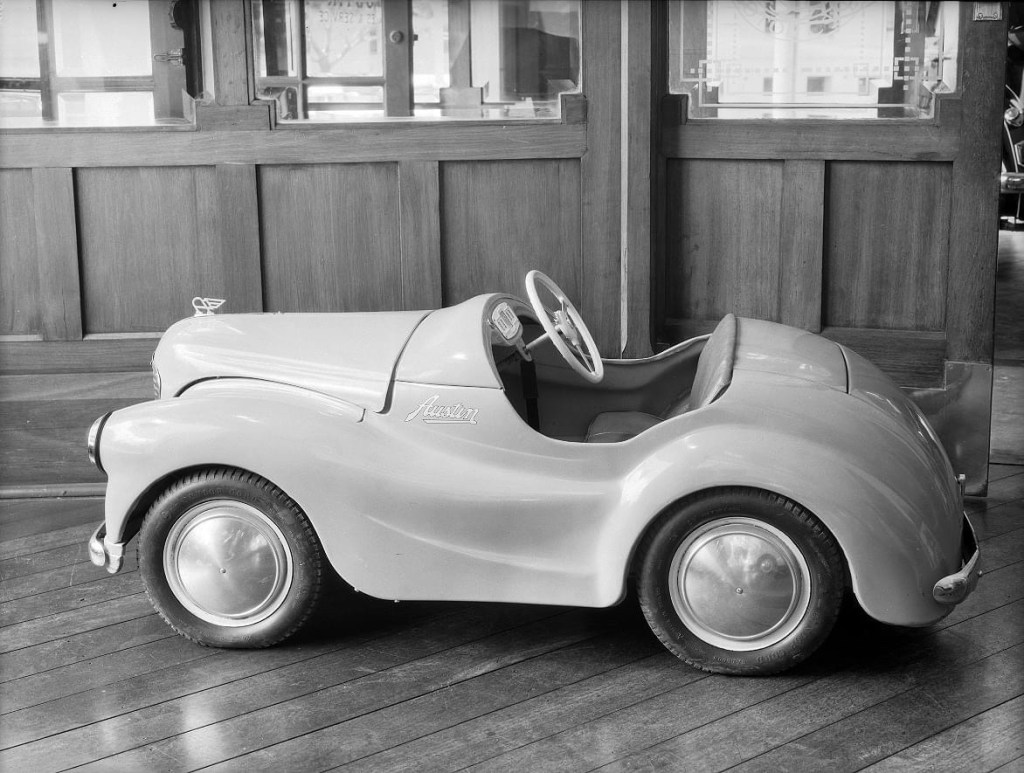
A slightly later model Austin – an Austin Junior Forty – shown in a Perth dealership circa 1951.
Jack Brabham put the cat amongst the Indy pigeons in 1961 together with John Cooper. Their Cooper T54 Climax FPF 2.7 blew the minds of the establishment. They were stunned by the speed of the itty-bitty, mid-engined roller-skate despite giving away 1.5-litres to the bulky Offy engined roadsters – which hung onto The Milk until 1965 of course.
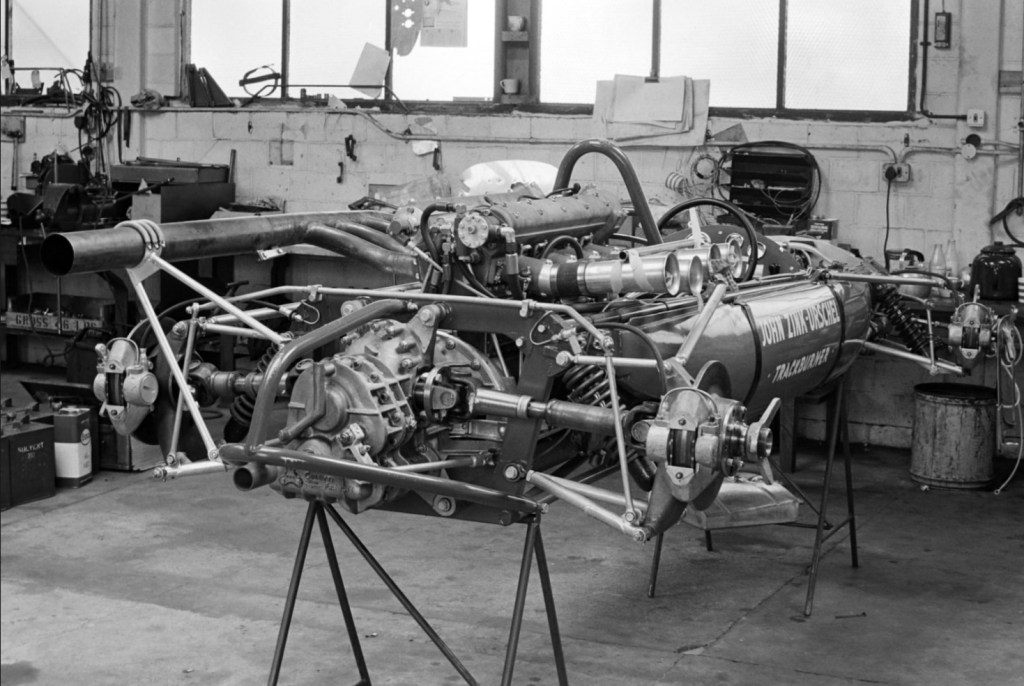
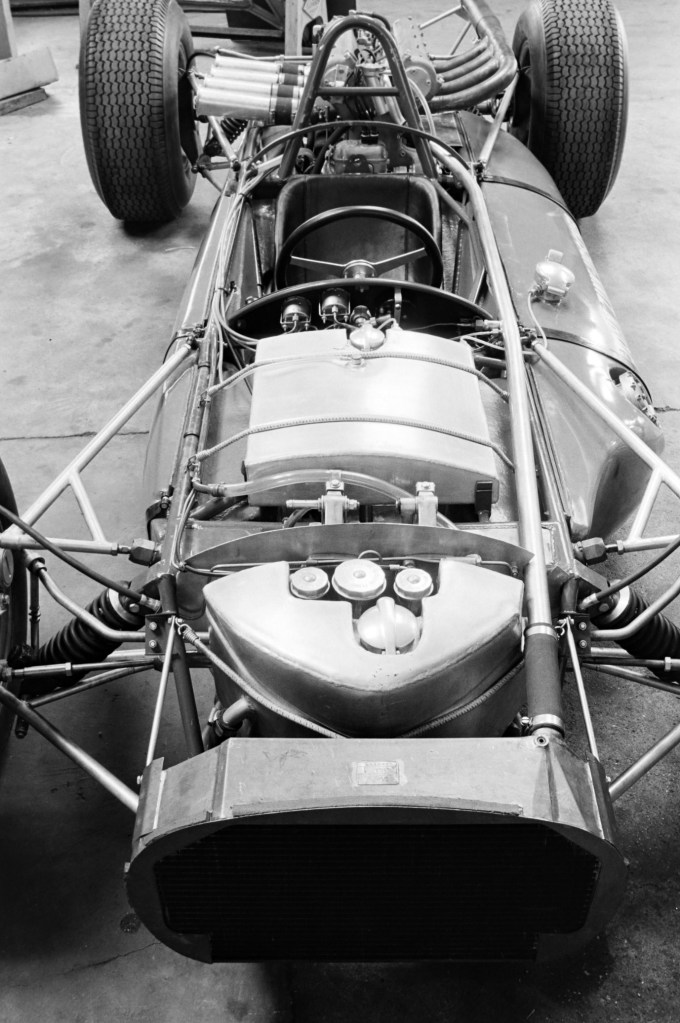
Brabham returned in 1964 with Ron Tauranac’s BT11 derived, spaceframe BT12 powered this time by an injected 4.2-litre Offenhauser twin-cam, two-valve four. The pacey package also featured a robust Colotti Francis T37 transaxle.
BT12-1 in build at Motor Racing Developments, Weybridge, Surrey circa April 1964. Long-stroke, 4128cc, 420bhp @ 6600rpm Offy sits tall in the frame, Colotti-Francis GSD transaxle and inverted lower wishbone, single top link, two radius rods and coil spring/shocks, rear discs, knock on hubs and beefy driveshafts all clear (MotorSport)Spaceframe chassis, upper and lower wishbone/coil spring-shock and roll bar suspension. Note the bungee’d in place oil tank and top-of-chassis little fuel tank. Note too the main tanks offset to keep the bulk to the inside. About 59 gallons of fuel when full (MotorSport)Indy 1964 (MotorSport)
Jack didn’t qualify well with a multitude of problems, not least spring/shocks which were way too soft (as specified by car owner John Zinc), and time, pulled as he was by his GP commitments to straddle both sides of the Atlantic.
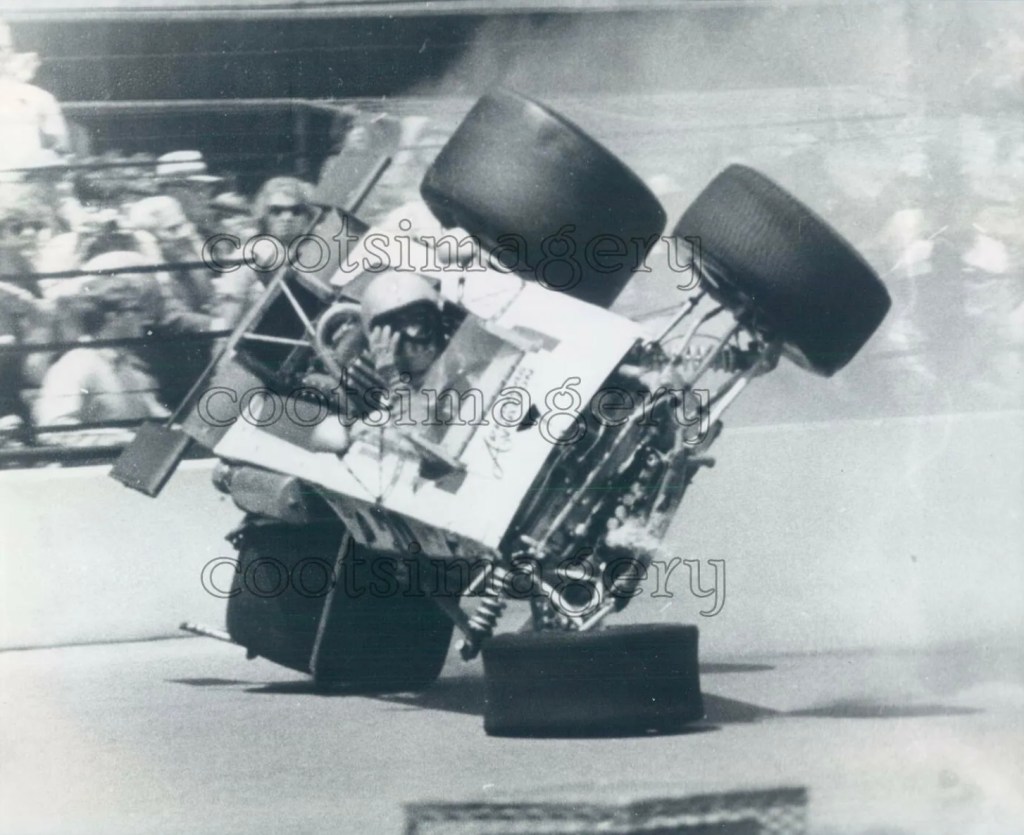
Famously wary at the start of that race – having been warned about how dangerous the Mickey Thompson built Thompson Ford was by Masten Gregory, who didn’t qualify his – Brabham picked up a small fracture in one of those ginormous aluminium fuel tanks in the horrific lap two accident caused by Dave MacDonald losing control of his Thompson Ford in the middle of the field. MacDonald, very much a man of the future, and the much-loved Eddie Sachs, Halibrand Ford, perished in the horrific conflagration. Brabham was out after 77 laps, the race was won by AJ Foyt’s Watson Offy from the similar front-engined roadsters of Rodger Ward and Lloyd Ruby.
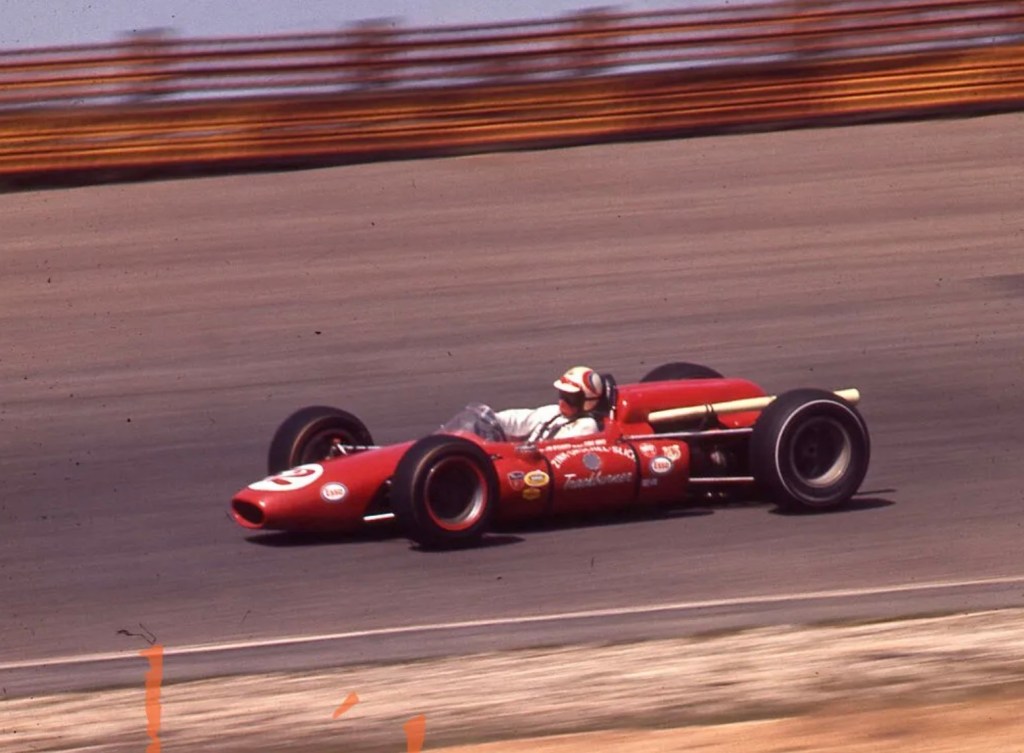
Jim McElreath on the way to victory in the Trenton 500 during 1965, Brabham BT12 Offy. Note in the other Trenton shot below the symmetrical fuel tank setup compared with Jack’s at Indy the year before (DJ Teece)
When Jack returned to Europe, the John Zinc owned car was raced with plenty of speed by Jim McElreath, and a few decent hits too. The final shunt at Indy was a biggie, it wasn’t worth repairing the mild steel tube frame, in part because it would not have been legal under USAC’s 1965 rules.
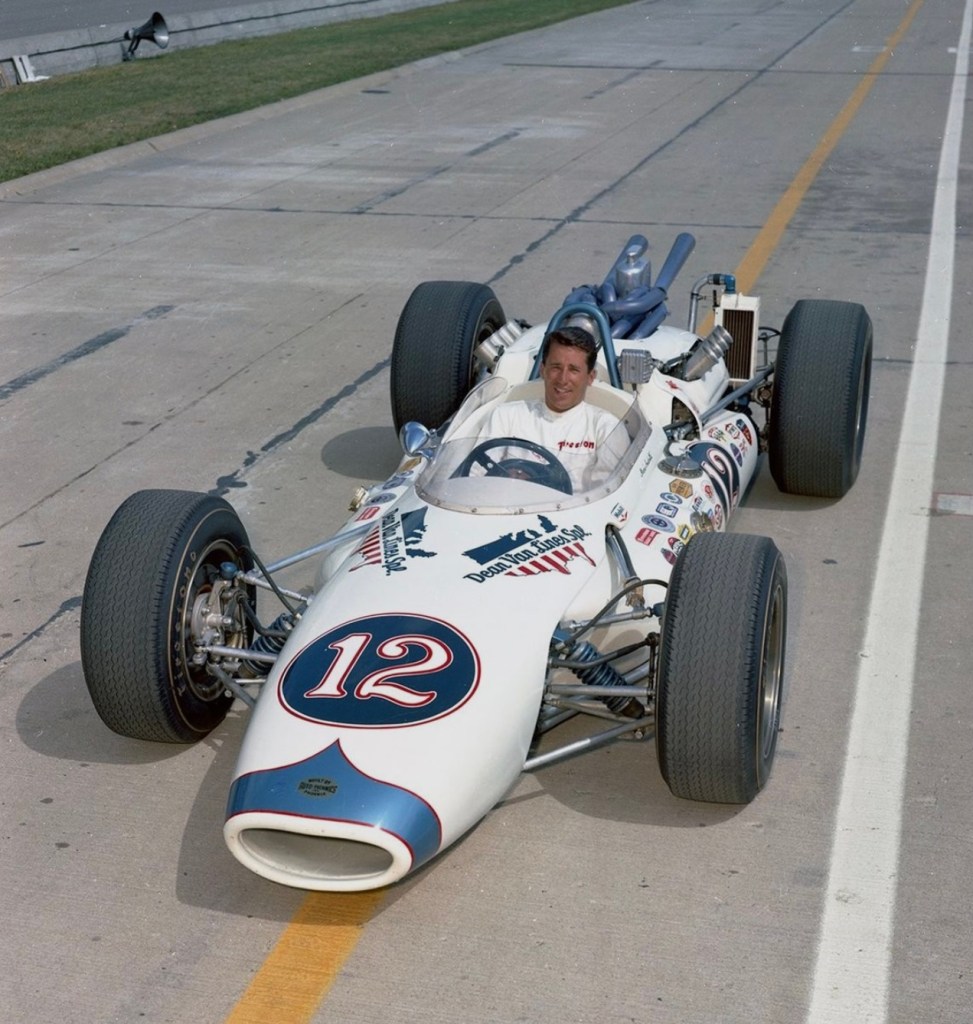
Clint Brawner therefore built two chrome-moly steel tube copies of the BT12 late in 1964, one for Zinc/McElreath, and one for his – Al Dean sponsored – outfit to be driven by a talented young rookie named Mario Andretti.
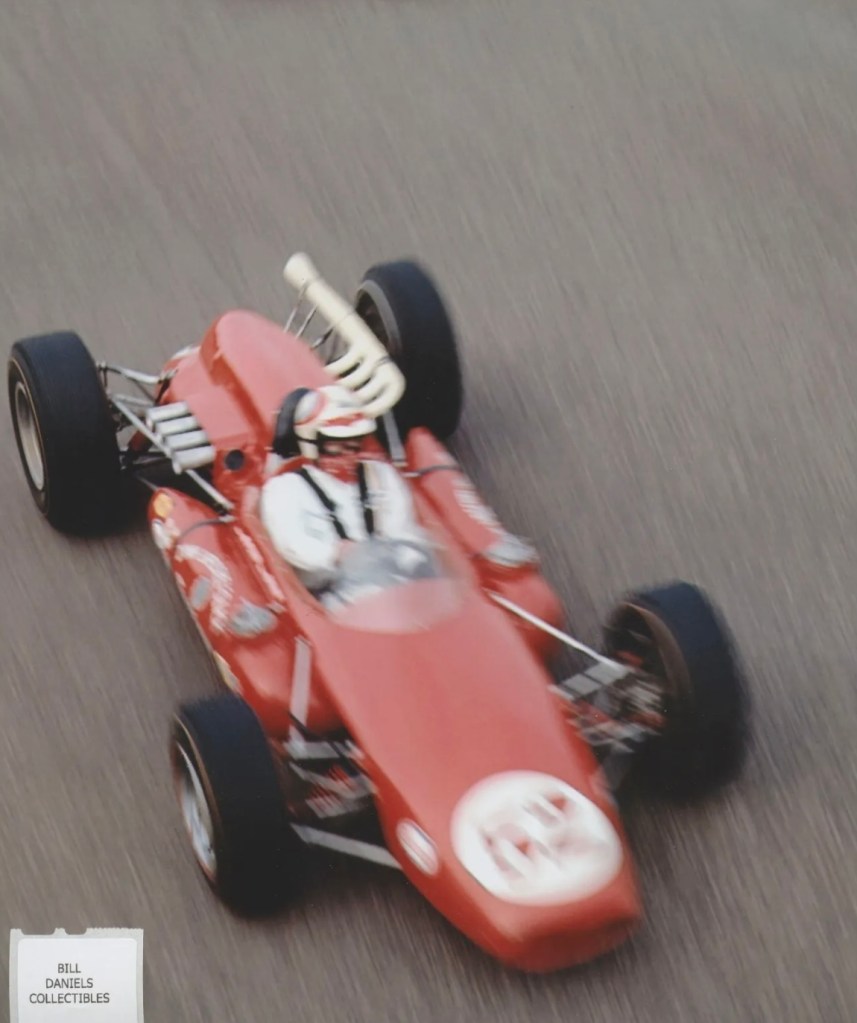
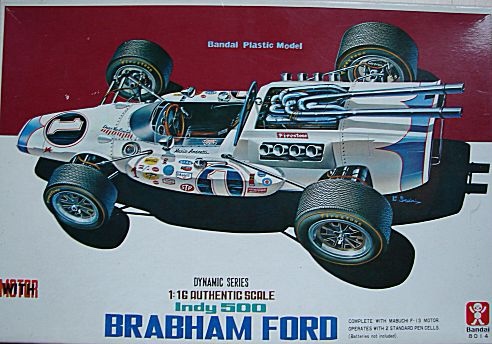
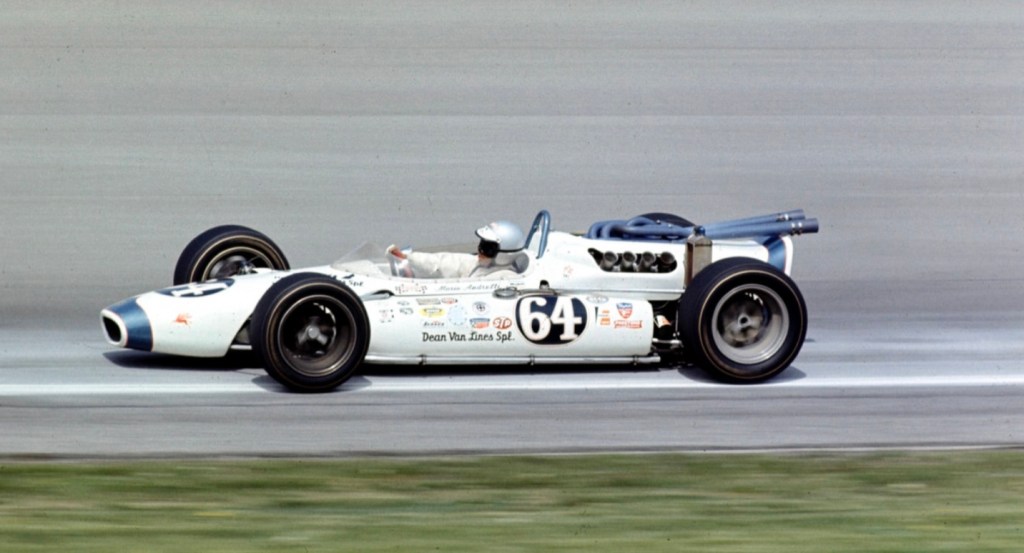
A very young and happy Mario Andretti at Indianapolis in 1965 aboard the Brabham BT12 Ford aka Hawk 1 65 Ford. Apart from the Ford V8 installation note the changes to the bodywork which were thought later to provide some ground effect. This car was a rocket in 1965-66 despite the presence of plenty of Lotus 34 and 38 machines (unattributed)The Dean Van Lines/Brawner outfit called their Brabham BT12 Ford a Brabham for a while, as proved above. They then named it a Hawk, and later a Brawner Hawk, not unreasonable given the evolution of the body and modifications to fit the Ford Indy V8Andretti during practice at Indy in 1966. Still aboard his favourite BT12/ Hawk 1 65 Ford. He raced with #1, popped the car on pole, choosing to race it rather than the Lotus 38 he also had at his disposal (Dave Friedman/MotorSport)
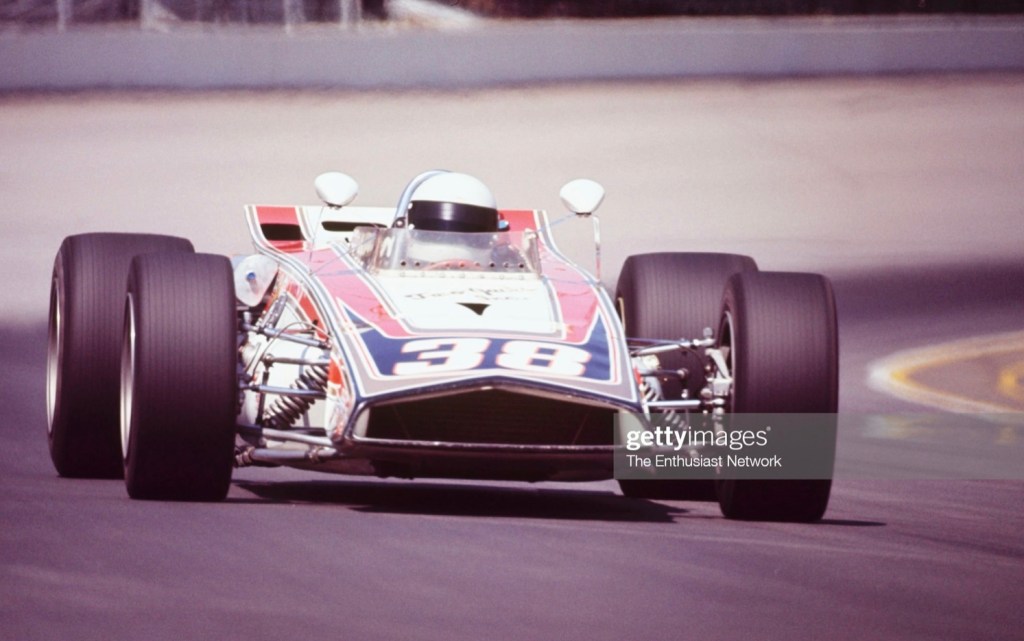
Andretti loved the ‘Hawk Ford’ (chassis Hawk 1 65), winning the USAC Championship in it in 1965-66. In ‘65, McElreath was one of his closest competitors in the Zinc Brabham Offy, finishing third. The following year he went one better and placed second to the future 1978 F1 World Champ, this time Ford Indy V8 powered.
Another two BT12 copies were built for Jim Hayhoe’s outfit, with drawings provided, perhaps, via Jack Brabham in 1968.
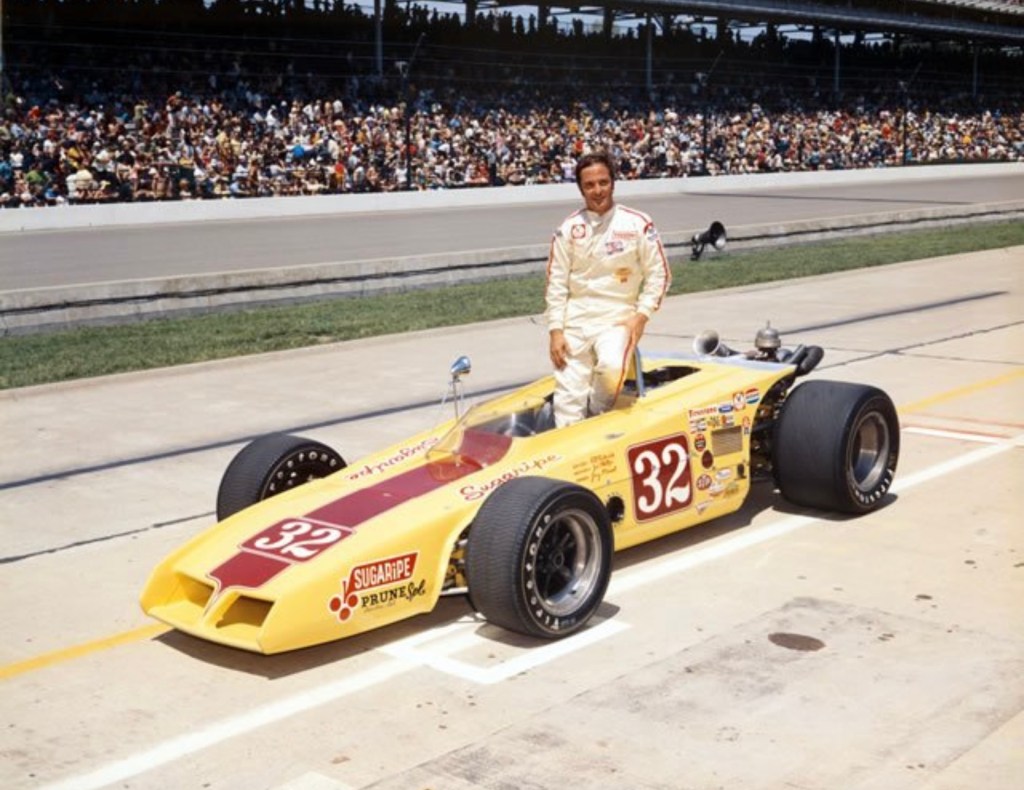
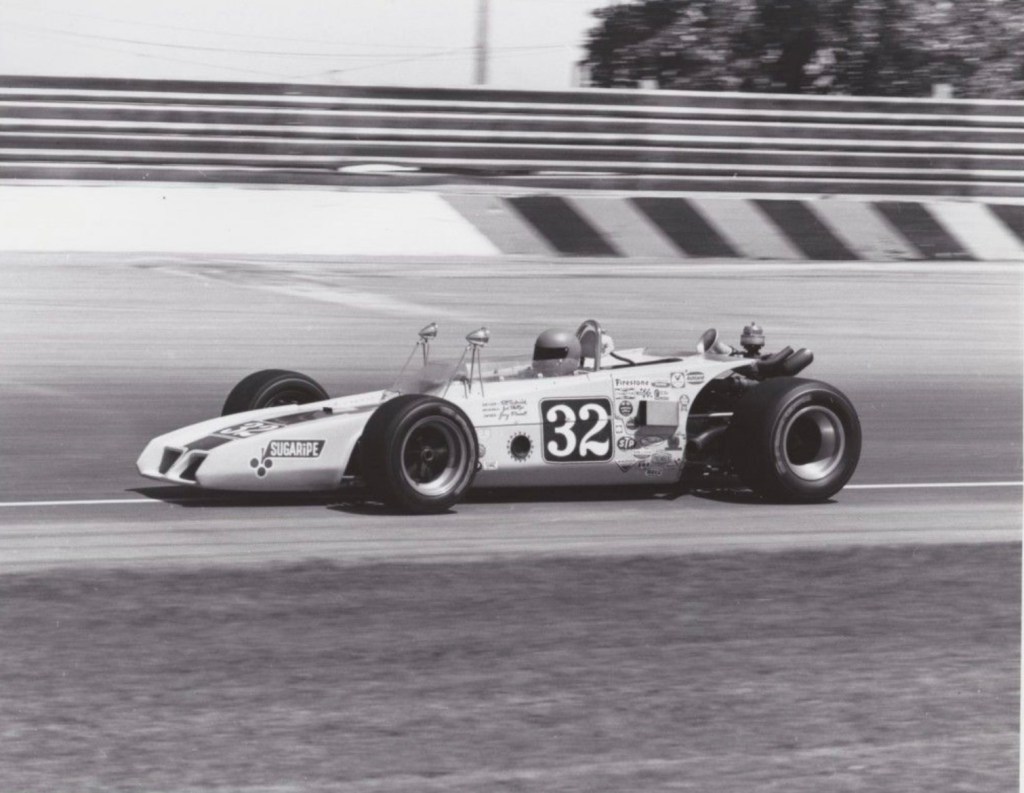
One of these Offy powered BT12s, with suitably updated body by Jud Phillips, finished fifth in the 1971 Indy 500 as the catchily named Sugaripe Prune Spl with Billy Vukovich at the wheel. In a strong year for the seven year old design, and three year old chassis, Vukovich was third in the USAC points table. His haul included two third placings at Milwaukee and Phoenix, and a staggering second to Mark Donohue’s state-of-the-art Penske McLaren M16A Offy at Michigan.
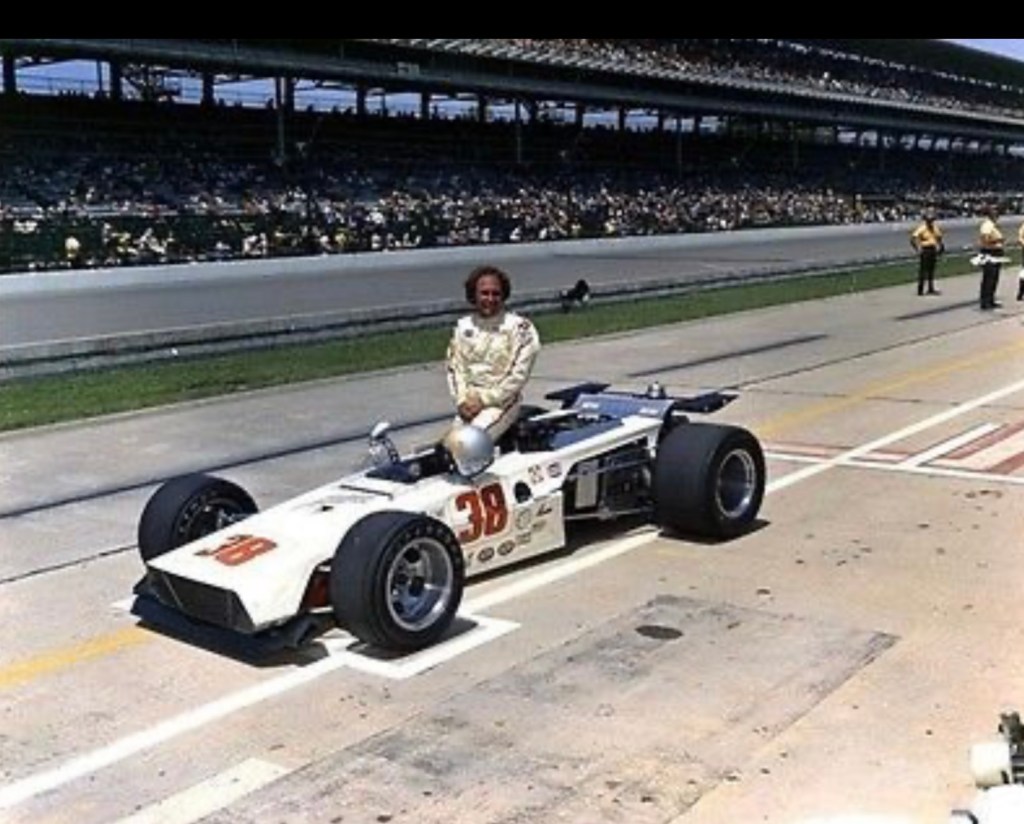
Bill Vukovich, Brabham BT12 Offy t/c at Indy in 1971, looking slightly different! to Jack’s BT12 Offy seven years before. I dare say the suspension geometry copped a tickle to accommodate the advance of tyre technology over that period (IMS)(unattributed)Rick Muther in the ex-Andretti BT12/Hawk 1 65 chassis, now fitted with an Offy turbo at Indy in 1970. Q15 and eighth, race won by Al Unser, Colt 70 FordShit shot of a Fugly Cup contender. Rick Muther in the ex-Andretti Hawk 1 65 Offy t/c before the 1971 Indy 500 (unattributed)Muther, hanging onto his helmet while travelling sideways along Indy’s front chute at well over 120mph – no he didn’t go over. Chassis a tad second hand after this lot, Indy 1971
Equally amazing was that Andretti’s old nail – the Hawk 1 65 – that he raced so successfully in 1965-66, by then owned by Jack Adams, also started the 1970 and that ’71 500 with Rick Muther the driver.
The Offy powered, Arkansas Aviation entered car was involved in a spectacular accident with David Hobbs’ Penske Lola after completing 85 laps of the race won by Al Unser’s Colt 71 Ford. Hobbs engine blew, then Muther, immediately behind him swerved in avoidance, pegged the inside wall, then veered right into Hobbs’ path and the outside wall, taking both of them out in a lucky escape.
Who said that spaceframes were old hat by the end of 1962!?
Spaceframe BT12 out front of MRD. Note the Halibrand wheels (MotorSport)
Credits…
The MotorSport Images shots at MRD were taken by David Phipps, DJ Teece, Indy Motor Speedway, Bill Daniels Collectibles
As always, thanks to Allen Brown’s mind-blowing OldRacingCars.com – racing car history results and database website. I simply cannot get the level of historic accuracy – facts – into some of these articles without his one-of-a-kind website. Click on this link to Allen’s main Indy page Indy 500 and USAC racing 1971-1978 « OldRacingCars.com then you can scroll for yourself through far more details about the BT12 cars; Brabham, Hawk and Hayhoe
Tailpiece…
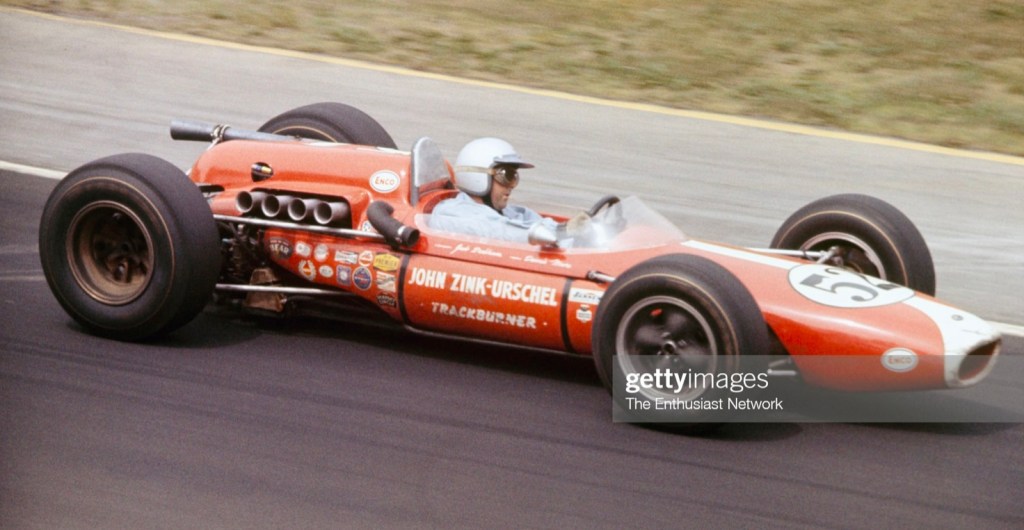
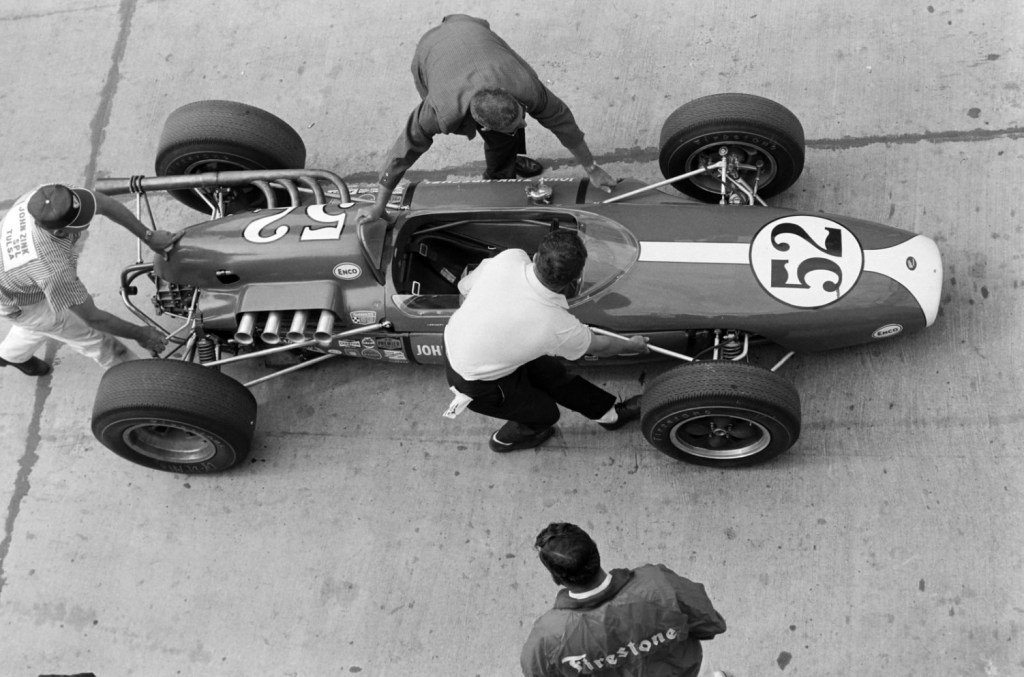
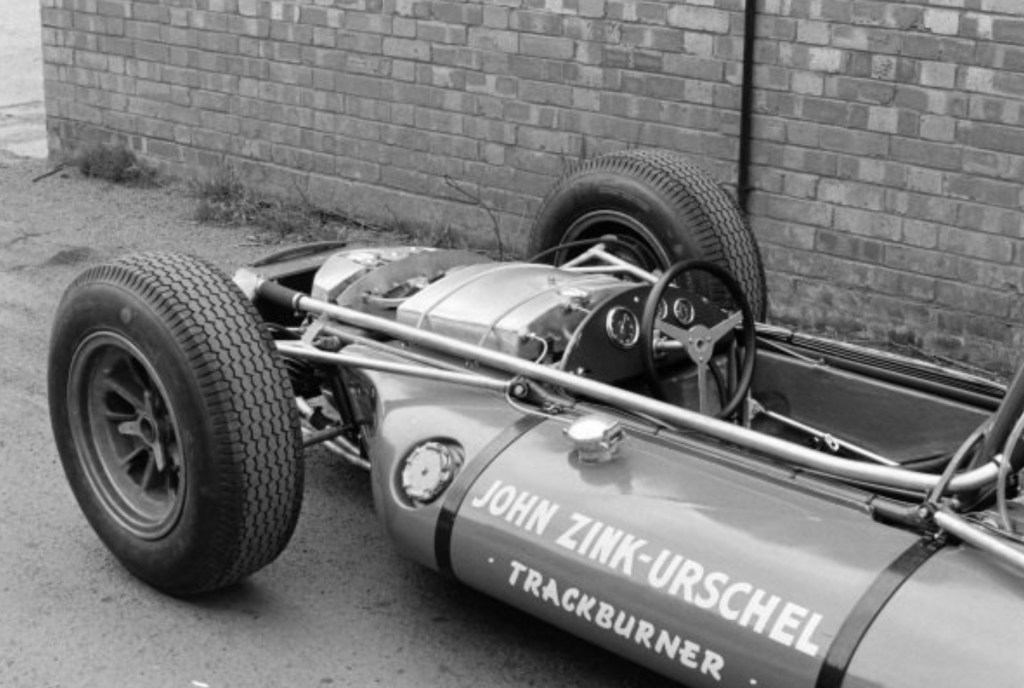
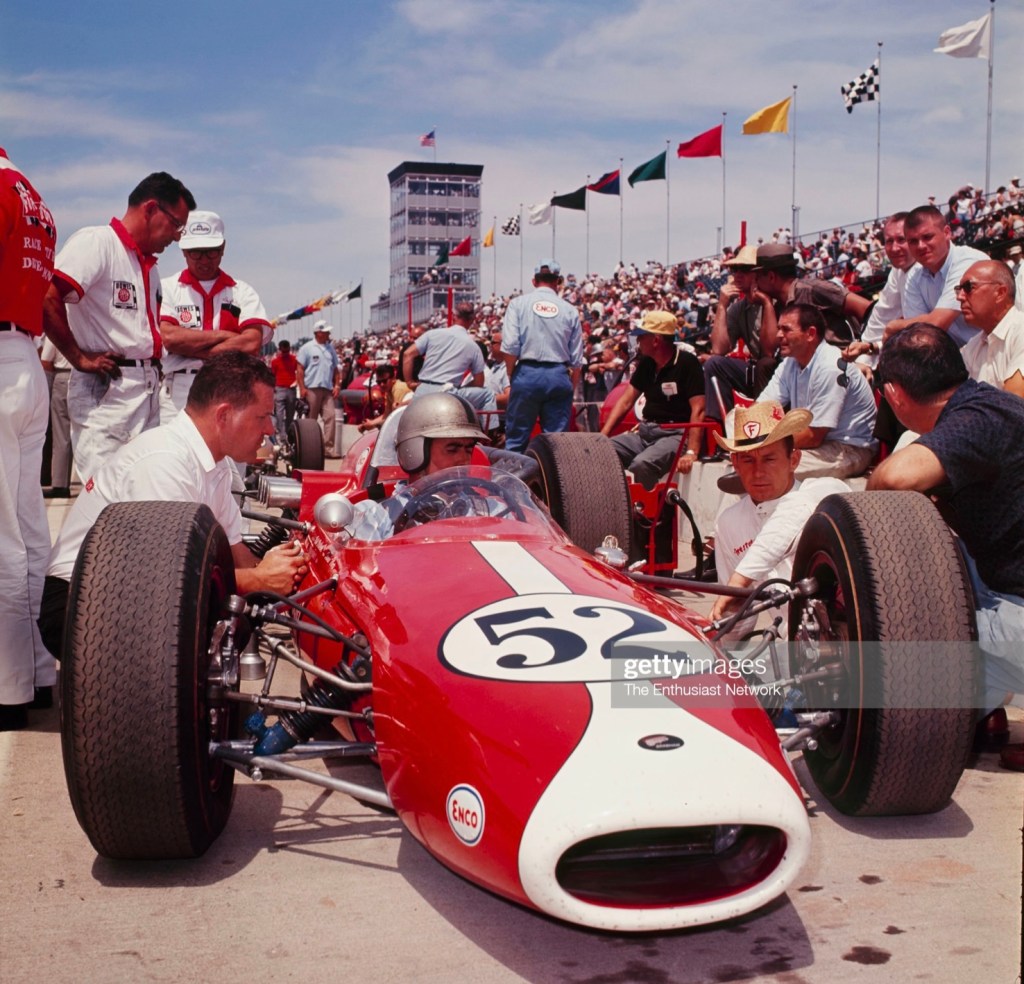
Brabham ready to boogie aboard the Zinc Trackburner Special on raceday at Indianapolis in 1964.
Such an influential car the BT12, an unsung, or at least an under-recognised Brabham in some ways.
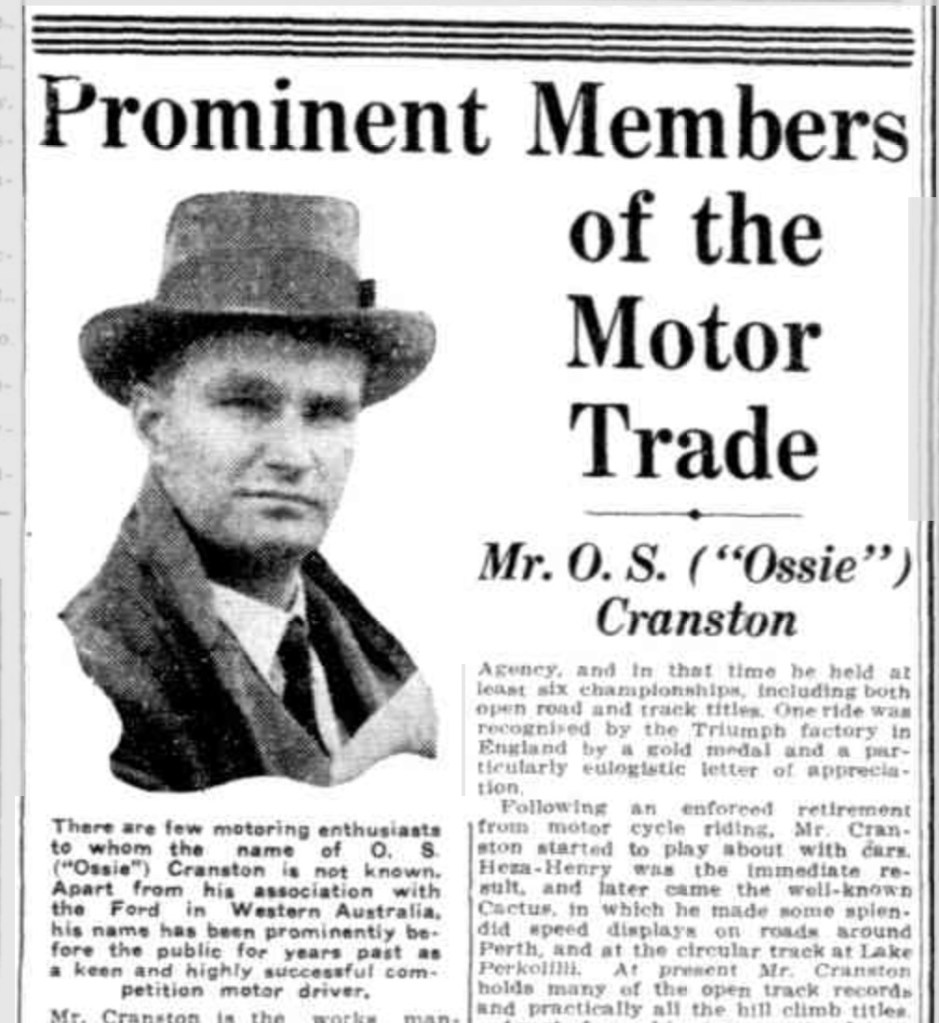
Osborne Scott ‘Ossie’ Cranston (1899 or 1903 – July 1, 1982) was one of Western Australia’s aces at a time Perth was a long way from the eastern seaboard (sic).
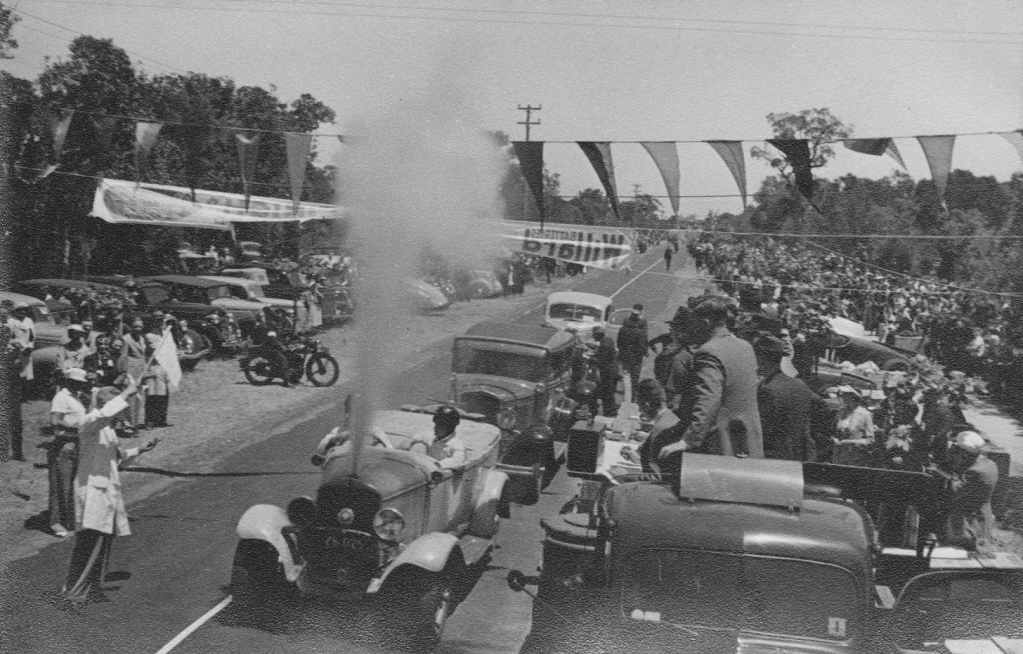
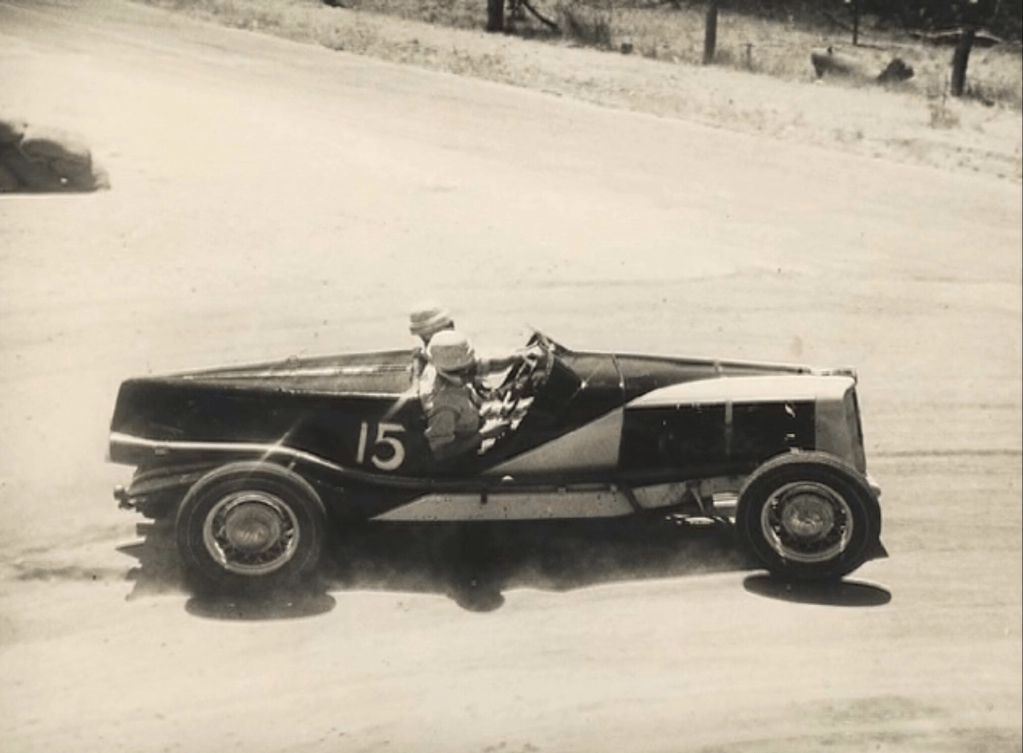
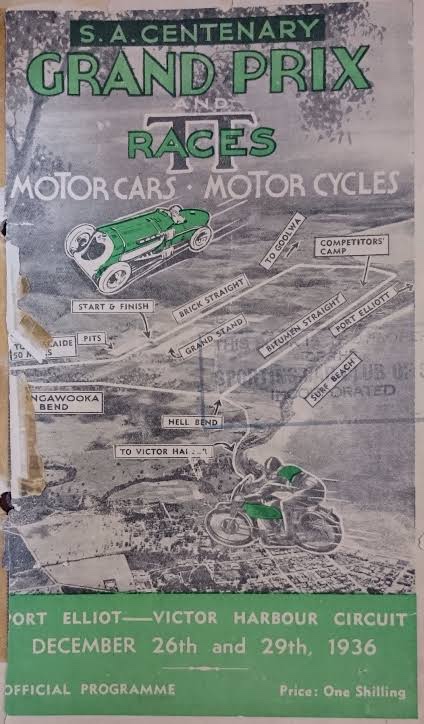
To race his Ford V8 Special in the December 26, 1936 South Australian Centenary Grand Prix (the 1936 Australian Grand Prix) at Victor Harbor required shipping his car on the interstate passenger liner, the Manoora, on the Tuesday before the race, from Fremantle to Port Adelaide. A trip to Melbourne is a lot further and Sydney even more. So race-fans in the more populous states of the nascent country of Australia didn’t see many of the faster West Australian cars, despite their thriving motoring scene.
Cranston and passenger en-route to victory, Ford V8 in the 10 Mile race at Lake Perkolilli in 1936. Standard wheelbase, chassis and hubcaps! clear. Wearing his dealer hat, Cranston’s modifications trod a sensible path between performance and familial connection to Ford’s standard offerings on his dealership forecourt. It’s attractive, the fin and stylised V8 logo are neat touches which take the eye off that long wheelbase. Fast car indeed (Kalgoorlie Miner)Osborne Scott Cranston in his mid-thirties, as the Sunday Times artist saw him in 1937
In that sense, Cranston’s Victor Harbor (correct spelling) achievement was a great one over the more fancied Bugatti T37As, MG K3s, Frank Kleinig’s Kirby Deering Special and Hudson Special (he raced the latter) and Jack Phillips’ Ford V8 Special. Not that Cranston won the race.
Australian Grands Prix, until the dawn of the 1950s, were handicap events given the shortage of racing cars spread across a huge space – Australia is a big joint, have a look at a map one day – and the vast disparity in performance between those cars. Cranston did the fastest elapsed time but finished sixth on handicap. Les Murphy won the 250 mile race in an MG P-Type. See here for a long epic on this race around a rectangular 7 4/5 mile, sandy-gravel course, between Victor Harbor and Port Elliot. ‘South Australian Centenary Grand Prix’ 26 December 1936 aka 1937 Australian Grand Prix…… | primotipo…
Cranston, Ford V8 Spl, Lake Perkolilli date unknown (unattributed via Graeme Cocks)Arthur Colliver, Chrysler 70 ‘Silverwings’, Bugatti T37 driven by the Perth importer, Cyril Poole (or AN Other), Cranston in Ford T Heza-Henry and Jack Smith, Buick Spl, Lake Perkolilli 1927 (SLWA))
Cranston’s car started life as a 1935 model (1933 in some references) Ford V8 utility. It was then modified with a light racing body – the long tapered body with fin atop was fitted in 1935 – magneto ignition, competition exhaust manifold, flattened road springs and two Winfield carburettors in place of the single standard item. “Otherwise”, the ‘papers of the day reported, “the car is identical with the Ford V8s sold by Lynas Motors Ltd”, the Hay Street, Perth, Ford dealership of which Cranston was a partner/shareholder with V Lynas and J Victor Pascoe. Later fitted the with a ’36-model radiator, it was then erroneously and continuously called a ‘1936 car’.
I won’t repeat the successes of the car at Lake Perkolilli and other Western Australia venues already outlined in the opening image.
Cranston grew up in the comfortable surroundings of Swanbourne Beach. He began his working career as an apprentice mechanic with Grave and Dyer, working on Standard and Imperial cars. The business was Perth’s first Ford Dealer, over 15 years he rose through the ranks to become Works Manager. From there, Cranston was recruited by Ford as Works Superintendent of their assembly plant at North Fremantle. Later, he and his partners, former colleagues from Grave and Dyer, formed Lynas Motors Ltd.
Cranston with 3.5hp Triumph circa 1920 (Sunday Times)
In 1917 (or 1919) Ossie took up motorcycle racing, he won his first competitive race, the three-mile Charity Handicap at the WACA, riding a Triumph “in a brilliant performance for a novice.” He raced mainly on the grass tracks at Claremont Showground, Loton Park and on the road riding Indians and Triumphs for the Armstrong Cycle and Motor Agency. Six track/road championships followed, one “was recognised by Triumph in England with a gold medal and a particularly eulogistic letter of appreciation,” the Sunday Times wrote.
A large crash at Claremont in 1922 encouraged a shift to four-wheels. While still at Grave and Dwyer, he initially drove a Ford Model-T in hillclimbs, setting many fastest times in a car affectionately nicknamed ‘Heza Henry’. Hez had a hand-formed, torpedo-shaped rear which incorporated ‘guards for the road which were removed for competition work. It did 68mpg on the Perkolilli claypan in 1927.
With the introduction of the Model-A, Ossie built up ‘Cactus’. It had a less refined vinyl boat-tail body than Heza, from the dashboard back, two bucket seats and a fairing in front of the driver. Various engines were fitted along the way but the body was a constant.
Cranston in the Ford T-Spl Heza-Henry and JC Smith, Buick Spl, Lake Perkolilli 1927 (SLWA)Ford A-Spl Cactus at Perkolilli, year unknown. Intrigued to know which of the Perth artisans built the various Cranston bodies (G Cocks Collection)
Well suited to hillclimbing but not so much Perkolilli’s long curves, he still finished third behind the Armstrong driven Auburn and Colliver Chrysler in the RACWA State 20 Mile Championship in 1929. He won the 10 Mile handicap that day too, claiming that the car was capable of 100mph. Cranston went one better in 1930 taking 10 Mile Lake Perkolilli State Championship.
The 3.3-litre, four cylinder, side-valve – for a while supercharged – engine had a range of modifications to the cylinder head, carburetors, intake and exhaust systems and a taller top (third) gear fitted to Ford’s coupe.
Further success ensued throughout 1931-32 at Whittakers Hill, North Dandalup, Lake Pinjar, Bunbury Beach, and Whittakers and Greenmount Hills. By late 1931 Cactus maxxed out at 89 mph to win the flying quarter-mile event at Wattle Grove.
In 1932 the Brooklands Speedway opened (on the West Subiaco aerodrome site), where Perry Lakes and the Uni WA sportsgrounds are today. Brooklyn had only a short commercial life, but Cranston – belted pretty hard by the handicappers – set a four-lap record for the one-mile, limestone track in 4 mins 38 secs in 1932, not too long before Cactus was retired.
Perth’s finest with their Bentley Speed Six’ (chassis LR2783 and LR2785) during their long period, 1930-1947, of service. Coachwork by Bryan’s Motor Body Works, 522A Hay Street, Perth, close to Lynas Motors. Cars extant, ‘Bentley Patrol’ is a whole story in itself! (WA Govt)(The Daily News, September 21, 1933)
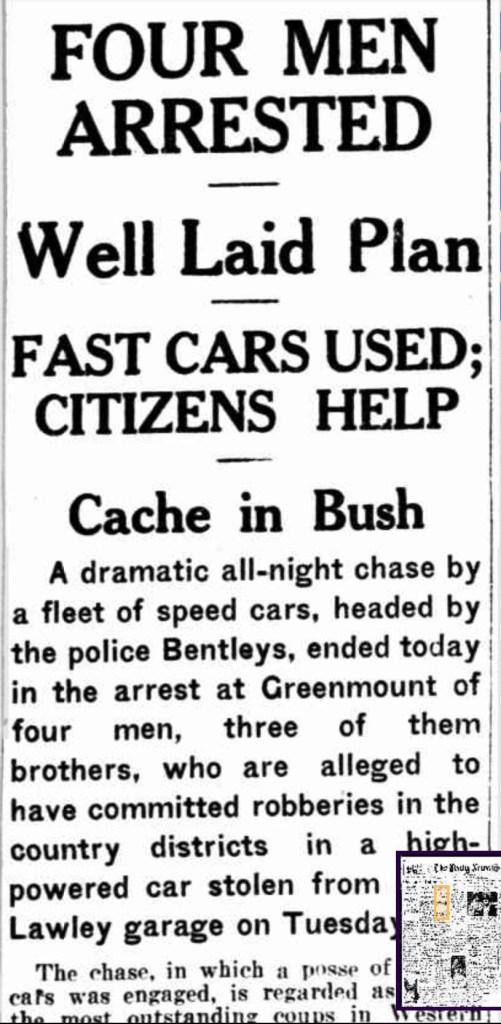
One of the more bizarre days of Cranston’s long life was a police invitation for he and Cactus to join a posse of cars to help catch some baddies in September 1933. Said crooks were committing smash and grab robberies in the country, then escaping in a stolen, fast, ‘high powered car’.
The police generals figured they needed more pursuit cars capable of in excess of 80mph, than their two 6.5-litre Bentley Speed Sixes. Yes folks, the WA police were the only wallopers on the planet to have these expensive blue-bloods as patrol cars. The plan was to create a cordon around Perth to chase down and catch the dirty-rats. So, some racers were recruited as Deputy Sherriffs including OS Cranston.
While Cactus wasn’t involved in a high speed chase, the four-perps (police talk I believe) ran off the road alongside where Cactus was parked, near the gate of the national park at Greenmount (23km east of Perth). They were arrested with a cache of stolen goods found close by.
In another bizarre, only-in-Australia moment, the handcuffed crooks were kept warm beside a fire lit by the coppers while Cranston high-tailed it back to Perth in Cactus. The Bentleys had radios, no other WA police cars did, Ossie’s mission was to give the good news to senior police and organise a patrol car to take the shaken, but warm robbers back to the city lock-up…
Sunday Times, June 30, 1935
By 1934 Cranston was quite the man about town too. In addition to his Lynas responsibilities he was a director of Rural Motors Ltd, Bunbury Motor Estates Ltd and General Investment Co Ltd, which provided consumer finance for Fords. He was also the director of several companies outside the motor trade.
Wearing his Lynas Motors hat Ossie travelled to ‘The Orient’ (is that term a no-no these days, one never hears it used?) in mid-1934. “Wherever you go you’ll see a Ford,” he quipped to the Perth Mirror on his return.
Cranston was amazed by the number of baby Fords in Singapore and amused that the first news he received in Ceylon was about the success of a small Ford in a local hillclimb. In Java he observed that cars were ancient, “the post Depression prices of sugar and rubber are low.”
Things were better in Singapore, Shanghai and Hong Kong. Siam made the railways pay, “with no roads between the principal centres people are forced to use the trains!”
Asked about the new Datson (sic, the machine would have been the Datsun – Nissan – Type 13) car, “a new light job similar to the 7hp units with which we are all familiar, being built in Japan.” Cranston said “I didn’t see one on the trip. Agents have been appointed in various centres of the orient, but it’s unlikely any are expected in Australia.” Not for three decades or so, in any event!
The Daily News, November 19, 1935The Car October 1935
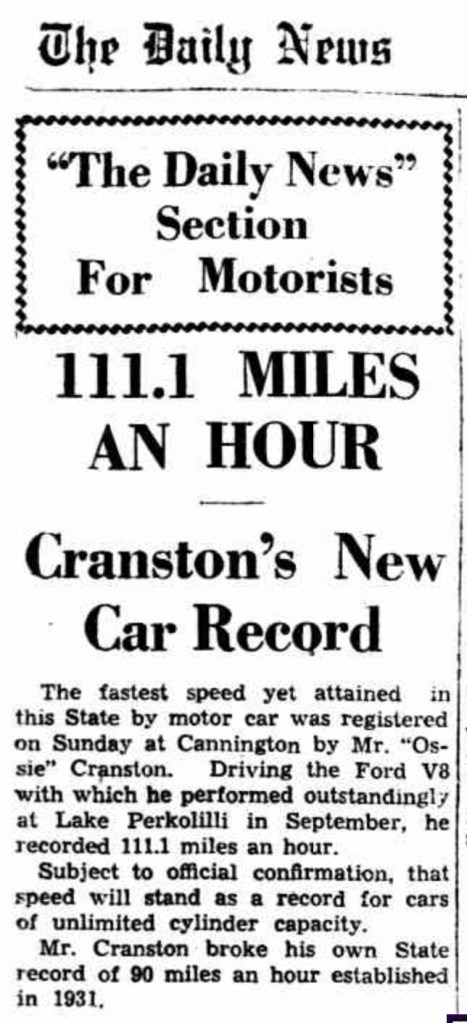
In 1934 Cranston returned to racing with the Ford V8, setting a new Australian record at Perkolilli over 10 miles (16 kilometres) at an average speed of 97.61mph (157 km/h), and later a new State record of 111.1mph (178.8km/h) over a flying quarter-mile on Nicholson Road, Cannington, beating the record set in the Model-A.
After success in the South Australian Centenary Grand Prix, held at Victor Cranston told the Motorist and Wheelman that he was retiring from racing because he was “too old”.
Ford recognised his contribution to the sport and polishing the marque’s brand via his racing exploits over a long period with the presentation of a ‘gold wristlet’ at a function of dealers in Perth in April 1937.
His final motor racing event – just before the lights-went-out in WW2 – was the Patriotic Grand Prix, held on the Applecross streets of Perth in November 1940.
Following Cranston’s decision to retire, he sold the Ford V8 racer to Bathurst Ford dealer and 1920-30s intercity record breaker Norman Aubin. John Medley wrote that Aubin prepared the cream and green car for 27-year-old local driver, George Reed to race in the 1938 AGP held at Bathurst.
Reed’s race was brief as the big car spat its fan through the radiator early on. It would be interesting to know what the young driver thought of Cranston’s car. He was to build some very fine Ford V8 Specials of his own, including the George Reed Special Warwick Pratley raced to AGP victory around-the-houses at Narrogin, Western Australia in 1951.
The ’38 AGP was won by British international Peter Whitehead’s ERA B-Type. After that Easter meeting, Aubin sold it to a Sydney buyer, who repainted it red, but it never raced again.
Another report has it that the car was sold to an eastern states competitor who was killed in it at Bathurst. The engine was fitted to a speedboat and the chassis stored for a bit before being destroyed. Does anybody know the facts?
In 1983 Clem Dwyer started the build of a replica which remains a welcome competitor in historic events.
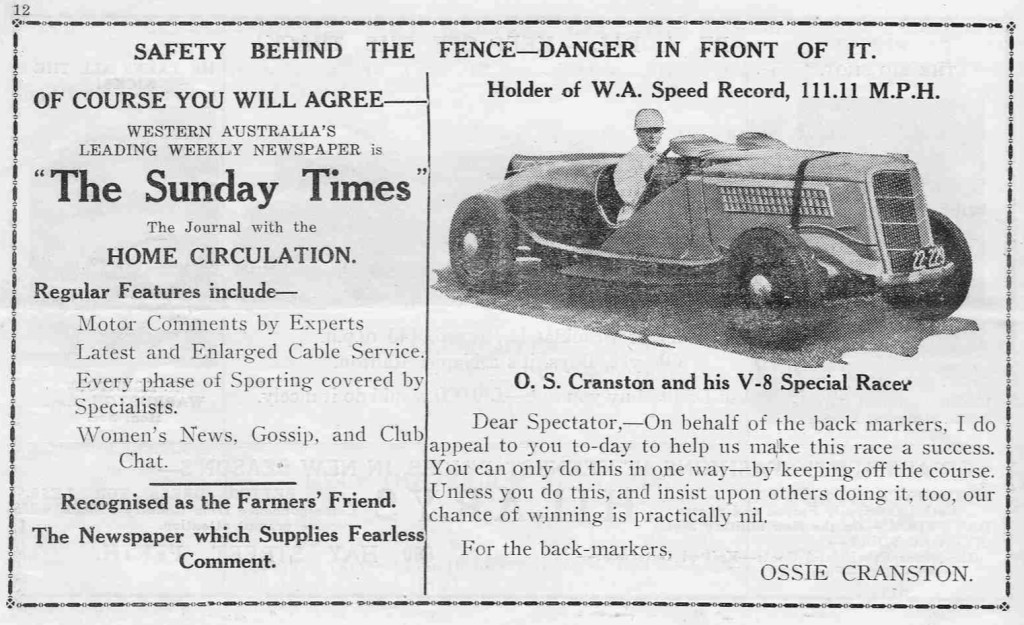
Cranston and passenger (who?) in the Ford V8 ahead of a Lagonda at Albany in 1936. This downhill stretch would have been a serious test of the brakes of the day (K Devine)Ossie’s Ode to the Backmarkers. Perhaps Max Verstappen could try that approach in next March’ Albert Park programme (Albany GP programme)
Cranston hadn’t lost his passion for motorsport though. He had built ‘Miss Frances’, a Ford V8 powered speedboat which generally “spreadeagled rivals in much the same fashion as he had been doing for years on the terrain.”
“When not tied up with one or other of the multitudinous business matters which occupy his attention, Mt Cranston golfs, his one vice.” There was another though, with the encouragement of his wife he commenced horse riding at about 40. So keen and proficient was the Mosman Park resident, that he became Master of The Hounds for the West Australian Hunt Club.
Ossie remained involved and close to motorsport. An Ossie Cranston Trophy was contested in West Australian Sporting Car Club events for years, Cranston was a stalwart of the club, formed on November 17, 1929. Together with Eric Armstrong, CS Dyer and Claude McKinley he kept the very successful organisation together in some of its more difficult years.
Cranston was ‘the official driver’ at Caversham (first used on March 13, 1948) and into the 1970s at Wanneroo Park. He died on July 1, 1982 – born in either 1899 or 1903 – his remains are at the Karrakatta Cemetery in Perth.
PS; Most of this piece was written via extractions from period newspapers. Of their nature they are light-on with the specifications of the cars. If any of you can assist in that regard, or in fleshing out Ossie’s story, do get in touch.
Oopsie, a bit of PE from the front of the Gas Producers Stock Car grid before the start of the 4-lap 10-miler. Patriotic GP meeting, Applecross, on a hot November 11, 1940. Car ID’s folks? (K Devine)
Etcetera…
It’s a Gas
Pretty much the final motor race of any size in Australia before motorsport was set aside for the duration of World War 2 was the Patriotic GP, attended by a “huge crowd” at Applecross on November 11, 1940.
In his return to racing, Cranston ran a ’38 Ford in the novel, Producer Gas Race for stock, or standard cars. Ossie finished second in this handicap behind WJ Stitt’s De Soto straight-eight.
Interesting, perhaps – in the context of fuels of quite dissimilar quality, and the use of gas to power cars during the conflict – is the difference in performance between Ron Possetts’s petrol fuelled ’39 Ford V8, which won the stock (standard) car race and Ossie’s machine. Possett’s (rated a very good driver) best lap was 3 min 12 sec, and Cranston’s 3.44.
“The hilly course was a good test, the contest admirably fullfilled its purpose, which was to demonstrate that the sacrifice of performance made by the use of producer gas, is small,” wrote the South Western Advertiser.
The ‘Tisers’s journo continued, “A most interesting feature of Cranston’s car was that the ‘gas-works’ were all enclosed; producer, cleaners, pipes etc were all hidden, in the luggage trunk, beneath the bonnet or under the floorboards, and, except for cooling-louvres in the lid of the rear compartment, the big modern sedan had the appearance of a standard petrol model.”
All we need now is a happy-snap of the car, can anyone oblige?
Jack Phillips and Ted Parsons aboard their Ford V8 Spl during the 150-mile 1939 Australian Grand Prix at Lobethal, South Australia. They were third behind Allan Tomlinson’s MG TA Spl s/c and Bob Lea-Wright’s Terraplane Spl (N Howard)
Top Gun?
Looking at the performance of Ossie’s car, it has to be a contender for fastest-best Australian Ford V8 racer in that pre-war period?
Jack K Phillips’ similar machine (above) has to be in the mix too. He too was a Ford dealer, in Wangaratta, Victoria. Yep, I’ve heard of Black Bess, while built pre-war, Whiteford didn’t get her performing well until after the conflict.
The Cranston and Phillips cars were Special Ford V8s rather than Ford V8 Specials. That is they were modified Fords, rather than a concoction of parts of various makes powered by modified Ford V8s.
I’m interested to hear from those of you who know about such things, which car was the quickest-best Ford V8, and quickest-best Ford V8 Spl pre-war?
Cranston and passenger on the hop – he did fastest race time remember – during the South Australian Centenary aka AGP at Victor Harbor in December 1936, Ford V8 Spl. #25 is the H Abbott, Austin 7 Spl s/c (SLWA)
1936 Australian Grand Prix
I’ve got my great mate, Tony Johns, to thank for the wonderful loss of a couple of days researching this piece.
During his weekly State Library of Victoria research visitations, Tony came upon a snippet about the Light Car Club’s endeavours to run the 1936 AGP on a road course at Mornington, then a quiet, seaside village, 70km from Melbourne.
The Phillip Island road course which hosted the AGP from 1928-1935 was on-the-nose given its dangerous nature for cars of less than 2-litres, let alone the unlimited cars which should also have been included in the fun.
I’ll get to Mornington in due course.
There was no AGP called, promoted and run as such during 1936. The December 26, 1936 South Australian Centenary Grand Prix was later appropriated as an AGP – I’ve no issue with that – but the nincompoop(s) who did so, determined that a race held in 1936 was the 1937 Australian Grand Prix. WTF etc.
I’m on a one-man crusade to right this wrong, that is, the 1936 AGP event was the one at Victor. There was no AGP called, promoted and run as such in 1937 either. If we want to anoint one significant race held in 1937 as a part of the pantheon of AGP’s I’ve an open mind, send me your ideas and justifications…See here; 1936 Australian Grand Prix, Victor Harbour… | primotipo…
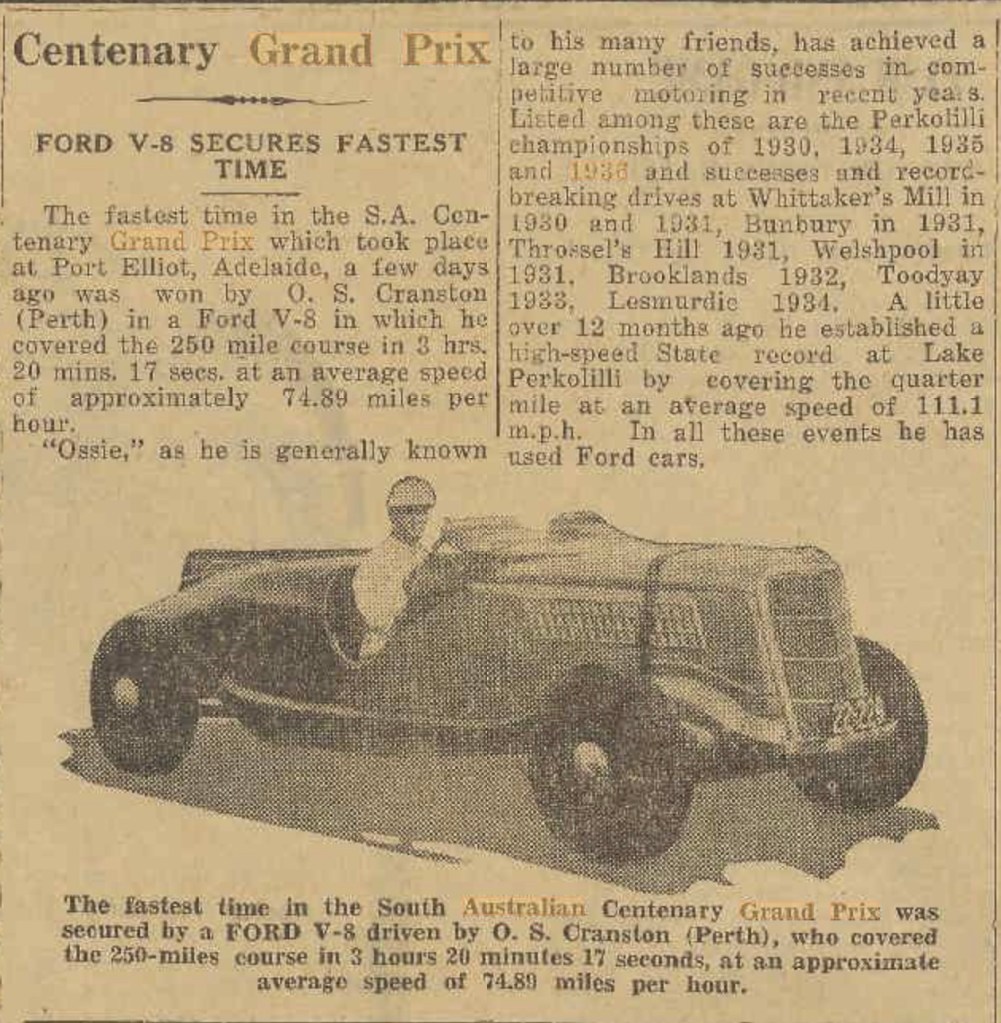
Anyway, in Troving (Trove is a digital record of Oz newspapers) with search-words like ‘Mornington 1936 Australian Grand Prix’, up popped the article which starts this piece. I’ve very much enjoyed writing it, knowing little about Mr Cranston and his achievements two days ago…
(R Bartholomaeus)
Port Victor
The poor old South Australians can’t make their minds up about Victor Harbor.
We Australians adopted the Pom’s version of English on the basis that as they invented it they should have half-a-clue about how stuff should be spelt.
Despite that, the township of Victor Harbor, rather than Victor Harbour, was proclaimed in 1914, for reasons almost as obscure as those related to the year in which the 1936 AGP was held.
Clearly the author of the South Australian Centenary meeting programme was confused too. Despite the race being held in Victor Harbor, the event was contested, seemingly, on the Port Elliott-Victor Harbour Circuit.
Credits…
The Blackwood Times, Friday January 15, 1937, Sunday Times Perth June 30, 1935, Mirror Perth July 7, 1934, Kalgoorlie Miner, various many other newspapers via Trove, ‘Cactus-Work in Progress’ Graeme Cocks, State Library of WA, ‘Bathurst: Cradle of Australian Motor Racing’ John Medley, Ken Devine Collection, vintagebentleys.org, Norman Howard, Rob Bartholomaeus Collection, Bob King
(Recorder, Port Pirie, February 21, 1938)
Tailpiece…
When you’ve spent a good chunk of your annual capex-budget on a couple of Bentleys, the Perth Polizia PR department worked the local papers hard to ensure the Bentley Patrol bagged as much of the crime-solution-limelight as possible, however tenuous the connection between the misdemeanor and WO’s finest.
Doubtless the lissom Subiaco lass slept easy knowing the Bentleys were prowling the streets with as much stealth as Merv the Perve…
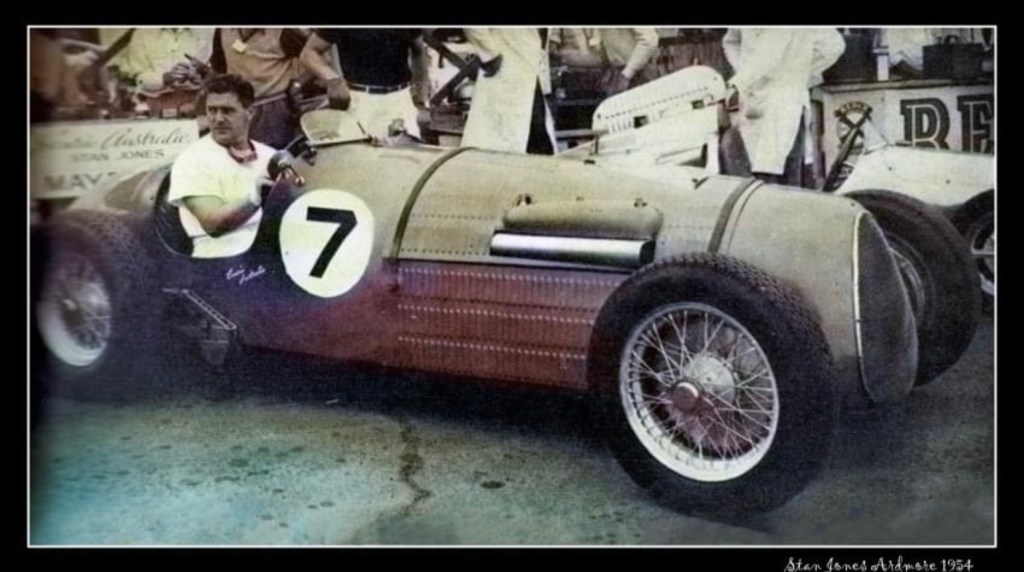
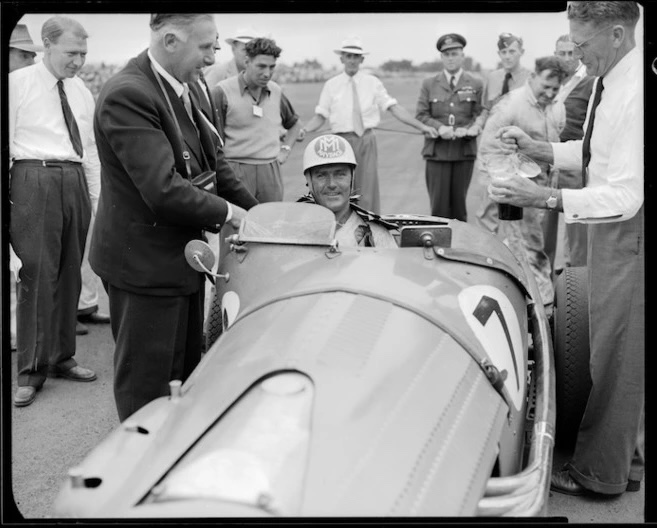
Jones at Ardmore during the 1954 NZ GP weekend (unattributed)
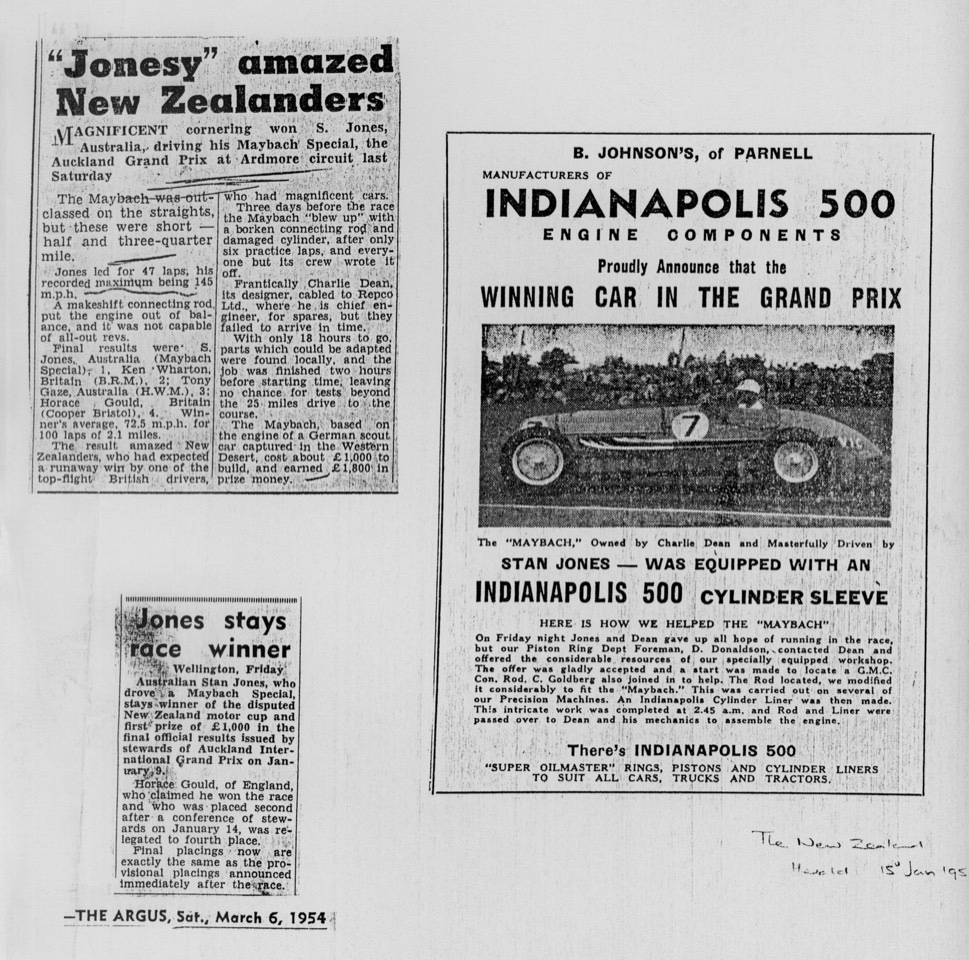
The Charlie Dean/Repco Research constructed Maybach series of three ‘1950s’ racing cars – Ern Seeliger’s Chev engined Maybach 4 evolution of Maybach 3 duly noted and venerated – are favourites.
Links at the end of this piece provide more for those with the Maybach fetish.
Repco had no plan-grande in the 1950s to take on and beat the world in Grand Prix racing, as they did in 1966-67. But in hindsight, the Maybach race program was an important plank in a series of identifiable steps by Repco which commenced in the 1930s and ended in global racing triumph.
The catalyst for this piece is some material Tony Johns sent me this week, in addition to some other shots I’ve had for a while from two other mates, Bob King and David Zeunert. It seemed timely to have another crack at Maybach 1, Jones’ 1954 New Zealand Grand Prix winning machine, still extant in Bob Harborow’s hands.
(T Johns Collection)(T Johns Collection)
We are diving into the minutiae here, but I’ve never heard of the Fesca Gear Co, clearly a key relationship in developing Maybach 1, and the other cars?
Chris De Fraga, the fella to whom the letter is addressed, was the longtime motoring editor of The Age, Melbourne, a daily aimed at those who could read and think. The competitor Sun and Herald were aimed at those without those capabilities, IG Mason, my English master useter tell us endlessly at Camberwell Grammar School. “Just read the front, back, and editorial pages of The Age if you’ve not got the time to read anything else.” I digress.
(KE Niven & Co)
Jones looking pretty happy with himself after the Ardmore victory. It had been a tough few days for all of the team dealing with major mechanical recalcitrance of the big Maybach six, note the company logo on Stan’s helmet.
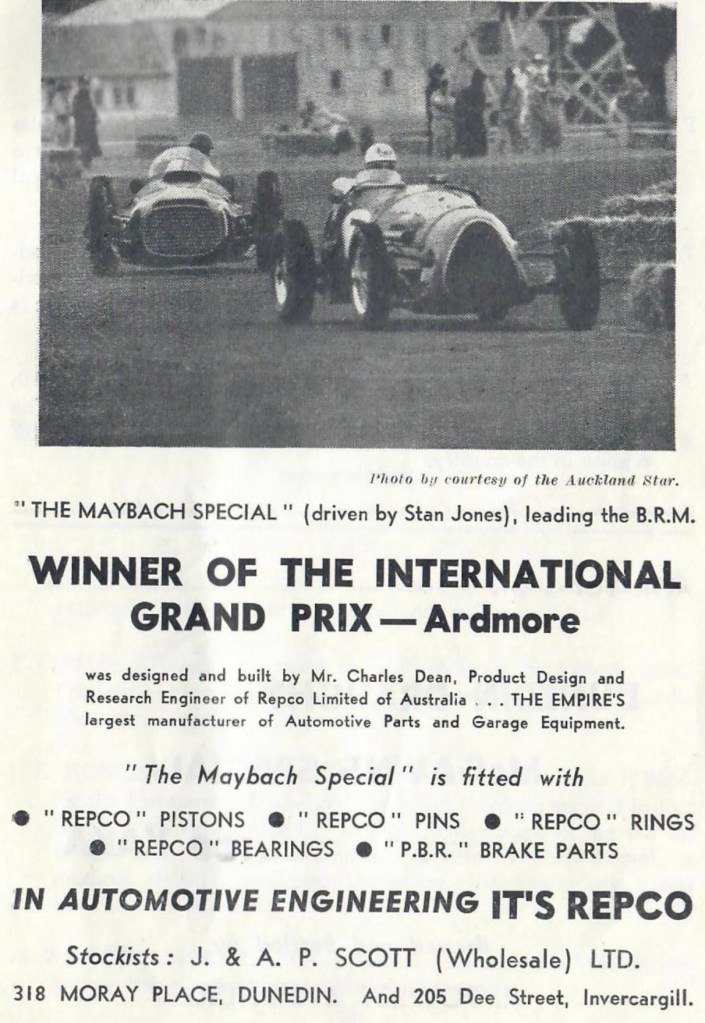
And below leading Ken Wharton’s basso-profundo-shrieking, absolutely sensational V16 BRM P15, DNF brakes.
Credits…
Tony Johns, David Zeunert and Bob King Collections
Tailpiece…
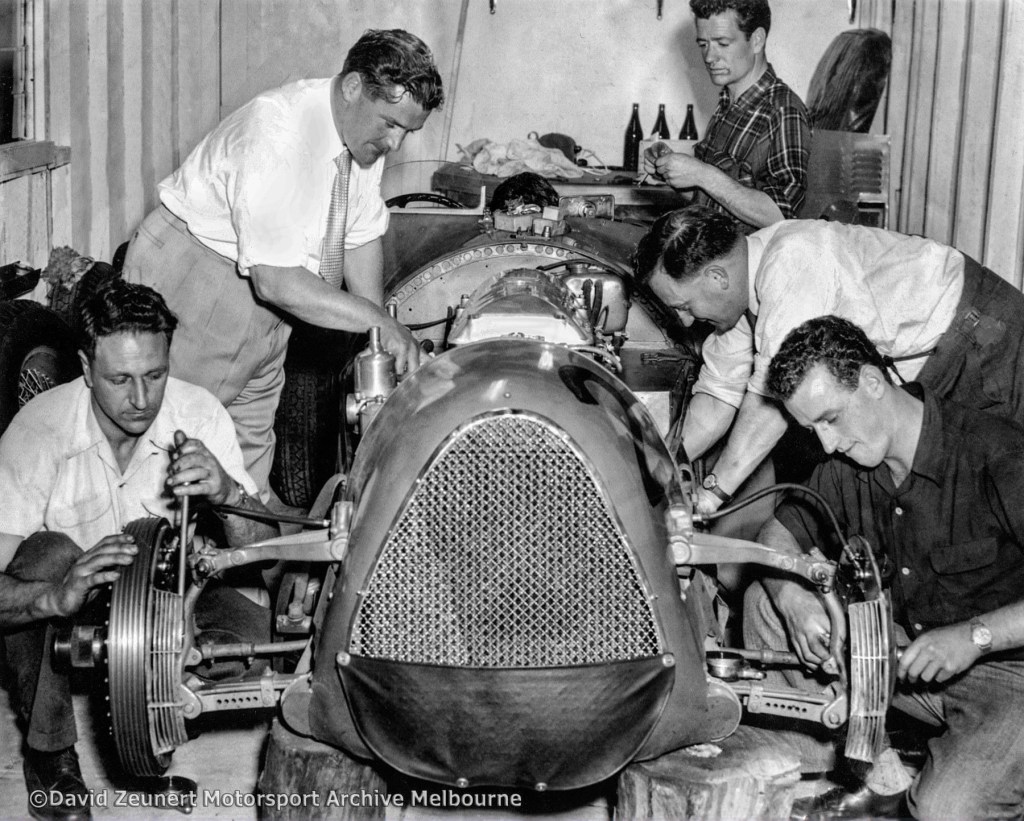
‘Speed Man After 500 Pounds Racing Car Trophy’ said the heading of this The Age promo shot of Maybach in Stan’s backyard garage at Yongala Road, Balwyn, Melbourne in the days prior to the 1953 Australian Grand Prix at Albert Park.
The technicians hard at it are Ern Seeliger, racer/engineer/Jones’ friend, Stocky Stan, Alan Jones’ head you can just see behind the wheel, Reg Robbins, longtime Jones’ employee, Charlie Dean and Lloyd Holyoak, Jones’ used car manager.
Dean lived in Kew, the adjoining suburb to Stan so it was an easy shot to set up when both men headed for home. Note the three bottles of Fosters Lager – we call these Long Necks or Depth Charges – to ease the pain of car preparation on the bench behind the car.
In essence Maybach 1 was built by Dean in 1946, continually modified and raced by him, including the 1948 AGP, then sold to Jones in 1951. Part of the deal was that Maybach was further developed and prepared by Repco Research, which Dean ran. In so doing a generation of the best mechanics and technicians from the rapidly growing Repco conglomerate were imbued with the racing ethos, another key plank in the long road to Brabham’s first championship win aboard a Repco Brabham Engines V8 powered BT19 chassis at Reims on July 3, 1966…
(B King Collection)
Jones sneaks a look at his pursuers a few days later during the race. Maybach DNF with various maladies, fastest lap was some consolation. Another local lad, Doug Whiteford prevailed in a Talbot Lago T26C, his third AGP win.
The Ecurie Australie (name under the number) was – and still is – the name under which the Davison family sometimes race. Lex Davison and Stan were competitors on-track, but owned a Holden dealership for a while and competed in the Monte Carlo Rally aboard a Holden 48-215, also crewed by Tony Gaze, in 1953.
The name on the side of the car should have been Repco, or Repco Research, but such vulgar commercialisation wasn’t kosher then. It would come of course…
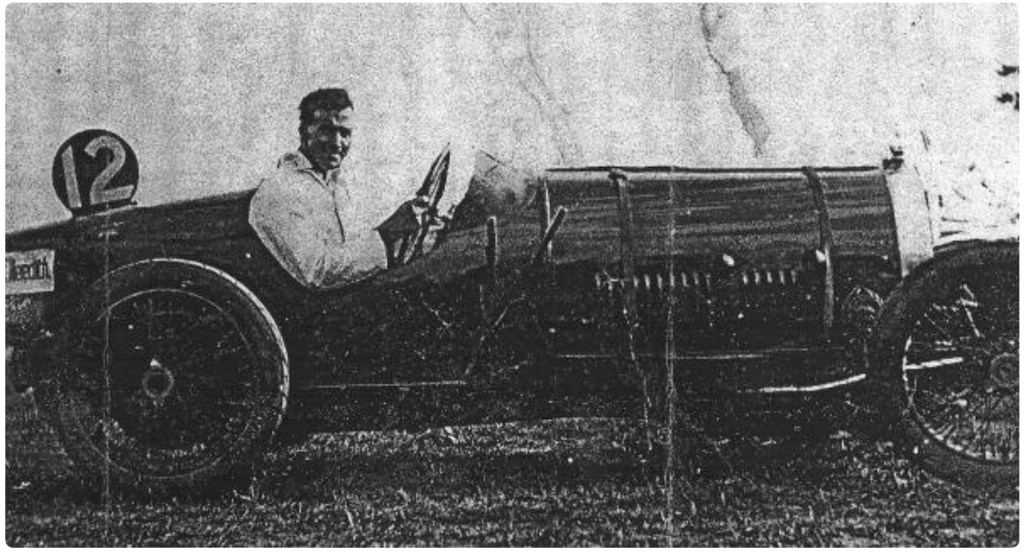
Competitor (who and what?) in the 1918 Coot-tha Classic (Brisbane Times)
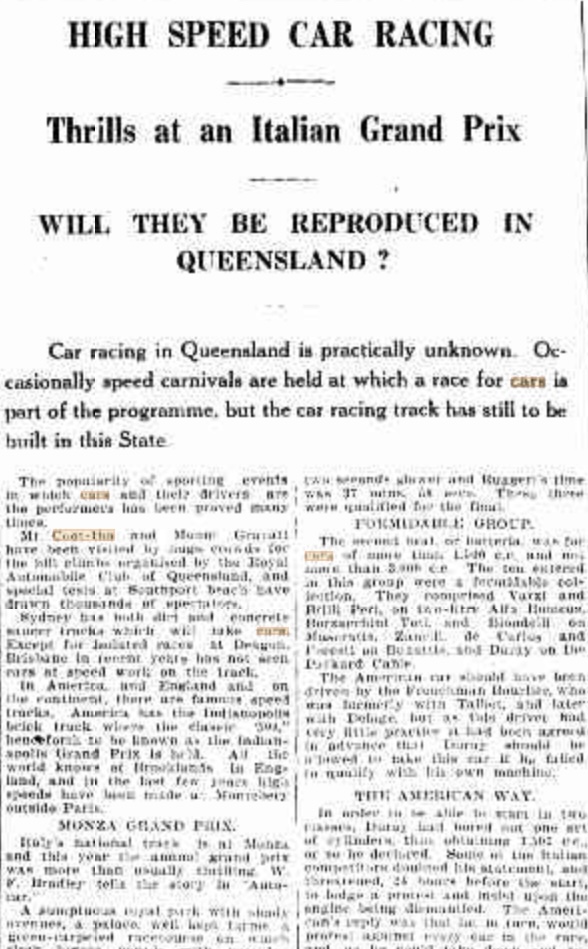
“Car racing in Queensland is practically unknown. Occasionally speed carnivals are held at which a race for cars is part of the programme, but the car racing track has still to be built in this state,” said the motoring reporter of Brisbane’s The Telegraph on November 5, 1929.
“The popularity of sporting events at which cars and their drivers are the performers has been proved many times.”
“Mount Coot-tha and Mount Gravatt (8 km and 10 km from Brisbane’s CBD) have been visited by huge crowds for the hillclimbs organised by the Royal Automobile Club of Queensland, and special tests on Southport Beach (on the Gold Coast) have drawn thousands of spectators.”
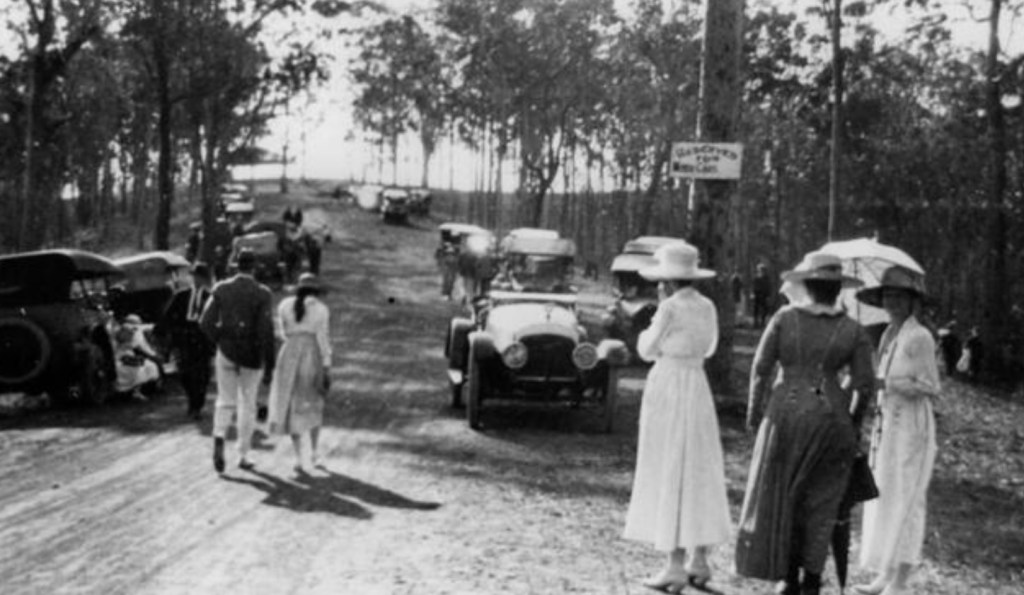
Henry Horstman and Maldwyn Davies – Queensland Bugatti importer – on the way to FTD in the RACQ hillclimb at Mount Coot-tha on April 1, 1928, Bugatti T37. His time of 1 min 20 sec was eight seconds clear of the rest of the field (speedwayandroadracehistory.com)Folks take in the Mount Coot-the sun, circa 1920 (alamy)
“Sydney has dirt and concrete saucer tracks which will take cars. Except for isolated races (for cars) at Deagon (Speedway 20km north of) Brisbane in recent years has not seen cars at speed work on the track.”
“In America, and England, and on the continent, there are famous speed tracks. America has the Indianapolis brick track where the classic ‘500’, henceforth to be known as the Indianapolis Grand Prix is held. All the world knows of Brooklands. In England, and in the past few years high speeds have been made at Montlhery, outside Paris.”
(The Telegraph, Brisbane, November 5, 1929)Motorcycle racing at Deagon in 1926 (T Webb Collection)
Some context of motor racing progress elsewhere in Australia is that the Aspendale Park Speedway opened in outer Melbourne in 1906, the Olympia Motor Speedway at Maroubra, Sydney in 1925. The first Australian Grand Prix was held at the Goulburn Racecourse (Neddies), 200 km south of Sydney in 1927, and the first AGP on a road-course at Phillip Island in 1928. Viz; 1928 100 Miles Road Race, Phillip Island… | primotipo…
Geoff Meredith aboard the Bugatti T30 in which he won the speedway style 1927 AGP at the Goulburn Racecourse (Goulburn Post)
Given the relative population of Queensland to Victoria and New South Wales, the banana-benders (Queenslanders) weren’t lagging behind too much. What is interesting is the popular press ‘pushing’ for creation of a local venue. It wasn’t until 1949 that an AGP was held in the Sunshine State, at Leyburn, a former Royal Australian Air Force base. See Aspendale here; Werrangourt Archive 11: DFP ‘The Greyhound of France’ by Bob King… | primotipo… and Leyburn here; 1949 Australian Grand Prix, Leyburn… | primotipo…
(ABC via M Hubbard)
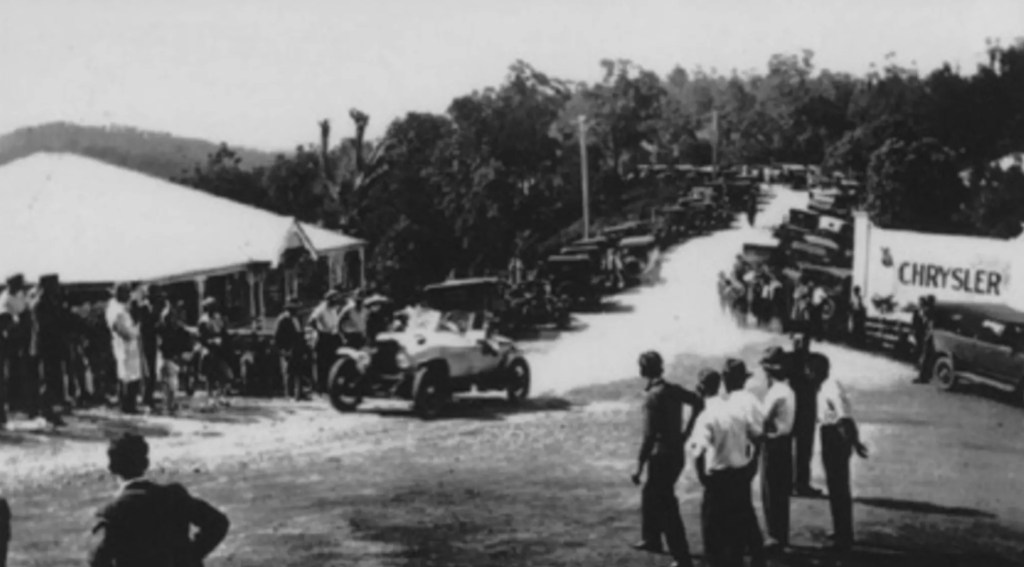
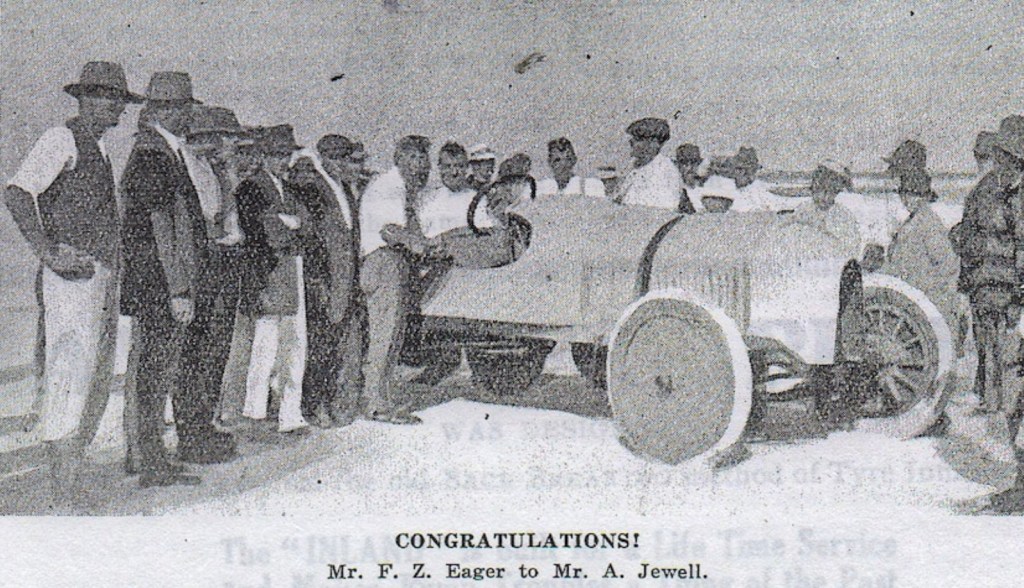
Alec Jewell aboard the Willys Overland which won “Australia’s first land speed record” in a competition with a Studebaker Six driven by Fred Eager on the Surfers Paradise sand, Christmas Day, December 25, 1916.
The cars had a number of runs, Jewell’s best was a time of 21.4 seconds between the measured marks, 84.5mph as adjudged by Automobile Club of Queensland officialdom.
Etcetera…
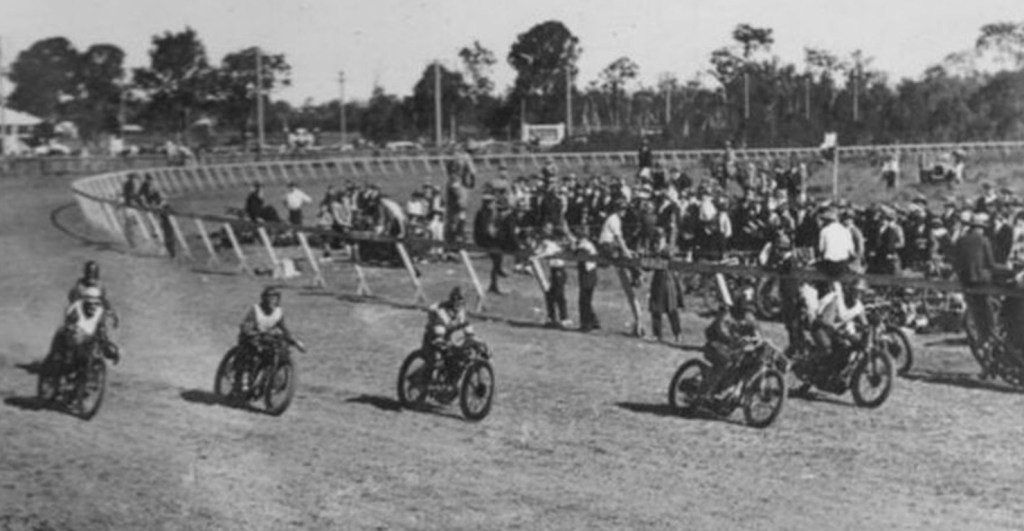
Deagon was established as a horse-racing venue in the early 1880s. It was first used for motorised events with ‘The Great Motor Cycle Carnival’ in November 1921. The card that day included 3 and 20 mile races for solos and a 5-miler for sidecars. 24 meetings were held from 1921-1931 including 14 state, and six Australian/Australasian Championships. Cars were never the mainstay of racing at Deagon, but were occasional guests on the bike’s-card.
Credits…
Brisbane Times, The Telegraph, Brisbane, November 5, 1929, Old Bike July 2015, Alamy, Goulburn Post, speedwayand roadracehistory.com, Tony Webb Collection, ABC via Murray Hubbard, Bob King
Tailpiece…
(T Webb Collection)
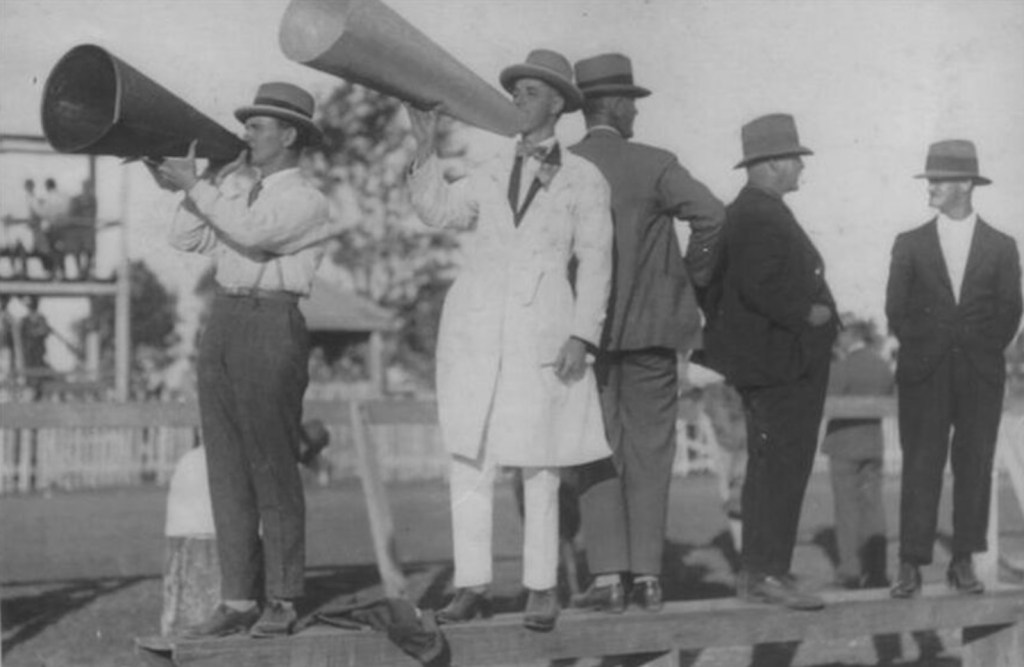
Deagon Speedway commentators doing it the hard way in the mid-1920s. I wonder if hats will ever make a comeback?
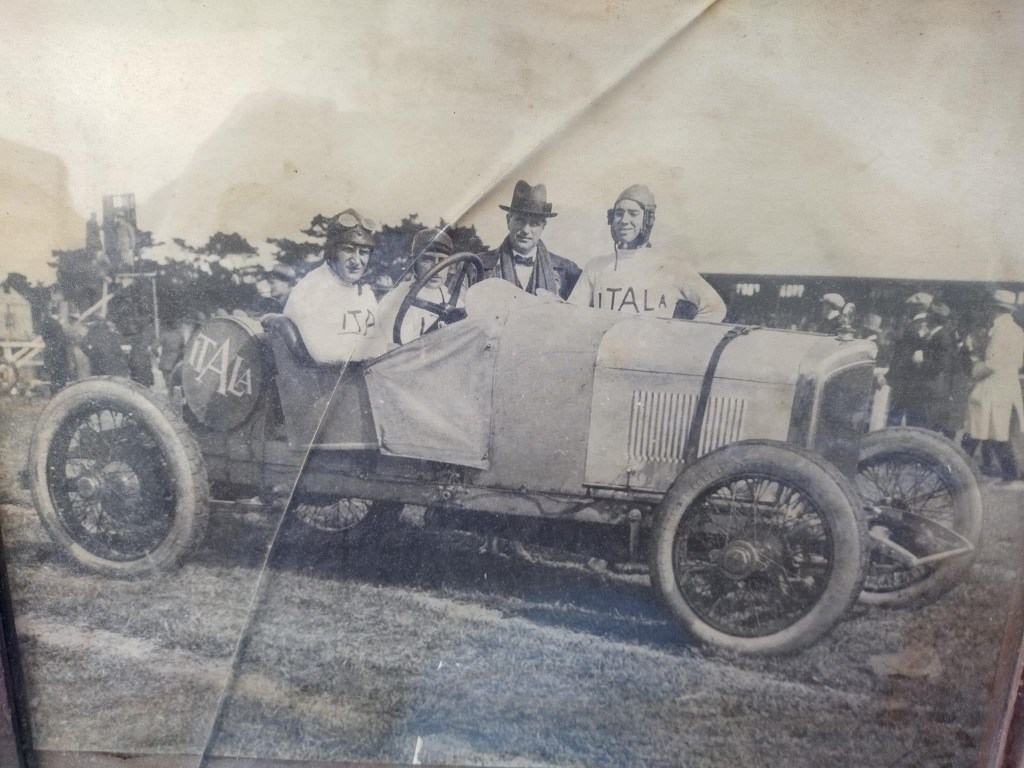
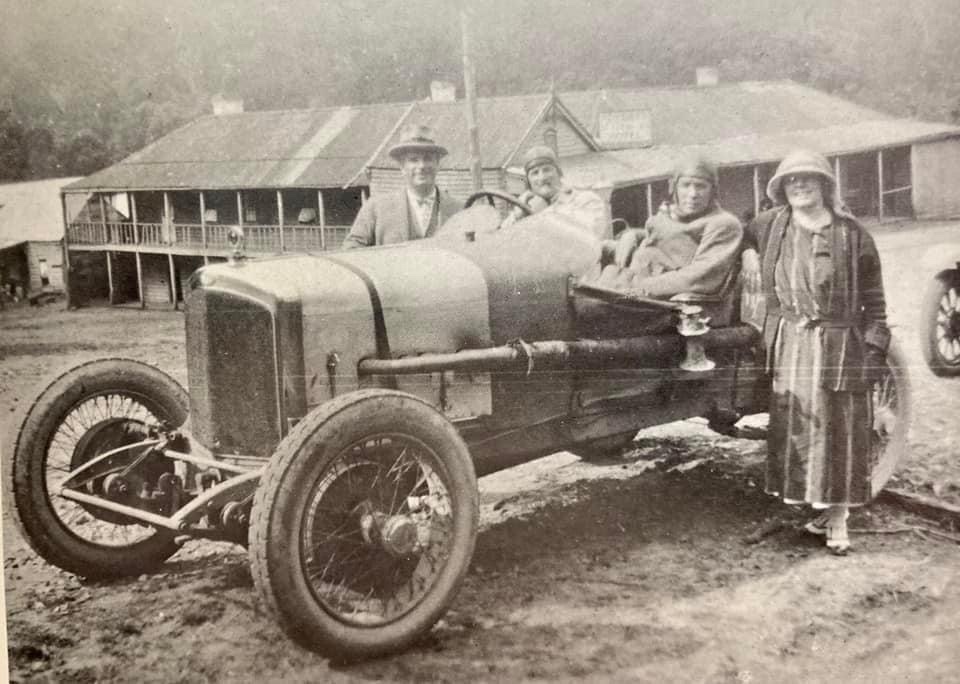
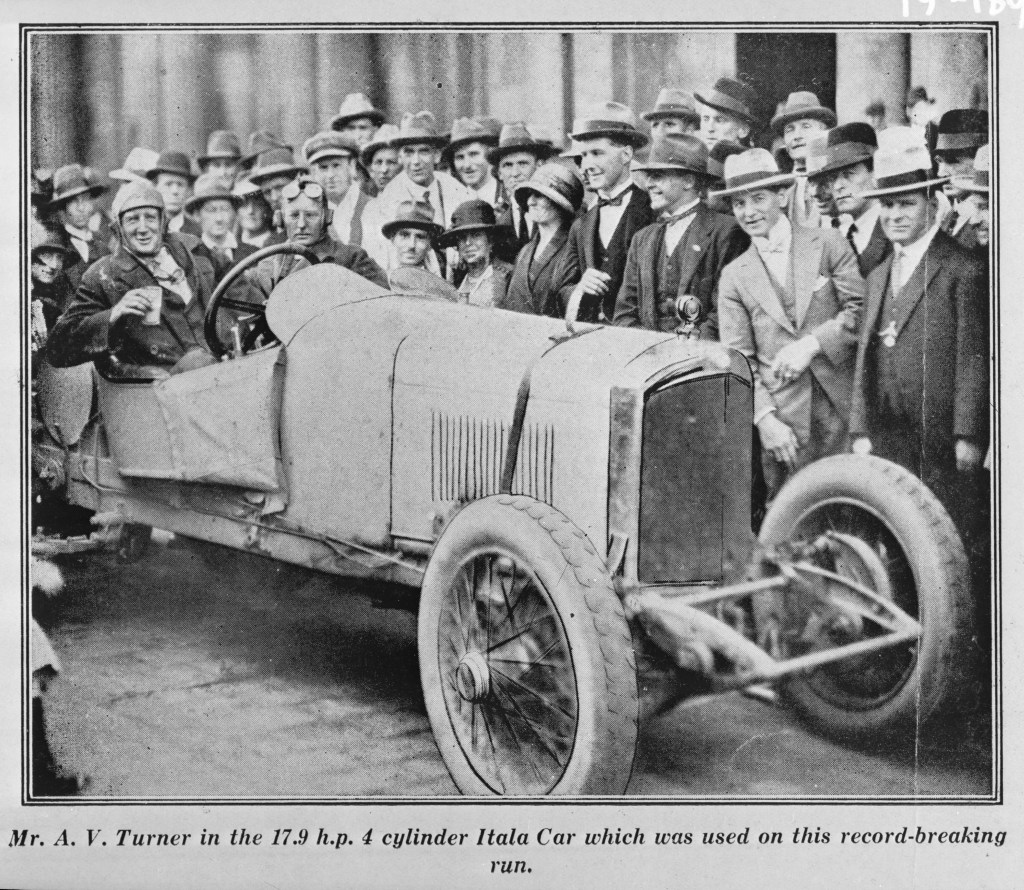
Albert Valentine ‘Archie’ or ‘Bert’ Turner and A ‘Ossie’ O’Connor, Itala, before the start of their record breaking circa-560 miles Sydney-Melbourne run on Sunday February 24, 1924. Corner of Macquarie and Bridge Streets.
Regarded in-the-day as one of Australia’s best drivers, Turner and O’Connor left the Sydney GPO at 5.15am and arrived at the Melbourne equivalent at 5.49pm. The 12 hours 34 minutes journey equated to an average of 47mph, and knocked 25 minutes off the existing record held by Norman ‘Wizard’ Smith’s Essex.
It was the third occasion within 15-months Turner had taken the record, in tit-for-tat fashion with his competitors, on the two previous runs in 1923 he drove a Delage C02.
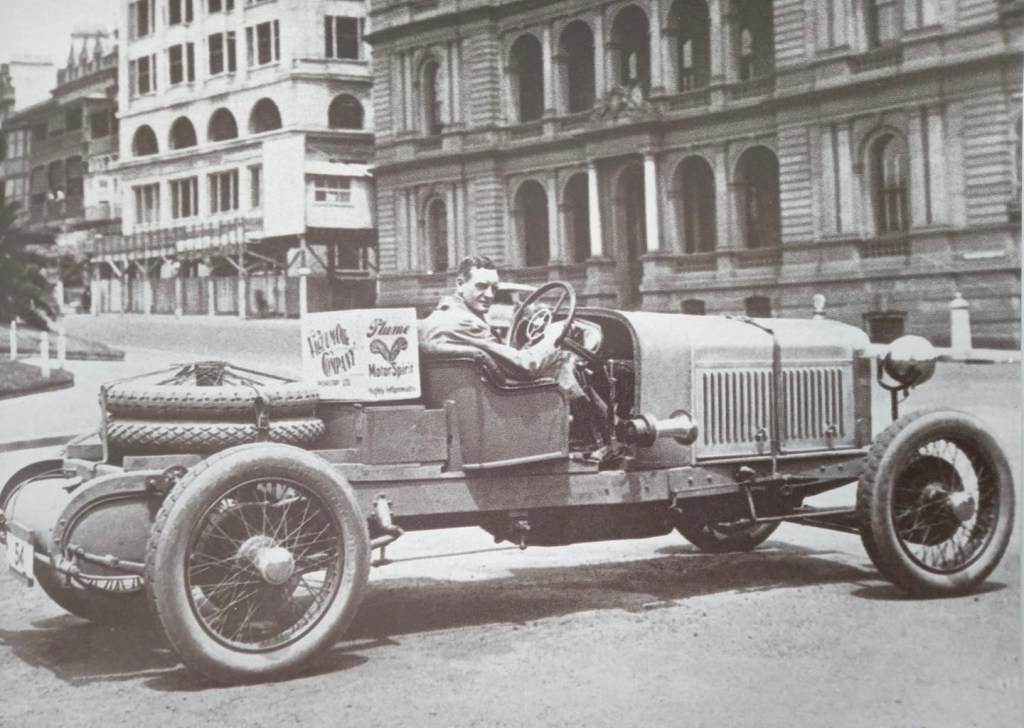
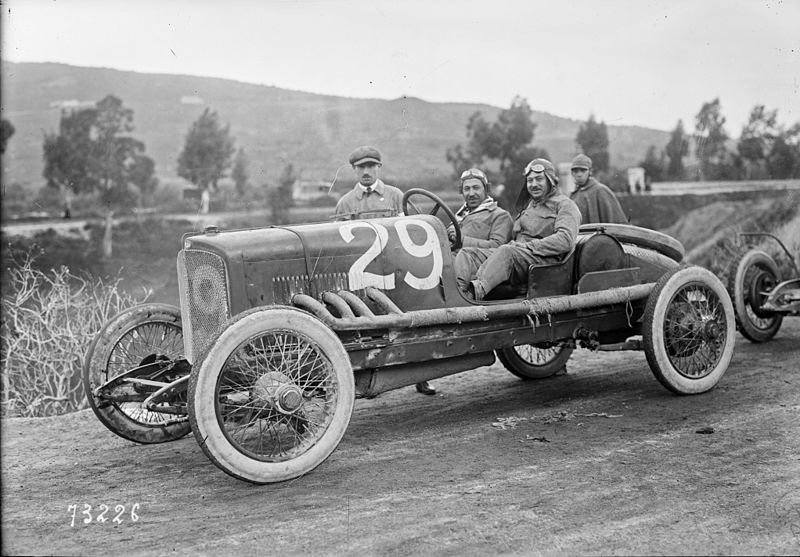
Turner aboard a Delage CO2 4.5-litre OHV six cylinder, before breaking the Sydney-Melbourne record in February 1923 – 16 hours 47 min. Chassis number folks, does it currently exist? Was he flogging Delages at the time or were the drives paid ones? The sponsor is Plume Motor Spirit! (C Blundell Collection)James Flood and his wife alongside AV Turner’s “record setting Itala”, here (where??) with Albert Vernon at the wheel in 1921. I note the car – if it is the same Itala – is now fitted with four-wheel brakes, rather than the two in the opening shot. Not so sure about the year quoted (James Flood via C Nicholes)The Luigi Lopez works Itala Tipo 51S before the start of the 1922 Targa Florio. Five of these 2.8-litre four cylinder racers were entered, the best placed was Antonio Moriondo’s 12th placed machine, albeit he was second in the 2-3 litre class. Lopez was 25th and last, the winner was Giulio Masetti’s 1914 Mercedes 4.5-litre 18/100 GP car. I’m not suggesting Turner’s car was an ex-works machine, but rather including it for the sake of completeness and begging the question as to what, exactly, AVT’s car was… (Bibliotheque nationale de France)
The Turner Itala is variously described in contemporary newspaper reports as a 17.9hp or 15hp Floria (sic), it’s perhaps a 2.8-litre, four cylinder 55bhp @ 3200rpm engined Type 51 Sport with a Targa Florio style body, built by James Flood in Melbourne. Details of the car from a marque expert appreciated, inclusive of present whereabouts.
Turner was then the New South Wales agent for Itala and Bugatti operating from large premises in Castlereagh Street. He promoted both marques via competition, a medium at which he rather shone.
The Sydney Sunday Times reported that “The average speed of 47mph, fast as it sounds (the main road, between Sydney and Melbourne then was little more than an unmade goat-track), included all stops for supplies and refreshments, the running time average was about 50mph.”
“During the journey the exhaust pipe broke, blowing stupefying exhaust gases into the faces of driver and passenger. Mr O’Connor was rendered well-nigh unconscious by the fumes and arrived in Melbourne much the worse for the experience.”
“Mr Turner’s throat was so sore from the same cause, that he could hardly speak audibly. At one stage of the trip he was compelled to drive for several hundred miles on the hand throttle alone.”
“Speeds in excess of his latest accomplishment are unlikely, in view of the present state of the roads, which he states precludes the reasonable possibility of a higher average being maintained. Mr Turner has many successes to his name, but his latest ranks among the highest,” the Sunday Times concluded in the wonderful narrative style of the day.
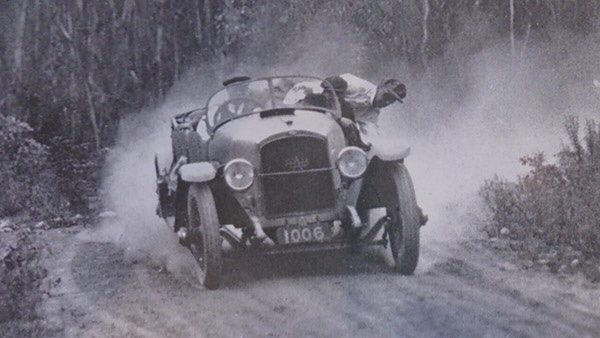
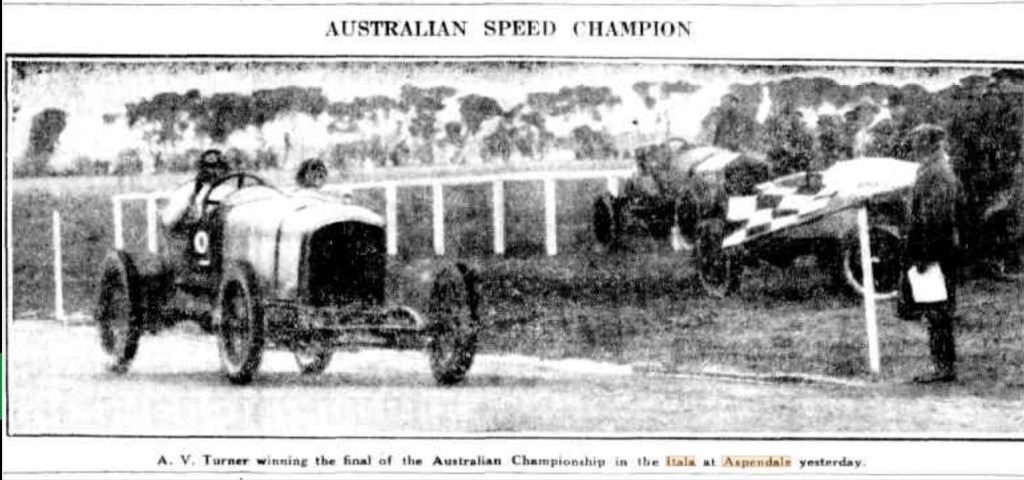
AV Turner at Aspendale, Melbourne, a banked dirt track, on the way to winning the “blue riband 25-miles Australian Championship” from Carlo Massola’s Diatto on April 21, over the Easter 1924 long weekend (hyperracer.com)(SLV)Turner and somewhat energetic crew – perhaps that fella has had enough? – during their victorious 1921 Alpine Trial run. Itala Tipo 51 tourer powered by a 2.8-litre, two side-valve 50bhp @ 3000rpm four cylinder engine. Four speed ‘box (melbournecircle.net)
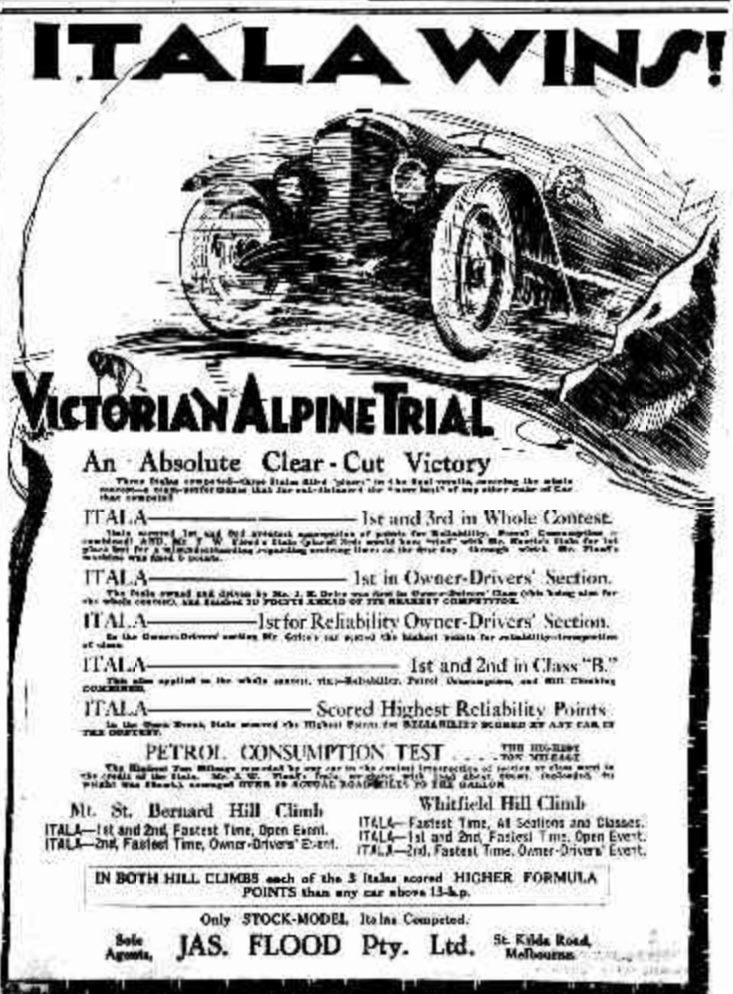
Turner had plenty of success on Italas in all kinds of events, including a win in the first RACV 1000 Miles Alpine Trial/Victorian Reliability Contest – aka The Alpine Rally – in 1921. This caused much consternation among the Victorian blue-blazer-clad RACV mob as he was the only New South Wales driver in the tough event contested over the difficult Alpine terrain of north-eastern Victoria. He was second in 1922 aboard the same Itala Co Australia owned car (entered by a Mr A Hoette), his arch-rival Wizard Smith triumphed that year on an Essex.
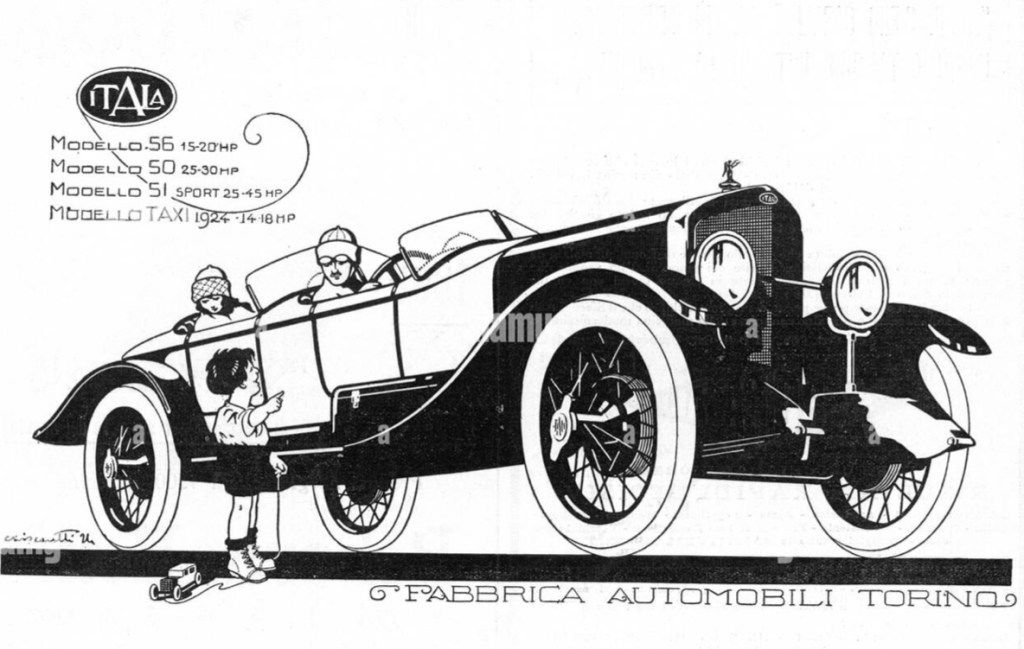
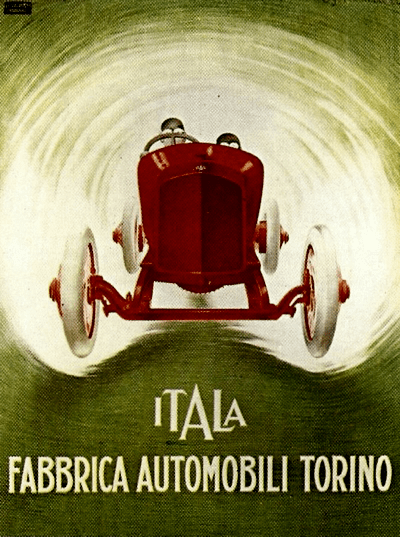
By 1924, Itala (Itala Fabbrica Automobili), founded by Matteo Ceirano and five partners at Via Guastalla, Turin in 1903, was in receivership. Ex-Fiat general manager Giulio Cappa was appointed by the Italian Government’s Istituto per la Ricostruzione Industriale. This entity took control of insolvent Italian businesses deemed too-large-to-fail from 1933 to 2000, Alfa Romeo is a case in point. After his rein, an interesting story in itself, the company was bought by truck maker Officine Metallurgiche di Tortona (OM) in 1929, and the remains sold to Fiat in 1935.
Poor Turner died from injuries sustained contesting an inconsequential hill-climb in North Curl Curl, quite close to his Darley Road, Manly, home. He interrupted a tennis game to run his (later 1927 Australian Grand Prix winning) Bugatti Type 30 #4087 on May 15, 1926 and died in Manly Cottage Hospital later that day. I’ve a feature article 95% complete on that car and its in period-piloti, Messrs Turner, Geoff Meredith and Jack Clements, I really must finish it.
Turner was quite a driver…
(The Argus, Melbourne, December 1921)Turner winning the ‘Australian Championship’ at Aspendale, Easter 1924 (The Herald, Melbourne)
Credits…
Angela Wootton Family Collection, Colin Blundell Collection, Bibliotheque nationale de France, melbournecircle.net, Sydney Sunday Times March 2 1924, James Flood Book of Early Motoring via the Chris Nicholes Collection, various newspapers via Trove, John Medley, Ray Bell, manlylocalstudies.blogspot.com, Pedr Davis Collection via the Murdoch Family Collection-Neill Murdoch, Colin Wade, State Library of Victoria
AVT ready for the off, Bugatti T30 #4087, North Curl Curl, May 15, 1926 (P Davis Collection via N Murdoch)
Etcetera…
The hillclimb in which Turner died – above, immediately prior to the fatal run – was a circa 700 yard straight run up (now) Harbord Road from about the corner of Abbott Road, North Curl Curl. The finish line was on or about the corner of Harbord Road and Brighton Street, North Manly, with Turner’s crash site on that corner or “the vicinity of ” 151 Harbord Road, Freshwater. It was on this corner, or this property, on, or just after the finish line, where AVT came to grief as below.
(C Wade Collection)
Tailpiece…
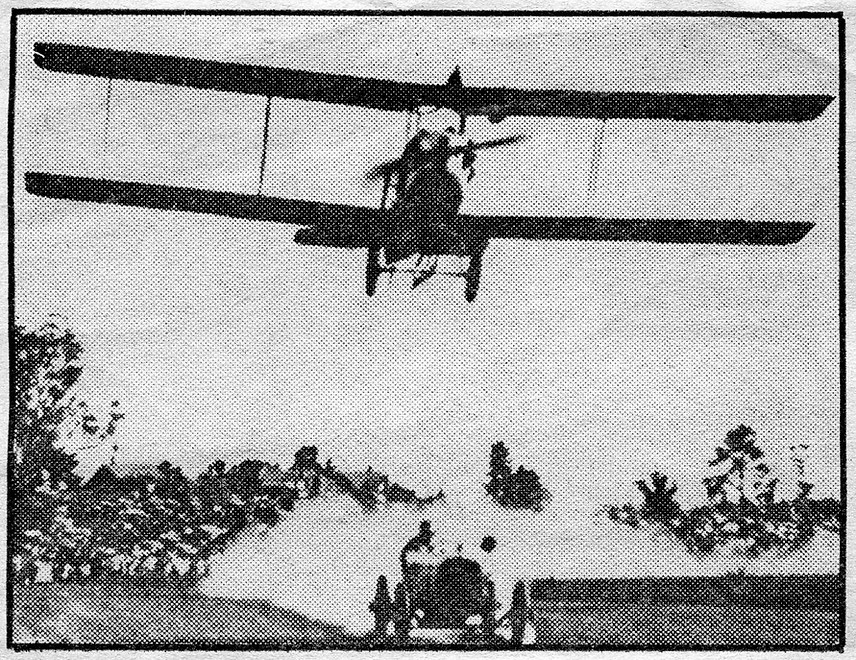
Turner’s Itala racing a Farman bi-plane, probably piloted by Major Harry Shaw – a prominent racer himself – at Aspendale circa 1921, it was a dead-heat apparently. Exact date appreciated.



















 primotipo...