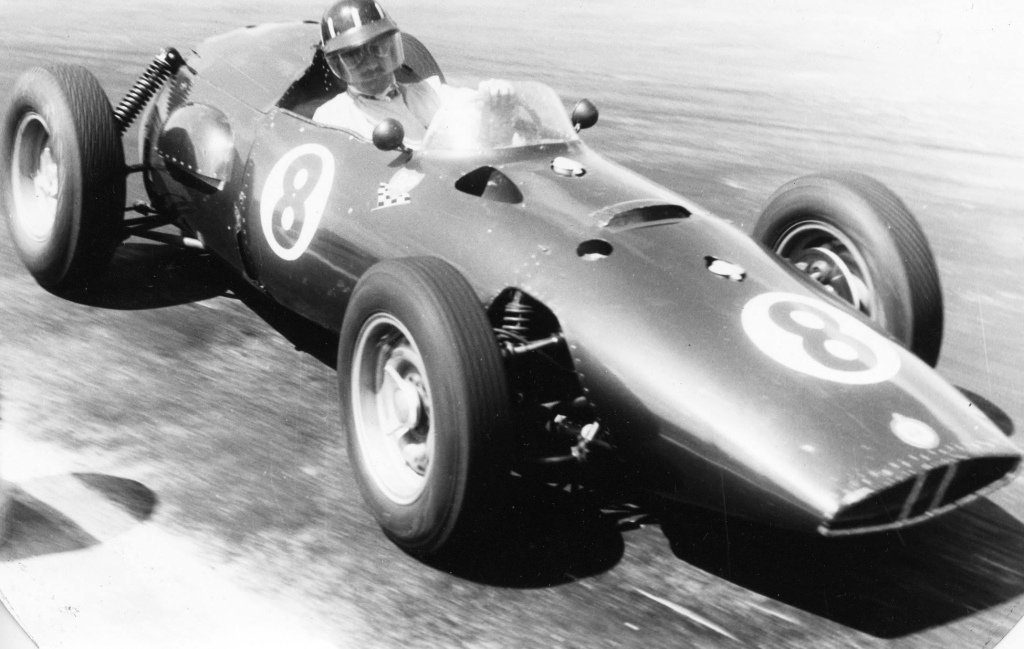
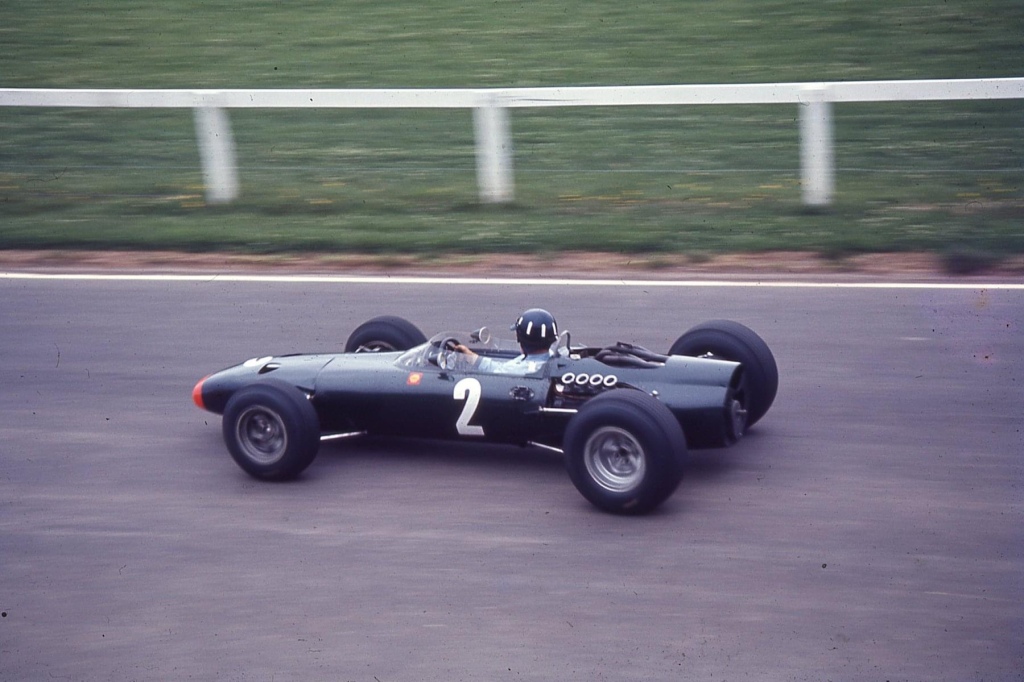
Graham Hill aboard his BRM P48 Grand Prix car in the first race of many races in New Zealand over the ensuing decade. Ardmore during the January 7, 1961 New Zealand Grand Prix.
65,000 Kiwis rocked up in searing Auckland heat to see 14 international drivers take on the locals. Hill finished third behind the two works Cooper T53 Climax 2.5s of Jack Brabham and Bruce McLaren.
The Bourne equipe were regular visitors to New Zealand, having first made the trip in 1954 when a single BRM P15 V16 driven by Ken Wharton blew the minds of Kiwis with its staggering performance and sound, if not its reliability. The Rubery Owen Group/Owen Organisation had subsidiaries in New Zealand and Australia so BRM made the long trip on many occasions to wave the flag, despite the protestations of Chief Engineer, Tony Rudd in some years when he would have preferred to prioritise development of his GP machines over the European winter.
The BRM P48 – the marques first mid-engined car – took its swansong on this trip, and its only international win in the final meeting on the Ballarat Airfield in Victoria, albeit it was Hill’s team-mate, Dan Gurney who took the chequered flag that day. That year BRM didn’t contest the other Kiwi internationals, more on the BRM P48 here; https://primotipo.com/2018/03/16/bourne-to-ballarat-brm-p48-part-2/
(E Sarginson)
Hill missed 1962 but returned for the ’63 summer as World Champion albeit he raced the revolutionary Ferguson P99 Climax four-wheel-drive car down south rather than his championship winning BRM P57/578.
He was stiff to miss out on third place in the NZ GP (above) held at the new Pukekohe track outside Auckland, he lost his clutch at the start then the gearbox cried enough on the very last lap. Hill returned home for a break, before returning for the Australian rounds. Innes Ireland raced the car at Levin for Q5/third, Wigram last/DNF o/heating and Teretonga Q5/third.
Hill’s best in Australia was a win in a greasy preliminary at Lakeside where the car’s grip showed through. In those pre-Tasman Cup 2.5 days both New Zealand and Australia had Formula Libre as their national categories. Once Coventry Climax developed the 2.75-litre ‘Indy’ FPF for Cooper’s 1961 assault on the Indy 500 that engine became the power unit de jour in Australasian events. The FPFs fitted to the P99 were 2.5-litre units so Hill and Ireland were starting behind the eight-ball compared with Brabham, McLaren, John Surtees and Tony Maggs etc who had 2.7s. So fitted we may really have seen the potential of these exciting cars which were somewhat hamstrung when raced with 1.5-litre FPFs in F1 events, where they were less able to ‘carry the additional weight’ inherent in the additional, complex transmission and associated components. What might have been?
(B Ferrabee)
In 1964 Hill contested two rounds of the Tasman Cup in Australia aboard a Brabham BT4 Climax 2.5 run by the David McKay’s Scuderia Veloce. He was third at Warwick Farm and won the South Pacific Trophy at Longford, so he happily signed up again in 1965, racing a brand new Brabham BT11A Climax, Ron Tauranac’s latest Tasman challenger which was also used by Jack and Frank Gardner.
Graham opened his ’65 Tasman account as he closed 1964 with a win at Pukekohe, the NZ GP. Hill again, as became his norm, skipped the balance of the Kiwi races to have some family time, doing the Warwick Farm and Sandown Australian rounds for fifth and DNF. More about the ’65 Tasman here; https://primotipo.com/2017/11/02/levin-international-new-zealand-1965/
Hill was complimentary about the preparation of his car by Bob Atkin and Spencer Martin, Martin raced this same chassis to Australian Gold Star championship wins in 1966 and 1967.
Graham Hill and Spencer Martin swap notes at Pukekohe. By that stage Repco were the largest supplier of FPF parts in the world having had the commercial rights from circa 1962 (K Buckley)(M Fistonic)
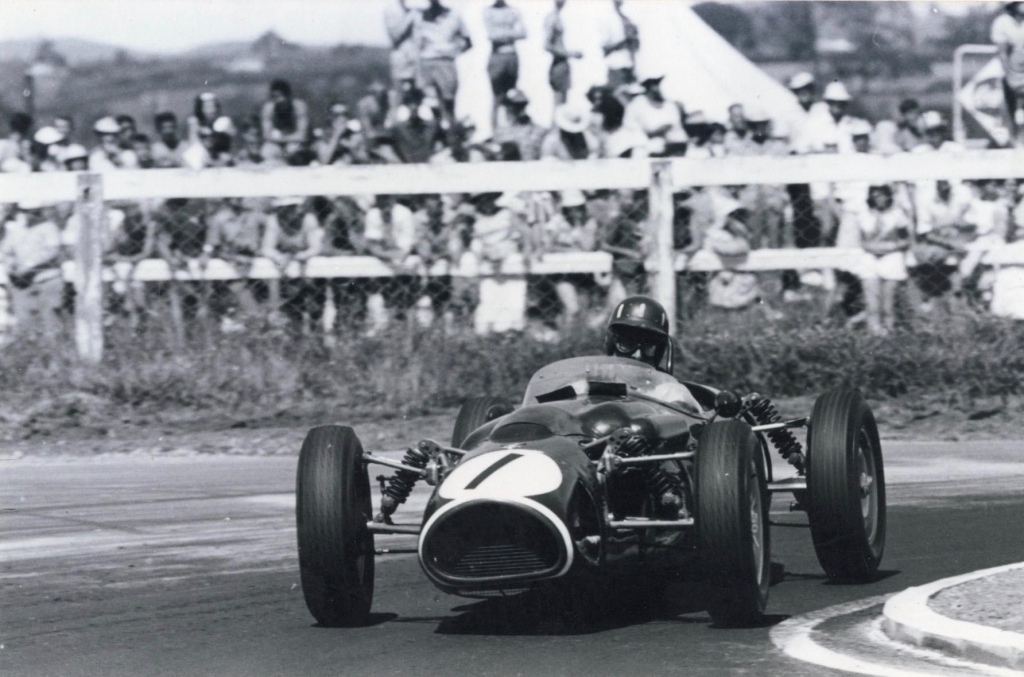
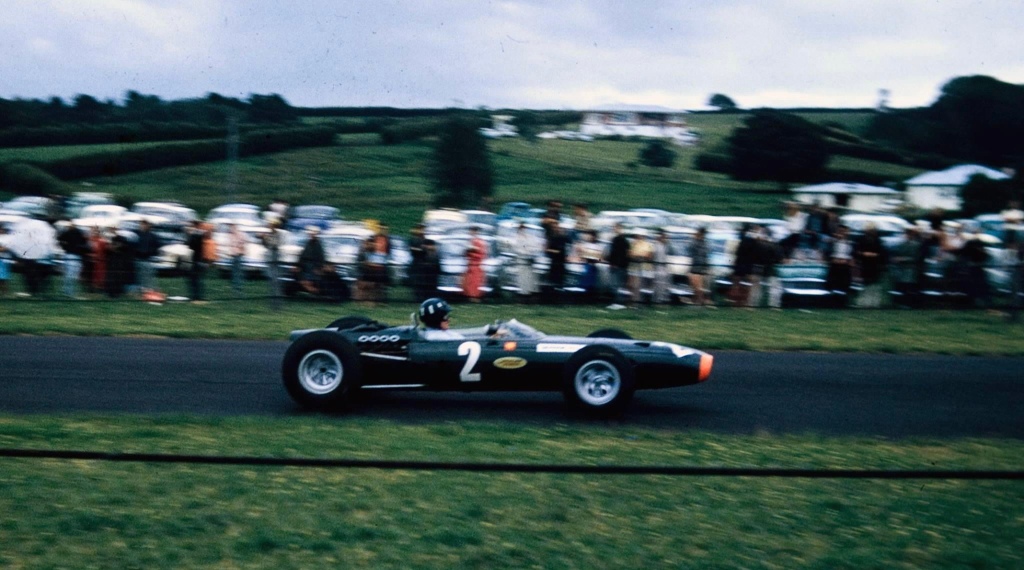
BRM returned to Australasia in 1966, figuring that their just obsolete F1 P261s, their P60 V8 engines bored from 1.5-1.9-litres would do the trick, and so it proved. Graham above at Pukekohe, where he won the NZ GP on the January 8 weekend.
In fact the series was a BRM rout, the team won seven of the eight rounds, Jackie Stewart – then an F1 newbee but with the 65′ Italian GP win under his belt – took four victories, Hill two, and Richard Attwood one at Levin, he stood in for Graham there and in the following race at Wigram. The BRM P261 Tasman story is contained here; https://primotipo.com/2020/02/22/1966-australian-grand-prix-lakeside/
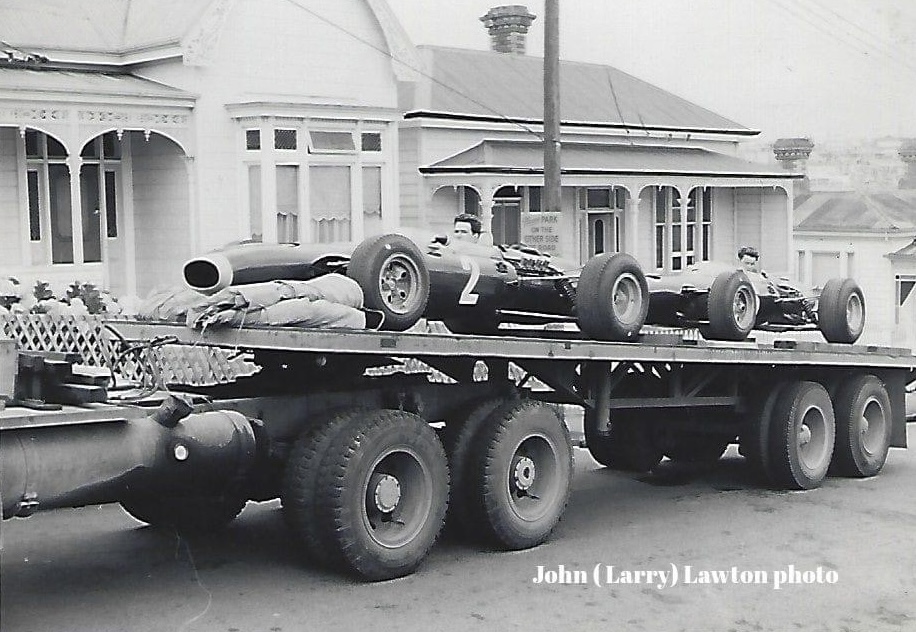
The interesting shot above shows the BRMs arriving for scrutineering before the series opener at Pukekohe in January 1966. It’s at Grey Lynn near the Auckland City car testing station
Hill in the superb BRM P261 at Pukekohe, perhaps this machine and the epochal Lotus 25-33 series of cars are the two best machines of the 1.5-litre 1961-65 F1 era, Ferrari 158 duly noted (B Kempthorne)
In 1967 and 1968 Graham missed the NZ Tasman rounds in their entirety. He decamped from BRM to Lotus at the end of 1966 in a timely move which neatly matched the arrival of the ’67 Lotus 49 Ford DFV V8, another machine which set the trend for a couple of decades.
While Jackie Stewart gave him a good run for his money at BRM, Graham jumped from the fat into the flames with Jim Clark as his Lotus teammate. Clark easily won the ’67 Tasman with a 2-litre Climax FWMV V8 powered Lotus 33 F1 chassis, and in 1968, his F1 Lotus 49 powered by the 2.5-litre Cosworth, the DFW. Graham did only the Warwick Farm Tasman round in ’67, where he raced a new Lotus 48 Ford FVA F2 car in an expensive exercise for the WF promoter, the Australian Automobile Racing Club. Again he enjoyed a holiday at home in early 1968, then did the four Australian rounds, with his bests, second to Clark at Surfers Paradise and Warwick Farm.
(LAT)
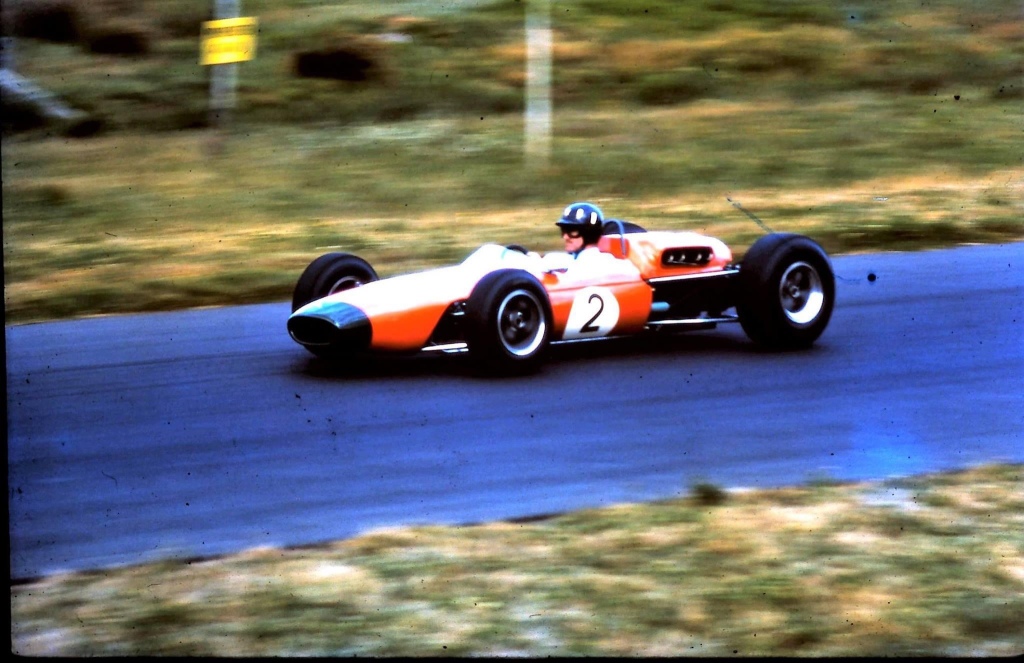
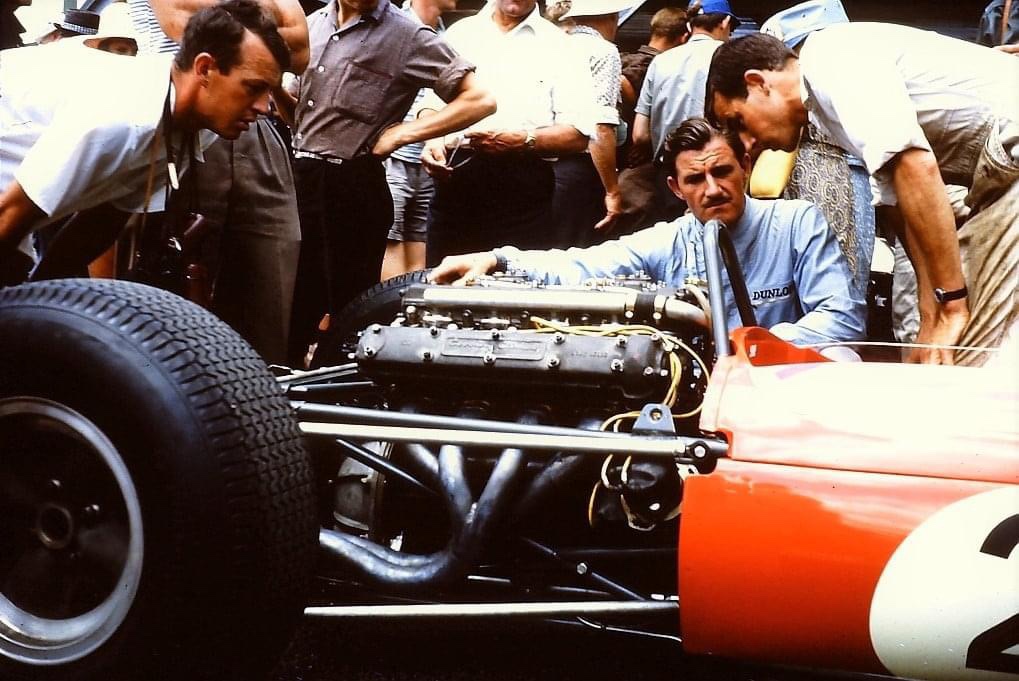
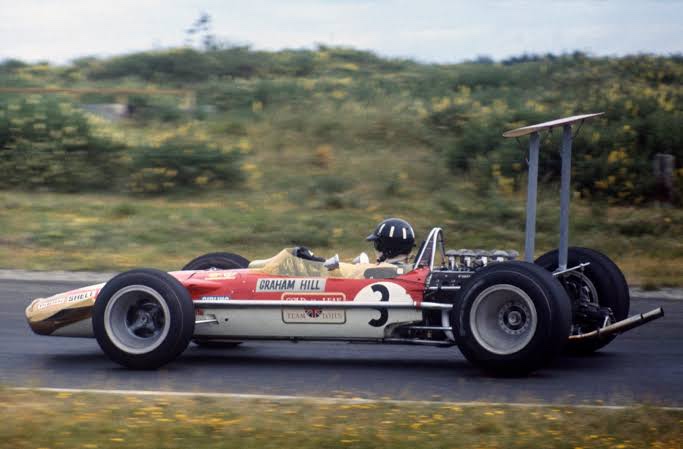
Hill aboard his Gold Leaf Team Lotus, Lotus 49B Ford DFW on his way to second place at Teretonga in 1969, and below in earnest conversation with a mechanic during the Puke first Tasman round.
(M Fistonic)
Hill arrived down south as the freshly minted World Champion after a season in which his brave leadership helped Team Lotus gather themselves together after the tragic death of Jim Clark in a Hockenheim F2 race on April 7.
It wasn’t to be a cushy summer though, Jochen Rindt was a man on a mission with a competitive F1 (and Tasman) car for the first time. His Lotus 49B Ford set the pace, winning two rounds to the four scored by Chris Amon in a title winning run of speed and consistency in a Ferrari Dino 246T.
Hill with Rindt chomping away at him, Cabbage Tree corner Levin 1969, where both Lotus 49B DFW DNF, Rindt with a big accident which required a replacement car to be sent from Hethel (B Spurr)
Graham didn’t take a victory that summer, his bests were second places to Rindt at Wigram and at Teretonga behind Piers Courage in Frank Williams’ Brabham BT24 Ford DFW. More about the Lotus 49Bs in Australasia that summer here; https://primotipo.com/2022/02/26/lotus-49b-ford-chassis-r8/
The change in Tasman formula to F5000 (1970-71 transition years noted) and the growing number of F1 races in a season put paid to trips by full-time F1 drivers for a couple of months after Christmas each year. It was awfully sweet while it lasted, with Hill G one of the most popular visitors of all with the punters.
Credits…
Euan Sarginson, LAT, Ken Buckley, Brian Ferrabee, Milan Fistonic, Bryn Kempthorne, Brian Spurr, Warner Collins, John Lawton
Tailpiece…
(W Collins)
Graham Hill preparing to load up at Wigram on January 18, 1969. Jochen won from Graham that day with local hero Chris Amon third, Piers Courage and Derek Bell fourth and fifth, demonstrating the typical depth of Tasman Cup fields.
Bruce McLaren setting up a selfie before the Lady Wigram Trophy, Tasman Series, 23 January 1965…
Sorting his goggles in any event, Cooper T79 Climax. The cars in the background are the #9 Bill Thomasen Brabham BT4 Climax and Red Dawson’s Cooper T53 Climax Lowline.
What stood out on an initial scan of this bunch of photos are those big tall white-wall Firestone tyres on large 15-inch wheels. It’s the start of the tyre-war; Firestone and Goodyear had just entered the domain which had been a cosy little monopoly for Dunlop for the previous few years.
Bruce won the first Tasman Cup in 1964 with what are regarded as the first McLarens. The two Cooper T70s Bruce and Wally Willmott constructed at the Cooper factory in Surbiton the year before were Dunlop shod machines. Click here for a piece on these cars; https://primotipo.com/2016/11/18/tim-mayer-what-might-have-been/
Admirers of the Clark Lotus 32B monocoque chassis, Wigram (A McKee)
It was going to be tough to knock Jim Clark’s Dunlop shod Lotus 32B Climax off in 1965- Bruce and Phil Hill’s campaigns were said to be sluggish at the series outset until Bruce and his boys adapted the suspension geometry and settings to the American tyres. Mind you, a close look at the results suggests Bruce was not far off the pace from the get-go.
The commercial relationship with Firestone was an important one for the entrepreneurial Kiwi as he assembled the technical partners and funding to take his nascent team forward- Bruce McLaren Racing’s first F1 season was in 1966.
Jack Brabham signed with Goodyear from 1965, that year of learning with the Akron giant was a critical foundation piece for Brabham Racing Organisation’s successful tilts at the 1966 and 1967 F1 championships for drivers and constructors.
Jim Clark had one of the greatest of seasons any driver ever had in 1965- he won an F1 drivers title, the Indy 500, the Tasman Cup plus a sprinkling of F2, touring car and other wins- the breadth of his achievements in that twelve month period has never been matched, or is ever likely to be I expect.
The start of that lot was in New Zealand- whilst Graham Hill won the first Tasman round, the NZ GP at Pukekohe in David McKay’s Scuderia Veloce Brabham BT11A Climax, Clark won the next two on the trot at Levin, where he won from the scrapping Frank Gardner and Jim Palmer aboard BT11A and BT7A’s respectively, and here, on the Wigram Airfield on 23 January from McLaren and Palmer- Jim acquired Clark’s series winning Lotus at its end. Bruce was obviously getting the hang of the Firestones mind you- he matched the lap record Clark set in the preliminary race in the championship event.
Off to Teretonga – famously the most southerly race track on the planet – Clark won again from McLaren and Phil Hill in the other Bruce McLaren Racing Cooper- an updated T70 raced by Bruce and the late Tim Mayer the year before.
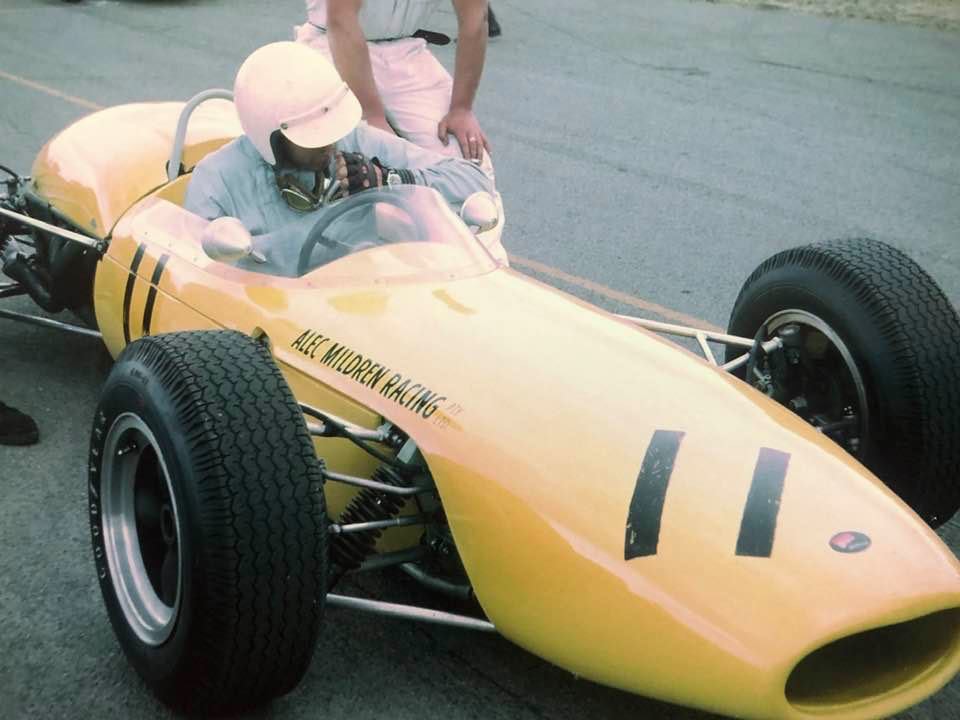
Jim at the wheel, 32B ‘beetle-back’ all enveloping bodywork, ZF gearbox. #49 in the background is the Peter Gillum Cooper T67 Ford FJ (A McKee) The off. Bruce with Frank Gardner’s distinctive Alec Mildren Racing yellow Brabham BT11A Climax alongside (A McKee)
That Bruce was getting the chassis/tyres sorted was further indicated by his pace- he pulled alongside Clark on lap 20, but Jim had enough in hand to pull away- taking the duo clear of Hill, Grant (ex-Jack 1962 AGP Brabham BT4 Climax, a car later to put John McCormack on the map) and Palmer.
The summary of the balance of the series is this; Clark won from grid three at Warwick Farm on 14 February whilst Bruce was Q5 and DNF engine. Brabham joined the Series in Sydney aboard a new BT11A- he was second from Q4. Matich was third from pole.
At Melbourne’s Sandown a week later, Jack won from pole with Jim second from Q2, Phil Hill third from Q6 and Bruce fourth from Q4- Goodyear, Dunlop, Firestone, Firestone if you like…
The seven round series ended at Longford with the Australian Grand Prix on 1 March 1965. Bruce won from pole from Brabham, Hill P and Hill G, Bruce Sergent observed that ‘Longford saw the McLaren cars come resoundingly into their own with good short-stroke engines and the small frontal area and shallow tread of the Firestones on this ultra fast circuit.’
Clark’s second half of the series was not as dominant as his first half. This was in large measure due to Jack’s presence and the pace of the McLaren Coopers- he won three races in New Zealand and once in Australia, but took the 1965 Tasman Cup with 35 points from McLaren’s solo victory and 24 points, then Jack with a win and a points haul of 21 from only three races. Brabham certainly would have given Jim a run for his money had he contested the championship in full. Gardner, Phil Hill and Jim Palmer were equal fourth…Or Dunlop, Firestone, Goodyear, Goodyear, Firestone and Dunlop.
Wigram Shell Team compound, from this end; Bruce Abernathy Cooper T66 Climax, John Riley Lotus 18/21 Climax, Andy Buchanan #8 Brabham BT6 Ford 1.5 twin-cam, perhaps the Scuderia Veloce Graham Hill Brabham BT11A Climax and uncertain closest to the truck (A McKee)
Those early years of the F1 tyre war rolled as follows; Dunlop shod Clark’s 1965 winning Lotus 33 Climax and Stewart’s 1969 winning Matra MS80 Ford. Goodyear bagged back to back titles in 1966 and 1967 on Jack’s Brabham BT19 Repco and Denny’s Brabham BT24 Repco, while Firestones were on the Lotus 49 Ford Cosworth DFV used by Graham Hill in 1968, and Jochen Rindt’s Lotus 72 Ford in 1970.
Dunlop bailed from F1 at the end of 1970, leaving the two American giants. Then Michelin came in etcetera…and now of course we have same, same, same coz same, same, same is what is mandated by the commercial, sorry, sporting powers that be.
It was a bit different in the Tasman where Dunlop shod Clark’s winning Lotus 32B Climax and Stewart’s 1966 BRM P261, but then it was all Firestone on both Clark’s 1967 Lotus 33 Climax, 1968 Lotus 49 Ford DFW and the Ferrari Dino 246T raced by Chris Amon to victory in 1969, and Graeme Lawrence in 1970.
The Goodyear shod Mildren/Gardner Brabham BT11A Climax (A McKee)
Etcetera…
(A McKee)
Andy Buchanan awaits the off in his immaculate Brabham BT6 Ford 1.5 twin-cam, top left in white is Graeme Lawrence’s similar machine. These cars were immensely successful 1.5-litre racing cars in Australasia, and at right the red ex-Tony Shelly Lotus 18/21 of John Riley.
Credits…
Bruce Sergent on sergent.com, oldracingcars.com, Ian Smith Collection
(I Smith Collection)
Tailpiece…
Brabham went like a rocket at Longford, the 1965 Tasman’s final round, he made a cautionary stop after giving Roly Levis a love-tap when the Kiwi locked a brake going into Mountford.
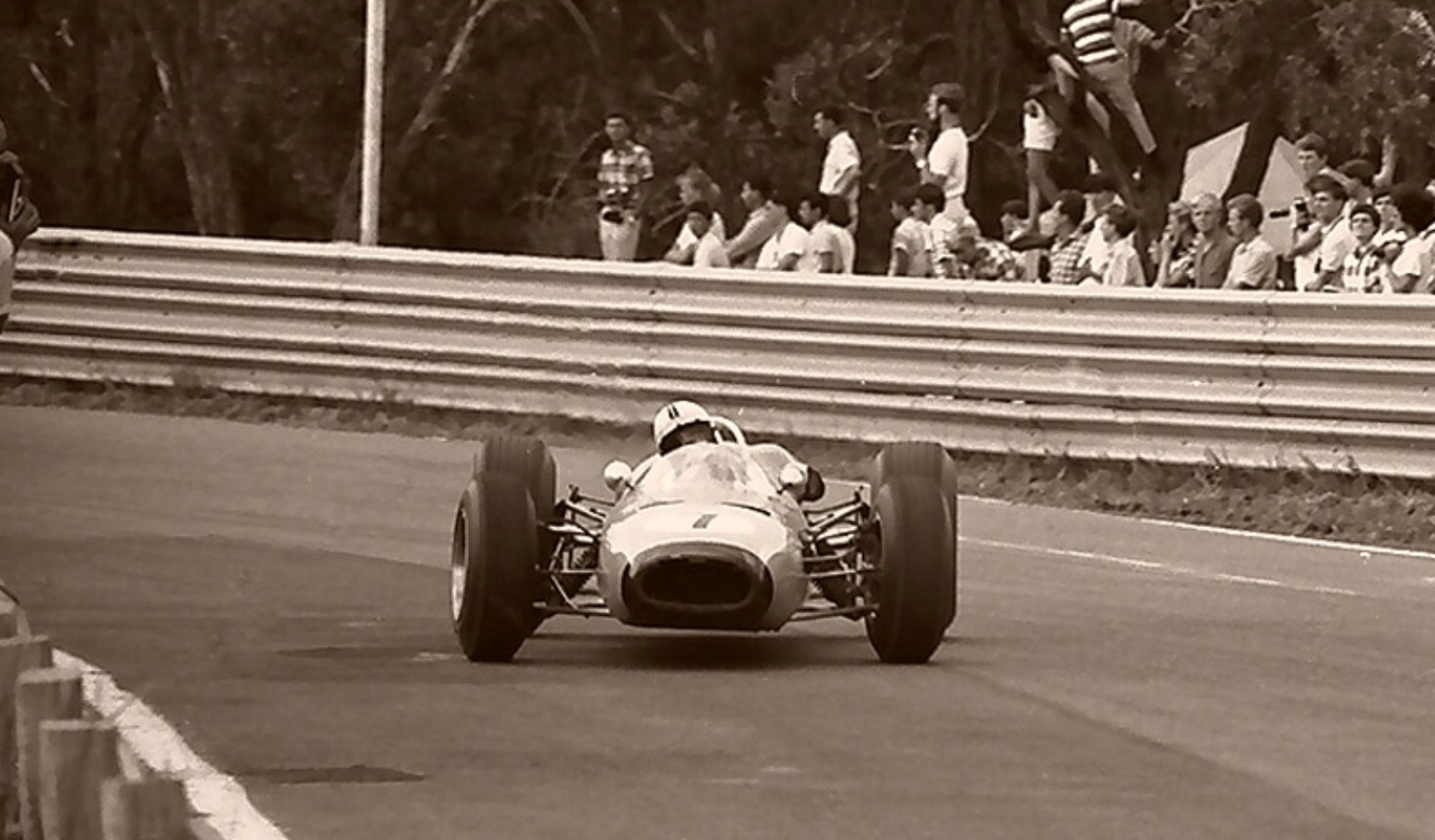
Kevin Bartlett delicately slides his way around Lakeside’s Eastern Loop during the 13 February 1967 ‘Lakeside 99’ Tasman round, Brabham BT11A Climax 2.5 FPF…
KB posted it on his Facebook page and unsurprisingly cites it as one of his favourite photos of the Alec Mildren owned car which was particularly kind to him. You might say it was the chassis in which he made his name at the top level, if not the car which won him titles.
That weekend he was fifth, second of the Climax engined cars home, and first Australian resident behind his teammate Frank Gardner who raced an F2 based Brabham BT16 FPF to third. Jim Clark won from Jack Brabham in Lotus 33 Climax FWMV V8 2 litre and Brabham BT23A Repco V8 ‘640’ 2.5, with Denny Hulme fourth in another Repco engined Brabham, a BT22.
Clark and Stewart tussled early but both P261 BRM’s driven by the Scot, and Piers Courage were outted by transmission failures, the bete-noire of the BRMs that Tasman squeezed to 2.1-litres as the little V8’s were.
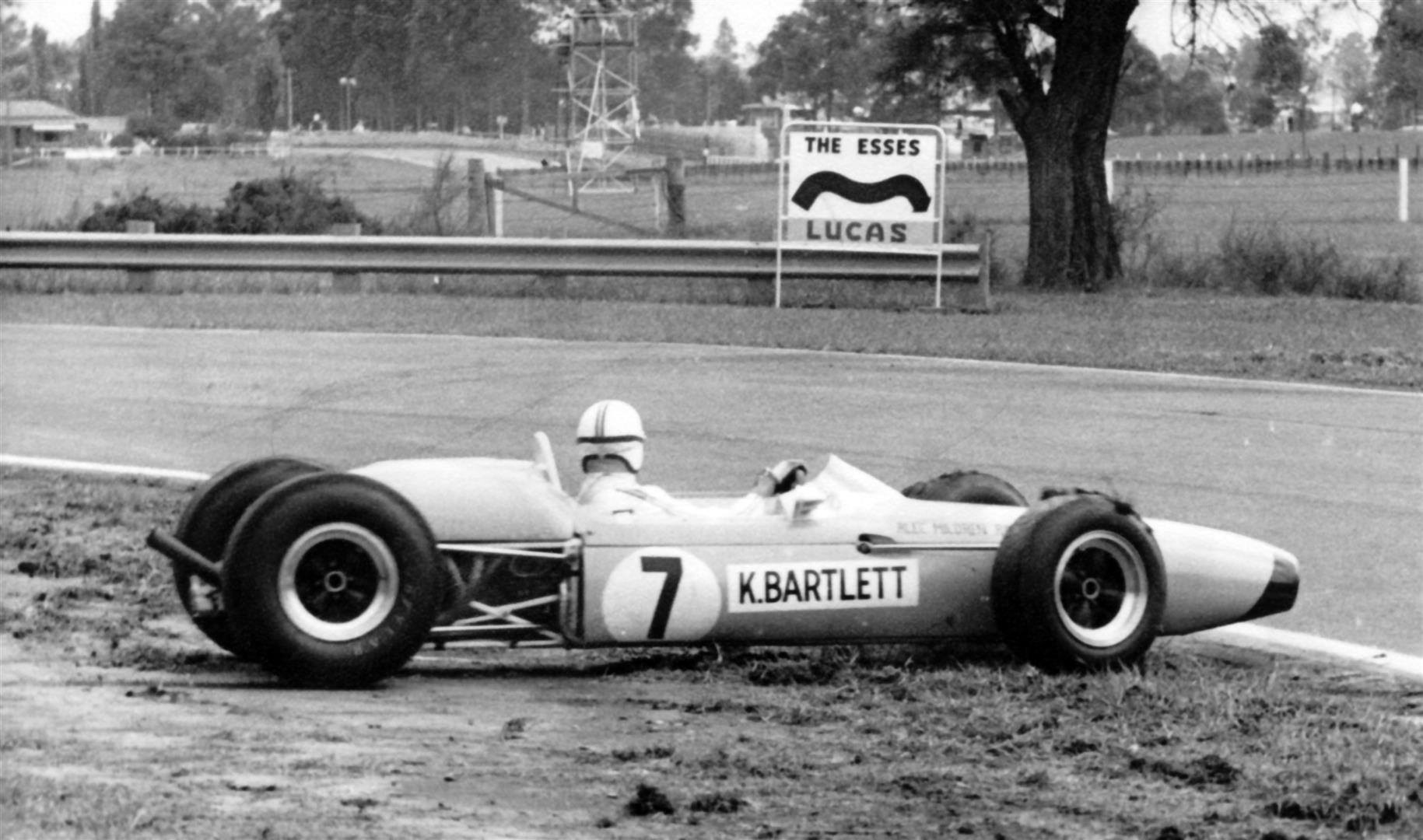
In part the beauty of the shot is the bucolic background, devoid as it is of signage and spectators or their cars- it’s practice no doubt.
Brier Thomas perhaps, none of us are sure. Bruce Wells, Warwick Farm Facebook page
Tailpiece…
(B Wells)
In similar fashion to the shot above but a week later at Warwick Farm’s Esses during the AGP weekend. Sixth in that race was a great result for the Sydneysider with a broken front roll bar and a gear-lever sans knob. Stewart’s BRM P261 won from Clark and Gardner.
Postscript: The Maestro didn’t always geddit right…
(WFFB)
Warwick Farm 1967 Tasman round practice- magic car and driver.
I’ve written a feature In the current Auto Action #1803 on Dan Gurney’s win in the 1961 Victorian Trophy aboard his works BRM P48 at Ballarat Airfield.
He and Graham Hill raced at Ardmore, NZ, Warwick Farm and Ballarat that summer. Dan’s win was an interesting one in his last BRM drive- it was his first international victory and the only one for the P48 on the last occasion the machine was raced in works hands.
It’s a nice piece, but then I would say that.
For us historic nutters there is also the first in a two-part series on Tim Schenken written by Mark Fogarty. This issue covers his formative years to F1, the next one his Ferrari sportscar drives, Tiga period with Howden Ganley and beyond.
Other standout reads in the sixty page issue are five pages on F1, four on the year ahead for F1, Indycar, F2/3, Moto GP and Taxis, two pages on Oz international Scott Andrews with whom I was unfamiliar and coverage of the Monte, Dakar and the Symmons meeting I was lucky enough to attend a week ago. Plenty of maxi-taxis too of course.
If you haven’t read fifty-years-young Auto Action for a while give us a whirl.
Hopefully the Tasmanian Back to Back Double-Banger season openers at Symmons and Baskerville become a fixture- lets hope so. It makes so much sense on all levels, get you bums down there next year if you can.
The racing was great, imbibing Longford for a cuppla days was magic not to forget some great Tassie touring, sun on the sand and a shandy or three. It was heaven on a stick really.
(unattributed but very keen to know the ‘snapper)
The more you look the more you see. All the fun of the fair. Longford AGP weekend March 1965.
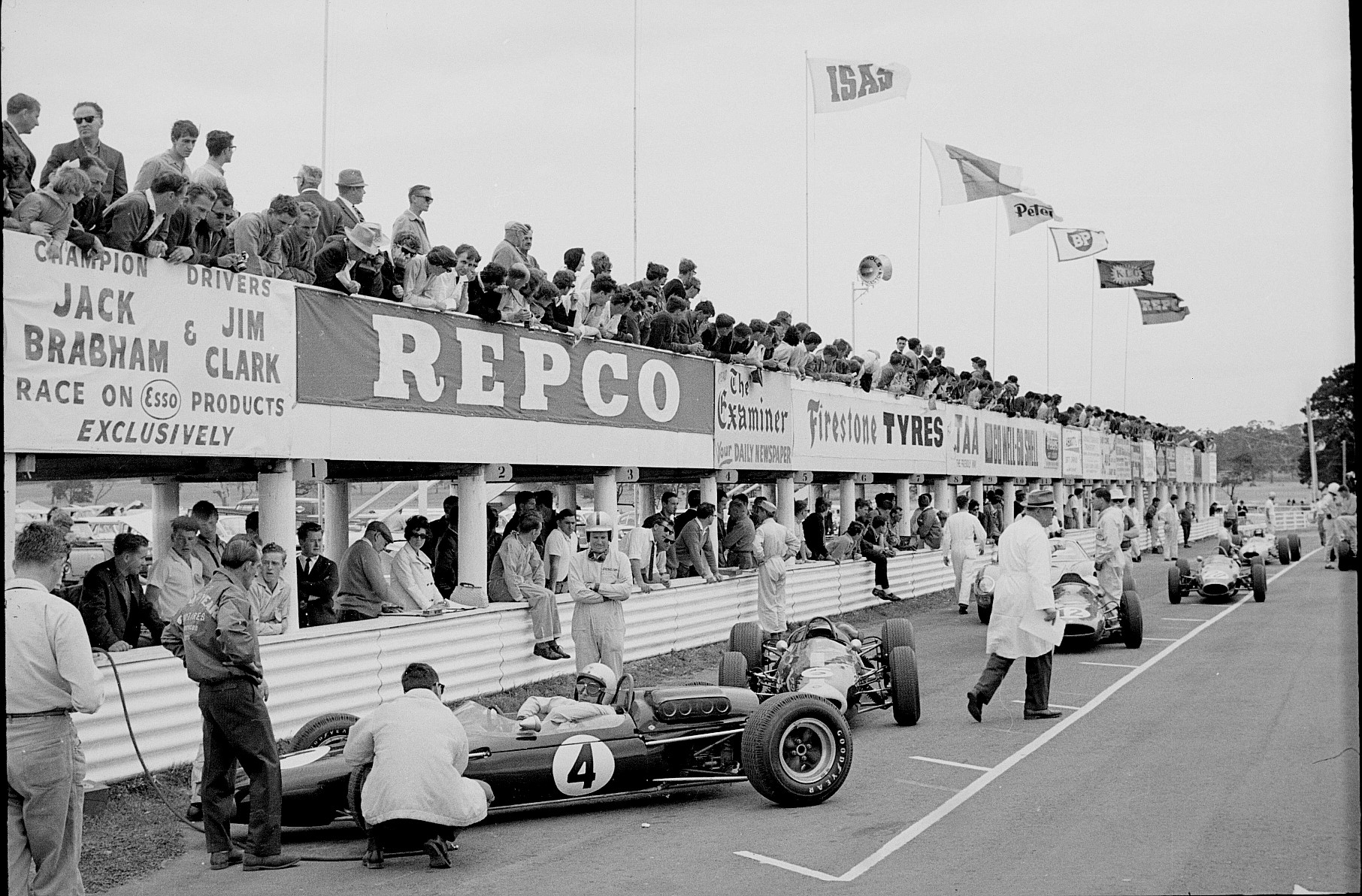
Jack Brabham waits for the pressures in his Goodyears to be adjusted, Brabham BT11A Climax. That’s Roy Billington with hands on hips to the left and Bib Stillwell hovering- his new Brabham BT11A Climax is to the right. Next in line is the ill-fated #12 Ecurie Australie Cooper T62 Climax of Rocky Tresise.
Further along, obscured near the pit counter, is the Scuderia Veloce Ferrari 250LM with Lynn Archer’s #20 Elfin Catalina Ford 1.5 on the painted line. The light coloured car at the end of the queue is Frank Matich’ Brabham BT7A Climax.
Alec Mildren Racing prepare their steeds prior to the 1968 ‘Warwick Farm 100’ Tasman round held on 18 February 1968…
That’s Kevin Bartlett steering his Brabham BT11A Climax through the dummy grid area back into the paddock- the car in the distance is Frank Gardner’s Brabham BT23D Alfa Romeo.
35,000 people attended the meeting on a glorious Sydney summers day during which Jim Clark led from pole and won from his teammate Graham Hill aboard Team Lotus Lotus 49 Ford DFWs- I’ve done this meeting to death already here; https://primotipo.com/2015/04/14/warwick-farm-100-tasman-series-1968/
The one-off Brabham BT23D Alfa was Alec Mildren’s response to the growth of multi-cylinder engines, as in more than four, in the Tasman Cup, as an Alfa Romeo Dealer Autodelta were more than happy to build some special 2.5 litre versions of their Tipo 33 sportscar V8- that engine story is here; https://primotipo.com/2018/11/30/motori-porno-alfa-romeo-tipo-33-tasman-2-5-litre-v8/
FG looks happy enough, note the ‘Buco’ helmet and driving gloves, Glenn Abbey is the lanky chap attending to the car. BT23D was a one-off but built on Ron Tauranac’s F2 BT23 spaceframe chassis jig. Conventional outboard suspension front and year, no belts- they would become common throughout this year though (B Jackson)
Business end- Hewland FG200 five speed transaxle and twin distributors to fire two plugs per cylinder in amongst the shade (B Jackson)
There are not too many folks around at all- perhaps its the Thursday prior to the meeting. A quick look at the Australian Motor Racing Annual race report covers plenty of tyre drama pre-race as a shipment of Goodyears had not arrived in Australia which meant that Goodyear contracted drivers such as FG and Jack Brabham plumped for Firestones come raceday. Both the Mildren cars are fitted with Goodyears in these shots but that delay left ‘Bartlett and Hulme as the only Goodyear equipped cars’.
It wasn’t a great race for the team- KB started from row five with Geoghegan, Lotus 39 Repco and Attwood, BRM P126 V12 and retired with half-shaft failure at Polo on lap 34 whereas FG started from row three alongside Greg Cusack, Brabham BT23A Repco and John Harvey, Brabham BT11A Repco, and, having run as high as fifth retired on lap 40 ‘with a very oily-looking rear end’.
Abbey and BT23D, Mildren were a BP sponsored team throughout, nice Holden EH- it’ll be either light brown or light green with that white roof Holden fans? (B Jackson)
Etcetera…
(B Jackson)
KB swapping notes with Jim Clark and Graham Hill with his back to us- is that Rana Bartlett at right? The Team Lotus duo raced Lotus 49s fitted with Ford Cosworth 2.5 litre ‘DFW’ engines that summer.
Credits…
Brian Jackson
(B Jackson)
These engines were very successful for Mildren- they never took a Tasman round victory but Bartlett won the Gold Star in the BT23D in 1968 and the Mildren Yellow Submarine in 1969- albeit that year the Waggott TC-4V engine also chipped into the pointscore- not to forget KB’s 1969 Macau GP win.
All alloy 90 degree, Lucas fuel injected 2.5 V8 with twin, chain driven overhead camshafts per bank and two valves per cylinder, twin plugs per cylinder fired by Marelli distributors. Note the oil filter, very tricky pipe work to get the exhausts to the right length and clear the frame tubes and tachometer drive off the end of the camshaft.
‘Start ya bastardo’ seems to be the expression on Glen Abbey’s face…
He and the other Alec Mildren Racing boys are trying to get Frank Gardner’s Brabham BT16 Climax alive for the start of the New Zealand Grand Prix at Pukekohe on January 7 1967.
It was a tough series for the Sydney crew- 1967 saw the V8 engines multiply that summer, the poor old, venerable Coventry Climax FPF 2.5 litre four potter- Tasman engine de jour for so long was overwhelmed by Repco-Brabham, Coventry Climax and BRM V8’s, the trend started the year before of course.
More would come in 1968 with the Ferrari V6 and BRM V12 adding to the onslaught but by then Mildren had a supply of Alfa Romeo Tipo 33 V8’s- not that they ever quite did the trick in the Tasman, but they were pretty handy at Gold Star level.
Wigram 1966, FG’s Brabham BT11A Climax 2.5 DNF accident, being hosed off by the 1.9 litre BRM P261 V8’s of Dick Attwood #2 2nd and Stewart #6 winner (unattributed)
FG and BT16 in New Zealand 1967, circuit unknown (E Sarginson)
In fact the little F2 based BT16 gave Gardner his best Tasman result ever, equal second.
Jim Clark won in a Lotus 33 Coventry Climax FWMV 2 litre, his yield was five wins, three in Tasman Cup championship events and 45 points, whilst equal second were Jackie Stewart, BRM P261 V8 2.1, two wins, Jack Brabham, Brabham BT23A Repco ‘640’ V8 with one and Frank who was winless but consistently quick throughout.
So the paddock photo is representative of dramas which came in the 21 lap preliminary on GP morning when a valve and piston came into contact- that was it for FG’s weekend. Stewart won the NZ GP from Clark and Richard Attwood’s BRM P261.
Back to Mildren and Gardner’s plans for the 1967 Tasman.
Frank and Alec figured they needed something light in all the circumstances so an F2 frame into which they could pop their FPF and Hewland HD5 gearbox made sense- FG had raced Alec’s Brabham BT11A’s in the 1965 and 1966 Tasmans, one of them was raced by Kevin Bartlett. In fact 1967 would be KB’s first full Tasman, as against just running the Australian rounds.
Frank’s European commitments didn’t extend to full F2 seasons in 1965 and 1966 but he did a ‘halfa’ season or thereabouts in 1965 racing several cars- a John Willment Lotus 35 Cosworth SCA, Ken Tyrell Cooper T75 BRM P80 and Midland Racing Partnership Lola T60 BRM P80. In 1966 he raced MRP Lola T60 and T61 BRM’s.
Whilst Mildren’s were a ‘Brabham and Alfa Romeo Shop’ (yes i know not exclusively) and the chassis selection may have been a foregone conclusion, perhaps FG’s closeup view- ‘up the clacker’ of Jochen Rindt’s Winkelmann BT16 at Reims for an hour and a half in July 1965 convinced him Ron’s chassis was the go. Jochen won the Reims GP in 1:33.55.7 from FG on 1:33.55.9 in the Midland Lola.
And so it was they did a deal to buy the John Coombes ‘F2-8-65’ BT16 which had been raced by Graham Hill in 1965 and 1966 in Euro F2 until Coombes replaced it with a new-fangled monocoque Matra MS5 midyear. Click here for articles on Euro 1 litre F2;
FG in Brabham BT19 Repco ‘740’- Jack’s 1966 ‘620 Series’ powered championship machine during the Oulton Park Gold Cup in 1967 (M Hayward)
Gardner, Ford GT Mk2, Le Mans 1967 (D Friedman)
‘F2-8-65’ was soon in Australia and made race ready by Glenn Abbey for the Hordern Trophy, for some years the traditional Gold Star Championship final, December, Warwick Farm round. Frank won from Kevin Bartlett and Spencer Martin in ‘identical’ Brabham BT11A’s entered by Mildren and Bob Jane.
The 1967 Tasman result was outstanding for FG and Mildren’s, it was again a reminder of his speed, consistency and maturity.
At the end of the summer off he went to Europe for what by then had become his ‘usual cocktail’ of touring cars, sports-prototypes and sportscars, F2 and occasional, usually non-championship F1 drives. To me FG had it all-what a mix of cars, and paid well to do it!
Bartlett in the Mildren Brabham BT11A Climax at Warwick Farm during 1967
The BT11A was one of Kevin Bartlett’s all-time favourite cars so it was no surprise Mildren sold BT16 instead- KB and Spencer went at it hammer ‘n tongs again in 1967- a battle between two mates told here; https://primotipo.com/2018/04/27/kbs-first-bathurst-100mph-lap/
Niel Allen was the purchaser albeit the car was usually driven for him by Fred Gibson. From Niel- I think he sold it when he bought Piers Courage’ McLaren M4A Ford FVA at the end of the ’68 Tasman, it went to Col Green then Neil Rear in Perth, in the US now innit for quite some while?
Etcetera…
(D Logan)
FG has crested ‘Lukey Heights’ and is plunging left towards Dandenong Road during the 26 February 1967 ‘Sandown Cup’, he was third behind Jim Clark’s Lotus 33 Climax FWMV 2 litre V8 and Leo Geoghegan’s Lotus 39 Climax FPF 2.5.
Glenn, Stu Randall and Ian Gordon (?), note the nose of the ‘Scuderia Veloce’ 250LM at left, at that stage the custodian was Kiwi racer Andy Buchanan.
Its a period typical Brabham, skinny (albeit not at all so by the standards of a modern Formula Ford) and sturdy spaceframe chassis with upper and lower wishbones and outboard coil spring/shocks with an adjustable roll bar. Alford & Alder steel uprights- you beaut cast magnesium ones arrived with the 1967 BT23/24.
Wonderul bits of chuckable kit straight outta the box- design by Tauranac and final suspension settings by John Arthur Brabham.
Andrew Robinson worked for Alec Mildren’s Pymble dealership for a number of years, starting as an apprentice motor mechanic in 1977 and was given these discarded photographs which span a decade of Alec Mildren Racing from about 1964 to 1972, many thanks to Andrew for sharing them with us, rolled gold they are too…
I have arranged them pretty much in chronological order- the cars themselves are easy enough to identify but in some cases I don’t know where they are, hopefully Kevin Bartlett or others can assist in that regard!
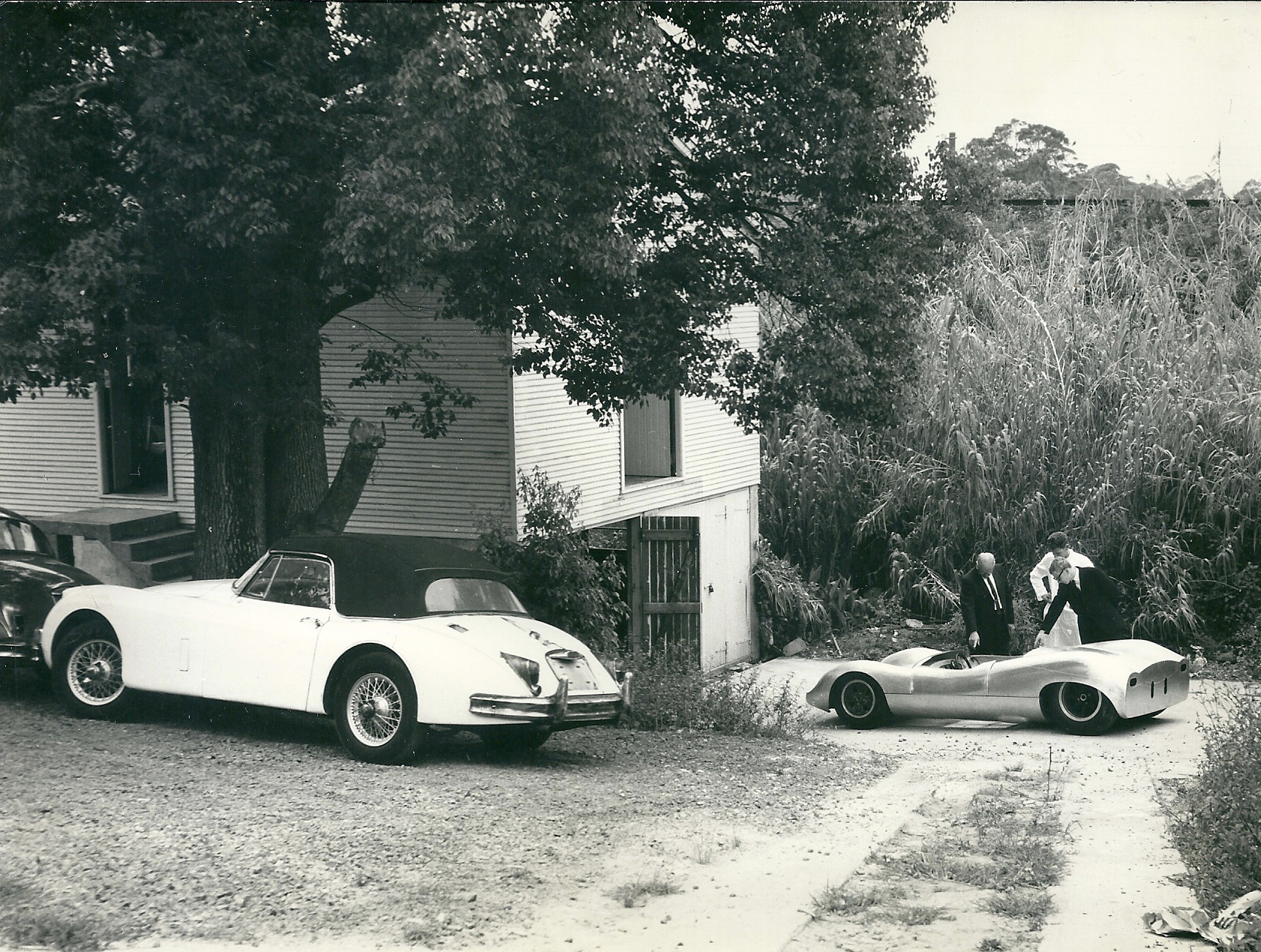
The first (above) is the Mildren Maserati sports-racer with Alec, long time Mildren race mechanic/engineer Glen Abbey and another dude checking out the car which appears brand new- note the XK150 and Mk2 Jaguars.
After speculating online that the locale was Glenn Abbey’s home in Avalon for a couple of days Kevin Bartlett’s memory kicked into gear ‘The penny has just dropped…its the “Railway Shed” where many of the cars were worked on. It was opposite the Mildren Pymble headquarters on the Pacific Highway alongside the Northern Railway (look closely at the top of the shot and you can see the railway track). I also remember building a pushrod Ford engine for a Brabham in the floor above the workshop. We ceased using it in 1967 when the cars were worked on behind the main building.’
The car was built by Bob Britton of Rennmax Engineering on his Lotus 19 jig around the core mechanical components of Alec’s 1960 Gold Star Championship winning Cooper T51 Maserati- suspension and brakes, Maserati T61 2.9 litre DOHC four cylinder engine and Colotti gearbox. The story of this car is told at the end of this lengthy piece on Alec; https://primotipo.com/2018/06/08/mildrens-unfair-advantage/
(A Robinson)
Beautiful shot of Alec and Marjorie Mildren, Frank Gardner, the tall Glenn Abbey, Bob Grange or Stuart Randall on the pit counter at Warwick Farm circa 1965.
Gardner’s pattern throughout the decade was to race in Europe in F1/F2/Sportscars/Touring cars and then return home in the summer time taking in the Hordern Trophy at Warwick Farm in December as a warm up for the Tasman Series in January, February and just into March against the best in the world before heading back to Europe.
Great work/life balance it seems to me!
(A Robinson)
Mildren Racing became outright Tasman Series contenders with the acquisition of a Brabham BT11A Coventry Climax 2.5 FPF before the 1965 series, the car is chassis number ‘IC-3-64’.
Here Alec at left, is sussing his new racer together with his son, Jeff Mildren and Glenn Abbey in late 1964, probably in the workshop over the road from Alfa Romeo Dealership at 970-980 Pacific Highway, Pymble on Sydney’s Upper North Shore.
The car was first raced in the 1965 Tasman Series opener, the New Zealand Grand Prix at Pukekohe, where he was second to Graham Hill’s identical, Scuderia Veloce machine. No doubt Frank gave it a whirl around the Farm before venturing to the Land of The Long White Cloud- he didn’t run at in the 6 December 1964 Hordern Trophy though, which means either he or the car, or both, were not in the country by then.
The shot below is the same spaceframe chassis unclothed.
(A Robinson)
During 1965, after a very successful Tasman in which FG was equal fourth, Mildren was looking for a Tasman Series ‘Unfair Advantage’ for the coming year. ‘Everybody’ ran the Coventry Climax FPF which was becoming a bit long in the tooth, BRM planned to race their 1.5 litre F1 P261’s with the V8 taken out to about 1.9 litres and Repco announced they were to race their new 2.5 litre V8- which first fired a shot in the Doonside Street, Richmond Repco Engine Lab in March 1965 during the 1966 Tasman in advance of an assault on the F1 World Championship.
Alec found an exotic solution via his old buddies at Maserati.
He was a Maserati dealer and had impeccable connections within the racing side of the company by virtue of his successful Gold Star tilt, Maserati powered in 1960, and so it was he obtained a 2.5 litre Maserati Tipo 58 (250F T2) quad cam, two valve, six-Weber carbed, circa 310bhp V12 which had been lying around Modena since Officine Maserati tested and occasionally raced V12 versions of the 250F in 1957. Fangio won the last of his five F1 championships racing six-cylinder 250Fs that year of course.
(A Robinson)
The engine was shipped to Sydney where it was married to the team’s BT11A ‘IC-3-64’- our friend above, the frame of which was lengthened more than a smidge to suit, a bell-housing was cast to mate the engine to a Hewland HD5 gearbox and away Gardner went in practice for the 1966 Warwick Farm 100- the photo above is on that very day, 12 February 1966.
Frank and Kevin Bartlett tested the car at Oran Park early in the summer, the engine blew, the machine had plenty of power but its delivery- exactly as JM Fangio and Jean Behra experienced in their 250F’s when they tested (and raced in Behra’s case at Monza) them so equipped in 1957, was either ‘on or off’ so Frank raced his Climax engined BT11A ‘IC-2-64’ at the Farm instead, he was third behind Clark’s Lotus 39 Climax and Graham Hill’s BRM P261.
This latter BT11A was the machine Bib Stillwell used to win his final Gold Star in 1965 which was then acquired by Alec when Bib retired, for Frank to use in the NZ Tasman rounds whilst Stu Randall rebuilt the Maserati engine with bits flown in from Italy and re-fitted it to BT11A chassis ‘IC-3-64’ for Frank to use at Warwick Farm, the first Australian Tasman round.
Tested again in practice at Sandown a fortnight later, the Brabham Maserati was put away when the engine blew again and that was that, what became of the engine is uncertain. BT11A ‘IC-3-64’ was converted back to Climax spec and raced with much success by Kevin Bartlett in 1966, 1967 and the ‘68 Tasman. Meanwhile ‘IC-2-64’ was sold to Kiwi Kerry Grant but not before Bartlett and Jackie Stewart had a ding-dong of a dice in these two BT11A’s at Surfers Paradise in mid-1966, see here;
There is more to the Brabham Maserati story, lots more, but you will have to wait a few weeks whilst I finish a feature…For now salivate about an amazing engineering sidebar in Tasman History- truly a great mighta-been from the little team in Sydney.
(A Robinson)
From one rare beastie to the next.
This time the Mildren Alfa Romeo, not ‘The Sub’ mind you but the first Mildren Alfa, the lesser known one.
Another Bob Britton built car, this one was constructed on Britto’s Brabham BT23 jig and fitted with an uber-rare Alfa Romeo 1.6 litre, four valve, fuel injected European F2 engine and 5-speed Hewland FT200 transmission, both of which are clear as a bell in the shot above.
The car made its race debut driven by Kevin Bartlett at Warwick Farm on 8 September 1968- it raced in Alfa engined form a miniscule number of times before the very first of Merv Waggott’s TC-4V engines was popped into the back of the chassis and raced by Max Stewart who joined the team alongside KB with effect from the start of 1969.
The tale of ‘Max’s’ car is long, successful and slightly tortuous with the appearance of a second chassis, the provenance of which is not in doubt, in the last decade or so, but is not for now- i did write a ‘quickie’ about it a while back though; https://primotipo.com/2018/05/29/singapore-sling/
(A Robinson)
Speak of the devil, there is the man himself, Max Stewart corner-weighting the Mildren Waggott as it then was in 1969 or 1970.
You can just see the front corner of a ‘105’ Alfa at far left, the race truck out the doorway and the rear of the chassis of Kevin Bartlett’s Mildren ‘Yellow Submarine’ just left of Maxxies midriff.
(A Robinson)
Speak of the other devil, there is KB at Warwick Farm in the ‘Yellow Submarine’ Mildren Waggott TC-4V.
With that circuit, livery, helmet and engine I wouldn’t mind betting the shot was taken during the 7 December 1969 Hordern Trophy Gold Star meeting, KB won the race upon the debut of the 2 litre Waggott engine, what say you Mr Bartlett? Max was second in the 1.6 litre Mildren Waggott and Niel Allen third in his ex-Courage McLaren M4A Ford FVA.
Both these Mildrens are iconic in the pantheon of Australian motor racing, ditto the drivers and entrant.
(A Robinson)
A couple of Mildren Waggott, Max Stewart, Warwick Farm compare and contrasts.
The shot above circuit, livery, bodywork and helmet suggests probably the 1969 Hordern Trophy meeting too whereas the one below is during 1971 by which time Max had acquired the car from Alec, still in the same livery and with support from Seiko- it was the year in which Max ‘nicked’ his first Gold Star from the F5000 fellas, brittle things that they were.
The photo below is during the September Hordern Trophy race in which Max was third behind KB’s McLaren M10B Chev and Leo Geoghegan’s Lotus 59B Waggott TC-4V.
(A Robinson)
Whilst the unreliability of Kevin Bartlett’s McLaren M10B Chev cost KB the 1971 Gold Star Max had to get with the F5000 strength and bought an Elfin MR5 Repco-Holden which he first campaigned during the 1972 Tasman Series.
Note the retention of Seiko still and the Mildren Yellow colour (take my word for it) despite the commercial relationship between Alec and Max being at an end, Alec Mildren Racing ceased after the conclusion of the 1971 Tasman Series.
(A Robinson)
Here the car is on the grid of the Warwick Farm 100 Tasman round with Teddy Pilette’s Racing Team VDS McLaren M10B Chev alongside in February 1972.
Max didn’t have a happy race, his Repco engine broke its crank after 8 laps whereas Teddy was seventh, the race was won by Frank Matich’s Matich A50 Repco from Frank Gardner, Lola T300 Chev and Kevin Bartlett, McLaren M10B Chev.
Andrew Robinson Collection, Kevin Bartlett, oldracingcars.com
Tailpiece…
(A Robinson)
Patron Mildren, Glenn Abbey and Don Baker (of Brabham/Dolphin and other such fame) at Warwick Farm- perhaps this shot too is over the 1969 Hordern Trophy weekend…
Frank Matich, Brabham BT7A Climax leads Jim Clark’s works Lotus 32B Climax into Pub Corner at Longford in March 1965. A take-your-breath-away shot, composition and execution by Reg Dalwood is something special…
I suspect this is lap 2 with the leading trio of McLaren, Brabham and Hill further up the road. Behind Jim are Bib Stillwell and Frank Gardner in Brabham BT11As, Jim Palmer in a BT7A and then at the rear of the group is Phil Hill, Cooper T70 Climax.
Bruce McLaren won this race, the Australian Grand Prix in his Cooper T79 Climax from Brabham’s BT11A and Phil Hill in the other Bruce McLaren Motor Racing entry – the updated T70 Cooper driven by Bruce and the late Tim Mayer in 1964.
(HAGP)
Bruce wheels his Cooper T79 around Warwick Farm in 1965 hiking his inside right wheel.
Ron McKinnon gives McLaren and Clark a ride in the sponsors Spitty at the end of the race (B Short)
Hill at left, white car McLaren with Jack and Jim in the next row of two (B Short)
McLaren started the race from pole with Brabham, Graham Hill, Clark, Gardner and Matich behind.
Very sadly, this was the race in which Rocky Tresise died after losing control of the Ecurie Australie Cooper T62 Climax. As most of you know, this was a double disaster for the Davison family as Lex died of a heart attack at Sandown whilst practicing his Brabham BT4 the weekend prior. The Rocky story is here; https://primotipo.com/2016/05/20/bruce-lex-and-rockys-cooper-t62-climax/
I’ve a feature brewing on this race so won’t go into all the detail just now, but rather make use of some of the many images of this AGP floating around on the internet, too many for one article.
In some ways Longford 1965 marked ‘the end of the beginning’ of the Tasman Series in that 1965 was the last year of the dominance of the long-lived Coventry Climax FPF engine.
The world championship winning engines of 1959-60 had pretty much ruled supreme in Australia from 1959 through to the end of Formula Libre in December 1963, and to the commencement of the Tasman 2.5 Formula from 1 January 1964.
In 1966 the BRM V8s made their successful Tasman debut and at the end of the series – Sandown and Longford – the first of the Repco RB620 2.5 V8’s took their bow in Jack’s BT19.
(B Short)
Two nut-brown Aussie summer kids, and the equally well-tanned Oz Lotus works mechanic Ray Parsons push Jim Clark’s Lotus 32B Climax through the Longford paddock.
The Clark/Lotus combo were the class of 1965. Jim’s four of seven Tasman round victories was a precursor to a season which included an Indianapolis 500 win aboard a Lotus 38 Ford, and his second world title in Chapman’s Lotus 33 Climax. Not a bad year really!
Kevin Drage’s shot of the front row of the Longford grid; McLaren, Cooper T79 Climax, Brabham and Hill both in Brabham BT11A Climax’.
KD has an amusing anecdote about Bib Stillwell, Matich’s big rival, and his reaction to FM’s speed that weekend.
“One story I remember from this meeting is Bib’s frustration in not being able to match Frank Matich’s lap times during practice. I was helping Gerry Brown to pit crew for Bib at this meeting, and Bib was even wondering if Frank had slotted in the 2.7 engine from his (Cooper Monaco) sportscar into the Brabham, just for practice to give everyone a bit of a stir up. He even asked me to see if I could manage to go over to the Matich pits to checkout the engine number.”
(unattributed)
Matich during the parade lap at Warwick Farm before the 1965 Tasman round.
FM started the Warwick Farm 100 from pole – in front of Hill, Clark, Brabham, McLaren and Gardner, which rather puts the Sydneysider’s pace into context. He led most of the first lap, ultimately finishing third behind Clark and Brabham.
(oldracephotos.com.au)
Brabham in the Longford paddock getting his BT11A race ready.
Reg Dalwood on the Historic Racing Car Club of Tasmania website, oldracingcars.com.au, Kevin Drage, Ben Short, HAGP- ‘History of The Australian Grand Prix’ Graham Howard and others, Stephen Dalton Collection, Perry Drury, Ian Smith Collection
Etcetera…
(oldracephotos.com/JEllis)
Brabham, Hill and Clark enter the circuit, the crowd big enough for raceday. Looking back down the road 500 metres or so are the distinctive big pine trees of Mountford Corner. Brabham BT11A by two, and Lotus 32B.
(oldracephotos.com.au)
It may not have been the latest bit of kit, but, continuously modified by Matich and his team his year old car was well and truly as quick as the latest BT11A or anything else on the grid.
Small crowd above suggests ‘IC-1-63’ is being pushed onto the track for practice or the preliminary on Saturday. Graham Matich is steering, it’s Geoff Smedley with his head down at left, who is the other fella I wonder?
(B Short)
The Touring Car grid ready to start, Le Mans style with the ignition key handed from mechanic to driver, can anybody help with car/driver ID.
Check out the crowd above the pits, access bridge and all the fun of the fair.
(I Smith Collection)
The intense concentration is there but otherwise Jack looks relaxed in the cockpit, key to feeling what the BT11A is doing of course.
Shot is taken from atop The Viaduct, a classic shot from this locale. This one has been executed beautifully and shows both Brabham’s form as well as the lines and simple, period-typical suspension of this oh-so-successful series of Intercontinental Brabhams.
All of the shots of this car in the article are a different hue of green, I wonder which is closest to the real McCoy?
Tailpiece…
It’s a butt shot isn’t it.
From the left is the beautifully formed derrière of the lady, such a shame to miss out on the rest of her with a thoughtless crop. Then there is the rear of the FC Holden Wagon and the old bloke standing behind it.
The racer is Jack’s Brabham BT11A Climax ‘IC-5-64’ resting in the paddock after it’s hard won second place.
And finally the rear of an EJ Holden Panel Van.
Atmospheric isn’t it?
(P Drury)
Same scene, same time, same place, while Perry Drury was taking this shot, Ben Short was standing opposite him taking the one above. Jack’s Brabham, Jim’s Lotus and the EJ Wagon…
Bob Jane, Elfin 400 Repco ‘620’ 4.4 V8 entering KLG Corner, racer Ross Burbidge tells us, 12 February 1967…
It’s a very early race for Bob in his brand new Elfin, this car notable in several ways not least for the fact that it was the first to be fitted with a customer Repco Brabham engine V8- I’ve written a feature on it so let’s not repeat ourselves;
What struck me about William Byers’s photo and the unusual angle and locale in which it is taken is the degree of difficulty in sighting these big Group 7 sportscars through the corners. Admittedly Bob was a ‘short-arse’- mind you there was plenty of bounce in every ounce- but I bet the problem was the same for tall fellas like Dan Gurney.
Who won the sportscar races that day- had Matich debuted the SR3 at this point?, it certainly raced at the Farm and Sandown Tasman rounds that summer- Frank would certainly have given Bob a run for his money if present.
(W Byers)
The top-guns of the meeting were the Tasman 2.5’s of course.
We have photos of second placed Jack Brabham, Brabham BT23A Repco ‘640’, (above and below) Denny Hulme’s similarly engined fourth placed Brabham BT22, sixth placed John Harvey in the 1.65 litre Ford twin-cam powered ex-Stillwell Brabham BT14, and Spencer Martin’s Bob Jane owned Brabham BT11A Climax but not Jim Clark’s victorious Lotus 33 Climax FWMV 2 litre V8- he won five of the eight Tasman rounds that year. A pity, but hey, let’s be thankful for some marvellous photos.
(W Byers)
(B Thomas)
1967 was the Tasman Series Repco had a red-hot go to win, two cars, one each for Denny and Jack with both drivers contesting all eight rounds- but the might of the F1 World Championship winning team did not triumph over Jim Clark and the very reliable, fast, special 2 litre FWMV Coventry Climax engined Lotus 33 of the Scottish ace.
In 1966, 1968 and 1969 Repco had limited Tasman campaigns, 1967 was the one they should have won, you might say, I’ve covered this series before, so no point repeating the many problems which cost the Maidstone outfit dearly.
Arguably the most important aspect of the Tasman for Repco was to blood their new for 1967 F1 engine- the 740 Series V8- in advance of the GP season, than win the series itself. In the event Repco’s Norm Wilson designed 700 Series block was not quite ready so Jack and Denny raced with ‘640 Series’ motors- the new 40 Series exhaust between the Vee two-valve heads and 600 Series (Oldsmobile F85 modified) blocks.
(W Byers)
Denny had a rather successful 1967 season didn’t he!, taking the F1 drivers title and finishing second to Bruce in the Can-Am Championship aboard one of McLaren’s M6A Chev papaya coloured machines.
The car above, a BT22, is essentially a BT11 frame fitted with BT19 suspension- Allen Brown writes that ‘F1-1-64’ was used by BRO until Denny’s F1 car for 1966 BT20 was ready. Fitted with a Repco-Brabham V8, it was raced by Denny in the Tasman and then sold to Rorstan Racing, who fitted a Coventry Climax FPF 2.5 and ran Aussie Paul Bolton in it, it’s present whereabouts is unknown.
Jack’s BT23A was built on the redoubtable BT23 F2 jig/frame.
BT23A has never left Australia thank goodness, and been very much in the news in the last twelve months with its acquisition by the National Motor Museum from Peter Simms who restored and then raced the car for decades.
It’s post Brabham race record was with Scuderia Veloce, the car driven by Greg Cusack and Phil West before being sold to Brian Page.
(W Byers)
John Harvey (above) drove the wheels off this ex-Bib Stillwell car, the first BT14 raced ‘FL-1-65’, then owned by Sydney car dealer Ron Phillips in 1966.
Prepared by Peter Molloy, the Brabham BT14’s Lotus-Ford twin-cam engine progressively got bigger and not too long after this shot the car was given ‘a birthday’, it was the recipient of a Repco-Brabham 640 Series 2.5 litre V8 fitted with the assistance of Rennmax’s Bob Britton, allowing Harves to run with the ‘big boys’.
In fact the combination is sorta related to Spencer Martin’s Brabham BT11A shown below.
(W Byers)
The very gifted Sydneysider won both the 1966 and 1967 Gold Stars aboard this Bob Jane owned Brabham BT11A ‘IC-4-64’ Coventry Climax FPF- his dices with the similarly mounted Kevin Bartlett in Alec Mildren’s car were highlights of racing for enthusiasts of the period.
When Spencer decided to retire at the end of the 1967 Gold Star campaign Jane offered Harves the ride, and acquired the Brabham BT14 from Phillips. It’s 640 engine was fitted into the BT11A- like the BT14 it was not designed for a V8 motor, and raced by John in the 1968 Australian Tasman rounds.
Harvey in the Bob Jane Racing Brabham BT11A Repco during the 1968 Warwick Farm 100 Tasman round (unattributed)
Nice overhead shot from the Longford pits of the Repco 640 or 740 Series V8 installation in the BT11A
Jane then bought Jack’s 1968 Tasman mount, the BT23E at the series end for John to race in ’68 with Harvey very lucky to survive a huge shunt at Easter Bathurst in that car after a rear upright failure.
Harvey and Molloy had largely sorted the BT14 Repco by the end of the ’67 Gold Star, he had won a feature race in it at Oran Park. It does make you wonder why Bob didn’t race that car as it was rather than do the engine swap they did and develop the BT11A afresh- no doubt it all made sense at the time?!
The Jane Estate owns BT11A, the BT14, re-engined with a Ford/Lotus twin-cam is i think still in Peter Harburg’s hands in Australia.
William’s camera also captured some other interesting cars during that meeting.
(W Byers)
Bill Gates superb Lotus Elan 26R, Ross Burbidge tells us Gates raced both this car and an Elan Series 1, both of which are still alive and well in Australia. Ex-Geoghegan car originally?
Queenslanders will know the story better than I but its said that race promoter Bill Goode had the Bee Gees, the Gibbs brothers, performing between events at his Redcliffe Speedway and introduced them to Bill who promoted them on his radio show on 4BH Brisbane thereby assisting them in their climb to global success.
(W Byers)
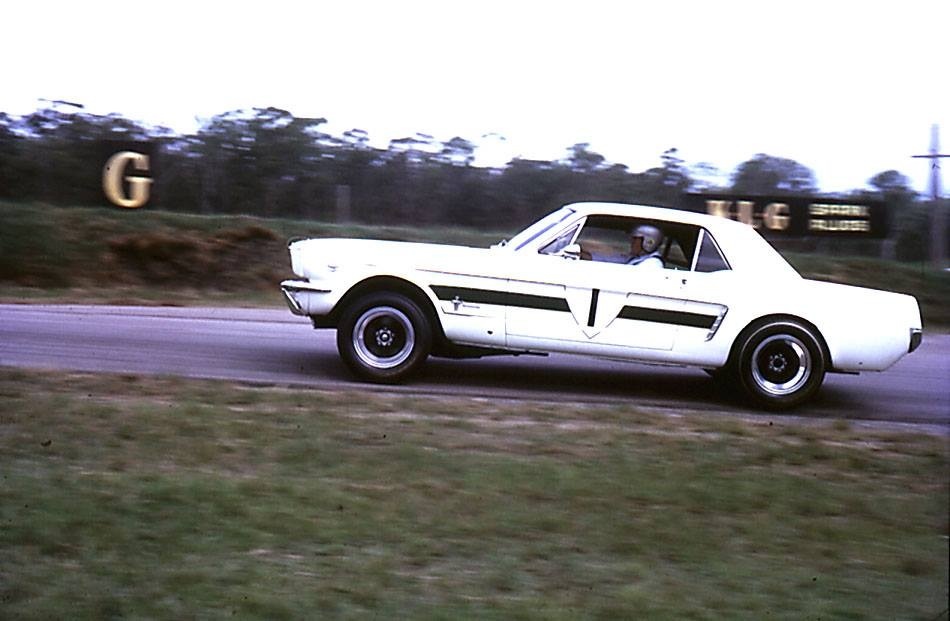
Ross Burbidge says this is the last time Pete Geoghegan ran his first Mustang at Lakeside.
He won the 1967 one-race Australian Touring Car Championship in the Australian, John Sheppard built, Mustang ‘GTA’ back at Lakeside on 30 July 1967 from the Brian Foley and Peter Manton Cooper S’s after various of the other V8’s fell by the wayside with mechanical dramas. The shot above is on the entry to ‘Hungry’ or then KLG corner.
Great Scots: Lakeside 1967, winner Clark Lotus 33 Climax chases Stewart BRM P261 (Tasman Book)
William Byers, oldracephotos.com.au, ‘Tasman Cup’ Tony Loxley and Others, Brier Thomas
References…
Ross Burbidge, oldracingcars.com.au
Tailpiece: Bob Holden, Improved Touring Morris Cooper S…
(W Byers)
Bob Holden won the 1966 Bathurst 500 in a Series Production Cooper S, co-driving the works BMC Australia car with rally-ace Rauno Aaltonen.
In a year of dominance the Cooper S took the first nine placings in the race! This car, not the same machine, is built to Improved Touring rules, the category to which the Australian Touring Car Championship was held at the time- mind you Bob didn’t return that July to contest the title race. He is still racing…
In the background Denny’s Brabham BT22 is being pushed past with perhaps the light coloured car Frank Gardner’s Mildren Racing Brabham BT16 Climax?
Frank Matich, Brabham BT7A Climax tries to outbrake Bib Stillwell #6, Brabham BT4 Climax, December 1963…
Photographer John Ellacott upon posting this shot online described it as ‘the two great rivals on Hume Straight’…Matich braking down the outside on the run into the slow second gear ‘Creek Corner’. Frank’s car was brand new, just unpacked, it had only turned a wheel for the first time several days before the 1 December ‘Hordern Trophy’, the final round of that years Gold Star, the Australian Drivers Championship.
Frank’s car was fitted with 2.5-litre ‘Climax FPF, Bib’s older chassis had an ‘Indy’ 2.7- a fair duel, one guy with the edge in chassis perhaps and one with a bit more power?
Stillwell led from the start of the 34 lap race and then FM began to reel him in, finally catching the Victorian on lap 20, the pair tangling in The Esses. The collision was enough to put Matich out of the race but Stillwell finished fourth, the race was won by John Youl in his Cooper T55 Climax 2.5 from David McKay’s ex-Brabham BT4.
Frank left and Bib – looking very natty is his BRDC blazer – developing his listening and empathy skills by the look of it after the Hordern Trophy. Great rivals with a lot of respect for one another’s abilities (Sports Car World)
In the 1964 Tasman Series which followed the month after this race Youl was the most successful of the locals. Stillwell only contested three Australian races gaining a strong second in the AGP at Sandown whilst Matich was prodigiously fast but had woeful reliability, we shall pick up the Tasman shortly.
I described the rivalry between Frank and Bib in a post about the Stillwell Cooper Monaco;
It’s fair to say Stillwell, born 31 July 1927 took a while to mature as a driver. He started racing MGs in the late 1940s and as his motor dealerships became more successful throughout the 1950s he acquired and raced some expensive, fast cars, D-Type Jag and Maser 250F included. By the time he commenced racing Coopers he had well over 15 years of experience and was ready to take on anybody, winning his first Gold Star in 1962 and the last in 1965, four on the trot.
Matich, born 25 January 1935 was a more precocious talent who first competed in an MG TC at Foley’s Hillclimb circa 1954 and raced seriously from later in the decade after selling his Austin Healey and purchasing the ex-Frank Gardner Jaguar XKC. He soon drove cars for Leaton Motors who employed him as Sales Manager. Bib was more the silver-spoon-special born on the right side of the tracks and funded into his first dealership with family money. Mind you, whatever Bib started with he multiplied many times over, he was an extremely successful businessman in Australia and then became an executive of global calibre inclusive of being President of the Gates Learjet Corporation in the US.
Frank, the young pro, was cut from totally different cloth. He was educated at De La Salle College, Marrickville in Sydney’s inner west and was apprenticed as a 15 year old Diesel Engineer at Sydney’s Kurnell Oil Refinery before progressing through Butlers Air Transport and in 1954 to Selected Sportscars where he first came into contact with the Englishman who owned the MG TC Frank prepared, and both men raced.
FM’s ability and gift of the gab attracted patrons and commercial support from very early on in his career, Matich too was shortly to do well out of the business of motor racing with Australian franchises for Firestone, and later Goodyear racing tyres, and Bell helmets, apart from the sale of some of the Matich sports and F5000 cars he built.
Matich and Stillwell were intensely competitive, driven, successful men, they had far more in common I suspect than not, especially in terms of mindset and will to win. The battles between the pair were absorbing, Matich very quickly got on the pace of the big 2.5 Climax Formula Libre cars (the 2.5 Tasman Formula started in 1964, Australia’s national F1 ANF1 was F Libre till then), having come out of powerful sportscars- Jags C and D Types, Lotus 15, 19, 19B and small bore single seaters, works-Elfin FJ Ford and Elfin Catalina Ford 1.5.
At the time, these 2.5/2.7 litre F Libre/Tasman cars were the fastest road racing cars in the world, F1 having changed from a 2.5 to 1.5 litre formula from 1 January 1961. Given his experience it was not a surprise when Frank was on the pace straight away as he jumped out of his Lotus 19B sporty and into the new Brabham acquired with the French Oil Company, Total’s, support.
Well before the Tasman Series commenced in 1964, we had a strong International Series of races in Australasia in January/February, with enough of the best in the world to test the locals in equal cars Matich was more than a match for any of them. So was Bib on his day.
Matich mounted up and ready for his first test of the naked BT7A, devoid of all signwriting and in civvies at Warwick Farm the week before the Hordern Trophy above. Brian Darby, at the rear, picked the car up from the Port Melbourne wharves the week before, Bruce Richardson is the other mechanic in shot. Note reinforced wide based top front wishbone and rubber mounted ball joint, inverted wishbone at the top and single lower link in the rear suspension. The later BT11A had the opposite rear set up, single top link and inverted lower wishbone (John Ellacott)
Matich was very quick in the Brabham throughout that ’64 Tasman Series and the short period in which he raced the BT7A, its interesting to look back at his time in the car. The late 1963 pre-international events in New Zealand are covered in this article here;
The first 1964 international was at Levin, which Frank missed, at Pukekohe, the NZ GP on 11 January, he ran strongly behind Brabham, McLaren, Tim Mayer and Hulme. He passed Mayer for third only to pop his engine on lap 26, McLaren won the race in a Cooper T70. After Puke he shipped the car home to Australia and re-joined the circus at Sandown on February 9. There he ran ahead of the locals before suffering crown wheel and pinion failure on lap 4.
At the Farm, Matich’s home turf, he started from pole, followed Jack away, then passed him but muffed his braking at Creek and ran off the road. Off to Queensland, at Lakeside, he was driving away from everybody before the engine let go, a Weber ingested a stone and the expensive motor went ka-boom on lap 8. After the long tow to Tasmania he finished third in the race won by Graham Hill’s BT4 and was first of the locals despite a misfire, and a revolution amongst his mechanics who pushed the car onto the grid but left his employ after the race.
Ray Bell wrote that ‘He had a mixed bag of results in shorter races during the middle part of the year, taking a number of outright lap records, then came the Gold Star closing events. Lakeside…pole and the lead before an oil line came adrift; Mallala he didn’t turn up (Stillwell basically could not be beaten for the Gold Star by this stage) and he led the Hordern Trophy till half distance before yet another engine failure’.
The 1965 Tasman Series was won by Jim Clark’s Lotus 32B Climax. Despite not contesting the four Kiwi rounds Matich was right on the pace at Warwick Farm, the first Australian round, starting from pole and leading to Creek corner, he then raced with Brabham behind Hill and Clark up front. ‘Both Hill and Matich had troubles in this race with cement dust getting into the steering, Hill spinning on the last lap because of it and failing to finish. Matich was third behind Clark and Brabham’s BT11A, Stillwell (BT11A) was thirty seconds behind him’ wrote Bell.
Matich in his semi-nude BT7A in the hot 1964 Lakeside summer sun, puddle notwithstanding! He is trying to stay cool in the searing Queensland heat, lower side panels removed. Shot shows the proximity of the aluminium side fuel tanks containing lots of Avgas, no rubber bag tanks prior to circa 1970 (Peter Mellor)
Down south at Sandown he ran just behind the internationals ahead of Stillwell only to retire with ignition failure, a rotor button on lap 10. During the AGP at Longford he pitted with suspension problems on lap 5 whilst best of the locals having run in sixth place. At Lakeside he contested the non-championship Lakeside 99 and made it a real race dicing with Clark on this high speed, demanding circuit for most of the race. ‘They traded places many times, but Matich did have a pitstop and lost some laps before rejoining the battle’. It was a race FM rated as one of his best.
Into the domestic season Stillwell won the Victorian Road Racing Championship Gold Star round in April after a couple of Matich spins, albeit FM was second despite a failing engine, and started from pole a half-second clear of Bib.
That was all the racing he did in that car. At Lakeside’s Gold Star round in late July, he crashed his Lotus 19B Climax, he took the sportscar to the meeting to test it in advance of the Australian Tourist Trophy which was held at the circuit later in the year, was burned and hospitalised and in the aftermath Total took the decision to cease their racing program and sold the cars and parts.
The story of the next phase of Frank Matich’s career in sportscars, initially with the Elfin 400 aka ‘Traco Olds’ is told in links within this article.
Frank Matich was one of Australia’s many F1 mighta-beens, to me the most likely to succeed of all, but with a young family and business ties in Oz it never happened despite offers being made to him on more than one occasion to go to Europe. As noted, Matich didn’t race single seaters for long at this stage of his career, from 1963 to 1965, racing sports cars very successfully until 1969 when he came back to open wheelers with the advent of F5000 – where he was a star as both a driver and constructor. Click here for an article on this phase of his career;
It’s a shame he didn’t drive Tasman 2.5 cars throughout this golden-era of single-seater racing in Australasia, his battles against the internationals as well as the local hotshots in both Tasman races and domestic Gold Star competition would have been sensational. Matich mixing it with Bartlett, Martin, Geoghegan, Harvey and the rest would have added depth to Gold Star fields which were increasingly skinny as the decade wore on.
Stillwell retired at the end of 1965, he was certainly as quick as anybody on his day and arguably had not quite peaked when he did retire. No less an observer of the local scene than journalist/racer/Scuderia Veloce owner David Mckay believed that by 1965 Stillwell had reached F1 standard, not least for his ability to drive fast without mistakes or destroy the equipment.
Intercontinental Brabhams at Longford, AGP 1965. Stillwell’s dark blue #6 BT11A (6th), Matich BT7A (DNF) and Frank Gardner in Alec Mildrens yellow BT11A (eighth), the race won by Bruce McLarens’ Cooper T79 from Brabhams’ BT11A (Kevin Drage)
The Intercontinental Brabhams…
The first of the Intercontinental Brabhams. Jack in BT4 ‘IC-1-62’ on its debut at the Australian Grand Prix, Caversham, WA on 18 November 1962. He retired after colliding with another car whilst lapping him, Bruce McLaren won in a Cooper T62 Climax (Milton McCutcheon)
When Jack started his climb to the top in Europe he returned and raced in Australia each summer, bringing a Cooper with him and racing it successfully, then selling the car to one of the locals before returning to Europe. It was a nice little earner and helped fund his way in Europe as he fought to gain a toehold in international competition.
Cooper sold a lot of cars in Australia, Jacks business brain was as sharp as his cockpit skills so it was natural that some of the earliest Brabham production racing cars were for Australasian Formula Libre and from 1964, the 2.5 Tasman Formula- which in effect meant cars built for Coventry Climax FPF ex-F1 engines- 2.5 litres but increasingly 2.7’s after Jacks successful Indy 500 run in 1961 in the Cooper T54 with its 2751cc FPF engine. The Tasman Formula mandated 2.5’s of course.
Soon Repco were making Climax parts and eventually building the engines in totality under licence in Australia. The bits were plentiful which was just as well as the level of competition was such that the long stroke donks were being pushed well beyond their limits with spectacular blow-ups fairly common.
Bib Stillwell in his BT4 Climax ‘Lakeside International’ 1963, 2.7 FPF powered. 3rd in the race won by John Surtees Lola Mk4A Climax 2.7 (Bruce Wells/The Roaring Season)
The first Intercontinental Brabham, i use that descriptor as that was the chassis prefix for each car (‘IC’), the design intended for the shortlived Intercontinental Formula created in response to the new 1.5 litre F1- was the BT4 based on the first Brabham GP machine, the 1.5 litre Coventry Climax FWMV V8 powered BT3.
The first Brabham, retrospectively referred to as ‘Brabham BT1’, was the MRD, an FJ machine first raced by Gavin Youl with the BT2 an evolution of the MRD/BT1. The Intercontinental cars which followed the BT4 were the BT7A in 1963 and BT11A in 1964, both F1 cars adapted for Climax FPF engines.
Some incredibly talented guys raced the ‘IC’ Brabhams- Internationals such as Brabham, Hulme, Gardner, Hill and Stewart as well as Australian champions including David McKay, Lex Davison, Stillwell, Matich, Spencer Martin, Kevin Bartlett, John Harvey, John McCormack and other drivers in New Zealand and South Africa.
Jack Brabham won Australian Grands’ Prix in a BT4 and BT7A in 1963 and 1964 respectively. The cars won the Australian Drivers Championship, the Gold Star for Stillwell in 1963 and 1964 aboard his BT4, in 1965 with a BT11A and for Spencer Martin, again BT11A mounted in 1966 and 1967.
Graham Hill ahead of Bib Stillwell, BT4 Climaxes, first and fourth. South Pacific Trophy, Longford March 1964 (Rod MacKenzie)Bib Stillwell in his final and successful Gold Star year 1965. BT11A at Warwick Farm. His final year of racing, he had a top year in the car at WF, finishing fourth in the Tasman race albeit behind Matichs’ BT7A in third and first in the Hordern Trophy at the end of the year (John Partridge Collection)
The ‘Brabham IC Australian party’ ended in 1968 when Kevin Bartlett won the Gold Star in BT23D/1, a one off car built for Alec Mildren’s Team around Alfa Romeo Tipo 33 2.5 V8s he secured to add a bit of Italian flavour to the local scene, Mildren was an Alfa Romeo dealer.
The Intercontinental cars were typically fast Tauranac designs of the period. They had rugged spaceframe chassis, suspension by upper and lower wishbones at the front with Armstrong shocks and coil springs. At the rear there was a single upper link, inverted lower wishbone, twin radius rods and coil spring damper units with adjustable sway bars fitted front and rear. With Jack doing all of the initial chassis setup work the cars were quick and chuckable ‘straight out of the box’.
Hewland HD5 gearboxes were used in the main (Colotti in the BT4) and rack and pinion steering completed the package with the cars clad in a slippery fibreglass body.
Bib Stillwell’s Brabham BT4 Lakeside February 1963. 2.7 litre Indy 2751cc Coventry Climax FPF engine, 58mm Webers, Colotti T32 five-speed ‘box. Rear of the spaceframe chassis apparent. Suspension- inverted upper wishbone, single lower link and twin radius rods for location, coil spring damper units, no rear roll bar here. Stillwell’s cars famously immaculate in preparation and presentation (Peter Mellor/The Roaring Season)
After Repco’s 2.5 litre Tasman V8 engine made its debut in BT19, Jacks victorious 1966 F1 winning chassis, in 1966 the Tasman Brabhams were variants of the BT23 frame (BT23A and BT23E) with the exception of the very last BT31 for the 1969 series. See Rodway Wolfe’s article about BT31 which he owned for many years; https://primotipo.com/?s=brabham+bt31
Once the 1.5 litre F1 ended in 1965 BRM quickly realised a stretched variant of their P56 V8 in a P261 chassis would be a Tasman winner and ‘their endeth the locals’ in Climax engined cars taking on the Internationals similarly mounted on more or less equal terms.
The Repco Tasman V8’s provided a supply of competitive customer engines for locals so the Tasman Formula continued into 1970 with engines capable of matching the internationals when the ever expanding F1 season and more restrictive driver contracts made eight weeks in January/February in Australasia no longer a proposition for the best in the world. With it went a wonderful decade or so of intense but sporting summer global competition in our backyard.
Those Intercontinental Brabhams were gems though and gave both the international aces and local hot-shots very effective tools with which to strut their stuff, not least Messrs Stillwell and Matich…
The Matich BT7A being pushed onto the Tasman grid, Longford 1964. Steering is Graham Matich, looking down at the rear is Geoff Smedley. Matich finished third, just in front of Stillwell, Graham Hill won the race in a BT4 (oldracephotos.com)
Tailpiece: Wanna buy a car matey, or a plane?…
Stillwell and Brabham, rivals and friends in the Longford paddock 1965. They are sitting on Bibs’ Bedford truck, BT11A up above…I doubt Jack sold anyone more cars over the years than he did Bib?! Bib put them to very good use mind you (Kevin Drage)
As nice a posed portrait of Jack and his BT11A ‘IC-5-64’ as you will ever see. The combination are in the old Sandown pitlane in February 1965 before he went out and won the Sandown Cup from Jim Clark, Lotus 32B and Phil Hill, Cooper T70, all Coventry Climax 2.5 FPF powered of course.
Etcetera…
Matich in his BT7A contesting the ‘Hordern Trophy’ at Warwick Farm in 1964. DNF in the race won by Leo Geoghegan in a Lotus 32 Ford 1.5, a great win for Leo, he and his brother Sydney Lotus dealers, Leo graduated to the ex-Clark Lotus 39 Climax at the end of the 1966 Tasman series (John Ellacott)The Matich BT7A sitting in the Longford paddock in 1965. DNF with suspension failure in the race won by McLarens’ Cooper T79 Climax. Rear suspension by this stage to BT11A spec (Kevin Drage)Front page spread in ‘Australian Motor Sports’, no advertising allowed on racing cars in Australia in those days but the colors on the nose of Franks’ Brabham (Leo Geoghegan’s Lotus alongside) are those of ‘Total’ the French oil company who were prominent in Australia at the time, the spread no doubt a ‘cross promotion’ as the modern marketers would call it!Racing Car News and Stillwell’s Gold Star win in 1964. Brabham BT4 Climax.
Photo and Other Credits…
John Ellacott, Milton McCutcheon, The Roaring Season/Peter Mellor/Bruce Wells, Kevin Drage, Rod MacKenzie, The Nostalgia Forum, Australian Motor Sports, Racing Car News, Peter Stephenson
theroaringseason.com, oldracephotos.com, Ray Bell on The Nostalgia Forum
Tailpiece: Matich, Brabham BT7A, and Graham Hill, red BT11A and Clark, Lotus 32B, Warwick Farm 100 1965…














 primotipo...