Posts Tagged ‘Cooper T20 Bristol’

(I Arnold)

Easter 1955…

Reg Hunt working his Maserati A6GCM-250 hard at the Bathurst Easter meeting in 1955.

He won the 26 lap Bathurst 100 feature from Ern Seeliger aboard Stan Jones’ ex-Jack Brabham Cooper T23 Bristol and Lex Davison’s HWM Jaguar, below.
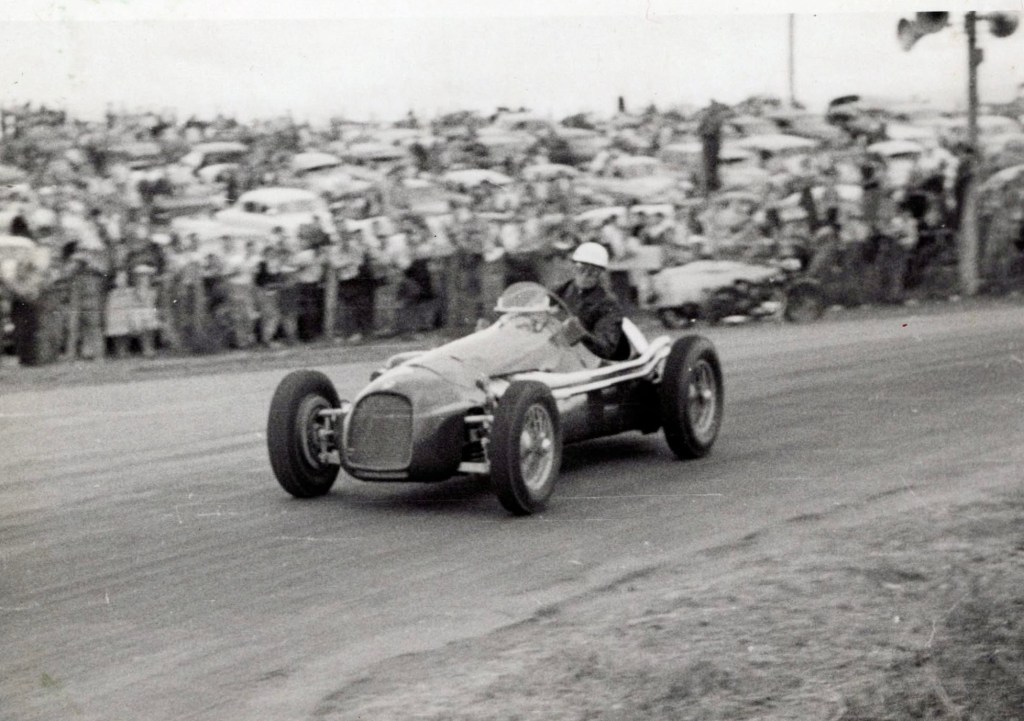
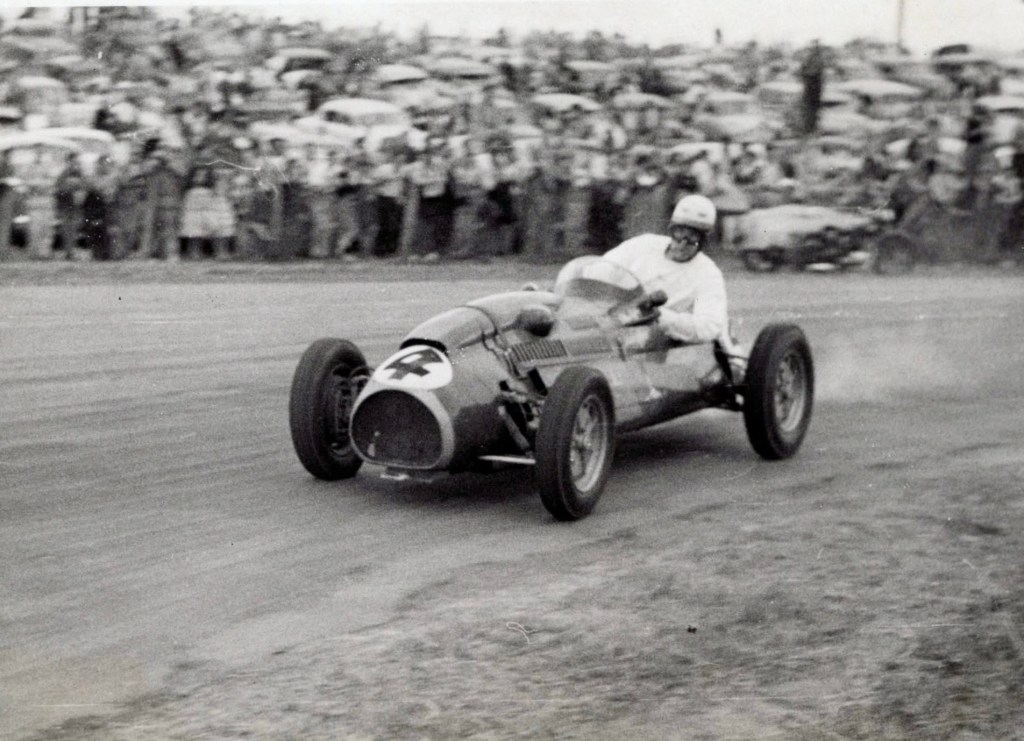
(I Arnold)
(I Arnold)

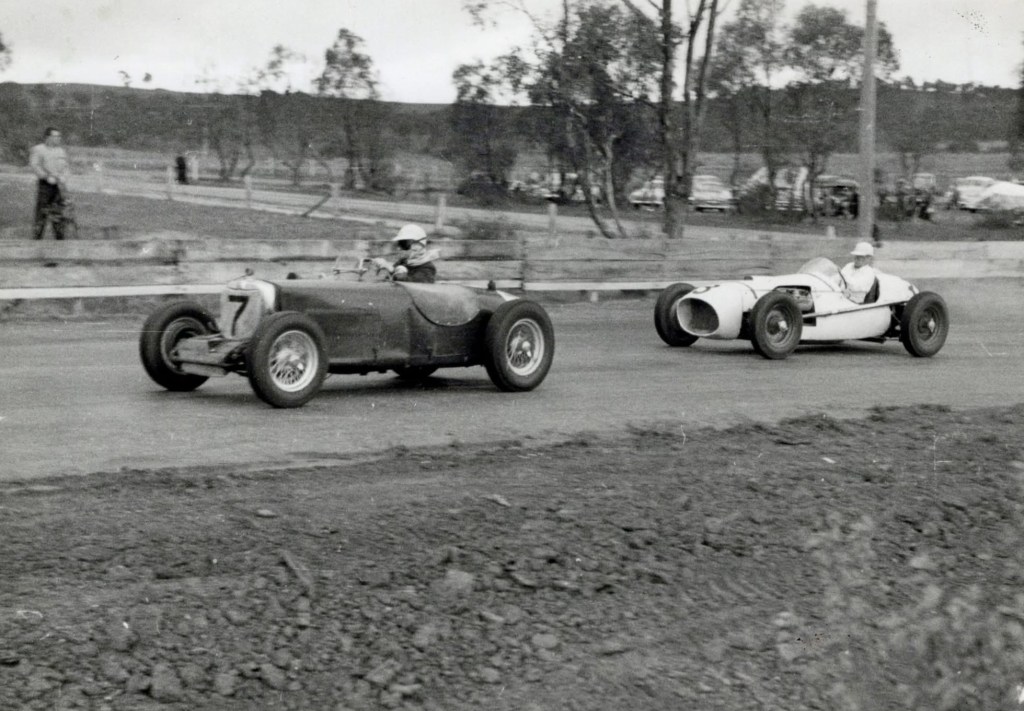
Clive Adams’ drove Stan Coffey’s Cooper T20 Bristol skilfully but lost an early joust for third place with Davison, spinning at Forrest’s Elbow on the run down the mountain.

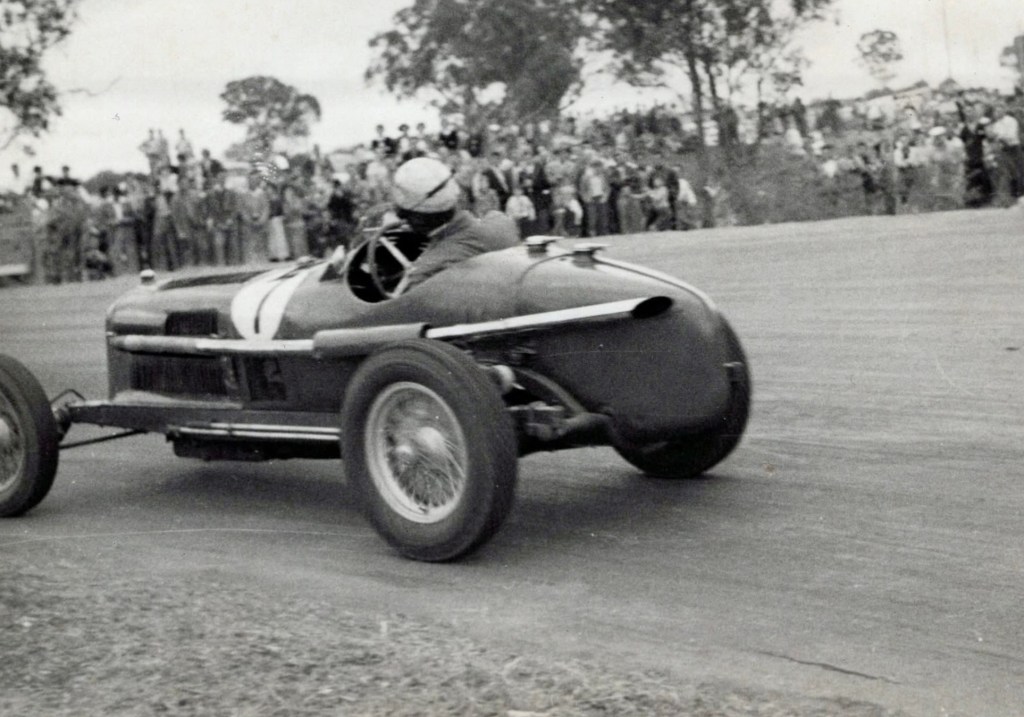
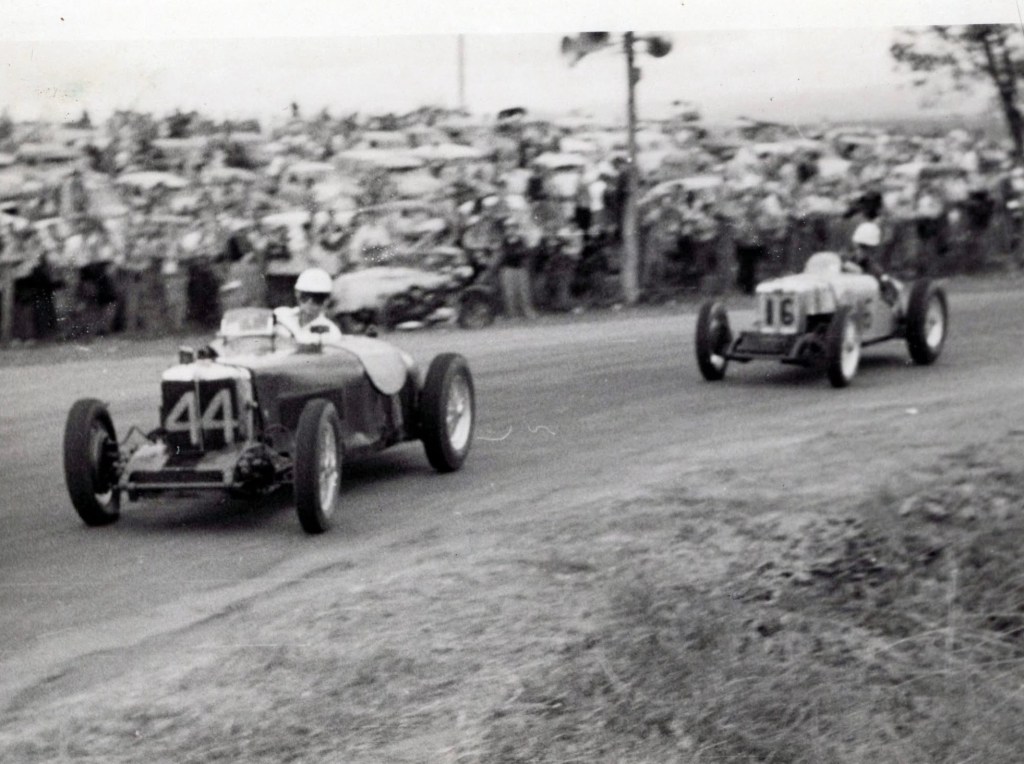
By 1955 the ex-Jack Saywell Alfa Romeo P3 had passed through the hands of Julian Barrett and Bill Murray and was powered by an Alvis engine. Sold by Murray to Gordon Greig, the car was involved in a terrible accident after Greig pitted, feeling sick, on lap 16.
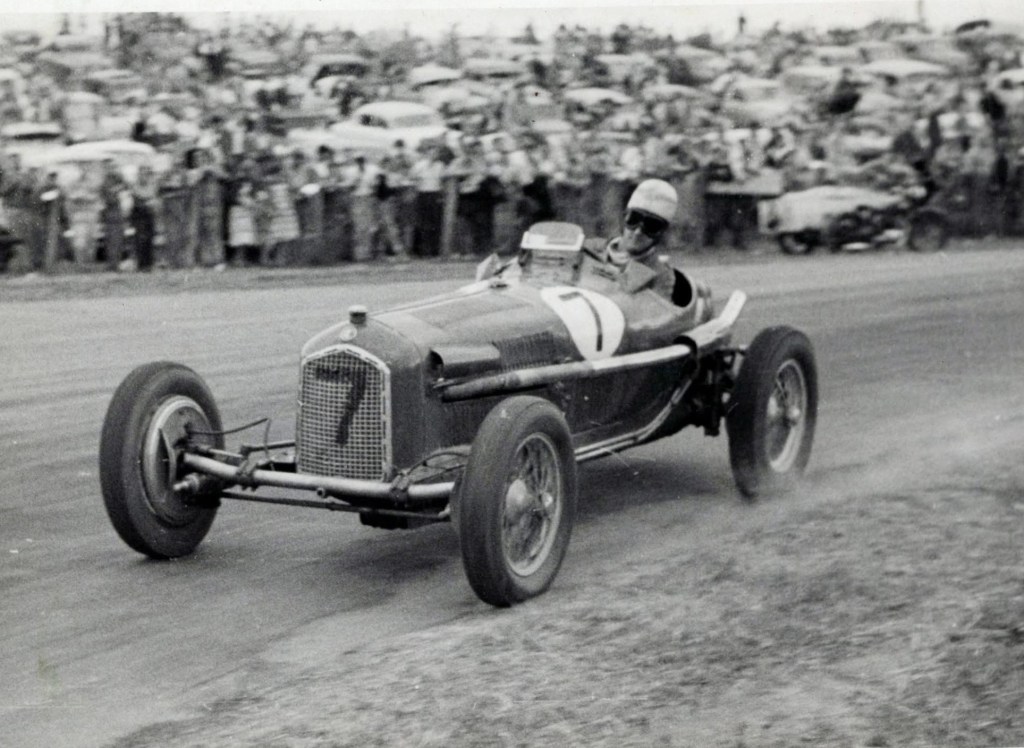
Gordon Greig, Alfa Romeo P3 Alvis at Hell corner above, and below, before the disaster (I Arnold)

Tony Bourke, one of Greig’s crew, jumped aboard to finish the race and promptly lost control of the car over Conrod’s final hump, spun and went backwards off the track through the crowd killing one, mortally wounding another and injuring 20. Bourke stepped from the car unhurt and was later treated for shock.

Changes were were made to eliminate spectators from this area after the Coroner’s Inquest and public and press reaction. Bourke died after a Midget crash at Westmead Speedway in 1965.
(I Arnold)
(I Arnold)

Col James MG Spl s/c and Ray Fowler, MG Spl, negotiate Hell Corner in the Group B Racing Car Scratch. They were third and fourth in this 3 lapper won by Stan Jones’ Cooper 1100.
(I Arnold)

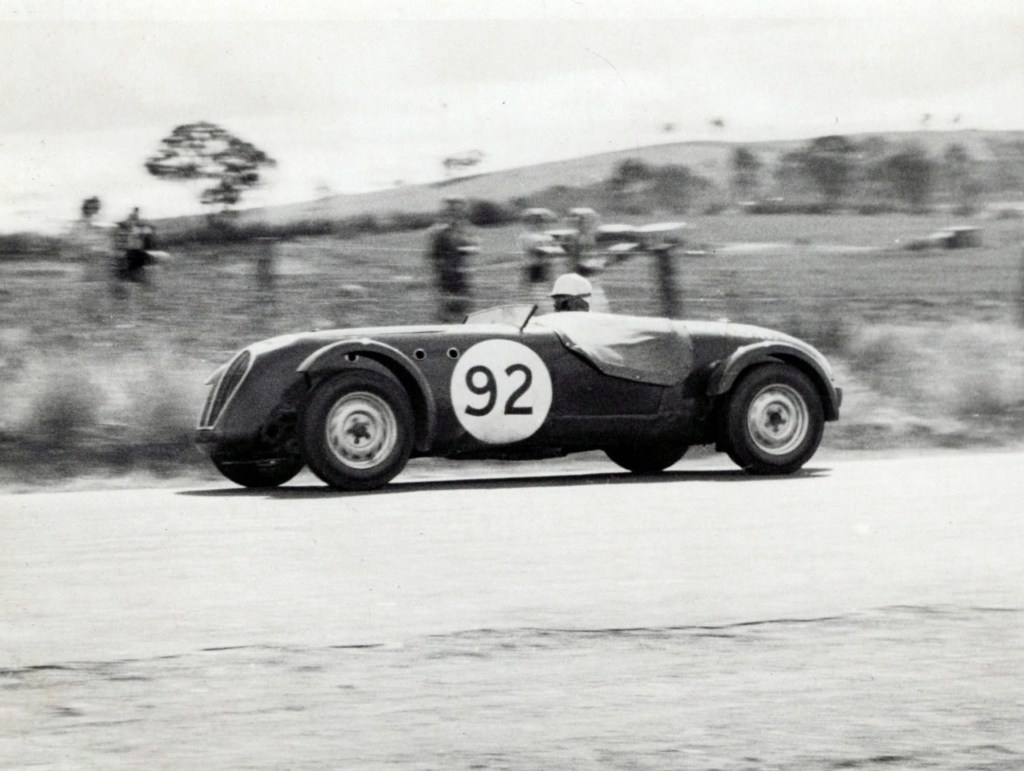
Tom Jordan’s 1949 2.5-litre Riley engined Healey Silverstone (above) ‘was raced as a factory entry by Tony Rolt in the UK in 1949, then raced by Charles Mortimer in 1950 – he wrote a book about it, Racing a Sports Car – and was then returned to the factory, bought by Queenslander Colin Leagh Murray and raced and hillclimbed by him in Queensland before being sold to Jordan who had many successes with the car,’ wrote John Medley.

Etcetera…
(I Arnold)

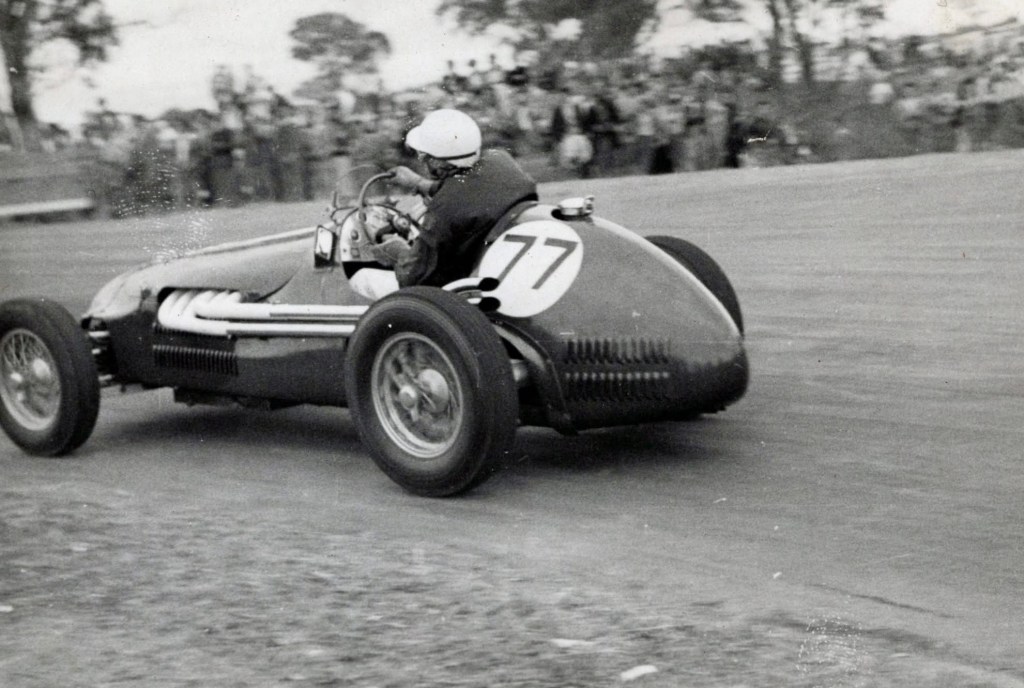
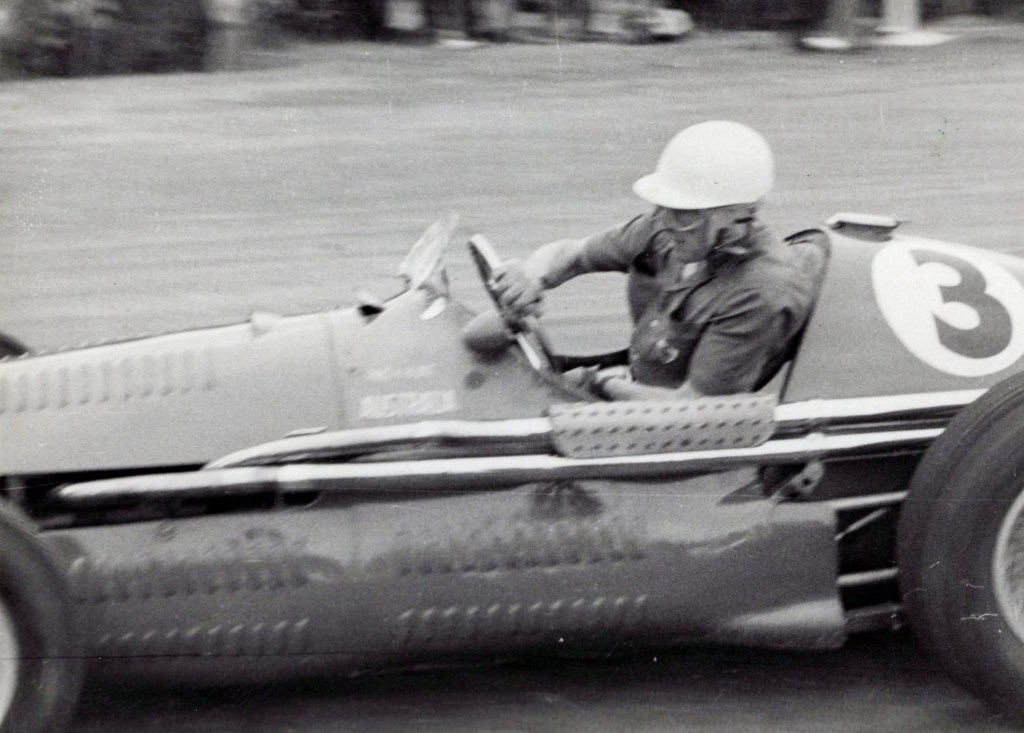
It’s doubtful that Lex would have listed the HWM Jaguar – an ex-Moss HWM Alta 2-litre F2 chassis – amongst his favourite cars but he and his team coaxed enough speed and reliability out of the C-Type Jaguar powered jigger to win the 1954 AGP at Southport, aided and abetted by the breakage of a chassis weld on Maybach 2 when Stan Jones seemingly had the race ‘in the bag’.

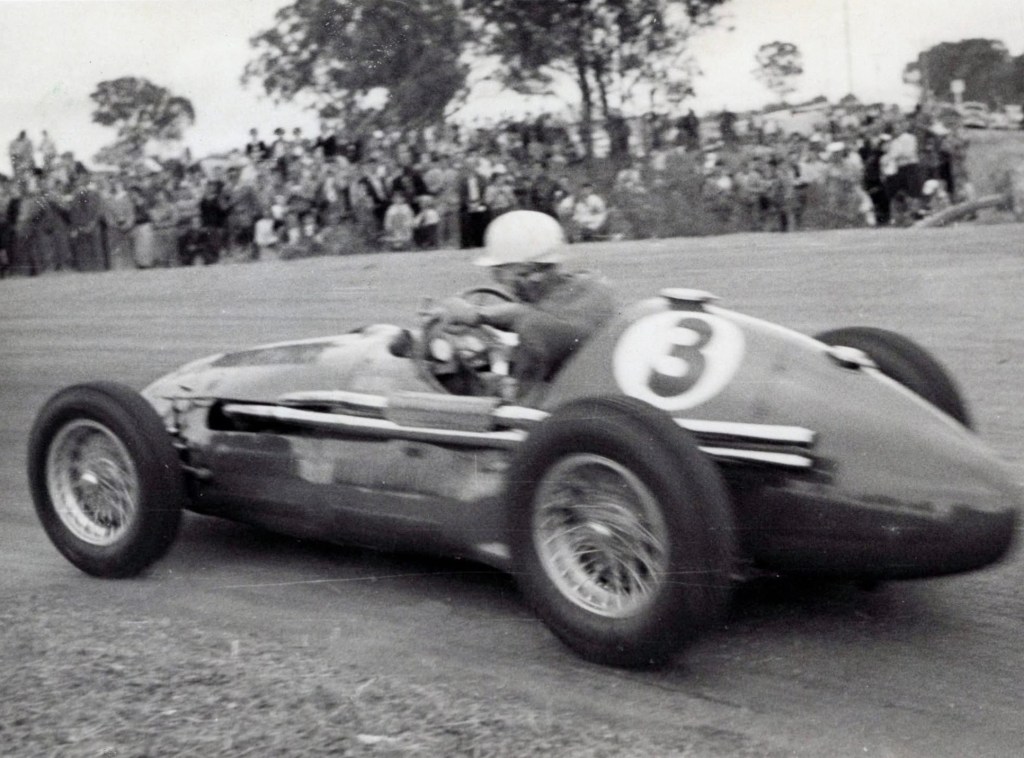
By 1955 the HWM Jag was off the ultimate pace, Hunt had reset the local bar with his Maserati and Lex would meet the challenge in early 1956 with the purchase of Tony Gaze’ Ferrari 500/625 3-litre.
(I Arnold)

October 1955…

(I Arnold)

C James MG Spl S/c from Ted Gray, Tornado Ford, Hell corner, during the 3 lap Group A Racing Car Scratch.

On the last lap Tiger Ted lost the new car coming down the mountain near Griffin’s destroying it and hospitalising himself for months. Tornado 2 Ford would emerge in due course and Tornado 2 Chev became the fastest car in the country by later 1957, read here: https://primotipo.com/2015/11/27/the-longford-trophy-1958-the-tornados-ted-gray/
(I Arnold)

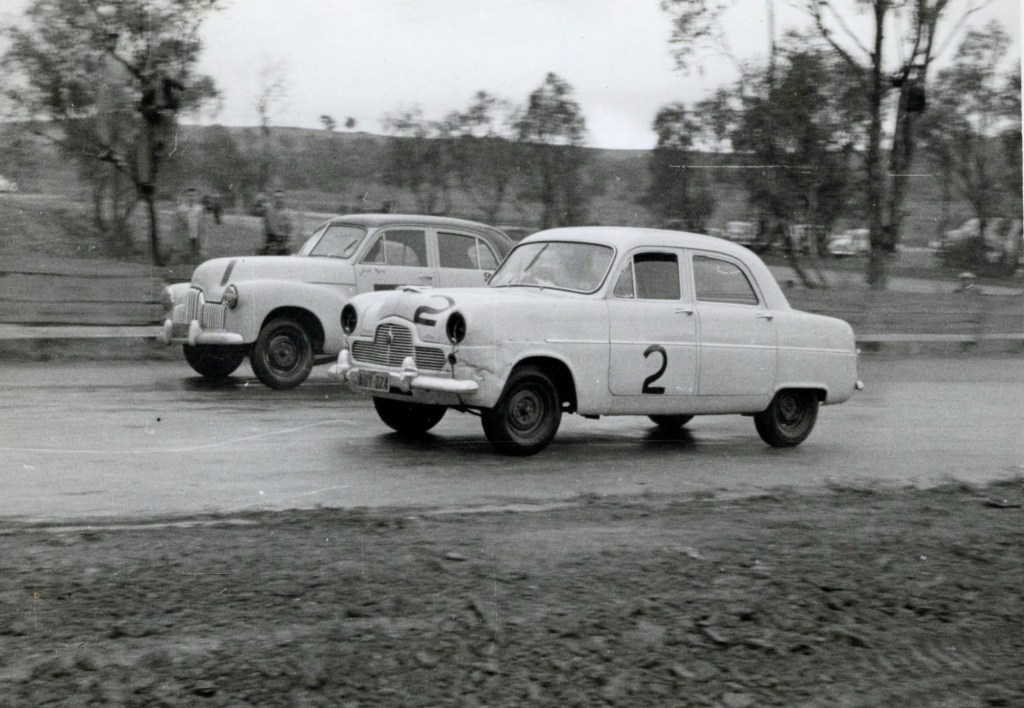
Touring car racing was steadily gaining in popularity with Jack Myers easily winning the sedan car handicap in his well developed, black-roofed, yellow Holden 48-215. ‘Holden wonder-man of the mid-1950s’ as John Medley described him. Here he is alongside George Pearse’s Ford Zephyr. See here for more on Jack: https://primotipo.com/2024/05/02/jumpin-jack-myers/
(I Arnold)

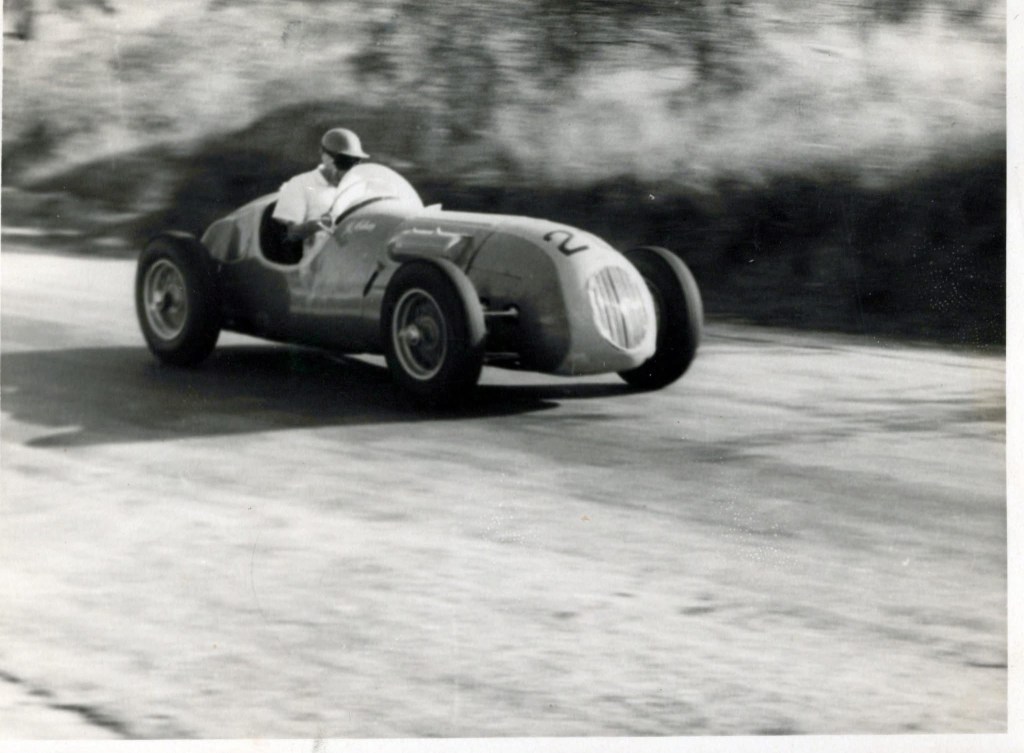
Jack Robinson’s Jaguar XK120 Special.
(I Arnold)

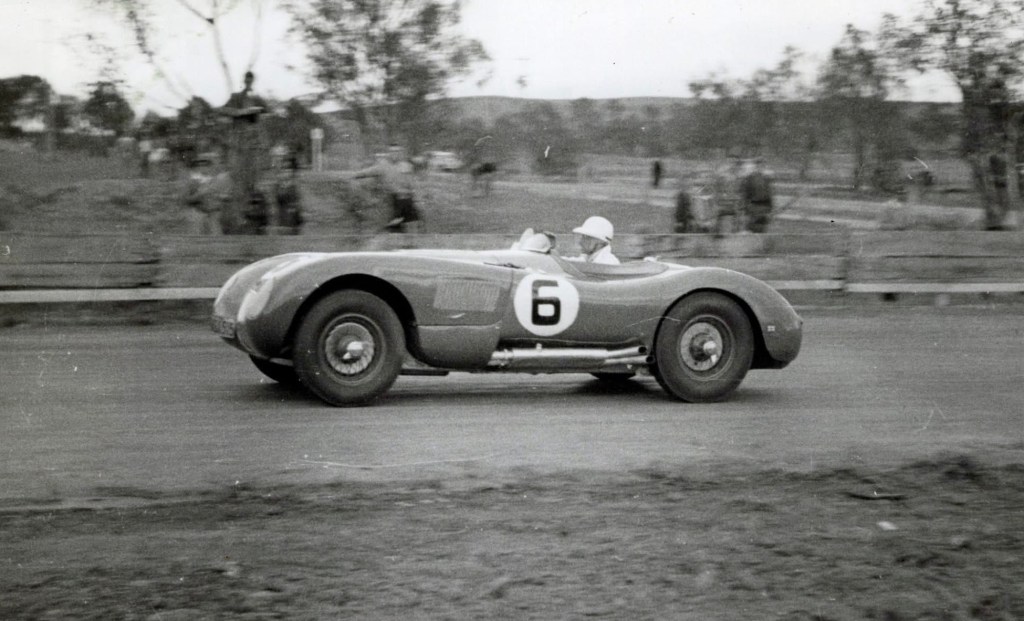
Dr John Boorman on the rise out of Hell corner on his way up Mountain Straight, ‘off scratch in the 6 lap Sports Car Handicap made no impression at all on Shmith’s new Austin Healey 100S which did 124mph through the timed quarter while Boorman did 125,’ Medley wrote. More about this car here: https://primotipo.com/2014/08/05/gnoo-who-gnoo-blas-circuit-jaguar-xkc-type-xkc037/

Postscript: Easter Bathurst tragedy…

After publishing this article, journalist/historian Ray Bell emailed me excerpts from ’emails I sent to the sister of Gavin Larnach’, one of the Bathurst accident victims.

1. That this whole thing is surrounded by lies and cover-ups is simply disgraceful. One can readily understand Mark’s state of mind and applaud him on his pursuit of the facts.

One such fact is that this car was very unstable after it had the very heavy Alvis engine installed. Ray Wamsley told me this, he was the next owner of the car, and he said it was absolutely transformed when he fitted a GMC truck engine after the Alvis unit failed. 

2. I’ve subsequently spoken a journalist of the time, about the cover-ups. He told me that he always understood it was the local member who pushed for the hushing of everything with a view to ensuring that the racing wasn’t shut down. The local member was Gus Kelly, who was a Cabinet member with some influence and had been the local member for many years, so that makes sense.

Two factors come into play here. In 1946 there was difficulty getting the racing off the ground because of police resistance. Additionally, a driver and a spectator had been killed at the Gnoo Blas race meeting in January, 1955. The fear throughout the two organising clubs would have been quite pronounced and it was just eighteen months later that the whole of motor racing in NSW had to comply with the new Speedways Act, which introduced standards for safety fencing etc.

3. What is really bugging me is John Medley’s comment that someone who gave evidence wasn’t actually in the country when the crash occurred. Not so consequential if he was just giving evidence about something technical, but still it appears from John’s comment that it might matter.

Credits…

Ian Arnold photographs via his son Mark Arnold

Finito…
image

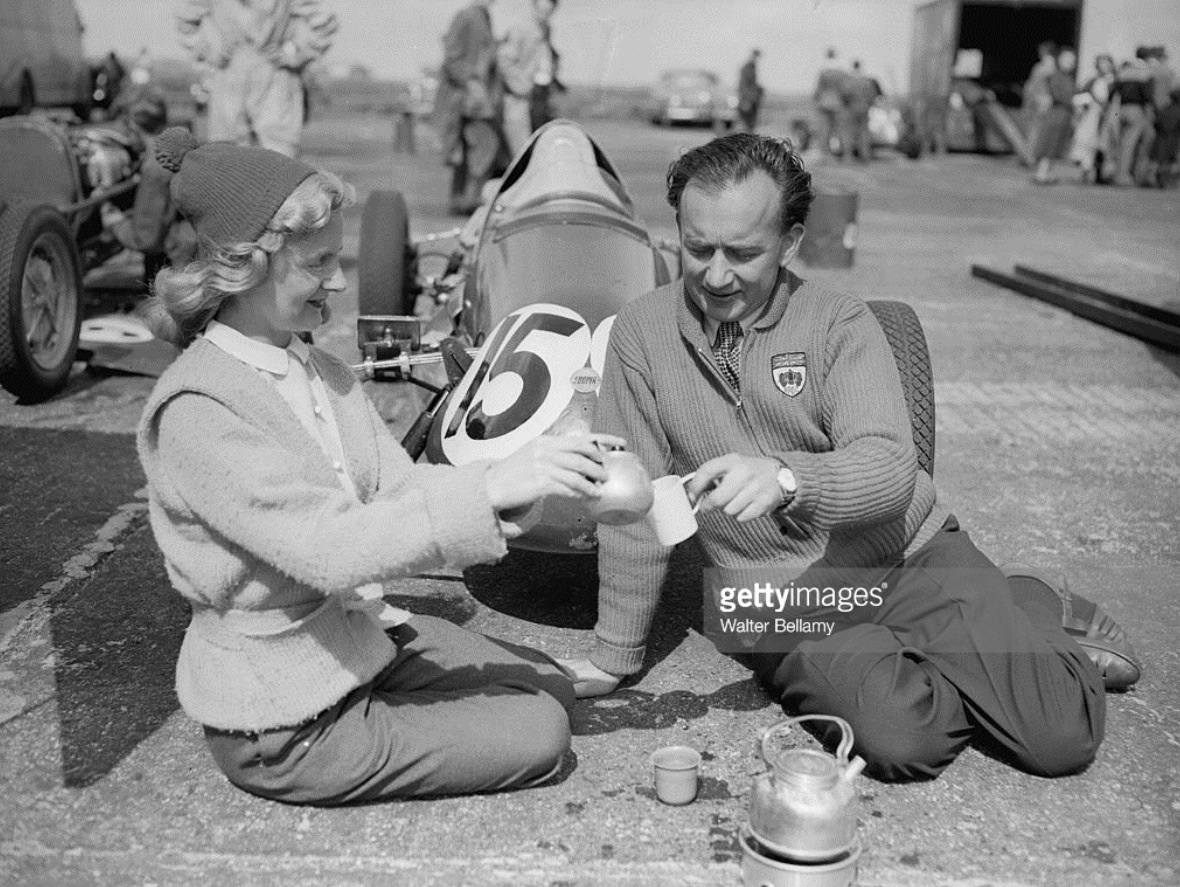
F3/500cc ace Eric Brandon gets some sustenenace with some assistance from his wife Sheila before no doubt scoring another win on 18 July 1953…

Click here for an interesting article on this very talented driver; http://500race.org/people/eric-brandon/

image (GP Library)

Coopers galore! Alan Brown, Eric Brandon, Juan Fangio and Mike Hawthorn in F2 Cooper T20 Bristols before the Lavant Cup, Easter Monday 14 April 1952. This race was one of a series of performances which vaulted Hawthorn into a GP Ferrari seat in 1953.

Hawthorn won the six-lapper from Brown and Brandon and set the fastest lap.

Equally impressive was Hawthorn’s second place behind Froilan Gonzalez’ Ferrari 375 in the Formula Libre Richmond Trophy. Duncan Hamilton placed third in a Talbot Lago T26C.

And Fangio? I have one report that says the great man raced John Cooper’s Cooper T20 to a misfiring sixth place but he doesn’t appear at all in the results for the Lavanat Cup and Richmond Trophy I have. John Cooper offer the ride after Alfa Romeo failed to appear. Happy to take your advice on this one.

Credit…

Walter Bellamy, GP Library

Finito…

hawt goodwood

One of the better known photographs in motor racing is Louis Klemantaski’s shot of Mike Hawthorn’s Cooper T20 Bristol attacking the apex of Fordwater at Goodwood in 1952…

The Klemantaski Collection archive describe the photograph thus; Hawthorn is obviously really on the absolute limit with this Cooper-Bristol. And of course he is aiming right for Klemantaski who had positioned himself at the edge of the track exactly at the apex of the very fast Fordwater corner on the back of the Goodwood circuit. What a dynamic image!

This race was the ‘Sussex International Trophy’ for Formula Libre racing cars on June 2, 1952. Hawthorn won, perhaps somewhat aided by his father Leslie’s long experience with nitromethane. It was Hawthorn’s third outing with a friend’s Cooper-Bristol.

On April 14th at Goodwood he came up against Juan Manuel Fangio, driving another Cooper, and won against the already famous Argentinian driver. Hawthorn won two races with the Cooper that weekend and finished second in the final race of the day to Froilán González in Tony Vandervell’s Thinwall Special Ferrari GP car.

More out of the car than in it! Cooper T20 Bristol, Belgian GP at Spa in June 1952 (M Tee)
At Silverstone a month later at the British GP in July 1952 (M Tee)
image
1953 French GP Reims July 1953. Mike Hawthorn’s Ferrari 500 and Juan Fangio’s #18 Maserati A6GCM flat out, grinning at one another, Mike won by a second after 300 miles of racing (Getty)

Then Hawthorn entered the Daily Express International Trophy on May 10th with the same Cooper-Bristol to win the first heat, but finished several laps down in the final due to gearshift problems.

His excellent showing with the Cooper at the Belgian Grand Prix at Spa-Francorchamps where he was fourth, and at the subsequent British Grand Prix finishing third, led to an offer from Ferrari for 1953- and an eventual World Championship aboard the Ferrari Dino 246 in 1958.

‘Hawthorn died in a road crash in January 1959 after retiring from racing at the end of his Championship year, is remembered by his own book Challenge Me the Race and Champion Year and in several biographies, including Mon Ami Mate and Golden Boy.

Mike Hawthorn’s grave is in Farnham, Surrey where he is still well remembered and where he and his father had run the Tourist Trophy Garage for many years’, the Klemantaski Collection wrote.

Cooper T20 Bristol cutaway by Vic Berris

Articles on the Cooper Bristol T20/23…

Stirling Moss and Jack Myers: Cumberland Park Speedway, Sydney: Cooper T20 / WM Holden 1956…

Credits…

Louis Klemantaski, Raymond Groves, Vic Berris, M Tee- MotorSport Images. Check out The Klemantaski Collection;  https://klemcoll.wordpress.com/about/

Tailpiece…

hawt funny
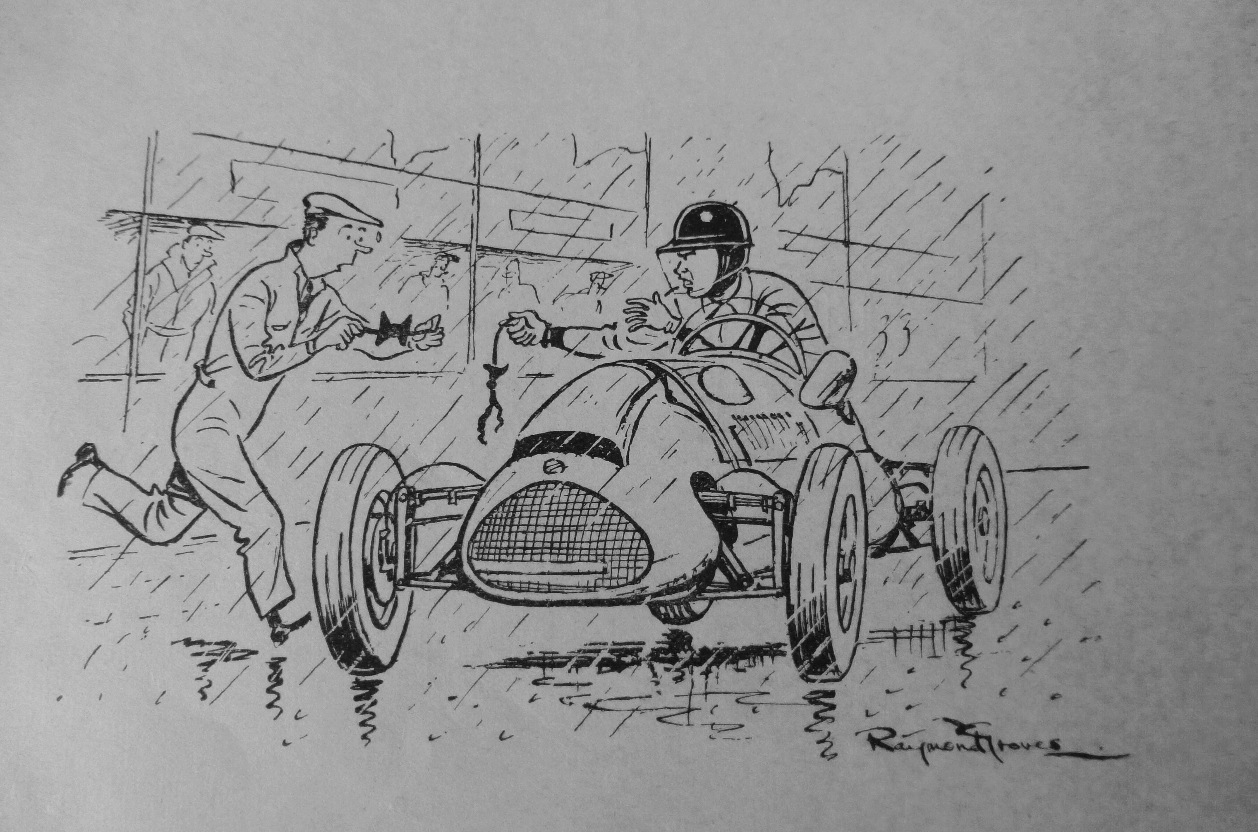
(Raymond Groves)

The tie dear boy, the tie…

Finito…

image

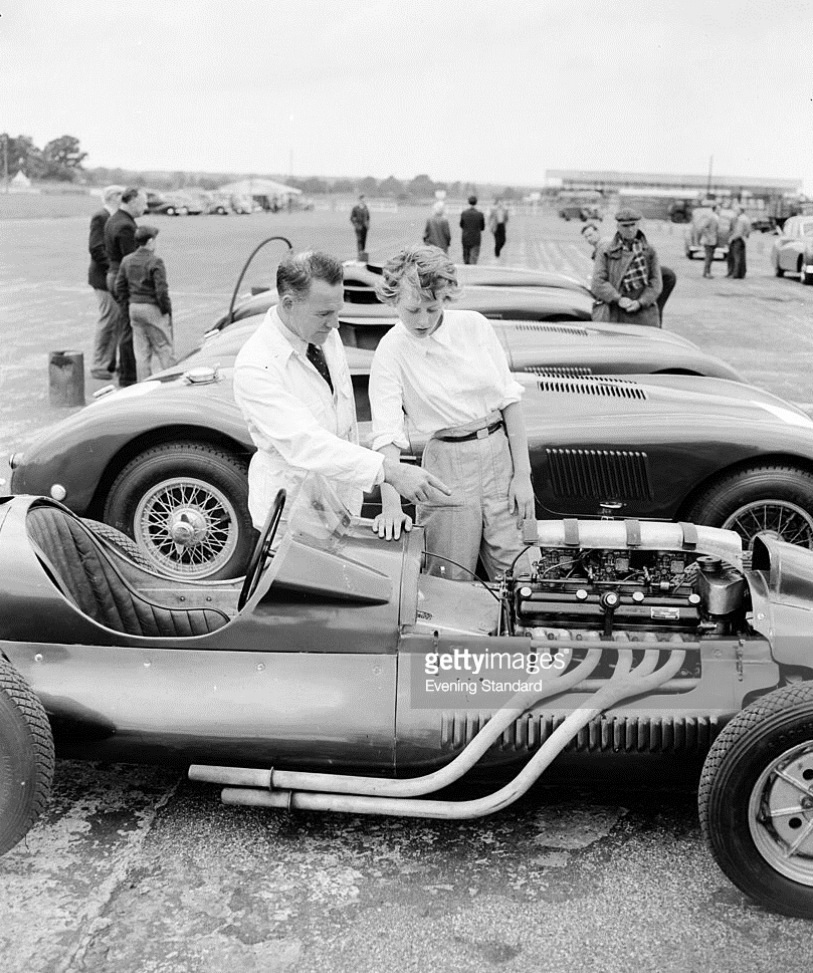
Wilkie Wilkinson points out the finer points of the Bristol 2 litre six to Marion Skevington at Silverstone, the photo is dated 1 January 1953…

‘twould be interesting to know the Cooper T20’s chassis number, driver and meeting date. Is that a lineup of ‘factory’ C Types behind?, Wilkinson was a works Jag mechanic amongst a varied career with BRM and others.

It looks like one of those ‘advertorial’ shots newspapers plonk on page 3 to help get bums on seats come raceday.

Credit…

Evening Standard

coops

(Getty)

One tends to sometimes forget that British Entrepreneur, Engineer, Team Owner John Cooper was also a driver and the birth of Cooper as a marque is a function of his need for a racer…

The great Brit is piloting his works Cooper T20 Bristol F2, the caption for the photo says in the ‘IV Daily Express International Trophy’ race at Goodwood on Whit Monday, 10 May 1952′. In fact JC was entered for that meeting/race at Silverstone on that day as #14 but did not arrive, so ‘praps this is a practice shot.

Before focusing on the construction and sales of his cars and managing the team he was a very capable driver taking many 500cc wins, a class for which the first Cooper, famously constructed of two Fiat 500’s welded together to provide an independently suspended car, was built.

image

Cooper 500 Drivers L>R in this 1948 photo; John Cooper, George Saunders, Charles Cooper, the shot credits Chas as the cars designer and Stirling Moss. ‘New midget racing cars made by Charles Cooper at his Surbiton, Surrey garage’ is the caption (Popperfoto)

The front-engined Cooper Bristols Types 20 and 23 ‘launched’ the successful careers of Mike Hawthorn and Jack Brabham amongst many others, i wrote an article about them, click here for the link; https://primotipo.com/2015/02/10/stirling-moss-cumberland-park-speedway-sydney-cooper-t20-wm-holden-1956/

I started to research an article to write on John Cooper’s career and influence and came upon the obituary published by Britain’s ‘The Telegraph’ on 27 December 2000, it seems to me it covers things rather well so here it is, truncated slightly and with my photographic additions…

image

JC at left, having already done a few laps, slightly quizzical supervises Ken Wharton’s test of a Cooper T23 Bristol at Goodwood in 1953. What a ripper period scene, love the casual dude in suit pants, vest, tie and fag! (Popperfoto)

‘John Cooper, who has died aged 77, was one of the great figures in the history of motor racing; his Cooper-Climax cars were the force behind Jack Brabham’s dominance of the drivers’ championship in the early 1960s, while his Mini Cooper was destined to become a symbol of the decade itself.

Cooper and his small design team at Cooper Cars first came up with a rear-engined sports car in 1955. Based around a Coventry Climax firepump engine, the “Bobtail” Cooper-Climax was without peer in its class. By narrowing the chassis and fitting slender bodywork which left suspension and wheels exposed, Cooper then created a rear-engined Formula Two car which could easily be upgraded to meet the demands of Formula One.

image

Jack Brabhams Cooper T40 Bristol ‘Bobtail’ on the way to a lucky Australian Grand Prix win at Port Wakefield, South Australia in 1955 (unattributed)

By 1957, the Australian Jack Brabham had joined Coopers, and a 2-litre version of the Formula Two car was entered for the Monaco Grand Prix. Brabham pushed it home in sixth, having been third. On twisting circuits, the nimble rear-engined Cooper could challenge the comparatively flat-footed Ferraris’, Maseratis’ and Vanwalls’ which traditionally competed for places on the podium.

image

Stirling Moss on his way to the first mid-engined car F1 win, Cooper T43 Climax 1.9, Argentine GP 19 January 1958 (Getty)

The next year, in the Argentine Grand Prix, Stirling Moss drove a Cooper to a first world championship victory by the rear-engined car, and at Monaco another Cooper won, this time driven by Maurice Trintignant.

image

Moss, Argentina 1960, Moss giving away more than 500cc to his competitors, the Coventry Climax FPF 1.9 litres (Getty)

The persuasive Cooper then managed to talk Coventry Climax into building full-sized 2.5 litre engines for his works’ drivers – Brabham and Bruce McLaren – and under his direction Coopers promptly won both the 1959 and 1960 Formula One constructors’ titles, while Brabham took two consecutive world champion drivers’ titles. By 1962 every Formula One marque had put their engines where Cooper had his – behind the driver.

cooper

John Cooper aboard the Cooper T49 ‘Monaco’ in March 1959 during a press release, Brands Hatch (John Ross)


image

Lap 1 Portuguese GP 1960; Brabham’s Cooper T53 Climax from Gurney’s BRM P48 DNF and Surtees Lotus 18 Climax DNF. Jack won the race having had a huge accident in Oporto the year before (Autosport)


image

Argentine GP 1960 post victory in the UK; McLaren 1st Cooper T51 Climax, Brabham DNF and JC (unattributed)

In the mid-1940s, Cooper had competed against Alec Issigonis, the designer of the Mini, in hill-climbs. Soon after its launch in the mid-1960s, Cooper suggested to George Harriman, head of the British Motor Corporation (the Mini’s manufacturer), that he should market a tuned-up version. Harriman doubted that he could sell more than 1,000; the final total of owners attracted by Cooper’s modifications exceeded 125,000.

Cooper was consulted regularly about improvements to the design and an entire family of Mini Cooper variants evolved, among them the Mini Cooper S. The Mini Cooper lorded it over rally racing for the rest of the 1960s, winning multiple championships and four consecutive Monte Carlo rallies between 1964 and 1967.

image

It was the first economy car to become a status symbol, the height of chic. Its owners included King Hussein of Jordan and members of The Beatles. “Drive a Mini Cooper – the most fun you can have with your clothes on!” ran the advertisements. “If your tyres survive more than 2,000 miles, you’ve driven like a wimp.”

At the end of the decade the car featured prominently in the film The Italian Job (1969), in which Michael Caine and his team of bullion raiders made the most of the Mini’s virtues of small size and great speed to escape pursuit via the roofs, sewers and marble staircases of Turin. The Minis were painted red, white and blue, and the film not only helped boost sales of the Mini Cooper all over the world but, by identifying the car with a time of great British style and ingenuity, helped it also to attain immortality.

image

John Cooper was always going to be involved with cars! Caption of this 27 May 1935 photo’ Dwarfed by a full-sized car, Mr CW Cooper of Surbiton drives the miniature racing car which he built for his son John. The tiny vehicle is fitted with a 1.25 horsepower two-stroke engine and can travel 52 miles an hour. The other car is an Alfa Romeo 8C Monza, does anybody know who the occupants are? (Fox Photos/Getty)

Cooper was born on July 17 1923 at Kingston, Surrey. His father Charles ran a modest garage in nearby Surbiton; among the cars he maintained for customers was the Wolseley “Viper” raced at Brooklands by Kaye Don. When John was eight, his father made him a half-scale car with a motorcycle engine. At 12, he was given a lightweight Austin 7-based special capable of 90mph; he tried it out at Brooklands but was chased off the track by enraged officials.

On leaving Surbiton County School at 15, John became an apprentice toolmaker, and after RAF service in 1944-45, he and his friend Eric Brandon (later a successful racing driver) built themselves a single-seater racing car for the new 500cc class. Two scrap Fiat 500 front-ends were welded together to provide an independently suspended chassis, on to which was mounted a 500cc motorcycle engine behind the driver’s seat to chain-drive the back axle.

Wearing sheet aluminium bodywork, this first Cooper racing car was very successful, and a second was built for Brandon in 1947. Cooper and his father then founded the Cooper Car Company to build a batch of 12 replica 500s for sale. One of their first buyers was the 18-year old Stirling Moss.

The Cooper Car Company quickly became the first, and largest, post-war specialist racing car manufacturer; Lotus, Lola and March – among others – would follow them. While John Cooper provided the firm’s enthusiasm and drive, Charles Cooper kept control of the firm’s finances.

image

Cooper after victory at Rouen in 1952. Cooper MkV 500 (Heritage)

John Cooper was also a very capable racing driver in his own right. In 1952 at Grenzlandring he scored the first 500cc race to be won at an average of more than 100mph, and the next year drove his streamlined works car to victory in the Avus Speedbowl, Berlin. He also enjoyed first places at Monza and at Rouen.

image

JC record breaking at Monthlery, France on 9 October 1951, car is streamlined, slightly stretched Cooper MkV JAP. 500 & 1100cc engines used (Popperfoto)

Click here for an interesting article on the Cooper Land Speed Record cars;

http://www.ugofadini.com/cooperstory.html

image

JC in the chassis of the Mk V record-breaker, a variety of JAP engines used, 15 November 1952 (Central Press)

In the early 1950s, Coopers diversified into front-engined sports and single-seater racing cars. The first British world champion driver, Mike Hawthorn, first made his mark in a 1952 Cooper-Bristol Grand Prix.

A warm, even extrovert man, John Cooper relished every moment of his fame, although he was perhaps never the same after being badly injured in 1963 when his prototype four-wheel drive Mini Cooper crashed. It was many months before he was fully fit, and in 1965 – the year after his father died – he sold the Cooper Car Company to the Chipstead Motor Group.

image

1966 US GP Watkins Glen; front row Brabham in BT19 Repco DNF, Bandini Ferrari312 DNF and Surtees Cooper T81 Maserati 3rd. Jim Clark took the only win for the BRM H16 engine in his Lotus 43  (Alvis Upitis)

Although he continued to co-direct the Formula One racing team until 1969, when it was disbanded, from the mid-Sixties onwards its homegrown construction was overtaken by more sophisticated and better-funded technology at Lola, Lotus, BRM and Ferrari. Characteristically, Cooper never felt any envy as his company was upstaged.

He retired to the Sussex coast, where he founded the garage business at Ferring, near Worthing, which still bears his name. Recently, he had been much cheered by the decision of Rover to develop a new generation of Mini Coopers, primarily for enthusiasts in Japan. Rover’s new owner, BMW, has embraced the project, and just before his death Cooper was delighted to see his son drive the prototype BMW Mini Cooper.

John Cooper was appointed CBE last year. He leaves a wife, a son and daughter. Another daughter predeceased him.’

image

JC ‘races’ the ‘first Cooper ‘ his dad built for him in 1930 (Keystone France)

Credits…

‘The Telegraph’ John Cooper obituary 27 December 2000,  GP Library, GP Encyclopaedia

Getty Images, Keystone France, Alvis Upitis, Central Press, Popperfoto, Heritage Press, Fox Photos, Autosport, John Ross Motor Racing Archive

Tailpiece: ‘I don’t care Bruce just go faster!’ With Bruce McLaren and Phil Hill in 1964…

image

European/British GP, Brands Hatch 1 July 1964; JC, Phil Hill 6th and McLaren DNF #10 is Hill’s Cooper T73 Climax. Clark won the race in a Lotus 25 Climax (G Pollard)

Finito…