Posts Tagged ‘Doug Whiteford’

whitford 300s albert park 1958

(Ed Steet)

Bob Jane ahead of Doug Whiteford, both in ex-factory Maserati 300S, Victorian Tourist Trophy, 1958 Melbourne Grand Prix meeting at Albert Park…

Its Bill Pitt immediately behind Whiteford in a Jaguar D Type with Lou Molina in his Molina Monza Holden Repco on the inside. Whiteford and Pitt are lapping Jane and Molina, the latter pair scrapped for much of the race. I uploaded an article featuring the clever, technically interesting, Molina Monza the other day.

‘Shifting Gear’: Design Innovation and The Australian Car: Exhibition, National Gallery of Victoria…by Stephen Dalton & Mark Bisset

On the 12th lap Whiteford took the lead from Pitt he was not to lose. On lap 26 Pitts’ D Type hit the haybales at Jaguar corner, pitting to clear the rear guard from a wheel. Ron Phillips took his Cooper Jag through to second. At the finish it was Whiteford from Phillips, Pitt, Derek Jolly in a Lotus 15 Climax and Bob Jane.
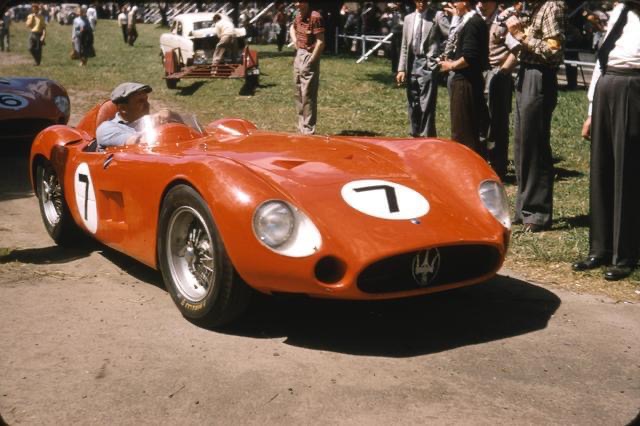
Bertocchi in Moss’ 300S drives into the Albert Park paddock ahead of Jean Behra’s car during the 1956 Olympic Grand Prix/ATT weekends (R Bailey)
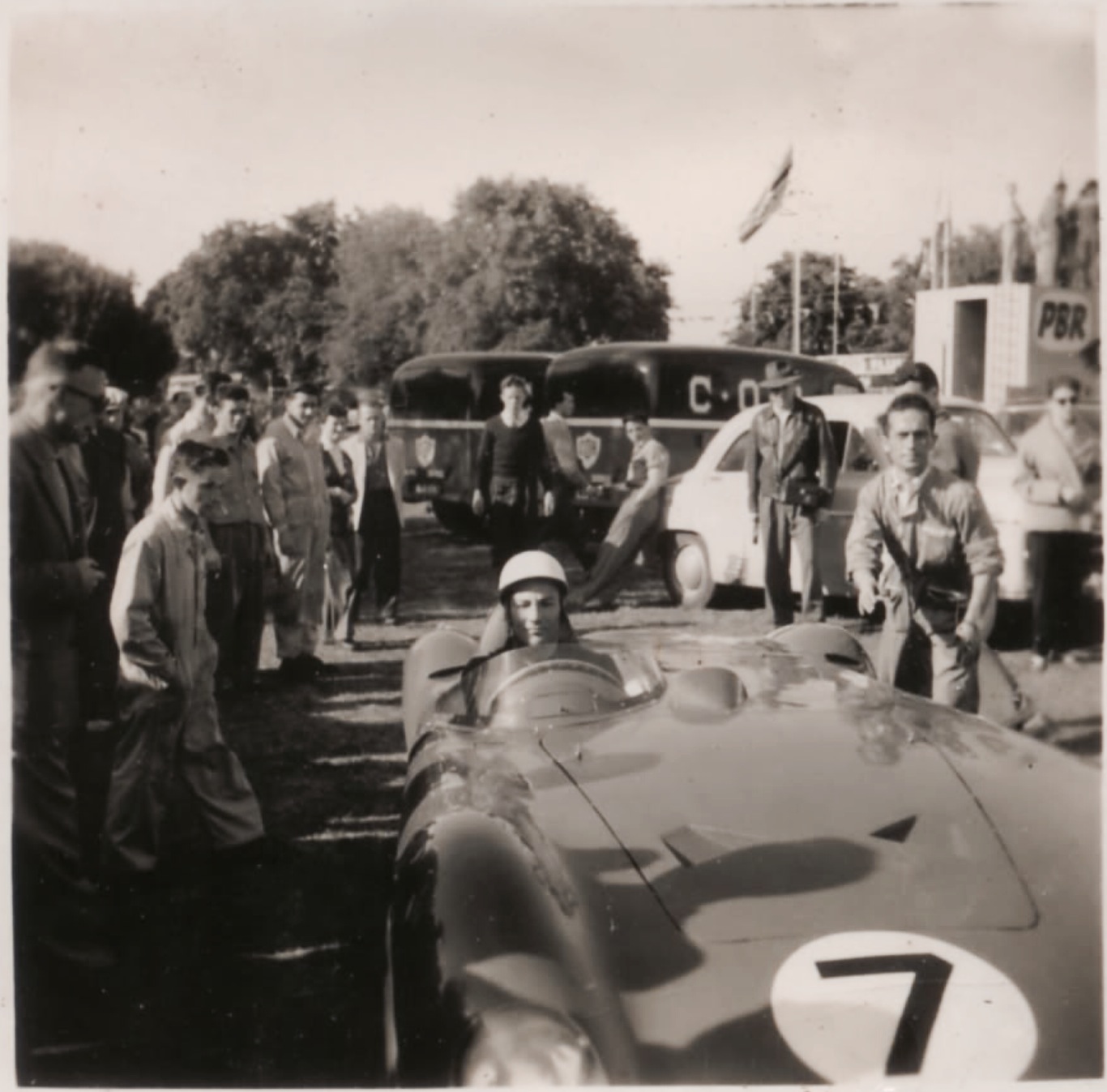
 

moss 300s 1956

Stirling Moss in Maserati 300S ‘3059’ during the 1956 AGP Meeting at Albert Park, in December. He won the sports car ‘TT’ race in the car (unattributed)

The Maserati team brought five cars to the 1956 Australian Grand Prix held at Albert Park…

Three were 250F’s and two 300S which were driven by Stirling Moss and Jean Behra, Moss won the AGP and the Australian Tourist Trophy in single-seater and sports Maseratis respectively.

At the end of the meeting the 300S’ were acquired by former AGP Winner, Doug Whiteford and Reg Smith, a Melbourne racer/motor dealer. Smith raced his car little and soon sold it to future Touring Car Champion, very successful businessman and later Calder Circuit owner Bob Jane.

Bob’s driving was ‘pretty rough and ready’ at this stage, fellow racer Reg Hunt was moved to shift his boat further into Albert Park Lake to keep it out of harms way, Jane quickly got the hang of the car and was competitive in it.

Whiteford bought the ex-Behra 300S #3055 which sort of made sense as an outright car as the AGP was run to Formula Libre at the time. A great ‘mighta been’ would have been Doug in a 250F taking on the other front runners at the time; Stan Jones, Reg Hunt, Lex Davison and Ted Gray in an equivalent car, ‘twas not to be sadly.
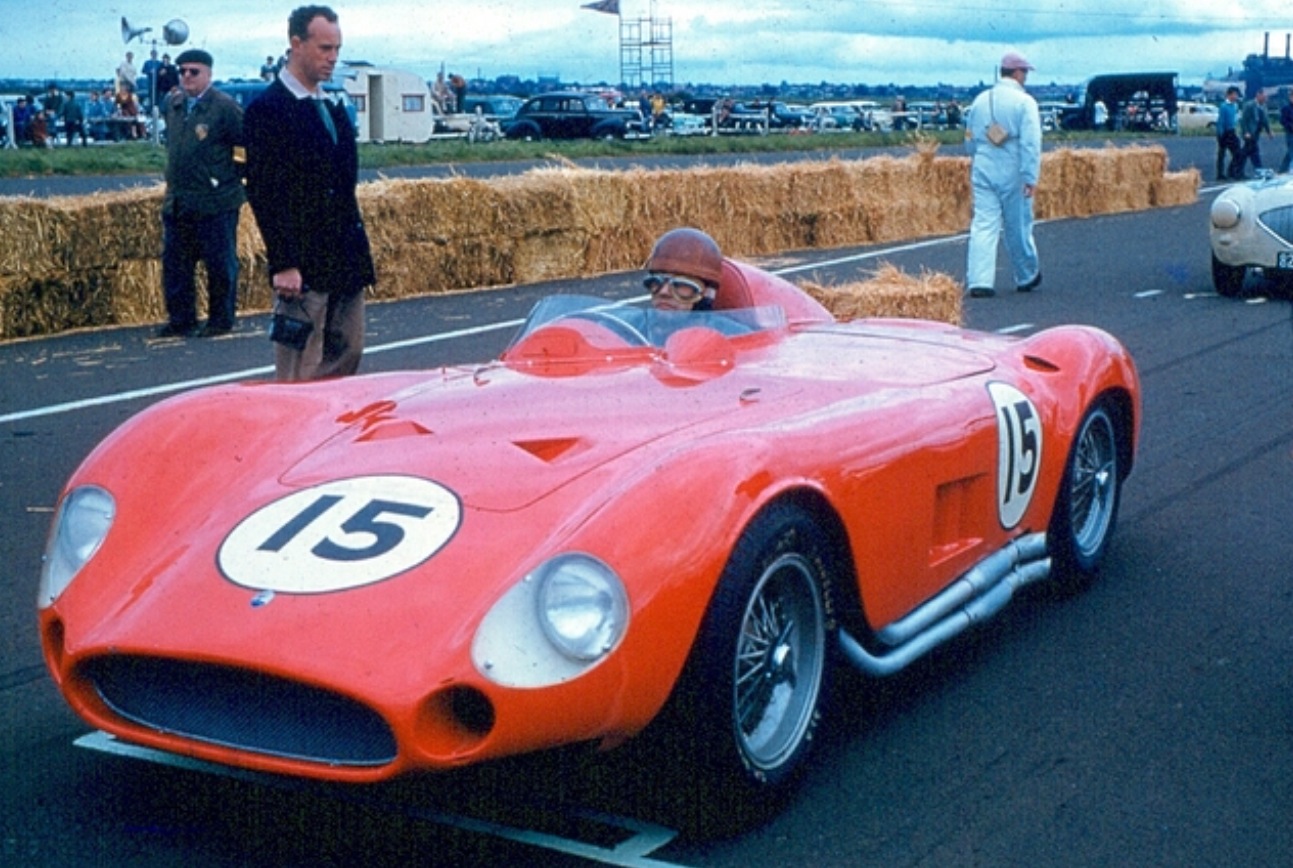
jane on the grid 300s fishermans bend 1958

(Kevin Drage)

Bob Jane pictured above and below in his ex-Moss 300S #3059 on his debut meeting in the car at Fishermans Bend, in the inner western suburbs of Melbourne, October 1958.

jane 300s fishermans bend 1958

(Kevin Drage)

Stirling Moss said of the 300S…’a decently prepared 300S had a chassis which was infinitely superior to any front engined sports Ferrari, one of the easiest, nicest, best balanced sports racing cars ever made’…

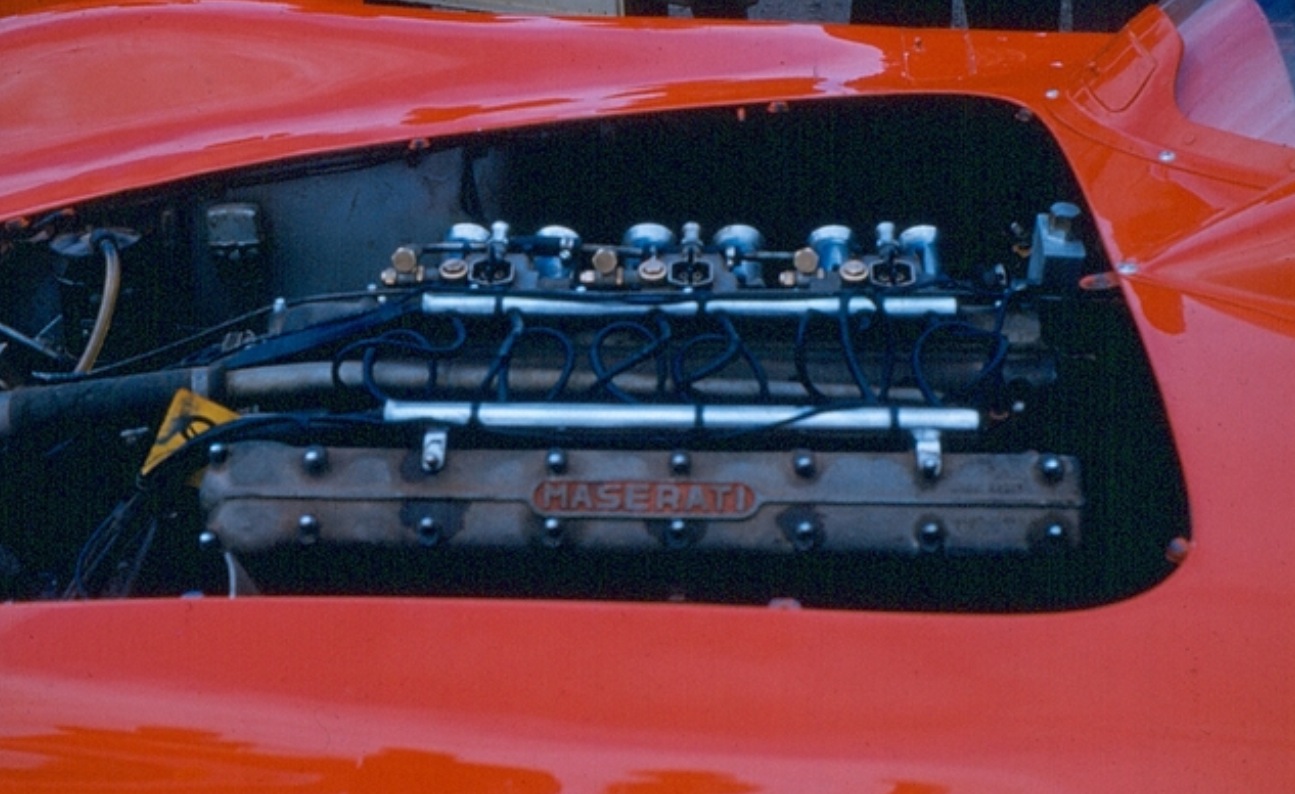
The 250F Grand Prix engine would not stretch to 3 litres, 2.8 litre variants of the 300S were built and were uncompetitive so Maserati built in essence a bigger version of the 250F engine, using the 250F head. 6 cylinders in line, 2992cc DOHC. The 2 valves per cylinder, 2 plugs per cylinder engine developed circa 280bhp @ 7000rpm. It was fed by 3 Weber carbs, initially 42 and later 45DCO3’s.
maser 300s engine

Janes’ Maser 300S engine, Fishermans Bend 1958 (Kevin Drage)

The gearbox was a ZF 4 speed.

The chassis was a ladder frame made with large diameter main tubes, front suspension by upper and lower wishbones and coil spring/damper units and a roll bar. A de Dion rear axle was used with a transverse semi-elliptic leaf spring and hydraulic shocks.

The first cars were built by Maserati, later assembly was outsourced to Gilberto Colombos’ specialist company, Gilco.

Steering was worm and sector, brakes huge finned alloy drums, wheels Borrani 5X16 inch wires, the aluminium bodies built by Fantuzzi. The car weighed circa 780Kg.

300s cutaway

26-28 cars were built between 1955-1958 depending upon the reference source…Whilst the cars were built in large numbers and were favourites of privateers they were not particularly successful at an International level, winning the 1956 Buenos Aires 1000Km and 1956 Nurburgring 1000Km.

When first built the 300S was outgunned by competitors with greater capacity and when the 3 litre limit was mandated for sports cars by the CSI in 1958 they were getting a little ‘long in the tooth’ compared with the Ferrari 250TR and Aston Martin DBR1.

They were very useful, competitive, relatively simple devices in places like Australia where the cars of Jane and particularly Whiteford were crowd drawcards from 1956 to 1963.

Bob Jane raced many mouth-watering cars over the decades, he is still alive and has retained many of them, including the 300S for decades after the end of its competitive life, it was sold some years ago.

300 s bathurst

Bob Jane Maserati 300S, Forrests Elbow, Bathurst October 1961. Our regs of the time encouraged GT cars and as a consequence cars such as the Maser became Coupes (John Ellacott)

Australias ‘Appendix K’ or GT rules at the time mandated cars with ‘lids’, as a consequence Janes’ 300S grew this appendage, which is not too catastrophic in the context of some other efforts to comply with the rule change at the time. The Fantuzzi original is rather nicer all the same. When Janes’ team rebuilt the car in the mid-seventies it was restored, superbly to its original specs.

The car left Australia in the early 90’s, the current custodian appears to be Klaus Werner.
whiteford

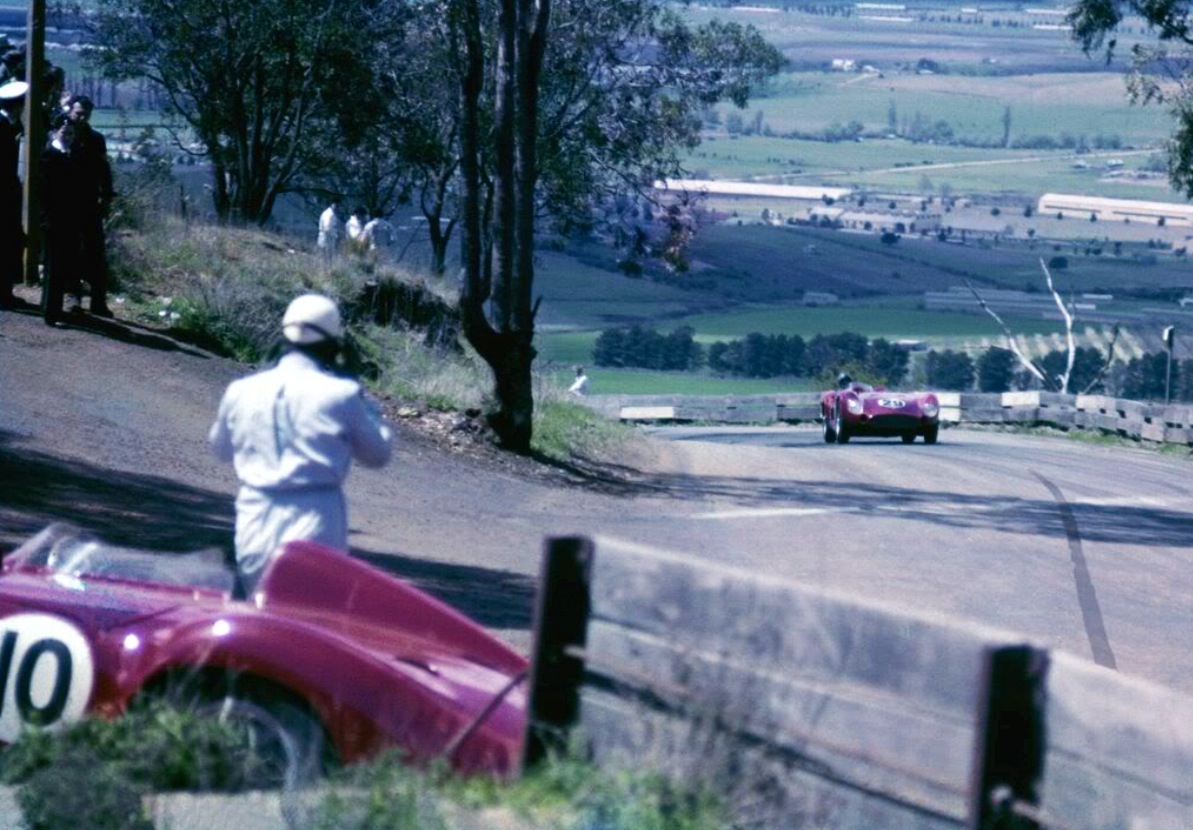
Doug Whiteford has parked his ‘3055’ 300S after a major moment going up Mt Panorama, perhaps driveshaft failure, the dark blue lines on the road show his path. He has time to watch Bob Janes’ approach in ‘3059’. Bathurst 1960. Bucolic Central Tablelands in the distance far below (John Ellacott)

Etcetera…

(P Coleby)

Jane during the Ballarat International meeting in 1961, it must be practice as he did not race given some type of problem or irregularity. Dan Gurney won the feature in a BRM P48.

Photo Credits…

Ed Steet, Kevin Drage, John Ellacott, Peter Coleby Collection, Rob Bailey Collection

Finito…

black bess woodside (State Library of South Australia)

Doug Whiteford’s Ford V8 Spl ‘Black Bess’ leads the MG T Specials of I. Jackson and J. Martin  in the Woodside Handicap on the Woodside, Adelaide Hills road circuit on 10 October 1949…

Whiteford commenced his racing career on motor bikes and prepared cars for others. He decided to convert an ex-Victorian Forestry Commission Ford ute which he bought for £67. Based entirely on parts salvaged from the utility, it was carefully rebuilt in an Albert Park, Melbourne back yard utilising sophisticated building materials including bed iron frames and panelling from the Footscray tip!, with the chassis lowered and a 2 seat body made.

A coat of black paint provided its name.

John Blanden reported that Bess ran for the first time at Albert Park on 15 December 1939, it’s first meeting was at Lobethal, SA on New Years Day 1940. The car popped an engine at Wirlinga, Albury, having boiled at Lobethal as well and was placed into storage during the War, Doug enlisted.

When Whiteford returned from service a Mercury engine was fitted, initially standard, it was progressively modified, benefitting from US Hot Rod experience. From 1946-52 the car was one of the fastest in the country as it was continually developed, winning 29 races from 40 starts, the statistics vary with the source, inclusive of the 1950 AGP win at Nuriootpa.

Doug Whiteford and Bess at Rob Roy Hillclimb in Melbourne’s Christmas Hills, early 1950’s SLV)

Graham Howard wrote in his summary of Bess in his ‘History of The Australian Grand Prix’…’Whitefords’ successes with Black Bess came as a direct result of his fanatical devotion to preparing, modifying and maintaining the car, which was complemented by his outstanding driving ability. Progressively, Whiteford changed the braking system of the race car from mechanical to hydraulic operation, added telescopic shock absorbers, bored out the engine, fitted twin carburettors, a Scintilla Vertex magneto and high compression cylinder heads. A modified camshaft was imported from America, the cooling system was improved to stop overheating, brake fade was reduced by fabricating special air scoops and the steering gear was reworked to provide a faster response for racing.

Clocked at Bathurst exceeding 210kmh Black Bess was now a formidable and reliable race car, nobody was really surprised when Whiteford won the 1950 AGP at Nuriootpa…’

bess engine Ford Mercury V8; 84.1 bore X 95.2 mm stroke, 4236cc. Sidevalves, 2 vp cylinder, 95 Kw@4500rpm. Ford 3 speed gearbox. (G Howard ‘History of The AGP’)

As imported racing cars appeared in greater numbers Bess became steadily obsolete, Doug started to drive a Lago Talbot T26C owned by Geelongs’ Tom Hawkes in 1951 eventually buying the car and winning the 1952 Bathurst and 1953 Albert Park AGP’s in it.

Whiteford retained the car, it appeared occasionally in his hands and sometimes others, having sold the Lago he drove it in the 1954 AGP at Southport on Queenslands’ Gold Coast. ‘Bess’ raced in 3rd for many laps, amazing given its age and the improved quality of the field, engine maladies eventually caused its retirement in the race won by Lex Davisons’ HWM Jaguar.

‘Bess was sold to Granton Harrison who raced it in both Victoria and South Australia and then passed through many hands deteriorating progressively. After many years in the wilderness, ‘Bess’ was tracked down by Greg Veitch and sold to the very same Granton Harrison who raced it years before…and was restored before her debut in the 1977 ‘City Of Sydney Trophy.’

The car is still very much a part of the local historic racing scene.

bess ‘Bess’ in the Woodside paddock, the formal fashion of the day in evidence. Bolt on wire wheels, 1934 Ford mechanical brakes converted to hydraulic operation. Weight 991kg. (State Library of SA)

‘Woodside Handicap’…

Woodside is a village 40 kilometres from Adelaide. The race, as so many in Australia were at the time, was a handicap, 12 laps, 36 miles in total. In this day and age of a lot of ‘one make racing’, diversity of cars and their differential performance and the need for handicaps to ‘make a race of it’ seems odd. But in the immediate post-war years when money was tight and racing cars scarce across a big continent, it was necessarily the approach.

‘Australian Motor Sports’ report of the event has Whiteford lapping very fast as one of the limit men, finishing 2nd, and Jackson, the car behind Whiteford above ‘…lost his brakes at the Pines and had to extricate his car from the strawbales costing him a lap’. The race was won by the MGTC of W Smith, Whiteford 2nd and D Harvey in another MGTC 3rd…MG’s and MG Spl’s the lifeblood of Australian racing for so long and a good future story in itself.

Of some interest for those who read my article on Stan Jones a while back. https://primotipo.com/2014/12/26/stan-jones-australian-and-new-zealand-grand-prix-and-gold-star-winner/ . Stanley made his road racing course (as against circuit) debut in his new HRG ‘Bathurst’ 1500 at this meeting, this car perhaps convincing Jones he had the makings of a future champion…Stan, relatively inexperienced diced with Tony Gaze’ similar HRG for much of the race. Gaze was 4th, Stan DNF with steering dramas.

bess woodsise (State Library of SA)

Whiteford Ford V8 Spl, ‘Black Bess’.

Derived from a Ford Ute or Utility, simple beam front axle suspension located by trailing radius rods, transverse leaf spring and telescopic shock absorbers. Rear suspension comprised a live rear axle located by leading radius rods and torque tube, transverse leaf spring and telescopic shock absorbers.

Doug was a talented driver and fettler, the car continually evolved over a decade or so and was indecently fast beyond the sum of its parts- it gave many more exotic imports a hard time. Whiteford raced this car to a 1950 AGP win and then the more aristocratic Talbot-Lago T26C for his 1952 and 1953 AGP wins at Bathurst and Albert Park respectively.

bess cockpit ‘Bess’ restored cockpit. (G Howard ‘History of The AGP’)
bess Black Bess at a recent Australian GP at Albert Park. Car a regular historic event attendee. (Falcadore)

Etcetera…

(T Johns Collection)

Advertisement for Whiteford’s businesses published in the Australian Motor Sports Review 1958-1959.

The photograph is Doug in his Maserati 300S leading Len Lukey, Cooper T23 Bristol under the Viaduct at Longford during the March 1958 Gold Star round won by Ted Gray’s Tornado 2 Chev.

Photo and Other Credits…

State Library of South Australia/Victoria, John Blanden ‘Historic Racing Cars in Australia’, Graham Howard ‘History of The Australian GP’, Falcadore, Lobethal Museum, Tony Johns Collection

Stephen Dalton for the research and AMS article

Tailpiece: Bess at Rest…

(Lobethal Museum)

Black Bess at roadside during the 1948 ‘South Australian 100’ meeting at Lobethal.

After setting the pace Whitefoed was out after completing three laps, the race won by fellow Victorian, Jim Gullan’s Ballot Oldsmobile.

Finito…

davo nuri 1949

This fantastic shot of Lex Davisons’ Alfa Romeo P3 ahead of Doug Whitefords’ Ford V8 Spl ‘Black Bess’, Nuriootpa, in South Australia’s’ Barossa Valley on 23 April 1949…

Look at the hay bales, stone houses characteristic of South Australia, the ‘Stobie’ light poles are still a feature of SA streets and the relaxed crowd. Captures the flavour of the day doesn’t it?

It’s funny where you find stuff. I was researching my article on Alf Barretts’ career and Alfa Monza a while back and tripped over this shot of Davo on the ‘South Australia History Hub’, but no details were provided. I knew who it was but not exactly when or where, Stephen Dalton fellow enthusiast/historian identified the place, date as well as the event.

‘The Vintage (as in wine vintage, the Barossa is a world renowned wine region) Festival Championship’ was a 25 mile event, 8 laps of the Nuri road circuit, it was reported in Graham Howard’s biography of Lex Davison, from which this article draws heavily.

As you will see from the cars described, the bulk of our elite fields were Australian Specials in the main, we are still several years away from a reasonable number of European GP cars on our grids and 5 years away from the ‘Red Car Period’ of the mid to late fifties, the factory cars then dominant.

The last AGP win for an Australian Special was the 1951 Narrogin event in WA…

It was won by Warwick Pratley’s Ford ‘Flathead’ V8 powered George Reed Special.

The last AGP win for an Australian built car was John Goss’ victory at Sandown in 1976 in a Matich A53 Repco F5000 car- Australian built but not a ‘Special’ in the sense meant above!

nuri

‘The Vintage Festival Championship…’

‘Non-starters included Jack Days Talbot Darracq, Barracloughs Delage and Alfa Mercury. Cars were marshalled with the fastest at the back, Whiteford made the cleanest start. On his hammer was Jim Gullan Ballot Olds with Davison, Neale Ford V8 Spl, Wilcox Dodge Spl and Robinson Sunbeam Mercury, his car the 1922 GP Sunbeam fitted with a Ford V8 and with a body reminiscent of the Segrave 200mph car.’

‘In the next lap Davison passed Gullan and was right behind Whiteford, whose Ford V8 Spl was going very well, this car winning the 1950 AGP at this circuit, I covered this car a while back. Wilcox was close to Neale and behind Robinson.

Davo passed Whiteford by lap 4, the order remained unchanged from then. ‘Doug Whiteford did everything but tie knots in the Ford keeping up with the Davison Alfa and it was the first time he has been seeing really trying. The two leaders outstripped the rest by over a minute and a half and lapped the last man home…’

A great race and a portent of things to come from the two Melburnians…

Davison the wealthy industrialist from Clendon Road, Toorak in the aristocratic GP Alfa and Whiteford the garage proprietor from Carlisle Street, St Kilda in the self built/developed but incredibly clever, quick Ford V8 Spl…several suburbs and poles apart but very much racing enthusiasts and champion drivers both.

4 AGP wins for Davison and 3 for Whiteford, some splendid racing was to follow in the ensuing decade from these two great competitors…

Credits…

SA History Hub, Graham Howard ‘ Lex Davison:Larger Than Life’, Stephen Dalton research