Posts Tagged ‘Frank Gardner’

(Mr Reithmaier)

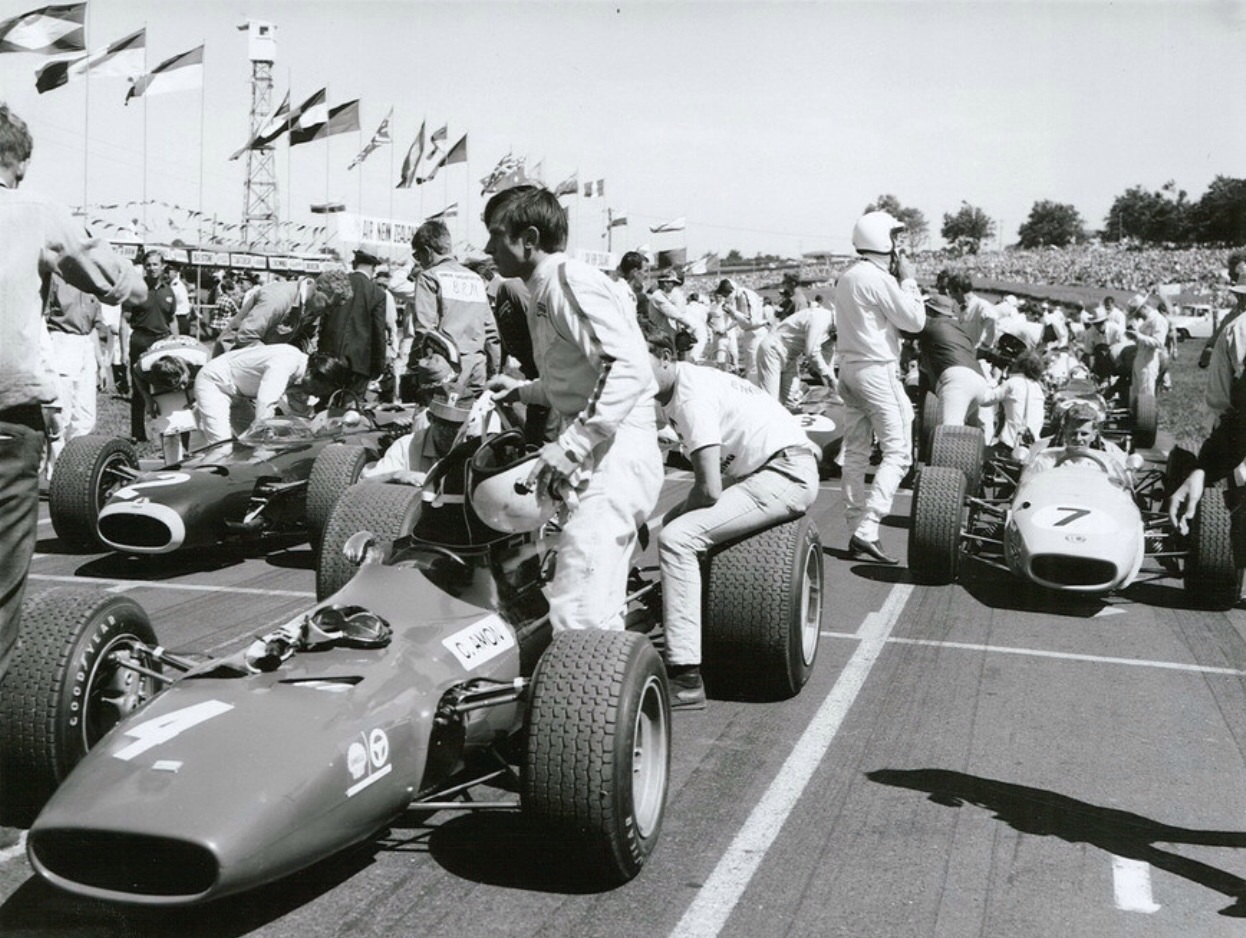
I love the build up and tension before the start of a big race; here it’s the grid prior to the start of the New Zealand Grand Prix at Pukekohe, in the north of NZ’s North Island on 6 January 1968…

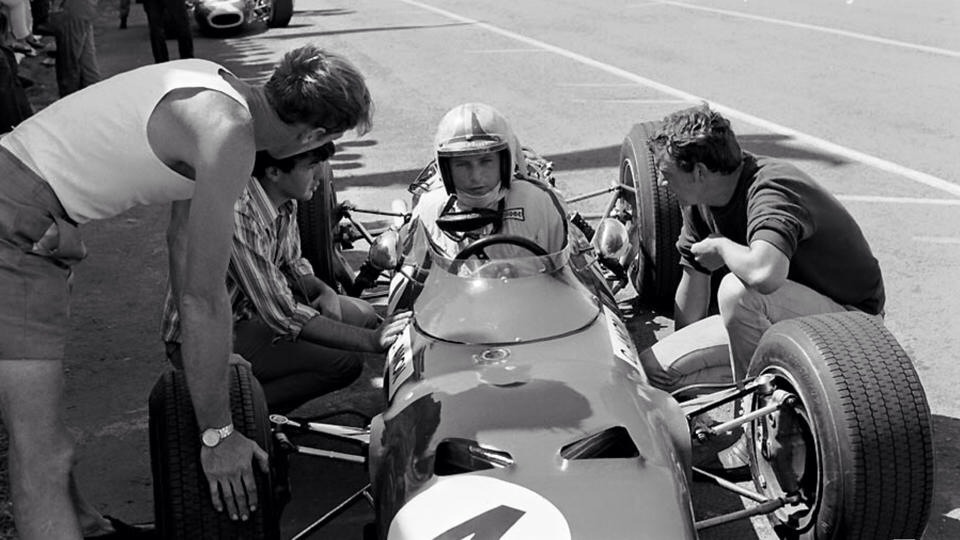
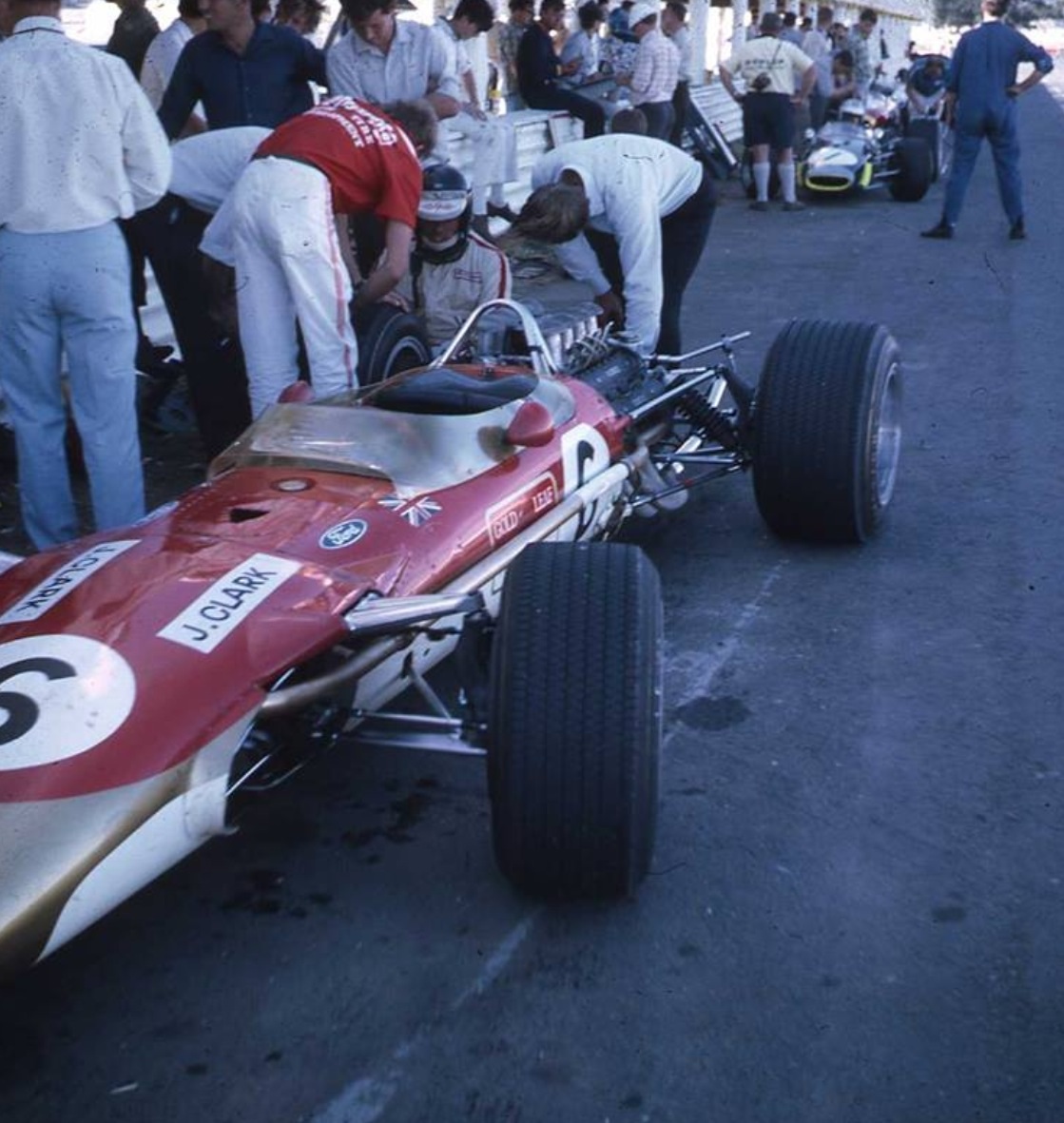
Chris Amon readies himself and his Ferrari Dino 246T before the first round of the 1968 Tasman Series, a race in which he wonderfully and deservedly triumphed. Missing on the front row is Jim Clark’s Lotus 49T Ford DFW. Car #2 is Pedro Rodriguez’ BRM P261, the Mexican is bent over the cockpit of his car but failed to finish with clutch problems. Car #7 is Alec Mildren’s Brabham BT23D Alfa Romeo T33 2.5 V8 with chief mechanic Glenn Abbey warming up the one-off car. Lanky Franky Gardner is adjusting his helmet beside the car, it was a good day for Frank, the car was second.

Look closely and you can see a camera crew behind the Brabham which is focusing on 1967 reigning world champion Denny Hulme and his #3 Brabham BT23 Ford FVA F2 car- Denny’s head is obscured by Frank’s body. Hume boofed the ex-Rindt BT23 during the race badly enough for a replacement chassis to be shipped out from the UK.

I’ve always thought these F2/Tasman Ferrari’s amongst the sexiest of sixties single-seaters.
The 166 F2 car was not especially successful amongst the hordes of Ford Cosworth Ford FVA engined cars in Euro F2 racing, however, the car formed the basis of a very competitive Tasman 2.5 litre Formula car when fitted with updated variants of the Vittorio Jano designed V6 which first raced in F2 form and then powered the late fifties Grand Prix racing front-engined Ferrari Dino 246. It was in one of these cars that Mike Hawthorn won the 1958 World Drivers Championship.

Amon won the Tasman Series in 1969 with Ferrari Dino 246T chassis #0008, fellow Kiwi Champion Graeme Lawrence won aboard the same car in 1970 against vastly more powerful, if far less developed Formula 5000 cars. The story of those championships is for another time, this article is about Chris’ 1968 Tasman mount and campaign.

Amon hooking his gorgeous Ferrari Dino 246T ‘0004’ into The Viaduct in the dry at Longford 1968. Early ’68, we are in the immediate pre-wing era, and don’t the cars look all the better for it! (oldracephotos.com/D Keep)

In many ways Chris was stiff not to win the ’68 Tasman Cup a title, the last title won by the late, great Jim Clark…

Ferrari entered only one car that year, chassis #0004 was assembled in Maranello by longtime Amon personal mechanic Roger Bailey and tested at Modena in November 1967. It was then freighted by plane to New Zealand where it was prepared by Bruce Wilson in his Hunterville workshop in the south of the North Island.

The chassis was Ferrari’s period typical ‘aero monocoque’, a ‘scaled down’ version of the contemporary F1 Ferrari with aluminium sheet riveted to a tubular steel frame thus forming a very stiff structure. The 166 was launched to the adoring Italian public at the Turin Motor Show in February 1967.

In F2 form, the 1596cc, quad-cam, chain driven, 18 valve, Lucas injected engine developed circa 200bhp at an ear-splitting 10000 rpm. It is important to note that this F2 engine, designed by Franco Rocchi, and in production form powering the Fiat Dino, Ferrari Dino 206 and 246GT and Lancia Stratos is a different engine family to the Jano designed engines, evolved by Rocchi and used in the Tasman Dinos.

The F2 166 made its race debut in Jonathon Williams hands at Rouen in July 1967, whilst it handled and braked well it was around 15bhp down on the Cosworth engined opposition. The car was tested extensively at Modena, including 24 valve variants, but was not raced again that year.

Amon, who had not contested the Tasman Series since 1964, could immediately see the potential of the car, suitably re-engined, as a Tasman contender given the success of the small, ex-F1 BRM P261 1.9-2.1 litre V8’s in the 1966 and 1967 Tasmans. The same approach which worked for the boys from Bourne could work for Maranello Chris figured. A parts-bin special is way too crass, but you get my drift of a very clever amalgam of existing, proven hardware as a potential winning car.

In fact Ferrari went down this path in 1965 when a Tasman hybrid of a then current F1 chassis was married to a 2417cc variant of the Jano 65 degree V6 for John Surtees to race in the 1966 Tasman. John had Tasman experience in Coventry Climax FPF engined Coopers and Lola’s at the dawn of the sixties and could see the potential of a small Ferrari.

That plan come to nothing when Surtees was very badly injured in a Mosport Can-Am accident in his self run Lola T70 Chev in late 1965. This car, Ferrari Aero chassis ‘0006’ played the valuable role of proving Surtees rehabilitation when he completed 50 laps in the car at Modena. It was in the same chassis that Lorenzo Bandini finished second in the 1966 Syracuse and Monaco GP’s as Ferrari sought to get the new 3 litre V12 F1 312 up to speed, Bandini elected to race the Dino on both occasions- he also finished third in the car at Spa.

The allocation of this more competitive car to Bandini rather than team-leader Surtees was amongst the many issues which lead to the confrontation between John Surtees and team manager Eugenio Dragoni during Le Mans practice and Surtees departure from the team shortly thereafter.

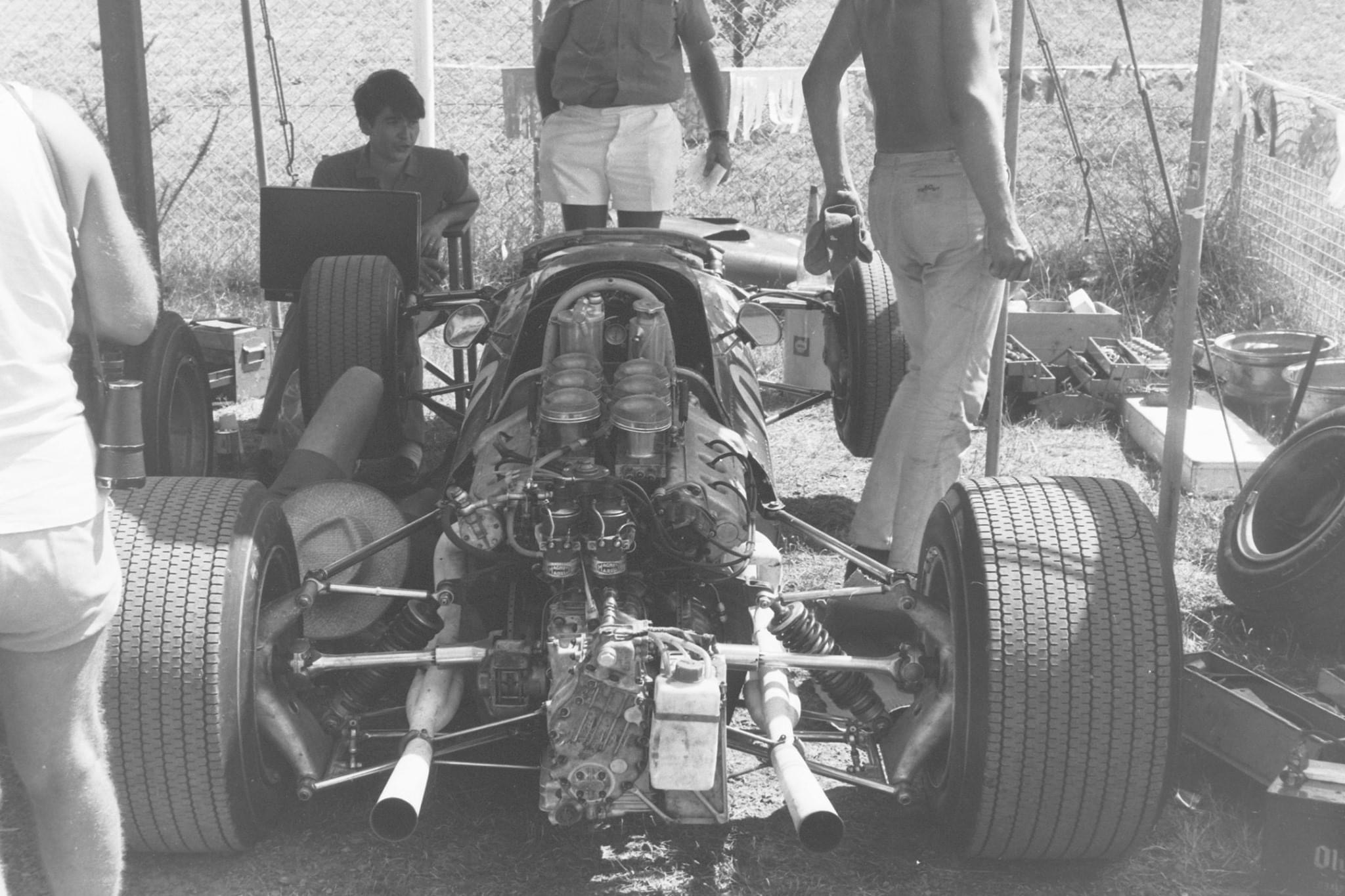
An unidentified fellow, Jim Clark, Ferrari engineer Gianni Marelli, Chris Amon and Roger Bailey share a joke during the 1968 Longford weekend. Chassis ‘0004’ is fitted with the 24 valve V6 covered in the text. Note the quality of castings, fabrication and finish, inboard discs, sliding spline driveshafts and single plug heads of this very powerful- but less than entirely reliable engine in 1968 form, it’s shortcoming cylinder head seals (oldracephotos.com/Harrison)

The engine of the 166/246T was carried in a tubular subframe attached to the rear of the monocoque which terminated at the drivers bulkhead, the car was fitted with a 5 speed transaxle designed by Ingenere Salvarani and Girling disc brakes.

Suspension was also similar to the contemporary F1 cars in having an front upper rocker and lower wishbone with inboard mounted spring/shocks and conventional outboard suspension at the rear- single top link, inverted lower wishbone, two radius rods and coil spring/shocks.

For the 1968 NZ races- Chris won at Pukekohe after Clark retired and at Levin, leading from flag to flag, was second to Clark at Wigram and fourth at Teretonga- a 3 valve variant (2 inlet, 1 exhaust) of the 65 degree fuel injected V6 was fitted which was said to develop around 285bhp @ 8900rpm from its 2404cc.

Chris crossed the Tasman Sea with a nine point lead in the Series from Clark and the might of Team Lotus. It was a wonderful effort, whilst Ferrari provided the car free of charge and took a share of the prize money, the logistics were of Chris’ own small equipe, and here they were serving it up to Gold Leaf Team Lotus with a couple of World Champions on the strength, plenty of spares and support crew.

Amon just falls short of Jim Clark at the end of the 1968 AGP at Sandown. The official margin, one tenth of a second after 62 minutes of great motor racing. Lotus 49 Ford DFW and Ferrari Dino 246T (unattributed)


Amons heads into the Sandown pitlane to practice- Shell corner or turn 1 behind (G Paine)


Amon’s car in the Sandown paddock. That little four valve engine came so close to pipping Clark’s Ford DFW on raceday (G Paine)

For the four Australian races a 24 valve version of the engine was shipped from Maranello. Its Lucas injection was located within the engines Vee rather than between the camshafts and had one, rather than two plugs per cylinder. This motor developed 20 bhp more than the 18 valver with Chris promptly putting the car on pole at Surfers Paradise, a power circuit- he won the preliminary race and had a head seal fail whilst challenging Clark in the championship round.

At Warwick Farm he qualified with the 18 valve engine and raced the 24 valver having rebuilt it- they only had one of the motors. He was challenging both Clark and Hill in the race and then spun in avoidance of Hill who was having his own moment…he was fourth on the tight technical Sydney circuit.

At Sandown during the AGP, the pace of the car, and Amon, was proved in an absolute thriller of a race in which he finished second to Clark by one-tenth of a second, the blink of an eye. Let’s not forget the best driver in the world driving the best F1 car of the era powered by the Tasman variant of the greatest GP engine ever was his competition- and took fastest lap.

As the team crossed Bass Straight from Port Melbourne on the ‘Princess of Tasmania’ Chris knew he had to win the Longford ‘South Pacific Championship’, with Clark finishing no better than fifth to win the Tasman title.

At Longford, still fitted with the 24 valve engine, which must have been getting a little tired, he qualified a second adrift of Clark and Hill, he finished seventh in a race run in atrocious conditions on the most unforgiving of Australian circuits having initially run second to Clark but then went up the Newry Corner escape road and suffered ignition problems from lap 10.

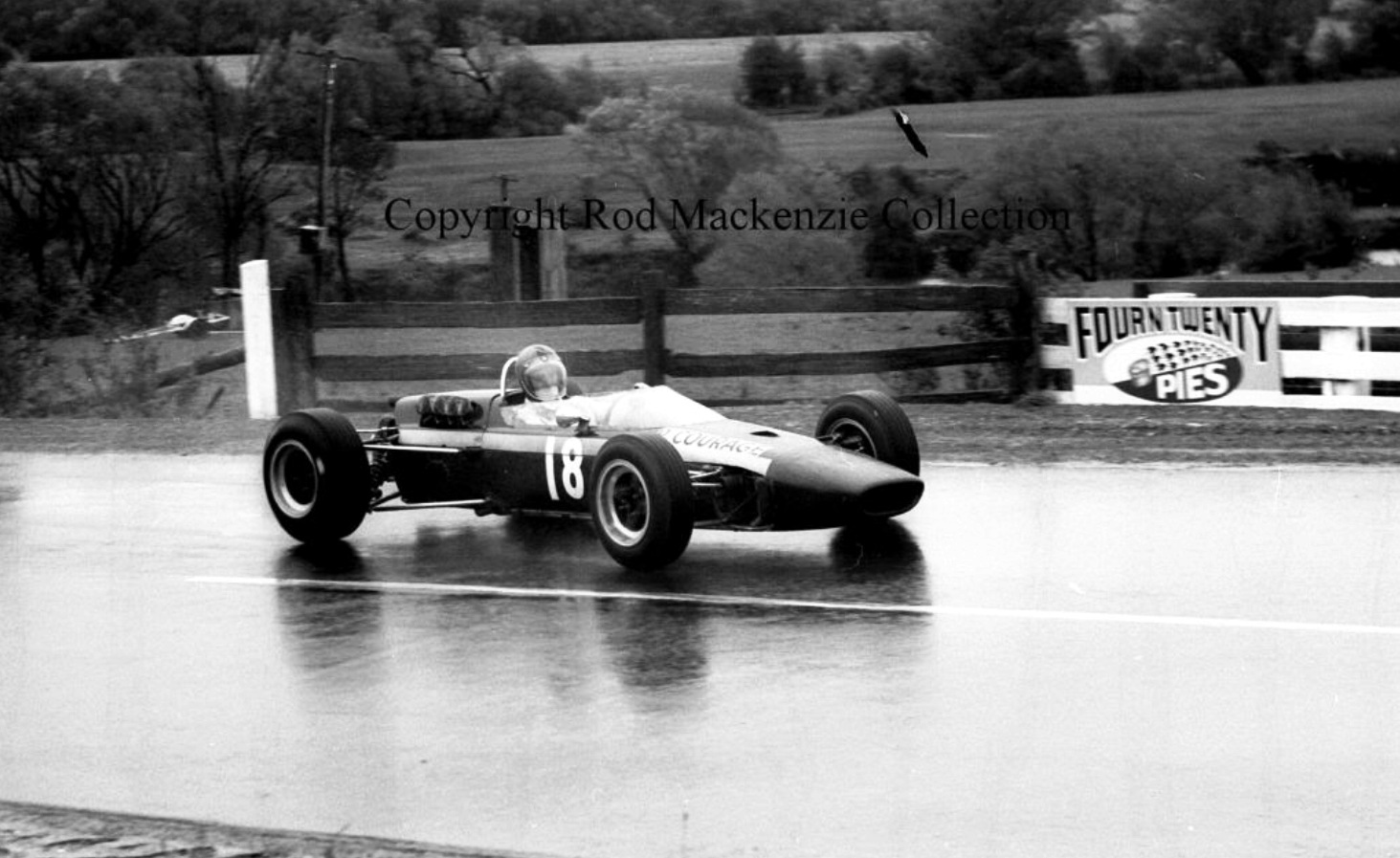
Piers Courage won in an heroic drive aboard his little McLaren M4A Ford FVA F2 car that streaming day, in a series which re-ignited his career.

Chris and the boys confer about car set-up- in the dry!, at Longford(oldracephotos.com.au/Harrisson)

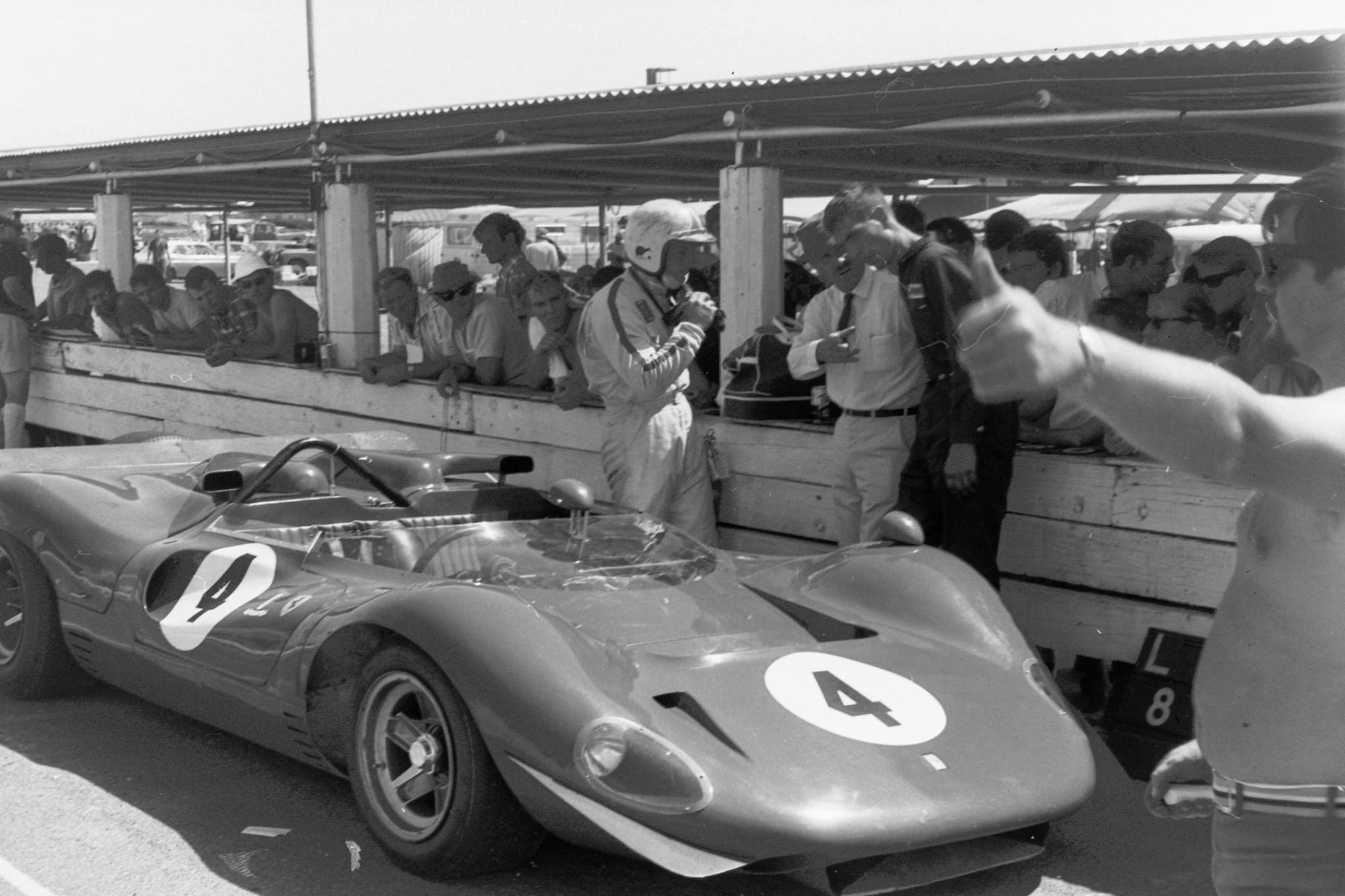
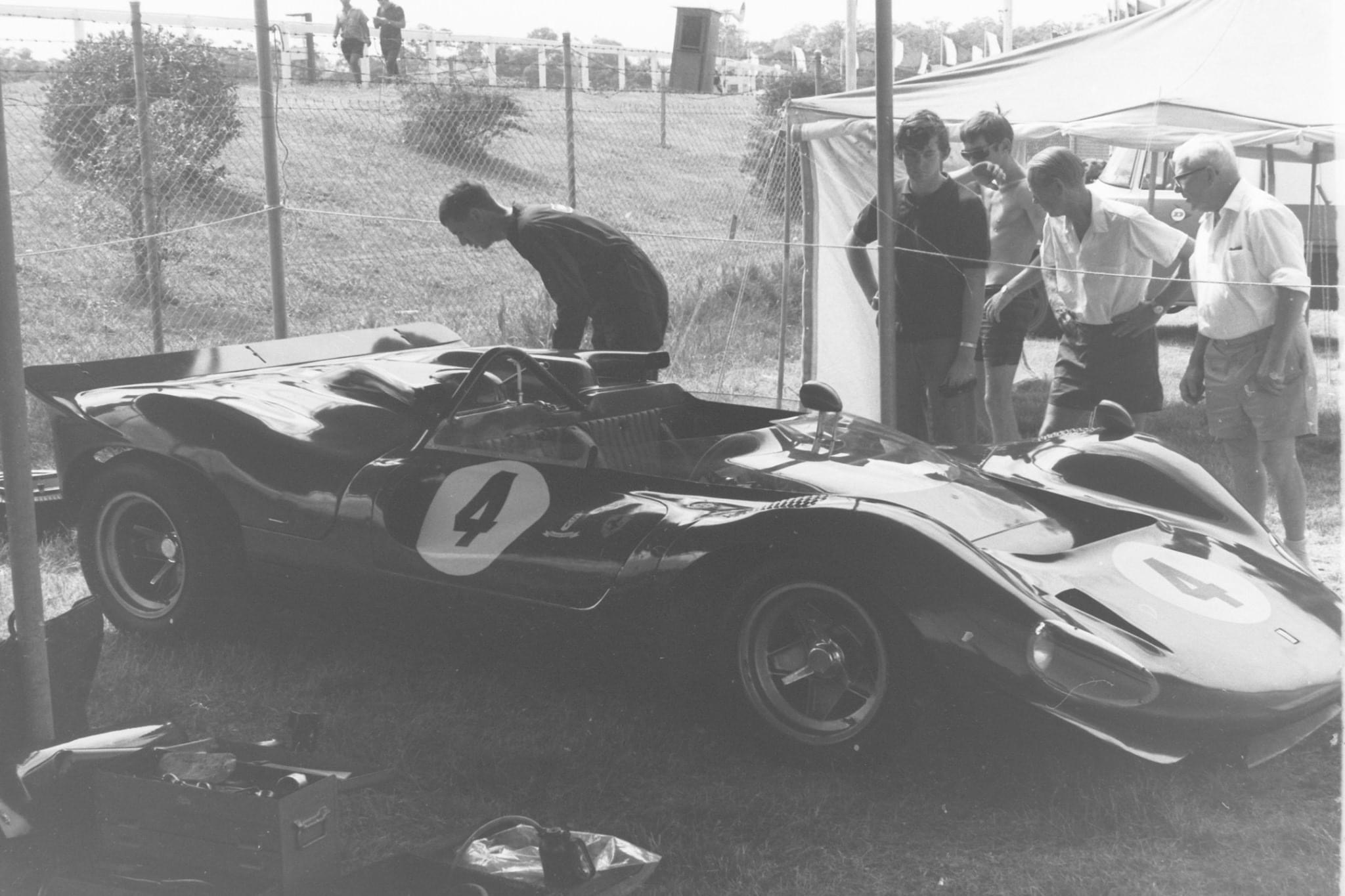
Chris was a busy boy during the Australian Tasman leg as he also drove David McKay’s Scuderia Veloce Ferrari 350 CanAm/P4 in sports car support events at each round in addition to the little Dino.

These races were outstanding as they involved close dices between Chris and Frank Matich in his self designed and built Matich SR3 powered by 4.4 litre Repco Brabham V8’s- with Frank getting the better of him in each of these races. The speed of the Matich was no surprise to Chris though, both had contested rounds of the Can-Am Championship only months before the Tasman in the US.

Click here for my article on the Ferrari P4/CanAm 350 #’0858’ Chris raced in Australia;

Ferrari P4/Can Am 350 #0858…

Amon lines David McKay’s Scuderia Veloce Ferrari P4/350 Can Am up for Longford’s The Viaduct during the 1968 Longford Tasman meeting. Matich didn’t take the SR4 to Longford so Chris had an easy time of it that weekend. The sight and sound of that car at full song on the Flying Mile at circa 180mph would have been really something! (oldracephotos.com/D Keep)


Chris Amon, David McKay and mechanic David Liddle with the Can-Am 350 in the Sandown pitlane (G Paine)

For the 1969 Tasman Chris applied all he learned in 1968 returning with two cars, the other driven by Derek Bell, four well developed 300bhp 24 valve engines with the logistics of the two months taken care of by David McKay’s Scuderia Veloce.

He promptly lifted the Tasman Cup in a very successful campaign from Jochen Rindt, Graham Hill and others, with a little more luck or greater factory commitment in 1968 it may have been two Tasmans on the trot for the Maranello team and Chris…

Etcetera…

(G Paine)


(G Paine)

A couple of shots of the SV Ferrari Can-Am 350 being fettled in the 1968 Sandown Tasman paddock.

Bibliography…

oldracingcars.com, sergent.com.au, ‘Dino: The Little Ferrari’ Doug Nye

Photo Credits…

Mr Riethmaier, oldracephotos.com, Rod MacKenzie, Glenn Paine Collection

Tailpiece: Love this moody, foreboding Longford shot by Roderick MacKenzie…

(Rod MacKenzie)

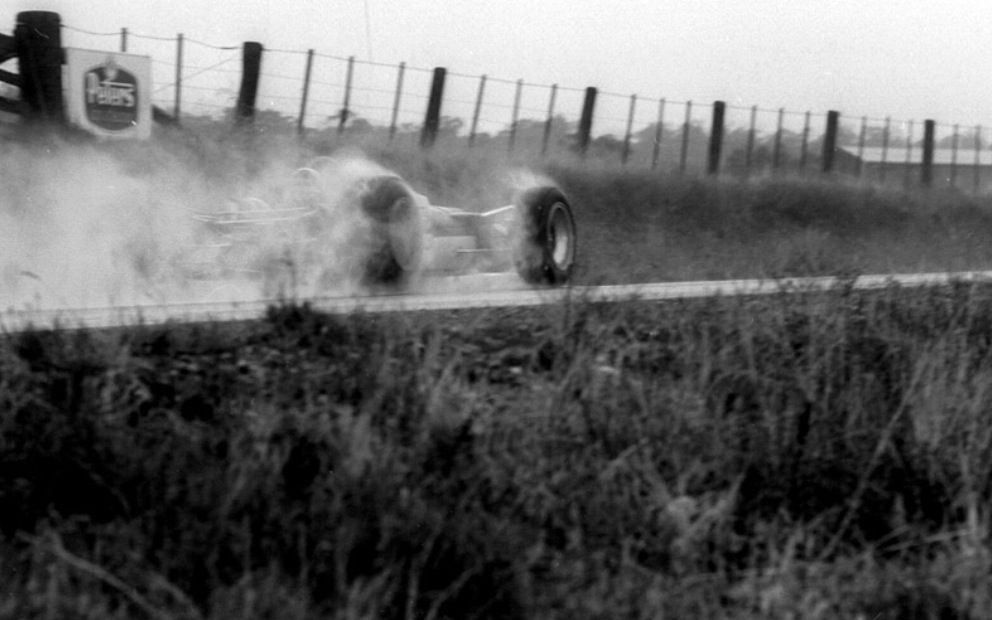
Chris has just entered the long ‘Flying Mile’ in the streaming wet conditions during Monday’s ‘South Pacific Trophy’ famously won by Piers Courage little McLaren M4 Ford FVA F2 car. 4 March 1968.

Finito…


frank gardner

(John Ellacott)

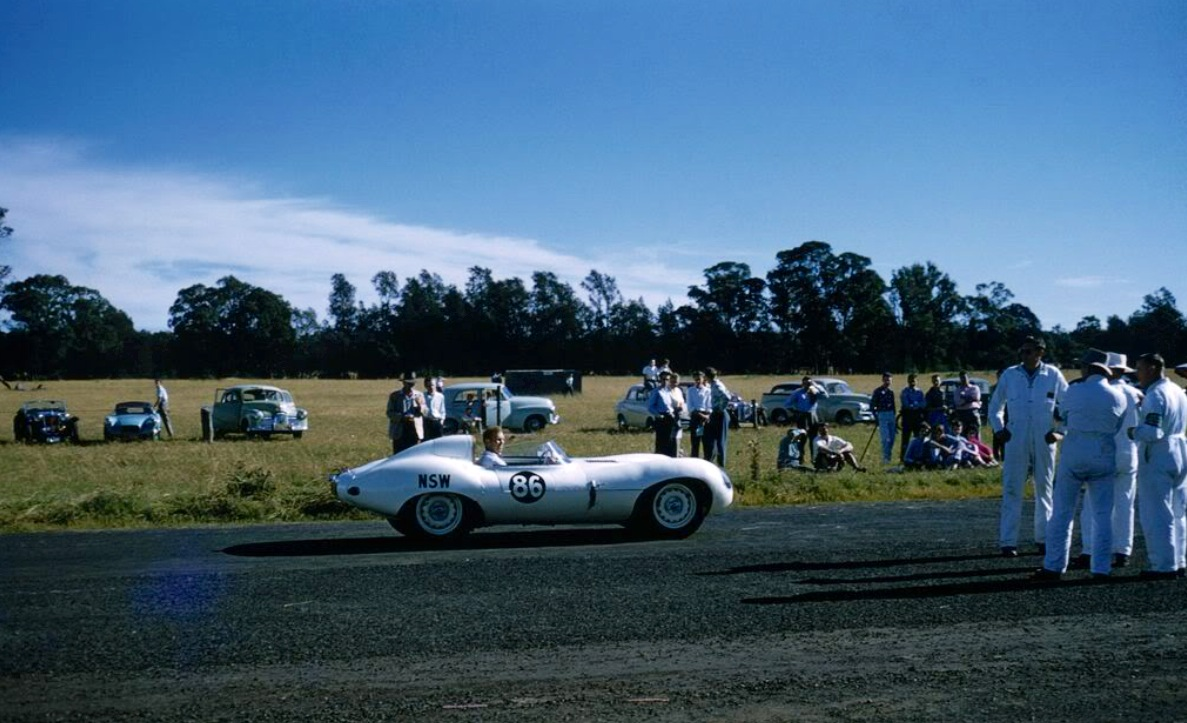
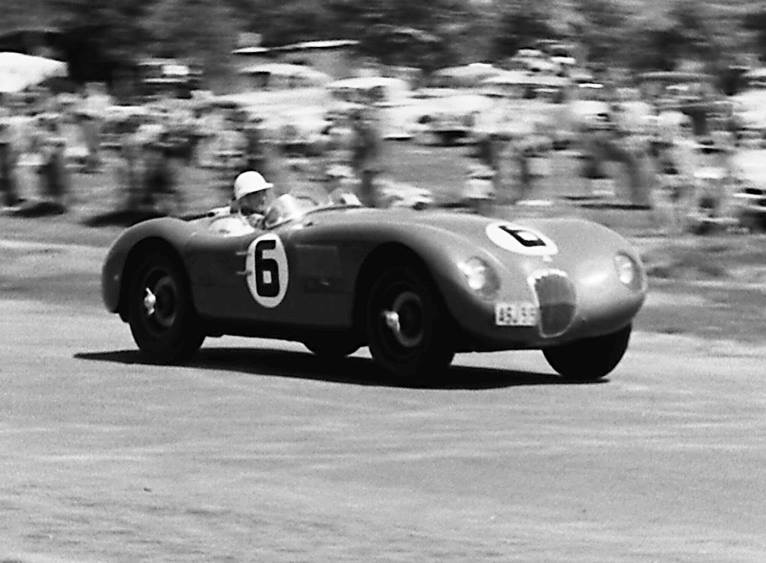
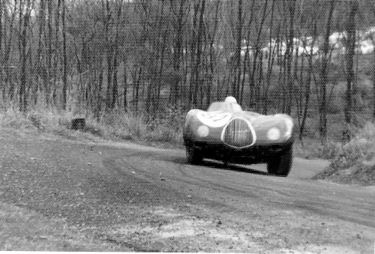
Frank Gardner beside his Jaguar D Type ‘XKD 520’ at Mount Druitt on 23 May 1958, looking fairly relaxed, photographer John Ellacott recalls FG achieved a 14.57 standing quarter mile in the big, powerful car…

Its right at the end of Mount Druitt’s decade long life as a race circuit in Sydney’s western suburbs. FG took FTD in one of the sprint events after the circuit was ‘mortally wounded’ by circuit owner Belf Jones after a spat with its operator the ‘Australian Racing Drivers Club’ in 1958.

mt druitt 1

(TR0003)

These wonderful Mount Druitt, 1955 Sydney, New South Wales colour shots (the one above and below) were posted on ‘the Nostalgia Forum’ which, for those of you who haven’t discovered it is something you should do, but be warned you will be lost in interesting motor racing ‘threads’ for years…

http://forums.autosport.com/forum/10-the-nostalgia-forum/

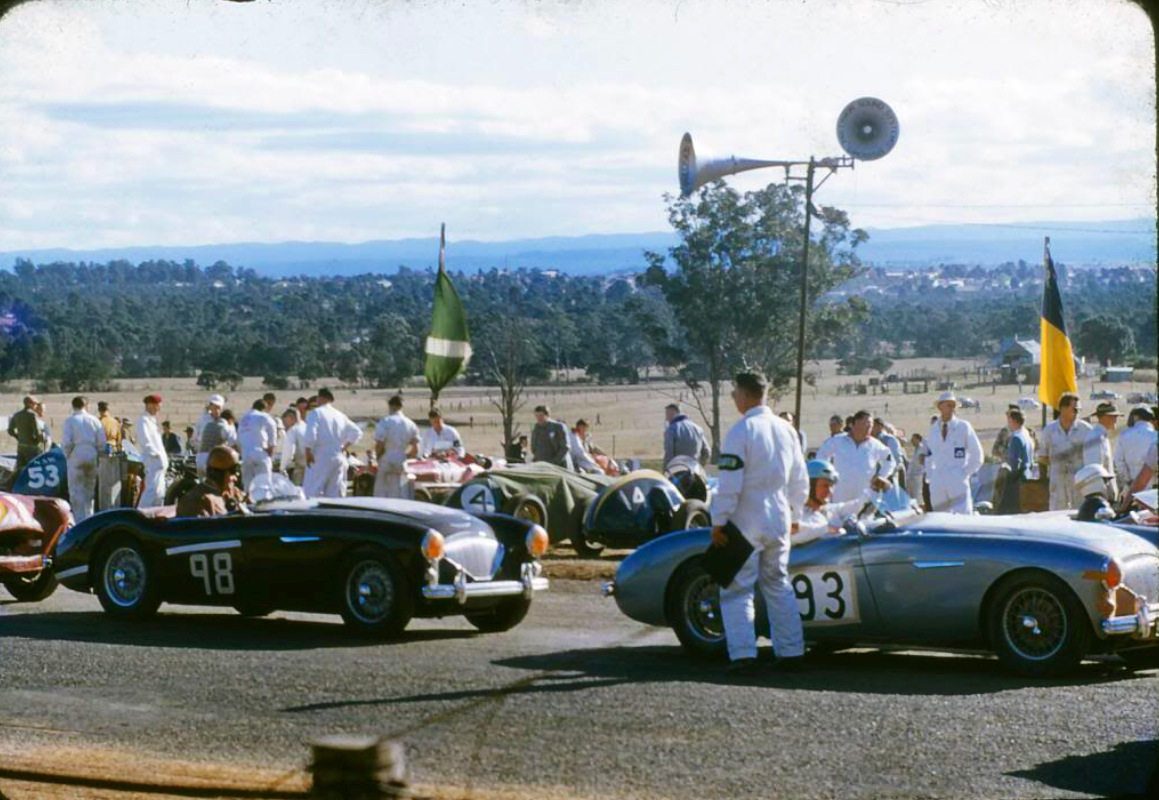
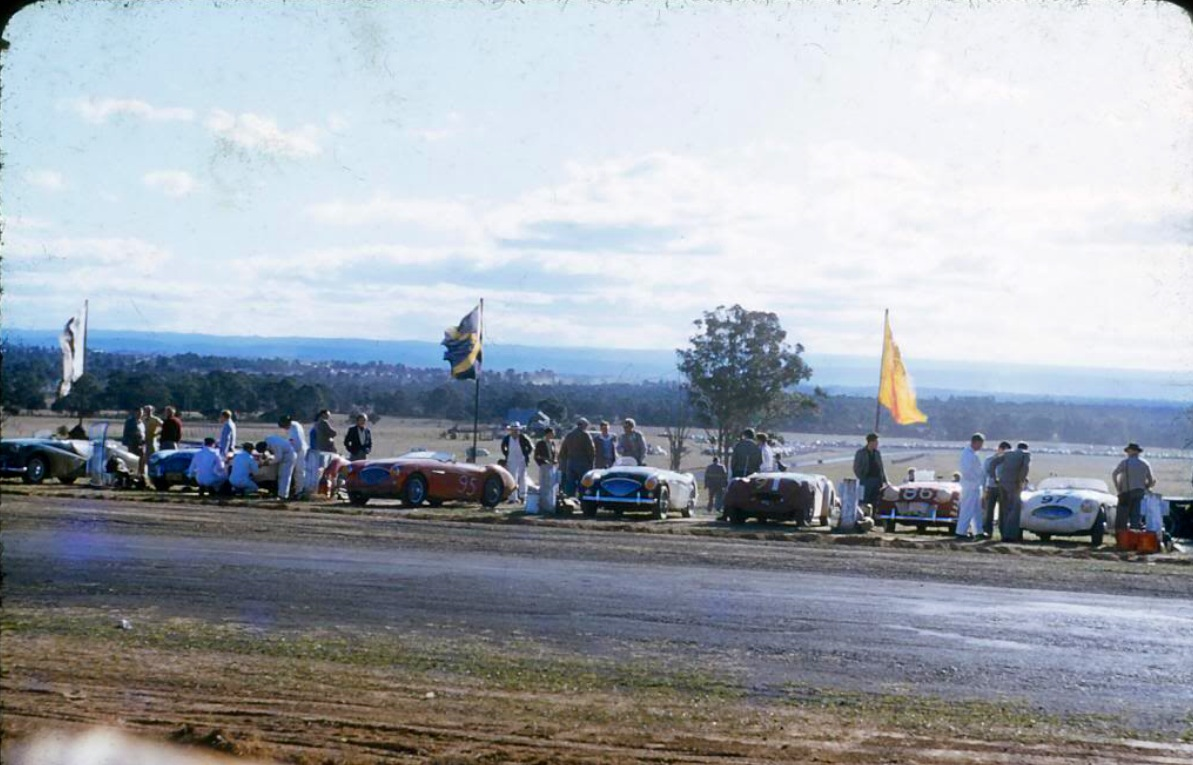
Ace researcher/historian and primotipo contributor Stephen Dalton dates the shots as probably the 4 September 1955 meeting with the Healeys’ driven by #93 C Kennedy and #98 K Bennett. In the background Stephen thinks the #53 tail is an important Australian MG Spl, the ex/Dick Cobden/David McKay/Curly Brydon car.

The red car surrounded by mechanics is perhaps the ex Jack Saywell Alfa Romeo P3 then Alvis powered and driven by Gordon Greig. The covered #4 single seater is Stan Coffey’s Cooper Bristol ‘Dowidat Spl’ and #14 Jack Robinson’s Jaguar Special.

mt druitt 2

(TR0003)

All ‘The Fun of The Fair’ or ‘Mount Druitt Motor Racing’ as the case may be…

This article was published in the Sydney Morning Herald on 14 August 1954, it captures the atmosphere of the place and the day and ignorance of the public of motor racing;

THIRTY thousand picnicking spectators in 8,000 cars make a phenomenon in Australian sport and entertainment at Sydney’s monthly motor races at Mt. Druitt.

Cars park two to four deep the whole length of the two and a quarter miles racing track. Spectators drive between races from one vantage point to another over ‘horror stretches’ in the seemingly endless acres of paddocks around the track.

Vendors sell hot water, hot dogs, all the usual provendor of picnics. Children play rounders or football between races.

By the standards of Britain’s famous Brooklands, the informality is extreme for the spectators, but it is typically Australian; sunshine, open air, gum trees.

The Australian Racing Drivers’ Club, however, applies the strictest international rules of competition to its 12 or 14 race program.

Officials on motor cycles patrol the boundary fences. White uniformed officials with international motor racing flags signal the drivers safely through the races-a blue flag waved – ‘a competitor is trying to overtake you’; a yellow flag waved ‘great danger, be prepared to stop’; yellow, with vertical red stripes-‘take care, oil has been spilt on the track.’

A public address system links the whole of the two and a quarter miles of track with the finishing line.

A truck tows breakdowns off the course, often two at a time, ignominiously, like a defeated bull dragged from the ring.

At the end of the day 8,000 cars crowd the Great Western Highway in a colossal traffic jam, in which the ‘hot rodders,’ after a few imitative accelerations, lose their ardour for speed on frustrating miles of bumper-to bumper driving.

What attracts this crowd to a venue nearly 40 miles from the city is the excitement of speeds up to 140 miles an hour and skid turns on hairpin and right-angle bends. The straight of the bitumen track is a wartime airstrip.

The club conducts events for racing, sports, and stock cars and has 60 to 70 competitors at a meeting.

Most of the competitors are owner-drivers-fanatical seekers of perfection in the assembling and tuning of motors. They acquire a car, according to their means and choice. If it is a stock model they remachine and reassemble parts of the motor, and fit new parts, two carburettors, and a ‘blower’ (a supercharger), which gives the ultimate ‘kick.’

In all types of cars running and maintenance costs are high. A set of tyres is good for only 500 racing miles. A car may run half a mile and burn the top out of a piston. An owner may spend £250 on a new cylinder head and find it does not fit satisfactorily.

brabham

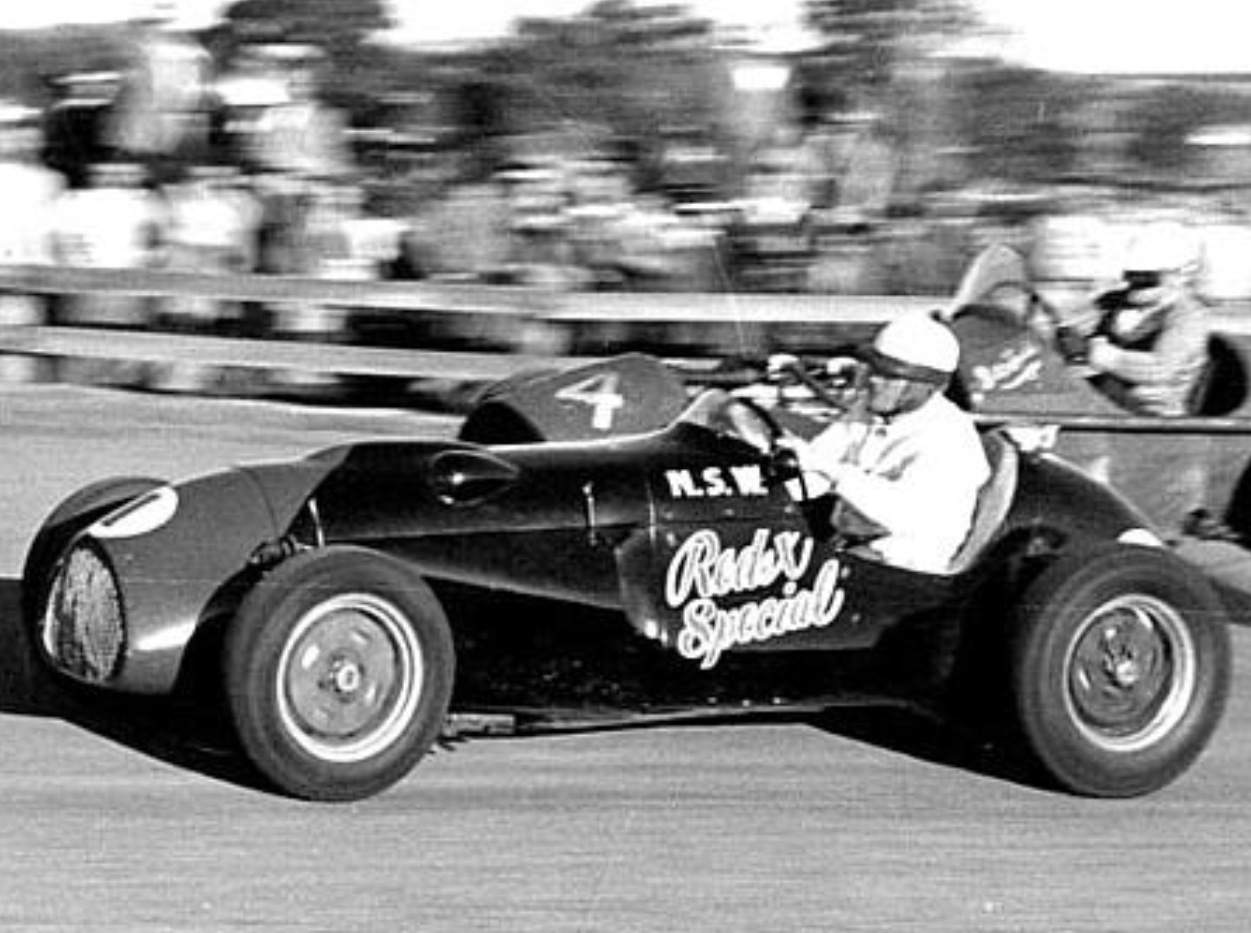
Jack Brabham in the Cooper ‘Redex Spl’ Bristol referred to in the text. On the outside is Bill Hudson, Hudson Spl at Mount Druitt in 1955. Jack was later to say he should have taken this highly self developed car to the UK rather than purchase the Cooper Alta he bought in the UK…still it didn’t hold him back in the end! (unattributed)

THE glamour driver of the moment is a 26-year-old motor engineer, Jack Brabham, with his British £4,000 six cylinder Cooper (frame)-Bristol (motor).

He is a former Australian midget car champion, whom some club officials put in ‘world class.’

In the lingo of the fans, he ‘lashes the loud pedal-(accelerator) down to the boards’ and scorns the ‘anchors’ (brakes).

His driving is, indeed, a spectacle as he relentlessly mows down a field, flashes past car after car, and changes gears at 85 to 90 miles an hour.

But the fans are watching a £7,000 Italian Ferrari, with a 12-cylinder two litre engine having a power output of 250 b.h.p. and a top speed around 150 m.p.h. Owner Dick Cobden, a fine driver, has had the car only a few months and is still familiarising himself with its tuning and driving.

The Ferrari is a Grand Prix car, which famous English driver, Peter Whitehead, drove in the Lady Wigram trophy at Christchurch, New Zealand, early this year’.

cobden

Dick Cobden’s ex-Whitehead Ferrari 125 at Mount Druitt, date uncertain. (G & L Liebrand Collection)

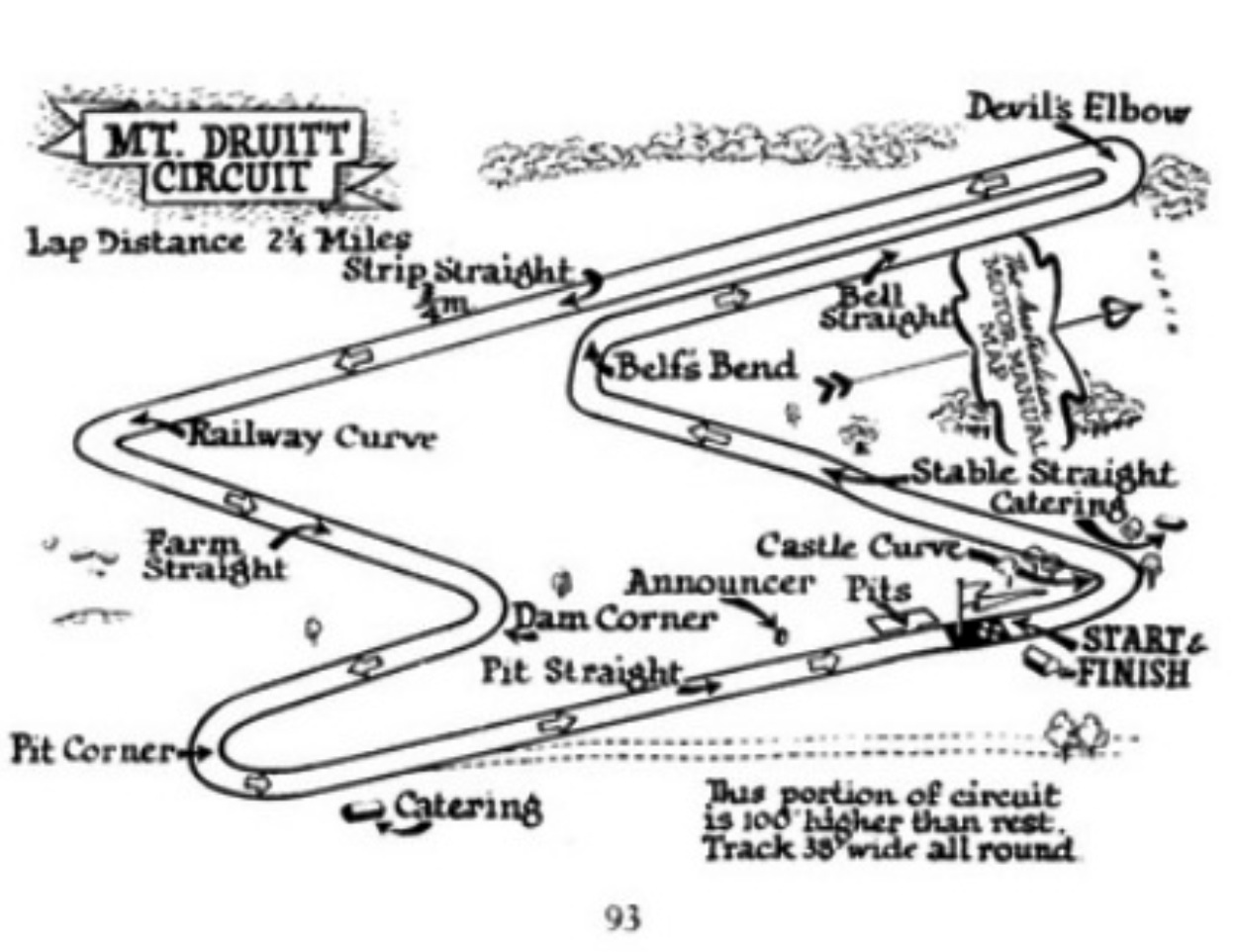
Circuit Map…

druitt circuit

(unattributed)

Mount Druitt Aerodrome, 45 Km west of Sydney was built for the Royal Australian Air Force during World War 2. The facility comprised 2 hangars, workshops and a runway 1,524 metres long and 48 metres wide, perfect as the basis of a racetrack postwar.

The first race meeting was held on October 4 1948 on a short track based on the runway established by the Australian Sporting Car Club.

In 1952 Belf Jones built a full circuit, 2.25 miles long using some adjoining land owned by a Mr McMahon, a Sydney businessman. The circuits’ first meeting was on 30 November 1952 organised by the Australian Racing Drivers Club, the main event, a 50 Mile Handicap won by future Australian champion, David McKay’s MG Spl. (one of the cars obscured in the first photo above).

Over the following 5 years over 25 meetings were run with crowd attendances often over 15,000, given the circuits proximity to Sydney. Mt Druitt’s last meeting was on 10 November 1957.

Commercial agreement for the circuits future use could not be reached between the ARDC and Jones, who did irreparable damage to the circuit; Jones cut a trench around the circuit with a digger!

gardner 2

Another shot of Frank Gardner’s D Type at Mount Druitt on 23 May 1958. (John Ellacott)

The last hurrah for the venue was a number of sprint meetings run in 1958. Victories resulted for Gardner’s D Type Jag, Arnold Glass’ HWM Jaguar and Len Lukey’s Cooper Bristol.

The ‘NSW Speedway Act’ in 1959 and consequent required investment in the facility to meet new safety standards was the final death-knell for this fondly remembered circuit.

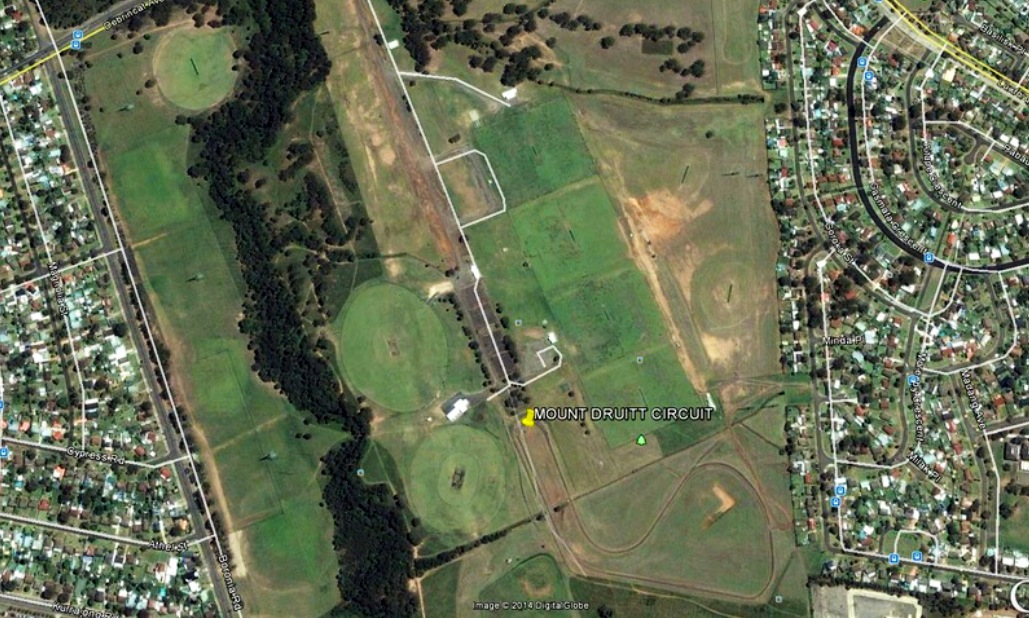
The parts of the track added in 1952 remain but the airstrip section is long gone, the area is now known as the Whalan Reserve, it comprises the Mount Druitt industrial estate and Madong Avenue Primary School.

druitt circuit 2

Current google earth aerial shot of the circuit area. (speedwayandroadracehistory.com)

Bibliography…

The Nostalgia Forum Mount Druitt thread, particularly the contributions of Stephen Dalton and ‘wirra’. Sydney Morning Herald 14 August 1954, speedwayandroadracehistory.com

Photos…

John Ellacott, TR0003, G & L Liebrand Collection

Finito…

image

(oldracephotos.com)

Few drivers knew Warwick Farm like Frank Matich and Kevin Bartlett…

They raced at the track from its earliest days, it’s first meeting in 1960 I wonder?, and certainly the last international meeting, sadly the 1973 Tasman round run 12 months after the photos here were taken, Steve Thomson won that very wet race in a Chevron B24 Chev.

Here the two Sydneysiders are attacking The Esses during the 1972 F5000 Tasman round, the ‘Warwick Farm 100’ on 13 February. Matich was 1st in his Matich A50 Repco and KB 3rd in his McLaren M10B Chev, not really a front-line tool by that stage but still quick enough in Kevin’s highly skilled hands to win at Teretonga, the final ’72 Kiwi round, a fortnight before.

image

Bartlett and original owner Niel Allen had a lot of success in this McLaren M10B ‘400-02’, car now in the tender, loving hands of Alan Hamilton, also a former Australian champion .KB here during the ’72 Tasman race. A Lola T300 would replace the car in time for the domestic Gold Star Series (unattributed)

Matich didn’t have a good Tasman, the A50 was quick enough to win the series but FM didn’t have a lot of luck, the championship was convincingly won by Kiwi arch driver/constructor rival Graham McRae in the Leda/McRae GM1 Chev penned by Len Terry.

Click here for an article on the Matich F5000 cars including the 1972 Tasman Series:

Frank Matich: Matich F5000 Cars etcetera…

Credits…

oldracephotos.com, Bob Williamson Collection

Tailpiece: The Lola T300 was ‘a chick’ with a great arse and hips, visually arresting…

image

Frank Gardner and Lola T300 Chev ahead of Frank Matich in the ’72 WF pitlane for tweaks. FG won the ’72 NZ GP in this T300 at Pukekohe, his last single-seater win, I think (Bob Williamson)


Frank Gardner split Matich and Bartlett, he was second at Warwick Farm in the factory T300. Frank was not exactly unfamiliar with WF either, mind you no-one would have done more laps around it than Matich, Frank tested tyres for Firestone, and later Goodyear and his cars a lot!

Between Gardner and Bob Marston they concepted a small F5000 based on Lola’s F2 tub. By placing the big water radiators, you needed plenty of coolant to look after the needs of a big Chev, at the cars hips they gave the car, and the T330/332 which followed it their most distinctive and attractive feature. Effective too in terms of aerodynamics and centralising weight, an article on the T300 is one for another time…

Finito…

clark

Rod MacKenzie’s moody, foreboding, evocative image of Jim Clark’s Lotus 49 at Longford in 1968 is one of my favourites…

Clark is exiting Newry Corner on the run towards the ‘Flying Mile’. He started from pole, winning 100 bottles of champagne in the process and finished second in the Saturday preliminary race in beautiful weather but the clouds opened on Monday morning for the Tasman Championship event, ‘The South Pacific Trophy’.

Star of the show was Piers Courage who drove a gutsy, skilful race in the most challenging, treacherous conditions to win the event in his little F2 McLaren M4A FVA ahead of the big Tasman 2.5’s of his close competitors. Pier’s car was self run, his performances in it that summer reignited his career.

courage

Piers Courage in his McLaren M4A F2 car, Newry Corner, Longford 1968. Power was not all on this fast circuit in such wet conditions, but the plucky Brit was giving away at least 130bhp to his 2.5 litre V8 powered opponents (R MacKenzie)

Pedro Rodriguez and Frank Gardner were second and third in BRM P261 2.1 V8 and Brabham BT23D Alfa 2.5 V8 respectively. Clark was fifth in his Ford Cosworth DFW engined Lotus 49, the 2.5 litre variant of the epochal 3 litre DFV GP engine.

Jim Clark chewing the fat with BRM’s Tim Parnell- all the fun of the fair, Longford 1968, Clark’s Lotus 49 Ford DFW ready for action (oldracephotos/Harrisson)


Clark and the boys with Denny Hulme’s Brabham BT23 FVA behind (HRCCT)

Lets go back to the start of the meeting, marvellous from the Tasmanian’s perspective as the series went down to the wire, Chris Amon was still a potential series victor with only six points between he and Jim Clark with Piers Courage’s third place within Graham Hill’s grasp depending upon how he fared.

Chris Amon blew the sealing rings in the Ferrari’s little V6 keeping his crew busy for the evening whilst Pedro Rodriguez popped an engine too- the BRM mechanics therefore readied the P261 V8 for the race rather than the P126 V12 the Mexican raced in the Saturday preliminary. Piers Courage tapped the nose of his pristine McLaren M4A when the flaggies got so enamoured of the cars they forgot to signal oil on the track! All was well at Gold Leaf Team Lotus.

Lap 1 of the preliminary on Saturday, Geoff Smedley’s amazing colour shot- Clark from Hill, Amon, Gardner and one of the BRM’s- Lotus 49 by two, Ferrari 246T, Brabham BT23D Alfa and BRM P261 0r P126 (G Smedley)

Practice times didn’t mean too much as the teams were focused on race setup for the twelve lap Saturday preliminary race ‘The Examiner Racing Car Scratch’ which also counted for grid positions. In the second session of practice Clark did a 2:12.8, Hill 2:13.6 and Amon 2:13.8. Clark was under Jack Brabham’s record set on the way to his win the year before in his BT23A Repco, Jim won 100 bottles of champagne for pole as stated earlier.

In the preliminary on Saturday the grid formed up with Clark on pole. Hill comfortably won the event run in fine, dry weather from Clark and Amon. Both Lotuses were timed on the Flying Mile at 172 mph but Amon’s 182 mph in David McKay’s ex-works Ferrari P4/Can Am 350 sportscar rather put the single-seaters in the shade! Lets not digress about that car now, follow the link at the end of this article for a long piece about the P4 which Chris raced in the sportscar support events in each of the Australian Tasman rounds.

Hill G leads the pack off Long Bridge on lap 1 of the Saturday preliminary. Hill, Clark, Amon, Gardner, Leo Geoghegan Lotus 39 Repco, a BRM and perhaps Kevin Bartlett Brabham BT11A Climax (R MacKenzie)


Exit from Newry, lap 1 of the preliminary- Hill, Clark, Amon, Gardner, Geoghegan’s Lotus flirting with the tracks edge, and Attwood. Great shot shows how the circuit rises at this point into the right hand kink up the road (S Geoghegan)

Only a couple of supporting races had been run on the Monday raceday when light rain started to fall at about 10am, this soon became heavy. As the rain got harder and the clouds more threatening it was obvious that it was not likely to abate before the 2.15 pm race start time

The track was almost under water at some points where hay bales had broken up and straw was blocking the drains. Efforts by track officials soon had most of the drainage system under control.

A large crowd was of course present on the Labour Day long-weekend. Crews brought the cars out onto the circuit in front of the pit counter and stood together under umbrellas as the drivers went into a huddle with the promoters of the meeting and the CAMS stewards to determine if the race should go on.

Leo Geoghegan and Lotus 39 Repco return to the Longford pits after some exploratory laps. DNS with unsuitable tyres. Its the Courage McLaren by the pit counter (oldracephotos)

Sergent.com report that first it was decided that the cars should do a couple of exploratory laps then report their findings.

Geoghegan, Amon, Clark, Hill, Attwood, Gardner, Bartlett and others went out and after looking like motor boats ploughing through the water delivered their thoughts to the meeting. The conditions were so bad various drivers with unsuitable tyres elected not to start having driven some ‘sighting laps’.

Kevin Bartlett recounted his experience in the Alec Mildren Racing Brabham BT11A Climax; ‘I did two exploratory laps and the old BT11 couldn’t find traction anywhere. I had an absolutely terrifying 4th gear 720 degree spin across the short Kings Bridge, the one after the Viaduct, missing all the obstacles at the tracks edge. After exiting Pub and in a straight line i did a 360 degree loop. She nearly escaped me over the rail line on the way to Long Bridge. Out of Newry and up the hill to the straight slithering along with no touch felt between me and the bitumen, so i suppose I thought at that moment to do another lap at a very reduced speed then pit’.

Packed car park: Amon’s Dino, the BRM’s of Attwood and Rodriguez, Pedro’s P261 fully covered, the two Lotus 49’s, Piers McLaren, then Leo G’s Lotus 39 and John Harvey’s Brabham BT11A (oldracephotos)

long

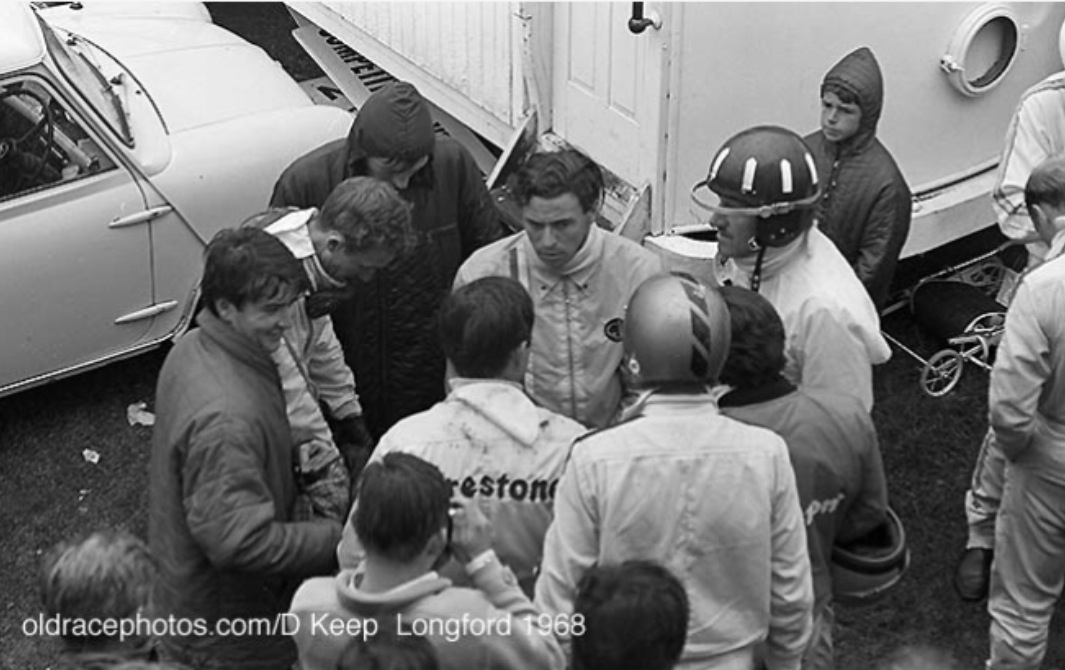
‘What are we going to do boys?!’ Drivers considering their options before the race, the pouring rain exacerbated by drains beside the track which couldn’t cope with the deluge; Clark facing us, Hill’s distinctive helmet clear. Courage with his back to us in helmet, Gardner’s lanky frame partly in shot to the right. Amon in the ‘Firestone’ suit, Harvey? at left with head down (oldracephotos)

‘Once back in the tent Alec, Frank (Gardner) Denny (Hulme Brabham BT23 FVA F2) and i had a talk about the tyres that Denny and i had and after trying to come up with a better tread pattern, such as the ones fitted to Franks car (Brabham BT23D Alfa) but with no result. It was agreed that Denny and i shouldn’t risk a start. I was happy with the call and Leo (Geoghegan Lotus 39 Repco) followed suit. Most of the top guys had the latest Firestone, Dunlop or Goodyear wets but none were available to suit the BT11’s. I consoled myself with the fact that if the new world champion (Hulme) didn’t like the risk i certainly shouldn’t!’

Longford, wonderful circuit that it was, provides no runoff area for a driver to go in the wet (or dry!) should a driver lose control or suffer a bad attack of aquaplaning, and this was the main point in contention.

The ill fated Brabham BT23A Repco ‘740’ of Greg Cusack on Friday or Saturday (oldracephotos)

Greg Cusack in David McKay’s Scuderia Veloce Brabham BT23A Repco (Brabham’s victorious Longford mount from 1967) had left the road that morning. He lost the car on the greasy road as he went over the hump/bump on the approach to The Viaduct. The car left the road, hit a bank, somersaulted and crashed into a ditch, he was then pinned under the it before being quickly released by officials.

The 37 year old Canberra motor dealer, who had intended Longford to be his last race meeting, was taken to Launceston Hospital with chipped bones to both knees, stretched ligaments and a fractured left wrist. He was lucky it was not a good deal worse. Bib Stillwell organised for one of his planes to fly Cusack and his wife home to Canberra on the Tuesday where he was admitted to hospital.

Whilst Cusack lay in hospital the other drivers were trying to explain the difficulties of Longford which were exacerbated hugely in the wet. ‘Motoring News’ reports at length about the cordial discussions between the drivers and officialdom and all of the competing issues of safety, providing a show and running a race to determine the winner of the Tasman Cup.

The Stewards finally ruled that the race should go ahead but be shortened to 15 laps of the 4.5 mile circuit, (128 miles to 68 miles) and put the starting time back to 4pm hoping the rain would ease and the situation be safer as a consequence. At 4.15pm the sodden cars and their game, uncomplaining drivers were facing the soggiest start ever seen at Longford, one of the most challenging road circuits in the world.

Front row- Amon Ferrari 246T and the two Lotus 49 DFW’s of Hill and Clark, that’s Frank Gardner’s Brabham BT23D Alfa nose (oldracephotos)


Soggy start: L>R Amon Ferrari Dino 246T, Hill Lotus 49 and unsighted to the right Clark. Then Rodriguez BRM P261 #11 and alongside Gardner in the light coloured Brabham BT23D, #12 behind him Attwood BRM P126 and alongside him the winner Courage McLaren M4A. L>R in the back row John Harvey’s Brabham BT11A, John McCormack Brabham BT4 and Mel McEwin Lotus 32B (oldracephotos)

Clark’s Lotus 49 got away well, somehow finding traction with the wide Firestones, and he was followed into the right-hander before The Viaduct by Amon and Hill. The drivers took the opening laps cautiously under race conditions and each car was leaving a gap to the other so they could see through the flying spray.

At the end of lap one the order was Clark, Rodriguez BRM P261 V8 on Dunlops, Gardner Brabham BT23D Alfa on Goodyears, Courage Mclaren M4A Ford FVA using new narrow-section 970s, Hill Lotus 49 Ford DFW on Firestones, Attwood BRM P126 V12 on Dunlop, Amon Ferrari 246T back in seventh owing to a run down the escape road at Newry Corner, then John Harvey Brabham BT11A Repco John McCormack Brabham BT4 Coventry Climax FPF and Mel McEwin Lotus 32B Coventry Climax FPF, this car the ex-Clark/Palmer 1965 Tasman Championship winning chassis.

Richard Attwood, a very good 4th in the big BRM P126 V12 on Pit Straight. BRM was testing, by way of eight Tasman race weekends in a row, this new F1 design in 2.5 litre capacity in advance of the ’68 GP season (oldracephotos/DKeep)

‘Attwood found he had more traction on Dunlops than Hill had with the wide Firestones and he slipped under the Lotus for fifth place on lap 2. Both Attwood and Rodriguez had hand-cut drainage grooves in their tyres. A lap later Courage really got his foot in it to take Gardner on lap 3. He then jumped past both Rodriguez and Clark on the next lap while Gardner followed him through and waited for another lap behind Clark before taking the plunge and heading for second. Amon had taken Hill and now, on lap 5, the order was Courage 9.6 secs ahead of Gardner, Clark, Rodriguez, Attwood, Amon, Hill and Harvey. McEwin and McCormack were already in danger of being lapped by the flying Courage.

Hill from Gardner, not sure who and one of the BRM’s, Long Bridge (R MacKenzie)

Courage, driving like a young Stirling Moss in the blinding rain, somehow gained another 9.5 secs on lap 6, putting him 16 secs ahead of second man Gardner in the Brabham-Alfa. Rodriguez had pulled past Clark and on the next lap Attwood whizzed past Clark to take fourth. On lap 9 Courage was 32 secs ahead of Gardner and having a ball out on his own, right foot hard in it. Gardner was 3.5 secs ahead of Rodriguez who was followed by Attwood, Clark, Amon, Hill and Harvey losing a lot of ground’.

Pedro raced the little 2.1 litre BRM P261 V8 having raced the new P126 V12 in the preliminary and had engine failure. 2nd a minute behind Courage just sneaking past Gardner in the final stages (oldracephotos/DKeep)

‘Rodriguez started to close up on Gardner in the closing laps, but nothing could touch Courage. This was his day, it was he who had the best gear on his car and he was darned sure he was going to make it a race to remember. He had pulled 45.5 secs on Gardner by lap 12 while Rodriguez had got within 2.5 secs of Gardner. Hill challenged Amon on the same lap and finally squeezed past in a daring effort on the greasy track to make the Lotus-Fords fifth and sixth’.

Frank Gardner on the exit of Newry, Alec Mildren’s Brabham BT23D Alfa Tipo 33 2.5 V8. 3rd a minute behind Courage (R MacKenzie)

‘As Courage screamed down the straight heading for the flag he was over 55 secs ahead of Gardner and he came past the pits jubilantly waving his hand. Gardner by this time, heading for the braking area at Mountford, had Rodriguez looking right at the Alfa V8 pipes. There seemed no way that Rodriguez could slip past, but suddenly a gap appeared as Gardner went a shade wide on Mountford and Rodriguez poured on the power into the short straight and took the flag about 25 yards ahead of the Alec Mildren car. Attwood finished his race fourth after a very steady drive, followed by Clark, Hill and Amon’.

John Harvey coming off Long Bridge in Bob Janes Brabham BT11A Repco ‘740’ V8. This is the car in which Spencer Martin won the ’66/7 Australian Gold Star. Converted to Repco power just prior to the Tasman (R MacKenzie)

Hill, Lotus 49 DFW, 5th on the Flying Mile (R MacKenzie)

‘Courage had the rubber, just the right amount of power for the job and the ability to keep the car straight on a very dicey and greasy circuit. He finished the Tasman Cup Series in a wonderful third place behind Clark and Chris Amon. Then came Hill and Gardner 17, McLaren 11, Rodriguez and Hulme 8, Jim Palmer 7, Attwood 4, Roly Levis and Leo Geoghegan 3, Paul Bolton, Red Dawson and Kevin Bartlett 2, Graeme Lawrence and Ross Stone 1 each’.

Like a duck to water- Courage, right tyres, set up, enough power, precision and bravery. McLaren M4A FVA F2 machine (R MacKenzie)

It was very much the end of an era, the last Longford, the speed of the cars and advancing track safety rules caught up with the place and an inability of the club/government to make the requisite investment. Most importantly Jim Clark, a very popular visitor to Australasia since the early sixties and twice winner of the series in 1965 and 1968 died at Hockenheim in an F2 Lotus 48 in April.

Lotus returned in 1969 but it was not quite the same without the magic and personality of the great Scot.

photo (15)

A very happy but cold and soggy Piers Courage, with wife Sally after his Longford ’68 win. It was a might fine drive which is still remembered by those fortunate enough to see it. (oldracephotos)

Etcetera…

Practice and Saturday Preliminary

Richard Attwood, BRM P126, The Viaduct (oldracephotos/Keep)


Lap 1 bunch behind the lead group- Gardner Brabham BT23D, Geoghegan Lotus 39, Attwood BRM P126, Bartlett Brabham BT11A, Rodriguez BRM P126 into The Viaduct (oldracephotos)


Leo Geoghegan, Lotus 39 Repco 740. Leo frightened the internationals in his ‘old bus’ more than once that summer- Clark’s ’66 Tasman mount Coventry Climax FPF engined. Non starter on Monday tho (R MacKenzie)


Chris Amon, Ferrari 246T. Chris learned a lot from his ’68 tour, and applied those learnings well in 1969 winning the title in an updated, four valve, winged  Dino (oldracephotos


Pedro Rodriguez, BRM P126. The V12 engine in this car failed during the race so Pedro raced the ‘backup’ P261 V8 in the championship event- cars which had become wonderful Tasman machines from 1966-8. Winner in ’66 in Stewart’s hands (oldracephotos/Keep)


Graham Hill, Lotus 49 Ford DFW. Perhaps not the best of Tasmans- 2nd at Surfers and Warwick Farm his best results (R MacKenzie)


Pedro Rodriguez, BRM P261 V8 during practice (oldracephotos/Keep)


Pedro Rodriguez, BRM P126, The Viaduct (oldracephotos/Keep)


Richard Attwood, BRM P126. Drove the Oz rounds in the car vacated by McLaren- 4th at Longford deserved, DNF’s @ Surfers and Sandown, overall the P126’s were not blessed with great reliability in the ’68 Tasman (R MacKenzie)

Photo and Other Credits…

Roderick MacKenzie Collection;  http://www.racephotoaustralia.com/

oldracephotos.com;  http://www.oldracephotos.com/content/home/

The Nostalgia Forum/Ellis French/Rod MacKenzie and Kevin Bartlett.  Sergent.com race report. Geoff Smedley. ‘Canberra Times’ 6 March 1968

Ellis French Collection/Archive

Scuderia Veloce Ferrari P4/Can Am 350…

Ferrari P4/Can Am 350 #0858…

Tailpiece: Practice- Rodriguez BRM P261 from Courage McLaren M4A Ford FVA and Kevin Bartlett Brabham BT11A Climax FPF. Variety is the spice, braking into The Viaduct…

(oldracephotos/DKeep)

Finito…

charger 1

(Robert Davies)

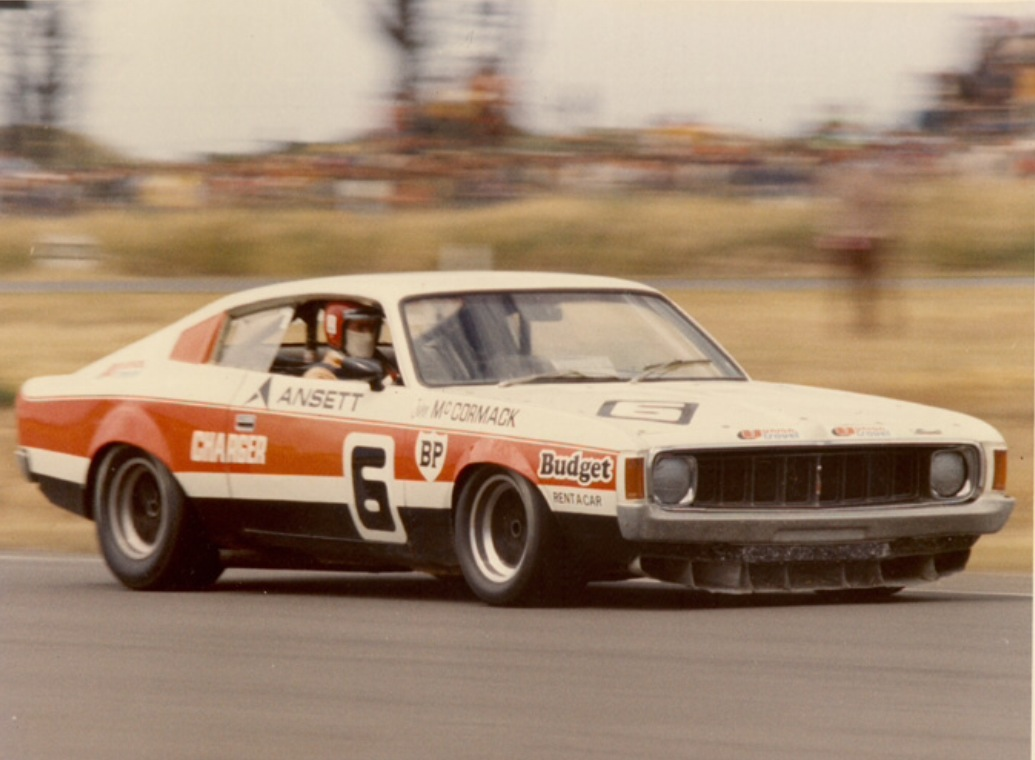
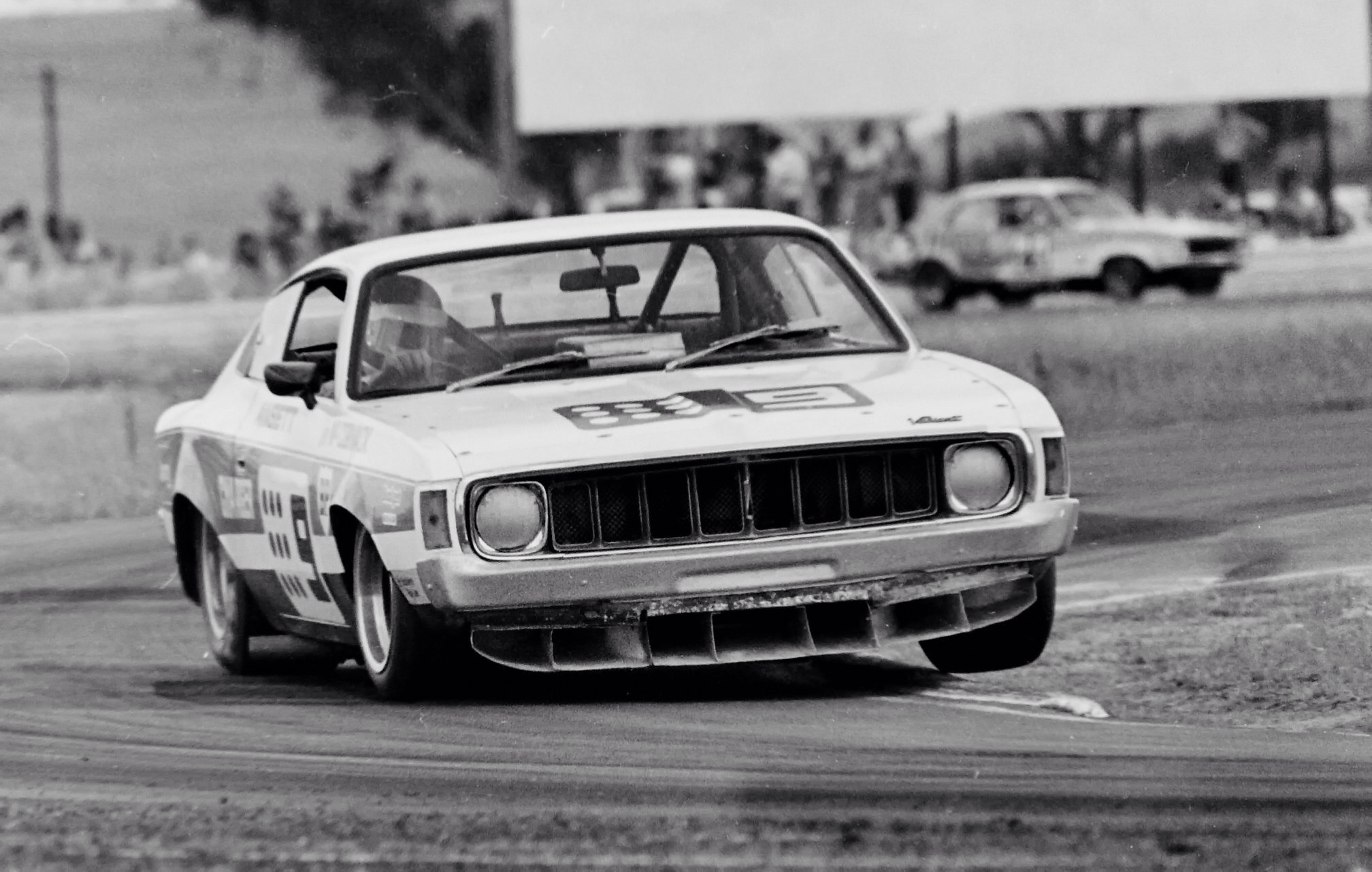
John McCormack wrestles his big, powerful but relatively nimble Valiant Charger Repco around the tight Calder, Melbourne confines in 1974…

Robert Davies shots have inspired two other articles, this is the third about a car which set a new paradigm in local Oz Sports Sedan racing in the mid-seventies.

In 1970 Touring Car Racing in Australia comprised ‘Series Production’ for essentially standard cars, contesting the Bathurst 500 and the like. ‘Improved Touring’ were more highly modified cars, the Australian Touring Car Championship was run to these regs, and ‘Sports Racing Closed’ or ‘Sports Sedans’ was an ‘anything goes’ type of category.

Sports Sedans were often the province of the more impecunious, owner driver, engineering types who created some incredibly quick Minis, Holdens of all descriptions and the occasional bit of ‘heavy metal’ V8’s from Oz or the US.

sharp

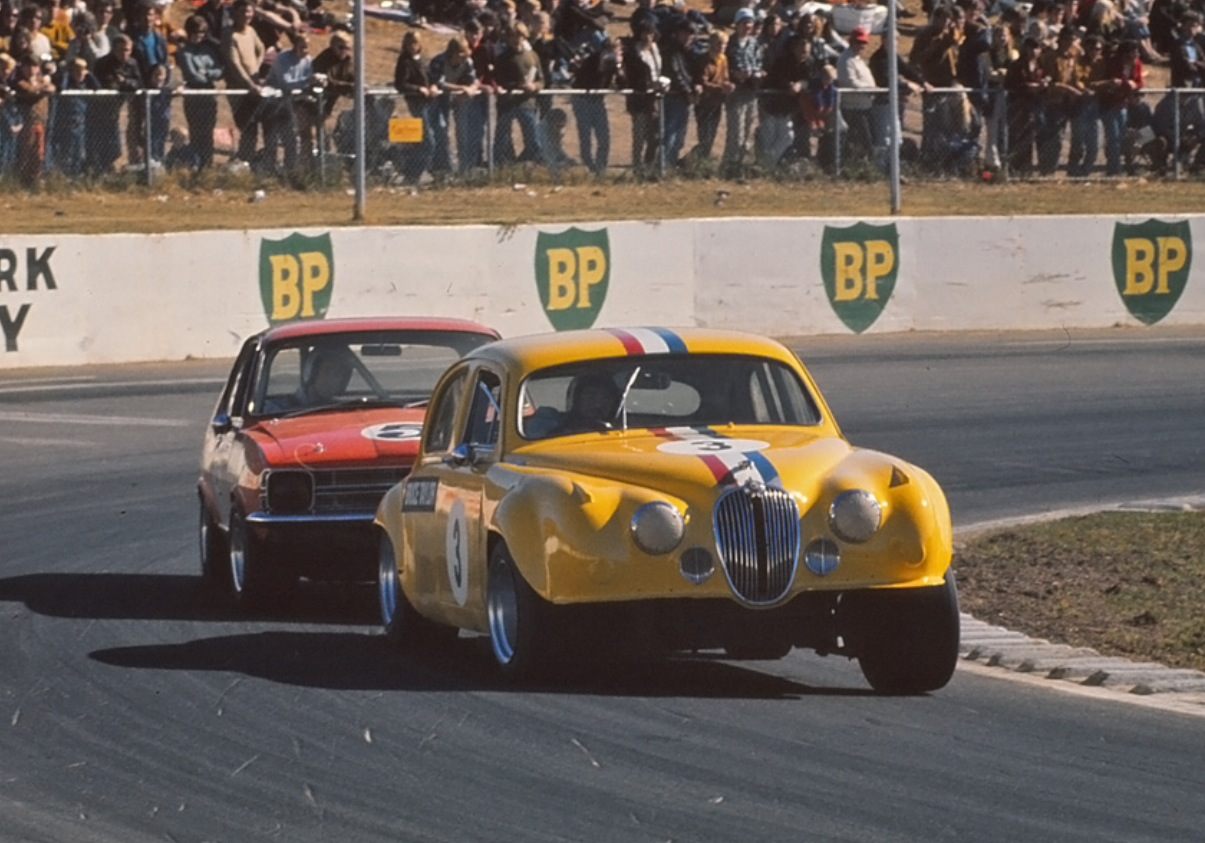
The Spirit of Sports Sedans in 1971; full spectator mounds, here at Sydney’s Oran Park. Bruce Taylor’s ex-Sharp Jag Mk2 Ford V8 ahead of Barry Seton’s ‘LC’ Holden Torana GTR XU1- old and new. (Vic Hughes)

Australian race fans liked Sedans, they were easier to understand and more spectacular to watch than most open-wheelers and the punters could relate to cars they either drove or saw on the road.

Other than during the Tasman Series, in most years our domestic single seater championship, the prestigious ‘Gold Star’ fields were thinnish. Scarce sponsorship dollars progressively found its way to Touring Cars fanning the open wheeler problem. Promoters were keen to give spectators what they wanted to fill their venues, and so, over time the dominance of Touring Cars in Australia occurred. And continues today. Sadly for open-wheeler nutters like me.

Castrol, for example, sponsors of Bob Jane Racing, one of our bigger teams encouraged Jane to get out of racers and more into touring cars in 1971. The Brabham and Bowin single seaters and McLaren sporty were progressively put to one side, replaced by a Holden Monaro Improved Tourer and Holden Torana Repco V8 Sports Sedan.

jano

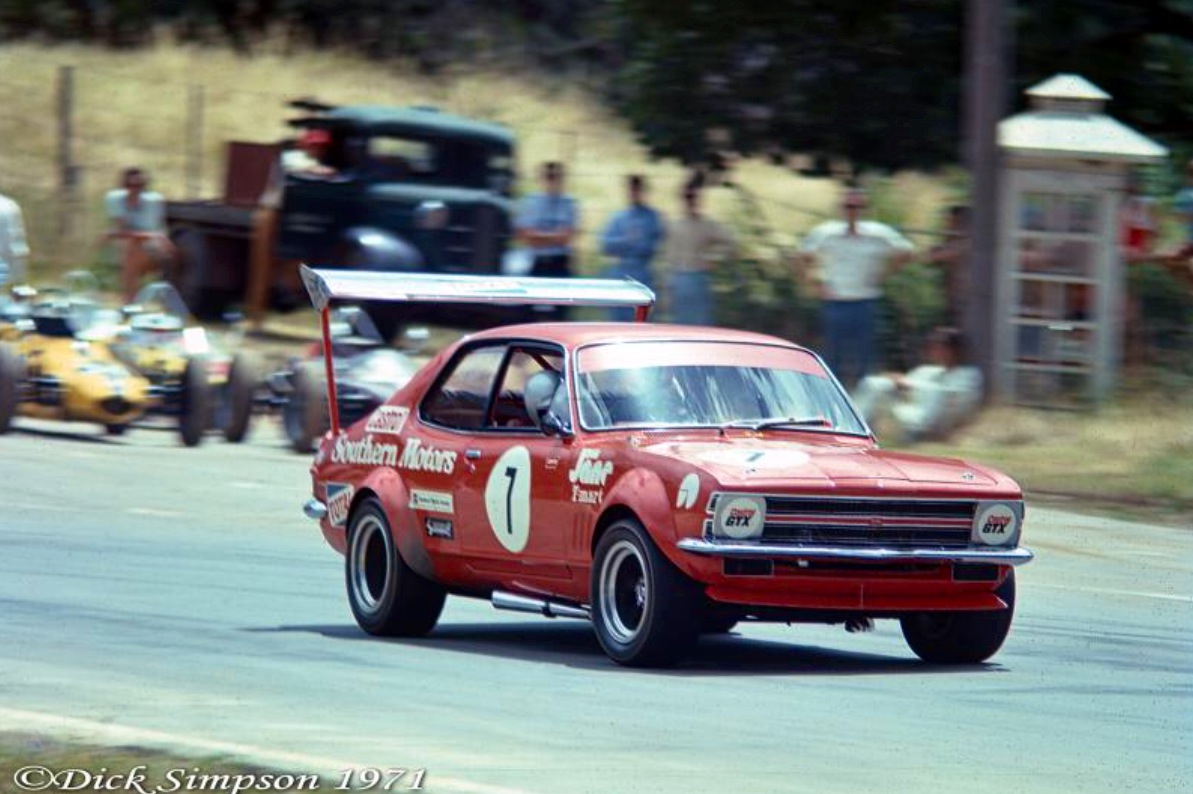
Bob Jane’s Holden Torana ‘LC’ GTR XU1 Repco. Hume Weir, Boxing Day 1971. John Sheppard built and prepared superb cars, this is one of his best, its first iteration here was not that highly modified, engine and Borg Warner ‘box excepted. Phase 2 in its life was when Frank Gardner returned to Oz and raced the car for Jane in 1975; an F5000 Chev replaced the Repco, the suspension also modified substantially in addition to the car being lightened considerably. Jane reputedly said to Gardner when he saw it ‘What have you done to my beautiful car…?’. Car still exists. (Dick Simpson)

There had been other ‘clever’ Sports Sedans, Harry Lefoe’s Hillman Imp Ford V8, an example but Bob Jane’s John Sheppard built Torana, which married a lightweight but still fully trimmed LC Torana with the Repco 4.4 Litre ‘620 Series’ V8 Bob had sitting in his Brunswick Race HQ took things to another level.

The alloy Repco developed 400 bhp but at 360 pounds weighed less than the cast iron 3 litre ‘186cid’ straight 6 fitted to the car in production form. Bob and John Harvey won many races in this car.

The ‘professionalisation’ of Sports Sedans was underway.

imp

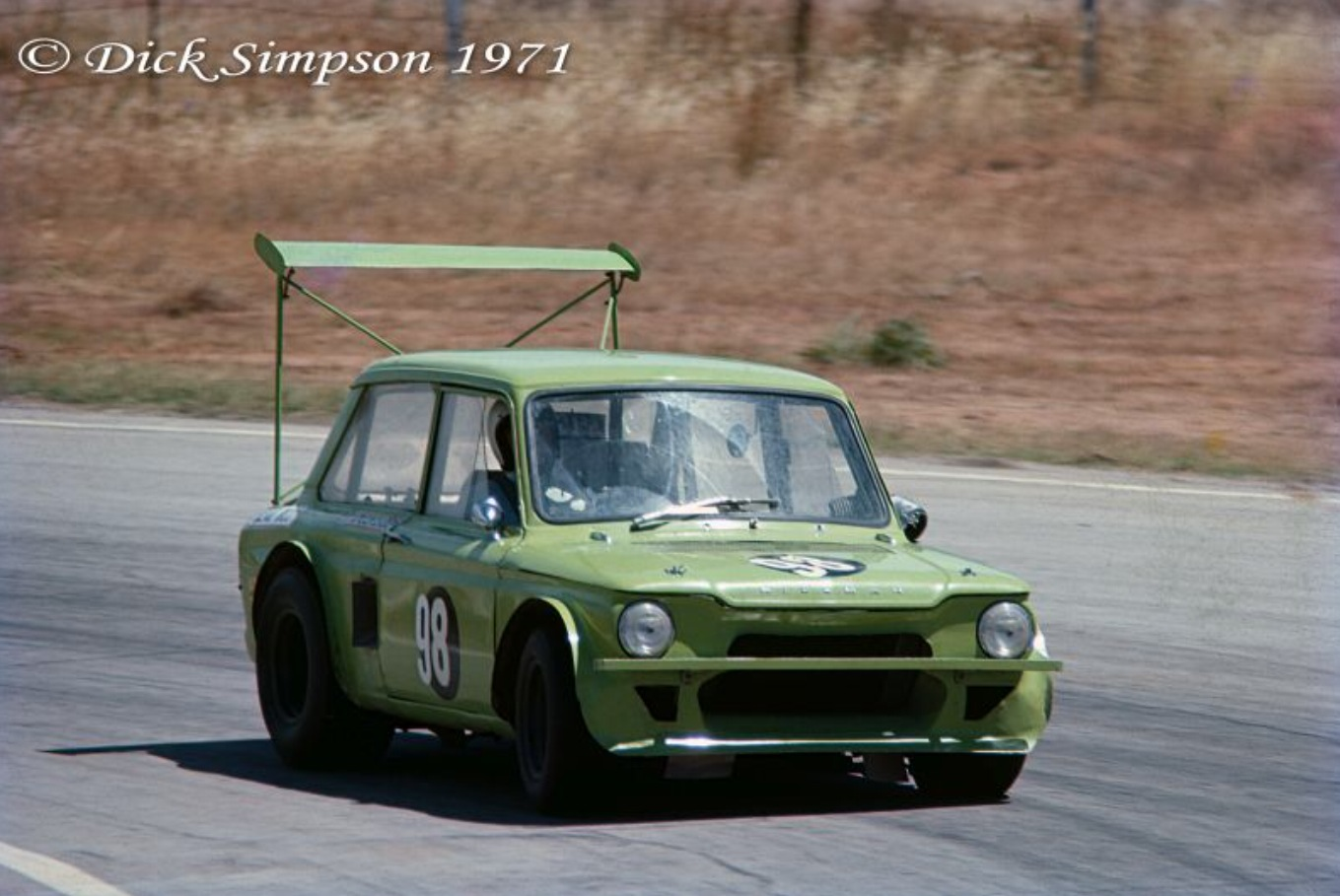
Harry Lefoe in his Hillman Imp Ford at Hume Weir, Albury, NSW on Boxing Day 1971, Dick Simpson took this shot and the one above of Bob Jane in the same race. Car had a 450bhp plus Ford ‘Windsor’ shoved in the back seat, Lefoe had balls of steel to drive the thing, twas usually sideways, considerably so! Its life ended with a big accident at Sandown in the late 70’s. Extremely short wheelbase clear, big wing, engine put out slightly more power and was slightly heavier than the 1 litre alloy standard engine…(Dick Simpson)

Another trend setting Sports Sedan was the Valiant Charger Repco built by Elfin and John McCormack’s team in 1973. Macs background is covered in the article about his McLaren M23 I wrote 12 months ago, you can read it here, I won’t repeat it.

Mac’s McLaren: Peter Revson, Dave Charlton and John McCormack’s McLaren M23/2…

John was an open-wheeler man, he won the Gold Star in 1973 in his Elfin MR5 Repco F5000, but he was also a professional driver who needed to chase dollars. Oran Park promoter Allan Horsley agreed appearance money with McCormack if he ran a Sports Sedan in his ‘Toby Lee (shirts) Series’ in 1974, that was the impetus McCormack needed.

McCormack and Elfin boss Garrie Cooper (who ran 2 Elfin MR5 F5000 cars as Ansett Team Elfin in the Gold Star and Tasman Series at the time) toyed with the idea of a mid-engined Chev Corvair but commercially a deal with Chrysler made more sense.

In those far away days Ford, GM (Holden), Chrysler (Valiant) and British Motor Corporation all made cars in Australia, with others VW included assembling them here. Now only Ford, Holden and Toyota (who changed from assembly to construction of their cars progressively after 1970) remain but have announced plans to withdraw as manufacturers.

The economic and social policy as well as wider societal implications of this are beyond the scope of this article. Suffice it to say the death of the Automotive Industry in Australia is sad, wrong and was avoidable with a mix of better management, cooperation from the global headquarters of Ford, GM and Toyota and politicians who are not fuckwits. An oxymoron i grant you.

mc cormack

McCormack during his NZ Tour with the Charger in 1975, circuit unknown. Beautifully proportioned racing car, the external appearance matched the unseen clever and well executed engineering. Elfin 10 inch wide wheels, that width mandated then, not much to put 495 energetic ponies to the road. But spectacular! (The Roaring Season)

Elfin were based in Edwardstown, a southern Adelaide suburb, the Valiant factory was at Tonsley Park, not so far down the road. Valiant lost the promotional value of motor racing when they ceased building and racing their performance ‘Chargers’ and were receptive to the idea of a Sports Sedan Charger to go some way to matching Ford and GM who were still actively involved in racing and exploiting its promotional benefits in the competitive local market.

In one day McCormack and Ansett Elfin’s John Lanyon negotiated a deal which gave them cash, a truck to transport the racer, support and a Charger which made its debut after much surgery and modification in early 1974.

Cooper’s Conmurra Avenue shop was ‘chockers’ building Elfins so McCormack set up a workshop just around the corner in Coongie Road where the Charger was built. He took two Elfin employees in the process, Dale Koenneke and Harry Aust which did not go down well with Cooper, way too decent a man to be mixed up in professional motor racing…

The Charger was the result of the design ideas of McCormack and Cooper but was always Macs project, Garries priorities were production racing cars and his own racing program which was always fitted in around his customers needs. Elfin built 11 cars in 1973, 14 in 1974, a lot from the small facility.

McCormack and his team ran and prepared the car with the income derived going to Mac, but Ansett and Ansett Team Elfin received the promotional value of winning races in a growing part of the sport.

charger 2

Rare cockpit shot of the McCormack Charger. Clearly cylinder head or valve gear problems during this Calder meeting in 1974. Mid-mounted Repco F5000 engine sans Lucas injection in this shot. Standard Valiant style steering wheel and column a nod to the donor car. Smiths chronometric tach, instruments and Hewland DG300 ‘box, the alloy case of which you can see aft of the engine all ‘standard F5000’ kit. RH gearchange outta sight, the pedal box was off the Elfin shelf as well, Mac felt right at home. (Robert Davies)

The trend setting bit referred to above was the decision to use as many F5000 bits as possible and to locate the 495 BHP Repco Holden F5000 engine amidships beside the driver, the car was in essence mid-engined albeit the engine was in front of the centre-line of the car rather than to its rear.

The car was completely gutted of all interior trim and surplus metal, an integral roll cage designed by Cooper adding considerable torsional rigidity to the standard sheet metal shell.

Elfin uprights and wheels were used front and rear, upper and lower wishbone’s and coil spring damper units were used at the front and single top link, twin parallel lower links, coil spring dampers, radius rods providing fore and aft location at the rear. Roll bars were of course adjustable. An Elfin steering rack was used as were Lockheed brake calipers.

The transmission was standard F5000 issue, a 5 speed Hewland DG300 transaxle, located aft of the engine. There were two though, the front one contained the gears and the rear DG300 case the differential. Mac placed the gearchange lever to the right of the very low mounted drivers seat so he would feel pretty much at home, the driving position akin to the single-seaters from whence he came.

repco F5000

Phil Irving’s adaptation of General Motors’ Holdens then new ‘308’ V8 as an F5000 engine in 1970 created a very effective racing engine. Lucas fuel injection was one of the few non-Repco manufactured parts. 495bhp@7500 rpm is the quoted figure but the few flat-plane crank engines of 1973/4 produced closer to 525. It didn’t matter, the engine had greater mid-range punch than most Chevs, the blend of power/torque won it championships. (Repco)

The Charger had its first race at Adelaide International in early 1974, the Elfin MR6 Leyland F5000 made its debut on the same day, by the end of it the Chrysler executives present were far happier than the Leyland guys, the race variant of that engine always somewhat of a ‘hand grenade’ as covered in the McLaren article referred to above…the Charger cantered away and won its races.

The intelligent beast was immediately successful, Mac getting $2500 appearance money each time he ran in the ‘Toby Lee Series’ at Oran Park and carted away a good share of the prize money in 1974, he won the series from Jim McKeown’s Porsche and Frank Ure’s Holden Torana V8.

The car was also raced around the country with similar success.

He raced the car into 1975 selling it eventually to Tony Edmonson who was also successful in it.

McCormack re-focussed on single seaters with his ultimately successful McLaren M23 Leyland program and was just coming back into sports sedans, having built a Jaguar XJS at the time of the untimely road accident in which he was a passenger, ended his racing career.

Their were many very clever Sports Sedans which followed the McCormack/Cooper Charger but arguably it was the first…

thommo

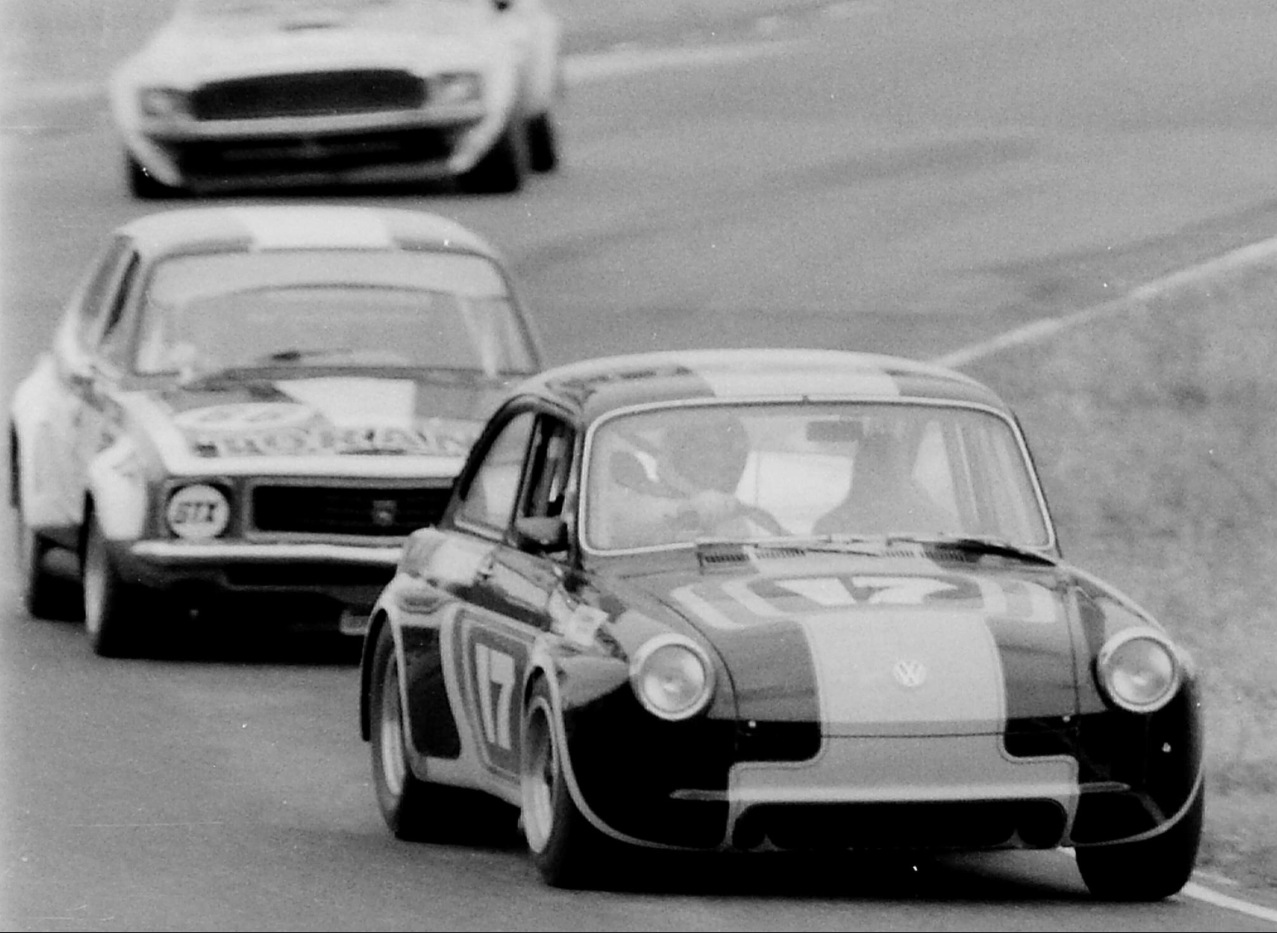
Bryan Thomson VW Fastback being chased by John McCormack’ Charger at Sandown’s, you guessed it, Torana Corner in November 1974. They are about to unleash 500’ish Chev and Repco Holden horses up Sandowns’ long back straight. Great circuit for these cars. Two clever cars from 1974; both F5000 based, both ‘mid-engined’ the VW at the mid-rear and Charger in the mid-front. (Paul Van Den Akker)

PostScript…

Frank Gardner got around to building a Chev Corvair, the car well engineered (see etcetera below) as you would expect and largely built around Lola F5000 componentry. He essentially ‘killed the category’ such was the dominance of the car until the regs were changed to effectively ban it (the Corvairs engine and gearbox in standard form, were located Porsche 911 style, with the engine behind the gearbox, the legislators would allow a Corvair to race in that format but not the layout Gardner had with the classic ‘box behind the engine layout).

gardner

Frank Gardner in the Chev Corvair ahead of Red Dawson’s Chev Monza, Bay Park, NZ 1976. (The Roaring Season)

Etcetera…

vw

Other ‘Class of ’74 Cars’; Bryan Thomson’s ‘Volksrolet’ was a marriage of VW Fastback and an ex-Hamilton/Brown McLaren M10B F5000, but it never worked as well as Frank Gardner’s Corvair variation on the same theme despite the prowess of Thommo and his engineer Peter Fowler. But a massive crowd-pleaser. Behind is Peter Brock in the Holden Dealer Teams ‘Beast’. From memory an ex-rallycross LC Torana chassis into which was shoehorned a Repco Holden F5000 engine mated to a Borg Warner T10 ‘box. Ok in ’73 but the game had moved on by 1974, let alone the cars to come. Sandown Park November 1974. (Robert Davies)

mac

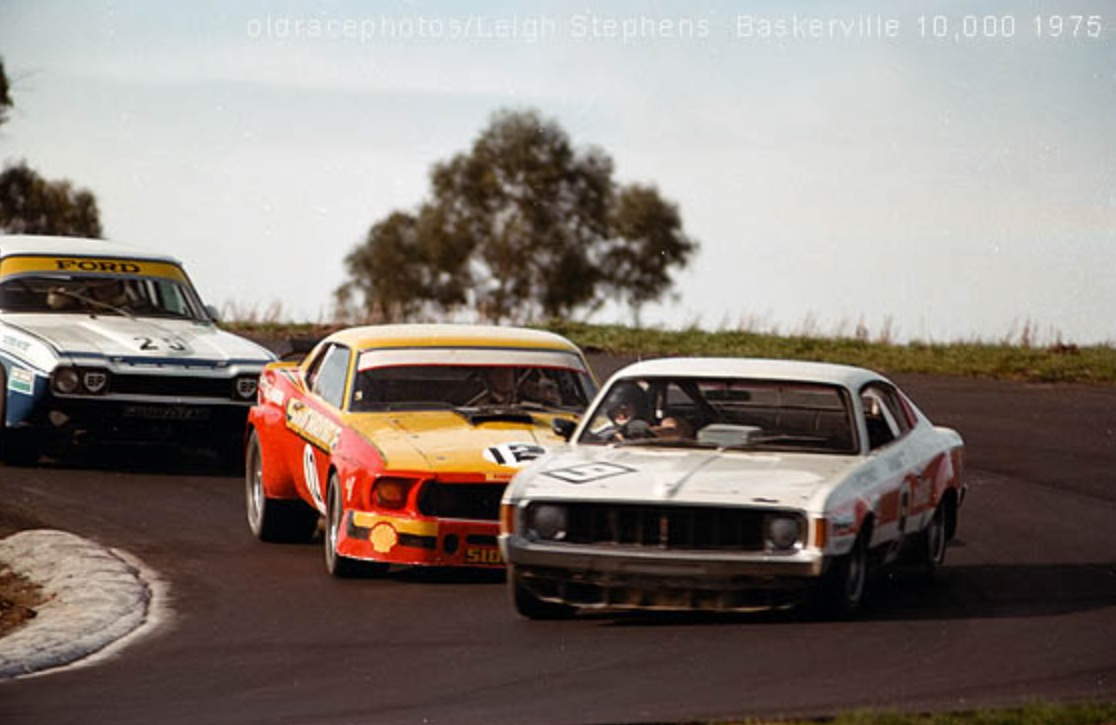
Baskerville, Tasmania 1975. McCormack ahead of Jim Richard’s Kiwi built, old tech but superbly driven Ford Mustang 351 and Allan Moffat’s Ford RS3100 ‘Cologne Capri’. Moffat won the Australian Sports Sedan Championship in 1976 using this car and a Chev Monza. (oldracephotos.com/Leigh Stephens)

corvair

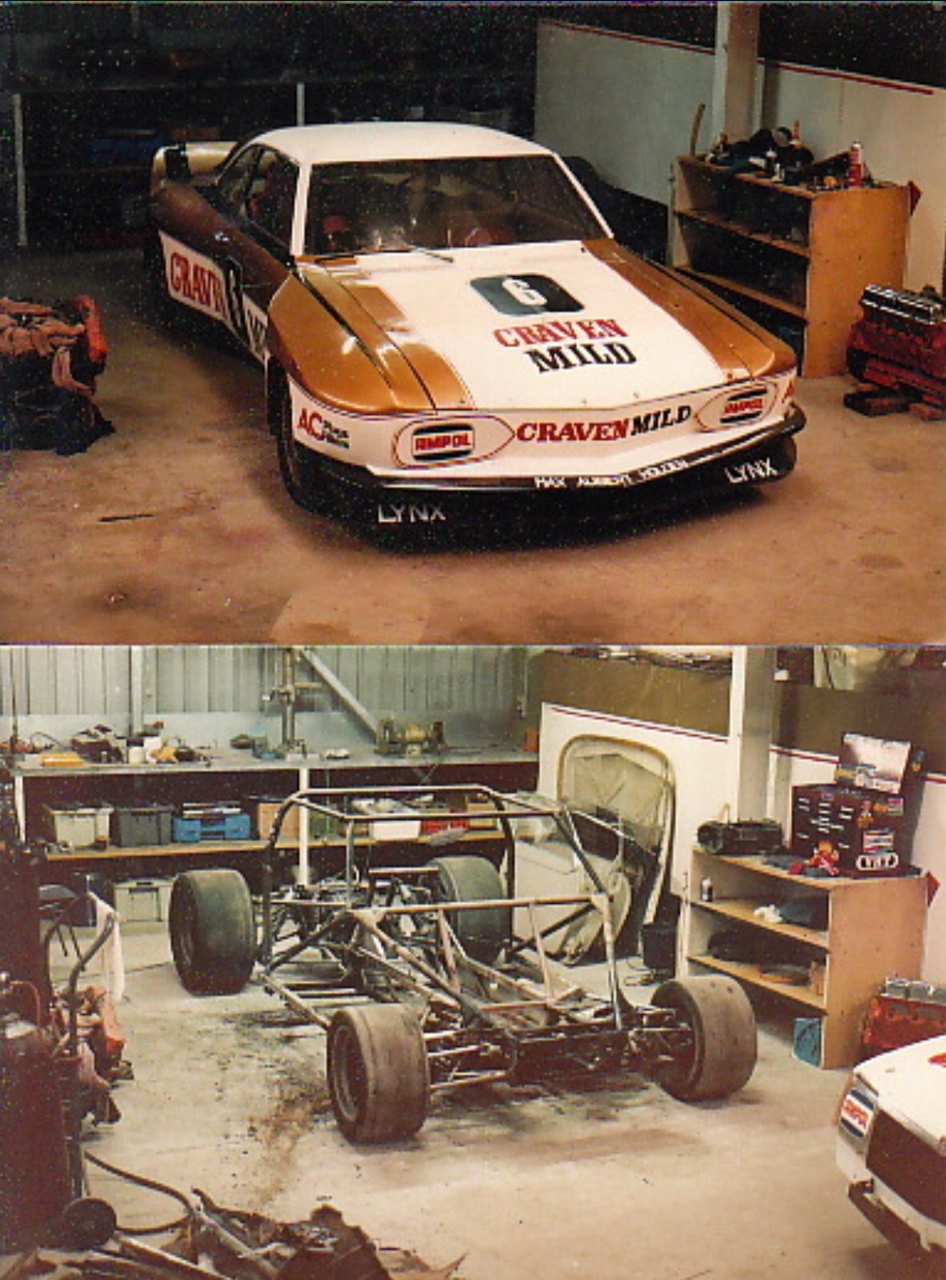
Frank Gardner’s Corvair as raced by Allan Grice after Gardner stepped outta the driving seat. Circa 1977. Nose of Grice’ Group A Commodore to the right. FG raised the Sports Sedan bar  again with the Corvair, the bottom shot clearly shows the car for what it was conceptually; a Lola T332 F5000 albeit with a spaceframe chassis and a roof! Brilliant device, even the 6 litre cars couldn’t keep up with it, put its power down so well. (The Nostalgia Forum)

Bibliography and Photo Credits…

‘Australia’s Elfin Sports and Racing Cars’ John Blanden and Barry Catford, ‘Maybach to Holden’ Malcolm Preston

Robert Davies, Dick Simpson, Vic Hughes, Dick Simpson, Paul Van Den Akker, The Roaring Season, The Nostalgia Forum, oldracephotos.com/Leigh Stephens, Bruce Keys

Tailpiece: McCormack, Charger Repco Holden, Calder, December 1974…

(B Keys)

Finito…

Le Mans start 1969

#14 Stommelen/Ahrens Porsche 917LH, #20 Siffert/Redman Porsche 908/2, #22 Lins/Kauhsen Porsche 908LH, #23 Schutz/Mitter Porsche 908LH, #2 Bonnier/Gregory LolaT70 Mk3b Chev, #7Hobbs/Hailwood Ford GT40…and the rest (unattributed)

Spectacular start of the tragic Le Mans 24 Hour Race, June 1969, the last with the traditonal driver sprint to the cars…

The Porsche 917 was a tricky, somewhat under-developed beast in its original specification even for experienced professionals. British privateer John Woolfe lost control of his on the very first lap of the race perishing in the subsequent accident.

Despite that, a 917 took pole and led the race for twenty hours, maybe it has been somewhat maligned in its formative year?

917 homologation CSI

Groups 4, 6 and the regulator…

By 1967 the Commission Sportive Internationale (CSI) were concerned about the growing speeds of the unlimited ‘pushrod production’ 7 litre Ford GT Mk4 and Chaparral 2F Chev and the 4 litre ‘racing engine’ Ferrari P4 and therefore banned them- it did so by increasing the required number of cars to be built and lowered the engine capacity limits for homologation or admission of cars into both classes.

For 1969 there were no minimum production numbers to qualify in Group 6 ‘3 litre Prototypes’ and a minimum of twenty-five cars to be built for homologation into Group 4 ‘5 litre Sports Cars’.

Effectively the changes in 1968 allowed the existing Mark 1 Ford GT40 and Lola T70 Mk3B cars to remain eligible to keep grid sizes up in Group 4, but with the hope or intent that 3 litre prototypes would be built in large numbers to bolster Group 6, Formula 1 having the same capacity limit at the time.

Porsche would not have had the 908 ready to race in 1968 had they not anticipated the rule changes for 1968 which were announced late by the CSI- in October 1967. Fifty cars were required to be built to qualify for Group 4 in 1968, but that was reduced, as stated above, to twenty-five for 1969, which rather left the door ajar for Porsche…

The FIA, as the governing body then was, had another crack at rewriting the rules to encourage 3 litre prototypes with effect 1 January 1972, given the speed of the 5 litre or thereabouts Porsche 917 and 5 litre Ferrari 512S in 1970 and 1971 but that is another story- lets not get ahead of ourselves.

Porsche had come close to Le Mans victory with their 3 litre 908LH ‘class cars’ in 1968 and wanted to go one better, to win outright, to do so they audaciously and at great cost built twenty-five 4.5 litre air-cooled Flat 12 engined cars- the 917 in 1969.

With the gauntlet thrown down, Enzo Ferrari, his coffers full of Fiat money having sold his road car division to them in 1969, built twenty-five 5 litre V12 512S’ to go head to head with Porsche in perhaps the two best years of sports car racing ever in 1970 and 1971.

917 at Geneva Show

917 homologation

(Porsche AG)

On 12 March 1969 a 917 was displayed at the Geneva Motor show with a price tag of DM140,000 a fraction of the cars development costs- a couple of weeks later in late March Rolf Stommelen ran a 917 at the Le Mans test weekend, its quickest time was three seconds a lap quicker than the Group 6 Matra 630/650 V12 of Johnny Servoz-Gavin, but its seeming dominance was not assured as the thing wandered all over the road, somewhat alarming at over 200mph…

The cars above were displayed for inspection at the factory before CSI representatives on 22 April, Ferdinand Piech cheekily offered them the opportunity to drive any of the machines to prove they were complete and running, said offer was declined!

Twenty-five Porsche 917’s lined up at Zuffenhausen awaiting the CSI chassis count for homologation into Group 4, 22 April 1969. Imagine what a chill that image must have sent down the spine of Enzo Ferrari!

Lets have a look at the design, development and competition record of the 917 with a focus on 1969, the 908/02 also gets rather a good look-in given its dominance of the year with twelve months of intense competition under its belt.

Design…

917 brochure

Sales brochure for the 917, a snip at DM140,000 in 1969

Engineer Ferry Piech said that Porsche would not have built the 3 litre 908 had they known the CSI’s intent in relation to the 5 litre group.

At the time they built the 908- a Group 6 car, the minimum production number for homologation into Group 5 was fifty cars not twenty-five, so he can be somewhat forgiven for not being able to read the minds of the rule-makers, then as now unpredictable. The regime of rules was not about encouraging 5 litre cars with ‘racing’ as against ‘production’ based engines.

So Porsche surprised everyone- until then they had built class contenders rather than outright cars and even then it was not thought possible to build a 5 litre air-cooled engine, to that time a Porsche specialty- water cooled Porsches were not to appear for nearly a decade.

Work started on the design of the 917 in July 1968 with Ferdinand Piech entrusting Chief Engineer Hans Mezger with the task of leading the project. Porsche describe the choice of the ‘917’ type number as follows ‘The 912 engine designation comes from more recent Porsche race car nomenclature, whereby the number of cylinders in that particular car’s engine is also included ie. 904, 906, 908, however the vehicle as a whole with a 5-speed transmission, is given the 917 designation.’

Porsche were convinced they could build a car down to the class minimum weight limit of 800 Kg based on the 908 which was 300 pounds lighter than their Alfa, Matra and Ferrari 3 litre rivals. The aluminium spaceframe chassis of that car was a guide and shifting the cockpit and drivers seat forward ensured the 908 wheelbase of 2300mm was kept despite the 12 cylinder engine being considerably longer than its little brothers eight. 908 practice was also applied in that the fibreglass body was bonded to the chassis. A design maxim from the start was a car of exceptionally low drag, top speed is important on the Mulsanne with two bodies for ‘slow’ and ‘fast’ tracks always intended to be homologated.


917 engine cutaway

Cutaway shot by Vic Berris of the aircooled, flat-12, SOHC 2 valve, fuel injected engine. Capacities/power  1969 4494cc/580bhp@8400rpm, 1970 4907cc/600bhp@8400rpm, 1971 4998cc/630bhp@8300rpm. Torque 376, 415, and 425 lb ft respectively. More than enough to see off the 512S/M Ferraris’…cooling fan absorbed around 17bhp @ maximum revs, far less than that absorbed by a water radiator @ equivalent speeds (Vic Berris)

To speed up the development of the 917 engine the same reciprocating parts, bore, stroke, valve and port sizes of the 908 engine were used giving a capacity of 4494cc with a bore and stroke of 85 x 66mm. Porsche believed, initially at least, it wouldn’t be necessary to build a car to the full 5 litre limit to dominate.

All the fuel injection and valve timing settings were taken over from the 908 albeit the valve angle differed to allow cooling air passages between the valves- four valves per cylinder was never an option for this reason, apart from that, the flat-12 is an entirely different engine to the 3 litre flat-8.

A long crankshaft did not allow anything other than a central power take off to avoid catastrophic torsional vibrations. The long crank hence became effectively two shorter cranks joined together at their flywheels, which were just a gear in mesh with another on the output shaft running parallel to, and under the crankshaft, which ran on eight main bearings.

Gerhard Kuechle and Valentin Schaeffer assemble a 917 engine, note central power take-off gears on the crank in 1969 (Porsche AG)


image

917 engine on the dyno in 1969 (GP Library)

The power output shaft drove the triple gear type oil pump with four additional small oil pumps driven by the exhaust camshafts. Another shaft running symmetrically with the crank drove the two distributors of the electronic ignition, the Bosch fuel injection pump being driven off the left hand exhaust camshaft.

The engine had few steel or iron parts- the crankcase, cam covers and timing gear case were magnesium. The heads and cylinders were aluminium with titanium used for conrods, auxiliary drive shafts, the main output shaft and later in the engines development, valves and valve springs. The cooling blower and most of the air ducts were plastic.

The 4.5 litre engine weighed 528lb in its original form and developed 542bhp on its first dyno run, this rose to 580bhp @ 8400rpm by the time the car arrived at Le Mans in 1969.

A new gearbox was built to take 376lb ft of torque- the case was magnesium, used Porsche synchromesh and had a wet sump incorporating a ZF ‘slippery diff’ with 75% locking factor.

917 engine cross section

Cross section of the incredibly complex 917 engine, each of which took 200 hours to assemble. Magnesium crankcase is split along its centreline, the power takeoff is by pinion between the two middle main bearings, eight main bearings in total. DOHC per bank, two valves per cylinder sodium filled and two plugs per cylinder. Not winning was not an option! (Porsche AG)


917 assembly

All hands on deck…homologation and timeline pressures created surely one of the most amazing production lines ever!? Werk 1, Zuffenhausen (Porsche AG)

The spaceframe chassis was of welded aluminium tube and largely that of the 908 but suitably reinforced. Note that later in the program three chassis’ were built of magnesium, the wheelbase was 90 inches and track in 1969 58.8 inches at the front and 60.4 inches at the rear.

As with all Porsche racing cars the frame had to withstand 600 miles of hard driving on the Weissach ‘Destruction Course’ but even so a tyre valve was incorporated into the 103lb frame to allow it to be ‘inflated’, a loss of pressure indicative of chassis cracks- sub-optimal in a car of this performance!

Again, magnesium, aluminium and titanium parts were widely used for the running gear- titanium for spherical joints, hubs, springs, the gear lever and steering column. Magnesium was used for the uprights and wheels and aluminium for the steering rack, this obsessive approach to weight saving ensured the car tipped the scales at less than 800kg.

917 spaceframe

Porsches’ obsession with weight extended to the chassis which was welded aluminium tube. Total weight 103lbs. The one on the right is unfinished. Strong and light…both 917 and 512S Ferrari were spaceframe chassis’, hardly state of the art in 1969/70 but effective all the same. Porsche did not build an aluminium monocoque racing car till the 956 in 1983 (Porsche AG)

The suspension geometry was the same as the 908 but incorporated anti dive geometry, this was achieved by angling the upper and lower wishbone pivots to each other. Wishbones were used at the front with coil spring/damper units and an adjustable sway bar. At the rear a single top link and lower inverted wishbone was used, radius rods provided fore and aft location and again coil spring/damper units were used and an adjustable sway bar- Bilstein provided the shock absorbers.

Initially 9×15 inch front, and 12×15 inch rear, magnesium alloy wheels were used, with a single centre aluminium lock nut- the same as the 908, inside these big wheels the brake package in 1969 comprised ATE aluminium calipers clamping cast iron, ventilated rotors/discs.

Once ready to test, the suspension was largely set up at the Nurburgring- long suspension travel, plenty of camber change and tyres of a rounded tread section were necessary for performance there. This did not translate well at other circuits where the car was ‘under-tyred’ and the geometry thought unsuitable as well- more of this later in the article.

917 rear suspension drawing

Factory rear suspension drawing- upper top link, inverted lower wishbone and progressive rate coil spring/damper unit. Titanium driveshafts with ‘rubber donut’. Magnesium uprights with titanium hubs, ATE aluminium brake calipers clamped ventilated iron discs. Wheels in mag alloy with aluminium lock nut (Porsche AG)

The bodies were developed in the wind tunnel…

The 917 body was developed in the Porsche Design Department, a plasticine model was created at 1:5 scale and shortly thereafter a 1:1 model which was used for wind-tunnel testing at the Research Institute of Automotive Engineering and Vehicle Engines at the University of Stuttgart. Additional support for testing the aerodynamic development was provided by Charles Deutsch’s Pars based Societe d’etudes et de Realisations Automobiles (SERA), although this was later in the program, not at its outset in 1968.

Both short and long tails were interchangeable, fitted with the latter 236mph on the Mulsanne Straight was achieved in 1969- the bodies were fibreglass, bonded to the chassis, as already outlined and incorporated two seats and doors in accordance with the regulations.

Stability of the cars was critical, front spoilers were fitted and an ingenious setup of mobile rear flaps connected to the rear suspension in such a way that if the suspension was compressed the flaps would create an aerodynamic force to raise the tail whilst if the suspension was extended, the flaps would angle up to push the tail down.

In 1969 these appendages caused major dramas- only two weeks before Le Mans, during the Monaco Grand Prix weekend, the FIA banned ‘moveable aerodynamic devices’ on all racing cars, a consequence of the many wing failures in F1 throughout 1968 and into early 1969- the ‘straw which broke the camels back’ was the breakage of Colin Chapman’s fragile high wings fitted to the Jochen Rindt/Graham Hill Lotus 49 Fords and consequent accidents a lap apart during the Spanish Grand Prix weekend at Montjuich Park- Jochen was lucky to survive that one.

As the 917 was almost undriveable without the flaps with which it was designed and homologated, the cars were allowed to race at Le Mans but the devices had to removed thereafter. Twenty-five sets had been made to comply with homologation requirements but only two or three were used!

917 Wing flaps

Porsche factory drawing showing how suspension deflections actuated the rear wing flaps, from full to no downforce. Movable aero devices banned by the FIA from the end of Le Mans ’69. Changes to bodywork design obviated the need for the flaps in both short and longtailed forms in 1970/71 (Porsche AG)


porsche 917 tail

’69 spec long and short tail comparisons (Porsche AG)

Construction…

From the outset Piech was determined to exhibit the 917 at the Geneva Motor Show in March 1969 to both maximise publicity and to use that timeline to ensure construction of sufficient machines to allow homologation before Le Mans- construction commenced in December 1968.

To meet the target Porsche created thirteen working groups into which 45 race mechanics were inserted to assemble the cars in the testing and race department at Werk 1 (Plant 1) in Zuffenhausen with 10 other mechanics taking cars of component pre-assembly.

Chassis construction was sub-contracted to Baur in Stuttgart and the fibreglass bodies to Waggonfabrik Rastatt. By this stage the first of Mezger’s engines had been tested and run.

917-001 after completion before loading for Geneva, outside Werk 1 Zuffenhausen (Porsche AG)


(Porsche AG)

With a little over two months to run the team were working around the clock to meet the deadline, with only a brief break for Christmas. Baur delivered the first chassis to Waggonfabrik Rastatt at the end of 1969, then, on 1 March 1969 the first chassis- 917-001 arrived at Zuffenhausen for final assembly, it was completed on 10 March 1969, the evening before its despatch to Geneva. At 3pm on 12 March the worlds motoring media gathered around the stunning new machine on the Geneva Show official press day.

Back at Werk 1 assembly continued, the 917 was accepted for technical inspection on 20 March but not all the cars were in running order so the CSI ordered a further inspection a month later ‘…the day finally arrived on 21 April 1969, the English FIA delegate, Dean Delamont, and the German ONS representative, Herbert Schmitz arrived at Werk 1 to examine the regulation compliant roadworthy units.’. The next day the Porsche Press Department declared that “The Porsche 917 is homologated as a sports car from 1 May 1969 and is expected to make its debut appearance at the 1000 kilometres of Spa-Francorchamps on 11 May”.

Porsche 917 homologation document dated 19 April 1969

Racing the 917…

The traditional Le Mans test weekend took place on 29/30 March 1969, there the 917 made its public circuit debut.

Proceedings were dominated by the gruesome death of Lucien Bianchi in the new Autodelta Group 6 Alfa Romeo Tipo 33 3 litre V8 which crashed after a component failure befell the co-winner of the race the year before, going over the hump on the Mulsanne Straight.

Rolf Stommelen drove the car (below) and achieved a speed quicker then the 908LH, (LH is ‘Langheck’ or Long Tail), 3 minutes 30.7 seconds, over 3 seconds clear of Johnny Servoz-Gavin in a Group 6 Matra MS630/650. Whilst ‘on paper’ the car had potential the handling and levels of stability from the drivers seat were frightening.

917 Le Mans test weekend

(unattributed)


Le Mans test weekend 917 in Paddock

(unattributed)

Fettling the 917 at the Le Mans test weekend.

No amount of ‘at the track fixes’ would deal with the high speed instability the drivers were experiencing- body is fibre glass and bonded to the aluminium spaceframe chassis.

By that stage of the sportscar season the first two championship rounds in North America had been run and won in February and March- the Daytona 24 Hour was won by Roger Penske’s Lola T70 Mk3b Chev driven by Mark Donohue and Chuck Parsons whilst the Sebring 12 Hour went to another 5 litre pushrod American V8- this time a JW Automotive Ford GT40 crewed by Jacky Ickx and Jackie Oliver- the season was wide open at this stage with Porsche still to get an outright win on the board.

The next two rounds at Brands Hatch in late April, and Targa in early May started to redress the balance though- both the Brands and Monza 1000km fell to the 908/02 combination of Jo Siffert and Brian Redman.

Gerhard Mitter and Udo Schutz won in Sicily, the Targa Florio on 4 May was a 908 rout- Vic Elford/Umberto Maglioli and Rolf Stommelen/Hans Hermann were second and third with another factory car of Willy Kauhsen/Von Wendt in fourth. ‘Porsche System Engineering Ltd’ entered six cars!, only the Lins/Larrousse and Attwood/Redman 908/02’s failed to finish. No 917’s were entered on a circuit totally unsuited to them.

Spa 1969 917

First race apperance for the 917, Spa 1969. Gerhard Mitter and Udo Schutz shared the car but an engine failure early in the race meant only Mitter got a race drive (unattributed)

After little testing, two 917’s, in addition to a ‘fleet’ of 908s were entered for the Spa 1000Km on 11 May.

Jo Siffert and Brian Redman practiced their 917 but Jo made the call to race a 908, the duo won the event from Pedro Rodriguez and David Piper in a Group 6 Ferrari 312P and Vic Elford/Kurt Ahrens third in another 908 with the Stommelen/Herrmann crew fourth.

Gerhard Mitter started his 917, having qualified it eighth but retired with engine failure on lap 1 having possibly over-revved the motor at the start- the 917’s continued to exhibit high speed instability, the very reason Siffert elected to race a 908LH. It was a good call from a championship perspective with another win on the board.

On the Spa grid- drivers immediately behind the 917? Kurt Ahrens in the anorak to the right aft of car (Porsche AG)


917 Spa 1969

(unattributed)

Gerhard Mitter wrestles his 917 around Spa’s La Source hairpin above, early aero with adjustable wings at the rear and no winglets up front- compare the front of the 917 at the Osterreichring in the photos to follow below. 1969 cars exhausts exited from both the rear and aft of the doors.

Porsche entered six cars at Monza- four Group 6 3 litre 908LHs for Elford/Ahrens, Stommelen/Herrmann, Siffert/Redman and Mitter-Schutz and two Group 4 4.5 litre 917’s for the last two named pairs who could make a choice between 908/917 as they/the team saw fit.

Frank Gardner 917 Nurburgring 1969

Frank Gardner and David Piper brought the 917 home for its first race finish at the Nurburgring 1000Km (unattributed)

For Porsche’s home event, the Nurburgring 1000Km on 1 June they hired two hardened sports car professionals in Frank Gardner and David Piper to ‘bring the thing home’- that they did in eighth place having wrestled the unruly beast, chassis 917-004, around 44 laps of the ‘Green Hell’ for six hours and twenty minutes.

Gardner was a noted test and development driver, Porsche were keen to get his views on the changes he considered necessary to make the car competitive. The race was won again by the Siffert/Redman combination in a 3 litre 908/02 ahead of four other 908’s- Herrmann/Stommelen, Ahrens/Elford, Rudy Lins/Attwood and Kauhsen/Karl von Wendt- what domination, the first five cars on the grid were all 908/02s.

image

Gardner/Piper 917 ahead of the Hobbs/Hailwood Mirage M2/300 BRM DNF and Ortner/van Lennep Abarth 2000SP NC (Schelgelmilch)

Le Mans 1969…

Other than more power- 580bhp, and with the anti-dive geometry of the suspension reduced from a factor of 50% to 5%, the 917 arrived at Le Mans as designed. Fortunately, as described above the cars were able to race with their adjustable rear wings, common-sense prevailed from a safety perspective.

At Le Mans Porsche famously, very narrowly lost the race by about 100 metres, the Hans Herrmann/Gerard Larrouse 908LH was just beaten by the Ford GT40 of the ‘two Jackys’- Jacky Ickx and Jackie Oliver, won in GT40 chassis ‘1075’ the same JW Automotive GT40 which was victorious the year before in the hands of Pedro Rodriguez and Lucien Bianchi.

Le mans start 1969 Siffert in lead

’69 Le Mans start. Jo Siffert #20 908/2, Elford #12 917LH, Schutz 908LH, #7 Hobbs Ford GT40, #2 Bonnier Lola T70Mk3b Chev, #64 Hermann 908LH, #22 Lins 908LH…and the rest. (Porsche AG)


Elford retires 1969

The pole winning Stommelen/Ahrens 917LH retires on lap 148 with an oil leak, the car was hard driven, it was the teams ‘hare’ (unattributed)

Rolf Stommelen put his 917 on pole, outlining the cars potential but the car failed on lap 148 with an oil leak. Vic Elford qualified his second co-driven by Richard Attwood, the car led the race for twenty hours and did 327 laps- enough for ninth place but the car was not running at the finish having withdrawn with a cracked bellhousing.

Elford recalled ‘The engine was running like clockwork until that point. No problems whatsoever’ whilst Hans Mezger noted, upon returning from his lunch break at the time that ‘When I returned to the pit I could tell straight away that something wasn’t right.’

John Woolfe’s car was destroyed in his fatal lap 1 accident, the car having qualified ninth in the hands of factory driver Herbert Linge- car owner Woolfe started the race rather than the far better credentialled Linge.

elford 917 le mans 1969

Vic Elford in the car he qualified 2nd. He shared the car with Richard Attwood, they led the race for 20 hours, DNF after 327 laps with a cracked gearbox bellhousing (unattributed)


Le Mans finish 1969

Ickx wins from Hermann…the GT40 margin from the 908LH, 2 seconds after 24 hours of racing and despite losing 20 minutes in a long pitstop for the crew of the 908 to replace a front wheel bearing (unattributed)

The first 917 win, Osterreichring 1000Km 1969…

Porsche did not take a 917 to the 12 July Watkins Glen 6 Hour but were victorious again all the same, Siffert and Redman again won in a 908/02 from the Elford/Attwood and Jo Buzzetta/Rudy Lins Porsche Austria pairing- the non-Porsche class-winner was the screaming V12 Group 6 Matra MS650 raced by Pedro Rodriguez and Johnny Sevoz-Gavin to fourth.

‘More intensive testing and test drives were carried out before the last race of the year, the Austrian Grand Prix in Zeltweg…A scheme to improve driving stability is instigated by race engineer Peter Falk, is one of the first tests to be tested at the South Loop of the Nürburgring. Further tests are later conducted on the skid-pad in Weissach and at Hockenheim. Adjustments to the aluminium frame and modifications to the body are intended to enhance the characteristics of the 917’ Porsche wrote, confident in advance of the meeting.

Osterreichring start 1969

Starting grid Osterreichring 1000Km 1969. #29 Siffert/Ahrens winning 917, #33 Bonnier/Muller Lola T70 Mk3b Chev (2nd) #9Ickx/Oliver MirageM3 Ford (DNF). The 3rd placed Attwood/Redman 917 in white is behind Siffert. #42 Matra is Servoz-Gavin/Rodriguez (DNF) and the rest (unattributed)

The Seventh Austrian Grand Prix/Zeltweg 1000km/Austrian 1000km (take your pick) on the new 5.911km Osterreichring was the last round of the Manufacturers Championship in 1969 and is a fast track, circa 130 mph average and therefore well suited to the 917’s qualities.

And so it was that a 917 entered by Karl F von Wendt driven by Jo Siffert and Kurt Ahrens beat the Jo Bonnier/Herbie Muller Lola T70Mk3b Chev from the Richard Attwood and Brian Redman in the David Piper Racing Ltd 917K with Masten Gregory and Richard Brostrom fourth in the first of the 908/02s.

The Von Wendt/Piper 917 entries were made on the basis that both had options to buy the cars at a later date, Porsche having 25 of the things to sell, less those required for works use as you will recall…It wasn’t the strongest round of the year in terms of depth of entry but it was a win all the same!

Porsche 917 Spa Siffert 1969

(unattributed)

The Osterreichring winning Porsche 917K of Jo Siffert and Kurt Ahrens above.

Fitted with a 4.5 litre Flat-12 at this stage with the early rear aero treatment clear in this Shell promotional shot. In its first two races at Spa and the Nurburgring the car raced with a small fixed rear spoiler. Compare this photograph with the shot in ‘Etcetera’ below of the 1970 917K tail.

Jo Siffert (below) leads Jacky Ickx- the 4.5 litre Porsche 917 ahead of the 3 litre Mirage M3 Ford Cosworth DFV. JW Engineering, the entrant of the Mirage would be contracted by Porsche to race and develop the 917’s in 1970 and 1971, becoming the dominant team of that wonderful two year period…Le Mans excepted, where their luck did not hold!

Siffert and Ickx Austria 1969 1000km

(unattributed)

Race development, secret testing and the 917PA…

Jo Siffert Porsche 917PA Bridgehampton 1969

Jo Siffert Porsche 917PA, Bridgehampton Can-Am 1969. The race was won by Denny Hulme, McLaren M8B Chev, Jo finished third (unattributed)

Whilst a short tail 917K won the Austrian 1000Km race against weak opposition, other than at Le Mans the cars were still uncompetitive.

A critical test took place at Zeltweg which changed everything. Representatives of Porsche including experienced engineers Peter Falk and Helmut Flegl and from JW Automotive- David Yorke, Team Manger and Chief Engineer, John Horsman, attended the test which took place at the Osterreichring between 14 and 17 October 1969.

Two 917’s were made available- 917-006, a Le Mans practice car and 917-008 which led the race until it retired during the twenty-first hour. The target time for drivers Redman and Ahrens was the 1:46.6 the Gulf Mirage M3 Ford had done in August, by the end of the second day, the 15th, the best they had done was a 1:48.2.

During a pitstop John Horsman noticed the lack of dirt and bugs-gnats, on the rear bodywork which indicated to him the air was not following the contours of the bodywork and therefore the problems with the car were aerodynamic rather than suspension geometry or tyres. Note that the Porsche duo have claimed that they saw exactly what Horsman did at the same time he did so take your choice as to who was responsible for the key observation or whether the credit should be shared.

‘I knew immediately that we had to raise the rear deck and then attach small adjustable spoilers to the trailing edge. It was obvious to me that if the whole body was in the airstream it would be able to exert some downforce’ recalled Horsman.

Together with the JW mechanics- Ermanno Cuoghi and Peter Davies they quickly fashioned changes to the rear bodywork of 917-008 with aluminium sheet, rivets and tape, the work was finished after the circuit had closed. Brian Redman, sceptical, went out to test the car the following morning, 16th October and stayed out for 7 laps he was enjoying the car so much!

The changes were then made to 917-006 as well. Then, working between the cars on further alterations to both the body and suspension including springs and bars, no changes were made to the suspension geometry- and using wider wheels and Firestone tyres with whom JW were contracted (Porsche used Dunlops), resulted in a time of 1:43.2 set by Kurt Ahrens.


The John Horsman suggested changes to the rear deck of a 917 at ‘the Zeltweg test’ in October 1969 (J Horsman)


Less is more- you can see how the deck evolved over those couple of fateful days with more angle and bigger spoilers (K Ludvigsen)


(K Ludvigsen)

The Porsche design team, led by Eugen Kolb then had the task of ‘productionising’ the changes which involved the tail shape including redesign of the rear window, creating a tunnel in the upward sweeping tail to provide rear vision for the drivers and re-routing the exhausts to the open area behind the rear wheels. New side pods were also needed as they no longer housed the exhausts for the forward cylinders of the big flat-12. The nose profile was to be finalised too, with larger ducts for the brakes and fender vents for brake cooling.

The engine was largely left as was- whilst noting the exhaust changes, the Fichtel and Sachs clutch was replaced by a triple-plate Borg and Beck item whilst the gearbox and clutch housing were reinforced to avoid the failures experienced at Le Mans.

The pressure on Porsche was immense as a follow up test of what was by then referred to as the 917K was scheduled at Daytona only a month hence, on November 19 and 20 1969- it was another secret test with even Speedway employees refused admission to the grandstands and infield.

On hand were a squadron of technicians as well as drivers Siffert, Ahrens, Rodriguez and David Hobbs. In addition to the short tail, Porsche also brought along a new longtail, about which the drivers were not enthusiastic so the focus was on the ‘K’ and comprised Goodyear/Firestone tyre comparisons with simulated races and endurance runs.

Hobbs buzzed an engine on day 2 when he muffed an up-shift and bagged second instead of fourth gear and with it went his chance of perhaps partnering Pedro- the Porsche factory paid combination for 1970 was Siffert/Redman whilst the JW pairing, paid by them, ended up being Rodriguez and Leo Kinnunen- Ickx went to Ferrari for both F1 and sportscars in 1970 and so was no longer available to John Wyer.

Further changes to the cars made as a consequence of the test included re-routing the oil lines through dedicated plumbing rather than the chassis tubes to reduce cockpit heat, creation of the ‘D shaped’ windscreen to improve driver vision on the banking, bringing the steering wheel closer to the driver (when wanted), detail changes to the steering rack and transmission and a new front upright design due to concerns about brake pad taper wear and stability under brakes.

Whilst there are no photographs from Daytona, 917-011 was sent immediately upon its return from Florida to the University of Stuttgart for wind tunnel testing, the shots show how the car looked. The tests confirmed acceptable drag and downforce readings so no further changes were made to the body prior to Daytona several months hence with the exception of a roof window.

917-011 in the Uni of Stuttgart wind tunnel in November 1969 (Porsche AG)


(Porsche AG)

Lets not forget than an open car was built- designated the 917PA (PA ‘Porsche Audi’ the US importer of Porsche) for Jo Siffert to drive in the 1969 Can-Am series late that year.

The 917PA competed in six races with its best results a second and a third, the car was ‘blown away’ by the 7 and 8 litre Chevs, Bruce McLaren and Denny Hulme were dominant in their McLaren M8B Chevs. Valuable experience was gained for both the 1970 Manufacturers Championship and for another tilt at the Can-Am series. This information would prove useful for Porsche’s successful assault on the Can-Am championship in 1972 and 1973 with the awesome, turbo-charged 917/10 and 917/30.

Porsche had a fantastic 1969 season winning all but Le Mans. They won at Brands Hatch, Monza, Targa Florio, Spa, the Nürburgring, Watkins Glen and the Osterreichring to win the Manufacturers’ Championship and the GT Trophy as well as ‘blooding’ the 917 to set up its dominance for the next four years- two years in endurance racing and another two years at the Can-Am.

For 1970/1971 Porsche changed their approach to racing the cars, the factory continued to develop them but the race organisation was contracted to JW Automotive and Porsche-Salzburg, those seasons of success are another story- the seeds of dominance were sown in 1969…

Porsche 917PA and 917K late 1969

(unattributed)

Porsche media day in late 1969 at Hockenheim.

Porsche 917PA Can-Am car and 917K in shot. Brian Redman, Jo Siffert, Pedro Rodriguez and Rico Steinemann are in attendance. You can see the refinements to the rear bodywork of the 917K, reputedly ‘cribbed’ off the Lola T70Mk3b and also on the #23 1970 Le Mans winning car below.

Etcetera…

Porsche 917-001 (Porsche AG)


(Porsche AG)

Assembly in Werk 1 Zuffenhausen early 1969.

(Porsche AG)

The first car completed, chassis 917-001, was a show car and beauty queen in a variety of configurations right throughout its life, it was restored to its original 1969 917 LH specifications a few years ago.

(Porsche AG)

Ferdinand Piech with the CSI inspection crew at Zuffenhausen in April 1969, can’t have been a difficult task, they only had to count to 25!

The process took two bites of the cherry, the cars were not complete on the first visit so the team rocked up again a month later to ensure alles wast kosher allowing the formal homologation of the 917 into Group 4 to take effect in time for Le Mans.

Porsche kaleidescope le mans 1969

(unattributed)

Porsche kaleidescope of colour, 908 and 917 wings at Le Mans in 1969.

See the text for the operation of these rear wing flaps, 25 sets made for homologation but only 3 or so actually used! Flaps banned post Le Mans.

Porsche 917 at Le Mans

(unattributed)

The original 1969 917 body in all its glory.

#15 is the Herbert Linge/Brian Redman/Rudy Lins car which tested but did not race at Le Mans. It is a 917LH spec note front trim wings but lack of adjustable wing flaps at the rear.

(Klemantaski)

The Elford/Attwood 917LH at Arnage during Le Mans 1969.

Note the extreme length of the tail, side exhaust, front winglet and flaps at the back, allowed as per the earlier text for Le Mans only.

917-001 cockpit post restoration in modern times (Porsche AG)


917 cockpit

(Geoff Goddard)

Porsche racing cockpits have always been about function.

‘Momo’ steering wheel, lever for 5 speed synchro (sometimes 4) gearbox to the right. Aluminium tube frames on floor visible, six point harness and minimal instrumentation.

(unattributed)

Bata ‘Scouts’ were the go in cool footwear for twelve year olds in 1969, clearly the Bata ‘Jacky Ickx’ was aimed at a slightly older market!

Jo Siffert at Spa during practice, again note in particular the aerodynamic treatment of this 917K- Jo elected to race a 908 and won together with Brian Redman.

Jo Siffert Porsche 917PA Laguna Seca 1969

(unattributed)

Jo Siffert, Porsche 917PA being chased at the Laguna Seca Can-Am round by Denny Hulme’s McLaren M8B Chev, the dominant car of 1969- Bruce McLaren won the race from Hulme with Jo fifth.

Compare and contrast the bodywork of the 917PA above on 12 October and that of the car a fortnight later on 26 October below during the LA Times Grand Prix at Riverside.

There the car has a much ‘wedgier’ nose in search of greater front bite and top speed. Siffert was Q11 and DNF with an oil leak, Denny the winner in his M8B Chev- Bruce McLaren won the championship that year from Denny and Chuck Parson’s Lola T163 Chev.


Hermann 917 1970

(unattributed)

Quintessential 917K (short tail) 1970 spec car- here the Porsche Salzburg Le Mans winning car driven by Hans Hermann and Richard Attwood car.

The shot included to show the changes made to the car’s bodywork very late in 1969- different door line, no exhaust exits aft of the doors, wedge shape and Lola T70 Mk3b inspired rear deck.

Larrousse Porsche 917L Le Mans 1970

(unattributed)

For the sake of completeness the 1969 917LH evolved into this bodywork in 1970.

Here is the marvellous Martini Racing Team ‘Hippy Car’ of Gerard Larrousse/Willie Kauhsen which was second at Le Mans 1970- compare and contrast the swoopy, curvaceous long tail body with the 1970 917K #23 immediately above.

Le Mans poster 1969

Reference and Photo Credits…

Vic Berris cutaway drawing, Porsche AG, ‘Cars in Profile Collection 1’ article by Paul Frere, ‘Testing at Zeltweg’ article by Karl Ludvigsen in ‘Drivetribe’, International Motor Racing Research Center article ‘A truly Secret Track Test of The Porsche 917’, Vic Berris, Geoff Goddard, Rainer Schlegelmilch, Klemantaski Collection, John Horsman Collection

Tailpiece: No time to admire the scenery for Frank Gardner! 917/004 during Nurburgring 1000 Km practice in June 1969…

image

(Schlegelmilch)

Finito…
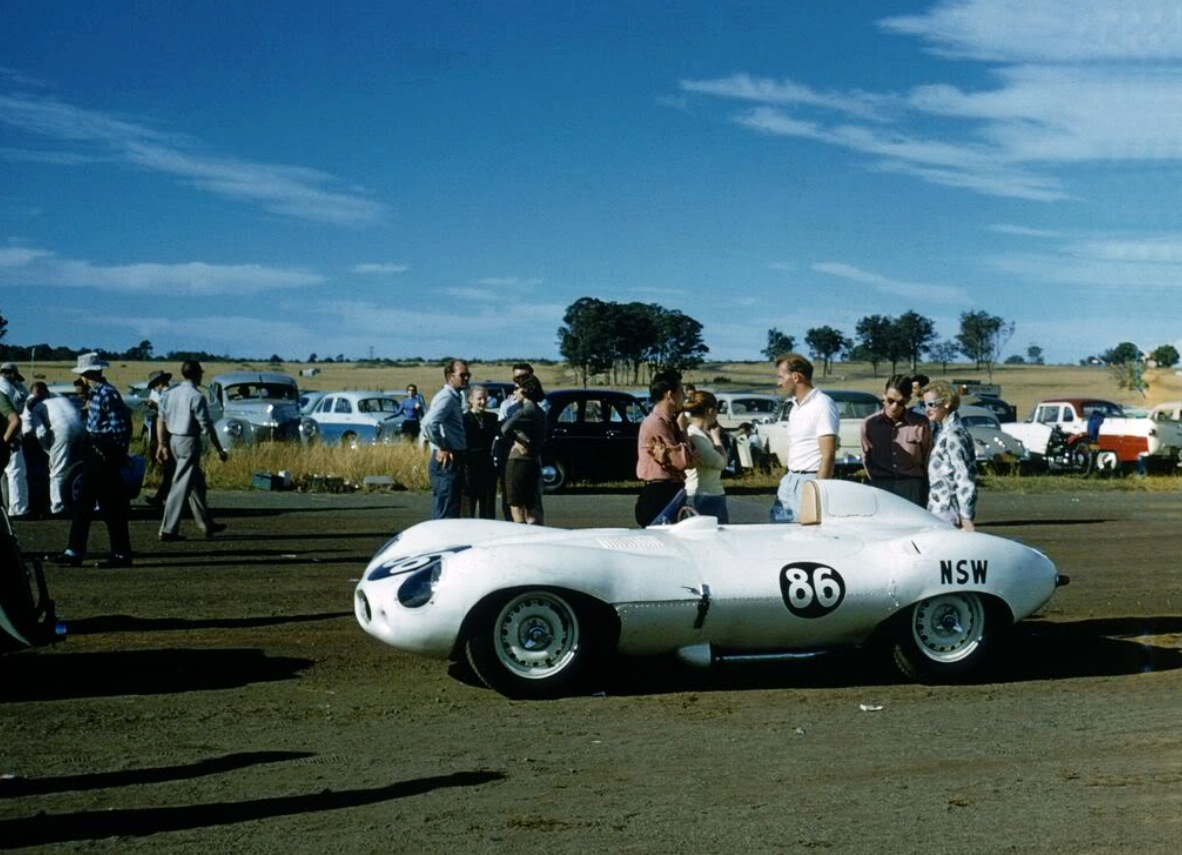
bartlett
Mildren ‘LHD’ GTA, Kevin Bartlett, Lakeside, Queensland 1966 (J Stanley)

Kevin Bartlett explores and exploits the laws of physics in the Alec Mildren Racing Alfa Romeo GTA , Lakeside, Queensland, Australia circa 1966…

Some years later American F5000 driver, Sam Posey while competing in the Tasman Series and observing KB’s Lola  at close quarters described Bartlett as the ‘master of opposite lock’. It was an aspect of his driving which worked for him and we spectators throughout his career regardless of the cars he drove – sedans, sports cars or single seaters.

mildren 2
Team Mildren Warwick Farm 1966, not 1967 I think…big professional team 60’s Style! Cars are Mildren LHD GTA, TZ2 and  the Brabham BT2/6 Ford raced by Bartlett at that stage. WF Tasman Meeting 13 February 1966 (Allegerita)

Alec Mildren Racing and Kevin Bartlett…

AMR was one of Australia’s first professional teams, the basis of the team was formed around a nucleus of talented people who fettled Alec Mildren’s cars during his own single seater campaigns. He won the Australian Gold Star Championship and Australian Grand Prix in a Cooper T51 Maserati in 1960.

Shortly thereafter Mildren retired from driving to concentrate on his business interests which primarily involved the retail car trade. He was the first Alfa Romeo dealer/distributor in New South Wales and his race team employed great drivers including Frank Gardner, Kevin Bartlett and Max Stewart.

Mildren’s passion was single-seaters but the team also raced Alfas, notably two GTAs, a TZ2 and later 105 Series coupes of various capacities in Series Production events as those grew in stature in the late 1960s.

team mildren
Alec Mildren Racing and the laid back nature of the Tasman series circa 1967. Bartlett is sitting on the wheel of his Brabham BT11A Climax 2.5 Tasman car. The Alfa is the prototype TZ2 referred to in the shot above. The smiley chap at right rear is young Fred Gibson, then racing a Lotus Elan 26R. Warwick Farm, New South Wales (P Windsor)

Kevin Bartlett started racing in his mother’s Morris Minor and very quickly the young mechanic made a name for himself as a fast driver with strong mechnical knowledge and sympathy. By 1965 he was driving an Elfin Imp FJ owned by the McGuire family and an Austin Healey Sprite and TVR for others. He recalls that ‘Alec and Glenn Abbey (Mildren’s engineer/mechanic) were always on the lookout for talent, Ralph Sach and Charles Smith who drove for them at the time were getting older and I performed well against them in cars with much less capacity. They also took into account that I could drive different types of cars and do as well as I could’.

‘ I got to race the Alfas’ and then the little Brabham BT2/6 which was powered by a pushrod Ford engine, and in mid-1965 the Mildren Maserati, which was the first really powerful car I drove, racing it at Lowood and then winning the 1965 Victorian Sportscar Championship in it at Sandown’.

The Mildren Maserati was built by Bob Britton of Rennmax Engineering, essentially a Lotus 19 clone, it used some of the running gear from Alec Mildren’s 1960 Gold Star Championship winning Cooper T51 Maserati, particularly the gearbox and 2.9-litre 250S Maser engine.

KB made his presence felt in that ’65 Victorian championship race beating Bib Stillwell’s Cooper Monaco Buick V8 and Spencer Martin’s Scuderia Veloce Ferrari 250LM amongst others. He had well and truly arrived…

viaduct
Bartlett in ‘LHD’ entering the Viaduct at Longford leading Allan Moffat’s Lotus Cortina in March 1966 (E French)

Mildren GTAs…

There were two, first a LHD and later a RHD car, Bartlett drove both in their competitive heyday and both ended up racing in Western Australia.

leger
Bartlett at it again…Leger Corner , Warwick Farm 1966 ‘RHD’ Mildren GTA (autopics)
autodelta works
The Autodelta factory, Milan circa 1967, car is a GTA Stradale – road spec GTA (Pinterest)

Autodelta…

The original step-front Alfa Giulia Sprint GT was penned by Giorgetto Giugiaro at Bertone and has to be one of the most beautifully balanced, delicate designs of the 1960s.

Autodelta was the factory Alfa racing subsidiary formed by famed ex-Ferrari engineer, Carlo Chiti, and Ludovico Chizzola in 1963 after the closure of ATS, the Grand Prix team formed by ex-Ferrari staff after a purge by the Commendatore in 1961. In 1964 Alfa acquired Autodelta and moved it to Milan, near its HQ.

The Giulia sedan was race developed and did well in Australia winning the Sandown 6 Hour in 1964, but it was too heavy against the Lotus Cortinas so development started on the Giulia Sprint GT coupe in 1964.

This ‘GTA’ was built to compete in sedan racing globally, in Group 2 under FIA rules, which boomed in the 60s. On 18 February 1965 the first Giulia Sprint GTA was unveiled at the Autosalon in Amsterdam, it was followed by the GTA Junior 1300 in 1968 and later the 1750/2000 GTAm.

interior
Interior of Australian owned GTA Stradale (M Bisset)

GTA 1600 Tipo 105.32 specifications…

The car featured lightweight bodies utilising Peraluman 25, a light alloy comprising aluminium, magnesium, manganese, copper and zinc. The superstructure remained steel, including the sill panels. The roof, bonnet, boot lid, rear inner support panel and spare wheel well, dash, parcel shelf support panels and rear seat support were all made from P25. The lightening continued with minimal sound deadening, Perspex side and rear windows on Corsa (race) cars. The GTA lost 205kg compared to the Giulia Sprint GT, for a total weight of 820kg.

Alfa had to build 1000 cars to qualify for the FIA’s Group 2 Touring Car regulations, the Stradale (road) version helped, being built on Alfa’s normal, Arese production line. Race prepared cars were taken after completion at Arese, to Autodelta, the exact specifications of each car was built customer order.

The car’s engine was a twin-plug, highly tuned version of Alfa’s famous DOHC engine. The head was ported and polished, higher compression pistons, high lift cams and lightened flywheel were fitted. All reciprocating parts were balanced,  increasing power to in excess of 175bhp. An oil cooler and deeper sump aided reliability.

donk
The engine/bay of the ‘RHD Mildren GTA’ as restored, Philip Island 2013 (Flickr)

A limited slip diff and sliding-block rear axle locating system was fitted. The standard five-speed gearbox had a greater range of ratio choices, similarly the diff ratio was to choice from homologated alternatives. The front suspension was modified with adjustable top arms to allow negative camber to driver’s choice.

The cars were immediately and immensely successful winning the first round of the European Touring Car Challenge in March 1966. Andrea de Adamich won the Division 2 Drivers Title and Alfa the European Manufacturers title. In the US, Jochen Rindt won the SCCA Trans American Sedan Championship race at Sebring, many championships followed throughout the world. The GTAm won Alfa’s last championship for the 105, the ETCC Manufacturers Championship in 1971, the cars were competitive for a long time with ongoing development.

Arnaldo Tonti, Autodela mechanic attributed the success of the car in Octane magazine to ‘… a perfect balance between a very good chassis, with a very low centre of gravity, and a very strong, powerful and reliable engine. The Autodelta sliding block for the rear suspension was a work of art lowering the car and making it quicker and more stable through the corners and giving its characteristic raised front wheel. The engines were capable of 6800/7000rpm…’

aug
Bruce Wells’ shot of Kevin Bartlett at Warwick Farm in 1966, in LHD Mildren GTA

In Australia Mildren’s LHD car landed in mid-1965…

The car was raced in the Sandown 6 Hour race in November 1965 by Alfa factory driver Roberto Businello and Ralph Sach. Businello tested the car at Balacco before it was shipped to Australia, it was a trick-GTA, very light having the aluminium floor relatively few had.

It led at Sandown until lap 99, with victory going to Bartlett and Gardner in the Mildren Giulia Super Ti which was also victorious the year before.

Businello Sandown 1965
Businello in the GTA, Sandown 6 Hour 1965 (cooper997collection)

Gardner and Bartlett then raced it in supporting events during the 1966 Tasman Series, Gardner winning outright at Warwick Farm and Sandown with Bartlett first in class at Longford.

‘It was a pleasant car to drive, KB recalled recently. We ran the car at Bathurst, had a win there against Bob Janes’ Mustang on that power circuit. I preferred the LHD car (to the RHD car) as it had the right-hand change which was what I was most familiar with given the sports-car and single-seaters I was racing. There was not much difference in the performance of the two cars, although the LHD was a semi-works spec car. We could knock off the big cars at Warwick Farm but it was much harder at Sandown and the like’.

‘The under 1600cc closest competitors to the GTA were the Mini Coopers who were giving away capacity to us, they were great handling and very quick with the right guys such as Brian Foley and Peter Manton at the wheel. The LHD was sold as it was getting a little long in the tooth in terms of miles, Alec sold it to a guy named Stephenson in WA.’

longford 2
Kevin Bartlett coming off Long Bridge, Longford in early 1966 (E French)

Used mainly in State level events the car also contested the one-race Australian Touring Car Championship in 1966. Held at the Easter Bathurst meeting, Bartlett did well to finish third to the big V8s of Pete Geoghegan and Norm Beechey aboard Ford Mustang and Chevy Nova respectively. Run over 20 laps – 75 miles – of Mount Panorama, what the GTA lacked in top speed up and down the mountain was largely made up across the top and under brakes.

KB was victorious at Warwick Farm in May and that month also won the Queensland Production Touring Car Championship at Surfers Paradise. He took a race win at Lowood, Queensland in June before  the car was sold to Frank Cecchele, a Perth Alfa dealer and raced for him by Gordon Stephenson. It was rolled at Caversham in 1967.

caversham 2
Wonderful, evocative Caversham shot in 1968. Stephenson in the ‘LHD Mildren GTA’, gridding up with Kitz Kohout and Jeff Dunkerton in Porsche 911S and Mini Cooper S respectively, the rest of the field are moving forward and out of shot. This was the last year for Caversham before it was closed for racing (P Boxsell)

‘LHD’ competed regularly in WA state events and the annual 6 Hour race held at Caversham ; ’67 DNF Stephenson, ’68 DNF Stephenson, and at Wanneroo Park ’69 DNF Stephenson/ Cooper,  ’70 seventh Ricciardello/Zampatti, ’71 DNF and finally in 1972 fourth outright and first in the 1600 class for Ricciardello/Cooper.

The car was all but destroyed at Mt Brown Hillclimb, from the remains, Ricciardello built a V8 engined sports sedan, initially Ford 302, and later Chev 350 powered. Cooper bought the ‘RHD’ Mildren Alfa, which he later owned in partnership with Ricciardello. Current ownership is unknown.

hillclimb
‘LHD’ in 1966 at Mount Brown hillclimb out of York where it was in later years all but written off, this was the end of the car in its original form (Allegerita)
cavers1
LHD at Caversham in 1967 when raced by Gordon Stephenson (Allegerita)
fg
Brian Foley’s Cooper S chasing Frank Gardner’s new ‘RHD’ Mildren GTA at Warwick Farm in early 1967. Foley acquired the car six years later. This shot a wonderful example of oversteer and understeer respectively! (B Wells)
surgers
RHD in the Surfers Paradise 12 Hours in 1967. DNF, KB driving with Doug Chivas, KB has passed the Munyard/Crawford/Calvert Holden 48-215!, at rear the winning Scuderia Veloce Ferrari 250LM of Bill Brown/Greg Cusack approaches (R Bell)

The Mildren RHD GTA, chassis # 752 561…

The LHD chassis number is lost in the mists of time, but RHD was built in July 1965 and first raced by Gardner at Warwick Farm in December 1966. He then raced the car in numerous ’67 Tasman supporting events, winning at Warwick Farm and Longford. Bartlett then took the car over and had wins at Bathurst and Surfers Paradise.

Bartlett again contested the ATCC, this time a one race event held at Lakeside, another power circuit in 1967. Pete Geoghegan’s Mustang won again, this time second and third places were secured by the Cooper S’ of Brian Foley and Peter Manton.

The car was sold to John French in Queensland in 1968 who raced the car and continued to develop it until it was bought by Brian Foley in 1972.

atcc
Bartlett fourth in the 1967 ATCC held at Lakeside, Pete Geoghegan was victorious in the one race event (Graham Howard History of the ATCC)
ad
Racing Car News ad for the sale of the RHD GTA, March 1968 edition. The Brabham Intercontinental is a Brabham BT11A Climax, the prices are right! (Racing Car News)
french
The Mildren RHD GTA was further developed by John French in terms of wheel/tyres, roll bar and engine (unattributed)

Foley had raced an Alfa GTAm in 1971 in the ATCC and in 1972 as a sports sedan.He converted the car from LHD to RHD and fitted with an Alfa Tipo 33 2.5 litre V8 into the engine bay which had previously housed the 2-litre, twin-plug DOHC, Lucas injected four cylinder engine fitted by the factory.

The T33 V8 was left-over from Mildren’s Brabham and Mildren ‘Yellow Submarine’ single seater program raced by Gardner and Bartlett. I will write about the GTAm separately. The GTAm was a pork-chop compared with the GTA, as it lacked the earlier cars aluminium panels, it was around 200kg heavier.

Foley, a Sydney Alfa dealer reasoned that a more competitive 1973 mount would be a lightened and modified GTA, so off to Bowin Designs in Brookvale, Sydney the car went for major surgery by John Joyce to its suspension, structure, brakes, engine mounting etc. When completed, the car was powered by a 16-valve 2-litre Alfa engine developing 225bhp and weighed 636kg.

See the Bowin Website for P9 the Foley GTA Project; http://www.bowincars.org/mediawiki-1.6.12/index.php?title=%28P9%29

GTA Lwt at Oran Park circa 1973 with Foley watching the action at far right (unattributed)
bowin
Brian Foley in the RHD Mildren GTA – now further developed and lightened by Bowin Designs – and raced as a Sports Sedan in 1973. It’s very easy to confuse this car with Foley’s GTAm which raced in the same livery, and was converted from LHD to RHD when the Tipo 33 2.5 V8 was fitted. The eight injection trumpets protruding through a hole in the bonnet is an easy way to pick the two cars apart (autopics)

The car was fast but V8s were coming into the category in increasing numbers, so after a prang at Oran Park in late 1973 the car was sold to Peter Brown in Canberra. Foley essentially retired from racing after a fine career.

Brown, an Alfa racer from way back, fitted a Mazda Rotary engine then sold it to Neville Cooper in Western Australia, where all exotic Alfas seem to end up! The ‘LHD’ Mildren GTA having been damaged too much in race accidents to continue. A Ford V8 was fitted, then the car was sold to Peter Gillon who raced it for two years before being acquired by Ricciardello and Cooper in partnership.

It was raced very successfully including a win by Cooper in the 1979 Wanneroo 300km race, the car was always competitive in WA Sports Sedan competition during this period.

cooper 2

Ultimately the much raced GTA was acquired by a Sydney enthusiast who had owned GTAs before and was aware of the car’s provenance, a long restoration followed, the car is now a regular entry in historic events across Australia.

p island

For the Sake of Completeness…

It appears there were two other GTAs which raced in Australia in period. The ‘MW Motors GTA’ was raced by Syd Fisher and Frank Porter for MW who were the Victorian Alfa distributor and Melbourne dealer. Sold to Mario Marasco, he raced the car as a Sports Sedan and wrote it off at Hume Weir, it is presumed lost.

The ‘Gulson RHD GTA’ chassis #75247 was restored from a fire-wreck in Western Australia, Vin Sharp, long time Alfisti and owner of the ex-Foley GTAm last had contact with the owner in Scotland about ten years ago.

The MW Motors GTA in the Longford paddock 1968, Alan Hamilton raced it that weekend. It reappeared, restored in 2019 after a ‘barn find’ (P Drury)
porter
Frank Porter driving the MW Motors GTA at Sandown, Melbourne for a successful challenge on a 12 hour national record attempt in 1968 (Allegerita)

homologation
Copy of the first page of the long homologation papers for the GTA (Allegerita)

Etcetera…

cutaway
autu
Autodelta factory 1965, GTAs and a Giulia Super Ti on the line. Completed cars were delivered from Alfa’s Arese production line and then modified to customer order (Pinterest)
balacco
Alfa’s test track at Balacco, circa 1966. TZ2s and GTAs, drivers unknown (Pinterest)

Etcetera ‘LHD’…

busy
Roberto Businello in Pit Straight Sandown in November 1965. The car led the Sandown 6 Hour for 2.5 hours, retiring at 99 laps (Allegerita)
longford 5
The start at Longford 1966. Pete Geoghegan Mustang, Bartlett in ‘LHD’ and Allan Moffat in the Lotus Cortina (E French)
cavers
‘LHD’ at Caversham, WA 1967 (Allegerita)

Etcetera ‘RHD’…

bartlett wf rod mackenzie
Kevin Bartlett in ‘RHD’, Warwick Farm 1966 (Roderick MacKenzie)
sandown
‘RHD’ in Mildren ownership, the old Sandown Paddock circa 1967 (Flickr)
french 2
John French at Lakeside early in his ownership in 1968 (unattributed)
lakeside 1
John French in ‘RHD’, Lakeside 1970 sandwiched by two Torana GTR XU1s, Dick Johnson in his formative Holden days on the nearside (Alfa Bulletin Board)
oran park
Brian Foley in ‘RHD’, Oran Park 1973. This is post the Bowin modifications, car has later single headlight 1.6 Junior front clip rather than early Stepfront. Very easy to confuse the car with the ex-Foley GTAm which by this stage was in Perth (Dale Harvey)
cooper
‘RHD’ in Neville Cooper’s hands, WA (Wells/Neville Cooper)
autodelta lolgo

Special thanks to Kevin Bartlett

For his recollections of the two cars

Sources and Photo Credits…

The Nostalgia Forum, Alfa Bulletin Board, John Stanley, autopics, Bruce Wells Collection, The Roaring Season, Howard/Wilson ‘History of The ATCC’, peterwindsor.com, Paul Boxsell, Roderick MacKenzie, Neville Cooper Collection, Yen Yoshikawa cutaway, Dale Harvey, Ellis French, Ray Bell, ‘Allegerita’ by Tony Adriaensens, Vin Sharp, Perry Drury

Finito…
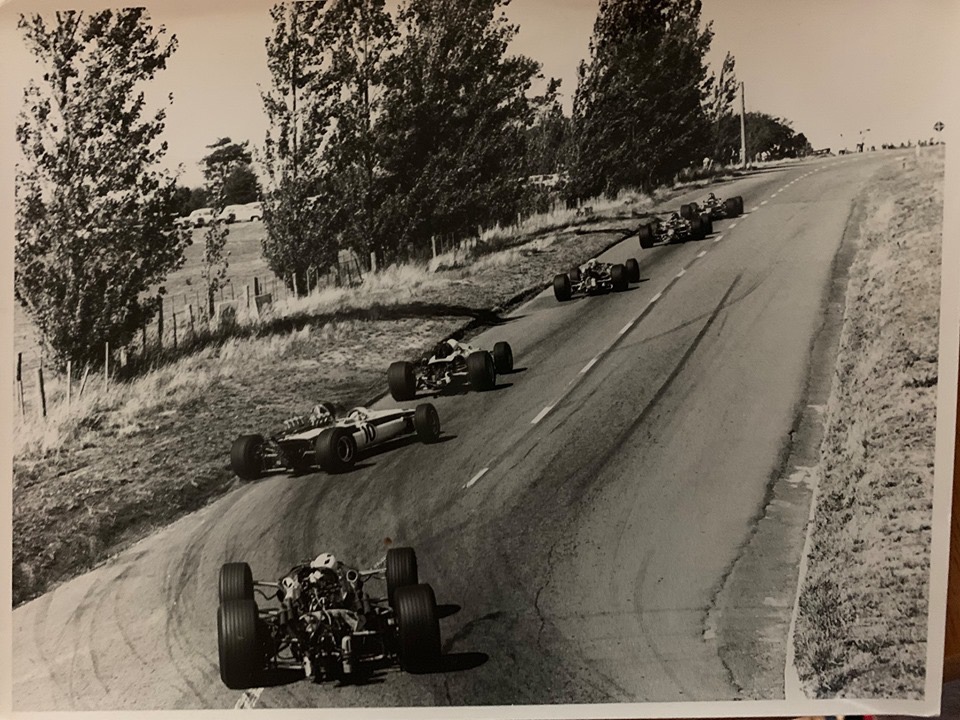


dalton
Superb, evocative Gnoo Blas shot. Ross Dalton, C-Type Jag, February 1960 (John Ellacott)

Gnoo Blas actually! Ross Dalton and his Jaguar C-Type, February 1960…

Gnoo Blas was a circuit around the public roads of Bloomfield Hospital in Orange, in the Central West region of New South Wales, 250km west of Sydney. Gnoo Blas is the aboriginal name of Mount Canoblas nearby.

The superb opening photo, taken by John Ellacott, is one of those ‘ the more you look the more you see shots’. Note the ‘fag’ between the driver’s fingers, plastic raincoat, overloaded control tower, Kombi with ‘tarp drying on top, official with ‘cuppa. All are about as far from Bernie’s ‘manicured paddocks and corporate scene’ as it’s possible to be. And thank the good Lord above for that.

As the Australian economy recovered from World War 2 and disposable incomes increased, together with the availability of consumer credit, motor racing and racing circuits were opportunities for individuals and communities alike. Circuits popped up all over the place. Oranges’ ‘Cherry Blossom Committee’ saw an opportunity to establish a circuit as the promoters of the Easter Bathurst meeting ‘up the road’, the Australian Sporting Car Club were in dispute with local Bathurst authorities and were looking for an alternative venue.

The 6.03km, triangular shaped circuit opened in January 1953, the South Pacific Road Racing Championship attracted 12,500 spectators.

All of the stars of the period raced there including Prince Bira, Peter Whitehead, Tony Gaze, Ted Gray, Doug Whiteford and Jack Brabham who made his road racing debut there in 1952 in a Cooper Mk IV and held the lap record until the circuits’ final meeting.

John Boorman on the way to a win in XKC037, Gnoo Blas 1955 (J Psaros)
orange
(Orange & District Historical Society)

The shot of above shows the atmosphere of the place and time. John Medley IDs the shot as lap 1 of the 1955 South Pacific Championship, ‘Brabham leading Whitehead- a remarkable performance.’ F2 Cooper T23 Bristol from Formula Libre Ferrari 500/625.

Dwindling crowds, debts owed to the original investors and difficulties in renewing the track licence with the NSW police led to the circuits closure in October 1961, the lap record was then held by Jon Leighton’s Cooper Climax at 105.2 mph. One era and circuit closed with Warwick Farm shortly to open in Western Sydney, another era commenced.

gnoo-blas-reg-hunt-Jan-29-1956-2
Reg Hunt on the way to victory in the South Pacific Championship on 30 January 1956. Maserati 250F. Check out the ‘steaming train’, Sydney Morning Herald van, the general oh-so-casual scene. Road racing at its best (Gnoo Blas Classic Car Club)

South Pacific Road Racing Championships 1956…

One of the best promoted meetings was the ‘South Pacific Road Racing Championship’ contested on 30 January 1956.

20,000 spectators crowded into Orange on race day to see a quality field of cars and drives; Reg Hunt in his new Maserati 250F, Jack Brabham and Ken Neal in Cooper Bristols, Curley Brydon Ferrari 125, Stan Jones in Maybach 3 and Alf Harvey in the ex-Bira Oscar V12.

Hunt dominated, he lapped the field, took the fastest lap and set the highest top speed at160mph over the Flying Quarter. Jones withdrew with a ‘leg out of bed’, a rod poking outside the block of the precious six-cylinder engine. Brabham and Neal were second and third in their Cooper Bristols.

gnoo-blas-alf-harvey-january-1956
Gnoo Blas European Exotica. Alf Harvey’s ex-Bira OSCA V12 ahead of Curley Brydon’s Ferrari 125, South Pacific Championship, January 1956 (Gnoo Blas Classic Car Club)
gardner boorman c type tomago
pwoooaaah! Boys will be boys. XKC037 during John Boorman’s ownership at a meeting at Tomago Airstrip, near Newcastle NSW, 1955 (Dick Willis)

Ex-works- Frank Gardner/Frank Matich Jaguar XKC037…

The ‘happy chappy’ in the Jaguar in the first photo at the top is Ross Dalton who acquired the car from Frank Matich. XKC037 started life as a works car. It was built as a standard specification reserve 1953 Le Mans entry in case the advanced lightweight cars under development failed in testing (XKC038 and XKC039 were built for the same purpose).

Stirling Moss raced it at Silverstone in May 1953 and rolled it. XKC037 was then rebodied and sold to the Kenyan Coca Cola bottler John Marussis who entered it at Reims but wrecked it at Dundrod.

Rebuilt again, it was then sold via 1951 Le Mans winner, Peter Whitehead to Cessnock, New South Wales doctor, John Boorman.

Frank Gardner bought the car as an insurance write-off after it was involved in a fatal accident. Gardner recalled in a ‘Motorsport’ interview ‘…Boorman hit a Ford Customline, killed the (two) occupants and ended up down a ravine (near Tamworth NSW)…I wrote to Jaguar asking for information so i could rebuild it… a few weeks later a package arrived with all the drawings so I knew which way to go to get it sorted’.

‘I did it right because even then a proper C-Type meant something and I thought if I bastardise this thing it will look like cleaning up a bloody Rembrandt with aftershave lotion! But I couldn’t get it to run cool so I altered the radiator grille a bit…’

Former Cessnock resident Michael Hickey identifies this shot as Allandale Road, Cessnock. Equipe Boorman- C Type and Mk7 Jags, is on the way to Mount Panorama in 1955- he raced in both the Easter and October meetings (Jaguar Magazine)
Boorman at Mount Panorama, Bathurst date uncertain (unattributed)
FG in XKC037 when first rebuilt and fitted with one of Frank’s XK120 grilles and fibreglass bonnet, circuit unknown (unattributed)

The C Type replaced FG’s lightweight XK120 Jaguar and was an important stepping stone in the careers of both he and Matich, both progressed to D=Types after the C.

Years later XKC037 was acquired by Sydney Jaguar identity, Ian Cummins who completed its restoration in the mid 1970s. It left our shores in 1984 for a sum considerably greater than the £2000 Ross Dalton paid in 1960!

C-Type Jags won Le Mans upon debut in 1951 and again in ’53.

fm c type leatons servo
Frank Matich in XKC037 out the front of the cars owners, Leatons Motors workshop, 351 Stony Creek Road, Kingsgrove, Sydney in October 1958. What a shot! Love the Energol ‘The Oiliest Oil’ sign (John Ellacott)

Etcetera: XKC037….

boorman tomago
(Dick Willis)

Dr John Boorman, XKC037 at Tomago Airstrip, NSW 9 April 1955.

(J Psaros)

Frank Gardner at Mount Panorama in 1957.

image
(John Ellacott)

Tom Sulman’s Aston Martin DB3S chases Frank Gardner’s Jag XKC037 at Mount Druitt, November 1957.

(unattributed)

FG ascending Silverdale Hillclimb during the 1957 NSW Hillclimb Championships, he won his class and was quicker than Arnold Glass in the ex-Lex Davison Australian Grand Prix winning HWM Jaguar.

fm mount druitt
(John Ellacott)

Frank Matich Jag C during private practice at Mt Druitt, Sydney in 1959.

fm c bathurst
(Kevin Drage)

The engine of XKC037 as raced by Frank Matich for Leaton Motors at the October 1958 Bathurst meeting.

The car contested the Australian Tourist Trophy, FM finished fourth, David McKay won the race in his second, ex-works Aston Martin DB3S.

scw
Advertorial 1950s style! The Leaton Motors Team on the cover of Australia’s Sports Car World magazine; the Austin Lancer dvr Brian Foley, AH Sprite dvr Doug Chivas and XKC037 dvr Frank Matich (Sports Car World)

The current owner of this wonderful car, John Corrie, recently (March 2015) got in touch and sent these shots of the C Type, great to see it still being raced, Messrs Gardner, Matich and Dalton would be pleased!

xkc oodwood 2
David Brazell in John Corries’, ‘XKC037’, Goodwood Track day practising for the 2013 Revival meeting (Chris Perrett)
xkc good wood
Superb shot in the English Summer…’Goodwood Revival 2013 during the Freddie March Trophy which was stopped after an hour the weather turned really bad’. David Brazell in John Corries car (Chris Perrett)
xkc home
XKC037 looking rather more immaculate than in its days as a workhorse for Frank Gardner and Frank Matich in Australia (John Corrie)
jag c cutaway
C-Type cutaway drawing (Jaguar Heritage)
jaaggs
(Unattributed)

Etcetera: Gnoo Blas 1960 Australian Touring Car Championship meeting…

Start of the one race, ‘the first’, Australian Touring Car Championship at Gnoo Blas on 1 February 1960.

Left to right are the Jag Mk1s of Ron Hodgson, Bill Pitt and David McKay from pole who won the race.

Hodgson led early, the three Jags pulled away from the rest of the field, he ran wide and the other two spun at Windsock on lap 1 then he did the same on lap 2 letting McKay and Pitt through. Max Volkers was fourth in his Holden FJ and Pete Geoghegan fifth in his Holden 48-215 until head gasket failure intervened.

By lap 14 McKay had a 26 second lead over Pitt, then rain fell catching Ron Sawyer’s Holden FJ out. He spun on the crest of Connaghans Corner hitting the inside bank and rolling, help was at hand when Des West stopped to assist the hapless driver from the car. McKay’s path was blocked by a Ford Zephyr which had also stopped (driver unknown) ‘McKay used his car to move the Zephyr out of the way’.

Further excitement occurred on the following lap when McKay spun yielding the lead to Pitt but the overdrive mechanism on that car began to fail allowing David McKay to regain the lead two laps from the end. He won the race six seconds ahead of Pitt with Ron Hodgson a minute in arrears then came Max Volkers a lap down in fourth.

(Ian Lord Collection)
finch d type
David Finch, Jag XKD Type ,Windsock Corner, Gnoo Blas 1960 (Don Read Collection)


gnoo blas

Bibliography…

‘Historic Racing Cars in Australia’ John Blanden, John Medley, Michael Hickey

Photo Credits…

John Ellacott, Jaguar Heritage, Orange & District Historical Society, Paul Cross, Don Read Collection, Dick Willis, Chris Perrett, John Corrie, Frank Gardner ‘Motorsport’ magazine interview March 2008, Gnoo Blas Classic Car Club, Jock Psaros, Jaguar Magazine, Ian Lord Collection

Finito…