If Jack Brabham were immortal, he would have been 100 today. He was born in Hurstville, Sydney, on April 2, 1926.
Many thanks to Stephen Dalton for the reminder. The date should have been at the front of my mind, as Jack and the cars he and Ron Tauranac designed and built – and Jack’s pending 100th – were the focus of the Racing Past celebrations throughout the Australian Grand Prix carnival a month ago.
In the absence of a dedicated article, this one ‘in stock’ will have to do, key Brabham into the primotipo search engine and that will keep you going for a couple of days…
Onya Jack!
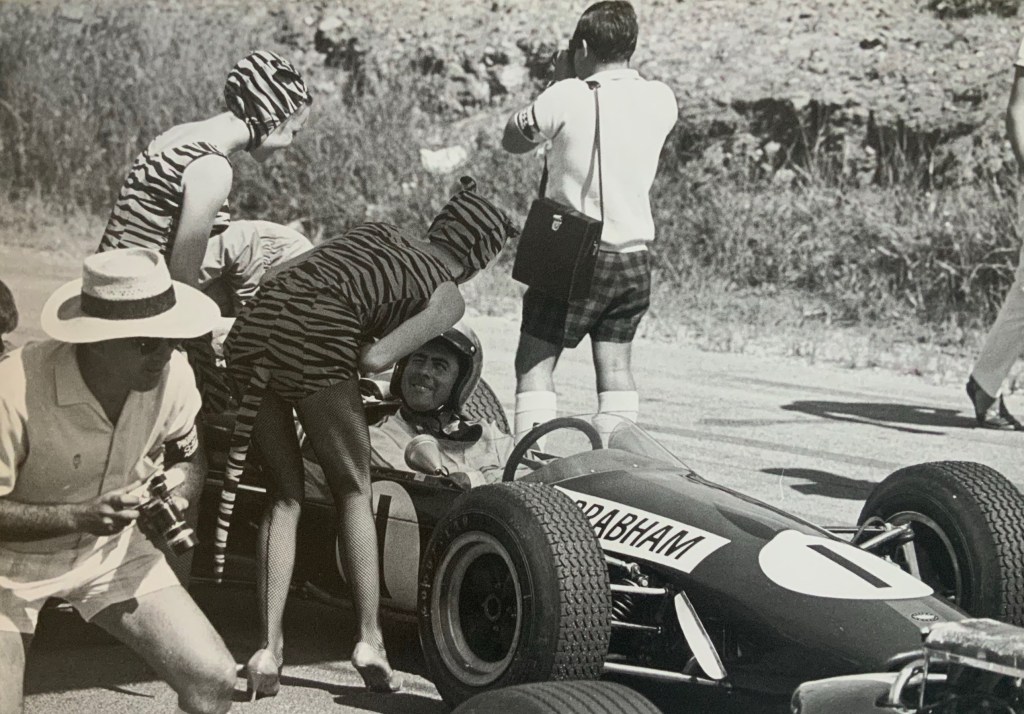
Tiger in ‘yer Tank!
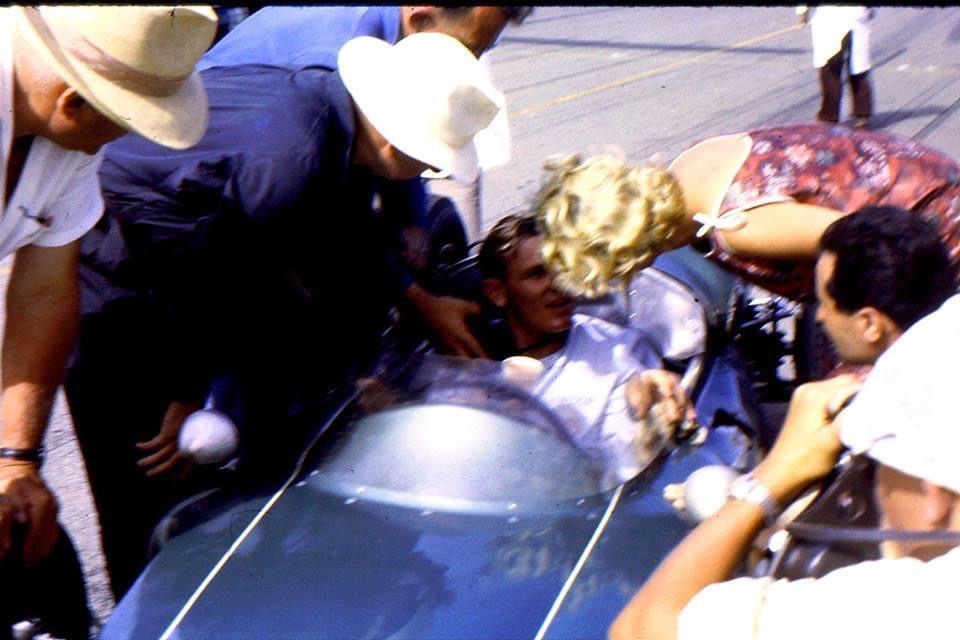
Jack Brabham is trying to focus on the start of the February 12, 1967, Lakeside 99 Tasman Cup round, but is set upon by a couple of tigers intent on getting into his tank…
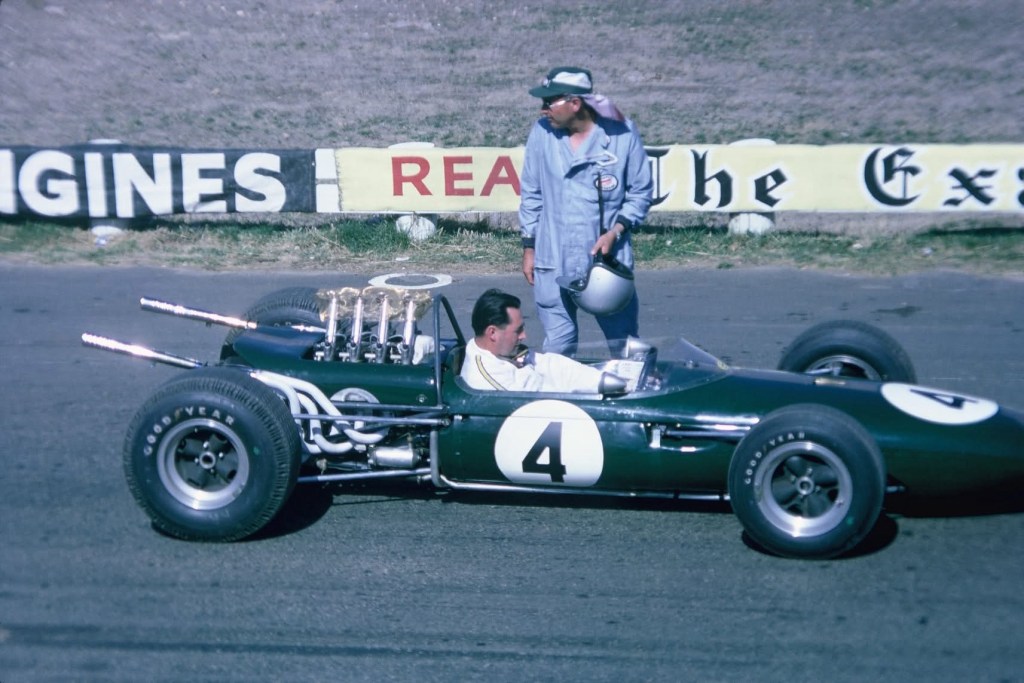
Esso babes, high heels and all, doing their promotional thing in the hot Queensland sun. It wasn’t too bad a day in the office. Jack was second behind Jim Clark’s Lotus 33 Climax FWMV 2-litre V8 in his Brabham BT23A Repco 640 2.5 V8, with Frank Gardner third in Alec Mildren’s Brabham BT16 Coventry Climax FPF 2.5. Brabhams occupied five of the first six placings, but not the one that mattered.
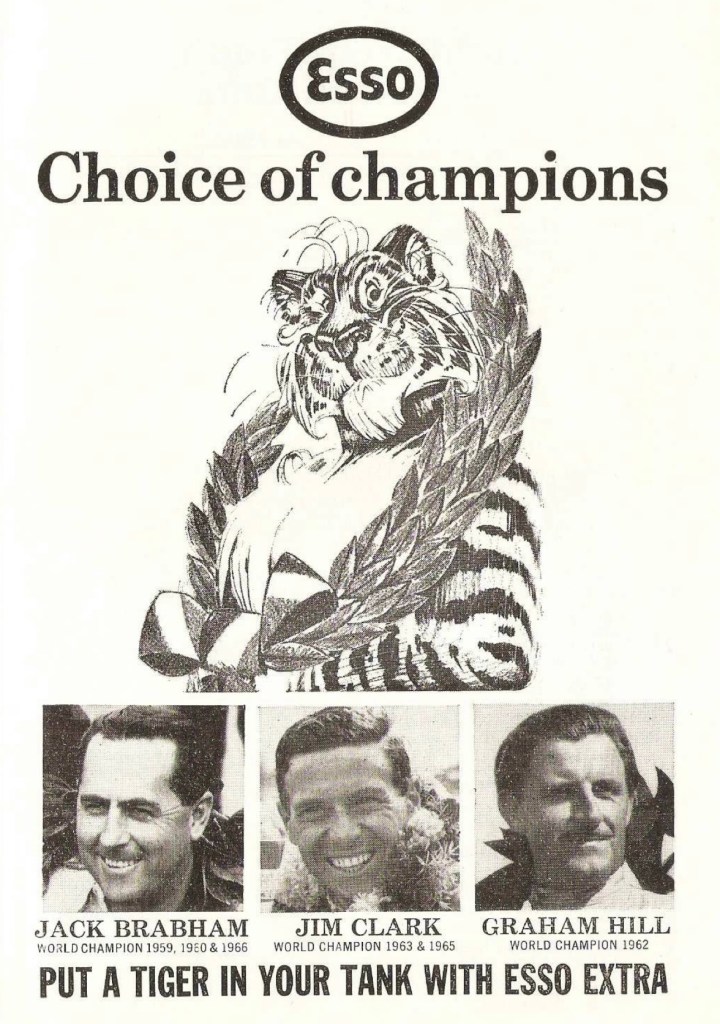
It’s the year before the FIA/CSI threw open the floodgates and allowed commercial advertising on racing cars, but even in those faraway days, Brabham’s commercial relationships included Repco Ltd, Esso, Goodyear, Lukey Mufflers, plus whatever freebees he/they could wrangle here and there.
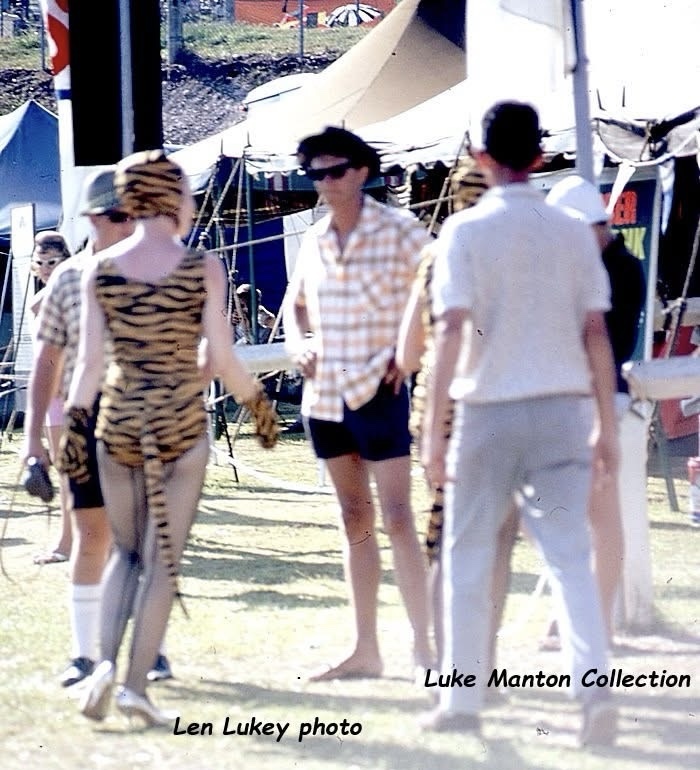
We’re still at Lakeside, where the pair of tigresses are doing the rounds of the paddock, an undertaking fraught with danger, I would have thought.
It’s a ten-point caption competition, really? You can see Sonny-Jim is trying to think of a zinger that will get him a drink in the bar later on. I figure, ‘Can I measure yer’ tail’, probably wouldn’t have done the trick.
Etcetera…
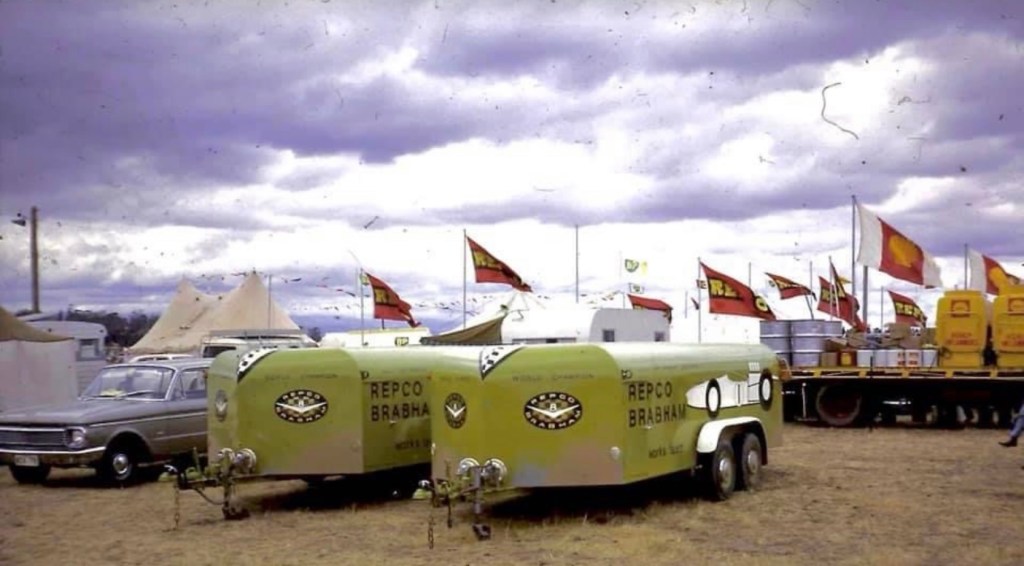
Repco-Brabham Engines Pty. Ltd. and the Brabham Racing Organisation mounted their only full assault – two works-backed cars doing the full eight-round series – only once, in their commercial relationship between 1963-68, in 1967, and fell well short of the mark.
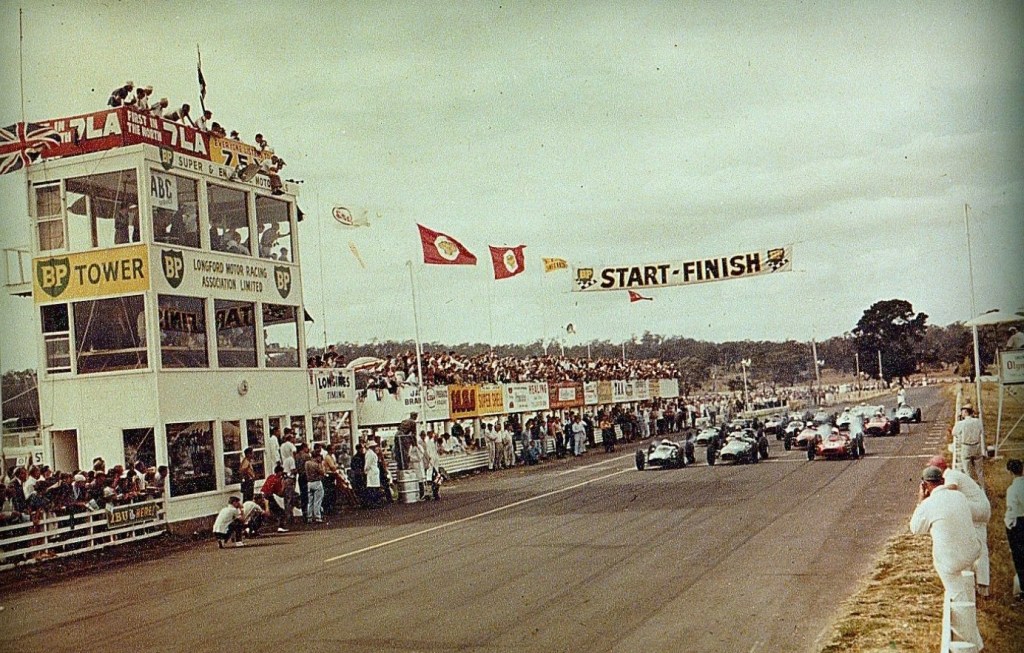
It’s ironic that an engine program originally designed for the 2.5-litre Tasman Cup and Gold Star Championships only ever yielded one Tasman round win, at Longford that year, where the photo above was taken. Yes, there were some Gold Star round wins, but not that many. Still, a couple of World F1 Drivers and Manufacturers Championship wins in 1966-67 plus multiple Australian Sports Car and Hillclimb Championships were reasonable levels of compensation for the investment made!…
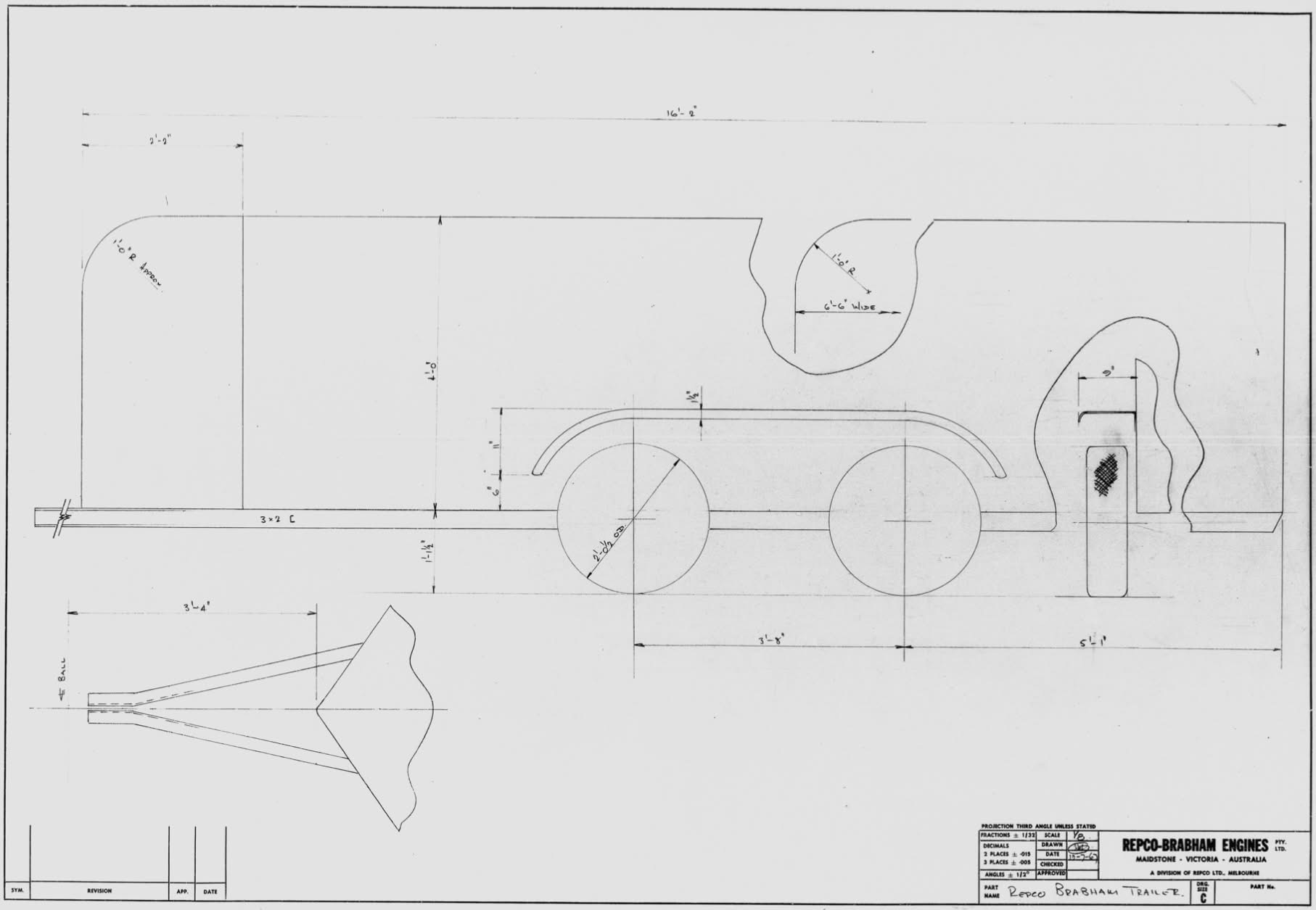
Yep, they were Rice Trailers, but Repco-Brabham Engines Pty. Ltd. designed them!
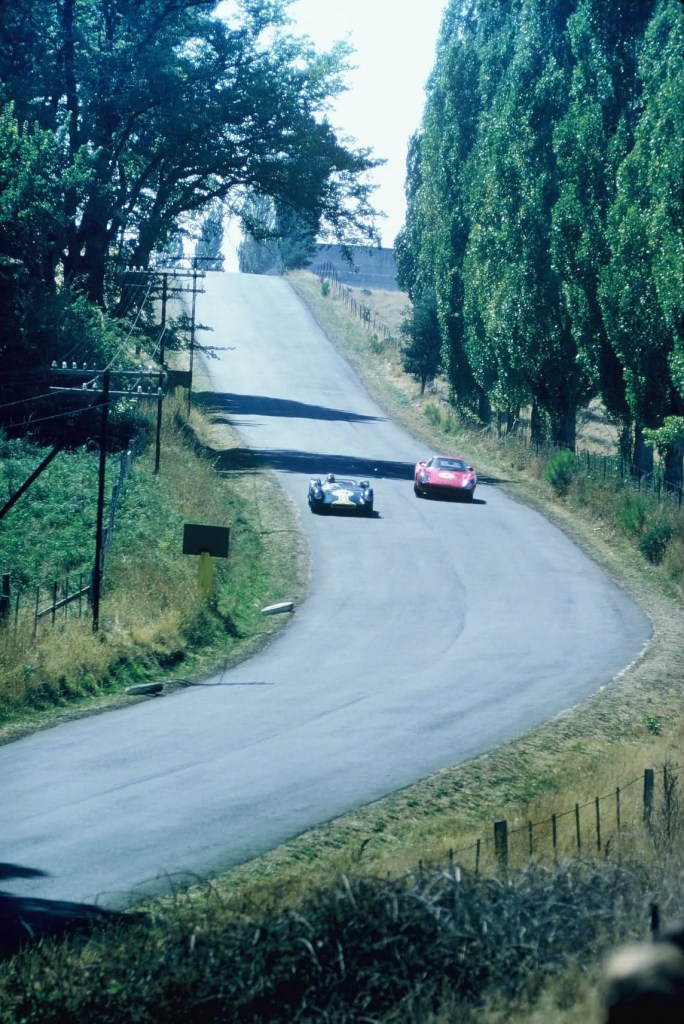
Spencer Martin in the Scuderia Veloce Ferrari 250LM, looking for an outside run on Wally Mitchell’s RM1 Climax FPF 2.5 into the Viaduct, you can see the dark, looming Water Tower at the top of the photograph, during the 1966 Australian Tourist Trophy.
This photograph, taken by Peter Duckworth from the Viaduct spectator area on the railway line, shows the sheer majesty and scale of Australia’s long-lost – 1968 was the final race meeting – Longford road circuit that ducked and dived over 4.5 miles through the local environs in and around the northern Tasmania rural hamlet southwest of Launceston.
Some of the photos taken by Peter, posted on the excellent Historic Racing Car Club of Tasmania Facebook page some years back, I retro-fitted into articles I’d already done, but I was looking through that site for the first time in a while and thought they really deserved a piece all of their own to let them breathe.
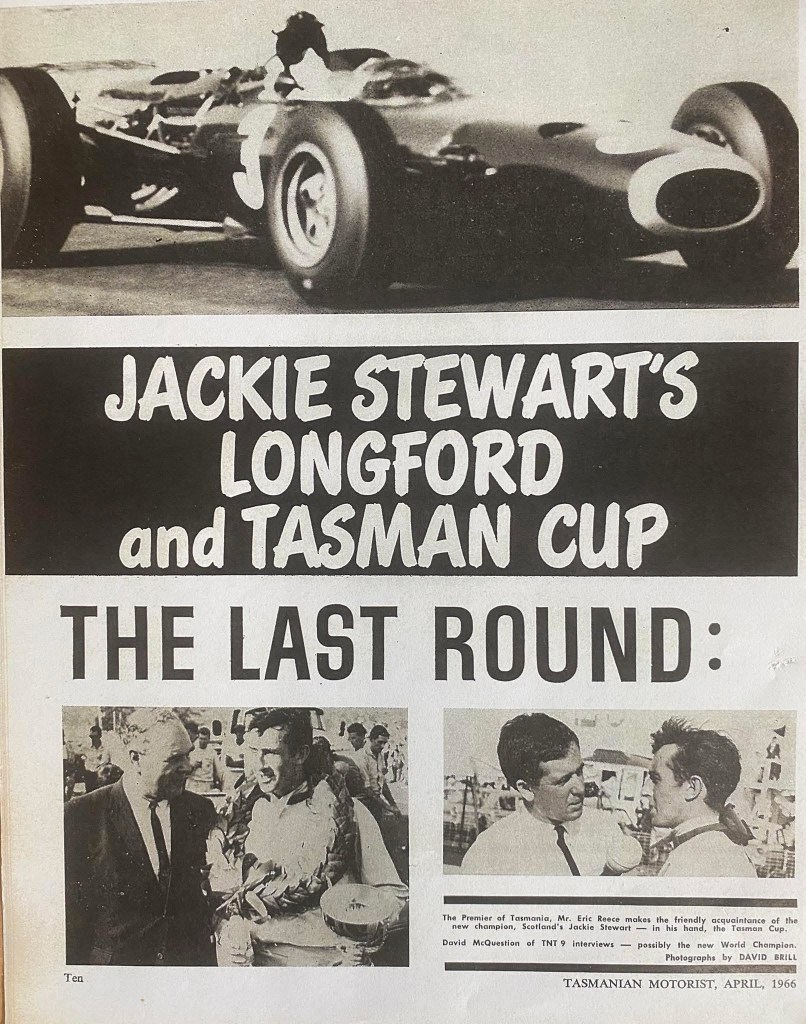
As I’ve admitted many times before, I’m completely captivated by Longford despite never visiting during the day, but I’ve made up for it since! I covered Jackie Stewart’s victory in the South Pacific Trophy nearly sixty years ago on March 7, 1966 aboard a 1.9-litre BRM P261 V8 in this piece:https://primotipo.com/2016/05/19/jackies-66-longford/
(HRCCT)
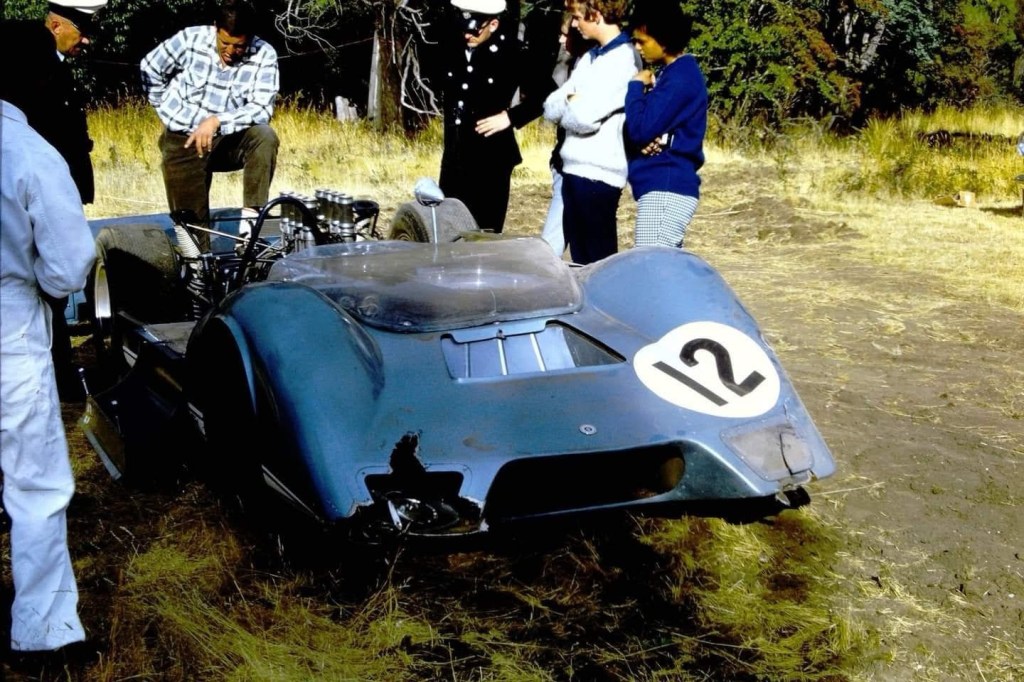
The perils of this part of Tassie and the inferior aerodynamics of the Elfin 400 are revealed in this shot of Globe Products’s Noel Hurd-driven Elfin 400 Ford 289 V8 (#BB661), which took flight at or near the top of the rise shown in the photo above, beyond the start-finish straight, the following year, 1967.
The two championship feature events of the weekend were the South Pacific Trophy and the Australian Tourist Trophy won by Frank Matich in his Elfin 400 Oldsmobile V8, a car entered by Frank as the Traco Oldsmobile for the twelve months he raced it. Otherwise, it was called by most of its owners an Elfin 400, given the car was built by Garrie Cooper’s Edwardstown, Adelaide firm, and left said establishment in late 1965 with an Elfin badge on the nose and Elfin chassis plate on the dash.
(P Duckworth)
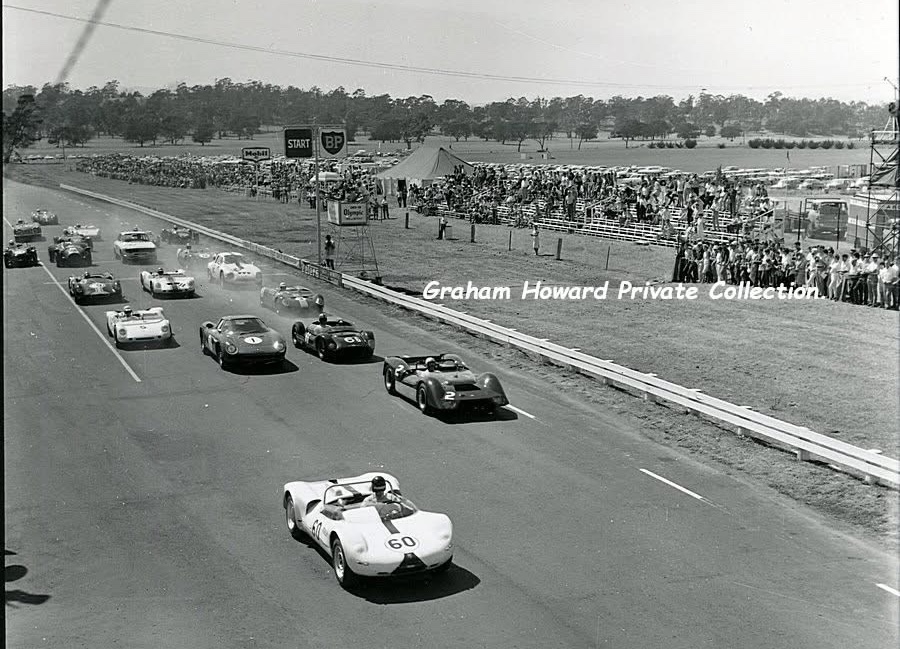
The flag drops at the start of the 1966 Australian Tourist Trophy at Longford on March 7.
The front row cars took the podium places, poleman Frank Matich won the 23-lap 103-mile race in his two or so meetings old Elfin 400 Oldsmobile V8, by 7 seconds from Alan Hamilton’s similar vintage to him Porsche Distributors’ Porsche 904 Spyder 2-litre flat-six and then Spencer Martin in the Scuderia Veloce/David McKay Ferrari 250LM 3.3-litre V12. another 28.5 seconds further back.
That’s Lionel Ayers’ white fourth-place Lotus 23B Lotus-Ford behind Hammo. Another Lotus 23, I’m not sure which of the other three that started, while Kevin Bartlett’s white Alec Mildren Alfa Romeo GTA stands load and proud (DNF head gasket).
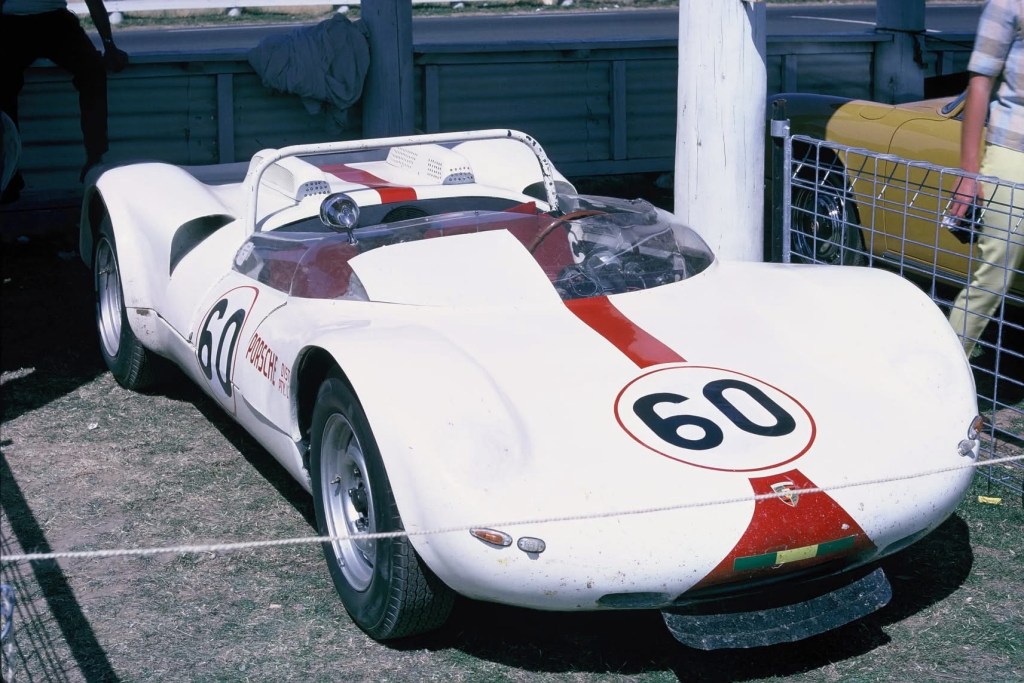
Frank Matich’s Laurie O’Neill funded Elfin 400 Oldsmobile – the Traco Olds in FM speak – at Longford in 1966. The blokes are, perhaps, Bruce Richardson leaning over the bonnet, Bob Holden in the sunnies, FM in the cap, and Laurie O’Neil next to Matich (P Duckworth) Alan Hamilton’s ex-works Porsche 904/8 ‘Kanguruh’ chassis #906-007 in the Longford paddock; the first of his three Porsche sports racers to be blessed with that chassis number…(P Duckworth)
Other notables in the race were Dick Thurston, who was fifth in the ex-Stillwell Cooper T49 Monaco, by then Buick V8-powered; the redoubtable local crowd pleaser, Kerry Cox, who was seventh in the Paramount Jaguar. Bob Holden was ninth in the Lolita BMC, and Alan Ling was a splendid 10th in a Lotus Super 7. Paul Bolton, Frank Demuth and Steve Holland – all the way from Hong Kong – raced 23Bs, surely one of Colin Chapman’s finest ever production racing cars?
Also worthy of note is Ross Ambrose, later co-founder of Van Diemen Racing Cars with Ralph Firman and father of Marcos, local sports car perennial, who was 17th in his Elfin Streamliner Ford, Bob Wright in a Tasma 1500 18th, and Max Brunninghausen who was classified 19th in his Alfa Romeo TZ1 despite head gasket failure. A fantastic Australian sports car grid of the era in every respect.
Longford pre-start. Jackie Stewart #3 and Graham Hill aboard BRM’s exquisite 1.9-litre P261s and Jim Clark’s Lotus 39 Climax FPF, which has resided in Tasmania for quite some while. Note the different heads fitted to Bourne’s finest (P Duckworth)
As written above, Jackie Stewart won for BRM at Longford in 1966 and also popped the Tasman Cup into his CV. While the 1964 BARC British F3 Championship was his first series win, the ’66 Tasman was his first international series triumph; a respected one at the time, given the strength of the competition and therefore the degree of difficulty in winning it!
Spencer Martin’s Scuderia Veloce Brabham BT11A Climax FPF #IC-4-64, soon to become Spencer Martin’s Bob Jane Racing car in which he won the 1966-67 Australian Drivers’ Championships. The ‘divorce’ was handled elegantly by all parties if you believe what you read; that Shell was the mutual sponsor was helpful in relation thereto (P Duckworth)
That year was a turning point, the season in which the Coventry Climax 2.5-litre FPF four-cylinder engine, which provided a key, probably the key, foundation piece, in establishing the 2.5 Tasman formula, was supplanted by V8s. The BRM V8s – 1.9-litre variants of BRM’s successful P56/P60 1.5-litre F1 engines – showed the future path to win the trophy, while Repco’s new Repco-Brabham 2.5-litre 620 V8 also showed promise.
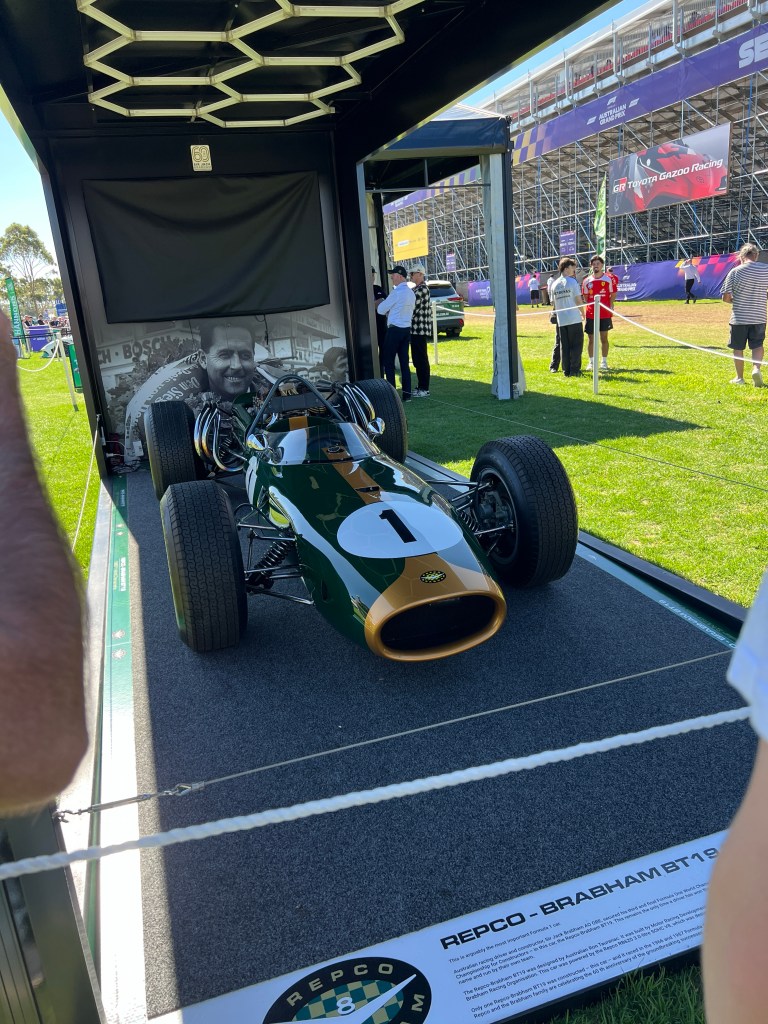
Jack Brabham raced BT19 #F1-1-65 at Sandown and Longford powered by 2.5-litre variants of the RBE V8 on a development path that saw its first F1 win (3-litres) in the International Trophy at Silverstone on May 14, first championship win at Reims, in the French Grand Prix on July 3, and the World Drivers and International Cup for Manufacturers championships wrapped up at Monza on September 4.
Jack, BT19 2.5 620 V8 and Jack’s longtime local manager, Reg Thompson (thanks, Stephen Dalton!). Longford 1966, the car’s third race: the South African GP January 1 DNF and the Sandown Park Cup Feb 27 DNF, being the first two (P Duckworth)
Not a bad result against the might of Ferrari, Lotus, BRM, Cooper et al for a company that commenced in 1961 – Motor Racing Developments – and not bad for a company that had never built an engine before – Repco!
This weekend, during the 2026 Australian Grand Prix carnival, on Thursday, BT19 was inducted into the Australian Motorsport Hall of Fame. It’s the 100th member, the first, and probably the last ‘non-person’ to be accorded that honour.
BT19 at Albert Park yesterday after induction into the Australian Motorsport Hall of Fame. That’s David and Sam Brabham in the white/white and black shirts (M Bisset)
If memory serves, Repco restored the car with a team of Repco/ex-Repco Brabham Engines artisans led by the late Don Halpin in time for the 1978 ‘Fangio Meeting’; the ’78 AGP at Sandown where Jack ‘duelled’ in BT19 with JMF’s Mercedes Benz W196 in several events.
So the car is a familiar face for many of us, with the car pressed into regular service since Repco became the V8 Supercars Championship sponsor in recent years. A national treasure, it would be intriguing to know the sum for which it’s insured!
Etcetera…
(P Duckworth)
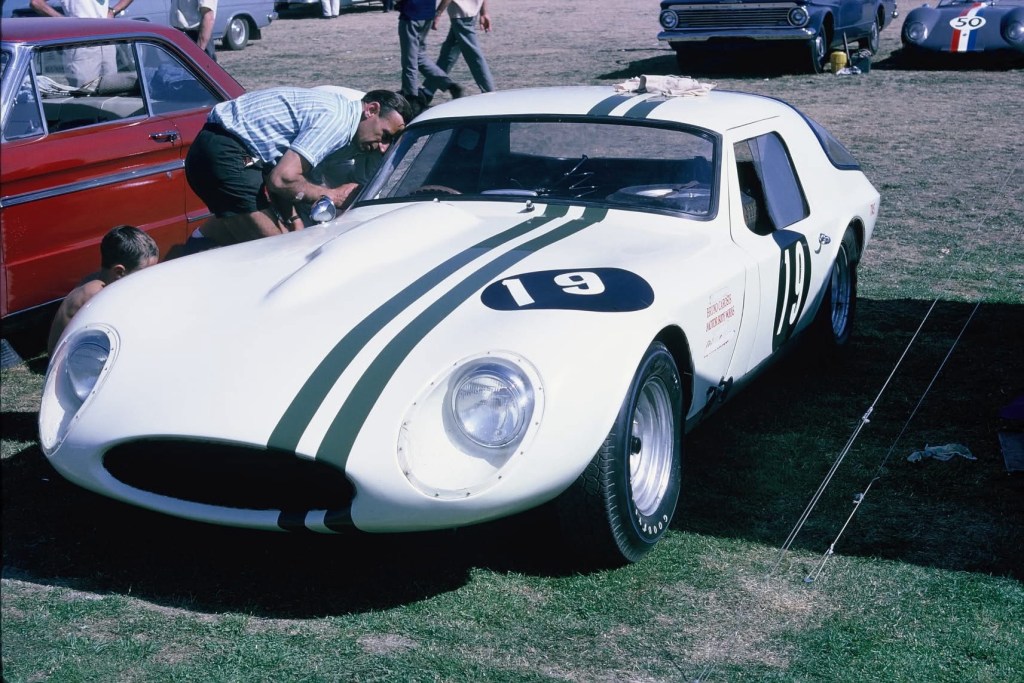
Rob Bartholomaeus tells me this Bolwell Mk5 Holden lookalike is Bruno Carosi’s Carosi B-Type special, resplendent, no doubt, in one of the Bolwell Brothers’ lovely bodies. Red Falcon Hardtop at left, and blue Valiant and Ross Ambrose’s Elfin Streamliner Ford to the rear.
Credits…
Photography by Peter Duckworth courtesy of the Historic Racing Car Club of Tasmania, oldracingcars.com, Google, Graham Howard
Tailpiece…
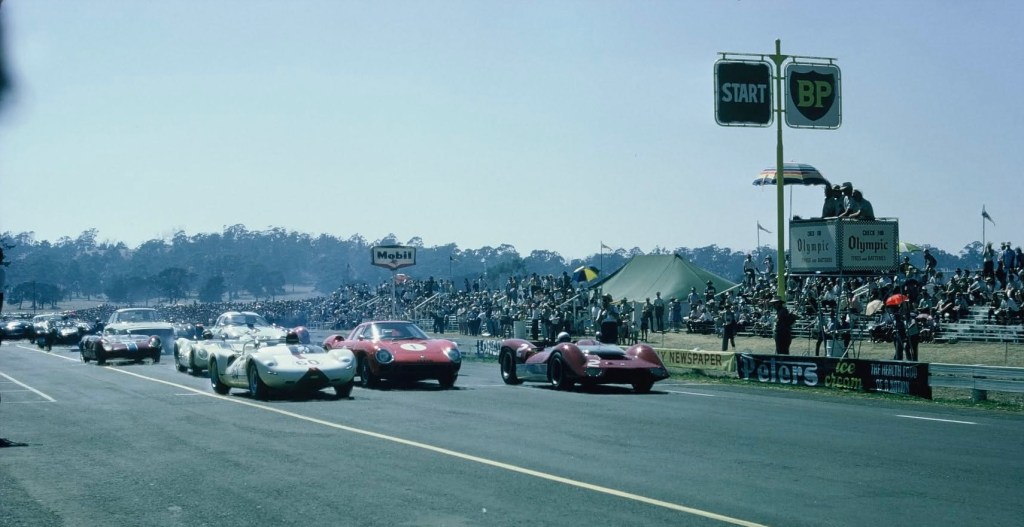
Didn’t Alan Hamilton get the jump in his Porsche! From Matich, Dick Thurston, Cooper Monaco Buick, Spencer Martin 250LM, a swarm of Lotus 23Bs: Frank Demuth #5, Paul Bolton #3 and Lionel Ayers #11 with Wally Mitchell’s RM1 Climax at left and Max Brunninghausen’s Alfa Romeo TZ1 at right, and the rest…
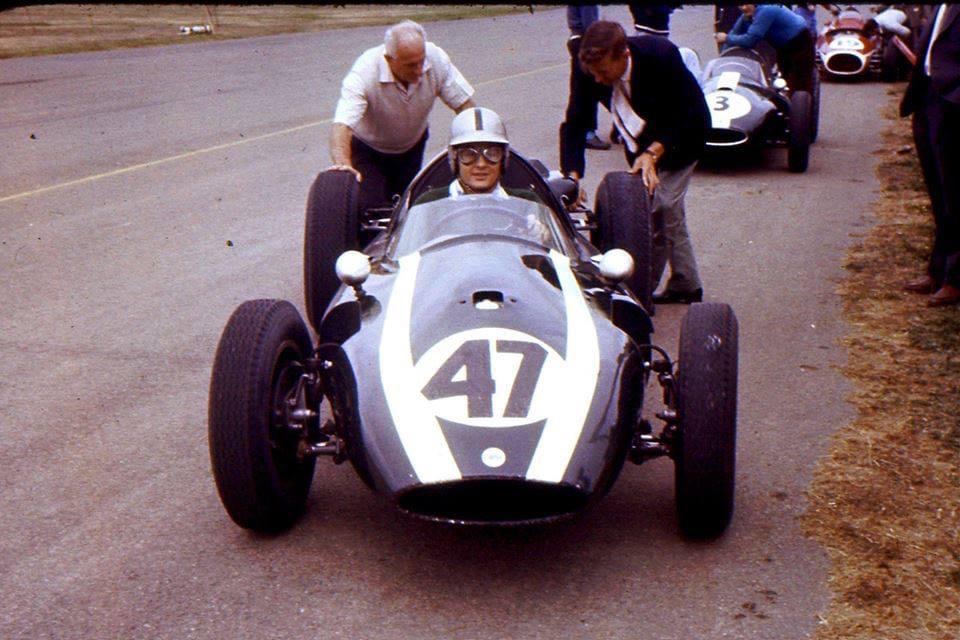
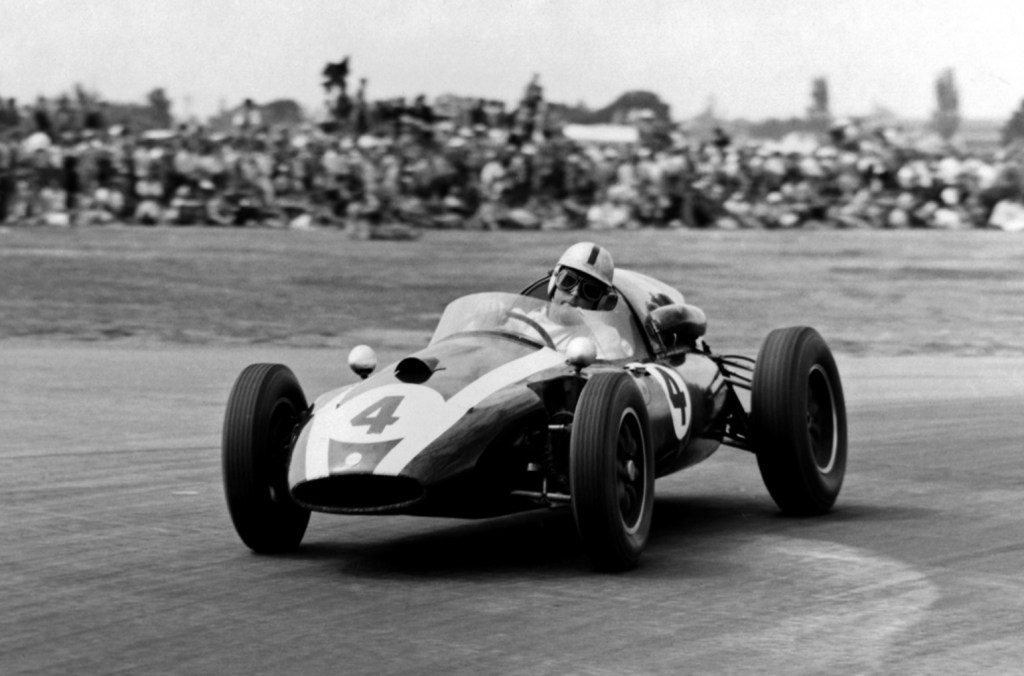
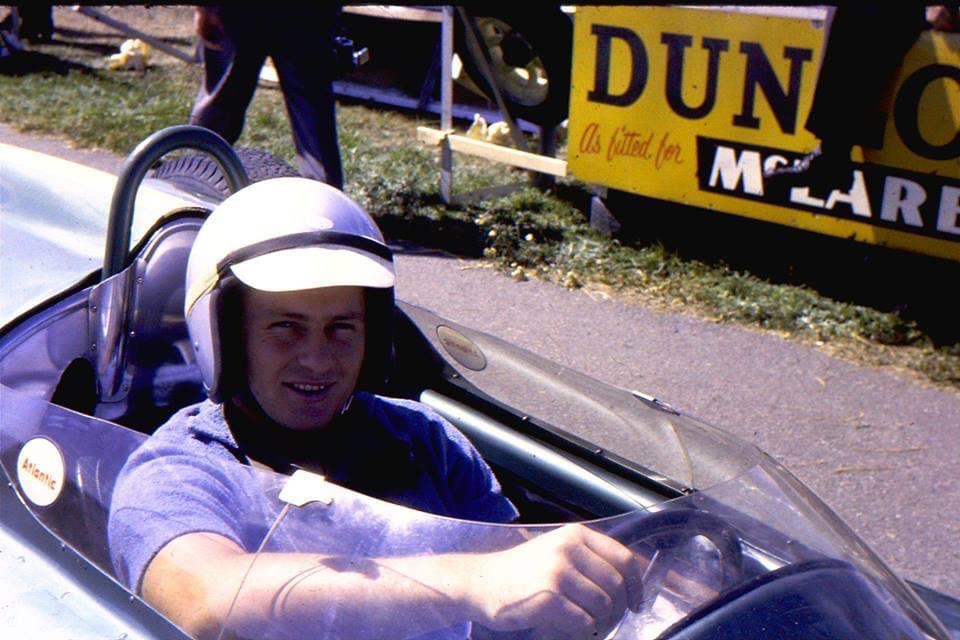
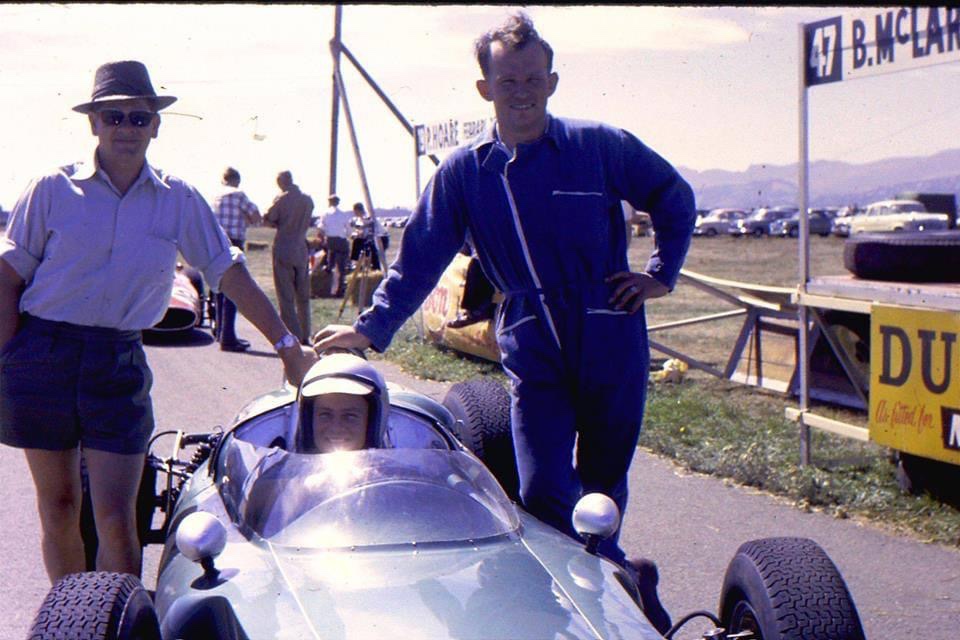
Pop McLaren and another helper about to bump-start Bruce’s Cooper T45 Climax FPF 2.5 at the Wigram RNZAF track on the January 23, 1960 weekend.
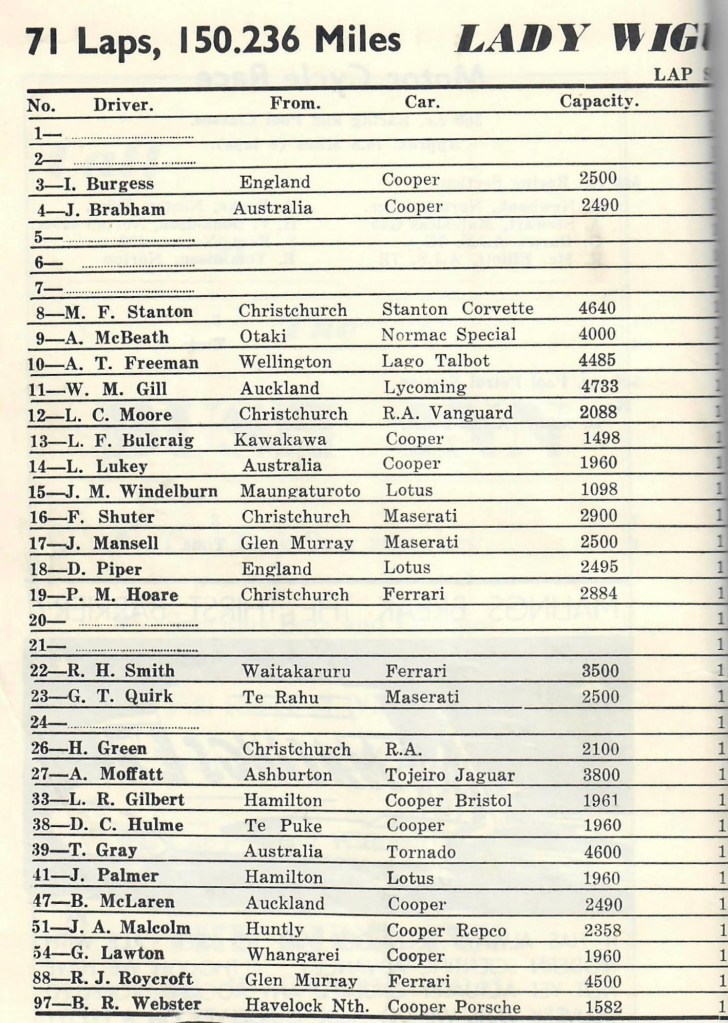
That’s Ian Burgess’ third-placed Cooper T51 Climax behind, then Pat Hoare’s Ferrari 256 V12 a little further back; he was fifth. Jack Brabham won the race in a T51 2.5-FPF with David Piper’s Lotus 16 Climax FPF 2.5 second. Bruce was fourth in the Lycoming Special; more of that soon.
New Zealand’s Summer Internationals commenced with the NZ GP, then held on the Ardmore Airfield circuit outside Auckland, with the Lady Wigram Trophy the other round most visiting internationals did. Sometimes they also entered the Dunedin Road Race and Teretonga International, held on a permanent racetrack near Invercargill, both venues on the South Island.
That year the visitors were headlined by Stirling Moss, twice-on-the-trot World Champion Brabham, and Burgess, Piper, while the Australian contingent included Bib Stillwell and Stan Jones in Cooper T51s, and Len Lukey in a T45. Similarly mounted was Kiwi youngsters Denny Hulme and George Lawton, both Driver to Europe exports; Lawton’s a sad one…
(T Marshall)
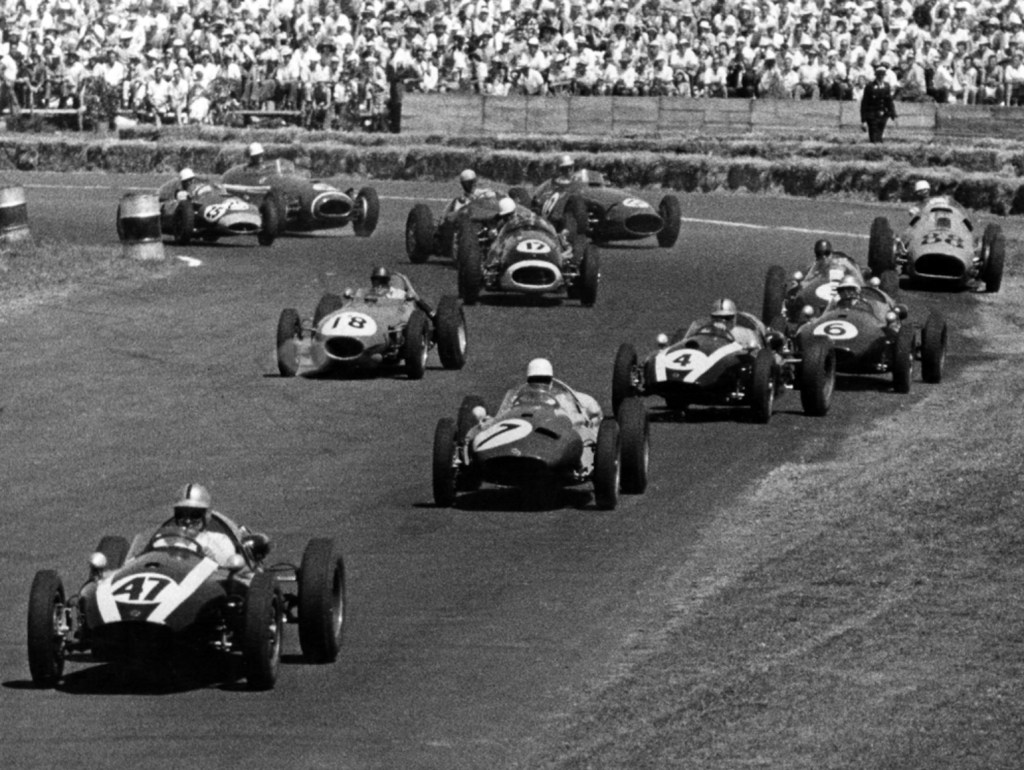
Coopers to the fore on the first lap at of the New Zealand GP at Ardmore: McLaren, Moss, Brabham, #6 Australian Bib Stillwell and then Ian Burgess. One T45 and four T51s. In the middle of the road is David Pipers Lotus 16 Climax, car #17 Johnny Mansel’s Maserati 250F, while #88 is Ron Roycroft’s positively historic but very well driven ex-Ascari Ferrari 375 4.5-litre V12. Behind Mansel is perhaps Pat Hoare, Ferrari 256 V12 – a Dino 246 fitted with a 3-litre V12 – then Arnold Glass in his Maserati 250F #12. Close to the oil drum is 1954 NZ GP winner Stan Jones, Cooper T51 Climax, and finally the big front-engined car is Ted Gray in his last drive of Australian Land Speed record holder, Ted Gray in Tornado 2 Chev V8.
At this time of technological change, it was certainly a grid lacking variety! Coopers were of course right up there: Brabham and McLaren finished one-two in their 2.5-litre FPF-powered cars from the 2.2s of Stillwell and Jones. The best placed front-engined cars were the pair of 2.5-litre six-cylinder Maserati 250Fs raced by Kiwi Johnny Mansel and Aussie Arnold Glass.
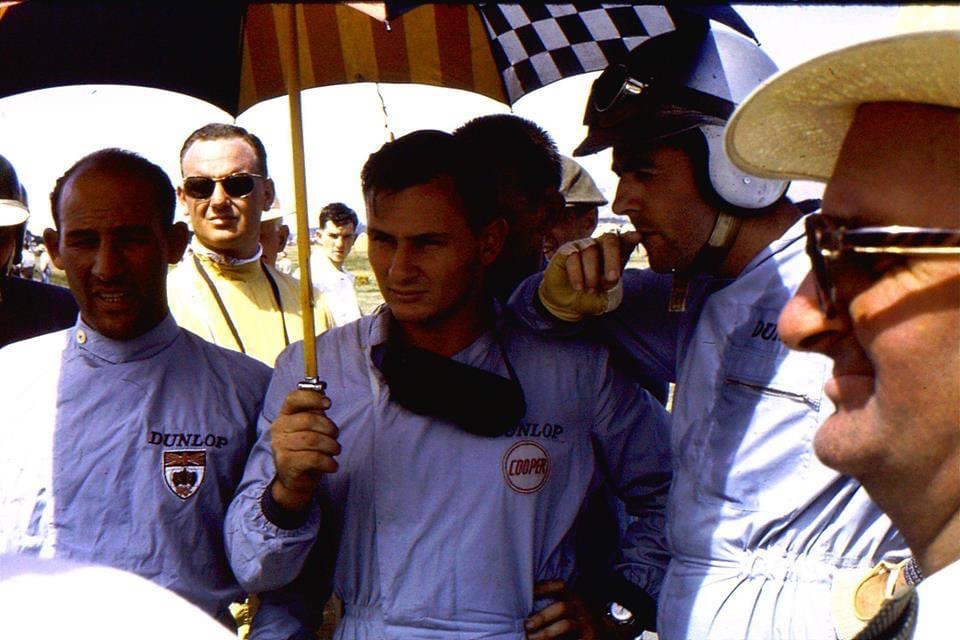
Stirling, Bruce and Jack all ears during the Ardmore drivers briefing – not necessarily in 1960 mind you (R Stuart)Brabham on the way to victory at Wigram in 1960, Cooper T51 Climax (T Marshall)
That summer, Jack Brabham won both the NZ GP and Wigram, while Syd Jensen’s nimble Cooper T45 Climax 1.5 won on the Dunedin city roads, and Ian Burgess triumphed at Teretonga, Cooper T51 Climax FPF 2.2-litre.
On the other side of The Ditch Brabham won at Longford and Phillip Island against local opposition; it was a great summer for him. It wasn’t until 1961 – and really 1962 – that the Australians had the tracks to cut it with the Kiwis to attract the internationals with the first Tasman Cup held and won by Bruce McLaren’s Cooper T70 Climax in 1964.
(G Woods Collection)McLaren, with ‘nomex’ jumper and long sleeved shirt on to deal with the summer chill, Burgess and Pat Hoare’s Ferrari 256 V12 (R Stuart)
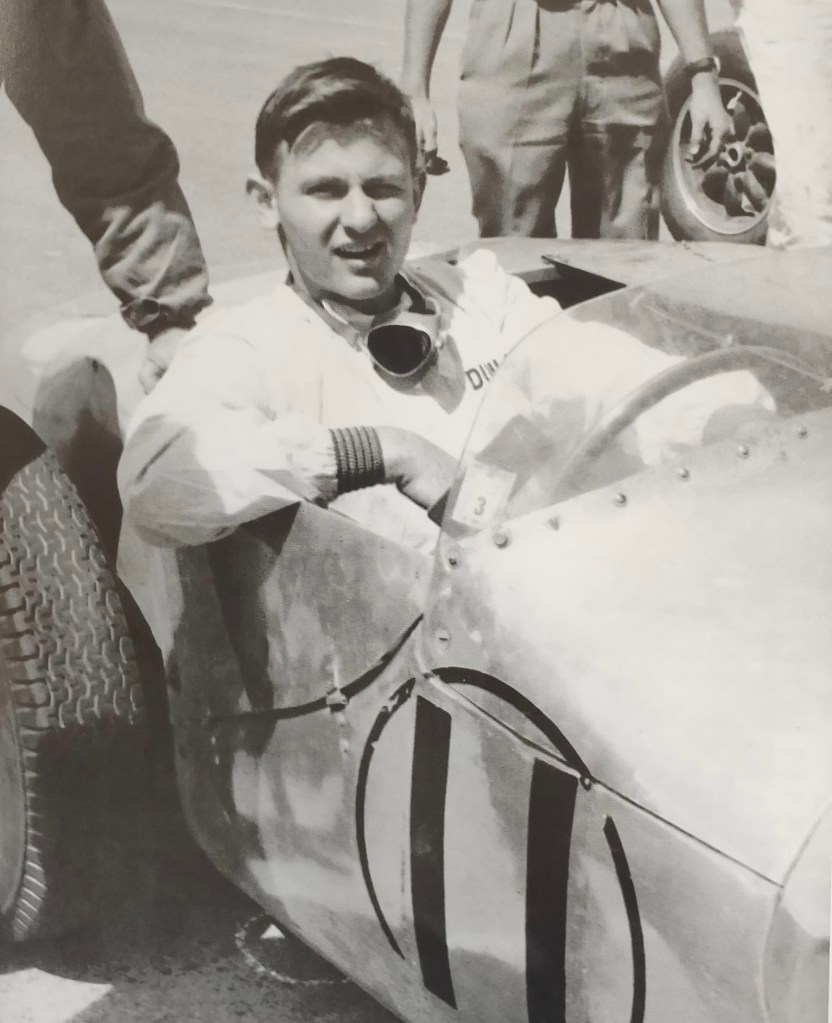
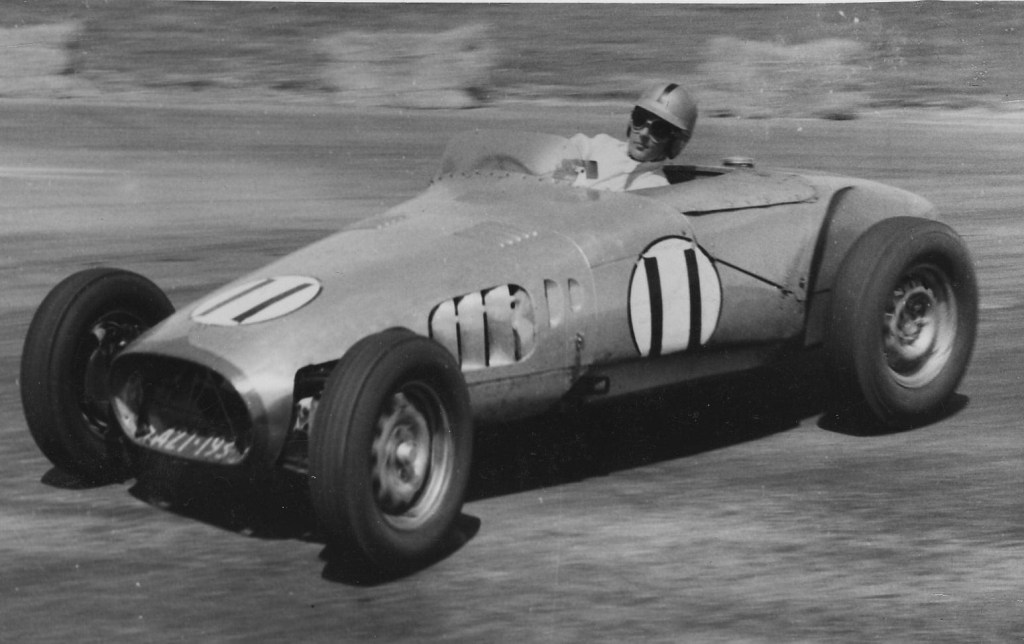
While Bruce McLaren started the Lady Wigram Trophy in his Cooper, he retired the car and then took over the famous aircraft-engined Lycoming Special, finishing the race in fourth place (below).
Jim Clark did a few laps in one of the Kiwis’ most loved specials during practice during the Tasman Series a couple of years later.
Bruce McLaren in the Lycoming here and below (M Knowles)(BMcL Trust)(M Fistonic)
McLaren ran out of brakes in the Lycoming during the race; the car ran four-wheel drums sourced from an Austin road car. Bruce found the car’s handling so forgiving that he was able to make up for the lack of stoppers, in part, by throwing the it sideways into the corners.
Never one to forget a favour, when he returned to England, Bruce sent a set of Dunlop rotors and calipers to New Zealand, the Lycoming raced on so equipped!
The shot above shows the Lycoming in the Levin paddock in January 1960. Note the road-rego and Michelin radial tyres. Clearly, (pic above) Bruce raced it on Dunlop racing tyres, but the 4.7-litre four cylinder engines car was originally built by oh-so-talented Kiwi engineer Ralph Watson as a road-going racer. At the time Bruce borrowed the car, it was being raced by Malcolm Gill and later Jim Boyd, happily it is extant, alive and well.
(Nat Lib NZ)
Ian Burgess’s Cooper T51 Climax at Wigram above, and the 2.5-litre Climax in Stirling Moss’ car being fettled in the Ardmore paddock below.
(Nat Lib NZ)
David Piper (below) pushing his Lotus 16 Climax 2.5 #368 to the start line at Dunedin on January 30, where he withdrew with gearbox problems after 22 of the 36 laps.
Piper coaxed local boy Arnold Stafford into the hot-seat of his 1.5-litre FPF-engined Lotus 16 #353 ‘renter’ at Wigram (below), but Stafford thought the better of it after a big-spin in practice, having not raced for three years and didn’t start.
(K Brown)(unattributed)
Both cars weren’t particularly old in years but were technically passé by early 1960, even in the colonies where Coopers had been rather popular from the early 1950s.
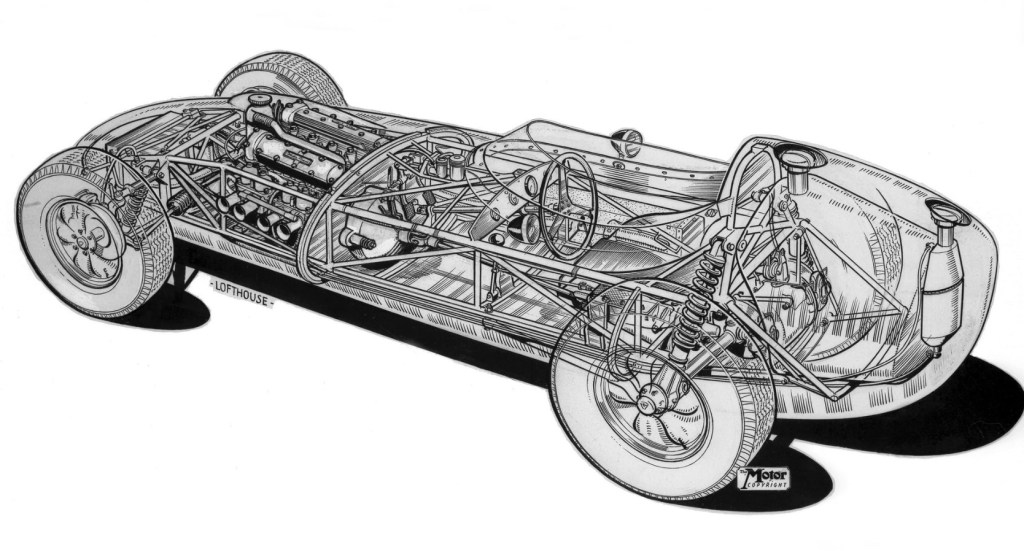
Lotus 16 Climax cutaway (Lofthouse)(R Stuart)
Etcetera…
McLaren at Wigram in 1962, where he was fourth in his 2.7-litre Cooper T53 behind Stirling Moss’ Rob Walker Lotus 21 Climax 2.5 and the 2.7-powered Coopers of Brabham, T55, and John Surtees, T53…Happy Patty below.
(R Stuart)(R Stuart)
Pop McLaren and who folks?
Credits…
Rosalie Stuart, Graham Woods Collection, Merv Knowles, Bruce McLaren Trust via Jim Bennett, Kelvin Brown, Milan Fistonic, National Library of New Zealand
Master Mechanic Geoff Smedley made a pretty fine part-time photographer while fettling racing cars for the likes of John and Gavin Youl.
The 1963 South Pacific Championship has just got underway at Longford on March 4. Bruce McLaren is on pole in his Cooper T62 Climax at left with Bib Stillwell’s new Brabham BT4 Climax in the middle and Lex Davison’s Cooper T53 Climax on the right.
McLaren won the race comfortably from Bib Stillwell after Bruce’s dice with Jack Brabham’s leading BT4 Climax 2.7 ended with engine failure on lap 14 John Youl was third in his Cooper T55
Bruce McLaren on his way to winning the 1962 Australian GP, Caversham, Western Australia, Cooper T62 Climax (K Devine)Jack Brabham debuts the BT4 Climax, Caversham AGP, November 1962. BT4 #IC-1-62 was the first in a long line of very successful, profitable ‘Intercontinental’ Brabhams from Ron Tauranac
Context…
The Cooper vs Brabham Australasian summer was set during the 1962 Australian Grand Prix, November 18 weekend at Caversham, outside Perth, when McLaren’s new Cooper T62 Climax and Jack Brabham’s equally new Brabham BT4 Climax faced off for the first time. A fantastic dice between Bruce and Jack that day was resolved in McLaren’s favour after a passing he-zigged-when-I-zagged manoeuvre between Brabham and Arnold Glass’s BRM P48 Buick V8 went awry.
Both machines were inspired by their Coventry Climax FWMV 1.5-litre V8-powered Grand Prix siblings: the Cooper T60 and Brabham BT3. By the time the eight-race Tasman Circus travelled to Warwick Farm, round five, the weight of numbers favoured Jack Brabham and Ron Tauranac’s Motor Racing Developments business with BT4s in the hands of Brabham, David McKay, who had bought Jack’s ’62 AGP car’, and Bib Stillwell, who had acquired a newie.
McLaren and the business end of his Cooper T62 FPF, Caversham 1962, with David McKay, Cooper racer/writer/later Scuderia Veloce supremo, showing more than cursory interest in the car given his pending car update considerations (T Walker)BT4 Tim Wall, Jack Brabham and Repco Indy 2.7 in the Sandown paddock. By then, Repco’s Michael Gasking was preparing Jack’s Tasman FPFs, and Repco was or were soon to be the Australian importer/distributor of Coventry Climax spares (Repco)
Bruce won two of the four Kiwi rounds at Wigram and Teretonga with his Cooper T62, while John Surtees won the NZ GP at Ardmore in an ex-F1 Lola Mk4A Climax 2.7, with Jack taking a Levin win in his BT4.
The additional power and torque from 2.7-litre Coventry Climax FPF Indy four-cylinder engines were causing a great deal of driveline stress to gearboxes, clutches and driveshafts.
At Warwick Farm, Brabham won in his new BT4-IC-2-62 from Surtees’ Lola Mk4A, McLaren and McKay in his first race of the ex-Jack BT4-IC-1-62 with Stilwell fifth in his new BT4-IC-1-63; all cars powered by Indy 2.7s.
At Lakeside on February 17, Surtees won from Graham Hill’s Ferguson P99 Climax 2.5 FPF and Stillwell. It was a great shame that the Ferguson went home at this point, we Victorians and Taswegians didn’t get to see it. McLaren spun and could’t restart while Jack was a no-show. It was an even greater shame the Fergy didn’t arrive in New Zealand with a pair of 2.7-litre FPFs…
Then Bruce won at Longford and at Sandown Park on March 10, so McLaren and Cooper won the 1963 Faux Tasman Cup. Jack was a DNF with engine failure with Tony Maggs in the other Bowmaker Racing Lola Mk4A Climax 2.7 second and McKay third.
Lex Davison turns into the exit of Long Bridge, closely followed by John Youl, Coopers T53 and T55. Lin Gigney, the snapper of many of these shots, was a flaggie right here… (L Gigney)
Longford…
Down in the South Island Lex Davison was having a whale of a time in the Cooper T53 John Surtees used to win at Longford in 1962! He won both the Saturday 45-mile Formula Libre preliminaries, the first from Bib Stillwell and John Youl after Bruce McLaren retired from the leadership of the race with a broken universal joint.
The second Saturday race also fell to Melbourne’s famous cobbler, from Chris Amon, Cooper T53 Climax 2.5 and John Youl, Cooper T55 Climax 2.5. McLaren didn’t start this race; Brabham did, but then had carburettor problems during lap two that caused his retirement.
Lex Davison, Ford Galaxie – what a massive bit of real estate! – from Ern Abbott Chrysler Valiant on Long Bridge (L Gigney)
On top of that, the staunch traditionalist continued his flirtation with touring cars, finishing second in the 45-mile Touring Cars Championship aboard Len Lukey’s Ford Galaxie behind Bob Jane’s then-dominant Jaguar Mk2 3.9, with Ern Abbott’s Chrysler Valiant 3.9 in third.
The Jag was timed at 142mph on The Flying Mile, the Galaxie did 141mph in an experience Davison told Autosport reporter FGN Ewence as ‘Like Driving a Haystack.’ Ewence wrote that ‘It came out of corners as though they were launching pads, but its braking and handling let it down.’
Frank Matich, Lotus 19 Climax, having just exited Kings Bridge and passed the irrigation water pumphouse (B Wright)
Bigger FPFs were fitted to Australian sports cars as well, notably Bib Stillwell’s Cooper T Monaco and Frank Matich’s Lotus 19, with FM winning the 45-mile Sports and GT Cars Championship from Stillwell and Bob Jane’s Jaguar E-Type.
Matich pushed his own lap record up to 108mph and was chuffed enough about the pace of his Lotus two-seater that he entered it in the Formula Libre feature.
Friday qualifying comprised two sessions, one in the morning and another in the afternoon. The quicks were McLaren on 2:23.3, McKay 2:27.0, Davison on 2:27.3. Of Davo, Ewence recorded that ‘Alan Ashton, got the 2.7 Climax to its bellowing best, and his wider wishbones had improved the car’s stability, and he had the brakes to a pitch which enabled Davison to rush up on his opponents as they approached corners.
Youl did a 2:27.4. Ewence noted that John’s Cooper ‘was handling much better following extensive modifications to the suspension, including widening of the track.’ Geoff Smedley was the engineer/mechanic involved.
Jack Brabham lines up his BT4 for the very strong timber Long Bridge exit clipping point! (L Gigney)
Brabham didn’t arrive from London, then Sydney, and on to Launceston until after 11am on the Friday morning and then spent most of the day chasing engine problems. Refer to the Climax twin-plug note in Etcetera.
The top three grid slots from times recorded in Saturday’s two races noted above were McLaren, Stillwell and Davison. Then came Maggs, McKay and Brabham, then Youl, Chris Amon, Jim Palmer, and the rest. The only starters from this race still alive are, I believe, Bob Holden, who raced his 1.5-litre Lynx Peugeot Formula Junior from grid 15, and Jim Palmer.
The Race…
Raceday at Longford was always on the Monday Labour Day holiday. There was no racing on the Sunday, giving plenty of time for dramas to be sorted: Jack’s engine, McLaren’s uni and driveshaft, Gardner’s clutch, Magg’s engine mount, etc. Bruce McLaren noted in his March 15, 1963 ‘From The Cockpit’ Autosport column how busy Repco Launceston and Merv Gray’s engineering shop were over that weekend.
(HRCCT)
The rear of the grid (above) before the South Pacific Championship, showing #87 Frank Matich Lotus 19 Climax, #13 Bob Holden Lynx Peugeot 1.5, on the next row is Frank Gardner’s Brabham BT2 Ford FJ, which is sandwiched by Tony Shelley’s Lotus 18/21 Climax against the pits and Peter Boyd-Squires Cooper T45 Climax. The white #9 Cooper T51 is Bill Patterson, and alongside him is the #3 Cooper T53 of Jim Palmer. Then Chris Amon in the red Cooper T51 #14 with John Youl alongside, Cooper T55 Climax and an obscured Jack Brabham in his BT4. On the second row is David McKay’s Brabham BT4 Climax and an obscured Tony Maggs’ Lola Mk4 Climax with Davison, Stillwell and obscured McLaren up the front.
(unattributed)
South Pacific Championship 3-2-3 grid, 14 starters, Longford, Monday, March 4, 1963.
Bruce McLaren Cooper T62 2.7, Bib Stillwell, Brabham BT4 2.7 and Lex Davison, Cooper T53 2.5, then on row two, Tony Maggs, Lola Mk4 2.7 and David McKay, Brabham BT4, on the third row, we can get a glimpse of Chris Amon’s Cooper T53 2.5 near the fence, and #5 John Youl’s Cooper T55 2.5 alongside.
All of the engines were Coventry Climax FPF, whether John Youl was using his Geoff Smedley-developed twin-plug, twin-Magneto 2.5, I don’t know.
David McKay, Brabham BT4 from Tony Maggs, Lola Mk4, Long Bridge (L Gigney)
F.G.N Ewence reported that it was a great first lap for the Brabham marque with the three of them leading in line astern across Long Bridge. David McKay’s run was short-lived with leaking cylinder head sealing rings; he only compltetd the first lap.
Brabham sat behind McLaren then he took the lead on lap 10, with Bib Stillwell third, but four laps later Jack’s run came to nought with the BT4 puffing plumes blue smoke of increasing volume on The Flying Mile, then through Mountford and into the pits. The ‘manifold leak’ caused a pit fire which was quickly extinguished with Jack leaving an oily calling card at Mountford that caused others some grief.
Brabham from McLaren on Kings Bridge, circa laps 10-14. The Viaduct is some way behind them, beyond the trees, with Longford village in front (Bob Wright)
Bruce took the lead back, having done the fastest lap of the race at 114mph on lap 13 in pursuit of Jack. He then modulated his pace to keep ahead of Bib Stillwell and John Youl. Bill Patterson was fifth behind Jim Palmer’s Cooper T53, and Tony Maggs demonstrated his professionalism by bringing the Lola home sixth despite being liberally coated with engine oil that escaped from a crack in the chassis tube, which conveyed the slippery stuff to and from engine and radiator.
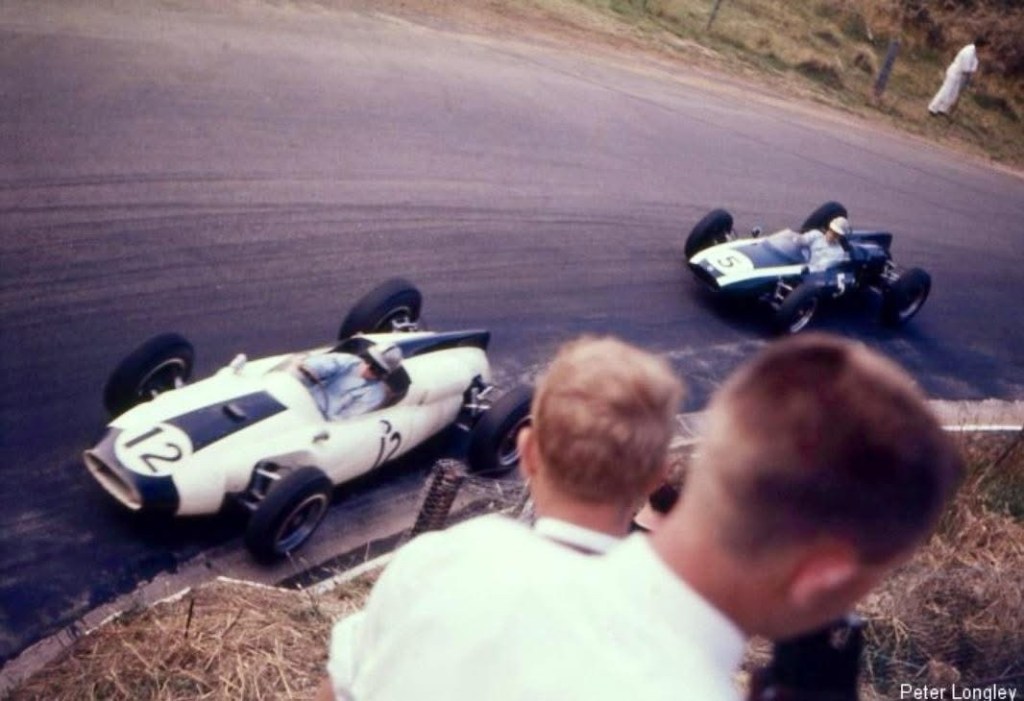
(P Longley)
This scrap between Kiwi, Jim Palmer, Cooper T53 Climax and local boy, John Youl, Cooper T55 Climax was over third place, an argument resolved in Youl’s favour.
Palmer was a multiple Kiwi Gold Star Champion, a Tasman Cup perennial whose best placings were fourth in 1966, ex-Clark Lotus 32B Climax and equal fourth with Phil Hill in 1965, Brabham BT7A Climax. Youl was ‘one who got away’, the incredibly gifted driver was fourth in that old T55 in the ‘ 64 Tasman before taking up family farming responsibilities at their Symmons Plains property, not too far from Longford.
(R Bell)
Bruce McLaren receives the plaudits of the Longford crowd from atop the Viaduct, he had a good summer in his Cooper T62 Climax, winning the 1963 Faux Tasman Cup, then came back in ‘64 and won the real one!
The views of experienced outsiders is always an interesting perspective. Here is Ewence’s race report Postscript in full.
‘Postscript: Despite the fact that the Longford Motor Association has no paid officials, it is limited by a lack of population. The whole State of Tasmania has only 350,000 inhabitants. To get 30,000 of them to a meeting is equivalent to an attendance of some four million at a British meeting! This makes the £20,000 budget something of a nightmare for the L.M.R.A. The two previous years’ operations had resulted in losses after necessary capital expenditure was met. This year, the hats went in the air when Treasurer Geoff Hudson’s casting of accounts revealed a small profit. Longford will be on again next year, and State Premier Reece seemed so upset about an interruption caused by a passenger train at the level crossing in Longford township that those on the inside believe that the trains will be very strictly controlled in the future.’
Etcetera…
(oldracephotos.com)
The start of one of the 45-lap preliminaries with Lex Davison on this side, then John Youl, and Tony Maggs in the yellow helmet. Davo won them both.
(Andrew Lamont)(W ‘i anson)
Bruce McLaren’s unpainted Cooper T62 Climax at Goodwood for a test session on September 26, 1962 not long before the car was shipped to Fremantle, Western Australia for the 1962 Australian GP at Caversham.
McLaren’s T62 – #CTA/BM/2 – was built on Cooper’s T60 1961-63 jig by Tommy Atkins’ team at his Chessington workshop. Harry Pearce and Wally Willmott were the artisans who built the car. The rear was designed to take a BRM P56 1.5-litre F1 V8; Bruce planned to contest the non-championship F1 races that Coopers chose to ignore. When that engine ran late, Atkins and McLaren decided to convert the car to Climax Tasman spec, gearbox, and a Colotti T32 five-speed.
Tommy Aktins, Harry Pearce, partially beheaded Wally Willmott and completed T62 at Coopers in Hollyfield Rd, Surbiton (W i’ anson))Geoff Smedley’s Coventry Climax 2.5 FPF twin-plug on the Repco Research dyno in November 1963 (G Smedley)
Bruce McLaren (Eoin Young ghosting Bruce) wrote in ‘From The Cockpit’, ‘Brabham’s car was the centre of interest, sporting an 8-plug head. This was a very impressive looking set-up, but it must have been firing the right plug at the wrong time or the wrong plug at the right time, because he had a lot of trouble getting it to run right.’
‘That was Friday. The Saturday morning practice was kind to most of us except poor Jack again. The Brabham was smoking a lot more than a young car should, and he had to rush back to Launceston to take the engine out and fit his spare 2.7 Climax for the races in the afternoon..
Those with a keen memory may recall that Geoff Smedley developed a race-winning 2.5-litre Coventry Climax twin-plug in Tasmania for John Youl. That engine, with the necessary sparks provided by twin-magnetos, was first raced by Youl fitted to his winning Cooper T55 in the October 14 1963, Gold Star round at Mallala. The engine was then used in the ’64 Tasman, in which Youl finished fourth in that ageing Cooper behind Bruce’s new Cooper T70, Brabham’s new BT7A and Hulme’s year old BT4. Youl and Smedley’s was a mighty effort!
In it, Geoff recalled that ‘Frank Hallam at Repco Research had been playing around with a twin-plug head for one of Brabham’s engines, using two distributors driven from the rear of each cam bank and couldn’t make it work through an inaccurate spark which was put down to windup in the camshafts in the high rev range.’
So it seems the Repco FPF twin-plug was tested over the Longford ’63 weekend. I wonder whether Jack tried it elsewhere? Does anybody know what became of that pair of twin-plug heads?
Credits…
Geoff Smedley, Bob Wright via Kay Wright, Andrew ‘Slim’ Lamont Collection, Historic Racing Car Club Tasmania, Ray Bell, Terry Walker, Ken Devine, Repco. The detail in this article is via Paul Cummin’s archive, specifically F.G.N Ewence meeting report and Bruce McLaren’s ‘From The Cockpit’ column published in Autosport, March 15, 1963, Willian i’anson Ltd, Geoff Smedley, Stephen Dalton
Tailpiece…
(E French)
One of the men of the weekend, Lex Davison, had gear-selector problems on his sixth lap with his Cooper T53 and is shown bumming a ride from Bruce McLaren, who is just starting the Newry ascent. Ewence reported that Davo ‘Broke down near the pub, where last year he had so spectacularly lost his first 2.7 Cooper in a 130 m.p.h skid. “Why hello, Mr Davison, back again?’ remarked the landlord’s wife as he entered the portals.’
Davo famously wore his cloth helmet under his real one throughout his career. Lex turned 40 on February 12, 1963, and was still mighty fast indeed!
Jack Brabham’s screaming Matra MS650 3-litre V12 and the rumbling Henry Greder/Jean-Pierre Rouget Chev Corvette 7-litre V8 (eighth) blast past the Le Mans pits during the 1970 Le Mans 24-Hour on June 13-14.
By all accounts, the triple world champ enjoyed his races with Matra on an all care and no responsibility basis rather than his chief cook and bottle washer responsibilities at Motor Racing Developments and the Brabham Racing Organisation, with all due deference to Ron Tauranac
He shared Le Mans mount with young French thruster, Francois Cevert, who, in addition to his endurance responsibilities, took his GP debut aboard a Tyrrell March 701 Ford that year. They failed to finish at La Sarthe, as did the other MS650s raced by Jean Pierre Jabouille/Francois Cevert and Henri Pescarolo/Jean-Pierre Beltoise; a real who’s-who of French GP winning drivers of the mid-late 1970s.
Up the front, Hans Hermann and Richard Attwood took Porsche’s first outright win aboard a 4.5-litre Porsche Salzburg 917K; the best of the 3-litre cars was the Martini 908/02 raced by Rudy Lins and Helmut Marko.
Brabham and topless Cevert watch as Bruno Morin hand on wing, Philippe Chasselut engine man, in checked shirt standing, Georges Martin crouching, with Guy Prat behind him in the Elf jacket, Gerard Ducarouge also crouching at right, behind him is Dominique Codreanu, with the head leaning in front of the gendarmes Michel Polard (J-P Fabre Collection)Brabham ahead of Derek Bell’s works Ferrari 512S during the long Le Mans night (LAT)
That year, Brabham and Dan Gurney were the two GP winners on the Equipe Matra-Elf endurance program payroll. It would be fascinating to know what those two senior citizens and noted driver/engineers thought of the Matras overall and especially its two key constituent parts: the chassis and engine. Do any of you Frenchies have anything documented in relation to this? Dan only did Sebring but Jack did the season, enough to have provided input into the development direction of the cars.
Jack on the Daytona banking, just imagine the sound of that fabulous raucous V12 echoing around its vast confines! (unattributed)That’s the rather talented Gerard Ducarouge and Jack at Daytona, Jack and Francois were tenth in the race won by the Pedro Rodriguez/Leo Kinnunen Gulf-Wyer Porsche 917K
The best results for Matra’s sports car squad that year were wins for the MS630/650 in the 1000 km of Buenos Aires-Beltoise/Pescarolo, for the MS650 in the Tour de France-Beltoise/Depailler/Jean Todt and for the MS660 at the 1000 km Paris at Montlhery-Brabham/Cevert.
Brabham had been under pressure from his wife, Betty, to retire for several years. He would have too, had Jochen Rindt returned to Brabham for the 1970 season, but Chapman offered him the earth, moon and stars to stay at Lotus, so Jack tore up the Austrian’s contract and convinced Betty he had to do one last season. Further proof of Jack’s intent was that he had sold his stakes in BRO and MRD before the end of 1969.
Doug Nye advises that when Jack’s father tapped him on the shoulder and called time, that was decisive…So Jack fitted as much as he could into that final pro-season: F1 with BRO, some F2 – John Coombs Brabham BT30 – and endurance racing with Matra.
Brabham, MS650 during the Brands 1000 km, noting the wing in search of more front bite, and the car’s rear below (M Charles)(A Damfreville)
Jack opened his Matra racing account at Daytona on February 1, where he and Cevert were 10th at the start of a season of utter domination by Porsche.
Where the 12-cylinder 917Ks didn’t win, the flat-eight 908/03 did, except Sebring, where the Ferrari 512S driven by Ignazio Giunti, Nino Vaccarella and Mario Andretti prevailed. Porsche won the International Championship of Makes, 63 points to Ferrari’s 37, Alfa Romeo’s 10 (T33/3 3-litre V8) and Matra-Simca’s four.
Brabham was pretty chipper at Brands Hatch on April 12 as he had won the South African Grand Prix in early March, showing the new breed – the array of 1970 F1 newbees included Emerson Fittipaldi, Francois Cevert, Ronnie Peterson and Clay Regazzoni – there was life in the old dog yet!
He was paired with JPB in an MS650 in the Brands 1000 km, the pair finishing 12th, 34 laps adrift of Pedro Rodriguez, who blew the minds of onlookers with his handling of the JW Automotive Porsche 917K in the most atrocious weather conditions.
Brabham in the MS650 he shared with JPB at the April 25 Monza 1000 km in 1970. Aerospace company knew a thing or two about aerodynamics. This angle allows a good look at what they thought worked, the only tacked-on ‘appendage’ is the front wing, that seems to be unique to this particular chassisMS650 at Monza in 1970. The Matra 3-litre V12 in MS12 endurance spec gave about 410 bhp @ 10400 rpm
The same duo were fifth in the Monza 1000 km, then came Le Mans, and that season-ending Paris 1000 Kilometres win for Jack and Cevert at Montlhery on October 18. The Aussie-Franco duo won this non-International Championship of Makes round aboard a new MS660 monocoque by three laps from the Jose Juncadera/Jean-Pierre Jabouille Ferrari 512S and the Larrouse/Chasseuil/Ballot-Lena Porsche 908/02. More about their Montlhery victory here:https://primotipo.com/2016/09/09/jack-and-francois-matra-ms660/
It was Jack’s final pro-race win, as against mucking around in touring cars in Australia in the mid-late 1970s, he ‘retired’ after the Mexican Grand Prix on October 25, so that Montlhery win would always have been memorable as he very soon felt, strolling around his Wagga Wagga paddocks and Bankstown Ford dealership, that he had retired too early…
I’m not so sure about that. He is one of the few who retired at the top of his game; had fortune favoured him, he would have won the Monaco and British Grands Prix, if not one or two others that season. His timing was immaculate…and he was alive.
Beltoise/Pescarolo Matra M630 Ford, Montlhery, Paris 1000 km, October 1967 DNF gearbox (Matra)
Matra M630-MS650…
Matra entered racing with the F3 monocoque MS1 in 1965, the MS3 Djet was their first sports car launched the same year, whereas their first sports-racer, the MS4/620, was built in 1966. More about the MS620 here:https://primotipo.com/2015/11/15/matra-m620-brm-le-mans-1966/
The MS630 spaceframe coupe succeeded it in 1967, and was powered by a 2-litre P60 BRM V8 as a prototype (all three ’66 Le Mans entries DNF) and with a Ford 289/4.7-litre V8 as a sports car. In 1968, it raced as a 3-litre prototype fitted with Matra’s new V12 engine. While both cars again failed to finish the all-important race at Le Mans, Q4 and Q5 were indicative of race pace.
For 1969, chief engineer Bernard Boyer designed and built the MS640 coupe and MS650 spyder around the same key components inclusive of the MS630 spaceframe chassis but fitted with a comprehensive evolution of the V12 engine.
The MS12 had relocated intake ports which had been placed between the camshafts on the 1968 MS9. The MS12 ports were within the 60-degree Vee, a more conventional ‘crossflow’ position. Twin camshafts actuated four valves per cylinder and Lucas fuel injection was retained. The endurance spec engines were slightly detuned in comparison to Matra’s F1 units and produced about 410 bhp at 10,400 rpm. A robust ZF five-speed transaxle was also specified.
The Guichet/Vaccarella M630 Coupe ahead of the Courage/Beltoise MS650 at Tertre Rouge during Le Mans 1969 (unattributed)MS9 Matra V12 in the Guichet/Vaccarella MS8/M630 at Le Mans in 1969 (A Damfreville)
The MS640 Coupe was ready for the Le Mans test on March 30. The striking car featured a very curvaceous, slippery body, inclusive of a pair of tail-mounted vertical fins and partially enclosed rear wheels.
While Choulet’s body was slippery, it produced bulk lift over 300 km/h, the Matra got away from Henri Pescarolo before he had done many laps. He escaped from a massive accident with ‘only’ serious burns, but that chassis was destroyed, and the other MS640 was probably rebuilt as an MS650 spyder.
Matra MS20/640, early test with Henri Pescarolo in 1969, venue folks? (F Hurel)Piers Courage looks pretty happy with fourth place at Le Mans in 1969, MS650. Didn’t he have a sensational F1 year with Frank Williams’ Brabham BT26 Ford (Matra)
At Le Mans, Matra entered and raced a 1968 spec M630 Coupe, a pair of M630/650 hybrids and a new MS650. The updated 1968 cars and MS650 were fitted with spyder/roadster bodies that were low, wide, long-tailed and incorporated a small rear spoiler; learnings from Pesca’s accident.
Piers Courage and Jean-Pierre Beltoise raced the MS650 from grid 12, while one of the M630/650s was a bit quicker and started eleventh. The JPB/Courage MS650 was fourth, the Jean Guichet/Nino Vaccarella MS630 fifth, and the surviving Nanni Galli/Robin Widdows M630/650 was seventh.
Following Le Mans, the MS650 and an M630/650 were raced in select rounds of the World Championship, with the first real success at the Paris 1000 km at Montlhéry, where Jean-Pierre Beltoise and Henri Pescarolo drove the MS650 to victory, followed home by the MS630/650 crewed by Pedro Rodriguez and Brian Redman.
Beltoise/Pescarolo MS630/650 winners in the Paris 1000 km Montlhery 1969 (P Vauvert)Two more Daytona shots help us with the MS650’s (M Lebold)Brabham chopped and changed his helmets in 1970 between ye-olde-faithful Bell Magnum, as here, a Bell Star, and US military-derived Gentex SPH-4 (L Galanos)
Two further MS650s were produced and campaigned at Sebring, Daytona, Brands Hatch, Monza, and Le Mans during 1970.
Given the pace of other 3-litre prototypes: Porsche 908, Alfa Romeo T33 and Ferrari 312P Matra’s the MS650 raced at Le Mans alongside its replacement MS660 (Beltoise/Pescarolo DNF gearbox). While outwardly similar, it featured an all-new aluminium monocoque chassis. It was a step forward, but it took the 5-litre to 3-litre engine regulation change for the new for 1972 Matra MS670 to deliver the goods at Le Mans from 1972-74.
Henri Pescarolo on the way to 1972 Le Mans victory aboard a Matra MS670 shared with Graham Hill. A great day for France (LAT)
Etcetera…
(A Damfreville)
Matra MS620 (MS620-01) BRM 2-litre V8 during the April 3, 1966 Le Mans test weekend.
Matra Sports Type List and Designations
MS630 and a couple of MS7 Ford FVA F2 cars. Perhaps, thanks to reader, ‘Pete, ‘it looks like the location might be Marigny airport (in the Champagne-Ardenne region of France) where they did testing ahead of Le Mans.’
(Matra)
1970 Le Mans pit panorama.
#32 is the Brabham/Cevert MS650, #31 the Beltoise/Pescarolo MS660 DNF transmission in the seventh hour. The other obscured MS650 was raced by Patrick Depailler/Jean-Pierre Jabouille/Tim Schenken, it too was out in the seventh hour with an engine problem. If my memory of a conversation with Tim serves, he did very few practice laps and didn’t get a steer in the race.
Let’s not forget that Matra – Matra MS80 Ford – were the reigning World F1 Champions in 1970, both Constructors and Drivers.
This Elf PR session at Montlhery in October 1969 shows Jackie Stewart in his 1969 World Championship winning MS80 Ford DFV from Henri Pescarolo’s MS7 Ford FVA F2 car, then Jean-Pierre Beltoise aboard an MS650, then, perhaps Johnny Servoz-Gavin, MS630/650 and finally an MS630…
Eric della Faille, Jean-Pierre Fabre Collection, Francois Hurel, Michel Charles, Marc Lebold, Revs Institute, Antoine Damfreville, Louis Galanos, Patrick Vauvert, Matra Sports Facebook group, F2Index-Fastlane, racingsportscars.com
Jack and Betty Brabham during the 1954 Australian Grand Prix weekend in the Southport paddock attending to the needs of Jack’s Cooper T23 Bristol.
I’ve done Cooper Bristols to death but these two colour shots of Jack are the earliest I’ve seen – Kodachrome at its best – so I thought I’d pop them up rather than add them to an existing post and effectively lose them.
Brabham had a lousy weekend in Southport, out with engine troubles on lap 2. Lex Davison won the race in his HWM Jaguar after Stan Jones suffered a chassis weld failure that pitched him off the road and through the undergrowth, killing the car but thankfully not its intrepid driver.
Brabham at Mount Druitt, the youngster is a youthful Pete Geoghegan (D Willis)(LAT)
CB/Mk2/1/53 was pretty trick by this stage, where is the photo above folks?
Jack had been racing it for a couple of years and made some modifications – some suggested by British mechanic/engineer Frank Ashby who was then living at Whale Beach on Sydney’s Barrenjoey Peninsula – including fitment of triple Stromberg carbs instead of the usual trio of Zeniths and taking bulk weight off the Bristol engine’s flywheel by adapting a Harley Davidson type clutch as used on his speedcar, and extensive machining. The Stromberg BXOV-1 carbs were lightly modified units of examples fitted as standard to the Holden 48-215.
Stan didn’t have it for long before selling it to Tom Hawkes in time for the 1955 Australian Grand Prix at Port Wakefield.
The rare shot below shows Hawkes in Jack’s old Cooper Bristol #8, with Brabham looking on from car #6, the monoposto Cooper T40 Bobtail Jack built at Coopers for his championship Grand Prix debut at Aintree in the British GP that July. He then brought it home and scored a lucky win at Port Wakefield after top-guns, Reg Hunt, #5 Maserati A6GCM-250 and Stan Jones, #4 Maybach 3 retired.
(E Steet)Hawkes on the way to a DNF in the 1957 AGP at Caversham in the ex-Brabham Cooper T23, now fitted with a Repco-Holden engine (E Steet)
The ultimate spec of CB/Mk2/1/53 was created when Tom Hawkes got his hands on it. He raced it initially as was and then made changes to the suspension, replacing the transverse leaf suspension with wishbones and coil springs, added a slimline body, fitted wider Lukey alloy wheels, and critically, replacing the 2-litre Bristol six with a 2.3-litre pushrod Holden Grey six topped by a crossflow Repco Hi-Power cylinder head and a pair of SU carbs.
Hawkes in the Albert Park paddock, 1956 AGP weekend. Repco-Holden engine, car still fitted with transverse-leaf IFS (NAA)Hawkes ascends Mount Panorama during the ‘58 AGP weekend, note the stance of the car and Lukey alloy wheels (T Martin)
Tom was third in the 1958 AGP at Bathurst – the ultimate Australian power circuit – with the Cooper in this spec behind Lex Davison’s 3-litre Ferrari 500/625 and Ern Seeliger’s 4.6-litre Maybach 4 Chev V8. Sure, Ted Gray, Tornado 2 Chev and Stan Jones, Maserati 250F retired from the lead, but was the best ever AGP finish for a Holden six, a great achievement.
Etcetera…
Brabham and crew at Mount Druitt circa 1953, names folks? (A Cox)(A Patterson Collection)(A Patterson Collection)
John Sherwood and Jack Brabham, perhaps at one of the send-off functions for Jack when he left for the UK in early 1955
Brabham chats to Doug Whiteford on the Australian Grand Prix-Port Wakefield grid in 1955. Cooper T40 Bristol and Talbot Lago T26C.
(unattributed)
This pair of shots show Jack aboard the Cooper T40 Bristol during the January 30, 1956 South Pacific Championship meeting at Gnoo Blas. Brabham was second behind Reg Hunt’s new F1 Maserati 250F with Kevin Neale third in, you guessed it, a Cooper T23 Bristol.
These cars – Type 20 and Type 23 or Cooper Bristol Marks 1 and 2 if you like – were hugely important machines in Australian racing for a decent chunk of the 1950s in original spec and modified from mild to wild…
(unattributed)
Credits…
Old Motor Racing Photographs Australia, Dick Willis, Allen Cox, LAT photographic, Ed Steet shots via David Zeunert, Lex Denniston shot via Tony Johns, Tony Martin, Adrian Patterson Collection
Tailpiece…
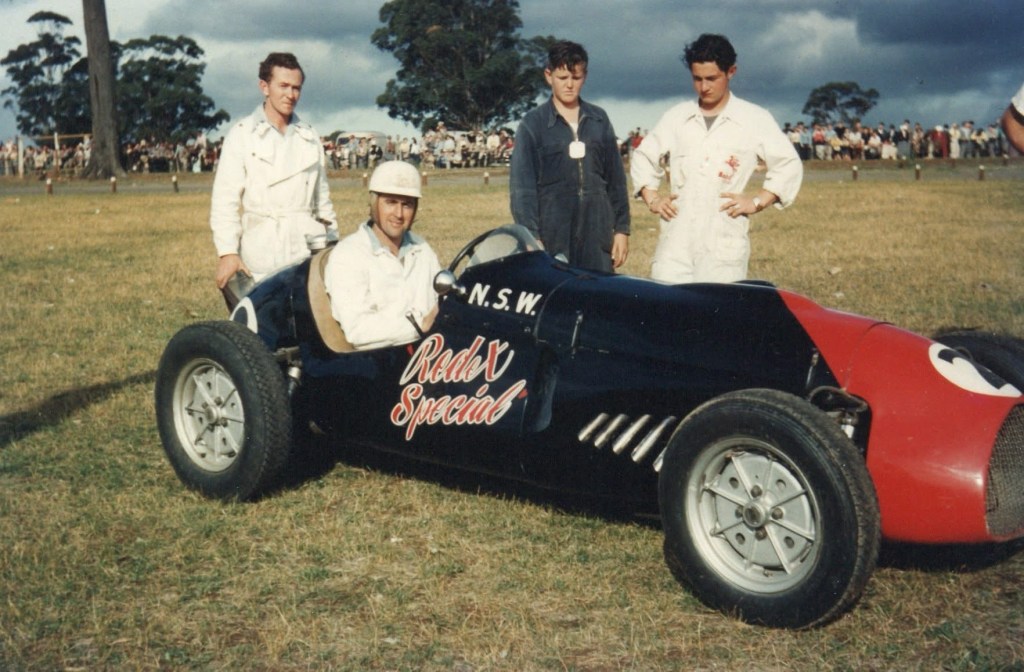
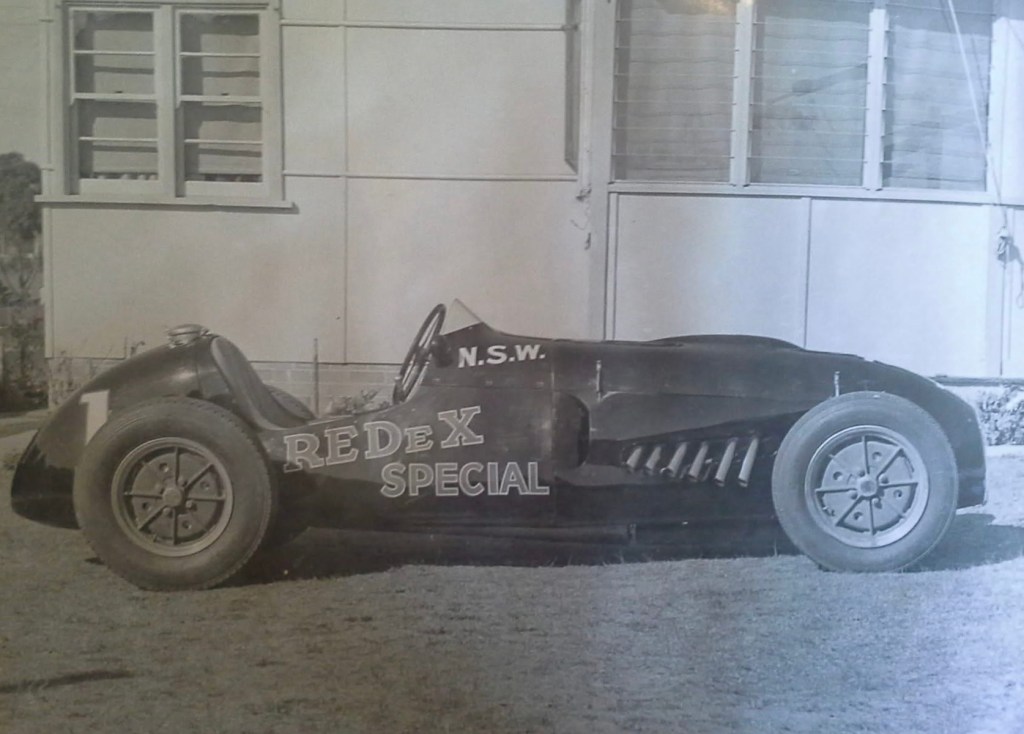
Three of the 1954 AGP protagonists on the cover of Wheels magazine in January 1955. Lex Davison’s HWM Jaguar, an ex-Moss F2 chassis fitted with a C-Type engine, Dick Cobden’s ex-Whitehead Ferrari 125 s/c and Jack Brabham’s RedeX Special Cooper T23 Bristol.
Quite why yerd’ put the winner, Davison, on the cover and two DNFs I know not…the answer is probably the timelines in hand-colouring the photographs for a race held on November 7, 1954.
By 1957 Jack Brabham was getting the hang of this European racing caper, he was the winningest Formula 2 driver in in the winningest car that year.
Cooper’s Type 43 was powered by the brand-new 1475cc Coventry Climax twin-cam, two-valve FPF four-cylinder engine.
Coopers entered Jack in nine F2 races that year and he won five of them, most were blue-riband events too: the London Trophy at Crystal Palace, Prix de Paris, Montlhery, the Rochester Trophy at Brands and Oulton Park’s Gold Cup.
Motor Racing’s fantastic cover shot – very well-used down-the-decades and perhaps taken by Geoff Goddard – above was taken at Goodwood during the Woodcote Cup on September 28, where Jack’s teammate, Roy Salvadori triumphed in another works T43. Roy also won the BRDC International Trophy at Silverstone a fortnight before, other 1957 Cooper T43 winners were George Wicken and Tony Marsh.
The Haves in 1957 used a Cooper chassis and a Climax FPF engine, the rest made do with a Climax single-cam FWA or FWB engine and another chassis.
Funnily enough Lotus’ best ‘F2 result’ for the year was Tom Dickson’s victory at Snetterton on May 19 aboard a Lotus 11 FWA during a combined F2/sportscar race. The much vaunted, light, clever, gorgeous, front-engined, and fragile F2 Lotus 12 FPF (below) flattered to deceive: its best results were a second and a third placing for Cliff Allison in the Gold Cup, and Woodcote Cup respectively.
Lotus 12 Coventry Climax FPF to be precise
Other F2 winners in ’57 were Maurice Trintignant aboard a works Ferrari Dino 156 in the Coupe Internationale de Vitesse at Reims in July and Edgar Barth’s victory in the F2 race within a race, at the GermanGrand Prix at the Nurburgring in August aboard a Porsche 500RS.
That Dino spawned a series of V6 cars, race and rally engines that were still winning well into the mid-1970s.
By mid-1959 Brabham was looking a fairly complete professional…
Jack and (the works team) Cooper had just taken their first Grand Epreuve wins at Monaco on May 10, while Motor Racing’s cover above shows Jack on the way to victory in the BRDC International Trophy at Silverstone on May 2.
By then Brabham’s Cooper is a Type 51 and the engine a 2.5-litre FPF. The F2 youth of 1957 had grown into a dominant adult by 1959. It may have been a simple motor but it was oh-so-sweet.
Motor Racing magazine, as the covers note, was the official organ of the British Racing and Sports Car Club. It succeeded Iota and was published from January 1954 to February 1970…bloody good too!
Credits…
Motor Racing magazines – fantastic they are too – many thanks to Bob King
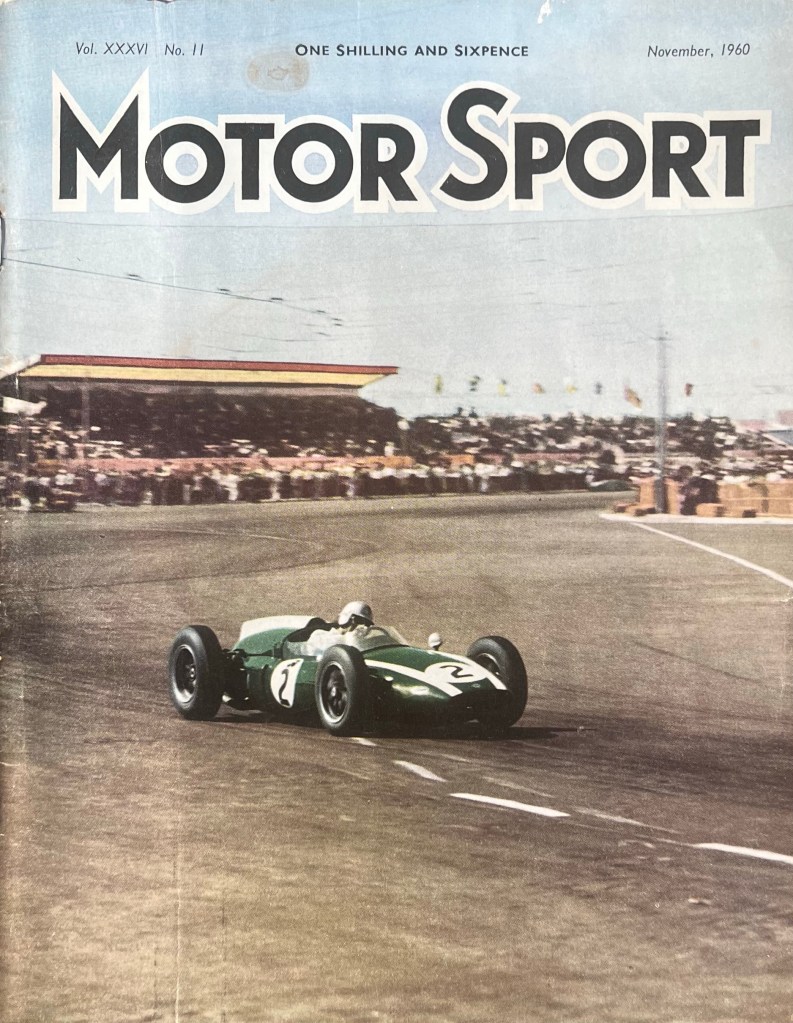
Jack Brabham on his way to winning the 1960 Portuguese Grand Prix on the Circuito da Boavista, Oporto on August 14. Cooper T53 Climax, Bruce McLaren was second in the other team T53 while Jim Clark was third in a Lotus 18 Climax.
He won his second drivers world championship that day – round seven of nine qualifying rounds – while Cooper bagged their second manufacturer’s championship too. Jack would collect another F1 title or two, Cooper did not. Sadly.
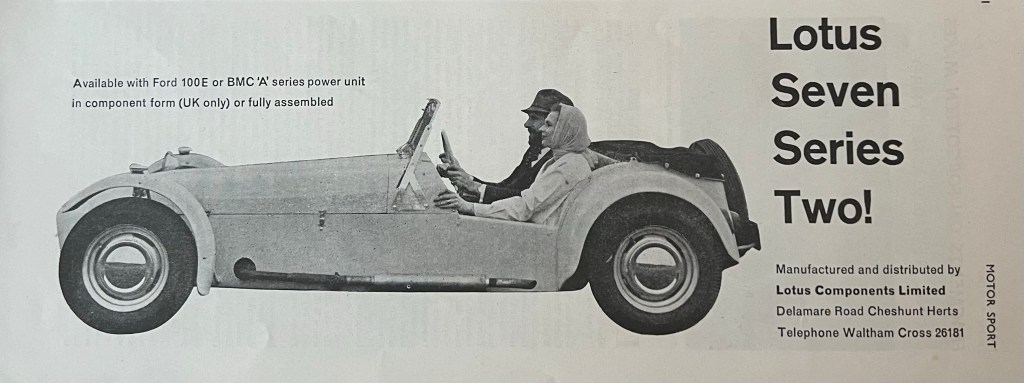
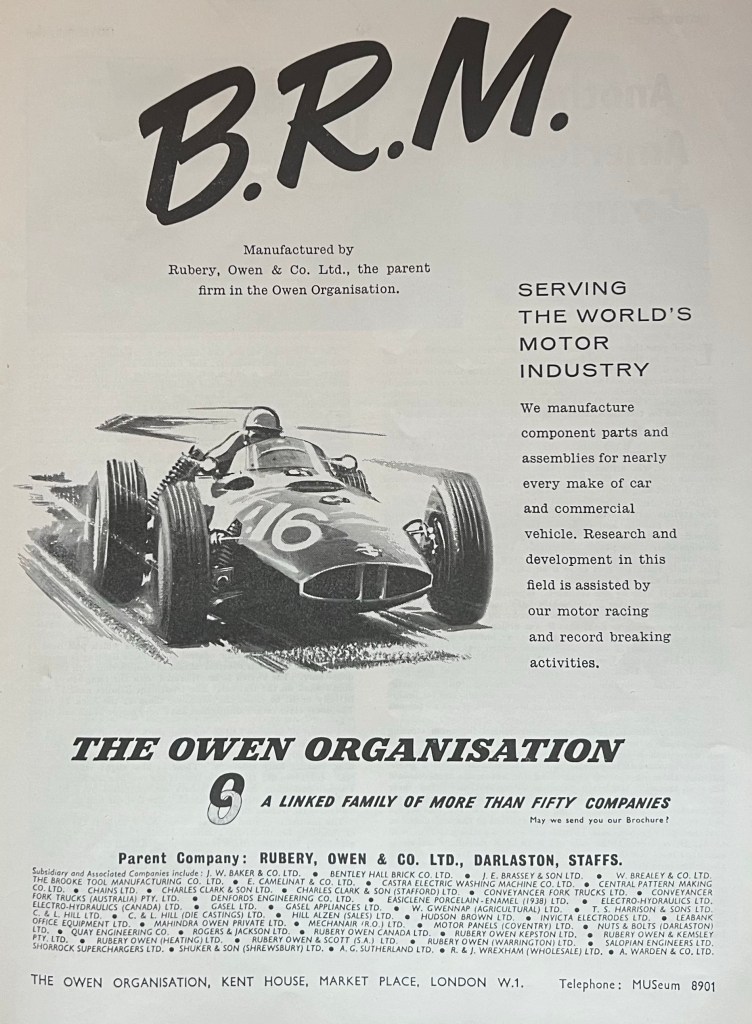
When flicking through old mags the ads are often as interesting as the editorial material.
At that stage ‘yerd be taking your Lotus 7 with the A-series I guess, the release of Ford’s 105E rather shifted the balance of course, especially once Messrs Duckworth and Costin did their thing thereon.
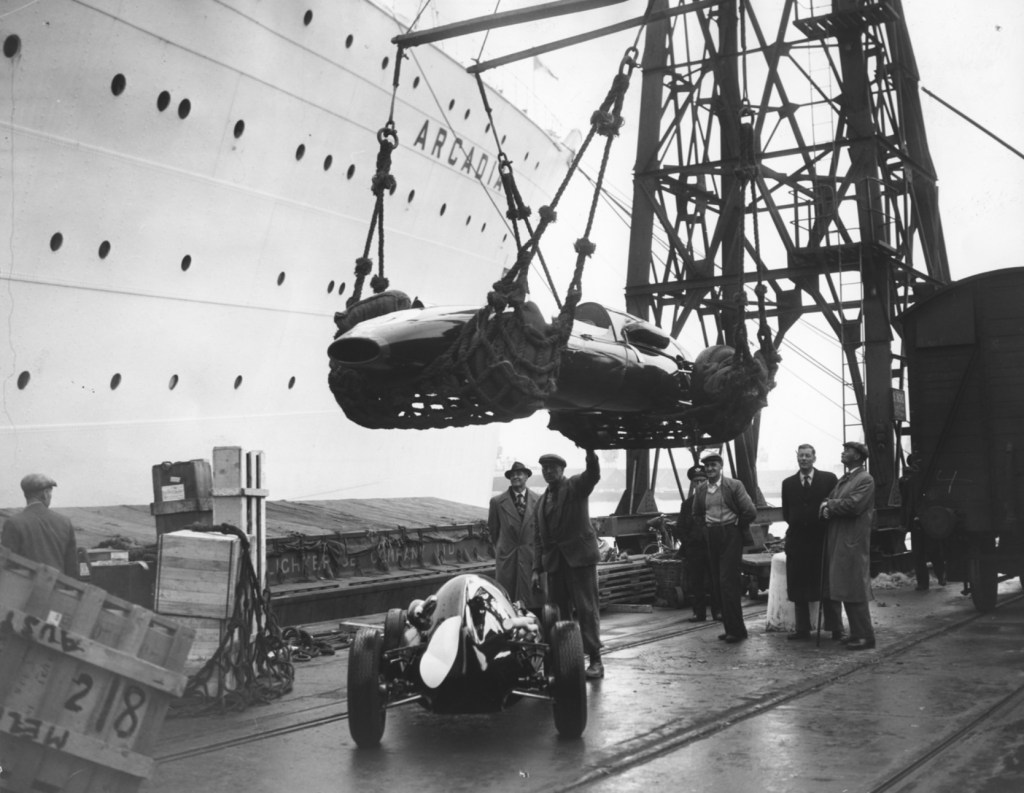
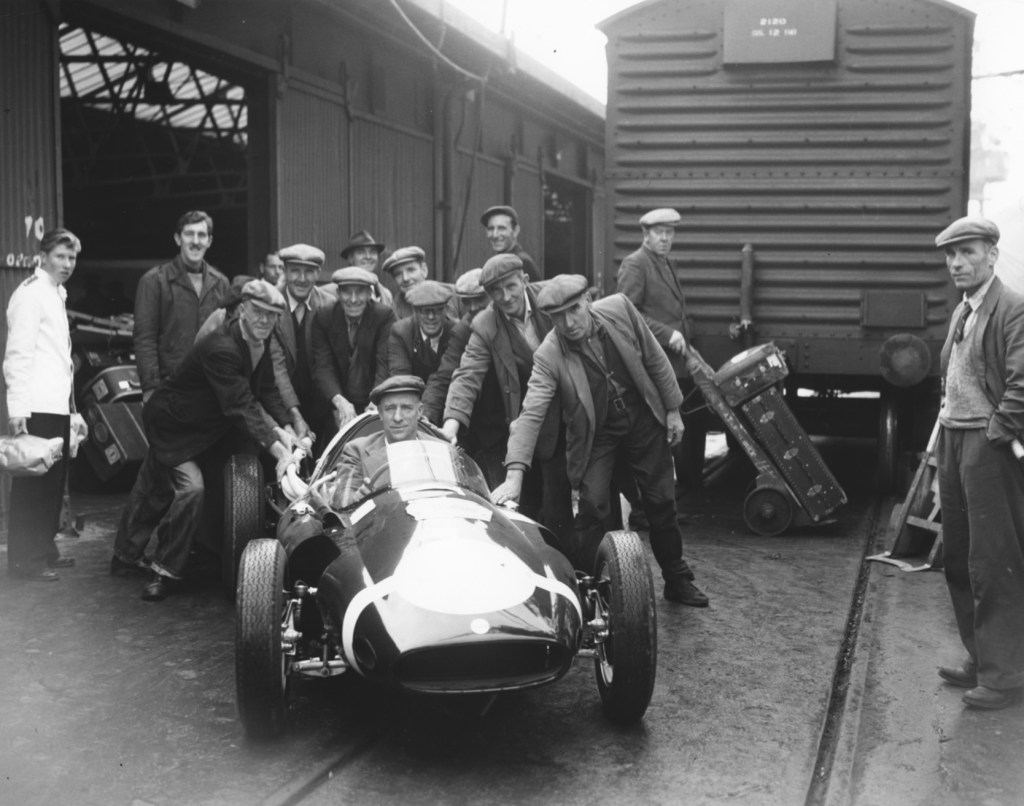
Jack Brabham’s Cooper T45 Climax (F2-10-58) enroute to the hold of P&O Line’s 30,000 ton SS Arcadia while Stirling Moss’ similar Rob Walker car (F2-9-58) awaits its turn at Tilbury Docks.
It’s October 20, 1958, seven weeks before the Melbourne Grand Prix at Albert Park on November 30 where this pair of drivers and cars were the star attractions in a 19 car field. The Arcadia arrived 11 days before the race allowing plenty of pre-event promotion.
I was contacted by P&O Heritage in June last year requesting assistance in identifying the cars and the event to which they were travelling, with the assistance of my good friend, Cooper expert Stephen Dalton, that wasn’t a drama. With their exhibition now well over we can share the shots.
(P&O Heritage)
Arfur Daley! was my first reaction, look at them all with their peaked-caps to ward off the brisk River Thames air. It’s Stirling’s Rob Walker owned T45, chassis F2-9-58, no less than the car in which Maurice Trintignant won the ’58 Monaco GP, and with which Moss was victorious in the non-championship F1 Aintree 200 and Caen GP that year.
Brabham’s F2-10-45 was acquired from the British Racing Partnership: Alfred Moss and Ken Gregory. It had been raced in 1.5-litre F2 events continuously throughout 1958 by Stuart Lewis-Evans in between his Vanwall F1 commitments and Tommy Bridger otherwise. Lewis-Evans had many top-5 placings and one win at Brands in June.
Maurice Trintignant during the 1958 Monaco GP. The Walker T45 F2-9-58 won from the two works Ferrari Dino 246s of Luigi Musso and Peter Collins (MotorSport)Stuart Lewis-Evans on the hop at Goodwood during the April 1958 Lavant Cup. He was fourth in BRP’s T45 F2-10-58 behind Brabham’s works Cooper T43 and Graham Hill and Cliff Allison’s works Lotus 12s; all cars 1475cc Coventry Climax FPF powered (unattributed)
Still fitted with 1.5-litre Climax FPF, BRP entered Bridger in the Moroccan Grand Prix at Ain Diab. His only GP start, in a six-Cooper F2 race within a race, ended in tears after Tommy spun and crashed on oil dropped by Tony Brooks’ Vanwall the lap before, Bridger completing 30 of the 53 laps. He wasn’t badly hurt, but poor Lewis-Evans died from burns sustained after a separate accident caused by his Vanwall’s engine seizure.
BRP returned the car to Coopers for repair, Brabham then bought it and installed a 2.2-litre Coventry Climax FPF to race in the Antipodes, while the Moss car was fitted with an Alf Francis built 2015cc Climax.
(AC Green)
The trip from Tilbury to Port Melbourne back then took on average, four-six weeks, here the new Arcadia (b1953-d1979) is tied up at Station Pier, Port Melbourne in late March 1954. The trailer leg to transport the cars to Albert Park is a short 6km.
(B King Collection)
The 32 lap, 100 mile Melbourne GP was the eighth of nine Gold Star rounds that year, Stan Jones in the #12 Maserati 250F won the ‘58 title.
Brabham is in #8, #7 is Moss, while another Jones, young Alan is the small white clad figure leaning on the nose of the Ford Zephyr. Moss won the race from Brabham with the very quick Doug Whiteford, Maserati 300S in third
Bib Stillwell was fourth in another 250F with Len Lukey fifth in a Lukey Bristol – Len’s evolution of a Cooper T23. Car #10 is Tom Clark’s 3.4-litre Ferrari 555, the car alongside him is Ted Gray, Tornado 2 Chev.
Moss and mechanic, name please? and T45 F2-9-58 on the Albert Park grid. That November 30, 1958 event was the last at Albert Park until the modern AGP era commenced in 1996 (S Dalton Collection)NZGP, Ardmore, January 10 1959. The Schell, Bonnier and Shelby Maserati 250Fs used their 2.5-litre torque to lead for a bit on lap one. #4 is Brabham’s Cooper, with Moss #7 behind and between Jack and Carrol – and the rest (LibNZ)
Both cars were then shipped across the Tasman to contest the Kiwi Internationals. Moss won the New Zealand Grand Prix at Ardmore from Brabham in a big field that included Bruce McLaren, Carroll Shelby, Jo Bonnier and Harry Schell on Maserati 250Fs, and Ron Flockhart’s works-BRM P25.
Brabham aboard F2-10-58 at Ardmore in 1959, second to Moss (T Marshall)
Moss (and the Cooper) then returned to Europe for his other commitments while Brabham did the Lady Wigram Trophy and Teretonga International for second/third, then returned home to New South Wales where he won the South Pacific Trophy at Gnoo Blas.
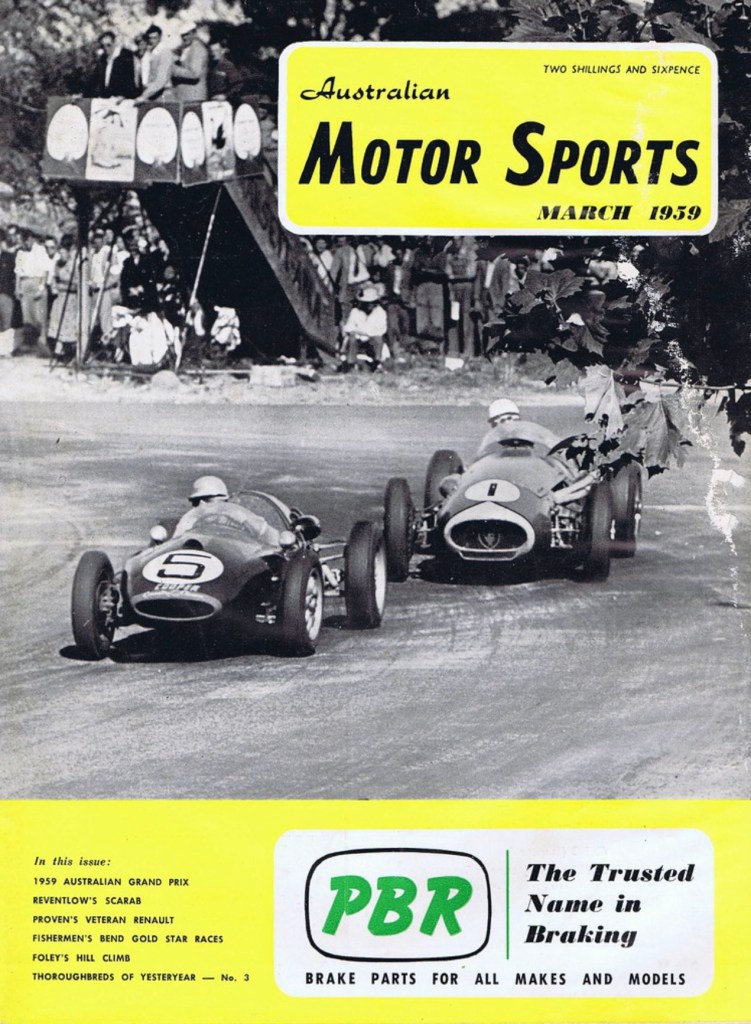
Jack then travelled to Cordoba to begin his F1 season with the February 16 Buenos Aires GP, but not before selling F2-10-58 to Len Lukey. The Melbourne Lukey Mufflers manufacturer used it to good effect to win the 1959 Gold Star, the highlight of which was an epic dice between Len and Stan Jones’ 250F in the AGP at Longford (AMS cover below) which was resolved in Stan’s favour.
The T45 remained in Australia forever, and in a nice bit of Cooper T45/Albert Park symmetry, Stirling Moss drove his Dad, and Jack’s old car in the historic car demonstrations during an Australian Grand Prix carnival in the early 2000s. Both cars are extant…
Etcetera…
(MotorSport)
An unmistakable Aintree shot of Stirling Moss aboard Walker’s T45 F2-9-58 on the way to victory in the BARC 200, April 1958.
(unattributed)
Tommy Bridger holding off Bruce McLaren’s works Cooper T45 Climax and Ivor Bueb’s Lotus 12 Climax aboard the BRP T45 F2-10-58 during the May ’58 Crystal Palace Trophy. He was second, bested only by Ian Burgess’ works Cooper T45, in a great performance.
Credits…
P&O Heritage, Allan C Green-State Library of Victoria, Bob King Collection, Stephen Dalton Collection, sergent.com.au, MotorSport Images, unattributed shots via Bonhams photographers unidentified, Terry Marshall, National Library of New Zealand
Tailpiece…
(MotorSport)
Tommy Bridger in the 1.5-litre F2 BRP Cooper T45 Climax F2-10-58 chasing Gerino Gerini’s Centro Sud Maserati 250F at Ain Diab during the October 19, 1958 Moroccan Grand Prix. Gerini was 11th from Q17 and Bridger DNF from Q22 after the accident described earlier.
The race-within-a-race of six Cooper F2 cars comprised T45s raced by Salvadori, Brabham, McLaren, Bridger and Andre Guelfi, plus Francois Picard’s older T43. Bridger qualified behind the works-Coopers of Roy, Jack and Bruce…he was pretty handy. See more about him here: https://500race.org/people/tommy-bridger/
Dan Gurney’s – Brabham Racing Organisation – Coventry Climax FWMV 1.5-litre V8 during the 1963 Monaco Grand Prix weekend. F1-1-63’s second race.
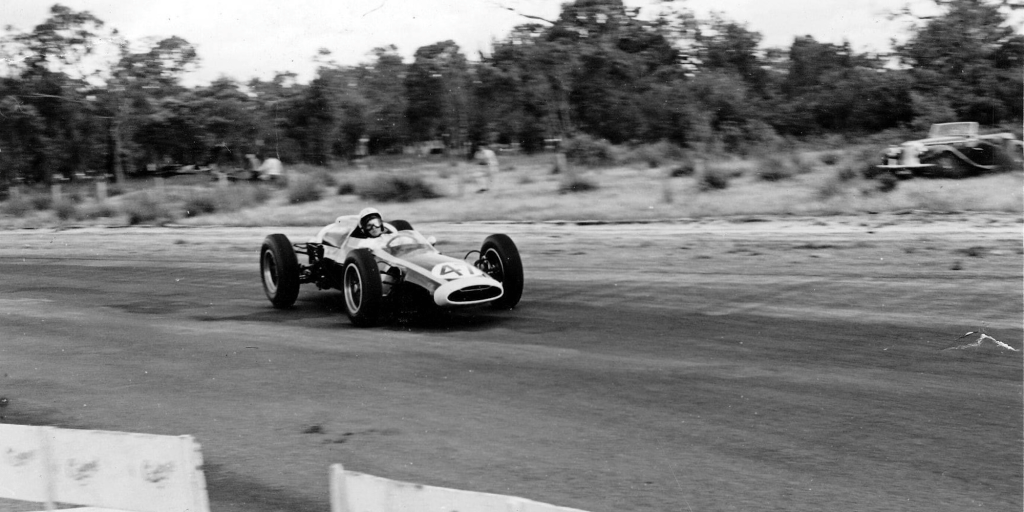
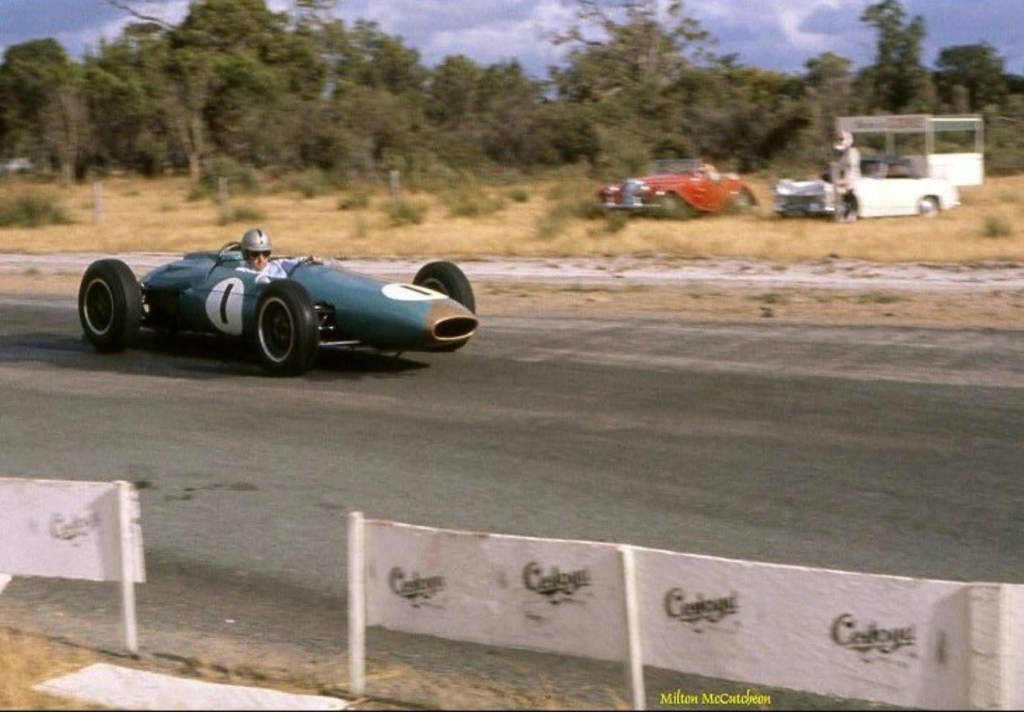
The car is a Brabham BT7, the second type of GP Brabham, Jack having debuted the BT3 Climax in 1962. Two F1 BT7s – there was also two BT7A Intercontinental/Tasman Formula cars – were built. Dan debuted BT7 F1-1-63 at the International Trophy, Silverstone on May 11, 63, and Jack first raced F1-2-63 at Zandvoort on June 23, 1963.
(LAT)
Dan in front of Tony Maggs (fifth) and Willy Mairesse (DNF final drive) at Monaco that year: Brabham BT7 Climax, Cooper T66 Climax and Ferrari Dino 156. Gurney was out with crown wheel and pinion failure in the race won by Graham Hill’s BRM P57 from teammate Richie Ginther’s P57. Bruce McLaren’s Cooper T66 was third.
(MotorSport)
Gurney on the way to an historic first Championship Grand Prix win for the Brabham marque aboard his BT7 at Rouen-les- Essarts, France in June 1964. Dan also won the non-championship 1964 Mexican GP with this F1-1-63, while Jack’s best in F1-2-63 was a pair of wins in in the Aintree 200 and the Silverstone International Trophy in April/May 1964.
Somewhat incredibly, Allen Brown records the last of 48 in-period race meetings for this (Jack’s) car was at Indianapolis, where Dave Rines won the SCCA Regional at Indianapolis Raceway Park in May 1968, at which point the car was powered by a 3-litre Coventry Climax FPF-four.
Dutch GP: second, Clark won in a Lotus 25 (MotorSport)
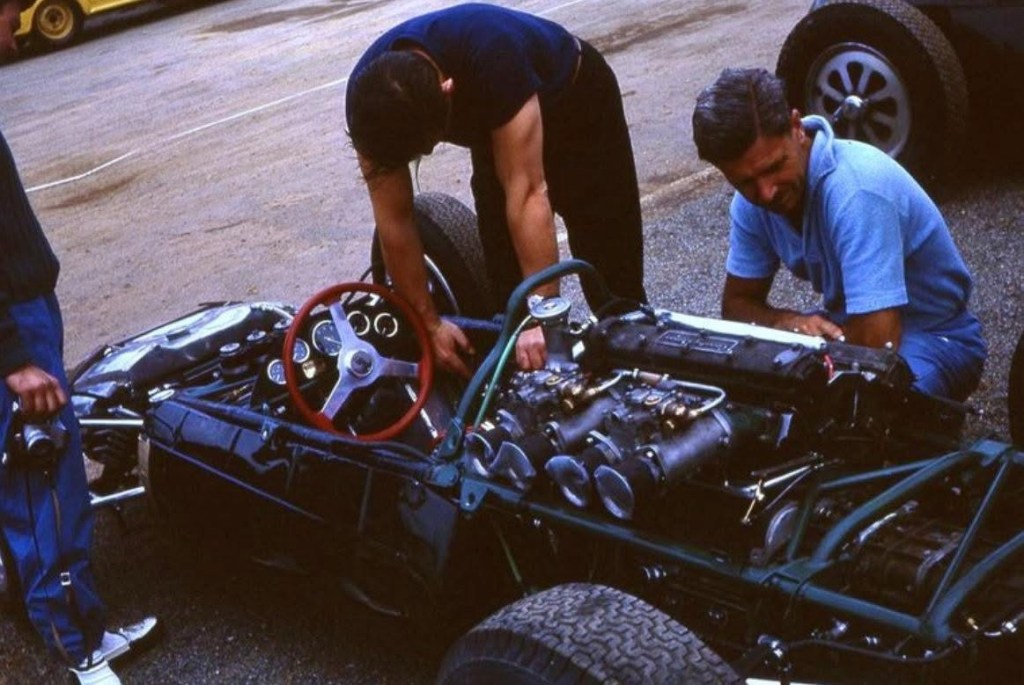
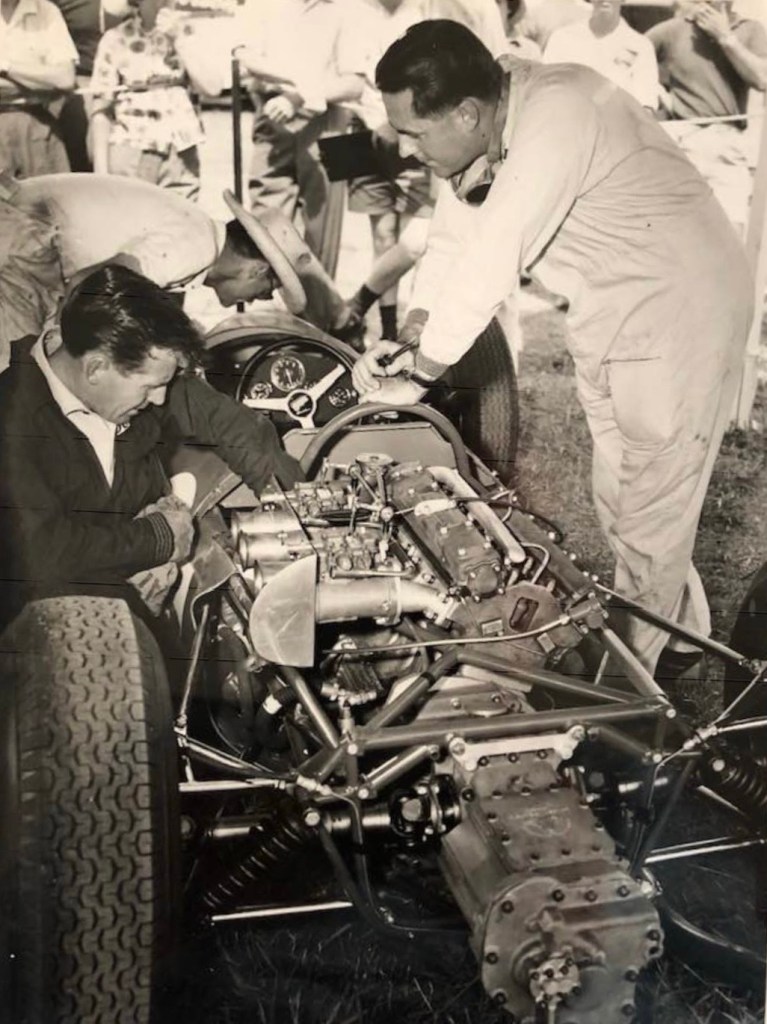
Coventry Climax FWMV 1.5-litre Mk3 V8: Lucas fuel injected, DOHC, two-valve, 195bhp @ 9500rpm. Early five speed Hewland HD gearbox with distinctive upside-down VW Beetle case, but not yet with neato, bespoke side-entry rear housing. The ‘vertical bomb’ is Lucas’ hi-pressure fuel pump. Rear end comprises mag alloy uprights, inverted wishbones at the top, single links at the bottom plus two radius rods doing fore-aft locational duties. Ron changed his mind about the respective locations of the wishbones and links pretty soon after this.














 primotipo...