Posts Tagged ‘John Crouch’

(M Dupain/SLNSW)

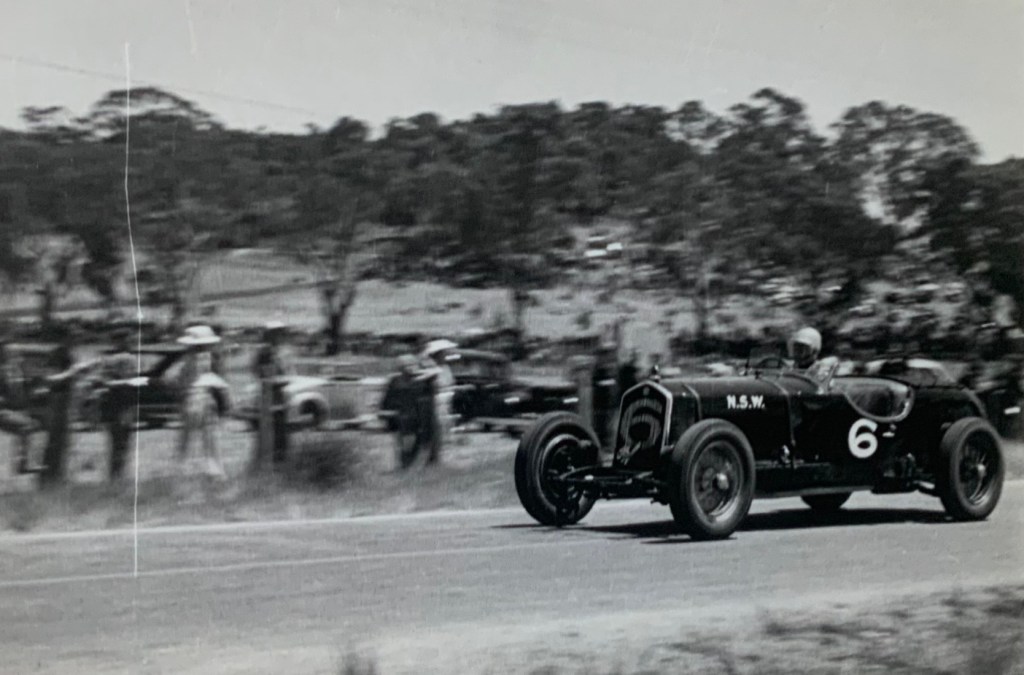
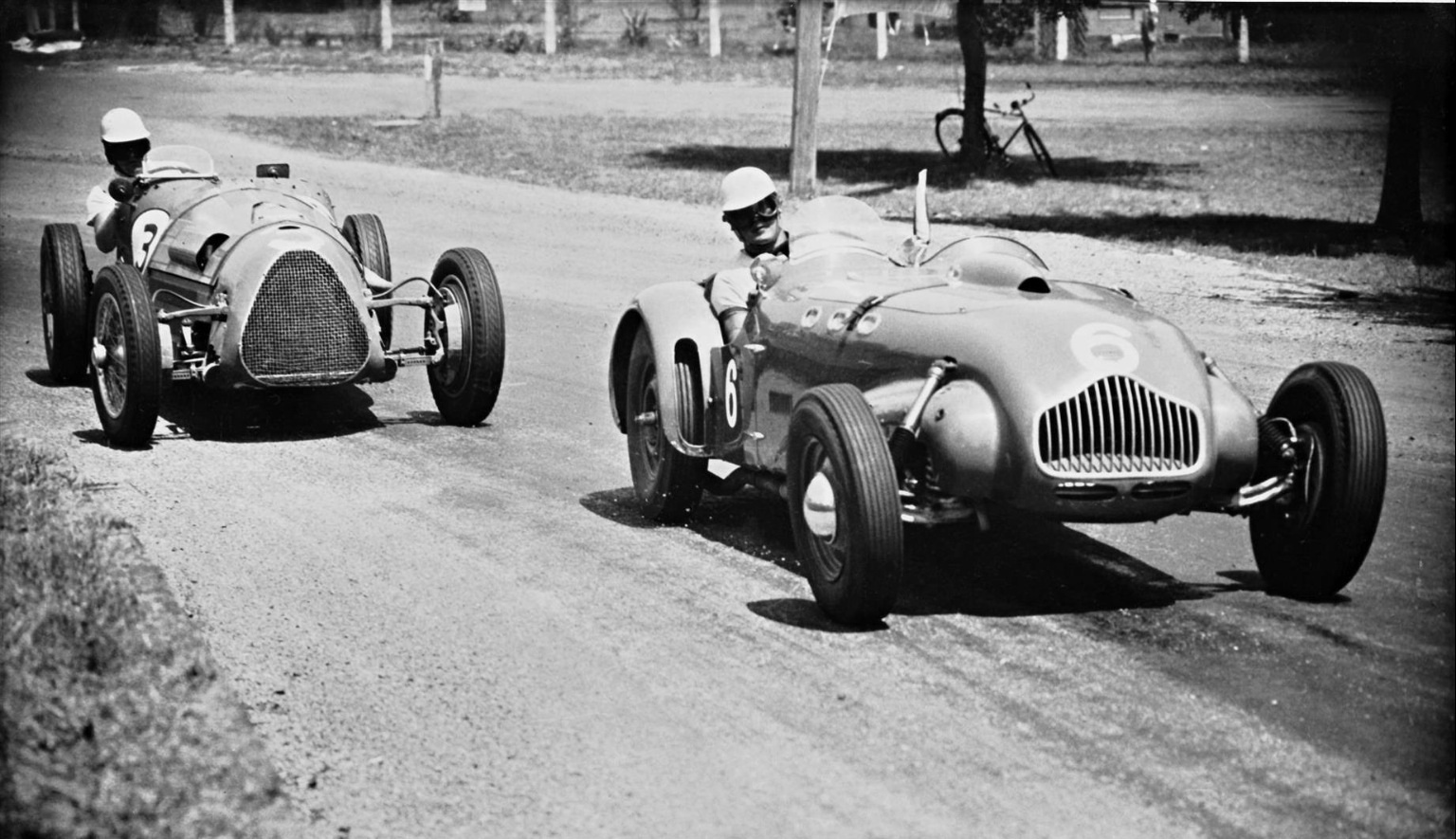
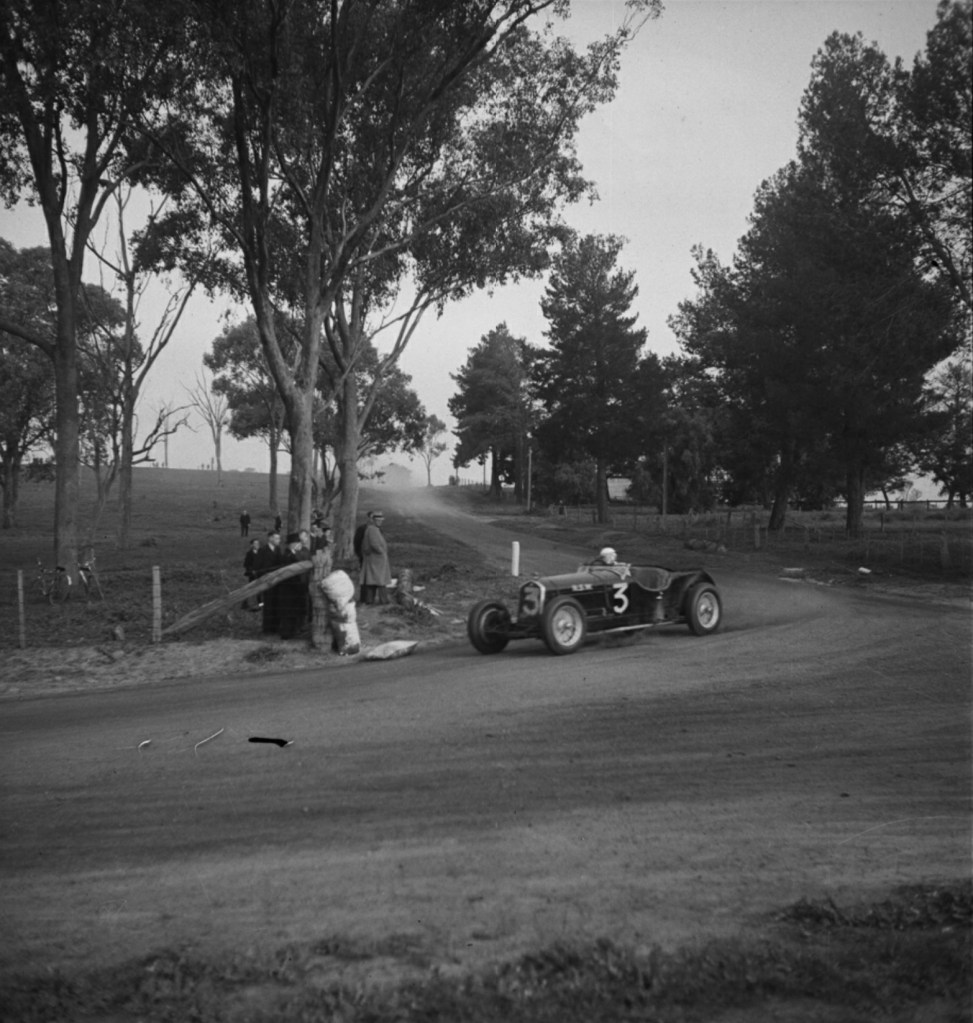
John Crouch plunges downhill on the Albury-Wirlinga road course – ‘on the border’ of Victoria and New South Wales – aboard his Alfa Romeo 8C 2300 Le Mans during the June 12/13, 1939 Albury and Interstate Gold Cup meeting.

The 76 mile race was won by Jack Phillips’ Ford V8 Special – the reigning champion – from the Hudson Specials of Bob Lea-Wright and Les Burrows. Crouch was fourth and proved his pace in this handicap race, handicaps prevailed in Australia at the time, with fastest race-time. See here for more information on the event and venue here: https://primotipo.com/2024/01/05/albury-and-interstate-gold-cup-1939/ and here: https://primotipo.com/2019/01/12/interstate-grand-prix-wirlinga-albury-1938/

Australian racer/entrepreneur John Snow imported this car to Australia in 1938, John Crouch acquired it shortly after it was offloaded in the Port of Sydney.

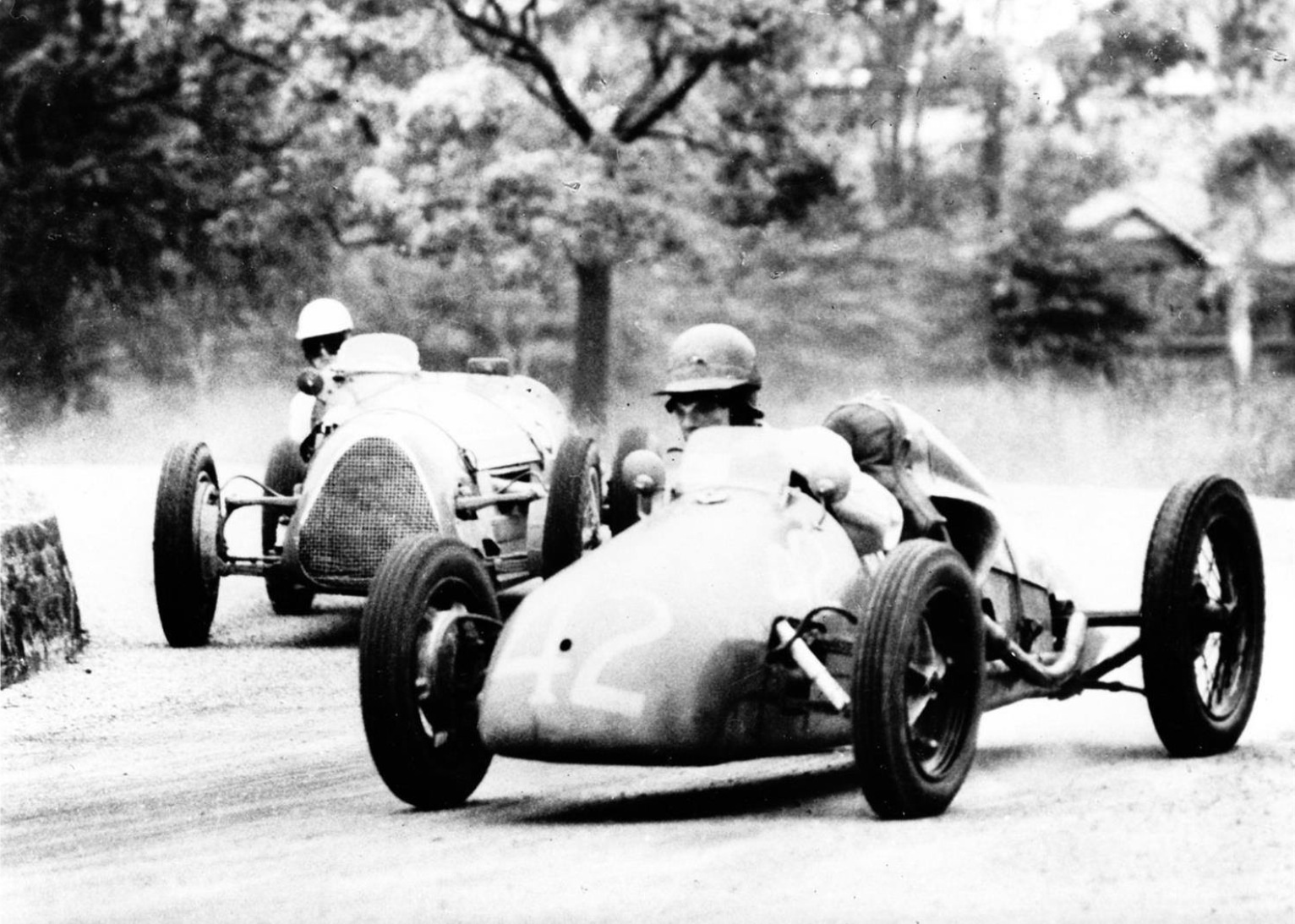
John Crouch aboard the booming 8C 2300 LM during the 1939 Australian Grand Prix at very fast, undulating Lobethal, South Australia (B King Collection)
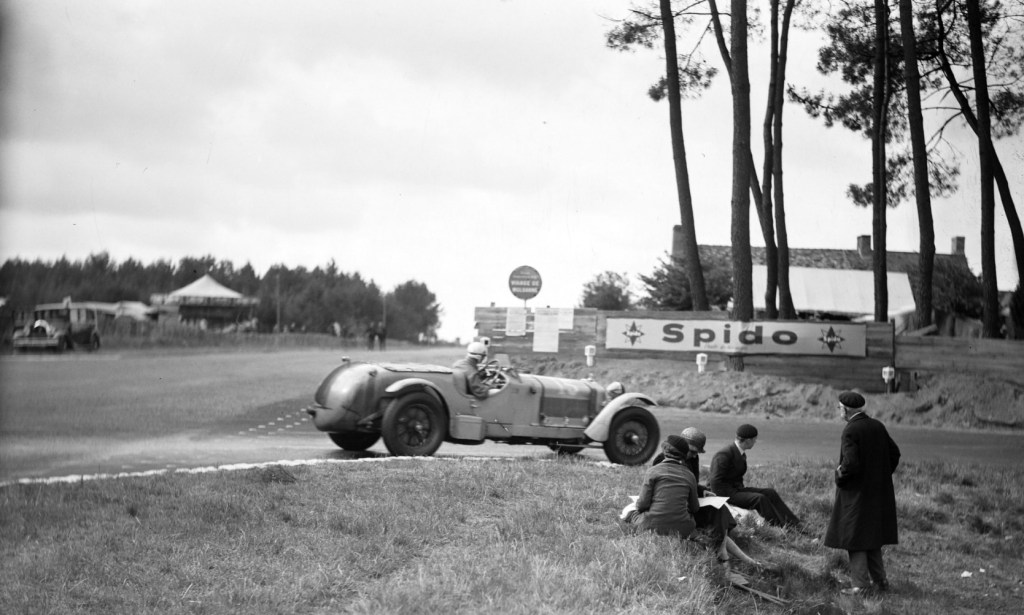
#2311202 during scrutineering at Le Mans in 1933 (Alfa Romeo Archives via Simon Moore)

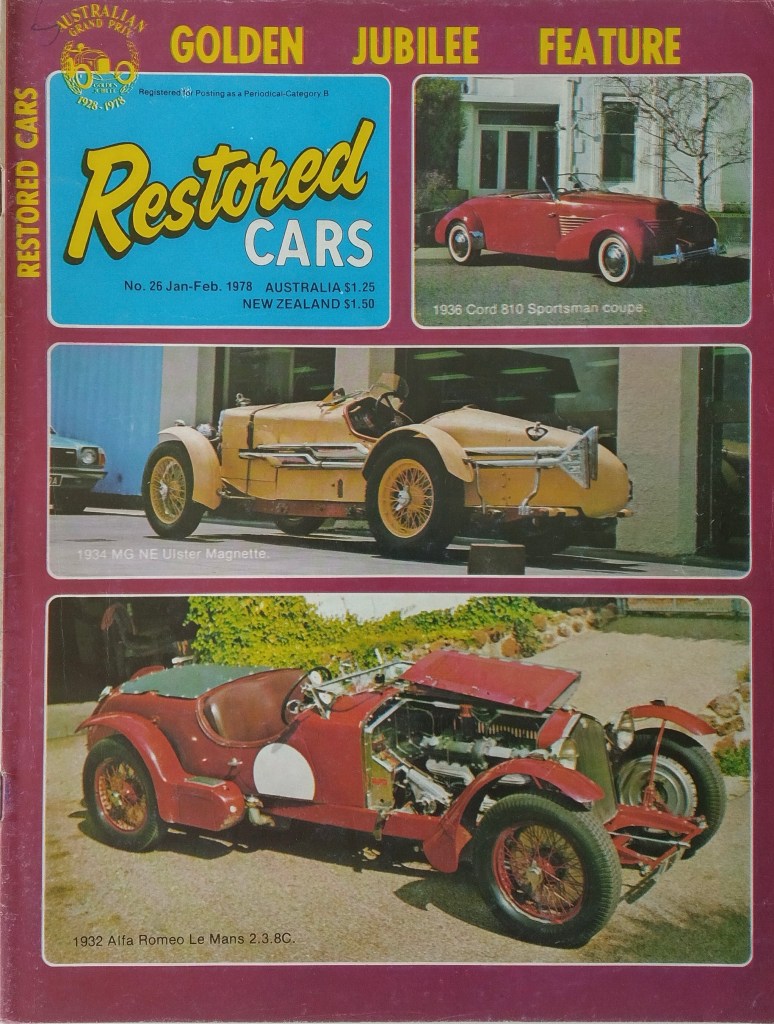
8C2300 Le Mans chassis #2311202 was one of nine cars built to this specification, five of these long-wheelbase machines with Touring bodies were built in 1933, ‘our car’ was the second of these and was registered by Alfa Romeo on June 6, 1933 MI43972.

Simon Moore wrote in ‘The Legendary 2.3’ that “We will never be 100% sure, but I think it is really almost certain that this (2311202) was the Chiron (1933) Le Mans car,” raced by Louis Chiron and Franco Cortese …” The car ran amongst the leaders until after dawn, leading on several occasions before Cortese lost control and crashed the car in the Esses after completing 177 laps/2388km; the winning Sommer/Nuvolari 8C 2300 MM covered 3144km.

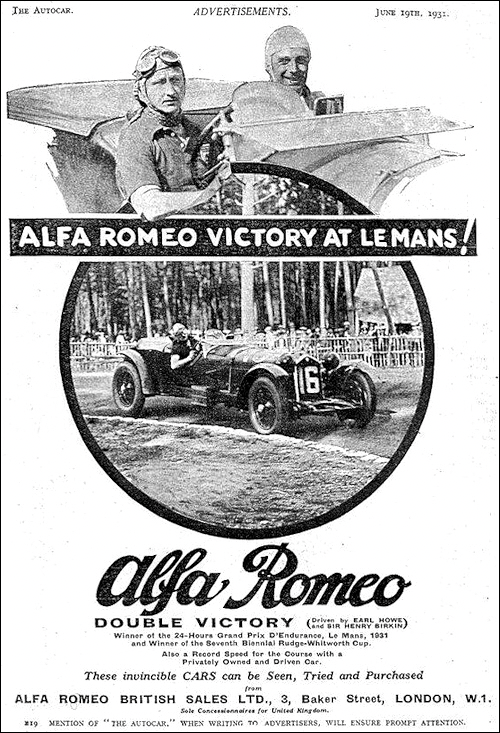
These straight-eight, supercharged, 2336cc, circa 165bhp Alfas are Le Mans royalty, winning the 24-Hour classic four years on the trot: 1931 Lord Howe/Tim Birkin 8C 2300 LM, 1932 Raymond Sommer/ Luigi Chinetti 8C 2300 LM, 1933 Raymond Sommer/Tazio Nuvolari 8C 2300 MM and 1934 Luigi Chinetti/Philippe Etancelin 8C 2300.

2311202 was third in the 1933 Tourist Trophy at Ards in the hands of Tim Rose-Richards and was later owned by Peter Mitchell-Thompson – Lord Selsdon.

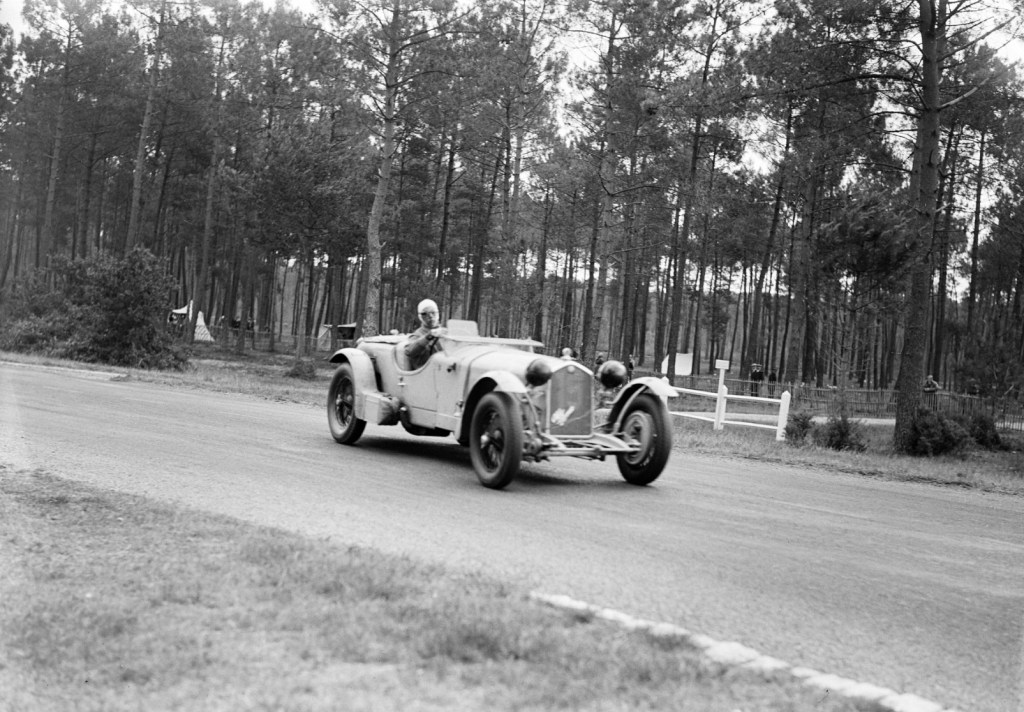
#2311202 at Le Mans in 1933 Louis Chiron/Franco Cortese DNF accident, also shot below (MotorSport)
(MotorSport)

John Medley wrote in his ‘John Snow: Classic Motor Racer’ that Aussie racer/entrepreneur Snow brought a large number of cars acquired in Europe to Australia in the immediate pre-war years, single-handedly improving the quality of our grids in the process. This Alfa Romeo was one of them, its shipmates were a Hudson convertible phaeton, 5-litre Bugatti Type 46 sedan and a Delahaye 135CS sports-racer (#47190) for Snow’s own use.

John Crouch became one of Australia’s most talented post-war drivers, winning the 1949 Australian Grand Prix aboard that very same Delahaye 135. Soon after the Alfa arrived in late 1938, Crouch entered chassis #2311202 in the ill-fated Parramatta Centenary Trophy Race on November 5, see here for that story: https://primotipo.com/2018/02/27/parramatta-park-circuit/ while Crouch’s AGP triumph is recorded here: https://primotipo.com/2022/10/05/1949-australian-grand-prix-leyburn/

He then shipped the car via coastal steamer to Port Adelaide and entered the 1939 Australian Grand Prix held at Lobethal in the Adelaide Hills on January 2. He was seventh in the race won in celebrated fashion by West Australian, Allan Tomlinson’s MG TA Spl s/c. Most of the big cars had tyre troubles in the extreme heat that day, Crouch had an off or two for this reason. He was a fast driver, but his pace with a still unfamiliar car wasn’t going to win him the race that weekend.

Other strong placings pre-war included fourth in the April 1939 New South Wales GP/150 Miles Road Race at Bathurst, and third fastest in a hillclimb and flying quarter-mile event at Mount Panorama in June. He was seventh in the NSW Road Race at Bathurst in October, a period in which he mixed his road racing with speedway events aboard a 4WD Skirrow.

Into 1940, with events getting a bit skinnier as the War impacted, he was fifth in the 150-miler at Easter Bathurst, and at Albury-Wirlinga in June he was second and again set the fastest time of the race.

While clearly a very potent racing car, John Crouch regularly used it around town (rego’ EO772), having the machine maintained by Jack Saywell and John Snow’s Monza Motors emporium-of-speed in East Sydney.
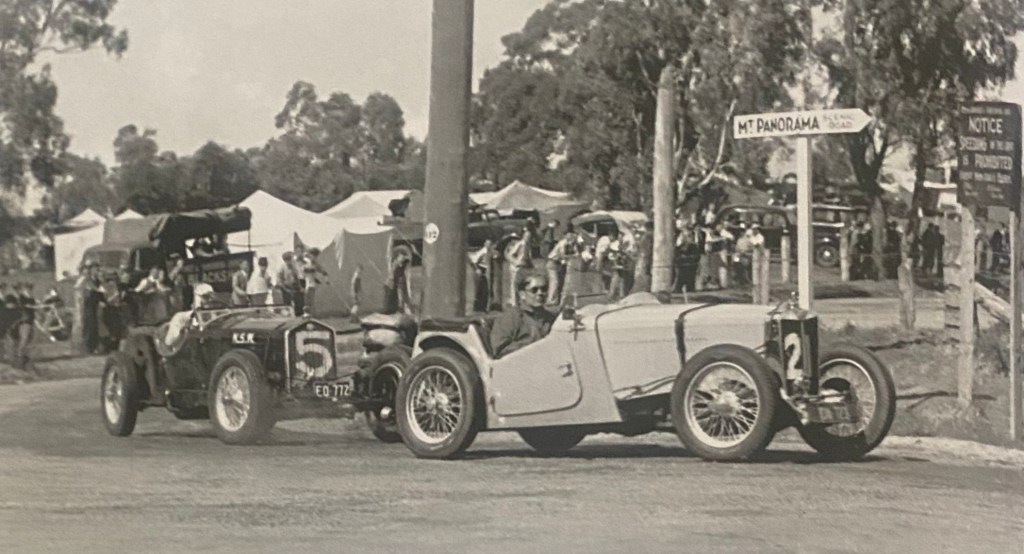
Tom Lancey checks his MG TA’s mirrors before being eaten by John Crouch and passenger and Alfa Romeo 8C 2300 during the 150 mile race at Bathurst during Easter 1939 (Terry McGrath via Simon Moore)
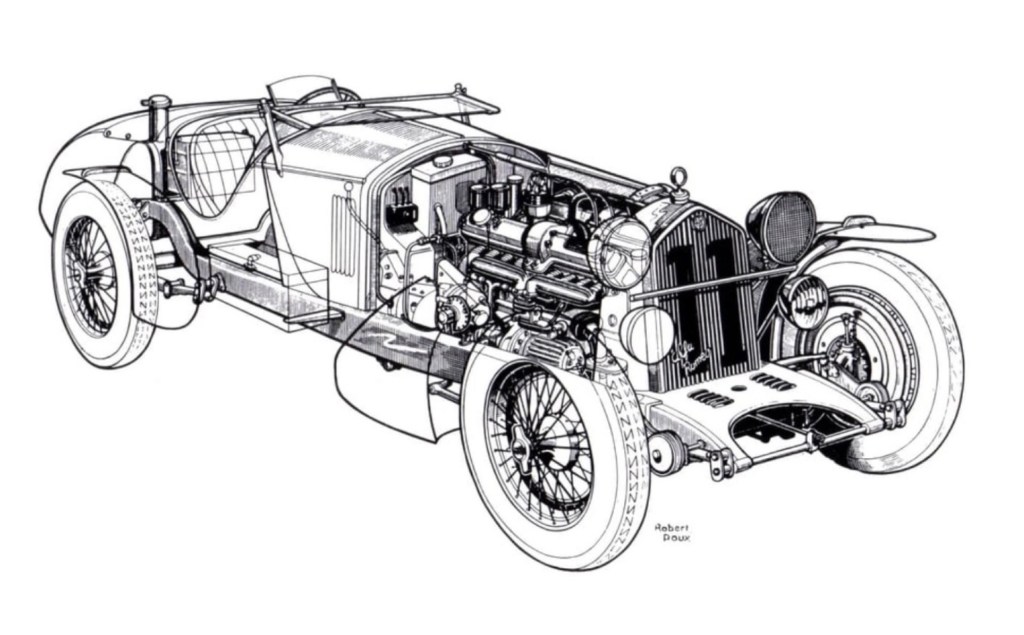
Alfa Romeo 8C2300 cutaway (R Roux)
Crouch, again at Lobethal in 1939 (B King Collection)

Victorian Colin Scott bought it in 1944 and had it fettled by Alf Barrett’s mechanic, Alan Ashton and his team at AF Hollins & Co in High Street, Armadale. Barrett and his 8C 2300 Monza were the fastest combination in Australia in the immediate pre and post-war periods. Scott was a frequent class winner at Rob Roy hill climb and a regular Vintage Sports Car Club competitor.

In 1949 #2311202 was bought by racer/pilot/dealer John Barraclough who onsold it to Tom Luxton. He raced and hillclimbed it, sometimes using the pseudonym James McEwan; McEwans was the family company, a 140 year old, national, retail hardware-store chain that was ultimately swallowed by Bunnings in the 1990s.

Howard Kiel owned the car next. Simon Moore wrote that Kiel was introduced to Louis Chiron at London’s Swallow Club by Tony Gaze. Chiron confirmed the car was French blue at Le Mans and “remembered it well and exalted its performance.”

Owner impressions are gold, Simon published Kiel’s impressions of the 8C 2300 outlined in an exchange of letters between the pair. “I well remember 2311202 as one of the most beautiful cars to drive. In fact I often drove it to work on the outskirts of Melbourne and raced Tony Gaze back to town many times. Through the streets the car was had to beat and exhilarating to drive. I sold the car when it became apparent it needed a comprehensive restoration.”

The next owner, Tom Roberts took great care of the car between 1958 and 1963 after which it joined the mouth-watering Doug and John Jarvis collection of 8C Alfas in Adelaide.

Australian Alfa Romeo owner/historian David Wright wrote in the February 2023 issue of Alfa Occidentale that “Doug Jarvis was particularly enamoured with this car and drove it at Mallala on several occasions. Following the death of Doug Jarvis, the 8C 2300 Le Mans was used regularly by his son, John, until, in 1975, it was acquired from the Jarvis Estate by Lance Dixon.”

(Reid Family)

Dixon, a successful Melbourne motor dealer and enthusiast reintroduced the car to VSCC events. Here Lance is taking then Prime Minister of Australia, Malcolm Fraser – a very tall bloke for a polly – for some quick laps in the car at a Sandown meeting in 1977.

In 1982 Lance’s restoration team, led by Ian Ruffley, were commissioned to comprehensively rebuild the car in Dixon’s Eltham workshop. The colour reverted to its original French blue, having been red for its entire life in Australia. #2311202 was sold via auction in 1986 to a Dutch enthusiast who continues to actively campaign it.
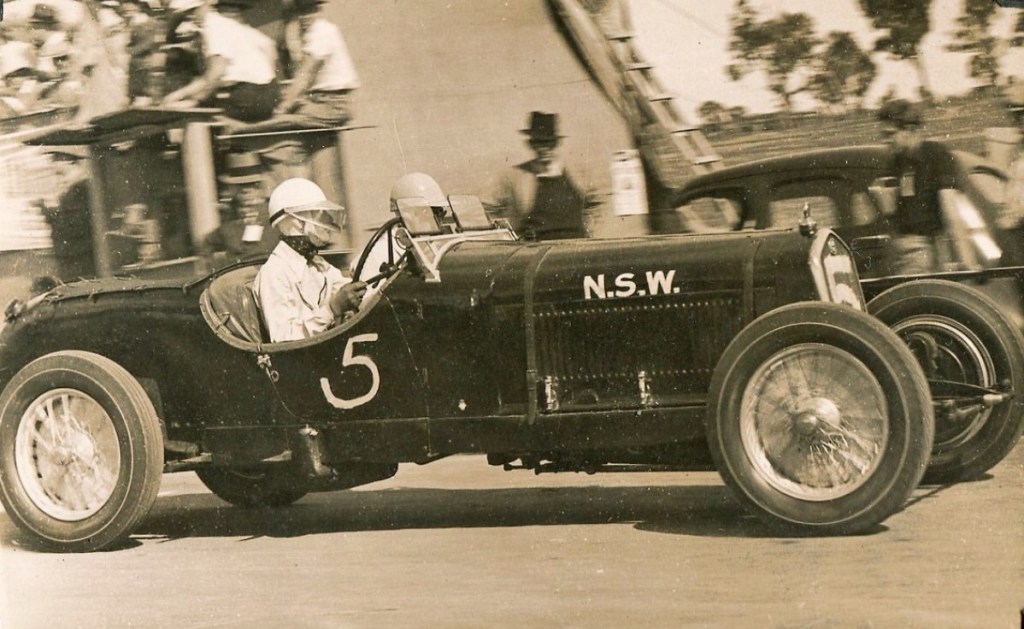
Nice close up profile shot of John Crouch in the 8C 2300 during the Easter 1939 Bathurst 150 meeting. The car lost its best years of racing in Australia thanks to the war, not that #2311202 was alone in that respect, far from it…(F Pearse)

A Driven Man and Driving Force Behind Motor Sports…

Is the title of the late Barry Lake’s obituary of John Crouch – 15/8/1918-30/5/2004 – published in the Sydney Morning Herald on June 17, 2004. Lake was a talented racer, journalist, historian and publisher; his beautifully written tribute is reproduced in full.

In the 1930s John Crouch was widely known as Australia’s youngest racing driver. In 1949 he won the Australian Grand Prix driving a French Delahaye. Even before his retirement from active racing in the mid-1950s, Crouch was heavily involved in the administration of motor sport in this country. By the time he died, at 85, he was recognised by many as the elder statesman of Australian motor sport.

Throughout all of these achievements, Crouch was the consummate gentleman, always immaculately dressed, always driving a late-model performance car (usually Mercedes-Benz in his later years) and always he was polite and softly spoken.

His father, Cecil, had his own new car sales company for 10 years before John was born in 1918, and the elder Crouch dabbled in motor sport when he raced a Metz car at Victoria Park racecourse in Sydney.

After leaving Sydney Church of England Grammar School (Shore), to which he walked every day from the family home in Wollstonecraft, Crouch went to work for his father. So it was hardly surprising he developed a keen interest in cars and motor racing – although his father strongly opposed the latter, having realised it consumed vast amounts of money.

Crouch began racing an MG TA sports car when barely 18. Two years later, he finished fifth in the 1938 Australian Grand Prix at Bathurst. In the late 1930s he drove a wide variety of cars including a supercharged Alvis, a Fronty-Ford, a Skirrow four-wheel drive speedway car, and an ex-Louis Chiron Le Mans Alfa Romeo 8C 2300.

With the Alfa, Crouch set fastest time in the Albury and Interstate Gold Cup races on the Wirlinga road circuit in 1939 and 1940, along with a third place and two fifth places on corrected times in the last three major events held at Bathurst before World War II.

After the war, Crouch left his father to start his own business. “I wanted to buy and sell performance cars but my father was never interested in them,” he once said.

He imported cars from England, including the high-class Bristol and the inexpensive but loads-of-fun Dellow sports car, as well as many new and used examples of exciting sports cars. In 1953 he gained the Australian distributorship for Austin-Healey sports cars, when the local Austin distributors rejected it as a folly. Crouch described it as a bonanza that sold beyond anyone’s wildest expectations.

The grid of the 1947 NSW Championship, Nowra airfield, June 16. #5 Jack Murray Mackellar-Bugatti Ford s/c, then #3 John Crouch Delahaye 135CS, #14 Alec Mildren Ford V8 Spl, #4 Frank Kleinig, Kleinig Hudson Spl and Alf Barrett, Alfa 8C2300 Monza. The handicap race was won by Tom Lancey’s MG TC, Crouch was eighth (J Hunter)

Immediately after World War II Crouch had bought a fast and reliable French Delahaye sports-racing car. It had a fastest race time at Bathurst to its credit, and Crouch scored second-fastest there with it in 1946.

But the one race to win then, as the Bathurst 1000 is today, for Australian drivers was the Australian Grand Prix. In 1948 the event was held at Point Cook in Victoria in blazing heat. The Delahaye scored third-fastest time but the handicap start resulted in his finishing only eighth.

The following year the race went to Queensland, on a wartime airstrip at Leyburn. Also for the first time, it was run from a scratch start, as is the case for today’s major events. Crouch was ready to pounce when the early pacesetter faltered. The blue Delahaye crossed the line a clear winner and John Crouch had achieved his life’s ambition.

In the early 1950s Crouch began to import and sell small, lightweight rear-engine Cooper racing cars. He sold the Delahaye and raced Coopers to promote them. He was ahead of his time. By the end of the decade Coopers were dominating Australian racing as they were the world championship. In Crouch’s time, however, they were fast but unreliable. In 1951, for example, Crouch’s Cooper set fastest race lap in the Australian GP, but retired with mechanical problems. In retrospect, he sold the Delahaye, had he kept it, would have been capable of winning the GP again in 1950 and 1951.

In 1953 Crouch sold a more modern, faster and more reliable Cooper-Bristol to Tom Brabham, for his son, Jack. The latter made his name in that car and went on to win world championships in 1959, 1960 and 1966.

Crouch’s final outings as a driver were in the Redex Round Australia Trials in 1953 and 1954, and the 24-Hour Race at Mount Druitt in 1954. He had planned to race in Europe before quitting the sport, but ran into financial difficulties when he expanded into importing tyres and tractors.

He retired from racing, closed his business and used his remaining resources to buy land and build apartment blocks in suburbs such as Dee Why. “Real estate was going so well at that time,” he said, many years later, “Any idiot could make money out of it.” He was comfortably well-off by the time the bust came in the 1970s – unlike many of his friends, who, he said, “had borrowed to the hilt and lost everything”.

Crouch had been the NSW state councillor for the then newly formed Confederation of Australian Motor Sports in 1953 and continued in various capacities with this organisation for many years, receiving awards for his contributions to motor sport. He also acted as clerk of course at a number of major events.

Crouch had two sons, John and David, with his first wife, Vivian. They eventually divorced, but remained good friends. Crouch’s second wife, Valerie, died in 1995. They had two daughters, Caressa and Penelope.

Crouch was reluctant to marry again, fearing a third would brand him a “womaniser”, but eventually he met June, whose lust for living a full life matched his own. They married and spent much of Crouch’s final few years travelling in South-East Asia and Europe, as well as attending various motor sport functions in Australia as honoured guests. That came to an end when Crouch suffered circulation problems that led to a series of strokes and heart attacks. He died in a hospital in Gosford.

Etcetera…

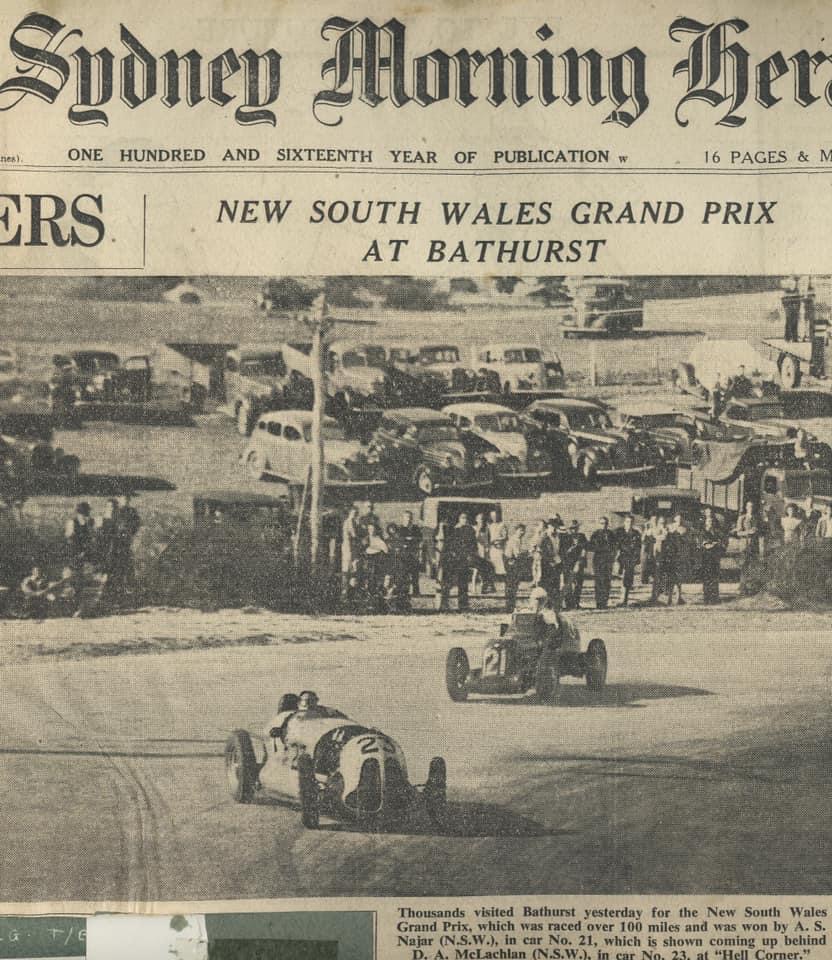
Sydney Morning Herald June 13, 1939
(Motorsport)

Another shot of Louis Chiron or Franco Cortese at Le Mans in 1933 aboard #2311202.

(S Dalton Collection)

Credits…

Max Dupain-SLNSW, ‘John Snow: Classic Motor Racer’ and Bathurst: Cradle of Australian Motor Racing’ by John Medley, ‘The Legendary 2.3’ Simon Moore via the Bob king Collection, Robert Roux, MotorSport Images, Reid Family Collection, John Hunter Collection, Fred Pearse, Sydney Morning Herald – Barry Lake, Stephen Dalton Collection

Tailpiece…
Finito…
(racerviews.com)

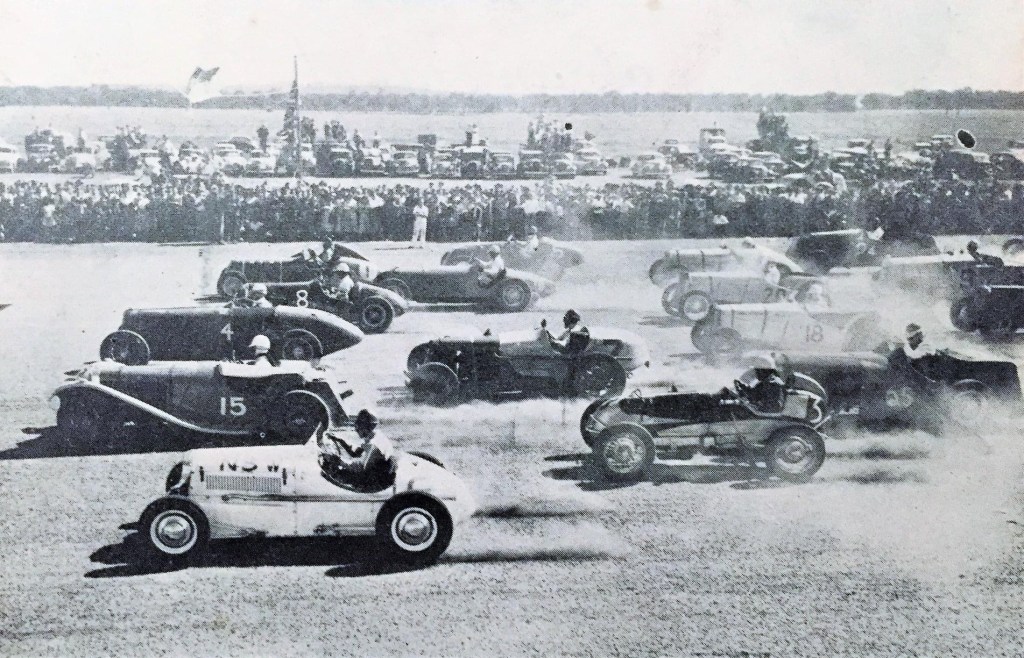
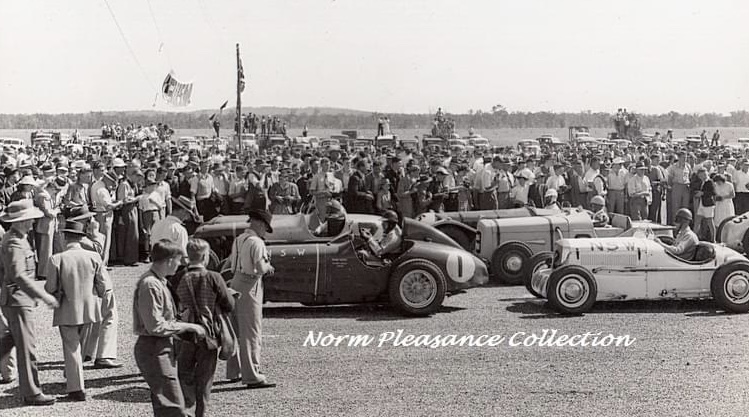
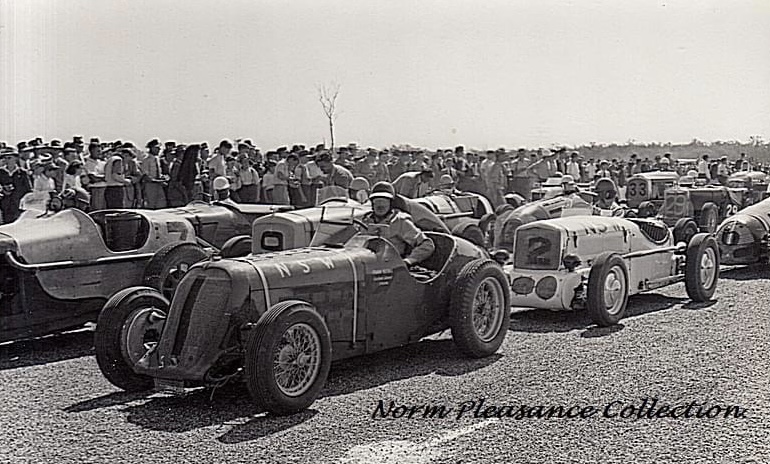
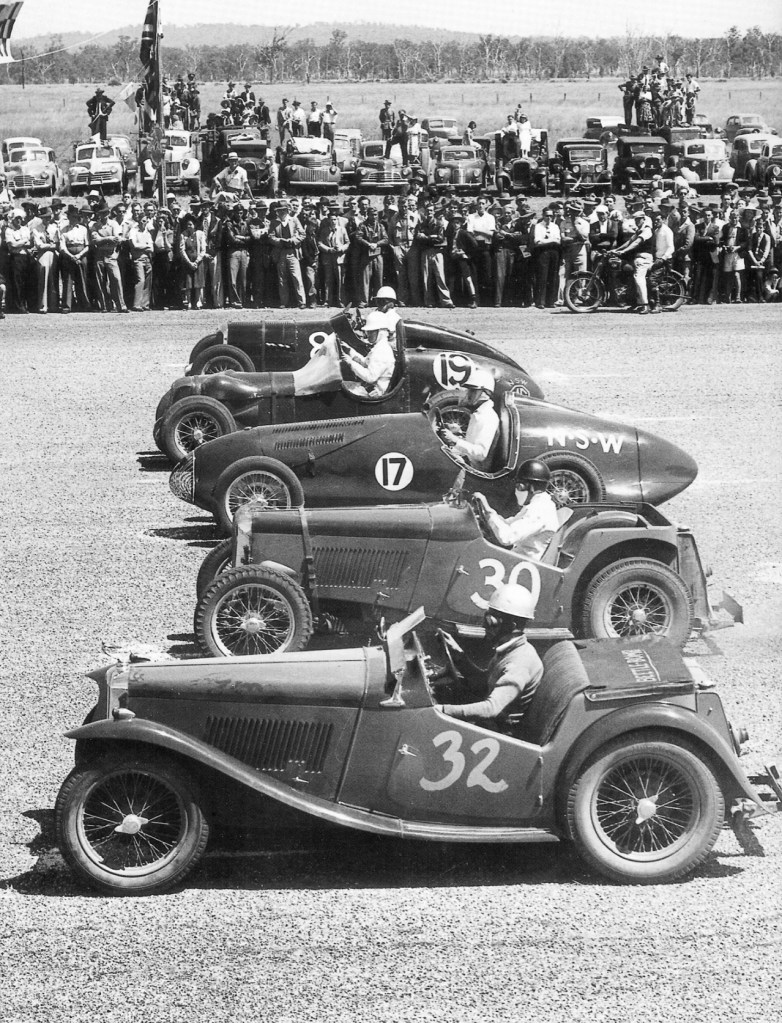
One row of the 28 starters of the 35 lap, 150 mile, 1949 Australian Grand Prix – or more likely the supporting F2 race – at Leyburn, Queensland, await the drop of the flag on September 18.

The first two cars are MG TCs, Col Robinson’s #32, and J Hillhouse in #30. #17 is the more focused TC Spl of Dick Cobden, then Peter Critchley’s fourth placed ex-Alf Najar MG TB Spl, and on the far side, Arthur Rizzo’s Riley Spl, who finished third on the RAAF airfield track

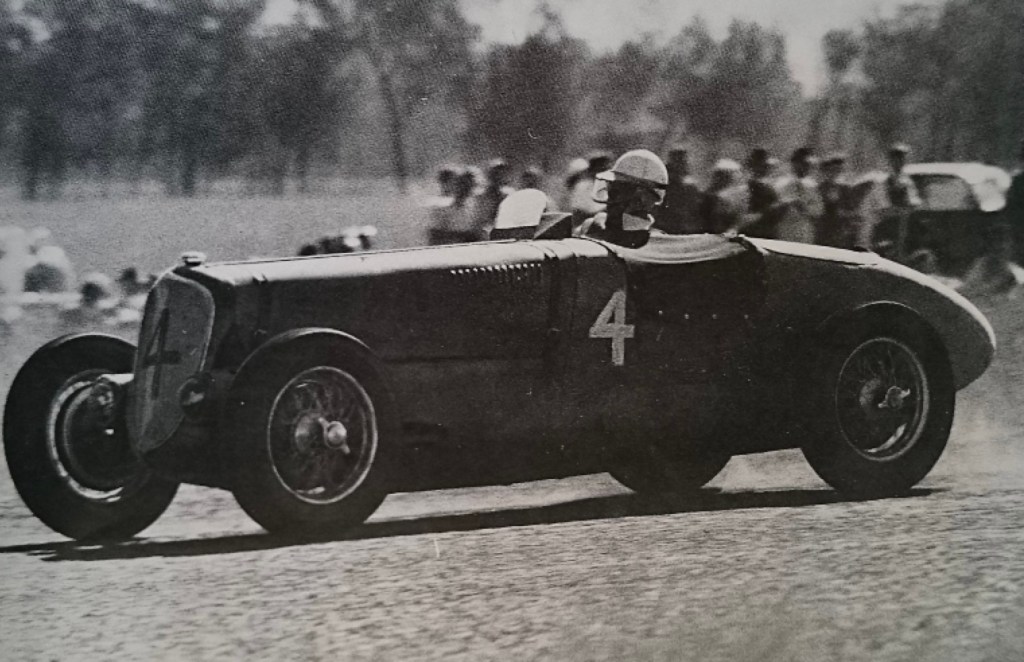
A race day crowd estimated at 30,000 people saw John Crouch’s Delahaye 135S win from Ray Gordon’s TC Spl.

The front row, away from the start is Alan Larsen, Cadillac Special ‘SoCal’, #15 Keith Thallon, Jaguar SS100, #4 the winning Crouch Delahaye 135S, #8 Arthur Rizzo’s third place Riley Special, and on the far side, Frank Kleinig, Hudson Special. The next row includes #3 Arthur Bowes’ Hudson Spl, #2 Dick Bland, George Reed Special, #25 Doug McDonald, Bugatti Dodge and #18 Garry Coglan, MG TC Spl.

(Wiki unattributed)

John Snow imported the 1936 3.6-litre, six-cylinder Delahaye (chassis # 47190) from France to Australia in time for the 1939 AGP at Lobethal, with the talented Crouch finally realising its potential.

(Wiki unattributed)

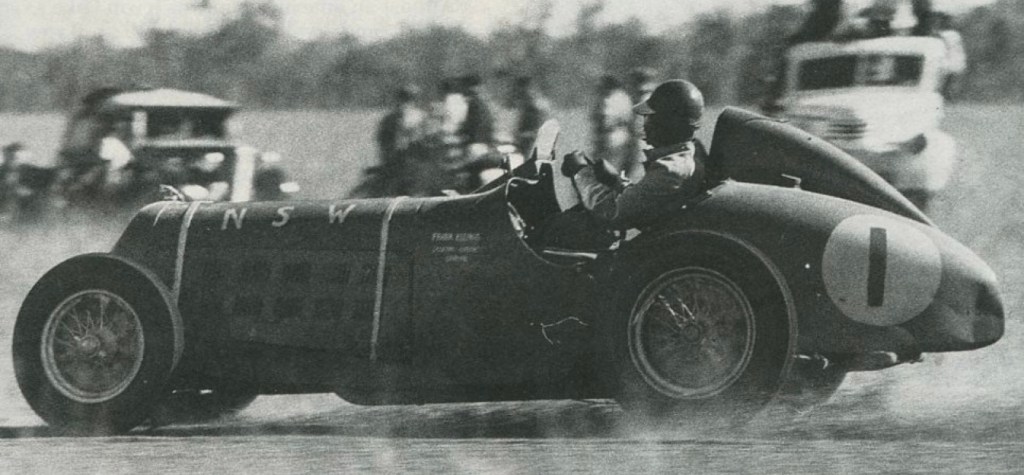
For so long the fire-and-brimstone Frank Kleinig had been an AGP favourite. 1949 was really his last chance to do well as the quality of our fields improved and his oh-so-fast Kleinig Hudson Spl slipped down the grids. Its development potential by then having pretty-much peaked.

Kleinig led Crouch for seven laps – they shared the fastest lap of the race 2’52 seconds/90mph – but then had the first of three pitstops which led to his retirement after completing only 21 laps.

Dick Cobden’s shapely, quick, Gordon Stewart built, Bob Baker bodied, 1946 MG TC (#3306) ‘Red Cigar’ single-seater (below) was out early after only six laps with undisclosed dramas.

(Wiki-unattributed)

Thanks to Terry Sullivan for pointing out this interesting article about the machinations and difficulties associated with the staging of this race; The AGP When Any Airfield Would Do – The Race Torque

John Crouch deals with the rigours of the day in typical Australian fashion.

Frank Kleinig on the hop, see more for this ever evolving, famous Oz racing car; https://primotipo.com/2019/12/06/frank-kleinig-kleinig-hudson-special/

Etcetera…

Kleinig in his faithful Hudson Special, behind is Alan Larsen, Cadillac Spl and alongside him, car #9 is Keith Saunders’ Cadillac Spl
(Brisbane Telegraph)

The Brisbane Telegraph caption of this pre-AGP promo piece reads, “Teamwork counts and here are seen NSW motorists, Alf Najar (left) who will be relief driver of Peter Critchley’s (ex-Najar 1946 NSW Grand Prix winning) MG TB Spl (second from right) the winner of the 1948 NSW Grand Prix (at Bathurst), Arthur Rizzo, and their mechanics.”

Kleinig again, #2 Dick Bland in the George Reed Ford V8 Special, #7 Alan Larsen, Cadillac Spl and the rest – #29 Brydon’s MG TC Spl and #33 at the very back is the Ford V8 Spl raced by Jack Wright.

Credits…

Wikipedia, racerviews.com, Rob Bartholomaeus, Stephen Dalton, Dick Willis, Brisbane Telegraph, Norm Pleasance Collection-Warwick Daily News via Daniel Kleinig

Tailpiece…

(D Willis)

Racers both: Charlie Smith and John Crouch at the launch of Alec Mildren’s biography at Frank Gardner’s Norwell, Gold Coast facility on April 18, 1999.

Finito…

Kleinig, not Klienig by the way…

Many of you know I love the language of yesteryear racing reports, so the ‘National Advocate’ Bathurst 8 October report of the 7 October New South Wales Grand Prix is reproduced in full. In the manner of the day the reporters name is not identified, which is a shame as he or she has done a mighty fine job- its all ‘as was’ other than car descriptions where I have been a bit more fulsome with model designations.

The article is a fluke in that I was researching a piece on Frank Kleinig and came upon a batch of staggering photographs recently uploaded by the State Library of New South Wales- they are truly wonderful.

Taken by the staff of ‘Pix’ magazine, a weekly some of you may remember, it’s the first time the photos have been used in high resolution, when published way back they would have been in ‘half-tones’. The racing shots are great but in addition there are ‘people pictures’ of the type important to a magazine such as ‘Pix’ but which a racing snapper generally would not take, these are amazing in terms of conveying the overall vibe and feel of the meeting and times more generally.

Digital scoreboard linked to yer iPhone via the Internet thingy (SLNSW)

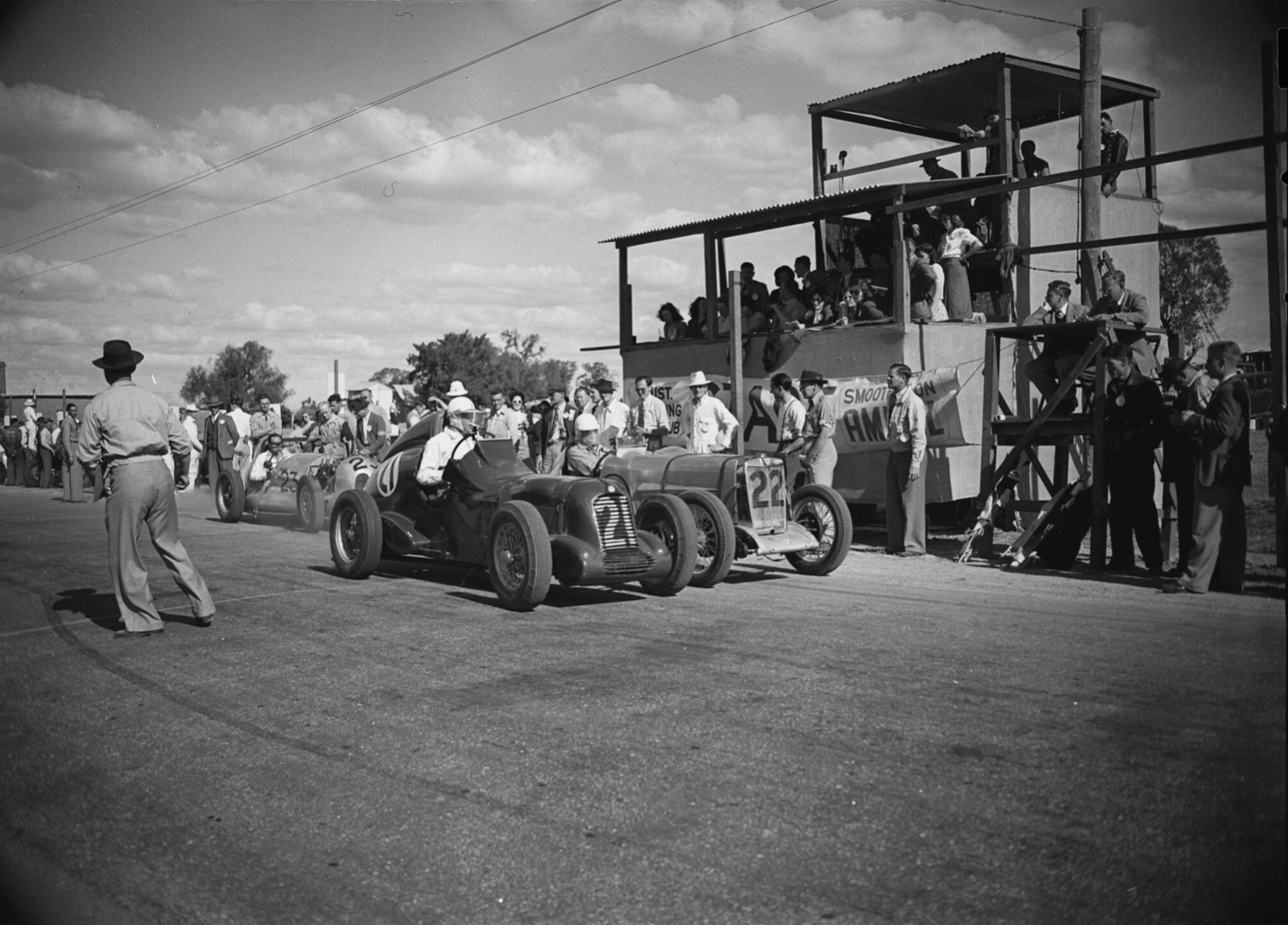
Najar and Nind at the start, MacLachlan is looking pretty relaxed sans helmet, they were off the same handicap of either 7 or 15 minutes depending upon the source (SLNSW)

Here goes, and remember this event is run to Formula Libre and as a Handicap…

‘Fortunately the racing was not marred by any serious accidents. The only accident occurred during the running of the first race, the under 1500cc Handicap when the young Victorian driver, Wal Feltham crashed at ‘The Quarry’. He was thrown heavily and sustained a fractured collarbone. His car, an MG P Type was badly damaged and he had a miraculous escape. He just managed to jump from the car a few yards before it hurtled over a hillside to crash about 80 feet to be completely wrecked. Feltham was admitted to the district hospital for treament.

It was certainly an afternoon of thrilling races and the scene will long be remembered. The racing circuit throughout the whole length was packed with struggling humanity. All sorts of motor vehicles were there from the first model Ford to the post-war type. As a matter of fact the aggregation of cars was perhaps the greatest ever seen locally and every inch of parking space was taken up.

There were 23 starters in the classic race and it was remarkably free from anything in the nature of a serious accident. Skids there were plenty on the hairpin and ‘S’ bends and though at times the situation looked both ugly and dangerous, the drivers always managed to gain control on their cars at the moment when the wide eyed spectators expected them to overturn.’

Mount Panorama Grandstand 1946 style (SLNSW)

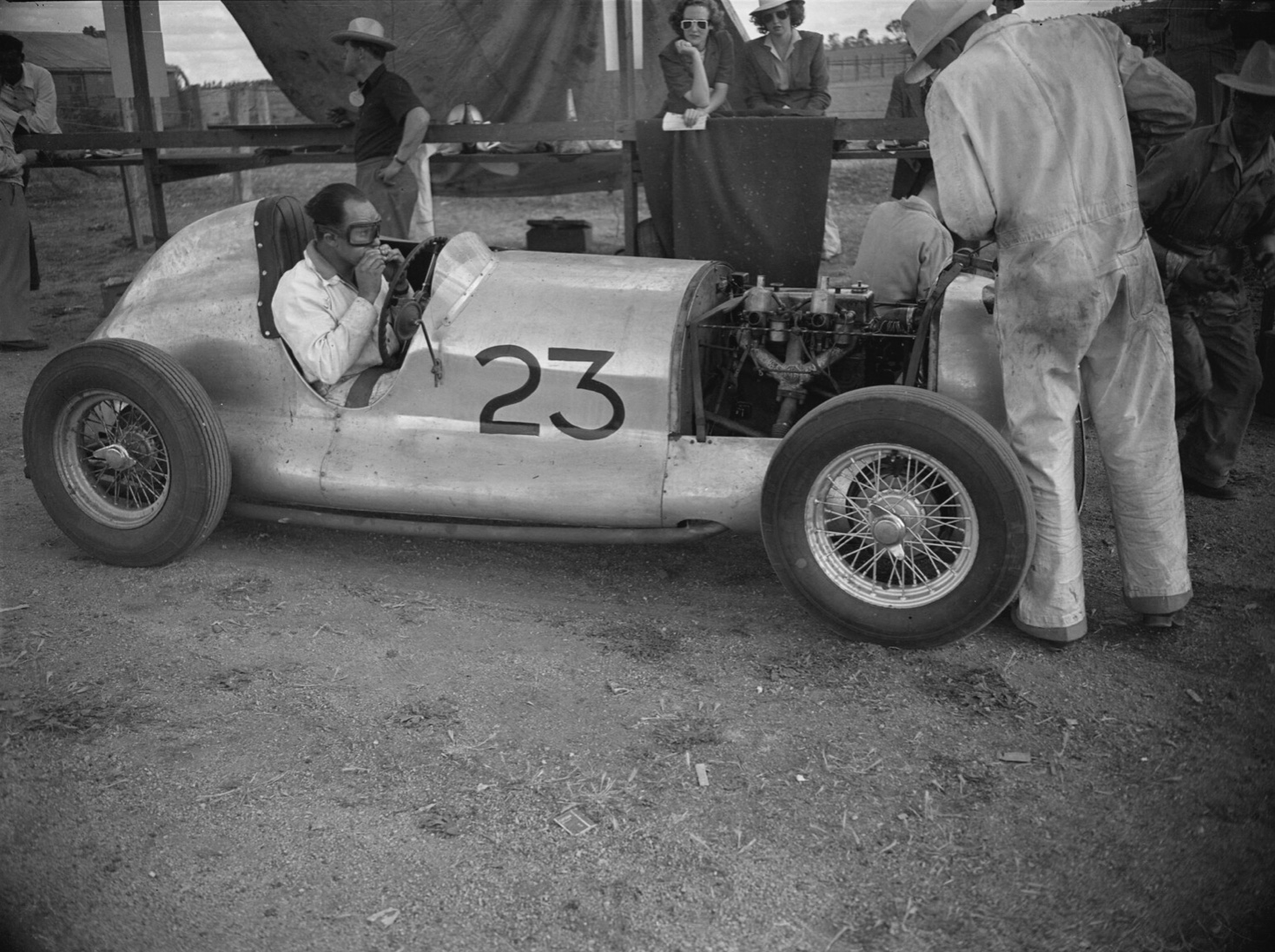
Bill MacLachlan’s MG TB Monoposto- twin SU fed Xpag, three bearing four cylinder 1355cc engine (SLNSW)

‘It was on the famous ‘S’ bend, which had been especially noted as one of the most dangerous spots and at which the trials over the weekend that several drivers came to grief, that DA MacLachlan of Sydney had a thrilling experience. His car went into a skid and struck the sandbags on the side with such force that it was hurled across the track to strike the other side and narrowly miss the legs of two girls who were seated on top of the ledge. The car narrowly missed being hurled over the side overlooking a long drop of many feet.

Speaking after the race, the winner, Alf Najar, said that it was a hard race and that fortunately he had a good passage and his car travelled smoothly all the way. He mentioned that the last four winners of the Grand Prix at Bathurst had been tuned and prepared by Rex Marshall of Sydney and to whom he owed much for his success.

He also praised the Bathurst Council for the attention and care given to the track and added that it was because of the work done on the ‘S’ bend during yesterday morning that the drivers were able to negotiate with comparitive safety. The track, he said, was in good order even though it was not capable of holding cars travelling at over 100 miles an hour for any distance.

Speaking generally, yesterday’s race was one of the best of its kind ever run on any Australian circuit. The cars used were all pre-war models and consequently could not be regarded as fast and durable as the later models. In these circumstances the speed attained by the cars was right up to standard.’

A couple of chargers coming down the mountain. Ted Gray in the ex-Mrs JAS Jones Alfa Romeo 6C 1750 Zagato by then flathead Ford V8 powered from Kleinigs Hudson Special. Ted Gray was quick from his earliest outings on Victorian Speedways and evolved into one of Australia’s elite drivers in Tornados 1 and 2- with  a little more luck he could have won the 1958 AGP at Bathurst aboard the big, booming Tornado 2 Chev (SLNSW)

John Crouch, Delahaye 135CS ahead of Alby Johnson’s MG TC. Crouch won the 1948 AGP at Leyburn aboard the beautiful Delahaye, perhaps one of John Snow’s most astute racing car purchases in terms of suitability for Australian racing of the day if not in outright pace but reliability (SLNSW)

‘High speeds were witnessed in the ‘Con-Rod Straight’ from the bottom of the S-bend to the left-angle turn (Murrays) into the starting straight (Pit Straight).

The officials had chosen a section of the straight solely for the purpose of checking high speeds and this was known as the Flying Quarter. The fastest speed attained was 119mph by John Crouch in the French Delahaye 135CS. His time was taken during three runs and each time he got progressively better. His speeds were 105, 108 and 119mph.

Jack Murray with the powerful Ford-Bugatti was second with 109mph. This car was exceedingly fast but the driver did not seem inclined to take risks. Rather than that he let it out at top speed while climbing the hills and this made up a considerable amount of ground.

Frank Kleinig also attained 109mph over the distance and brought gasps from the crowd by his masterly handling of the car which is really unique in Australian motoring history. It is made up of parts from several other cars. It takes off with a great leaping surge forward and picks up very fast. It travels like a rocket with no spluttering or back-firing usually associated with high powered racing cars.

The weather was almost perfect with no wind to carry the dust high into the air and into the crowd.

Sunglasses seem to have come into fashion for the summer and a number of girls who tend to forget to bring their sunglasses and hats were noticed wearing mens heavy glasses and sun helmets, while the poor boyfriend stood in the sun and sweltered.’

Pre race pit straight scene with Frank Kleinig’s Hudson Eight Special front and centre, Delahaye alongside? (SLNSW)

Grand Prix…

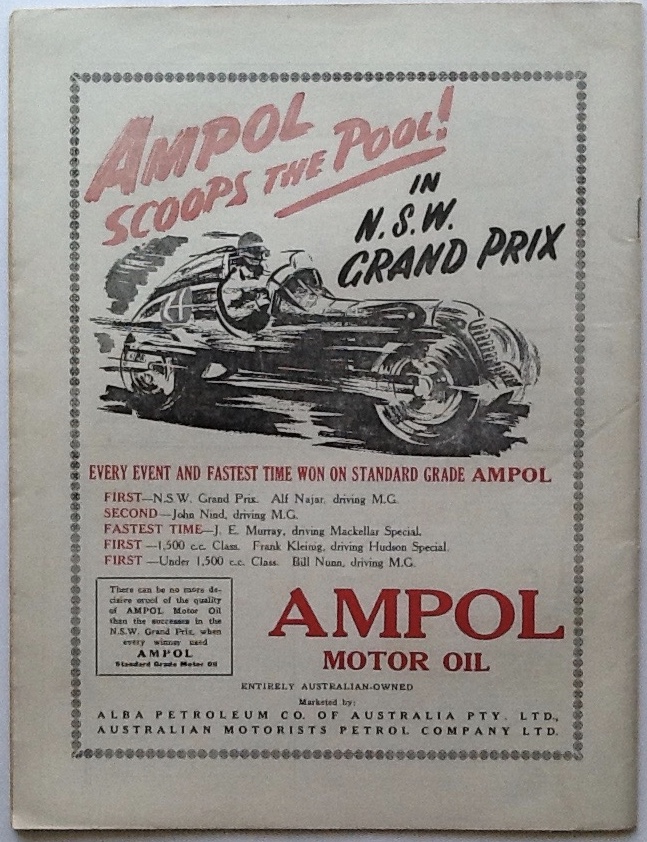
‘Racing keenly for 25 laps during which time they presented many thrills to the public, Alf Najar (NSW) defeated John Nind (NSW) for major honours in the NSW Grand Prix yesterday. AV Johnson gained third place and defeated FW Gray of Victoria for that position.

Najar and Nind were both driving MG Series TB of 1250cc and 1268cc respectively, started off the 15 minute mark, with DA MacLachlan in a MG Series TA of 1355cc. There has been a friendly rivalry between these three men for many years because of each others good driving and yesterday’s performance demonstated just how good these men are. MacLachlan came only ninth in the race, being handicapped by a faulty cooling system. He was forced to continually call at the pits for water.

At times Najar and Nind fought for minutes at a time trying to wrestle the lead from one another. However, Najar seemed to have the better of the going, for he finished about 600 yards in front of Nind. A remarkable point in the clash between them at the end of the distance- 100 miles is that Najar gained one second in every 3.84 miles.

One of the first to greet Najar after his win of the Grand Prix was his sister, who dashed over to the car as it stopped, threw her arms around him, kissed him and being so elated with the victory, burst into tears.’

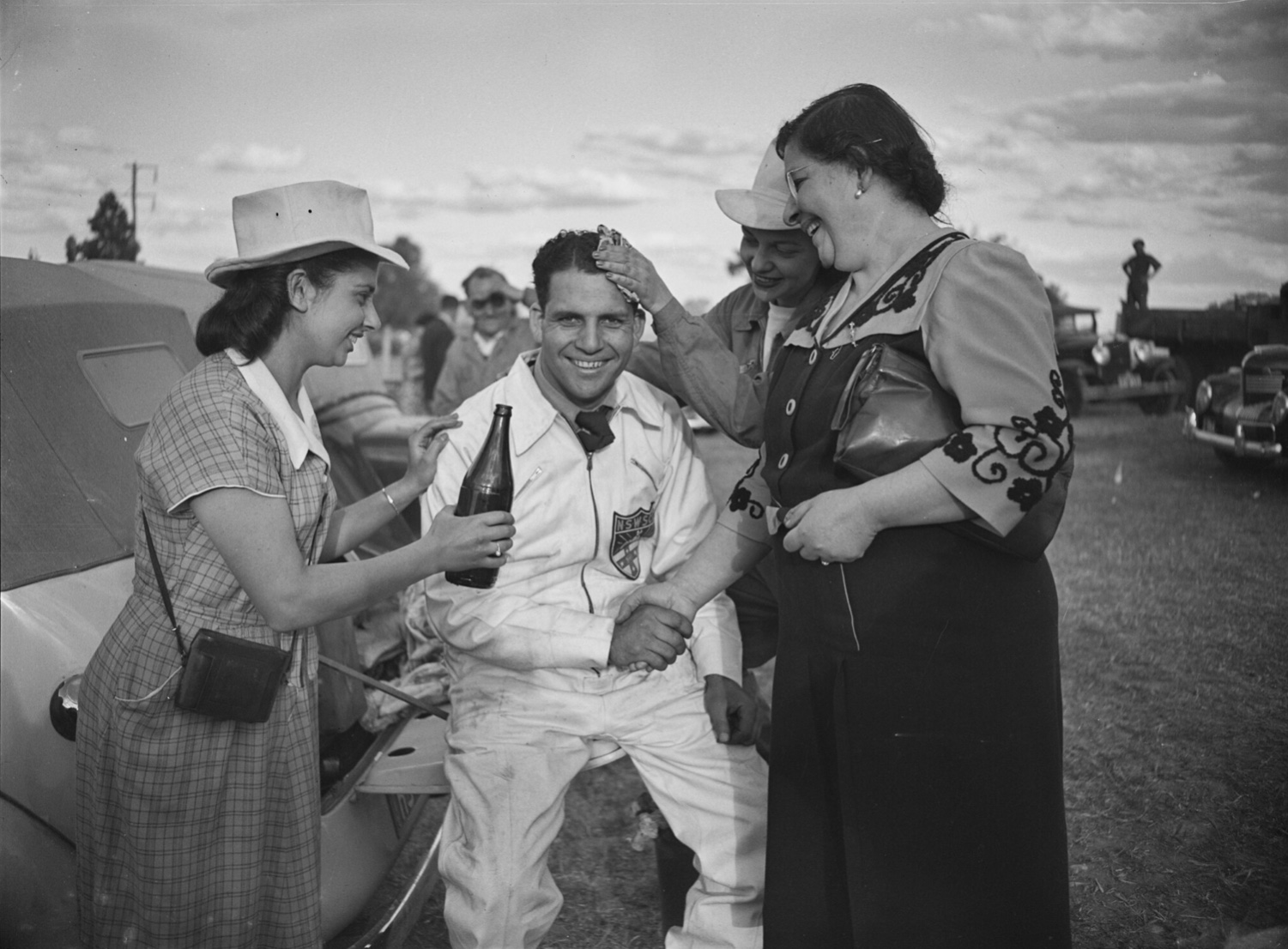
Good boy! Alf Najar being congratulated by his mother and sisters after his big win. Looks like a beer to me (SLNSW)

Najar returns to the paddock after his win, MG TB Monoposto (SLNSW)

‘Johnson, who gained third place took the lead from L Phillips of Victoria, driving a 747cc Austin, when the latter stopped during lap seven owing to engine trouble. Johnson fought grimly to hold his lead, and did so until the 16th lap when Najar took it from him.

During the next time around he lost second place to Nind, but managed to hold off Gray, of Wangaratta, in a Ford V8 Alfa Romeo, long enough to finish the course. It was a remarkable feat on Johnson’s part, considering that the MG TC he was driving was an almost completely standard machine. He was equipped with lights, mudguards and all equipment to make it roadworthy.

JE Murray, who finished fifth in a 3622cc Ford Bugatti, gained the honour of fastest time by clocking 1hr.26min.24sec. for the entire trip of 100 miles. He drove brilliantly throughout and the car gave him the minimum of trouble. Apart from winning fastest time, the car was also one of the best looking on the track.’

Murray in the ex-Bill Thomson Bugatti T37A AGP winner, chassis ‘37358’ now Ford sidevalve V8 powered. This car and its adventures over its long racing life is a story in itself- still extant and in the process of restoration (SLNSW)

Alec Mildren, Mildren Ford V8 Spl and Jack Nind MG TB Spl. Mildren of course became a champion driver, winner of the 1960 Gold Star and AGP at  Lowood aboard his Cooper T51 Maserati. Alec was off 13.36 minutes and DNF (SLNSW)

‘A number of drivers were forced to pull out owing to mechanical trouble. Warwick Pratley, of Peel, one of Bathurst’s hopes, was forced to stop in the fourth lap of the second event- the over 1500cc handicap- after he had held the lead for two laps and looked to possess a chance of winning. Big-end trouble caused his withdrawal.

Norman Tipping, also of Bathurst in a Terraplane Six Special, was driving a most spectacular race, and was actually overhauling the leaders when the gear handle came loose in his hand as he was changing gear in the pit straight. The car pulled up some 100 yards beyond the pits. Tipping was proving a great crowd-pleaser with his spectacular cornering.

Tipping’s car had exceeded all expectations as he had been in difficulty with his engine over the past week or so and there was some doubt as to whether he would start. The final tuning of the locally manufactured Terraplane was not complete until midnight on Sunday night.  However, the car was on the track in time and with his clean, confident driving raised the hopes of Bathurstians each time he passed, being the only local representative left in the race.’

The great Frank Kleinig wearing a kidney belt working, as always, on his steed. This car started life as Wal McIntyre’s Miller 1.5 litre straight-8 engined Kirby Deering Special in 1936- an amalgam of MG Magna chassis, Mathis suspension and gearbox and much more. Fitted with a Hudson straight-8 prior to the 1938 AGP it was then named the Hudson Special or Kleinig Hudson Special, here in single carb format in a formidable machine the development of which never stopped. It’s still extant in Melbourne. Story on Kleinig completed and ready to upload soon (SLNSW)

Ron Ewing, Buick Spl. Built by Ewing and first raced at Bathurst in 1940, the clever car was a combination of Buick 8/40 straight-8 engine, Terraplane chassis and Lancia gearbox. Does it survive? (SLNSW)

‘Frank Kleinig, who was driving his own Hudson Eight Special, completed five laps and had to pull up halfway around the track with smoke pouring from his engine. For a moment, it was thought his car was on fire, but the trouble was in the clutch.

Ron Ewing, who was expected to do well in his Buick Special only completed one lap in very poor time and stopped for the same reason as Kleinig. His mechanics had been working vigorously on the car and just made the starting line in time for the start of the big race.

Ron Edgerton had only done four laps when he took his car, a Lycoming Special, powered by a Continental Beacon engine- out of the race with ignition trouble. It had been backfiring for a couple of laps and it was not surprising when his withdrawal was announced.

One of the mystery cars of the race, a monoposto Jeep Special, driven by NJT Andrews, of NSW, did not do as well as expected, and finished in lap five with the engine emitting eruptive noises. Others who did not finish the race included RS Ward’s MG Series TA and W Conoulty’s Austin Comet, both cars were from NSW.’

Bill Conoulty makes final adjustments to his Austin 7 Comet before the off. The ex-motor cycle racer, the first to do 100mph on a bike in NSW it’s said, used this car as a test bed for many of the engines he developed, inclusive of an OHV design. At one stage his Sydney business employed over 40 people (SLNSW)

John Crouch and his helpers ready the beautiful Delahaye 135CS sportscar, it’s chassis #47190. The car was famously barbequed in a trailer fire whilst Dick Bland and his guys were towing it back to Bathurst upon their return from the 1951 AGP meeting at Narrogin in Western Australia- it was rebuilt/reconstructed a couple of decades ago by Ian Polson and lives in splendid retirement in an American museum. I must get around to writing about John Crouch- a great driver, racing entrepreneur and administrator (SLNSW)

Results

Support Races

The Under 1500cc Handicap was won by John Barraclough’s Bill Nunn owned MG TB 1250cc, the over 1500cc Handicap was taken by Kleinig’s Hudson Spl who ‘drove with such determination and daring that he had overtaken seven cars and was rapidly overhauling the leaders…during one of the Flying Quarters he was clocked at 108mph…Murray’s Ford Bugatti did one better and clocked 109mph over the same distance’.

Grand Prix

Alf S Najar MG TB Monoposto 1250cc first in 1 hour 33 minutes 19 seconds, Jack P Nind MG TB Spl 1268cc second, Alby V Johnson MG TC 1250cc third, Ted Gray Ford V8 Alfa Romeo 3924cc fourth, J Murray MacKellar Special s/c (Bugatti T37A Ford) 3622cc fifth, Walter I Mathieson Jaguar SS100 2663cc sixth, John F Crouch Delahaye 135CS 3555cc seventh, Chas W Whatmore Ford V8 Spl 3917cc eighth and D ‘Bill’ A MacLachlan MG TA 1355cc. Fastest time, J Murray 1.26.24

Belf Jones, Buick Special from MacLachlan’s MG TA Monoposto- does anybody know about the Buick Spl? (SLNSW)

Bill Murray, Hudson Spl, DNF after 23 laps, car prepared by Frank Kleinig, not sure if he built it? Alf Najar is credited with renaming Pit Corner ‘Murrays Corner’ after Bill collided with the hay bales. Came back and won the 1947 AGP here at Bathurst in a stripped MG TC (SLNSW)

Alfred Najar…

Alf Najar arrived in Australia aged 8 years old with his parents and four sisters, the family hailed from Tripoli, Lebanon where his father had established a successful tailoring business.

They settled in Sydney and soon established tailoring and dressmaking enterprises in Kingsford and Auburn, this evolved into a small manufacturing business when Alf joined his parents in 1936. Clearly they were profitable, Alf having the income to build and race a car.

The factory was taken over by the government during the war years to produce clothing for the military.

Apart from his NSW GP win Alf was sixth and second in the 1947 and 1948 AGP’s respectively and was the holder of many sprint and hillclimb records inclusive of the 1946 Australian Hillclimb Championship at Bathurst.

He is also credited with starting the sport of water skiing in Australia together with ‘Gelignite’ Jack Murray, in 1948 becoming a foundation member of the Australian Water Ski Association. In a lifetime of involvement in sport he was a member of the All Australian Five-Man Skeet Team for 16 years and held Australian and New Zealand titles in clay target shooting.

For many years he ran the family tailoring business including the acquisition of ‘Najar House’ in Campbell Street, Surry Hills- he and his wife retired in 1978 then trading and building property successfully. He died in 2015.

A couple of the Najar girls keeping an eye on big brother (SLNSW)

Etcetera…

(S Dalton Collection)

(S Dalton Collection)

(Najar Family Collection)

AMS December 1946 (S Dalton Collection)

(B Williamson)

Cars pictured in the bucolic, rural, relaxed Mount Panorama paddock include #23, a mystery car!, with Hope Bartlett’s #10 MG TA Spl closeby. #31 is WD Feltham, MG P Type, #22 is Jack Nind’s MG TB Spl, the second #23 in the rear of the shot is Bill McLachlan’s MG TA Monoposto.

‘Monoposto Jeep’ or ‘The Andrews Special’…

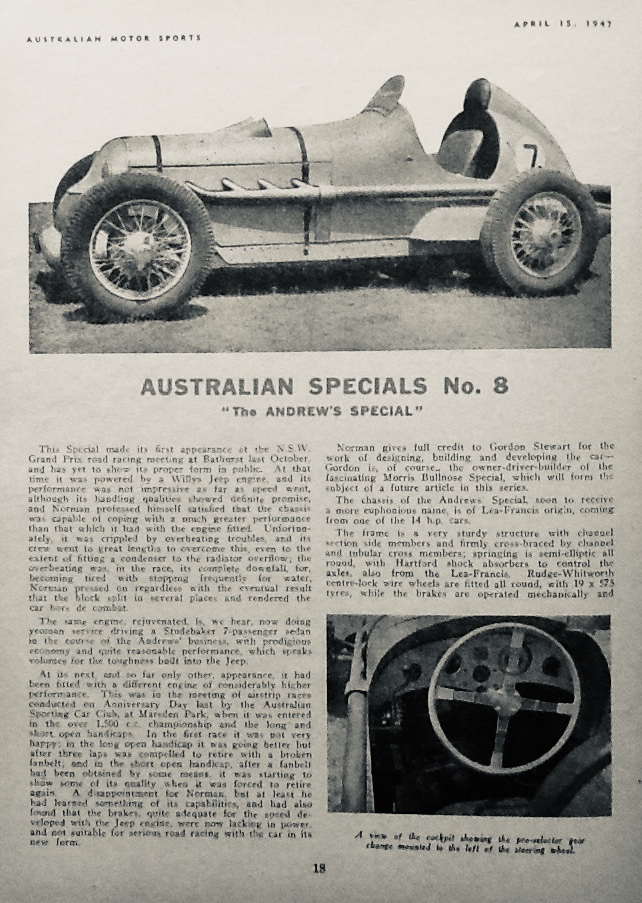
The Monoposto Jeep Special our intrepid reporter mentioned piqued my interest, and as he often does, my mate Stephen Dalton came to the rescue with this April 1947 AMS article which explains all about the car- it is an attractive machine, does it still exist?

Its a bit tricky to read- I can manage by blowing it up with my trusty iPad, there is a precis of the salient bits below if you have insurmountable dramas.

(S Dalton Collection)

The car was designed and built by Gordon Stewart for Norman Andrews using many Lea Francis components as a base- chassis, front and rear axles and the gearbox.

The racers first meeting was the 1946 Bathurst event in which it was powered by a 2195cc Willys-Jeep engine which was immediately replaced by a circa 3.5 litre Austin OHV six which was modified in all the usual ways and fed by triple-Amal carbs to give over 130bhp. The Leaf gearbox was replaced by a Wilson pre-selector ‘box when the engine was swapped.

Semi elliptic springs were used front and back and Hartford shock absorbers, wheels were Rudge Whitworth wires and the body was formed in steel sheet.

I am intrigued to know how it performed in the ensuing years- and its fate.

(S Dalton Collection)

Credits…

National Advocate Bathurst Tuesday 8 October 1946, State Library of New South Wales, article by Brian Caldersmith in the HSRCA magazine 16 December 2015, Stephen Dalton Collection- Australian Motor Sports, Bob Williamson Collection

Tailpiece…

(SLNSW)

‘Flaggie’ 1946 Mount Panorama style, complete with suit, bowler hat and fag to calm the nerves…

Isn’t it a cracker of a shot? Somehow I doubt he has the athleticism of Glen Dix, Australia’s most celebrated practitioner of the flag waving art.

Finito…

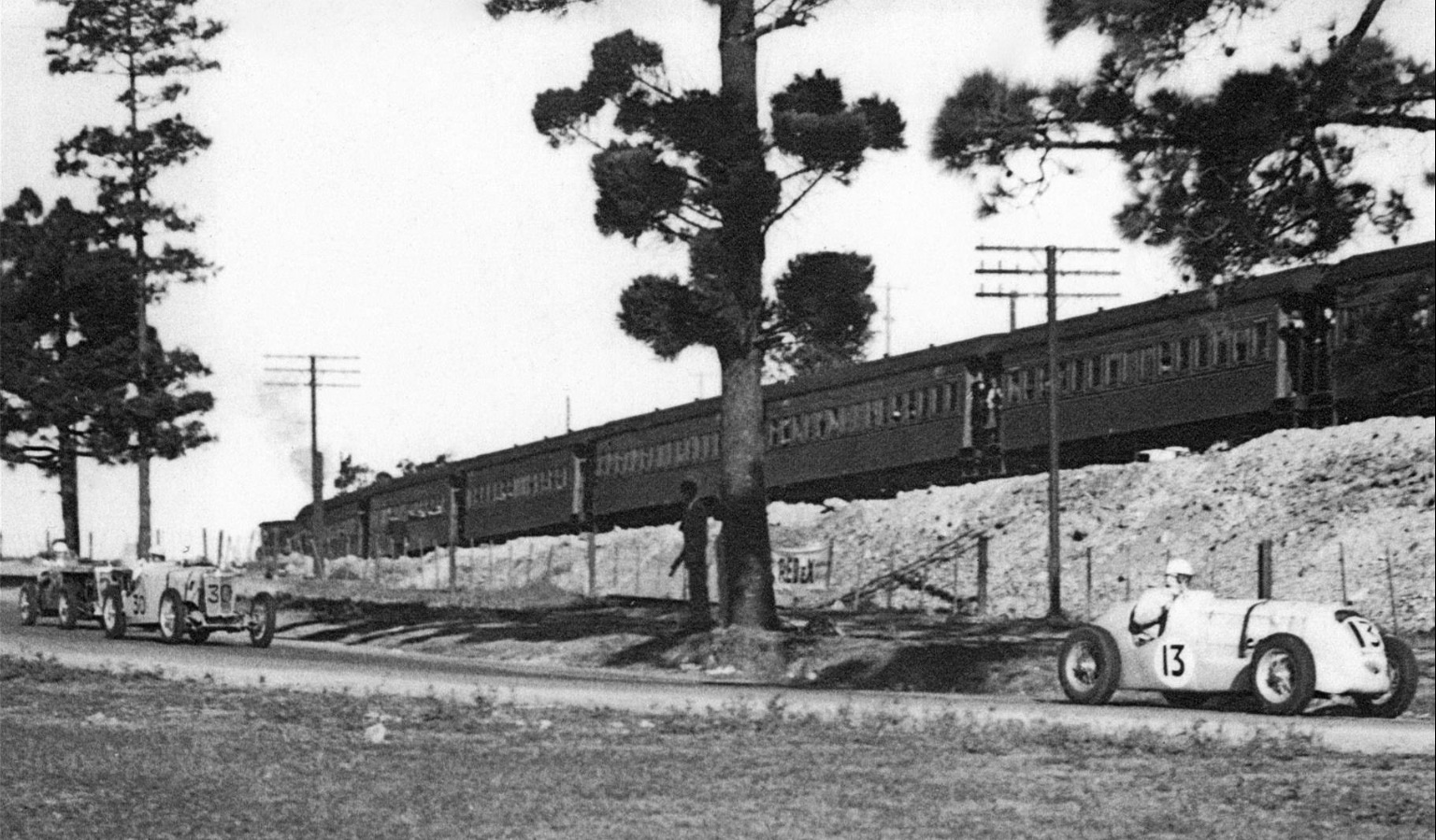
Train commuters watch an unidentified MG TC, then Les Wheeler, MG TC chasing A Griffiths, MG TC Spl s/c at the June 1952 Parramatta Park meeting  (CRPP)

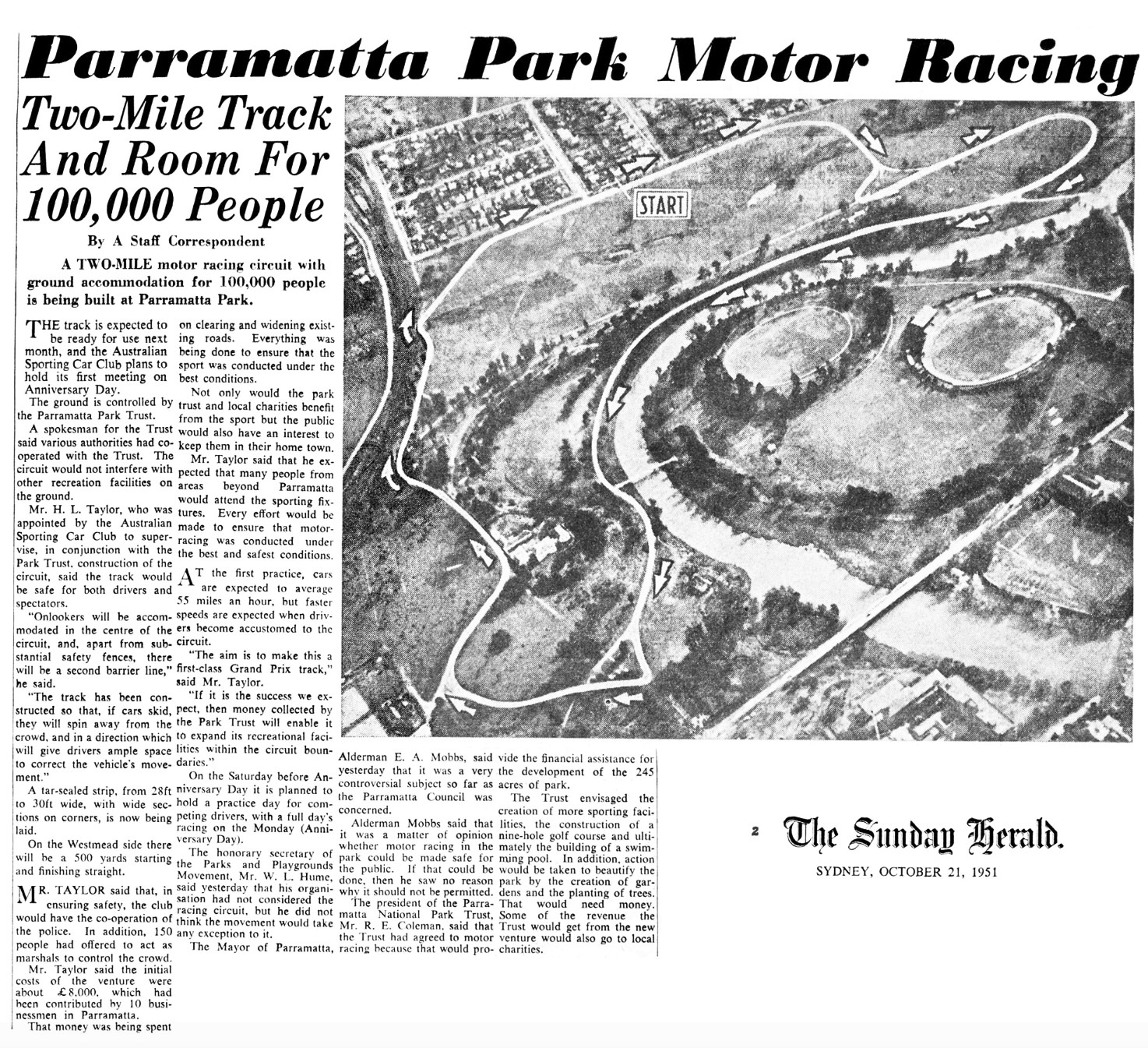
‘A two mile motor racing circuit with ground accommodation for 100,000 people is being built at Parramatta Park’ Parramatta, Sydney The Sunday Heralds headlines proclaimed on 21 October 1951…

 Parramatta is a large city within greater Sydney, 25 Km from the CBD, the huge park occupies an area of 245 acres and straddles the Parramatta River on the western edge of the town.

The 8,000 pound investment in the park facility was funded by ten local businessmen and used to clear and widen existing roads to a minimum of 28 to 30 feet. The projected average circuit speed of the circuit, designed and to be run by the Australian Sporting Car Club Ltd (ASSC), was 55 mph.

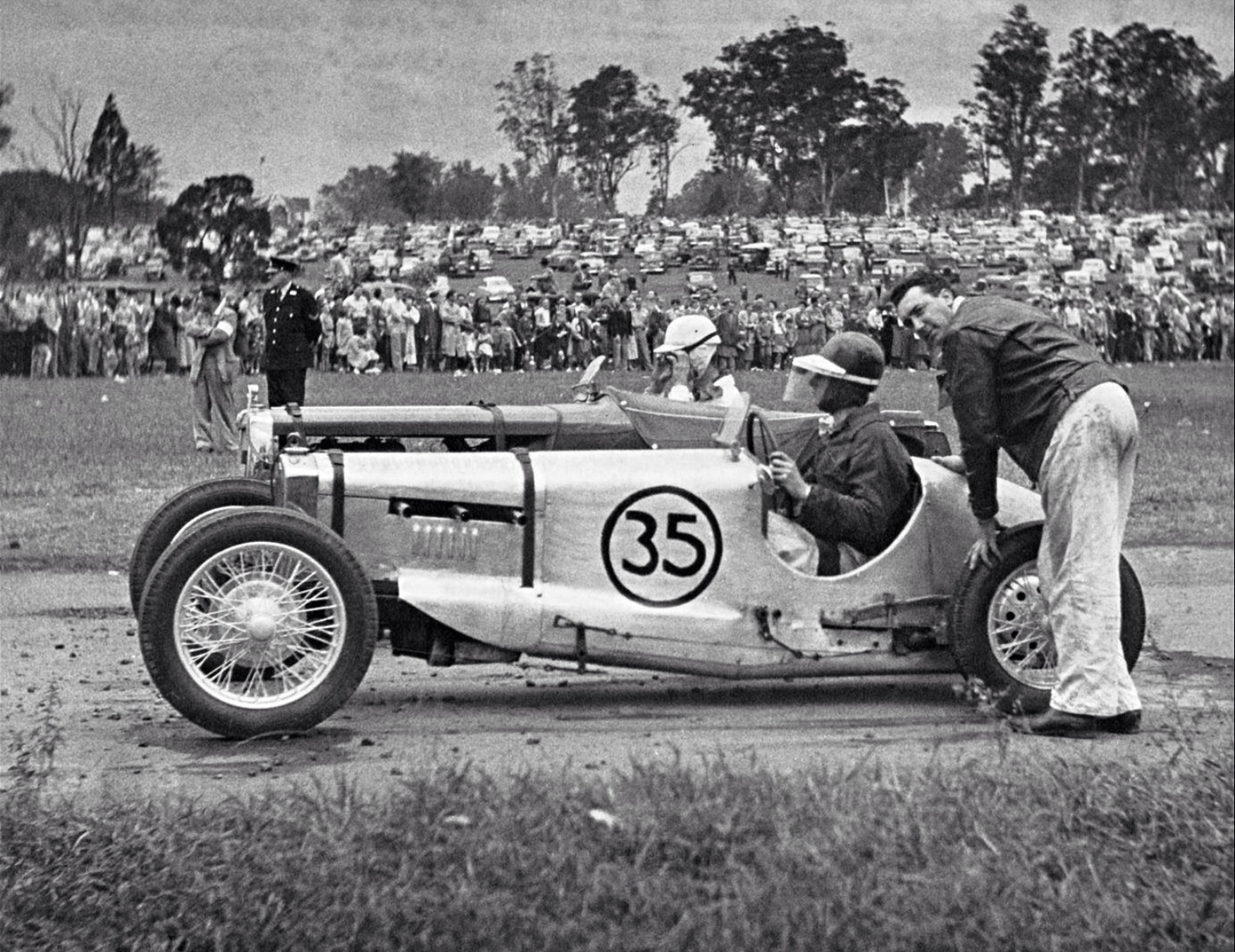
Barrie Garner, Frazer Nash in June 1955. Later an ace hillclimber in a Bowin P3 Holden. Track surface needs a sweep! Carnival atmosphere, big picnic crowd so close to the centre of Sydney (CRPP)

Motor racing in Parramatta Park had been mused about for decades. An article about the 1929 Monaco Grand Prix in the ‘Sydney Morning Herald’ mentioned the possibility of events in either Centennial Park, Sydney or Parramatta Park with the writer just as rapidly despatching the idea as one which would be scuttled by the authorities. Indeed, officialdom caused plenty of grief in relation to racing at Parramatta when it was finally becoming a reality.

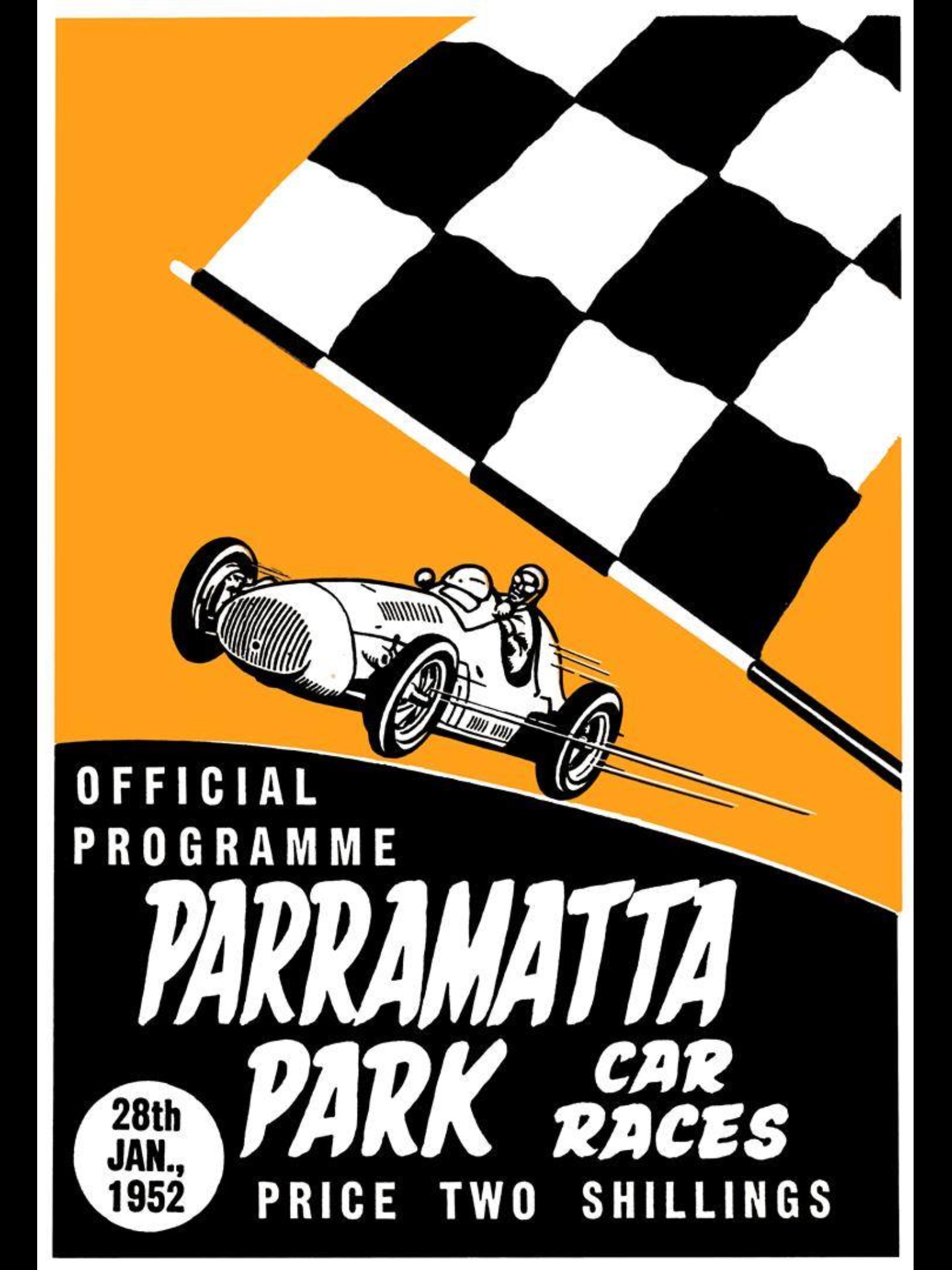
The proposed event on 28 January 1952 was not the first planned at the venue, a meeting was scheduled to be held on 5 November 1938- the star Peter Whitehead.

The wealthy wool merchant/racer was to compete in his 1938 Australian Grand Prix winning ERA R10B. Officialdom intervened in the form of the New South Wales Chief Commissioner of Police who decided to ban the race on Friday, the day before the meeting, due to concerns about competitor and spectator safety. Click here for my article on the 1938 AGP including details and pictures of the ’38 abortive, aborted Parramatta Grand Prix. https://primotipo.com/2015/04/16/peter-whitehead-in-australia-era-r10b-1938/

In a reprise of the 1938 dramas the Chief Commissioner of Police again stepped in and refused permission for the January 1952 race. The ASCC appealed his decision before the Parramatta Court of Petty Sessions with the Magistrate upholding the appeal. The event was allowed to take place on the basis that spectators were permitted no closer than 40 feet from the circuits edge.

Over 40,000 paying punters turned up on raceday causing massive traffic jams throughout the area and its surrounds.

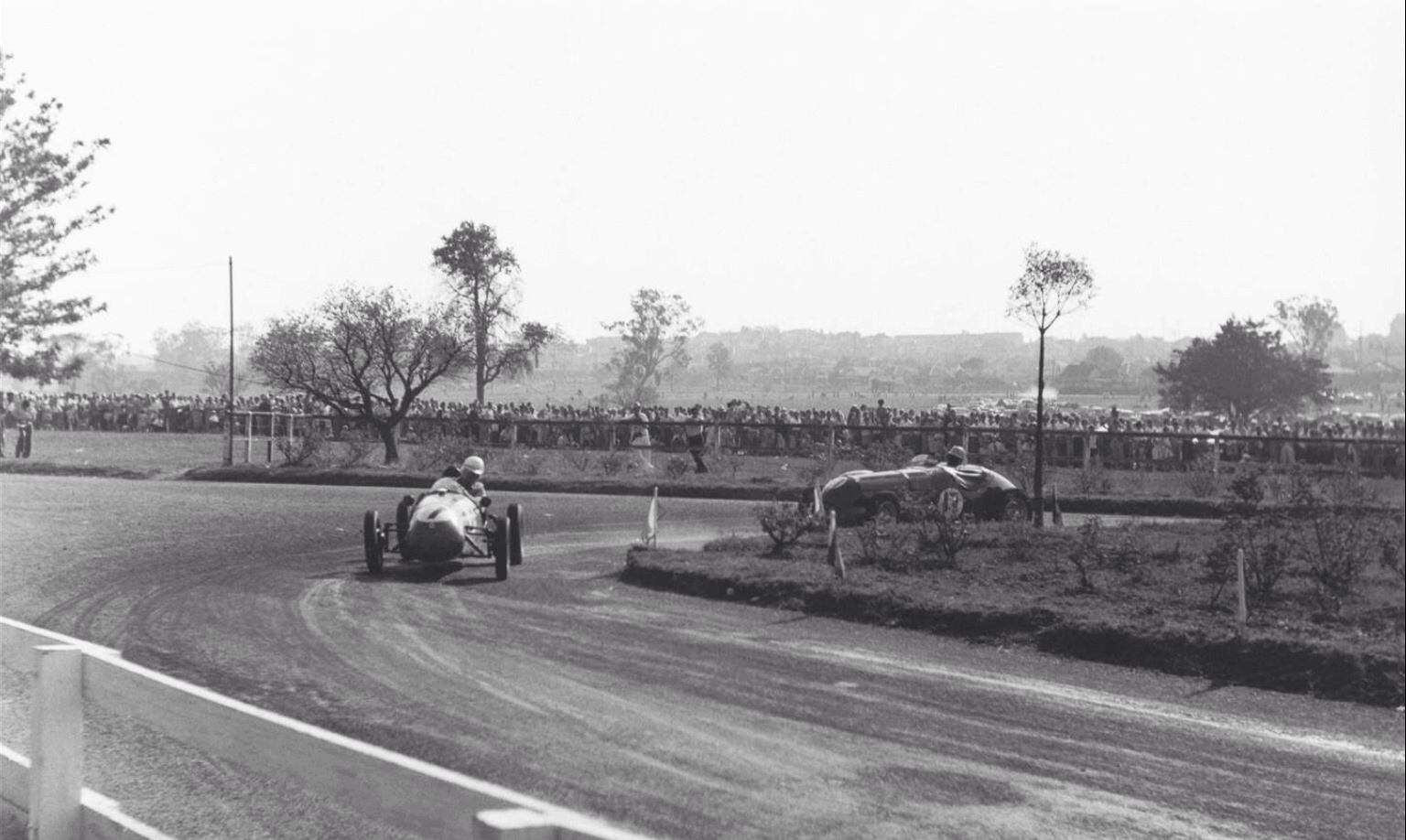
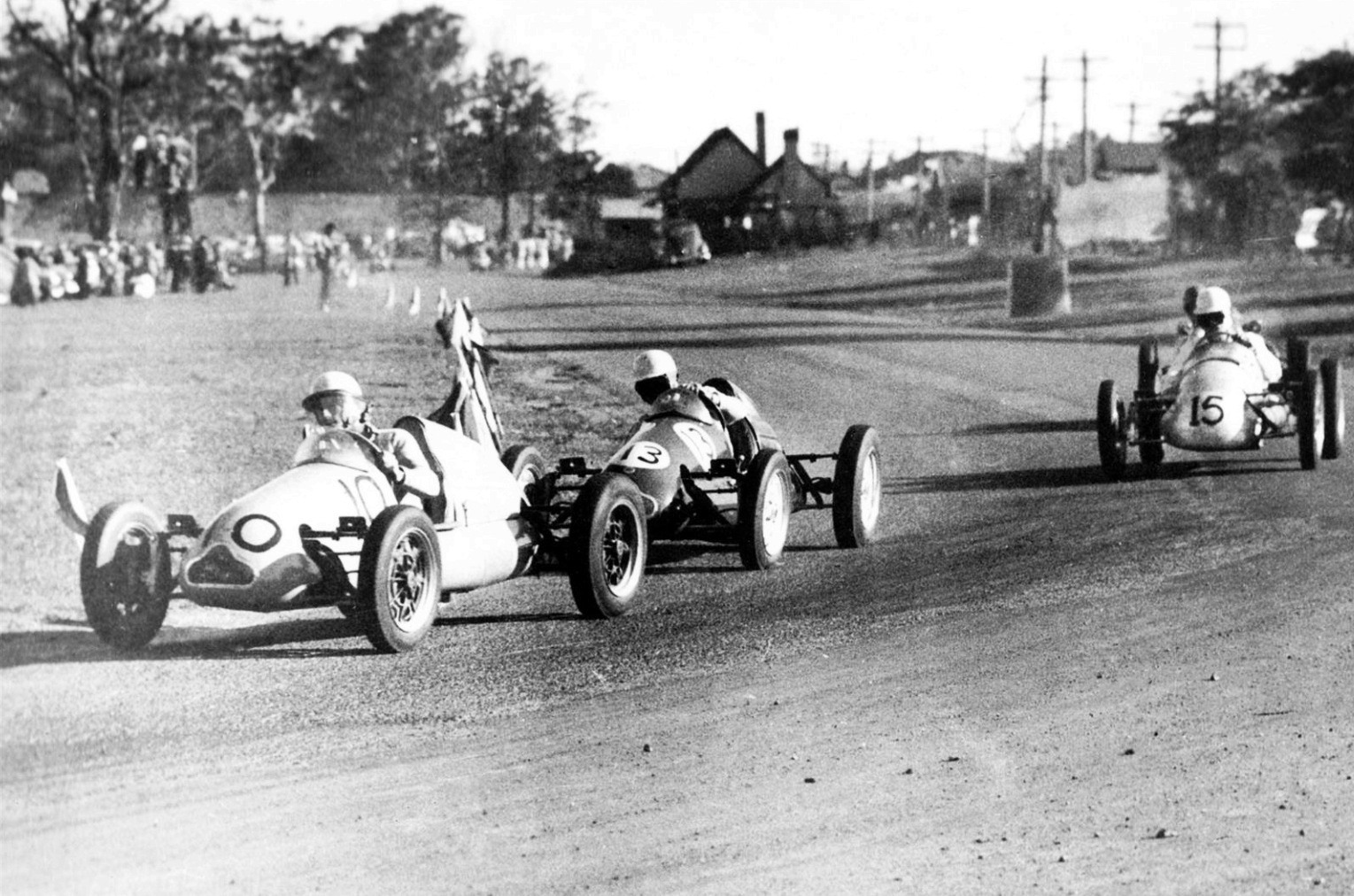
John Crouch Cooper MkV JAP from Curley Brydon’s MG TC Spl in a handicap event during the January 1952 meeting. One of the ultimate TC specials in Australia shaded by the new generation of cars. Check out the crowd (CRPP)

Star of the show that weekend was Sydney driver John Crouch driving a new-fangled, mid-engined Cooper JAP MkV to three wins of the seven events.

One of victories was perhaps the ‘main event’ of the day, a six lap invitation scratch race for the quickest guys of the weekend- he won it in his 1097cc Cooper. Stan Jones was second in the 4.3 litre Maybach 1 then came Reg Hunt’s mid-engined Hunt ‘500’ fitted that weekend with a Vincent 998cc engine Then was Jack Saywell’s Cooper 1000, Doug Whiteford’s 4.375 litre Ford V8 Spl ‘Black Bess’  and Alec  Mildren’s 1750cc Dixon Riley. The results are indicative of the rise of the small, efficient, mid-engine Coopers in Australia as was the case everywhere else in the world! Crouch set the lap record with a time of 1 minute 59 seconds.

In a reminder that ‘Motor Racing is Dangerous’, a wheel came off Doug Whiteford’s 1950 Australian Grand Prix winner, ‘Black Bess’ whilst travelling at circa 80 mph and landed in the backyard of a Victorian cottage adjoining the course. Fortunately the lady of the house was not hanging out the washing at the time the errant wheel landed atop her prize petunias.

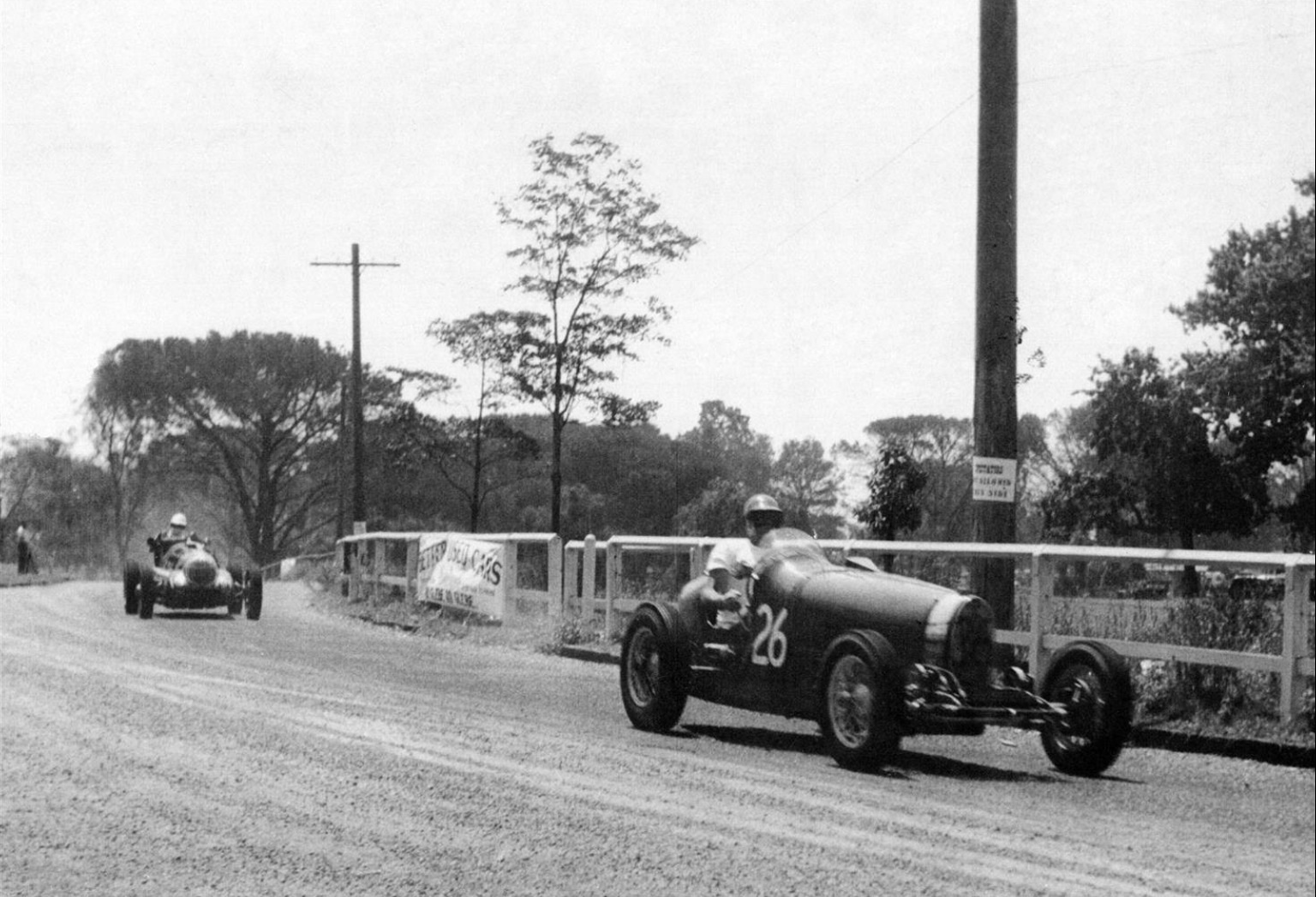
Peter Lowe, Bugatti Holden from Laurie Oxenford, Alvis Mercury, January 1952 (CRPP)

Many meetings were held at the venue until 1957, regularly attracting over 10,000 spectators when the demands and difficulties of holding the races became too much. The circuits closure left the New South Wales circuits at the time as Mount Panorama at Bathurst, Gnoo Blas, Orange and Mount Druitt in Western Sydney.

I have long wanted to write an article about Parramatta Park but a paucity of photographs was the barrier. Not so now- the convenor and members of the Facebook group ‘Car Racing at Parramatta Park’ have uploaded some pearlers of shots- I’ve chosen some at random to give you a flavour of the place. For you FB folks just find and like the page in the usual way.

Stan Jones with a touch of the opposites in Maybach 1 chasing ‘Gelignite’ Jack Murray’s Allard Cadillac in the opening January 1952 meeting. Jones was so impressed by the speed of the Coopers in relation to his GP car he promptly placed an order for one, a MkIV was soon in his Balwyn, Melbourne driveway (CRPP)

Both the aces of the day and coming-men raced at the ‘Park including drivers such as Doug Whiteford, Frank Kleinig, Stan Jones, David McKay, Bib Stillwell, Dick Cobden, Bill Patterson, Lex Davison, Tom Hawkes, Alec Mildren, Tom Sulman, Ted Gray, Ron Tauranac, Jack Brabham and many others. RT ran the very first of his Australian Ralts in the opening meeting, as against the Pommie built ones, and his later partner Brabham raced his Dirt Midget!

Jones big Maybach ‘monstering’ Ron Tauranac’s Ralt Norton ES2 500, January 1952 (CRPP)

The program described Jack thus- ‘A familiar winner at the speedway, and this years Australian Hillclimb Champion, Jack should find the circuit well suited to his style. His car is very light, has four wheel hydraulic brakes and is powered by a home made engine using J.A.P bits’.

By the June meeting Jack had jumped into a Cooper Mk5 500, the wry description in the program observed; ‘Australian Hillclimb Champion of 1951, Jack, one of our best midget drivers, is a new recruit to road racing, his Cooper…was an 1100, now has an engine designed and built by the new owner, a foremost expert at getting quarts out of pint pots’ ! A sage description of Jack’s ability to conjure something out of not very much throughout his career as both constructor and driver.

Dick Cobden from Bill Patterson in Stan Jones car and Bill Shipway- Coopers galore, all MkV’s I think June 1955 meeting (CRPP)

Bibliography…

Sydney Sunday Herald 21 October 1951, ‘Fast and Furious: The 1938 Parramatta Grand Prix’ article by Peter Arfanis

Photo Credits…

‘Car Racing at Parramatta Park’ Facebook Group (CRPP)

Tailpiece: Parramatta Park opening meeting, January 1952…