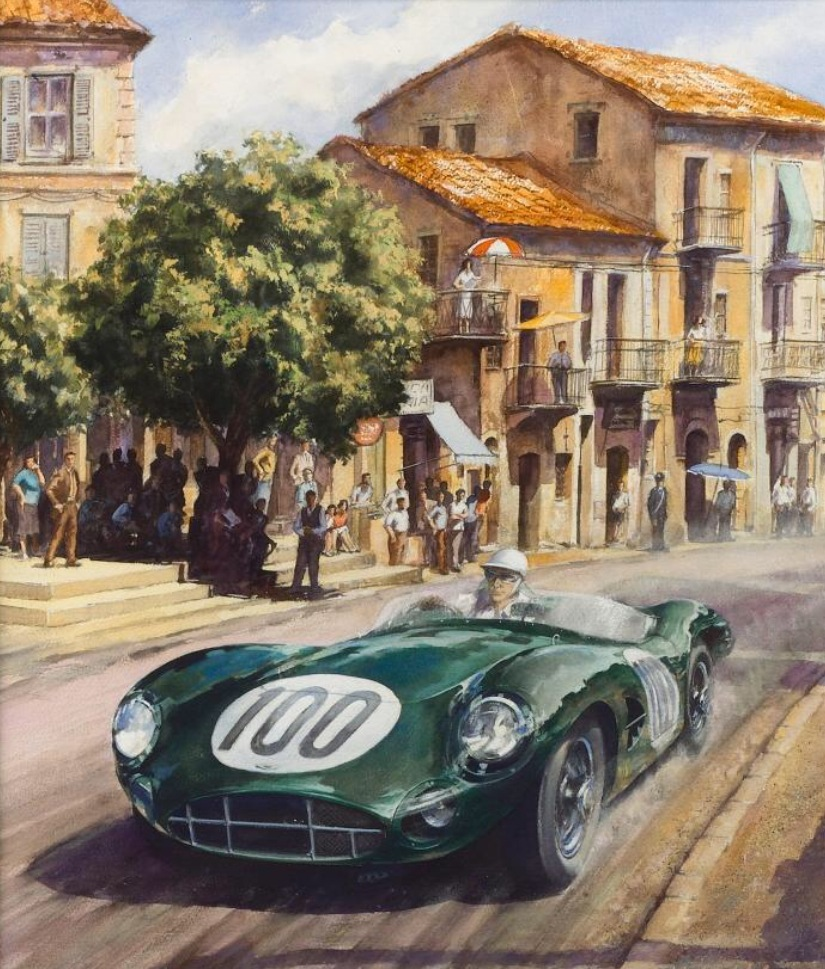
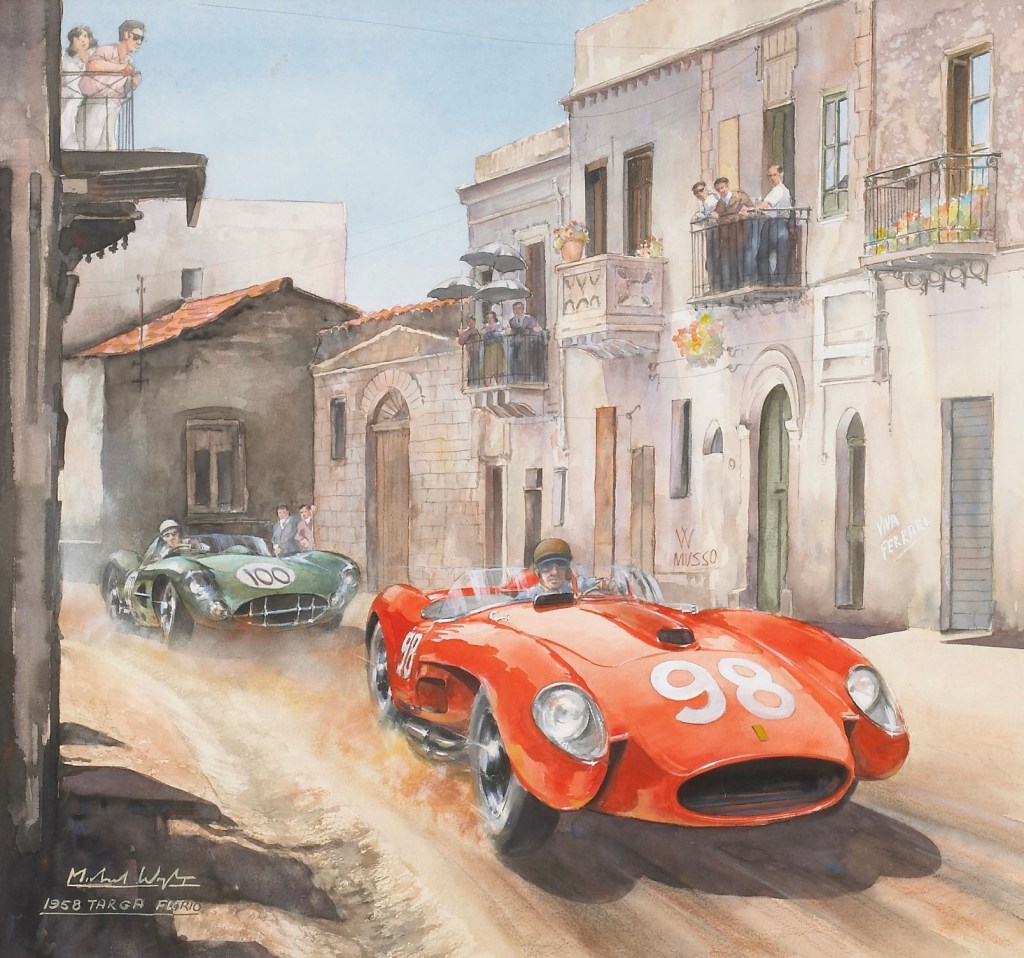
Stirling Moss, Aston Martin DBR/1, May 11, 1958, Targa Florio…
Luigi Musso was the class of the field that day and led from the first lap in a works-Ferrari 250 Testa Rossa 3-litre V12 co-driven by Olivier Gendebien. Moss went off the road and damaged a wheel early on, then redeemed himself with a lap record more than a minute quicker than Musso, but the solitary Aston’s gearbox cried enough under the strain during its fifth lap.
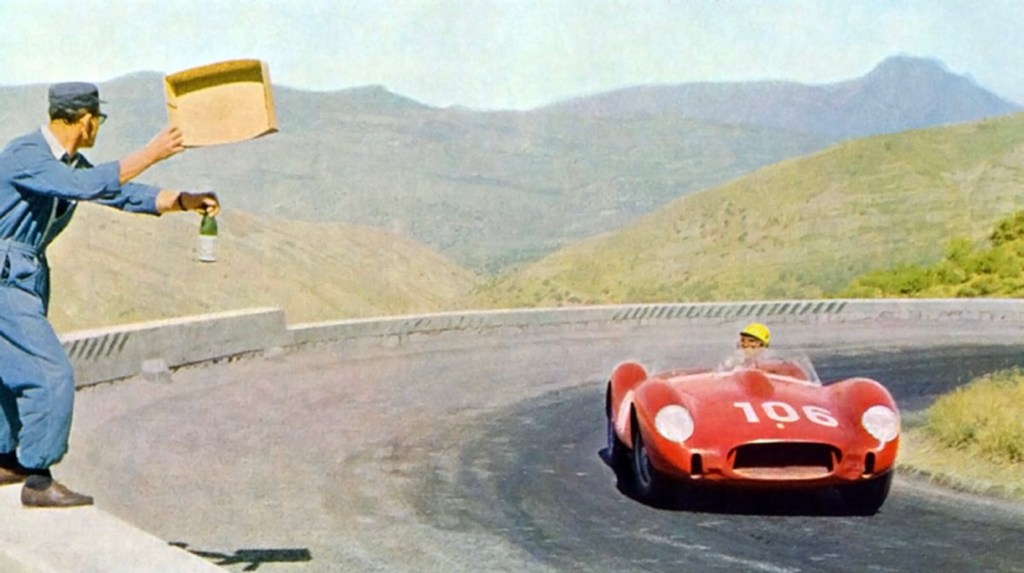
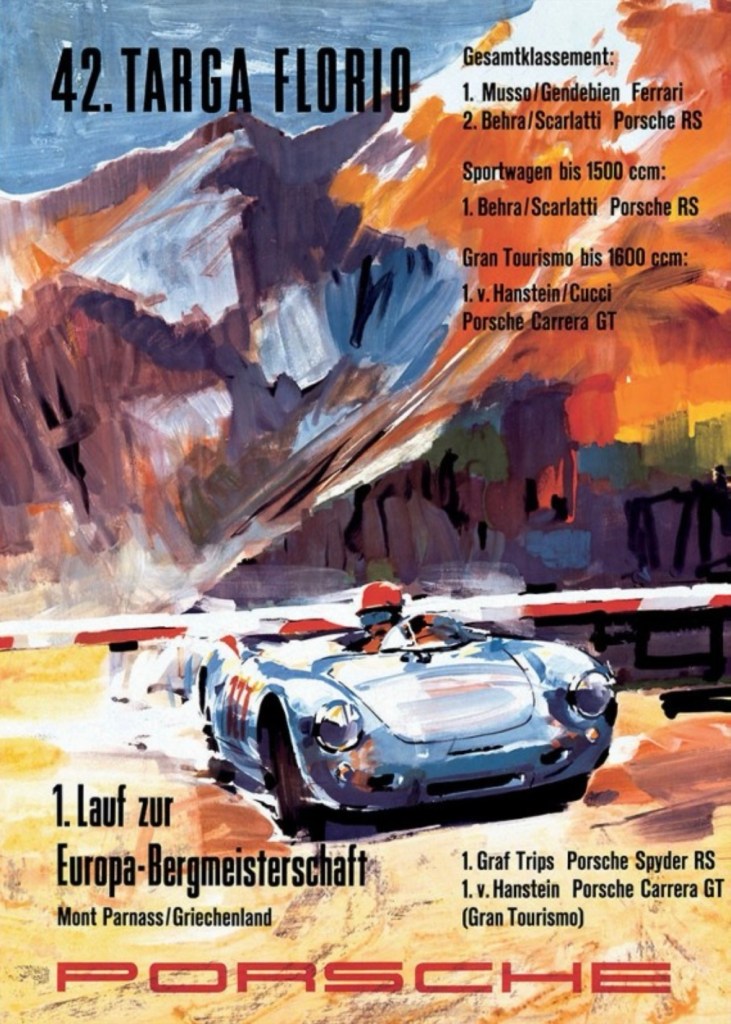
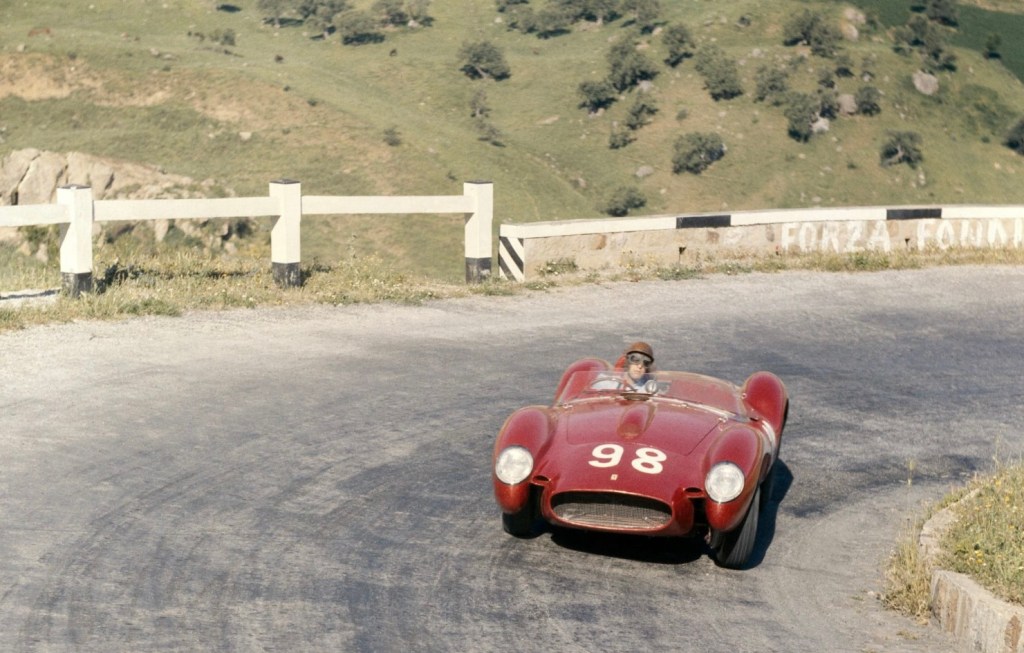
‘Yep, I’ll supersize that with fries.’ Musso in command of the leading 250 Testa Rossa, not in need of assistance from the Ferrari pit, way out west (unattributed)Porsche did well with results as per the postcard
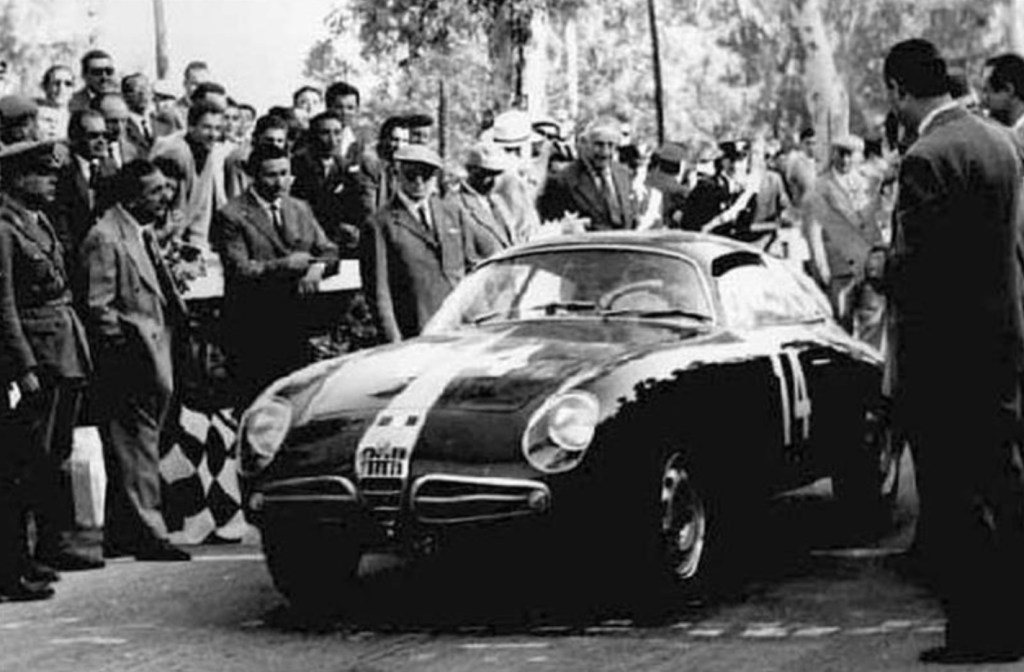
Musso’s car lost its brake fluid, but such was the car’s lead that he pitted, the Scuderia mechanics fixed the problem and Gendebien brought the car home first in the 10 lap race on 10hr 37.58 from Jean Behra/Giorgio Scarlatti Porshe 718RSK 10:43.38 with Wolfgang von Trips/Mike Hawthorn third in another works Ferrari 250TR on 10:44.29.
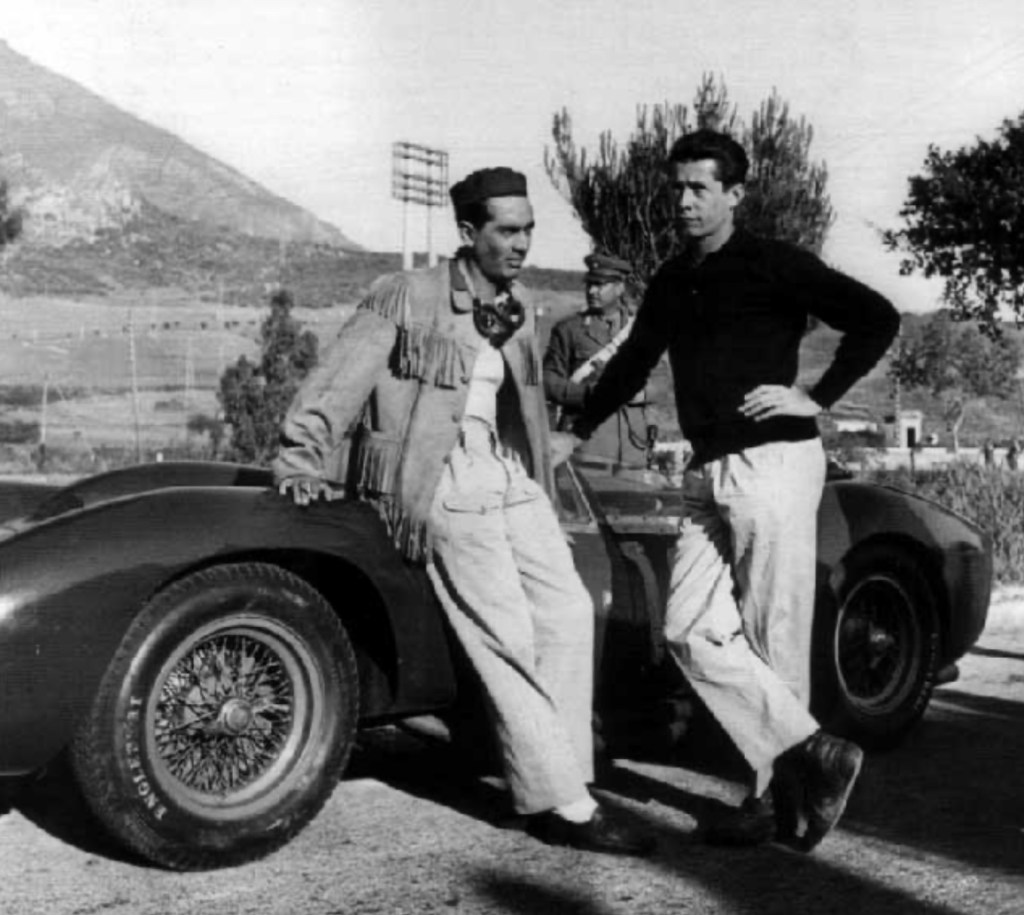
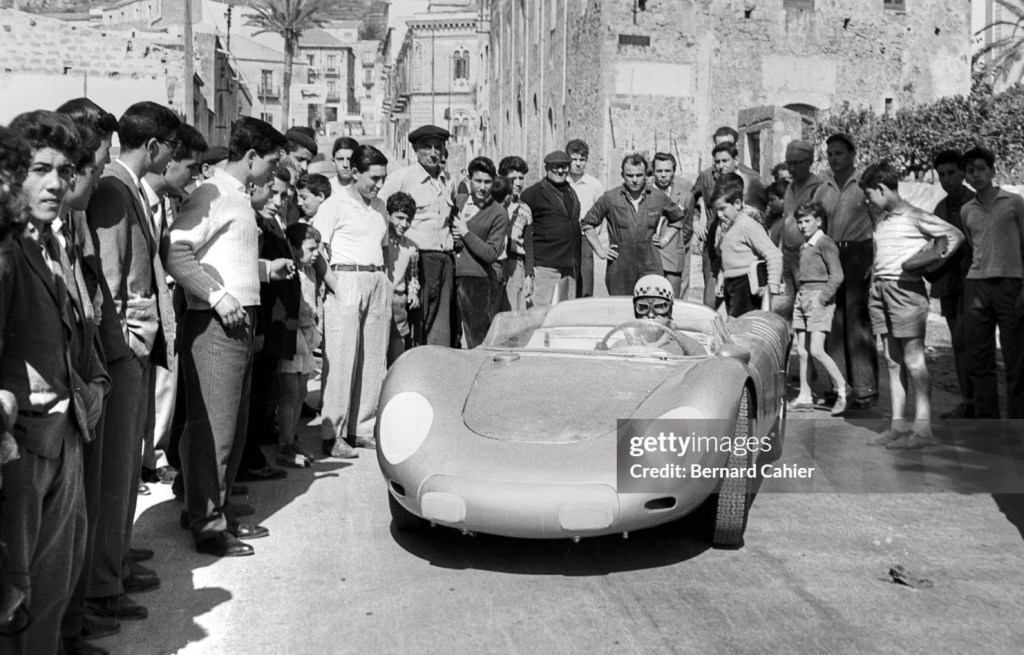
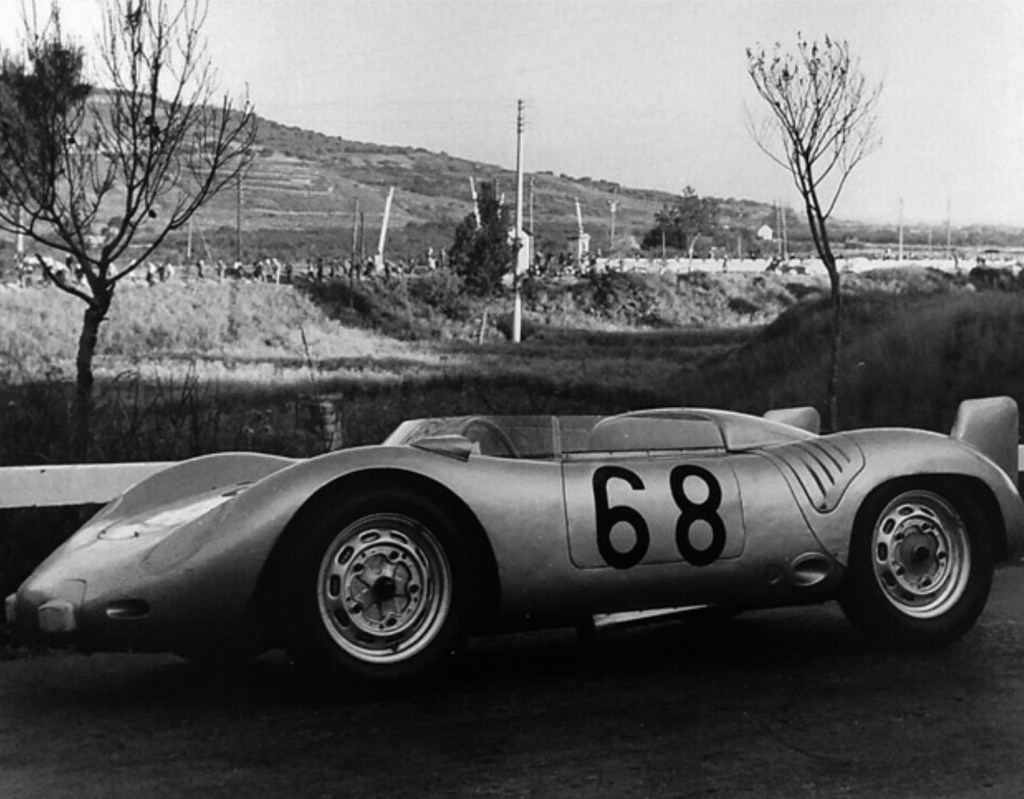
Luigi Musso and Olivier Gendebien before the off, while below, Jean Behra gets ready to start in the RSK he shared with Giorgio Scarlatti, and below that, the same car at rest.
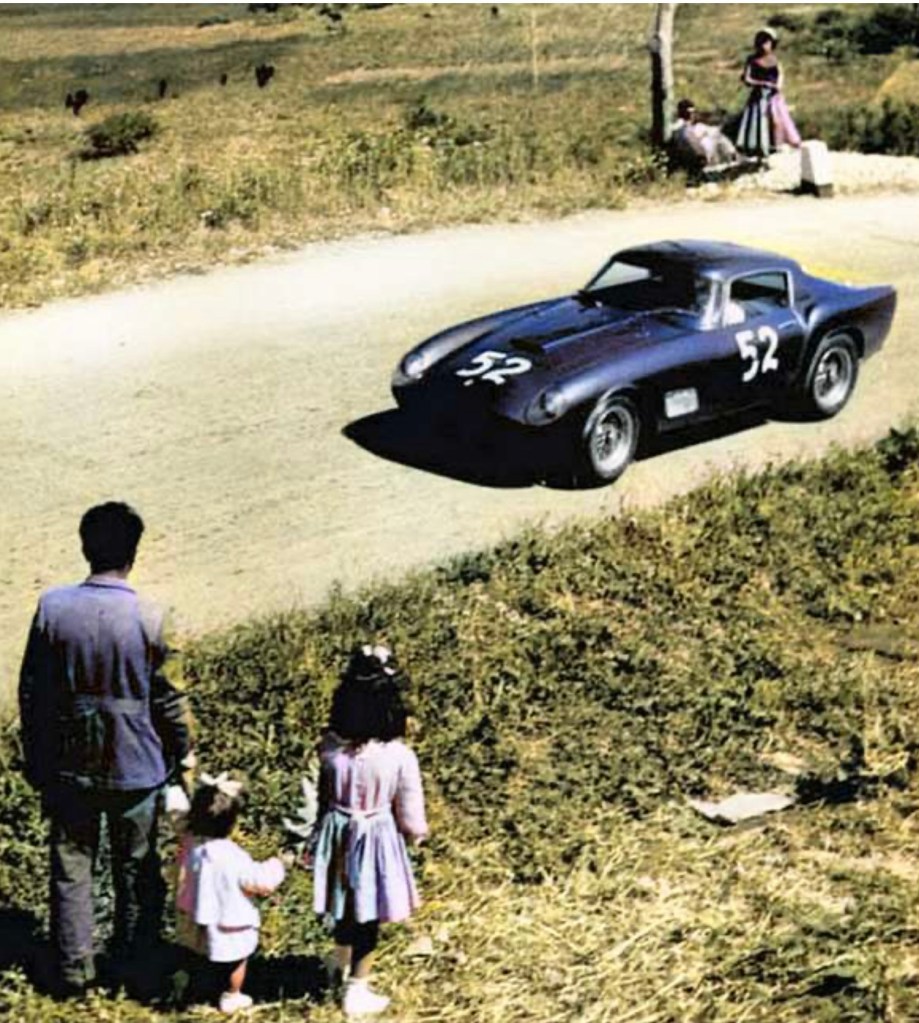
Classic Targa family shot, the cautious family man on the inside of the corner watch the Ferraro brothers – Pietro and Paolo – Ferrari 250 GT LWB (DNF) while macho-man puts himself and the babe at risk on the outside.
(unattributed)
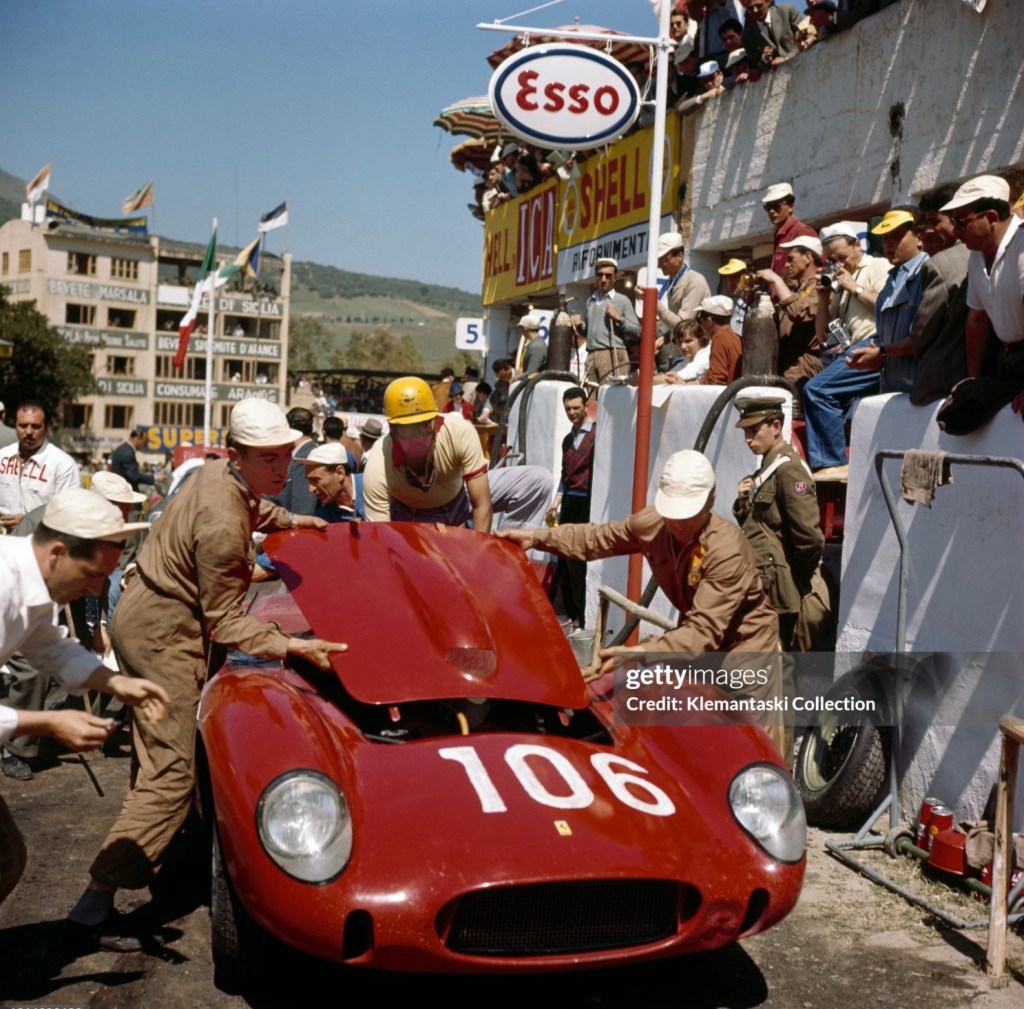
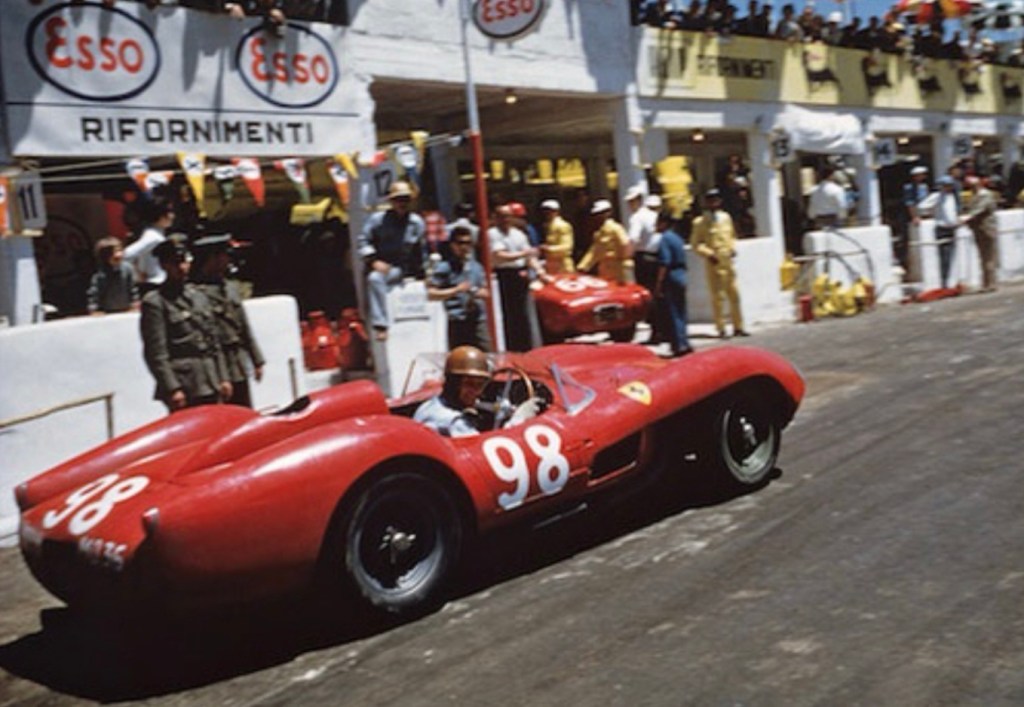
Luigi Musso jumps out of the winning car in the shot above, the more you look the more you see! Mechanics in natty brown overalls, lots of ’em, quick-lift jack to the right, the Shell man to the left and overall vibe grab mine.
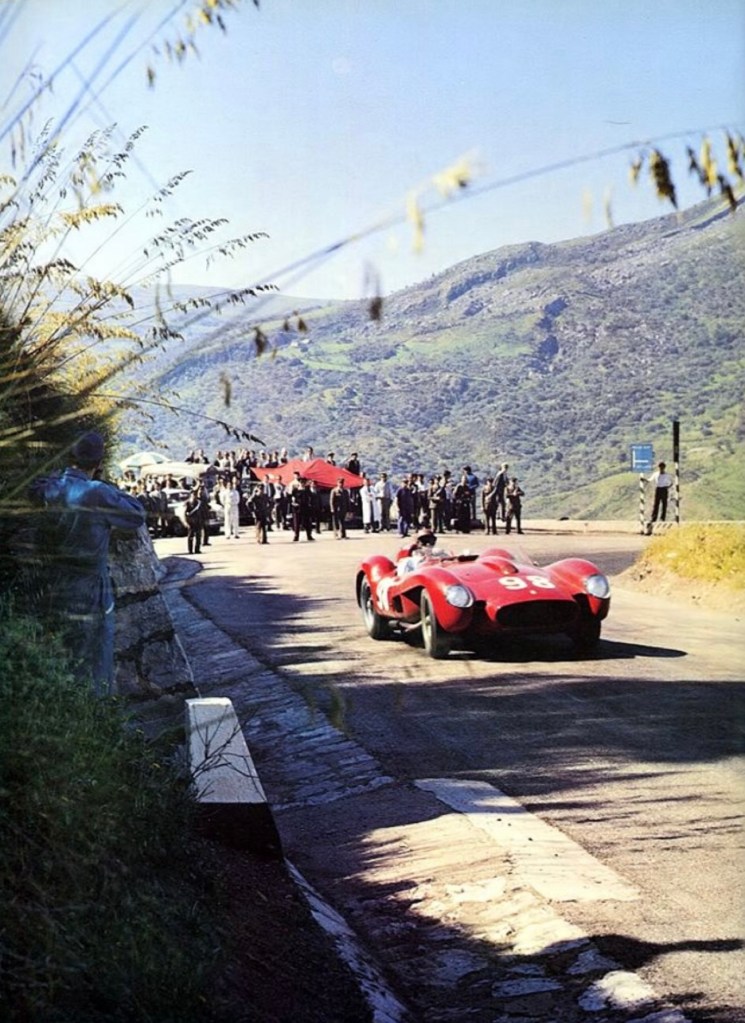
While Peter Collins does his thing in the Testa Rossa he shared with Phil Hill to fourth place, 2.5 minutes or so behind the race winners, below.
(Getty-Klemantaski)(J Alexander)
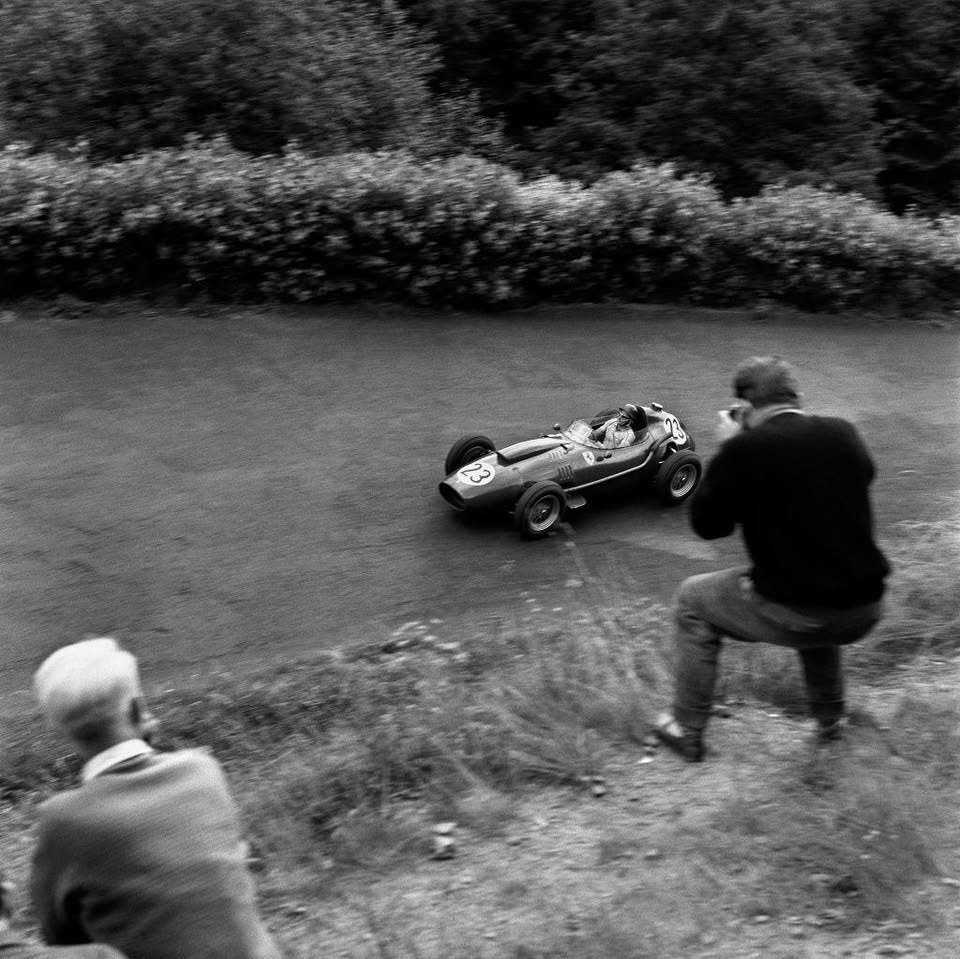
This pairing reminds me that Phil Hill made his Grand Prix debut with Scuderia Ferrari on the Nurburgring, during the 1958 German Grand Prix on August 3, the day Peter Collins died at the wheel of a Ferrari Dino 246, Phil was in a 156, the F2 variant, shot above.
Luigi Musso died chasing Mike Hawthorn during the French Grand Prix at Reims a month before on July 6, both on 246 Dinos.
Alfonso de Portago died at Cavriana during the May 12, 1957 Mille Miglia aboard a Ferrari 335S, while Eugenio Castellotti was killed at the wheel of Ferrari 801 testing at Modena that March 14.
Mike Hawthorn’s death at the wheel of his Jaguar Mk1 on the Guildford Bypass – as the reigning but retired Ferrari World Champion – bookended a horrific two years for Ferrari. Driver error in all cases folks, mistakes could be awfully expensive in them-thar days…
Etcetera…
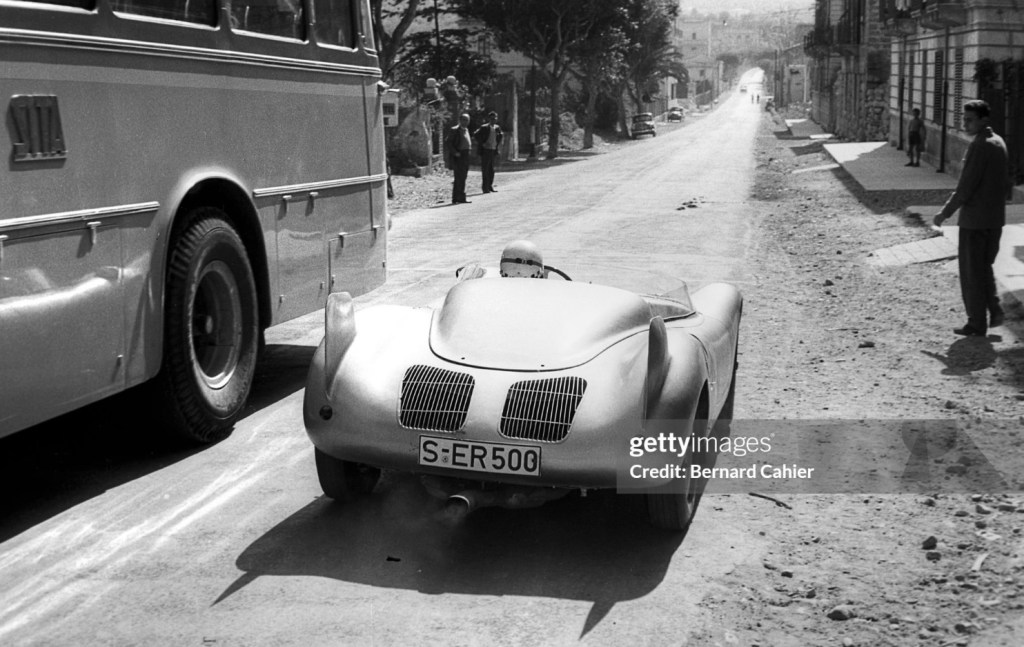
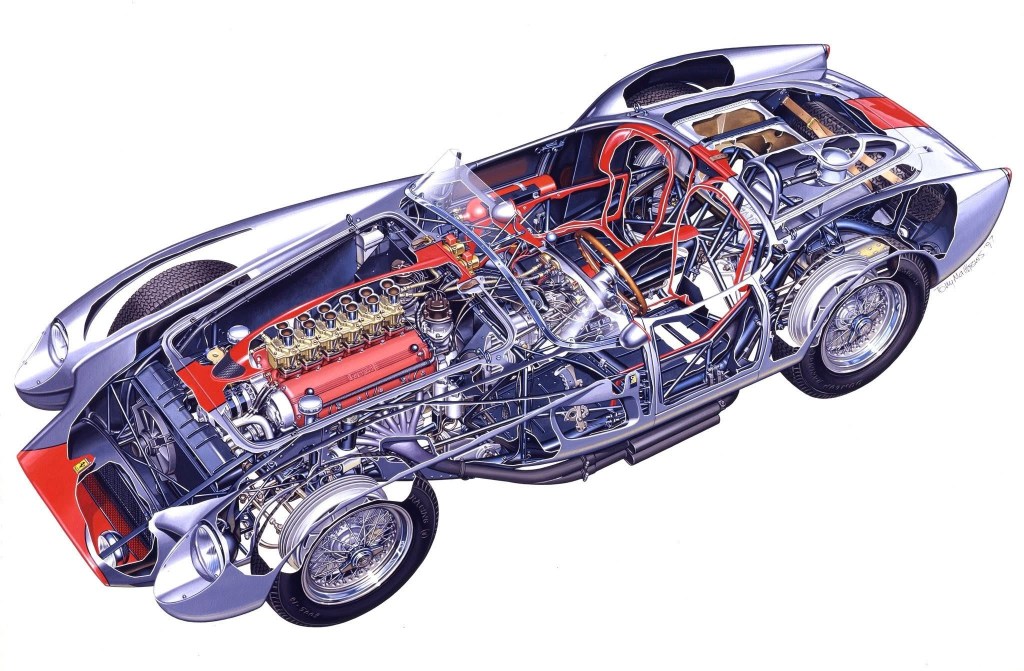
Jean Behra blows off a bus during practice…while Peter Collins shows off the voluptuous lines of the Testa Rossa below.
(Wikipedia)
The FIA reacted to the 1955 Le Mans and 1957 Mille Miglia tragedies by limiting outright cars contesting the 1958 World Sportscar Championship to a capacity of no more than 3-litres.
Ferrari picked up where they left off with the 4-litre 335S, the 3-litre, circa 300bhp 250 Testa Rossa won four of the six championship rounds: Buenos Aires, Sebring, Targa and Le Mans and the championship from Porsche, the other pair of outright wins on the Nurburgring and at Goodwood went to the Aston Martin DBR1/300 who were third in the title chase.
Collins, maaagic shot! (Y Debraine)(T Matthews)
Technical Specifications in brief…
Tipo 128LM 60° SOHC two-valve Colombo V12, alloy block and head. Bore/stroke 73.0/58.8 – 2953cc, Compression ratio 9.8:1, six Weber 36DCN carbs, two distributors, circa-300 bhp @ 7200rpm.
Four speed all synchro gearbox, diff ratios:3.55, 3.77, 4.00, 4.25, 4.59, 4.86:1
Tipo 526 welded steel ladder frame chassis, 2350mm wheelbase, 1308 front track, 1300 rear track.
Independent front suspension by upper and lower wishbones, coil springs and Houdaille shocks. Rigid rear axle on customer cars, De Dion on factory cars, coil springs, Houdaille shocks
Drum brakes, Borrani wire wheels with 5.50 x 16 inch front tyres and 6.00 x 16 rears. Body by Scaglietti. Weight circa-900kg
Moss chases Collins
Credits…
Michael Wright, targapedia.com, Ted Walker, Getty Images-Bernard Cahier-Louis Klemantaski, Yves Debraine, Tony Matthews, Jesse Alexander, barchetta.cc
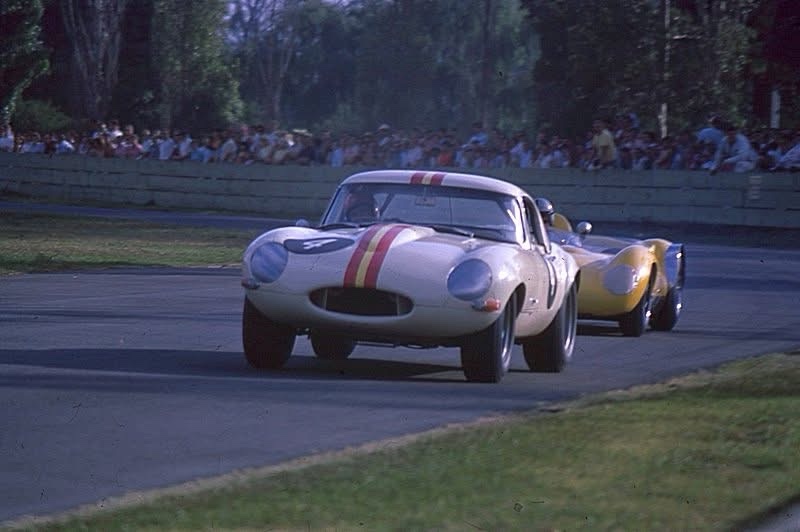
Bob Jane and Pete Geoghegan hard at it during the Warwick Farm Tasman meeting in February 1966. Jaguar E-Type Lwt and ex-McKay Lola Mk1 Climax. What were the results of these encounters folks?
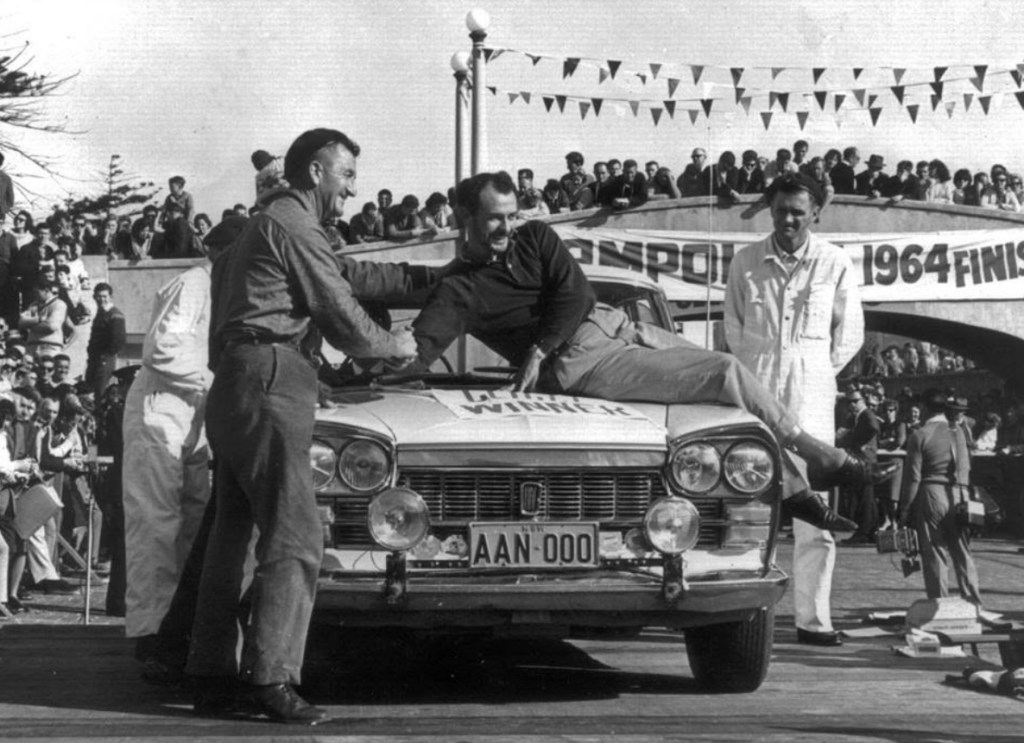
The 31st place Fiat 2300 of Bill Burns, Brian Lawler and Bruce Kaye at the end of the 11,260 km 1964 Ampol Round Australia Trial, Queen Elizabeth Drive, Bondi Beach on June 28.
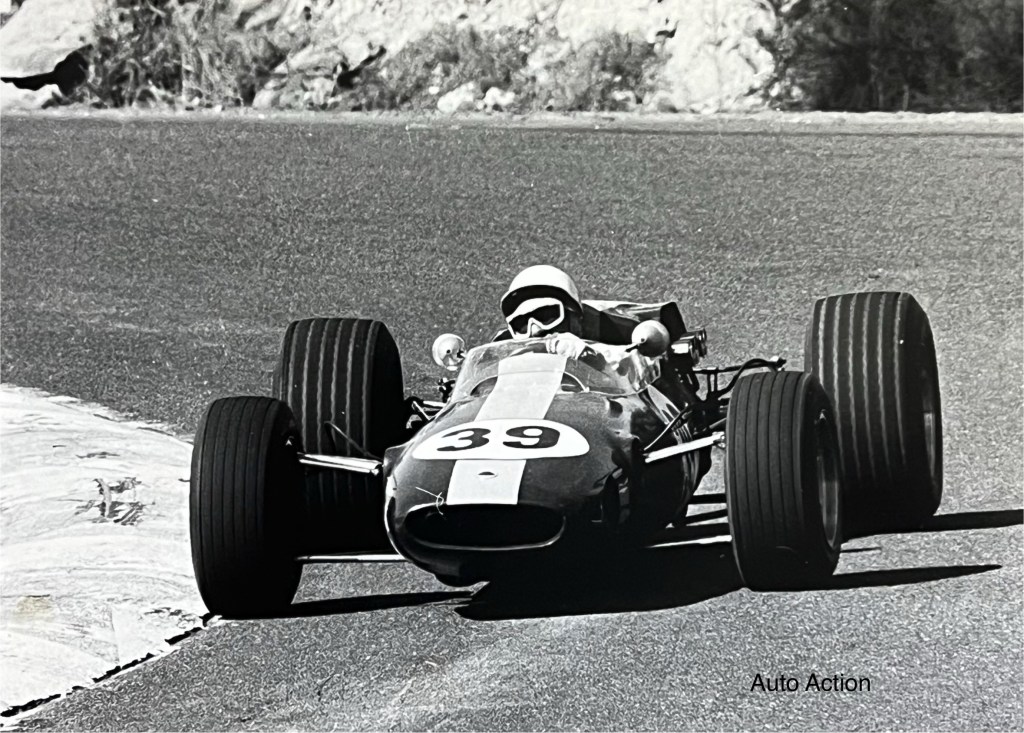
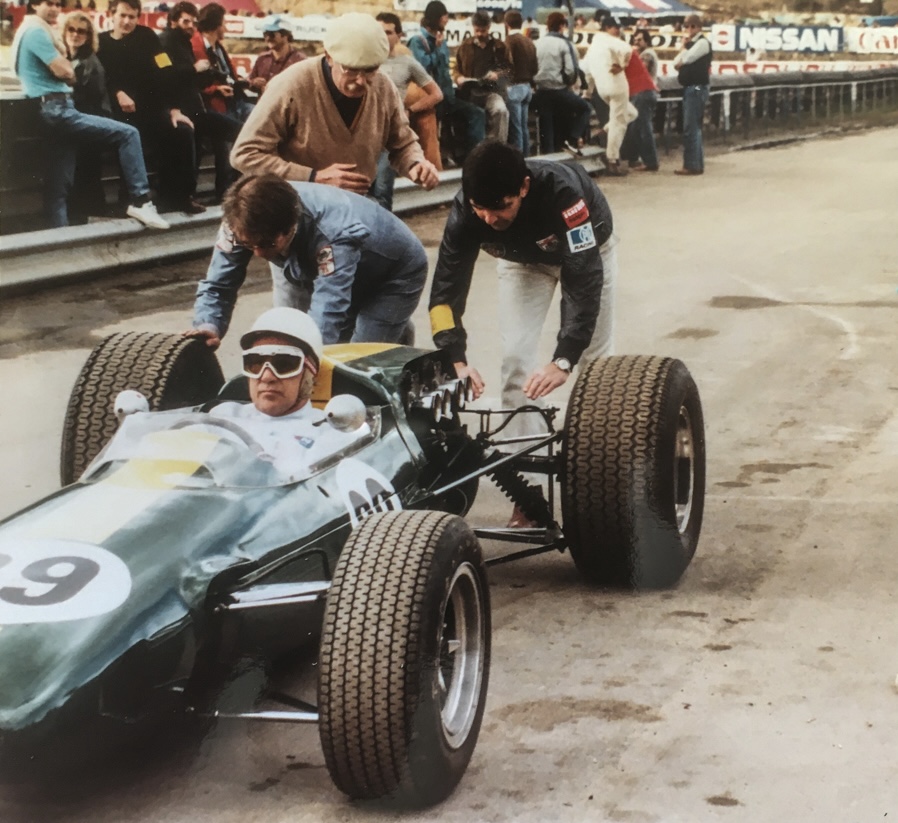
Stirling Moss giving the ex-Jim Clark-Leo Geoghegan Lotus 39 Coventry Climax 2.5 FPF a gallop during the 1984 Tribute to Jaguar meeting at Amaroo Park in the Summer of 1984.
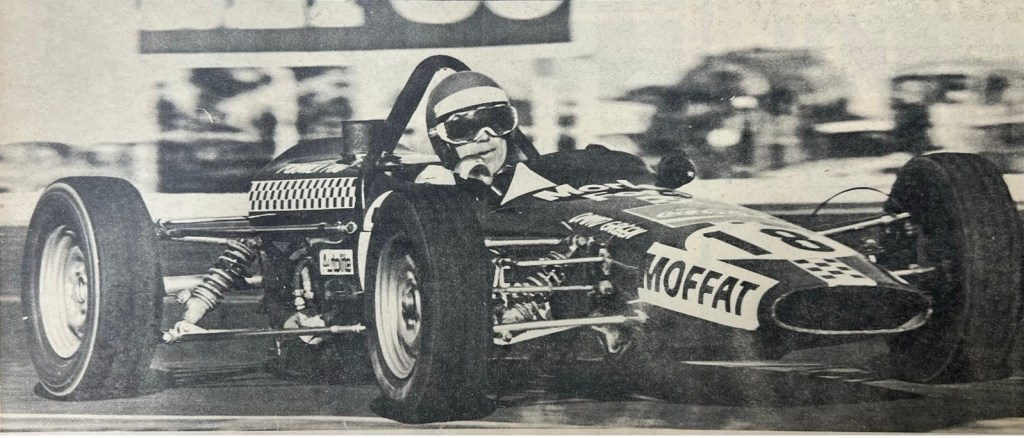
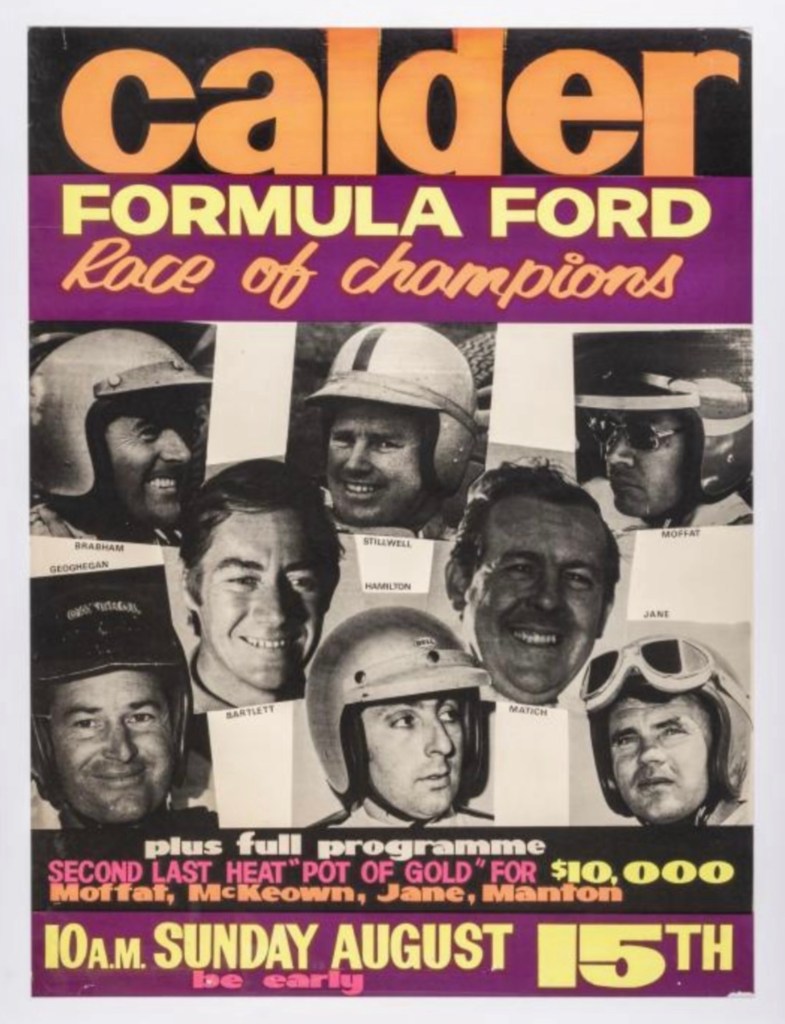
Allan Moffat – who had an open-wheeler phase in his distant past – at the wheel of a Wren Formula Ford during the ‘Race of Champions‘ at Calder on August 15, 1971.
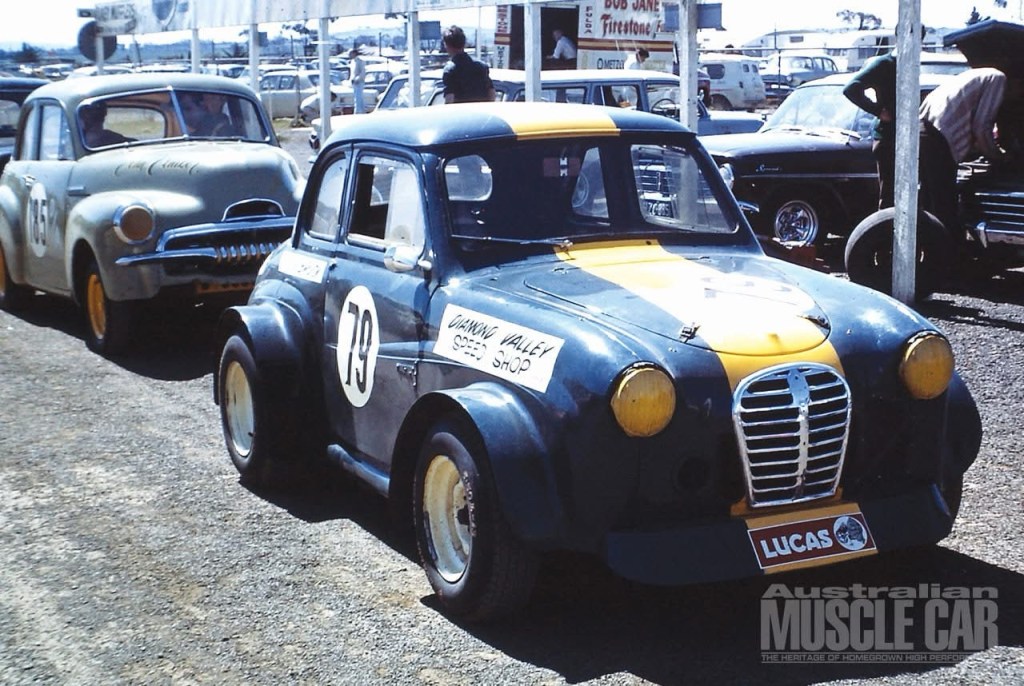
Australian Nationals drags racing meeting at Calder in October 1968. Peter Brock lines up in his famous Austin A30 Holden 179.
He was knocked out by Ken Spence’s Ford Zephyr 289 in the first round, no Top Eliminator that weekend, but there would be plenty of those to come! Article about this car, slightly!, here: https://primotipo.com/2018/05/07/brocks-birrana/
(MotorSport)
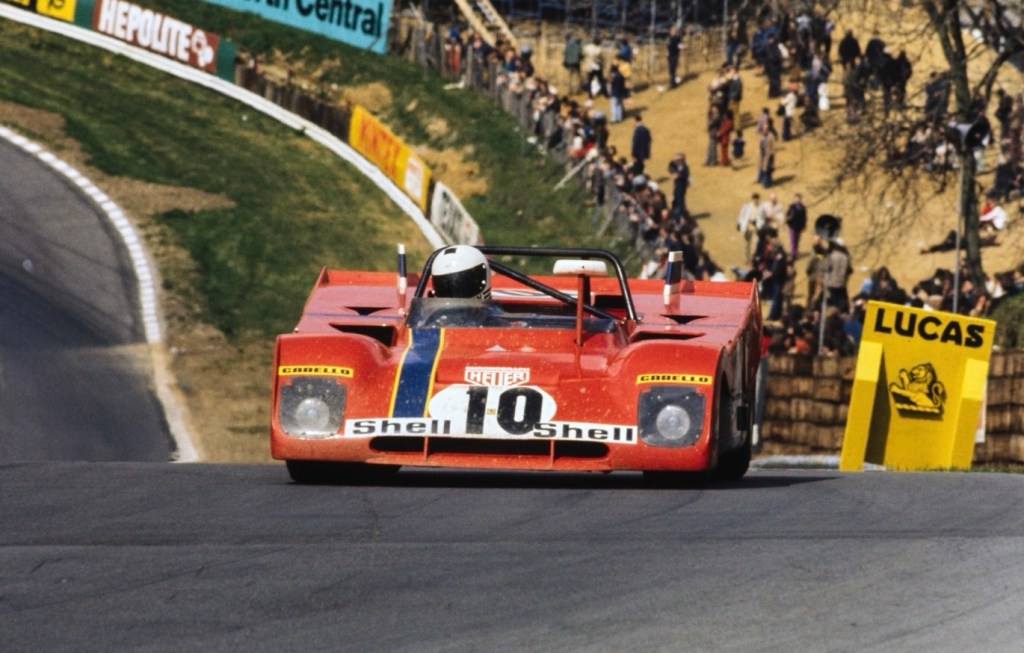
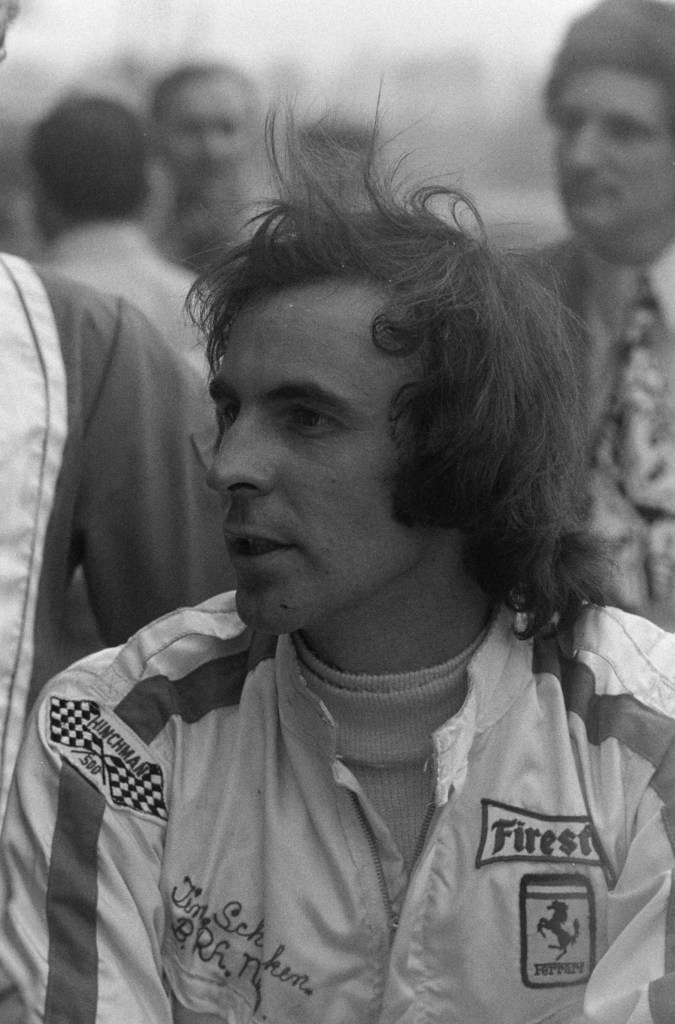
Tim Schenken was living the dream by 1972, his third year in F1 – Surtees that year – and a member of the victorious Scuderia Ferrari 312PB squad in 1972-73.
The shot above shows Tim on the approach to Druids, where the pair were second in the Brands Hatch 1000km run on April 16, a lap ahead was the winning Jacky Ickx/Mario Andretti 312PB.
His driving partner was usually his mate, Ronnie Peterson in ’72. That year the pair won the 1000km of Buenos Aires, Nurburgring 1000km on the way to Ferrari’s crushing World Sportscar Championship victory that season.
They dipped out at Le Mans – that is they piked, didnt enter – knowing the F1 derived Flat 12 engine wouldn’t last the distance, Graham Hill and Henri Pescarolo won there in their Matra MS670, its F1 derived V12 lasting the distance rather well! Noting it wasn’t their first attempt with said engine.
Matra won again the following year with a Ferrari 312PB second, six laps in arrears: Henri Pescarolo/Gerard Larrousse MS670B and Arturo Merzario 312PB.
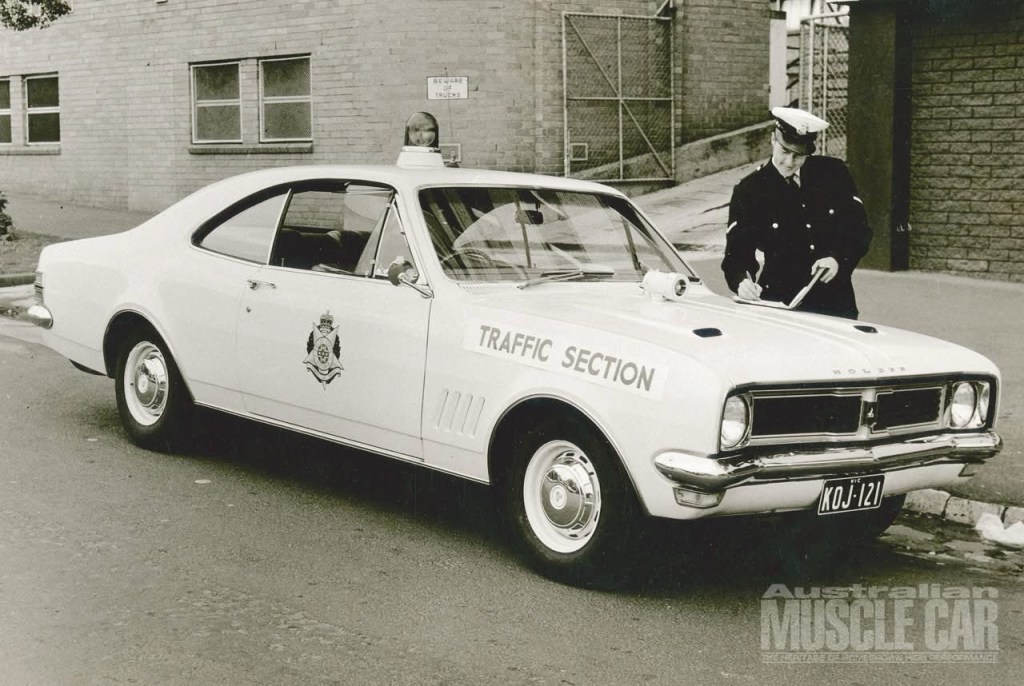
The only things missing are fatties and dice swinging’ from the mirror…two of these HT Holden Monaros were trialled by Victoria Police but rejected as fleet-mainstream additions.
Very hard for the crooks to get out of the back seat I would have thought, but maybe hard to get the corpulent ones in there. The cars would have been nice props on Homicide or Matlock Police…
(K Devine)
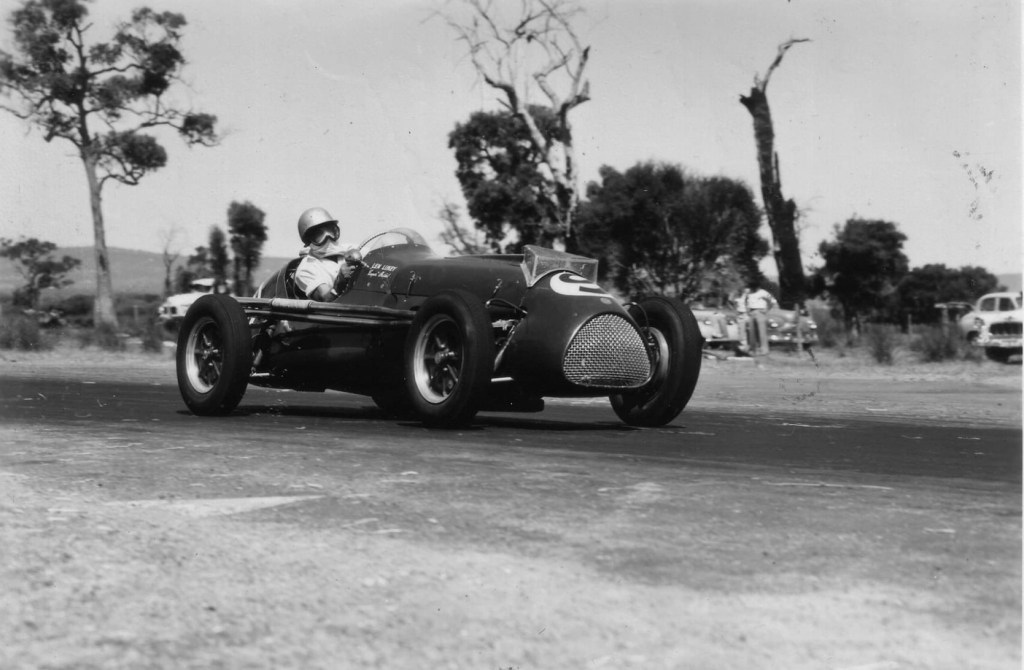
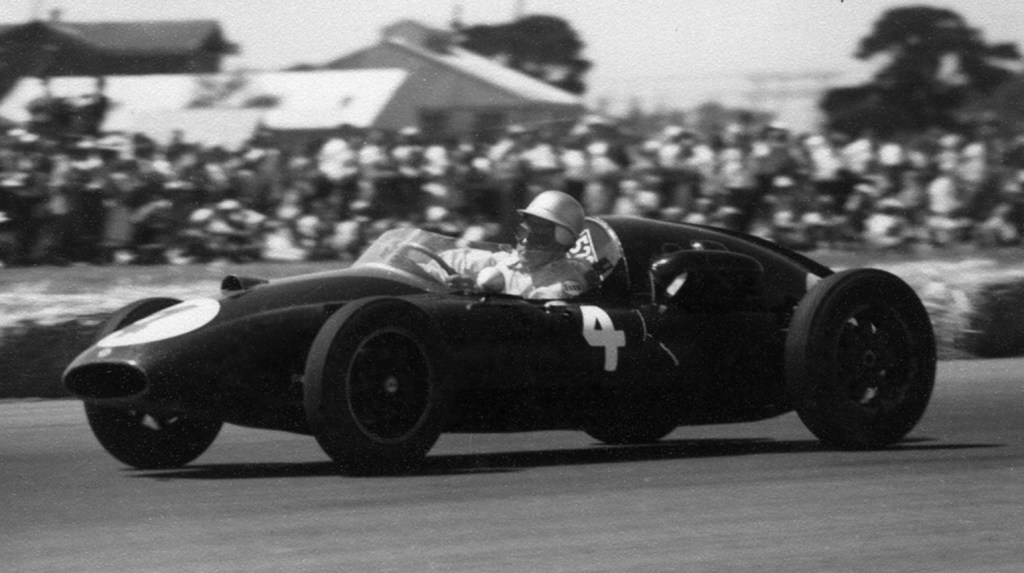
Len Lukey, Cooper T23 Bristol on the way to fourth place in the Australian Grand Prix at Caversham, Western Australia.
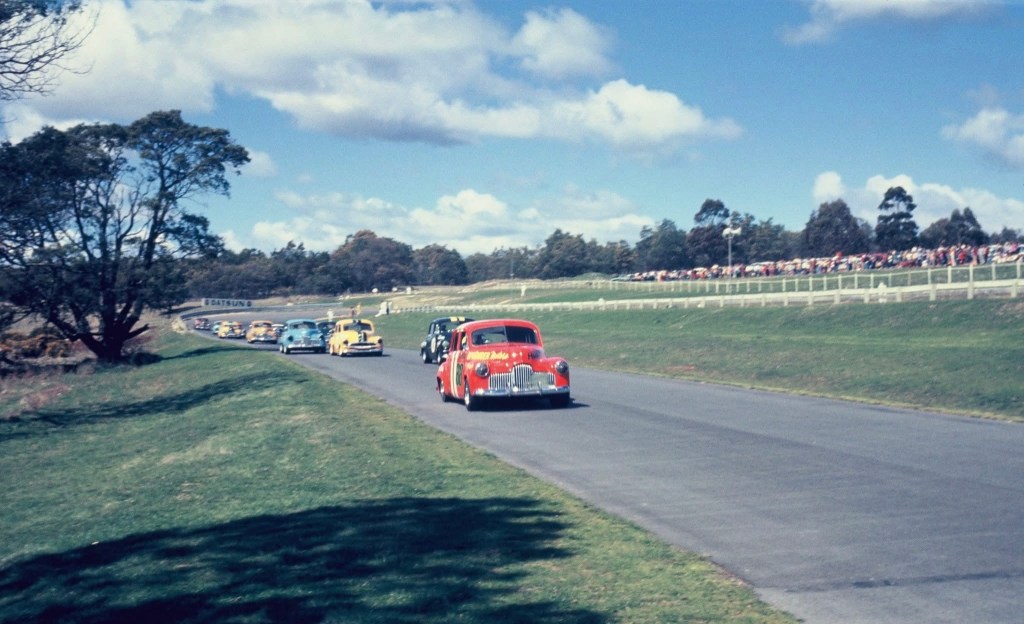
Ellis French tells us the pilots of the first four Humpy Holdens are Messrs Warner, Mather, De Pauli and and Wilcox in this fabulous, panoramic Symmons Plains shot.
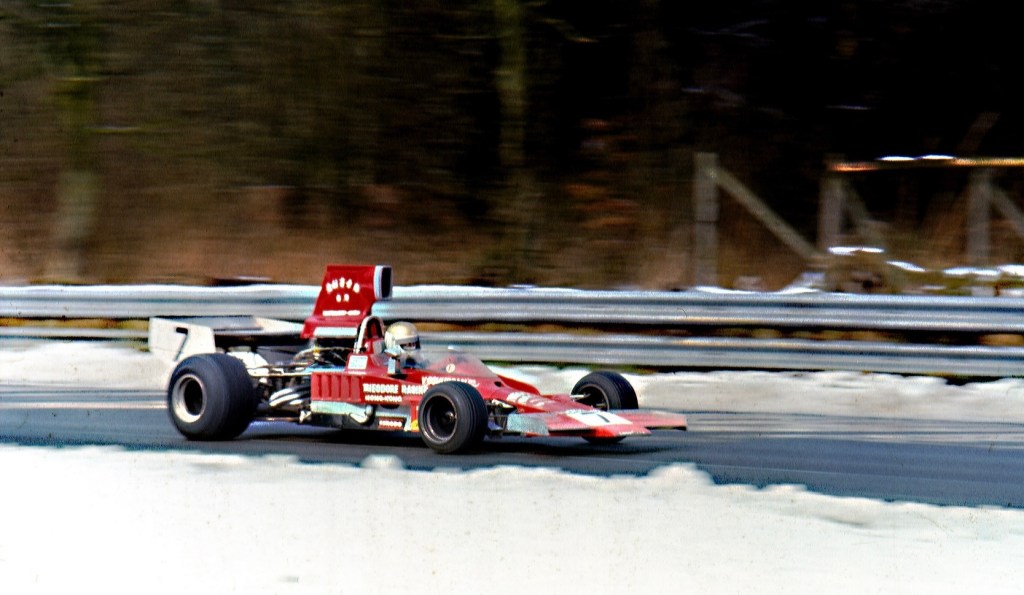
‘Make sure you keep it on the black-stuff Vern for chrissakes!’ may well have been Sid Taylor’s instructions to his driver: Yip-Theodore-Taylor Lola T332 Chev.
It’s the Oulton Park Euro F5000 round over the March 28 weekend in 1975 I believe folks. Vern was 11th, Gordon Spice won in another T332 Chev. More about Vern here: https://primotipo.com/2022/01/17/vern-schuppan-3/
This chassis was Jack’s 1966 weapon of war in the Tasman and F1 championship and non-championship events, owned for decades by Repco Ltd or whatever the retailer is called these days.
(Stupix)
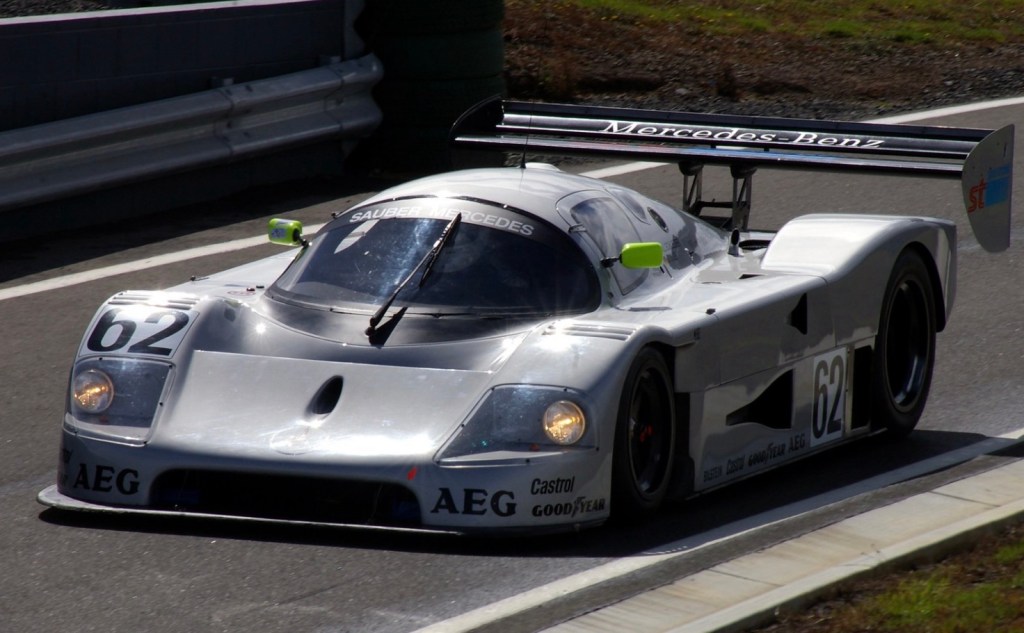
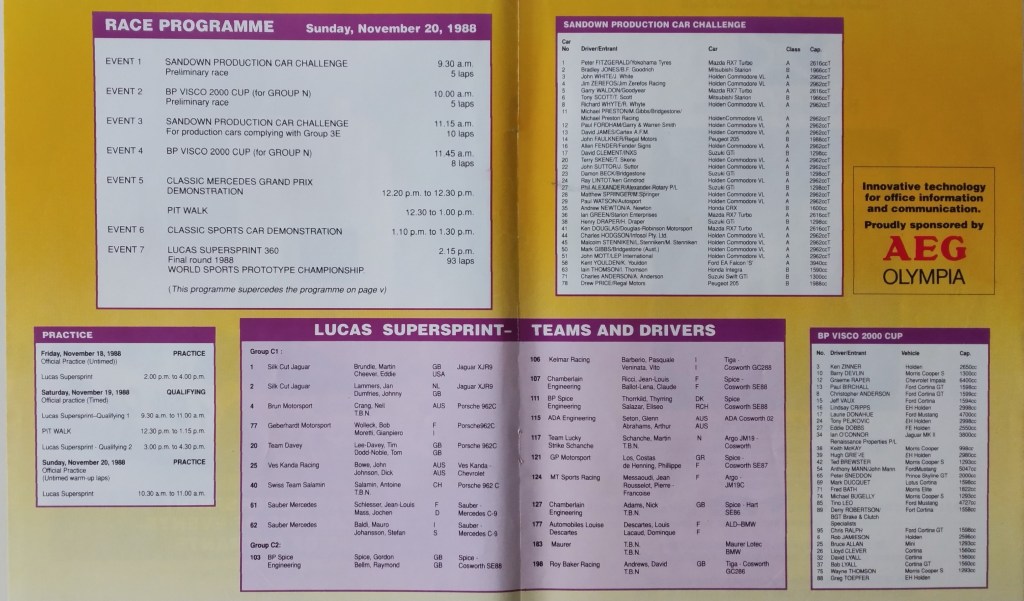
The second placed Mauro Baldi/Stefan Johansson Sauber Mercedes C9 5-litre V8 turbo during the Lucas Supersprint Sandown 360 over the November 20, 1988 weekend
While the entry for this race wasn’t as broad and deep as the 1984 Sandown 1000k the scale of the Fiscal Disaster for the Light Car Club of Australia was similar, see here: https://primotipo.com/2024/05/25/sandown-1000-1984/
(Stupix)
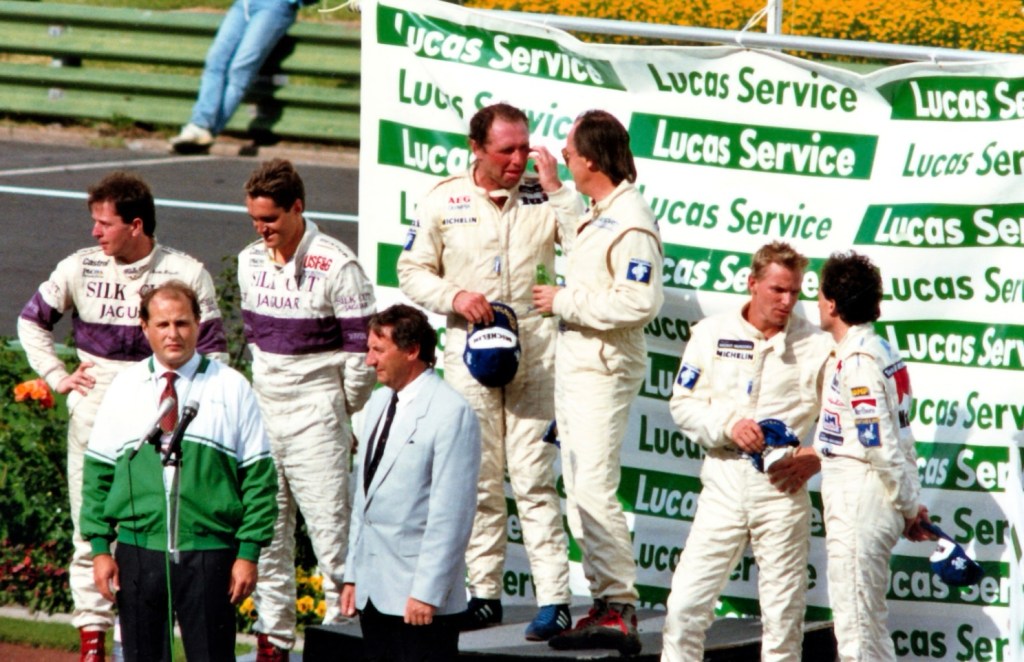
From the left, third place Martin Brundle and Eddie Cheever, Jaguar XJR9 7-litre V12, winners Jochen Mass and Jean-Louis Schlesser, and second men Johannsson and Baldi, Sauber Mercedes C9.
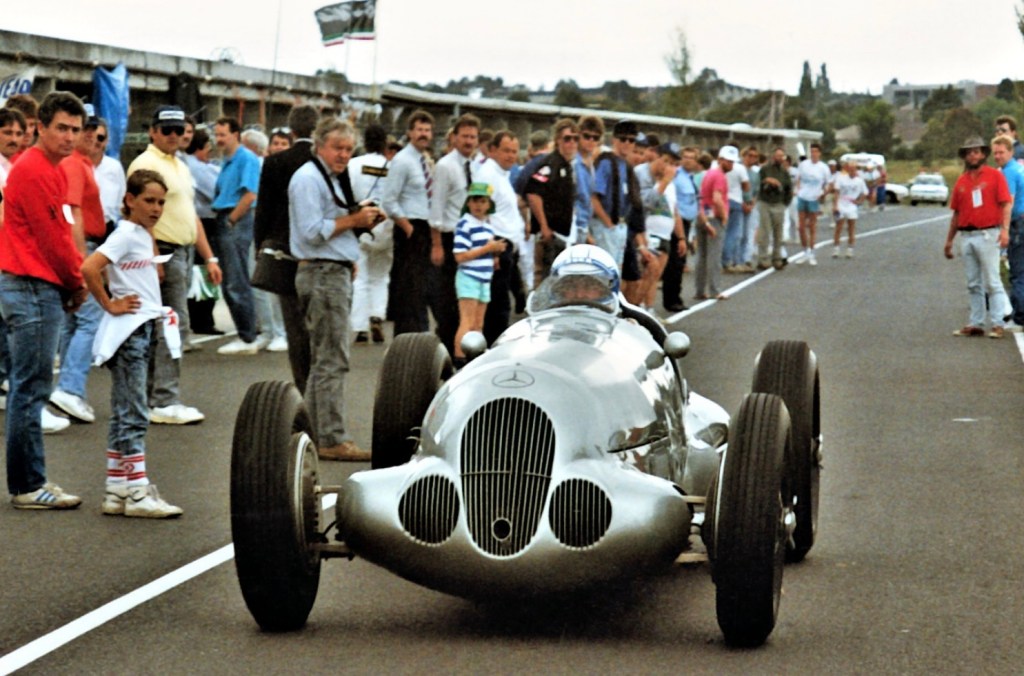
Jochen had a busy weekend not only racing his hi-tech C9 but also demonstrating a 1937 Mercedes Benz W125 Silver Arrows, very spectacular it was too!
(Stupix)(S Dalton Collection)(P Bowen)
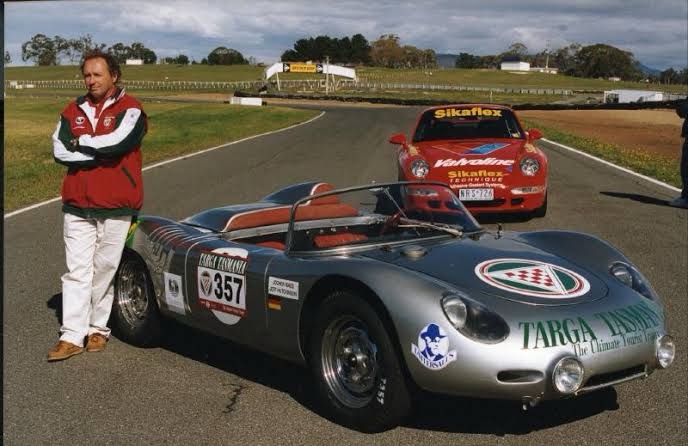
Jochen with the Porsche Museum 550 Spyder in which he had an enjoyable Historic category win in the 1996 Targa Tasmania.
Credits…
Bob Williamson Archive, Ern McQuillan via Jim Strickland, Mike Harding-Auto Action, Ken Devine, Australian Muscle Car, John Shingleton, Stupix, Peter Bowen, John Brock, State Library of Victoria, Stephen Dalton Collection
Tailpiece…
(SLV)
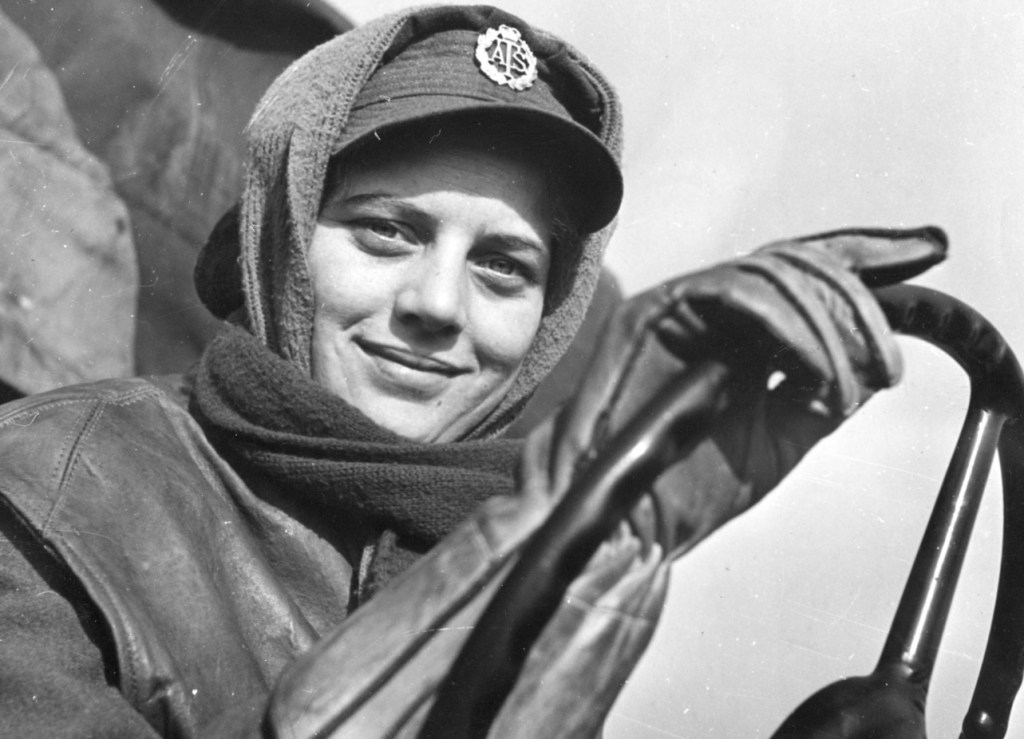
Australian Auxiliary Territorial Services Driver, Gladys Pollard, on assignment in the UK during 1942, summer by the look of it…
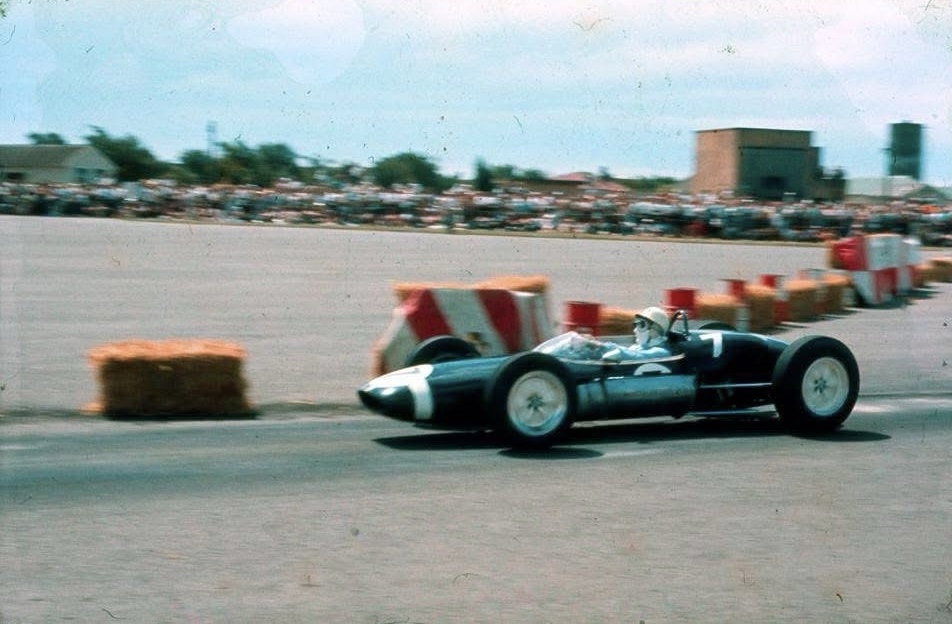
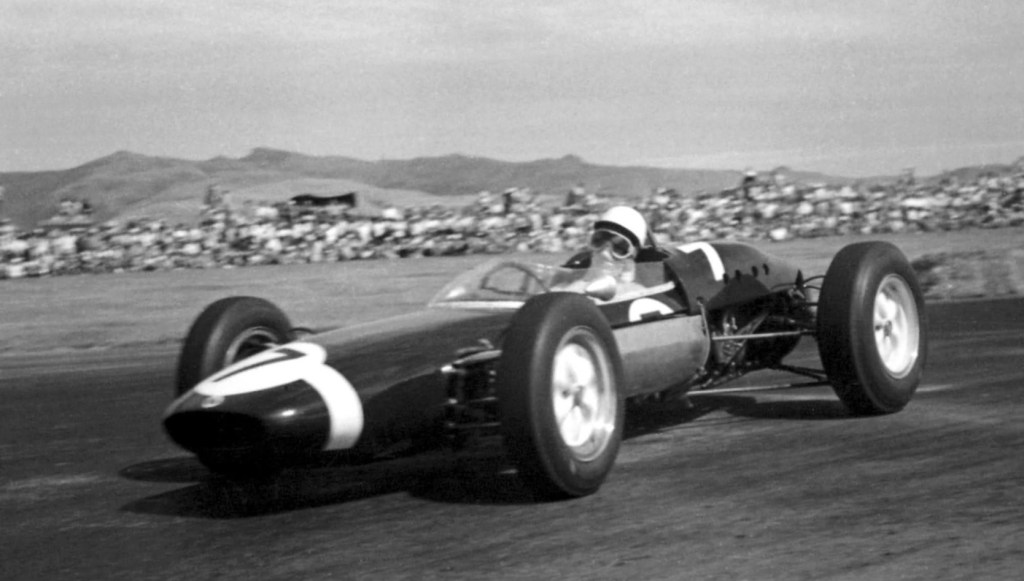
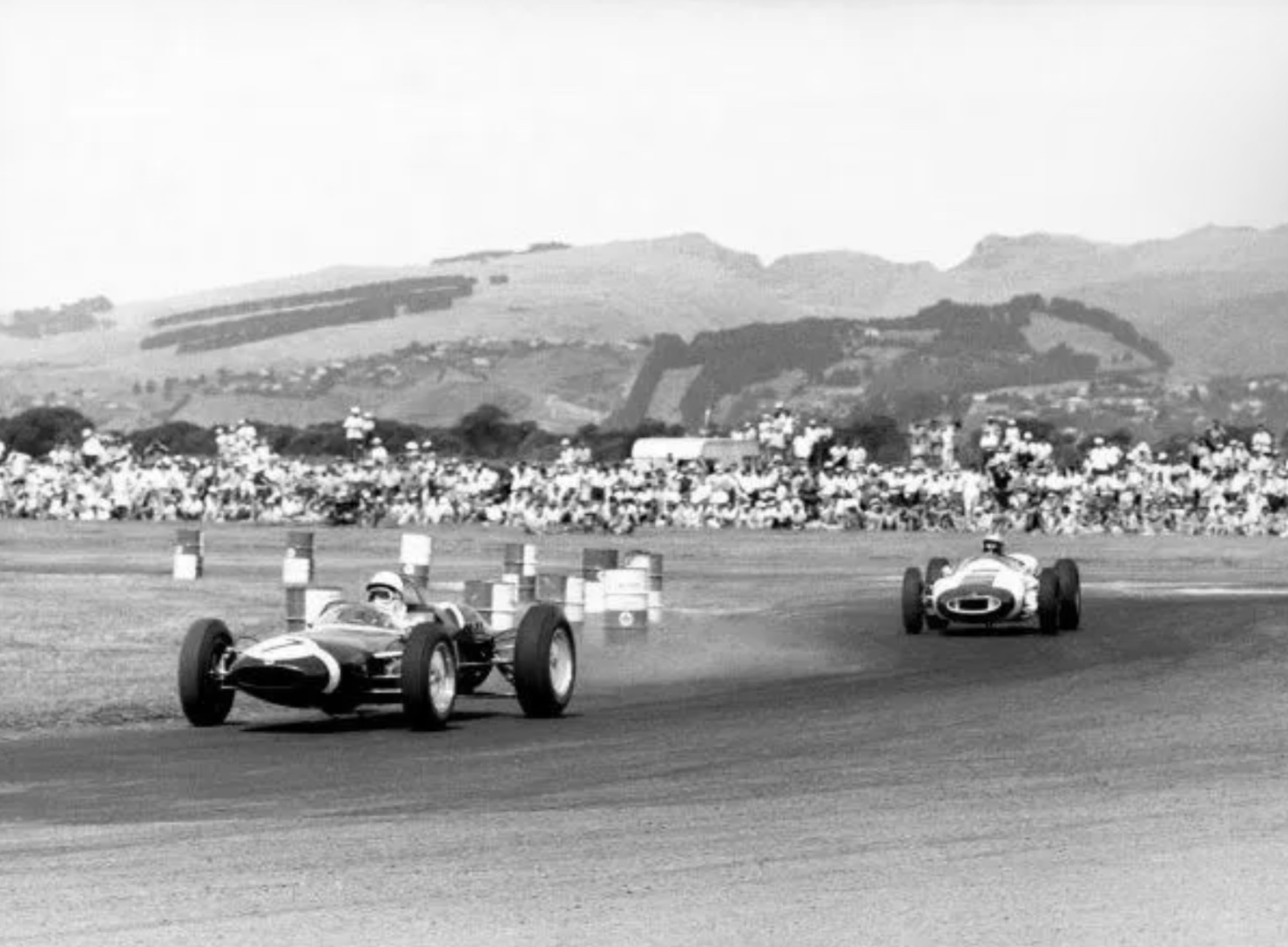
Stirling Moss on his way to winning the January 20, 1962 Lady Wigram Trophy in searing New Zealand heat.
He has the side-panels of Rob Walker’s Lotus 21 Climax FPF 2.5 removed to get a bit of air flowing through the cockpit of chassis #935.
I love this ode to the demise of the fabulous front-engined Grand Prix cars written by Digby Paape.
‘I remember coming away from this race thinking, “Well, that’s the end of exciting racing.” Gone were the front engined monopostos with loud exhausts that rang off the Port Hills, the drivers biceps fighting the wood-rimmed steering wheel, the blue chrome on the exhausts, the dirty spoked wheels, the broadsides and four-wheel-drifts. All gone with the advent of these pesky little cars that cornered on rails and sounded like Austin A40’s.’
Luvvit!
Australian great Lex Davison referred to the Coopers as ‘Anti-Climaxes’ and ‘Mechanical Mice’…not that it stopped him racing and winning in them!
Moss approaching the Wigram hairpin (unattributed)Jack Brabham on his way to victory at Ardmore in 1958, Cooper T43 FPF 2.2 (unattributed)
The mid-engined rout started early in NZ. Jack Brabham won the 1958 NZ GP at Ardmore aboard a Cooper T43 Climax on January 11, a week before Moss won the first Championship F1 race in a mid-engined car at Buenos Aires on January 19. He too raced a Cooper T43 in that Argentine Grand Prix, one of Rob Walker’s cars.
Broaden the definition to Grand Prix racing and the mid-engined feat wasn’t a big deal given Auto Union’s pre-war successes, but such is the fixation with Formula One these days that most prefer to ignore the history of a period that doesn’t interest them or of which they have no knowledge.
It wasn’t too many years before – 1956 – that Moss had first visited the country and taken New Zealand’s premier race, again at Ardmore aboard one of the great front-engined Grand Prix cars, the Maserati 250F.
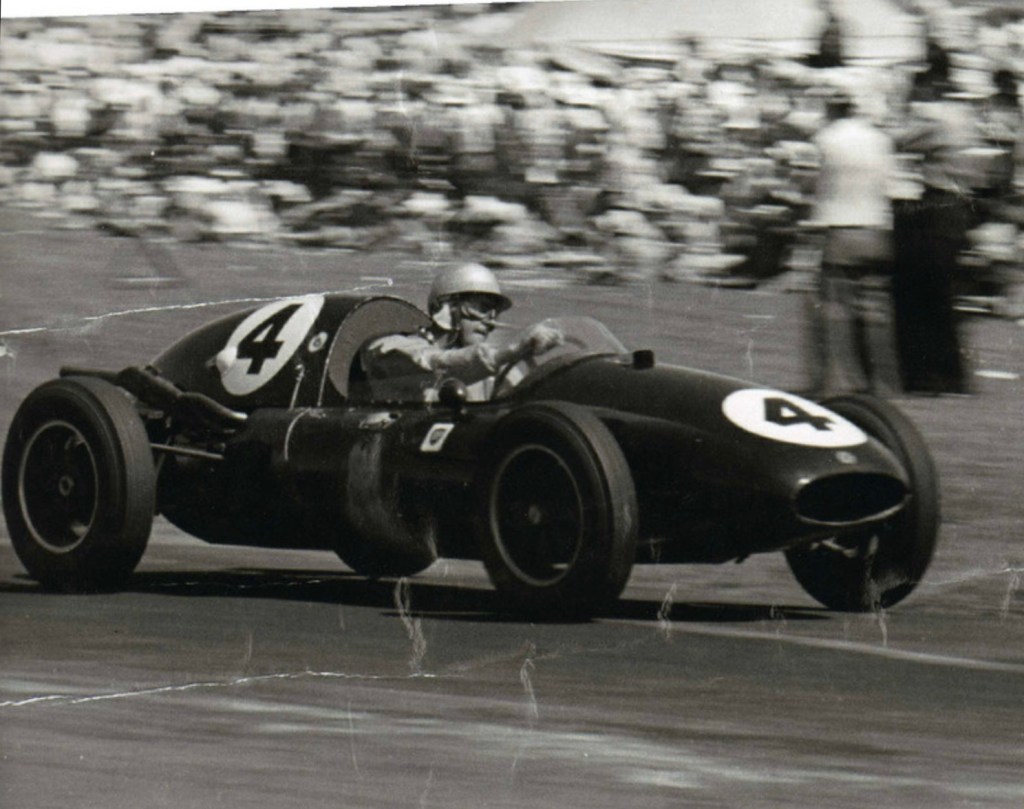
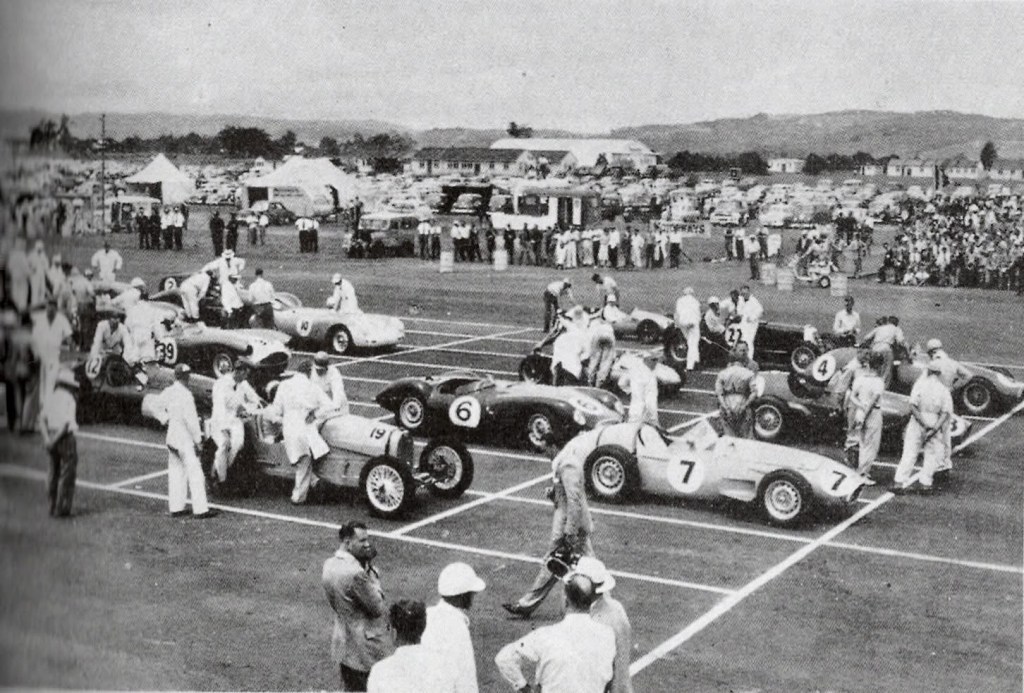
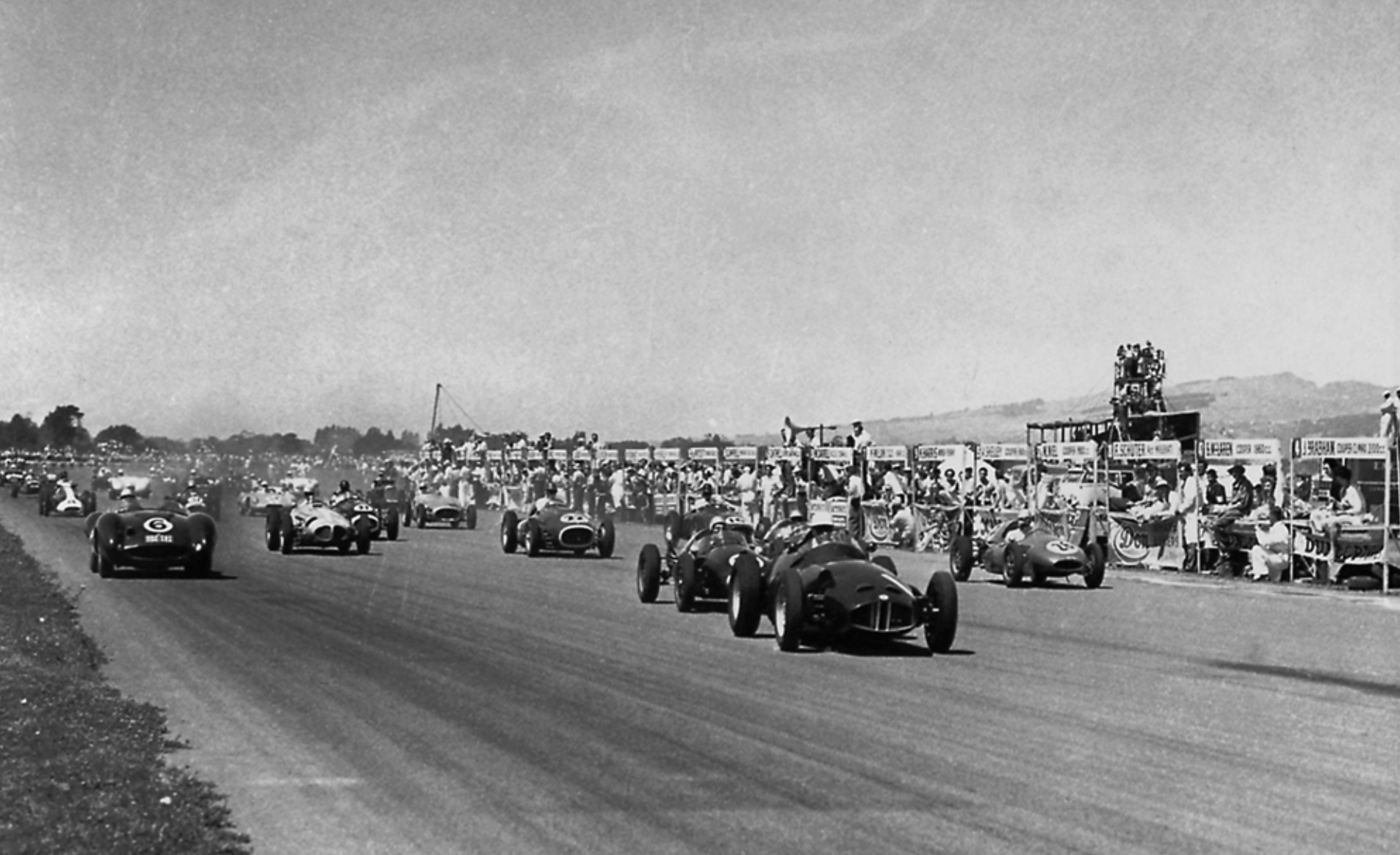
#7 is Moss’ with the 3-litre Ferrari 500/625s of Peter Whitehead and #4 Tony Gaze alongside. The Bugatti is Ron Roycroft’s T35A Jaguar, #6 is another Jaguar engined car, Peter Whitehead’s Cooper T38 being raced by Reg Parnell. Peter lent Reg the car after Parnell’s Aston Martin DP155 had engine problems in practice. Moss won from Gaze and Whithead.
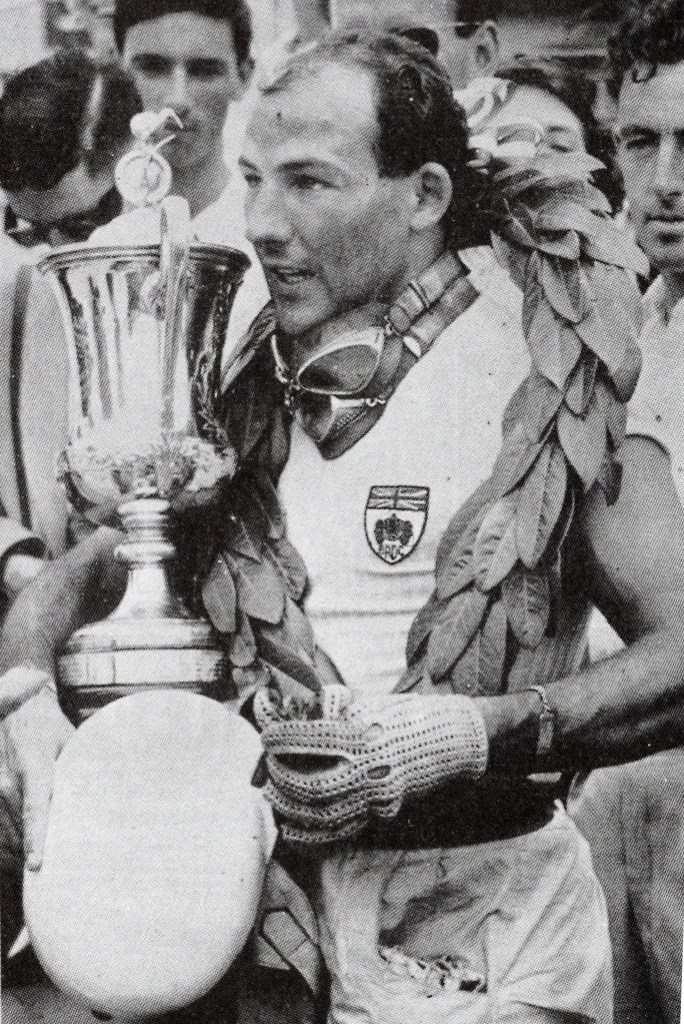
Moss post race with biceps bulging having wrestled with his 250F’s wood-rimmed wheel for the previous 2 hours 32 minutes!
Tailpiece…
(R Herrick)
Rob Walker’s NZ GP winning Lotus 21 Climax leaves Ardmore on the back of a modest trailer towed by a Borgward Isabella Coupe…simpler times.
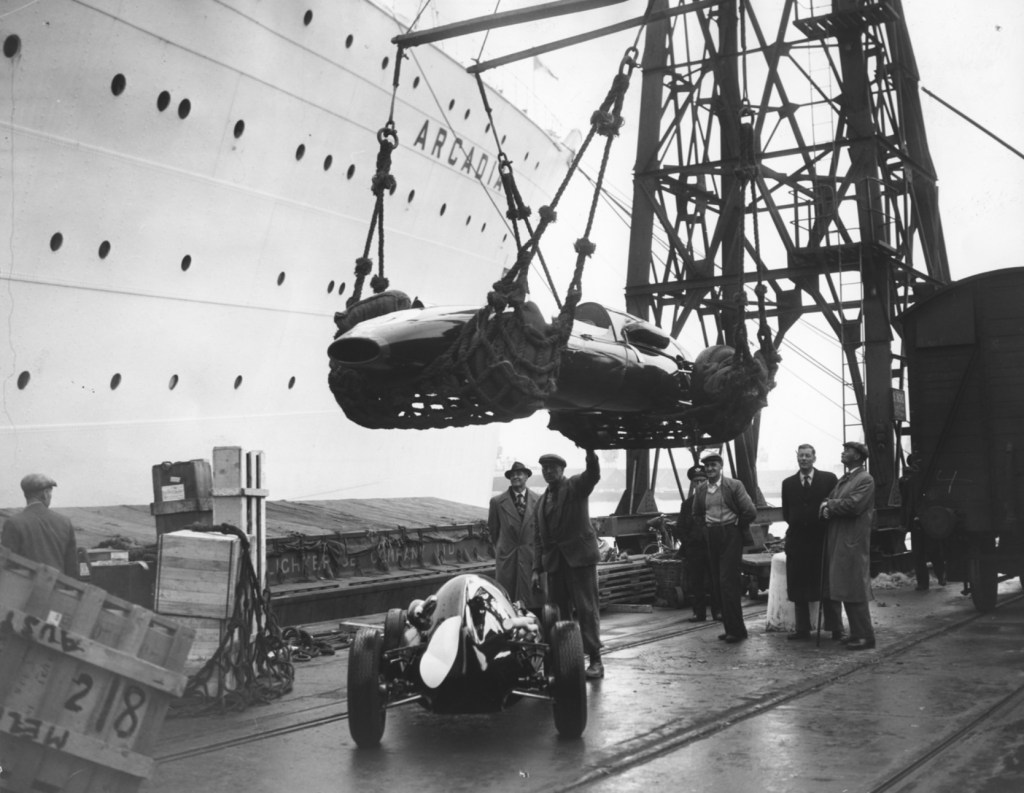
Jack Brabham’s Cooper T45 Climax (F2-10-58) enroute to the hold of P&O Line’s 30,000 ton SS Arcadia while Stirling Moss’ similar Rob Walker car (F2-9-58) awaits its turn at Tilbury Docks.
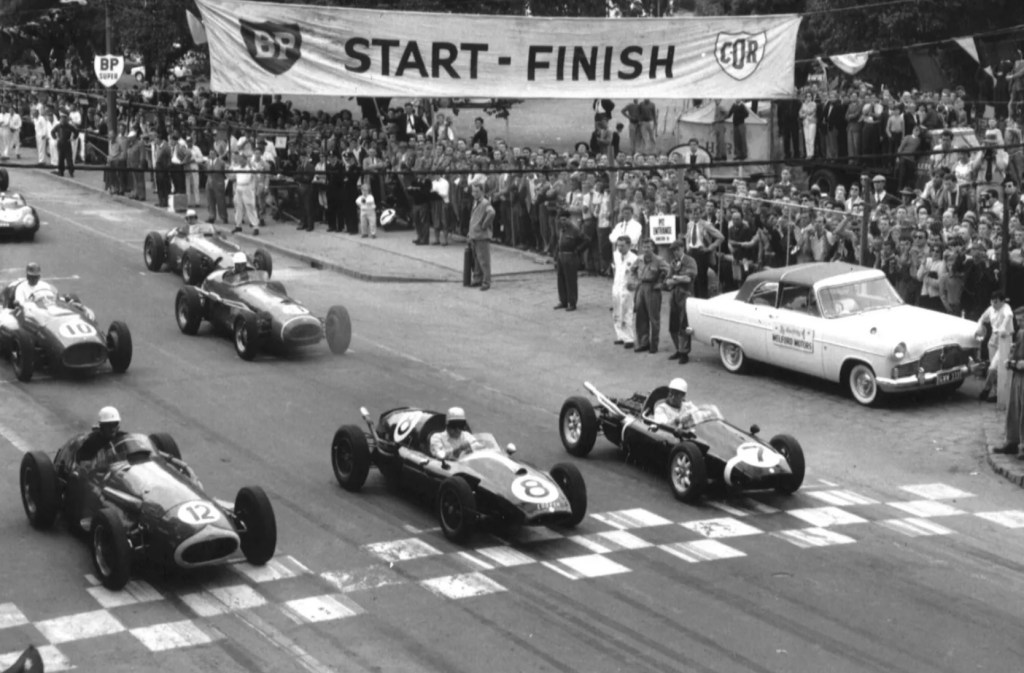
It’s October 20, 1958, seven weeks before the Melbourne Grand Prix at Albert Park on November 30 where this pair of drivers and cars were the star attractions in a 19 car field. The Arcadia arrived 11 days before the race allowing plenty of pre-event promotion.
I was contacted by P&O Heritage in June last year requesting assistance in identifying the cars and the event to which they were travelling, with the assistance of my good friend, Cooper expert Stephen Dalton, that wasn’t a drama. With their exhibition now well over we can share the shots.
(P&O Heritage)
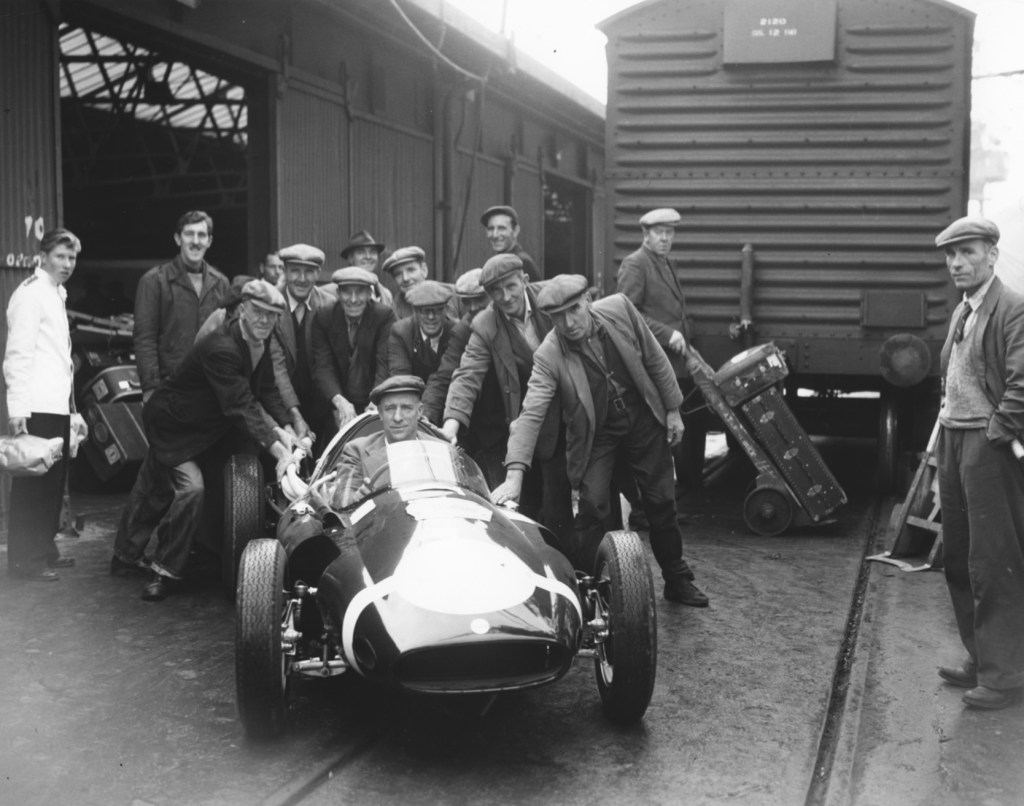
Arfur Daley! was my first reaction, look at them all with their peaked-caps to ward off the brisk River Thames air. It’s Stirling’s Rob Walker owned T45, chassis F2-9-58, no less than the car in which Maurice Trintignant won the ’58 Monaco GP, and with which Moss was victorious in the non-championship F1 Aintree 200 and Caen GP that year.
Brabham’s F2-10-45 was acquired from the British Racing Partnership: Alfred Moss and Ken Gregory. It had been raced in 1.5-litre F2 events continuously throughout 1958 by Stuart Lewis-Evans in between his Vanwall F1 commitments and Tommy Bridger otherwise. Lewis-Evans had many top-5 placings and one win at Brands in June.
Maurice Trintignant during the 1958 Monaco GP. The Walker T45 F2-9-58 won from the two works Ferrari Dino 246s of Luigi Musso and Peter Collins (MotorSport)Stuart Lewis-Evans on the hop at Goodwood during the April 1958 Lavant Cup. He was fourth in BRP’s T45 F2-10-58 behind Brabham’s works Cooper T43 and Graham Hill and Cliff Allison’s works Lotus 12s; all cars 1475cc Coventry Climax FPF powered (unattributed)
Still fitted with 1.5-litre Climax FPF, BRP entered Bridger in the Moroccan Grand Prix at Ain Diab. His only GP start, in a six-Cooper F2 race within a race, ended in tears after Tommy spun and crashed on oil dropped by Tony Brooks’ Vanwall the lap before, Bridger completing 30 of the 53 laps. He wasn’t badly hurt, but poor Lewis-Evans died from burns sustained after a separate accident caused by his Vanwall’s engine seizure.
BRP returned the car to Coopers for repair, Brabham then bought it and installed a 2.2-litre Coventry Climax FPF to race in the Antipodes, while the Moss car was fitted with an Alf Francis built 2015cc Climax.
(AC Green)
The trip from Tilbury to Port Melbourne back then took on average, four-six weeks, here the new Arcadia (b1953-d1979) is tied up at Station Pier, Port Melbourne in late March 1954. The trailer leg to transport the cars to Albert Park is a short 6km.
(B King Collection)
The 32 lap, 100 mile Melbourne GP was the eighth of nine Gold Star rounds that year, Stan Jones in the #12 Maserati 250F won the ‘58 title.
Brabham is in #8, #7 is Moss, while another Jones, young Alan is the small white clad figure leaning on the nose of the Ford Zephyr. Moss won the race from Brabham with the very quick Doug Whiteford, Maserati 300S in third
Bib Stillwell was fourth in another 250F with Len Lukey fifth in a Lukey Bristol – Len’s evolution of a Cooper T23. Car #10 is Tom Clark’s 3.4-litre Ferrari 555, the car alongside him is Ted Gray, Tornado 2 Chev.
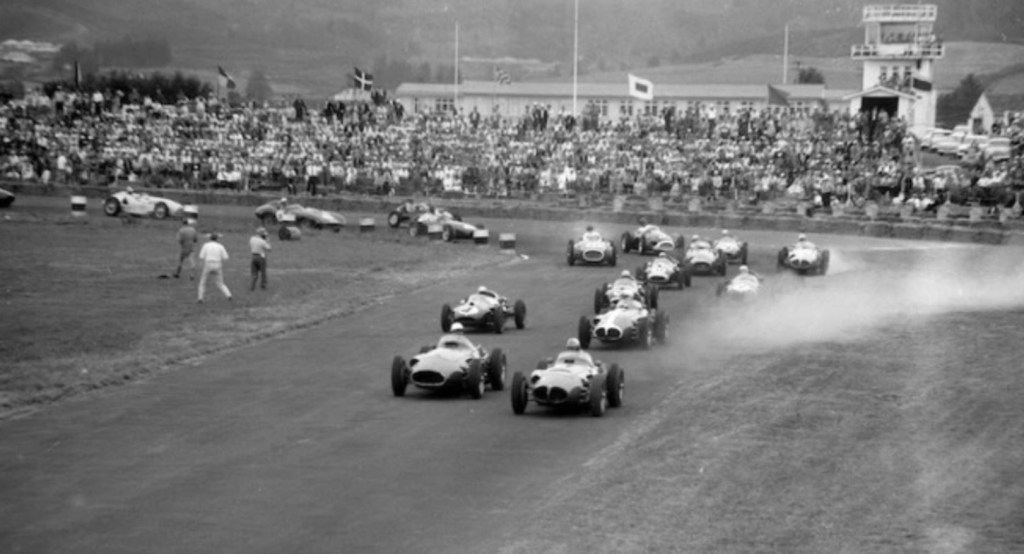
Moss and mechanic, name please? and T45 F2-9-58 on the Albert Park grid. That November 30, 1958 event was the last at Albert Park until the modern AGP era commenced in 1996 (S Dalton Collection)NZGP, Ardmore, January 10 1959. The Schell, Bonnier and Shelby Maserati 250Fs used their 2.5-litre torque to lead for a bit on lap one. #4 is Brabham’s Cooper, with Moss #7 behind and between Jack and Carrol – and the rest (LibNZ)
Both cars were then shipped across the Tasman to contest the Kiwi Internationals. Moss won the New Zealand Grand Prix at Ardmore from Brabham in a big field that included Bruce McLaren, Carroll Shelby, Jo Bonnier and Harry Schell on Maserati 250Fs, and Ron Flockhart’s works-BRM P25.
Brabham aboard F2-10-58 at Ardmore in 1959, second to Moss (T Marshall)
Moss (and the Cooper) then returned to Europe for his other commitments while Brabham did the Lady Wigram Trophy and Teretonga International for second/third, then returned home to New South Wales where he won the South Pacific Trophy at Gnoo Blas.
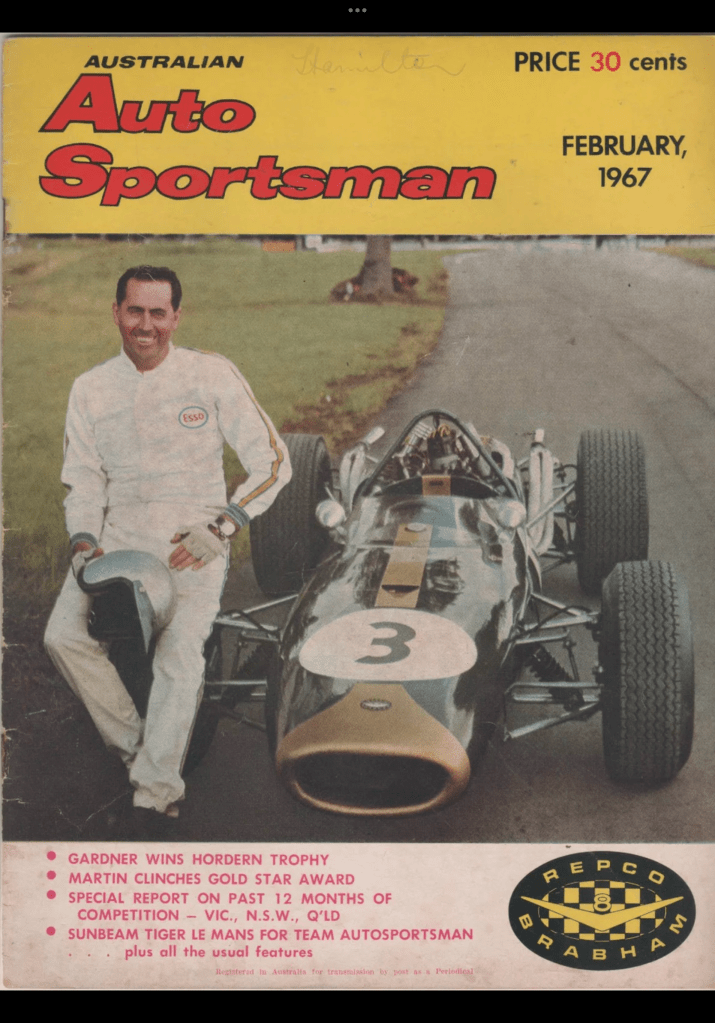
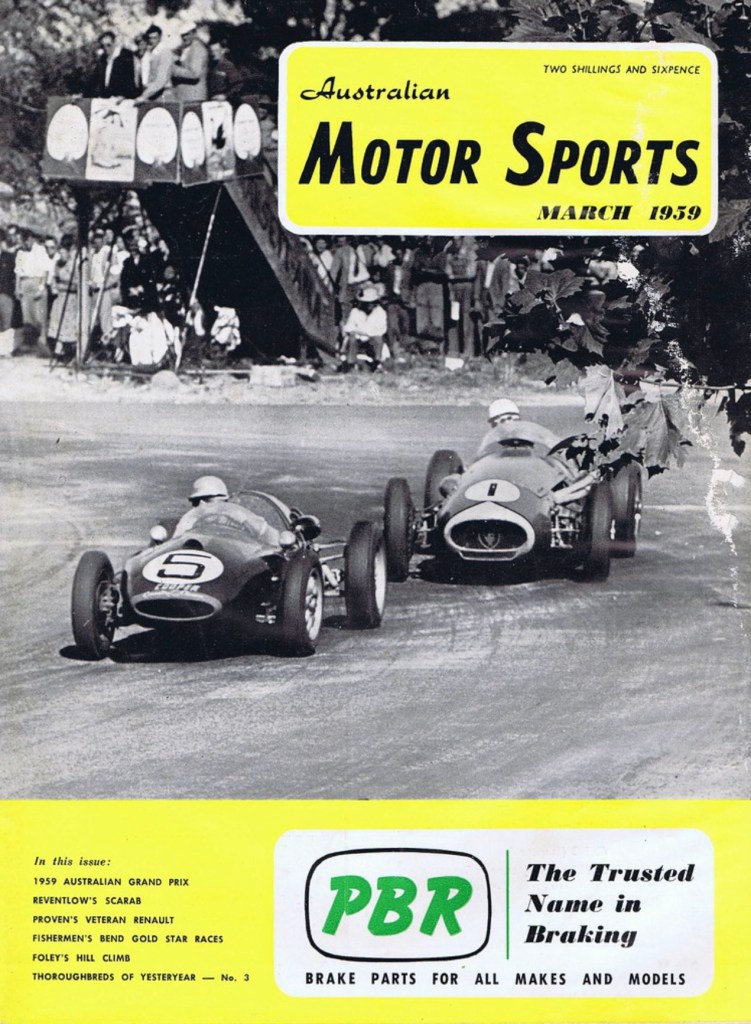
Jack then travelled to Cordoba to begin his F1 season with the February 16 Buenos Aires GP, but not before selling F2-10-58 to Len Lukey. The Melbourne Lukey Mufflers manufacturer used it to good effect to win the 1959 Gold Star, the highlight of which was an epic dice between Len and Stan Jones’ 250F in the AGP at Longford (AMS cover below) which was resolved in Stan’s favour.
The T45 remained in Australia forever, and in a nice bit of Cooper T45/Albert Park symmetry, Stirling Moss drove his Dad, and Jack’s old car in the historic car demonstrations during an Australian Grand Prix carnival in the early 2000s. Both cars are extant…
Etcetera…
(MotorSport)
An unmistakable Aintree shot of Stirling Moss aboard Walker’s T45 F2-9-58 on the way to victory in the BARC 200, April 1958.
(unattributed)
Tommy Bridger holding off Bruce McLaren’s works Cooper T45 Climax and Ivor Bueb’s Lotus 12 Climax aboard the BRP T45 F2-10-58 during the May ’58 Crystal Palace Trophy. He was second, bested only by Ian Burgess’ works Cooper T45, in a great performance.
Credits…
P&O Heritage, Allan C Green-State Library of Victoria, Bob King Collection, Stephen Dalton Collection, sergent.com.au, MotorSport Images, unattributed shots via Bonhams photographers unidentified, Terry Marshall, National Library of New Zealand
Tailpiece…
(MotorSport)
Tommy Bridger in the 1.5-litre F2 BRP Cooper T45 Climax F2-10-58 chasing Gerino Gerini’s Centro Sud Maserati 250F at Ain Diab during the October 19, 1958 Moroccan Grand Prix. Gerini was 11th from Q17 and Bridger DNF from Q22 after the accident described earlier.
The race-within-a-race of six Cooper F2 cars comprised T45s raced by Salvadori, Brabham, McLaren, Bridger and Andre Guelfi, plus Francois Picard’s older T43. Bridger qualified behind the works-Coopers of Roy, Jack and Bruce…he was pretty handy. See more about him here: https://500race.org/people/tommy-bridger/
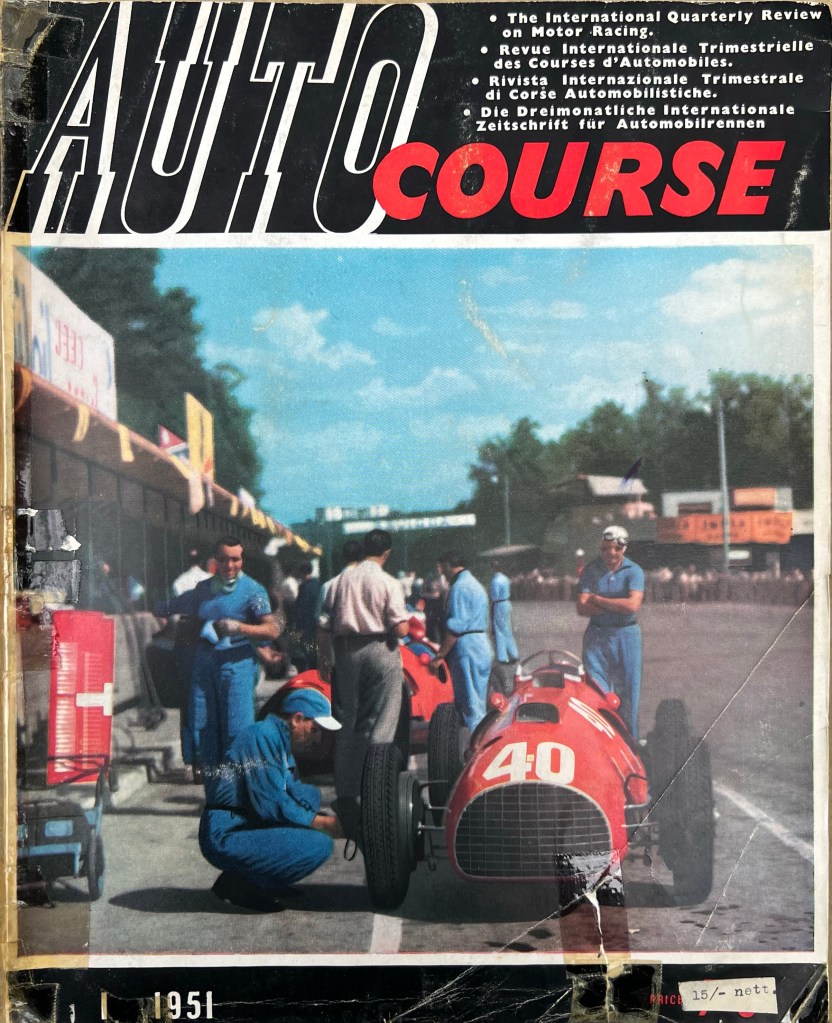
The Ferrari pits during the Grand Prix des Nations weekend, Geneva, July 30, 1950.
Alberto Ascari at left with car #40, a 4.1-litre Ferrari 340, the car behind is Gigi Villoresi’s 3.3-litre Ferrari 375 with the man himself at right (I think). Typical of the era, factory Alfa Romeo 158s finished one-two-three: Juan Manuel Fangio from Emmanuel de Graffenreid and Piero Taruffi.
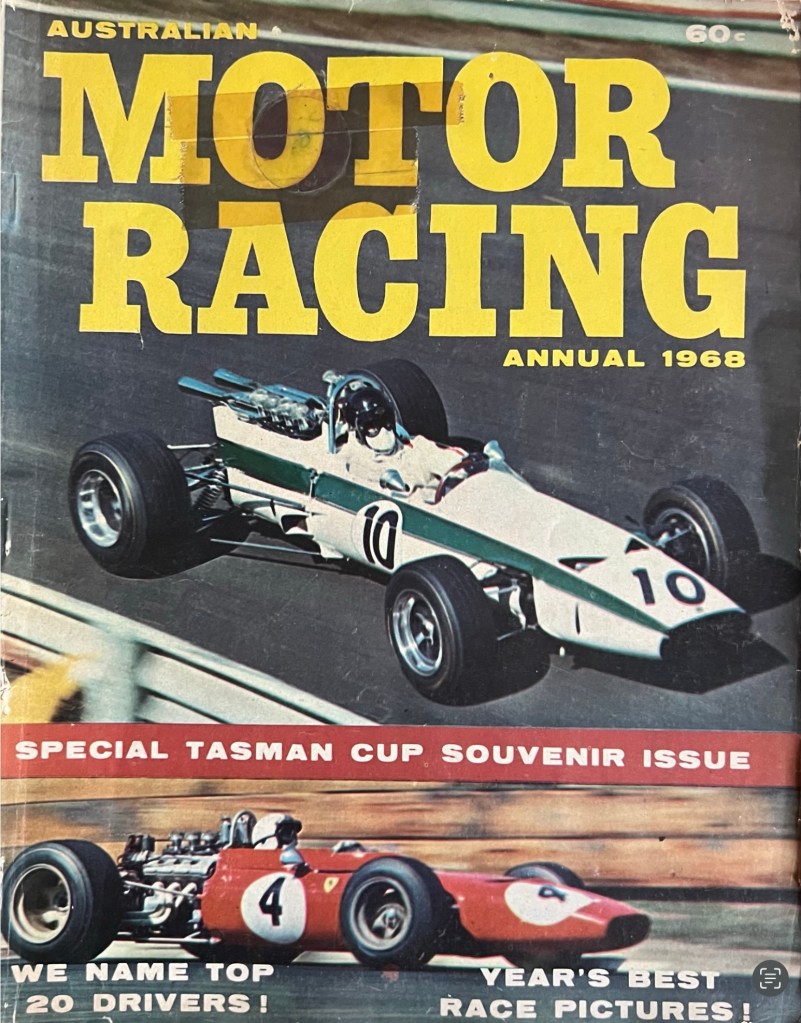
“It took me five years to get this Autocourse and a whole lot of others from the widow of the owner!” my friend Tony Johns said with a chuckle. I’ve always been an Automobile Year guy, by the time I realised Autocourse was THE racing annual I’d already got the Automobile Year bug and started what became a 20 year journey to collect a set.
It was another set, Blommie The Great 38’s fabulous tits that led me in the wrong direction. Camberwell Grammar School appointed 25 year old, very statuesque Miss Blomquist as a librarian in 1971-72. Of course one couldn’t just sit in the library with ones tongue on the floor, it was while cruising the aisles trying to look like a serious student on my furtive, very frequent perving missions that I came upon Automobile Year 18, the 1970 season review. And so the obsession began, I was soon surgically removing the best photographs of the school’s Auto Years with a razor blade and adding them to my bedroom wall where scantily clad Raquel Welch had pole position.
It’s been great to have the very first of these learned journals for a week to peruse, read and enjoy. The 140 page, then-quarterly, cost 15 shillings in Australia and was distributed by Curzon Publishing Company, 37 Queen Street, Melbourne, not an outfit familiar to me but will perhaps ring a bell with some of the older brotherhood?
Two features are reproduced: one on F3 by Stirling Moss and another by Alfred Neubauer on the ‘Brains’ of the racing driver.
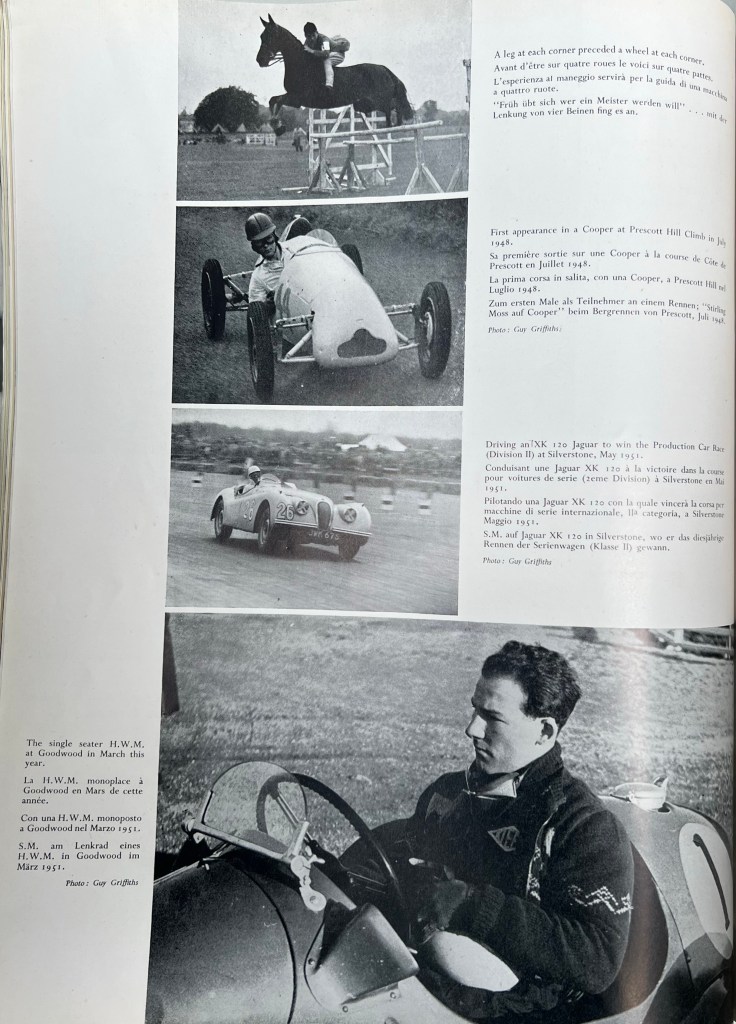
Walt Whitman once wrote ‘stout asa horse, patient, haughty, electrical’ but when first set to control one of the breed, at the age of six, it seemed to me neither stout nor patient. Reference to a horse may seem somewhat out of place when one begins to consider a motor racing career, but the equine enthusiasts talk about a good pair of hands and a good seat, and I am sure that both are just as necessary to the racing driver. If you are going to ride a horse seriously, as I did, then you must think one step ahead of it. A racing car also appears to have a personality of its own, and the driver must be equally facile at anticipating its behaviour.
Certainly I have never thought that the time I spent astride four legs as being anything but invaluable to subsequent control of four wheels, and my fourlegged career went on for ten years. Apart from the lessons it taught, it was even more directly concerned with the first appearance of ” Stirling Moss (Cooper) ” in a hill climb programme. Prize money won in the jumping ring was the financial foundation of the purchase of that Cooper.
It seems astounding now to recall that in 1948 British motor sport was centred on sprints and hill climbs, and that 500c.c. cars were still a somewhat despised novelty, mostly produced by enthusiastic owner drivers. I took delivery of one of the early production Coopers and it really is impossible to consider those days without digressing to praise the foresight and ability of the Coopers, both father and son, for without the reputation built up by their products half litre racing could never have reached the point where it won International recognition as Formula III. The only pity is that France and Italy appear yet to need to discover their equivalent of these two enthusiasts.
If they could, and were thus able to get equally successful cars into production, I am sure that there would not be the present move towards a change in the Formula.
Since those days the design of half litre cars has settled into a fairly consistent pattern of rear mounted motor cycle engine driving the back axle by chains via a motorcycle gearbox and it was the excellence of the available motorcycle components which played another big part in boosting the possibilities of Formula III. Perhaps the biggest advance in the past three years has been the mating of reliability with steadily increasing speeds. Maximum speeds have not changed so much, but circuit speeds have, as the result of patient chassis development, and though in 1951 circumstances will prevent me from driving half litre cars as much as in the past, the lessons learned at the wheel of these flyweights can be applied to the much trickier problems of heavier and faster machines.
Giving around 45 b.h.p. the more prominent 500 c.c. engines of today will propel a racing car at 100 to 105 m.p.h. and because the car is so low and so small this seems to the driver a pretty high velocity. It is only when one changes to a heavier car that one realises just how far liberties can be successfully taken with a car weighing perhaps 6 1/2 cwts all up.
Half-litre racing is always fun, and as far as the British scene is concerned is the most keenly contested class of all, because it has given so many people the opportunities which had previously been the prerogative of Continental drivers. I for one could never have hoped to motor race seriously but for the reduction in cost brought about by the 500 c.c. class and instead of being the proud possessor of the British Racing Drivers’ Club’s 1950 Gold Star would most likely have been, at the best, an unknown also ran with some sports machine in club events.
It may comfort some to know also that the first entry I submitted, fresh with enthusiasm at the prospect of taking delivery of the Cooper, bounced back at me.
The next step forward from the Cooper 500 was the Cooper 1000.
I say step forward without belittling the smaller car, but because I imagine that the goal of every racing driver is Formula I. That is a long road which I have yet to traverse but just how tricky a road it is I am learning almost every weekend this summer of 1951. I was fortunate in having parents every bit as enthusiastic about motor racing as myself, and at the same time a good deal more experienced when they suggested that one did not know what motor racing was all about until one had been on the Continent. With a Cooper 1000 I set out to see for myself in the latter half of 1949, and how right they were. The foray achieved some moderate success, not so much in the results, but in the experience gained and the feeling of confidence induced, and above all that I had something definite to offer to John Heath when he was looking around for drivers for the H.W.M. team. On his side, John could offer a car which was magnificently reliable and always pleasant to drive. The results achieved in 1950 are a matter of history, and there was only one snag. Excellent as the cars were they were never quite fast enough to win against a Ferrari, and we kept on meeting Ferraris.
This is not a criticism, but a simple statement of fact of which John himself was only too well aware, and which he has made every effort to remedy for 1951 by the most ingenious use of available materials. What was always a delight to me was to be a member of a well turned out team of cars bearing the British green which always arrived on the starting line a credit to their sponsor.
A racing driver usually gets some stock questions put to him by the layman, which can be paraphrased into ” How fast can you go?” “Which car do you like driving best? ” and ” What was your most memorable race?” My answer to the first is that speed is purely relative. The real art of motor racing and, for that matter the real excitement, is in negotiating an 8o m.p.h. corner at 90 m.p.h., for it doesn’t matter whether you do 100 or 150 m.p.h. down the straight.
As for the other two questions, the answer to the second is usually the car I am to drive next, and to the third, my last race. If one is to succeed, it has always seemed to me that one must be entirely engrossed in the race in hand, and whilst drawing on the experience of the past, memories of races as races are wiped out by the task of the moment. In any case, the last person to approach for any coherent picture of a race is a driver who was taking part in it.
The same sort of thing applies to cars, and one has to completely identify oneself with the machine of the moment, until you almost approach the state of believing that that is the only car which you really know how to drive.
Certain races stand out because of particular objects achieved, such as last year’s Tourist Trophy as being my first experience of a really fast heavy car, but the race itself was one of the easiest. So much so that I let my mind wander to external problems and made an excursion down an escape road. At Silverstone last August my chief reaction was a pleasure not so much in winning but in beating the late Raymond Sommer on the only occasion we met in reasonably comparable machines.
At Bari it was natural to feel a similar pleasure in bringing an H.W.M. home third behind two type 158 Alfas, because that was a result so much better than any of us had hoped for.
That is really the biggest satisfaction of all; doing just a little bit better than one expects when faced by a new situation and these notes are being written on the eve of what I am expecting to be my memorable race of 1951, the Mille Miglia and Le Mans.
The ‘Brains’ of the Racing Driver
By Alfred Neubauer, Team Manager of Mercedes Benz
The racing driver fixes hisses on the starting flag; his nerves are the keyed up to the highest pitch, for he knows those few moments of suspense, seeming like hours, will soon pass and the flag will drop. Another 10 seconds to go, slowly he pushes his gear lever into first…5…4…3…2…1 off!
With only 5 seconds left, he revs the car up to half its maximum, gently lets in the clutch and revs, further. The flag drops and with care to ensure that the back wheels do not spin, thus causing the car to run sideways, he shoots forward like a bullet from a gun.
Even for this first phase of the race – the start – the tactics involved have been thoroughly worked out by the team manager as a result of his observations during training. The popular opinion exists that in every racing team one or two drivers are chosen to set the pace. This, it is believed, will compel the other competitors to greater speeds. They will strain their engines, weaknesses will become apparent, resulting in their elimination, thus giving the driver, selected as the eventual winner, the opportunity to choose his moment and then drive through to clear victory. The opinion that such tactics are dictated is absolutely wrong. In fact, they evolve from the experience and technique of the driver himself.
The basic rule is as follows: ” Drive your machine within your own capabilities as fast as you can – but do not overstrain either yourself or your machine.” One rider must be added to this. Both car and driver, of course, must be subjected to some strain, but a first-class driver will know at what point this strain becomes excessive and for what length of time any strain can be borne without collapse. After continual experience, maximum powers of endurance become clear. Some drivers use both their cars and themselves unsparingly from the start and, consequently, collapse after a short time. They either drop back or are forced to retire. Others are capable of taking the lead from the start and holding it until the end of the race. There is yet a third kind of driver who knows the individual characteristics of his rivals and plays upon them. They purposely keep on their tail, in the meanwhile economising their own forces, and wait for a suitable moment to overtake them. The nerves of some drivers are unable to bare being trailed, and again there are those who remain completely indifferent to it.
Drivers can only know their position in a race so long as they keep within sight of one another. Once the leading drivers have got so far ahead as to lose contact with the rest of the field or when cars begin to drop out or are forced into the pits, then it is no longer possible for the drivers to know their position. It is at this juncture that the work of the pits commences. They are the brains of the racing driver and are led by the team manager. In aviation radio communication between the flyers of a squadron has long been recognised. So far as motor racing is concerned, however, this method of contact between the team manager and driver has not been introduced.* Thus for them the only means of communication is visual. It is, however easily understandable that the simplest method is the best because the driver’s attention must, under all circumstances, be concentated solely on his own car and the road ahead. A further duty of the pits is to inform the driver of the number of laps he has already covered and also the laps remaining. Each driver signifies that the message communicated to him has been understood by nodding his head.
An inexperienced team leader will be astonished when only a few laps later, by means of a circular movement of his hand, the driver indicates that he once more wants to know the number of laps that remain to be covered. This is, however, not exceptional and the explanation is given more often than not by the driver at the end of the race. He has to admit that very shortly after he received the first message he completely forgot its contents. For the driver the most important signals are those indicating his position in the race and the intervals that separate him from his opponents. The knowledge of his exact position dictates his policy. If the lead over his opponent is increasing, then naturally he will relax and thus economise his own forces and those of his car. If his lead is decreasing, then he will do everything in his power to increase once more the distance between himself and his rival. Similarly it is imperative for the driver lying in second place to know the distance between himself and the leader. From this it follows that he must be careful that his present position is not threatened by those who lie yet farther behind.
Naturally the team manager prefers those drivers who take the lead from the outset and hold it throughout the race without straining either themselves or their cars. It is only during a race itself that the driver can know whether he can have some moments’ relaxation or not. In some racing teams first-class drivers are fully aware of the potential weaknesses of their team mates and their cars and from the very start they remain in second place, thus conserving their own forces. As soon as they realise that their team mates’ powers are exhausted, they can immediately take the lead. The brains of the racing driver -the pits – have also to take such considerations into account, and must ensure that the driver who has made his way through the field and eventually takes the lead maintains the position he has succeeded in gaining. There have been instances when these tactics have been employed with great success. It is then the duty of the team manager to inform both the leading driver and his followers at each lap of the distance between them. It must be made clear to the driver lying in second place that he has lost his lead and would do far better to content himself by remaining in second place rather than force his car out of the race.
The price of driving as fast as driver and car permit is often very high. It should take very little experience for the driver to be fully aware of his own capabilities. So far as his engine is concerned he will have received precise directions and he will have been told by his testing engineers of the precise amount of revolutions permitted. However, it is only natural that he should make a point of ensuring that these instructions have not been too cautious and he will certainly confirm for himself to what extent his motor may be over-revved. The experience of former years has shown that drivers who have been given precise instructions that their revs should not exceed 4500 have, some years later, admitted reaching 6200. When a driver confines himself strictly to the instructions of the technicians and a team mate overtakes him, it becomes quite obvious that this team mate has exceeded the limits given to him. Here temperament plays its part, for the decision has to be made whether he will exceed his limits or whether he will observe the technical instructions to the letter and bear in mind the increased lasting powers of his engine.
Generally speaking, the driver who is bound by technical instructions has an advantage over those drivers who themselves assisted in the building of their engines. The latter, whilst testing, will have discovered the limits which the construction of the engine has imposed. Indeed it is fair to say that it is no advantage whatsoever to a driver to be himself a builder or testing engineer. He is naturally hampered by the knowledge of his own technical experience.
Perhaps this is a suitable moment to say a few words about “luck” in racing. If a driver fails to take into consideration the limits imposed by the technicians and a piston rod breaks or some defect in the engine forces him to retire or his tyres do not stand up to his way of driving, then he will have the satisfaction of knowing that all will say:- “What bad luck ! ” Conversely, one member of a team finishes and the others are forced to retire, invariably the latter will exclaim :- ” How lucky he was! “
Technically speaking, 95% of ” luck ” in racing is dependent upon the preparation of a car. This preparation begins at the first moment of building. The other 5% lies in the hands of the driver, whose “feel ” permits him to get the maximum value out of his car. There are drivers on the Nürburgring who use up their tyres in six laps and are indeed slower than those who do not have to change their tyres for eight or even ten laps. A more subtle method of driving, a more even use of the engine on leaving corners and a softer application of the brakes differentiate a good driver from a better one.
As in every activity which demands talent so in motor racing. There are many enthusiasts, but few become champions.
All these facts prove how many conditions have to be fulfilled before success in a race can be achieved. The popular complaint of housewives :-” You have eaten in a minute what I have taken hours to prepare,” would perhaps be even more suitable to motor racing!
It is not the obiect of this article to consider the many hurdles which must be cleared before the racing car eventually reaches the track:- the planning of the design according to the formula given, the design itself, the manufacture of the parts, the assembly and testing. Our task commences only from the moment when the car leaves the factory and proceeds to a race, there to prove the quality of its design and justify the work of preparation. These preparations are no more than stages on the road to victory.
The work is undertaken not merely to prepare a car for one particular race, but also with a view to its chances of success over its rivals.
Experience gained by entering for the same race year after year greatly assists the designer in his attempts to reach perfection so far as one particular course is concerned. Often drivers entering a race for the first time are taken unawares by the peculiarities of the track which had they had opportunities of practising thoroughly earlier, could have been avoided without difficulty. Practise on non-permanent tracks presents complications as it is practically impossible to close circuits to the public so as to enable practising to take place. Consesequently, the preparation of cars for non-permanent circuits is considerably more difficult than for permanent circuits which are open to racing cars at all times of the year. To list but a few-the choice of the right transmission, the measurements of fuel requirements and the wear on brakes and tyres are factors which must depend entirely on the circuit to be raced.
Many years ago, the principle of fitting streamlined bodies to cars for very fast circuits was accepted. Nevertheless, without comparative tests it is not so easy to decide whether this style of bodywork is most suitable to any track. The streamlined bodies with their attendant lack of wind resistance have the advantage in acceleration and are preferable when high maximum speeds are required. This, however, is offset by the decrease in braking power with the resultant strain on the brakes. On the former Avus circuit, where there are two parallel stretches of ten kilometres and long curves, this disadvantage was not apparent. Many, streamlined designers had soon to learn that the cooling of tyres presented a difficult problem. Within their enclosed space, the maximum temperature permitted was soon reached, but problems of engine and gear cooling often counter balanced the advantages gained by streamlining.’
All these points have to be considered during tactical preparation for a race, and it is on the conclusions reached that the decisions must be taken whether pit stops are to be made or not. These matters are of first-rate importance. In fact, success in a race depends on them just as much as it depends on the tactics of the driver which were mentioned before in this article.
It can now be seen that a race is not just a haphazard competition between one car and other. Each circuit has its individual problems, and not least of these are the prevailing weather conditions. Above all, fuel, tyres, back axle and gear ratios must be adjusted according to the circumstances.
The particular suitability of individual drivers to different tracks has to be considered also and a strategical race plan cannot be worked out without continual observations of the other competitors and the tactics which they employ. There are supreme examples which prove that although complicated preparations were made for a race, it was a the result of such observations that victory was achieved.
There was an instance at the Nürburgring when a driver’s race plan required him to stop for one minute to change his tyre. However this driver had a ten-second victory over his rival whose plan permitted him to run through the ten lap race without a pit stop though at a limited speed.
This ” organisation for victory ” does not date back very far. Even in 1914 visual communication between driver and the pits did not exist. In those days the pits were really no more than depots for refuelling and the change of tyres, and it was not until the period between the two world wars that the pits became more and more ” the brains of the racing driver.”
After many years of practice, this “Organisation” no longer carries many difficulties in so far as circuits are concerned. What is not so easy to master is the “organisation” of long distance races such as the Mille Miglia. It was in 1931 that Caracciola arrived at the finish in Brescia and refused to believe his team manager when told that he had won the race. In fact, it was not until some half an hour later, when his victory was confirmed by the organisers of the event, that he was convinced. The Mille Miglia is so planned that although times between control points are given, they arrive so late that it is impossible to communicate them to a driver, who may be anywhere on the Appenine peninsula.
In this race the only workable maxim is: “Know the capabilities of your machine and your own ability and get the best out of both.” It was not without reason that the experienced Italian master Villoresi exclaimed after the last Mille Miglia:-” What a ghastly race ! ” Above all, in England, where there are many handicap races, ” the brains of the racing driver ” have a particular problem to solve. Here a driver is not in direct competition with his rival who holds a position in the race which is obvious to all. On the contrary, the pits must continually work out his position according to the class of his car.
Many times during the Tourist Trophies in Ireland the team manager has looked for his rivals amonst the fastest competitors whilst the real speed so far as he was concerned was dicated by relatively unimportant competitors who had completely escaped his notice. In each handicap race average comparative speeds are formulated. If a car in the small capacity class exceeds its handicap speed, then the driver of car in a larger capacity class is compelled not only to increase his relative speed but also the speed laid down by his class.
Many prominent drivers from the Continent have been baffled by this and have to do everything within their power not to be defeated by a completely unknown rival. What to an onlooker appears to be no more than the smooth running of a race is to the team manager the careful integration of many factors which achieves the much-sought-after victory.
* Radio communication was used successfully by the American Cadillac team at Le Mans last year – Ed
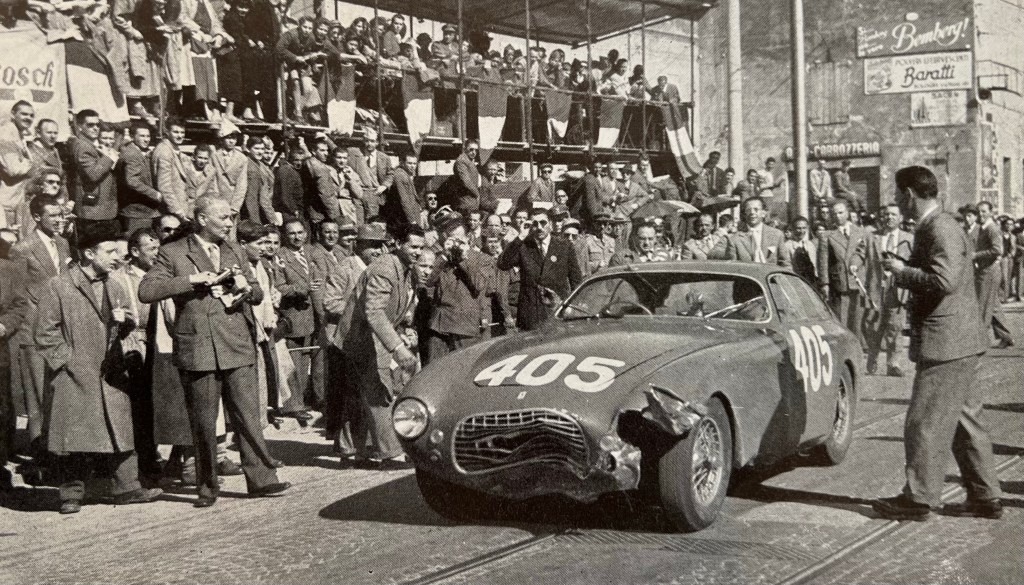
The Gigi Villoresi and Piero Cassani victorious, battered and bruised Ferrari 340 America Berlinetta passing through Bologna on its April, 29 1951 Mille run.
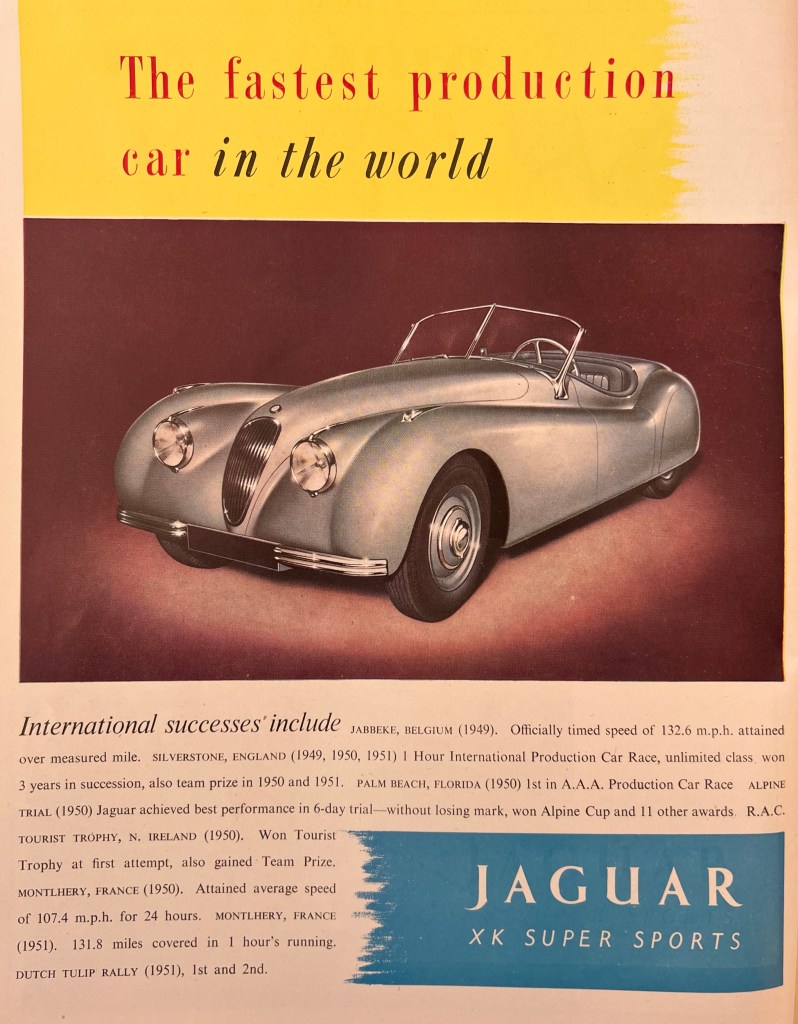
Jaguar XK Super Sports. Was that the car’s model name before XK120 came along or has the copy-writer goofed?
Credits…
Autocourse 1951 from Tony Johns’ collection – many thanks TJ
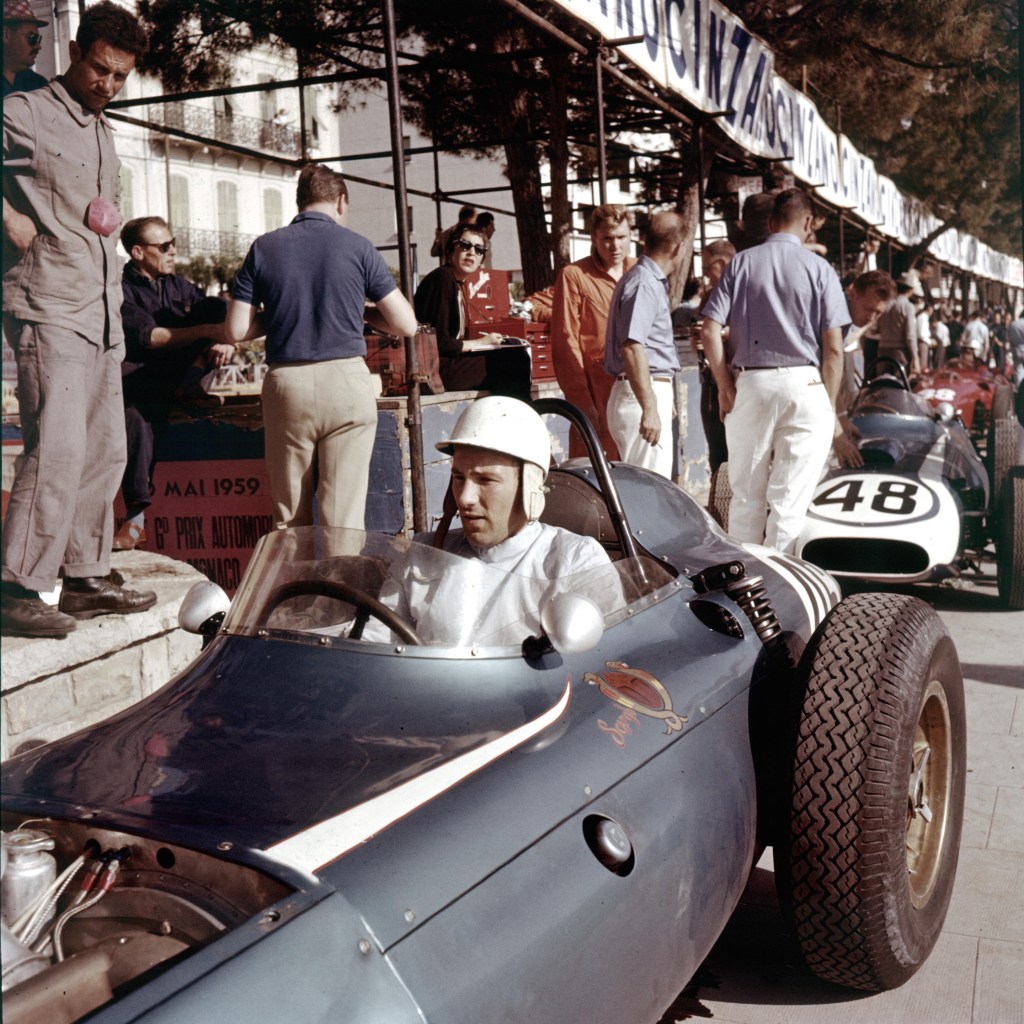
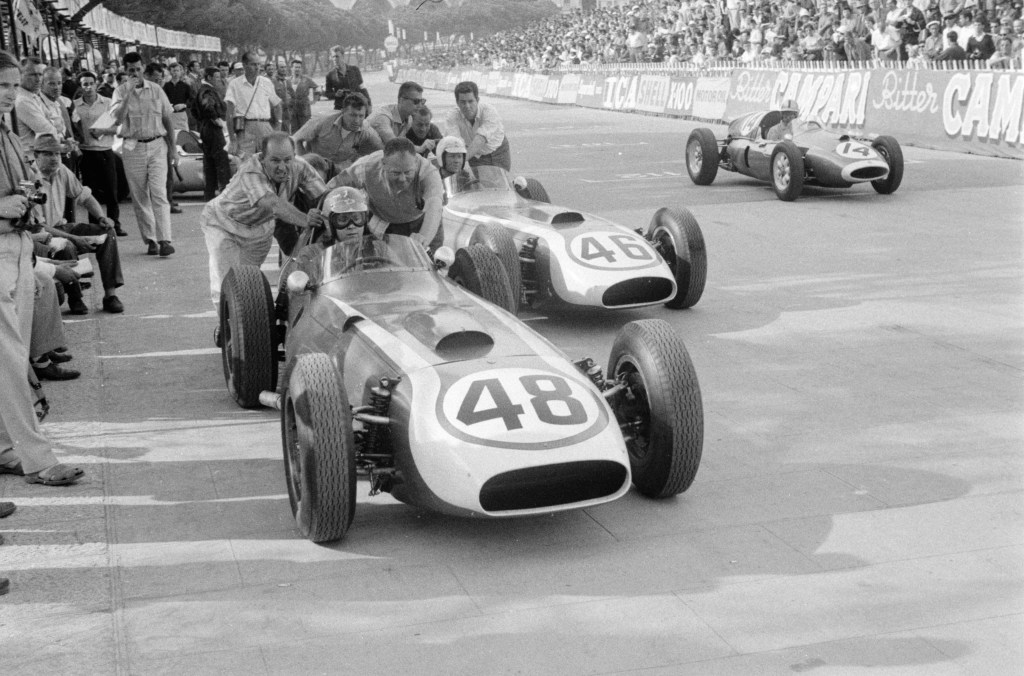
The Scarab Offy debut at Monaco in 1960, when Reventlow and Chuck Daigh were so far off the pace, Stirling Moss did some laps in the car. Note the roll bar – high by the standards of the day albeit not high enough – seatbelts are fitted too, but those were for wally-woofdas in the views of Europeans at the time, so Moss is sitting on them.
Those lovely Halibrand wheels are Goodyear shod, Moss pointed them in the direction of the Dunlop tent, they raced so equipped. Goodyear nailed F1 pretty quickly mind you, they partnered with Brabham from the 1965 Tasman Series, with lots of input from Jack Brabham, Dan Gurney, Frank Gardner and Denny Hulme they improved exponentially to win the 1966 F1 World Championship and French F2 Championship, also the unofficial ‘European’ one.
That’s Lance in the orange driving suit off to the left, by the pit counter #48 is his car, Moss is lapping in Daigh’s machine.
(unattributed)
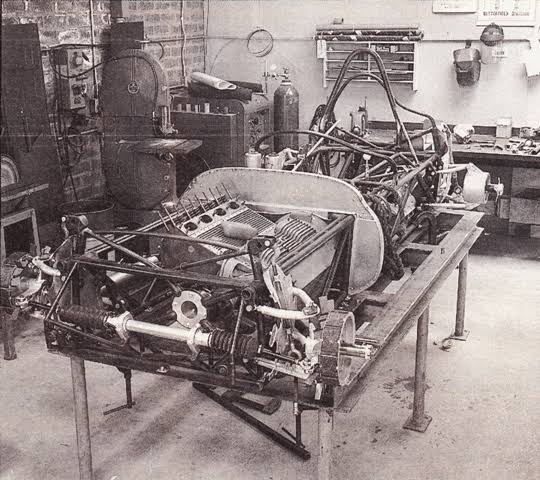
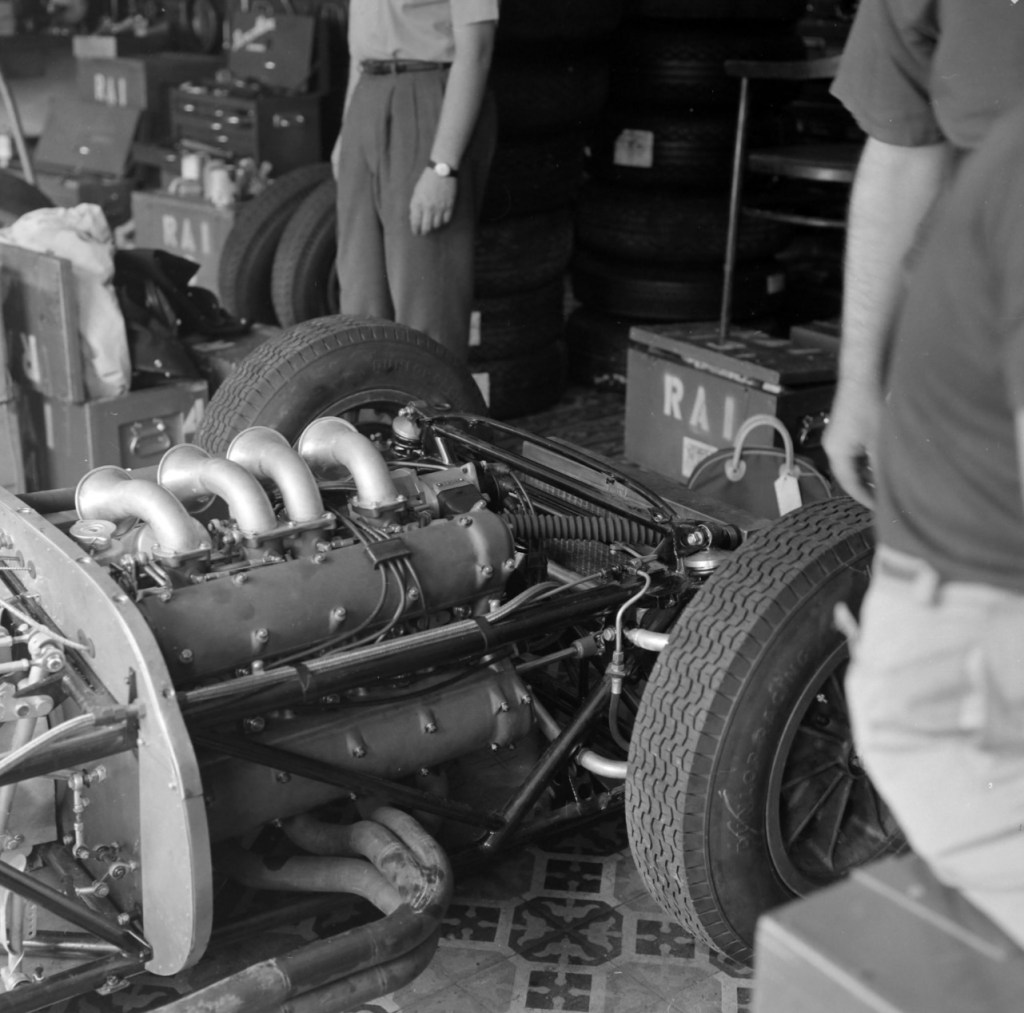
This undated workshop shot highlights just how low (shots both above and below) in the spaceframe the engine was mounted – the 2.5-litre, twin cam, twin plug, desmodromic, two-valve, Hilborn injected, Offenhauser designed and built, circa 220bhp four cylinder engine was laid right over on its side. Note too the drum brakes at this stage of development, the car raced with Girling calipers and rotors.
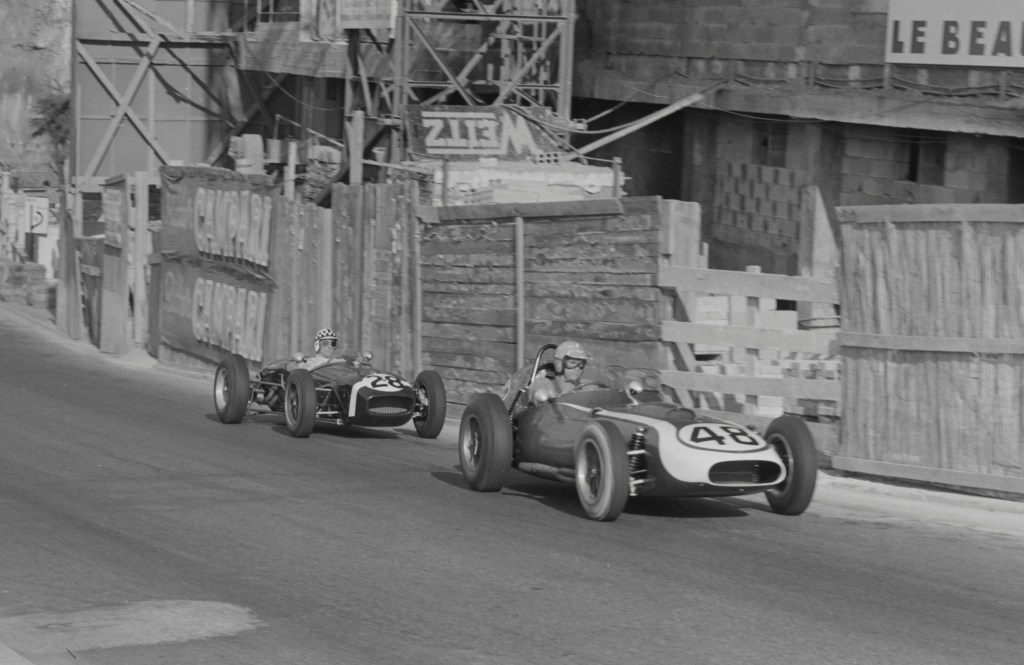
These photographs highlight the two-years-too-late aspect of the Aston Martin DBR4 and Scarab designs in relation to the mid-engined brigade. The practice shot above shows the big, front-engined non-qualifiers #48 Reventlow and Daigh being passed by Roy Salvadori’s Cooper T51 Climax, and below, the fastest design of 1960, Innes Ireland’s works Lotus 18 Climax closing in on Reventlow.
(D Orosco Collection)(P Darley)
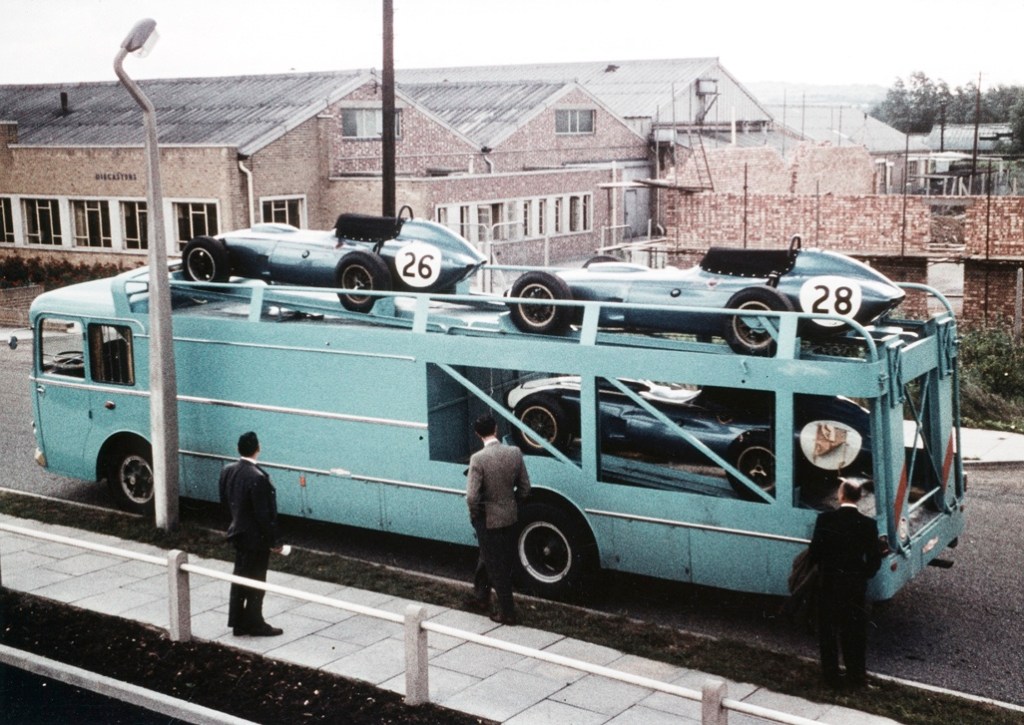
Quite why the Scarab transporter is parked out front of Lotus’ Cheshunt factory enroute to the French Grand Prix that July is a bit of a mystery perhaps you can help solve!?
The 1959 Fiat truck based Bertoletti transporter was commissioned by Reventlow for Scarab’s use in 1960-61 before being briefly used by Lotus before its sale to Alan Mann Racing.
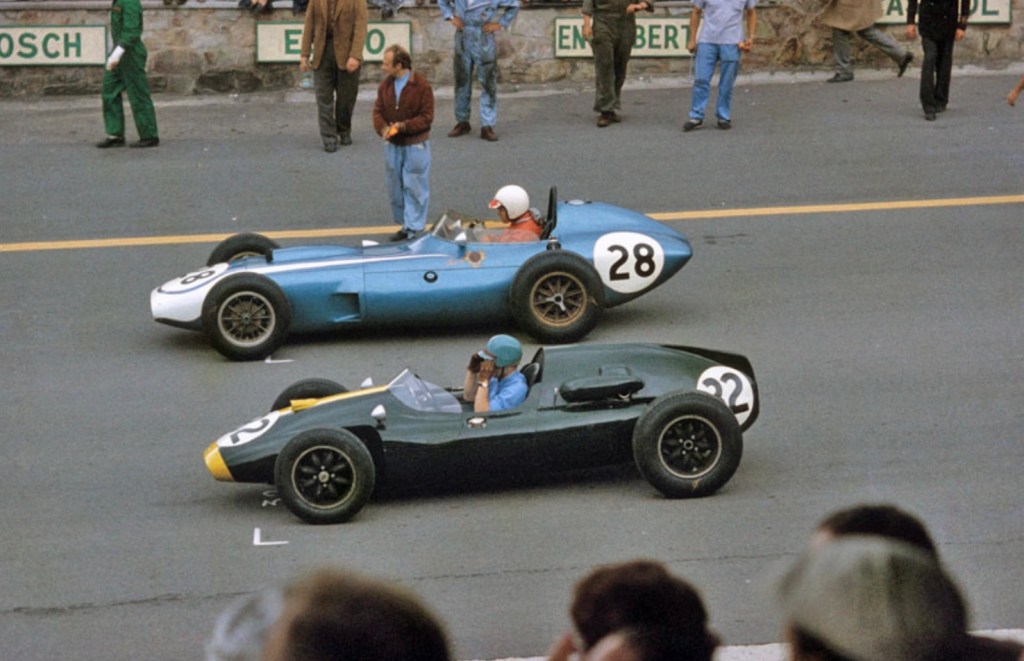
The shot below shows Lance alongside Lucien Bianchi, Cooper T51 Climax, at the start of the Belgian GP at Spa. Reventlow retired after one lap with engine problems, while Bianchi was sixth, and last, eight laps adrift of race winner, Jack Brabham’s Cooper T53 Climax. Difference is size between the 1960 model Scarab and ’59 Cooper, marked.
(RPcollectie-Roozendaal)(unattributed)
Wonderful pit shot taken during the French GP weekend at Reims. Chuck Daigh Q23 and Richie Ginther Q20 practiced but neither car started the race
Upper and lower wishbone and coil spring/damper front suspension, cast magnesium upright. Note the Aeroquip or braided steel oil lines to the front mounted oil-cooler in front of the coolant radiator, the first appearance of such fittings in GP racing years before they became ubiquitous.
Credits…
Don Orosco Collection, MotorSport, Peter Darley, RP collectie Roozendaal, edwardquinn.com, autopics.com.au
Tailpiece…
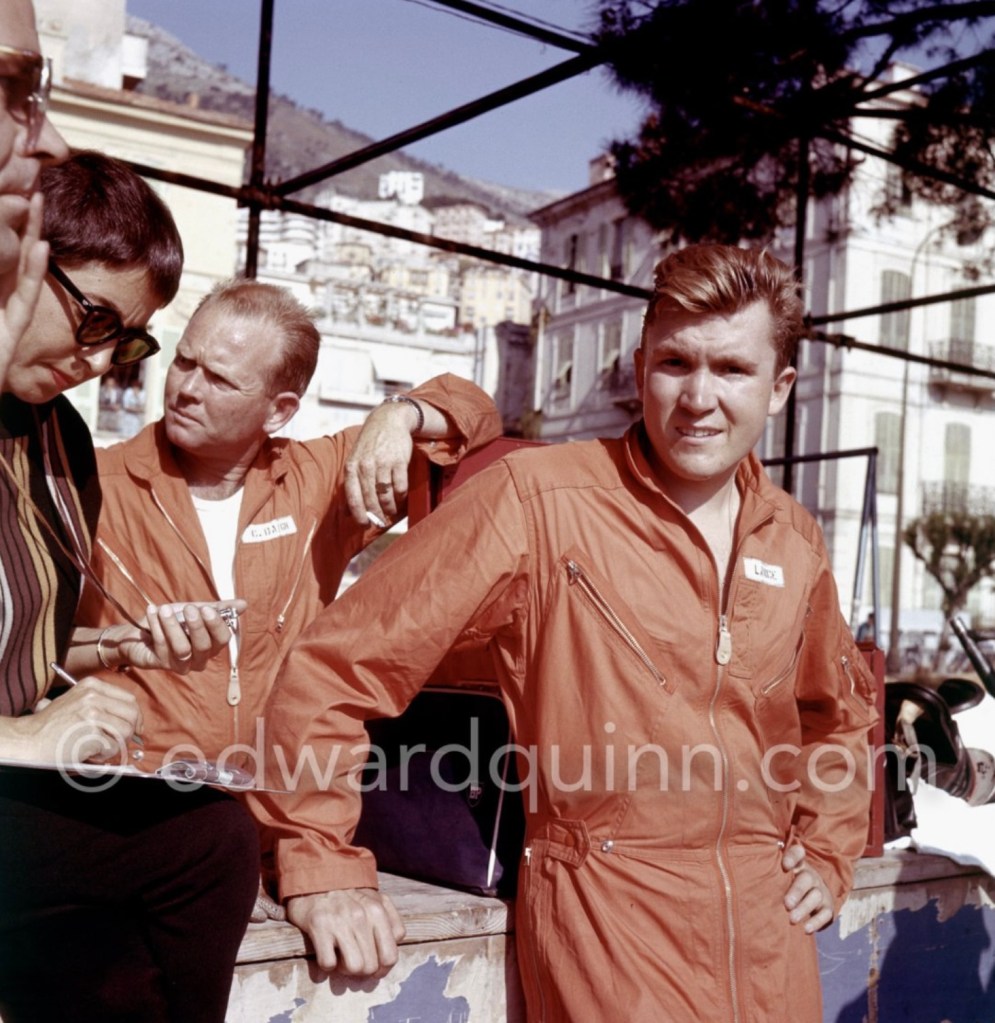
Chuck Daigh and Lance Reventlow full of optimism early in the Monaco GP weekend. Nifty fly-boy driving suits, Nomex I wonder?
There was much to admire in the Scarab’s design and execution but Reventlow Automobile Inc needed to be taking the start at the principality in 1958, not 1960.
The mid-engined 3.9-litre Scarab RE Buick V8 Intercontinental Formula machine on its way to fourth place in Chuck Daigh’s hands in the 1962 Sandown Park International. It was a step in the right direction, but sadly the machine never raced again.
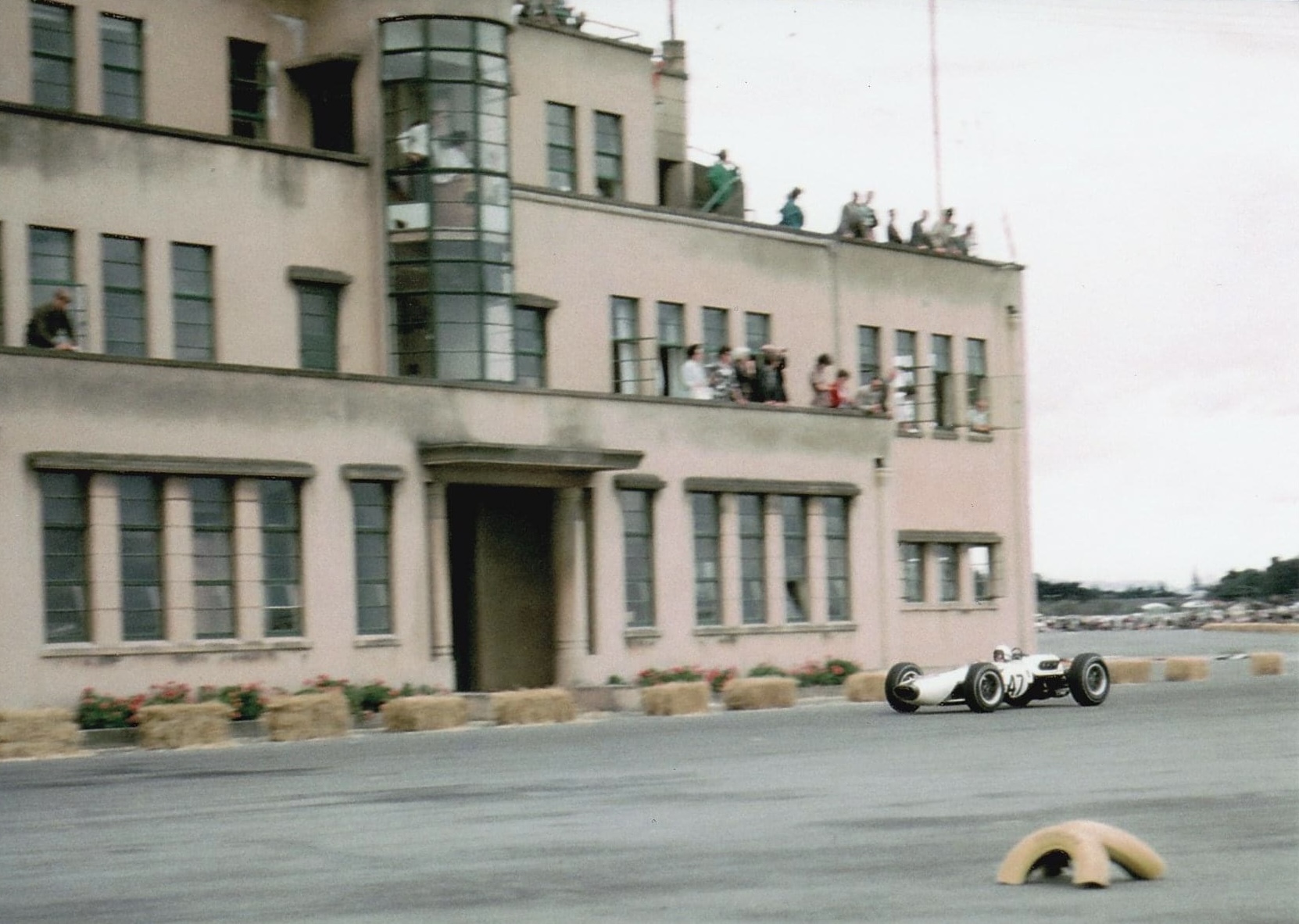
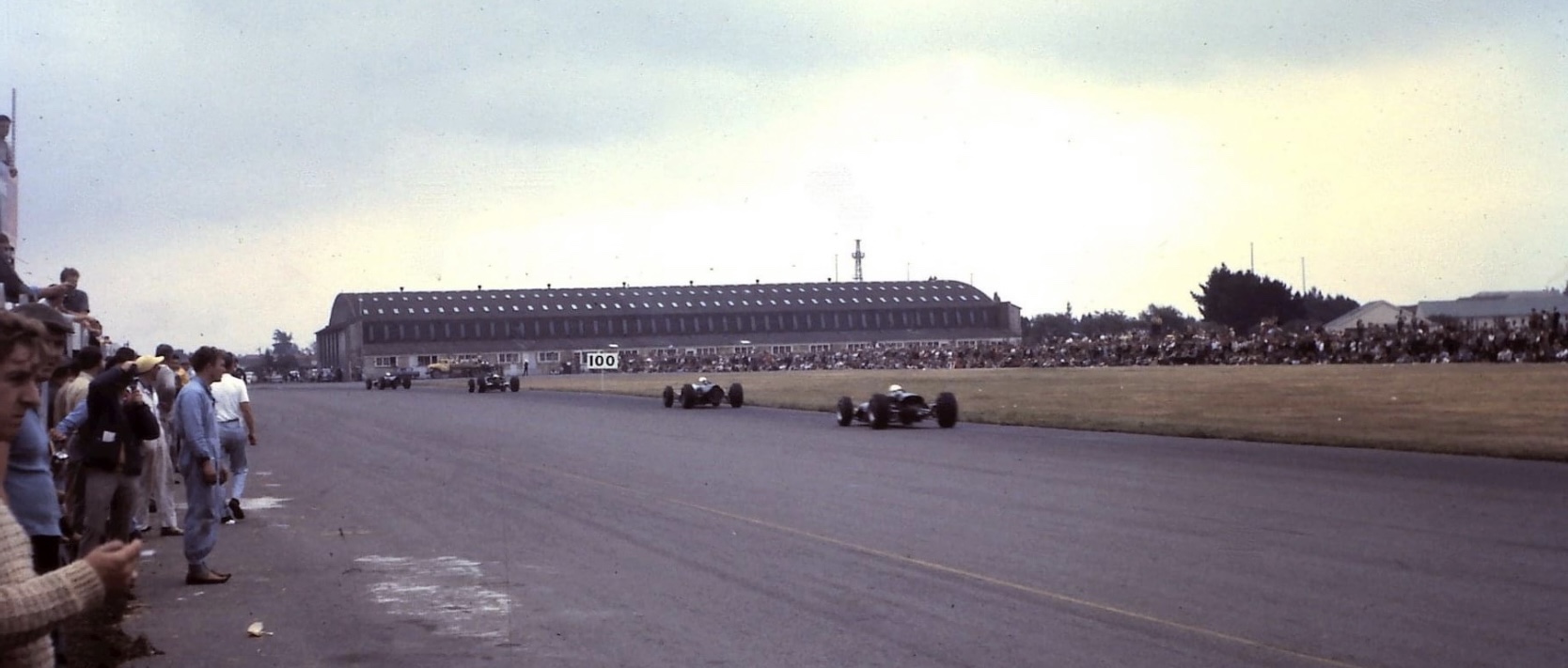
Bruce McLaren blasts past the Royal New Zealand Airforce control tower building during the 1965 Lady Wigram Trophy.
The reigning Tasman Cup champion finished second in his Cooper T79 Climax to Jim Clark’s Lotus 32B Climax with Jim Palmer’s Brabham BT7A Climax third. Clark won the title that summer with wins in four of the seven rounds.
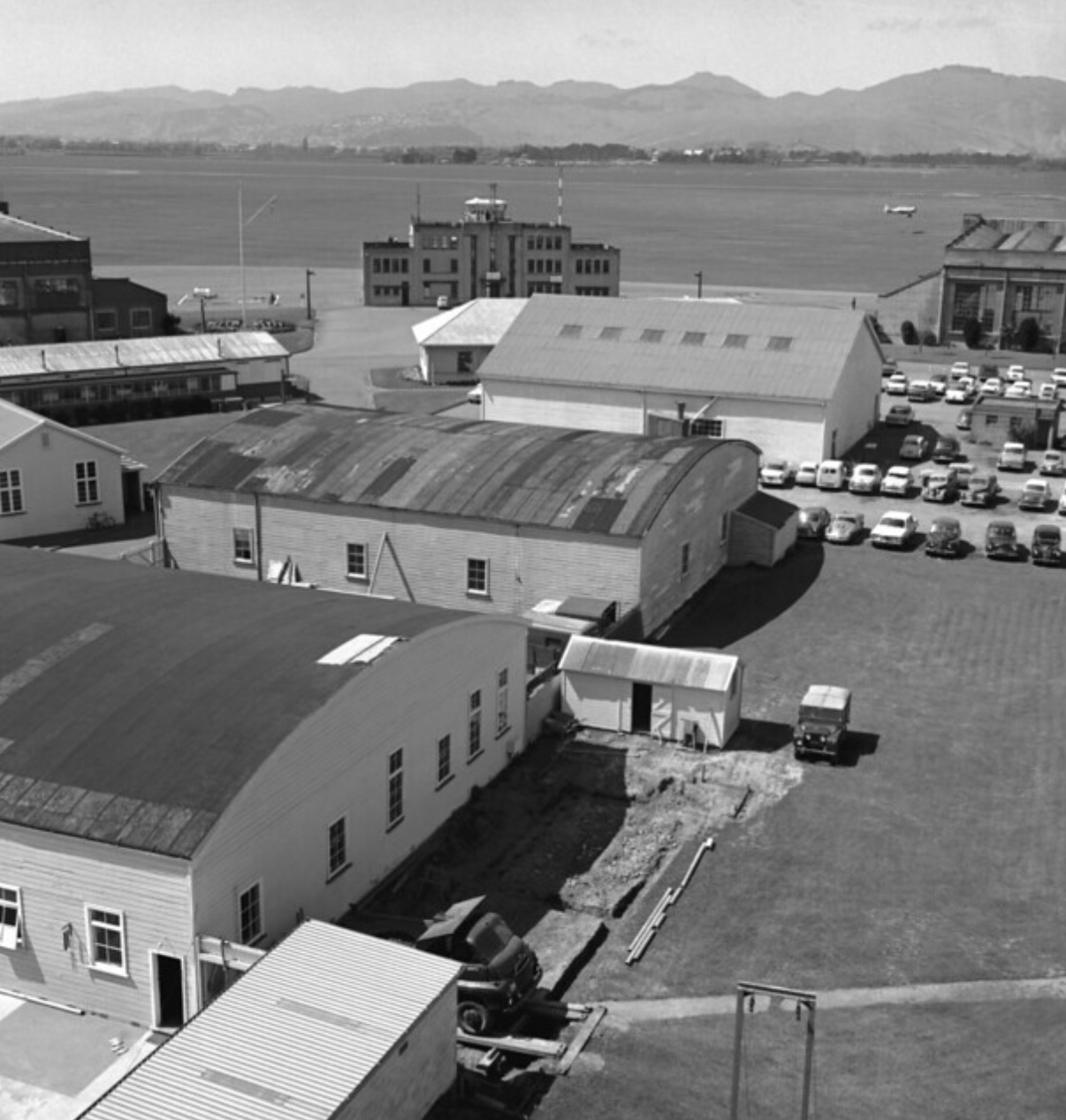
Wigram Aerodrome was located in the Christchurch suburb of Sockburn, now named Wigram/Wigram Skies. It operated as an airfield from 1916, and as an RNZAF training base from 1923 to 1995.
Sir Henry Francis Wigram was a successful Christchurch businessman, politician and promoter of the fledgling aviation industry. He gifted land for the airfield to the Canterbury (NZ) Aviation Company (Sockburn Airport), later the land was re-gifted to the RNZAF.
The Lady Wigram Trophy was named in his wife’s honour.
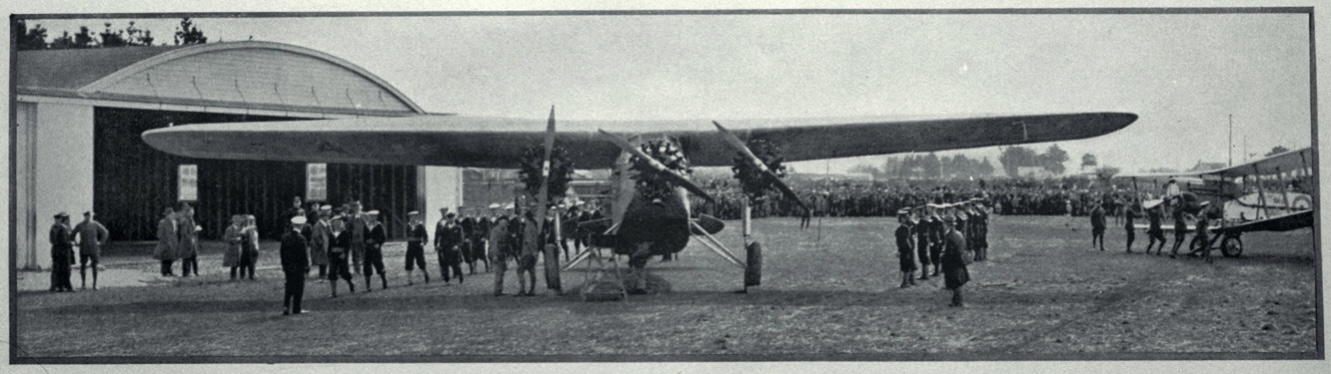
Charles Kingsford Smith’s Fokker F.VII Trimotor Southern Cross at Wigram having made the first Tasman flight from Sydney to Christchurch on September 10, 1928 (discoverywall.nz)
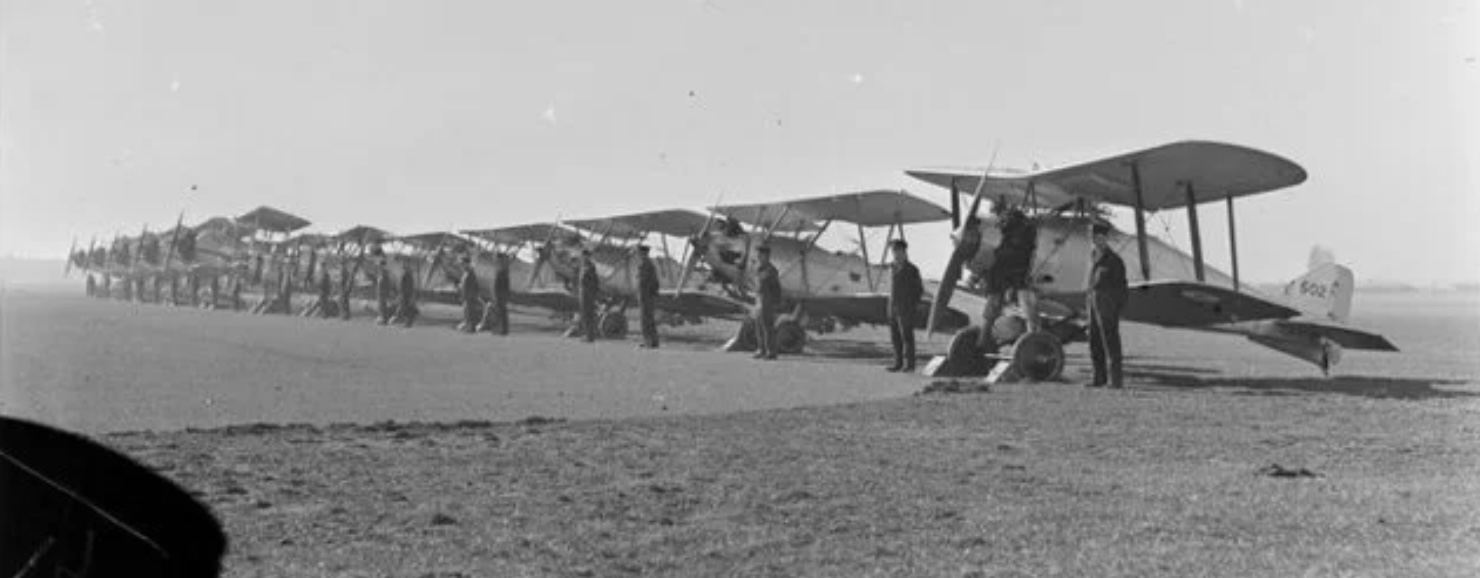
Wigram August 1937. The first aircraft is a Gloster Grebe, others include De Havilland Tiger Moths, with Vickers Vildebeests at the end. Happy to take your input/corrections (natlib.govt.nz)
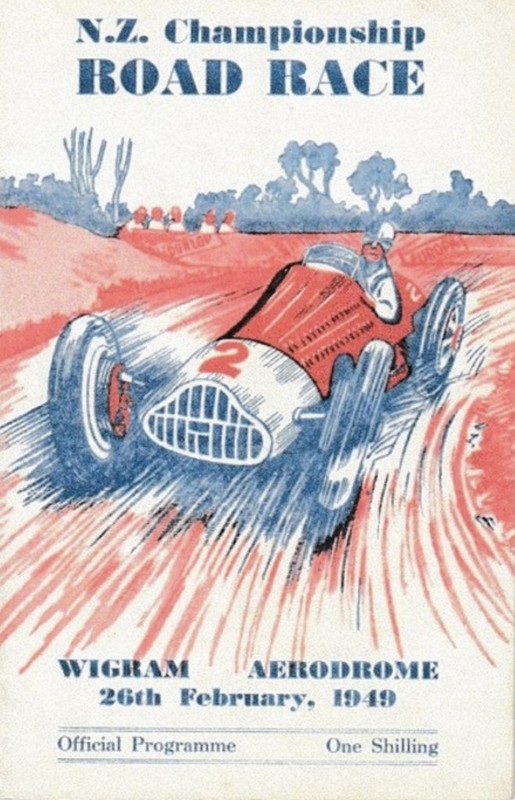
The first motor racing event took place at Wigram in 1949 when the Canterbury Car Club organised the NZ Championship Road Race meeting on February 26.
Winners of the Lady Wigram Trophy subsequently included many internationals such as Peter Whitehead, Archie Scott Brown, Ron Flockhart, Jack Brabham, Bruce McLaren, Stirling Moss, Jim Clark, Jackie Stewart and Jochen Rindt. Other F1 drivers who won around the hangars include Graham McRae, Larry Perkins and Roberto Moreno.
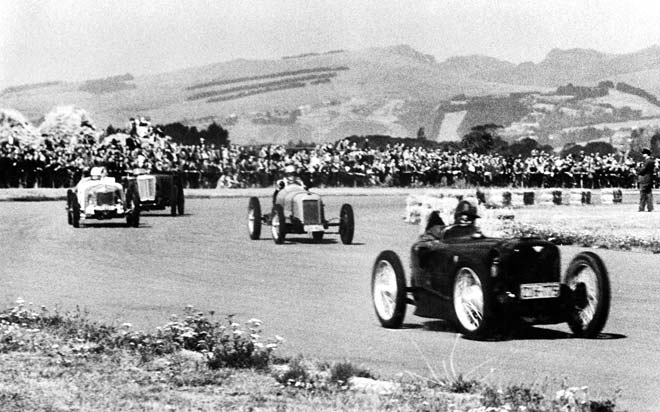
The 1949 feature, the NZ Championship Road Race was won by Morrie Proctor’s Riley 9 at the far left of this photograph.
The legendary Ron Roycroft leads in his ex-works/Sir Herbert Austin, Austin 7 Rubber-Duck s/c from Hec Green in a Wolseley Special with Bob Christie aboard an MG TA Spl at the tail of this group.
(teara.govt.nz)
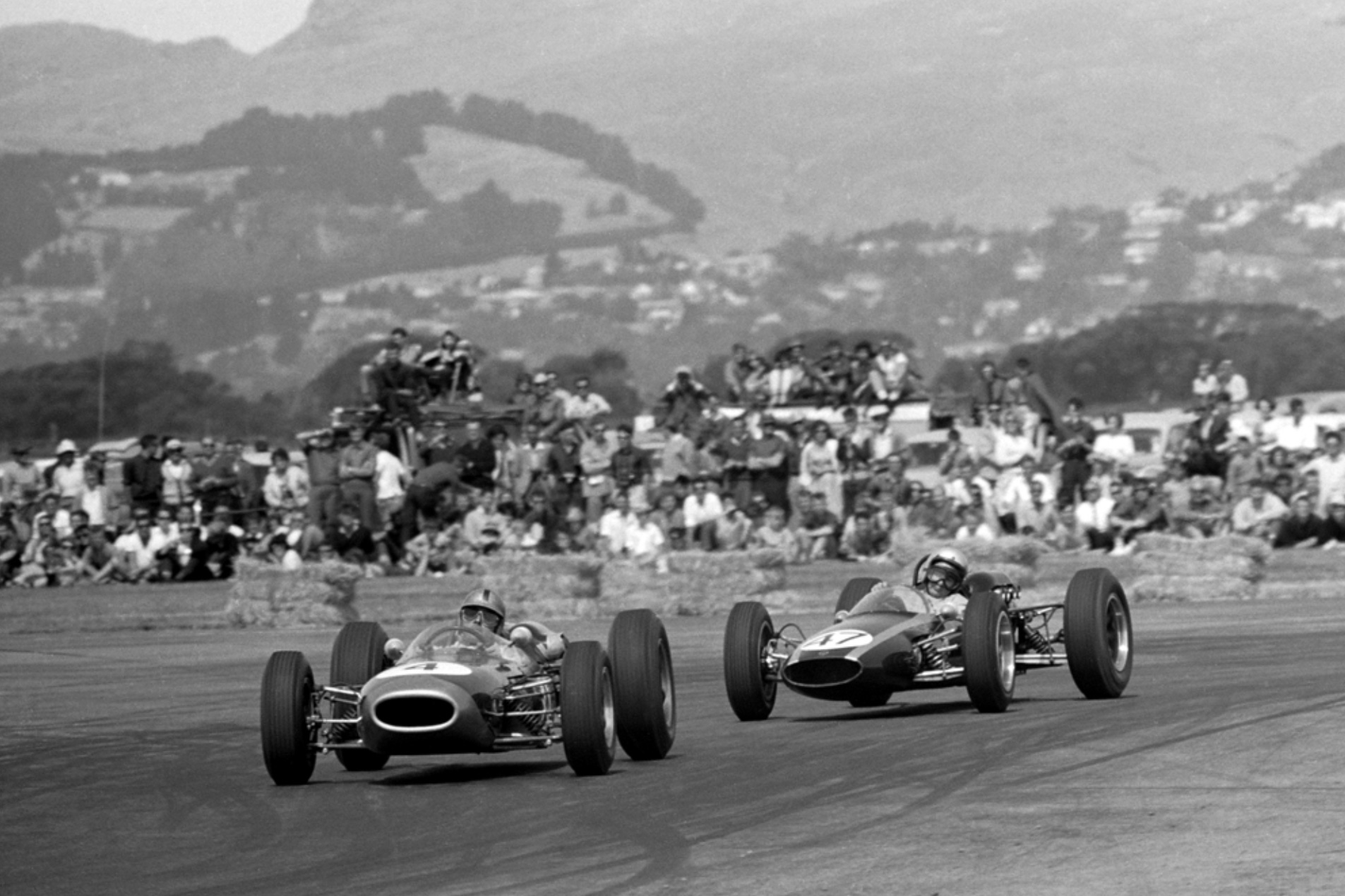
Jack Brabham leads Bruce McLaren, Brabham BT7A Climax and Cooper T70 Climax, at Wigram with the Port Hills forming a lovely backdrop in 1964.
Bruce won the 44 lap race from Jack with Denny Hulme’s works Brabham BT4 Climax third.
McLaren won the inaugural Tasman Series. His three wins in New Zealand matched Brabham’s in Australia, but Bruce’s 39 points haul trumped Jack’s 33.
Brabham was the dominant marque that summer, Graham Hill and Denny took a race win apiece aboard their BT4s giving Motor Racing Developments a total of five wins in the eight rounds.
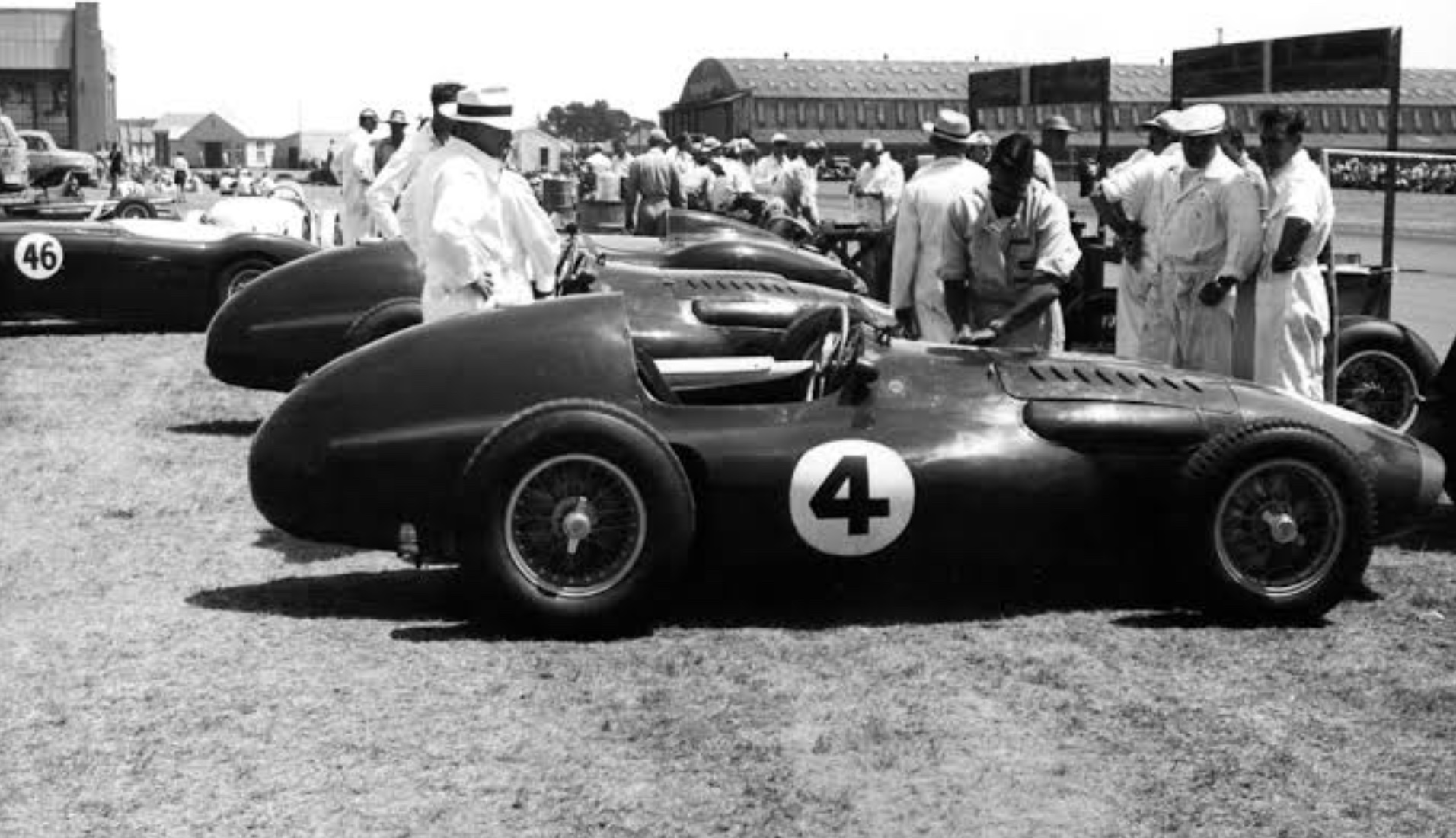
Reg Parnell’s 3.5-litre Ferrari 555 Super Squalo alongside teammate Peter Whitehead’s similar car in the Wigram paddock – note the hangars – in 1957.
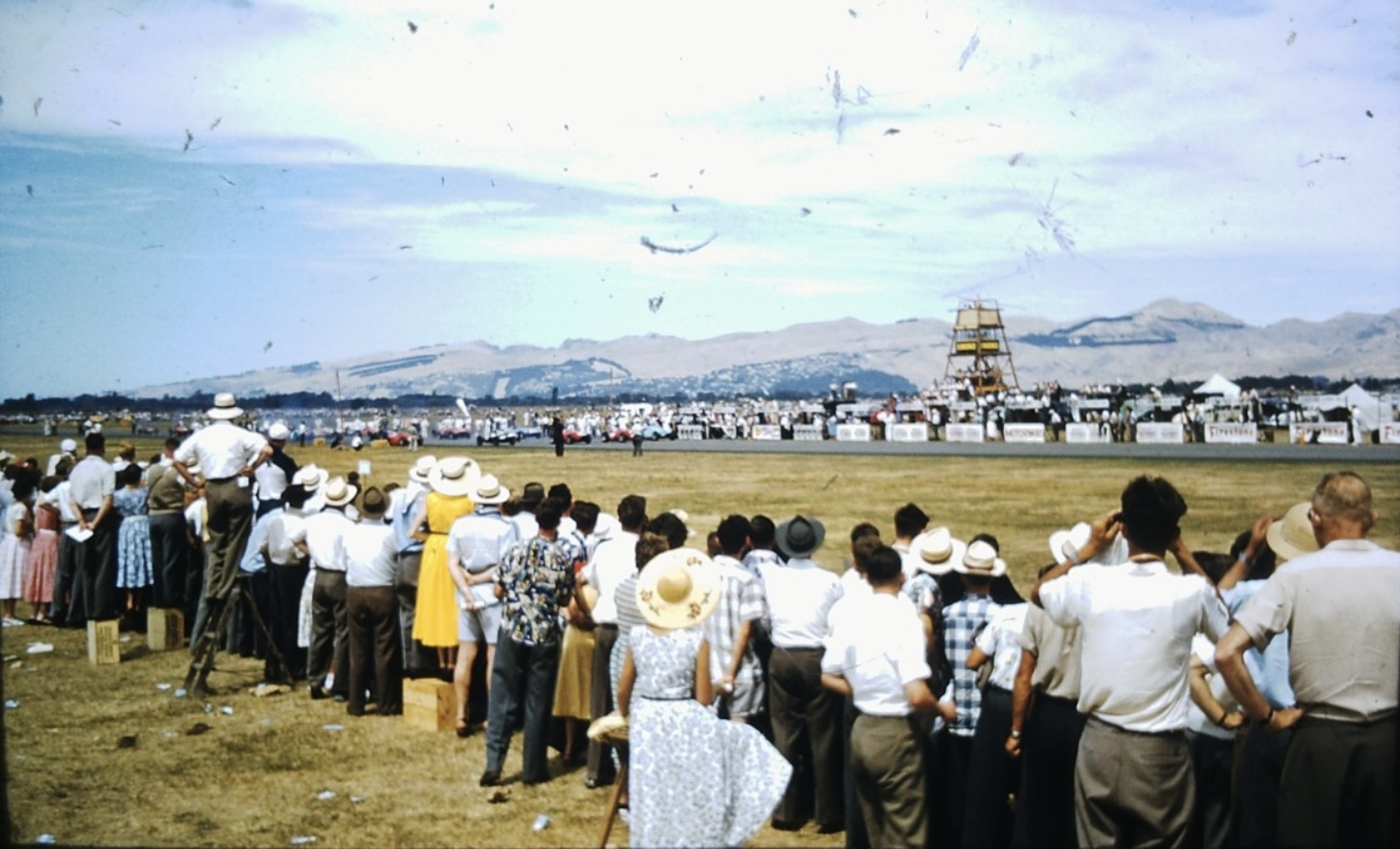
Whitehead took the win from Parnell with Horace Gould’s Maserati 250F third. See here for more these cars; Squalo Squadron… | primotipo…
1957 starting grid panorama (I Tweedy)
BRM’s Ron Flockhart won the 1959 race from pole in a convincing display, he gets the jump in the P25 here with the obscured Coopers of Brabham and McLaren immediately behind, and Syd Jensen’s at right.
Frank Cantwell’s Tojeiro Jaguar is on the left, then Ross Jensen’s light coloured sharknose Maserati 250F, then Tom Clark’s Ferrari 555 Super Squalo #22.
Jack Brabham crouched in the cockpit of his Cooper T55 in typical style during the 1962 running of the Wigram classic.
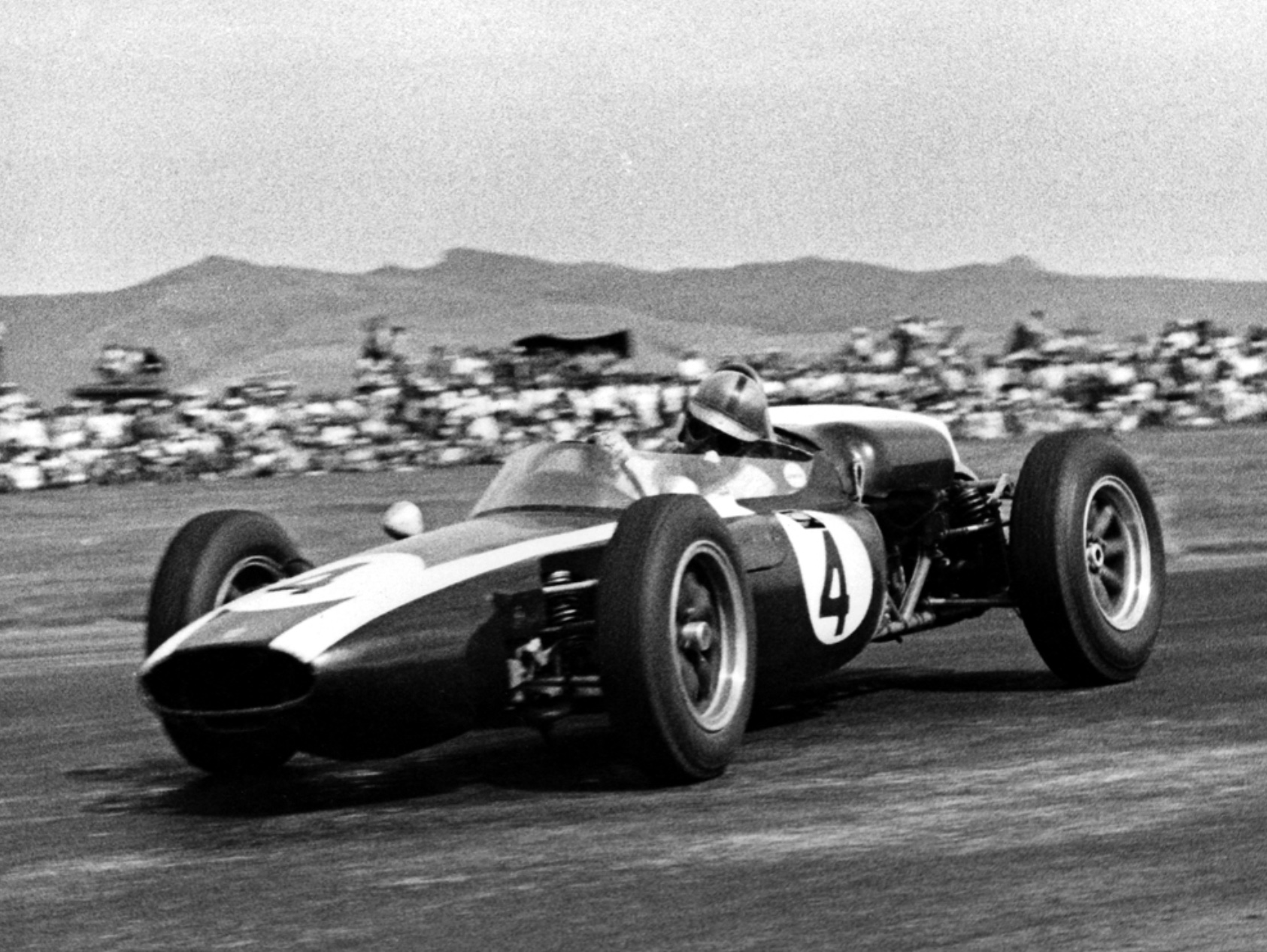
Stirling Moss won again in his final New Zealand victory, aboard a Rob Walker Lotus 21 Climax (below) from Brabham, with John Surtees third in a Cooper T53 Climax. Jack and John used 2.7-litre Indy FPFs, while Moss’ was a 2.5.
Moss motors away in Rob Walkers’ Lotus 21 Climax #935, who is aboard the chasing Cooper T53? (MotorSport)
We have lift-off in 1967.
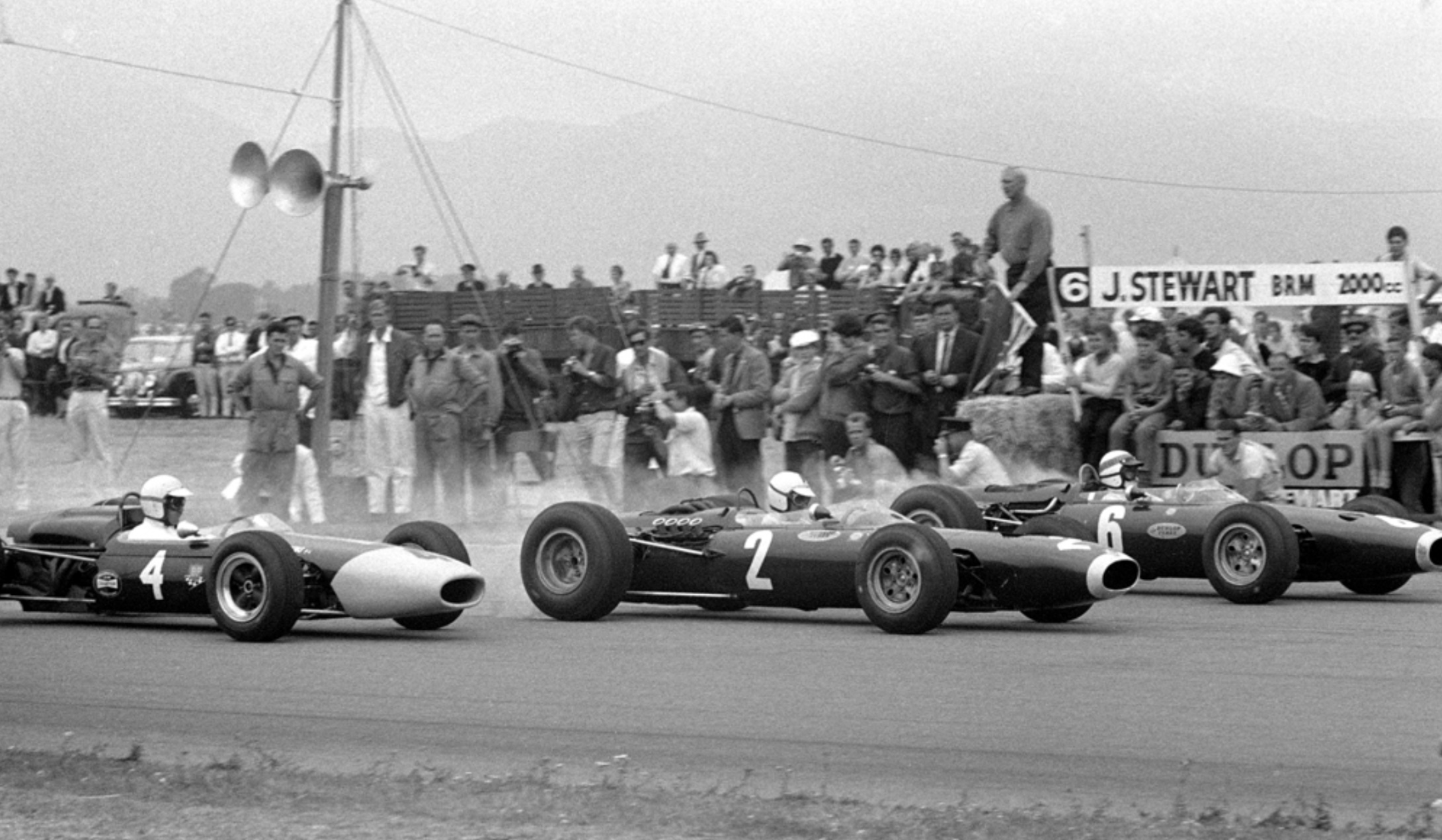
Frank Gardner’s four cylinder Coventry Climax FPF was going to struggle against the 2.1-litre BRM V8s of Dickie Attwood and Jackie Stewart on the right.
Frank finished a good fourth in a series of great speed and reliability, but up front at Wigram were three different V8s; Jim Clark’s 2-litre Lotus 33 Climax, Attwood’s BRM P261 and Denny Hulme’s 2.5-litre Brabham BT22 Repco.
Clark won the series with three wins from six championship rounds. Stewart won two and Jack Brabham, Brabham BT23A Repco one. The BRMs were quick, as they had been in 1966 – Stewart won the Tasman that year – but the transmissions wouldn’t take the additional punch of the V8s, which that year were bored out to 2.1-litres, rather than the 1.9-litre variant of the original 1.5-litre F1 V8 which did the trick the year before.
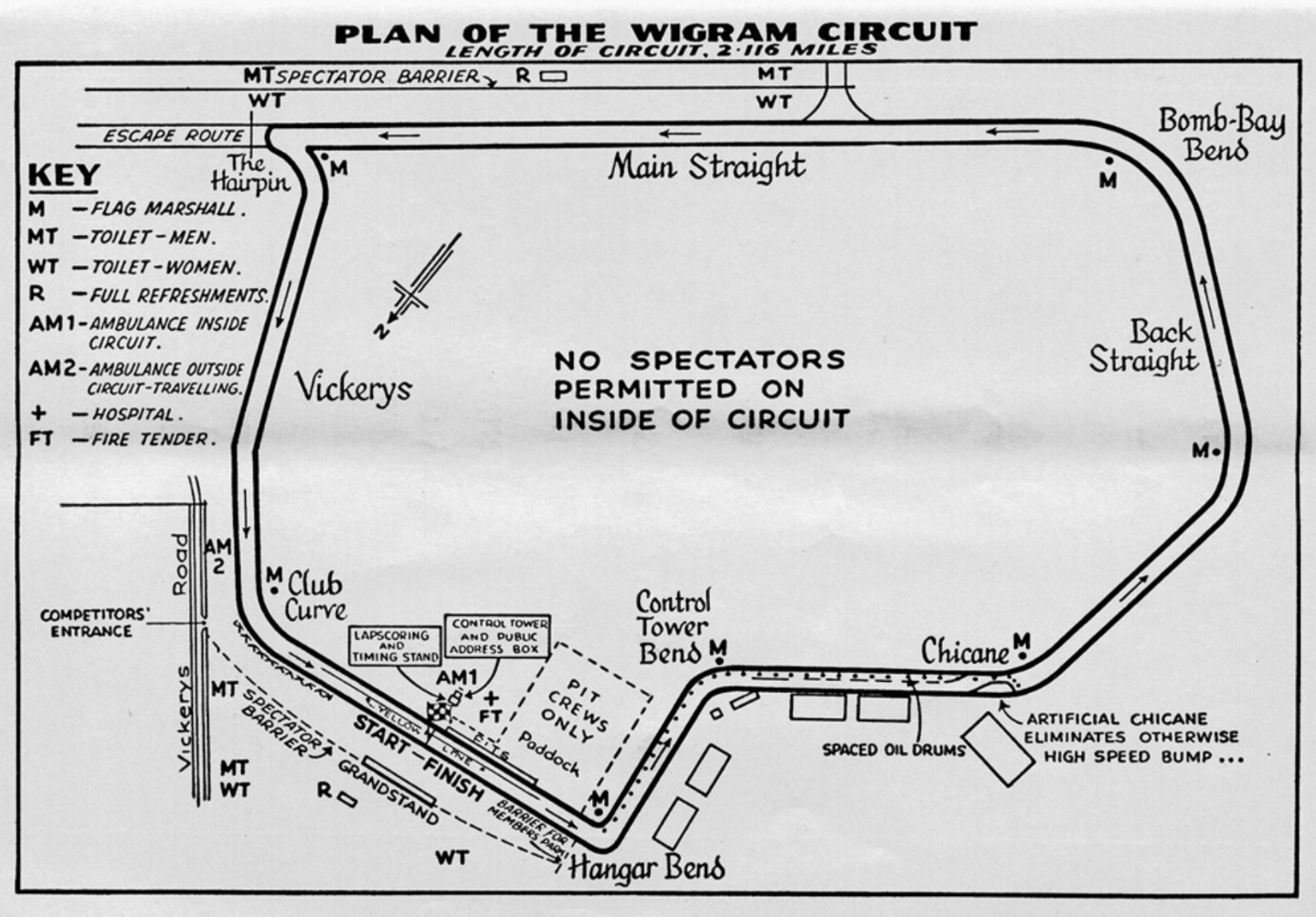
The cars are on the start-finish straight and lining up for Hangar Bend. Look closely, there are two BRM P261s in the mix so it’s probably 1966 or 1967, not 1968 I don’t think.
Christchurch enthusiast Geoff Walls remembers this era well, “It was the most fabulous fast circuit as those airfield situations can be, particularly rounding Bombay Bend onto the main straight/ runway at 100mph before really opening up for the length of the straight.”
“The Lady Wigram Trophy weekend was always in the Summer school holidays so on the Thursday, practice day, and again on Friday, some mates and I used to bike to the airfield, hide our bikes in the dry grass covered ditch parallel with the main runway, crawl through the wire fence and then sprint across the track at the right time and into the middle of the circuit where all the cars and drivers were for the day, great stuff!”
“In later years the Country Gentlemen’s Historic Racing and Sports Car Club used to hold a race weekend there with 250 entries and I was Clerk of the Course, also great occasions on the circuit. That was a great social occasion too and I do have photographic evidence!!”
(G Danvers)
This photograph was taken in October 1968 from the top of the water tower, looking east towards the control tower. Don’t the hangars in the foreground make the control tower building which looms large over Bruce McLaren in our opening shot seem small!
(T Marshall)
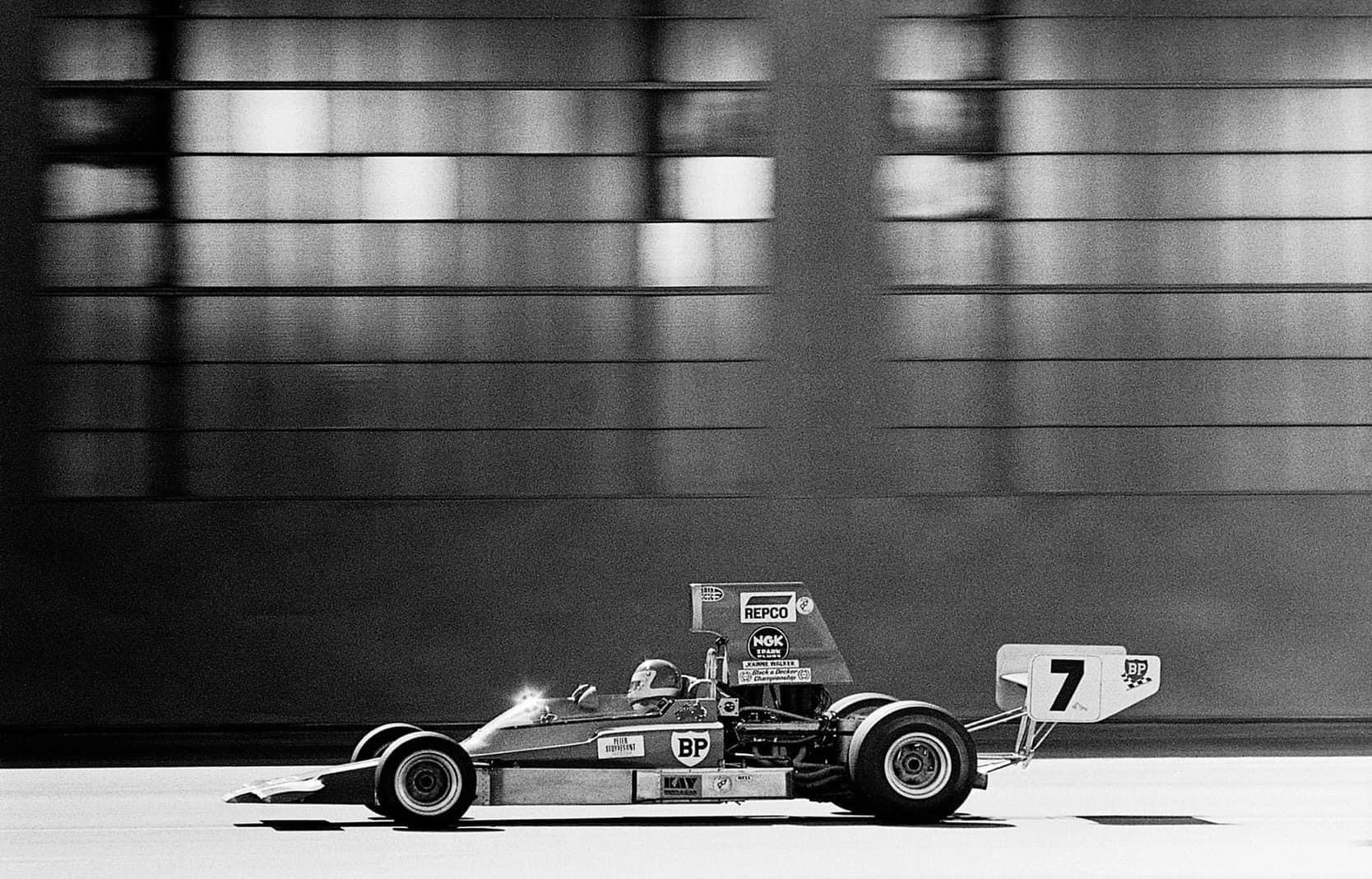
Adelaide Ace John Walker – later 1979 Australia GP and Gold Star winner – with Repco-Holden F5000 V8 fuel injected thunder echoing off the hangar walls.
It’s the ’74 Tasman round, the tremendously talented Terry Marshall has captured the perfect profile of JW’s unique Repco-Holden powered Lola T330 with a perfect-pan. His DG300 Hewland was hors d’combat after 20 laps. John McCormack won in another Repco-Holden powered car, Mac’s Elfin MR5 was timed at 188mph on Wigram’s long straight, the two VDS Chevron B24 Chevs of Teddy Pilette and Peter Gethin were second and third.
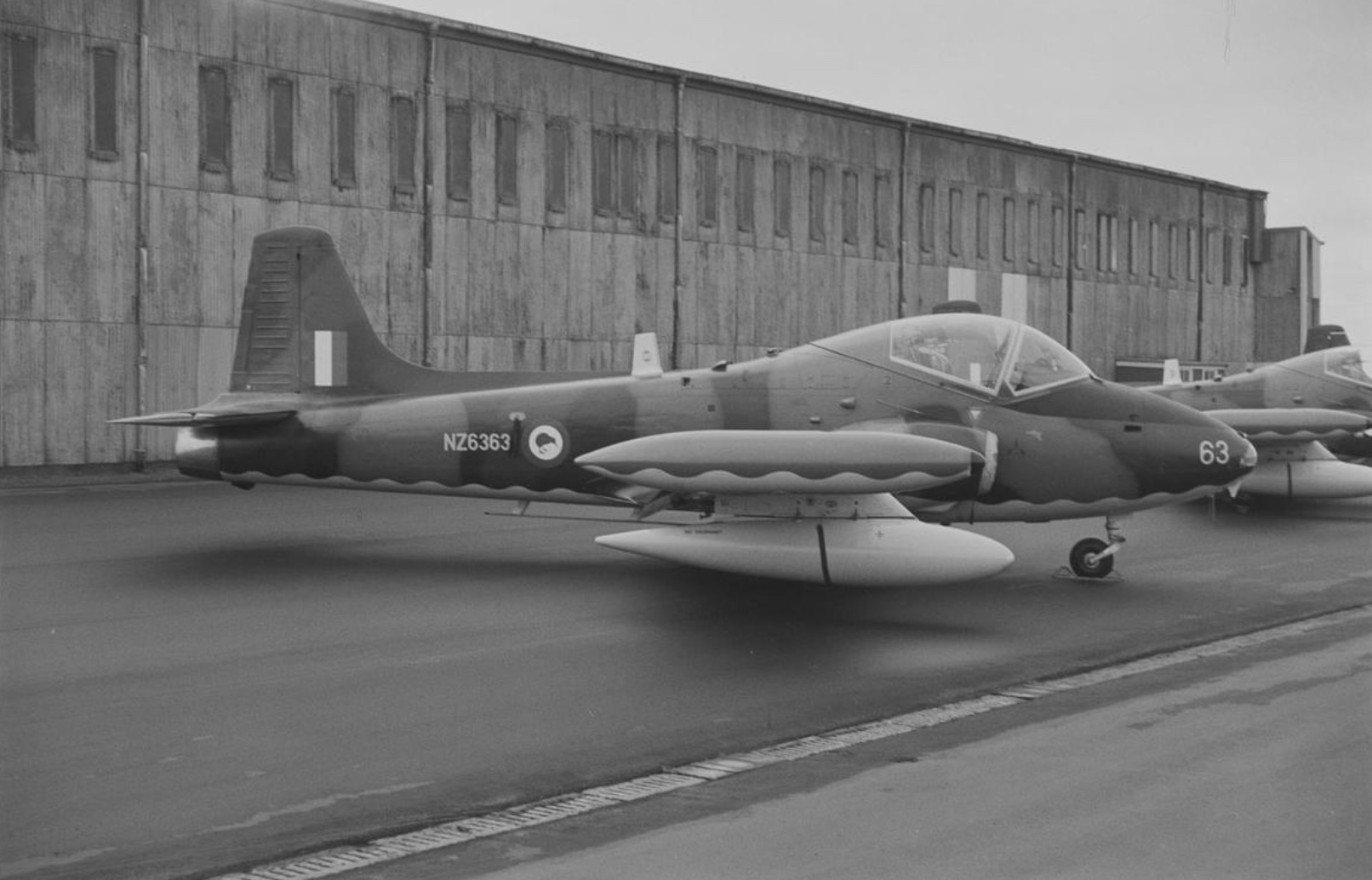
Six months earlier, closeby, this BAC 167 Strikemaster Mk88 was pictured in repose. The jet-powered trainer and light attack machine had bones dating back to the 1950 Percival Provost.
(John Page)
(T Marshall)
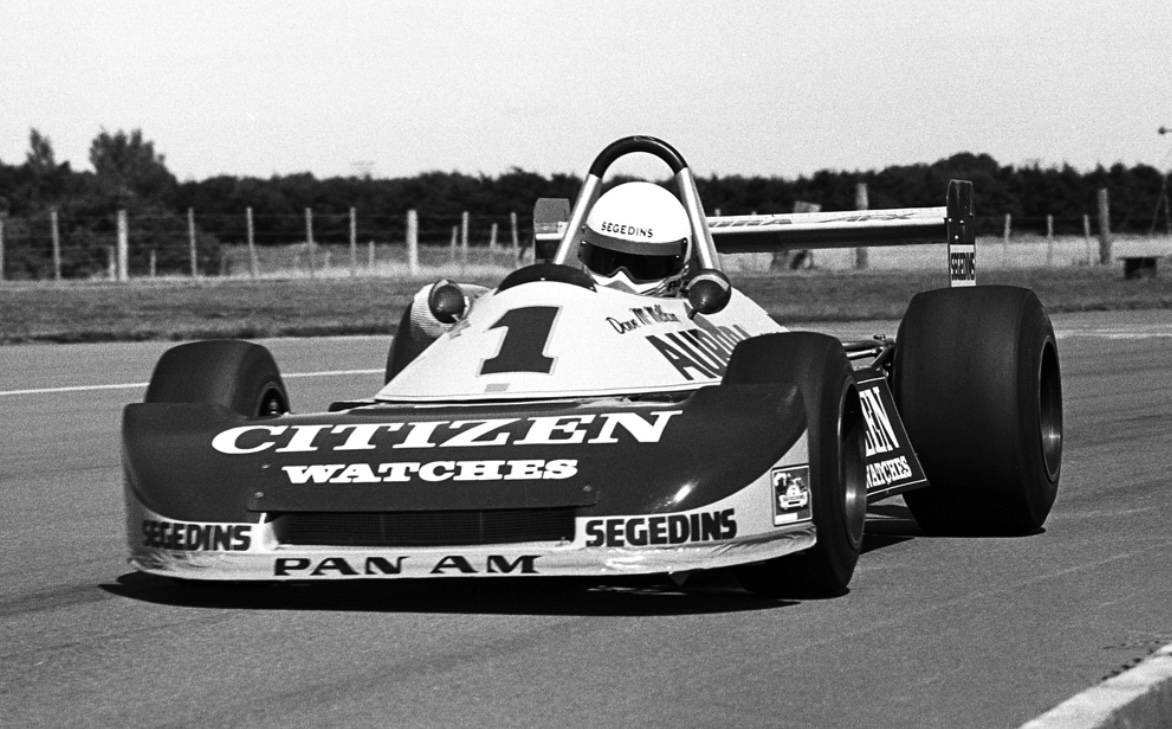
Dave McMillan won two Wigram Trophies on the trot in 1979 and 1980 aboard one of Ron Tauranac’s most successful designs, a Ralt RT1 Ford BDA Formula Atlantic/Pacific.
They were good wins against strong opposition too. He won both races in 1979, in front of Teo Fabi and Larry Perkins in one race, and Fabi and Brett Riley in the other. In 1980 he was in front of Steve Millen, second in both, and Ian Flux and David Oxton in third.
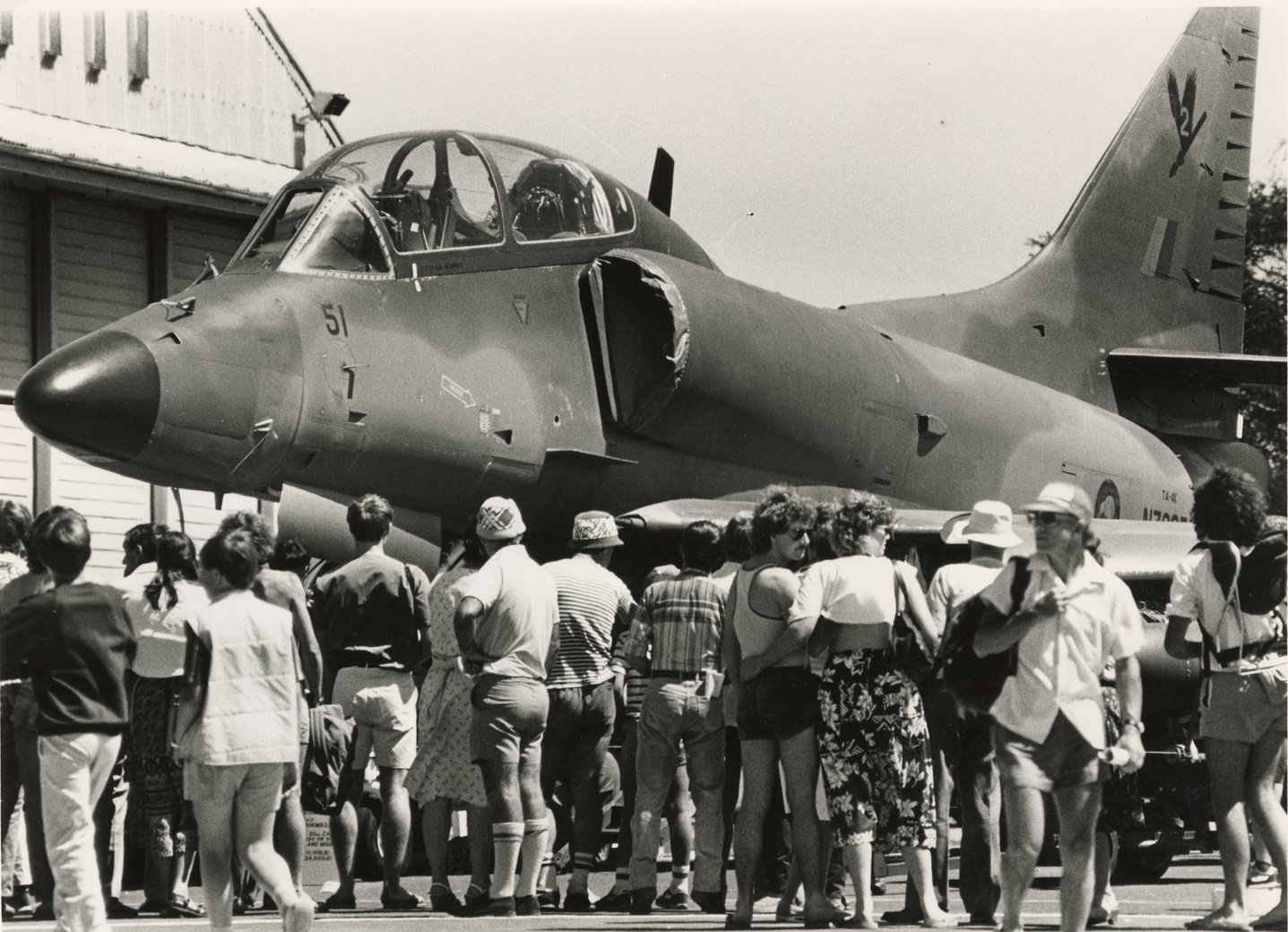
An RNZAF Douglas A-4 Skyhawk single-seat subsonic fighter on display during the Wigram Wings and Wheels Exhibition February 1986 weekend.
(canterburystories.nz)
Credits…
Classic Auto News. The talkmotorsport.co.nz website provided most of the photographs, I’d love to provide credits to the snappers concerned if any of you can oblige. Terry Marshall, John Page, canterburystories.nz, Isabel Tweedy, the Gary Danvers Collection, discoverywall.nz, teara.govt.nz
Tailpieces…
Piers Courage, Brabham BT24 Ford DFW alongside the similarly powered Lotus 49Bs of Graham Hill and Jochen Rindt at Wigram in January 1969.
Chris Amon’s Ferrari Dino 246T is behind Jochen, Frank Gardner, Mildren Alfa V8 behind him.
Perhaps the Tasman Cup high point was 1968 when the field included two works Lotus 49 Ford DFW V8s, Amon’s factory Dino V6, works BRM P261 V8 and P126 V12s, Jack Brabham’s Brabham BT23E Repco, and various other Repco V8 engined cars, Alec Mildren’s Brabham BT23D Alfa V8 and the rest.
Jochen Rindt won the 1969 LWT, it was the great Austrian’s first Team Lotus, ok, Gold Leaf Team Lotus, victory.
He won from Hill and Amon with Chris winning the Tasman that year with four wins in the seven rounds.
(G Danvers Collection)
RNZAF Wigram in 1992 complete with a Tiger Moth and 11 Airtrainers ready to boogie, the wonderful building is still with us, and as a Listed Heritage Place always will be.
The government rationalised their military properties in the 1990’s, in that process RNZAF Wigram was closed in September 1995. Wigram Aerodrome then operated until March 2009 when it was progressively redeveloped for housing. The aviation connection continues though, the Christchurch Air Force Museum is located on the northern side of the old aerodrome.
Stirling Moss’ Aston Martin DB3S heads down Silverstone’s straight on the approach to Copse, Silverstone, 5 May 1956…
Another factory Aston DB3S of Roy Salvadori won the race, The Daily Express Trophy meeting sports car event, with Bob Berry third in a Jag D-Type from Moss, he is behind Stirling in this shot. Roy Salvadori had a good meeting also winning the under 1500cc sportscar event in a Cooper T39 Climax.
Moss won the feature F1 event, the BRDC International Trophy over 60 laps/175 miles in Vanwall VW2 from the Connaught B-Types of Archie Scott-Brown and Desmond Titterington.
(unattributed)
Moss in Vanwall VW2 chases teammate Harry Schell in VW1 during the International Trophy, Moss won while Harry suffered a DNF with a broken fuel pipe.
I’m on tour at the moment in Italy and then England, back in Australia on July 5, my posts until then will be predominantly quickies.
Evocative shot of Peter Collins in his Ferrari Dino 246, 1958 #246/002, during the July 1958 British Grand Prix at Silverstone.
He won the race by 24-seconds from Mike Hawthorn who took the World Drivers Championship that year, before perishing in ‘that’ road-dice with Rob Walker shortly thereafter.
I’ve done these cars to death, both front-engined F1 jobbies and their related mid-engined Tasman cousins, but another bunch of photos got the juices flowing again.
In an enthralling, tragic season, Luigi Musso died at Reims, then Peter Collins crashed fatally at the Nurburgring only weeks after Silverstone (in this same chassis) during the German Grand Prix. Vanwall, with whom Ferrari battled all year – winners of the Constructors Championship – also lost a driver at the season’s end when Stuart Lewis-Evans died of burns sustained at Ain-Diab in Morocco several days after the race.
(MotorSport)
This Moroccan GP start-shot of Vanwall mounted Stirling Moss bolting away from a Ferrari, this time with Phil Hill at the wheel, says a lot about the rivalry between the teams during a year in which British F1 pre-eminence began. Vanwall and Cooper, to whom Tony Vandervell would pass the torch, were on the rise.
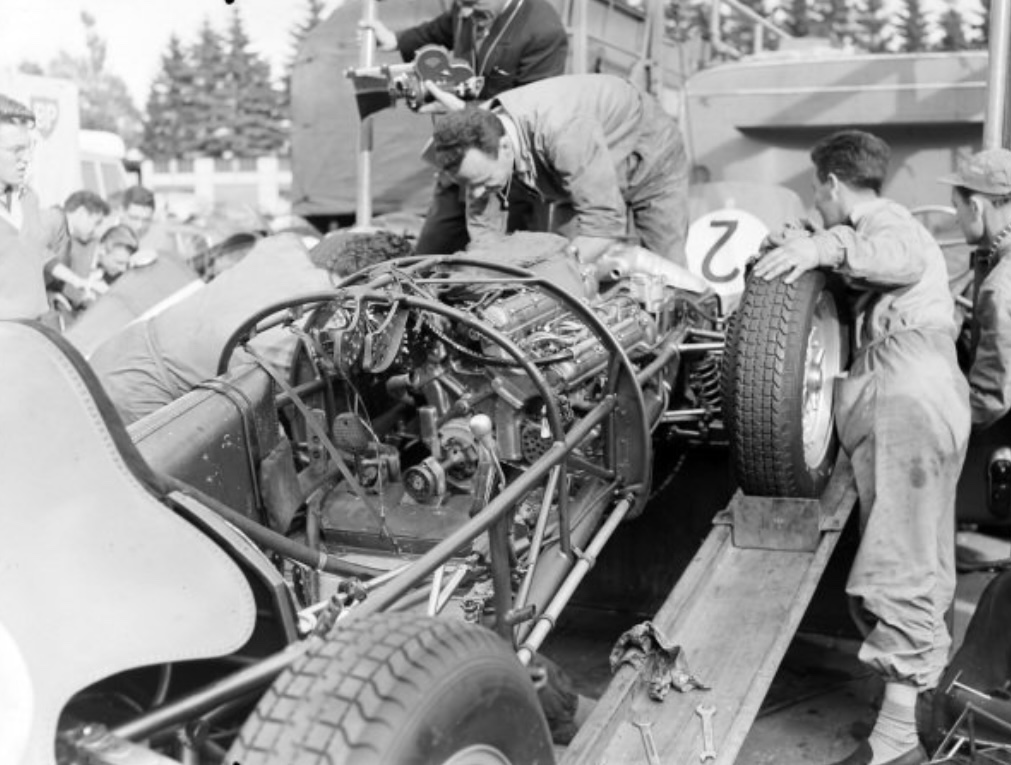
The shot below shows Hawthorn’s car (1958 #246/003) being attended to in the Silverstone paddock. Note the traditional twin-main tube Ferrari chassis, and subsidiary tubes, and powerful V6 engine canted to the right to allow the driveshaft to pass alongside the driver.
By contrast, the Vanwall had a Colin Chapman designed, light, multi-tubular spaceframe chassis, and far less sexy, but powerful, torquey, twin-cam, two-valve – same as the Ferrari – in-line four cylinder engine.
(MotorSport)(MotorSport)
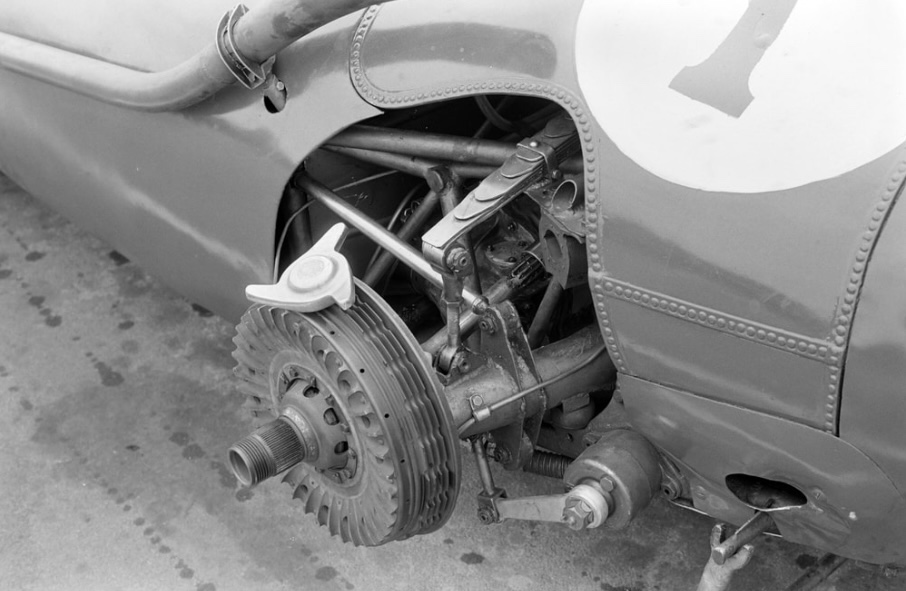
At the start of its life the Dino rear end (Collins’ car at Silverstone above) comprised a De Dion axle, transverse leaf-spring, twin radius rods, Houdaille shocks and drum brakes. By 1960 it was independent with coil springs, telescopic shocks and disc brakes, such was the relentless pace of change and level of competition wrought by the mid-engined Cooper T51 and Cooper T53 Climaxes in 1959-1960.
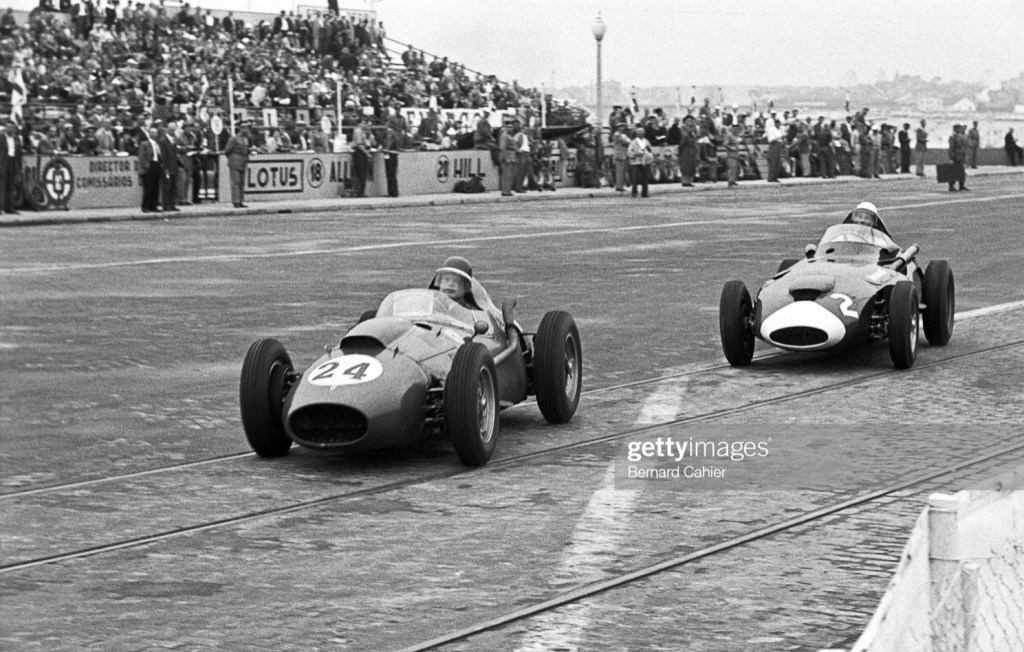
In late August, Hawthorn and Moss battle on the Boavista seafront in Portugal. Stirling won on the cobblestones by five seconds from Mike, settling up a nail-biting end to the season at Monza and Ain-Diab.
Brooks’ Vanwall won from Hawthorn at Monza, while Moss had a gearbox failure. In Morocco, Hawthorn put his car on pole from Moss, in the race the positions were reversed. Mike took the title by a point from Stirling in a season in which the best five placings were counted.
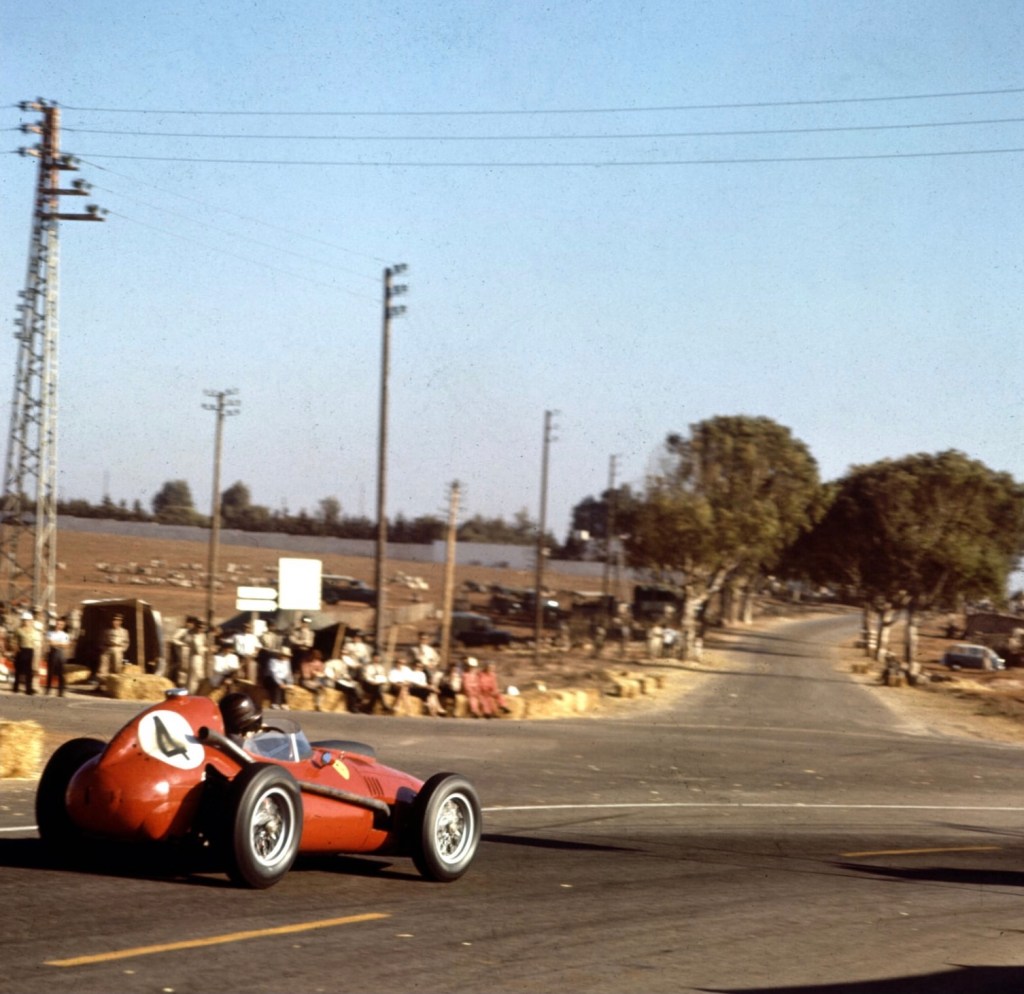
The stunning shot of Phil Hill below, hooking his Dino (1958 #246/004) into a right-hander in the wilds of Morocco shows all that was great – and incredibly dangerous – of Grands Prix racing compared with the (sometimes) between the white lines ‘car park’ F1 competition of today. Grand Prix Racing it ain’t…
Stirling Moss jumps aboard his Porsche 550 Spyder at the start of the Buenos Aires 1000km on January 26, 1958.
It is intriguing to know how often the great one practised this manoeuvre, the chances of getting ones legs mixed up in gear-shifts and other componentry due to a poor landing are obvious.
He won the 2-litre class in the 1.6-litre car shared with Jean Behra, and was third outright in the 106 lap race – the first round of the FIA World Sports Car Championship – won by the works Ferrari 250 Testa Rossa driven by Peter Collins and Phil Hill.



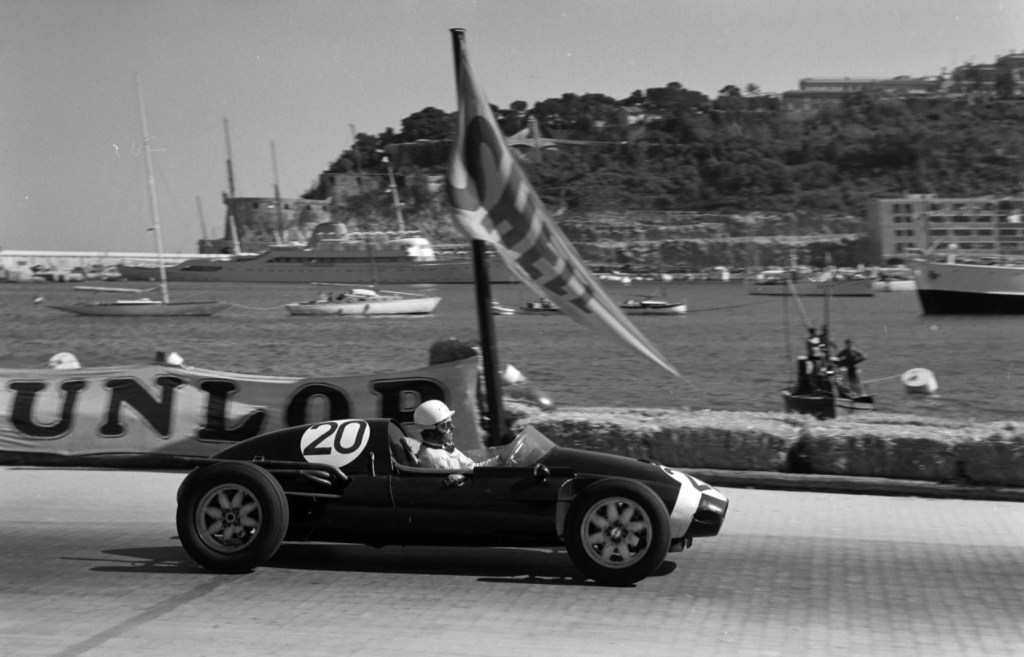
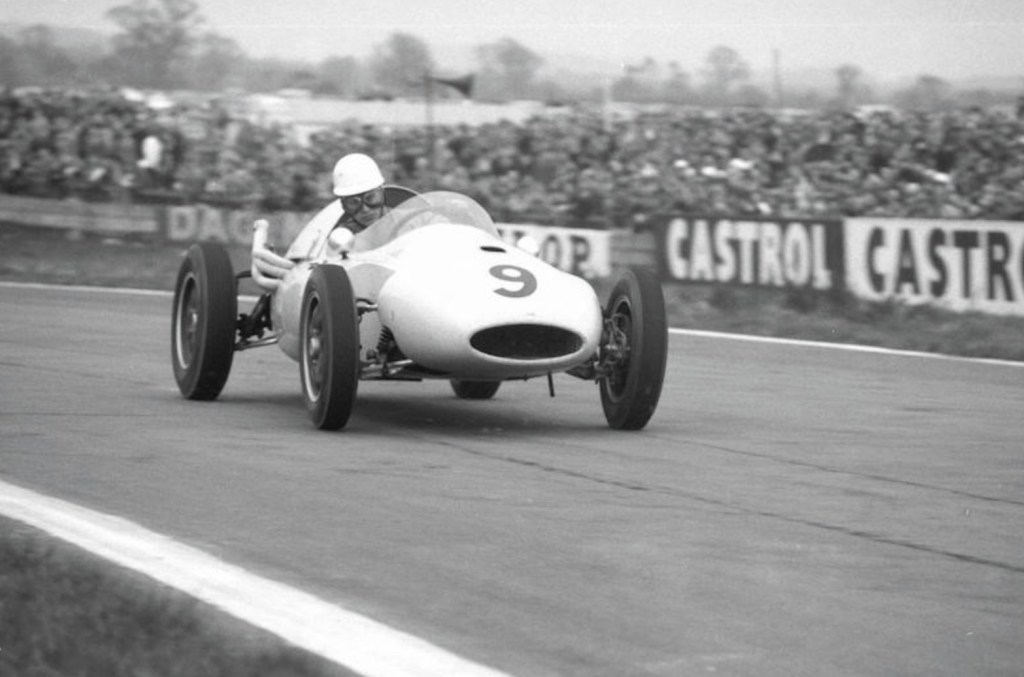


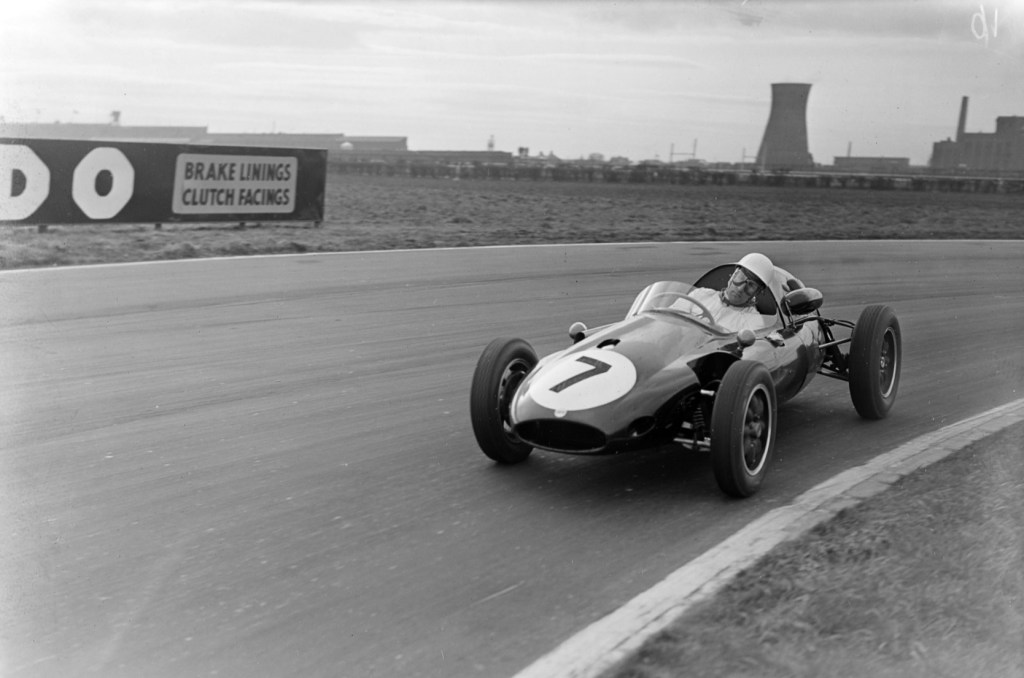
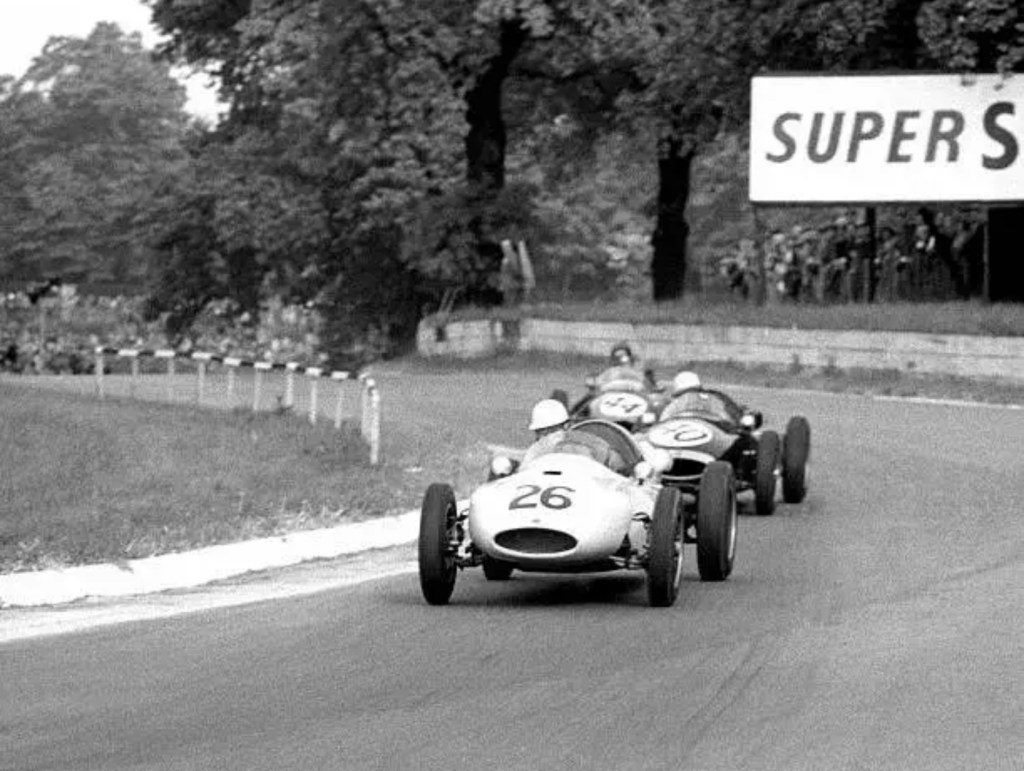









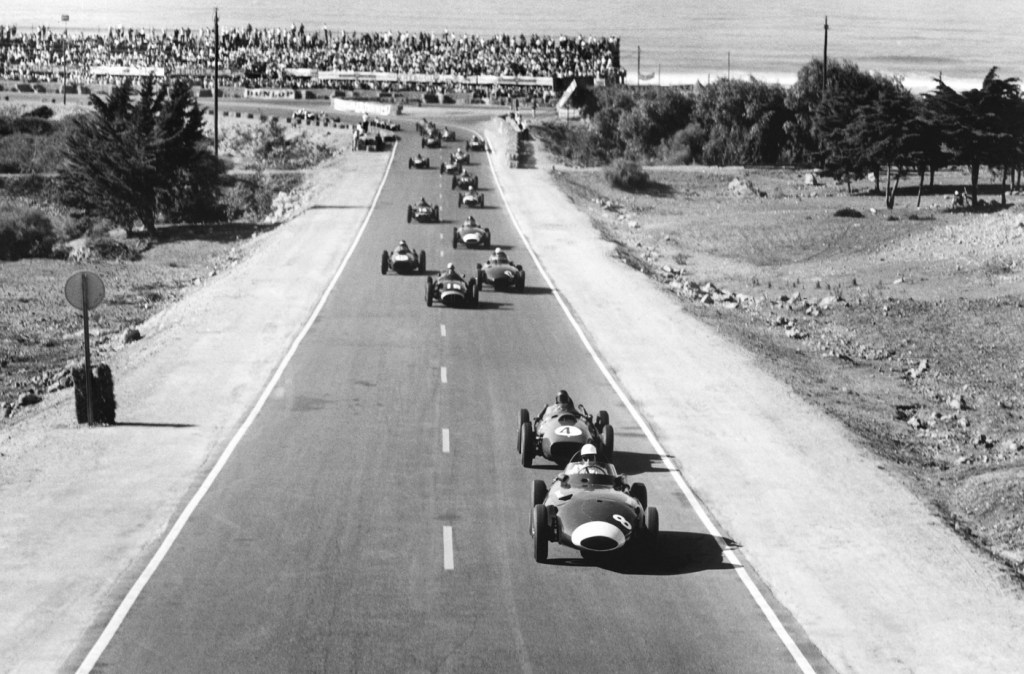
 Stirling Moss jumps aboard his Porsche 550 Spyder at the start of the Buenos Aires 1000km on January 26, 1958.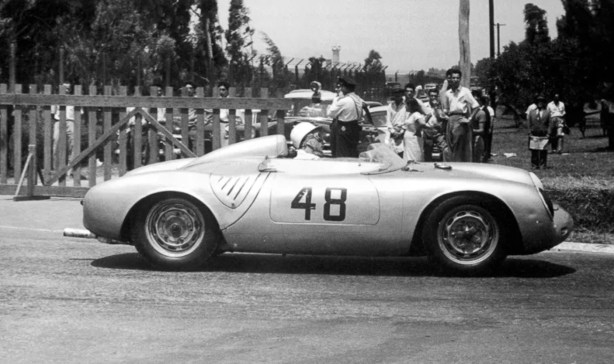
 primotipo...