Archive for the ‘F1’ Category

ronnie

Monaco Panorama; Ronnie Peterson eases his March 711 Ford around the hairpin at Monaco in 1971 on the way to second place, Jackie Stewart won in a Tyrrell 003 Ford…

Monaco was a happy hunting ground for the Swede, his brand of ‘balls to the wall’ driving was not necessarily the style that was rewarded in the principality but he took wins in the F3 Grand Prix in 1969 in his Tecno 69 Ford and in the F1 event in a Lotus 72E Ford in 1974.

He had a great year in the 711, an excellent Robin Herd design, he finished second to Jackie Stewart in the 1971 drivers championship, not bad for a driver in his second GP season!

The more radical 1972 March 721X made conceptual sense but was not so successful…Ronnie was then snaffled up by Lotus for ’73…

ronnie 2

Close up of Ronnie in the 711, Dutch GP 1971, he was 4th in the race won by Ickx’ Ferrari 312B2. Front suspension; top rocker, lower wishbone, inboard coil spring/Koni damper and adjustable roll bar all clear and beautifully fabricated by the Boys From Bicester (unattributed)

A couple of other posts on ‘Mad Ronald’ to look at…

His first GP season in 1970;  https://primotipo.com/2014/05/15/blue-cars-rock/

With Colin Chapman;  https://primotipo.com/2014/08/03/the-gentle-art-of-driver-seduction-colin-chapman-and-ronnie-petersen-clermont-ferrand-1972/

Photos…unattributed


tony brooks

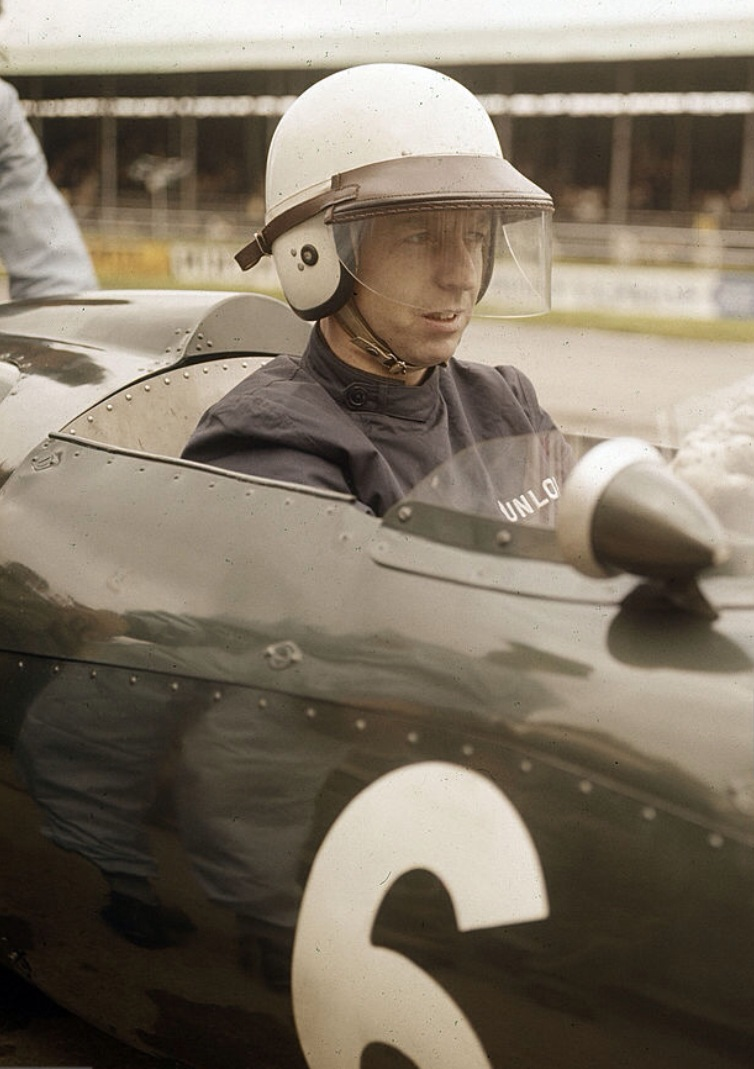
Tony Brooks, pensive before the off in his BRM P48 Mk2 ‘487’ during the ‘BRDC International Trophy’ meeting, Silverstone, 6 May 1961…

Brooks returned to the Bourne team for ’61, his last in motor racing, it was generally not a happy one racing 1.5 litre Coventry Climax FPF engined BRM P57’s. The Bourne teams own wonderful P56 V8 was still a season away.

The International Trophy in 1961 was contested to the shortlived Intercontinental Formula, rather than the new 1.5 litre F1. Brook’s joy in driving a ‘proper’ 2.5 litre racing car somewhat dampened, literally, by the horrid conditions in which the drivers raced.

Brooks was 6th in the event won by Stirling Moss in Rob Walker’s Cooper T53 Climax. Tony was passed by an inspired Chuck Daigh’s front-engined Scarab at one point, finally re-taking the American’s position during the last lap.

Perhaps the great drivers waning interest in racing was becoming clear early in the season? He was out-qualified by his team-mate Graham Hill, well established in the team by then, in 7 of the 8 championship events in 1961…

Credits: Popperfoto, Doug Nye ‘BRM Vol 2’

image

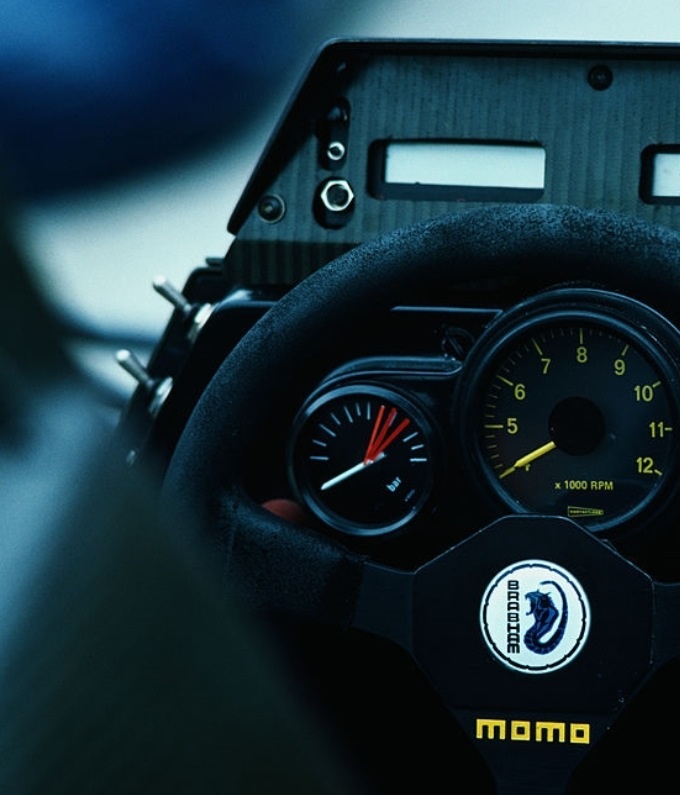
The boost gauge is a sign of the 1.5 litre, turbo GP formula, what a goody it was…

The Brabham BT52 BMW took the world title in Nelson Piquet’s hands in 1983, the cockpit shot is a BT53 during the ’84 British Grand Prix weekend.

image

The photo above is Piquet’s BT53 being attended to by the cars designer, Gordon Murray, whilst white shirted Paul Rosche, the 4 cylinder BMW engines designer looks on. It’s practice at Hockenheim during the ’84 German GP weekend.

Not a good meeting though, both Teo Fabi and Nelson retired with turbo and gearbox maladies respectively, the McLaren MP4/2 TAG’s of Prost and Lauda were first and second.

Credits…

Rainer Schlegelmilch

Tailpiece…

image


lot 72

This photo of the front of the epochal Lotus 72 Ford was taken in the Jarama paddock upon the cars race debut during the Spanish GP weekend on 19 April 1970…

It wasn’t quite the debut the equally trendsetting Lotus 25 Climax and Lotus 49 Ford made in ’62 and ’67 respectively, but Jochen popped it 8th on the grid and then failed to finish, his Cosworth DFV had ignition problems. Jackie Stewart won the race in Ken Tyrrell’s March 701 Ford.

I like the shot as it shows the car as Maurice Phillipe originally detailed it. The jewel of a thing won at Zandvoort on June 21, 2 months later as a Lotus 72C! It evolved from 72, 72B to 72C spec in 2 months.

image

‘Gees Colin it needs some work!’ Rindt to Chapman in the Jarama paddock 1970. The ‘SOL’ pitboard is local boy Alex Soler-Roig who had a steer of Jochen’s old Lotus 49C, failing to qualify, as did John Miles in the other works 72 (unattributed)

Jochen loathed the 72 in its original form. It had severe handling deficiencies, the car rolled excessively and lifted inside rear wheels. The anti-dive geometry made the light steering lack feel as the suspension stiffened under braking. Anti-squat was suspected of inducing a diagonal jacking moment across the car causing that inside rear wheel to lift in corners.

Chapman prescribed a raft of changes including removing the anti-dive and anti-squat aspects of the cars suspension geometry front and rear. It’s easy to say but involved Hethel’s fabricators unpicking the cars lovely aluminium monocoques to change the suspension pick up points at the front, and to make a new subframe at the rear.

Chapman, not only one of the design greats but also a race engineer of extraordinary ability and perception turned a ‘sows ear into a silk purse’, the car famously winning its first titles that year, Rindt’s drivers championship posthumously of course.

Other changes to the car before the French GP, held that year on the rolling glorious roads of Clermont Ferrand included stiffening the rear of the chassis by cross bracing it, fitting stronger suspension pick-up points and re-siting the rear Koni shocks which were being ‘fried’ by hot air exiting the hip radiators.

image

Lotus 72C Ford cutaway; aluminium monocoque, wishbone upper and lower front suspension, torsion bars providing the spring medium and Koni shocks. Single top link, parallel lower links and again torsion bars and Koni shocks at the rear. Ford Cosworth DFV 3 litre V8 and Hewland FG400 gearbox (unattributed)

Checkout the following in the first photo at the articles outset; the monocoque ending at the front, drivers feet bulkhead, fabricated tubular steel front subframe and all it supports. The infamous inboard front brakes are clear, a design tenet of the car was reduced unsprung weight. I can’t see the front torsion bars, but the lack of co-axial coil springs and use of long solid torsion bars as the springing medium was also revolutionary at the time. The front battery is handily placed to be removed in the event of a front impact, as is, sub-optimally, the onboard fire extinguisher.

The front of the 72 is far less ‘butch’ or strong, than, say, the ‘full monocoques’ of a 1970 BRM P153, or a McLaren M14 but the perils for racing drivers of frontal impacts at any speed in all of the cars of the period are clear in this shot. Note the hip-radiators, Chapman was playing with weight, which he placed increasingly onto the rear of the car over the 72’s long, 1970-75 life as well as aerodynamics. Still, the wedge wasn’t new, his 1968 Lotus 56 Pratt & Whitney Indycar first deployed the approach.

image

Press launch of the Lotus 72 wedge in London, 6 April 1970 (Norman Quicke)

A magic car with a long competitive life, yet again Chapman set a path so many others followed…

Credits…

The GP Library, Norman Quicke, Doug Nye ‘The History of The Grand Prix Car’

Tailpiece: Jochen Rindt riding the Lotus 72 roller-coaster at Jarama in 1970, ‘anti-dive’ inclination of top wishbones clear in shot…

image


duce

The numbers of the cars pictured in the Pescara pits do not correspond to the unlimited capacity Coppa Florio race entries. Perhaps cars from the support, 1100cc race (Imagno)

‘Il Duce’, Benito Mussolini attends the 1933 Coppa Acerbo, he is the little stout chap in the nifty Ermenegildo Zegna military suit…

By 1933 Mussolini had been in power in Italy for 11 years, he was elected Prime Minister in 1922, he established a dictatorship in 1925. It’s said he was a motor racing enthusiast, no doubt the public relations benefits of attending high profile events such as the Coppa Acerbo did not escape him.

The 15 August 1933 Coppa Acerbo was an important race that year given changes to the driver line up amongst the Italian teams, some very shortly before the event which gave added interest to the meeting.

Alfa Romeo withdrew from Grand Prix racing at the end of 1932, electing to leave its superb monoposto, the first single-seaters in Grand Prix racing, Tipo B’s behind the closed doors of its Portello works leaving the new Scuderia Ferrari to race older Alfa Romeo Monzas. No amount of remonstrating with Alfa Romeo management by Ferrari was successful in releasing the quicker, newer design. Not early in the season anyway!

As a consequence Ferrari was unable to keep his team together as his drivers sought more competitive mounts. Rudi Caracciola and Louis Chiron formed Scuderia CC, although Louis returned to the Maranello fold later in the year. Taruffi left too, having been forced to cede his car to Nuvolari whilst leading the French GP. Then, after an argument with Ferrari post the controversial Tripoli GP Nuvolari departed, taking his friend Borzacchini with him. Giulio Ramponi went to join Whitney Straight’s private team to add to the rout.

Ferrari fought back of course, hiring Fagioli who was not keen on seeing Nuvolari take the #1 seat at Maserati with Campari also joining him at Scuderia Ferrari. Eventually Ferrari succeeded in having the Tipo B’s released to him in time for the Coppa Acerbo and then the Maserati runners were at a disadvantage!

Fagioli aboard a 2.6 litre Scuderia Ferrari Alfa Tipo B monoposto suggests to Piero Taruffi he is ‘coming thru’, 3 litre Maser 8CM, 1st and 3rd respectively. Vittorio Jano’s Alfa Tipo B/P3 the dominant car of 1932 to early 1934 (Imagno)

So…the Coppa Acerbo loomed. Fagioli had defected from Maserati as did Campari, back to Scuderia Ferrari following a disappointing race at Reims 9 days before. Nuvolari and Barzacchini raced 3 litre straight-8 Maserati 8CM’s as independents. Taruffi too raced a Maserati 8CM in Pescara for the first time.

Scuderia Ferrari entered eight cars; 2 1932 2.6 litre straight-8 monoposto Alfa Romeo Tipo B/P3 which, as noted above, the Alfa factory had just released to Ferrari for Campari and team leader Fagioli. 2.6 litre Monzas were prepared for Trossi, Carraroli and Tadini and 2.3 litre Monzas for Brivio and Comotti. Five Bugattis were entered, not the new 2.8 litre Type 59 which did not appear until the last GP of the year in Spain, but 2.3 litre factory T51’s for Dreyfus and Varzi’s privately entered car. Also Bugatti mounted was Earl Howe and Brunet in Type 51’s with Mille ‘Helle Nice’ in a 2 litre Type 35C. All were straight-8 engines of course.

Enzo Ferrari and riding mechanic during the 1924 Coppa Ciano meeting, Alfa Romeo RL Super Sport (unattributed)

Famous agriculture minister Giacomo Acerbo named the race in honour of his brother Captain Tito Acerbo, a decorated war hero killed towards the end of the war in 1919. The first event was held in 1924 and won by Enzo Ferrari in an Alfa RL Super Sport after a tyre failure befell Campari who was well in the lead in a similar six-cylinder works Alfa to Ferrari’s.

The 25.5Km road course was a daunting one set in the Abruzzi Mountains. The track was loosely triangular in shape like Reims, starting in Pescara on the shores of the Adriatic. After a 1 Km stretch the road turned inland for about 11 Km along a winding road into the Abruzzis.

It plunged through the forests and hill villages of Villa Raspa, Montani, Spoltore, Pornace and Villa St Maria rising 200 metres from the coast. The racers then descended to Capelle sul Tavo and then after a hairpin into the 11Km long Montesilvano downhill straight to the coast at very high speed. The straight was followed by a fast right turn at Montesilvano railway station which led onto the Lungo Mare Straight along the coast back to the start/finish line in Pescara. Nuvolari’s fastest lap in the 2.6 litre Alfa Tipo B monoposto in 1932 was 147Kmh. The event comprised 12 laps, a total of 306Km.

The fast boys in practice were Nuvolari’s Maserati 8CM, Campari’s Tipo B and Varzi in another Tipo B. Varzi was given the car to test by Ferrari but elected to race his Bugatti, Molsheim being not keen on the notion of Achille racing the Alfa. The grid was determined by ballot of course, over 50000 spectators lined the course in anticipation of an epic battle amongst mainly Italian drivers.

Two races were run during the carnival, one of 4 laps for 1100cc cars which was won by Whitney Straight’s MG K3 Magnette. It was an exciting race, Straight’s margin at the events completion only 1/5 second from Barbierri’s Maserati.

The field is away, #24 Campari’s Tipo B, the distinctive shape of big, beefy Giuseppe behind the wheel, #28 Earl Howe Bug T51, #34 Varzi’s similar car and beside him on the left Dreyfus’ light colored works T51. #38 Taruffi Maser 8CM, #46 G Zehender Maser 8CM, #52 Nuvolari 8CM, #26 Silvio Rondina’s 2.2 litre straight-6 supercharged O.M. 665S, #42 R Brunet’s Bug T51 then at far left, straddling the white line the distinctive shape of Fagioli’s winning Alfa Tipo B (Imagno)

Duke d’Aosta, first cousin of the King of Italy, gave the starting signal for the main race for cars of unlimited capacity at 10am accompanied by His Excellency Acerbo. Only 16 cars took the start with many of the entries failing to materialise.

Campari’s red monoposto Alfa was in front followed by Varzi’s Bugatti, Howes green Bugatti T51 and Dreyfus in the factory T51. Soon the faster cars ballotted towards the rear started to come through the field. As they crossed the line at the end of lap 1 Campari’s Alfa was right behind Nuvolari’s Maser, this relentless scrap was to be the pattern of the challenging race. The first lap took Tazio 11m03sec, then came Campari, Taruffi 2s later, then Fagioli and Varzi. Zehender Maser 8CM, and Dreyfus were 6th and 7th already 43 seconds behind the two leaders. Whitney Straight and Ghersi, Alfa Monza 8th and 9th, a second apart were 56s behind the leaders.

Borzacchini was stranded only 12Km from the start with a seized driveshaft universal joint on his Maserati 8C3000 gearbox. He borrowed a bike and pedalled slowly back to the pits to the amusement of the vast crowd. The spectators were more thrilled though, by the dice between old rivals Nuvolari and Campari. They swapped the lead but were always able to see each other. Behind them were Taruffi 3rd, Fagioli, Varzi and Dreyfus.

Nuvolari and Campari raced wheel to wheel on laps 4 and 5, on lap 5 Nuvolari passed Campari and this time began to pull away. When the Mantuan finished lap 6 Campari was 8s back from Fagioli, Taruffi, Varzi, Dreyfus, Zehender and Howe. After 8 laps Nuvolari had extended his lead to 16 seconds and was on course to win the race.

Sensation happened on lap 9 when Campari, still chasing Nuvolari, left the road near Spoltore and was thrown from his Alfa, he was fortunate to be only lightly injured. Earl Howe was quoted in ‘The Motor’ October 1933 ‘Campari took a corner too fast, his car ran up a bank and was overturned, fortunately he was not badly hurt. I nearly hit his car, the presence of which i had no warning’.

Fagioli then inherited 2nd but he was 1m11s behind Nuvolari who completed the 9th lap from Fagioli, Taruffi, Varzi, Dreyfus, Zehender, Howe whilst Pelligrini, Alfa Monza, Grosch and ‘Helle Nice’ were already lapped. Straight had retired his Maserati 26M on course with mechanical failure.

Nuvolari sensibly eased his pace on lap 10, allowing Fagioli to draw within a minute of him, but there was further sensation at the end of lap 11 when Luigi crossed the line in Pescara ahead of Nuvolari! He too, like Borzacchini, had a gearbox driveshaft universal joint seize and was slowly making his way to the pits to rectify it. Career Maserati mechanic/engineer/test driver Guerino Bertocchi poured a bucket of water over the hot, smoking driveshaft to cool it down and Nuvolari resumed the race in a great cloud of steam and smoke but his countryman was well gone.

Tazio drove like only he could and saved 2nd place from Taruffi in the other Maser 8CM monoposto. The spectators gave Nuvolari real shouts of acclamation and appreciation of his wonderful drive as the moral victor of the contest.

Automobil-Revue reported that Fagioli shouted, as the Italian National Anthem was played- ‘But the true victor is Nuvolari’, the great man set a new lap record on lap 7 of 10m31.8s. Varzi was 4th some 4m25s back, Bugatti T51, then Howe 14m18.4s behind Fagioli, also aboard a T51. Pellegrini, Alfa Monza had been lapped once and and was flagged off as were Grolsch, Alfa Monza and Helle Nice, Bugatti T35C lapped twice and thrice respectively.

Nuvolari races to victory or so he hoped! Coppa Acerbo 1933. Maser 8CM, conventional car for its time, a monoposto version of the existing 1932 car with 3 litre supercharged, DOHC straight 8 giving circa 250bhp@5500rpm. Car initially performed poorly as the very narrow chassis was insufficiently stiff- this change made from the Belgian GP in July, the power of the engine could then be more fully exploited. Noteworthy was the introduction of hydraulic brakes on all 4 wheels- revived by Masers 12 years after Duesenberg demonstrated their effectiveness in the 1921 French Grand Prix (unattributed)

Maserati 8CM…

Tazio Nuvolari made the Maserati 8CM sing when he first got his hands on it, it was not the first time the great man achieved results with a car lesser mortals struggled to match.

The engine and gearbox was great from the start, it seems probable the M26 car first raced with the 3 litre straight-8 at the 1932 German GP, but this cannot be confirmed. The 8CM was a more powerful car than Scuderia Ferrari’s bored out Monzas, and more than the equal of Alfa’s Tipo B in terms of power if not the handling and ability of the car to put its power to the ground courtesy of brilliant designer Vittorio Jano’s ‘bifurcated’ twin driveshaft rear end. The Tipo B/P3 was ‘the car’ of the 1932 to early 1934, ‘pre Silver Arrows’ phase!

Maserati designed a beautifully narrow monoposto which presented nicely to the airstream but the period typical 8CM girder chassis lacked structural rigidity. This was addressed by Nuvolari on the eve of the Belgian Grand Prix, his first GP in the car. Nuvolari, after driving the car in practice and being disturbed by its behaviour at speed, diagnosed the chassis shortcomings and took the car to the Imperia car factory at Nessonvaux where additional bracing was added to the chassis and the problem was solved- he won the Spa race.

From that point on the 2991cc, cast iron, DOHC, two valve, Weber (or Memini) fed, Roots supercharged straight-8, giving circa 250/280bhp@5800 racer became a very effective tool, and not just in Nuvolari’s hands.

In 1933 Campari won the French GP in an 8C3000 before decamping to Scuderia Ferrari. Nuvolari took wins in the Belgian GP after his last minute chassis mods and in the Coppa Ciano and Nice GP. It is sad that Alfieri Maserati died during kidney surgery (on 3 March 1932) but he bequeathed his firm two wonderful engine designs in both 1.5 litre 4 cylinder and 3 litre 8 cylinder, DOHC, supercharged layouts before his passing. Winning designs for both the Voiturette and Grand Prix classes.

The 8CM was also a very commercially successful car for Maserati, 19 were built in total, the car became a tool of choice off the back of its 1933 performances for privateers who sought its blend of performance and reliability. Alfa chose not to sell the Tipo B to privateers, having initially announced they were building 25 cars for sale, that decision very much to Masers benefit when drivers sought mounts for 1934.

To comply with the 1934 ‘750 Kg Formula’ regulations the chassis was widened from 620mm to 850mm to facilitate fitment of bodywork to comply with the new cross sectional regulation requirements, with the package otherwise remaining the same. The 8CM was initially a ‘pork chop’, tipping the scales at more than 750 Kg but some judicious weight saving made the car comply.

Beautiful shot of the Maser 8CM showing its narrow chassis, lissom lines, solid beam axle suspension and hydraulically operated, finned drum brakes, splines and knock-on hubs. The where and when is more of a mystery, such are the vagaries of Getty Images captions. Its a weighbridge, the narrow chassis/body suggests 1933, #14 matches the GP de Marseille entry of Goffredo Zehender’s works car at Miramas on 27 August 1933, he was 5th- but its just an educated guess, i’m intrigued to know the facts if any of you have the answer (GP Library)

The Italian and French cars were largely ‘make weights’ as the German onslaught gathered pace throughout 1934, the first appearance of the silver cars was at the Eifelrennen on 3 June. The Bugatti T51 and T59, Alfa Tipo B and Monza’s, and Maser 8CM were fighting for the scraps but were good tools for the ‘non-championship’ Grands Epreuves so prevalent at the time. These races were in the main not contested by the German teams. The most impressive performance in 1934 was Nuvolari’s 2nd place, with the Auto Unions and Mercedes present, at the 1934 Coppa Acerbo. It was a power circuit but there was still the opportunity for circuit knowledge and ‘tiger’ to come to the fore. Luigi Fagioli won the race in a Mercedes W25

In terms of 1934 8CM wins, Benoit Falchetto won both the GP Picardie and GP de L’ V.M.F. at Montlhery and Phillippe Etancelin the GP Dieppe. Whitney Straight had much success with his modified cars at home, winning the Donington Park Trophy and the Mountain Championship at Brooklands and right at the end of the year, the South African GP. Straight also took a heat win in the GP Vichy.

Later in the year Maserati’s factory team focus switched to the new 3.7 litre 6 cylinder engined 6C34, the new engine fitted into the 8CM chassis. Tazio won the Circuit of Naples and Circuit of Modena in these cars that October, but the model was not an outright contender. The net result was that Nuvolari made the decision to join Scuderia Ferrari for 1935. Maserati’s 1935 challenger, the 4.8 litre V8 Maserati RI made its GP debut at Marne that July but was never fully developed when Maserati lost interest in GP racing, it was an unequal struggle after all, the Silver Arrows were well into their stride by then, Tazio Nuvolari’s stunning German GP win aboard an Alfa Tipo B duly noted!.

Technical Specifications…

Engine: As per the text above, in addition- Bore/stroke 69X100mm, compression ratio 6.4:1. Gearbox: 4 speed utilising many Fiat Tipo 522 components, Maserati were to use Fiat gearbox components for many years

Chassis: Sheet steel girder type with aluminium body attached to light weight supports

Suspension: Front- Solid axle with semi-elliptic leaf springs & friction dampers Rear- Live axle with semi-elliptic leaf springs & friction dampers

Steering: Fiat worm and sector. Brakes: Large 4 wheel finned electron drums with hydraulic actuation. Weight: 750Kg in 1934

Bibliography…

kolumbus.f1, ‘MotorSport’ October 1933, ‘The Racing Car Development and Design’ by Clutton, Posthumus and Jenkinson, ‘Maserati: A History’ by Anthony Pritchard

Photo Credits…

Imagno, GP Library, Getty Images


image

Mike Barney prepares Jack Brabham and Bruce McLaren’s Cooper T53 Climax’, French GP Reims, 3 July 1960…

That racing drivers shouldn’t have too much imagination is shown by this shot!

#16 is Brabham’s winning chassis, #18 McLaren’s third placed car. Olivier Gendebien was second and Henry Taylor fourth in T51’s making it a Cooper 1-4!

Yer ‘fancy-schmancy’ high tech relatively, I say it again, relatively safe 2017 carbon fibre GP machine is another world away, 55 years or so to be precise. Mind you, one would hope we would progress.

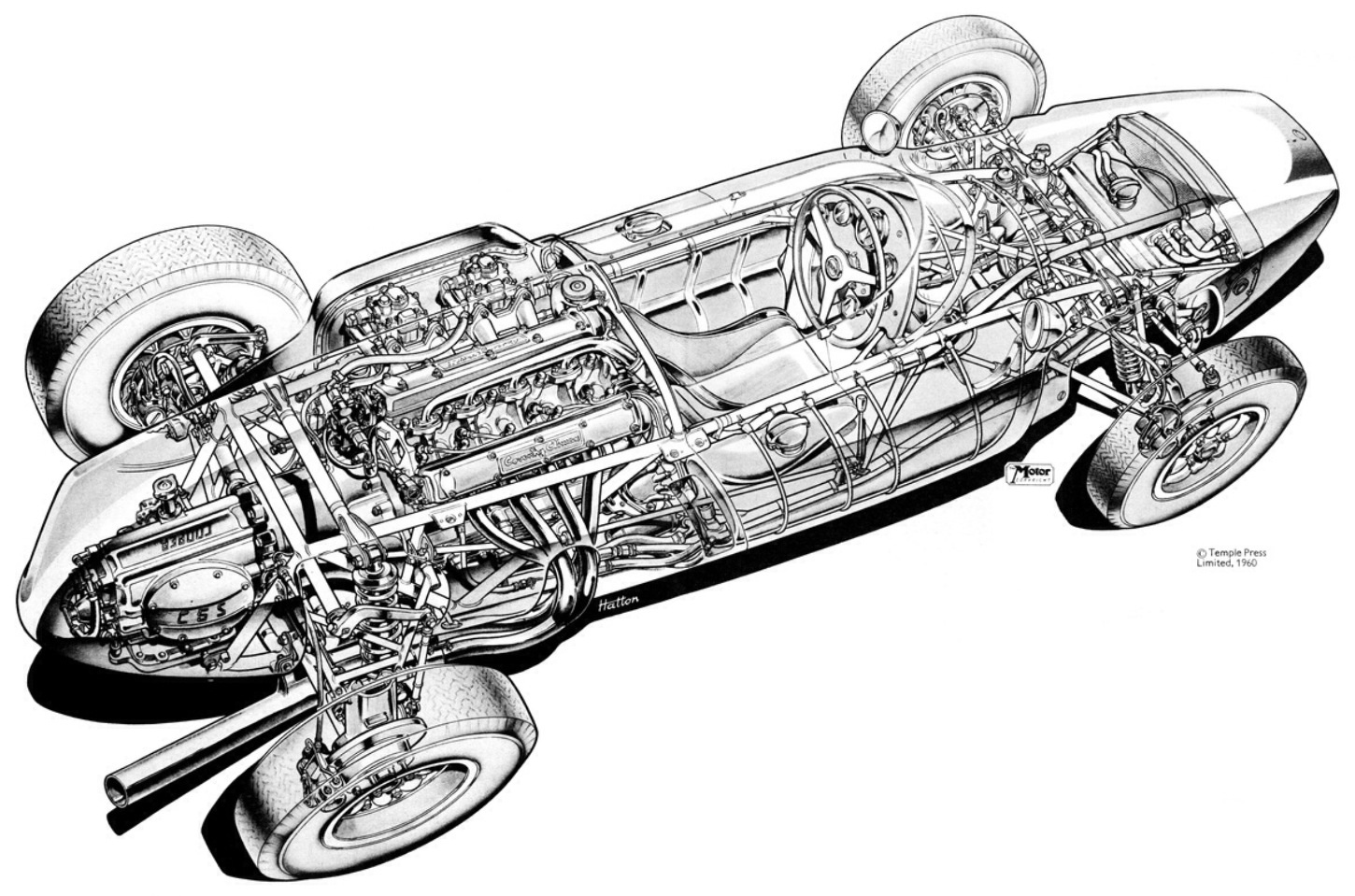
Owen Maddock’s curvy spaceframe chassis is typical of the day, the spaceframe anyway if not the imperfect in an engineering sense bent tubes! At the front the water radiator and oil tank are the ‘deformable structures’ ahead of the drivers ankles and lower legs. The fuel tanks are neatly and very practically ‘bungee’ strapped to the chassis and prone to leakage as the ‘ally tanks chafe on the steel chassis tubes. The ‘deformable side structures’ are the tanks, no bag bladders in those days so the risk of fire was great, prevalent and occasionally fatal.

The 2.5 litre Coventry Climax FPF powered T53 ‘Lowline’ was the 1960 successor to the race-winning and built in vast numbers 1958/9 T51. That car in both F2 and F1 spec has to be one of the greatest customer racing cars ever? T53 was the design work of Jack, John Cooper and Maddock.  The Lotus 18, Chapmans first mid-engined car was the quickest bolide of 1960. Moss took wins in Rob Walker’s car at Monaco and in the season ending US GP at Riverside but it was not the most reliable, something Jack was happy to capitalise upon.

McLaren won the Argentinian GP at the seasons outset, then Jack had an amazing mid-season run winning the Dutch GP on 6 June and the Portuguese GP on 14 August. In between Zandvoort and Oporto he won the Belgian, French and British GP’s thereby setting up his and Cooper’s second world titles on the trot.

Its good to look at these cars in the ‘nuddy’ every now and again to remind oneself of just how close to the elements and how brave the drivers of yore were. Yep, the piloti are no more exposed than they had been in the past but the cornering speeds of a 1960 2.5 litre Cooper or Lotus were a good deal quicker than a 1954 2.5 litre Maser 250F, the road circuits in particular just as hazardous…

Cooper T53 Climax cutaway by Brian Hatton

Credits…

GP Library, Brian Hatton


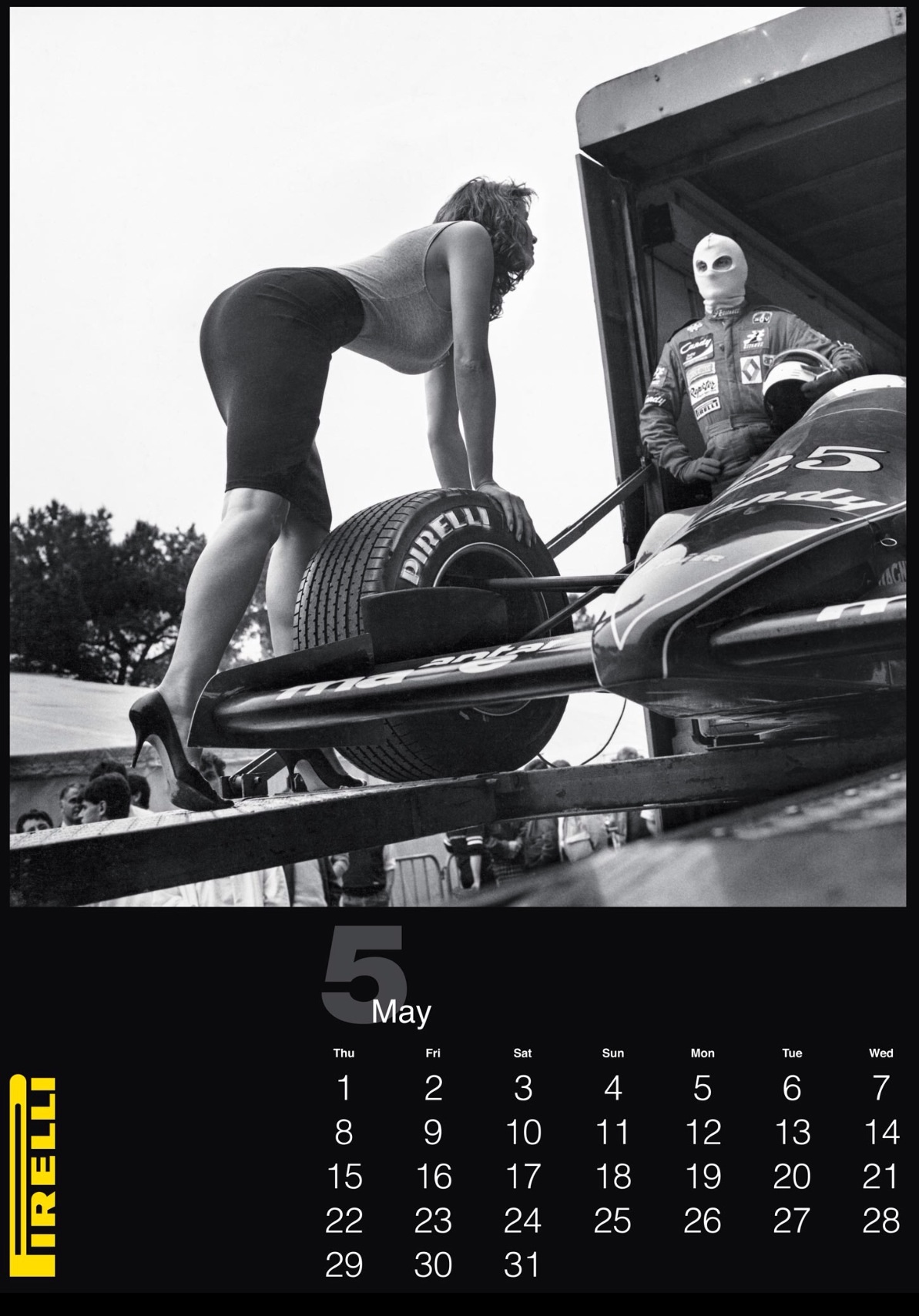
Compound curvature comprises curves made up of two or more circular arcs of successively shorter or longer radii, joined tangentially without reversal of curvature. The foregoing is illustrated with definitive precision by Helmut Newton’s portrait of perfection above.

The Pirelli calendar is a wonderful institution albeit now somewhat diluted by the dull, shit-boring political correctness which pervades our times! It’s nowhere near as risqué as it once was, always tastefully so in my view.

The image is from the 1985 season, originally published in the ’86 calendar and features a young lady whose specifications more than match the 750bhp, twin-turbo, 1.5 litre Renault EF4B V6 powered Ligier JS25. I’m not sure of the driver but the helmet of Andrea De Cesaris is closer to a color match than those of teammates Jacques Laffitte and Philippe Streiff.

In any event the photo is hardly about the car or driver, what compound curvature, arcs of changing radii and perfect purity of line…

Credits…

Pirelli, Helmut Newton, Merriam Webster Dictionary

image

Inboard front suspension, top rocker, lower wishbone and inboard mounted coil spring/Koni shocks (Schlegelmilch)

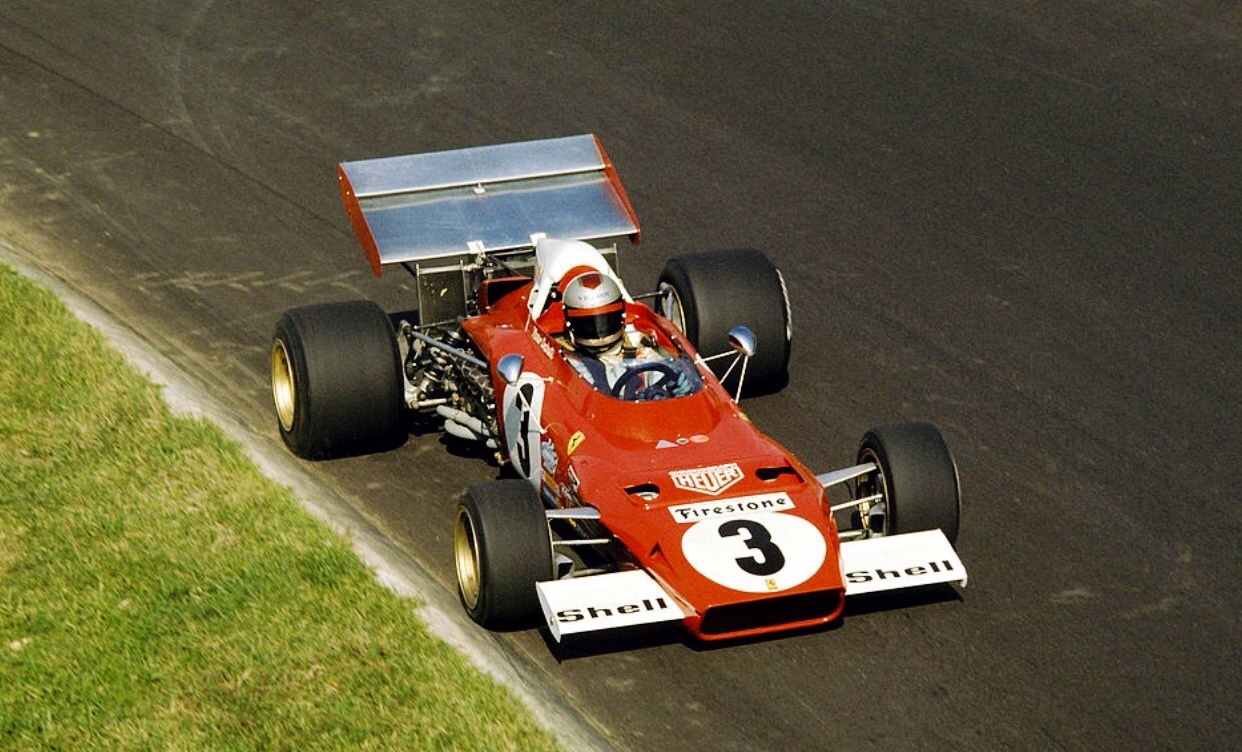
Mario Andretti psyches himself up before a practice session in his Ferrari 312B2 prior to the 1972 Italian Grand Prix…

Andretti qualified the Ferrari 7th and finished 7th, teammates Jacky Ickx and Clay Regazzoni proved the cars pace by popping the car on pole and 4th.

image

Andretti, Ferrari 312B2, Monza 1972 (Schlegelmilch)

Jacky lead the race after Clay Regazzoni’s car clipped the back of Carlos Pace’ March when the latter spun at the Vialone chicane. Ickx snuck back into the lead only to lose it when the Flat-12 failed; Fittipaldo took the win and title in his Lotus 72D Ford.

image

The Ickx’ and Andretti Ferrari 312B2, the #10 2nd placed Surtees TS9B Ford of Mike Hailwood and #9 de Adamich TS9B DNF. Note Ferrari rear suspension detail as per the text (unattributed)

Background…

The Ferrari 312B2 made its debut in Monaco GP 1972, it was a new car rather than a development of the original car for which the Ferrari 3 litre flat-12 was designed, the 1970 312B.

Said engine had a shorter stroke, aimed to increase revs and thereby increase power. The nose cone was low and squarish, the flanks more straight than the rounded shape of the earlier cars, and the rear wing attached to an appendage of the roll-bar.

The rear suspension was redesigned with twin struts and spring/damper groups mounted above the gearbox and connected to the hub with tubular arms. The aim was to reduce unsprung weight. The coil spring-shocks were shifted towards the centre of the car above the gearbox. The car remained a handful as drivers struggled with the handling in combination with the Firestone tyres, a continuation of some of the problems of 1971.

andretti

Andretti’s 312B2 on the way to 4th place in the 1971 German GP, Stewart won in Tyrrell 003 Ford (unattributed)


(Tony Matthews)

Ferrari were struggling with direction at the time after several difficult years, the situation climaxed halfway through 1973 when Luca Di Montezemolo was brought in from Fiat to sort things and provide clear leadership.

312B2 wasn’t a great Ferrari, Jacky Ickx able to scored just a single win with the B2 in 197, the Dutch GP at Zandvoort in rainy conditions whilst teammate Clay Regazzoni placed 3rd twice.

In 1972 Ickx only won the German GP, despite 4 poles. Despite the disappointing results, It raced on into 1973came in action in 1973, Merzario scored 4th at Kyalami before the B3 appeared, a lousy car. with Ickx decamping prior to the German GP…The teams resurgence began with the 1974 B3 variant and the powerful Lauda, Montezemolo, Forghieri cocktail.

Design and Specifications…

image

Chassis Type 621/A monocoque of ‘Aero type’ with aluminium panels riveted onto  tubular steel spaceframe structure with a partially stressed engine.

Suspension; Front Double wishbones: upper rocker arm, lower wishbone, inboard spring/damper units and anti-roll bar. Rear; Single upper radius arm, horizontal spring/damper units mounted atop the transaxle and anti-roll bar.

Engine; Type 001/1, Flat-12 derived from the 001, light alloy cylinder block and head, DOHC, 4 valves, Lucas fuel injection, Marelli electrnonic ignition. Aluminium wet cylinder liners, bore/stroke, 80 x 49.6 mm, 2,991cc, compression ratio 11.5:1. 480bhp@12500rpm

Gearbox; 5 speed Ferrai transaxle with slippery diff. Brakes; Lockheed discs and calipers, inboard at rear. Rack and pinion steering.

Tyres/Wheels; F/R 8.6-20-13″, 13.5-24.0-15″ Firestones. Wheels: cast light alloy; front 10×13″, rear 15×15″

image

Andretti, 312B2, Monza 1972 (unattributed)

Etcetera…

imageAnother couple of Schlegelmilch shots on Andretti at Monza…

image


image


Credits…

Rainer Schlegelmilch, f1technical.com, Tony Matthews

Tailpiece: 1971 Monza pre-race engine changes, 312B2…

image


image

Engine 4 cylinder monobloc, 1 inlet and 2 exhaust valves, SOHC, 4493cc-100X143mm bore/stroke, 4 speed box, 4 disc clutch, brakes on transmission, front and rear wheels, 1025Kg

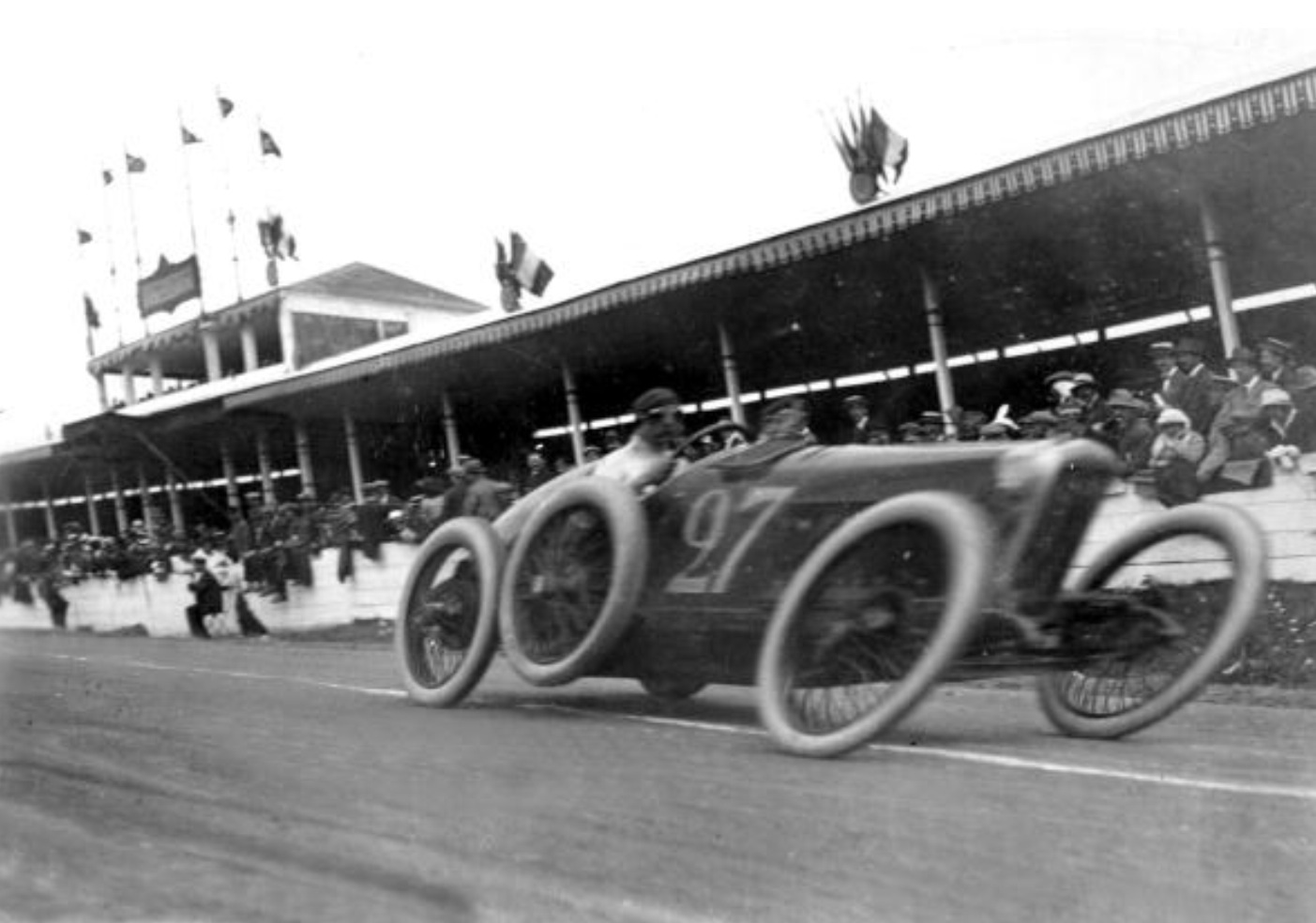
Antonio Fagnano blasts his Fiat through a village during the 14 July 1914 event, Lyon…

Fagnano was a Fiat all-rounder and institution, he was a mechanic, foreman, member of the test department and graduated from riding mechanic to race driver of the works team!

For 1914 the GP ‘Formula’ provided for an 1100Kg maxiumum weight and engines of no more than 4.5 litres in capacity. The race was a contest between Peugeot and Mercedes in the context of imminent war; Archduke Franz Ferdinand was assassinated less than a week before the GP at Lyon which drew a crowd of over 300,000 filling hotels within a 50Km radius of the course.

Christian Lautenschlager and riding mechanic on the way to winning the 1914 French GP, Mercedes GP 35HP. Engine 4 separate cylinders, 4 valves per cylinder, SOHC, 3 plugs per cylinder, 4456cc-93X164mm bore/stroke, claimed power 115bhp@2800rpm. 4 speed box, leather cone clutch, brakes on transmission and rear wheels, 1080Kg, top speed circa 110mph (unattributed)

Christian Lautenschlager won from teammates Louis Wagner and Otto Salzer in 7 hours 8 minutes 18.4 seconds at an average speed of 65.665mph.

Sailer led by 18 seconds at the end of the first lap, by lap five he had built a lead of almost 3 minutes and then retired with a blown engine on lap 6.  Boillot’s Peugeot took over the lead for 12 laps, at one point he led by over 4 minutes.

The Mercedes drivers made one stop during the race for new Continentals. This contrasted with the poor wear of the Dunlops of Peugeot, Boillot made eight stops for tyres, the Frenchman’s many tyre changes allowed Lautenschlager to pass on lap 18. By the end of that lap, Christian had opened up a lead of over 30 seconds.

Fagnano’s Fiat was the best placed of the Italian cars, the talented driver died of an illness, aged 35, on 8 July 1918.

France, 1914 and the Art Historians…

If you have a hankering for this era of racing here is a very interesting article with a completely different angle.

http://www.king-of-the-boards.com/articles/france1914.pdf

Credit…

Roger Viollet, Alinari Archive, T Mathieson ‘Grand Prix Racing 1906-1914’, Patrick Ryan Collection

image

Tailpiece: Dealership ‘in period’, the first Fiat dealership in Geneva with two 501’s out front, circa 1921…

balilla

(Alinari Archive)


hawthorn

(Klemantaski)

 A study in concentration, Mike Hawthorn at work and on the way to fourth place at Aintree, Lancia Ferrari 801, British Grand Prix 1957…

But Mike was hardly ‘the main game’ in this race, a pivotal one in GP history.

Tony Brooks and Stirling Moss shared a Vanwall to win at home, thereby scoring the first world championship victory for a British car, the beginning of a period of dominance by British teams, largely undiminished for the last 50 years. Also noteworthy and equally epochal was the appearance of two Cooper T43 Climaxes driven by Roy Salvadori and Jack Brabham.

Behra led from the start but Moss passed him before the end of the first lap, then came Brooks, Hawthorn, Collins, four Brits in the first five.

Moss’s Vanwall started to run roughly so he pitted, taking the wheel of Brooks sister car, who was summoned to the pits, Moss rejoined 9th and started carving his way through the field. By this stage Jean led from Hawthorn, who was unable to challenge the Frenchie, then came Lewis-Evans, Vanwall, and Collins. Moss was soon up to 5th aided by mechanical failures which befell Fangio and Collins.

Poor, Jean, his clutch exploded whilst in the lead, Hawthorn ran over some of the schrapnel the Frenchman dropped, puncturing a Continental. Stuart Lewis-Evans then momentarily lead but was quickly swallowed by Moss, Stuart’s throttle linkage broke but it mattered not, Moss won the race from Musso, Hawthorn, Trintignant/Collins all in Lancia Ferrari’s with Roy Salvadori in the little 2 litre Cooper T43 5th

image

Credit…

Louis Klementaski, GP Encyclopaedia