Archive for the ‘F1’ Category

image

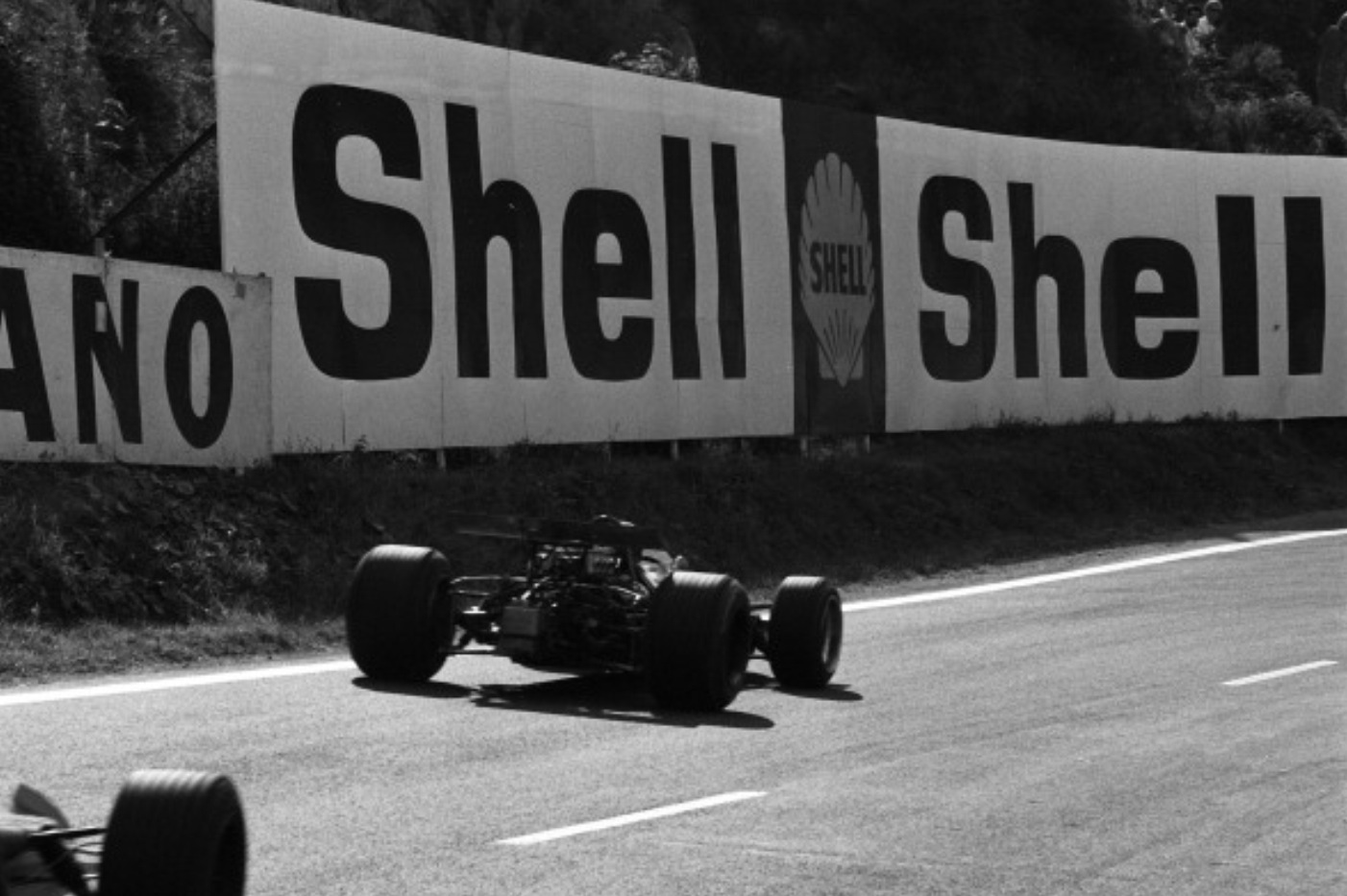
I ‘spose the reason for the lack of high speed butt shots like this is a shortage of vantage points for photographers to capture the incredible distortion of Goodyears upon their ‘Melmags’ and suspension geometry and componentry doing their job, or not!…

Carlos Reutemann is hustling his Brabham BT37 through one of Osterreichring’s very fast sweepers on his way to a DNF with fuel injection dramas on lap 14 of the 1972 Austrian Grand Prix. He started the car an excellent fifth on the grid.  The race was won from pole by Emerson Fittipaldi’s Lotus 72D Ford on his way to his first title.

image
Reutemann BT37 from Peter Revson McLaren M19C Ford 3rd, Chris Amon Matra MS120D fifth then the two Surtees TS9B Fords of Mike Hailwood fourth and Tim Schenken 11th. Austria ’72 (unattributed)

This design was the first in the ‘Bernie Brabham Regime’…

Ecclestone bought Motor Racing Developments from Ron Tauranac at the end of 1971.

The BT37 was Ralph Bellamy’s re-work of Ron’s ’71 BT34 ‘Lobster Claw’ with conventional front radiator and narrower tracks front and rear. It wasn’t the marques greatest car, Gordon Murray’s arrival was the precursor to a decade of Brabhams befitting the great name created by Ron and Jack, from his 1973 BT42.

BT37 was a typical ‘kit car’ of the era: aluminium monocoque chassis, Ford Cosworth 3-litre DFV V8, Hewland FGA400 five speed transaxle and a host of other bits and pieces provided by sub-contractors based in England’s Thames Valley and surrounds.

Carlos and Graham Hill raced the two BT37s built in 1972, the cars best result was Carlos’ fourth in the Canadian Grand Prix.

Tony Matthews cutaway of Ron Tauranac’s 1971 Brabham BT34 Ford ‘Lobster Claw’
image
Reutemann, BT37 Osterreichring 1972 (unattributed)

Credits…

Rainer Schlegelmilch

Tailpiece

image

Carlos ahead of Chris Amon’s Matra MS120C 15th in the ‘Lobster Claw’ one-off Brabham BT34 Ford, upon which the BT37 was based, South African GP, March 1972 DNF. The Ferrari 312B2s of Andretti, fourth and Ickx eighth are further back…

Finito…

image

I like these photos which rather reminded me of  impressionists work. A Shell promotional exercise but rather good all the same…

The F1 Ferrari’s are the 1951 375 4.5 litre V12 and 2015 V6 turbo-hybrid SF15-T.

The banking photo shoot was after qualifying on 5 September 2015 with Sebastian Vettel and Kimi Raikkonen in attendance. The race was won by the dominant 2015 combo, Lewis Hamilton and the Mercedes F1 W06 Hybrid , Sebastian was 2nd and Kimi 5th in the SF15-T.

image

Credits…

Bryn Lennon

Tailpiece…

image


image

The 1957 German Grand Prix is famous as one of the greatest ever; Fangio’s Maser 250F chase and defeat of Hawthorn and Collins in their Lancia Ferrari’s is the stuff of legend…

These two photos reminded me of that day and a car then in the Autumn of its long life as a front line tool. First raced in 1954, by the end of 1957 the 250F had finally won the world title it deserved albeit Fangio made it sing that year, not so sure the title would have been Maserati’s without the great Argentinian behind the wheel.

Behra’s 6th place at the Nurburgring is perhaps more indicative of the cars pace with a ‘mere mortal’ behind the wheel. Actually that’s not fair, the 250F was a top three or four car with a driver of Behra’s calibre in 1957, there was plenty of depth in the field though with the Vanwalls as well as the Lancia Ferrari 801’s.

image

German GP ’57 first lap; Hawthorn and Collins, then Fangio and Behra, works Lancia Ferrari and Maser 250F’s. Then Moss and Brooks in Vanwall VW57’s, look closely and you can just see the top of Musso’s helmet in the other Lanc Ferrari between the two Vanwalls then Gregory’s white Maser 250F and the rest (Klemantaski)

Have a read of my 250F article; https://primotipo.com/2014/08/21/stirling-moss-monaco-gp-1956-maserati-250f/

The opening shot I love, partially because of the time of change it heralds. The front-engined Maser with its wire wheels, knock on spinner cap, finned drum brakes and forged suspension components will shortly be supplanted by Cooper alloys, discs and fabricated wishbones. Moss won the Argentine GP in a Cooper T43 Climax 6 months later, the day of the front-engined GP car wasn’t over but it was on the approach.

image

The shot above is of Guerino Bertocchi, Maserati’s famous engineer/mechanic/tester trying to breathe some life into Behra’s 250F in the Nurburgring paddock also in ’57. Marvellous cars.

Checkout this Race Footage…

https://youtu.be/5PCYsRgUvpk

Credits…

Klemantaski Collection, Graham Gauld

image

Tailpiece: Bertocchi about to test Masten Gregory’s Centro Sud prepared, Scuderia Buell owned 250F #2534 at Modena in September prior to the 1958 Italian GP at Monza of course…

Masten raced #2533 at Monza, this car wasn’t handling well so he switched chassis.

World Champion in 1957, the Masers were make-weights in 1958, the best placed of the beasties that season in championship events were fourths; Fangio’s in Argentina and Reims, his very last GP start, and Masten’s car at Monza. For the record the best of the non-championship results was Jo Bonniers 2nd in the GP de Caen.

Finito…

image

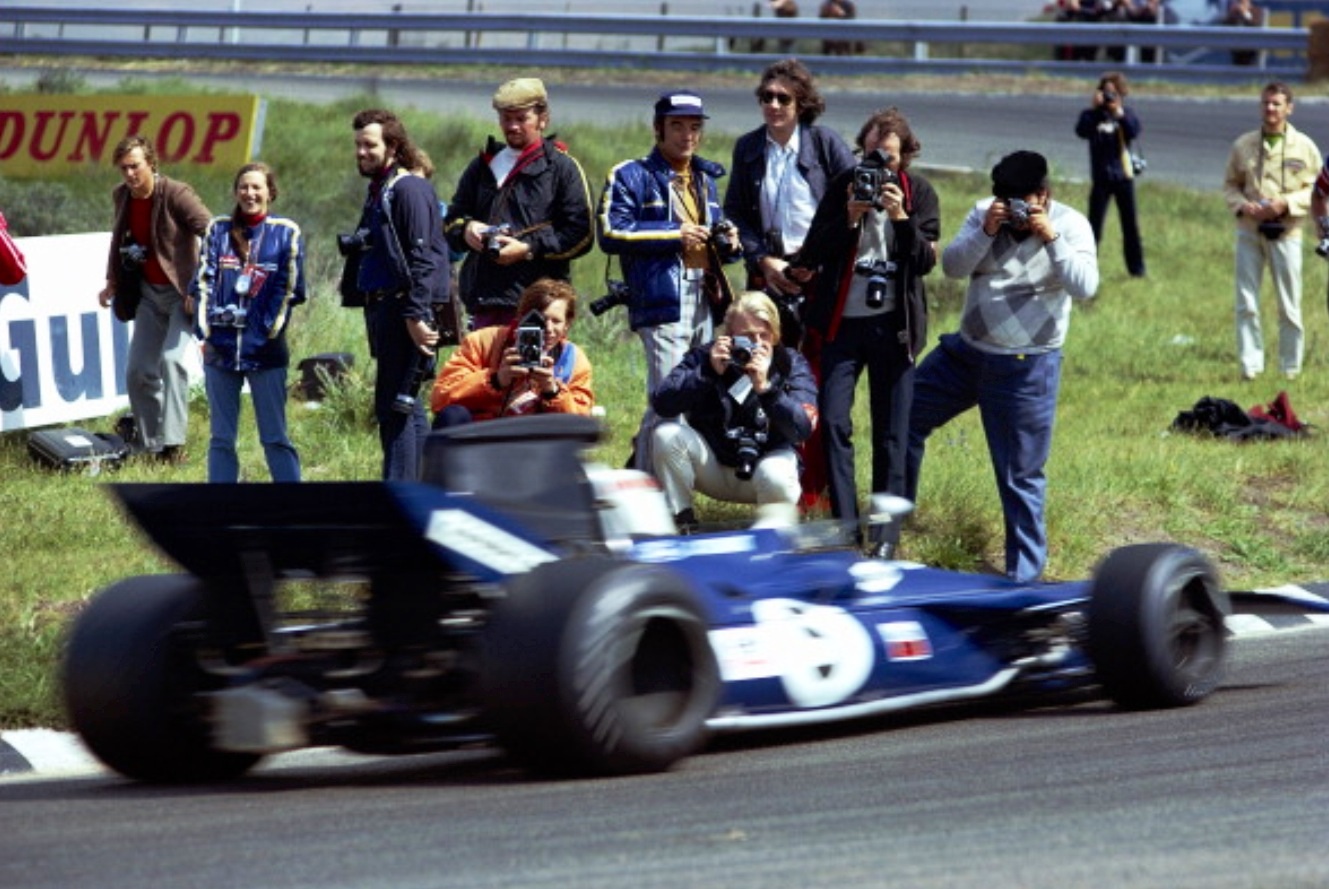
Jackie Stewart being largely ignored by most of the ‘snappers’ at Zandvoort during the Dutch Grand Prix weekend in 1971…

Rainer Schlegelmilch’s shot seems to be a portrait of his colleagues, Diana Burnett is the lady, the distinctive figure of Bernard Cahier is the chap in the blue cap and Goodyear jacket. It’s dry which makes it practice, the wet race was won by Ickx’ Ferrari with JYS 4th in Tyrrell 003 Ford.

I was first smitten by single-seaters upon spotting Jochen Rindt’s sensational ‘Gold Leaf’ Lotus 72 in the Automobile Year 18 ‘centrefold’ below.

jochen

Rindt on his way to a joyless first GP win for the Lotus 72 Ford during the 1970 Dutch GP at Zandvoort, his close friend Piers Courage perished in a grisly, fiery accident during the race in a De Tomaso 505 Ford (Automobile Year)

The book came from the Camberwell Grammar School library, I was an inmate for 6 years and borrowed these annuals, they bought the latest each year, hundreds of times over the years. If truth be known I surgically removed many of the full page color shots from the books which somehow found their way onto my bedroom wall, I was skilful with a razor blade long before I could shave!

So, I was a devotee of Colin Chapman’s Lotus 56/72 side radiator, chisel nose aero approach rather than Derek Gardner’s chunky ‘sportscar nose’ alternative he pioneered in F1 with Tyrrell in ’71. That the alternative approaches worked equally well was proved by the results of practitioners of the ‘two schools’ of aerodynamic thought throughout the ‘70’s, visually though it was ‘no contest’!

ken del

Derek Gardner and Ken Tyrrell outside the Ockham, Surrey factory in August 1971. Tyrrell Ford could be ‘002 or 3’, ‘bluff nose’ first raced at the 4 July ’71 French GP  (Klemantaski)

Gardner’s Tyrrell period was relatively short but wonderfully sweet…

Seven years is a pretty long stint with one team I guess. His first series of cars was the 1970-72 ‘001-004’, the second series the 1972-3 ‘005-6’. Both designs won Grands’ Prix and World Titles. His ’74-5 ‘007’ and stunning ’76-7 ‘P34’ six-wheeler won Grands Prix only, no titles. I doubt there are too many of the F1 design greats who can claim such a record.

I’ve written a few Tyrrell articles, which are worth a look if you haven’t done so; one is on innovation; https://primotipo.com/2014/09/16/tyrrell-019-ford-1990-and-tyrrell-innovation/ , the other on aerodynamics; https://primotipo.com/tag/tyrrell-007-ford/

image

The car pictured above is Jackie Stewart’s ‘004’, the last of Gardner’s first series of designs.

It’s being prepared for the 1972 Monaco Grand Prix, ‘004’s race debut, the GP classic won by Jean-Pierre Beltoise’ BRM P160B, famously his first and last GP win was also BRM’s last. JPB’s delicacy in the wet was aided by some schmick Firestone wets but it was a great drive by any measure. Jackie was 4th in ‘004’, he was not feeling 100% shortly thereafter was diagnosed with a stomach ulcer. Francois Cevert non-classified further back in ‘002’.

stew monaco

JYS practices ‘004’ at Monaco in 1972, the race was somewhat wetter! (unattributed)

The first Tyrrell, ‘001’ made its race debut in Stewart’s hands at Oulton Park in the ‘International Gold Cup’ on 22 August 1970…

 The car was famously designed and to an extent constructed, in secret in Gardner’s home garage in Parklands Avenue, Leamington! The ‘bath tub’ monocoque chassis was built to his design by Maurice Gomm’s Gomm Metal Developments, later chassis were built at Tyrrell’s famous woodyard, the base of his timber business in Ockham, Surrey.

Other notable sub-contractors involved were Jack Knight Engineering who did much of the machining, Aeroplane and Motor who provided the centre lock magnesium alloy wheels, Laystall the stub axles, not to forget Cosworth Engineering, Hewland’s and others.

‘001’s championship debut was at Mont Tremblant, the Canadian GP on 20 September where Jackie plonked it on pole and was leading strongly before a stub axle broke on lap 32.

The car was therefore ‘match fit’ at the start of its dominant 1971 season having done vast amounts of Goodyear testing, Dunlop, Tyrrell’s hitherto tyre supplier having withdrawn from F1. Over the South African summer at Kyalami over 400 tyres were tested by the team.

oulton 2

Tyrrell and Stewart during the Oulton Park International Cup weekend in August 1970 upon ‘001’s debut. In a meeting of contrasts JYS qualified poorly after the fuel metering unit failed, then had a stuck throttle during the race which was fixed, the Scot broke the lap record twice later in the race, the cars competitiveness clear from the start. John Surtees won the event on aggregate, he won the second heat in his Surtees TS9 Ford and Henri Pescarolo the first heat (his only F1 win?) in a March 711 Ford


oulton 1

More shots of ‘001’ during the Oulton August weekend. The cars distinctive bodywork was Gardner’s work and was tested at 1/10th scale in the wind tunnel of the University of Surrey in Guildford (Getty)

Powered by the good ‘ole 3 litre Ford Cosworth DFV V8 and using the equally ubiquitous Hewland FG400 5 speed transaxle, the bolides were ‘kit cars’ of the period derided by Enzo Ferrari but  remarkably quick bits of kit!

Look back to the photo of ‘004’ chassis at Monaco above.

The monocoque was made of 16 gauge NS4 aluminium alloy and like ‘002’ and ‘003’ was 4 inches longer in the length of the tub and 1 1/2 inches longer in the wheelbase than the prototype ‘001’.

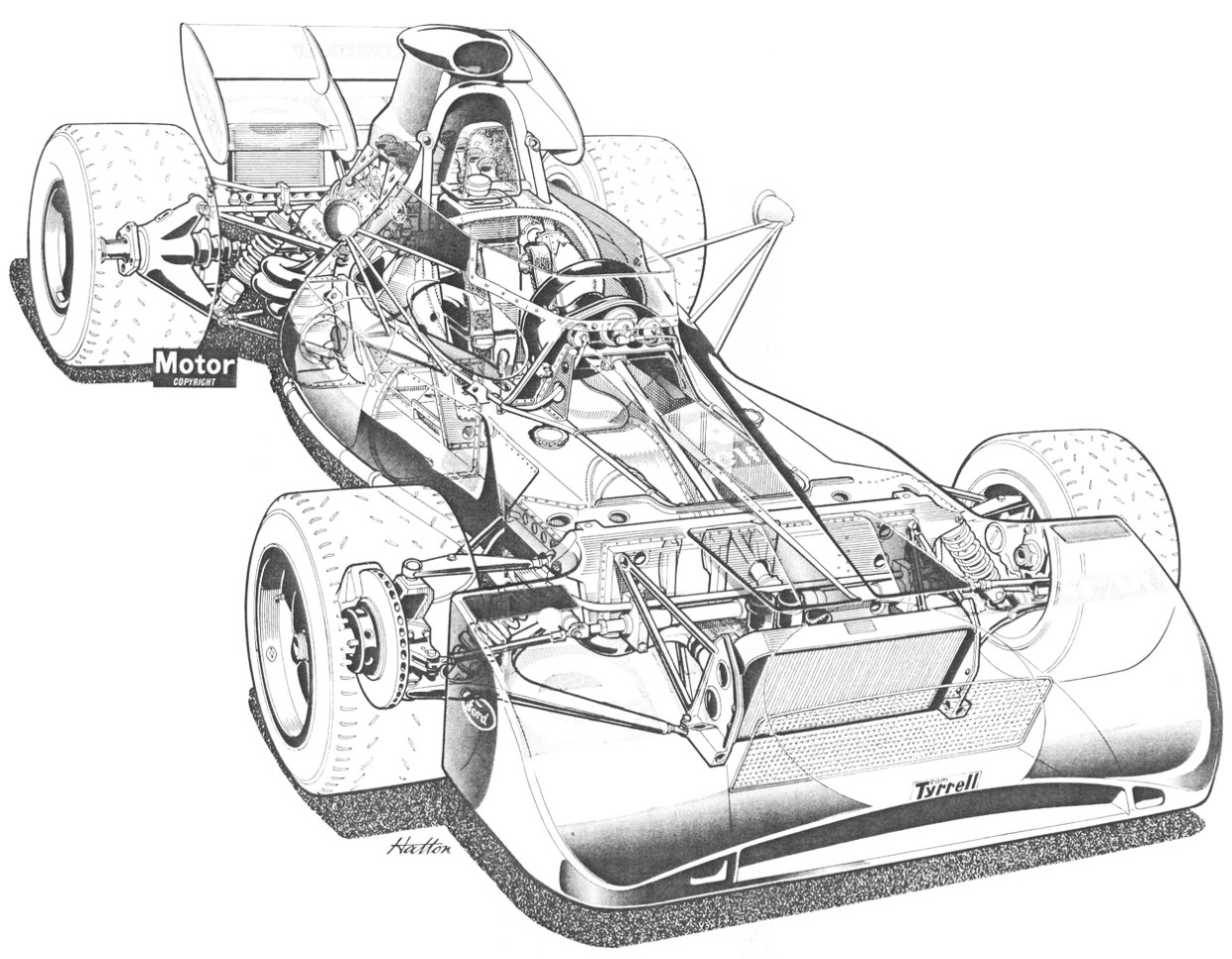
You can see the wide based lower one piece wishbone is mounted both to the tub and at its outer end the tubular suspension carrying frame which was first made up on a jig and then slipped over the top of the monocoque to which it was externally riveted. The upper suspension arm is a top link and locating link mounted to a bracket on the tub. Shocks are alloy bodied, double adjustable Koni’s- again period typical. The simple steering column is clear, the rack made by Tyrrells.

tyr cutaway

Tyrrell 002-4 cutaway drawing, all chassis the same design, this car is ‘003’. Specs as per text (Tony Hatton)

The vastly strong 360 degree roll bar encircled the the rear bulkhead and was both spigoted and bolted through into the monocoque. The DFV, stressed of course, was then bolted through this hoop. The forward radius rod pickups you can just see attached to the bar structure.

The rear was also a close to perfect expression of period paradigm; single top link, twin parallel lower links to better control toe than the inverted lower wishbone used for the decade before, two radius rods for fore and aft location and again coil spring/Koni dampers.

Brakes are Girling calipers, ventilated rotors front and solid rears of 10 1/2 inch diameter with Goodyear tyres used from the start of 1971.

‘004’ was completed at the end of the ’71 season as a spare car for Stewart, it was relatively lightly raced by the works, click on this link for a full, interesting article on the car which is still alive, well and historic raced; http://www.britishracecar.com/JohnDimmer-Tyrrell-004.htm

Gardner’s ‘005-006’ cars were low polar moment, very quick, nervous devices from which the aces for which they were designed, Stewart and Francois Cevert extracted ‘every ounce’ of performance in later 1972 and in 1973.

Here is my short article about these cars; https://primotipo.com/2014/08/25/jackie-stewart-monaco-gp-1973-tyrrell-006-ford/

tyr transport

Ken Tyrrell supervising the packing away of ‘003’ at the end of a Goodwood test session on 16 January 1972 prior to shipping the car to Argentina for the start of that season.

There Jackie drove it to his first win of a season in which Emerson Fittipaldi prevailed in the gorgeous, chisel nosed ‘John Player Special’ Lotus 72 which I think is about where we came in…

emo

The ever thoughtful Derek Gardner in blue shirt watches ‘Emmo’ head out for some more practice prior to the ’72 Italian GP, Monza. The Brazilian won the race and title in his Lotus 72D Ford. Francois Cevert is behind DG, his car Tyrrell 002, DNF with engine failure (unattributed)


image

’71 Dutch GP collage (Schlegelmilch)

Etcetera…

(T Matthews)

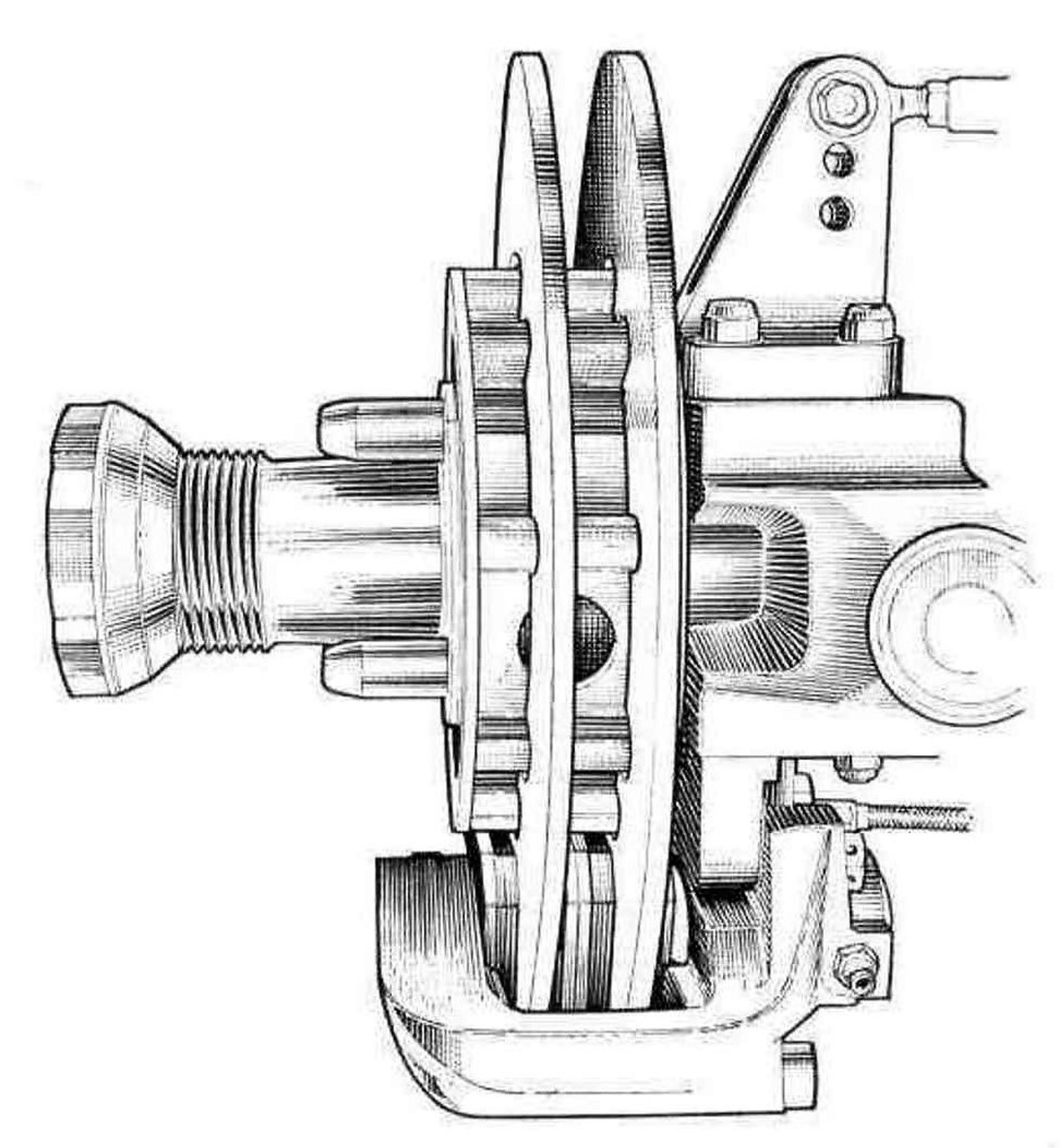
Some Tyrrell innovation over the 1971 Monaco GP weekend.

‘002’ was fitted with this ‘floating twin-disc’ brake assembly during practice. The thin discs float on the heavy splines of the hub to find their own centres relative to the pads in the caliper, which is mounted at the rear of the assembly. The pads are operated by a double piston assembly on the inner side of the caliper. Note the wheel locating pegs and single tapered wheel nut.

Photo and Reference Credits…

Rainer Schlegelmilch, Victor Blackman, Getty Images, Klemantaski Archive, Tony Hatton, Tony Matthews

Doug Nye ‘The History of The GP Car’, The GP Encyclopaedia

oldracingcars.com Checkout Allen Brown’s pieces on ‘001’ https://www.oldracingcars.com/tyrrell/001/ and ‘002-004’, inclusive of chassis by chassis records https://www.oldracingcars.com/tyrrell/002-004/

Tailpiece: Opening Dutch GP shot, uncropped, low res…

image

(Schlegelmilch)


Finito…


pau

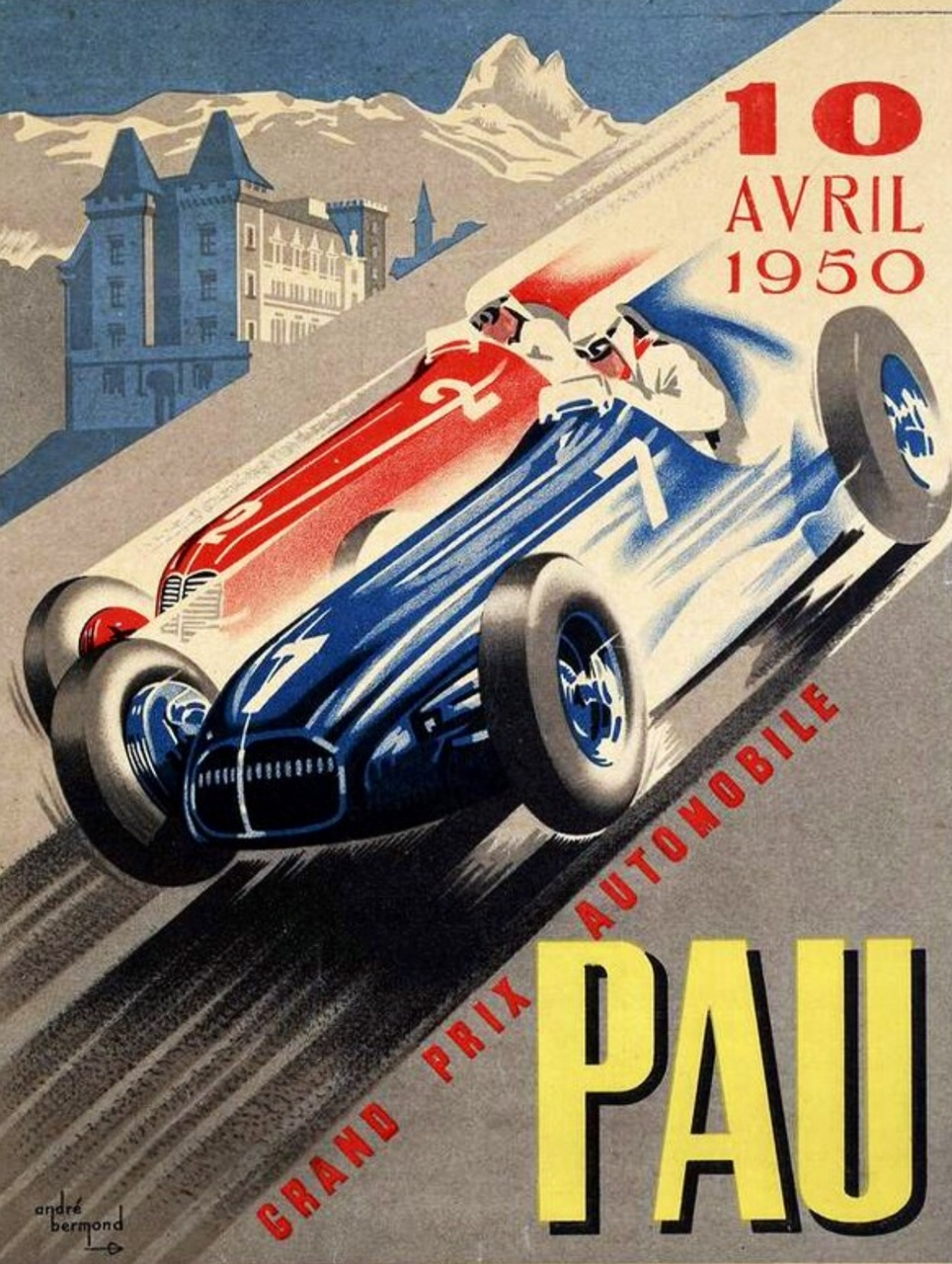
Juan Manuel Fangio wins the first F1 Grand Prix at Pau. Maserati 4CLT/48, 10 April 1950…

He is ahead of Luigi Villoresi’s Ferrari 125, 2nd. Louis Rosier was 3rd in a Talbot-Lago T26C.

The first championship Grand Prix for ‘Formula 1’ introduced at the start of 1950 was the British GP held at Silverstone on May 13.

Fangio, somewhat fittingly is therefore the first winner of an F1GP albeit a Non-Championship one! Farina took the Silverstone race in an Alfa 158, the car of 1950/51.

Credit: Keystone-France

Tailpiece…

pau gp


image

Jones in the Lola THL1 Hart, Monaco 1986, Q18 and DNF after a collision on lap 2. Patrick Tambay’s performance was perhaps more indicative of the cars speed, Q8 but again DNF after an accident. Prost won in a McLaren MP4/2C TAG Porsche (Getty)

Alan Jones in his Lola THL1 Hart at Monaco during practice on May 10 1986…

Just looking these pictures, note the Ford logo on the side of the cockpit, reminded me of the vexed, too soon launched Ford Cosworth GBA 1.5 V6 twin-turbo.

Jones and Tambay didn’t race the Ford engine in ’86, they contested the title with Brian Hart’s Hart 415T, 4 cylinder engine whilst GBA development continued at Cosworths. Best results for the year were a 4th and 5th in Austria in a sea of DNF’s. The Haas team then withdrew from F1, the GBA program torch carried forward by Benetton but not for too long…

image

The tiny Ford Cosworth GBA; 1497cc, 120 degree DOHC, 4 valve V6 twin-KKK-turbo, circa 750bhp, depending on month and spec, engine during the British GP weekend, Brands Hatch 1986 (Schlegelmilch)

That Brian Hart built an F1 engine is an accident of history. It was an evolution of the relationship he had with the Toleman Team who won the European F2 Championship in 1980 (Brian Henton won the drivers title) with his superb 2 litre 420R 4 cylinder engine (below) in the back of Rory Byrne’s TG280 ground effects chassis.

image

The 420R engine cutaway, note belt driven camshafts, engine extremely compact and beautifully packaged, an evolution of his FVA and BDA knowledge including his design/development of the alloy 2 litre BDG block (John Way)


The 420R engine has a bore/stroke of 93.5 mm x 72.6 mm, a capacity of 1994 cc and was the result of a long development path starting with Hart’s race preparation of FVA’s in 1969. Designed in house, blocks and heads came from Stirling Metals with the machining done at Harts. Gordon Allen produced the cranks, Hart did his own cams and developed the pistons with Mahle in Germany. Lucas provided the fuel injection. The engine developed 305 bhp @ 9,500 rpm with safe bursts to just over 10,000 rpm.

image

Toleman TG280 Hart cutaway, 1980 Euro F2 championship winner in Brian Henton’s hands with Derek Warwick fidhting him all the way in the sister car. Aluminium ground effects monocoque chassis, Hart 420R engine, Hewland FT200 5 speed transaxle. In 1981 Lola built customer versions of this design (Alenso)

Ted Toleman’s wealth derived  from building up the UK’s largest car transport business, his ambition extended to graduation from F2 to F1. Rory Byrne designed what became the TG181 chassis which team manager Alex Hawkridge told Brian would either carry a turbo-charged version of the 420R or Lancia’s turbo 1.4 which was doing service in their sports-racer at the time. So Brian set to with the challenge!

image

Brian Hart shows journalist Maurice Hamilton his handiwork in March 1982. Early test of the turbo-charged 415T engine. Look at that early turbo/inlet manifold (Hamilton)

‘I had never even seen a turbocharger,’ Hart claims, ‘and I didn’t understand intercooling’. His engine was the first British turbo Fl engine and the TG181 was as ‘big and butch’ as the TG280 was ‘nimble and slinky’. Packaging of these early turbo-cars was a big challenge even with the resources of Ferrari whose 1981 126CK was no picture of elegance either.

The first beautifully integrated turbo was John Barnard’s 1984 McLaren MP4/2 TAG Porsche largely because he prescribed very thoroughly the packaging of his engine spec to Porsche to ensure the needs of his chassis, particularly its aerodynamic effectiveness were not compromised by the engine and its ancillaries inclusive of radiators and intercoolers.

image

Monobloc all alloy Hart 415T, note belt driven cam drive and atypical Holset turbo, spec of engine as per text (John Way)

The first iteration of the 415T had a bore and stroke of 89.2mm X 60mm and a capacity of 1499cc. With a compression ratio of 6.7:1 and single KKK turbo-charger the engine developed circa 557bhp at 9500rpm compared to its competitors; normally aspirated Cosworth DFV circa 500bhp and Matra V12 510. The turbos were the Renault V6 540, Ferrari V6 560 and BMW in-line 4 557bhp.

The 415T engine was down on power and prone to head-gasket failure, drivers Brian Henton and Derek Warwick who had enjoyed so much Hart F2 success in 1980 repeatedly failed to qualify.

Hart was under lots of pressure and there was heavy tension between him and Byrne noting the shortcomings of the latters chassis. Derek Warwick later observed that Brian was a great engineer, a great person and always under-financed. And a pretty handy driver in his day…

image

Works Lotus F2 driver in 1964, here at Montlhery, Lotus 32 Ford Cosworth SCA. Brian was 4th behind Brabham, Stewart in the other Ron Harris entry and Jo Schlesser. Grand Prix de L’ile de France, 27 September 1964. Equal 13th in the Euro F2 Championship that year (Viollet)

Brian Hart raced with success, he dominated the 1172cc Clubmans formula and later raced in FJ, its successor F3 and in F2 during its most competitive period with grids full of ‘graded’, moonlighting GP drivers.

He raced the brilliant Mike Costin designed Protos 16 powered by a Hart prepped Cosworth FVA, a highlight setting fastest lap and finishing second to Frank Gardner’s works Brabham BT23 FVA in the slip-streaming blast title qualifier at Hockenheim in 1967. He was 11th in the Euro F2 Championship that year and 14th in 1968 driving a Merlyn Mk12 and Brabham BT23C both FVA powered .

image

Kurt Ahrens ahead of teammate Brian Hart in sensational timber monocoque Protos 16 Ford FVA F2 cars during the ’67 German GP won by Denny Hulme’s Brabham BT24 Repco. Brian finished the race but was unclassified, F2 class won by Jack Oliver’s Lotus 48 FVA (unattributed)

He gradually phased from driving into building and developing race engines forming Brian Hart Engines in Harlow, Essex in 1969 gaining much success preparing and tuning FVA’s for racing and BDA’s for rallying. Ronnie Peterson won the Euro F2 championship in 1971 with a Hart prepared FVA (March 711M) and Mike Hailwood in 1972 with an 1850cc BDA. (Surtees TS10)

Brian originally trained at De Havilland Aircraft, then worked for Cosworths when they were building/developing the 1600cc Ford FVA F2 engine, the precursor to the great DFV in the initial 1966/7 partnership between Cosworth and Ford.

A turning point with the 415T was when Hart decided to build the engine as a monobloc, that is no separate head joint to be sealed against coolant, boost pressure and combustion leaks; ‘I decided to cast the head and block as one and in about a fortnight we gained 130bhp. Hart also used British Holset turbo-chargers and benefitted from their flexibility and willingness to develop their products to suit the engine. ‘And the new car (1982 TG183) was 90 per cent better’ Hart quipped.

The much improved TG183B scored 10 championship points in ’83. In ’84 F1 novice Ayrton Senna almost won at Monaco in the quicker TG184. Hart recalled working with the young champion ‘He was astonishing. No man until Schumacher could motivate a team like Ayrton. I asked him to remember the boost reading on one corner per lap, and he came back after a single lap with all the readings for every corner in his head. It was a new level of participation.’

image

Ayrton Senna in the dry during Monaco 1984 practice, this overhead shot shows the innovative aero approach of Rory Byrne. Car a bit fugly but fast albeit not reliable enough, Toleman TG183B. The famous race was wet, it started 45 minutes late, the two Renaults collided thru no fault of their own on lap 1 giving Patrick Tambay a broken leg, setting the tone of the race. The chequered flag was waved early by (factory Porsche 956 driver) Clerk of Course Jacky Ickx, without consulting the Race Stewards, on lap 31 giving the Porsche powered Prost a win in his McLaren MP4/2 TAG from Senna who was chasing him down. Behind him Stefan Bellof was catching Ayrton hand over fist in his Tyrrell, having started the only normally aspirated car in the race from the back of the grid.To this day enthusiasts debate the race outcome had it gone a few more laps let alone the full distance, 76 laps. A collision between Senna and Prost giving Stefan the win or a collision between Senna and Bellof giving Prost the win my two potential outcomes! Bellof’s podium was taken off him later in the season as the Tyrrell was found to be underweight by the FIA. Read a report of this event, the twists and turns from Martin Brundle’s practice crash to Tyrrell’s exclusion months later amazing. The race was notable for the fine delicacy of control these two tigers (Senna and Bellof) exhibited in such difficult conditions on the most unforgiving circuit so early in their careers, greatness apparent to say the least, unfulfilled, sadly, in Bellof’s case of course (unattributed)

In 1985 development was hamstrung early in the year when the team could not test as they had no tyre contract, this problem was solved when they bought the Spirit teams contract when they withdrew from F1. By this stage with Holset turbo, Hart/ERA digital engine management and Marelli fuel injection at 2.5 atmospheres of boost the engine developed about 740bhp at 10,500rpm.

A fantastic moment was when the car qualified on pole in the German GP after second session times were impacted by rain. The engine was estimated to be giving about 825bhp in qualifying spec with about 730 in race spec but reliability to a large extent had been lost.

image

Teo Fabi at Brands Hatch in the Toleman TG185 Hart during the ’85 British GP, DNF transmission from grid 9. Prost won in a McLaren MP4/2B TAG Porsche. Look at how neat the packaging of this car is compared with the earlier Tolemans, Rory Byrne and Brian Hart made great strides in development of both chassis and engines. The great shame is that none of Hart’s customers were ‘flush enough’ to fund a development program of Hart’s 415T to get the mix of power/reliability needed. Hart probably also shot himself in the foot by taking on more teams than he really had the resources to service properly. As you can see hindsight is a great strength of mine! (Fosh)

The Toleman team was acquired by Benetton later in 1985, who used BMW engines. It was a relief for Hart who struggled with small budgets and too many customers (Spirit, RAM and Beatrice-Lola) ‘I had my arm twisted to do other teams. Toleman simply couldn’t fund the development. I once told Paul Rosche (BMW’s engine guru) what we had to spend, and he said they spent that on blocks alone’ Hart recalled in a MotorSport interview.

Hart 415T; aluminium 4 cylinder monobloc weighing about 140Kg. Belt driven DOHC, 4 valve, fuel injected, intercooled and single Holset turbocharger 1459cc (bore/stroke 88X61.55mm). Between 650-825bhp at 10500 rpm depending upon spec and year.

image

Bennetton B187 Ford GBA 1.5 V6 twin-turbo (unattributed)

Going back to the Ford GBA engine early in the article, Benetton raced the ‘works’ Ford GBA’s with a modicum more success in 1987, 5th in the constructors championship won by Williams Honda the best result that year a 3rd in Adelaide for Thierry Boutsen at the seasons end.

Into 1988 and rule changes tipped the balance a little more in favour of normally aspirated engines so Benetton raced the B188 powered by the 3.5 litre V8 Ford Cosworth DFR finishing 3rd in the manufacturers championship behind McLaren and Ferrari; Ford competitiveness was returning and the GBA was placed on the shelf a victim of rule changes and being a little too late to the turbo-party…

Credits…

MotorSport, Doug Nye ‘History of The Grand Prix Car’, Maurice Hamilton, Anthony Fosh, Rainer Schlegelmilch, Pascal Rondeau, John Way, 8W Forix, Alenso, Roger Viollet

Tailpiece: Brian Hart with his 830 V8 engine, it was fitted to the Footwork chassis’, 1996 Spanish Grand Prix…

image

After working on the development of the Ford Cosworth  DFR in the early 1990’s Hart built the 72 degree 3.5 litre V10 ‘1035’ which was used by Jordan with successful results in 1993. For the 3 litre formula in 1995 he ‘chopped a couple of cylinders off’, maintaining the 72 degree Vee angle to create the ultra compact ‘830’ V8.

Known fondly as ‘Jam Tart’, this immensely popular member of the F1 paddock died too young at 77 in 2014.

Finito…

french ickx

(Rainer Schlegelmilch)

Jacky Ickx warms up his Bugatti T35B prior to the start of the 1969 French Grand Prix at Clermont Ferrand, 6 July 1969…

He qualified his Brabham BT26A Ford fourth (below) and finished third in the race won by Jackie Stewart’s Matra MS80 Ford. He had a good season with Brabham taking two wins; at the Nurburgring and Mosport but the lure of Ferrari was too great, he returned to the Maranello squad in 1970.

french brabham

(Rainer Schlegelmilch)

Credits…

Rainer Schlegelmilch

image

9200 rpm and breathing very heavily thru it’s oversized for GP racing ports…

Bruce McLaren at rest and considering setup changes to his first GP car, Robin Herd’s Ford Indy V8 powered, ‘Mallite’ chassis, M2B at Watkins Glen in 1966.

These shots are from the Dave Friedman Archive; the tachometer snaps are at the US GP, the balance of photos from the following, final 1966 Championship round in Mexico City.

This article is another of my ‘nutso’ ones in terms of its order…

I found a swag of photos in Friedman’s archive a while back and planned a pictorial of Bruce and his first McLaren GP car at the 1966 US and Mexican Grands’ Prix, the events where Friedman snapped away prodigiously. I put it to one side and largely forgot about it. Subsequently I decided on something more substantive; so the first bit is the original pictorial, the second is about Bruce’ progress in his first two years as an F1 marque jumping from engine to engine until the DFV provided the definitive McLaren F1 moteur from 1968-1983.

And boy, wasn’t there a lot of water that passed under the bridge between 1968 when the design for the Cosworth powered McLaren M7 was laid down to John Barnard providing both the dimensions of the DFV and its means of attachment to the chassis amongst his ‘mandatories’ of design specifications to Hans Metzger at Porsche in 1983. The TAG/Porsche 1.5 litre twin-turbo V6 was the result, the McLaren MP4/1E TAG-Porsche first raced at the 28 August 1983 Dutch Grand Prix. Back to 1965/6 though!

Remember, the tachometer snaps are at the US GP, the balance of photos from the following round in Mexico City, there are no captions in the first part of the article.

image

image

image

image

image

image

image

As a GP engine the Ford Quad-Cam Indy V8 engine was a huge, beefy, heavy and notoriously raucous unit. Visually it was a ‘big busty blonde’ as well with its whopping Hilborn injection trumpets and huge ‘between the vee exhausts’, it looked ‘the goods’…

image

The Ford Indy quad cam V8 in its earliest form fitted to a Lotus 34 at Indy in 1964. Jim Clark and Dan Gurney contested the race, this is Clark’s chassis. Engine 4195cc DOHC, 4 valve, Hilborn injected, methanol fuelled giving circa 425bhp @ 8000rpm and useful power from 6000-9000rpm. ZF 2DS 20 ‘box (TEN)

McLaren developed and tested the engine during the winter of 1965/6, notably at Riverside, California but missed the European non-championship F1 events with which the season commenced. In a portent of the season to come John Surtees won the 1 April Syracuse GP in his Ferrari 312 whilst ‘Black-Jack’ won the BRDC International Trophy in his Brabham BT19 Repco at Silverstone on May 14.

image

McLaren looking pretty chilled at this stage of the ’66 Monaco weekend upon his teams GP debut, color of the car a function of doing a deal with John Frankenheimer’s crew as part of  filming of ‘Grand Prix’ . Inboard rocker front suspension and outboard loacation of spring/shock at the rear. Checkout the prostrate ‘snapper behind the car (unattributed)

McLaren made its debut as an F1 marque in the May 22, 1966 Monaco Grand Prix, the first championship round that year. Bruce raced the car he concepted together with Robin Herd, the brilliant young designer specified ‘Mallite’ as the primary material for M2B’s monocoque chassis. (noting the M1 series of car are CanAm machines)

Mallite is a composite sheet aerospace sandwich material comprising end grain balsa material filling between thin sheets of aluminium. The resultant chassis was incredibly stiff for its day at around 11000 lb/ft per degree of deflection compared with a good conventional ‘ally tub which came in the range of 4000-5000 lb/ft per degree.

The Indy Ford 4-cam V8 was reduced from its USAC mandated 4.2 litres to the 3 litre F1 limit (95.3mmX52.4mm bore/stroke-2999cc) which prevailed from 1 January 1966. For F1 use the engine was first modified by Klaus von Rucker in England, then later Bruce involved Traco Engineering in Los Angeles.

image

All hands to the pump! Bruce, Tyler Alexander and Wally Willmott hard at it, Monaco 1966. The Indy Ford V8’s Hilborn fuel injection, between the Vee exhausts, full monocoque chassis, ZF 5 DS25 gearbox and conventional rear suspension; inverted lower wishbones, single top link, coil spring/dampers, twin radius rods and adjustable sway bar all clear in this shot (unattributed)

Click on this article for a brief history of the Ford Indy V8 amongst the Lola T90 stuff which is the main substance of this piece; https://primotipo.com/2015/06/12/graham-hills-american-red-ball-spl-lola-t90-ford-indy-winner-1966-2/

At Monaco the new McLaren qualified 12th, Bruce withdrew with mechanical ailments on lap 9, the race was won by Jackie Stewart’s 2.1 litre ‘Tasman’ P56 V8 engined BRM P261. This car was his 1965 1.5 litre F1 mount with a bigger version of the P56 V8 with which he won the 1965 Tasman Series.

Bruce and his small Colnbrook team, (near Heathrow an area in the midst of the motor racing industry of subcontractors 3 miles from Slough and 18 miles West of London) crew quickly realised the engines massive ports and valves didn’t give the sort of gas flow speed needed to produce competitive power at 3 litres. Mind you, its 300 horsepower was the sort of output the World Championship winning ‘RB620’ Repco V8 developed in 1966. It was enough to win Jack’s ’66 title albeit the Repco engine was light, very torquey and reliable. By contrast, Bruce’s Ford was heavy and gave its punch over a narrow rev band, the deficiencies of which were exacerbated by the 4 speed ZF ‘box they used which ‘left lots of gaps’ in the power band.

The team had much work to do on the Ford, in the meantime Count Volpi’s new Serenissima V8, designed by Ing. Alberto Massimino, who was part of the Lancia-Ferrari and Maserati 250F 1950’s design teams provided another ‘ready made’ alternative engine to try.

image

Serenissima ATS Spider, Sauer/de Mortemart. Le Mans 1966. DNF with gearbox failure on lap 43. It raced in the prototype class, the race won by the McLaren/Amon Ford GT Mk2 (Smuckatelli)

This project is a story in itself but suffice to say Bruce tried the engine whilst simultaneously developing the Indy Ford V8 in an attempt to get it to where it needed to be. Most of you will be aware that Bruce’ Ford connections were immaculate at the time as both a development and race driver of the GT40 program, those cars developed by teams on both sides of the Atlantic. It was Bruce’ hope that he may have been able to get FoMoCo’s backing for his F1 variant of their Indy V8. In the end, via Ford UK’s Walter Hayes, Ford supported the Cosworth developed DFV of course.

image

Weber 48IDA fed Serenissima all alloy V8 in the back of Bruce’ M2B during the Belgian GP weekend, 1966 (unattributed)

The Serenissima engine was designed as a sports car unit and gave little power. The ‘M166’ engine was an aluminium, chain driven, quad cam, 2 valve V8 displacing 2996cc (91.5X57.0 mm bore/stroke) 350 bhp was claimed for it but most of the horses seemed to have jumped ship between Italy and the UK, the actual output was more like 260bhp.

M2B was modified to take the side exhaust Italian V8 in time for the Belgian GP, at Spa. The team had great trouble just getting the thing to start, then run and to add insult to injury it ran its bearings after its first exploratory laps having qualified 16th. With no spare engine Bruce was a non-starter.

image

Bruce in the winning Ford Mk2 he shared with Chris Amon at Le Mans 1966. The Ferrari is the Maranello Concessionaires Ferrari 365 P2 driven by Richard Attwood and David Piper (GP Library)

Bruce and his young intended McLaren F1 team-mate Chris Amon (who raced M1B Chev CanAm cars for Bruce in 1966) then departed England for France and returned as Le Mans winners in a factory Ford GT Mk2. That contentious win or perhaps ‘first over the line’ is still the subject of discussion and debate amongst enthusiasts and historians alike even all these decades later.

image

1966 British GP, Brands Hatch, M2B Serenissima V8. Bruce was 6th, scoring a championship point, the teams first. Jack Brabham won in BT19 Repco from pole, he was 2 laps up the road to give the gap some perspective. Bruce in his ‘Pete Aron’ Grand Prix filming helmet (unattributed)

Jack Brabham won both the French Grand Prix at Reims and the British at Brands Hatch in BT19 Repco. The M2B-Serenissima contested the Brands race with more success, the engine was reliable. Bruce started superbly on a damp track on wets running in the top six. As the road dried he dropped back but inherited 6th scoring McLaren’s first World Championship point. A significant day in Grand Prix history indeed.

image

Bruce, Serenissima engined M2B in practice ahead of Jo Siffert Cooper T81 Maser DNF and Dan Gurney Eagle T1G Weslake DNF, Zandvoort 1966. He didn’t start the race (unattributed)

At the Dutch GP the Serenissima engine again failed, the McLaren F1 program was set aside pending development of the Indy Ford V8. Amongst other changes the engine was fitted with Chrysler Hemi inspired induction tracts which lifted its output to around 312bhp at 9500rpm.

The beast re-appeared in the United States GP at Watkins Glen, Bruce finished 5th by surviving a race of mechanical mayhem but in the final race of ’66, won by John Surtees’ Cooper T81 Maserati, the Mexican GP, the engine blew after 70 laps having qualified 14th.

image

McLarens interim 1967 contender, the 2.1 litre P56 BRM V8 engined M4B makes it’s debut during the Race of Champions at Brands Hatch on 12 March 1967 (Getty)

Bruce cast around for a better alternative engine for 1967 and was a happy customer of BRM’s prospective 4 cam, 2 valve V12 which was designed as both an F1 and sportscar unit. The prototype (Group 6) capacity limit at the time was 3 litres so it made good commercial sense for BRM to build customer engines to replace the P56 V8’s which raced in endurance events as well as Grands Prix. BRM’s complex H16 was their factory F1 unit at the time but it was problematic to say the least…not available to customers (post Lotus) and probably not wanted by Bruce in any event!

A new one-off M5A monocoque chassis was designed for this engine designated ‘P101’, but the BRM V12 was running late, the M5A didn’t appear until the Canadian GP at Mosport in August.

m4-test

Bruce testing M4B BRM in the UK before the ’67 season started, circuit and date uncertain. The exposed monocoque chassis is that of an M4A Ford FVA F2 car upon which M4B was based (unattributed)

So a gorgeous little car was used in the interim; the McLaren M4B BRM V8 was based on Bruce’ M4A F2 car but instead of Ford’s little 1.6 litre FVA the engine bay carried a 2.1 litre version of BRM’s venerable, powerful, small and reliable P56 V8 which had won Graham Hill’s 1962 World Championship, countless GP’s and Tasman Series events. This Tasman BRM V8 engine gave circa 280bhp. ‘Belly’ fuel tanks gave the F2 derived F1 car sufficient fuel for 200 miles.

m4-engine

The business end of M4B BRM at Monaco 1967. P56/60 V8 one of the great GP engines, 2.1 litres, 2 valve, Lucas injected, circa 245 bhp. ‘box is a Hewland DG300, beefy and under-stressed for this application, rear suspension period typical (unattributed)

M4B BRM made its debut in Bruce’ hands in the Race of Champions at Brands Hatch on 13 March. It finished 4/6th in heats one/two but then its engine blew after 1 lap of the final after Bruce muffed a change in heat two. 5th places followed in the two heats and final of the Daily Express Spring Cup at Oulton Park and in the International Trophy at Silverstone on 15 April where Bruce was again, you guessed it, 5th!

m4-oulton

Bruce contesting the Oulton Park Spring Cup, 15 April ’67 M4B BRM, 5th. Brabham won the final in a BT20 Repco (Watson)

So, the little car had plenty of race miles on it as the team transporter headed to Monaco, the little M4B was tailor-made for the tight street circuit, but Jim Clark and Graham Hill were in similar hybrids; 1.5 F1 Lotus 33’s with stretched Tasman V8 Coventry Climax and BRM engines respectively.

bru-mon-armcahir

Bruce rests on his M4B armchair before the off, Monaco 1967. Its ‘done the rounds’ this shot but its such an atmospheric beauty i popped it in, this cars best view is its arse! where everything is very pert, taut and tightly packaged (unattributed)

bru-monaco

Bruce in M4B with truncated ‘Monaco’ nose ’67 (unattributed)

‘But Bruces’ battery was running flat – forcing a dramatic pit stop – Bruce could well have finished second behind fellow Kiwi Denny Hulme’s victorious Repco Brabham. Some of the spirit of Formula One in those days is typified by the pit stop as Bruce believed his misfire was fuel pressure and bawled as much at his crew. But Jack Brabham, friend and rival had come into the pits and was shouting ‘it’s your battery – it’s your battery!’ As Bruce wrote: Good old Jack. It was the battery and we quickly whipped another one on. He rejoined and finished fourth – three further championship points … thanks in part to a rival team chief!’ records the Bruce McLaren Trust.

m4-zand

Dutch GP, Zandvoort 1967. Bruce in M4B BRM ahead of Pedro Rodriguez’ Cooper T81 Maserati, it was the debut of the Lotus 49 Ford, Clark won the race in Chapman’s jewel. Note the different nose compared with the earlier shots especially the ducts to ease the flow of air after its passed thru the radiator, reducing front lift in the process (Watson)

The M4B was then badly damaged on lap two of the Dutch GP at Zandvoort as Bruce went off on spilled oil in the fast Huzaren Viak corner. After repair he was testing it at Goodwood when it caught fire out on the circuit, he then watched it burn to death! The ’67 Dutch is also remembered of course for the debut of the Lotus 49 and more importantly the Ford Cosworth DFV V8 which powered it.

image

McLaren assists with a plug change on his Eagle’s Weslake V12. French GP, Circuit Bugatti, LeMans 1967 (Getty)

Without a car, Bruce did a deal with Dan Gurney to drive the lanky Californian’s V12 Eagle T1G Weslake, Dan was in sparkling form in an All-American dream week having won two significant races in the Le Mans 24 Hour classic (Ford Mk4 with AJ Foyt co-driving) and at the Belgian GP in the Eagle thereby following the footsteps of Brabham as a GP winning driver of a car he built. It was a path Bruce would also traverse in the 1968 Belgian GP in his Cosworth powered M7A. Bruce was quick in Dan’s car, at the Circuit Bugatti Le Mans he qualified the big car 5th to Dans 3rd but they were both outed in the race, Bruce with ignition problems and Dan with a fuel line issue.

bruce-le-mans

The unfamiliar sight of GP cars at Le Mans, fortunately the Circuit Bugatti was only used once, the French having a wonderful selection of road circuits at the time to choose from. Eagle T1G surely the best looking F1 car of the sixties!? Bruce sets off for some laps in his unfamiliar mount (Cahier)

Two weeks later at Silverstone Jim Clark was in sparkling form and convincingly won the British GP. Bruce and Dan qualified 10th and 5th with Bruce this time outed with engine problems and Dan a failing clutch. Consistency in build and preparation of the Weslake V12 were amongst its issues, its fair to say the demands of two ‘Number Ones’ perhaps placed much more pressure on the resources of Gurney’s small team, than getting one machine ready to a high standard. I’ve never read anything about what Bruce, like Dan, one of the supreme engineer/tester/drivers thought of the T1G or its engine. I’m intrigued to know if any of you have something of that nature published ‘in period’ in your collections.

The supreme test of the Nurburgring followed on August 6 where again both drivers qualified well, 5th and 4th for Bruce and Dan respectively but again both failed to finish; Bruce with unspecified mechanical mayhem and Gurney’s superb bolide with driveshaft failure.

image

Bruce and M6A Chev, Mosport CanAm 23 September 1967, Denny won with Bruce 35 seconds behind (Friedman)

Later in 1967 was a busy time for McLaren. Whilst the F1 program was still formative its CanAm challenge was very mature. Bruce and Robins Chev V8 engined M6A was the result of learnings of the previous years, in both Bruce’ M1’s and other cars he raced. The ’67 Can Am commenced on September 3 at Road America and finished in Las Vegas two months later, the ‘papaya cars’ took 5 of the 6 rounds and Bruce the title, a remarkably well deserved one at that.

The Colnbrook build team had the Can Am cars well clear of the workshop by the time they mated the late arriving BRM V12 to the M5A chassis. Bruce was ‘razor sharp’, his driving buoyed by both the competitiveness of the team ‘Stateside and his individual performances in these oh-so-beautifully designed, engineered and executed sports-racers.

bru-monza

Bruce at Monza in M5A BRM V12 1967. Q3 and DNF with an engine failure, Surtees the Italian GP winner in a Honda RA300 V12 (unattributed)

The M5A monocoque chassis abandoned Mallite which was considered too complex to shape and heavy in favour of aluminium sheet, the car having a fully stressed section enclosing the drivers legs, the area above his kness left open for maintenance access. The gearbox was the DG300 Hewland also used in the smaller BRM V8 engined car.

brm-v12

The BRM P101 V12 in the back of M5A at Monza in 1966. Lots of ‘Aeroquip’ lines, Lucas injection, Hewland DG300 transaxle, ‘Fram’ oil filter below the oil rad popped up in the breeze. Engine, non-stress bearing,  is 4 chain driven cams but 2 valves. Engine evolved over time into the 4 valve engine which gave competitive service especially in 1970/71 in the back of BRM’s P153 and P160 (Schlegelmilch)

BRM’s 24 valve P101 V12 was originally designed for sports-prototype use by Geoff Johnson. The engines bore/stroke were 73.8X57.2mm for a capacity of 2998cc with a compression ratio of 12:1. The Lucas injected, chain driven 4 cam, 2 valve engine produced 369bhp at 9750rpm on 14 August, engine ‘P101-003’ put to good use by Bruce during the Canadian Grand Prix.

During the race the hot oil tank cooked the battery, Bruce gained on the leaders till spinning in the greasy conditions.

bru-canada

Bruce in M5A BRM fighting Jack Brabham for 3rd, before retirement. Brabham won the Canadian GP, in his Brabham BT24 Repco (Laymon)

At Monza the combination showed just how competitive they were; Bruce popped the thing on the front row, with 20 laps to go he and Surtees were racing wheel to wheel for a dash to the flag when a BRM cylinder liner dropped, the car withdrew on lap 4 with Surtees and Braham running to the line, Jack was outfoxed by John on the last corner of the race.

The M5A retired in both the US and Mexico and was used by the reigning World Champion, Denny Hulme in the first race of 1968, the South African Grand Prix at Kyalami.

image

Bruce in M5A BRM at Mexico City 1967. Q8 and DNF lap 45 with engine failure. Clark won in a Lotus 49 Ford from Brabham and Hulme, the latter took the ’67 drivers title Brabham Repco mounted (Cahier)

But the F1 world had changed late in 1967, by Walter Hayes decision to make the Ford DFV available to customers; he convinced Colin Chapaman to waive the exclusivity agreement Lotus had to use the engine which allowed Bruce and Robin Herd (and Ken Tyrrell in 1968 as well as Lotus) to design a bespoke chassis to suit the 408bhp DFV.

The bathtub aluminium monocoque M7A made a splendid debut winning the ’69 Race of Champions at Brands Hatch with the boss taking the win from pole and jagging the fastest lap to boot!

A new chapter in McLaren history was underway, DFV powered McLarens won World Titles for Emerson Fittipaldi in 1974 and James Hunt in 1976, stories for another time…

image

Bruce in the papaya M7A Ford DFV winning the Race of Champions at Brands Hatch upon the models race debut (Ed Lacey)

Bibliography…

The Bruce McLaren Trust, ‘History of The GP Car’ Doug Nye, The GP Encyclopaedia

Credits…

Dave Friedman Archive, Cahier Archive, Ron Laymon, Ed Lacey, Rainer Schlegelmilch, Ron Laymon, Getty Images, Brian Watson, GP Library, Nigel Smuckatelli, The Enthusiast Network

Etcetera-Engines…

bruce-and-teddy

Bruce, Teddy Mayer, Monaco, 1966 McLaren M2B Ford Indy V8, both above and below shots (Schlegelmilch)

image

m2-seren

M2B Serenissima at Spa 12 June 1966. Compare and contrast the Ford Indy V8 installation in the shots above, the car designed for that engine and then adapted to suit the Italian V8, ZF 5 DS25 box used in both cases (Schlegelmilch)

Tailpiece: ‘BRDC Intl Trophy’, Silverstone, 29 April 1967. From small acorns do big things grow. Bruce, Teddy and the boys, a few passers by. Perhaps it’s Friday, and M4B/1 BRM P56/60 V8…

test-m4


image

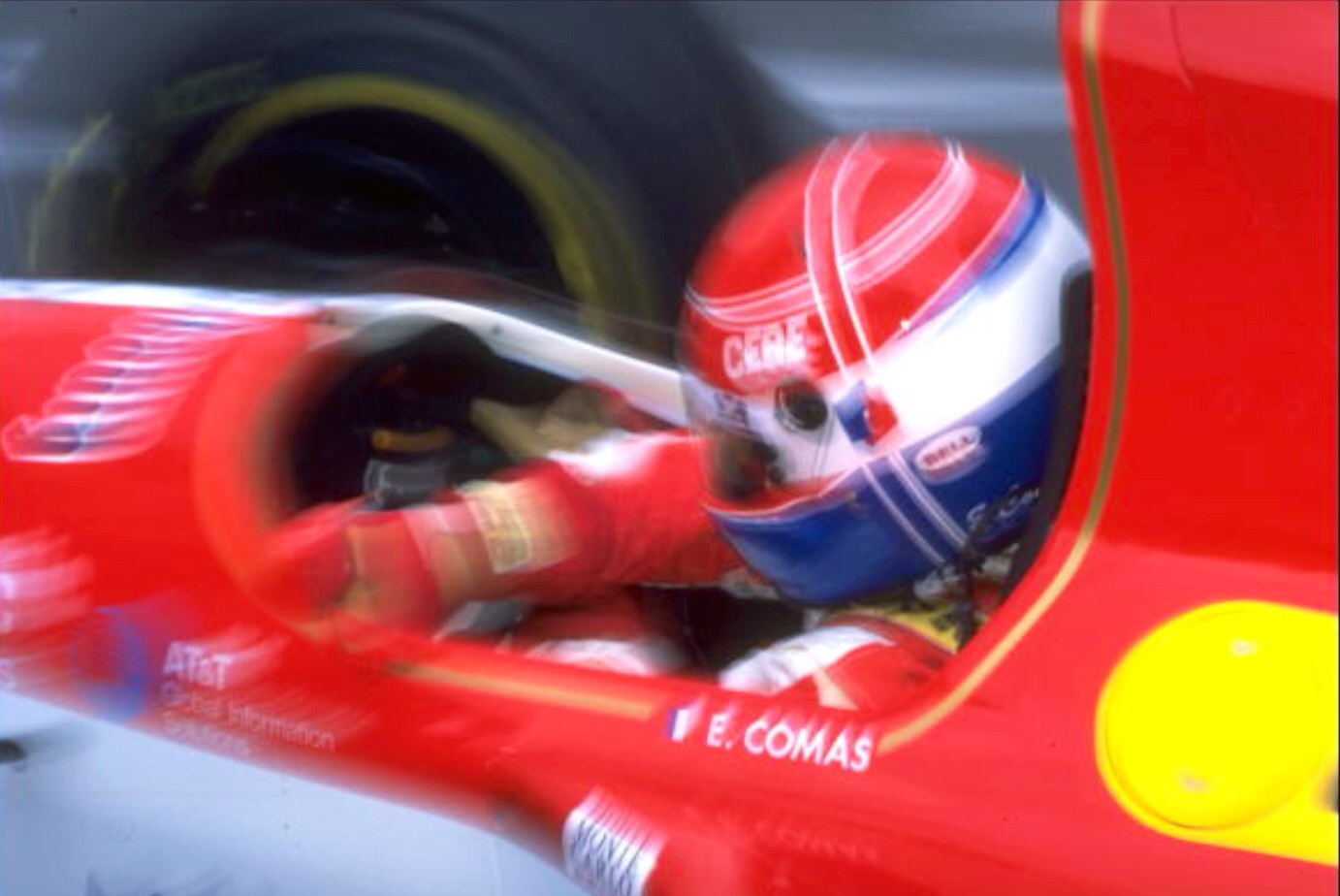
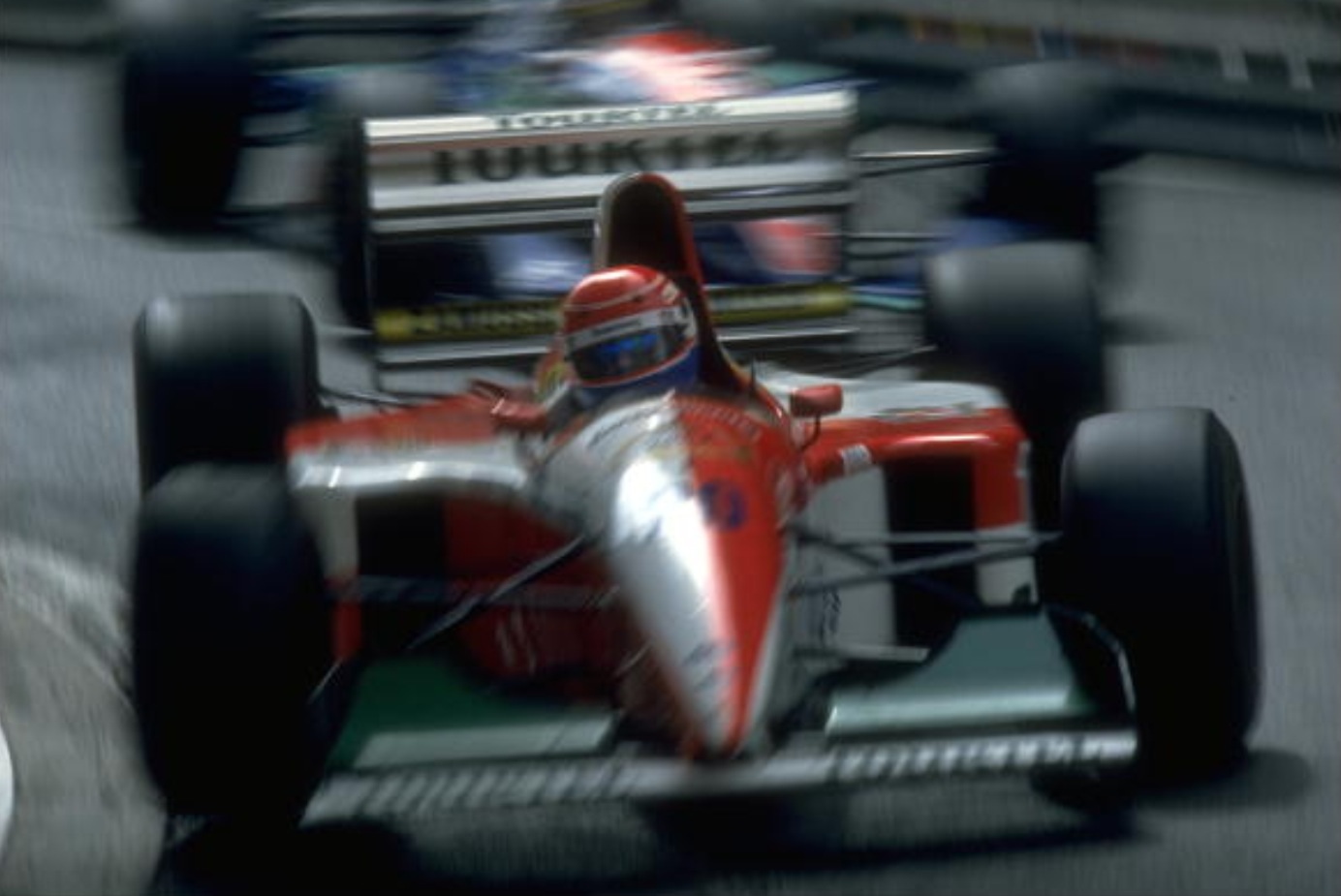
Eric Comas contesting the Monaco Grand Prix in his Larrousse LH94 Ford, 15 May 1994…

Comas qualified and raced this aging car and engine to 13/10th, good going in the tough F1 world of the mid-nineties. Up front, the race was won by Schumacher’s Benetton from Martin Brundle’s McLaren Peugeot.

image

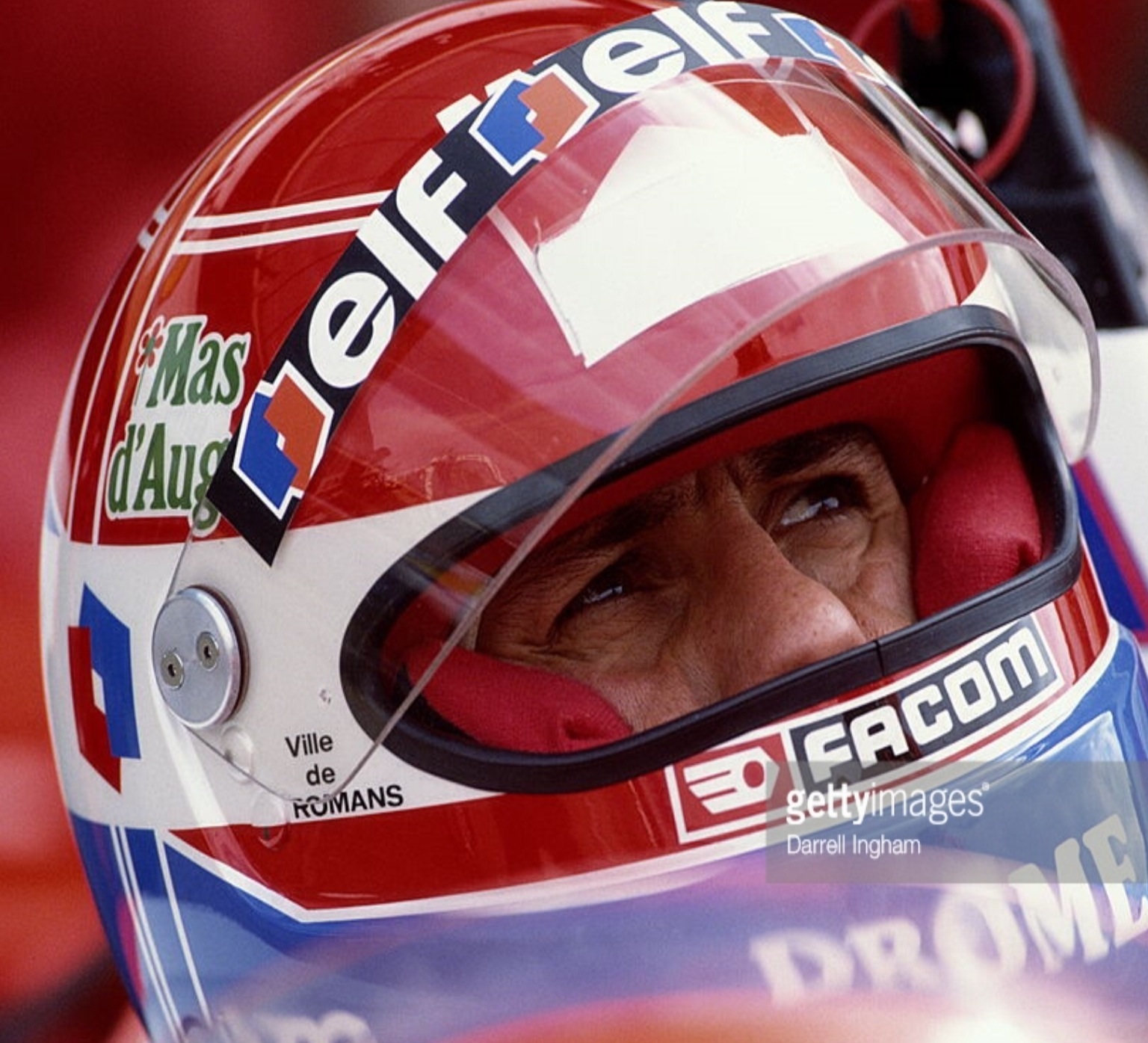
Comas came to F1 in 1991 via French F3 and European F3000, he was champion in 1988 and 1990 respectively. He contested 63 Grands Prix making his debut at Phoenix, the USGP on 10 March 1991 for Ligier in a JS35 Lamborghini V12. He scored a total of 7 championship points racing a Ligier JS37 Renault, Larrousse LH93 Lamborghini and Larrousse LH94 Ford in 1992, 1993 and 1994 respectively. His last point in the 1994 German GP was also the last for Larrousse.

Post GP racing he moved to Japan to contest the All Japan Grand Touring Car Championship winning the GT500 title in 1998 and 1999 for Nissan racing a factory Nismo Skyline GT-R. He shifted to Toyota and continued his run of success and later raced privateer Nissans before creating Comas Racing Management to nurture the careers of young up and coming, mainly French, drivers

Comas has now effectively retired, running Comas Historic Racing, which provides paying customers rides in Alpine Renaults in historic rallies.

image

Comas in his Lola T90/50 Mugen F3000 car at Donington in April 1990 (Ingham)

Imola 1994…

A bizarre incident in the horrific ’94 Imola weekend involved Comas and his Larrousse’ departure from the pitlane during the red flag after Senna’s accident, click here to read about the incident and its poignant circumstances.

http://viewingperspectives.blogspot.com.au/2014/04/imola-at-20-why-did-erik-comas-stop-at.html

Credit…

Getty Images, Darrell Ingham

Tailpiece: Monaco 1994…

image


image

Amazing Reims background as Nuvolari blasts his Scuderia Ferrari Alfa Tipo B/P3 to French GP victory on 14 July 1932…

What an endurance test, the race 5 hours in duration! Grands Prix have been 200 miles for so long its easy to forget what the ‘titans’ coped with nearly 100 years ago. Maserati didn’t race so it was a straight fight between Bugatti and Alfa Romeo with the Milan brigade winning comprehensively in their new 2.65 litre straight- 8 Vittorio Jano designed machines.

It was Nuvolari from Baconin Borzacchini and Rudy Caracciola in Alfa Corse entered cars, the best placed Bugatti T51 that of Louis Chiron in 4th.

This article is some words around some great shots of  Nuvolari from the Getty Images archives, treat it as the first in an occasional ‘at random’ series.

image

Tazio, Bremgarten, Swiss GP, Bern 21 August 1938 (Klemantaski Collection)

 Swiss GP, Bern 21 August 1938…

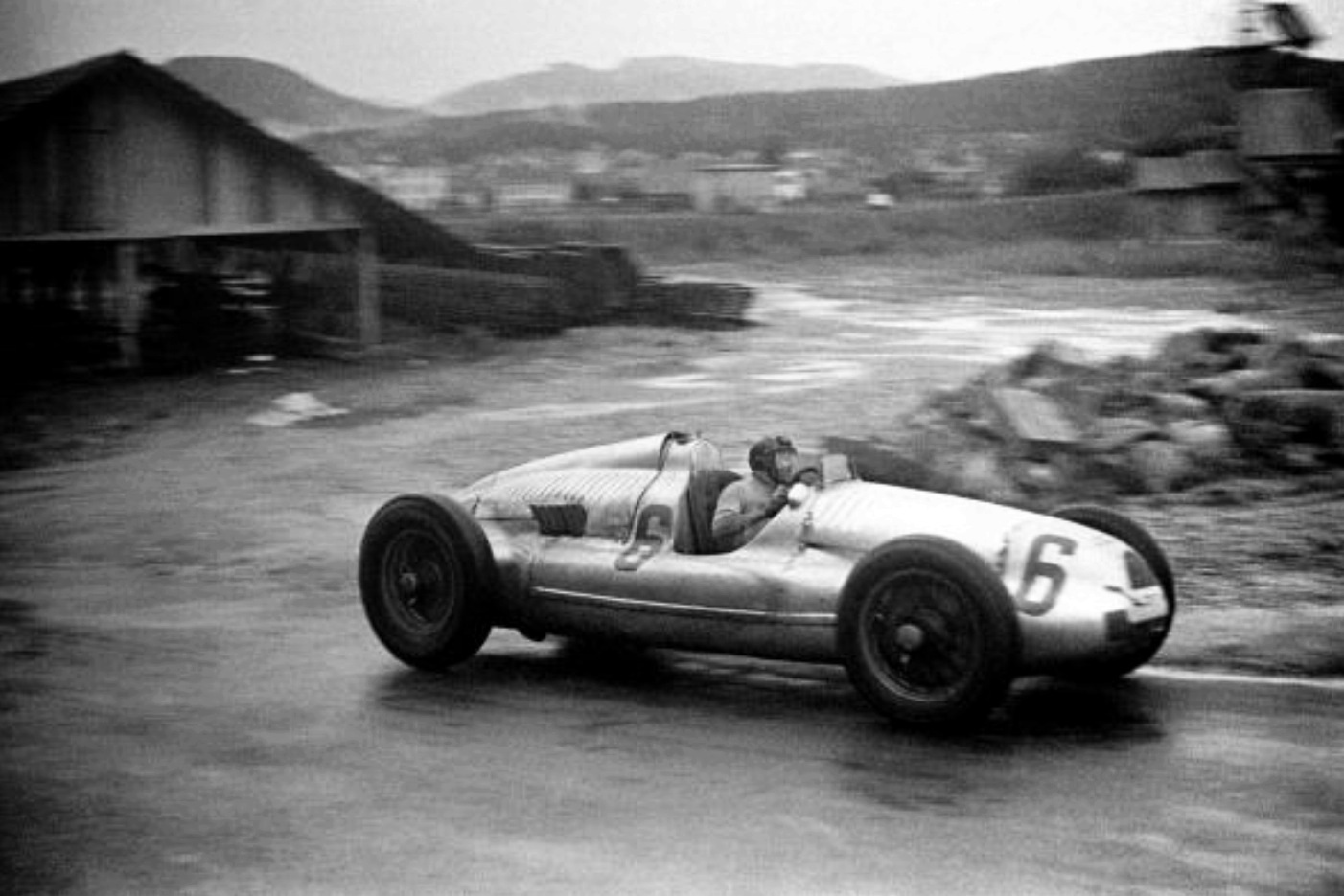
Tazio during the race held in awfully wet conditions. Seaman’s Mercedes lead from pole from teammates Stuck and Caracciola, he opened up a good lead but lost it after being boxed in by backmarkers allowing Rudy to sneak through.

Muller’s Auto Union raced well, Stuck spun and Tazio had undisclosed mechanical dramas in their mid-engined Type D’s. Mercedes 1-3 result was Caratch from Seaman and Manfred von Brauchitsch, all in W154’s.

image

Donington GP 1938

’38 Donington GP…

The winds  of change were blowing in Europe, the race date was changed due to the Munich crisis by three weeks, the race held on 22 October 1938. Nuvolari’s exciting weekend started in practice when his Auto Union Type D 3 litre V12 ran into a deer! But he lead the race from the start then ceded the lead to Herman Lang, pitting an additional time. The engine of Hansons Alta blew with Hasse spinning and crashing on the oil and Dick Seaman losing a lap. Tazio sneaked past Muller back into 2nd, then Herman slowed with a broken windscreen giving the plucky Mantuan the lead which he held to the end of the race. Lang was 2nd and Seaman 3rd both in 3 litre V12 Mercedes Benz W154

image

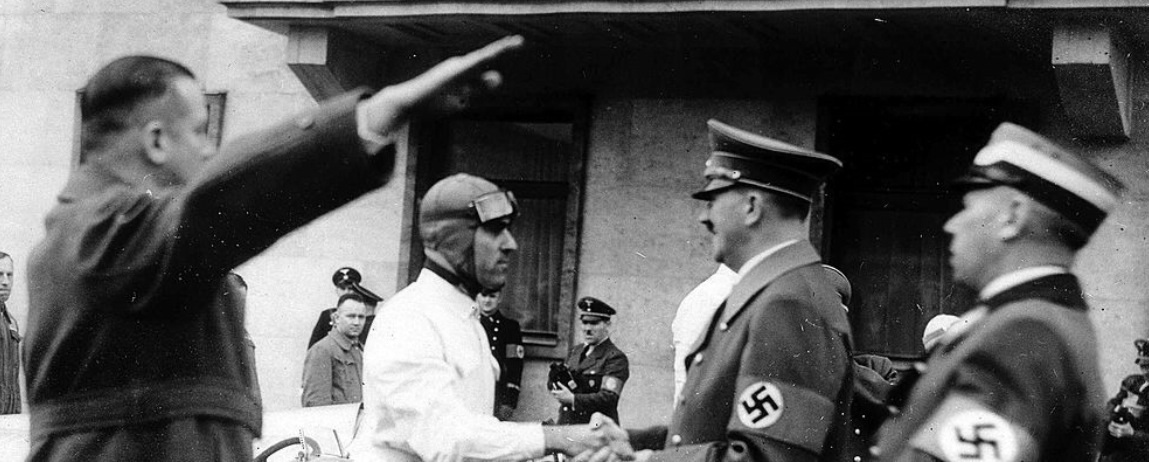
Tazio with some Nazi flunkies, ‘International Automobile and Motor Cycle Show’ 18 February 1939 Berlin. Hard to avoid these pricks racing for a German team at the time i guess (Popperfoto)

International Automobile & Mototcycle Show, 18 February 1939…

The first German automotive show was held in Berlin in 1897 with 8 cars, visitor numbers grew exponentially together with the growth of motoring itself, by 1939 825,000 people attended to see the new VW and other more sporting exhibits.

image

TN Jaguar XK 120, Intl Trophy Meeting, Silverstone 26 August 1950 (J Wilds)

Silverstone International Trophy Meeting 26 August 1950…

Tazio was entered in a red, standard, ex-demo factory XK120 Jaguar in the production sportscar race during this famous annual meeting.

The MotorSport report of the meeting records ‘It was splendid to see Nuvolari go round at 75.91 mph in a hard-used Jaguar demonstrator, using his gearbox where others trod on their brakes, but on Friday he was said to be ill from methanol fumes – odd, for the production cars were on petrol – and Whitehead drove for him’.

Nuvolari was quite ill by this stage and struggled, he did three slow laps on the first day of practice then Jaguar team manager Lofty England had the task of telling Tazio that he was too slow as a consequence of his fitness.

Doug Nye made this observation of the genius on ‘The Nostalgia Forum’; ‘In his final years Nuvolari was a variably sick man, varying from being in frail shape to being in terrible shape. I have been told by many who met the great man at that Silverstone meeting that he was, indeed, in terrible shape that weekend…and they were all greatly concerned for him…some even wondering if he might not survive the journey home…

Nuvolari had at least as a high a proportion of admirers amongst British racing enthusiasts as he had in his native Italy, and possibly higher, and for many it was like seeing a retired old thoroughbred racehorse, attemping one last gallop on grass, arthritic, blown, sway-backed, and broken down … for many present that weekend it was remembered as a terribly sad sight… particularly for those who recalled the sight of Nuvolari in his pomp at Donington Park, 1938’.

Nuvolari died on 11 August 1953 having suffered a stroke which partially paralysed him the year before, a second one killed him.

Credit…

Imagno, J Wilds, Getty Images

Tailpiece: Moss and Nuvolari at the International Trophy meeting, Silverstone 1950. Shot is symbolic of generational change but it’s also clear just how fragile the great man had become…

image