Archive for the ‘Features’ Category

(SLSA)

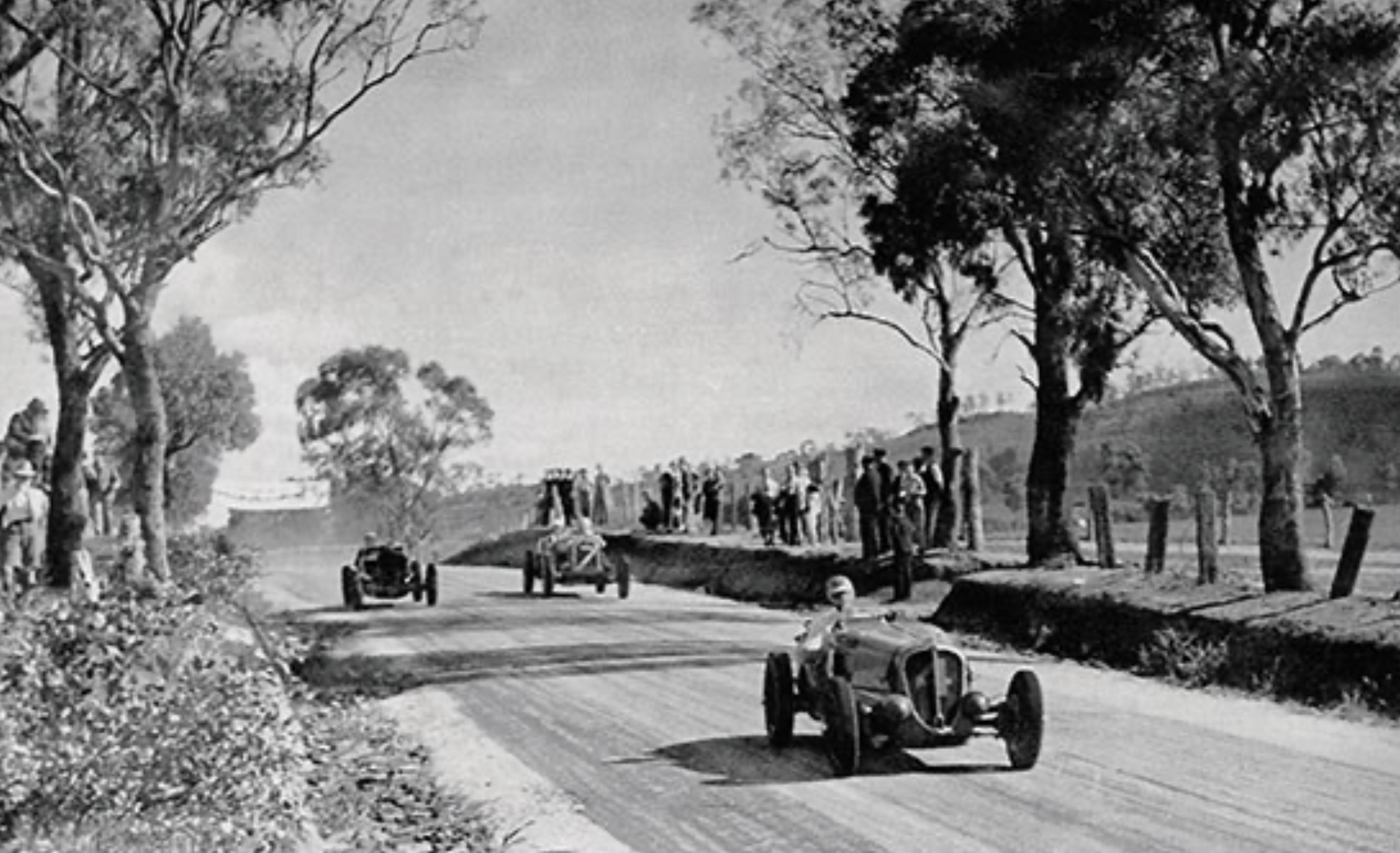
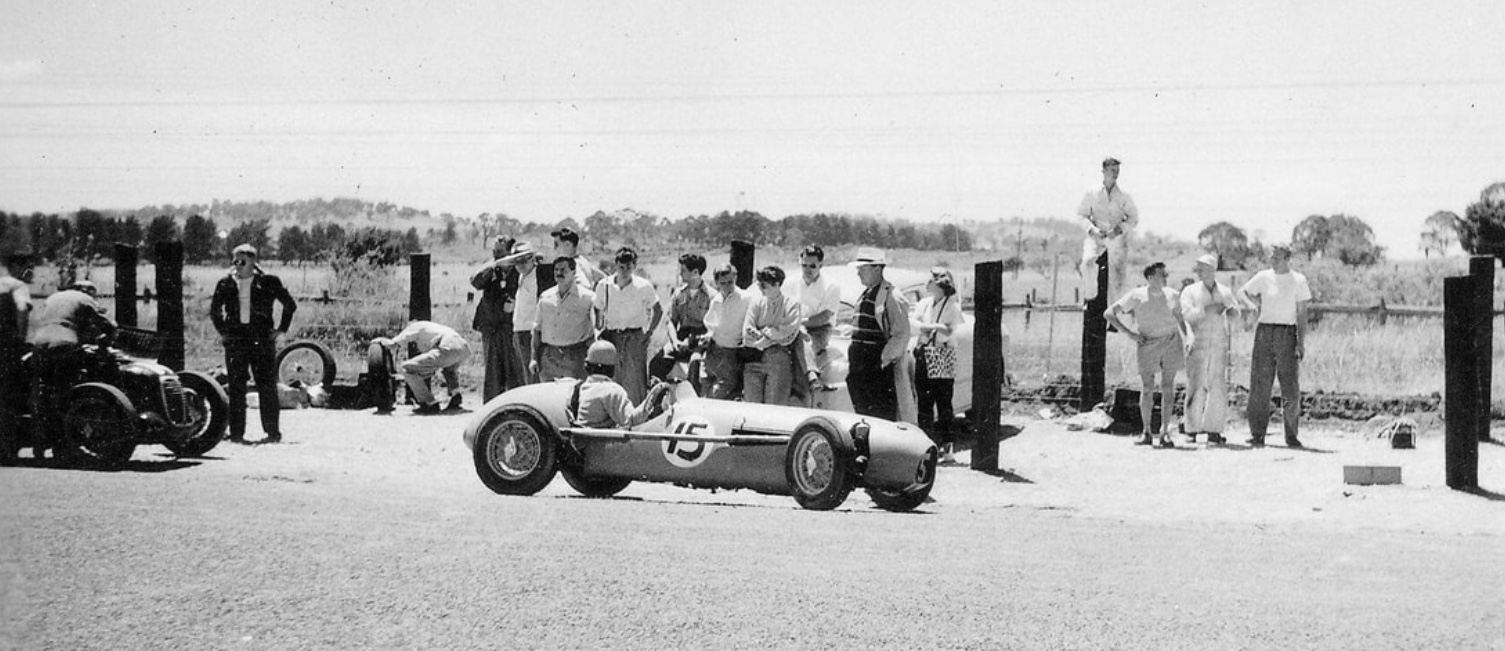
A group of cars await the start of the New Years Day 1926 Light Car event at Sellicks Beach, 55 km from Adelaide on the Fleurieu Peninsula. It is a photograph but almost painting like in its softness…

Many thanks to reader ‘hoodoog53’ for helping to identify the cars, drivers and date.

Competitors from the left are the #8 NA Goodman Ceirano N150, also in the shot below, then the PM Pederson Amilcar and HH Young, Amilcar Grand Sport’s, F Beasley’s Gwynne and D Dunstan, Austin 7.

‘Pederson, Young and Bowman made regular appearances on the sand at Sellicks and also on the local speedway tracks in the 1920’s. Pederson also broke the Broken Hill to Adelaide Speed Record in May 1925 using an earlier Grand Sport Amilcar.’

(Jennison)

Doug Gordon writes ‘I’m pretty sure this photo was taken on the same day in 1926- H Young racing the Grand Sport Amilcar with a small Amilcar roadster and motorcycle spectating on the sand’

The ever reliable Adelaide newspapers consistently provided the best local coverage of early Australian motorsport events in their state right into the post WW2 period in my opinion.

Adelaide’s ‘The Register’ reported the Twenty Mile Light Car Handicap- ‘Young won by about a mile. F Beasley’s Gwynne had a front tyre blow out at the north end of the beach, and the car skidded and overturned in the sea. The passenger (Miss Watt) was severely shaken and suffered a few bruises, while the driver was not injured. Miss Watt, when asked about how she felt, showed a sporting spirit by saying that her injuries did not matter if the car were all right.’

H Young Amilcar 1074cc, off 90 seconds, won the race from P Pederson Amilcar 1074cc off 50 seconds, then D Dunstan Austin 7 748cc, off 240 seconds. Other starters were F Beasley, Gwynne, 130 seconds and NA Goodman, Ceirano 1460cc off scratch.

‘Percy Pederson was the Service Manager and did the car demonstrations to customers at Drummonds, who held the Amilcar franchise in Adelaide’ wrote Amilcar GS owner and enthusiast Doug Gordon. ‘He was called upon to prepare Amilcars for competition and drive them for sales promotions. He used the same car in May 1925 to set a Broken Hill to Adelaide speed record. Anecdotally Pederson had these cars running at ridiculous compression ratios and burning methanol like the mororcycles- his job was to win, high demand for such cars was created by events such as these.’

Motorcycle racing or hill climbing first took place in the area on the rough road above the Victory Hotel on Sellicks Hill, in the early 1900’s but the activity was banned in 1913 as the sport was interfering with what was then the main arterial road from Adelaide to Cape Jervis.

The Victory Hotel is a mighty fine place for a meal by the way- and affords wonderful panoramic views of the surrounding countryside and coast towards Aldinga Beach and beyond. Whilst being tour guide, and its all coming back to me, do suss the ‘Star of Greece’ at Willunga Beach, an Adelaide standard and make a day of it- you can have some fine food and wine at a McLaren Vale winery and within 20 minutes hit the beach at Aldinga or Sellicks for a swim. Not many places in the world you can do that, Victoria’s Mornington Peninsula and Western Australia’s Margaret River regions duly noted.

The intrepid South Australian motorcyclists then turned their attention to the wide, hard expanses of the Sellicks Beach sand, the location was used either on the January Australia Day, Christmas and October Labour Day long weekends for time trials and racing continuously from 1913 to 1953 on a very simple ‘up and back’ circa 3 km course around drums at each end of the course.

During the 1930’s light aircraft also used the beach during raceday to provide joy flights for spectators- now that would have been something, to see the racing from the air!

Unknown and undated bike racer but the twenties feels good as an approximation (Advertiser)


Racing paraphernalia and truck at Sellicks, date unknown (K Ragless)

Sellicks attracted international attention for record breaking in 1925 when American rider Paul Anderson topped 125 mph over a half-mile aboard an eight-valve Indian taking ‘Australia’s One Way Speed Record’, the Rockhampton Morning Bulletin reported in November 1925.

Whilst many of the Sellick’s bike meetings included an event or two for ‘Light Cars’ (read small cars), ‘…that trend started at the Gawler racetrack in April 1925, this comprised a demonstration or match race between the Pederson Amilcar and an Austin 7. The first Grand Sport Amilcars arrived by ship in Adelaide in October 1924, the bodywork on this car appears to have been hastily prepared for the Gawler match race, with the rear tail not yet painted. By the start of the beach racing season in 1926 Pederson had a new GS Amilcar ready to go with a beautiful, locally made polished aluminium body. The Austin 7 was driven by Jack Moyle who was better known for his exploits on an AJS 350 at the Isle of Man, so he had a lot of track experience. The Austin won but the lead changed a number of times and the spectators loved it’ said Gordon.

Percy Pederson Amilcar and Jack Moyle Austin 7, Gawler April 1925 (D Gordon)

‘As with Jack Moyle’s move from the AJS to the Austin from time to time, so it was to become a trend for ageing speedway motorcyclists to gradually transition to light-car racing with Fergusson, McGillvray and McLeod being others who moved from two to four wheels- in the case of these three riders to Amilcars.’

‘Amilcars were popular on dirt tracks and on beaches because they had no differential- just a locked rear axle that didn’t lose traction on loose surfaces. It is for this reason that Jack Brabham built his first speedcar using Amilcar axles, he wasn’t the only one to do it in the early development of Australian speedway midgets’ said Doug Gordon.

‘The trend to include light-cars at motorcycle events continued from that Gawler day with fields gradually increasing over the years- this led directly to cars racing at Sellicks.’

The first meeting exclusively for cars was organised by the Sporting Car Club of South Australia and took place on 10 October 1934.

Billed as the ‘Grand Opening Speed Meeting’ over the Labour Day long weekend the entry list included Ron Uffindell who later successfully contested the 1938 Australian Grand Prix at Mount Panorama, Bathurst- he finished the handicap event eighth in his Austin 7 Special- and drove the little car to Bathurst and back from his home in Adelaide.

Other stars of the day entered that pioneering weekend- it was actually the very first speed meeting organised by the wonderful SCCSA, included Ash Moulden, Tony Ohlmeyer, John Dutton, Judy Rackham, Ron Kennedy with Cec Warren making the long trip from Melbourne in his supercharged MG.

The ‘Bryant Special’ at the SCCSA’s Buckland Park Beach meeting in January 1935- it ran with engine troubles but still did good times and in one race lapped the course at more than 70 mph. If anyone has a clearer picture of this car it would be gratefully received (Advertiser)

The ‘Adelaide Advertiser’ estimated the crowd at 10,000 people, the largest ever to a Sellicks meeting at that point. Niggles included a late start due to a breakdown of the electrical timing gear and as a consequence a rising tide!

Whilst Ron Uffindell won the 20 Mile Handicap feature race, the sensation of the meeting was the twin-engined Essex Special which owner-driver Peter Hawker, variously named the ‘Bryant Special’, after its builder, or more fondly, the ‘Bungaree Bastard’- Bungaree being the name of his family’s sheep station (farm) first established in the north of South Australia by Hawker’s forebears in 1840.

Despite conceding 7 minutes 20 seconds to Uffindell, Hawker finished second only a few yards behind Ron’s little Austin 7. The Advertiser reported that ‘…whilst the beach only permitted a 2 mile straight, and in consequence (Hawker) had to negotiate nine hairpin turns in the race, he averaged more than 73 mph for the distance…reaching about 100 mph on the straights.’

‘The big car scared spectators badly when it developed severe front wheel patter…for a moment it appeared the car would get out of control as the front see-sawed rapidly, making the wheels wobble and lift six inches off the ground in quick succession…slowing down cured the problem with A Moulden coming third, within a hundred yards of the winner.’

This extraordinary special was built by Max Bryant at Clare together with Hawker in 1934 and had two Essex ‘L’ or ‘F’ head 2371cc/2930cc four-cylinder engines- both of which were rated at 55 bhp.

The car was raced by both Bryant and Hawker at Buckland Park Beach, Sellicks and the SCCSA’s first hillclimb at Newland Hill’s Waitpinga in 1935 (another great but dangerous beach not too far from Victor Harbor) before being sold to the incredible Eldred Norman who was very competitive in it. This intuitive engineer, racer, specials-builder and raconteur was to be a mainstay of Sellicks throughout the venues long existence.

(Norman)

Norman is shown above in his stripped 1920’s Lancia Dilambda- 4 litres of OHC V8 power at Sellicks in the mid-thirties- what became of it I wonder? Its said Eldred got his passion for V8 grunt from this machine.

In a February 1935 record breaking exercise for cars saw three members of the Adelaide Establishment tackle the Sellicks sand.

John Dutton achieved 92.34 mph in his Vauxhall 30/98 ‘Bloody Mary’, so named for its blood red duco.

It was a car which achieved local fame and notoriety in February 1936 when the young, wealthy racer was forced off the road whilst returning to his home by an oncoming drunk driver. The Vauxhall plunged 60 feet into the icy waters of Mount Gambier’s Blue Lake whilst the intrepid pilot watched his beloved car gurgle downwards from above- he had been thrown clear of it and clung to a tree on a cliff until rescued. Lets return to that amazing story towards the end of this article.

Warren Bonython extracted 76.49 mph from his little 748cc MG J2, ‘the first MG sportscar in South Australia’ whilst the ‘Bungaree Bastard’ topped 110 mph before a broken piston put an early end to Peter Hawker’s day.

Warren, John and Kym Bonython preparing for Warren’s record run at Sellicks in 1935- MG J2 (SCCSA)

I’m not sure how many meetings involving ‘bikes and cars took place down the decades but Rob Bartholomaeus’ research at the Sporting Car Club of South Australia library uncovered many programs and the newspaper reports are extensive for the best part of fifty years.

Rob recalls seeing Jack Brabham listed amongst the entrants for one of the early fifties meetings but a trawl through ‘Trove’ has not yielded any evidence that the great man actually raced at the venue in one of his Speedway Midgets or Coopers.

(B Buckle)


(B Buckle)

Two photographs above of MG T Types during a meeting in 1947- it’s summer, check out the people swimming in the shallows beyond the cars, not everyone was there for the racing! Bill Buckle, MG TA is in car #17.

The course was not without its challenges, whilst start times were of course programmed by the organising club, ultimately the elements determined things.

Officials arrived early in the morning and asessed the likely conditions for the day with the vagaries of the tide sometimes bringing an early end to proceedings- the position of the mile or more long course itself changed dependent upon the prevailing sand and other conditions, weather forecasting being not quite as sophisticated as it is today!

(D Gordon)


(D Gordon)

Proceedings were not as serious as today either, ‘…it appears to be have been very much a picnic atmosphere with wives and girlfriends in attendance showing off the ‘fashions of the field’ almost like a Melbourne Cup day. The article above focuses almost entirely on the girls fashions and nothing to do with the racing!’ Doug Gordon observes.

‘The casual drivers attire gives an idea that it was nothing like the professional racing we see today, certainly not in the sportscar ranks anyway. The group shot on the back of Don Cant’s MG TC is typical of a group of friends out for a fun picnic on the beach with racing to add a bit of excitement to the day.’

Don Cant in helmet and racing shorts, no socks and tennis shoes, Don Shinners in old school cap, Molly Foale on the tank, Jill Cant and Max Foale in togs ready for a dip (D Gordon)


(unattributed)

The photograph above appears to be during the 1950’s given the spectators cars, the panoramic view looking towards Myponga Beach gives us a bit of an idea of a spectators view back in the day.

(A Wright)

Harry Neale, above, during the Easter Monday meeting in 1950 driving Eldred Norman’s formidable Double Eight Special.

This extraordinary twin Ford sidevalve 239 cid Mercury V8 powered beastie based on a Dodge weapons carrier chassis must have been mighty quick out of the stop-go type corners with its prodigious 7800 cc of torque and 200 bhp’ish pushing it along the two straight bits. Putting the power to the ground even on the hard sand cannot have been easy, to say the least.

Click here for some information on this car;

1950 Australian Grand Prix: Nuriootpa, South Australia…

In an interesting tangent it seems that the Bryant Special’s sale by Hawker to Norman in 1936/7 was precipitated by poor Peter contracting cancer, from which he died way too young shortly thereafter. Clearly Eldred Norman’s thinking in concepting the post-war Double Eight was influenced by the Bryant/Hawker machine he owned and raced earlier.

At this Easter Monday 1950 meeting the Double Eight was driven by speedway legend Harry Neale who was well in front of the pack when he lost control. Albert Ludgate wrote in ‘Cars’ magazine, ‘Before the crowd realised what was happening, the Ford was out of control and with a mighty splash charged into the sea. Such was the force of the water that the body was ripped off the chassis, leaving Harry sitting on the chassis, unhurt, but very wet.’

Turning to Eldred Norman, he was a larger than life character in every respect.

He once retrieved the telephone cables laid out for communication between officials at each end of the beach by fitting a bare wheel rim to the Double Eight’s rear axle, jacked up the car, fired it up, cracked open the throttle and post-haste reeled in a mile or so of line. The sheer efficiency of the process is to be admired even if modern O,H & S folks would be aghast at the dangers!

Hang on Harry. Neale in, or more particularly on the Double Eight at the South Australian Woodside road circuit in 1949. Look at that way back driving position- two engines to package of course! Note the big, heavy truck wheels and tyres (unattributed)


(D Cant)

Don Cant #7 and Steve Tillet In MG TC Spls with Eldred Norman just ahead, lapping them no doubt, in the Double Eight, 1952. In the later Sellicks years Norman also raced his Maserati 6CM and a Singer 1500 production tourer there, often with success.

During the same October 1952 meeting Eddie (father of Larry) Perkins’ Lancia Special leads Greg McEwin’s HRG around a drum which marks one of the two hairpin bends in the photo below.

(Advertiser)

All good things come to an end of course.

Mixed car and bike meetings were run until the local Willunga Council cried enough in 1953.

Sellicks was a long way from Adelaide in 1915 but a ‘lot closer’ by 1950 with the cities burgeoning population and mobility of its populace as car ownership grew exponentially post war- and most of those motorists wanted to use the beach for traditional aquatic pursuits not have them interrupted by motorsport.

The sport was changing more broadly in South Australia as well.

The state had a great tradition of road racing on closed public roads at Victor Harbor, Lobethal, Nuriootpa and Woodside but the death of a rider and spectator at Woodside in 1949 was a catalyst for the State Government banning road racing until the relevant act was repealed or amended to allow the Adelaide Grand Prix to be conducted on the city streets in the eighties.

In short, South Australia needed a permanent circuit, a role Sellicks could never of course fulfil. Initial work on putting this in place began with the incorporation of a company named Brooklyn Speedway (SA) Pty Ltd in August 1952.

Local racing heavyweights involved in the venture were determined not to let the sport die in South Australia included Steve Tillet, RF Angas, ES Wells, Keith Rilstone, TC Burford and of course Eldred Norman.

They soon secured a lease on 468 acres of flat salt-bush scrubby land at Port Wakefield on the Balaklava Road, 100 km from Adelaide.

Plans for a 1.3 mile circuit were drafted by Burford and circulated to the SCCSA and amongst drivers with the plans then modified and a circuit and support infrastructure built

The tracks first meeting was held on New Years Day 1953, star attractions included Melburnians Stan Jones in Maybach 1 and Lex Davison who brought over his Grand Prix Alfa Romeo P3. Lex rolled the car without injury only days before he and Jones jetted off to join Tony Gaze in Europe to contest the Monte Carlo Rally in a Holden 48-215.

Significantly, the circuit was the first permanent race-track constructed in Australia putting aside Speedways and appropriated airfields. South Australia had a new home for motor racing, hosting the 1955 AGP which was won by Jack Brabham’s self-built Cooper T40 Bristol ‘Bobtail’.

In more recent times their have been several ‘bike Sellicks re-enactments, the first in 1986 attracted over 40,000 spectators! and involved some racers who had run at the beach in period.

Eric Cossiche provided these photos from the February 2017 Levi Motorcycle Club run at Sellicks and commented that it was a bad move ‘salt and sand took forever to get sorted’ from the car, but fun no doubt!

Car is Eric Cossiche’s wonderful 1954 Wolseley Flying W Special (E Cossiche)

Postscript…

A couple of days after uploading this article Adelaide enthusiast/racer/historian Doug Gordon got in touch with some more photos and information which I have reproduced below- many thanks to him.

‘I have a particular interest in these early SA venues – Sellicks, Smithfield Speedway, Gawler Speedway (Racetrack), Lobethal, Woodside, Nuriootpa, Victor Harbor, Glen Ewin Hill Climb, etc.
Some are very hard to find information about – especially Smithfield Speedway (from October 1926- built and run by the Motor Cycle Club of SA) which was also one of the earliest speedway venues in the country and the first purpose built, but usually overlooked.
I have a couple of Grand Sport Amilcars and also own Don Cant’s MGTC from the photos you have. Don placed fourth on handicap in the AGP at Nuriootpa in 1950 and was also at Sellicks in October 1952, along with my Amilcar (driven by Max Foale).

(D Gordon)

The other interesting SA beach racing venue (for motorcycles) was Hardwicke Bay, about which I have found very little, except for speaking to the old locals (we have a place there) and a couple of photos from the community centre. I have a 1924 Douglas and have made contact with the Yorke Peninsula V & V Motorcycle Club and hope to find out more about Hardwicke in future – one of my buddies over there is trying to track down some more photos before the old fellows die out!
Hardwicke Bay racing – both official and “UN-official” (both on and OFF the beach, apparently – not too many cars on the roads back then- boys will be boys, went on for years, whilst the better-known venue at Sellicks was still going in Adelaide.
This was on a beautiful stretch of hard white sand stretching from Longbottoms Beach to Flahertys Beach (named after local landowners) for about 4 kilometers. I’m not exactly sure where the track layout was, but in many ways it was better than Sellicks and the boys from all over Yorkes would come down for it, along with the Adelaide mob. Possibly more a clubby arrangement with very little publicity!

Ready for the off at Hardwicke Bay (D Gordon)

Jake Cook at Hardwicke Bay in the 1930’s (D Gordon)

Boys looking pretty casual and ready for the off at Hardwicke Bay (D Gordon)

It is also widely known that not ALL the racing on Sellicks Beach was “officially sanctioned” events, but motorcycles pre-dated cars there by more than a decade. The early motor-cycle clubs invited “Light-Cars” in the mid-1920s, but the Sporting Car Club of SA did not invite motor-cycles after they started their car meetings in 1934.
The precedent for this was set at Gawler racetrack in April 1925, when the motor-cycle speedway invited an Austin-7 and an Amilcar to a match race on the turf track there. After this, Light Cars often appeared at motor-cycle racing events and speedway – principally at Sellicks and Smithfield, along with a few night trials and reliability trails. So these early venues were a critical link in the formation of motor sport in this SA as well as Australia as a whole.

(D Gordon)

Its also interesting that the Harley-Davidson MCC had their club-rooms high on the Sellicks cliffs overlooking the beach in the 1920s – known colloquially as “The ‘Arley ‘Ut”.
Note that both the Sellicks and Hardwicke venues were only used in the early months of summer from late October to February, owing to the tides going out further at these times to keep the sand exposed for most of the days. If tides came in too far, the racing had to be abandoned.
Eldred Norman was said to ease the big Double-V8 into very shallow water at times to cool off the brakes in the spray after serious fading following some panic stops at the hairpin bends at the end of each long straight! Later he fitted windscreen washer spray jets with push-button control to squirt the brakes when needed to provide the same effect in long road-races.
Sellicks IS a very special venue and it has been packed for the modern re-enactments run by the Levis Motorcycle club in recent times – bikes and riders come from every state. It’s huge and you have to get tickets pre-booked and paid through Venutix etc- there are only a limited number available and are sold-out in days! These events are now fully backed by local councils and environmentalists are (sort-of) OK with it, because no damage has been proven to result – Sellicks has a unique layer of pebbles just under the sand to keep the surface very stable, which is why it lasted so long and even into the present day.’

Etcetera: Sellicks…

(unattributed)


Bill Buckle’s MG TA during the 1947 meeting, the racer/businessman made the long trip from Sydney for the event, casual nature of the beach clear from this shot as is the importance of MG’s to Australian motor racing- and not just at Sellicks Beach.


(Levis)


Harry Cossiche getting ready to boogie in the 1930’s (E Cossiche)


(D Gordon)

The Don Cant and Steve Tillet MG TC’s hard at it during 1952. By the look of the soft sand in the foreground one needed to not stray too far up the beach- or down it.

Cars on beaches is a strongly entrenched Adelaide tradition- parking ones car on the beach before popping up the beach umbrella and knocking back a couple of tinnies continues to this day on some of their coastline, a practice very strange to we east-coasters.


(Norman)

Eldred Norman’s much modified Maserati 6CM chasing Tom Hawkes’ Allard J2 above at the first all-car Sellicks meeting post-war in October 1952.

Norman had a dim view of this car which was never very fast and had an insatiable appetite for pistons, inclusive of this race meeting!


(Jennison)

Etcetera: Mystery ‘Sellicks’ car…

John Alfred Jennison built this racer at his garage in Salisbury, South Australia, which sold and serviced Chevs in the twenties. The clever Engineer was later a pioneer of caravan construction in Australia.

The car raced at Sellicks in the late twenties but I can find nothing about its mechanical specification, in period race record or its ultimate fate.

It would be great to hear from any of you who may know something about it. Neat isn’t it?

(Jennison)


(ABC)

Etcetera: ‘Bloody Marys’ 300 foot Blue Lake plunge…

The story of John Dutton’s lucky escape from the seeming death of his Vauxhall in February 1936 is too good to leave alone and is well told by Kate Hill in this ABC South East’s ‘Friday Rewind’ published on 7 November 2014.

‘Wealthy young racing driver John Dutton owned a property on the outskirts of Mount Gambier when he purchased one of the last Vauxhalls produced in 1927, nicknamed ‘Bloody Mary’ for it’s blood red duco and known for its speed and racing pedigree.

In fact, Dutton and the Vauxhall landed the Australian National RC Speed Record over one mile on Sellicks Beach in February 1935 and he was booked to compete in the 1936 Australian Grand Prix with another car, a supercharged MG (he finished tenth)

The Mount Gambier resident used his cars for both competition and daily transport, frequently spotted at hill climbs and tearing the cars around country roads.

On the Blue Lake Aquifer Tours website, Linton Morris, who purchased the Vauxhall in 1993 obtained what he calls the most ‘accurate version of the incident’ in a letter from John Dutton’s younger brother Geoffrey.

Sometime after 2am one wet February morning, Dutton was driving the Vauxhall around the lake home, when a drunk man came around the tight bend on the wrong side of the road.

The Vauxhall was forced through a fence and tipped over the edge but luckily the seriously injured Dutton had been thrown out, landing some way down the cliff before his fall was stopped short by a tree.

Watching his beloved car plunge past him into the depths of the Blue Lake, John later told his brother Geoffrey how the car spun around in the water with the headlights still on, ‘leaving an eerie lemon light’ cutting through the murky water.

Dutton, clinging to life with severe internal injuries, was stretchered back up the cliff in a dangerous night operation by police and rescue services and taken to Mount Gambier Hospital.

(ABC)


The restored ex-Dutton Vauxhall 30/98 at its point of entry into the Blue Lake crater in 1958. Armco barrier more substantial than the 1936 variant and doubtless it is even more substantial now (SLSA-Arthur Studio)

There are varying reports of whether Mr AC MacMillan, the veterinary surgeon who caused the crash, drove straight to the Mount Gambier police station to report the crash, or as a later report suggests, simply drove into town and had another few beers at the Jens Hotel.

The Border Watch newspaper reported the sensational crash with the front page of next edition screaming: Racing car drives 300ft into Blue Lake – Driver’s miraculous escape from death.

With Dutton recovering in an Adelaide hospital, the city’s council was left with a problem – how to salvage the car from the city’s famous ‘bottomless’ water supply.

In fact it would be over 13 months before a plan of action was put into place, including construction of a pontoon to support the vehicle at the lake’s surface and a 10-tonne road roller to haul the car to the top.

A steel cable was attached to the rear springs of the car, which had been stripped of its wheels and bolted to wooden cross bars to stabilise the vehicle.

A huge crowd gathered around to watch the spectacle, which was not without incident.

A workman’s fingers were crushed after he was distracted by the crowds and his hand drawn under the steel rollers.

When the car reached the top, onlookers noted the clock inside had stopped at 2.40am, probably the exact time of the accident.

The Vauxhall was put on display at local garage May & Davis and became a popular attraction for tourists and locals alike.

Believe it or not, after nearly a year underwater, the car went on to have a further racing career in Victoria and South Australia under a succession of owners.

Bought by Morris in 1993, the famous car that went into the Blue Lake has now been fully restored and lives a quiet life.’

(ABC)

Bibliography…

Adelaide Advertiser 11 October 1934/9 October 1954, Adelaide ‘The Register’ 2 January 1926, article by Tony Parkinson in the Spring 2014 issue of ‘Fleurieu Living’, Rockhampton ‘Morning Bulletin’, ‘The Nostalgia Forum’ Eldred Norman threads, communique from Doug Gordon

Photo and other Credits…

State Library of South Australia, Rob Bartholomaeus, Arnold Wright, Ken Ragless, Sporting Car Club of South Australia, Don Cant Collection, Bill Buckle Collection, Doug Gordon, K Ragless, Jennison Family Collection, Norman Family Collection, Australian Broadcasting Corporation, Eric Cossiche, Doug Gordon

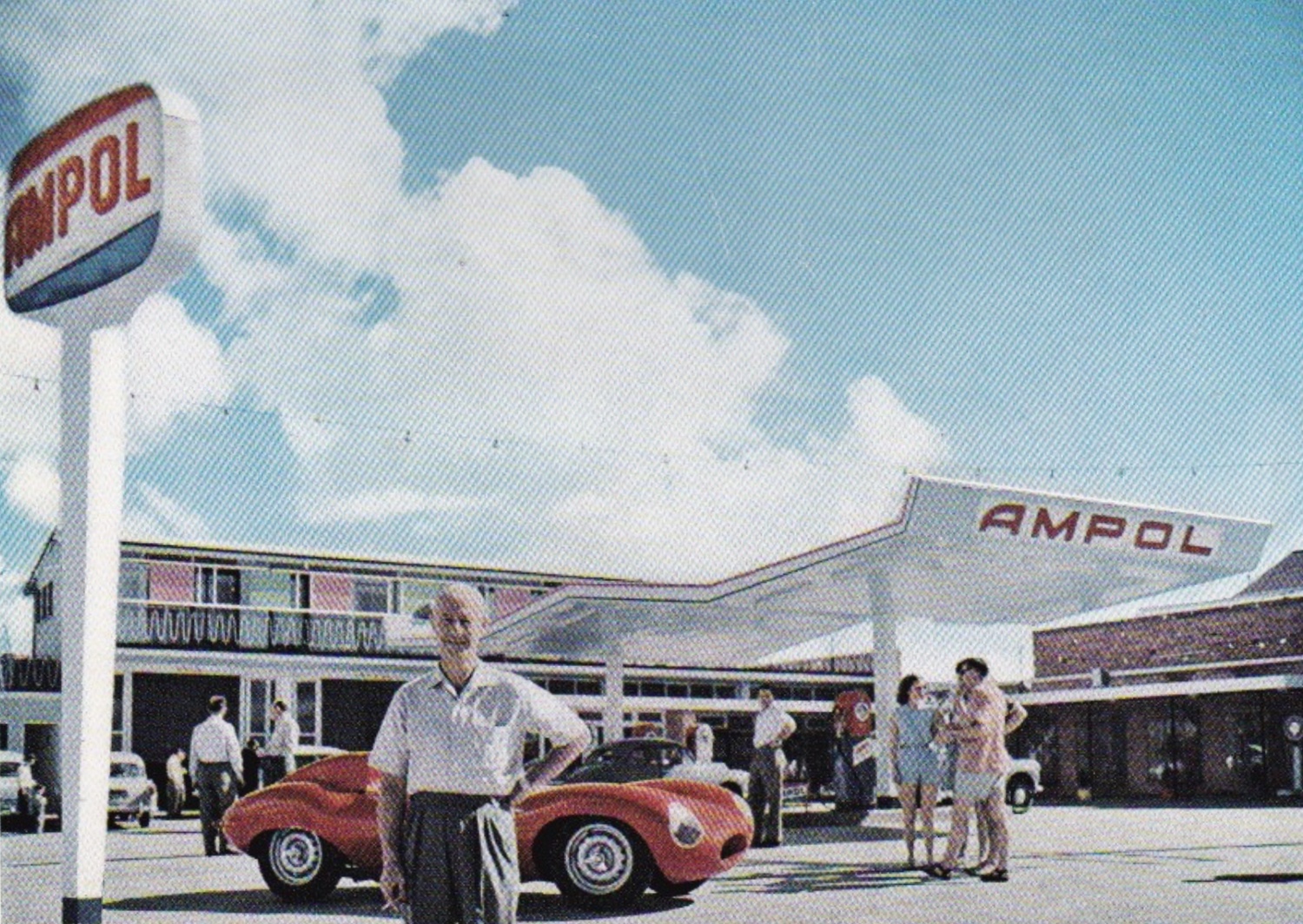
Tailpieces: Sellicks Beach fuel depot ‘in period’ and the drivers view in 2019…

(unattributed)


(D Gordon)

Finito…

(P Greenfield)

Malcolm Ramsay awaits the start of the ‘Diamond Trophy’ Gold Star race at Oran Park on 28 June 1970…

His car is an Elfin 600C Repco ‘730’ 2.5 litre V8, alongside him you can just see the nose of the cars constructor, Garrie Cooper’s Elfin 600D ‘830’ V8- only three of these Repco V8 engined Elfins were built, John McCormack’s Elfin 600C was the other, and all are ‘Australian Motor Racing Royalty’ to me- about as good as it gets!

The Oran Park round was the third of the 1970 series, a championship which was wide open- reigning champion Kevin Bartlett had finished third in the first Symmons ‘Tasmanian Road Racing Championship’ round behind John Harvey’s old-faithful Brabham BT23E Repco and Leo Geoghegan’s equally venerable Lotus 39 Repco.

Bob Jane, John Harvey, a young Pat Purcell, ? and John Sawyer, side on during the 1970 Symmons round- car wing is BT23E (oldracephotos.com.au)


Symmons Plains 1970- changing of the guard- last race for Harvey’s Brabham BT23E Repco, Geoghegan’s white Lotus 39 Repco and almost KB’s last race in the Mildren Yellow Submarine Waggott. Max Stewart in the Mildren Waggott on row 2 (H Ellis)


Leo Geoghegan and Garrie Cooper at Symmons in 1970 (oldracephotos)


The Mildren Duo- The Sub, Mildren Waggott with Glynn Scott’s blue trailer alongside

At Lakeside for the ‘Governor’s Trophy’ in early June, Max Stewart won from Harvey’s new car, the ‘Jane Repco V8′ built on Bob Britton’s Brabham BT23 jig. It was a modified car with suspension geometry suited to the latest generation of cars and other tweaks. Bartlett DNF’d with ignition problems- and Leo Geoghegan made the championship debut of his Lotus 59B Waggott 2 litre ’59-FB-14’, at long last (or sadly depending upon how you view that wonderful Lotus 39) Leo had a modern car, that 39 had served him so well but had not delivered the Gold Star it was surely capable of- with Repco reliability in 1967 or 1968.

Lakeside, Governor’s Trophy 7 June 1970. Pole-sitter and winner Max Stewart in the Mildren Waggott with Kevin Bartlett in the Mildren ‘Yellow Submarine’ Waggott alongside (G Ruckert)

After Lakeside KB jumped on a plane to the ‘States to chance his arm over there in Indy racing- he raced on and off in the US from 1970 to 1973- we must get him to tell us that story.

Garrie Cooper, perhaps the other driver capable of winning the Gold Star that year also had a poor start to the season with his new Repco 830 Series V8 powered Elfin 600D ‘7012’. At Symmons he retired with a flat battery having failed to set a time in practice and at Lakeside he was ninth from Q5 with a misfire for the races duration.

Malcolm Ramsay was a title contender too- if the Repco planets could be aligned, mounted as he was in Cooper’s first Repco engined 600- the 600C ‘6908’ raced by Garrie in Asia and then sold before returning to Oz in late 1969.

GC Cooper, Elfin 600D Repco ‘830’, Oran Park June 1970- oh to have seen an ace in this chassis (oldracephotos)

1970 was an odd year in terms of Gold Star eligibility…

The Confederation of Australian Motor Sport made the following naff decisions during 1969 in an attempt to keep the peace with all interested parties- an impossible challenge of course and provide a formula, or formulae to suit the needs of Australian single-seater racing into the future. A summary of the rules for the next couple of years goes a bit like this;

1970 Tasman Series- Tasman 2.5, F5000 and 2 litre cars and under

1970 Gold Star- Tasman 2.5 and 2 litre cars and under

1971 Tasman- Tasman 2.5, F5000 and 2 litre cars and under

1971 Gold Star- F5000 and 2 litre cars and under

1972 Tasman- ditto as per ’71 Gold Star

1972 Gold Star- F5000 and ANF2 (to make up the numbers)

The impact of the above in 1970 was that those fellas who invested in F5000 could not race their cars in Australia- in particular Frank Matich and Niel Allen, both round winners during the 1970 Tasman could not race their McLarens in Gold Star events- a bummer for them and their fans but a bonus for the rest of the elite grid- Bartlett, Matich and Allen were out of the equation in 1970.

The machinations of the change from the Tasman 2.5 to F5000 category are ventilated at length in this article;

Repco Holden F5000 V8…

Wearing my Repco bias on my sleeve- 1970 was it, the last opportunity for the Maidstone concern to win either a Tasman or Gold Star 2.5 litre title for their beautiful little V8’s!

Max, second on the grid before the off, Mildren Waggott TC4V 2 litre. A jewel of a car and uber successful chassis (P Greenfield)

And so the title protagonists headed in the direction of Narellan on Sydney’s then western outskirts for the Oran Park round…

John Harvey put his stamp on practice with a 43 seconds dead lap in the Jane Repco with Max Stewart’s Mildren Waggott two-tenths adrift on a circuit Max knew like the back of his hand.

Its interesting that Max/Alec chose to keep racing the spaceframe car rather than the ‘Sub, a monocoque (after KB went away) but I guess Max wore that car like a glove- an extension of his body and he was never more than a bees-dick away from KB in terms of pace, so why not sell the Sub and keep the little Mildren nee Rennmax Waggott?

John Harvey ahead of one of the Elfin 600’s. Jane nee Rennmax Repco V8 – 830 Series V8. Bob Jane obtained the 830 V8’s used by Jack Brabham in the 1969 Brabham BT31- good works motors (L Hemer)

And as most of you know Mildren commissioned an F5000 car which Bartlett raced in the 1970 AGP and throughout the 1971 Tasman Series before the team was, very sadly, disbanded. But lets not get distracted from Oran Park.

Geoghegan did the same time as Max- he had clearly got to grips with the Lotus chassis and Waggott motors quickly having pedalled Repco V8’s since mid-1967. His Repco 830 would have had a smidge over 300 bhp with the Waggott at that stage of its development circa 265 bhp- albeit the 59B would have been a bit lighter overall than the 39.

Leo raced sans nose wings. Lotus 59B Waggott TC4V- yes please. OP June 1970 (oldracephotos)

Bob Muir demonstrated his growing pace with a 43.6 in his Rennmax BN2/3, at this meeting 2.5 Coventry Climax FPF powered- my guess is this was the best Gold Star FPF performance for a couple of years, by then these motors were no spring-‘chookins at all having taken two World Championships on the trot for Cooper/Jack Brabham in 1959 and 1960.

Bob bought a Waggott TC4V 2 litre engine which he popped into this chassis (in specification it is a BN3 but Bob referred to it as a BN2 ‘in period’) before the following ‘Sam Hordern Trophy’ round at Warwick Farm in early September and then later in the year bought the Mildren Yellow Sub off Alec and put the Waggott into that chassis- and somewhat famously rated his Rennmax BN2/3 the better car of the two. (same chassis as the Mildren Waggott).

Garrie Cooper and Malcolm Ramsay were fifth and sixth with a 44.6 and 45 seconds dead respectively, perhaps more could have been expected of the two V8’s but the dudes in front of them were all ‘locals’- if you can refer to an Orange resident as ‘local’ in Max’s case and Melbourne local for Harves! Harvey did plenty of laps at Oran Park before he emigrated to Mexico (Melbourne) when he started driving for Bob Jane .

John McCormack took the next step in his career when he replaced the ex-Jack Brabham 1962 AGP Caversham Brabham BT4 Climax FPF with an Elfin 600C in time for the 1970 Gold Star.

Fitting it with the FPF from the Brabham was sub-optimal but he was in the process of putting together a lease deal on a 740 Series Repco V8 with Malcolm Preston which would take him a further step along the path towards national championships in the years to come.

One day of The Year- that you can race your F5000 that is. Frank Matich on the way to 1970 AGP victory in his McLaren M10B Repco Holden (N Foote)

Preston and Mac developed a lifelong friendship during the Repco Holden F5000 years- Preston was the General Manager of REDCO, the Repco Engine Development Company which assumed the assets (most of ’em) of Repco Brabham Engines Pty. Ltd. and designed, built and maintained the Repco-Holden motors.

That Repco 740 engine was nestled in the spaceframe of Mac’s 600 ‘7011’ by the Hordern Trophy meeting, so he used it at WF, Sandown, Mallala (pole) the AGP at the ‘Farm in November as well as the Warwick Farm Tasman meeting in February 1971.

In 1970 the Australian Grand Prix was a stand alone meeting- not part of the Gold Star or Tasman Series and allowed Tasman 2.5, 2 litres and under- and F5000’s!

Warwick Farm Meister Frank Matich won the race from a strong field in his McLaren M10B Repco Holden- it was the first ‘notch in the belt’ for another world class race engine from the Repco boys, the design of which was led by Phil Irving- he of Vincent and Repco Brabham Engines ‘620 Series’ fame with the assistance of Brian Heard, also ex-RBE.

Queenslander Glynn Scott in his brand spankers Elfin 600B Waggott TC4V, DNF (L Hemer)

Meanwhile, back at Oran Park in June…

Glynn Scott was next up, seventh in a brand new Elfin 600B Waggott 2 litre. Glynn was sure to be quick in this car over the next season or two but his time in it was way too short, only a month later he was killed in an awful accident at Lakeside when he and his friend Ivan Tighe collided, Ivan also Elfin 600 mounted.

Waggott engined Elfin 600’s are rare beasts- this (destroyed) chassis ‘7016’, Gary Campbell’s ‘7122’ (the chassis, then powered by a Lotus-Ford twin-cam  in which Larry Perkins won the 1971 ANF2 Championship) and Ramsay’s ‘6908’ were so equipped.

The Goodwins, unrelated were next, Len in the ex-Piers Courage/Niel Allen McLaren M4A ‘M4A/2’ Ford Cosworth FVA, the Pat Burke owned car soon to become an important stepping stone in the career of Warwick Brown who raced it in 1971 before stepping into another ex-Allen McLaren, M10B F5000, for 1972- fame if not fortune followed.

Ken Goodwin’s Rennmax BN3 Ford in the OP paddock June 1970 (K Hyndman)

Ken Goodwin who had come through Formula Vee raced a beautifully self-prepared Rennmax BN3 Lotus-Ford t/c ANF2- its amazing how many guys did well in these beautifully forgiving motor-cars. Ron Tauranac got the Brabham BT23 design spot on and Bob Britton didn’t bugger things up in his translation of same!

The thirteen car grid was rounded out by the ANF2 1.6 cars of Jack Bono, Brabham BT2 Ford t/c, Ian Fergusson, Bowin P3 Ford t/c and Noel Potts Elfin 600 Alfa Romeo 1.5.

Come race-day there were only twelve starters, unfortunately Muir’s Coventry Climax engine had ‘oil leaks’ which could not be remedied.

Stewart’s Mildren sorted before the off- Glenn Abbey and Alec Mildren look on as Derek Kneller at front and Ian Gordon set final tyre pressures. Waggott 2 litre TC4V engine and FT200 Hewland ‘box (K Hyndman)

Gold Star fields in terms of numbers were always tough, other than in the Formula Pacific and Formula Holden ‘peaks during the eighties/nineties- in 1970 the number of starters were; Symmons 11, Lakeside 17, Oran Park 12, Warwick Farm 12, Sandown 18 and Mallala 12- the AGP, not a Gold Star round had 19 starters with F5000 making the difference in the main.

The field was interesting too- all of the top-liners were racing cars with spaceframe chassis, four had Repco 730 or 830 ‘crossflow’ V8’s, three modern as tomorrow Waggott 2 litres started, with one Ford Cosworth FVA, an ‘old school’ Coventry Climax FPF in the back of McCormack’s Elfin 600 and a smattering of Lotus-Ford twin-cam ANF2’s plus Pott’s 1.5 litre twin-cam, long stroke Alfa Romeo.

Look mum, one hand! Stewart shows perfect control and a gaggle of car down OP’s Main Straight (L Hemer)

The 82 lap race was won by Max Stewart by 17 seconds from the similarly engined Lotus 59 of Geoghegan, then the ‘Elfin-GT Harrison Racing’ 600 Repco’s of Garrie Cooper and Malcolm Ramsay.

McCormack was two laps back in his 600 FPF from John Harvey a couple of laps back with problems.

Than came Ian Fergusson’s monocoque Bowin P3 Ford, Noel Potts Elfin 600 Alfa and Glynn Scott with only 50 laps in his 600 Waggott.

As Max Stewart left Oran Park for home in Orange on the Sunday night little did he know the high point of his 1970 Gold Star season had been reached, he took no points at either of the following Warwick Farm (injector problem) or Sandown (bearing) rounds won by Leo Geoghegan and John Harvey respectively.

John Harvey in the Jane Repco V8 in Warwick Farm’s Esses during practice for the Septmeber Gold Star round won by Geoghegan from Cooper and Muir. Harves Q4 and DNF fuel pump (L Hemer)

In fact the difference between Leo and his pursuers that season was a blend of speed and consistency- lessons from his Repco years!

He won two of the six rounds but scored in all but one. Stewart and Harvey both won two rounds as well but scored points in four rounds apiece. Harves went mighty close though, he recalled recently ‘…at the last round of the Gold Star at Mallala I was so far in front of Leo Geoghegan and Max Stewart I thought I had the race and the series in the bag. However, not to be, the left front suspension broke and took me off the road.’

In terms of qualifying performances, often an indicator of outright speed, Harvey took pole on three occasions with Stewart, Geoghegan and McCormack, the latter at Mallala using his Repco V8, to good effect once.

Geoghegan won the championship with 33 points from Stewart 27, Harvey 25, Cooper 16 and Ramsay 9.

Leo’s 59B before the off with Bob Holden’s Escort Twin-Cam sharing the Castrol tent. OP June 1970, car still in Oz (K Hyndman)

Leo Geoghegan- Lotus 59B…

Leo Geoghegan’s Lotus 59B Waggott…

Max Stewart- Mildren Waggott…

Singapore Sling…

Bob Muir- Rennmax BN3 Waggott…

Rennmax BN2 Waggott…

Garrie Cooper- Elfin 600D Repco…

Garrie Cooper, Elfin 600D Repco V8

1970 Gold Star Season…

https://www.oldracingcars.com/australia/1970/

Credits…

Peter Greenfield, Harold Ellis, Lynton Hemer, oldracingcars.com.au, Nigel Foote, Ken Hyndman, oldracephotos.com.au, John Harvey, Graham Ruckert

Tailpiece: Harves and Hottie, Maxxie and ‘Yoko Ono’…

(L Hemer)

Finito…

(Audi)

Allan McNish in the wonderfully distinctive ‘Crocodile’ livery Audi R8 ahead of David Brabham’s Panoz LMP-1, about to hook into the Adelaide GP circuit’s Chicane early in The Race of 1000 Years on 31 December 2000…

For one wonderful year the sports prototypes raced again in Australia- the race was the final round of the American Le Mans Series.

Allan McNish and Rinaldo Capello won the event- shortened to 850 km from its scheduled 1000 km, from the Franz Konrad/Charles Slater/Alan Heath Lola B2K/10 Ford and the Dodge Viper GTS-R raced by Olivier Beretta/Karl Wendlinger/Dominique Dupuy.

The V8 Supercars have used the shortened Adelaide layout (the Hutt St, Rundle Rd section bypassed in favour of a new straight along Bartels Road) from 1999 but this endurance race  used the full GP circuit.

McNish’s quickest lap was a 1:25.2189 seconds, which, while the circuit’s fastest non-F1 race lap is still well shy of Damon Hill’s Williams FW15C Renault 3.5 V10 time of 1:15.381 seconds set during the 1993 AGP.

The history of endurance racing at the time is interesting and somewhat of a ‘might have been’.

The 1999 Le Mans Fuji, and Adelaide Race of a Thousand Years were intended as precursors to a planned Asia Pacific Le Mans Series run by Don Panoz, just as the Silverstone and Nürburgring events run earlier in 2000 were for the European Le Mans Series. The subsequent small number of entries for the European Series in 2001, plus a lack of competitors for a third Asia-Pacific exhibition event to be held at Sepang in Malaysia caused the cancellation of the Asia-Pacific Le Mans Series.

Despite 135,000 fans rocking up in Adelaide, 70,000 on raceday, only the first year of a nine year contract with the South Australian Government was performed.

Stefan Bellof blowing off a Kombi In Dandenong Road in his 956 in December 1984. Porsche Cars Oz workshops were in Noble Park, an adjoining suburb to Sandown Park so why not drive the 3 team cars there, the beasts were tractable enough! The #2 956, crewed by Bellof and Derek Bell won the race from the Mass/Ickx and Palmer/Lammers 956’s (unattributed)

A shame, but the Board of Directors of Melbourne’s Light Car Club of Australia, the promoters of Sandown Park, could have shared a story or two with Adelaide Premier John Olsen about how easy it is to ‘do your balls’ and lose the (club)house if endurance racing was poorly promoted to punters who have always enjoyed a diet of meat ‘n spuds touring cars mixed with meat ‘n spuds touring cars.

The LCCA Board drove the club to oblivion with a shitfully promoted and commercially structured endurance championship event in 1984- loss estimates start at $A300k and stretch to $A500K, a lot in 1984.

Of course, randomly coming across some Adelaide photos got me thinking about these very successful Audis.

McNish in profile 31 December 2000 Audi Sport North America R8 Race of a Thousand Years, Asia-Pacific Le Mans Series (M Turner)


OZ magnesium alloy wheels. Throughout this article there are ‘snippets’ of an R8 which won at Jarama in 2001 and was raced by Katoh/Dalmas/Ara at Le Mans in 2002- I am uncertain as to chassis number- these shots were taken by Darin Schnabel and were sourced from a Sotheby’s ad for the car (D Schnabel)

In their seven year competition history from 1999–2006, the R8 achieved a formidable record of both reliability and success, albeit sometimes not necessarily against the strongest of opposition, losing only 16 races in that period.

The R8 won Le Mans five times- 2000, 2001, 2002, 2004 and 2005, and in addition took the American Le Mans Series seven times, the European Le Mans Series in 2001 and was the Le Mans Series champion in 2004.

The ‘miss’ at Le Mans was in 2003, Audi did not enter ‘factory’ cars that year to allow the R8’s technical and corporate sibling, the Bentley EXP Speed 8 to finish first and second. Click here for a feature on the Speed 8;

Bentley Speed 8: Le Mans Winner 2003…

Le Mans winners Capello/Kristenson/Smith Bentley EXP Speed 8, Le Mans 2003 (C Rose)

The R8 had a late Autumn in its career- the turbocharged diesel V12 engined R10 replaced it in 2006 but it took a while to get it right with Allan McNish and Rinaldo Capello winning the R8’s last race at Lime Rock, Connecticut that July- the R8 also took the two preceding rounds at Reliant Park and Mid Ohio. The 5.5 litre R10’s first win was the Utah Grand Prix at Miller Motorsports Park on 15 July 2006- Biela and Pirro shared the driving chores.

As early as 1997, Audi Sport director Wolfgang Ullrich considered competing at Le Mans to join BMW, Nissan, Mercedes-Benz, Porsche, and Toyota.

Ullrich engaged Dallara to assist the internal team to design and build a car, struggling with the workload of his rapidly growing business, Gian Paolo Dallara gave Tony Southgate a call to help him with the Audi program, Southgates second, enjoyable and successful stint at Tom Walkinshaw Racing had come to an end with the cessation of Nissan’s race program as the Japanese manufacturer sought to cut costs globally.

Not too long after Dallara’s phone call Tony travelled to Audi Sport at Ingolstadt, met Dr Ullrich and his team of engineers and looked at the car, the R8R- and shortly thereafter signed a two year contract as an consultant with effect 8 September 1998.

What he found was a sports prototype with a carbon fibre monocoque chassis, a mid-mounted 3.6 litre turbo-charged V8 engine and a transverse six-speed gearbox made by Ricardo, in Leamington Spa, the latter surprised him as they were not one of the larger specialists at the time. ‘The radiator was mounted at the front and the bodywork was best described as “styled” wrote Southgate in his autobiography ‘From Drawing Board to Chequered Flag’.

The car had power steering which excited the Brit as he had wanted to exploit the benefits of such an approach for years- reduced driver effort and unconventional suspension geometries were the advantages, these were normally restricted by unassisted steering given the needs of driver comfort.

The car was tested by Emanuele Pirro and Frank Biela at a private test track near Most, in the Czech Republic, the track guarded by machine-gun toting guards every 200 metres!

Southgate’s conclusions from this session were that lap times could easily be improved by basic setup changes, that the car was very simple for such a large company ‘The story went that the man responsible for the design had left, and no one knew the exact package that he had envisaged.’

There was much scope for improvement including throwing away the monocoque to get down to the weight limit, the aero was poor in that the car had been styled rather than produced in the wind tunnel, the engine was basically good as was the Ricardo ‘box although it needed ‘refinement’.

Ulrich Baretzky was the engine boss, his chief designer was Hartmut Diel, with Wolfgang Appel the overall Project Leader- Southgate rated all of them.

Le Mans pits 1999- #7 Audi R8R Alboreto/Capello/Aiello 4th, #10 Audi R8C of Weaver/Wallace/McCarthy DNF 198 laps gearbox

The R8R’s aerodynamic changes were in the hands of in-house resident aerodynamicist Michael Pfadenhauer- new to motor racing but learning fast. The wind tunnel work was done at SF, part of the Swiss Aircraft & Systems concern, near Emmen.

Southgate notes that the ACO’s regulations were different to those which prevailed during the time he was looking after the Group C Jaguars and Toyotas in two areas.

First, the underside of the car and the forward part of it no longer had to be flat bottomed which meant that they could take on aerodynamic profiles, the drivers feet could be raised F1 fashion. The net effect was to provide greater front downforce.

Second, the dimension to the most extreme point of the rear bodywork was to include any wing section- the wing could no longer be set aft of the tail as on the Jag and Toyota. Instead the trailing edge of the wing could extend no further back than the tail. The rear venturi was now smaller in height, an attempt to reduce overall downforce. The net effect was that the new tail had to be much lower.

‘The new low-tail approach blended in nicely with my minimal frontal area philosophy. I had started working on this at TWR, but it would have to wait until the following year…the R8R design required too many changes, and we didn’t have enough time before Le Mans.’

The R8R did appear at Le Mans with a low tail but the most important change made was to the gearbox- the cars biggest endurance challenge. Despite ‘beefing up’ the dog-engagement box, similar in concept to the Hewland and Xtrac transmissions, it would struggle to last 24 hours.

The endurance issues were solved when Appel met Erwin Gassner, whose firm, ‘Mega Line’ produced a pneumatic gearshift conversion for motorcycles- its primary use was in motorbike endurance racing.

Tony, ‘The gearshift was operated by a paddle rocker switch- Formula 1 fashion. It disconnected the clutch electronically and at the same time moved the sequential shift rod pneumatically to the next gear. The pneumatic shift was quite simple. A small compressor, looking very much like a model aeroplane diesel engine, charged a small accumulator complete with electrical switch, and was housed in a metal box that bolted onto the side of the gearbox case.’

With a minimum of trouble, it was off to the Most test track, with some refinement to shift times- 0.4 seconds was settled upon, the results were amazing, ‘we stripped the gearbox to check the condition of the dog-rings and they looked perfect, as if they hadn’t even been used…The drivers liked the fact that they could keep their hands on the steering wheel all the time, which made cornering smoother…’

What the system did was eliminate human error- as drivers make mistakes with their timing of changes so the components are damaged bit by bit- often ending in failure.

Lets not forget John Barnard had just introduced this feature on the Ferrari 640 but it had not yet found its way to sportscar racing.

The 4th placed Alboreto/Capello/Aiello R8R, Le Mans 1999 (Getty)

Good progress was being made with the R8R until Audi top executives threw a curve ball into the mix.

They were not convinced the open-cockpit car was the best alternative and felt a coupe should also be built to compare the two.

Southgate was not in favour of dilution of the team’s efforts but told them that a car complying with LM-GTP regs (the ACO’s new formula for closed coupe prototypes) might produce up to 10% better aero than a roadster due to the streamlined cockpit section. But the complete picture also required a look at the tyre regulations- the GTP’s were required to run 50mm narrower rear tyres than the LMP roadsters, ‘nothing should ever be given away in the tyre department’ quipped Tony. The roadsters had a lower C of G and were lighter, giving the designer the ability to ballast where required- and they were easier to build in terms of bodywork, windscreens, ventilation and doors.

Notwithstanding the above the Directors still wanted a coupe- and money was not an issue!

The R8C Coupe would use the same engine and gearbox as the R8R and was to be designed and built at the Volkswagen Audi Group owned ‘Racing Technology Norfolk’ plant at Hingham- the former TOMS GB factory had been acquired by VAG in July 1988.

Richard Lloyd and John Wickham would oversee the project and were in charge of racing it whilst Peter Elleray designed the carbon-fibre monocoque chassis with the assistance of two other designers.

RTN had all of the required facilities inclusive of an autoclave, whilst Southgate looked after the aerodynamics still using the SF tunnel in Emmen.

Work began in September 1988, the Le Mans Test Day was the first weekend the following May.

The first RTN R8C was ready in March and was shaken down on 1 April (brave) 1999 at Snetterton by Andy Wallace- he lost a door in the first few laps much to the bemusement of an Audi Director who decided to drop in on the test at the end of his holidays!

Time constraints meant Tony had to commit to the build of the aero package before it was fully developed, it was 10-15% light of the downforce targets he had set. ‘The missing downforce was on the front of the car, which meant the front split was a little marginal. To try to make up for this discrepancy I was obliged to run the front ground clearance very low, which was not ideal.’

A pre Le Mans test at Hockenheim revealed some flexing or binding in the front suspension, which made the steering clumsy and a little unstable- a shaker rig gave the crew comfort that the components would not break- post Le Mans testing showed the front wishbones were deflecting causing castor angle changes. Peter Elleray decided to draw completely new front suspension as a fix.

The colour and movement of Le Mans 1999- Hawaiian Tropic girls never seem to age, perpetually 22 years of age (Getty)


The Southgate/RTN designed R8C at Le Mans in 1999


The R8C on circuit at Le Mans 1999, driver uncertain, attractive car (M Hewitt)

Both R8R’s which raced at Sebring in March had good reliability but the team were still worried about gearboxes, so they decided to have a contingency plan to allow for a transmission change during the race.

Joest Racing set a target time of 9 minutes! and achieved it by installing dry-break couplings on all the brake, clutch, engine and gearbox oil cooler fluid lines. They also made the removal of the rear underbody easier and obtained special air-tools  for undoing the bellhousing bolts.

Four cars made it to the Le Mans Test Day- two R8C GTP Coupes and two R8R Le Mans Prototype Roadsters.

The R8R’s were eighth and eleventh fastest, the R8C’s twenty-second and twenty-eighth fastest- top speed of the coupes 217 mph.

‘Joest did a hot test transmission change during one of the practice sessions- the whole rear end- the replacement transmission and the suspension and brake assemblies- was lowered from a crane directly above the race car and fitted. Underbody on, tail on, wheels down, down on the floor, ready to go- 4 minutes 56 seconds!’ wrote Tony.

The team were stunned, it appeared it may have been possible to effect such a change without even losing track position.

Le Mans 2000, the winning chassis by the way (Audi)

Only three pneumatic gearshift systems were made by the time of the race so it was decided to fit them to the two more developed R8R’s keeping one as spare with the R8C’s having the normal manual Ricardo ‘box.

Both Coupes were plagued by transmission problems throughout practice and then ran into trouble in the first two hours.

The Audi R8Rs weren’t fast enough to win Le Mans in 1999, but they finished a credible third-Pirro/Biela/Theys and fourth-Alboreto/Capello/Aiello behind a BMW V12 LMR 6 litre and Toyota GT-One 3.6 V8 t/c- the latter also Dallara built. One of the cars had the whole rear end replaced without losing track position.

The R8C coupes suffered gearbox problems as noted above, the Johansson/Ortelli/Abt car had diff failure after only 55 laps, the Wallace/McCarthy/Weaver car retired in the tenth hour after completing 198 laps, the design was popped to one side but returned later in evolved form as the Bentley EXP Speed 8.

‘A new development program was initiated under the banner of Volkswagen, and later Bentley, another member of the VAG Group. Peter Elleray would again look after chassis development and I would look concentrate on improving the aerodynamics’ wrote Tony.

In terms of the new for 2000 R8R roadsters, development work focused on engine power response and fuel efficiency, the gearbox and pneumatic mechanism was further refined based on the race experience ‘to the point that outwardly the gearbox looked completely new by the time it reappeared in the all new R8.

#2 Audi R8, Lime Rock June 2006. Carbon-fibre chassis, wishbone and pushrod suspension clear

Southgate focused on the aerodynamics of the new car and in particular his ‘obsession with minimal frontal area and low CG’ with Wolfgang Appel’s team readily absorbing this mantra. The latest aero figures from the Coupe were used as a target for the new R8R roadster ‘Young Michael Pfadenhauer was still with me at the SF tests in Switzerland, and was now up to speed and feeding the information into the Le Mans computer program to establish our new theoretical laptimes.’

Southgate wrote that his second year at Audi was more straightforward and routine than the first as the engineers needed les help and general guidance.

The coupe project was a design and development car with some testing with no race program plan then- ‘Great strides were made in the wind tunnel and it started to look very good. The car would go on to be re-engineered again and again, and finally to reappear as the Bentley EXP Speed 8 in the 2001 Le Mans’ by then Tony had retired.

The first R8R was completed and ready for testing in January 2000- it looked and ran well from the start winning the Sebring 12 Hour in March- the Pirro/Biela/Kristensen car was ahead of that crewed by Alboreto/Capello/McNish, both cars a lap ahead of the two BMW V12 LMR’s.

To the Le Mans test weekend the three Audis were the quickest cars, further work was done to strengthen the gearbox.

(Darin Schnabel)


Le Mans 2000- 1-3 finish, crews as per text (Audi)

There were the usual dramas at Le Mans but with a one-two-three finish!

The Sebring winning crew of Frank Biela/Tom Kristensen/Emanuele Pirro took the chequered flag, followed across the line by Laurent Aiello/Allan McNish/Stephane Ortelli and Michele Alboreto/Christian Abt/Rinaldo Capello.

ALMS events won in 2000 were those at Sebring, Sears Point, Mosport, Texas, Portland, Road Atlanta, Laguna Seca, Las Vegas and Adelaide.

R8 Le Mans 2000 winning crew- L>R Pirro, Kristensen, Biela with Allan McNish at right (Audi)


Race number a misnomer, there was no Audi R8 #12 which raced @ Le Mans in 2001. Keep in mind Southgate’s minimal frontal area mantra in looking at the aero shots of the cars (D Schnabel)


Kristensen/Biela/Pirro R8 on the way to 2nd at Sebring in 2001 (URY914)

In 2001, Audi again finished 1-2 at Le Mans surviving the disastrous lap four downpour that led to the collision of nine cars on the slick and slippery surface. Again, Biela/Kristensen/Pirro won, followed by Aiello/Capello/Christian Pescatori.

A great outcome for the VW Group was the third place of the Bentley EXP Speed 8, developed upon the basis of the 1999 Audi R8C coupe. It was driven by Andy Wallace/Butch Leitzinger/Eric van de Poele and won the GTP class.

ALMS Series wins were Texas, Sebring, Donington, Jarama, Sears Point, Mosport, Laguna Seca and Road Atlanta- the two rounds not won by the R8 were won by the Panoz.

Audi Sport’s program was dealt a tragedy in 2001 when Michele Alboreto died in an R8 during a Lausitzring, northeast Germany, test session after a high speed tyre failure. He was doing straight line tests at the time, the tyre blow-out caused a collision with a trackside wall.

Marco Werner/Philipp Peter/Michael Krumm R8 Le Mans 2002- 3rd place behind two other R8’s (Getty)


Note rear aero generally and Southgate’s low tail prescription (D Schnabel)


(D Schnabel)

In 2002, the Audi Joest team returned to Le Mans with several new drivers and despite 17 flat tyres during the night between the three R8s, the result was the same- victory albeit taking the first three places.

Biela/Kristensen/Pirro achieved a record in that it was the first time the same driver combination had won three straight 24 Hours of Le Mans. Capello/Johnny Herbert/Pescatori were second and Michael Krumm/Philipp Peter/Marco Werner were third. The Bentley EXP Speed 8 was fourth and won the GTP class, driven by Wallace/Leitzinger/van der Poele.

ALMS rounds won in 2002 were at Sebring, Mid Ohio, Road America, Trois-Rivieres, Mosport, Laguna Seca, Miami and Road Atlanta.

The R8 of Tom Kristensen and Seiji Ara during first practice, Spa 1000 km in August 2003. They won from the Pescarolo Racing Courage C60 Peugeot 3.2 V6 t/c of Lagorce/Sarrazin and the Dome S101 Judd V10 raced by Beppe Gabbiani and Felipe Ortiz (M Krakowski)


Brembo caliper and carbon brakes


Glowing Brembos- Croc-R8 during the Adelaide December 2000 weekend (LAT)


The Kristensen/Capello/Smith Bentley EXP Speed 8 crosses the line ahead of the 3rd placed Pirro/Lehto/Johansson and 4th placed Ara/Magnussen/Verner R8’s. The Blundell/Brabham/Herbert Bentley was 2nd (A Durand)

Audi Team Joest sat out the 2003 Le Mans 24 as mentioned earlier, a pair of redesigned Bentley Speed 8s, #7, driven by Guy Smith/Tom Kristensen/Rinaldo Capello and #8 driven by Johnny Herbert/David Brabham/Mark Blundell led the VAG charge that year.

The Bentleys finished first and second which was much celebrated across the motor-sporting world given the history of the marque at Le Mans between the wars- it had been 71 years since the brands last appearance at the race.

Privateer R8s finished third and fourth, and three-time winner Frank Biela would have undoubtedly been a factor in a privateer R8, had he not run out of fuel in the third hour.

2003 R8 ALMS round wins were Sebring, Road Atlanta, Sonoma, Trois-Rivieres, Mosport, Road America, Laguna Seca, Miami and Road Atlanta- the LMP900 class, outright in eery round.

Audi R8 cockpit, driving position for a sports-racer somewhat unusal in being on the left, gearbox is Ricardo 6-speed sequential (D Schnabel)


Johnny Herbert, R8, 12 June 2004, Le Mans (B Lennon)

The Audi R8s almost finished first to fourth at Le Mans in 2004 but were thwarted by an accident when Allan McNish and JJ Lehto hit a tyre wall after an oil spill from a Porsche.

McNish’s car required comprehensive repair and joined the track well back, drivers Frank Biela and Pierre Kaffar battled back to fifth as doctors had sidelined McNish. The Audi Japan/Team Goh R8 won, driven by Seiji Ara/Rinaldo Capello/Tom Kristensen with second going to the Audi/UK Veloqx R8 of Jamie Davis/Johnny Herbert/Guy Smith, third was Champion Racing’s R8 driven by JJ Lehto/Marco Werner/Emanuele Pirro.

2004 ALMS round victories were Sebring, Mid Ohio, Lime Rock, Infineon, Portland, Road America, Road Atlanta and Laguna Seca.

2005 marked the last appearance of the factory Audi R8s Le Mans.

The turbo diesel R10 would replace them in 2006.

Once again the Champion Racing R8 crewed by JJ Lehto/Tom Kristensen/Marco Werner, took the chequered flag, with two R8’s in third and fourth, the Pescarolo Judd second.

The win marked the sixth straight victory for Kristensen and his seventh overall, breaking Jacky Ickx’s record.

ALMS wins that year included Sebring, Road Atlanta, Lime Rock, Infineon, Portland, Road America and Road Atlanta.

(A Jocard)

Another generation of Audi endurance campaigner.

Mike Rockenfeller aboard an Audi R18 TDI V6 3.7 litre t/c diesel, Le Mans 2011.

He shared the car with Timo Bernhard and Romain Dumas, DNF prang after completing 116 laps. Another R18 driven by Fassler/Lotterer/Treluyer won .

(D Schnabel)

Technical Specifications…

Car designed by Appel/Pfadenhauer and others and constructed in Italy by Dallara.

Chassis a carbon-fibre composite and aluminium honeycomb monocoque with the 3596 cc 90 degree V8 fully stressed. Suspension comprised double wishbones and pushrods with horizontally mounted coil spring/gas shocks. Steering, a power assisted rack and pinion. Disc brakes were servo-assisted, ventilated and cross-drilled carbon ceramic

Engine Audi 90 degree all aluminium, DOHC, 4-valve 3586cc, Bosch-injected and twin turbo-charged V8 giving circa 610 bhp and above, 516 lbs/ft of torque. Gearbox, Ricardo 6-speed sequential.

Dimensions- 900 kg in weight, 4650 mm long, 1980 mm wide and 1080 mm high. Wheelbase 2730 mm, track not quoted

16 R8 sports-prototypes were built.

Etcetera…

(D Schnabel)

1999

(Getty)

The Dallara built and RKN built R8R left and R8C right at Le Mans in 1999.

The different aerodynamic approach of the 1999 Dallara built racer and the subsequent cars is marked.

2000

(M Thompson)

Emanuele Pirro, R8 during the ALMS Silverstone 500 round on 13 May, he shared the car with Frank Biela to fourth place- winner the Jorg Muller/JJ Lehto BMW 6 litre V12 LMR.

The best placed Audi was the Capello/McNish car in third. Note the use, at this early stage of the season of the 1999 model R8.

(Audi)

Frank Biela, R8 in ‘Banana Bend’ heading towards the Adelaide Markets, December 2000. Car retired after completing 170 of the winners 225 laps.

(Getty)

Biela from McNish, Adelaide 2000, green car in the distance the Konrad Lola B2K Ford I think.

(Audi)

Australian V8 Supercar driver and Audi man Brad Jones practiced the McNish/Capello R8 in Adelaide when Allan suffered severe back pains after stepping out of his Kilt during a photo shoot! and was carted off to Royal Adelaide Hospital.

The Jones boy missed out in the race as AMcN was aok to compete but there was a further set-back on raceday when Capello boofed the R8 into the barrier on the outside of turn 6. It was repaired in time for the race.

Brad Jones Racing then ran the very successful Audi Super-Tourer program in Australia, the two A4’s were raced by Brad and Cameron McConville.

(D Schnabel)


The fascinating, intricate aero treatment of modern sports-racers never lacks interest- the nuances only complex wind-tunnel work can derive. Note exhausts, Audi logo (D Schnabel)

Credits…

Getty Images photographers Clive Rose, Matt Turner, Mike Hewitt, Bryn Lennon, Michel Krakowski, Siperd van der Wal, Andre Durand, Mark Thompson, Alain Jocard, Jean-Francois Monier, Gerlach Delissen. LAT, Darin Schnabel

‘From Drawing Board to Chequered Flag’ Tony Southgate, article on the 2016 R18 in ‘Racecar Engineering’, Sotheby, ultimatecarpage.com,

(D Schnabel)


(Audi)

Postscript: The Audi Le Mans Era 1999-2016…

The enduring Le Mans marque is Porsche of course, the first Le Mans entry for them was the Veuillet/Mouche twentieth placed 356 Coupe in 1951.

The ‘Audi Era’ at works outright level- lets hope they return, spanned the years 1999-2016, Audi boss Rupert Staller announced Audi Sports withdrawal from the WEC during a presentation to 300 of the companies employees in October 2016, ‘As our production cars are becoming more electric, our motorsport cars, as Audi’s technological spearheads, have to be more so.’

The announcement included a commitment to Formula E.

Technological Audi firsts from 1999 to 2016 include the first Le Mans win by a car powered with a diesel engine in 2006 and the first by a hybrid powertrain in 2012.

Allan McNish, Audi R15 Plus ahead of the Mucke/Primat/Fernandez Lola Aston Martin during the 2010 8 Hours of Le Castellet- McNish won in the cars debut race partnered by Dindo Capello (unattributed)

Its interesting to reflect upon the advance in technology over the eighteen year period concerned- BMW won in 1999 with a conventional mid-engined roadster powered by a production derived (S70) 6 litre fuel injected V12 whereas the 2016 third/fourth placed Audi R18 was a coupe powered by a 4 litre turbo-charged V6 engine driving the rear wheels and front axle mounted GKN/Williams motor generator unit which, combined, produced over 1000 bhp.

For the record, the non-Audi Le Mans wins were by the BMW V12 LMR 5990cc V12 in 1999, Bentley EXP Speed 8 3995cc V8 t/c in 2003, Peugeot 908 5500cc V12 diesel in 2009 and Porsche 919 Hybrid in 2015/2016- 2000cc V4 t/c 4WD.

The Audi R8 won in 2001/2 and in 2004/5- 3596cc V8 t/c. The R10 TDI won from 2006-2008, it was a 5499cc t/c diesel V12. The R15 Plus won in 2010- 5499cc V10 diesel t/c. In 2011 it was the turn of the R18 TDI 3700cc V6 t/c. From 2012 to 2014 the R18 e-tron quattro won- 3700cc V6 t/c in 2012/2013 and 4 litres in 2014.

In 2012 and 2013 Audi won the FIA World Endurance Championship- the Manufacturers World Championship.

(J-F Monier/Getty)

Timo Bernhard #1 Porsche 919 from Lucas Di Grassi Audi R18 during practice at Le Mans in June 2016. Below is the Fassler/Lotterer/Treluyer R18 Hybrid during the race, spectacular in the low light.

(G Delissen)

The best way to represent modern sports racers is in the half light as one can then only half see them.

Don’t get me wrong, they are fast and I love the applied technology but it would be hard to start with a blank sheet of paper and create uglier objects.

Such is ‘progess’.

(Getty)

The Fassler/Lotterer/Treluyer R18 in the harsh light of day.

‘As ugly as a hatful of arseholes’ is the colloquial Australian phrase which springs to mind, fast mind you, sadly the rules do not mandate aesthetics which are entirely subjective in any event…

Tailpiece: Kristen/Lehto/Werner, Audi R8 Sebring winners, March 2005…

(LAT)

Finito…


Darryl Harvey’s 1934 Ford Rodster takes on the Graeme Bolwell Jaguar Healey Sports at Riverside, Melbourne circa 1963 (P Ryan)

Saturday mornings for me generally have a common pattern depending upon whether i am with The Italian Sheila in Toorak, of whom i wrote in a Cooper S context not so long ago, or sub-optimally flying solo at my place in Windsor, a couple of kays south of Melbourne’s CBD.

Windsor is an interesting place, me ‘an a few ancient Greek ladies are its oldest residents. Otherwise its populated by 25 year old perky bottomed hornbags who say ‘Like’ a lot and their 26 year old gym-toned studmeister boyfriends who tend not to say much at all. Therefore, visually, Chapel Street is easy on the eye.

And so it was on Saturday 2 February, flying solo i did my uber-early jogging lap of Albert Park where i have the ducks and a solo fisherman near Powerhouse to keep me company and then retired to Oppen, the Scandinavian inspired cafe joint (recommended) beside Windsor station where i settle down for an hour or two with faithful Surface Pro to knock together some shite for you lot.

Its quiet there until 10.30 when the hotties and boyfriends arrive for replenishment of their slender frames after the rigours of the night before. At this point i leave as i don’t cope well with twenty young female people saying ‘Like’ in ever more shrill voices…and most of these knuckles have had pwivate school education gauging by the expensive vowels which accompany the continuum of ‘Like’s.

So, i wandered back to the Peel Street Love-Shack and pondered the next move of the day.

And then it happened…

Conor Ryan arrived with ‘my’ car 30 minutes after his father called me about the wonderful chance to drive it. Elgaram perfectly happy in busy Melbourne morning summers traffic and makes a superb early morning run/track car. Three of my mates called me within two days of the Phillip Island meeting to find out if the car can be bought- it can’t! (M Bisset)

I got the Works Driver phone call i longed for from Enzo Ferrari back in 1979.

I guess all of us who have been offered such rides have the approaches made in different ways, often through a manager or intermediary, or perhaps their Dad if the opportunity is a Kart and the driver nine years of age. But in my case the Team Owner took the direct approach and called me, i was watering the petunias out back at the time.

Patrick Ryan is a mate and long time historic racer in Australia having been involved since the start of historic racing in the mid-seventies. His fleet includes various vintage Vauxhalls, a Brabham Ford FJ, the supercharged MG TA Spl he usually races, a recently acquired American Sprintcar which is giving the Group LB fields a serious fright, other stuff, and the Elgaram Jaguar.

‘I’ve entered the Elgaram at the Island, i want to encourage you back into racing, you’ve been out of it too long, how bout having a lash in the car as i now can’t make it?’ was the gist of the call. How could one say no to such an act of generous stupidity?

Before i even had the chance to email Pat my fifty page Driving Contract with all the usual carve-outs for my own sponsors names on the car, driving suit, fees, accommodation requirements, media appearance obligations and all the rest of it the Equipe Elgaram’s Chief Test Driver was on the phone to say he was in the area and did i want to drive the car?

This was code for ‘lets see if the fat prick will fit in the thing’ before we proceed too far.

Pat’s son Conor Ryan had been down the road doing a ‘you show me yours and i’ll show you mine’ session with Bob King in Brighton- Conor drove Bob’s Bugatti T35 (lucky prick) and Bob the Elgaram.

Twenty minutes after the call- forty minutes after i had first spoken to Pat, Conor pulled up out front of the shack, startling a couple of hotties in the process. Before too long we set off up Dandenong Road in the direction of Caulfield Racecourse amongst thick mid-morning traffic, not ideal, but that 10 km and back was the extent of my pre-Phillip Island familiarisation.

This was all very impressive, Equipe Elgaram was far more organised than Scuderia Shitfight, my own race organisation.

First impressions were good- comfy driving position, with pedals, gear lever and instruments all in the right spot- lucky as the seat is fixed, so it was going to be a case of ‘tough-titties’ otherwise. The Jaguar engine sounds great with lots of mid-range punch and more than loud enough to scare the shit out of the hornbags trundling along in their white 3 Series. ‘Like, did you see that thing babe? Like?’. Like yeah i did like, fuckin’ loud. No muffler the bastard. Like.’

The Moss gearbox promised to be more of a challenge, not really like the Mk9 Hewland with which i am far more familiar.

And therein lay the challenge of the thing.

Other than a few club events in my road Alfa’s and Lotus Elise down the decades all of my race experience has been in Formula Vee and Formula Fords with two modest test sessions in a Ralt RT4 F Pac. I am used to fancy, schmancy, lithe, nimble, responsive poof-house little single seaters not a big hairy front-engined, rear-drive sportscar- a mans car.

Rex Styles, Winton (P Ryan)
Twin SU fed, ‘cooking spec’ Jag XK 3.8 litre engine sits well back in the chassis (M Bisset)
Healey/Ford solid rear axle fitted with slippery diff, leaf springs, telescopic shocks, Panhard Rod and short radius rods locate the thing- very well. Brakes are drum and ahem. Stock Healey tank and in-line filters and Terry Cornelius’ structure to support the body (M Bisset)

We will come to a full history of the Elgaram a little later. In essence it was built by Frankston, Melbourne bayside dentist Bill Suhr in 1961 and is a clever amalgam of Austin Healey 100-4 chassis, suspension, brakes and fuel tank, Jaguar twin-carb, twin-cam, XK 3.8 litre six-cylinder engine, Moss 4-speed gearbox and an AH rear axle incorporating a Ford 9 inch diff inclusive of slippery function. The whole lot is clad in a very swoopy, sexy, curvaceous body made by Graeme Bolwell- the first fibreglass body made by the Bolwells, Graeme was the car’s second owner and Suhr his dentist.

The car passed through many hands before being acquired by Patrick in 1974. Eventually the car rose to the top of the family restoration and preparation tree, it first raced at Sandown in 2013.

My competition licence lapsed long ago, the process of getting the requisite piece of paper to run in the Regularity from CAMS was surprisingly easy. That combination of words- ‘CAMS and surrisingly easy’ are not normally found together in the same sentence.

Also straightforward was fitting into my race suit. I figured that would not necessarily be the case after a decade and a bit. Clearly in that regard The Italian Sheilas pre-christmas demand that i ‘lose some weight if you want to sleep with me’ was effective. Desperate people do desperate things of course.

Jean-Pierre Bisset, P Is March 2019, lithe lisson lines clear (Bollyblog)

During the week before the meeting i did Melbourne, Perth, Brisbane and Sydney then back to Melbourne between Monday and Thursday flogging our corporate message to the poor employees so i was tad rooted by the time i pointed my Alfa in the direction of my sisters place at San Remo, a drop-kick from the Island later on Thursday night with my kit.

But hey, i’m a Works Driver, i’ve done no race prep of the car nor had to tow the little critter to the meeting, that task was undertaken by Conor, driving the other Ecurie Elgaram racer that weekend- a Daveric Formula Vee (Elfin NG copy) and John Noble- Chief Engineer, Race Tactitian, Driver Coach and regular driver of the Ecurie Elgaram fleet.

John is a couple of years older than me- we worked out over the weekend that we grew up 500 metres apart, attended the same Boroondara Primary School in North Balwyn- and i very clearly remember as a young kid his TC rocketing around the area in the mid-seventies- a car, delightfully, he still owns.

The three of us had a ball looking after each other, the cars ran like clockwork so there was plenty of time to take in the contents of the paddock and talk/meet near neighbours including John Medley, Dick Willis, Shane Bowden, Les Wright and many others including my cronies Andrew McCarthy, Peter and David Brennan, David Mottram, Simon Gardiner and his offsider Andrew, Jeremy Mantello, Adam Berryman, Tania Langsford, Peter Ellenbogen, Lynton Hemer, David Crabtree and many more. The fun guys are in the ‘right-bottom corner’ of the PI paddock all the same!

For me i had a big responsibility to the car and its owners- to absorb, taste and test it but most importantly bring it home in one piece for John Noble to drive back to Williamstown at the weekends completion. In that regard the Regularity is ideal as you set your own pace- i’ve done so many meetings at PI the circuit was no issue but in an unfamiliar car it rewards respect. Shit happens and when it does down there, at high speed.

Big beefy Healey/Ford rear axle, the fibreglass body is light but the engine/box are not. Sexy beast from every angle (M Bisset)
Big wood-rimmed wheel nice to use, cockpit full of patina, it looks the goods. Six-point harness and old seat which holds you nicely and is comfy. Smiths instruments natch! Handbrake is ‘fly-off’, pedals beautifully placed for toe/heel and shift for the Moss 4-speeder in ze right spot (M Bisset)
I got on with the Moss box in the end, sort of. Lucas ignition box with St Christopher medallion dangling. Note the fuses, ignition switch and starter button. Switch alongside starter is for the thematic fan which is needed in warmer weather, Up is on (M Bisset)

You can tell the car has been set up by experienced racers as soon as you sit in it. The controls are all well placed and clearly marked. The fixed seat is perfectly placed for those 6 foot tall- Pat, Conor…and me luckily.

To start the thing you switch the electric fuel pumps on- the up position, turn the ignition key, and, with a prod of the twin-SU’s, stab the starter button. Usually, the engine, in ‘cooking’ specification- and giving about 290 bhp on Ian Tate’s dyno the Monday before the meeting, grumbles into life and is easily kept alive with gentle applications of throttle.

Instruments comprise a Smiths chronometric tachometer which makes me go all funny because i love sitting and looking at those things and their ‘wonky movements’- most of my own cars have had them. Smiths also provide the water temperature and oil pressure gauges.

All three are easy to read with the tach mounted such that 5000 rpm is in the vertical position. Conor said ‘use 4800 thru the gears and whatever it will pull in top’- my imposed rev limits were 4800 on the way up and 5000 in top- i needed to feather the thing on both straights as it pulls harder than a busload of school-boys, all up weight is circa 900 Kg- not light but not heavy either, the Bolwell body slips through the salty, warm seaside air very nicely.

The six point harness holds you in place well- not like a single-seater of course, the seat is delightfully unrestored and you can saunter around the paddock no wux at all, the engine is not in ultimate spec in terms of tune, the clutch is light and easy to operate with well felt ‘bite’ points.

Balaclava and helmet on, switch on the electric fan once on the move- the up position, it felt strange to rumble away from the form-up area, down the pitlane and out onto the circuit sitting up in a car rather than ensconced down low within it. It is a totally different orientation to the road.

‘Use your imagination and the thing feels like you are sitting in and looking out of a Maserati 300S’ Pat Ryan said to me on that first phone call and so it is too. The big six makes a magnificent, deep-throated bellow, the shape of the dash and vista out front make you feel you are in a fifties sports-racer- which in conception is exactly what the car is despite an early sixties build.

I decided i didn’t love the Moss box in Dandenong Road but moderated that a bit at PI.

From first to third are changes made on a ‘one-two count’- you cannot beat the slow syncro whereas the third to top shift (direct) is as fast as your left hand will move. Bewdiful. The brake and throttle pedals are perfectly placed for heel ‘n toe operation- the top-third change is a soda. Third to second is much more of a challenge with a soft detent to that plane, which makes it way too easy to end up in limbo-land below reverse if you go too far left- a couple of angel rides into MG suggested using third and letting the big fat torque curve do its thing was the percentage play. Doing that also precludes an unsettling ‘snap’ shift from second to third before rolling onto the throttle for the left-hander outta MG- critical for a quick lap as those revs carry you onto the long PI straight.

Lesson learned. I’m sure when you are familiar with the box, its not an issue.

Up the rise before the dive into MG- Nigel Tait behind in Lolita BMC

The handling of the car is just superb, somewhat to my surprise.

At high speed it has stabilising mild understeer but out of third gear Honda and especially third gear Siberia you can get the thing into a yummy easily controllable delicate slide on exit. Whilst the XK engine- and Moss box are not exactly Twiggy in girth those lumps are mounted well back in the chassis as you can see in the photos- the driver also sits well back. It would be intriguing to know just what the front/rear weight ratio is. Whatever it is the thing works well- the ‘slippery’ allows the power to be put to the tarmac and panhard rod and ‘radius rods’ either side of the car locate the rear axle well.

At the front its wishbones/lever arm shockers- the turn in is pretty good albeit the amount of feel via the 14 inch wheel and worm and sector steering is not quite the same as a ten inch Momo and Van Diemen rack and pinion- but if you don’t use that inappropriate frame of reference and consider the road/track tyres with which the car is shod it turns in well driving it at the pace i was and driving it as a single-seater rather than chucking it about more the way the Ryans do. I noticed how much ‘slack’ in the steering there is in my first session on Friday but by the end of our event on Sunday wasn’t even noticing it- familiarity is the point here.

But the brakes. Faaaaark- wot brakes?

Man those drums- ‘keep an eye on your braking distances after the second lap’ Conor had warned me and he was not kidding. The levels of retardation are totally unlike anything i’ve ever run on a circuit- twice at Honda i went straight on an extra 20 metres or so and then turned back hard right onto the racing line having misjudged the distances required. The car pulls up straight- its just that it doesn’t pull up! If thats what a drum braked car of the period(s) is about i dips me hat to all of yez who race them. Conor and Pat do very fast times in that car, quite how they do them with those anchors is something for me to ponder.

The Elgaram Jag is a stunning piece of kit in terms of looks and performance. The acceleration to a six-cylinder basso-profundo symphony is marvellous, and the gearbox is great to use as long as you work to its delightfully ‘mechanical’ in feel, slow timing. The handling is precise, steering light but joisus i really didn’t like the brakes.

The beauty of the thing is its race and road use, as a 200 km early morning run car its hard to think of something more charismatic- my Elise would do it more clinically, the Elgaram with a good deal more brio and presence.

What a marvellous car! A tribute to both its builders and its restorers, which is rather a nice segue to the machines origins.

Jag Healey Special in its original form was as ugly as a hatful of arseholes as we crass Australians sometimes couch these things. Holden FJ Ute behind with an added on canopy- Graeme Bolwell up (Bolwell)

Design, Build, Construction and Evolution In Period…

Bill Suhr commenced the project in 1960, it would be interesting to know what his motorsport background was before he came upon the notion of a special incorporating the Jaguar XK engine as was relatively common at the time.

He acquired a brand new Austin Healey 100-4 chassis, (number unknown despite plenty of effort to find out- we surmise it was a spare part), suspension and wheels and fuel tank from the Frankston, Melbourne bayside dealership.

To that he added a Jaguar Mk7 engine built to ‘D Type specifications’ in terms of valves, camshafts and other items.

Chassis and suspension Healey BN1, tall Jag XK 3.8 litre six, period crossplies on skinny wires (P Ryan)
Workshop unknown, perhaps the car in-build (P Ryan)
Graeme Bolwell place unknown (Bolwell)

The body was built by Bobby Wragg a local plaster business owner in the Lotus 11 style, as a sideline. But with the radiator exposed it was ‘as ugly as a hatful…’ and not particularly aerodynamically efficient either.

Registered (Victoria) in Suhr’s name HHD-671 from March 1961 to March 1962 the car was entered as the ‘Jaguar Healey Sports’ at the old Mount Martha Hillclimb, Geelong Sprints in August 1961 (15.90 seconds) and at Phillip Island in December 1962 where Suhr won the over 3 litre sportscar scratch- amongst other events, in Victoria.

Graeme Bolwell with his mother, Lorna, looking on, Mount Martha Hillclimb 1961, note the headrest, how long did that last i wonder? (P Ryan)
JHS at the second Templestow Hillclimb meeting (R Styles)
The nose of the Bill Suhr Jaguar Healey Special alongside Murray Carter’s Carter Corvette at Geelong Sprints in 1961- Event 16- 15.9 seconds for Bill, 13.550 for Murray (Autosportsman)

Graeme Bolwell then bought the car, or rather part-exchanged it from Bill- his dentist.

Suhr took the MGA 1500 Graeme had been using as his daily driver to the Police Training College in St Kilda Road, Melbourne as a part trade.

Bolwell didn’t like the body so removed the original and built his own. He started from scratch making a centre bulkhead from tubular steel, covering it with aluminium. ‘He…formed the panel shape in plaster and chicken wire, smoothing it over before fibreglassing over it. This resulted in the rough side of the glass surface facing outward, which in turn had to be filled, smoothed and painted.’ The windscreen was the rear window of an FE Holden.

The front of the car was E Type’esque but unique- there was no mould so the car was strictly a one off. Graeme’s design flair was apparent right from the start, without doubt the car is visually arresting from any angle.

Graeme Bolwell in the driveway of his parents Frankston home (Bolwell)
(P Ryan)

Graeme Bolwell developed a quite beautiful body for the JHS, here pictured in what i assume is the driveway of the family home in Frankston. A small sign proclaiming ‘Bolwell Cars’ was attached to the letterbox of this outer suburban Bayside house in June 1962- Campbell Bolwell’s intentions were clear!

Look carefully on the door of the car above, those competition numbers are the same as those on the opening photograph at Riverside Dragway.

Its a pity we don’t have the date of that meeting, it’s safe to assume it was pretty soon after the body was fitted- there are still some finishing touches to come inclusive of a windscreen.

(Bolwell)

The car was said to be the fastest sporty in Frankston, Graham took it to the drags at Fishermens Bend (Riverside) and took home three trophies- 13.9 seconds for the standing quarter was his time but in the main the car was a roadie, his day to day transport.

The body for the Jaguar Healey Sports was the first such built by Bolwell, it is referred to in Bolwell circles as the ‘Bolwell Mk3 or 3B’- the third car built by the Bolwell brothers. Lets come back to that a little later on.

Graeme advertised it in the December 1963 issue of Australian Motor Sports, the ad is below. You will note Graeme identifies the car as ‘Jaguar-Healy (sic) Sports’.

Australian Motor Sports December 1963
Rex Styles in the Elgaram Jag faces off against John Skipper Allard J3, Geelong Sprints August 1964- 15.770 for Bob and 16.280 for John. Lex Davison took FTD that day in his Brabham Climax with a time of 12.98 seconds with Earl Davey Milne doing a 14.06 in the Bugatti Chev Spl I wrote about a short time ago (Autosportsman)

Unable to sell it, he traded the car in at Dick Thurston’s Pitstop Motors, Elsternwick where Rex Syles, a salesman there at the time, bought it on 18 February 1964- Rex traded in his Fiat 1500.

Styles used the car as both daily transport and weekend racer at venues as diverse as Winton, Lakeland (first meeting) and Templestowe Hillclimb. Bob Minogue, later a racer of some note, his work at the wheel of an ex-Brown/Hamilton/Costanzo Lola T430 Chev F5000 springs to mind, was a friend of Styles. During this period the car was entered as the Elgaram Jaguar – Elgaram being the Maragle Avenue, Brighton street-name spelt backwards – Bob Minogue’s locale at the time. Bob recalls, ‘I rebuilt the engine for Rex, but I never drove the car.’

In fact Styles raced the car at the inaugural Lakeland meeting on 15 March as ‘Elgaram’ so the name change seems to have been effected pretty much from the start of his ownership. FTD on that hot Lakeland day went to a youthful Tim Schenken in the White 500, ‘the White entered, go-kart based 500 cc device’ in a time of 33.25 seconds.

‘Rex Styles comes over the top in the Elgaram’ is the April 1964 Australian Autosportsman Lakeland caption

Minogue did a 15.77 second pass at the Geelong Eastern Beach Sprints in August 1964. Styles decided to part with the much loved car when the engine developed an ominous engine knock after a Templestowe meeting.

The happy purchaser was WC Lucas of West Newport, like Pat Ryan and his family, a proprietor of a busline. He was a very active competitor on both road and track including Templestowe, Rob Roy, Calder, Geelong (he did 17.320 secs in 1965) and the Riverside Dragway.

Bill eventually over-revved the car bigtime, the tell tale said 9800rpm, a number for the which the Lyons/Heynes/Hassan XK engine was not designed. As a consequence he rebuilt the car around a worked over Ford Customline Star model V8 to which he mated a Crossley pre-selector gearbox! I imagine the little beastie was rather front-heavy at this point- during this period the car was entered in race meetings as ‘Beast’.

The Crossley box did not work well so Lucas refitted the Jag transmission, whatever the shortcomings of the configuration the car was a rocket in a straight line, recording more than 135 mph, a number which must have given the Werribee coppers something to think about. Over the standing quarter, 115 mph was the number through the traps.

The standard Healey diff was not up to the pace, so was ‘locked’ which resulted in broken axles so a change to a coil-sprung Jag XK120 rear end was made with which the car handled ‘reasonably well’ with race Dunlops fitted to the front and road going radials on the rear!

Bill Lucas owned the car for around three years and sold it, unregistered, in April 1966.

The car in essence has spent most of its life in Melbourne’s Western suburbs from the time Lucas owned it until the present.

Bill Lucas in the Elgaram Jag ‘Jag Spl’ at Templestowe Hillclimb in September 1966 (S Dalton)

Altona’s Fred Woolski bought it and dragged it, perhaps at Calder, he fitted vertical exhaust stacks by cutting sections from the bonnet, fitted a Customline dash and then sold to the car to ‘anon unknown’ in Altona who removed the engine and ‘box to fit to his road Customline.

The cars dark ‘limbo-land’ between life and death has well and truly begun- its now a cheap ‘ole’ (not so old in reality at all) banger.

Alan Forsythe of Braybrook then entered the cars life, his brother fitted an FC Holden ‘Grey-Six’ and gearbox to use in the paddocks. The next owner’s contribution was to pull the brakes apart and lose said componentry.

Footscay’s Jim Evans planned to use it in club events but it never cleared the Western Suburbs back-blocks before he sold it to fund his twenty-first Birthday celebrations! I doubt the cash realised would have bought too many Melbourne Bitter long-necks!

Elgaram during Iain McPherson’s ownership, note the Holden six engine. It’s before Iain found the original bonnet hiding in someone’s shed and the original Lucas aero screen. Note the wire wheels on the front and disc wheels on the back, when they needed to replace the rear end with an XK120 Jag unit the disc wheels became necessary (I McPherson)

The Limbo-Land was over when Bulleen’s Iain McPherson bought it.

During the period after the car crossed back over the Yarra McPherson started the long process of restoration by locating the bonnet, by then missing.

McPherson is a Healey enthusiast, his plan was to fit an AH engine to the car and use it in club events. Finding a photo of the machine in a racing magazine changed that, with great detective work and perseverance he obtained Rex Syles address from CAMS and over a number of years identified and made contact with most of the cars owners- this (truncated by me) chronology of the car’s ownership is Iain’s wonderful work.

Eventually Iain decided to focus on other projects at which point the car trekked back over the Yarra to Pat Ryan in Williamstown. Patrick paid the princely sum of $150 for the bundle of bits on 24 May 1974.

The three photos below were taken at the Ryan Bros Buslines depot which was then in Brunel Street, Essendon/Aberfeldie. Pat has carefully laid out the components gathered by Iain McPherson over several years but the scale of the task is clear!

(P Ryan)


(P Ryan)


(P Ryan)

Restoration…

Patrick was bitten by the car bug bigtime early in his life and has amassed an eclectic collection of cars he bought because he liked them- not for their investment value. He is a doer, user and racer not a poseur or polisher- which is not to say the cars are shabby.

By the time the Elgaram arrived he was both looking after the family busline with all the responsibilities of an employer and starting a family. And their were other projects and a racer or two to prepare for the next historic meeting.

‘The problem was every time I did prioritise the thing and put it up on blocks I managed to do something to myself. Once I got Hodgkin’s Lymphoma, the next time I came off my bike bigtime and broke my neck. Eventually I was talking to David Rapley about stuff, it turned out he didn’t have a customer project at the time so quick as a flash we bundled up all of the bits and pieces are trailered it up to his place at Bunyip.’ This was the early 2000’s.

‘I had long decided to restore it to its Elgaram Jaguar specs but when acquired most of the critical bits were missing including the Jaguar engine and Moss gearbox. These I got off Jag racer and repairer Bob How.’

‘Iain McPherson had retained the wire wheels and hubs. Steve Pyke and Jim McConville helped with all of the myriad Healey bits and pieces we needed. Mechanically David brought the project together by, as David modestly said, ‘doing a rolling chassis mock-up’ whilst the body was built by racer/panel man Terry Cornelius at his shop in Korowa up on the Murray.’

Terry picks up the story ‘David had worked the chassis over and managed to set the bits and pieces of existing bodywork in place on the rolling chassis with a few rudimentary supports which allowed me to get the picture…similar to the Sabrina Austin, repaired after an horrific trailer accident after Historic Winton in 1979, it was clear a new body was required.’

‘Like Sabrina, the Elgaram body had been built “inside out” and never employed a mould. First I had to create a buck. The buck is a replica of the finished article and requires a different approach inasmuch as when completed, its temporary supporting frame will by convenience, be different to the final supporting frame. The buck is then completed to its ultimate dimensions and principles in terms of styling, openings, hinge-ing and so on. The existing sections of bodywork were also used.’

‘When happy with the progress- effectively a shiny replica of the original body the buck was delivered, complete with frame, and an extended, more robust chassis whilst the mould was being created- to Maverick Boats of Corowa, the local boat manufacturing company. They expertly made a mould in fibreglass which neatly enveloped the buck. At the same time, a basic external frame I had created, was incorporated for extra strength.’

‘Next step was a body laid-up within the new mould, after which it was released and finally both body and mould were returned to my ‘shop. Then, finally, a mould existed for the Elgaram and subsequently the new body was attached to the chassis via a newly designed and executed minimal framework. The main job was then done with attention then turned to the hinged and ‘catched’ openings, and, finally, when all of that was satisfactory, the body was painted with an intentionally faded maroon top coat’

Patrick ‘We were blown away by the result- both the look of the car and also the patina of David’s work in the cockpit and fine detail- not that it was a surprise!’

‘It was finally finished four or five years ago, its first run an MSCA Sandown Club Day in which I drove it. It was a great day for a first time out, other than some wheel/body clearance issues the car ran well and has given Conor, John Noble and a few others an immense amount of pleasure since both on the road, in hillclimbs and on the circuits. Suhr knew what he was about, he concocted a clever assemblage of parts that was very quick in its day. And still is now!’ quipped Patrick.

Tony Lupton at Rob Roy Hillclimb shortly after the Elgaram’s return to life (unattributed)

What Is In a Name?…

This car has been called a variety of things over the years, which is of course the owners perogative.

Original constructor Bill Suhr designated his concoction of components the ‘Jaguar Healey Special’, a name used by Graeme Bolwell in period. During the Rex Styles era he entered the car as the Elgaram Jaguar. Bill Lucas entered it as Jaguar Special, Beast or The Beast. Who knows what the boys from the west called it in their short periods of ownership.

The Bolwell folk refer to it either as the Bolwell Mk3 or Mk3B, it is appropriate that the car be referred to as one of the continuum of cars the Bolwell brothers evolved through on the way to becoming manufacturers in their own right.

But the car was never referred to as Bolwell Mk3 or Mk3B ‘in period’ by Graeme including at the time of its sale. Clearly though, by the time of the Bolwell Mk4, launched on or about April 1964, the Bolwells had counted back through their previous projects to arrive at Mk4- their first ‘bespoke’ machine.

Correctly, Campbell Bolwell figured in similar fashion to ACB Chapman that the punters would be happier to buy a car off somebody who had been in the game for a while and Mk4 had better connotions of that than Mk1!

Bolwell Mk4 Sports in the Mordialloc suburb close to the factory at a guess, circa 1964 (Bolwell)
John Noble swung the Elgaram past the Bolwell display of 60 cars at the end of the 2019 Phillip Island Historic meeting, Campbell Bolwell made a beeline for the car, here he is, clearly enjoying a drive in his dentist, and brothers old car on the roads adjoining the circuit (J Noble)
Bolwell Mk4 GT Coupe circa- circa 1964 (Bolwell)

In fact, in 1974 when a youthful Pat Ryan excitedly visited the Mordialloc factory in his Beetle to tell the Bolwells about his find they were dismissive of it and couldn’t get Pat out the door quickly enough.

Times and attitudes change of course.

These days the Elgaram Jaguar- the specific era and specification of the car to which Pat restored the machine, is welcomed by Bolwell folk, indeed there was a steady stream of very knowledgeable marque enthusiasts taking pictures of the car and talking about it over the Phillip Island weekend.

For the absence of doubt, as the lawyers are want to say, in period the car was never called a Bolwell by Messrs Suhr, Styles, Lucas, Woolski, Forsythe, Evans, McPherson or Bolwell. It was not, is not and never was referred to as the Bolwell Mk3 or Mk3B until marketing convenience deemed it so.

(P Ryan)

Etcetera…

The Elgaram’s engine was donated by a Mark 7 Jag- engine number 3576, chassis number 710876, the car was first registered (Victoria) WY-981 on 2 April 1952. Bill Suhr first registered the Jaguar Healey Special (Victoria) HHD-671 on 8 March 1961.

(P Ryan)


(M Bisset)


M Bisset)


JHS cockpit, note wood-rimmed wheel and Holden rear window used as windscreen (P Ryan)


(M Bisset)


(M Bisset)


(P Ryan)


(M Bisset)


(M Bisset)


(Bolwell)

Credits…

Patrick Ryan Collection, the history of the ownership chronology of the car was carefully researched and documented bu Iain McPherson, AHR- Australian Hot Rodder Number One, Bolwell Company, Bolwell Car Club, Peter Ellenbogen, Anna McConnell

Tailpiece: Graeme Bolwell, Jaguar Healey Sports, Riverside Dragway, Fishermans Bend circa 1963…

(AHR)

I just love this photograph of Graeme Bolwell not long after the construction of the JHS’ new set of clothes- no doubt he was in touch with his feminine side but the car was never pink, the hue is in the developing of the slide not the colour in actuality.

How sweet it is, whilst clearly influenced by the Jag E Type it is derivative of the period but does have a beautiful distinctive cohesiveness all of its own.

Quite how Pat happened upon ‘Australian Hot Rodder’ Number One to find this photo- both the pink car and driver are not identified in the text of the magazine, I do not know. The publication has a brief history about the commencement of Drag Racing from the nascent Australian Hot Rodding scene, which is interesting.

Organised, but not legal drag racing started in Australia on a strip of then very quiet, out of the way, Doherty’s Road at the back of Altona North not far from Geelong Road in Melbourne’s west in early 1957.

The Southern Hot Rod Club, founded in the late, lamented St Moritz ice skating rink in St Kilda- it’s where the boys hung out, were a highly organised lot inclusive of timers with CAMS ‘spoon type’ starter switches.

In the civilised manner of the day, the car and bike guys cooperated, the bike racers who used an intersecting road to test their machines alternated with the drag racers 30 minutes about- and the police, who were aware of the activities turned a blind eye. ‘For Christ’s sake be careful won’t you. You’re on a public road’ one member of the force is reputed to have said having stumbled upon the activities about twelve months after they commenced.

Things became a tad more kosher with the move to Pakenham Airstrip during 1958 but by 1961 the pressures of increased rent, CAMS sticking their noses in and more regular use by parachutists of the strip meant a new home had to be found.

An unused airstrip at Fishermans Bend provided the solution.

A policeman who was a SHRC member floated the use of the venue with the Chief Commissioner of Police and the path was smoothed by him with the Port Melbourne Council, who had jurisdictional responsibilities- to use the old runway for ‘speed trials’ on a non-profit basis under police guidance.

And so the sport of drag racing commenced in Australia at ‘Riverside’.

All of which is wonderful but I wonder what the date of the Riverside meeting pictured is?!

(D Crabtree)

Postscript…

Pat’s generous offer of the drive of his pride and joy (one of them anyway!) came about as he became very ill with cancer just after Christmas in December 2018, he lost that battle on 6 August 2019.

St Mary’s Williamstown was overflowing with over 1000 people, I’ve never been to a bigger funeral which said everything about a bloke who was a wonderful husband, father, friend, businessman and employer. A fine, decent, fair and principled man- the likes of Patrick are rare.

RIP Patrick Ryan, 24 March 1953-6 August 2019.

The two photos are of Pat in his Vauxhall GP Replica on the road with David Crabtree in 2017 and at Mount Tarrengower, Maldon, Victoria.

Finito…


Whilst Clarence La Tourette’s superb cutaway drawing is dated 1938 I think the car shown- with intercooler and underbody oil cooler but devoid of its sidepod fuel tanks is drawn to 1941 or later specifications (Clarence La Tourette)

Harry Miller’s stunning, brilliant, innovative, Gulf Miller mid-engined, four-wheel drive Indianapolis racer…

By 1938 this prodigiously talented of engineering aesthetes greatest days of motor racing and commercial success were behind him.

He was bankrupted in 1933 and left his native California for New York where there remained plenty of opportunities for Miller to deploy his talents, the scale of which had taken on almost mythical proportions.

For those unfamiliar with the American, one of the greatest race design engineers of the twentieth century, click on this link for a brief, concise summary of Harry’s life- important context for this article. http://milleroffy.com/Racing%20History.htm

Lee Oldfield with his self constructed Marmon engined car at Indy in 1937. Said to be ‘rough or agricultural’ this car is worthy of an article on its own given its historical Indy significance (IMS)

Miller was not the first to build and race a mid-engined machine at Indianapolis, that honour went to Lee Oldfield who built and attempted to qualify a 6 litre Marmon V16 engined, self constructed car in 1937. It featured all independent suspension and inboard mounted drum brakes in its specification.

Oldfield, no relation to Barney, a racer/engineer/businessman was entered by the Duesenberg brothers in one of their cars, a Mason, in 1912, the car failed to qualify after engine problems. He later found fame in aviation as the founder of Labeco, a company formed to work on aviation engines, the firm still exists today as Renk Labeco. The Oldfield Marmon is beyond the scope of this piece, an interesting story for another time perhaps.

But we are getting ahead of ourselves, there was a radical front engined rear drive four cylinder Miller Gulf before the even more edgy mid-engined six cylinder Miller Gulf.

In 1937 Ira Vail, years before Miller’s first client for a straight-8 engine, commissioned him to design and build two new four-cylinder cars to compete against the pre-World War 1 technology which still prevailed at Indy.

Shortly after his design process had commenced- Harry had a design ‘in stock’- he had Everett Stevenson draw a lightweight twin-cam aluminium, two valve four cylinder engine of 255 cid circa 1933, which, with a 0.125 inch overbore was teased to 270 CID. The engines used Coffman cartridge style starters typical of the type used on aircraft where an exploding blank shell drove a piston, which in turn engaged a screw thread to turn the engine over.

The Gulf Miller four had plenty of Miller’s advanced thinking, with a split crankcase and wet cylinder liners, but was an update of a design he had worked up prior to his 1933 bankruptcy

Miller, by then 61 years of age and suffering from diabetes launched into the last great couple of designs of his career.

From 1938 the Indy 500 was to be run under the Grand Prix formula laid down by the Association Internationale des Automobile Clubs Reconnus (AIACR, the forerunner of the FIA) specifying engine limits of 3 litres supercharged and 4.5 litres unsupercharged or 183.06 and 274.59 cubic inches of displacement.

By definition this marked the return of single-seat racers which removed the inherent danger of riding mechanics. Additionally, any type of fuel could be used, the supply of which was unlimited, this encouraged the use of supercharged engines fed by alcohol fuel.

The 95 inch wheelbase chassis of Ira’s cars was of the ladder or girder type of the period, but different in that it used deep, rolled steel side members which were intended to be very stiff.

‘Teardrop’ side fuel tanks were fitted to either side of the car to locate the fuel mass centrally, additionally they were interconnected so that the cars weight distribution would remain in equilibrium regardless of fuel load.

The engine and clutch were at the front of the car, the four speed transaxle, which used Cord 810 gearsets and final drive was at the rear.

The suspension was independent on all four wheels, a refinement of the Miller-Ford type he used in 1935. The hydraulic shocks were driver adjustable. In another Miller first the car was fitted with disc brakes on all four wheels. Not of the type we know mind you but rather a design based on an entirely different principle, that of the disc clutch and its pressure plate.

Further innovation extended to the radiators which resisted a traditional core but rather comprised a ‘trellis type’ of arrangement of chromed plated copper pipe tubing which was deployed around the cars nose and sides.

At this point, as the construction of the two cars was progressing, but it is not clear exactly when in early 1938, the direction of the project changed completely.

Harry Miller’s son Ted told Griff Borgeson, the famous journalist researching one of his books, that Harry visited Colonel Drake of Gulf Oil a couple of years before Vail’s project was acquired by Gulf.

Borgeson ‘The story goes that the construction of these two cars was just getting nicely underway when the son of Gulf’s board chairman…dropped in at Miller’s shop, and the rest is history.’

’Ira Vail was bought out and the entire project was moved to the headquarters of Gulf R&D at Harmarville, a suburb of Pittsburgh. As work continued on the fours, a program was launched immediately for the design and construction of a team of much more ambitious four-wheel-drive, rear engine Gulf sixes. They too, would run exclusively on 81 octane Gulf No Nox gas.’

The first four cylinder front-engined Miller-Gulfs (above) had the radiator tubing on the nose of the car ‘presenting an avant garde streamlined visage’ wrote Borgeson. ‘The Gulf cars used Miller-Ford type suspension as well as disc brakes, which at least were beautifully ornamental’ (Borgeson)

Before dealing with the mid-engined Gulf Millers sixes lets look at how the fours fared at Indy in 1938.

When the cars were launched to the press in April 1937 Miller predicted speeds of 126 mph, 2 mph faster than the current Indy record. In early tests at Langhorne the engines overheated and the brittle radiator tubing broke, by the time the cars appeared at Indy the radiators were small square conventional fittings mounted either side of the cars front body section.

Front engined Gulf four with ‘the intermediate type external radiator core. This radiator development also proved to be inadequate’, car very high. Driver is Bill Winn, note IFS suspension fairings, date and circuit not recorded (Borgeson)

1924 Indy winner LL ‘Slim’ Corum had been away from racing for three years but was engaged by Miller as a mechanic to assist driver Billy Winn with the new design. During early Indy tests on 21 April 1938 Winn escaped injury when the car stopped in the pit area with an engine ablaze.

Winn tried both cars on the last day of time trials but abandoned both ten mile runs due to lack of speed, the cars were two of thirteen non-qualifiers that year- poor Bill Winn died three months later during the ‘Governors Sweepstakes’ at the Illinois State Fairgrounds in Springfield.

The Gulf fours story from 1939 is told at the end of this article.

One of the Millers in 1938. Dumpy little jigger- note the IFS, and aero section side pontoon tanks which made a whole lot of sense in terms of weight distribution, from a safety perspective not so much. Whenever I research articles on Speedway Racing of the day it reminds me just how many fellas died on the boards, dirt and bricks (IMS)

Miller’s response to the opportunities of the new rules, with Gulf financial muscle was to embark on design and construction of a mid-engined, four-wheel drive, all-independent suspension car…

To this chassis he fitted a canted, short-stroke- said to be the very first oversquare engine, with a 3 inch bore and 3.125 inch stroke, supercharged, 3-litre, in-line six cylinder engine, a type he had not designed before.

In typical Miller style the engine was cast as one piece in aluminium- a finned cylinder block casting with integral head with housings for the twin overhead camshafts and dry sump made of magnesium. Fed by two carburettors, the supercharger used pressures of 18 pounds per square inch.

The fuel mass was located centrally in side fuel tanks and the car was fitted with disc brakes on all four wheels, as per the Ira Vail car.

Lets remember the year is 1938 folks, it was a truly avant-garde, complex, ambitious motorcar which makes the 1938 Auto Union Type D look mundane in terms of specification!

Harry’s cars were generally exquisite to look at in terms of their individual componentry and the sum of their parts- the completed machine, contrary to that normal state, was the ‘fugly-sister’ of the Miller litter, not that ugliness is necessarily a barrier to on-track success.

If the pre-war Auto Unions set the mid-engined paradigm- they did in that Coopers followed their lead post-war, John Cooper’s first cars featured the AU cocktail of ladder frame chassis, mid-mounted engine with gearbox behind, all independent suspension and drum brakes all around- Harry Miller, predictably, took an original approach.

Focus on the top drawing as to how things work. Drive goes forward to the gearbox at the front of the car via the lower driveshaft and to the front wheels- and to the rear along the top ‘shaft. The rear diff is aft of the engine with the supercharger behind it. The tube from the ‘charger attaches to the intercooler. You can see the top leaf spring of the rear suspension. Fuel tanks drawn are early pontoons (JF Drake)

The chassis was the ladder or girder type of the period, but different in that it used deep, rolled steel side members which were intended to be very stiff. The suspension was independent, a refinement of the Miller-Ford type.

The Miller 3 litre engines flywheel and clutch faced the driver, rather than the rear of the car with the four speed manual gearbox mounted at the front of the car aft of the radiator and oil tank. The large supercharger was located at the very rear of the machine rather than more directly connected to the six-cylinder DOHC, 2 valve motor. The full length ‘majestic pipe-organ’ full length exhaust was replaced from 1939 with short ‘machine gun’ stub pipes.

As the engine was developed to produce more power- and given the Gulf mandated use of its ‘pump petrol’ for marketing purposes- a large intercooler was fitted to the left engine cover from 1939.

‘Teardrop’ side fuel tanks were fitted to both sides of the car to locate the fuel mass centrally, as was the case with the four cylinder car. To shelter the driver the bodywork was high, the seating position similarly high to clear the driveshafts which ran fore and aft.

The car was heavy for all of the obvious reasons in terms of its 4WD componentry relative to a conventional two wheel driven car.

‘Continuing his experiments with engine cooling, he tried a new type of surface radiator on each side of the little cabin which occupied the place of an engine hood.’

‘There was a distinct aircraft feel to the car as a whole, which may have been a clue to Miller’s longer-range interests. The car was rushed to some semblance of completion in time to command the fascinated attention of the automotive world on the occasion of the Indy 500 in 1938’ Borgeson wrote.

Ralph Hepburn, Indy 1938, love the original ‘orchestral’ exhaust system, I wonder how effective it was. Rear diff is aft of the engine with supercharged behind it- engine fed by 2 carbs (IMS)

The car was not finished with sufficient time to be adequately tested and developed and therefore somewhat predictably, both drivers, George Bailey and Ralph Hepburn, failed to qualify due to cooling and fuel delivery problems for the 1938 Indy race.

The 1938 rule changes adopted, that is their liberalisation, brought forth other exotic cars in addition to Harry’s- Louis Meyer’s Winfield supercharged Maserati 6, Jimmy Snyder’s and Ron Householder’s Sparks Little 6’s being examples.

The race had a silver lining for Miller personally though- Floyd Roberts won the event in an utterly conventional four-cylinder Miller 270 beating Wilbur Shaw, Shaw Offy, 3 laps behind Roberts, and Chet Miller aboard a Summers Offy to the flag!

Floyd Roberts, winner of Indy 1938 in a conventional 4 cylinder DOHC Miller 270 (IMS)

Miller convinced Gulf Oil to stay the course and refined the car, three were entered for the 1939 race, they were driven by George Barringer, Zeke Meyer and George Bailey.

The car was radically redesigned, the Rootes blower replaced by a Miller centrifugal supercharger with an impeller which had working surfaces on both sides instead of only one. It delivered double the charge to a beautiful new alloy intercooler.

New cylinder heads with individual inlet ports were made and the distinctive exhaust extractor system was replaced with long, curved, individual vertical pipes. A conventional radiator core was used as well as bodywork changes.

Gulf still didn’t assist the competitiveness of the package by insisting upon the use of their street petrol- the six-cylinder engines produced circa 245hp whilst Miller’s old DOHC fours – now in the hands of Fred Offenhauser, who had acquired the commercial rights to the design, produced 300hp using the usual Indy alcohol-based cocktail fuel.

The team were better prepared than the year before though, MotorSport reported that ‘Miller…has been ready in good time with his cars, one of which was the first to try out the new asphalt paving on the back stretch. George Bailey was the driver, and he was timed to do 118 mph, at which speed he reported that the throttle was only half depressed. Ralph Hepburn has been out and about in one of the cars.’

Barringer, 1939 surrounded by Gulf Oil officials, nice intercooler detail, note heat shield between ‘cooler and stub exhausts (unattributed)


George Bailey at Indy in 1939, great shot of the aero section pontoon fuel tanks, intercooler added from that year and stub exhausts (IMS)

During qualifying on 19 May Barringer’s car dropped a cylinder, he was out of the field. He later qualified the Bill White Spl Offy fifteenth, finishing sixth.

A day later Johnny Seymour hit the turn 4 wall during practice, the car burst into flames and was destroyed, Seymour sustained severe burns but lived. George Bailey qualified his machine, and as a result became the driver of the first mid-engined car to qualify for Indy. The frightening accident to Seymour led to Zeke Meyer’s decision to withdraw from the race. Bailey qualified an encouraging eighth, but lasted only 47 laps, retiring with valve failure.

Things went from bad to worse the following year, 1940, when Harry returned with three rebuilt Gulf-Millers ‘in tip-top shape’.

George Bailey wasn’t so lucky this time, his Miller was involved in a similar accident to Seymour’s the year before. On 7 May Bailey was practicing the car, initially he completed 15 laps before returning to the pits.

After some adjustments he went back out and by the end of the fourth lap was up to 128.5 mph, as he entered turn 2 he either got up into the marbles or his engine seized, locking all four wheels.

Whatever the cause, the car started to slide sideways, as he fought to correct the car the Miller shot into the inside rail, his left-side fuel tank was then punctured and exploded. The unfolding disaster worsened when the car spun and the right side tank was hit and it too exploded.

Drenched in fuel and alight, the plucky, terrified driver jumped out of the car and ran towards speedway photographer Eddie Hoff who did his best to beat out the flames. The poor man fell three times on his journey, he had a fractured hip and leg injuries. The end to this grisly accident was his death 45 minutes later from third-degree burns.

Bailey, born in Cleveland in 1902, parlayed a job as a test driver with the Hudson Motor Company eventually to competing in the Indy 500- he raced five times without finishing, his best result was twelfth in a Barbasol in 1938 after missing the qualifying cut in his Miller.

The two other Millers, upon the ‘suggestion’ of the officials to the team were withdrawn from the race.

One of the cars as substantially modified for the 1941 race. Still retains the Miller drivetrain and general layout ‘but had drastically reduced frames, bodies and suspensions- all for the worse other than safety’. Fuel contained within chassis frame rails- oil cooler under the car removed after 1941 due to its vulnerability (vanderbiltcupraces.com)

For the 1941 Indy 500 the cars were further modified as a result of rule changes which banned the side tanks, major factors in the Barringer and Bailey accidents.

The two surviving cars now carried boxed steel side sections in which the fuel tanks were housed and cushioned- the bodies were again reworked.

MotorSport in an article (published in July 1941 about the annual classic) its reporter writing in May said that ‘New or redesigned cars which will attract the interest of the railbirds this year are led by the four-wheel drive, rear motor ‘guinea pigs’ which the old master Harry Miller designed three years ago, but have just been brought to a point of perfection.’

‘Now handled by the expert mechanic, Eddie Offutt, the cars were given exhaustive tests in Utah this summer, with one of them chalking up an official 500 mile record (AIACR International Class D) average of better than 143 mph.’

In April 1941 the MotorSport reporter observed that ‘Offutt had…been experimenting with (the cars) during the last two years earned its spurs on the salt beds of Bonneville, Utah, when it ran the full 500 miles, under official sanction and timing, at an average of 143 mph.’

‘The late Floyd Roberts set the existing 500 mile record at Indianapolis in 1938 when he completed the distance at an average of 172 mph, and although Indianapolis is a far more difficult course than the ring-around-the rosy- course over which the Offutt car ran, a 143 mph car is a definite challenger, particularly when it has a sister car just as capable.’

The point to be taken from the above is that the cars were fast- and reliable it seemed.

With Barringer and Al Miller (no relation to Harry) driving, the cars were fourteenth and fifteenth on the grid. Both crews were optimistic about their chances with Barringer having a qualifying speed of over 122 mph, but things were again to take a turn for the worse, the Gulf Millers and flames seemed to be an ongoing curse.

(E Hitze)

‘There seemed to be a strange foreboding at the Brickyard early in the day of the 1941 500. Maybe it was due to the cold drizzle that met incoming fans the night before or maybe it was the national worry about Hitler’s action in Europe.’

‘In any case, just as lines formed at the ticket booths, a huge fire swept through the garages. Apparently fumes from fuel in George Barringer’s car were ignited by a welding torch being used in the next stall. Fire trucks were unable to access the inferno quickly because of the huge crowds, and half of one of the two garage structures was completely destroyed.’

The event, down two cars, started an hour late, and Mauri Rose eventually won the show’ wrote Terry Reed.

Barringers cars remains after the 1941 race day dawn fire. At this point only 1 of the 4 cars built remained- Al Miller’s ’41 car. Shot does show the substantial bulkhead in front of the driver (IMS)

In the Miller garage, at about 3 am Barringer was filling his cars fuel tanks when the fumes of the fuel were ignited by a welder in an adjacent pit-Barringer’s was destroyed.

Al Miller’s No.12 car was salvaged by Barringer and helped onto the grid, but after multiple ignition problems its engine either seized, or its transmission failed after a mere 22 laps.

With that, Gulf tired of the partnership with Miller, a great deal of time, effort and money had been spent for little in the way of commercial return. There was also a war to be fought of course.

In a desperately sad, final stage of his life, Harry separated from his wife, moved to Indianapolis and then on to Detroit where he died of a heart attack whilst living in very modest circumstances on 3 May 1943 aged 65.

Al Miller’s car in the pits Indy 1941, 28th after transmission failure on lap 22 (IMS)

The post-conflict postscript of these trail-blazing amazing racing cars were Indy performances in 1946, ’47 and ’48…

By the start of the War only one of the four cars built still existed. One each were destroyed in Indy accidents in 1939 and 1940. George Barringer’s became a corn-chip in the Indy garage fire on the dawn of the 1941 race which left the car raced that year by Al Miller as the only remaining Miller RE 4WD chassis, it was owned by Gulf Oil.

During the 1939-45 conflict George Barringer and his family lived in a home in Indianapolis, Barringer worked nearby in a war related machinery plant.

Born in 1906 in Wichita Falls, Texas, his father was a blacksmith, as a young kid George picked up lots of mechanical skills.

He started racing in Texas circa 1925, little is known about his early racing albeit he appears in newspapers in 1928 as an owner in a Texas AAA race and was a successful driver in what were probably outlaw races. By 1933 he had enough experience to win an Indy ride, his finishes include sixth in 1939 and eighth in 1936. He first drove for Miller in 1941 as we have covered.

His son, Bill Barringer recalled an amazing phone call during the War’s latter stages- ‘In the winter of 1945 Dad got an evening phone call at home, he seemed very excited and after hanging up said to Mom “We just bought a racecar”. Mom was not too happy!’

’The next evening in the wee hours of the morning, during a snowstorm, a truck arrived from Gulf headquarters in Pittsburgh with the un-numbered last remaining Gulf Miller RE 4WD- the driver only said “Heres your racecar”.

Soon after they towed it to George’s garage in Indianapolis.

Barringer aboard his Miller in the garage area, mid May 1946 Indy (IMS)


Barringer qualifying in 1946, too good an evocative photo not to use (IMS)


Barringer, Indy 1946 (IMS)

Barringer, who did far more miles in the cars than anyone else must have been a ‘true-believer’ in the concept.

In the Preston Tucker sponsored Miller he finished twenty-fourth in the 1946 Indy having retired on lap 27 with a broken gear from grid slot 24.

George Barringer only raced on one other occasion in 1946, at the ill-fated Lakewood Speedway 100 miler in Atlanta on Labor Day.

There, driving an ancient two-man car that Wilbur Shaw used to win the 1937 Indy, he, together with 1946 Indy winner George Robson collided with the slower car of Billy Devore- they simply did not see Devore through the thick dust which characterised the track. The awful accident cost Barringer and Robson their lives- one which could have been averted had Devore been black-flagged for going too slowly or had the dust been controlled.

With continued sponsorship from Tucker, Barringer’s wife ran the car for Al Miller in 1947, he qualified nineteenth and DNF’d with magneto failure.

Immediately after the race Velma Barringer sold the car to Tucker who ran Miller again in 1948, that year he missed the qualifying cut.

In 1951 the Preston Tucker owned car developed an incurable crack in the last remaining block and was off to the Indy Motor Museum, where, no doubt, many of you have seen it.

Bibliography…

milleroffy.com, ‘Miller’ Griffith Borgeson, ‘The Rear Engined Revolution’ Mattijs Diepraam in forix.autosport.com, MotorSport June 1939, July 1941, vanderbiltcupraces.com, Clamshack on Flickr, Article by Brian Laban in The Telegraph June 2014, ‘Indy: The Race and Ritual of The Indianapolis 500’ Terry Reed, indymotorspeedway.com, article by Don Radbruch on georgebarringer.com. ‘The Forgotten 500 Champion-LL Corum’ Kevin Triplett

Al Miller, 1947

Photo Credits…

Clarence La Tourette, Indianapolis Motor Speedway, Ed Hitze, American Hot Rod Foundation, Pinterest-unattributed, James F Drake

Etcetera…

1938

Rutherford with Harry Miller (IMS)


Harry warming up the car before the 1938 race. Rootes type supercharger and churns of Gulf ‘No Nox’ clear to see (Borgeson)


Rutherford (IMS)

1939

The wreck of Johnny Seymour’s Miller after his 1939 qualifying crash (IMS)

1947

Al Miller, Indy practice in 1947, DNF after 33 laps (IMS)


Gulf Miller Fours…

After failing to qualify for the 1938 500 both cars were extensively rebuilt.

The pontoon style fuel tanks went and were replaced by a single tank mounted high in the tail and the noses changed to conventional front radiators. After testing at the Altoona Pennsylvania dirt track the cars were not entered at Indy in 1939 and later sold to Preston Tucker.

He didn’t race them but used the engines in a failed high-speed landing craft project.

‘Years later the rolling chassis were reportedly found in a Chicago basement and after multiple sales and trades, one of the cars was rebuilt with a Miller ML-510 engine development of the original 255 cubic inch engine’ Kevin Triplett wrote.

(Gulf)

The photograph above is a period Gulf press shot of the two cars after the rebuild described above.

It is a shame they weren’t practiced at Indy in 1939 if only as a fall-back position to their advanced but moody and accident prone six-cylinder brothers. Attractive cars if still with a tall stance.

Tailpiece…

We started the article with an old cutaway, so why not finish it with a modern one, by Mr Ouchi?

The image troubled me though, not the engineering detail but the number, sponsor and colour scheme, I couldn’t make sense of it so decided not to use it. But then by a stroke of Google luck, ‘Clamshack’ on Flickr provided the answer and the narrative from Bill Barringer above as well.

‘The xray illustration is probably taken from the last remaining Gulf Miller RE 4WD…in the IMS Museum…The museum car has a combination livery (why I don’t know) of Al Millers #12 from his running at the 1941 Indy 500 and the signage ‘Preston Tucker Special’ from Al Miller’s run in 1947. I don’t know where the colour is derived from, the 1941 car shows a lighter blue and the 1946 a reddish colour…’

So there you have it. What to make of the cars though?

By 1935 Gulf Oil had assets of more than $US430 million with annual production of more than 63 million barrels of crude oil. Despite that, no amount of money, laboratory, engineering time and expertise, ‘Gulfpride’ Oil and ‘No-Nox’ ethyl gasoline could get Harry’s wild, edgy combination of a mid-engine, four-wheel drive, independently suspended, ‘disc braked’ racer to survive 500 miles at Indianapolis.

What an extraordinary motorcar, one which pointed the way to the future- it promised so much, delivered so little but deserved so much more?…

Finito…


(Getty)

Donald Healey in his supercharged Austin Healey 100S ‘Streamliner’ at Bonneville in November 1954…

Late in 1954 Healey’s introduced the 100S, its power output was up to 132 bhp over the standard 100’s 90 bhp. A four speed gearbox was fitted, suspension modified and Dunlop disc brakes installed to all four corners of the attractive car. Reshaped panels in aluminium both made the car lighter and slipperier.

What better way to promote sales of the marque generally and of the 100S specifically than a further spot of record breaking?- hence the construction of the Shorrock supercharged car with its swoopy body designed by Gerry Coker.

The top speed the car achieved in Donald Healey’s hands was 192.6 mph, whilst on the Bonneville Ten Mile Circuit Carroll Shelby took further records including the 25-200 kilometres plus the one hour mark at 157.92 mph.

The Healey team considered building a special car but time did not permit so a standard BN1 body/chassis unit was used to which was added a new nose and tail and bubble-type perspex cockpit cover. The workmanship of the snout and body were reported as being exemplary.

The mods were determined after wind tunnel tests on a scale model by Sir WG Armstrong of Whitworth Aircraft Ltd. ‘The Motor’ reported that the completed car was later tested in Austin’s full-scale ‘tunnel- the technician’s estimate of the machines top speed was only 0.6 mph shot of Healey’s best effort. Who needs computers?!

In terms of the engine, prepared by Dr JH Weaving of BMC Gas Turbine Research, the 100S had in standard form a nitrided crank running in trimetal bearings and ‘the special cylinder head with enlarged valves and special porting which are the outstanding features of the new unit’.

Changes from the standard S engine included lapping the head to the block to avoid head gasket problems, the water flow also was slightly modified. A stock Shorrock C250B supercharger was coupled direct to the nose of the crank by two ‘Layrub’ couplings- maximum boost was about 8 psi. A special radiator core was used and a Tecalemit combined oil filter/cooler was incorporated. The engine produced 224 bhp @ 4500 rpm whereas the standard 100S was quoted at 132 bhp @ 4700 rpm.

The Motor advised a ‘special’ five speed gearbox was fitted with overdrive which gave a top gear ratio of 2.2:1 with the standard 16 inch Dunlop disc wheels fitted.

So slippery was the Streamliner that it ran for six miles (!) when the engine was cut at 180 mph.

Safety features included an onboard Graviner fire extinguisher system which was directed at both the engine bay and boot where the 25 gallon fuel tank was located- both impact and driver operated switches were installed. A ‘crash arch’ was behind the driver, two levers allowed the Perspex screen to be jettisoned, a switch in the lubrication system shut off the fuel supply if oil pressure fell below a set level. Donald found the standard steering wheel interfered with his vision so a rectangular one was made.

When completed the Streamliner was tested at an airfield circuit by Geoffrey Healey to speeds of about 130 mph before shipment to the US.

Healey did the straight line runs at Bonneville raising the International Class D Records for 5 Km 182.2 mph, 5 miles 183.87 mph, 10 Km 183.8 mph and 10 miles 181 mph. The 192.6 mph measured kilometre time was an American national record but not a world mark- it was held by a Mercedes at 248.3 mph, a time set by Rudy Caracciola in 1939 on the eve of the War. The Healey on one run did better 200 mph.

Carroll Shelby then took over the wheel on the 10 mile circle course and set an International Class D Record for the hour at 156.7 mph.

Donald Healey achieved the 200 mph mark he sought in 1956 using the same BN1 Streamliner chassis (SPL227B) in which he was successful in 1954 but fitted with a supercharged C-Series engine which in normally aspirated form was soon to be fitted to the new 100-6.

Bill Leyland modified the engine at Austin’s to produce 292 bhp @ 5000 rpm. Wind tunnel work and the advice of Dr John Weaving resulted in the removal of the cars tail-fin, Geoff Healey thought this ruined the look of the car but stability was aided- Austin engineers estimated a top speed of 217 mph.

(www.healeysix.net)


Preparation of the Streamliner six in August 1956 (www.healeysix.net)

The removal of the tail fin is interesting as it was commented favourably upon in ‘The Motor’ report of the 1954 successes on the 10 Mile course ‘The car proved very stable, which was indeed fortunate, for conditions were by no means ideal, gusts of wind up to 30 mph sweeping across the Salt Flats.’

‘Moreover owing to the complete absence of trees or any other vegetation, the driver receives no advance warning of a gust before it strikes the car. The tail fin proved of real value in such circumstances, the general opinion being that it would even have been more helpful if it had been made larger.’

Whatever the case, the car ran sans tail-fin in 1956.

Healey tested the car at Bonneville on 9 August and after repairing a sheared supercharger drive took it out on 21 August, his two way average speed was 201.10 mph, Donald was the nineteenth person to exceed 200 mph.

Roy Jackson-Moore in the BN2 six-cylinder 100-6 ‘Endurance Car’ (www.healeysix.net)

The Healey Team Bonneville 1956 trip included another very sexy machine.

‘The Endurance Car’ was a long-nosed BN2 fitted with a six-port head to which three Weber 40DCOE carburettors were attached.

The Eddie Maher prepared, standard capacity 2639 cc, OHV six cylinder engine produced 164 bhp @ 5500 rpm burning a mix of one third each methanol, benzole and petrol using a compression ratio of 10.2:1.

The very swoopy, curvaceous body was designed and constructed by Jensen Cars- a mighty fine job they did too.

Testing of this car on 9 August revealed vapour lock problems which were solved and continued on the 14th where a misfire diagnosed as due to lack of compression on #1 cylinder due to a poorly seated inlet valve occurred.

All of the valves were replaced but it was discovered that the water passages did not line up. The gasket was predicted to have a short life so runs on the Ten Mile Circuit started early in the cool of the day, the driving chores shared by Carroll Shelby and Roy Jackson-Moore.

The car kept going for six hours before the gasket failed, long enough to capture International Class D records for 200 miles, 500 Km, 500 miles, 1000 Km, 3 hours and 6 hours at speeds of between 145.96 mph (6 hours) and 153.14 mph (500 miles).

The endurance car was Healey Blue and White and featured the oval grille and horizontal bars that were soon introduced on the 100-Six in September 1956, Healey being a believer on the win on Sunday sell on Monday dictum…

Carroll Shelby, Roy Jackson-Moore and Donald Healey beside the Endurance Car with the Streamliner in supercharged six-cylinder guise behind at Bonneville immediately after the successful record attempts in August 1956.

Streamliner, Bonneville, August 1956 (unattributed)

Etcetera…

(www.healeysix.net)

Carroll Shelby beside the BN1 100-6 modified engine Endurance Car in August 1956. Isn’t it just a lovely looking thing sans bumpers with head-fairing and the Dunlop disc wheels?


(www.healeysix.net)

Stirling Moss at the wheel of the BN1 100-6 modified engine Endurance Car during practice over the 1956 Nassau Speed week. He tested the car, but did not race it, winning the Nassau Trophy in a Maserati 300S.


Arcane and Irrelevant…

I’d never heard of a Layrub Joint so I figure some of you other non-engineering types may be equivalently ignorant as my good self.

This little jobbie, originally developed by the Laycock Company, is a number of moulded rubber blocks with specially shaped cavities at their ends sandwiched between two steel pressings. Each shaft is connected by means of a fork to alternate rubber blocks.

The construction of the device allows the rubber blocks to deform and drive to be transmitted through a small angle, small axial and angular movements for shaft length alteration can be accommodated as well as torsional damping.

So, there you have it!

Credits…

Getty Images, http://www.healeysix.net, ‘The Motor’ November 1954, ‘Hillier’s Fundamentals of Motor Vehicle Technology’ Victor Hillier and Peter Coombes

Tailpiece: Donald Healey, AH 100S Streamliner November 1954…

You can just see the perspex screen over Healey’s head as he drives beside the line.

Finito…

(H Federbusch)

Greg Cusack Brabham BT6 Cosworth-Ford, Tim Schenken #16 green Lotus 18 Ford and Phil West, red Lotus 20 Cosworth on the outside. Then Kevin Bartlett, Elfin Catalina Hillman Imp on the inside in the distance and lanky Max Stewart, Rennmax BN1 Ford in the dark coloured car on the outside- Warwick Farm’s Creek Corner on 19 September 1965…

Some pretty handy drivers amongst that lot!, thanks to Rob Bartholomaeus and John Medley as well as Ray Bell for identifying the car/driver combinations.

Bell recalls the meeting ‘I thought it must be Cusack out front, but the white nose had me tossed. It turns out he borrowed his car back from new owner, Alan Felton, who had put the stripe there. He made a mess of the start and had to work his way through, this scene appears to be when he hit the front…there’s another Lotus 18 ranging up though, probably McCaughey.’

Fifteen competitors contested the title over 34 laps- 76.5 miles of Warwick Farm, Cusack, the reigning champion (he won at Lowood in an Elfin Catalina FJ in 1964) won from pole in his borrowed Brabham Cosworth from Max Stewart’s Rennmax BN1 Ford, Kevin Bartlett in the McGuire Family owned Elfin Imp and Ralph Sach in Alec Mildren’s Brabham.

Other ‘notables’ contesting the event included Ken Shirvington, Lotus 20B Cosworth and Les Howard aboard a Lotus 27 Ford.

Cusack, Brabham BT6 (Bob Williamson)

ANF2 at that time, from 1964 to 1968 was an 1100cc production-engine based class, it embraced what had been in 1962/3 Formula Junior, and engines of 1000cc free design.

Which sort of begs the question of what the single-seater Australian Formulae of the day were in 1965’ish.

I’ve used the ‘Australian National Formula’ or ‘ANF’ descriptor in my narrative which is not to say the CAMS used it at the time, here it is applied to make clear the classes were Australian ones, which in most cases were different to the categories similarly named in Europe. Here goes;

ANF1…

The ‘Tasman’ 2.5 category reigned supreme from 1964 to 1970 inclusive- the Australian Drivers Championship- the Gold Star, was run to this class. It was our best ever premier domestic elite category albeit however blessed were the Tasman grids, once the ‘furriners returned to Europe our domestic fields were not generally flash in quantity.

An anomaly was 1971 when 2.5’s were out, 2 litres were ok, F5000 was the Gold Star class of the next decade- and Max Stewart nicked the title in his reliable, fast 2 litre Waggott TC-4V engined Mildren nee Rennmax BN3 from under the noses of the new 5000’s. Just thought i’d get this in before you sticklers do- this articles ‘limit’ in terms of discussion is circa 1969/70.

Here is a rare ANF2.5 car!

It’s a Wren Coventry Climax 2.5 FPF commissioned from St Kilda’s Bill Reynolds by Tasmanian Brendan Tapp to compete with the other front-running Apple Isle locals- John McCormack in his ex-Jack Brabham 1962 Caversham AGP Brabham BT4 and David Sternberg’s ex-Clark Tasman 1965 Lotus 32B, both 2.5 FPF powered.

(oldracephotos.com.au/Harrisson)

In essence the spaceframe chassis car raced once or twice at Sandown and Symmons Plains in 1969 before being damaged in a towing accident. Bob Wright then acquired it from Tapp, fixed it and raced it as above before using it as the basis of his ‘Tasma Climax’, later Repco 2.5 V8 engined, sportscar. The chassis was widened for this purpose.

ANF1.5…

1964 to 1968. A production based twin-cam, two valve category which de-facto became a class for the Lotus-Ford twin-cam engine, the quickest of which gave 2.5’s driven in ‘average fashion’ a serious run for their money. ANF1.5 was critical to pad out increasingly skinny Gold Star grids throughout this period.

The national championship was a single race affair in 1964, won by Greg Cusack in a Brabham BT6 Ford at Warwick Farm and in 1965 when Bib Stillwell, Brabham BT14 Ford, prevailed at Bathurst. It was then a series of races in 1966, 1967 and 1968 when the winners were John Harvey, ex-Stillwell Brabham BT14 Ford, Max Stewart, Rennmax BN1 Ford and Max Stewart/Garrie Cooper in Rennmax BN1 Ford/Elfin Mono and Elfin 600 Ford respectively.

Its only in recent times that i have appreciated just how important this class was, and what great racing it provided as both a ‘stepping stone’ for young thrusters and as a destination for some single-seater stalwarts.

(oldracephotos.com.au/DKeep)

Another unusual car above is the ex-David Sternberg ANF1.5 Alexis Mk6 Ford t/c raced by Brian Bowe, here being watched over by a couple of fellows including a youthful, bespectacled John Bowe at Symmons Plains in 1968.

I wonder what has become of this little car generally referred to as the ‘Lotus Alexis’ in Tassie at the time?- he did pretty well in it including a third place in the 1967 Symmons Gold Star round behind Greg Cusack’s Brabham BT23A Repco and John McCormack’s Brabham BT4 Climax- both ANF 2.5 cars.

ANF2…

1964 to 1968. Australia recognised Formula Junior for only two brief years as a championship class, as noted above.

In 1962 Frank Matich won the title in an Elfin FJ Ford at Catalina Park, in 1963 Leo Geoghegan won at Warwick Farm aboard a Lotus 22 Ford- in both years the title was decided over one race.

F2 was a class for cars powered by 1100cc production based engines which embraced what had been FJ.

There were plenty of FJ’s around even though Australia was slowish in picking up the class which exploded globally from its European start in 1958. In Oz the cars raced in Formula Libre in 1960, by 1961 FJ only races were being run in Victoria and New South Wales.

In addition F2 allowed 1 litre race engines, not that I think anyone raced such a machine?

Front row L>R Geoghegan Lotus 22, Jim Palmer Elfin Catalina and Greg Cusack Brabham BT6. Thats Kent Price in the other Geoghegan Lotus on row 2 (B Wells)

The photos above and below are of Leo Geoghegan during and after winning the 8 September 1963, 75 mile, Australian Formula Junior Championship at Warwick Farm. Leo’s Lotus 22 Ford won from Greg Cusack, Brabham Ford and Jim Palmer in the ex-Cusack Elfin Catalina Ford.


In the photo above that’s Kingsley Hibbard losing his Rennmax Ford comprehensively as he goes over the Western Crossing (of the horse-racing track international folks).

Up front Leo leads Jim Palmer, Elfin Catalina Ford, Kent Price in the other Geoghegan Lotus 20 and then perhaps Greg Cusack alongside Hibbard- in a Repco-Brabham Ford, to give the racer the name on the badge of the car at the time!

Look at those packed grandstands!

(oldracephotos.com.au/Phillips)

Leo’s Lotus 22 Ford won from Greg Cusack, Brabham Ford, Jack Hunnam in a Catalina, David Walker and then Hibbard, who did well to finish fifth after his first lap misdemeanour. Palmer’s car expired after 13 laps.

(oldracephotos.com.au/Phillips)

Many of the FJ drivers fitted Cosworth Ford 1500 pushrod engines to their Elfin FJ/Catalinas, Brabham, Lotus and Lynx chassis and entered Gold Star rounds so equipped, which then made them ANF1.5 cars.

In 1969 and 1970 the ANF2 championship was for cars fitted with 1.6 litre race-engines, so there were two years of the Ford FVA and Waggott TC-4V before the very successful 1970-1977, 1.6 litre DOHC 2 valve production based class. This ‘Lotus-Ford twin-cam’ class was a beaut but it too was in the seventies, not the decade earlier which is our focus.

ANF3…

Apparently from 1964 to 1968 we had European F3- 1000cc production based with overhead camshafts not permitted. How many of these cars did we have ‘in period’, I certainly don’t recall these things rocketing around here in any numbers?

The ‘heyday’ of ANF3 was the 1100cc era from 1969 and especially the 1300cc period from 1972 to 1977- production based and SOHC by then ok. Lets not go there as its outside the sixties period too.

Then there is the 2 litre European F3 period even later when the Gold Star was awarded to ‘Australia’s Champion Driver’, demeaning the award in the process. European F3 as our elite level single-seater category- ya gotta be friggin’ jokin CAMS? Lets not go there either as my blood-pressure tablets are way too light a dose to deal with the angst so caused by such fuck-wittery.

(Stride Family)

Formula Vee…

Formula Vee commenced in Oz in 1965 when ex-VW rallyist and dealer Greg Cusack demonstrated an imported American Formcar whilst Frank Kleinig Jnr is credited as winning the first FV race in Australia at Warwick Farm that December.

However FV historian, John Fabiszewski notes that the first to race Vees were Pat Stride in his Scarab and George Gessophilis in a Nota, in Formula Libre races in Tasmania (what circuit folks?) and Oran Park respectively on the same weekend in September 1965 (what date folks?).

The photograph above is of the only Vee race ever held at Longford, in its final year, 1968. Winner Pat Stride is coming off Kings Bridge in his Gremlin ahead of Mike Bessant- he was third in his Scarab with Lyn Archer second in an Elfin 500.

(R Thorncraft)

Formula Ford…

FF came a bit later of course, created in England in 1967, it commenced in Australia in 1969 with a race at Sandown that November, its first ‘National Championship’, the ‘Formula Ford National Series’ was run and won in 1970 by Richard Knight in an Elfin 600.

The photograph above is of Richard in his Bib Stillwell Ford Elfin 600 at Creek Corner, Warwick Farm during 1970- in a convincing display he won five of the six championship rounds.

Noel Potts, Elfin Catalina Ford 1.5, Warwick Farm circa 1964 (B Wells)

Etcetera…

Quintessential Australian cars of this period in Formula Junior, 1.5 litre pushrod Ford powered ‘Juniors’ and ANF1.5 per-se are Elfins (bias hereby declared) FJ/Catalina/’Works Replica 275 and 375′, Garrie Cooper’s first spaceframe single-seater design, and the monocoque T100 ‘Mono’ which followed it.

Arguably the best two drivers to come through the Catalina were Frank Matich and Kevin Bartlett- which is cheating really as FM had already ‘arrived’ (in sportscars) when he started to race the FJ/Catalina. So maybe my other choice is Greg Cusack.

Applying the same approach to the two best Mono pilots is a harder as there were plenty built and a lotta good guys raced them. On balance i’ll go with John Walker and Alfie Costanzo, you can’t go too far wrong with a couple of Gold Star champions, and AGP winner in Walker’s case.

I did say arguably, happy to enter into correspondence in relation thereto!

(J Ellacott- G Burford Collection)

To me the Elfin Mono is pretty much single-seater sex on wheels.

They were a very competitive piece of kit from 1964 to the arrival of the 600 replacement and also looked the goods. Garrie Cooper’s ‘eye’ for an attractive car should not be overlooked in any and all of his designs.

They were not without controversy in terms of the effectiveness of the ‘swept back upper wishbone’ rear suspension setup of the early cars- Bob Jane’s Mono Mk1 Ford t/c one such example. Here he is shown at Warwick Farm, probably during the 1966 Tasman meeting. Bob’s cars were always superbly prepared and presented, the Mono is no exception.

Credits…

Heinz Federbusch, Ray Bell, Bruce Wells, Dick Simpson, Lindsay Ross’ oldracephotos.com.au, Bob Williamson Collection, John Ellacott via Grant Burford, Stride Family, Russell Thorncraft

Tailpieces…

(B Wells)

Kevin Bartlett clad in a Nomex t-shirt aboard his Lynx BMC from Wally Mitchell’s Lotus 20 Ford during a Formula Junior race at Hume Weir on 23 September 1962. KB was first and third in the two races that day, the other victor was Leo Geoghegan in a Lotus 20.

(D Simpson)

Jack and Ron sold plenty of Brabhams in Australia at the time, surely they were THE manufacturer of ‘small bore’ production racing cars of the sixties.

The photo above is of later ANF2.5 pilot Phil West in a Brabham BT6 (or is it BT2) Ford at Oran Park in 1967, chosen, despite a blemish of age on the negative, as it shows the lines of the car to great effect.

The very first Brabham or MRD and BT2, BT6 and BT14 smaller capacity chassis scored lots of race wins/success/played a part in the success of many careers in Australia including West, Gavin Youl, Greg Cusack, Bib Stillwell, John Harvey, Kevin Bartlett, David Walker, Warwick Brown and others.

Finito…

Surtees, Matra MS5 Cosworth SCA, Rouen 1966 (LAT)

Lordy knows how many different bikes and cars the great John Surtees drove in his lengthy career at elite level, on two and four wheels?!…

His brief Matra F2 phase was a new one on me until tripping over some of these photographs whilst researching an article on Matras.

‘Big John’ did two races for Ken Tyrrells ‘Tyrrell Racing Organisation’ in France in July 1966.

Of course he was a man who was contract free after a series of confrontations with his Scuderia Ferrari employers, which, on the balance of probability, cost the pair the 1966 F1 titles and then caused his departure from the team with whom he was champion in 1964. I wrote a feature about Surtees  a while back which covers all of that and a whole lot more.

John Surtees: World Champion 50 Years Ago…1964

Surtees on his way to winning the notorious 1966 Belgian GP at Spa. The first lap deluge decimated the field, the supremely brave, stupid cine-cameramen are capturing footage for ‘Grand Prix’. Surtees Ferrari 312 won from Rindt and Bandini- Cooper T81 Maser and Ferrari Dino 246 (LAT)


Toto Roche moves out of the way at the start of the 1966 French GP- Bandini’s Ferrari 312 is on pole with Surtees Cooper T81 Maserati alongside and out of shot to the right is Parkes in the other works Ferrari. Brabham won from Parkes and Hulme, Brabham BT20 Repco. Surtees and Bandini both DNF. Jack is behind Bandini and Rindt in the white peaked helmet in another T81 Cooper with Graham Hill’s distinctive helmet behind Jochen- BRM P261 (LAT)

Surtees’ last race with Ferrari was the Belgian Grand Prix at Spa on 12 June- he won it. His first with Cooper, was the French Grand Prix at Reims on 3 July.

There his Cooper T81 Maserati failed to finish with problems, (a small shaft driving the mechanical fuel pump sheared on the first lap but he ‘shoved it right up’ Ferrari by popping the unfamiliar and undoubtedly less competitive car second on the grid- behind Bandini’s Ferrari 312 on pole.

In fact, as Denis Jenkinson reported in MotorSport, the time ‘was artificial and could not last, for unaided a Cooper Maserati did not seem likely to break 2:10 seconds’- the time was recorded by way of the slipstreaming efforts of Rindt and Surtees, slotting John in behind the Bandini Ferrari and getting a decent tow before the ruse was picked up by Lorenzo.

Jack Brabham won the race of course and became the first dude to win a GP in a car bearing his own name and of his own (Ron Tauranac and Jack’s Motor Racing Developments) construction.

In addition to his Ferrari F1 and Sportscar commitments Surtees successfully attacked the 1966 Can-Am championship taking the title with three wins at St Jovite, Riverside and Las Vegas aboard a Team Surtees, Lola T70 Mk2 Chev.

But apart from that, the first Can-Am round at Mont Tremblant wasn’t until 11 September, he could take on rides as he saw fit- a couple of F2 races a week apart in France suited him very nicely indeed.

Surtees was offered the ride as Jackie Stewart was badly injured in his BRM P261, Belgian GP shunt, this accident well covered here; https://primotipo.com/2015/02/13/jackie-stewart-at-surfers-paradise-speed-week-1966-brabham-bt11a-climax-and-ferrari-250lm/

Ken Tyrrell ran Coopers in F2 in 1965 (Stewart and Frank Gardner/John Surtees/Bob Bondurant/Chris Amon/Ludovico Scarfiotti- how is that for a variety of drivers in the second car! in Cooper T75 BRM P80’s) and switched to the nascent Matra marque in 1966 when he ran Jacky Ickx and Jackie Stewart as the ‘primary drivers’ in Matra MS5 Cosworth SCA 1 litre machines. That year, out of interest, the drivers when either of the above were unavailable included Surtees, Scarfiotti, Mike Spence and Hubert Hahne.

Tyrrell and Stewart surfed the Matra wave to great effect and mutual benefit of course, winning the 1969 driver and manufacturer titles in the MS80 Ford- an F1 car Stewart rated as one of the best he ever raced. That story is told here;

Matra MS80 Ford…

1966 was the year the Brabham Hondas blitzed the Euro F2 title, Jack and Denny won most of blue-riband events with the best of the Cosworth SCA’s nibbling at their Goodyears- usually the Jochen Rindt driven, Roy Winkelmann entered Brabham. The Brabham Honda story is here; https://primotipo.com/2015/07/30/xxxii-grand-prix-de-reims-f2-july-1966-1-litre-brabham-hondas/

Right from the start the Matras were regarded as jewels of cars deploying the latest in aeronautical technology applied to automotive engineering.

Matra MS5 Cosworth SCA cutaway drawing, technical specifications as per text (J Marsden)


Surtees settles himself into the Tyrrell Matra MS5 Cosworth SCA at a chilly Silverstone- thats Ken hovering over his new recruit (Getty)

Surtees had at least one test at Silverstone before journeying to France, given the engineer/racers knowledge of chassis dynamics his view of the car at the time would be interesting if any of you have any first hand accounts of his view of the car?

The twenty-second GP de Reims was run over 37 laps, 307 km on the same 3 July weekend as the French F1 GP and was predictably, on this power circuit, won by Jack Brabham’s Brabham BT18 Honda from Alan Rees in a Winkelmann Brabham BT18 Cosworth SCA and then Jean-Pierre Beltoise in a works MS5 SCA.

There were a large number of MS5’s in the race, John Coomb’s BRM engined car raced by Graham Hill to eleventh, Ickx and Schlesser were non-classified in their Tyrrell Racing Organisation BRM P80 and works SCA engined cars. Rodriguez was a DNF in his works car, also BRM engined with the Surtees SCA powered car out after completing 10 laps with piston failure.

At the end of the weekend the circus decamped from Reims in the Grand Est region, the ‘unofficial capital’ of the Champagne wine growing region, to Rouen, to the West, in Upper Normandy a distance of about 285 Km.

Reims 3 July 1966. Brabham and Hulme in Brabham BT18 Hondas, Rindt on the inside, Brabham BT18 Cosworth and Surtees Matra MS5 SCA on the outside, then Alan Rees, Brabham BT18 Cosworth (LAT)

The entry was a little smaller than the week before- 21 cars started rather than 24 cars, the Matra marque represented by five cars- works entries for Schlesser and JPB, Tyrrell cars for Ickx and Surtees and the Coombs entry for Hill.

Surtees started on row two with Graham Hill- the two Matras together, with Brabham, Hulme and Rindt up front.

JPB hit Rindt up the clacker going into the Nouveau Monde hairpin on the first lap and spread-eagled the field. Denny worked his way up to second behind Jack whilst Beltoise, sans nose, Rindt and Rees also sought to make up lost ground but JPB retired with a leaking radiator and Rindt with a wrecked Hewland.

‘With six laps to go Brabham (in the lead) failed to appear, his Honda engine having blown up, though he said his gear-lever had broke! (Crankshaft was more like it)…Hulme was just behind so he was able to take over the lead…Rodriguez had been running steadily in the Ron Harris Lotus and gaining places as the faster drivers ran into trouble and he passed Hill and Surtees to take third as the ex-Ferrari driver’s Matra-Cosworth expired and the BRM ex-World Champion struggled along in a sick Matra BRM’ wrote Denis Jenkinson.

Denny Hulme won the 46 lap 301 km race from Alan Rees’ Brabham, Pedro Rodriguez in the Ron Harris-Team Lotus, SCA engined Lotus 44, Hill who was fifth, Trevor Blokdyk in the other Harris entry Lotus 44 SCA sixth- Surtees was classified seventh falling one lap short of the distance with differential failure.

Surtees raced a Lola for the Midland Racing Partnership once in 1966 and ran a full F2 campaign in a Lola T100 Ford FVA with the change to the 1.6 litre formula from 1 January 1967.

Matra’s relentless march to F1 continued- and they achieved Formula 2 success with many race wins and Euro F2 titles for Jacky Ickx in 1967 aboard MS5 and MS7 Ford FVA, Jean-Pierre Beltoise in 1968, MS7 FVA and Johnny Servoz-Gavin in 1969 MS7 FVA.

Jackie Stewart at Silverstone during the ‘BARC 200′ Wills Trophy Euro F2 round on March 27 1967. He raced his Tyrrell MS5 Ford FVA 1.6 to 5th behind the two Winkelmann Brabham BT23 FVA’s of Rindt and Alan Rees, Surtees’ Lola T100 FVA and Bruce McLaren’s McLaren M4A FVA. The Lotus 48’s were non-classified. There was lots of depth in the 1967 F2 fields. JPB gave the new Matra MS7 its race debut at Rouen on 9 July- Ickx used both MS5 and MS7 chassis to win the Euro F2 Championship that year from Frank Gardner’s Brabham BT23 and BT23C FVA and JPB. ‘Graded driver’, Jochen Rindt did most of the winning but was not eligible for championship points

The Early Matras…

Writing about Surtees in 1966 sort of begs the question of what went before that, context is all!

Treat this as nothing more than a summary- I am just skimming the tops of the waves, this is not anything of depth but rather a bit of a teaser for a more comprehensive piece in the future on the early cars built by Matra.


Whilst in French, you can probably get the gist of the car specifications from the drawing above.

Matra enthusiast Gerard Gamand on The Nostalgia Forum provides useful information on the production numbers of these early Matras.

He cites 4 cars built in 1965, two each of MS1 and MS2.

The car was designed by Paul Carillo and was based on the Rene Bonnett F2 design- Matra took over the ailing concern, which became Matra Sports.

Most of you would know the Matra monocoque chassis, drawing upon aerospace techniques was fabricated in such a tight and accurate manner, ‘that fuel bag-tanks were not required as the tub was leak proof. This technique meant that lateral bracing to the tub was possible giving it a very high degree of stiffness’ f3.history.co.uk report.

Matra MS5 chassis (G Gamand)

The chassis above is identified as an MS5- the one below an F3/F2 tub bit i am not sure which. Regardless the in-build shot is interesting.

(autodiva)

The MS2 was a ‘long chassis’ development of the MS1.

MS1 was an immediate success with most of the teams focus naturally enough on French events in 1965.

Jean-Pierre Jaussaud was first entered for the Prix de Paris at Montlhery on 23 May 1965 in an MS1, but did not arrive.

The cars baptism of fire was at the biggest international event of the year- the 29 May Monaco F3 GP won by Peter Revson’s Ron Harris entered Lotus 35 Ford Holbay.

MS1’s were entered for JPJ and Eric Offenstadt- Eric DNF’d his heat so missed the final, whilst Jaussaud was tenth in his heat and fifteenth in the final.

Jean-Pierre Beltoise took the first marque win at Reims on July 4- the ‘Coupe Internationale de Vitesse de Formula 3’ support race for the Reims F2 GP.

Reims 1965, the first Matra win- Jean-Pierre Beltoise, Matra MS1 Ford (unattributed)


(Matra)

By the end of the season, JPB had taken another win at Cognac on 25 July and JPJ wins in the Coupe de Paris at Monthlery on 17 September and the Coupe de Vitesse at Albi a week later.

Together with points scored for their placings Beltoise and Jaussaud were first and second in the 1965 French F3 Championship- the nascent marque was away…

Whilst the F3 campaign continued, as Rene Bonnett was absorbed by Matra, their Djet (Jet) evolved into a Matra Djet with Matra boss Jean-Luc Lagarde hiring Bernard Boyer- French FJ Champion in 1961, to develop a prototype rallycar for the Tour de Corse, which now can perhaps be seen as the precursor of the sports prototypes which followed.

The resultant MS3/M610 was a Lotus-Ford twin-cam engined closed sportscar which used the Djet as a base but incorporated a new chassis designed by Boyer. Its frst outing was the 1965 26/27 November Criterium des Cevennes Rally driven by Phillipe Farjon and Johnny Servoz-Gavin.

Matra Djet 6 cop-car in December 1965

These forays into Rallying continued before the 1966 racing program got underway wrote Ed McDonough in ‘Matra Sports Cars’.

The MS4/M620 was a 1966 sports prototype powered by a BRM P60 2 litre V8, the gearbox a ZF, 5-speed transaxle- a later variant was powered by a 4.7 litre Ford pushrod V8.

Designed by Jean Hebert it used a spaceframe chassis rather than the now familiar type of Matra monocoque- the BRM engine required a new clutch and 40 amp alternator. The new car was ready by November 1965 but first made its public appearance at the 1966 Le Mans test weekend in April.

Actress Joanna Shimkus takes time out from filming ‘Les Aventuriers’ to show the lines of the MS5 to good effect in September 1966. Note rocker front and traditional outboard mounted spring/dampers at the rear- period typical. Montlhery? Former actress now wife of Sir Sidney Poitier and mother of actress Sydney Tamiliar Poitier

For the 1966 season 12 MS5 chassis were made- 6 each to F3 and F2 specifications.

The build for 1967 totalled 6 cars. Three each MS6 F3 and  MS7 F2. The MS6 was a modified version of the MS5 with wheel and suspension geometry changes to take advantage of the latest in tyre developments

Pau GP April 1969, JPB in the bi-winged Matra MS7 Ford FVA- second, 1 minute behind Rindt’s Lotus 59B FVA (unattributed)

In 1968 a further four MS7’s were built, all were F2 cars built to accept the ‘class standard’ 1.6 litre 210bhp Ford Cosworth FVA engine.

The MS8/M630 was a 1967 BRM V8 engined Group 6 sports-racer coupe.

Many of the cars mentioned in this listing were raced by Johnny Servoz-Gavin, so check out my article on him for photographs; https://primotipo.com/2016/09/02/johnnys-talbot/

Stewart, Clark, Rindt, Surtees Kyalami 1968. Matra MS9 Ford, Lotus 49 Ford, Brabham BT24 Repco and Honda RA300. Its somehat poignant in its majesty- if that is the right word to describe the busy scene of South African enthusiasts thronging this magnificent, challenging racetrack. Clark took his last championship GP win that weekend, his very last was the Tasman Formula, Australian Grand Prix at Sandown Park on 25 February aboard a Lotus 49 Ford DFW 2.5- he won a ripper of a race of 105 miles prevailing over Chris Amon’s Ferrari Dino 246T by one tenth of a second. Clark won in South Africa from teammate Hill and Rindt. Stewart retired after completing 43 laps with conrod failure from grid 3 (LAT)

It may be a tangent too far, but the first F1 Matra, the 1968 Ford Cosworth engined MS9 raced by Tyrrell/Jackie Stewart as a ‘whoosh-bonk’, to use the Bruce McLaren words to describe a quick lash-up, stop-gap early 1968 car used a modified F2 MS7 chassis- with suspension from the MS630 sportscar and a Hewland DG300 gearbox. That car, in brief, is covered in the Matra MS80 article linked above.

For the sake of completeness I also wrote a couple of articles about the MS120 F1 cars here; https://primotipo.com/2014/07/06/venetia-day-and-the-1970-matra-ms120/

and here; https://primotipo.com/2015/12/13/venetia-days-matra-ms120/

Keith Duckworth on his Cosworth SCA 1 litre F2 engine…

Lets get back to where we started, the Matra MS5- in particular the engine which powered the Surtees chassis.

‘It might not have been right, but we had to make it work. It won the F2 Championships of 1964 and 1965…and…until the Honda engine of 1966 with four valves and twin overhead camshafts, tungsten carbide rockers and torsion bar valve springs appeared in Jack Brabham’s cars. We’d run out of breathing at 11,000 rpm so we obviously needed more valve area. That’s what started me thinking about 4-valve heads’.

‘Mike Costin  and I exercised great ingenuity- we had ports that curved around, we had the piston of the week with every kind of shape, dint and odd hole- but the combustion was not good, the mixture never burned properly’.

All the same, the dominant F2 engine of 1964 and 1965 did rather well producing between 115 bhp @ 8700 rpm in its original Weber 40 IDF carburettor form and in ultimate 1966 spec, Lucas injected form, 143 bhp.

Good ole Ford 5 bearing 116E block. Single, (train of seven gears) gear driven overhead camshaft, two valves per cylinder , Cosworth rods and pistons, Laystall steel crank. 997cc- 81mm x 48.35mm bore-stroke.

SCB variant 1498cc 175 bhp – 3 engines only built including the Brabham BT21B raced by ex-Brabham mechanic Bob Ilich in Western Australia

SCC variant 1098cc 135 bhp for North American sportscar racing

Click here for an article about the Lotus 35- and the Cosworth SCA and a little on the P80 BRM unit- the excerpt above is from this piece; https://primotipo.com/2017/11/06/jim-clark-lotus-35-and-the-cosworth-sca-f2-engine/

Matra MS80 Ford cutaway in part. The 1969 World Championship machine (unattributed)

Credits…

LAT, MotorSport, oldracingcars.com, John Marsden, Gerard Gamand Collection, ‘Matra Sports Cars’ Ed McDonough, oldracingcars.com

Tailpiece: Hang on sonny…

(unattributed)

John Surtees giving his Tyrrell Racing Organisation teammate, Jacky Ickx a ride back to the paddock at the Circuit de Reim-Guex on the July 3 weekend- both drivers failed to finish the race.

Finito…

Briggs Cunningham and his huge entourage of racers, technicians, pantechnicons and Caddies arrive in France for the 1954 Le Mans classic- ‘The Eagle Has Landed’!…

The racers are two Cunningham C4R’s whilst on the trailer is a Ferrari 375MM, the shot above was taken at the village of Bolbec, 35 km from the port of Le Havre where the team and all of the equipment above arrived from the United States on the ship ‘Mauretania’.

This article is about Briggs, his Cunninghams and the team’s 1954 assault on the event. In researching the C4R I discovered this fantastic website about all things Cunningham, so rather than using copious amounts of it here, take the time to explore, it is exceptional;

http://www.briggscunningham.com/home/cunningham-c4r-continuation/

This piece comprises a bit of context about Cunningham, some background on his cars and the main game which is the 1954 event. There are other images of the race but I have stuck as much as possible to the Getty Archive to keep the flavour of the shots similar, this Maurice Jarnoux chappie, whose work I am becoming increasingly familiar with, is a bit of an artiste.

Cunningham beside one of the C4R’s and the ‘Mauretania’ dockside at the port of Le Havre about 215 km from Le Mans (Getty-Jarnoux)

Briggs Cunningham…

Lived a life surrounded by extraordinary wealth and also one of considerable sporting achievement as both a yachtsman and racer, this slightly truncated obituary is as good a place as any to start.

‘Briggs Swift Cunningham II, a sportsman whose affinity for yachts and cars drew him to sailboat racing as an America’s Cup skipper and to auto racing as the creator and driver of his custom sports car, died Wednesday 2 July 2003 at his home in Las Vegas. He was 96. Cunningham sailed in the 1958 Cup races off Newport, R.I., as skipper of the 12-meter sloop Columbia, successfully defending the America’s Cup against the British challenger, the 12-meter yacht Sceptre.

”Briggs was like a fine violinist with boats,” said Victor Romagna, who sailed with Cunningham in the competition. ”He would need someone to do the tuning, as one might with a Stradivarius, but afterwards, we would hand the boat back to Briggs. Then he would play the instrument absolutely perfectly.”

‘Columbia’ – US16, the first 12 Meter America’s Cup winner in 1958. Cunningham skippered the boat which beat the Royal Yacht Squadron’s ‘Sceptre’- Columbia won 4 straight races by margins of between 7-12 minutes

Cunningham was born Jan. 19, 1907, in Cincinnati. His family helped finance railways, telecommunications, meat-packing and commercial real estate and his father was the chief financier of two young men who had developed a bath soap that floated. Their names were William Cooper Procter and James Norris Gamble.

Briggs spent his summers in the Northeast and learned to sail by the time he was 6. His family moved to Southport, Conn., when he was a teenager. At age 17, Cunningham joined the Star Class racing fleet at the Pequot Yacht Club in Southport. The venture was the beginning of his 30 years of sailboat racing on Long Island Sound.

He attended Yale for two years, then left in 1929 to marry Lucy Bedford, daughter of a Standard Oil heir, Fred Bedford. It was during this period that he entered into sport as a way of life.

As a member of the New York Yacht Club, he continued to sail the Columbia in club races through the 1960′s. He also developed ‘The Cunningham’, a common device on sailboats that adjusts sail tension.

Cunningham’s interest in racecars began in 1939 when he participated in the New York World’s Fair.

After World War II, he began competing in the 24-hour auto races at Le Mans, France, and in 1951 he showed up with the Cunningham C-4R, a racecar he had designed and built. Made with a sleek, hand-hammered aluminum body and Chrysler’s newly introduced V-8 engine, the Cunningham has been called America’s first sports car. A year later, Cunningham and his partner, Bill Spear, placed fourth with the car at Le Mans, averaging 88 miles an hour.

Time magazine cover in 1954

”Cunningham himself was never particularly interested in short races,” Road and Track magazine said in 1979. ”What he liked to do was get out and drive and drive and drive, which was why Le Mans was so fascinating to him.”

Having raced his sports car for the last time in 1955, Cunningham began competing on a Jaguar team and became a Jaguar distributor in New England. After moving to California in 1962, he bought several vintage powerboats and, in 1964, opened the Briggs Cunningham Automotive Museum in Costa Mesa, Calif., which has since changed ownership and was moved to a private museum in Florida.

In 1993, he was inducted into the America’s Cup Hall of Fame at the Herreshoff Marine Museum in Bristol, R.I. Earlier this year, he was inducted into the Motor Sports Hall of Fame.

Cunningham was married 40 years to his second wife, the former Laura Cramer. He is survived by his wife; a son, Briggs Cunningham III of Danville, Ky.; two daughters, Lucie McKinney of Green Farms, Conn., and Cythlen Maddock of Palm Beach, Fla.; two stepsons; 19 grandchildren and 31 great-grandchildren’.

The George Rand/Fred Wacker Cunnungham C2R Chrysler 5.5 V8 at Le Mans in 1952 (unattributed)


Cunningham Cars…

Briggs first came to international attention with his Cadillac entry for Le Mans in 1950.

There were two cars, one looked standard, the other had somewhat bizarre streamlined open bodywork and was immediately nick-named Le Monstre by the Frenchies. Cunningham was encouraged by the results when the coupé finished tenth and the streamliner eleventh.

Cunningham’s original plan was a Cadillac-engined Ford, a high-power, low-weight recipe concepted by Phil Walters in the States, but the ACO turned it down.

The 11th placed Cadillac Spider ‘Le Monstre’ driven by Cunningham/Walters ahead of the 10th placed Cadillac 50-61 Coupe de Ville raced by Miles and Sam Collier at Le Mans 1950 (unattributed)

In a path that became well travelled, Briggs was convinced that a strong, simple American V8 with an equally sound, simple chassis would produce a competitive car to go head to head with European marques of more exotic specification.

Three specially-built sport-racers with Chrysler engines started the 1951 Le Mans classic. Two crashed, the third had engine bearing problems but finished eighteenth. Before its contretemps with the scenery one of the C2s was running in second place, a significant achievement for a new marque.

‘For 1952, less weight and more power were the goals. By now, having noted the C2’s promise (it had won at Watkins Glen and Elkhart Lake) Chrysler itself was tacitly backing the team’s attempt to defeat the Europeans on their home ground. The Detroit giant now had a standard engine with real performance potential, and the sales impact of victory was tempting. The ‘hemi’ V8 engine used lateral push-rods to operate splayed valves from the single camshaft in the Vee. This gave it the advantage of hemispherical combustion chambers with less complexity than using twin cams, and the stock output was somewhere around 180bhp’, said MotorSport.

Extensive engine development included ‘all the usual bag of hot-rodders tricks’- valve-gear lightening, needle-bearing roller rockers and cam followers, solid lifters instead of wheezy hydraulic components, special crankshafts and hi-lift cams. Four Zenith carbs fed the beast which used a compression ratio variously quoted from 7.5:1 to 8.6:1. The engine’s capacity was 331cid or 5425cc, power quoted was between 300 and 340 bhp and torque some 312Ib ft at only 2000rpm.

The big cast-iron, 625 pound plus lump with its two-inch overhead valves was understressed- down the decades this formula of worked Detroit V8’s was very successful as long as the limitations of the inherent layout and design specification were not exceeded. The big step forward for American V8s’ from a racing perspective was the small-block Chevy with its (relatively) lightweight thin-wall casting techniques, but the Chrysler, pound for pound was a competitive unit ‘in period’, the 283 Chev was still a few years away in 1954.

1952 C4R engine detail (unattributed)


Pit shot of the #2 Spear/Johnston car at Le Mans in 1954. Note the Halibrand alloy wheels, deatil of the body and unique scuttle mounted oil coolers (Getty)

The chassis was a period typical ladder frame comprising two pairs of steel tubes joined vertically by tubing and gussets which carried the big bent eight.

Suspension up front comprised coil springs and double wishbones, a coil-sprung rigid axle replaced the De Dion set-up of the C2 at the rear, it was well located by trailing arms and a Panhard rod. Hydraulic tubular shock absorbers were used front and rear.

Chrysler engineers were involved in sorting the suspension geometry, spring rates and shock absorber settings together with Cunningham’s team of Phil Walters, Jack Donaldson and Briggs Weaver.

A stock or even modified Chrysler transmission did not offer the number of ratios required let alone the strength with all that torque tearing away at it. It took a truck unit to cope- an Italian Siata gearbox was used containing four ratios in a light aluminium case, it proved to be sweet shifting and great to use over long distances.

Sexy alloy Halibrand (as used at Indy and on America’s sprintcars and midgets) 7 X 16 inch wheels were used with big, 13 inch, finned drum brakes but they were not really up to the task. The brakes had to be used sympathetically in the manner of the day, albeit by 1953 Jaguar was pioneering the disc brake paradigm shift, an advantage they would press home to the end of the decade, especially at Le Mans.

The cars track was 4ft 6in front and rear, its wheelbase 100 inches and weight circa 2410 pounds, not a lightweight but much less bulky than the ‘pork-chop’ C2.

Briggs, sans helmet, parade lap perhaps, during the September 1952 Watkins Glen GP, 6.6 mile road course weekend- C4R. Cunningham led from the start of the 15 lap journey but a first lap racing incident between John Fitch C4R in second and third placed Fred Wacker’s Allard J2 Cadillac caused the latter’s tail to run wide over a kerb, killing a young boy and injuring 12 people. The race was abandoned- and caused the end of road course racing in the US (B Tronolone Collection)


The 10th placed C4R Coupe at Le Mans in 1953- raced by Charles Moran and John Gordon-Bennett

Three C4Rs were built. One was a Kamm-tailed coupé the other two slab sided spyders designed by Bob Blake.

Big grille and cutaway wings channelled huge swags of air to the radiator and finned, iron brake drums. Rear wing scoops cooled the tyres, neat slots in the trailing edges of the rear wings kept the flow going. For the spyders, instead of siting the oil-cooler low, where it would be vulnerable to stones, the team adopted a distinctive cylindrical aircraft-style unit mounted high up on the cars scuttle.

The C4R’s race debut was at Bridgehampton early in 1952. For thirteen laps Phil Walters led, then a tail-pipe came loose and he was black-flagged. It was a minor disappointment but the team’s spirits were lifted for Le Mans.

Cunningham entered a spyder for himself and Bill Spears, another for John Fitch and George Rice, while Phil Walters and Duane Carter handled the coupé. By Saturday night, Carter had stuck his car in the sand, and Fitch and Rice had retired with valve problems. But they had been quick, and Briggs Cunningham drove solo in the remaining car for nearly 20 hours before letting Spear cruise home fourth. It was an amazing, gritty performance by the American sportsman.

The following year, 1953, a new streamlined Cunningham, the C5 raced, the winning Jag D’s top speed reaching 154mph on Mulsanne. The Coventry team’s Dunlop disc brakes were the difference between the cars. The C5 was third, the C4R spyder seventh, and the coupé tenth.

‘Smiley grille’ C5R Le Mans 1953- 3rd place driven by Phil Waters and John Fitch (unattributed)


#1 Briggs Cunningham/John Gordon-Bennett C4R Chrysler, Le Mans 1954

Strong progress was being made on chassis, aerodynamics and engine by both Cunningham and Chrysler, but Briggs’ personal desire to win Le Mans was tempting him from Detroit to Maranello.

A string of national and international successes in the States ought to have been supremely satisfying, since the blue and white cars were beating the twin-cam Europeans handsomely there. Best of all was a hard-fought win against the works Aston Martin team at Sebring in 1953.

Two of the new DB3Ss, crewed by Reg Parnell/George Abecassis and Peter Collins/Geoff Duke, traded positions with Fitch and Walters from the start. After Duke collided with another car, the other Aston couldn’t close the small gap- at the end of 12 hours racing the Cunningham scored by 3 1/2-minutes’, the car won from the Parnell/Abecassis Aston Martin DB3 with the Johnston/Wilder Jaguar C Type in third.

And so, lets look at the 1954 Le Mans classic.

Jaguar raced three new works Jaguar D-Types driven by Peter Walker and Stirling Moss, Peter Whitehead and Ken Wharton and Duncan Hamilton paired with Tony Rolt- the winning combination aboard a C Type the year before.

(unattributed)

Jaguar HQ before the off- its all happening.

The #12 Moss/Walker car DNF brakes 12th hour, #15 Whitehead/Wharton D Type DNF ‘box 13th hour and the #16 Laurent/Swaters Ecurie Francorchamps C Type 4th place- see the spare bonnet for the C upstairs. The un-numbered car is a spare or the #14 Hamilton/Rolt car.

Some immaculately attired Porsche technicians and 550 RS 1500 Spyders. #40 von Frankenberg/Glockler DNF engine in the first hour, #39 the 12th placed Claes/Stasse car and #47 14th Arkus-Duntov/Olivier machine (unattributed)

Ferrari, Maserati and Osca entered cars, Ferrari’s challenger was the V12 375 Plus to be driven by Umberto Maglioli and Paolo Marzotto/Froilan Gonzalez and Maurice Trintignant/Robert Manzon.

At the endurance racing seasons opening round, Sebring on 7 March the Lloyd/Moss Osca MT4 1450 triumphed over the might of the Aston Martin and Ferrari teams. Now Briggs wanted a Ferrari engine for Le Mans!

To achieve this he needed to buy a car, so John Fitch and Phil Walters accordingly arrived at Le Mans with the 375MM pictured on the quayside above.

The new Cunningham C6 was not ready, the fast but unstable C5 had been destroyed at Reims the year before, so the two C4R spiders were again entered as well as the Ferrari. The C4R Spyders were driven by Bill Spear and Sherwood Johnston with Briggs and John Gordon-Bennett in the other car.

The Cunningham page from the 1954 Le Mans program (S Dalton Collection)


(unattributed)

The pre-start Le Mans panorama with the #54 BG Le Mans Renault of Brevil/Py 18th, #51 DB HBR Renault Louis DNF and #55 Monopole X84 of Hemard/Flahault thirteenth in focus. Amazing just how well these sub-one litre buzz-boxes place.

(unattributed)

The cars were lined up in order of engine capacity from largest to smallest- the 5482cc Cunninghams at the head of the queue- above the two C4R’s of Cunningham/Gordon-Bennett and Spear/Johnston and the three works Ferrari 375 Plus of Maglioli/Marzotto, Gonzalez/Trintignant and Manzon/Rosier.

The sprint has begun above.

The # 2 Spear/Johnston C4R and #6 Walters/Fitch Cunningham Ferrari 375MM from the #14 Rolt/Hamilton D Type (unattributed)

The 375’s of González/Trintignant, Manzon/Rosier and Maglioli/Marzotto led almost from the start, but Moss kept the D-Type in touch with them and Rolt was not too far behind. In its early stages the race looked like a 10 lap sprint rather than a 24 hour grind. At the end of the first hour, González led with Moss, the best placed Jag in third.

(unattributed)

Merde! or words to that effect.

The beached Chinetti Ferrari 375 Berlinetta of Rubirosa/Baggio, DNF after 5 laps, not a great return on a significant investment.

Three finishers on a damp track, so its early Sunday. Porsche 550 Spyder of Arkus-Duntov/Olivier 14th from the 2nd placed Jag of Hamilton/Rolt and 3rd placed C4R Chrysler of Spear/Johnston (unattributed)

Problems with blocked fuel filters delayed the Jags during the third hour. As darkness descended González and Trintignant led, the 375 Plus Ferrari of Maglioli and Marzotto had dropped out with transmission failure.

A large number of cars had fallen out of the race during the initial hours. By the seventh hour the number of retirements increased including the Shelby/Frere Aston DB3S and the Behra/Simon Gordini T24S.

Eric Thompson ponders his next move to get the Lagonda DP115 moving. The third placed Spear/Johnston C4R Chrysler rumbles past en-route to its finish (Getty)

The Lagonda was out during the seventh hour as well, having completed 25 or 26 laps after which Eric Thompson spun into the bank at the Esses. I wrote an article about this car and incident a while back, click here to read it; https://primotipo.com/2016/08/12/dyer-want-the-good-news-first/

So too, seven hours in, Ian Stewart rolled his Aston Martin DB3S on the fast stretch between Arnage and White House corners, destroying it with Stewart severely injuring his arm.

The slinky, aerodynamic, XK engined D-types steadily moved up the field. By midnight Whitehead and Wharton were second, two laps behind the leading Ferrari. Manzon/Rosier were third, ahead of Rolt and Hamilton, with the Aston Martins of Parnell/Salvadori and Collins/Bira completing the top six.

(unattributed)

The #9 Talbot-Lago T26GS above of Rosier/Megrat DNF,  ahead of the eighth placed Bristol 450 of Wisdom/Fairman.

In an amazing team performance the three Bristol 450’s finished seventh, eighth and ninth. Seventh were Wilson/Mayes and ninth Keen/Line. I’m not sure who that is beside the road, Eric Thompson perhaps.

Moss from the Monopole X84 Panhard of Hemard/Flahault with the parked Thompson Lagonda still sitting in The Esses (unattributed)

Early on Sunday morning, Walker/Whitehead and Rosier/Manzon retired, both the Jaguar and Ferrari had shagged gearboxes. The Moss/Walker D succumbed to braking problems on Saturday evening. By the time dawn arrived the battle at the front was between a car from Coventry and Maranello apiece.

What’s more, as the clouds built up and rain became a threat, the Ferrari power advantage would be negated by the conditions- by breakfast it was raining heavily. González and Trintignant could afford to ease back a bit but any problems would place them into peril, as the rain intensified, the remaining Hamilton/Rolt D-type applied the pressure with nothing to lose.

(LAT)

The works Reg Parnell/Roy Salvadori supercharged Aston Martin DB3S ahead of the winning works Ferrari 375 Plus of Froilan Gonzalez and Maurice Trintignant. The Aston retired during the twenty-first hour with head gasket failure.

Later race wet pits top for the Rolt/Hamilton D Type (unattributed)

The two Brits, Rolt and Hamilton threw caution to the wind and raced their D-type hard. On one lap Rolt glanced the bank out of Arnage and stopped for a bout of impromptu aluminium panel beating. He had been forced off line by a slower car.

The rain eased, allowing the Ferrari to put its horses to the road and use its power to better effect but the Jag kept on coming, the rain intensified again and the Jaguar drivers began to close the gap further.

With two hours to run, González and Trintignant were still nearly two laps ahead of the Jag, with ninety minutes to run Trintignant brought the Ferrari in for a routine stop. González took over, but the big V12 refused to fire. Gonzalez jumped out whilst the mechanics fumbled with the plugs.

Rolt was now in sight, the Englishman intent on stopping for new goggles, but his crew waved him on now that the XKD was on the same lap as the leader

Gonzalez in the victorious Ferrari 375 Plus (unattributed)

The Scuderia Ferrari mechanics fiddled beneath the bonnet, they knew the engine was strong given its perfect state prior to the stop. The car sat for seven minutes, then suddenly burst back to life, González jumped aboard and accelerated away barely ninety seconds ahead of the chasing Rolt, but now his V12 sounded less healthy than it had before.

With thunder and lightning assaulting the circuit and an hour to run, Rolt handed over to Hamilton for the final stint.

In a fierce sprint to the finish, Hamilton cut the lead down to 1 minute 26 seconds, but as the track began to dry for the last few laps, González sped away to win by just under three minutes.

4pm- Froilan Gonzalez and Maurice Trintignant the winners after completing 302 laps or 4061 Km (MotorSport)

González and Trintignant had driven their Ferrari 375 Plus to victory, covering a distance of 2,523.486 miles over 302 laps, averaging 105.145 mph. Rolt and Hamilton were second in their very hard worked D-Type, one lap behind at the finish. Third were the American Cunningham duo of Bill Spear and Sherwood Johnston on 283 laps 19 laps (over 157 miles) behind the winners.

Three years before, in the 1951 British Grand Prix González scored Scuderia Ferrari’s first Championship F1 victory in a Ferrari 375 at Silverstone, in his last appearance at La Sarthe he won Scuderia Ferrari’s first Le Mans, a unique Ferrari double. The Lord Selsdon entered 166M took the first Ferrari victory at Le Mans in 1949 when he and Luigi Chinetti won the race having covered 235 laps in the 2 litre V12 engine car.

In terms of the overall performance of the two outright contenders the Jaguars were faster due to a much more slippery shape (Moss was timed at 154.44 mph/278kph), but the Ferrari was said to have superior acceleration and brakes, which is counter-intuitive given the new-fangled discs fitted to the Jags.

Whilst finishing third and fifth, the Cunninghams were unable to match the pace of the leaders, giving Briggs and his team plenty to focus on for 1955. None of the Astons lasted the distance and of course Jaguar would be back, and Mercedes Benz…

Cover of the 1954 Le Mans booklet put together by the staff of ‘Motor’


Etcetera Le Mans 1954…


(unattributed)

Jaguar works cars all lined up all ready to rock and roll.

The Moss/Walker, Hamilton/Rolt and Whitehead/Wharton D Types with the Laurent/Swaters C Type at the rear.

(unattributed)

Moss, lightning fast always from these run and jump starts, en-route to the #12 XKD, #14 crewed by Hamilton/Rolt and #8 is the supercharged Aston Martin DB3S raced by Reg Parnell and Roy Salvadori- DNF after 222 laps in the twenty-first hour with head gasket failure.

(L Klemantaski)

The Eric Thompson/Dennis Poore Lagonda DP115 4.5 litre V12 heading towards White House early in the race- a famous Louis Klemantaski photograph, before its fateful spin in The Esses.

Thompson, after his lose, manoeuvres the car to a safer position below, before working out how to get it back to the pits.


(unattributed)

OKV 1. Duncan Hamilton aboard the works second placed D Type, by the look of the car its early in the race before nightfall. The machine was well and truly tested to its limits by its intrepid pilots especially in the final stages of the race.

(unattributed)

The twelfth placed Claes/Stasse Porsche 550 Spyder leads the 3 litre Aston Martin DB2/4 Vignale of Colas/da Silva Ramos which retired with gearbox failure in the fourteenth hour. None of the six Aston Martins or Lagonda which started the event finished it.

(unattributed)

Moss chasing the works Maglioli/Marzotto Ferrari 375 Plus early in the race- the beached Chinetti entered 375 MM in the background. The works 5 litre car retired with gearbox trouble in the eighth hour

Spin.

Even if you don’t win there is a clever marketing angle to be communicated- Jaguar press ad 1954.

And yes, the results do rather tend to speak for themselves!

Happy Scuderia Ferrari crew gather around the winning 4954cc V12 375 Plus of Gonzalez/Trintignant. Car looks rather good, I suspect this is before the off.

Dockside at Le Havre, ship is the ‘Mauretania’

Briggs Cunningham and his team staged a campaign of military scale, organisation and precision- the only thing missing was the kitchen sink and a car with just a smidge more speed.

What a marvellous Le Mans it would have been to witness in 1954?

Bibliography…

Briggs Cunningham website- briggscunningham.com, MotorSport magazine, Wikipedia, Team Dan, F2Index, thanks to ‘The Nostalgia Forum’ boys work on the ‘Then and Now’ thread for great work in identifying the dockside and travelling photograph locations

Credits…

Getty Images, Louis Klemantaski, Tom Sangen, briggscunningham.com, Bob Tronolone Collection, Bernard Cahier, LAT, MotorSport, Stephen Dalton Collection

Tailpieces…

Apart from anything else Briggs Cunninham was a sportsman who just loved to compete.

Here he looks forward to his week in France, dockside with his family and team.

(B Cahier)

Finito…

(P O’May)

Here he goes again, more Longford!…

Well yes, and tough-titties to those who have had already too much of a good thing!

The wonderful thing about the internet is that it provides a means for enthusiasts to share their information, knowledge and photographs.

In this case it is some of the collection of Peter O’May of the 1959, 1960 and 1961 Longford meetings- his son Malcolm uploaded the material onto ‘The Nostalgia Forum’ a month or so ago.

What makes Peter’s work special is the different perspectives forced upon him as a spectator- he lacked the photographers pass to shoot from the ‘usual spots’ the pros frequented so his work tends to be from different angles than many of the photos we see. In addition, the shots are all colour- as rare as hens teeth back then.

Mal picks up the story ‘…my dad was 25 when the AGP was at Longford in 1959, he and his brother Neil (whose car the front window shots were taken from) attended every Longford event from the first one that the cars were raced, through to the 1968 finale. I have been insanely jealous of this right from the first stories he told me about these days when I was a young bloke right through to now!’

Since these photos were posted in mid-March 2019 Peter, who had been quite ill, passed away so this article is a tribute to him, his enthusiasm, ‘eye’ and passion for a sport he clearly loved.

RIP Peter, thanks to you and Mal for making the wonderful, evocative shots available for us to see and enjoy.

Given I have covered either cars or some of the events before, I decided to group the cars by year as Peter shot them and provide links to relevant information I have already published.

The photo identification process was made easy as my friend/historian Stephen Dalton did all of that research using his formidable memory and resource base.

The opening shot choice- gees it was hard to make that one!

But in the end bias prevailed and it had to be a muscle-shirted Stan Jones willing his Otto Stone prepared Maserati 250F to 1959 Australian Grand Prix victory- a mightily well deserved one which was a long time in coming.

Its such an Australian scene!

The clear as a bell sky, grey’ish greeny blues of the hills in the distance, sprawling eucalypt tree and the unmistakable light browns of parched summer toasted grasses in the foreground. Add in some water towers and characteristic farmers barbed-wire fence and it could be a scene in many places across the Great Brown Land- but for the big, red racing car at far right of course!

Keith Malcolm, Skoden Sports lining up for the entry to The Viaduct (P O’May)

1959: 2 March Labour Day long-weekend…

Longford was first used by cars in 1953 when several races were provided for four wheelers in amongst the motorcycle program- we have the bikies to thank for Longford folks.

Tasmania had not hosted an Australian Grand Prix until 1959- the circuit could not be denied of course.

The big outright cars first raced here in 1958 when Ted Gray prevailed in the Tornado Chev, the following year Stan Jones won the race having also been awarded the Gold Star, the Australian Drivers Championship the year before.

(P O’May)

Stan’s was a wonderful win- and timely, the era of the front-engined Grand Prix car was coming to a close. There is little doubt that had Len Lukey’s Cooper T45 (above) been fitted with a 2.5 litre Coventry Climax FPF rather than one of 2 litres in capacity that Len would have won on that memorable day- he was 2 seconds adrift after 1 hour and 11 minutes of racing, 25 laps, 110 miles.

(P O’May)

I’ve done Stan to death here; https://primotipo.com/2014/12/26/stan-jones-australian-and-new-zealand-grand-prix-and-gold-star-winner/

and on that ’59 GP here; https://primotipo.com/2016/01/08/stan-jones-agp-longford-gold-star-series-1959/

and more on the Maserati at Longford here; https://primotipo.com/2018/10/11/1958-longford-trophy/

(P O’May)

John Lanyon’s MG Spl ahead of Max Stephens Cooper T40 Bristol on the run into The Viaduct- click here for a piece on the T40; https://primotipo.com/2017/07/04/max-stephens-cooper-t40-bristol/

and again; https://primotipo.com/2015/07/16/60th-anniversary-of-jacks-first-f1-gp-today-british-gp-16-july-1955-cooper-t40-bristol-by-stephen-dalton/

Its not just any T40 mind you, its Brabham’s self built 1955 Australian Grand Prix winning car- Jack had a somewhat lucky win that day at Port Wakefield at the expense of Stan Jones and Reg Hunt.

Max retired the car after completing 18 of the Longford laps- it was a machine that had a woeful reputation for reliability albeit it held together for Jack on that important Port Wakefield day!

And below the Cooper on The Flying Mile- he is close to Mountford Corner is my guess.

(P O’May)


Another character I have written extensively about is ‘Dicer Doug’ Whiteford, here below leading Frank Coad, Vauxhall Spl into The Viaduct.

(P O’May)

This car was one of Australia’s most iconic for the five or so years Whiteford raced it throughout the country.

He ran it in both sportscar events and in ‘single-seater’ events such as the AGP which was to run to Formula Libre at the time- until 1964 when the ‘Tasman 2.5’ Formula was introduced.

By then (1959) it wasn’t quick enough to win the AGP, an Australian Tourist Trophy eluded him too- not that he didn’t win plenty of races in it.

I have opined before that he should have bought a 250F from Officine Maserati rather than a 300S at the duration of the 1956 Albert Park AGP, the Maserati guys brought five cars along to that meeting- three 250F’s and two 300S. Whiteford and Bob Jane owned the Maseratis for years, Bob for decades.

See Doug here; https://primotipo.com/2015/05/05/doug-whiteford-black-bess-woodside-south-australia-1949/

and here; https://primotipo.com/2019/03/16/1953-australian-grand-prix-albert-park/

The photo above is in practice or during a sportscar support race- Coad did not contest the AGP, the lovely Vauxhall Special still exists by the way, the 300S has long since left our shores after decades in the hands of the Leech brothers.

Whiteford was out before completing a lap of the AGP with a major driveline failure as the car jumped the Tannery Straight railway crossing. Alec Mildren was extremely lucky not to chest mark a bit of uni-joint at 100 mph- the offending part ‘only’ hit the crown of his helmet in a desperate attempt by Alec to duck to avoid the heavy, lethal, exotic missile.


(P O’May)

A wonderful crowd pleaser in 1959-1960 was Ron Phillips in the big, booming Cooper T39 Jaguar- here dropping into The Viaduct, a spot Peter clearly spent a bit of time at in 1959, what a spectacular place that must have been and accessible to all.

Click here for this ex-Whitehead/Jones machine; https://primotipo.com/2019/03/05/mount-tarrengower-hillclimb/

Phillips started on row 3 of the grid only a half a second behind poleman Jones but retired after completing 18 laps with differential failure.


In a sea of Coopers Austin Miller’s cars were always easy to pick in their distinctive yellow hue.

(P O’May)

The crop-duster pilot come hotelier prepared his own cars and did a great job both in and out of the cockpit.

Here he is aboard his ‘Miller Special’ Cooper T41 Climax FWB- he failed to finish having completed 8 laps with a leaking gearbox casing.

Reminds me I have a feature on Aussie 95% complete! I’ve owed Guy Miller a call for at least 12 months just to finish the sucker off! Click here for a quickie on Aussie; https://primotipo.com/2015/05/20/aussie-miller-cooper-t41-climax-trevallyn-hillclimb-launceston-tasmania-1959/


Arnold Glass loomed large on the local scene in a variety of exotic front and mid-engined cars funded by the cashflow of his ever more successful Capital Motors automotive empire in Sydney.

(P O’May)

Arguably the car from which he extracted the most was his ex-Bib Stillwell Maserati 250F, his weapon of choice from 1959 to 1961- here he is bellowing a melodic six-cylinder song along The Flying Mile, not far from the Mountford braking area.

He finished a strong third in the AGP having started from grid slot 3 and set the fastest race lap- 97.01 mph, he was two seconds behind Stan and Len at the races end.

Click here for a piece on Mr Glass; https://primotipo.com/2015/08/25/arnold-glass-ferrari-555-super-squalo-bathurst-1958/


Alec Mildren’s Cooper T45 Climax singing its way along The Flying Mile, he was fourth in the AGP in his little, new for 1959, 2 litre FPF powered Cooper- the story of his lucky to survive race was related above. Alec was two seconds behind Stan as well- what a race finish to see that would have been.

See the Water Towers in the distance- they are to the drivers left as they travel up the Pit Straight hill towards the right-hand, fast plunge downhill towards The Viaduct. Alec will shortly brake hard for the 90 degree right-hand Mountford Corner into Pit Straight.

The following year at Longford, Mildren’s clever concoction of Maserati 250S engine and new Cooper T51 chassis made its race debut.

By the end of the season the Sydney motor dealer/racer had won both the Gold Star and a sensational AGP win at Lowood from Lex Davison’s Aston Martin DBR4 3 litre in a nail-biting, split second finish. Alec’s story, or Part One of it, is told here; https://primotipo.com/2018/06/08/mildrens-unfair-advantage/


(P O’May)

Geoff McHugh, Allard J2, The Viaduct entry.

He wasn’t entered in the AGP but rather contested one of the other events- the big beast was timed at 137mph over The Flying Mile during the 1955 Tasmanian Trophy.

This J2, chassis ’99/J/1731′ is the first to race in Australia and achieved much success in the hands of Stan Jones and then Tom Hawkes before sale to Geoff McHugh- I wrote about it a while back; https://primotipo.com/2015/08/07/allard-j2-tom-hawkes-collingrove-hillclimb-1952/


(P O’May)

Let’s end 1959 with Stanley- plunging into The Viaduct.


(P O’May)

1960: 5 March weekend…

The steady ascension of Touring Car Racing was underway even back in 1960- here ‘perhaps Ron Marshall, red Holden FE, #71 David McKay in the red Jaguar and #69 Ron Hodgson grey Jaguar, then #14 the Dick Crawford Morris Minor having a moment at Mountford’ Stephen wrote.

(P O’May)

David McKay looking typically natty in blue top replete with British Racing Drivers Club badge and red-spotted cravat- no doubt the Dunlop man is happy with the results.

McKay would have been full of confidence having won the first, one race, Australian Touring Car Championship at Gnoo Blas, Orange New South Wales only a month before on 1 February. There the same Mk 1 3.4 litre Jaguar as above won the 20 lap race in a Jaguar rout from Bill Pitt and Ron Hodgson’s similar cars.

McKay is covered here; https://primotipo.com/2014/07/03/pete-geoghegan-ferrari-250lm-6321-bathurst-easter-68/

and here; https://primotipo.com/2018/01/12/bert-and-davids-lola-mk1-climax/

The Jaguar Australian Touring Car period is here; https://primotipo.com/2014/10/20/australian-touring-car-championship1962-longford-tasmania-battle-of-the-jag-mk2s/


(P O’May)

By the time of the 1960 meeting Jack was the reigning, just minted 1959 World Champion.

Here in the paddock he is alongside his Cooper T51 Climax chassis ‘F2-4-59’.

Thats local grazier/racer John Youl in the shades sussing out Jack’s wheels as his next potential purchase! Tim Wall to the right- who is the fellow Jack is speaking to? Twelve months hence John would have a new T51 of his own- in which he was mighty impressive.

Click here for an article on John; https://primotipo.com/2018/09/02/john-youl/

(P O’May)

Look into the distance of the photo above and you can see Ron Hodgson’s ex-McKay ‘Grey Pussy’ Jaguar Mk1 3.8 and the distinctive blue Cooper Jaguar of Ron Phillips.

That’s Jack’s Dad to the far left in the braces, but who is it on the end of the trailer- he always helped Jack manage things when in Oz- he pops up in so many of the shots for a decade it is not funny! Then the Dunlop chappy- who is he? Note the open tailgate of the Holden FC Station Wagon as we call ‘Estate’ cars in Australia.

The Cooper T51 is chassis ‘F2-4-59’, said by Allen Brown’s oldracingcars.com to have been ‘…Brabham’s main car during the early part of 1959 and then became a spare car when ’27-59′ appeared at Zandvoort’.

(P O’May)

The ‘Longford Trophy’ 17 lap feature race on the Monday of the long weekend was won by Jack- seven seconds in front of Alec Mildren’s new T51 Maserati mentioned earlier in this piece. Brabham is shown below lining up his Viaduct entry.

(P O’May)

Bib Stillwell was third in his T51 Climax 2.5 and then came Arnold Glass in the best placed of the front engined cars. Then followed the Jon Leighton Cooper T45 with Glynn Scott Cooper T43 Climax the last of the finishers in a pretty skinny field of only twelve cars.

Click here for an article on the 1960 meeting; https://primotipo.com/2015/01/20/jack-brabham-cooper-t51-climax-pub-corner-longford-tasmania-australia-1960/


(P O’Day)

In many ways equal billing to the single-seaters in 1960 were the Sportscars contesting the 1960 Australian Tourist Trophy, in effect the Australian Sportscar Championship.

Arguably, that grid of sporties was the best ever at a Longford meeting?

The race was one by Derek Jolly’s ex-works Lotus 15 Climax shown in the paddock above, next to a Vauxhall.

‘In the background is a red Triumph TR2, #99 the Tom Sulman Aston Martin DB3S and the Sid Sakawski/Tony Basile #15 white 356 Porsche Carrera’ adds Stephen.

Click here for an article about Jolly and the Lotus 15; https://primotipo.com/2017/11/09/dereks-deccas-and-lotus-15s/

and here for one on the ATT; https://primotipo.com/2018/05/17/1960-australian-tourist-trophy/

Oh, and one on Tom Sulman; https://primotipo.com/2018/04/19/tom-sulman/


(P O’May)

On the other side of the same Vauxhall mentioned immediately above is Arnold Glass’ 250F being fettled for the Longford Trophy.

Twelve months on it was twelve months harder for one of the grandest of front-engined Grand Prix cars in a sea of mid-engined machines. Before too long Arnold would have a Cooper T51 Maserati of his own.


(P O’May)

1961: 5 March weekend…

Dianne Leighton, Triumph Special with Ray Long’s Elfin Ford Streamliner looking for an inside line into Mountford Corner- the distinctive tree looms on the right inside the barbed-wire fence.

(P O’May)

Brabham was defeated in the 1961 South Pacific Championship by his former 1958 Cooper teammate Roy Salvadori in a Cooper T51 Climax- here Jack enters The Viaduct.

Mind you, it was an ‘Ecurie Vitesse’ Brabham owned car Roy drove, chassis ‘F2-5-57’, an ex-McLaren works machine.

Brabham had halfshaft failure in his own T53 ‘Lowline’ after completing 18 of the 24 lap ‘Longford Trophy’. The chassis number of that car is ‘F2-8-60’, a car Brabham raced in F1 in 1960.

That year there were fourteen starters in the feature race of which eleven were Coopers of varying vintage. Salvadori won from Patterson, Youl, Miller, Davison (in Aston DBR4) and Mildren- all in T51’s of varying Climax capacity, and in Mildrens case, a Maserati 250S 2.5 litre engine.

Click here for an article about Roy’s win and career; https://primotipo.com/2018/02/22/roy-salvadori/


(P O’May)

Murray Carter plucks second gear on the downshift before Mountford- the Carter Corvette became a familiar sight at Longford and the other Tasmanian circuits raced as it was by Bert Howard, a local for some years into the late sixties.

What a sound that booming 283 CID Chevy V8 would have made along The Flying Mile- click here for Murray and his car; https://primotipo.com/2017/01/19/forever-young/

1963: 4 March weekend…

(P O’May)

Bill Patterson’s Cooper T51 Climax with Lex Davison’s Len Lukey owned Ford Galaxie in the background.

Click here for an article on Patto- 1961 Gold Star winner and co-driver for some very hot laps with Lex Davison’s Ferrari 500/625 AGP win at Caversham in 1957; https://primotipo.com/2017/02/02/patto-and-his-coopers/

The South Pacific Trophy Longford feature event was won that year by Bruce McLaren’s Cooper T70 from Bill Stillwell in a Brabham BT4 and John Youl in a Cooper T55, all three Coventry Climax FPF powered.


(P O’May)

Drivers Eye View: Long Bridge…

Every section of a circuit is critical for lap times of course, inevitably the really quick stuff are the bits that sort the men from the boys- no doubt the dauntingly quick left hand entry onto, and left hand exit off Long Bridge is one of those stretches of road.

Amon set the fastest ever Longford race lap in David McKay’s Ferrari 350 Can-Am sporty in 1968- to have seen that lap in this particular part of the Tasmanian world would have been really something.

Peter O’May has done us a big favour with three photos to give those of us not fortunate enough to drive Longford, let alone race on it, a bit of an idea what it looked like from a car. Dalton’s educated guess is that the shots were taken in 1961.

(P O’May)

The car is almost in the middle of this short bit of road, below The Viaduct here- you would not have exited too far to the right tho- you need to be to the left to be able to get on the noise early for the run towards Kings Bridge- the other crossing of the River Esk.

Checkout the hay-bales, it’s still that era of course. Better a hay bale than a bluestone bridge all the same.

I did a long (very) piece ‘Longford Lap’ a while back which may assist in piecing the challenging track together; https://primotipo.com/2018/07/05/longford-lap/

This piece is just on this Viaduct section of the track; https://primotipo.com/2019/03/28/longford-viaduct/

(P O’May)

The shot above, as is clear, is on the start-finish Pit Straight.

The paddock is to the right, within a year or so a footbridge is in place and a little later a marvellous pit and spectator viewing facility. That helps date the shot.

Looking up the hill you have exited the right-hand Mountford, which is behind you and would be plucking the gears, protecting yourself on the right, but otherwise working your way to the left of the road after you pass the Water Towers and over the brow of the hill (see below) to line up for the fast right towards The Viaduct.

Credits…

All photographs in this article were taken by the late Peter O’May- via Malcolm O’May

Stephen Dalton for the car identifications, oldracingcars.com.au, ‘Historic Racing Cars in Australia’ John Blanden

(P O’May)

Tailpiece: The Viaduct vista 1960…

What a stunning image to finish with.

The final shot is taken from the top of the hill, to the left of the railway line looking back up the hill to the quick right-handler towards The Viaduct itself.

Stephen’s call on the cars is the rear of the Alan Jack Cooper Bobtail, Whiteford’s Maser 300S, Ern Tadgell’s Sabakat (Lotus 12 Climax), Alec Mildren’s Cooper T45, another Cooper, the Geoff McHugh Allard J2X and perhaps David Finch’s Jaguar D Type.

Checkout the attire of the crowd.

A few ‘flat caps’ which is sorta unusual in Oz? What are they looking at though?, it’s not the first lap group of cars but must be an aircraft overhead or perhaps a really stunning looking chick up on top of the bridge?!

It could be a warm up lap of course although Whiteford has moved a bit our way to protect his line from the better braked Lotus, sorry, Sabakat of Tadgell behind him.

Finito…