Archive for the ‘Features’ Category

(R Bell)

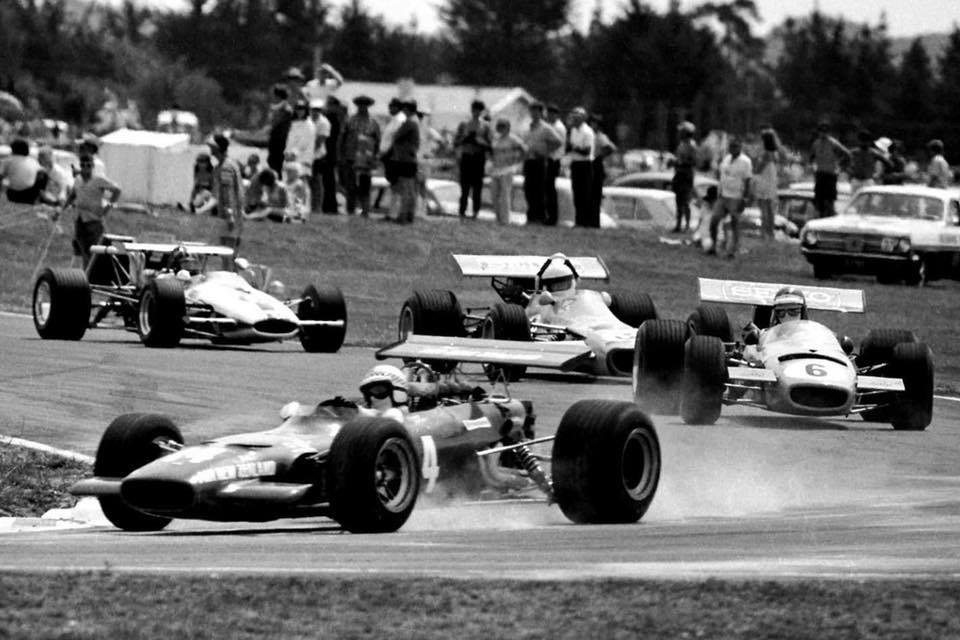
Stewart, Hill, Clark, yellow nosed black bodied Gardner, Palmer looking like Clark, Martin in red and Geoghegan white- BRM P261 by two, Lotus 39, yellow nose Brabham BT11A, Lotus 32B of Palmer, red Brabham BT11A of Martin (all but the BRM’s Coventry Climax FPF powered) and Leo’s white Lotus 32 Ford. AGP- the off 20 February 1966 and what a marvellous vista Lakeside is…

The front row of the grid pretty much summed up the 1966 Tasman Cup, the two BRM P261’s driven by Hill and Stewart, two of the finest racers of their time were the class of the field powered by 1.9 litre versions of the ‘P56’ V8’s which won so many races during the 1961-1965 1.5 litre F1, they were quickest cars on the circuit throughout the weekend right from the first session on Friday having recorded laps of 55.5 and 55.8 for the Brit and Scot repectively.

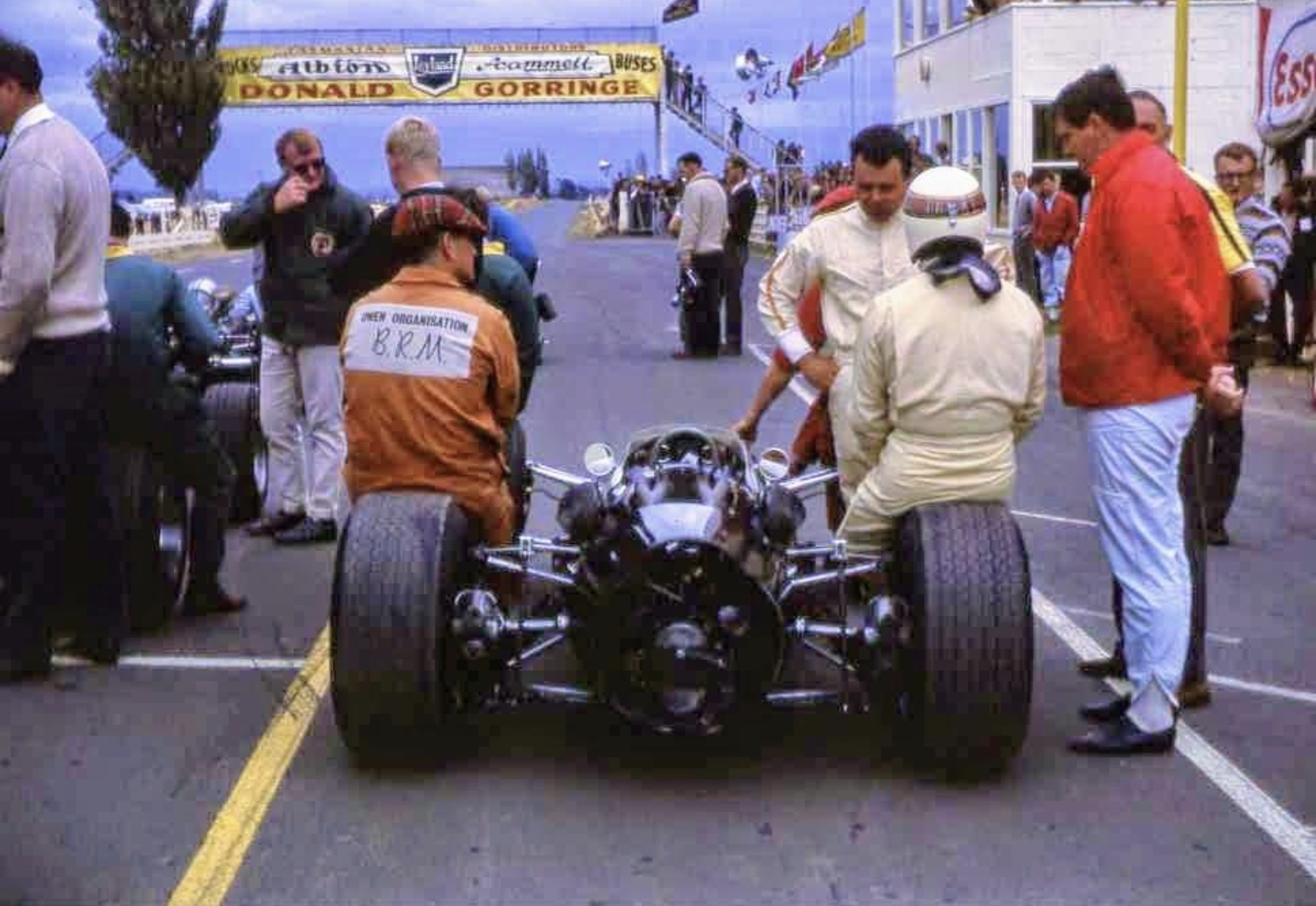
Much of the pre-race press interest centred on the strong BRM presence which included three chassis ‘Graham Hill driving the same car with which he won the 1965 Monaco and US Grand Prix’ and a team of three mechanics, Rivers Fletcher doing public relations all led by Team Manager Tim Parnell- lets come back to BRM’s Australasian representation in a little bit.

Lakeside razzmatazz included girls dressed in chequered flag bikinis, a bagpipes group and a brass band in addition to the on-circuit attractions which included international drivers Clark, Hill, Stewart and Gardner.

David Harding, secretary of the Queensland Motor Sporting Club, quoted the total value of the cars at $A300,000…

Stewart had a huge points lead going into the Lakeside meeting with much expected of Clark after his first win of the series at Warwick Farm the week before.

In New Zealand Graham Hill showed BRM’s form early, winning the opening round, the NZ Grand Prix at Pukekohe on 8 January by 1.5 seconds from Stewart, in P261 ‘2616’ before returning home to the UK to continue tyre and other testing duties. He travelled back south arriving at Mascot for the first of the Australian races, the ‘Warwick Farm 100’, on 13 February.

Richard Attwood won at Levin the following weekend after Stewart had gearbox selector problems having completed 9 laps- Jim Clark was second and Spencer Martin third, Jackie Stewart continued the Bourne boys great form and won the Lady Wigram Trophy at the Wigram RNZAF base the following weekend of 22 January.

Stewart completed a clean sweep of the first four races for the P261 before crossing ‘The Ditch’- the Tasman Sea for Australia- Jackie won the Teretonga International from Frank Gardner and Jim Palmer- the latter had a great season of speed and reliability in the Lotus 32B chassis aboard which Clark took the Tasman Cup twelve months before.

Teretonga wasn’t such a great race for Dick Attwood, as his car ‘2617’, was tagged from behind in the first corner ‘The Loop’ into soft earth whereupon the it rolled trapping the hapless Brit underneath- Spencer Martin and local driver Ian Dawson, also involved in the melee, jumped from their Brabhams and helped marshalls right the car and release the driver.

In fact a ‘switcheroo’ in the cars of Jackie and Richard took place at Wigram. Attwood had his ‘2614’ going like a missile in practice thanks to some judicious testing of bars, tyre pressures and ride-heights with Alan Challis, at which point, Jackie, getting the hang of this Number One Driver caper in Hill’s absence said ‘I’ll have a crack in that’- and so he did winning The Lady Wigram Trophy’ in ‘2614’ the following day.

He kept the same car at Teretonga so the machine, the front bulkhead of which was badly bent, was off for a rebuild to Bourne. It was the car Jackie had raced throughout the 1965 F1 season- ‘2617’ the strength of which would save his life at Spa in mid-1966. We will come back to the individual chassis’ later in the article.

Whilst the drivers flew to Sydney on the Monday after Teretonga Tim Parnell supervised the shipping of ‘2614’ and ‘2616’ to Sydney whilst ‘2617’ headed back to Liverpool, and thence Bourne into the tender hands of the boys in the build shop.

Gardner at left, Attwood, Stewart- Brabham BT11A and two BRM P261s- the off at Wigram 1966. Stewart won from Attwood and Jim Palmer with Frank a DNF after an accident on lap 4 when his brakes failed and he cannoned into Jim Clark, taking them both out of the race (Wigram)

Under the Tote building, Pukekohe. JYS’ P261 chassis ‘2617’, in all of its elegant glory, 1966. Which of the BRM mechanics is it folks? The car is fitted with a P56 type 1930cc engine- inlets between the Vee and exhausts exiting thru the ‘letterbox’ orifice in the side of the monocoque, in BRM speak. Note the colour of the car, red nose band, big BRM badge and air relief ducts atop the nose and tail section leaning up against the wall (CAN)

At Warwick Farm Jim ran away and won by 21 seconds from Hill, Gardner, Stewart, Martin and Palmer, click here for a piece on that meeting; https://primotipo.com/2018/07/03/1966-warwick-farm-100/

Clark had carburetion problems with his 2.5 litre Coventry Climax FPF engine throughout the Lakeside weekend but still managed to pop the car onto row two of practice on the two by two car grid together with Frank Gardner’s similarly powered Brabham BT11A. The Lotus 39 was another mighty car from the Lotus 25/33 continuum but the good ole FPF was struggling a bit from 1966 given the entry into Tasman racing of the BRM and Repco V8’s.

Spencer Martin in the Scuderia Veloce BT11A, and Leo Geoghegan going like a jet in his Lotus 32 was the first of the ANF1.5 twin-cams, a mighty impressive performance on this power-fast-100mph lap average circuit.

Jim Palmer and Greg Cusack shared the next row and the rest- Bartlett, McDonald, Harvey, Andy Buchanan Denis Marwood, Mel McEwin and local boy Glynn Scott rounded out a small field after ‘CAMS cut the grid from 20 to 15 cars’ in the interests of safety.

Graham Hill alights his BRM whilst Spencer Martin’s Brabham BT11A Climax enters the paddock- Glynn Scott, Lotus 27 Ford twin-cam 1.5 approaches in the distance. This is the damp Saturday afternoon session (K Drage)

Magnificent photograph of mutual respect and affection, racer/mechanic Ray Parsons and Jim Clark ponder the next change (B Thomas)

Clark in the very sweet Lotus 39 Climax on Saturday afternoon in the wet- exiting The Karussel (K Drage)

Lakeside 20 February 1966. Dunlop’s Vic Barlow at left, Hill suiting up and ‘Dobbin’ Challis beside Graham’s ‘2616’ whilst Jimmy Collins and Stan Collier look after Jackie’s ‘2614’ behind (BRM 3)

Sunday dawned cloudy and hot, the crowd got a magnificent days motor racing on this, the first occasion Lakeside held an AGP, for their four-dollar entry fee!

In addition to the feature race there were two 10 lap heats for the Tasman cars both won by BRM- Hill won the first from Gardner and Martin and Stewart took the second from the Clark and Geoghegan Lotuses.

Stewart and Hill settled into their front row grid slots and howled away from the off- Stewart, Hill, Clark and Gardner led the high speed train, then Martin, Palmer and Geoghegan.

Cusack got by Geoghegan on lap 5 with ‘Hill tied to Stewart as if by string’, Stewart set a scorching pace from the start, thrilling the crowd, despite this Hill was close behind and always within striking distance.

The race developed into three tough fights between Stewart and Hill up front, then Clark just ahead of Gardner and then a flying wedge of Palmer, Cusack and Geoghegan.

’The race pitch at this point had the crowd running from vantage point to vantage point, a rare thing in open-wheel competition, and to really set the seal on the excitement, the tail closed up and made a magnificent show as Marwood, Harvey, Buchanan, McDonald and Scott raced wheel to wheel’ Des White wrote in his HAGP race report.

Stewart’s gearbox cried enough on lap 28- it was this element of the BRM P261 which became its weak link at 1.9 litres and even much more so at the 2.1 litre capacity the Bourne team raced these cars in the 1967 and 1968 Tasmans.

’Stewart was very hard on gearboxes…Hill suffered persistent clutch slip in the last two races, but otherwise the BRM’s were very reliable. So they should have been too, with the massive Owen group effort which included a public relations man’ wrote Bill Tuckey. Bill is a bit hard on Jackie, the ‘box was the problem not JYS lack of mechanical sympathy.

Then Cusack clipped Palmer in the Eastern Loop when Jim braked a little early and Leo kissed Greg causing Cusack to spin and Geoghegan to re-enter the circuit 100 metres down the road- both retired with bent or busted suspension components shortly thereafter.

Frank Gardner in one of two Brabham BT11A’s Alec Mildren Racing raced that summer, Climax engined, the other was Maserati 2.5 V12 powered and ran in Warwick Farm and Sandown practice- pre-race hype promoted the Brabham Maserati at Lakeside but the car did not make the trip from Sydney (unattributed)

Jim Clark from Frank Gardner with Spencer Martin’s Brabham BT11A just back a bit- third, second and DNF clutch (autopics.com)

Frank Gardner was still pushing Jim Clark hard- he had a great summer in Mildren’s BT11A with better FPF reliability than some- but FG was mighty quick too, i’m not implying his results were solely due to reliability. Then Jim’s Climax took a turn for the worst- losing its edge further so Frank was through to second from Hill up front- Hill won at an average speed of 94.9mph from Gardner, Clark and Palmer.

Hill and Stewart both did equal fastest laps of 55.9 seconds- one second adrift of Clark’s 54.9 second lap record set in the Lotus 32B the year before. Kevin Bartlett’s Alec Mildren Racing Brabham BT2 Ford was the first of the ANF1.5s home in another drive which convinced Mildren KB was ready for the step up into the more demanding 2.5s- something he did with great aplomb later in the year.

Clark’s carburetion problems persisted throughout the series and were solved by John Sheppard when the car passed into his care after Leo Geoghegan acquired it by the simple expedient of solid carburettor mounts.

Jackie fires up the now ‘Central exhaust’ P68 powered ‘2614’ before heading out of the Lakeside paddock. Jimmy Collins, Vic Barlow and Tim Parnell watched by a group of local enthusiasts (BRM 3)

(HAGP)

Graham Hill nose up at Lakeside in a car that was so kind to him- the BRM P261, a machine with which he was synonymous, not the BRM he used to win his 1962 World Title but one he raced from 1963 all the way into 1966 with the H16 BRM P83 duly recognised.

(B Thomas)

Jim Clark with Andy Buchanan on the outside, Brabham BT7A Climax, who finished seventh.

BRM and The Antipodes 1966…

The Owen Organisation had extensive business interests in Australasia (it would be interesting to create a list of the British transnational’s subsidiaries in this part of the world at the companies height) and had of course raced here before- Ken Wharton thrilled Kiwi crowds in a P15 V16 in 1954 at Ardmore and Wigram and Ron Flockhart did all of the NZ Internationals in a front-engined P25 in 1959 whereas the 1961 campaign was a full works representation of two P48 mid-engined 2.5 litre F1 cars- these were raced by Graham Hill and Dan Gurney and on this occasion the visitors came to Australia as well as New Zealand. See here; https://primotipo.com/2019/11/18/ken-wharton-and-brms-grand-turismo-south-in-1954/ and here; https://primotipo.com/2018/03/16/bourne-to-ballarat-brm-p48-part-2/

The local promoters led by Ron Frost (NZ) and Geoff Sykes (Oz) had been doing their job in trying to seduce BRM back here and had a ‘red-hot go’ for 1965 given by that stage BRM had an 1880cc ‘P60’ version of their P56 V8, it was thought the P261 so powered would have been competitive with the 2.5 litre (mainly) Coventry Climax engined ‘Tasman Special’ Brabhams and Lotuses.

In essence Tasman races were 100 miles and had no minium weight limit whereas GP’s were 200 miles in duration and the cars had minimum weight limits so Ron Tauranac’s ‘Intercontinental’ Brabhams, for example, were designed and built to the Tasman formula or rules. Tony Rudd, backed by Graham Hill, felt the P261 at 1880cc would not be a competitive Tasman Cup mount in that the cars would be too heavy and not powerful enough- underlying their opposition (in a document reproduced by Doug Nye in BRM 3) was the (correct) belief that the Tasman program would detract from their 1965 F1 program in the same way Sir Alfred Owen’s BRM-Rover turbine Le Mans racer grabbed scarce resources in 1963 and 1964- it too was foisted upon Rudd and ORO (Owen Racing Organisation) at short notice.

However, in late 1965 Sir Alfred was resolute, the broader commercial needs of the Owen Group (the establishment of an Austin-Morris production facility in NZ, with Owens to provide the necessary components) were met by having ORO’s presence in the 1966 Tasman Cup and as a consequence the team had to ‘make it work’ despite being up to their armpits in the new for 1966, immensely complex, BRM P83’s H16 engine.

Ron Flockhart, BRM P25 during the 10 January 1959 NZ GP on the Ardmore airfield circuit- DNF oil leak, the race won by Stirling Moss’ Cooper T45 Climax FPF 2 litre (Ardmore)

Dan Gurney on the way to the BRM P48’s only International win, the Victorian Trophy at Ballarat Airfield, Victoria 12 February 1961 (unattributed)

Geoff Johnson and his engine design team squeezed the P56 V8 up again from 1880cc to 1916cc and then 1930cc- the latter became the definitive 1966 Tasman spec engine used throughout that summer.

These motors gave between 260 and 270 bhp, which despite the weight of the P261 chassis, was more than enough to trump the circa 240bhp ‘Tasman Specials’. These motors and P61 Mark 2 chassis ‘2616’ Graham’s regular 1965 F1 car first raced to a win by him upon its debut at Watkins Glen in 1964, Jackie in his normal ‘2517’, the last P61 built during the winter of 1964-5 for JYS debut season, and old ‘2614’, first raced by Graham in the 1964 Aintree 200 and used as the team spare throughout 1965 were sent to New Zealand on the SS Tasmania Star which left Liverpool on 29 November and arrived in Auckland on 23 December.

Of interest is that ‘2616’ lives as does ‘2614’ whereas ‘2617’ whilst destroyed and scrapped after Jackie’s death defying 1966 Spa crash was recreated for Richard Attwood as ‘2617R’ in the late nineties- a lovely bit of symmetry given Richard rolled it at Teretonga in 1966 when he was part of others ‘moment’. Finally, for the record, a total of one P61 Mk 1 was built, chassis ‘611’ and six P61 Mk 2’s- chassis ‘2612’ to ‘2617’. The P61 Mk1 ‘611’ was scrapped in 1963 but all of the P61 Mk2’s live, thank goodness.

Despite broken ring problems in testing at Bourne, with a very careful running regime when a motor was first used which involved abnormally large amounts of engine oil in the fuel- the motors proved very reliable throughout that summer- a bonus for Team Manager Tim Parnell and the mechanics- Allan Challis, Jimmy Collins and Stan Collier, the later seconded by Parnell.

One of the compromises made to meet the needs of preparation for the new 3 litre F1 as well as being competitive in Australasia was the appointment of Tim Parnell as Team Manager and secondment of Stan Collier into the ORO group for the trip rather than Tony Rudd and another BRM mechanic make the trip.

Son of Reg- Tim was a racer to the core who had stepped very ably from the cockpit to running his fathers F1 race team upon Reg’ sudden death in January 1964 and was well known to BRM as a customer using BRM V8’s and cars for some years.

And so the scene- cars, engines, drivers, technicians and team management were put in place for an immensely successful summer in competition and commercial terms- seven of eight championship rounds and nine of ten races won with the Tasman Cup secured by Jackie Stewart bolstering even further BRM’s ‘cub’ drivers confidence who had already won his first GP in his first F1 season of 1965 at Monza no less.

‘Technical Tim- plug changing on Graham’s ‘2616’. Very popular, avuncular Tim had spent his entire life in racing and farming- thanks to his father- former BRM V16 driver and pig-breeder Reg Parnell. Tim had been a racing driver before his father’s untimely death in 1964, whereupon he had taken over full-time management of Parnell Racing’ wrote Doug Nye (BRM 3)

(B Betti)

BRM V8 Engine Types/Designations…

I wrote an article about the ‘Stackpipe’ BRM P57/578 in which Bourne and Graham Hill won their 1962 titles and covers the P56 engine in a bit of detail which still stacks up ok, see here; https://primotipo.com/2016/02/05/motori-porno-stackpipe-brm-v8/

It is a bit wanting in terms of the ‘P56’ engine derivatives though, so, having picked over ‘BRM 3’ Doug Nye’s treasure trove of all things Bourne here is a summary of the motors if for no other reason than to provide myself a simple list to refer to the next time i tangentially cover this amazingly, long lived series of race engines.

‘P56’ 1.5 litre V8

Initial design as per the link above- 68.5mm bore and 50.8mm stroke for 1497.7cc. DOHC gear driven two-valve Lucas injected with ‘conventional’ cross flow disposition of inlet and exhaust valves

The engines first drawings of 300 in total were issued in January 1961, the first batch of components received in April 1961, assembly of the engine commenced that June with the first one fired up on 12 July 1961

170bhp was produced by the end of August with the engine first tested against the competition at Monza over that tragic September weekend. Racing began in 1962 with the ‘Stackpipe’ exhausts fitted- 185bhp

Ongoing development gave rise to the 195bhp ‘Monza’ spec which won the 1962 championship

For 1963 a single plane crank version was developed, this allowed the use of a coupled exhaust system which gave the engine a broader power band- with development this produced 205bhp

‘P60’ 1.9 litre V8 1964

1880cc engine developed at Richie Ginther’s suggestion for the 2 litre sportscar class in the US, in original form it produced 240bhp

P56 1.5 litre V8 ‘Stackpipe’ nestled in one of Graham Hill’s P57/578 chassis during 1962

P68 1.5 V8 in the 1964 Monza paddock

‘P68’ 1.5 litre V8 late 1964

Between the Vee exhaust layout- exhaust ports in the Vee, inlets located between the cam-boxes. The space around the engine was unobstructed by exhaust pipes which allowed a stiffer tub to be built and an extra 5 gallons of fuel to be carried

First appearance Monza 1964- first win at Watkins Glen- work over the winter of 1964-5 led to engines giving 215bhp

By the end of the 1.5 litre Formula the best of the engines gave 220bhp and weighed 264pounds

2 litre V8

1916cc and the ‘definitive’ 1966 Tasman engine of 1930cc in capacity

T56 variant gave 260bhp and T68 version 270bhp- both types were used in ORO’s successful 1966 Tasman campaign as close scrutiny of some of the photographs demonstrates

1998cc sportscar version for Matra in 1956 was P56 type with the taller P123 blocks. Fitted to MS620 coupes- these engines with alternators etc designated P100

One of the P261’s in the Warwick Farm paddock in February 1966- P68 1930cc (B Wells- The Roaring Season)

One of the BRM mechanics persuades the P56 2 litre V8 fitted to Peter Arundell’s works Lotus 33 to start during the 1966 US GP weekend at Watkins Glen. He was sixth in the race won by Jim Clark’s Lotus 43 BRM H16- famously that wonderful, complex, mad engine’s only win

P111: 2.1 litre V8

1967 Tasman and beyond specifications

Two engines built initially of 2070cc and gave 287bhp and 292bhp- used the taller P123 blocks

Six engines were converted by the time of the 1967 Tasman – 2 P56 type and 4 P68 exhaust within the Vee type. Engines very reliable, the weakness of the package was the magnesium cased lightweight  P72 six-speed gearboxes which were never designed with the power and torque- and tyre grip by then being produced

Type 80: 1.5 litre Straight-four cylinder Formula 2 engine

’Half’ of one of the 2 litre V8’s – soon gave in excess of 130bhp.

P80 1 litre, four cylinder F2 engine the size of which is ‘overwhelmed’ by the bulk of the P72 transmission

Etcetera…

(M Bisset)

JYS was ‘top of the pops’- on the cover of ‘Australian Racing Annual’ for 1966- these annuals are much treasured and were a useful pot-pourri of the season just gone, they were published by the ‘Sports Car World’ magazine people.

Shots show Stewart on the way to victory at Longford on the entry to The Viaduct, and wearing one of the many garlands popped around his neck that summer. The shot below is Jack in BT19 complete with brand-new Repco-Brabham 620 2.5 litre V8 also at Longford.

(autopics.com)

Graham Hill on the outside of Kiwi Dennis Marwood’s Cooper T66 Climax during the Sunday morning warm-up at Lakeside- DNF oil pressure in the feature race.

(unattributed)

Stewart and Clark off the front row of the grid during the second of the Sunday morning heats.

BRM P261 ‘2614’ and Lotus 39 Climax ‘R12’- they had some titanic dices during their Australasian summer but plenty of fun off-track and shared accommodation throughout, parsimonious Scots as they were.

(autopics.com)

Like a rat up an aqueduct- ‘2614’ from ‘2616’…

GH has his nose shoved right up JYS gearbox which is not helpful as that unit was the weakest link of an otherwise bullet-proof remarkably fast racing car into 1969 generally- and into 1968 specifically when the one P261 which was sent to Australasia- as a support or back-up car to the new P126 2.5 litre V12 was a very popular machine particularly with Pedro Rodriguez who took any excuse he could to pop his bum into the ‘old darlin’ rather than its much younger sister.

(D Cooper)

Pedro Rodriguez in good ‘ole ‘2614’ on the very last weekend a P261 was entered by the factory.

Rodriguez was second in the very soggy ‘South Pacific Trophy’ Longford Tasman round on 4 March 1968, won in fine style by Piers Courage in an F2 McLaren M4A Ford FVA 1.6.

A view is that the only thing between Graham Hill and another world title or so at the time was Jim Clark and the Lotus 25 and Lotus 33- lets make that the only thing between Hill and another title or so was Jim Clark’s God-given other-worldly skills- the gifts that only one driver seems blessed with every decade or so.

The Lotus 25 deserves every accolade accorded it as the first ‘modern monocoque’- the car to which every F1 machine which followed is related. The BRM P61 Mk1 and P61 Mk2 aka ‘P261’ followed the ‘original’ but in almost every respect, other, perhaps than in traction, putting its limited power to the road the BRM was the equal of the 25 and 33- and the BRM ‘P56 Family’ of engines the equal of, if not superior motor however many valves Coventry Climax deployed in its FWMV V8! Tony Rudd, biased as he undoubtedly was, makes this case on pages 232 and 233 of ‘BRM 3’.

Whatever the case, feast your eyes on all of the mechanical gubbins which comprise the whole of a very well rounded package. The car shown is Graham’s F1 P261 during the Mexican GP weekend in 1964- its powered by a P68 1.5 litre V8.

The chassis is an aluminium ‘full monocoque’ made of 18swg ‘half-hard’ duralumin with extension horns supporting engine/gearbox and rear suspension assemblies . Note the period typical inboard front suspension- lower wishbone and rocker actuating a coil spring/damper unit, brakes are solid 9 inch discs outboard- these are light cars remember, brake lines are rubber, we are still a couple of years away from the use of braided steel lines in Europe.

Distinctive BRM steering wheel- who supplied them? Gear lever at left. The engine we have done to death but note the slide Lucas fuel injection, beautiful expressions of the exhaust pipe benders art- you can just see a heat shield beside the radiator cap to keep the hot gasses away from the fuel metering unit which is right behind the roll-over bar.

The rear suspension is again period typical and in contrast to the front is fully ‘outboard’- magnesium uprights, inverted lower wishbone, single top link, twin radius rods to look after fore and aft forces, coil spring/dampers and adjustable roll bars both front and rear. Plumbing for the needs of lubricants is ‘bitsy’ rather than ‘cohesive’ and the lack of shine to the nickel (?) plating doubtless reflects a long hard season- this was the last championship meeting of the year after all. Note the beautifully made splined driveshafts, solid brake rotor and caliper.

I’ve always thought BRM’s gearboxes- i’m not sure if this is a six-speed Type 62 or 72 look a bit butch compared with Mike Hewland’s products of the time but that may not be the case upon having details of said products dimensions and weight. Whilst the boxes’ were the weak link in P261s powered by 1.9 litre V8’s and above that was not the case when 1.5 litre V8s were used which was of course the engine around which the gearboxes were designed at the outset.

Beautifully concepted, designed and built, robust, prodigiously fast cars the performance of which could be accessed by ‘newbees’ and exploited by ‘the gods’ alike.

(S Dalton Collection)

(S Dalton Collection)

Stephen Dalton contributed these pages from the February 1966 Queensland Motor Sports Club newsletter which gives the organisers perspective- note the attention to O,H & S as Stephen points out!

Photo Credits…

Ray Bell, Kevin Drage, ‘Ardmore’, autopics.com, M Bisset Collection, Getty Images- Bernard Cahier, Alvis Upitis, ‘CAN’ Classic Auto News, BRM 3, Dennis Cooper Collection, Brier Thomas via Richard Croston

Bibliography…

‘Australian Motor Racing Annual 1966’, ‘BRM 3’- ‘BRM: The Saga of British Racing Motors Volume 3’ Doug Nye, various articles by Ken Blair in ‘The Canberra Times’ on 8, 15 and 21 February 1966, Bruce Sergent’s race reports on sergent.com, ‘History of The Australian Grand Prix’ Graham Howard and Others, 1966 Tasman Cup review by Allan Brown in oldracingcars.com

Tailpiece: Clark, Lotus 39 Climax, Lakeside 1966…

(unattributed)

Jim gulps a big dose of Queensland air as he snicks a Lakeside high-speed apex.

Finito…

(B Miles)

Edsel Falconer during the first race outing of a Ford Falcon in Australia- Middle Ridge, Toowoomba, Queensland, during the annual ‘Carnival of Flowers’ weekend, 17 September 1960…

This road circuit through the suburbs of Toowoomba was used in 1958, 1960 and 1961 once a year during a local carnival weekend through the beautiful rolling countryside of Queensland’s Darling Downs district.

Whilst researching his book ‘The Toowoomba Auto Club:1950-1965’ author John Evans was able to re-write history by showing that the first Falcon to race was that of Falconer- son of the Dealer Principal of the Toowoomba Ford Dealership of the same name on 17 September rather than as has hitherto been the orthodoxy- the Falcon XK raced by Bob Jane and Lou Molina to third in Class D of the 1960 Armstrong 500 at Phillip Island on 20 November 1960. Edsel placed fourth in the Saloon Car Handicap at Middle Ridge, two places ahead of Bill Pitt’s Jaguar, I wonder who won?

Whilst Edsel Falconer may seem a cute ‘Ford’ nom de guerre in fact it is all kosher- Hugh Falconer started the family business in 1919 with Ford, Fiat and Hupmobile agencies and became an official Ford dealership in 1925- Edsel, one of his sons became the Dealer Principal during the 1960s, the family sold the business circa 1980.

A cursory Trove search doesn’t tell us too much about Edsel ‘a well known Toowoomba motorist’ but there are some references in late 1953 of him rallying/trialling a Ford Customline and plenty in the Brisbane Telegraph and Courier Mail social notes of the many weddings attended and family holidays to Surfers Paradise and other such exotic places. It does not seem that Edsel was one of the regular racers in the area, all information will be gratefully received inclusive of how Edsel’s XK performed at Middle Ridge.

In an address to the Toowoomba Rotarians on 14 November 1955, reported in the St George Shire ‘Balonne Beacon’, Edsel, back from a stint at a ‘Ford Motor School’ in Detroit advised his fellow Queenslanders that ‘Australian’s standards of living, ethics and morals were higher than those of Americans…Americans were earning more and spending more than Australians but as far as getting the joy out of living was concerned, Australians were better off.’

In a note of encouragement to the assembled masses he said that ‘Australia could learn a lot from Americans. Americans would not accept anything but the best quality, and they took every measure to ensure they produced the best possible. There were many leads that could be taken from the Americans’ he said ‘One of the main being to “get up and do things”. I always get a giggle of ‘insights’ after a weeks stay in a place, but today’s smart arse prism is not the way to view things 65 years hence. Edsel was a noted and respected pillar of his local community is the point to be taken.

An immaculate period dull-green Falcon XK has moved into my street recently- it’s a young groovster’s daily driver, it lives on the street at the mercy of all of the local Braille-Parking-Mob mind you- this attractive car got me thinking about Ford Australia’s first manufacturing efforts and early Falcon competition exploits.

Ford Australia was incorporated in 1925, its operations based in the Victorian port city of Geelong, the suburb of Norlane to be precise. For the ensuing decades FoMoCo Oz assembled cars locally from CKD packs- ‘completely knocked down’ Model T’s were first, they were initially chucked together on an improvised production line in a disused wool storage warehouse before Norlane was finished. As the latest Fords were built, so local assembly followed and in many cases local bodies were fitted.

The plant was devoted to wartime production and post-war assembled UK sourced Pilots, the Prefect, Anglia, Consul, Zephyr and Zodiac.

In the mid-fifties Ford decided to build cars in Australia and acquired land at Campbellfield on Melbourne’s outskirts. In the same way that generations of Victorians drove past Ford’s Geelong plant, generations of Australians drove past Campbellfield or more colloquially Broadmeadows as the Ford factory- when built the largest automotive plant in the Southern Hemisphere, was on the Hume Highway- the main drag between Melbourne and Sydney.

The ‘contest’ between which bigger Ford would be adapted to local production was won in favour of the US Falcon rather than the UK Zephyr Mk2 when Oz Ford Chief Charlie Smith and some of his senior executives saw the proposed new Falcon on a trip through Dearborn in late 1958.

In period FoMoCo advertising art of the XK Falcon


Ford Broadmeadows, Oz built car #1 – VIN# folks?

Without doubt they made the right choice- the Falcon was light-years ahead in appearance over the then Holdens, whose underpinnings went back to those of the 48-215 and the Zephyr, but whilst the Falcon XK- first car built on 28 June 1960 and on sale from 11 September that year looked the goods on paper ‘The Falcon was designed without any consideration whatsoever of Australia’s demanding conditions’ wrote Dr John Wright and Dave Morley.

The call to build the Falcon was a late one and meant the US car did not have the local design input/testing to adapt it to the very tough extremes of local conditions and very quickly support from private and fleet buyers plummeted because of problems with front ball joints which failed without leaving suburbia, rust, transmission and other weaknesses.

68,413 of the XK model were sold between 1960 and 1962 with the XL, released on 4 August 1962 incorporating a new three speed manual gearbox and clutch, a better starter motor and changes to the front sheet-metal to strengthen the front suspension mounts.

Whilst objectively the durability of the Falcon was not a real issue after the XM (released 20 February 1964) nor a perceived one after the XP (released 20 February 1965) the reputational damage in 1960-1961 was such that the competition program had a big part to play in both proving the performance and strength of the big Fords and to provide the production engineers with feedback they could incorporate into future models or routine running production line changes.

In late 1960 two privately entered Falcon XK’s contested the first Armstrong 500 at Phillip Island- on 20 November, a couple of months after Falconer’s Middle Ridge race.

Bob Jane and renowned Melbourne racer/hotelier/restautanteur/raconteur Lou Molina shared one entered by Jane’s ‘Autoland’ dealership with another raced by the equally experienced and credentialed Ron Phillips and Ern Seeliger. Jane and Molina were third in Class D with 161 completed laps despite Lou rolling the car! The first in that class and ‘first outright’ was the John Roxburgh/Frank Coad crewed Vauxhall Cresta with another pair of coming stars- John French and Norm Beechey aboard a Standard Vanguard second in class D. The other XK of Phillips and Seeliger were out early in the race with an overheating engine.


Now back on four wheels, the boys set Lou Molina back towards the Pits whilst the restauranteur contemplates a line of patter for car owner and co-driver RF Jane Esq, waiting to greet him. P Island 500 1960, Falcon XK

Harry Firth was already a racer/preparer/engineer of renown by the time Ford’s Competitions Manager, Les Powell first involved him with Ford- that fruitful partnership over the ensuing years yielded countless race and rally wins not least four Bathurst 500’s, 1968 Australian Rally Championship and the prestigious Teams Prize of the 1968 London-Sydney Marathon. Click here for a background piece on Harry; https://primotipo.com/2019/01/29/harry-firths-mg-tc-spl-s-c/

Whether Firth was engaged by Ford prior to the first rally contested by the new Falcon- the 1961 BP Rally centred in the Victorian Alps is unclear but four Falcons and six Anglia 105E’s entered the Light Car Club of Australia’s annual classic event. Amongst Harry’s competition activities at the time Les Powell and Max Ward approached him were race and rallying a Ford Anglia. ‘Unofficially this (’61 BP Rally) was the beginning of Ford’s participation in rallying at a factory level, a participation which was to continue spasmodically for over four decades’ Rallysport Magazine wrote.

The Falcons went very well too- Jack Ellis was second, Ken Harper thirteenth, Doug Hughes nineteenth and Jack Nalder twenty-ninth, on top of that Peter Coffey’s Anglia was third outright.

Powell then threw Firth in at the deep end- the nascent subsidiary of Ford’s Global Empire had decided to have a crack at the East African Safari with no less than five Falcons to be prepared, run and crewed out of Firth’s modest Queens Avenue, Auburn, Melbourne ‘Temple of Speed’.

The whole of the East African Safari Rally 3000 mile route was (and is) run on public roads and involved two legs separated by a 24 hour break out of Nairobi, the start and finishing point. The North Leg took in North Kenya and Uganda whilst the South bit went around South Kenya and Tanzania. The Safari took place over Easter, a time when the rainy-season gets underway with the main cause of retirement usually an abundance of Murrum mud- when dry this brown earth is hard, dusty and bumpy and incredible muddy and sticky when wet.

Given the challenge Harry didn’t think much of the equipment at all.

‘Ford wanted to get into competition to prove its car, the Falcon was capable of handling it…But that first XK Falcon – 144 cubic inch (2.4 litre 90bhp) engine, three speed gearbox was really a terrible car. You could do very little with the engine, the body flexed heavily and it had sloppy springs- all you could do was just set the Armstrong shockers rock-hard. The brakes were just adequate with race linings and the front hubs broke under race conditions. The steering had 5.5 turns lock to lock- just impossible for racing conditions.’

‘We made and tested the five Falcons and sent them off to Africa. We fixed the hubs, made stronger wheels and did some work on the axle shafts and the gearbox. Even then the cars were very fragile. It was the worst type of car you could take to an event like that. We had to virtually carry them around on our backs. We said to ourselves “we’re not going to break it”- if we think its too hard on the car then we’ll back off.’

The five cars were crewed by the following pairings; Harry Firth /Graham Hoinville, Ken Harper/Les Scott, Jack Ellis/Mal McPherson, Doug Hughes/Rex Lewis, Geoff Russell/Dick Collinwood.

Harper/Scott XK Falcon during the Safari, place unknown (unattributed)


Before the off at Nairobi- one of the XK Falcons in shot (unattributed)


Harper/Scott at roadside, whilst the styling may be pedestrian now it was edgy in period (M Tufte)

Before the rally, the complete route was surveyed using rented Ford Zephyrs, the rally cars having not yet landed from Australia.

All of the cars faced problems of course, first-timers as they were but the Firth/Hoinville combination ran as high as eighth before a rear spring broke dropping them to sixteenth with Ken Harper/Les Scott also finishers but they ran out of late time.

Firth was later quoted as saying that had the car been fitted with the optional 170cid engine and Armstrong shockers (the earlier quote implies they were fitted) ‘we’d have won’ and ‘Graham Hoinville and I were placed seventh only 300 miles from the finish when we broke a main rear spring plate in a competitive section. That dropped us back to 16th but we still finished 25 minutes ahead on the English factory Fords.’

‘The way the cars performed earned me a contract with Ford for competition. This was really the start of my association with Ford and the first step into The Big Time- although I was still doing work for others’ Firth was quoted in an Australian Muscle Car magazine piece on the East African Safari.

Winners of the tough event were the Tommy Fjastad/Bernhard Schmider VW 1200- Ford Australia were pipped in the Australian race-within-a-race in that a locally entered Holden EK driven by HS Sembi/C Mehta finished fourteenth.

In fact the Aussies blazed the trail for the Falcon as a rally machine- within six months Detroit announced that they would mount a three car campaign in the 1963 Monte Carlo Rally- Bo Ljungfeldt finished second in an American spec V8 engined two-door Falcon Futura.

Ford Australia were enthusiastic rally competitors for the ensuing early years mainly contesting events in New South Wales and Victoria, the first Australian Rally Championship was not held until 1968- Harry Firth won it in a Lotus Cortina Mk2 (or supercharged Cortina Mk2 or both cars depending upon the reference source) with Graham Hoinville alongside, as usual,

Harry Firth ‘splashing through a wet patch on the track in the Alps…on its way to the Knocker Track, a ten mile stretch of boulder-strewn track which runs down the mountain between Glen Wills and Omeo in Victoria. Used nearly a century ago as a bullock track it has never been used by cars until its inclusion on the route of the BP Rally 1-5 May 1963’

Firth’s Falcon won the May 1963 BP Rally ‘Australias toughest reliability event’ over 2000 miles and in a great weekend Ford won three of the event’s four classes. Using the same car, Frank Kilfoyle partnered by Michael Flanagan won the Melbourne University Car Club’s July 1963 Akademos Trial and a couple of weeks later the Experts Reliability Trial.

Earlier in the year- March, Ford attacked the Begonia Rally, based in the Central Victorian town of Ballarat, with a team of three Cortinas, two Falcons and a 105E Anglia. RallySport wrote in relation to the Cortinas, that ‘Ever on the ball, Firth got the jump on the rest of the world by sourcing a pair of the soon to be released 1500cc motors, six months before official release and fitted them to his own car and that of Geoff Russell’, the cars took the first two placings ‘stunning the rest of the field with their performance. Ford virtually had a car for any occasion- the Cortinas won, Falcons and Anglias filled major placings, and their were five Fords in the top ten and 10 in the first sixteen.’

In 1964 Ford were again successful in the BP Rally when the Ford Falcon driven by Ken Harper/Michael Flanagan triumphed over a big field which included the Firth driven Ford Cortina GT which won the 1963 Bathurst 500 in the hands of Bob Jane and Harry- Firth was fifth outright and second in class after a number of penalties.

At the end of 1962 Firth advised Ford that the Falcon had no hope of winning the new ‘Bathurst 500’  but that they had a ‘ready made’ winner in the Cortina GT. The race had been transferred to the great Mount Panorama track after the Phillip Island surface was destroyed to such an extent that the Phillip Island Auto Racing Club could not afford to repair it. Help arrived in the form of Len Lukey to get the Island re-opened when the club sold the place, but lets not chase that tangent and go back to look at the circuit racing of 1961-1962 where we started, before we headed off to rallying.

Harry Firth and Graham Hoinville in the winning 1964 Ampol Trial Cortina GT- looking like a couple of country squires with their flat-caps, its cold out there (unattributed)


Bob Jane and Harry Firth with the 1962 Phillip Island 500 winning Ford Falcon XL. ACL is ‘Automotive Components Ltd’ then a Repco subsidiary making rings, bearings etc


The Harper/Fisher/Raeburn Falcon XK during the 1962 Armstrong 500 at Phillip Island – great value @ 1065 pounds!

The 1961 Armstrong 500 (as in shock absorbers) was held on 19 November 1961 and was a much smaller affair- 26 cars entered rather than the 45 contestants in 1960 as a consequence of the ‘1961 Credit Squeeze’.

The Australian Government ended import licensing in February 1960 causing the balance of payments crisis predicted by Treasury, in November 1960 Prime Minister Menzies increased sales tax and imposed credit restrictions to bring the economy back into balance causing a credit squeeze and minor recession. The economy stopped abruptly, consumers reacted accordingly and popped their wallets away with plenty of consequences across our society not least in the motor industry when plenty of highly geared businesses ‘went to the wall’ as new and used car sales plummeted. Entries, back on point (!) in the 1961 500 reflected all of this- I did an Economics degree eons ago so this shit interests me. sadly…

Bob Jane had Harry Firth preparing both his Maserati 300S sportscar and Jaguar Mk2 Appendix J tourer at the time, they decided upon a Mercedes Benz 220SE as their weapon of choice for the 1961 Armstrong and with a typically fast, disciplined drive ‘won’ the race completing 167 laps- they were first in Class B and ‘first outright’. Note that the first outright notion was not officially recognised until 1965- until that point, officially at least, the first five 500 mile races at the Island and Bathurst had awards for each class winners.

Only one Falcon XK was entered that year and is described in some sources as a ‘pseudo works entry’- it was actually entered by Ken Harper and co-driven by Syd Fisher and John Raeburn all of whom were or would become ‘Ford works drivers’ in the coming years. It would be interesting to know who prepared this Falcon, presumably Firth.

There was a great class battle between the Ford and an EK Holden crewed by Ian Strachan and John Lanyon (of PIARC and Ansett Team Elfin fame) and entered by Stan Jones Motors Pty Ltd (I wonder why Stanley did not drive- maybe these dull ‘Taxis’ were not his cup of tea?!) – the Holden led until it lost a wheel and was later disqualified because the team cannibalised another car for a wheel rather than use an item from their pit supplies as required by the supplementary regulations- the XK Falcon was second in Class B and seventh ‘outright’.

Despite the depressed state of the Australian economy and the ‘own goals’ Ford Australia faced they pressed on with their motorsport program for 1962 in an ongoing effort to build the Ford brand in Australia.

Sunlight ahead included the XL Falcon due for release on August 4 which (as stated earlier) incorporated changes to the gearbox and clutch and to the front structure of the car which would make it torsionally a bit stiffer and a more powerful ‘Pursuit’ 170cid or 2.8 litre 101bhp six-cylinder OHV engine. In addition the Cortina would soon appear which remained a small car or mid-size hit on the local sales charts until Mazda, Toyota and Datsun progressively gained traction from the mid-sixties.

Whilst the rallying program continued, Ford planned to race a new XL in the 500 at the Island on 21 October and in addition decided, wisely, to contest the ‘Bathurst Six Hour Classic’ to be held only three weeks before on 30 September 1962- the catch was that Ford didn’t want to race the XL at Mount Panorama so Firth set about preparing an XK Falcon for the race which attracted 49 cars across six price based classes or ‘divisions’ ranging from under 900 pounds (Morris 850, Ford Anglia, Datsun Bluebird etc) to under 2000 pounds (Daimler SP 250, Triumph TR4 and MGA twin-cam).

Firth takes up the story in terms of car preparation ‘Having not been to Bathurst for some years, I had to rely on hearsay information like “no, it is not hard on brakes and the circuit has not changed”. I did all the usual things such as a valve grind, compression check, set the camshaft properly, gave the pistons plenty of clearance, deck-heighted the head and put the engine on the dyno.’

‘I fitted a set of heavy Armstrong shockers and some well-worn springs. I made up some Ferodo brake shoes but ended up leaving them at home, thinking they wouldn’t be needed. I drove the car to Bathurst myself. Practice proved two things: the car was the fastest sedan and the brakes were not good enough.’

Jane/Firth Falcon XK being followed by the K John/Peter Caldecoat MGA 1600 DNF- Bathurst 6 Hour 1962


Just needs a turret I guess…Firth’s rooted Falcon XK at Bathurst in 1962 (Shannons)

Whilst there was no outright winner of the race (consistent with the line to that effect earlier) up front the Brothers Geoghegan- Leo and Ian rumbled around in their Daimler SP250 V8 to finish first ‘outright’ with 104 laps completed, meanwhile trouble brewed for the Jane/Firth combination in the under 1250 pound Division C inhabited by a Morris Cooper, two Austin Freeways, two Holdens (model unknown), a Peugeot 403 and the works XK Falcon.

The two wily Melbourne racers led their class early, but the brakes were progressively showing plenty of signs of stress with the pedal creeping inexorably closer to the floor- Harry took over from Bob after a scheduled stop and then on lap 39 ‘As he braked for Hell Corner, the fronts suddenly over-energised and locked on, the nose dug in and the car rolled’ the roof was crushed making the machine as ‘flat as a shit-carters hat’- Harry was extremely lucky he was not badly hurt- the car had no roll bar or cage of course, the racer exited via a rear window as fuel spilt over the tarmac, but did not ignite.

‘Our race was over…I just kept thinking about the special brake linings I left at home and the lesson i’d just learned that you should never listen to “experts”. All of which, I reckon is a load of crap- Firth knew full well Bathurst hadn’t changed since he last been there and if he had the trick Ferodo brake shoes sitting in Queens Avenue in Melbourne he would have taken them with him…the mistake was his not ‘the experts’- he was the expert for chrissakes. Bob Jane had raced his Maserati 300S in the October 1961 Bathurst meeting, no doubt Harry had plenty of intell from Jane to say the Mount Panorama challenge had remained undiminished since 1938…

For the record, Division C was won by the Bruce McPhee/Barry Mulholland (the 1968 Bathurst 500 winning duo of course) Morris Cooper with 95 laps from the two Austin Freeways whilst second and third outright behind the Geoghegans were the C Lansdowne/Holt Binnie Triumph TR4 on 100 laps and Don Algie/Kingsley Hibbard Studebaker Lark with 99 completed laps.

Upon return from Bathurst Firth completed his preparation of the new XL Falcon Pursuit which was a much more competitive proposition in the price based class structure than its predecessor, the machine was ‘The model as supplied to the police- larger engine, better wheels, otherwise the same as the standard 144’ the body was a lot better ‘So it was vastly improved but still not very good.’

Bob I think- 1962 PI 500, Falcon XL heading past a copse of trees on the run towards Lukey Heights (autopics.com)


1962 P Is 500, Le Mans start, the Class B group from left to right- #27 Lott Falcon, #26 Callaway Falcon, the #24 Lex Davison/John Brindley/Phil Trueman Austin Freeway, # 25, #20 and #21 Falcons of Caelli, Harper and Firth respectively (unattributed)


Firth/Jane during the ’62 500 and going inside Doug Whiteford/Lou Molina VW1200, a couple of aces, Whiteford thrice AGP winner the -extent of damage to the track surface clear

The race turned out to be the last ‘500’ at the Island such was the state of the circuit at the end of the weekend, the poorly maintained ‘patchwork quilt’ surface took an extra battering due to the large entry of cars and private practice in the week leading up to the race.

The Oz economy had turned to the extent that 42 cars took the start including eight in Class B for cars priced under 1250 pounds including five Falcon XL’s two of which were Ford’s first official works entries crewed by Firth/Jane and Harper/Raeburn/Fisher. In addition privateer entries were raced by Alan Caelli/J Edwards/John Bodinar, John Callaway/Frank Porter/Jim Smith and Kevin Lott/Tom Roddy/Brian Devin. In a race when nothing less than victory would do, Ford also entered a Zephyr Mk3 in Class A (cars less than 2000 pounds) which was driven by Geoff Russell/David Anderson- class winners in the two previous Island 500 contests.

Drama was provided for Firth on either the Thursday or Friday (again accounts differ) when he rolled the car on the perilous surface and had to be taken back to Auburn to be re-shelled overnight! In the event, much more competitive than the two previous years, the Fords rumbled around with great speed and regularity to finish first to fourth in Class B and 1-3-4-6 outright- the Firth car won from the Harper, Caelli and Callaway Falcons.

Somewhat ironically the only spanner in the works could have been provided by the works Zephyr (different class of course) which was of a much nicer, higher specification (power, four speed ‘box, front disc brakes) and potentially the winner but for bonnet latches failing and losing that crew many laps, ultimately a combination of tape and ropes did the trick but not before vast slabs of time were lost. Perhaps Karma kicked in though as Ford needed an emphatic Falcon win so they could ‘promote the shitter out of’ which they duly achieved, and that is what transpired.

From that point Ford’s race competition focus for the next couple of years was on the Cortina GT (1964 Bathurst win to Jane/George Reynolds) and Harry’s ‘homologation special’ Mk1 GT500 (1965 Bathurst win in the hands of Bo Seton/Midge Boswell) before FoMoCo factory missed the 1966 race and returned with a Falcon vengeance from 1967 with Australia’s own first Pony-Car the V8 XR Falcon GT which won at the Mountain in the hands of, you guessed it, Harry Firth and Fred Gibson. This period are stories for other times.

Lets not forget where it all started though- the very basic 144cid, OHV, single carb straight-six, drum braked, 5.5 turns lock to lock, wheezy, floppy XK Falcon the development wrongs of which nearly beached the company before it got outta the water to muddle the metaphors…

Firth teamed up with John Raeburn in the Falcon-Mobil Reliability Run, this red XP Hardtop was fitted with 200cid six ‘Super Pursuit’ engine- car severely damaged by another driver late in the run but was patched up and was still running at the finish (FoMoCo)

Afterthought…

As you Ford buffs well and truly know the blue oval boys were not out of the financial woods in Australia until after the legendary 70,000 mile nine day late April 1965 ‘Falcon-Mobil’ Reliability Run.

This high-speed, ‘big-balls’, all or nothing endurance test idea of new Sales and Marketing Manager and later CEO Bill Bourke involving a veritable football-team of drivers and six XP Falcons (five and a spare) of varying specifications all of which was managed by Les Powell and brought together by the Firth Emporium in Auburn.

It too, is a story for another time, the scene, Ford’s You-Yangs Proving Grounds, 50 km south-west of Melbourne.

All observers noted just how tough the You Yangs course was- the 1 in 4 hill was the trickiest bit at night and at sunset in particular. The climb was started at 80mph and crested at circa 65mph turning sharpish left (FoMoCo)

Wheels magazine said an ‘…average of 72mph on a dreadfully difficult circuit which makes Lakeside look like a roller skating rink’ was a considerable achievement.

The cars were prepared, as noted, by Firth, an army of mechanics were marshalled by John Sheppard (then with the Geoghegan Brothers) and the huge roster of drivers included Harry Firth, John Raeburn, Pete Geoghegan, Kevin Bartlett, Fred Gibson, Bo Seton, Bruce McPhee, Barry Arentz, John Roxburgh, Allan Moffat, Max Volkers, Brian ‘Brique’ Reed, Bill McLachlan, Clive Millis, Max Stahl and many others- Ford called for reinforcements during the nine-day run, the challenge of the course meant driver rotations needed to be relatively short- lets see if we can create a complete list of the steerers folks…

(unattributed)

What next chief? seems to be the communal stance!


Etcetera…


Ford went into print bigtime after the April 1965 Endurance Run which grabbed heaps of media coverage for a week whilst being run (FoMoCo)


Western Herald, Bourke 16 February 1962

Even though this ‘Australia taking on the world’ pursuit must have been a reasonably big deal at the time there seems to have been minimal press about it- a pity as the detail about the destiny of each Falcon in the event would be interesting to know.


(unattributed)

The Ken Harper/Les Scott XK sets off on an amazing East African adventure.


(unattributed)

The Geoff Russell/Dick Collinwood XK and what is probably a reasonable representation of the primary colour of the Murran clay roads of East Africa- car looks ok in this shot to the extent that we can see it but was a DNF.


The Firth/Hoinville Falcon XK cruising through the streets of  Nairobi on the way to the serious stuff.

Bibliography…

‘Ford’s Australian Rally History’ in RallySport September 2020, Australian Muscle Car magazine, Wheels July 1965, ‘Shannons’ Falcon XK article by Mark Oastler, ‘Balonne Beacon’ 24 November 1955, various newspapers via Trove

Photo Credits…

Bill Miles via Quentin Miles, Mark Tufte, autopics.com, Bruce Wells, Ian K, Shannons

Tailpiece…

(B Wells)

Firth/Jane Falcon XK on the exit of Hell Corner for the run up Mountain Straight during the 1962 Bathurst 6 Hour Classic- the look of these Series Production cars of the period is only ruined by shitty steel wheels- handsome car.

Finito…

The way it was.

Pat Hoare’s Ferrari 256 V12 ‘0007’ as despatched by Scuderia Ferrari in early 1961…

It was just another chassis after all, Enzo Ferrari was not to know that Dino 256 ‘0007’ would be, so far at least, the last front engined championship Grand Prix winner, so it seemed perfectly logical to refashion it for a client and despatch it off to the colonies. Not that he was an historian or sentimentalist anyway, the next win was far more important than the last.

This story of this car is pretty well known and goes something like this- Phil Hill’s 1960 Italian GP winning Ferrari Dino 256 chassis ‘0007’ was the very last front-engined GP winning machine- a win made possible due to the sneaky Italian race organisers running their GP on the high-speed banked Monza circuit to give Ferrari the best possible chance of winning the race- by that time their superb V6 front engined machines, even in the very latest 1960 spec, were dinosaurs surrounded as they were by mid-engined, nimble, light and ‘chuckable’, if less powerful cars.


Hill and Brabham- 256 Dino ‘0007’ and Cooper Climax T53 and during Phil and Jack’s titanic dice at Reims in 1960 (Motorsport)


Phil on the Monza banking, September 1960, 256/60 Dino ‘0007’

Pat Hoare bought the car a couple of months after that win with the ‘dinky’ 2474cc V6 replaced by a more torquey and powerful 3 litre V12 Testa Rossa sportscar engine.

After a couple of successful seasons Hoare wanted to replace the car with a 1961/2 mid-engined ‘Sharknose’ into which he planned to pop a bigger engine than the 1.5 litre V6 original- but he had to sell his other car first. Enzo didn’t help him by torching each and every 156 mind you. Despite attempts to sell the 256 V12 internationally there were no takers- it was just an uncompetitive front-engined racing car after all.

Waimate 50 11 February 1961, Pat was first from Angus Hyslop’s Cooper T45 Climax and Tony Shelly’s similar car (N Matheson Beaumont)


Pat Hoare, Ferrari Bob Eade, in the dark coloured ex-Moss/Jensen/Mansel Maserati 250F Dunedin February 1962. Jim Palmer, Lotus 20 Ford won from Hoare and Tony Shelly, Cooper T45 Climax (CAN)

Unable to sell it, Hoare had this ‘GTO-esque’- ok, there is a generosity of spirit in this description, body made for the machine turning it into a road car of prodigious performance and striking looks- the artisans involved were Ernie Ransley, Hoare’s long-time race mechanic, Hec Green who did the body form-work and G.B McWhinnie & Co’s Reg Hodder who byilt the body in sixteen guage aluminium over nine weeks and painted it. George Lee did the upholstery.

Sold to Hamilton school teacher Logan Fow in 1967, he ran it as a roadie for a number of years until British racer/collector Neil Corner did a deal to buy the car sans ‘GTO’ body but with the open-wheeler panels which had been carefully retained, the Ferrari was converted back to its V6 race specification and still competes in Europe.

Low took a new Ferrari road car, variously said to be a Dino 308 or Boxer in exchange, running around Europe in it on a holiday for a while but ran foul of the NZ Government import rules when he came home and had the car seized from him by customs when he failed to stump up the taxes the fiscal-fiends demanded- a sub-optimal result to say the least.

Allan Dick reported that the Coupe body could be purchased in Christchurch only a couple of years ago.

Hoare aboard the 256 Coupe at Wigram circa 1964 (Graham Guy)

The guts of this piece is a story and photographs posted on Facebook by Eric Stevens on the ‘South Island Motorsports’ page of his involvement with Pat Hoare’s car, in particular its arrival in New Zealand just prior to the 1961 New Zealand Grand Prix at Ardmore that January.

It is a remarkable insiders account and too good to lose in the bowels of Facebook, I am indebted to Stephen Dalton for spotting it. Eric’s wonderful work reads as follows.

The Arrival of Pat Hoare’s second Ferrari…

‘…that Pat Hoare could buy the car was not a foregone conclusion. Ferrari sent him off for test laps on the Modena circuit in one of the obsolete Lancia D50 F1 cars. Probably to everyone’s surprise., Pat ended up, reputedly, within about 2 seconds of Ascari’s lap record for the circuit.’ (in that car for the circuit)

‘The Ferrari was schedued to be shipped to New Zealand in late 1960 in time to be run in the 1961 Ardmore NZ GP, in the event the whole program seemed to be running dangerously late. The first delay was getting the car built at the factory. Then, instead of just a few test laps around Modena, the car became embroiled in a full scale tyre testing program for Dunlop on the high speed circuit at Monza.’

‘It can be seen from the state of the tyres (on the trailer below) that the car had obviously seen some serious mileage. Also there were some serious scrape marks on the bottom of the gearbox where it had been contacting the banking. Nobody in Auckland knew what speeds had been involved but upon delivery the car was fitted with the highest gearing which gave a theoretical maximum speed of 198mph.’

(E Stevens)


(E Stevens)

‘The car was driven straight from Monza to the ship. I was later told by Ernie Ransley that the car was filled with fuel and the delivery driver was told he had approximately an hour to deliver the car to the ship which was somewhat more than 120 miles away.’

‘Then the ship arrived later in Auckland than expected and although Pat had arranged to get the car off as soon as possible there was great panic when at first the car could not be found. Not only was the Hoare team frantically searching the ship, so too was the local Dunlop rep- eventually the car was found behind a wall of crates of spirits in the deck-liquor locker.’

‘Then there was the problem of the paperwork. At first all that could be found was an ordinary luggage label tied to the steering wheel in the opening photograph, this was addressed to; PM Hoare, 440 Papanui Road, Christchurch NZ, Wellington ,NZ. No other papers could be found but an envelope of documents was later found stuffed in a corner. The car had obviously arrived very late.’

(E Stevens)


The 3 litre variant of the Colombo V12 used in the Testa Rossas was based on that used in the 250 GT road cars, the primary modifications to the basic SOHC, two valve design were the adoption of six instead of three Weber 38 DCN carbs, the use of coil rather than ‘hairpin’ or torsion springs- this released the space to adopt 24 head studs. One plug per cylinder was used, its position was changed, located outside the engine Vee between the exhaust ports, better combustion was the result. Conrods were machined from steel billet- the Tipo 128 gave 300bhp, doubtless a late one like this gave a bit more. These Colombo V12’s provided the bulk of Ferrari road engines well into the sixties and provided Ferrari their last Le Mans win- Jochen Rindt and Masten Gregory won the 1965 classic in a NART 250LM powered by a 3.3 litre Colombo V12


(E Stevens)

‘The day after collecting the car, and after fitting of new tyres, we took it out to the local supermarket car park for its first run in NZ. Pat climbed in and we all pushed. The car started easily but was running on only 11 cylinders and there was conspicuous blow-back from one carburettor- the immediate diagnosis was a stuck inlet valve.’

‘There was no time to get new valves and guides from the factory but Ernie Ransley was able to locate a suitable valve originally intended for a 250F Maserati and a valve guide blank which, while not made of aluminium bronze, could be machined to suit. Over the next day or so the engine was torn down, the new valve and guide fitted, and all the remaining guides were lightly honed to ensure there would be no repeat failure.’

‘The rest is history.’

‘I musn’t forget the tyres. They were obviously worn and would have to be replaced. They had a slighly different pattern from the usual Dunlop R5 and Ernie Ransley had a closer look at them to see what they were. When the Dunlop rep arrived next Ernie asked him “What is an R9?”. “Oh, just something the factory is playing with” was the answer. In fact they were a very early set of experimental rain tyres, the existence of which was not generally known at the time. There had been no time to get them off the car before it left Monza for the ship. No wonder the Dunlop rep was keen to help us find the car on the ship and get the new tyres on the car as soon as possible.’

It is long- i wonder how much longer in the wheelbase than the 2320mm it started as ? (E Stevens)


Good look at the IRS wishbone rear suspension, rear tank oil, inner one fuel with the rest of that carried either side of the driver (E Stevens)

The repairs effected by the team held together at Ardmore on 7 January 1961.

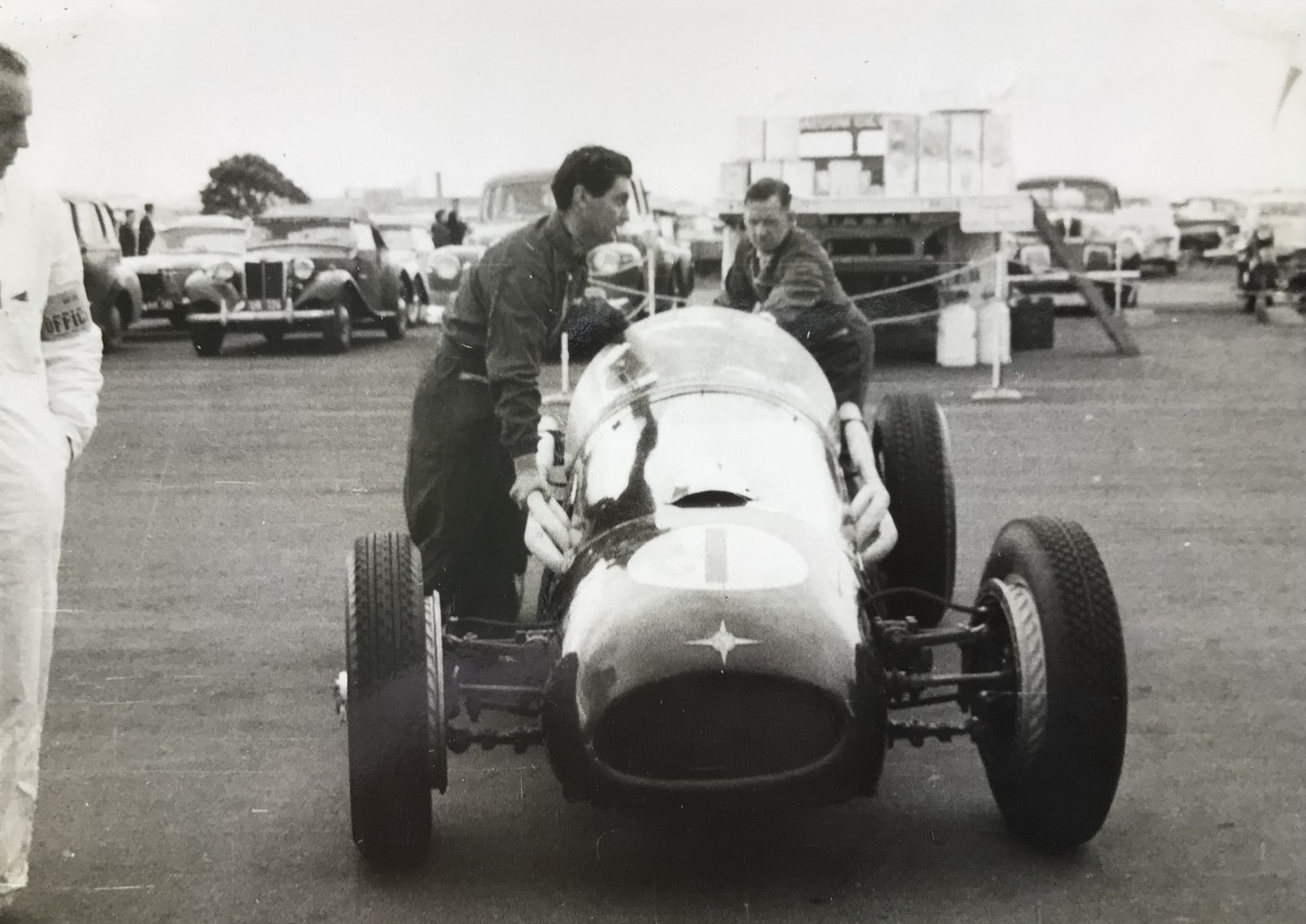
Pat qualified fourteenth based on his heat time and finished seventh- the first front engined car home, the race was won by Brabham’s Cooper T53 Climax from McLaren’s similar car and Graham Hill’s works BRM P48.

Jo Bonnier won at Levin on 14 January- Pat didn’t contest that race but followed up with a DNF from Q14 at the Wigram RNZAF base, Brabham’s T53 won. The internationals gave the Dunedin Oval Circuit a miss, there he was second to Hulme’s Cooper T51 from the back of the grid. Off south to Teretonga he was Q3 and fourth behind Bonnier, Cooper T51 and Salvadori’s Lotus 18 Climax.

After the Internationals split back to Europe he won the Waimate 50 from pole with Angus Hyslop and Tony Shelly behind him in 2 litre FPF powered Cooper T45’s and in November the Renwick 50 outside Marlborough.

1961 NZ GP Ardmore scene- all the fun of the fair. Ferrari 256 being tended by L>R Doug Herridge, Walter ?, Ernie Ramsley, Don Ramsley and Pat. #3 McLaren Cooper T53, David McKay’s Stan Jones owned Maserati 250F- the green front engined car to the left of the Maser is Bib Stillwell’s Aston Martin DBR4-300 (E Stevens)


Hoare, Ardmore 1962 (E Stevens)


Pat during the Sandown International weekend in March 1962 (autopics.com)

Into January 1962 Stirling Moss, always a very happy and popular visitor to New Zealand and Australia won his last NZ GP at Ardmore in a soaking wet race aboard Rob Walker’s Lotus 21 Climax from four Cooper T53’s of John Surtees, Bruce McLaren, Roy Salvadori and Lorenzo Bandini- the latter’s Centro Sud machine Maserati powered, the other three by the 2.5 litre Coventry Climax FPF, and then Pat’s Ferrari. The car was no doubt feeling a bit long in the tooth by this stage despite only having done eight meetings in its race life to this point.

Pat didn’t contest Levin on 13 January, Brabham’s Cooper T55 Climax took that, but the Sunday after was tenth at Wigram from Q12 with Moss triumphing over Brabham and Surtees in a Cooper T53.

At Teretonga it was McLaren, Moss and Brabham with Pat seventh albeit the writing was well and truly on the wall with Jim Palmer, the first resident Kiwi home in a Cosworth Ford 1.5 pushrod powered Lotus 20.

Having said that Pat turned the tables on Palmer at Dunedin on February 3- this was the horrible race in which Johnny Mansel lost his life in a Cooper T51 Maserati. A week later at Waimate it was Palmer, Hoare and Tony Shelly in a 2 litre FPF powered Cooper T45.

Hoare decided to contest Sandown’s opening meeting on 12 March so the gorgeous machine was shipped from New Zealand to Port Melbourne for this one race- he didn’t contest any of the other Australian Internationals that summer, perhaps the plan was to show it to a broader audience of potential purchasers.

The race was a tough ask- it may have only been eighteen months since the chassis won the Italian GP but the advance of technology in favour of mid-engine machines was complete, as Pat well knew. Jack Brabham won the 60 lap race in his Cooper T55 Climax FPF 2.7 from the similarly engined cars of John Surtees and Bruce McLaren who raced Cooper T53’s- the first front-engined car  was Lex Davison’s Aston Martin DBR4/250 3 litre in eighth.

Pat was eighth in his heat- the second won by Moss’ Lotus 21 Climax and started sixteenth on the grid of the feature race, he finished eleventh and excited many spectators with the sight and sound of this glorious, significant machine.

And that was pretty much it sadly…

Hill in ‘0007’ and Brabham’s Cooper T53 Climax ‘Lowline’ went at hammer and tongs for 29 of the 36 laps in one of the last great front-engine vs rear-engine battles- here Jack has jumped wide to allow Phil, frying his tyres and out of control as he tries to stop his car- passage up the Thillois escape road, French GP 1960 (Motorsport)

Ferrari Dino 256/60…

I’ve already written a couple of pieces on these wonderful Ferraris- the ultimate successful expression of the front engined F1 car, here; https://primotipo.com/2017/07/14/composition/ and here; https://primotipo.com/2014/07/21/dan-gurney-monsanto-parklisbonportuguese-gp-1960-ferrari-dino-246-f1/

The history of 256/60 ‘0007’ and its specifications are as follows sourced from Doug Nye’s ‘History of The Grand Prix Car’, a short article i wrote about the car a while back is here; https://primotipo.com/2015/11/09/pat-hoares-ferrari-256-v12-at-the-dunedin-road-race-1961/

The 1960 Dinos had small tube spaceframe chassis, disc brakes, wishbone and coil spring/dampers front- and rear suspension, de-Dion tubes were gone by then. The V6 engines, tweaked by Carlo Chiti were of 2474cc in capacity, these motors developed a maximum of 290bhp @ 8800rpm but were tuned for greater mid-range torque in 1960 to give 255bhp for the two-cam and 275bhp @ 8500rpm for the four-cammers. Wheelbase of the cars was generally 2320mm, although shorter wheelbase variants were also raced that year, the bodies were by Fantuzzi.

‘0007’ was first raced by Phil Hill at Spa on 19 June-Q3 and fourth, Brabham’s Cooper T53 Climax the winner, he then raced it at Reims, Q2 and DNF gearbox with Jack again up front, Silverstone, Q10 and seventh with Jack’s Cooper up front again and in Italy where Hill won from pole before it was rebuilt into ‘Tasman’ spec. Obviously the machine had few hours on it when acquired by Hoare- it was far from a worn out old warhorse however antiquated its basic design…

Nye records that seven cars were built by the race shop to 1960 246-256/60 specifications- ‘0001’, ‘0003’, ‘0004’, ‘0005’, ‘0006’, ‘0007’ and ‘00011’. ‘0001’, ‘0004’, ‘0006’ and ‘00011’ were discarded and broken up by the team leaving three in existence of which ‘0007’ is the most significant.

The 250 Testa Rossa engine is one the long-lived, classic Gioachino Colombo designs, evolved over the years and designated Tipo 128, the general specifications are an aluminum 60 degree, chain driven single overhead cam per bank, two-valve 3 litre V12- 2953cc with a bore/stroke of 73/58.8mm with 300bhp @ 7000rpm qouted. The engine in Hoare’s car was dry-sumped and fitted with the usual visually arresting under perspex cover, battery of six Weber 38 DCN downdraft carbs.

(E Stevens)


Pat Hoare in his first Ferrari, the bitza 625 four cylinder 3 litre at Clelands Road, Timaru hillclimb date unknown (E Porter)

Enzo Ferrari, Pat Hoare, Colombo and Rita…

Many of you will be aware of the intrigue created down the decades by Pat Hoare’s ability to cajole cars from Enzo Ferrari, when seemingly much better credentialled suitors failed.

I don’t have David Manton’s book ‘Enzo Ferraris Secet War’ but Doug Nye commented upon its contents in a 2013 Motorsport magazine piece.

‘Neither Mr Ferrari himself nor Pat Hoare ever explained publicly their undeniably close links. The best i ever established was that Hoare had been with the New Zealand Army advancing up the leg of Italy in 1943, and was amongst the first units to liberate Modena from the retreating German Army. David Manton has plainly failed in pinning down chapter and verse to unlock the true story, but he does reveal startling possibilities.’

‘When Mr Ferrari wanted a trusted engineer to realise his ambitions of building a new V12 engined marque post-war, he sought out Ing Gioachino Colombo, his former employee at Alfa Romeo. In 1944-5, however, Colombo was tainted by having been such an enthusiastic Fascist under Mussolini’s now toppled regime. With Communist Partisans taking control, Colombo was fired from Alfa and placed under investigation. His very life hung by a thread. He could have been imprisoned or summarily shot.’

‘Manton believes that Hoare- who had met Ferrari as a confirmed motor racing enthusiast from the pre-war years- may have been instrumental in freeing Colombo by influencing the relevant authorities. Certainly Colombo was able to resume work for Ferrari when some of his former Party colleagues remained proscribed, ar had already- like Alfa Romeo boss Ugo Gobbato and carburettor maker Eduardo Weber- been assassinated.’

‘But David Manton presents the possibility that such mediation might have been only a part of a more intimate link. Pat Hoare’s personal photo album from the period includes several shots of an extremely attractive Italian girl identified only as Rita. He was an un-married 27 year old Army officer. She was a ravishing 18, believed to have been born near Modena around 1926 and raised not by her birth parents, but by relatives. Some of Pat Hoare’s old friends in Christchurch, New Zealand- while fiercely protective of his memory- share a belief that the lovely Rita was not only just an early love of his life, but that she was also the illegitimate daughter of Enzo Ferrari…which would explain so much.’

‘Nothing is proven. David Manton’s book frustratingly teases but so- over so many decades- has the intrinsic discretion and privacy of the Italian alpha male. As American-in-Modena Pete Coltrin told me many years ago, Mr Ferrari was sinply a “complex man in a complex country”. He had a hard won reputation as a womaniser, which itself earned the respect, and admiration of many of his Italian peers and employees. But if Mr Manton’s theories hold any water they certainly go a long way towards explaining the Pat Hoare/Enzo Ferrari relationship, which both considered far too private ever to divulge to an enthusiastic public…’ DC Nye concludes.

Every Tom, Dick and Irving…

I look at all the fuss about Hoare’s purchase of his two Ferraris and wonder whether every Tom, Dick and Harry who had the readies and wanted an F1 Fazz could and did buy one in the fifties?

Ok, if you got Enzo on a bad day when Laura was pinging steak-knives around the kitchen at him for dropping his amply proportioned tweeds yet again he may not have been at his most co-operative but if you copped him the morning after he bowled over Juicy Lucia from down the Via you could probably strike a quick deal on any car available.

Putting all puerile attempts at humour to one side it seems to me Ferrari were pretty good at turning excess stock (surplus single-seater racing cars) into working capital (cash), as every good business owner- and it was a very good business, does. Plenty of 375’s, 500’s, 625’s and 555’s changed hands to the punters it seems to me.

Just taking a look at non-championship entries in Europe from 1950 to 1956, the list of cars which ended up in private hands is something like that below- I don’t remotely suggest this is a complete, and some cars will be double-counted as they pass to a subsequent owner(s), but is included to illustrate the point that in the fifties ex-works Ferrari F1 cars being sold was far from a rare event.

Its not as long a list as D Type Jaguar or DB3S Aston owners but a longer list than one might think.

Peter Whitehead- 125, 500/625 and 555 Super Squalo Tony Vandervell- 375, Bobbie Baird- 500 Bill Dobson-125 Chico Landi- 375 Piero Carini- 125 Franco Comotti- 166.

Four 375’s were sold to US owners intended for the 1952 Indy 500

Rudolf Fischer- 500,  Jacques Swaters ‘Ecurie Francorchamps’- 500 and 625, Charles de Tornaco ‘Ecurie Belgique’- 500, Louis Rosier ‘Ecurie Rosier’- 375, 500 and 625, Tom Cole- 500, Roger Laurent- 500, Kurt Adolff- 500, Fernand Navarro- 625, Carlo Mancini- 166, Guido Mancini- 500, Tony Gaze- 500/625 Reg Parnell ‘Scuderia Ambrosiana’- 500, 625 and 555 Super Squalo

Ron Roycroft- 375, Jean-Claude Vidille- 500, Alfonso de Portago- 625, Lorenzo Girand- 500, Centro Sud- 500, Jean Lucas- 500, Georgio Scarlatti- 500, Berando Taraschi- 166, Pat Hoare- 500/625 ‘Bitza’ and 256 V12

Don’t get me wrong, I do love the intrigue of the stories about the Enzo and Pat relationship but maybe its as simple as Hoare rocking up to Maranello twice on days when Enzo had had a pleasant interlude with Juicy Lucia on the evening prior rather than on two days when his blood was on the kitchen floor at home.

Etcetera…

(CAN)

Pat Hoare in his first Ferrari ‘bitza’, a 3 litre engined 625 (ex-De Portago, Hawthorn, Gonzales) at Dunedin 1958.

He raced the car for three seasons- 1958 in detuned state the car was not very competitive, in 1959 it kept eating piston rings and in 1960 it was fast and reliable, nearly winning him the Gold Star.

Its said his trip to Maranello in 1960 was to buy a V12 engine to pop into this chassis to replace its problematic four-cyinder engine but Ferrari insisted he bought a whole car.

The specifications of this car vary depending upon source but Hans Tanner and Doug Nye will do me.

The chassis was Tipo 500 (other sources say 500 or 625) fitted with a specially tuned version of a Tipo 625 sportscar engine bored from 2.5 to 2.6 litres. A Super Squalo Tipo 555 5-speed transmission was used to give a lower seating position and a neat body incorporating a Lancia D50 fuel tank completed the car.

When entered in events Pat described it as a Ferrari 625 and listed the capacity as 2996cc.

Pat Hoare portrait from Des Mahoney’s Rothmans book of NZ Motor Racing (S Dalton Collection)

Special thanks…

Eric Stevens and his stunning article and photographs

Photo Credits…

Allan Dick/Classic Auto News, Graham Guy, Mike Feisst, Stephen Dalton Collection, autopics.com

Bibliography…

‘History of The Grand Prix Car’ Doug Nye, grandprix.com, the Late David McKinney on ‘The Roaring Season’, Motorsport February 2013 article ‘The Old Man and the Kiwi’ by Doug Nye

Tailpieces…

(M Feisst)

The NZ built ‘Ferrari GTO’ pretty in its own way but not a patch on the genuine article without the extra wheelbase of the ‘real deal’.


(E Stevens)

Bag em up Pat…

Finito…

Oils ain’t Oils…

Posted: February 4, 2020 in Features, Obscurities
Tags:

(M Bisset)

The very first motor racing magazines i perused were these ‘Castrol Achievements ‘ booklets given to me by a mate’s father when I was 10 or eleven years old, I still have them 50 years later…

Ronald John Roberts was a mighty fine man, a senior executive of Castrol Australia, he commenced his career in Melbourne and was progressively posted to Adelaide and finally Sydney in the mid-seventies where he finished his long career with the company. His son and I were buddies for decades, the same duo took me to my first race meeting in 1972, I have my lifelong passion for our sport thanks to them, they cultivated and nurtured my initial interest.

Soon the Castrol copy of ‘Racing Car News’, the Australian monthly racing bible came my way a couple of months late after it had done the rounds of their execs but that didn’t matter to me.

When Jon Saltinstall popped up some images from this long running series of corporate promotional annuals on ‘The Nostalgia Forum’ it really did make me rather misty-eyed for times, friends and events long since past.

I love his summary of the history of the publications and their purpose.

Jon wrote, ‘During the 1950s and 1960s, a series of advertising booklets was produced by the likes of Shell, Ferodo and Castrol, which as well as being quite successful commercially also contributed in no small way to many a schoolboy dream. The longest-running and most successful of these was produced by CC Wakefield Ltd and although its title varied from year to year, is known generally as the “Castrol Achievements Book”.’

‘The Achievements book was produced as an annual and was first published in 1912 to publicise the racing and record-breaking activities on land, sea and air – all those depicted having been attained using Castrol lubricants, of course, as these were after all, advertising booklets. Wakefield had of course been one of the sport’s first commercial benefactors and one of the first to understand the value of endorsement of his products by household names.’

‘Although other companies would produce similar “Achievements” books, only those produced by Shell (1950-1964?), BP (1955?-1964?) and also brake company Ferodo are of similar note to the Castrol publications. The BP effort was similarly orientated across a range of disciplines as the Castrol booklets, while those by Shell and Ferodo were primarily orientated towards Grand Prix racing, which was hardly surprising as both companies were heavily involved in this category.’

1968

‘Looking back at these little (22cm x 13 cm, c. 46-48 pages) booklets, what strikes the reader about the Castrol Achievements Books in particular (and probably what endeared them to motoring enthusiasts) is that they are filled with excellent photographs, often unavailable elsewhere. The fact that they were available free on request from local Castrol companies was no doubt a big point in their favour, especially when – in a particularly clever piece of marketing – for a time one would also receive a free lubrication chart for the car or motorcycle of choice.’

‘The Castrol Achievements Book also benefitted from superb cover artwork (including paintings by including Michael Turner and Gordon Horner amongst others). I understand it was still being published in the new millennium so its longevity was way beyond anything achieved by its rivals. A little-mentioned artefact these days, but possibly an introduction to the sport for a number of TNFers?’ Saltinstall concluded.

So let’s share some of the artwork from the annuals- I was going to do it chronologically but visually it’s better to jump around across the decades as the art direction changed every several years rather than annually so a look of sameness in patches pervades using the year by year in order approach.

Do assist if you know what the featured machine is, I certainly don’t have all the answers.

1909-1959

Percy Lambert’s Talbot? and MG EX181 depicted.

John Cooper/Bill Aston Cooper at Montlhery.


Dan Gurney’s #48 Eagle Weslake-Ford at Indianapolis and a Ferrari 250LM at Le Mans.

Dan’s Ford-Weslake engines; https://primotipo.com/2018/06/14/gurney-weslake-ford-v8/


1957. Ford Zephyr Mk2 of Cuth Harrison during the Tulip Rally.


Clearly a race in France but Grands Prix races were thin on the ground in there at the time and I can’t make the Voiturette race results work for me…it’s red so a Maserati perhaps.

Fast Freddie’s Maserati; https://primotipo.com/2018/08/16/fast-freddy/


Not so flash is it.


1954 depicts the debut and return to racing of Mercedes Benz- the W196 is shown at Reims, a win for JM Fangio in July, Karl Kling in another Mercedes Streamliner was second in a dominant performance and a portent of what was to come. https://primotipo.com/2015/10/09/mercedes-benz-w196-french-gp-1954/


Isle of Man is the obvious guess but which outfit? Piece on the 1950 IOM meeting; https://primotipo.com/2016/06/21/1950-isle-of-man-tt/


Monte Carlo Rally finish in the streets of the principality, car shown is the winning Paddy Hopkirk/Henry Liddon Morris Cooper S.

Cooper S in the Monte; https://primotipo.com/2015/09/29/monte-carlo-rally-1967-morris-cooper-s/


Roy Savadori’s Aston Martin DB3S depicted in 1955, not sure which event- it ain’t Le Mans. Article on Roy here;

Roy Salvadori…

Some good stuff in this shot including Piers Courage and his Frank Williams Racing Brabham BT30 Ford FVA F2 car and Sid Taylor’s Lola T70 Mk3B Chev.


1960- Pat Moss-Carlsson and Ann Wisdom-Ross won the five day Liege-Rome-Liege in a works Austin Healey 3000 in August/September.


Captain GET Eyston in ‘Thunderbolt’.

On 15 September 1938 Eyston raised the record he had set the year before from 312.00mph to 345.50mph at Bonneville. This was the tit-for-tat 1937-1939 period of the duel for the LSR between Eyston and John Cobb’s Reid-Railton.


The Queens lube of choice it seems.


1959, love this image of a hill-climbing Cooper with the  wheels adopting all of the angles so typical of the 500s.


I’m not so sure Castrol provided lubricants to Ferrari in 1952 but we seem to be celebrating the sensational Ferrari 500s which were so dominant in the World Championship that year, Alberto Ascari the winner. First lap of the Belgian Grand Prix depicted.

Ferrari 500 piece; https://primotipo.com/2017/03/23/bunbury-flying-50-allan-tomlinson-ferrari-500-et-al/


1962 Monte Carlo Rally Pat Moss/Ann Wisdom 26th placed Morris Cooper.


1956 MG record breaking- EX179 with Stirling Moss huddled over its wheel- wonderful image with the cameraman in shot at left giving some additional drama and perspective.


Some interesting stuff here too- Mikkola’s Ford Escort Mexico, the Bud Moore Trans-Am Boss Mustangs, Jacky Ickx’ BMW Dornier F2 car and a Chevron Ford Coupe.


An Alfa Romeo 158 bearing down on a green car in 1950- Giuseppe Farina took the first drivers world championship for the Portello marque that year. Farina/158 in brief; https://primotipo.com/2019/10/14/things-go-better-with/


1963 shows the ‘Around The World In 43 Days’ Ford Corsair crewed by Eric Jackson and Ken Chambers in a Walter Hayes publicity exercise. The amazing adventure is recounred in Eric Jackson’s book ‘Petrol in in My Blood’.


1963 for both the above two shots- this one shows Rhodesian, Jim Redman’s Honda RC164 winning the IOM Junior TT at 94.91mph- he was six minutes ahead of the second placed Gilera of John Hartle.


(Gordon Horner)

1961 Monte Carlo Rally, Ann Hall’s Ford Anglia.


Record breaking Healeys in 1953. https://primotipo.com/2019/06/08/austin-healey-100s-streamliner/


Dan Gurney’s Eagle Mk1 Weslake was a competitive force in 1967 winning the Belgian Grand Prix at Spa in a great test of both his Len Terry designed chassis and Weslake built V12 engine, and the non-championship Race of Champions at Brands Hatch. Piece on the Eagle Mk1; https://primotipo.com/2019/02/19/eagle-mk1-climax-101/

Credits…

Castrol, Jon Saltinstall on ‘The Nostalgia Forum’

Tailpiece…

Finito…

(A Robinson)

Andrew Robinson worked for Alec Mildren’s Pymble dealership for a number of years, starting as an apprentice motor mechanic in 1977 and was given these discarded photographs which span a decade of Alec Mildren Racing from about 1964 to 1972, many thanks to Andrew for sharing them with us, rolled gold they are too…

I have arranged them pretty much in chronological order- the cars themselves are easy enough to identify but in some cases I don’t know where they are, hopefully Kevin Bartlett or others can assist in that regard!

The first (above) is the Mildren Maserati sports-racer with Alec, long time Mildren race mechanic/engineer Glen Abbey and another dude checking out the car which appears brand new- note the XK150 and Mk2 Jaguars.

After speculating online that the locale was Glenn Abbey’s home in Avalon for a couple of days Kevin Bartlett’s memory kicked into gear ‘The penny has just dropped…its the “Railway Shed” where many of the cars were worked on. It was opposite the Mildren Pymble headquarters on the Pacific Highway alongside the Northern Railway (look closely at the top of the shot and you can see the railway track). I also remember building a pushrod Ford engine for a Brabham in the floor above the workshop. We ceased using it in 1967 when the cars were worked on behind the main building.’

The car was built by Bob Britton of Rennmax Engineering on his Lotus 19 jig around the core mechanical components of Alec’s 1960 Gold Star Championship winning Cooper T51 Maserati- suspension and brakes, Maserati T61 2.9 litre DOHC four cylinder engine and Colotti gearbox. The story of this car is told at the end of this lengthy piece on Alec; https://primotipo.com/2018/06/08/mildrens-unfair-advantage/

(A Robinson)

Beautiful shot of Alec and Marjorie Mildren, Frank Gardner, the tall Glenn Abbey, Bob Grange or Stuart Randall on the pit counter at Warwick Farm circa 1965.

Gardner’s pattern throughout the decade was to race in Europe in F1/F2/Sportscars/Touring cars and then return home in the summer time taking in the Hordern Trophy at Warwick Farm in December as a warm up for the Tasman Series in January, February and just into March against the best in the world before heading back to Europe.

Great work/life balance it seems to me!

(A Robinson)

Mildren Racing became outright Tasman Series contenders with the acquisition of a Brabham BT11A Coventry Climax 2.5 FPF before the 1965 series, the car is chassis number ‘IC-3-64’.

Here Alec at left, is sussing his new racer together with his son, Jeff Mildren and Glenn Abbey in late 1964, probably in the workshop over the road from Alfa Romeo Dealership at 970-980 Pacific Highway, Pymble on Sydney’s Upper North Shore.

The car was first raced in the 1965 Tasman Series opener, the New Zealand Grand Prix at Pukekohe, where he was second to Graham Hill’s identical, Scuderia Veloce machine. No doubt Frank gave it a whirl around the Farm before venturing to the Land of The Long White Cloud- he didn’t run at in the 6 December 1964 Hordern Trophy though, which means either he or the car, or both, were not in the country by then.

Note the the rear of a Hewland gearbox on the bench and rear springs missing from the Brabham at this point- no FPF either BTW. Checkout this article on the ‘Intercontinental’ Brabhams; https://primotipo.com/2018/07/20/matich-stillwell-brabhams-warwick-farm-sydney-december-1963/

The shot below is the same spaceframe chassis unclothed.

(A Robinson)

During 1965, after a very successful Tasman in which FG was equal fourth, Mildren was looking for a Tasman Series ‘Unfair Advantage’ for the coming year. ‘Everybody’ ran the Coventry Climax FPF which was becoming a bit long in the tooth, BRM planned to race their 1.5 litre F1 P261’s with the V8 taken out to about 1.9 litres and Repco announced they were to race their new 2.5 litre V8- which first fired a shot in the Doonside Street, Richmond Repco Engine Lab in March 1965 during the 1966 Tasman in advance of an assault on the F1 World Championship.

Alec found an exotic solution via his old buddies at Maserati.

He was a Maserati dealer and had impeccable connections within the racing side of the company by virtue of his successful Gold Star tilt, Maserati powered in 1960, and so it was he obtained a 2.5 litre Maserati Tipo 58 (250F T2) quad cam, two valve, six-Weber carbed, circa 310bhp V12 which had been lying around Modena since Officine Maserati tested and occasionally raced V12 versions of the 250F in 1957. Fangio won the last of his five F1 championships racing six-cylinder 250Fs that year of course.

(A Robinson)

The engine was shipped to Sydney where it was married to the team’s BT11A ‘IC-3-64’- our friend above, the frame of which was lengthened more than a smidge to suit, a bell-housing was cast to mate the engine to a Hewland HD5 gearbox and away Gardner went in practice for the 1966 Warwick Farm 100- the photo above is on that very day, 12 February 1966.

Frank and Kevin Bartlett tested the car at Oran Park early in the summer, the engine blew, the machine had plenty of power but its delivery- exactly as JM Fangio and Jean Behra experienced in their 250F’s when they tested (and raced in Behra’s case at Monza) them so equipped in 1957, was either ‘on or off’ so Frank raced his Climax engined BT11A ‘IC-2-64’ at the Farm instead, he was third behind Clark’s Lotus 39 Climax and Graham Hill’s BRM P261.

This latter BT11A was the machine Bib Stillwell used to win his final Gold Star in 1965 which was then acquired by Alec when Bib retired, for Frank to use in the NZ Tasman rounds whilst Stu Randall rebuilt the Maserati engine with bits flown in from Italy and re-fitted it to BT11A chassis ‘IC-3-64’ for Frank to use at Warwick Farm, the first Australian Tasman round.

Tested again in practice at Sandown a fortnight later, the Brabham Maserati was put away when the engine blew again and that was that, what became of the engine is uncertain.  BT11A ‘IC-3-64’ was converted back to Climax spec and raced with much success by Kevin Bartlett in 1966, 1967 and the ‘68 Tasman. Meanwhile ‘IC-2-64’ was sold to Kiwi Kerry Grant but not before Bartlett and Jackie Stewart had a ding-dong of a dice in these two BT11A’s at Surfers Paradise in mid-1966, see here;

Jackie Stewart, Surfers Paradise ‘Speed Week’ 1966, Brabham BT11A Climax and Ferrari 250LM…

There is more to the Brabham Maserati story, lots more, but you will have to wait a few weeks whilst I finish a feature…For now salivate about an amazing engineering sidebar in Tasman History- truly a great mighta-been from the little team in Sydney.

(A Robinson)

From one rare beastie to the next.

This time the Mildren Alfa Romeo, not ‘The Sub’ mind you but the first Mildren Alfa, the lesser known one.

Another Bob Britton built car, this one was constructed on Britto’s Brabham BT23 jig and fitted with an uber-rare Alfa Romeo 1.6 litre, four valve, fuel injected European F2 engine and 5-speed Hewland FT200 transmission, both of which are clear as a bell in the shot above.

The car made its race debut driven by Kevin Bartlett at Warwick Farm on 8 September 1968- it raced in Alfa engined form a miniscule number of times before the very first of Merv Waggott’s TC-4V engines was popped into the back of the chassis and raced by Max Stewart who joined the team alongside KB with effect from the start of 1969.

The tale of ‘Max’s’ car is long, successful and slightly tortuous with the appearance of a second chassis, the provenance of which is not in doubt,  in the last decade or so, but is not for now- i did write a ‘quickie’ about it a while back though; https://primotipo.com/2018/05/29/singapore-sling/

(A Robinson)

Speak of the devil, there is the man himself, Max Stewart corner-weighting the Mildren Waggott as it then was in 1969 or 1970.

You can just see the front corner of a ‘105’ Alfa at far left, the race truck out the doorway and the rear of the chassis of Kevin Bartlett’s Mildren ‘Yellow Submarine’ just left of Maxxies midriff.

(A Robinson)

Speak of the other devil, there is KB at Warwick Farm in the ‘Yellow Submarine’ Mildren Waggott TC-4V.

With that circuit, livery, helmet and engine I wouldn’t mind betting the shot was taken during the 7 December 1969 Hordern Trophy Gold Star meeting, KB won the race upon the debut of the 2 litre Waggott engine, what say you Mr Bartlett? Max was second in the 1.6 litre Mildren Waggott and Niel Allen third in his ex-Courage McLaren M4A Ford FVA.

Both these Mildrens are iconic in the pantheon of Australian motor racing, ditto the drivers and entrant.

(A Robinson)

A couple of Mildren Waggott, Max Stewart, Warwick Farm compare and contrasts.

The shot above circuit, livery, bodywork and helmet suggests probably the 1969 Hordern Trophy meeting too whereas the one below is during 1971 by which time Max had acquired the car from Alec, still in the same livery and with support from Seiko- it was the year in which Max ‘nicked’ his first Gold Star from the F5000 fellas, brittle things that they were.

The photo below is during the September Hordern Trophy race in which Max was third behind KB’s McLaren M10B Chev and Leo Geoghegan’s Lotus 59B Waggott TC-4V.

(A Robinson)

Whilst the unreliability of Kevin Bartlett’s McLaren M10B Chev cost KB the 1971 Gold Star Max had to get with the F5000 strength and bought an Elfin MR5 Repco-Holden which he first campaigned during the 1972 Tasman Series.

Note the retention of Seiko still and the Mildren Yellow colour (take my word for it) despite the commercial relationship between Alec and Max being at an end, Alec Mildren Racing ceased after the conclusion of the 1971 Tasman Series.

(A Robinson)

Here the car is on the grid of the Warwick Farm 100 Tasman round with Teddy Pilette’s Racing Team VDS McLaren M10B Chev alongside in February 1972.

Max didn’t have a happy race, his Repco engine broke its crank after 8 laps whereas Teddy was seventh, the race was won by Frank Matich’s Matich A50 Repco from Frank Gardner, Lola T300 Chev and Kevin Bartlett, McLaren M10B Chev.

Max became an F5000 star of course in a succession of cars- the Elfin and three Lola’s are covered in this article here; https://primotipo.com/2017/10/24/maxwells-silver-hammer/

Credits…

Andrew Robinson Collection, Kevin Bartlett, oldracingcars.com

Tailpiece…

(A Robinson)

Patron Mildren, Glenn Abbey and Don Baker (of Brabham/Dolphin and other such fame) at Warwick Farm- perhaps this shot too is over the 1969 Hordern Trophy weekend…

Finito…

A McLaren MP4 TAG-Turbo was not a run of the mill testing sight at Porsche’s Weissach test track, so it is hardly surprising to see most of the workforce down tools for the occasion on 29 June 1983…

The race debut of a Porsche-turbo powered McLaren at Zandvoort in the hands of Niki Lauda is only two months away. On this fine, cool day John Watson put McLaren’s test hack MP4-1D TAG through its paces for the first time at Porsche’s renowned test track.


McLaren created a new paradigm with the debut of the carbon-fibre tubbed MP4 Ford in 1980. Whilst the cars were the best of the Ford brigade going into 1983, 550 bhp of normally aspirated Cosworth DFY V8 was no longer a match for 700 bhp plus turbo-charged Brabhams, Ferraris and Renaults. The ‘boiling tea kettle’ days of the first Renault V6 turbo-charged engines were a long time in the past.

McLaren International’s Directors pondered the available engines they may have been able to acquire or lease but design chief John Barnard rejected those as either compromised designs- the BMW-four and Renault V6 or insufficiently developed and compromised- the Hart-four.

The very focused Barnard held sway over matters technical and was determined, as Colin Chapman had been with Keith Duckworth in developing the Ford DFV, to very tightly prescribe the overall layout, dimensions, location of ancillaries and attachment points to the chassis of his new engine.

It was the era of ground effect tunnels, McLaren’s engine had to be designed in such a way that their efficiency was not compromised given how critical aerodynamics were to the overall performance of the car.

Watson in a Ford engined MP4/1C Ford DFY at Monaco in 1983, just to remind us of what McLaren’s primary contender looked like in 1983. Despite running Ford DFY’s both cars failed to qualify as a result of poor handling on the Michelins they had on Thursday and rain on Saturday…Rosberg won in a Williams FW08C Cosworth

Porsche had more turbo-charged road and race experience than any other manufacturer at the time, as a consequence they had been approached to build an F1 engine by others on a customer basis but Ron Dennis’ pitch to Porsche’s R&D Chief Engineer Helmuth Bott in the winter of 1981/2 was different in that his enquiry was to ascertain the companies preparedness to build an engine for McLaren International, who would pay for it. A novel concept in motor racing of course where nobody wants to pay for anything.

In short order John Barnard wrote a tight specification of his requirements which outlined in detail a narrow engine with a small frontal silhouette, it’s exhaust plumbing raised high each side to clear the raised underfloors.

Doug Nye wrote that his requirements to Hans Mezger of Porsche’s engine design unit included the maximum crankcase width and height, and maximum width across the cam-boxes. Pumps for oil and water had to go to the front of the engine within its crankcase silhouette. Exhaust pipes had to leave the heads horizontally, not downswept so as to leave the underfloors high on both sides.


Nye goes on to explain that the engine had to be a stressed member of the chassis just as the DFV and it’s successors were- Barnard wanted it to pick up similarly to the chassis. He even specified a precise crankshaft height, the same as the DFV, to offer the best design parameters for the whole car. It could have gone lower but John had concerns about potential piping and underbody problems. He had concluded that a V6 would provide the optimum blend of size and power but sought Porsche’s opinion in that regard.

Porsche R&D were an organisation notorious for the cost of their services but eventually Ron Dennis signed a contract for design of the engine and prototype build after which the design rights would be McLaren International property. The time allocated was six months which gave Dennis the period in which to embark on a journey to find a commercial partner to fund the cost of the engines themselves and their ongoing development.

Porsche modelling determined a V6 was the best approach with an 80 degree included angle between the two banks of three cylinders the optimum in terms of structural strength of the block, primary balance and room within the Vee for ancillaries.

The quoted bore and stroke of the TTE-PO1 V6 motor was 82mm x 47.3 mm for a capacity of 1499cc. The design of course included four gear driven camshafts and four valves per cylinder. Traditional Porsche suppliers Bosch and KKK provided the sparks, fuel injection and two turbo-chargers. Quoted power was initially 600 bhp with peak power produced at between 10000 to 11500 rpm, total weight ready to pop into a McLaren chassis was 330 pounds.

Dennis approached a number of potentional backers, Mansour Ojjeh’s Techniques d’Avant Garde were the successful partner- TAG Turbo Engines was duly incorporated with the production contract signed by Porsche in December 1982. By that time the prototype engine had been humming away on a Weissach dyno since the eighteenth of that month…

The prototype engine was shown for the first time at the Geneva Salon in April 1983.

McLaren used a float of 15 engines in 1984, the TAG truck and Porsche technicians would have been very busy


Nye explains at length the adversarial and on many occasions difficult relationship between customer and client which extended to the testing of the engine. Porsche wanted to run the motor in a 956 test hack whereas McLaren sought all of the testing to be done in an F1 car.

Porsche went ahead anyway, little was learned by Niki Lauda and John Watson in the 956 prototype but ‘…Lauda drove very hard, ignoring the meagre safety facilities of the undulating test track. He revelled in the new engines smoothness after the Cosworth V8’s vibration. And there was no doubting the power “Incredible, Fantastic, just like being hit from behind by a bomb” Nye quoted Lauda as saying having tested the 956. Importantly, with both drivers doing plenty of miles, engine reliability was good.

The car Watson is testing in these shots is McLaren’s original prototype carbon fibre chassis MP4/1-1 with 1982 straight sided bodywork- converted into the turbo test hack it was dubbed MP4/1D.

Initial problems centred around excess turbo-lag which had been disguised in the much heavier 956 sports prototype, and oil consumption. Porsche set to in solving both problems, with changed KKK’s and exhaust sizes the lag fixes. At Silverstone on test Lauda was delighted to be whistling along Hangar Straight at 186 mph, far quicker than he had ever gone before.

A major battle then erupted within McLaren between Lauda who wanted the car to be raced immediately, on the basis that there was no substitute for the sorts of pressures of a race weekend, and Barnard who wanted to continue testing but take the time needed to refine the design of his 1984 package.

Lauda’s car in the Zandvoort paddock


Lauda in MP4/1E at Zandvoort, not a bad looking car for one knocked together very quickly (unattributed)

The politically astute, wiley Lauda lobbied sponsor Marlboro and prevailed, so ‘in six weeks our blokes built two cars- well one complete runner and one 85% complete- ready for Zandvoort’ said Barnard. The new cars were allocated the tags MP4/1E-01 and 02, they were based on former chassis, MP4/1C-05 and 06.

At Zandvoort ‘Niki was unbelievably quick on the straight (in MP4/1E) but basically the Cosworth wing package download was way deficient with turbo power. We cooked the brakes in the race, a function of the turbo car going about 30 mph faster down the straight than the Cosworth’ said Barnard.

The Dutch GP was won by Rene Arnoux’ Ferrari 126 from the sister car of Patrick Tambay with Watson’s Cosworth powered McLaren in third.

Zandvoort again, photos emphasise just how much space was taken up by the turbo-chargers and related ancilliaries in these 1.5 t/c cars


Lauda, MP4/1E in the Kyalami pitlane, mid October 1983. Lauda Q12 and DNF electrical on lap 71 of 77 whilst poor John Watson was disqualified for passing a couple of cars on the parade lap. Piquet won the race and took the drivers title, Brabham BMW the constructors one

McLaren and Porsche were away, there were huge Bosch fuel injection problems to solve to develop their ‘Motronic MS3’ electronic injection system to meet the fuel restriction rules of 1984 but the 1984 McLaren MP4/2’s triumphed, Alain Prost took the first race win in the opening  round of the championship in Brazil- and won seven GP’s but he still lost the title by a smidge to Lauda who won five races but had greater consistency throughout the year.

Prost took the title in 1985 racing an MP4/2B to five wins, with Lauda winning another in his final year of racing. Watching him retire after a minor crash in Adelaide caused by locking brakes whilst well in the lead was a real bummer in his very last race for we Australian Lauda fans!

Hans Mezger getting the lowdown from John Watson, Weissach

Zandvoort 28 August 1983, McLaren TAG race debut…

I

‘l am telling you Ronnie, ve vill schitt on zem all next jahr! Say nuzzinc to any of zem journalists!’

Renault’s Gerard Larousse looking very thoughtful at right rear and thinking ‘holy merde’ this thing will be quicker than a Matra air to ground missile- and it was.

‘I’ll bet I am going to pay for a few more of these Turbo thingies in the next few years!’ is perhaps what Dennis is thinking above.

The first ‘in the field’ KKK change perhaps?


More power, gimme more! is perhaps Niki’s exhortation.

The engine itself is tiny, note the water and oil coolers in the sidepods and beefy intercooler.

Another TAG-Porsche powered MP4 1983 shot above of Lauda during the European GP weekend at Brands Hatch in September- Q13 and DNF whereas Watson was Q10 and DNF accident. Nelson Piquet won in a Brabham BT52 BMW from Alain Prost’s Renault RE40 with Nigel Mansell’s Lotus 92 Ford Cosworth the best of the normally aspirated brigade.

Credits…

‘The History of The Grand Prix Car’ Doug Nye

Getty Images- all Weissach photographs by Hoch Zwei

Tailpiece…

The Swabian Hills are alive with the sound of Vee-Six Turbo Music- Watson up in June 1983.

Ya kinda get the impression it was an important day in Porsche history as indeed it was. Ditto McLaren International…

Finito…


lukey
Len Lukey’s Cooper Bristol, Mount Druitt, NSW, in May 1958, having set FTD at 13.53 sec for the standing quarter (J Ellacott)

‘Now that really is a beautiful looking racing car! Wotizzit I wonder’, the young gent seems to thinking…

The smartly attired chap is surveying the lines of Len Lukey’s Cooper T23 Bristol at Mount Druitt in Sydney’s west in May 1958. Len Lukey was both a champion driver and successful businessman, founding ‘Lukey Mufflers’ in the 1950s, a brand still respected today.

Melbourne-born, Lukey started racing relatively late, aged 32, having established and built Lukey Mufflers from its Nepean Highway, Highett base. Generations of enthusiasts are aware of his name because of the original equipment and performance exhausts and mufflers he produced. No lowered, worked EH Holden with wide chromies and twin SUs was complete without the distinctive Lukey logo being displayed on its exhausts for following traffic to know its performance intent.

Lukey started competition in the Victorian hills with a side-valve Ford Mainline Ute, Australia’s ubiquitous workhorse down the decades. It was in this car at the opening Altona meeting in 1954 that he frightened the life out of Stan Jones in Maybach when he spun whilst coming through The Esses, the car looking all the while as though it had lost its way transporting a load of mufflers from Highett to Williamstown. The competition regulator, the CAMS, frowned upon the use of such utilitarian vehicles in racing, so he switched to the first of a series of Ford Customlines.

Len Lukey, Ford Customline, Rob Roy, 1957 (B King)
image
Equipe Lukey during the 1959 AGP weekend at Longford, Cooper T45 Climax: unknown, Neil Marsden, Helen Lukey, Claude Morton and Len Lukey (Jock Walkem)
Awesome shot at the start of the 1959 AGP at Longford, showing not least how narrow the track was then. The old start line was on The Flying Mile towards Mountford Corner. Winner Stan Jones has the jump in his Maserati 250F, then Len, partially obscured in his Cooper T45 Climax, then Arnold Glass, Maserati 250F, Doug Whiteford, Maserati 300S, Ron Phillips, Cooper T33 Jaguar, Alec Mildren, Cooper T45 Climax and the rest (unattributed, I’d love to know the name of the photographer)

It’s interesting to review the stunning march of touring car domination of Australian motor racing and look at the role Len Lukey had in its rise. Australian Motor Sports had this to say in its January 1960 issue, ‘…there can be no doubt that by tuning these massive cars to the highest possible pitch, Len Lukey started the ball rolling towards the day when the term production car racing became such a farce that a special Gran Turismo Class had to be instituted’.

Lukey had some spectacular moments as he learned his craft, a trip through the hay bales at Albert Park and a lucky roll at Phillip Island, there was no rollover protection in those days, both were lucky escapes.

The car was timed at 106mph at Gnoo Blas, Orange in 1956, beating both Jack Myers and the Aldis Bristol. His dices against Jack Myers, the Sydney Holden driver, were crowd pleasers in the way Geoghegan/Beechey battles were a little further down the track.

He soon took hillclimb class records at Rob Roy, Hepburn Springs and Templestowe, all in Victoria.

Both Myers and Lukey progressed into single-seaters via Cooper Bristols. In Lukey’s case, his ascent to the top was quicker than just about any Gold Star winner, and then, he almost immediately upon achieving the prestigious award in the longest ever season, 12 rounds in five states, retired as a competitor but remained in the sport as a circuit owner and sponsor.

Team Lukey during the 1957 AGP weekend at Caversham- Customline and Cooper T23 Bristol (K Devine)

Lukey commenced racing the ex Reg Hunt/Kevin Neal Cooper Bristol in 1956…

He was ninth in the ‘Olympic’ Australian Grand Prix won by Stirling Moss at Albert Park in a works Maserati 250F.

In the 100-mile Victorian Trophy race he was fifth behind Davison’s Ferrari 500/625 3-litre, Brabham’s Cooper Climax, Doug Whiteford’s Maserati 300S and Tom Hawkes’ Cooper T23 Holden, it was an auspicious open-wheeler debut. He started a campaign to contest the Gold Star the following year- the first time the Australian Drivers Championship had been contested.

The season commenced at Caversham, 16km from Perth, held in searing heat and famously won, after much argument about lap-counting, by Davison’s Ferrari, which was shared by Lex and Bill Patterson. Len was fourth in a fast, reliable run in the Cooper. He was fifth at Albert Park and then late in the season scored two thirds in the New South Wales Road Racing Championships at Mount Panorama and in the Port Wakefield Trophy held at the South Australian circuit in rough bush country 100km north-west of Adelaide.

He set Australian National Speed Records in both the Cooper – 147.4mph and the Customline at 123.3mph – outside Coonabaraban in north-western NSW in 1957.

The Cusso was timed one way at 130mph, the car that weekend was festooned with masking tape, shields over its headlights, an enclosed radiator and sealed doors and boot to squeeze every bit of speed from the beast. Len had to enter the car through the windows; safety was again very much to the fore!

The car which ran at Coonabarabran was a new shell, but all the learnings and good bits of the earlier one were transferred across. Len raced it for a further year before being selling it to Melbourne driver Owen Bailey but it was badly damaged in an accident at Albert Park in 1958, Bailey’s first meeting in it.

On the way to winning the South Australian Trophy, Gold Star round at Port Wakefield in April 1958, Cooper T23 Bristol (unattributed)
Lukey at Albert Park during the Melbourne GP in November 1958, Lukey Bristol, Jaguar Corner. ‘Vanwall-esque’ nature of the body clear if not as beautiful in execution (B King)
lukey
Len Lukey is being congratulated by Derek Jolly for his second place in the October 1958 Victorian Road Racing Championship at Fishermans Bend. Lukey Bristol, Ted Gray won in Tornado 2 Chev (K Drage)

Its amazing to compare and contrast the short four or five round Gold Star contests of later years with the more arduous nature of the series earlier on, particularly given the standard of Australian highways then.

The 1958 award was contested over nine rounds, starting at Orange in New South Wales, from there to Fishermans Bend in Melbourne, then south across Bass Straight to Longford, to Port Wakefield north of Adelaide in South Australia, then two rounds at Lowood, Queensland, in June and August. So I guess depending upon other race commitments, one could leave your car up north, then to Mount Panorama, Bathurst in New South Wales for the Australian Grand Prix in October and then, finally, two rounds in Victoria- Albert Park in November and Phillip Island in early December.

The 1959 Gold Star was held over a staggering twelve rounds, and so it was that Len committed himself to a couple of serious tilts at the title in 1958-59, the lessons learned in 1958 were applied with great success the following year when he won the title.

Len was third in the opening South Pacific Championship round at Gnoo, Blas Orange in January, Jack Brabham won that event in his Cooper T43 Climax but was ineligible for Gold Star points as a non-resident.

Back home to Victoria, Len was fourth at Fishermans Bend in February and fifth in the Longford Trophy in March. Stan Jones won at the Bend and Ted Gray at Longford in the big, booming Chev Corvette 283cid V8-engined Tornado 2.

He scored his first splendid Gold star win in the South Australian Trophy at Port Wakefield in April, winning from Austin Miller’s Cooper T41 Climax and Keith Rilstone in the amazing Zephyr Special s/c.

Then followed a long haul back to Melbourne to ready the car and then a 1650km tow to Lowood Queensland for the two rounds held on the disused airfield circuit.

He bagged a pair of thirds in the Queensland Road Racing Championship at Lowood in June and the Lowood Trophy in August. Alec Mildren won both of these events in his Cooper T43 Climax, with Len looking lovingly and with considerable longing for one of these mid-engined cars, an aim he would realise before the year was out.

Lukey had developed his own thoughts on how to improve the performance of his Cooper and built a new spaceframe, high-bodied chassis, the ‘Lukey Bristol’, into which the mechanicals of the factory car were fitted.

Ready for the AGP, the car was taken to Bathurst but finished a distant sixth, two laps in arrears of Lex Davison, Ern Seeliger and Tom Hawkes aboard a 3-litre Ferrari 500/625, a 4.6-litre Maybach 4 Chev and a 2.3-litre Cooper T23 Holden-Repco, respectively.

The last two rounds of the championship were back in Victoria, he was fifth in the Melbourne Grand Prix, an exciting race weekend in which Stirling Moss and Jack Brabham scrapped at the front of the field in 2.2-litre Cooper T45 Climaxes, the race won by Moss from Brabham then Doug Whiteford’s Maserati 300S, Bib Stillwell’s ex-Hunt Maserati 250F and then Len.

Lukey was quickly in discussion with Brabham about the purchase of the Cooper T45, the very latest of Surbiton’s machines at the time, and would soon have the 2-litre Coventry Climax FPF-engined machine in his workshops, providing him with the tool to do the job in 1959.

Len was still active on the hills, winning both a new NSW sprint record and FTD at Mt Druitt in 13.53 seconds; this article’s opening photo is at that meeting. In July, he spun at the end of Rob Roy when the throttle jammed open. Len was thrown from the car before it rolled to a halt, but it was a lucky escape.

The final Gold Star event was the Phillip Island Trophy on Boxing Day but Len spun the Cooper in a preliminary event, damaging the car’s suspension enough to non-start the championship race. The Coad brothers sportingly lent him their Vauxhall Special but the car was outclassed, with Lukey third in the Gold Star with 21 points, then Alec Mildren on 23 with Stan Jones deservedly taking the title with 31 points. Stan won two rounds at Fishermans Bend and Phillip Island and was third on three occasions- Gnoo Blas, Longford and the first of the two Lowood rounds.

The Lukey boys push the Cooper T23 Bristol thru the Longford paddock in March 1958, behind is the Lou Abrahams owned, mighty Tornado 2 Chev, victorious that weekend (HRCCTas)
Len and Stan Jones on the cover of the March 1959 issue of AMS in recognition of a marvellous AGP dice resolved in Jones’ favour 1959- Cooper T45 Climax from Maserati 250F

After Brabham contested three New Zealand internationals in early January 1959, Lukey bought the car from Jack. It was fitted with a 2-litre FPF rather than one of the 2.2s Jack had been using. These engines were rare with the full 2.5-litre variants built around new blocks being readied back in Coventry for Cooper, Rob Walker and Lotus’ use in F1 that season – rather successfully so as events transpired.

In 1959, as mentioned above, the Gold Star was contested over 12 gruelling rounds, between 26 January and 14 June, the halfway mark of the season, those on the title chase travelled from their home base, to Orange, then Fishermans Bend, Longford, Port Wakefield, Bathurst and Lowood – Victoria, Tasmania, New South Wales and Queensland, with an arduous second half of the season still to come.

The competition was strong, Len and Alec Mildren raced Cooper T45s, Bill Patterson a T43 with Stan Jones the other racer who had committed to most of the rounds, racing his Maserati 250F, Maybach 4 Chev and later in the season he took delivery of a Cooper T51 Climax as did Bib Stillwell, David McKay and Austin Miller but the latter trio did not race across the continent in the manner Len, Alec and Stan did.

In much the same way that the new-fangled Coopers were challenging the front-engined orthodoxy in Europe, so too, of course, was the case in Australia, albeit there was no surprise at the speed of the Coventry Climax-engined cars, given the giant-killing nature of the air-cooled Coopers since the first appearance of one at Bathurst in the dawn of the 1950s.

Only two points separated the Cooper T45 Climax duo of Lukey and Mildren at the seasons end – Len won the title with 68 points to the Canberra motor-dealers’ 66.

Mildren won three rounds, Fishermans Bend and the two Lowood rounds mid-season, whereas Len won two- at Caversham and the last round at Phillip Island when the pressure was well and truly on. The Cooper’s differential failed during Saturday practice. Len did not have a spare; Noel Hall did, but it was affixed to his car, which was in Sydney. Jack Myers removed the gearbox and popped it onto a plane, the precious cargo was collected from Essendon Airport and then taken to Phillip Island where it was fitted to the car. The machine was finally ready about an hour before the off. Lukey led from the flag and on the final lap equalled the lap record, a memorable win indeed.

Alan Jones quizzing Lukey about the handling characteristics of his Cooper. Otto Stone, racer/engineer/mechanic and fettler of the Stan Jones Maserati 250F at the time, is to the right of Alan, and Stan is at the far right but one in the white helmet ready for the off, Phillip Island 1959 (unattributed)
Lukey and Jones scrapping through Longford Village, AGP 1959, pub corner. Cooper T45 and Maserati 250F (oldracephotos.com)

Stan Jones won two rounds as well, notably the Australian Grand Prix at Longford after a race-long dice with Len. It was a classic battle of the time between the powerful front-engined 2.5-litre Maserati and the more nimble, but less powerful 2-litre Climax-powered Cooper. There was a bit a karma in Stan’s race win as no-one in the field, other than Mildren, deserved an AGP win more and Alec’s time came twelve months afterwards after an even more thrilling dice between Lex Davison’s 3-litre Aston Martin DBR4/300 and Mildren’s 2.5-litre Cooper T51 Maserati at Lowood.

Jones also won at Port Wakefield in March in the big, booming Maybach 4 Chev, stepping back into the car he vacated two years before when he acquired his Maserati 250F. His friend and engineer, Ern Seeliger had replaced the SOHC straight-six Maybach engine with a Chevy V8, and made other changes to what had been called Maybach 3. There was something a bit poetic about a Maybach taking one last win this late in the piece, given the front-running nature of this series (of three or four variants of cars, depending on how yer do your count) of cars for the best part of a decade.

Bill Patterson, like Mildren and Jones had a very long race CV which he enhanced in 1959 with two wins in his Cooper T43 Climax – arguably a quicker driver than Mildren and Lukey, if not Jones – Patto was also in a run to Gold Star victory, his turn would come in 1961 aboard a Cooper T51 Climax the year after Mildren.

Single round wins that year were taken by Jack Brabham, taking his traditional win at the season opening Gnoo Blas South Pacific Championship before heading back to the UK and by Kiwi Ross Jensen’s Maserati 250F in the prestigious Bathurst 100 at Easter, but neither qualified for Gold Star points as non-residents.

Bib Stillwell was the other round winner in his new Cooper T51 Climax at Bathurst in October. Bib was perhaps the slowest of all of this generation to mature as a driver at the absolute top level but he won four Gold Stars on the trot from 1962 to 1965 with a blend of speed, consistency and the best of equipment.

What was impressive about Lukey’s ’59 win was his relative inexperience against the fellows he beat, all of whom had fifteen years to a couple of decades on him in race experience, but it was a close-run contest. That year, a driver could only count their scores from nine of the twelve rounds. Len and Alec scored in ten rounds apiece; both had to drop a round – both discarded three points, and so it was after a long, intense year of racing criss-crossing the vast brown land that Lukey won from Mildren by only two points. Amazing, really, but the CAMS learned the lesson and the event was never held with that many rounds again.

Lukey only raced once more, in the 1960 NZGP at Ardmore and then sold the car to concentrate on his business interests.

It was a good performance too, seventh on the grid amongst all of the 2.2 and 2.5 litre FPFs but it all came to nothing after undisclosed dramas after finishing 36 of the events 75 laps. Brabham won from McLaren, Stillwell and Jones – two Cooper 2.5s from two Cooper 2.2s rather put the state of play at the time into sharp relief.

No photoshop here, Jones and Lukey during their 1959 Longford AGP dice getting some serious air as they cross the railway line on the outskirts of Longford village on Tannery Straight (C Rice)
Left to right, Lukey and Mildren in Cooper T45 Climaxes and Bib Stillwell in his new T51 at Caversham in October 1959- Len took the win (K Devine)
(B King)

Whilst Lukey retired from competition to focus on his business, he remained a friend of motor racing until his untimely death in 1978…

He provided financial support to various competitors, not least Jack Brabham. The works F1 Brabhams of the 1960s used Lukey exhaust systems right into the 1966-67 championship-winning Brabham BT19 620 and BT24 740, all of the works F1 cars were fitted with Lukey exhaust systems.

Look closely at the rear of one of the Brabham BT24 Repco 740s during the 1967 GP season in the photograph below, and you can see the Lukey Mufflers made exhausts on the car, and the company name on the chrome-plated exhaust endpieces.

In 1962 Len acquired a Holman Moody built Ford Galaxie ‘R Code’ 406cid four-door which was raced initially by Lex Davison, Len no doubt encouraging his purist racing car friend in the direction of the ‘dark side’. The shot below is of Norm Beechey racing the machine against Max Volkers’ Cortina at Lowood in August 1964, I wonder who got the better of this encounter in the wet? The Galaxie still exists.

(B Thomas)
Brabham BT24 Repco during the 1967 season (unattributed)

The 1962 Armstrong 500 (miles) production car race resulted in extreme circuit damage to the Phillip Island track. The Phillip Island Auto Racing Club (PIARC) could not afford to repair the bitumen out of meagre club funds, and as a consequence, the track sat idle for two years.

During the initial track fund raising a decade before, Repco and Olympic Tyres supported bank guarantees for PIARC to a value of £17,000. Without funds to service the loan, no race meetings and therefore no income, Repco and PIARC made the regretful decision to sell The Island property.

Shortly thereafter Lukey was chatting to racer/enthusiast George Coad at Essendon Airport whilst awaiting a plane.  Upon learning from Coad that PIARC was forced to sell the facility, Lukey immediately rang the clubs President and offered to buy it for £13,000.

As part of the deal, Len imposed a condition on the club that racing be revived. Lukey would develop the property and PIARC re-build the track and facilities and run four events a year for ten years. Lukey had a passion for the island and the circuit but also knew what it would take to revive and run the place having been a PIARC committee member some years before. PIARC paid Len $2 per year in rent.

The first public race meeting was held three years later in September 1967. The circuit was sold again after Lukey’s death and is now the wonderful facility we all know and love, without Lukey’s timely investment it would not be there today.

The Lukey brand hasn’t been in family hands for decades but lives on as a wonderful reminder of its founder, a great driver of both touring cars and single-seaters, a lifelong enthusiast and supporter of the sport.

Love this shot of the Cooper T23 Bristol during the 1956 AGP weekend at Albert Park, the machine is getting plenty of attention. Finned drum brakes and top transverse leaf springs, front and rear, clear (G Smedley)

Additional Lukey reading…

Do click on the links for these two short articles- their are some stunning photographs contained within. Here; https://primotipo.com/2018/02/20/teds-tornado-and-lens-cooper/ , here; https://primotipo.com/2016/01/08/stan-jones-agp-longford-gold-star-series-1959/ , and here; https://primotipo.com/2018/10/11/1958-longford-trophy/

Etcetera…

(unattributed)

These big barges occupy a lot of real estate and did no harm at all to attract the punters. Touring cars were on the rise, sadly, even in 1956. Len Lukey from Norm Beechey in Ford Customlines during the 1956 AGP carnival. Is the Holden 48-215 on the right front below that of Jack Myers?

(unattributed)

Cooper T23 Bristol..

(unattributed)
(B King)

Lukey’s Cooper T23 Bristol blasts past the Army Barracks at Albert Park during the 1956 AGP, and below the cockpit of the immaculately prepared Cooper at Templestowe Hillclimb in Melbourne’s east.

(B King)

Doug Nye wrote the history of the 1953-built Cooper Mk2 Bristol chassis on The Nostalgia Forum in 2003. Nye lists ’11 (ish) to 12 (ish) chassis. The Lukey car is ostensibly ‘CB/9/53’.

‘1953 ‘5’ The Tom Cole Mk2 – in effect totally destroyed in fire at Syracuse

1953 ‘5B’ The Tom Cole Mark 2 rebuilt as above around a fresh frame, driven by Swaters, Cole, Graham Whitehead – to Dick Gibson – sold to Australia, probably Reg Hunt. (Reg Hunt’s Mark 2- alleged sold NEW in 1954) for Kevin Neale in Australia – to Len Lukey – Frank Coad – Eddie Clay – Ken Cox – Peter Menere – Jumbo Goddard, and to Tom Wheatcroft for The Donington Collection. But this was surely in reality the ex-Tom Cole second Mark 2 of 1953…ex-Gibson’ Nye wrote.

(B King)

Gardening at Templestowe circa 1958, no harm done by the look of it.

(A Lamont)

It would have been a wild ride around Longford, mind you, the forgiving nature of the Cooper Bristol chassis would have made it slightly less challenging than some other cars of the day.

This wonderful shot is during the 1958 Gold Star meeting in March, the first ‘national’ Longford meeting won by Ted Gray in Tornado 2 Chev.

(unattributed)

Len at Albert Park, guessing 1957, who and what is that behind him?

(B King)

Lukey Bristol...

(unattributed)

Lukey heads up the Mountain, Mount Panorama, during the 1958 Australian Grand Prix in October. He was well and truly outgunned in his new Lukey Bristol, which had made its race debut at the previous Lowood Gold Star round, on a circuit that rewards power and a forgiving chassis.

The Lukey Bristol was an evolution of the factory product, but lighter with a chassis designed by Lukey. It had a more enveloping body, clearly influenced by Frank Costin’s Vanwall design, and used castings made and machined in Melbourne. The engine from his Cooper Bristol was used; the new machine also had a transverse leaf rear end like the original.

It was advertised for sale in this form, as were the various components and fibreglass body panels. Bob King believes three of the chassis were built: the Lukey Bristol, Faux Pas and a third. Both cars mentioned are in the hands of David Reid.

(Miller Family)

The photograph above and below are of the construction of the Lukey Bristol at right, with the Cooper T23 at left denuded of its constituent parts, at the Lukey factory in the Nepean Highway.

Note the rifle on the wall to scare off late night intruders, ‘chicky-babe’ calendars on the wall and robust spaceframe chassis, who the artisans are would be great to know.

Things have progressed in the shot below with a rear suspension corner, straight off the T23 soon to be bolted on, transverse top leaf spring carried over, the chassis clearly lower and wider than the original.

(Miller Family)
(B King)

The page above is included for the section about the ‘Lukey Mufflers Chassis’ and related components. I was going to crop and then thought, let’s all read it and weep – Frank Shuter’s Maserati 8CM will do me!

The ad makes mention of both front and mid-engined chassis availability, the former were of the type used on the Lukey Bristol, the latter built off a jig created from the Cooper T45 chassis. One of the Cooper experts will be able to hazard a guess as to how many chassis were built using this jig, it was not the only T45/T51 jig in Australia, either!

(B King)

Len Lukey, Lukey Bristol chase Bib Stillwell’si 250F during the 1958 Melbourne Grand Prix; they were fourth and fifth, ex-Hunt Maserati respectively. Stirling Moss won the race in a Rob Walker Cooper T45 Climax from Brabham’s similar car – the chassis bought by Len at the end of the summer, and Doug Whiteford’s Maserati 300S. Look at the lean of the heads into the corner and the relative roll of the Lukey Bristol compared with the Maserati.

(unattributed)

Winning at Part Wakefield in the Cooper Bristol in 1958 and contesting the 1958 AGP at Bathurst the same year, he was sixth. The #56 car behind is Bill Reynolds in the Orlando MG Spl 1.5 – Murrays Corner.

(B King)

More Australian Motor Sports, this time incorporating the ad for the sale of the Lukey Bristol.

Cooper T45 Climax...

(G McNeill)
(unattributed)

Lukey rounds Stonyfell Corner, Port Wakefield, South Australia, in the 1959 Gold Star round- Cooper T45 Climax. The shot below was taken during the Fishermans Bend Gold Star round in early 1959.

(unattributed)

Information about this car is a bit opaque, like so many Coopers of the period, but the story goes something like this. Chassis T45 F2-10-58 was believed to be a factory machine raced by Jack Brabham until it was damaged at the 1958 Moroccan Grand Prix.

It was acquired by Jack after being rebuilt around a new frame, brought to Australia and raced to second place behind Stirling Moss’ similar Rob Walker owned car in the 1958 Melbourne Grand Prix at Albert Park, the last race meeting held at the celebrated circuit in its first iteration as a motor racing venue.

Jack then took it to New Zealand to contest the 10 January Ardmore NZ GP, again finishing second behind the Walker/Moss T45. He was second at Wigram and third at Teretonga behind Ron Flockhart, BRM P25 and Bruce McLaren’s Cooper T45 Climax and then headed back to Europe, Len acquired the car at this point.

The car was then bought by Melbourne’s Jon Leighton, who raced it successfully for a couple of years, albeit the competition got pretty tough with so many 2.2 and 2.5-litre FPF engine T51 Coopers on the scene.

It passed into the hands of Melbourne Architect Richard Berryman, then later to Len Lukey’s widow, the car was an attraction at the Phillip Island museum for many years during the long period the Lukeys owned the track, and was occasionally raced by Keith Lukey, Len’s son.

Robert Shannon, founder of the insurance business well known in Australia was the right kind of owner sensitive to the car and it’s importance. I recall speaking to him about it during Melbourne City Chamber of Commerce meetings on several occasions.

After Robert’s sudden death by heart attack, Ron Walker, ‘father’ of the Albert Park Australian GPs of today, owned it, did nothing with it, and then rather blotted his local copybook by selling it via Bonhams in the UK. It would have been rather nice if the Cooper, with such a significant Australian history, had been advertised locally and stayed here.

Do contact me if you can assist in filling the gaps.

Cooper T23 Bristol Today…

In June-July 2025 Guy and Harry Plante – father and son – custodians of the ex-Lukey Cooper T23 got in touch with the following information and photographs.

‘The Cooper Bristol was purchased by me (Guy Cape) in 2014 in the UK from Bob Gilbert, who bought it from the Tom Wheatcroft Museum. TW was friendly with a gentleman called Jumbo Goddard, a Bentley man who lived in Sydney, who sourced the car for him in Australia to then put in his UK museum.

(G Plante Collection)

 When I bought the car, it was painted in Aussie colours, yellow and green ( I have pictures). Having researched its previous life before going to Australia I learned that the first owner was Tom Cole, a British – American racing driver, who, with his parents moved to the US the day before WW2 broke out. Cole raced a Cadillac-Allard J2 with the marque founder Sydney Allard,  Cooper T23s and later a Ferrari 340MM in which he was later killed at Maison Blanche in Le Mans.

 I returned the car to Cole’s Atlantic Stable racing team colours whilst keeping it as original as possible.

 I still race it today with the Historic Grand Prix Association and have entered the Monaco Historique Grand Prix with it three times. Last year, I won the class with an overall 9th position out of 24 entries, beating my previous best of 14th position.

(G Plante Collection)

 A few years back HGPCA drivers were invited to race in Australia. We did so at Philip Island where I was amazed to see so much history and memorabilia in the circuit’s museum. I told the lady in the museum that I know owned the car which she said ‘you can’t do it’s in a museum in the UK!’ She was very good friends with Keith and Lyn Lukey whom she telephoned to say some English nutter reckons he owns his dad’s car. We all met up, they came to watch me race and two weeks later we had a demonstration race before the F1 Grand Prix at Albert Park.  

 I was overseas at the time in 2024, but the car was also driven by my friend Will Nuthall at Goodwood Members’ Meeting, where it came first, winning the Parnell Cup (see some tremendous footage online).  

 I am 63 years old but have no intention of retiring from racing or ever selling this most wonderful car – it will be Harry’s turn next! I hope you find the above interesting – Harry has started the continuation of this fabulous part of motoring history.’

(G Plante Collection)

Credits and references…

John Ellacott, Kevin Drage, Ken Devine Collection, Bob King Collection- Spencer Wills photographer, ‘History of The Australian Grand Prix’ Graham Howard and others, Doug Nye on ‘The Nostalgia Forum’, oldracingcars.com, Wikipedia, Jock Walkem, Charles Rice, Geoff Smedley, Andrew ‘Slim’ Lamont, Greg McNeill, Austin Miller Family Collection, Guy and Harry Plante. Special thanks to Bob King for some wonderful photographs and tidbits from his AMS collection,

Tailpieces: Lukey with Cooper T23 Bristol sans bodywork, Templestowe circa 1958…

(B King)
(B King)

Finito…

kleinig rob roy

(George Thomas)

Frank Kleinig, awesome driver that he was, attacks Rob Roy Hillclimb, left front pawing the air in his self built Kleinig Hudson Spl, 1947…

He won the Australian Hillclimb championship twice, at Rob Roy in 1948 and Hawkesbury in 1949, on both occasions at the wheel of this iconic and still extant Hudson straight-8 powered special.

Frank Leonard Kleinig was born on 10 November 1911 and died on 27 May 1976- he was one of the greatest of Australian racers of the inter and early post-war period who really should have won an AGP or two but never quite pulled it off in a career which went all the way from 1936 into the dawn of the sixties.

This is far from a complete history of the man but rather a story built around the ‘Kirby-Deering Special’ aka the ‘Kleinig Hudson Special’. Please treat the article as ‘work in progress’, some of you will have records that I do not, not least David Rapley who restored the car for its Melbourne enthusiast owner Tom Roberts.

I thought, ‘i’ll chuck it up with what I have and modify from there’ rather than try for perfection before uploading.

Mind you, the work online of John Medley and Bob King have unearthed some amazing fresh photographs from the Kleinig Family Collection via Daniel Kleinig and other information in the last couple of weeks. My contact is mark@bisset.com.au. The thing is 10,000 words now, a two beer read, let’s go for another 2,000 or so of detail…

The ill-fated Buckley/Kleinig combination aboard the McIntyre Hudson at Phillip Island in November 1935 (B King Collection)


‘The Car’ 15 November 1935 via (B King Collection)

John Medley advises that young mechanic Kleinig’s opportunity to race came about due to the misfortune of his boss at Kirby Engineering, EJ ‘Joe’ Buckley who had established his own competition reputation as an inter-capital record setter of considerable national renown.

Kleinig, employed by Kirby’s, accompanied driver Buckley who was racing one of the two racers owned by ‘McIntyre’s Picture Circuits’ theatre owner/entrepreneur William August ‘Gus’ McIntyre at Phillip Island for the first race meeting held on the new 3.312 mile ‘triangular road course’ on the Melbourne Cup long weekend, 6 November 1935.

Gus owned both the McIntyre Hudson/Hudson Special, a modified Hudson drophead and was in the process of construction of the Kirby-Deering Special (KD) a wild, Miller supercharged straight-eight powered racer of more anon.

Phillip Island in its original rectangular, circa 6 miles form, with its narrow, undulating, fast and dangerous gravel/sand surface was deemed too hazardous to hold the Australian Grand Prix, so a shorter course was mapped and used. It seems the last meeting on the original track was the ‘Winter 100’ handicap 100 miler won by Alf Barrett’s Morris Cowley Spl on 3 June 1935.

The new layout formed a ‘traditional triangle’ and included the whole of the old Pit Straight, inclusive of ‘Heaven’ and ‘Hell’ corners with the apex of the triangle formed by ‘School’ corner.

Buckley, with Kleinig as riding mechanic was entered in the all-comers 116 mile handicap ‘Australian Race Drivers Cup’.

John Medley wrote that the start/finish line was opposite the School House. Buckley, who started from scratch carrying #1, crashed at School House Corner, almost but not quite completing the first lap. The car rolled, Buckley’s feet were caught in the pedals with Kleinig thrown clear, badly bruised but ok.

Spectators and officials rushed forward, rolled the hefty Hudson back onto its wheels. The badly injured Buckley- who broke his back either in the initial roll or the Good Samaritan one which followed, was hospitalised in Melbourne’s Alfred Hospital and later a Sydney facility for months, never to race again.

The Melbourne Age speculated that the accident was caused by the very dusty conditions and a bump ‘wide out’ which he is thought to have hit, ‘tripping’ the car, but the race promoters, the ARDC were having none of that- ‘It was claimed that the dust on the corner was responsible, but this is wrong, as there was not a car within two-hundred yards of School Corner at the time. It appears that he was trying to make up his handicap of over sixteen minutes, and took the corner a trifle too fast…’

Bowral’s Les Burrows, in another Hudson Terraplane won the race in 1 hour 47 minutes 21 seconds, an average of 64.83mph (see Etcetera section at this pieces end for a bit more about Les) from the G Bastow, Singer Le Mans and Harry Beith’s Chrysler.

Whilst Buckley was being looked after in hospital Kleinig repaired the car and drove it back to Sydney- and shortly thereafter was offered the drive by McIntyre.

(B King Collection)

(B King Collection)

Clive Gibson, Kleinig employee and later owner of the McIntyre Hudson, said to John Medley that FK didn’t rate Joe’s talents at the wheel ‘FK thought Joe a poor driver who looked dangerous on the first few corners and turned over on lap one.’

The McIntyre Hudson was originally a hobby/plaything for the wealthy cinema owner, who had led a remarkable life, he travelled widely, had varied sporting interests including  motorcycle racing, Kings Cup shooting, rowing, yachting and fishing before his decade long motor sport career. The McIntyre Hudson was built for serious intent though- a race across Africa in 1936, that event was abandoned after Italy invaded Abyssinia, the car was then deployed for a full life in Australia- races, hillclimbs, sprints, trials and as a fast road machine, happily it still exists.

McIntyre knew Kleinig, he ‘used to get his cylinder heads from Kirby’s, who cast and machined them, and he had his eye on Frank as a likely youngster, so, when he decided to build a special racing car (the KD)…he got Frank into the plot’ wrote Bob Pritchett in Australian Motor Sports.

Frank owned and had a tragic accident in a Bugatti Brescia in June 1933, but his competition in that car, if any, seems to have been limited- more of the Brescia later. Note that by the standards of the time the monoposto, 175 or thereabouts bhp KD was a very quick machine in which to commence ones racing career- starting in an F2 car is perhaps to put the scale of the challenge in a modern context.

Maybe, although results published on Trove (Australian digital newspaper archive) do not support it, Kleinig was blooded initially in the McIntyre?

Whatever the case, Kleinig was immediately quick in the Kirby-Deering, his first race, according to Barry Lake was at Penrith Speedway when the track was re-opened by Frank Arthur in June 1936.

It is not clear exactly when the long awaited Kirby-Deering first turned a wheel but it seems that FK’s first public drive of the car was during the Saturday 1 February 1936 annual New South Wales Light Car Club organised speed record attempts held on Canberra’s Northbourne Avenue- a straight, well surfaced stretch of road ideal for the purpose.

Only seven cars took the challenge that year, the quickest of which was Tom Peters in the ex-Bill Thompson twice AGP winning Bugatti T37A, he did the Flying Mile in 106.8mph- a bit slower than the state mark set by Thompson the year before at 112mph.

Second quickest was the Kirby-Deering at 105.8mph, the Referee reported that ‘This Sydney built hybrid has taken nearly two years to get into competition, but it shows great possibilities. It was probably “over-trained” on the morning of the contest: the driver, young Frank Kleinig, usually occupies the mechanics seat and during the runs the broken exhaust note told of plug trouble. But once the car gets going, Thompson’s mile record is in danger.’

Gus McIntyre, driving the McIntyre Hudson, proved the low end grunt of his mount by completing the first half in 108.4mph but fell away towards the end for a 103.4mph average.

The KD is fifth from the bottom in this shot #6 with Kleinig about to mount up for the 50 Mile Olympic (as in tyres) Handicap at Victor Harbor (spelling correct) during the SA Centenary meeting second day on 29 December 1936- the 1936 AGP was run on Boxing Day. Its a rare shot so indulge me despite the Kirby-Deering being a tad difficult to see. From the bottom is #1 J Fagan MG K3, then Tom Peters Bugatti T37A, then Lord Waleran and Lyster Jackson in K3’s- then #6 Kleinig. #12 is Les Burrows Hudson, #17 the Harry Beith Terraplane and the light coloured car with a dark bonnet is Jack Phillips Ford V8 Spl (R Garth)

That year Kleinig contested speedway events, hillclimbs and the blue-riband 1936 Australian Grand Prix (South Australian Centenary GP) held on the challenging, once only used, gravel, Victor Harbor-Port Elliott road circuit that December 26, he retired after 6 laps with a burst radiator having driven the McIntyre Hudson.

Kleinig practiced the Kirby-Deering and McIntyre the ‘Hudson Terraplane’ (McIntyre Hudson) that weekend.

The Adelaide News reported that Kleinig was one of the most spectacular drivers of the meeting and that he ran out of fuel at Nangawooka Hairpin and had to walk half a mile back to the pits to get replenishment. No times were taken of the sessions, it seems that McIntyre/Kleinig determined the more appropriate mount for the fast, sandy-gravel course was the McIntyre Hudson so the K-D was put to one side for the Centenary Grand Prix but was raced in the ‘Olympic 50 Mile Handicap’ event on 29 December.

Held three days after the GP, another large crowd, this time estimated at over 20,000 people watched Stanley Woods win the Junior and Senior TT events on Velocettes, ‘the most exciting race was the car event in which great great speed and superb cornering brought spectators to their feet in the stands.’

Barney Dentry won in a Riley from Lord Waleran in John Snow’s MG K3 Magnette and Les Burrows’ Hudson third- Frank was not mentioned in the Advertisers race report other than that he was twelfth of fifteen starters in the K-D.

FK taking mum for a ride I wonder? Slender body by Gough Bros, Sydney, what is the lever on this side? Road registration makes it a wild road car! (Kleinig Family)

Kirby-Deering Special design, construction and development…

Gus McIntyre clearly had his public relations machine working, expectations of the completion of his new car were being speculated upon in the press later in 1934, in time for the Victorian Centenary 300 mile Grand Prix albeit the car did not finally appear until late 1935, one report had it that initial test runs would be conducted on the Bulli Pass- now that would have been exciting for anybody in the area at the time!

The basis of the car was an MG Magna ‘L Type’ tourer owned by noted Australian racing driver, speedway promoter, businessman and later President of The Royal Automobile Club of Australia, John Sherwood.

Sherwood recalled the machine in ‘Cars and Drivers’ ‘I also owned an ‘L’ type Magna…I sold it to the late WA McIntyre who had a saloon body fitted to it. He and his wife were big people and couldn’t fit into it without great discomfort so he eventually removed the body and gave the chassis to Frank Kleinig. This became the basis of the 1.5 litre Miller engined Kirby-Deering Special and later the Kleinig Hudson.’

WA McIntyre was immaculately connected and had a couple of titans of Australian industry in James Norman Kirby (later Sir James) and Harold Hastings Deering supporting his exotic new racing car- separately both men created enormous fortunes.

In Kirby’s case, he was born in Sydney, educated in Newtown and was initially apprenticed as a motor mechanic. After the success of a small enterprise repairing motor-cycles he established James N Kirby Pty Ltd in 1924- an automotive engine rebuilding business which in time employed Buckley and Kleinig.

He later expanded into the importation and assembly of cars and the manufacture of electrical whitegoods, machine tools, ordnance, establishment of an assembly plant for cars (British Motor Corporation at Zetland) and much more. Despite his modest formal education he was involved as a leader in industry bodies and was appointed as a Director of some of Australia’s largest companies including Qantas- he was knighted in 1962.

Born in Ashfield, Sydney in 1896 Hastings travelled to the UK and was commissioned in the British Army before transferring to the the Royal Flying Corps and later the RAF during the War. He served in England and France in the same squadron as (Sir) Charles Kingsford-Smith.

After postwar employment in the UK, upon return to Australia he set up Deering Engineering Co, establishing an agency for AEC bus manufacturers in Australia. He later had what was the largest Ford Dealership in the world- the sole metropolitan distributorship for Ford in Sydney selling 7,000 new and 12,000 used cars a year! Later he obtained the Caterpillar agency- Hastings Deering still holds that and more.

The smart-arse observation is that with backers of this wealth- noting that both men were still ‘on the up’ in the mid-thirties, why not have bought a Miller car, rather than ‘just’ the engine…Then again, maybe it was about good old Aussie enterprise? The commercial arrangements between the parties would be interesting to know.

Kirby died on 30 July 1971 and Deering on 16 June 1965, both in Sydney at Vaucluse and Homebush respectively.

By 1932 the Australia Street Newtown workshops of James N Kirby Pty Ltd were too small for the 25 employees, so the move was made to a larger freehold property at 75-85 Salisbury Road Camperdown that March- it is here, 4km from central Sydney that the Kirby-Deering Special was constructed.

The Sydney Referee’s 25 October 1934 issue reported that Joe Buckley was in charge of the cars build, in more modern times the credit for the KD is attributed to Kleinig solely- period newspaper articles suggest this is incorrect whilst noting that Frank was a key part of the team which built the thing.

The Magna chassis was used fitted with the front and back axles of a four-cylinder French Mathis car. The semi-elliptic springs were a Magna-Mathis combination with the back axle located above the chassis. The huge drum brakes of the Mathis were also deployed.

‘For better cornering the chassis is crab-tracked being several inches wider in the front than in the back.’

The streamlined steel body was built by Gough Brothers who had also created the body of the Stewart Enterprise land speed record car- lets leave that particular tangent well alone.

Doug Ramsay, FK’s apprentice, Jack Stevens of Silex Mufflers, FK and WA McIntyre- date and place unknown (C Gibson)


Kleinig, Kirby-Deering Spl, Penrith 1937 (Kleinig Family)


Harry Arminius Miller with one of his centrifugally supercharged 1.5 litre straight-8’s (unattributed)


Kirby-Deering Miller Spl, rare shot of the 1.5 litre s-8 centrifugal supercharged engine. Chassis MG Magna, brakes and front axle Mathis. Of the Olympic Air Ride tyres racer/engineer/restorer Greg Smith wrote ‘…we called them ‘Slippery Sams’ as they had no grip at all. Beaurepaire’s were the owners of Olympic Tyres, so called because Sir Frank Beaurepaire was an Olympic swimmer (3 silver and 3 bronze medals in the London, Antwerp and Paris games and 15 world records). Question- Is the small cog wheel and worm used as a rack drive accelerator by pushing the worm axle or a rotary motion for mixture?’ Greg concludes ‘The engine has the uber expensive Robert Bosch 8 cylinder racing magneto, in todays money GB pound 10,000 for a second hand one’ (Kleinig Family)

‘The Referee’ recorded that the motor ‘…is the supercharged 8-cylinder Miller engine, which was in the car that came second in the Indianapolis 500 four years ago…’ Shorty Cantlon was second in 1930 aboard the ‘Miller Schofield’, a Stevens Miller engine/chassis combination which was also raced by that years winner, Billy Arnold.

The quoted power of these 91.5cid engines was initially 154bhp @ 7000rpm but that rose with refinement to both the engine itself and it’s intercoolers.

The motor was cast in two blocks of four cylinders, the crank having four main white metal bearings. Two valves per cylinder were driven by twin-overhead camshafts, ‘the centrifugal blower revs at five times engine speed and is driven off a big ring gear in front of the flywheel. Normal revs are 7000.’

The KD’s gearbox was a Mathis three speed attached to a Mathis differential via a short, strong driveshaft two feet six inches in length.

The complete car was expected to weigh 13 1/2 cwt and had an estimated top speed of 130mph- at that time the KD was anticipated to race in the upcoming Phillip Island meeting on 27 October and then at Maroubra in Sydney’s southern beachside suburbs on 24 November 1934.

Frank and his team surrounded by admirers in Canberra after the May 1937 Speed Trials- note the discs on the wheels and special guards at the front to reduce air resistance- car very handsome in this specification- Kirby Deering Miller Spl (A Collingridge)


Sydney ‘Referee’ 29 April 1937

The Referee’s 3 January 1935 article reported on the frantic work being carried out to have the car ready for the New Years Day Victorian Centenary meeting at Phillip Island reflecting upon five months work to get to that point, ‘The streamlined body was a thing of beauty and…loving craftsmanship put into the job’. The plan was to complete the machine, truck the car to the Island and test it there.

Problems immediately arose when the exotic engine was started, despite a ‘satisfying clamour water oozed through the plugs, the defect was traced to metal inserts holding the blocks- apparently the rubber grommets had perished’. The towel was thrown in after attempts at soldering failed.

The car was weighed- with Buckley, who was to drive at the Island aboard, 28 gallons of fuel and 5 gallons of oil the racer weighed 17cwt ‘quite Grand Prix-ish’.

‘When the trouble has been cleared up it is likely the Kirby-Deering will attempt the mile records, standing and flying’…albeit that would be twelve months hence!

Bob Pritchett picks up the challenges of the cars early development in AMS.

‘At first, the car whilst extremely fast, was also extremely hard to handle, and it was only by a painstaking process of trial and error and experiments with weight distribution, steering geometry and ratios, shock absorbers, spring rates and so on (at one time the car carried 2 cwt of lead ballast aft so that the rear springs would work), that it was brought to the stage that it could be driven up to its potential performance.’

‘Even then the final drive ratio was too high; the Miller engine didn’t get really cracking until it was spinning at over 6200rpm and Frank says that by the time he had wound it up to this pitch the car was starting to take off properly- he had usually reached the stage where he was running out of straight and he had to begin all over again…at the Canberra Speed Trial he entered the flying mile in second gear and covered the distance at an average of 117mph, crossing the line at something over 135, he thinks that, given sufficient breathing space, she could have been worked up to about 145 or more mph. Not bad for a home-made 1 1/2 litre special. The supercharger was geared to about five and a bit times engine speed, which means that at times it was turning at 42000rpm, which is a bit staggering when you come to think of it.’

With the development of the car ongoing, it was almost unbeatable in Frank’s hands at Penrith in 1936 and 1937, he had become almost a household name in Sydney, until a spectacular rollover there on Monday 26 April 1937.

He was lucky to escape injury from the accident- having strayed to the edge of the track, the car tripped flinging him free, then rolled several times and ‘crashed down a foot of where he lay stunned’ bruised and battered but otherwise ok.

In the best racing tradition FK worked all week to repair the damage and carry complete some detailed streamlining of the KD inclusive of discs on the wheels to allow him to run at the annual Canberra Speed Trials in May 1937.

Frank did 116.9mph over the measured quarter of a mile besting Bill Thompson’s Bugatti T37A’s 112mph. His standing quarter mile time was also quickest of the day at 16.6 seconds from Jack Saywell’s Railton 4.1 litre.

Kleinig at speed on Northbourne Avenue on one of the KD’s runs in 1937. Even tho it’s not sharp note the largely covered radiator, with only a small hole for air and the fairings over the front wheels. Marvellous (Kleinig Collection)


Kirby-Deering, a bit of a mystery shot as to location and driver, perhaps Tom Peters, Tim Shellshear thinks (T Shellshear)


Another cracker of a shot from Daniel Kleinig this time of the exhaust side of the KD which appears, with vestigial rear guards, set up for a trial- the actual venue a hillclimb coz there is a hill present…venue anyone? Love the heart shaped grille (Kleinig Family)


Kleinig in the McIntyre Hudson from KR McDonald, Standard Spl during the Interstate GP, Wirlinga, Albury in March 1938, DNF. Jack Phillips won in a Ford V8 Spl

Kirby-Deering Special evolves into the Hudson Special…

During 1937 Kleinig continued to race the McIntyre Hudson as well as the KD amongst other things setting hillclimb records at Cessnock (Mount View), Waterfall Gully and Broughton Pass, all in New South Wales.

The Kirby-Deering proved itself a great sprint car but was dogged by unreliability in longer distance events and so ‘The pale blue Kirby Deering Spl was rebuilt into the royal blue Kleinig Spl with 4168cc Hudson 8 power for the 1938 Bathurst AGP (and was beaten only once at Penrith in this form)’ wrote John Medley.

‘While the Miller 8 motor was superb and effective for the rolling starts of Penrith Speedway, the torquey Hudson 8 was considered better equipment for the swoops and dives of Bathurst. Right idea- but the strengthened chassis and MG brakes were found to be deficient. The development of the Kleinig Hudson proceeded over the next 15 years’.

The exotic Miller engine was put to one side of the Kirby workshop- lets come back to it later on.

Kleinig’s AGP on the new Mount Panorama tourist road only lasted 5 laps, he was out with a broken fan belt, the race won in dominant style by the visiting Peter Whitehead in his ERA B Type ‘R10B’. Some compensation for Frank was a win in a short handicap preliminary earlier in the day.

Legend has it that ‘Conrod Straight’ at Bathurst acquired its name as a consequence of a big blow up of FK’s Hudson engine during the second Easter meeting in 1939, the rod punched a big hole in the block. The 1940 Bathurst program named the straight ‘Conrod’ and FK had the errant component chrome plated as a keepsake!

1939 started well with Frank’s first visit to Rob Roy during the New Years weekend- he had the big Hudson running beautifully and became the first driver to go under 30 seconds, setting a new record at 29.72 seconds.

The great form transferred to Aspendale Speedway when FK unofficially broke the lap record set by Peter Whitehead’s ERA B Type during his long successful tour of Australia the year before.

During 1939 McIntyre sold (or gave?) the Hudson Special to Kleinig which henceforth became the Kleinig Hudson Special. In the lead up to the 1939 Easter meeting the car had been lightened and its MG Magna brakes replaced by more powerful Minerva ones with Perrot operation, and the cars wheels modified to accommodate the big brakes.

Gus also sold the McIntyre Hudson to a Mrs Dixon, a divorced lady friend of her chosen driver, Kevin Salmon, at the same time- the car was entered as the ‘Salmon Motors Special’ during this period.

Medley wrote ‘Unfortunately Mrs Dixon surprised Salmon in bed with her daughter (testing the sponsors product, as it were) and she promptly sold the car to Frank Kleinig, who occasionally raced it post-war.’ Medley notes by that stage the car had been raced, hillclimbed and sprinted by McIntyre, Les Burrows, Joe Buckley and Frank Kleinig.

Despite the loss of his sponsor, Salmon continued his racing career into the sixties in an MG.

Kleinig’s speed and the effectiveness of the cars ongoing development as noted above, was amply demonstrated that Easter when he seemed assured of victory only to hear the death rattle of failed bearings end his race, victory going to John Sherwood’s  MG NE.

Better luck was in the offing during the October meeting when the car, painted red was second in the 150 mile race behind John Snow’s Delahaye 135CS and ahead of Bob Lea-Wright’s Hudson.

(JO Sherwood)

Two views of FK during the Easter, April meeting in 1939- the shot above shows Kleinig being closely watched by spectators as he apexes Hell Corner to head up Mountain Straight- with the pits and Pit Straight behind him.

The one below shows him exiting Murrays, at the bottom of Conrod Straight, entering Pit Straight. Its not the most beautiful of cars but brutally purposeful, distinctive and attractive if not seductive.

Mount Panorama 1939 (unattributed)


(JO Sherwood)

The way it was, Bathurst again, this time the line up for the 150 Mile Race, October 1939 meeting.

Up front is Alf Barrett’s Alfa Romeo Monza, then Colin Dunne’s MG K3 Magnette and beyond that John Snow’s slinky #14 Delahaye 135CS. #9 is the John Snow owned ex-Phil Garlick Alvis of 1920’s Maroubra fame- the machine that weekend driven by John Barraclough.

#3 is the McKellar Ford V8 Spl- this car famous as the ex-Bill Thompson twice AGP winning Bugatti Type 37A and infamous as the car, driven by Wal James, went into the crowd at Penrith in June 1938 killing three people- and then #2 Frank’s by then Kleinig Hudson Spl and then alongside the McIntyre Hudson, by then Salmon Special, driven by Kevin Salmon but owned by our Mrs Dixon.

The photograph is interesting in no shortage of ways not least to show the ‘competitive set’ in that immediate pre-War, and post-War period for that matter. The balance of the 150 Mile field was made up of MG T Series, Hudson/Terraplane Specials and Ford V8 Specials- and others with the only ‘Top Gun’ cars missing from this line-up Allan Tomlinson’s 1939 AGP winning MG TA Spl s/c, John Crouch’s Alfa Romeo 8C 2300 Le Mans and Jack Saywell’s Alfa Romeo Tipo B/P3.

The interesting story about Saywell’s aristocratic Grand Prix Alfa Romeo is that the engine was damaged in a workshop cock-up by the cars imported British mechanic- he goofed the engine’s timing and when turned over valves and pistons made contact in a manner not intended by Vittorio Jano.

Saywell, not confident the engine could be rebuilt in Australia despatched it by ship back to Italy whereupon ’twas never seen again- perhaps the exotic aluminium 2.9 litre supercharged straight-8 ended up somewhere between Jones Bay Wharf and Genoa. It raced on post-War with ‘black-iron’ engines fitted but was not reunited with an engine of original specification until restored in the early-sixties.

Superb shot of FK in the KH Spl heading into Quarry from Mountain Straight during the October 1939 Bathurst meeting (J Shepherd)


Kleinig whistling thru Lobethal township at speed during the 1939 AGP weekend at (N Howard)

The 1939 AGP was held on the fast, daunting, Lobethal Adelaide Hills bitumen road circuit.

Like all of the big cars Frank fried his tyres in the incredibly hot conditions. He and John Snow were the backmarkers, off 4 minutes 15 seconds, Frank only lasted 3 laps, the race was won by the vary fast, canny West Australian, Allan Tomlinson in a lithe, nimble, beautifully set up and prepared supercharged MG TA Spl off 11 minutes 30 seconds- one of the great AGP wins and a wonderful story (written) for another time.

The last Bathurst meeting pre-War was in 1940 by which time the Mathis gearbox casing was fitted with four close ratios, Frank was sixth plagued by carburettor troubles the race won by Alf Barrett’s Alfa Romeo Monza- he, like so many other young Australian racers was soon off to War.

Just how large a number of Australian racers took up the challenge of defending our freedoms from 1939-1945 is explored in a whole chapter devoted to the topic of John Medley’s ‘John Snow: Classic Motor Racer’. In that context this snippet on the owner/sponsor of the McIntyre Hudson and Kirby-Deering Spl/Kleinig Hudson Spl is amazing and sobering.

’The Australian (war death) toll was no less (to that of the Europeans)- particularly in proportion to overall population. Even old hands were not spared: Walter Augustus McIntyre had been Frank Kleinig’s patron in the late 1930’s, had run in the typical trials of the day during and before that time, and been the man behind the McIntyre Hudson, built strong for the trans-Africa race of 1936 that did not happen because of Italy’s attack on Abyssinia. He was not a young man and was not in good health. He chose to do his bit in the war by carrying out private patrols of the NSW coast in his own boat, looking for submarines and any other enemy force. On one night patrol he became soaked in the very wet conditions, contracted pneumonia, and died’ in a Sydney private hospital about 27 June 1944 aged 59.

Post war the Kleinig Hudson was still competitive, winning the first event held at Bathurst, a hillclimb in January 1946.

Handicap meetings continued as standard fare across Australia for a while yet, Frank took a last lap win over the John Crouch MG in the ‘Victory Trophy’ at Strathpine, Queensland in August 1946.

Together with Crouch’s Delahaye 135CS he was off scratch in the Bathurst, 1946 New South Wales Grand Prix but clutch problems outed him early in the 150 mile race won by Alf Najar’s MG TB Monoposto Special.

Stunning clear photograph by a ‘Pix’ snapper. Mathis beam front axle, big mechanical drum brakes all around, ‘up and over’ exhaust for the side-valve straight-8 at this stage fed by a single carb, make? Note also the steering box and drag link (SLNSW)

The photo above is in the Mount Panorama pits, October 1946 during the New South Wales Grand Prix weekend. Kleinig was the limit man together with John Crouch’ Delahaye 135CS, DNF after completing only five laps, Alf Najar was the winner as noted above.

Note FK with kidney-belt on about to address the mechanicals- see the single carburettor being run at this meeting/stage of development in contrast with what was to come as below!

In 1947 Frank returned to Rob Roy with the Kleinig Hudson but Arthur Wylie triumphed that day, winning the Australian Hillclimb Championship with a time of 29.18 seconds in his ‘Wyliecar’ Ford A Model Special.

Undeterred, he returned to the Christmas Hills, outer Melbourne venue the following year and took the title doing a 28.72 seconds run- his ‘supertweak’ that year was using 7200rpm- that poor side-valve motor, and therefore using second gear for most of the journey. His good form carried over to his home turf when he took the 1948 title as well at the Hawkesbury climb that April.

The 1947 AGP was run at Bathurst with FK suffering a major engine failure on lap 27- the winner, Bill Murray’s MG TC.

Stunning shot of the KH straight-8 Hudson side valve engine in 1947 or 1948 at Rob Roy. Have you ever seen so many gee-gaws, bell cranks and levers in your life?! Four Amal carbs feeding eight cylinders, head- still side-valve cast by FK and his water injection system- the rail above the carb bell mouths carries water not fuel. Chromium plated exhausts are ‘up and over’ to get them away from induction side apparatus (E Davey-Milne)


Racer Earl Davey-Milne inspects the engineering marvel which is the KH straight-8 (E Davey-Milne)

In 1949 Kleinig was the favourite to win the AGP at the Leyburn, Queensland airfield track after a political dispute over the location of the race resulted in the Victorian drivers declining to enter- Barrett, Gaze, Davison, Dean and Whiteford included.

Putting that to one side, Kleinig’s pace was demonstrated at Bathurst that Easter with a win in the 25 lap over 1500cc Handicap and third in the All Powers 25 lap Handicap- and fastest times in both races, there was life in the old dog yet, over short distances at least.

Graham Howard’s account of the Leyburn event in the ‘History of the AGP’ records that ‘Kleinig’s continual development of the straight 8 side-valve Hudson engine had resulted in a car which could run a standing start quarter mile in under 15 secs and exceed more than 125mph’.

‘Among Kleinig’s modifications were a supplementary oil system which used an external pump driven from the nose of the crank by a chain, and a form of water injection direct into the special Kleinig cast cylinder head, with pressure from the water supply coming-ingeniously-from a line tapped into the exhaust system. Pre-race testing showed this gave much more pressure than was needed so a blow-off was fitted. The red Hudson was an intensely developed fiery style of car-which perfectly matched Kleinig’s driving. Probably at the time only Alf Barrett was faster, and plenty of people would argue about that too.’

In the race Kleinig started from pole position, it was the first time the grid of an AGP was based on practice times- a scratch rather than a handicap race, he led from the off but was in the pits by lap 9 as the water injection blow-off valve was discharging water onto the plugs.

He rejoined the race a lap behind the John Crouch driven Delahaye 135CS and soon after the car threw its water pump as a consequence of lots of loose road metal after completing 21 of the 35 laps, John Crouch won in the ex-John Snow Delahaye 135CS- some small compensation for Frank was sharing the fastest lap of the race with Crouch.

1949 AGP grid, Leyburn Qld, Dick Bland in George Reed Ford V8 Spl, #15 Keith Thallon, Jaguar SS100 #4 Crouch in the winning Delahaye 135CS, #8 Arthur Rizzo, Riley Spl and then Kleinig. Second row from this side, Alan Larsen, Regal Cadillac Spl, Snow Sefton Strathpine Ford V8 Spl and Rex Law Buick Spl. #3 is Arthur Bowes Hudson Spl #25 Doug McDonald Bugatti Dodge and #18 Garry Coglan MG TC Spl (unattributed)


FK in the Kleinig Hudson, Hell Corner, Mount Panorama 1951 (C Gibson)


Missing from the Mount Panorama grids in 1950 he returned in Easter 1951 but was out of luck in the over 1500cc handicap, having missed practice, with points which had closed up, but he was second in the 3 lap scratch behind Jack Saywell’s Cooper- the crowd roared approval of the two old warriors- FK and the car when Kleinig had the race won from the back of the grid only to have momentary fuel starvation gift Saywell’s new-fangled Cooper JAP 1100 the win out of Murrays on the last lap.

In October he was third in the Championship Scratch behind Whiteford’s Talbot-Lago T26C and Lex Davison’s Alfa Romeo P3, in the Redex 50 Mile feature he retired shortly after encountering brake troubles- Whiteford the winner of the scratch section of the race.

Into 1952 the car could still attract headlines, a Sydney Morning Herald banner in February proclaimed the cars top speed of 123mph at Mount Druitt.

Frank entered his faithful steed in the 1952 AGP at Bathurst but there were plenty of new kids on the block in the form of Whitefords Talbot Lago T26C, Jones Maybach and Coopers- the poor Kleinig Hudson was simply too old in the brave new world of scratch racing and the growing number of cars acquired to win outright- the big straight-8 cried enough after completing four laps and Doug Whiteford won the second of his three AGP’s- he would triumph again in the same car at Albert Park in 1953- his Ford V8 Special ‘Black Bess’ provided his first win at Nuriootpa in 1950.

Finally, and for the only time, Kleinig finished an AGP, in seventh place with one plug lead missing and only first and top gear in use towards the end- incredibly so, despite the advancing years of car and driver- with Frank pushing with all of his fire and brimstone he was third behind Jones and Whiteford at the end of the first Albert Park lap and still third by the end of lap 14 behind Jones- another fiery press-on character and Whiteford- not bad in this company in a car which dated to 1936 and was an amalgam, a clever one admittedly, of production derived parts.

For the 1954 AGP at Southport the car arrived with Kleinig’s major revision of the car incomplete but still considerably changed. The new car kept the old chassis side rails but used central seating, Peugeot 203 independent front suspension and an offset Hudson rear axle.

Additionally, the car was re-bodied with panels from the ex-Johnny Wakefield 6CM Maserati (#’1546′-the car now owned by Tom Roberts and has been reunited with its body in the restoration by David Rapley), the new car was much more slender, lower and lighter, 12cwt as against the 16cwt of the original car.

Part of the weight saving process included the use of a special, small ‘Lion’ battery which shorted before the event preventing Kleinig’s eighth and final attempt at the race ended almost unrecorded, wrote Graham Howard- such a sad end to the old chariots AGP career.

FK with the final iteration of the Kleinig Hudson Spl with Peugeot 203 front suspension, Maserati body and the rest (Modern Motor via S Dalton)


photo (3)


Kleinig and Beetle 1200 during the 1955 REDeX- 3 September en route to Fitzroy Crossing in WA- he hit a rock culvert, wrecking the car (HWT)

REDeX Round Australia Trials…

Like all of the aces of the day Kleinig was versatile and adaptable contesting a number of the round Australia trials which were hugely popular with the Australian public at the time buoyed by car ownership which was becoming more widespread.

FK’s was eighty-fourth in 1953 in a Morris Minor and twenty-seventh in a Peugeot 203 in 1954 but he made the papers anyway, for a speeding offence- he was found guilty of driving through Goulburn at 50mph, the prosecutor noting traffic convictions going back to 1928 and lost his licence for three months. Naughty boy.

More spectacular was the coverage he received as far away as France where their weekly magazine ‘Rampage’ reported that Frank Kleinig and another competitor, George Green ‘were attacked by savages’.

Kleinig was driving his Peugeot 203 between Katherine and Darwin, trying to get past George Green when a ‘blackfellow appeared by the side of the road…wearing only a bit of canvas in front of him, carrying an axe and a spear…’

In the delicate, politically correct language of the day Kleinig observed that ‘As Green’s car passed, the blackfellow rushed out on the road and tried to stop him but Green was going too fast. When I slowed up the blackfellow rushed towards my car and I stopped. He had some sort of root he had been smoking and he asked for “chew-back” (tobacco). I told him I had none, then he pointed to my watch…I said you don’t get that sport…I picked up a camera off the seat and took a picture of him as I started to drive away…as I did so…he took a swing at the back of the car with his axe…he made a mark but that’s all’ FK concluded.

By the time the French press got hold of this the artist concerned had ‘blackfellas’ all over the car, sadly the image, which is more ‘Jungle Jim’ in Africa than Australian Outback, is too poor to reproduce as it is a bit of a giggle…

FK pictured with Norman Hamilton’s Porsche 550 Spyder, and trophies (C Gibson)

Where does Kleinig fit in the pantheon of Australian drivers?…

Norman Hamilton, the importer of Porsche into Australia invited Frank to drive his 550 Spyder in the NZGP at Ardmore, FK finished ninth in the sportscar, a great drive, Stirling Moss won the race in a Maserati 250F- and drove the Porker to victory in a sportscar support event. Kleinig also raced the car in Australia and prepared it for a time in his Sydney HQ.

A ‘works drive’ such as that offered by Hamilton late in his career (FK was born 1911 remember) makes one wonder what Frank could have achieved with better equipment- mind you he was incredibly lucky to have a Patron such as Gus McIntyre to give him his start.

Amongst good pub chatter topics over a blurry Carlton Draught is a list of ‘the greatest Australian drivers never to win an Australian Grand Prix’ before the F1 era commenced in 1985.

Names that come up include Alf Barrett, Reg Hunt (mind you he wasn’t around that long) Frank Gardner, Kevin Bartlett, John Bowe, John Smith, Alfredo Costanzo…and Frank Kleinig.

In period comparisons put him thereabouts with Barrett whose primary tool was a beautifully prepared (Allan Ashton at AF Hollins who later looked after Lex Davo’s machines) Alfa Romeo Monza which the well heeled Armadale businessman raced with considerable success and perhaps too often big-event failures. Kleinig’s machine was as far from a factory built racer as it could possibly be, an amazingly fast ‘Bitza’ with the production based Hudson engine always pushed beyond limits hard to endure.

John Medley wrote about an AMS experts review of drivers at the time ‘A 1948 Australian Motor Sports magazine placing had John Snow just behind Alf Barrett in the “Best Australian Driver” category, but ahead of John Barraclough and Frank Kleinig, with John Crouch and Doug Whiteford in equal fifth place (although it should be noted that AMS editor Arthur Wylie ((a driver of the front rank himself)) was smart enough and knowledgable enough to restrict the poll to just New South Wales and Victoria: because he, like John Snow and all the other Eastern States hotshots all knew they had been out-thought, out-prepared, and remarkably out-driven by the almost unknown Allan Tomlinson from Western Australia when his supercharged MG TA Special won the 1939 Australian Grand Prix at the sobering high speed South Australian circuit at Lobethal’ wrote Medley providing valuable in-period context and opinion- far more valuable than any thoughts of mine decades hence using third-hand information to make interpretations of ‘what was’.

Contemporary reports have it that Frank was a sprinter, not one who could really stroke the car home- despite the fact he built and maintained his cars. You can see the fizz, brio, energy and sparkle characteristic of FK’s driving in some of the photographs within this piece.

We need to keep in mind the handicappers role in this period too of course. But the adage ‘to finish first, first you have to finish’ is one to bare in mind and perhaps one Frank’s Driver Coach could have mentioned to him once or twice along his journey.

Barry Lake wrote of Kleinig in his book ‘Half a Century of Speed’. ‘I asked John Crouch (1949 AGP winner and contemporary of FK for much of his career) what he thought of Frank Kleinig as a driver. He told me: ‘Kleinig was one of our best sprint drivers ever, but he wasn’t any good in a long race. He’d drive it as if it was a sprint. He was a top mechanic but the machinery still could never stand up to him. On the dirt or in a sprint hillclimb there’s probably never been anybody as good or better.’

Looking more broadly than just at his on-track performances Kleinig is very much in the rich tradition of elite level Australian racer/mechanic/engineer/entrepreneur/businessman types- think Brabham, Gardner, Garrie Cooper, Matich and Perkins, a pretty special breed I believe.

It’s hard to say who was quickest in an era when ‘everyone’ wasn’t racing a similar Maserati 250F, Cooper or Brabham Climax, Lola T332 or Ralt RT4 but it does seem the evidence suggests Kleinig was one of the fastest of his era, a different thing to the best mind you- which spans the mid-thirties to the mid-fifties in whatever he drove.

And my guess is he may have, may have, squeezed a tad more outta that Alfa Monza than Mr Barrett did over one or two laps if not an entire race.

Bill Thompson was winding back his activities in the mid-thirties as FK was winding up- Thompson died during the War too so i have not attempted to draw comparisons there- and this ramble started with arguments about those who didn’t win an AGP whereas Bill won three of course.

For the sake of completeness Thompson and Barrett are generally the pair at the tip of the pyramid of best ever Australian resident drivers with debate more or less equally drawn on which of these two fellas stand alone.

Kleinig’s factory/workshop on Parramatta Road, Burwood, Sydney in 1947. Kleinig Hudson on the trailer, the other racer is Bill Ford’s Hudson 6 Spl. Kleinig retained the 1.5 litre Miller engine after it was removed from the KD- many enthusiasts recall it being on display in the window of this workshop for decades (C Gibson)

Commercial Activities…

Whilst involved in the motor trade all of his life Kleinig was also an inventor and innovator.

He developed the ‘Mist-Master’ water injection system for the Kleinig Hudson and also sold kits for road cars to combat the pinging or detonation caused at the time as a consequence of the low octane and quality of fuels commercially available.

He also made and marketed a range of speed equipment including exhaust system, inlet manifolds, air cleaners and the ‘Spark Booster’ device which increased the intensity of the spark.

The workshop above, established after Frank’s departure from Kirby Engineering in 1938 at 404 Parramatta Road was well known to home mechanics by the 1950’s and it was not unusual for a long queue of folks on Saturday mornings wanting to buy parts.

In addition, the Frank Kleinig Rubber Company recycled old tyres- he developed a technique for shredding the tyres in which the steel belt material was removed by magnets and the rubber melted and injected under pressure to make new products, the most popular of which were bath plugs. Misfortune occurred in May 1947 with in excess of five thousand pounds worth of damage done to the premises, equipment and stock by fire.

Kleinig held patents for some of these inventions, that he was innovative and creative is not in doubt.


kleinig rr 1939 h vince photographer

Frank Kleinig Rob Roy 1947. To set the record there in 1948 he pulled second gear all the way over the line, it spun to 7000rpm on plain bearings, a 5 inch stroke  and with ‘splash’ lubrication (FH Hince)

Kleinig continued to race into the late 1950’s, for the fun of it in a Morris Minor, his last race Barry Lake believes to be a shared drive with his son, Frank Kleinig Jnr in a Morris Mini 850 for a class win in the Bathurst Six Hour Classic in September 1962- Kleinig Jnr became a Formula Vee ace.

When Frank ceased racing he never sold the car which had been such an important part of his life. He died in 1976, the family retained the Kleinig Hudson until 1992 when it was purchased by the current owner Tom Roberts.

He commissioned its rebuild by David Rapley who also restored the Maserati 6CM ‘1546’ which donated its body to the Kleinig Hudson way back in 1954- and is also owned by Roberts.

The Kleinig Hudson below with Tom Roberts at the wheel in Melbourne, August 2004- the KH would be right up there with ‘most raced car in Australia’, bested only by the Sulman Singer?


kleinig 2

Frank Kleinig 14th Rob Roy 1947 (George Thomas)

Etcetera…

Bugatti Brescia Tragedy..

Misfortune befell Frank, two young friends and the Bugatti Brescia Kleinig was driving to a wedding in Strathfield, inner-Sydney on June 26 1933.

Travelling along Parramatta Road, on the corner of Crane Street Homebush, Frank collided with and glanced off another car into a telegraph pole, the small French car rolled spilling the occupants onto the road- very sadly for the hapless 21 year old driver, his male companions, twenty and twenty-one years old later died.

The District Coroner, sitting in Burwood, H Richardson-Clark ‘…was satisfied (having heard the differing testimony of several witnesses as to Kleinig’s speed) that the young men in the racing car were going like the wind, with time on their hands and the temptation of a concrete road. There was…clear evidence of failure to observe traffic regulations. The racing car…should have given way to the other car’, the Coroner said.

Kleinig’s counsel, Mr Simpson, remonstrated with the Coroner who he said ‘was biased against motorists’. Simpson said that ‘in the last three cases you have sent men to trial they have not had to face juries’.

And so it was that despite finding the two men had been ‘feloniously slayed’- and committing Kleinig for trial on a charge of manslaughter and FK being released on bail of one-hundred pounds, the young man did not face court.

Whatever the facts, and they died with the three occupants of the car, to overcome this tragedy says much of Kleinig’s ability to pick himself up and refocus his life on racing, building several businesses and a family in a manner typical of ‘racers’- a special breed.

The incident was an horrific one for all concerned, not least Kleinig who lived with the incident and terrible outcomes for the rest of his long life.

(JO Sherwood)

EJ ‘Joe’ Buckley…

The photograph above shows Joe Buckley and Lewis L ‘Hope’ Bartlett in Sydney, Monday 20 November 1927 aboard a Hudson Super Six.

They set a time of 11 hours 54 minutes to become the first crew to go under ‘the magic 12 hours’ between Melbourne and Sydney, undercutting the previous best by 39 minutes 30 seconds despite crashing through a fence at Breadalbane and breaking a wheel.

The Sydney ‘Arrow’ reported that the same duo did a time of 10 hours 51 minutes in early January 1928. ‘The Hudson…used was almost a standard job, except that an extra petrol tank and an electric pump were installed and the springs were strengthened…The speedsters averaged 53 miles an hour over the 575 miles and had an uninterrupted run throughout. This is the first time that the journey between the two capitals has been done in under 11 hours, except by aeroplane’ the Arrow concluded.

Harry Beith held the record to that point in a Chrysler, he was the first to beat the time set by the late AV Turner who had done 12 hours 34 minutes, a record which stood for over four years set in February 1924

In a tit-for-tat period of constant changes in the record Harry Beith and his mechanic A Dolphin in a Chrysler did 10 hours and 12 minutes in December 1929 beating Buckley’s 10 hours 24 minutes…

And so it went on until the legislators brought an activity which was becoming increasingly dangerous to an end.

The intercapital record breaking efforts were big news, often front page news, as here with Buckley and a fellow aspirant Perry Donnelly (Overland Whippet) ‘betting their cars’ in the event one could not set a better time than the other for the Sydney-Cowra run- 27 November 1927

Buckley’s chosen marque, Hudson (Hudson, Essex and Terraplane) popular in Australia, were built from 1909 to 1954 by the Hudson Motor Car Co in Detroit and then for three years more by American Motors Corp before production stopped.

‘Speedster Buckley set speed records in that summer of 1928 between Sydney-Melbourne, Adelaide-Melbourne and Sydney-Cowra (his home town).

Whilst the manufacturers of the successful makes of car proclaimed their success in the usual way- newspaper advertisements, Hudson sent Buckley on a tour of Northern NSW (if not elsewhere) doing speed and economy demonstrations ‘with four or five passengers up’ of the Hudson Super-Six supervised by the local newspaper and/or motoring authority.

The Coffs Harbour Advocate reported the results; Walcha 21mpg, Tamworth 70mph and Moombi Range climbed ‘in top’, Armidale’s Hiscox Hill was ascended ‘in top’ whilst at Glen Innes 23mpg and 75mph was achieved.

The results of Glen Innes were repeated in Tenterfield but Big Hill was done ‘in top’- Lismore’s triumphs were 22.8mpg and 0-30mph in 4 seconds.

Proving that advertorial is nothing new the Advocate’s reporter concluded that ‘these figures are convincing proof of the Hudson makes claim that in spite of greatly improved performance, the latest Hudsons are 20mpg cars.’

What became of Joe Buckley folks?


(SLNSW)

Les Burrows..

Usual thing, you see a new name, sniff around and all of a sudden learn something about a fella yer didn’t know anything about.

What an ace on the tar and dirt the Bowral garage owner and Hudson dealer was aboard both this car and midgets at places like Penrith.

You may recall at the article’s outset that Les won the Phillip Island event during which Bailey and Kleinig came to grief, he is pictured in that car out front of his business in Bowral’s main street in May 1937 above.

Clive Gibson wrote that Burrow’s car was a one-off with a special body by Properts Body Works of Camperdown, Sydney. Said body was originally fitted to Burrow’s 1935 Terraplane and transferred to a new Hudson 8 in 1936, it was light- 20 cwt compared with a four door at 24 cwt. He also raced a 1933 Terraplane in the 1938 AGP at Bathurst, finishing second behind Peter Whitehead’s ERA B Type.

The car contested the 26 December South Australian Centenary Grand Prix aka 1936 AGP at Victor Harbor, DNF. He won the Ten Mile Championship at Penrith on Anzac Day in 1937 and in its first form as a 1935 Terraplane won the November 1935 Phillip Island race referred to above. The Terraplane was green and the Hudson bright red.

Clive Gibson owned the car in the sixties, then the machine changed hands in Sydney several times and disappeared, presumed lost. Les’ last competition event was the 1954 REDeX in a Vanguard.

Love this piece about the commitment of a racer, it’s from the Sydney Morning Herald 12 November 1935 report of his Phillip Island win.

‘…on the preceding Saturday he drove the car from Bowral to Sydney and competed in the New South Wales Light Car Club’s Mountain Trial over Kurrajong to Mount Victoria. Returning to Sydney the same evening, he drove his racing Midget at the Wentworth Oval Speedway and then left Sydney at midnight, towing the Midget home to Bowral. He then left in the Terraplane to Melbourne at 4.30am on the Sunday, arriving there the same afternoon about 4 o’clock. The car was then stripped of its mudguards, hood and windscreen, and taken to Phillip Island on Monday November 4. No additional tuning was found to be necessary, and the car went straight into practice for the big race.’

Les ‘…lapped the circuit at 64mph’ and ‘drove with great skill, cornering in a fast and safe manner’ to win the race.

Then, with all the road equipment installed back onto the car Burrows drove the 900km from Cowes back to Bowral, in New South Wales beautiful Southern Highlands.

You don’t have to be mad but it helps!

(unattributed)

Some more from Ray Bell in relation to Les Burrows, Ray wrote this piece some year back after speaking with Clive Gibson.

‘Burrows…had been showing off Essexs for some time before getting a 1935 Terraplane Sports Tourer, in this car he won Phillip Island in 1935 but then drove the McIntyre Hudson at Robertson Hillclimb later in the year.’

‘Impressed by the eight’s power, he ordered a new 1936 model minus body and installed the 1935 Terraplane body on the new car. It was in this car that he and his riding mechanics took their wives on the South Australian Centenary Trial from the Sydney start to Adelaide, then the guards were removed for the Grand Prix.’ (the 1936 South Australian Centenary GP aka the 1936 Australian GP at Victor Harbor)

‘The 1935 engine was destined for use later on the 1933 Terraplane which was shortened and run briefly with the original engine. With a Propert body and the ’35 engine and wire wheels, then a ’38 grille, it was the definitive Burrows car that was raced so much- and finished the Lobethal race on three wheels.’ (the 1939 AGP)

Les Burrows finishes the 1939 AGP at Lobethal on three wheels- he was fifth, the winner Allan Tomlinson’s MG TA Spl s/c (R Bell)


Magnificent shot of Les Burrows in the Terraplane Spl at Wirlinga, Albury during the March 1938 ‘Interstate Grand Prix’- he was third in the race won by Jack Phillip’s Ford V8 Spl- photo in reverse I think, actual number is 9 (R Bell)

Ray continues later in the original article ‘The only contemporary racing subsequent to this (Kleinig’s failure at the 1954 Southport AGP) of Hudsons or Terraplanes was accomplished by that old 1933 Burrows chassis. Its Propert body put aside in the late forties by Bill Ford, it was entered in the AGP meeting of 1955 as part of Bill’s racing and continued running until the closure of Mount Druitt and the Easter meeting at Bathurst in 1958, not entering the AGP that year.’

‘…the car became the Barracuda Ford in the sixties, with the Propert body, the grille Ford had fitted before the 1948 AGP and a Ford OHV V8. It reverted to its canvas bodied single-seater form when Peter Hitchin resurrected it for Historic Racing.’

Shane Cowham drawing for the HRR Newsletter no 167- McIntyre Hudson at rear, the Kleining Hudson and Burrows Terraplane Spl (R Bell)

McIntyre Hudson…

This amazing old warrior is shown above in ‘more recent times’ at Warwick Farm in 1971.

Some snippets about Kevin Salmon’s period with the car by Barry Lake, ‘Salmons car was owned by a Mrs Dixon, who sold it later to Frank Kleinig. John Crouch said of it: The McIntyre Hudson? That big roadster…it was a horrible thing to drive’.

Lake continued, ‘Kev Salmon was the son of Leo Salmon who was killed at Maroubra Speedway in 1925. John Crouch remembers Kevin for a used car showroom he had at the top of William Street (Sydney) where he “sold some wonderful cars”. I remember Salmon from when he raced again in the early 1960’s when he drove an MG Special and I had a Cooper Norton Mark V. At that time Kevin had a used car yard right at the Parramatta end of Parramatta Road.’

Kevin Salmon in the McIntyre Hudson/Salmon Spl from Frank Kleinig, Kleinig Hudson Spl at Bathurst in October 1939 (C Gibson)

Salmons Motors were the Sydney Citroen and Jewett agents and were involved in record-breaking.

Albert Vaughan, an employee of Leo Salmon’s enterprise and L McKenzie drove a Citroen to set the Sydney-Melbourne record at 15 hours 20 minutes in 1924.

Leo Salmon had a Jewett shortened and lightened to create a machine suited to Maroubra Speedway, the enormous concrete saucer built in the Sydney inner beachside suburb which opened on 5 December 1925.

With Leo at the wheel and Albert Vaughan as riding mechanic they were circulating the fast, challenging track on 30 December, preparing for the venue’s third meeting on New Years Day 1926 when Leo lost control and crashed over the top of the unguarded banking killing the poor unfortunate occupants who became the circuits first victims.

(C Gibson)

FK in the McIntyre Hudson at the Waterfall Valley Hillclimb in July 1938.

Doug Ramset in the white overalls and Clive Gibson in open neck jumper. Clive owned this car later in his life as a fast roadie, see a photograph of the car in more recent times at the end of this article.

In more recent times the McIntyre has fallen into good hands, that of the National Motor Museum at Birdwood In the Adelaide Hills, do pay the historic old jigger a visit!

Matthew Lombard is researching the full history of the car, please get in touch with him if you can add to the McIntyre story or any of those who drove, owned or prepared it- copy me in so I may update this piece too. Matt’s email is mlombard@history.sa.gov.au

Sydney ‘Referee’ 1 April 1937

Its interesting that the reporter in the April 1937 piece above comments upon the improvement in Kleinig’s driving ‘over his previous exhibitions and with the car going at its best…’, this suggests, perhaps, that the Kirby-Deering Miller Spl was by then reasonably well sorted and that FK was handling it with aplomb.


(E Davey-Milne)

Hillclimbs were a big deal yonks ago in Australia- look at the admiring Rob Roy crowd in 1947 or 1948 watching the KHS being warmed up- wonderfully, it still competes there seventy years after its first appearance.


(The Referee)

Interesting comparison of the two McIntyre owned racers in profile in November 1936.

At left is the Kirby-Deering Miller Spl with Frank at the wheel and at right Gus McIntyre aboard the McIntyre Hudson- he competed until health reasons forced relinquishment of the drivers seat.

(JO Sherwood)

Superb panorama of FK in the Kleinig Hudson Special- ‘Dirt Track Charlie’ doing his thing, Barry Lake believes, circa 1939/40.

I’ve written about Penrith before- it first opened in 1921, then closed in 1930 and was re-opened by Frank Arthur in June 1936 until its final closure, well into the War, after a meeting held on 14 April 1941.

Special research thanks…

Bob King, John Medley, Ray Bell, Nathan Taska and Daniel Kleinig for photographs from the family collection

Bibliography…

Graham Howard & Others ‘History of The Australian Grand Prix’, George Thomas ‘Cars and Drivers’ #3 1977, Nathan Taska, John Medley, Motorsport January 1936, Referee (Sydney) 25 October 1934, The Referee 5 November 1936, State Library of NSW note by Clive Gibson accompanying the photograph of the Burrows Hudson at Bowral, The Canberra Times 27 April 1937, Sydney Morning Herald 12 November 1935, Bob Pritchett in Australian Motor Sports 15 November 1946, Sunday Times, Perth 22 August 1954, Museum of Applied Arts and Sciences, Sydney Morning Herald 7 July 1933, Sydney The Sun 6 July 1933, Articles by Tim Shellshear in VSCC newsletter, Bob King Collection, ‘The Car’ 15 November 1935, ‘John Snow: Classic Motor Racer’ John Medley, ‘Half a Century of Speed’ Barry Lake via Tony Davis Collection- this publication incorporates the photographs of the John O Sherwood Collection, The Arrow Sydney 13 January 1928, Coffs Harbour Advocate 24 July 1928, The Advertiser 30 December 1936, Australian Dictionary of Biography- Sir JN Kirby and H Hastings Deering, article on the Kleinig-Hudson by David White and Graeme Jackson, Ray Bell and his Collection

Lobethal perhaps, 1939 Kleinig Hudson (unattributed)

Photo Credits…

George Thomas, Bob King Collection, Norman Howard, Alex Collingridge, Herald and Weekly Times, Tim Shellshear Collection, Bob King Collection, Russell Garth, Jim Shepherd, Kleinig Family Collection, Stephen Dalton Collection

Tailpiece: Kleinig, Kirby-Deering, date and place unknown, circa 1937…

(T Shellshear)

The Kirby Deering Miller Spl, a bit of a mouthful really, with Kleinig at the wheel, probably a hillclimb, if any of you can pick the venue do get in touch.

What about that Miller engine?

One story emanating, Bob King thinks from Kent Patrick- a racer/writer of note, is that the Miller engine was bought for Frank as a gift for saving a young person from drowning. It’s an interesting one. That does not accord with the newspaper accounts or Daniel Kleinig’s recollection of his grandfather saying he ‘was allowed to set the valve clearances of the engine whilst an apprentice.’ It it were your motor you wouldn’t have been askin’, would yer?

Perhaps this story has become confused with one involving (later Sir) Frank Beaurepaire who was awarded a Gold Medal and 550 pounds by the Royal Humane Society in 1922 for helping save a shark attack victim in the Coogee surf- he used this money to start Beaurepaires, a nationally significant (still) tyre, wheels and battery business.

In any event the Miller engine sat in Frank’s Parramatta Road workshop front window ‘forever’- Barry Lake records that Tom Wheatcroft bought the engine for his Donington Collection circa 1994.

Bob King recalls Wheatcroft as a regular visitor to Australia in the Adelaide GP and early Albert Park GP days. He was close to John ‘Jumbo’ Goddard, Sydney car collector, Bob’s suspicion is that Jumbo probably said to Tom on one of these trips ‘You really should grab that motor champ’, I wonder which particular bonnet below which it was inserted back in the UK? Or perhaps it became a swap?

Finito…


Kleinig, not Klienig by the way…

Many of you know I love the language of yesteryear racing reports, so the ‘National Advocate’ Bathurst 8 October report of the 7 October New South Wales Grand Prix is reproduced in full. In the manner of the day the reporters name is not identified, which is a shame as he or she has done a mighty fine job- its all ‘as was’ other than car descriptions where I have been a bit more fulsome with model designations.

The article is a fluke in that I was researching a piece on Frank Kleinig and came upon a batch of staggering photographs recently uploaded by the State Library of New South Wales- they are truly wonderful.

Taken by the staff of ‘Pix’ magazine, a weekly some of you may remember, it’s the first time the photos have been used in high resolution, when published way back they would have been in ‘half-tones’. The racing shots are great but in addition there are ‘people pictures’ of the type important to a magazine such as ‘Pix’ but which a racing snapper generally would not take, these are amazing in terms of conveying the overall vibe and feel of the meeting and times more generally.

Digital scoreboard linked to yer iPhone via the Internet thingy (SLNSW)

Najar and Nind at the start, MacLachlan is looking pretty relaxed sans helmet, they were off the same handicap of either 7 or 15 minutes depending upon the source (SLNSW)

Here goes, and remember this event is run to Formula Libre and as a Handicap…

‘Fortunately the racing was not marred by any serious accidents. The only accident occurred during the running of the first race, the under 1500cc Handicap when the young Victorian driver, Wal Feltham crashed at ‘The Quarry’. He was thrown heavily and sustained a fractured collarbone. His car, an MG P Type was badly damaged and he had a miraculous escape. He just managed to jump from the car a few yards before it hurtled over a hillside to crash about 80 feet to be completely wrecked. Feltham was admitted to the district hospital for treament.

It was certainly an afternoon of thrilling races and the scene will long be remembered. The racing circuit throughout the whole length was packed with struggling humanity. All sorts of motor vehicles were there from the first model Ford to the post-war type. As a matter of fact the aggregation of cars was perhaps the greatest ever seen locally and every inch of parking space was taken up.

There were 23 starters in the classic race and it was remarkably free from anything in the nature of a serious accident. Skids there were plenty on the hairpin and ‘S’ bends and though at times the situation looked both ugly and dangerous, the drivers always managed to gain control on their cars at the moment when the wide eyed spectators expected them to overturn.’

Mount Panorama Grandstand 1946 style (SLNSW)

Bill MacLachlan’s MG TB Monoposto- twin SU fed Xpag, three bearing four cylinder 1355cc engine (SLNSW)

‘It was on the famous ‘S’ bend, which had been especially noted as one of the most dangerous spots and at which the trials over the weekend that several drivers came to grief, that DA MacLachlan of Sydney had a thrilling experience. His car went into a skid and struck the sandbags on the side with such force that it was hurled across the track to strike the other side and narrowly miss the legs of two girls who were seated on top of the ledge. The car narrowly missed being hurled over the side overlooking a long drop of many feet.

Speaking after the race, the winner, Alf Najar, said that it was a hard race and that fortunately he had a good passage and his car travelled smoothly all the way. He mentioned that the last four winners of the Grand Prix at Bathurst had been tuned and prepared by Rex Marshall of Sydney and to whom he owed much for his success.

He also praised the Bathurst Council for the attention and care given to the track and added that it was because of the work done on the ‘S’ bend during yesterday morning that the drivers were able to negotiate with comparitive safety. The track, he said, was in good order even though it was not capable of holding cars travelling at over 100 miles an hour for any distance.

Speaking generally, yesterday’s race was one of the best of its kind ever run on any Australian circuit. The cars used were all pre-war models and consequently could not be regarded as fast and durable as the later models. In these circumstances the speed attained by the cars was right up to standard.’

A couple of chargers coming down the mountain. Ted Gray in the ex-Mrs JAS Jones Alfa Romeo 6C 1750 Zagato by then flathead Ford V8 powered from Kleinigs Hudson Special. Ted Gray was quick from his earliest outings on Victorian Speedways and evolved into one of Australia’s elite drivers in Tornados 1 and 2- with  a little more luck he could have won the 1958 AGP at Bathurst aboard the big, booming Tornado 2 Chev (SLNSW)

John Crouch, Delahaye 135CS ahead of Alby Johnson’s MG TC. Crouch won the 1948 AGP at Leyburn aboard the beautiful Delahaye, perhaps one of John Snow’s most astute racing car purchases in terms of suitability for Australian racing of the day if not in outright pace but reliability (SLNSW)

‘High speeds were witnessed in the ‘Con-Rod Straight’ from the bottom of the S-bend to the left-angle turn (Murrays) into the starting straight (Pit Straight).

The officials had chosen a section of the straight solely for the purpose of checking high speeds and this was known as the Flying Quarter. The fastest speed attained was 119mph by John Crouch in the French Delahaye 135CS. His time was taken during three runs and each time he got progressively better. His speeds were 105, 108 and 119mph.

Jack Murray with the powerful Ford-Bugatti was second with 109mph. This car was exceedingly fast but the driver did not seem inclined to take risks. Rather than that he let it out at top speed while climbing the hills and this made up a considerable amount of ground.

Frank Kleinig also attained 109mph over the distance and brought gasps from the crowd by his masterly handling of the car which is really unique in Australian motoring history. It is made up of parts from several other cars. It takes off with a great leaping surge forward and picks up very fast. It travels like a rocket with no spluttering or back-firing usually associated with high powered racing cars.

The weather was almost perfect with no wind to carry the dust high into the air and into the crowd.

Sunglasses seem to have come into fashion for the summer and a number of girls who tend to forget to bring their sunglasses and hats were noticed wearing mens heavy glasses and sun helmets, while the poor boyfriend stood in the sun and sweltered.’

Pre race pit straight scene with Frank Kleinig’s Hudson Eight Special front and centre, Delahaye alongside? (SLNSW)

Grand Prix…

‘Racing keenly for 25 laps during which time they presented many thrills to the public, Alf Najar (NSW) defeated John Nind (NSW) for major honours in the NSW Grand Prix yesterday. AV Johnson gained third place and defeated FW Gray of Victoria for that position.

Najar and Nind were both driving MG Series TB of 1250cc and 1268cc respectively, started off the 15 minute mark, with DA MacLachlan in a MG Series TA of 1355cc. There has been a friendly rivalry between these three men for many years because of each others good driving and yesterday’s performance demonstated just how good these men are. MacLachlan came only ninth in the race, being handicapped by a faulty cooling system. He was forced to continually call at the pits for water.

At times Najar and Nind fought for minutes at a time trying to wrestle the lead from one another. However, Najar seemed to have the better of the going, for he finished about 600 yards in front of Nind. A remarkable point in the clash between them at the end of the distance- 100 miles is that Najar gained one second in every 3.84 miles.

One of the first to greet Najar after his win of the Grand Prix was his sister, who dashed over to the car as it stopped, threw her arms around him, kissed him and being so elated with the victory, burst into tears.’

Good boy! Alf Najar being congratulated by his mother and sisters after his big win. Looks like a beer to me (SLNSW)

Najar returns to the paddock after his win, MG TB Monoposto (SLNSW)

‘Johnson, who gained third place took the lead from L Phillips of Victoria, driving a 747cc Austin, when the latter stopped during lap seven owing to engine trouble. Johnson fought grimly to hold his lead, and did so until the 16th lap when Najar took it from him.

During the next time around he lost second place to Nind, but managed to hold off Gray, of Wangaratta, in a Ford V8 Alfa Romeo, long enough to finish the course. It was a remarkable feat on Johnson’s part, considering that the MG TC he was driving was an almost completely standard machine. He was equipped with lights, mudguards and all equipment to make it roadworthy.

JE Murray, who finished fifth in a 3622cc Ford Bugatti, gained the honour of fastest time by clocking 1hr.26min.24sec. for the entire trip of 100 miles. He drove brilliantly throughout and the car gave him the minimum of trouble. Apart from winning fastest time, the car was also one of the best looking on the track.’

Murray in the ex-Bill Thomson Bugatti T37A AGP winner, chassis ‘37358’ now Ford sidevalve V8 powered. This car and its adventures over its long racing life is a story in itself- still extant and in the process of restoration (SLNSW)

Alec Mildren, Mildren Ford V8 Spl and Jack Nind MG TB Spl. Mildren of course became a champion driver, winner of the 1960 Gold Star and AGP at  Lowood aboard his Cooper T51 Maserati. Alec was off 13.36 minutes and DNF (SLNSW)

‘A number of drivers were forced to pull out owing to mechanical trouble. Warwick Pratley, of Peel, one of Bathurst’s hopes, was forced to stop in the fourth lap of the second event- the over 1500cc handicap- after he had held the lead for two laps and looked to possess a chance of winning. Big-end trouble caused his withdrawal.

Norman Tipping, also of Bathurst in a Terraplane Six Special, was driving a most spectacular race, and was actually overhauling the leaders when the gear handle came loose in his hand as he was changing gear in the pit straight. The car pulled up some 100 yards beyond the pits. Tipping was proving a great crowd-pleaser with his spectacular cornering.

Tipping’s car had exceeded all expectations as he had been in difficulty with his engine over the past week or so and there was some doubt as to whether he would start. The final tuning of the locally manufactured Terraplane was not complete until midnight on Sunday night.  However, the car was on the track in time and with his clean, confident driving raised the hopes of Bathurstians each time he passed, being the only local representative left in the race.’

The great Frank Kleinig wearing a kidney belt working, as always, on his steed. This car started life as Wal McIntyre’s Miller 1.5 litre straight-8 engined Kirby Deering Special in 1936- an amalgam of MG Magna chassis, Mathis suspension and gearbox and much more. Fitted with a Hudson straight-8 prior to the 1938 AGP it was then named the Hudson Special or Kleinig Hudson Special, here in single carb format in a formidable machine the development of which never stopped. It’s still extant in Melbourne. Story on Kleinig completed and ready to upload soon (SLNSW)

Ron Ewing, Buick Spl. Built by Ewing and first raced at Bathurst in 1940, the clever car was a combination of Buick 8/40 straight-8 engine, Terraplane chassis and Lancia gearbox. Does it survive? (SLNSW)

‘Frank Kleinig, who was driving his own Hudson Eight Special, completed five laps and had to pull up halfway around the track with smoke pouring from his engine. For a moment, it was thought his car was on fire, but the trouble was in the clutch.

Ron Ewing, who was expected to do well in his Buick Special only completed one lap in very poor time and stopped for the same reason as Kleinig. His mechanics had been working vigorously on the car and just made the starting line in time for the start of the big race.

Ron Edgerton had only done four laps when he took his car, a Lycoming Special, powered by a Continental Beacon engine- out of the race with ignition trouble. It had been backfiring for a couple of laps and it was not surprising when his withdrawal was announced.

One of the mystery cars of the race, a monoposto Jeep Special, driven by NJT Andrews, of NSW, did not do as well as expected, and finished in lap five with the engine emitting eruptive noises. Others who did not finish the race included RS Ward’s MG Series TA and W Conoulty’s Austin Comet, both cars were from NSW.’

Bill Conoulty makes final adjustments to his Austin 7 Comet before the off. The ex-motor cycle racer, the first to do 100mph on a bike in NSW it’s said, used this car as a test bed for many of the engines he developed, inclusive of an OHV design. At one stage his Sydney business employed over 40 people (SLNSW)

John Crouch and his helpers ready the beautiful Delahaye 135CS sportscar, it’s chassis #47190. The car was famously barbequed in a trailer fire whilst Dick Bland and his guys were towing it back to Bathurst upon their return from the 1951 AGP meeting at Narrogin in Western Australia- it was rebuilt/reconstructed a couple of decades ago by Ian Polson and lives in splendid retirement in an American museum. I must get around to writing about John Crouch- a great driver, racing entrepreneur and administrator (SLNSW)

Results

Support Races

The Under 1500cc Handicap was won by John Barraclough’s Bill Nunn owned MG TB 1250cc, the over 1500cc Handicap was taken by Kleinig’s Hudson Spl who ‘drove with such determination and daring that he had overtaken seven cars and was rapidly overhauling the leaders…during one of the Flying Quarters he was clocked at 108mph…Murray’s Ford Bugatti did one better and clocked 109mph over the same distance’.

Grand Prix

Alf S Najar MG TB Monoposto 1250cc first in 1 hour 33 minutes 19 seconds, Jack P Nind MG TB Spl 1268cc second, Alby V Johnson MG TC 1250cc third, Ted Gray Ford V8 Alfa Romeo 3924cc fourth, J Murray MacKellar Special s/c (Bugatti T37A Ford) 3622cc fifth, Walter I Mathieson Jaguar SS100 2663cc sixth, John F Crouch Delahaye 135CS 3555cc seventh, Chas W Whatmore Ford V8 Spl 3917cc eighth and D ‘Bill’ A MacLachlan MG TA 1355cc. Fastest time, J Murray 1.26.24

Belf Jones, Buick Special from MacLachlan’s MG TA Monoposto- does anybody know about the Buick Spl? (SLNSW)

Bill Murray, Hudson Spl, DNF after 23 laps, car prepared by Frank Kleinig, not sure if he built it? Alf Najar is credited with renaming Pit Corner ‘Murrays Corner’ after Bill collided with the hay bales. Came back and won the 1947 AGP here at Bathurst in a stripped MG TC (SLNSW)

Alfred Najar…

Alf Najar arrived in Australia aged 8 years old with his parents and four sisters, the family hailed from Tripoli, Lebanon where his father had established a successful tailoring business.

They settled in Sydney and soon established tailoring and dressmaking enterprises in Kingsford and Auburn, this evolved into a small manufacturing business when Alf joined his parents in 1936. Clearly they were profitable, Alf having the income to build and race a car.

The factory was taken over by the government during the war years to produce clothing for the military.

Apart from his NSW GP win Alf was sixth and second in the 1947 and 1948 AGP’s respectively and was the holder of many sprint and hillclimb records inclusive of the 1946 Australian Hillclimb Championship at Bathurst.

He is also credited with starting the sport of water skiing in Australia together with ‘Gelignite’ Jack Murray, in 1948 becoming a foundation member of the Australian Water Ski Association. In a lifetime of involvement in sport he was a member of the All Australian Five-Man Skeet Team for 16 years and held Australian and New Zealand titles in clay target shooting.

For many years he ran the family tailoring business including the acquisition of ‘Najar House’ in Campbell Street, Surry Hills- he and his wife retired in 1978 then trading and building property successfully. He died in 2015.

A couple of the Najar girls keeping an eye on big brother (SLNSW)

Etcetera…

(S Dalton Collection)

(S Dalton Collection)

(Najar Family Collection)

AMS December 1946 (S Dalton Collection)

(B Williamson)

Cars pictured in the bucolic, rural, relaxed Mount Panorama paddock include #23, a mystery car!, with Hope Bartlett’s #10 MG TA Spl closeby. #31 is WD Feltham, MG P Type, #22 is Jack Nind’s MG TB Spl, the second #23 in the rear of the shot is Bill McLachlan’s MG TA Monoposto.

‘Monoposto Jeep’ or ‘The Andrews Special’…

The Monoposto Jeep Special our intrepid reporter mentioned piqued my interest, and as he often does, my mate Stephen Dalton came to the rescue with this April 1947 AMS article which explains all about the car- it is an attractive machine, does it still exist?

Its a bit tricky to read- I can manage by blowing it up with my trusty iPad, there is a precis of the salient bits below if you have insurmountable dramas.

(S Dalton Collection)

The car was designed and built by Gordon Stewart for Norman Andrews using many Lea Francis components as a base- chassis, front and rear axles and the gearbox.

The racers first meeting was the 1946 Bathurst event in which it was powered by a 2195cc Willys-Jeep engine which was immediately replaced by a circa 3.5 litre Austin OHV six which was modified in all the usual ways and fed by triple-Amal carbs to give over 130bhp. The Leaf gearbox was replaced by a Wilson pre-selector ‘box when the engine was swapped.

Semi elliptic springs were used front and back and Hartford shock absorbers, wheels were Rudge Whitworth wires and the body was formed in steel sheet.

I am intrigued to know how it performed in the ensuing years- and its fate.

(S Dalton Collection)

Credits…

National Advocate Bathurst Tuesday 8 October 1946, State Library of New South Wales, article by Brian Caldersmith in the HSRCA magazine 16 December 2015, Stephen Dalton Collection- Australian Motor Sports, Bob Williamson Collection

Tailpiece…

(SLNSW)

‘Flaggie’ 1946 Mount Panorama style, complete with suit, bowler hat and fag to calm the nerves…

Isn’t it a cracker of a shot? Somehow I doubt he has the athleticism of Glen Dix, Australia’s most celebrated practitioner of the flag waving art.

Finito…

The ‘Island was part of Len Lukey’s farm after all, circa 1970. I’ll refrain from lewd, puerile observations about the sexual proclivities of country boys and Kiwis, tempting as they may be…

These are exciting times for Australian single-seater racing with the advent of ‘S5000’, the first Australian National Formula 1 worthy of the name since the demise of Formula Holden/Brabham/4000 way back in 2006…

Perhaps soon the Gold Star will be resurrected and placed back on the pinnacle it represented to so many of us for fifty years or so.

I spotted these images of Stan Jones and Rubens Barrichello rocketing around Phillip Island past and present on the same day a couple of weeks ago. Ruben’s test laps in the Ligier F3-S5000 Ford were in preparation for the first S5000 races at Sandown a week later. They reminded me of my first race meeting- the F5000 Australian Grand Prix at Sandown in 1972 won by Graham McRae’s Leda GM1 Chev.

I was blown away that day and hooked for life as a spectator, competitor and in more recent times a scribbler too. Hopefully- without doubt certainly, some young enthusiasts will have been similarly infected with the sound and fury of these fabulous, fast, spectacular, noisy, contemporary racing cars.

Stan da Man- Stan Jones, Maserati 250F, during the December 1958 PI Gold Star round which he won- ditto that years Gold Star (Repco)


Rubens Barrichello, Ligier F3-S5000 Ford, P Island, September 2019. Despite being 47 it was a promotional coup to get such a highly credentialed F1 winner into the car, his technical feedback will have been gold as to baseline setup of the cars (unattributed)

To me touring cars are a pernicious, all pervasive, omnipotent disease- I loathe their dominance here, but it is up to we ‘open-wheeler toss-pots’ as one of my mates thoughtfully describes me and those similarly afflicted, to get behind the class in every way we can.

Yep, it’s a control class which I detest- but the economics of things must rule.

Yep, it’s a big nod to F5000 but that is hardly a bad thing, I loved ‘em, still do, and we seem to like the throb of a big V8 here- so some of the Supercar ‘football, kangaroos and meat pie’ mob will find the cars attractive in a way they would not have found so, a high-revving 2 litre car, for example.

Yep, its not a politically correct poofhouse electric thingy and thank the good lord above for that.

Yep, it’s not affordable to mere mortal enthusiasts running a car themselves with a cuppla mates but that was always pushing shite uphill whether the class was 2.5 Tasman, F5000, F Pacific or F Holden and who gives a shit about F3 as ‘ANF1’ coz it never should have been…

I thought Chris Lambden had the biggest wedding-tackle in Australia when he put his own moola and cock on the block four years ago with his ‘Thunder 5000’ concept car. WTF! you must be bonkers! was my reaction. I was certain the Supercar pricks would shaft him- they did of course, but he is still in the mix, bless him, as S5000 Category Manager. Thank you Chris. I salute you. We all do.

So let’s get behind it trendsetters, in the words of my son’s footy coach ‘talk it up blokes’…

Phillip Island panorama in recent times


Ligier F3-S5000 cars…


(GRM)

A whole swag of Ligier goodies on the factory floor of Garry Rogers Motorsport, Dandenong, in Melbourne’s outer east, Victoria, August 2019.

I want to focus on the technical specifications of the S5000 cars in this piece.

The detailed specs and concept of Chris Lambden’s 2016 Thunder F5000 machine provided the overall envelope the final design followed- that is a modern, carbon fibre chassis single-seater racing car powered by a contemporary 5 litre V8 engine which is ‘cost-effective’ and safe-ish.

At elite level, single-seater racing in Australia had been in the doldrums- read totally irrelevant, for two decades, some would argue a good deal longer than that.

In 2016 former racer and journalist Lambden built a car for a class he named ‘Formula Thunder 5000’ which used as a base a Swift FN09 chassis of the the type raced in the Super Formula (formerly Formula Nippon) during 2009-2013.

Tim Macrow aboard the Thunder 5000, Swift Ford, Phillip Island in. Deletion of the airbox gave the car less of an F5000 ‘silhouette’- a good thing too. The F5000’s should breathe for what they are- the look should be contemporary not yesteryear IMO (D House)


Leanne Tander in the Super 5000 at Sandown in September 2017 (unattributed)

In 2017 an alternative ‘Super5000’ car was proposed- this was a proposal put to but rejected by the Supercars Australia Board of Directors which was then flicked to wealthy enthusiast/sponsor PAYCE Consolidated CEO/entrepreneur/enthusiast Brian Boyd to develop.

This car was designed by Oscar Fiorinotto of Supashock Racing- very retro-F5000 (Eagle or Lola T332/400’ish) in appearance it has a carbon-fibre chassis, V8 Supercar engine and Albins gearbox.

Controversy followed in that the latter machine clearly aped Lambden’s, i’m heavily truncating as I don’t want to get mired in the politics of the past, it is simply not constructive or useful at present. S5000 came about as the result of a truce brokered and agreed between the two parties around eighteen months ago.

A year or so later the cars raced for the first time at Sandown on 20-22 September 2019.

Matt Brabham’s car at Sandown in September 2019 (unattributed)


‘001’ front suspension at Sandown in September 2019. AP calipers, cast iron rotors in keeping with cost-effective approach (Holinger)


Macrow, Sandown pitlane. The halos are like warts- ya sorta, sorta get useter them. Safety aspect cannot be denied but far-canal they are ugly (Holinger)

The Swift chassis was not compliant with the FIA’s latest regulations so a Ligier (lets come back to Onroak Ligier later) Formula 3 chassis was chosen- it is very similar in size to the Swift and importantly it can accommodate drivers of bulk as well as 16 year old svelte ‘jockeys’.

The chassis choice was made with the lessons learned from Lambden’s use of the Swift chassis. Michael Borland observed in Auto Action ‘The (Swift) car as built is pretty complicated, it was built to a high spec because that is what they wanted…I think that we will simplify components and limit some of the adjustments that can be made to make it cheaper and easier to work on. Chris wanted something that made a good noise and went sideways, and was going to be economical to run over a couple of seasons. You do not want a team of mechanics servicing gearboxes and hubs and so on.’

Lambden’s Thunder car has a Ford Coyote, DOHC, 32 valve normally aspirated 5 litre V8 engine, a choice from a range of alternatives considered by InnoV8’s Roger Higgins who was given that task by Chris. The Holinger transaxle ‘in some ways the centrepiece of the car’ literally and figuratively- is again the same transmission well proven given considerable test miles on the Thunder 5000 car primarily driven by ex-FF/F3(thrice Oz F3 champ)/Porsche Cup and Supercar racer Tim Macrow.

The Ligier chassis/engine/suspension integration design and engineering was developed by ARG- the three photographs below are of ‘001’ coming together at Borlands.

(motorsport.com)


(motorsport.com)


(motorsport.com)

Michael Borland’s (Borland Racing Developments/Spectrum Cars) Mordialloc business brought Lambden’s original concept together- they also took delivery of the first Ligier, chassis #’JS F3-S5000-001′ (old-timers will probably remember that the JS moniker in Ligier chassis designations is in honour of Jo Schlesser, French racer and close friend of Guy Ligier who died in a gruesome fiery accident aboard a Honda RA302 early in the 1968 French GP at Rouen) developed the suspension and wing package and built up the complete first car.

Be in no doubt folks of the value Lambden and Borland brought to the S5000 table in terms of an engine/transaxle combination and ancillaries which worked well, given the engine and gearbox and related opportunities/problems they had to solve.

Just one example- the Swift had a cable throttle, Borland wanted fly-by-wire. Whilst MoTeC had the electronics they did not have a steering wheel to fit so one had to be made- it sounds easy mating it all to engine/pedals/wheel/paddles but it all takes time, fly-by-wire was important for a whole lot of reasons not least to extend gearbox life. Similarly, their learnings in relation to the Swift chassis helped in the choice of the relatively simple F3 Ligier.

After the engineering specifications and initial testing of the first Ligier chassis was satisfactorily carried out and completed by Borland Racing Developments, Garry Rogers Motorsport (prominent Supercar team) were contracted to build the balance of the ‘initial batch’ of cars- there are currently fourteen in total.

GRM had/has the production capacity (35-40 employees) and technical expertise to undertake this role, the contract was let by the promoters/category manager Australian Racing Group, in the process GRM also became the official sales agents for the cars. Form a queue folks…

A ‘ceremonial handover’ of the first car from Borlands to GRM took place at Winton after a mid-December 2018 test day attended by representatives of each outfit.

In terms of timelines, the original chassis ‘JS F3-S5000-001’ landed in late August 2018, another four jetted in during March 2019 and nine in early July 2019.

Macrow drove the car again in mid April 2019 after GRM made changes to the cooling system, fitted new uprights and suspension arms declaring the changes to the car ‘…absolutely brilliant…made a big difference to the way the car handles’ he was quoted in a GRM release. The final production specifications for the car were at that point completed for the purposes of the build of the thirteen cars which comprised the initial production run.

The Ligier chassis is almost identical to that provided to various F3 series around the globe. For the S5000 application it is fitted with a CNC machined adaptor plate which is bonded and bolted to the rear of the tub to pick up the engine/gearbox. The carbon composite chassis was made in Ligier’s Italian factory before being sent to the Ligier (Onroak) plant in Denver and together with the nose, front wing and sidepods was completed there and then air-freighter to Melbourne’s Tullamarine Airport.

However much a variety of suppliers of chassis/engine would be nice the realities of building cars for a tiny market such as ours renders that impossible. What was sought from the package was a strong, safe chassis of reasonable economy, a sealed engine and common transaxle, wings, wheels and tyres.

The front wing is simple, it funnels air into two tunnels beneath the car with much of the downforce generated from the cars underside. Local carbon-fibre work has been shared by GRM and LC Race Composities.

Suspension is double wishbones front and rear with pushrods at both ends, shocks are JRi three way adjustable and roll bars are of course adjustable. Steering is Ligier rack and pinion- the column is collapsible and with Motec electronics systems.

The car is 4900mm long, 1950mm wide and has a wheelbase of 3000mm.

Wishbone and pushrod rear suspension, calipers AP Racing (unattributed)


Pointed in the right direction at Eastern Creek. Note Ligier chassis plate to the left- this is ‘JS F3-S5000-001’. Data by MoTeC (unattributed)


(M Bisset)


(unattributed)

The marvellously raucous engine is a Ford 5 litre, quad-cam, 32 valve ‘Coyote’ which is shipped from the US to InnoV8 in Brisbane. They prepare the motors to the same specifications to produce circa 560bhp @ 8000rpm. 460 foot/pounds of torque are produced. At this type of spec the sophisticated motors should be relatively under-stressed, it will be intriguing to know the periods between rebuilds and related cost.

These Coyote engines, built in Ford’s Essex, Windsor, Ontario Canada plant have lots of yummy bits- aluminium cross-bolted block and heads, steel crank, they were first fitted to the Mustang in 2010. Then they gave 412bhp and 390lb/ft of torque, they have been updated since then- we get the 2018 Generation 3 variant. The 5 litre is almost ‘square’ with a bore and stroke of 92.2 x 92.7mm.

The engines name drives from Ford’s first four-valve Indy V8 wins in Coyote chassis steered by AJ Foyt in 1967 and 1977- ignoring the fact that the first Indy win of said motor was in the back of a Lotus 38 driven by Clark J in 1965. I guess the slight skew in history to get the name ya want sorta works better if we ignore that…

Series of photographs of the Ford ‘Coyote’ 5 litre, all aluminium, chain driven DOHC, four valve V8 block, heads and crank (Ford)


(Ford)


(Ford)


(Ford)


(Ford)

The transaxle is manufactured by Holinger Engineering in Kilsyth South in the outer east of Melbourne, this outfit was founded by ex-Repco Brabham Engines engineer/hillclimb champion (the late) Peter Holinger in the mid-sixties is now pretty well known to enthusiasts globally.

The ‘MFT’ unit is widely used in Porsche competition cars- it is a six-speed sequential box fitted with a pneumatic paddle change. To adapt it to its new single-seater application it has a bespoke drop-gear set at the front to lower the engine to mate engine/box and therefore also the centre of gravity overall. Holinger’s bell-housing, produced in conjunction with Mike Borland and Roger Higgins has an integral oil tank with the gearbox/bellhousing picking up suspension and shock absorber mounts.

Wheels and tyres are 15 x 12 inches at the front and 15 x 17 at the rear- manufacturers are Max Wheels in Sydney, the car has plenty of ‘presence’! Hoosier are the mandated tyre providers in 570/290-15 dimensions front and 680/405-15 at the back.

Some enthusiasts have been muttering about the weight of the cars, that in large part is due to the safety elements in comparison to, say, the ‘gold standard F5000’ Lola T332 Chev. The Ligier complies with FIA 2018, front and rear crash structure, side impact, cockpit halo, side and front intrusion panels requirements. In addition the 6-point harness is of 2018 spec as are the wheel tethers and headrest noting that a couple of the cars have already been ‘put to the test’. By comparison the deformable structures of the T332 and cars of its ilk were the drivers limbs…

Sydney Eastern Creek test ‘001’ driver uncertain (unattributed)

Somewhat predictably, the cars were late in build for all the usual reasons- but who cares, the cars made a spectacular appearance in three races over 20-22 September 2019 weekend.

The list of drivers included Matt Brabham, Tim Macrow, Alex Davison, Rubens Barrichello, Barton Mawer, James Golding, Will Brown, Ricky Capo, John Martin, Tim Berryman, Michael Gibson, Taylor Cockerton and Tom Alexander.

Macrow was quickest in the first two practice sessions with John Martin speediest in the third, his time 1:05.1270- Martin set the lap record at 1:04.5533 in heat 2.

Wonderfully deserved was the first win of the weekend, the first for an S5000 car was Tim Macrows victory in the very first chassis JS F3-S5000 ‘001’, Martin was second and Golding third.

James Golding bagged the second heat after Matt Brabham crashed out- Macrow was second and Martin third. The feature on the Sunday was disappointing as it was marred by two safety car interventions, the first initiated by Ricky Capo, the second caused by Matt Brabham tagging the rear of Alex Davison’s car after the back straight kink- the race was then abandoned after 11 laps completed with Golding declared the winner from Barrichello and Martin.

Somewhat bizarre is that Alex Davison finished in the same part of the infield as his grandfather Lex Davison did after a fatal heart attack caused Lex to veer off the track in his Brabham BT4 Climax during practice for the 1965 Sandown Tasman round. Fortunately Alex walked from the Ligier after an accident that should not have happened.

Wonderfully deserved was the first win of the weekend, the first for an S5000 car was Tim Macrows victory in the very first chassis JS F3-S5000 ‘001’!

The market will of course determine the successof the class, hopefully drivers and sponsors will get behind it…

(Auto Action)

Tim Macrow on his way to the very first S5000 race way at ‘Torana’, make that Pirtec Corner, Sandown on 22 September 2019, Ligier JS F3-S5000 Ford chassis ‘001’.

And below getting crossed up into the right/left combo before the corner above- in front of John Martin’s AGI Sport entry.

(Holinger)

YouTube…

There is plenty of S5000 material there, have a look for yourself

Engineering Detail…

(M Bisset)


(M Bisset)


(Flickr)


(M Bisset)


(M Bisset)


(M Bisset)


(M Bisset)


(Flickr)


(M Bisset)


(M Bisset)

Etcetera: Onroak Ligier…

Lets delve into the companies involved in the group who supply our new cars chassis’.

In December 2018 Onroak Automotive changed its name to Ligier Automotive as part of a rebrand and merger of Everspeed- all companies owned by Jaques Nicolet.

The prototype and open-wheeler constructor, OAK Racing, engine manufacturer Sodemo and Tork Engineering all now fall under the same name. Guy Ligier ‘entrusted the Ligier make into our care to carry forward the adventure he started in 1969’ Nicolet said.

The brief history lesson is that Onroak Automotive initially designed, built and sold sports prototypes- it took over the manufacturing arm of Pescarolo Sport in 2009. They became the developer of the Pescarolo 01 Le Mans Prototype after Henri Pescarolo’s company went into receivership, from then selling the cars under the OAK-Pescarolo name.

Onroak was created in 2012 when new regulations required new Le Mans cars. A new Pescarolo was created, the company pursued sales of the cars to other teams and entered into a relationship with Morgan to brand their LMP2 variant the Morgan LMP2 whilst the LMP1 continued to be called an OAK-Pescarolo.

In 2013 Onroak formed a relationship with Ligier to assist in the design and development of an evolutionary version of the Ligier JS53 prototype, later designing a closed-cockpit variant called the JS 55 in 2014.

As of 2018 about 140 of the Ligier sports-prototypes have been sold.

In October 2016, Onroak bought the motorsports arm of American company Crawford Composites and in 2017 acquired Tork Engineering, a French racing car builder- their cv includes the Bioracing Series and Mitjet Series cars (Yamaha engined Mitjet 1300).

The group has three production sites at Le Mans, Magny-Cours and Amily in France and one in Denver, North Carolina, in addition there is a logistics base at Sepang International Circuit in Malaysia.

By October 2018 the group had over 200 cars competing throughout the world to which can be added another ten or so which commenced competition at Sandown on September 20-22 2019- specifically ten Ligier JS F3 S5000 Ford’s- bit of a mouthful innit?!

Credits…

Repco Collection via Nigel Tait, Barry Rogers at Garry Rogers Motorsport, sportscar365, CEO Magazine, Darren House, Auto Action, motorsport.com, Holinger Engineering, FoMoCo, Payce

Tailpiece: Barrichello at Phillip Island, September 2019…

(Payce)

Finito…