Archive for the ‘Features’ Category

(MotorSport)

John Surtees struggles to restart his stalled Lola T70 Mk3 Aston Martin at the commencement of the Nurburgring 1000 Km, 28 May 1967…

Alongside him , slightly obscured, poleman Phil Hill in the sensational Chaparral 2F Chev is also slow away, meanwhile a gaggle of Porsche 910’s sprint away, likely culprits the works cars of Rolf Stommelen, Gerhard Mitter and Jo Siffert.

A happy confluence of events was the construction of Aston Martin’s new V8 engine and racer/entrant Jackie Epstein’s approach to Eric Broadley to build a coupe variant of the 1966 Can Am Championship winning Lola T70 Spyder Group 7 machine. John Surtees of course won the very first Can Am series in a T70 Mk2 Chev. Eric Broadley and Surtees formed Lola Racing Ltd as a works development and racing arm, Surtees honed the T70, he outlined his philosophy in developing the car in a MotorSport interview in August 2003.

‘With a long distance car you can’t have something that rides on a knife edge like a top F1 car…You are trying to get consistency, you don’t want an unpredictable and volatile character. By the time the T70’s got some running in them they were very driveable, very predictable cars which you could drive up to the limit and perhaps a little bit over. This gave the driver confidence’.

Nurburgring 1000km 1967 (MotorSport)
(MotorSport)

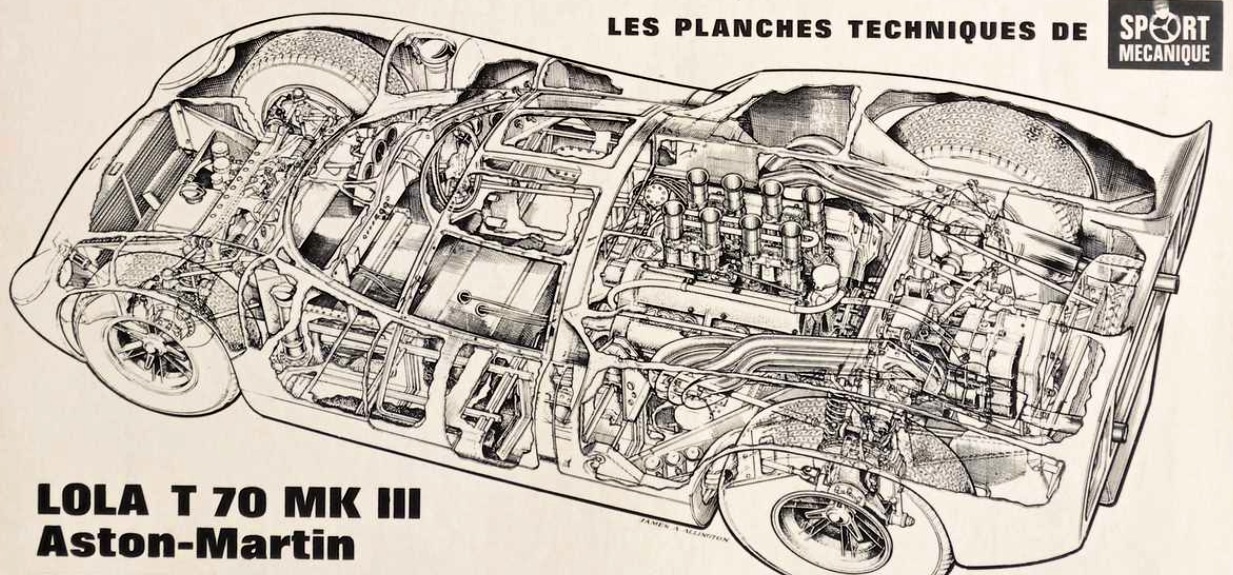
Surely one of the swoopiest, voluptuous and sexiest racers ever, the Lola T70 Mk3 Coupe ‘SL73/101’ was the first Lola Aston built and was shown to rapturous crowd approval at the annual Racing Car Show at London’s Olympia in January 1967. Tadek Marek’s new Aston Martin ‘DP218’ V8 engine also made its first public appearance at the show on the Surtees Racing stand. The announcement of the relationship between the concerns: Lola, Aston Martin and Surtees was made at the show.

On the face of it the association had every chance of success.

The combination of one of sportscar racings best chassis, a lightweight, powerful engine which promised to provide the Lola with better balance than the Chev engined T70s and John Surtees’ track testing ability and sheer speed promised much. Aston Martin chief, David Brown, was of the view that ‘racing improves the breed’ whilst his chief engineer Tadek Marek was not especially enamoured of the high risk strategy. After all, his new engine was designed as a road car motor not a race engine.

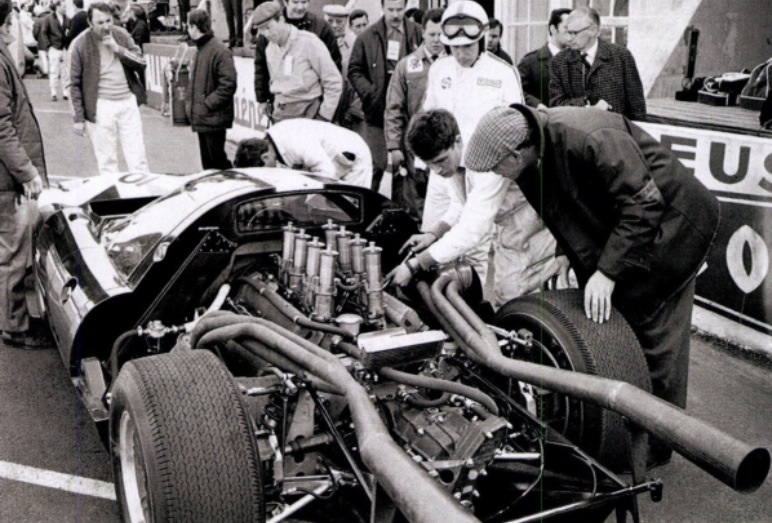
Undaunted, David Brown proceeded and Aston Martin Lagonda supplied special versions of Marek’s design with a capacity of 5008.5cc, a bore/stroke of 98x83mm. The all aluminium, duplex chain driven quad cam, two-valve, dry-sumped, Lucas fuel injected V8 was quoted at 450bhp @ 6750rpm and 413 lb/ft of torque at Le Mans in 1967.

‘DP218 was first tested in a T70 Spyder in Autumn 1966. At that first development stage, using a compression ratio of 11:1 and fitted with four Weber 48IDA carburettors the engine was quoted as giving 421bhp @ 6500rpm and 386 lb/ft of torque. Testing showed there were many problems with the engine, most notably the motor popped a rod through the side of its aluminium block due to oil starvation. Eventually a much developed engine, one of a batch of ten that had been delivered, with attention to the dry sump system, was installed in March 1967 into the new coupe for Team Surtees to run. The most obvious problems in testing were a bad vibration and an inability to rev beyond 6100 rpm.

Le Mans test day 1967 #SL73/101, note the engine is Weber equipped and sans spare and luggage container (unattributed)

The big, booming car was the third fastest machine present in the dry and fastest in the wet at the Le Mans test days on April 8 and 9…

The car was fast through the corners but was unable to top 186mph as a consequence of not being able to pull more than 6000rpm on the Mulsanne. Astons were convinced that Lucas fuel injection, which was shortly to be installed, would cure the problem. The quickest cars were the works Ferrari P4s of Bandini, Amon, Scarfiotti and Parkes with Bandini at the end of the day the quickest. The two Fords driven by McLaren and Donohue ‘rumbled ominously but did not press the button’. Mind you the Mark 4 was timed at 205mph and the Ferrari 198mph on the Mulsanne.

The MotorSport report of the test weekend wryly observes ‘…the two giants (Ford and Ferrari) kept an eye on Lola, Ford knowing that their whole racing effort was born of the brain of Eric Broadley and Ferrari knowing that Surtees can never be underrated’… ‘Although on paper Ferrari left Le Mans as top dog, no one was being fooled by the freak circumstances, for had it been dry on Sunday it might have been a different story and both teams were very impressed with the Lola Aston Martin efforts, remembering their own experiences when running a brand new design for the first time. It seems that Ford did not want to run in the rain for fear of a repetition of the accident to Hansgen last year…’

So, in short, Lola Astons peers were impressed by the car and the threat it potentially represented.

Surtees/Hobbs Nurburgring (MotorSport)

Lola Aston Martin’s first race appearance was at the Nurburgring 1000 Km on May 28…

It was planned to race the car at Spa but it was not ready in time so the beautiful beast made its race debut at the daunting Nurburgring. Lucas fuel injection was amongst the latest refinements to DP218.

On the face of it the car was far from the most nimble present, nor was the Phil Hill/Mike Spence Chaparral 2F Chev on pole, but Surtees popped ‘101’ second on the grid, he shared the drive with David Hobbs. Porsche 910s were the next quickest group of cars.

Surtees stalled the unfamiliar car at the start but was soon up to seventh place by lap seven when a rear wishbone broke going down through the Fuchsrohre. Surtees managed to stop the car without damage to either the machinery or the driver, but that was the end of the meeting; and of useful testing miles. Udo Schutz and Joe Buzzetta won the race in a 910.

Surtees during early laps at Le Mans (MotorSport)

At Le Mans the team had both ‘101’ and a new chassis SL73/121, which was fitted with a longer tail made of aluminium, the standard car’s body was in fibreglass made by Specialised Mouldings. The new car was to be driven by Surtees/Hobbs, the other by Chris Irwin and Peter de Klerk.

Both cars had problems in practice caused by overheating, with the Lola mechanics looking after chassis setup claiming the engines ignition timing to be 180 degrees out. Some sources have it that the overheating was caused by the different aerodynamics of the longer tail which enclosed the engine. In addition, against Aston’s advice, Surtees negotiated a sponsorship agreement to use Marchal spark-plugs. The stage was set for the disastrous events which followed.

Chris Irwin/Peter de Clerk Le Mans (MotorSport)
(unattributed)
Le Mans tail on Surtees’ machine (MotorSport)

Poor Surtees started the classic from grid 13 and then only covered three laps when ‘121’ was outed by a burned piston. ‘101’, the car started by Chris Irwin, was back on grid 25. The drivers struggled with the car for 2.5 hours during which time the mechanics replaced a broken camshaft driveshaft, the engine lost oil pressure, overheated and finally broke a crankshaft damper. The race was won by the Shelby American entered Ford GT Mk4 driven by the all-American crew of Dan Gurney and AJ Foyt.

Post event the Lola Astons were were returned to Slough where the DP218 engines were removed and both cars re-engined with Chevrolet pushrod V8’s, the Aston Martin experiment was over. It was clear the short term prospects of getting the engine race worthy were slim.

After the race engines were stripped at AML it was found that the blocks had twisted and cracks were found in the main bearing housing. The engine went through a major redesign to strengthen the motor’s bottom end which prevented the launch of the Aston Martin DBS V8 road car until 1969, initially six cylinder variants were sold.

Surtees, Nurburgring 1000km (MotorSport)

Surtees had this to say about the Lola Aston Martin program…

‘The Aston V8 could have achieved so much but was a total disaster. We didn’t expect to compete on out and out speed- we were hoping to a degree that weather would play a hand. If it rained a bit as it did at the Nuburgring and the Le Mans practice we were very competitive. Before Le Mans we did a long test at Goodwood, ten or twelve hours, but in the race we only lasted a few laps because Aston Martin had changed the design of the head gaskets! As soon as we got the cars back from Le Mans we took the Aston engines out and that was the end of that’.

In addition Surtees felt the T70 Mk3 chassis was inferior to his Can-Am T70 Mk2 ‘I didn’t like the Mk3. The front suspension was altered and i hadn’t done any development or testing on the changes. I didn’t like the effect on the character of the car, it lacked the positiveness of the original and didn’t suit my style of driving. I didn’t mind a car being a little loose at times, but i couldn’t stand something which you couldn’t point where you wanted. Some people tried to compensate by playing with the aerodynamics, but i just stopped using the Mk3. Luckily the previous years car was still in America so we dragged that out of retirement’.

In the same MotorSport article Surtees notes the contribution of Firestone tyres to the package. He did most of the Firestone testing in the UK, with a lot of work done on springs and dampers, and working closely with Koni to keep pace with tyre development, a spin-off of the Firestone/Goodyear war of the time. ‘That brought its problems too, because as you improve the tyres you put greater stress through everything, but the car retained its user-friendly character’.

There are some contradictions in the quotes above, Surtees was a tough character, after all, despite the Lola’s shortcomings he was off the front of the grid at the Nurburgring so the chassis cannot have been too bad!

If only the Aston Martin engine had the quality of Surtees’ pace in the Le Mans start-sprint!

In the end the Lola Aston Martin program was one of unfulfilled promise, but David Brown was right- racing did indeed improve the breed. The rigours of competition identified design shortfalls in the original DP218 engine which were not apparent during road testing. As a consequence the modified production V8 proved to be a strong, reliable unit- and the basis of a good race engine in the decades to follow!

From Surtees perspective he had bigger fish to fry. He was juggling multiple race programs on both sides of the Atlantic with the Lola/Honda F1 exercise, Lola T100 Ford FVA F2 car and in the Can-Am where Lola’s dominance was being overtaken by the ‘papaya menace’, Bruce McLaren’s M6 McLaren Chevs. John’s endurance T70 program was best advanced by bolting Chevys into the back of the cars in place of the Aston engines. Only a week after Le Mans Surtees ran at the front of the pack so engined at the Reims 12 Hour…before popping his Chevy engine. Unfortunately the Chevs rarely provided the reliability the T70 needed for endurance success in the blue riband events. But what a car all the same!…

By the July 1967 Brands Hatch 500km the Surtees/Hobbs Lola T70 Mk3 was Chev V8 powered (MotorSport)

1967 Endurance Season…

I wrote an article a while back about the Ferrari P4 which also profiled the main protagonists of sportscar racing in ’67- Ford Mk4, Ferrari P4 and Chaparral 2F Chev which may be of interest. The article also has photos of the Lola Astons at Le Mans.

See also this article on Le Mans 1967.

Bibliography…

‘Aston Martin: A Racing History’ Anthony Pritchard, ‘Lola, The Illustrated History 1957 to 1977’ John Starkey, MotorSport May 1967 and August 2003, Team Dan

Photo Credits…

Rainer Schlegelmilch, Dave Friedman Archive, Autosport, MotorSport, LAT

Etcetera…

(MotorSport)

Three more shots of the Surtees/Hobbs machine in the Nurburgring paddock.

(MotorSport)

Tailpiece…

The Lola Aston Martin relationship was rekindled a while later, here the Lola B08/60 Aston Martin 6 litre V12 in 2009…

Finito…

Geoghegans were the Australian importers and distributors of Lotus cars from the mid-sixties to the mid-seventies when Jim Smith’s Peter Manton Motors in Melbourne stepped up to the plate

The brothers Geoghegan are no doubt well known to most primotipo readers by now, even you international mob. Between them they had ‘Taxis’ or Touring Cars and Open-Wheeler racing covered in Australia. Ian or ‘Pete’ Geoghegan was a multiple national champion aboard cars with a roof and Leo was similarly credentialed in the more rarefied and refined single-seater world.

Whilst the Lotus Racing Halo internationally was huge in the mid-sixties for all of the obvious reasons, the Geoghegan connection must have polished the Lotus brand considerably in this part of the world too.

Who wouldn’t want to buy a car from them and then have it serviced there? Why, if you were lucky during February, you might even time your trip to have your Elan’s Webers tickled with the visit of Team Lotus who operated from the Paramatta Road, Haberfield dealership during the Warwick Farm Tasman weekend.

(Dalton)

The Lotus franchise in Australia is a bit of a ‘hot spud’ really- no one has distributed the things for a long time.

Not even those who were multi-franchise dealers and therefore had the earnings of other marques with greater volumes to support the lower financial contributions of what has always been a very niche brand in Australia, the brothers Geoghegan probably the longest lived of the dealers.

Some well known motor racing names have been involved in flogging the wonderful but idiosynchratic cars down the decades.

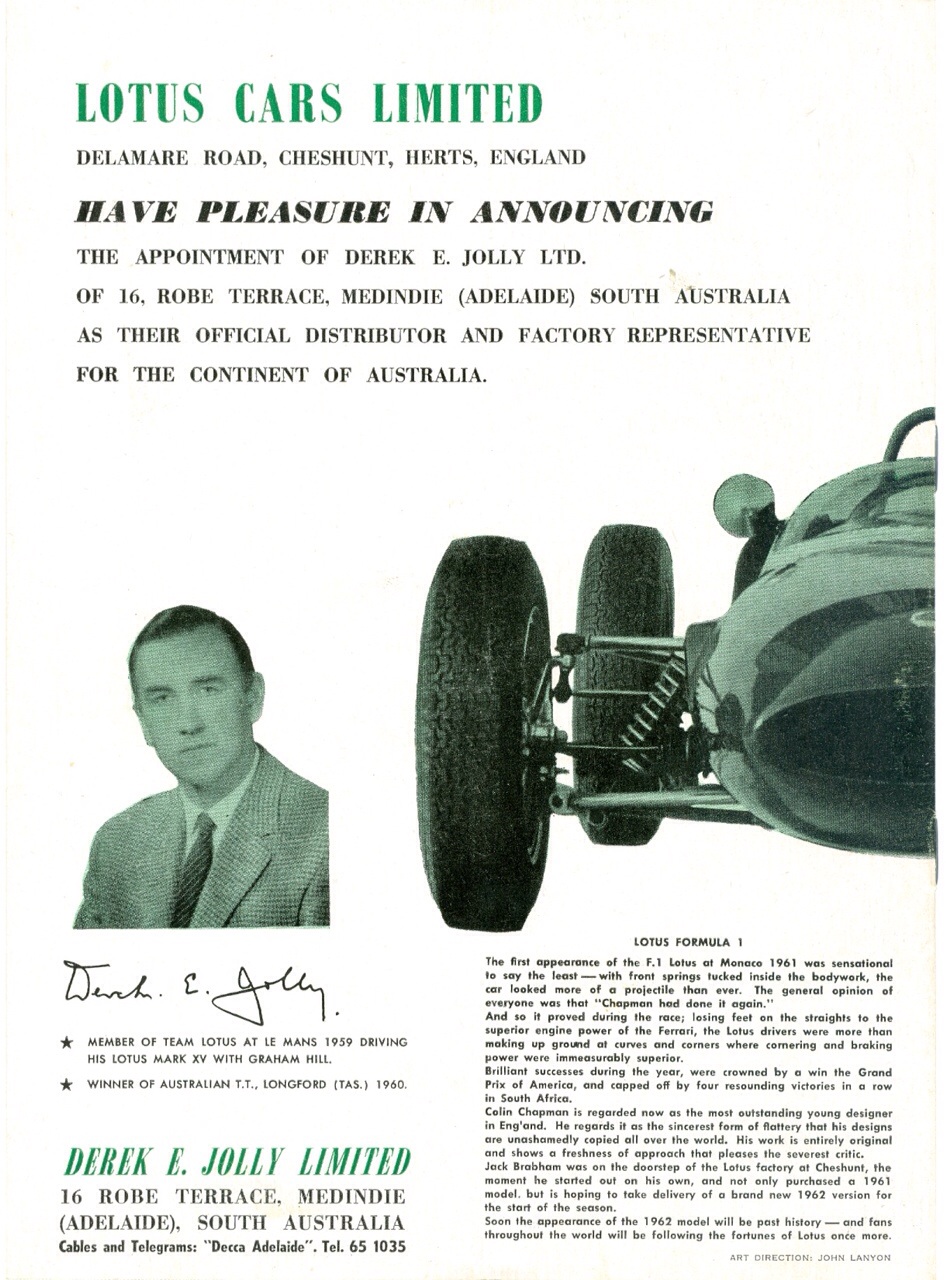
Alec Strachan was the original importer, he was based at Waitara, Sydney and negotiated the rights with Chapman off the back of purchase of a Lotus 6-the first of Chapman’s machines in Australia. Then Derek Jolly with his impeccable racing and engineering connections to Chapman himself took over, but that was never going to really work, Adelaide is a long way from the main East Coast markets especially back then given the transport and road infrastructure. Adelaide, Perth, Brisbane and Hobart had tiny populations for such a niche product.

Performance Automobiles sold a few in Hobart and in Melbourne John Roxburgh, and Dick Thurston’s Pitstop Motors on the Nepean Highway, Brighton waved the Hethel flag. At the same time Lance Dixon sold plenty of used ones, many times I rode by bike from North Balwyn to Doncaster to dream about a red Europa or Elan. Simply Sportscars of South Melbourne have the rights now- these blokes are hard-core enthusiasts and should do well where others have failed.

Whad’ll she do mister? Leo Geoghegan’s ex-Clark Lotus 39 Repco sitting forlornly on the 253 Parramatta Road lot in 1970. Leo raced the car finally, having acquired it from Team Lotus after the 1966 Tasman Series, in the 1970 Tasman, then it was put to one side to sell whilst Leo raced to Gold Star victory in a new Lotus 59 powered by a Waggott 2 litre DOHC, 4 valve injected engine (Fistonic)

These photos by Milan Fistonic capture the late-sixties flavour of the Geoghegan’s dealership in Sydney’s Parramatta Road, ‘Auto Alley’.

The shots are very much dated as being late 1970, the year in which Leo stopped racing his evergreen ex-Clark Lotus 39 Repco V8. There it is, the 1969 JAF Japanese Grand Prix winner sitting on the used car lot just waiting for a punter with the necessary readies. Click here to read my article about this wonderful car; https://primotipo.com/2016/02/12/jim-clark-and-leo-geoghegans-lotus-39/

It was not an easy car to move at the time with F5000 in the process of becoming the new ANF1, to replace the 2.5 litre Tasman Formula. The nutbags at CAMS made F5000 cars eligible to contest the 1970 Tasman Series but not the domestic 1970 Gold Star- that title was won by Leo G in the Lotus 39’s replacement, a brand new Lotus 59B to which he bolted a superb circa 275bhp 2 litre Waggott engine built not too far from the dealership. The 39 fell into the very best of hands, John Dawson-Damer, who did a brilliant job restoring it to its original, ex-works 2.5 litre Coventry Climax FPF engined form. It’s still in Australia, happily!

It seems fitting to provide some period written flavour to accompany the photos.

To do so I have reproduced the wonderful recollections of ‘DanTra2858’ he contributed to ‘The Nostalgia Forum’, Daniel worked for the brothers Geoghegan at that time, the late sixties. I’ve positioned his thoughts around several different headings to preserve some semblance of flow.

(Dalton)

On assembling Lotuses in Australia.

The cars arrived by ship from Hethel ‘CKD’ or in Completely Knocked Down form… ‘…1969, also working there at the time was Barry Lake (racer and very well known racing journalist) and Wally Willmott (for many years Bruce McLaren’s right hand in the nascent years of BM Motor Racing in the UK) Service Manager was Bob Everitt.

With a little help to remove a Europa from its crate and the motor/gearbox and diff assemby, it took me about 10 hours to assemble a car ready for registration.

There were some long days assembling the cars mainly due to the clutch plates attaching themself to the flywheel. Of course this did not show up until the installation of the motor/gearbox into the car on initial start up, sometimes it could be rectified by starting the car in gear but not always. Then out with the motor/gearbox as that was easier than split, fix the problem then put it all back together again, good days!

When Lotus cars were imported…they came in a open frame wooden crate with the car wrapped in plastic sheeting, that was the full extent of protection (during the long voyage from England) The motor/gearbox assembly was in a wooden box complete with the suspension, tailshaft , diff and wheels. Each crate/box had identification numbers on them to match the motor to body, so the first thing to do was match up the components to assemble a car.

When this was done the body crate was opened, plastic wrapping removed and using 2 trolley jacks the body was moved into the workshop and placed on modified jack stands. Then the motor box was opened and all suspension parts/wheels were removed and taken into the workshop ready for assembly, by this this time it was time to stop work for morning tea!

Now refreshed it was time to fit the suspension and wheels so the car was now a roller which made it easier to work on. When assembling the rear suspension the diff, drive shafts, Hillman Imp rubber doughnuts etc were all fitted. Now for lunch.

So with a full belly it was time to bring in the motor/gearbox, tailshaft and fit them into the car, along with the exhaust system. When this assembly was bolted in, cooling hoses, electrics and other parts were fitted. Then it was time to present to this ‘new arrival’ its first full meal of lubricants including brake fluid, so we then bleed the brakes. By this time it was about 4 in the afternoon so a cuppa was in order, then back to work.

Now that the car was fully assembled the work really started. Re-check that all previously assembled parts were correctly assembled and all bolts/nuts were tight, oil levels were correct and that there were no leaks in the brake hydraulic system and fluid was at correct levels. Next I checked that the clutch operated correctly and if not then one of two steps were taken to rectify the adhesion of the clutch plate to the flywheel/pressure plate. If there was no trouble with the clutch it was time to connect the battery and start the motor, let it warm up, check for fluid leaks and bleed the heater system in the cabin of the car by slackening the bleed screw on top of the heater core remembering to tighten it after all the air was bled off. If there was clutch trouble the first thing we did was to start the car while in gear, this usually caused the clutch plate to release then operate correctly. If not then it was out with the motor/gearbox assy to fix the problem then pop it back into the car- this would add 3 hours to the assembly time.

If all went well it was now about 6 pm but still the to-do list list included wheel alignment, checking that all lights operated correctly and that all of the electrics worked. Then tyre pressures were set with a final check for leaking fluids. By this time it was about 8pm and another 12 hour day was complete leaving the road test for first thing the next day- that also included cleaning up wood crates and plastic wrapping. Then onto normal service work with another assembly starting the next day. Well folks that is how it was done at Geoghegans, I may have missed a few steps somewhere along the way, it is a long time from 1969…you have the picture’.

Plenty of lonely S2 Europa’s in 1970 (Fistonic)

On The Hot Sellers of the Lotus range…

‘The sales section always required stock on the floor that covered the Lotus range excluding Super 7’s. (Not sure why they were not imported to Australia, Chapman didn’t do the deal with Graham Nearn at Caterham cars to take over the rights to build 7’s until 1971 from memory, so Lotus Components were certainly still building them in the late sixties)

The slowest moving car was the Elan Plus 2 so every time one was sold we would assemble another but that did not happen often, the most popular was the Elan Coupe followed by the Europa, we would assemble 2 or 3 a week depending on sales of the model.

I found the Europa quicker to assemble than the Elan. My first experience driving a Europa along Paramatta Road (a main artery into and out of Sydney in the days before freeways it was the ’normal’ way to go between Melbourne and Sydney so there was plenty of local and interstate traffic inclusive of large semi-trailers) was just straight out frightening especially when a double decker bus pulled up alongside me while waiting for the traffic lights to change to green. Sitting in the Europa I found myself looking up at the centre of its wheels with the bus towering over me, a feeling of vulnerability quickly came over me.’

Tried and true technique of naked ladies to get us blokes to scan the pages of a brochure in a thorough manner. Lotus Elite brochure , must be US issue, way too racy for 1960 Australia (Dalton)

On Painful Customers…

‘Pete Geoghegan did not come down to the service section much at all…on one of those times he was showing off on a motor bike, doing wheel stands in the lube bay then the 6 foot dash from the lube bay through our parts area into the Lotus workshop then back again with the biggest smile I have ever seen on a guy that has just achieved what no-one else has done.

One Elan FHC I do remember very well.

Its owner arrived at our service area unannounced while we were having morning tea wanting something fixed right away, I told him that I would look at it as soon as I finished my coffee but that was the wrong answer for this guy.

He then spoke to Bob Everitt, the Service Manager and was told by him that I would look after his car as soon as I had finished my coffee, this slowed him down a bit but he kept on looking to his watch. So I finished my coffee quickly…went into the service bay held out my hand and introduced myself, without a blink he shook my hand introduced himself and told me what the problem was, I fixed it in 10 minutes and he was on his way, oh his name…Warwick Brown, I serviced his Elan from then on…’(In 1969 20 year old WB would have just been starting his racing career in a little Brabham owned by Pat Burke- who was still his patron when he won the Tasman Championship in 1975 aboard a Lola T332 Chev F5000)

Photographer Milan Fistonic with an eye for Plus 2 Elans (Fistonic)

Lotus equals ‘Lots Of Trouble Usually Serious’…

‘Whilst at Geoghegans I only worked on one Elite and was very impressed by the construction of the car as a full mono-fibreglass enclosure setup…it was on sale in the yard so it would have been a quick mechanical check up prior to the car going on sale. The main thing that had to be done, as with all fibreglass Lotus’ was to make sure that the electrical earth set up was not corrupted by corrosion on the body to chassis alloy mounting bobbins in the body. That was number one check on all Lotuses even new ones. The alloy bobbins on the Elite are for suspension mounting, but there again steel bolts into alloy bobbins, which means corrosion of the bobbin which have been known to become loose in their fibreglass enclosure- meaning fibreglass repairs.

Lotus Elans were bad for water leaks at the top of the A-pillar and in the boot. We tried re-gluing the door sealing at the top of the A-pillar but all to no avail as the inside plastic section of the seal kept on pulling it down leaving a small opening at the top where the seal assembly transferred to the horizontal. The final Geoghegan factory fix was to push the seal assembly up as hard as you could into the top of the A-pillar while your offsider drilled a one eighth inch hole through the vinyl inside section of the seal and into the fiberglass body, then insert a pop rivet and pull it home and there was a permanent fix with nothing but happy customers. By the way we didn’t leave the pop rivet just plain silver so it would show, we concealed it by painting it with a black texta.

For me the hardest thing while working at Geoghegans was learning how to spell their name, Smith or Brown would have been much easier!’…

Photo Credits…

Milan Fistonic

Bibliography…

DanTran2858, The Nostalgia Forum, Stephen Dalton Collection


image001

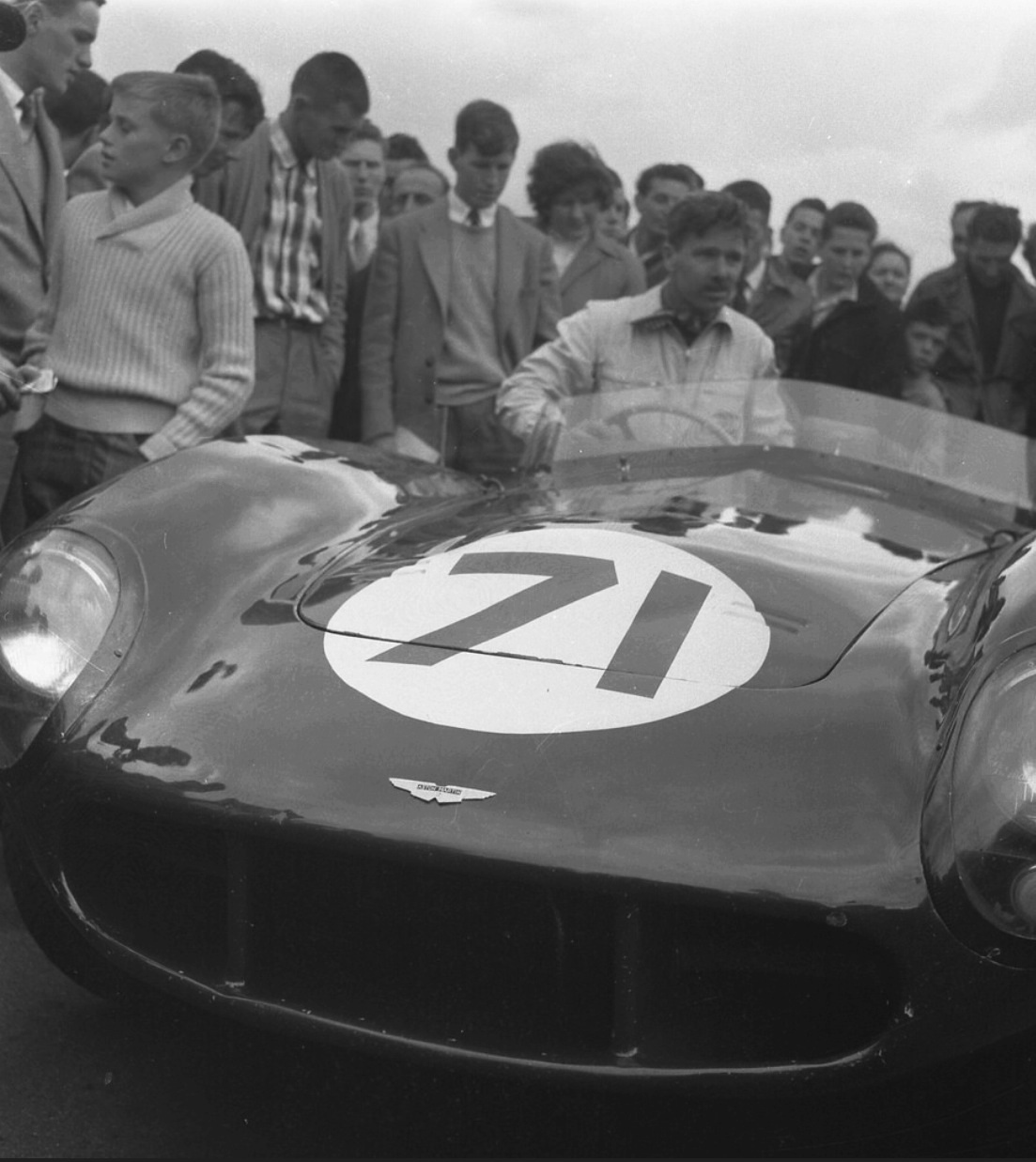
Looks of wonderment and amazement at the voluptuous lines of the Aston’s Frank Feeley penned body.  The ‘Wow Factor’ of contemporary racing cars never changes whatever the era does it?!…

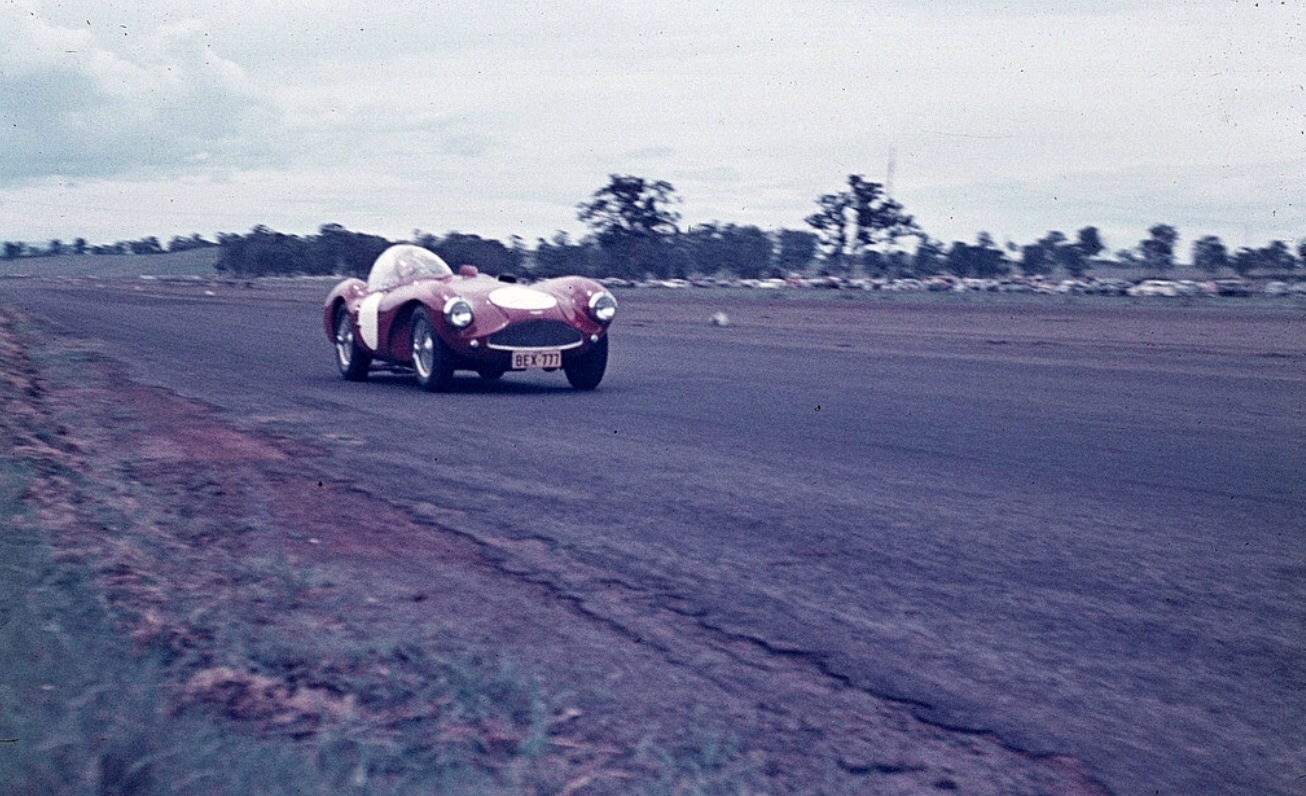
Here it’s a Melbourne crowd on February 28 1958. Its the end of the long hot Australian summer but the crowd are well rugged up, Melbourne is notoriously ‘four seasons in one day’ sometimes and Fishermans Bend is an exposed windswept place at the best of times. At the wheel of the road-registered, ex-works Aston Martin DB3S chassis DB3S/9 is a youthful David McKay.

McKay aboard DB3S/9 at Fishermans Bend in February 1958. Nose of the car showing minor scars of battle, perspex headlight covers fitted to this car from its birth. First race the ’56 Rouen GP in May, then 2nd @ Le Mans ’56 driven by Moss/Collins, Salvadori was 2nd at Goodwood in September- car retained by Astons into 1957, the DBR1 the front line weapon that year with Brooks racing DBS3/9 at Easter Goodwood for 3rd. It was then used by the works for the last occasions as a practice car at Silverstone for the British Empire Trophy and for the Nurburgring 1000Km before sold by John Wyer to McKay with funds provided by Ampol (Westaway)

At the time he was ascending the driving ranks having cut his racing teeth in MG’s. He made it into the elite group too- let’s not forget were it not for a ropey jumped start call he would have won the 1961 Australian Grand Prix at Mallala aboard a Cooper T51 Climax. David would soon be known as much as a journalist, successful businessman and entrant-entrepreneur via his business ‘Scuderia Veloce’ as a driver though.

McKay raced this car to wins in the sportscar races that Fishermans Bend weekend, and was very successful in it throughout the country, taking 8 wins from 9 starts.

His only defeat, 2nd place was at the hands of Doug Whiteford’s ex-works Maser 300S in the Tasmanian Tourist Trophy at Longford in early 1958 during the Gold Star meeting.

McKay and passenger, Baskerville 1958 (HRCCT)

After Longford McKay and his crew took the car south to Hobart racing it at the new Baskerville circuit (above) in April and taking a comfortable win, and setting a new outright circuit record from Lyn Archer’s Cooper 1100 but churning through more of his diminishing stock of racing Avons due to the abrasive nature of the surface.

An amusing side-story is that the officer in charge of the old SS Taroona ship between Devonport and Port Melbourne took exception to the oversized trailer and refused to load it until David made representations to the Captain who graciously allowed the equipe aboard ensuring that important commitments to sponsors could be met.

db 3 s engine

Engine of the ex-works/McKay DB3S/9, raced at Albert Park, November 1958 by Stan Jones. 6 cylinder 2922cc DOHC 2 valve, twin plug all alloy engine fed by 45DCO Weber carburettors. Circa 225bhp @ 6000 rpm (Kevin Drage)

His last race in the car was successful, he took an Australian Tourist Trophy victory at Mount Panorama, Bathurst in October 1958 in what McKay described as ‘the faithful old ex-works Aston’s…greatest Antipodean win’.

The race was not an easy one. Initially Bill Pitt’s Jaguar XKD led and then Doug Whiteford, the formidable, forceful three-time AGP winner took the lead from McKay with Pitt 3rd. On lap 10 Doug had an enormous accident when the Maser was caught by a sudden gust of wind after coming over the second Conrod Straight hump threw the car out of control with the Maser spinning and hitting the right hand fence three times. Whiteford was almost flung from the car as it skidded backwards down the escape road and into another fence. Fortunately the St Kilda racer was only bruised by the wild ride.

McKay then led with an intermittent engine miss from Derek Jolly’s Lotus 15 Climax, a light rain shower adding to the degree of difficulty towards the end of the race. McKay won from Jolly, Ron Phillips and Frank Matich- Aston DB3S, Lotus 15 Climax, Cooper Jaguar and Jaguar XKC.

The weekend was a brilliant one for the Sydneysider as his new Jaguar Mk1 3.4, just imported for him by Ampol trounced the hitherto dominant Repco headed Holden sedans of John French and Leo Geoghegan in the sedan car handicap, to start the ‘Jaguar Era’ of Australian Touring Car racing.

After the Tourist Trophy win Stan Jones bought the racer but wasn’t really happy with it. The wonderful Le Mans second placed 1956 car then passed into Ray Barfield’s hands in Western Australia where its contemporary racing history ended in the early sixties. A summary of the cars history is in this article, rather than repeat myself;

‘Bunbury Flying 50’, Allan Tomlinson, Ferrari Tipo 500 et al…

McKay’s first Aston, a production DB3S chassis #102 in the Carrathool paddock during its Australian LSR record breaking weekend in February 1957. Interesting to know who crafted the aero pod beneath which McKay sat and cooked! (Jek)

McKay was a very dab hand at the wheel of Aston’s by the time he bought his ex-Moss car…

He was part of the trio of privately run DB3S,  ‘Kangaroo Stable’ of cars raced by Australians Tony Gaze, Jack Brabham, Les Cosh, Dick Cobden, Tom Sulman and McKay in Europe in 1955.

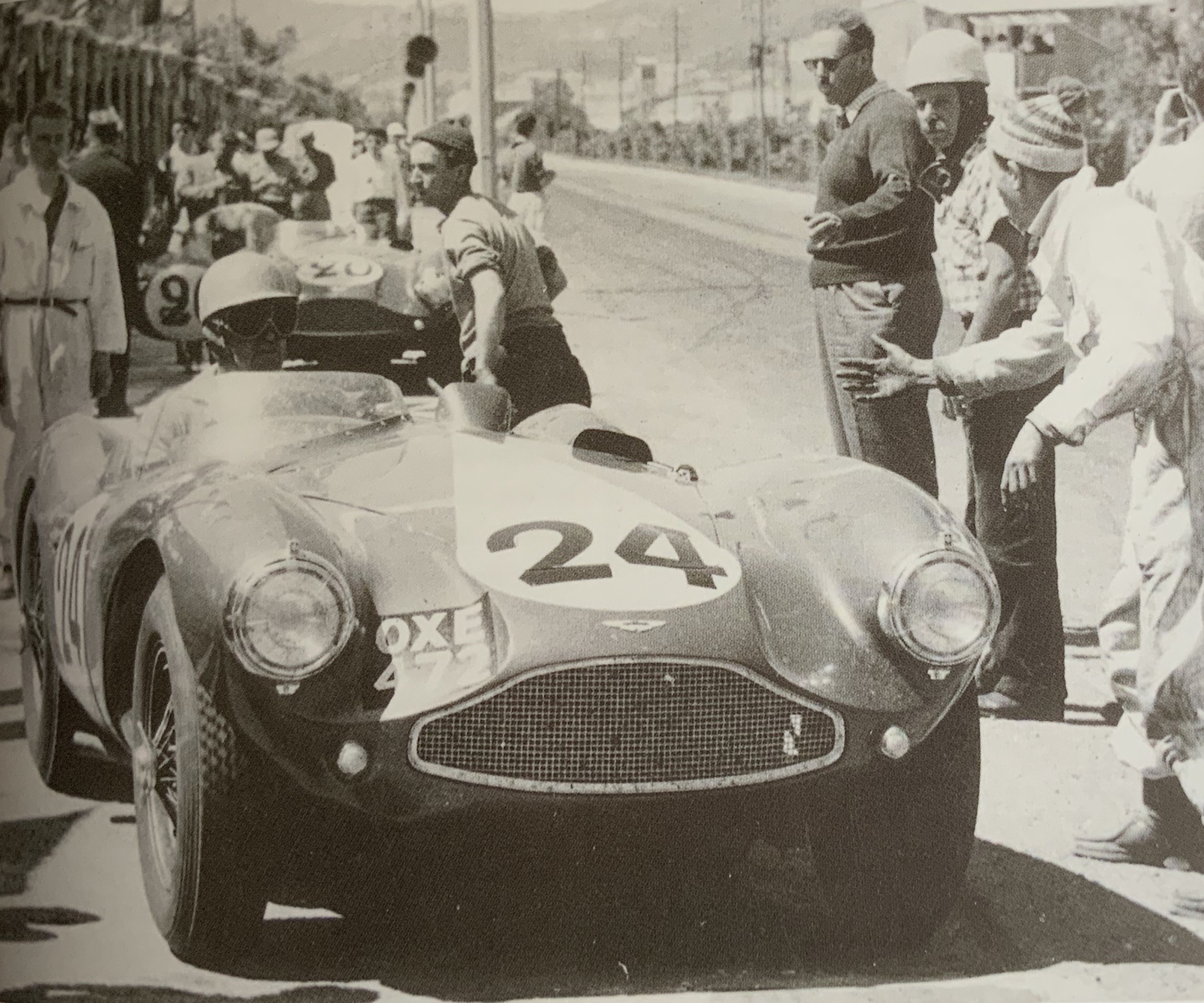
McKays car, initially delivered to Tony Gaze, chassis DB3S/102 took the best result of the tour cut short by the cancellation of many sportscar races in Europe after the Le Mans disaster- McKay and Gaze were second in the 29 May Hyeres 12 Hour behind the winning Ferrari 750 Monza driven by Canonica/Munaron

At the end of the European Safari which included Oporto (Gaze 8th) and Goodwood (McKay/Gaze DNF distributor drive) David shipped the car straight to New Zealand for a number of races there including the Formula Libre NZ GP in January 1956,he retired from the Ardmore event won convincingly by Stirling Moss in a Maserati 250F.

The engine of the car was shipped back to the UK for a rebuild after a major failure during a race at Invercargill. From May 1956 production DB3S’ were fitted with twin-plug 210 bhp engines, it was in this form the engine was rebuilt and delivered from Feltham back to Sydney. The beautiful car was again race ready by early 1957.

Tony Gaze about to rejoin the May 1955 Hyeres 12 Hour, he shared the car with David McKay- car #20 behind is the Graham and Peter Whitehead DB3S DNF (CAMS)

The stunning colour photographs were taken of ‘102’ in February 1957 at Carrathool a tiny village 680 Km west of Sydney between Narrandera and Hay in New South Wale western Riverina.

The main automotive attribute of the town was a long, straight stretch of road between Carrathool and Gunbar which was ideal for record setting, and so it was that various Ampol sponsored cars sought to break some Australian speed records. The then current Australian LSR was the 136.4 mph set by Jack Saywell’s 2.9 litre Alfa Romeo Tipo B/P3 at South Australia’s Coorong in 1939.

After plenty of careful preparation inclusive of incorporating the beautifully made perspex fairing onto his Aston, McKay broke the record setting a time over the Flying Kilometre of 143.19 mph on the morning of 19 February 1957. The ‘Canberra Times’ reported that McKay made two full speed runs on the course, ‘during one run he skidded on a patch of loose dirt at 140 mph’.

This speed was soon eclipsed by other cars but the DB3S held the class record for some years.

David McKay at speed during the Ampol sponsored record-breaking weekend in early 1957. Carrathool a tiny hamlet with now around 300 inhabitants. A straight, flat road with a decent surface a long way from major population centres was ideal record breaking territory! (Jek)

The car was first raced in Australia at Easter Bathurst in April 1957, he was 2nd in the sportscar handicap and won the sedan and sportcar handicap from Paul England’s Repco headed Ausca, passing the very fast special built at Repco Research by England ‘running up to 139.3 mph to do so and clocking fastest quater mile time for the day’.

But the car saw little further use as the quicker ex-works machine arrived in Sydney in September 1957. DBS/9’s first race was the October 1957 13 lap NSW Sportscar Championship at Bathurst, an event the combination won comfortably with McKay taking the lap record despite using only 5200 of the Aston’s available 6000 rpm. Bill Pitt’s Jaguar D Type was timed at 144 mph on Conrod Straight with McKay at 136 mph using his self imposed rev limit.

Both of these extremely valuable cars still exist but sadly left Australia many years ago. Those of you with collections of Australian ‘Sports Car World’ magazine should have a fossick through them as McKay wrote two sensational articles about the ownership of his two Aston’s in the seventies, or maybe the eighties!..

Technical specifications as per text (Tony Matthews)

Aston DB3S Technical Specifications…

The Aston Martin DB3S was built from 1953 to 1957, 32 were constructed excluding the single-seater variant ‘DP155/1′ raced by Reg Parnell in New Zealand in 1956.

Fundamentally Willie Watson’s design was a shorter, lighter and stiffer car than Eberan Eborhorst’s Aston DB3. The car evolved over just four months making its debut in Reg Parnell’s hands at Charterhall on 23 May 1953.

The cars were designed around a period typical ladder frame chassis which was 7 feet 3 inches long- 6 inches shorter than DB3. The frame comprised twin tubular members of 4 inch 16 gauge chrome molybdenum steel and three 14 gauge four, and five inch cross-members. The shorter chassis made the car nimbler than its predecessor if somewhat skittish on bumpy surfaces. The track was reduced from 4′ 3″ to 4’ 1″.

Frank Feeley designed the very stylish body, as sexy as the DB3 was dowdy. More than a nod had been given in the direction of the contemporary Maserati A6GCS it seemed. Overall the car was shorter, narrower and lighter than the DB3 and importantly it ‘looked right’ straight out of the box.

Front suspension was independent by trailing links, torsion bars, piston type dampers and a roll bar. A De-Dion rear axle was used sprung by a torsion bar and located by trailing links and a Panhard rod, again with piston type shocks.

Naturally a David Brown gearbox was fitted, the S430 ‘box a 4 speeder with reverse, final drive was by spiral bevel in a light alloy casing with a ZF slippery diff usually fitted. Brakes initially were two-leading shoe Alfin drums- 13 inches in diameter at the front and 12 inches at the rear. From 1955 Girling disc bakes were specified, the rotors were 11.5 inches in diameter front and rear. Precise rack and pinion steering was fitted, two turns were required lock to lock.

A 2922cc all alloy DOHC, 2 valve, 6 cylinder engine provided the cars heart. It had 4 main bearings and wet cylinder liners with the valves disposed at an included angle of 60 degrees. Initially fitted with 35DCO Weber carburettors the engine gave 182 bhp @ 5500 rpm and 182 lb/ft of torque at 3800 rpm on a compression ration of 8.5:1.

The cars were of course developed extensively throughout their racing life with the works cars fitted with twin-plug heads and 45DCO Webers from May 1954 giving 225bhp @ 6000 rpm.

The ‘Kangaroo Stable Cars’ (DB3S/102 Gaze-McKay, DB3S/103 Sulman, DB3S/104 Cosh) delivered in early 1955 all had the 200 bhp Weber 40 DCO engine- when announced at Earls Court in October 1954 the production cars had a feeble and uncompetitive 180 bhp on triple SU’s.

For the sake of completeness special works engines included a supercharged 240 bhp car raced at Le Mans in 1954 and a 2992cc normally aspirated variant raced at Dundrod in 1955.

In an era of unlimited sportscars the production based 3 litre DB3S was rarely an outright contender, the big guns, depending upon the year were the Benz 300SLR, XKD Jags and Ferrari V12’s of varying capacity. But with a change to 3 litres for the manufacturers championship and a more uncompromising approach the DB3S’ younger brother triumphed at Le Mans in 1959 and won the manufacturers title to boot. The path to that success was in part via the DB3S journey…

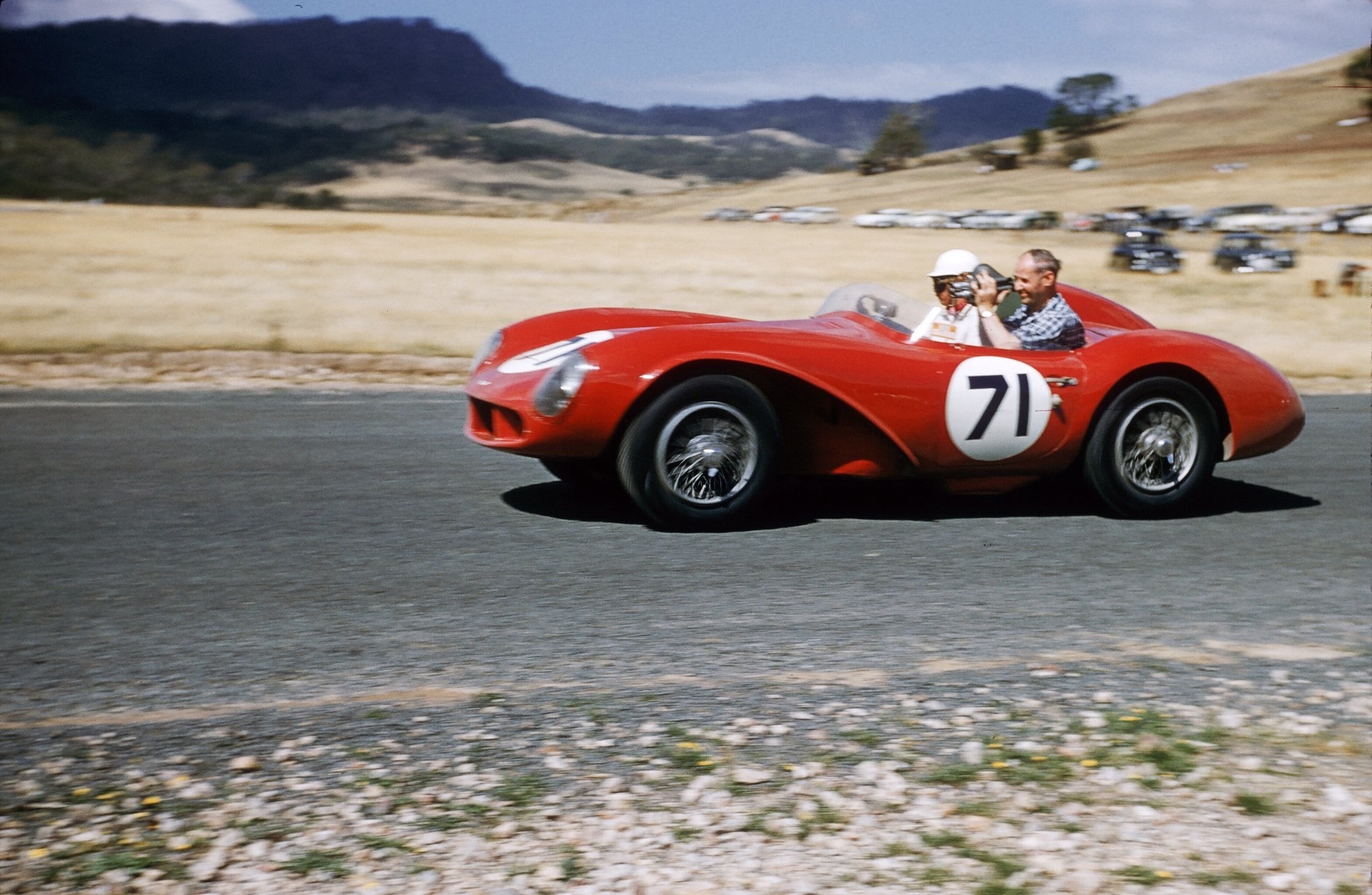
David McKay and passenger doing some camera work at the then new Baskerville circuit, Tasmania in early 1958 (HRCCT)

Etcetera…

(unattributed)

McKay on the left and Doug Whiteford, Maserati 300S with Bill Patterson’s Cooper Climax Bobtail behind?

Its Longford before the startline was moved from here- towards the end of The Flying Mile, before Mountford Corner to what became Pit Straight- the stretch after Mountford.

(unattributed)

Perhaps an Ampol publicity shot- ‘Rice’ trailer? Nice rig.

Bibliography…

‘Historic Racing Cars in Australia’ John Blanden, ‘David McKay’s Scuderia Veloce’ David McKay, ‘Aston Martin: A Racing History’ Anthony Pritchard, ‘Bathurst: Cradle of Australian Motor Racing’ John Medley, ‘The Canberra Times’ 20 February 1957

Photo Credits…

Don Westaway, Kevin Drage, Ampol, Sharaz Jek, Tony Matthews, HRCCT- Historic Racing Car Club of Tasmania, CAMS

Tailpiece: McKay at high speed in DB3S/102 during a practice run at Carrathool, in New South Wales western Riverina in April 1957…

(Ampol)

Finito…


(SLSA)

AG Bungey’s or GB Woodman’s Humberette 5HP on the startline of the Magill to Norton Summit Hillclimb, Adelaide, Saturday 16 December 1905…

The first of these events run by the Automobile Club of South Australia (ACSA) was held a year before, on 17 December 1904. I was terribly excited at finding a shot of a competitor in the first hillclimb in SA, but upon further research it appears the superb photograph is from the 1905 event, the second of three, the final in-period event being held in 1906.

The photo took my breath away, there is so much going on. I find fascinating the clothing and attire of the drivers, officials, kids and teenagers. Love the deer-stalker hat and pipe of the dude on the left. The officials with writing pads are HR Harley and HR Hammer- do let me know if any of you are related to them. The Steward at the start line is the Club Secretary RJ Hancock, perhaps he is the fella to the right of the car?

The competition was held in ideal Adelaide summer weather with what slight wind there was, blowing down the hills, perhaps impacting times slightly.

Bungey’s time for the 4 mile journey from the East Torrens Hotel at Magill (corner of what is now East Street and Magill Road) up into the Adelaide Hills finishing line at the White Gate, Norton Summit, was 42 ½ minutes which suggests he was either incredibly slow or had some type of mechanical drama. Woodman completed the distance in 30 min 7 seconds. Fastest time of the day, to use modern phraseology, was recorded by ES Rymill’s Darracq 15HP who did a time of 9 minutes 10 seconds. So keen was Rymill to win the event that his car was rebuilt, ‘like many cars it had been dismantled for the occasion’. Great to see the competitive spirit from motor racing’s most formative stages in South Australia!

Pictured below are the Rymill brothers, notable pioneering South Australian motorists, aboard their fast Darracq at the top of Belair Hill on the way to Victor Harbor during the ACSA Reliability Trial held during Easter 1905, 21 and 22 April. These type of reliability events were very popular in Australia in the early years of motoring with this one the first organised by the ACSA.

Adelaide’s ‘The Advertiser’ newspaper characterised communal views on the car at the time: ‘The average citizen considers that the principal characteristic of a motor car is its fickleness. In his opinion it will go sometimes, but often it will not go. To disabuse people of this erroneous idea the club inaugurated the trial, which has had the effect of proving that as a general rule the motor car is reliable, and, considering the distance covered at a high speed was 228 miles, there were comparatively few mishaps, and all of those were of a trivial nature. Of the 14 cars which competed seven (including the Rymill Darracq) succeeded in accomplishing the entire 228 miles, constituting a very severe test, within schedule time, and gained the full number of marks’.

(SLSA)

This trial comprised two legs, the first of 120 miles on Good Friday from Mitcham, an Adelaide suburb to Victor Harbour, site of the 1936 South Australian Centenary Grand Prix aka ‘1937’ Australian Grand Prix held in December 1936 on the Fleurieu Peninsula. On the Saturday, 108 miles were covered from Adelaide to Mannum.

Twenty one cars and five motor cycles contested the Norton Summit Hillclimb with the competitors arranged in classes according to their quoted power ‘and sent away at different times to obviate passing each other’ with ‘officials stationed at all the sharp curves on the road’. The quickest bike was N Jackson’s 2.5HP water-cooled Lewis, his time was 10 minutes 6 seconds.

The Advertiser’s report notes ‘There was not one breakdown or mishap, which speaks volumes for the excellence of the cars owned by South Australia’.

Just a brief note to put these early, formative motor sporting contests into the broader framework of motoring competition in Australia at the time. When I wrote about Australia’s first ‘Motor Car Race’ at Melbourne’s Sandown Racecourse on 12 March 1904, (link below) respected Australian motor racing historian/author/racer John Medley said ‘that was brave!’ meaning the topic is somewhat contentious. It would be great to hear from others who may feel an event other than the Sandown contest was the first.When was the first ‘race’ in New South Wales for example?

Australias First ‘Motor Car Race’: Sandown Racecourse, Victoria, March 1904…

In South Australia, for the record, it appears the first hillclimb, legal one anyway!, was the 17 December Norton Summit event on Saturday 17 December 1904 and the first ‘car race’, ‘where motor cars take the place of horses, and race in competition at their top speed’, was held at Morphettville Racecourse, 10 Km from Adelaide on Saturday 12 November 1904. This meeting was also promoted by the Automobile Club of South Australia.

FS Rymill had earned the nickname from Adelaide tram and cab-drivers of ‘The Flying Dutchman’ for his fast driving exploits in traffic. He and his Darracq 15HP were the stars of the show that Morphettville November day winning the 3 mile ‘Tourist Car Race’ from scratch, in this race a full complement of passengers were carried averaging at least 10 stone or over in weight. Rymill then won heat 1 of the ‘Starting Competition’ (starting the car by handle and then racing) and finally the 3 mile ‘Heavy Car Race’. Perhaps the latter was the premier event of the day, where Rymill again won off scratch from the De Dion 12HP of A Allison and De Dion 8HP of Dr Gault.

Bibliography…

‘The Advertiser’ Adelaide 20, 22 and 24 April, and 22 December 1905, ‘Chronicle 12 November 1904, ‘Adelaide Observer’ 19 November 1904

Photo Credits…

State Library of South Australia


(Fistonic)

Frank Matich’s Brabham BT7A Climax leading Jim Palmer’s Cooper T53 Climax around the 2.897 Km Mount Maunganui road circuit, New Zealand, 28 December 1963…

Mount Maunganui is a beach town at the southern end of Tauranga Harbour in The Bay of Plenty in the north of New Zealands North Island. Only two ‘Bay of Plenty Premier Road Race’ meetings using public roads around the towns wharf area were held, in 1962 and 1963. The circuit was oblong in shape, the startline was in Totara Road and ran down Hewletts Road, onto Tasman Quay and then Hull Road. The creation of the permanent Bay Park circuit in the area supplanted the road course which was created by Joseph and Graham Pierce and Feo Stanton. To create the track they had to tar-seal a section over a railway line and then remove it after the weekends racing to allow the trains to operate the following morning!

Race winner Jim Palmer, Cooper T53 Climax, Mt Maunganui 1963 (Fistonic)

The 1963 event was won by Jim Palmer from John Youl’s Cooper T55 Climax and Tony Shelly’s Lotus 18/21 Climax. Both of the Australians, John Youl and Frank Matich used the meeting as a ‘warm-up’ for the 1964 Tasman series which started at Levin, the following weekend, on 4 January 1964.

Grid positions for the 15 lap final were determined by the results of two heats; Matich comfortably led his until encountering timing problems with his Coventry Climax engine, Palmer took the win with John Youl victorious in the other heat.

In the championship race, Palmer started well and lead Shelly, Matich- off the back of the grid, quickly passing the smaller engined cars and Youl but Shelly soon led, and Matich grabbed 3rd as Youl spun. Matich set a lap record of 1:10.4 as he moved the very latest ‘Intercontinental’ Brabham BT7A into 2nd behind Shelly. He took the lead on the next lap whilst Youl closed on Palmer. Shelly was passed by Palmer with 3 laps to go with Matich left out on the circuit with an inoperative throttle, and John Youl also passing Shelly. Palmer won from Youl, Shelly then Rex Flowers Lotus 20B Ford, Roly Levis’ Lotus 22 Ford and Neil Whittaker’s Cooper T43 Climax.

John Youl, Cooper T55 Climax (Fistonic)

In fact the race was very much a portent of the Tasman Series (won by Bruce McLaren’s Cooper T70 Climax) with all four of Matich, Palmer, Shelly and Youl being competitive with Matich having a swag of mechanical problems only finishing one of the 5 rounds he started, at Longford, in 3rd place.

In the NZ Tasman races Palmer, Shelly and Youl all contested they drove extremely well, almost as a group in their outdated cars- Cooper T53, Lotus 18/21 and Cooper T55 behind the leading bunch of Australasian Internationals- Brabham, Hulme, McLaren and American Tim Mayer.

Youl was 4th in the first 3 NZ rounds and then travelled back to Australia before Teretonga to prepare for the first Australian round at Sandown where he finished 3rd. His beautifully prepared 1961 (ex-F1 and then Brabham’s car for the Australasian Internationals in 1962) Cooper T55 with its innovative Geoff Smedley designed and built twin-plug Coventry Climax FPF head had done 5 meetings with routine maintenance but no rebuild. His 3rd at the AGP was followed by a DNF at Warwick Farm with crown wheel and pinion problems. He then had a great 2nd at Lakeside and was 5th at Longford, his home race in a strong finish to the series.

In fact Youl was very much the ‘form driver’ of this group having finished 2nd and then taking 2 wins in the final three rounds of the Australian Gold Star series in the later months of 1963, at Sandown, Mallala and Warwick Farm. Noteworthy is that these performances were against Lex Davison, Bib Stillwell and David McKay all of whom were aboard much more modern equipment than Youl. He was second in the Gold Star to Stillwell’s Brabham BT4 Climax in 1963 as he was in 1962.

Palmer, later multiple NZ Gold Star winner and ex-F1 driver Shelly had virtually identical results in the four NZ Tasman races, and finished all of them which is admirable at a time the 2.5 FPF’s were notoriously brittle being pushed to the limits as they were.

Without doubt Frank Matich had the pace of the Internationals in the ’64 Tasman but he had no chance of success without better preparation/luck/greater mechanical sympathy- Geoff Smedley joined him not so long after Youl’s unfortunate retirement from the sport at the end of 1964. Grazier Youl was one very fine driver who deserved a ‘factory’ drive such was his pace in the ex-Brabham Cooper T55 to fully realise his potential. I don’t know enough about the man to place him in the pantheon of Australian single-seater pilots but for sure he was very handy behind the wheel…

Matich chasing Colin Ngan, Cooper Bobtail in the sportscar race won by FM- love these industrial background shots (Fistonic)

Matich in his Lotus 19B Climax…

Frank Matich above blasting his very highly developed Lotus around the Mounts working wharves, such a distinctive background!

Frank’s Lotus was far and away the quickest sportscar that weekend, he won the race from the Lotus 15 Climax of Barry Porter and the Lola Climax driven by J Riley. The Matich 19B was destroyed at Lakeside in 1965, hospitalising the Sydneysider in the process. Out of those ashes was born the Elfin 400 Olds or Traco Olds as FM called it, and Matich SR3 and SR4 programs, all great cars.

In the same way that the Lotus 18, Chapman’s first mid-engined design (F1/FJ) redefined the sophistication of the path the Coopers had blazed so well, so too did the 19 amongst sportscar grids. The car used much of the 18 hardware albeit adapted to comply with sportscar rules- FIA Group C. Chapman detailed the car with Len Terry also playing a role in its design.

The cars spaceframe chassis was made of 1 inch and ¾ inch steel tube of 16 and 18 guage, there was a scuttle hoop of perforated sheet steel to provide further cross-sectional bracing. The first car, chassis ‘950’, was initially fitted with an aluminium body with subsequent cars using bodies made of fibreglass. The front and rear body sections were hinged for ease of access with two horizontal doors for driver and passenger! access and egress. Wheels were Lotus 15 inch ‘wobbly-webs’, disc brakes were 10.5 inch and 9.5 inches in diameter front / rear.

Dimensions; 141 inch long, 65” wide, a height of 31/32 “, the wheelbase was 7’ 6”, front track 49” and rear track 47.5 “. The cars weight was quoted at 1232-1250 pounds less driver but with 8 gallons of fuel. Said girth was dependent upon the engine fitted, over time this included the FPF’s around which the car was designed and also various American small-block V8’s. Similarly, whilst the Lotus sequential, 5 speed ‘Queerbox’ was specified the cars were also fitted with Colotti and Hewland gearboxes ‘in period’.

Lotus 19 Climax cutaway, technical specifications as per text (Thatcher)

When completed chassis ‘#950’ was tested by both Moss and Chapman, Moss had been racing Cooper Monaco’s amongst the swag of cars he competed in at the time, his opinion of the 19 relative to the Monaco, a design several years older would be interesting. Its said that the 19 was the first car Stirling drove after recovery from his 1960 Spa Lotus 18 accident.

Only 16 or 17 of the cars were built, the limiting factor for build numbers was the supply of Coventry Climax FPF engines which were of course the engine de jour for the British F1 ‘garagistes’ at the time.

The seminal research over the last decade or so on the fate of the various Lotus 19 chassis was carried out by enthusiasts/experts/journalists/engineers/drivers on ‘The Nostalgia Forum’ (TNF). What follows is based upon the contents of that highly interactive forum, with the ability of so many knowledgeable people to test evidence, the summary of ownership and changes in specification over time. The contributions of Ray Bell and Bryan Miller are specifically acknowledged.

Frank Matich raced two Lotus 19’s; the ex-UDT Laystall 19 chassis ‘950’ raced by Stirling Moss which was destroyed in a testing accident at Warwick Farm in 1963 and a replacement 19B which was delivered by Lotus Components sans chassis number. It was also destroyed, again in a testing, or more specifically an accident during a practice/qualifying session at Lakeside on 24 July 1965.

I have written tangentially about these cars in an article about FM’s rivalry with Bib Stillwell’s Cooper Monaco and other articles on Frank Matich, and very specifically about the 19B, Matich’s accident in it at Lakeside and its role in relation to the design/conception of Garrie Coopers Elfin 400, the first delivered of which was raced by Matich. I don’t propose to cover that all again, click on the links at this articles conclusion to read what I’ve already been written.

The first Matich Lotus 19 Climax, chassis  ‘950’ shot at Homestead Corner Warwick Farm in 1962, compare the photo with the similar one of the 19B at the same corner below (Ellacott)

Caveat Emptor…

When Frank Matich was looking for a replacement for his oh-so-successful Lotus 15 Climax it was immediately obvious to him that the car to have was a 19 given the success of Moss, Ireland, Gurney and others in the cars on both sides of the Atlantic.

His ex-Leaton Motors mechanic Bruce Richardson, working in the UK for Reg Parnell Racing at the time, contacted UDT Laystall in England on FM’s behalf to determine if they were interested in selling one of their three 19’s. Frank knew Moss having met him on the great Brits previous trips to Australia. Shortly after Richardson’s contact Matich ‘…discussed with Stirling buying the (UDT Laystall) car (#950) Stirling was racing in the USA…who advised Frank, who wished to have the car shipped directly from the States to Australia that the car was pretty tired and it would be best for the car to return to the UK for a full rebuild and then be sent out from the UK. The car duly arrived in late 1961 and Frank was not happy with the state of preparation and he called Stirling to intervene’ Bryan Miller wrote.

Matich had been shafted by UDT Laystall, far from the first time we poor Colonials had been short-sheeted by less than honest operators who relied upon 12000 miles of Ocean to get away with sins of omission or commission! Moss, not involved in the commercial aspects of the deal at all, righted the wrongs with a financial adjustment in favour of the Sydneysider. The story goes something like this.

Rather than rebuild the car the UDT folks used the opportunity to bolt some of the shit bits they had lying around the workshop they didn’t want from their three cars to good ‘ole ‘950’ and shove it on a ship at Southhampton for Sydney!

Matich ordered the car with the Colotti box fitted to ‘950’, they sent him a ‘Queerbox’, very much not the better alternative although Matich said later to Bell ‘they weren’t a bad box as long as you set them up well’. Frank specified a regular windscreen, they sent a high one, ‘The crankshaft was obviously carrying a very old crack, it was very unlikely that it hadn’t been previously detected’ according to Frank, Ray Bell wrote. ‘There was a lot of that sort of thing about the car, so its clear Moss went into bat for Frank’. Moss drove the car whilst in Australia for the International series of races that summer (he raced Rob Walker owned Cooper T53 Climax and Lotus 21 Climax in NZ and Australia in January/February 1962) and was able to see for himself the state of the car as delivered from the UK. ‘Onya Stirling!

Having overcome those obstacles the 19 very rapidly became the fastest sportscar in the country, indeed, one of the fastest cars in the Australia- his dices with Bib Stillwell’s older but very well prepared, sorted and driven Cooper Monaco wonderful spectator drawcards across the continent.

Lotus 19 Climax ‘950’ in the Lakeside paddock probably during the International meeting in early 1963. Coventry Cliamx FPF engine and Lotus ‘Queerbox’ clear as is copious ducting for brake cooling (Mellor)

#950’s demise occurred during a test session at Warwick Farm…

Matich’s backyard was Warwick Farm from the time the circuit opened  at the wonderful Liverpool horseracing facility. He did all of his serious testing there, it was close to his various bases on Sydney’s North Shore, and he was always developing his cars with tweaks major and minor. This process of continuous development of bits for all of his cars, factory built or otherwise, was sustained right to the end of his career in early 1974. By then he was building world-beating Formula 5000 cars, indeed no-one did more miles around the Western Sydney outskirts circuit than FM.

In 1963 he raced the Lotus and works Elfins- a Clubman, Formula Junior and an ANF 1.5 variant of the FJ with which he contested the AGP, at, you guessed it, Warwick Farm. He was 8th in the race won by Jack Brabham’s Brabham BT4 Climax. On one of these test days Bell records that ‘The very reason for its (950’s) demise…was the fitting of new uprights (from Lotus)…Matich had come in from testing saying it felt funny and asked Bruce (Richardson, by then back from the UK and FM’s chief mechanic) to go out and drive the 19 while he followed him in the Elfin openwheeler. The upright broke and he went into the fence’. The fence was the very solid and unyielding WF Pit Straight fence which comprised 2 inch thick planks of wood bolted to railway sleepers. The chassis was rooted, it was too badly damaged to be repaired so a replacement was ordered from Lotus Components.

‘The original 19 chassis (950) went to Ray Hopwood, a friend of Franks. I think it was he who buried it under his house after deciding he wasn’t able to use it, which had been his intention’ wrote Bell.

Bell then speculates about the commercial arrangements between Lotus and Matich about the new 19 frame given the demise of ‘950’ was as a result of the failure of a new Lotus upright which was too thin. What is clear, whether Chapman gave him a special price or otherwise is that wealthy Sydney businessman Laurie O’Neill paid for the chassis either in whole or in part. Bruce Richardson confirms the chassis was acquired from Lotus, and therefore is not one of the unaccounted for Lotus 19 chassis- there are about four of these chassis on the TNF list. For sure some components from ‘950’, all possible, would have been retained to bolt to the new frame which Miller reports ‘Frank did not think his car (19B) ever carried a chassis plate, he held no memory of ever seeing one on the car but at that time it was of no importance’.

In late 1963 Matich imported a brand new Brabham BT7A to contest the annual Australasian International Series (from 1964 The Tasman Championship) and local Gold Star, Australian Drivers Championship events.

Almost immediately he became the quickest local openwheeler driver- and one who gave nothing away to the visiting Internationals either. Given the weakness of the Lotus sequential ‘box, Bell ‘…Frank regarded the crownwheel and pinion as marginal…referring to easy starts to protect it…and he often lost the start to Stillwell in their 19 to Monaco clashes…’ Matich fitted the 19B with a Hewland HD5 ‘box given the experience others had of it in cars like it in the BT7A and being well aware of the shortcomings of the Queerbox. By then he had both the support of O’Neill and Total so had an adequate budget to do things properly. The cars chassis was adapted to suit the ‘box at the rear. During the short period the 19B raced it was evolved, beside the BT7A, with various Brabham bits. There appears to be no definitive list of the modifications but brakes, wheels, some suspension parts and other Brabham ‘bits and pieces’ are cited as modifications from standard Lotus 19 spec. Equally there is no neat list of bits which were transferred from the first Matich 19 ‘950’ to the 19B, albeit the ex-Moss chassis was definitely buried under a house, this fact attested by several sources including Richardson, Bell and Miller- none of whom have a vested interest in the opinion they proffer.

Not the Australian Tourist Trophy but the 19B late in its life in early 1965 after a change of Total livery, from light blue to white, here, again at Homestead Corner, Warwick Farm (Ellacott)

Australian Tourist Trophy 1965…

Frank Matich was a professional racing driver, the family Weeties were provided by race and related commercial success, to win the 1965 ATT was therefore important to him. He won the race the year before at Longford in the 19B but for 1965 the field had greater depth.

Ken Miles was coming from the US to race a factory Shelby AC Cobra, Frank Gardner was returning home to race Alec Mildren’s Mildren Maserati, a Birdcage Maserati engine fitted to a chassis built by Bob Britton- a Lotus 19 clone!, the Lotus 23 lookalike built on Britton’s Lotus 19 jig. There were also some pesky Lotus/Ford Twin-Cam engined Lotus 23’s which were quick enough to win should the big guys run into trouble. In fact the latter is what occurred, Pete Geoghegan won the race in a Lotus 23 after the retirement of others.

Matich took the 19B to the Gold Star round at Lakeside in July, his primary focus that weekend was racing his Brabham. Spencer Martin won the Gold Star round in the Scuderia Veloce Brabham BT11A. But the Lotus shared the Matich transporter with the Brabham on the journey north to fettle the car in preparation for the ATT in November. It was during practice that FM lost the car in the fast right hander behind the pits at over 120mph when the throttle jammed, destroying the car and hospitalising him with burns to his hands and back. Damage to the car was to its front, especially the left front. Various sources suggest (not Bell or Miller) that the car may have been damaged further after the accident for insurance purposes.

The accident was the catalyst for Total to end the relationship with Matich. Boral Ltd acquired Total’s business in Australia and they did not want to be involved in motor-racing. The remains of the 19B, owned by O’Neill remember, were then used as a point of dimensional reference during the build of the Elfin 400 Traco Olsmobile at Elfin’s Conmurra Road, Edwardstown, South Australia factory in late 1965. The 19B donated its gearbox and some other minor components to the Elfin build. Even though the remains of the 19B were seen by various people at Elfins over the years the remains of the chassis have never seen the light of day and were probably, at some clearout, disposed of. The future value of these cars was not foreseen then of course!

Despite all of the foregoing, that is, the total destruction of both cars as racing entities, the ex-Moss/Matich Lotus 19 #950 races on, reconstructed around a replacement chassis built in the 1980’s. So far, surprisingly, the 19B has not been rebuilt/reconstructed/resurrected despite Peter Brennan noticing, whilst looking at a Lotus 18 very recently and concluding that the pedals in his Elfin 400 are probably from the 19B…go for it PB, cars worth $750K have commenced reconstruction with far less of the original car than that!…

Etcetera…

(B Caldersmith)

Matich leading Bib Stillwell’s Cooper Monaco and a gaggle of Lotus 23s at Warwick Farm in 1963.

Bibliography…

‘The Nostalgia Forum’ Lotus 19 thread particularly the contributions of Michael Oliver, Ray Bell and Bryan Miller, Graham Vercoe, sergent.com, Bob Homewood, Glenn Ducey

Photo Credits…

Milan Fistonic and Peter Mellor- The Roaring Season, John Ellacott, Bob Thatcher, Brian Caldersmith

Lovely frontal shot of Frank Matich, Lotus 19B Climax, this car probably the most highly developed of its type in the world-V8 variants excepted. Car developed by FM and his team in Sydney, building upon his first 19 which was written off  in a Warwick Farm testing accident. Plenty of Brabham bits inclusive of wheels fitted to this car (Fistonic)

Finito…

Maybe they will hasten the demise of F1 as we currently know it and therefore they would be a wonderful thing…

 ‘What the f@ck have they done!?’ my middle son asked as we stood atop ‘Brocky’s Hill’ as the new, whispering V6 hybrid F1 cars did their first laps of Albert Park during the 2014 Australian Grand Prix weekend. He is a fringe fan but his reaction was spot on. When you can comfortably take your girlfriend to a Formula One race the whole point of it is lost. When most of the support event cars are more spectacular than Gee Pee cars, something is terribly wrong.

There is of course plenty amiss but the problem is not easily fixed as the ‘sport’ has been in the wrong hands since BC Ecclestone acquired the commercial rights from the FIA in 1992.

Hopefully Halos will drive TV and on circuit numbers down even lower so F1 implodes. What does implosion mean?

.Someone(s) steps in with deep enough pockets to start a rival series with all of the complexity that would involve

.Earnings of its asset plunge so low that current F1 owners Liberty Media offload it- and the FIA, that is us, we enthusiasts, get back what was acquired by Ecclestone for five-eigths of fuck-all 30 years ago.

Purpose of this article…

Like many enthusiasts I am frustrated by the progressive emasculation and corporatisation of Grand Prix racing which has limited its appeal compared to the good ‘ole days. Its always dangerous when old fokkers talk like this I know. But Grand Prix racing as we know it seems in a progressive decline which the existing paradigm of regulators hand in glove with the sports commercial owners seem unable to arrest.

This article explores a few things;

.That F1 is in the wrong hands and needs to be re-acquired by the FIA (with its governance processes being overhauled before doing so to ensure that body has the skills to run it- a big assumption that this is possible)

.In the absence of the above taking place that someone(s) with deep enough pockets starts a rival series

.Explains that the commercial needs of the arms length owners of F1 are are at odds with those of enthusiasts

.Proposes, for debate, some changes to F1, ‘Renaissance GP’ to return its appeal and excitement

My basic contention is that F1 has diminished since the involvement of third party owners such as Venture Capital firms and now Liberty Media they are simply the wrong owners of the asset, for us, the enthusiasts at least.

I’ve no issue with VC’s generally, I was a partner and CEO of Grant Thornton Sydney, a global mid-tier Chartered Accounting firm and saw many clients benefit from the injection of working capital and management expertise the clients would not otherwise have been able to obtain via traditional sources of investment. So, I geddit, what they do and bring.

Fundamentally though they acquire a business, cut costs, build, expand and ramp up earnings to flog to the next guy, typically with a window of around 4/5 years. They don’t tend to play a long game. We enthusiasts are around for the duration, we understand all the nuances of the evolution of the sport from the city to city GP’s of the Edwardian days to the 2 hour sprints of the last fifty years. We are not concerned with a quick buck but the longevity of the sport and the excitement it has usually provided down the decades. We love it for its own sake rather than extraction of financial returns.

So, all the crap seen in the last 20 years or so; deals with countries none of us had even heard of to host GP’s at the expense of established circuits in countries with motor racing cultures and heritage, control tyres made to degrade, KERS, double points races, DRS and all the rest of it is short-term stuff to spice up the show to increase earning. The flim-flam, tricky-dicky gimmicks can’t hide the fact that the core product needs change.

Businesses like F1 are valued and sold on a ‘multiple of earnings’. The more stable and dependable the earnings, the higher the multiple. And the higher the earnings year on year, ‘future maintainable profits’, the cunning linguists in the accounting profession call it, the higher the value. The value of what is being sold, in simple terms, is the figure arrived at by multiplying the future maintainable profit number by the multiple. That is, if the FMP of F1 were $B1.6, and the multiple is 5 times, the value of F1 commercial rights is $B8 being 5 times $B1.6. It just so happens that Liberty Media paid $US8 billion for the rights recently. (announced by them on 23 January 2017)

The point here, the accounting lesson, is that if you understand what their game is, that is to ramp up the earnings in the short term and then flog them, what the VC’s do makes sense to them. But that’s not necessarily good for us.

We are custodians of F1 for now and into the future for generations of enthusiasts like us. If the owners of the business are us (the FIA) then the returns the business makes are up to the FIA to determine, they would not be driven by the needs of corporate owners. It is the statutory mandate of company directors to act in the best interests of their shareholders, which is to maximise the value of the company within the law. If the FIA were happy with a lower return than a corporate owner for example, circuit owners do not need to be screwed so much for race fees to such an extent that only government funded GP’s, in countries of dubious motor racing merit, make the annual fixture of events.

So, as a VC firm you fatten and flog an asset to the next schlepper. Who tries to do it again. Liberty Media’s declared schtick is to do a better job with the ‘digital experience’ than Bernie did and ramp up earnings that way as well as do all the other stuff which has worked in the last 20 years. So expect more tricks particularly aimed at millennials who are turning off, or not turning on much at all to current F1. In my view that makes ‘em discerning sods.

So, are the financial returns really that much? What is all the fuss about?…

 Absolute shedloads my friends is the answer. The return on investment for Ecclestone and some other investors along the way has been truly staggering. Mind you, so have the losses for some who borrowed too heavily and could not stay aboard the F1 gravy train as other issues in their businesses forced them to sell.

Mark Hughes in an article on the future of F1 in MotorSport in 2014 wrote of the earnings of Grand Prix racing.

Formula One generates about $B1.5 in annual revenues of which 40% is paid as dividends to the owners, then Delta Topco, now Liberty Media. Despite such large sums of money being generated by the show, many of the teams remain under great financial stress. It is a statement of the bleeding obvious, that without competitors there is no show.

CVC Capital’s investment in F1 is an example of a reasonably successful financial play for its investors. They paid $2B for a majority share of F1 (Delta Topco) in 2005. Since then they took out over $B5 in dividends, and sold 30% of their stake to other investors for $B2.1. Liberty Media paid $B8 to Atlas Topco for 100% ownership of F1 in January 2017. On that basis CVC Capital’s total return on an initial investment of $B2 is in excess of $B9.9- not bad going in 12 years!

In the 1990’s the commercial F1 rights were leased from the FIA (then owners) to FOCA (the Formula One Constructors Association- the teams). The lease expired in 1992. With longtime Ecclestone associate Maxwell Rufus Mosley installed as FIA President, by vote, replacing Jean-Marie Balestre, Ecclestone reapplied for the rights for himself, rather than as head of FOCA. Hughes writes that it was the teams fault they lost the lease- they assumed Bernie would continue to lease the rights as their representative, but he was not duty bound to do so and you have to get up early in the mornin’ to match the wily Brit.

The rights were then extended in 1998 to 2010 and then, in the deal of the century, only two years later, Ecclestone secured the rights for 100 years (from 2010-2110) for the princely sum of $US360 million. This amount, Hughes states was about the same paid at the time for NASCAR’s commercial rights- for one year!

Whilst its amusing to think of ‘Bern and ‘Mose doin’ the deal before lunch and then retiring early to ‘knock the top off it’ at one of Maxxies favourite ‘Hanky Schpanky’ clubs in Mayfair, the FIA’s corporate governance processes do make you wonder a tad. Still, it would be legally imprudent of me to suggest such fine gentlemen, and the FIA’s board acted in anything other than the best interests of their members, that is, all of us in doing the deal. No doubt an independent valuation by a corporate banking or accounting firm of international repute of said rights was obtained to ensure BCE’s offer was at or above market. As I say, no doubt it was all kosher.

Later the rights were owned by other entities as BCE sold on, some becoming insolvent in the process with eventually CVC Capital becoming the majority shareholder.

The interesting thing, Hughes writes, is ‘That at the time CVC was seen as taking a big risk- because no major law firm could be found to state categorically that the commercial rights definitely belonged to Bernie to sell. That risk has paid off bigtime for CVC, but there still remains ambiguity about a 100 year deal because of its length. Its validity has not been legally challenged, but there might be grounds for doing so.’ Clearly Liberty were confident enough of what they were purchasing to stump up $US8 billion, mind you. So, it’s a forlorn hope for enthusiasts that the deals can be knocked over or declared null and void. It would be a very brave soul who took such vested interests on.

So, to be clear, the rivers of cash are wide and deep. I, for one, am staggered by BCE’s rise and rise, as a business person his capabilities are once in a century stuff. From nuthin to untold wealth in 20 years, let alone what he did in the next 40 defies belief.

The Halo thing proves Liberty just don’t geddit. Danger is part of what we are attracted to in motor racing, whether we are competitors or spectators.

We want to see dudes wrestling their steed, mano et mano, against the forces of physics and one another with an element of danger. The accidents of Webber, Kubica even the high-speed attempted homicides upon their colleagues inflicted by the likes of Ayrton Senna and Herman The German, ole Schumi, will happen from time to time when ‘shit happens’. Who knows, maybe in its new incarnation the FIA can grow some testicles to deal with the driving transgressions of its stars without fear or favour? A side issue I guess.

Racing is safer than in Tazio’s day and so it should be. My first year of interest in F1 was 1970. Long before I ever saw a car ‘in the aluminium’ I remember thinking ‘what kind of sport is this’ which seems to kill a participant every month or so (Courage, McLaren testing a Can Am McLaren M8D, Rindt all died in 1970), eighteen F1 drivers were killed between 1966 and 1970.

Jackie Stewart’s brave campaign from 1966 for greater safety in cars, circuits and circuit organisation- read marshalling, fire control and adequate on-circuit medical facilities gathered momentum to the extent that motor racing fatalities are now a rarity. But they still occasionally happen and will as there is risk in sports like motor racing as there is in sky diving, scuba diving, rock climbing etc. You cannot race 800 plus bhp open-wheeled cars wheel to wheel safely. Full stop. People will occasionally be killed when the planets are unfavourably aligned. If one doesn’t like that don’t race em. If one doesn’t want to see an accident don’t go along.

Branding practitioners talk about the essentials of a product or service as its ‘Brand Essence’.

This is the guiding light stuff, a filter you apply within a business to decide if what you do or want to change fits- in this case Halos. The Brand Essence of GP racing should include descriptors like speed, danger, excitement, noise, passion, cutting edge, ultimate open-wheel single-seat road-racing cars, sex, extrovert, random, surprising, unpredictable and innovative. There yer go, $50K of consultancy in the 45 seconds it took to type. The point is that if any proposed changes don’t fit with an organisations carefully developed Brand Essence yer don’t do it. So Halos are out as they simply don’t fit within F1’s Brand Essence as defined above.

The Halo is just a step too far. Visually it doesn’t work, we will see even less of the driver than we do now. Halos are another reason for fans to turn off the Teev and not come to the races. And that’s good as Liberty’s earnings will decline and the FIA can buy them back. Or the existing F1 vested interests say ‘f@ck this’ and create a new F1. Sorry that name is taken.

To move on. We don’t own F1- the asset was sold to Bernie who has since made more out of it than the Gross Domestic Product of some small countries. Those who do own the commercial rights have short term interests which history suggests does not improve F1 from an enthusiasts perspective. Sure, every now and again a good decision might be made.

The only way the ‘good guys’ can regain control is buy the rights back or an alternative category be created.

So, lets assume we (the FIA) have bought the rights back, whadda we do then. What is the plan- its easy to criticise, what are we going to do better than the current schmucks in control of the show?

So, what are the new elements of Renaissance Grand Prix (RGP)?…

 Earnings and Ownership..

 The sport will be owned by the FIA- if it acquired the commercial rights even at ‘bargain basement’ the interest on borrowings will be a significant burden for the first decade or so. But that’s ok as we are in it for the long haul- not 4 years or even the 12 years of CVC Capital. The bulk of the revenues, say 40 or 50% of RGP Net Profits should be split up amongst the competing teams on a basis that needs careful thought! Its an important detail mind you, but the principal is the important one, the contestants share most of the spoils. Like any business, the teams need to be profitable and be able to survive year to year. Receiving profits means the ‘renta driver’, a scourge really, would be sidelined. Drivers should be there on merit not because daddy owns an IT Company or because some shitty country buys them the ride.

The balance of F1 revenues becomes part of the FIA ‘consolidated revenue’ but to be specifically allocated to other motor racing initiatives or budgets, not road car stuff. The ‘dividend’ to the FIA for running the show is, say 10% of the earnings. So to be clear. After deduction of funding costs 40-50% goes to the teams, up to 40% for ‘other motor racing categories’ and 10% to the FIA as a return on capital.

So, instead of half F1’s earnings leaving the sport and ending up in the pockets of investors, most of the profits stay within the sport. This bit is the critical aspect as it is the financial foundation upon which the ideas and changes below sit.

The conceptual good sense and equity of this is hopefully readily apparent.

The Cars..

 Where we all get a bit lost, me included,is to suggest F1 cars should be at the cutting edge of new technology. Whilst GP cars have in any era looked like the cutting edge of automotive technology Grand Prix racing has tended to be an ‘early adopter’ of innovations from elsewhere rather than said innovations being first fitted to a GP car.

There may have been an exception or two, in Edwardian times, Ernest Henry’s DOHC engine in the 1912 Peugeot is good example. Why then and not now? Because the major manufacturers were in Grand Prix racing at the time and GP cars were not too far divorced from their road going brethren.

Lets look at just how innovative or cutting edge GP racing has not been.

Remember, in the context of this argument ‘at the cutting edge’ are innovations being developed in F1.

The aircraft industry gave us fuel injection, which was in use at Indy long before F1. Planes also gave us monocoque chassis and disc brakes, the latter appeared on the C Type Jag several years before F1. Turbo-charging was developed in trucks, in the air and pioneered on the road before it got anywhere near a sports-racer or single-seater Renault. Wings appeared on Chapparral’s well before Ferrari/Brabham GP cars in 1968, mind you Michael May played with them on his Porsche in the late 1950’s before Jim Hall embraced them.  Spaceframes were first used in the building industry. Seat belts were in road cars and in Indycars well before F1 where they were mandated in 1968. Modern electronics developments, maybe? Automatic transmissions, nope- in road cars and used in racing by Porsche in the 962 before F1. How about fuel chemistry- maybe but not really, the cocktails the Silver Arrows used pre-war were largely aviation brews. Tyres, well yep, I think so, polymer chemistry advanced as it relates to tyres partially thru motor racing- but not just F1. Racing cars aerodynamics have advanced massively since 1970 but little filters thru to road cars as they are not single seaters and need clearance so ‘ground effects’ are hard to harness  in the average family 4WD. I doubt the ‘F Duct’, an F1 innovation will increase the speed of my Lotus Elise either.

In reality, putting the spin and bullshit to one side F1 is a follower and, sometimes but not always, an early adopter of technology developed elsewhere. F1 is usually not an originator of technology. Which brings us to Hybrids, which F1 adopted well after its application in road cars. Depending upon the reference source the first hybrid was built in 1886 or 1888.

If you accept F1 has rarely been right at the absolute cutting edge of automotive technology, we don’t need to be zealots about that. Lets look as though F1 is at the cutting edge but focus on the spectacle, the sporting contest is what most of us want to see- the whole lot underpinned by engineering excellence.

We don’t need the nexus to technology the rule-makers have sought to do with Hybrids, most of us recall Toyota as the ‘pioneer’ with the Prius in the nineties for goodness sake. That was before some of the current drivers were born.

In changing the rules to make the cars use aspects of current technology the sport may have ‘become more relevant’ but in the process has lost the ‘feel of the earth moving under your feet as the racer is driven on the razors edge of physics’- who gives a rats toss about how much power the hybdrid engine is giving to the front wheels. These current cars, I don’t doubt they are difficult to drive, are shit boring to spectators, knowledgeable and otherwise.

The current rules are way too prescriptive, most say the sport has been at its best when there has been diversity in both the look of the cars and the mechanical packages which are chosen by different marques. So we need less prescriptive rules to allow designers the latitude to explore all kinds of engineering solutions. This great restriction effectively dictates the mechanical and aero approaches used, and forces, as a consequence of such a tightly specified package, the creation of something as incredibly arcane as McLarens 2010 ‘F-Duct’ to obtain a small, but significant performance advantage.

So, to be clear and without wanting to belabour the point- F1 cars have always looked at the cutting edge of automotive technology but in fact have rarely been at its forefront. So, why not focus on cars which;

.look cutting edge and ‘other worldly’

.look different from one another

.make very loud, primeval, socially unacceptable, thrilling sounds which make the hair on the back of your neck stand up

.are demonstrably difficult to drive- the step up from more junior categories should not be easy for anyone other than ‘the gods’

.in every respect have that WOW! factor as they blast past at insane speeds with the driver clearly struggling to maintain control. Senna at Suzuka in a 3.5 litre McLaren Honda is the image in my head

.change the balance of the equation back to the ‘gladitorial’ contest between drivers whilst still having as a foundation stunning engineering.

.eliminate the insanely significant role played by engineers and race strategy during every race

Lets look at some aims, some principles, if not precise rules, those with vastly greater engineering knowledge than mine will need to do the detail of rule drafting.

The cars should be hard to drive and to be seen as such- we all say there needs to be a surfeit of power over mechanical and aerodynamic grip. I’m thinking between 750-850 bhp.

Some invest all of the earths sins in wings which is a tad harsh.

But the wing and underbody aero packages need to be massively restricted and changed to eliminate the role they have played since 1968 and especially since Chapman’s Lotus 78/79 ‘ground effects car’ of 1977/8- all GP cars since are related to these babies. Mind you, because the mechanical package will be ‘free’ in time, there will be far less spent on arcane aerodynamic advances as same will not be the only way to competitiveness in packages which have been hitherto very tightly defined.

The intent is to vastly reduce aerodynamic grip, the wake the cars create is mainly created by wings, and we want cars to able to stay close without losing grip as a result of being in the wake. So the wings are small, tightly controlled ‘trim tabs’ with the cars underbodies providing most of the grip. This solution does not create the bad air behind the car which discourages close racing for the reasons stated.

We need to reduce cornering power and lengthen braking distances, carbon brakes are still allowed. Lets have an excess of power over both mechanical and aerodynamic grip though. The cars are to be very difficult to drive, the emphasis is a total lack of electronic aids, a refocus on core driver skills and technique with mistakes punished by the drivers ability to break things as a consequence of errors. Clutches and gearboxes for example.

‘One make’ anything has been poor for motor-racing including having one provider of tyres. Three tyre contracts will be available, these manufacturers will pay for the pleasure of being involved in F1, and the promotional benefits of victories will return as their will be winners and losers amongst the three said suppliers. For the teams, some will be with the right supplier, some the wrong one in any particular year- this will create desirable performance outcomes by mixing it up.

Engines

 I reckon the first 5 years of RF1 should be a simple engine formula, we need to win back the faithful in that period, knock their socks off and then do something edgy. So, 3 litres or so with a turbo-charged smaller engine option, equivalence factor to be decided and a desired output of circa 850bhp.

I do like the current engine longevity rules and the penalties which go with them- lets hang onto those, its in everyones interests the engines last longer than for shorter times and it puts constraints on the development of expensive ‘hand grenade’ moteurs. The rules I propose above encourages the chasing of very high revs- the need for the engine to last multiple meetings mitigates against that.

All ‘large manufacturers’ will make available ‘engine/transmission assemblies’ to at least one other constructor at prices to be capped. In that manner we are ensuring the ‘small fry’ can get hold of a competitive mechanical package. Remember too, all teams get a share of F1’s income, so, apart from sponsorship the teams will all get a bigger share of the sports income. The income distribution will be biased in favour of the back of the grid teams, which is sort of a tax on the successful who will probably be better sponsored in any event.

From year six, having regained the faithful, we need to get more adventurous though.

Some type of fuel or energy flow formula is the go which should encourage all alternatives to be ‘on the table’.

Conventional normally aspirated engines, turbo-charged ones, hybrids, two and four wheel drive. The lot. Consistent with our Brand Essence the cars need to be loud, fast, edgy, (in look if not in fact) and aesthetically pleasing.

The golden years of F1 diversity have to be the 1960’s and 1970’s, the Can Am of 1966-1970 was rolled gold as well, mainly due to its lack of rules. A bit of free formula thinking on the motive packages- engines and transmissions will, as night follows day produce cars which look different to one another if only for reasons of packaging. So, lets embrace change secure in the knowledge that the big manufacturers have to supply at least one other team with their engine/transmission package.

Again, the flow of F1 earnings remains within the sport so the teams have the incomes to able, maybe in commercial partnership with others, develop innovative ideas

Aerodynamics

The size of both wings and underbodies will be much smaller than now with the objects of stability, not losing grip whilst travelling close to another car, lengthen braking distances and fundamentally have an excess of power over grip in medium fast corners.

It should not be easy for drivers to progress from the more junior formulae to RF1, as stated above

Gearboxes

 Four wheel drive is allowed, as above from year 6 but not years 1 to 5, where conventional rear, two wheel drive is mandated.

With the focus on core driver skills old-school H-pattern changes are compulsory together with driver operated clutches. The notion is to be able to break a gearbox, clutch and over-rev an engine. Yep, its old school but consistent with a focus on core driver skills- those skills include ‘shiftin gears yourself. Maybe sequential boxes if I have to compromise but I’d rather not.

Weight

 Same weight for all cars years 1-5, perhaps differentials in weight after year 6 as part of the equivalence rules between the different combinations contemplated above

Aids

No DRS, ABS, KERS, active suspension, push-button passing or any of that absolute crap. The difficulty with this stuff is to me is that its all or nothing. We either allow the lot- active suspension was far from a gadget, it had applicability to road cars, its impact on performance of the Williams was immense but the decision to ban it was in essence around cost. The sport could not afford it. So, if it is all or nothing, I’m for nothing.

Sporting Regulations..

Test days of only a nominated amount seems a wise cost saving ideas but the number of test days to be reviewed and increased. The teams have greater income and will be able to afford test. Three tyre suppliers means the need for more testing- as does making the cars harder to drive. Blooding drivers needs more test days

Communication

No radio communication, pit boards only. We are back to the gladiatorial contest with the driver having a tank of fuel, a set of tyres and then his brain to do the best he can rather than the current rubbish of team strategy determining the race result. This gradual shift is some of the nonsense to attempt to spice up the show and is totally out of keeping with our F1 Brand Essence.

The driver should be able to win or lose a race, the driver should not lose the race because his team manager belches at the wrong moment and so botches the call on a pitstop. Its bollocks this nonsense.

Racing and Practice Sessions at GP’s

 Have been rationed down it seems to me in recent years.

There will be two untimed sessions on Thursday with all sessions on Friday and Saturday morning timed for grid positions. Pole scores a championship point

The final event on Saturday is a 50 mile preliminary race (Petite Prix!) with championship points awarded from first to sixth place (9/6/4/3/2/1 points) with an additional point for fastest lap

Sunday Grand Prix

One 30 minute warm up / test session on Sunday morning

The GP to be a race of 150 miles on Sunday afternoon with points awarded first to sixth as above but double points including fastest lap. No refuelling for pitstops allowed. The same type of tyres (compound) for the GP to be used as during the shorter race

As stated above the emphasis is back on the driver to manage the races himself, look after the tyres, make the onboard adjustments he can, not on sparkling up the show by making pitstops and potentially losing the race because of them. A consequence will be to make the races easier to follow for spectators at the circuit and on TV.

The emphasis of a GP weekend is getting greater value for the punter, more laps for the price of an entry ticket- which will reduce because our business model won’t be as greedy. We want more on more on track time and a second race, it gives the spectators a reason to buy at least a two day ticket.

Telemetry

One way- from car to pit

Public Relations

No flunkies at the circuit looking after and monitoring drivers every utterance and movement.

Half they time the drivers look and sound as much like corporate accountants as racing drivers. David Coulthard was so polished he could have been the press spokesman for a US President (not the current nutbag mind you) We need drivers, some at least to be Innes Ireland, Eddie Irvine and James Hunt in style- brash, unpredictable, independent of thought word and deed, perhaps a bit uncouth sometimes and preferably rampant rooters like the days of old. At 15 I absolutely wanted to be James Hunt in 1973- he had it all. Pick one of the current pericks you would want to be like?!

In all seriousness the whole show is way too controlled, a GP weekend is like a big, carefully orchestrated corporate event, some of the ‘random’ is necessary to mix it up. The standard prize giving ceremony with the crappy music and insipid, anodyne interviews afterwards are a waste of time. Getting rid of all the naughty boy ‘bringing the sport into disrepute’ rules will encourage people to say what they think and occasionally act like young males do juiced with adrenalin- with impetuousness.

So there you have it my friends, its all pretty easy to change the show when you control it and you don’t have shareholder interests to worry about.

I spose the sport just splutters on really, spitting off heaps of cash to owners with no interest in the sport, make that business, other than financial ones. All of the above is just a pipedream, still its been cleansing to think about what I would do should I have control! Don’t get too hung up on my RGP rule ideas, I am interested in getting others thoughts, the main game is to regain control of the commercial rights and the rivers of cash which need to be kept within the sport to feed it. The sport is then self-sustaining to a large extent.

It goes without saying that the dangers ye olde Halos are trying to prevent are minor compared with the inherent terrors of open-wheel, very high powered cars racing so closely together. Lets hope Liberty jump aboard that one, to turn F1 into a closed wheel category toot-sweet thereby hastening the demise of F1 as we know it even faster then I could have hoped! The more the owners of the current paradigm shag Grand Prix racing over the better. Lets all help hasten its demise by not going to GP’s and not watching the boring coverage.

‘The King is Dead. Long Live The King’; Renaissance GP can take its place rightfully owned by the FIA who should never have sold it in the first place- where was the much-maligned whacko, Jean-Marie Balestre just when we needed him most?…

James Hunt and Brendan McInerney looking confident before the start of the 1973 British F3 season with a brand new March 723, Bicester 1 March…

They were not newcomers to March having driven works 713M’s in 1971- Hunt’s was a paid drive, Brendan was paying his way, under the banner of ‘Rose Bearings-Team Baty Group’. In Autosport journalist Ian Phillips 1971 F3 season review, his pantheon of drivers of the season had Hunt at #5. Phillips wrote that he had been ‘ one of the disappointments of the year. The season started well enough but suddenly a run of accidents and mechanical problems struck. It seemed he was a victim of his own enthusiasm but he really suffered at the hands of those less experienced than himself who by the nature of F3 were able to mix it with the quicker drivers. When he was able to get clear he proved that he was capable of showing everybody the way round and hopefully things will turn out better next season.’

Phillips Top 3 for ’71 were David Walker, Jody Scheckter and Roger Williamson- all future F1 drivers of course. In fact Walker made his F1 debut in 1971, his potential victory aboard the 4WD, gas turbine powered Lotus 56B, in the wet at Zandvoort one of thousands of motor racing mighta-beens! McInerney finished 6th in the BRSCC / MCD North Central Lombard F3 Championship with Hunt 8th  and also 10th in the more prestigious BRSCC / MCD F3 Championship with Brendan 20th. So, the sad news for James was another year in F3- the good news was he still had his works drive…

image

This very famous shot of young James Hunt and a gorgeous leggy lady was taken at Brands on 17 August 1969. Despite the obvious distraction Hunt drove his Brabham BT23B to 3rd place in the Lombard F3 Championship round, Emerson Fittipaldi won it in a Jim Russell Lotus 59 Ford (unattributed)

1972 was to be rather a difficult season for them, despite high expectations, especially on Hunt’s part. The duos first race as members of the STP March Racing Team was at Brands on March 5, their last at Monaco on 13 May. In the ten meetings they raced the works 723, the best result was Hunt’s 3rd at Mallory Park amongst a swag of DNQ’s and DNF’s due to accidents.

A year later, on June 3 1973 Hunt ran as high as 6th in the main race at Monaco on the Sunday, the F1 Monaco Grand Prix that is, before the engine in his Hesketh Racing March 731 Ford failed. The stuff of movies really! Hunt was out of a job at March after Monaco ’72 and a front-runner upon his Championship Grand Prix debut at Monaco in a customer March 12 months later.

Its interesting to look at that year, ‘Monaco to Monaco’ as context and background to the charismatic, driven champions subsequent achievements. Only a ‘Hunt true believer’ would have thought it possible to get into F1, let alone win a World Championship in those difficult months of mid-1972 when motor racing oblivion seemed the most likely outcome for James.

The 1972 March F3 efforts of Hunt and McInerney need to be put into perspective, ‘The mechanical shortcomings, political manoeuvring, dissent and strife within the team caused Autosport to describe the 1972 works STP March effort as ‘shambolic’…The…723 cars were plagued by inconsistent handling characteristics and a shortage of straight line speed’ Gerard Donaldson’s James Hunt biography says.

March were in big trouble with their F1 program in 1972, Ronnie Peterson had been a consistent front-runner in 1971 in the wonderful, unconventional 711 Ford, much was expected of March in 1972.

The 721X Ford low polar moment, Alfa Romeo gearbox’d (Alfa gears and diff in a March case) design was a dismal failure, even Ronnie Peterson could not drive around its shortcomings. Designer, Robin Herd later put the problems of the car down to issues with the gearbox- its gearchange, lack of ratios, differential problems. Robin also acknowledged his failure to design the car around the needs of the customer Goodyear tyres. In essence too much load was on the front of the car which overheated the tyres and caused excessive understeer.

A quick fix, it took only 9 days to build the first one for Mike Beuttler!, was the March 721G, essentially a 722 F2 car to which was attached a Ford DFV, Hewland FG400 ‘box and additional fuel tankage. In fact, Herd points out, from then on that philosophy of the F2 car design of each year forming the basis of March’ simple and often competitive Grand Prix cars for the period of the original founders ownership of the company served them quite well given the budgetary constraints they always had.

The point is that Robin Herd’s and others time was sucked up in the F1 effort which meant the 723 F3 and 722 F2 cars did not get the development attention they needed. Both inherently were not as good cars as the 1971 F3/F2 713M and 712M were. In addition, in F3, the GRD 723 and Ensign LMN3 were very quick little cars, drivers like Roger Williamson, who could afford to do so, backed by Tom Wheatcroft as he was, decamped from their March cars to GRD’s. The running of the March F3 team had also been contracted out and the preparation of the cars was not up to snuff.

Hunts first race at Mallory yielded 3rd but he was excluded when his engine restrictor did not hold the required air pressure. His best efforts at Brands, the next meeting were a distant 4th and 5th. At Snetterton the car wandered alarmingly all over the road- he was 8th. He tangled with 2 other cars at Oulton Park but bounced back to 3rd at Mallory Park and thrilled the crowd , his duel with Roger Williamson the races highlight. The two following races at Silverstone yielded 7th and an accident when a spinning car punted his March hard off the circuit into an earth bank. Before he could drive it again he was fired by March.

The back story to this is that the two 723’s failed to front at Zandvoort in early May, ostensibly because new bodywork was being developed to give the car more straight line speed. But Hunt, at the circuit as a spectator, given his car had not arrived heard rumours that March, chronically short of funds, had been approached by Ford Germany with an offer to run their protégé, Jochen Mass. This was not good for James as Brendan was paying March whilst in James’ case March were paying him…

Brands BRSCC F3 C’ship R1 19 March 1972. Hunt’s works March from Colin Vandervell Ensign LNF3 Ford and Ian Ashley Royale RP11 Ford. Hunt was 5th in the race won by Tom Pryce Royale RP11 Ford (Getty)

Roll on Monaco.

Hunt had tried to contact the chiefs at Bicester but could not get hold of anybody to find out what was going on. Then the F3 cars did not arrive in time for Monaco first practice, critical on this tight demanding circuit for the most important F3 race of the year. Late that night the transporter arrived with two cars which had not been adequately prepared- the mechanic, tired from the trip driving the truck went to bed. Furious, Hunt consulted his former team manager Chris Marshall- who happened to have a spare car as one of his drivers had his licence suspended. They decided that if James’ works car was not ready in the morning James would drive the Marshall car- this is what occurred, Hunt then qualified it.

Whilst Hunt was aboard the Marshall 713M awaiting his heat a missive arrived from March Director, Max Mosely to the effect that Hunt drive the works car or leave the team. By that stage James was certain he was being manoeuvred out of the team or would be sacked anyway so he decided to race the 713M which he promptly stuffed into a barrier- partially at least given the lead up to the race none of which put the driver in the best frame of mind to excel!

Several days later March announced Hunt’s dismissal and Mass’ appointment with McInerney also departing given that he thought the car horrendous and the team terrible! Mosely, Donaldson writes, ‘admitted the fault at Monaco, the delay in preparing the car and the failure to communicate with Hunt, lay with the factory, but the March directors felt it was wrong for their sponsors that Hunt should race for another team. This, and the recent lack of results had brought about the firing. Besides Mosely offered, Hunt would probably go much better without the pressures of being in a works team’, no doubt said with all of the sincerity lawyers possess…

In reality, putting contractual obligations and morality to one side!, the decision was an easy one for Max Mosely to make as he had Ford Germany keen to pay him to put Jochen Mass into James car. March needed the cash desperately so it was a ‘no brainer’ for Max to tip James out of the ride. Russell Wood drove the other works car, with both drivers failing to impress much during the rest of the year.

The long and the short of it was that the ‘bright eyed and bushy tailed lads’ were out of a drive mid-season.

In the interim James raced a Chris Marshall ‘Equipe La Vie Claire International’ F3 March 713M  to 5th place at Chimay on 21 May, it was during that meeting the world changed for Hunt.

James popped the year old 713M 2nd on the grid with Hunt running 2nd with 3 laps to go when a tyre started to deflate but he still finished 5th. Amongst those who noticed the performance that weekend was ‘Bubbles’ Horsley.

Hesketh Racing was formed to run Anthony ‘Bubbles’ Horsley in F3, they had been running a Dastle Mk9 and were looking for another driver for the 2nd car. In addition ‘Bubbles’ was not really up to it- Steve Thomson was engaged to race the car at Monaco as Horsley was unlikely to qualify for this elite race. Hunt needed a drive, Hesketh wanted a driver, the Hesketh team, funded by the young English aristocrat, Lord Alexander Hesketh, at the time were regarded as a bit of a joke, it was not necessarily the opportunity which other drivers may have sought- but there was a happy alignment of the planets between the circumstances of Hunt, Horsley and Hesketh.

Hunt raced Marshall’s 713M at Mallory Park the following week on 29 May to 10th place- in 2nd place was Alan Jones in James’ STP March 723- the best result the Australian had for quite some while! The Melburnian was clearly sussing alternative chassis to the Brabham BT38 he had been running, he purchased a GRD 372 shortly thereafter mind you! An astute choice, it was with a GRD 373 that he did so well in F3 in 1973.

Team Hesketh Dastle Mk9 Ford’s, Hunt on the inside, Bubbles on the outside, Druids Hill, Brands Hatch, British GP meeting, July 1972. It’s early in qualifying, Horsley has not yet damaged his car, an even bigger accident awaits Hunt in the race- collision with Keele’s Lotus 69. Roger Williamson took the win in a GRD 372 Ford. Dastle were built by Geoff Rumble- orthodox monocoque, outboard suspension, Mk9 Hewland box- cars held back by budgets, insufficient testing and ordinary engines (Dent)

Hunt first raced a Hesketh Dastle at Silverstone on 11 June, it was memorable as Hesketh recounts in Donaldson’s book. ‘The first race I saw him drive for me was in the wet at Silverstone. He actually took the lead, which we had never done before, indeed we’d never even been near the front of the grid. But when he was leading it was backwards- because he’d spun. He must have travelled about 40 yards in this way- then crashed into the pitwall right in front of me, which I wasn’t impressed by’.

James raced the car at Thruxton on 18 June to 10th  and then had an even worse accident than at Silverstone which destroyed his car during the British GP support event at Brands Hatch on 14/15 July. Bubbles car was damaged in a qualifying prang with another racer and then Hunt had an accident which could have killed him. He was closely following another car which spun as a result of a suddenly deflating tyre, Hunt spun his car to avoid it, made contact with it and the Dastle was launched skywards, completing some mid-air aerobatics then landed, upside down astride the barrier on one side of the circuit- the engine and gearbox on the other side of the track.

Hunt was uninjured in the accident, the situation worsened when the Mini he was driving had a head on collision with a Volvo which was being driven on the wrong side of the road, on the way home from the circuit. ‘…bloodied but unbowed, James, who treated himself with emergency first aid in the form of a pint of beer from a nearby pub, was carted off to hospital…In an effort to cheer him up, some of his F3 mates procured a female ‘specialist’ to administer to the needs of the wounded driver in his hospital bed. When a shocked matron entered the room and discovered James, again with a pint of beer in his hand, and the lady engaged in a private therapy session he was sent packing for his flagrant misuse of visiting hour privileges’- I had forgotten just how amusing the Donaldson book is.

It was effectively the end of Hesketh’s F3 team. Hunt was 35th in his final race in a cobbled together Dastle at Mallory Park on 25 July.

Hunt, March 712M Ford ahead of Lauda, works March 722 Ford at Oulton Park in the final round of the British F2 Championship on 16 September 1972. Hunt finished a splendid 3rd behind Peterson and Lauda in the works March 722’s- and having diced with Ronnie in the latter stages of the race. Impressive run in the Brian Hart tweaked 1790cc BDA engined year old March  (unattributed)

The year looks fairly shitful at this point does it not!? The ‘Hunt The Shunt’ epithet seemed an apt one.

Then Hunt and Hesketh doubled their bets, with a couple of damaged Dastles in his garage. Hunt had had enough of four years in F3, he decided it was time to go F2, but to do so there was the small matter of a car, engine and all the other bits and pieces necessary.

Hunt and Chris Marshall obtained the loan of an F2 March 712M for the rest of the year after threatening legal action against March for breach of Hunt’s contract. Max Mosely conceded the potential liability and was quick to offer a car Hunt knew was sitting in March’s Bicester factory. From Max’ perspective to give them a car for the balance of the season to mollify the pair of vexatious litigants was smart. And who knows, they may do well! The Ford BDA engine fitted to the car was Hesketh’s. Wisely, or luckily it was a 1790cc unit, those who ran the BDA at close to 2 litres that year had plenty of engine problems, their simply was not enough meat in Fords cast iron ‘711M’ block to run the bore size needed to get to the F2 class capacity limit. The plan was to contest the remaining rounds of the European F2 Championship, that year won by Mike Hailwood in a Surtees TS10 Ford BDA.

At that point Hunt showed what he could do- and in races of longer duration. It is almost as though James knew ‘It Was Now Or Never’- his reputation was shot and the chances of another Alexander Hesketh coming his way were Zero.

The first event contested was close to home, the ‘Rothmans 50000’ Formula Libre race at Brands Hatch. He was 5th , having qualified his March as the second quickest F2 car, in a great drive in his year old, down on power March amongst F1, F2 and F5000 cars. Emerson Fittipaldi won in a Lotus 72D Ford, the 2500 pounds of prize money was a valuable addition to the teams kitty.

Team Hesketh then headed off to the Salzburgring where he was 19th and non-classified, the team returned to the UK for a John Player round, the final of the British F2 Championship at Oulton Park where he was 3rd, from grid 2, the race won by Ronnie Peterson’s works March 722 with Niki Lauda’s similar car in 2nd. Again, a great performance.in a stellar field that included Hill, Surtees, Scheckter, Schenken, Roger Williamson all in works or very professional teams. Amongst the first to congratulate James were his erstwhile March teammates Peterson and Lauda who ‘…were not surprised at the gritty performance of their former F3 rival…’ Hunt having a great dice with Ronnie in the races final stages.

At the end of the season the team took the March to Brazil to contest the 3 races at Interlagos in October and November with Hunt again finishing strongly in 5th and 4th places, missing the second race having crashed in the pre-event warmup. The races were won by Emerson Fittipald’s Lotus 69 Ford BDF and Mike Hailwood’s Surtees TS10 Ford BDA.

For Hunt, the season started and ended with promise. The bit in the middle was rather ugly! He was lucky to meet Hesketh but did brilliantly, with Hesketh, Horsley when he adopted the team management role and the mechanics in knuckling down and delivering well in a good, albeit year old car. His ability to deliver consistent speed in the company of very talented racers, some of them ‘graded drivers’ over distances longer than 10 lap screamers was demonstrated between August and November 1972. One of the things great drivers have in common is towering self-belief. What Hunt achieved in that short space of time was wonderful mind management. He simply put all of the dramas of the year behind him and delivered. Not once, but continuously.

Donaldson wrote of Hunt’s determination ‘…he was so accustomed to setbacks he used them as inspiration. Indeed he thrived on adversarial situations to the point that if they didn’t exist it sometimes seemed he went out of his way to create them, then employed the Hunt theory of reverse psychology to turn negatives into positives’. Hunt responded ‘I’m a great fatalist. Whenever I think I’m going to achieve something, it turns out that I don’t. I always have to “negative think” to get the best out of myself.’ Sportsman’s mind management is all important. However he did it, Hunt’s ability to mentally apply himself in positions of extraordinary adversity and stress was exceptional.

image

Euro F2 Championship round 1 at Mallory Park on 11 March 1973. The Hesketh Surtees TS15 Ford at rest. Hunt 15th in the race won by Jarier, March 732 BMW (unattributed)

Given Hunt’s performances it was easy for Hesketh to decide to continue with him. Off the strength of the Surtees marque’s showing in 1972 Hesketh ordered a new F2 TS15 to mount a serious European F2 Championship campaign for 1973. It was a good car but the March 732 BMW M12 combination started a period of domination that year. As to Hunt’s early season performances; he raced the Surtees at Mallory, Hockenheim, Thruxton, the Nurburgring and the Pau GP for 15th, DNS with fuel metering unit problems, 10th, DNF tyres and wrote off the TS15 at Pau! All of the sudden its ‘hell in a hand basket’ again.

F1/F5000 Brands ‘Race of Champions’ 18 March 1973. Hunt in the leased Surtees TS9 Ford, 3rd from Q13. Peter Gethin Chevron B24 Chev F5000 won from Hulme, McLaren M23 Ford (unattributed)

So what does Hesketh do?, doubles up again of course and purchases a new F1 March 731 Ford off the back of Hunts performance in a 2 year old F1 Surtees TS9 Ford in the 18 March 1973 Brands ‘Race of Champions’, and that my friends is where the story really starts.

Just look at what happened between Hunt and McInerney posing out front of the Bicester factory on 1 March 1972, and Hunt finishing in front of most of the works teams in a 2 year old Surtees at Brands on 18 March 1973 only 12 months later.

Incredible, unbelievable. Some fellows peak before F1, Hunt really only took it all seriously, the racing anyway, when he commenced in Grands Prix. What was priceless was how easy the Hesketh boys made it all look in 1973 with their off the peg car being carefully developed by Harvey Postlethwaite and driven within an inch of its life by Hunt J…

The Hesketh, Postlethwaite modified March 731 Ford during the 1973 British GP at Silverstone. Hunt 4th from grid 11- attacked Peterson for 2nd till his tyres faded- the grid was schredded by 10 cars due to Jody Scheckter’s famous end of lap 1 crash. Revson’s McLaren M23 Ford won  (Schlegelmilch)

Postcript: Brendan McInerney

What about Brendan though? Born in Dublin on 30 November 1945, he had his own team, the modestly named!, as he put it ‘Race Cars International’ which ran his, and customer cars. He raced in FF, F3, F2, F5000 and Sportscars where he achieved his best results.

Amidst the tough 1972 F3 season he linked up with good friend Trevor Thwaites racing an Intertech Steering Wheels backed 2 litre Chevron B19/21 to 8th in the Brands 1000Km, 9th at the Osterreichring and Spa 1000 Km events, great results in amongst the 3 litre factory entered missiles of Ferrari, Matra, Lola, Mirage et al. Finally they had a splendid 5th in the Jarama 2 Hours 2 litre championship round and non-qualified at the Nurburgring 1000Km.

Confidence intact, he upped the ante and raced in most of the 1973 European F2 Championship in a ‘GRS International’ GRD 273 Ford BDA. It was a tough year racing in a field of great depth. He DNQ at Hockenheim, Pau, and Mantorp Park and had DNF at Karlskoga and Albi. He was 20th at the Nurburgring, 10th at Rouen, 12th at Monza and 6th at the Norisring in a race of attrition, finally he was non-classified at Nivelles. A March 732 BMW was the car to have in 1973, none of the GRD drivers had strong results in 1973.

In ’73 the Thwaites/McInerney duo again contested some endurance championship events finishing 12th in a Chevron B21/23 at the Vallelunga 6 Hour and had a DNF at the Nurburgring 1000Km. Late in the year Brendan also had a steer of Thwaites Lola T330 Chev F5000 in some European Championship rounds at Brands/Snetterton/Brands without showing great competitiveness.

Into 1974, the last of his racing career,  McInerney contested some late season European F5000 championship rounds, again in the Thwaites T330 and getting more out of the year old car at Thruxton/Brands/Snetterton and Mallory Park for 16/12/11th and 9th placed finishes.

Brendan became a professional backgammon player after motor racing in between stints of helping with his family’s Dublin based contracting business, he also worked in real estate whilst living in England. He now lives in Charlotte, North Carolina

Bibliography…

‘The Story of March: Four Guys and a Telephone’ Mike Lawrence, ‘James Hunt: The Biography’ Gerard Donaldson, GP Encyclopaedia, F2 Index, oldracingcars.com

Photo Credits…

Getty Images, Stuart Dent, Rainer Schlegelmilch, Mirrorpix

Tailpiece: Its not as though the hot and cold running babes started in Hunt’s GP years but no doubt the thru-put went up a couple of gears then. Hunt was livin’ the life of every schoolboys dream in 1973. He was certainly living mine…

image


image

Gavin Youl in the new MRD Ford making a sensational championship debut in Ron Tauranac and Jack Brabham’s Formula Junior at Goodwood on 19 August 1961…

The young Taswegian arrived in England with sportscar and touring car experience in Australia and made a huge impact in finishing 4th in his heat, and 2nd in the final of the BARC FJ Championship in what was only his fourth outing in single-seaters.

Alan Rees won the race in a Lotus 20 Ford. To give perspective on the level of competition, there were 19 non-qualifiers and a field of 24 which included future champions Mike Spence, Richard Attwood, David Piper, John Rhodes, Frank Gardner and Hugh Dibley.

Gavin made a huge splash, and so too did the nascent ‘Brabham’ marque, the MRD was their first car, the established production racing car paradigm was given a shake that day. Arguably Brabham were the most consistent, competitive, cost-effective customer proposition for  most of the sixties and early seventies in FJ, F3, F2 and F1.

The story of Jack Brabham and Ron Tauranac’s partnership in forming Motor Racing Developments Ltd in England, the company which built Brabham cars is well known. So too is the decision by the two partners to change the name of the cars from ‘MRD’ to Brabham upon the advice of prominent Paris based Swiss journalist Jabby Crombac. He told Jack that MRD was pronounced ‘merde’ in French the literal translation of which is ‘shit’! And Brabham’s were very rarely, if ever, shit cars!

The MRD was retrospectively given the model name BT1, there was only one built, thankfully the car is still in Australia where it has raced all of its life other than the seven race meetings in England Youl contested between late July and late September 1961.

It’s intriguing to contemplate the look on Frank Gardner’s face at the speed of the MRD at Goodwood as the multi-talented Aussie- who raced a Jim Russell Race Drivers School Lotus 20 that year, was one of a small team who built Tauranac’s new car being peddled so quickly by novice Youl!

Gavin was sold the car by Ron during a Brabham plane trip. Jack took several friends to see the Tourist Trophy bike races at the Isle of Man. It appears there was no great process of choosing the driver of their first car, the commercial imperative was someone who could pay for it! Mind you, no doubt Gavin was aboard the plane with that commercial end in mind as well as his potential as a driver.

image

Ron Tauranac’s MRD Ford Holbay was a pretty, effective, competitive car. RT had built numerous Ralts in Australia prior to the design and build of the MRD which was his first ‘water cooled engine’ design! The ‘Brabham’ was competitive from the start, here at Goodwood in Youl’s hands, very much indicative of the amazing run of strong, reliable, fast cars built through until Ron’s sale of the MRD business to Bernie Ecclestone at the end of the 1971 F1 season (Getty)

In the MRD’s initial outings (see listing below) not much notice had been taken of it, their were plenty of specials in FJ at the time. But at Goodwood, a circuit on which he had not raced before Youl caused a sensation by popping the car on pole for his heat, 0.8 second under the lap record. Tauranac recalls things were looking good but then the car caught fire, RT rebuilt it in time for the race on the Bank Holiday Monday. Youl was 4th in his heat, it may have been higher but he overcooked it on a corner, but in the final kept it all together to finish 2nd to Rees, then very much a rising star.

Jack’s connection to the car had been kept very secret. The MRD was built in a room at the back of a garage on the Esher bypass with all of the specialist purchases needed to construct the car being made very discretely. The Goodwood meeting was a national event, the FJ events were supports to the RAC Tourist Trophy sportscar race with plenty of press presence. ‘The paddock buzzed with speculation and some people were adding two and two to make four’ wrote Mike Lawrence in ‘The Ron Tauranac Story’. Soon of course the connection was known as were Jack’s plans to leave Cooper at the years end.

Tauranac arrived in the UK in April 1960, whilst he occupied himself with Climax engined Triumph Heralds and other projects for Jack Brabham Motors in Chessington, his main task was to design the MRD in the bedroom of the flat the Tauranac’s rented above a shop in Surbiton.

Sensibly, the car was a conventional multi-tubular spaceframe chassis design fitted with an attractive, fully enveloping aluminium body. Suspension at the front comprised a single upper link and Y-shaped radius rods and lower wishbone with coil spring/Armstrong dampers. At the rear broad based upper wishbones, lower links and twin radius rods were used again with coil spring/dampers. The car was reputedly the first to be fitted with adjustable roll bars.

Alford and Alder uprights were fitted at the front to which were attached 13 inch Brabham alloy wheels, unique to BT1,  front and rear. Rear uprights were cast magnesium. The car used 9inch drum brakes at the front and inboard mounted 8 inch drums at the rear.

The gearbox was a modified VW Beetle 4 speed with Jack Knight cutting gears to give RT the ratios he wanted. The steering rack was also made by Jack Knight to a pattern and drawings RT brought to England from Australia. A Morris Oxford pinion was used with a specially cut rack. Initially a 1000cc Ford engine was fitted with an 1100cc Holbay Ford used from the Goodwood meeting.

Jack was still racing for Cooper as noted above but he found time to help build the car together with Ron, Frank and Peter Wilkins who had assisted Tauranac build the chassis frames of his ‘first series’ Ralts in Australia and was asked to come over to the UK to help build the MRD.

Gavin Youl contesting the FJ race in the MRD at the Warwick Farm international meeting on February 4 1962. He was 3rd behind Leo Geoghegan’s Lotus 22 Ford and Glynn Scott’s Lotus 20 Ford (John Ellacott)

In October 1961 the MRD was shipped to Australia where Gavin raced it to some success. He contested some of the support events for that years international meetings in the summer finishing 2nd at Lakeside, 3rd at Warwick Farm and then winning the FJ race at the 1962 Longford international meeting. There, the little car was timed at 132mph on the ‘Flying Mile’. He took a win at Calder in late February and then made the long trip to New South Wales in March- he won the NSW FJ Championship at Catalina Park beating Leo Geoghegan’s Lotus 20 Ford. Gavin then returned to the UK to race a new BT2 FJ in selected British and European events.

Victorian Wally Mitchell was the lucky purchaser of the MRD which over the years passed through many owners hands. The car is a much admired part of the local historic scene and together with Jack’s 1966 F1 championship winning BT19 Repco would be the most significant Brabham in Oz.

Works Brabham FJ Campaign in 1962…

The factory assisted drivers in 1962 were Gardner and Youl with Frank initially racing BT2 ‘FJ-3-62’, a car he built. When Gavin arrived in the UK he raced this car with Frank racing ‘FJ-8-62’, both of these cars went to Australia after the initial season of racing in the UK/Europe.

Gavin’s campaign was set back from the start after a testing accident at Brands Hatch made a mess of both the car and his collar bone which was broken. He recovered whilst the car was repaired.

The BT2’s differed from MRD ‘FJ-1-61’ in that outboard disc bakes were used front and rear and Specialised Mouldings built fibreglass bodies replaced the one-off ally body of MRD. A Hewland Mk5 gearbox replaced Ron’s modified VW unit whilst noting the Maidenhead built ‘box also used a VW case.

11 BT2’s were built, the first 2 or 3 by Gardner and Wilkins, the balance by Buckler Cars. Buckler are credited in the Tauranac and Brabham biographies as the constructor of the sole MRD frame, to Tauranac’s drawings, a claim denied by Frank Gardner. In conversations with Australian Brabham owner/historian Denis Lupton, Gardner said the MRD frame was built by Gardner, Wilkins, Tauranac and Brabham.

Buckler built at least 5 BT2 chassis. Of course Arch Motors, the unsung engineering concern, were soon thereafter to become the builder of both Brabham and Ralt ‘production chassis’, in addition to their many other clients!

Peter Arundell’s works Lotus 22 Ford leads Youl’s Brabham BT2 Ford and Denny Hulme’s Cooper T59 BMC through the Nouveau Monde hairpin during the 8 July 1962 Rouen GP for FJ. They were 1st, 12th and 10th overall with Youl crashing in the first heat, he was 9th in the second heat (Sutton)

The BT2 proved to be a competitive car but the FJ combination to beat in 1962 was Peter Arundell in his works Lotus 22 Ford Cosworth. BMC engines were not prominent and the Holbays used by Brabhams were not the ‘ducks guts’ either. When Gardner and Youl’s cars finished they were often the best of the Holbays, that is, best of the non-Cosworth engined cars.

Youl’s results are in the table below, his first meeting after recovery from his injuries was at Silverstone in May, his last at Albi in September. His best results were a pair of 5ths at Albi and Goodwood, the latter event was the BARC Express and Star British Championship, where he was the best placed Holbay car.

Gardner’s 7th on the Monaco FJ grid was indicative of his place (that is fast!) in the pantheon of FJ drivers that year, a race he failed to finish with clutch failure. Arundell won still the most prestigious international junior event from Mike Spence and Bob Anderson, all three aboard Lotus 22 Ford Cosworths. It would have been very interesting to have seen how the Gardner/Youl combo would have gone with Cosworths behind their shoulders in ’62. Right up there for sure.

Gavin shipped his car to Oz after the European races he had competed in with Gardner’s ‘FJ-8-62’ accompanying Frank back to Australia at the end of the year. The lanky Sydneysider raced the car in two of the Formula Libre Australian Internationals in early 1963- Lakeside and Longford with the car being sold to Len Deaton later in 1963.

The history of the 11 BT2 chassis built for those interested can be seen, in all of its intricate glory, on oldracingcars.com and Ten Tenths, just Google away.

image

John Youl, with his engineer, Geoff Smedley beside their ex-works/Jack Brabham F1 Cooper T55 Coventry Climax FPF on the Longford grid prior to the ‘South Pacific Trophy’ on 2 March 1964. He was 5th in the race behind Graham Hill, Bruce McLaren, Frank Matich and Bib Stillwell in his 3 year old car (Smedley)

The Youl Family Story…

The story of Gavin and his older brother John, a racer of Cooper T51/55 Coventry Climax engined cars (second in the 1962 AGP to Bruce McLaren at Caversham and twice second in the Gold Star, the Australian Drivers Championship) is an interesting one for another time. So too is the history of the family, the patriarch of which was an early clergyman in Tasmania and with a land grant made on the South Esk River in 1818 commenced a very successful grazing concern which continues to this day.

Unfortunately Gavin’s promise, his raw speed, was never realised. He raced the BT2 at a few meetings at home, including the 1962 Australian FJ Championship, at Catalina Park in late October. He was 2nd to Frank Matich’s works Elfin Ford with Leo Geoghegan’s Lotus 22 Ford 3rd, but decided to retire to focus on the family grazing properties and his other interests which included aviation, both he and John were talented pilots.

The apocryphal Youl/Brabham aviation story involves Gavin being asked by Jack to deliver his single engined Cessna 180 from the UK to a farmer in Tasmania to make way for the Cessna 310 twin to which he was upgrading. Youl needed to get home for Christmas 1961/2, so too did Eoin Young the renowned Kiwi racing journalist and key figure in Bruce McLaren Racing in its early days, as well as Roger Tregaskis, a mate of Youls.

Gavin was the pilot, Roger was in the co-pilots seat and could steer if necessary and Young sat in the back ‘with maps, the five man liferaft and forty pounds of emergency rations. To eliminate customs difficulties we were given the honorary ranks of co-pilot and navigator.’ So off they set with Gavin’s intention to fly over as much land as possible keeping sea crossings to a minimum. ‘The Timor Sea between Indonesia and Australia was our biggest worry. We comforted ourselves in the fact that, as a high winged tail-dragger the Cessna could be landed on the Ocean without tipping over’ Young wrote.

Eoin was later to admit that he was better not to know that the plane was not a new one as he thought, but rather a ’54 model which Jack bought from Lance Reventlow of Scarab fame. All was well on this adventure though, the 7.7 litre, 225bhp, 4 cylinder Continental engined aircraft didn’t miss a beat on the month long trip- 98 flying hours, 30 stops in 18 countries, 13000 miles in total at an average speed of 151 mph chewing through 950 gallons of Shell fuel to do so. What an amazing experience- last word to Eoin Young.

‘It wasn’t until we delivered the plane to its eager new owner that we discovered it had been refused a Certificate of Airworthiness because there was so much corrosion in the fuselage that the wings were about to fall off!’ Boys Own Adventures and exploits indeed.

The Youls were never far from the sport, indeed they were major supporters, Symmons Plains circuit is built on land they owned. Very sadly, Gavin, an important figure in the earliest Motor Racing Developments years died in 1992 at 45, way too young, after a brief battle with a very aggressive cancer.

1962 Australian FJ Championship grid before the off at catalina park, Katoomba on 28 October 1962. #8 Leo Geoghegan Lotus 22 Ford, #2 Youl Brabham BT2 Ford and #4 Frank Matich Elfin FJ Ford. #16 is Clive Nolan Lotus 20 Ford. Matich won from Youl and Geoghegan, Nolan was 5th (Ed Holly)

Etcetera: G Youl European Race Results…

1961 British FJ Results: Gavin Youl MRD Holbay/ Brabham BT1. I have also listed the winner of each race

23/7/61 Mallory 2nd. Jack Pearce won in a Lotus 20 Ford

29/7/61 Silverstone 5th , holed fuel tank, pitted to top up with fuel. Mike Spence Emeryson Mk2 Ford

7/8/61 Aintree 17th, forced out of final with blown head gasket. Peter Proctor Lotus 18 Ford

19/8/61 Goodwood 2nd, great effort of 4th in the heat, team had a pit fire during practice. Ian Rees Lotus 20 Ford

2/9/61 Crystal Palace DNQ. Trevor Taylor Lotus 20 Ford

23/9/61 Oulton Park 13th. Tony Maggs Cooper T56 BMC

30/9/61 Snetterton 31st. Mike Parkes Gemini Mk3A Ford

1962 British and European FJ Results: Gavin Youl  Brabham BT2 Holbay

12/5/62 Silverstone  DNF oil pressure. Peter Arundell Lotus 22 Ford

1/7/62 Reims DNF lap 1. Arundell  as above

8/7/62 Rouen 12th. Arundell as above

14/7/62 Silverstone 12th. John Fenning Lotus 20 Ford

6/8/62 Brands 7th. Tony Maggs Cooper T59 BMC

18/8/62 Goodwood 5th. Arundell as above

21/9/62 Zandvoort DNF. Arundell as above

9/9/62 Albi 5th. Arundell as above

Random but sorta sixties related; Aussies Abroad in Europe…

I was flicking through the ‘F2 Index’ database to research the FJ/F3 race results of David Walker (article coming together very slowly) and Gavin Youl and it occurred to me just how many Australian’s ‘had a crack’ in England/Europe in the 1960’s.

It was a long way away then, 12000 miles- it still is the same distance I expect! but the cost and means of making the journey, then mainly by ship, as flying was so expensive, made it seem further and harder than now. What follows is a quickie list of guys, tracking them through the Junior Formulae. I don’t pretend its complete, do let me know if there are fellows I have missed. The period researched is 1960-1970 in the UK- where the racing was outside the UK I have clearly stated so.

1960 FJ

Steve Ouvaroff Lotus 18 Ford, Frank Gardner Cooper Ford

1961 FJ

Frank Gardner JRRDS Lotus 18 Ford- FG famously straightened cars at the Jim Russell School and was allowed to race them on weekends! Gavin Youl works MRD Ford

1962 FJ

Frank Gardner and Gavin Youl works Brabham BT2 Ford, Steve Ouvaroff Alexis Mk4 Ford, John Ampt Ausper T4 Ford- now there is a story to be written- about Geelong racer, Tom Hawkes’ Ausper project

1963 FJ

Paul Hawkins and Frank Gardner Brabham BT6 Ford- both guys careers took off into F1 within 12 months, Gardner raced big ‘Tasman’ 2.5 litre cars in the ’63 Australian summer as well as BT2, a go home and race summer trend he continued until his permanent return to Australia during 1974. John Ampt Alexis Mk5 Ford, Martin Davies Lotus 20 Ford

1964 F3

Martin Davies Lotus 20 Ford (running top 10)

1965 F3

Jim Sullivan Brabham BT15 Ford (he won some kind of Driver to Europe award didn’t he?) (ran top 10)

1966 F3

Jim Sullivan and Wal Donnelly Brabham BT18 Ford, Dave Walker Brabham BT10 Ford- all 3 ran under the ‘Team Promecom’ banner racing in Europe

1967 F3

Tim Schenken Lotus 22 Ford- made an immediate splash in this self prepared ‘ole clunker, having learned many of the Pommie circuits in 1966 aboard a Ford Anglia twin-cam.

David Walker Merlyn Mk10 Ford with his racing the on the road ‘gypsy existence’ in Europe going from race to race living on start and prize money. Kurt Keller, Barry Collerson and Wal Donnelly all raced Merlyn Mk10 Fords (Donnelly occasionally his BT18) throughout Europe that summer no doubt offering each other lots of support. All four were Sydneysiders, mind you they did not all do the same meetings by the look of it

1968 FF&F3

Tim Schenken won both the British FF and F3 championships in the same year, a feat never achieved before or since, and took the Grovewood Award. He raced a Merlyn and Chevron B9 Ford respectively.

Walker also ‘stepped back’ to FF that season to successfully re-launch his career. John Gillmeister Lotus 32 Ford- F3, Wal Donnelly Brabham BT18 & BT21 Ford F3 in Europe

1969 FF&F3

Tim Schenken Brabham BT28 Ford F3, John Gillmeister Lotus 35 Ford.

Dave Walker won the Les Leston FF C’ship in a Lotus 61 and joined the works Lotus F3 Team later in the season- Lotus 59 Ford and was immediately in the leading group (with his dominant Lotus 69 F3 season in 1971, the same year he made his F1 debut)

Jim Hardman raced a Brabham BT21B Ford in F3. He returned to Oz in 1975, after a stint running the Bob Jane/Frank Gardner Racing Drivers School at Calder he prepared cars for others, designed and built 3 ANF2 cars- one of these Hardman JH2 Fords won the ANF2 title in Richard Davison’s hands. He prepared championship winning cars for several drivers/team owners and is still in the business in outer Melbourne.

Buzz Buzaglo Merlyn Mk11 FF, I wrote a feature about Buzz a while back, click on the links at the end of the article to read it.

Vern Schuppan Makon MR7 FF

1970 FF&F3

Tim Schenken broke into F1 in sad circumstances- he joined Frank Williams and raced the De Tomaso after Piers Courage death.

Dave Walker GLT Lotus Lotus 59 Ford- 2nd in BRSCC F3 C’ship, John Gillmeister Brabham BT28 Ford.

Alan Jones, a couple of races in a Lotus 41 Ford and then late in the season in a Brabham BT28 Ford running down the back at this early stage (Jones F3 breakthrough and breakout of F3 season was in 1973)

Buzz Buzaglo Merlyn Mk11 FF (Buzaglo raced in F3 in 1973/4) Vern Schuppan works Palliser FF (Vern’s ascension was in ’71 when he won the first British F Atlantic series in a Palliser and was picked up by BRM in F1)

As to others, Aussie touring car ace Brian Muir carved a great career for himself in the sixties and seventies racing tourers and occasionally sports-racers in the UK and Europe.

Speaking of ‘Taxis’, Shepparton’s Bryan Thomson sold his truck business and took his ex-Beechey Mustang to the UK and raced it for 2 seasons in the mid-sixties before coming back to Oz and being a force in racing as either a driver or entrant for a couple of decades.

John Raeburn raced a Ford GT40 and a Porsche in endurance events in 1966-8 with Tim Schenken an occasional co-driver in the longer events.

As I say, it’s a quickie list- let me know who I have forgotten in that 1960-1970 period, it would be great to assemble a complete list. I’ll attack other decades another time after the going ‘cross-eyed’ exercise in creating the list above abates.

I’m also interested in what became of each of these guys and am keen to hear from any of you who can help flesh out the stories other than for the ‘stars’ of course, the histories of whom are well known.

Bibliography…

Ten Tenths Forum especially Denis Lupton, Ron Tauranac website, F2 Index, ‘Brabham, Ralt, Honda: The Ron Tauranac Story’ Mike Lawrence, ‘The Jack Brabham Story’ Jack Brabham with Doug Nye, Eoin Young article in MotorSport August 2011

Photo Credits…

Getty Images, John Ellacott, Sutton Photographics, Ed Holly Collection

Tailpiece: Beautiful portrait of  25 year old works Brabham FJ pilot, Gavin Youl at Rouen on 8 July 1962…

(Sutton)


(Mr Reithmaier)

I love the build up and tension before the start of a big race; here it’s the grid prior to the start of the New Zealand Grand Prix at Pukekohe, in the north of NZ’s North Island on 6 January 1968…

Chris Amon readies himself and his Ferrari Dino 246T before the first round of the 1968 Tasman Series, a race in which he wonderfully and deservedly triumphed. Missing on the front row is Jim Clark’s Lotus 49T Ford DFW. Car #2 is Pedro Rodriguez’ BRM P261, the Mexican is bent over the cockpit of his car but failed to finish with clutch problems. Car #7 is Alec Mildren’s Brabham BT23D Alfa Romeo T33 2.5 V8 with chief mechanic Glenn Abbey warming up the one-off car. Lanky Franky Gardner is adjusting his helmet beside the car, it was a good day for Frank, the car was second.

Look closely and you can see a camera crew behind the Brabham which is focusing on 1967 reigning world champion Denny Hulme and his #3 Brabham BT23 Ford FVA F2 car- Denny’s head is obscured by Frank’s body. Hume boofed the ex-Rindt BT23 during the race badly enough for a replacement chassis to be shipped out from the UK.

I’ve always thought these F2/Tasman Ferrari’s amongst the sexiest of sixties single-seaters.
The 166 F2 car was not especially successful amongst the hordes of Ford Cosworth Ford FVA engined cars in Euro F2 racing, however, the car formed the basis of a very competitive Tasman 2.5 litre Formula car when fitted with updated variants of the Vittorio Jano designed V6 which first raced in F2 form and then powered the late fifties Grand Prix racing front-engined Ferrari Dino 246. It was in one of these cars that Mike Hawthorn won the 1958 World Drivers Championship.

Amon won the Tasman Series in 1969 with Ferrari Dino 246T chassis #0008, fellow Kiwi Champion Graeme Lawrence won aboard the same car in 1970 against vastly more powerful, if far less developed Formula 5000 cars. The story of those championships is for another time, this article is about Chris’ 1968 Tasman mount and campaign.

Amon hooking his gorgeous Ferrari Dino 246T ‘0004’ into The Viaduct in the dry at Longford 1968. Early ’68, we are in the immediate pre-wing era, and don’t the cars look all the better for it! (oldracephotos.com/D Keep)

In many ways Chris was stiff not to win the ’68 Tasman Cup a title, the last title won by the late, great Jim Clark…

Ferrari entered only one car that year, chassis #0004 was assembled in Maranello by longtime Amon personal mechanic Roger Bailey and tested at Modena in November 1967. It was then freighted by plane to New Zealand where it was prepared by Bruce Wilson in his Hunterville workshop in the south of the North Island.

The chassis was Ferrari’s period typical ‘aero monocoque’, a ‘scaled down’ version of the contemporary F1 Ferrari with aluminium sheet riveted to a tubular steel frame thus forming a very stiff structure. The 166 was launched to the adoring Italian public at the Turin Motor Show in February 1967.

In F2 form, the 1596cc, quad-cam, chain driven, 18 valve, Lucas injected engine developed circa 200bhp at an ear-splitting 10000 rpm. It is important to note that this F2 engine, designed by Franco Rocchi, and in production form powering the Fiat Dino, Ferrari Dino 206 and 246GT and Lancia Stratos is a different engine family to the Jano designed engines, evolved by Rocchi and used in the Tasman Dinos.

The F2 166 made its race debut in Jonathon Williams hands at Rouen in July 1967, whilst it handled and braked well it was around 15bhp down on the Cosworth engined opposition. The car was tested extensively at Modena, including 24 valve variants, but was not raced again that year.

Amon, who had not contested the Tasman Series since 1964, could immediately see the potential of the car, suitably re-engined, as a Tasman contender given the success of the small, ex-F1 BRM P261 1.9-2.1 litre V8’s in the 1966 and 1967 Tasmans. The same approach which worked for the boys from Bourne could work for Maranello Chris figured. A parts-bin special is way too crass, but you get my drift of a very clever amalgam of existing, proven hardware as a potential winning car.

In fact Ferrari went down this path in 1965 when a Tasman hybrid of a then current F1 chassis was married to a 2417cc variant of the Jano 65 degree V6 for John Surtees to race in the 1966 Tasman. John had Tasman experience in Coventry Climax FPF engined Coopers and Lola’s at the dawn of the sixties and could see the potential of a small Ferrari.

That plan come to nothing when Surtees was very badly injured in a Mosport Can-Am accident in his self run Lola T70 Chev in late 1965. This car, Ferrari Aero chassis ‘0006’ played the valuable role of proving Surtees rehabilitation when he completed 50 laps in the car at Modena. It was in the same chassis that Lorenzo Bandini finished second in the 1966 Syracuse and Monaco GP’s as Ferrari sought to get the new 3 litre V12 F1 312 up to speed, Bandini elected to race the Dino on both occasions- he also finished third in the car at Spa.

The allocation of this more competitive car to Bandini rather than team-leader Surtees was amongst the many issues which lead to the confrontation between John Surtees and team manager Eugenio Dragoni during Le Mans practice and Surtees departure from the team shortly thereafter.

An unidentified fellow, Jim Clark, Ferrari engineer Gianni Marelli, Chris Amon and Roger Bailey share a joke during the 1968 Longford weekend. Chassis ‘0004’ is fitted with the 24 valve V6 covered in the text. Note the quality of castings, fabrication and finish, inboard discs, sliding spline driveshafts and single plug heads of this very powerful- but less than entirely reliable engine in 1968 form, it’s shortcoming cylinder head seals (oldracephotos.com/Harrison)

The engine of the 166/246T was carried in a tubular subframe attached to the rear of the monocoque which terminated at the drivers bulkhead, the car was fitted with a 5 speed transaxle designed by Ingenere Salvarani and Girling disc brakes.

Suspension was also similar to the contemporary F1 cars in having an front upper rocker and lower wishbone with inboard mounted spring/shocks and conventional outboard suspension at the rear- single top link, inverted lower wishbone, two radius rods and coil spring/shocks.

For the 1968 NZ races- Chris won at Pukekohe after Clark retired and at Levin, leading from flag to flag, was second to Clark at Wigram and fourth at Teretonga- a 3 valve variant (2 inlet, 1 exhaust) of the 65 degree fuel injected V6 was fitted which was said to develop around 285bhp @ 8900rpm from its 2404cc.

Chris crossed the Tasman Sea with a nine point lead in the Series from Clark and the might of Team Lotus. It was a wonderful effort, whilst Ferrari provided the car free of charge and took a share of the prize money, the logistics were of Chris’ own small equipe, and here they were serving it up to Gold Leaf Team Lotus with a couple of World Champions on the strength, plenty of spares and support crew.

Amon just falls short of Jim Clark at the end of the 1968 AGP at Sandown. The official margin, one tenth of a second after 62 minutes of great motor racing. Lotus 49 Ford DFW and Ferrari Dino 246T (unattributed)


Amons heads into the Sandown pitlane to practice- Shell corner or turn 1 behind (G Paine)


Amon’s car in the Sandown paddock. That little four valve engine came so close to pipping Clark’s Ford DFW on raceday (G Paine)

For the four Australian races a 24 valve version of the engine was shipped from Maranello. Its Lucas injection was located within the engines Vee rather than between the camshafts and had one, rather than two plugs per cylinder. This motor developed 20 bhp more than the 18 valver with Chris promptly putting the car on pole at Surfers Paradise, a power circuit- he won the preliminary race and had a head seal fail whilst challenging Clark in the championship round.

At Warwick Farm he qualified with the 18 valve engine and raced the 24 valver having rebuilt it- they only had one of the motors. He was challenging both Clark and Hill in the race and then spun in avoidance of Hill who was having his own moment…he was fourth on the tight technical Sydney circuit.

At Sandown during the AGP, the pace of the car, and Amon, was proved in an absolute thriller of a race in which he finished second to Clark by one-tenth of a second, the blink of an eye. Let’s not forget the best driver in the world driving the best F1 car of the era powered by the Tasman variant of the greatest GP engine ever was his competition- and took fastest lap.

As the team crossed Bass Straight from Port Melbourne on the ‘Princess of Tasmania’ Chris knew he had to win the Longford ‘South Pacific Championship’, with Clark finishing no better than fifth to win the Tasman title.

At Longford, still fitted with the 24 valve engine, which must have been getting a little tired, he qualified a second adrift of Clark and Hill, he finished seventh in a race run in atrocious conditions on the most unforgiving of Australian circuits having initially run second to Clark but then went up the Newry Corner escape road and suffered ignition problems from lap 10.

Piers Courage won in an heroic drive aboard his little McLaren M4A Ford FVA F2 car that streaming day, in a series which re-ignited his career.

Chris and the boys confer about car set-up- in the dry!, at Longford(oldracephotos.com.au/Harrisson)

Chris was a busy boy during the Australian Tasman leg as he also drove David McKay’s Scuderia Veloce Ferrari 350 CanAm/P4 in sports car support events at each round in addition to the little Dino.

These races were outstanding as they involved close dices between Chris and Frank Matich in his self designed and built Matich SR3 powered by 4.4 litre Repco Brabham V8’s- with Frank getting the better of him in each of these races. The speed of the Matich was no surprise to Chris though, both had contested rounds of the Can-Am Championship only months before the Tasman in the US.

Click here for my article on the Ferrari P4/CanAm 350 #’0858’ Chris raced in Australia;

Ferrari P4/Can Am 350 #0858…

Amon lines David McKay’s Scuderia Veloce Ferrari P4/350 Can Am up for Longford’s The Viaduct during the 1968 Longford Tasman meeting. Matich didn’t take the SR4 to Longford so Chris had an easy time of it that weekend. The sight and sound of that car at full song on the Flying Mile at circa 180mph would have been really something! (oldracephotos.com/D Keep)


Chris Amon, David McKay and mechanic David Liddle with the Can-Am 350 in the Sandown pitlane (G Paine)

For the 1969 Tasman Chris applied all he learned in 1968 returning with two cars, the other driven by Derek Bell, four well developed 300bhp 24 valve engines with the logistics of the two months taken care of by David McKay’s Scuderia Veloce.

He promptly lifted the Tasman Cup in a very successful campaign from Jochen Rindt, Graham Hill and others, with a little more luck or greater factory commitment in 1968 it may have been two Tasmans on the trot for the Maranello team and Chris…

Etcetera…

(G Paine)


(G Paine)

A couple of shots of the SV Ferrari Can-Am 350 being fettled in the 1968 Sandown Tasman paddock.

Bibliography…

oldracingcars.com, sergent.com.au, ‘Dino: The Little Ferrari’ Doug Nye

Photo Credits…

Mr Riethmaier, oldracephotos.com, Rod MacKenzie, Glenn Paine Collection

Tailpiece: Love this moody, foreboding Longford shot by Roderick MacKenzie…

(Rod MacKenzie)

Chris has just entered the long ‘Flying Mile’ in the streaming wet conditions during Monday’s ‘South Pacific Trophy’ famously won by Piers Courage little McLaren M4 Ford FVA F2 car. 4 March 1968.

Finito…


The finalists are off to a flying start in the 6 October 1930 ‘World Championship’ for under 1500cc cars on dirt, Penrith Speedway, Sydney…

The glass plate negative, wonderful monochrome photograph creates such an evocative feel apart from the scene itself. From the outside is John Sherwood’s cumbersome looking Lea Francis O-Type, then the Sam Aggett and Charlie East driven Bugatti T37’s and on the inside Tom Lord’s, Geoff Lowe owned Austin 7 Brooklands. On the very inside verge is Jack Field’s supercharged Lea Francis S-Type Hyper tourer slowing having paced the competitors for a lap before the championships 3 lap journey, East was the winner in his Bugatti.

Event and Competitors…

A record entry of 79 cars was received for the meeting. The winner of the feature event, Charlie East, described as an ‘old hand track and competition driver’, was proclaimed World Champion for cars under 1500cc on dirt tracks.

The 6 entries for this 3 lap race were all rather local notwithstanding the grandiose title of the Light Car Club of New South Wales promoted event, not that there is anything new in promoters ‘puff’ to put bums on seats!

The Nepean Times reported that the race was ‘No mere crow attracting stunt, but a legitimate worlds championship event’. The ‘International Racing Organisation…specified certain electrical timing apparatus, this to be controlled by officials sanctioned by the leading motor body of the state’. The event was supervised by the Royal Automobile Club of Australia, the Confederation of Australian Motor Sport was not formed until the 1950’s.

The Sydney Morning Herald noted Mr TF Lord’s supercharged Austin 7 Brooklands was a new car with Messrs Charlie East and Sam Aggett entering 1496cc (T37) Bugatti’s. Tom Sulman had a career which went all the way from the early 1920’s in the UK to his unfortunate death in a Lotus 11 Climax at Bathurst in 1970, was entered in a 1096cc Salmson.

John Sherwood was a luminary as a driver, businessman, motoring and motorsport administrator down the decades, he entered a 1496cc Meadows 4ED twin-carb powered Lea Francis O-Type. Sherwood was the driving force of the NSW Light Car Club as well as the key individual who created the Mount Panorama track at Bathurst. From a pioneering motoring family, he was a formidable competitor and later, as a Director of Empire Speedways, was a big contributor to the growth of Speedway Racing in Australia.

WH Northam was the final entry in another 748cc Austin, a combination which had many wins at Penrith and who later raced to 6th place in the 1932 Australian Grand Prix aboard this car. Bill Northam had an extraordinary life of achievement in commerce, sport and as a charity fund raiser. Long after he stopped motor racing he took up yachting in his mid-forties making the Australian Olympic Team and winning the Gold Medal in the 5.5 metre class at the Tokyo 1964 games. He was knighted in 1976 and died, aged 83, in 1988.

Other races on the ‘Eight Hour Day’ Monday public holiday card were an all powers handicap over 5 miles, a handicap for under 850cc cars over 3 miles, a four mile scratch race and finally the NSW LCC handicap over 3 miles.

The Championship Race…

Four starters took the flag with Sulman and Northam knocked out in eliminations conducted over 1 lap, a mile, with each car having a flying start. Aggett was the fastest qualifier at 66.91 mph from East, Lord, Sherwood, Sulman and Northam the slowest on 60mph.

The racers were given a rolling start behind JA Fields Lea Francis, then East immediately took the lead in his Bugatti from Lord’s Austin, then Aggett’s Type 37 and Sherwood’s Lea Francis ‘handicapped by a cumbersome body’, ‘Sherwood’s Lea Francis could not be opened up except in the back stretch’ in 4th. East drew away to a lead he never relinquished, and led Aggett by 100 yards from Lord. East’s lead stabilised at about 400 yards from Aggett, who was handicapped by an oiled plug, Lord was 100 yards further back and then Sherwood last.

In the final quarter of a mile Lord and his little supercharged Austin seized an opening through the dust, coming alongside Aggett’s Bugatti in 2nd. ‘Aggett swung a trifle wide on the last turn onto the home stretch, and, straightening up, cut down to the inner edge of the racing course. The two cars touched with the Austin spinning wildly. ‘Lord’s car spun on its side, dragging the driver, who was half out, and half in the Austin. Lord sustained abrasions to his legs and face. Charlie East one of the Maroubra stars, won in a time of 2 minutes 33 seconds at 70.58 mph by 100 yards with a wheel, literally, between Aggett and Lord in 2nd and 3rd. Sherwood’s Lea Francis was last car home.

The excitement was far from over though. ‘With Lord in the hands of the ambulance people, the stewards took prompt action. They disqualified Aggett and ‘sent him out’ (banned him from competition) for six months’. ‘The Referee’s’ report of the race then pointed out the unfairness of this process which was so speedy, their was no call for full evidence and Aggett appealed. I’m uncertain of the response of officialdom to this request.

Aggett and Lord make contact, the accident attributed to the Bugatti T37 driver rather than Lord aboard the tipping Austin 7 Brooklands (Fairfax)

John Sherwood’s Lea Francis  won the final of the open class ‘Widgery Cup’ Handicap, the ‘Clyde Battery Cup’ handicap for cars under 850cc final was won by CB Tye’s Austin 748cc and the All Powers Scratch Race final by CO Spurgeon’s Rajo Ford with the Club Handicap for under 2000cc cars won also by Tye’s Austin. In a day of interesting racing a special match race between Captain Hammond’s Gypsy Moth aircraft was won by the plane over J McCutcheon’s Morris Midget by a few lengths, the distance a flying mile, pun intended!

Penrith held the international spotlight for a week during the 2000 Sydney Olympic Games, the town is 50Km west of Sydney on the Nepean River, it was the site of the whitewater rafting and rowing competitions. But the hype about the Penrith 1930 World Championship race inclusive of its title were not indicative of the events true local nature.

The competitors were all from New South Wales, a notable absentee was Bill Thompson, three time winner of the Australian Grand Prix and in sparkling form in 1930. Earlier in the year he won his first AGP at Phillip Island and had swept the board in the same AGP winning Bugatti T37A during the Gerringong Beach racing carnival on NSW’s Illawarra Coast in May. Thompson was reported to be entered at Penrith but did not race, his entry was received ‘out of time’ and so was refused. Talk about a promoter putting due process in front of ‘the show’! ‘The Referee’ report noted the ‘the field was unworthy of a world championship. Without entries from Thompson, Drake-Richmond and Terdich, to mention but three of the missing cracks, the field was not even truly representative of Australia’. Both Harold Drake-Richmond and Terdich were Victorian stars, Arthur winner of the 1929 AGP at Phillip Island aboard a Bugatti Type 37A.

Charlie East, all smiles aboard the winning Bugatti T37, Penrith, October 1930 (Sydney Morning Herald)

Not that the quality of the final lacked talent in the context of Australian Motor racing, very much nascent at the time…

The Australian Grand Prix was held for the first time on an oval dirt layout around the showgrounds at Goulburn, New South Wales in 1927. The 1928 AGP, ‘The 100 Miles Road Race’ at Phillip Island, the first proper race in Australia on a road, run on a large, rectangular, gravel course was more indicative than Goulburn of the direction Australian racing would take and was indeed the race which started the tradition of road racing in Australia.

At the time Australian motor racing was largely amateur, a ‘run what you brung’ approach prevailed with most competing cars driven to and from the track. The sport evolved from hillclimbs, sprints and races on horse-tracks, the province of the gentry pre-War, to hillclimbs at Waterfall Gully, Kurrajong, Mount Coot-tha and Belgrave, beach racing at Gerringong and Sellicks to venues such as Aspendale, Maroubra and Penrith Speedways. Racing on Sydney’s banked, concrete  Maroubra Speedway track was very professional. Maroubra was owned by a commercial enterprise, not a car club, there was prize money to be won, the approach of the top competitors was consistent with that- the importation of cars and preparation thereof with a view to commercial success prevailed.

Some brave kids watching a competing car at Kurrajong Hillclimb, 75Km northwest of Sydney in the lower slopes of the Blue Mountains, October 1920, the competitor has the two outside wheels in the dirt on turn in! Hillclimbs were incredibly popular forms of motorsport in Australia at the time either as stand alone events or as part of trials which were events mixing navigation and speed events, usually sprints and hillclimbs. Between 1915 and 1926 there were at least 50! different hillclimb venues used across the country (Michael Terry)

John Medley wrote that ‘it was some time before other groups followed (the Light Car Club of Victoria’s Phillip Island) road racing direction, preferring the simpler expedient of running trials with speed sections included (rather like modern rallies) or contests on simple dirt speedways- both of these being more easily controlled by the organisers and also less accessible to the long arm of the law. One consequence was that their was very much a casual air to the whole occasion, with ‘chop picnics, family gatherings and exuberant overnight parties.’

I have not used the term speedway racing as the ‘forked road’ the sport took in later years had not yet occurred, competitors contested a variety of events as above. In addition solo intercity record-breaking attempts were also important with Graham Howard recording that ‘…intercity records…were the most consistent form of competitive motoring in Australia until the late 1920’s, and produced our first household-name drivers…’

A little snippet in the ‘Nepean Times’ article is a reminder of the important co-existence, with the motorcycle dudes the leaders, of ‘bikes and cars racing at the same meetings. The article notes that the Penrith meeting was ‘the only all car one in New South Wales for about five years’. It is also reported in terms of contemporary competitor numbers (79) that the meeting had ‘a record entry for a car race meeting for any part of Australia’. Also amusing, the ‘Times notes, ‘Women are barred, (from entering the championship race) which means that Mrs J.A.S Jones will not be driving her supercharged Alfa Romeo (6C1750). But it is hoped this fine car will race even with a mere male at the wheel’!!

Stunning image by of WE Hart in his Bristol Boxkite biplane in 1912. A Parramatta dentist, Hart bought the Boxkite (frame number 10) from Joseph Hammond, demonstration pilot of the British & Colonial Aeroplane Co and became Australia’s first qualified pilot on 5 December 1911 (SLNSW)

Penrith Speedway ‘was formerly the first recognised airfield in Australia situated in Belmore Park and is now the village of Thornton’ wrote Peter Finlay, former racer and aviation writer.

‘William Ewart Hart was the first Australian to fly from there in 1911 in his Bristol Boxkite after demonstration flights by JJ Hammond in the Bristol. Hart established a flying school there before moving to Hart Common, now RAAF Richmond. Races between cars and aircraft were held at the speedway. Frank Kleinig Snr was a regular competitor and Sir Charles Kingsford Smith operated the ‘Southern Cross’ from the field at times. There is a spectacular memorial featuring a stylised Bristol Boxkite at the entrance to the oval’, Peter wrote.

The first car race meeting was held over the April 1924 Easter weekend- the track morphed through lap distances of 1 mile 80 yards to the 1 mile course used in 1930. The track was touted by international competitors who raced there as ‘The Worlds Greatest Dirt Track’ but its life was relatively short-lived. The Commonwealth Defence Department compulsorily acquired the land in 1941 and the circuit was consumed in that process.

RG Potts racing the Mrs JAS Jones owned Lea Francis on Gerringong’s Seven Mile Beach, 50 Mile Handicap on 10 May 1930. You can just see the pole at left which Potts is turning around to head back the other way on this beach near Kiama, 130 kilometres to Sydney’s south. There was no road racing in NSW at the time so racers did ‘the lot’- sprints, the hillclimbs which were often part of the trials conducted by local car clubs, the speedway at Penrith, and here upon Gerringong Beach. Sellicks Beach on Adelaide’s Fleurieu Peninsula was also used by ‘bikes and cars to race (Fairfax)

The six ‘World Championship’ entrants were all experienced New South Wales competitors with Sherwood and Sulman later entrants in Australian Grands’ Prix. Sherwood’s car appears to be a Lea Francis ‘Hyper’, a competition variant of the marque successful in the UK at the time and powered by a supercharged 1496cc 4 cylinder engine.

I can find no details of Sulman’s Salmson and am keen to hear from any of who may know about his car. Tom Sulman is revered in Australia as a doyen of racers who simply never stopped until the sport eventually took his life. I was at Winton a fortnight ago and looked again at the Sulman Singer, the amazing self-constructed dirt car Tom built and raced in England in the 1920’s before his return to Australia. It was a constant in Australian motor racing in both contemporary circuit events, and later from the mid-seventies, in historic racing when driven by Ron Reid. Upon his death not so long ago, his sons continue to race a car which must have done more racing miles than any other on the planet!.

Somewhat bizarre is that the ex-Charlie East Bugatti T37, chassis  ‘37104’ sits in Earl Davey-Milne’s garage in Toorak, Melbourne one kilometre from where I am writing this article right now! Chassis ‘37104’ was the fourth T37 built and shipped to Sydney’s  Russell Taylor, the prosperous owner of the Advanx Tyre company. It was raced for him by Charlie East, a driver whose stature was growing at the time.

East was a Maroubra regular, one of its stars having first raced there in 1926 and subsequently lapping at over 96mph and on one occasion his lap was timed at over 116mph. Davey-Milne bought the car in 1943, it remains in the Chev Corvette V8 engined, open chassis form Earl rebuilt it to in the late 1950’s. East didn’t race the car in an AGP but ‘37104’ was raced in the 1933/4/5 events at the ‘Island driven by Cec Warren in 1933 and John McCutcheon in ‘34/5.

It isn’t clear if either or both the East and Aggett Bugatti T37’s were normally aspirated or to T37A, supercharged specifications. I can find no references as to which particular Bugatti Aggett raced and am keen to hear from any Bugatistes who can help with the identity and specification of the car and the drivers background. Similarly, whilst Lord’s Austin 7 is reported to be of blown Brooklands specification I have no details of the Northam Austin 7. All details again gratefully received. These snippets of history are all interesting i think!

In this case the photo which inspired the research and the resultant article popped up on that internet thingy when I was messing around looking for shots of Bill Thompson after reader Rob Bartholomaeus corrected the caption of an article I’d written about Thompson and his Bug T37A. Its funny how one thing can lead to another!…

Intercity record breaking was a popular form of solo road competition in Australia until outlawed in 1935 due to accidents. Here is the 25.5hp Th.Schneider with Arthur Barnes at the wheel and mechanic Bill McCulloch alongside- they have just taken the Broken Hill, NSW to Adelaide, SA record covering the 533 kilometres of unmade roads in 8 hours 3 minutes. The car is parked out front of Booth’s Garage, 411 King William Street in Adelaide’s CBD. 12 August 1925 (WS Smith)

YouTube Footage of Penrith…

Makes clear the speed and danger of the place! I looked at the film enthralled but the danger was readily apparent before discovering other footage of a multiple fatality when a car crashed into spectators in 1938.

When ‘shit happens’ at speed, without protective barriers, its all over in the blink of an eye. Racing entry tickets still have the ‘Motor Racing is Dangerous’ message to this day, and so it was for all, spectators included until not so long ago!

Etcetera: WE Hart, Bristol Boxkite, Penrith circa 1912…

(SLNSW)

WE Hart biography in brief; http://adb.anu.edu.au/biography/hart-william-ewart-bill-6592

Bibliography…

‘Nepean Times’ 27 September 1930, ‘Sydney Morning Herald’ 30 September and 7 October 1930, ‘The Referee’ Sydney 8 October 1930

‘Bathurst: Cradle of Australian Motor Racing’, John Medley, ‘History of The Australian Grand Prix’ Graham Howard and Ors, ‘Historic Racing Cars in Australia’ John Blanden, Peter Finlay

Photo Credits…

Fairfax, Sydney Morning Herald, State Library of South Australia, Sir Hudson Fysh, WS Smith, Michael Terry

Finito…