Archive for the ‘Features’ Category

(Smith)

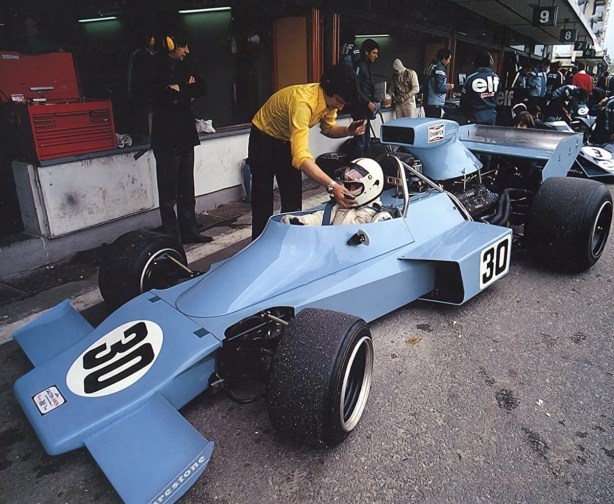
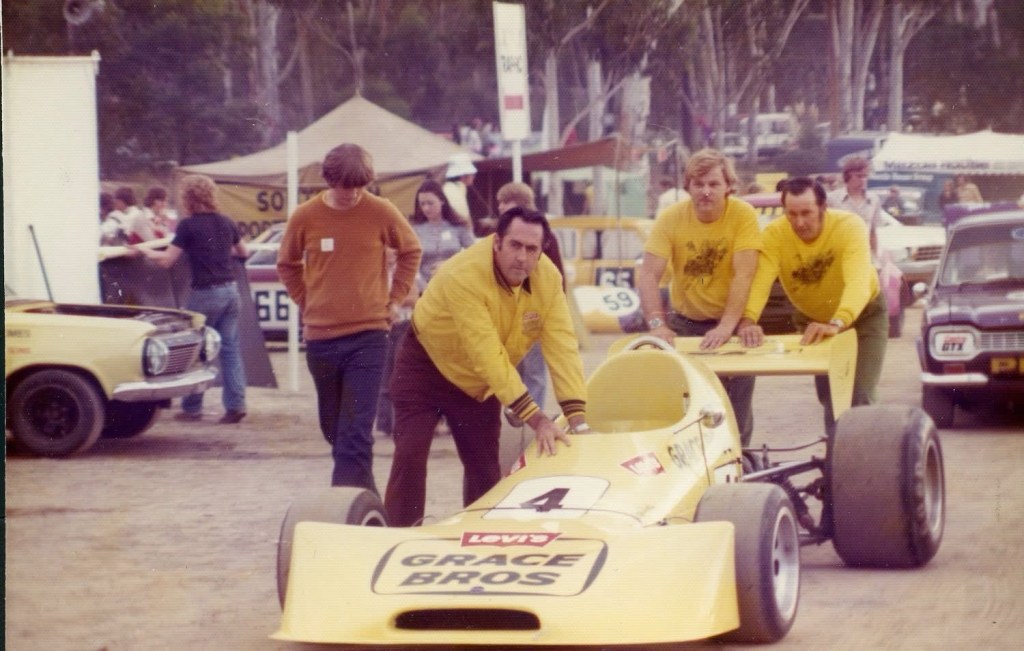
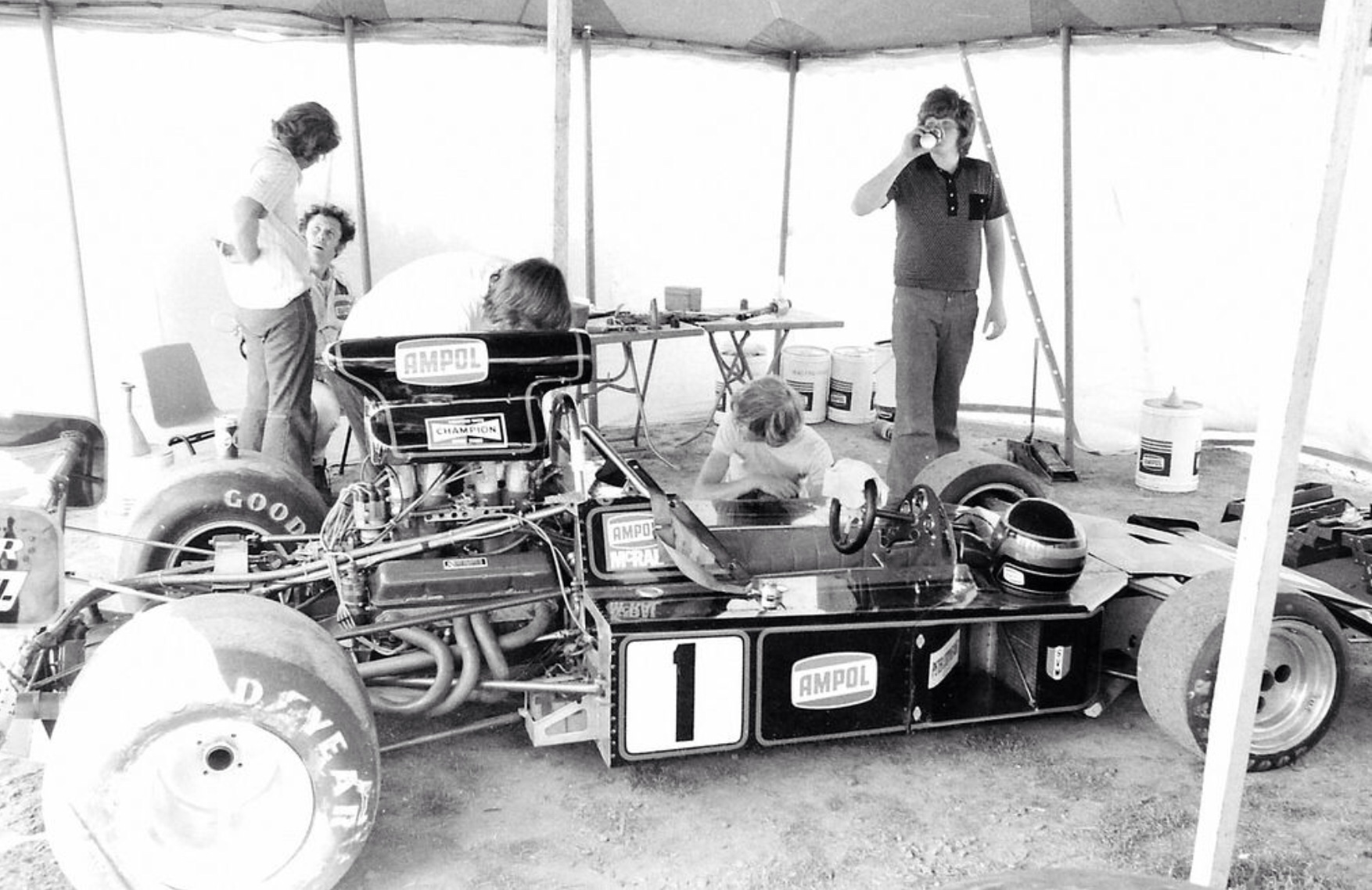
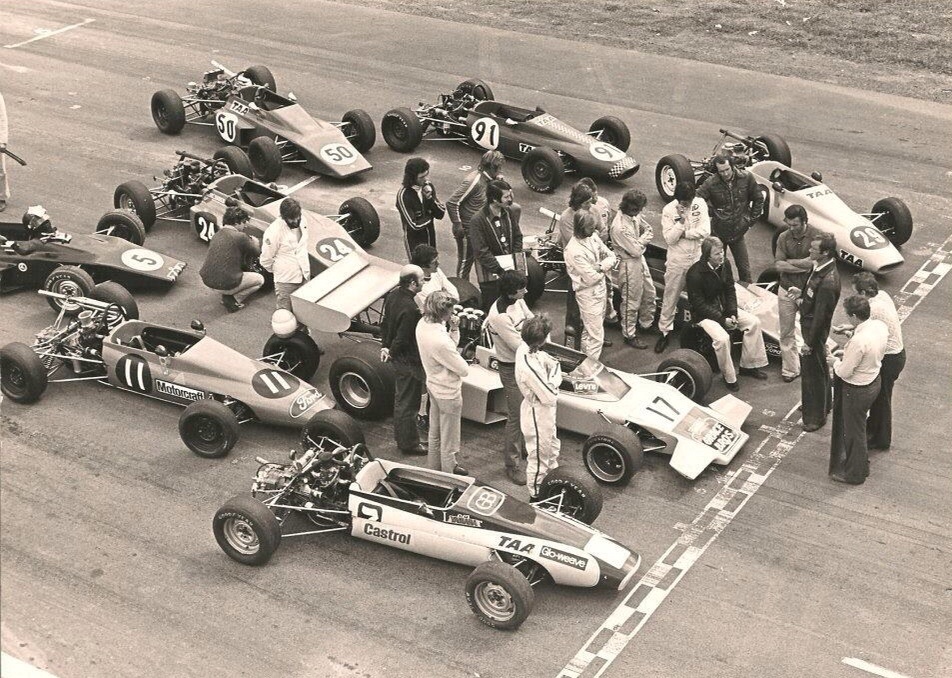
I love pit row scenes. Its where it all used to happen before the activities and those allowed to perform them were policed. Occupational health and safety etc…

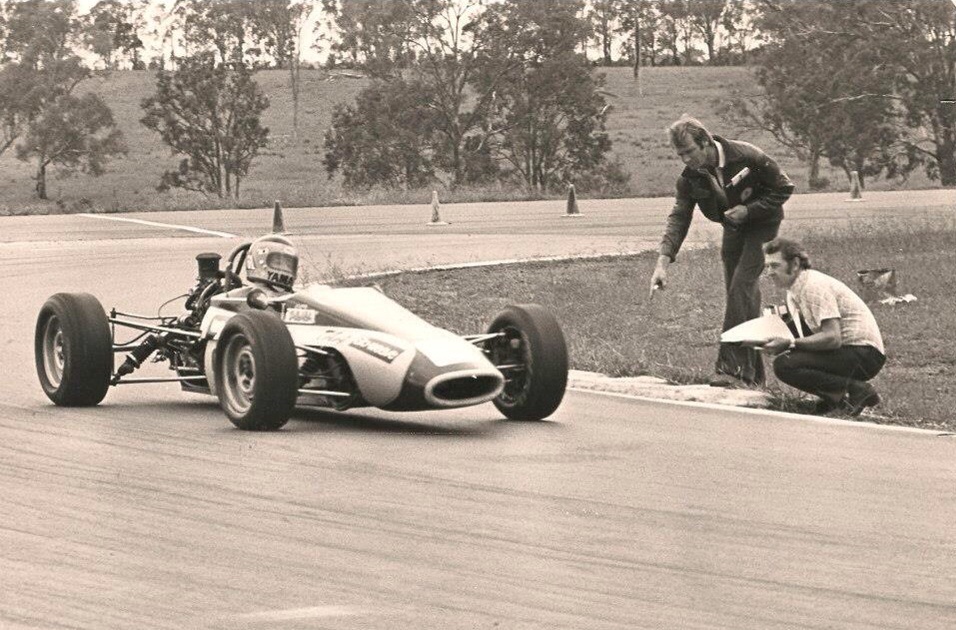
Here its Saturday practice during the 1972 Sandown Tasman Round, the Australian Grand Prix that year on 19 January. I’ve written an article about this meeting, see the link here;

My First Race Meeting, Sandown Tasman F5000 1972, Bartlett, Lola and Raquel…

Boy, there is some talent focussed in and around Max Stewart’s Mildren Waggott 2 litre.

Big Maxxie towers over the top- its his car, he raced it for Alec Mildren for several years then bought it upon Alec’s retirement from the sport and won the ’71 Gold Star, the Australian Drivers Championship in it. Max knows every centimetre of that liddl baby.

Up the pitrow is Stewart’s Elfin MR5 Repco. I wrote about this car a short while ago-here; https://primotipo.com/2017/10/24/maxwells-silver-hammer/

Max retired the MR5 with engine problems in the AGP the following day.

The short fella with the big arse leaning over the Mildren on the other side is Paul England, a legend. Ex-Repco Research in the Charlie Dean Maybach days, builder of the Ausca Holden Repco sportscar, Cooper T41 competitor in the 1957 German GP, multiple Australian Hillclimb Champion and proprietor of Paul England Engineering in Moonee Ponds- Dame Edna’s Melbourne home suburb of course.

I wonder who the ‘Firestone’ driver is leaning against the (unsighted) pit counter. Fourteen year old me is somehere on that pit counter at this  very moment. I’ve got my eyes on both the cars and marauding Light Car Club officials looking for prats like me who are not ‘sposed to be there.

One of the ‘works’ Elfin MR5 Repco’s with its new Tyrrell nose is blasting past on circuit in 3rd gear making a glorious fuel-injected 90 degree V8 basso-profundo bellow. Not sure if its Garrie Cooper or John McCormack.

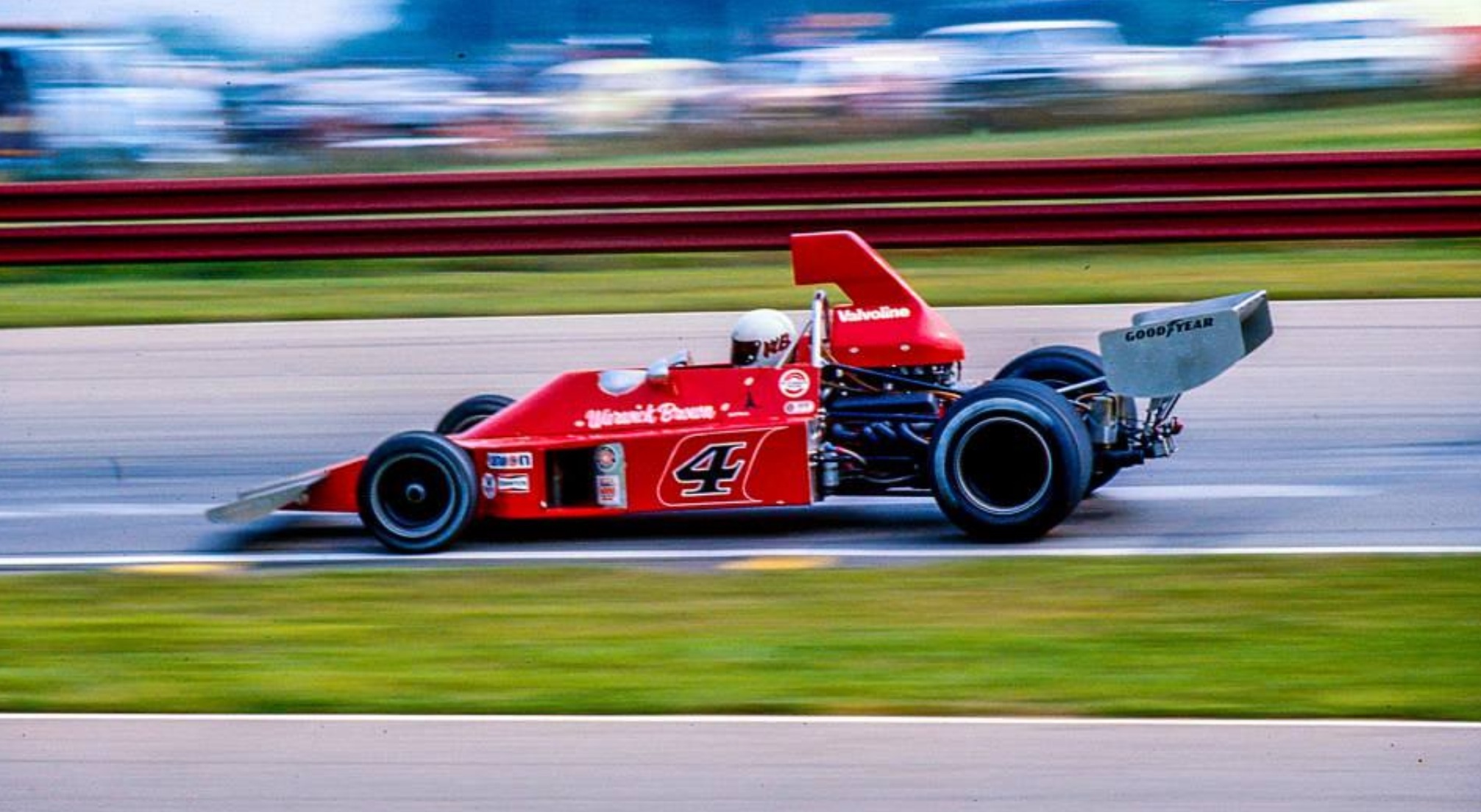
The stocky little dude in the blue T-shirt behind Max’s MR5 rear wing is ‘Lugsy’ Adams- then a top mechanic but very soon to be a quick touring car driver, and several years after that an F5000 constructor/driver. Remember the Adams GA1 Chev? Its his driver Warwick Brown he is talking to- WB is in his formative McLaren M10B Chev F5000 days but is soon to be one of its enduring talents in both Australasia and the US.

image

Tony Stewart tells the crowd how it was after winning the ’71 Examiner 1000 at Symmons Plains. I think that is his well known engine-builder and father in law Jack Godbehear alongside? (oldracephotos/Harrison)

And the fellow aboard the Mildren Waggott? Its Tony Stewart, no relation to Max…

He was a shooting star, out of Formula Vee, he funded his racing with a series of car yards in the Box Hill area of Melbourne. He progressed to an Elfin 600 Ford F2 car, notably winning a very wet Gold Star event at Symmons Plains in September 1971 ahead of a field of sodden F5000’s and ANF2 cars.

Tony had some races in Paul England’s Dolphin Ford- a BT30/36 Brabham copy and several races circa 1973/4 in an F2 Birrana 273 Ford Hart before disappearing from the scene.

He was one of those guys who had the makings of a champion, I’m intrigued to hear from any of you who know the ‘Tony Stewart Story’. He didn’t stray from the used car trade though. He established ‘Car City’ a massive emporium of competing dealers on a huge former apple orchard site on the Maroondah Highway, Ringwood. He saw the new auto retail approach on a trip to the US and applied it in Melbourne’s outer east. Bumma really, he made his money AFTER his racing stage rather than when he needed it to feed his passion most!?

Tony raced the Mildren Waggott in the all of the Australian Tasman Rounds- Surfers Paradise Q15 13th, Warwick Farm Q12 8th, Sandown Q19 12th and Adelaide Q16, non-classified. It was tough in a 2 litre car by then amongst the 5 litre heavy metal but was still valuable experience in longer races for the young driver.

The more ya look, the more you see in these pitlane shots…

image

Paul England makes final adjustments to Tony Stewart’s Elfin 600 Ford before the off at Symmons- he is about to have a great day at the office! (oldracephotos/Harrison)

The 1971 Symmons Plains Gold Star ‘Examiner Trophy’ Round won by Tony Stewart on 26 September…

1971 was a bit of a transitional year between the old 2.5 litre Tasman Formula and F5000. The 5 litre beasties were quicker than the smaller cars but in a year of speed and reliability Max Stewart won the championship with one win and plenty of consistency from to Kevin Bartlett’s three victories in his McLaren M10B Chev.

The Series went down to the wire, to the last round October at Mallala, South Australia. Any of Kevin Bartlett, Max Stewart or Gold Star debutant Alan Hamilton could have taken the title, in the end Max did it with third place behind McCormack and Hamilton. KB looked the goods until engine failure intervened late in the race.

In a strange turn of events and happy circumstances for him, Tony Stewart won at a very wet Symmons Plains, the penultimate ’71 Gold Star round.

image

Kevin Bartlett aboard his ex-Niel Allen McLaren M10B ‘400-02’, a very successful car in the hands of both top drivers. KB looks thoughtful- he is contemplating the challenge of 500bhp in the wet on slick tyres (oldracephotos/Harrison)

A good field of 17 cars entered for the race at the ‘Apple Isle’ but a grid of only 8 cars started as a consequence of non-appearances and accidents in practice.

John McCormack, Elfin MR5 Repco snatched pole late in the second session ahead of Alan Hamilton, McLaren M10B Chev, the similarly mounted Kevin Bartlett and on equal fourth quickest Max Stewart’s Mildren Waggott 2 litre and Colin Hyams Lola T192 Chev.

image

No shortage of helpers to get Warwick Brown’s Pat Burke owned McLaren M4A Ford Cosworth FVC 1.8 to the grid. Famous car- Piers Courage’ ’68 Tasman mount, he won the final Longford round in it. Then to Niel Allen who raced it successfully before a huge Lakeside prang. Re-tubbed by Bowin in Sydney- then to Pat Burke. Left Australia many years ago, who owns it now? (oldracingcars/Harrison)

Then came Warwick Brown, McLaren M4A Ford Cosworth FVC 1.8, then Tony Stewart, Henk Woelders Elfin 600E Ford, Jack Bono and Garrie Cooper Elfin 600D Ford who did not practice. The latter three cars were all ANF2 cars- 1.6 litre Lotus/Ford twin-cams.

image

Colin Hyams, Lola T192 Chev, before his warm-up off. Ex works/Gardner car purchased by the Melbourne businessman after the ’71 Tasman. He had the car repaired, after its Symmons off, in time for the final Gold Star round at Mallala in October, in which he was 4th (oldracephotos/Harrison)

The start of the race was delayed by heavy rain which had practically flooded the circuit. The weather was so poor the drivers were given a warm-up session to get used to the conditions before the off. KB spun his McLaren on the main straight on dry tyres, he had no wets. Colin Hyams also spun his Lola T192 Chev, down a slope into a clump of trees, bending the ex-Frank Gardner ’71 Tasman Series mounts chassis.

image

Start of the very wet ‘Examiner 1000’, Symmons Plains: car at the rear the Cooper Elfin- no sign of Bartlett. At far right is Ross Ambrose’s Elfin 600 Ford who DNP having run bearings on the Friday but clearly started. To Ambrose left is winner Stewart’s Elfin 600 (oldracephotos/Harrison)

Eight cars started the ‘Examiner Trophy’ Gold Star round…

McCormack, Elfin MR5, Bartlett, McLaren M10B, severely hampered without wets but in search of valuable points, Max Stewart, Mildren Waggott, Tony Stewart Elfin 600 Ford, Warwick Brown McLaren M4A Ford FVC, Garrie Cooper Elfin 600D Ford, Jack Bono Elfin 600B Ford and Alan Hamilton’s McLaren. KB elected to start from the back of the grid given the 500bhp/slicks/wet track phenomena he was dealing with.

From the flag Hamilton led, Max Stewart, Brown, Tony Stewart, McCormack, Bono, Cooper with the hapless Bartlett last. Hamilton lapped KB for the first time in two laps.

The Melbourne Porsche importer/dealer drove a strong race in his new McLaren M10B Chev, the chassis was Niel Allen’s spare tub which was assembled and sold upon his retirement from the sport and used by Hamilton in his first single-seater season very effectively.

image

Alan Hamilton’s McLaren M10B Chev- the Melbourne businessman jumped out the Porsche 906 Spyder and 911’s he was racing and very quickly adapted to the rigours of 5 litre cars. He came back to the class 6 years later but its a pity he didn’t stay in the category longer when he was younger and as another strong contender at a time Gold Star grids were skinny. Warwick Brown progressed to this chassis in 1972. Hamilton now owns both this car ‘400-19’ and Bartlett’s ex-Allen ‘400-02’ (oldracehotos/Harrison)

With a third of the race completed Hamilton lapped second placed Brown for the second time. Tony Stewart moved into third place as his namesake Max wrestled with a sticking throttle slide- he pitted early, went out again and nearly demolished the car with another spin. With the conditions not improving Bartlett was hamstrung by inappropriate tyres for the races duration.

On lap 38 the races drama continued with Hamilton having an off, drowning his injected Chevy in the process and losing five laps. He pitted, but was out of the running three laps later the engine soaked.

This left Warwick Brown 20 seconds ahead of Tony Stewart but the McLaren was overheating, it was losing water, ironic given the conditions. So, Tony Stewart was in the lead.

image

John McCormack ahead of his Elfin teammate, Garrie Cooper. Mac’s MR5 ‘5711’ is the first MR5 completed, Coopers 600D ‘7012’ started life as his Repco ‘730/830’ V8 engined 2.5 litre 1970 Gold Star mount and was, with the ANF1 formula change, converted to an ANF2 car- he raced it in Asia in ’71 then sold it to Bruce Allison- an important stepping stone for the speedy Queenslander (oldracephotos/Harrison)

Tasmanian, John McCormack adapted steadily to the conditions and started putting on the pressure in his new Elfin MR5- a combination which proved very competitive over the following three or so years, and took 2nd place as Brown spun in the final stages, Warwick recovered quickly to fill 3rd place.

So, in a drive of speed and consistency Tony Stewart’s ANF2 Elfin 600 Ford won from McCormack’s Elfin MR5 Repco, Brown, McLaren M4A Ford Cosworth FVC, Elfin boss Garrie Cooper’s Elfin 600D ANF2, Jack Bono, Elfin 600 Ford ANF2 and Max Stewart Mildren Waggott. Max had only completed 55 of the 68 laps but the soggy one point gained won him the Gold Star!

It was the last time an ANF2 car won a Gold Star round- a splendid drive by a driver of considerable finesse in the most trying of conditions.

image

Tony Stewart on the way to a speedy but lucky win, Elfin 600 chassis ‘6806’ an early build 600, I wonder who owns it now? (oldracephotos/Harrison)

Photo Credits…

Ian Smith, oldracephotos.com/Geoff Harrison

Bibliography…

oldracingcars.com, Australian Motor Racing Year 1972

Tailpiece: Max Stewart in the soggy, Symmons pits…

image

The famous Mildren Waggott soon to win the ’71 Gold Star, that’s Bartlett’s McLaren M10B behind (oldracephotos/Harrison)

(oldracephotos/Harrisson)

Norm Beechey’s Holden Monaro GTS327 V8 leads the field away for the final, deciding round of the 1969 Australian Touring Car Championship, Symmons Plains, Tasmania 16 November….

Behind him is Alan Hamilton’s partially obscured Porsche 911T/R, local boy Robin Pare’s Ford Mustang, and then a Melbourne trio- Peter Manton’s Morris Cooper S, Jim McKeown’s Lotus Cortina Mk2 and Jim Smith’s Morris Cooper S.

I was casting around my ‘stock of photos’ and realised I had quite a few shots of cars raced in the 1969 Australian Touring Car Championship (ATCC), or during other races that year, many by Dick Simpson so it seemed smart to pop some words to go with them.

This season has been done to death in many publications over the years, so treat this as a pictorial with enough words to provide international readers with the context they need rather than anything particularly insightful. For Australian enthusiasts the cars and drivers are well known, force-fed as we are in this country with all things ‘taxis’.

Moffat, Geoghegan and Jane at Calder in 1970. Mustangs a threesome- KarKraft TransAm, locally developed ’67 GTA and Shelby TransAm (R Davies)

What a sensational period for Touring Car racing it was, the ATCC was then run to Group C Improved Production Touring Car rules, there was so much variety from the big V8’s- the Geoghegan, Jane and Moffat Mustangs, Beechey’s HK Holden Monaro 327, Lotus Cortinas and Minis. The perennial giant killing ‘bricks’ driven by Brian Foley, ‘Skinny’ Manton, Phil Barnes amongst others.

That year was very significant, it was the first of the ‘modern era’, in that the championship was decided over a series of races rather than a one race, winner take all format as had been the case since the first title won by David McKay’s Jaguar Mk1 at Gnoo Glas, Orange, NSW in 1960.

Brian Foley, Cooper S leads Geoghegan into the Warwick Farm Esses in 1969 (Dick Simpson)

Melbourne’s Alan Hamilton, his family were the Australian Porsche importer for decades, nearly pulled off a huge upset in ’69 coming within a point and five metres of beating Geoghegan to the title in his new 2 litre Porsche 911.

In 1967 after winning the Australian Hillclimb Championship and having on-circuit success with his 906, Hamilton decided to have a crack at the ATCC. I wrote an article about him and his cars a while back, click here to read it;

Alan Hamilton, Australian Champion: His Porsche 904/8 and two 906s…

A 911R was out of the question as it didn’t comply with the rules but a steel-bodied 911R did.

The new 911T was homologated for Group 3 Grand Touring, Porsche in time honoured tradition developed a new Rallye Kit to cater for racers, offering a range of go-faster goodies and less weight by removing various luxuries.

As always with Porsche you could order whatever you liked, that included the ‘Carrera 6’ engine and running gear from the 911R! Hamilton knew the capabilities of the engine from his 906 Spyder. Two of them actually. The 1991cc six was good for 157kW/206Nm, complete with a lightweight flywheel, slippery diff, competition clutch and other bits a pieces, it turned the Rallye into a very competitive little weapon.

Hamilton in his 911T/R at Hume Weir in 1969 (oldracephotos,ocm/DSimpson)

The Signal Orange 911T/R arrived Australia in time for the 1968, one race ATCC at Warwick Farm, Sydney on 8 September, a highly technical circuit which placed a premium on handling, brakes and power, Hume Straight was a long one.

Geoghegan’s ’67 Mustang and Norm Beechey’s Chev Camaro 350 were the main threats to Porsche victory with local boy Pete Geoghegan the man most likely.

And so it proved, Pete ran away with the race securing his third title on the trot. Hamilton was as high as second but blew a rear tyre at Creek Corner on the last lap and disappeared into the boonies before recovering to finish third. Darrell King was second and Fred Gibson fourth in Cooper S and Niel Allen’s Mustang respectively.

In 1969 the title was decided over five rounds in five states- Calder on Melbourne’s Western outskirts in Victoria, Mount Panorama, Bathurst in the New South Wales Central Tablelands, Mallala, 60 Km north of Adelaide in South Australia, Surfers Paradise on Queenslands Gold Coast and Symmons Plains, near Launceston, Tasmania. Truly a national title indeed!

New star-cars of ’69- Beechey’s shortlived HK Monaro 327 and Moffat’s long-lived TransAm Mustang, Calder, late 1969 (R Davies)

Hamilton’s Porker was far from the only fresh 1969 ATCC contender…

Allan Moffat’s KarKraft Mustang Trans-Am 302, a sinfully sexy weapon in the hands of the droll, fast Canadian for the following six years was soon on the water and arrived in time for the Mallala round. Click here for the story on this magnificent machine;

‘Marvin The Marvels’ Magic Mustang…

Norm Beechey had thrilled the crowds with a succession of exciting cars- Holden 48-215, Chev Impala, Ford Mustang, Chev Nova, Chev Camaro SS but for 1969 he built, with Holden’s assistance, an HK Monaro GTS powered by a 327 Chev cid V8.

Very early race for the new Beechey HK327 at Warwick Farm in late 1968- already some scars on the door! Car painted Shell blue over the summer- this colour and stripe combo ex-factory standard (R Thomas)

The car was built during ’68 by Norm’s team led by Claude Morton at Beechey’s Brunswick, Melbourne workshop. Whilst it was not completed in time for the ’68 ATCC it did defeat Geoghegan at Calder late that year.

Knocking off Pete in a car which was continually developed by John Sheppard in Sydney was always going to be a big challenge, lack of development time was a barrier, on the other hand the team knew Chev V8’s well, if not the balance of the new cars running gear.

In any event, Norm’s car had towards 500 bhp under the bonnet as the ’69 season approached- and had shown, even at this early stage, the pace to best Pete.

Beechey’s Holden HK Monaro 327 engine bay, circa 500 bhp from the Weber fed V8 (unattributed)


Calder Improved Tourer race later in ’69- this is Moffat giving Beechey a ‘love tap’ on the warm up lap! Geoghegan, Hamilton and McKeown follow (autopics)

The championship opened at Calder Park on March 23…

Geoghegan made the most of the freshly resurfaced track to score pole ahead of Bob Jane’s TransAm Mustang with Hamilton fourth behind Beechey’s Monaro. This car was very significant as the first of the Australian ‘Pony Cars’ to take on the American heavy metal which had dominated in Australia since the end of the ‘Jaguar Era’.

Beechey booting his Monaro around one of Calder’s tight corners during the ATCC round. Track only 1 mile long then (unattributed)

In a difficult start to the season Norm popped an engine in practice, decamping back to home base in Brunswick to rebuild the Chev bent-eight overnight.

Beechey led from the start but was passed by Geoghegan before turn one, Melbourne businessman/racer Jane passed Norm on lap 4 and Geoghegan on lap 5. Beechey popped another engine on lap 7!

Geoghegan tried everything to get up to and past Bob Jane at Calder in ’69- here throwing the car around in the manner for which he was famous (oldracephotos)

Jane had a strong lead but Pete came back at him, a passing move under brakes resulted in him running wide. Bob won the race at a circuit he would soon purchase from the Pascoe family who first built the facility in 1962. Geoghegan was second and then Hamilton third, a  lap down.

Bob Jane’s Shelby built Mustang Trans-Am, Bathurst 1969. Q2 and DNF. Bobs fortunes would change with the purchase of a Chev Camaro LT1 soonish (Bob Jane )

The fabulous, challenging Mount Panorama at Bathurst was the venue for round two on April 7…

Geoghegan had a sensational meeting plonking his ‘Stang on pole by 5 seconds and then proceeded to disappear during the race at the rate of ten seconds a lap. Pete was the master of Bathurst click on these links, about his Ferrari 250LM speed;

Pete Geoghegan: Ferrari 250LM ‘6321’: Bathurst Easter 1968…

and his win in the ’72 Bathurst ATCC round aboard his Super Falcon;

Greatest Ever Australian Touring Car Championship Race? Bathurst, Easter 1972…

Geoghegan, Mustang, Hell Corner, Bathurst 1968 (Dick Simpson)

In a meeting of attrition Jane qualified second but blew an engine on lap 9. Beechey boofed the Monaro in practice and did not start with Hamilton bending his rear suspension against the Forrest Elbow wall, finishing second, miles behind Geoghegan.

Phil Barnes, Cooper S from Mike Savvas Ford Falcon GT XT, Bathurst Esses  ATCC round 1969 (oldracephotos)

Phil Barnes did brilliantly in his Cooper S to finish third on this power circuit with Bob Inglis fourth in a Lotus Cortina.

After two meetings the pattern for the year seemed clear, Geoghegan’s pace, Hamilton in the Porsche finishing races and continually collecting points with the V8’s somewhat more brittle…

Moffat at Mallala in practice ahead of Kevin Farrisey’s Holden FJ (Dick Simpson)

Mallala, ex-RAAF Airfield 16 June…

Alan Moffat’s long-awaited TransAm Mustang was the star attraction, this car surely the most iconic ‘greatest’ touring car ever to race in Oz. Bias hereby declared!

Beechey was again a non-starter with yet another blown engine. The top four grid slots were Jane, Geoghegan, Moffat and Hamilton.

Moffat was the first to go out on lap 2 in what would become a race of attrition, followed by Jane at half distance. Hamilton followed Geoghegan home by a respectable 44 seconds for second with Peter Manton’s Cooper S third.

After a break of a month to prepare their mounts the teams took the long drive north to Queensland’s Gold Coast.

Melbourne’s Jim McKeown, Lotus Cortina Mk2, Mallala 1969. Looks a picture in its Minilites (Dick Simpson)

Surfers Paradise on August 31…

Pete again took pole from Beechey and Hamilton who equalled the Monaro V8’s time- pretty amazing on this power circuit.

With Moffat and Jane non-starters, the race had looked like a foregone conclusion until Geoghegan was forced out with a puncture on lap eight, he had run over a piece of exhaust pipe left by one of his fellow competitors on circuit.

Pete returned two laps down but Beechey held on to take his first win of the season- and the first ever ATCC win for Holden with Hamilton second, collecting a bag more of points and Jim McKeown third.

A designers true intent is always shown with the first iteration of a car isn’t it? The ’68/9 HK Monaro a very cohesive design- and in GTS 327 spec a formidable tool in Series Production racing and here as an Improved Tourer. Here, Beechey’s car in the Surfers Paradise dummy grid/form up area. Car sold at the end of ’69 to WA, raced by Peter Briggs for a while and then, when some debts needed to be paid components ‘spread by the wind’. In the hands of a potential ‘restorer’ these days. Beechey focussed on his ’70 title winning, sensational HG GTS350 (unattributed)

The title now went down to the wire. Pete’s woes meant his championship lead was now only three points over the Porsche driver with Peter Manton moving into third in the title chase.

The competition rules provided each driver drop their worst score, the net effect of which was that Hamilton needed to win at Symmons Plains and Pete score no points for Hamilton to take the title.

These early 911’s are sex on wheels, Hamilton’s 911T/R as exotic as they came at the time. Still in Oz in the Bowden Family Collection. Clubhouse corner, Mallala 1969 (Dick Simpson)

Symmons Plains, 16 November…

Bob Jane had already withdrawn from the final round to attend overseas business commitments with team driver John Harvey driving his Mustang. Moffat was struggling yet again with engine trouble, the front row therefore comprised Geoghegan, Harvey, Moffat and Beechey with Hamilton back in fifth.

With just one minute to go before the flag, Geoghegan’s Mustang refused to start, leaving his crew little option but to bump start it after the race had begun and doom him to certain disqualification. All Hamilton had to do now was win!

Great arse! Moffats ‘stang has no bad angle. Symmons ’69 DNF typical of the unreliability of the car early on. It never did win the ATCC did it? Sadly. Car still in Oz, in the Bowden Collection of touring car racers (oldracephotos/Harrisson)

Harvey led Moffat until lap seven when the Mustang popped another Windsor 302. Beechey and Hamilton followed. Beechey extended his lead but the Holden started to suffer gearbox problems, he was having to avoid gearchanges, which meant he had to slip the clutch to keep the car mobile at lower speeds. By lap 15 Harvey was out with a puncture.

So near but so far! Beechey, his Holden trailing heaps of smoke from a failing gearbox, boots his Monaro away from Hamilton’s 911, last lap, last corner, last Symmons Plains round of the ATCC ’69 (oldracephotos/Harrisson)

Hamilton closed the gap getting to within a cars length of the Holden in the last corner of the race but Norm was able to boot the big V8, using all of its vast amount of torque, to accelerate away from the 2 litre 911 and win the race from Hamilton and McKeown.

Geoghegan had continued to race on, despite inevitable disqualification, breaking the lap record, making it onto the lead lap. With Hamilton failing to win, Pete won the ATCC title, his last, by one point…

Geoghegan flicking his Mustang thru Warwick Farm’s Northern Crossing in 1969. Pete always polls as Top 5 or 10 in any assessment of Australia’s Greatest Touring Car drivers (Dick Simpson)

‘You know, it’s funny’, chuckled Hamilton in a Unique Cars interview. ‘I’ve never really forgiven Norm (Beechey) for that one. Every time he comes around I like to give him a bit of curry about what happened in that race. You see, he was out of the (championship) running entirely at that point, and his car had all but expired.’

’In fact it actually did expire about 20 metres over the line. It finally just dropped dead! Still, I can’t complain. We did well to get where we did. Unlike the V8s, the Porsche proved to be very reliable. We had a colossal season in ’69, doing hillclimbs and medal races as well as the Touring Cars, but aside from routine servicing we didn’t actually have to do anything to keep it going’.

Etcetera: ATCC Cars of 1969…

Beechey, Hume Weir 1969 (unattributed)


One of the earliest appearances of Moffat’s Mustang in Australia, Oran Park, 17 May 1969 (Dick Simpson)


Phil Barnes, Cooper S at Mallala in 1969. He was 7th in the ’69 title with 5th at Calder and 3rd at Bathurst (Dick Simpson)


Jim McKeown, Lotus Cortina, Hume Weir 1969 (oldracephotos)


Bob Jane and Mustang TransAm at Lakeside’s Karussell in July 1969 (G Ruckert)


Alan Hamilton, Porsche 911T/R during 1969 (oldracephotos)


Moffat at Peters Corner, to start the run up Sandown’s back straight. Moffat forever a BP man but displaying Ampol allegiance early in the Mustang’s career – May 4 1969 first race meeting? (autopics)

Bibliography…

‘History of the Australian Touring Car Championship’ Graham Howard and Ors

Photo Credits…

Dick Simpson, oldracephotos.com, Robert Davies, autopics.com.au, Graham Ruckert, Robert Thomas

Tailpiece: Pete Geoghegan, Mallala 1969- five time ATCC winner in 1964/6/7/8/9…

Geoghegan, Clubhouse Corner, Mallala 1969 (Dick Simpson)

Finito…


(oldracephotos/Keep)

Richard Attwood hooking his big Grand Prix BRM P126 2.5 V12 into Longford’s Viaduct during the ‘South Pacific Trophy’ weekend, 4 March 1968…

He was fourth in the very soggy race, this shot is in the dry earlier in the meeting, won by Piers’ Courage McLaren M4A Ford FVA F2 car from Pedro Rodriguez’ BRM P261 2 litre V8 and Frank Gardner’s Alec Mildren owned Brabham BT23D Alfa Romeo Tipo 33 2.5 V8- a varied lot don’t you think?

I wrote a short article about this meeting a couple of years ago but have just ‘upgraded it’ to feature length due to the large number of photographs of this meeting released in more recent times by Lindsay Ross and Rod Mackenzie. Click on these links to check out their archives.

http://oldracephotos.com/content/home/ and http://www.rodmackenziecollection.com/

The photos really needed a nice home to make them accessible. So you can thank them for this extended piece! Click here to read it;

https://primotipo.com/2015/10/20/longford-tasman-south-pacific-trophy-4-march-1968-and-piers-courage/

The big BRM was far from the car of the series- the Lotus 49 Ford DFW was, but the championship was successful in giving the Bourne outfit valuable testing miles of their new ’68 F1 championship contender albeit in 2.5 litre form.

The BRM design and engineering team led by Tony Rudd were ‘up to their armpits in alligators’ after two fraught seasons in 1966/67 trying to get the BRM P83, or more particularly its complex, heavy, wonderful H16 engine to race fitness.

BRM chief Louis Stanley therefore briefed Len Terry, latterly of Eagle and Lotus to design and build a new F1 car. Three P126 chassis were constructed by Terry’s ‘Transatlantic Automotive Consultants’ concern powered by the brand new ‘sportscar customer’ P101, chain driven DOHC, 2 valve, Lucas injected 3 litre V12 which initially gave circa 370 bhp @ 9750 rpm, behind which was fitted a Hewland DG300 transaxle.

The Type 101 BRM engine- 60 degree all aluminium V12 with two chain driven overhead camshafts per cylinder bank operating two valves per cylinder. The compression ratio was 11.5:1, the bore and stroke 74.6mm/57.2mm, fed by Lucas fuel injection the power output during 1968 was initially 370 bhp rising to 390 bhp @ 9,500 rpm. The 2.5 litre variant was designated P121 and gave circa 340 bhp (unattributed)

Bruce McLaren had some good results with the first of the engines in late season 1967 F1 races bolted into the back of his M4B chassis. He was therefore more than happy to thrill his home crowds and assist the BRM lads testing and racing their new car in the New Zealand Tasman rounds before heading back to the UK and completing his own 1968 F1 machine, the Ford Cosworth DFV V8 powered M7A! When Bruce returned to the UK Attwood took over the car for the Australian rounds with Pedro Rodriguez racing P126/01.

In fact Bruce’s somewhat lucky win in P126/02, after Jim Clark’s late race excursion at Teretonga was the only race victory the P126/P133 (two cars designated P133 were built at Bourne to Len’s design) chassis ever had. But don’t discount this series of racers though.

Bruce McLaren on the way to Teretonga International victory on 27 January 1968. Clark’s Lotus 49 Ford DFW was 2nd and Frank Gardner’s Brabham BT23D Alfa was 3rd (I Peak/TRS)

Whilst the car’s Tasman Series was somewhat fraught, the best P126 results other than Bruce’s win were Dickie’s sixth in the Australian Grand Prix at Sandown and fourth at Longford- Pedro Rodriguez had the design leading two Grands Prix in 1968 and generally it was a front third of the field car, if lacking a bit in luck/reliability. These results included a front row start and leading the Spanish GP, second at Spa, third at Zandvoort, lead of the French GP and fourth in Mexico.

Lets not forget that sometime GeePee driver and 1970 Porsche 917 Le Mans winner Attwood took second place in the 1968 Monaco GP aboard a P126 too.

The late sixties BRM’s are often maligned but the P126/133’s results in 1968 F1 in a sea of Ford Cosworth V8’s (well five or six of them anyway in the hands of Lotus, McLaren and Ken Tyrell’s Matra International) were not too shabby at all, in part due to the learnings of the ’68 Tasman…

Attwood is attended to at Longford before another practice lap whilst John Harvey in Bob Jane’s Brabham BT11A Repco does the same thing behind (D Cooper)

Etcetera: Attwood, BRM P126 ’03’ Monaco 1968…

The ‘King of Monaco’, Graham Hill won in the principality as he often did in the sixties but Attwood was a very fine second in the third of the P126’s built, a chassis he raced at Spa, Zandvoort, Rouen, Brands and the Nurburgring that year.

(unattributed)

The high photos are beauties to show the key design elements of Len Terry’s car. The aluminium monocoque is a ‘full monocoque’ as against a ‘bathtub’, in common with his Lotus 38 and his Eagle T1G’s. Front suspension is period typical top rocker and lower wishbone with an inboard mounted coil spring/shock to get the mechanical gubbins outta the breeze.

See the spoiler on the nose- 1968 was the ‘Year of Wings’ with BRM being slow adopters and behind the eight-ball relative to other teams mid-season, but that is all to come. No seat belt yet for Dickie, which is interesting, six-point harnesses were not mandated until the start of 1972, but belts were common by Watkins Glen towards the 1968 seasons end.

(unattributed)

Love those mag-alloy wheels, brakes are Girling, engine is carried by the chassis and is not a stressed member as the predecessor P75 H16 engine was in the P83 BRM tub. The Type 101 V12 was originally developed as a customer motor for F1 and sportscar use so its fitment needed to be ‘universal’ in multiple applications.

(unattributed)

Beauty of a shot showing Attwood caressing his P126 through a delicate slide- it shows the effectiveness of the period typical rear suspension popping around 390 bhp to the tarmac. What was a leading Terry design trend are the parallel lower links which found their way into other designers lexicon circa 1971. The norm to that point was an inverted lower wishbone. Otherwise the coil spring/shocks, single top link, twin radius rods and adjustable roll bar are ‘the usual’.

A Varley battery is vertically mounted beside the Hewland DG300 5 speed transaxle- the P126 design is notable as the first BRM without a Bourne ‘box. It was a good choice, these tough old jiggers are still for sale and in use with 550bhp Chev V8’s tearing away at their internals.

The power of that lovely V12, as stated above, around 390 bhp at this stage of the engines long evolution into the four-valver V12 success stories of 1970-2.

Photo and Other Credits…

oldracephotos.com.au/D Keep, Ian Peak/The Roaring Season, Brian Jackson, oldracingcars.com- see Allen Brown’s piece on the P126; https://www.oldracingcars.com/brm/p126/ and P133; https://www.oldracingcars.com/brm/p133/

Tailpiece…

(B Jackson)

Pedro Rodriguez enters the old Sandown pitlane in P126-01 during the 1968 Australian Grand Prix meeting, DNF engine after 10 laps for the Mexican, Jim Clark won in a Lotus 49 Ford DFW.

Finito…


image

Stirling Moss guides his works Jaguar C-Type through Fordwater on his way to fifth place at Goodwood sharing with 1951 Le Mans winner Peter Walker…

Britain’s first night race took take place at Goodwood on 16 August 1952. The British Automobile Racing Club hoped to emulate the commercial success of Le Mans, that classic a race of 24 hours duration of course.

The Goodwood enduro was a nine-hour event with a 3pm start to allow the spectators to see the cars in all their spectacular glory in the half-light and full darkness.

Modifications were made to the circuits infrastructure by fitting floodlights to illuminate the grandstands and pits, the kerbs were given a coat of luminous paint and a beer tent was laid on, although due to post-war licensing laws it had to stop serving grog before the race ended! Sponsorship and plenty of pre-event publicity was provided by ‘The News of The World’ newspaper inclusive of £2,500 in prize money which represented a powerful incentive for the ‘local’ works teams and privateers to enter in force.

Jaguar and Aston Martin entered three-car teams of C-types and DB3s in the field of 32 cars. Both teams had much to prove. The C-Types were quick at Le Mans in June, but all three cars retired with engine cooling-related issues. The new Ferrari 250S and Mercedes-Benz W194 had been faster than the Jags, victorious at Le Mans in 1951, at the Mille Miglia in May.

As a consequence, Jaguar had designed a more aerodynamic body with a slightly smaller radiator. Jag’s cooling problems became apparent in practice, despite hasty modifications; solutions were not found pre-race. Peter Whitehead/Ian Stewart retired with a failed head gasket during the second hour, Stirling Moss/Peter Walker with engine problems in the third, and the remaining Tony Rolt/Duncan Hamilton car with a head gasket failure in the fourth hour.

Le Mans 1952: #26 the Poore/Griffith Aston DB3 Spyder alongside the Parnell/Thompson DB3 Coupe, all three factory cars DNF (unattributed)

The new Aston DB3 ‘Spyders’ also failed to finish, Dennis Poore/Pat Griffith in the third hour with water pump failure and Lance Macklin/Peter Collins towards the finish with an accident in the twenty-second hour of the long, unforgiving race. The works DB3 Coupe driven by Parnell/Thompson retired in the second hour with gearbox dramas. The ’52 Le Mans was won by the Benz W194, Hermann Lang and Fritz Riess from the sister car of Theo Helfrich/Helmut Niedermayr.

The chance to make a good showing on home turf was therefore ‘manna from heaven’.

Jaguar used the same driver combinations they deployed in France, whilst Aston’s pairings were Reg Parnell/Eric Thompson, Peter Collins/Pat Griffith and George Abecassis/Dennis Poore.

Other strong entries included Pierre Levegh’s Talbot-Lago T26GS, famously for being so nearly the winner driving solo at Le Mans in 1952 before missing a gear very late in the race. Ferrari 225S’ were entered for Tom Cole/Graham Whitehead and Bobbie Baird/Roy Salvadori, a works Allard J2X for Anthony Hume and George Thomas plus a swag of Healey Silverstone, Frazer Nash Le Mans Rep, Jag XK120, Cooper T14 MG, HRG and HWM cars. In short, an interesting field that lacked only works Ferrari and Mercedes entries.

image

At the start, Moss, at right, as usual, won the sprint to his car, but Tony Rolt, to Moss’ right led on lap one, but he was soon overtaken by Parnell’s Aston…

At the end of the first hour the order was Parnell, Rolt, Abecassis, Moss and Baird, Ferrari 225S, then Whitehead.

Then the weather started to improve, and as the track dried, the Jaguar’s pace became apparent with both Rolt and Moss passing Parnell. So, Jag, Jag, Jag, Aston, but then Whitehead crashed his C-Type.

Disaster struck the Feltham team on lap 91 during a routine refuelling pit stop when Parnell’s car caught fire, burning two of the crew and team manager John Wyer. Parnell showed great leadership and strength of character, whilst his race drive was over he stood in for the injured Wyer to take over the critical team management role.

 At half distance the Moss/Walker Jaguar C Type led from the sister XKC of Rolt/Hamilton. The third C-type had crashed at Madgwick and retired whilst the DB3 of Abecassis/Poore had also dropped out of contention.

By 9pm, the drivers had switched their headlights on, the spectacle of racing at Goodwood at night was fantastic, but within half an hour, a half shaft broke on the Rolt/Hamilton C-Type, which allowed the remaining Aston of Collins/Griffith through; that car was then overtaken by the quick Ferrari 225S driven by Bobby Baird and Roy Salvadori.

Eric Thompson came into the pits 3 hours into the race with smoke pouring from the rear of the car. Wyer and mechanic Jack Sopp pulled up the seats to investigate whilst Fred Lowndes refuelled. Spilt fuel from the last churn went onto the tail of the car and ran down onto the undertray where it was ignited by hot oil from a leaking fuel seal- within seconds the car was engulfed in flames and smoke. Wyer and Sopp suffered bad burns, Lowndes not so much but all 3 were taken to hospital whereupon Reg Parnell took charge. Aston DB3/3 was destroyed- and later rebuilt, Parnell, drove it to 5th in the 1953 Mille Miglia (unattributed)

Half an hour later Jaguar’s collapse was complete when the leading Moss/Walker car entered the pits with a broken rear radius arm that would take nearly an hour to repair. It is said that Jaguar boss Sir William Lyons was blissfully ignorant of all of the dramas which befell his team as he had retired to Goodwood House from the pitlane to enjoy what appeared to be a certain win!

image
The doomed Parnell/Thompson Aston DB3/3 earlier in the race prior to its demise (Getty)

In a race of rapidly changing fortunes, the Baird/Salvadori Ferrari 225S had gone from fourth to first in little more than an hour. Still, in a final twist of fate, on its last pit stop, the jack intended to lift the car sank into the patch of tarmac, softened by the earlier Aston DB3 fire! The loss of time was sufficient to put the Collins/Griffith DB3 into the lead with just an hour of the race left. That pairing duly won despite an exhaust valve breaking an hour before the event’s end, from the two privateer Ferrari 225S’ driven by Cole/Whitehead and Baird/Salvadori.

Collins in the winning Aston DB3 early in the race (unattributed)

The Telegraph reported that ‘The Nine Hour had all the ingredients of a classic race; the changing weather, the drama of the pit fire and a dramatic fight for the lead, not to mention the fact that so many of the cars were competing on home soil. Yet the spectators were distinctly unmoved, many only arriving once the night racing began, and few staying for the duration. These were people who attended Goodwood for a grand day out – a nine-hour endurance race, where the leader wasn’t always obvious, was simply too long.’

‘When the Nine Hour race returned the following year it did so without any newspaper sponsorship to offer pre-event coverage. Spectators numbers fell as a result and with them the carnival atmosphere that made Le Mans such a success. Those who did go frequently left when it got dark, defeating the event’s raison d’être. It didn’t matter that the racing was first class (Aston would win again in ’53 and, after the race skipped a year, scored a third victory at what would be the last Nine Hour race in ’55) if nobody was there watching it. Perhaps the British will always see night racing as too good an excuse for a holiday abroad.’ the Telegraph concluded.

There was no World Sportscar or Manufacturers Championship in 1952, that competition started in 1953. However the classic race spoils went to Mercedes Benz W194/300SL at Le Mans and the Carrera Panamericana with a Ferrari 250S victorious at the Mille Miglia and a Lancia Aurelia B20 at the Targa Florio

Vaino Hollming Jag XK120 leads Pierre Levegh Talbot-Lago T26GS then the Lawrence Mitchell Frazer Nash High Speed, Goodwood 9 Hour (Getty)

Aston Martin DB3 Technical Specifications…

Ex-Auto Union design team member Robert Eberan-Eberhorst first worked for ERA when he come to the UK post-war. He was contracted for 3 years from November 1930 to design a sports-racer for Astons which was to use the AML LMB 2.6 litre 6 cylinder engine and a David Brown five-speed gearbox.

He chose a period typical ladder frame chassis design, the main members made from 16-gauge, four inch chrome-molybdenum tubes with substantial cross-bracing by three 14-gauge five-inch tubes.

Front suspension was similar to the DB2- trailing links, transverse torsion bars, piston type shocks and a roll bar. At the rear a more sophisticated De Dion rear axle was deployed. This was constructed from three steel sections welded together and was located by a Panhard Rod and parallel locating links. The upper links ran fore and aft, the lower links angled. Each of the lower links engaged by serrations with a transverse torsion bar. Armstrong double piston dampers were used. The car weighed circa 2165 pounds/980Kg with nine gallons of fuel.

RE Poulton for Autocar

Steering was by rack and pinion with two turns lock to lock, brakes were Al-fin drums, inboard at the rear. Spoked wire wheels were, of course, used with Rudge-Whitworth knock-off hubs.

The DB3 first raced in 2580cc form, with triple 35DCO Weber twin-choke carburettors. The alloy, DOHC, two valve head engine developed 133bhp @ 5500rpm. The gearbox was a DB S527, five-speed with overdrive top gear. From July 1952, a DB S430/63R four-speed box was used.

Into 1952 the engines ran Weber 36DCF carbs making 140bhp @ 5200rpm, still way too little. By the 1952 Monaco GP a 2922cc engine developed 147bhp @5000rpm but any increase in capacity of the LB6 engine was impossible as each pair of bores were siamesed.

163bhp was achieved from an engine with 35DCO twin-choke Webers and connecting rods with offset big ends at the Goodwood 9 Hour in 1952.

Bibliography…

Article by Chris Knapman in The Telegraph April 2011, ‘Aston Martin: The Racing Cars’ Anthony Pritchard

Photo Credits…

Getty Images, Klemantaski Archive, Don Price, Autocar

Tailpiece…

image

Finito…

image

(T Watts Collection)

A favourite car, favourite marque, favourite colour. Bert Howard’s Lola Mk1 Climax at Symmons Plains, Tasmania in April 1968…

It’s a simple enough shot I suppose, a well executed pan with classic blurred background, but too good not to share.

The colour is so clear it could be 2017, but the low roll bar, helmet and background devoid of advertising hoardings gives it away a bit, its 1968. The small, lithe little machine looks like a ‘big banger’ doesn’t it?, but the 1098cc Coventry Climax FWA engined car is anything but that.

The Lola Mk1 was seminal in Eric Broadley’s early commercial success. The story of the car itself, it’s development and specifications is so well told on Lola Heritage, just click on the link here to read about these magic cars;

http://www.lolaheritage.co.uk/history/types/mk1/mk1.htm

Bert’s car, Lola Mk1 chassis ‘BR15’  first came to Australia to the order of ‘Scuderia Veloce’ supremo, David McKay in late 1960.

By the time David McKay landed the sporty and Formula Junior Lola Ford ‘BRJ18’ the former World War 2 veteran, racer and motoring journalist had already been competing since the late forties. He had second place in the 1955 Hyeres 12 Hours in southern France together with Tony Gaze aboard a ‘customer’ Aston DB3S and the 1958 Australian Tourist Trophy, Bathurst, victory as career highlights to that point, the latter aboard his ex-works Aston Martin DB3S, see here for that car(s); https://primotipo.com/2017/09/28/david-mckays-aston-martin-db3ss/

Most international readers would be by now familiar with McKay from various of my articles. He was a racer at elite level who founded ‘Scuderia Veloce’ to race his own cars circa 1959. The team very shortly thereafter morphed into an enterprise which entered cars for others including internationals, Chris Amon, Graham Hill and Jackie Stewart- and into a retail motor dealership on Sydney’s North Shore which sold Ferrari, later Volvo and from 1969 Porsche cars.

McKay also aided and abetted the careers of many drivers from the early days- most notably Amon, Spencer Martin, Greg Cusack and right through into the 1970’s Larry Perkins and open-wheeler Formula Pacific ace John Smith in the latter period.

Throughout this era of the mid-fifties to the mid-seventies McKay was the most influential Oz motoring journalist as motoring editor of Sydney’s Daily Telegraph and Sunday Telegraph newspapers. See here for more;

Pete Geoghegan: Ferrari 250LM ‘6321’: Bathurst Easter 1968…

image

David McKay, Lola Mk1 Climax, Forrests Elbow, Bathurst, Easter 1961. Won the 3 lap under 1500 scratch and was 4th outright and 1st in class in the 10 lap main sportscar event won by the Matich Lotus 15 Climax (J Ellacott)

A mate of McKay’s, dentist David Lewin based in London had written to the Sydneysider and extolled him of the virtues of both Lolas and McKay soon did a deal with Graham Broadley, Eric’s brother to acquire ‘BR15’, which was a works car raced by Peter Ashdown.

The FJ was a new car built for a category which was exploding globally. The shadows of the War by then had to a large extent diminished, globally the worlds economy was performing well and consumer credit was becoming more widely available- many young men could afford to go motor racing and FJ was very much a class of choice.

In Australia, finally some permanent venues were being built- Warwick Farm, Catalina Park, Lakeside, Sandown Park, Calder and others were all opened in the early years of the sixties. In fact McKay was keen to land both Lolas in time for the first Warwick Farm opening meeting in December 1960. ‘BR15’ was not available until the end of the British racing season however.

Between the purchase of the cars and their arrival in Australia the Australian Federal Government had increased sales tax on imported cars to 40%. Much to McKay’s chagrin the changes applied to both road cars AND racing cars including those ‘on the water’! His landed price having increased hugely, McKay quickly did a deal to relieve the financial pressure so created to sell the FJ to Sydney insurance broker Tom Corcoran who had been racing a Lotus 11. Corcoran raced the car under the SV banner thereby getting some support at race meetings and fuel and oil provided by Castrol who had about then done a deal with McKay. David of course raced the Mk1.

image

Scuderia Veloce on Warwick Farm’s pit straight in 1962. Morgan Distributors Morgan Plus 4, Tony Loxley’s Ferrari 250 GT, Fiat Importers Fiat 1800, ‘Old Nail’ Cooper T51 Climax, Lola Mk1 Climax (J Fullarton)

Scuderia Veloce at the time included the little Lola, a Nardi modified Fiat 1800 taken out to 2 litres owned by Fiat Australia which David raced in the burgeoning Appendix J touring car class and his Jaguar.

By early 1960 his first Jaguar Mk1 3.4 ‘Grey Pussy’, the dominant touring car in Australia at the time had been sold to Ron Hodgson. David bought a second Jag, a 3.4 litre Mk1, like the first built by the Jaguar Competition Department, which was co-owned with Australian Jaguar importer Bryson Industries. He won the very first Australian Touring Car Championship, a one race event, at Gnoo Blas, Orange in the red Jag in early 1960 beating Bill Pitt’s 3.4 litre Mk1 and Hodgson’s car which by then was 3.8 litres in capacity.

He also occasionally raced Sydney businessman/yachtsman Tony Loxley’s Ferrari 250GT coupe in GT races.

In single-seaters, for a short time in 1959 McKay raced a new (Victa Industries owned) Cooper T51 Climax FPF 1.9 and after the 1961 Australasian International season- the Victa owned car having been sold to Bib Stillwell he acquired a Cooper T51 Climax FPF 2.2 from Jack Brabham. McKay realised, approaching forty that his time at the top was limited and he ‘needed to get on with it’ in single-seaters!

image

Mallala AGP weekend 1961, this will be a heat as Bill Patterson started from pole after acrimony over qualifying times and Stan Jones DNS the GP itself after mechanical mayhem intruded. #6 Bib Stillwell in his new Cooper T53 Climax, #14 McKay in ‘Old Nail’ Cooper T51 Climax and #2 Stan Jones Cooper T51 Climax. That’s Gerry Brown tending to Bib and Kevin Drage with his hand on the tail of the car (K Drage)

The ‘Old Nail’ Cooper Jack Brabham had for sale was raced by Ron Flockhart and Roy Salvadori that summer as part of ‘Jack’s team (‘Ecurie Vitesse’) was none other than Bruce McLaren’s ex-works machine (chassis number either ‘F2-5-57’ or ‘F2-7-59’), the chassis in which Bruce took his first world championship GP victory at Sebring in late 1959 and another win at Buenos Aires in February 1960.

It wasn’t in the full flush of youth as a ’59 (or was it 1957!?) car with transverse leaf, as against coil sprung rear end but was still a pretty good thing to go head to head with Cooper mounted Stan Jones, Bill Patterson, Lex Davison, (noting Lex’ interludes in Aston Martin DBR4’s) Bib Stillwell, (ditto!) Alec Mildren and the rest of the local heroes in Australia.

Indeed, the difference between an Australian Grand Prix ‘Old Nail’ win for McKay and 3rd place at Mallala in October 1961 was a jumped start and 60 second penalty in the opinion of the race stewards…but not in the opinion of many informed onlookers! A story for another time. Lex Davison won the ’61 AGP, his fourth and last AGP victory aboard a Cooper T51 borrowed from Bib Stillwell (the ex-Victa Industries car raced briefly by McKay) and Bibs later, quicker!, Cooper T53 with McKay’s T51 third. As I say, that meeting is very much a story in itself for another time.

image

Start of the Australian Touring Car Championship race at Gnoo Blas, Orange, NSW 1 February 1960. Ron Hodgson in Jag Mk1 3.8 ‘Grey Pussy’ at left, McKay in his new Mk1 3.4 right, Bill Pitt behind in another Mk1 3.4 then the Holdens led by Pete Geoghegan’s black 48-215. McKay won from Pitt and Hodgson (unattributed)

So, McKay was a busy boy and Lola was only one of his toys! McKay was well aware of the cars speed which was both demonstrated by the performance of the cars in the UK and Derek Jolly’s Coventry Climax FWA powered Decca’s which raced in Australia from the mid-fifties- and which McKay was well familiar with on-and off circuit.

The dominant sportscars in Australia at the time were Ron Phillips’ Cooper Jaguar, Doug Whiteford’s Maser 300S, Derek Jolly’s 2 litre FPF powered ex-works Lotus 15 and then Frank Matich’s Leaton Motors owned ex-works 2.5 litre FPF powered Lotus 15 from the time it arrived in Australia in 1960. Matich then transferred his raw pace to a Lotus 19 Climax which further accentuated his dominance (which segued to Lotus 19B, Elfin 400 Olds aka ‘Traco Olds’, Matich SR3 Repco and Matich SR4 Repco- a decade of sportscar wins for FM in Australia)

image

‘BR15’ at Symmons Plains 1968: spaceframe chassis, wishbone upper and lower front suspension with coil spring/shocks, 1098cc originally but by now probably 1220cc Coventry Climax Weber fed FWA engine and rubber bungee attached fuel tank all clear (oldracephotos.com)

The Lola was a famously light, beautiful handling car but it was not an outright contender toting only 1100cc so its place in the local order was to win the 1100 or under 1500 class and punch above its weight in outright competition.

McKay’s cars finally arrived from the UK in October 1960, their first outing a test day at Warwick Farm in October before the inaugural Warwick Farm open meeting on 18 December 1960. Bob Atkin had by then been engaged by McKay to look after the Lolas, Atkin formed a career with SV’s and was still Dealer Principal of Scuderia Veloce Motors when it was sold to Laurie Sutton a decade or so hence.

McKay won his class in the famously very wet meeting whilst finishing 2nd outright behind Matich’ Lotus 15 and ahead of Derek Jolly’s 15, Bob Jane’s Maser 300S, Doug Chivas’ Jag D Type and others. In a great day for McKay, he won the first race held at the Farm, a sportscar race in the Morgan Plus 4 (chassis  #4590 was one of the first two imported into the country owned by by Sydney jeweller Ron Coulsten), was fourth in the Appendix J touring car race in the Fiat and took fastest lap as well as winning the 1500 class in the Lola Mk1. A great day at the office!

Over the next 12 months the car was unbeatable in its class with successes at Ballarat Airfield, Hume Weir, Longford and Bathurst.

Business end of the Lola, Longford 1960 (G Richardson)

image

McKay’s Lola ‘BR15’ in very ugly Appendix K GT guise in 1961, circuit unknown. Gives new meaning to ‘slab sided’ ‘dunnit (M Schagen)

The Confederation of Australian Motor Sport adopted Appendix K for GT cars for the 1960 season which made sense in terms of attracting people to buy and race closed coupes such as the Lotus Elite and Porsche Carrera being sold at the time. It left large numbers of sportscars out on a limb in the sense that promoters now chose between running races for the two categories-that is between Appendix C Sportscars and Appendix K GT’s.

CAMS oddly, but sensibly allowed open cars to compete as long as they had ‘a lid’. As a consequence all manner of cars including such exotica as D Type Jags, Maser 300S…and McKay’s Lola Mk1 were ‘converted’ from open sportscars to closed coupes.

The conversions were usually as ugly as sin, Bob Jane’s Maser 300S arguably the exception, with David’s Lola definitely in the ‘fugly’ category as the photo above proves! The work was done by Clive Adams North Sydney panel shop, ‘ there a master of aluminium work, one Stan Brown, had a small corner where he worked his magic’ as McKay so eloquently put it. ‘That it turned out an ugly duckling there is no doubt’. To make matters worse the increase in weight of the car and ‘top heaviness’ ruined the beautiful balance of Broadley’s original design.

image

1961 GT Racing shot: Bob Jane, Maser 300S Coupe, Leo Geoghegan Lotus Elite, Frank Matich Jaguar D Type Hardtop and the red car is Keith Malcolm’s Skoden, Bathurst October 1961 (MK1220)

McKay in his autobiography describes the silver lining in the GT conversion work as the introduction to him of Spencer Martin, who worked at Adams shop and had started racing in a self built sportscar. Later they would achieve much together with Spencer driving both the SV Brabham BT11A Climax after Graham Hill had finished with it at the end of the 1964 Tasman Series and McKay’s famous, glorious ‘Red Lady’- his Ferrari 250LM.

The Lola ‘GT’ cannot have been too bad mind you, McKay was 2nd in the 50 mile, one race 1961 Australian GT Championship held at Warwick Farm in July 1961. Frank Matich won in a Jag XKD ‘GT’ from Brian Foley’s Austin Healey Sprite Hardtop and Bob Jane’s Maser 300S Coupe.

As McKay focused on other cars he sold the Lola to Greg Cusack, the young motor-trader and rally-driver from Canberra was a man on-the-rise. Cusack raced the car for the first time, still under the SV banner, at Warwick Farm in December 1961. He achieved the same levels of success with it in the following twelve months as McKay.

Cusack also had an occasional race in the ‘Old Nail’ Cooper T51 Climax during 1962 including a very solid 4th in the ‘Bathurst 100’ Gold Star event on demanding Mount Panorama.

McKay played an important role in Chris Amon’s nascent career, running the young Kiwi in the Australasian International season aboard his Cooper T53 Climax in 1963- it was during that summer that Reg Parnell spotted Chris’ talent and spirited him off to Europe.

Chris had a few drives of McKay’s Coopers (Old Nail T51 and T53) in Australia in the second half of 1962 at Sandown and Mallala during practice and at the Gold Star season ending round at Warwick Farm in mid-October where he raced the T51 to 3rd place in the Hordern Trophy behind Bib Stillwell and John Youl. The talented young Kiwi also raced the Lola Mk1 at Sandown in September to a class win in the Victorian Sportscar Championship.

The Lotus 23’s then beginning to appear gave the Lola a taste of competition for the first time. Cusack could see the writing on the wall so acquired two Elfins, a Catalina single-seater and Mallala mid-engined sportscar with which to take his career forward.

Cusack remained close to McKay, he would several years hence drive the teams Brabham BT23A Repco after Spencer Martin’s departure from Scuderia Veloce.

Lola was offered for sale and sold to to another very quick young driver, John Martin of Katoomba in Sydney’s Blue Mountains who had been competing in a Lotus 15. He first raced the car in January 1963 and achieved much success despite the more competitive grids in which the Lola now competed.

John Martin, Oran Park circa 1963

image

Pete Geoghegan in ‘BR15’ giving Niel Allen’s new Elan heaps at the ’66 Warwick Farm Tasman meeting in February. It was a very effective ‘demo’ of the little cars pace despite advancing years and race miles. Geoghegan was doing as many laps in little lithe Lotuses at the time as the Touring Cars for which he was famous- he would have found Lola very much to his liking I suspect (B Wells)

Frank Demuth, a Sydney accountant was the next owner having bought the car in early 1964. He gradually got the hang of it, as a newcomer to racing, but soon traded it in after 12 months on the Lotus 23B Ford raced by Pete Geoghegan, the Geoghegan brothers were Australia’s Lotus importers.

Rather than leave the car sitting on the Parramatta Road used car lot, Pete decided to have a run in it to remind everyone Lola was about and for sale. He had the car painted the wonderful shade of yellow and added 8-inch wheels to get a bit more grip. By now the car’s Climax FWA was said to be 1220cc in capacity.

Geoghegan entered it in the 1966 Warwick Farm Tasman meeting sportscar races and gave Niel Allen’s ex-Leo Geoghegan Lotus Élan 26R and Demuth plenty of curry in the 23 he has just acquired! Still, Pete was a rather handy steerer whatever the theoretical superiority of the 1.6-litre mid-engined, Lotus/Ford twin-cam powered Lotus 23! The feature race, for the record was won by Greg Cusack in a Lotus 23B from Demuth, Geoghegan and Bob Jane’s E Type Lwt.

It was at this point that Bert Howard responded to the Geoghegan’s March 1966 ‘Racing Car News’ advertisement, asking price $A3400- read it and weep! It was a long drive from Hobart to Sydney and back but no doubt Bert had a big smile as his car towed ‘BR15’ onto the ‘Princess of Tasmania’ at Port Melbourne for the final leg of the 1600 Km trip home.

image

Longford 1968: Bert Howard’s Lola in front of Doug Whiteford, works Datsun Fairlady, John Roxburgh Lotus 23C Ford and Ian Maudsley, Lotus Super 7 (oldracephotos)

There the car was beautifully prepared and presented for years at Longford, Symmons Plains and Baskerville, if increasingly outdated as the mid-engined hordes grew exponentially throughout the 1960’s. In the smaller capacity classes these cars included the Lotus 23, various local 23 ‘clones’, the Elfin Mallala, Elfin 300 and others.

Bert sold the car in the early seventies to Kent Patrick who raced it in various historic events before selling it to Kerry Luckins, well known in motorsport as the General Manager of Paul England Engineering in Melbourne, a Light Car Club stalwart and the ‘on-circuit’ Sandown commentator.

Proud new parent, Kerry Luckins picks up his new Lola from Kent Patrick’s, son Kurt observed ‘It still had the big rear tyres’. (Luckins Family_

Kerry stripped the car and rebuilt it fully with the assistance of  Jim Shepherd. It is in this period in the earlyish days of historic racing that I remember the Melbourne based car and later when raced by Ian and his son Nick McDonald, the car always looked ‘a million bucks’ and was very fast as the McDonald cars always are.

The car left Australia circa 2000 when sold to Tony Moy of Page and Moy, the specialist UK motor racing travel agency. Forty years had elapsed between the cars departure from and return to the UK- a great pity as the lovely little car had been an enduring and ever-present part of the Oz racing scene and a ‘belle of the ball’ wherever it appeared.

It never looked better than in its yellow phase in Bert Howard’s hands mind you…

Etcetera: David, Graham and Friends…

image

(Warwick Farm)

Warwick Farm function during the Tasman Series, perhaps 1964, the year Graham Hill drove McKay’s Brabham BT11A. Left to right- unknown, McKay, unknown, Geoff Sykes Warwick Farm promoter and manager, GH and Mike Kable, motoring journalist.

(Luckins Family)

Kerry Luckins gets JM Fangio to try the seat of his Lola at Sandown during the 1978 ‘Tribute To Fangio’ meeting. Kerry was President of the organising club, the Light Car Club of Australia, see here for a piece on THAT Sandown which practically every racing enthusiast in the country attended from the Prime Minister of the day, Malcolm Fraser down;

Juan Manuel Fangio’s Sandown Park…

Kerry was a well known, respected figure in the day, I admired the way he steered the Light Car Club as a member, he came across well on the Telly as part of the Sandown broadcast team, I met him later in his life in retirement at Sorrento. I visited to buy a Smiths chronometric tach which I still have, and look at his Birrana 274 (ex-Allison 274-07) but it was way too far gone for my limited mechanical skills- not sure that car has re-surfaced yet?

The very talented John Martin shows Lola’s delicate lines and pert little rump to very good effect at Oran Park circa 1963.

Bibliography…

‘David McKay’s Scuderia Veloce’ David McKay, ‘Historic Racing Cars in Australia’ John Blanden, Lola Heritage, oldracingcars.com, Terry Sullivan and Ray Bell on ‘The Roaring Season’, ‘Bathurst: Cradle of Australian Motor Racing’ John Medley

Photo Credits…

T Watts Collection via Historic Racing Car Club of Tasmania, Geoff Harrisson/oldracephotos.com, John Ellacott, Kevin Drage, Marc Schagen via Aussieroadracing, J Fullarton, MK1220, Bruce Wells/The Roaring Season, Greg Richardson, Ian Thorn, Kerry and Jennie Luckins Family Collection

Tailpiece: David McKay at Catalina Park, Blue Mountains, NSW, Lola Mk1 Climax, date unknown, beautiful isn’t it…

image

(M Schagen)

Finito…

Lionel Van Praag, Wembley, London 10 September 1936…

Its amazing what you don’t know, in fact I’m never surprised at my own ignorance. I reckon I know a bit about my interest and hobby, but really I’m only scratching the surface of motor racing history in Australia.

Australian topics are hard too, the research that is- pre-War there was little in the way of local magazines, post war it becomes a bit more straight forward from the time of the publication of ‘Australian Motor Sports’ magazine and the relatively large number of publications which followed it. What is fascinating in the research adventure is the stuff you find looking for something else.

In this case it was randomly coming upon this image of Lionel Maurice Van Praag (1908-1987) after winning the inaugural World Speedway Championship at Wembley on 10 September 1936.

An Australian World Motor Racing champion pre-war, wow! And not without some controversy too. And I had never heard of the Redfern lad despite his admission to the Sport Australia Hall of Fame in recent times.

L>R- Charlie Spinks, Arthur Atkinson and Lionel Van Praag, First Test England/Australia at Belle Vue in 1938 (defunctspeedway.co.uk)

Graham Howard wrote that ‘Van Praag was a speedway rider and aviator, born on 17 December 1908 at Redfern, Sydney. The only child of Sydney-born Louis Van Praag, tram conductor, and Mozelle May. A bright student and an all-round athlete, he was educated at Cleveland Street Intermediate High and Redfern Junior Technical schools, both in inner Sydney. He was apprenticed as a typewriter mechanic, he had a natural feel for machinery that was useful all his life’.

image

LVP, middle of shot at Speedway Royal, Wayville, Adelaide in 1928. Bike is an Ariel ‘3 and a half’ (M Gray)

Lionel began riding motorcycles at 15. After a number of novice races at the Olympia Speedway at Maroubra he concentrated on the Speedway Royal in Sydney from July 1926, almost instantly he became a senior competitor. He then had an outstanding 1926-27 season in Brisbane. He was successful in the eastern mainland Australian States and in New Zealand. In 1931 after years of rejecting offers, he followed other Australian riders who competed in England and joined the Wembley Team, riding in both the UK and Europe during the Australian off season.

Lionel Van Praag aboard a Harley Davidson ‘Pea Shooter’ in 1927, 19 years old. Factory 1926  racer designed for US AMA races- devoid of brakes, clutch and transmission. Frame shortened, weight 215 pounds, 350cc OHV, circa 100mph (unattributed)

The first World Speedway Championship, at Wembley, London 1936…

The event was a strange one as riders carried into the meeting a score of bonus points amassed in the qualifying rounds. It was possible that the rider who scored best on the night would still not be world champion because of his qualifying record- and such was the case.

‘Bluey’ Wilkinson scored a maximum but Langton had more bonus points than Van Praag. In a night of excitement and controversy, Eric Langton and Van Praag lined up for a match race but Eric broke the tapes. Van Praag declared he would not be champion by default and sportingly demanded a re-run! Langton gated ahead and led until the final bend when leaving the smallest of gaps and he was unable to hold the dashing Australian, the Hall of Fame entry says.

LVP on a mini-bike at Wembley in 1932 (Getty)

Further ‘Langton’s near miss …assumed a degree of controversy in later years. The deciding match race with ‘Praagy’ was ‘fixed’ between the pair according to sources close to the action. It was alleged that Eric and Lionel agreed that whoever got to the first corner in front would go on to win and they would split the prizemoney between them. It almost worked out, Langton was ahead until the final corner when he left a small gap which Van Praag couldn’t resist going for. The first ever world final was won by about a wheel width and the Australian took the title’.

Van Praag also qualified for the finals in 1937-7th, 1938-4th and 1939. In 1931-39, and again in 1947, he represented Australia in Tests against England.

He learned to fly in the UK at Broxbourne, Hertfordshire in 1931, it was a capability he put to good use throughout the rest of his life.

Graham Howard wrote that ‘Van Praag was a non-drinker and a heavy smoker, and he had a short temper if provoked. At around 5 ft 9 ins (175 cm) he was taller than most of his rivals; he was dashingly handsome, with dark curly hair and notable physical strength. He had a minor role in the British film Money for Speed (1933), but an envisaged cinema career did not materialise’.

LVP on a 1930’s JAP, date and place unknown (defunctspeedway.co.uk)

On 11 August 1941 Van Praag enlisted in the Royal Australian Air Force and was appointed to No.2 Wireless Air Gunners School, Parkes, New South Wales with the rank of acting sergeant.

Engaged on flying duties, he was promoted to probationary pilot officer in October 1942 and flight lieutenant in October 1944.

In January 1942 the transport plane of which he was a co-pilot, an RAAF Douglas DC-2 A30-8, was shot down by a Japanese aircraft over the Sumba Strait, off Indonesia whilst on a flight from Surabaya, Java to Koepang/Kupang Timor. For thirty hours, whilst subject to shark attacks, he and his Captain, Flying Officer Noel Webster, supported the two crew-members, both non-swimmers and secured their survival, acts of bravery for which they were awarded the George Medal.

A full account of the incident appears in the book ‘And Far From Home’, written by John Balfe who flew with Lionel.

Balfe had this to say about Van Praag as a man ‘…in flying with Van I had perceived in his slight wiry form, a man of particular capacity and directness. He cared nothing for false values in anything or anyone and did not hide from the fact. I found him only a week out of hospital after the ditching (of the DC-2) but already back in a comprehensive engineering workshop he had behind his unpretentious home on Botany Bay’s (Sydney) north shore. He had plant and equipment there to wet the appetite of any metal engineer. One of the real Australians, Van had led a hard life racing motorcycles from early manhood and lived to standards he had not relaxed. He was moderate in thought and habit and held in quiet contempt those who were not. He valued his friendships above human faults, but chose his friends carefully and for the most part made them for life. His mind and memory remained sharp and retained an accuracy in detail that I had noted flying with him in 1943’.

After recuperating from the ditching, Lionel returned to flying C-47’s with No 36 Squadron out of Townsville, Far North Queensland. His RAAF appointment ended on 27 July 1945.

LVP aboard a Penny Farthing in 1951, interesting to know the occasion, and place! (Fairfax)

Post war Lionel resumed motorcycle racing and soon developed a career in aviation…

Van Praag headed a riders’ consortium that promoted speedway at the Sydney Sports Ground in 1945-48. He rode for the English team New Cross in 1947. After 1948 he effectively retired from racing, although in the early 1950s he briefly raced self-built small speedboats off Manly on Sydney Harbour.

In his new career as a commercial pilot in 1952 he combined his aviation and speedway interests by contracting with Empire Speedways to carry the Great Britain and Australian competitors, along with their bikes and equipment between the various Australian speedway venues in a Lockheed Lodestar.

He flew charter, and freight planes, did aerial top-dressing or crop-dusting in a Bristol Freighter, this plane was lost in December 1961 when it crashed at Wollongong after an engine failure on a freight flight. Lionel and the rest of the crew escaped injury. He later flew for an airline in Pakistan for a year before returning to Australia.

LVP in his later aviation years (adastron.com)

He joined Adastra Aerial Surveys, a company originally formed as a flying school in 1930 at Mascot, Sydney circa 1962 as a pilot and later became chief pilot. Although he had two well-publicised crashes, including the one described above, people who flew with him valued his informality and his resourceful flying ability.

In adult life, Van, as he was known, turned away from his Jewish upbringing. In 1929 at the district registrar’s office, Redfern, he married Elizabeth Margaret Pearl Cosgrove, a machinist, they divorced in April 1937. On 1 October that year at the register office, Hendon, England, he married Gwendoline Iris Hipkin, a dressmaker.

In 1968 he retired to his own Island, Temple Island, south of Mackay. In 1973, aged 65, he ferried a Hudson VH-AGJ from Sydney to Strathallan Museum in Scotland. Hudson’s were the primary survey aircraft used by Adastra.

He died on 19 May 1987 from emphysema, at Royal Brisbane Hospital. His wife, their daughter and two sons and the daughter of his first marriage survived him.

Post death recognition includes being inducted into the Sport Australia Hall of Fame in 1990. In addition, in 2000, the Government of the Australian Capital Territory decided to honour several Australian sportsmen with the naming of streets, including ‘Van Praag Place’ in the Canberra suburb of Gordon.

Three of my fathers uncles served in World War 2. As I became a teenager and understood, to an extent, what they endured in the Middle East and New Guinea I held these wonderful, private, kind, gentle but strong men in considerable awe. I always called them my ‘Boys Own Heros’ when I saw them at family events. Certainly Lionel Van Praag was a Boys Own Hero- in spades. Truly an amazing, full life of achievement.

Bibliography…

‘Australian Dictionary of Biography’ entry by Graham Howard, Australian Sports Hall of Fame, adastron.com

Photo Credits…

Getty Images, Fox Photos, PA Images, , Malcolm F Gray, State Library of South Australia, Fairfax, defunctspeedwaysuk.com

Tailpiece: LVP and friends at the Sydney Sportsground on 4 September 1945, first post-war meeting I wonder?…


(Ron Laymon)

Denny Hulme caresses his Repco Brabham ‘RB740’ V8 in the Mosport pits during the Canadian GP weekend, August 1967…

As well he should too, it was this engine which powered his Brabham BT24 to victory in that years drivers championship. Mind, you that statement is not entirely correct as Denny used the ’66 engine, ‘RB620’ early in the season as Jack raced the 740, that engine was only used by the Kiwi after Jack deemed it available and raceworthy to him.

In the meantime Denny scored 4th in South Africa and won at Monaco using RB620 V8’s- those results won Denny the title really, Jack was 6th and failed to finish in the same two races. Denny’s 51 points took the title from Jack’s 46 points and Jim Clark with 41.

Clark from Hill during the 1967 British Grand Prix at Silverstone, Lotus 49 one-two for a while at least, GH retired with engine failure on lap 64 to end a dismal weekend, he crashed after suspension failure on Saturday. Clark won from Hulme’s BT24 and Chris Amon’s Ferrari 312 (Sutton)

Clark’s 4 wins shaded Jack and Denny with two apiece in the epochal Lotus 49 Ford Cosworth. Any design which is competitive over four seasons, inclusive of drivers and manufacturers title wins (Hill in 1968 and Rindt in 1970) is ‘up there’ in the pantheon of great GP cars. The 49’s first win was Clark’s victory at Zandvoort in ’67 upon the cars debut, its last the result of Jochen Rindt’s stunning tiger drive at Monaco in 1970- at his friend Jack Brabham’s expense, the great Aussie pressured into a famous last lap error by the storming Austrian.

Without doubt the Lotus 49 was the car of 1967, its always said it would have won the title with more reliability that it did not have as a brand new car.

But that simple analysis fails to give credit to the Aussies.

The Brabham BT24 was a ‘brand-spankers’ design as well. Tauranac says that it was only his second ‘clean sheet’ GP design, his first was the BT3 Climax which raced from mid-1962. The GeePee Brabhams which followed were evolutions of that design.


Love these close-up shots. Its Denny’s BT24 and RB740 engine the cam cover of which has been removed to give us a better look. The cars spaceframe chassis is clear- small car for the era. Based on Tauranac’s BT23 F2 design the engine was tightly proportioned and economical of fuel so the package around could also be tight. From the bottom you can see the distinctive ribs of the 700 block below the top suspension radius rod. To its right is an ally tank held in place by a rubber bungy cord, a fuel collector which picks up from the two, one each side, fuel tanks. SOHC, 2 valve V8, circa 330 bhp in period. Cams chain driven. Note the rail carrying coolant behind and above the camshaft. Fuel injection is the ubiquitous, excellent Lucas product, to the left is the top of the Bosch twin-point distributor. In the centre of the Vee is a hornets nest of carefully fabricated exhausts- wonderful examples of tube bending art. Ferrari fitted 12 within the Vee of its engine in a trend common at the time. The idea was to get the pipes outta the breeze and away from suspension members. What a wonderful bit of kit it is (Laymon)

The ‘RB740’ SOHC, 2 valve, ‘between the Vee’ exhaust engine was also a new design. Both the Repco designed, Commonwealth Aircraft Corporation cast ‘700 Series’ block and the ’40 Series’ heads (the heads were cast by Kevin Drage at Clisby Industries in Adelaide) were new. They were completely different to RB620, albeit the 700 block could and was bolted to 20 Series heads and ancillaries when 620’s were rebuilt and its modified Oldsmobile F85 block cast aside as no longer fit for purpose.

Jack and Repco ‘blooded’ or tested the head design in the early 1967 Tasman races but the block was not ready then- the 2.5 litre 1967 Tasman engines were ‘640 Series’, a combination of the ’67 heads and the 1966 modified by Repco, Olds F85 blocks. The first 700 blocks were used in F1, not the Tasman Series. In fact the early ’67 F1 engines used by Jack were 640’s as well. Denny used 620’s early on in ’67, as mentioned above just to add to the confusion!

My point is that the all new Brabham BT24 Repco won 4 races and took the ’67 drivers and manufacturers titles beating the all new Lotus 49 Ford which also won 4 GP’s- Graham Hill was winless in the other 49 that year. (I’ve ignored the 49’s guest drivers in this analysis)

BT24 sans Hewland DG300 during the German GP weekend. Elegant simplicity of the design laid bare. Spaceframe chassis, rear suspension comprising single top link, inverted lower wishbone, coil spring/damper, twin radius rods and an adjustable roll bar. Eagle eyed Aussies may note the ‘Lukey Muffler’ tipped exhausts (unattributed)

It could also be said that the 49 chassis design was not really all new- the 1966 Lotus 43 is identical in layout inclusive of suspension and using the BRM H16 engine as a stressed member, as the Ford DFV was.

So whaddam I saying?

That the spaceframe Brabham BT24 Repco combination was ‘newer’ than the monocoque Lotus 49 Ford which was really the 43 chassis design, suitably lightened and modified to carry the DFV, a much lighter and fuel efficient moteur than the sensational but corpulent, complex BRM engine. Let the correspondence begin! Here is a link to my Lotus 43 BRM article, form a view yourselves.

https://primotipo.com/2015/02/17/jim-clark-taking-a-deep-breath-lotus-43-brm/

Tell me in a conceptual sense how the 49 chassis and suspension differs from the 43? There was plenty of Ford funded PR hoopla around the Lotus 49, we have all seen the footage. It was hardly going to be the case that Chapman said of the Lotus 49 chassis ‘we needed a known platform to bolt the new engine to, so we used the BRM engined 43 chassis design with minor mods to suit the much lighter, smaller DFV’. Much better to tout the whole lot as ‘all new’- no drama in that, its all fair in a corporate bullshit sense, its just not quite true and largely a myth perpetuated by many over time. Time after time!

Lotus were not the first to use the engine as a stressed part of the car either, although that is widely attributed to Chapman. Jano did it with the D50 Lancia, Ferrari with the 1512 and BRM the P83 H16.

In any event, lets give the Brabham BT24 Repco ‘740’ V8 the respect it deserves but seldom gets.

Clark in the Mosport paddock 1967, his eyes well focused on the fashionably attired young Canadian missy, despite having just bagged pole. Lotus 49 Ford (unattributed)

Canadian GP Mosport- 27 August 1967…

This first Canadian F1 GP was in many ways an exemplar of the words above. Clark and Hill qualified 1-2 with Denny sharing the front row on Q3.

Clark led from the start to be passed by Hulme, Denny’s flat, fat Repco torque curve was more suited to the slippery wet conditions than the DFV which was notoriously abrupt in its power delivery early in its development. Bruce McLaren’s BRM V12 engined M5A was up to 3rd at one point. As the track dried Clark worked his way into the lead- which he kept after rain started again until lap 68 when the engine cut out. Jack won from Denny with Hill in the other 49 4th and Canadian driver Eppie Wietzes a DNF during a Lotus 49 guest drive with the same ignition dramas as Clark.

Maybe the truth is that the difference between the Lotus 49 and Brabham BT24 in 1967 was that Clark sat aboard a Lotus not a Brabham? For sure Jimmy would have been lightning fast in the light, chuckable BT24. Faster than Jack and Denny for sure.

Graham Hill quizzing Jack about the pace of his BT20 ‘640’ at the Silverstone BRDC International trophy in April 1967, Mike Parkes Ferrari 312 took the win from Jack. Red car is Bruce McLaren’s McLaren M4B BRM (Schlegelmilch)

A further point is around car preparation. The 1962/68 World Champion, Hill G, still at the peak of his powers was effectively neutered from the time the 49 appeared by the unreliability of the chassis he drove- of his 9 Lotus 49 starts he retired 7 times. Three of those were engine failures, the others due to driveshaft, suspension, gearbox and clutch problems. Clark retired 3 times in the same 9 races with ignition, suspension and ZF tranny dramas.

Brabham Racing Organisation prepared beautifully consistent cars in 1967 powered by very reliable Repco engines. Factory Brabhams took the championship F1 startline 22 times in 1967 for 4 DNF’s, all due to 740 Series engine failures- Jack’s broken rod at Monaco, both drivers at Spa and Denny’s overheating at Monza.

Clark was far and away the quicker of the two Lotus men- Jim started from pole in 6 of those 9 races, Hill from pole in 3 of them. As I have said before ‘if yer aunty had balls she’d be yer uncle’- but IF Hill had won a race or two that Clark did not, the manufacturers title would have been Lotuses not Brabhams. Because the lads from Hethel did not prepare two equally reliable cars the title was Brabham’s not Lotus’, surely a fair outcome?!

Denny Hulme in his ‘brand spankers’ Brabham BT24 Repco ahead of Chris Amon’s Ferrari 312 during the 1967 French Grand Prix, Bugatti Circuit, Le Mans. Jack won from Denny, Chris retired on lap 47 with a throttle linkage problem. The Ferrari 312 was a big car, the sheer ‘economy’ of the little, light, BT23 F2 derived BT24 shown to good effect in this shot. Note the air-scoop used to cool the fuel metering unit in the Tasman and some of the ‘hot’ races in the GP season (unattributed)

Denny’s 1967…

Didn’t he have a ripper season! In addition to the F1 drivers title he could easily have won the Can Am Series in Bruce McLarens M6A Chev, the first of the wonderful ‘papaya’ cars too. He went back to Mosport a month after the Canadian GP and won the Can Am race in addition to wins at Road America and Bridgehampton. Bruce just won the title with a smidge more reliability than his Kiwi buddy, 30 points to 27.

Denny didn’t have great reliability in the Tasman Series at 1967’s outset but then again the Brabham main game was engine development in advance of the GP season’s commencement. The cars were match fit for the World Championship partially due to development work done in Australasia by Jack, Denny and Repco in January and February whilst Tauranac beavered away on his new BT24 chassis design back in the UK- which is about where we came in!

Michael Gasking in grey coat and Roy Billington in shirtsleeves fitting a 2.5 litre RB640 V8 at Repco Maidstone during the 1967 Tasman. Cars raced in the ’67 Tasman were BT22 ‘F1-1-64’ for Denny and BT23A ‘1’ for Jack. The latter car is very much the F1 ‘BT24 prototype’ being a modified F2 BT23 frame to which the RB640 engine was adapted. Not sure which car is being fettled in this photo. It looks as tho they are about to fire her up- you can just see the end of a white ‘Varley’ battery by Roy’s foot and a red slave battery alongside. The motors Bosch distributor cap is missing but not a big deal to fit. The sound of those engines is oh-so-sweet! Not sure who the other two dudes in shot are, intrigued to know (Gasking)

Who Says Ron Tauranac designed the Brabham BT24?…

The BRO lads based themselves at Repco’s Maidstone headquarters in Melbourne’s western suburbs during the Tasman Series to fit engines before the Kiwi rounds and before/between the Sandown and Longford rounds in Melbourne and Tasmania each year. These two events were traditionally the season enders.

During these trips Jack, Denny, Roy Billington and others out from the UK operated from Maidstone both preparing the cars and spending time with the guys who built their engines. The Repco fellas all have incredibly strong, happy memories of these times.

The sketch below was made by Jack and Denny in the Maidstone lunch-room during a break in the days proceedings on the ‘1967 tour’.

Michael Gasking recalls that in between tea and bikkies the ‘guys were explaining to us what the ’67 F1 car would look like and its key dimensions’- so there you have it, Jack and Denny’s conceptual thoughts on the ’67 F1 car! The funny thing is, at that time, early March 1967 Ron Tauranac may not have been too far advanced with the ’67 chassis, the first didn’t appear until Jack raced BT24/1 at Spa on 18 June.

In the interim Ron was busy at Motor Racing Developments pushing F2 Brabham BT23’s out the door- far more profitable work than knocking together a few F1 cars for Brabham racing Organisation!

In any event, what a wonderful historical document! JB’s rendering of the RB740 engine is sub-optimal mind you, but its clear the guys have taken the time to carefully draw the car in pencil, and then add the dimensions in ink, or ‘biro’ I should say!

(Gasking)

Its hard to compare all of the BT24’s publicly reported dimensions with Jack’s sketches level of detail but the total height of the car at 34 inches tallies, whereas Ron’s final wheelbase was 94 inches rather than Jack’s 91.5 inches.

Re-engineering Jacks total width from tyre to tyre outside extremities at the rear of 69 inches- to a rear track dimension, using his 12 inch wide tyres, gives a rear track calculation of 57 inches for Jack whereas Ron’s was 55 inches.

The little air-ducts either side of the nose and in front of the driver didn’t make it, the steering wheel diameter agrees at 13 inches mind you these were trending down to what became the 10 inch norm. The outboard suspension layout all around is spot on of course, as is the use of a V8 engine…

At the end of the lunch, Michael scooped up the drawing which is now, 50 years later shared with us, many thanks Michael! Wonderful this internet thingy, isn’t it?

(Max Millar)

Related Articles…

On the Repco RB740 engine

https://primotipo.com/2016/08/05/rb740-repcos-1967-f1-championship-winning-v8/

The 1967 Repco Brabham season

https://primotipo.com/2015/09/03/life-magazine-the-big-wheels-of-car-racing-brabham-and-hulme-30-october-1967/

Hulmes 1967

https://primotipo.com/2014/11/24/1967-hulme-stewart-and-clark-levin-new-zealand-tasman-and-beyond/

Tailpiece: 1967 wasn’t all plain sailing, Brabham, Monaco…

(Getty)

Jack looking intently at the sight of his RB740’s Laystall, steel crankshaft. He can see it thru the side of the engines block, an errant connecting rod has punched a hole in its aluminium casing! Dennis Jenkinson’s MotorSport Monaco ’67 race report records that JB started the weekend with an RB640 engine fitted, and popped a new 740 in- which had circa 20bhp more, which he ran-in on Saturday and then qualified with, on pole.

Bandini got the jump at the start with the rod failing on the journey to Mirabeau, whereupon Jack spun on his own oil, travelling backwards all the way to the Station Hairpin, in the middle of the jostling pack. But the robust engine continued to run on 7 cylinders for the journey back to the pits, where this photo was taken, the great Aussie inadvertently trailing oil all the way around the course, the lubricant having an easy path out of the moteur via a not insignificant hole!

The rod problem was quickly fixed by Repco who fitted Carrillo’s- drama solved. The chassis is BT19, Jack’s ’66 Championship winning frame. Brabham first raced a BT24 at Spa on 18 June, Denny did not get his until Le Mans on 2 July. So you might accurately say the ’67 drivers and manufacturers titles were won with a mix of 1966 and 1967 chassis’ and engines!

Bibliography…

 ‘Brabham, Ralt, Honda: The Ron Tauranac Story’ Mike Lawrence, GP Encyclopaedia, Michael Gasking, ‘History of The GP Car’ Doug Nye, Garry Simkin

Photo Credits…

 Ron Laymon, Michael Gasking Collection, Sutton, Getty Images, Max Millar, Vittorio Del Basso

Postscript: Jochen Rindt driving the ring off the BT24 at Kyalami, South Africa on 1 January 1968- he was third behind a Clark, Hill Lotus 49 1-2. Clark’s last F1 win sadly…


image

(K Harris)

The Northern Territory entered Jaguar Mk7 of B Kingston and a Holden 48-215 line up for fuel at Bonds Chalet, Alice Springs during the 1953 Redex Round Australia Trial on 9/10 September…

It’s a quintessential Alice Springs scene, the red-brown parched soil and mid-green eucalypts framed in the distance by the MacDonell Ranges. Most of us of a certain age attended Primary Schools with artwork by Albert Namatjira, in these hues, hanging on the classroom walls.

Adelaide based Bonds Bus Tours provided ‘Parc Ferme’ and refuelling facilities for the rally in Alice Springs. These amazing photos were taken by a longtime employee, Kevin Harris. Rolled gold they are too, even though they are of the cars at rest, with one exception.

The post-war pent-up demand for entertainment, in those much simpler times was massive. Bouyed by an economy which was starting to boom, Australians turned out in their thousands to watch the progress of the 187 participants in the 1953 Redex Round Australia Trial.

In part it was because most roads west of Adelaide were challenging to say the least. The fact that the rules provided that cars were largely unmodified meant that the average man in the street could see how his car, or the one he aspired to own went created some interest. Cars were stock other than for underbody protection, carburettor, exhaust, lighting and instrument modifications.

Many of Australia’s better racing drivers competed, not that they were all household names by any stretch, but many were by the end of the decade in part due to their trial exploits in the years to come. The media, by the standards of the day provided massive coverage also fuelling the fire of public interest.

image

Stan Jones Holden 48-215 and O Yates Austin A40 Atlantic, Stan a tough nut purpose built for an endurance event like this, even if his press-on style was not (K Harris)

Fifty thousand people lined the streets of Sydney from the start at the Sydney Showgrounds at Centennial Park on 30 August and lined the route through the major cities the circus traversed. Whilst the event was styled as a reliability trial it was effectively a race as we shall see. So there were plenty of acts of derring do and accidents aplenty.

Name drivers included ‘Gelignite Jack ‘Murray, the ‘Preston Holden Team’ of Holden 48-215’s driven by Lex Davison, Stan Jones and Charlie Dean. David McKay and ‘Curley’ Brydon ran Austin A40’s and Jack Brabham a Holden 48-215. Norman (father of Alan) Hamilton, the Porsche importer entered a 356, Frank Kleinig a Morris Minor. Jack Davey ran a Ford Customline- the popular radio show host broadcast on local radio stations along the route and had a can of hairspray in the glovebox to look his best at all times. Bill McLachlan ran a Customline, Don Gorringe a Jowett Javelin, Peter Antill, a trials ace raced a Plymouth with Eddie Perkins in a Rover 75, Laurie Whitehead ran a Citroen and John Crouch a Peugeot 203, Ken Tubman another.

image

Norman Hamilton, Porsche 356, I wonder if this car still exists? (unattributed)

The entry included all of the above as well as an Allard, Vauxhall Velox, Mercedes 200D diesels, MG TD’s, De Soto, Humber Super Snipes and a swag of big, strong 1948 Ford V8’s. In addition were Peugeot 203, Jaguar Mk7, Chrysler Airflow, Hudson Terraplane, Ford Anglia, Zephyr and Consul, Singer 9, Simca, Vanguard, Hillman, Riley and so on!

It isn’t my plan to cover the trial in detail but rather to showcase the Kevin Harris  photographs taken during the Alice Springs stopover on September 9 and 19 1953. A summary of the trial, a heavily truncated version of a couple of other articles follows.

image

B Gurdon Austin A40 and Lex Davison Holden 48-215- the ever versatile Victorian racer/businessman was quick in anything or any sort of event from Trials to GP cars (K Harris)

Ted Hoy’s Chrysler Airflow, car #1 later to play a critical part in the result of the event, was the first to leave the showgrounds at 2pm, the last to travel along Driver Avenue was a Queenslander, Miss J. Hill aboard a Renault 750 at 11.33pm.

150,000 people lined the streets through Sydney’s northern suburbs to Hornsby to watch the start of this amazing 6500 mile adventure, the second longest event of this type in the world at the time. The first breakdown was a Jaguar Mk7 which died near the Hawkesbury River only 52 Km from the start!

The leaders averaged about 50 mph (80 km/h) up the Pacific Highway to Brisbane, with mechanical failure taking points from some of the novices. The first bad accident happened near Gin Gin, when Patience/Binks hospitalised themselves after rolling their Ford V8 down an embankment.

The field didn’t strike unsealed roads until after clearing Rockhampton. The challenges began with corrugations, culverts, cattlegrids, washaways, dry creek beds and everything else the vast brown land could throw at them. McLachlan, one of the favourites, lost two hours 15 minutes with water pump failure on his Customline, but still made the Mackay control on time.

In 24 hours’ rest at Townsville, the organisers counted 177 cars in control with 128 clean-sheeters.

image

The Antill Chrysler Plymouth, no idea where (unattributed)

At this point the trial stopped being a rally and became a road race.

Word went thru the field that the organisers had decided that if several crews reached Sydney without loss of points, their times on the TownsvilleMt. lsa and Alice SpringsAdelaide sections would decide the winner. They were given 16 hours to cover the 609 miles (980 km) from Townsville to lsa. It was ‘game on’ amongst the racers.

Peter Antill’s Plymouth was fastest with an incredible 13:22. The first car to reach Mt. Isa was Possum Kipling’s, 14 hours 12 minutes after leaving Townsville. He had to get the control officials out of bed, he was so early!

Behind him was a nightmare of crashed cars, irate police and horror stories. Half the field was spread across most of Queensland. Bill McLachlan was directed wrongly in the middle of the night and drove 136 miles (219 km) off course before getting back on the right road, only to hit a cattle grid that had been de-guttered by the field. Stan Jones hit the same grid.

image

Bonds Alice Springs vista ( K Harris)

Bill Murray rolled his Plymouth, Hamilton’s Porsche hit a kangaroo and deranged its front suspension, driving the rest of the way into the Isa on the undertray. The last car, Anderson in a Skoda, staggered into town after a 24 hour 44 minute trip following a trail of wreckage

The next stage over bitumen to Darwin, was 1098 miles (1760 km) the average set at 44 mph (71 km/h). Antill hit a galah (indigenous bird) which took out his windscreen, his car already had a cracked chassis.

McLachlan had broken his Customline’s diff housing, but the medium-sized cars, like the Holden of Kipling, who was second into Darwin, and the Rover of Perkins, 3rd into control, were in good shape.

‘Wheels’ magazine in its report of the trial wrote: ‘The myth that the only car suited for Australian conditions was the large American vehicle had been exploded’.

image

‘Parc ferme’ #114 Charlie Deans Holden 48-215, the master engineer taking time away from his Repco Research/Maybach race preparation duties but no doubt keeping some kind of eye on his driver S Jones Esq in one of the other ‘works’ Holdens. Stan very much one of the quickest guys in Australia at the time and stiff not to win the Australian Grand Prix in Maybach 1 that November with mechanical problems ( K Harris)

From Darwin 132 cars set out for an easy drive down the bitumen to Alice Springs  for servicing and repairs at Tennant Creek, then on to the Alice.

At Alice Springs the field stopped at Bonds facilities as shown in the photographs. The cars were scheduled in from 8.51am on Saturday the 9th, and out, commencing 12.01am on the 10th.

Of the 41 clean-sheeters who departed Darwin, 38 were there when the field lined up for 368 miles (592 km) of desert to Kingoonya.

This stretch was considered impossible to cover in less than 48 hours- the organisers had set a time of 15 hours 10 minutes. In addition the field were given only one hour’s rest at Kingoonya before despatch for the 424 mile (682 km) run to Adelaide, an an average of 42 mph (68 km/h).

Lex Davison arrived in Kingoonya in an unbelievable 13 hours 39 minutes. Second was Possum Kipling in another Holden in 14:10. Tom Sulman, prominent racer, was fastest in his Humber Super Snipe when he emerged from the desert and drove south to Adelaide.

image

Magic scene, the Cusso framed between the truck wotizzit? and old Shell bowsers. Driver is S Levy, NSW (K Harris)

By Adelaide there were 11 clean-sheeters. Crews had to be lifted from their cars after up to 60 hours at the wheel without a break!

 The road had decimated the field, who limped in with hair-raising tales of tying up rear suspensions with tyre chains, living underground at the opal mining settlement of Coober Pedy, jamming coir matting into a broken front end to keep going and crew members going crazy from the dust and heat.

The field of 11 clean-sheeters who left Adelaide faced only bitumen roads through to the finish in Sydney via Melbourne. They were Davison, Kipling and Davies in Holdens, Perkins (Rover), Tubman (Peugeot), Sulman, Ken Robinson and Jack Masling (Humber Snipe), Antill (Plymouth), Nelson (Vanguard) and David McKay (Austin A40).

image

HR Smith, Pug 203 from WA, no idea where the crossing is (unattributed)

The journey was easier given the sealed roads and by this stage the police were very stroppy ‘about the crazy high speeds’. As a consequence the organisers threw in a special section or stage to help break up the field.

An 11-mile (17.7 km) stock route was chosen between Marulan and Bowral in NSW, part of a 30-miles (48 km) long elimination section which included a flooded river crossing, Paddy’s River. It was a metre deep with several cars being washed downstream.

Some drivers stopped and fitted protection in front of the radiator before entering the water, but the winner of the event, Ken Tubman was one who elected to drive right through. He stalled, but the 203’s engine restarted.

The Paddy’s River crossing and the strange action of Hoy, the man who had retired his Airflow at Mount Isa, got bogged, with the whole field held up for at least 30 minutes. The drivers naturally tried anything to get around him and save points.

No-one is quite sure what happened to whom or who set up the stage. The contest was so tight it took five hours for the Australian Sporting Car Club to work out that 37 year old Ken Tubman and his navigator, John Marshall won in their Peugeot 203 by 25 seconds from the Robinson Humber Super Snipe- 25 seconds after 10,500 kilometres of murderous country!

image

Ken Tubman and John Marshall take the chequered flag in Sydney. Results not announced until some 5 hours later. Peugeot 203 (unattributed)

In one of those ‘Win On Sunday, Sell on Monday’ moments the victory caused a sales rush on Peugeots- every new Pug in the country was sold within a week.

The first Redex Trial went down in the annals of Australian automotive history as one of the harshest long-distance events ever run. It had everything- characters, heroes, bravery, stupidity, crashes, ingenuity and mayhem!

Off the back of its 1953 success, 31 203’s were entered in the 1954 Redex, that year won by Jack Murray’s Ford. Ken Tubman competed in rallies well into his sixties winning a re-run of the trial from ‘Gelignite Jack’ Murray in 1974. He also took part in a 1983 anniversary re-run in a Peugeot 505. He died at his Maitland, NSW home in May 1993.

Bibliography…

Redex.ru, Unique Cars and Parts

Photo Credits…

Kevin Harris

Tailpiece: End where we started with the Kingston Jag Mk7, here  lifting its skirts as it leaves Alice Springs…

image

Reg Hunt, second from right, and his band of merry men fettle his Maserati A6GCM at his 182 Brighton Road, Elsternwick, Melbourne car dealership prior to the late March, Moomba races in 1955…

The car is being readied for the Labour Day long weekend, Moomba Races at Albert Park in which Reg did rather well. He won the Saturday 50 mile ‘Argus Cup’ from Doug Whiteford’s Talbot-Lago T26C and Ted Gray’s Tornado Ford V8. On the Sunday he was victorious in the first heat of the ‘Argus Trophy’ and was well ahead in the 100 mile final when the Maser’s crown wheel and pinion failed, giving the win to Whiteford.

Otto Stone, racer/engineer looked after this car, it appears a few ‘technicians’ have been grabbed from Reg’s dealership workshop for this photo taken by the crew of ‘The Argus’ newspaper. The publication was a major sponsor of the race meeting as reflected in the silverware won by Reg, no doubt they published an article encouraging the crowds to come and see the ‘KLG Maserati, the fastest car in Australia’.

I’ve written several articles about this very fast and supremely talented English born Australian racer/businessman who retired way too early. See here; https://primotipo.com/2014/07/19/reg-hunt-australian-ace-of-the-1950s/;

and here, the ’56 Argus Trophy; https://primotipo.com/2014/10/01/1956-argus-trophy-albert-park-reg-hunt-and-lex-davison-maserati-250f-and-a6gcm-ferrari-tipo-500/

there’s more- the 1955 AGP @ Port Wakefield; https://primotipo.com/2017/07/28/battle-of-the-melbourne-motor-dealers/

After a successful season racing a Cooper 500 in the UK in 1954 Reg travelled to Modena and acquired this ex-factory chassis ‘2038’ to race back in Australia.

Toulo de Graffenried aboard his 2 litre Maser A6GCM ‘2038’ in the Goodwood paddock during the Lavant Cup meeting- an event he won on 6 April 1953 from the Roy Salvadori and Tony Rolt Connaught A Types. I wonder who the driver behind the car is? (Getty)

‘2038’ was originally built as a 2 litre F2 car in 1953- raced by Emmanuel de Graffenreid.

Many of you would know the class of the 2 litre 1952-1953 F2/Grand Prix formula- F2, which at short notice became the category to which championship Grand Prix events were run given the paucity of cars at the start of 1952 with Alfa Romeo’s withdrawal from GP racing and BRM’s non-appearance- were the simple, fast, four cylinder Ferrari 500’s. Especially chassis ‘0005’, the car raced by Alberto Ascari to a record number of wins and two World Championships in those two years, that chassis was sold to Tony Gaze and later Lex Davison, it was an iconic racer in Australia in the fifties.

The great engineer Giacchino Colombo joined Maserati from Alfa Romeo for a consultancy which ended about June 1953, he first applied his magic touch to the 1953 A6GCM, squeezing closer the performance gap between the Maserati and Ferrari 500.

He changed the engine from square to oversquare, a bore/stroke of 76.22 x 72mm, squeezing a few more revs and raised the power of the 2 litre, DOHC, 2 valve, 40 DCO3 Weber carbed, Marelli sparked six cylinder engine to circa 190 bhp @ 9000 rpm.

Other tweaks were to the suspension- the inclusion of an ‘A-bracket’ to better locate the rear axle, and to the brakes. Otherwise the Maserati 4CLT derived twin-tube chassis with hoop shaped bracing at the front and cockpit area, quarter elliptic sprung rigid rear axle with ZF slippery diff, twin front wishbone suspension and excellent Valerio Colotti designed 4 speed gearbox, which mated directly to the engine, were unchanged.

By the end of 1953, it seems fair to say, that the high-revving Maser was better suited to the high speed circuits than the Ferrari 500, and whilst  the Maser may have had an edge in top speed the de Dion rear end of the Ferrari put its power down more effectively than the ‘cart sprung’ A6GCM. Maserati would remedy this shortcoming with the design of the 250F of course.

The talented Swiss Baron’s car was mainly entered by Enrico Plate’s team. His best results in 1953 were first placings in the Lavant and Chichester Cups at Goodwood, a heat of the International Trophy at Silverstone and the Eifelrennen at the Nurburgring in May- he was also victorious at the Freiburg Hillclimb in Switzerland.

At championship level his best result was fourth in the Belgian GP when the car was a works rather than a Maserati-Enrico Plate entry. The car was also entered by the works at Zandvoort, the Dutch Grand Prix, two weeks earlier using a new chassis- the car first raced at the Siracuse GP on 22 March 1953, it raced on nine occasions with the original frame.

A chassis of the same number is said to have been raced and crashed by Fangio at Monza on 8 June 1952, breaking has neck. The great man crashed 2 laps into his heat as a result of being fatigued after travelling from the Ulster Trophy race, where he drove a BRM. He flew from Belfast to Paris but could not take his connecting flight to Milan due to fog. He drove a Renault 750 borrowed from Louis Rosier all night  to contest the non-championship GP of Monza Auto Club. The great man arrived exhausted, started the race from the back of the grid and crashed on the events second lap having run wide at Lesmo, and was then thrown out of the car.

Mind you, other sources have the chassis used that day as ‘2034’…

Harry Schell contesting the non-championship Berlin GP at The Avus in 1954 aboard his Maser A6GCM ‘2038’. 8th in the race won by Karl Kling’s Mercedes W196 (Getty

Rebuilt with a Maserati 250F engine, the car was raced during the new 2.5 litre F1 in 1954 by Harry Schell as a private entry with the exception of the Pau GP, when it was works entered.

Schell’s best results in fifteen races was a first in a heat of the Circuit de Cadours, France, second in the GP di Roma at Castel Fusano and thirds at Aintree’s Daily Telegraph Trophy and the Circuito di Pescara on the wild Pescara road course beside the Adriatic.

Harry’s last drive of the car was at Aintree on 2 October, ‘2038’ was sold to Hunt shortly thereafter and was soon aboard the ‘Oceania’ heading south for Port Melbourne. Reg was reported as pacing Station Pier anxiously like an expectant father as he waited an hour for the notoriously ‘Bolshie’ Melbourne waterside workers to carefully unload his precious car on Friday 31 December 1954.

Click here for an article on the Maserati 250F, which includes the evolution of these magnificent single-seaters from A6GCM to 250F; https://primotipo.com/2014/08/21/stirling-moss-monaco-gp-1956-maserati-250f/

In the best tradition of this series of cars, the A6GCM and 250F, there are quite a few variations on the chassis theme, that is, which one is which.

I reference the 8W: Forix records as the most authorative source drawing together research of recent decades, particularly the exhaustive, scholarly, work of David McKinney and Barrie Hobkirk. The sharing and debating of evidence on the internet is a luxury not available to earlier 250F authors. Click below for all of the detail you could wish for, chassis by chassis and author by author including the way the views of the same author changed over time as more exhaustive research was undertaken allowing them to re-appraise conclusions they had earlier reached.

Chassis ‘2038’ was never allocated a 250F number when fitted with the 2.5 litre engine- although chassis ‘2503’ is the number occasionally cited. Nye concludes in relation to ‘2503’ ‘Serial never applied to a true 250F’, McKinney ‘Never built as a 250F’, Pritchard ‘Number not used’.

Given the foregoing, to be clear, ‘2038’ was built in 1953 or 1952 as a 2 litre A6GCM. Fitted with a 2.5 litre 250F engine, but otherwise the same in specification, ‘2038’ is one of the ‘interim A6GCM/250F’ chassis.

http://8w.forix.com/250f-redux.html

Reg Hunt in the Maser A6GCM during the Albert Park, Moomba meeting in late March 1955 (unattributed)

The car arrived in Melbourne in late 1954, Reg soon shook it down at Fishermans Bend before popping it back on a boat to contest the 1955 NZ GP at Ardmore.

He was immediately on the pace qualifying fourth, was second in a heat and ran second to Prince Bira’s 250F until fading brakes slowed him, finally finishing fifth.

Back in Australia the car was the quickest device around winning the Victorian Trophy at Fishermans Bend, the Bathurst 100 scratch race and was hot favourite for the Australian Grand Prix at Port Wakefield in October but was slowed by a cam follower problem- he was second to Brabham’s Cooper T40 Bristol having led initially.

In November the car won two events at Fishermans Bend- the ‘Racers Trophy’ and ‘Lucas Trophy’ both from Lex Davison’s HWM Jaguar. Lex was soon to acquire the Tony Gaze Ferrari 500/625 with which he is so readily associated.

Official extricate Neal from the badly damaged Maser towards the end of the 1956 AGP at Albert Park (unattributed)

The Maserati was sold to Melbourne haulier Kevin Neal after Reg’s 250F ‘2516’ arrived in early 1956- the car was badly damaged in the ’56 AGP at Albert Park when Neal lost control during a shower of rain late in the race.

Looking as elegant as ever, beautifully repaired, the car reappeared again at a minor sprint meeting at Eildon in country Victoria in 1960, the car was sold to Melbourne’s Colin Hyams in 1962, he used it occasionally, as below at Fishermans Bend.

(C Hyams)

The car then went to the UK in 1965, passing through the hands of Colin Crabbe and Dan Marguiles to Ray Fielding in Scotland in 1972. After many years owned by him and his estate ‘2038’ now resides in a Swiss collection.

(AMS)

Reg Hunt aboard ‘2038’ at Easter Bathurst 1955.

He won the A Grade scratch race and the scratch class of the Bathurst 100 setting the fastest time, an average of 77.8 mph. Reg was expected to take the lap record but was hampered by lack of his tall diff ratio, this component was damaged at Albert Park the month before, here Hunt is exiting Hell Corner to start his run up the mountain.

Reg Hunt in 2017…

(D Zeunert)

This photo and those of the Maser which follow were taken by David Zeunert, President of the Maser Club of Victoria- many thanks to David for sending them in to round out the article, it was taken early in 2017 at Reg and Julia Hunts home on Melbourne’s St Kilda Road- they have a floor in an old historic building.

Reg is a spritely, fit 94 and David says is still working in real estate apartment development with his grandson. The trophy is ‘The KLG Trophy’ with two Masers in is base

Etcetera…

(E Gobell)

The very rare photographs of the car in colour were taken during the 1955 Australian Grand Prix meeting at Port Wakefield- technical specifications as per text.

(E Gobell)


Reg only raced the A6GCM for not quite a year, here is the ad for its sale in Australian Motor Sports February 1956 , I rather like the ‘no idle curiosity’ bit! (D Zeunert)

The photos below via David Zeunert are of the car at home in Switzerland.


Bibliography…

‘Historic Racing Cars in Australia’ John Blanden, 8W Forix.com, ‘Maserati: A Racing History’ Anthony Pritchard, Australian Motor Sports

Photo Credits…

Fairfax, GP Library, Australian Motor Sports, Michael Hickey/Museum of Victoria, David Zeunert Collection

Tailpiece: Brake Engineer, Bart Harven, Reg Hunt, beautifully cast Maser brake drum and sublime A6GCM- circa 240 bhp from its 2 valve, Weber DCO carbed, DOHC 2.5 litre, 6 cylinder engine…

Etcetera: ‘2038’ The Movie or TV Star…

(MOV)

A mystery to solve folks! Since posting the article, reader Michael Hickey posted these amazing photos of ‘2038’ in an Australian movie, or perhaps more likely, TV show on the primotipo Facebook page.

He found the shots on the Museum of Victoria website but they are devoid of details. Tony Matthews thought the ‘driver’ of the car may be Bob Hope- it certainly looks like him. I’m not sure that he did any movies in Australia though. The ‘driver’ could be Charles ‘Bud’ Tingwell, a distinguished but now deceased Australian actor. He was in dozens of movies throughout a long career, the most iconic perhaps ‘The Castle’. I don’t recognise the babe, mechanic or baddie.

The crook only has a little gun- ‘yerd reckon they would give him a big one. Lovely A6GCM front suspension detail shot tho! Finned brake drum, forged upright and upper and lower wishbones all clear, as is roll bar. Shocks are Houdaille (MOV)

I can’t make the films Tingwell appeared in work with the photos mind you. Which means it isn’t Bud or perhaps the scenes are from a TV show. You can just make out Reg’s name on the car in the first shot, the limited caption information dates it as October 1955. TV didn’t commence in Australia until the second half of 1956. All ideas or the definitive answer appreciated!

Finito…


image
(Nissan)

The victorious Nissan/Datsun R380-3 of Kunimutsu Takahashi and Yoshikayo Sunago during the 2 November 1969 Surfers Paradise Six-Hour enduro…

Unfortunately this event had run out of puff by 1969, the entry was decidedly skinny but that shouldn’t diminish Datsun’s achievement in winning and placing second in cars the original variant of which was built by Prince prior to its 1966 acquisition by Nissan.

David McKay’s Scuderia Veloce had a mortgage on this race, or rather his Ferrari 250 LM #6321 did. It won thrice on the trot with Jackie Stewart and Andy Buchanan aboard in 1966, Bill Brown and Greg Cusack in 1967 and the brothers Geoghegan, Leo and Pete in 1968.

The first two events were 12 hours, the latter two, 1968-69  6 hours. Into 1970 the Twelve Hour was run for Series Production or Group E showroom stock sedans, this class of racing boomed in Australia at the time and was much easier for the punters to understand than sports prototypes.

The Y Nanda and K Okuyama Datsun 1000, winner of the under 1 litre class of the 1958 Mobilgas Around Australia Trail. First competition win for the marque in Australia (L Richards)

Datsun (the name was dropped in favour of Nissan in March 1986) very cleverly used motor racing to build their brand in Australia. The Melbourne based Datsun Racing Team ran cars in Series Production touring car events, Rallies and Production Sportscar racing with Doug Whiteford their name driver, a former tree-time Australian Grand Prix winner.

Whilst Datsun’s prominence in Australia dates from the mid-1960s it is reported that some of its Austin 7 like products were imported to Australia in completely-knocked-down form circa 1937. I am intrigued to hear from old cars folks who have ever tripped over one of these, they would be as rare as hens teeth. In 1958 a Datsun 1000 won the under 1000cc class of the Mobilgas Around Australia Trial won outright by Eddie (father of Larry) Perkins’ VW Beetle.

image
Prince factory brochure which shows the R380 in its original form (Nissan)

It’s interesting to reflect on the growth of Japanese cars in the Australian market in the 1960s given the dominance which followed. It was entirely product driven as there was some animosity, particularly by those of a certain age, towards the products of The Japs and The Krauts given the war was only twenty years before. Everybody had relatives who died in theatres of war in which the folks of the above countries fought, let alone the atrocities committed.

It very quickly became clear just what great cars they were, the Mazda 1500, Toyota Corolla and Datsun 1600 to name three. All were vastly superior to the British equivalents. I was a small Ford guy at university, my car was a Mk 2 Cortina GT. A mate and I useter wreck Mk1s, they were a popular student car at the time, so we pulled ’em to bits and advertised the clobber on the Monash University Union noticeboard.

Lots of my Uni mates had Datsun 1200s 1600s and Corollas all with heaps of miles on them. I drove them and considered them vastly superior to the small Fords or the Morris 1100/1500, Austin 1800, poverty level Holden Toranas and the like. The first Honda Civic, circa 1972, was a revelation, I couldn’t believe how good it was compared to the competitor set.

So, it was no surprise why, at the price point, prejudices were put aside by our parents a decade before as they bailed out of BMC, VW, Holden and Ford products into stuff made in the Land of The Rising Sun.

Datsun 240Z and Japanese model at the Melbourne International Motor Show on 5 March 1971 (L Richards)

They were put together rather well, some had a flash overhead camshaft, let alone rear ends (sometimes) using other than cart springs, and had carpets and car radios as standard equipment for chrissakes!

By the time Datsun raced in the 1969 Chevron Paradise 6 Hour the brand was well known in Australia. Amongst enthusiasts Datsun went up two gears in perception with the release of the 240Z in 1969. Ok, it owed a nod or three to the E-Type but what a stunning car it was. Never did quite buy one but drove several and was amazed at how good for how little they were.

The first R380 was borne of Prince’s failure to win the 1964 Japanese Grand Prix at Suzuka with its modified S54 Prince Skyline GT. A Porsche 904 took the win, but Prince came first in the Touring Car class however.

To go one better in 1965, engineering head Shinichiro Sakurai resolved to build a sports-prototype. Given no-one in the company had any experience of this type of car a used Brabham BT8 open sportscar was acquired which enabled the team to unlock Ron Tauranac’s secrets and reverse engineer them.

A multi-tubular spaceframe chassis was constructed and curvaceous aluminium coupe body, a Hewland 5-speed transaxle was a key component and a bespoke racing engine built. The GR-8 six cylinder, DOHC, four-valve engine was an oversquare aluminium design with a bore/stroke of 82x63mm giving a capacity of 1996cc. Fed by three 42DCOE Webers, the unit produced 200bhp @ 8000rpm. Brakes were Girling, the car weighed a relatively hefty 615 Kg.

See below at the end of the article a Nissan factory table with detailed specifications of the R380 design as it evolved from 1965-1969.

image
Prince R380 cockpit, spaceframe chassis. See steering rack beyond drivers feet, LH change for 5 speed Hewland transaxle not the ‘norm’ (Nissan)

The first R380, as the car was designated, was finished in October 1965, well in time for the 1965 Japanese GP but the event was cancelled! Undeterred, all dressed up but with nowhere to go, Prince chased speed records.

The car, driven by Yukio Sugita, a Prince test driver, at the Yatabe Test Track on 6 October 1965 took several Japanese records in Class E over distances of 50, 100 and 200 Km at 233.33, 234.69 and 234.93 km/h.

image
Yukio Sugita at speed, Prince R380 at Yatabe test track, 6 October 1965 (Nissan)
image
Line up of Prince R380 before the 1966 Japan GP in May. Fuji Speedway, 65 Km e west of Yokohama. #11 is winner Yoshikazu Sunako (Nissan)

Prince was absorbed into Nissan in 1966, the new parent was delighted to inherit the cars and its team and put to one side a similar racing project in its early planning stages.

Upon taking over the project Nissan modified the cars bodywork to be ‘more flowing’ with vents and ducts also refined. Some extra power, a bit more than 200 bhp, was extracted from the engine. This car, designated the R380A-2 Type 1 weighed 660 Kg compared with the 615 of the original.

Porsche returned with one Carrera 906 to the 1966 Japanese GP at Fuji, but the Shintaro Taki piloted car crashed out of the race. The team of four modified R380’s triumphed taking first and second places, the winning car, #11 above, was driven by Yoshikazu Sunako.

image
1966 Japan GP vista, the Hideo Oishi R380 still badged Prince at this stage (Nissan)
image
’66 Japan GP, the fourth placed Tatsu Yokoyama driven R380 (Nissan)
Kunimitsu Takahashi’s second placed Nissan R380 ahead of the Tadashi Sakai Porsche 906 during the May 1967 GP. Tetsu Ikuzawa won in another 906 (Nissan)

Nissan further modified the cars for 1967…

The modifications included changes to the track, which was widened front and rear. Engine power was increased from a bit over 200bhp to 220bhp @ 8500rpm in part by fitment of bigger 45DCOE Weber carbs. ZF gearboxes replaced the Hewland transaxles which were designed for sprint, rather than endurance use. Whilst the wheel size remained at 15 inches, in keeping with tyre development at the time, width was increased 20mm at the rear.

Despite these upgrades in specification of the cars – now designated R380A-2 Type 2 – Porsche took their revenge in 1967 with Japanese driver Tetsu Ikuzawa winning the Japanese Grand Prix at Fuji  in one of three 906s entered, the R380A-2’s placed 2-3-4 and 6th.

image
(Nissan)

Nissan R380-2 during the Yatabe speed records in October 1967. The wonderful shot shows the beautifully braced spaceframe chassis, Weber 45DCOE fed, DOHC, four-valve 2-litre six-cylinder engine and, by then, the ZF transaxle. Suspension is period typical, single upper link, inverted lower wishbone with two forward facing radius rods, coil spring/shocks and roll bar.

image
(Nissan)

That October further land speed records (above) were set with the cars, this time both Japanese and International records.

The earlier land speed record attempts in 1965 whilst setting Japanese records were not International marks as the Yatabe course wasn’t FIA approved. Two years later the course was certified and Nissan again went record hunting on 8 October 1967, this time Tatsu Yokoyama of the Nissan Racing Team was the driver. Seven new International records were set with speeds between 250.98 km/h for the One Hour to 256.09 km/h for 50km.

image
Moto Kitano aboard the winning 1968 Japan GP winning Nissan R381. Chev 5460 cc pushrod OHV V8, Weber 48 IDA carbs circa 450 bhp @ 6000 rpm. Hewland LG600 gearbox, spaceframe chassis (Nissan)

For 1968 Nissan developed the 5.5-litre 450bhp Chev V8 powered R381 open Group 7 sportscar…
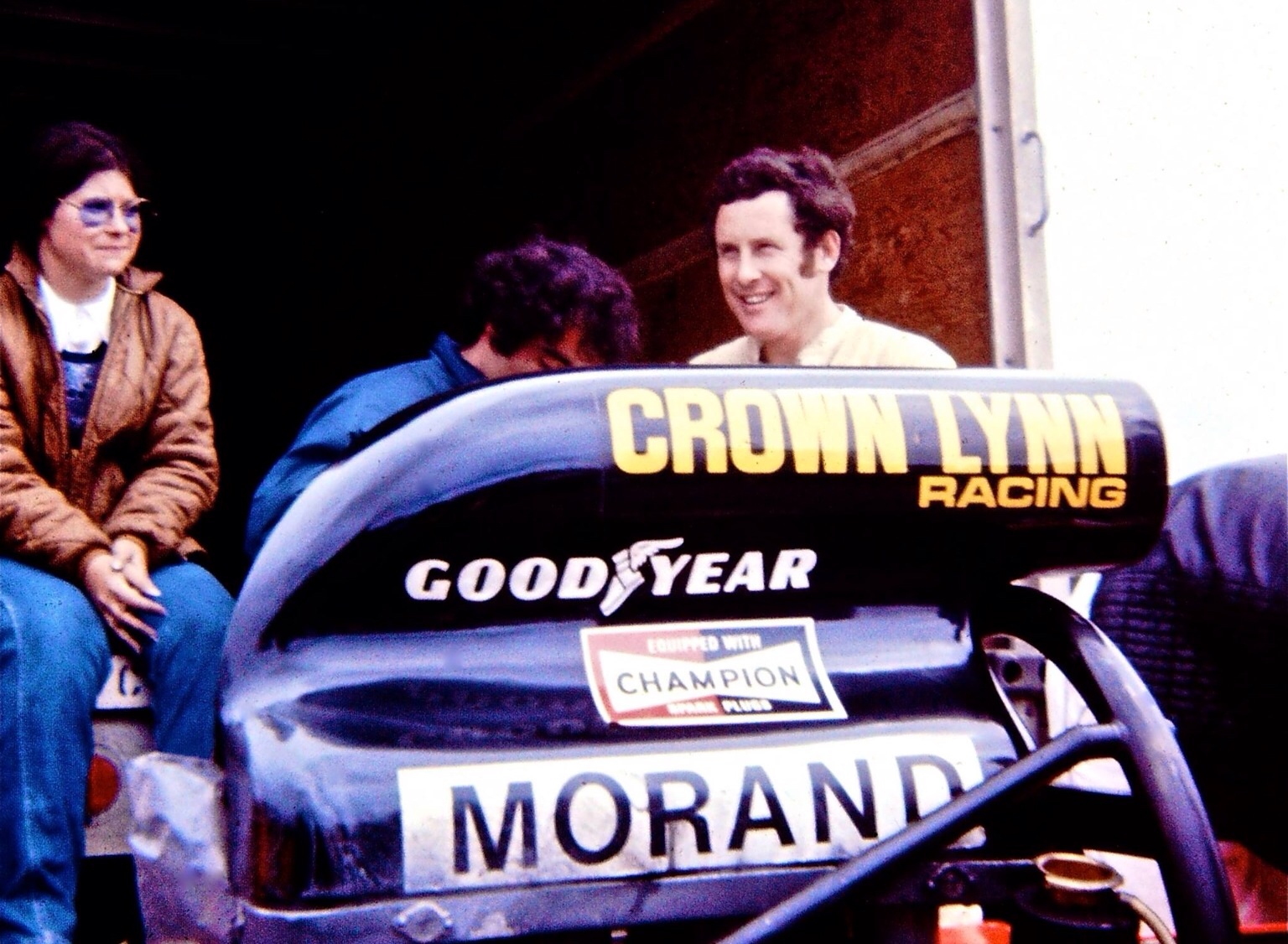
It won the 1968 Japanese GP in the hands of Moto Kitano, #20 above, but development continued on the R380, creating the R380-3 Type 3. Changes to the car involved longer and further evolved, heavier body work. Despite changing to fibreglass from a mix of aluminium and fibreglass, the cars now weighed 660kg, up from 640kg. The engine now produced 245bhp @ 8400rpm in part due to adoption of ubiquitous Lucas fuel injection in place of the faithful Webers. Tyre widths also, of course, grew.

By this stage some of the R380s were in the hands of privateers as Nissan focused on their more powerful cars. Three were entered in the 1968 Japanese Grand prix yielding third to fifth places.

image
(Nissan)

Nissan developed the R382 as its frontline tool for 1969, a sensational 6-litre V12, 600bhp open Group 7 sportscar, which again won the Japanese GP, the driver this time, Moto Kurosawa with H Kitano second.

These amazing cars (R381 and R382) are stories for another time, the photos are a tease! Oh for them to have raced in the Can-Am in the respective years! Timing is everything, and the timing in a corporate sense was not right even it was from an enthusiast’s perspective.

image
Nissan 1969 R382: spaceframe chassis, GRX-3 5954cc DOHC Lucas injected V12, circa 600 bhp (Nissan)

The two cars, entered for the 1969 Surfers 6 Hour were Nissan Motor Co works entries designated R380-3.

The bodies were a little longer than the year before at 4210mm compared with 4080mm. The car was 20 kg heavier, now 680 Kg and 5bhp more powerful, so a total of 250bhp @ 8400rpm. In that sense the cars brought to Australia were the ‘ultimate’ R380 specification, it would be interesting to know what became of them.

The winning car crewed by Takahashi/Sunago completed 257 laps from the second placed sister car of Moto Kitano and Motoharu Kurosawa on 253 and then the Brisbane Lotus Elan of Glynn Scott/Joe Camilleri/Ann Thompson on 236 laps. The Lotus 47 crewed by Sydney drivers Bob Beasley and Brian Davies was fourth with 233 laps. Not to forget the fifth placed Datsun Racing Team Datsun 2000 of Doug Whiteford/John Roxburgh/Barry Tapsall on 231 laps.

The R380s raced on into 1969 and 1970 taking secnd in the ’69 Fuji 1000km and second in the 1970 Fuji 200 mile event. Interesting cars aren’t they and as occasionally happens, a topic I tripped over looking for something else!

Etcetera…

Prince/Nissan R380 Specifications 1965-69…

image
(Nissan)
Prince R380 press release above and below in 1965 (Nissan)
(Nissan)

Bibliography and photo credits…

nissan-global.com, rffrfrnzclub.net, japanesenostalgiacar.com, earlydatsun.com, Nissan Motor Co, Laurie Richards Studio

Tailpiece…

Tatsu Yokoyama and Nissan R380-2 record setting at Yatabe in October 1967

Finito…