Archive for the ‘Features’ Category

Kevin Bartlett from Spencer Martin and Greg Cusack on the plunge down the mountain, Bathurst March 1967…

David Atkinson’s depiction of Kevin Bartlett’s dice and achievement of the first over 100 mph lap of Mount Panorama shows the Brabham BT11A Climaxes of  KB and Spencer from Greg’s Brabham BT23A Repco V8.

Bartlett first raced a Morris Minor at Bathurst in the late fifties, he knew the place as well as anyone- the sense of achievement was great. ‘Bathurst: Cradle of Australian Motor Racing’ is the title John Medley gave his wonderful ‘biography of Bathurst’ and goes a long way to making clear the significance of this wonderful place and it’s importance in the continuing pantheon of Australian motor racing.

Only Lobethal and Longford match it for its majesty and Warwick Farm, Phillip Island and Albert Park it’s importance.

During a couple of torrid dices in a preliminary race and in the NSW Road Racing Championship round Bartlett and Martin both broke the lap record and 100mph mark repeatedly but Kevin was the first to do so.

Frank Gardner casts a paternal eye over his younger teammate and his old BT11A in the Longford paddock in 1968. It’s not wet so it’s not raceday! (oldracephotos)

In many ways I see Kevin and Spencer as the Australian ‘Bobsy Twins’ of the time…

Both Sydney boys, both born in 1940, both motor mechanics by profession, both drove for one of the best teams of the day in Alec Mildren Racing and Bob Jane Racing- both raced Brabham BT11A’s powered by 2.5 litre Coventry Climax four cylinder ‘thumpers’ and both were sublime practitioners of the single-seater driving art. Driver’s-Drivers if you will.

Spencer had greater experience of these powerful single-seaters than Kevin but the Curl-Curl Kid was learning fast, a classicist with god-given intuitive feel and car control that thrilled the crowds and record books for decades.

Oopsie. Spencer post WF Tasman contretemps with The Causeway, 1967- late in the race won by Jackie Stewart’s BRM P261 from Jim Clark’s Lotus 33 Climax (B Wells)

Bartlett from Martin during the WF 100 race, Tasman Series 1967. KB was 6th, Spencer’s shown in the shot above. Both cars Brabham BT11A Climax (B Wells)

Bartlett declared his intent in practice with an over 100 mph lap of  2:18.6 with KB setting a time of 2:17.7 in a 6 Lapper for Racing and Sports Cars in a fierce battle with Spencer- in the process Martin matched KB’s 2:18.4 he had set on lap 3, only for Bartlett to do a 2:17.7 late in the race.

In an amazing weekend for Bartlett he contested four races winning three- two single-seater events in the Brabham and a touring car race in Alec Mildren’s Alfa Romeo GTA- he was second to Bob Jane ‘s Mustang in the other race. But the thriller of the four was the feature race.

Peter Wherrett, then racer and later immensely gifted automotive TV broadcaster covered the meeting for Max Stahl’s monthly Australian motor racing bible ‘Racing Car News’, his account brings the thrilling weekends racing to life.

‘The feature event in the nine race program was the 1967 NSW Championship for Racing Cars…it was a thriller but disappointing as well…Geoghegan and Harvey were installing new engines and were indisposed…Then right there on the grid…poor Greg Cusack and his team pushed and shoved the Brabham all over the place, but the big Repco V8 refused to start’.

‘Bartlett had pole after his fabulous practice time, but there was determination written clearly all over Spencer Martin’s face. When the flag dropped they raced neck and neck for Hell Corner. Since Bartlett had the inside running he also had the advantage and was first out but accelerating away up Mountain Straight Martin again drew alongside. Up and over the mountain they raced with Bartlett leading Martin by the depth of his tread.’

‘Down Conrod and into the braking area it was still Bartlett, now by a car’s length , as they crossed the line after a standing lap of 2:21.3, already 4.4 seconds inside the lap record. Martin again caught up going up the hill but once more it was Bartlett who led down Conrod.’

‘Those who saw them said none have ever gone down the Esses like this pair. Bartlett, particularly was breathtaking!’

‘It seemed he simply twitched the car from one corner to the next, setting the booming Brabham up in the middle of one corner so that it was as near as possible to be spot on line for the one following, and then upsetting the whole thing in the middle of the corner so that he would be right for the next one and so on.’

‘Already way back in the field Max Stewart led the 1500’s…F2 Rennmax…Phil West 1100 Brabham running in close company with Alton Boddenberg in the Lotus 32’.

Start of the championship race- not quite because Greg Cusack’s red Brabham BT23A Repco is on row 2 and he didn’t start so its a preliminary. KB on pole, Spencer alongside- Brabham BT11A’s times 2, Niel Allen, Elfin 400 Chev at left, behind him is Bob Jane, Elfin 400 Repco, then Cusack alongside and the Rennmax Ford with the driver well into the airstream is Big Max- Stewart, and the rest (unattributed)

(P Maslen)

Brian Caldersmith’s wonderful painting of the battle

‘But it was the Bartlett-Martin duel which was drawing the attention of the masses. Bartlett’s second lap put him 30 yards in front and this was not surprising when it was announced that the lap record was now  2:17.4. Too much!’.

‘Spencer was right in there though, and on the third he picked up a bit. Into the fourth they went and again Spencer seemed to catch Kevin going up the hill and Kevin seemed to gain it all back again on the straight.

On the fifth of thirteen, people began to doubt they could both withstand the pace. Again Bartlett was in the 17’s but this time Martin joined him with a personal best of 2:17.8 and then…it was just too good to last.

We crazy money-paying enthusiasts are just not deserving of such joy. Going up to XL Bend for the sixth time Spencer slowed and with oil pressure failing withdrew the ailing Brabham. Bartlett slowed (?) to the low 20’s and could not be beaten. Stewart took second place, mad with glee, and Phil West gained a creditable third from Boddenberg, Barry Lake and Peter Cohen, who was in and out of the pits and only completed three laps’.

‘All but one of Bartlett’s laps were under the old lap record, and six of them were under the magic 100 mph lap (2:19.5)’.

Warwick Farm 100 1968, The Causeway, KB Brabham BT11A Climax DNF halfshaft in the race won by Jim Clark’s Lotus 49 Ford (oldracephotos)

Its interesting to look at the speeds recorded through the flying 1/8th of a mile that Easter long weekend. Cusack’s Repco V8 powered Brabham was the quickest open-wheeler at 162.45 mph, a time he recorded in practice with Bartlett and Martin doing identical times in their identical cars during the NSW Championship race- 159.57 mph. The quickest car over the weekend in a straight line was Bob Jane aboard his 4.4 litre Repco RB620 V8 engined Elfin 400 sporty, with 163.63 mph.

‘Ron Hodgson, who probably thought he was on a good thing with his offer, had to part with 100 bottles of bubbly for the first 100 mph lap, and these were added to Kevin’s 25 bottles scored on Sunday for fastest practice lap’ Wherrett wrote.

Martin inside Bartlett at Murray’s Corner

Bartlett from Martin across the top of the Mountain (L Walker)

Bartlett’s recollections are recorded in Alec Mildren’s biography-

‘…We were at it hammer and tongs. We were both pretty gung-ho. I was probably a bit more aggressive…Alec was really on the ball…I wouldn’t have attempted what I did otherwise. I came in after first practice and he said “Where do you reckon you can get the laptime” He knew the circuit, look, he knew it…”What if you short shift here, leave it that gear there, what revs are you using? He was at me’.

‘I was the train (engine) and Spencer was the guards van. He broke the 100 mph mark, too don’t forget. Always remember that. But because I was leading and crossed the line first, I got the credit. And when it came to the run of the race. I out braked him by outbraving him- it was one of those do or die things. I said to Alec later “Spencer and I got pretty close, Alec”. “We nearly lost the lot”. He said “Yeah, but you outbraved him didn’t you?” That was the way he talked’.

Later ‘When  Alec asked me what I was going to do with the champers, I said I don’t want it, you have it, and he said “Good, I’m going to throw a party”. Anyone and everyone in motor racing was invited to the splash-out at the Mildren Newport (Sydney North Shore ocean beach suburb) residence…Alec was never a boozer- he was an orange juice man. But I’m sure he had a champers or two that night’ Bartlett recalled.

Bartlett amongst the Repcos in 1967: Leo G Lotus 39, KB Brabham BT11A and John Harvey Brabham BT14, ‘Angus & Coote Trophy’ Oran Park (Rod MacKenzie)

Whilst Bartlett was the hero of the day at Bathurst, Martin again won the 1967 Gold Star, as he did in 1966 with two wins (Surfers Paradise, Mallala) to Cusack and Bartlett’s one apiece (Symmons Plains and Lakeside).

The two BT11A’s would have been the most highly developed cars of their type in the world with Martin and Bartlett both having, just, the legs of the Repco V8 engined cars of Cusack, Leo Geoghegan and John Harvey- Brabham BT23A, Lotus 39 and Brabham BT14 respectively. Spencer’s Bob Jane Brabham was more reliable than KB’s however, Spencer took the title with a points haul of 30 from Cusack 23, and Bartlett 16.

Formative KB single-seater years, 17 December 1961 Warwick Farm in the Lynx BMC FJ. Race won by Leo Geoghegan’s Lotus 20 (J Ellacott)

Another Big Bathurst Moment…

Bartlett and John Goss in the Bell cap (Greg Bartlett is the kiddo with his back to us) on the Bathurst 1000 victory dais in 1974.

What a sweet win for them both- especially KB who had a bad accident at Pukekohe at the seasons outset during the Tasman Series, he became a ‘Lola Limper’, breaking a leg when his T330 Chev came to grief, a lengthy recovery period followed.

That’s a walking stick in the young veteran’s left hand, quite a few of his fans shed a tear watching his gritty performance that day and this presentation on the telly, me included.

(autopics)

Etcetera: Spencer Martin HDT Holden Monaro GTS 350 alongside Allan Moffat’s works Ford Falcon GTHO Phase 1, warm up lap, Sandown 3 H0ur, September 1969…

There are plenty of Fords behind- Moffat/John French won from Tom Roddy/Murray Carter and Fred Gibson/Bo Seton all in HO’s.

Spencer had been retired for a year or so when he took a call from new Holden Dealer Team team manager Harry Firth to share a Monaro with KB during the HDT’s first event, the 1969 Sandown Datsun 3 Hour.

Ex-Ford racer/engineer/team manager, now Holden new boy Harry Firth was prevailed upon to hire a couple of single-seater drivers to race his new toy, Firth more of a believer in taxi drivers racing taxis, so to speak.

In a story for another time Martin had a massive brake failure at about the 45 minute mark of the endurance classic at the end of Sandown’s main straight, he skilfully backed the car into the Shell Corner armco minimising the damage to his good self but the car caught fire. The accident is variously attributed to boiled fluid, ‘brake booster system’ or standard brake pads being mistakenly fitted to the car prior to the race.

The Monaro was repaired after the race and sold by tender, it still exists. Spencer retired from a meeting he only entered after agreement with his new wife that a race in a touring car was relatively safe! His comeback to racing in the historic scene was a couple of decades hence.

In 1969 Bartlett had many successes in front of him including the second of his two Gold Stars aboard the Mildren Alfa/Waggott, in Asia and the US with much Formula 5000 and plenty of touring car wins including a Bathurst crown…

Slightly singed but not fatally damaged Monaro in the slip road on the outside of the Sandown track on pit straight, scene of Spencer’s high speed handbrake turn into the fence. KB did not get a drive during the race (unattributed)

Photo & Other Credits…

Racing Car News May 1967, Rod MacKenzie, autopics.com.au, Brian Caldersmith, oldracephotos.com.au, Bruce Wells, John Ellacott, Bob Jane Collection, ‘Driven To Succeed: The Alec Mildren Story’ Barry Green, ‘Bathurst: Cradle of Australian Motor Racing’ John Medley, Peter Maslen Collection, Lionel Walker

Tailpiece: Bartlett at the wheel of the McLeod Ford / John Goss Ford Falcon GT during the Bathurst 1000 in 1973- they won in the same car in 1974 but I like the look of the big yella beastie the year before…

Finito…

(Douglas Walker)

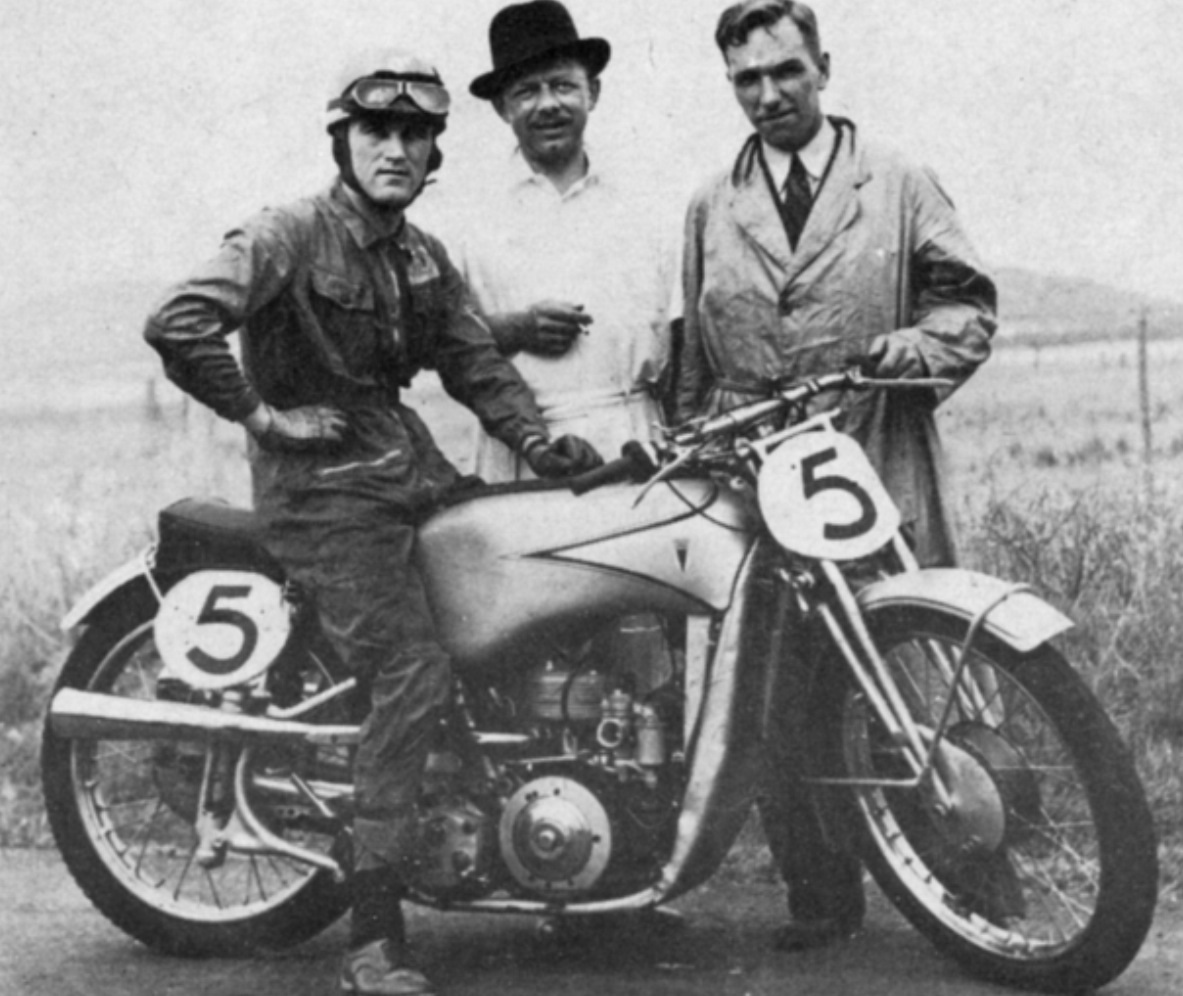
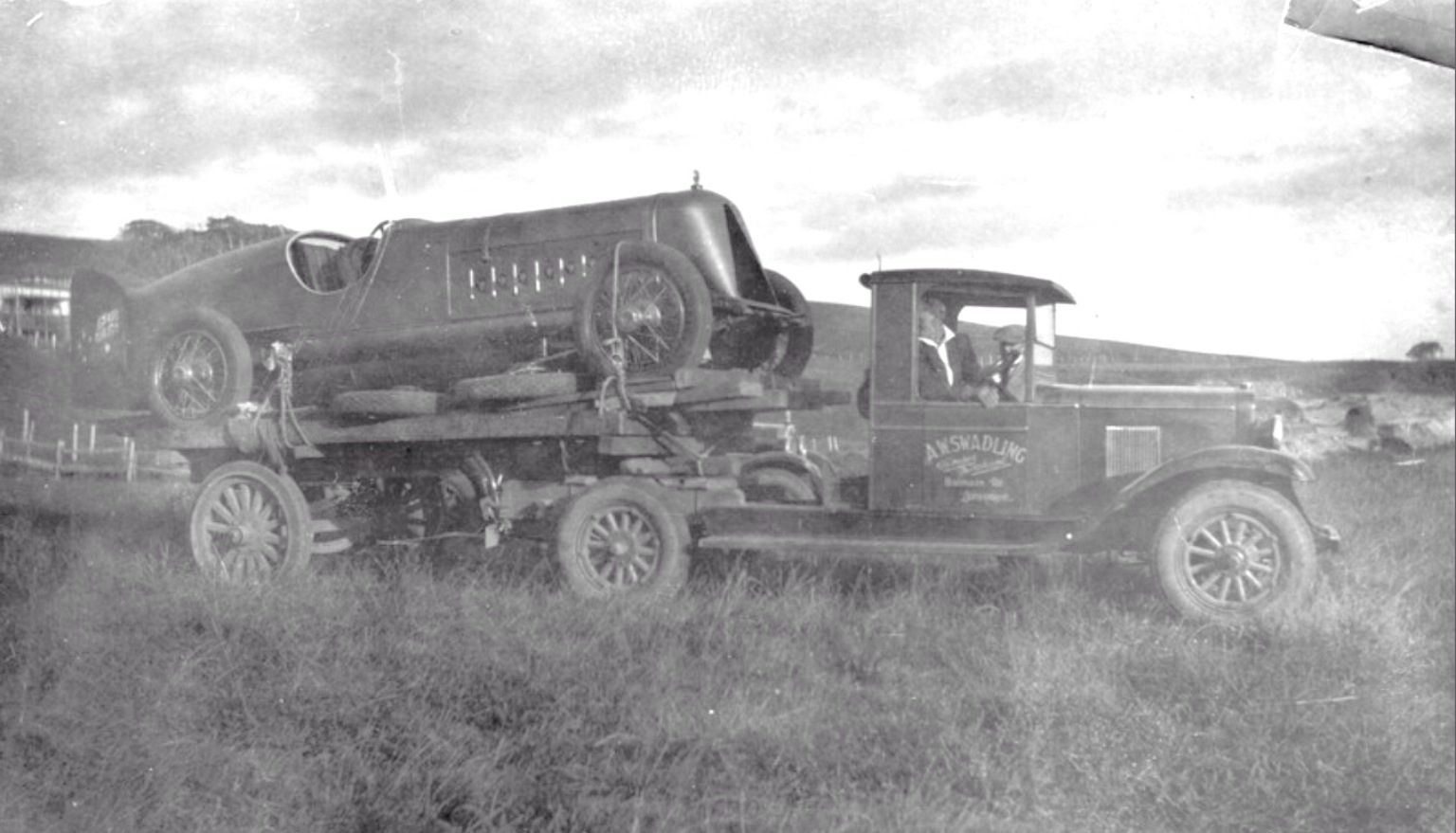
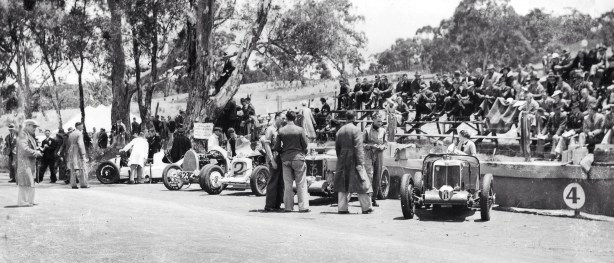
Quintessential Australian racer/engineer Tom Sulman loads his Maserati 4CM after the second ‘Lady Wigram Trophy’, Wigram Airbase, New Zealand 23 February 1952…

Tom Sulman was born in Sydney on 25 December 1899 and died in a tragic accident at Mount Panorama, Bathurst on 30 March 1970 aboard one of his Lotus 11 Climax’. He was the grand old, gently spoken man of Australian motor racing- a racer to the core, he competed all of his life inclusive of elite levels internationally.

Like most of my articles this one was stimulated by finding some photographs, and as is usually the case, doing so whilst looking for something else!

The shots of Tom and his Maserati 4CM in New Zealand in 1951 were simply too good- so evocative of the period not to do something with. The trouble is that his racing career was so long it’s a huge job to do it justice especially with information not readily available, so treat this as summary of his wonderful life with a bit of focus on the Maser, itself a car with an interesting provenance.

Sulman was the son of UK born and later immensely prominent and influential Sydney architect Sir John Sulman. Tom grew up in a rambling home at Turramurra, on Sydney’s upper North Shore. Unlike his formidable father, whose competitive spirit he undoubtedly had, he commenced a career in automotive engineering, very much an industry of growth at the time. In 1923 he built his first racer, the ‘Sulman Simplex’, a road-going cyclecar, which he raced at Sydney’s Victoria Park that year.

Tom Sulman and Fay Taylor with the Sulman Singer at West Ham, London in 1936

During the 1930’s depression Tom travelled to England looking for work and soon established a motor engineering business. His early motor sport endeavours began in 1931 and involved conversion of a Morgan 3 wheeler to a 4 wheeler! so that he could race ‘a car’ on dirt, which was very popular at the time. Later he built a car with a motor-cycle twin-cylinder engine and a ‘vaguely Salmson chassis’ which he raced at the early Crystal Palace meetings and at Greenford.

In fact Tom was right there at the start of organised car-only dirt track racing on motorcycle speedway lines. Outside the reach of the RAC, the first UK race of this type was held on Good Friday 30 March 1934, at Crystal Palace.

There were three teams of three riders and a reserve with ‘New South Wales Champion’ Tommy Sulman captaining the Wimbledon Park team driving a ‘Bitza Special’! During this period he raced at tracks such as Greenford, Crystal Palace, Hackney, Lea Bridge and Wimbledon. To provide some sense of the scale and level of interest in speedway racing at the time there were over 25 tracks in the London extended area alone. In addition to his motor engineering Tom was a professional driver earning money from his race competition.

He was approached by a Singer agent off the back of his performances and growing reputation to build a similar sprint and hillclimb special to his own car using Singer components. Core mechanicals were a Singer Le Mans engine and G.N. chain transmission. When the car was completed, it became the ‘Sulman Singer Special’ after the Singer agent went ‘bust’ leaving Sulman with the car! It soon became clear after the commencement of dirt track racing that the cut down sportscars predominantly used were unsuited to the tight, deep cindered UK tracks with short straights. Tom built the Sulman Singer as a dual purpose machine, but its very short wheelbase was a function of the development work by trial and error he and other leading racers had done to create a car ideal for the dirt.

Sulman raced it regularly in the UK and once in Holland in 1936. On 4 August 1936 Tom contested the very first Midget World Championships at Hackney, in inner London.

The winner with 7 points from his heats was Cordy Milne of the US- Tom was 6th with 3 points, he was 3rd, 2nd, and 2nd in his three heats. Another Australian, Dicky Case was 2nd with 6 points. An interesting sidebar is that Case, a star motorcycle solo-rider was invited into the competition as a fill-in driver due to a lack competitors- and came close to winning the thing! The program does not disclose the chassis the various competitors used.

Into 1937 the Sulman became obsolete, along with most of the rest of the fields with the advent of the ‘Skirrow Specials’. These revolutionary cars built by Harry Skirrow in Cumbria had chain drive to both front and rear axles harnessing the 80bhp produced by their bespoke 990cc twin-cylinder JAP engines rather effectively. As a consequence, Tom built a 4WD car of his own in an attempt to more effectively compete- he crashed badly at Coventry in August/September 1937 and elected then to end his midget racing career. The Sulman Singer, which had been put to one side, was then pressed back into service, Tom raced it at various hillclimbs.

Bathurst 1950, Hell Corner lap 1. Ron Ward MG TC from Sulman in the  #47 ‘Singer then Ron Edgerton #37 MG TC and Gordon Stewart #46 MG Magna (AussieHomestead)

At the end of World War 2 Sulman returned to Australia by signing on as a flight engineer on an aircraft, his very cost-effective way to take the long, expensive 12000 mile journey home was as a crew member of a Lancaster Bomber converted to carry people rather than a lethal payload. The Sulman Singer followed by ship, the car travelled sans bodywork to avoid import duty being imposed upon it by the Fiscal Fiend- the Australian Taxation Office!

Tom first raced the car in Australia at Nowra on the NSW south coast in June 1947, the combination took a win in the under 1100cc scratch race. As a road racer it competed in contemporary events up to and including the Australian Grand Prix, then a handicap event. He was 5th at Bathurst in 1947 and also contested the 1948 AGP race at Point Cook in Melbourne’s outer west, the little car succumbing to the extreme March summer heat like so many others on that day.

Sulman eventually sold the car when he acquired the Maserati, it raced regularly in various hands in the 1950’s but by the 1960’s was mainly used in historic events. The car was sold to AP North, then later to Monty South and finally Ron Reid on 6 November 1965 to start a long relationship of sympatico between driver and owner.

Moustachioed Ron Reid, red ‘kerchief flapping in the breeze with a big smile upon his face was an icon of Australian Historic Racing in the car which still races, after Ron’s demise in 1999, in the hands of Mal Reid, Rons son. Whenever I see this wonderful machine in the paddock it always brings a smile to my face. Drivers and cars come and go, but the Sulman Singer remains a constant in Australian motor racing and would be a finalist for the ‘longest continuously raced’ car on the planet.

Sulman competed in other cars as well though, including an 1100cc HRG sports car. By the late 1950’s, Tom, who had a workshop in the now very trendy inner-Sydney suburb of Surry Hills, had added to his stable the Maserati 4CM. This ex-Farina/Salvadori car, he bought from Australian resident Englishman David Chambers.

Sulman in the Maserati 4CM at Mt Druitt’s Hairpin, Sydney, date unknown (AussieHomestead)

Chassis # 1521, one of about twelve 1500cc 4CM’s, was first delivered to none other than Giuseppe Farina in August 1934, he won Voiturette races in it at Biella and Masaryk and then Modena and Turin. Gino Rovere, who probably owned the car when raced by Farina, raced it during 1935 and perhaps also Gigi Villoresi as part of Rovere’s ‘Scuderia Subalpina’. It then passed into the hands of several UK drivers including EK Rayson, Charles Mortimer and then formed an important part of the nascent racing career of Roy Salvadori post-war.

David Chambers acquired the car in England in 1949, raced it at Goodwood and then shipped it home and made his Australian debut at Rob Roy Hillclimb in outer Melbourne in 1950. Raced at Easter Bathurst 1950, the 500Kg, 1496cc, Roots-type supercharged, 4 cylinder 130bhp @ 6100 rpm car achieved 122mph through the traps on Conrod Straight in top- 4th gear in its Fiat derived gearbox.

New Zealand Hillclimb Championship 1951, winner in the Maser 4CM. Venue folks? (Walker)

Tom bought the car shortly after this meeting and campaigned it in both Australia and New Zealand over the next few years.

Among his New Zealand successes were the 1951 NZ Hillclimb Championship, on that tour he also contested circuit races- the Ohakea Trophy and Lady Wigram Trophy in March finishing 4th and taking fastest lap, and DNF at Wigram. NZ ‘heavy metal’ of the day included cars such as Les Moore’s Alfa Tipo B, Ronnie Moore’s Alfa 8C, Frank Shuter’s V8 Spl, Jack Tutton’s C Type, Ron Roycroft’s Jag XK120 and like Australia a swag of MG and Ford V8 powered specials as well as the early Coopers starting to appear.

Working on the engine of the Maser 4CM, NZ Hillclimb Championship 1951. Mechanical specifications as per text (Walker)

The Maser was period typical in having a channel section chassis, with rigid axle suspension at both ends and semi-elliptic springs front and rear. Sulman was unhappy with the cars handling so modified it by adding 3.5 inches into the front axle, increasing the front track from 3 foot 11.2 inches to about 4 feet 3.5 inches, widening the spring base and inverting the rear shackles. The rear track remained at 3 feet 11.2 inches. When completed he reported the car as extremely predictable and easier to handle.

During practice at Parramatta Park in January 1952 he nipped a brake coming into Rotunda Corner, spun, hit the kerb and rolled landing back on the Masers wheels. Damage was limited to a bent stub axle and minor body twisting. He repaired the car and returned to the Land of the Long White Cloud that summer of 1952, racing again at Wigram and Ohakea for 2nd off the front row and 4th.

Tom at Mount Panorama in the 4CM, date unknown- superb, rare colour shot (B Miles)

The car was shipped back to Australia in time for the April 1952 AGP at Mount Panorama- finishing 6th in the race won by Doug Whiteford’s Talbot Lago T26C taking the second of his three AGP wins.

Probably his best run in the thoroughbred single-seater was at Gnoo Blas, Orange, NSW in April 1953- his haul five race wins. Less happy was the car ‘chucking a rod’ through the block at Mount Druitt, Sydney in 1954.

Tom Sulman Aston DB3S, Doug Whiteford Maserati 300S and Bill Pitt Jaguar XKD on pole, Victorian Tourist Trophy, Albert Park 17 March 1957. Whiteford won the 100 mile racefrom Pitt, Tom DNF on lap 16 (unattributed)

Tom was invited to become a member of ‘The Kangaroo Stable’ which planned a long distance sportscar racing program in Europe in 1955 with three Aston Martin DB3S customer racers.

At that point the Maser was sold, it remained in Australia into the mid-sixties but left the country many years ago, living on in historic racing.

He acquired DB3S ’103’ new from the Aston, Feltham factory, the car was registered in NSW as ‘OXE-473’ and raced it in England-the Goodwood 9 Hours and at Aintree during the British GP meeting sportscar events, Portugal- the Lisbon GP, France, with the best result a 2-3-4 finish for The Kangaroo Stable behind a Ferrari in the Hyeres 12 Hour in the Provence-Cote d’Azur region of France-Tom was third. His co-driver was none other than Jack Brabham, then in his first year of a long and rather successful racing career in Europe. The Kangaroo Stable’s racing plans were to a large extent scuttled by the ’55 Le Mans disaster and the cancellation of many events in Europe as a consequence that year.

Tom returned to Oz, with the Aston his mount for years. Sportscar racing was especially healthy in Australia at the time with a mix of XKC and XKD Jags, Maser 300S, Aston DB3S, Cooper Jaguar, the Ausca Holden Repco, a swag of Austin Healey 100S and various Climax engined Lotus 11 and 15’s thrilling large crowds. The customer Astons were front third of the field cars. When David McKay’s ex-works DB3S car- DB3S/9 arrived it was the class of the field. Other quicks of the time Bill Pitt’s D Type, Frank Gardner’s C and D Types, Doug Whiteford’s ex-works Maserati 300S and the Derek Jolly and Frank Matich Lotus 15 FPF’s when they appeared later in the decade. Tom’s best results aboard ‘103’ were 2nd , 4th and 4th in the South Pacific Sportscar Championship at Longford in 1958, 1959 and 1960. He was 5th in the hotly contested 1960 Australian Tourist Trophy at Longford won by Jolly’s Lotus 15.

Tom Sulman takes his Aston DB3S onto the Longford grid during the 1960 Australian Tourist Trophy weekend. Only Whiteford’s #10 Maser 300S of this group of cars (in addition to Tom) contested the championship event- this is perhaps a preliminary or practice (J Ellacott)


Gnoo Blas, Orange 1 February 1960. Anniversary Championship for Sportscars. Derek Jolly Lotus 15, Ross Dalton Jag XKC, David Finch Jag XKD on pole, and on row 2 the Aston DB3S’ of Jim Wright ex-Warren Bloomfield and #58 Tom Sulman. Jolly won from Finch and Wright with Tom placed fourth (Aussie Homestead)


Stunning shot of Tom during the first ‘Southland Road Race’ at Ryal Bush in 1956. He appears to have had some involuntary oversteer on one of the road courses left handers! (J Manhire)


Tom at Lowood in 1960- Aston DB3S (B Thomas)

Tom took the car to New Zealand for their summer races in 1956 commencing with the NZ GP held at Ardmore, then Wigram, Dunedin, Ryal Bush and Ohakea, his best results in the five meeting two month stay was 6th and 7th at Ryal Bush and Ohakea Airfield.

At a time the Australian Grand Prix was still a Formula Libre race, with ‘outright’ sportscars regular entrants. Tom the took the Aston on the long trip, 3920 kilometres for you Europeans- you have to be keen!, from Sydney to Western Australia to contest the 1957 race held at Caversham in outer Perth. It was a long way to travel for a DNF, but many cars did not survive another AGP held in scorching hot Australian summer heat. Lex Davison took a famous, and fortunate win in that race co-driven by Bill Patterson. Fortunate in the sense that lap-timing confusion awarded the race to Lex rather than Stan Jones.

In addition to Jack Brabham driving the car, the Aston’s provenance was further enhanced when Stirling Moss took the wheel and gave a journalist the ride of his life during several practice laps at the 1961 Warwick Farm opening meeting.

Sulman, Lotus 11 Climax, Silverdale Hillclimb, NSW (Bruce Wells)

In the early 1960’s he bought a locally built Lynx Ford Formula Junior and in 1961 the first of two Lotus 11 Climax’.

Chassis ‘343’ was an S2 Le Mans spec car powered by several Coventry Climax FWA engines. The Aston was sold to Ron Thorp, it remained in Australia for some years before it too made its way to the UK. In 1963 he bought his other 11, a Climax FPF engined car, chassis ‘305/552’ which had originally been raced by Ron Flockhart and Roy Salvadori in the UK. This period is confusing for historians as it is not clear which car he raced where- and he raced them everywhere! At sprints, hillclimbs and circuit races.

Remember, by 1960, he was 61 and had been racing for the best part of 40 years. Tom’s racing was diverse though, he contested rallies, hillclimbs and sprints as well as circuit racing. His rally/reliability trial experience included the famous, legendary RedeX Round Australia Trials of the 1950’s including the first one in 1953 as a member of the Humber Super Snipe team. He entered touring car races too- as that aspect of the sport grew including the Mount Druitt 24 Hour race and the 1962 Bathurst Six Hour aboard a new-fangled Datsun Bluebird.

Tom in the ex-Abbott/Hamilton Porsche 904 Ford Cobra, Huntley Hillclimb, NSW 1 June 1969 (T Arts)


and again as above (Tony Arts)

Some of the cars he raced such as the ex-Alan Hamilton Ford Cobra powered Porsche 904 were very potent devices, he ran this car circa 1969. He contested the 1966 Surfers Paradise 12 Hour enduro as co-driver to Ron Thorp who by then was racing a booming AC Cobra, very much a crowd favourite, the duo won their class, that event won outright by Jackie Stewart and Andy Buchanan aboard the famous Scuderia Veloce Ferrari 250LM.

Lotus 11 Le Mans Climax FPF 1500, Lakeview Hillclimb, ACT date unknown (AussieHomestead)

In March 1970 Tom loaded the little Lotus 11 ‘343’ onto its trailer in Surry Hills and headed out of Sydney west towards the Bells Line of Road for the 200Km trip to Mount Panorama, goodness knows how many times he would have made that journey? He was off to the Easter Bathurst meeting, at that time there were two race meetings a year at the famous circuit, not just the annual touring car 500 miler.

Journalist Barry Lake recounts the events of Sulman’s final drive in the insignificant 6 lap ‘Sir Joseph Banks Trophy’ sportscar scratch race at Mount Panorama. ‘At the Easter Bathurst meeting on 30 March 1970 the quietly spoken Tom, now 70 years old and as keen to race as ever, moved slightly to the right and simultaneously slowed down between the two humps on Conrod Straight. Vincent Evans who was a short distance behind, could not avoid the impact of his left-front mudguard with the right rear bodywork of the Lotus 11 driven by Sulman. The Lotus 11 swerved to the left of the circuit (its inside) into the gravel on the verge and rolled into a locked (farmers) gateway, hitting the gatepost on the drivers side. Sulman’s head hit the post causing his instant death’.

‘Shortly before the accident there had been a ‘Tom Sulman Trophy’ race at Warwick Farm for historic cars to commemorate his very long racing career. At the age of 70, Sulman was one of the oldest racing drivers in activity at the time’ Lake’s tribute concludes.

It was a terrible case of being in the wrong place at the wrong time and hitting the fencepost when it could just as easily have been open space. Australian motor racing was rocked by another fatal accident at Bathurst twelve months after the last, Bevan Gibson’s Elfin 400 Repco became airborne on one of Bathurst’s humps at the same meeting a year before.

Sulman had lived a good life, a long full one despite its untimely end. He was one of those fellows who put more into the sport than he took out, and loved it to its core. A racer through and through right to the very end.

Tom Sulman at Lowood, circa 1959 (R Wittig)

Etcetera…

(Athol Yeomans)

Tom in the Maserati 4CM at Silverdale Hillclimb in June 1960.

Bibliography…

Obituary written by Barry Lake published on ‘Motorsport Memorial’, ‘Historic Racing Cars in Australia’ John Blanden, ‘Maserati: A Racing History’ Anthony Pritchard, Derek Bridgett on ‘Midget Car Panorama’. MotorSport magazine December 1936, ‘Bugattis Did It Too’ article in ‘Loose Fillings’ December 2015

Photo Credits…

Douglas Walker Collection, Aussie Homestead, Simon Lewis, Bruce Wells, Ron Wittig, Bruce Miles, John Ellacott, Tony Arts, John Manhire, Brier Thomas

Tailpiece: Sulman aboard his remarkably adaptable Sulman Singer at Kennel Corner, Shelsey Walsh in 1938. A rare UK shot of the car…

(Simon Lewis)

Finito…

Colin Bond in the Holden Dealer Team’s ‘new’ LC Holden Torana GTR XU1 V8 during the Easter Bathurst meeting in 1972…

A new car in the sense that this cleverly disguised, pensioned off, 1970/71 Series Production V8 re-engined car, also fitted with rear wing was a sleeper. It was the prototype of the General’s (General Motors Holden) proposed 308 V8 powered 160 mph 1972 Series Production Bathurst contender, make that winner. The machine also featured widened 6X13 inch steel wheels and a full-width front spoiler incorporating brake ducts intended for the road-going variant.

During the weekend the V8 bullet was demonstrably quicker than the LJ 202 cid Series Production XU1s, winning the five lap Touring & Sports Closed Scratch Race from Ron Gillard’s XU1 and Graham Ryan’s Charger. Bondy was a bit lucky as Bob Jane’s full-blown Torana V8 4.4 Repco 620 Sports Sedan blasted away to an early lead only to slow, pit and rejoin the race back in 11th position. But a win is a win, the only one for the car. Bond did a best lap of 2:39.6 to win. In comparison, he did a 2:43.9 in his Series Production LJ XU1 to win the ‘Better Brakes’ Series Production Touring Car 17 lapper earlier in the day.

It’s hard for me to picture my parents as rampant-rooters, but they are of that generation, who, free from the pressures of the war years hit the bedroom and created us Baby Boomers, that statistically significant, big post-war rump of the populace who are still grimly hanging onto power.

Critically, we are a huge mob worldwide who drove demand for all sorts of consumer products throughout the sixties and seventies buoyed by a strong global economy and the expansion of consumer credit. The latter, in essence, allowed us to live beyond our means doing so as the houses we bought gained capital values of almost obscene levels (in Australia) thereby taking care of our debt/equity ratios. None of us are complaining mind you, even if our kids are!

In the US the car manufacturers noticed we youngsters, particularly our burgeoning wallets and therefore the potential to flog us stuff. They delved into their parts bins and packaged existing hardware – engines, gearboxes and chassis underpinnings – into very attractive packages. Ford’s Mustang and Chev’s Camaro being Pony Car cases in point.

By 1966/7 those components were finding their way to their Australian subsidiaries and were packaged into yummy stuff such as the 289 cid V8 powered 1967 XR Ford Falcon GT and 1968 HK Holden Monaro GTS327. They were mighty fine racing cars compared with the Morris Cooper S and Ford Cortina GT/GT500 which had been the top-guns at Bathurst till then.

The inexorable rise in Australian touring car racing gathered apace in the sixties and morphed into three classes. Series Production were essentially showroom stock cars, the class to which the Bathurst 500 was run. Improved Production, as the name suggests allowed greater modifications and was the class to which the Australian Touring Car Championship was contested. The category allowing the wildest modifications was Sports Racing Closed/Sports Sedans.

Inevitably motor racing played its usual part in the corporate brand building of the manufacturers and moving-metal of these new machines, or rather the more modestly specified brothers of the race intended cars. The ‘win on Sunday, promote the shit out of it on Monday, flog on Tuesday’ adage has been a good, fairly accurate one down the decades.

For enthusiasts, the cars modified for intended race use were what we sought and could buy if one had the readies, as sufficient numbers had to be built and sold for road use to allow Group E Series Production homologation for racing eligibility.

Holden initially raced V8 engined Monaros very successfully in Series Production winning a Bathurst 500 or two, 1968 and 1969 to be precise. Mount Panorama pickings were decidedly slimmer once the marketing focus changed to the six-cylinder Holden Torana in 1970.

There was nothing to stop privateer teams running the Top Gun Holden Monaro GTS350, some did, but the ‘factory’ Holden Dealer Team had to run the cars Holden’s marketing needs demanded. There wasn’t the budget/resources to, say, develop, prepare and race Monaros on tarmac and Toranas on dirt, that choice would have been the optimal one.

Without going into all of the detail for international readers, Ford and Chrysler competed locally with factory teams. General Motors Holden, the local GM subsidiary was a bit more prim and proper over observance of the supposed American Automobile Association ‘no motor racing ban’. They competed via the back-door Holden Dealer Team, a small outfit operated by The Fox, Harry Firth, former racer/mechanic/engineer and Bathurst 500 winner out of premises in Queens Avenue, Auburn, a twee inner-eastern Melbourne suburb.

Mason/Mason Mazda R100 and Cooke/Mason Monaro GTS350 Bathurst 1969. Digby Cooke qualified the Monaro second, DNF with Trevor and Neil Mason 21st in the race won by the Colin Bond/Tony Roberts HDT GTS350 (S Jek)

Cooke/Bowden Monaro 350GTS Bathurst 1970 Q2 and DNF gearbox, Bathurst below (S Jek)

In creating the first race variant of the Torana – the 1970 LC, ohv, 186 cid six-cylinder engined GTR XU1 – Harry Firth and his small team, including long time mechanic, Ian Tate, driver Peter Brock and GMH created the first in a series of the best all round competition taxis in Australia. The LC, and later 202 cid LJ 1971-73 XU1s were supreme road cars (the LC perhaps not so much, it was way too choppy in spring/shock rates to take your babe to the drive-in) and winners in rallies, rallycross and on the circuits.

The problem was, whilst there was an Australian Manufacturers Championship, run over rounds at Sandown, Bathurst, Surfers Paradise, Adelaide, Phillip Island (depending upon the year) the only race that mattered to the punters watching the Teev at home was the Bathurst 500. Ford had a mortgage on that classic with their mighty, four door, 351 cid V8 engined Falcon GTHOs.

Colin Bond’s HDT Torana LC GTR XU1 in the Bathurst pitlane 1971, fourth in the race won by Moffat’s works Falcon GTHO Phase 3 (autopics)

While the Toranas were continually developed, they simply lacked the mumbo to win at the Mountain. The solution was simple, build a V8 XU1. The prototype of the car is the beastie Bondie is wheeling around Bathurst in the opening photo, it was put together in late 1971 using a cast-off HDT Series Prod LC XU1 raced by the team in 1970/71.

Fitted with a 5 litre Holden 308 V8, M21 four-speed gearbox, suspension tweaks and away they went, the car was driven by Brock, Bond and Larry Perkins.

Repco Holden F5000 V8. Phil Irving designed, with assistance from Brian Heard, engine produced circa 470-520 bhp throughout its life (Repco)

Lets not forget that the Holden 308 V8 parts competition bin was deep. Repco had built and been racing the F5000 variant of the engine for about two years by the time the HDT boys started playing with the 308, inclusive of two Australian Grand Prix wins in cars driven by Frank Matich; 1970 in a McLaren M10C and 1971 in his self-built Matich A50.

Bond, Hell Corner, Bathurst Easter 1972, XU1 V8

The test-bed car was registered for road use and carried the Victorian number-plate KSN-116. It was first raced by Bond as shown here at Bathurst. Brock then raced the car at Adelaide International. Larry Perkins given the task of driving it across on the Great Western Highway and also racing in one of the support events. Firth was starting to get an idea of how their Bathurst contender would fare later in the year.

Perkins in Gary Campbell’s Elfin 600B/E Ford during the 1972 Glynn Scott Memorial Trophy at Surfers Paradise, first F2 home (G Ruckert)

Larry drove and tested for the HDT in 1972, mainly competing in Rallycross. His primary race program that season was driving Garry Campbell’s Elfin 600 B/E Ford ANF2 car to the national Australian Formula 2 title. He was off to Snetterton for the Formula Ford Festival with Garrie Cooper’s first Elfin 620FF late in the year, he won the Australian FF Driver to Europe Series in 1971 but took his prize a year later knowing he would be better prepared, the rest is history.

Larrikins in the HDT Rallycross LC XU1 supercharged Beast at Catalina Park in Sydney’s Blue Mountains in 1972. What a career! FV to F1, Rallycross to Le Mans, he did, raced, built and won in everything (autopics)

Brock raced the LC V8 car at Calder on 14 May in the Marlboro Trophy Series minus spoilers – but with the widened steel wheels shown in the Bathurst shots earlier in this article – in a combined Sports Sedan and Improved Tourer race running as a support event for the Repco Birthday Series F5000 feature event.

He raced mid-field amongst much faster sports sedans including Norm Beechey’s Monaro, Bob Jane’s Camaro, Alan Hamilton’s 911S and John Harvey’s Torana Repco V8 barely rating a mention in the race reports. That the car was slipping under the radar was perfect from HDT’s perspective.

Ford Falcon XA GTHO Phase 4s come together at FoMoCo’s Oz Skunkworks, Lot 6 Mahoneys Road, Broadmeadows on Melbourne’s north-western fringe. Note the 36 gallon tank beside the standard item. Only four cars were built (unattributed)

While Holden were beavering away on their 1972 Bathurst contender, out in Mahoneys Road, Broadmeadows, on the other side of Melbourne, Ford were working on the new XA Ford Falcon GTHO Phase 4. In Tonsley Park, Adelaide, Chrysler were toiling on a V8 engined RT Charger, the E55.

For enthusiasts and racers these were mouth watering machines with enormous performance potential and engineering integrity.

GMH proceeded to develop the production version of Harry’s V8 prototype, ordering three GTR (not XU1) V8s, which were sent down the Elizabeth, South Australia plant production line on 13 April 1972 for use by the Experimental Engineering team at GM’s Port Melbourne plant in inner Melbourne.

And then along came the media hysteria Supercar Scare which was a frenzy of journalists and politicians whipping themselves into a lather over ’18 up year olds driving around the streets of our cities at 160 mph’.

This topic has been well ventilated down the decades among enthusiasts in Australia, there is little point adding to it here. Not that there is any doubt of the performance capability of any of these cars, but arguably a drum braked, cross-ply-tyre shod, terminal understeering six-cylinder, poverty-pack Holden Belmont was a more lethal weapon than a well engineered Supercar which was fit for purpose. A Belmont wasn’t fit for anything other than as an inner city cab operated at less than 35 mph.

So, the cars were all pulled (or considerably softened as a luxury cruiser in Chrysler’s case) by manufacturers keen to maintain the high tariff walls the pollies provided which enabled them to produce sub-standard crap, flog it to the punters, and make a poultice.

‘Let’s not piss the pollies off’ was the main aim of GMH, Ford and Chrysler management, the price of not building a few hundred high-performance machines was a cheap one to pay to keep self serving State Governments and Canberra dickheads at bay.

(carthrottle.com)

It’s a shame really as the spec of the XU1 V8 would have been sweet. Slinky, small (floppy in race terms) body, 308cid 300 bhp’ish V8, M21 four-speed box, Detroit locker diff, 6×13 inch Globe Sprintmaster wheels, long-range fuel tanks and aerodynamic aids. The car would have been a great 160 plus mph package with the slightly heavier V8 sitting back a bit in the chassis relative to the venerable Holden Red-six.

Torana racer/engineer Lee Nicholle had this to say about the prospects/characteristics of XU1 V8s on The Nostalgia Forum.

“They do flex-horrid little car but they were also a great race car! I suspect though that Harry, Brock and Larry probably would have done the things that help; take all the rubber from between the front crossmember and chassis rails, that stiffens up the front no end plus of course the roll cage helps too, even the basic alloy ones in vogue then. Plus maybe some basic seam welding, though the car was road registered.”

“That car (the HDT prototype) as an experiment seemed to work ok. I have seen no end of 308 LJs over the decades and they are NOT an evil monster, whatever the newspapers of the day insinuated. They are nicer to drive than a standard XU1 as the engine (V8) is far smoother than the lumpy, grumpy six.”

“With the right bits it (the V8) is nearly a bolt in. There were over 30 built by a nearby country Holden Dealer here in South Australia as well as a few others by dealers interstate. They would not have been a great deal faster than a six cylinder XU1, unless the engine was worked.” (note the Repco parts bin comment earlier in the article)

Lee continued, “My XU1 Chev Sports Sedan highlighted that. A 300bhp Phil Irving head Holden six was as quick as my then 380bhp Chev, though my engine bill was a LOT less which was the reason originally (to change from the Holden six to Chevy V8). Later with over 500bhp I was considerably faster than the sixes of course.”

With their V8 plans scuttled, the HDT gave the specifications of the LJ six a tickle by use of a wild HX camshaft. With engines balanced and blueprinted they gave circa 212bhp. Globemaster Sprint alloy wheels were used and with some revisions to the suspension they evolved a good package which gave Peter Brock his first Bathurst win, the last solo win as it happens in 1972. In truth the win was as much down to Brock as the car.

The later V8 L34 and A9X Toranas, incorporating lots of Repco goodies would of course come soon but the LJ V8 is a wonderful mighta-been with KSN-116 proof positive of just what a weapon the XU1 V8 was…

Brock on his way to LJ XU1 victory, Fiat 850 Coupe behind, Bathurst 500 1972 (unattributed)

What  Happened to the Cars?…

Depending upon your source, and there are some differences, here we go, he says with trepidation, taxi-enthusiasts are far more rabid then we open-wheeler nutbags.

1.HDT’s LC GTR-XU1 V8 Prototype

The ex 1970/71 HDT team car, KSN-116 was converted back into a six-cylinder XU1, sold and has never been seen again, amazing given its significance

2.The three GTR V8s were built in GM’s Elizabeth factory on 13 April 1972.

They were painted three different colours, let’s identify them in that manner.

It’s said that Holden Experimental Engineers – Ed Taylor’s crew – fitted 308 V8s with full spec XW7 parts. Harry Firth was given the Pink and White cars to finish off, and, when completed, handed them back to GM.

Sebring Orange’ LGN-307. Registered by GMH on 6 September 1972 with a V8. Referred to as the Lockwood Special due to the bonnet pin locks so fitted! Brock drove it as a loan car, but the 308 V8 had been replaced with the 202 LJ six. GM’s Administrator of Motorsport and PR also used the car as his company vehicle for a while before it was finally retired to Holden’s Engineering section. Tendered for sale by GM in February 1975. Stolen in Melbourne’s Bundoora, Victoria in 1985 and never recovered.

‘Strike Me Pink’ LDH-255. Initially registered by GMH on 28 April 1972 with a six cylinder engine, a V8 was fitted later by Experimental Engineering. Tested by Brock at Calder where it was a ‘bit of a pig’, then taken back to Queens Avenue, Auburn for attention to the suspension; spring rates, shocks and suspension bushes. When tested again at Calder by Brock on 31 May 1972 – running a 2.78:1 diff and Detroit Locker – it was a second a lap quicker than a normal XU1 driven by Colin Bond at the same test. Brock recalled the car gave 271bhp on Jack Hunnam’s dyno

‘White’ Intrigued to know the story.

Photo Credits…

Dick Simpson, autopics.com, plannerpower, Sharaz Jek, Graham Ruckert

References…

Various online Holden forums, The Nostalgia Forum comments by Lee Nicholle, HDT Club of Victoria magazine, shannons.com, strikemepink on shannons.com, ‘Bathurst : Cradle of Australian Motor Racing’ John Medley

Afterthought: Bruce Hodgson in the only 1972 Australian Supercar that got-away…

(plannerpower)

Bruce Hodgson with Fred Gocentas aboard their Ford Falcon GTHO Phase 4 during the Southern Cross Rally, Mount Faulk Road outside Port Macquarie in October 1973.

For all the plans by Chrysler, GMH and Ford for the Supercars of ’72. only one ever competed, albeit as a rally car, hardly the function for which Howard Marsden and the boys at FoMoCo intended!

Of Ford’s four Phase 4’s constructed, the least built up racer, the spare was given to John Goss, it was sold via McLeod Ford, Sydney assembled for road use.

Hodgson and Gocentas, Phase 4, rally and date unknown (unattributed)

The first and most developed of the racers was sold to a chap in Toowoomba and is now in the Bowden Collection. The second racer was given to Hodgson, a Ford works Escort rally exponent, who rallied it for several years before the machine was involved in a head on accident with a Holden Commodore, the wreck exists. The production model was sold, via McLeod Ford to an astute Sydney dentist in 1978 who it’s believed still owns it.

Tailpiece: The Beast – HDT Sports Sedan, the ultimate V8 LJ Torana XU1, Colin Bond, Warwick Farm, May 1973…

This race meeting must have been one of the last open ones at Warwick Farm. Car built quickly by HDT with an old shell, the essential element of which was a 480bhp Lucas injected Repco Holden F5000 V8. Mawer alloy wheels clear. It was a crowd pleaser, but was too basic in spec by then to be a winner even in the hands of Brock and Bond

Finito…

(oldracephotos/King)

Bob Jane, Elfin 400 Repco, during the Longford Tasman round in 1967. Sweet Repco V8 music @ 7000 rpm flat out in fifth gear…

Idle moments in front of the Teev provide a male multi-tasking opportunity, looking for ‘that shot’ which inspires an article. Breathing, lookin’ at the telly and searching for photographic inspiration simultaneously- three things at once, my girlfriend can scarcely believe it.

There are some cars which are more prolific in terms of the number of photos in circulation though, usually for the same reasons. That is, they are sensational to look at, were race winners and in Australia raced nationally over a number of years and therefore every ‘snapper in the country, both professional and amateur has had a crack at them. Then, kindly circulated said photos on that internet thingy for us all to enjoy!

So…

In the decade from 1960 to 1970’ish there are several cars which are prevalent as defined above- Pete Geoghegan’s second Mustang, Allan Moffat’s Mustang Trans Am, Leo Geoghegan’s Lotus 39 Repco, Frank Gardner/Kevin Bartlett’s Mildren ‘Yellow Submarine’, Frank Matich Matich SR3’s and Bob’s Elfin 400.

Delivery of the new 400 to the Bob Jane team, Elfins Conmurra Avenue, Edwardstown factory, Adelaide in late 1966. The factory was not flash but the sense of history and those who had been there before was palpable when I inspected my humble Crusader Elfin Vee mid-build in the early nineties. From a modest place did some amazing cars originate (B Mills)

I’ve already done the Elfin 400 to death really…

But there are just too many wonderful photos of Bob’s car not to do this article which I originally intended to be pictorial.

One long previous article was specifically about Frank Matich’s Elfin 400 Olds aka the Traco Olds, the first completed. That piece also covered at somewhat laborious length the design and development of the car, here ‘tis;

Elfin 400/Traco Olds: Frank Matich, Niel Allen and Garrie Cooper…

The other was another lengthy tome, mainly about Hume Weir circuit but it also included a piece within it on Bob’s car, the third 400 built, click here;

Hume Weir…

Bob Jane in one of his first runs, the first race meeting?, Warwick Farm Tasman round in 1967. Top gun that weekend Niel Allen in his Elfin 400 Chev (J Ellacott)

Elfin 400 Repco ‘BB67-3’ was raced by some mighty fine drivers whilst owned by Bob, here is the man himself during the Warwick Farm Tasman round in February 1967…

Jane raced it, so too did 1966/7 Australian Gold Star Champion Spencer Martin. Lets not forget Melbourne up and comer Ian Cook had some drives in 1968, he sadly lost his life at Sandown in 1973 in an ex-Bob Jane Racing machine too. And another young charger, Bevan Gibson took the wheel in 1969, and soon lost his life in it at Bathurst during the 1969 Easter Meeting.

What changed the direction of the article was re-discovery of my copy of ‘Gentleman John Harvey’, the biography on Harves which has some great first-hand material about Bevan by both Bob Jane and John Harvey. I couldn’t find the book when I wrote the Matich Elfin 400 piece, which would have been the right place for its contents, but given the limited print run of Tony McGirr’s book I thought getting these perspectives out there and more readily accessible worthwhile.

In researching Ian Cook i made contact with Grant Twining who owns the Devione Ford, a car raced by Ian. Grant was able to provide some much needed detail to flesh out his story- many thanks to him.

This 400 is significant in Repco Brabham Engines history too as it was fitted with the first customer, as against works engines provided to Jack Brabham. It was a 4.4 litre ‘RB620 Series’ V8.

Ken Hastings aboard the rebuilt ‘BB67-3’ at Sandown on the fast left drop to Dandenong Road circa 1970. Note the change to the bodywork at front and addition of a rear wing. Unguarded horse racing fencing an ever present danger back then. It’s practice by the look, the Pat Crea VW Beetle and ‘Chocolates’ David Robertson Ford Capri V8 sports sedans in the distance (L Hemer)

After the Gibson Bathurst tragedy the car was acquired by Melbourne racer Ken Hastings who rebuilt it. The car passed through several hands over the years before being bought by Elfin enthusiast/racer Bill Hemming, well known to Australians for the Elfin Heritage Centre which houses his collection of cars including ‘BB67-3′.

http://www.elfinheritage.com.au/

The car was rebuilt around a new chassis some years back albeit the very much shagged original frame remains ‘part of the package’- that is the CAMS ‘Certificate Of Description’ recognises the existence of the second chassis precluding the possibility of a ‘B Car’ being built. A neat solution I thought- history and safety are recognised.

Bob Jane leads Spencer Martin and the Elfin 400 Repco at Hume Weir, Queens Birthday meeting in June 1967. John Sawyer in the blue shirt behind, blue car is ex-Jones/Phillips et al Cooper Jaguar  (M Leirsch)

Elfin 400 Technical Specifications…

Lets cover the cars technical specs in brief as it’s covered in detail in the first of the articles referenced above.

The 400 was the third series of sports cars Garrie Cooper and his band of merry men in Edwardstown built. The first were the front engined ‘Streamliners’, the very first Elfins, then came the Clubman and later the mid-engined small-bore Mallala.

The 400 Series sporties were the first ‘big bangers’ he had built, a trip to the UK before he progressed the design too far got him up to speed with what was happening in Europe. The Group 5 Ford GT40 and Group 7 Lola T70, McLaren Elvas and Chaparral’s were the standout cars at the time for different reasons.

Rare colour shot of the Jane 400 in the paddock, date uncertain. Suspension as per text, note the wide based upper wishbone, magnesium uprights and solid Girling brake rotors. See the shot below, car now has a more substantial, but unbraced roll bar (P Houston)

Whilst Garrie was building his first monocoque chassis car, the single-seater F3/F2/ANF 1.5 Type 100 very successful ‘Mono’ he decided an appropriately stressed multi-tubular spaceframe chassis would do the trick for the sportscar. After all, Ferrari were still winning plenty of races so equipped and the Australian market was conservative, a spaceframe was easier to maintain and to repair ‘in the field’ than a monocoque. Such a design could accommodate different engines he knew customers would want to fit to the cars. The frame was of square, round and oval section tubes, the aluminium undertray was stressed as were subsidiary bulkhead panels

Four chassis were built- first completed was the Matich ‘BB66-2’ which used a Traco Olds V8, then came the Globe Engineering ‘BB66-1’ a pushrod and later DOHC small-block Ford powered car,  Jane’s ‘BB67-3’ received a Repco ‘RBE620’ 4.4 litre V8 and ‘BB67-4’, originally owned by Andy Buchanan a big block Chev.

Bolted to these engines were various Hewland transaxles; HD4 for the Matich car LG500 for the Globe and Buchanan cars and DG300 for Jane’s.

Superb early 1967 shot of the Jane car. Engine is the first customer Repco engine delivered. Repco ‘RB620 Series’ 4.4 litre SOHC, 2 valve, Lucas injected V8, circa 400 bhp @ 7000 rpm. ‘620’ is the Olds F85 modified block and first series crossflow heads- this design was the 1966 F1 championship winning design in 3 litres capacity. Note the tubes to the chassis, oil dry sump to the right. Fuel tank capacity 28 gallons- with the option of more. Array of Smiths and Stewart Warner instruments, see chassis plate on dash left and vestigial roll bar- soon altered to a higher and full width hoop albeit unbraced. Simply superb bit of kit (S Lambert)

Suspension was period typical. At the front by upper and lower wishbones with coil spring/Armstrong shocks. Uprights were cast magnesium, adjustable roll bars were fitted with rack and pinion steering.

At the rear, beautiful cast magnesium uprights were used, inverted lower wishbone, single top link and two radius rods, again with coil springs and Armstrong shocks. Roll bars were again adjustable.

Wheels, cast magnesium Elfin jobbies, were 15 inches diameter, 10 inches wide at the front and 12 inches at the back. Owners progressively increased the amount of rubber on the road appreciably over the coming years in accordance with the incredible advances in tyre technology at the time.

Brakes were Girling alloy ‘BR’ calipers with the rotors 12 inches  in diameter at the front and 11 inches at the rear. The bodywork was designed in house, as you will see in the various articles the ‘aero’ of the car was far from ‘fully resolved’ when completed.

Bob Jane aboard his 400 in 1968 (T Parkinson)

And they say Enzo Ferrari kept his drivers on their toes! So too it seems did RF Jane…

It was only in gathering the photos of the 400 that I realised how many fellas drove the 400 in a short period of time.

Bobs race team plans were changed suddenly when Spencer Martin decided to retire having won the second of his Gold Stars with Bob in 1967- they won two on the trot in 1966-7 using Bob’s Brabham BT11A Coventry Climax.

Spencer Martin had this to say about the 400 ‘What caused the accident (to Gibson) was an aerodynamic design fault with the car. I had driven the car in ’67. It was the quickest thing around at that stage. It had a 4.4 litre Repco V8 in it, and was very, very quick. But the aerodynamics on the car were not right. Unfortunately, Bevan paid for it with his life.’

Martin then commented about seeing the sportscars on circuit at Longford in 1967 when Bob Jane raced the 400. Spencer ran the Brabham BT11A and was therefore on hand to watch the sportscars practice.

Noel Hurd in the Globe Products owned Elfin 400 Ford became airborne at high speed during practice, mowing down a row of fence posts after spinning several times but leaving the driver unhurt. ‘It was an Elfin 400, and I saw them coming down the long straight at Longford, in Tasmania. I wasn’t at all happy with the aerodynamics of the car. Looking back I think I was very fortunate. If I hadn’t retired I would probably have been in that car’ (at Bathurst Easter 1969)

Whilst testing the Elfin at Calder early in 1967 Martin was circulating in 44.2 secs, nearly a second under Niel Allen’s lap record in his 400.

Shell boys at Warwick Farm in 1966: Jane, Kiwi Jim Palmer, Harvey and Jackie Stewart- quite an array of talent, champions all (WF)

John Harvey had shown what he was made of in the RRC Phillips owned Brabham BT14 Repco- so Bob hired Harvey, (born 1938) bought the BT14 and popped the Repco engine from it into the back of the BT11A and off they went to contest the ’68 Tasman Australian rounds.

The logic was that the F2 BT14 chassis wasn’t man enough for the Repco, whereas the older ‘Intercontinental’ BT11A was. Harvey did the Hordern Trophy late ’67 in the car, Climax engined before the Repco for Coventry Climax engine swap was performed. Harvey’s ‘compare and contrast’ of engines in that chassis would be interesting. As Australians know Harves was Bobs ‘main man’, his contracted driver from then right through until Frank Gardner returned to Australia in 1974- joining Jane for 1975.

John Harvey on Warwick Farm’s pit straight during the 1968 Warwick Farm 100 meeting. DNF gearbox in Janes BT11A ‘IC-4-64’ Repco. Clark won in a Lotus 49 DFW. The Brabham was and is a famous car- first owned by David McKay’s Scuderia Veloce and raced in the ’64 Tasman successfully by Graham Hill it was then raced by Martin to two Gold Star wins. Still owned by Jane and restored to CC engined form (autopics.com.au)

Early in his time with Bob John had a bad accident at Easter Bathurst 1968 when an upright in the near new Brabham BT23E broke hospitalizing him for some while with a recuperation period even longer. His first meeting post accident was at Warwick Farm later in 1968. It was a meeting John was glad to get behind him as his eyesight, fine early in the day, had a bit of double-vision later as the day wore on.

Naturally on Jane’s part, if not Harvey’s, there may have been a question about him racing again after an accident Jane said could have been fatal. He needed another driver until Harves was fit.

Jane in the Longford pits in 1967, nice rear view of the 400 Repco (E French)

Ignoring the touring cars/sports sedans to focus on the cars which matter, Harvey raced the BT11A, then the ex-Brabham ’68 2.5 Tasman BT23E Repco, the Rennmax built Jane Repco 2.5, Brabham BT36 Waggott 2 litre and finally the Bowin P8 Repco Holden F5000. He raced the McLaren M6B Repco sportscar from 1969, with Bob. He drove the Elfin 400 only once and had this to say about it.

Bob drives and Harves carries the booty. McLaren M6B Repco, they have just won the final round of the 1972 Australian Sportscar Championship at Symmons Plains on 12 November- Harvey won 5 of the 6 rounds that year. Sex on wheels (oldracephotos.com)

‘I drove that Elfin only once and I didn’t like it. I didn’t like it at all. It was the sort of car that probably I could have been persevered with, and make it work properly. Or, at least to suit me. Maybe other drivers, including Bevan, were quite happy with it. But I certainly wasn’t. And that was the result of only driving it one time. I didn’t like it so I never drove it again’.

So, the 400 seems to be the car which Jane, who also raced it a lot, shared around a bit.

Ian Cook, Elfin Mono Ford, Calder 1967 (autopics.com.au)

 Ian Cook was a Melbourne boy (born 1941) who made a name for himself in single-seaters winning the Victorian Lucas Davison Series in 1.5 litre Elfin Monos in 1966 and 1967…

He drove an ex-Granton Harrison Mk1 in ’66 and in Garrie Cooper’s prototype Mk2 in 1967. This chassis was the car which Alf Costanzo drove the wheels off and shot to prominence after sold to him by Cook.

Ian, in addition to his Elfin raced Melbourne car owner Tony Osborne’s Argo Chev sportscar in 1967, no doubt his skill behind the wheel of this Cooper derived sporty, a far less sophisticated machine than the 400, was instrumental in him joining the Jane organisation in late 1967.

Ian Cook, Elfin 400 Repco on the Longford dummy grid in 1968. Car now has seat belts. Notice the different injection trumpets on the engine from the earliest 1967 shots

His first drive of the Elfin 400 was at Calder in January 1968, taking 2 wins. The Jane team then took the car to the Bathurst Easter meeting in 1968, together with the BT23E crashed by Harvey in practice.

Bob and Ian were both down to drive the 400 but must have had problems with it in practice as it failed to start any of the events, certainly Cook drove it in practice. Or perhaps John’s serious accident was enough to ‘up sticks’ for the weekend. Their experiences in the 400 that weekend would have been interesting given the sad events which were to transpire 12 months hence.

(R MacKenzie)

Grant Twining reports that Ian Cook was the quickest of all the Elfin 400 drivers who raced the cars at Longford- Matich (noting the advance in tyres between 1966 and 1968) Jane and Noel Hurd. The photo above is of the front row of the ’68 Longford Tasman sportscar support race- #5 Peter Macrow in the Argo Chev vacated by Cook, Ian in the 400 and Chris Amon on pole in the Scuderia Veloce Ferrari P4/CanAm 350. Amon took the win, am keen to know the placings.

Four months later Jane won the Victorian Sportscar title at Winton in the 400 after Niel Allen retired his Elfin 400 Chev with a split gearbox housing.

After the Tasman BT23E was repaired Cook raced the car at the Lakeside, Gold Star round in July for 4th place. He doesn’t appear to have had another steer of the car, which is unfortunate.

Allan Moffat then raced the BT23E at the Sandown Gold Star round, bending it. More of that shortly.

The first race after repair of the BT23E was in John Harvey’s hands, at Warwick Farm in a support race late in 1968. His first championship steer was at the Sandown Tasman round in February 1969. John had engine dramas and failed to finish the race won by Chris Amon’s Ferrari Dino 246T. Amon also took the Tasman title that year.

Cook aboard the 400 at Hume Weir in 1968 (unattributed)

Ian Cook and Footscray Service Station proprietor, racer, ace machinist and later Brabham expert Denis Lupton were old friends.

Lupton ‘spannered’ Cook’s two Elfin Monos with great success. When the Jane drive came to an end they were keen to buy a Brabham BT23 to run in ANF2 but could not afford to do so. So the pair built the ‘Devione’, a car which took the BT23 track and wheelbase dimensions but was otherwise Lupton’s own design and build.

Ian was a skilled sheet-metal fabricator, between the two mates they had all the skills and experience to build a beautiful car. The spaceframe chassis used F2 Matra MS5 front and rear cast magnesium uprights. A Lotus/Ford twin-cam engine and Hewland 5 speed transaxle completed the cars major specifications.

The car was raced by both men, Cook doing the more ‘senior events’ inclusive of some Gold Star rounds whilst Lupton did club events. The car was built and then raced in the 1968-72 period.

Around 1970 Cook, a talented development engineer moved to Adelaide to join Chrysler, to assist Leo Geoghegan with the road and race development of the Valiant ‘VF’ Pacer, a four door sedan which was proposed to contest the showroom stock, ‘Group E Series Production’ racing which was booming at the time.

Cook was involved in establishing the Pacers road going specification, ensuring a nice balance of engine and braking performance and sorting ride heights, shock absorber settings and roll bars to get the right blend of handling, safety and performance. The first test of these cars was at Sandown in June 1969 during a 12 Hour record setting day.

Niel Allen’s Chev engine 400 ahead of Cook in Jane’s Repco engine variant during the 1968 Warwick Farm Tasman round. They are attacking The Esses. Results folks? Note the different noses on the cars (oldracephotos.com)

Into 1969 the Elfin 400 drive was Bevan Gibson’s, with John Harvey racing the Brabham BT23E and McLaren M6B, the latter with Bob.

Janes Brabham BT36 (BT30-27 was a late build BT30 to BT36 specifications) was raced only sporadically by John Harvey. 2 litre Waggott powered, it was a jewel of a machine but arrived in amongst the F5000’s and too late for the 1971 Gold Star series in which he could have given Max Stewart and Kevin Bartlett a ‘good shake’ at the title Max won.

Bob Jane Racing sold the car less engine to Lupton and Cook who owned it in partnership. They converted it to ANF2 form by the simple fitment of a Lotus/Ford 1.6 litre circa 200bhp engine. The car was to be shared by the friends as before with the Devione.

Lupton withdrew from the arrangement with Ian when he needed to raise some cash to care for one of his young children who needed hole-in-the-heart surgery.

On a cold, wet, foggy Sandown practice day Ian was being looked after by some ‘stand ins’ rather than his usual crew including Lupton- who was dealing with family matters.

Grant Twining, the owner of the Devione and a confidant of Lupton says their theory is that the Brabham’s tyre pressures were probably incorrectly set too low. During practice for the June 1973 meeting the car lost a tyre from a rim, slid into one of the Shell, over the circuit sign, concrete supports, killing him instantly.

A Melbourne driver, his is a story which deserves to be told in full. Suffice it to say, a fine engineer, competitor and man died way too young in very unfortunate circumstances.

Ian Cook accepting the plaudits of the unruly but respectful! Warwick Farm crowd, February 1968. Elfin 400 Repco (D Harney)

Most of us think of Allan Moffat (born 1939) and Janey as arch rivals which they undoubtedly were.

The droll, deadpan, Canadian ‘Marvin’ played the ‘Baddie Role’ so well, it was easy as a kid to dislike him as much as you liked his car! The Trans Am Mustang that is.

But not long after he returned from his successful sojurn of several years in the US, in 1968 he had a couple of drives for Bob- ‘Stuffing the nose of the 400 into the fence and hay-bales at The Causeway at Warwick Farm, and at the following Sandown he had a more comprehensive issue with the Brabham’ (BT23E) wrote journalist Ray Bell. The meeting Bell referred to was the September 1968 Gold Star round, the car, crashed in practice, did not start the race.

400 in the Longford paddock Tasman round, February 1968. Jim McKeown’s Lotus Cortina Mk2 alongside (D Cooper)

I’ve never seen any photos of Moffat aboard either car. Please share them if you have any Instamatic happy-snaps or better!

Moffat didn’t cover himself with glory it seems, not that it impacted his career trajectory! Factory Ford Series Production rides and the Trans Am were both happy 1969 events for both Moffat and we fans. What a ride he gave us all!?

Hume Weir front row of the sportscar feature, Queens Birthday weekend June 1967. Alan Hamilton’s white Porsche 906 Spyder, Spencer Martin in the Jane Elfin 400 Repco and nearside Bevan Gibson Lotus 15 Climax (M Leirsch)

Bevan Gibson (born 1946) I wrote about not so long ago in the article about the ex-Derek Jolly Lotus 15 which Bevan drove to within an inch of its life, bringing himself to the attention of Jane and others. Click here for a link to my article about the Lotus 15.

Derek’s Deccas and Lotus 15’s…

Gibson really was an interesting prospect- considerably younger than all of the other drivers. At 22 he was aboard one of the fastest cars in the country- also a tricky one. I’m not suggesting Bevan was in over his head. He had plenty of experience in the 200 plus bhp Lotus 15 and had done some laps in the BT11A Repco during 1968 ‘with a strict rev limit’ to be observed whilst driving the circa 280bhp single-seater.

Pre driving deal. The Shell contracted Bob Jane Elfin Mono Ford alongside the Shell contracted Gibson family owned Lotus 15 Climax, perhaps at Calder, date unknown (unattributed)

Whilst racing the family Lotus 15 Climax Bevan worked in the workshop of Jane’s Chrysler Valiant Dealership in Sydney Road, Brunswick. The racing department was in the same premises.

Spencer Martin had been staying with Bob at his place in Kew, just off the Kew boulevard, a well known and challenging ‘racetrack’ then. Bob suggested he move out into a place of his own- sharing with Bevan, the pair ‘shacked up’ in a unit at Princes Park (Carlton) organised by Bob, the arrangement ran from 1966-7, at which point Spencer retired from racing and returned to his Sydney hometown.

Bevan Gibson having a steer of Bob Jane’s Brabham BT11A Climax in August 1968 (unattributed)

Its interesting looking at the history, the connection to the Gibson family via Hoot Gibson, Bevan’s employment by the Jane Organisation, and ‘batching’ with Martin that Cook got the 400 drive in early 1968 rather than Bevan.

Perhaps it was simply that they (Bob and Spencer) didn’t think Bevan was quite ready for it at that time? There is no doubt that they saw plenty of each others races, photos of various of the Jane cars with the Gibson 15 in shot show them sharing the Shell facilities at race meetings. I’m not suggesting Cook wasn’t worthy of the Jane drive- most certainly he was, I am merely musing over the reasons/timing of the decision to give the drive to Ian rather than Bevan in 1968.

400 in the Calder paddock in May 1967- I wonder if its Bevan’s Lotus 15, which was painted red for a while, alongside. No roll bar in this shot (T Thompson)

At the 1969 Sandown Tasman meeting, the race and championship won by Chris Amon’s Ferrari Dini 246T, Gibson took the fifth of five in a row wins in Jane’s Elfin 400.

Barry Catford, somewhat prophetically, wrote the following note as a reporter covering the meeting for ‘Australian Motoring News’. ‘During the sportscar race I noticed on each lap the nose of the Jane Elfin lifted markedly after hitting a bump on the main straight before the start/finish line. The bump would affect the other cars, but not as noticeably as it did the Elfin. It seemed as though the Jane car needed less ride height at the front and maybe more at the rear which then may have resulted in less air getting under the front of the Elfin as it lifted over the bumps’.

The accident at Bathurst happened that Easter, on 7 April, three months later

Bevan Gibson ahead of Niel Allen at Calder in March 1969, 400 Repco from 400 Chev (oldracephotos.com)

In ‘Gentleman John Harvey’ Peter Molloy recounts how John Harvey was completely shattered by what had happened to Bevan. ‘I really think that John wanted to give it away then and there’. But, ever the complete professional, he saddled up in the Brabham BT23E and contested the Gold Star race- won by Jack Brabham’s Brabham BT31 Repco after the Gibson accident with the remnants of the fire fighting foam still on the track and debris off to its side. On a track which bit him badly due to component failure only 12 months before.

Bob Jane had this to say about Bevan- ‘Hoot Gibson (father of Bevan)…were a family devoted to motor racing. ‘Hoot’ went back to the rallies from years before. Along with a lot of my mates like Lou Molina and all those sort of people. Young Bevan was a very promising driver. He was very aggressive. When I say aggressive I mean very brave. Unfortunately, that element of bravery brought him undone’.

‘The car he was racing, my car, was an Elfin. Obviously with the knowledge we have today about aerodynamics, things would be different. The car had a flat bottom, and Mount Panorama was a very fast track. It had two bumps and the end of the straight which brought a lot of people undone. The car took off, went upside down, and caught on fire. It was just a terrible, terrible tragedy’.

Gibson pictured with the Jane Elfin Mono, at Calder, date unknown (unattributed)

It wasn’t my intention to spend time dealing with the accident which befell Bevan at Bathurst.

As I mentioned at this articles outset, what started as a pictorial has ended up a feature. There are quite a lot of ‘I reckons’ about the accident online, my article includes these too. What is persuasive or a least informative are the views of those from within the Bob Jane Team, and Harvey details with Bevan sensitively and the accident in full, on that basis I include the following lengthy view of a friend and insider.

‘Bevan was a very bright young bloke. He had extremely good car control, and was very fast. He was a bit like a lot of us in our younger days, he was a bit wild at times. But he was able to harness that wildness, that energy, and put it into his driving. He was very good in competition and making excellent progress’.

‘Also some drivers may have a ‘devil may care’ sort of attitude. This can lead to some ‘spirited’ driving. I never felt this would bring Bevan into harm, but I did sometimes think he was a bit on the wild side. I felt that at times he threw caution to the wind. I have no hard core evidence for this…but I just remember feeling that at times’.

‘Quite apart from what I thought, he was certainly a good young driver. He had a lot of talent. Had he survived he would certainly have been good at his craft, and would have won lots of races…’

Lap 1 of the fateful Easter Bathurst Sportscar race 1969. The event was not an ASCC round- but was an important race with all the ‘top guns’ present. Niel Allen ahead in his ex-Matich Elfin 400 Chev, Frank Matich, suffering fuel feed dramas is 2nd, Matich SR4 Repco then Bevan Gibson, Elfin 400 Repco. Note the winglets on the front of the Allen car, big rear wing and front tabs on the SR4, Jane car devoid of these aero appendages (oldracephotos/Dick Simpson)

Bathurst Easter 1969…

John Harvey continues ‘On the Saturday night Bevan discussed with us the fact that the Elfin was lifting off the road coming over the last hump. I said to him”You can’t have it lifting off the road. If it lifts off the road it will go upside down”. We suggested that maybe the car was getting a bit ‘light’ going over the hump. I really didn’t know what technical things he could do to alleviate the situation’.

‘We expended the conversation to include Bob Jane and John Sawyer (Bob Jane Racing Team Manager/Chief Mechanic). Bevan suggested we may put some air ‘flippers’ on the front of the car, or some little winglets. This was late on the Saturday night, and hardly the right time to initiate things like that. The conclusuion was that we didn’t know if it would work. These are the sorts of things you have to test under controlled conditions. Raceday, particularly at Bathurst, is not the place to test.’

‘The only comment I made was “In all the years I have been coming to this place in whatever cars, if the car does not feel stable over the last hump- or even the second last hump- or if its a windy day- always lift off the throttle”. To do this may only drop your speed only a few miles per hour, but what it does is drop the nose of the car. Drop the nose of the car, and reduce the amount of air under the car. The car will therefore feel that little bit safer, and that much more stabile’.

‘So, that was that. there were a number of drivers who were aware of the problem and did just as I said. All we could do was pass this advice on to Bevan- all I can recall is that Bevan was running third. He then passed Niel Allen (ex-Matich Elfin 400) or Niel had some problem and Bevan was in second place’.

Bob Jane team and Elfin 400 at Calder, date uncertain. John Sawyer in blue suit behind the car. No roll bar fitted in this shot (unattributed)

‘Bevan then started to catch the race leader, Frank Matich  (Matich SR4 Repco ‘760 Series’ quad-cam 4 valve Repco 5 litre V8- a normally vastly faster car than the Jane Elfin 400).  Franks car had gone onto  seven cylinder for some reason, but he still had a good lead. Bevan was starting to catch Frank. Maybe Frank’s car now went onto six cylinders. I don’t know. All we knew was that Bevan started to catch Frank fairly rapidly, Bevan went across the top of the mountain behind Frank, and down through the Esses. From there it was on to Conrod Straight’.

‘It appeared to us that if he caught Frank he would bide his time and pass where it was safe to do so. At this stage no one was thinking about aerodynamics. Plus, i’m not at all sure what role that may or may not have played. It appeared that Bevan ‘drafted’ Frank down the straight. He caught right up on Frank and surely knew he had him. I think by this time there were a couple of laps left to go in the race.’

‘Naturally I have no way to know what is going on in Bevan’s mind. But I can easily imagine him thinking “I’ve caught up to Frank Matich. I can pass him and win this big race at Mount Panorama”. Which, of course would be a big win to have’.

‘So Bevan drafted Frank down the straight. He seemed to me to pull out just before the last hump. He pulled out to get the run down the inside of Murray’s Corner, and beat Frank under brakes. I suppose they were travelling at 160-170mph, and Bevan had pulled out just before the last hump. When Bevan hit the fresh air the car seemed to accelerate. The Elfin lifted, went up in the air, and came to earth upside down. The car almost instantly caught flames, and that was that’.

‘There was no doubt in my mind that Bevan died in that first upside down impact. The rest of the destruction and the fire, didn’t really matter’.

John then sensitively deals with the hours and days which follows, and points out that despite over 25,000 miles of testing, and the advance of aerodynamic understanding in the decades which followed the accidents which befell Mercedes Benz at Le Mans not so few years ago. Two flips to Mark Webber.

Bevan Gibson, Elfin 400 Repco, Bathurst Easter 1969. An outstanding young talent taken too soon. RIP Bevan Gibson (oldracephotos.com)

Bibliography…

‘Historic Racing Cars in Australia’ John Blanden, ‘Gentleman John Harvey’ Tony McGirr, ‘Bathurst: Cradle of Australian Motor Racing’ John Medley, ‘Elfin’ Barry Catford and John Blanden

Special thanks to Grant Twining for insights and information about Ian Cook

Photo Credits…

Ellis French, Dennis Cooper Collection, Dale Harvey, J Ellacott, oldracephotos.com, Dick Simpson, M Leirsch, S Lambert, Bob Mills Collection, GTRX, Tony Parkinson Collection, Wayne Wooton Collection, T Thompson, Tim Watts, Peter Houston

Etcetera: Niel Allen from Noel Hurd and Bob Jane, Elfin 400’s all …


Mixed sportscar bag in country NSW. Jane at Hume Weir in early 1968 from a Lotus 11, Meyers Manx VW beach buggy! and Geneer Outlaw VW (oldracephotos.com)


Bob Jane off the line at a Calder Raceway drag meeting in, I think 1968. He took out ‘Competition Eliminator’ with an 11.78 second/117.80 mph pass for the standing quarter (W Wooton)


Ken Hastings at Sandown circa 1971, note the changes to the 400 body and addition of the rear wing (T Parkinson)


Bill Hemming in his beautifully restored ex-Jane 400 Repco at Phillip Island in recent years (G Russell)

Tailpiece: Butt shot for the tailpiece seems apt. Niel Allen Elfin 400 Chev, bodywork by Frank Matich, compare and contrast with the standard rear of Bob Janes 400 Repco. They are heading over Sandown’s old Causeway and about to swing left into the approach of the very quick Dunlop Bridge in 1968…

Tailpiece 2: End where we started with Bob Jane- at Longford in 1967, alongside is Alan Hamilton’s Porsche 906. We have liftoff…

(T Watts)

Finito…


(R Lambert)

‘It goes just like a bought one Bib!’…

Jack Brabham about to give Bib Stillwell’s newish Cooper T51 Climax ‘F2-18-59’ a whirl during practice for the Longford Trophy in February 1960. Bib and his mechanic Gerry Brown are giving the car a shove.

Nobody knew those little babies like Jack of course. There was nothing wrong with the car a 2.5 litre Coventry Climax FPF would not fix, but neither love nor money would get you one of those in Australia at the time.

Jack and Bib swapping notes @ Longford in 1960. ‘What ratio did you say again mate’. These fellas had much in common-racing, business and aviation. Bib bought a heap of stuff off Jack- Coopers, Brabhams and planes! (K Drage)

Stillwell’s new car was shipped from Surbiton to Australia in July 1959. Fitted with a 2.2 litre Coventry Climax FPF engine, Bib first raced it in the 1960 NZGP at Ardmore where he finished 3rd behind the Brabham and McLaren 2.5 litre T51’s.

Back home, he won the Victorian Trophy Gold Star round at Fishermans Bend in February before the Longford International where was 2nd to Jack. He contested the Repco Trophy at Phillip Island in March where he was 3rd behind Brabham and Bill Patterson, Patto’s car 2 litre FPF powered like Bib’s that weekend.

Bib oversees Gerry Brown’s fettling of his Cooper in the 1960 Longford paddock. Near new car superbly prepared and presented as the racer/businessmans cars were right thru to the end of his historic racing career in the nineties (R Lambert)

The naughty corner bit came as a result of an accident Stillwell had at Easter in 1960.

He had won his Bathurst 100 heat but had an indiscretion with the fence at the bottom of Conrod Straight in the final, damaging the front of the car. Alec Mildren’s Maserati 250S engined T51 was victorious that weekend at the start of a very successful season for the veteran racer/motor dealer- he carted away the AGP and Gold Star.

Repaired, Bib’s machine was fitted with a 1.9 litre FPF and became his spare car  parked in the corner of his workshop. He focussed his affections on the just acquired ‘Victa’ T51- David McKay’s car ‘F2-14-59’ which was carefully assembled by Victa’s factory Foreman, Jim Roberts at Coopers before shipment to Sydney. The car, of similar leaf spring rear suspension specification to ‘F2-18-59’, was on the market after ‘Victa Consolidated Industries’, manufacturers of iconic Australian lawnmowers, decided to sell it rather than have David continue racing it after only 2 events.

The interesting part of the story, you knew I would get there eventually didn’t you?, is that in a quirk of fate and fortune the spare car in The Naughty Corner of Stillwells Cotham Road, Kew workshop won the 1961 Australian Grand Prix at Mallala, South Australia.

The sequence of events goes like this.

Lex Davison raced his Aston Martin DBR4/250 3 litre GP car to 2nd by a bees-dick to Alec Mildren’s Cooper T51 Maserati in the 1960 AGP at Lowood in June. He raced the car again at Lowood and Warwick Farm in 1960 and the Farm, Ballarat Airfield and Longford in early 1961 before shipping it to the UK.

Lex Davison’s Aston DBR4/250 outside Gino Munaron’s Cooper T51 Maserati during the Guards Trophy Intercontinental race at Brands Hatch in August 1961. There were 17 starters with Brabham’s Cooper winning a race of attrition, the only other finishers Salvadori, Davo and Bandini. With the new 1.5 litre F1 ‘taking off’ this was the last Intercontinental race (Getty)

He raced it throughout 1961 in the Intercontinental Formula races prevalent that year during an extended family trip and racing holiday. He also contested some sportscar races and Le Mans with Stillwell in an Aston DB4GT Zagato, click on the link below for some information on that adventure.

Aston Martin DB4GT Zagato ‘2 VEV’: Lex Davison and Bib Stillwell…

When it became clear the Aston DBR4 would not arrive back in Oz in time for the 9 October Mallala race he sought an alternative and immediately thought of his Melbourne competitor, friend and fellow Holden Dealer, Stillwell, who had five Coopers at the time according to Graham Howard! (4 single-seaters and a Cooper Monaco sports-racer I think)

Melbourne Holden Dealers meeting? Stillwell, Davison and Patterson cluster around Lex’s renta-drive soon to be AGP winning Cooper at Mallala in the lead up to the ’61 race. They had Holden dealerships in Kew, Richmond and Ringwood respectively until Bib jumped ship ‘sensationally’ from Holden to Ford circa 1965 (Davison)

Bib kindly agreed to rent Lex one of these, his Naughty Corner spare ‘F2-18-59’, fitted with a 2.2 litre FPF.

By that stage Bib’s frontline tool of choice was a T53 ‘Lowline’ Cooper fitted with a 2.5 FPF. Whilst he wanted Lex in the field Bib did not figure the ‘Crafty Cobbler’- Davison’s primary family business was in shoe manufacture and distribution- three time AGP winner would present too much of a problem to he and the T53 who, together with Bill Patterson’s T51 were the quickest combination in Oz at the time.

A quarter page agreement between the two racers dated 5 October- four days before the race provided for a hiring fee of £100 with the car to be returned in a condition satisfactory to the owner. If the racer was written off, Bib was to be paid £3000.

Stillwell T53, David McKay T51 and the nose of Jones T51 before the start of a Mallala heat. Stan DNS the GP itself with mechanical mayhem- a great shame. Gerry Brown is behind Bib’s car in the top shot with Kevin Drage leaning on the cars tail (K Drage)

In a race full of irony, David McKay, by then aboard his Scuderia Veloce ex-works T51 which Brabham raced in Australia that summer of 1960/61, was adjudged by the Race Stewards to have jumped the start. This is still a controversial decision in the view of objective observers all these years later- he was punished a minute for his alleged misdemeanour.

Bill Patterson dominated the race from the start in another T51 before fuel vaporisation problems caused multiple stops.

Bib was never a threat as his team managed to fit the wrong tyres to his T53. Accounts of this vary, but Graham Howard’s ‘History of The AGP’ version is that the team erroneously had a Dunlop R5 D12 and a D9 fitted to the rear of the car with a matched set of D12 R5’s at the front. The result was difficult handling and a ZF slippery diff which was worn out by the races end.

Lex took the win behind McKay on the road but ahead after application of McKay’s penalty. The Naughty Corner Car had been beautifully prepared by Stillwell’s Kew based team led by Gerry Brown before handover to Davison’ s crew led by Alan Ashton’s AF Hollins boys in Armadale not too far away from Stillwell’s Kew Holden Dealership and race workshop in Melbourne’s inner east.

Davison’s Cooper rolled to a stop several hundred yards after the finish of the race- a fuel union attachment on one of the cars fuel tanks had cracked when he hit a straw-bale after a spin at Woodrofe Corner, the borrowed Cooper was out of fuel, it could not have raced any further! Lex’s luck extended to the start of the race too when his crew noticed a gearbox leak which they plugged with a rag soaked in gasket goo.

Sometimes things are just meant to be!

Many say Lex was lucky with all of his four AGP wins, he was too. But he made his own luck in that his cars were always beautifully prepared and driven very fast with mechanical sympathy- he finished races where others did not. Was 1961 his luckiest win?, only he can say.

Ecurie Australie onto the grid. Peter Ward, Lex in his usual cloth cap, Alan Ashton, Warwick Cumming with T51 ‘F2-18-59’.  McKay’s car behind with then, I think then the amazing, fast, radical Eldred Norman built Zephyr Spl driven by Keith Rilstone (Davison)

Lex may have been a dark horse before the start of the weekend, his disdain of the ‘Anti-Climaxes’ as he called the Coopers a matter of record- then he won the AGP in his first race of a water-cooled Cooper, amazing really.

But he was hardly a Surbiton novice having raced air-cooled Coopers for years in hillclimbs and shorter circuit events, the Cooper Irving/Vincent s/c was a very potent device. He knew the probable handling characteristics of the T51 prior to commencement of Fridays practice in a car beautifully prepared by Gerry Brown but cared for by Lex’s mob- Alan Ashton and Warwick Cumming over the race weekend.

Further, like Patterson and Stillwell, he was razor sharp. Whilst Bill and Bib were the form drivers locally, Lex had been sharpening his skills in the UK in the DBR4 and some drives in a DB4 Zagato. He arrived home very much ‘ready to boogie’- the Cooper may not have been instantly familiar but he was in the zone from the moment he arrived in South Australia. Another factor to Lex’ advantage is that the 2.5’s were having trouble getting their power to the road. Mallala was a brand new facility, the bitumen was slippery, his 2.2 litres in the circumstances were enough to do the job that weekend.

Finally, the ‘rear-leaf sprung’ T51’s (later series T51’s had coil spring rear suspension) were very chuckable, forgiving devices. The Mallala layout then is the same as it is now with many tight corners- the circuit is a delight if your open-wheeler has good front end bite and a tad of oversteer on exit- the Naughty Corner Car was just the right spec T51 for that circuit on that particular weekend.

Last word on Mallala to Graham Howard in his biography of Lex; ‘On lap 31 Patterson pitted…Lex…in his first race with an “anti-Climax”- was leading an Australian Grand Prix. It was an odd situation, but even odder were Lex’s repeated attempts to overtake McKay (with a minute penalty applied): Lex only had to follow him over the line to win. Lex’s needless repeated attacks and waved fists spelled it out: he drove most of this race with almost red-mist passion.’

Back to the history of the AGP winning Cooper.

In late 1961 after occasional use by Stillwell and three-time Australian GP winner Doug Whiteford, the naughty Cooper was sold to Tom Wilson, then to Frank Coad who raced it on the Victorian country circuits. Barry Stilo was up next in 1965, then Ray Deighton in 1967 and later Michael Robinson.

For many years the car was owned and used in the early days of historic racing in Australia by Stan Rumble. I recall seeing it race a few times in that period. It was sold by him in 1996 to Sydney’s Peter Landan who completely restored it. I’m not sure who owns it these days.

T51’s to the fore, bucolic Bathurst ‘Craven A’ Gold Star race Easter 1961. Stan Jones from David McKay and Bill Patterson on the run to Forrests Elbow- Patterson won the 19 lap race from Jones and Stillwell- T51 2.5’s, 2.3 in Stan’s case (J Ellacott)

The Cooper T51 is one of the great customer Grand Prix cars. Its up there with the Bugatti T35 and Maserati 250F as the best of competitive tools for the privateer which could be acquired off-the-shelf.

Eleven factory built T51’s were resident in Australia ‘in period’, an amazing number given the size of the country and the racing scene at the time. The previous sentence was easy to write, but the research carried out to come up with the number was robustly tested and discussed by a group of very knowledgeable Cooper enthusiasts on ‘The Nostalgia Forum’ between January and March 2010. Click here to read the thread, don’t do so unless you have 90 minutes though!

http://forums.autosport.com/topic/122950-how-many-cooper-t51s-came-to-australia/?hl=%20cooper%20%20t51

So, many thanks to Dick Willis, Stephen Dalton, the late David McKinney, Jim Bradshaw, David Shaw, Eldougo, Ken Devine and Ray Bell for their painstaking research through old records, race accounts and results, photographs and car sale advertisements.

The list is as follows, the fellows above were smart enough not to apply chassis numbers, I have done so using Allen Brown’s oldracingcars.com to assist but any additions to the experts narrative or errors of interpretation are all mine…

‘F2-20-59’: Bib Stillwell’s red and yellow new car. Delivered to Stan Jones and transferred to Bib Stillwell, then to Austin Miller incl Chev Corvette V8 fitment and Australian LSR (extant)

‘F2-18-59’ Bib Stillwell’s darker red car, Davison’s ’61 AGP winner, Whiteford, Wilson, Rumble et al as story above (extant)

‘F2-4-59?’: Bib Stillwell’s ex-works 2.5, Sternbergs in Tasmania (extant)

‘F2/14/59’: Victa Consolidated Industries/David McKay new car, Stillwell, Bryan Thomson (extant)

‘F2-15-59’: Bill Patterson’s new, first car crashed at Lakeside 1961, to John Brindley (unknown)

‘F2-2-57 or F2-5-57’: Bill Patterson’s replacement car, 1961 Gold Star winner, apparently ex-works via either Atkins or Tuck team (extant)

‘F2-16-59’: Noel Hall’s new car, destroyed in 1961 but parts used in the build of his Rennmax Climax 2.2 FPF (extant)

‘F2-22-59’: Alec Mildren’s new car, Maserati 250S and later T61 engine, 1960 AGP and Gold Star winner, dismantled and parts used to construct the Rennmax built Mildren Maserati sports-racer. Replica or reconstruction later built for Paul Moxham by Gary Simkin and Ivan Glasby (extant)

‘F2-7-60’: Stan Jones light blue new car 1960, later Sternbergs Tasmania (unknown)

‘F2-9-60’: John Youls 1960 car, stayed in Tasmania (Hobden, Curran) (extant)

‘F2-5-57 or F2-7-59’: Scuderia Veloce ex-works car, McKay, Cusack, Amon driven (extant)

Note that the Arnold Glass raced T51 Maserati 250S engined car ‘CTA/59/F1’ is excluded from the list as a machine built ‘offsite’ by Harry Pearce at Tommy Atkins workshop rather than at Cooper’s Surbiton factory.

Stillwell, T51 , Forrests Elbow, Easter Bathurst 1961, Gold Star round- this car the ex-works ‘F2-4-59?’ (J Ellacott)

Bibliography…

‘Historic Racing Cars in Australia’ John Blanden, The Nostalgia Forum, ‘Lex Davison: Larger Than Life’ Graham Howard, ‘History of The Australian GP’ Graham Howard and Ors, oldracingcars.com, The Nostalgia Forum

Photo Credits…

Ron Lambert Collection, John Ellacott, Kevin Drage, National Motor Racing Museum, Davison Family Collection, Getty Images

Tailpiece: Like ‘r-soles really, everybody has one! A plague of Cooper T51’s, ‘Craven A International’ Bathurst 2 October 1960…

Jones in blue, Mildren, Brabham up front, then John Leighton Cooper T45 FPF and Bib Stillwell in red, front engined car on row 3 is Arnold Glass Maser 250F, Noel Hall and Austin Miller in yellow. Then John Youl beside Bill Patterson’s white car- the other yellow machine is Doug Kelley’s ex-Miller Cooper T41 Climax FWB. The cars are all T51’s except where specified otherwise (NMRM)

Finito…

(T Walker)

Jack Brabham attacks the Longford Viaduct in 1964, Brabham BT7A Climax…

His differential failed on lap 21 of the ‘South Pacific Trophy’, victory went to the Scuderia Veloce Brabham BT4 Climax driven by Graham Hill from Bruce McLaren’s Cooper T70 Climax.

I’ve accumulated a heap of photos of Jack Brabham, many of which are ‘human interest’ type shots taken in the paddock or at other important events. I’ve packaged them up in chronological order with some comments around the shot or the event, I hope you enjoy the selection.

(Fairfax)

Speedcar: Parramatta Speedway, Sydney 26 February 1954…

This photo is late in Jack’s speedway career, I’m not sure which chassis he is aboard above, he travelled to the UK in 1955 remember. In 1948 and 1949 he won the Australian Speedcar Championship in his #28 JAP 880 Midget.

In ’54 he was also racing his highly developed road racing Cooper T23 Bristol, contesting amongst many other events the ’54 AGP at Southport and the NZ GP at Ardmore. It was his showing in NZ which was one of the factors which convinced him to try  his hand in Europe.

Brabham’s first road racing competition was with his dirt midget, fitted with four- wheel brakes he won the 1951 Australian Hillclimb Championship in it at Rob Roy, in Melbourne’s outer east at Christmas Hills!

Cooper T43 Climax FPF: ‘Rochester Trophy’ Brands Hatch, 5 August 1957…

Jack and Geoff Brabham in the Brands paddock prior to this F2 race, he won both heats from two other Cooper T43’s of George Wicken and Ronnie Moore.

Jack looks so young- but he is already 31 and a veteran of nine years of competition, much of it on the dirt speedways of eastern Australia. Geoffrey is five- his racing car debut was in an Elfin 620 Formula Ford in 1972 or 1973, his first full season was aboard a Bowin P6F Formula Ford in 1974. Click here for an article on Geoff;

Geoff and Jack Brabham, Monza 1966…

That season Brabham also won F2 events at Brands in June, the London Trophy at Crystal Palace, the Prix de Paris at Monthlery and the International Gold Cup at Oulton Park. In Grands Prix he contested the Monaco, French, British and Pescara events driving 2 litre FPF powered T43’s, his best, sixth place at Monaco.

Bursting onto stage…

Quite literally, Jack motors into the Dorchester Hotel, London ballroom to be presented with a BRDC Gold Star in 1960. By then he had won two World Titles on the trot of course, in Cooper T51 and T53 Climax in 1959 and 1960 respectively.

Jack and Bruce, Sandown Park, 12 March 1962…

Two great buddies, Jack instrumental in Bruce going to Europe and in ploughing the same path Bruce took with his own cars, three years later.

Jack has just left Cooper’s and ran a private ex-works Cooper T55 Climax 2.7 FPF in the Australasian Internationals that summer. Bruce also ran a Cooper T53 Climax FPF 2.7, like Jack, his own equipe prepared and entered the car.

Jack won the ‘Sandown Park International’ on the Sunday with Bruce third behind John Surtees in another (Yeoman Credit) T53 FPF 2.7. It was the opening meeting of the Sandown circuit, built as it is within the confines of a horse-racing facility. Its still in use, long may it continue!

Which Cooper are they leaning on? Dunno.

There are quite a few shots and information on that meeting in this article I wrote about Chuck Daigh a while back. Click here for a peep;

Chuck’s T-Bird…

(Getty)


Icy Pole…

There are quite a few shots of Jack cooling down and warding off dehydration with a medicinal treat! Here its aboard his Lotus 24 Climax during the 1962 Belgian GP weekend at Spa. He was sixth in the race won by Jim Clark’s Lotus 25.

He left Cooper at the end of ’61 and raced the Lotus until the new Brabham BT3 was ready- its first appearance was in the German GP in early August.

Click here for an article about Jacks experience with the Lotus and the first F1 Brabham BT3; https://primotipo.com/2015/11/06/brabhams-lotuses-and-first-gp-car-the-bt3-climax/

(K Drage)

Sandown Park paddock 1964, Brabham BT7A Climax…

This is the business end of the ‘Intercontinental’ Brabham shot in this articles first photograph at Longford.

Bruce won the first ’64 Tasman Series in the ‘very first McLaren’ his self built Cooper T70 Climax but Jack had a pretty good tour winning three of the races with Graham Hill picking up another in the David McKay owned BT4 as did Denny Hulme in his Motor Racing Developments BT4.

2.5 litre Coventry Climax FPF engine and using a Hewland HD5 gearbox- this very successful model, the BT7A and its BT11A successor won many races in Australasia and South Africa.

‘Warwick Farm 100’ paddock 12-14 February 1965…

Long time BRO mechanic Roy Billington looks on as Jack makes final adjustments to the Repco built and maintained Coventry Climax 2.5 litre FPF engine.

Jack finished second in the 45 lap race behind Jim Clark’s Lotus 32B Climax- Jim won the race, and three others to take the 1965 Tasman for Team Lotus. It was the start of an unbelievable year for the talented Scot who also won the F1 World Championship and Indy 500 in Lotus 33 Climax and Lotus 38 Ford respectively.

Repco obtained the rights to build CC engines in the early sixties- they did a nice trade supplying the locals and Internationals CC 2.5 bits, for many years the engine de jour of the category.

The Charlie Dean/Stan Jones fifties Maybach racing programs run out of Repco Research in Sydney Road, Brunswick created the ‘Repco Racing Culture’ and a swag of gifted engineers, fitters and mechanics who went on to do great things within Repco- and outside it.

The short ‘Coventry Climax Phase’ under Frank Hallam’s leadership in Richmond was an important bridge to the ‘Repco Brabham Engines Phase’ at Repco in terms of men and Hallam’s assembly of the necessary equipment to build and maintain the engines. He bought tools, milling machines, lathes etc. Frank used his budgets wisely to both buy new clobber and refurbish older but far from inadequate machinery.

In essence, the Repco Board believed they had the capacity to build racing engines when Canny Jack pitched the RBE 2.5 litre, Oldmobile F85 based Tasman V8 engine to them in 1963/4.

So, lets not forget the role the maintenance and limited development of the oh-so-successful Coventry Climax 2.5 litre FPF played in Repco’s ultimate 1966-1979 success. Why 1979 you say? The final national championship won by an RBE V8 was Paul Gibson’s win in the 1979 Australian Tourist Trophy at Winton in a Rennmax Repco powered by a 5 litre ‘740 Series’ RBE V8.

Monaco 1966, Brabham BT19 Repco at rest…

Jack resting with a Coke whilst being offered some encouragement from a couple of supporters. He wasn’t well, feeling off-colour, in addition BT19 was late due to a waterside workers strike in the UK.

He had just taken the newish BT19 Repco ‘620 Series’ V8 combinations first win in the Silverstone ‘International Trophy’ a fortnight before so much was expected of the combination in the principality of dreams. In the event the car jammed in gear from a lowly starting position leaving Stewart to win in a BRM P261- a 1.5 litre F1 car with a 2 litre ‘Tasman’ V8 fitted.

Jack’s title winning run started at Reims in July. Click here for my feature on the ’66 season;

Winning the 1966 World F1 Championships: Brabham BT19 Repco…

OBE from HM The Queen…

Betty, Jack and Geoff Brabham having collected Jack’s Order of the British Empire from the Queen at Buckingham Palace in 1967. He was further honoured with a Knighthood, ‘Knight Bachelor’ in 1979.

Jack looks pretty schmick in tails but I imagine he could not get the ‘Topper’ off his head quick enough!

Victorious French Grand Prix, Le Mans 1967…

Jack won the race from Denny with Jackie Stewart third in an old BRM P261. I wrote an article about this meeting, click here to read it;

Le Mans French GP 1967: Powerrrr…

It was the fifth event of the championship season and the first win for the reigning champion. Meanwhile Denny was racking up a more than handy pile of points- which would win him the title from Jack and Jim Clark’s new Lotus 49 Ford DFV.

Ain’t she sweet! Ron Tauranac’s ’67 Brabham BT24 was one of his nicest, most cohesive, balanced GeePee designs. It had just enough of everything to do the trick and no more.

Note the characteristic duct to take cooling air within the Vee to keep stuff cool down there, not least the Lucas fuel metering unit. Duct used in the warmer ’67 races.

Mixing With The Big Shots, Melbourne Reception 1967…

Jack with Sir Charles McGrath, long time CEO and later Chairman of Repco Ltd and longtime Premier of Victoria Sir Henry Bolte to honour the achievements of both Brabham and Repco in 1966.

Jack’s suit lapel contains Repco and Goodyear pins reflecting the enormous contribution made by those companies to that success. Jack was a Goodyear early adopter and reaped all the benefits, in no small measure due to his ongoing testing feedback about the product.

McGrath was a Brabham believer, without his ongoing support there would have been no engines. At the time Repco Ltd were an Australian Stock Exchange Top 100 listed company, ‘Dave’ McGrath oversaw the exponential growth of Repco both within Australia and overseas from the time he was appointed Managing Director in 1953. He strode the local corporate scene like a colossus as a Director of Repco and other companies. Click here for his biography;

http://adb.anu.edu.au/biography/mcgrath-sir-charles-gullan-dave-15173

Gelato @ Monza ’67: ‘Streamliner’ Brabham BT24 Repco…

Proof positive he likes his icecream!

However light Ron Tauranac’s BT24 chassis was, the Repco ’67 ‘RB740’ V8 was still only good for 330 or so neddies compared with the 400’ish of the quad-cam 32 valve, new Ford Cosworth DFV. This aero experiment was successful in making the car slip through the air better but Jack had difficulty placing the car accurately through the complex, compound curvature of the screen so the project was abandoned. A works BT23 F2 car was also tested in similar manner.

This was the famous race in which Jack lost out on a last lap, last corner, braking manoeuvre with John Surtees Honda RA301 V12- losing out to finish second with Denny again behind in third. The big, beefy ‘Hondola’ had heaps more power than the Aussie V8 but equally as much bulk- the ‘pork chops’ of the era were the Hondas and BRM P83 H16. The leading ‘lithe and nimbles’ were the BT24 and Lotus 49.

Click here for an article on the ’67 Brabham BT24 including a ‘compare and contrast’ with the Lotus 49 Ford DFV;

Give Us a Cuddle Sweetie…

Biggles Brabham at Bankstown, Sydney…

Brabham was a leading light of the fifties and sixties racer/pilots wasn’t he? Chapman, Hill, Clark and Reventlow all spring to mind. But there were plenty of others.

Here Jack has just arrived from the UK to Bankstown, Sydney on 11 February 1968.

That year he did a truncated two race Tasman in a beautiful Brabham BT23E Repco ‘740 Series’ V8. It was another lightweight purpose built Tasman jigger built on Tauranac’s F2 BT23 jig that could have nicked the title had he raced at all of the rounds. Mind you Jack would have had to knock over the two Gold Leaf Team Lotus Lotus 49 Ford DFW’s of Clark and Hill to do so. Clark was on tip-top form winning the championship with four victories.

I wrote an article about the BT23E, click here for it;

Jack Brabham: Brabham BT23E Repco, Oran Park 1968…

Michael Gasking in the light grey, Jack and the rest of the Repco crew, ‘830 Series’ 2.5 litre SOHC V8. That is an old helmet he is wearing!, it musta been lying around in the Repco Maidstone workshop. A Bell Magnum it ain’t! (M Gasking)

The Lowest Mileage Works Brabham: BT31 Repco…

Jack testing his 1969 Tasman mount, his just assembled BT31, in the late afternoon at Calder the day before it’s race debut at Sandown for the final Tasman round. Chris Amon won the race and the series that year in his works Ferrari Dino 246T V6.

My mate, Repco’s Rodway Wolfe helped Jack assemble BT31 that February day. Years later he owned the car, read his definitive story of this two races in period only, works Brabham!

Brabham BT31 Repco: Jacks ’69 Tasman Car…by Rodway Wolfe

Tribute to Brabham Meeting, Brands Hatch, November 1970…

Brabham accepts the plaudits of the crowd after the last ‘drive in anger’ of his BT33, seven demonstration laps, it was his farewell appearance in the ‘Salute To Brabham Meeting’, behind him is Ron Tauranac his business partner and designer of their cars.

Many of this crowd of 8000 will have seen Jack lose the British GP at Brands only months before due to too little fuel in the car- the cars Lucas fuel injection was left on its starting ‘rich’ setting before the off by mechanic Nick Goozee. The details of the BT33 are here; https://primotipo.com/2018/05/24/jochens-bt33-trumped-by-chunkys-72/

Tailpiece: Suss the atmospherics of this Sandown Tasman shot 1965…

(R Lambert)

Whenever I see this fence I think of the number of times I jumped over it as a youngster. Not right there mind you, that spot was way too public. Clark’s victorious Lotus 32B Climax FPF is at left- he won five of the seven Tasman rounds and Jack’s Sandown winning Brabham BT11A is being fettled by Roy Billington and the chief himself. The senior advisor, Gary Brabham is just short of 5 years old i think. Check out the ‘Sandown muffler’ on JB’s car.

And the crowd takes it all in.

The original Sandown paddock did get a bit squeezy but boy it was a wonderful place to look at cars, drivers and the racing from the pit counter. Them was the days my friends…

Bibliography…

oldracingcars.com, F2 Index

Photo Credits…

Getty Images, Fairfax Media, Kevin Drage, Michael Gasking, Rainer Schlegelmilch, Ron Lambert Collection

Endpiece: JB, Jack Brabham Ford, Bankstown, Sydney 11 March 1971…

Jack retired from F1 and racing, sort of, he actually won a Formula Ford Race Of Champions in a Bowin P4X in 1971, at the end of 1970. Then there was his touring car ‘Dame Nellie Melba’ return in Taxis in the mid-seventies.

He sold his interest’s in Brabham Racing Organisation and Motor Racing Developments to Ron Tauranac and returned to Australia, at that stage having essentially an aviation business, Jack Brabham Ford on the Hume Highway at Bankstown and a farm at Wagga Wagga, 450 Km from Sydney, where he hoped to keep his sons well way from motor racing!

I’m such a sad little unit I can identify that tyre as a G800 Goodyear, not a bad radial in 1971 when this shot was taken. Jack was a ‘Goodyear Man’, I suspect this is some sort of promotion for the tyre and or the Ford Falcon XY behind the great one. Jack Brabham Ford offered a range of ‘tricked up’ Fords.

I wrote an article about Jack’s 1969/70 and retirement returns, click here;

Easter Bathurst 1969: Jack Brabham 1970 and Retirement…

Finito…

(J Ellacott)

Surely a BRM P48 has never looked better than this? Arnold Glass points his ex-works 2.5-litre, four-cylinder Bourne bolide- P48 chassis # ‘482’ down Mount Panorama, Bathurst, Easter 1962.

John Ellacott’s beautiful soft browns, blues and blue-greens radiate with the April autumn heat of the Great Dividing Range.

When I first saw this photo it reminded me of the hues of Albert Namatjira’s outback paintings which were 1960’s Australian State Primary School walls standard issue- along with stiff, formal portraits of Betty Windsor! (Queen Elizabeth)

Its just a beaut shot of a car critical in the wonderful pantheon of BRM’s, their first mid-engined design. Arnold’s 1960 P48 is only a hop-step-and jump from Graham Hill’s 1962 World Championship(s) winning 1.5 litre P56 V8 engined BRM P578. The models in between these two are the 1960/61 P48 Mk2, 1961 Coventry Climax 1.5 FPF powered P57 and two chassis modified to take the P56 V8, the P57 V8.

Mr Glass qualified 4th at Bathurst but failed to finish the 26 lap, 100 mile race won by Bib Stillwell from David McKay and Bill Patterson, Bib and David in Cooper T53 Climax 2.5 FPF’s and Bill in a similarly engined T51.

I wrote Part 1 of an article about the P48 in mid-2015 promising Part 2 about the cars in Australia shortly thereafter. Here it is, better late than never I guess!

Tony Marsh, Bo’ness Hillclimb, Scotland : BRM P48 Part 1…

The Owen Organisation had plenty of automotive sector subsidiaries in the Southern Hemisphere so it was with great pleasure that Australasian enthusiasts welcomed the visits of the Bourne team to promote the group’s wares from 1961 to 1968. Perhaps that should be from 1954, after all, Ken Wharton raced a howling BRM P15 V16 in the ’54 NZ GP at Ardmore- that race won in stunning circumstances by Stan Jones in Maybach 1 with an amazing race eve engine rebuild which miraculously held together on race day.

Dan Gurney practising P48 ‘486’ at Warwick Farm before the ’61, WF 100. He is on Pit Straight. DNF fuel vaporisation in the race won by the Walker Lotus 18 driven by Stirling Moss (J Ellacott)

Graham Hill and Dan Gurney didn’t have a great tour with P48’s ‘485’ and ‘486’ in the three races they contested in 1961- the 7 January NZ GP at Ardmore, 29 January Warwick Farm 100 in Sydney and 12 February Victorian Trophy at Ballarat Airfield in Victoria. Still, first and second at Ballarat for Gurney from Hill was a good way to end the tour and the first and only international victory for the P48.

By this stage of their development the two early spec P48’s with strut rear suspension and 3 disc brakes- one on each front hub and a single-‘bacon slicer’ disc on the back of the gearbox were competitive in Europea after Tony Rudd was given ‘engineering control’ from the end of the Dutch GP weekend. Lets not forget Graham Hill overtook Jack Brabham and led the British GP at Silverstone before a late race error outed him.

The GP car of 1960 was the Lotus 18 Climax, I’m not at all saying the P48 had the consistent pace of Chapman’s latest, let alone the race-winning speed and reliability of the works Cooper T53’s.

WF 100 grid 1961. Moss, Walker Lotus 18 Climax, Gurney and Hill in the two P48’s. Ireland and Brabham on row 2, Lotus 18 and  Cooper T53 with Bib Stillwell on the outside of row 3 in the #16 Cooper T51 and the rest. Moss won from Ireland and Stillwell (WFFB)

Ballarat paddock- the two P48’s and from left in cap David McKay, Lex Davison, Graham Hill and Dan Gurney in the flat-cap (R Jones)

Gurney on the way to Victorian Trophy P48 ‘486’ victory at Ballarat Airfield 1961. Gurney won from Hill and Ron Flockhart, Cooper T53 Climax (Autosportsman)

Hill, P48 and the fans in the Ballarat Airfield paddock (R Jones)

Motor importer/distributor/dealer on the rise, Arnold ‘Trinkets’ Glass had the necessary readies and felt one of the BRM’s would be a more competitive proposition than the ex-Tommy Atkins/Harry Pearce built Cooper T51 Maserati 250S he had been racing. The T51 Maser was an attempt to gain an ‘unfair advantage’ over the Cooper T51 Climaxes, and there was similar thinking in acquiring the P48 powered as it was by an engine regarded as having a little ‘more punch’ than the 2.5 FPF. I wrote an article about Arnold a while back; https://primotipo.com/2015/08/25/arnold-glass-ferrari-555-super-squalo-bathurst-1958/

Glass commenced discussions with Bourne in early 1961, it wasn’t financially feasible for him to buy a car such was the level of import duty at the time- 95% of the car purchase price was levied by the Australian fiscal fiend, but a deal was finally done to lease ‘485’ which was shipped to Sydney arriving in August 1961 complete with a package of spares including an engine and gearbox. Doug Nye records in full the detail of the rebuild of the car before it left the UK- ‘485’ was beautifully prepared even if the engine ‘2593’ had 68 3/4 hours of running ‘…the most, predictably of any 1960 spec P48. When it arrived Arnold described it to Nye as ‘…sprayed in my red livery, it was an absolute beauty- a turn key car- ready to go, with a spare engine and I think gearbox too.’

Great portrait of Arnold Glass, 36 years old, during the 1962 AGP weekend at Caversham, WA (K Devine)

‘485’s life in Australia was rather short however.

After running the car in Sydney on Warwick Farm’s short circuit Glass travelled to the Mallala, South Australia airfield’s first meeting along with other 1961 AGP aspirants over the 19/20 August weekend to contest the ‘Mallala Trophy’. It wasn’t a Gold Star round but most of the ‘quicks’ made the trip- the AGP was to be held there in early October, Lex Davison the winner in a Cooper T51 Climax.

Glass was getting used to the car and circuit like many others. On the Friday morning he set off from the pits, soon lost control of the car badly damaging it. The ‘Australian Motor Sports’ report of the accident records ‘…when Glass braked for Woodroofe, the car spun all over the road and slammed into a tree. The car took it across the engine compartment, and though they attempted a rebuild before the meeting, nothing became of it’.

Arnold saw it this way in Doug Nyes ‘BRM 2’; ‘I drove in one session, then took the car out again for a second run and this time I was flat out down the straight when the car starts to pitch over the bumps and then suddenly she just goes sideways and shoots off at a tangent up and over a bank, hits a tree, which it collects just behind my cockpit, right in the side and that flicks the nose round and it goes head on straight into a concrete post…The beautiful car is a total wreck. Its bent like a Vee just behind the cockpit, the engine crankcase is shattered, and its all mangled up, a rear radius rod is broken off, its a mess.’

The insured car was soon on a ship back to the UK where the Bourne team assessed the chassis as being beyond economic repair so it was scrapped.

Chassis ‘482’ was sitting unused ‘in stock’ and so was despatched to Australia ‘without engine or gearbox so I can fit my spare engine and gearbox from the crashed car’ as the replacement. It was the first of six ‘production’ first series, strut rear suspension/3 brake P48’s and used the front-end structure cannibalised from the broken up front engine BRM Type 25 – chassis ‘257’.

Arnold raced it with both the 2497cc, 4 cylinder, DOHC BRM engine as fitted above at Bathurst and later the ex-Chuck Daigh Scarab RE, 3.9 litre, aluminium Buick V8- that engine sold to Glass after the Scarab’s one race only, the Sandown Park International in March 1962.

Arnold Glass, Cooper T51 Maserati, Warwick Farm 100 meeting, February 1961. DNF oil pressure (J Ellacott)

Glass raced the Cooper Maserati whilst he was BRM less at Warwick Farm, Bathurst, and Mallala for the AGP. BRM ‘482’ arrived in time for the season ending Hordern Trophy at Warwick Farm on 5 November, there he retired with fuel-pump failure in the race won by Stillwell’s Cooper T53 with Bill Patterson winning the Gold Star that year in his T51 Climax.

The very successful Datsun motor dealer/distributor/importer raced ‘482’ throughout 1962. He contested the NZ GP at Ardmore but could not see in the streaming rain having been well placed early, retiring the car with a slipping clutch. At Wigram he was 8th.

Back home at  Warwick Farm, for the 100 he retired from overheating after blowing a radiator hose. He was 4th at Lakeside on 10 February and DNF after a spin in the Lakeside International championship round the following day. At Longford in March he was 3rd in the preliminary and ran 6th in the feature race but retired with falling oil pressure but not before being timed at 167mph on ‘The Flying Mile’.

The Frank Coon and Jim Travers, in their pre-Traco days built 3.9 litre, aluminium Buick V8 in the back of Chuck Daigh’s Scarab RE at Sandown in 1962 (J Ellacott)

Arnold didn’t race the car at the Sandown International, the circuit’s opening meeting, but clearly was impressed by the ‘mumbo’ of the Buick V8- Chuck Daigh was 4th in the only ever race for the mid-engined Scarab RE. A very great shame that, it would have been interesting to have seen the car contest the Intercontinental Formula races for which it was designed.

By that stage the lease deal with Rubery Owen was at an end so Arnold did a deal with them and Australian Customs to acquire the car at a price- and pay duty at an amount which made sense all around.

At the Bathurst Gold Star round (pic at this articles very outset) he had suspension problems- an attachment to the rear upright was half broken through on the left rear suspension. In May he raced the car at Catalina Park in the New South Wales Blue Mountains and had a good battle with David McKay’s Cooper T53 Climax- so good a match race between the pair was staged at the Warwick Farm meeting in early June- Glass led before gear selection difficulties intervened, giving McKay the win.

BRM Buick ‘482’. Here @ Warwick Farm in 1962 fitted with the ex-Scarab RE 3.9 litre ally pushrod V8 as above. Chassis modified to suit of course, a clever solution to Australasia’s F Libre of the day. The merits of this family of engines- Buick/Olds F85 not lost on Brabham J! (BRM2)

He missed the Queensland, Lowood Gold Star round in June, reappearing with the Buick V8 installed at Catalina on 5 August- the Buick’s torque was too much for the cars clutch. The engine installation work, inclusive of creating a bellhousing to mate the American V8 to the P27 BRM transaxle was done by racer/engineer John McMillan and mechanic/engineer Glenn Abbey.

Later in August he had more success in the Blue Mountains with a second and third behind David McKay and Chris Amon respectively. At the Hordern Trophy at Warwick Farm Glass was 5th before pointing his equipe in the direction of Perth, 3940 Km to the west, for the Australian Grand Prix.

1962 Australian Grand Prix, Caversham, WA…

Beautiful shot of the Glass P48 ‘482’ Buick during the 1962 AGP at Caversham WA. It really does look a picture (K Devine)

Cars line up- in grid order prior to the AGP start- Glass BRM P48 Buick, #9 Patterson Cooper T51 Climax, #5 Youl Cooper T55 Climax, #4 Davison Cooper T53 Climax, Brabham’s light blue Brabham BT4 Climax, you can just see the #6 on the nose of Bib Stillwell’s Cooper T55 Climax and with the gold nose, winner, Bruce McLaren’s Cooper T62 Climax at the end. The gaggle of drivers behind Pattersons white Cooper is Glass, Lex Davison and Bill Patterson in the white polo-shirt. Look really hard and you can see Bruce Mc with his hands in his pockets between his and Jack’s car- praps its JB in the white cap beside Bruce (K Devine)

Brabham DNF, Stillwell 3rd and McLaren 1st. Then Youl 2nd, and Davison 8th in red. The red car behind Davo is Glass 5th- the red front-engine car is Syd Negus Cooper T20 Bristol 6th and the dark car far left is Jeff Dunkerton’s Lotus Super 7 Ford 9th. F Libre race remember (K Devine)

The November, Caversham AGP, was a corker of a race won by Bruce McLaren’s new Cooper T62 Climax. The battle for supremacy between McLaren and Brabham in Jack’s also new BT4 Climax (based on the Brabham BT3 F1 machine) was a beauty until Brabham and Glass collided on lap 50. Jack retired and Arnold was 5th

Arnold had virtually zero rear vision with the big engine cowl fitted ‘Brucie came past and Jack was right behind him- I had no idea he was there at all, Jack made a lunge, I took the apex, and bang, we collided…We were friends before and we’ve stayed friends ever since- but it was a little fraught at the time.’

Jack zigged, Arnold zagged and kaboomba…Brabham’s BT4 exits the corner (which?) under power and ranges in upon Glass’s BRM- I wonder if this is the fateful lap. Interesting shot of Caversham’s topography. Ex RAAF airfield (K Devine)

The BRM Buick was 4 seconds off the pace of McLaren’s pole to give some semblance of relative speed of the 1960 chassis BRM 3.9 pushrod ohv V8 with the very latest 1962 T62 chassis Cooper 2.7 FPF dohc motor.

Remember that Australasian elite single-seater racing was contested to Formula Libre until the Tasman 2.5 Formula was adopted from 1 January 1964. Glass’s aluminium V8 engined BRM was a very clever ‘F5000’ in 1962!

Lex Davison and Arnold Glass chewing the fat in the Symmons Plains, Tasmania, paddock in 1961. Car probably one of Lex’ Coopers (K Thompson)

Lakeside, P48 Buick, date uncertain. Butt shots of the car rare as hens teeth in Buick form- note air intakes neatly fitted to the engine cover, fitted to both sides and the ‘bacon slicer’, P27 BRM transaxle fitted to the V8- it must have been very marginal in this and subsequent supercharged Ford V8 applications, to say the least. Glass in Dunlop suit @ right- wonder who the other driver is? Neato Rice Trailer- as good a rig as their was in Oz @ the time (Lakeside)

Glass shipped the car to New Zealand for the 1963 Internationals but he was unable to drive after a water skiing accident so lent it to Kiwi Ross Jensen, who was storing the car for Arnold. Jensen came out of retirement to race at Pukekohe on 2 February. Talented Jensen won a preliminary and the ten lap feature race from Forrest Cardin the Lycoming.

Nye records that Jack Brabham tested the car briefly at Levin. It would have been the only other P48 he drove since testing the prototype car ‘481’ at Goodwood in late 1959.

Bruce McLaren in the black shirt susses Glass’ immaculate BRM Buick ‘482’ in the ’63 NZ GP paddock, Pukekohe. If only he had raced it! Remember, he and Jack tested P48 ‘481’ way back in late 1959 (A Dick)

Jensen, BRM Buick in the Pukekohe paddock in February 1963 (CAN)

Back in Australia, Glass raced it at Lowood, Queensland in June but soon after broke his arm and placed the car on the market. ‘ I realised I was just screwing around so bought a good ‘Lowline’ Cooper T53 off John Youl.’

The car was advertised in June/July 1963 and bought by South Australians Jo Steele and John Allison.

The ‘Scarab’ Buick V8 went to Bib Stillwell for his Cooper Monaco as an FPF replacement and an engine went to Don Fraser who fitted it to his Cooper ‘Lowline’ and later into one of the Cicadas he built with Doug Trengove. This car was raced in Gold Star events into 1970. Another engine slated for a speedboat powered a Speedcar raced by John Hughes. Both engines found their way to the UK- the Fraser engine and ‘box to Tom Wheatcroft and John Hughes engine to Robs Lamplough.

BRM Ford ‘482’ with its proud creator/drivers, young Adelaide bucks John Allison left and Jo Steele (BRM2)

The BRM Ford as converted was a cohesive bit of engineering technically and aesthetically, Adelaide (BRM2)

Steele, an engineer who later worked for Firestone in the UK and Allison, a Castrol employee fitted the P48 with a Ford 260 cid V8 which was dry-sumped and then had bolted to it a GM4-71 supercharger. The car was modified further but only in that the cars rear wheels, 6 inches wide were fitted to the front and the fronts widened to 8 inches were fitted at the rear. A simple aluminium casting was made to mate Ford V8 engine to BRM P27 gearbox.

In this form, on 30 March 1964 the BRM ‘482’ Ford V8 made its debut at the scene of ‘485’s demise- Mallala! They raced it throughout 1964 at Mallala in June, October and December, a highlight was finishing in 4th in the South Australian Road Racing Championship in June.

John Allison recalled the car in a discussion with Doug Nye ‘I can only recall one race it didn’t win (due to failure of the motorbike chain driving the supercharger). My abiding memory of the car was its EVIL rear end, the early revelation being that, whilst driving sideways is a very effective way to impress the girls, it was bloody dangerous in something like that…The brakes were dreadful…but its straightline performance just wasn’t fair on the local competition at the time, which made up for all these shortcomings plus our very inexperienced driving.’

In June/July 1965 the two South Aussies took the car to the UK where Steele had organised a transfer via Castrol. In the UK they stiffened the chassis and lengthened the wheelbase by four inches in the front chassis bay. Allison sold his share in the car to Steele who raced in Libre events at Mallory, Snetterton and Silverstone before selling it.

A couple of owners later it was advertised in an August 1971 issue of Autosport, the purchaser, Tom Wheatcroft. In a ‘back to birth’ conversion the chassis’s P25 bits and bobs were stripped and used in the Donington Collection’s three car run of P25’s.

The remains of the car- chassis, body, wheels, block, shocks and some suspension bits were sold to Anthony Mayman via a Brooks auction. He engaged Hall & Fowler to restore/create a P25 from the bits, in 2003 the P25 and chassis of good ‘ole ‘482’ were owned by Bruce McCaw in the US.

P48 in the Reims paddock 1960, with the ‘bacon slicer’ rear brake being attended to. Note the progressively rising top chassis rail to locate the top mounts of the MacPherson Strut rear suspension. FPT fuel cell clear, note the exhaust/induction sides of this engine is different, as in correct, compared to the car pictured below at the same meeting

Design, Construction and Technical Specifications of the P48…

 The mid-engined revolution was in full swing throughout 1958/9, the full extent of the rout obvious once Coventry Climax built a new block for the FPF to alow John Cooper to compete at the class capacity limit of 2.5 litres.

BRM responded by building a mid-engined parts bin special, what Bruce McLaren called a ‘whoosh-bonk’ car using many existing off the shelf components, namely the Type 25 P25 engine, transmission, brakes and other componentry which was assembled into a simple multi-tubular spaceframe chassis.

Alfred Owen approved Peter Berthon’s request to build such a car after Bonnier’s Type 25 Zandvoort win in 1959 whereupon Berthon briefed senior draftsman Aubrey Woods to set down layouts for the frame and suspension.

The P25 engine had to be modified to fit the rear of a chassis with its magnetos being driven by belts instead of the crank gears. The Type 25 car’s BRM P27 four-speed gearbox, complete with single ‘bacon-slicer’ disc brake then bolted onto the rear of the engine via a new bellhousing designed fit for purpose.

MacPherson Strut suspension was used at the rear and Type 25 ‘256’ dismantled to provide parts inclusive of its frame- the front section of which was hacked off and welded on to ‘481’s otherwise new frame. The result was ‘flexible’ but ready, shaken down at Folkingham by Ron Flockhart it travelled to Monza for the ’59 Italian GP weekend.

There the car ran in official practice and for three days before and after the meeting with Jo Bonnier, Ron Flockhart and Harry Schell reporting favourably about the car despite problems with leaking fuel tanks cracked by flexure in the frame…

The shortcomings of ‘481’s frame were addressed back at base by adding fillet tubes into the main frame intersections and some tubes were relocated to reduce their unsupported runs through the frame sides. These mods added 4 lbs in weight but stiffened the frame from around 850 lbs/ft/degree to 1800 lbs/ft/degree. These improvements were built into the ‘production’ frames which followed.

When the prototype ‘481’ was continuously tested the mid-engined car was tested back-to-back with Type 25s to get baseline times with a car which by then was equal to the best of the ‘old paradigm ‘ front-engine designs.

Argentinian GP grid 1960- last works race for the P25’s, Graham Hill awaits the off, Q3 and DNF overheating, the race won by McLaren’s Cooper T51 Climax. #26 is Phil Hill’s Ferrari Dino 246

Sir Alfred Owen ultimately determined the direction Bourne was to take by letter on 17 November 1959 in which he said all of the cars the team raced in 1960 would be mid-engined. The exception proved to be the first round in Argentina with Jo Bonnier finishing 4th and Graham Hill DNF with overheating- the cars proved their pace by qualifying 4th and 3rd.

At the time of Owen’s edict six chassis were laid down in Stan Hope’s build-shop and all of the P25’s, with the exception of Bonnier’s ’59 Zandvoort winning chassis, were stripped of their mechanical elements to build up the P48’s for the final year of the wonderful 2.5 litre formula.

Whilst the first production car built ‘482’, using parts donated by Type 25 ‘257’ was completed ‘481’ continued a very extensive testing program including, amazingly, laps by both Jack Brabham and Bruce McLaren, both Cooper drivers of course! in October 1959. BRM were keen to get the impressions of experienced practitioners of the mid-engined art. These tests, fully documented in ‘BRM 2’ by Doug Nye are  a story in themselves. Click here for a wonderful snippet;

https://www.goodwood.com/grrc/columnists/doug-nye/2017/9/doug-nye-when-racers-were-honed-at-goodwood/

‘481’ long testing program ended when it was finally put aside when ‘482’ first ran on 23 March 1960 at Goodwood- there Jo Bonnier and Dan Gurney joined the test team for the first time- to this point the continuous winter testing program had been carried out by Ron Flockhart and Graham Hill.

BRM Chief Mechanic Phil Ayliffe tends the Bonnier P48 ‘484’ during the 1960 French GP weekend @ Reims. Great general layout shot and rear suspension detail- MacPherson Strut, inverted lower wishbone and low mounted roll bar. ‘Box is BRM P27 4 speed and 2.5 litre engine ‘2597’ is fitted. Note that Getty have processed this film ‘arse about’ the induction and exhaust are reversed in this shot to the way they were built- I’ve included them such is their clarity

The P48 was a simple, sparse, lightweight spaceframe chassis with P25 double wishbone front suspension and MacPherson or was that Chapman(!?) Strut rear suspension with each strut located by a single lateral lower wishbone and a single radius rod, anchored forward on the chassis frame.

The frame at the rear was high to provide top spring/damper mounts for each strut. The chassis used 1.5 inch 17 swg tube bottom rails and 1.25 inch 17 swg top rails and diagonals in the side bays. The beautiful body was made inhouse of course, of magnesium alloy and fully detachable. Steering was P25 rack and pinion.

By this stage the all alloy 2497cc (102.87X74.93mm bore/stroke) gear driven DOHC, 2 valve, Lucas magneto sparked, dual Weber 58 DCOE carbed engine developed about 272 bhp @ 8,500 rpm and 210 lb.ft of torque at 6,000 rpm.

The BRM Type P27 4 speed gearbox was also used complete with the ‘box mounted single rear disc brake. What had worked acceptably on the front-engined P25 was not so effective on the P48 with so much of the cars mass now disposed at the rear of the car.

10 1/2 inch disc brakes and forged alloy wheels were by traditional supplier Dunlop, as of course were the tyres- 5.50-15 inch front and 7.00-15 inch rears.

Reims 1960- Hill’s P48 ‘485’ at rest. Note front suspension which is P25 derived upper and lower wishbones, LH change location (GP Library)

By the time the season started an enormous amount of testing had been done at a variety of circuits with a chassis setup which most of the drivers agreed was good.

The game-changer however, was Chapman’s multi-category Lotus 18 which was simply ‘the car of 1960’- Cooper won the title again that year with their T53 Climax ‘Lowline’ but it was more about reliability than sheer speed. Not that reliability isn’t a valuable commodity, mind you.

The pace of the Lotus was apparent from the first race of the season, the non-championship Glover Trophy at Goodwood in May. Innes Ireland won the event with Gurney and Hill Q7 and Q9 for DNF crash and 5th- the hopes of pre-season testing were blown away by the pace of both the new Cooper T53 and especially the Lotus 18- its weak point the ‘Queerbox’ Lotus sequential transmission.

A test session at Snetterton where Tony Rudd fitted a range of rear anti-roll bars transformed the handling of the car- such fitment was made without his boss, Peter Berthon’s knowledge.

GH in P48 ‘485’, on its race debut, chasing Chris Bristow’s Cooper T51 in the early laps at Zandvoort 1960. Hill Q5 and 3rd- Dan crashed after brake failure killing a youth spectating from a restricted area (B Cahier)

The season started poorly with a whole raft of mechanical and engineering problems including handling, brakes, clutch, engine, cracked and breaking rear hub assemblies which all came to a head at the Dutch Grand Prix weekend, or more specifically a meeting at the Bouwes Hotel at Zandvoort on the Sunday night. The meeting was attended by Sir Alfred Owen, his sister Jean and her husband Louis Stanley and drivers Bonnier, Gurney and Hill. Gurney killed a spectator watching from a restricted area after brake failure so emotions were running high.

During this epiphany, the drivers, especially Dan Gurney and Graham Hill expressed complete disatisfaction in the way the team was managed and run particularly the old-stagers and team founders Raymond Mays and Peter Berthon who it was felt were completely out of touch with the ways of modern racing and team management.

Graham Hill pressed the case of Berthon’s assistant Tony Rudd to both manage the engineering and changes to the team’s cars at meetings as well as lead the design and engineering of the cars going forward.

Sir Alfred Owen, after much discussion, including listening to the contributions of Mays and Berthon who joined the discussion after attending another meeting about start money, in essence agreed with and made the changes advocated by the drivers albeit Mays remained Race Director responsible for driver contracts and the like and Berthon was to continue as Chief Engineer.

Rudd was empowered to make changes to both the existing P48’s suspension set-up which gave immediate speed and predictability. He started the build of the P48 Mk2- a four wheel disc, wishbones all around, lower chassis car in a corner of the workshop to test his theories of the shortcomings of the current P48 cars chassis and suspension design and geometry.

Owens decisions were defining and seminal in terms of the next decades successes and adventures under Tony Rudd’s brilliant leadership. H16 ‘engineering hubris’ and its consequent loss of engineering direction duly noted!

Before the Spa weekend new rear hubs and front wishbones were designed and built for each of the drivers existing P48’s. The result was immediate-Hill went like a jet in the race and was pulling in race leader Jack Brabham until he experienced a major engine failure which carved the block in half, ruining a great run.

BRM had three drivers that season- Jo Bonnier, Dan Gurney and Graham Hill, in that order of perceived seniority at the seasons outset. It soon became clear that GH was the fastest, the best test pilot and a driver with mechanical sympathy.

Bonnier generally qualified better than Dan and finished more often whereas Gurney had a shocker of a season with the car constantly failing under him with a myriad of problems- including the brake failure at Zandvoort. The reality is that Gurney had limited opportunity to display his pace, evident at Oporto for example because the car failed under him so often.

The Class of 1960- Cooper T53, Lotus 18 and BRM P48- Brabham, Moss and Gurney ‘486’, then Bonnier ‘484’ and Innes Ireland Lotus 18 in the early laps of the 1960 USGP @ Riverside. Moss won from Innes and Bruce McLaren in a Cooper T53, then Jack (D Friedman)

The best results for the year in terms of qualifying speed sometimes, if not finishes, with the winner of each event listed in brackets is as follows- BRDC Intl Trophy Silverstone Hill Q3 (Ireland Lotus 18), Dutch GP Hill Q5 3rd (Brabham Cooper T53), Belgian GP Hill Q5 3rd (Brabham T53), French GP Reims Hill Q3 (Brabham T53), British GP Silverstone Hill Q2 and led the race till he goofed (Brabham T53), Silver City Trophy Brands Hill Q4 2nd (Brabham T53), Portuguese GP Oporto Gurney Q2 (Brabham T53), Lombank Trophy Snetterton Hill Q1 Bonnier Q3 (Ireland Lotus 18) , International Gold Cup Oulton Park Hill Q4 3rd (Moss Lotus 18) US GP Riverside Bonnier Q4 5th, Gurney Q3

The results were woeful, with the benefit of hindsight the team should have run 1 less car and concentrated on a higher level of consistent preparation- they learned too slowly, after all the team was hardly a newcomer. Doug Nye ‘…This kind of careless or incompetent fitting (he was referring to a simple clutch throw out adjustment) had long dogged BRM. The team had many fine tradesmen, highly skilled mechanics, simply good people. But as the litany of race-losing failures went on, year after year, even their staunchest ally has to question their practises…’

Gurney was off to Porsche as fast as he could run- it was easily his worst season in F1, and his own Eagle Weslake adventures were not without challenge. Graham was very much on the upward curve, Bonniers speed, was then better than I had anticipated before researching the season, but he had peaked in reality at GP level.

Hill on his way to 2nd in P48 ‘485’, Silver City Trophy, Brands Hatch on 1 August 1960. Moss won from pole in the Walker Lotus 18 Climax (Getty)

Dan Gurney in ‘BRM 2’ on Ferrari and BRM…

‘Before I joined BRM I had served only one season in F1 with Ferrari, and it is obvious now that in my inexperience I’d really had no idea of just how rugged and durable the Ferrari (Dino 246) was’.

‘I really had not appreciated that you couldn’t just get into any Grand Prix car and simply drive your head off the way you could with a Ferrari. With them you could just roll up your sleeves and race as hard as you know and you’d usually finish races.’

‘Even with all the tenderness you could summon up, it never seemed quite enough to bring the BRM right through a race. Even so the BRM engine had a fatter mid-range than the Ferrari, and if it stayed together- even in the front engined car (Type 25) – it could have seen off the Ferrari on most circuits. The Ferrari had a tiny advantage on ultimate top end, but more often than not the BRM could meet it on lap times. Since the BRM engine was stronger than the Climax also, we should have been in pretty good shape all season in 1960- but it’s perpetual delicacy had ruined our season’.

‘On handling, the BRM’s were not generally as forgiving as the Ferrari’s, even though their ultimate limits were about the same. Even the front-engined BRM had a nasty streak in it, I think, like if you got it too far sideways, it could easily get away from you’.

‘The rear engined car was better perhaps, once it was sorted out, and it was certainly strong enough and good enough to lead races- as Graham had proved at Silverstone- and as I managed to do at Oporto, over the cobblestones and tramlines. I remember enjoying the way I snookered Jack Brabham there in his Cooper…but then the car would break, and it just broke time after time, and for a driver there is nothing more demoralizing as feeling you will never finish a race…’

At the 1960 F1 seasons end, chassis ‘485’ Hill and ‘486’ Gurney and ‘484’ Bonnier were shipped to California for the US GP at Riverside, qualifying 3rd Gurney, 4th Bonnier and 11th Hill.

Jo finished 5th whilst Dan retired with overheating and Graham had a gearbox problem. Then the cars were sent south to New Zealand, which is about where we came in…

Beautifully built but somewhat fragile BRM P48- rear suspension as above and THAT brake- very overstressed in this application as a consequence of far more weight on the rear of the car compared with the front engined P25. Reims, Bonnier P48 ‘484’. This photo is also ‘arse about’

 BRM P48 Chassis List…

Doug Nye wrote a summary of the cars which was posted on The Nostalgia Forum in 2003. I have in some cases truncated, and in other cases added to DCN’s original narrative. The then current owners have most likely changed but that information is of far less relevance than the chassis’ ‘in period’ history. Any errors are mine.

P48 ‘First Series’

481 – strut-rear suspension, 3-brake (just the ‘bacon slicer’ on tail of gearbox at rear) never raced, but practiced at Monza in September 1959 prototype. Scrapped.

482 – strut-rear suspension, 3-brake car. Did much early 1960 pre-season season testing driven by Hill, Gurney and Bonnier. The replacement Arnold Glass chassis after write-off of his original ‘485’ at Mallala in 1961. Fitted with the ex-Scarab RE Coon/Travers modified Buick V8 engine in mid-1962, owned by ‘everybody and his brother’, Ford V8 engine – cannibalised by Tom Wheatcroft’s team for the front-engined BRM Type 25 recreation program. Still exists

483 – strut-rear suspension, 3-brake car – written-off after Dan Gurney’s 1960 Dutch GP accident (teenage boy spectator standing in a prohibited area was killed) Scrapped

484 – strut-rear suspension, 3-brake car. Jo Bonnier 1960-season F1 car, returned to Bourne after the 1960 US GP, converted to Mark II wishbone rear suspension and 4 outboard brakes instead of 1 outboard on each front wheel and the ‘bacon-slicer’ on the back of the gearbox at the rear. Graham Hill’s 1961 InterContinental Formula works car – Sold to Tony Marsh – NOTE 484 not 483 was the Marsh car – Marsh, Ken Wilson, Jack Alderslade, John Scott-Davies, cannibalised by Wheatcroft for front-engined BRM Type 25 recreation program- stripped and returned to The BRM Collection at Bourne – sold by them in the October 1981, auction at Earl’s Court Motorfair, London. In process of slow restoration with Bruce and Guy Spollon, UK. Still exists

485 – strut-rear suspension, 3-brake car – the chassis in which Graham Hill came so close to winning the 1960 British GP- the first Arnold Glass car, written off before he could race it, during private session at Mallala, South Australia. Returned to Bourne. Scrapped

486 – strut-rear suspension, 3-brake car – Dan Gurney’s late-season 1960 car – winner at Ballarat, Australia, 1961 – this is the Ray Fielding hill-climb car 1962-63, Sir John Townley, Brian Waddilove, Mike Stow, cannibalised by Stow for his original front-engined BRM Type 25 recreation program (which pre-dated Wheatcroft’s) – to Robs Lamplough UK – survives stripped, knackered – unrestored today. Still exists

P48 Mk2

487 – The prototype Mark II wishbone rear suspension 4-brake car – from Bourne in 1962 to Phil Scragg for hill-climbing pending delivery of his Chaparral-Chevrolet ordered from Midland, Texas. Once that beast arrived Scragg sold this car to Tony Griffiths. Winter 1965-66 sold to Wheatcroft. Tom has preserved car in complete order ever since, in the Donington Collection since the museum opened. Still exists

Beautiful shot of a P48 in the nuddy sans bodywork but with engine/gearbox inner cover. Note the MacPherson strut, inverted lower wishbone, single leading radius rod, low mounted roll bar and of course THAT single overstressed Dunlop ‘bacon slicer’ disc brake! All beautifully made if not conceptually perfect (unattributed)

The Competitor Set…

I’ve made mention throughout the article of the Cooper T53 and Lotus 18, respectively the World Champion car and ‘F1 Car of The Year’. Here are some great photos by Dave Friedman taken at Monaco (T53) and Zandvoort (18).

The relative engineering sophistication of the Lotus 18 is clear in terms of its chassis. However ‘edgy’ Chapman’s sequential gearbox was, it was also the cars Achilles heel- which left the evolutionary, John Cooper, Owen Maddock and Jack Brabham designed, built and sorted T53 to take championship honours.

The ultimate GP car of 1960 would have been a Lotus 18 FPF to which was bolted a Cooper C5S gearbox- Moss would have disappeared into the sunset with such a car!

Lotus 18 Climax FPF 2.5..

(D Friedman)

(D Friedman)

Cooper T53 Climax FPF 2.5 ‘Lowline’..

(D Friedman)

(D Friedman)

Etcetera…

Gurney during the 1961 NZ GP at Ardmore- DNF from grid 9, Brabham’s Coper T53 Climax won (unattributed)

So, ‘wots doin’after the race big boy?’ Local talent and Gurney in the Warwick Farm paddock February 1961 (B Britton)

Hill at Warwick Farm and looking far more focused on the job at hand…DNF with a fuel tank problem. Moss won a Lotus 18 Climax (unattributed)

P48’s in the Ballarat International paddock 1961 (P Coleby)

Shot of Chuck Daigh in the Scarab RE Buick V8 to show the car which donated the engine for the Glass P48 ‘482’. Here leaving the line at the start of the Sandown International on 12 March 1962, he was 4th- to his left is Austin Miller’s yellow Cooper T51 Chev 4.6 V8 (a story in itself) and Bill Patterson’s Cooper T51 Climax (J Ellacott)

G Hill in ‘485’ chasing Brabham’s Cooper T53 during his epic race- from last to first- the ’61 British GP @ Silverstone (M Turner)

The #2 Bonnier P48 ‘484’and #4 Gurney ‘483’ cars at Monaco 1960. Bonnier led in the early stages, DNF upright, ditto Gurney with the same problem (D Friedman)

The crowd enjoying the rumble of a big V8- Glass, Caversham 1962, such a pretty jigger. What would have been interesting is how fast it would have been in the hands of Jack or Bruce- with time for them to sort it a bit. Front row? Probably? (K Devine)

BRM P48 Buick V8- I know what the caption means but the car is not powered by a Scarab 4 cylinder GP motor but an ex-Intercontinental Formula Scarab RE Buick V8 (K Devine)

Bibliography…

‘Arnold Glass and His BRM’ thread on The Nostalgia Forum, oldracingcars.com

‘BRM Volume 2’ Doug Nye- if you have this tome re-read it!, if not buy it. I have quoted extensively from this brilliant book, all unattributed quotes in this article are from Nye’s epic of detailed research

Photo Credits…

John Ellacott, Ken Devine Collection, Kevin Drage, Getty Images/The GP Library, Bob Britton, Dave Friedman Archive, Bernard Cahier, Allan Dick, Autosportsman, Keverall Thomson, Lakeside Racing Books, Robert Jones, Classic Auto News, Peter Coleby Collection

Tailpiece: Engineering artistry: The world’s most expensive smallgoods slicer…

P48, Warwick Farm 1961 (K Drage)

Finito…


(Klemantaski)

Jack Sears, Dunlop Curve, Le Mans in the ill-fated long, low, swoopy AC Cobra Coupe 20-22 June 1964…

Sears was hoping to do better than his marvellous fifth place at Le Mans in 1963 aboard the Maranello Concessionaires Ferrari 330LMB he shared with David Piper.

The talented British sedan and sportscar racer was partnered with Peter Bolton in the one of a kind AC Cobra Coupe, AC Cars Ltd owner Derek Hurlock and his team built to take on the ‘works’, Shelby Daytona Coupes in the famous 1964 24 Hour classic.

It was also a chance for AC to improve upon its 7th place finish at Le Mans in 1963 when the factory Cobra driven by Ninian Sanderson and Peter Bolton finished 7th.

The big Coupe was registered ‘BPH4B’ to allow some testing on public roads, despite this the first Carroll Shelby knew of AC Chief Engineer Alan Turner’s in-house design was at the car’s competition debut during the Le Mans test day in April.

Visibly lower than the Pete Brock designed Daytona coupe (41 inches compared with 48 inches- its height a function of uncertainty over Le Mans windscreen height regs) both designers sat the drivers lower in the car. Turner had also raked the windscreen, created a lower nose section and a longer flowing roof as well as designing the ‘eyebrows’ over the tops of the wheel arches he claimed help clean up airflow.

The cars promise of speed on the Mulsanne Straight was met- Bolton achieved the 27th fastest time in a fast run without ‘going for a time’ in a car which still required development.

Back in the UK brake overheating problems were addressed with ducting, a burned piston replaced and a rear spoiler added for stability and to reduce lift. The car was then tested at the MIRA facility for which it proved too fast, there was not a road section which allowed the car to run to its maximum speed…

AC’s Alan Turner created a marvellous, handsome, cohesive, masculine shape with demonstrable aerodynamic properties- such a shame only the one was built (Autocar)

During Le Mans Sears and Bolton were timed at 180.2mph @ 6300rpm, matching the Daytona Cobras despite giving away 30bhp to the Shelby entries- AC cars chassis #A98 had a 289cid/4.7 litre ‘Windsor’ engine which developed circa 355bhp, the Shelby cars had around 385bhp.

The car qualified conservatively second in class behind the Gurney/Bondurant Shelby entry and ran in that race position, at one point leading the class early in the race averaging 20mph for the first 3.5 hours.

The big coupe began to have fuel feed problems which were found after the race to be caused by newspaper in the fuel tank- sabotage- which blocked the fuel filter. Much time was lost as the filter blockage was diagnosed and remedied.

Circulating at the pre-race determined lap times the next stint was trouble free with the slippery machine able to match the Shelby’s top speed despite less power and a higher diff ratio (2.88:1 rather than 3.09:1- the fastest Daytona speed of the weekend was 186.4mph @7000rpm using the 3.09 ratio).

It was an unusually bitterly cold night for mid-summer with occasional patches of mist. Some reports have it that the teams tyre supplier advised not to change the cars tyres. At around 10.15pm on Saturday evening, with Bolton at the wheel a tyre blew at Maison Blanche- the car spun and was collected by Giancarlo Baghetti’s following works Ferrari 275P. The Ferrari speared off into the barriers and crushed three French, late teenaged spectators standing in a prohibited area.

The AC flew over the guardrails, lopping branches from trees at a height of 20 feet before coming to rest in a crumpled heap. Baghetti was uninjured with Bolton taken to hospital with minor injuries.

The best placed of the Shelby Daytona Coupes was the Dan Gurney/Bob Bondurant driven car which qualified 10th and finished 4th. Sears qualified his machine 13th, the Jean Guichet/Nino Vaccarella works sports-prototype Ferrari 275P 3.3 V12 won the race that year.

The wreck of Coupe A98 was brought back to the AC headquarters in Thames Ditton and never rebuilt and or raced further ‘in period’. The very significant car was restored by Barrie Baird who negotiated its purchase in 1972. The work took over 12 years, many of you will have seen it at Goodwood and the like.

What a superb looking machine the car is, Le Mans paddock 1964. #43 is the Hunt/Wagstaff Lotus Elite 22nd, #42 is the Lawrence/Spice Deep Sanderson 301 BMC DNF. What a magic atmospheric photo (ITMSP)

The high speed excitement about the AC Coupe started in much more amusing fashion, although it wasn’t seen that way at the time, not long before Le Mans.

Given the Motor Industry Research Association (MIRA) roads had not allowed a flat-out run AC decided to test the high speed stability of the car on Britain’s M1 motorway in an incident which has gone down in motoring lore.

‘Gentleman Jack’ Sears recalled the early morning run in articles published in ‘The Car Connoisseur’ and ‘Autocar’ magazines.

‘About a fortnight before Le Mans AC thought they really ought to try and test the car to see what top speed it was likely to attain. We decided to get up at dawn on this early June morning and do a run up and down the M1 motorway. There was nothing special about that in those days when the M1 was used by other manufacturers with nearby factories such as Jaguar, Aston Martin and Rootes Group (Humber, Hillman and Sunbeam-Talbot).’

‘So we all met at Southern Service Station, warmed the car up, and I went up the north carriageway for several miles, and clocked what I thought was terminal speed before returning south without passing any traffic – it being 4.30 am. Back at the service station I told them how many revs I’d done, they knew what the back axle ratio was, they knew what the tyres size was, the wheel size etc etc, and from their slide rules (no calculators in 1964) they discovered that we had done 185mph. Then Peter Bolton, who was to be my co-driver, went off and did the same thing. We were both happy with the car and by 8.30am I was back home in Norfolk eating eggs and bacon.’

‘Around lunchtime I took a call from a journalist on the Sunday Times who had somehow picked up the story in a Fleet Street wine bar from a chap called Tony Martin, Derek Hurlock’s nephew, who was on the administrative side of the paper and had been present earlier in the day. It must have been a ‘quiet news day’ because they blew up the story out of all proportion. It hit the headlines and the press followed the story right up to Le Mans, where sadly the car was destroyed after a rear tyre burst, putting Peter Bolton into hospital.’

‘I am actually the only man in the world who has raced a Shelby Daytona Cobra Coupé, the AC Car Company Cobra Coupé and the Willment Cobra Coupé.’

Sears AC during the early Saturday Le Mans laps, #18 the Aston DP214 driven by Salmon/Sutcliffe NRF , 250LM or 275P back a bit (unattributed)

Not too long after Le Mans Sears stopped racing to return to farming in Norfolk but he was still very much in demand as a test and development driver, but a monumental accident in a sports-racing Lotus 40 Ford at Silverstone came way too close to costing him his life, aged 35. It took him 12 months to recover but he never strayed far from racing, not least because his son David became a racer and team owner.

(B Bird)

In sequels to the M1 incident the publicity was very good for AC Cars, but the compulsory 70 mph speed limit introduced on British roads in 1967 was sheeted home to the exploits of AC and Jack!

He chuckled at the memory, ‘I took a lot of flak for being responsible. Indeed at the time there were those who felt that sort of speed on a public highway was irresponsible behaviour and I had to live with this for some time. I am glad to say that I was eventually exonerated when, towards the end of her life, Lady Castle was interviewed by Tony Martin and asked whether the story concerning his uncle’s car had any effect on her decision to impose the speed limit three years later. She remembered all the publicity but claimed that the speed limit was already under review long before – so I was vindicated!’

Wowee. Thames Ditton, AC Cars Ltd (Just a Car Guy)

Specifications in brief…

Three shots from ‘The Cobra-Ferrari Wars’.

Top-the Coupe body framework being constructed at Thames Ditton. Middle is the engine bay with the Weber 48IDA fed, cast iron, 355bhp pushrod 4.7 litre ‘Big Henry’ V8- what a marvellous race engine this ‘Windsor’ family of small block Fords is! At the bottom is Jack Sears alighting the car after THAT M1 morning run.

Etcetera: owner Barrie Bird adds…

A day after uploading this article ‘A98’s owner and restorer Barrie Bird kindly got in touch and added hugely to this story with some comments which are at the end of the piece in the readers comments area.

He also sent in some wonderful material, which he is sharing with us all- the first photos are ‘…ones of Jack on his farm and you can see the little farm roads which were traversed for half an hour or so at three figure speeds’.

‘Jack was very funny on the farm- he gathered a couple of his farm hands who knew what they were about and briefed everyone in very military and commanding style; “You will be positioned here, you will lookout for traffic there, the photographer will stand there. I shall only make two passes at low speed to be sure you get your shots”. So off he went at high speed, getting faster and faster, declining to stop, wearing a big grin all the while. Magic!’

(B Bird)

(B Bird)

(B Bird)

See the padlocked fuel caps below- ‘All I can tell you about the padlocked fuel caps is that the photo was taken before the race. Was it a case of bolting the stable door, or did the saboteur slip in during the refuelling? Who knows?’

(B Bird)

What a mess! A98 post Le Mans shunt- Peter Bolton was a lucky boy to escape with his life. The top front suspension leaf spring, steering rack, tank and a rocker cover are about all of the components I can pick.

(B Bird)

Barrie’s adds this piece about Jack Sears comments on the comparative merits of each of the different AC Coupes…

(B Bird)

Technical Specifications in Detail…

Barrie Bird advises as follows;

‘The specifications are in theory the same as the FIA homologation for the standard Cobra, except that, in those days, it was permitted to build a different body on the homologated chassis and still run as a production GT. I think this went all the way back to the inter-war years when the manufacturers would supply rolling chassis to be bodied by coachbuilders. In any event by 1964 this provision was being well abused and chassis modifications, ostensibly to support the special bodywork, were used to stiffen things up.’

‘A.C. to their great credit kept to the spirit as well as the letter of the law and A98 is quite usable on the road as a GT with a comfortable cockpit and a normal boot which will swallow a couple of big holdalls. The ground clearance has to be kept in mind and of course the car was designed before the era of speed bumps and potholes. The lowest point under the car is the diff. oil cooler and this does not take kindly to being in contention with tarmac!’

Dimensions et al

Wheel base 90 inches, Length 176 inches

Track Ostensibly standard at 51″ but in fact wider by reason of the largest homologated wheels 7.5″ front and 9.5″ Rear. The largest track is obviously on the rear and with the original Goodyears fitted increases to 66″

Weight at scrutineering 1964 le Mans 2482 Lbs. Weight in 1986, after reassembly, with tools, spare wheel & tyre, jack, oils and water, but without any fuel 2365 Lbs

Capacities- Fuel 30 Imp.Gals, Engine oil,wet Aviaid sump, 6 Imp Qts

Wheels and Tyres

Tyres Goodyear Bluestreak 26.5 x 8 – 15 and 26.5 x 10.5 – 15

Wheels Halibrand Indy 500 pattern WH6S 2528 and 2532 F & R 7.50″ and 9.50″. Often incorrectly described as ‘FIA Pattern’

Transmission

Gearbox Borg Warner T-10 four speed. Nitride alloy gears ‘Pontiac Gearset’ – 1:1 – 1.31:1 – 1.637:1 – 2.196:1. Axle Ratio 2.88:1 Gearing in 4th gear 27.6 mph per 1000 RPM No allowance for tyre growth

Engine

289 V8, cid 4727 c.c. supplied by Ford Dearborn 355 bhp. Four 48 IDA Webers, ported big valve heads, high lift camshaft, standard High Performance crank and rods, HP 5 bolt block, damper and flywheel. Standard HP clutch

Lucas 28 amp competition dynamo, Lucas 100/100 watt le Mans headlamps, Lucas SFT foglamps

‘Apart from the body not much different to the production roadster, but Alan Turner certainly got the aerodynamics right.’ And so say all of us, it is a glorious motorcar.

Credits/References…

Barrie Bird, many thanks for making contact and contributing both comments and material from your archive for this article

‘Cars for The Connoisseur’, Klemantaski Collection, Inside The Motorsport Paddock (ITMSP), Autocar, ‘The Cobra-Ferrari Wars’ Michael Schoen, ‘Cobra: The First 40 Years’ Trevor Legate, Just a Car Guy, MotorSport

Tailpiece: Thames Ditton, AC men admire their handiwork pre Le Mans, simply superb looking machine…

(Just a Car Guy)

 Finito…


(B Thomas)

Lex Davison’s HWM Jaguar won the Sunday 7 November 1954 Australian Grand Prix at Southport on Queensland’s Gold Coast…

Here, (above) just after the start, Lex is behind Kiwi Fred Zambucka’s Maserati 8CM, with Dick Cobden’s Ferrari 125 behind the HWM and then Jack Brabham’s partially obscured Cooper T23 Bristol ‘Redex Special’.

Race favourite Stan Jones, in the Repco Research built Maybach 2 is already out of shot and some distance up the road ahead of this next group. Stan led until lap 14 when some welds on the chassis of the new car failed causing a very high speed excursion backwards through the Queensland countryside, writing off the car but fortunately without causing injury to the plucky Melbourne motor-trader.

Sydney’s Curley Brydon’s MG TC Spl s/c was second in the Formula Libre, scratch, 150 mile event from Ken Mitchell’s Brisbane built Ford Spl in third place. Davison’s time was 1 hour, 50 minutes and 18 seconds.

After heavy rain in the days before the meeting the race was run ‘on one of the hottest days of the season and drivers had a trying time with the heat and dust’. It was Davo’s fifth attempt at the AGP- a race he was to win four times- in 1954, 1957, 1958 and 1961.

Australia after the initial ‘Phillip Island AGP era’ (1927 Goulburn AGP duly noted) for decades had a wonderful tradition of each of the states hosting the AGP in turn- in that sense ‘everybody got a fair crack of the whip’. The disadvantage was that there was not until the sixties investment in a permanent facility to stage motor-racing let alone events on longer courses of the sort appropriate for events of Grand Prix length. Warwick Farm and Sandown are examples of fine venues and circuits but even then were built within pre-existing horse racing facilities.

The #15 John McKinney MG TC Spl 1.3 DNF lap 11 and Curley Brydon’s MG TC Spl 1.3 s/c, 2nd in a fast reliable run (B Thomas)

Queensland’s first GP was held in September 1949 when 30,000-40,000 people converged on Leyburn, a quiet little hamlet on the Darling Downs- the race was held on a disused wartime airstrip and won by John Crouch in a Delahaye 135S imported by John Snow pre-War.

The venue for the 1954 event was similarly distant from major population centres, an hours drive from Brisbane on a good day, being a road circuit using roads in the Ashmore/Benowa/Bundall areas a mile or so from Southport. International readers are probably aware of the Surfers Paradise location from television coverage of the annual Indycar race, Southport is close by.

These days the Gold Coast City has a population of 560,000, back then before the tourist boom of the sixties the area was a quiet farming and agricultural hamlet adjoining the Pacific Ocean. The organisers, led by the Queensland Motor Sporting Car Club laid out a 5.7 mile course on public roads- the event was contested over 27 laps of the undulating, narrow bitumen surface in sparsely settled, scrubby coastal bush. The local population of 40 swelled to somewhere near 60,000 on raceday!

(Brisbane Courier Mail)

The organisers said the road, much of which had not been sealed before, had a minimum usable width of 22 feet made up of 14 feet of bitumen and at least 4 feet of smooth gravel shoulder on each side. There were two no-passing sections at the causeway leading into the main straight at Boston’s Bend and another about 40 yards long on a narrow bridge at the start of the tight section beside the Nerang River, past Dunlop Bend at the start of the second long straight.

The intersecting two straights as you can see above formed one corner of the triangular course , the section beside the Nerang up to the Courier Mail hairpin was continuously jinking. There were some very quick curves on the return section with a total rise and fall of 60 feet- including several jumps where faster cars became airborne and blind corners with the road overall very bumpy- and surrounded by barbed-wire fences for most of the distance.  The organisers forecast a 90 mph lap average by the faster cars which proved to be quite accurate

The Maybach main men- Stan Jones and Charlie Dean. With the marvellous but shortlived Maybach 2, perhaps at Fishermans Bend in early 1954- cars technical specs as per article linked at the end of this piece. Dean a remarkable fella- engineer, businessman, racer inclusive of several AGP’s and public company Director. No book about him sadly! (unattributed)

The bulk of the racers in the smallish Australian racing scene were based in Sydney and Melbourne so it was a long tow up north for many, but the competitors nevertheless journeyed north to contest the event, the biggest such social occasion ever held in South Queensland to that point.

From Victoria their were six entries including the fast-boys Jones and Davison. The New South Wales contingent of 11 included Stan Coffey in a Cooper Bristol and similarly mounted ‘Pre-race favourite ex-speedway champion Jack Brabham driving a 1971cc Cooper Bristol’, as one of the Brisbane papers saw it. No way did Jack’s 2 litre machine have the mumbo to win this event though.

Redex Round Australia Trial personality/winner Jack Murray added to the gate, he raced an Allard Cadillac V8. Dick Cobdens Ferrari 125 V12 s/c was acquired from Peter Whitehead after the ’54 NZ GP with the wealthy Cobden very quickly getting to grips with the tricky handling of the rear swing-axle suspension car. His dices with Brabham at NSW meetings in the months before Southport were a spectacle all enthusiasts looked forward to at the time with Brabham the better racer but there was little difference in lap times between the two cars.

This paddock shot does not show the muddy conditions competitors endured. #4 is Charlie Whatmore, Jaguar Spl 3.4 7th and #9, the 3rd placed Ken Richardson Ford V8 Spl (D Willis)
Bill Pitt’s Jaguar XK120 Special, entered by Geordie Anderson, was 11th (Stewart Johnson)

The Queenslanders came out in numbers, sixteen in all. The group included Charlie Whatmore’s Jaguar Spl built around a Standard 14 chassis with Jag Mk7 power and Rex Taylor who had bought Doug Whiteford’s dual AGP winning Talbot-Lago T26C. With the replacement Lago a long way off Doug raced ‘Black Bess’, his famous Ford V8 Spl and winner of the 1950 AGP. Arthur Griffiths had just bought the Wylie Javelin.

Much was expected of Kiwi Fred Zambucka’s Maserati 2.9 litre s/c but the very stiffly sprung pre-war machine was all at sea on the very bumpy country roads.

Maybach 2 in the very muddy Southport paddock- almost literally so (J Psaros)

Stan Jones’s new Maybach 2 was a classic single seater built around the same engine and gearbox as Maybach 1 but was shorter, narrower and lighter and was the real favourite for the race. The Melburnian had his tail up as a consequence of his NZ GP win at Ardmore aboard Maybach 1 in January and the speed of Maybach 2 built by Charlie Dean and the rest of the Repco Research team in Bruswick after they returned from NZ. Its pace had been proved from its first appearance in winning the Victorian Trophy at Fishermans Bend in March and was reinforced at Bathurst over the Easter weekend.

The car was without doubt the quickest in Australia at the time, remember too by this stage the AGP was a scratch event (the 1951 Narrogin AGP was started in handicap order but the AGP winner was the car/driver which completed the distance in the fastest time- Warwick Pratley in the Ford V8 powered George Reed Spl) so a machine capable of winning the event on speed and reliability was required. This change had immense impacts on the content of our grids. Very quickly, older or lower powered machines which were half a chance in the handicap days were rendered uncompetitive at AGP level overnight. The time was right for the change mandated by the Australian Automobile Association but that view was hardly one universally held at the time.

Lex Davison before the start, lovely profile shot of the winning HWM Jag (J Psaros)
Lex Davison, HWM Jag, Southport. Circuit safety aspects clear- crowd close to the action! (Davison)

Lex Davison’s HWM Jaguar had been continuously developed by Ern Seeliger and his artisans over the previous 12 months since it’s unsuccessful debut during the 1953 AGP weekend at Albert Park.

There the ex-Moss/Gaze (then Alta powered) car ran its bearings in practice and did so again shortly after the start of the race. The car was modified terms of its lubrication, oil and water cooling and other areas almost on a race by race basis becoming fast and reliable. The ‘C Type’ spec 3.4 litre engine gave 187bhp on the Repco dyno in early 1954 but the clever car was not as quick as Stan, Jack or Dick’s- it had gained reliability though, a quality which was to be rather a valuable one come raceday.

Despite the new Southport circuit being unfamiliar to the drivers, practice was available for only two one hour sessions on the Saturday, the time was allocated after the longer sessions planned were diminished by clearing up the debris of the Mrs Geordie Anderson driven Jaguar XK120 Coupe which left the track on the fast swerves of the return section of the course and hit a telegraph post. She was not badly injured but the car was substantially damaged.

Dick Cobden, Ferrari 125 s/c (F Pearse)

After a rainstorm cleared, faster times were recorded in the afternoon session with Cobden a little quicker than Jones. There had been fifteen consecutive consecutive weekends of rain before the meeting, and plenty in between, so the course road shoulders were soft and the paddock areas boggy which made for rather grim conditions for crews and spectators alike.

Only Stan and Dick got under 4 minutes with Cobden the quicker at 3:55, an average of 88mph. Whilst the times were indicative of performance they did not count for grid positions which had been allocated by the organisers at their discretion.

Jack had engine problems running in a fresh Bristol motor which would also play out on raceday whilst Maybach needed repairs that evening to repair a split fuel tank and reportedly to raise the ride height. Davison’s HWM also needed repairs to the underbody and to straighten some suspension parts after an off by Lex, his best time was 4:14.

Whatmore’s Jaguar Spl, Standard 14 modified chassis and fitted with a Jag 3.4 Mk7 engine for this race. Car descended from a Studebaker powered ex-speedway machine he raced in the 1949 Leyburn AGP (HAGP)

Spectators near Skyline Bend, 4.5 miles from the start reported the faster cars were leaping two feet into the air as they crested the top of the hill. Over 5,000 people attended practice causing plenty of chaos to surrounding access roads indicating the challenges of race day access!

The quick guys were worried about the driving standard of some of the locals with Brabham not confident his Cooper would last the race without some sort of chassis breakage.

In an interesting sequence of events which played out during the race the Maybach’s aluminium fuel tank was split during practice, as was Davison’s.

Whilst Brian Burnett had built much of the Maybach body, chassis and other parts he attended Southport as part of Davo’s crew not Jones’ team so prioritised Lex’s repair over Stan’s. In the end he did not have time to complete the Maybach repair due to an incident whilst working on the HWM’s tank ‘…when Burnett prepared to weld up the crack by following his customary method of clearing fuel vapour out of the drained tank- by waving a lit welding torch inside- the tank exploded. He gathered up the scattered pieces, worked out where they belonged, hammered them back into shape and then, finally, was ready to start welding the tank back together again.’

The Repco crew push start Maybach 2 before the off (J Psaros)

Between 50,000-60,000 attended on raceday, the early birds camped overnight with day-trippers arriving from 4am. The day dawned bright and sunny in contrast to recent weather patterns… 

‘People dressed in gay holiday clothes, some in swimming costumes, went in transport ranging from a family in a horse-drawn buggy to the latest model sedans’ the Brisbane Courier Mail reported.

‘Farmers let down their fences to allow thousands of vehicles to park…at the township of Benowa people watched the roaring motors from the shade of a church. Others watched from houses, some from the rooftop whilst men and boys perched in the trees. Dairy calves not far away ran into the bush as the quiet bitumen road running through tall green turned into a snorting carrier for Australia’s fastest cars…’

Sounds fantastic to me!

The huge crowd blocked the track between races and strolled across the circuit whilst races were running, the chaos was not helped by the lack of an effective public address system throughout much of the course area.

Brightways and Farren Price Trophy sportscar race- A Mills Jag XK120, leads David Griffiths Triumph TR2 and G Greig’s Austin Healey (E Steet)

The program commenced at 11.15 am with the ‘Brightways and Farren Price Trophy’ 5 lapper won by won by Adelaide’s Eldred Norman in a G.M. 2-71 supercharged Triumph TR2.

Norman was an extraordinary character as a businessman, racer, engineer and specials builder- the twin Ford V8 engined ‘Double Eight’  and Zephyr Special s/c are at the more extreme end of his creativity and speed. Somewhat ironic is that his most conventional AGP mount, the TR2 gave him his best AGP result- he was 4th in the car later in the day.

The TR2 was still hot when he contested the ‘Cords Piston Ring Trophy’ First Division event which he also won, the Trophy was won by Les Cosh in an Aston Martin DB2 who did the fastest time in the Second Division event for closed cars.

At the conclusion of the meeting Eldred loaded up the TR2, the first delivered in South Australia, re-attached a lightweight trailer containing two empty 44 gallon drums of methanol racing fuel, some basic spares, tools, odds and sods to the sportscar and then drove back to his base in Halifax Street, Adelaide. The trip is 2050Km one way, so lets say he did around 6,000 Km in all inclusive of the return trip, a bit of tootling around the Gold Coast, race practice, two race wins…and fourth in the AGP. I’d call that a pretty successful trip up North!

The Grand Prix was due to commence at 2.45 pm, but by that time the program was an hour late for the reasons mentioned earlier. This was then exacerbated by speeches of the Southport Mayor to welcome Queensland’s Deputy Premier- who made a speech formally opening the GP and finally another by the local State MP who gave a vote of thanks to the Deputy Premier. Still, to their credit, the Queensland politicians allowed the race to take place on public roads, a situation which existed only in WA and NSW at the time.

Lex hustling the victorious HWM Jag thru Olympic Corner, preceding the start/finish straight (B Thomas)

The drivers waited patiently and nervously with the start, not based on lap times remember, and a road not nearly wide enough for the 2-1-2-1 grid. Their difficulties now also included the sun which was lower in the sky than would have been the case had the program been running to time.

The two front slots were allocated to the fast Stan Jones/Maybach and the slow Rex Taylor in the fast Lago. Then came Fred Zambucka’s very stiffly sprung pre-War Maser which was said to be almost uncontrollable on the bumpy Queensland country back-roads.

The sprint to the first corner with the quicks Cobden, Davison and then Brabham promised to be interesting whilst Stan, up front was not to be impacted if he got away cleanly.

AMS reported that ‘The two minute board went up, engines were started, then their was a minute to go, then ten seconds, then they were off in a mad frenzy of wheelspin, smoke, haze and dust.’

When the flag dropped Jones and Maybach disappeared, he had a lead of 10 seconds at the end of the first lap. All the front runners survived the first corner unscathed but there was a tangle of mid-fielders which was cleared by the time the leaders emerged 4 minutes later.

Stan led Lex by 10 seconds from Jack 6 seconds back who had already passed Dick Cobden’s Ferrari.

‘The order and intervals reflected the various drivers success at passing Taylor and Zambucka; Brabham and Zambucka’s cars had actually touched’ wrote Graham Howard.

Almost immediately Jack’s Cooper cried enough with re-occurrence of the Bristol engines practice dramas where a camshaft bearing shell rotated in the block, cutting off the oil supply and seizing the camshaft, shearing the timing-gear key, bending valves and pushrods. Jack would take a Bristol engined AGP win at Port Wakefield in his self constructed mid-engined Cooper T40 at Port Wakefield, South Australia in 1955.

John McKinney putting out an Xpag engine fire in his MG TC Spl. He needed assistance to restart so retired (HAGP)
Taylor has just spun the Lago and Jack Murray joins the fun in his Allard- the latter restarting, the former DNF after receiving outside  help, Ferodo Corner (HAGP)

Jack Murray provided early excitement and entertainment in the pits as he arrived very quickly in his Allard soaked with fuel from a failed jerry-rigged auxiliary fuel-tank system.

Murray unzipped his fuel soaked britches to reveal that the fuel had dissolved his nylon jocks- all he was wearing was the elastic waistband of said garment! He got the Allard going, having borrowed a set of overalls, only to retire on lap 8 but not before a half lose spinning and just kissing Taylor’s Lago which had arrived shortly before Murray, see the photo above.

Ken Richardson, Ford V8 Spl and Owen Bailey, MG Holden- track verge indicative of the huge volumes of rain in the days before the race (J Psaros)
Jones and Maybach 2, on the hop, as ever, Olympic Corner (E Steet)

Meanwhile up front the gaps between the top three cars widened by the end of lap 5 with the Maybach 20 seconds up the road from the HWM and then 40 seconds further back to the Cobden Ferrari.

‘Nonetheless there was a touch of desperation about Stan’s erratic lap times, and reports that the Maybach was again leaking fuel suggested he might have to make a pitstop.’ To be fair the cause of his erratic laptimes was passing back- markers- he was lapping them from lap 3.

Cobden started to speed up from lap 6 with times of around 4:04 sec- shown a ‘faster’ sign by the crew he dropped his times to 3:55 by lap 9 and closed the gap to Davo to 7 secs and Jones to 30.6 seconds. On that circuit, in that car that drive would have been great to see- he barged past the HWM on that lap taking 4 more seconds from Stan’s lead. And did the fastest lap of the race at 3:51.0 seconds.

The speed that thrills…On the next lap passing the Sefton Ford Spl after the no-passing bridge Dick was gone, Cobden was baulked, both cars spun away from the direction of the river with Cobden motoring the 2 litre, supercharged Ferrari into retirement. Sefton was illegally push-started but was not black-flagged until late in the race.

Cobden, Fred Pearse and ? after the race in a local Gold Coast servo- Ferrari 125 showing the bruise sustained during battle (F Pearse)
Stan Coffey’s Cooper Bristol ahead of Downing’s Rilry Imp Spl with Lex Davison bearing down on the pair, Olympic Corner (HAGP)
Dick Cobden’s Ferrari 125 #49 passes Rex Taylor’s Talbot-Lago T26C just after the pits at the start of lap 2, Taylor completed only 6 laps and Cobden’s wonderful charge was ruined when a back-marker took Dick’s line on lap 10 (HAGP)

Howard writes that Stan’s press-on style had not abated despite the easing of the threat ‘Stan Coffey had a chip taken out of his Cooper Bristol’s front wheel when Jones slashed past; one magazine reported Jones was black flagged for passing in a no-passing area, but did not stop, and the flag was withdrawn…Jones…in the fast curves of the return section…came through lap after lap, airborne and sideways over a crest at about 115mph.’ Oh to have seen the bellowing six-cylinder Maybach do that too!

AMS reported that Maybach was still leaking fuel and that therefore Stanley was building up sufficient a lead to do a ‘splash and dash’ to get him through the 157 miles. His margin over Davison at half distance was more than 40 seconds.

Howard, on ‘The next lap Jones too was gone. Through the fast sweeps and crests of the return section the Maybach had a major chassis failure, the car became unsteerable, and at well over 100 mph it slithered off the road and disappeared into thick scrub. Spectators rushed to rescue Jones- who was miraculously unhurt- and others manhandled the detached front suspension and wheels off the road.’

The very ill Maybach 2 in the Southport countryside, devoid of ‘front suspension section’ which detached, causing the accident. Its said Stan mowed down 4 trees, some of the more substantial ones in this shot would not have readily yielded to the car and its fearless pilot (HAGP)

The car had chopped down four trees, jumped a six foot deep culvert and finished in a gully under the tangle of uprooted casuarina trees with Stan still strapped in the driving seat, unhurt other than a cut on his face.

Lex drove past the mess- skid marks, dust, debris, scurrying officials and spectators and then did his fastest lap of the race, and then slowed right down at the scene to ensure his friend and Monte-Carlo Motors business partner was ok- and then raced on to victory.

He reduced his pace by about 2 seconds a lap, and other than muffing an upshift passing the pits had a comfortable run to the line having taken 1 hour, 50 minutes and 18 seconds to finish the 157 miles, an average of 83.7 mph. At the time of Jones accident his lead over Curley Brydon’s MG TC Monoposto was 1.5 laps.

#16 Snow Sefton Ford V8 Spl 4.2, being passed by Ken Richardson’s Ford V8 Spl with Owen Bailey’s smoke obscured MG Holden on the inside behind and then Gordon Greig’s Austin Healey. Meanwhile Taylor’s Lago is stranded at left. Ferodo Corner lap 2 (HAGP)
Courier Mail Corner action- #29 Frank Tobin in the Rizzo Riley Spl 1.5, 6th, leads the 10th placed Charlie Swinburne Cooper Mk4 Norton 500 and 5th placed David Griffiths Triumph TR2 (HAGP)

Doug Whiteford’s Black Bess was out mid-race with Ford V8 maladies, Bill Pitt’s Jaguar Spl had a tyre go flat with Whatmore’s Jag engined machine out with head gasket failure.

Survival was the whole story of this race.

On his victory lap Davison stopped at the crash scene and picked up Stan who rode back to the pits astride the tail of the HWM. Stan was a force in all of the AGP’s he contested, he finally took one, most deservedly, aboard his Maser 250F at Longford in 1959 whilst Lex took four as recorded earlier. Both were very fast drivers, both drove very well prepared cars, perhaps Lex was the more mechanically sympathetic of the two. For sure Lex had more AGP luck than Stan.

The remains of Maybach 2 on its trailer ready for the long trip back to Sydney Road, Brunswick in Melbourne. ‘…this photo shows how hard the car hit the trees- parts of the cast alloy cam-cover and upper cylinder head have been broken. Other evidence of the impact is the pile of broken SU pieces (bottom left) near the flattened right-side main tube frame. Closer inspection reveals some telling details: front wheels and nose section have just been dumped as a unit and the spare wheels have been almost thrown onboard, as has the hand operated pump which would have been used to fill a re-fuelling churn’- G Howard (HAGP)

For years Jones ‘carried the can’ for the 1954 Maybach crash until Graham Howard carefully researched the matter in preparing the ’54 Southport chapter of ‘The Bible’- ‘The History of The Australian Grand Prix’.
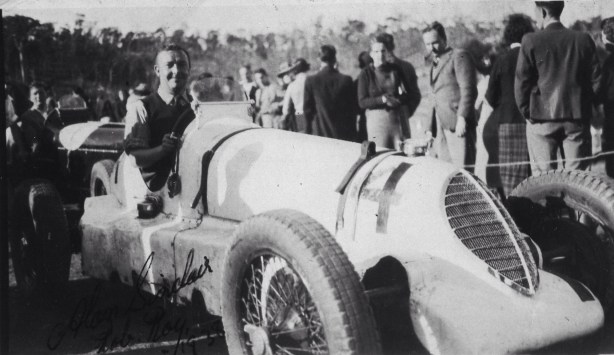
It seems that in the day it was chosen not to report in accurate fashion Repco’s engineering failure as the accident cause with Stan holding his tongue rather than ‘bite the hand which fed him’ in terms of Repco’s ongoing support.

Howard addresses all of this at length in the 1954 chapter he wrote. Note that this wonderful book was written by a number of writers -Howard, John Medley and Ray Bell included….

I’ve included this section of the chapter in full as Stan still seems to get the blame from older enthusiasts for the accident to this day and for international readers who will probably not be aware of the situation, somewhat arcane as it is.

Graham Howard wrote ‘…It is difficult to find the full story of Stan Jones’ Maybach accident, partly because it happened well away from any of the crowded areas, but also- quite obviously – because most writers chose to conceal the truth.

The deservedly respected ‘Australian Motor Sports’- whose report of the race was written by by Bob Pritchett, one of Dick Cobden’s Ferrari pitcrew- offered a number of possible causes, none of them the real one, and a month later recounted what was termed “the correct story told to us by Stan Jones and Charlie Dean” which blamed chassis/axle contact which in turn put the car off line.

Brisbane’s daily ‘Courier Mail’ merely reported that Jones had crashed, and did not offer any possible reasons. General-motoring monthly ‘Wheels’ quoted “the official explanation” and “other probables” while obliquely making the point that “the car was in two pieces”. ‘Modern Motor’ came closest to an outright declaration. “Officials said a broken chassis had caused the accident…” its race report said, observing “the car appeared to split in two.”

Yet if this had happened it was remarkably quickly forgotten, and has never been referred to since in histories of the Maybachs. Without the ‘Modern Motor’ story there would have been no published clue to the real cause of the accident.

Only a remark by Len Allen sparked this book’s enquiry. He remembered how he and a mate had walked around the inside of the course, and had found a great spot to watch Jones, who was so spectacular they chose to wait for several laps purely to watch the Maybach aviate into view. On the critical lap, Allen remembers watching the Maybach touch down and immediately asking himself, “What’s happened to his ground clearance?” Allen and his mate joined the people running after the crashed car, which ended up hidden from the road down a trail of flattened scrub and trees. Allen was adamant something had broken on the car, and – while AMS, the Courier Mail and Wheels gave him no support- Modern Motor’s hearsay evidence suddenly became very credible.

In following up this issue, chapter and verse was willingly provided by Brian Burnett, the man who actually built the chassis at Repco. He explained that the two main chassis rails, of 4 inch 16g chrome molybdenum alloy steel, passed through holes in the diaphragm-type front cross-member and were completely electrically-welded in position. These welds crystallised and cracked, and in the course of the Grand Prix one chassis tube eventually broke away and touched the ground. It was as simple- and as enormous- as unfamiliarity with new materials and techniques.

The Maybach was not rebuilt in its Southport form, but emerged- after another incredibly fast revision- as the inclined-engine, offset driveline Maybach 3 which made its debut at Bathurst at Easter 1955. This car used locally-developed continuous- flow fuel injection, partly because at least two of its three 2 3/16-inch SU carburettors had been broken in the Southport crash. The amazing part was how little else had been damaged- not least the car’s remarkable driver.

Yet it was Stan Jones who became burdened with the responsibility for the accident. It was a situation which, 30 years later, (the AGP book was first published in the mid-eighties) says a lot about the rarity of mechanical failure at the time, and about the veneration which both then and today surrounds those wonderful Maybachs.’ Graham Howard wrote.

From top to bottom- Davison HWM Jag, Cobden Ferrari 125 and Brabham Cooper T23 Bristol (G Edney)

The question which flows from the collective non-reporting or misrepresenting the truth as to the cause of Maybach’s demise is why those choices were made by those who knew the facts?…

 Lets explore that, my ‘educated surmises’ are as follows.

 As Graham Howard wrote, the accident itself happened ‘out in the boonies’ away from the sight of large sections of the crowd or where the pro-photographers situated themselves. In the rush to rescue Jones the focus was rightly on him not so much the car. Not everybody had a camera then as they were expensive and iPhones were in short supply, so there is little in the manner of photographic evidence taken amongst the casuarina trees where Maybach came to rest.

 The racing scene in Australian then was very small with ‘everyone knowing everyone’ and Jones, Dean and all of the Repco crew were part of that scene, liked and respected. It is not the case that, unlike today, that ‘blame’ be sheeted home in a public way. Best we ‘keep it in the family’.

 Repco were the only corporate to provide significant support to motor racing in Australia at the time. Whilst Maybach 1 was built by Dean, the balance of the cars were built by Dean and his team with the tacit corporate support of Repco in the Repco Research premises in Sydney Road Brunswick. In fact this factory was where Maybach 1 was built before ‘Replex’, Dean’s electric transformer business was acquired and absorbed within the Repco conglomerate.

Jones certainly bought Maybach 1 from Dean but the commercial arrangements between Stan and Repco after that have always been opaque, but there is no doubt it was to their mutual advantage. When I say opaque I mean unknown not dodgy. Repco’s press advertisements of the day, on occasion used Maybach in its ads. Dean, a racer, engineer and arch enthusiast- and a Repco senior employee (and a decade or so later a Director of Repco Ltd) would have been intent on that Repco support continuing and therefore keeping quiet the accident. Jones equally wanted the support to race so the form of words given by he and Dean to AMS was a narrative which did not accurately portray what happened but were words unlikely to cause corporate offence or embarrassment to Repco- and at the same time making clear ‘chassis/axle contact put the car off line’ and in so doing sought to get Jones ‘off the hook’, unsuccessfully it seems, as the accidents cause.

 Repco were a major advertiser in the press of the day, that is the daily newspapers, general motoring magazines such as Wheels and Modern Motor and Australian Motor Sports, the racing specialist monthly. It would not have been in those publications commercial interests to put at risk valuable ad revenues by publishing the truth of the accidents cause in the event said ads were pulled as ‘retaliation’ for negative Repco press.

 Motor racing was still very much a fringe sport in Australia in 1954. The authorities (including the police) were downright antagonistic about motor racing generally and specifically about using public roads for that purpose, particularly in New South Wales. Negative racing publicity of any kind at the time was not needed by the sport as it sought to become more prominent, recognised and respected.

 Whilst negative press about motor racing was probably of no issue or concern to daily papers the general motor magazines and especially AMS would have been keen to avoid coverage detrimental to the growth of the sport, and therefore a circumspect approach by them makes sense. For the general press the day after the race they had moved on to the latest bit of death and destruction locally or globally.

 Its easy to take pot shots of course in retrospect. Hindsight is one of my strengths my sons tell me. But what would I have done, what would I have written in publishing the November 1954 issue if I were Arthur Wylie, racer, editor and owner of Australian Motor Sports- knowing the facts of the accident?

 Exactly what he did and wrote my friends in all the circumstances outlined above…


For Davison the post race celebrations started when he saw the chequered flag, his wife, a noted racer herself was given the flag to greet Lex as he completed his final lap.

After the formalities trackside the HWM was driven on public roads from celebratory gig to gig by the very popular Davo who became increasingly pickled as the evening progressed. Different times, wonderful times.

Things were more serious in the Maybach camp of necessity, their debrief took place at the Chevron Hotel in Surfers. During these discussions Brian Burnett was stupid enough to tell Jones he had driven ‘too fast and recklessly’ only to have Stanley floor him with one punch. In the circumstances he is lucky the pugnacious, tough little nugget from Warrandyte didn’t launch him into the next decade.

Maybach would be back of course, Maybach 3 had more than a nod to the contemporary 1954 Mercedes Benz W196 but alas Maybach never bagged the AGP win one of the cars surely deserved?…

The Maybachs…

The feature I wrote about Stan Jones is as much an article about Charlie Dean’s Maybachs, click on the link below to read about this amazing series of three cars- albeit the machines were under constant evolution as befits any ‘works’ racers, the cars were effectively Repco factory entries.

In my analysis and assessment of Repco’s racing history there were a series of distinct steps which led to Repco-Brabham Engines P/L World Championship success in the mid-sixties. The first is the  ‘Maybach Phase’, the second the shorter ‘Coventry Climax FPF/Repco Phase’ and the next RBE itself. The final bit is the Redco Engine Developments P/L ‘F5000 Phase’ of 1969-1974. So, the Maybach piece is a long, critical foundation component to put its importance into the correct historical context.

(Wheels)

Etcetera…

This group of photographs taken by George Litfin are not clear so have limited use but are great to add context and flavour.

(G Litfin)
(G Litfin)
(G Litfin)
(G Litfin)
(G Litfin)
(G Litfin)
Brisbane Truth report of Geordie Anderson’s Jaguar XK120 practice accident (N Barnes Collection)
Brabham’s Cooper, Cobden’s Ferrari and the nose of Jones’ Maybach in the background (R Baker)
Davison’s winning HWM Jaguar (R Baker)
(D Willis)

Brydon’s second placed MG TC Spl being fettled during practice.

Bibliography…

Various newspapers via Trove, ‘Australian Motor Sports’ November 1954, ‘The History of The AGP’ Graham Howard and others, ‘Larger Than Life: Lex Davison’ Graham Howard, ‘From Maybach to Holden’ Malcolm Preston, Graham Edney Collection, ‘Wheels’, George Litfin, Noel Barnes Collection

Photo Credits…

Eddie Steet, Brier Thomas, ‘Larger Than Life: Lex Davison’, ‘The History of The Australian Grand Prix’ (HAGP), ‘From Maybach to Holden’, Dick Willis, Stewart Johnson, Jock Psaros, The Nostalgia Forum, Fred Pearse, Robert Baker

Tailpiece: If only- Stan Jones, Maybach 2, Southport ’54, pressing on as usual, maybe he was a bit more of a ‘percentage driver’ towards the end of his career, maybe…

(HAGP)

Finito…
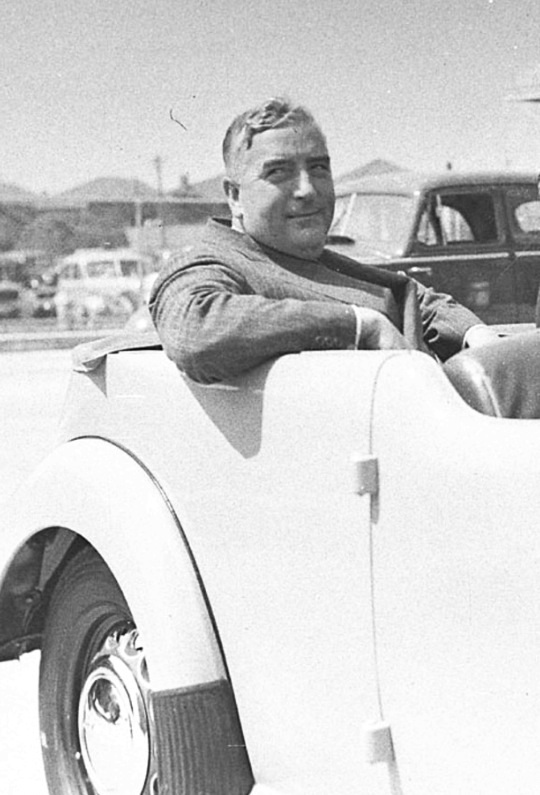
(J Richardson)

Roy Salvadori all set to go in the Longford paddock before winning the 5 March 1961 ‘Longford Trophy’ aboard his ‘Ecurie Vitesse’ (Jack Brabham) Cooper T51 Climax…
These wonderful photos at Longford during the long, languid, hot Tasmanian summer of 1961 were taken by John Richardson who was a Shell Representative for Northern Tasmania and therefore had the ability to prowl the pits and form-up area. His son Greg recalls the meeting ‘I was only 6 at the time and memories get a little hazy. But I will never forget sitting on a 44 gallon drum in the pits and that wonderful almondy smell of the racing fuel and the noise, it was pretty amazing stuff for a little kid’.

The sort of experience which hooks you on the sport for life…

Jack on the front row beside John Youl, Coopers T53 and T51 Climax- behind is the unmistakeable yellow T51 of Austin Miller- alongside Aussies right-rear you can only just see a bit of Lex Davo’s Aston Martin DBR4 (J Richardson)

Very Black Jack- look at the ‘tache and beard- has not shaved for 24 hours. Cooper T53 ‘Lowline’ (J Richardson)

Roy had better luck in Australia than he did in New Zealand- there he raced a Yeoman Credit Lotus 18 Climax at Ardmore, Levin, Wigram and Teretonga, his best a second place at Teretonga. He had gearbox problems twice and a leaking radiator in the other events.

He then crossed the Tasman Sea to Australia and raced the Cooper used by Ron Flockhart that Australasian season- in Tasmania and two International races a day apart at the new Hume Weir circuit outside Albury on the New South Wales/Victoria border. He was fourth in one, DNF the other, both races were won by Brabham’s Cooper T53 ‘Lowline’, the car photographed above.

During my formative years of interest in motor racing, devouring all of the books we all did on the history of the sport Roy Salvadori was ominpresent in publications on the British scene- where he seemed to race anything which had wheels in multiple events at the same national meeting, and also competing in International events.

Maserati 4CM, Jersey 29 April 1948, 7th in the race won by Bob Gerard’s ERA B Type (unattributed)

Whilst his surname is decidedly Italian exotic Roy was very much a Brit, born in Essex of Italian parents…

Well known as the winner at Le Mans aboard an Aston DBR1 together with Carroll Shelby in 1959 he was also very handy aboard single-seaters and is rightfully on the list of those talented enough, but unfortunate not to win a championship Grand Prix.

The highly skilled all-rounders best F1 season was in 1958, when he was second in the German Grand Prix, third in the British and fourth in the drivers’ championship aboard a Cooper T45, the title won that year by another quintessential British driver of the fifties, Mike Hawthorn in Ferrari Dino 246’s. Cooper were not of course using Coventry Climax FPF engines of 2.5 litres that season, making the performance even more meritorious.

Roy Francesco Salvadori was born on 12 May 1922  in Dovercourt, Essex. After leaving school he joined his father’s refrigeration business before starting to trade in cars, running his own garage in Tolworth, Surrey by the age of seventeen. The War put paid to early plans to race but as soon as the war was over he responded to an advertisement for an MG sportscar only to find that the car in question was the R Type pre-war single-seater- a deal was quickly done.

Jack #24 and Roy, Pescara GP 18 August 1957. Cooper T43 Climax, 7th and DNF in 2 litre cars in the race won by the Moss Vanwall VW57 (Cahier)

The R Type MG was entered in the very first race meeting post-war at RAF Gransden (Gransden Lodge) on 15 June 1946 with Roy the second of two finishers in a three car race! He progressed quickly to a Riley Special and then a 50% share in a 2.9 litre Alfa Romeo Tipo B/P3 said to have been owned by Tazio Nuvolari.

In May 1947 he entered it in the Grand Prix des Frontières at Chimay, Belgium, and, though the car was stuck in top gear from the first lap, finished fifth. Prince Bira won the race in a Maser 4CL.

He soon sold the P3 and bought a Maserati 4CM finishing 7th in the Jersey Road Race in April, contested the British Empire Trophy in May, DNF and later the 1948 British GP at Silverstone finishing 8th in the race won by Gigi Villoresi’s Maserati 4CLT.

In 1949, he again raced in the British GP, Q23, DNF . He was 5th in his heat and 17th in the final of the August International Trophy at Silverstone and wrote off a Maserati 4CL at the Curragh track in Ireland during the September Wakefield Trophy. 1950 was a year of rebuilding the finances and finding a competitive tool- the plucky motor-trader settled on a Frazer-Nash Le Mans sportscar.

Roy ahead of a group of XK120’s, date and circuit unknown, 1951 probably (unattributed)

Salvadori’s first meeting in the ‘Nash was the Daily Express International meeting at Silverstone.

Interviewed in MotorSport in 2008 Salvadori said ‘I was leading, a big thing for me then, ahead of Bob Gerard, Tony Crook and the other Frazer-Nashes. So I was feeling pretty good about life…We came up to lap a group of slower cars which were having their own battle. I tried to overtake them all, but it couldn’t be done’. He ran wide, hit the marker barrels- oil filled drums and cartwheeled down the road, his foot was stuck in the steering wheel spokes, as a consequence he was flung about like a rag doll as the car overturned. Roy suffered a triple fracture of his head- wearing no helmet and had severe brain haemorrhaging. ‘At Northhampton Hospital they decided they could do nothing for me, and pushed me into a corner. They rang my parents and told them I was unlikely to be alive by the time they got there’. A priest was summoned and gave him the last rites.

Salvadori was back in a car three months later. His only permanent legacy of the monster shunt was deafness in one ear.

Roy acquired the 1950 model Jag XK120 (above) and first raced it at Boreham in August 1951. He had much success in the car over the next 12 months racing it against the similar machines of people like Duncan Hamilton and of course many other marques. A more serious machine was the Grand Prix Alta 1.5 s/c of H Webb with which he contested the Boreham Mail Trophy race in July for a DNF.

RS aboard Bobby Baird’s Ferrari 500 F2/GP machine at Castle Combe in 1952. Lampredi 4 cylinder, 2 valve, DOHC Weber fed dual World Championship winning engine front and centre (Simon Lewis)

With his speed and enthusiasm undiminished he was soon in demand to drive other peoples cars, he raced the Jag on into mid-1952 before selling it to Peter Blond. The Frazer-Nash was repaired and raced at Ibsley in April, the car again crashed.

A significant breakthrough were a series of drives in Irish press-baron heir Bobby Baird’s Ferrari 500 2 litre F2/GP car. In an impressive performance he was Q19 and 8th in a field of 31 cars at the Silverstone British GP.

In August he raced a Ferrari 166 (Baird’s?) in the Daily Mail Trophy at Boreham but withdrew after 21 laps. Back in the Ferrari 500, at  the Daily Graphic Goodwood Trophy in September, he was 6th and a month later he drove the car to victory in the Joe Fry Memorial Trophy at Castle Combe.

In mid September Roy contested the GP di Modena in a Cooper T20 Bristol, crashing the car in the race won by Villoresi’s Ferrari 500.

Salvo’s speed in a variety of cars- his versatility clear even then and ability to handle the demanding GP Ferrari lead to an invitation to join the Connaught team for 1953 to contest GP events in the Lea-Francis four-cylinder engined cars.

Camp Connaught, French GP Reims 1953. #42 Bira DNF diff, #50 Salvadori DNF ignition, #48 Johnny Claes 12th. Look carefully and you can see the Prince speaking to Alfred Neubauer in the background. Mike Hawthorn won this famous race after a titanic long dice with Fangio, Ferrari 500 and Maser A6GCM respectively (G Phillips)

The Connaught A Type was a very competitive tool in British national events, Roy’s best results second placings in the Lavant Cup Goodwood, BRDC International Trophy Silverstone, Crystal Palace Trophy and Newcastle Journal Trophy at Charterhall. In September he won the Madgwick Cup at Goodwood from Stirling Moss’ Cooper Alta.

In championship Grands Prix the pickings were much slimmer- he failed to finish all of the events he contested, the Dutch, French, British, German and Italian GP’s. The problem was the cars reliability not Roy’s speed- he qualified 11th, 13th and 14th at Zandvoort, the Nurburgring and Monza respectively for example.

In 1953 he joined Aston Martin in sportscars- although the focus of this article is single-seaters not his two-seater programs.

For 1954 he made the sensible decision to drive a Maserati 250F for Sid Greene’s Gilby Engineering team, the very best 2.5 litre customer GP car of the period. With it he won the Curtis Trophy at Snetterton, was second in the Lavant Cup, BARC F1 race and third in the Goodwood Trophy (all at Goodwood). The Gilby lads took the Maser across the channel to contest the French GP at Reims where Roy was Q10 but had a half-shaft failure. Back at Silverstone for the British GP he was a wonderful Q7 of 28 on a circuit at which he always excelled but had a transmission failure on lap 7.

Roy aboard the Gilby Engineering Maser 250F ‘2507’ at Silverstone in 1954. Too funny finding this shot- when I first became interested in racing someone gave me this very shot as a postcard without identification. I knew enough to know it was a 250F- and the driver looked ‘Eyetalian’ but I could never work out who it was back then! (Tom March)

Still in the first flush of youth, he raced the Gilby Maser ‘2507’ on into 1955 with wins in the Glover Trophy and Curtis Trophy at Goodwood and Snetterton respectively. He qualified first and finished second behind the Collins 250F at the International Trophy, Silverstone.

The 11 April Goodwood meeting says everything about Salvadori’s speed, versatility and work ethic- he contested six of eight events! He won the Lavant Cup in a Connaught A Type, was second in the Chichester Cup, first in the Richmond Trophy and second in the Easter Handicap all in the 250F. He won the ‘B Sportscar’ race in an Aston DB3S and was fourth in the ‘C Sportscar’ race in a Cooper-Maserati. Wow!

Lavant Cup Meeting Goodwood 11 April 1955. Roy on the way to winning the 7 lap F2 race at Madgwick. Connaught A Type and Cooper Bristol (P Redman)

The team again entered the British GP at Silverstone this time yielding Q20 and DNF due to a gearbox failure.

Into 1956 Roy again raced the Gilby 250F which was getting a little long in the tooth compared to the latest spec works-cars but was still a good thing in national events- he was first in the Vanwall Trophy and Sussex Trophy at Snetterton and Goodwood respectively. Moss won the Glover Trophy at Goodwood in a works 250F ‘2522’ with Roy behind him.

In International events the 250F was 3rd in the GP de Caen and had DNF’s at both Silverstone and the Nurburgring- the British and German GP’s but qualified 7 and 9 to remind everyone of his speed in the old jigger. He was Q14 and 11th- last at Monza.

Success also came in mid-engined F2 Cooper T41 Climaxes with wins in the British GP support event, at Brands in the Bank Holiday meeting and at Oulton in the International Gold Cup F2 race.

Roy awaits the off aboard a Vanwall VW57 before the start of the French GP @ Rouen in 1957. Q6, DNF engine on lap 25- and qualified well clear of the two BRM’s! (unattributed)

A man in demand he signed with BRM for 1957, but after his cars brakes locked solid, causing his retirement from his BRM debut race and then failing to qualify for the Monaco Grand Prix, he walked away from the team.

Raymond Mays failed to intervene satisfactorily to improve the P25’s notoriously poor brakes. The P25 became a race winner- it won BRM’s first GP in Jo Bonnier’s hands at Zandvoort in 1959 of course but in 1956/early 1957 it was a problem child. No less than Alex Moulton and Alec Issigonis, Colin Chapman and Piero Taruffi- the latter two track testing the car applied their talents to dealing with the racers many handling, roadholding and braking problems. Leaving BRM at the time was as good an F1 Salvadori decision as being part of Aston’s F1 program in 1959 was a bad one!

Roy continued racing Aston sportscars throughout 1957 and was invited by David Yorke to drive a Vanwall VW57 in the Reims GP in early July, for 5th and in the French GP at Rouen a week later- Q6 and DNF engine. Chapman had of course applied his magic touch in Acton too a year earlier!

German GP paddock 1957: Yep, I can give these barges a run for their money! RS musing about the benefits of his nimble Cooper @ the Nurburgring if not its power. #1 & 2 Maser 250F’s of JMF and Jean Behra. Roys F2 Cooper T43 Climax Q15 and DNF engine in the famous ‘greatest GP of all time’ won by Fangio from the Lancia-Ferrari 801 twins Hawthorn and Collins (Getty)


Salvadori chasing Olivier Gendebien’s Ferrari 246 Dino during the 1958 Belgian GP, the Belgian was 6th and Roy 8th in his Cooper T45 Climax. Stirlings’s watches look good! (GP Library)

For the balance of 1957 Roy joined Cooper beside Jack Brabham, the pair racing Cooper T43/45 Climaxes in F2/F1 events. Cooper ran Coventry Climax FPF’s of just under 2 litres in F1 that season, the class capacity limit 2.5 litres from 1954-1960 inclusive. He was 2nd in the GP de Caen and failed to finish the German GP having qualified 14th running a 1475cc FPF as an F2 car within the F1 grid.

Generally Jack did better than Roy in F2 but he won the Woodcote Cup at  Goodwood, and the F2 class of the Daily Express International Trophy, was 2nd in the London Trophy at Crystal Palace and 4th in the Coupe de Vitesse at Reims.

For 1958 Roy stayed with Coopers and had his best season in GP racing as detailed early in this article. In addition to Championship GP events he was also quick in British Internationals taking 2nd, 3rd, and 4th in the BRDC International Trophy at Silverstone, Glover Trophy at Goodwood and the BARC 200 at Aintree.

Beautiful shot (reader David Fox points out Getty have it ‘the wrong way around’) of Roy’s Aston DBR4/250 at Zandvoort in 1959. Q13 and DNF overheating in the race won by the more modern and developed front-engine BRM P25 of Jo Bonnier- first GP win for them both. The Aston was maybe a potentially winning car in 1957- too late she cried (Getty)

Aston Martin finally got their DBR4 race ready- it was to Roy’s credit that he felt bound to drive it and did so but his first steer of the front-engined bolide would have been enough to indicate that AM had missed the boat relative to the Coopers with which he was now very familiar and had done so well.

It was a backward step indeed. To stay with Coopers would have been the go in 1959 fitted as they were with Coventry Climax FPF’s of 2.5 litres- they won the drivers and constructors titles of course. Roy did more than enough to stay with Cooper in 1959- in ’58 the qualifying record was fairly evenly split between Jack and Roy with the Brit getting far better race results. Oh to have stayed put at Surbiton!

In a fullish GP season he raced Tommy Atkins Cooper T45 Maserati at Monaco and Reims and the Aston DBR4/250 at Zandvoort, Aintree, Monsanto Portugal and at Monza- his best placings 6th in the Monaco, British and Portuguese GP’s. Sixth at Monsanto was 3 laps behind the Moss winning Cooper to give some idea of the relative pace of the new and old paradigms.

In non-championship races he won the London Trophy, was 2nd in the Lavant Cup in a Cooper T43 Climax F2 and frustratingly got a good, long, hard look at the back of Brabham’s Cooper T51 Climax finishing 2nd behind him at Silverstone in the Daily Express International Trophy aboard the Aston.

Roy gets into the Essex Racing Stable #4 Aston DBR1 he shared with Tony Maggs at Le Mans in 1961. The Border Reivers #5 the Jim Clark (jumping in) and Ron Flockhart DBR1 is alongside, both cars DNF (unattributed)

Following his 1959 success at Le Mans, in 1960 Salvadori returned to the 24 hour race in another Aston Martin DBR1 beside a very young Jim Clark, finishing a good 3rd behind two Ferraris.

His Grand Prix program in 1960 was limited to the Dutch and British GP’s in Astons for a DNS and DNF- and at Monaco and Riverside in an Atkins Cooper T51 Climax for a DNF and 8th. In Cooper mounted non-championship events he was 3rd in the Oulton Park Trophy and Lavant Cup at Goodwood and 4th in Snetterton’s Lombank Trophy. He won the Lancashire & Cheshire Car Club F2 race at Oulton Park.

After Aston’s withdrawal from GP racing he drove Reg Parnell’s Yeoman Credit Cooper T53 Climax FPF 1.5 litre engine cars in the first year of the new GP formula.

In a great mighta-been drive in the 1961 US GP at Watkins Glen he charged his Cooper T53 Climax FPF from eighth place up to second- closing on Innes Ireland’s leading works Lotus 18 when with five laps to go his engine failed. He was 6th at Aintree and Monza in a season dominated by the squadron of V6 Ferrari 156’s and notable for the brilliance of Stirling Moss in the under-powered Rob Walker Lotuses at Monaco and the Nurburgring.

German GP, Nurburgring 1962. Q9 and DNF suspension in Lola Mk4 Climax V8, winner Hill’s BRM P57 (unattributed)

Roy commenced the 1962 season with a trip to Australasia to race a Bowmaker Cooper T53 Climax with ‘…our first two races cut short because of rain storms and I took a 4th in the NZ GP and 5th in the Hudson Memorial Trophy. In contrast the following weekends Lady Wigram Trophy was held in stiflingly hot conditions and i again finished 5th’ Roy recounts in his biography.

But his tour was cut short with a practice crash at over 130 mph during practice at Warwick Farm on 4 February, the first Australian leg of the tour.

‘At Warwick Farm we were using an improved Dunlop tyre and although Surtees and I had a set each for the race, we had to share a set in practice. Surtees came back into the pits near the end of practice and the mechanics had a frantic rush to transfer the wheels from his car…I charged off from the pits, joined the long (Hume) straight and was approaching the hairpin (Creek Corner) that followed very quickly. As to what happened next I have to rely on what I was told, as I remember nothing of the accident. As I braked for the hairpin the car turned sharp right into a flag marshalling area protected by the sleepers and hit this at about 100 mph. I suffered head injuries, a broken cheekbone and severe facial cuts, the car was a write-off and two marshalls were injured (with broken legs). I was unconscious until the following day…I was later flown back to the UK for further medical treatment…My theory as to the cause of the accident is that we failed to pump up the brakes (a procedure peculiar to the Cooper after a wheel change) and then as I pumped them up quickly for the corner, the right front brake locked’.

Roy in a CT Atkins Cooper T53P Climax at Crystal Palace during the 1961 London Trophy meeting- a race he won. It was a car of this type he crashed at Warwick Farm albeit 2.6 FPF rather than 1.5 FPF as powered here (PA Images)

Roy flew back to Australia for the Sandown Park Trophy on March 11/12- the circuits opening meeting and drove a Lex Davison Cooper, ‘I was far from fit and it was a very stupid thing to do, although it seemed like a good idea at the time! I was slow in practice and in the race retired because of mechanical trouble’.

Warwick Farm and its fallout was hardly a good start to what would be Roy’s final GP season with a Bowmaker Lola alongside John Surtees.

They drove Eric Broadley’s Lola Mk4 Coventry Climax FWMV V8’s with Surtees consistently outpacing the veteran Salvadori who was terribly cramped in the cockpit of the car more suited to the shorter ‘Big John’. He carried this off with dignity with Surtees remarking after Salvadori’s death ‘Roy had always been serious about his motor racing and in my view, never quite realised his full potential as a grand prix driver, mainly because he was waiting in the wings while Aston Martin were being so slow in developing their DBR4 in 1959’.

Roy had shocking luck with unreliability whereas Surtees had a much better time of it and seconds at Aintree and the Nurburgring. There was nothing too wrong with the basic design, Roy’s best qualifying performance was in Germany with Q9.

Roy blasts away from the Goodwood 1960 TT start, Aston DB4GT in pursuit of Stirling Moss who is already outta picture- and won the race in Ferrari 250SWB (LAT)

The time had come though, Roy was 40, it was right to retire from Formula 1 at the seasons end. But he continued to race sports and touring cars with great success, often for his lifelong friend, John Coombs until 1965, when he retired from racing but not before another couple of big accidents- flipping into the lake at Oulton Park after a puncture to his Jaguar Saloon and at Le Mans in 1963 when his E Type Lwt spun on oil dropped by Bruce McLaren’s Aston Martin. He crashed, then Bino Heins was burned to death in his Alpine, Bino  having sought to avoid Jean-Pierre Manzon who was unconscious in the middle of the track having also crashed after losing control on the oil.

Motor racing is and very much was dangerous!

Testing a very early Ford GT40 at Le Mans in 1964- Colotti ‘box, wire wheels all in evidence (unattributed)

Salvadori was also involved in the original Ford GT40 campaign via John Wyer, his friend/Team Manager from Aston Martin. In fact his last race was in a GT40 at Goodwood in 1965 finishing second overall and winning his class.

In 1966 and 1967 he managed the Cooper F1 team, but was still not averse to a steer, doing some of the early test and development work on the new for ’66 3 litre V12 Cooper T81 Maserati at Goodwood. The driving strength included Pedro Rodriguez, John Surtees and Jochen Rindt.

Testing the very first Cooper T81 Maserati in early 1966 at Goodwood. A race winning car and potentially the ’66 champion with an ace behind the wheel from the start of the season. Surtees joined mid-way thru the season after his spat with Ferrari- losing he and the Scuderia a probable championship to canny Jack (Getty)

c’mon Roy, gimme Pedro’s car! Salvo and Jochen Rindt during 1967 (unattributed)

Meanwhile the garage business which funded his racing in the early days had flourished into major BMW and Alfa Romeo dealerships- they were sold to a public company providing the means and tax necessity perhaps for he and his wife Sue to move to Monaco.

His flat overlooking the Grand Prix finishing line became famous for its parties during GP weekends. He died on 3 June 2012 a familiar figure at historic racing gatherings down the decades.

Etcetera…

Wharton and Salvadori, BRM and Maser, Madgwick, Goodwood, Easter Monday 1954…

I was researching the photo above, its before an infamous high speed contretemps between the two Brits and found this piece Doug Nye wrote in his ‘Goodwood Road and Racing’ column in November 2016- here it is in all of its wonderful glory…

‘One of the great personal rivalries that used to be played out – in part – at Goodwood, was the personal antipathy between Roy Salvadori and Ken Wharton. Roy was a supremely self-confident, stylish, charming, debonair, soft-hearted, philanthropic south-London used-car dealer. His race driving philosophy was pretty much no holds barred, and he was always prepared to stick his elbows out and push and shove, or to position his car in such a way on track – as in a braking area or turn-in point for a corner – in which a close-quarters rival would be embarrassed (or intimidated) into giving way, fearing the consequences of contact – which in that period could be utterly horrendous.

Ken Wharton was evidently an almost equally charming, friendly kind of chap out of a racing car’s cockpit. But the Smethwick garage proprietor – who was in the 1950s one of the most versatile of all competition drivers – having been a front-runner in everything from mud-plugging trials to rallying and road racing in cars ranging from tin-top saloons to 500s, Grand Prix cars and the centrifugally-supercharged Formule 1 and Libre V16-cylinder BRMs, had a less armour-plated personality. He was never quite confident that he was really as good as he earnestly wanted, and tried, to be. In the car – especially at BRM when he found himself teamed with Fangio and Gonzalez (two hopes, no hope and Bob Hope) – he could only play second or third fiddle to the true stars of the day. But he plainly felt that Salvadori was not quite from the top drawer either – not a Moss, and most certainly no Fangio, nor Gonzalez. And so should Salvo attempt to assert himself on track against Ken Wharton, than Smethwick Ken would push back.

This became a pretty explosive situation in that era when drivers were not belted into the cockpits of their racing cars, when wire wheels were narrow and racing tyres slim, heavily treaded and easily intertwined should cars clash side-to-side. Competing cars were also quite tall, quite hefty, relatively unstable, and easy to overturn. On the back of the admission ticket or pass were printed the words ‘Motor racing is dangerous’ and in the ’50s that was absolutely and often painfully self-evident.

There was a history between Salvadori and Wharton before the Easter Monday Goodwood race meeting in 1954. The feature Glover Trophy race was run over 21 laps, for Formule Libre cars which set Roy Salvadori’s new Sid Greene-entered Maserati 250F against the V16 BRMs of Ron Flockhart – in the latest short-chassis Mark II variant – and Ken Wharton in the full Grand Prix-spec long-wheelbase V16 Mark I.

Roy squeezing all there was from the little Cooper T45 Climax during the 1958 British GP @ Silverstone. 3rd in the race won by Collins Ferrari Dino 246 (J Ross)


Roy alongside Mike Hawthorn and Jean Behra on the front row of the Glover Trophy at Goodwood, Easter 1958. Cooper T45 Climax, Ferrari Dino 246 and BRM P25. In the row behind is Scell’s BRM and Brabham’s #18 Cooper. Mike won from Jack and Roy (J Ross)


Reg Parnell, Roy and Carroll Shelby, Le Mans 1959 (unattributed)


Roy shared this Aston DBR1 with Jim Clark @ Le Mans in 1960, the Border Reivers entered car was 3rd in the race won by the Ferrari 250TR of Paul Frere and Olivier Gendebien (unattributed)


Roy and Les Leston shared this DBR1 @ Le Mans in 1957, DNF oil pipe. Ron Flockhart and Ivor Bueb won in a Jag D (unattributed)


Roy from Graham Hill, Oulton Park GT race in 1961, Hill won with Roy 3rd (unattributed)


You can sense the mutual trust and respect between photographer Bernard Cahier and RS in this Monza 1962 shot. Lola Mk4 Climax, Q13 and DNF engine in the race won by Hill’s BRM P57. The Lotus 25 Climax behind is Trevor Taylor’s works machine  (B Cahier)


Bibliography…

MotorSport article by Simon Taylor in August 2012, ‘The Guardian’ obituary, ‘Goodwood Road and Racing’ column Doug Nye, ‘Goodwood Remembered’ Peter Redman, Stephen Dalton Collection, oldracingcars.com, ‘Roy Salvadori Racing Driver’  Roy Salvadori & Anthony Pritchard, David Fox

Photo Credits…

John Richardson, John Ross Motor Racing Archive, B Cahier, Getty Images- GP Library/PA Images, Pinterest, Simon Lewis Transport Books, LAT, Tom March, George Phillips

Tailpiece: Roy, Aston DBR4, Zandvoort 1959…

Finito…