Archive for the ‘Features’ Category

image

Bill Patterson getting all he can from the 1000cc JAP engine in his little, lithe, light and nimble Cooper MkV. He is on his way to Australian Hillclimb Championship glory on 19 April 1954 at Collingrove, Angaston in South Australia’s Barossa Valley…

Patterson was an immensely fast driver, look closely and you can see his left hand proud of the wheel as he gently corrects the powerful little cars slide on the testing, wonderful Collingrove Hill.

I wrote a short article about this Cooper, chassis # MkV/41/51 a while ago, that article was inspired by a photo, as is this one which covers the history of the car and of Bill Patterson, an Australian champion driver. Click here for the earlier article which provides information about air-cooled Coopers generally, and the MkV specifically.

Cooper Mk V JAP: Penguin Hillclimb, Tasmania, Australia 1958…

patta brands

(500race.org)

The car was bought by Melbourne’s Bill Patterson and Geelong’s Tom Hawkes in the UK and raced by them in 1951 before they brought it back to Australia…

The wealthy Victorians arrived in mid 1951 with the intention of having a racing holiday. Tom was to buy and prepare the car and Bill was to drive it. John Crouch, the Australian Cooper Distributor arranged for delivery of a newly released Cooper MkV to the duo but it was fitted with a JAP 500cc engine rather than the more reliable Norton ‘double knocker’ which was simply unobtainable. The car was specced with long range tanks with longer races in Australia in mind.

The 500 Club 500race.org has this to say about Patto’s performances in it ‘Patterson travelled to England in 1951 and bought a Cooper MkV JAP which he raced in England and Europe. Given the competitiveness of the British scene, and the dominance of the Manx Norton engine, Patterson achieved some creditable results including a 2nd in the Commander Yorke Trophy in August…In September he took a trip to Grenzlandring, Germany, 3rd to the Ecurie Richmond cars of Brown and Brandon…he managed a 2nd and 4th in heats at Brands but failed in the final.’

He arrived razor-sharp back in Australia after the intense competition of F3 in the UK and Europe first racing in Australia at Parramatta Park, Sydney in January 1952. Stan Jones then bought the Cooper in a deal in which Tom Hawkes acquired Stan’s Allard J2. But Patterson shared the racing with Stan before eventually buying the car in 1954.

dodge

Bill Patterson’s Cooper MkV chasing the big ex-Bill Wilcox Phil Harrison Metallurgique/Dodge Special at Port Wakefield, South Australia’s opening meeting, in January 1953. Classic battle of big and small/old and modern technology, the chassis of the Metallurgique/Dodge dating back to the 1920’s. Harrison won the race, the car based on a chassis found in a wreckers yard with a body built by Bob Baker in Melbourne. Patto retired with a broken throttle cable on lap 4 (State Library of SA)

A JAP 998cc engine was fitted, the car  first raced in this form at Rob Roy Hillclimb in outer Melbourne on 28 February 1954, Patto won the 1954 AHCC in it as detailed earlier, as well as the 1955 South Australian Hillclimb Championship, also at Collingrove.

The little car contested the 1955 AGP at Port Wakefield with Patterson at the wheel with a JAP 500 fitted, he retired. In fact the mates Jones (Maybach), Hawkes (Cooper T23 Bristol) and Patterson all retired from the AGP, won by Jack Brabham’s Cooper T40 Bristol, Jack having made his F1 Championship GP debut in that car at Aintree several months before.

stan

Stan Jones, Collingrove, Cooper MkV, Easter 1955  (State Library of SA)

paddock

Stan Jones, Cooper MkV in the Collingrove paddock, probably Easter Monday 1955. He set a new outright record of 38.02 seconds during this meeting (State Library of SA)

The car passed into Ken Wylie’s hands who raced it with both Norton 500 and JAP 1000 engines before crossing Bass Straight to Jock Walkem in Tasmania, he fitted a JAP 1000. The car came back to the mainland, Victorian John Hartnett raced it with both JAP 500 and 1000cc lumps. It then went back to Tassie, raced by both Dave Powell senior and junior powered by JAP 500, 1000 and 1100 motors as well as a BSA 500 engine. The car was then sold to Peter Dobson and passed to Brian ‘Brique’ Reed who restored it in the 1970’s. After many years of ownership it was bought by Peter Harburg.

patto race

#12 D Harvey MG TC s/c from #8 Bill Patterson or is it Stan Jones? Cooper MkV, #11 D Tillett MG TC, Port Wakefield, Easter 1955 perhaps (State Library of SA)

Bill Patterson…

Patterson, was born on 30 August 1923 into a family of considerable wealth. He was the son of Wimbledon tennis champ Gerald Patterson and a nephew of famous Australian opera singer, Dame Nellie Melba.

Gerald Patterson was the Wimbledon singles champion in 1919 and 1922. He represented Australia in the Davis Cup from 1919-1928 and in 1927 won the first Australian singles title at Kooyong until the modern era, the home of Australian tennis. Patterson fought in the Great War and was decorated for his bravery, being awarded the Military Cross as a member of the Royal Field Artillery at Messines in 1917.

By the time his tennis career was over he had embarked on a very successful business career initially with sporting goods manufacturer AG Spalding Bros, by 1935 he was its CEO and went on to become a director of some other well known companies of the time.

image

France’s Suzanne Lenglen and Gerald Patterson, mixed doubles champions at Wimbledon in 1920 (Bob Thomas)

Bill was born into a life of privilege, initially growing up at 15 Barry Street in Kew, the scene of many society parties and events including tennis matches on the home’s grass court. The family soon moved to nearby Toorak, Melbourne’s suburb of the ‘great and the good’.

He attended Scotch College in nearby Hawthorn, leaving in 1934 to attend Geelong Grammar, his sporting intent and prowess apparent as a member of the school’s rowing First VIII in 1938. Born into such circumstances is a double-edged sword of course, being the son of an elite sportsman-and businessman is seldom an easy thing given the expectations foisted upon the child.

patto-mg-rob-roy

Bill Patterson is his stripped MG TC, approaching The Spillway, at the 16th Rob Roy Hillclimb, 2 May 1948 (George Thomas)

I am intrigued to know what Bill did when he initially left school, he first came to motor racing prominence driving one of the first MG TC’s delivered to Melbourne post-war. His first event appears to be the 11th Rob Roy Hillclimb on 24 November 1946. This car was soon replaced by a second TC which was stripped and tuned.

He contested the 1948 Australian Grand Prix at Point Cook in outer Melbourne in this TC, which was fettled by Reg Nutt. The race is famous for the intense heat of the meeting which forced many of the top runners to retire from the impacts of the heat on either their mount or themselves. By lap 13 Patterson led the race, aided by a pretty good handicap. The car retired from the race, boiled dry on lap 24. The event was won by Frank Pratt’s BMW 328, which like Patterson, was aided and abetted by a good handicap.

Soon after the AGP Patterson and later Australian Grand Prix three times winner Doug Whiteford built a stripped, lightweight, two seater TC Special which had a curvaceous aluminium body made by Bob Baker in Melbourne. The engine was fitted with all the trick bits of the day and was supercharged, a Marshall blower was fed by a 1 3/8 inch SU carburettor at a boost of 10psi. The car was powerful, finned drum brakes were fitted as well as adjustable shock absorbers.

This famous little car, which still exists, first appeared at Rob Roy in January 1949, it’s first race was at Fishermans Bend in March. The car was fast from the start but Patto’s nemesis in under 1500cc events was Ken Wylie’s Austin A40 Spl. The MG first won at Nuriootpa in April 1949.

Back in the Barossa Valley, Patterson contested the 1950 AGP at Nuriootpa in South Australia and was on hand to see his friend Whiteford win in ‘Black Bess’ Doug’s Ford V8 Ute based, amazing, special. Patto’s TC blew a head gasket on lap 6 having had a torrid dice with Stan Jones HRG in a preliminary race, Stan did not start the race.

image

Patterson and his MG TC Spl at Hell Corner, Bathurst, Easter 1950. Pretty, fast, well driven car (George Reed)

At Bathurst in Easter 1950 he did a lap of  3:17 seconds, the fastest a 1500cc car had been around the demanding mountain circuit. John Medley observed in his ‘Bathurst Bible’ ‘The lightweight green car had an impressive collection of wins to its credit and was probably then Australias fastest MG…the driver was to become one of Australia’s fastest’.

Of great interest to Patterson was the appearance at Bathurst of the first two Coopers in Australia. The cars, MkIV’s, were raced by Keith Martin/Arthur Wylie and Jack Saywell. These ‘very light, 600lbs dry and with 82bhp 995cc JAP motors, all independently sprung MkIV Coopers, were, for their competitors, a taste of tomorrow’ said Medley.

Patterson had a very successful meeting with the TC at Balcombe on Victoria’s Mornington Peninsula in June 1950 with two wins and two seconds. Not long thereafter the car was sold to Sydney’s Curly Brydon who also did well with the car, developing it further.

For Bill Patterson though, the path was clear, he was off to the UK to race a Cooper in British 500cc F3, the toughest training ground of all at the time. Patto contested the Round Australia Trial in a Holden and a Peugeot, and other than a brief Ferrari flirtation which fell into his lap, he was pretty much a Cooper Man for the rest of his racing career.

After his 1951 season and the continuation of his career with the MkV in Australia covered above, he finally sold the little air-cooled bolide and bought his first Coventry Climax engined Cooper. This mid-fifties period coincided with the commencement of his Holden dealership, let’s spend a moment on that before picking up Patterson’s next Cooper.

The Australian economy boomed in the 1950’s buoyed by the pent up demand of wartime austerity, global demand for our products, wool, wheat and goods produced behind high tariff walls, high levels of migration from war-torn Europe and greater availability of consumer credit. The ‘great Australian dream’ of owning a home and a car were now within reach of larger numbers of people than ever before.

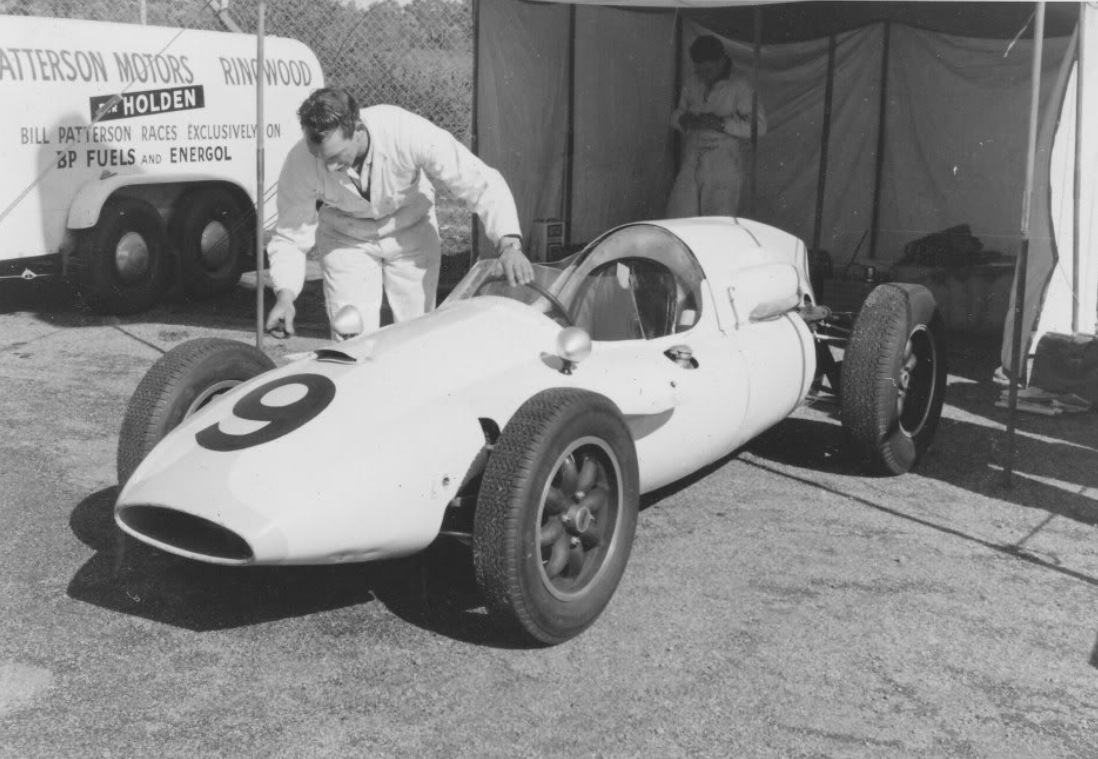
It was in this environment that Bill Patterson and his father (Gerald’s biographical notes make it clear he was a director of Bill Patterson Holden) chose Holden as the marque they would sell and Ringwood as the centre of their ‘Prime Market Area’ they secured from General Motors Holdens. It was an astute choice of location. No doubt Holden were well pleased to have Patterson as a dealer given his and his families profile. Fellow elite Melbourne racers Reg Hunt, Lex Davison, Stan Jones and Bib Stillwell also had, or would have Holden franchises

In 1955 (Bill Patterson Motors Ltd was incorporated on 3 October 1955) Ringwood was very much on the eastern urban fringe of Melbourne (30Km) as the city marched, for the reasons outlined above rapidly in every direction other than into Port Phillip Bay! Surrounding suburbs of Mitcham, Heathmont, Vermont and Croydon were served by better roads into Melbourne and train lines. The middle class were Holdens target market, Bill chose his location wisely. As the local populace and their incomes grew so too did Holdens range of cars, Patterson added BMW to the mix in the 1970’s, another great choice of a marque not well known in Oz, and on the rise.

patts-dship

Patterson’s dealership at 55 Maroondah Highway, Ringwood in 1959. Holdens are ‘FC’ models, Cooper is the T43 Climax. It might not look so special now but the architect designed showroom was schmick at the time (Wolfgang Seivers)

Patterson’s Ringwood premises were initially modest but by 1959 he had built a state of the art dealership at 55 Maroondah Highway, just at the bottom of the downhill drop below Heatherdale Road, designed by Hassell McConnell Architects, Hassells are still one of Australia’s best architectural outfits, a global one at that. I can well remember as a kid visiting my aunt in Mitcham ‘out in the sticks’ as my father described it, and the impact of Patterson’s big site whenever we were in the area.

The point here is that Patterson, did things well and thoroughly. It helped that he had access to, probably, family working capital but he invested wisely and ran a very strong operation for decades.

In a previous life I worked as a consulting accounting/financial advisor to motor dealers for 7 years or so and worked with over 20 dealers across many franchises, not Patto I hasten to add. They are complex businesses; effectively 5 enterprises under one roof-new cars, used cars, service, parts, plus finance and insurance. Add to that the property aspects.

Lots of people think dealerships are ‘money for jam’. They are not, the space is incredibly competitive and the profit margins thin. The investment in infrastructure is significant. They need to be very well run with great, ongoing vigilance around daily detail to make good money. Patterson was one of Holden’s best dealers for decades, consistently in their Top 15 nationally and the figures were distributed monthly by GM, the peer pressure relentless and ongoing! At the top of the GMH tree, by the way, was often fellow Victorian, former champion racer Reg Hunt, his huge site on the Nepean Highway in Elsternwick well known to many Australian race fans.

Back to the racing. In 1956 Patterson imported a Cooper T39 Climax, #CS/12/56 a sportscar powered by a Coventry Climax SOHC 1500cc engine. The car first raced at the Albert Park Olympic AGP Meeting in November 1956, he managed to roll it at the end of the straight during the Australian Tourist Trophy won by Moss’ works Maserati 300S! Damage was superficial. Quickly repaired the pretty little car won its class and was 3rd outright in the Argus Trophy in the second weekend of the two part meeting.

The car was pretty much unbeatable in its class, Bill took it to Caversham for the 1957 Australian Grand Prix held in WA, Caversham is 16 kilometres from Perth. He stripped a gear in the first heat and, unable to race the car, became relief driver for Lex Davison’s ex-Ascari/Gaze Ferrari 500/625  winning the race with Davo in searing heat. Bill did some laps whilst Davison was treated for the effects of heat before returning to the event.

The win was in somewhat controversial lap scoring circumstances from Stan Jones, who raced solo in his Maser 250F. Patterson was 10th in the 1957 Gold Star Championship, the first year in which this for many years prestigious championship was run. Davison won the award in his Ferrari.

patto

Patterson in his Cooper T53 Climax, Longford 2 March 1964. The car is painted in his usual subtle but distinctive livery of white with a light blue stripe. He only completed 13 laps of the race won by Graham Hill’s Scuderia Veloce Brabham BT4 Climax (oldracephotos.com)

Patterson raced a succession of Cooper single-seaters and was always regarded as one of the fastest local drivers…

The Cooper T39 sports was sold when Bill bought the ex-works Jack Brabham Cooper T43 Climax #F2/9/57 which Jack brought to Australia to race at Gnoo Blas, Orange in January 1958. Jack sold the car to Bib Stillwell, the first of many cars Jack sold to Bib! Bib sold the car shortly thereafter to fellow Melbourne motor trader Patterson after Stillwell repaired it; he rolled the car at its second meeting in his hands at Bathurst, Easter 1958.

image

Patterson’s Cooper T43 Climax chasing Arnold Glass’ Maserati 250F through the Longford Viaduct during the first heat of the 1959 AGP carnival. Whiteford’s Maser 300S won from Glass and Patto. Stan Jones won the GP in his 250F, Glass 3rd and Patto DNS the GP itself having lost a tooth off third gear in this heat (oldracingcars.com)

Bill first raced it at Lowood, Queensland in 1958, and later in the year at Bathurst in the Australian Grand Prix, a great race won by Davison’s evergreen Ferrari 500/625. Bill qualified the 1760cc Climax engined car well, on row 4 amongst much more powerful machinery. But he was out of luck again, this time not taking the start with a blown head gasket.

He retired again at the Melbourne Grand Prix at Albert Park in November 1958 and did not take the start of the Longford 1959 Australian Grand Prix, that race won by Stan Jones’ Maser 250F. Bill was 3rd in his heat but knocked a tooth off 3rd gear preventing a start in the GP itself. Again.

Bill put the car to one side and kept it as a spare which was occasionally raced by Doug Whiteford when he bought a T51 GP Cooper, #F2/15/59, a car supplied less engine in mid-1959. The car was built up in Patterson’s Ringwood dealership by his mechanic, Trevor Hill and made its debut at Port Wakefield in October 1959.

He was 4th in the 1959 Gold Star, using the T43 and new T51 which was fitted with a 2 litre Coventry Climax FPF DOHC engine winning 2 rounds at Port Wakefield and Phillip Island, both in the T51.

patto-p-island-60

Patterson leads Austin Miller’s Cooper T51 Climax during the 11 December 1960 ‘Lukey Trophy’ at Phillip Island, in his first T51 ‘F2-15-59’. Bill is diving into MG Corner during his winning run (AMS)

He went one better, 3rd in the 1960 Gold Star in the Cooper T51 Climax, the car at one stage won 9 times in a row, not at championship level mind you. The FPF’s capacity was increased to 2.4 litres by Doug Whiteford by the time of the October 1960 Bathurst International meeting. Despite greater consistency Patto won only the Lukey Trophy at Phillip Island in December. He took seconds at the Island in March, Bathurst in October and thirds at Fishermans Bend and Easter Bathurst.

The second place at Bathurst was behind Brabham’s current 2.5 litre T51, Patto was racing his earlier 2.4 litre engined, leaf sprung T51; the drive was talked about for years for its fighting brilliance on this most demanding of road circuits.

Into 1961 the car was fitted with a full, factory 2.5 litre FPF Patto acquired on a trip to the UK, in this spec he set lap records at all of his Gold Star races.

At Lakeside on 16 July 1961 Bill had a huge accident on this very fast circuit, rolling the car, having taken 4 seconds off the lap record earlier in the day and dicing with Stan Jones at the time of the crash. He was badly hurt, the car rooted, albeit the bits which were usable were retained as spares for the replacement, new, T51 Bill bought from Coopers. By then he was well and truly a long-standing ultra-loyal customer!

The replacement car, chassis #F2/5/57 (probably the plate of an old car attached to what was certainly a T51 of current specification) won the national title in 1961…

image

A bit less BP and a bit more Cooper would have enhanced this shot! Patto and his victorious 1961 Cooper T51 Climax at Caversham in 1961, a successful weekend with a win in the WA Road Racing Championship (unattributed)

Early in the season Patto was 3rd at Longford in March, a week later going one better with a 2nd to Jack Brabham in a T53 Cooper ‘Lowline’ at Hume Weir circuit at Albury/Wodonga on the NSW/Victorian border. At the following round at the Bathurst Easter meeting Patterson took a great win from Stan Jones, Bib Stillwell, Arnold Glass, Alec Mildren, David McKay and Noel Hall all in Cooper T51’s. The only other finisher, Queenslander Glynn Scott was 8th in a Cooper T43!

Patterson won again at Lowood in June, winning the Queensland Centenary Road Race Championship from Mildren and Jones.

patto-cav-profile

Aren’t these Cooper T51’s the prettiest of things. The F1 champion of 1959 is such a contrast with the champion car of 1958, the Ferrari Dino 246! Here Patterson is practising his car at Caversham in August 1959, he practised carrying his usual #9 and raced as #19 (Ken Devine)

Patterson’s boys towed the new Cooper across the continent to Caversham, Western Australia, the effort rewarded with a win in the 1961 WA Road Racing Championship on August 12. The victory also gave him the ’61 Gold Star.

Another long tow to South Australia for the October Australian Grand Prix, at the Mallala airfield circuit, 60Km from Adelaide.

Bib Stillwell had imported a T53 Lowline providing Bill with strong competition. Patterson won his heat in a good start to the weekend and started the race from pole, there was a good deal of ill-feeling amongst the drivers as to time-keeping. McKay got the jump at the start-too much so according to the officials! By the end of lap 1 Patto was in the lead from McKay, Davison, Youl and Stillwell.

Patto pulled away at a rate of 1.5 seconds per lap, McKay was penalised a minute on lap 20, 5 laps later Pattersons Cooper was misfiring. Patterson stopped twice, but returned after the problem, vapour lock, was solved. McKay led Davison on the road but was effectively 3rd with his penalty.

Patto rejoined the race a lap behind, finished 4th and set fastest lap…

Davison again took a contentious AGP win, in a Cooper T51 borrowed from Stillwell, this time the controversy over an alleged jump start by McKay, the resultant penalty cost him the race. The shame though was Bill’s retirement, it was a race which was ‘his’, by that stage Patto was also very much a master of his craft, a driver of great experience, speed, and ‘tiger’. He was a man who was ‘high born’ but boy he drove with hunger!

With his two wins at Bathurst and Lowood, Patto won the Gold Star title by 36 points from Lex Davison’s Cooper T51 and Bib Stillwell’s T51 and T53.

cooper-wa

Patterson and his boys after winning the WA Road Racing Championship at Caversham in August 1961, Cooper T51 ‘F2-2-57’ or ‘F2-5-57′(Ken Devine)

Into 1962 he raced on but the T51’s raced by Patto and others were becoming less competitive as chassis design rapidly advanced, the Brabham BT4 probably the pick of the ‘Intercontinental’ cars at the time. 3rd was therefore a good result in the Gold Star in a season in which he raced sporadically.

He was first Australian resident in the Sandown International, the circuits opening meeting in March 1962, was 3rd in the Bathurst 100 at Easter not racing again until the Victorian Road Race Championship, at Sandown his home circuit in September where he was 3rd behind Davison and Stillwell’s later Cooper T53’s.

Patterson contested the AGP at Caversham in November, 4th a good result behind the latest equipment but the T51 was three laps behind McLaren’s winning Cooper T62, the car Bruce used to good effect in the 1963 NZ and Australian Internationals.

Patterson was 6th in the Gold Star in 1963 but only raced his ‘Lowline’ Cooper T53 Climax sporadically. He bought this car from Bib Stillwell, #F1/5/61, the car probably a chassis used by Brabham and Surtees in Intercontinental events in the UK in mid 1961. Bib raced it in 1962, a win in the Mallala Gold Star round in October his best result.

Bill’s first race in the T53 was the Sandown International in March where he was a DNF with gearbox failure. He raced it again at Sandown in September, very close to home for Bill, the circuit was only 10 km from his Ringwood Holden Dealership, and retired again from the Victorian Road Racing Championships. The speed was still there though, he was 3rd in the Hordern Trophy at Warwick Farm in December.

patto-cav-form-up

Patterson in the Cooper T51 Climaxes, the double rear wishbone chassis. He is in the Caversham form up area in the August 1961 WA Road racing Championship weekend, a race he won. Syd Negus Cooper Repco Holden and Plymouth Spl in the background (Ken Devine)

Patterson raced on into 1964, he was 41 and dealing with a growing business and it’s attendant pressures. There was a credit squeeze in 1961 caused by the federal governments responses to the growth of inflation at the time; it knocked the socks out of the economy and many highly geared motor traders, not least his friend Stan Jones, so perhaps that was a factor. Mind you, the Patterson family wealth meant that Bill’s access to working capital would have been greater than most.

In any event, he contested the Sandown and Longford rounds of the inaugural Tasman Series in 1964, in fact Longford was his last championship drive. For one who had raced so long, his was a relatively quiet retirement.

I well remember one drive when Bill raced/demonstrated one of his Coopers in the ‘Tribute To Fangio’ meeting at Sandown in 1978, the YouTube footage of that ‘race’ between Brabham’s Brabham BT19, his 1966 championship winning chassis and Fangio in a Benz W196 well worth a look.

Longford was the end of a long career which commenced way back in ’46 at 23 years of age.

Patterson focused on his growing business starting a long period as the sponsor or supporter of other drivers by acquiring the ex-McLaren/Mayer Cooper T70 Climax which was raced by John McDonald for a couple of seasons before its sale to Don O’Sullivan in 1967. This is the car now owned by Adam Berryman in Melbourne, it’s history chronicled not so long ago in my article about Tim Mayer.

Cooper historian Stephen Dalton observes that Bill Patterson ‘had the longest run of anyone using Cooper chassis, starting in 1951 in England/Europe through to 1966 when he was running McDonald’. Patterson’s business interests centred around his large Ringwood, outer eastern Melbourne, car and truck dealerships ‘Patterson Holden’ / ‘Patterson Cheney’ and later ‘Bill Patterson BMW’, as covered earlier in this article.

image

Henk Woelders in the first of two Elfin 600 Ford F2 cars he raced with Patterson’s support. This is the first, a 600B at Calder in 1969 not too long before the ban which outlawed clever wings like this. Very much a movable aerodynamic device, the wing could be feathered on the straights to minimise unwanted drag (Bob Mills Collection)

Drivers Patterson supported included Henk Woelders who won an Australian F2 Championship in an Elfin 600E Ford and Peter Brock’s Holden and BMW Le Mans Touring Car campaigns. He also sponsored Alan Jones 1977 Rothmans F5000 Series assault in Teddy Yip’s Lola T332 Chev. Patterson was a mainstay of support for the Holden Dealer Team in its various incarnations, the performance of that team in production or production based touring car races important brand positioning for The General over the years.

Many elite drivers have also been motor traders across the globe, in Australia there are quite a few who put more back into the sport than they took out, Patto was one of those. Bob Jane, Alec Mildren, David McKay and Ron Hodgson are others who spring to mind, not the only ones mind you.

Even though his businesses had been highly profitable down the decades, in his later years his fortunes changed. He sold out of his dealerships and invested in an air transport business which serviced the islands in Bass Strait between the Victorian mainland and Tasmania. Unfortunately the business was unprofitable and sustained considerable losses.

Bill lived comfortably with his wife albeit on a different level than that to which he was accustomed, he died on 10 January 2010 at Karinya Grove aged care facility, in the well to do Melbourne bayside suburb of Sandringham aged 86.

image

Where Does Bill Patterson Fit in The Pantheon of Australian Champion Drivers?…

‘Australian Motor Racing Annual 1964’ rated the Top 20 as Frank Matich, Bib Stilwell, John Martin and Leo Geoghegan and then in no particular order Lex Davison, Bill Patterson, Bob Jane, Ian Geoghegan, John Youl, Greg Cusack, John French, Brian Muir, Norm Beechey, Peter Manton, Brian Foley, Harry Firth, Bruce McPhee, Keith Rilstone, Jack Hunnam and Glynn Scott. Depressing is that about 70% of this lot are Taxi Drivers, that is Touring Car racers.

patto

Bill Patterson, Cooper T39 Climax, Fishermans Bend, Victoria probably in February 1958. Car is registered and would have made a quick road car! (Bradbury West)

Of Patterson the annual said ‘Ah Patterson. Still the most spectacularly fast of all Australians, Bill Patterson races when he feels like it and always uses all the road and part of the verge. In the past he has been renowned for some fiery displays on the grid and past it; in a competitive car  he is on his day, always the man to beat’.

Lex Davison in his Australian Motorsports magazine column wrote of Patto in relation to the 1963 Hordern Trophy at Warwick Farm ‘…meanwhile our fastest driver, Bill Patterson, lacking recent activity, was rough and unpolished’.

David McKay, racer, team owner and journalist always described Bill in his columns as ‘The Hare’ to indicate his outright pace.

Patterson proved he could ‘cut it’ in his brief F3 stint in UK/Europe in 1951, in many ways it’s a pity, given his growing wealth that he didn’t acquire an outright contending car when he returned to Oz then. To have seen Patto go toe to toe in the mid-fifties in equivalent machinery to Davison, Jones, Hunt, Stillwell, Mildren, Whiteford, Gray, McKay and others would have been really something.

Whatever the considerations Patterson always got more than the best from his cars and without doubt was ‘Top 3’ in Australia for a season or three in an era, late fifties to early sixties, when there was increasing depth amongst the front rank drivers and greater equipment parity than had been the case in the decades before. And ran a very successful business whilst doing it…

Etcetera: London to Moscow tow…

cooper-and-rice-trailer

(Ken Devine)

I chucled when i saw this fine shot by Ken Devine of Bill’s Cooper T51 and its ‘Rice’ Trailer in the Caversham paddock, Western Australia in August 1961.

From Patterson’s Ringwood base to Caversham trip is about 3440 Km, from Australia’s East to West Coast, London to Moscow is only 2870Km. The road then was a shocker too, the Eyre Highway was not much more than a track in the 1940’s and 1950’s, the West Australian section was sealed in 1969 but the South Aussies didn’t do their bit until 1976.

It would have been a long, painful, difficult drive for the mechanics, the driver of course flew by Vickers Viscount or some such…

Bibliography…

Rob Saward The Nostalgia Forum, oldracephotos.com, State Library of South Australia, John Blanden ‘Historic Racing Cars in Australia’, John Medley ‘Bathurst: Cradle of Australian Motor Racing’, Graham Howard and Ors ‘History of The Australian Grand Prix’

Special thanks to ace researcher and Cooper historian Stephen Dalton for his assistance in identifying or confirming venues, dates of race meetings and which Cooper is which! Any errors are mine.

Photo Credits…

State Library of South Australia, Bob Thomas, George Thomas, Ken Devine, George Reed, oldracephotos.com, Bradbury West, Wolfgang Seivers, Bob Mills Collection, Australian Motorsports magazine

Tailpiece: Patterson’s Cooper T51 6th leads Bib Stillwell T53 3rd and Angus Hyslop T53 4th into Longford Corner during the South Pacific Championship at Longford won by John Surtees T53 in 1962…

image

(oldracephotos.com)


image

The spare Lotus 48 Ford FVA, chassis 48-2 during the Eifelrennen Euro F2 round in the Nurburgring pitlane on 24 April…

Oliver’s Lotus Components entered Lotus 41B was the most successful of the Lotus works entries, he finished 11th. The Team Lotus duo of Graham Hill were 15th with Clark retiring with fuel metering unit failure. The latter two drove Lotus 48 Ford FVA’s, Oliver’s car was an update of Lotus’ 1966 contender. Jochen Rindt won the race in a Brabham BT23 FVA.

image

Oliver on his way to 4th place and first F2 home during the Oulton Park Spring Trophy. His Lotus 41B was behind the Brabham Repco’s of Jack and Denny Hulme, and the Honda RA273 of John Surtees. 15 April 1967 (Brian Watson)

Oliver raced for the Charles Lucas factory Lotus F3 team in the second half of 1966, driving a Brabham BT18 Ford and Lotus 41 Ford finishing third in the Les Leston British F3 Championship, Harry Stiller won it from Chris Lambert.

For 1967 Oliver contested the British F2 Championship, finishing 5th, as well as many Euro F2 rounds, for 1968 he was a member of the ‘works’ F2 team racing Lotus 48’s together with Jim Clark and Graham Hill.

image

Lotus Team compound during the 25 June 1967 Reims GP weekend. The white car is Ollies Lotus 41B 7th. Jim Clark is talking to Jackie beside his car #8 Lotus 48 DNF, the car under the cover is the spare carrying #8. Hill is talking to the mechanics next to his chassis, 2nd. The race was won by ‘F2 King’, Rindt in a Brabham BT23 FVA (unattributed)

Then, in the worst of circumstances he ascended to the F1 team upon Jim Clark’s death at Hockenheim on 7 April during the second round of the 1968 Euro F2 Championship.

Oliver was 5th in the championship won that year by Henri Pescarolo’s Matra MS5 Ford, Rindt the dominant driver, as ever, in the category but ineligible for the title as a graded driver.

Olivers first Gold Leaf Team Lotus F1 race was the Monaco Grand Prix in which he qualified his Lotus 49B Ford 13th but was out on the first lap after colliding with Bruce McLaren.


image

Oliver Q10 in the Dutch dunes where the Lotus 49B made its victorious debut in Clark’s hands the year before. He was non-classified having done insufficient laps. Jackie Stewart won in a Matra MS10 Ford (unattributed)


In a character building year, he had a monster accident at during French GP practice when the cars rear wing support failed-pinging the fence of a chateau on an amazing 125mph trip thru the Rouen countryside. He was able to walk away but the car was hors ‘d combat, so that was his meeting.


image

Oliver reflecting on life after a wild, wild, wingless ride thru rural France. Whilst his mechanic reflects on the long night ahead (sic) Jackie is sussing out his DG300 box and rear suspension which is 50 metres back up the road from whence he came (unattributed)


image

The chateau gates Oliver hit are to the right past the Lotus 49’s rear end (unattributed)


image

Chapman, Hill and Oliver during the tough 1968 season (unattributed)


His best result from a year in which Graham Hills tour de force of leadership gave him and the team world titles was Q2 in his home race at Brands Hatch, the race won by Jo Sifferts Rob Walker Lotus 49B, and 3rd in the season ending Mexican GP, Hill was the winner of that race.


image

Oliver DNF gearbox after qualifying 2nd, ahead of Jo Siffert 1st both in Lotus 49B’s, Chris Amon 2nd, Ferrari 312, the last car in the group Surtees Honda RA301 5th (Getty)


image

Oliver leads Pedro Rodriguez BRM P133, 3rd and 4th in the 1968 Mexican GP, 3 November. Hill won from Bruce McLaren (unattributed)


For 1969 Jackie was off to BRM, Jochen Rindt took his Lotus seat for 1969 in an ‘all star’ team with Hill. It was a tough year in  1969 as BRM had  ‘lost their way’ in a design sense, the P133/138/139 uncompetitive, better was to come  in 1970 with the Tony Southgate designed P153.


image

Oliver, BRM P133 Monaco GP 1969 , Q13 and DNF with an accident of lap 1. Hill won in a Lotus 49B Ford (Schlegelmilch)


image

Jack Oliver giving his brand new BRM P153 V12 plenty during the season opening South African GP weeeknd at Kyalami in March 1970. Car looks gorgeous without its Yardley branding! Brabham won in a Brabham BT33 Ford, Oliver DNF with gearbox dramas (unattributed)


Chapman waxed and waned between monocoques and space frame chassis for his ‘small bore’, production single-seaters throughout the 1960’s…

Whilst the marketing advantage of a you-beaut monocoque ‘just like Jim Clark’s Lotus 25’ was clear, equally the relative cost of repair of a spaceframe, especially in the field, a long way from the Norfolk was something which wasn’t lost on a lot of customers. Local garagiste ‘Louis the Torch’ may have been able to fix bent RF corner tubes, but he was less likely to be able to assist with curved sheet metal/aluminium complexities…

Statistically the most successful FJ/F3/F2/FB cars of the 1960’s were Ron Tauranac’s spaceframe Brabhams which were built to a consistent design philosophy throughout.

The cars were simple, strong, fast and forgiving straight outta the box. The latter because Jacks ‘finely tuned arse’ in testing contributed the ex-factory suspension settings which could be relied upon as a competitive, starting position by customers. Plenty of championships were won by not straying too far from them.


image

Jim Clark, Pau GP, 25 April 1965, victorious in his Lotus 35 Cosworth Ford SCA from Richard Attwood’s Lola T60 and Jochen Rindt’s Brabham BT16, both also SCA powered (unattributed)


Lotus Components 1965 F2/3 car was the monocoque 35, a modified version of the 1964 32, with Clark winning plenty of races in the car including the  Trophee de France, the Scot won 3 of the 4 rounds.

Aussie John Joyce (later the designer of magnificent Bowin racing cars when he returned to Australia) with assistance from Dave Baldwin were briefed to build a spaceframe F3/F2 frame for 1966 designated the 41. The Lotus brains trust were having second thoughts about monocoque chassis suitability in the junior classes. Issues were cost, weight and utility and expense of repair. The 41 was raced from 1966 to 1968 and whilst a good car didn’t have the factory support needed to further develop it, the exception the Lotus Components 41 raced by Oliver. The chassis was also raced in the US FB class.


image

Pau GP, ’65 JC ponders setup changes on his monocoque Lotus 25 inspired 35 (unattributed)


The works Lotus F2 car for 1967, the first year of the 1.6 litre F2, the Lotus 48 was a monocoque, the car Oliver raced was the customer 41B, a spaceframe.

Both cars were comprehensively blown off by Tauranac’s Brabham BT23 which had some mighty fine pilots; aces like Rindt, but also coming drivers who extracted all the performance the car had to offer. The Matra F2’s, the MS5 and MS7 were also fairly tidy, fast (monocoque) devices…


image

Leo Geoghegan, Australian Gold Star Champion in a Lotus 59 Waggott 2 litre in 1970. Here at Oran Park, Sydney that year (oldracephotos.com)


Chapman’s 1969 F3/F2 car, the Dave Baldwin designed 59 was a spaceframe. Its successor, the final Lotus production racing cars produced in volumes, the 1970 69 was a spaceframe for FF/F3 (spaceframe chassis are mandated in FF) and a monocoque for F2. Go figure!? Mind you, the 59 and 69 were very effective, successful tools whatever the variant.


image

Jochen Rindt doing his thing in his Lotus 69 FVA during the Crystal Palace Euro F2 round, the ‘London Trophy’ on 25 May 1970. Jochen’s car DNF battery lead, Jackie Stewart’s John Coombs Brabham BT30 FVA won the race. The 69, a monocoque, was a mighty fine car in the hands of the works and customers, competitive into 1971 (unattributed)


These Lotus chassis changes are only of arcane interest over the decade I guess. Perhaps the reasons for the choices were simply the opinions and preferences of the individual designer who worked on each cars design or layout, not that I am suggesting Chapman ever lacked clarity about design direction or objectives!

In terms of the general specifications of F2 cars of the early 1.6 litre Formula, those and that of the engine de jour, the Ford Cosworth FVA 1.6 litre unit are well covered in my article on the Lotus 48, click here to read it, there is no point repeating it all;

https://primotipo.com/?s=lotus+48


ollie

Lynn Oliver, Monaco 1968. Husband Jackie and Bruce McLaren collided on the first lap, both DNF. Car is Lotus 49B Ford, Graham Hill’s sister car won (Schlegelmilch)

Credits…

Rainer Schlegelmilch, Brian Watson, oldracephotos.com, Getty Images

Tailpiece: Ollie’s Lotus 48 aerobatics at Klostertal during the ’67 German GP weekend, he was the F2 category winner…

image

(Schlegelmilch)

In a great performance Jackie was 5th in a Lotus 48, the race won by Denny Hulme’s Brabham BT24 Repco

Finito…


image

(Wolfe)

Looking at Jack in this shot i wondered who the most recent of the F1 driver/engineers was?

Brabham is helping the boys prepare his BT23E Repco before the Sandown Tasman round, the Australian Grand Prix, in early 1968. Jack, ever the practical, hands-on engineer.

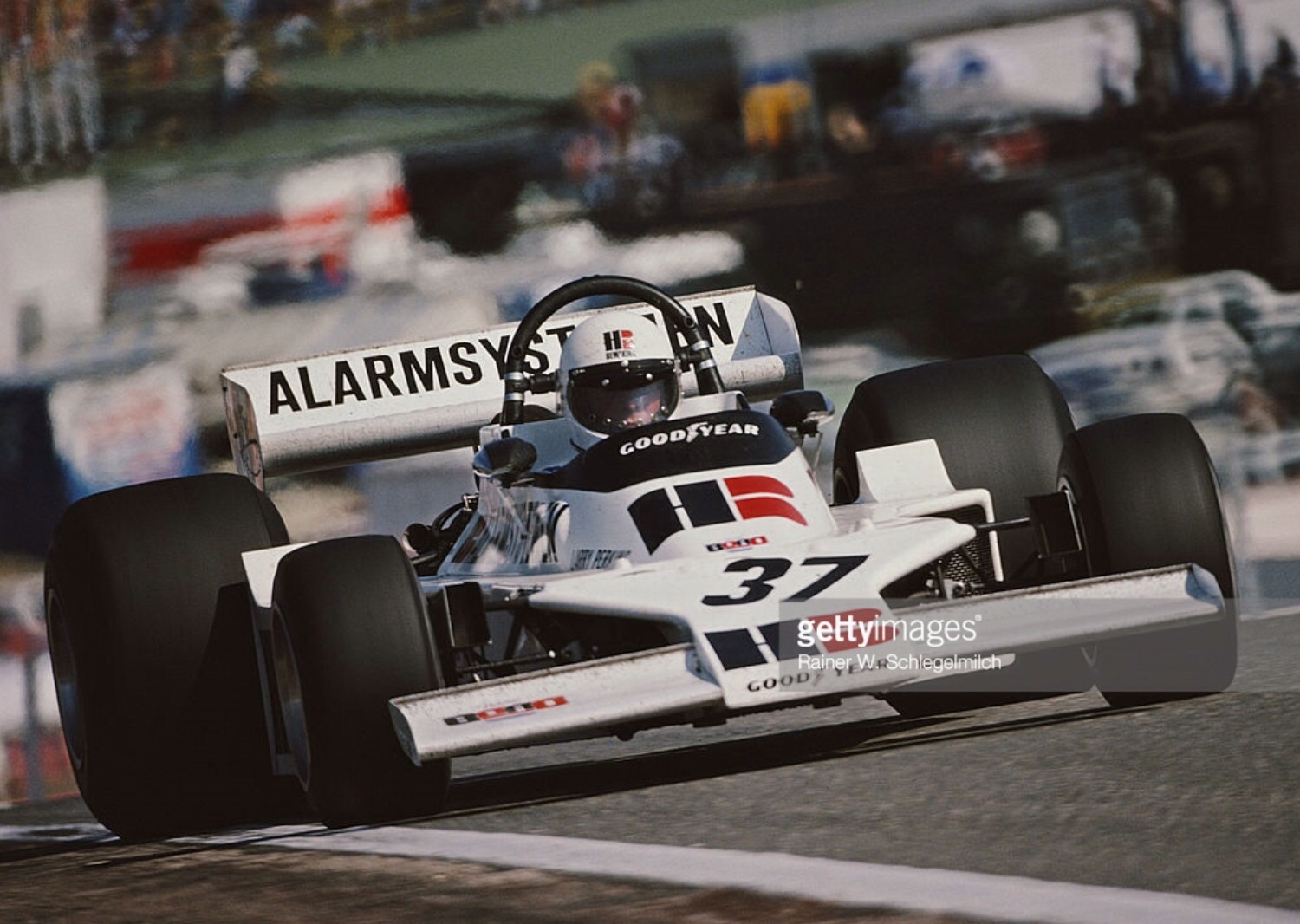
Larrikins, Larry Perkins perhaps? He raced and prepared an Ensign, nee Boro in 1976. Was he, perhaps, the last or most recent of the genre? The guys I am referring to are the blokes who could both drive the things and could and would put ‘em together themselves.

image

Nice overhead shot of Perkins Ensign ‘Boro’ N175 Ford at Monaco in 1976. He didn’t make the cut in the principality but raced the car in the Belgian, Spanish and Swedish Grands Prix for 8th, 13th and DNF in an operation which was very much smell of an oily rag and DIY…And did well enough to pick up a Brabham drive later in the season, one, sadly, he was not to keep. These cars of Mo Nunns were beautifully designed, quick jiggers. Chris Amon made ‘em fly too, tho their mechanical breakages sapped his confidence and bruised his body, ending his GP career (Schlegelmilch)

Qualifiers?…

Mercedes mechanic come driver ace Hermann Lang is the first who pops into my head but he can’t have been the only one pre-war? I wonder if the Renault brothers were ‘hands on’ maybe they qualify as the first way back in the Edwardian era? Vincenzo Lancia maybe?

image

Hermann Lang at Donington Park 1937. Apprenticed as a motor-cycle mechanic at 14, Lang was an ace on bikes by the time he joined Benz as a mechanic in 1934, by ’39 he was European (read World) Champion. He fettled Fagioli’s W25 initially. Aided and abetted by team manager Alfred Neubauer, and against the wishes of some of the drivers, he test drove the cars in 1935 and 1936 before being made a works driver for 1937 with the 5.6-litre W125. By 1939 he was the grids yardstick, winning 5 of the 8 major GP’s in the 3 litre W154. Having the momentum as the ace of the day was lost by the War years, after a few unsuccessful attempts in post-war GP’s, he won the ‘52 Le Mans in a 300SL Benz (Fox)

Fangio certainly built some of the ‘rockets’ he raced in Argentina early on in his career, whether he wielded a torch once he got to Europe is perhaps another thing.

The dudes i think of most readily are the fifties/sixties fellows; Jack and Bruce of course, Chapman qualifies altho he didn’t race in a GP, he did practice for the French GP in 1956 for Vanwall though.  He qualified 5th but boofed the car so did not race.

image

Here’s a few practical chaps, and all pretty handy steerers including Brabham designer Ron Tauranac (far right leaning) who was quick in his Ralts in Oz before he was enticed to the UK by Jack. From left Howden Ganley a picture of 70’s sartorial elegance in the flares, and a mechanic at McLarens in the early days as he progressed thru the junior formulae ranks in the UK. Tim Schenken, (these two later partners in Tiga Cars) Graham Hill waxing lyrical and RT at right. Car is the one of a kind ‘Lobster Claw’ Brabham BT34 Ford, driven by Hill, its British GP practice @ Silverstone in 1971. Tim drove last years BT33 and was consistently quicker than GH in his first full F1 season (Blackman)

Graham Hill, Phil Hill, Richie Ginther, Dan Gurney, Jim Hall, Bob Anderson, Frank Gardner, Denny Hulme, Howden Ganley and Graham McRae all qualify. The Kiwi F5000 ace did a Gee Pee or two in ‘73ish and his cars were great bits of kit.

image

In 1970-3 Graham McRae was one of the worlds best F5000 pilots at a time the category globally was mega-competitive, winning races and championships in Australasia, Europe and the US. His Len Terry designed Leda LT27/ McRae GM1 Chev’s were the ‘ducks guts’ as well, until the Lola T300 rained on his, and everybody else’s parades. Formula Lola from then on. Here he is in one of Frank Williams Iso IR Fords during ’73 British GP practice at Silverstone. He didn’t complete the first lap with throttle slide dramas at the start of the lap which ended with Jody Scheckter’s big Woodcote, McLaren M23 shunt which took out half the field (unattributed)

Thinking slightly more broadly Chevron’s Derek Bennett wasn’t an F1 driver but otherwise is absolutely of the driver/engineer fix it yerself mould. Make that design, build and drive it. And in Australia Garrie Cooper (Elfin) and Frank Matich spring to mind, Frank was ‘elite level’ as a driver and his sports and F5000’s cars were all winners. Both were not F1 drivers to be clear. ANF1 drivers, but not F1 drivers…

image

Larry at the press launch of the BRM P201 in early 1977. Mike Pilbeam’s chassis was good, if they had popped a DFV into it they would have had a good car? By then the BRM V12 was well past it’s use-by date and hadn’t had any development to speak of for years (Keystone)

Larry was later than all that lot so I reckon its him as ‘the last’? Unless some of you guys can think of someone more recent, and you may well do, the above is outta my head which does not fit into the category of thorough, diligent research.

image

Perkins had several drives of the Holden Dealer Team supercharged, Holden LC Torana GTR XU1 during 1972, here at Catalina Park in Sydney’s Blue Mountains (Rod MacKenzie)

Perkins spannered the very first Ralt RT1 Tauranac built to his ’75 Euro F3 Championship win then lent his talents to Chris Amon on his Amon and, as I say largely self prepared the Ensign/Boro Ford well enough to be plucked by BC Ecclestone into Brabham for a while. Until Carlos Pace rained on his parade. By the time Larry got to BRM they were shit-heaps, that episode a total wasta time. Mike Pilbeam’s chassis was in search of a good engine.

image

Here Larry is  trying to qualify the Amon AF101 Ford during German GP practice after Chris fell ill, Nurburgring 1974, DNQ. Clay Regazzoni won in a Ferrari 312B3 (Sutton)

Larry prepared all of his cars in the junior formulae in Australia before taking the same talents into European F3. I well remember seeing Larry rectifying his practice mishap transferring all the good bits of Robert Handfirds Ralt RT4 into a new chassis having had a territorial dispute with a slower car in practice, and rooted the cars tub, during the 1981 AGP weekend at Calder. Despite a lack of practice time the car was 4th on raceday, Roberto Moreno victorious in another RT4.

image

Teo Fabi and Perkins (near side) in March 782 and 77B during the 1979 F Pac NZ GP at Pukekohe.The 1979 NZ F Pac championship was won by Teo Fabi in a factory March 782. The 5 circuit, 5 weekend, 10 50-mile race series was tough. He dominated, the March 782 the best 1978 Euro F2 chassis, was fitted with the latest March 79B bodywork incorporating sliding skirts. Perkins was his toughest opponent driving the ex-works March 77B chassis raced by Danny Sullivan in NZ the year before. Perkins raced a Ralt Australia/Scuderia Veloce Ralt RT1 in the 1978 series finishing runner-up to Keke Rosberg. Larry was 29 then, it was still not too late to resuscitate his single-seater career, the result may well have been different had Perkins raced a car as quick as Fabi’s. Having said that, in early 1979 Fabi was an F3 graduate, Larry an ex-F1 driver so Larry should have been quicker. Perkins mixed single seaters and touring cars in the early eighties. He raced F Pac and F5000, winning the 1979 Rothmans International Series in an Elfin MR8 Chev. He then became a touring car specialist, winning the Bathurst 1000 6 times and a car constructor. He led the team which built the race cars at the Holden Dealer Team when it was owned by Peter Brock and formed Perkins Engineering to build and race Holdens from early 1986 to 2013.

Bob Janes All Australian, if you can call such an attempt in a German car!, attack on Le Mans in 1984 in a John Fitzpatrick Porsche 956 is a story in itself with the drive shared by Larry and Aussie Touring Car Legend, Pter Brock. The preparation of the car in Australia and France was in Larry’s tender, loving hands, the great run ended during the night whilst Larry was at the wheel.

image

Perkins at the wheel of the Porsche 956 he shared with Peter Brock in 1984. The car ran as high as 8th before crashing during the night (unattributed)

Larry was pushing hard and ran out of road passing two cars seeking to make up time, the car had slipped down to about 35th after losing 28 minutes repairing a front hub damaged when the car lost a front wheel whilst Brock was driving. He was sanguine about it saying later fatigue wasn’t the issue, the choice of passing a split second one of course, with hindsight backing off was the right one. Henri Pescarolo and Klaus Ludwig won in a 956B, Larry and Brock were out in the 18th hour having covered 145 laps

perkins-jag

Perkins at the wheel of the Jguar XJR9-LM he co-drove to 4th place at Le Mans in 1988 (unattributed)

Jaguar and Holden Special Vehicles…

Tom Walkinshaw was well aware of both Larry’s speed and car construction skills. The Brit owned Holden Special Vehicles in the post-Brock era but was making the same climb up the UK motor racing greasy pole as a driver, as Perkins in the early 1970’s.

Amusing was being a guest of HSV at Bathurst for the 1000Km event in 1988-the design and branding business of which I was a partner designed/created the HSV Logo and brand look and feel, and seeing the ‘in team competition’ between the two Holden VL Commodore HSV racers.

One was built by the Poms at TWR and one built by Larrikins and the lads in Melbourne! Larry’s qualified in the top 10 but neither finished, Walkinshaw’s car doing only 5 laps and Perkins 137. HSV was a very do it yerself operation then, MD John Crennan himself drove the courtesy vehicle to ferry we guests from the circuit to the airport after the race, a far cry of later years as the business of building heavily re-engineered performance Holdens grew.

Walkinshaw invited Larry to join his TWR Jaguar squad at Le Mans in 1988. The Aussie tested the car at Silverstone in preparation for the race, the car was very quick even compared to the Porsche 956, also a ground-effect car, of 4 years earlier. He finished 4th in the French classic co-driving a Jag XJR-9LM together with fellow ex-F1 driver Derek Daly and Kevin Cogan. The big 7 litre V12 was 11 laps behind the winning Jag of teammates Jan Lammers, Johnny Dumfries and Andy Wallace.

Perkins touring car exploits in Oz as both builder and driver are well known. Suffice it to say that the Perkins Engineering workshop at Moorabbin Airport in Melbourne’s southern suburbs built amongst the best Holden Group A and V8 Supercars for a couple of decades both for his own team and customers.

This made him a prosperous businessman, in so doing he applied the self taught engineering, business skills and resilience which made him such a formidable driver. Make that driver/engineer, to pick up where we started!

image

Drivers meeting during the 1979 NZ F Pacific series. Larry is talking to Teo Fabi, who won the title that year, Jeff Wood is the tall dude and the blondie, Oz F Pac Ace John Smith (Cammick)


image

Jack Brabham explaining why front stiffness is critical to performance, Tasman Series, Australia 1968 (unattributed)

Back to the Brabham BT23E race-prep picture at this articles outset…

Whenever you see pictures of Jack he is always fiddling with something, he is rarely looking on at the mechanics doing stuff or checkin’ out the babes.

This (opening article) shot was in a general interest magazine in Rodway Wolfe’s suitcase of Repco Goodies which is in my care. I was certain ‘twas Jack’s 1968 Tasman mount, his BT23E, to which is being fitted an RB740 275bhp Repco V8.

Rodway believes the place is probably a workshop on the South side of the Princes Highway near the Warrigal Road corner close to Sandown in Melbourne. Jack’s Australian manager, Reg Thompson (ex-Redex) used to organise these locales close to the circuit, rather than the team operate from Repco Brabham Engines HQ in Maidstone, which in those pre-Westgate Bridge days was a ‘cut lunch and camel ride’ from Sandown in Springvale.

Jack is at left of course, hidden behind him is Graeme Bartels to the right is Norman Wilson, RBE’s Senior Design Engineer post Phil Irving. He is fettling the Lucas metering unit which is beneath the exhausts, I wonder if he is cursing his packaging as he works! Bevan Weston is facing the camera in the middle, all these fellas are RBE Maidstone crew. The other blokes are BRO. (Brabham Racing Organisation)

One of the many hints its Oz rather than Europe are the cans of Australian oil company ‘Ampol’ fuel and lubricant on the floor of the workshop. In F1 Jack was sponsored by Esso then Gulf from 1968. Ampol didn’t make competition fuel or lubricants, Nigel Tait says that RBE used Shell Super M lubricants at Maidstone whilst assembling and testing the engines, I wonder if its Shell oil and fuel in those Ampol cans!

image

Front rows of the ’68 Australian GP grid, Sandown Park, Melbourne. Clark #6 then Amon and Jack on the front row-Lotus 49 DFW, Ferrari Dino 246T and Brabham BT23E Repco. On row 2 Hill in the other 49 and Leo Geoghegan Lotus 39 Repco, well up in this 1965 chassis. You can just see Frank Gardner’s Brabham BT23D Alfa on the inside of the circuit (Howard)

Sandown 1968 Tasman Race: The Australian GP…

This account is a truncated version of that found on the excellent sergent.com website.

The conditions that weekend at Sandown Park were absolutely scorching, Melbourne had been in drought for the previous months. I can still remember water restrictions at the time, the race was held over 55 laps of the 3 and a bit Km, very fast circuit laid out around a horse racing course.

‘The first official practice was held in temperatures of up to 106 degrees, Brabham was quickest in the Brabham-Repco V8 fitted with the older 630 type heads which brought the exhausts up from the lower part of the engine. It was obviously a powerful arrangement, as Brabham had little effort getting down to 1:6.7 secs during his 10 laps’.

Its interesting but not quite right, in fact the engine was a brand new ‘830 Series’ Tasman V8, a combination of the ‘short’ 800 block to be used in the 1968 RB860 F1 engine, and crossflow 30 Series heads. These were more powerful than the 40 Series used in F1 in ’67 and more widely on various Repco engines of capacities from 2.5 to 5 litres.

image

The brand new, prototype or first RB830 V8 nestled in the back of Jack’s Brabham BT23E chassis at Sandown during the AGP weekend in 1968. That it was developmental is indicated by the tack on oil cooler and weird aluminium ‘fuel pot’ as Rod Wolfe describes it (Rod MacKenzie)

Clearly though the engine being popped into the chassis in the opening shot is a 740 not an 830, so exactly when this engine is being put in-or pulled out is an interesting, if arcane one!

Jack only did the Warwick Farm and Sandown Tasman rounds in 1968, the car clearly raced a 740 that weekend in Sydney their is plenty of photographic evidence to support that. Equally, if you look closely at the grid at the start of the Sandown race the engine fitted to Jack’s car is not a 740 ‘between the Vee’ exhaust engine but a ‘crossflow’ 830 engine.

Perhaps the car practiced initially at Sandown with a 740, the 830 fitted later in the meeting or perhaps the photo at the articles outset is in a Sydney workshop prior to WF, for sure it isn’t RB HQ at Maidstone in Victoria.

To add to the confusion there is a photo in the report of the AGP in the bible (History of The Australian Grand Prix by Graham Howard and others) which shows the car at Sandown fitted with a 740, but the photo caption I don’t think is right, I suspect it’s at WF not Sandown, they are both circuits built around horse racing  tracks and the car carried #2 at both meetings. All contributions welcome on this arcane Repco topic of what engine where!

Clearly the 830 developed plenty of mumbo as Jack popped it on pole from Amon in the four valve Ferrari and Clark on the outside. Then came a brilliant Leo Geoghegan in his ex-Clark 1966 Tasman Series Lotus 39 but fitted with a Repco ‘740’ rather than the Coventry Climax FPF four which the car was built.

In fact it was built for the still-born Coventry Climax V16, but modified to suit the CC FPF. In any event Leo had the old car ‘dancin amongst this compoany in the latest and greatest from Europe and Graham Hill on the second row respectively.

Then was Gardner (Brabham BT23D Alfa Romeo T33 V8) and Cusack (Brabham BT23A Repco 740) Rodriguez (BRM P126 V12) then Piers Courage in the little 1.6 McLaren M4A Ford FVA, John Harvey’s old Brabham BT11 Repco V8 740 Attwood (BRM), Hulme and Bartlett (Brabham completed the grid with no ANF2 1.5’s allowed.

image

Jack in BT23E in the Warwick Farm pits the week before the Sandown AGP, car clearly fitted with a 740 Series ‘exhaust between the Vee’ engine. Car in front is one of the P261 BRM’s, behind is Piers Courage McLaren M4A FVA F2 car (Brian McInerney)

Race day was still scorching, the drivers avoided the usual pre-race sports car ride. Jim Clark led from Amon, with Jack making a poor start and getting away in 5th place as the field lined up Shell corner.

Coming under Dunlop Bridge for the first time the order was Clark, Amon, Hill, Gardner, Brabham, Geoghegan (already sounding off tune), Rodriguez, Cusack, Courage, Bartlett, Attwood, Hulme and Harvey.

Brabham took Gardner on lap 3 while Cusack slipped under Rodriguez. Hill fell to Brabham on lap 5. Cusack again poured it on to get by Geoghegan (only running on seven cylinders with a broken plug insulator) and Courage got by Rodriguez on the following lap.

The race was an absolute beauty by lap eight, the order was Clark and Amon with Brabham closing fast. Then came Hill, Gardner, a gap to Courage, Cusack, Geoghegan, Rodriguez, Attwood and Bartlett.

On lap 10 Rodriguez blew the V12 BRM. Brabham, by then was catching Amon and Clark at the rate of 0.5 sec a lap, the chase was sending the crowd wild. Three laps later Brabham had closed right up on Amon.

The three leaders lapped Hulme on BP Straight as they flashed past on lap 19, while Gardner got past Hill again and Bartlett somehow blew off Cusack in the Coventry Climax engined old Brabham BT11A. Next time round, Brabham had again lost ground to Amon and Gardner was one second ahead of Hill. Then, as the leaders came from under Dunlop Bridge onto the main straight, there were only two. Brabham came into view a little later coasting towards the pits with a seized engine.

image

Clark and Amon during their epic dice into turn 1 or Shell Corner for the quick blast past the old pits on the left, Sandown 1968 (Rod MacKenzie)

With Brabham out of the race, the crowd focused on the furious dice between Clark and Amon, and then back further to Graham Hill and Frank Gardner.

‘Amon desperately needed the win to make up points on Clark and he was driving superbly to hang on to the tail of the more powerful Lotus-Ford. He started a series of maneuvres which were to last throughout the race of slipstreaming the Lotus, then switching to the side and trying to forge past on the straights. However, Clark had enough steam to just hold the Ferrari leaving his braking slightly later than Amon on Shell and Lukey corners’.

Amon lost some ground lapping slower cars but by lap 43 he was looking into Clark’s ZF ‘box. Temperatures had tumbled during the race to a moderate 90 degrees (!) which made things a shade easier all round’.

‘With seven laps left in the 33rd Australian Grand Prix, Frank Gardner got the GO signal from the Mildren crew and roared after Hill. Amon had his nose over the finish line twice in the closing laps in a massive bid to snatch the lead from Clark, but he was out-braked each time into Shell. Gardner took Hill briefly at Lukey corner on lap 52 but Hill was in front again as they came under Dunlop Bridge.

image

Clark under brakes in the winning Lotus 49 DFW, AGP Sandown 1968 (Rod MacKenzie)

And that’s how they finished. It was probably the most exciting GP since the 1960 event at Lowood when Alec Mildren won by a mere one 26th second from Lex Davison. Clark credited Amon with a wonderful drive, and it was obvious both men were as near to the limit as anyone for the whole 55 laps. Courage came home a lap down in fifth place while Attwood, Geoghegan and Bartlett all completed 53 laps in that order. Geoghegan received the honour of first Australian home for the second time and Bartlett was fuming because he had received no pit signal as to how close he was to Geoghegan’.

F1 ‘830 Series’ Repco V8?…

An interesting historic sidebar is this engines prospects as an F1 engine, had it been raced in 1968.

The 860 Series, DOHC, 4 valve circa 390bhp engine bombed bigtime in F1 in 1968. Jack and Jochen Rindt had a torrid time, the engine was way behind with its build and testing compared to the simpler, championship winning 620 and 740 Series 1966 and 1967 engines-a story for another time.

Jack was later to reflect, including in a conversation with Repco’s Rodway Wolfe that another F1 title could have been won by Repco  in 1968. His theory was that had they taken the simple SOHC, 2 valve approach which yielded championships in 1966 and 1967 by using the 830 V8 in ’68 another title beckoned. In 2.5 litre Tasman form the 830 gave circa 295 bhp, even if it gave 350 bhp in 3 litre form, which is 20bhp more than the 740 F1 engine gave in 1967, Jack was drawing a long bow about its ’68 prospects, i think.

By 1968 the Ford Cosworth DFV, which first raced in the ’67 Dutch GP was giving a reliable 405bhp and was in the hands of Lotus, McLaren and Matra; 5 or 6 cars raced the engine in every GP depending upon whether Ken Tyrrell’s Matra International fielded one or two cars. Every 1968 GP bar the French (won by Ickx, Ferrari) was won by the DFV…Yep, an 830 engined Brabham BT26 would have finished in the points had it been reliable, Rindt was pedalling it remember. But a title? I really don’t think so Jack, the game had moved on.

The great tantalising Repco ‘what if’ is how the 860 quad cam would have gone in 1969 with its bugs sorted and having a reliable, torquey Repco (real horses, not ponies) 400bhp. A title in 1969?! Maybe…

Credits…

Rodway Wolfe Collection, Rod MacKenzie Collection, Fox Photos, Keystone, Ross Cammick, The Roaring Season, Getty Images, Brian McInerney, Victor Blackman

Tailpiece: Larry on his way to 13th in the Ensign N175 Ford during the 1976 Spanish Grand Prix at Jarama, Hunt won in a McLaren M23 Ford…

image

Finito…


mayer goodwood

Bruce McLaren tested the first of these Cooper T70 chassis at Goodwood in October 1963, lapping in 1:20.5 seconds with an engine well past its best, fiddling with tyre pressures and spring rates. The date of Tim’s test is unclear. Note the Bruce McLaren Motor Racing logo/sticker attached to the cockpit (Getty)

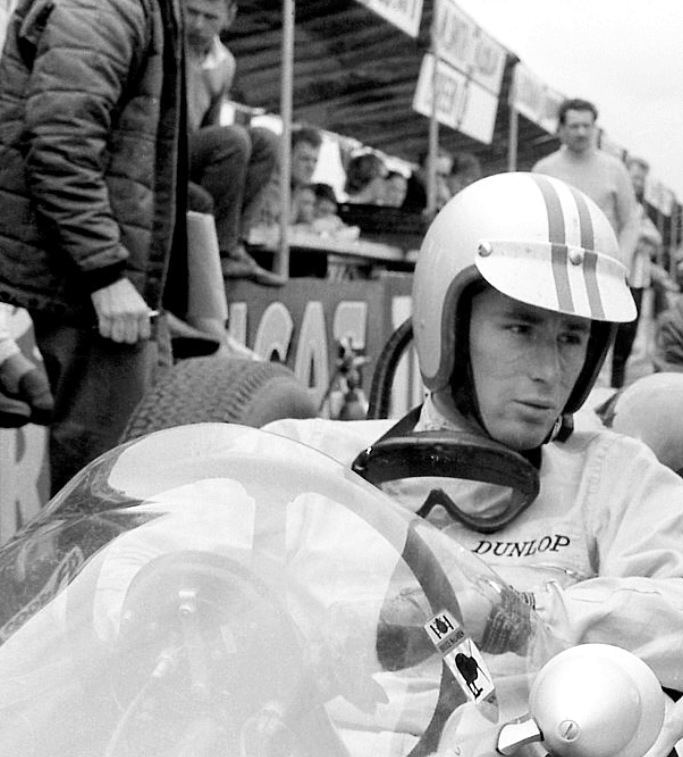
Tim Mayer sizes up the cockpit of  his new Tasman Cooper T70, full of optimism having just tested the car at Goodwood, October 1963…

Tim Mayer is one of motor racing’s many ‘might-have-beens’, cut down in his prime in a Bruce McLaren Motor Racing Ltd Tasman Cooper T70 Climax at Longford, Tasmania on 28 February 1964.

The young American made a huge impact in Australasia during his 1964 tour and is remembered in very fond terms by enthusiasts fortunate enough to see him race the big GP Cooper here.

This article was inspired by John Ellacott’s color shot at Warwick Farm in the body of this article and some Getty Archive photos I tripped over researching something else. Other layers of personal interest are a growing obsession with Longford and that one of my mates, Adam Berryman, restored and owns one of the two Cooper T70 chassis.

I hadn’t intended to explore each chassis in this article but the level of interest created online makes it important to provide this summary of each of the two chassis and their destiny, the details are courtesy of oldracingcars.com and Adam Berryman. Here goes…

Tim raced ‘FL-1-64’ at Levin, Pukekohe, Wigram, Teretonga and Sandown. Bruce decided to swap cars with Tim at Warwick Farm, racing ‘FL-1-64’ at Warwick Farm, Lakeside and Longford.

McLaren raced ‘FL-2-64’ from the Tasman’s commencement at Levin, Pukekohe 1st NZ GP, Wigram 1st, Teretonga 1st and Sandown. Tim raced ‘FL-2-64’ at Warwick Farm, Lakeside and at Longford when it was destroyed in practice.

For his 1965 Tasman campaign Bruce returned with a new Cooper T79 for himself, only one was built, it was tagged ‘FL-1-65’.

‘FL-1-64’, the surviving 1964 chassis raced as above was updated and used very competitively in the ’65 Tasman by 1961 World Champion, Phil Hill. In fact the series was his last in single-seaters. When updated the perfectly good, ‘FL-1-64’ tagged frame was re-tagged with the ‘FL-2-64’ plate off the frame destroyed by Mayer at Longford. This was done at Coopers with the consent of all concerned; John Cooper, McLaren, Teddy Mayer.

It is this chassis, ‘FL-1-64’ now tagged ‘FL-2-64’ which raced on in Australia ‘in period’ by John McDonald and was later acquired by Richard Berryman, and upon his untimely death passed to his son Adam.

Simple isn’t it!

Far from it in fact. The details were only unravelled when Adam Berryman met Wally Willmott, who built the T70’s with Bruce at Coopers, all those years ago. As part of the rigorous process of Berryman getting the Confederation of Australian Motor Sport historic ‘Certificate of Description’ to race the car, the history of  the two chassis was clarified as a result of information shared and debated between Berryman, Doug Nye, (who wrote ‘Cooper Cars’) Willmott and Bryan Miller, the CAMS Historic Eligibility Commission Chairman.

Further detail on each chassis i will cover in an article on the T70’s.

cooper mc laren puke

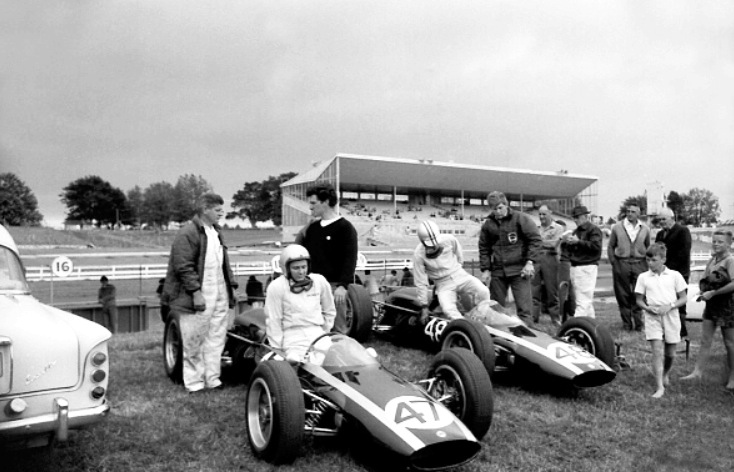
Bruce in #47 and Tim in the Pukekohe paddock 1964, wonderful shot captures the relaxed atmosphere of this demanding circuit (Getty)

Bruce went on to win the inaugural, 1964 Tasman Series with a fighting second place behind Graham Hill’s Scuderia Veloce Brabham BT4 Climax at Longford, the series final round He won by 6 points from Jack Brabham’s BT7A and Denny Hulme’s Brabham BT4.

Tim’s accident took place during the Friday afternoon practice session. He was keen to do well of course, racing amongst F1 champions Hill and Brabham, GP winner McLaren as well as host of aspirants; Frank Matich, John Youl, Tony Shelly, Jim Palmer, Greg Cusack, Frank Gardner, Dave Walker and others.

Longford’s 4.5 high-speed miles of undulating, tree and telephone pole lined roads with culverts was completed with a railway crossing, two bridges, a railway viaduct and more. Its blend of Tasmanian roads and topography was unforgiving to say the least. It had many nuances, younger drivers needed miles there to appreciate them. Neither Mayer or fellow Cooper pilot Rocky Tresise, a year later, learned the subtleties of the place and paid the ultimate price as a consequence. Undoubtedly it was a circuit to attack only after deep familiarity.

mayer cooper group

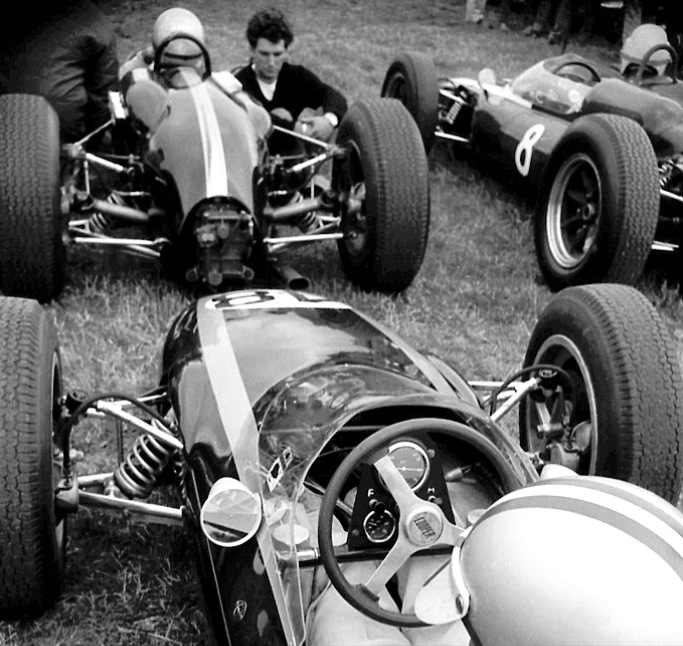
Bruce in front of Tim in the Puke paddock, the other Cooper #8 is the very fast and reliable, several years old T55 of Taswegian John Youl. McLaren won the NZGP from Brabham’s BT7A, Ron and Jack’s latest ‘Intercontinental’ tool, and Mayer who was 26 seconds adrift of his team-leader. Cockpit very tight especially for the lanky American, note Bruce’s mini-dashboard to which the essential three Smiths instruments are affixed; tach, oil press, and oil and water temps (Getty)

I asked multiple Australian Gold Star Champion, Taswegian John McCormack if he raced his ex-Brabham BT4 Climax there, ‘I drove there, I wouldn’t say that I raced that first time though’ was John’s typically candid response.

Needless to say these cars were far from ‘safe’; they were of multi-tubular spaceframe construction and had no deformable structures other than the aluminium saddle tanks carrying plenty of Avgas…The 2.5 Coventry Climax 4 potter gave 235 powerful horses, the cars did better than 160mph on ‘The Flying Mile’, more than quick at a place like this. A ‘big one’ was all too often the drivers last in cars of this ilk.

Mayer was on the ‘back section of the track, on the fateful lap. He had completed pit straight, then headed down hill, traversed the left-hand, blind entry left, right Viaduct and crossed the River Esk on Kings Bridge. He was on Union Straight which leads to Longford/Pub Corner, a 90 degree right hander. Tim was using a tall top gear doing better than 160.

The tricky bit of the circuit here, important for lap times was to fly the hump before Longford Corner; critical was landing square and braking almost immediately upon landing but not being too savage on the brakes to avoid giving the car a big fright whilst it was relatively unstable.

The landing was the problem in this case. Perhaps the car landed badly due to wind or being lined up poorly, or perhaps Tim braked too hard before the Cooper had settled enough back onto its springs, either way it was all over in the blink of an eye. ‘The Cooper slewed sideways into a 15ft plane tree. The car split into two; Tim was thrown 50 yards to the other side of the road, instantly breaking his neck’ recounts Barry Green in ‘Longford: The Fast Track Back’.

Eoin Young in his report in the April 1964 ‘Motor Racing’ said ‘…Mayers Cooper landed slightly offline just before the right-angled right-hander at the hotel, and slewed sideways into a a tree…’

‘Sports Car World’ reported that ‘Apparently (always a worry when a report says this!) Mayer became airborne off the hump after Kings Bridge. The car landed slightly sideways, Mayer caught it, but the two left hand wheels had got into the dirt. The car then slid into a plane tree and disintegrated throwing Mayer out’. I don’t wish to labour the point but rather use three contemporary reports to look at their similarity and differences, it does not change the result but the actual cause will never precisely be known.

Tim’s death directly lead, as most of you know, to his manager brother Teddy Mayer’s involvement as a shareholder/director of Bruce McLaren Motor Racing Ltd. Tyler Alexander was part of Mayer’s Tasman crew too, both he and Teddy were huge contributors to the phenomenal McLaren success which followed over the ensuing decade. In that sense, something positive became of the terrible events all those years ago, without in any way trying to make light of Tim’s demise.

Long Weekend at Longford…

Checkout this amazing short documentary on the ’64 Longford carnival. There is some in car footage which superbly illustrates the difficulties of the track, inclusive of the area where Tim came to grief.


mayer goodwood 1

Mayer in the Goodwood paddock. The T70 was built in Coopers workshops but was Bruce’ project and conceptual design, designed for 100 mile Tasman events, rather than the GP cars he had previously taken home to the Antipodes. Its now said to be ‘the first McLaren’. The T70 was entirely conventional with spaceframe chassis albeit very narrow for the time, 25 inches wide cockpit, to slip through the air nicely. Front suspension was by upper and lower wishbones and coil spring/damper units with anti-dive geometry, and single top link, lower wishbone with a single top radius rod for fore and aft location. The Coventry Climax FPF 4 potter was at its 2.5 litre GP capacity, down from the 2.7’s widely used during the pre-Tasman F Libre years, output circa 235bhp. The gearbox was a Colotti Type 21 5 speed in ‘FL-2-64’ and Cooper 6 speed in Tim’s ‘FL-1-64’ . This Colotti T21 was famous at McLaren/Cooper’s as the most used gearbox ever having started life in Tommy Atkins Cooper, was then used in the T70 and then later in the Cooper/Zerex Oldsmobile. Fuel tankage comprised 8 gallons under the seat and smaller side tanks either side of the drivers knees holding a total of 7 gallons (Getty)

The editor of New Zealand’s ‘Motorman’ magazine, Donn Anderson wrote this tribute to Tim Mayer soon after his death. This contemporary piece has a wonderful intimacy and familiarity about it written by a journalist upon whom Tim Mayer clearly made a big impact as both a young racer and as a man. It has far more validity than anything any of us can pen ‘from 50 years afar’…

image

Mayer, Sandown 1964, ‘FL-1-64’. He was 2nd to Brabham when he started to have fuel feed problems and was overhauled in the last stages by Stillwell and Youl to finish 4th, Brabham won (autopics)

‘Scholar Journalist and Sportsman…Tim Mayer’…

‘It is so very hard to write an appreciation of one who was more than just another racing driver to us. Tim Mayer was a newcomer to international racing and although we knew him for only five weeks in New Zealand, it was not difficult to make an accurate appraisal of the 26-year-old American.

His death during a practice session for the final round of the Tasman Championship at the Longford circuit in Tasmania on February 28 was a sudden shock to many. Twelve months ago he was practically unknown and even of late his appearance to some was much of a novelty.

Tim was not the ‘boy’s book’ ideal of a racing driver. He looked more the university or law student figure and, indeed, he did have a very sound education. Tall and slender – 6 foot and 145 lbs – Timmy was married in 1961 to charming Garril.

He was born to a wealthy family in Pennsylvania, and it soon became obvious that he was talented in both studying and athletic fields. Some six years ago he went to his first motor race at Sebring with a cousin and was immediately taken in with the sport. He entered his first race in an Austin Healey in 1959. ‘It was wet and I was very much a newcomer to motor racing,’ Tim told The Motorman recently. ‘I spun trying to change gears down a straight!’ The young driver competed in 5 of 13 national races that initial year with the Healey and finished fourth in the national class standings

mayer puke

Mayer Pukekohe, small size of the car accentuated by the way Tim sits out of it! T70 chassis # FL-1-64 (Getty)

Even then Timmy was backed and assisted by his brother, Teddy, who has accompanied him throughout his career with cars. Of his early racing he says it was mostly ‘crash, burn and try to learn.’ For 1960 Tim had a new Lotus 18 junior and in eight races he was second five times. The car was wrecked when Timmy ran into a horse barn at Louisville, thus bringing the year’s racing to an end. At that meeting he met Dr Frank Falkner, Cooper’s agent in the U.S., who was to help the young American. By the age of 22 Tim had a degree in English literature from Yale University but it was time for the two-year army stint.

image

The Long and The Short of It: Tim in the shades at rear and Teddy in between the well nourished lads at Cumberland in 1962. Teddy’s flair for team management was clear early on; ‘Revem Racing’ ran Tim, Peter Revson and Bill Smith in FJ in ’62. Tim WAS fast and Teddy managed his brother well (unattributed)

Of his first run in a single-seater Tim said: ‘I had overturned the Lotus 18 within 10 minutes of driving the thing and finished hanging upside down strapped in with my seat belt. Everyone uses belts, even for open cars, in the States, so when I went to Europe it took a while to become used to not being tied in.’

Tim was able to continue pursuing his desire to become a top-line driver in the army, however, as the officers appreciated the value of a quick corporal at motor race meetings. He used an FJ Cooper and while based in Puerto Rico was able to race almost every weekend in many parts of the country.

image

Tim Mayer Cooper T59 Ford from Peter Revson in a similar car, first and second. #106 Bill Smith Lotus 20 Ford. ‘Jaycees Cup’ Cumberland Airport, Maryland 13 May 1962.Tim won the US FJ Championship in 1962 from Floyd Aaskov and Walt Hansgen, Revvie was 5th, Augie Pabst 6th and Mark Donohue and Roger Penske equal 9th In 1963 Teddy (and Bruce?) introduced Tim to Ken Tyrrell who ran him in a handful of European and British BARC FJ Championship rounds in a Cooper T67 BMC, not the engine of choice at all. Even tho the season was well over, the contenders dialled into their cars, to say the least, Tim was in amongst the top 6 Cosworth engine cars.  Mayer’s European FJ campaign comprised a fast blast through France in mid-year, he contested the GP de Rouen, Coupe International de Vitesse des Juniors, the FJ support race during the French GP weekend at Reims and Trophee d’Auvergne at Clermont Ferrand on June 23, 30 and July7 respectively. At each meeting he was ‘first in the BMC Class’ in 7th,8th and 4th in his Tyrrell Cooper T67, the races won by the Ford powered Brabham BT6’s of Paul Hawkins, Denny Hulme and Jo Schlesser. The BARC British championship leader board that year included amongst its Top 13 Peter Arundell, Denny Hulme, Frank Gardner, Richard Attwood, David Hobbs, Paul Hawkins, Mike Spence, Alan Rees, Peter Procter, John Rhodes and Brian Hart amongst others, Tim was 13th with a point. That he shone through in a tiny number of races amongst this lot says a lot! (unattributed)

The big break came in 1962 when he was acclaimed the most improved and outstanding driver of the year. With a brand new Cooper junior he won the United States SCCA Formula Junior Championship. These results landed him an entry in the US Grand Prix with a third car owned by the Cooper works. He was the fastest of the privateers in practice but the gear lever came unstuck during the race.

Last year Tim was off to Europe to join the Ken Tyrrell racing team. Although the Cooper Juniors were down on power compared with the Lotus Fords, he was able to gain much experience all over England and Europe. ‘There is much more competition in Europe compared with the States. Formula Junior racing in Europe is like Russian roulette. The BMC engines were outdated and if we finished fourth or fifth we were doing well. The Cooper had little power but fantastic cornering – superior to the Lotus.’

He crashed during the Tourist Trophy at Goodwood in 1963 after a brake caliper broke and suffered a badly twisted neck, and he also had a bad shunt at Silverstone. Driving his own 2.7-litre Cooper Monaco, Tim was third to Penske and Salvadori at the international Brands Hatch meeting last year. He also had a number of races with Cooper’s Minis. “I had a lot of fun with Sir John Whitmore – he must be the second best known driver in the U.S. next to Clark

mayer 1

Tim Mayer Pukekohe (Getty)

At Riverside last year he led the 2-litre class with a new Lotus 23B until heat forced his retirement, but he won his class and finished 5th overall at Laguna Seca.

He was made two Christmas presents – a drive with one of the McLaren Coopers in the Australasian series, and number two man in the Cooper works formula one team for 1964.

When Tim first drove the 2.5 he found it a different kettle of fish to the juniors. ‘With the little cars you have no power to get out of trouble.’ So Tim, Garril, Teddy and mechanic Tyler Alexander came south to New Zealand with the McLaren team – and they won many friends. He was second at Levin, took third place at Pukekohe, but had trouble at Wigram and couldn’t do any better than 8th position. At Invercargill he finished second to his team-mate and was fourth in the Australian GP after losing second position with fuel trouble. He was third at Warwick Farm.

image

Mayer, ‘Warwick Farm 100’ 16 February 1964, Homestead Corner, T70 ‘FL-2-64’ : Tim qualified just behind Bruce at The Farm, his first time at the highly technical circuit. Peter Windsor on his blog ‘…clearly remembers Timmy biffing the back of Bruce’s Cooper…on the opening lap at Creek Corner. Team leader nudged by his number 2! Both raced on though and finished 2nd and 3rd (Jack won in his BT7A by 4 tenths of a second from Bruce with Tim 10 seconds adrift-not bad in this company on that track, familiar turf to the other two blokes)…I watched them all afternoon. Timmy was always fast, always aggressive punching the throttle out of Creek (corner, a hairpin), applying the opposite lock with crisp precision. Bruce by comparison, was only slightly more fluid. Timmy, clearly was fast’ was Windsor’s conclusion (John Ellacott)

Consistent placings resulted in the American driver finishing third on points in the New Zealand races for the Tasman Championship, behind McLaren and Hulme, with 16 points.

Timmy – the nephew of Governor Scranton of Pennsylvania – had a real American outlook to motor racing: he wanted to go to the top. He was perhaps fortunate in having financial means to purchase the best machinery during his early career, but he also developed the ability to handle same. Money cannot buy driving skill.

From his ‘varsity days when he worked as a disc jockey on radio stations he was a keen journalist and wrote for a number of publications.

Not only was Timmy a fine driver and scholar: he was also an enthusiastic athlete. Water skiing, squash and other activities were the order of the day in New Zealand when other business was cleared.

He was genuinely interested in motor racing, no matter where. He spoke to me at length on the unfortunate situation of import duty and restrictions in this country and said it must stifle the sport here. ‘An FJ Cooper can be imported into the States for less than 1200 pounds, whereas it costs more than twice that here.’

Wherever the Mayers went in this country they gained respect. Tim, with his broad accent, was a fine ambassador for his country and a true enthusiast. There was always time to talk to anyone – no matter how small they were on the circuit, or how insignificant their name might be.

Quiet, unassuming, and not likely to be noticed in a crowd of drivers, Timmy Mayer left his mark in this country. It would seem very cruel that we should lose a fine driver who had come so far in such a short time. We pay tribute to Tim Mayer and his kin, Garril and Teddy who helped him so much in the sport he loved’.

image

Garril and Tim Mayer at Warwick Farm 1964, T70 ‘FL-2-64’ (autopics)


McLaren himself spoke of Mayer in the Autosport column he wrote together with journalist Eoin Young;

‘Intelligent and charming, Timmy had made dozens of friends during his career.  As often occurs, to look at him you wouldn’t take him for a racing driver.  You had to know him, to realize his desire to compete, to do things better than the next man, be it swimming, water-skiing or racing.

So when, during second practice at Longford, he crashed at high speed and we knew immediately that it was bad, in our hearts we felt that he had been enjoying himself and ‘having a go’.

The news that he died instantly was a terrible shock to all of us.  But who is to say that he had not seen more, done more and learned more in his 26 years than many people do in a lifetime?

It is tragic, particularly for those left.  Plans half-made must now be forgotten and the hopes must be rekindled.  Without men like Tim, plans and hopes mean nothing.To do something well is so worthwhile that to die trying to do it better cannot be foolhardy.  I can’t say these things well, but I know this is what I feel to be true.  It would be a waste of life to do nothing with one’s ability.  Life is measured in terms of achievement, not in years alone.’

image

Love this casual shot on the Teretonga grid, T70 ‘FL-1-64’. Famously the most southern circuit on the planet. Tyler Alexander and Tim await the off. It was a great race for ‘Team McLaren’ with Bruce over the line by a tenth of a second from Tim with Kiwi Jim Palmer 3rd in a Cooper T53. That Tim was quick was undeniable, his pace in these big, fast GP cars was immediate (Alexander)

Bibliography…

Article by Donn Anderson in the April 1964 issue of New Zealand’s ‘Motorman’ magazine, oldracingcars.com, The Nostalgia Forum, Stephen Dalton, Ray Bell, Bryan Miller

Credits…

John Ellacott, Getty Images, oldracingcars.com, Tyler Alexander, autopics.com, Stephen Dalton Collection, Euan Sarginson

Etcetera…

tim

Tim Mayer chats to some young enthusiasts/admirers at Levin (Sarginson/Dalton)


mayer and tresise

Tim all loaded up in the T70, chatting with Kiwi international, Tony Shelly ‘adopted’ by the Davison’s as Ray Bell put it, complete with one of Lex Davison’s ‘Ecurie Australie’ tops Pukekohe 1964 (Getty)


Tim and Bruce during the Lakeside 99- third for Bruce and DNF for his lanky teammate- Brabham won in his BT7A (unattributed)

 Tailpiece

mayer goodwood 2

Tim Mayer Goodwood, October 1963. Trying to jam his lanky frame into the confines of a car designed around Bruce’ more compact dimensions! Which chassis?, i’m not game to guess! (Getty)

 Finito…

image

Jackie Stewart being largely ignored by most of the ‘snappers’ at Zandvoort during the Dutch Grand Prix weekend in 1971…

Rainer Schlegelmilch’s shot seems to be a portrait of his colleagues, Diana Burnett is the lady, the distinctive figure of Bernard Cahier is the chap in the blue cap and Goodyear jacket. It’s dry which makes it practice, the wet race was won by Ickx’ Ferrari with JYS 4th in Tyrrell 003 Ford.

I was first smitten by single-seaters upon spotting Jochen Rindt’s sensational ‘Gold Leaf’ Lotus 72 in the Automobile Year 18 ‘centrefold’ below.

jochen

Rindt on his way to a joyless first GP win for the Lotus 72 Ford during the 1970 Dutch GP at Zandvoort, his close friend Piers Courage perished in a grisly, fiery accident during the race in a De Tomaso 505 Ford (Automobile Year)

The book came from the Camberwell Grammar School library, I was an inmate for 6 years and borrowed these annuals, they bought the latest each year, hundreds of times over the years. If truth be known I surgically removed many of the full page color shots from the books which somehow found their way onto my bedroom wall, I was skilful with a razor blade long before I could shave!

So, I was a devotee of Colin Chapman’s Lotus 56/72 side radiator, chisel nose aero approach rather than Derek Gardner’s chunky ‘sportscar nose’ alternative he pioneered in F1 with Tyrrell in ’71. That the alternative approaches worked equally well was proved by the results of practitioners of the ‘two schools’ of aerodynamic thought throughout the ‘70’s, visually though it was ‘no contest’!

ken del

Derek Gardner and Ken Tyrrell outside the Ockham, Surrey factory in August 1971. Tyrrell Ford could be ‘002 or 3’, ‘bluff nose’ first raced at the 4 July ’71 French GP  (Klemantaski)

Gardner’s Tyrrell period was relatively short but wonderfully sweet…

Seven years is a pretty long stint with one team I guess. His first series of cars was the 1970-72 ‘001-004’, the second series the 1972-3 ‘005-6’. Both designs won Grands’ Prix and World Titles. His ’74-5 ‘007’ and stunning ’76-7 ‘P34’ six-wheeler won Grands Prix only, no titles. I doubt there are too many of the F1 design greats who can claim such a record.

I’ve written a few Tyrrell articles, which are worth a look if you haven’t done so; one is on innovation; https://primotipo.com/2014/09/16/tyrrell-019-ford-1990-and-tyrrell-innovation/ , the other on aerodynamics; https://primotipo.com/tag/tyrrell-007-ford/

image

The car pictured above is Jackie Stewart’s ‘004’, the last of Gardner’s first series of designs.

It’s being prepared for the 1972 Monaco Grand Prix, ‘004’s race debut, the GP classic won by Jean-Pierre Beltoise’ BRM P160B, famously his first and last GP win was also BRM’s last. JPB’s delicacy in the wet was aided by some schmick Firestone wets but it was a great drive by any measure. Jackie was 4th in ‘004’, he was not feeling 100% shortly thereafter was diagnosed with a stomach ulcer. Francois Cevert non-classified further back in ‘002’.

stew monaco

JYS practices ‘004’ at Monaco in 1972, the race was somewhat wetter! (unattributed)

The first Tyrrell, ‘001’ made its race debut in Stewart’s hands at Oulton Park in the ‘International Gold Cup’ on 22 August 1970…

 The car was famously designed and to an extent constructed, in secret in Gardner’s home garage in Parklands Avenue, Leamington! The ‘bath tub’ monocoque chassis was built to his design by Maurice Gomm’s Gomm Metal Developments, later chassis were built at Tyrrell’s famous woodyard, the base of his timber business in Ockham, Surrey.

Other notable sub-contractors involved were Jack Knight Engineering who did much of the machining, Aeroplane and Motor who provided the centre lock magnesium alloy wheels, Laystall the stub axles, not to forget Cosworth Engineering, Hewland’s and others.

‘001’s championship debut was at Mont Tremblant, the Canadian GP on 20 September where Jackie plonked it on pole and was leading strongly before a stub axle broke on lap 32.

The car was therefore ‘match fit’ at the start of its dominant 1971 season having done vast amounts of Goodyear testing, Dunlop, Tyrrell’s hitherto tyre supplier having withdrawn from F1. Over the South African summer at Kyalami over 400 tyres were tested by the team.

oulton 2

Tyrrell and Stewart during the Oulton Park International Cup weekend in August 1970 upon ‘001’s debut. In a meeting of contrasts JYS qualified poorly after the fuel metering unit failed, then had a stuck throttle during the race which was fixed, the Scot broke the lap record twice later in the race, the cars competitiveness clear from the start. John Surtees won the event on aggregate, he won the second heat in his Surtees TS9 Ford and Henri Pescarolo the first heat (his only F1 win?) in a March 711 Ford


oulton 1

More shots of ‘001’ during the Oulton August weekend. The cars distinctive bodywork was Gardner’s work and was tested at 1/10th scale in the wind tunnel of the University of Surrey in Guildford (Getty)

Powered by the good ‘ole 3 litre Ford Cosworth DFV V8 and using the equally ubiquitous Hewland FG400 5 speed transaxle, the bolides were ‘kit cars’ of the period derided by Enzo Ferrari but  remarkably quick bits of kit!

Look back to the photo of ‘004’ chassis at Monaco above.

The monocoque was made of 16 gauge NS4 aluminium alloy and like ‘002’ and ‘003’ was 4 inches longer in the length of the tub and 1 1/2 inches longer in the wheelbase than the prototype ‘001’.

You can see the wide based lower one piece wishbone is mounted both to the tub and at its outer end the tubular suspension carrying frame which was first made up on a jig and then slipped over the top of the monocoque to which it was externally riveted. The upper suspension arm is a top link and locating link mounted to a bracket on the tub. Shocks are alloy bodied, double adjustable Koni’s- again period typical. The simple steering column is clear, the rack made by Tyrrells.

tyr cutaway

Tyrrell 002-4 cutaway drawing, all chassis the same design, this car is ‘003’. Specs as per text (Tony Hatton)

The vastly strong 360 degree roll bar encircled the the rear bulkhead and was both spigoted and bolted through into the monocoque. The DFV, stressed of course, was then bolted through this hoop. The forward radius rod pickups you can just see attached to the bar structure.

The rear was also a close to perfect expression of period paradigm; single top link, twin parallel lower links to better control toe than the inverted lower wishbone used for the decade before, two radius rods for fore and aft location and again coil spring/Koni dampers.

Brakes are Girling calipers, ventilated rotors front and solid rears of 10 1/2 inch diameter with Goodyear tyres used from the start of 1971.

‘004’ was completed at the end of the ’71 season as a spare car for Stewart, it was relatively lightly raced by the works, click on this link for a full, interesting article on the car which is still alive, well and historic raced; http://www.britishracecar.com/JohnDimmer-Tyrrell-004.htm

Gardner’s ‘005-006’ cars were low polar moment, very quick, nervous devices from which the aces for which they were designed, Stewart and Francois Cevert extracted ‘every ounce’ of performance in later 1972 and in 1973.

Here is my short article about these cars; https://primotipo.com/2014/08/25/jackie-stewart-monaco-gp-1973-tyrrell-006-ford/

tyr transport

Ken Tyrrell supervising the packing away of ‘003’ at the end of a Goodwood test session on 16 January 1972 prior to shipping the car to Argentina for the start of that season.

There Jackie drove it to his first win of a season in which Emerson Fittipaldi prevailed in the gorgeous, chisel nosed ‘John Player Special’ Lotus 72 which I think is about where we came in…

emo

The ever thoughtful Derek Gardner in blue shirt watches ‘Emmo’ head out for some more practice prior to the ’72 Italian GP, Monza. The Brazilian won the race and title in his Lotus 72D Ford. Francois Cevert is behind DG, his car Tyrrell 002, DNF with engine failure (unattributed)


image

’71 Dutch GP collage (Schlegelmilch)

Etcetera…

(T Matthews)

Some Tyrrell innovation over the 1971 Monaco GP weekend.

‘002’ was fitted with this ‘floating twin-disc’ brake assembly during practice. The thin discs float on the heavy splines of the hub to find their own centres relative to the pads in the caliper, which is mounted at the rear of the assembly. The pads are operated by a double piston assembly on the inner side of the caliper. Note the wheel locating pegs and single tapered wheel nut.

Photo and Reference Credits…

Rainer Schlegelmilch, Victor Blackman, Getty Images, Klemantaski Archive, Tony Hatton, Tony Matthews

Doug Nye ‘The History of The GP Car’, The GP Encyclopaedia

oldracingcars.com Checkout Allen Brown’s pieces on ‘001’ https://www.oldracingcars.com/tyrrell/001/ and ‘002-004’, inclusive of chassis by chassis records https://www.oldracingcars.com/tyrrell/002-004/

Tailpiece: Opening Dutch GP shot, uncropped, low res…

image

(Schlegelmilch)


Finito…


image

Love these patinated CAMS Logbook shots of the Cooper MG with Greg Smith at the wheel in the mid-seventies. Top shot giving it plenty at Dandenong Rd, Sandown, the bottom ‘Tin Shed’ at Calder, both circuits in Victoria (Smith)

A warm welcome to Greg Smith, Australian racer/engineer who is writing ‘A Trilogy of Australian Specials’, on cars which captured his imagination, the first of which is the Cooper MG…

Greg is a gentleman (some would dispute that descriptor!) of a certain age, suffice to say he started competing before mufflers were mandatory and seat belts were worn at the drivers own discretion!

An historic racing engineer based in Bayside Melbourne, he has had a successful career restoring and preparing cars as diverse as a 1904 TT Maudslay to a 1967 Quad Cam Ford V8 Indycar. He lists his highlights as his years working on ERA’s and GP Bugattis, looking after a 6CM Maserati for a season and multiple preparation and management jobs at the Mille Miglia and Tour Auto modern classics.

Greg has competed at , been a mechanic at, or team manager at, over sixty different venues world-wide, but declares his enduring passion as front engined ‘Australian Specials’ and local tracks.

image

Smithy fettling a Bug T57 3.3 litre straight 8, supercharged engine. It received a new crank and ancillaries in a comprehensive rebuild of both engine and car (Smith)

Definition: An ‘Australian Special’ is a racing or sports car, most commonly built by an impecunious owner/driver from gathered parts and assemblies, then engineered to reflect his own thoughts, abilities and intellectual property to the point where no two are alike and every one has its own hallmarks, eccentricities and foibles-unique vehicles indeed.

In this trilogy I’ll write about three cars which have passed through, or remain in my ownership.They have given me great pleasure during my 40 odd years involved in Historic Racing and, as you will see, are all front engined and constructed prior to 1960.

The Cooper MG…

This amazing ‘giant killer’ of a little car started out life as an example of that most mundane genre of racing vehicle, a factory production car!!

image

Arthur Wylie, Cooper Mk4 Jap, Bathurst, Easter 1950 (Blanden)

It was delivered as a JAP 8/80 engined long wheel base Mark IV Cooper and was a very early example, maintaining the forged Fiat Topolino 500 lower wishbones. It was the factory demonstrator for Cooper Car Distributors in Melbourne, Australia and had some early success when lent to noted driver, Arthur Wylie. In 1952 it was sold to George Pearse of Sydney who ran it consistently for two years in its original form.

So far nothing ‘Special’ about it. George, a renowned tinkerer and engineer, had other ideas though.

The Cooper, although a light and sure footed mount, lacked the punch, power and acceleration of George’s previous car, a supercharged MG-TC square rigger which George retained.

Why not an amalgamate the cars and get the best of both worlds, he thought?

George un-bolted the J.A.Prestwich  power unit from the rear of the chassis, shoehorned his blown MG-TC motor and gearbox into the front of it and moved himself rearwards!! A Ford V8 diff with a pre-war American style Casales three pinion drop box on the front allowed the driver to sit low and took the power out to the original Cooper  drive and suspension.

image

Diff as per text (Smith)

Brakes and wheels remained the same at 8” diameter and 15” diameter X 2 ½” wide respectively, the whole was clothed in a light weight alloy body of agricultural, but pleasing proportions.

image

Great shot of the red Pearse Cooper at Mount Druitt, Sydney, 4 September 1955 (TR0003)

image

Bathurst October 1955; The Cooper MG was a potent piece of work, like Dorcas full of good works, concealed by a bonnet bulge. It’s Cooper basis is evident. It lapped in 3:04.5, outed in the 50 miler when the carbon brush in the distributor disintegrated (Medley)

image

Bathurst October 1955; The Bryden TA/TC Spl had blitzed its MG competitors at Easter only to be out-engineered by Pearse’s all independently sprung Cooper MG (Bernard Coward/Medley)

George debuted his new creation at Bathurst in October 1955 and lapped in 3:04.5, slower than the Cooper Bristols and the V12 OSCA, but still a contender on this oh-so-fast road circuit!

A ‘smack’ at the AGP circuit at Southport led to the sale of the car, in damaged form, to Sydney speedway exponent and Offenhauser guru Ray Revell. Ray set to and replaced the Cooper box chassis with a spaceframe of his own design whilst using all the remaining serviceable components and upgrading to a stronger Peugeot 203 alloy rack and pinion.

He had it back on song and entered for Bathurst in October 1956.

image

Bathurst October 1956; Ex-Pearse Cooper MG rebuilt after it’s Southport accident now owned by speedway driver Ray Revell (Medley)

image

October 1956 Bathurst; Under 1500cc scratch race; Col James #7 Barclay MG from #18 Revell Cooper MG, #15 John Ralston MG TC Spl, #88 Doug Chivas Lotus and Harvey Clift MG TC Spl into Hell Corner (Medley)

Now looking like a true ‘Special’ it was within seconds of the big ex-Bira OSCA  and the D type Jaguar.

Ray eventually moved on to an Offenhauser powered Fiat and sold the car to up and coming Queenslander Lionel Ayers who lengthened the nose and added a more Vanwall type screen. He also fitted a 1500cc XPEG engine with a steel crank, Italian Nardi conrods and a Laystall-Lucas alloy head. This was all fed by a new Marshall J100 blower set up to deliver 22lb boost.

Ayers had great success with the car and raced it on equal terms with Jaguar D Type, Lotus 12, Repco-Holden and Ferrari cars.

image

Lionel Ayers, beautiful colour shot of the Cooper, note the longer nose, at Lowood, Queensland in 1959 (Davies)

image

Lionel Ayers in the Cooper MG ahead of Curley Bryden’s Ferrari 125, Bathurst, 30 March 1959 (Ayers)

The car was fitted with the larger Cooper Bristol brakes and wheels when the donor car (the WM Cooper) got its disc brakes and wobbly wheels, and prior to its sale to Hugh Gilroy about 1962.

Don Webster was the next owner and he did a prosaic re-commissioning of the car, running it in an emasculated form with twin 1 ¼’’ SU’s. It was in this form I first saw the car at the inaugural ‘All Historic’ Lakeside meeting in 1978.

During after race festivities I asked if I could try it on for size and once I was in, I wasn’t getting out until a purchase was completed!!

Imagine my delight when it was delivered to my home 1200 miles away in Melbourne when it was discovered that the garbage bag in the driver’s seat contained all the original supercharger, manifolds and drive which had not even been mentioned during our negotiations! A complete restoration commenced immediately and the car took me, and subsequent owners, Ross Hodgson and Brian Gerrard to many victories in the ensuing days of historic racing in this country.

The car is still extant in slightly modified form but new owner, Graeme Louk, is enthusiastically returning it to its correct historic specification and recently had his first outing with it to great acclaim by all as it was 22 years since its last appearance.

image

(Smith)

Driving Impressions…

From a handling perspective the car had early ‘Cooper flop’ side to side with negative/positive camber change but if you divorced that seeming death wish from your left brain and just drove the car, it handled very predictably. The 10″ brakes were superb and initial understeer could easily be overcome by power application.

The supercharged engines torque was adequate and with only 3 1/2″ rims running Dunlop 4.50-L- 15 tyres, wheelspin and grip had to be closely managed, not the least reason being the cost of tyres!

The best, and most memorable feature of the car was being able to go one gear deeper into a corner, and brake one marker later than cars it competed against. This delivered rewards time after time.

image

(Smith)

Technical Appraisal/Specifications…

Chassis; a lightweight centrally disposed monoposto spaceframe front engine racing car.

Suspension; All independently sprung using transverse leaf springs centrally located on bolted towers of the early type but not modulated in roll by the later roller support system.

Front lower wishbones are Fiat Topolino. The top shocker points were relocated by me from under the spring in 1978, the original front sway bar is still fitted.

The rear lower wishbones are Fiat Topolino with the original light series 1100 Hardy Spicer shafts increased to 1300 series. The original style rear sway bar is fitted to the car.

Steering; 203 Peugeot rack and pinion

image

(Smith)

Engine;

During my ownership 1360cc (previously, in period and now again, 1500cc) it was fitted with an iron head (previously ,in period, and now again an alloy head is fitted)

My last dyno sheet from 1978 says we achieved 142 BHP at 12 lb boost and 9.3:1 static compression but I think camshaft technology will have eclipsed that figure, although it was sparkling in the day.

‘In period’ the car ran stub exhausts but an extractor system and muffler are now fitted for modern competition.

image

(Smith)


Transmission; The original Ford V8 diff and drop box were replaced by me with a Halibrand unit in 1978, the original is still in my possession

The original panels include the tail, sides, bonnet and the later model fibreglass nose. A driver roll over bar and seat belts have been fitted.

Checkout this wonderful YouTube footage of Gnoo Blas, Orange, NSW…

Look carefully in the first two minutes of the footage for Pearse’s elegant, red, Cooper MG #18 which appears quite a few times.

https://www.youtube.com/watch?v=dK7zXyWexr0

 Bibliography…

‘Bathurst: Cradle of Australian Motor Racing’, Turton & Armstrong , John Medley

‘Historic Racing Cars in Australia’ , Turton & Armstrong, John B.Blanden

Lionel Ayers, public domain article, TR0003, Stephen Dalton, Robert Davies

Authors archive-Greg Smith

Finito: Next article in this series soon features Wal Anderson’s 1957 Repco-Lotus-Holden sports-racer…

image

9200 rpm and breathing very heavily thru it’s oversized for GP racing ports…

Bruce McLaren at rest and considering setup changes to his first GP car, Robin Herd’s Ford Indy V8 powered, ‘Mallite’ chassis, M2B at Watkins Glen in 1966.

These shots are from the Dave Friedman Archive; the tachometer snaps are at the US GP, the balance of photos from the following, final 1966 Championship round in Mexico City.

This article is another of my ‘nutso’ ones in terms of its order…

I found a swag of photos in Friedman’s archive a while back and planned a pictorial of Bruce and his first McLaren GP car at the 1966 US and Mexican Grands’ Prix, the events where Friedman snapped away prodigiously. I put it to one side and largely forgot about it. Subsequently I decided on something more substantive; so the first bit is the original pictorial, the second is about Bruce’ progress in his first two years as an F1 marque jumping from engine to engine until the DFV provided the definitive McLaren F1 moteur from 1968-1983.

And boy, wasn’t there a lot of water that passed under the bridge between 1968 when the design for the Cosworth powered McLaren M7 was laid down to John Barnard providing both the dimensions of the DFV and its means of attachment to the chassis amongst his ‘mandatories’ of design specifications to Hans Metzger at Porsche in 1983. The TAG/Porsche 1.5 litre twin-turbo V6 was the result, the McLaren MP4/1E TAG-Porsche first raced at the 28 August 1983 Dutch Grand Prix. Back to 1965/6 though!

Remember, the tachometer snaps are at the US GP, the balance of photos from the following round in Mexico City, there are no captions in the first part of the article.

image

image

image

image

image

image

image

As a GP engine the Ford Quad-Cam Indy V8 engine was a huge, beefy, heavy and notoriously raucous unit. Visually it was a ‘big busty blonde’ as well with its whopping Hilborn injection trumpets and huge ‘between the vee exhausts’, it looked ‘the goods’…

image

The Ford Indy quad cam V8 in its earliest form fitted to a Lotus 34 at Indy in 1964. Jim Clark and Dan Gurney contested the race, this is Clark’s chassis. Engine 4195cc DOHC, 4 valve, Hilborn injected, methanol fuelled giving circa 425bhp @ 8000rpm and useful power from 6000-9000rpm. ZF 2DS 20 ‘box (TEN)

McLaren developed and tested the engine during the winter of 1965/6, notably at Riverside, California but missed the European non-championship F1 events with which the season commenced. In a portent of the season to come John Surtees won the 1 April Syracuse GP in his Ferrari 312 whilst ‘Black-Jack’ won the BRDC International Trophy in his Brabham BT19 Repco at Silverstone on May 14.

image

McLaren looking pretty chilled at this stage of the ’66 Monaco weekend upon his teams GP debut, color of the car a function of doing a deal with John Frankenheimer’s crew as part of  filming of ‘Grand Prix’ . Inboard rocker front suspension and outboard loacation of spring/shock at the rear. Checkout the prostrate ‘snapper behind the car (unattributed)

McLaren made its debut as an F1 marque in the May 22, 1966 Monaco Grand Prix, the first championship round that year. Bruce raced the car he concepted together with Robin Herd, the brilliant young designer specified ‘Mallite’ as the primary material for M2B’s monocoque chassis. (noting the M1 series of car are CanAm machines)

Mallite is a composite sheet aerospace sandwich material comprising end grain balsa material filling between thin sheets of aluminium. The resultant chassis was incredibly stiff for its day at around 11000 lb/ft per degree of deflection compared with a good conventional ‘ally tub which came in the range of 4000-5000 lb/ft per degree.

The Indy Ford 4-cam V8 was reduced from its USAC mandated 4.2 litres to the 3 litre F1 limit (95.3mmX52.4mm bore/stroke-2999cc) which prevailed from 1 January 1966. For F1 use the engine was first modified by Klaus von Rucker in England, then later Bruce involved Traco Engineering in Los Angeles.

image

All hands to the pump! Bruce, Tyler Alexander and Wally Willmott hard at it, Monaco 1966. The Indy Ford V8’s Hilborn fuel injection, between the Vee exhausts, full monocoque chassis, ZF 5 DS25 gearbox and conventional rear suspension; inverted lower wishbones, single top link, coil spring/dampers, twin radius rods and adjustable sway bar all clear in this shot (unattributed)

Click on this article for a brief history of the Ford Indy V8 amongst the Lola T90 stuff which is the main substance of this piece; https://primotipo.com/2015/06/12/graham-hills-american-red-ball-spl-lola-t90-ford-indy-winner-1966-2/

At Monaco the new McLaren qualified 12th, Bruce withdrew with mechanical ailments on lap 9, the race was won by Jackie Stewart’s 2.1 litre ‘Tasman’ P56 V8 engined BRM P261. This car was his 1965 1.5 litre F1 mount with a bigger version of the P56 V8 with which he won the 1965 Tasman Series.

Bruce and his small Colnbrook team, (near Heathrow an area in the midst of the motor racing industry of subcontractors 3 miles from Slough and 18 miles West of London) crew quickly realised the engines massive ports and valves didn’t give the sort of gas flow speed needed to produce competitive power at 3 litres. Mind you, its 300 horsepower was the sort of output the World Championship winning ‘RB620’ Repco V8 developed in 1966. It was enough to win Jack’s ’66 title albeit the Repco engine was light, very torquey and reliable. By contrast, Bruce’s Ford was heavy and gave its punch over a narrow rev band, the deficiencies of which were exacerbated by the 4 speed ZF ‘box they used which ‘left lots of gaps’ in the power band.

The team had much work to do on the Ford, in the meantime Count Volpi’s new Serenissima V8, designed by Ing. Alberto Massimino, who was part of the Lancia-Ferrari and Maserati 250F 1950’s design teams provided another ‘ready made’ alternative engine to try.

image

Serenissima ATS Spider, Sauer/de Mortemart. Le Mans 1966. DNF with gearbox failure on lap 43. It raced in the prototype class, the race won by the McLaren/Amon Ford GT Mk2 (Smuckatelli)

This project is a story in itself but suffice to say Bruce tried the engine whilst simultaneously developing the Indy Ford V8 in an attempt to get it to where it needed to be. Most of you will be aware that Bruce’ Ford connections were immaculate at the time as both a development and race driver of the GT40 program, those cars developed by teams on both sides of the Atlantic. It was Bruce’ hope that he may have been able to get FoMoCo’s backing for his F1 variant of their Indy V8. In the end, via Ford UK’s Walter Hayes, Ford supported the Cosworth developed DFV of course.

image

Weber 48IDA fed Serenissima all alloy V8 in the back of Bruce’ M2B during the Belgian GP weekend, 1966 (unattributed)

The Serenissima engine was designed as a sports car unit and gave little power. The ‘M166’ engine was an aluminium, chain driven, quad cam, 2 valve V8 displacing 2996cc (91.5X57.0 mm bore/stroke) 350 bhp was claimed for it but most of the horses seemed to have jumped ship between Italy and the UK, the actual output was more like 260bhp.

M2B was modified to take the side exhaust Italian V8 in time for the Belgian GP, at Spa. The team had great trouble just getting the thing to start, then run and to add insult to injury it ran its bearings after its first exploratory laps having qualified 16th. With no spare engine Bruce was a non-starter.

image

Bruce in the winning Ford Mk2 he shared with Chris Amon at Le Mans 1966. The Ferrari is the Maranello Concessionaires Ferrari 365 P2 driven by Richard Attwood and David Piper (GP Library)

Bruce and his young intended McLaren F1 team-mate Chris Amon (who raced M1B Chev CanAm cars for Bruce in 1966) then departed England for France and returned as Le Mans winners in a factory Ford GT Mk2. That contentious win or perhaps ‘first over the line’ is still the subject of discussion and debate amongst enthusiasts and historians alike even all these decades later.

image

1966 British GP, Brands Hatch, M2B Serenissima V8. Bruce was 6th, scoring a championship point, the teams first. Jack Brabham won in BT19 Repco from pole, he was 2 laps up the road to give the gap some perspective. Bruce in his ‘Pete Aron’ Grand Prix filming helmet (unattributed)

Jack Brabham won both the French Grand Prix at Reims and the British at Brands Hatch in BT19 Repco. The M2B-Serenissima contested the Brands race with more success, the engine was reliable. Bruce started superbly on a damp track on wets running in the top six. As the road dried he dropped back but inherited 6th scoring McLaren’s first World Championship point. A significant day in Grand Prix history indeed.

image

Bruce, Serenissima engined M2B in practice ahead of Jo Siffert Cooper T81 Maser DNF and Dan Gurney Eagle T1G Weslake DNF, Zandvoort 1966. He didn’t start the race (unattributed)

At the Dutch GP the Serenissima engine again failed, the McLaren F1 program was set aside pending development of the Indy Ford V8. Amongst other changes the engine was fitted with Chrysler Hemi inspired induction tracts which lifted its output to around 312bhp at 9500rpm.

The beast re-appeared in the United States GP at Watkins Glen, Bruce finished 5th by surviving a race of mechanical mayhem but in the final race of ’66, won by John Surtees’ Cooper T81 Maserati, the Mexican GP, the engine blew after 70 laps having qualified 14th.

image

McLarens interim 1967 contender, the 2.1 litre P56 BRM V8 engined M4B makes it’s debut during the Race of Champions at Brands Hatch on 12 March 1967 (Getty)

Bruce cast around for a better alternative engine for 1967 and was a happy customer of BRM’s prospective 4 cam, 2 valve V12 which was designed as both an F1 and sportscar unit. The prototype (Group 6) capacity limit at the time was 3 litres so it made good commercial sense for BRM to build customer engines to replace the P56 V8’s which raced in endurance events as well as Grands Prix. BRM’s complex H16 was their factory F1 unit at the time but it was problematic to say the least…not available to customers (post Lotus) and probably not wanted by Bruce in any event!

A new one-off M5A monocoque chassis was designed for this engine designated ‘P101’, but the BRM V12 was running late, the M5A didn’t appear until the Canadian GP at Mosport in August.

m4-test

Bruce testing M4B BRM in the UK before the ’67 season started, circuit and date uncertain. The exposed monocoque chassis is that of an M4A Ford FVA F2 car upon which M4B was based (unattributed)

So a gorgeous little car was used in the interim; the McLaren M4B BRM V8 was based on Bruce’ M4A F2 car but instead of Ford’s little 1.6 litre FVA the engine bay carried a 2.1 litre version of BRM’s venerable, powerful, small and reliable P56 V8 which had won Graham Hill’s 1962 World Championship, countless GP’s and Tasman Series events. This Tasman BRM V8 engine gave circa 280bhp. ‘Belly’ fuel tanks gave the F2 derived F1 car sufficient fuel for 200 miles.

m4-engine

The business end of M4B BRM at Monaco 1967. P56/60 V8 one of the great GP engines, 2.1 litres, 2 valve, Lucas injected, circa 245 bhp. ‘box is a Hewland DG300, beefy and under-stressed for this application, rear suspension period typical (unattributed)

M4B BRM made its debut in Bruce’ hands in the Race of Champions at Brands Hatch on 13 March. It finished 4/6th in heats one/two but then its engine blew after 1 lap of the final after Bruce muffed a change in heat two. 5th places followed in the two heats and final of the Daily Express Spring Cup at Oulton Park and in the International Trophy at Silverstone on 15 April where Bruce was again, you guessed it, 5th!

m4-oulton

Bruce contesting the Oulton Park Spring Cup, 15 April ’67 M4B BRM, 5th. Brabham won the final in a BT20 Repco (Watson)

So, the little car had plenty of race miles on it as the team transporter headed to Monaco, the little M4B was tailor-made for the tight street circuit, but Jim Clark and Graham Hill were in similar hybrids; 1.5 F1 Lotus 33’s with stretched Tasman V8 Coventry Climax and BRM engines respectively.

bru-mon-armcahir

Bruce rests on his M4B armchair before the off, Monaco 1967. Its ‘done the rounds’ this shot but its such an atmospheric beauty i popped it in, this cars best view is its arse! where everything is very pert, taut and tightly packaged (unattributed)

bru-monaco

Bruce in M4B with truncated ‘Monaco’ nose ’67 (unattributed)

‘But Bruces’ battery was running flat – forcing a dramatic pit stop – Bruce could well have finished second behind fellow Kiwi Denny Hulme’s victorious Repco Brabham. Some of the spirit of Formula One in those days is typified by the pit stop as Bruce believed his misfire was fuel pressure and bawled as much at his crew. But Jack Brabham, friend and rival had come into the pits and was shouting ‘it’s your battery – it’s your battery!’ As Bruce wrote: Good old Jack. It was the battery and we quickly whipped another one on. He rejoined and finished fourth – three further championship points … thanks in part to a rival team chief!’ records the Bruce McLaren Trust.

m4-zand

Dutch GP, Zandvoort 1967. Bruce in M4B BRM ahead of Pedro Rodriguez’ Cooper T81 Maserati, it was the debut of the Lotus 49 Ford, Clark won the race in Chapman’s jewel. Note the different nose compared with the earlier shots especially the ducts to ease the flow of air after its passed thru the radiator, reducing front lift in the process (Watson)

The M4B was then badly damaged on lap two of the Dutch GP at Zandvoort as Bruce went off on spilled oil in the fast Huzaren Viak corner. After repair he was testing it at Goodwood when it caught fire out on the circuit, he then watched it burn to death! The ’67 Dutch is also remembered of course for the debut of the Lotus 49 and more importantly the Ford Cosworth DFV V8 which powered it.

image

McLaren assists with a plug change on his Eagle’s Weslake V12. French GP, Circuit Bugatti, LeMans 1967 (Getty)

Without a car, Bruce did a deal with Dan Gurney to drive the lanky Californian’s V12 Eagle T1G Weslake, Dan was in sparkling form in an All-American dream week having won two significant races in the Le Mans 24 Hour classic (Ford Mk4 with AJ Foyt co-driving) and at the Belgian GP in the Eagle thereby following the footsteps of Brabham as a GP winning driver of a car he built. It was a path Bruce would also traverse in the 1968 Belgian GP in his Cosworth powered M7A. Bruce was quick in Dan’s car, at the Circuit Bugatti Le Mans he qualified the big car 5th to Dans 3rd but they were both outed in the race, Bruce with ignition problems and Dan with a fuel line issue.

bruce-le-mans

The unfamiliar sight of GP cars at Le Mans, fortunately the Circuit Bugatti was only used once, the French having a wonderful selection of road circuits at the time to choose from. Eagle T1G surely the best looking F1 car of the sixties!? Bruce sets off for some laps in his unfamiliar mount (Cahier)

Two weeks later at Silverstone Jim Clark was in sparkling form and convincingly won the British GP. Bruce and Dan qualified 10th and 5th with Bruce this time outed with engine problems and Dan a failing clutch. Consistency in build and preparation of the Weslake V12 were amongst its issues, its fair to say the demands of two ‘Number Ones’ perhaps placed much more pressure on the resources of Gurney’s small team, than getting one machine ready to a high standard. I’ve never read anything about what Bruce, like Dan, one of the supreme engineer/tester/drivers thought of the T1G or its engine. I’m intrigued to know if any of you have something of that nature published ‘in period’ in your collections.

The supreme test of the Nurburgring followed on August 6 where again both drivers qualified well, 5th and 4th for Bruce and Dan respectively but again both failed to finish; Bruce with unspecified mechanical mayhem and Gurney’s superb bolide with driveshaft failure.

image

Bruce and M6A Chev, Mosport CanAm 23 September 1967, Denny won with Bruce 35 seconds behind (Friedman)

Later in 1967 was a busy time for McLaren. Whilst the F1 program was still formative its CanAm challenge was very mature. Bruce and Robins Chev V8 engined M6A was the result of learnings of the previous years, in both Bruce’ M1’s and other cars he raced. The ’67 Can Am commenced on September 3 at Road America and finished in Las Vegas two months later, the ‘papaya cars’ took 5 of the 6 rounds and Bruce the title, a remarkably well deserved one at that.

The Colnbrook build team had the Can Am cars well clear of the workshop by the time they mated the late arriving BRM V12 to the M5A chassis. Bruce was ‘razor sharp’, his driving buoyed by both the competitiveness of the team ‘Stateside and his individual performances in these oh-so-beautifully designed, engineered and executed sports-racers.

bru-monza

Bruce at Monza in M5A BRM V12 1967. Q3 and DNF with an engine failure, Surtees the Italian GP winner in a Honda RA300 V12 (unattributed)

The M5A monocoque chassis abandoned Mallite which was considered too complex to shape and heavy in favour of aluminium sheet, the car having a fully stressed section enclosing the drivers legs, the area above his kness left open for maintenance access. The gearbox was the DG300 Hewland also used in the smaller BRM V8 engined car.

brm-v12

The BRM P101 V12 in the back of M5A at Monza in 1966. Lots of ‘Aeroquip’ lines, Lucas injection, Hewland DG300 transaxle, ‘Fram’ oil filter below the oil rad popped up in the breeze. Engine, non-stress bearing,  is 4 chain driven cams but 2 valves. Engine evolved over time into the 4 valve engine which gave competitive service especially in 1970/71 in the back of BRM’s P153 and P160 (Schlegelmilch)

BRM’s 24 valve P101 V12 was originally designed for sports-prototype use by Geoff Johnson. The engines bore/stroke were 73.8X57.2mm for a capacity of 2998cc with a compression ratio of 12:1. The Lucas injected, chain driven 4 cam, 2 valve engine produced 369bhp at 9750rpm on 14 August, engine ‘P101-003’ put to good use by Bruce during the Canadian Grand Prix.

During the race the hot oil tank cooked the battery, Bruce gained on the leaders till spinning in the greasy conditions.

bru-canada

Bruce in M5A BRM fighting Jack Brabham for 3rd, before retirement. Brabham won the Canadian GP, in his Brabham BT24 Repco (Laymon)

At Monza the combination showed just how competitive they were; Bruce popped the thing on the front row, with 20 laps to go he and Surtees were racing wheel to wheel for a dash to the flag when a BRM cylinder liner dropped, the car withdrew on lap 4 with Surtees and Braham running to the line, Jack was outfoxed by John on the last corner of the race.

The M5A retired in both the US and Mexico and was used by the reigning World Champion, Denny Hulme in the first race of 1968, the South African Grand Prix at Kyalami.

image

Bruce in M5A BRM at Mexico City 1967. Q8 and DNF lap 45 with engine failure. Clark won in a Lotus 49 Ford from Brabham and Hulme, the latter took the ’67 drivers title Brabham Repco mounted (Cahier)

But the F1 world had changed late in 1967, by Walter Hayes decision to make the Ford DFV available to customers; he convinced Colin Chapaman to waive the exclusivity agreement Lotus had to use the engine which allowed Bruce and Robin Herd (and Ken Tyrrell in 1968 as well as Lotus) to design a bespoke chassis to suit the 408bhp DFV.

The bathtub aluminium monocoque M7A made a splendid debut winning the ’69 Race of Champions at Brands Hatch with the boss taking the win from pole and jagging the fastest lap to boot!

A new chapter in McLaren history was underway, DFV powered McLarens won World Titles for Emerson Fittipaldi in 1974 and James Hunt in 1976, stories for another time…

image

Bruce in the papaya M7A Ford DFV winning the Race of Champions at Brands Hatch upon the models race debut (Ed Lacey)

Bibliography…

The Bruce McLaren Trust, ‘History of The GP Car’ Doug Nye, The GP Encyclopaedia

Credits…

Dave Friedman Archive, Cahier Archive, Ron Laymon, Ed Lacey, Rainer Schlegelmilch, Ron Laymon, Getty Images, Brian Watson, GP Library, Nigel Smuckatelli, The Enthusiast Network

Etcetera-Engines…

bruce-and-teddy

Bruce, Teddy Mayer, Monaco, 1966 McLaren M2B Ford Indy V8, both above and below shots (Schlegelmilch)

image

m2-seren

M2B Serenissima at Spa 12 June 1966. Compare and contrast the Ford Indy V8 installation in the shots above, the car designed for that engine and then adapted to suit the Italian V8, ZF 5 DS25 box used in both cases (Schlegelmilch)

Tailpiece: ‘BRDC Intl Trophy’, Silverstone, 29 April 1967. From small acorns do big things grow. Bruce, Teddy and the boys, a few passers by. Perhaps it’s Friday, and M4B/1 BRM P56/60 V8…

test-m4


image

(John Arkwright)

Check out the view Maxxy!

Niel Allen and Max Stewart having a contretemps at Skyline, Mount Panorama, Bathurst, Easter 1969…

The bucolic terrain of New South Wales Central Tablelands stretches into the distance, the view probably not what the two drivers were focussed upon at the time. The race was the 1969 Bathurst Gold Star round, the field of which was substantially reduced by this first lap prang.

The incident happened when Max misjudged his braking behind John Harvey, locked a brake and boofed the fence in his Mildren Waggott 1.6. Niel was right up Max’ chuff in his ex-Piers Courage McLaren M4A Ford FVA 1.6 and couldn’t avoid him. Out of shot is Queenslander Glynn Scott’s Bowin P3 FVA who also joined in the fun!

(D Simpson)

Dick Simpson’s shot was taken at precisely the same time as John Arkwright’s (look at Max in each shot) albeit a bit further down the mountain. Its Leo Geoghegan’s Lotus 39 Repco framed by Allen’s wing with Glynn baring down on the action on the left and about to become a part of it.

Terrific shots both, ‘instant reaction’ stuff but beautifully framed all the same.

image

Nice butt shot of Harvey’s BT23E; note wing mounted to cars uprights at rear, ‘RB740’ ‘between the Vee engine’ and oil cooler up in the breeze (oldracephotos.com)

Here (above) is a shot of Harve’s Bob Jane owned Brabham BT23E Repco, it was Jack’s works ’68 Tasman car, sold to Bob at the end of the series then raced by John in the following years. In fact it wasn’t a lucky car for Harvey, he had a big accident at the same Easter meeting in ’68 when an upright broke, rooting the car and John. He was in hospital for quite a while after the prang, his speed undiminished when he returned to racing Jane’s stable of racers, sports-racers and tourers.

image

Harvey’s BT23E at Bathurst after his big practice accident on 14 April 1968 (Dale Harvey)

Click here for an article on this car;

https://primotipo.com/?s=brabham+bt23e

These fellas are favourites; property developer Allen was later as quick as Australia’s F5000 ‘Gold Standard’ Frank Matich without nearly as many seat miles, Stewart a multiple ‘Gold Star’ (1971/4) and AGP winner (19734/5) and Harvey a winner in everything he raced; speedcars, single-seaters, big sportscars and touring cars, the Bathurst enduro included.

image

Start of the Bathurst ’69 Gold Star race: front row comprises Max’ yellow Mildren Waggott, Niel Allen McLaren M4A FVA and on the inside Leo Geoghegan’s Lotus 39 Repco. The blue car behind is Glynn Scott’s Bowin P3 FVA and Harvey’s red Brabham BT23E, the torque of which clearly gobbled up Stewart and Allen on the steep climb up the mountain for Max to nearly run into him heading down the mountain. The white car is Henk Woelders’ 3rd placed Elfin 600 Ford t/c. You can just see Jacks red Brabham on the outside beginning his charge. He had fuel feed problems in practice so was off grid 7 with times well below the cars potential (Neville McKay)

The race was won by Jack Brabham’s F3 based Brabham BT31 Repco on a rare Gold Star Australian appearance fitted into his European program. This little jigger was powered by a 2.5 litre ‘830 Series’ SOHC, 2 valve Repco V8. Easter Bathurst is an historically significant meeting in Repco terms; it was Jack’s last Repco race and win in Australia. Brabham’s last International Repco races were those contested by he and Peter Revson in the USAC Championship that year in Brabham BT25’s powered by Repco ‘760 Series’ 4.2 litre DOHC, 4 valve, methanol fuelled V8’s.

image

Brabham between Skyline and The Dipper, BT31 Repco during the race (Dick Simpson)

Check out, rather than repeating myself these articles on the BT31;

Brabham BT31 Repco: Jacks ’69 Tasman Car…by Rodway Wolfe

and on Brabham’s 1969 and 1970 seasons;

Easter Bathurst 1969: Jack Brabham 1970 and Retirement…

This article was inspired by Lindsay Ross uploading quite a few images of this meeting on his oldracephotos.com Instagram page, check it out, they pop up a post every day or so. It seemed an idea to put the images floating around of this meeting in one place. I’ve an Instagram page too, as well as Facebook, just key ‘primotipo’ into the respective search engines and follow the prompts. The FB page has quite a lot of shots I don’t use on primotipo so may be worth a look every few days.

image

Brian Page in BT23A with ‘740 Series’ Repco, DNF with broken exhaust on lap 15 in the ex-Brabham/Scuderia Veloce machine (oldracephotos.com)

The first lap accident ruined what could have been an interesting race, Jack cruised to an easy race win by 1.5 minutes from Harvey’s car and Henk Woelders F2 Elfin 600B Ford t/cam.

Historically interesting is that this meeting was on the weekend of 7 April 1969, high-wings were banned globally at Monaco on the GP weekend of 18 May 1969, so it’s interesting to see the ‘Australian State of the Art’ in terms of fitment of said aero devices immediately before they were banned. Brabham tried the ‘bi-wing’ below setup on his BT31 in practice but raced with only a rear wing fitted.

image

Of arcane interest, perhaps (from the master of the arcane and tangential) is that all of Jacks ‘works’ Repco engined Tasman cars competed in this race bar one…

Brian Page’s BT23A(1) is JB’s ’67 Tasman car, Harve’s BT23E(1) is the ’68 weapon and Jack raced BT31 the car, late arriving in Australia, which did the ’69 Sandown round only.

Missing is BT19(F1-1-65) the chassis in which Jack won the ’66 World F1 Drivers and Constructors titles, and in 2.5 litre ‘620 Series’ engined form, raced in the ’66 Tasman Series, putting valuable pre-GP season race miles on Repco’s ‘brand-spankers’ V8 at Sandown and Longford.

The only car not in Oz now is BT23E(1) which was, and still may be in the US.

image

Jack Brabham guiding BT19 (F1-1-65) into The Viaduct, Longford on his way to 3rd place during the South Pacific Trophy on 7 March 1966, the third race for the new RB ‘620 Series’ V8. The race was won by Jackie Stewart’s BRM P261

Whilst on the arcane it occurs to me is what a versatile, influential and successful design Ron Tauaranac’s BT23 space-frame was in the Brabham Pantheon…

’twas Ron’s clean sheet design for the new for ’67 1.6 litre European F2; it’s variants won a million F2 races over the following years in the hands of aces like Rindt but also in the care of privateer ‘coming-men’. Mind you it didn’t ever win the title despite winning 6 of the ten championship rounds in 1967, ‘graded drivers’ like Rindt were ineligible for championship points. Matra and Lotus took the ‘works entry’ approach more seriously than Jack and Ron during these years, in any event, as a customer racing car the BT23’s won lotsa races, the 1968 Rindt driven BT23C the most successful car of the year.

image

Jochen Rindt typically all ‘cocked up’ on the way to a win in the 9 July 1967 ‘GP de Rouen-les-Essarts’, Brabham BT23 Ford FVA. 1.6 litre F2 formula one of great chassis, it not engine diversity, Ford’s Cosworth FVA won every title from 1967 to 1971. F2 was 2 litre from ‘72 (unattributed)

From an F1 perspective the ’67 World Championship winning BT24 Repco was a ‘beefed up’ BT23, to the extent that Ron initially raced his BT24’s with an FT200 Hewland, the Maidenhead gearbox gurus ‘F2 box’ but found that tranny overstressed with ‘740 Series’ Repco V8 torque tearing away at its gizzards, its CWP in particular. I won’t bang on about the BT24 now as I’m in the process of writing an article about the ’67 Brabham/Repco winning season and go into much BT24 detail. Suffice it to say that the F2 BT23 begat the F1 BT24, my favourite Brabham.

image

Denny Hulme jumping his BT24 Repco at the Nurburgring during his ’67 Championship winning season. He won the German GP by 40 seconds from Jack (unattributed)

From an Australian viewpoint the BT23 Repco Tasman cars were very important as they provided much needed cars on skinny local grids…

The Tasman Series 2.5 Formula grids were ‘chockers’ with cars and stars, the domestic championship contained quality but not quantity. Budgets for these relatively expensive cars were hard to find in the sixties and Australia’s march to Touring Car domination was already well underway so ‘taxis’ were starting to absorb sponsorship budgets previously devoted to real racing cars.

Funnily enough, even though there was a swag of Repco engined BT23’s running around it was Alec Mildren’s, one off, 2.5 litre Alfa Romeo Tipo 33 V8 engined BT23D(1) which took a Gold Star. Frank Gardner raced this car in the ’68 Tasman, it was then taken over by Kevin Bartlett, the Aussie ace took the ’68 Gold Star in it. Repco never won a Gold Star title, a topic to explore at some stage during the Repco series of articles I am gradually writing with Rodway Wolfe and more recently Nigel Tait’s help.

image

Simply sensational Dick Simpson shot of Kevin Bartlett in BT23D Alfa, Hell Corner Bathurst Easter 1968, KB was walking away with the race until a broken rear upright ended his run. Dominant in this car in ‘68/9 (Dick Simpson)

Delving deeper into this BT23 tangent, whilst a BT23 Repco never won a Gold Star, a BT23 Waggott nee Mildren did…

Denny Hulme raced a works F2 Brabham BT23(5) FVA in the ’68 Tasman Series comprehensively boofing the car in the New Zealand Grand Prix at Pukekohe on 6 January, the series opening round.

Denny’s chassis was Jochen Rindt’s Winkelmann Racing entry in ’67, he won 9 Euro F2 races in it including the Rouen event pictured above. Another car (BT23-2) was sent from England for Denny to race in the rest of the series. Feo Stanton and Ian Rorison of Rorstan Racing bought the wreck and sent it to Rennmax Engineering in Sydney for Bob Britton to repair.

Instead of doing so Bob made a jig from the bent frame and sent a new chassis, the Rorstan Mk1 back to the Kiwis. Seven cars were built on the BT23 jig; the Rorstan, Mildren, two Rennmax BN2 and three BN3’s. Of these the Mildren, so named by Alec Mildren, the Sydney Alfa Romeo dealer, team owner and former Gold Star champion was the most successful. The Britton jig was also put to good use over the coming years repairing cars like Harvey’s bent BT23E!

image

Max Stewart ‘harry flatters in top gear’ heading down Surfers Paradise main straight and about to guide his 2 litre Waggott powered Mildren missile under the fast right hander and Dunlop Bridge. 9th in the ‘Surfers 100’ Tasman round in 1970 against the F5000’s. Graham McRae’s McLaren M10A Chev won the race but Bartlett’s 2 litre Mildren Mono Waggott was 2nd on this power circuit (Dick Simpson)

So…the Mildren pictured resting against the Skyline Armco fencing at this articles outset is a BT23 design. Max Stewart was prodigiously fast in the Mildren Waggott, he was one of those guys who seemed to get quicker as he got older, in ’69 he was quick, by the mid-seventies he absolutely flew in his Lola F5000’s. He was one of the very small number of blokes in Oz who squeezed absolutely everything out of these, big, demanding, fast, spectacular, fabulous 500bhp V8’s.

Bartlett, Matich, Allen, John McCormack, Bruce Allison, Warwick Brown, John Walker and Stewart in my book were the F5000 aces with Matich, if I have to pick one, the first among equals. Mind you, on sheer speed Alf Costanzo who came relatively late to the F5000 party could have been ‘the one’. Its an interesting topic to debate, end of F5000 tangent!

One of the pit sights which always amused me, and admittedly small things amuse small minds was big Max, he wasn’t a ‘fat bastard’, but he was 6’2”, crammimg himself into one of his cars before setting off for the dummy grid. If there was a taller bloke than Max in F5000 globally I’d be intrigued to know his name. He must have given away at least 10Kg to the rest of the grid before he even plopped his arse into the tight aluminium monocoque confines of the F5000 Lolas in which he excelled.

image

Max was big of stature and heart; here he is after winning the Rothmans International Series ‘Sandown Cup’ on 20 February 1977, his last big win, Lola T400 Chev, sadly not too long before his untimely death at Calder, 19 March 1977 (Ian Smith)

By the time Merv Waggott was building 2 litre variants of his superb DOHC, 4 valve, Lucas injected, bespoke aluminium blocked engines they were outright winners in 2.5 litre Tasman Formula events in the hands on the Mildren Duo, Messrs Bartlett and Stewart. The first Gold Star for F5000 was in 1971; Max’ Mildren Waggott won the Gold Star with about 275bhp from his close mate Bartlett in a much less nimble and reliable 500bhp McLaren M10B Chev in a year of speed and consistency. I don’t care what anyone says, F5000’s driven to their limit were always a little brittle.

So, to join the dots, a BT23 design did win the Gold Star albeit called a Mildren. Stewart’s Mildren Waggott and Bartlett’s Mildren ‘Yellow Submarine’ Waggott are tangents too far for this article and a wonderful future topic, there is a sensational article to be written there with Kevin Bartlett’s first-hand assistance on both chassis’ and engine if I ask him nicely…

image

Merv Waggott changing plugs in his baby, Wigram 1970. Bartlett’s Mildren Mono ‘Yellow Submarine’ Waggott (Bill Pottinger/the Roaring Season)

Merv Waggott changing plugs in one of his superb jewels. An all alloy, DOHC, gear driven 4 valve Lucas injected circa 275bhp 2 litre engine. Its in the back Of Kevin Bartlett’s Mildren ‘Yellow Sub’ Waggott, shot is in the Wigram paddock, 1970 Tasman round on 17 January on 7 December. KB had a lousy meeting, not setting a practice time and DNF on lap 6 with engine dramas, Stewart was 3rd though in his car, Matich the winner in his McLaren M10A Chev.

The Waggott 2 litre engine was first built in late 1969 and initially developed circa 250bhp, its output later circa 268-275bhp with about 160 lbs/ft of torque. It raced to a win in KB’s hands in the ‘Sub upon debut in the ’69 ‘Hordern Trophy’ at WF, KB won again at the 1970 Warwick Farm Tasman round ahead of all the F5000’s and 2.5 Tasman Formula cars.  2 litre Waggotts won Australias’ Gold Star in 1970 for Leo Geoghegan (Lotus 59) and Stewart in ’71 as noted above.

An article about Merv and his creations is a wonderful feature for another time. Briefly for international readers Waggott’s Sydney shop built race winning engines from the 1950’s, checkout the article below on the WM Special/Cooper T20 Waggott Holden twin-cam 6 cylinder raced by Jack Myers and tested by Stirling Moss in the late ‘50’s as some background.

Stirling Moss and Jack Myers: Cumberland Park Speedway, Sydney: Cooper T20 / WM Holden 1956…

Winding the clock forward, as the ANF1 2.5 litre formula spluttered on in the late sixties a ‘battle to the death’ was fought for the new ANF1 category in Oz between opposing forces who supported either F5000 or 2 litre F2. The latter to commence in Europe from 1 January 1972, F5000 commenced in Europe in 1969 and was born in the US as Formula A earlier still.

Waggott engines were initially of 1600cc, then later 1860cc and used the ubiquitous Ford Cortina block, same as Cosworth’s 1’6 litre FVA wherein Keith Duckworth tested his design ideas in advance of finalising his DFV design. In 1600 form the Waggott would have been Euro F2 legal, it used a production block as the regs required. The 1.6 litre F2 started in ’67 and ended in 1971 when it grew to 2 litres. There were a few FVA’s racing in Australia, the 1.6 Waggott more than a match for them, no Waggott’s, sadly, ever raced in Euro F2.

image

Lance Ruting studio shot of one of the engines, Ford block by the look of it so 1600 or 1860 (autopics.com)

Waggott 2 litre engines used a bespoke aluminium block as the stock cast iron Ford block maxxed out at about 1860cc. Beyond that the pistons kissed! Mike Hailwood’s Surtees TS10 won the ’72 Euro F2 Championship running Brian Hart built Ford BDA’s of 1850cc, those competitors running greater capacity than that had unreliability. The final Euro 2 litre F2 regs required production blocks from 1972-75 until ’76 when ‘racing engines’ were allowed. So, in the earliest years of the class the Waggott was ineligible.

Merv’s engines could have raced in F2 from ’76 but he had long before told CAMS to ‘shove it’ after F5000 was chosen (probably rightly given the backing of Ford, Holden and Repco who were building V8’s/wanting to develop an F5000 variant of the Holden engine in Repco’s case) as Australias’ new ANF1 from the 1971 Gold Star competition.

Had the ingenious, beautifully built little engine been Euro F2 Championship legal in 1972 Sydney’s Waggott Engineering had the winning engine! The engines were tried, tested championship winning donks ready to pop into any car. 275bhp and a big fat torque curve, Kevin Bartlett quoted the usable rev range of 6800-8750rpm, would have done the trick in 1972, the BMW M12 changed the F2 game from ’73 of course.

A wonderful ‘mighta-been’ all the same. Merv could have ‘stolen the F2 march’ in 1972 in much the same way Repco did in F1 with its Olds F85 production block based ‘620 Series’ V8 in 1966…

image

Max Stewart on the way to winning the ‘Angus & Coote Trophy’, the 1971 Oran Park Gold Star round on 27 June. Mildren Waggott 2 litre, Graeme Lawerence was 2nd in a Brabham BT30 FVC, the little cars succeeding as the F5000’s fell away (Dick Simpson)

Credits…

John Arkwright, oldracephotos.com, Dick Simpson, Dale Harvey, Bill Pottinger/The Roaring Season, Ian Smith, Neville McKay, autopics.com.au

Bibliography…

oldracingcars.com, F2 Register

Tailpiece: A Lotus to end an article on Brabhams…

image

Leo Geoghegan’s Lotus 39 Repco with ‘830 series’ Repco V8, started from the Bathurst ’69 pole but out on lap 12 with a gearbox problem, his time would shortly come with this car, winning the JAF Japanese GP later in 1969 amongst a classy field (oldracephotos.com)

Click here for an article on this ex-Clark chassis;

https://primotipo.com/?s=lotus+39

Finito…


image

(Jarnoux)

Jack Brabham and Francois Cevert ecstatic after winning the 1970 1000 Km of Paris at Montlhery on 18 October, Matra MS660…

Its interesting to look at the absolute delight they have and reflect on their relative careers right then and there; for Jack it was his last ‘International’ win before his ‘retirement’. Yes he did have a few appearances in touring cars in Oz in the 1970’s, not to forget his works Porsche 956B drive at Sandown’s World Endurance Championship race in 1984 but in reality 1970 was ‘it’ after a long, vastly successful career.

For Francois it was the year he broke into F1, Johnny Servoz-Gavin’s premature retirement with an eye injury gave Francois his opportunity in Ken Tyrrell’s March 701, one he embraced with both hands and capitalised upon. The world was at the talented Frenchman’s feet.

I wrote articles about Jack’s 1969/70 seasons and Francois’ early years, click on these links to read the articles which remain amongst my ‘most read’; https://primotipo.com/2014/09/01/easter-bathurst-1969-jack-brabham-1970-et-al/ and; https://primotipo.com/2014/11/07/francois-cevert-formative-years/

image

Brabham in the works Aston DBR1 he shared with Stirling Moss at the Nurburgring 1000Km in 1958, JB very much in a support role that day (unattributed)

I don’t think of Jack as a sportscar driver although he started his professional sportscar career with a bang really; first in the 1958 Nurburgring 1000Km with Stirling Moss and second in the Tourist Trophy at Goodwood with Roy Salvadori in works Aston Martin DBR1’s.

But he was such a busy boy in the 1960’s he simply didn’t have the time for sporties; driving and testing Coopers, then forming Motor Racing Developments with Ron Tauranac. Brabham Racing Organisation entered and raced the F1 cars, he had garage and conversion businesses, ghosted magazine articles and depending upon the season raced in F1, F2, Indy not to forget the 7 or 8 Internationals/Tasman Series events he did in Australasia in January/February. Commercially it also made sense, other than the BT8, MRD didn’t build sportscars, so why not focus on what you sell?

So, his events in two seaters are relatively rare in the pantheon of his long career, a good obscure topic for an article actually!

image

Monaco collage 1970, 2nd in the race won by Jochen Rindt’s Lotus 49D Ford. Brabham BT33 Ford (Schlegelmilch)

1970 was his ‘last racing season’ though. He had promised his wife Betty he would retire at the end of 1969 and having got the ‘leave pass’ which was pretty much forced upon him when Jochen Rindt decided to stay at Lotus, had one of his busiest season in ’70.

Jochen told Jack he was returning to Brabham but changed his mind when Colin Chapman made him an offer too good to refuse. So Jack raced on, a rethink forced upon him as by that stage no other number 1 drivers were available. So Jack made every post a winner; he raced F1, F2, Indy and most of the endurance events Equipe Matra Elf contested in 1970.

It wasn’t a ‘cruise and collect’ year for Jack though, he was still razor sharp, famously winning the season opening South African GP in Tauranac’s first monocoque F1 car, the Brabham BT33. He lost Monaco to Rindt after a last lap fumble under pressure from Jochen and the British GP to Jochen again, when, leading and driving away from the Austrian’s Lotus 72, he ran light on fuel, an error ‘credited’ to Ron Dennis, then his mechanic.

image

Nice portrait of Jack at LeMans in 1970; at 44 he was as fast as the ‘quicks’ of the era, anyone who can hang onto Rindt at the peak of his powers is not too shabby, at 44 Jack was still ‘up there’ to say the least (Getty)

Brabham spoke about the pleasure of just ‘rocking up to drive for Matra’ in the biography he wrote with Doug Nye; ‘…to drive a car someone else had to develop and prepare was a rare luxury, which i really enjoyed’.

In 1970 Matra contested the Daytona 24 Hours and Sebring 12 Hours in America, then in Europe the Brands Hatch and Monza 1000Km events and of course the Le Mans 24 Hours in June. They elected not to race Targa, the Spa and Nurburgring 1000Km events and the championship season ending Watkins Glen 6 Hour back in North America on 18 October.

The endurance championship that year was dominated by the 5 litre, 12 cylinder Porsche 917 and Ferrari 512S, the dominant ‘small car’, the 3 litre Porsche 908/3 which mopped up the events on circuits so suited; Targa and Nurburgring.

image

Brabham in the MS650 he shared with Jean-Pierre Beltoise to 12th, Pedro Rodriguez beat the rest of the field in a blinding Porsche 917 display . Brands 1000Km 1970 (Schlegelmilch)


Matra’s primary 1970 tool was an updated 1969 Matra MS650, the new MS660 made its debut in the hands of Jean-Pierre Beltoise and Henri Pescarolo at Le Mans. The car raced at the Sarthe by Brabham and and Francois Cevert was the earlier MS650, both cars retired with engine failure within 3 laps of each other (laps 79 and 76 respectively)

Brabham was paired with Cevert at Daytona, the duo bringing the V12 engined car home in 10th place, the race run on 31 January/1 February 1970. Brabham didn’t contest the next round at Sebring, ‘his car’ paired Dan Gurney with Francois in a one-off drive. Henri Pesccarolo and Johnny Servoz Gavin achived the best championship Matra result for the season in 4th place, the race won by the Ferrari 512S of Ignzio Giunti, Nino Vaccarella and Mario Andretti.

The Brands Hatch 1000Km on April 12 was a famous demonstration of driving mastery by Pedro Rodriguez, the Mexican sportscar ace flinging his demanding, fidgety 5 litre Porsche 917K in the wet as though it were a Merlyn Formula Ford from one of the support races. Jack was paired with JPB, the duo were 12th.

At Monza later in the month the duo were 5th in the race won by the Rodriguez/Kinnunen JW Automotive Porsche 917K.

image

Brabham ahead of a Lola T70 Mk3B Chev, Montlhery 1970 (Jarnoux)

With the Manufacturers Championship decided in Porsche’s favour from Ferrari and Alfa Romeo the Montlhery race was a chance for Matra to win in front of its home crowd.

The annual enduro wasn’t a Manufacturers’ Championship round, as stated above, but always had a good amateur entry. Matra entered two cars, the Linas-Montlhéry circuit only a few miles from its Velizy home base. Both cars were MS660’s, Beltoise and Pescarolo, drove a ‘sprinter’ variant, lightened a lot compared to Le Mans spec. The weight loss was achieved by deletion of lights, the charging system and the use of a Hewland gearbox rather than heavier, stronger ZF unit. The engine was the GP variant of the V12, able to use 11,000 r.p.m. against the normal 10,500 r.p.m. endurance limit. The other heavier ‘Le Mans spec’ car was driven by Jack and Francois.

There was no factory opposition to Matra but the Martini International Racing Team/Team AAW, had a 917 Porsche driven by Gerard Larrousse and Gijs van Lennep, as well as their Porsche 908’s, piloted by Rudy Lins/Helmut Marko and Claude Ballot-Lena/ Guy Chasseuil, the other 29 cars were private entries.

image

‘MotorSport’s’ race report said; ‘A circuit of 7.821 kilometres long was used, comprising half of the banked track, with chicanes at each end of the banking, and part of the road course, and the race was over 128 laps and was run in warm and fine weather. Beltoise set the pace with the lightened Matra 660 and only van Lennep proved to be any sort of challenge, but the 917 engine broke early in the race leaving the Beltoise/Pescarolo car unchallenged. Robbed of his drive in the 917, Larrousse took over the 908 of Ballot-Lena/Chasseuil, and after a slow start Brabham and Cevert moved up into second place.

The leading Matra ran into trouble with its Hewland gearbox, due to the oil breather system not being right, and after some delays at the pits the car was forced out of the race by horrid noises in its transmission, this letting the second Matra take command. In second place was the carefully driven, privately-owned Ferrari 512S of the Spaniard José Juncadella, with the young French driver Jabouille as his partner. In spite of retiring, the lightweight Matra was classified in fourth position’.

660 drawing

Matra MS660…

The MS630/650 had multi-tubular spaceframe chassis, the 660 one of Velizy’s famed aluminium monocoques clothed in a very sexy, swoopy aerodynamically clean and efficient Spyder body.

The 2993cc 60 degree, all aluminium, quad cam, 4 valve, Lucas injected V12, ever evolving in detail spec, engine was a common element of both cars and gave circa 400bhp. The ZF 5 DS25 5 speed gearbox was also a common element although the Hewland FG400 unit was also used.

Ventilated brakes used ATE calipers, steering was Matra rack and pinion, the suspension period typical; upper and lower wishbones and coil spring/shocks at the front and single top link, twin parallel lower links, two radius rods and coil spring/shocks at the rear. Adjustable roll bars front and rear. Weight was circa 700Kg dependent upon spec.

Credits…

MotorSport December 1970, Patrick Jarnoux, Rainer Schlegelmilch

Tailpiece: Francois Cevert caressses the sleek, swoopy MS660 around Montlhery, 1970…

image


image

Johnny Servoz-Gavin poses with a Talbot-Lago T26, Paris in early 1970…The photo is a PR shot to promote the ‘First Racing Car Fair’.

By the end of 1969 with a European F2 Championship and two strong F1 performances in 1968 under his belt; front row at Monaco and second place at Monza in a Matra MS10, Johnny Servoz-Gavin was in the minds of some ‘The French Driver Most Likely’. But by the end of the 1970 Monaco GP weekend he had failed to qualify and retired from the sport. Few flames have shone so brightly and been extinguished so soon…

Born in Grenoble of parents who owned a local bar, Servoz-Gavin became ‘Johnny’ from his days as a teenage ski instructor on the slopes above his home town. With long blond hair and an easy manner that ‘slayed the babes’, he developed a playboy image which stuck with him throughout his career.

ser boat

On a canal boat in Paris 1970 with actor Olga Georges-Picot (Getty)

Inspired by the exploits of René Trautmann and Robert Neyret, Servoz-Gavin commenced rallying after driving his Simca Oceane and Dauphine Gordini with great abandon and speed on local Grenoble roads like his heroes.

In 1964 driving his Volvo, he contested various rallies including the Snow and Ice, the Lyon-Charbonnières and other events in Burgundy, the Ardennes and in Bordeaux. During the Bordeaux event former F1 driver André Simon noticed his on-circuit skill. René Cotton, director of the Citroen rally team, hired him as co-driver to Jean-François Piot for the Coupe des Alpes.

In January 1965 he contested the Monte Carlo Rally with co-driver Jean-Claude Ogier in a Citroen DS21, they passed through a terrible snowstorm on the side of Chambery finishing twelfth, the event won by the Cooper S of Rauno Aaltonen and Henry Liddon.

Johnny did a half a year at the Magny-Cours Jim Russell school in 1963 and at Montlhéry in the Lotus Seven of the Automobile Club Dauphiné-Savoie within the Ford-operation youth in 1964, these experiences giving him a greater taste for circuit racing.

jon brab

Servoz, Henri Grandsire and Roby Weber in 1965. Interested to know where and when and car details from any of you French F3 experts (G Gamand)

With the help of a friend, he enrolled in the Volant Shell organised by the Winfield School (formerly the Jim Russell School) at Zolder, Belgium. His engine misfired in the final, finishing second to Belgian Dominique Lledo. The Volant winner in 1965 was Roby Weber, who won the Alpine F3 prize for 1965. Undeterred but disappointed Johnny bought a Brabham BT15 Ford maintaining it himself with the help of Tico Martini, settling in a caravan at the Magny-Cours circuit near Tico’s workshop!

jon shell

Servoz looking cool despite the pressure! Volant Shell, Zolder 27 April 1965 (Faille)

The Brabham BT15 first appeared at championship level at Rouen on 11 July when Johnny was 8th. It was variously entered by Johnny, the Jim Russell/Winfield race schools with results as follows; Magny Cours DNQ, Montlhery 5th, Albi 3rd and finally the Coupe du Salon at Montlhery on October 3. The Matra factory F3 pilots in 1965 were Beltoise and Jaussaud, (who finished first and second in the French Championship) a seat Johnny secured for 1966 given his performances during the season and end of season tests, a drive for a great team he sustained until the end of his career.

Jean-Luc Lagardère arranged the works F3 Matra drive, his faith in Servoz justified with a French championship win in an MS5 Ford. He won the title with consistency taking 3 wins, 2 at Montlhery and 1 at the Bugatti Circuit, Le Mans.

lem 41

JPB/Servoz Matra MS620 BRM 2 litre V8, Le Mans 1966. DNF gearbox on lap 26, the sports 2000 class was won by the Siffert/Davis Porsche 906, race won by the McLaren/Amon Ford GT Mk2 (Getty)

ser lem

(Friedman)

There was plenty of talent amongst the French F3 grids that year including Peter Revson, Henri Pescarolo, JP Jaussaud, Piers Courage, Chris Irwin, Jonathon Williams, Wilson Fittipaldi, Allan Rollinson, JP Beltoise and many others.

jom mont

JSG at Montlhery 25 September 1966, victorious in the F3 ‘Coupe de Paris’ Matra MS5 Ford, Pesca in another MS5 2nd and Chris Lambert, Brabham BT15 Ford 3rd (unattributed)

He contested Le Mans for the first time in a Matra and was a member of the company’s sportscar squad until the end of his career. In 1966 the MS630 was 2 litre P56 BRM V8 powered, the car failed to finish with gearbox dramas, JPB shared the drive.

ser mon 67

Denny Hulme won the 1967 Monaco GP in his Brabham BT20 Repco, his first win. JSG plopped his F2 Matra MS7  FVA 11th of 19 cars on the grid, 7 slots in front of JPB in a similar car. Servoz DNF with fuel injection dramas, it was valuable circuit practice for 1968…(Getty)

In 1967 he drove a Matra MS7 Ford FVA car in the Monaco GP, qualifying a sensational 11th but failed to finish with fuel injection problems on lap 4.

Still not finished with rallying, he participated again in the Monte Carlo Rally in early 1967 with Francois Janin in a Matra Djet but failed to finish the event won again by a Cooper S, this time crewed by Timo Makinen and Paul Easter.

In sportscars he contested Le Mans and again failed to finish, this time the MS630 BRM had an oil pipe fracture giving Servoz and JPB an early finish to their weekend.

ser lem 67

Johnny ahead of the Klass/Sutcliffe factory Ferrari P4 DNF during Le Mans 1967 won by the Ford Mk4 of Gurney/Foyt. The Matra BRM DNF with an oil pipe problem, JPB the co-driver. Prototype 2000 class won by the Siffert/Herrmann Porsche 907 (unattributed)

Johnny’s main program in 1967 was the European F2 Championship. 1967 was the first year of the 1.6 litre F2 formula, the era (1967-71) dominated by the Ford (5 bearing Cortina block) Cosworth FVA 210bhp, 4 valve, Lucas injected engine. The Matra factory pilots were Johnny and JPB in the MS5 and later MS7 monocoque chassis.

Jochen Rindt was the dominant F2 driver of the decade, and whilst a regular race winner, he like the other ‘graded drivers’ was ineligible for championship points. The beauty of the class was ‘young thrusters’ like Jean Pierre and Johnny could test their mettle against the established GP aces of the day who ‘moonlighted’ in the class. In those days the top pro’s needed to race outside F1 to be paid start and prize money to supplement their GP incomes which were decidedly skinny by the standards on the later 70’s and beyond. By the dawn of the 70’s F1 driver contracts were becoming more restrictive to preclude the sorts of activities which cost Servoz his career…

Johnny had a strong first year in the MS5, his results as follows; Rome GP, Vallelunga 3rd, GP Spain, Madrid 4th, 5th’s at the Madrid GP at Jarama and Mediterraneo GP Enna. 6th at the Pau GP early in the season, 8th’s at Crystal Palace, Rouen GP, Tulln-Langenbarn, 10th at Zolder, 11th at the Albi GP and DNF’s at Montjuic, the Eifelrennen, and Reims and Zandvoort GP’s.

Jacky Ickx won the title in Ken Tyrrell entered Matra’s, MS5 and the later MS7 from Frank Gardner’s works Brabham BT23 and Beltoise’ MS5/7. Servoz was 7th with Piers Courage, Alan Rees and Chris Irwin in fourth to six places.

ser london

Servoz in the Crystal Palace paddock in June 1968. DNF in his Matra MS7 Ford, Jochen Rindt won the race in a Brabham BT23C Ford (motorsportfriends.ch)

Servoz-Gavin’s dazzling talent was on full display during a couple of drives substituting for Jackie Stewart in Ken Tyrrell’s Ford Cosworth DFV powered Matra MS10…

Jackie Stewart was forced to miss the race with a damaged wrist ligament as a result of a Jarama F2 shunt and was out for a month. JPB stood in and raced the Matra Ford in Spain but Jean Pierre was debuting the new V12 engined Matra MS11 at Monaco so Servoz-Gavin was offered the drive after Ken Tyrrell conferred with his sponsor, Elf.

ser mon 1

MS10 ‘T-Car’, early practice, Monaco Station Hairpin, 1968 (Schlegelmilch)

What a baptism of fire, it was Johnny’s first ever drive of a 3 litre 400bhp machine on the most demanding circuit of all in terms of 200 miles of sustained accuracy! The degree of difficulty was high, the power delivery of the early DFV, until Jack Brabham got hold of the fuel cams notoriously abrupt, JSG was to learn the nuances of the Cossie in the most unforgiving of environments.

Denis Jenkinson’s MotorSport race report captures both the atmosphere and Johnny’s spirited, confident approach wonderfully;

‘As practice got under way it was difficult to know which way to look or which way to listen, with the fantastic sound of the V12 Matra engine, the V12 Honda and the V12 Eagle. The slightly less raucous noise of the V12 B.R.M. engines, the efficient sound of the Cosworth V8 engines, and all that was missing was the sound of the 4-cam Repco V8 from its two megaphone exhausts. All this echoing off the rock faces and hotel fronts made the most incredible noise that seemed to lift you off the ground with excitement. Quite soon most drivers were accelerating, sliding, braking and cornering with enormous vigour and the invited ones were out for a high place on the starting grid and the uninvited ones were out to make sure they were not the slowest or next to slowest’.

ser mon

First time out in a 3 litre F1 Car! Johnny giving the throttle a tickle and displaying the delicacy of his car control, in Casino Square, Matra MS 10  Ford, Monaco 1968 (unattributed)

‘Servoz-Gavin and Beltoise were a joy to watch, their uninhibited handling of new cars with lots of horsepower being refreshing. The 12-cylinder Matra engine seemed to require keeping well up near its 10,000 r.p.m. limit, which kept Beltoise busy, but he looked to be enjoying himself. Servoz-Gavin was obviously happy to have such a responsive and powerful car as the Matra-Cosworth V8 and was really using its potential, not being afraid to give it full-throttle out of corners and travel a long way in an ‘opposite-lock’ power slide. Oliver was also showing up well on his first outing with a real Grand Prix car, but he was less spirited than the two French lads. The McLarens were riding the humps on the concrete of the promenade in a very impressive manner, but Rindt’s Brabham-Repco V8 looked terrible, its front suspension too hard, though the driver seemed oblivious to it’.

‘Servoz-Gavin made the excellent time of 1 min. 31.1 sec. with the newer and lighter Matra-Cosworth V8 on his first outing in a Grand Prix car…’

The start of the race, DSJ again; ‘Hill seemed a bit jumpy and began to creep forward and Chiron warned him to ‘hold it’ so that when the flag dropped he was beaten away by Servoz-Gavin who roared away in a perfect start to lead the pack up the hill from Saint Devote. This was the big moment for the young French driver and he made the most of it, leading the opening lap in a cloud of dust and using all the road and a lot of the edges, and he was followed by Hill keeping a discrete distance away, so that Siffert, Surtees and Rindt were close behind him. Only fourteen cars completed the first lap for in the tunnel McLaren slid outwards, probably on petrol overflow from a car ahead of him (because oil overflows should be in the catchtank!) and his left rear wheel hit the guard rail and bent the suspension…’

mon lap 1

Wow! Thats a lead, Servoz pushing hard, too hard in reality, from the Hill Lotus 49 Ford 1st, Surtees Honda RA301 DNF and Siffert Lotus 49 Ford DNF (unattributed)

The courageous and brave Servoz-Gavin stayed out in front for three laps, followed by Hill, Siffert, Surtees and Rindt, and as they went away on their fourth lap Courage stopped at the pits with the fluid gone from the rear brakes of his B.R.M. and Scarfiotti stopped at the Cooper pits as he thought he only had neutrals in the gearbox…Meanwhile the moment of glory for the leading Matra had come to an end for the left-hand drive shaft broke in two, clean through the tubular part, the flailing ends breaking the top suspension link, and he limped into the pits to retire. (Johnny always insisted he never hit anything but onlookers at the chicane were adamant his car kissed the barrier upon exit) Hill now had a clear road ahead and he settled down to lead the race, but Siffert stayed with him’…Jo’s Lotus ZF gearbox failed leaving the lead to Hill in the first of the Loti fitted with a Hewland DG300 gearbox, which he held to the races end.

mon kaput

Onlookers say he boofed the fence, Johnny said he didn’t touch it, the result the same, DNF. Sits up high in the thing, doesn’t he?! (unattributed)

Importantly, JSG had popped down an amazing marker, it was a GP debut only bested by Mario Andretti that season when he popped his Lotus 49B on pole at Watkins Glen albeit Mario was a ‘big car’, if not GP car driver, of considerable experience.

Nigel Roebuck was also at Monaco that 1968 weekend and recalled; ‘Servoz was one, it seemed to me then absolutely right for his time. If the name looked great on the side of the cockpit, so also the man looked the part. After an era in which too many grand prix drivers…were to be seen pushing prams around the paddock, Johnny had the free-wheeling ways of my childhood heroes. He was a throwback to Alfonso de Portago, a reminder that not all racing drivers lived like monks. Servoz emphatically did not live like a monk…a playboy then and something of a hippy too…Very louche in a James Dean kind of way but not contrived. Simply he seemed like a free spirit who had found the perfect job. The abiding problem was that he lacked the commitment to do justice to his talent’.

Jackie Stewart returned to the grid from the following race but JSG was offered the works Cooper drive at Rouen, the French Grand Prix, after Ludovico Scarfiotti’s death. The V12 Matra powered T86B was not as powerful or nimble a conveyance as the Matra but he popped it 15th on the grid, in front of Vic Elford in the other Cooper but retired on lap 15 after an accident on the greasy surface. This was the horrific race in which Jo Schlesser died in the experimental Honda RA302, the race surface awash with rain and all sorts of horrid liquid used by firefighters to quell the inferno.

ser engine

Servoz, Pescarolo, Beltoise, Matra boss Jean Luc Lagarde, Jackie Stewart 11 January 1968 press launch of the new quad cam, 4 valve, 3 litre injected V12 (Keystone)

The Matra V12 engine, ‘doubled up’ in both Grands Prix and Sportscar competition. JPB debuted the MS11, qualifying the powerful, peaky, screaming car a strong 8th and then retiring it after ‘kerbing’ it amidst the tight confines of the principality notoriously hard on anything less than absolute precision.

On the Monaco GP weekend in nearby Belgium, Henri Pescarolo and Robert Mieusset gave the V12 its endurance debut at the Spa 1000Km but it was a short weekend, the car retired on lap 1 with ignition failure.

ser lem 68

Matra MS630 3 litre V12 at Le Mans in 1968, Servoz-Gavin, Pescarolo (André Rousseau)

It was a whole different ballgame at Le Mans in a drive Johnny shared with Henri Pescarolo.

The performance of the new V12 engined MS630 at Le Mans in 1968 was one of those great ‘mighta been’s. The whole Matra team returned from the Canadian GP fitting LeMans, held that year on 28 September, between the Canadian and US GP’s.

The pair qualified 5th, the Siffert/Hermann Porsche 908 was on pole, not that it matters much given the classic events duration. From the start the car was into the pits after one lap to get the windscreen wipers working but after an hour they were 16th and after 8 hours in second behind the JW Automotive Ford GT40 which ultimately won in the hands of Pedro Rodriguez and Lucien Bianchi.

The rain poured down,  without wipers and whilst Johnny was pissed off, Pesca kept at it and did 3 stints in a row during the night, keeping the car in second or third. With a little over 4 hours to go he was up to second, the home crowd getting more and more excited…but at 11.49 am the Matra came in for a wheel change but a new tyre burst and the car caught fire. It was put out but the cars rear end was destroyed, a great effort at an end.

ser lem 68 2

Servoz, Le Mans 1968, 11th in terms of laps completed but not running at the finish (Klemantaski)

The Cooper F1 rides were shuffled amongst local drivers in the following GP’s but JSG’s speed was not lost on Ken Tyrrell who entered a second car for the speedy Frenchman in the 1968 Italian GP, at Monza. He qualified the car mid grid, 13th of 24 cars, 4 of which did not qualify.

After Stewart retired his Matra-Ford MS 10 with engine failure, Johnny kept his sister car in the thick of battle to the chequered flag and pipped the Ferrari 312 of Jacky Ickx for second place behind Denny Hulme’s McLaren M7A Ford. Johnny was dicing with Ickx and Rindt during the battle behind the reigning world champ. Exalted, and vastly more experienced company indeed. Ickx pitted for fuel in the final laps but it was a mighty fine performance by Servoz.

johnny italian

2nd in the Italian GP 1968 behind Denny Hulme’s McLaren M7 A Ford, in ‘winged’ Matra MS10 (unattributed)

The circus moved on to Canada on 22 September, the race held at the very picturesque Mont Tremblant, JSG qualified 13th on this track new to him. He raced as high as 5th before spinning and retiring on lap 71, the race won by Denny Hulme’s McLaren again, all of which ensured the 1968 title would ‘go down to the wire’.

Johnny didn’t race at Watkins Glen but did so in the season ending, exciting mano-et-mano Mexican GP battle between Stewart and Hill after Hulme, the other championship contenders car retired with accident damage caused by a spin the result of a broken rear suspension mount. Then JYS had a fuel problem which dropped him back, he finished 7th, and the title was Hill’s.

JSG’ s race was far from certain. He hoped to race the spare Matra but his entry was only allowed by the organisers 2 hours before the race start; JSG practiced Elford’s Cooper when he arrived late for first practice, setting a quicker time than Bianchi in the other car. He did some laps in the spare Matra before JYS took it over having damaged his own car, in the end JSG qualified 16th with limited laps.

He raced exceedingly well, running as high as 4th before retiring on lap with ignition trouble very late in the race, on lap 57.

jon nurburg f2

Servoz contesting the F2 section of the German GP, Nurburgring 1969. He qualified his Matra MS7 Ford 15th but DNF, just behind Francois Cevert’, Tecno Ford. Ickx won in a Brabham BT26A Ford, F2 winner Pescarolo’s MS7  (unattributed)

By any assessment it had been a great start to his GP career, JSG appeared to have the world at his feet, perhaps the most promising of his generation of French drivers at that precise time. His lot for 1969 though was the European F2 championship and some F1 drives in the experimental 4WD Matra MS84, this direction, a blind alley for Lotus, McLaren, Cosworth and Matra, all of whom built all wheel drive cars, a story for another time.

Servoz-Gavin won the European F2 championship for Matra, he took three rounds in his MS7 Ford Cosworth FVA; the Madrid, Meditteranean and Rome GP’s at Jarama, Enna and Vallelunga respectively. Second and third in the championship that year were Hubert Hahne and Francois Cevert in Lola T102 BMW and Tecno 68 FVA.

thrux

Winged F2 cut and thrust 1969 style; ‘BARC 200’, Thruxton 7 April 1969. Motor cycle champ Bill Ivy Brabham BT23C Ford DNF leads another car, then Tino Brambilla’s Ferrari Dino 166 6th and Servoz Matra MS7 Ford 5th (unattributed)

The grids were awash with both ‘graded’ drivers ineligible for F2 championship points and coming-men; Jackie Stewart, Piers Courage, JPB, Clay Regazzoni, John Miles, Jo Siffert, Jochen Rindt, Henri Pescarolo, John Watson, Graham McRae and Graham Hill to name a few.

In 1969 the Velizy team elected to have a ‘sabbatical’ from GP racing choosing to extensively redesign and develop their V12 for a renewed two car assault in 1970. JPB drove the Ford engined MS80 alongside Jackie Stewart during the Scots successful assault on the 1969 World Championship.

ms 84 silver

Matra MS84 Ford at Silverstone, British GP, July 1969, where it was raced by JPB, here in practice its his ‘T-car’. Note beautifully strong, triangulated spaceframe chassis, inboard front brakes and, you can just see it, front driveshaft (unattributed)

In the ‘Year of The 4WD GP Car’, a story for another time, JSG both tested and raced the MS84 Matra 4WD car. Whilst the car looked similar to the MS80 it was totally different, the cars chassis a multi-tubular steel spaceframe of similar quality of design and construction as the companies monocoques. I will write a separate article about MS84, in layout it was similar to the Lotus 63 and McLaren M9 in mounting the Ford Cosworth DFV V8 engine was ‘back-to-front’ with the gearbox directly behind the driver. The Ferguson transmission and other necessary additions made the car circa 10% heavier than the MS80.

ms 84

Matra MS84 cutaway drawing showing the 4WD cars essential elements; beautifully made heavily triangulated and braced spaceframe chassis, Ford Cosworth 3 litre DFV mounted ‘arse about’, Ferguson transmission, inboard brakes front and rear (unattiributed)

The MS84 appeared first at the Dutch GP in June where it was practiced but unraced by Stewart. It was also tested amongst the Dutch sand dunes a week before the race. The Lotus 63 was also practiced but Rindt would not have a bar of it, plonking his Lotus 49B Ford on pole after returning to racing post his monster Spanish GP shunt the result of rear wing failure. Hills car was also destroyed as a result of the same failure, he was unable to flag Jochen down before the wing failed at the same point on the Barcelona circuit the following lap.

ser clermont

Ken Tyrrell’s Matra International equipe in the Clermont Ferrand paddock, French GP July 1969. In the foreground is the spaceframe, 4WD Matra MS84 Ford, practiced by Jackie Stewart, the other chassis’ are the Stewart/Beltoise MS80’s, Stewart the race winner (Schlegelmilch)

Naturally the MS84 also appeared at Clermont Ferrand for the teams home race but again whilst the car was practised it was not raced. Stewart ran the car on the second day of practice lapping the magnificent, challenging Charade road course in 3:6.3 compared with his best in the MS80 of 3:0.6. Stewart won the race from Ickx in a Brabham BT26 and JPB in a wonderful event for Matra.

The car was finally raced in the British GP at Silverstone when JPB was forced to use the car upon Stewart taking over his MS80, the Scot having spun his car at high speed after a tyre failure entering Woodcote at around 150mph, he later won the race with JPB bringing the MS84 home in 9th.

The MS84 wasn’t run at either the Nurburgring or Monza. JSG contested the German GP, racing his F2 Matra MS7 in the F2 class, DNF amongst the big engined cars.

ser can

Johnny on the way to 6th place at Mosport and the first points for a 4WD GP car , Ickx won the race in a Brabham BT26A Ford (unattributed)

At Mosport Johnny was entrusted with the MS84 for the first of three ‘away North American’ races in Canada, the US and Mexico. The bias of the cars drive from front to rear was gradually dialled out of the car (that is progressively less to the front) exactly how much a point of contention, but by Mexico it’s said the car was a RWD car, albeit a rather heavy one!

In Canada Servoz-Gavin put the car on the 6th row on 1:21.4 compared with the 2WD MS80’s of Beltoise and Stewart, both of whom recorded 1:17.9, Ickx and Brabham were 1/2 in BT26 Fords but Johnny persevered with the car and in a steady, careful drive brought it home 6th; achieving the first championship point for a 4WD car, ever.

ms84 watkins

JSG 7th but non-classified in the 1969 USGP at Watkins Glen, the race won by Rindt’s Lotus 49B Ford (unattributed)

At Watkins Glen on 5 October Jochen Rindt finally broke through and won his first Championship GP aboard his Lotus 49B Ford.

In practice, in rainy, foggy conditions tailor made for 4WD even Jackie Stewart and Mario Andretti in MS84 and Lotus 63 respectively were slower than conventional cars. Ultimately the traction solution sought by engineers was provided by improvements in tyre technology and the understanding of aerodynamics as they applied to F1 cars wings; both cheaper and simpler solutions than the complexity of 4WD in the absence of electronics which was the great 4WD leap forward of a decade or so later.

Johnny qualified the heavy, complex car on the second last row and again brought it home, this time in 7th place.

In Mexico he was 5 seconds adrift of Stewart in the fastest MS80, but again he finished, 3 laps behind winner Denis Hulme’s McLaren M7A Ford in 8th place.

ser lem 69

JPB looks on as Servoz is about to head off for some practice laps in the Nanni Galli/Robin Widdows car at Le Mans in 1969, 7th. Servoz shared #34 with Herbie Muller, DNF lap 158 with an electrical short circuit. Race won by the Ickx/Oliver Ford GT40  (Universal)

Servoz was again part of Matra’s sportscar squad and contested Le Mans in an MS630/650 with Herbie Muller, his run of bad luck in the classic event continued, this time retiring with electrical problems. With Jean Guichet he raced the Monza 1000km, DNF fuel feed and the Watkins Glen 6 Hour and Osterreichring 1000Km where he was paired with endurance ace Pedro Rodriguez for 4th and DNF after an accident respectively. That year Matra ‘ramped up’ their sportscar program, the success of which finally came in the years 1972-4.

In a strong 1969 season JSG impressed with his results in F2, endurance racing and in F1 where he played a key team role with the MS84. For 1970 Matra returned to F1 with their own V12 powered MS120 machines, with Ken Tyrrell racing customer March 701 Fords. The circumstances of this change from the Matras with which the Tyrrell team had so much success, to the March is explored at the end of my article on the Matra MS80, rather than repeat it all here;  https://primotipo.com/2016/07/01/matra-ms80-ford/

ser wat sport

Servoz in the Matra MS650 he shared to 4th with Pedro Rodriguez in the Watkins Glen 6 Hour in July 1969, the Siffert/Redman Porsche 908/2 won the race (unattributed)

The 1970 Matra GP rides went to Beltoise and Pescarolo, it was an easy decision for Ken Tyrrell and sponsor Elf to pick JSG to partner Jackie Stewart in the March 701 Fords with which the great entrant started the 1970 season.

I’ve always thought the chassis somewhat maligned given it won the Spanish GP in JYS hands and Non-Championship ‘International Trophy’ at Silverstone in Chris Amon’s, although it took these two, ‘Top 5’ drivers at the time to extract everything possible out of the car. Suffice it to say that whilst Servoz wasn’t in the quickest car in 1970 he was in far from the slowest, so he looked forward to the season with great optimism.

The damage to his career, the end to it in fact was done during the off-season winter when the plucky Frenchman damaged an eye in a ‘semi-rally’ event for vehicles such as Jeeps and Land Rovers. In a simple, no pressure, amateur, fun event run in a woodland, a small branch caught him in his right eye. He was aware of the possible consequences for his career and initially said nothing about it. He was treated in hospital and then awaited recovery spending most of his time in a darkened room for 5 weeks…

ser sebring

Servoz in the 4th placed Matra MS650 at Sebring in 1970, race won by the Giunti/Vacarella/Andretti Ferrari 512S (Galanos)

In 1970, Servoz raced with teammate Henri Pescarolo in the Matra 650 in the 12 Hours of Sebring, Brands Hatch 1000Km and the 1000 km of Monza finishing fifth, DNF with engine problems and sixth.

s afr

Servoz in his brand new March 701, Kyalami 7 March 1970, DNF lap 57 after engine failure, Brabham won his last GP in a BT33 Ford (unattributed)

Despite a lack of pre-season seat time, and with the eye injury Servoz was 2 seconds adrift of Stewart’s identical March 701 the Scot popped on pole at the season opening South African GP at Kyalami. Jack Brabham won the race, his last GP win in his BT33, Johnny DNF with engine failure on lap 58.

Some observed that the old panache and pace had gone in the early races of 1970 but onto Madrid for the Spanish GP Servoz was only a second adrift of Stewart.

ser spain

Servoz goes thru the Ickx/Oliver conflagration. a deadly mix of a first lap accident caused by a BRM stub axle failure and lots of litres of Avgas. Jarama 1970. No serious injury, thankfully and miraculously in this accident (unattributed)

ser spain

Johnny at Jarama 1970, the sidepods of Robin Herd’s March 701 clear in this shot (unattributed)

Given his relative lack of testing and a DFV giving less power than Stewart’s, in practice at least he proved he could still be quick. Jackie won the race after the chaos caused by the fiery crash a consequence of the stub axle failure of Jackie Oliver’s BRM P153 and subsequent collision with Jacky Ickx’ Ferrari 312B, both of which went up in smoke full of fuel on lap 1. Johnny was 5th, 2 laps adrift of Stewart his last GP start and finish…

ser mon car

Merde! I’m in trouble here. Servoz-Gavin deep in thought in this Rainer Schlegelmilch portrait during Monaco practice in 1970. March 701 Ford (Schlegelmilch)

Going to Monaco ‘he knew his peripheral vision was fundamentally and permanently impaired. Placing the car accurately for right handers was now impossible, for he had the impression he was putting a wheel off the road, when in fact he was still a few inches from the apex’ wrote Roebuck.

At Monaco in his GP debut in 1968 when he was a sensation with his speed he didn’t qualify and had a big accident in practice at the chicane. ‘I wasn’t enjoying it anyway, he said “and I thought back to Lorenzo Bandini’s accident at the same place three years earlier, he was burned to death”. By the end of the weekend, he had made his mind up to quit…”I told everyone I was retiring because I was scared. There was much more to it than that, of course but saying it that way avoided hours of discussion. I just wanted to break free, get away”.

Servoz departure of course created the opportunity for Francois Cevert, another story and another flame extinguished way too early but in a much more gruesome kind of way. Click here for an article on Francois early years; https://primotipo.com/2014/11/07/francois-cevert-formative-years/

ser car above

Servoz, Monaco practice 1970, Tyrrell March 701 Ford (Schlegelmilch)

Johnny found sailing as a passion after motor racing, he bought a 37 metre yacht and learned to sail properly by taking it across the Atlantic! “That was when I realised there was something else harder than F1, the sea! When things go wrong you can’t pull off by the trackside or go into the pits. You’re alone with the elements, it made me feel very humble but I loved it”.

In the early 1980’s Servoz was badly hurt when a gas canister exploded on his boat sustaining awful burns so bad that for a while it looked as though he would not survive, but he recovered and continued to sail.

Roebuck; ‘Who knows how good Johnny Servoz-Gavin really was, or what, had his eye sight not been damaged, he might have made of his grand prix career? Probably not too much, because he simply didn’t want it enough, it got in the way of the good life. Just on the evidence of that wet (1968) morning in Casino Square, though it seemed to me he had talent to throw away. Which, of course, is precisely what he did with it’…

Georges-Francis ‘Johnny’ Servoz-Gavin, born January 18 1942, died May 29 2006. Survived by his second wife Annicke and his son from his first marriage.

ser port

Servoz circa 1968, Matra MS7 Ford F2 (unattributed)

Bibliography…

The Guardian, F2 Index, Automobile Year #17/18, MotorSport 1968 Monaco GP race report by Denis Jenkinson and September 2000 article by Nigel Roebuck,

Photo Credits…

Patrick Jarnoux, Rainer Schlegelmilch, Getty Images, Louis Galanos, G Gamand, Klemantaski Collection, motorsportfriends.ch, Eric Della Faille, André Rousseau

Etcetera…

image

Servoz, Talbot T26 friends and Matra MS7 Ford FVA F2 (Patrick Jarnoux)

ser monaco

Servoz MS7 FVA before the ’67 Monaco GP. You can just see Dan Gurney on the far right behind the gendarme, the red car is Bruce McLarens McLaren M4B BRM 4th and to the left is the butt of Dans Eagle T1G Weslake DNF (unattributed)

lem 67

Johnny in the Matra MS630 BRM, Le Mans 1967 (Friedman)

ser nurburg

Servoz bi-winged Matra MS7 Ford en-route to 6th in the April 1969 ‘Eifelrennen’, Nurburgring Euro F2 round. Race won by Jackie Stewart;s similar car (unattributed)

ser mex

Servoz-Gavin in the MS84 at Mexico City in 1969, th in the race won by Hulme’s McLaren M7A Ford (unattributed)

ser britt

Three glamorous celebrities of the era; Johnny Servoz-Gavin, Brigitte Bardot and Francois Cevert, racing car show 1970 (unattributed)

Tailpiece: Johnny and Ronnie Peterson swapping notes on March 701 chassis set up at Monaco in 1970: For Johnny its his last GP meeting at 28, for Ronnie his first at 26. 1970’s grids should have had these two slugging it out, fate is such an unforgiving thing all too often…

ser mon ron

(Schlegelmilch)

Finito…