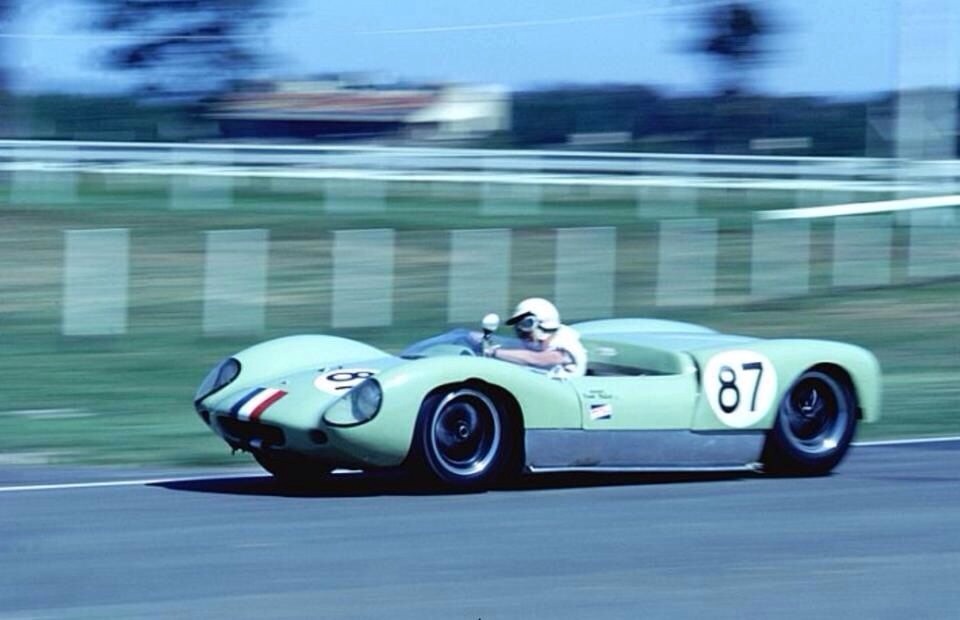
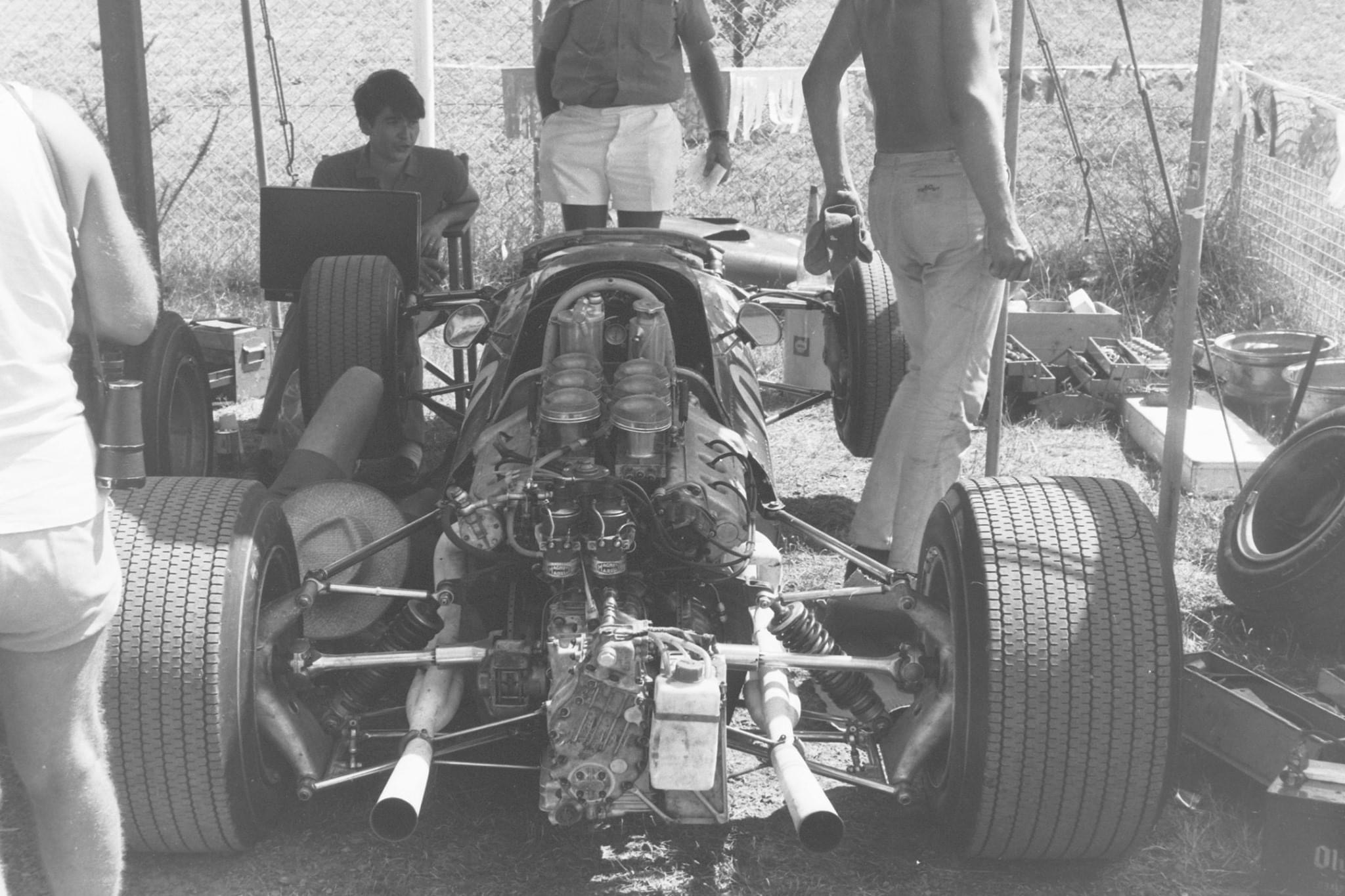
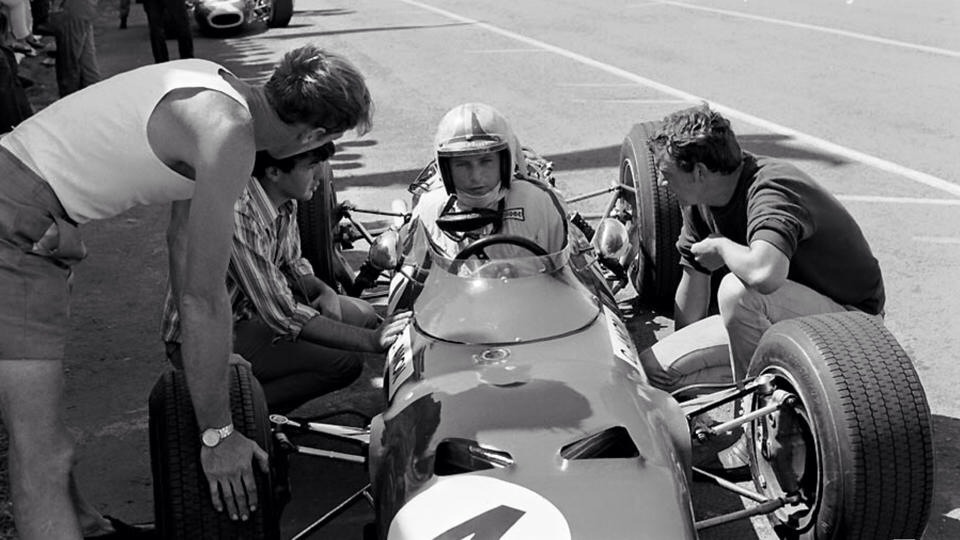
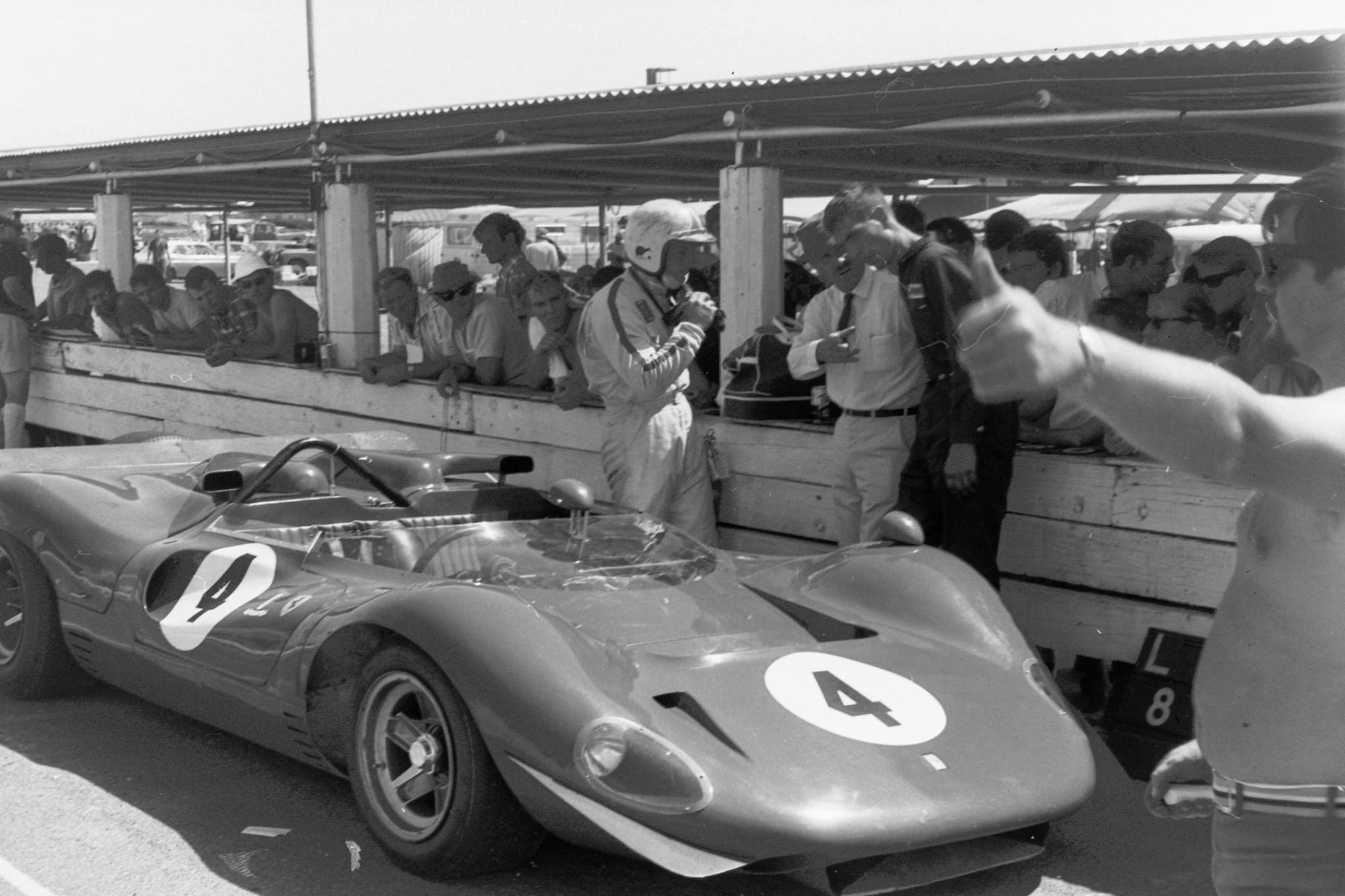
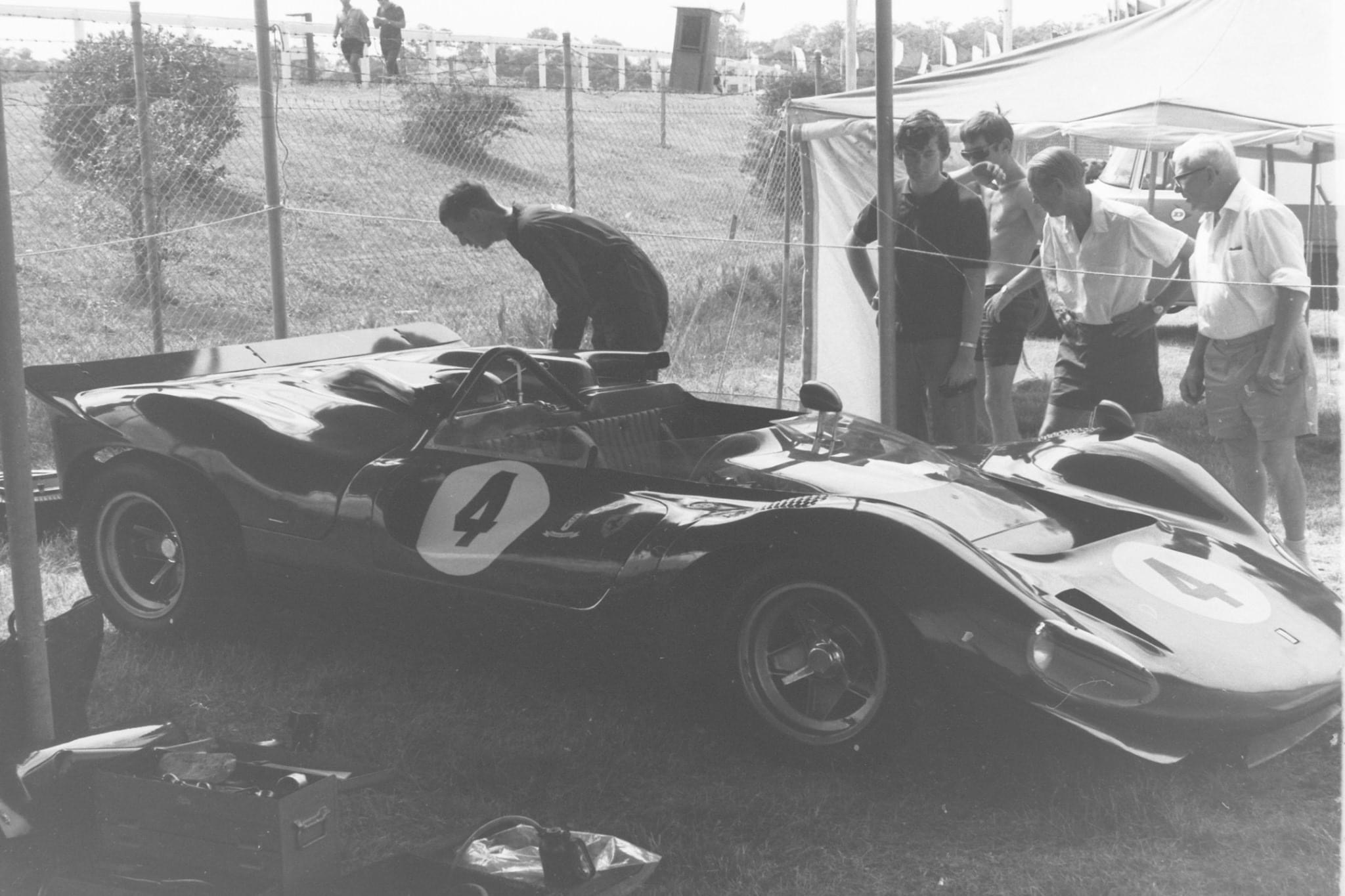
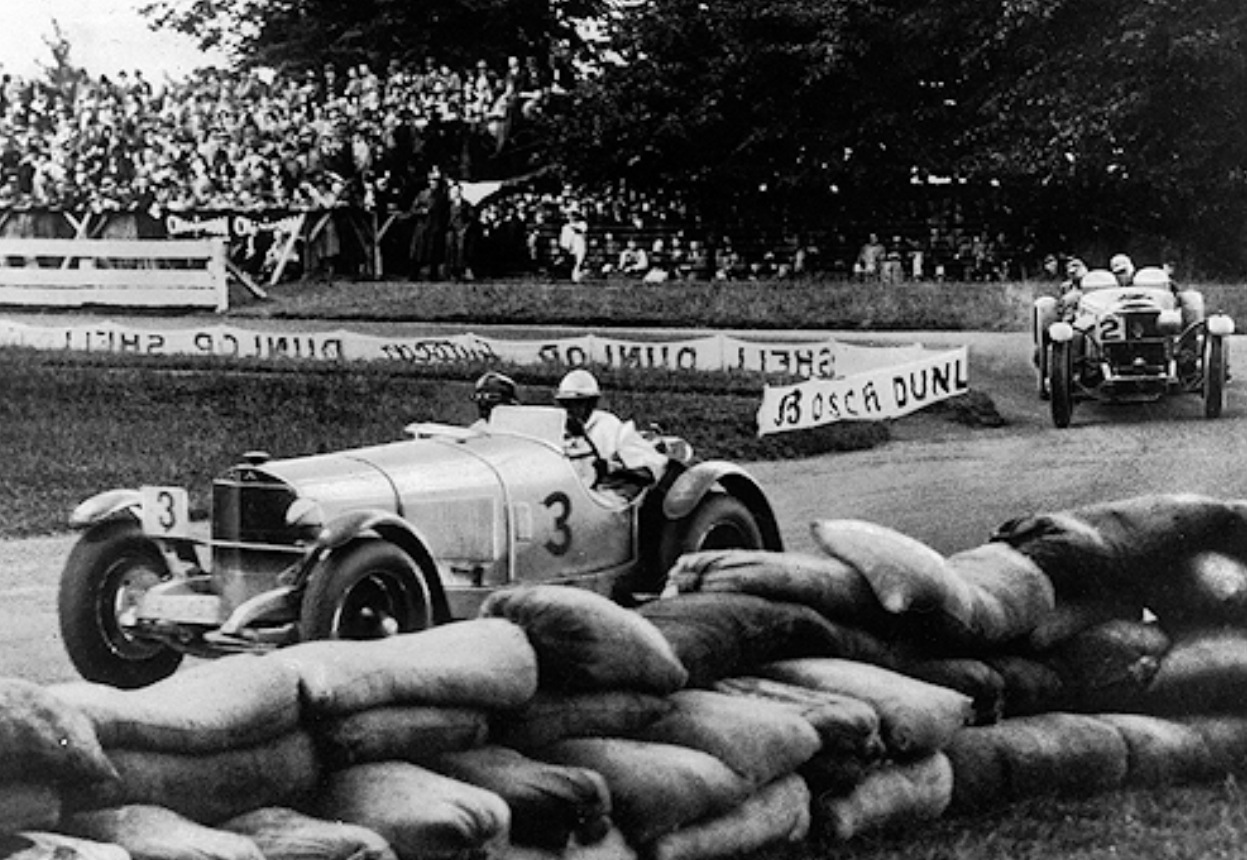
Love these patinated CAMS Logbook shots of the Cooper MG with Greg Smith at the wheel in the mid-seventies. Top shot giving it plenty at Dandenong Rd, Sandown, the bottom ‘Tin Shed’ at Calder, both circuits in Victoria (Smith)
A warm welcome to Greg Smith, Australian racer/engineer who is writing ‘A Trilogy of Australian Specials’, on cars which captured his imagination, the first of which is the Cooper MG…
Greg is a gentleman (some would dispute that descriptor!) of a certain age, suffice to say he started competing before mufflers were mandatory and seat belts were worn at the drivers own discretion!
An historic racing engineer based in Bayside Melbourne, he has had a successful career restoring and preparing cars as diverse as a 1904 TT Maudslay to a 1967 Quad Cam Ford V8 Indycar. He lists his highlights as his years working on ERA’s and GP Bugattis, looking after a 6CM Maserati for a season and multiple preparation and management jobs at the Mille Miglia and Tour Auto modern classics.
Greg has competed at , been a mechanic at, or team manager at, over sixty different venues world-wide, but declares his enduring passion as front engined ‘Australian Specials’ and local tracks.
Smithy fettling a Bug T57 3.3 litre straight 8, supercharged engine. It received a new crank and ancillaries in a comprehensive rebuild of both engine and car (Smith)
Definition: An ‘Australian Special’ is a racing or sports car, most commonly built by an impecunious owner/driverfrom gathered parts and assemblies, then engineered to reflect his own thoughts, abilities and intellectual property to the point where no two are alike and every one has its own hallmarks, eccentricities and foibles-unique vehicles indeed.
In this trilogy I’ll write about three cars which have passed through, or remain in my ownership.They have given me great pleasure during my 40 odd years involved in Historic Racing and, as you will see, are all front engined and constructed prior to 1960.
The Cooper MG…
This amazing ‘giant killer’ of a little car started out life as an example of that most mundane genre of racing vehicle, a factory production car!!
Arthur Wylie, Cooper Mk4 Jap, Bathurst, Easter 1950 (Blanden)
It was delivered as a JAP 8/80 engined long wheel base Mark IV Cooper and was a very early example, maintaining the forged Fiat Topolino 500 lower wishbones. It was the factory demonstrator for Cooper Car Distributors in Melbourne, Australia and had some early success when lent to noted driver, Arthur Wylie. In 1952 it was sold to George Pearse of Sydney who ran it consistently for two years in its original form.
So far nothing ‘Special’ about it. George, a renowned tinkerer and engineer, had other ideas though.
The Cooper, although a light and sure footed mount, lacked the punch, power and acceleration of George’s previous car, a supercharged MG-TC square rigger which George retained.
Why not an amalgamate the cars and get the best of both worlds, he thought?
George un-bolted the J.A.Prestwich power unit from the rear of the chassis, shoehorned his blown MG-TC motor and gearbox into the front of it and moved himself rearwards!! A Ford V8 diff with a pre-war American style Casales three pinion drop box on the front allowed the driver to sit low and took the power out to the original Cooper drive and suspension.
Diff as per text (Smith)
Brakes and wheels remained the same at 8” diameter and 15” diameter X 2 ½” wide respectively, the whole was clothed in a light weight alloy body of agricultural, but pleasing proportions.
Great shot of the red Pearse Cooper at Mount Druitt, Sydney, 4 September 1955 (TR0003)
Bathurst October 1955; The Cooper MG was a potent piece of work, like Dorcas full of good works, concealed by a bonnet bulge. It’s Cooper basis is evident. It lapped in 3:04.5, outed in the 50 miler when the carbon brush in the distributor disintegrated (Medley)
Bathurst October 1955; The Bryden TA/TC Spl had blitzed its MG competitors at Easter only to be out-engineered by Pearse’s all independently sprung Cooper MG (Bernard Coward/Medley)
George debuted his new creation at Bathurst in October 1955 and lapped in 3:04.5, slower than the Cooper Bristols and the V12 OSCA, but still a contender on this oh-so-fast road circuit!
A ‘smack’ at the AGP circuit at Southport led to the sale of the car, in damaged form, to Sydney speedway exponent and Offenhauser guru Ray Revell.Ray set to and replaced the Cooper box chassis with a spaceframe of his own design whilst using all the remaining serviceable components and upgrading to a stronger Peugeot 203 alloy rack and pinion.
He had it back on song and entered for Bathurst in October 1956.
Bathurst October 1956; Ex-Pearse Cooper MG rebuilt after it’s Southport accident now owned by speedway driver Ray Revell (Medley)
October 1956 Bathurst; Under 1500cc scratch race; Col James #7 Barclay MG from #18 Revell Cooper MG, #15 John Ralston MG TC Spl, #88 Doug Chivas Lotus and Harvey Clift MG TC Spl into Hell Corner (Medley)
Now looking like a true ‘Special’ it was within seconds of the big ex-Bira OSCA and the D type Jaguar.
Ray eventually moved on to an Offenhauser powered Fiat and sold the car to up and coming Queenslander Lionel Ayers who lengthened the nose and added a more Vanwall type screen. He also fitted a 1500cc XPEG engine with a steel crank, Italian Nardi conrods and a Laystall-Lucas alloy head. This was all fed by a new Marshall J100 blower set up to deliver 22lb boost.
Ayers had great success with the car and raced it on equal terms with Jaguar D Type, Lotus 12, Repco-Holden and Ferrari cars.
Lionel Ayers, beautiful colour shot of the Cooper, note the longer nose, at Lowood, Queensland in 1959 (Davies)
Lionel Ayers in the Cooper MG ahead of Curley Bryden’s Ferrari 125, Bathurst, 30 March 1959 (Ayers)
The car was fitted with the larger Cooper Bristol brakes and wheels when the donor car (the WM Cooper) got its disc brakes and wobbly wheels, and prior to its sale to Hugh Gilroy about 1962.
Don Webster was the next owner and he did a prosaic re-commissioning of the car, running it in an emasculated form with twin 1 ¼’’ SU’s. It was in this form I first saw the car at the inaugural ‘All Historic’ Lakeside meeting in 1978.
During after race festivities I asked if I could try it on for size and once I was in, I wasn’t getting out until a purchase was completed!!
Imagine my delight when it was delivered to my home 1200 miles away in Melbourne when it was discovered that the garbage bag in the driver’s seat contained all the original supercharger, manifolds and drive which had not even been mentioned during our negotiations! A complete restoration commenced immediately and the car took me, and subsequent owners, Ross Hodgson and Brian Gerrard to many victories in the ensuing days of historic racing in this country.
The car is still extant in slightly modified form but new owner, Graeme Louk, is enthusiastically returning it to its correct historic specification and recently had his first outing with it to great acclaim by all as it was 22 years since its last appearance.
(Smith)
Driving Impressions…
From a handling perspective the car had early ‘Cooper flop’ side to side with negative/positive camber change but if you divorced that seeming death wish from your left brain and just drove the car, it handled very predictably. The 10″ brakes were superb and initial understeer could easily be overcome by power application.
The supercharged engines torque was adequate and with only 3 1/2″ rims running Dunlop 4.50-L- 15 tyres, wheelspin and grip had to be closely managed, not the least reason being the cost of tyres!
The best, and most memorable feature of the car was being able to go one gear deeper into a corner, and brake one marker later than cars it competed against. This delivered rewards time after time.
(Smith)
Technical Appraisal/Specifications…
Chassis; a lightweight centrally disposed monoposto spaceframe front engine racing car.
Suspension; All independently sprung using transverse leaf springs centrally located on bolted towers of the early type but not modulated in roll by the later roller support system.
Front lower wishbones are Fiat Topolino. The top shocker points were relocated by me from under the spring in 1978, the original front sway bar is still fitted.
The rear lower wishbones are Fiat Topolino with the original light series 1100 Hardy Spicer shafts increased to 1300 series. The original style rear sway bar is fitted to the car.
Steering; 203 Peugeot rack and pinion
(Smith)
Engine;
During my ownership 1360cc (previously, in period and now again, 1500cc) it was fitted with an iron head (previously ,in period, and now again an alloy head is fitted)
My last dyno sheet from 1978 says we achieved 142 BHP at 12 lb boost and 9.3:1 static compression but I think camshaft technology will have eclipsed that figure, although it was sparkling in the day.
‘In period’ the car ran stub exhausts but an extractor system and muffler are now fitted for modern competition.
(Smith)
Transmission; The original Ford V8 diff and drop box were replaced by me with a Halibrand unit in 1978, the original is still in my possession
The original panels include the tail, sides, bonnet and the later model fibreglass nose. A driver roll over bar and seat belts have been fitted.
Checkout this wonderful YouTube footage of Gnoo Blas, Orange, NSW…
Look carefully in the first two minutes of the footage for Pearse’s elegant, red, Cooper MG #18 which appears quite a few times.
9200 rpm and breathing very heavily thru it’s oversized for GP racing ports…
Bruce McLaren at rest and considering setup changes to his first GP car, Robin Herd’s Ford Indy V8 powered, ‘Mallite’ chassis, M2B at Watkins Glen in 1966.
These shots are from the Dave Friedman Archive; the tachometer snaps are at the US GP, the balance of photos from the following, final 1966 Championship round in Mexico City.
This article is another of my ‘nutso’ ones in terms of its order…
I found a swag of photos in Friedman’s archive a while back and planned a pictorial of Bruce and his first McLaren GP car at the 1966 US and Mexican Grands’ Prix, the events where Friedman snapped away prodigiously. I put it to one side and largely forgot about it. Subsequently I decided on something more substantive; so the first bit is the original pictorial, the second is about Bruce’ progress in his first two years as an F1 marque jumping from engine to engine until the DFV provided the definitive McLaren F1 moteur from 1968-1983.
And boy, wasn’t there a lot of water that passed under the bridge between 1968 when the design for the Cosworth powered McLaren M7 was laid down to John Barnard providing both the dimensions of the DFV and its means of attachment to the chassis amongst his ‘mandatories’ of design specifications to Hans Metzger at Porsche in 1983. The TAG/Porsche 1.5 litre twin-turbo V6 was the result, the McLaren MP4/1E TAG-Porsche first raced at the 28 August 1983 Dutch Grand Prix. Back to 1965/6 though!
Remember, the tachometer snaps are at the US GP, the balance of photos from the following round in Mexico City, there are no captions in the first part of the article.
As a GP engine the Ford Quad-Cam Indy V8 engine was a huge, beefy, heavy and notoriously raucous unit. Visually it was a ‘big busty blonde’ as well with its whopping Hilborn injection trumpets and huge ‘between the vee exhausts’, it looked ‘the goods’…
The Ford Indy quad cam V8 in its earliest form fitted to a Lotus 34 at Indy in 1964. Jim Clark and Dan Gurney contested the race, this is Clark’s chassis. Engine 4195cc DOHC, 4 valve, Hilborn injected, methanol fuelled giving circa 425bhp @ 8000rpm and useful power from 6000-9000rpm. ZF 2DS 20 ‘box (TEN)
McLaren developed and tested the engine during the winter of 1965/6, notably at Riverside, California but missed the European non-championship F1 events with which the season commenced. In a portent of the season to come John Surtees won the 1 April Syracuse GP in his Ferrari 312 whilst ‘Black-Jack’ won the BRDC International Trophy in his Brabham BT19 Repco at Silverstone on May 14.
McLaren looking pretty chilled at this stage of the ’66 Monaco weekend upon his teams GP debut, color of the car a function of doing a deal with John Frankenheimer’s crew as part of filming of ‘Grand Prix’ . Inboard rocker front suspension and outboard loacation of spring/shock at the rear. Checkout the prostrate ‘snapper behind the car (unattributed)
McLaren made its debut as an F1 marque in the May 22, 1966 Monaco Grand Prix,the first championship round that year. Bruce raced the car he concepted together with Robin Herd, the brilliant young designer specified ‘Mallite’ as the primary material for M2B’s monocoque chassis. (noting the M1 series of car are CanAm machines)
Mallite is a composite sheet aerospace sandwich material comprising end grain balsa material filling between thin sheets of aluminium. The resultant chassis was incredibly stiff for its day at around 11000 lb/ft per degree of deflection compared with a good conventional ‘ally tub which came in the range of 4000-5000 lb/ft per degree.
The Indy Ford 4-cam V8 was reduced from its USAC mandated 4.2 litres to the 3 litre F1 limit (95.3mmX52.4mm bore/stroke-2999cc) which prevailed from 1 January 1966. For F1 use the engine was first modified by Klaus von Rucker in England, then later Bruce involved Traco Engineering in Los Angeles.
All hands to the pump! Bruce, Tyler Alexander and Wally Willmott hard at it, Monaco 1966. The Indy Ford V8’s Hilborn fuel injection, between the Vee exhausts, full monocoque chassis, ZF 5 DS25 gearbox and conventional rear suspension; inverted lower wishbones, single top link, coil spring/dampers, twin radius rods and adjustable sway bar all clear in this shot (unattributed)
At Monaco the new McLaren qualified 12th, Bruce withdrew with mechanical ailments on lap 9, the race was won by Jackie Stewart’s 2.1 litre ‘Tasman’ P56 V8 engined BRM P261. This car was his 1965 1.5 litre F1 mount with a bigger version of the P56 V8 with which he won the 1965 Tasman Series.
Bruce and his small Colnbrook team, (near Heathrow an area in the midst of the motor racing industry of subcontractors 3 miles from Slough and 18 miles West of London) crew quickly realised the engines massive ports and valves didn’t give the sort of gas flow speed needed to produce competitive power at 3 litres. Mind you, its 300 horsepower was the sort of output the World Championship winning ‘RB620’ Repco V8 developed in 1966. It was enough to win Jack’s ’66 title albeit the Repco engine was light, very torquey and reliable. By contrast, Bruce’s Ford was heavy and gave its punch over a narrow rev band, the deficiencies of which were exacerbated by the 4 speed ZF ‘box they used which ‘left lots of gaps’ in the power band.
The team had much work to do on the Ford, in the meantime Count Volpi’s new Serenissima V8, designed by Ing. Alberto Massimino, who was part of the Lancia-Ferrari and Maserati 250F 1950’s design teams provided another ‘ready made’ alternative engine to try.
Serenissima ATS Spider, Sauer/de Mortemart. Le Mans 1966. DNF with gearbox failure on lap 43. It raced in the prototype class, the race won by the McLaren/Amon Ford GT Mk2 (Smuckatelli)
This project is a story in itself but suffice to say Bruce tried the engine whilst simultaneously developing the Indy Ford V8 in an attempt to get it to where it needed to be. Most of you will be aware that Bruce’ Ford connections were immaculate at the time as both a development and race driver of the GT40 program, those cars developed by teams on both sides of the Atlantic. It was Bruce’ hope that he may have been able to get FoMoCo’s backing for his F1 variant of their Indy V8. In the end, via Ford UK’s Walter Hayes, Ford supported the Cosworth developed DFV of course.
Weber 48IDA fed Serenissima all alloy V8 in the back of Bruce’ M2B during the Belgian GP weekend, 1966 (unattributed)
The Serenissima engine was designed as a sports car unit and gave little power. The ‘M166’ engine was an aluminium, chain driven, quad cam, 2 valve V8 displacing 2996cc (91.5X57.0 mm bore/stroke) 350 bhp was claimed for it but most of the horses seemed to have jumped ship between Italy and the UK, the actual output was more like 260bhp.
M2B was modified to take the side exhaust Italian V8 in time for the Belgian GP, at Spa. The team had great trouble just getting the thing to start, then run and to add insult to injury it ran its bearings after its first exploratory laps having qualified 16th. With no spare engine Bruce was a non-starter.
Bruce in the winning Ford Mk2 he shared with Chris Amon at Le Mans 1966. The Ferrari is the Maranello Concessionaires Ferrari 365 P2 driven by Richard Attwood and David Piper (GP Library)
Bruce and his young intended McLaren F1 team-mate Chris Amon(who raced M1B Chev CanAm cars for Bruce in 1966) then departed England for France and returned as Le Mans winners in a factory Ford GT Mk2. That contentious win or perhaps ‘first over the line’ is still the subject of discussion and debate amongst enthusiasts and historians alike even all these decades later.
1966 British GP, Brands Hatch, M2B Serenissima V8. Bruce was 6th, scoring a championship point, the teams first. Jack Brabham won in BT19 Repco from pole, he was 2 laps up the road to give the gap some perspective. Bruce in his ‘Pete Aron’ Grand Prix filming helmet (unattributed)
Jack Brabham won both the French Grand Prix at Reims and the British at Brands Hatch in BT19 Repco. The M2B-Serenissima contested the Brands race with more success, the engine was reliable. Bruce started superbly on a damp track on wets running in the top six. As the road dried he dropped back but inherited 6th scoring McLaren’s first World Championship point. A significant day in Grand Prix history indeed.
Bruce, Serenissima engined M2B in practice ahead of Jo Siffert Cooper T81 Maser DNF and Dan Gurney Eagle T1G Weslake DNF, Zandvoort 1966. He didn’t start the race (unattributed)
At the Dutch GP the Serenissima engine again failed, the McLaren F1 program was set asidepending development of the Indy Ford V8. Amongst other changes the engine was fitted with Chrysler Hemi inspired induction tracts which lifted its output to around 312bhp at 9500rpm.
The beast re-appeared in the United States GP at Watkins Glen, Bruce finished 5th by surviving a race of mechanical mayhem but in the final race of ’66, won by John Surtees’ Cooper T81 Maserati, the Mexican GP, the engine blew after 70 laps having qualified 14th.
McLarens interim 1967 contender, the 2.1 litre P56 BRM V8 engined M4B makes it’s debut during the Race of Champions at Brands Hatch on 12 March 1967 (Getty)
Bruce cast around for a better alternative engine for 1967 and was a happy customer of BRM’s prospective 4 cam, 2 valve V12which was designed as both an F1 and sportscar unit. The prototype (Group 6) capacity limit at the time was 3 litres so it made good commercial sense for BRM to build customer engines to replace the P56 V8’s which raced in endurance events as well as Grands Prix. BRM’s complex H16 was their factory F1 unit at the time but it was problematic to say the least…not available to customers (post Lotus) and probably not wanted by Bruce in any event!
A new one-off M5A monocoque chassis was designed for this engine designated ‘P101’, but the BRM V12 was running late, the M5A didn’t appear until the Canadian GP at Mosport in August.
Bruce testing M4B BRM in the UK before the ’67 season started, circuit and date uncertain. The exposed monocoque chassis is that of an M4A Ford FVA F2 car upon which M4B was based (unattributed)
So a gorgeous little car was used in the interim; the McLaren M4B BRM V8 was based on Bruce’ M4A F2 car but instead of Ford’s little 1.6 litre FVA the engine bay carried a 2.1 litre version of BRM’s venerable, powerful, small and reliable P56 V8 which had won Graham Hill’s 1962 World Championship, countless GP’s and Tasman Series events. This Tasman BRM V8 engine gave circa 280bhp. ‘Belly’ fuel tanks gave the F2 derived F1 car sufficient fuel for 200 miles.
The business end of M4B BRM at Monaco 1967. P56/60 V8 one of the great GP engines, 2.1 litres, 2 valve, Lucas injected, circa 245 bhp. ‘box is a Hewland DG300, beefy and under-stressed for this application, rear suspension period typical (unattributed)
M4B BRM made its debut in Bruce’ hands in the Race of Champions at Brands Hatch on 13 March. It finished 4/6th in heats one/two but then its engine blew after 1 lap of the final after Bruce muffed a change in heat two. 5th places followed in the two heats and final of the Daily Express Spring Cup at Oulton Park and in the International Trophy at Silverstone on 15 April where Bruce was again, you guessed it, 5th!
Bruce contesting the Oulton Park Spring Cup, 15 April ’67 M4B BRM, 5th. Brabham won the final in a BT20 Repco (Watson)
So, the little car had plenty of race miles on it as the team transporter headed to Monaco, the little M4B was tailor-made for the tight street circuit, but Jim Clark and Graham Hill were in similar hybrids; 1.5 F1 Lotus 33’s with stretched Tasman V8 Coventry Climax and BRM engines respectively.
Bruce rests on his M4B armchair before the off, Monaco 1967. Its ‘done the rounds’ this shot but its such an atmospheric beauty i popped it in, this cars best view is its arse! where everything is very pert, taut and tightly packaged (unattributed)
Bruce in M4B with truncated ‘Monaco’ nose ’67 (unattributed)
‘But Bruces’ battery was running flat – forcing a dramatic pit stop – Bruce could well have finished second behind fellow Kiwi Denny Hulme’s victorious Repco Brabham. Some of the spirit of Formula One in those days is typified by the pit stop as Bruce believed his misfire was fuel pressure and bawled as much at his crew. But Jack Brabham, friend and rival had come into the pits and was shouting ‘it’s your battery – it’s your battery!’ As Bruce wrote: Good old Jack. It was the battery and we quickly whipped another one on. He rejoined and finished fourth – three further championship points … thanks in part to a rival team chief!’ records the Bruce McLaren Trust.
Dutch GP, Zandvoort 1967. Bruce in M4B BRM ahead of Pedro Rodriguez’ Cooper T81 Maserati, it was the debut of the Lotus 49 Ford, Clark won the race in Chapman’s jewel. Note the different nose compared with the earlier shots especially the ducts to ease the flow of air after its passed thru the radiator, reducing front lift in the process (Watson)
The M4B was then badly damaged on lap two of the Dutch GP at Zandvoort as Bruce went off on spilled oil in the fast Huzaren Viak corner. After repair he was testing it at Goodwood when it caught fire out on the circuit, he then watched it burn to death! The ’67 Dutch is also remembered of course for the debut of the Lotus 49 and more importantly the Ford Cosworth DFV V8 which powered it.
McLaren assists with a plug change on his Eagle’s Weslake V12. French GP, Circuit Bugatti, LeMans 1967 (Getty)
Without a car, Bruce did a deal with Dan Gurney to drive the lanky Californian’s V12 Eagle T1G Weslake, Dan was in sparkling form in an All-American dream week having won two significant races in the Le Mans 24 Hour classic (Ford Mk4 with AJ Foyt co-driving) and at the Belgian GP in the Eagle thereby following the footsteps of Brabham as a GP winning driver of a car he built. It was a path Bruce would also traverse in the 1968 Belgian GP in his Cosworth powered M7A. Bruce was quick in Dan’s car, at the Circuit Bugatti Le Mans he qualified the big car 5th to Dans 3rd but they were both outed in the race, Bruce with ignition problems and Dan with a fuel line issue.
The unfamiliar sight of GP cars at Le Mans, fortunately the Circuit Bugatti was only used once, the French having a wonderful selection of road circuits at the time to choose from. Eagle T1G surely the best looking F1 car of the sixties!? Bruce sets off for some laps in his unfamiliar mount (Cahier)
Two weeks later at Silverstone Jim Clark was in sparkling form and convincingly won the British GP. Bruce and Dan qualified 10th and 5th with Bruce this time outed with engine problems and Dan a failing clutch. Consistency in build and preparation of the Weslake V12 were amongst its issues, its fair to say the demands of two ‘Number Ones’ perhaps placed much more pressure on the resources of Gurney’s small team, than getting one machine ready to a high standard. I’ve never read anything about what Bruce, like Dan, one of the supreme engineer/tester/drivers thought of the T1G or its engine. I’m intrigued to know if any of you have something of that nature published ‘in period’ in your collections.
The supreme test of the Nurburgring followed on August 6 where again both drivers qualified well, 5th and 4th for Bruce and Dan respectively but again both failed to finish; Bruce with unspecified mechanical mayhem and Gurney’s superb bolide with driveshaft failure.
Bruce and M6A Chev, Mosport CanAm 23 September 1967, Denny won with Bruce 35 seconds behind (Friedman)
Later in 1967 was a busy time for McLaren.Whilst the F1 program was still formative its CanAm challenge was very mature. Bruce and Robins Chev V8 engined M6A was the result of learnings of the previous years, in both Bruce’ M1’s and other cars he raced. The ’67 Can Am commenced on September 3 at Road America and finished in Las Vegas two months later, the ‘papaya cars’ took 5 of the 6 rounds and Bruce the title, a remarkably well deserved one at that.
The Colnbrook build team had the Can Am cars well clear of the workshop by the time they mated the late arriving BRM V12 to the M5A chassis. Bruce was ‘razor sharp’, his driving buoyed by both the competitiveness of the team ‘Stateside and his individual performances in these oh-so-beautifully designed, engineered and executed sports-racers.
Bruce at Monza in M5A BRM V12 1967. Q3 and DNF with an engine failure, Surtees the Italian GP winner in a Honda RA300 V12 (unattributed)
The M5A monocoque chassis abandoned Mallite which was considered too complex to shape and heavy in favour of aluminium sheet, the car having a fully stressed section enclosing the drivers legs, the area above his kness left open for maintenance access. The gearbox was the DG300 Hewland also used in the smaller BRM V8 engined car.
The BRM P101 V12 in the back of M5A at Monza in 1966. Lots of ‘Aeroquip’ lines, Lucas injection, Hewland DG300 transaxle, ‘Fram’ oil filter below the oil rad popped up in the breeze. Engine, non-stress bearing, is 4 chain driven cams but 2 valves. Engine evolved over time into the 4 valve engine which gave competitive service especially in 1970/71 in the back of BRM’s P153 and P160 (Schlegelmilch)
BRM’s 24 valve P101 V12 was originally designed for sports-prototype use by Geoff Johnson. The engines bore/stroke were 73.8X57.2mm for a capacity of 2998cc with a compression ratio of 12:1. The Lucas injected, chain driven 4 cam, 2 valve engine produced 369bhp at 9750rpm on 14 August, engine ‘P101-003’ put to good use by Bruce during the Canadian Grand Prix.
During the race the hot oil tank cooked the battery, Bruce gained on the leaders till spinning in the greasy conditions.
Bruce in M5A BRM fighting Jack Brabham for 3rd, before retirement. Brabham won the Canadian GP, in his Brabham BT24 Repco (Laymon)
At Monza the combination showed just how competitive they were; Bruce popped the thing on the front row, with 20 laps to go he and Surtees were racing wheel to wheel for a dash to the flag when a BRM cylinder liner dropped, the car withdrew on lap 4 with Surtees and Braham running to the line, Jack was outfoxed by John on the last corner of the race.
The M5A retired in both the US and Mexico and was used by the reigning World Champion, Denny Hulme in the first race of 1968, the South African Grand Prix at Kyalami.
Bruce in M5A BRM at Mexico City 1967. Q8 and DNF lap 45 with engine failure. Clark won in a Lotus 49 Ford from Brabham and Hulme, the latter took the ’67 drivers title Brabham Repco mounted (Cahier)
But the F1 world had changed late in 1967, by Walter Hayes decision to make the Ford DFV available to customers; he convinced Colin Chapaman to waive the exclusivity agreement Lotus had to use the engine which allowed Bruce and Robin Herd (and Ken Tyrrell in 1968 as well as Lotus) to design a bespoke chassis to suit the 408bhp DFV.
The bathtub aluminium monocoque M7A made a splendid debut winning the ’69 Race of Champions at Brands Hatch with the boss taking the win from pole and jagging the fastest lap to boot!
A new chapter in McLaren history was underway, DFV powered McLarens won World Titles for Emerson Fittipaldi in 1974 and James Hunt in 1976, stories for another time…
Bruce in the papaya M7A Ford DFV winning the Race of Champions at Brands Hatch upon the models race debut (Ed Lacey)
Bibliography…
The Bruce McLaren Trust, ‘History of The GP Car’ Doug Nye, The GP Encyclopaedia
Credits…
Dave Friedman Archive, Cahier Archive, Ron Laymon, Ed Lacey, Rainer Schlegelmilch, Ron Laymon, Getty Images, Brian Watson, GP Library, Nigel Smuckatelli, The Enthusiast Network
Etcetera-Engines…
Bruce, Teddy Mayer, Monaco, 1966 McLaren M2B Ford Indy V8, both above and below shots (Schlegelmilch)
M2B Serenissima at Spa 12 June 1966. Compare and contrast the Ford Indy V8 installation in the shots above, the car designed for that engine and then adapted to suit the Italian V8, ZF 5 DS25 box used in both cases (Schlegelmilch)
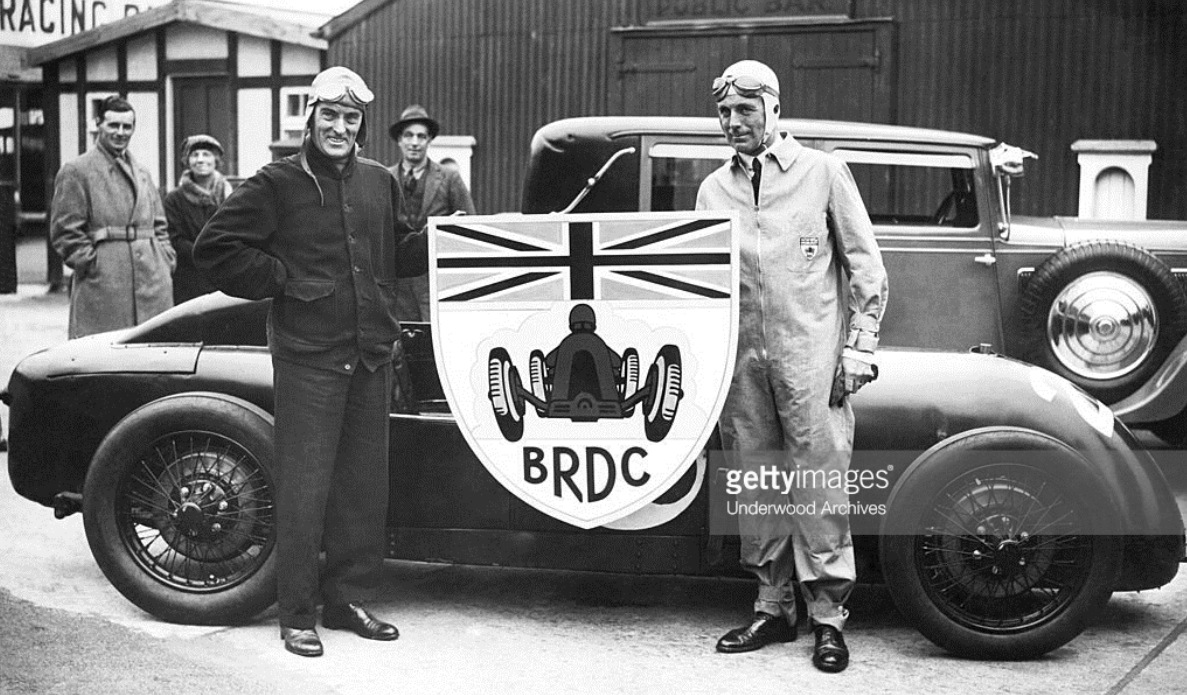
Tailpiece: ‘BRDC Intl Trophy’, Silverstone, 29 April 1967. From small acorns do big things grow. Bruce, Teddy and the boys, a few passers by. Perhaps it’s Friday, and M4B/1 BRM P56/60 V8…
Niel Allen and Max Stewart having a contretemps at Skyline, Mount Panorama, Bathurst, Easter 1969…
The bucolic terrain of New South Wales Central Tablelands stretches into the distance, the view probably not what the two drivers were focussed upon at the time. The race was the 1969 Bathurst Gold Star round, the field of which was substantially reduced by this first lap prang.
The incident happened when Max misjudged his braking behind John Harvey, locked a brake and boofed the fence in his Mildren Waggott 1.6. Niel was right up Max’ chuff in his ex-Piers Courage McLaren M4A Ford FVA 1.6 and couldn’t avoid him. Out of shot is Queenslander Glynn Scott’s Bowin P3 FVA who also joined in the fun!
(D Simpson)
Dick Simpson’s shot was taken at precisely the same time as John Arkwright’s (look at Max in each shot) albeit a bit further down the mountain. Its Leo Geoghegan’s Lotus 39 Repco framed by Allen’s wing with Glynn baring down on the action on the left and about to become a part of it.
Terrific shots both, ‘instant reaction’ stuff but beautifully framed all the same.
Nice butt shot of Harvey’s BT23E; note wing mounted to cars uprights at rear, ‘RB740’ ‘between the Vee engine’ and oil cooler up in the breeze (oldracephotos.com)
Here (above) is a shot of Harve’s Bob Jane owned Brabham BT23E Repco, it was Jack’s works ’68 Tasman car, sold to Bob at the end of the series then raced by John in the following years. In fact it wasn’t a lucky car for Harvey, he had a big accident at the same Easter meeting in ’68 when an upright broke, rooting the car and John. He was in hospital for quite a while after the prang, his speed undiminished when he returned to racing Jane’s stable of racers, sports-racers and tourers.
Harvey’s BT23E at Bathurst after his big practice accident on 14 April 1968 (Dale Harvey)
These fellas are favourites; property developer Allen was later as quick as Australia’s F5000 ‘Gold Standard’ Frank Matich without nearly as many seat miles, Stewart a multiple ‘Gold Star’ (1971/4) and AGP winner (19734/5) and Harvey a winner in everything he raced; speedcars, single-seaters, big sportscars and touring cars, the Bathurst enduro included.
Start of the Bathurst ’69 Gold Star race: front row comprises Max’ yellow Mildren Waggott, Niel Allen McLaren M4A FVA and on the inside Leo Geoghegan’s Lotus 39 Repco. The blue car behind is Glynn Scott’s Bowin P3 FVA and Harvey’s red Brabham BT23E, the torque of which clearly gobbled up Stewart and Allen on the steep climb up the mountain for Max to nearly run into him heading down the mountain. The white car is Henk Woelders’ 3rd placed Elfin 600 Ford t/c. You can just see Jacks red Brabham on the outside beginning his charge. He had fuel feed problems in practice so was off grid 7 with times well below the cars potential (Neville McKay)
The race was won by Jack Brabham’s F3 based Brabham BT31 Repco on a rare Gold Star Australian appearance fitted into his European program. This little jigger was powered by a 2.5 litre ‘830 Series’ SOHC, 2 valve Repco V8. Easter Bathurst is an historically significant meeting in Repco terms; it was Jack’s last Repco race and win in Australia. Brabham’s last International Repco races were those contested by he and Peter Revson in the USAC Championship that year in Brabham BT25’s powered by Repco ‘760 Series’ 4.2 litre DOHC, 4 valve, methanol fuelled V8’s.
Brabham between Skyline and The Dipper, BT31 Repco during the race (Dick Simpson)
Check out, rather than repeating myself these articles on the BT31;
This article was inspired by Lindsay Ross uploading quite a few images of this meeting on his oldracephotos.com Instagram page, check it out, they pop up a post every day or so. It seemed an idea to put the images floating around of this meeting in one place. I’ve an Instagram page too, as well as Facebook, just key ‘primotipo’ into the respective search engines and follow the prompts. The FB page has quite a lot of shots I don’t use on primotipo so may be worth a look every few days.
Brian Page in BT23A with ‘740 Series’ Repco, DNF with broken exhaust on lap 15 in the ex-Brabham/Scuderia Veloce machine (oldracephotos.com)
The first lap accident ruined what could have been an interesting race, Jack cruised to an easy race win by 1.5 minutes from Harvey’s car and Henk Woelders F2 Elfin 600B Ford t/cam.
Historically interesting is that this meeting was on the weekend of 7 April 1969, high-wings were banned globally at Monaco on the GP weekend of 18 May 1969, so it’s interesting to see the ‘Australian State of the Art’ in terms of fitment of said aero devices immediately before they were banned. Brabham tried the ‘bi-wing’ below setup on his BT31 in practice but raced with only a rear wing fitted.
Of arcane interest, perhaps (from the master of the arcane and tangential) is that all of Jacks ‘works’ Repco engined Tasman cars competed in this race bar one…
Brian Page’s BT23A(1) is JB’s ’67 Tasman car, Harve’s BT23E(1) is the ’68 weapon and Jack raced BT31 the car, late arriving in Australia, which did the ’69 Sandown round only.
Missing is BT19(F1-1-65) the chassis in which Jack won the ’66 World F1 Drivers and Constructors titles, and in 2.5 litre ‘620 Series’ engined form, raced in the ’66 Tasman Series, putting valuable pre-GP season race miles on Repco’s ‘brand-spankers’ V8 at Sandown and Longford.
The only car not in Oz now is BT23E(1) which was, and still may be in the US.
Jack Brabham guiding BT19 (F1-1-65) into The Viaduct, Longford on his way to 3rd place during the South Pacific Trophy on 7 March 1966, the third race for the new RB ‘620 Series’ V8. The race was won by Jackie Stewart’s BRM P261
Whilst on the arcane it occurs to me is what a versatile, influential and successful design Ron Tauaranac’s BT23 space-frame was in the Brabham Pantheon…
’twas Ron’s clean sheet design for the new for ’67 1.6 litre European F2; it’s variants won a million F2 races over the following years in the hands of aces like Rindt but also in the care of privateer ‘coming-men’. Mind you it didn’t ever win the title despite winning 6 of the ten championship rounds in 1967, ‘graded drivers’ like Rindt were ineligible for championship points. Matra and Lotus took the ‘works entry’ approach more seriously than Jack and Ron during these years, in any event, as a customer racing car the BT23’s won lotsa races, the 1968 Rindt driven BT23C the most successful car of the year.
Jochen Rindt typically all ‘cocked up’ on the way to a win in the 9 July 1967 ‘GP de Rouen-les-Essarts’, Brabham BT23 Ford FVA. 1.6 litre F2 formula one of great chassis, it not engine diversity, Ford’s Cosworth FVA won every title from 1967 to 1971. F2 was 2 litre from ‘72 (unattributed)
From an F1 perspective the ’67 World Championship winning BT24 Repco was a ‘beefed up’ BT23, to the extent that Ron initially raced his BT24’s with an FT200 Hewland, the Maidenhead gearbox gurus ‘F2 box’ but found that tranny overstressed with ‘740 Series’ Repco V8 torque tearing away at its gizzards, its CWP in particular. I won’t bang on about the BT24 now as I’m in the process of writing an article about the ’67 Brabham/Repco winning season and go into much BT24 detail. Suffice it to say that the F2 BT23 begat the F1 BT24, my favourite Brabham.
Denny Hulme jumping his BT24 Repco at the Nurburgring during his ’67 Championship winning season. He won the German GP by 40 seconds from Jack (unattributed)
From an Australian viewpoint the BT23 Repco Tasman cars were very important as they provided much needed cars on skinny local grids…
The Tasman Series 2.5 Formula grids were ‘chockers’ with cars and stars, the domestic championship contained quality but not quantity. Budgets for these relatively expensive cars were hard to find in the sixties and Australia’s march to Touring Car domination was already well underway so ‘taxis’ were starting to absorb sponsorship budgets previously devoted to real racing cars.
Funnily enough, even though there was a swag of Repco engined BT23’s running around it was Alec Mildren’s, one off, 2.5 litre Alfa Romeo Tipo 33 V8 engined BT23D(1) which took a Gold Star. Frank Gardner raced this car in the ’68 Tasman, it was then taken over by Kevin Bartlett, the Aussie ace took the ’68 Gold Star in it. Repco never won a Gold Star title, a topic to explore at some stage during the Repco series of articles I am gradually writing with Rodway Wolfe and more recently Nigel Tait’s help.
Simply sensational Dick Simpson shot of Kevin Bartlett in BT23D Alfa, Hell Corner Bathurst Easter 1968, KB was walking away with the race until a broken rear upright ended his run. Dominant in this car in ‘68/9 (Dick Simpson)
Delving deeper into this BT23 tangent, whilst a BT23 Repco never won a Gold Star, a BT23 Waggott nee Mildren did…
Denny Hulme raced a works F2 Brabham BT23(5) FVA in the ’68 Tasman Series comprehensively boofing the car in the New Zealand Grand Prix at Pukekohe on 6 January, the series opening round.
Denny’s chassis was Jochen Rindt’s Winkelmann Racing entry in ’67, he won 9 Euro F2 races in it including the Rouen event pictured above. Another car (BT23-2) was sent from England for Denny to race in the rest of the series. Feo Stanton and Ian Rorison of Rorstan Racing bought the wreck and sent it to Rennmax Engineering in Sydney for Bob Britton to repair.
Instead of doing so Bob made a jig from the bent frame and sent a new chassis, the Rorstan Mk1 back to the Kiwis. Seven cars were built on the BT23 jig; the Rorstan, Mildren, two Rennmax BN2 and three BN3’s. Of these the Mildren, so named by Alec Mildren, the Sydney Alfa Romeo dealer, team owner and former Gold Star champion was the most successful. The Britton jig was also put to good use over the coming years repairing cars like Harvey’s bent BT23E!
Max Stewart ‘harry flatters in top gear’ heading down Surfers Paradise main straight and about to guide his 2 litre Waggott powered Mildren missile under the fast right hander and Dunlop Bridge. 9th in the ‘Surfers 100’ Tasman round in 1970 against the F5000’s. Graham McRae’s McLaren M10A Chev won the race but Bartlett’s 2 litre Mildren Mono Waggott was 2nd on this power circuit (Dick Simpson)
So…the Mildren pictured resting against the Skyline Armco fencing at this articles outset is a BT23 design. Max Stewart was prodigiously fast in the Mildren Waggott, he was one of those guys who seemed to get quicker as he got older, in ’69 he was quick, by the mid-seventies he absolutely flew in his Lola F5000’s. He was one of the very small number of blokes in Oz who squeezed absolutely everything out of these, big, demanding, fast, spectacular, fabulous 500bhp V8’s.
Bartlett, Matich, Allen, John McCormack, Bruce Allison, Warwick Brown, John Walker and Stewart in my book were the F5000 aces with Matich, if I have to pick one, the first among equals. Mind you, on sheer speed Alf Costanzo who came relatively late to the F5000 party could have been ‘the one’. Its an interesting topic to debate, end of F5000 tangent!
One of the pit sights which always amused me, and admittedly small things amuse small minds was big Max, he wasn’t a ‘fat bastard’, but he was 6’2”, crammimg himself into one of his cars before setting off for the dummy grid. If there was a taller bloke than Max in F5000 globally I’d be intrigued to know his name. He must have given away at least 10Kg to the rest of the grid before he even plopped his arse into the tight aluminium monocoque confines of the F5000 Lolas in which he excelled.
Max was big of stature and heart; here he is after winning the Rothmans International Series ‘Sandown Cup’ on 20 February 1977, his last big win, Lola T400 Chev, sadly not too long before his untimely death at Calder, 19 March 1977 (Ian Smith)
By the time Merv Waggott was building 2 litre variants of his superb DOHC, 4 valve, Lucas injected, bespoke aluminium blocked engines they were outright winnersin 2.5 litre Tasman Formula events in the hands on the Mildren Duo, Messrs Bartlett and Stewart. The first Gold Star for F5000 was in 1971; Max’ Mildren Waggott won the Gold Star with about 275bhp from his close mate Bartlett in a much less nimble and reliable 500bhp McLaren M10B Chev in a year of speed and consistency. I don’t care what anyone says, F5000’s driven to their limit were always a little brittle.
So, to join the dots, a BT23 design did win the Gold Star albeit called a Mildren. Stewart’s Mildren Waggott and Bartlett’s Mildren ‘Yellow Submarine’ Waggott are tangents too far for this article and a wonderful future topic, there is a sensational article to be written there with Kevin Bartlett’s first-hand assistance on both chassis’ and engine if I ask him nicely…
Merv Waggott changing plugs in his baby, Wigram 1970. Bartlett’s Mildren Mono ‘Yellow Submarine’ Waggott (Bill Pottinger/the Roaring Season)
Merv Waggott changing plugs in one of his superb jewels. An all alloy, DOHC, gear driven 4 valve Lucas injected circa 275bhp 2 litre engine. Its in the back Of Kevin Bartlett’s Mildren ‘Yellow Sub’ Waggott, shot is in the Wigram paddock, 1970 Tasman round on 17 January on 7 December. KB had a lousy meeting, not setting a practice time and DNF on lap 6 with engine dramas, Stewart was 3rd though in his car, Matich the winner in his McLaren M10A Chev.
The Waggott 2 litre engine was first built in late 1969 and initially developed circa 250bhp, its output later circa 268-275bhp with about 160 lbs/ft of torque. It raced to a win in KB’s hands in the ‘Sub upon debut in the ’69 ‘Hordern Trophy’ at WF, KB won again at the 1970 Warwick Farm Tasman round ahead of all the F5000’s and 2.5 Tasman Formula cars. 2 litre Waggotts won Australias’ Gold Star in 1970 for Leo Geoghegan (Lotus 59) and Stewart in ’71 as noted above.
An article about Merv and his creations is a wonderful feature for another time. Briefly for international readers Waggott’s Sydney shop built race winning engines from the 1950’s, checkout the article below on the WM Special/Cooper T20 Waggott Holden twin-cam 6 cylinder raced by Jack Myers and tested by Stirling Moss in the late ‘50’s as some background.
Winding the clock forward, as the ANF1 2.5 litre formula spluttered on in the late sixties a ‘battle to the death’ was fought for the new ANF1 category in Oz between opposing forces who supported either F5000 or 2 litre F2. The latter to commence in Europe from 1 January 1972, F5000 commenced in Europe in 1969 and was born in the US as Formula A earlier still.
Waggott engines were initially of 1600cc, then later 1860cc and used the ubiquitous Ford Cortina block, same as Cosworth’s 1’6 litre FVA wherein Keith Duckworth tested his design ideas in advance of finalising his DFV design. In 1600 form the Waggott would have been Euro F2 legal, it used a production block as the regs required. The 1.6 litre F2 started in ’67 and ended in 1971 when it grew to 2 litres. There were a few FVA’s racing in Australia, the 1.6 Waggott more than a match for them, no Waggott’s, sadly, ever raced in Euro F2.
Lance Ruting studio shot of one of the engines, Ford block by the look of it so 1600 or 1860 (autopics.com)
Waggott 2 litre engines used a bespoke aluminium block as the stock cast iron Ford block maxxed out at about 1860cc. Beyond that the pistons kissed! Mike Hailwood’s Surtees TS10 won the ’72 Euro F2 Championship running Brian Hart built Ford BDA’s of 1850cc, those competitors running greater capacity than that had unreliability. The final Euro 2 litre F2 regs required production blocks from 1972-75 until ’76 when ‘racing engines’ were allowed. So, in the earliest years of the class the Waggott was ineligible.
Merv’s engines could have raced in F2 from ’76 but he had long before told CAMS to ‘shove it’ after F5000 was chosen (probably rightly given the backing of Ford, Holden and Repco who were building V8’s/wanting to develop an F5000 variant of the Holden engine in Repco’s case) as Australias’ new ANF1 from the 1971 Gold Star competition.
Had the ingenious, beautifully built little engine been Euro F2 Championship legal in 1972 Sydney’s Waggott Engineering had the winning engine! The engines were tried, tested championship winning donks ready to pop into any car. 275bhp and a big fat torque curve, Kevin Bartlett quoted the usable rev range of 6800-8750rpm, would have done the trick in 1972, the BMW M12 changed the F2 game from ’73 of course.
A wonderful ‘mighta-been’ all the same. Merv could have ‘stolen the F2 march’ in 1972 in much the same way Repco did in F1 with its Olds F85 production block based ‘620 Series’ V8 in 1966…
Max Stewart on the way to winning the ‘Angus & Coote Trophy’, the 1971 Oran Park Gold Star round on 27 June. Mildren Waggott 2 litre, Graeme Lawerence was 2nd in a Brabham BT30 FVC, the little cars succeeding as the F5000’s fell away (Dick Simpson)
Credits…
John Arkwright, oldracephotos.com, Dick Simpson, Dale Harvey, Bill Pottinger/The Roaring Season, Ian Smith, Neville McKay, autopics.com.au
Bibliography…
oldracingcars.com, F2 Register
Tailpiece: A Lotus to end an article on Brabhams…
Leo Geoghegan’s Lotus 39 Repco with ‘830 series’ Repco V8, started from the Bathurst ’69 pole but out on lap 12 with a gearbox problem, his time would shortly come with this car, winning the JAF Japanese GP later in 1969 amongst a classy field (oldracephotos.com)
Click here for an article on this ex-Clark chassis;
Jack Brabham and Francois Cevert ecstatic after winning the 1970 1000 Km of Paris at Montlhery on 18 October, Matra MS660…
Its interesting to look at the absolute delight they have and reflect on their relative careers right then and there; for Jack it was his last ‘International’ win before his ‘retirement’. Yes he did have a few appearances in touring cars in Oz in the 1970’s, not to forget his works Porsche 956B drive at Sandown’s World Endurance Championship race in 1984 but in reality 1970 was ‘it’ after a long, vastly successful career.
For Francois it was the year he broke into F1, Johnny Servoz-Gavin’s premature retirement with an eye injury gave Francois his opportunity in Ken Tyrrell’s March 701, one he embraced with both hands and capitalised upon. The world was at the talented Frenchman’s feet.
Brabham in the works Aston DBR1 he shared with Stirling Moss at the Nurburgring 1000Km in 1958, JB very much in a support role that day (unattributed)
I don’t think of Jack as a sportscar driver although he started his professional sportscar career with a bang really; first in the 1958 Nurburgring 1000Km with Stirling Moss and second in the Tourist Trophy at Goodwood with Roy Salvadori in works Aston Martin DBR1’s.
But he was such a busy boy in the 1960’s he simply didn’t have the time for sporties; driving and testing Coopers, then forming Motor Racing Developments with Ron Tauranac. Brabham Racing Organisation entered and raced the F1 cars, he had garage and conversion businesses, ghosted magazine articles and depending upon the season raced in F1, F2, Indy not to forget the 7 or 8 Internationals/Tasman Series events he did in Australasia in January/February. Commercially it also made sense, other than the BT8, MRD didn’t build sportscars, so why not focus on what you sell?
So, his events in two seaters are relatively rare in the pantheon of his long career, a good obscure topic for an article actually!
Monaco collage 1970, 2nd in the race won by Jochen Rindt’s Lotus 49D Ford. Brabham BT33 Ford (Schlegelmilch)
1970 was his ‘last racing season’ though. He had promised his wife Betty he would retire at the end of 1969 and having got the ‘leave pass’ which was pretty much forced upon him when Jochen Rindt decided to stay at Lotus, had one of his busiest season in ’70.
Jochen told Jack he was returning to Brabham but changed his mind when Colin Chapman made him an offer too good to refuse. So Jack raced on, a rethink forced upon him as by that stage no other number 1 drivers were available. So Jack made every post a winner; he raced F1, F2, Indy and most of the endurance events Equipe Matra Elf contested in 1970.
It wasn’t a ‘cruise and collect’ year for Jack though, he was still razor sharp, famously winning the season opening South African GP in Tauranac’s first monocoque F1 car, the Brabham BT33. He lost Monaco to Rindt after a last lap fumble under pressure from Jochen and the British GP to Jochen again, when, leading and driving away from the Austrian’s Lotus 72, he ran light on fuel, an error ‘credited’ to Ron Dennis, then his mechanic.
Nice portrait of Jack at LeMans in 1970; at 44 he was as fast as the ‘quicks’ of the era, anyone who can hang onto Rindt at the peak of his powers is not too shabby, at 44 Jack was still ‘up there’ to say the least (Getty)
Brabham spoke about the pleasure of just ‘rocking up to drive for Matra’ in the biography he wrote with Doug Nye; ‘…to drive a car someone else had to develop and prepare was a rare luxury, which i really enjoyed’.
In 1970 Matra contested the Daytona 24 Hours and Sebring 12 Hours in America, then in Europe the Brands Hatch and Monza 1000Km events and of course the Le Mans 24 Hours in June. They elected not to race Targa, the Spa and Nurburgring 1000Km events and the championship season ending Watkins Glen 6 Hour back in North America on 18 October.
The endurance championship that year was dominated by the 5 litre, 12 cylinder Porsche 917 and Ferrari 512S, the dominant ‘small car’, the 3 litre Porsche 908/3 which mopped up the events on circuits so suited; Targa and Nurburgring.
Brabham in the MS650 he shared with Jean-Pierre Beltoise to 12th, Pedro Rodriguez beat the rest of the field in a blinding Porsche 917 display . Brands 1000Km 1970 (Schlegelmilch)
Matra’s primary 1970 tool was an updated 1969 Matra MS650, the new MS660 made its debutin the hands of Jean-Pierre Beltoise and Henri Pescarolo at Le Mans. The car raced at the Sarthe by Brabham and and Francois Cevert was the earlier MS650, both cars retired with engine failure within 3 laps of each other (laps 79 and 76 respectively)
Brabham was paired with Cevert at Daytona, the duo bringing the V12 engined car home in 10th place, the race run on 31 January/1 February 1970. Brabham didn’t contest the next round at Sebring, ‘his car’ paired Dan Gurney with Francois in a one-off drive. Henri Pesccarolo and Johnny Servoz Gavin achived the best championship Matra result for the season in 4th place, the race won by the Ferrari 512S of Ignzio Giunti, Nino Vaccarella and Mario Andretti.
The Brands Hatch 1000Km on April 12 was a famous demonstration of driving mastery by Pedro Rodriguez, the Mexican sportscar ace flinging his demanding, fidgety 5 litre Porsche 917K in the wet as though it were a Merlyn Formula Ford from one of the support races. Jack was paired with JPB, the duo were 12th.
At Monza later in the month the duo were 5th in the race won by the Rodriguez/Kinnunen JW Automotive Porsche 917K.
Brabham ahead of a Lola T70 Mk3B Chev, Montlhery 1970 (Jarnoux)
With the Manufacturers Championship decided in Porsche’s favour from Ferrari and Alfa Romeo the Montlhery race was a chance for Matra to win in front of its home crowd.
The annual enduro wasn’t a Manufacturers’ Championship round, as stated above, but always had a good amateur entry. Matra entered two cars, the Linas-Montlhéry circuit only a few miles from its Velizy home base. Both cars were MS660’s, Beltoise and Pescarolo, drove a ‘sprinter’ variant, lightened a lot compared to Le Mans spec. The weight loss was achieved by deletion of lights, the charging system and the use of a Hewland gearbox rather than heavier, stronger ZF unit. The engine was the GP variant of the V12, able to use 11,000 r.p.m. against the normal 10,500 r.p.m. endurance limit. The other heavier ‘Le Mans spec’ car was driven by Jack and Francois.
There was no factory opposition to Matra but the Martini International Racing Team/Team AAW, had a 917 Porsche driven by Gerard Larrousse and Gijs van Lennep, as well as their Porsche 908’s, piloted by Rudy Lins/Helmut Marko and Claude Ballot-Lena/ Guy Chasseuil, the other 29 cars were private entries.
‘MotorSport’s’ race report said; ‘A circuit of 7.821 kilometres long was used, comprising half of the banked track, with chicanes at each end of the banking, and part of the road course, and the race was over 128 laps and was run in warm and fine weather. Beltoise set the pace with the lightened Matra 660 and only van Lennep proved to be any sort of challenge, but the 917 engine broke early in the race leaving the Beltoise/Pescarolo car unchallenged. Robbed of his drive in the 917, Larrousse took over the 908 of Ballot-Lena/Chasseuil, and after a slow start Brabham and Cevert moved up into second place.
The leading Matra ran into trouble with its Hewland gearbox, due to the oil breather system not being right, and after some delays at the pits the car was forced out of the race by horrid noises in its transmission, this letting the second Matra take command. In second place was the carefully driven, privately-owned Ferrari 512S of the Spaniard José Juncadella, with the young French driver Jabouille as his partner. In spite of retiring, the lightweight Matra was classified in fourth position’.
Matra MS660…
The MS630/650 had multi-tubular spaceframe chassis, the 660 one of Velizy’s famed aluminium monocoques clothed in a very sexy, swoopy aerodynamically clean and efficient Spyder body.
The 2993cc 60 degree, all aluminium, quad cam, 4 valve, Lucas injected V12, ever evolving in detail spec, engine was a common element of both cars and gave circa 400bhp. The ZF 5 DS25 5 speed gearbox was also a common element although the Hewland FG400 unit was also used.
Ventilated brakes used ATE calipers, steering was Matra rack and pinion, the suspension period typical; upper and lower wishbones and coil spring/shocks at the front and single top link, twin parallel lower links, two radius rods and coil spring/shocks at the rear. Adjustable roll bars front and rear. Weight was circa 700Kg dependent upon spec.
Credits…
MotorSport December 1970, Patrick Jarnoux, Rainer Schlegelmilch
Tailpiece: Francois Cevert caressses the sleek, swoopy MS660 around Montlhery, 1970…
Johnny Servoz-Gavin poses with a Talbot-Lago T26, Paris in early 1970…The photo is a PR shot to promote the ‘First Racing Car Fair’.
By the end of 1969 with a European F2 Championship and two strong F1 performances in 1968 under his belt; front row at Monaco and second place at Monza in a Matra MS10, Johnny Servoz-Gavin was in the minds of some ‘The French Driver Most Likely’. But by the end of the 1970 Monaco GP weekend he had failed to qualify and retired from the sport. Few flames have shone so brightly and been extinguished so soon…
Born in Grenoble of parents who owned a local bar, Servoz-Gavin became ‘Johnny’ from his days as a teenage ski instructor on the slopes above his home town. With long blond hair and an easy manner that ‘slayed the babes’, he developed a playboy image which stuck with him throughout his career.
On a canal boat in Paris 1970 with actor Olga Georges-Picot (Getty)
Inspired by the exploits of René Trautmann and Robert Neyret, Servoz-Gavin commenced rallying after driving his Simca Oceane and Dauphine Gordini with great abandon and speed on local Grenoble roads like his heroes.
In 1964 driving his Volvo, he contested various rallies including the Snow and Ice, the Lyon-Charbonnières and other events in Burgundy, the Ardennes and in Bordeaux. During the Bordeaux event former F1 driver André Simon noticed his on-circuit skill. René Cotton, director of the Citroen rally team, hired him as co-driver to Jean-François Piot for the Coupe des Alpes.
In January 1965 he contested the Monte Carlo Rally with co-driver Jean-Claude Ogier in a Citroen DS21, they passed through a terrible snowstorm on the side of Chambery finishing twelfth, the event won by the Cooper S of Rauno Aaltonen and Henry Liddon.
Johnny did a half a year at the Magny-Cours Jim Russell school in 1963 and at Montlhéry in the Lotus Seven of the Automobile Club Dauphiné-Savoie within the Ford-operation youth in 1964, these experiences giving him a greater taste for circuit racing.
Servoz, Henri Grandsire and Roby Weber in 1965. Interested to know where and when and car details from any of you French F3 experts (G Gamand)
With the help of a friend, he enrolled in the Volant Shell organised by the Winfield School (formerly the Jim Russell School) at Zolder, Belgium. His engine misfired in the final, finishing second to Belgian Dominique Lledo. The Volant winner in 1965 was Roby Weber, who won the Alpine F3 prize for 1965. Undeterred but disappointed Johnny bought a Brabham BT15 Ford maintaining it himself with the help of Tico Martini, settling in a caravan at the Magny-Cours circuit near Tico’s workshop!
Servoz looking cool despite the pressure! Volant Shell, Zolder 27 April 1965 (Faille)
The Brabham BT15 first appeared at championship level at Rouen on 11 July when Johnny was 8th. It was variously entered by Johnny, the Jim Russell/Winfield race schools with results as follows; Magny Cours DNQ, Montlhery 5th, Albi 3rd and finally the Coupe du Salon at Montlhery on October 3. The Matra factory F3 pilots in 1965 were Beltoise and Jaussaud, (who finished first and second in the French Championship) a seat Johnny secured for 1966 given his performances during the season and end of season tests, a drive for a great team he sustained until the end of his career.
Jean-Luc Lagardère arranged the works F3 Matra drive, his faith in Servoz justified with a French championship win in an MS5 Ford. He won the title with consistency taking 3 wins, 2 at Montlhery and 1 at the Bugatti Circuit, Le Mans.
JPB/Servoz Matra MS620 BRM 2 litre V8, Le Mans 1966. DNF gearbox on lap 26, the sports 2000 class was won by the Siffert/Davis Porsche 906, race won by the McLaren/Amon Ford GT Mk2 (Getty)
(Friedman)
There was plenty of talent amongst the French F3 grids that year including Peter Revson, Henri Pescarolo, JP Jaussaud, Piers Courage, Chris Irwin, Jonathon Williams, Wilson Fittipaldi, Allan Rollinson, JP Beltoise and many others.
JSG at Montlhery 25 September 1966, victorious in the F3 ‘Coupe de Paris’ Matra MS5 Ford, Pesca in another MS5 2nd and Chris Lambert, Brabham BT15 Ford 3rd (unattributed)
He contested Le Mans for the first time in a Matra and was a member of the company’s sportscar squad until the end of his career. In 1966 the MS630 was 2 litre P56 BRM V8 powered, the car failed to finish with gearbox dramas, JPB shared the drive.
Denny Hulme won the 1967 Monaco GP in his Brabham BT20 Repco, his first win. JSG plopped his F2 Matra MS7 FVA 11th of 19 cars on the grid, 7 slots in front of JPB in a similar car. Servoz DNF with fuel injection dramas, it was valuable circuit practice for 1968…(Getty)
In 1967 he drove a Matra MS7 Ford FVA car in the Monaco GP, qualifying a sensational 11th but failed to finish with fuel injection problems on lap 4.
Still not finished with rallying, he participated again in the Monte Carlo Rally in early 1967 with Francois Janin in a Matra Djet but failed to finish the event won again by a Cooper S, this time crewed by Timo Makinen and Paul Easter.
In sportscars he contested Le Mans and again failed to finish, this time the MS630 BRM had an oil pipe fracture giving Servoz and JPB an early finish to their weekend.
Johnny ahead of the Klass/Sutcliffe factory Ferrari P4 DNF during Le Mans 1967 won by the Ford Mk4 of Gurney/Foyt. The Matra BRM DNF with an oil pipe problem, JPB the co-driver. Prototype 2000 class won by the Siffert/Herrmann Porsche 907 (unattributed)
Johnny’s main program in 1967 was the European F2 Championship. 1967 was the first year of the 1.6 litre F2 formula, the era (1967-71) dominated by the Ford (5 bearing Cortina block) Cosworth FVA 210bhp, 4 valve, Lucas injected engine. The Matra factory pilots were Johnny and JPB in the MS5 and later MS7 monocoque chassis.
Jochen Rindt was the dominant F2 driver of the decade, and whilst a regular race winner, he like the other ‘graded drivers’ was ineligible for championship points. The beauty of the class was ‘young thrusters’ like Jean Pierre and Johnny could test their mettle against the established GP aces of the day who ‘moonlighted’ in the class. In those days the top pro’s needed to race outside F1 to be paid start and prize money to supplement their GP incomes which were decidedly skinny by the standards on the later 70’s and beyond. By the dawn of the 70’s F1 driver contracts were becoming more restrictive to preclude the sorts of activities which cost Servoz his career…
Johnny had a strong first year in the MS5, his results as follows; Rome GP, Vallelunga 3rd, GP Spain, Madrid 4th, 5th’s at the Madrid GP at Jarama and Mediterraneo GP Enna. 6th at the Pau GP early in the season, 8th’s at Crystal Palace, Rouen GP, Tulln-Langenbarn, 10th at Zolder, 11th at the Albi GP and DNF’s at Montjuic, the Eifelrennen, and Reims and Zandvoort GP’s.
Jacky Ickx won the title in Ken Tyrrell entered Matra’s, MS5 and the later MS7 from Frank Gardner’s works Brabham BT23 and Beltoise’ MS5/7. Servoz was 7th with Piers Courage, Alan Rees and Chris Irwin in fourth to six places.
Servoz in the Crystal Palace paddock in June 1968. DNF in his Matra MS7 Ford, Jochen Rindt won the race in a Brabham BT23C Ford (motorsportfriends.ch)
Servoz-Gavin’s dazzling talent was on full display during a couple of drives substituting for Jackie Stewart in Ken Tyrrell’s Ford Cosworth DFV powered Matra MS10…
Jackie Stewart was forced to miss the race with a damaged wrist ligament as a result of a Jarama F2 shunt and was out for a month. JPB stood in and raced the Matra Ford in Spain but Jean Pierre was debuting the new V12 engined Matra MS11 at Monaco so Servoz-Gavin was offered the drive after Ken Tyrrell conferred with his sponsor, Elf.
MS10 ‘T-Car’, early practice, Monaco Station Hairpin, 1968 (Schlegelmilch)
What a baptism of fire, it was Johnny’s first ever drive of a 3 litre 400bhp machine on the most demanding circuit of all in terms of 200 miles of sustained accuracy! The degree of difficulty was high, the power delivery of the early DFV, until Jack Brabham got hold of the fuel cams notoriously abrupt, JSG was to learn the nuances of the Cossie in the most unforgiving of environments.
Denis Jenkinson’s MotorSport race report captures both the atmosphere and Johnny’s spirited, confident approach wonderfully;
‘As practice got under way it was difficult to know which way to look or which way to listen, with the fantastic sound of the V12 Matra engine, the V12 Honda and the V12 Eagle. The slightly less raucous noise of the V12 B.R.M. engines, the efficient sound of the Cosworth V8 engines, and all that was missing was the sound of the 4-cam Repco V8 from its two megaphone exhausts. All this echoing off the rock faces and hotel fronts made the most incredible noise that seemed to lift you off the ground with excitement. Quite soon most drivers were accelerating, sliding, braking and cornering with enormous vigour and the invited ones were out for a high place on the starting grid and the uninvited ones were out to make sure they were not the slowest or next to slowest’.
First time out in a 3 litre F1 Car! Johnny giving the throttle a tickle and displaying the delicacy of his car control, in Casino Square, Matra MS 10 Ford, Monaco 1968 (unattributed)
‘Servoz-Gavin and Beltoise were a joy to watch, their uninhibited handling of new cars with lots of horsepower being refreshing. The 12-cylinder Matra engine seemed to require keeping well up near its 10,000 r.p.m. limit, which kept Beltoise busy, but he looked to be enjoying himself. Servoz-Gavin was obviously happy to have such a responsive and powerful car as the Matra-Cosworth V8 and was really using its potential, not being afraid to give it full-throttle out of corners and travel a long way in an ‘opposite-lock’ power slide. Oliver was also showing up well on his first outing with a real Grand Prix car, but he was less spirited than the two French lads. The McLarens were riding the humps on the concrete of the promenade in a very impressive manner, but Rindt’s Brabham-Repco V8 looked terrible, its front suspension too hard, though the driver seemed oblivious to it’.
‘Servoz-Gavin made the excellent time of 1 min. 31.1 sec. with the newer and lighter Matra-Cosworth V8 on his first outing in a Grand Prix car…’
The start of the race, DSJ again; ‘Hill seemed a bit jumpy and began to creep forward and Chiron warned him to ‘hold it’ so that when the flag dropped he was beaten away by Servoz-Gavin who roared away in a perfect start to lead the pack up the hill from Saint Devote. This was the big moment for the young French driver and he made the most of it, leading the opening lap in a cloud of dust and using all the road and a lot of the edges, and he was followed by Hill keeping a discrete distance away, so that Siffert, Surtees and Rindt were close behind him. Only fourteen cars completed the first lap for in the tunnel McLaren slid outwards, probably on petrol overflow from a car ahead of him (because oil overflows should be in the catchtank!) and his left rear wheel hit the guard rail and bent the suspension…’
Wow! Thats a lead, Servoz pushing hard, too hard in reality, from the Hill Lotus 49 Ford 1st, Surtees Honda RA301 DNF and Siffert Lotus 49 Ford DNF (unattributed)
The courageous and brave Servoz-Gavin stayed out in front for three laps, followed by Hill, Siffert, Surtees and Rindt, and as they went away on their fourth lap Courage stopped at the pits with the fluid gone from the rear brakes of his B.R.M. and Scarfiotti stopped at the Cooper pits as he thought he only had neutrals in the gearbox…Meanwhile the moment of glory for the leading Matra had come to an end for the left-hand drive shaft broke in two, clean through the tubular part, the flailing ends breaking the top suspension link, and he limped into the pits to retire. (Johnny always insisted he never hit anything but onlookers at the chicane were adamant his car kissed the barrier upon exit) Hill now had a clear road ahead and he settled down to lead the race, but Siffert stayed with him’…Jo’s Lotus ZF gearbox failed leaving the lead to Hill in the first of the Loti fitted with a Hewland DG300 gearbox, which he held to the races end.
Onlookers say he boofed the fence, Johnny said he didn’t touch it, the result the same, DNF. Sits up high in the thing, doesn’t he?! (unattributed)
Importantly, JSG had popped down an amazing marker, it was a GP debut only bested by Mario Andretti that season when he popped his Lotus 49B on pole at Watkins Glen albeit Mario was a ‘big car’, if not GP car driver, of considerable experience.
Nigel Roebuck was also at Monaco that 1968 weekend and recalled; ‘Servoz was one, it seemed to me then absolutely right for his time. If the name looked great on the side of the cockpit, so also the man looked the part. After an era in which too many grand prix drivers…were to be seen pushing prams around the paddock, Johnny had the free-wheeling ways of my childhood heroes. He was a throwback to Alfonso de Portago, a reminder that not all racing drivers lived like monks. Servoz emphatically did not live like a monk…a playboy then and something of a hippy too…Very louche in a James Dean kind of way but not contrived. Simply he seemed like a free spirit who had found the perfect job. The abiding problem was that he lacked the commitment to do justice to his talent’.
Jackie Stewart returned to the grid from the following race but JSG was offered the works Cooper drive at Rouen, the French Grand Prix, after Ludovico Scarfiotti’s death. The V12 Matra powered T86B was not as powerful or nimble a conveyance as the Matra but he popped it 15th on the grid, in front of Vic Elford in the other Cooper but retired on lap 15 after an accident on the greasy surface. This was the horrific race in which Jo Schlesser died in the experimental Honda RA302, the race surface awash with rain and all sorts of horrid liquid used by firefighters to quell the inferno.
Servoz, Pescarolo, Beltoise, Matra boss Jean Luc Lagarde, Jackie Stewart 11 January 1968 press launch of the new quad cam, 4 valve, 3 litre injected V12 (Keystone)
The Matra V12 engine, ‘doubled up’ in both Grands Prix and Sportscar competition. JPB debuted the MS11, qualifying the powerful, peaky, screaming car a strong 8th and then retiring it after ‘kerbing’ it amidst the tight confines of the principality notoriously hard on anything less than absolute precision.
On the Monaco GP weekend in nearby Belgium, Henri Pescarolo and Robert Mieusset gave the V12 its endurance debut at the Spa 1000Km but it was a short weekend, the car retired on lap 1 with ignition failure.
Matra MS630 3 litre V12 at Le Mans in 1968, Servoz-Gavin, Pescarolo (André Rousseau)
It was a whole different ballgame at Le Mans in a drive Johnny shared with Henri Pescarolo.
The performance of the new V12 engined MS630 at Le Mans in 1968 was one of those great ‘mighta been’s. The whole Matra team returned from the Canadian GP fitting LeMans, held that year on 28 September, between the Canadian and US GP’s.
The pair qualified 5th, the Siffert/Hermann Porsche 908 was on pole, not that it matters much given the classic events duration. From the start the car was into the pits after one lap to get the windscreen wipers working but after an hour they were 16th and after 8 hours in second behind the JW Automotive Ford GT40 which ultimately won in the hands of Pedro Rodriguez and Lucien Bianchi.
The rain poured down, without wipers and whilst Johnny was pissed off, Pesca kept at it and did 3 stints in a row during the night, keeping the car in second or third. With a little over 4 hours to go he was up to second, the home crowd getting more and more excited…but at 11.49 am the Matra came in for a wheel change but a new tyre burst and the car caught fire. It was put out but the cars rear end was destroyed, a great effort at an end.
Servoz, Le Mans 1968, 11th in terms of laps completed but not running at the finish (Klemantaski)
The Cooper F1 rides were shuffled amongst local drivers in the following GP’s but JSG’s speed was not lost on Ken Tyrrell who entered a second car for the speedy Frenchman in the 1968 Italian GP, at Monza. He qualified the car mid grid, 13th of 24 cars, 4 of which did not qualify.
After Stewart retired his Matra-Ford MS 10 with engine failure, Johnny kept his sister car in the thick of battle to the chequered flag and pipped the Ferrari 312 of Jacky Ickx for second place behind Denny Hulme’s McLaren M7A Ford. Johnny was dicing with Ickx and Rindt during the battle behind the reigning world champ. Exalted, and vastly more experienced company indeed. Ickx pitted for fuel in the final laps but it was a mighty fine performance by Servoz.
2nd in the Italian GP 1968 behind Denny Hulme’s McLaren M7 A Ford, in ‘winged’ Matra MS10 (unattributed)
The circus moved on to Canada on 22 September, the race held at the very picturesque Mont Tremblant, JSG qualified 13th on this track new to him. He raced as high as 5th before spinning and retiring on lap 71, the race won by Denny Hulme’s McLaren again, all of which ensured the 1968 title would ‘go down to the wire’.
Johnny didn’t race at Watkins Glen but did so in the season ending, exciting mano-et-mano Mexican GP battle between Stewart and Hill after Hulme, the other championship contenders car retired with accident damage caused by a spin the result of a broken rear suspension mount. Then JYS had a fuel problem which dropped him back, he finished 7th, and the title was Hill’s.
JSG’ s race was far from certain. He hoped to race the spare Matra but his entry was only allowed by the organisers 2 hours before the race start; JSG practiced Elford’s Cooper when he arrived late for first practice, setting a quicker time than Bianchi in the other car. He did some laps in the spare Matra before JYS took it over having damaged his own car, in the end JSG qualified 16th with limited laps.
He raced exceedingly well, running as high as 4th before retiring on lap with ignition trouble very late in the race, on lap 57.
Servoz contesting the F2 section of the German GP, Nurburgring 1969. He qualified his Matra MS7 Ford 15th but DNF, just behind Francois Cevert’, Tecno Ford. Ickx won in a Brabham BT26A Ford, F2 winner Pescarolo’s MS7 (unattributed)
By any assessment it had been a great start to his GP career, JSG appeared to have the world at his feet, perhaps the most promising of his generation of French drivers at that precise time. His lot for 1969 though was the European F2 championship and some F1 drives in the experimental 4WD Matra MS84, this direction, a blind alley for Lotus, McLaren, Cosworth and Matra, all of whom built all wheel drive cars, a story for another time.
Servoz-Gavin won the European F2 championship for Matra, he took three rounds in his MS7 Ford Cosworth FVA; the Madrid, Meditteranean and Rome GP’s at Jarama, Enna and Vallelunga respectively. Second and third in the championship that year were Hubert Hahne and Francois Cevert in Lola T102 BMW and Tecno 68 FVA.
Winged F2 cut and thrust 1969 style; ‘BARC 200’, Thruxton 7 April 1969. Motor cycle champ Bill Ivy Brabham BT23C Ford DNF leads another car, then Tino Brambilla’s Ferrari Dino 166 6th and Servoz Matra MS7 Ford 5th (unattributed)
The grids were awash with both ‘graded’ drivers ineligible for F2 championship points and coming-men; Jackie Stewart, Piers Courage, JPB, Clay Regazzoni, John Miles, Jo Siffert, Jochen Rindt, Henri Pescarolo, John Watson, Graham McRae and Graham Hill to name a few.
In 1969 the Velizy team elected to have a ‘sabbatical’ from GP racing choosing to extensively redesign and develop their V12 for a renewed two car assault in 1970. JPB drove the Ford engined MS80 alongside Jackie Stewart during the Scots successful assault on the 1969 World Championship.
Matra MS84 Ford at Silverstone, British GP, July 1969, where it was raced by JPB, here in practice its his ‘T-car’. Note beautifully strong, triangulated spaceframe chassis, inboard front brakes and, you can just see it, front driveshaft (unattributed)
In the ‘Year of The 4WD GP Car’, a story for another time, JSG both tested and raced the MS84 Matra 4WD car. Whilst the car looked similar to the MS80 it was totally different, the cars chassis a multi-tubular steel spaceframe of similar quality of design and construction as the companies monocoques. I will write a separate article about MS84, in layout it was similar to the Lotus 63 and McLaren M9 in mounting the Ford Cosworth DFV V8 engine was ‘back-to-front’ with the gearbox directly behind the driver. The Ferguson transmission and other necessary additions made the car circa 10% heavier than the MS80.
Matra MS84 cutaway drawing showing the 4WD cars essential elements; beautifully made heavily triangulated and braced spaceframe chassis, Ford Cosworth 3 litre DFV mounted ‘arse about’, Ferguson transmission, inboard brakes front and rear (unattiributed)
The MS84 appeared first at the Dutch GP in June where it was practiced but unraced by Stewart. It was also tested amongst the Dutch sand dunes a week before the race. The Lotus 63 was also practiced but Rindt would not have a bar of it, plonking his Lotus 49B Ford on pole after returning to racing post his monster Spanish GP shunt the result of rear wing failure. Hills car was also destroyed as a result of the same failure, he was unable to flag Jochen down before the wing failed at the same point on the Barcelona circuit the following lap.
Ken Tyrrell’s Matra International equipe in the Clermont Ferrand paddock, French GP July 1969. In the foreground is the spaceframe, 4WD Matra MS84 Ford, practiced by Jackie Stewart, the other chassis’ are the Stewart/Beltoise MS80’s, Stewart the race winner (Schlegelmilch)
Naturally the MS84 also appeared at Clermont Ferrand for the teams home race but again whilst the car was practised it was not raced. Stewart ran the car on the second day of practice lapping the magnificent, challenging Charade road course in 3:6.3 compared with his best in the MS80 of 3:0.6. Stewart won the race from Ickx in a Brabham BT26 and JPB in a wonderful event for Matra.
The car was finally raced in the British GP at Silverstone when JPB was forced to use the car upon Stewart taking over his MS80, the Scot having spun his car at high speed after a tyre failure entering Woodcote at around 150mph, he later won the race with JPB bringing the MS84 home in 9th.
The MS84 wasn’t run at either the Nurburgring or Monza. JSG contested the German GP, racing his F2 Matra MS7 in the F2 class, DNF amongst the big engined cars.
Johnny on the way to 6th place at Mosport and the first points for a 4WD GP car , Ickx won the race in a Brabham BT26A Ford (unattributed)
At Mosport Johnny was entrusted with the MS84 for the first of three ‘away North American’ races in Canada, the US and Mexico. The bias of the cars drive from front to rear was gradually dialled out of the car (that is progressively less to the front) exactly how much a point of contention, but by Mexico it’s said the car was a RWD car, albeit a rather heavy one!
In Canada Servoz-Gavin put the car on the 6th row on 1:21.4 compared with the 2WD MS80’s of Beltoise and Stewart, both of whom recorded 1:17.9, Ickx and Brabham were 1/2 in BT26 Fords but Johnny persevered with the car and in a steady, careful drive brought it home 6th; achieving the first championship point for a 4WD car, ever.
JSG 7th but non-classified in the 1969 USGP at Watkins Glen, the race won by Rindt’s Lotus 49B Ford (unattributed)
At Watkins Glen on 5 October Jochen Rindt finally broke through and won his first Championship GP aboard his Lotus 49B Ford.
In practice, in rainy, foggy conditions tailor made for 4WD even Jackie Stewart and Mario Andretti in MS84 and Lotus 63 respectively were slower than conventional cars. Ultimately the traction solution sought by engineers was provided by improvements in tyre technology and the understanding of aerodynamics as they applied to F1 cars wings; both cheaper and simpler solutions than the complexity of 4WD in the absence of electronics which was the great 4WD leap forward of a decade or so later.
Johnny qualified the heavy, complex car on the second last row and again brought it home, this time in 7th place.
In Mexico he was 5 seconds adrift of Stewart in the fastest MS80, but again he finished, 3 laps behind winner Denis Hulme’s McLaren M7A Ford in 8th place.
JPB looks on as Servoz is about to head off for some practice laps in the Nanni Galli/Robin Widdows car at Le Mans in 1969, 7th. Servoz shared #34 with Herbie Muller, DNF lap 158 with an electrical short circuit. Race won by the Ickx/Oliver Ford GT40 (Universal)
Servoz was again part of Matra’s sportscar squad and contested Le Mans in an MS630/650 with Herbie Muller,his run of bad luck in the classic event continued, this time retiring with electrical problems. With Jean Guichet he raced the Monza 1000km, DNF fuel feed and the Watkins Glen 6 Hour and Osterreichring 1000Km where he was paired with endurance ace Pedro Rodriguez for 4th and DNF after an accident respectively. That year Matra ‘ramped up’ their sportscar program, the success of which finally came in the years 1972-4.
In a strong 1969 season JSG impressed with his results in F2, endurance racing and in F1 where he played a key team role with the MS84. For 1970 Matra returned to F1 with their own V12 powered MS120 machines, with Ken Tyrrell racing customer March 701 Fords. The circumstances of this change from the Matras with which the Tyrrell team had so much success, to the March is explored at the end of my article on the Matra MS80, rather than repeat it all here; https://primotipo.com/2016/07/01/matra-ms80-ford/
Servoz in the Matra MS650 he shared to 4th with Pedro Rodriguez in the Watkins Glen 6 Hour in July 1969, the Siffert/Redman Porsche 908/2 won the race (unattributed)
The 1970 Matra GP rides went to Beltoise and Pescarolo, it was an easy decision for Ken Tyrrell and sponsor Elf to pick JSG to partner Jackie Stewart in the March 701 Fords with which the great entrant started the 1970 season.
I’ve always thought the chassis somewhat maligned given it won the Spanish GP in JYS hands and Non-Championship ‘International Trophy’ at Silverstone in Chris Amon’s, although it took these two, ‘Top 5’ drivers at the time to extract everything possible out of the car. Suffice it to say that whilst Servoz wasn’t in the quickest car in 1970 he was in far from the slowest, so he looked forward to the season with great optimism.
The damage to his career, the end to it in fact was done during the off-season winter when the plucky Frenchman damaged an eye in a ‘semi-rally’ event for vehicles such as Jeeps and Land Rovers. In a simple, no pressure, amateur, fun event run in a woodland, a small branch caught him in his right eye. He was aware of the possible consequences for his career and initially said nothing about it. He was treated in hospital and then awaited recovery spending most of his time in a darkened room for 5 weeks…
Servoz in the 4th placed Matra MS650 at Sebring in 1970, race won by the Giunti/Vacarella/Andretti Ferrari 512S (Galanos)
In 1970, Servoz raced with teammate Henri Pescarolo in the Matra 650 in the 12 Hours of Sebring, Brands Hatch 1000Km and the 1000 km of Monza finishing fifth, DNF with engine problems and sixth.
Servoz in his brand new March 701, Kyalami 7 March 1970, DNF lap 57 after engine failure, Brabham won his last GP in a BT33 Ford (unattributed)
Despite a lack of pre-season seat time, and with the eye injury Servoz was 2 seconds adrift of Stewart’s identical March 701 the Scot popped on pole at the season opening South African GP at Kyalami. Jack Brabham won the race, his last GP win in his BT33, Johnny DNF with engine failure on lap 58.
Some observed that the old panache and pace had gone in the early races of 1970 but onto Madrid for the Spanish GP Servoz was only a second adrift of Stewart.
Servoz goes thru the Ickx/Oliver conflagration. a deadly mix of a first lap accident caused by a BRM stub axle failure and lots of litres of Avgas. Jarama 1970. No serious injury, thankfully and miraculously in this accident (unattributed)
Johnny at Jarama 1970, the sidepods of Robin Herd’s March 701 clear in this shot (unattributed)
Given his relative lack of testing and a DFV giving less power than Stewart’s, in practice at least he proved he could still be quick. Jackie won the race after the chaos caused by the fiery crash a consequence of the stub axle failure of Jackie Oliver’s BRM P153 and subsequent collision with Jacky Ickx’ Ferrari 312B, both of which went up in smoke full of fuel on lap 1. Johnny was 5th, 2 laps adrift of Stewart his last GP start and finish…
Merde! I’m in trouble here. Servoz-Gavin deep in thought in this Rainer Schlegelmilch portrait during Monaco practice in 1970. March 701 Ford (Schlegelmilch)
Going to Monaco ‘he knew his peripheral vision was fundamentally and permanently impaired. Placing the car accurately for right handers was now impossible, for he had the impression he was putting a wheel off the road, when in fact he was still a few inches from the apex’ wrote Roebuck.
At Monaco in his GP debut in 1968 when he was a sensation with his speed he didn’t qualify and had a big accident in practice at the chicane. ‘I wasn’t enjoying it anyway, he said “and I thought back to Lorenzo Bandini’s accident at the same place three years earlier, he was burned to death”. By the end of the weekend, he had made his mind up to quit…”I told everyone I was retiring because I was scared. There was much more to it than that, of course but saying it that way avoided hours of discussion. I just wanted to break free, get away”.
Servoz departure of course created the opportunity for Francois Cevert, another story and another flame extinguished way too early but in a much more gruesome kind of way. Click here for an article on Francois early years; https://primotipo.com/2014/11/07/francois-cevert-formative-years/
Servoz, Monaco practice 1970, Tyrrell March 701 Ford (Schlegelmilch)
Johnny found sailing as a passion after motor racing,he bought a 37 metre yacht and learned to sail properly by taking it across the Atlantic! “That was when I realised there was something else harder than F1, the sea! When things go wrong you can’t pull off by the trackside or go into the pits. You’re alone with the elements, it made me feel very humble but I loved it”.
In the early 1980’s Servoz was badly hurt when a gas canister exploded on his boat sustaining awful burns so bad that for a while it looked as though he would not survive, but he recovered and continued to sail.
Roebuck; ‘Who knows how good Johnny Servoz-Gavin really was, or what, had his eye sight not been damaged, he might have made of his grand prix career? Probably not too much, because he simply didn’t want it enough, it got in the way of the good life. Just on the evidence of that wet (1968) morning in Casino Square, though it seemed to me he had talent to throw away. Which, of course, is precisely what he did with it’…
Georges-Francis ‘Johnny’ Servoz-Gavin, born January 18 1942, died May 29 2006. Survived by his second wife Annicke and his son from his first marriage.
Servoz circa 1968, Matra MS7 Ford F2 (unattributed)
Bibliography…
The Guardian, F2 Index, Automobile Year #17/18, MotorSport 1968 Monaco GP race report by Denis Jenkinson and September 2000 article by Nigel Roebuck,
Photo Credits…
Patrick Jarnoux, Rainer Schlegelmilch, Getty Images, Louis Galanos, G Gamand, Klemantaski Collection, motorsportfriends.ch, Eric Della Faille, André Rousseau
Etcetera…
Servoz, Talbot T26 friends and Matra MS7 Ford FVA F2 (Patrick Jarnoux)
Servoz MS7 FVA before the ’67 Monaco GP. You can just see Dan Gurney on the far right behind the gendarme, the red car is Bruce McLarens McLaren M4B BRM 4th and to the left is the butt of Dans Eagle T1G Weslake DNF (unattributed)
Johnny in the Matra MS630 BRM, Le Mans 1967 (Friedman)
Servoz bi-winged Matra MS7 Ford en-route to 6th in the April 1969 ‘Eifelrennen’, Nurburgring Euro F2 round. Race won by Jackie Stewart;s similar car (unattributed)
Servoz-Gavin in the MS84 at Mexico City in 1969, th in the race won by Hulme’s McLaren M7A Ford (unattributed)
Three glamorous celebrities of the era; Johnny Servoz-Gavin, Brigitte Bardot and Francois Cevert, racing car show 1970 (unattributed)
Tailpiece: Johnny and Ronnie Peterson swapping notes on March 701 chassis set up at Monaco in 1970: For Johnny its his last GP meeting at 28, for Ronnie his first at 26. 1970’s grids should have had these two slugging it out, fate is such an unforgiving thing all too often…
Jack Brabham ponders wing settings on his Brabham BT26 Repco during the Canadian Grand Prix weekend at Mont Tremblant, 22 September 1968…
I blew my tiny mind when Nigel Tait sent me the photo, neither of us had any idea where it was. A bit of judicious googling identified the location as Mont Tremblant, Quebec, a summer and winter playground for Canadians 130km northwest of Montreal.
Regular readers will recall Nigel as the ex-Repco Brabham Engines Pty. Ltd. engineer who co-wrote the recent Matich SR4 Repco article (a car he owns) and has been helping with the series of articles on Repco’s racing history I started with Rodway Wolfe, another RBE ‘teamster’ a couple of years ago.
When Nigel left Repco in the ACL Ltd management buyout of which he was a part, he placed much of the RBE archive with his alma mater, RMIT University, Melbourne. Its in safe hands and available to those interested in research on this amazing part of Australian motor racing history. The archive includes Repco’s library of photographs. Like every big corporate Repco had a PR team to maximise exposure from their activities including their investment in F1. The Mont Tremblant shot is from that archive and unpublished it seems.
Its one of those ‘the more you look, the more you see’ shots; from the distant Laurentian Mountains to the pitlane activity and engineering of the back of the car which is in great sharpness. It’s the back of the BT26 where I want to focus.
The last RBE Engines article we did (Rodway, Nigel and I) was about the ’67 championship winning SOHC, 2 valve 330bhp 740 Series V8, this BT26 is powered by the 1968 DOHC, 4 valve 390bhp 860 Series V8. It was a very powerful engine, Jochen plonked it on the front row three times, on pole twice, as he did here in Canada in 1968. But it was also an ‘ornery, unreliable, under-developed beast. Ultimately successful in 4.2 litre Indy and 5 litre Sportscar spec, we will leave the 860 engine till later for an article dedicated to the subject.
Check out the DG300 Hewland 5 speed transaxle and part of the complex oil system beside it to feed the 860. Also the big, beefy driveshafts and equally butch rubber donuts to deal with suspension travel. It’s interesting as Tauranac used cv’s in earlier designs, perhaps he was troubled finding something man enough to take the more powerful Repco’s grunt, the setup chosen here is sub-optimal in an engineering sense.
The rear suspension is period typical; single top link, inverted lower wishbone, radius rods leading forward top and bottom and coil spring/damper units. It appears the shocks are Koni’s, Brabham were Armstrong users for years.
The uprights are magnesium which is where things get interesting. The cars wings that is, and the means by which they attach to the car…
See the beautifully fabricated ‘hat’ which sits on top of and is bolted to the uprights and the way in which the vertical load of the wing applies it’s force directly onto the suspension of the car. This primary strut support locates the wing at its leading edge, at the rear you can see the adjustable links which control the ‘angle on the dangle’ or the wings incidence of attack to the airflow.
I’ve Lotus’ flimsy wing supports in mind as I write this…
Tauranac’s secondary wing support elements comprises steel tube fabrications which pick up on the suspension inner top link mount and on the roll bar support which runs back into the chassis diaphragm atop the gearbox.
The shot above shows the location of the front wing and it’s mounts, this time the vertical force is applied to the chassis at the leading front wishbone mount, and the secondary support to the wishbones trailing mount. This photo is in the Watkins Glen paddock on the 6 October weekend, the same wing package as in use in Canada a fortnight before. The mechanic looking after Jack is Ron Dennis, his formative years spent learning his craft first with Cooper and then BRO. Rondel Racing followed and fame and fortune with McLaren via Project 4 Racing…
Jim Hall and Chaparral 2G Chev wing at Road America, Wisconsin 1968 (Upitis)
The great,innovative Jim Hall and his band of merry men from Midlands, Texas popularised the use of wings with their sensational Chaparral’s of the mid sixties. Traction and stability in these big Group 7 Sportscars was an issue not confronted in F1 until the 3 litre era when designers and drivers encountered a surfeit of power over grip they had not experienced since the 2.5 litre days of 1954-60.
During 1967 and 1968 F1 spoilers/wings progressively grew in size and height, the race by race or quarter of a season at a time analysis of same an interesting one for another time.
In some ways ‘who gives a rats’ about the first ‘winged Grand Prix win’ as Jim Hall pioneered ‘winning wings’ in 1966, the technology advance is a Group 7 not F1 credit; but Jacky Ickx’ Ferrari 312 win in the horrific, wet, 1968 French Grand Prix (in which Jo Schlesser died a fiery death in the air-cooled Honda RA302) is generally credited as the first, the Fazz fitted with a wing aft of the driver.
But you could equally mount the case, I certainly do, that the first winged GeePee win was Graham Hill’s Lotus 49B Ford victory at Monaco that May.
Chapman fitted the Lotus with front ‘canard’ wings and the rear of the car with a big, rising front to rear, engine cover-cum-spoiler. Forghieri’s Ferrari had a rear wing but no front. The Lotus, front wings and a big spoiler. Which car first won with a wing?; the Lotus at Monaco on 26 May not the Ferrari at Rouen on July 7. All correspondence will be entered into as to your alternative views!
Jacky Ickx’ winning Ferrari 312 being prepared in the Rouen paddock. The neat, spidery but strong wing supports clear in shot. Exhaust in the foreground is Chris Amon’s Fazz (Schlegelmilch)
Lotus ‘ruined thehi-winged party’ with its Lotus 49B Ford wing failures, a lap apart, of Graham Hill and then Jochen Rindt at Montjuic in the 1969 Spanish GP.Both drivers were lucky to walk away from cars which were totally fucked in accidents which could have killed the drivers, let alone a swag of innocent locals.
A fortnight later the CSI acted, banning high wings during the Monaco GP weekend but allowing aero aids on an ongoing basis albeit with stricter dimensional and locational limits.
Mario Andretti has just put his Lotus 49B on pole at Watkins Glen in October 1968, Colin Chapman is perhaps checking his watch to see why regular drivers Hill and Jackie Oliver are being bested by guest driver Andretti who was entered at Monza and Watkins Glen at seasons end! Andretti put down a couple of markers with Chapman then; speed and testing ability which Chapman would return to nearly a decade later. More to the point are the wing mounts; direct onto the rear upright like the Brabham but not braced forward or aft. Colin was putting more weight progressively on the back of the 49 to try and aid traction, note the oil reservoir sitting up high above the ‘box. Stewart won in a Matra MS10, Hill was 2nd with both Andretti and Oliver DNF (Upitis)
Chapman was the ultimate structural engineer but also notoriously ‘optimistic’ in his specification of some aspects of his Lotus componentry over the years, the list of shunt victims of this philosophy rather a long one.
Lotus wing mounts are a case in point.
Jack Oliver’s ginormous 125mph French GP, 49B accident at Rouen in 1968 was a probable wing mount failure, Ollie’s car smote various bits of the French countryside inclusive of a Chateau gate.
Moises Solana guested for Lotus in his home, Mexican GP on 3 November, Hill won the race whilst Solana’s 49B wing collapsed.
Graham Hill’s 49B wing mounts failed during the 2 February 1969 Australian Grand Prix at Lakeside, Queensland. Then of course came the Spanish GP ‘Lotus double-whammy’ 3 months after the Lakeside incident on 4 May 1969.
Faaaarck that was lucky one suspects the Lotus mechanics are thinkin’!? The rear suspension and gearbox are 200 metres or so back up the road to the right not far from the chateau gate Ollie hit. It was the first of several ‘big ones’ in his career (Schlegelmilch)
For the ‘smartest tool in the shed’ Chapman was slow to realise ’twas a good idea to finish races, let alone ensure the survival of his pilots and the punters.
I’m not saying Lotus were the only marque to have aero appendages fall off as designers and engineers grappled with the new forces unleashed, but they seemed to suffer more than most. Ron Tauranac’s robustly engineered Brabhams were race winning conveyances generally devoid of bits and pieces flying off them given maintenance passably close to that recommended by ‘Motor Racing Developments’, manufacturers of Ron and Jack’s cars.
The Brabham mounts shown earlier are rather nice examples of wings designed to stay attached to the car rather than have Jack aviating before he was ready to jump into his Piper Cherokee at a race meetings end…
Hill P, ‘Stardust GP’ Las Vegas, Chaparral 2E Chev 1966
Now you see it, now you don’t; being a pioneer and innovator was the essence of the Chaparral brand, but not without its challenges! Phil Hill with 2E wing worries at Las Vegas in 1966, he still finished 7th. Jim Hall was on pole but also had wing problems, John Surtees’ wingless Lola T70 Mk2 Chev won the race and the first CanAm Championship (The Enthusiast Network)
The 13 November 1966 ‘Stardust GP’ at Las Vegas was won by John Surtees Lola T70 Mk2 Chev, CanAm champion in 1966. Proving the nascent aerodynamic advances were not problem free both Jim Hall, who started from pole and Phil Hill pictured here had wing trouble during the race.
The Chaparral 2E was a development of the ’65 2C Can Am car (the 2D Coupe was the ’66 World Sportscar Championship contender) with mid-mounted radiators and huge rear wing which operated directly onto the rear suspension uprights. A pedal in the cockpit allowed drivers Hall and Hill to actuate the wing before corners and ‘feather it’ on the straights getting the benefits in the bendy bits without too much drag on the straight bits. A General Motors ‘auto’ transaxle which used a torque converter rather than a manual ‘box meant the drivers footbox wasn’t too crowded and added to the innovative cocktail the 2E represented in 1966.
Its fair to say the advantages of wings were far from clear at the outset even in Group 7/CanAm; McLaren won the 1967 and 1968 series with wingless M6A Chev and M8A Chev respectively, winning the ’69 CanAm with the hi-winged M8B Chev in 1969. Chaparral famously embody everything which was great about the CanAm but never won the series despite building some stunning, radical, epochal cars.
Phil Hill relaxed in his 2E at Laguna Seca on 16 October 1966, Chaps wing in the foreground, Laguna’s swoops in the background. Phil won from Jim Hall in the other 2E (TEN)
Hill G, Monaco GP, Lotus 49B Ford 1968
Interesting shot of Hill shows just how pronounced the rear bodywork of the Lotus 49B was. You can just see the front wing, Monaco ’68 (unattributed)
Hill taking a great win at Monaco in 1968. Graham’s was a tour de force of leadership, strength of mind and will. Jim Clark died at Hockenheim on 7 April, Monaco was on 26 May, Colin Chapman was devastated by the loss of Clark, a close friend and confidant apart from the Scots extraordinary capabilities as a driver.
Hill won convincingly popping the winged Lotus on pole and leading all but the races first 3 laps harnessing the additional grip and stability afforded by the cars nascent, rudimentary aerodynamic appendages. Graham also won the Spanish Grand Prix on 12 May, these two wins in the face of great adversity set up the plucky Brits 1968 World Championship win. Remember that McLaren and Matra had DFV’s that season too, Lotus did not have the same margin of superiority in ’68 that they had in ’67, lack of ’67 reliability duly noted.
Hills 49B from the front showing the ‘canard’ wings and beautifully integrated rear engine cover/spoiler (Cahier)
Ickx, Rouen, French GP, Ferrari 312 1968
Mauro Forghieri, Ferrari’s Chief Engineer developed wings which were mounted above the engine amidships of the Ferrari 312. Ickx put them to good use qualifying 3rd and leading the wet race, the Belgian gambled on wets, others plumped for intermediates.
Ickx’ wet weather driving skills, the Firestone tyres, wing and chaos caused by the firefighting efforts to try to save Schlesser did the rest. It was Ickx’ first GP win.
It looks like Rainer Schlegelmilch is taking the shot of Jacky Ickx at Rouen in 1968, note the lack of front wings or trim tabs on the Ferrari 312 (Schlegelmilch)
Tailpiece: The ‘treacle beak’ noting the weight of Tauranac’s BT26 Repco is none other than ‘Chopper’ Tyrrell. Also tending the car at the Watkins Glen weighbridge is Ron Dennis,I wonder if Ken’s Matra MS10 Ford was lighter than the BT26? If that 860 engine had been reliable Jochen Rindt would have given Jackie Stewart and Graham Hill a serious run for their money in 1968, sadly the beautiful donk was not the paragon of reliability it’s 620 and 740 Series 1966/7 engines generally were…
As Brabham, Tauranac and Denny Hulme scanned the competitive landscape as 1966 unfolded they formed the view that a similar formula to ’66 stood a good chance of success in 1967. A small, light, responsive chassis, this time designed around the engine. Remember that Jack’s successful ’66 mount, BT19 was an adapted, unraced 1965 GP car Tauranac designed around the stillborn Coventry Climax Flat-16. Ron’s ’67 BT24 was and is a superb car, its race record we shall review in an article about Brabham Racing Organisation’s (BRO) successful ’67 season.
In terms of the engine, keeping it simple and light had paid big dividends for Repco Brabham Engines Pty. Ltd. (RBE) in the first year of the 3 litre formula.
The fortunes of Ferrari, BRM, its H-16 engine the antithesis of the Brabham Repco’s in terms of weight and complexity and the Maserati V12 were well covered in my article on the ’66 season. Dan Gurney’s Weslake V12 engine showed promise but reliability continued to be an issue. The Ford Cosworth DFV didn’t race until the Dutch GP in June 1967. Brabham’s needed more power of course, too much power is rarely an issue, but they figured they needed less power than most others on the grid. If Jack and Denny started the season with a reliable, just quick enough package BRO could retain their title as others sought to make what were ultimately potentially quicker, more sophisticated multi-cylinder, multi-cam cars reliable. Click here for my article on Jack’s successful 1966 season; https://primotipo.com/2014/11/13/winning-the-1966-world-f1-championships-rodways-repco-recollections-episode-3/
The beautifully fast, light, forgiving championship winning Brabham BT24 Repco 740 ahead of Chris Amon’s Ferrari 312 at Le Mans during the ’67 French GP. Denny 2nd to Jacks winning sister car, Amon DNF with throttle linkage failure (Automobile Year)
They were an intensely pragmatic group of racers in this Brabham/Repco senior mix…
Repco’s Charlie Dean, Phil Irving, Norman Wilson (designer of the ’67 RBE740 Series V8) Brabham and Tauranac all built winning cars (and bikes in Phil’s case) themselves, as in built with their own hands. Dean created the extraordinary series of Maybach Grand Prix cars, look at my Stan Jones article for much detail about this series of racers built by Charlie and initially raced by him, and then later by Stanley with much success. Norman Wilson built a Holden engined special in his youth covered in brief at the end of this article. Tauranac and his brother Austin built and raced the ‘original’ Ralts before Ron joined Jack in the UK in 1961.
Dean, Wilson, Tauranac and Brabham had been/were drivers. They knew what it took to win races. They understood winning was as much about torque as power. Handling was essential, the circuits then were all far from just requiring top end power, what was needed at Monza was different to the blend of corners and contours at Brands. All had driven cars and lost races due to unreliability. They understood a balanced package was critical, that whatever power they had needed to be put to the road. The point I make is that these guys were practitioners not theorists on ‘an engineering jolly’.
The RB group were about the application of sound pragmatic engineering practice, they didn’t have to think deeply about this stuff it was part of their DNA given the ‘build and develop it yourself’ school from whence they came. These guys weren’t ‘university engineers’ (which is not to say they lacked formal qualifications) but very practical chaps. Let the others chase ‘engineering perfection’ as they saw it, ‘an evolution of what we have is probably enough to do the trick’ was the correct thinking.
It was a whole different ballgame they confronted at the same time in ’68, but this was mid-’66, the game-changing DFV was still a distance away…
Repco studio shot of the front of the amazingly compact ’67 championship winning ‘RBE740’, SOHC, 2 valve ‘between the Vee exhaust’, circa 330bhp V8. The ‘mix and match’ of engine parts described in the text is proven by use of 620 water pump, 630 chain timing cover, oil filter American ‘Purolator’, note oil pump below the dry sump pan, and up top the ends of aluminium water cooling rails, Bosch distributor and Lucas fuel injection trumpets (Tait/Repco)
1967 Engine Design Deliberations…
Ex RBE Engineer Nigel Tait; ‘By July 1966 the World Titles had already been ‘wrapped up’ for the year so the team were already thinking about the engine for 1967. Phil, Jack and Ron were all keen on the idea of getting the exhausts out of the airstream to clean up the car in terms of better aerodynamics and also for ease of plumbing the exhausts which otherwise had to negotiate the tubular chassis frame’. The 1966 BT19 championship winning chassis did not present a very effective frontal profile, its exhausts well out in the breeze.
Colin Chapman was far from the first chassis man to be prescriptive about design elements of an engine, as he was to Keith Duckworth in relation to the Ford Cosworth DFV, particularly in relation its integration with ‘his’ chassis.
Between the Vee exhausts had been raced successfully by BRM with its P56 1.5-2 litre family of V8’s in recent years. Ferrari also chose the same approach with its ’67 3 valve V12, its fair to say it was an F1 design trend of the time. In some ways Ferrari’s approach was better than Brabham’s as Ron maintained outboard springs and shocks on both the front and back of his ’67 BT24 chassis. Ferrari, as they did in 1966, used a top rocker and inboard front spring/shock presenting less resistance to the air at the front of the car at least. Ferrari went outboard at the back like Brabham. (and the rest of the grid)
Old and new; ’66 RB620 305 bhp V8 left and ’67 RB740 330 bhp V8 right, F1 champions both. 740 was 3 inches shorter, 4 inches wider across the heads and 15 lbs lighter than 620. Dimensions otherwise the same; 25.5 inches long, 17.25 inches wide across the bellhousing (Repco)
Conceptual Design of the Heads…
RBE Chief Engineer Norman Wilson; ‘ It would have been Jack’s idea to put the exhausts in the centre (of the Vee). Jack asked if it could be done. I remember when i started designing them i spent a lot of time, probably 3 or 4 days, just drawing one cylinder up to try and prove that you could fit everything in. See you have got a whole row of head studs, you have got to have water passages between the port. The whole idea was to prove that you could get the inlet port in, exhaust port and all the head studs. That was a giant task to figure out in a way’.
‘It meant putting the outer row of studs underneath the exhaust ports. I don’t think i have the layout now but i remember spending a huge amount of time and finally i went to Frank Hallam (RBE General Manager) and said i think we can do it. And thats how the 40 Series heads started’. ‘To manage to get everything on one side and the thing is unlike most engines we built as we wanted big ports. So to fit all these big ports in plus the port wall, plus the bolt bosses was a major task. I think it took about three days work for me to fit everything in a rough layout’.
Jack’s BT24 Repco 740 being fettled during ’67, circuit unknown. ‘Box is 5 speed Hewland DG300 transaxle, note rubber ‘donuts’, Lucas injection ‘bomb’ or fuel pump to the right of the box, also rear spaceframe chassis diaphragm. Getting the exhausts outta the airstream shown to good effect in this shot (unattributed)
The ’40 Series’ Between the Vee 1967 Cylinder Heads Design Detail…
‘…the new cylinder heads retained parallel valves but they were now in line with the cylinder axis (instead of at 10 degrees to the axis as on the ’66 20 Series heads and were flush to the head face’ said Wilson. ‘The 40 Series heads used the Heron head design. In this design the cylinder head is flat and the piston has the combustion chamber in the top of the piston (a bowl in piston arrangement). The other feature of the 40 Series head is that it had a tall inlet port. It had a fairly long, relatively straight section there on Jack Brabham’s suggestion. He had received some highly secret information from Honda that this was the way to go. In hindsight i don’t think so. All these things are better in hindsight, but that’s how we did it’
‘The Heron head, i think everyone agreed, had to be the way to go because the Cosworth SCA (F2 engine) was 1000cc and was putting out 120bhp. At the time in F2 it was winning everything. I think it put out 123bhp. Now if you are looking at a 3 litre engine, thats 369bhp. And at that time that would have been been looking for us a fairly exciting sort of figure. The other point about the Heron head is it allowed us to have a single camshaft which we wanted to have the low weight, simplicity and ease of manufacture’.
‘The 40 Series head was purely made for the car. No other reason. It put the exhausts down the centre of the Vee…thats what Ron wanted, he made the car so why not get what he wanted’.
‘The highest output of the 740 Series 3 litre was only a bit over 330bhp. This horsepower rivalry between the different engine manufacturers at the time, the horsepower numbers were really irrelevant. At the time Maserati claimed about 500bhp, but they were adding on about 100bhp to make up for the exhaust gas pollution in the test cell. But really its about the area of horsepower curve’. ‘If they had 500bhp they would be leaving us behind a lot quicker than they are leaving us behind!’ was a quip Rod Wolfe recalls Jack making to the boys in the RBE engine assembly area on one of his trips to Australia in 1967.
‘One of the philosophies was for the engine to always have a wide power range and good power at the bottom end of it which suited the light car. So if ours was 330bhp there was no way other cars had 400-500bhp claimed. Our power was distributed much more evenly across a wider range of revs. Thus Denny Hulme would say it was great to drive a Repco Brabham because he could overtake competitors in the corners as if they were ‘tied to a fence’.
There were some problems with 40 Series head porosity during ’67 as ex-RBE machinist/storeman Rodway Wolfe recalls; ‘Norm did a fantastic job to even succeed with the casting and it proved to be a great engine in larger capacity too, bigger valves etc…we were able to fit very large valves without too many seat problems. The 40 series did have a lot of porosity problems with the ports, some we scrapped as the ports actually broke through when we were porting them and there was not the welding equipment available that we have nowadays to repair them. Porosity, a big drama, as i say, one of my jobs was to send the castings to ‘Nilsens Sintered Products’ in Richmond where they placed the heads in a vacuum and impregnated them with hot resin. Vacuum impregnation solved some of these problems’.
Brabham on the Warwick Farm grid, WF Tasman round in 1967. In relation to the cooling duct feeding the engine Rodway Wolfe comments ‘There were a few heat problems in the valley of the engine with the 40 series as the fuel metering unit was also located in the valley but small heat shields seemed to correct this problem and it was not an issue once the car was on the track of course’. It seems these ducts were used in the ’67 Tasman rounds on the 640 engines used by Jack and Denny and subsequently sporadically on the 740 engines, Le Mans for example (Bruce Wells)
A typically pragmatic decision to the heads was made in relation to the 1967 Repco block…
Remember that the ’66 engine used a heavily adapted version of the Oldsmobile F85 aluminium block. Repco still had a swag of unused blocks sitting in Rod Wolfe’s Repco store at Maidstone. The blocks had been successful, a world title proof enough of their effectiveness, but the machining and adaption required to make them an effective race tool meant they were expensive but still sub-optimal. But it wasn’t all plain sailing with the block however much it may have seemed so from the outside, Tait; ‘For much of 1966 we had serious blowby issues due to distortion of the dry sleeves and it was not until almost the end of that year that we went to wet sleeves. The F85 Olds blocks came with dry sleeves in situ’.
Repco’s race engine commercial ends were to be served by building and selling engines for Tasman use and for Group Seven sportscars, burgeoning at the time globally; 2.5 litres was the Tasman Formula capacity limit, the F85 ‘maxxed out’ at 4.4 litres which was the capacity used for the sportscar engines. Repco’s first sale of a customer engine was the 4.4 litre 620 Series unit sold to Bob Jane for his Elfin 400.
So Repco decided to ‘have their cake and eat it too’. The new bespoke ‘700 Series’ block would allow all of the F85 ‘600 Series’ bits and bobs to attach to it; heads, timing case, sump the lot. So Repco could gradually use its stock of F85 blocks for Tasman and sportscar use whilst ‘700 Series’ blocks were used in F1 for 1967 and more broadly in capacities up to 5 litres subsequently. As engines were rebuilt the 600 blocks were replaced progressively by 700 series units, 600 blocks ceased to be used when there were none left. Typically practical, sensible and parsimonious Repco!
Whilst the ‘700 Series’ block design decision, to allow 600 hardware to be attached was a ‘functional’ pragmatic decision the aluminium block itself was also improved being redesigned to increase rigidity. The new block design was commenced by Irving, he and others say, prior to his departure from RBE, but the completed block is his replacement as Chief Design Engineer, Norman Wilson’s design.
The post Phil Irving RBE design team; L>R GM Frank Hallam and Engineers Norman Wilson, Lindsay Hooper, John Judd and Brian Heard (Repco)
Phil Irving’s departure by resignation or sacking by RBE GM Frank Hallam is an important part of the RBE story and will be dealt with in a separate article. I explore not just the difficult relationship between these two characters but also the broader issues of the leadership of Repco, CEO Charles McGrath’s key enduring support of the RBE program and the appointment of Bob Brown as the Director responsible for RBE instead of alternatives including Charlie Dean at the projects outset. The antipathy between Hallam and Irving was partially about personality but also about politics and legacy in terms of who is responsible for what of the RB620 design and build. More on this topic very soon.
For now lets just focus on the RB740 engine which in no way shape nor form was negatively impacted by Irving’s departure…whilst noting that their probably would have been no 740 had it not been for the success of Jack and Phil’s RB620, JB as the engines conceptual designer and PI as its detail designer and draftsman…
Machining the RB700 block, note the stiffening ribs referred to in the text (Wolfe/Repco)
Norman Wilson; ‘When i went there (to RBE from Repco Research) John Judd (who had been seconded to Repco by BRO in the UK) had done a new crankcase. So i asked to look at it and John showed it to me and i said we can’t make it. It was impossible because it was the basis of a whole new engine. It became a mutual decision (by the design team) that we make a crankcase that went underneath, on top of and behind exactly what we had’. ‘We couldn’t have made a crankcase, head and timing case all at once. So we made a crankcase and then we did the 40 series heads. We had to have a timing case with the heads but it meant we didn’t have too much to do at once and we just kept progressing’.
Wilson;’The new crankcase was designed from scratch but was also designed so it could accommodate the 20 series cylinder head if we wanted to. It was critical being a fairly small outfit that we had the maximum amount of interchangeable flexibility between all the components that we made. So the 700 series crankcase was designed to overcome the problems that we had seen or experienced with the Oldsmobile F85 600 series crankcase. It had wet liners, that in part was due to the fact that it was easier to cast the cylinder block with a wet liner design in that it simplified dramatically the coring required for the casting of the block’.
‘The Oldsmobile engine showed it had main bearing problems so we altered the main bearing arrangement to be much more rigid. We extended the studs up through into the centre of the Vee with nuts on top to take some of the load up through to the top of the block. The unfortunate part of that was the design was right but people would always do the nuts in the top up tight. And of course what would happen was the cylinder block being aluminium would expand more than the stud and would eventually break it. What they should have done, and no one would listen, was do them up at a much lower torque so when the engine got hot it would put the right load on the stud’.
RBE Boys, Maidstone, undated but circa 1966/7. Back L>R Kevin Davies, Eric Gaynor, Tony Chamberlain, Fred Rudd, John Mepstead, Peter Holinger. Middle; Vic Mosby, Howard Ring, Norman Bence. Front; David Nash, Rodway Wolfe, Don Butler (Tait/Repco)
‘The front bearing panel of the block was made stronger because this had proved to be a weakness with the Oldsmobile block. The back of the block was made with the same stud pattern as the Olds block so that all the existing gearbox adaptors could be used. The block was made with the idea of making it as light as possible and that was one of the critical things in design. In the end Frank suggested we put some diagonal ribbing on the 700 series crankcase walls to strengthen them’. ‘The sidewalls of the crankcase were actually bolted to the main bearing caps…cross bolting (and strengthened the crankcase considerably). So i felt the diagonal ribbing was really quite irrelevant. …Frank wanted it and, you know, he was a pretty good boss to work for, so thats what we did’.
‘The other thing about the block was that later when we made the 4.2 litre Indianapolis engines (760 Series DOHC, 4 valve V8 in 1968/9) we could alter the sealing arrangements, in fact the later F1 engines (’68 860 Series) were the same, so we used Cooper rings instead of head gaskets. Cooper rings sealed the combustion chamber and O rings sealed the water passages. But we also then had a groove around the outside of the Cooper ring joined with a shallow slot to the edge of the head so if one Cooper ring leaked slightly there was no way it would pressurise the cooling system’.
RBE700 Series block, note the cross bolted 5 main bearings (Repco)
‘With the Indianapolis engine (760 Series 4.2) those grooves came out of the inside of the Vee. So you could run your engine in the pits and you could put your finger over the end of each groove and you’d know if any of the Cooper rings were leaking slightly. The 700 block was the same height as the Olds F85 block. And the 800 block (860 F1 and 830 Tasman 2.5) was a (1.5 inches) lower one to make the engine smaller.’
The 700 Series block apart from being stronger was also 15 Kg lighter than the F85 ‘600 Series, Norman Wilson again; ‘The F85 block was designed to be diecast on a diecasting machine, it was perhaps a bit thicker in spots just to make it easier to cast. We got rid of a considerable amount of aluminium around each cylinder…The Repco block didn’t have all the bosses down the centre along the block for the cam-followers. It didn’t have the cam-bearings for the centre camshaft (of the F85) We didn’t have the stiffener plate on the bottom. The bearing caps were bigger but they were done a bit better and they were probably no heavier than what was there. And in all the places where strength was not required we just skinned them down as much as we could’.
(Wolfe/Repco)
Most of the components for the engine were made by Repco subsidiary, Russell Engineering, few were contracted out.
Wolfe; ‘Most of the RBE engine components were made at the Maidstone factory. The pistons and rings however were other Repco companies and the crankshafts Laystall in the UK but no other F1 engine constructor made their own pistons and rings in 1966, even Ferrari used Hepolite pistons so Repco were unique’.
Harold Clisby’s engineering business in South Australia cast many of the heads. Kevin Drage, the senior engineer at Castalloy, the Clisby subsidiary who made the heads recalled that around 120 cylinder heads of four types’ 30,40, 50 and 60 Series were cast by the company over the period of the RBE program.
The 30 Series head was detailed by John Judd and was two valve with inlet and exhaust ports on either side of the head, ‘crossflow’ inlets between the Vee and exhausts out the side. 40 Series (the ’67 championship winner) heads were detailed by Norman Wilson which had inlet and exhaust ports on the same side of the head, between the Vee exhausts.
Drage recalls that; The two valve 30 and 40 Series heads were soon followed by the four valve 50 and 60 series designs. John Judd drew these up with the 50 Series design having diagonally tangentially ported inlet and exhaust valves resulting in 16 inlet trumpets and 16 exhaust pipes, the 60 Series design having siamesed inlet and exhaust ports’. The 50 Series heads which were built and dyno tested and the 60 Series 1968 F1 4 valve, DOHC design are a subject of a future article. The fact that RBE persevered so long, at GM Frank Hallam’s insistence with the 50 Series heads delayed development of the 60 Series design, to RBE and BRO’s cost during the ’68 F1 season.
The Commonwealth Aircraft Corporation at Fishermens Bend, not too far from RBE’s Maidstone factory made the alloy crankcases and timing covers, note that Wilson went to double-row timing chains with RB740 compared with the single chain of RB620.
Ex-Repco engineer George Wade is often given credit for the camshafts but Rod Wolfe says; ‘we made the camshafts for all of the engines, George Wade profiled them to various specs but we turned the billets with a mimic tracer on our Tovalieri lathe. The very first 620 cams were cast iron but were changed to steel in 1966’.
Lucas fuel injection was of course again used, as well as a Bosch distributor.
Summary of RBE740 F1 3 litre engine specifications/suppliers…
Bore/Stroke; 3.5X2.55 inches, capacity 2996cc. Power 330bhp@ circa 8400rpm, weight 350 pounds
Pistons, rings and main bearings by Repco, big end bearings supplied by Vandervell
Lucas fuel injection, Bosch coil and distributor, Champion plugs, Esso fuel and oil and Borg and Beck clutch
Denny Hulme DNF ignition and Jackie Stewart 2nd in their ‘between the Vee’ exhaust Brabham BT22 ‘640 Series’ Repco and BRM P261 respectively Levin, NZ 14 January 1967 (Digby Paape)
Racing the 640: 1967 Tasman Series…
The first race of the 1967 GP season was the South African GP at Kyalami on January 2, Jack and Denny raced 620 Series V8’s, the 740 was running late due to delays in patterns being made for the 700 crankcase. Its an interesting observation given that Hallam told Brabham by letter dated 23 September that the 700 patterns were half finished. In any event, the engine was late so made its debut in the Tasman Series, or more specifically 640 Series engines did; the new heads atop the 600 Series/F85 Olds blocks.
Brabham giving his 620 engined BT20 some welly at Kyalami during the South African GP at Kyalami on 2 January 1967, he was 6th from pole with Denny 4th from grid 2. Pedro Rodriguez won in a Cooper T81 Maserati (unattributed)
RBE staff numbers during the Christmas/New Year 1966/7 period swelled to 37, 23 engines being assembled during this period. Frank Hallam records that due to the great amount of dismantling, assembly and experimentation that took place only four 2.5 litre motors raced in the Tasman Series. The 640 series 2.5 litre Tasman engines gave circa 265bhp@8500rpm.
Brabham’s full ’67 F1 season i will cover in a separate article, here we look at the Tasman races for the 640 and early season F1 races of the 620 and 740.
RBE’s Michael Gasking and BRO’s Roy Billington and another mechanic prepare Brabham’s ‘RB640’ 2.5 V8 engined BT23A before the Sandown Tasman round on 26 February 1967, DNF ignition. Repco Maidstone factory (Wolfe)
If you take the view that the ’67 Tasman was a warm up for the ’67 World Championship then it was a success for Brabham and RBE. The 40 Series heads were thoroughly race tested during the annual Australasian summer contest.
Equally important was Jacks mount, his car designated BT23A was an adaptation of Ron Tauranac’s very successful new 1967/8 BT23 F2 design, which won dozens of races in Ford Cosworth FVA 1.6 litre F2 spec. The Tasman BT23A was effectively the prototype of the BT24 which went on to win the ’67 titles, so the Tasman ‘blooded’ both the chassis and engine well before the F1 season. The reliability which flowed from this development process won RBE and BRO the ’67 championships, the Lotus 49 Ford Cosworth DFV was well quicker but had not had the development miles the Brabham Repco’s had…
Jim Clark took the 1967 Tasman title in an F1 Lotus 33 fitted with a stretched to 2 litre Coventry Climax FWMV V8 engine, a quick, reliable, well proven combination. Clark took 3 wins, Jackie Stewart 2 in a similar F1 BRM P261. But the stretched to about 2.1 litres P56 V8 stressed the BRM transmission to its limits, the ‘tranny its weakness that summer. Jack was equal 3rd on the points table to JYS with 1 win.
Jim Clark Lotus 33 Climax, Levin International winner, 14 January 1967 (Digby Paape)
Jack and Denny contested all rounds of the championship with the exception of Teretonga, the last Kiwi event. Jack took a win at Longford and Denny 3rd at Wigram his best. Brabham had a lot of unreliability but the problems weren’t in the main engines; for Denny a radiator hose at WF, gear selector at Sandown and electrical problems at Longford and for Jack a driveshaft breakage at Teretonga and ignition dramas at Sandown.
At that stage Repco hadn’t sold customer Tasman 2.5 engines of any type, the engines were made available later in the year in time for commencement of the domestic Gold Star series (640 & 740 Series 2.5 V8’s) in the meantime the more important business of getting the 3 litre ‘740 Series’ V8’s into Tauranac’s exquisite little BT24 was the priority.
Jack from Denny in BT20’s; Jack’s 740 engined and Denny’s 620, Denny won both heats and Jack the final giving the 740 the first of its many wins in 1967. Oulton Park ‘Spring Cup’, 15 April 1967 (Brian Watson)
The first F1 event of the European ’67 season was the Race of Champions at Brands Hatch on 12 March.
Dan Gurney won both heats and the final in his Eagle T1G Weslake, Jack was 9th a ’66 spec 620 engined BT20 with Denny DNF, similarly equipped.
The ‘Daily Express Spring Cup’ at Oulton Park followed on 15 April, Brabham ‘cleaned up’ in BT20’s; Denny won both heats and Jack the final taking a great race win for the new 740 3 litre V8 with Denny 2nd in a 620 engined ’66 chassis.
Jack proved the speed of the new RB740 V8 at Monaco, its championship race debut, plonking it on pole but it went bang with a broken conrod in the races 1st lap, car is Jack’s beloved ‘old nail’ Brabham BT19, his ’66 championship winning chassis. Denny won in ‘last years’ quick and reliable BT20 Repco ‘620’ (unattributed)
BRO fitted its first 740 Series engine just in time for the Monaco GP on May 7.
Apart from the delays caused by late patterns for the blocks, Repco Die and Tool Co forged conrods developed faults. After being unable to establish why the Repco rods were failing the team went the Carillo route, the team using these tried and true products…despite not being made in Oz! Rod Wolfe; ‘We did discover that the champfer at the bolt heads did not match the bolt radius under the head of the bolt and even when tensioned correctly they were not seating properly resulting in a couple of failures’.
The definitive RB ‘740 Series’ engined Brabham BT24 didn’t appear until Jack gave the chassis/engine combination its championship debut at the Belgian GP, Spa on June 18. This was 2 weeks after the Ford Cosworth DFV V8 took the first of 155 GP wins, the 1967 successful Brabham GP season a Repco story for next time…
‘Black Jack’ at La Source during the ’67 Belgian GP. Both he and Denny retired with engine problems in BT24 and BT19 respectively. Dan Gurney took a famous and well deserved win in his Eagle T1G Weslake V12, 18 June. Compact nature of the F2 derived BT24 clear (unattributed)
Repco 1966/7 promotional film…
Check out this great footage, the first half covers Brabham’s victorious 1966 F1 season, the other bit the ’67 Tasman season, the debut of the 640 Series V8’s including some factory footage of the engines build.
Etcetera…
Rodway Wolfe ‘The dyno test house at the rear of the Repco Maidstone factory. The silver drum on the side was the fuel tank which was changed when needed. The walls of the building were very thick…when the engines were running at full noise you could hold your hand against the wall and get a massage! Fascinating!’ (Wolfe)
Roy Billington and Denny Hulme in the middle of a ratio change in the Wigram paddock. Note the Brabham BT22 Hewland gearbox, high pressure Lucas ‘bomb’ fuel pump and 640 engine of course (J Manhire)
Repco 640 2.5 V8 power; Jack all cocked up in Warwick Farm’s Esses during the AGP, Warwick Farm 19 February 1967. Brabham was 4th in his BT23A, Stewart won from Clark and Frank Gardner in BRM P261, Lotus 33 Climax and Brabham BT16 Climax respectively (unattributed)
Repco works Brabham Repcos’ on the move, Tasman Series, Longford, Tasmania 1967. ‘Rice Trailers’ the ducks guts at the time, tow cars are Holden ‘HR’ Panel Vans, 3 litre straight OHV 6 cylinder engines and ‘3 on the tree’ column shift manual ‘boxes (Ellis French)
Sandown Tasman, 26 February 1967, Brabham, Brabham BT23A Repco, Stewart BRM P261 and Hulme on the outside, Brabham BT22 Repco, all DNF! Jack with ignition, Stewart crown wheel and Hulme gear selection problems. Clark won in a Lotus 33 Climax. You can see the ducts directing cooling air between the Vee shown in an earlier shot (unattributed)
Jack hooks into the Viaduct ahead of Jim and Denny in David Chintock’s impression of the ’67 Longford Tasman round which Brabham’s BT23A won (Wolfe/Racing Car News)
Etcetera: Norman Wilson RBE740 Chief Designer…
Norman Wilson in the study of his St Kilda, Melbourne bayside home in early 2016 (Greg Smith)
Its interesting context to Wilson’s work at Repco Brabham Engines to look at the car he built as a ‘youngster’ before his ‘glory years’ as part of the Maidstone team. The car is both innovative and practical in its adaptation of proprietary parts, a combination applied in his later work.
As the cars current owner Greg Smith observes ‘the Norman Wilson Special is a beautiful study of a late fifties racing car with its Mercedes’ styling and layover engine, side vents and knock-off wire wheels’
‘Norman Wilson Spl’ in the foreground at Templestowe Hillclimb in then outer eastern Melbourne. Pat Hawthorne’s Lycoming Spl behind. The carbs are Webers, sidedraft right angle alloy castings (Greg Smith)
Norman started his 6 cylinder Holden engined ‘Norman Wilson Spl’ around 1956 aged 29/30. The chassis is a spaceframe, front suspension Wilson’s using inverted Holden uprights and wishbones, his own cross member and geometry. Steering is rack and pinion. The rear end is a ‘cut and shut’ Holden with an offset diff to lower the driver, springs are quarter elliptics with some neat locating links.
The clever bit was laying the Holden engine over at 30 degrees to the horizontal to both lower both the centre of gravity and bonnet line. By the time the car was finished Norman had moved to Repco, where it was completed and furnished with 3 large, single throat Webers Charlie Dean bought for Maybach but never fitted to it when that car was fuel injected. The ‘box was Jaguar, the beautiful aluminium body built by Barry Hudson who also did the Ian Mountain (Peugeot) Spl.
Norman raced the car, mainly in Victoria from 1960-63, it passed through several hands before being ‘chopped up’ in the late ‘60’s. With the interest in historic racing growing, and knowing the historic significance of the car and driver, reconstruction was commenced by Graemme Brown in Adelaide in the mid 1980’s, its first run in 1997. The car is currently being rebuilt by Victorian racer, engineer and raconteur Greg Smith to its precise period spec from whom this history and photos were provided. There is a whole lot more to this incredibly clever car built by Wilson in his youth, we will do a feature on it when Greg is close to its completion, I’ve seen it, the thing is sensational, Smithy will race it during 2017. I also plan to write more about Norman Wilson’s career, too little is known about this fella, now 91. so important in the Repco story.
Bibliography…
Recollections of Rodway Wolfe and Nigel Tait
Norman Wilson quotes from Simon Pinder’s ‘Mr Repco Brabham’, Doug Nye ‘History of The Grand Prix Car’, ‘Phil Irving: An Autobiography’
Kevin Drages comments from ‘The Nostalgia Forum’
Greg Smith’s photos and details of Norman Wilson and the ‘Norman Wilson Spl’
Photo Credits…
Rodway Wolfe and Nigel Tait Collections, Repco Ltd archive
Autocourse, Digby Paape, David Keep, Bruce Wells/The Roaring Season, David Keep/oldracephotos.com, Automobile Year, Ellis French, David Nash, John Manhire
Tailpiece: Jack Brabham guides his Brabham BT23A Repco into the Viaduct on his way to victory in the ‘South Pacific Trophy’, Longford 5 March 1967. He takes the first of many ’40 Series’ Repco 1967 wins…
For many of us, it’s probably difficult to imagine life in the immediate post-war with the hardships placed on society by the hostilities – dependant upon our age of course. Certainly many of our parents and grand-parents had a frugal existence for at least the first 10 years after WW2 ended. A family with a car was an exception, not the rule. The point of having a car made even more difficult with fuel rationing. So to be involved in motor sport wasn’t often on too many people’s minds, but it was on 2 young enthusiasts, one of whom could tap into his dad’s vast experience. It of course, also helped they had the right connections. But things could have been a lot different if the original intent of building a ‘mud plugging’ Trials special had eventuated.
July 1946 Prescott paddock John & Charles Cooper with the prototype Cooper Special 500 (Motor Sport)
To indulge in such motor sporting pleasures in early post-war a few quid no doubt helped. Eric Brandon, then 25, with access to his family’s Halsey’s Electrical business could help there. He was almost 3 years to the day older than his toolmaker mate, John Cooper, 22, and his experienced 52yo dad, Charles with their Surbiton Garage facilities at their disposal. But after hours! This meant mud plugging was quickly scratched from the agenda when Cooper junior was exposed to what would become ‘The 500 Club’ movement. Having only come into the thoughts of a group of Bristol Aeroplane Co Motor Sports Club enthusiasts nearing the end of 1945 and slightly later the concept gained publicity in the pages of 3rd April 1946 The Motor.
Go to British Pathe to see a great film showing John Cooper being a rascal around Surbiton in Cooper T2.
Seventy years ago in 1946, circuit racing was in limbo and needing to find a proper home again.There had been an event in North London’s Cockfosters estate, prior to its full development on 14th July 1945. But the likes of Goodwood, Silverstone, et al were still pipe dreams for enterprising Motor Clubs to demob from the War Ministry. Until such, Hillclimbing and Sprints, or Speed Trials as they tended to be called had to suffice. So the ‘Coopers got coopering’ and between them turned out their interpretation of a small 500cc racing car after the odd favour was forthcoming. Not least getting ones hands on a Speedway JAP engine and rear end damaged Fiat Topolinos to graft the salvaged front end/suspension from the baby Fiats together. One of which was supplied by a man, who would also build racing cars, John Heath of HWM.
The 5 week effort to build the prototype of what would be the two early JAP motorcycle-engined Cooper specials saw Eric & John each have a birthday just prior to the shared competition debut of the new Cooper special at the 27th & 28th July 1946 Prescott Hillclimb.However, in the run up to the event (Friday 26th) that rascal John, with Cooper Garages’ trade plate ‘307 PD’ took the prototype for a spin and caused a bit of a racket around Surbiton. Even so, it wasn’t enough to stop the Cooper special’s Prescott debut going without hiccups, nor another that would follow. Just 500cc of J A Prestwich, Charles Cooper-breathed upon ‘Speedway’ JAP engine produced enough torque to set forth a series of engine mount failures and head scratching to solve it from continuing to happen. Also at the July Prescott meeting, John fluffed a gearchange and bent a valve. They were however, young, keen and although not the first within the ‘The 500 Club’ movement to create their own cars, one of the very earliest to have a car running. Just two 500s built and ran before the Cooper. In the process meaning they were about to get noticed and soon there was plans afoot to help make motor sport easier to be a part of.
Eric Brandon (Sutton/Lawrence)
Essentially John and Eric’s 1946 events with the Cooper special consist of 4 events. That 1st Prescott, followed by another 31st August event with further engine mounting issues as previously mentioned. Their 3rd event was the 7th September Brighton Speed Trials on Madeira Drive. Early that morning bringing on another of John’s Kingston by-pass tests! As he stated in an April 47 IOTA feature “It was a joy to be alive though the occupants of the houses probably thought otherwise, and I believe blamed the “Hellish” racket on to Jeff Taylor whose works are situated nearby and who was also racing at Brighton that day.” Jeff was in fact Geoffrey Taylor, who built Alta racing cars in the area and getting the blame that time. But no doubt the locals would soon learn who the real culprits were as they spotted Cooper racing cars on their streets and by-ways in the years to come!
Brighton showed promise with their efforts to iron out the bugs in the Cooper special when both John and Eric ran entry #29 Cooper in two classes. John in the ‘Racing Cars up to 850cc’ – that he duly won with a 35.81 second run over the 1 kilometre course. Eric running the ‘Racing Cars up to 1100cc’ for a 4th place in class. Amongst their fellow competitors were Alec Issigonis and George Dowson with their Lightweight special and Marcus Chambers running his Austin. A name or two, part of BMC and Mini folklore. ‘Issi’ came second to Cooper and Dowson won the 1100 class.
Part of 15 September 1946 West Court entry list (S Dalton Collection)
The fourth 1946 meeting for John and Eric was the 15th September, West Court Speed Trails – run by the Hants & Berks Motor Club at Finchhampstead. That day dawned with hostile reception from Cooper senior when awoken by Eric breaking a manhole cover in the process of loading up the car below Charles Surbiton Garage flat. Despite his threats of damage to the Cooper special, West Court became a successful day for John & Eric. The full entry list reads as a who’s who of British motor sport of the day and into its future – Sydney Allard, Roy Salvadori, Daniel Richmond and Ken Wharton to name a select few.
With 13 entrants in Class 5 (Racing Cars up to 1100cc) and what appear to be 10 starters, John and Eric did themselves proud with the following times.
58 J Cooper Cooper Special 498 1st run 25.7; 2nd run 24.73
60 E Brandon Cooper Special 498 1st run 27.66; 2nd run 24.42
Giving a few other drivers and larger class cars a fright, because they too could only muster 24 point something second passes at best. After this, enthusiasm down Surbiton way was on a high.
Upon showing this photo to Mr Cooper (as I always called him) in 1997, he recalled that it was a visit he made with the Cooper special prototype to the Cadets of Sandhurst – Royal Military Academy. He’s the one with the pipe in the middle. (S Dalton Collection)
So by the end of 1946, the 500 Club was gaining popularity. In ‘The Sporting Side’ feature of the 8th January 1947 The Motor, there’s a piece titled ‘The 500 Virus’ stating the Club already has a membership of 247 with 67 cars under construction. Garnered so successfully because of the club’s ethos to help amateur racing car builders get started.
Showing some of his astute ways, Charles Cooper knew that not everybody had the wherewithal to build a racing car. So Cooper’s made mention in early April 1947 of their intent to start production to ‘make hay’ of this 500 virus. At the time they were in the process of completing a small streamlined sports car with a Triumph motorcycle engine and Eric Brandon’s own slightly tweaked second version of the prototype Cooper special. A couple of the ever so slightly visible differences between each car being the nose/grille treatment, slightly different in shape to #1 and more sloped placement of the grille. While on #1’s there is 2 spaced dimples under the grille area and on its RHS cockpit area there’s a lever poking through the bodywork and Eric’s car doesn’t feature this. The head fairing on each of the engine covers differ too, on #1 it looks like an afterthought and on Eric’s it’s made to be there, plus dimensionally smaller. There was also a lone inch added to the wheelbase of Eric’s car to accommodate his frame a little easier. As best I can find this car made a brief appearance with #1 on the Saturday of the 2 day, 26th – 27th April 1947 Prescott practice meeting and there’s photographic evidence of them together at the 11th May 1947 Prescott meeting. Around that time there was also a bit of publicity for the Cooper-Triumph sports car in the pages of 23rd April 1947 issue of The Motor and a month later in The Autocar.
Events-wise 1947 brought forth more variety of events, seeing John and Eric criss-crossing England. But in the main that’s not what this feature is about. It’s just a reminder of the efforts those 3 men and their little ‘childs car’ – that some press christened it at the time – played 70 years ago in creating what many Cooper racing car and Mini Cooper enthusiasts enjoy to this day. We know who got the last laugh! Retrospectively, in Cooper model ‘Type-number’ code, the Cooper special prototype became T2, Brandon’s T3 and the Cooper-Triumph T4. With the T1 title entrusted to the Cooper-Austin 7 special of 1935 – John’s 12th birthday present.
This Saturday, 30th July there is a special 70th anniversary meeting being held at Prescott Hillclimb to celebrate Cooper. https://www.prescott-hillclimb.com/
Artists impression of Eric Brandon Cooper 500 by Peter Garnier (Iota)
Credits…
Special thanks to Stephen Dalton for writing the article and use of images from his collection
The Motor, MotorSport, British Pathe, Sutton Images, Iota, Dacre Stubbs Collection/Martin Stubbs
Tailpiece: Dwarfed by the 1904 Mercedes 18/28, John Cooper sits in the 500-based, Cooper-Triumph T4 sports car at the 1947 Brighton Speed Trials (Dacre Stubbs / Martin Stubbs collection)
Frank Matich’s 5 litre, quad cam, 580bhp Repco V8 powered sports racer ‘SR4’ was one of Australia’s most powerful and the most successful sports-racer car ever built…
Here Frank charges the big bellowing racer across the top of Mount Panorama during the 1969 Easter Bathurst meeting. The circuit is wild now, it would have been staggering to guide this missile around the circuit then, its surface and safety features, note the proximity of eucalypts on the tracks edge, not quite what they are now!
Paddock shot of SR4, Calder 1969, some of the competition were more recent than this group! (Ian Pope)
Introduction…
Built for the 1968 CanAm series, both the chassis and engine were late so Matich didn’t ever follow up his exploratory 1967 CanAm part-season in his 4.4 litre Repco powered SR3, instead belting the local opposition into oblivion with the SR4 in 1969.
First raced at Warwick Farm on 1 December 1968, Matich won the 3 round 1969 Australian Sportscar Championship with a perfect score; wins at Warwick Farm, Surfers Paradise and Sandown, in 2nd place was West Australian Don O’Sullivan in Frank’s old SR3 Repco. In between he raced in front of thrilled crowds who were drawn to see the fastest car in Australia regardless of category.
Matich leads the pack at Warwick Farm, date unknown 1969, SR4 Repco (Tait Collection)
‘The car was last raced about May 1970 at Warwick Farm, Frank was second to Niel Allen’s Elfin ME5 Chev, he drove the car gently as the engine had a vibration which a subsequent tear down at Repco revealed was the front of the crank cracking’ recalls Derek Kneller, an ex Matich engineer/mechanic from 1969-74. ‘The car was kept under a dust sheet in the Artarmon (Sydney) workshop until after the Tasman Series in 1971 when FM asked us to clean it up, it hadn’t been used for 8 months, we delivered it by trailer, still with the engine fitted, to Repco in Maidstone, Melbourne’.
SR4 was then used as a display piece, never to be raced again until the ‘modern era’ when it was restored by its owner, former Repco engineer Nigel Tait who has had a connection with the car since its construction. This bulk of this article is by Nigel, the photos are mainly from his vast archive of shots of this wonderful, very significant Australian racing car.
This piece is a biggie and comprises numerous parts;
.Historical context for the building of SR4; the earlier SR3 (3 chassis) in particular a summary of its 1967 CanAm program
.Biography of Nigel Tait
.Nigel’s story of the cars design, construction, specifications, race record and restoration
.SR4 specifications
.Etcetera; SR4 related snippets
.How competitive would SR4 have been in the ’68 CanAm had it crossed the Pacific as originally intended, this section designed to stimulate discussion amongst Australian enthusiasts of the period!
.Matich Cars; list of all cars built by FM’s business
Early shot of SR4 when still fitted with a ZF ‘box, LG Hewland fitted later in the year, suspension and engine as per text (Repco)
Frank Matich and Matich Cars…
Matich was one of Australia’s drivers who was as quick as the best in the world during the early sixties Tasman 2.5 Formula when the locals went head to head with the internationals in near enough to identical cars.
Frank then focused on sportscars from 1966 to 1969, as we shall see.
In 1969 Matich returned to single-seaters, F5000 and again proved to be the equal of if not better than the best in the world winning races in Australasia and the US before retiring at the end of the ’74 Tasman Series.
In addition, his team designed and built world class sports and F5000 cars from late 1966 to early 1974. His cars won races after that, John Goss took an exciting 1976 Australian Grand Prix win at Sandown in an A51/3 Repco chassis for example.
A list of the cars Team Matich built is at the end of this article.
I have written some pieces about Frank before, rather than than provide background again click on these links, the best quick career summary is this one, sadly an obituary;
The latter article about the Elfin 400 is the most important in the context of the Matich SR4, the 400 evolved into the Matich SR3, the SR3 to the SR4…
Matich awaits the start of practice, Road America, 3 September 1967. SR3 Repco (Friedman)
Matich SR3…
The first Matich SR3 Traco Olds was built in late 1966 to replace the Elfin 400 Traco Olds upon which it was based. According to some close observers, including at least one of FM’s mechanics the SR3 chassis was ‘tube for tube’ identical to the Elfin 400 albeit strengthened with the learnings of racing the car from the start of ’66 until it was sold to Niel Allen later that year.
The aerodynamics of the SR3 were entirely different to Garrie Cooper’s 400 design and are a function of the 400’s shortcomings and FM’s ongoing absorption of global design and aerodynamic/styling trends. The 400’s ‘aero’ deficiencies are examined in detail in my Elfin 400 article above.
FM a happy-chappy in the Road America paddock, 1967 (Friedman)
This section is not a detailed article about the 3 SR3’s FM’s team built but rather a summary to provide context about the SR4’s build.
The first CanAm Series was won by John Surtees in a Lola T70 Chev in 1966 but there had been professional sportscar races on America’s West Coast back into the 1950’s.
During the 1.5 litre F1 years (1961-65) big brutal ‘Group 7’ sportscars powered by ever increasing in size ‘stock block’ American V8’s thrilled crowds with their speed on both sides of the Atlantic. The best of the worlds drivers contested the races, rich prize money the reward for success in events of 200 miles, GP length, duration.
Frank Matich had ample opportunity to hear first hand during the Tasman Series about the US scene from Jim Clark, Graham Hill, Jackie Stewart, Bruce Mclaren, Phil Hill and Jack Brabham all of whom contested CanAm races, not least Bruce who had also been building Cooper based cars and McLaren/Elvas to contest the races for years.
Matich determined to contest the 1967 CanAm to test his mettle against the best in the world knowing their was little point being ‘king of the kids’ in Oz. The reality is that whilst the domestic single-seater Gold Star competition had some depth, in sportscars their was little at all.
Naked SR3 Repco in the Road America paddock, 1967. Spaceframe chassis RBE ‘620 Series’ 4.4 litre, SOHC, Lucas injected, 400bhp V8 (Friedman)
Repco were also finally selling their engines to customers (as against providing works engines to Brabham with which Jack had contested the ’66 Tasman and won the ’66 F1 World Title) so Frank figured the 4.4 litre, sohc, ‘620 Series’ 400bhp V8 would be a much more competitive proposition than the highly stressed aluminium, pushrod Olds V8 engines he used in the Elfin 400/Traco Olds and his first SR3.
It was a big ask.
McLaren had persevered with the lightweight aluminium Oldsmobile engines until 1966 when he fitted 6 litre cast-iron Chevs to his spaceframe McLaren M1B. His 1967 M6A, a joint design effort between Bruce and Robin Herd were stunning, simple, monocoque cars superbly driven by Bruce and Denny Hulme to 5 wins from 6 races with Bruce taking the drivers and McLaren the manufacturers titles. The ‘Bruce and Denny Show’ rolled on thru to the end of ’71 when Porsche finally ended the party.
Matich raced two SR3 chassis in a limited campaign in the ‘Non Works McLaren’ class!
As a warm-up Matich won the RAC Trophy at Warwick Farm on May 4 and the ‘Australian Tourist Trophy’ at Surfers Paradise on 21 May 1967 from Alan Hamilton’s Porsche 906 and Glynn Scott’s Lotus 23B Ford. The SR3 was Olds powered.
Matich SR3 Repco leads a group of cars, John Cannon in a McLaren M1B Chev the car behind him, Road America 1967. FM retired with a stone thru his radiator on lap 15, Denny Hulme won in a McLaren M6A Chev (Friedman)
The 1967 CanAm started at Road America, Wisconsin on 3 September and finished with the sixth and last round at Las Vegas on 12 November, the well oiled McLaren Team crushed the opposition winning all but the final round which ’66 champion John Surtees took in a Lola T70 Chev.
McLaren deservedly won the title from Hulme despite Denny winning 3 rounds (Road America, Bridghampton, Mosport) and Bruce 2 (Laguna Seca, Riverside).
Matich and his small team contested the Road America, Bridghampton, Laguna Seca and Riverside rounds. Fundamentally the car, sweet handling as it was, was outgunned. Its 400bhp Repco having way too little grunt and lacked the reliability for these Grand Prix length sprints of 200 miles.
At Road America the SR3 qualified on 2:22, 18th to McLarens pole of 2:12.6, retiring on lap 15 with a radiator holed by a stone. In the glorious Hamptons in New York on 17 September he qualified 15th 1:33.49 to Hulme’s 1:29.85, but again DNF this time with fuel starvation.
Frank’s team missed the Mosport, Canada round on 23 September which Hulme’s M6A won.
In California for a couple of races FM gridded 13th at Laguna Seca on 1:05.07 to McLarens blistering pole of 1:02.69, a race Bruce won. Interestingly the Ferrari P4/350 CanAm (a P4 lightened, modified and increased in capacity) did their first ’67 event, Amon finished 5th but qualified behind Matich in 16th on 1:05.77.
Matich and Amon, the latter in in David McKays Ferrari P4/350 CanAm had some sensational scraps that Australian summer in the sportscar races which supported the Tasman Series rounds with the Repco powered car demonstrably quicker than the exotic, long distance derived V12 powered Ferrari.
Matich, wife Joan his mechanics, Peter Mabey at left and Firestone technicians on the Riverside pit apron, CanAm 29 October 1967, John Surtees Lola T70 Mk3B Chev behind. Bruce won the race, Matich crashed and Surtees DNF with ‘rear end’ problems (unattributed)
Still in California, at Riverside on 29 October McLaren won, Hulme was on pole with 1:39.30, Matich 20th on 1:45 and Amon 15th on 1:44.40. Frank crashed out on lap 20. With that the team decamped back to Oz to prepare for the Tasman Series encounters with Amon, with Matich winning each of these battles. Click here for an article on the Ferrari P4/CanAm 350 ‘0858’ inclusive of the Matich/Amon battles;
Jack Brabham, Brabham BT19 Repco and a very young Nigel Tait at the Sandown Tasman meeting, the second race outing for the first ‘RB620’ engine, 2.5 litres in Tasman spec, 27 February 1966. The young engineer had just graduated from the Royal Melbourne Institute of Technology and has ‘landed on his feet at Repco Brabham Engines. Tait maintains this car for Repco all these years later. One of a kind BT19 is Jack’s 1966 championship winning mount (Australian Post)
Nigel Tait…
Having qualified in Mechanical and Automotive Engineering at Royal Melbourne Institute of Technology Nigel commenced work at Repco in 1966 as an Engineering Cadet. His first placement, you can be lucky!, was in the engine laboratory in Richmond where the Repco Brabham engines were built and tested. He helped to plan and implement the move of the Repco Brabham project to another plant, in Maidstone, this involved manufacture of shadow boards for the new machine tools being installed for further manufacture of the racing engines.
He progressed to assist the head engine builder (Michael Gasking) with assembly, dynamometer running of the engines and worked on BT19 (Jack’s ’66 championship winning chassis) when it was being prepared for the ‘620 Series’ 2.5 litre Tasman V8 for Jack Brabham to use at the ’66 Sandown Tasman meeting. He also worked with other project engineers on test and development of the range of engine components being manufactured at the various engine parts manufacturing factories of the Repco empire for fitment to the race engines.
These project engineering tasks continued for some years and included a 4 month transfer to England to work in some of the companies to which Repco was licensed.
By the mid 70’s Nigel was running the engine laboratory in Richmond, which had become the Repco Engine Technical Centre. In conjunction with the University of Melbourne he supervised a major Federal Government contract for the testing and evaluation of diesel and petrol engines running on alcohol fuel mixtures. He also spent some years as chief engineer of the engine parts plant at Richmond before returning to the engine laboratory, which became his base as Chief Engineer of Repco’s Engine Parts Divison.
He was closely involved with original equipment product development and sales to local car companies and travelled throughout Australia and New Zealand extensively giving product knowledge lectures and writing technical articles. He made a significant contribution to the engine component design sections in the Repco Engine Service Manual (later to be reissued as the ACL Engine Manual).
The division was sold to a management buyout group in 1986 and became ACL (Automotive Components Limited). Nigel was one of the 9 in the buyout group and continued in the role of chief engineer until his retirement in 2005.
The Matich SR4: One of Australia’s most famous and successful racing cars. Here Matich slices the car, with typical pinpoint accuracy into Warwick Farm’s Esses, 4 May 1969. Interesting in an historic context, hi-wings were banned during the Monaco GP weekend of 18 May…
Overview..
Frank Matich had already won the Australian Sports Car Championship four times by the time he commenced work on the SR4; he won in a Lotus 19 in 1964, Elfin 400/Traco Olds in 1966 and in the Matich SR3 in 1967/8.
He had competed in the USA in 1967 as recounted earlier. His dominance of sports car racing in Australia was legendary and led to the catchphrase: ‘Doing a Matich’. (Pole position, winning, fastest lap time and lap record). Frank’s record with the SR4 is impressive. He raced at Bathurst, Calder Park, Catalina Park, Sandown, Surfers Paradise and Warwick Farm.
SR4 took nineteen starts for 15 wins, one second with eight outright lap records and winner of the 1969 Sports car Championship.
SR4 Owners..
Rothmans Team Matich (1968-1970), Repco (1970-1986) Automotive Components Limited (1986-2005) and Nigel Tait (from 2005)
SR4 in Repco’s Maidstone, Melbourne workshop in 1971, great shot of the nose/spoiler assy and carefully ducted, both ‘in and out’ of radiator, suspension as per text. Note front lights mandated by Oz rules (Jay Bondini)
Build, sponsorship and first ownership..
It’s not certain who actually owned the SR4 as built. It was constructed at Frank Matich’s workshop in Sydney and as far as I know largely funded with sponsorship from Rothmans (tobacco) and perhaps others. The engines belonged to Repco.
Some time after the first logbook was issued from CAMS it was mislaid and Frank wrote to apply for another, stating ownership as ‘Rothmans Team Matich’. In his book ‘Historic Racing Cars in Australia’ John Blanden wrote that ownership transferred to Rothmans while the car was still in competition, that’s the period from December 1968 to January 1970. It’s also known that Rothmans made a practice of owning the cars that Matich raced under their sponsorship.
The car was retired in early 1970 so that Frank could concentrate on F5000. Repco wanted the car to use as an advertising tool and in return, it is my understanding, that an arrangement was made for the car to be transferred to Repco’s ownership in return for ongoing supply of engines and sponsorship for F5000, these being made at the old Repco Brabham plant in Maidstone. (That’s where I started work for Repco in 1966 as a cadet engineer). This division was renamed Repco Engine Development Company (REDCo) under General Manager Malcolm Preston.
Frank Hallam, Repco Brabham’s General Manager, and incidentally my first boss, had by then been transferred to Repco Research, and one day acidly described to me his life out there as ‘a career careering between obstacles’. He wasn’t happy about being put out to pasture.
Shot as above after delivery to Repco in Maidstone, Melbourne. Note wing spec then, it would be interesting to know which meetings it competer in this spec, noting changes were ongoing apart from those mandated by the FIA from the ’69 Monaco GP weekend, hi-wings banned from then (Jay Bondini)
Anyway, the car was sent down from Sydney to Repco in late 1970 (I was working for Repco in England at the time so can’t be sure of dates) and was first placed at the Repco Apprentice Centre in North Melbourne. Then it was sent to Maidstone to rest, for some years, in a room next to the REDC0 drawing office. It was in a forlorn state with an empty engine and at the time of little interest to Repco or anyone really.
Anyway once REDCo had closed down after F5000 had finished (at least for Repco) I had the car and all of the Repco Brabham/REDCo drawings and files and other hardware transferred to our Richmond engine laboratory that I supervised. Another division of Repco was to occupy the Maidstone building but not the two engine dynamometer cells, which I was to run, not very successfully as it turned out, on a commercial basis.
By that time Don Halpin had transferred from the Maidstone plant of Repco Engine Parts to our Richmond laboratory and he undertook a cosmetic restoration of the car so that Repco could use it for trade displays and shows etc. It was not a running vehicle at this stage since there was no engine, only a few parts to make it look OK.
Various divisions of Repco used the car for displays as intended and the car also spent quite some years on public display at the Birdwood Museum in the Adelaide Hills, and then the Auto Museum in Launceston, Tasmania.
BP advertisement photo is pit straight, Sandown Park, Melbourne (BP)
From Repco to ACL..
During the early 80’s Repco underwent considerable change in its upper management and ownership. (You could read ‘corporate raiders’!). By about 1985 Repco had sold off some of its manufacturing divisions, Repco Research, the Brake and Clutch Division and the machinery manufacturing division and it became clear that manufacturing was of no interest to the Board. Clearly the factories manufacturing engine parts in Melbourne, Brisbane and Launceston were next to be offloaded. Indeed while the Repco Board instructed the Divisional General Manager of this division to advise his staff that it was not for sale, it on the other hand instructed him to find a buyer!
So in August 1986 a management buyout team comprising 8 of its senior staff (including myself), and our Divisional General Manager, purchased the whole division from Repco. At a price of $A28 million and with very little equity and huge borrowing, the team pulled off what was the largest management buyout of its type in the country’s history. There were almost 1,000 employees spread over 5 states. My role was to continue as chief engineer.
The new company adopted a name that was actually one of Repco’s 1960’s takeover targets, ACL, and the new company became ‘Automotive Components Limited’. (Repco had no need to use this name and allowed its use by us).
All of the assets of the then Repco Engine Division were transferred to the new company, these included the Repco Brabham BT19 and all associated drawings, items and trailer and also the Matich SR4 which was still in its cosmetically restored state. So the Matich became the property of ACL from August 1986. ACL continued to display the car publicly including the museum in Launceston and other venues.
SR4 in the Birdwood Museum, Adelaide Hills, at this stage the ‘cosmetic’ restoration had been done by Don Halpin as per text, car not ‘a runner’ (The Roaring Season)
Niel Allen’s ex-Matich Elfin 400 Chev (named Traco Olds by Matich) ahead of FM’s SR4 and Bevan Gibson’s ill-fated Elfin 400 Repco, sadly Bevan died during this race, Easter, Bathurst 1969. This event is reported in full in the Elfin 400 article, a link for which is at this articles outset (Dick Simpson)
An engine was found..
Towards the mid to late 90’s with the growth of interest in historic racing there were numerous approaches made to ACL to buy it. These were made direct to the Board or sometimes to myself, and always we advised that the car was not for sale, but would be restored once an engine could be located.
Luckily that did happen. Aaron Lewis, who is prominent in historic racing circles and the owner of some magnificent cars, advised me that Les Wright of Sydney had a 4.2 litre Repco Brabham engine in his Brabham Buick. CAMS had advised that this was not the way the car was originally raced and that Les would need to remove the engine and obtain the correct Buick engine to obtain a CAMS permit to race the car. On behalf of ACL I bought the engine for $30,000. Les ran it on the floor and it worked pretty well so was transported to Melbourne. This was circa 2000.
At last we had an engine and I was able to have the car brought back to life. Jim Hardman (ex F3 racer, mechanic, engineer and builder of the superb Hardman F2 cars of 1980) undertook this restoration, which was essentially to make it mobile, look good and be safe for display and demonstration running. This work was undertaken by Jim at his rented area within Heckrath Engineering in Cheltenham and paid for by ACL.
I sent the body to Richmond TAFE who had offered to spray it. It turned out to be a very poor job where even the colour was wrong and I had to engage a panel beater near us at Maidstone (Houdini) to do it again. More about the colour later.
Once in running condition at Heckraths Jim Hardman became the first person to drive the car for over 30 years. Albeit this was in Bricker Road, Cheltenham on a quiet weekend morning, a quick blast lest the local police took interest! More ‘legal’ trials were held at Calder in outer Melbourne, with Jim doing most of the driving though I squeezed myself into it several times.
Subsequently the car was displayed many times from around 2002 to 2005, at Motorclassica, the Australian Grand Prix, various circuits and trade shows and even at a Repco function.
Jim made up a seat for me and I took it to several meetings at Eastern Creek, Winton, Phillip Island etc and we also used it as a display vehicle for our numerous company functions. When Jim drove it at Phillip Island it dropped valves in both heads (probably stones down the intakes) and we had to undertake a fairly extensive rebuild. (Not having wire screens on the inlet trumpets was a bad mistake, as others have also learned).
Repco engine assy area, Maidstone factory, Melbourne in early 1968, the engine towards the front is a 3 litre ‘860’ F1 engine, behind are ‘760s’, capacities unknown (Repco)
Engines..
The whereabouts of the original 5 litre ‘760 Series’ engine used when Frank Matich raced the car is unknown. I doubt that it came back to Repco. There is some suggestion that it resides somewhere as the base of a coffee table and I hold out hope that one day this engine might come to light, if only as an important part of the car’s history for the next generation.
4.2 litre: I’ve already explained how we came by the 4.2 litre engine ex Les Wright. The 4.2 litre ‘760 Series’ quad cam engines were made only for Indianapolis for Jack Brabham and for Peter Revson. I think there may only have been two or perhaps three, the records are not clear. The engine in the ex Revson BT25 of Aaron Lewis is undoubtedly the one from that car. Sir Jack Brabham told me that one of his engines used in his 1968 BT25 Indy car that he lent to Goodyear ‘disappeared’ and I have a feeling that the engine I have might be this one.
It is as original though as a result of the dropped valve at Phillip Island one of the bores had to be honed slightly oversize to remove some marking and hence the piston and rings in this cylinder are a little larger. Otherwise the engine is as run by Les and still has the same cams etc. It runs on Avgas. I use 50 cc of two stroke oil per 20 litres of Avgas for lubrication of the metering unit.
Its output would be around 550 BHP at about 8,000 RPM but I have never pushed it beyond 6,500 RPM. I have rebuilt it a second time just as a check and little work was needed.
Peter Reilly assembling an ‘860’ 3 litre F1 engine valve train assy, the engines problem area!, refer to the text, beautiful workmanship clear. ‘860’ the only gear driven cam engine, ’20 and 40′ Series driven by chain (Repco)
5 litre: Some years ago I discovered that I had enough parts from which to commence build of a 5 litre ‘760 Series’ engine. I had a block of the right type (to take the Cooper rings rather than head gaskets). Crankshaft Rebuilders made sleeves and a crankshaft, rods were made by Argo, pistons by Special Pistons Services and the heads that I had were completely rebuilt at Head Stud Developments. Luckily I had the gear casings all of the gears (the quad cam engines have gears, not chains) and a spare sump of the right type with integral oil pressure and scavenge pumps.
Build of this engine took me about 2 years including the time for manufacture of the parts by Crankshaft Rebuilders. A much larger than original torsional vibration damper was made for me by Tuffbond in Sydney. Minimizing crankshaft torsional vibration protects the valve gear and camshafts etc. as well as being better for the crankshaft itself.
Actually the engines used by Frank were of 4.8 litre capacity, the bores being reduced slightly to overcome sleeve cracking due to being too thin. I have made my engine to true 5 litre capacity with the steel sleeves and was able this way to utilize off the shelf ring sizes. Also I had the rods made to 6” length which enabled the use of much shorter and lighter pistons in keeping with modern engine design practice.
The result is a very nice engine with noticeably more torque. Though I have not had it on a dyno it would no doubt see around 600 BHP, though as with the 4.2 I do not use any more than 6,500 at which point the cams are in and there is plenty for me!
The 5 litre encountered what I thought was a mild overheat at Geelong* in 2014 so I have rebuilt this over 2015/6. There was no bore damage but the crankshaft needed grinding and otherwise the engine is in good condition and ready now for further use.
*Note: I have learn’t that apart from needing a better bleed for the cooling system (now done) I have let the engine rev too slowly upon first start up. The water pump speed is only half engine revs so now I run the engine at 2,000 RPM from any cold start to make sure the coolant is flowing properly.
Reverting to the 4.2 litre engine in Aaron Lewis’ BT25, it is currently in build and it would be nice to see it running. (at the time of uploading this article Aaron has run the car at Eastern Creek, Sydney) At this stage the two quad cam Repco Brabham engines (and now Aaron’s) that I have for the SR4 are the only Repco quad cams that run, anywhere.
I have nearly enough parts to commence a third engine build but this would have to be with a block that uses head gaskets and these would need to be re-torqued thus would need either a dynamometer run or engine removal from car after first run. Or with luck I’ll find another Cooper ring type block.
Sale from ACL to Nigel Tait..
I was still hard at work as ACL’s Chief Engineer up until my retirement in July 2005. Consequently outings with the car and indeed also the BT19, were rare and had to fit in with my work rather than being at my will.
With retirement imminent it became obvious that with no one else at ACL interested in the two cars we’d have to consider their future. Repco had a first option to buy BT19 and it was decided to sell this back to them around June 2005, for $1.3M. I had been looking after it since it was bought from Jack Brabham in 1970. Repco asked if I would continue to be its carer/minder, which I do to this day.
The Matich was to be sold and my bid was the highest, thus securing for me a car that i’d been looking after virtually since its acquisition by Repco. I paid my company $160,000 for it and the various spares and display material and engines, (including the 3 litre quad cam ‘850’ diagonal port engine). I also purchased the trailer that was made for us by MRT Trailers, for $10,000.
Spaceframe chassis back at Jim Hardman’s shop after sand blasting and stove-enamelling (Tait)
As earlier mentioned the first restoration by Don Halpin was to allow the car to be on static display.The second, once we had the engine from Les Wright, was by Jim Hardman and resulted in the car’s first outing in 30 years.
Once I had purchased the car in 2005 Jim advised that we should undertake a complete bare frame restoration and rebuild. Jim still had the facility at Heckrath’s and i was able to devote some time to the menial tasks such dismantling, cleaning the frame ready for spraying and running around getting parts etc as needed.
Chassis, big and butch to take the big Repco’s power and torque, quoted weights of ’68 McLaren M8A and Matich SR4 similar. Given the Repco engine was way lighter than the ally’ block Chevy of the M8A, the difference in weights is a bit of a mystery as Tait quotes the Matich bare frame at 38Kg (Tait)
Hardman replaced all of the aluminum skins, undertray, all firewalls etc and repaired and strengthened the frame as needed. In fact there was no real problem with the frame, one part of the outrigger on one side had partially cracked and the bar that was the top mounting for the seat belt upper harness was too small. Everything else was terrific. A great testament to its builder, Henry Nehrybecki. I photographed all stages of the restoration and rebuild which took exactly 6 weeks from the May Winton meeting to being ready for Speed on Tweed later that year.
Wishbone front suspension, coil spring/Armstrong damper and ventilated front discs, steering rack also in situ, Matich designed, CAC cast (Tait)
Big radiator in place, 3 pot calipers are Girling (Tait)
Front suspension, radiator and ducting detail, quality of workmanship clear (Tait)
Heart of the matter in place as is Hewland LG600 ‘box, car first raced with a ZF. Rear suspension period typical; single upper link, lower inverted wishbone, coil spring/dampers (then Koni now Armstrong) and twin radius t rods for fore and aft location. Note big oil reservoir and beefy rear chassis diaphragm above ‘box (Tait)
And now the body (Tait)
Proud custodian Nigel Tait with SR4. Jim Hardman an outstanding race mechanic/engineer and car builder ‘in period’ and now a restorer of similar calibre (Tait)
The view of FM’s SR4 derriere all the other drivers saw (Tait)
Australian Champion driver John Bowe aboard SR4 at Calder (Tait)
Multiple Australian Champion John Bowe expressed interest in doing a track test for ‘Unique Cars’ magazine.This was shortly after our 2006 rebuild. He planned on a run at Calder for this but that day could not be scheduled as intended. Instead John’s first drive of the car ended up on the road circuit at Murwillumbah’s Speed on Tweed. Organised by Roger Ealand, who so sadly we have just lost, this event ran for several years and in fact culminated in its final event with a stage of the Repco Rally being held also on the same circuit, but at night.
John drove the car for its 4 or 5 runs but even after the first he requested some suspension changes, which had an immediate effect. Subsequently John’s planned track drive at Calder came off and he drove numerous laps following a camera car and some at speed. A successful day and John loved the car. His only request was for the height of front and rear to be changed to change the undertray height to be higher at the back to improve downforce.
My Licence.
I have a level 2S licence. In my earlier days of racing it was the equivalent of a Level 1, but some 25 years ago I lost one eye resulting from an infection during a skiing holiday in New Zealand. That’s one reason why my driving is limited to display regularity and super sprint etc but the other reason is quite pragmatic; there are few drivers around, and I’m not one of them, who could handle this car to its full potential. With over 600 BHP and a weight of just 625kg the car commands great respect.
Start of the fateful race which took Bevan Gibson’s life, Easter, Bathurst 1969. Gibson in Bob Jane’s red #6 Elfin 400 Repco, Niel Allen #2 alongside in his Elfin 400 Chev and Matich to the right in the hi-winged SR4 (Wayne McKay)
Contact with Frank Matich..
I took the car to Eastern Creek in Sydney on several occasions in the years before and after its bare frame restoration in 2006.
Frank was at some of these meetings and was delighted to see and hear it in action. He was full of praise for the standard of the restoration and for my efforts in bringing it back to life. We spent quite some time discussing technical aspects of the car and he noted that someone had replaced the Koni shock absorbers with Armstrongs, a pity he said because he set the Konis with very little bump and mostly rebound, something that I can’t do with the Armstrongs. Frank was apologetic that somehow his people had done a cleanup in his factory and had discarded many spares including patterns and wheels etc that he would have given me. These were good conversations and it was fun also to meet his daughter Katrina and his granddaughter Paige and to have photos of all with the car. He said that he was glad the car was in good hands.
Unfortunately relations deteriorated somewhat in Frank’s latter years when he claimed that he had not sold the car to Repco and wanted it returned! This after a period of over 30 years since Repco’s acquisition during which there had been no communication from or to Frank and with the car having been through two changes of ownership.
Subsequently Frank’s attention was drawn to the reference in John Blanden’s book stating that ‘It initially ran with Rothmans signage and subsequently Rothmans acquired ownership of the car’.
There was no further communication on this issue. It was disappointing but didn’t diminish my admiration for Frank as a brilliant driver and one of the great legends of Australian motor sport. To this day I can recall the car running at Sandown and steaming into Peter’s corner (I was an official there) with all brakes locked up, tyres smoking when the throttle had apparently stuck. That was a great era.
Matich ‘locks em up’, a stuck throttle the cause, on Sandown’s pit straight just before Peters/Torana corner in 1969 (Tait Collection)
Henry Nehrybecki..
Henry was the builder of the car, at least the chassis and suspension and no doubt he had a team of helpers. Indeed I’ve heard that some of the time during the build Henry was not well and Bobby Britton (of Rennmax Engineering) may also have been involved.
I had numerous discussions with Henry in the early days after we got the car going and took it to Eastern Creek. He was thrilled the car was back in action after being out of circulation for 30 years. A small coincidence is that Henry’s granddaughter Gabrielle lives in Melbourne and is in the same friendship group as my daughter and her friends.
Derek Kneller; ‘Henry drew and fabricated the chassis, the conceptual design of which was Frank’s and his, Bob Britton was also involved. The chassis was then transferred to Franks facility, the Castle Cove BP Garage in Eastern Valley Way, which comprised a ‘servo’, the race ‘shop and Firestone racing tyre warehouse. It was in late ’69 that FM switched from testing and selling Firestones to Goodyear’.
John Mepstead and Matich ponder the SR4’s brakes in the Sandown paddock after its big brake lock-up. Mepstead an ex-Repco mechanic/engineer hired by FM to look after the car in ’69 (Tait Collection)
‘Peter Mabey assembled SR4 at Castle Cove, he had been with FM for some years including the SR3 race program in the ‘States. After that Peter looked after the Servo side of the business before returning to the race side of things on the F5000 program with me. SR4 was maintained and race prepared in 1969 by Tony Williams and John Mepstead on the chassis and engine respectively’.
Others to drive the Matich SR4..
Apart from Frank there have been no others to drive it in any competition except John Bowe and Laurie Bennett. We will not count my many demonstration drives, super sprints and regularity events and even in the Top Gear event at the Melbourne Showgrounds.
As earlier mentioned John drove it at Speed on Tweed just after its 3rd restoration. Laurie drove it at Mallala in one Super Sprint. His Elfin 600 had expired and I let him take it out. Effectively he won this having started last on the grid and passed all of the others by the last lap, while being stuck in 2nd gear.
Bill Hemming and David Hardman (Jim’s son) also enjoyed some practice laps at Mallala and Winton respectively. Also Brian Sampson who would have loved to own the car took it for a few laps at Winton after the third restoration. He really enjoyed it however we had a problem with a badly set up throttle mechanism which made it difficult to drive.
On the Calder dummy grid in 1969, #34 an Elfin Streamliner (Ian Pope)
The body was made in Sydney by JWF Fibreglass. It was not intended to be this way. The plan was for it to be made from aluminum and they went a long way towards completing this but the task became too hard and too slow. What had been made was used as a mould for the fiberglass body. This was one of the reasons the car didn’t go to the 1968/9 CanAm, the other was that Repco was late with the engine.
When we restored it at ACL it was strengthened with some extra layers internally as it was very flimsy and cracked in many areas. It’s a little heavier but still OK.
I’ve mentioned earlier the colour. After the debacle of the Richmond TAFE attempt we’d lost the original colour since every panel was by now the odd purple colour, so there was no colour match possible. Houdini Panels suggested an off the shelf colour common to a road car of the time and as it looked more vibrant and could be retouched more easily I chose this.
It appears there were two bodies, or at least two rear sections. When the car raced at the Easter Bathurst meeting Frank had the very high wing and it was attached to the rear hubs by uprights that went through holes in the body. After Bathurst the car reverted to low wing, no wing and various iterations in-between, but always body mounted. The wing on the car now is about 300mm above the rear deck and I am not sure if the car competed in this way or if the wing was experimental in the latter stages of the car’s life with Frank.
Just last December (2015) I found another rear body section for the car. It came to light in an outer suburban junk yard along with the body from Colin Hyams’ T190 Lola F5000. How these came to be at this property is something we’ll never know. Anyway I bought the Matich rear body (for much more than it is worth), as it is definitely the one Frank used at Bathurst, with the holes for the wing supports and is the original dark blue. It still has the Repco and other stickers on it. I don’t intend to use this but it would fit straight on still having the original brackets.
Chassis number..
The chassis was number 07. When I decided to have a brass plate made I asked Henry if he knew what the chassis number was and he advised it was number 1 so I had the plate made this way. He was probably referring to the fact that it appears another chassis was made, very similar to mine, but never actually made into a car. So Henry was thinking about SR4 chassis of which mine was the first. I suppose I could re-engrave the plate on my car.
SR4 in the Surfers Paradise paddock, note the car is now fitted with a Hewland LG500 ‘box rather than the ZF in the earlier rear shot (Tait Collection)
Gearbox..
The car was made with a ZF. It seems the side plates of this gearbox were not strong enough and also the 4 speed Hewland LG500 that replaced it was more common at the time and ratio changes were easier. There is a reverse but to set up the adjustment to get this compromises engagement of the forward gears so it does not go into reverse at all. I don’t have any spare ratios. The only places 4th gear is used is at Eastern Creek, Calder, briefly, the back straight at Pukekohe, NZ and the Grand Prix circuit at Albert Park. Also Sandown and Phillip Island. Given a good straight the car would reach 200 mph.
Derek Kneller; ‘I helped fit the Hewland LG gearbox to SR4. We were converting Frank’s F5000 M10A McLaren to M10B spec, i built the first of these at McLaren’s before leaving the UK for Oz. A DG300 Hewland was fitted to the M10A, the LG was popped from the M10A into SR4. Henry Nehrbecki fabricated a new rear cross-frame with a bellhousing designed by us and cast by Commonwealth Aircraft Corporation in Melbourne, we made a pattern which we could adapt for a Chev or the Repco. The change in ‘box was around November 1969’.
Tyres..
Very early in the piece Kris Matich (of Goodyear in Sydney) tried to find tyres of the original size as raced by Frank but these were no longer available. I have used Avons, supplied by Russell Stuckey and they are F5000 fronts (with treads cut by Russell) and a sports car category treaded tyre imported from Japan. The sizes are: Front: 10.5/23/15 Rear: 15/26/15
These are a little smaller in outer diameter than raced by Frank and we have set the suspension up to suit. Any difference in ratio is of no consequence.
FM after winning the ASSC round at Surfers Paradise on 18 May 1969, time for a new set of raceboots Frank! Note air reliefs atop SR4 RHS guard (Tait Collection)
Roll bar..
The roll bar height is too low for me since my seat was made for me to sit further away from the pedals. It was marginal in height for Frank. For my purposes it is OK but will need to be rebuilt in accordance with CAMS standards in due course. I think this will require a bare frame exercise.
Brakes..
These are as raced but I have slightly softer pads for quicker warm up. John Bowe felt that these might be too soft for serious racing.
Fuel tank..
The car was raced with a large bladder tank in the left pod. This was not serviceable, Jim Hardman made an aluminium tank of about 30 litres capacity and foam filled it. The car uses about 1 litre per kilometre so a larger tank would be needed for any serious racing.
Ignition..
A Lucas Opus system was on the 4.2 engine ex Les Wright though most likely Frank raced with a Bosch twin point distributor. The Opus modules are no longer serviceable. John Heckrath made up a special distributor so the Bosch module could be hidden inside the Opus unit and this worked well. There was some initial hilarity when it was discovered that the donor distributor from a V6 Holden had the wrong number of teeth for a V8! (The timing was only ever right for the first few degrees of engine rotation and had to be retimed numerous times until the oversight was discovered). More recently Performance Ignition made up a Scorcher system and this now works perfectly albeit is not as the car was raced.
Cam covers..
The car raced with cam covers designated ‘REPCO’. I built my 5 litre engine accordingly but the 4.2 litre engine, being ex Jack Brabham Indy, had ‘REPCO BRABHAM’ cast onto the top. I’ve chosen to leave it this way, i have spares of both types. (An early photo shows the car with Repco Brabham cam covers and also shows the ZF gearbox).
CAMS Certificate of Description (Australias more rigorous equivalent of FIA historic racing certification)..
For what I do with the car a C.O.D. is not needed but I was persuaded that it would be a good idea to have this so the car could be documented as raced, for future reference. A C.O.D. was obtained in 2015. It is # 0.040.03.02.
New Zealand
I have taken the car to New Zealand twice, both times to Hampton Downs, and on the first occasion to Pukekohe as well. I was included in the demonstration events on each occasion and had plenty of track time with F5000’s and other sports cars. This was especially so at the most recent of the visits to Hampton Downs where there were so few of the big sports cars entered they needed me to make up numbers, at least in the practice, qualifying and even on the warm up lap of every race! The two events were to celebrate Bruce McLaren and Denny Hulme respectively.
Importantly the Matich ran very well and was popular with the locals.
Future..
My plan is to continue with displays and demonstrations, regularity and Super Sprints as much as possible given my other passion, snow skiing. This sidelines me for most of the winter months in our small apartment at Mount Buller. I hold out hope that I can get the roll bar rebuilt soon, the 5 litre should go back in later this year and it would be nice to make another trip to New Zealand.
My longer term mission is to see the car in the hands of someone with the necessary technical ability, driving skill and passion to continue to present the car, whether racing or not, in the manner that reflects the great legacy for its terrific driver, Frank Matich and Repco for its amazing engines.
Nigel Tait June 2016
This card, and the shot just below was produced by Repco and handed out at race-meetings trade shows and the like in period (Tait)
Matich SR4 specifications…
Engine: Repco Brabham quad cam. Repco designed and manufactured ‘700 Series’ aluminium crankcase/block cast at Commonwealth Aircraft Corporation, Fishermans Bend, Melbourne.
Four valve per cylinder, DOHC, gear driven, ’60 Series’ aluminum heads designed by Repco and cast at Castalloy in Adelaide.
Lucas mechanical fuel injection system with metering unit driven from the same jackshaft which describes the distributor Port mounted Lucas injectors running at 100psi. Throttle slides for engine control.
Ignition: car was originally raced with a Bosch twin-point distributor, later Lucas Opus and now Scorcher with reluctor in the distributor
Lubrication: pressure and scavenge pumps in the sump interconnected with short shaft, driven from the crank. Oil tank external
Crankshaft made by Crankshaft Rebuilders, Forged pistons by Special Pistons Services, Connecting rods made by Argo, NSW.
Capacity: 4.2 litre ‘Indy’ version Bore: 96mm Stroke 71.9mm
Capacity: 4.8 litre as raced by Matich in 1969: Bore 96.5mm, Stroke 82mm
Suspension: Front; Lower wishbone, upper camber arms with radius rod. Rear; Reversed lower wishbone with upper camber arm and upper and lower radius rods. Shock absorbers: now Armstrong but raced originally with double-adjustable Koni’s
Steering: Matich manufactured rack and pinion, cast by CAC. Uprights: Matich design and manufactured, steel fabrications
Brakes: Girling, 3 pots per wheel
Wheels: Matich design cast magnesium, front 10.5 by 15”, rear 17” by 15”
Tyres: Avon, front 10.5” by 23” by 15”. Rear 15” by 26” by 15”
Track: front 57”, rear 60”, wheelbase 90”
Body: Fibreglass, manufactured by JWF in Sydney.
How competitive would the SR4 Repco have been in the 1968 Can Am Series?…
In ’67 the dominant McLaren M6A weighed 590Kg/1300lbs and was powered by a 6 litre 530bhp Chevy, the ’68 M8A by a 7 litre 620bhp alloy block Chev, the car weighed circa 1350lbs.
On the face of it FM’s ‘760 Series’ 5 litre, 4 valve, DOHC Repco V8 toting about 580 bhp, the car quoted at 1361lbs would have been ‘in the hunt’. Certainly in relative terms SR4 would have been more competitive than the ‘620 Series’ 4.4 litre, 2 valve, SOHC 400bhp powered SR3 was in 1967.
Whilst the Repco V8 was giving away some power to the Chev, the car similar in weight to M8A, the Matich was potentially a better handling car than M8A given the distribution of the weight. The Repco alloy V8 weighed about 380lbs, the Chev lump circa 550lbs. There was no question about the handling of the Matich cars; ask Chris Amon who’s beautiful handling P4/CanAm 350 Fazz V12 was beaten by Matich in SR3 soundly on every occasion they met during the Australian Tasman rounds in the summer of ’68.
The engines had to last the 200 miles of a CanAm event of course, the Repco ‘860 Series’ F1 engines having major problems in 1968, mainly valve gear related. RBE Project Engineer Norman Wilson’s account of the engine problems in F1 in 1968 is as follows; ‘On a visit to Cosworth after the 860 engine problems Cosworth partner, Mike Costin, said that he realised what our problem was with the valve gear, that it was torsional vibration’.
‘This is where the project started to get unravelled. Frank (Hallam, GM of Repco Brabham Emgines) had sort of admitted the problem but at the time i think Frank had just about left, and Charlie Dean who replaced him wouldn’t understand that the problem was a torsional vibration problem. It was wrecking the cam followers. And the solution to the problem was fairly simple. All we had to do was modify the cam drive like the Cosworth Ford DFV engine and we could have fixed it’.
‘What happens is at certain speeds the front of the camshaft will tend to go a little bit like a tuning fork and as it rotates this front of the crankshaft oscillates back and forth and this oscillation is transferred up through the timing gears. It was making two of the camshafts do the same thing. So when the cam lobes were going around they were ruining the cam followers. The Cosworth has a little spring gizmo in the first timing gear to absorb this so it is not transmitted through the whole system. And Frank realised we needed something like this and we were working on doing that when Charlie Dean arrived on the scene and said it was a lubrication problem.’ This was after the end of the 1968 F1 season mind you, Hallam resigned after Deans arrival, after that disastrous season.
The ‘760 Series’ 4.2 litre, 4 valve, DOHC Repco V8 Indy variant with the same block and heads as the 5 litre finished the Indy 500 in 1969, Peter Revson’s Brabham BT25 finished 5th in the race won by Andretti’s Hawk Ford. Critically, Peter Revson took the only international win for a ’60 Series’ engine when we won the Indianapolis Raceway Park road event in his Brabham BT25 Repco on 27 July 1969.
None of these engines were fitted with the torsional vibration damper or spring gizmo to which Wilson refers. Its said the the bigger ‘760’ engines were simply not revved as hard as their F1 liddl’ ‘860’ brother thereby avoiding the oscillation rev range which was problematic.
For Australian enthusiasts a great ‘mighta been’ is how FM would have gone against the mighty papaya ‘Big Macs’ in 1968?…
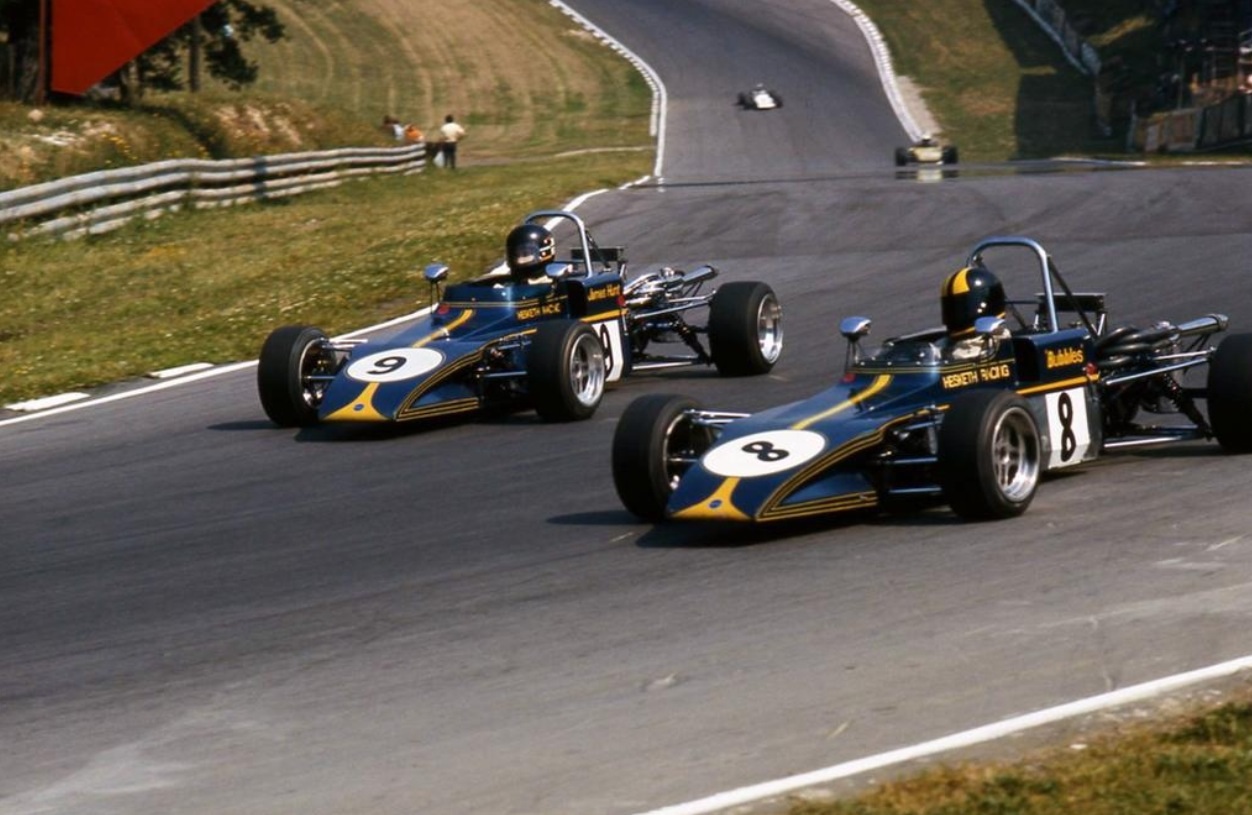
Would the SR4 have been quick? You betcha, much faster than SR3. Would the ‘760 Series’ engine have finished 200 mile races? Yes again if the similar Indy variant results in ’69 are a guide. Could SR4 have achieved CanAm podiums in ’68?, probably yes.
Could he have won a race? Maybe, if the planets were aligned noting that year the ‘dynamic duo’ didn’t win two rounds; John Cannon took a great victory in the wet in an old M1B McLaren at Laguna and Mark Donohue at Bridghampton in the Penske M6B when both Bruce and Denny had major engine failures. Could FM have prevailed at these events? Sure, SR4 was quick enough to knock both car/driver combinations off.
‘If yer Aunty had balls she’d be yer Uncle’ of course, ifs, buts and maybes mean nothing in motor racing, as in life. The chassis was late. The engine was late. FM didn’t contest the ’68 CanAm and as a result we were all deprived of seeing Matich take on Bruce, Denny and the rest of the CanAm circus all of whom he knew and respected well.
So Frank raced the car in Oz in ’69, crushed the local opposition and then moved into F5000 supported by Repco…
Rothmans brochure featuring both the old, SR4 Repco and the new, McLaren M10A Chev F5000 in 1969 (Tony Johns via Nigel Tait)
The obvious question is, having missed the ’68 series why didn’t the car contest the 1969 CanAm instead of being ‘King of The Kids’ in Oz?..
The answer is simple, the Repco Brabham engine program was over, Jack raced a Cosworth DFV in F1 in 1969, the final races in that partnership the Indy races in 1969.
The Repco board decided to close down Repco Brabham Engines Pty. Ltd, there is no certainty Repco would have committed to F1 in 1969 even had Jack wanted them to. Cost was a big issue for Repco throughout 1968, the failure of the engines that year made it easier to withdraw, particularly given the sort of investment which would have been needed to match the reliability and power of the Ford Cosworth DFV. Its impotant to remember that Rindt put ‘860 Series’ F1 powered Brabhams on pole twice in ’68. The 3 litre ‘860’ Repco was potent! With further development there is no reason the ‘860’ F1 engine could not have won races, it proved its speed in Rindts hands in ’68 if not its reliabilty. And every Tom, Dick and Harry raced DFV’s in ’68; McLaren, Lotus and Ken Tyrrell’s Matra International team, pole amongst that lot was an achievement, the Ferrari’s also quick that year.
So, whilst Repco were happy to provide Matich with an engine, they would not back an assault in the US with the resources required. Matich employed ex-Repco engineer John Mepstead to look after SR4 during ’69, he wasn’t provided by Repco. Matich didn’t have the funds to race in the US and had already acquired an M10A Chev McLaren F5000 car in advance, well in advance of CAMS decision to agree the next ANF1 as F5000. 2 litre F2 was the alternative.
There was some ‘dogs bollocks’ from the Matich camp at the time about ‘multi-valve’ engines not being legal in the ’69 CanAm which is rubbish, obfuscation. Count the number of Ferrari’s alone which ran that year, the last time i looked they weren’t powered by pushrod OHV V8’s.
Repco’s commercial interests were best served, they quite rightly believed, by building an F5000 variant of the 5 litre Holden V8 to participate in this rapidly growing category. The engine was an immediate success, Matich won the 1970 Australian Grand Prix in a McLaren M10C Repco that November.
There was not the funds to race an SR4 ‘Stateside, customer F5000 engines were a better commercial proposition for Repco and so an interesting and immensely successful, Repco Brabham Engines Pty. Ltd. chapter of Repco history ended, with a big, quad cam 5 litre bang mind you!
As an aside the last championship won by an RBE engine was Henry Michell’s victory in the 1974 Australian Sportscar Championship aboard an Elfin 360 powered by an ex-Tasman RBE ‘730 Series’ 2.5 litre V8…
The SR4’s 1969 Australian Competitor Set…
The sinfully sexy, wedgy, state of the art, but oh-so-twitchy Elfin ME5 Chev of Niel Allen at Warwick Farm in 1969, below.
Garrie Cooper’s latest big car had a nice, stiff aluminium monocoque chassis but the short wheelbase device, even with Allen at the wheel, very much Matich’s equal in F5000 was never a winning car and with only 480bhp was ‘gutless’ compared to Matich’s 580! Never thought i would say that about a 5 litre injected Chev!
(oldracephotos.com)
Bob Jane below in the sensational McLaren M6 Repco at Hume Weir in 1969, le patron at the wheel of the car raced mainly by John Harvey including the Australian Sportscar Championship in 1971/2. Also Repco powered but ‘only’ an SOHC 5 litre ‘740 Series’ V8, Harvey was very much an ace but the car not on the same page as Matich’s beastie. Its time would come…but only after SR4 was popped away as a museum piece within months of its championship win.
(oldracephotos.com)
Don O’Sullivan in the hi-winged Matich SR3 ‘3’ Repco slicing into Warwick Farm’s Esses in early 1969. Behind him is Niel Allen in the ex-Matich Elfin 400/Traco Olds, now 5 litre Chev engined car. The chassis of the SR3 was either identical to or very, very similar to Cooper’s Elfin 400 design.
(oldracephotos.com/Dick Simpson)
Matich Cars: The Chassis List…
Matich listed ‘his cars’ by chassis number as below. After discussion with Frank Matich, Darryl Duff who owned one of the SR3’s at the time in the early eighties prepared a document listing ‘Franks’ sportscars. A truncated summary of it is set out below. To that I have added Matich’s single-seaters, all F5000’s the source, Derek Kneller, his engineer/mechanic throughout the entire F5000 period;
Matich in SR3 ‘3’ Repco ‘620 Series 4.4 litre V8, the last one built, at Warwick Farm in 1968, this is the chassis with which he belted Chris Amon in the ’68 Tasman support rounds, Amon in David McKays/Scuderia Veloce Ferrari P4/Can Am 350 (Dick Simpson)
1.Sports Cars: All of multi-tubular spaceframe construction
#1 Lotus 19B Climax: (the second of FM’s 19’s, highly modified with many Brabham bits and ultimately destroyed in FM’s big ’65 Lakeside shunt)
#2 Elfin 400 Olds: (aka ‘Traco Olds’ first raced Sandown early ’66, still exists)
#3 SR3 (1) Olds/Repco (still exists) Built with 5 litre Traco/Olds, ZF 5 DS-25 ‘box
First race Warwick Farm early ’67, won ’67 Victorian (Sandown) and NSW (Catalina Park) sportscar championships and Australian Tourist Trophy at Surfers Paradise. To Marvin Webster, California, sans engine in June 1967. Tony Settember raced the car for Webster.
#4 SR3 (2) Repco (still exists) RBE ‘620 Series’ 4.4 litre V8 # ‘RB620E22’, from late 1969 Traco/Olds 5 litre from ex-SR3 (1), ZF DS25 ‘box
Built, sold and exported to Kent Price, California US, first raced 3 September 1967, Road America, Elkhart Lake by Matich. Its only US race. Returned to Oz, it was sold on Price’s behalf, by Matich to Malcolm Bailey in 1969. Bailey fitted the ex-Elfin 400/Traco Olds/ SR3 (1) V8 from Niel Allen to the car.
First race by Matich, 17 September 1967 Bridghampton, raced in Oz later in ’67. Won RAC Trophy and Australian Tourist Trophy at Warwick Farm and Mallala respectively in 1968. This is the chassis which beat Amon’s Ferrari P4/CanAm 350 throughout the ’68 Tasman support races. Sold to Don O’Sullivan late in ’68
#6 SR4 Repco: (still exists, ’68 intended CanAm contender, late, only raced ’69 in Oz, won ASSC that year)
#7 SR4B Ford/Lotus twin-cam (still exists, customer car built for John Wood)
Matich A51 Repco on the Watkins Glen pit row in 1973 (D Kneller)
2.F5000’s: All aluminium monocoques
Note The Matich Team reskinned their McLaren M10B Repco tub after its Oran Park 1971 practice shunt, their first monocoque experience. Six virtually identical tubs were built by Matich/Commonwealth Aircraft Corporation and built up as follows;
#8 A50 Repco Chassis # ‘001/002’ (1971 AGP and 1972 Gold Star winner, still exists)
#9 A50 Ford # ‘003’ (exported to the US, bits incorporated in sportscar) 1972
#10 A50 Repco # ‘004’ (customer car, John Walker ’73 US L&M later to Jon Davison, still exists)
#11 A51 Repco # ‘005’ (US ’73 L&M Series sold to J Goss, converted to A53 spec, ’76 AGP winner, still exists)
#12 A51/52 Repco # ‘006’ (US L&M Series as A51 converted to A52 spec back at Brookvale in time for the Surfers Gold Star round that September, destroyed in a Warwick Farm testing accident shortly thereafter driven by Bob Muir, scrapped)
#13 A53 Repco # ‘007’ (’74 Tasman car sold to J Goss after FM retirement, still exists)
On the basis of the above the Matich Team built 11 cars; the list above less the Lotus 19B and Elfin 400 which were built in Cheshunt, London and Edwardstown, Adelaide respectively.
FM’s logic of including the Lotus and Elfin as ‘his cars’ is not spelt out in Duff’s document but I suspect FM’s thinking was that he modified the cars to such an extent that they were more ‘Matich’ than Lotus/Elfin which may be true of the Lotus but ‘praps not the Elfin… Both these cars are covered in my ‘Elfin 400’ article the link of which is early in this article.
In Period Race Footage…
SR3.
SR4.
Shot below by Dale Harvey and is at Catalina Park in the Blue Mountains, not Warwick Farm.
Etcetera…
Racing Car News June 1968 (Dalton)
Racing Car News cover July 1968 (Dalton)
1970 shot of FM in natty check strides, Vicki Fry and journalist and later motor racing publisher, Chevron Group founder Ray Berghouse. Hewland box missing, nice shot of suspension detail (Ray Berghouse)
Special Thanks…
To Nigel Tait for entrusting me with his manuscript
Derek Kneller for his recollections of the 1969/70 period at Team Matich
Credits…
Nigel Tait Collection, Dick Simpson, oldracephotos.com, Repco Ltd, Dave Friedman Collection, Ian Pope, Jay Bondini, The Roaring Season, Derek Kneller, Dale Harvey, Peter Ellenbogen, Stephen Dalton Collection, Ray Berghouse
Tailpiece: Matich is his local ‘backyard’, aboard the SR4 Repco, Warwick Farm’s Esses, now ‘Bell Star’ equipped, 1970…
Gardner’s streamlined 1100cc Zoller-supercharged MG K3 Magnette. ‘Goldie’ storms along the Frankfurt Autobahn at nearly 150mph, 25 October 1937…
Lt-Col Alfred Thomas Goldie Gardner, born 31 May 1890, was one of the most versatile racers of the 1930s and 1940s as well as a pretty handy engineer.
After completion of his education he went to Colombo, Ceylon to take up a 3 year business contact, at its completion he travelled to Burma for business but returned to the UK for 6 months after contracting malaria in 1914. Upon the War’s outbreak he joined the army, he was commissioned as a second-Lieutenant in the Royal Artillery. He had a distinguished military career, becoming the youngest Major in the British Forces. In 1917 his reconnaisance plane was shot down by German fire, he copped leg and hip injuries which hospitalised him for 2 years, he was invalided out of the army as a result.
A Brooklands competitor, he started racing a Gordon England modified special Austin Seven in 1924progressing through a Salmson and Amilcar to a C-type MG Montlhery Midget in 1931, a marque with which he is synonomous.
Cecil Kimber noticed him, he raced various MG’s with a lot of success from 1930. He was the first to lap Brooklands outer circuit at over 100 mph in a 750cc car in this period.
Gardner, MG K3, Brooklands date unknown (unattributed)
After a bad 1932 Tourist Trophy crash at Ards, Ireland when he rolled his MG J4 three times he ceased road racing, his leg and hip was not strong enough to cope with its rigours.
Gardner looks ok despite the wild ride which destroyed his MG J4, he crashed on lap 3 of the 1932 Tourist Trophy at Ards-Belfast. By the looks of the amazed spectators it was a ‘big one’, Gardner thrown out on one of three rollovers (Heritage Images)
He made the occasional Brooklands appearance, by 1934 he was ‘track racing fit’. He finished 3rd outright and first in the 1100cc class in the Brooklands 500 miles with co-driver ‘Bentley Boy’ Dr.J.D.Benjafield in an MG K3 Magnette.
Gardner travelled with Sir Malcolm Campbell’s World Land Speed expedition to Daytona Beach, Florida in 1935 and was inspired by it, concentrating on speed record attempts from then on setting over 100 National and International records between 1936 and 1952.
He bought the ex-Horton offset K3 single-seater for that purpose and was soon lapping Brooklands at over 120 mph. An improved streamlined body raised this to 124.4 mph, an 1100cc class record which remained unbroken until the tracks 1939 closure.
Gardner, Bernd Rosemeyer and Auto Union record-breaker Frankfurt 12 January 1938, this is 2 weeks before Bernd’s fatal accident on 28 January. 1938 AU ‘Stromlinienwagen’ 6.5 litre variant of the 6 litre V16, 560bhp@4800-4900rpm engine (RacingOne)
In record runs at Montlhery and Frankfurt in October 1937 Gardner clocked almost 150 mph, 148.8 to take a Class G record for the flying kilometre. Auto Union’s Eberan von Eberhorst took him aside during ‘SpeedWeek’ suggesting he would go much faster with a streamlined car. At the time Mercedes and Auto Union were not only waging battle in Grands’ Prix but also in Land Speed Record attempts and were learning much about aerodynamics.
Press shoot, not sure where, Gardner in MG EX135, photo dated 15 August 1949 (Harold Clements)
When he returned to the UK he sought to convince MG to build him a car. Lord Nuffield gave his support and rather than ‘re-invent the wheel’ it was decided to try and get hold of George Eyston’s K3 based EX135 record-breaker built 4 years before.
Donald Letts had the car which critically had the offset transmission specification which would be required and happily agreed to sell. EX135 originally had race and record breaking bodies was further modified by fitment at Abingdon of Reid Railton designed completely enclosed bodywork. John Thornley in his book describes the aerodynamic ‘K -factor’ of EX135 as 0.000400, the later EX279 was 0.000315. Suitably refurbished and rebuilt by ‘Jacko’ Jackson, Syd Enever and Robin Jackson, the beautiful car was used by Gardner in various forms, with a variety of engines for the rest of his career.
This ‘Modern Wonder’ contemporary article describes the 6 cylinder, 1086cc circa 195 bhp Vane type supercharged, twin-SU carbed engine as having magneto ignition, sodium filled exhaust valves and a bronze cylinder head, four speed ‘box. Dimensions are given as; 16’5″ long, width 5’3″, height 2’2″ and wheelbase 8’3″. The ‘beautifully streamlined body (was) built under Jaray (German) patents…’ ‘Design and construction of the car was headed by MG’s Cecil Kimber, while Reid Railton developed the streamlined bodywork’ (oldclassiccar.co.uk)
In the November 1938 German Speedweek outside Frankfurt the ‘new’ EX135 produced two way averages of 187.62 and 186.567mph for the flying mile and kilometre respectively. Showing its aerodynamic properties the car reputedly took 3 miles to stop, Gardner allowing it to coast to a halt!
Gardner and EX135, Frankfurt 1938 (unattributed)
The Nazi Government was improving the countries road network and created in the process a ‘record route’, the ‘Dessauer Rennstrecke’ (Dessau Racetrack) between AS Bitterfeld and Dessau South which opened in January 1939. No speed records could be set on existing closed circuits which were simply too short for the powerful high speed cars of the day.
The straight stretch of road was 10km long, 25 metres wide, had no median strip and pillarless bridges. It was also intended as a wartime auxiliary airfield and was designed around target speeds of 600kmh. In the short time before Poland was invaded on 1 September 1939, Rudy Carracciola did 399.6kmh over the measured mile with a flying start in a Mercedes W154 3 litre record car, amongst other records he set, in February 1939.
(Die Welt)
At Dessau on 31 May 1939 with a higher top gear Gardner took the 750 to 1100cc records over 2 kilometres, 1 mile and 5 kilometres, at averages of 203.5 mph, 203.3 mph and 197.5 mph. His performances left those present in a state of disbelief, it was the first time an 1100cc car had gone anywhere close to the magic 200mph.
After an overnight engine rebore in situ! to1105.5cc, on 2 June 1939 at the same venue he bagged the 1100 to 1500cc class records over the same distances at averages of 204.3 mph, 203.9 mph and 200.6 mph. The achievements were rather lost given the imminence of WW2.
Dessau 1939 (J Dugdale)
EX135 before the off, Dessau 31 May 1939 before the successful 200mph attempt. Array of Smiths instruments, steering wheel shape pre-dates F1 practice by 70 years! (John Dugdale)
One of those remarkable souls who served in both wars,Goldie Gardner took EX135 with 750cc engine fitted to Belgium’s new Jabbeke motorway in 1946 achieving 159.15 mph.
In 1947 he returned to Jabbeke with the car converted to a 500cc four-cylinder by removal of two conrods and pistons and blanking off two pots! He set new records, reaching 118 mph.
Jaguar’s and later Coventry Climax’ designer Wally Hassan fettling his 2 litre, DOHC, cast iron block alloy head, twin SU fed engine, the performance of which clearly pleases Goldie! Jabbeke, Belgium September 1948. In the event Jaguar did not proceed to a production variant of this prototype engine, the 6 cylinder XK its primary engine on track and road for decades to come (unattributed)
In September 1948, he was back at Jabbeke, the streamlined MG powered by a prototype Jaguar XK100 DOHC 2litre 4 cylinder engine. In that ‘MG Jag’ hybrid he reached 176.6 mph for which he was awarded the second of three BRDC Gold Stars. He was also awarded the OBE.
Soon he was ‘back to his tricks’ playing about with MG engines and setting more records; a 1 litre six became a 500cc three-cylinder engine achieving over 154 mph. A 1 litre four-cylinder engine was transformed into a 500cc twin, this did 121 mph at Jabbeke, again in EX135. Gardner now had records in six out of ten international capacity classes, all taken with his famous MG.
Superb lines of the 1933 EX135 at Bonneville in 1952, the car had longevity amongst its many other attributes! (unattributed)
With a supercharged MG-TD 1.5 litre engine, the car did 137 mph at Bonneville in 1951,a year later 148.7 mph with a 2 litre Wolseley engine and 189.5 mph with a new MG TD engine despite wheelspin which reduced his speed somewhat.
Ex135 at Bonneville, 1952 (unattributed)
Gardner, at 63 and truly a ‘Boys Own’ character, retired from the sport he loved to his motor-trade businesses. He died in 1958, one of a breed which no longer exists
Etcetera…
MG EX135 period cutaway drawing by Max Miller, K3 underpinnings inclusive of girder chassis, engine and gearbox all clear in this shot
Another view of Gardner and his J4 after its big shunt, Ards TT 1932 (Heritage)
Gardner and K3 at Montlhery in June 1937, records taken as per hand written annotation (unattributed)
Press shot after EX135 rebuild into its Reid Railton’s bodied form; Cecil Kimber, Lord Nuffield, Gardner, big, tall (6’2″) bugger isn’t he! and Reid Railton (unattributed)
Bibliography…
The National Motor Museum Trust
Credits…
Imagno, Heritage Images, MGAguru.com, Schirner, oldclassiccar.co.uk, Max Miller, Racing One, Ullstein Bild, John Dugdale