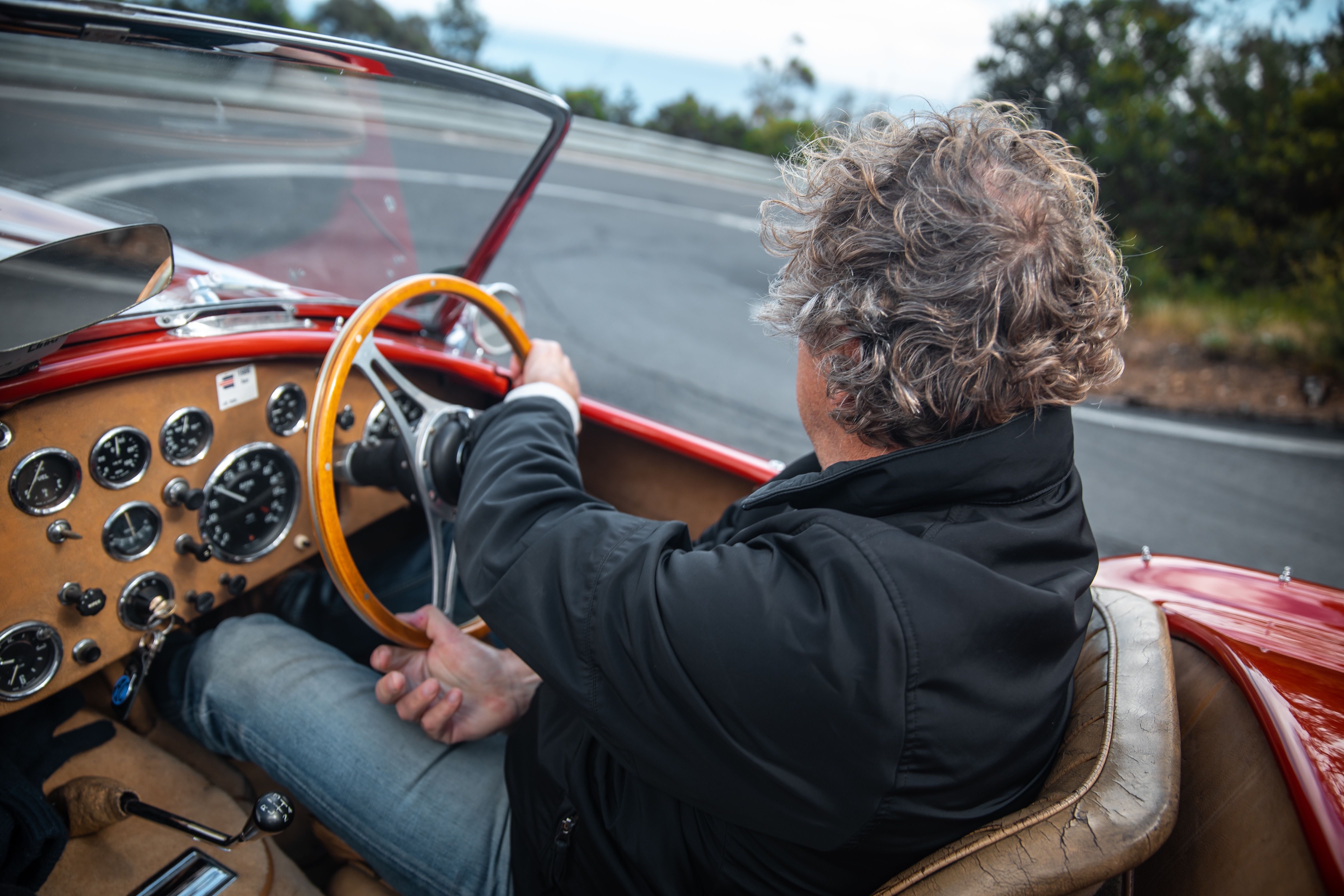
AC Ace Bristol, Arthurs Seat – Port Phillip Bay to the right and Bass Straight, next stop King Island on the way to Tasmania at the top – Victoria (N French)
Seasonal salutations to those of you of a religious bent, and all the best for a well earned break for the rest of you. As father-time meanders on I do find my staunch atheism evolving towards an each-way-bet form of neo-agnosticism on the basis that one needs all the help ‘yer can find towards the end of one’s innings. “You fucking hypocrit!” my eldest son observed, fair comment too.
One of my mates asked me about my automotive highlights of the year the other day, I thought the contents of that discussion might be a good end of year topic.
Lots of luvverly Smiths instruments in the Ace cockpit (N French)Savouring the Stanley Sunbeam 20/60 on the Redesdale Bridge (D Hewison)
When I think about it, all are related to my mate Bob King: medico retired, racer retired, restorer retired and author current with four Bugatti book tomes so far. My racing interests had been largely post-war until we had a series of illicit, coffee-infused research and talking-shit sessions during Covid. The Peoples Republik of Victoria was locked down tighter than a nuns chastity belt in 2020-21.
As a consequence, much of my research these days relates to earlier times, it’s fun as the learning journey is steep and rich. I worked out in 2022 that I could have my cake and eat it too if I mixed a car’s road impressions with the usual dose of history.
This combo has yielded 2023 articles on King’s AC Ace Bristol (published in Benzinamagazine), the Murdoch Family’s two supercharged, twin-cam Altas: 1.1-litre #21S and 2-litre #55S (Benzina and The Automobile) and Richard Stanley’s 3.2-litre, six-cylinder, OHV Sunbeam 20/60 (The Automobile).
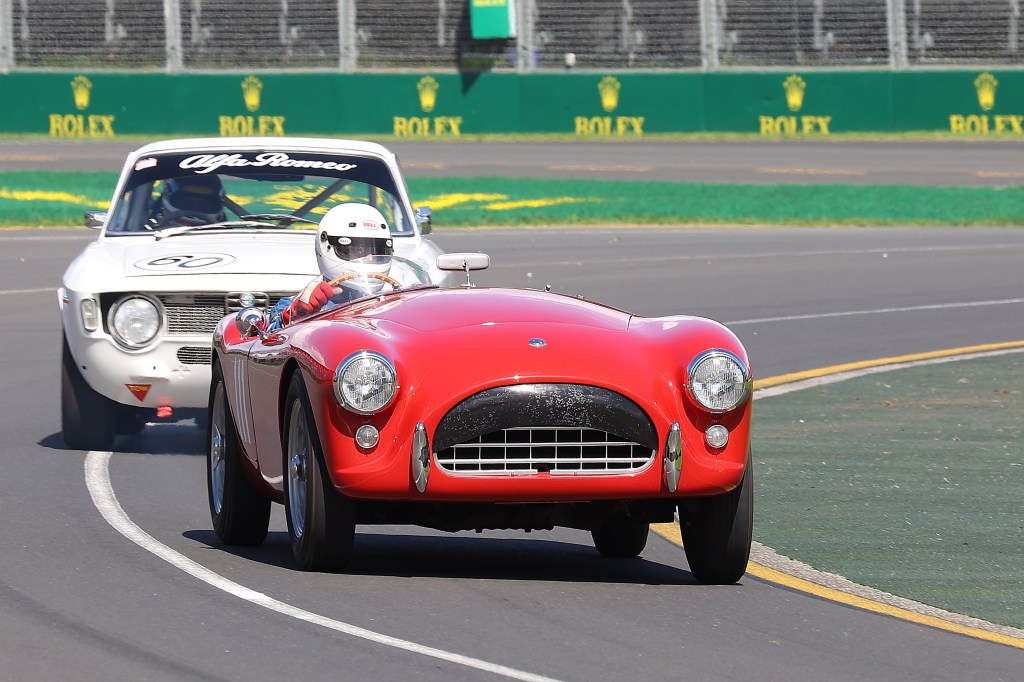
Ace at Albert Park in works-corto-spec (sic). This involved removal of the road screen and replacing it with this competition number and fitment of the neato radiator blind. Amazingly, these two items were delivered with the new car to its German domiciled Australian Army officer first owner, and are still with it seven’ish decades later. The Alfa GTA behind is kosher, it’s the ex-MW Motors car (CCCollection)
Driving these cars were the highlights of the year.
On top of that I get to drive Bob’s Ace very regularly, the best of those steers was participating in the Historic Demos (on all four days) of the AGP carnival at Albert Park. The pace is very-fast-road not full-race, its such a sweetie, a mix of just enough power (circa 135bhp), superb spaceframe chassis and predictable handling via independent suspension at both ends, rare in the day. See here: https://primotipo.com/2023/02/21/benzina-magazine/
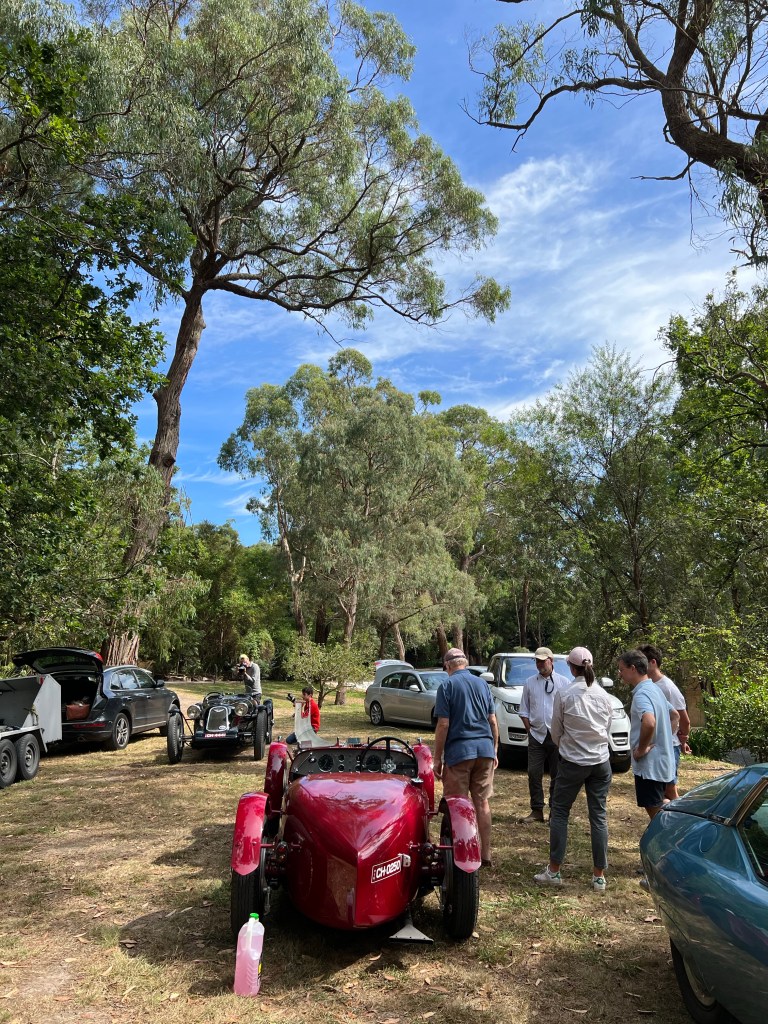
David Hewison snaps 21S in the background while 55S awaits its turn. Bob and the Murdochs – Geoff, Fiona and Neill and partially obscured young-un – await the road leg. Citroen SM flank at right. The coolant seemed ominous but wasn’t required (Bisset)
The logistics of these road impression exercises are not to be sneezed at. The rendezvous point for the Alta day (the week before the AGP in March) was in the Upper Yarra with one of the cars being trailered from Melbourne. There was a five-person-Murdoch Posse in attendance, David Hewison and his son manning the lenses, plus Bob and the two British stars of the show, who behaved well despite an exceptionally hot day.
21S on the hop near Gladysdale, the pre-selector gearbox wasn’t the mental challenge – with limited capability in relation thereto on my part – that I had expected. Superb to drive in every respect (D Hewison)
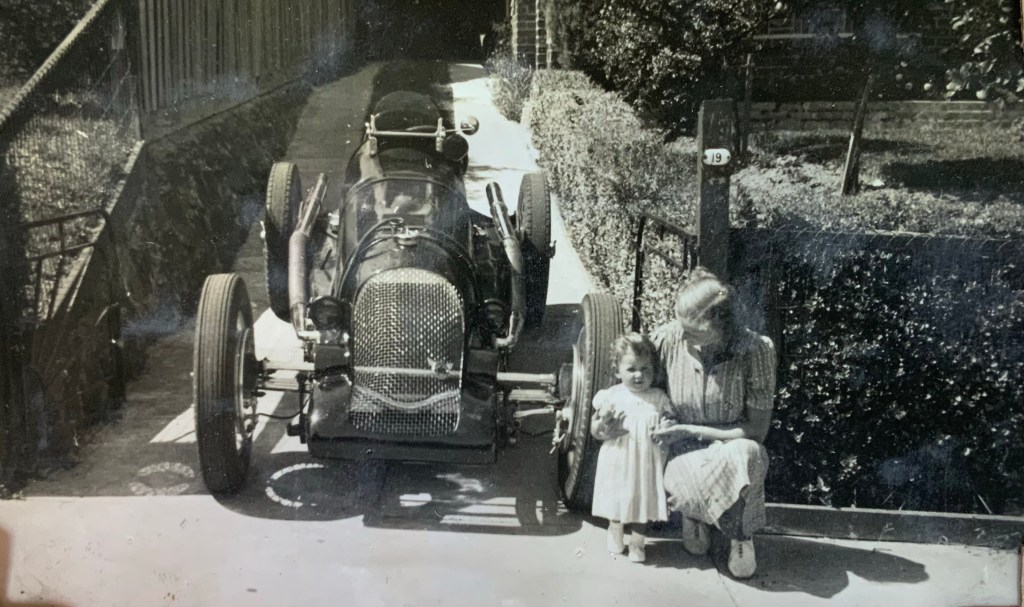
Mrs ‘Racing Ron’ Edgerton with an Edgerton junior-burger and 21S circa 1942. The Ford V8 was fitted several years before, Edgerton has just completed a major body-off rebuild (Ron Edgerton Collection)
Nico French did the AC Ace shoot on Mornington Peninsula roads very familiar to me: a loop comprising Arthurs Seat, Main Ridge, Red Hill, Flinders and Shoreham and then a blast to Mornington for lunch en route home.
Kingy really doesn’t like the verbal foreplay between his car – mainly directed towards it’s perky little rump – and I in his garage before we set off on these occasions. There are only six-hundred-thousand-reasons she isn’t mine!
21S owner Fiona Murdoch and Bob King roadside at Launching Place (Bisset)No it isn’t a perfect four-wheel-drift! Sunbeam 20/60 and Messrs Stanley and King near Kevington, Autumn is pretty up that way (Bisset)
I froze my nuts off in the back of Richard’s Sunbeam way back in late April when I was the third-wheel on the annual Ye Olde Codgers Stanley-King Alpine Tour into Victoria’s high country.
Clad in my favourite Thredbo ski-gear, with rear windscreen erect and struggle-rug over my legs it was fantastic fun but, far-canal, it was a true British winter touring experience in The Great Brown Land.
I pitched the Sunbeam piece to The Automobile and it got up against two other ideas I rated more but were knocked back. The drive day was a warm one in mid-October, David Hewison did the static shots in Lancefield and the drive was via the Burke and Wills Track to Redesdale.
The 3.2-litre tourer was surprisingly spritely, the right hand change crash-box novice friendly. No pressure here in the driving, Stanley is a renowned Kiwi/Oz historic racer and has owned the car since restoring it in the early 1970s. He drives it with supreme finesse. Victorian country C-roads are bad at present given the lack of funds deployed to maintaining them, what surprised me was just how the twenties Sunbeam ate the B&W Track in a way my Alfa 147 GTA didn’t: low profile tyres and the rest.
Hewison produced his party trick this time, working with a drone for the first time was interesting, and adds another dimension to considering the terrain in which you shoot. More on the Sunbeam here: https://primotipo.com/2023/05/20/sunbeam-20-60/
Photos continue to be the inspiration for the primotipo articles but it’s yer mates and confidants, mentors, supporters and sub-editors (the latter are readers who pick up and point out the f-ups) that sustain you. So, many thanks to Bob King, Tony Johns, Stephen Dalton and Alistair MacArthur, Bruce Williams, Tony Davis and Doug Nye, and Geoff Harris and Rob Bartholomaeus.
(N French)
Etcetera…
This shot of Bob King was the ‘money shot’ of the AC shoot, a ripper. Three-quarter front floats the editor’s boat. The owner is having a ball, there a couple of places on the steep climb where the chairlift goes over the road.
Bob competed here in his Bugatti Type 35 Anzani – the ‘Anzani Bugatti’ in Australia – in the early 1990s. There were two climbs (I think) in the modern era which aped the use of the venue pre-war, then officialdom got in the way, as it usually does.
These days the best approach to enjoy this magic stretch of road is an illicit dawn blast having first done a recce to ensure moisture levels of the surface, with many overhanging trees, won’t cause grief…
BMW-Bristol 2-litre, triple-Stromberg fed, two-OHV six gives about 135bhp in current spec. Fitted with overdrive, this baby happily tours at 110kph all day (N French)
Rest assured it was as cold as it looks, what superb drivers roads they are. The two old-fellas were cocooned in the front while I was ‘punished’ in that airy rear seat. Kevington countryside, the local pub is great, albeit with a dang-diddl-lang-dang-dang factor about it.
Sunbeam’s 3181cc, seven main-bearing, twin-SU fed long-stroke six powered tourer lopes along. Richard and Judy Stanley toured from Lancefield to Rockhampton, Queensland last year – 1900km each way – the car is loved and used a lot (Bisset) (Bisset)
Easily the best of this years piss-up type events, it’s on again in 2024, with me as a judge. It’s a very dangerous choice as someone who regards these things as wank-fests, and will fulfil his duties with that degree of conviction….
(Bisset)
Neill Murdoch me showed just how quick this supercharged 2-little mid-1930s Alta accelerates, “think of it as a two-seater ERA” was meant indicatively rather than definitively but sums the thing up in a nutshell. Geoffrey Taylor’s marque is so underestimated.
Credits…
David Hewison, Nico French, Mark Bisset, CC Collection
Tailpiece…
(Bisset)
What it’s all about, a long and winding road that leads to a hotel door…with apologies to Paul and John.
Richard Stanley and Bob King with Sunbeam 20/60 burbling it’s beautiful six-cylinder song on the Maroondah Highway, Molesworth, Victoria on April 25, 2023.
Merry Christmas, may you all have a peaceful and restful break with lots of good health and luck in 2024.
Atmospheric shot of Harry Schell’s BRM Type 25 during the August 23, 1959 Portuguese Grand Prix at Monsanto, Lisbon…
It was the breakthrough car for BRM, Jo Bonnier’s Type 25 won at Zandvoort in 1959 thereby breaking the F1 World Championship GP winning duck for the Boys from Bourne after nearly a decade of competition.
Immaculately credentialled engineer Stewart Tresilian “was largely responsible not only for the original conception and design of the BRM Project 25 2.5-litre four cylinder engine, but also of the compact P27 – or Type 25 – car (chassis) intended to carry it into battle.” Doug Nye wrote in ‘BRM Vol 1.’
“He had produced a homogeneous concept of car and engine combined, its essence being the complete antithesis of the original V16 in that it was all as small and compact and simple as possible, with the arguable exception of his projected 16-valve cylinder head for the four cylinder engine.”
BRM P15s, JM Fangio on the front row, and Ken Wharton behind him, Albi GP May 1953. Fangio won the heat and dominated the final before tyre troubles intervened, Louis Rosier won in a Ferrari 375 with Froilan Gonzalez second in another BRM P15. Car #3 is Nino Farina in the Vandervell Thin Wall Ferrari 375 (B Cahier)
The four-valve head design was subsequently over-ruled by Peter Berthon and after Tresilian left the Owen Racing Organisation to go to Bristol-Siddeley Engines in January 1953, Berthon, Tony Rudd and others brought the Type 25 to reality.
The result was a car that became increasingly fast, it not particularly reliable with each passing year from its race debut in 1955 until early in 1960. It allowed the team to develop the capabilities to win; car development, preparation and driver, they couldn’t do that with a car that never lasted too many laps. Mind you, the simplicity of Tresilian’s concept was complex in its execution…
Peter Collins crashed his Type 25 #252 during practice of the Daily Telegraph Trophy meeting at Aintree on September 3 1955, so took his bow here at Oulton Park during the September 24, 1955 International Gold Cup meeting in the same car. Q13 and DNF after loss of oil pressure after 13 laps. Stirling Moss won in a Maserati 250F from Mike Hawthorn’s Lancia D50. Oh to have been there that day! Many thanks to Stephen Dalton for these two programme pages – studiously marked up by a knowledgeable spectator – from that BRM Type 25 failed race debut September 1955 meeting at Aintree
The P27 semi-monocoque – in the centre section – chassis was strongly influenced by Tom Killeen’s Killeen K1 sportscar which was tested extensively at Folkingham by Rudd. He was impressed and the performance of the car “confirmed PB’s interest in stiffening his basic new P27 frame with a stressed-skin monocoque centre section.
The five-speed rear-mounted gearbox was drawn by Alec Stokes, “who was destined to become BRM’s dedicated transmission specialist and one of the country’s leading gear-men.” The back of the gearbox carried the controversial single, longitudinal-axis rear disc universally known as the ‘bacon-slicer’.
With 50/50 weight distribution and 70% of the braking load at the front, the thinking was that outboard front disc brakes would carry 35% each, leaving 30% for a single rear disc. It took a long time to sort, but when that was achieved “this arrangenent worked quite well on the front engined cars.”
Rear suspension was by way of a De Dion tube with Lockheed air struts inherited from the V16 program, front suspension comprised upper and lower wishbones and coil air strut units again, with the rack and pinion steering Morris Minor based.
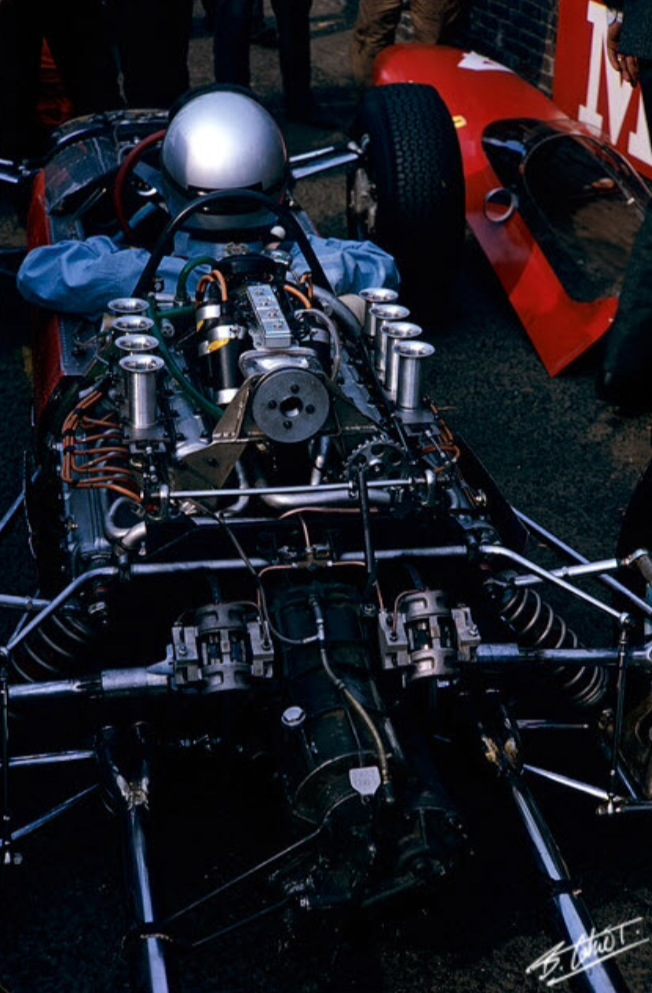
BRM P25 2.5-litre, (2491cc 102.8mmx74.93mm bore/stroke) four main bearing, DOHC, two-valve, Weber fed, twin Lucas magneto and twin-plug sparked four-cylinder engine shown in one of the cars at Monaco in 1956. That hole in the bonnet is the extent of the access my friendsBRM Type 25 1958 specification spaceframe chassis (C La Tourette)BRM Type 25 during the 1959 Dutch GP weekend at Zandvoort. Cars then spaceframe chassis with vastly superior mechanical access, note the single rear disc brake under the fuel tank at right. All that fuel sitting very high, the trade-off decisions are made clear in this shot (BRM 1)
While work progressed on the chassis there was a long test program with a single-cylinder model of the new engine. ORO were racing the V16 Mk2 and Maserati 250F during this period, with some success. By Easter 1955 the car was complete but for the engine. Finally, on June 5, 1955 the car ran for 19 laps at Folkingham with Rudd at the wheel, having given 260bhp @ 8000rpm on the test bed.
The major problem on test was the SU fuel injection system which was subseuently ditched in favour of a pair of 58DCOE Webers. After further tests by Ron Flockhart and Peter Collins, the car was entered for the September 3 Aintree meeting.
Peter Collins was chosen to race the machine but lubrication problems caused the engine to blow oil over the rear tyres causing a spin and chassis damage that prevented further running. A further run at Oulton Park on September 24 was impressive with Collins running third in front of Ferraris, Maseratis and Vanwalls etc ended when Peter noticed failing oil pressure and pitted. Thus turned out to be a dud gauge which had been shaken to death by the vibrations of the big-bore-four!
Post-meeting work involved rubber mounting the instruments, improving gearbox lubrication and gear teeth form. As Nye observed, “The new BRM was the tiniest car of its time. It was really minute, and very light, and very powerful…and very troublesome.” The eternal process of development was only just underway.
Willie Southcott tending Tony Brooks’ car, #252, at Goodwood during the Glover Trophy meeting in April 1956. DNF oil pressure in the race won by Stirling Moss’ Maserati 250FBritish GP scene July 14, 1956. The Type 25 cars of Tony Brooks, Mike Hawthorn about to receive a fresh engine, and Ron Flockhart at right; DNF accident, uni-joint and engine respectively. Fangio won in a Lancia Ferrari D50 (MotorSport)Tony Brooks’ Type 25 #252 enroute to Q6 and second in the Aintree 200 in April 1956, Moss won in a 250F (MotorSport)
Stirling Moss tested the cars in the lead up to the 1956 season but went to Maserati instead, so Mike Hawthorn and Tony Brooks stepped into the breech. Those poor unfortunates enjoyed a season of great speed laced with equal amounts of unreliability and poor preparation.
The team addressed many problems that year. They slowed the rotating speed of the bacon-slicer by use of a reduction gear, experienced ‘stiction’ in the air struts, the big valves stretched and broke, they had pot-joint seizure and so on. Then Brooks experienced a jammed throttle rod at Silverstone at Abbey corner triggering a somersault which destroyed chassis #252 by fire. To compound a diabolical British GP weekend in front of the home crowd, Ron Flockhart’s car broke its timing gears. Despite all of that Hawthorn and Brooks had qualified in the Top 10, Mike in Q3. The team withdrew from the final two championship races of the year in Germany and Italy.
The Brooks Silverstone conflagration, thank goodness the Gods of Goodnesss were smiling on Tony that day, but chassis 252 was very dead (TC March – T Johns Collection)
Alfred Owen then decreed there would be no more racing until the car had completed 300 miles of continuous running competitively. Flockhart achieved this late in the year at Monza. Three laps later, with Berthon waving him on, the car dropped a valve and ruined another engine. Nye observed, “From their debut in 1955 to the end of 1956 the BRM Type 25s had made only eight starts in just five races, and finished only once, Brook’s second in the Aintree 200.”
Over the winter Colin Chapman test drove the car twice and provided a comprehensive set of recommendations in a formal letter of advice including rear suspension changes. Fitment of tall coil spring/dampers and incorporating a Watts linkage to help locate the De Dion tube were among changes which help transform the cars.
Les Leston at Aintree during the 1957 British GP weekend, Q12 and DNF engine after 12 laps in chassis #253. Brooks/Moss won in Vanwall VW4 (MotorSport)Herbert Mackay-Fraser’s BRM T25 #253 ahead of Mike Hawthorn’s Ferrari Lancia D50 at Rouen during the 1957 French GP
In 1957 Brazilian born American Herbert Mackay-Fraser charged at Rouen, while poor Flockhart spun on oil , rolled into a ditch and wrote 254 off. Fraser died a week later aboard a Lotus 11 Climax FPF at Reims and Flockhart was still in hospital so Jack Fairman and Les Leston raced the cars at Aintree.
Jean Behra was so impressed by the corner-speed of the Type 25 at Aintree he cadged one for the 302km Caen GP which he won! Harry Schell drove a sister car in the event at the last moment, and soon became the most consistently successful Type 25 driver.
“At the end of the season, against meagre opposition, the three surviving cars, 251, 253, and 254 finished 1-2-3 in the Silverstone International Trophy, driven by Behra, Schell and Flockhart.”
During the 1957-58 break, a fifth main bearing was incorporated into the engine to solve ongoing timing gear problems, the cost was high, additional friction losses impacted horsepower. The chassis came in for attention too, the semi-monocoque centre section was ditched in favour of a full spaceframe with fully detachable bodywork.
Schell and Behra finished two-three in the Dutch GP, the team’s best result yet. The methanol burning four-bearing engine gave over 280bhp in 1957, whereas the five-bearing on Avgas gave only 240bhp, Behra left for Ferrari at the end of the year.
Schell at Eau Rouge, Spa, Belgian GP 1958. Harry was fifth in #257, with four of the first five cars British, the only interloper was Mike Hawthorn’s second placed Ferrari 246. Brooks and Lewis-Evans were first and third on Vanwalls, while Cliff Allison’s tiny Lotus 12 Climax was fourth (MotorSport)Onya Harry! Third (right) on the grid at oh-so-fast Reims, 1958 French GP aboard #258. The Ferrari Dinos of Mike Hawthorn #4 and Luigi Musso share the front row with him. Hawthorn won while Harry retired with overheating after 41 lapsBehra, Oporto, Portugal in 1958, fourth from Q4 in #256 with Moss the winner in Vanwall VW10 (Getty)
Fiery Harry Schell was one of the surprises of the 1958 with a series of qualifying performances and points finishes which proved just how much their ever evolving Type 25 – despite the power loss – had come. Second at Zandvoort was fantastic, so too a swag of fifth places at Monaco, Spa, Silverstone (from Q2) and Oporto. Behra’s best was third and Holland and fourth in Portugal, while Jo Bonnier’s was fourth place in the season-ending Moroccan round.
In the first season the manufacturers championship was run, BRM were fourth in the International Cup for F1 Manufacturers behind Vanwall, Ferrari and Cooper Climax. Vanwall had peaked as they led the pre-eminence of British Racing Green, while Coopers were on the rise…
Moss on the way to second place in the BRP entered BRM Type 25, Aintree, British GP July 1959. Brabham won on a Cooper T51 Climax. Bourne standards of preparation encouraged Moss to have his Type 25 #2510 fettled by his (Alfred Moss and Ken Gregory) British Racing Partnership. This chassis met a violent death at Avus the following month when Hans Hermann had brake failure on the approach to the southern hairpin during the German GP, the lucky pilot survived the monumental accident unscathed. The BRM Gods of Goodness again smiled on Hans, but former BRM racer Jean Behra was not so fortunate that same weekendRon Flockhart’s #2511 during Aintree Friday practice, British GP weekend in July 1959. DNF spin after 53 laps (D Williams)Jo Bonnier in #258, in front of Masten Gregory at Zandvoort during Jo Bo’s famous May 31, 1959 BRM Type 25 victory, Masten was third and Brabham second on works-T51s (MotorSport)
While Jack Brabham and Stirling Moss rewrote the record books with their factory and Rob Walker Cooper T51 Climaxes in 1959 BRM put themselves in the annals of Grand Prix history when Jo Bonnier won at Zandvoort in May. Schell had a season of greater reliability than Bonnier but didn’t do as well as the year before.
That winter Harry Weslake had advised Bourne on improved cylinder head design, and the fifth main-bearing was machined out! BRM adopted new timing gears “with large, coarse teeth not critical to fine backlash tuning for reliability.” Further brake modifications and simpler, lighter chassis – numbers 2510 and 2511 – “made the BRM Type 25s simply the fastest front engine cars of 1959, with fantastic braking ability.” Doug Nye wrote.
Graham Hill, Dan Gurney and Bonnier drove the cars on into 1960 at which point all of the remaining Type 25s, except #258, the Zandvoort winner, were torn to bits to provide components for the new mid-engined P48 2.5-litre cars “being hastily built to follow Cooper’s rear-engined lead.”
(unattributed)
Jo Bonnier “drifting into history”, as Doug Nye beautifully put it. By April 18, 1960 JoBo could have raced a new mid-engined P48 in the Goodwood Easter Monday Glover Trophy but chose to race Type 25 #258, his Zandvoort machine instead. Graham Hill and Dan Gurney gave the P48s their race debut that weekend, Hill was fifth, Bonnier sixth and Gurney had an accident on lap 3. In a sign of the times, Innes Ireland’s works Lotus 18 Climax won, it was the fastest, if not the most reliable GP car of 1960.
The old and new, BRMs Type 25 and P48, both 2.5-litres in September 1959. That’s #481 in shot with its unique nose on the Folkingham floor between the two cars, Type 25 chassis number unknown (BRM 2)Graham Hill tips his BRM P48 into one of the oil-drum marked corners on the Ardmore Airfield circuit during the January 1961 New Zealand Grand Prix weekend. He was third behind the Cooper T53 Climaxes of Brabham and McLaren (M Fistonic)
Eleven BRM Type 25 chassis were built – #251-259, 2510 and 2511 – during the long 1953-1960 BRM Type 25 programme, starting in 21 championship and 26 non-championship and Formula Libre events. These 47 meetings yielded the Dutch GP win for Bonnier and seven minor event victories including the two preliminary heats of the 1957 International Trophy at Silverstone and the 1959 New Zealand Grand Prix heat at Ardmore for the ever patient Ron Flockhart.
Etcetera…
(TC March – T Johns Collection)
The boys; standing are Basil Putt, Team Manager, Mike Hawthorn, Tony Brooks, Peter Berthon, Tony Rudd, Raymond Mays, AF Rivers Fletcher. Who are the mechanics in front? Folkingham, Lincolnshire August 28 1956 ‘Test and view day’.
The cover and editorial of Autosport after Peter Collins made the race debut of the Type 25 at Oulton Park on September 24, 1955 says everything about Britain’s goodwill towards BRM in its fight to take on the best in the Grand Prix world.
Great shot of Les Leston with team chief Raymond Mays at Aintree during the 1957 British GP weekend. Q12 and DNF engine after 12 laps, Jack Fairman lasted two laps more before he too suffered engine dramas. Up front, Tony Brooks and Stirling Moss shared the win in a Vanwall.
Rouen pits in July 1957, the incredibly quick BRM Type 25 #253 of the oh-so-promising American driver Herbert Mackay-Fraser awaits its wheels. Q12 and DNF transmission failure after 24 laps, Fangio won in a Maserati 250F. And below with the Mike MacDowel Cooper T43 Climax shared with Jack Brabham to seventh in the race. The contrast in size between the smallest front-engined car of the era and the grids most compact is quite marked.
(LAT)
Peter Berthon and 37 years old Harry O’Reilly Schell at Monaco in 1958. Despite a wild-man reputation Harry put together plenty of fast drives and high placings just as the team needed them. He was equal fifth (with the dead Peter Collins) in the drivers championship with 14 points, a personal best. 1959 was tougher, Stirling Moss bagged his car and Harry didn’t finish a race until Reims in July, but managed fourth at Silverstone and fifth in Portugal. Schell died at Silverstone in damp practice for the 1960 International Trophy, he clipped a low retaining wall at Abbey, was half flipped out of his Cooper T51 Climax and broke his neck.
Behra at Oporto 1958. Doesn’t that BRM #256 look magnificent beside those small, very fast Cooper T45s. #12 is Maurice Trintignant, #16 Roy Salvadori with the obscured Jack Brabham copping a push start at right.
(CAN)
Ron Flockhart during the Lady Wigram Trophy, New Zealand in January 1959. If a bloke deserved a win in these cars it was Ron given the number of test and race miles he did in them. He won aboard #259 from pole in front of Jack Brabham and Bruce McLaren’s Cooper T45 Climax’.
‘Where is the starter again?’ Tony Rudd and mechanic in Harry Schell’s #257 at Monaco in 1959. Q9 and DNF accident after completing 48 laps of the race won by Jack Brabham’s Cooper T51 Climax. Bonnier’s car retired with failing brakes from Q7.
(unattributed)
Yay team, again at Zandvoort in 1959, and one more time, there is no such thing as too much BRM…
BRM Type 25 model from Stephen Dalton, “it’s a Merit with the Alastair Brookman touch, he built it.”
Credits…
Clarence La Tourette, Getty Images, John Ross Motor Racing Archive, Bernard Cahier, John Ferguson, Classic Auto News, LAT, MotorSport Images, ‘BRM 1’ Doug Nye, History of the Grand Prix Car 1945-65 Doug Nye, Dave Williams, Stephen Dalton Collection, TC March, Tony Johns Collection
Tailpiece…
(B Cahier)
Phil Hill catches Jean Behra on the way to a DNF brakes at Monaco in 1958 from a splendid Q2 in chassis #256. Tony Brooks was on pole and Jack Brabham Q3 is the upstart 2-litre Cooper T45 – with two more of the pipsqueaks behind Jack – driven by Roy Salvadori and race winner Maurice Trintignant.
While the mid-engined writing wasn’t perhaps on the wall, the sign-writers were readying the paint…
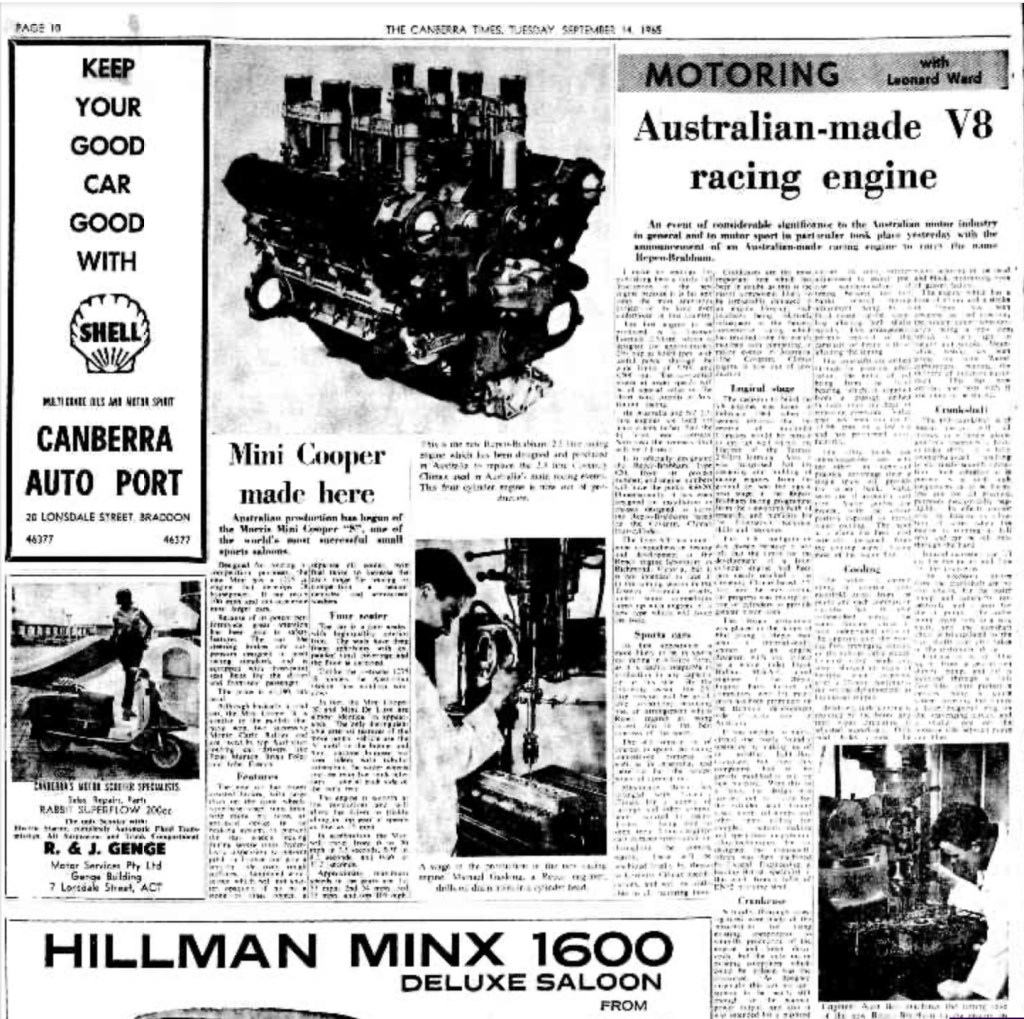
The Repco Record cover girl for September 1965 is the prototype 2.5-litre Repco Brabham 620 V8. Engine #E1 first spluttered into life on the Repco Laboratory testbed, Richmond on 26 March 1965…
She is quite a cutie replete with Weber carbs rather than the Lucas fuel injection with which the Repco engines always raced. Click away at the links below for plenty of articles on this engine, this is another piece from Michael Gasking’s wonderful collection of Repco memorabilia.
The public announcement of the engine was made by Repco on Monday September 13, 1965. Many thanks to historian David Zeunert who forwarded a copy of Leonard Ward’s piece about the initiative which was published in the Canberra Times the following day.
It includes an unusually detailed technical description of the engine, but makes no mention – at that point at least – of a 3-litre 620 variant for the new F1 which commenced in 1966.
That the 1275cc Morris Cooper S – ‘one of the worlds most successful small sports saloons’ – has gone into production at BMC’s Australian plant at Zealand, inner-Sydney would have been big news too, albeit well-known to enthusiasts.
Credits…
Michael Gasking Collection, Repco Ltd, Canberra Times via David Zeunert Collection
Rothman’s promo handout of the type used at race meetings back in the day.
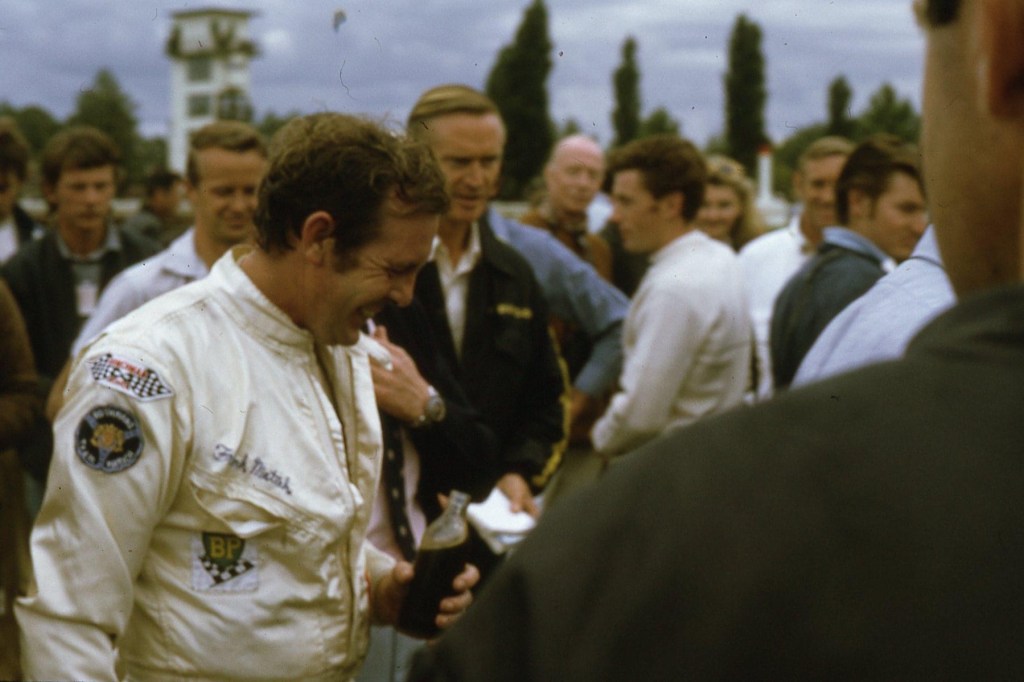
Frank Matich did well with this unique Repco-Holden F5000 V8 engined McLaren M10B, chassis 400-10, winning the Australian Grand Prix with it in November 1970. In early ‘71, after finishing second to Graham McRae’s M10B Chev in the Tasman Cup, he took he entered the first two rounds of the US F5000 Championship held in California in April/May. He won the Riverside Grand Prix and finished second in the following Monterey Grand Prix at Laguna Seca, proving the car was one of the quickest F5000s around.
Sponsorship commitments forced his return to Australia to contest the Gold Star, a pity! Given the solid US campaign you would think Repco – he was their contracted test and race driver – and Rothmans would have seen the good sense in staying a bit longer and surfing the wave of success. US wins would have created good column inches back home and promoted Repco-Holden engine sales stateside, the irony of successful Australian V8s on the ‘home turf’ of that pushrod-V8-donk genre will not be lost on most of you. When Repco and Matich returned to the US with a full-on two car works L&M F5000 Championship assault in 1973 it was a clusterfuck, a tangent covered in this article and another linked below; https://primotipo.com/2015/09/11/frank-matich-matich-f5000-cars-etcetera/
(R Wolfe Collection)
Back home things turned to custard as he collided with another car – in a zig-zag moment as two cars converged – in practice at Oran Park before the first Gold Star round on June 27.
By then FM had decided to build his own car, so rather than order a replacement M10B chassis from Trojan Cars – manufacturers of McLaren customer cars – he decided his Brookvale team should rebuild the buggered monocoque as practice for what became the Matich A50 Repco-Holden that November. FM’s cars to that point – the SR3-4 sportscars – had spaceframe chassis.
When the thrice tubbed – the original, a Trojan replacement after a July 1970 prang, plus the Matich built chassis – M10B was rebuilt it was designated M10C.
Compare and contrast. Matich shown winning the November 1970 AGP above at Warwick Farm fitted with 15-inch front and rear wheels, and below at the same circuit using 13-inch jobbies up front during the February WF Tasman round, DNF electrical. Same car, chassis 400-10, and same tub at this point! (unattributed)(Terry Russell/an1images.com)Matich in the M10C in New Zealand – where folks? – during the ’71 Tasman showing its M7/M14 13-inch front wheels. Isn’t it neat looking sans hi-airbox – that ‘innovation’ was introduced by Tyrrell during the ’71 French GP weekend – and with engine cover (D Kneller Collection)
In the lead up to the 1971 Tasman, FM developed 13-inch Goodyears as part of his test-driver role with Goodyear, he was one of about 10 in the world at the time, he was the distributor of the Akron giant’s race-tyres in Australia too. F1 cars raced on 13-inch covers and Goodyear were keen to evolve suitable boots of the same diameter for the heavier F5000s. The M10A and M10B were supplied ex-factory with 15-inch wheels front and rear. Simultaneously, the Matich crew increased the wheelbase of the car by 150mm by using redesigned front wishbones and longer radius rods, these and other subtle changes heralded the very quick C-specification.
Back to the ’71 Gold Star. Matich won at Surfers Paradise when he rejoined the Gold Star circus on August 29, 1971 but retirements at Warwick Farm and Sandown cruelled his championship aspirations. By then the main game was readying the new Matich A50 Repco-Holden for the November 21 AGP at Warwick Farm where the several days old car finished a splendid first!
Etcetera…
(G Wadsworth Collection)
Matich in the middle of the leading gaggle of cars not long after the start of the Riverside Grand Prix, that’s Sam Posey’s Surtees TS8 Chev turning in. The red car out of focus on the left looks suspiciously like Skip Barber’s F1 March 701 Ford DFV. Ron Grable’s Lola T190 Chev won the first 38 lap heat and Posey won the second, but FM’s two second placings won the day and the bubbles overall.
(M Kidd)
I like this unfinished painting, Kiwi artist Michael Kidd never got beyond his initial sketch of the McLaren M10C Repco-Holden in ‘71 Tasman specs as shown below. Matich leads Niel Allen’s M10B Chev and Frank Gardner’s works-Lola T192 Chev in the distance. Circuit folks? How ’bout completing the painting Michael?
(D Kneller Collection)
What’s interesting to we anoraks – perhaps – is that between the end of the Tasman and the trip to the US a couple of months later, Matich fitted a more substantial roll-over hoop with two rear stays mounted further back on the car at the rear. Look at the shots above and below. I wonder why? Different US regs perhaps, dunno, that’s one for Derek Kneller…
(D Kneller Collection)
The more you look, the more you see of course, here’s one for the Repco-Holden perves. Don’t the inlet trumpets on the engine above indicate that that injection slides are in use rather than butterflies? I thought by this stage slides had been given the arse by REDCO given their propensity to jam from the collection of roadside detritus on our shitty tracks?
Credits…
Rod Wolfe Collection, Derek Kneller Collection, Terry Russell, Michael Kidd, Eli Solomon
Tailpiece…
Frank Matich, McLaren M10A Chev, Thomson Road, Singapore GP, March 1970 (E Solomon)
Frank Matich’s F5000 commitment began with the purchase of this McLaren M10A Chev in late 1969, before CAMS had ‘finally landed’ on their decision for the new Australian National F1 to succeed the much loved, but running out of puff, 2.5-litre formula. That balsy-call by FM and staggering tale of ‘decision making fuck-wittery’ by the Conspiracy Against Motor Sport is contained within this exhausting epic; https://primotipo.com/2018/05/03/repco-holden-f5000-v8/
By the way, the small minded and petty (me) can still take the piss out of CAMS’ name quite legitimately. They registered the new business name Motorsport Australia with effect from January 1, 2020 but the full legal name of the organisation we all love is the Confederation of Australian Motor Sport Ltd (ABN 55 069 045 665) trading as Motorsport Australia, so CAMS it is.
Frank’s M10A, chassis 300-10, was delivered to him in August 1969, and Derek Kneller, ex-McLaren came with it. Derek and Peter Mabey immediately set to and updated the car to the just coming M10B spec – DG300, radiator, body, suspension wheels etc – and created a jet that Matich put on pole in four 1970 Tasman rounds for two wins, the NZ GP at Pukekohe and Wigram.
The last time Frank raced it – F5000 was not Gold Star legal in 1970, see fuck-wittery above – was during the March 29, 1970 Formula Libre 1970 Singapore Grand Prix on the big-balls Upper Thomson Road circuit.
Eli Solomon picks up the story, “Frank complained that his car weighed 1500lbs and carried 28.5 gallons of petrol designed for a 100 mile course. Talk that Niel Allen would also race an M10A never materialised (albeit he had a race winning M10B ready for the 1970 Tasman).”
“In Thursday practice Matich took out a bus stop doing 160mph on the Murder Mile, his best time had been 2:05.5, fifth fastest compared with the winner Graeme Lawrence, Ferrari 246T on pole at 1:57.8. Kevin Bartlett, Mildren Alfa Romeo T33 2.5 V8, did 1:58.6 and Max Stewart, Mildren Waggott TC-4V 2-litre, 1:59.6.” Lawrence won from John MacDonald’s Brabham BT10/23C Ford FVA and Albert Poon’s similarly powered Brabham BT30.
Matich’s M10A 300-10 on the NZ GP grid at Pukekohe, January 10, 1970. Guy tapping the nose folks? the Keke Rosberg look-alike is Hugh Lexington with Graeme ‘Lugs’ Adams alongside right. Matich won from Derek Bell, Brabham BT26 Ford DFW and Graeme Lawrence, Ferrari Dino 246T. Engine is a Traco prepped Chev (The Roaring Season)
Obiter…
One last final fleeting glance for me before uploading this masterpiece. The Rothmans’ shot of 400-10 isn’t a photograph of the car in M10C spec but rather M10B spec before modification, the specification sheet listing is M10B before mods too, the poor old marketers are always the last to know. So, sleep easy now with that knowledge, I’m not OCD-ADHDxyz believe it or not but I do have my uber-anal moments…
With the announcement of Formula Junior in 1958 the floodgates opened to chassis builders from around the globe using 1100c BMC, Fiat, Ford, Renault and Lancia engines. The latter provided one of the loudest, potent engines to ten or so front and mid-engined cars built by Milanese mechanic, Angelo Dagrada.
Born in 1912, he initially made his name building cars for the post-war Italian 750 and 1100cc classes. He improved the Fiat 1100-Siata head and achieved some significant wins before road accidents slowed him. By 1955, Dagrada was again tuning cars, this time Alfa Romeos.
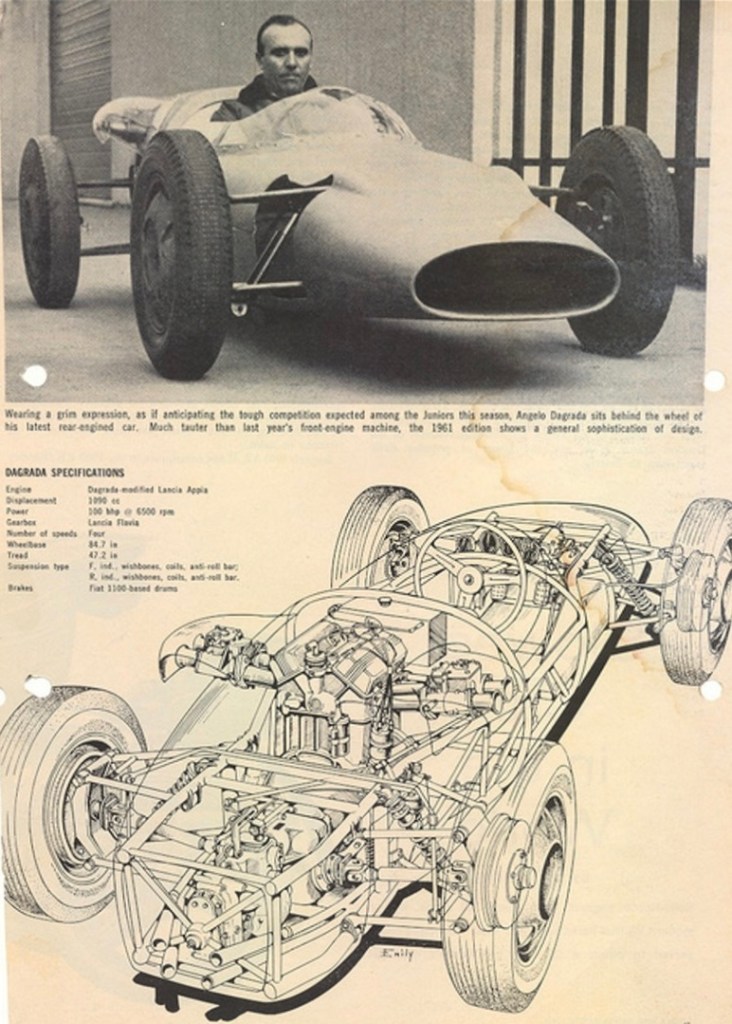
Angelo Dagrada with Franco Bordoni, Scuderia Ambrosiana Dagrada Lancia #001 at Monza in 1959, during the Trofeo Bruno e Fofi Vingorelli meeting. He was 12th in the race won by later Alfa Romeo factory driver, Roberto Businello – this shot and the one below (unattributed)(unattributed)Lancia Appia 1090cc (68x75mm bore/stroke) V4.Monobloc, crankcase and head made of duraluminium, hemispherical combustion chambers, modified crossflow head with two chain operated camshafts in the crankcase, two-overhead valves per cylinder inclined at 67 degrees to each other operated by pushrods and rockers. Two Weber 38DCO3 carburettors, compression ratio 8.75-9:1. Short, counter-weighted crankshaft (velocetoday.com)
The Baghetti’s, owners of a successful Milan foundry were customers. Dagrada aided and abetted teenage would-be-racer Giancarlo Baghetti by modifying the family Alfa 1900, without telling Baghetti senior.
Just as Baghetti started racing Alfas and Abarths, Dagrada concocted a new Formula Junior design for 1959, just as the British mid-engined hordes took over the class.
Always an engine man, Degrada good look at the 1090cc Lancia Appia engine rather than go the Fiat route like most other Italian FJ manufacturers. With a sturdy 10-degree cast-iron V-4, the Appia unit was available and light. The design’s shortcoming was an intricate aluminum head that stymied attempts to make it breathe deeply.
Dagrada’s solution was to substantially redesign the head. By creating new intake and exhaust ports, he achieved a crossflow design which was fed by a Weber 38DCO3 carburettors mounted either side of the block. With carefully calculated tuned-length-exhausts the horsepower gain of the 1090cc (68x75mm bore/stroke) engine was huge, up from 48bhp to circa 95bhp @ 6700-7000rpm.
The gearbox was a modified Lancia Flaminia/Flavia unit. With a simple ladder-frame chassis – the engine was offset to allow the driveshaft to pass alongside the driver – wishbone and coil spring/dampers and adjustable roll bars front and rear, modified Fiat 1100 brakes and an aluminum body reminiscent of a 250F Maserati, the car was ‘the goods’.
All smiles for Giancarlo Baghetti after winning the Vigorelli Trophy at Monza on April 25, 1960 (unattributed)
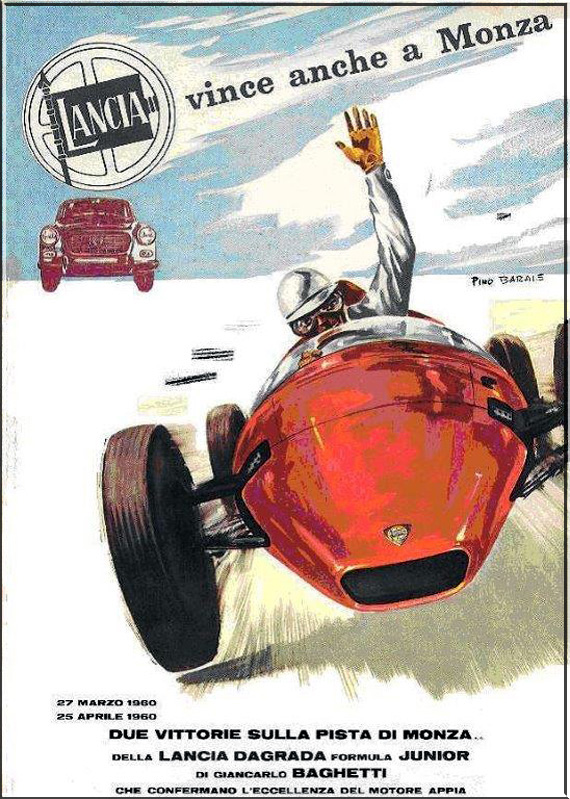
Giancarlo Baghetti demonstrated his burgeoning talent with a new Dagrada doing well in the junior-leagues before winning the more professional Prova Addestrativa on March 27, and Vigorelli Trophy races on April 25, 1960 both at Monza. He was equal fourth in the Italian FJ Championship together with Geki Russo – the title was won by Renato Pirocchi, Stanguellini Fiat. Giorgio Bassi was the other driver who did well in his Dagrada that year. By the spring of 1961 Baghetti was on Enzo Ferrari’s radar with an F1 seat his shortly thereafter.
The British rear-engined revolution started by Cooper and refined by Lotus ensured the days of front engined Formula Junior were nearing their end, one of the sweetest of that breed was the Degrada Lancia…
Angelo’s mid-engined design (below) which followed wasn’t a success, Giorgio Bassi took one race win for the chassis in the Coppa Junior Italian Championship round at Monza on May 13 1962, when the top-Brits were elsewhere…
(Leo Schildkamp)
Etcetera…
The donor of the Dagrada engine. 107,000 Lancia Appia’s were built between 1953 and 1963.
(unattributed)
Dagrada was not the only marque to use the Appia engine, others included Raf, Raineri and Volpini.
(unattributed)
Giorgio Bassi in his mid-engined Scuderia Sant’Ambroeus Degrada Lancia, 22nd during the Preis von Tirol at Innsbruck on October 8, 1961, car #15 is the Andre Rolland Stanguellini Fiat and #7 Bernard’s Foglietti Fiat.
Credits…
‘Emily’-Vladyslav Shapovalenko, velocetoday.com, Leo Schildkamp
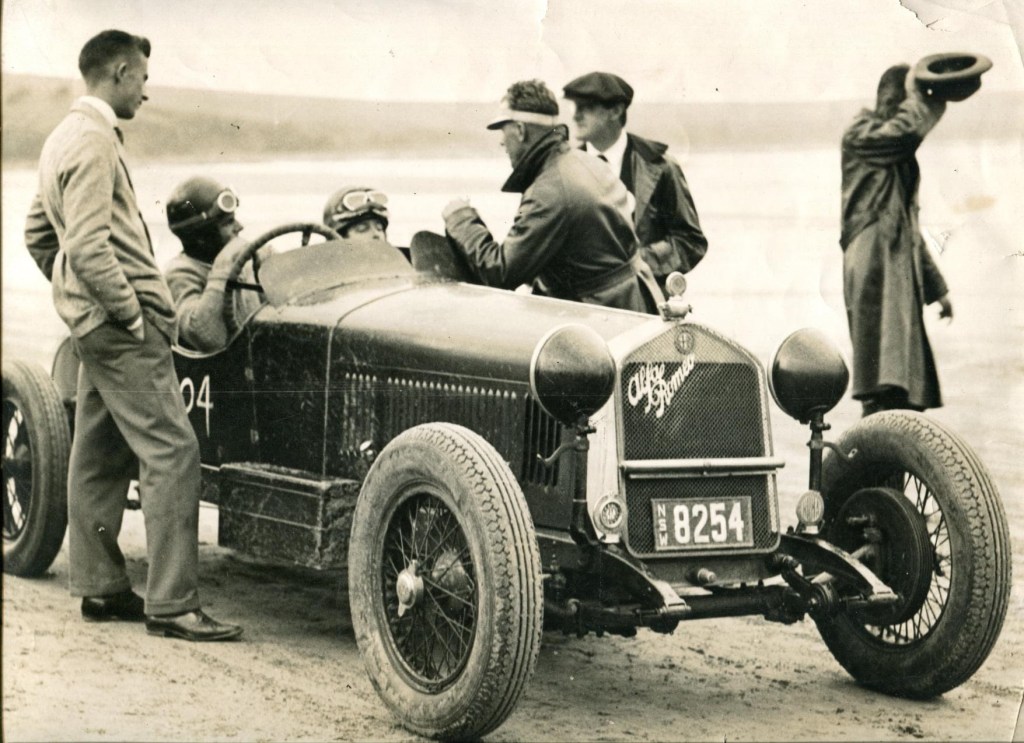
Percy Hunter and Vida Jones – aka Mrs JAS Jones – aboard her Alfa Romeo 6C 1750 SS Zagato on the beach at Gerringong, New South Wales south coast in 1930. Click here for a long feature on this oh-so-famous Oz racing car; https://primotipo.com/2018/02/15/mrs-jas-jones-alfa-6c-1750-ss-zagato/
(Keith Anderson Photography)
Only in Australia…
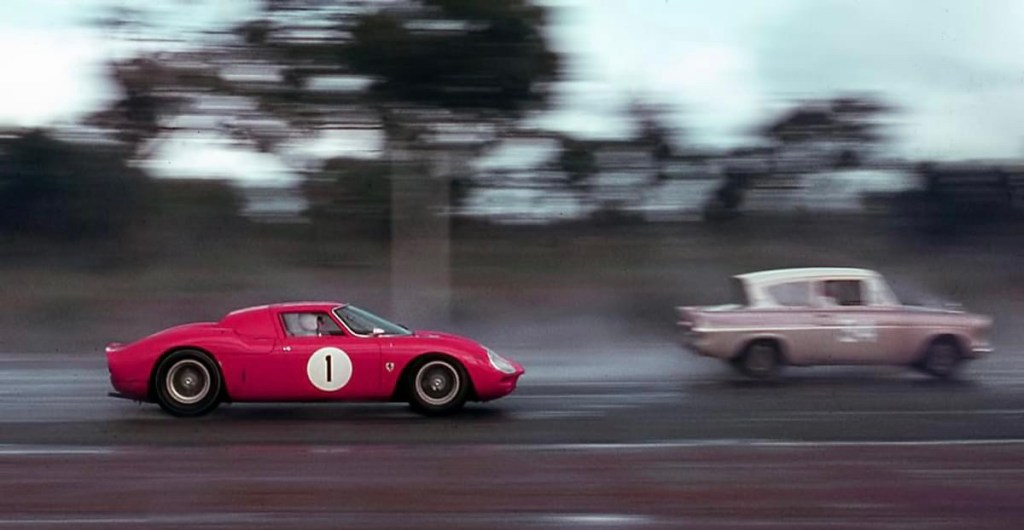
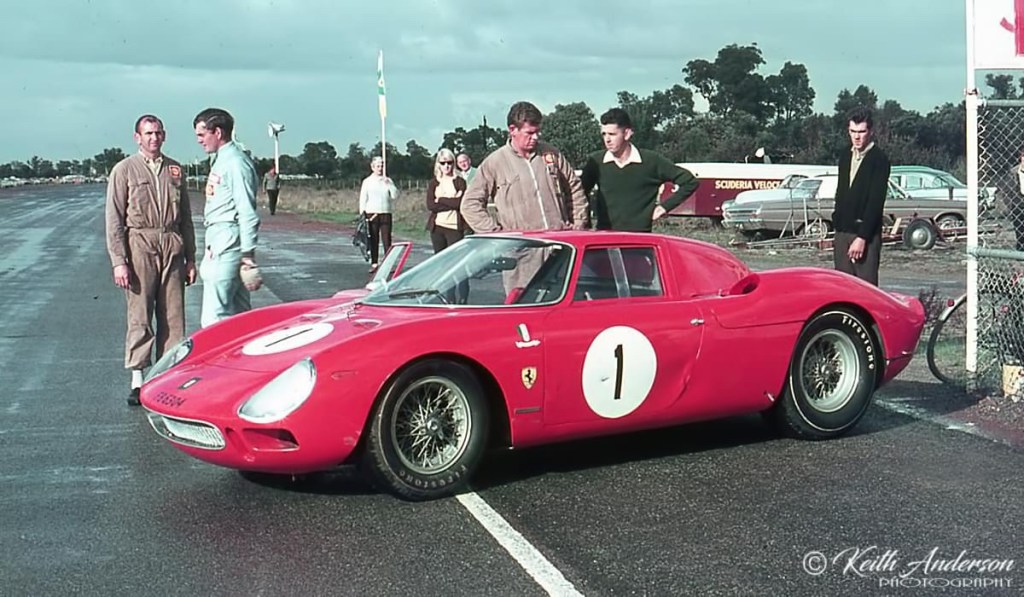
And no, the little Angle-box isn’t blowing off Enzo’s finest, the Andy Buchanan Ferrari 250LM at Caversham during practice for the 1966 6-Hour race.
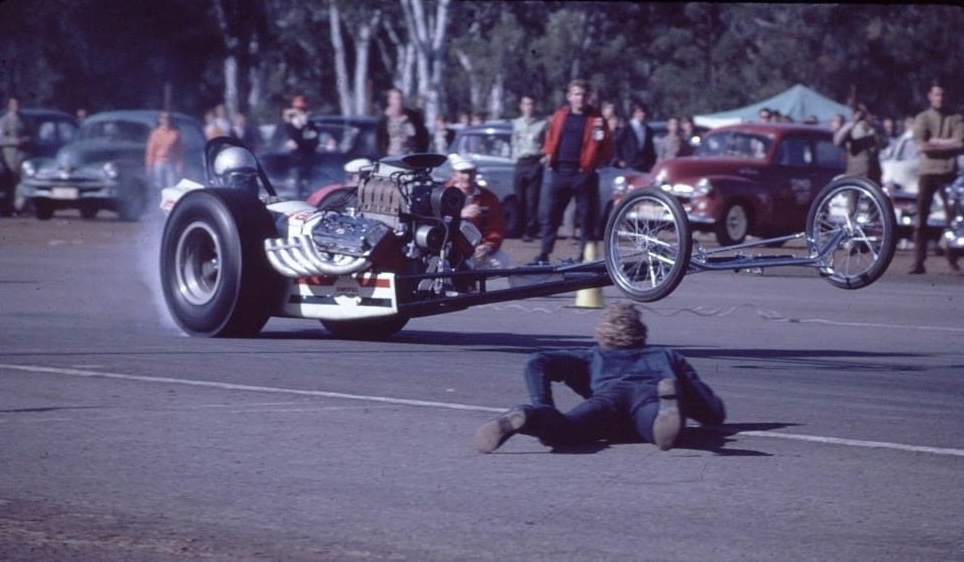
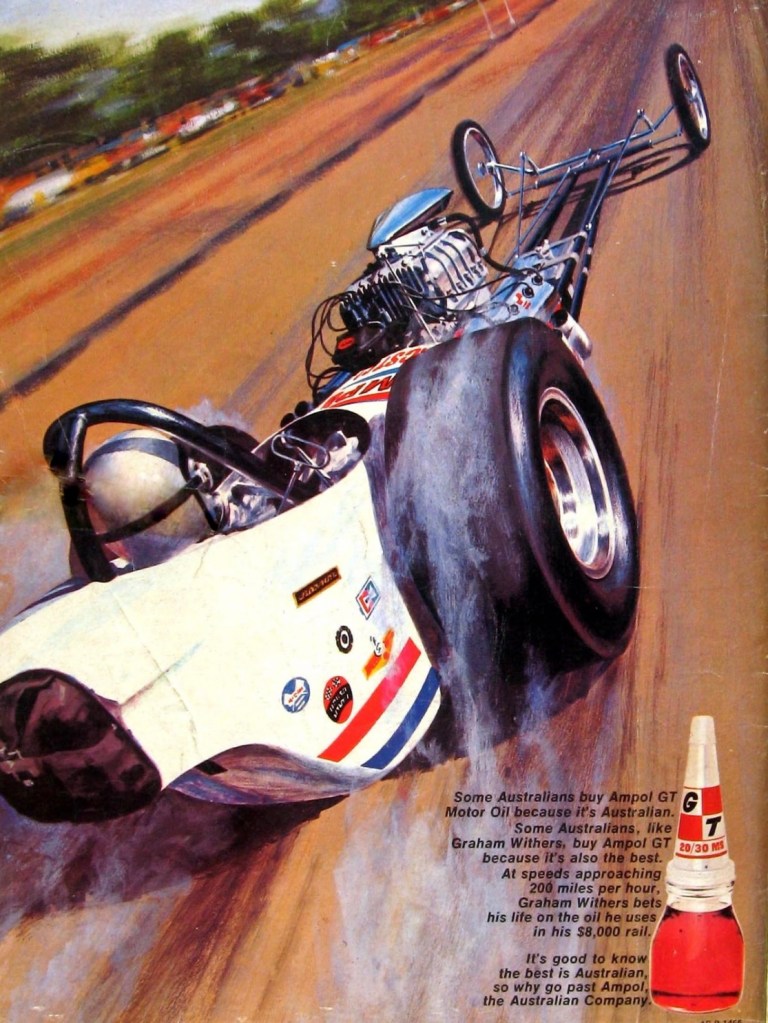
Graham Withers ‘slingshot’ Ampol GT sponsored dragster/rail at Castlereagh in 1968.
Whether the dude with the death-wish is a crew member sussing just how much air Mr Withers is taking on launch, or perhaps been ingesting tablets of a type not dispensed by suburban pharmacists is an interesting question. Do let me know if you can put all of our minds to rest. Manufacturer of the machine folks?
(B Williamson Collection)
Ron Hodgson’s Lotus 11 GT has to be Fugly Car Cup contender.
Here in the Warwick Farm paddock circa 1962. The story of how some lovely sportscars were re-purposed is told in this article about Murray Carter here; Forever Young… | primotipo…
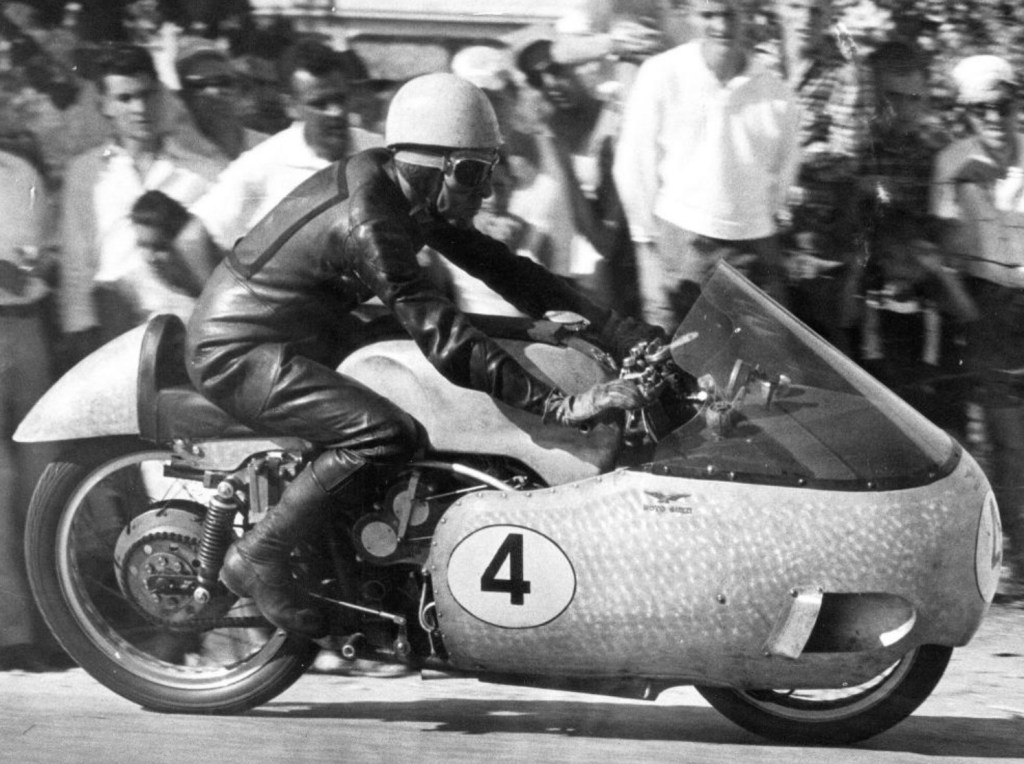
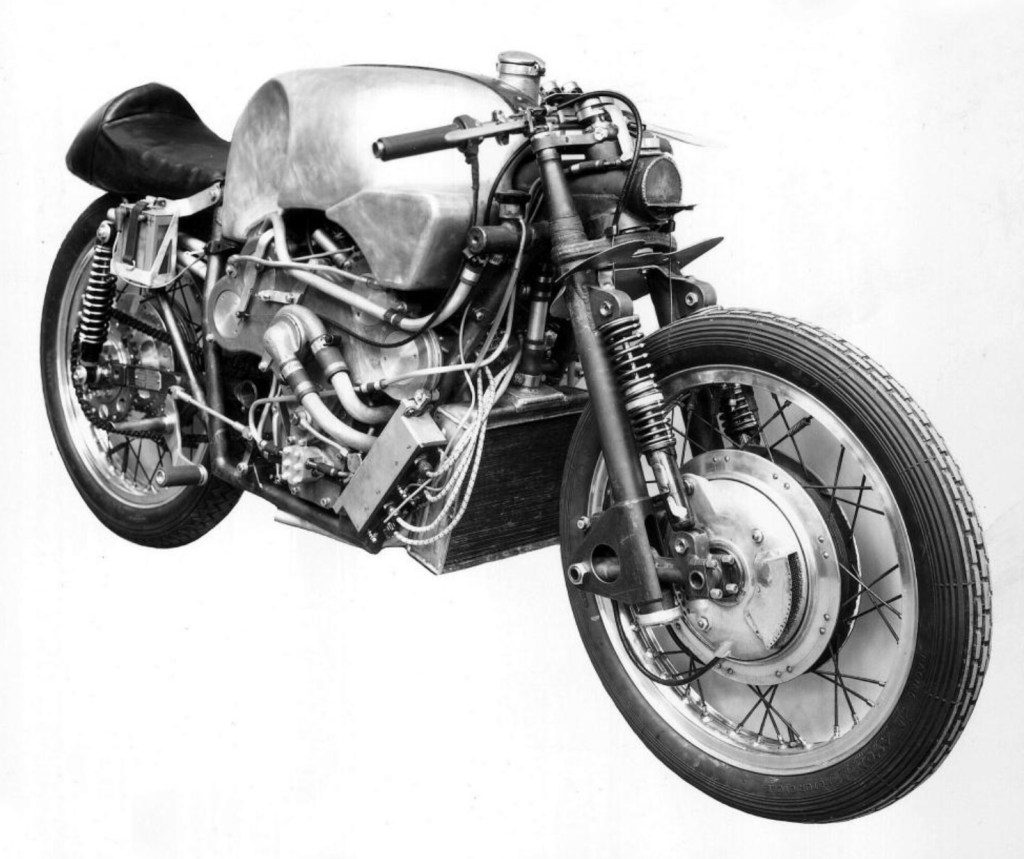
Ken Kavanagh aboard the awesome Moto Guzzi 500 V8 GP machine during the 1956 Senigallia Grand Prix.
This wild machine made its race debut at the Belgian GP in June 1955, read about Kavanagh’s time with Moto Guzzi in this feature; Moto Guzzi… | primotipo…
(Moto Guzzi)(MotorSport)
Dave Walker and Tim Schenken during the 1971 Dutch Grand Prix weekend at Zandvoort.
Walker started the Lotus 56B Pratt & Whitney 4-WD from grid 22 and was looking good for a while in the very soggy conditions but like so much of the grid, missed his braking point – in a car in which he hadn’t done a huge number of laps – and ran off the track after completing only five laps. Quickie on DW here; https://primotipo.com/2022/01/05/walkin-on-water/
Tim Schenken’s Brabham BT33 Ford was a more competitive mount. In its second year – Brabham won the South African GP in one in 1970, and should have won two or three more – it was still competitive in the young Melburnian’s hands, third place at the Osterreichring was his best result of the year.
At Zandvoort he started from grid 19 but DNF with suspension failure in the race won by Regenmeister Jacky Ickx’ Ferrari 312B2. Short piece on Tim here; https://primotipo.com/2019/01/02/tim-schenken/
(MotorSport)(Reg Hunt Collection)
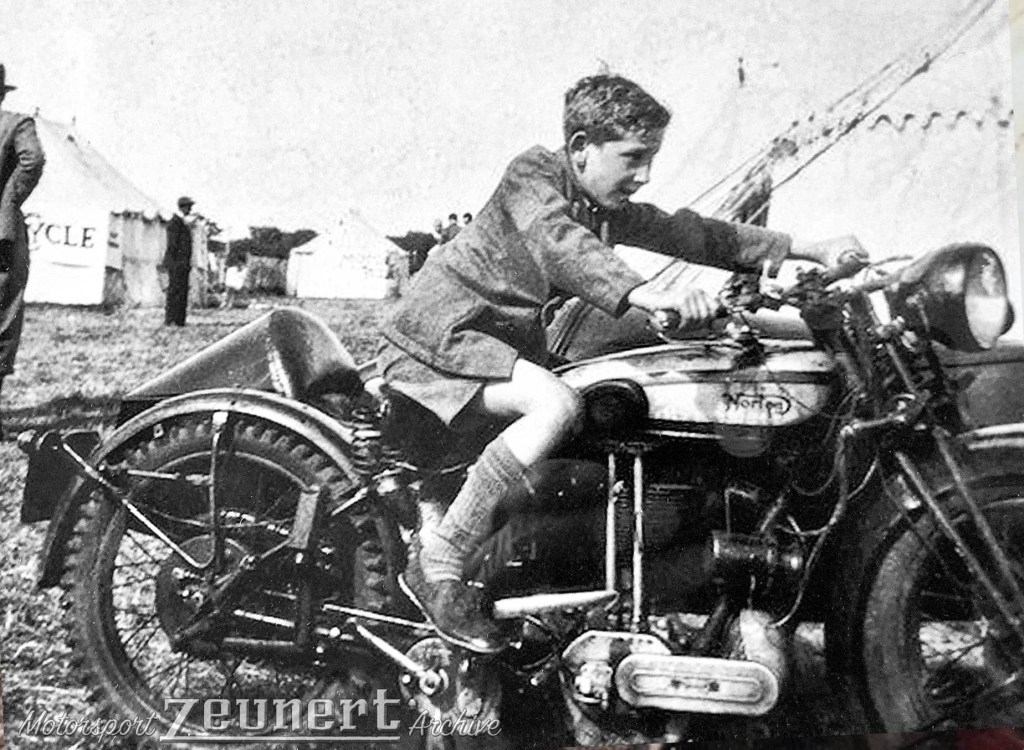
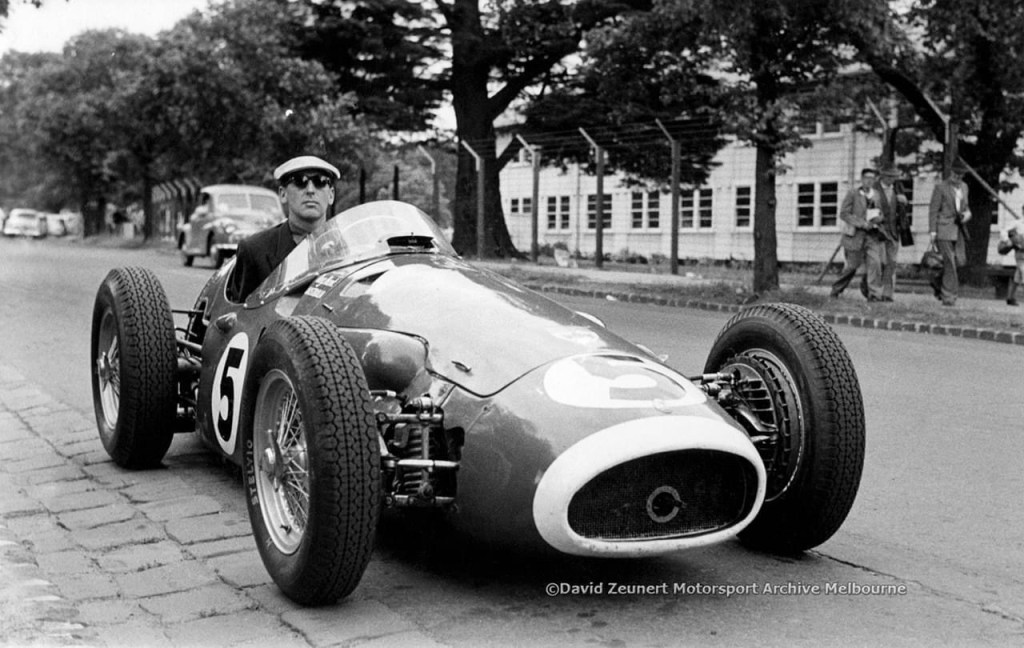
Reg Hunt dreaming about future conquests on one of his parents Nortons, aged nine, in the early 1930s in the UK, and living the dream at Albert Park in 1956 aboard his Maserati 250F below.
He and his A6GCM and 250F were Australia’s fastest combinations in 1955-56, then he retired early to focus on his family and motor dealerships, amassing a fortune. See more about Reg here; https://primotipo.com/2017/12/12/hunts-gp-maser-a6gcm-2038/
(Reg Hunt Collection)(P Miller)
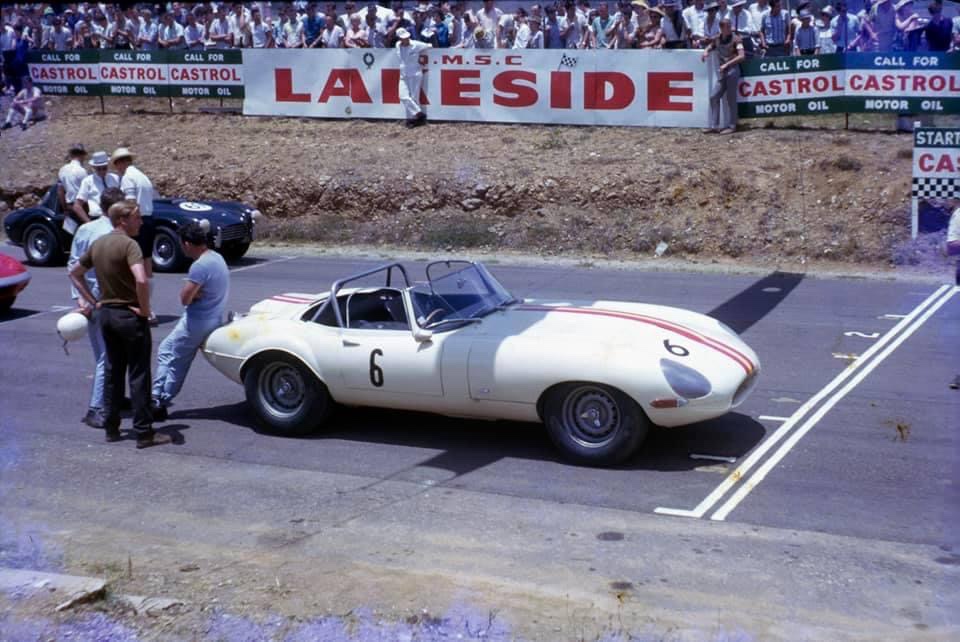
Bob Jane relaxes on his Jaguar E-Type Lwt during the Australian Tourist Trophy meeting at Lakeside over the November 14, 1965 weekend.
This is a heat or support race, Bob was fourth in the ATT, while Ron Thorp – it’s his AC Cobra you can see – didn’t start. Pete Geoghegan won from Greg Cusack and Spencer Martin: Lotus 23B Ford, Lotus 23 Ford and Ferrari 250LM.
The dude in the brown shirt is longtime Bob Jane Racing chief mechanic/team manger John Sawyer, no idea who the driver is, the tiny splash of red is Bill Gates’ Lotus Elan. Jane usually raced this darlin’ of a Jag with its factory hardtop but wasn’t averse to running topless on hot days. Click here for a feature on the car; Perk and Pert… | primotipo…
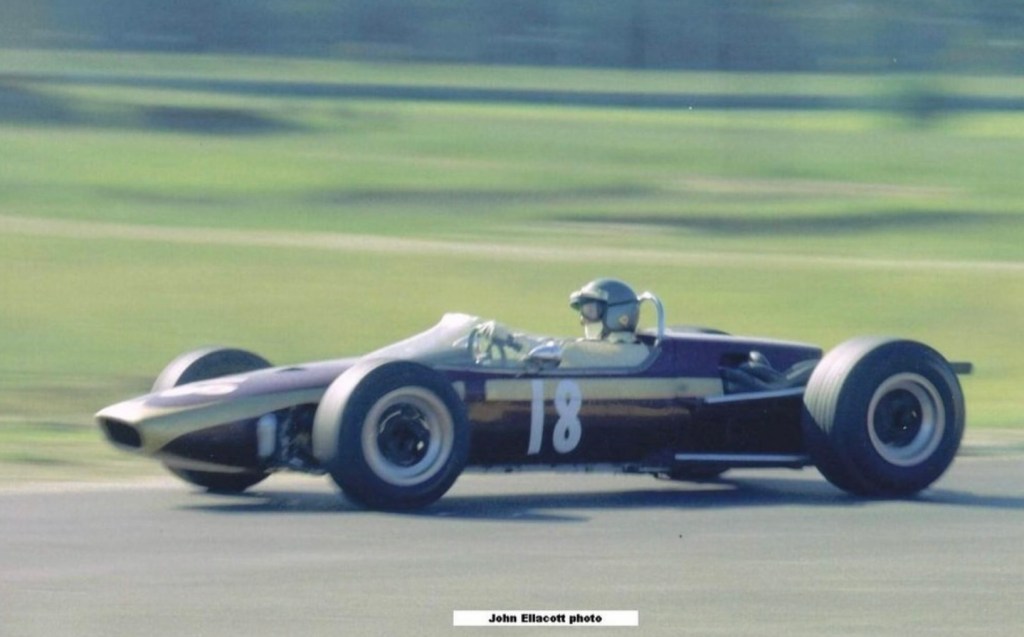
Piers Courage on the hop during the Warwick Farm 100 Tasman Cup round in January 1968.
Giving away a bit of horsepower at old-Sandown, a power track. Piers pitches his McLaren into Peters Corner with the Richard Attwood BRM P126 V12 , and, I think, Kevin Bartlett’s Brabham BT11A Climax behind. This fabulous race had an amazing dice between Jim Clark’s Lotus 49 Ford DFW and Chris Amon’s Ferrari 246T, resolved by a smidge in favour of the Scot. It was his last race, and series win.
(D Simpson)
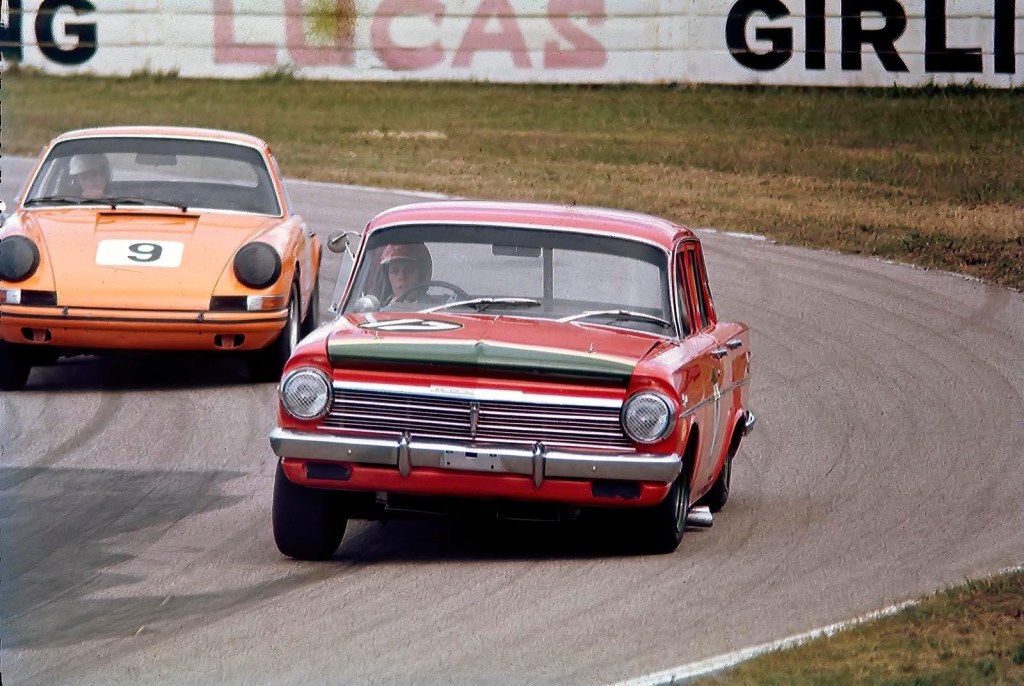
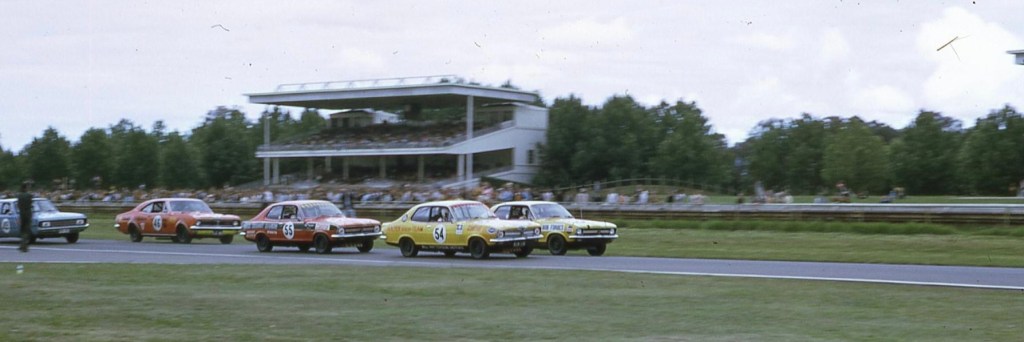
This is the Queensland Touring Car Championship meeting at Surfers Paradise in August 1969, a round of the Australian Touring Car Championship. Dick Johnson’s EH Holden in front of Alan Hamilton’s Porsche 911
Norm Beechey’s Holden Monaro GTS327 won – taking the first ever ATCC win for a Holden – with Hamilton second and Jim McKeown third in a Lotus Cortina Mk2.
Dick Simpson recalled a funny moment related to his photo. “A couple of laps after that shot, as the EH was entering Lucas Corner, there was an almighty bang, a massive cloud of blue smoke and black engine oil and a number of red bits of metal pouring out of the engine right on the apex of the corner. The noise stopped and the EH silently trundled on around Repco Hill and disappeared.”
“We had a flag post right beside us and had been chatting with one of the flaggies who was most impressed that we were keen enough, or stupid enough to drive all night from Wollongong. So he said he had to go and clean up the mess and would we like a couple of souvenirs? He brought up a couple of bits of steel, one looked like a huge main-bearing cap and plonked them on top of the fencepost to cool off. About an hour later a young kid who looked a lot like the EH driver came along and demanded his bits back. So we had a quick chat with a young DJ!”
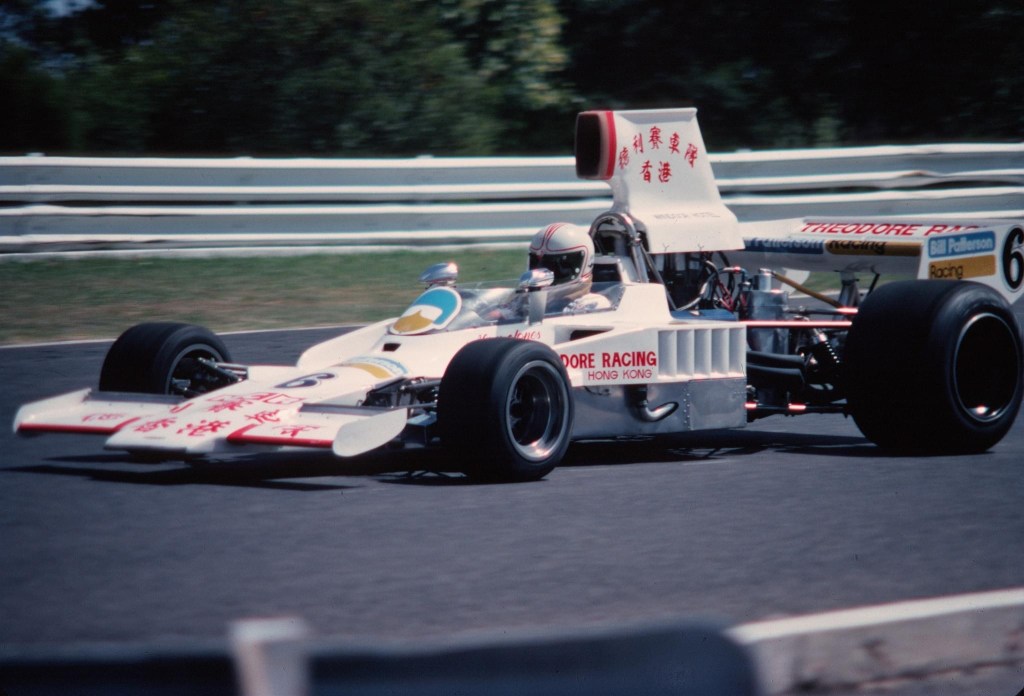
Alan Jones was stunningly quick in Sid Taylor/Teddy Yip Lola T332 Chevs during Australia’s 1977 Rothmans International F5000 Series.
While Warwick Brown won it in his Racing Team VDS Lola T430 Chev, Jones was the series-ace, let down by mechanical dramas and a mistake or two of his own; a jumped start at Oran Park and writing off a car in practice at Surfers Paradise.
(R Steffanoni)
Here at Sandown he grabbed the lead from the start but retired with overheating. He won the fourth, final round at Adelaide International at the start of a year in which he won his first F1 Grand Prix aboard a Shadow DN8 Ford at the Osterreichring (below).
(LAT)(I Smith)
Amazing Ian Smith pan of Allan Moffat in his legendary Trans-Am Mustang at Oran Park during the final round of the Australian Touring Car Championship on August 8, 1972.
Steve Snuggs tells us that he was wearing an oxygen mask in protest to CAMS not allowing him to remove the car’s carpets which smouldered from the hot exhausts and gave off fumes.
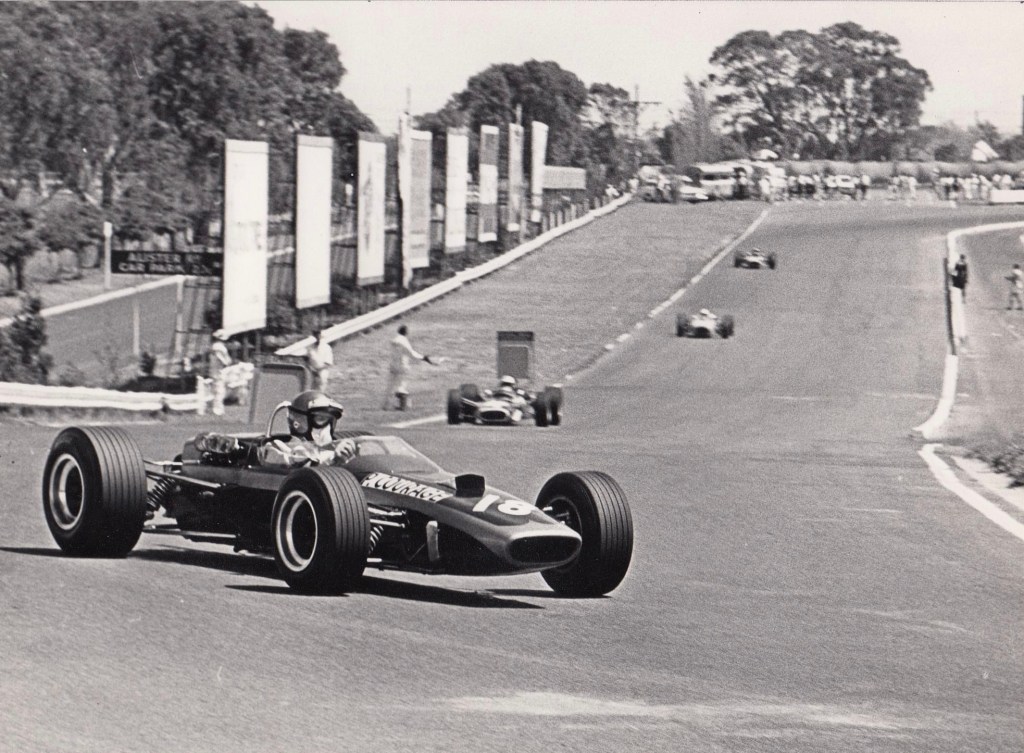
Incredibly rare colour shot of Pedro Rodriguez’ works-BRM P261 2.1-litre V8 during the 1968 Longford Trophy.
He is on the rise having exited the Newry right-hander in second or third gear – that line of poplars and road is still there – before an open left-kink then onto The Flying Mile.
Pedro nicked second-place from Frank Gardner’s Brabham BT23D Alfa in the final lap but fell well short of Piers Courage McLaren M4A Ford FVA F2 car in demanding wet conditions. More about BRM in the Antipodes here; https://primotipo.com/2020/02/22/1966-australian-grand-prix-lakeside/
(I Smith)
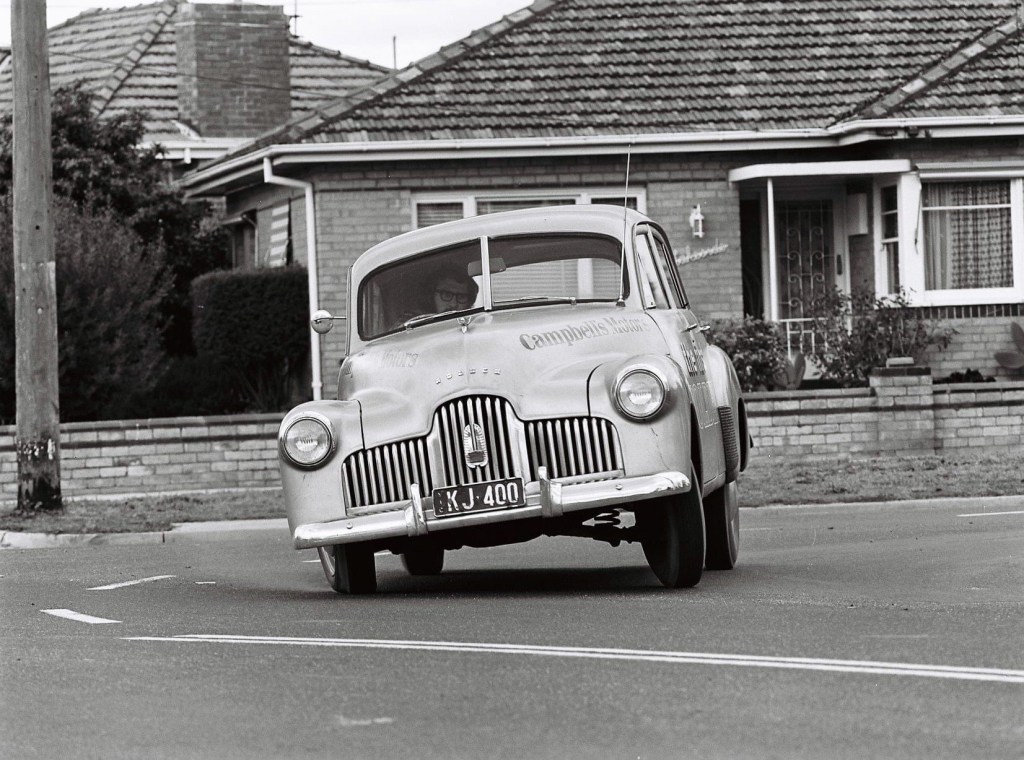
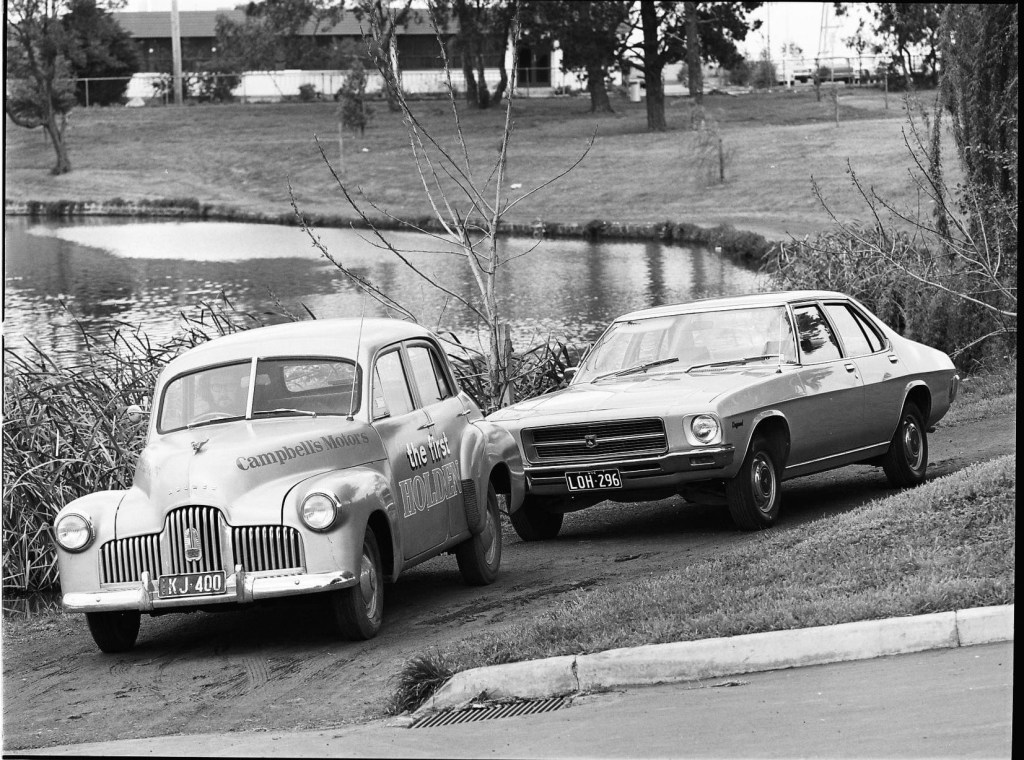
The great Ian Smith is sharing his back-catalogue of photographs in great dollops via Facebook. I enjoyed this series of shots taken in Reservoir, suburban Melbourne during a compare and contrast Wheels road-test between the then new Holden Kingswood HQ, and the original 1948 Holden 48-215 circa 1972.
(I Smith)
The reason for the strange location is probably because Campbells Motors Holden were in High Street, Preston and they didn’t want their luvverly old-Humpy being taken too far from ‘home’. See here for a piece on the 48-215; https://primotipo.com/2018/12/06/general-motors-holden-formative/ The locale is Edwards Park Lake, Reservoir.
(I Smith)(Mitsubishi)
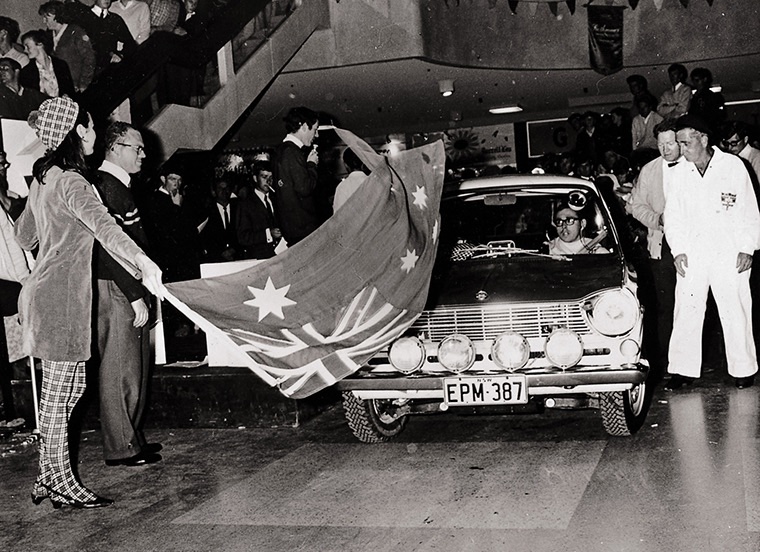
The giant-killing Colin Bond/Brian Hope, fourth place overall Mitsubishi Colt 1000F at the end of the 1967 Southern Cross Rally at Port Macquarie.
Michael Gasking Collection, Keith Anderson Photography, Bob Williamson Collection, oldracephotos.com-Dick Simpson, Moto Guzzi, Reg Hunt Collection via David Zeunert, Peter Jones, Peter Miller, Rod Steffanoni, Bill Forsyth, Ian Smith, IC Walker Collection via Russell Garth
Tailpiece…
(oldracephotos.com/DSimpson)
Dick Simpson’s artistry catches Niel Allen on the hop in Garrie Cooper’s first monocoque sportscar, the Elfin ME5 Chev on the entry to Homestead corner at Warwick Farm in 1969. It was a twitchy beast of a thing with its short-wheelbase, arguably, only Niel got the best out of it in the short time he owned it before buying a McLaren M10B Chev F5000.
The Grand Prix cinematographer doesn’t seem the least bit perturbed by the immediate proximity of Daniel Sexton Gurney at Spa during the 1966 Belgian Grand Prix in the pouring Ardennes rain. There is a haybale or two there after all.
I guess Dan is past the critical – for the ‘snapper’s life – turn-in phase of the corner and he is only (sic) delicately balancing the Eagle Mk1 Climax 2.7 FPF on the throttle through Eau Rouge. Still, it was really dumb-shit like this that makes the film so great.
Gurney qualified 15th and wasn’t classified in this interim car, he was awaiting Weslake Engineering’s delivery of the Eagle-Weslake V12 motor to create a true contender, John Surtees’ Ferrari 312 won. See here; https://primotipo.com/2019/02/19/eagle-mk1-climax-101/
(Wfooshee)(unattributed – who took the shot?)
He came, he saw and he conquered with mesmeric car control in the 1969 Warwick Farm 100 Tasman Cup round. Jochen Rindt Lotus 49B Ford DFW 2.5 V8.
If he wasn’t recognised as the fastest man alive at the start of the season, most pundits saw it that way by the end of it. Fastest I said, not best. See here; https://primotipo.com/2018/01/19/rindt-tasman-random/
Sydney enthusiast/photographer/journalist Peter Bakalor posted these evocative photographs of the 1970 and 1971 Australian Grands Prix on social media in recent days. He covered the meetings for Autosport magazine.
Frank Matich won the November 22, 1970 event in his newish McLaren M10B Repco-Holden F5000 machine from Niel Allen’s similar Chev engined McLaren, and Graeme Lawrence’s 1969-70 Tasman Cup winning Ferrari Dino 246T 2.4-litre V6. The first shot is, I suspect, FM getting the jump on Lawrence at the start, the other car in shot that of Allen’s McLaren M10B Chev.
The two Alec Mildren Yellow cars are #6, Max Stewart’s tenth place Mildren Waggott TC-4V and Kevin Bartlett’s Mildren Chev- DNF. You can see KB beside his car – with Glenn Abbey alongside – and Leo Geoghegan with the Castrol patch on his overalls. #2 is Allen’s M10B Chev with Niel getting last minute instructions from Peter Molloy at right, they were second. 1970 Gold Star champion, Geoghegan’s immaculate white Lotus is next, he was fourth. Up the back is Ian Fergusson’s green Bowin P3A Ford twin-cam 1.6, 11th.
(P Bakalor)
Frank Matich before the off. It was the first big-win for the Repco-Holden F5000 program based on the then new locally built General Motors Holden 308 V8. Derek Kneller is looking hopefully at the engine!, with ace mechanic, handy-steerer and Adams F5000 constructor Graeme ‘Lugsy’ Adams with his arms crossed. In the distance is Len Goodwin’s Pat Burke Racing McLaren M4A Ford FVC, this ex-Piers Courage/Niel Allen car is about to pitch Warwick Brown to prominence. The shot below is post-win with The Australian motoring editor, Mike Kable in the blue jacket behind.
(P Bakalor)(P Bakalor)
Lynton Hemer identifies this shot as the start of the Series Production event with Colin Bond, #54 Holden Torana GTR XU-1, then Bob Forbes and Don Holland in similar cars, John Harvey in Bob Jane’s Holden Monaro GTS 350 and Leo Geoghegan’s Valiant Pacer.
(P Bakalor)
In the Improved Touring race Jim McKeown’s Porsche 911S gets the jump from Brian Foley’s similar car, Allan Moffat’s Ford Mustang Trans-Am, with Pete Geoghegan’s white Mustang also just in sight.
Twelve months later, the AGP was again held at the Farm, with the star attraction John Surtees appearance (below) at the wheel of one of his own cars, a Surtees TS8 Chev F5000 car that Mike Hailwood would race in the 1972 Tasman Cup.
(P Bakalor)
The TS8 was Surtees 1971 F5000 design based heavily on the 1970 TS7 F1 car. Eight were built, with the monocoque chassis, wheels, suspension and brakes all using TS7 jigs/patterns. Mike Hailwood did the best of the drivers with his car(s) in Europe, only persistent engine problems perhaps getting in the way of the European title won instead by Frank Gardner’s Lolas: T192 and T300. For more details on the cars click here; https://www.oldracingcars.com/surtees/ts8/
(P Bakalor)(P Bakalor)
Matich again won the AGP, this time in a car of his own design and construction. The Matich A50 Repco-Holden was only days old when it took its debut win! Kevin Bartlett was second and Alan Hamilton third, both in ex-Allen McLaren M10B Chevs. Graeme Lawrence was fourth in a Brabham BT30 Ford FVC 1.8 and Max Stewart – who had just won the Gold star – was fifth in his Mildren Waggott TC-4V. Surtees was 14th after two pitstops for punctures in his first visit to Australia since contesting the NZ and Australian Internationals with a Lola Mk4 Climax in 1963.
(P Bakalor)
Nose jobs. Surtees TS8, Ian Cook, Devione LC2 Ford twin-cam, Alan Hamilton’s McLaren M10B Chev then the orange nose of Warwick Brown’s McLaren M4A Ford FVC, then two Elfin 600B/E Ford twin-cams: Clive Millis’ light yellow one at left and Henk Woelders’ white with blue stripe car on the right.
Credits…
Peter Bakalor, Bob Williamson’s ‘Old Motor Racing Photographs – Australia’ on Facebook, oldracingcars.com
Tailpieces…
(P Bakalor)
Graham McRae telling John Smailes how it is in the Warwick Farm paddock during the 1971 Tasman, McLaren M10B Chev. He must be reporting for the ABC with a suit on!
He had a blinder of a series, winning three of the seven rounds, but not here where Frank Gardner’s works-Lola T192 Chev prevailed. It was the first of three Tasmans on the trot for the oh-so-talented Kiwi driver/engineer.
P Bakalor)
Equipe Allen in natty, matching team attire! A steamy Sydney 1971 Tasman qualifying day with safety boots well to the fore. Peter Molloy and M10B front and centre. Love the nifty Bell bag.
Niel won two of the seven Tasman rounds at Levin and Teretonga, and finished third overall behind McRae and Matich. With a little more luck in Australia he could have won, but he retired from racing instead.
The crowd had plenty to cheer about. Bandini’s Ferrari had just won the 1964 Austrian GP and John Surtees took victory before their eyes on the way to his and the Scuderia’s 1964 World Championships. Italian Grand Prix, Monza September 6 1964…
In a thrilling race with slipstreaming battles down the field for which the circuit was famous, Surtees won in his Ferrari 158 from Bruce Mclaren’s Cooper T73 Climax and Bandini’s 158.
(unattributed)
John Surtees and Dan Gurney diced for much of the race until the Climax engine in his Brabham BT7 cried enough. Gurney had a few of these occasions when on the cusp of a win during his Brabham years.
(The Cahier Archive)
The business end of Lorenzo Bandini’s Ferrari 158 during practice.
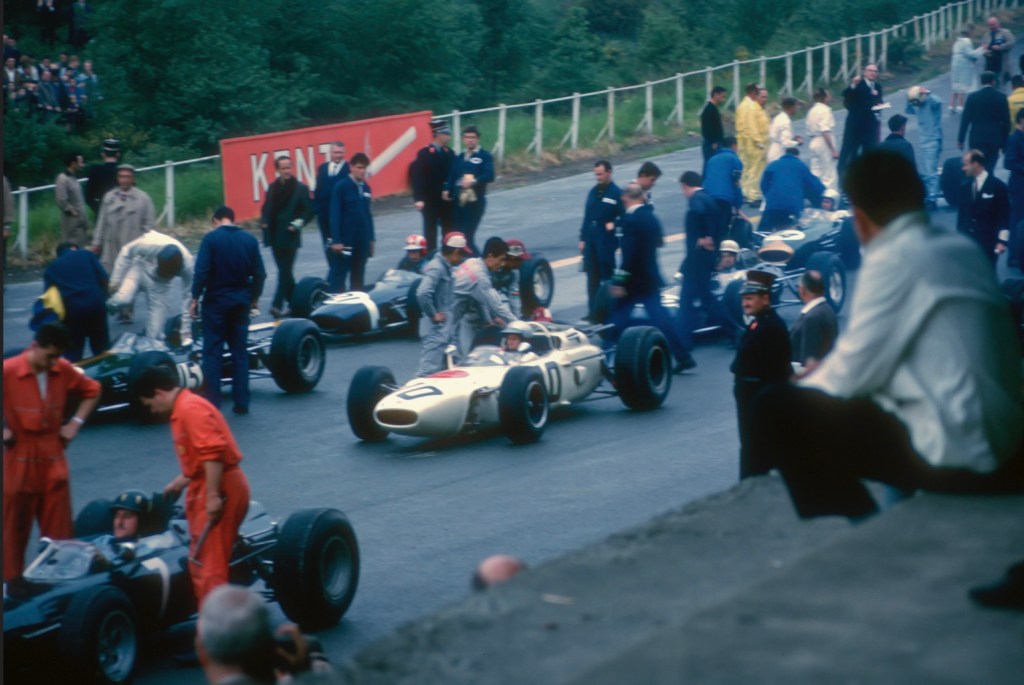
I just love pit or startline just-before-the-off shots. You can feel the tension, excitement and driver’s surge of adrenalin just before they pop their butts into the cockpits of their chariots. Here it’s the Belgian Grand Prix, Spa 1965.
Our black-snapper in some ways ruins the shot but he gives it intimacy and immediacy as well. The front row from left to right are Jackie Stewart, Jim Clark and a very obscured Graham Hill; BRM P261 by two and Lotus 33 Climax.
(wfooshee)
The only fellas I recognise are Messrs Stewart, Clark, Chapman and Hill. Can you do any better? The weather looks a bit grim, but such conditions are common in the Ardennes.
(wfooshee)
It’s a smidge out of focus but let’s not be too hard on our photographer Mr Fwooshee, I’d love to be able to credit him/her/it fully if anyone knows the correct name.
Every time I see a Honda RA271/272 I’m stunned by the audacity of a transversely mounted 1.5-litre V12, six-speed, monocoque chassis design in your first crack at a GP car; RA270 space frame prototype duly noted. Karma was Mr Honda’s originality being rewarded with that Mexican GP win several months hence, here Richie Ginther (RA272) was sixth. Graham Hill is in front, #15 is Dan Gurney’s Brabham BT11 Climax – everybody’s favourite Lanky-Yank is about to insert himself into that little Brabham – and behind him, Jo Siffert’s Rob Walker BT11 BRM. Jo Bonnier, Brabham BT7 Climax is behind the Honda, and further back the redoubtable Bob Anderson in his self-run #24 Brabham BT11 Climax. Brabhams galore, bless-em.
Who is the driver playing with his silver or white peakless helmet? Down the back, top-right there is a glimpse of Jean Stanley getting that tosspot ‘Lord Louis’ Stanley’s cravat nice and straight…
Oh yes, Jim Clark won from Jackie Stewart with Bruce McLaren’s Cooper T77 Climax in third place.
Credits…
fwooshee
(fwooshee)
Tailpiece…
Frank Gardner had an early afternoon, his John Willment Brabham BT11 BRM had ignition problems after completing only four laps. He started from grid slot 18 of 21, the best placed BT11 was the Guvnor’s works-car, Jack Brabham was fourth.



























 primotipo...