Archive for the ‘Obscurities’ Category

(Bennett)

It’s an exciting time for Formula Fordsters in Australia, the fiftieth anniversary of the first FF race in Australia, at Sandown on 25 November 1969, takes place in 2019…

The shot above is of Paul Harrington keeping an eye on a journalist about to have a spin aboard a Bowin P4A at Calder, date and drivers name folks? John Joyce built twelve P4’s, one of which was acquired by Ford for promotional purposes, this car, chassis ‘P4A-108-70’ still exists in the hands of Geoff Fry at Bathurst.

LCCA Sandown program entry for the first FF race in Australia in November 1969 (A Mann)

Harrington came to Australia from the UK in the late sixties and was initially employed as General Manager of the Queens Road, Melbourne based Light Car Club of Australia, well known to Australian enthusiasts as the promoters of Sandown and Lakeland Hillclimb in its latter days and venues such as Albert Park earlier on. Harrington joined Auto Action in 1971, a magazine which exists to this day, although Paul died some years back.

He is at Calder given the role the LCCA had in providing administrative support for the FF category which continued until the clubs demise as a result of the fiscal disasters which occurred due to running two poorly attended World Sportscar Championship races in the mid-eighties. Jon Davison saved the sports bacon by picking up the circuit lease but that central LCCA gathering place and watering hole on the corner of Roy Street and Queens Road for Victorian racing folks has never been replaced.

That first Australian FF race at Sandown on 25 November 1969 was contested by a mix of bespoke FF’s and converted Formula 3 cars. The race was won by Richard Knight’s Bib Stillwell owned Elfin 600 from Murray Coombs’ Lynx and Allan Ould’s Aztec AR8 driven by Bob Minogue- many years later a fast F5000 competitor in the ex-Brown/Hamilton/Costanzo Lola T430 Chev. The Elfin 600 is still about with Allan Ould looking for a Hewland Mk4 or 5 gearbox to complete the Aztec in time for the Sandown fifty year celebration meeting. The Lynx, I’m not so sure about.
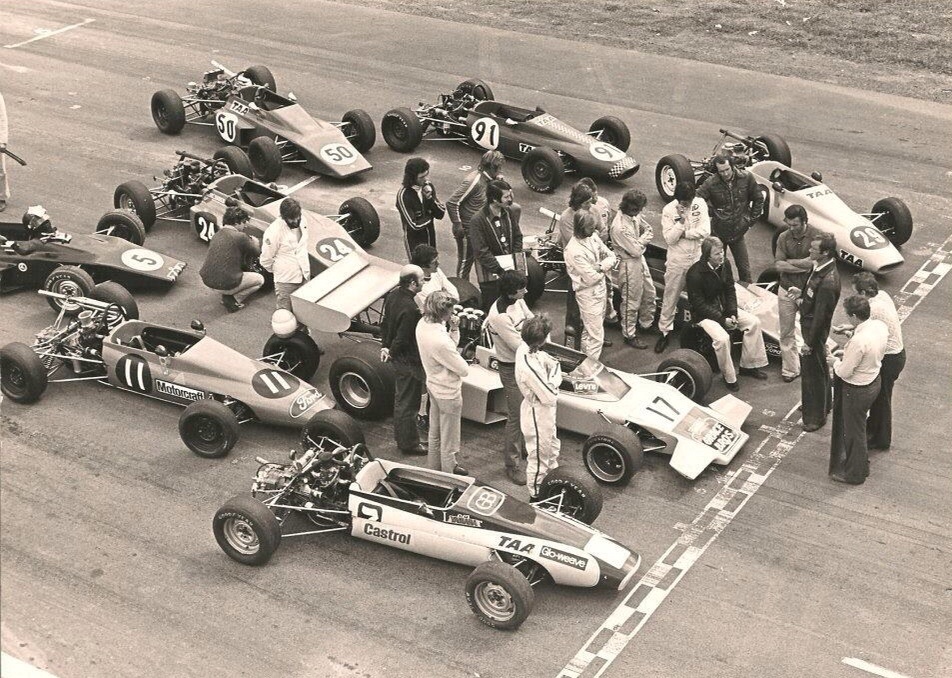
Bowin Clan Meeting in early 1975 at Oran Park: Track day attended by John Joyce on the lectern’s left with John Leffler in dark Grace Bros clobber standing on the start line addressing the troops. Sitting down on the tyre opposite Leffo is Paul Bernasconi, shortly off to Ralt and European F3. Cars are a mix of front radiator P4A’s and chisel nosed P6F’s- front and centre is Leffler’s P8 Chev F5000. The day was reported at length by Barry Lake in Sports Car World magazine- drivers and their fettlers were coached on car preparation, set-up, with on-circuit suspension adjustments made throughout the day inclusive of reasons for the changes recommended (SCW)

When John Joyce- I’ve another article on Bowin half-cooked which provides the background to the marque, returned from his long stint with Lotus in the mid-sixties he initially built three monocoque F2 cars.

These machines designated ‘P3’ (Project 3) were raced initially by Glynn Scott, Ian Fergusson and Barrie Garner. Glynn’s was the first built and was fitted with an ex-Piers Courage Ford FVA engine, Ian’s with a Lotus/Ford twin-cam whilst Barrie’s was a hillclimb machine powered by a Holden ‘Red’ six cylinder motor.

Joyce’s 1959 ‘P1’ and 1962 ‘P2’ were both Formula Juniors- one was Cooper based and the second was named ‘Koala’, both cars raced by John.
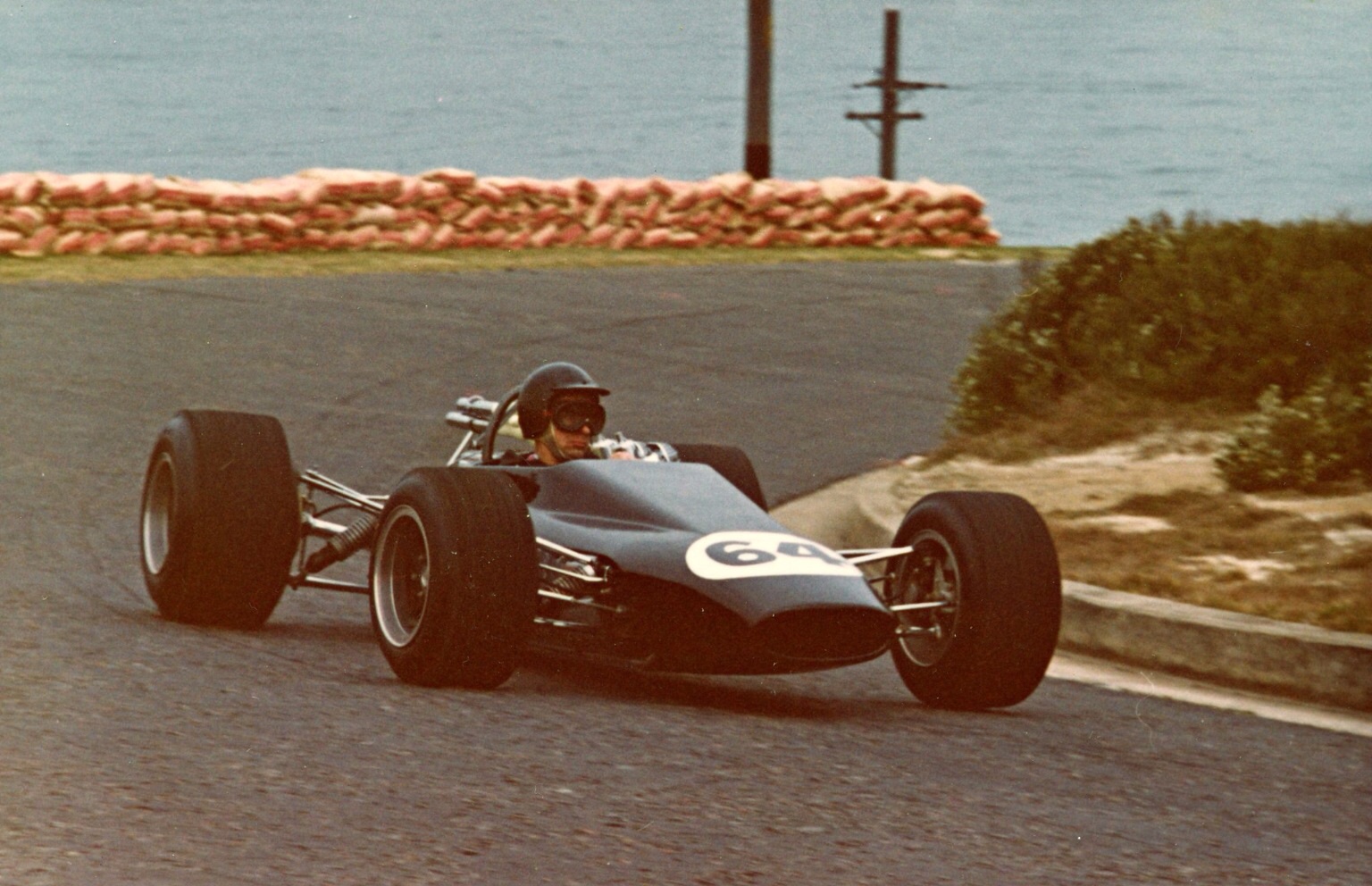
Barrie Garner in his Bowin P3 Holden at King Edward Park Hillclimb, Newcastle, NSW in 1971 (D Harvey)
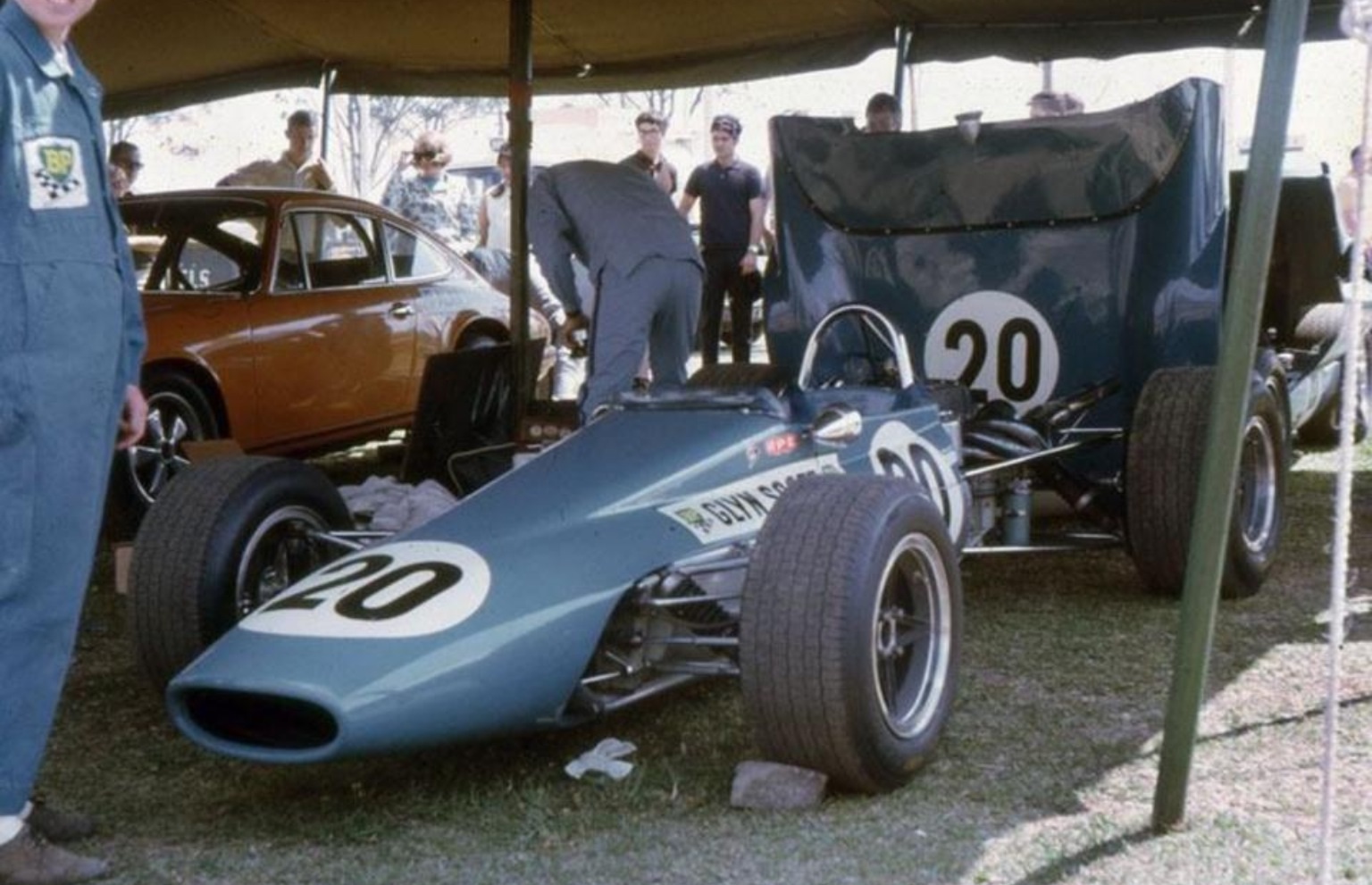
Glynn Scott’s Bowin P3 Ford FVA and Lotus 23B Ford in the Lakeside paddock in October 1968. The 911 T/R is Alan Hamilton’s, just arrived and so impactful in the 1969 ATCC (G Ruckert)

With the advent of FF in Oz, Joycey adapted the P3 design’s conventional upper and lower wishbone and coil spring/shock front- and single top link, inverted lower wishbone and twin radius rod, coil spring/shock rear suspension design to a (mandated) spaceframe chassis to suit FF.

Power was of course the class issue cast iron, four cylinder, Ford 681M, 691M, 2737M- and from 1971 in Australia the 711M 1968/69/70/71 Cortina/Escort/Capri pushrod, OHV, twin-choke Weber fed 105bhp’ish motor. Hewland Mk8 or Mk9 4-speed transaxles completed the key mechanical elements of the package.

Mike Stillwell in Graham North’s Wren- the first FF Wren built by Bill Reynolds, Graham Gilbert’s self built Corsair FF and Brian Beasy’s self built Beasy FF at Calder in 1970. These days, since 1972! Ian Mayberry owns the Wren with the Corsair and Beasy still extant (A Clifford)
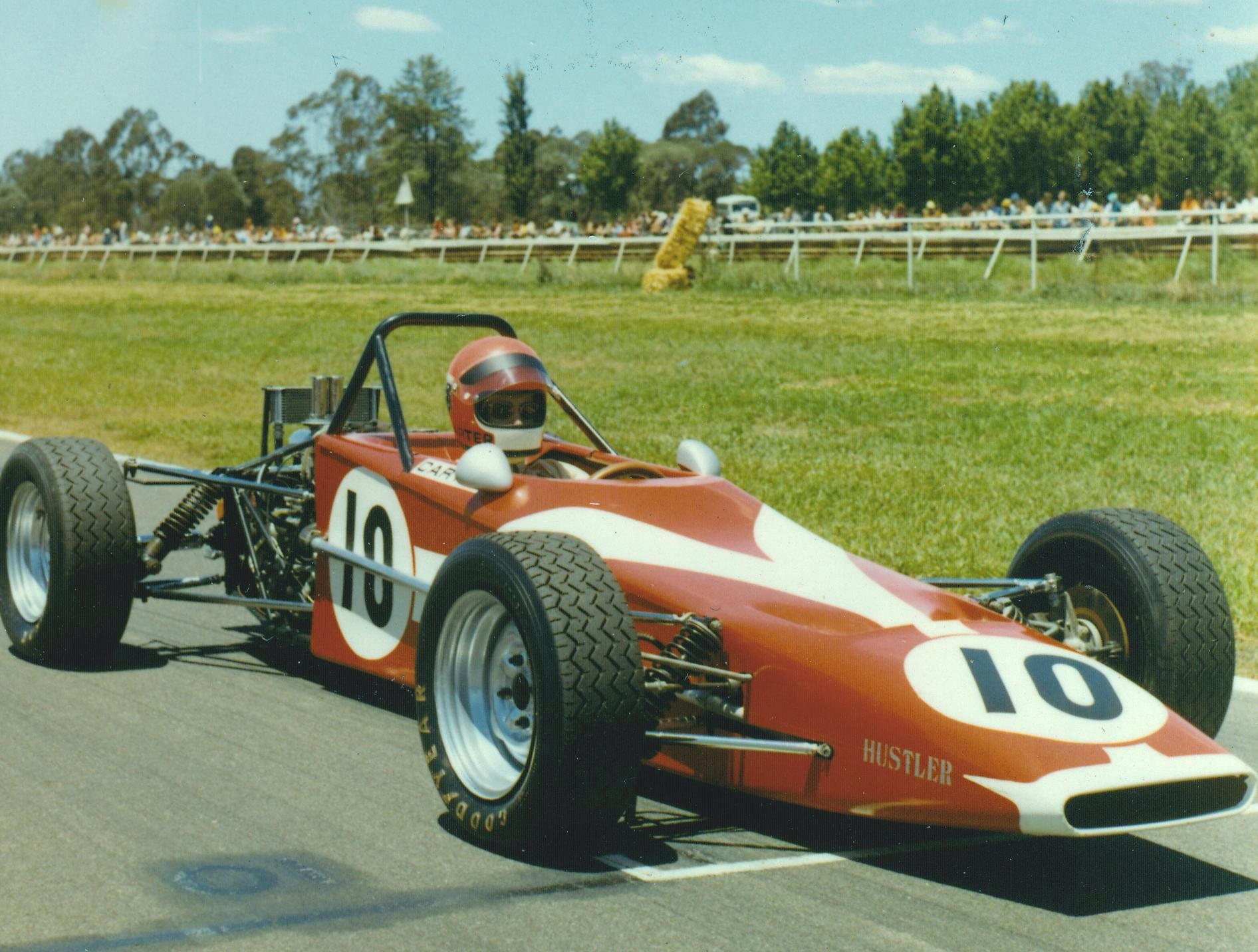
Richard Carter in the Tony Simmons built Hustler FF, Warwick Farm circa 1972. Tyres are Goodyear RR12’s (N McDonald)

One of the neat things about the class in its early Australian days were the number of one or two off cars encouraged by rules which initially excluded foreign designs. So, in those early years Corsair, Aztec, Hustler, Fielding, Beasy, Nota and others chased race wins together with ‘factory’ built Wrens, Bowins, Elfins and a little later Birranas.

The WA built Fielding FF driven by future quick Bob Creasy during the 1971 Warwick Farm Tasman meeting (L Hemer)

Garrie Cooper’s highly adaptable Elfin 600 design (variants of which won in FF, ANF3, ANF2 and ANF1!) ‘dominated’ early on with Richard Knight, who made his name in an Improved Production Cooper S the winner of that first Sandown race in 1969 and victor in the Bib Stillwell owned 600 of the first national FF Championship in 1970.

Knight moved to the UK, racing a ‘Palliser WDF3 FF at the head of the UK/Euro fields against Scheckter et al until funds ran out. After several attempts in other categories including F5000 he set up Richard Knight Cars and became a highly successful Mazda and Lancia dealer in the UK’ wrote FF and Hillclimb ace Peter Finlay.

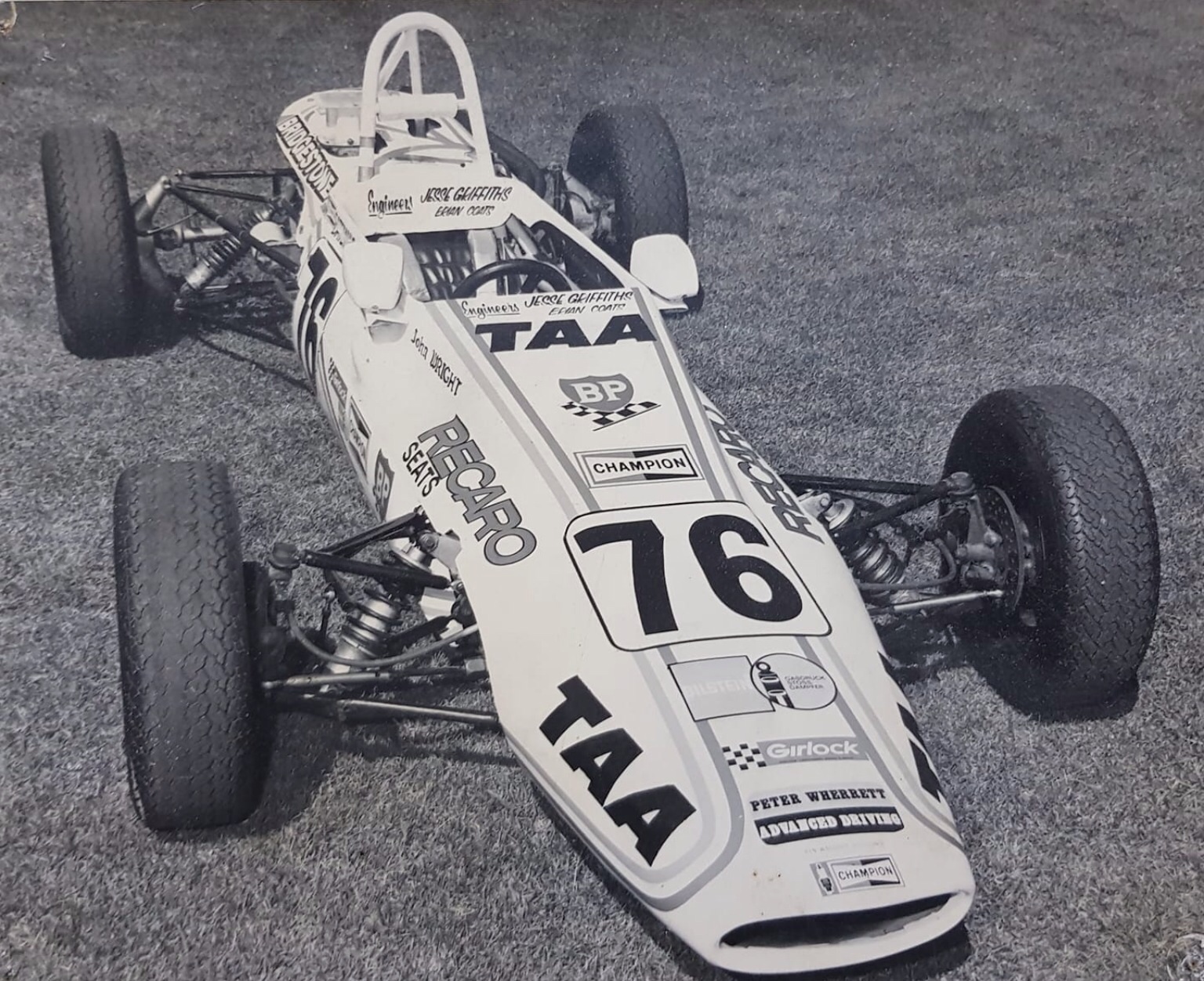
Larry Perkins in another of Bib’s 600’s won the title in 1971 and took his Trans Australia Airlines sponsored ‘Driver to Europe’ prize in late 1972 contesting the inaugural Formula Ford Festival at Snetterton in the first Elfin 620 FF.
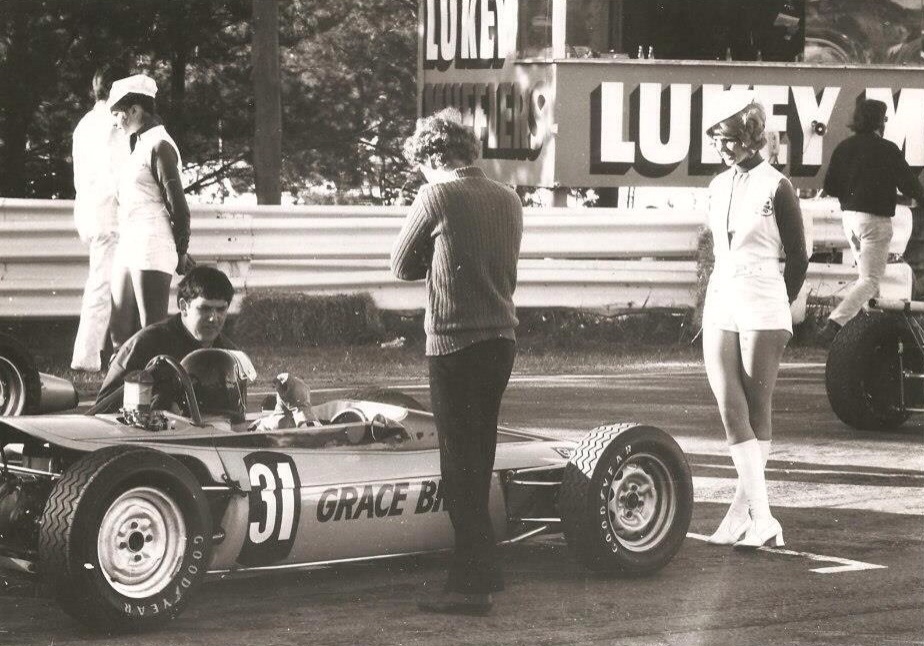
John Leffler in his P4A at Hume Weir in early 1973. TAA (later absorbed into Qantas) were the then government owned domestic airline carrier and provided great support sponsoring the ‘TAA Driver to Europe Series’ for well over a decade, inclusive of providing some ‘hosties’ at some of the rounds. These days from amongst the old gay blokes and boilers you couldn’t put any eye candy on a grid from inside a Qantas cabin…(Bennett)

1972 Bowin P4A DTE champion with his new P6F- the very first one built, chassis ‘P6F-119-72’ alongside Larry Perkins equally new Elfin 620 far, far from home in the Snetterton paddock during the Formula Ford Festival weekend. Rising or progressive rate suspension linkages of the P6 clear. This chassis returned to Oz, and fitted with Hart/Ford twincam, Hewland FT200 box, appropriate wings, wheels, tyres and brakes contested the 1973 ANF2 Championship. Larry stayed in England and did rather well, the 620 came home (Bennett)

Fellow Aussies John Leffler and Bob Skelton also made the trip and raced Bowin P4A and brand new P6F respectively. I wonder how Skello would have gone had he raced the known quantity P4A in England in which he won the 1972 DTE rather than the radical, chisel shaped, side radiator, rising-rate suspended and ultimately very successful P6F?

Leffler and Skelton finished fourth in their respective heats but did not make the final in which Perkins was third behind Ian Taylor and Derek Lawrence. Aussies Buzz Buzaglo ran in third early and then faded when his distributor shifted and Peter Finlay was tenth in his Palliser in a field which included later F1 drivers Danny Sullivan, Patrick Neve and Tiff Needell in addition to Larry.

Skelton, Leffler (who won the 1973 DTE title in a P6F) Bob Beasley and speedway star Garry Rush- who Joyce rated very highly in a conversation I had with him in the early nineties, were early very fast P4 exponents.
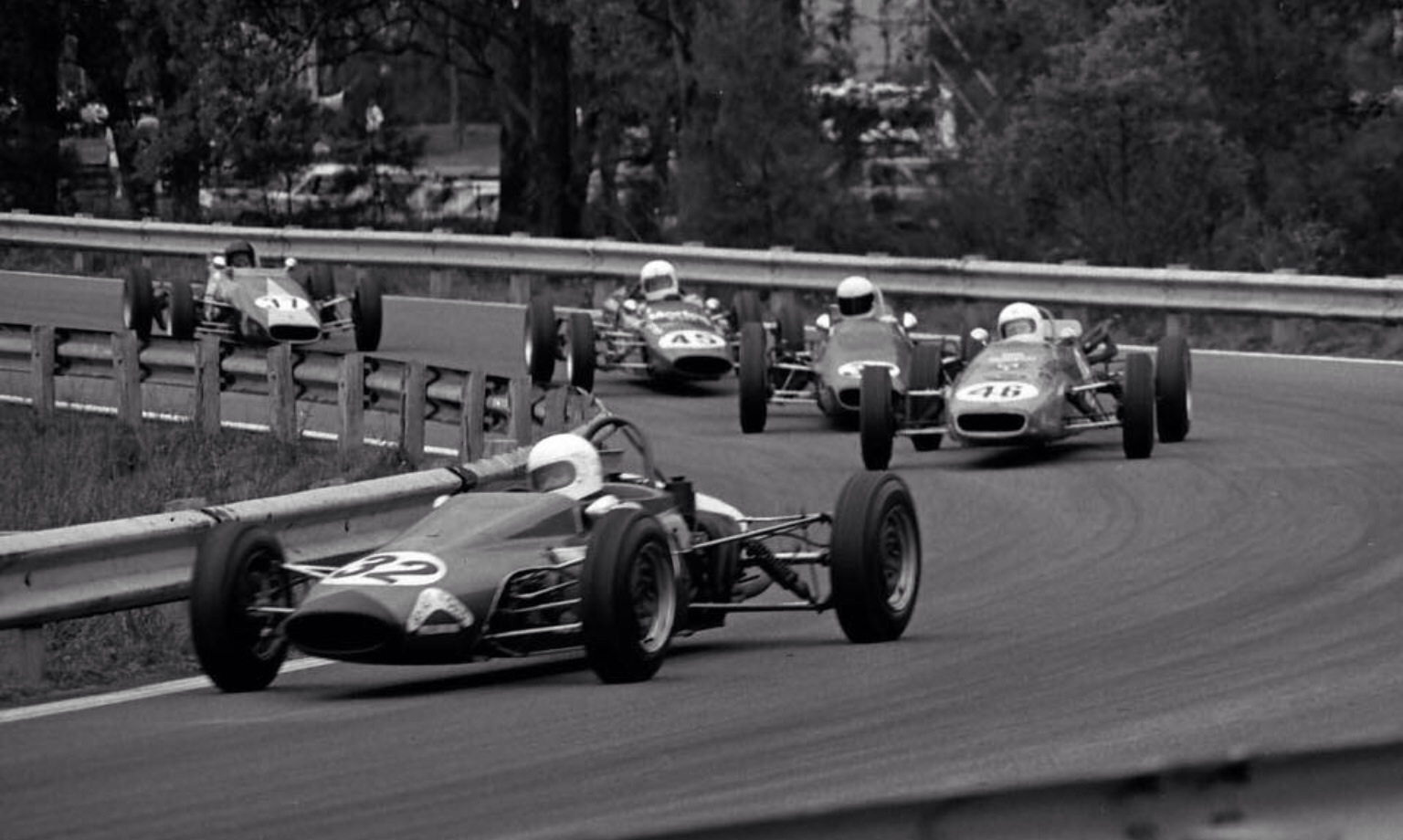
Garry Rush Bowin P4A leads Phil Webber Elfin 600, another Elfin then David Green Wren and Richard Knight, Elfin 600 in the November 1970 DTE round at Warwick Farm (L Hemer)
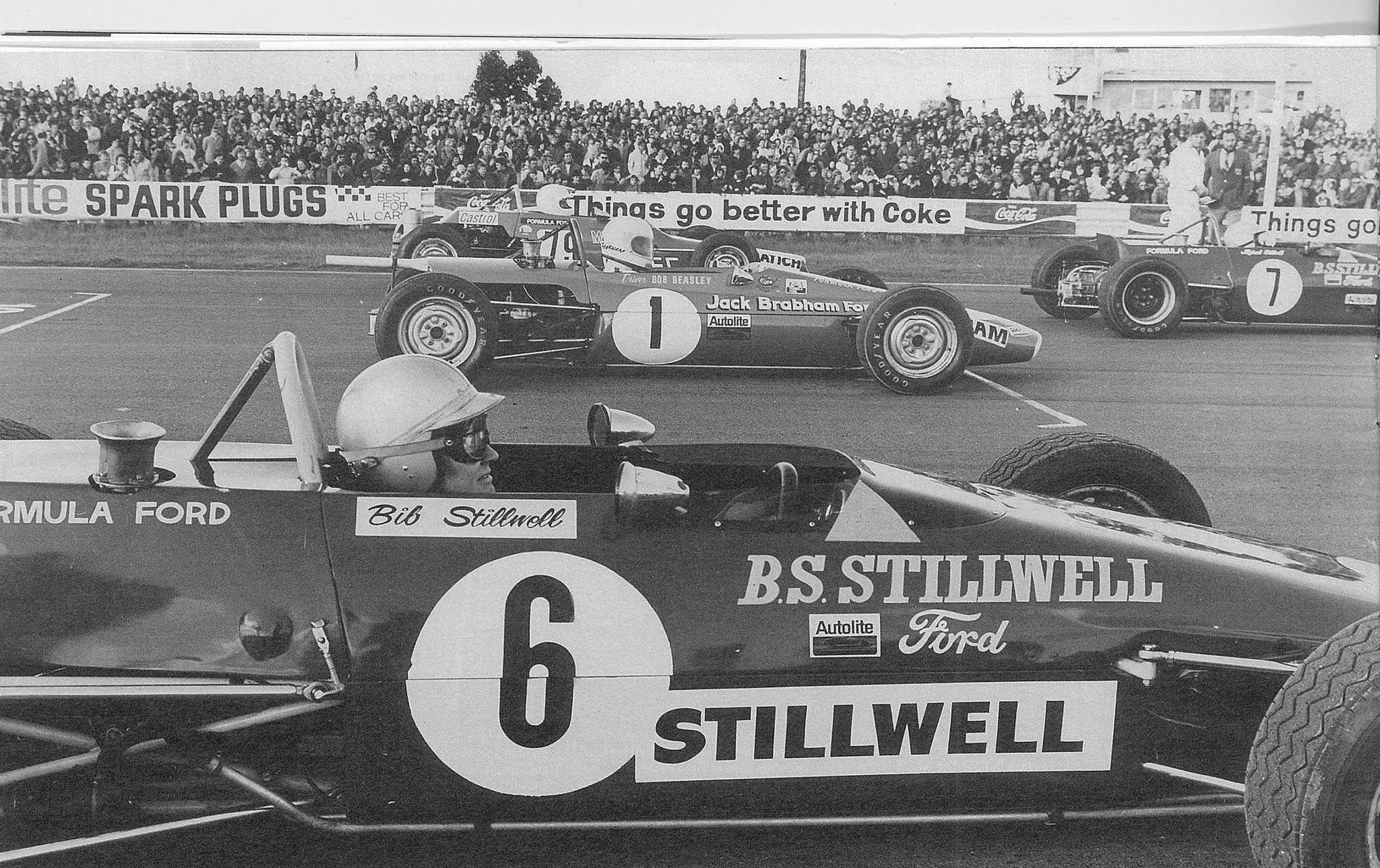
Perhaps the best credentialed of all Bowin P4 pilots was Australian triple world champion Jack Brabham in car #1!, the P4X raced that year with Jack Brabham Ford sponsorship by Bob Beasley. Jack won this 1971 Calder Park ‘Race of Champions’, his last event ‘in period’- he retired at the end of 1970 of course but could not resist appearing at this meeting- I wonder how much practice he did at Oran Park in this car?! Calder was not new to him- he tested his BT31 Repco Tasman machine at Calder on the day it’s assembly was completed in January 1969. The field for the ROC included Bib Stillwell #6, and Bob Jane #7, both in Stillwell Elfin 600’s raced that year by Larry Perkins and Mike Stillwell in the DTE Series, Frank Matich is alongside Jack with Allan Moffat, Kevin Bartlett and Alan Hamilton the other starters (Bennett)

The P4 design had a second wind in the mid-seventies with the sudden 1975 mid-season change in Australian FF regulations back to road tyres.

Australian FF evolved from mandated road tyres from the classes introduction, to the Goodyear RR12 ‘all weather’ race tyre and then to a Goodyear slick- shortages of that tyre forced a mid-season change to the Bridgstone RD102 during 1975- a great road-going radial of the time, I had a set on my uni-student special (read rooted) burnt orange Capri.

After cutting his teeth in Australian Formula Vee Peter Finlay left Australia and lived the life of a racing gypsy with his wife in the UK, doing so very successfully for several years, finishing third in the EFDA/European FF Championship in 1973. Peter recalls ‘coming back from the UK to Australia at the end of 1973, my Palliser WDF2 arrived early in 1974 and I fitted Goodyear slicks straight away. The ‘wets’ were Goodyear ‘RR12’s. In 1975 I joined the Grace Bros team and we ran the Goodyear slicks and a different type of Goodyear wets until Matich (Frank Matich was the Goodyear Race Tyre importer) was unable to continue supply from about mid-year. I was on the Formula Ford Australia Committee and used my car to test the Bridgestone RD102 radials…They were as cheap as chips but the car(s) handled poorly…Having driven the Palliser on Goodyear slicks I can’t say that the Bridgestones were any fun at all’.

It soon became clear that the good-ole P4 and its suspension geometry suited the tyres very well so the sight of the old-school, front-radiator Bowins knocking off the vary latest of FF designs from both Australia and Europe- imports by then were allowed, became the usual sight in mid-later seventies Oz FF.

John Smith in his Grace Bros sponsored P4A at Oran Park in very Smithy- and very Bridgestone RD102 radial tyre slide. Not necessarily what the drivers preferred (in terms of a tyre) but very crowd pleasing (Bennett)

1976 DTE round at Amaroo Park. Richard Carter Birrana F73 on pole- unseen on the front row is his Grace Bros teammate John Davis in the P4X, in blue is John Smith and yellow Mike Quinn, both P4As. The red car is Birrana F71/1 with Terry Shiel at the wheel- the very first Birrana initially raced by John Goss. Carter won the 1976 DTE with the P4’s of Smith, Davis and Quinn second to fourth (Bennett)

Gerry Witenden Birrana F71/1 (same car above albeit modified by Elwyn Bickley) ahead of 1978 DTE Champ John Wright P4A and Richard Davison, Hawke DL17 getting a helping hand from a P6F, Amaroo Park 1978 (C Davison)

Great P4 exponents in this later renaissance era for the older chassis were John Davis, Mike Quinn, Warren Smith, Graham Smith, John Wright and John Smith (none of the Smiths related)- the latter one of the high-priests of Australian FF and a bit later Formula Pacific. Smithy and John Wright won the DTE in 1977 and 1978 respectively. Wright was also an awesome racer who jumped straight from FF to the ex-Leffler F5000 Lola T400 Chev, and made the thing look as easy to drive as the FF he had just stepped from.

Who is that man in a P4? Surfers circa 1978. Meanwhile Ron Barnacle, later DTE winner in a Royale RP31 in 1984 makes up ground having done some lawn-mowing for circuit owner Keith Williams, Elfin 620B (C Davison)
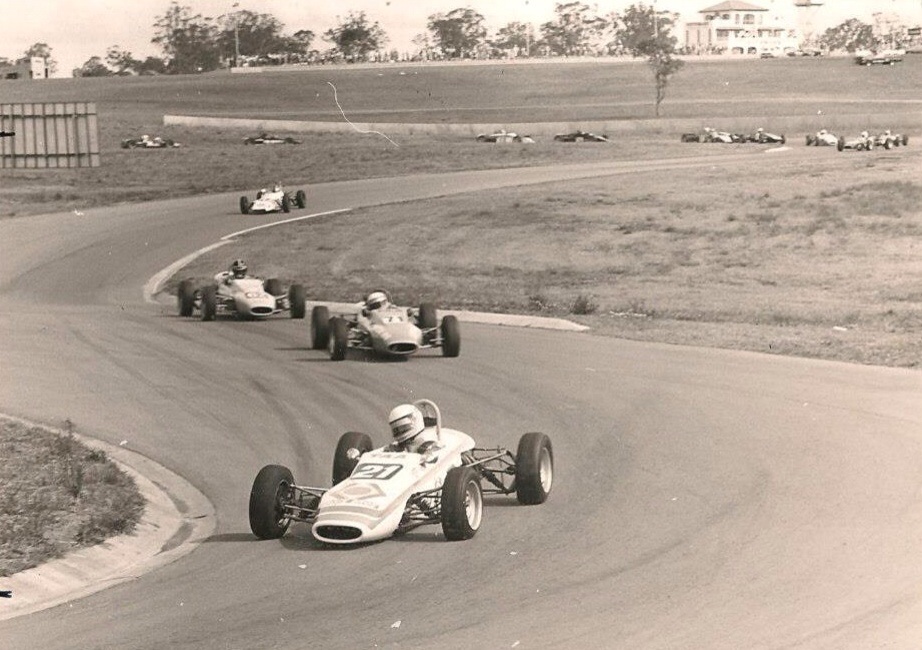
Oran Park 1976 DTE Bowins as far as the eye can see! John Davis, John Smith and Mike Quinn all in P4s, then Richard Carter Birrana F73- Carter still prodigiously fast in historic racing to this day (Bennett)

1976 Oran park P4A butt-shot, Quinn chasing Smith. Mk9 Hewland box, single top link, lower inverted wishbone, coil spring-/shocks and mechanic adjustable roll bar all period typical albeit by this stage a few rockers were starting to appear on cars such as the Royales and Lolas in Oz (Bennett)

These days Bowins are not the familiar sight they should be in very healthy Australian Historic Formula Ford despite classes which should encourage all to compete. A number of us, me included, pushed hard to admit cars built up to 31 December 1989 into historic FF which has had the knock-on effect of drivers buying cars of this later period- owners of the pre-1977 and pre-1983 classes these days stay away in droves. Come back folks!- please bring your Elfin 600, 620B, Birrana F71-3, Lolas, Royales, Hawkes, and especially your P4 Bowins along…
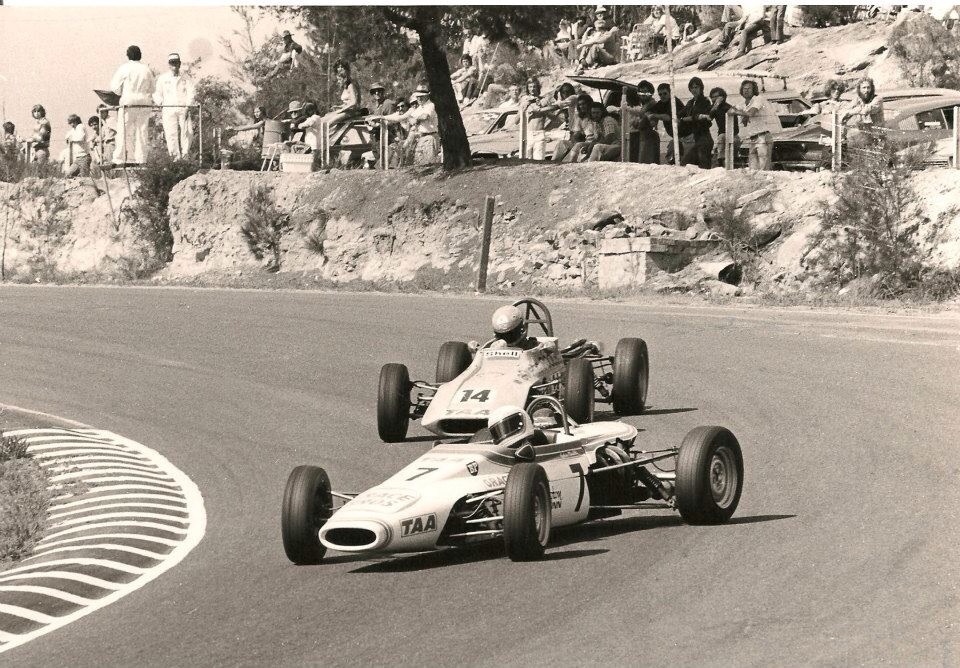
Smithy made it look so easy- rest assured folks it is not! Here the maestro leads Grant Walker, the Kiwi aboard a Tiitan at Amaroo in 1977. A year later I was lookin’ after me mate Alan Bisset’s ex-Brabham/Davis Bowin P4X at Amaroo and witnessed some almighty ANF2 racing between ex-FFers Smith and Larner in the Ford pushrod powered Galloway HG1 and Elfin 700 respectively on this late, lamented outer Sydney circuit (Bennett)

By the late-seventies the going was getting tough for the old P4 with a swag of English cars adapted locally to suit the needs of the Bridgestones and some newer local designs on the scene. The Richard Davison Hawke DL17 developed by Bill Reynolds, the ‘everybody raced’ ex-Arnel Lola T440, several Royale RP21’s and Van Diemen RF77’s, David Earle’s Elfin Aero and Elwyn Bickley’s superb Elwyn 02 all spring to mind.

Warren Smith (no relation) still made Smithy’s old jigger sing well enough to finish second in the 1980 DTE with one win, but time for a car first built in late 1969 had finally arrived…

We have lift off- Sandown DTE 1978. Elwyn Bickley Elwyn 02, obscured Peter Krefel Royale RP21, Richard Davison #5 Hawke DL17, to the right near the fence Lyndon Arnel Lola T440- look down on the fence side of the grid and you can see the distinctive P4 nose of that years champ- John Wright’s car (C Davison)

Etcetera…

Bowin…

The Bowin P4A- PR shot of John Wright’s chassis. 12 cars built between 1969 and 1972 (Bennett)

The Bowin P6F, John Leffler at Amaroo Park in his 1973 DTE winning mount ‘P6F-120-72’. Geoff Brabham also raced this chassis doing his first full year of FF in 1974- he won the 1975 ANF2 Championship in a Birrana 274 Ford/Hart and then left for European F3. 26 cars built between 1972 and 1976. Leffo perhaps the greatest of all the Bowin racers?- winner in the P4 and P6 in FF, in the P8 ANF2 car and a ‘coulda been’ 1975 AGP winner aboard the much maligned P8 Chev F5000 machine had the planets been aligned and the cars ignition not drowned in the latter stages of the Surfers Paradise race, won in the end by Max Stewart’s Lola T400 Chev (Bennett)
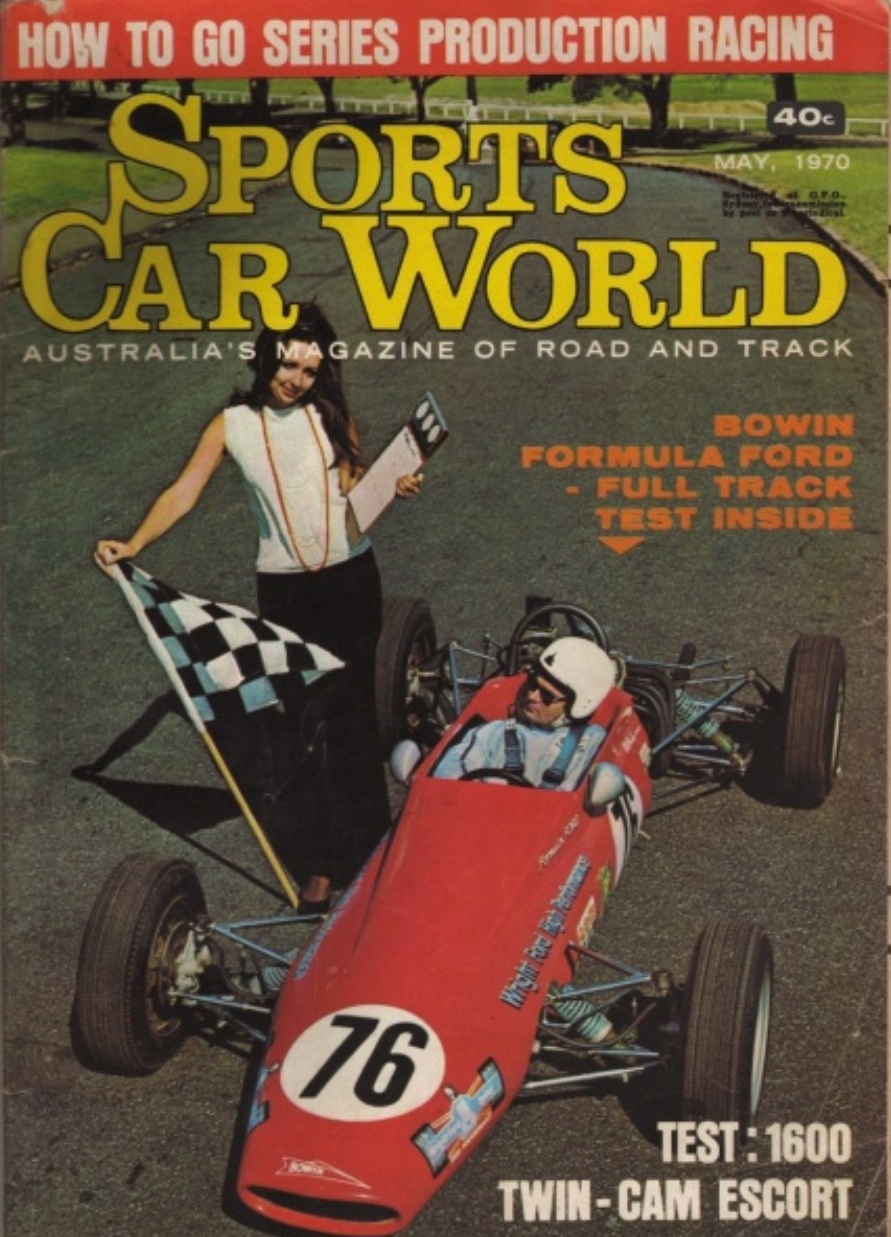
Sandown November 1969…
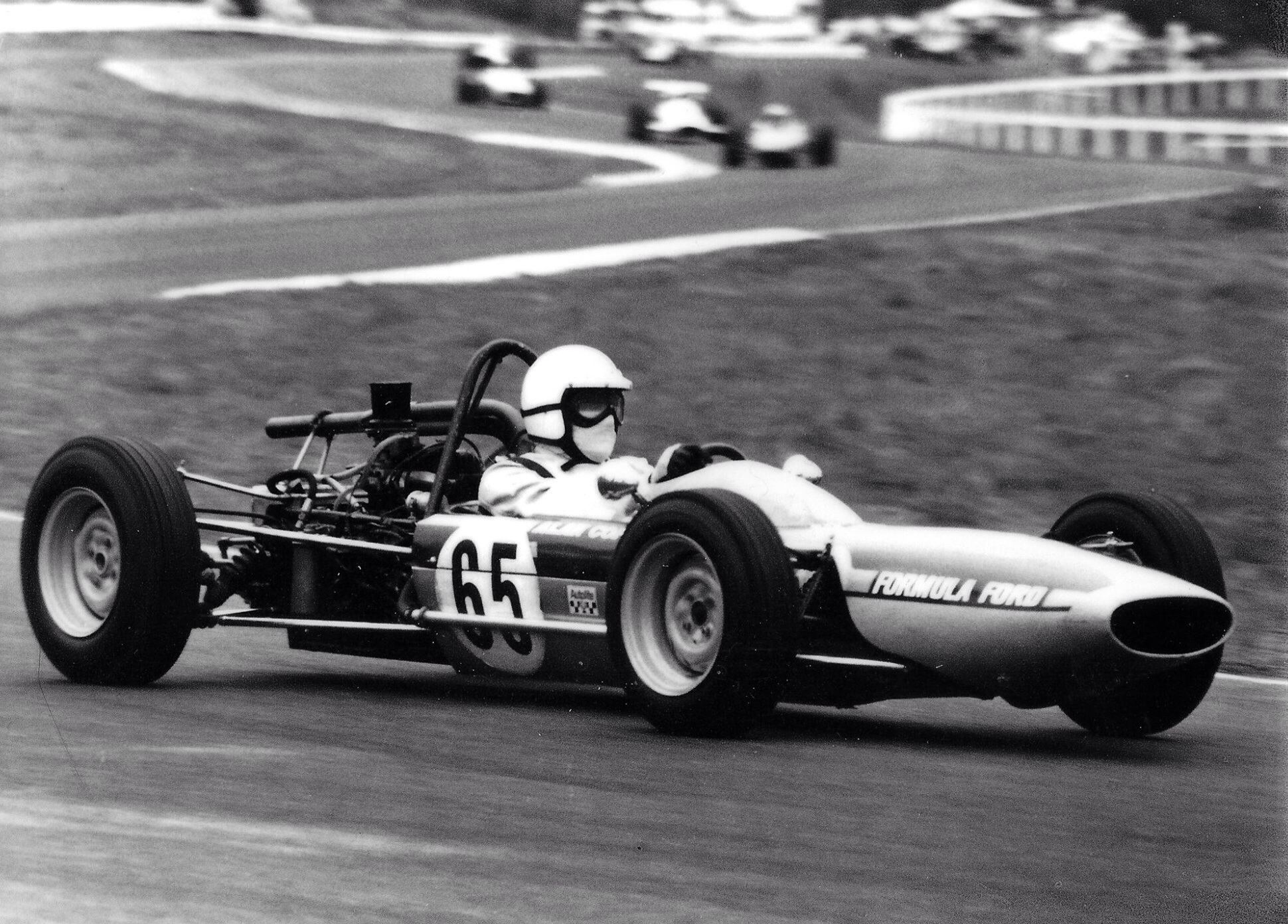
Brian Beasy, Beasy FF exiting Dandenong Road with a gaggle of cars including a winged F3 or F2 car. Decades later Historic Formula Ford in Australia would not have happened without the late Brian’s influence and guidance in the CAMS Historic Commission on all things related to FF inclusive of car eligibility (Beasy Family)

Bob Minogue, Aztec AR8, Sandown, Dandenong Road, November 1969 (autopics.com)

Allan Ould’s Aztec AR8 was raced to 3rd as in this photo in the November 1969 first Oz FF race

FFA membership list as at the end of 1970

Current historic Van Diemen RF86 racer Anthony Mann dreaming of his own Formula Ford as a 9 year old kid aboard the FF ‘display car’ a Wren FF in Shepparton 1969 (Mann)

Arcane and Irrelevant…

Australian Formula Ford tyres- strictly for FF anoraks only! List developed during some Facebook banter mainly between me, Peter Finlay and Nick Bennett

1969-1971 Road tyres of drivers choice. In the UK Finlay notes the Firestone Torino ‘wide ovals’ were a road crossply with a racing compound

1972-1973 Goodyear RR12 all weather

1974-1975 mid-year Goodyear slick with RR12 wets and very expensive but superior G10 winter treads for sopping wet races

1975-1980 Bridgestone RD102 road radial

1981-1983 Dunlop slick ‘592’ compound

1984-1994 Dunlop CR82 all weather

1995-2015 Avon ACB10 all weather

2016 on Yokohama A048 all weather

Peter Finlay, Palliser WDF2 from Peter Larner, Elfin 620B, Calder early 1975 just before the Goodyear slick- check out the tyre distortion folks, were changed due to supply problems to the Bridgestone RD102 radial. Finlay won 3 rounds that year and Larner 1 with both tied for second in the title chase won by Paul Bernasconi in a Mawer 004. Finlay later owned and ran Peter Wherrett Advanced Driving and was a hillclimb ace- Larner still is a great engine builder and raced an AGP or two in the Formula Pacific era (Finlay)

Photo and Other Credits…

Laurie and Nick Bennett Collection, Chris Davison, Nick McDonald, Oz Classic FF Facebood site, Lynton Hemer, Dale Harvey, Anthony Mann, Sports Car World, Peter Finlay, Graham Ruckert, Beasy Family Collection, A Clifford, Grant Burford

Tailpiece: In Search of An Apex…
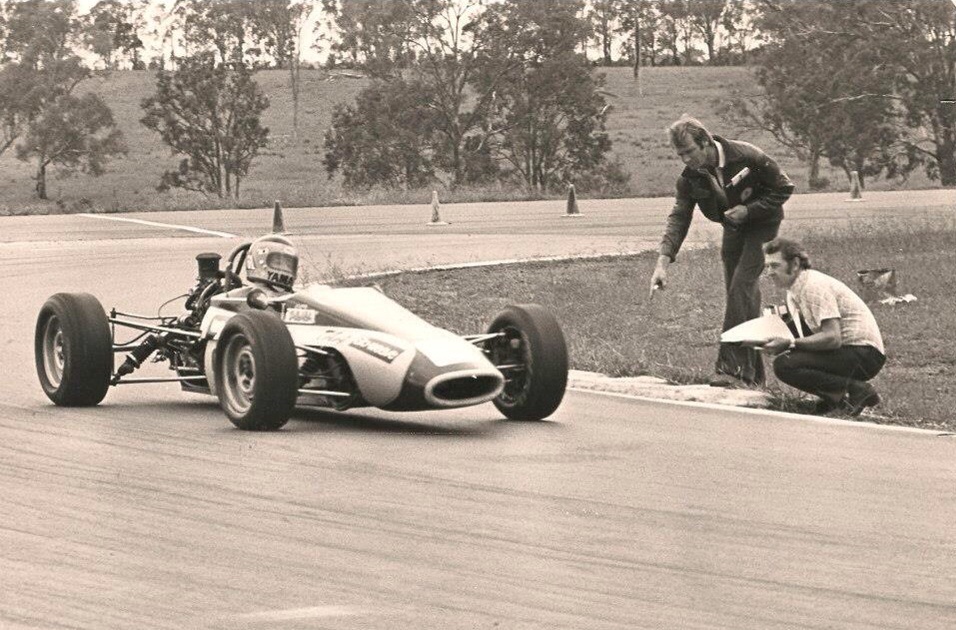
(SCW)

John Leffler, Australian Gold Star Champion in a Lola T400 Chev in 1977 and kneeling John Joyce trying to get their Bowin charges to apex correctly during the Oran Park Bowin test day in early 1975.

Harry Macklin aboard the ex-Leffler P4A John raced in the early 1973 DTE rounds before switching to his new P6F.

Finito…

(R Goldfinch)

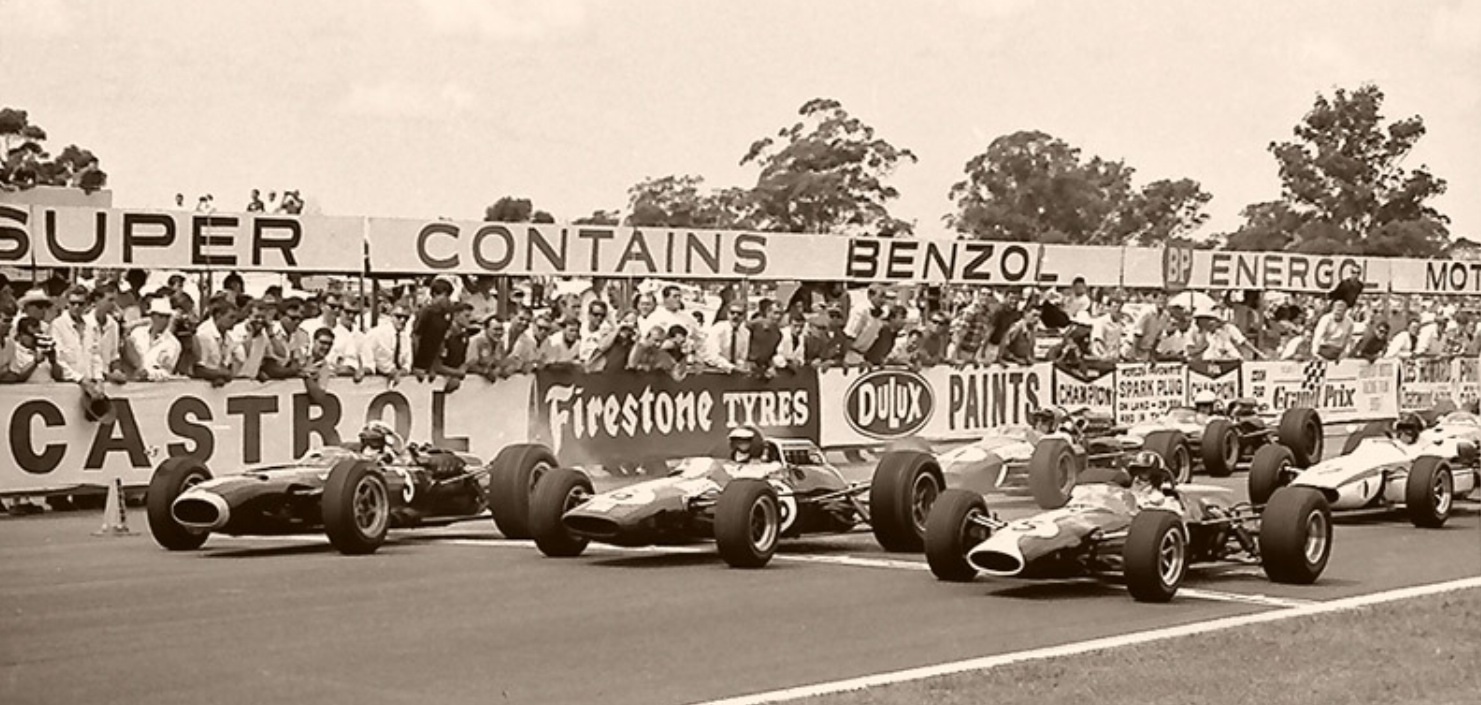
Denny Hulme acknowledges the plaudits of the crowd upon his retirement from the February 1967 Australian Grand Prix at Warwick Farm…

The ‘Creek Corner Mob’ were a notoriously loud, knowledgeable group of spectators, ‘the bugler’ in particular always comes up in conversations about the place with Sydney enthusiasts even now.

Denny’s Brabham BT22 Repco ‘640’ V8 retired on lap 41 of the 45 lap race with a burst radiator hose, the race was won by Jackie Stewart’s BRM P261 2.1 V8. In a troubled weekend the Brabham Repco lads started raceday further out west at Sydney’s Oran Park attempting to sort fuel injection and handling dramas before heading back to the ‘farm for the race. Jack was fourth aboard BT23A Repco ‘640’.

Love this Bruce Wells portrait of Denny on the ’67 WF grid. Note the ducting used in the hotter races of that year to get cool air into the centre of the 640 and 740 Repco’s- aimed at the fuel metering unit (B Wells/TRS)


Stewart, Clark, Hill- BRM P261, Lotus 33 Climax, Lotus 48 Ford FVA, then Jack and Leo Geoghegan- Brabham BT23A Repco and Lotus 39 Climax with Denny alongside the pit counter on the row behind, Brabham BT22 Repco (B Wells/TRS)

Its weird the way your brain works, or mine does anyway?!

The first thing which popped into my mind when I saw Denny’s salute was the famous post 200 metre Mexico ’68 Olympics medal award ceremony, brave ‘Black Power’ medal presentation dais salutes of gold and bronze medallists Tommie Smith and John Carlos.

It was ‘big news’ in Australia as Peter Norman, a great Australian athlete, was the silver medallist who bravely stood with, and in support of the Americans and their cause. Norman was punished for his actions by the Australian Olympic Committee’s ‘forces of conservative darkness’ for the rest of his life.

Denny’s pose and actions are in an entirely different context (to say the least) but its funny the stuff which sticks in a childs mind only to pop out fifty years later. The Olympics scene resonated with me at the time, no doubt meeting Norman at a school holidays athletics training camp in the early seventies added to the potency of the moment, times of great social upheaval and progress as they were.

Peter Norman’s obituary; https://www.theguardian.com/news/2006/oct/05/guardianobituaries.australia

Credits…

Roger Goldfinch, Bruce Wells/The Roaring Season

Tailpiece: Peter Norman, Tommie Smith and John Carlos, Mexico 1968…

Finito…

Freddy McEvoy, aka Suicide Freddy and Tiger to the babes he charmed, was a ladies man, adventurer and friend of fellow Australian and screen star Errol Flynn. He was an accomplished car racer, an Olympic medallist and World Champion on the ice, a sailor, gambler, suspected Nazi agent and a whole lot more…

Here the intrepid Australian is aboard his Maserati 6CM prior to the start of the 1936 Vanderbilt Cup at Roosevelt Raceway, Westbury, Long Island, New York on 12 October.

Frederick Joseph McEvoy was born in Melbourne’s inner southern suburb of St Kilda on February 12, 1907 and moved to England with his mother when he was 10. Educated at the famous Jesuit boarding school Stonyhurst College in Lancashire, his later professions seemingly included jewellery design, public relations consultant, yacht dealer and perhaps arms and contraband trader. He admitted later in life to being a rogue, swindler and a conman who used his intelligence and charm to mix with the upper echelons of society.

Said to have generously proportioned wedding-tackle by a number of his mounts, he reputedly also knew how to use said equipment. As a consequence of his looks, physical attributes and line of chat Freddy cut a swathe through the ladies with various sources crediting him as also running a team of gigolos who kept the bored ladies of the south of France entertained in a manner which put smiles permanently upon their faces.

Exactly how he ratcheted himself up the totem pole of life is not entirely clear but Freddy’s journey took him from partying with young Errol Flynn in Melbourne/Sydney to wild times with the great and the good in England and onto the French Riviera in its golden years pre-war.

The Australian Truth newspaper, a tabloid perhaps more aptly titled Lies, has it in 1948 that McEvoy was the scion of a prominent Sydney family who went abroad with his mother and brother as youngsters when she took them to Switzerland for the winter sports season. He soon became popular with the international sporting set and was well known for his bob-sledding prowess.

Another 1951 Truth report records that Freddy (Frederick signed his own name in short-form as Freddy not Freddie as is practically the case in any reference source one views) was virtually unknown when he first hit Europe in the 1930s. He was then in his early twenties and arrived with his widowed mother and ailing brother Theodore. ‘…Gradually the young man with the film star smile, bronzed figure and quick Irish-Australian turn of wit began to be noticed’.

Of the relationship with Flynn, Truth reports that Freddy and Errol were close friends back in the 1920s in Melbourne when both worked for Dalgety, a huge national wool enterprises business at the time.

Whatever the case, Freddy figured out that easy money was to be made through the legs of the idle-rich, becoming an adept lover, diver, boxer, racer, skier and bobsled competitor where he was a familiar sight at some of the more fashionable European resorts of the day ‘plying his trade’.

Max-Everist Phillips writes that ‘Bobsleigh competitors of the 1930’s prided themselves on three inter-related pursuits: dangerous sports, daring women and dubious money. McEvoy’s skills at the first facilitated his success with the second, who usually provided the third’…

Before the 1936 Winter Olympics, (above) where he was a member of the British team, McEvoy had proved his daring and speed as a tobogganist on the famous, dangerous Cresta Run at St Moritz, Switzerland where he was awarded the ‘Cresta Colours’ that year for his accomplishments.

Keen to compete at the highest level, he would not have been eligible to represent Australia through the Australian Olympic Federation, as there was no State or National governing body for tobogganing or bobsleigh in Australia at the time. In fact there was no sport of skiing at the time to speak of!

Without wanting to give a dissertation on the development of skiing in Australia, the first moves on skis are thought to have been carried out by Norwegian gold-miners at Kiandra in the New South Wales Alps during the long winter of 1861. The first ski-lift was built near Mount Beauty in Victoria in 1936, but in simple terms the Alpine areas of Tasmania, Victoria and New South Wales were not developed as ski-fields until post-war when European migrants, some of whom worked on the Snowy Mountains Scheme (a massive post-war twenty year hydro-power generation and irrigation scheme – one of the ‘engineering wonders of the world) saw the potential of the Australian Alps and made formative investments at places like Thredbo and Perisher Valley. The sport itself did not boom until the 1970s with baby boomers looking for activities a bit more sophisticated than those which were available to, or could be afforded by many of their parents.

‘It is quite likely that he (McEvoy) associated with British bobsledders in Switzerland and was, as a British subject, eligible to compete for the mother country. It would have been difficult for the British authorities to overlook his nomination or prowess’ the Sydney Morning Herald reported.

Freddy was accorded the highest team honour by the British Olympic Committee to carry the British flag at the opening ceremony of the 1936 Games; that does amuse me, an Aussie carrying the flag for the Brits on such an august occasion!

Freddy, captain and steering, British 4 man bob, Garmisch Olympics 1936 (Getty)

Freddy and his team took the bronze medal with four runs down the treacherous bobsled course, finishing behind two Swiss combinations in front of a crowd of about 32,000 people. ‘Suicide Freddy’ was pipped for a medal in the two-man bob, finishing fourth with Garmisch-Partenkirchen well known for its bobsled run on which several men had died. Freddy wasn’t the only motor racer contesting events on the Olympic ice, GP racer Count ‘Tonino’ Brivio was eleventh in the the two-man bob and tenth in the four-man.

Bad weather limited training on the course before the Olympic race and crews had only two or three days’ practice on the fast and difficult run with ‘Britain fortunate to have an experienced and daring driver to steer both the four- and two-man bobs’, the British Teams post event report said.

One of the great bobsledders of the time, Bill Fiske of the US, wrote: ‘Freddie McEvoy has invented one of the most lethal toboggans ever seen on the run. He had a toboggan constructed of hollow ground runners…tremendously fast on a straight course but impossible to manoeuvre around corners…’

McEvoy proved after the 1936 Olympics that he was no flash in the pan. He was second in the Curzon Cup on Cresta in 1937, won the world two-man bob championship at Cortina, Italy in 1937, and the world four-man bob at St Moritz the same year. He retained the four-man title in 1938 and was runner-up in 1939.

Clearly 1936 was a busy year for the enterprising Australian who was said to have won $25,000 playing backgammon in Monte Carlo and then spent the money the next day on a new Maserati.

In fact the Maser 6CM, chassis #1535 was the first such machine to have been sold to a privateer, Maserati’s new Voiturette model first appeared in March 1936.

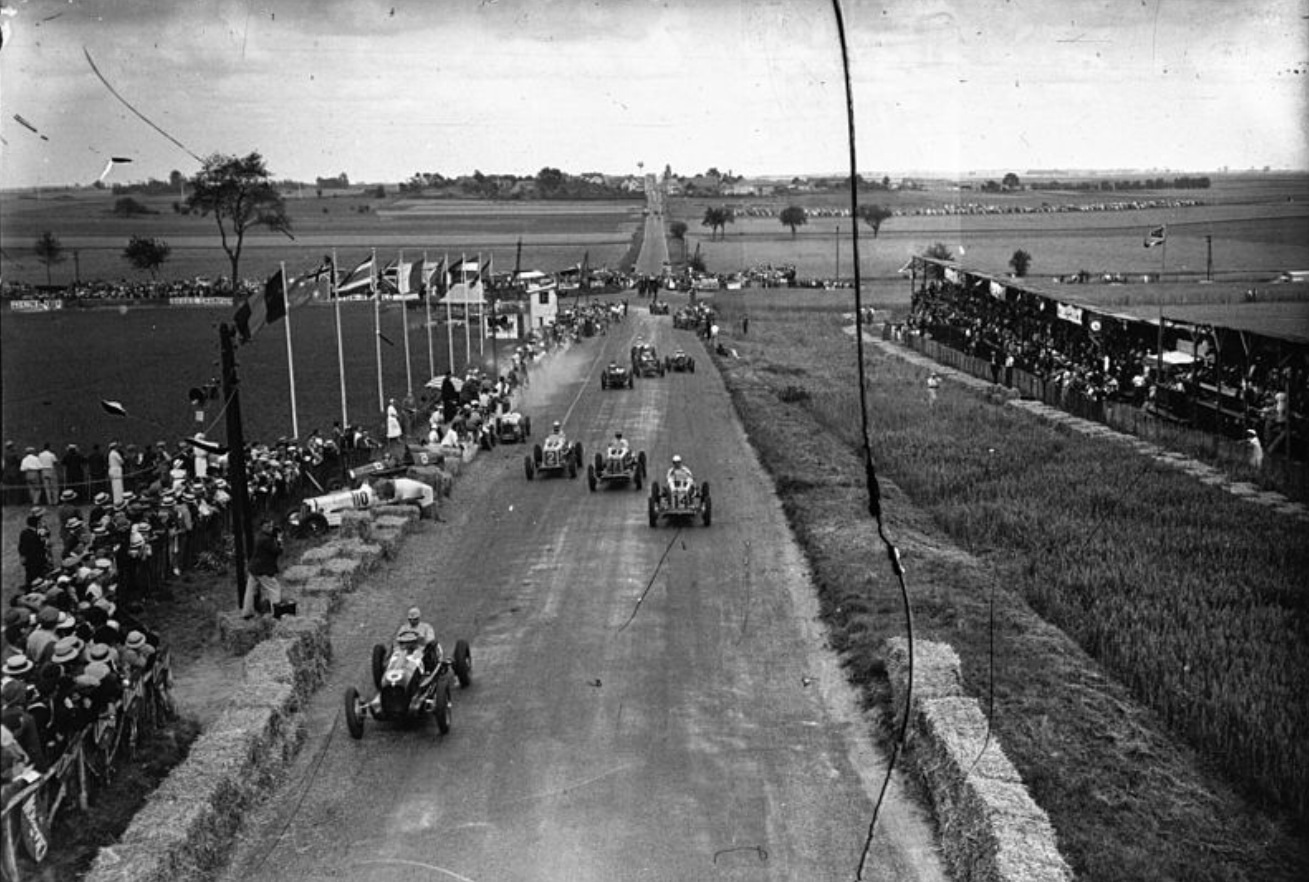
GP Picardie. #6 Carlo Trossi Maser 6CM, #2/#44/#14 B Bira, Earl Howe and Patrick Fairfield on ERA Type B, Type B and Type A (unattributed)

Freddy first entered his new six-cylinder, DOHC, supercharged 155bhp machine in the Grand Prix de Picardie held at Peronne in mid June 1936.

In a splendid display, he was fourth in both his heat and in the final won by Dick Seaman’s Delage in a year of dominance in Voiturette racing which carried the talented Englishman into the Mercedes Benz Grand Prix team.

John Medley wrote of the race ‘…On a scorching hot day the two heats saw the demise of Raymond Mays’ extremely quick ERA and also that of Arthur Dobson, with wins to Trossi and a surprisingly much slower Dick Seaman. Lehoux’ works ERA failed on the line in the final, which was led by Fairfield, an off-song Maserati of Trossi, and Bira’s ERA, before Bira moved past Trossi, with Seaman next until his steering (thought to have been damaged in an earlier Nurburgring incident) failed and the Delage hit a wall in the little village of Brie. The same corner in Brie momentarily claimed Fairfield’s ERA from a stern battle with Bira, so the little Siamese Prince won again from Fairfield and Lord Howe in ERA’s and McEvoy’s distant Maserati. There were no other finishers’.

Getting a little ahead of ourselves, Freddy’s Voiturette season commenced during the Monaco GP weekend, the Aussie contested the Coupe Prince Rainier on Saturday 11 April in an earlier Maserati 4CM on the same weekend in which the new 6CM made its race debut.

McEvoy started from grid 14, with Earl Howe on pole in an ERA Type B, and ran well until lap 43 when he spun on oil left by Zehender’s Maser 6CM and hit a wall damaging the cars fuel tank. This meeting was the first at which 6CMs raced, Scuderia Torino entered a car for Rovere, with Zehender relieving him in the 6CM late in the race. McEvoy  ran as high as eighth, the race was won by B Bira in an ERA Type B who ‘…took the chequered flag to take the first victory of his career, winning possibly the most prestigious voiturette race of the year only 392 days after making his race debut in a Riley Imp at Brooklands’ according to kolumbus.f1.

Albi GP. #4 Marcel Lehoux ERA Type B, #8 Patrick Fairfield ERA Type B, #10 Bira again B Type ERA with #26 the nose of McEvoy’s Maser 6 CM (unattributed)

At the Albi GP in mid-July, Freddy was ejected from his car in spectacular fashion during the first heat. The car caught fire after rolling across the straw bales opposite the pits, the car then burned furiously. Aggregate results of the two heats gave the win to Bira from Pierre Veyron and Hans Reusch in ERA Type B, Bugatti T51A and Maserati 4CS respectively.

The Coppa Ciano was held at Livorno in early August on a new course through the town rather than the usual mountain layout used hitherto, Trossi won in a works 6CM with Freddy eighth, two minutes behind the leader.

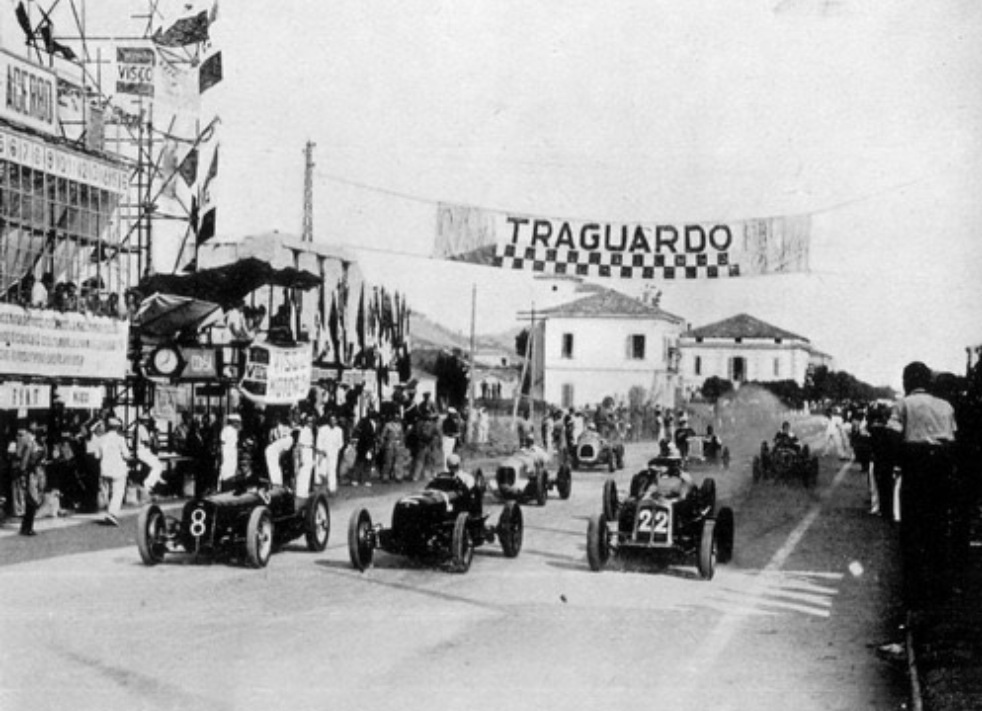
Coppa Acerbo. #8 Dick Seaman Delage 15S8, #2 Carlo Trossi Maser 6CM and #22 Bira ERA Type B (unattributed)

On the daunting Pescara road circuit on the Adriatic Coast in mid-August he was a strong fourth in the Coppa Acerbo having started fifth on the grid with Seaman again taking a Delage win.

In a busy month, in late August, the Berne GP was conducted on the Bremgarten road course in Switzerland. Freddy was seventh from grid ten in a chassis MotorSport said  ‘…was the most dangerous Maserati, an independently sprung Maserati which should have done well’.

Freddy, far from the most experienced driver on these grids was clearly no dilettante behind the wheel however many attractions and distractions there were sitting seductively on his pit counter. It does make you wonder what McEvoy could have achieved had he focused on his racing, but such was his zest for living life to the full that this was never the case. Wine, women and song sounds pretty good to me all the same...

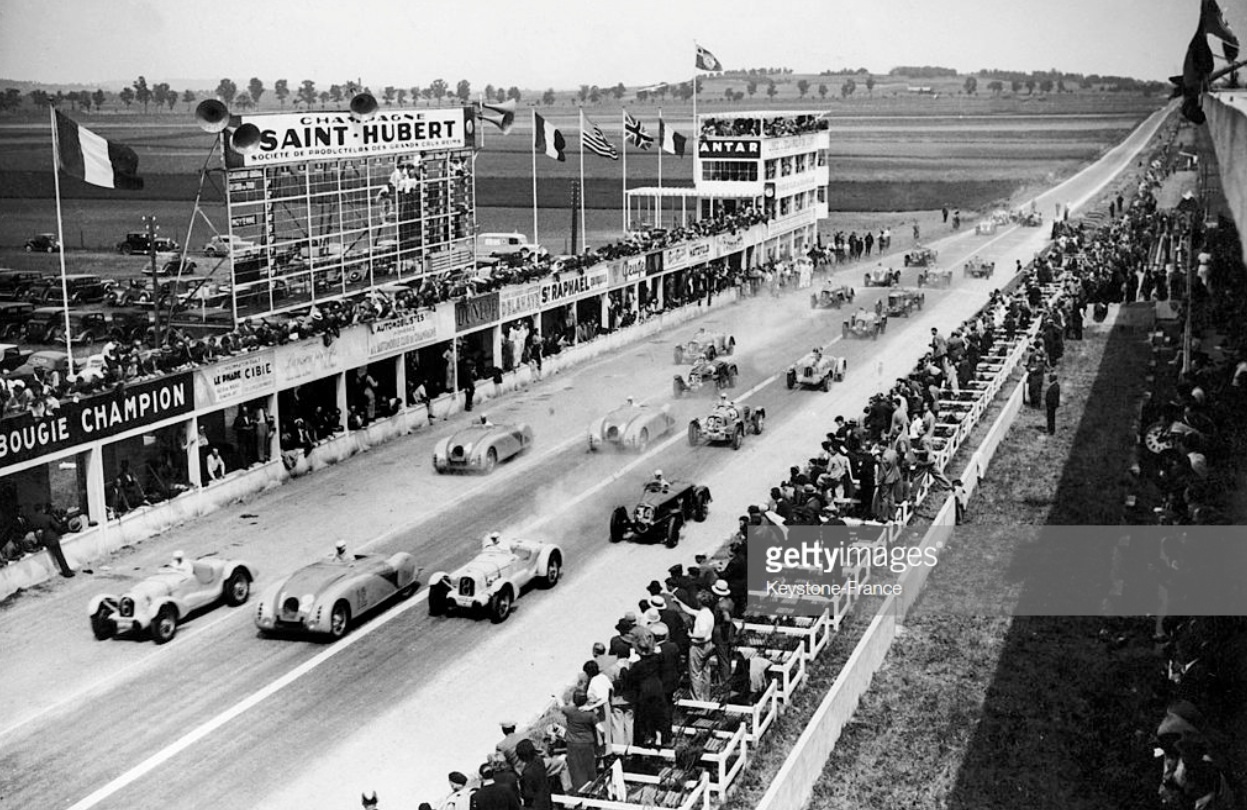
Marne GP 1936, the growth of French sportscar racing as a response to the success of the Nazi funded German teams is an interesting story in itself. #6 Rene Dreyfus and #8 Andre Marcel Talbot T150C split #12 Jean-Pierre Wimille Bugatti T57G- the similar Bugs of Robert Benoist and Pierre Veyron on the row behind. #34 and #26 the Michel Paris and Laury Schell Delahaye 135CS. The Paris car is the 135CS shortly thereafter imported to Australia and raced by John Snow- and to an AGP win at Leyburn, Queensland in John Crouch’s hands in 1949. McEvoy’s Jag 100SS way back in the pack (Keystone)

In the middle of the year, on July 5 Freddy also contested the sportscar Marne GP at Reims in a 2.5-litre Jaguar SS100. He brought the ponderous beast home fifteenth overall and first in the 2-3 litre class, the patriotic MotorSport proclaiming an ‘S.S Wins A Continental Race’- they credit the race to Frank McEvoy, an error rather than another nickname.

John Medley ‘…Fast Freddy McEvoy, almost lived up to his other nickname ‘Suicide Freddy’ as he grappled with its nose-heavy understeer which flicked to alarming oversteer on exit to every corner on the very fast Reims-Gueux Circuit. Playing what MotorSport called ‘a waiting game’ (when actually he was travelling as fast as he dared) a long way behind the winning Bugattis which were chased by Talbots and Delahayes, brave Freddy brought the car home for a class win…’

It would be intriguing to know exactly when McEvoy first raced, his cv included the blue-riband sportscar Mille Miglia in 1935, it was certainly the first major race he contested. In that classic test of driver and car he shared a Vittorio Jano designed Alfa Romeo 6C1750 with Ghersi, the pair failing to finish the race won by another memorable Alfa, the 8C 2900B raced by the Pintacuda/Della Stufa crew.

In October 1936 Freddy was well enough funded by his various enterprises and acquaintances to contest the Vanderbilt Cup Races on New York’s Long Island, representing Australia in the 6CM.

This was an amazing event held on a very expensive facility by the standards of the day built by the Vanderbilt family and several associates including Indy winner Eddie Rickenbacker. It seems the designers of the track, who lived on opposite sides of the country, failed to communicate, so the track ‘comprised a single 3775 foot straightaway and sixteen completely unbanked corners, ten of which are best described as hairpins.’

A huge purse attracted some of Europe’s best teams, the race was a real endurance affair, 75 laps of a tight four mile road course circuit, 300 miles in total. Tazio Nuvolari won aboard an Alfa Romeo 12C-36 in 4 hours 32.44 from Jean-Pierre Wimille’s Bugatti T59 and Antonio Brivio’s Alfa 12C-36. In sixth place was Freddy proving his endurance on the hot day driving the 6CM, his time 4:57.24. Mind you, Carlo Felice-Trossi co-drove the 6CM, how many laps each of the intrepid pilots raced is undisclosed.

Freddy McEvoy with the Australian flag on the side of his Maser 6CM, Vanderbilt Cup 1936 (VDC)
Vanderbilt Cup start 1936, ID of cars welcome (VDC)
McEvoy Maser on one of the more open corners on a course dominated by tight corners (VDC)

McEvoy’s activities after 1936 are really beyond the scope of this article but he continued to compete at the highest levels of bobsleigh racing, this is covered at the end of the piece.

In 1937 he won $10,000 for setting a record time between Paris and Nice of 9 hours 45 minutes in a Talbot-Lago T150C SS coupe. He was the first person to do the trip from the capital to the Riviera in less than ten hours aboard the 4-litre, six-cylinder OHV, 170 bhp machine.

McEvoy’s personal note of thanks for the use of the Talbot makes clear the spelling of the short form of his name (unattributed)

As war broke out, the Australian was reluctant to apply his undoubted bravery to the war effort and left Britain to continue his playboy lifestyle on the French Riviera, and later New York and Hollywood. His fisticuffs it seems were limited to the odd scrap with husbands of ladies who were miffed by his attention to women who succumbed to his considerable charm.

Freddy shared a house with the by then notorious Errol Flynn in Hollywood, they enjoyed many adventures, including diving expeditions to Mexico. McEvoy was a key witness for Flynn in his infamous statutory rape case in 1942-43. This involved allegations of under-age sex by seventeen year Betty Hansen. Said events purportedly took place in McEvoy’s Bel Air home, his ‘no-nookie here matey’ protestations helped the actor get off the charges. Flynn credited McEvoy in assisting him recover from a growing dependency on opium by burning the actors stash of the drug, their friendship survived the fight which ensued when Flynn realised his drug syringes were ablaze in an adjoining room.

The actor, quoted in Mike Seth-Smith’s book on the Cresta Run, says: ‘I found that he complemented me. He was an athlete, a roisterer like myself, and he could be canny too, very. He had his eye for the main chance and bluntly told me he intended to marry wealth. With his physique and appearance and his charm and culture I didn’t doubt he could do this.’

Flynn and McEvoy at Monte Carlo in 1950 just prior to Flynn’s marriage to Patrice Wymore. Freddy was best man and Claude Stephanie Filatre, McEvoys third wife, the other witness (unattributed)

Suspected as spies in the 1930s, the US authorities monitored the activities of both Flynn and McEvoy with the FBI eventually concluding Freddy was ‘an international pimp who is interested in his own well being and probably not engaged in activities detrimental to the interests of the country’. In the same period, 1944, it is said the hustler smuggled guns, jewellery and alcohol from Mexico City to California on his boat, as his second marriage did not yield much cash.

McEvoy scandalised high society and fascinated the readership of gossip columns in equal measure. ‘A debonair socialite, he courted infamy as one of Hollywood’s self-styled ‘Hellfire Club’ or ‘Three Musketeers’ along with Errol Flynn and Bruce Cabot of  ‘King Kong fame’ and was usually characterised by newspapers as a ‘handsome gigolo’ or ‘popular playboy’, the big ‘dame hunter’ married three times.

At one society party in Cannes, the already married McEvoy made a play for Woolworth heiress, Barbara Hutton, just divorced from Cary Grant. They never wed but lived together for a time at a ski resort Hutton bought in Franconia, New Hampshire. In a sidebar to this liasion, our intrepid racer was beaten up by some thugs who set up the initial meeting between McEvoy and Hutton after Freddie failed to pay the ‘facilitation fee’! I guess ‘Tinder’ always existed in one form or another whatever the technologies of the day.

Although he failed there, Freddy succeeded in wooing the heiress to an oil fortune, Beatrice Cartwright of the Pratt Family/Standard Oil in 1940. At 63, she was 30 years older than McEvoy and promised him a yacht and a million dollars. McEvoy got the yacht, the 65-tonne Black Swan, but the money never found its way into his bank account. He later married a second heiress, Irene Wrightsman, at 18 years old less than half his age but they drifted apart after Irene’s father removed her access to the family loot.

McEvoy’s third and final wife was Claude Stephanie Filatre, a French fashion model. They married in 1949 and made their home aboard a 104-foot ketch/schooner called Kangaroo or Black Joke depending upon the account you choose to reference; there are plenty of conflicting accounts about many aspects of this mans life as I hope I have made clear.

The boat struck a reef off the Moroccan coast 60 miles from Casablanca during a storm off North Africa in 1951. There is some speculation that McEvoy was running arms or grog between his home port of Cannes and Tangiers. He made it to the shore and sought help unsuccessfully from a small settlement at Safi. Freddy returned to the floundering boat to rescue Filatre, but this time his luck ran out. McEvoy’s body, naked and scalped was in a lagoon/washed up on the beach on November 9, 1951 and his wife’s body the next day.

It transpires that one of the ships crew was wanted for murder of a prostitute in Berlin in 1945, that man, Manfred Lentner was later convicted of the murder in a Salzburg court in May 1954. Further, at the time of the ‘shipwreck’ British Intelligence had been tracking McEvoy as a suspected arms-dealer and smuggler of contraband between Tangiers and France, so to the very end of the racers story there was plenty of mystery and intrigue including £15,000 worth of diamonds and whisky onboard the ship. A French court convened in Morocco found  a verdict of murder by persons unknown of McEvoy, Filatre, her maid and three sailors, no-one was ever charged.

Fast Freddy, at best an elite level sportsman and likeable scallywag but perhaps more accurately described as an outstanding sportsman and amoral crook and scumbag certainly did not die guessing about the possibilities of life, without doubt he lived it to the full.

Put more delicately, ‘Sport was but one aspect, albeit perhaps the only honourable one, of his forty-four years on earth. His reputation was variously as an unprincipled playboy, suspected spy, alleged smuggler, dubious adventurer and unhealthy close associate of one of Hollywood’s most iconic but least reputable stars. He was one of the few Australians about whom the standard phrase in obituaries, ‘he led life to the full’ is an understatement’ wrote Max Everest-Phillips.

 Maserati 6CM…

‘Voiturettes’, cars of smaller capacity than machines of the contemporary Grand Prix formula went back to the dawn of motor racing, but the class grew in importance with the introduction of the 750 kg Formula.

There had been no official capacity limit since 1926, although the Voiturette class was usually for cars of 1100cc. During the 1930s the category was increasingly held for machines of 1500cc, it was attractive to smaller teams and privateers given the growing expense of GP racing. To that end Maserati introduced the 4CM-1500cc four-cylinder in 1932, with the 6CM a response to the Riley based ERA’s pace, these first raced from 1934.

The 6CM chassis was the usual channel section of the day but heavily boxed as Maserati were beginning to realise the importance of chassis rigidity. Front suspension was similar to the very unsuccessful V8RI GP car with independent suspension by unequal length wishbones and friction dampers up the front. At the rear, a rigid axle was deployed suspended on semi-elliptic springs. The body of the car was similar to the V8RI with a cowled radiator and neat streamlining.

The Fiat parts bin provided quite a few bits including the steering box and gearbox. The ‘tranny was a 4-speeder designed for use in the Fiat Tipo 522 taxi and was considerably overstressed given the cab had a paltry 34bhp. There were plenty of gearbox dramas until Maserati started to make their own ‘boxes. The rear axle was made by Isotta Fraschini.

The heart of the matter was a six-cylinder engine of 1493cc which had the cylinders cast in pairs, and twin overhead camshafts driven from the nose of the crank in established Maser practice. A single Weber carb, Roots type blower, Scintilla magneto and dry sump lubrication completed the key mechanical specifications. The neat little motor was claimed to produce 155bhp @ 6200 rpm early on which rose to circa 175bhp over time.

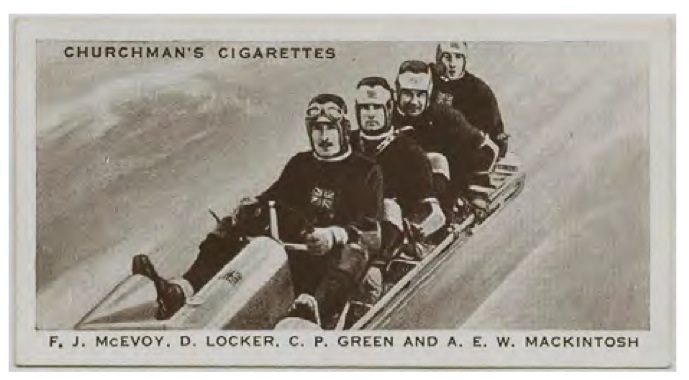
Cigarette card honouring the 1938 4-man bob world championship winning British team with Freddy up front

Freddy’s Alpine Career in Perspective…

Freddy was one of the great sportsmen of his era and in bobsleigh racing one of that discipline’s all-time greats.

He was a pioneer of a sport which was then very dangerous, the medal he won at Garmisch in the 1936 Olympics made him the first Australian to win a Winter Olympics medal albeit representing the mother-country, England.

Over the next three years captaining the British team and piloting the bobsleigh he won two world championships on the trot in 1937 and 1938, that later year beating ‘the master race’ in front of their home crowd in Nazi Germany. He took silver the year after that.

In total he won three Gold and two silver World Championship medals in two different forms of the sport – the four and two man ‘bobs – and was the first ever competitor, (along with his partner in the two-man bob) to win gold in both events in the same year. He set one last course record in 1939, covering the 1554 metres of the Italian World Championships run at Cortina d’Ampezzo in a time of 1 minute 20.75 seconds. It was also in Cortina where he won his first World Championship gold in the two-man bob in 1937.

 It was only the outbreak of war which put an end to his short career. He was the only sportsman from Australia to receive a medal in any of the five founding sports of the Winter Olympics.

Max Everist-Phillip’s, Director of the United Nations Development Programme’s Global Centre in Singapore in a 2015 ‘Numismatic Association of Australia’ article entitled ‘Bobsleigh in a Warm Climate: Pre-war Australian Identity on The Slide’ goes as far as to say that ‘…McEvoy’s 1938 bobsleigh triumph (World Championship Gold) in Nazi Germany represents not just an Australian achievement in an unusual sport from a different era. In the run up to World War 2, the success of the Australian-British team carried political significance. It marked a triumph for the democratic ideal over the Third Reich’s totalitarian ideology and the ‘master race’. Its win offered a psychological boost to the British Empire in the lead up to World War 2. Nazi propaganda sought to claim the German people trained in the body in the service of the state and so international sporting success supposedly demonstrated the might of the ‘new Germany’, thereby apparently justifying its claim for ‘Lebensraum’ and racial supremacy. The victory gripped the popular imagination increasingly interested in the sport’.

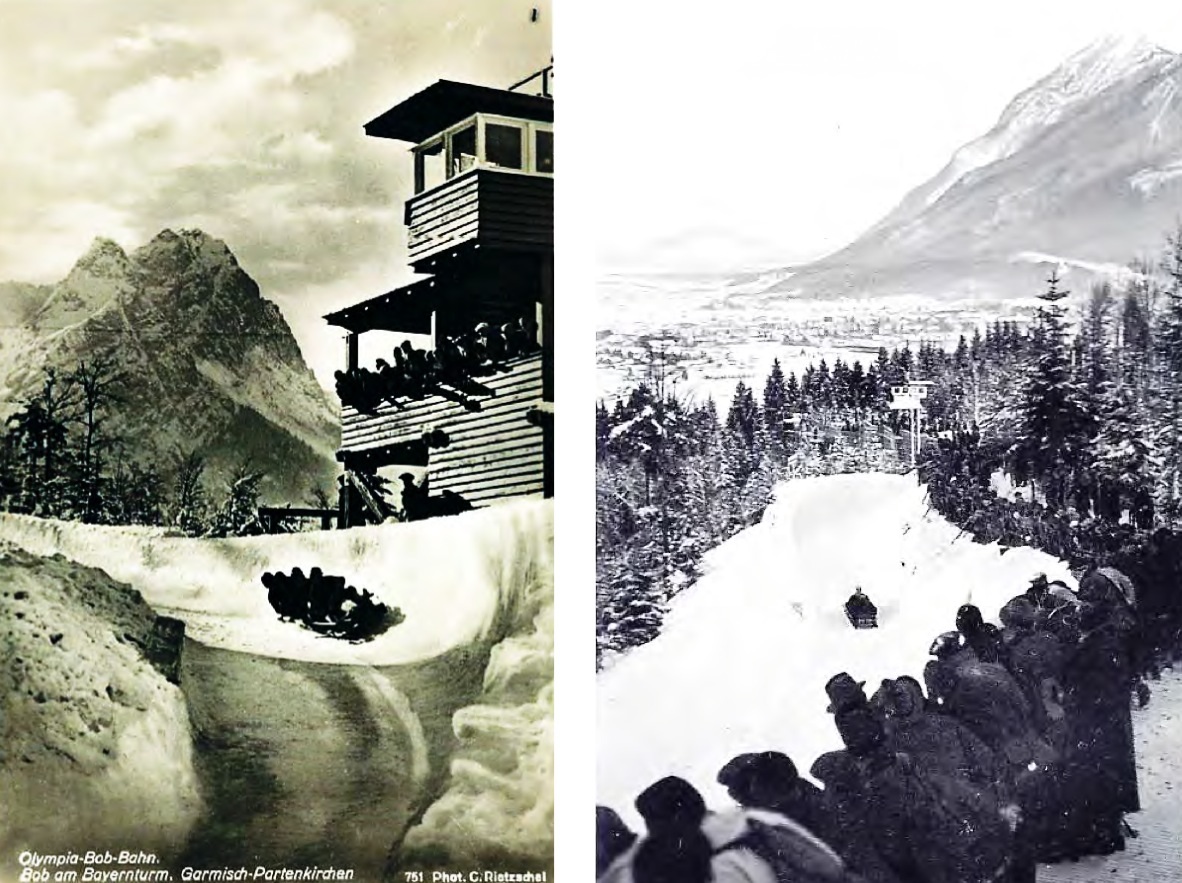
Spectators on a bend and the finishing section of the bobsleigh run, Garmisch, 1936 Olympics

Bibliography…

’Maserati: A Racing History’ Anthony Pritchard, ‘John Snow: Classic Motor Racer’ John Medley, kolumbus.f1, MotorSport magazine, Journal of The Numismatic Society of Australia article ‘Bobsleigh in a Warm Climate: Pre-War Australian Identity on The Slide’ by Max Everest-Phillips, barchetta.cc

 Photo Credits…

 Getty Images, vanderbiltcupraces.com

Tailpiece: Thank Your Lucky Stars…

(unattributed)

Errol Flynn in the scene from ‘Thank Your Lucky Stars’ in which McEvoy, although unattributed in the credits, appears at right

Finito


(D Simpson)

Bob Muir punches his Rennmax onto the straight at Oran Park during 1970…

Muir loved this car, it was initially built around a Coventry Climax 2.5 litre FPF engine and first raced at Oran Park in September 1969 and then through the Australian Tasman rounds and a bit beyond. One of Merv Waggott’s 2 litre, 275 bhp’ish engines was installed later in 1970.

Late that year it was sold to prominent Melbourne racer/engine builder Peter Larner who fitted a Lotus/Ford twin-cam, later still passing through the hands of a couple of other drivers ‘in-period’. It has been in Barry Singleton’s hands since the early 1980’s. With only a dozen or so meetings all up it would be a very yummy thing to have especially with a 2 litre Waggott fitted.

Bob later fitted his Waggott motor to the Mildren ‘Yellow Submarine’ which he raced for a year or so and rated the Rennmax the sweeter car- which is no small statement given the race record of The Sub.

As is well established, Bob Britton/Rennmax built a series of cars based on a jig he created from Denny Hulme’s Brabham BT23-5 which was crashed during the 1968 Tasman Series and given to Britto to repair. The most successful of these ‘BN3’s is Max Stewart’s Mildren Waggott, a chassis I have written about. Perversely Muir’s car has always been referred to as a BN2 but it is a BN3 in terms of its specification.

Where is that Rennmax book Ray Bell?!, Bob Britton, his cars and adventures are certainly worthy of a book.

(L Hemer)

Wings ‘n Things…

Lynton Hemer was at Warwick Farm in December 1969 when Bob Muir first fitted wings to this car during the Hordern Trophy Gold Star round in its original Coventry Climax engined form.

The first couple of shots are those below, he reasoned that they were taken in the morning without wings and engine cover to get a base level time and feel for the car. Between sessions they fitted all of the aerodynamic goodies and then Bob went out with Lynton observing ‘no wonder he had that (grimaced) look on his face, he must have found the car completely different’- as in faster!

An oil seal failed on the car during the race won by Kevin Bartlett- making the race debut of the 2 litre Waggott engine in The Sub- the car Muir would later own. Bob didn’t race the car sans wings ever again…

(L Hemer)

Credits…

Dick Simpson- oldracephotos.com.au, Lynton Hemer, oldracingcars.com

Tailpiece: In search of a wing…

Homestead Corner, big oil tank, angle on the exhaust dangle unattractive. I wonder who he bought the FPF from? (L Hemer)

Finito…

(N Stratton)


Kevin Loy’s Matich A51 ‘005’ Repco F5000 departing Oran Park in Vice-Regal style, 2 February 1975…

No standing on ceremony here, although its a you-beaut ANF1 car- the Formula 5000 machine is travelling in no more comfort than my Formula Vee and considerably less so than my old Lola T342 Formula Ford. And its off to Surfers Paradise, 850 kilometres away in the hands of Ian Douglass to whom it has just been sold.

I’ll bet Frank Matich, Derek Kneller and the boys looked after the thing much more nicely in the US- this chassis was new for the US L&M Series tour Team Matich undertook during 1973. It was FM’s primary weapon, A51 ‘006’ went along for the ride as the spare. Here is a story about Matich and his F5000 cars;

Frank Matich: Matich F5000 Cars etcetera…

Matich A51 ‘005’ in the Mid Ohio paddock 1973 (T Capps)


Lella Lombardi in A51 ‘005’ during the 1974 AGP- car was overseen by Matich himself. Lella pushed Max Stewart, the winner very hard before oil pump failure ended a great run (HAGP)

In many ways this little baby would be ‘the’ F5000 Matich to own. It toured the US, was raced by Lella Lombardi at Sandown and Oran Park in 1974, and, sold to John Goss to keep A53 ‘007’ company, won the 1976 Sandown Park Australian Grand Prix modified to A53 spec.

Another shot of Lombardi, this time at Sandown Park’s Dandenong Road corner in 1974 (B Keys)

Later still French sportscar ace Henri Pescarolo raced it at Calder in 1977, so too did Jim Richards in its ‘period dotage’ in 1979.

A very nice jigger indeed, here looking a bit forlorn on an open trailer behind an XA Ford Falcon Wagon rent-a-rocket.

Still, the serious money should be spent on the car not the trailer…

Goss wins the 1976 AGP aboard his Matich A51/53 ‘005’ from Vern Schuppan’s Elfin MR8C Chev, Sandown Park (HAGP)

Credits…

Neil Stratton, oldracingcars.com, Terry Capps, Derek Kneller, ‘History of The AGP’ G Howard and ors, Bruce Keys

Tailpiece: A51 ‘005’ fitted with Repco V8 flat-plane ‘Shaker’ crank in the Watkins Glen pitlane 1973…

(D Kneller)

Finito…

(S Hood)

Goerge Barton and John Sherwood with their MG NE Magnette, in 1934, place unknown…

John Sherwood was a rather talented Australian- an elite road racer, competitor in the 1938 Australian Grand Prix and winner of the 1939 New South Wales Grand Prix/Motor Road Race, both events at Bathurst. He was also an excellent Midget speedway racer, motor sport administrator and promoter.

Sherwood was the driving force of the NSW Light Car Club and the key individual who created the Mount Panorama track at Bathurst. From a pioneering motoring family, he was a formidable competitor and later, as a Director of Empire Speedways, was a big contributor to the growth of Speedway Racing in Australia

I was researching an article on Sydney’s Parramatta Park road circuit when I tripped over this article written by Sherwood in 1953. I’ve reproduced it for its rarity- a man of the sport, in the sport and involved in the business of racing writing about its history in period having participated in many of the events he describes.

The selection of photographs to help bring the article to life are my own, otherwise Sherwood’s work is reproduced verbatim.

John Sherwood exiting Murray’s Corner, MG NE Magnette, Bathurst, Easter Monday 10 April 1939 on the way to winning the handicap NSW GP/Motor Road Race. He won from Paul Swedberg in John Snow’s Delahaye 135S and John Barraclough’s MG NE Magnette. The Sydney Morning Herald reported that ‘Sherwood drove a splendid race throughout going into the lead after the first few laps and holding it to the end, though making two stops for faulty spark plugs’ (M Stahl)

‘Generally speaking, history tends to be on the dry side, but fortunately the historical side of motor racing is anything but dry. It is rather fascinating to look back along the years to see how the sport in Australia has developed.

Motor racing in our country has grown over the years despite several retarding factors: the continued objection of officialdom to all aspects of organised fast driving, for many years the impossibility of obtaining suitable circuits and tracks on which to race and the lack of factory support for ambitious and worthy drivers. Nevertheless, motor racing enthusiasts throughout Australia have overcome all these drawbacks, and today (1953 remember) we see more of the sport than ever before.

Motor racing in Australia developed in Australia through the early reliability trials of 45 years ago, followed gradually by the inclusion in such trials of speed events such as hillclimbs, acceleration tests and short timed events over quarter and half mile distances. Then commenced the various city to city record attempts, for a long time unhindered by officialdom, in which usually big engined chassis with bucket seats, and a host of spare tyres sped from capital to capital over atrocious roads with the success of the run always influenced by the number of blowouts of the cord beaded edge tyres, and the number of tyres it was possible to carry on the vehicle.

Drivers of these cars were considered super-drivers, and such men as the late AV Turner (later killed in a hillclimb), the late Boyd Edkins and ‘Wizard’ Smith were hero-worshipped everywhere by motor enthusiasts.

The first actual racing in Australia probably occurred on the enclosed tracks at Victoria Park Racecourse (Sydney) and the Aspendale one mile dirt track (Melbourne). Mostly big-engine low revving juggernauts took part, entirely unsuitable for the job as we look back now, but in those days the last thing in racing automobiles.’

‘World Championship’ for Under 1500cc cars- Penrith Speedway, Sydney, 6 October 1930. From the outside is John Sherwood’s Lea Francis O-Type, then the Sam Aggett and Charlie East driven Bugatti T37’s and on the inside Tom Lord’s, Geoff Lowe owned Austin 7 Brooklands. On the very inside verge is Jack Field’s supercharged Lea Francis S-Type Hyper tourer slowing having paced the competitors for a lap before the championships 3 lap journey, East was the winner in his Bugatti (SLNSW)

‘The early drivers were keen, and more tracks were opened at Penrith (one mile) Maroubra (5/6 mile highly banked concrete track) and beaches at Gerringong and in Victoria came into use for racing purposes. At Gerringong, Don Harkness, driving an enormous Minerva engined chassis, was clocked at 107 mph to be the first in Australia to exceed the coveted ‘century’.

(The) First actual road racing circuit was opened at Phillip Island in Westernport Bay, 40 miles from Melbourne in 1928 and this became the mecca for motor racing enthusiasts for the next nine or ten years. At this point the dry bed of Lake Perkollili in Western Australia was the centre of motor racing in the west.

Australia’s best road circuit (more or less built specially for the purpose) at Mount Panorama, Bathurst came into being in 1938, and except for most of the war years, has been in use ever since. Other road circuits in other states have also sprung up, and since the war various ex-airforce strips have been adapted for racing with much success.

The newest circuit to come into use is in Parramatta Park, 15 miles from Sydney, a rather narrow 2 mile circuit, suitable mainly for the smaller cars, but by reason of its close proximity to a big population, is certain of success.

Down through the years cars have altered very considerably, the small high revving high compression engines now putting out power which one could not have conceived in the early days. Suspensions, brakes, steering, weight, tyres, fuel, streamlining and a hundred and one other things have combined to make the modern racing car a real thoroughbred, capable of sustaining terrific speeds over long distances.

As the years have rolled on, the scene changes, but motor racing itself does not change. Its spirit, rich in tradition and sportsmanship, linking past and present, reaches out to the future.’

Photo Credits…

Sam Hood, State Library of New South Wales, Max Stahl Collection

Bibliography…

South Coast Times and Wollongong Argus 21 September 1953, reprint of an article first published in the ‘Bentwood Review’, Sydney Morning Herald 11 April 1939, John Medley

Tailpiece: Sherwood and flock…

(Fairfax)

John Sherwood standing beside John Snow’s #4 Delahaye 135S, with the #6 Edison Waters Jaguar 100SS, Alf Barrett’s Alfa Monza and John Barraclough driven Alvis Terraplane straight-8 on the Bathurst grid in October 1939. Sherwood instrumental in the construction of this Australian racing institution- in the words of John Medley ‘Bathurst: Cradle of Australian Motor Racing’.

Finito…


It’s the end of the swinging-sixties- the Andy Warhol, Roy Lichtenstein and others ‘Pop Art’ phase is in full bloom…

It’s interesting to look at the graphic design and advertising imagery of the period which is wonderfully full of it, the style even extended to some stickers in Australia’s ‘Racing Car News’ magazine.

For the princely sum of 20 cents the six decals would be in your letterbox within the week, don’t you love the immediacy of snail-mail? The cheap giveaway was a time honoured technique in the pre-internet days of building a database of potential customers, oh for simpler times when identity fraud was rare rather than something to be mindful of in our daily online interactions.

The cars and drivers are all well known to Australian enthusiasts and include some of the stars of the day many of whom I have written about in whole or in passing.

The first image is Kevin Bartlett’s Alec Mildren Racing Mildren Waggott ‘Yellow Submarine’, a car first raced by Frank Gardner in the 1969 Tasman Series and then used by KB to win the Gold Star later that season. Click here for more; https://primotipo.com/2017/11/14/missed-it-by-that-much/

Frank Matich’s Matich SR4 Repco was built to contest the 1968 Can-Am series but ran hopelessly late so crucified local opposition in the 1969 Australian Sportscar Championship instead. Click here for a long feature on it;

Matich SR4 Repco…by Nigel Tait and Mark Bisset

Whilst the Niel Allen sticker says McLaren M10B, the car depicted is the M4A he acquired at the end of the 1968 Tasman Series from Piers Courage. This piece on the ’68 South Pacific Trophy at Longford, won by Courage tells a bit about this car; https://primotipo.com/2015/10/20/longford-tasman-south-pacific-trophy-4-march-1968-and-piers-courage/

The final three cars featured are Pete Geoghegan’s Australian built Mustang above (as in built for racing), Norm Beechey’s Holden HK Monaro GTS 327 with Bob Jane’s Shelby constructed Mustang as the ‘Tailpiece’. All of these machines are covered in an article I wrote about the 1969 Australian Touring Car Championship won by Geoghegan. Here ’tis; https://primotipo.com/2018/02/01/1969-australian-touring-car-championship/


Credits…

Bob Williamson Collection

Tailpiece…

Finito…

(Thomas)

These two blokes are aboard a Bugatti Brescia Type 23 out front of The George Hotel in Lydiard Street, Ballarat, Victoria between 1945 and 1950…

The shot is from the State Library of Victoria archive, it was taken by George Thomas, a prolific ‘snapper at motorsport events throughout Victoria at the time. Ballarat, 120 kilometres west of Melbourne is a Gold Rush town. Over 600,000 people came to Australia from all over the globe in the 1850s to chase their fortune. Ballarat was one of the main destinations of the optimistic, it’s a beautiful place with many of the stately buildings of the period still standing, including the George Hotel.

The interesting thing is of course, which particular chassis it is and who the fellows are. My recently acquired copy of Bugattis In Australasia (details in the credits below) personally delivered by the very knowledgeable, youthful, spritely 81 year old author, Bob King suggests it’s either Bill Fleming or Neil Barter, assuming the photo date range is accurate.

The car is a long-chassis Modifie. Without going into all of King’s detail, the chassis number of the car can’t be confirmed, but it came from New South Wales to Victoria in 1938 when owned by Fred Betts. He never registered it, but raced it at Phillip Island pre-war.

After the conflict it was raced by John ‘Bill’ Fleming at the Hurstbridge and Rob Roy Hillclimbs in Victoria in 1948, before being sold to Barter that October. At this stage, as shown in the opening photograph, the car was registered in Victoria JT441 and was fitted with engine number 2566.

Fleming on the startline at Hurstbridge Hillclimb in Melbourne’s outer north-east (King)
The Fleming Brescia at Rob Roy Hillclimb in Melbourne’s Christmas Hills, ‘eighteen litres of Semmering Mercedes in the background’ (King)

Barter recounts in King’s book ‘By January we were driving it around as much as petrol rationing would allow. After correcting a dismally retarded camshaft timing, we found the performance astonishing – 40 mph first gear, 60 in second, 4,300 rpm etc – we were never short of superlatives. Alas youthful exuberance led to disaster and injury when… in April 1939…the car overturned at the corner of Dendy Street and The Esplanade, Brighton’, a bayside Melbourne suburb not too far from Albert Park Lake, a place all you global GP fans will be familiar with.

‘A regular trick was to drive it as quickly as you could along Beach Road at Brighton Beach and, instead of taking the right hand corner…we would hurl it into the gravel car park opposite the monument, put it into a 180-degree slide and then drive straight out again, heading back towards Hampton. The prize for the night went to the driver who travelled the quickest and made the cleanest slide!’ What a great thing to do after a few bevvies on a Friday or Saturday night?!

‘This all came to a halt when, one night, with four up, I rolled it when turning from the beach road into Dendy Street…a very sobering experience for all and particularly me’, Neil Barter wrote. Looking at the young blokes in the car at Ballarat my guess is that it’s Barter and one of his Brighton Grand Prix accomplices!

Bob King records a bewildering nineteen owners of this car. The last was Wolf Zeuner in the United Kingdom albeit this was way back 1992. The name Brescia was applied to these cars (T13 2.0 metre chassis, T22 2.4 metre, T23 2.55 metre) after the cars placed first to fourth in the 1921 Italian Voiturette Grand Prix.

Piero Marco, Brescia T22, Brescia before the off Gran Premio delle Vetturette, 1921 (Bugatti)

de Vizcaya, Brescia T13, GP Penya Rhin 1921- is the descriptor for this Barcelona event but my race results don’t accord with this car/driver combo that year (unattributed)

This event, the ‘1 Gran Premio delle Vetturette’, held on 8 September 1921 on the Circuito di Brescia comprise 20 laps of a 17 km course, a total of 346 km. Thirteen cars contested the race, the winning Bugatti T22 of Ernest Friderich completed the race in two hours 59 minutes 18.6 seconds. He was followed home by teammates Pierre de Vizcaya, Michele Baccoli and Piero Marco all aboard Bugatti 22s, they were chased home by a group of four OM465’s.

2,000 Brescias were built from 1919-1926 more than any other type of Bugatti. ‘Being the first Bugatti made in any numbers, it was the Brescia that established Bugatti’s reputation as a builder of sports and racing cars. They were imported into Australia and New Zealand in considerable numbers…’ King wrote.

Original period sales brochure with Brescia at centre stage, the rest of the document is below

Bob continues ‘The Brescia, of 1496cc capacity, has a cylinder block with non-detachable head and four valves per cylinder operated from a single overhead camshaft via ‘banana’ tappets. In Europe the standard touring model had a four sparking plug cylinder block with ignition from a magneto mounted transversely at the front the engine. These cars had a cast aluminium firewall and were known at the factory as the ‘Modifie’. Racing versions had eight plug cylinder blocks with two magnetos mounted in the dashboard driven (noisily) by spur gears. These latter were known as ‘Full Brescias’. Surprisingly, regardless of chassis length and whether fitted with racing, sports, or touring bodywork, the majority of new imports to Australia were ‘Full Brescias’. Perhaps it was thought to have the security of two magnetos in our relatively primitive motoring environment.’

Superb Brescia 16-valve engine cutaway, technical details as below (Griggs)

In the early twenties, Bugatti didn’t build the bodies of their cars, with the exception of minimalist T13 racing coachwork, so all of the new cars imported to Australia via the London agent, Sorel, were shipped in most cases in bare chassis form. A tax or tariff was imposed on imported coachwork to help stimulate the local industry with ‘Many of the local bodies fitted to Brescias appear to have been of poor quality. This, coupled with the harsh ride of the Brescia, and the poor roads on which they were driven, ensured that the coachwork had a short life. With the need for light bodies for competition work, the discarded original bodywork was usually followed by a succession of amateur built bodies.’ King wrote.

Bugatti played a very important part in the formative years of Australian motor racing as the weapon of choice for many sportsmen on road circuits, hillclimbs, the concrete saucer at Maroubra, gravel speedways and the beaches at places like Gerringong.

A straight-eight Bugatti T30 driven by Geoff Meredith won the first Australian Grand Prix at Goulburn, New South Wales in 1927. Goulburn, 200 km south of Sydney, was also a Gold Rush town. In fact Bugatti won five of the first six AGPs creating huge brand awareness by the standards of the time.

Four cylinder Bugatti T37As – the supercharged variant of the T37 – were victorious in the Phillip Island AGPs of 1929 with Arthur Terdich at the wheel, and in 1930 and 1932 when driven by the period’s ace, Bill Thompson. Carl Junker won in 1931 aboard a straight-eight 1.5-litre T39.

Drake-Richmond’s T37 goes thru Heaven Corner ahead of the Mert Wreford Riley Brooklands during the 1 January 1935 Centenary 300 at Phillip Island. This is the cover photo of Bob King’s book (King)

The Phillip Island AGPs were handicap events, so there is no reason a Brescia couldn’t have won a race with the right mix of speed, reliability and luck, but such never the case. The best Brescia results in our premier event were Merton Wreford’s fourth in 1932 and John Bernadou’s fifth in 1929.

Mert raced chassis 2133, ex-Arthur Terdich, and ‘In practice Wreford’s straight line speed was bettered by very few cars and he was actually faster than Drake-Richmond’s Type 37. In the race Mert was given a 15 minute start by the blown Type 37A’s of Terdich and Thompson and he finished a creditable fourth place on handicap, averaging almost 65 mph for the 200 miles with his old two-wheel-brake Brescia in spite of losing four valuable minutes with clutch trouble’ Bob King wrote.

John Bernadou raced his father Albert’s 2536 in the 1929 AGP – both father and son competed extensively in Victoria in the mid-twenties – despite being delayed by a hole in the fuel tank John was third in the Under 1500 cc class and fifth overall.

Bill McLachlan at Quarry Bend, Bathurst 1952. Bug T37A Ford V8 37358 aka the  MacKellar Spl (B Gunther)

Some (not a huge number mind you) quite exotic racing cars came to Australia pre-War including several Vittorio Jano designed Alfa’s, but the faster Bugatti racing straight-eight T35 and T51’s didn’t make the trip until post-War, when they were of course beyond the first flush of youth.

In our racing, which comprised many events run to handicaps, the cars were competitive but none won a post-War AGP. All played an important role in bolstering grid sizes throughout the long Australian Special Era which in the main were MG based or Ford side-valve V8 powered. In many cases once the original Bugatti (or Alfa or Ferrari or Bristol) motor blew Ford V8s, or a bit later a small block Chev or Holden Grey-six-cylinder engine was inserted under said car’s shapely aluminium bonnets.

To reframe my shallow comment a moment ago about Australian Specials, the wonderful breed included tool-room-quality machines such as the Charlie Dean/Repco Research built Maybachs, the Lou Abrahams/Ted Gray Tornados and Chamberlain brothers Chamberlain 8. Also in the mix are outrageous in brilliant original conception cars like two of Eldred Norman’s masterpieces, the Double 8 and Eclipse/Zephyr Spl, while the rest includes anything and everything from mild-to-wild MGs and Ford V8 engined specials. Not to forget the Hudson straight-eight engined machines pre-War, the high point of those is the extant (Frank) Kleinig Spl: MG chassis, monoposto, Hudson-8 and much, much more. There was no lack of creativity among this country’s mechanics and engineers however basic the underpinnings of the machines they started with!

A game-changer was the move in AGP regulations from handicap to outright events from the 1949, Leyburn Queensland AGP won by John Crouch’s Delahaye 135S. Mind you that didn’t stop the organisers of the 1950 Lobethal, South Australia, and 1951 Narrogin, West Australia AGPs having an each way bet by placing as much emphasis on the handicap winner as the outright victor, which comes through strongly in the contemporary newspaper accounts.

1951 was the last handicap-AGP (in part) and the last won by an Australian built car (the Warwick Pratley driven, George Reed built, Ford V8 engined George Reed Special) until Frank Matich won the 1971 AGP at Warwick Farm a couple of decades later in brand new F5000 Matich A50 Repco Holden.

From 1951 those who wanted to win the AGP needed the readies to acquire a car with the speed, endurance on our rough road circuits and reliability. The balance of the fifties was the Factory Car Era. A Talbot Lago T26C won in 1952/3 (Doug Whiteford), HWM Jaguar in 1954 (Lex Davison), Ferrari 500/625 won in 1957/8 (Davison), a mid-engined Cooper T40 Bristol in 1955 (Brabham) and Maserati 250Fs in 1956/9 (Moss/Stan Jones).

John Cummins raced his T37A Holden ‘37332’ complete with Bellamy IFS until very late in the piece- here the eternal racer/raconteur is at Bathurst in 1961 (unattributed)

Among all this the pre-War Bugatti’s, whether Bugatti or black-iron-powered still played an important role. The last AGP grid of substantial Bugatti numbers was the 1952 Mount Panorama contest in which three entered. Bill McLachlan’s T37A Ford V8 finished 13th, while the T35B/51 shared by Phil Catlin and Peter Menere was 15th, but the P Lowe T37 Holden failed to finish. In fact the placings by McLachlan and Catlin/Menere were the last in an AGP for Bugattis, one was Ford V8 powered, the other still had its Molsheim motor.

For the record, the very last Bugatti AGP start was the David Van Dal/John Cummins T57 which failed to finish the very hot 1957 Caversham race outside Perth. There ended a rich contribution by the marque to Australian motor racing which commenced with substantial numbers of Brescias, and Geoff Meredith’s first AGP win aboard a T30 at Goulburn in 1927. Thirty years from start to finish, not a bad record at all!

Duncan Ord in the ex-Howe/Levegh T57 ‘57264’ 3.3 s-8 in the Patriotic GP at Applecross, Perth, WA on 11 November 1940. He is turning out of Tweedale Road (Terry McGrath))

Bibliography…

‘Bugattis in Australasia’ Bob King- Bob still has a couple of copies of this book and plenty of ‘The Brescia Bugatti’- contact rking4450@gmail.com

‘A History of Australian Grand Prix 1928-1939’ John Blanden, MotorSport July 1942, The Bugatti Trust

Photo Credits…

George Thomas, Bob King Collection, Byron Gunther, Bob Shepherd, Terry McGrath, Griggs, automobiles.narod.ru

Etcetera: Brescia/Brescia Modifie Technical Specifications…

Chassis: period typical girder, H-section front axle, weight circa 610 kg

Engine: Four-cylinder, SOHC by front bevel drive, four valve with bore/stroke of 66, 68, 69 x 100 mm for capacities of 1368/1453/1496 cc. Carburettor(s) one or two Zenith. Ignition one or two magnetos, usually SEV. Plugs one or two per cylimder. 30 plus bhp with an RPM limit of (‘prudent’) 4000 ‘or even 4500 on a good Brescia’

Gearbox: located centrally, four-speed and reverse with right-hand location, clutch wet multi plate

Brakes: Location and type – foot, transmission and right-hand for the rear. Four wheel brakes fitted from 1926

Wire wheels with original size 710 x 90

Dimensions: T13, wheelbase 2.0 metres or 1967 mm, T22 2.4 metres or 2417 mm and T23 2.55 metres all with a track of 1.15 metres

Drawing of Brescia ‘2566’ engine showing the oil drain tubes from cam-box to crankcase (B Shepherd)

Notes on The Brescia Bugatti: MotorSport July 1942…

Brescia T13 drawing (automobiles.narod.ru)

Related Articles…

1927 Australian Grand Prix, Goulburn

Tailpiece: O’Rourke Brescia, Cooper Ballot and Bartlett Sunbeam, Maroubra, Sydney, late twenties?…

(unattributed)

Finito…

(Q Miles)

Doug Cavill or perhaps Bill Reynolds races his Austin Healey 100-6 based Prad Healey at Lowood, Queensland circa 1959…

The car was a new one on me, quite a wild, fantastic looking machine, the modifications to the body were made by Jack Pryer and Clive Adams- the Prad boys in Sydney whilst the engine was breathed upon by racer/mechanic Bill Reynolds. Cavill- the Surfers Paradise ‘main drag’ Cavill Avenue was named after his father Jim Cavill- was a successful estate agent and had the readies to fund this interesting car.

Quentin Miles has been progressively uploading some photographs taken by his late father on Bob Williamson’s ‘Old Motor Racing Photographs – Australia Facebook page- check it out, this is a beauty despite the ravages of time to the negative.

Patrick Quinn wrote an article about this interesting car published in the Victorian Austin Healey Owners Club magazine ‘Hundreds and Thousands’ in 2013 which is reproduced below. The ‘restoration’ of the car is a shame, tragic really.

Etcetera…

This shot by the Salter brothers is at Lakeside circa 1961-62.

Credits…

Quentin Miles, Patrick Quinn, ‘Hundreds and Thousands’, B & N Salter

Tailpiece…

Finito…
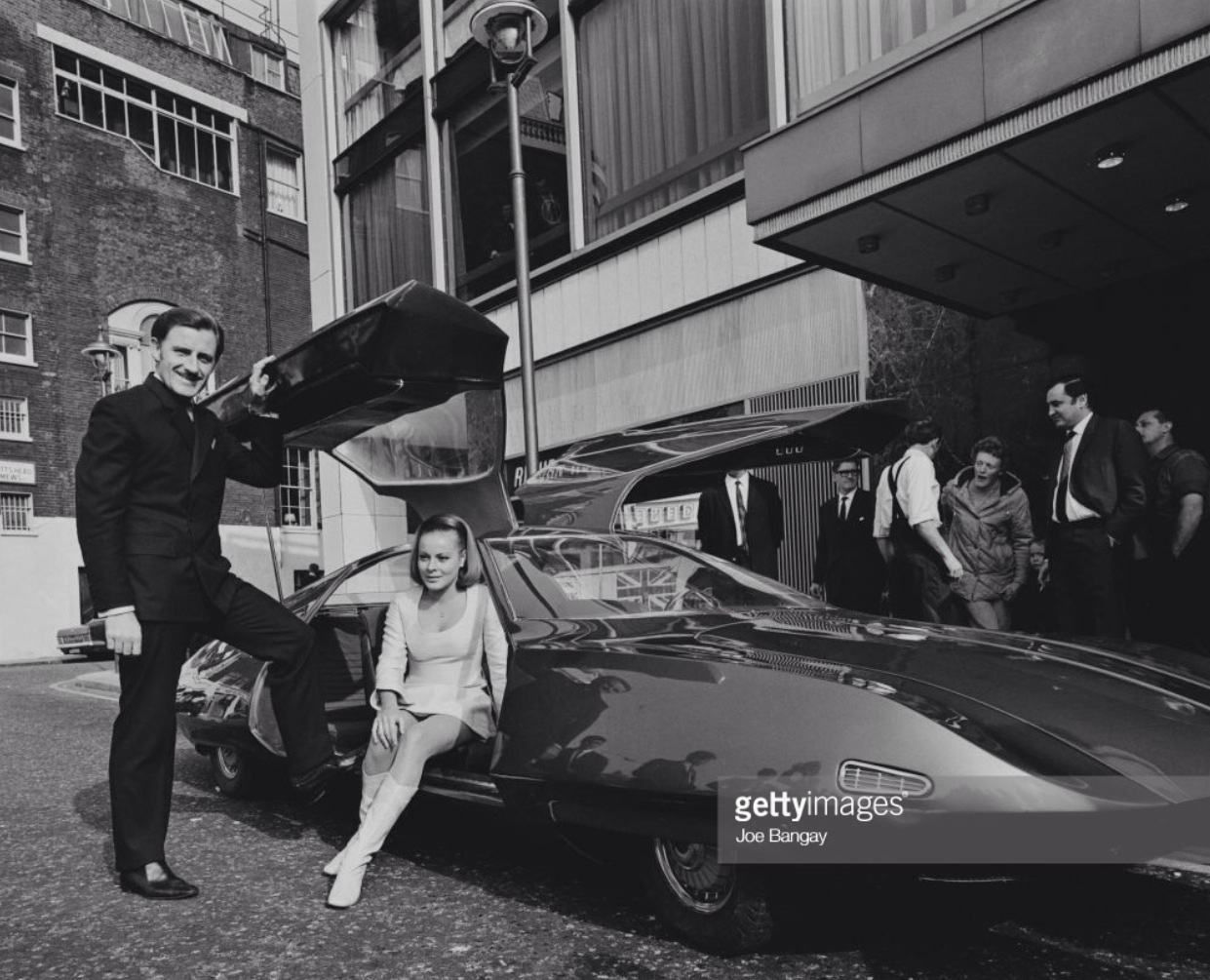
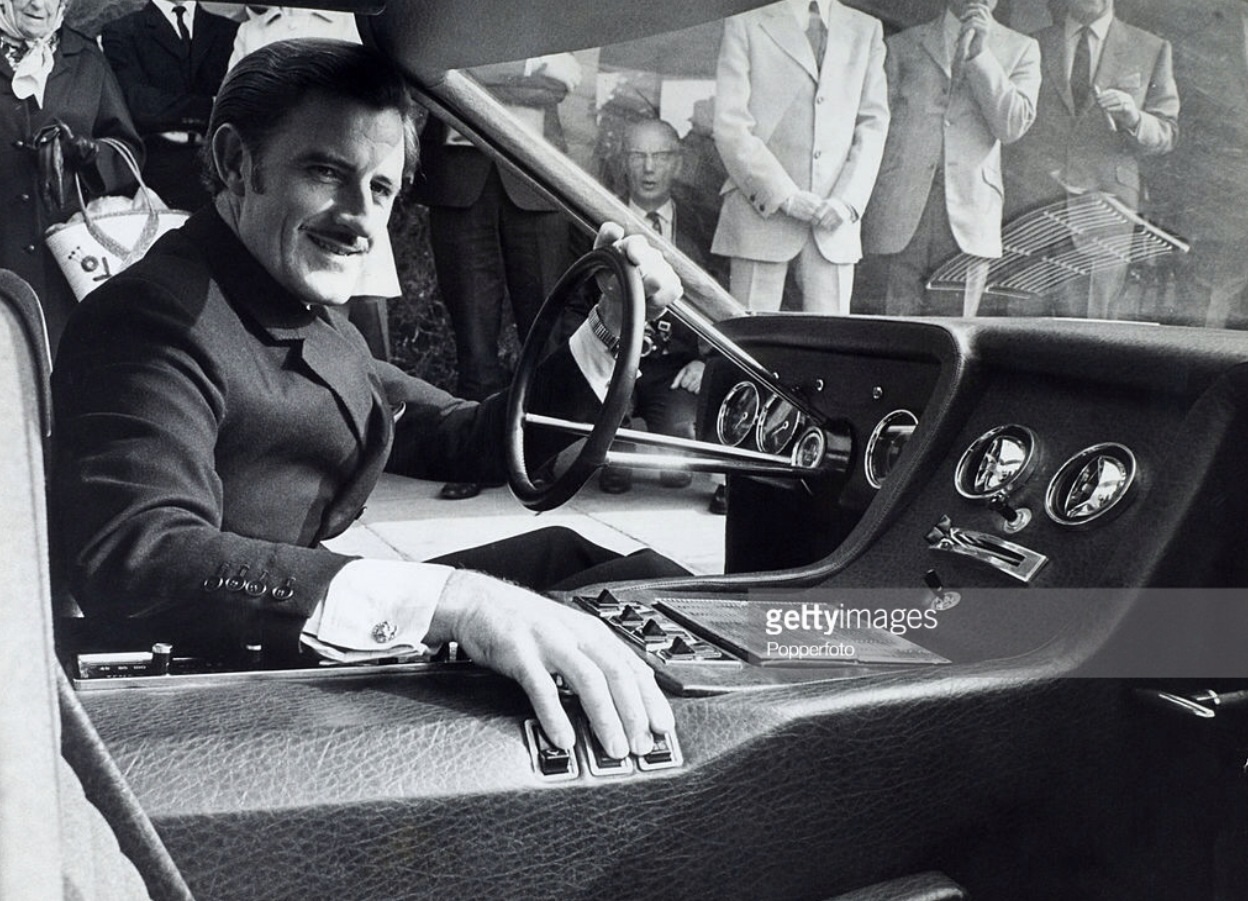
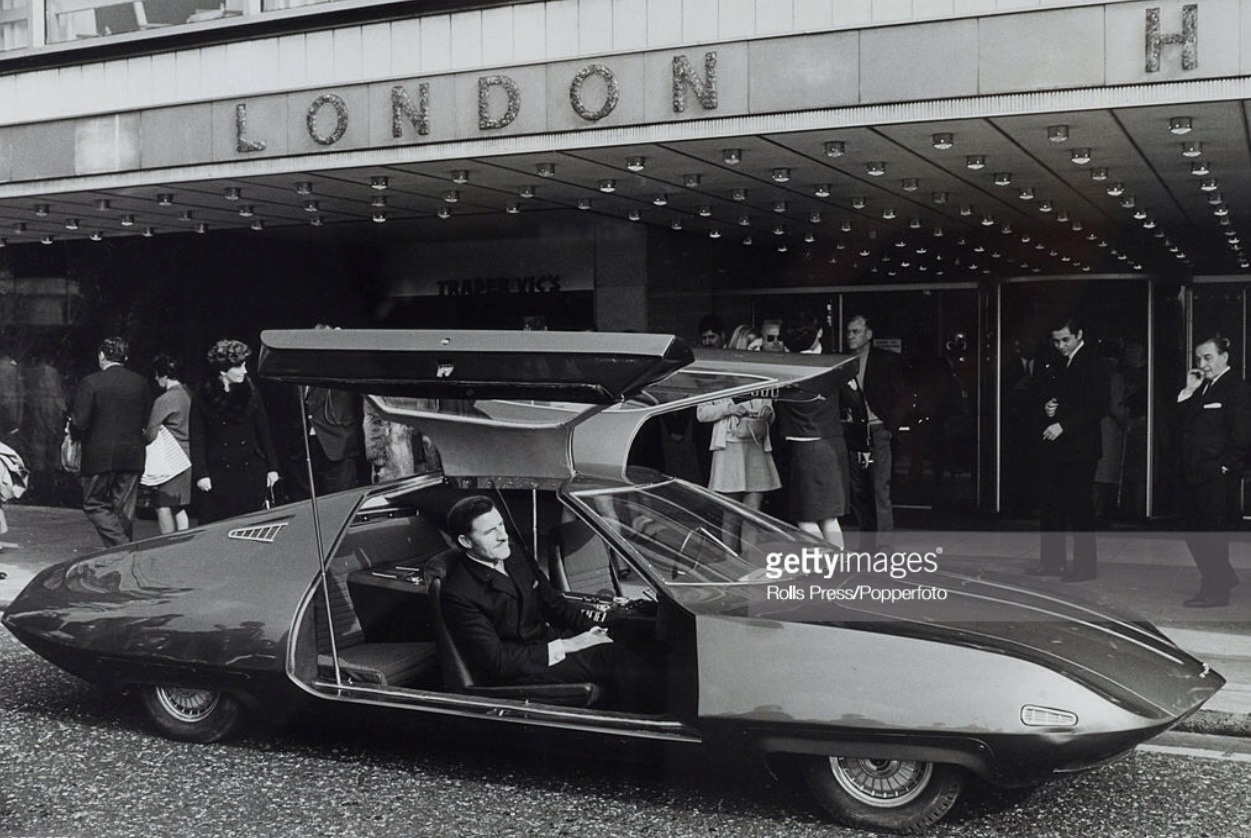
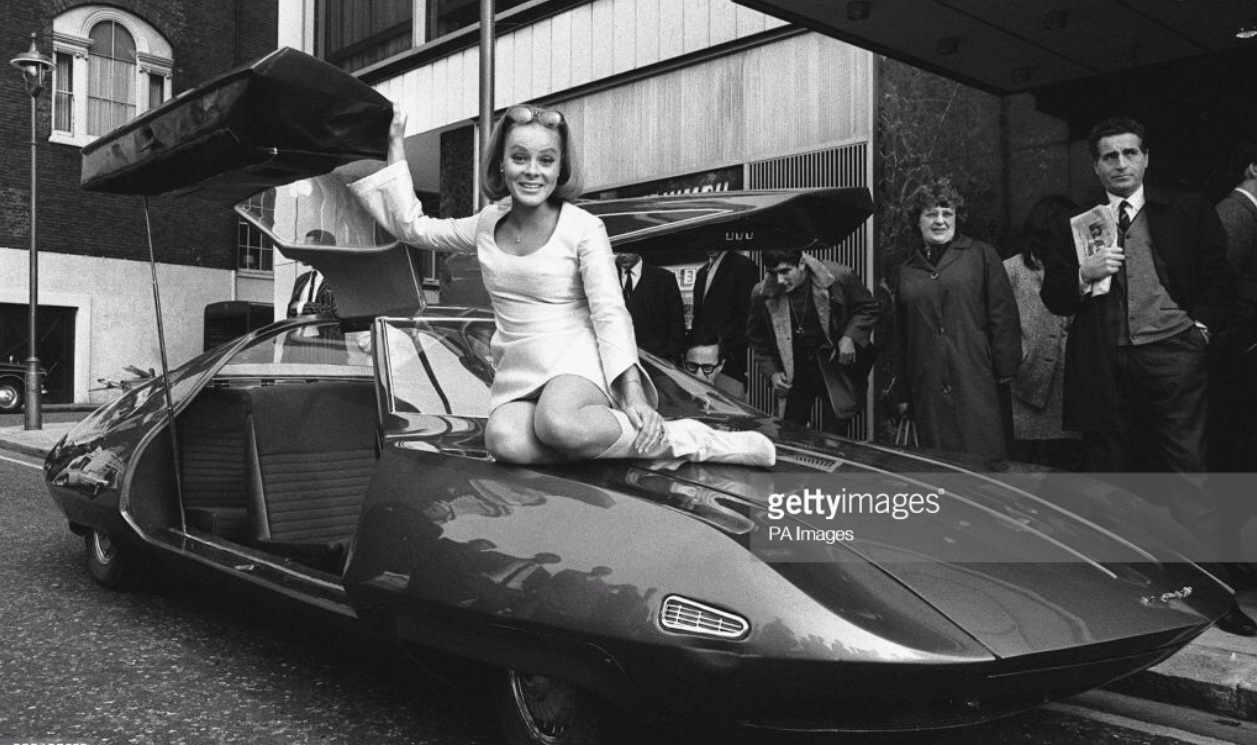
Graham Hill with his new Doppelganger, London, 10 October 1968…

With him is Austrian actress Loni Von Friedl who appeared in ‘Doppelganger’, a movie which is the subject of this promotion, an activity which seems quite agreeable to the great Brit. The car, also a movie-star was ‘designed and built by Alan Mann Racing, has a Ford engine and chassis, is 44 inches high and is capable of 144 mph’.

The film, also called ‘Journey To The Far Side Of The Sun’ in some countries has a screenplay written by Gerry and Sylivia Anderson of ‘Thunderbirds’ and other 1960’s ‘Supermarionation’ puppet TV series fame- well known to those of us of a particular generation.

Set one-hundred years into the future, the film is about a joint European-NASA mission to investigate a planet in a parallel position to Earth and ends in disaster with the death of one of the astronauts- his colleague discovers that the planet is a mirror image of earth. Click here for some more detailed information about the movie which first screened in 1969; https://www.imdb.com/title/tt0064519/

Who gives a rats about the movie for most of us! As to the car, I can find out a little bit, Alan Mann Racing has a great website but the car does not rate a mention there so I am intrigued to know more about the detailed design.

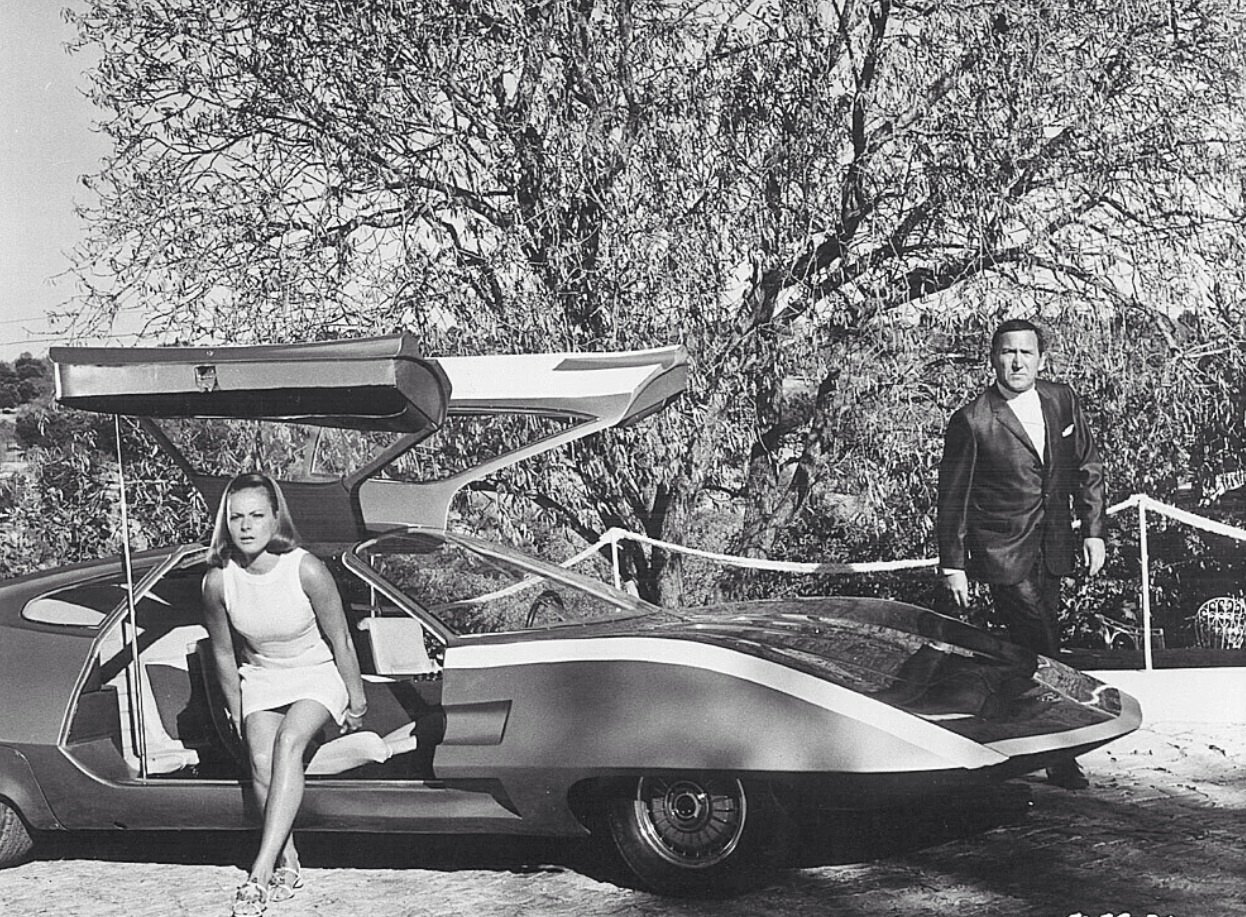
It seems the styling of the futuristic car (three were built for the film) was the work of Derek Meddings, the machines were ‘redressed slightly’ for a subsequent movie named ‘UFO’. The donor chassis was a Ford Zodiac Mk4 with the shapely aluminium body draped thereon. The gull-wing doors did not actually work, someone such as Hill G, or off camera during the movie was required to support a door.

‘The actors reported that the cars were very unpleasant to drive in, as there was not enough headroom, engine exhaust fumes spilled into the interior…and the cars were not fast, so many scenes were sped up to simulate a fast-moving vehicle’. The bones of the car still exist and will no doubt make an interesting curio at race/concours meetings when completed.

Photo and Other Credits…

PA Images/Joe Bangay Getty, projectswordtoys.BlogSpot.com

Tailpiece: Another of Doppelganger’s cars, Loni and a bloke…

Finito…