Archive for the ‘Obscurities’ Category

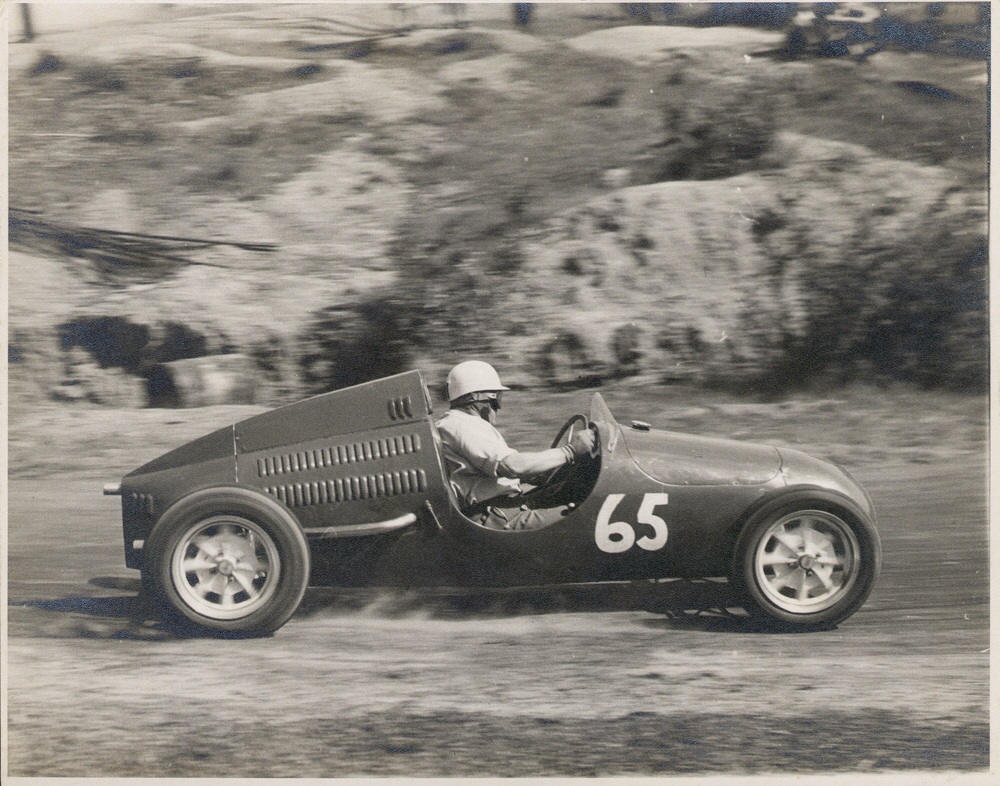
Arch Tuckett’s Henderson engined Midget out front of the workshop where it was probably built-off William Street, Woolloomooloo, inner Sydney in 1934…

The first race meeting in Australia for what became known as Midgets took place at Olympic Park, Melbourne in the summer of  1934, on 15th December. A motley crew of racers attacked the cinder track that evening, including Arch Tuckett.

Also on the grid were Bill Allen, who brought the sport to Australia, George Beavis, Barney Dentry, Charlie Spurgeon, Bill Thompson, Cec Warren, P Bouker, Lance Burgess, Fred Curtis, Arthur Higgs, Les Gough, Bruce Leckie, G Malone, J Farmley, A Shaw and Bob Finlay who was Australia’s first Midget champion.

Although there had been car racing on oval track venues around Melbourne such as the 1 mile Richmond Racecourse in Melbourne’s inner east and the bayside Aspendale track since about 1913- it was not Midget racing but events between larger dimensioned light cars ‘somewhat akin’ to American Championship Cars.

The ‘Big Cars’ at Wentworth Park in November 1933. L>R Fred Braitling 1924 Alvis s/c, Charlie Spurgeon Fronty Ford Spl and Don Shorten Rajo Ford Spl. This is the race meeting referred to below in the text (S Hood)

In Sydney an organisation known as the ‘Dirt Track Car Racing Club’ (DTCRC) ran speedway meetings at Granville Showgrounds from 1932 and made an impression on the Sydney oval track scene. These cars were bigger machines including Rajo and Fronty Fords, Overland Miller and Morris Specials. They were putting on a good show at Granville but were a dismal failure as a spectacle when tried on the shorter Wentworth Speedway quarter mile in November 1933.

A year later several of the leading drivers of the DTCRC including Bruce Leckie, Charlie Spurgeon and Arch Tuckett gathered in Melbourne with the rest of the pioneering members of ‘The Midget Car Drivers Association of Australia’ to commence the new sport at Olympic Park.

Wentworth Park, Glebe. Midget race during the 1935/6 season L>R Arthur Wylie, speedway racer, constructor, road racer and ‘Australian Motor Sports’ magazine founder/publisher, Archie Tuckett and Sam Aggett. No chassis/engine details sadly. I worked in Glebe for 12 months- is that big building still there? (VS)

The first race meeting for Midgets in New South Wales was at Wentworth Park in Wattle Street, Glebe on 5 October 1935.

Sixteen drivers contested scratch races for A and B grade drivers, triangular match races and 5 lap handicap events. The first race of the afternoon was the A Grade 5 lap scratch won by none other than Arch Tuckett who led home Bruce Leckie and four times Australian Grand Prix winner Bill Thompson in a time of 1 minute 52.5 seconds. So, ‘our’ Archie won the first Midget race in NSW.

All the Midget Drivers Association competitors were well known guys from the ranks of road racing (such as Dentry, Thompson, Warren) former motorcycle and sidecar riders from the old concrete saucer Maroubra days and dirt track speedway sidecar riders who would all be unfamiliar with Midget car racing.

(S Hood)

Tuckett’s car looks so immaculate I suspect its just completed, perhaps the workshop built the car in whole or in part. Little is known about the specification of it other than that it is powered by a Henderson four cylinder, air cooled motorcycle engine and is no-doubt based on established American practice of the day. Let me know if you can add details about the cars specifications.

I know that part of the world reasonably well, the design and branding consultancy I was a part of was located at 160 William Street for a few years, i’ve poked around many of the lanes between William Street and Woolloomooloo Bay. Using the evidence- part of a street name on the fence, and the number 252 in the other photo- I think the address may be 252 Dowling Street just off William Street. This fits with the caption together with Sam Hood’s photos on the State Library of New South Wales Flickr post of these amazingly clear, evocative shots. Wonderful aren’t they?

Arch Tuckett with the Midget he bought from Duane Carter after the 1937/8 Summer NZ Tour he contested. The chassis was built by the Technical Institute in Alameda California in 1935. Originally built with a Continental Star engine, here it is fitted with a modified A Model Ford unit (G McIsaac)

As to Tuckett himself, variously said to be from Queensland and Victoria, he built the car pictured himself and raced it to Queensland and Victorian State Championship wins.

He travelled to New Zealand to contest the first Midget races there, contesting events held at Western Springs Stadium in the summer of 1937/8 in Auckland.

At the end of that tour he bought the ‘Alemite Lubricant Special’, a professionally built, Continental Star engined racer from Duane Carter, one of five Americans on that tour. He raced that chassis very successfully in South Australia, Victoria and New South Wales before emigrating to New Zealand in 1940, subsequently enlisting in the RNZAF.

The car featured in this article, his first Midget, was sold to Kiwi ‘Pee-Wee’ Anderson.

The Alemite car exists, restored in NZ, it would be interesting to know what became of the Woolloomooloo built car! Similarly what became of Arch?…

Wonderful cover of the Olympic Park, Midget racing meeting program, 14 March 1936 (D Zeunert Collection)

Etcetera: Motor Racing at Olympic Park, Melbourne…

The current site of ‘AAMI Park’, one of Victoria’s premier football and rugby Stadiums, is situated within the city’s leading sports precinct nestled between the Yarra River and Melbourne Park, the site has served a myriad of purposes including motorsport. This section of the article is of arcane interest to Victorians only I suspect. But it was interesting to me just how many iterations of motorsport there were in an area many of us know so well. The piece is a truncated version of the AAMI Park site history.

Bound by nature

‘Prior to European settlement of Melbourne in 1834, the Yarra River Valley was inhabited by the Wurundjeri people of the Kulin Nation. The area has always been idyllic for recreational pursuits. Surveyor-General Robert Hoddle surveyed Melbourne in 1837 and set the boundary for ‘Government Paddock’, an area that comprised the current Yarra and Melbourne & Olympic Parks. The lower reaches of the paddock near the Yarra (i.e. AAMI Park) were quite marshy, a chain of lagoons proving popular with duck shooters.

These riverside pastures of what was also called ‘Richmond Paddock’ became the first location for Melbourne’s Zoo. The Zoo area became the ‘Friendly Society’s Gardens’. The Combined Friendly Society used the land for athletic carnivals and social events. The Yarra constantly flooded until 1896 when the Board of Works realigned the river between the City and Richmond.

The League of Victorian Wheelmen completed a banked cycling track in 1897, which included a grandstand, bar and a range of amenities. Motocyclists also used the 32-35ft wide asphalt track which was enclosed by a picket fence. However, their machines became too fast and the track useless for racing purposes. As well as other cycling and running tracks (often flooded or swamp-like) the area was used for football, tennis, rugby union and women’s cricket either side of the century’s turn.

The ‘Amateur Sports Grounds’ basically consisted of two ovals – one rough and ready, the other encircled by the cycle track. On these fields were turf wickets for cricket, and two adjacent double tennis courts. Athletics was still a regular feature, the St Stephens Harriers using both ovals regularly.

In 1915 the Great War halted preliminary work on a private company’s £5000 motordrome, based on the popular yet extremely dangerous board tracks of the United States. Pioneered by Jack Prince, these banked tracks were capable of handling speeds up to 100mph, but overpowered motorbikes caused mayhem on a weekly basis.

Thrills ‘n spills at the ‘Drome

Melbourne Carnivals Pty Ltd developed and leased the site until the conclusion of World War II. Undeterred by carnage on similar tracks in America, dynamic and colourful local entrepreneur John Wren was a driving force (along with ace promoter Campbell) in reviving the previously shelved ‘Melbourne Motordrome’. Built over 18 months on the old cycle track, it opened on 13 December 1924 at a cost of around £30,000.

A campaign led by defunct newspaper, The Argus, condemned the appropriation of public space for commercial activities, however authorities maintained the land was still open to the community. From the venue’s inception official complaints about the noise levels arose – the ‘peace and tranquility’ of the nearby MCG test match disturbed, along with local residents. Criticism subsided as people attended all manner of entertainments such as wrestling. Few were keen to make an enemy of the powerful Wren in any case- he was one of those chaps who played right on the envelope of legal and bent activity in many areas.

The treacherous 629 yard concrete drome’s primary attraction was two lap ‘professional wheel racing’ events. Recruited by ace promoter Campbell, American star motorcyclists Jim Davis, Ralph Hepburn and Paul Anderson regularly thrilled crowds whilst Ron Hipwell was the local favourite. Crowds nearing 30,000 also thrilled to eclectic programs that featured sidecars, cycling, athletics and wrestling bouts. Some novelty events bordered on the farcical; racing ostriches were imported from South Australia in December 1926, but in what The Argus labelled ‘a complete fiasco’, the confused and terrified beasts (with cardboard cutout ‘jockeys’) wandered aimlessly, scampered in all directions, or simply stood stupefied. ‘Motor Push Ball’ was another bizarre affair, as were children being pulled by billy goats in two wheeler carts.

Tearing around at over 80 miles an hour with no brakes on the steep banks, it was little surprise that five riders lose their lives, the track earning the nicknames ‘Suicide Track’ and the ‘Murderdrome’. Due to instances of flying debris and that the vertical wall at the top was only half the height recommended by Jack Prince, the Motordrome’s innovative ‘saucer’ track featured ‘Danger – don’t lean over’ signs and additional strategically placed fencing. A red danger line half way up the daunting 48 degree bank acted as a guide for riders, however serious trouble often ensued when oil spilt on the track, riders ‘wobbled’, skid on the painted red line or tried to ride more than three abreast.

In one spectacular crash, Hipwell suffered concussion and assorted injuries (including his hip!) and never regained the form that saw him once defeat Davis in front of a full house. More tragic accidents saw Alec Staig, Allan Bunning, Charles Grigg, Reg Moloney and two teenage spectators lose their lives. Riders even contended with foolish attempts at sabotage; such as double sided tacks, or on one occasion, a five foot length of barbed wire that officials thankfully spotted. The final tragedy, local star Jimmy Wassell on 2 January 1932, appeared to be the last straw. Crowds declined and racing was restricted to slower side-cars in the final season.

Jumping aboard dirt track’s motorcycling’s wave of popularity in Britain, a new 494 yard track was added by 1928, enclosed by the ‘drome. Huxley and Van Praag were stars of these meetings. Cycling also became popular as the Great Depression took hold. The nature of this unique ‘velodrome’ lent itself to motor-paced feats such as Legendary cyclist Sir Hubert Opperman covering 100 miles in 90 minutes in 1930 and in a world famous performance, 1000 miles in 28hrs 55 mins. He also broke the world record for the dangerous five mile motor paced event. The Motordrome also hosted the historically significant Austral Wheelrace five times between 1923 and 1929.

The world’s richest professional footrace, ‘The Melbourne Thousand’ was established by Wren in 1928. The inaugural £500 winner’s prize went to South Melbourne star footballer Austin Robertson, the sprint last run in 1932. Other much hyped events such as the ‘World’s Championship’ sprint appeared on ‘sensationally historic’ athletic programs.

On 4 June 1932 the Motordrome became part of VFL/AFL history when Melbourne played the first of three VFL home games owing to the MCG undergoing resurfacing works. Melbourne lost all three games at the Motordrome.

Page of competitors, Midget events march 1936 (D Zeunert Collection)

Olympic Park Speedway

An untenable safety record, and declining financial viability, saw 20 charges of dynamite reduce the ‘Drome to rubble in 1932. The venue was reconstructed as the ‘Olympic Park’ sporting arena in 1933. Interestingly, this reference predated the ’56 Games. Said to better reflect the usage of the site than ‘Amateur Sports Grounds’, the name was prophetic, if not lacking in logic. Promoted successfully by Dick Lean Snr, popular midget speedcars debuted and were pioneered in Australia here in 1934 on a newly constructed dirt track around the sporting field.

Football returned on 30 March 1935 when a floodlit game between 1934 Grand Finalists Richmond and South Melbourne remarkably drew 25,000 spectators (causing Jack Dyer to walk to the ground, unable to get on the packed trams). The practice match was interspersed with midget car races in the breaks. Amid some controversy, around this timeWren almost closed a deal for Richmond to relocate to Olympic Park.

The Australian Imperial Force assumed control of Olympic Park in 1940, although with the permission of the Fuel Board one last speedway meeting was held on 1 April 1946 in aid of St Vincent’s Hospital.

Continued petrol rationing spelled the death knell for the speedway in the aftermath of WW2. The venue met with the wrecking ball in 1946 but few local residents lamented the demise of the noisy motorsports. Further deconstruction occurred inadvertently when a fire destroyed a large wooden grandstand in 1951.

Olympic Park lives up to its name

The welcome 1956 Olympic Games transformation began in 1951. A new sports arena at the southern end of the AAMI Park site hosted the field hockey preliminary rounds, subsequently known as the Eastern Sportsground or the No. 2 Oval. A 4400 seat, 333 metre long velodrome was also constructed, situated on the northern/Swan Street side at a cost of around £120,000. One of the fastest tracks in the world, it was made of reinforced concrete over a New Zealand pine base. Our cyclists won a gold and a bronze at the ’56 Games.
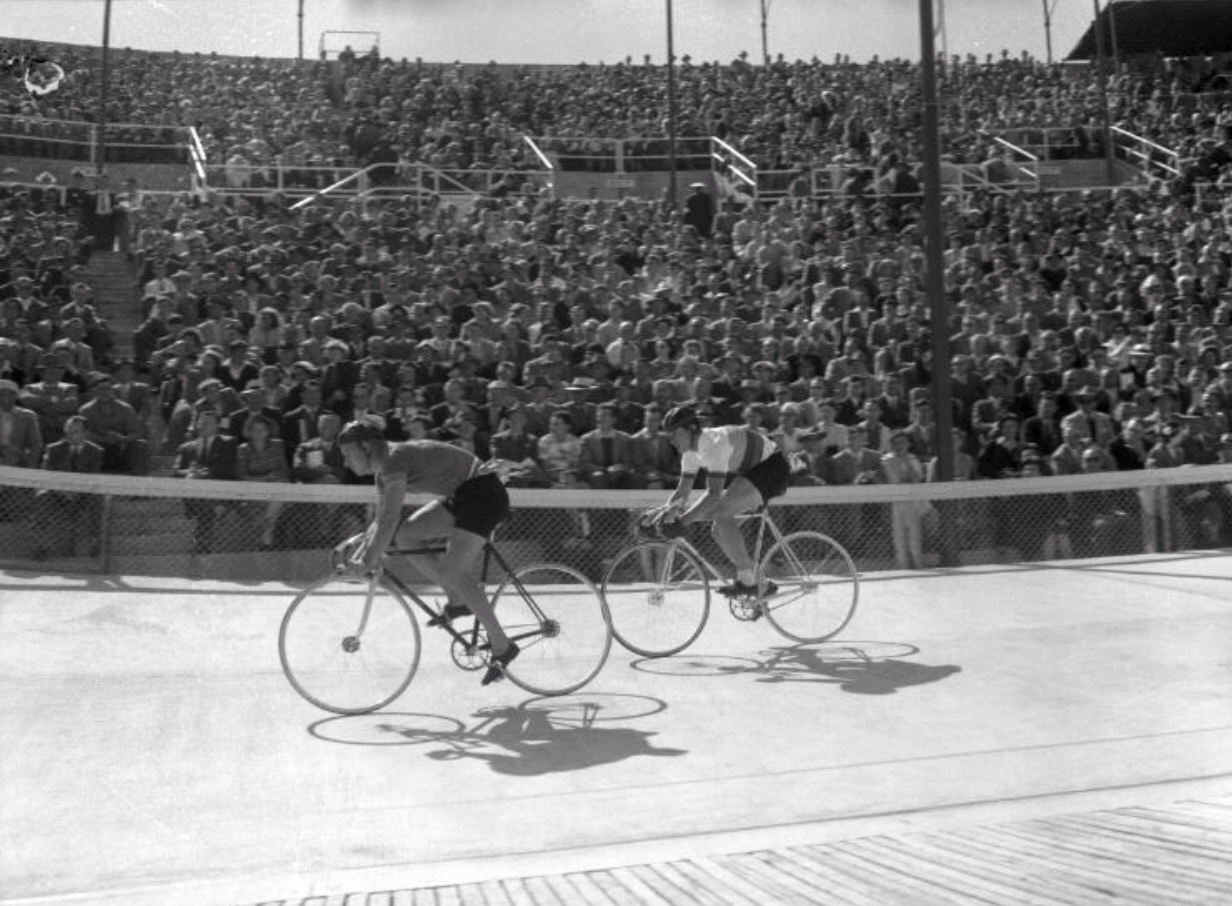
A couple of unidentified cyclists during the 1956 Olympics Velodrome, Olympic Park 3 December ’56

Entertaining the masses

The Victorian Amateur Football Association took up residence at the Eastern Sportsground in 1957, using the venue as its administration base and a weekly marquee game.

The Victorian Rugby Union competition used the Eastern sportsground, as did three Victorian Soccer Federation teams and even the Australian Equestrian Federation held twice yearly championships here. In one of Olympic Park’s more controversial moments, hundreds of protesters against the 1971 Springbok rugby tour clashed with mounted police armed with batons on 3 July. The demonstration was a forerunner to other protests around Australia and preceded Australia pulling out of its upcoming cricket tour of South Africa. Several court cases ensued with accusations of assault levelled towards, and against police. The game itself saw South Africa thrash Victoria 50-0.

A £50,000 investment by the Melbourne Greyhound Racing Association saw their relocation from Arden St. North Melbourne to a redeveloped Eastern Sportsground in 1962. On 20 August 6000 punters braved the cold for the first meeting. The velodrome was demolished in 1972, becoming a 800 space carpark, and the following year saw a new $6m 2200 seat grandstand built for greyhounds, soccer and rugby. The facilities pre-empted the dishlicker’s halcyon days which lasted until the 1980’s. Regular crowds of 5000 were also entertained by athletic races during the Monday night program, as well as promotions tied to Moomba, glamorous models and various celebrities.

A changing landscape

TThe Eastern Sportsground was upgraded with a synthetic pitch, practice running track and throwing area to coincide with the 1985 World Veterans Athletic Championship. As well as facilitating commercially viable sport and entertainment, Olympic Park Management’s other primary objective to increase the variety of sports. Consequently, hockey and American football utilised this field during winter, the latter playing their Victorian Championship on the ground in 1985-1993.

In November 1991, billowing smoke permeated through the greyhound track grandstand causing the evacuation of 2000 enthusiasts, moments after the last race. Forty firemen were dispatched to the blaze that began in a storeroom. The last race was run in February 1996 as 3000 punters sadly bid farewell, the club relocating to Broadmeadows.

The old Eastern Sportsground was reborn as Edwin Flack Field whereupon Collingwood used it as their training ground from 2004-06 – some irony given their legendary patron John Wren had built the Motordrome on the same patch of turf.

City of Melbourne folks- the area we are referring to is the modern white stadium and Olympic Park to its left beside the River Yarra- one can readily see that motor racing 1 km from a modern metropolis even in the 1940’s was a bit of a stretch! MCG right middle of shot as you cricket lovers, god help you, would know

State of the Art Stadium

Plans for the new stadium were originally conceived when Melbourne bid for a new Super 12 franchise. Upon being beaten by Perth, it didn’t take long for the plans to re-emerge. In April 2006, the Victorian Government announced a new 20,000-seat stadium would be built at Olympic Park to host Rugby League and Football. Melbourne Victory.

Construction commenced in late 2007 on the site of Edwin Flack Field- AAMI Park officially opened its doors on 7th May 2010, hosting the Rugby League ANZAC Test Match between Australia and New Zealand. The game attracted a near sell-out crowd of 29,442. As well as the Victory, Storm and Rebels; the Melbourne Demons Football Club (AFL) also have their training and administrative base at the venue, training on the adjacent sporting field.’

Built at a cost of $267.5 million, AAMI Stadium features a distinctive cutting-edge Bioframe design with a geodesic dome roof which substantially covers the seating area and is a great visual reference point when heading into town from the inner-East through South Yarra…

Bibliography…

australianspeedway.com, vintagespeedway.com, article by Ken Wylie, David Zeunert Collection

Photo Credits…

Sam Hood, State Library of New South Wales, Gordon McIsaac

Finito…


Jackie Stewart and a very tidy little unit, Dunlop PR shoot, London 1969…

The model is not bad either. This kinda stuff is a drivers stock in trade but the car organised is a bit low rent? Its Piers Courage’s Frank Willams Racing Brabham BT30 Ford FVA F2 car, BT30-5 i suspect. ‘Yerd reckon they could have rustled up one of those nice little F1 jobbies for the occasion? Jackie’s Championship winning Matra MS80 Ford or Piers’ Brabham BT26 Ford. Both must have been getting fettled for their next event.

Jackie looks happy enough, as he should, its my kind of a days work.

1969 was Piers Courage breakthrough year- he jumped out of the box in the Tasman Series, 3rd in the Series with a win at Teretonga, and was right up Rindt, Amons and Hill’s clacker in an FW Brabham BT24 Ford DFW.

Then he absolutely brained ‘em in FW’s year old ex-works Brabham BT26, the Repco Brabham 860 V8 replaced by a good ole DFV. He was a front runner all year- 8th in the title with seconds at Monaco and Watkins Glen his best results.

1969 Tasman Series Levin. Hi-winged Frank Williams Brabham BT24 Ford DFW is chasing Graham Hill’s works Lotus 49B Ford DFW and Derek Bell’s works Ferrari 246T. Chris Amon’s Dino won from Piers and Frank Gardner’s Mildren Alfa (S Twist/TRS)

In F2 he was a ‘graded driver’, so was not eligible for championship points. He was a front five racer from the start of the year in a Williams BT23C through to its end racing this car (shots with model) BT30-5, his best a win at Enna- the GP del Mediterraneo in late August. His last F2 drive of the year was in Andrea de Tomaso’s de Tomaso 103 FVA in the GP Roma in October, that was a portent of the disastrous year to follow in 1970…

Piers and Sally Courage talking gob-shite with the Victorian Governor Sir Rohan Delacombe and his missus, Sandown Tasman 1969. Piers DNF with half-shaft failure on lap 2, the race won by Chris Amon’s Ferrari 246T (J Stanley)

Credits…

Getty Images, John Stanley, Steve Twist/The Roaring Season, F2 Index, oldracingcars.com

Tailpiece: Rare beast those GT40 Roadies- the Mk3, chassis number folks?…


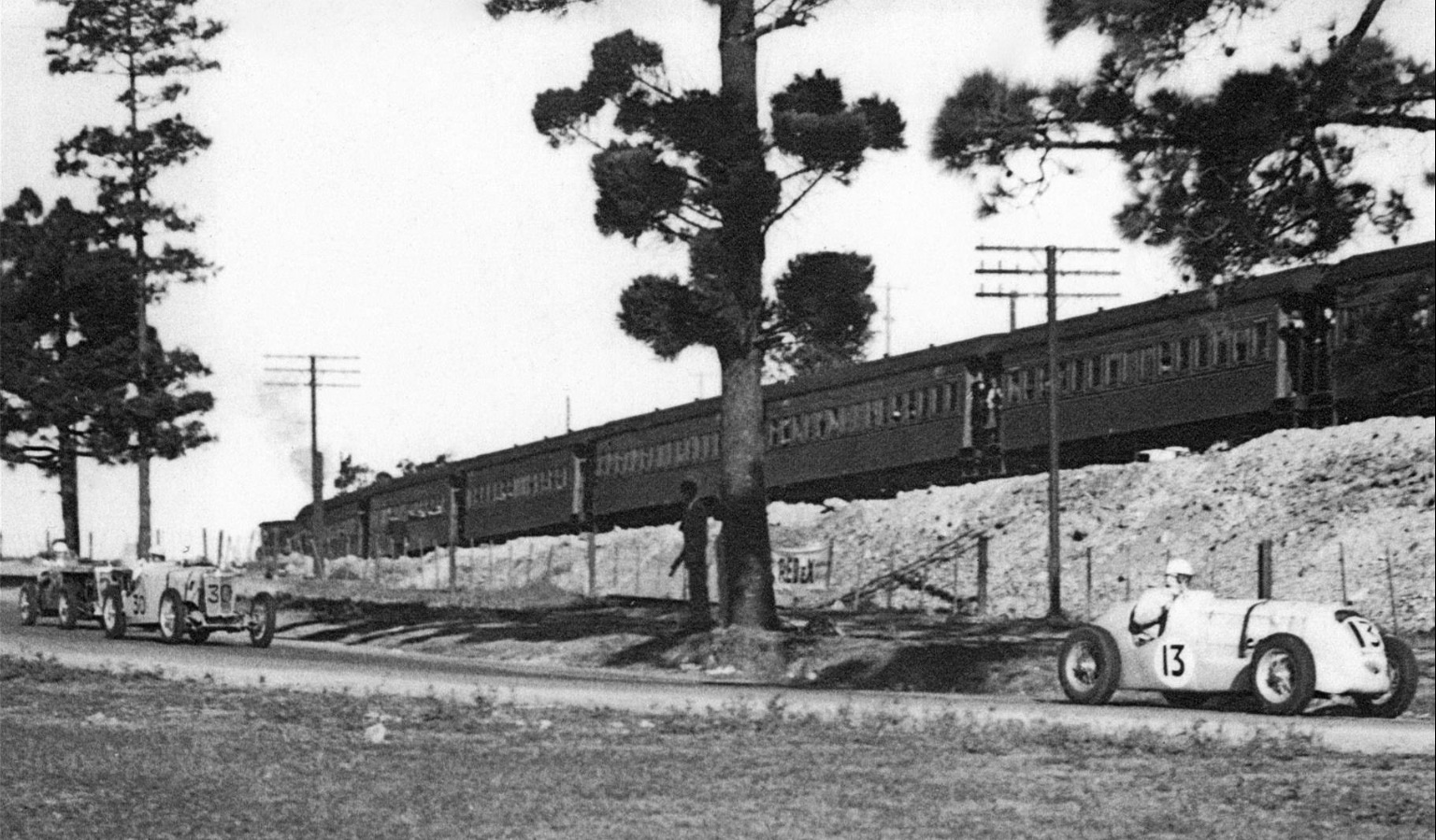
Train commuters watch an unidentified MG TC, then Les Wheeler, MG TC chasing A Griffiths, MG TC Spl s/c at the June 1952 Parramatta Park meeting  (CRPP)

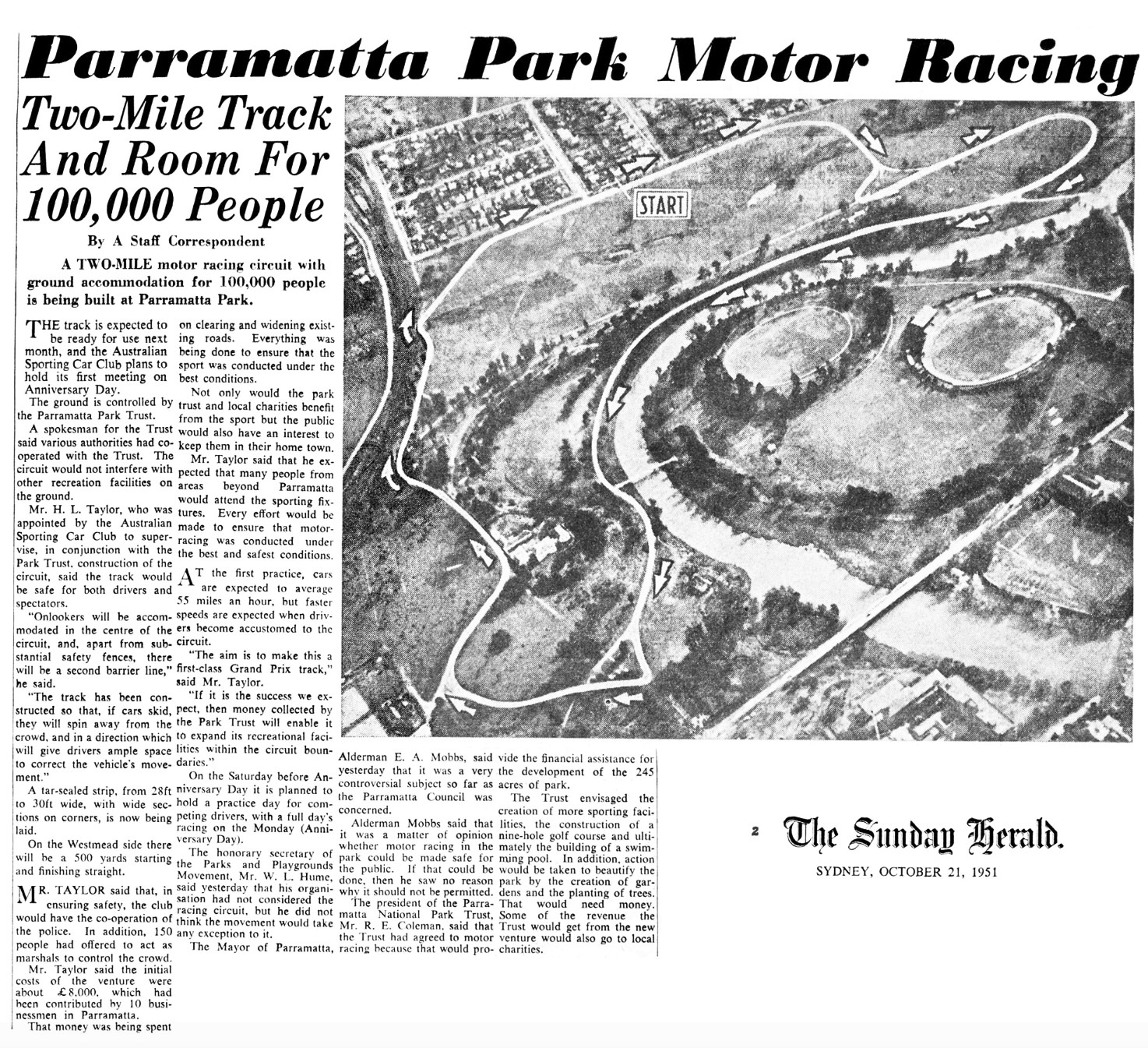
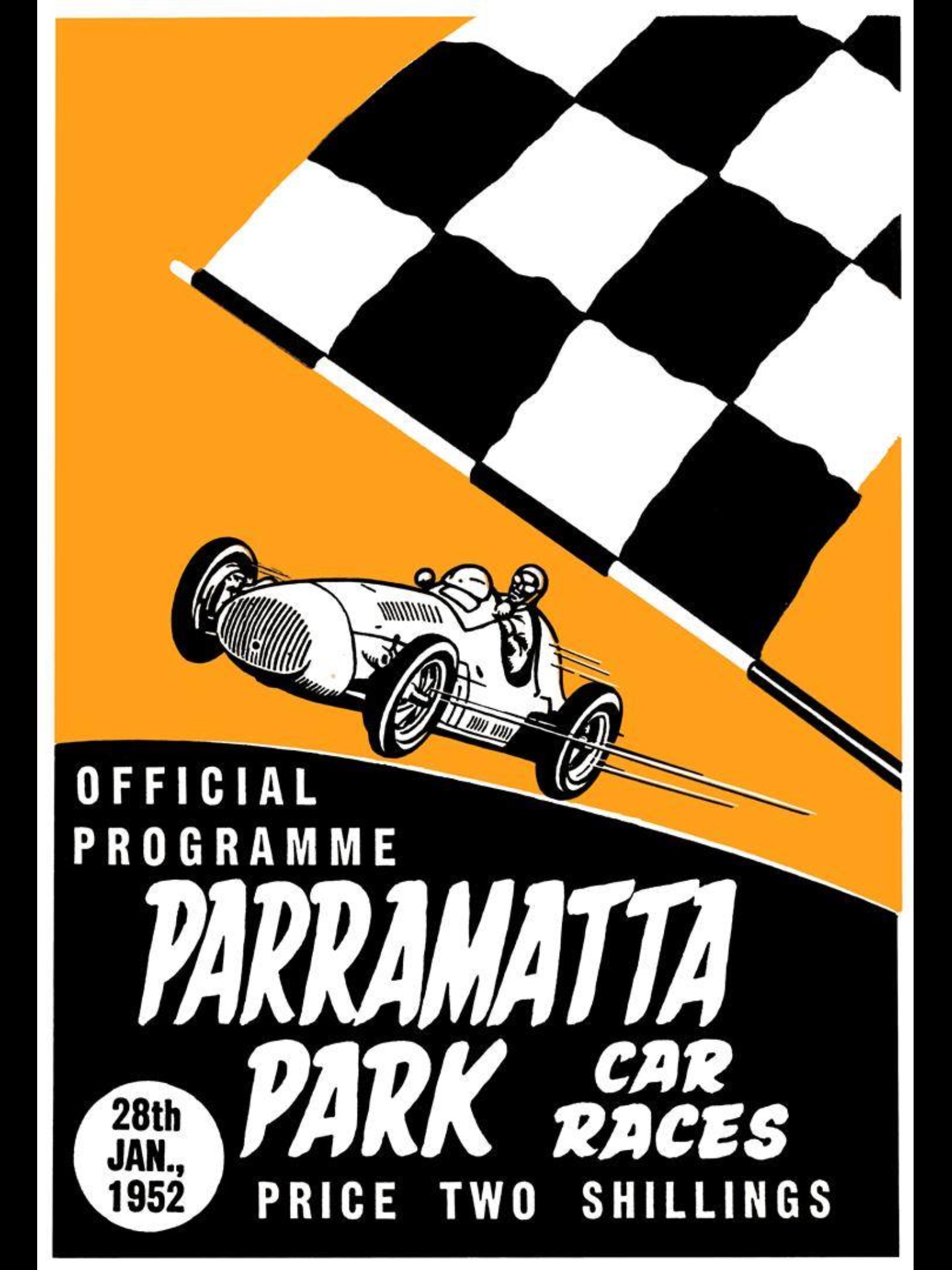
‘A two mile motor racing circuit with ground accommodation for 100,000 people is being built at Parramatta Park’ Parramatta, Sydney The Sunday Heralds headlines proclaimed on 21 October 1951…

 Parramatta is a large city within greater Sydney, 25 Km from the CBD, the huge park occupies an area of 245 acres and straddles the Parramatta River on the western edge of the town.

The 8,000 pound investment in the park facility was funded by ten local businessmen and used to clear and widen existing roads to a minimum of 28 to 30 feet. The projected average circuit speed of the circuit, designed and to be run by the Australian Sporting Car Club Ltd (ASSC), was 55 mph.

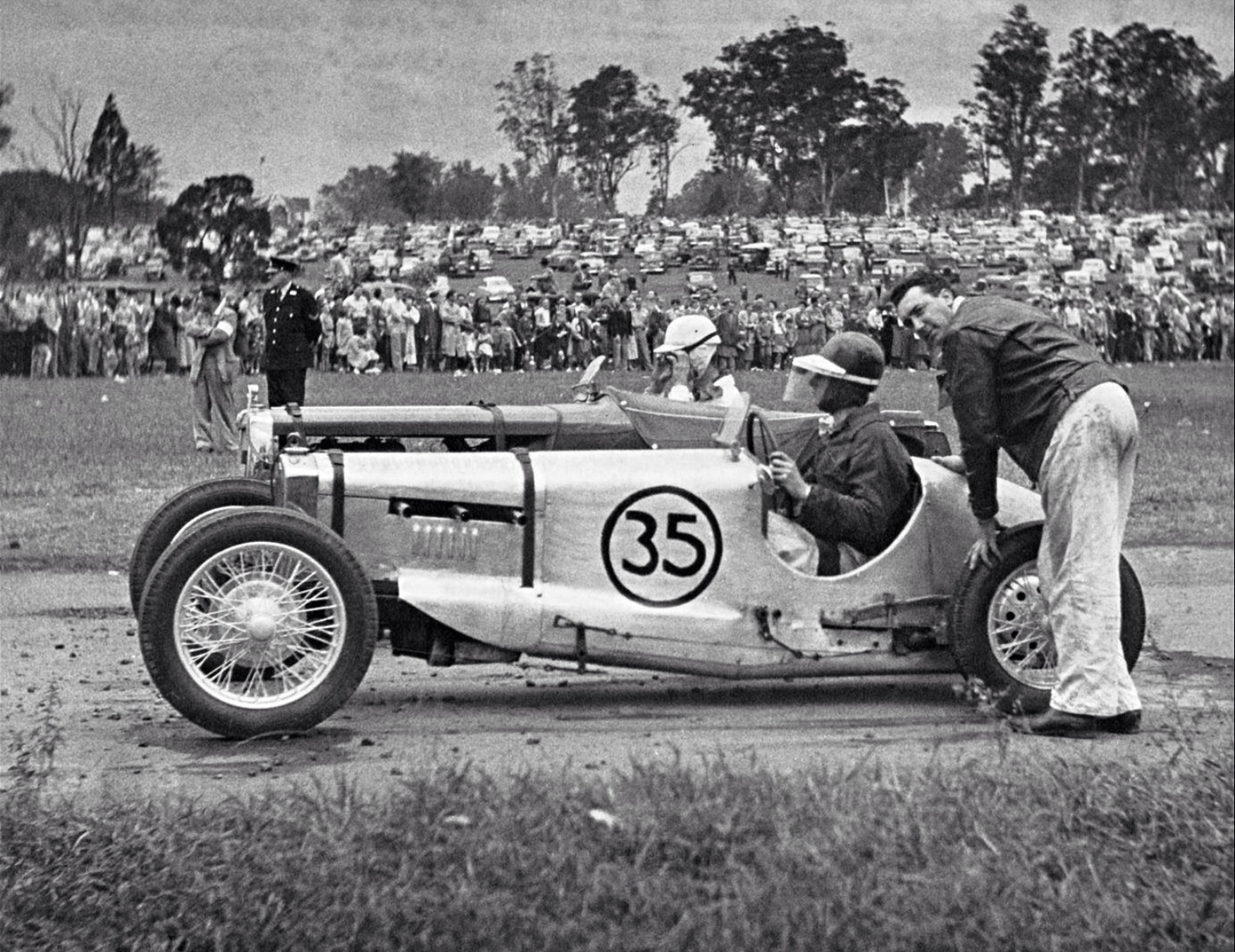
Barrie Garner, Frazer Nash in June 1955. Later an ace hillclimber in a Bowin P3 Holden. Track surface needs a sweep! Carnival atmosphere, big picnic crowd so close to the centre of Sydney (CRPP)

Motor racing in Parramatta Park had been mused about for decades. An article about the 1929 Monaco Grand Prix in the ‘Sydney Morning Herald’ mentioned the possibility of events in either Centennial Park, Sydney or Parramatta Park with the writer just as rapidly despatching the idea as one which would be scuttled by the authorities. Indeed, officialdom caused plenty of grief in relation to racing at Parramatta when it was finally becoming a reality.

The proposed event on 28 January 1952 was not the first planned at the venue, a meeting was scheduled to be held on 5 November 1938- the star Peter Whitehead.

The wealthy wool merchant/racer was to compete in his 1938 Australian Grand Prix winning ERA R10B. Officialdom intervened in the form of the New South Wales Chief Commissioner of Police who decided to ban the race on Friday, the day before the meeting, due to concerns about competitor and spectator safety. Click here for my article on the 1938 AGP including details and pictures of the ’38 abortive, aborted Parramatta Grand Prix. https://primotipo.com/2015/04/16/peter-whitehead-in-australia-era-r10b-1938/

In a reprise of the 1938 dramas the Chief Commissioner of Police again stepped in and refused permission for the January 1952 race. The ASCC appealed his decision before the Parramatta Court of Petty Sessions with the Magistrate upholding the appeal. The event was allowed to take place on the basis that spectators were permitted no closer than 40 feet from the circuits edge.

Over 40,000 paying punters turned up on raceday causing massive traffic jams throughout the area and its surrounds.

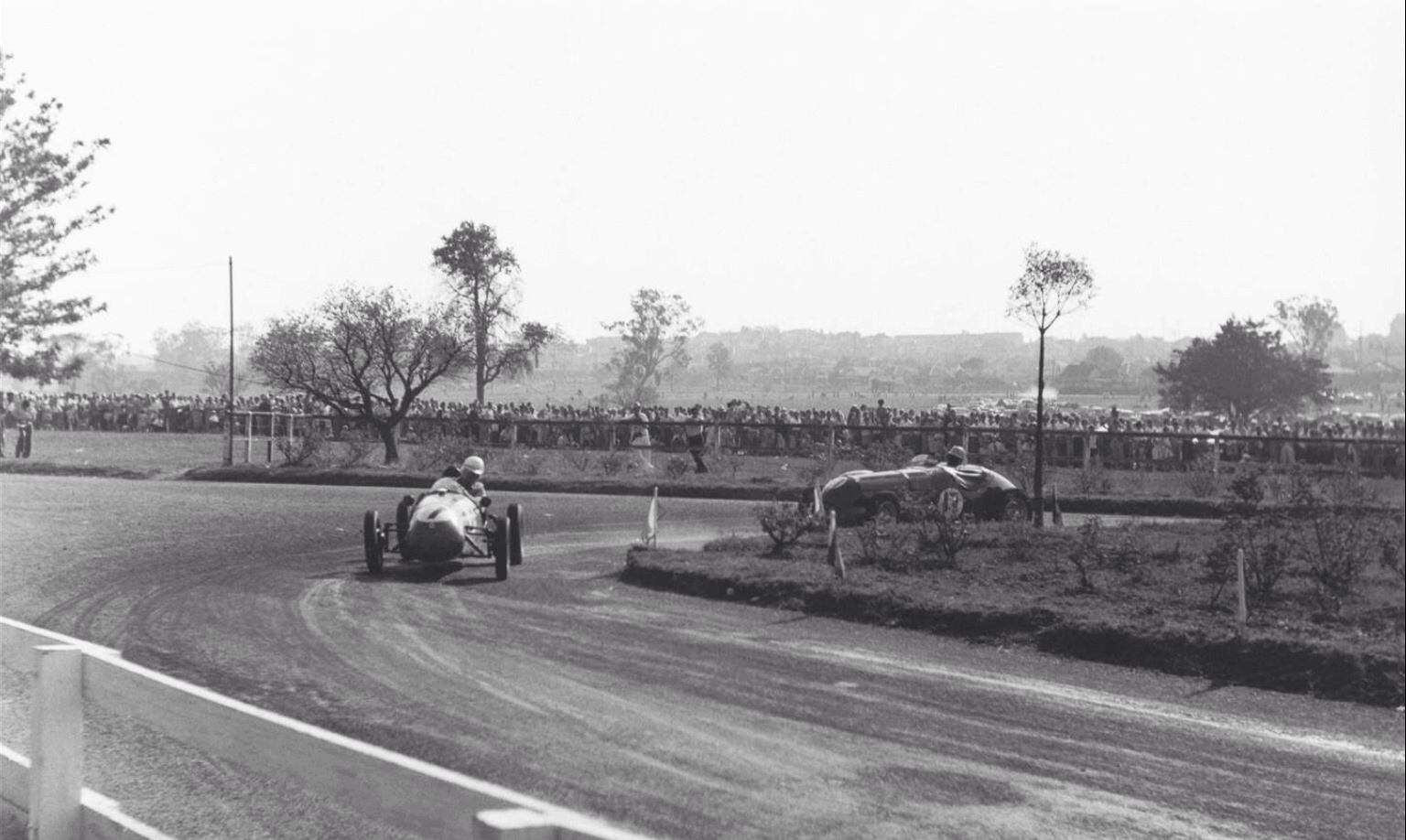
John Crouch Cooper MkV JAP from Curley Brydon’s MG TC Spl in a handicap event during the January 1952 meeting. One of the ultimate TC specials in Australia shaded by the new generation of cars. Check out the crowd (CRPP)

Star of the show that weekend was Sydney driver John Crouch driving a new-fangled, mid-engined Cooper JAP MkV to three wins of the seven events.

One of victories was perhaps the ‘main event’ of the day, a six lap invitation scratch race for the quickest guys of the weekend- he won it in his 1097cc Cooper. Stan Jones was second in the 4.3 litre Maybach 1 then came Reg Hunt’s mid-engined Hunt ‘500’ fitted that weekend with a Vincent 998cc engine Then was Jack Saywell’s Cooper 1000, Doug Whiteford’s 4.375 litre Ford V8 Spl ‘Black Bess’  and Alec  Mildren’s 1750cc Dixon Riley. The results are indicative of the rise of the small, efficient, mid-engine Coopers in Australia as was the case everywhere else in the world! Crouch set the lap record with a time of 1 minute 59 seconds.

In a reminder that ‘Motor Racing is Dangerous’, a wheel came off Doug Whiteford’s 1950 Australian Grand Prix winner, ‘Black Bess’ whilst travelling at circa 80 mph and landed in the backyard of a Victorian cottage adjoining the course. Fortunately the lady of the house was not hanging out the washing at the time the errant wheel landed atop her prize petunias.

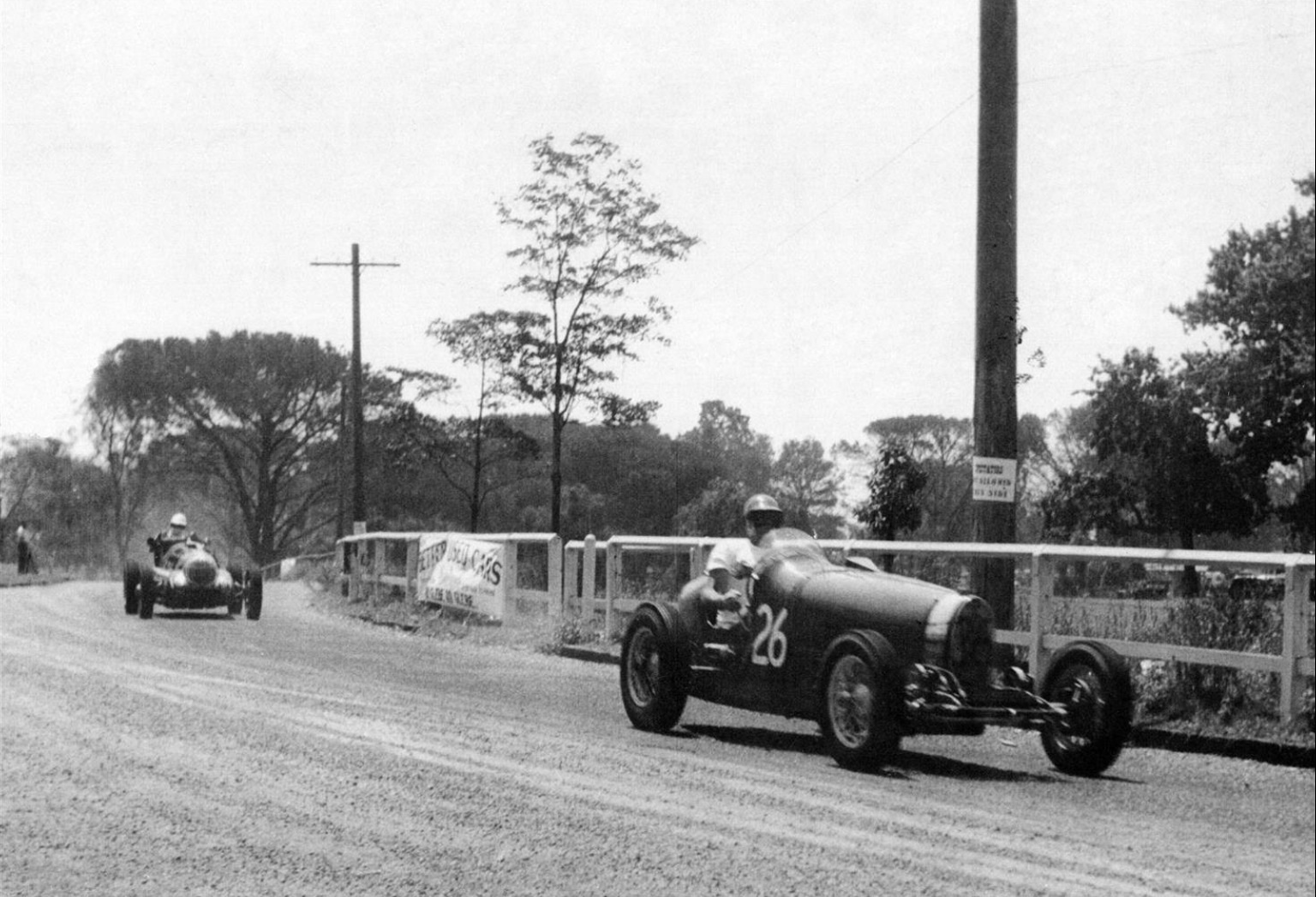
Peter Lowe, Bugatti Holden from Laurie Oxenford, Alvis Mercury, January 1952 (CRPP)

Many meetings were held at the venue until 1957, regularly attracting over 10,000 spectators when the demands and difficulties of holding the races became too much. The circuits closure left the New South Wales circuits at the time as Mount Panorama at Bathurst, Gnoo Blas, Orange and Mount Druitt in Western Sydney.

I have long wanted to write an article about Parramatta Park but a paucity of photographs was the barrier. Not so now- the convenor and members of the Facebook group ‘Car Racing at Parramatta Park’ have uploaded some pearlers of shots- I’ve chosen some at random to give you a flavour of the place. For you FB folks just find and like the page in the usual way.

Stan Jones with a touch of the opposites in Maybach 1 chasing ‘Gelignite’ Jack Murray’s Allard Cadillac in the opening January 1952 meeting. Jones was so impressed by the speed of the Coopers in relation to his GP car he promptly placed an order for one, a MkIV was soon in his Balwyn, Melbourne driveway (CRPP)

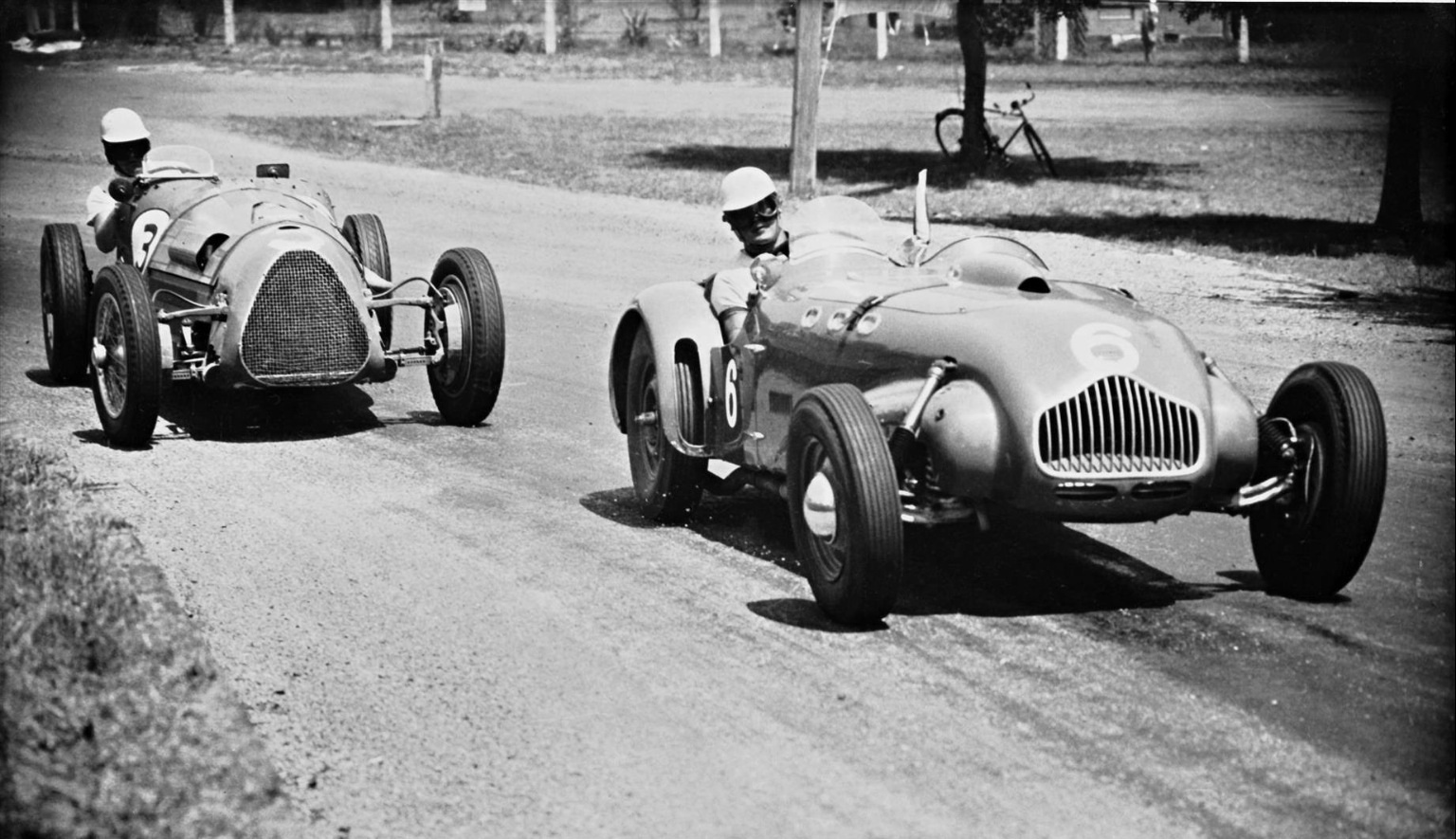
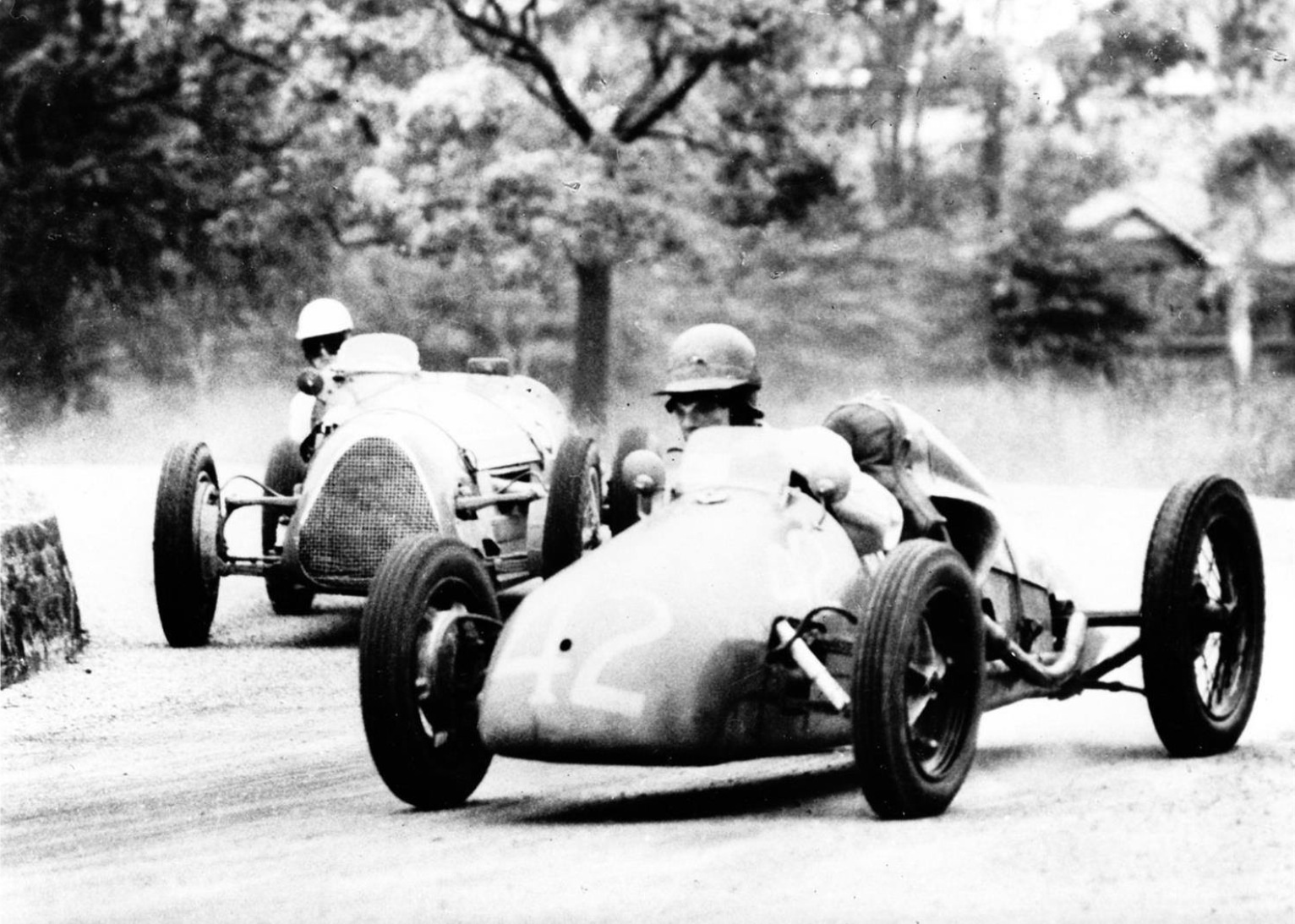
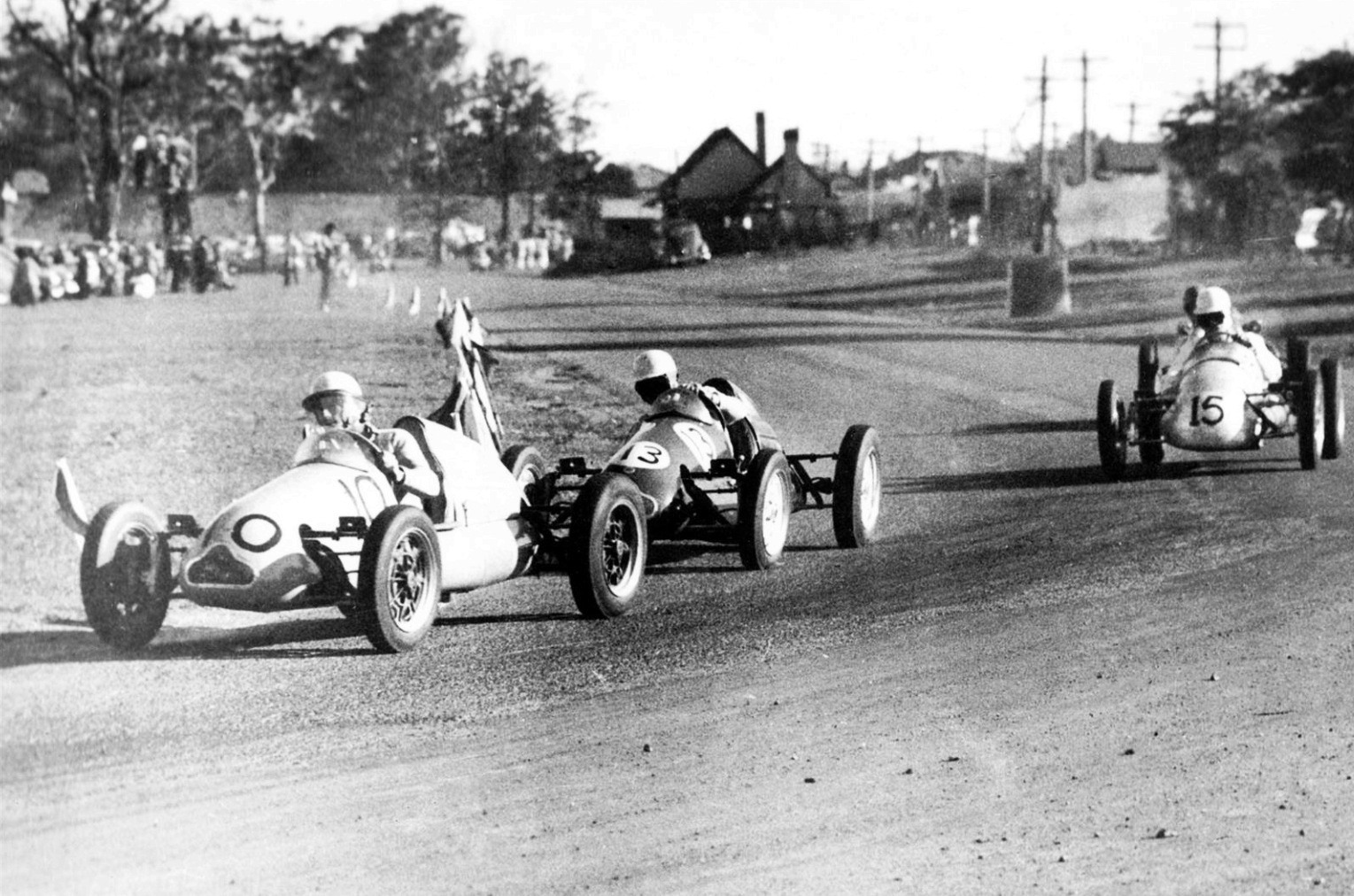
Both the aces of the day and coming-men raced at the ‘Park including drivers such as Doug Whiteford, Frank Kleinig, Stan Jones, David McKay, Bib Stillwell, Dick Cobden, Bill Patterson, Lex Davison, Tom Hawkes, Alec Mildren, Tom Sulman, Ted Gray, Ron Tauranac, Jack Brabham and many others. RT ran the very first of his Australian Ralts in the opening meeting, as against the Pommie built ones, and his later partner Brabham raced his Dirt Midget!

Jones big Maybach ‘monstering’ Ron Tauranac’s Ralt Norton ES2 500, January 1952 (CRPP)

The program described Jack thus- ‘A familiar winner at the speedway, and this years Australian Hillclimb Champion, Jack should find the circuit well suited to his style. His car is very light, has four wheel hydraulic brakes and is powered by a home made engine using J.A.P bits’.

By the June meeting Jack had jumped into a Cooper Mk5 500, the wry description in the program observed; ‘Australian Hillclimb Champion of 1951, Jack, one of our best midget drivers, is a new recruit to road racing, his Cooper…was an 1100, now has an engine designed and built by the new owner, a foremost expert at getting quarts out of pint pots’ ! A sage description of Jack’s ability to conjure something out of not very much throughout his career as both constructor and driver.

Dick Cobden from Bill Patterson in Stan Jones car and Bill Shipway- Coopers galore, all MkV’s I think June 1955 meeting (CRPP)

Bibliography…

Sydney Sunday Herald 21 October 1951, ‘Fast and Furious: The 1938 Parramatta Grand Prix’ article by Peter Arfanis

Photo Credits…

‘Car Racing at Parramatta Park’ Facebook Group (CRPP)

Tailpiece: Parramatta Park opening meeting, January 1952…


Roman Polanski stepping aboard a Motor Racing Stables Lotus 51 Formula Ford in 1968…

One of the great film directors of our time has had an extraordinary life full of controversy, see this link for a concise bio and filmography for you movie buffs; http://www.imdb.com/name/nm0000591/

That year he moved to Hollywood to make the psychological thriller ‘Rosemary’s Baby’ and then had the horrific experience of wife Sharon Tate’s murder by the Manson Family in 1969.

Quite how John Webb bagged him for the day who knows, no doubt it was a promotional coup for the category in its fledgling phase- 1967 to 2018 and still going strong! Long may it continue.

Photo Credit…

Bill Ray

Tailpiece: I wonder how good his times were?…


image

Mrs Montgomerie-Charrington prepares her Cooper for the Ladies 500 Race at Brands Hatch, 14 October 1950 …

‘Monty’ was unplaced in the race won by Miss E Store in a JBS Norton from the Miss O Kevelos driven Kieft Norton and the Mrs J Gerard, Bob’s missus I guess, Cooper Norton. Funny the social practice of the times in terms of citing the matrimonial status of the chicks.

There were five 500 races on the program- Don Parker won the Open Challenge race, and JN Cooper, using his product to good effect was second in the Brands Hatch Championship and third in the Championship of The Meeting event.

Click here for a short article about ‘Monty’ and her husband Robin, the cars usual driver;

http://www.500race.org/web/Men/MontgomerieCharrington.htm

And on Cooper 500’s;

Cooper Mk V JAP: Penguin Hillclimb, Tasmania, Australia 1958…

Credits…

Bill Price for the photo and Stephen Dalton for providing the race results from his vast archive

(M Feisst)

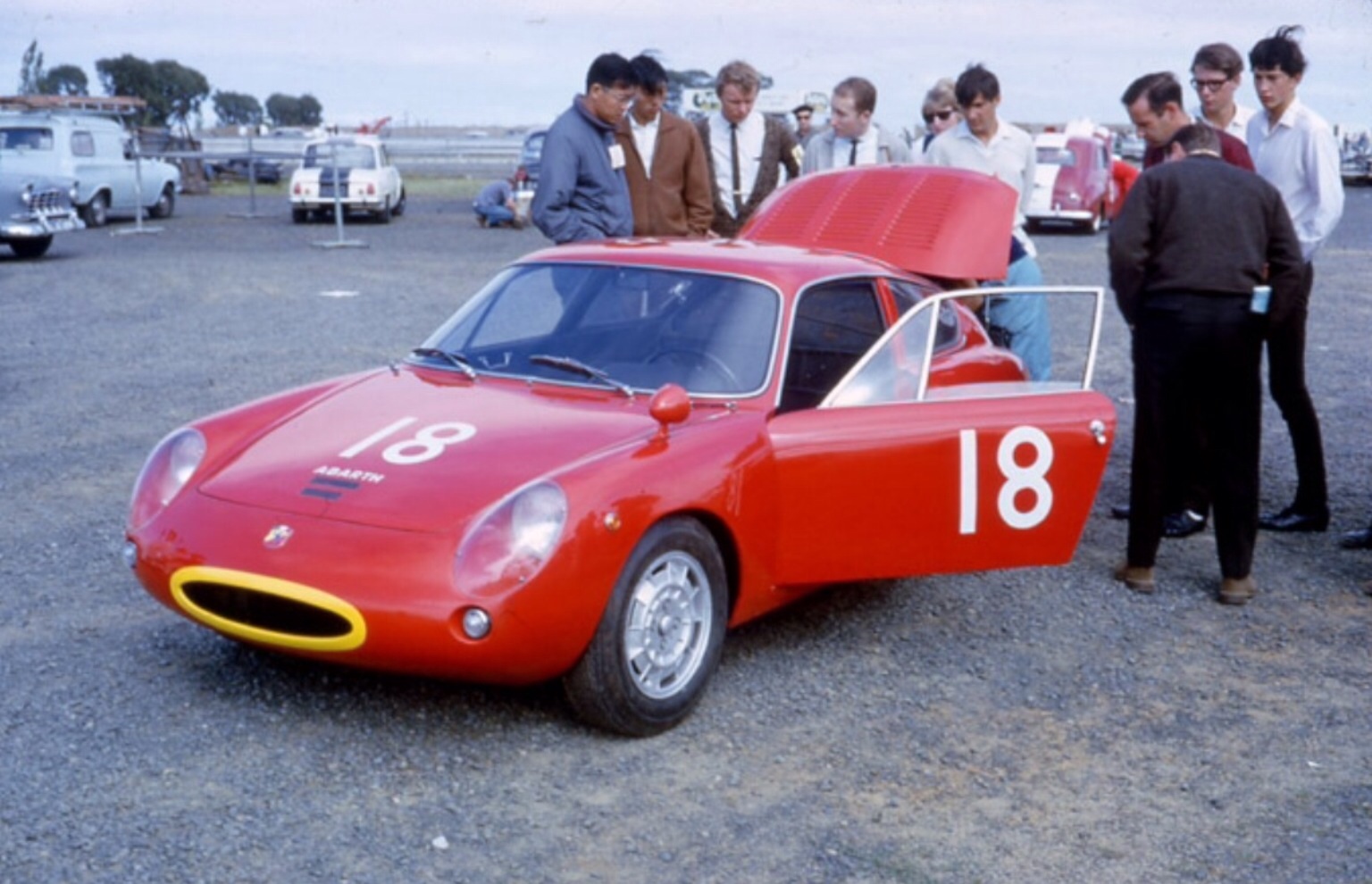
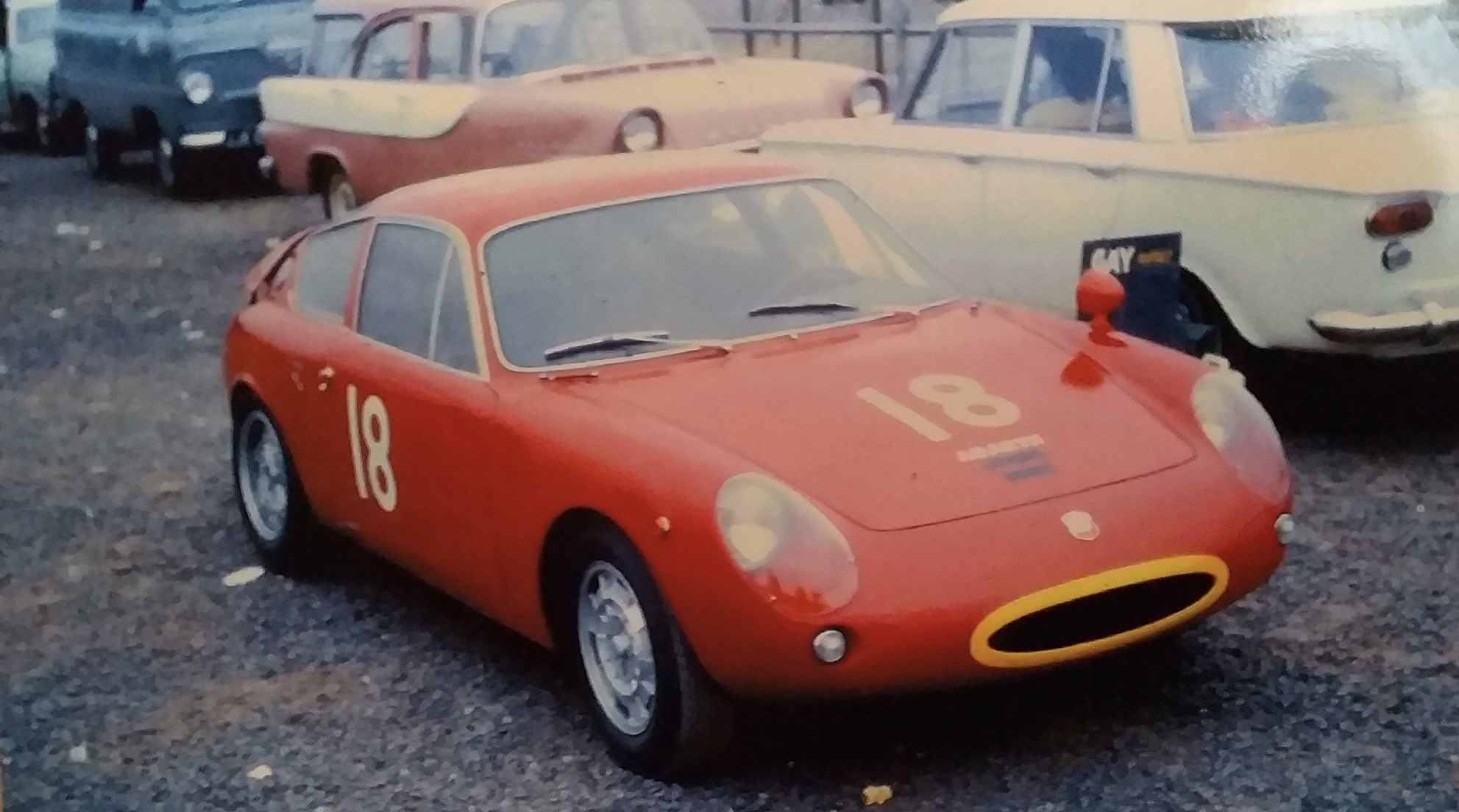
Gay Cesario gives the engine of his Abarth Simca GT 1300 a final tweak with an admiring crowd checking out the lines of the car at the Sandown Tasman round in February 1967…

Australia is a country of immigrants, even the Aboriginals, our indigenous people arrived here some 25,000 to 40,000 years ago.

As a ‘Skip’ (Anglo Australian) the travails of migrants are not something I ever thought much about. But having gone out with three post-war sixties/seventies migrant kids in the last decade – a (crazy) Croatian, Scot and an Italian – I am now highly aware of the guts it takes to jump onto a ship staking your entire future on a faraway land they knew bugger-all about in those pre-internet times. The reason most of them have so much zip is that they left with nothing and arrived with lots of drive and ambition, their legs spinning at 100mph well before their disembarkation at Station Pier. Look out ‘Skips, we are coming through, you lazy buggers!

The Italian Cesarios were one such family. Gay Cesario packed his family of five into the little Abarth Simca 1300 for the trip from Rome to Naples and embarkation from there before the long voyage to Melbourne, where they arrived in the mid-sixties.

Lucio Cesario recalls, “Dad bought the car just out of Rome at a hillclimb on-the-spot and drove it straight home that day. Some time later he decided to ship the family and car to Australia so we drove from Rome to Naples, a four or five hour drive. There was my mum, dad, brother, sister, me and all our belongings crammed into the racecar, including some spares as we were shipping it out from Naples on the same ship. Boy I wish I knew where the little car is today!?”

Gay Cesario raced the car in Australia, its whereabouts as you can see from Lucio’s comment above unknown. Gay raced on, I can well remember him running a Fiat 124 Abarth in Victorian production sportscar races well into the mid-seventies at least. Lucio was a well known racer during Australia’s Formula Pacific era, he parlayed immense Ralt RT4 speed into a season or so with the works Lancia Team during the Group C era, that is an interesting story for another time.

(automobile sportive)

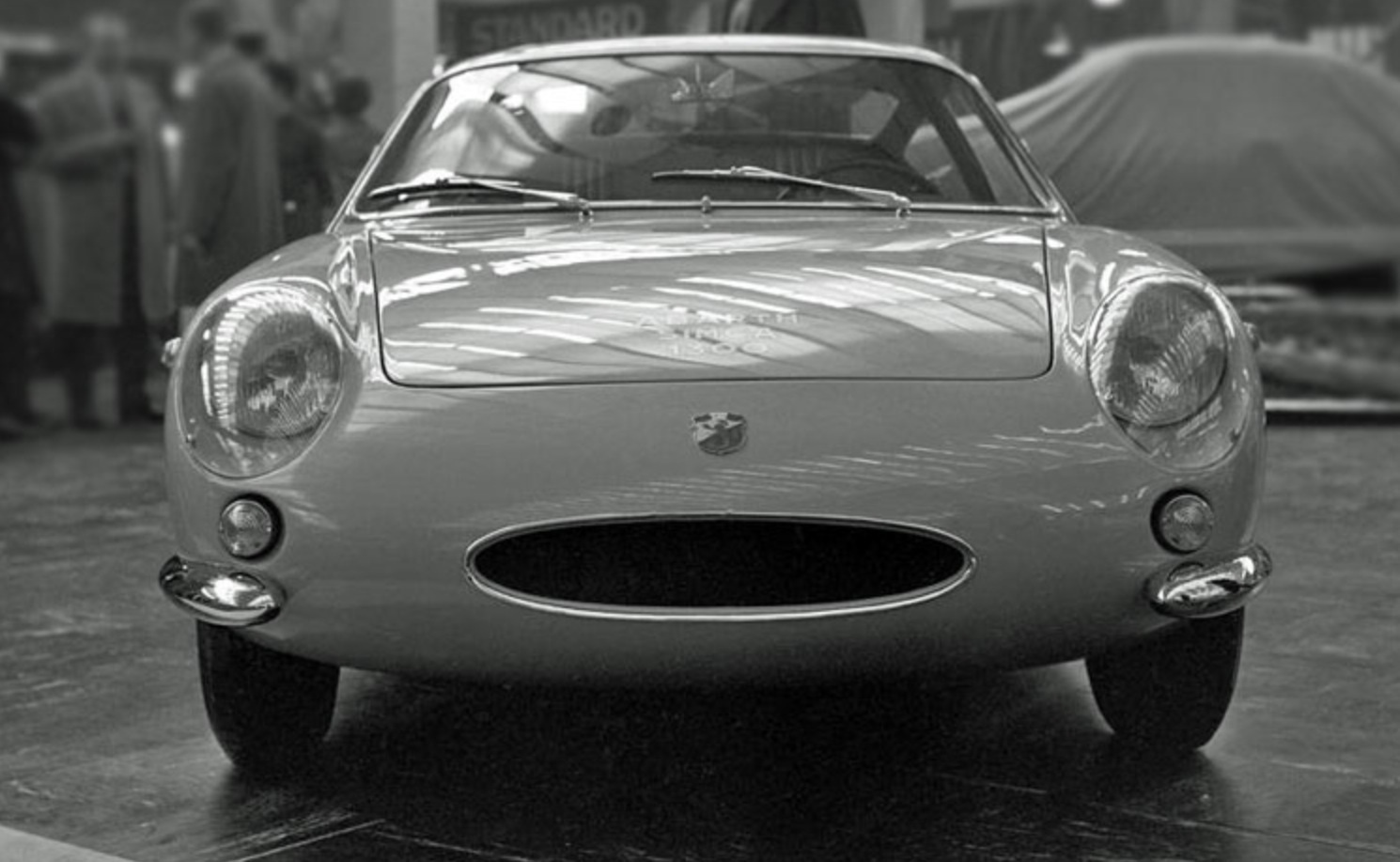
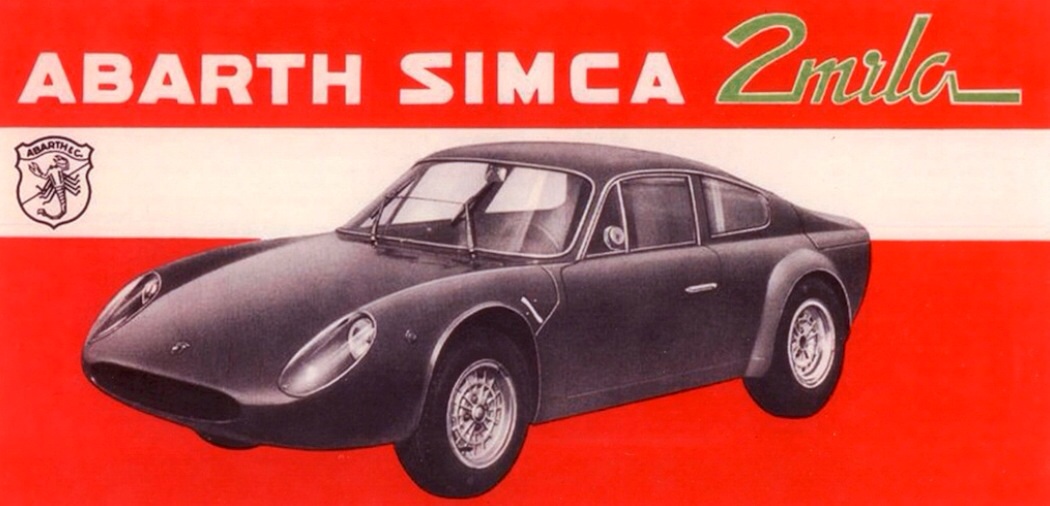
Abarth Simca 1300 GT…

Simca was founded by Italian entrepreneur Enrico Teodoro Pigozzi in 1935 to build Fiat’s for the French market. After WW2 Simca continued to produce the cars but they were given more unique character by fitment of different grilles and engines. In 1961 the company launched its most successful model, the Simca 1000. It was the concern’s first rear-engined car, a neat four-door saloon powered by a Fiat 600 derived 944cc four-cylinder engine giving circa 35bhp in standard form.

Carlo Abarth’s old Viennese sparring partner, Rudi Hruska, became a technical consultant to Simca and regularly brought Abarth’s successes with its Fiat-based cars to the company hierachy’ attention. The idea of competition success appealed to help build the brand so Abarth were invited and engaged to produce a GT car using Simca 1000 components. The Simca-Abarth or Abarth-Simca names are interchangeable, the 1300 GT was the result.

Abarth designed a new engine using the tried and tested broad architecture of the 1961 1000 Bialbero of 1288cc, with the new car’s floorpan, transmission, steering and suspension from the Simca 1000, while the body was of the latest Fiat-Abarth Coupe configuration.

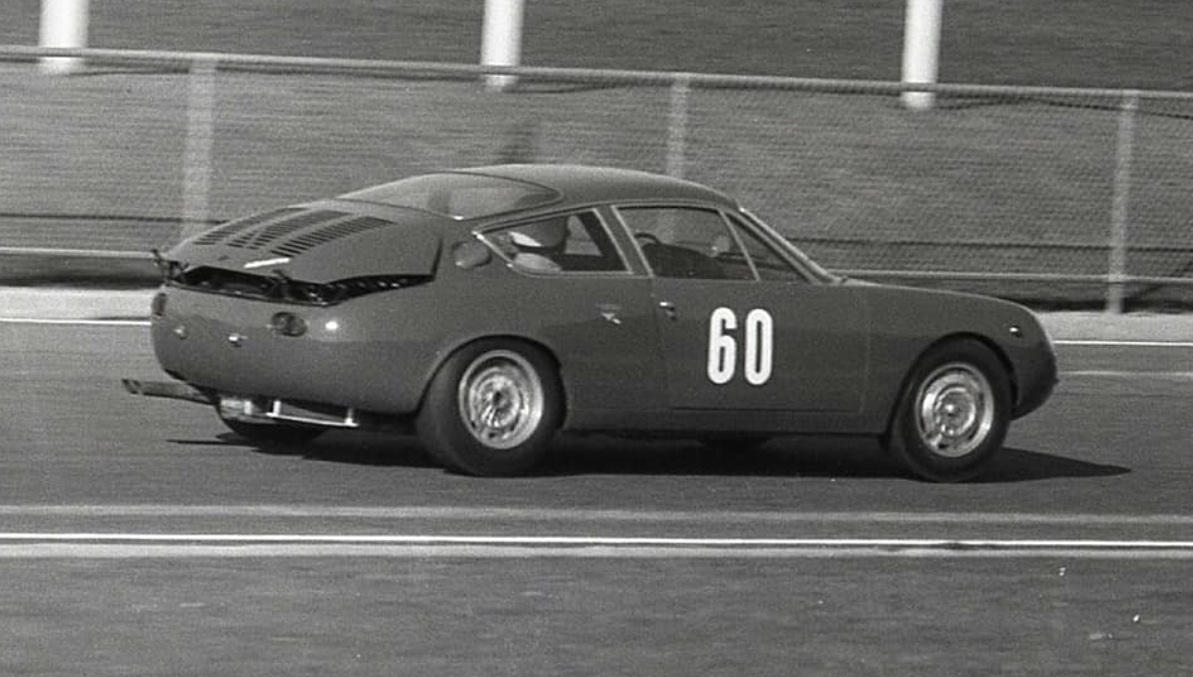
The Simca Abarth 1300 was launched in February 1962. The 1288cc, DOHC, twin 45 DCOE Weber fed four- cylinder engine produced over 90 bhp @ 6,000 rpm. The cars proved capable of running rings around rival Alfa Romeo Giuliettas during 1962. The two valve engine specification included dry-sump lubrication, a rev limit of 7,200rpm and a claimed power output of 125bhp at 6,000rpm – more like 90 – but certainly more than enough. The little car weighed 630kg/1388lbs and did 142 mph. The subsequent 1600 – 138bhp at 7,800rpm – variant stopped by Girling discs all round was capable of 240km/h – 149mph, fast cars indeed.

Abarth’s 1963 racing record is said to have achieved a staggering 535 victories, 90 of which were agged by the Simca Abarth 1300s.

The body design of the GT Coupe – influenced by the latest small capacity GTs – was styled in-house by Mario Colucci at Abarth’s famous Corso Marche factory, and was built ‘just around the corner’ by Odoardo Beccari’s specialist carrozzeria.

Credits…

Mike Feisst/The Roaring Season, Lucio Cesario/Thunder 427 on The Roaring Season, Bonhams, Ultimate Cars, Automobile Sportive, Robert Davies

Tailpiece: Cesario, Sandown 4 May 1969…

(R Davies)

Photographer Robert Davies recalls this as the Sandown weekend that Allan Moffatt’s Trans Am Mustang made its race debut. Lucio Cesario, eight years old also remembers that day, his Dad won the Toby Lee Trophy (family still have it) in the wet with Peter Brock starting the race from pole his famous Austin A30 Holden.

Sandown 1967 (Cesario)

Postcript…

Its back in the family, the car that is!

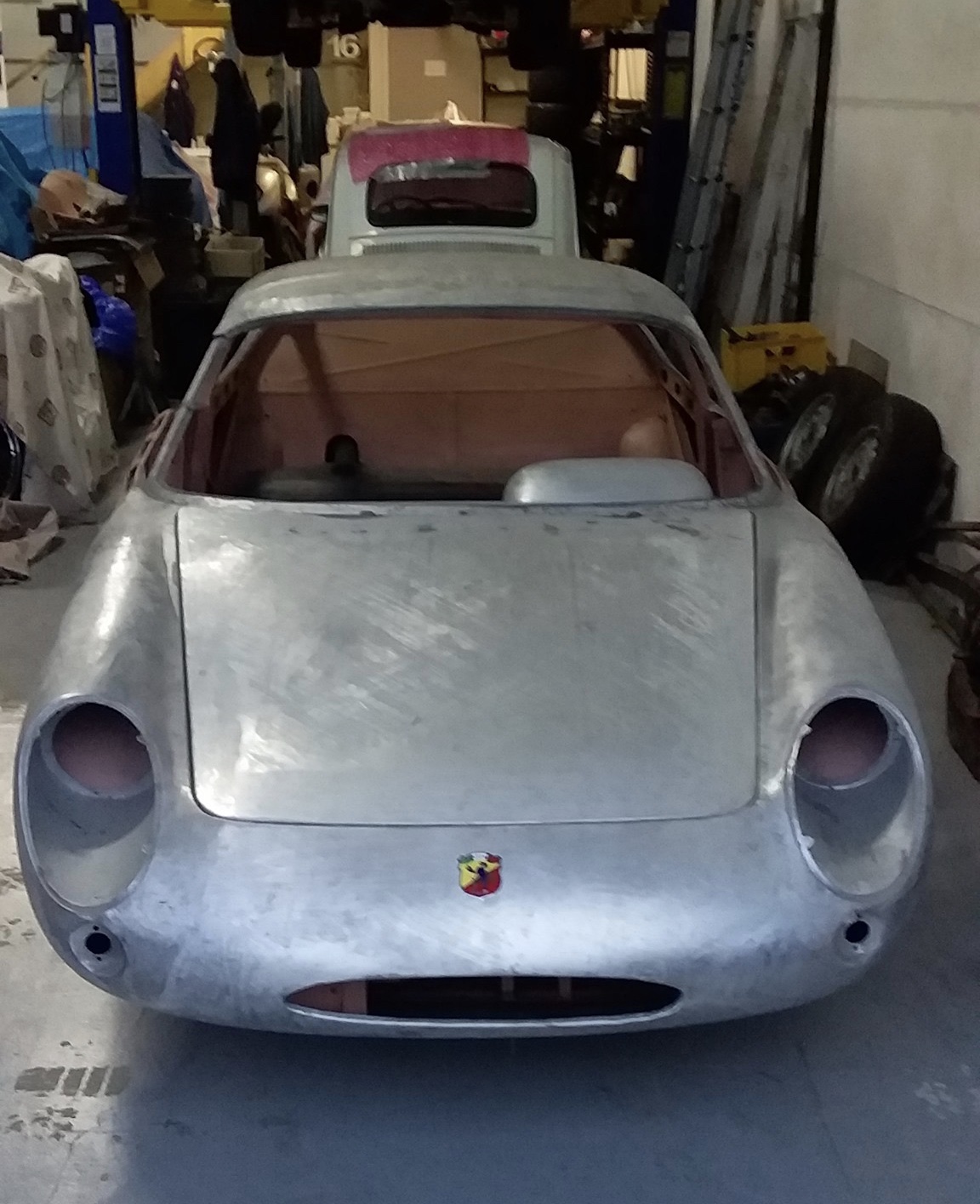
In early July 2019 I had a meal with Lucio and a few other racing coves via ‘me mate, historic racer Andrew McCarthy. During the course of a good chat Lucio told us he had negotiated to buy his Dad’s old car, paid the dollars and was off to collect it the following weekend, checkout the photos of the car tucked up in his Melbourne workshop. Doesn’t it look wonderful?

(Cesario)
(Cesario)

Lucio had been talking to the long-time Sydney owner of the car (he acquired it in 1974) on and off for decades but they had never been able to agree a price. “Your article got me going though, I felt I needed to buy the thing quickly as I was fearful your piece on it would stir up interest and send others off on a search for the car, rare as it is,” he said.

Happy to be of assistance my friend!

We will get together soon to document Lucio’s racing career and I will post updates as the Abarth’s restoration progresses. Unfortunately Gay Cesario, Lucio’s Dad, “he sold an apartment at one stage to help me progress my racing career y’know,” died some years back but his Mum is happily still with us, no doubt a tear or two was shed when the car returned back where it belonged…

(Cesario)
(Cesario)
(Cesario)

Finito…

RH Michell’s Citroen Special dates from 1938, the young constructor built it in Woodville, Adelaide…

And that’s about all I know of this little racer.

Did Michell survive the war, did it ever race, if so was it a quick car?

Woodville was the site of some ‘bike and car racing through its streets after the War- I wonder if the car contested an event or two at the place of its birth. It didn’t race in any of the Australian Grands Prix held in South Australia around this time- Victor Harbour in 1936, Lobethal in 1939 nor Nuriootpa in 1950. Mind you, it may have contested a support event.

Intrigued to know anything about this car i tripped over by happenstance…

Photo Credit…

State Library of South Australia

(Getty)

Juxtaposition!

The wild ‘Mana La’ solar car contrasted by the utilitarian functionality of a cement mixer. Stuart Highway, Northern Territory 1 November 1987…

The John Paul Mitchell sponsored car designed by Jonathon Tennyson is heading for Adelaide, 3005 Km away, sadly the brilliant vehicle DNF’d the race won by GM’s ‘Sunraycer’.

The genesis of this first Darwin to Adelaide ‘World Solar Challenge’ was critics telling adventurer Hans Tholstrup that Australia could not be crossed by a solar powered vehicle.

In 1982, together with Australian F1 driver Larry Perkins and his brother Gary, Tholstrup developed a car in which he became the first person to drive across Australia. The 4,000 Km journey in ‘The Quiet Achiever’ took him 20 days.

The Perkins Engineering- Larry and Gary Perkins built 1982 ‘The Quiet Achiever’ or ‘BP Solar Trek’ car. Rudimentary design which is deceptively clever and a precursor to the much more sophisticated, mega-buck cars which followed (NM)

Criticism of the car sparked what became the first World Solar Challenge five years later. In 1987 23 teams from Europe, the US, Asia and Australia entered the event with over 40 taking part in 2017.

The Danish born Australian’s desire to develop solar energy came after years of being a self-confessed fuel guzzler. ‘I was doing my penance…because I flew around the world, rode in race cars and powerboats, I did everything that used finite fossil fuel’ quipped Tholstrup in a recently ABC interview. He noted that solar panels are half the size they were in 1987 with the cars doing the same speeds.

One of the ‘big buck’ entries won the inaugural challenge, the Paul MacCready designed and built General Motors ‘Sunraycer’ was victorious in 44.90 hours at an average speed of 66.90 km/h.

At the wheel was ever-versatile Australian champion racing driver John Harvey who was also involved in testing the car at the GM Proving Ground in Arizona. Second into Adelaide two days later was the Ford Australia entry and the Ingenieurschule, Biel vehicle third.

The GM Sunraycer on day 3 of the 1987 challenge, 3rd November. Car is on the Stuart Highway 100 Km south of the Devils Marbles. Car took 5.5 days to complete the 3000 Km journey (P Menzel)

In some ways the most radical entry, the John Paul Mitchell Systems car ‘stole the show’, visually at least, albeit the car was out of the race way too soon.

Jonathan Tennyson designed and built the car funded by John Paul Mitchell Systems. With the help of James Amick, the inventor of the ’Windmobile’ Tennyson developed a vertical wing design to exploit the wind to help mobilise the car in addition to its primary source of power- solar energy. By covering the resulting arched wing of the ‘Mana La’ (power of the sun in Hawaiian) in solar panels the idea was to be able to expose the panels to the sun at all times of the day.

The radical machine is 19′ long, 6 1/2′ wide and 6 1/2′ tall. Its built from urethane foam, carbon fibre and vinyl ester resin weighing circa 250 Kg. An onboard computer distributed power to ‘NASA-grade storage batteries’.

(Petersen)

The visually arresting arch is covered by 140 solar panels. Sixty-four silver-zinc batteries retained the power collected and fed a pair of 2-horsepower, brushless direct-current motors. Each engine utilised two windings, one for lower speeds and higher torque, and another for higher speeds at lower torque.

Nicknamed ‘the hair dryer’ given its sponsor, the US$250,000 Mana La qualified second starting behind Sunraycer on ‘pole’. By 4 pm on the first day of the event, the car was out of the race. The crew ran too hard through the hills trying to catch the Sunraycer, exhausting their batteries in the process and were never able to harness the wind the car was designed to exploit. Their battery specialist estimated it would take 40 hours in the sun to recharge…what a great mighta been this quite stunning machine is.

In 2010 the car was donated to the Petersen Museum in Los Angeles.

Bibliography…

Australian Broadcasting Corporation, paulmitchell.com

Photo Credits…

Getty Images, Australian National Museum, Petersen Museum, Peter Menzel

(unattributed)

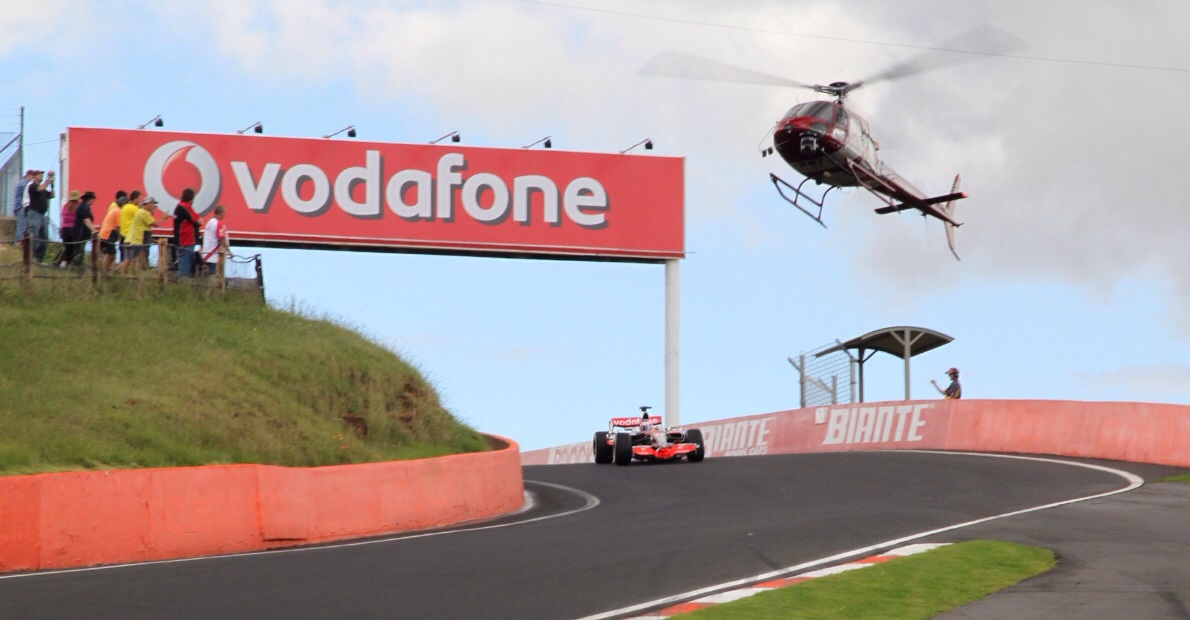
Craig Lowndes dropping into Mount Panorama’s Skyline/Esses, McLaren MP4/23 Mercedes V8, 22 March 2011…

Australian Formula Ford has been a factory for the creation of V8 Supercar Drivers for a couple of decades now. Every now and again one escapes to international racing success, Mark Webber, Will Power and Daniel Ricciardo spring to mind. I’ve not forgotten Larry Perkins I’m just referring to more recent times. But in the main V8 Supercars and to a lesser extent Porsche Cup racing has given local aces a place to ply their trade as well paid professionals.

The popularity and commercial success of Touring Car Racing in Australia relative to Single Seaters began circa 1960 and has continued unabated since. Even very popular single seater formulae such as the 2.5 Tasman and F5000 classes did not put a dent in the rise and rise of ‘Taxis’. Why? Its a topic for a whole series of articles but perhaps fundamentally the cars are easier for the average punter to understand and relate to, are spectacular to watch and have had a succession of ‘characters’ racing them. The absolute professionalism in the way V8 Supercars has been managed for so long now has widened the gulf further.

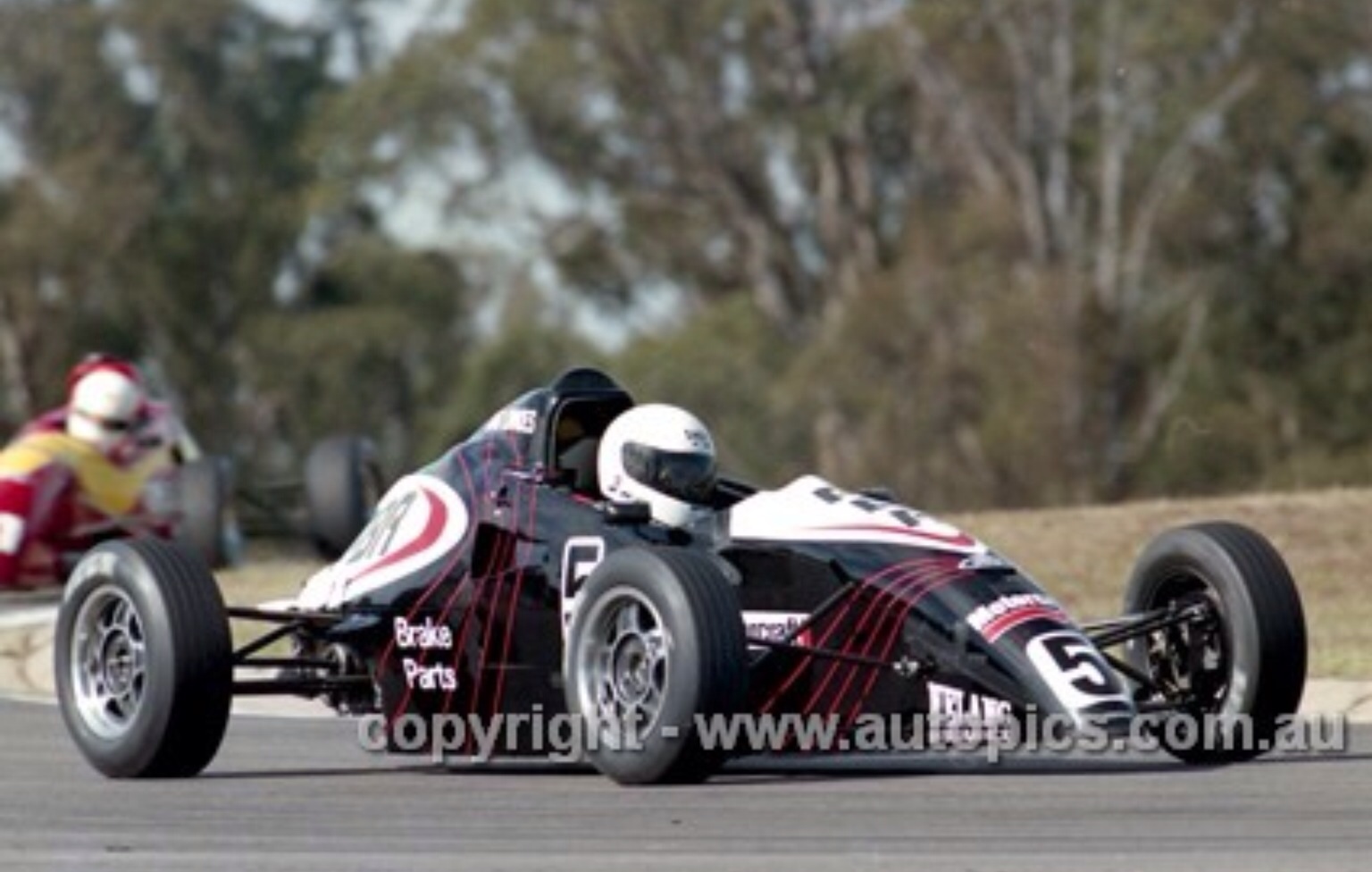
Lowndes, Van Dieman RF93 Formula Ford, Oran Park August 1993. Craig won 5 of the 8 ’93 rounds including OP (autopics)

Sponsors re-prioritised their spend over time away from the purer form of the sport to tourers. Drivers chase the dollars of course. So Taxis grew and grew. Its not that simple but its not much more complex either.

Back to the point of the article which is to discuss young talent and progression into the professional ranks.

It wasn’t always the case though, a career path into tourers. Often guys won the AFFC right into the nineties and none were picked up by professional touring car teams- the class was a bit of a closed shop with the young thrusters not especially welcome. Tomas Mezera is perhaps an exception but he ended up at HRT after he came back from his sojurn in Europe, so too did Russell Ingall make the transition after he returned from Europe.

Cameron McConville, the 1992 AFFC champ looked as though he may set a trend when Dick Johnson recruited him to race the second DJR machine at Bathurst in 1993 but then he boofed a fence and that was it for him, so it seemed. A 1996 win in the Australian GTP Championship in a Porsche 993 RS CS saw him brought back in from the cold- he beat Jim Richards in the Warwick Fabrics car that year, I remember being hugely impressed by his speed and professionalism.

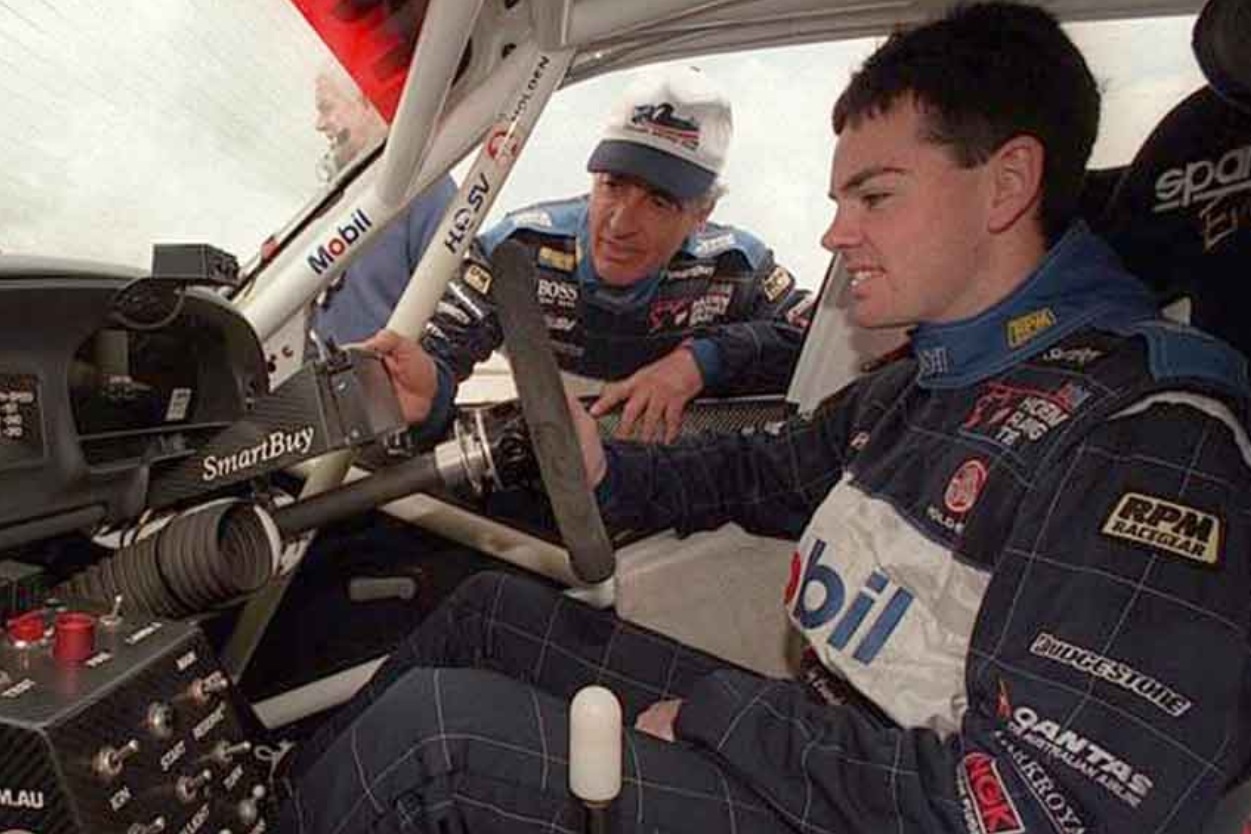
None of yer poofhouse single seater stuff in here matey! Peter Brock was a great mentor to Lowndes early on , this shot of an HRT Commodore circa 1996. Brocky had an all too brief sojurn into ANF2 circa 1973 with a Birrana 272 Ford (unattributed)

Lowndes was the one who really paved the way for the guys who followed- most of the V8 Supercar champs have been Karting and Formula Ford graduates since Craig showed the way.

Out of Karts of course, initially he raced an old RF85 Van Diemen Formula Ford in 1991 and then won the AFFC title aboard an RF93 in 1993. Longtime openwheeler racer and enthusiast (and 1975 Bathurst 1000 winner with Peter Brock) Brian Sampson threw him a lifeline by giving him some drives in his Cheetah Mk9 Holden Formula Holden in 1994. It wasn’t the latest bit of kit by any stretch, in fact it was and IS the very first FH built. But Craig made the thing sing, I recall some very good drives in the car against Greg Murphy in a much more recent Reynard.

Lowndes, a motor mechanic by trade, didn’t have much money but he had ability, a likable and engaging personality and ability to communicate and some contacts via his Dad, Frank Lowndes who had been in and around motor racing forever as a car/engine builder and scrutineer.

Holden Racing Team tested him and he was immediately quick, consistent, and easy on the equipment getting a drive in the 1994 Sandown 500. Soon he was team-leader and won the V8 Supercar title in 1996. He hadn’t lost the fire in the belly for open-wheeler success, and even though he had the local scene at his feet he negotiated a year in the European F3000 Championship via Tom Walkinshaw who by then owned HRT.

Lowndes, Lola T96/50 Zytec Judd F3000, Silverstone 1997 (LAT)

Lowndes had a shocker of a year being comprehensively blown off by Juan Pablo Montoya, his teammate at RSM Marko aboard the mandated Lola T96/50 Zytec. To be fair, he was coming back into single-seaters after an absence of some years into a group of the best F1 aspirants in the world straight out of F3 or doing a second or third year in F3000. Lowndes did not get a fair crack of the whip in the team with minimal testing, Marko ran Lowndes to settle a debt owed to Walkinshaw- and focussed, not unnaturally on the fellow who was winning races- Montoya.

What Lowndes needed was another season, but back to V8 Supercars he came and a couple of other titles, six Bathurst 1000’s and all the rest. Of course he is still racing at the top level too. It would have been interesting to see how far he could have progressed with another season in Europe.

(B Moxon)

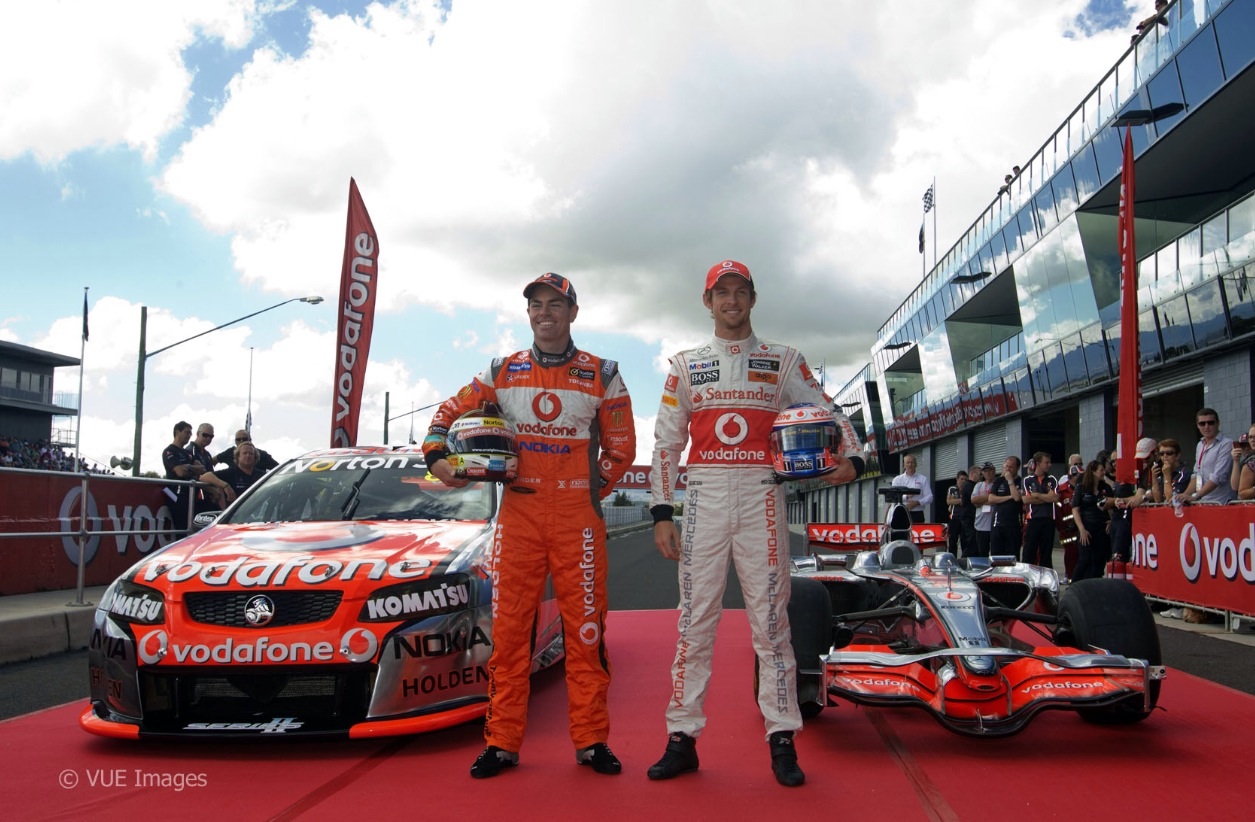
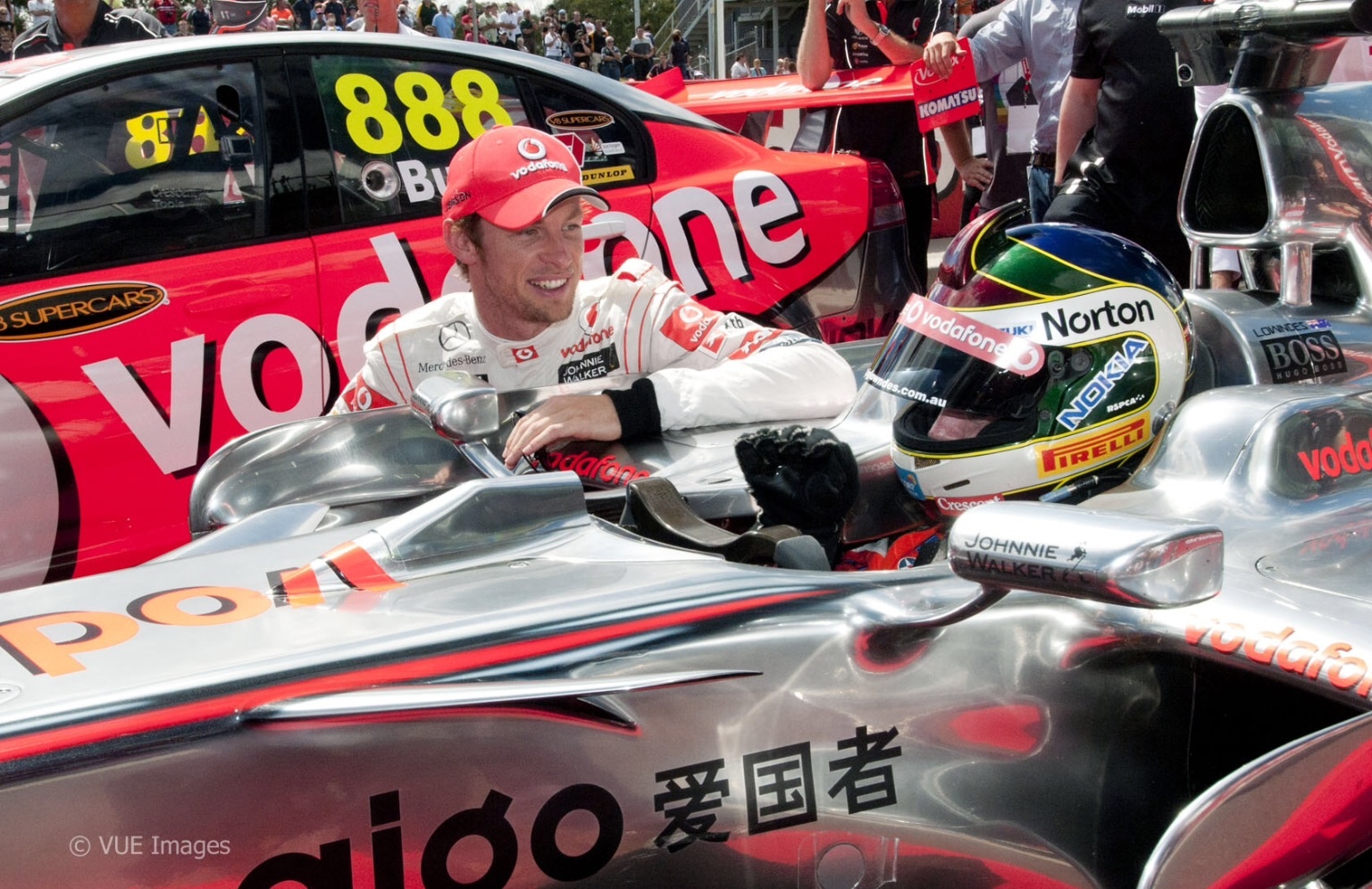
Jenson Button and Craig Lowndes, car a 2008 spec (champion that year in Lewis Hamilton’s hands) McLaren MP23/4 Mercedes 2.4 V8

Lowndes nipping a brake into Hell Corner (unattributed)

The opportunity to get to drive a contemporary F1 car was too good to be true and came about due to Vodaphones sponsorship of both McLaren and Triple Eight Racing who ran VE Holden Commodores that year. The day, just before the AGP at Albert Park involved closure of the Bathurst public roads- the circuit is just that, roads for most of the year with Lowndes and Jenson Button swapping seats between their respective F1 and V8 Supercar racers.

(unnatributed)

For misty eyed open-wheeler fans it was also an amazing ‘if only’, for Bathurst is indeed, in the words of Australian motor-racing historian John Medley ‘The Cradle of Australian Motor Racing’ and is where the Australian Grand Prix should be held. What a spectacle that would be! For that to occur the circuit would be destroyed to meet F1’s safety requirements, so of course it will never happen.

But for one day it was a reminder of what could be for enthusiasts and what might have been for Craig Lowndes had the racing cards been dealt or fallen a different way…

Comparo- F1 McLaren MP4/23 Mercedes Benz (2008) and V8 Supercar Holden ‘VE’ Commodore (2011)…

(Motor)

YouTube footage…

Credits…

Vue Images, LAT, Bruce Moxon, Motor

Tailpiece: Imagine 26 of them zipping past…

Finito…


(L Richards)

A motorsport event in Kew, Melbourne even in 1954 is a new one on me?!…
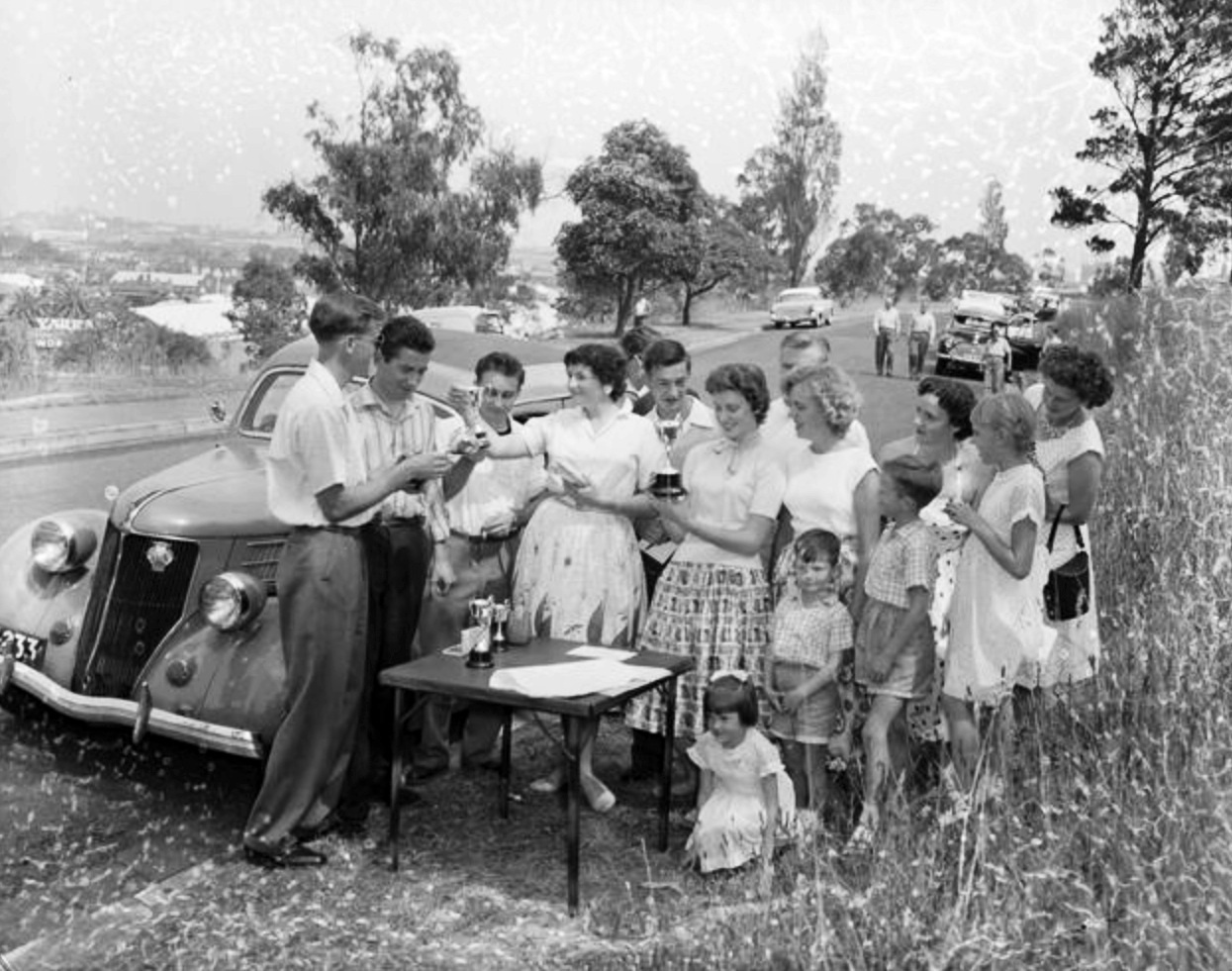
Its a rather nice, leafy, green suburb through which the Yarra River flows 5 Km from Melbourne’s CBD- ‘stockbroker belt’ stuff with some of Melbourne’s ‘better’ private schools contained therein. There is plenty of wealth in the area, then and now. So how come the good citizens of Kew allowed a motor sport event to take place on their turf prey tell?!

Stan Jones’ Cooper Mk4 JAP and a motor-cyclist are about to ‘blast off’ along the Kew Boulevard at Studley Park by the look of it. The flag-man is Reg Robbins, long-time member of Stanley’s racing equipe.

It’s a stretch of road we have all done lap records upon before the long arm of the law toned things down somewhat. A ribbon of bitumen that commands respect as a fair proportion of it is open and high speed despite changes to slow things down.

I have it on good authority that the number of 911’s which go in backwards is not that much different now to the 1980’s when there were plenty of wallies with loads of money not reflected in commensurate levels of driving talent. Many an insurance tale of woe was born on this stretch of blacktop.

(L Richards)

In any event, what is going on here, some of you are Kew locals, we are all intrigued to know?

Stan has his ‘Maybach’ helmet on , it was a good year for him, he had just won the New Zealand Grand Prix at Ardmore in perhaps Australia’s most famous special, the Charlie Dean/Repco built and prepared Maybach on 9 January. No wonder he has a big smile upon his face.

For Jones it was an easy event logistically. He lived in Balwyn, an adjoining suburb and his ‘fettler’ Ern Seeliger’s garage was in Baker Street, Richmond, also a couple of kays from The Boulevard on the other side of the river.

I am intrigued. Do tell folks!?. Maybe its a promotion and i’m getting excited about absolutely nothing…

An idea of the Kew Boulevard in 1958- not much different now, leafy green and lots of curves. This is the finish of a ‘car trial’ treasure hunt social event (L Richards)

Photo Credits…

Laurie Richards, State Library of Victoria, David Zeunert

Tailpiece: Stan and Cooper JAP, Templestowe Hillclimb circa 1952…

(SLV)

Templestowe Hillclimb was not too far from Kew, where the shots above are taken, so here is a snap of the man in action there. I’ve no idea of the date in the event that one of you were there to sort that point. Jones hustled a car along, he was a physical, press on kinda driver who pushed hard, not lacking finesse mind you, but you could always see him trying to get the best from his mount.

Just as he is here, using all of the available road…